ℹ️ Skipped - page is already crawled
| Filter | Status | Condition | Details |
|---|---|---|---|
| HTTP status | PASS | download_http_code = 200 | HTTP 200 |
| Age cutoff | PASS | download_stamp > now() - 6 MONTH | 1.2 months ago |
| History drop | PASS | isNull(history_drop_reason) | No drop reason |
| Spam/ban | PASS | fh_dont_index != 1 AND ml_spam_score = 0 | ml_spam_score=0 |
| Canonical | PASS | meta_canonical IS NULL OR = '' OR = src_unparsed | Not set |
| Property | Value | |||||||||
|---|---|---|---|---|---|---|---|---|---|---|
| URL | https://joe-antognini.github.io/machine-learning/steins-paradox | |||||||||
| Last Crawled | 2026-03-18 10:20:46 (1 month ago) | |||||||||
| First Indexed | 2021-01-02 23:58:41 (5 years ago) | |||||||||
| HTTP Status Code | 200 | |||||||||
| Content | ||||||||||
| Meta Title | Understanding Stein's paradox – Joe Antognini | |||||||||
| Meta Description | An intuitive explanation of the James-Stein estimator. | |||||||||
| Meta Canonical | null | |||||||||
| Boilerpipe Text | The paradox
Stein’s paradox is among the most surprising results in statistics. The basic
idea is easily stated, but it is difficult to understand how it could possibly
be true. The premise is this: suppose that I have a Gaussian distribution with
a variance of unity and some mean which I don’t tell you. I then draw a single
sample from this distribution, give it to you, and ask you to guess the mean.
What do you do? Well, you don’t have a lot of information to go on here, so
you just guess that the mean is the number I gave you. This is a good guess!
(We will make the notion of a “good guess” a little more precise later on.)
No big surprise there. Now we play again, but this time, my distribution is a
two
-dimensional Gaussian. The covariance is the identity matrix (so this is
equivalent to sampling from two independent one-dimensional Gaussians). But
again I have not told you the mean (which is now a two-dimensional vector).
Once more I draw a single sample from the distribution, hand it over to you,
and ask you to guess the mean. You simply guess that the mean is the sample I
have given you. Once more you have guessed well!
Now we do the same thing in three dimensions. I draw a single sample, hand it
over to you, and ask you to guess the mean. Just as before, you guess that the
mean is the sample I gave you. But this is no longer a good guess! Stein’s
paradox is that if we play this game in three dimensions or more, a better
guess is to say that the mean is this:
μ
^
=
ReLU
(
1
−
D
−
2
|
x
|
2
)
x
,
where
D
is the dimensionality of the Gaussian, and
x
is the
sample drawn from the distribution. This is the so-called “James-Stein
estimator.”
Who would have thought! What is going on here?
What makes a guess good?
Before we go on, we should clarify exactly what we mean by a “good guess.” We
are trying to do what is called “parameter estimation” in statistics — based
on a sample from a distribution, we want to infer some underlying parameter (or
parameters) of the distribution. (In this case the parameter we are interested
in is the mean.) In order to quantify how good or bad our estimate is we
choose a function called a “loss function.” There is some freedom in choosing
a loss function, but the mean squared error is a common choice and has a lot of
valuable properties. Stein’s paradox assumes that we are using the mean
squared error. So if we guess that the mean is
μ
^
and the true
value of the mean is
μ
, then the loss is
L
=
|
μ
^
−
μ
|
2
.
Now, of course, we need some rule to go from the sample
x
to the
estimate
μ
^
. This rule is just a function of some kind, say,
f
(
x
)
. This function has the special name of an “estimator.” We
can choose whatever function we want here. Our original guess was to just use
f
(
x
)
=
x
. But another choice here is to say
f
(
x
)
=
x
+
7
, or
f
(
x
)
=
sin
(
x
)
/
x
71
, or even just
f
(
x
)
=
31
. It doesn’t take much
imagination to see that there are an infinite number of possible choices. But
presumably some of these choices are better than others. How do we know which
ones are good?
Statisticians use the concept of
risk
for this purpose. Risk is simply the
expected value of your loss function. One thing that can be a little confusing
is that the risk is a function of
both
your choice of estimator
and
the
true value of the parameter itself. So in the original game where you’re
guessing the mean of a one-dimensional Gaussian, the risk will be a function of
whatever rule you decide to use and the actual, unknown value of the mean.
The fact that the risk is a function of the true value of the parameter makes
things a little tricky. If you’re trying to decide between two estimators, you
might find that one estimator works better for certain values that the
parameter can take, and the other works better for others. As a dumb example,
let’s go back to guessing the mean of a one-dimensional Gaussian. Our original
estimator was
μ
^
=
x
. But another, perfectly valid, estimator is
μ
^
=
7
. In other words we ignore the sample entirely and say that
the mean is 7 no matter what. Generally this doesn’t seem like a smart thing
to do. But if the mean turns out to actually be pretty close to 7, on average
this will be the better guess! Specifically, the risk of our initial estimator
is
R
x
=
E
[
(
x
−
μ
)
2
]
=
1
2
π
∫
(
x
−
μ
)
2
e
−
(
x
−
μ
)
2
/
2
d
x
=
1.
And the risk on our second, dumb estimator is
R
dumb
=
E
[
(
7
−
μ
)
2
]
=
1
2
π
∫
(
7
−
μ
)
2
e
−
(
x
−
μ
)
2
/
2
d
x
=
(
7
−
μ
)
2
.
As long as the true mean,
μ
, happens to be between 6 and 8, the dumb
estimator of just saying 7 actually has lower risk!
Based on this example it might seem that we’re stuck. Since we don’t know the
true value of the mean, we can’t generally say if one estimator is better than
another. And indeed this is often the case. But there are certain situations
where this is not true. If we have two estimators and one of them has a lower
risk
for any possible value the parameter can take
, we can say that one is
definitively better than the other. In statistical parlance, we say that the
worse estimator is “inadmissable.”
In more precise terms, Stein’s paradox states that in three dimensions or more,
the naive estimator (just guessing that the mean is
x
) is
inadmissable because the risk of the James-Stein estimator is lower for any
possible mean I could choose.
What is the James-Stein estimator doing?
Before we can understand
why
the James-Stein estimator gives you a better
guess than the naive estimator
x
, we should understand
what
exactly it’s doing. The idea is that we take the naive guess
x
and then we scale it towards the origin by some amount. The factor by which we
scale it is:
ReLU
(
1
−
D
−
2
|
x
|
2
)
.
The ReLU function simply takes the maximum of its argument and zero, so this
scale factor will be either positive or zero. Let’s suppose that it’s
positive. In this case we scale it towards the origin more if the magnitude of
the sample is smaller and less if it is lower. In the limit of
|
x
|
→
∞
we don’t change it at all and our guess reduces to the naive
estimator
x
.
In the other limit, if
|
x
|
is very small, then the ReLU function
will kick in and just set the scale factor to zero. Hence anytime we get a
sufficiently small sample we throw it out and just guess that the mean is zero
instead. And all else being equal we will shrink our estimate more in higher
dimensional spaces than in lower dimensional spaces.
So that is what the James-Stein estimator is doing. Why does it work? Before
we can answer that we need to take a quick detour.
Samples in high dimensional spaces
High dimensional spaces are counterintuitive. One of the counterintuitive
properties of high dimensional distributions is this: a sample from a symmetric
high dimensional distribution is highly likely to be further from the origin
than the mean. Specifically, for an isotropic
D
-dimensional Gaussian, the
difference between the average distance to a sample and the distance to the
mean grows as
∼
D
.
It’s a little strange to put it this way, but isn’t so surprising with a little
bit of thought. Even in two dimensions we can see that this is the case just
by drawing it:
The shaded area of the circle is less than half the area, so we are less likely
to choose a sample closer to the origin than the mean. What perhaps makes this
counterintuitive is that in two dimensions a fairly large fraction of the
circle is still shaded. But as the dimensionality increases, this fraction
decreases exponentially. Once the dimensionality is even moderately large we
are highly unlikely to sample a point in this shaded region.
One caveat here is that this effect decreases the larger the mean is. You can
imagine that as we move the circle further away from the origin, the shaded
fraction gets closer and closer to ½. So long as the mean is sufficiently
large, the probability of sampling a point closer to the origin than the mean
can be close to ½ even in high dimensional spaces; it just requires a very
large mean. We can start to see here the connection to the James-Stein
estimator, which also gets very close to the naive estimator
x
as
the mean (and hence
|
x
|
) gets very large.
What we are doing by shrinking the estimate towards the origin is correcting
for the tendency of the typical sample to be slightly further away from the
origin than the mean. This correction allows us to reduce the overall risk of
the estimate. [
1
]
How arbitrary is the origin, really?
Stein’s paradox is particularly strange because there are actually two
counterintuitive things going on:
The origin is arbitrary, so why does moving your estimate towards the origin
help?
Why does this not work in one or two dimensions?
Let’s take a look at the first of these. A central principle in physics is
that of relativity — coordinate systems are arbitrary, so the laws of physics
must be valid in all of them. Surely this is also true in statistics as well.
We can choose the origin to be wherever we like, so it cannot contain any
information. But this sensible assertion is false. Statistics is not physics.
If we truly had no information about the mean, what value would the sample
have? If it could really be
anything
then presumably its value would be
exceedingly large. After all, there are a lot of numbers, almost all of them
are too big to write down, and the mean could be absolutely
any
of them. But
if we pick a sample and find that its distance from the origin is 3.72 there
must be something fishy going on. Clearly we have, in fact, managed to embed
some
information in our choice of coordinate system. The only reason we have
gotten out sensible values in our sample is because we have some prior as to
where the mean is expected to be.
In fact, in the limit of no information
|
x
|
will be infinitely
large and the James-Stein estimator will reduce to the naive estimator,
x
. So it was our clever choice of origin that smuggled
information into our estimator and allowed us to do better than the naive
estimate.
It’s important to distinguish between the
direction
of the origin and the
distance
between the origin and the mean. The direction of the origin is
unimportant. In fact, we could shrink our estimate in any direction and we
would still get the benefits of the James-Stein estimator. The
important thing is the distance between the origin and the mean — this is
what has encoded some prior information that we can exploit to make a better
prediction.
The bias-variance tradeoff
The way the James-Stein estimator works can be understood by looking at the
bias-variance tradeoff. The bias-variance tradeoff states that the risk of an
estimator can be decomposed into two components: a constant “bias” term, which
reflects how far off the average value of the estimate is from the correct
value; and an unbiased “variance” term, which accounts for the randomness of
the sample.
The naive estimator
x
is unbiased but has a high variance. One
reason that Stein’s paradox seems unnatural is that we tend to confuse unbiased
estimators with estimators that minimize risk. But in high dimensional spaces,
samples from an isotropic Gaussian encompass a tremendous volume. Although our
naive estimate is unbiased it has very high variance.
What the James-Stein estimator does is scale the overall distribution towards
the origin, thereby shrinking the volume of the distribution (and hence its
variance), at the cost of introducing a little bit of bias. Although the
estimator is now biased its overall risk is lower.
Deriving the James-Stein estimator geometrically
At this point we have some idea as to why shrinking the estimate towards the
origin could be helpful, but we haven’t yet figured out why the specific form
of the James-Stein estimator seems to work. To do this we’ll follow an
argument presented by
Brown & Zhao (2012)
.
Remember that the direction of the coordinate system is arbitrary. So let’s
rotate into a new one where one axis points directly toward the mean, and the
other
D
−
1
axes are pointed in arbitrary (orthogonal) directions. (Of
course,
you
can’t do this because you don’t know where the true mean is. But
I
do, and I’ve decided to help you out.) In this coordinate system the mean
is just
(
|
μ
|
,
0
,
…
,
0
)
. Let’s write the sample in this coordinate
system as
(
ζ
1
,
ζ
2
,
…
,
ζ
D
)
.
The loss for our guess can now be broken into two orthogonal components: one
component,
(
ζ
1
−
|
μ
|
)
2
, which tells us how far off our estimate is
from the true value when it’s projected onto the correct direction of the mean;
and a second component,
∑
i
=
2
D
ζ
i
2
, which tells us how far off
our estimate is from this correct direction. Let’s call this second component
the “residual” component and define it as
ρ
≡
∑
i
=
2
D
ζ
i
2
.
Our underlying distribution is isotropic, so rotating the coordinate system
doesn’t change the fact that each coordinate
ζ
i
is a sample from an
independent one-dimensional Gaussian with unit variance. And if
i
>
1
then
the mean of this distribution is zero as well.
ρ
therefore follows a
χ
distribution
with
D
−
1
degrees of freedom.
Let’s suppose that we’ve gone and chosen a sample from our distribution and by
good fortune
ζ
1
happens to be exactly equal to
|
μ
|
. In general
the rest of the
ζ
i
in the sample won’t be exactly zero and so
ρ
will be positive. If we plot
ζ
1
on the
x
-axis and
ρ
on the
y
-axis, the situation will look like this:
The sample from our distribution is the point at the top right of the triangle.
If we just use this sample as our estimate of the mean then the loss of this
estimate will simply be the squared distance between the point and the bottom
right corner of the triangle, or
ρ
2
.
How
can
we transform the sample?
We only have two points in this problem: the origin, and the sample
x
. By symmetry this means that the only way by which we can make
an estimate is to choose a point somewhere on the line between the origin and
x
. [
2
] In other words, you don’t actually know what direction
any of the
ζ
i
are in so you can’t simply move your guess down the
right side of the triangle to reduce
ρ
. The only direction you are
allowed to move your sample is along the hypotenuse of this triangle.
How
should
we transform the sample?
The beauty of the James-Stein estimator is that even though we are constrained
to move the sample along the hypotenuse, we can nevertheless reduce the
distance between our guess and the true mean by shrinking it until the
direction between our guess and the mean is perpendicular to the hypotenuse.
Some simple geometry reveals that this new point is located at:
(
1
−
ρ
2
|
x
|
2
)
x
This is looking like the beginnings of the James-Stein estimator!
What exactly is
ρ
? Unfortunately
ρ
is random variable, but let’s
represent it by some central point of its distribution. Now
ρ
2
follows a
χ
2
distribution with
D
−
1
degrees of freedom and the mode of this
distribution is
max
(
D
−
2
,
0
)
. So if we simply represent this distribution by its
mode, our estimator becomes
(
1
−
D
−
2
|
x
|
2
)
x
,
for
D
≥
3
and is the naive estimator
x
for
D
<
3
, which
is exactly the James-Stein estimator without the ReLU.
To be clear, this is a very hand-wavey argument. Representing the entire
distribution by a single point is not particularly sophisticated, and there is
no special reason to choose to use the mode instead of the mean or median
except that it happens to give an answer that corresponds to the James-Stein
estimator. [
3
]
Can we derive the James-Stein estimator rigorously?
Given how hand-wavey this argument was, you might wonder whether it’s possible
to rigorously derive the James-Stein estimator by explicitly calculating the
risk given the Gaussian and
χ
distributions, and then finding the
function that minimizes the risk using the calculus of variations. However
this approach will not work. The reason is that the James-Stein optimizer does
not actually minimize the risk! In fact, despite its fame, the James-Stein
estimator is itself inadmissible.
As we’ll see below, we can improve our estimator by wrapping it in a ReLU
function. But the ReLU function introduces some difficulties, because there is
a very general theorem which states that any admissible estimator must be a
Bayes estimator for some prior, or the limit of Bayes estimators. [
4
] This
ends up implying that the estimator must be a smooth function and the ReLU
function is not smooth. So while the James-Stein estimator beats the naive
estimator
x
, there exists some other estimator which beats it!
Recovering the ReLU
There is one last piece to tackle: the ReLU function. Where does that come
from?
The ReLU has no effect on our estimate as long as
|
x
|
≥
D
−
2
.
This will generally be the case if
|
μ
|
is large. But if
|
μ
|
is
small, then some of the points sampled will have
|
x
|
<
D
−
2
. If
we were to just use the same scaling we derived above, we would reflect our
estimate through the origin and make it negative! This estimate has a worse
loss than an estimate at the origin.
The reason for this is that once we have shrunk the sample all the way down to
the origin we have already traded away all the variance for bias. In other
words, we started with an estimate that had no bias and high variance, and
ended up with an estimate that had high bias and no variance. But if we were
to keep going past the origin, we’d continue to increase the bias but would
start to increase the variance as well! This is strictly worse than keeping
our estimate at the origin, so we are better off clamping the estimate at zero
with a ReLU function.
Why does Stein’s paradox not hold in two dimensions?
Let’s now turn to the second counterintuitive property of Stein’s paradox:
what’s so special about three dimensions? We saw a hint that three dimensions
is special since the mode of the
χ
2
distribution is 0 for one and two
dimensions, but is
D
−
2
for higher numbers of dimensions. But as I
pointed out, that came about from representing the entire
ρ
2
distribution by its mode, and it’s not really obvious why we should pick the
mode in particular rather than, say, the mean or median.
Thinking back to our geometric argument, it is not hard to see why the
James-Stein estimator doesn’t help in one dimension — we arrived at the
James-Stein estimator by separating the sample into two components, one along
the direction to the true mean, and the other as a residual component
perpendicular to the first. But in one dimension there is no residual
component! By shrinking your estimate towards the origin you introduce some
bias, but this is not counterbalanced by any reduction in variance.
But what about the two dimensional case? Here again we unfortunately must wave
our hands. In the two dimensional case we do, in fact, reduce the variance by
shrinking our estimate towards the origin, just not by enough to offset the
bias we introduce. While the orthogonal component,
ρ
, is not
identically zero as it was in the one-dimensional case, it is strongly bunched
up close to zero in the two dimensional case. The idea of the James-Stein
estimator is to note that a certain proportion of a sample’s magnitude is due
to a component orthogonal to the mean and to shrink the estimate to reduce that
orthogonal component somewhat. But if the magnitude of the orthogonal component
is too small, this won’t always work. There are some values of the mean for
which the James-Stein estimator is better, but others where it is worse. It is
not the better estimator no matter what.
A digression on random walks
As an aside, there is a
deep correspondence
found by Lawrence Brown
between random walks and the admissibility of the naive estimator,
x
. Brown showed that the naive estimator is admissible if and
only if a random walk returns to the origin an infinite number of times.
Random walks in one or two dimensions do this, but random walks in three or
more dimensions do not. At a high level this is because the random walk drifts
away from the origin at a rate linear in the dimensionality of the space, but
the volume subtended by the origin at a fixed distance decays exponentially
with dimension. In one or two dimensions the volume subtended by the origin is
large enough that you are guaranteed to eventually make your way back to it.
But in higher dimensions, the volume subtended is smaller, so that as time
progresses you are less and less likely to make your way back and the probability
approaches zero even in the limit of an infinite number of steps.
While rigorously proving this correspondence is non-trivial, both problems have
at their core a comparison between the distance between a point and the origin
and the volume of the unit sphere in the space.
There be dragons far from the origin
So that, at a high level, is why the James-Stein estimator works. We’ve been
focused in this post on the simplest form of Stein’s paradox, which is a bit of
a toy problem. But the artificiality of the problem shouldn’t befog us as to
the significance of these ideas. The artificiality eases the analysis, but in
fact the concepts that Stein’s paradox illustrates run much deeper through
statistics and machine learning.
As we discussed earlier on, while we usually don’t think that there is anything
special about our choice of origin, we do nevertheless use it to smuggle in
some priors, even if those priors are weak and we perhaps do so unwittingly.
This is also true of machine learning models, maybe even more so. For most
machine learning models the origin really
is
special. For example, at the
origin most garden-variety neural networks will exhibit particularly simple
behavior — they will output all zeros independent of the input. [
5
] Any
movement away from this special point will introduce complexity into the
functional behavior of the model. Neural networks are, of course, non-linear,
so it is not always true that points further from the origin in parameter space
are more complicated, but it is
generally
true.
Most ML practitioners appreciate that techniques like L2 regularization have
the effect of making models simpler, and therefore less likely to overfit. But
Stein’s paradox dramatically illustrates the relationship between the risk of
an estimate and the dimensionality of the space — in high dimensional spaces
there is
much
more volume further away from the origin than closer to it. We
are oftentimes better off introducing bias in order to reduce variance because
in high dimensional spaces shrinking a small amount towards the origin reduces
an
enormous
volume of parameter space. In other words, for a large machine
learning model, there are
vastly
more ways to overfit than there are to
underfit so we should bias our models towards underfitting because that is a
simpler problem to solve than overfitting. (Or maybe to put it another way,
underfitting is a small number of problems, whereas overfitting is a stupendous
number of problems.)
This phenomenon can manifest itself during neural network training. Suppose we
have converged on a local minimum in the loss landscape after training with
some variant of stochastic gradient descent. At convergence there will be
equality between the stochastic component of SGD, for which the random walk is
causing the parameters to drift away from the minimum, and the true gradient,
which is pushing the parameters towards the minimum. [
6
] At this point the
neural network is wandering on some high-dimensional ellipsoid around the
minimum. But by the nature of high dimensional spaces, the neural network will
always
be further from the origin than the minimum, and therefore on the side
of too much complexity. Thus this converged model will always slightly
overfit.
The further the model recedes from the origin, the more inexplicable its
functional behavior can become. The moral of this story is that far from the
origin there be dragons, and in a high dimensional space, moving just a little
further away from the origin introduces lots and lots of dragons. The
James-Stein estimator advises you to stay close to the origin to keep your risk
down and the dragons at bay.
Footnotes
It’s important to note that this does not imply that our original estimate
is biased. In fact the naive estimator is unbiased and shrinking it
towards the origin introduces bias. It is the distance of the naive
estimator from the origin that is biased high. But by correcting for
this
bias we happen to reduce the risk.
↩
While there’s nothing stopping us from choosing some other random
direction, this adds no new information and so is effectively the same as
choosing a different origin.
↩
The median and mean of the
χ
distribution are more complicated but
are asymptotically equal to the mode in the limit of a large number of
degrees of freedom. But the asymptotic limit does not help you prove the
case for
D
=
3
.
In fact Brown & Zhao (2012) chose to use the mean instead and derive a
(
D
−
1
)
/
|
x
|
2
term instead of
(
D
−
2
)
/
|
x
|
2
as we do from the mode. They then argue that the extra
−
1
/
|
x
|
2
is due to the variance in
ζ
1
. I am not fully
convinced of this argument; it seems to me that once one has represented
the entire distribution by a central point one is already waving one’s
hands.
↩
A Bayes estimator is determined by a particular choice of prior. A “limit
of Bayes estimators” is found by taking the limit of the Bayes estimators
found from a sequence of priors as the sequence tends to infinity.
↩
Of course the origin is not the only point that exhibits this behavior. I
speculate that if we shrank to any point for which the model had functional
simplicity we would observe the same benefits as shrinking towards the
origin.
↩
Learning rate decay also mitigates this issue.
↩ | |||||||||
| Markdown | # [Joe Antognini](https://joe-antognini.github.io/)
[☰](https://joe-antognini.github.io/machine-learning/steins-paradox#nav)
- [Publications](https://joe-antognini.github.io/publications)
- [Projects](https://joe-antognini.github.io/projects)
- [About](https://joe-antognini.github.io/about)
# Understanding Stein's paradox
January 2, 2021
## The paradox
Stein’s paradox is among the most surprising results in statistics. The basic idea is easily stated, but it is difficult to understand how it could possibly be true. The premise is this: suppose that I have a Gaussian distribution with a variance of unity and some mean which I don’t tell you. I then draw a single sample from this distribution, give it to you, and ask you to guess the mean. What do you do? Well, you don’t have a lot of information to go on here, so you just guess that the mean is the number I gave you. This is a good guess! (We will make the notion of a “good guess” a little more precise later on.)
No big surprise there. Now we play again, but this time, my distribution is a *two*\-dimensional Gaussian. The covariance is the identity matrix (so this is equivalent to sampling from two independent one-dimensional Gaussians). But again I have not told you the mean (which is now a two-dimensional vector). Once more I draw a single sample from the distribution, hand it over to you, and ask you to guess the mean. You simply guess that the mean is the sample I have given you. Once more you have guessed well\!
Now we do the same thing in three dimensions. I draw a single sample, hand it over to you, and ask you to guess the mean. Just as before, you guess that the mean is the sample I gave you. But this is no longer a good guess! Stein’s paradox is that if we play this game in three dimensions or more, a better guess is to say that the mean is this:
μ^\=ReLU(1−D−2\|x\|2)x,
μ
^
\=
ReLU
(
1
−
D
−
2
\|
x
\|
2
)
x
,
where D D is the dimensionality of the Gaussian, and x x is the sample drawn from the distribution. This is the so-called “James-Stein estimator.”
Who would have thought! What is going on here?
## What makes a guess good?
Before we go on, we should clarify exactly what we mean by a “good guess.” We are trying to do what is called “parameter estimation” in statistics — based on a sample from a distribution, we want to infer some underlying parameter (or parameters) of the distribution. (In this case the parameter we are interested in is the mean.) In order to quantify how good or bad our estimate is we choose a function called a “loss function.” There is some freedom in choosing a loss function, but the mean squared error is a common choice and has a lot of valuable properties. Stein’s paradox assumes that we are using the mean squared error. So if we guess that the mean is μ^ μ ^ and the true value of the mean is μ μ, then the loss is
L\=\|μ^−μ\|2.
L
\=
\|
μ
^
−
μ
\|
2
.
Now, of course, we need some rule to go from the sample x x to the estimate μ^ μ ^. This rule is just a function of some kind, say, f(x) f ( x ). This function has the special name of an “estimator.” We can choose whatever function we want here. Our original guess was to just use f(x)\=x f ( x ) \= x. But another choice here is to say f(x)\=x\+7 f ( x ) \= x \+ 7, or f(x)\=sin(x)/x71 f ( x ) \= sin ( x ) / x 71, or even just f(x)\=31 f ( x ) \= 31. It doesn’t take much imagination to see that there are an infinite number of possible choices. But presumably some of these choices are better than others. How do we know which ones are good?
Statisticians use the concept of *risk* for this purpose. Risk is simply the expected value of your loss function. One thing that can be a little confusing is that the risk is a function of *both* your choice of estimator *and* the true value of the parameter itself. So in the original game where you’re guessing the mean of a one-dimensional Gaussian, the risk will be a function of whatever rule you decide to use and the actual, unknown value of the mean.
The fact that the risk is a function of the true value of the parameter makes things a little tricky. If you’re trying to decide between two estimators, you might find that one estimator works better for certain values that the parameter can take, and the other works better for others. As a dumb example, let’s go back to guessing the mean of a one-dimensional Gaussian. Our original estimator was μ^\=x μ ^ \= x. But another, perfectly valid, estimator is μ^\=7 μ ^ \= 7. In other words we ignore the sample entirely and say that the mean is 7 no matter what. Generally this doesn’t seem like a smart thing to do. But if the mean turns out to actually be pretty close to 7, on average this will be the better guess! Specifically, the risk of our initial estimator is
Rx\=\=\=E\[(x−μ)2\]12π−−√∫(x−μ)2e−(x−μ)2/2dx1\.
R
x
\=
E
\[
(
x
−
μ
)
2
\]
\=
1
2
π
∫
(
x
−
μ
)
2
e
−
(
x
−
μ
)
2
/
2
d
x
\=
1\.
And the risk on our second, dumb estimator is
Rdumb\=\=\=E\[(7−μ)2\]12π−−√∫(7−μ)2e−(x−μ)2/2dx(7−μ)2.
R
dumb
\=
E
\[
(
7
−
μ
)
2
\]
\=
1
2
π
∫
(
7
−
μ
)
2
e
−
(
x
−
μ
)
2
/
2
d
x
\=
(
7
−
μ
)
2
.
As long as the true mean, μ μ, happens to be between 6 and 8, the dumb estimator of just saying 7 actually has lower risk\!
Based on this example it might seem that we’re stuck. Since we don’t know the true value of the mean, we can’t generally say if one estimator is better than another. And indeed this is often the case. But there are certain situations where this is not true. If we have two estimators and one of them has a lower risk *for any possible value the parameter can take*, we can say that one is definitively better than the other. In statistical parlance, we say that the worse estimator is “inadmissable.”
In more precise terms, Stein’s paradox states that in three dimensions or more, the naive estimator (just guessing that the mean is x x) is inadmissable because the risk of the James-Stein estimator is lower for any possible mean I could choose.
## What is the James-Stein estimator doing?
Before we can understand *why* the James-Stein estimator gives you a better guess than the naive estimator x x, we should understand *what* exactly it’s doing. The idea is that we take the naive guess x x and then we scale it towards the origin by some amount. The factor by which we scale it is:
ReLU(1−D−2\|x\|2).
ReLU
(
1
−
D
−
2
\|
x
\|
2
)
.
The ReLU function simply takes the maximum of its argument and zero, so this scale factor will be either positive or zero. Let’s suppose that it’s positive. In this case we scale it towards the origin more if the magnitude of the sample is smaller and less if it is lower. In the limit of \|x\|→∞ \| x \| → ∞ we don’t change it at all and our guess reduces to the naive estimator x x.
In the other limit, if \|x\| \| x \| is very small, then the ReLU function will kick in and just set the scale factor to zero. Hence anytime we get a sufficiently small sample we throw it out and just guess that the mean is zero instead. And all else being equal we will shrink our estimate more in higher dimensional spaces than in lower dimensional spaces.
So that is what the James-Stein estimator is doing. Why does it work? Before we can answer that we need to take a quick detour.
## Samples in high dimensional spaces
High dimensional spaces are counterintuitive. One of the counterintuitive properties of high dimensional distributions is this: a sample from a symmetric high dimensional distribution is highly likely to be further from the origin than the mean. Specifically, for an isotropic D D\-dimensional Gaussian, the difference between the average distance to a sample and the distance to the mean grows as ∼ ∼D−−√ D.
It’s a little strange to put it this way, but isn’t so surprising with a little bit of thought. Even in two dimensions we can see that this is the case just by drawing it:
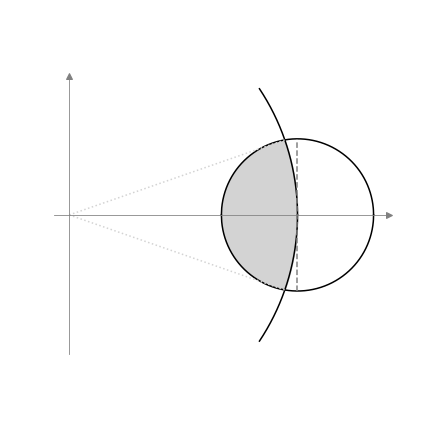
The shaded area of the circle is less than half the area, so we are less likely to choose a sample closer to the origin than the mean. What perhaps makes this counterintuitive is that in two dimensions a fairly large fraction of the circle is still shaded. But as the dimensionality increases, this fraction decreases exponentially. Once the dimensionality is even moderately large we are highly unlikely to sample a point in this shaded region.
One caveat here is that this effect decreases the larger the mean is. You can imagine that as we move the circle further away from the origin, the shaded fraction gets closer and closer to ½. So long as the mean is sufficiently large, the probability of sampling a point closer to the origin than the mean can be close to ½ even in high dimensional spaces; it just requires a very large mean. We can start to see here the connection to the James-Stein estimator, which also gets very close to the naive estimator x x as the mean (and hence \|x\| \| x \|) gets very large.
What we are doing by shrinking the estimate towards the origin is correcting for the tendency of the typical sample to be slightly further away from the origin than the mean. This correction allows us to reduce the overall risk of the estimate. \[[1](https://joe-antognini.github.io/machine-learning/steins-paradox#fn:6)\]
## How arbitrary is the origin, really?
Stein’s paradox is particularly strange because there are actually two counterintuitive things going on:
1. The origin is arbitrary, so why does moving your estimate towards the origin help?
2. Why does this not work in one or two dimensions?
Let’s take a look at the first of these. A central principle in physics is that of relativity — coordinate systems are arbitrary, so the laws of physics must be valid in all of them. Surely this is also true in statistics as well. We can choose the origin to be wherever we like, so it cannot contain any information. But this sensible assertion is false. Statistics is not physics.
If we truly had no information about the mean, what value would the sample have? If it could really be *anything* then presumably its value would be exceedingly large. After all, there are a lot of numbers, almost all of them are too big to write down, and the mean could be absolutely *any* of them. But if we pick a sample and find that its distance from the origin is 3.72 there must be something fishy going on. Clearly we have, in fact, managed to embed *some* information in our choice of coordinate system. The only reason we have gotten out sensible values in our sample is because we have some prior as to where the mean is expected to be.
In fact, in the limit of no information \|x\| \| x \| will be infinitely large and the James-Stein estimator will reduce to the naive estimator, x x. So it was our clever choice of origin that smuggled information into our estimator and allowed us to do better than the naive estimate.
It’s important to distinguish between the *direction* of the origin and the *distance* between the origin and the mean. The direction of the origin is unimportant. In fact, we could shrink our estimate in any direction and we would still get the benefits of the James-Stein estimator. The important thing is the distance between the origin and the mean — this is what has encoded some prior information that we can exploit to make a better prediction.
## The bias-variance tradeoff
The way the James-Stein estimator works can be understood by looking at the bias-variance tradeoff. The bias-variance tradeoff states that the risk of an estimator can be decomposed into two components: a constant “bias” term, which reflects how far off the average value of the estimate is from the correct value; and an unbiased “variance” term, which accounts for the randomness of the sample.
The naive estimator x x is unbiased but has a high variance. One reason that Stein’s paradox seems unnatural is that we tend to confuse unbiased estimators with estimators that minimize risk. But in high dimensional spaces, samples from an isotropic Gaussian encompass a tremendous volume. Although our naive estimate is unbiased it has very high variance.
What the James-Stein estimator does is scale the overall distribution towards the origin, thereby shrinking the volume of the distribution (and hence its variance), at the cost of introducing a little bit of bias. Although the estimator is now biased its overall risk is lower.
## Deriving the James-Stein estimator geometrically
At this point we have some idea as to why shrinking the estimate towards the origin could be helpful, but we haven’t yet figured out why the specific form of the James-Stein estimator seems to work. To do this we’ll follow an argument presented by [Brown & Zhao (2012)](https://projecteuclid.org/download/pdfview_1/euclid.ss/1331729980).
Remember that the direction of the coordinate system is arbitrary. So let’s rotate into a new one where one axis points directly toward the mean, and the other D−1 D − 1 axes are pointed in arbitrary (orthogonal) directions. (Of course, *you* can’t do this because you don’t know where the true mean is. But *I* do, and I’ve decided to help you out.) In this coordinate system the mean is just (\|μ\|,0,…,0) ( \| μ \| , 0 , … , 0 ). Let’s write the sample in this coordinate system as (ζ1,ζ2,…,ζD) ( ζ 1 , ζ 2 , … , ζ D ).
The loss for our guess can now be broken into two orthogonal components: one component, (ζ1−\|μ\|)2 ( ζ 1 − \| μ \| ) 2, which tells us how far off our estimate is from the true value when it’s projected onto the correct direction of the mean; and a second component, ∑Di\=2ζ2i ∑ i \= 2 D ζ i 2, which tells us how far off our estimate is from this correct direction. Let’s call this second component the “residual” component and define it as
ρ≡∑i\=2Dζ2i−−−−−⎷.
ρ
≡
∑
i
\=
2
D
ζ
i
2
.
Our underlying distribution is isotropic, so rotating the coordinate system doesn’t change the fact that each coordinate ζi ζ i is a sample from an independent one-dimensional Gaussian with unit variance. And if i\>1 i \> 1 then the mean of this distribution is zero as well. ρ ρ therefore follows a [χ χ distribution](https://en.wikipedia.org/wiki/Chi_distribution) with D−1 D − 1 degrees of freedom.
Let’s suppose that we’ve gone and chosen a sample from our distribution and by good fortune ζ1 ζ 1 happens to be exactly equal to \|μ\| \| μ \|. In general the rest of the ζi ζ i in the sample won’t be exactly zero and so ρ ρ will be positive. If we plot ζ1 ζ 1 on the x x\-axis and ρ ρ on the y y\-axis, the situation will look like this:
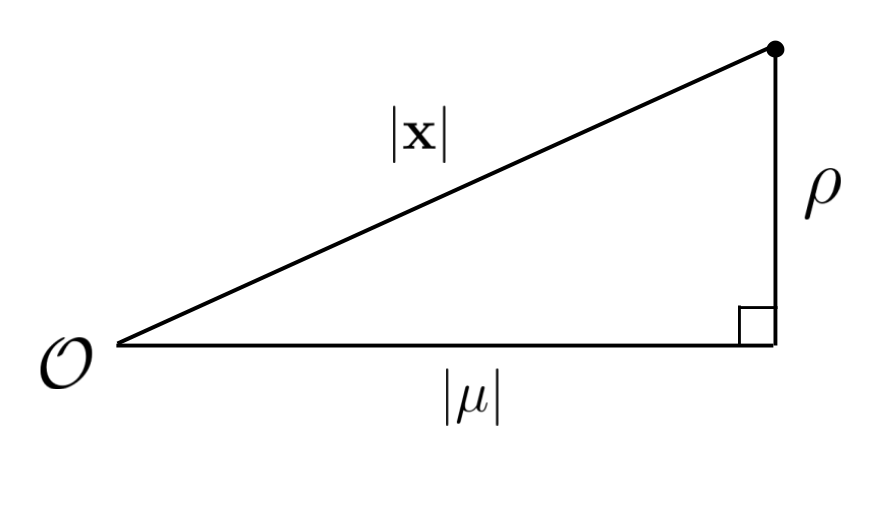
The sample from our distribution is the point at the top right of the triangle. If we just use this sample as our estimate of the mean then the loss of this estimate will simply be the squared distance between the point and the bottom right corner of the triangle, or ρ2 ρ 2.
### How *can* we transform the sample?
We only have two points in this problem: the origin, and the sample x x. By symmetry this means that the only way by which we can make an estimate is to choose a point somewhere on the line between the origin and x x. \[[2](https://joe-antognini.github.io/machine-learning/steins-paradox#fn:5)\] In other words, you don’t actually know what direction any of the ζi ζ i are in so you can’t simply move your guess down the right side of the triangle to reduce ρ ρ. The only direction you are allowed to move your sample is along the hypotenuse of this triangle.
### How *should* we transform the sample?
The beauty of the James-Stein estimator is that even though we are constrained to move the sample along the hypotenuse, we can nevertheless reduce the distance between our guess and the true mean by shrinking it until the direction between our guess and the mean is perpendicular to the hypotenuse.
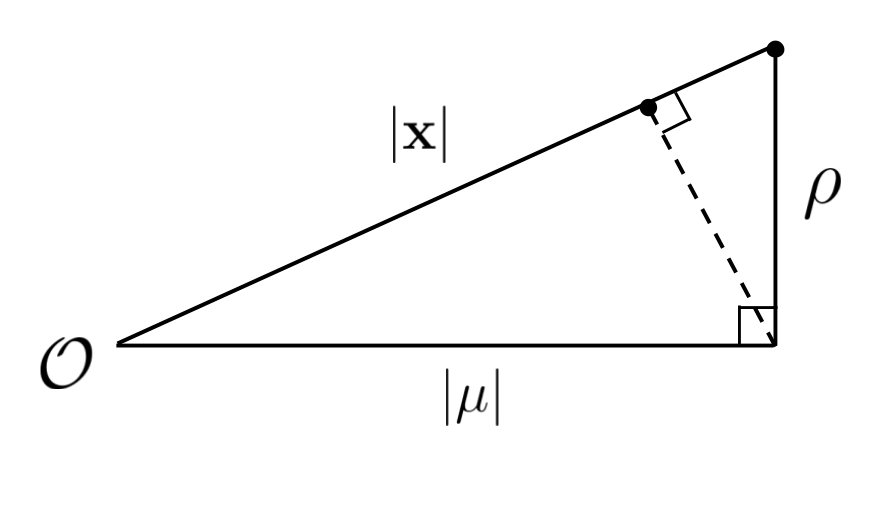
Some simple geometry reveals that this new point is located at:
(1−ρ2\|x\|2)x
(
1
−
ρ
2
\|
x
\|
2
)
x
This is looking like the beginnings of the James-Stein estimator\!
What exactly is ρ ρ? Unfortunately ρ ρ is random variable, but let’s represent it by some central point of its distribution. Now ρ2 ρ 2 follows a χ2 χ 2 distribution with D−1 D − 1 degrees of freedom and the mode of this distribution is max(D−2,0) max ( D − 2 , 0 ). So if we simply represent this distribution by its mode, our estimator becomes
(1−D−2\|x\|2)x,
(
1
−
D
−
2
\|
x
\|
2
)
x
,
for D≥3 D ≥ 3 and is the naive estimator x x for D\<3 D \< 3, which is exactly the James-Stein estimator without the ReLU.
To be clear, this is a very hand-wavey argument. Representing the entire distribution by a single point is not particularly sophisticated, and there is no special reason to choose to use the mode instead of the mean or median except that it happens to give an answer that corresponds to the James-Stein estimator. \[[3](https://joe-antognini.github.io/machine-learning/steins-paradox#fn:2)\]
### Can we derive the James-Stein estimator rigorously?
Given how hand-wavey this argument was, you might wonder whether it’s possible to rigorously derive the James-Stein estimator by explicitly calculating the risk given the Gaussian and χ χ distributions, and then finding the function that minimizes the risk using the calculus of variations. However this approach will not work. The reason is that the James-Stein optimizer does not actually minimize the risk! In fact, despite its fame, the James-Stein estimator is itself inadmissible.
As we’ll see below, we can improve our estimator by wrapping it in a ReLU function. But the ReLU function introduces some difficulties, because there is a very general theorem which states that any admissible estimator must be a Bayes estimator for some prior, or the limit of Bayes estimators. \[[4](https://joe-antognini.github.io/machine-learning/steins-paradox#fn:1)\] This ends up implying that the estimator must be a smooth function and the ReLU function is not smooth. So while the James-Stein estimator beats the naive estimator x x, there exists some other estimator which beats it\!
### Recovering the ReLU
There is one last piece to tackle: the ReLU function. Where does that come from?
The ReLU has no effect on our estimate as long as \|x\|≥D−2 \| x \| ≥ D − 2. This will generally be the case if \|μ\| \| μ \| is large. But if \|μ\| \| μ \| is small, then some of the points sampled will have \|x\|\<D−2 \| x \| \< D − 2. If we were to just use the same scaling we derived above, we would reflect our estimate through the origin and make it negative! This estimate has a worse loss than an estimate at the origin.
The reason for this is that once we have shrunk the sample all the way down to the origin we have already traded away all the variance for bias. In other words, we started with an estimate that had no bias and high variance, and ended up with an estimate that had high bias and no variance. But if we were to keep going past the origin, we’d continue to increase the bias but would start to increase the variance as well! This is strictly worse than keeping our estimate at the origin, so we are better off clamping the estimate at zero with a ReLU function.
## Why does Stein’s paradox not hold in two dimensions?
Let’s now turn to the second counterintuitive property of Stein’s paradox: what’s so special about three dimensions? We saw a hint that three dimensions is special since the mode of the χ2 χ 2 distribution is 0 for one and two dimensions, but is D−2 D − 2 for higher numbers of dimensions. But as I pointed out, that came about from representing the entire ρ2 ρ 2 distribution by its mode, and it’s not really obvious why we should pick the mode in particular rather than, say, the mean or median.
Thinking back to our geometric argument, it is not hard to see why the James-Stein estimator doesn’t help in one dimension — we arrived at the James-Stein estimator by separating the sample into two components, one along the direction to the true mean, and the other as a residual component perpendicular to the first. But in one dimension there is no residual component! By shrinking your estimate towards the origin you introduce some bias, but this is not counterbalanced by any reduction in variance.
But what about the two dimensional case? Here again we unfortunately must wave our hands. In the two dimensional case we do, in fact, reduce the variance by shrinking our estimate towards the origin, just not by enough to offset the bias we introduce. While the orthogonal component, ρ ρ, is not identically zero as it was in the one-dimensional case, it is strongly bunched up close to zero in the two dimensional case. The idea of the James-Stein estimator is to note that a certain proportion of a sample’s magnitude is due to a component orthogonal to the mean and to shrink the estimate to reduce that orthogonal component somewhat. But if the magnitude of the orthogonal component is too small, this won’t always work. There are some values of the mean for which the James-Stein estimator is better, but others where it is worse. It is not the better estimator no matter what.
### A digression on random walks
As an aside, there is a [deep correspondence](http://stat.wharton.upenn.edu/~lbrown/Papers/1971b%20Admissible%20estimators,%20recurrent%20diffusions,%20and%20insoluble%20boundary%20value%20problems.pdf) found by Lawrence Brown between random walks and the admissibility of the naive estimator, x x. Brown showed that the naive estimator is admissible if and only if a random walk returns to the origin an infinite number of times. Random walks in one or two dimensions do this, but random walks in three or more dimensions do not. At a high level this is because the random walk drifts away from the origin at a rate linear in the dimensionality of the space, but the volume subtended by the origin at a fixed distance decays exponentially with dimension. In one or two dimensions the volume subtended by the origin is large enough that you are guaranteed to eventually make your way back to it. But in higher dimensions, the volume subtended is smaller, so that as time progresses you are less and less likely to make your way back and the probability approaches zero even in the limit of an infinite number of steps.
While rigorously proving this correspondence is non-trivial, both problems have at their core a comparison between the distance between a point and the origin and the volume of the unit sphere in the space.
## There be dragons far from the origin
So that, at a high level, is why the James-Stein estimator works. We’ve been focused in this post on the simplest form of Stein’s paradox, which is a bit of a toy problem. But the artificiality of the problem shouldn’t befog us as to the significance of these ideas. The artificiality eases the analysis, but in fact the concepts that Stein’s paradox illustrates run much deeper through statistics and machine learning.
As we discussed earlier on, while we usually don’t think that there is anything special about our choice of origin, we do nevertheless use it to smuggle in some priors, even if those priors are weak and we perhaps do so unwittingly. This is also true of machine learning models, maybe even more so. For most machine learning models the origin really *is* special. For example, at the origin most garden-variety neural networks will exhibit particularly simple behavior — they will output all zeros independent of the input. \[[5](https://joe-antognini.github.io/machine-learning/steins-paradox#fn:3)\] Any movement away from this special point will introduce complexity into the functional behavior of the model. Neural networks are, of course, non-linear, so it is not always true that points further from the origin in parameter space are more complicated, but it is *generally* true.
Most ML practitioners appreciate that techniques like L2 regularization have the effect of making models simpler, and therefore less likely to overfit. But Stein’s paradox dramatically illustrates the relationship between the risk of an estimate and the dimensionality of the space — in high dimensional spaces there is *much* more volume further away from the origin than closer to it. We are oftentimes better off introducing bias in order to reduce variance because in high dimensional spaces shrinking a small amount towards the origin reduces an *enormous* volume of parameter space. In other words, for a large machine learning model, there are *vastly* more ways to overfit than there are to underfit so we should bias our models towards underfitting because that is a simpler problem to solve than overfitting. (Or maybe to put it another way, underfitting is a small number of problems, whereas overfitting is a stupendous number of problems.)
This phenomenon can manifest itself during neural network training. Suppose we have converged on a local minimum in the loss landscape after training with some variant of stochastic gradient descent. At convergence there will be equality between the stochastic component of SGD, for which the random walk is causing the parameters to drift away from the minimum, and the true gradient, which is pushing the parameters towards the minimum. \[[6](https://joe-antognini.github.io/machine-learning/steins-paradox#fn:4)\] At this point the neural network is wandering on some high-dimensional ellipsoid around the minimum. But by the nature of high dimensional spaces, the neural network will *always* be further from the origin than the minimum, and therefore on the side of too much complexity. Thus this converged model will always slightly overfit.
The further the model recedes from the origin, the more inexplicable its functional behavior can become. The moral of this story is that far from the origin there be dragons, and in a high dimensional space, moving just a little further away from the origin introduces lots and lots of dragons. The James-Stein estimator advises you to stay close to the origin to keep your risk down and the dragons at bay.
***
## Footnotes
1. It’s important to note that this does not imply that our original estimate is biased. In fact the naive estimator is unbiased and shrinking it towards the origin introduces bias. It is the distance of the naive estimator from the origin that is biased high. But by correcting for *this* bias we happen to reduce the risk. [↩](https://joe-antognini.github.io/machine-learning/steins-paradox#fnref:6)
2. While there’s nothing stopping us from choosing some other random direction, this adds no new information and so is effectively the same as choosing a different origin. [↩](https://joe-antognini.github.io/machine-learning/steins-paradox#fnref:5)
3. The median and mean of the χ χ distribution are more complicated but are asymptotically equal to the mode in the limit of a large number of degrees of freedom. But the asymptotic limit does not help you prove the case for D\=3 D \= 3.
In fact Brown & Zhao (2012) chose to use the mean instead and derive a (D−1)/\|x\|2 ( D − 1 ) / \| x \| 2 term instead of (D−2)/\|x\|2 ( D − 2 ) / \| x \| 2 as we do from the mode. They then argue that the extra −1/\|x\|2 − 1 / \| x \| 2 is due to the variance in ζ1 ζ 1. I am not fully convinced of this argument; it seems to me that once one has represented the entire distribution by a central point one is already waving one’s hands. [↩](https://joe-antognini.github.io/machine-learning/steins-paradox#fnref:2)
4. A Bayes estimator is determined by a particular choice of prior. A “limit of Bayes estimators” is found by taking the limit of the Bayes estimators found from a sequence of priors as the sequence tends to infinity. [↩](https://joe-antognini.github.io/machine-learning/steins-paradox#fnref:1)
5. Of course the origin is not the only point that exhibits this behavior. I speculate that if we shrank to any point for which the model had functional simplicity we would observe the same benefits as shrinking towards the origin. [↩](https://joe-antognini.github.io/machine-learning/steins-paradox#fnref:3)
6. Learning rate decay also mitigates this issue. [↩](https://joe-antognini.github.io/machine-learning/steins-paradox#fnref:4)
***
- [Contact Me](mailto:joe.antognini@gmail.com)
- [@joe\_antognini](http://twitter.com/joe_antognini)
© 2026 Joe Antognini. Powered by [Jekyll](http://jekyllrb.com/) using the [Balzac](http://jekyll.gtat.me/about) theme. | |||||||||
| Readable Markdown | ## The paradox
Stein’s paradox is among the most surprising results in statistics. The basic idea is easily stated, but it is difficult to understand how it could possibly be true. The premise is this: suppose that I have a Gaussian distribution with a variance of unity and some mean which I don’t tell you. I then draw a single sample from this distribution, give it to you, and ask you to guess the mean. What do you do? Well, you don’t have a lot of information to go on here, so you just guess that the mean is the number I gave you. This is a good guess! (We will make the notion of a “good guess” a little more precise later on.)
No big surprise there. Now we play again, but this time, my distribution is a *two*\-dimensional Gaussian. The covariance is the identity matrix (so this is equivalent to sampling from two independent one-dimensional Gaussians). But again I have not told you the mean (which is now a two-dimensional vector). Once more I draw a single sample from the distribution, hand it over to you, and ask you to guess the mean. You simply guess that the mean is the sample I have given you. Once more you have guessed well\!
Now we do the same thing in three dimensions. I draw a single sample, hand it over to you, and ask you to guess the mean. Just as before, you guess that the mean is the sample I gave you. But this is no longer a good guess! Stein’s paradox is that if we play this game in three dimensions or more, a better guess is to say that the mean is this:
μ ^ \= ReLU ( 1 − D − 2 \| x \| 2 ) x ,
where D is the dimensionality of the Gaussian, and x is the sample drawn from the distribution. This is the so-called “James-Stein estimator.”
Who would have thought! What is going on here?
## What makes a guess good?
Before we go on, we should clarify exactly what we mean by a “good guess.” We are trying to do what is called “parameter estimation” in statistics — based on a sample from a distribution, we want to infer some underlying parameter (or parameters) of the distribution. (In this case the parameter we are interested in is the mean.) In order to quantify how good or bad our estimate is we choose a function called a “loss function.” There is some freedom in choosing a loss function, but the mean squared error is a common choice and has a lot of valuable properties. Stein’s paradox assumes that we are using the mean squared error. So if we guess that the mean is μ ^ and the true value of the mean is μ, then the loss is
L \= \| μ ^ − μ \| 2 .
Now, of course, we need some rule to go from the sample x to the estimate μ ^. This rule is just a function of some kind, say, f ( x ). This function has the special name of an “estimator.” We can choose whatever function we want here. Our original guess was to just use f ( x ) \= x. But another choice here is to say f ( x ) \= x \+ 7, or f ( x ) \= sin ( x ) / x 71, or even just f ( x ) \= 31. It doesn’t take much imagination to see that there are an infinite number of possible choices. But presumably some of these choices are better than others. How do we know which ones are good?
Statisticians use the concept of *risk* for this purpose. Risk is simply the expected value of your loss function. One thing that can be a little confusing is that the risk is a function of *both* your choice of estimator *and* the true value of the parameter itself. So in the original game where you’re guessing the mean of a one-dimensional Gaussian, the risk will be a function of whatever rule you decide to use and the actual, unknown value of the mean.
The fact that the risk is a function of the true value of the parameter makes things a little tricky. If you’re trying to decide between two estimators, you might find that one estimator works better for certain values that the parameter can take, and the other works better for others. As a dumb example, let’s go back to guessing the mean of a one-dimensional Gaussian. Our original estimator was μ ^ \= x. But another, perfectly valid, estimator is μ ^ \= 7. In other words we ignore the sample entirely and say that the mean is 7 no matter what. Generally this doesn’t seem like a smart thing to do. But if the mean turns out to actually be pretty close to 7, on average this will be the better guess! Specifically, the risk of our initial estimator is
R x \= E \[ ( x − μ ) 2 \] \= 1 2 π ∫ ( x − μ ) 2 e − ( x − μ ) 2 / 2 d x \= 1\.
And the risk on our second, dumb estimator is
R dumb \= E \[ ( 7 − μ ) 2 \] \= 1 2 π ∫ ( 7 − μ ) 2 e − ( x − μ ) 2 / 2 d x \= ( 7 − μ ) 2 .
As long as the true mean, μ, happens to be between 6 and 8, the dumb estimator of just saying 7 actually has lower risk\!
Based on this example it might seem that we’re stuck. Since we don’t know the true value of the mean, we can’t generally say if one estimator is better than another. And indeed this is often the case. But there are certain situations where this is not true. If we have two estimators and one of them has a lower risk *for any possible value the parameter can take*, we can say that one is definitively better than the other. In statistical parlance, we say that the worse estimator is “inadmissable.”
In more precise terms, Stein’s paradox states that in three dimensions or more, the naive estimator (just guessing that the mean is x) is inadmissable because the risk of the James-Stein estimator is lower for any possible mean I could choose.
## What is the James-Stein estimator doing?
Before we can understand *why* the James-Stein estimator gives you a better guess than the naive estimator x, we should understand *what* exactly it’s doing. The idea is that we take the naive guess x and then we scale it towards the origin by some amount. The factor by which we scale it is:
ReLU ( 1 − D − 2 \| x \| 2 ) .
The ReLU function simply takes the maximum of its argument and zero, so this scale factor will be either positive or zero. Let’s suppose that it’s positive. In this case we scale it towards the origin more if the magnitude of the sample is smaller and less if it is lower. In the limit of \| x \| → ∞ we don’t change it at all and our guess reduces to the naive estimator x.
In the other limit, if \| x \| is very small, then the ReLU function will kick in and just set the scale factor to zero. Hence anytime we get a sufficiently small sample we throw it out and just guess that the mean is zero instead. And all else being equal we will shrink our estimate more in higher dimensional spaces than in lower dimensional spaces.
So that is what the James-Stein estimator is doing. Why does it work? Before we can answer that we need to take a quick detour.
## Samples in high dimensional spaces
High dimensional spaces are counterintuitive. One of the counterintuitive properties of high dimensional distributions is this: a sample from a symmetric high dimensional distribution is highly likely to be further from the origin than the mean. Specifically, for an isotropic D\-dimensional Gaussian, the difference between the average distance to a sample and the distance to the mean grows as ∼D.
It’s a little strange to put it this way, but isn’t so surprising with a little bit of thought. Even in two dimensions we can see that this is the case just by drawing it:

The shaded area of the circle is less than half the area, so we are less likely to choose a sample closer to the origin than the mean. What perhaps makes this counterintuitive is that in two dimensions a fairly large fraction of the circle is still shaded. But as the dimensionality increases, this fraction decreases exponentially. Once the dimensionality is even moderately large we are highly unlikely to sample a point in this shaded region.
One caveat here is that this effect decreases the larger the mean is. You can imagine that as we move the circle further away from the origin, the shaded fraction gets closer and closer to ½. So long as the mean is sufficiently large, the probability of sampling a point closer to the origin than the mean can be close to ½ even in high dimensional spaces; it just requires a very large mean. We can start to see here the connection to the James-Stein estimator, which also gets very close to the naive estimator x as the mean (and hence \| x \|) gets very large.
What we are doing by shrinking the estimate towards the origin is correcting for the tendency of the typical sample to be slightly further away from the origin than the mean. This correction allows us to reduce the overall risk of the estimate. \[[1](https://joe-antognini.github.io/machine-learning/steins-paradox#fn:6)\]
## How arbitrary is the origin, really?
Stein’s paradox is particularly strange because there are actually two counterintuitive things going on:
1. The origin is arbitrary, so why does moving your estimate towards the origin help?
2. Why does this not work in one or two dimensions?
Let’s take a look at the first of these. A central principle in physics is that of relativity — coordinate systems are arbitrary, so the laws of physics must be valid in all of them. Surely this is also true in statistics as well. We can choose the origin to be wherever we like, so it cannot contain any information. But this sensible assertion is false. Statistics is not physics.
If we truly had no information about the mean, what value would the sample have? If it could really be *anything* then presumably its value would be exceedingly large. After all, there are a lot of numbers, almost all of them are too big to write down, and the mean could be absolutely *any* of them. But if we pick a sample and find that its distance from the origin is 3.72 there must be something fishy going on. Clearly we have, in fact, managed to embed *some* information in our choice of coordinate system. The only reason we have gotten out sensible values in our sample is because we have some prior as to where the mean is expected to be.
In fact, in the limit of no information \| x \| will be infinitely large and the James-Stein estimator will reduce to the naive estimator, x. So it was our clever choice of origin that smuggled information into our estimator and allowed us to do better than the naive estimate.
It’s important to distinguish between the *direction* of the origin and the *distance* between the origin and the mean. The direction of the origin is unimportant. In fact, we could shrink our estimate in any direction and we would still get the benefits of the James-Stein estimator. The important thing is the distance between the origin and the mean — this is what has encoded some prior information that we can exploit to make a better prediction.
## The bias-variance tradeoff
The way the James-Stein estimator works can be understood by looking at the bias-variance tradeoff. The bias-variance tradeoff states that the risk of an estimator can be decomposed into two components: a constant “bias” term, which reflects how far off the average value of the estimate is from the correct value; and an unbiased “variance” term, which accounts for the randomness of the sample.
The naive estimator x is unbiased but has a high variance. One reason that Stein’s paradox seems unnatural is that we tend to confuse unbiased estimators with estimators that minimize risk. But in high dimensional spaces, samples from an isotropic Gaussian encompass a tremendous volume. Although our naive estimate is unbiased it has very high variance.
What the James-Stein estimator does is scale the overall distribution towards the origin, thereby shrinking the volume of the distribution (and hence its variance), at the cost of introducing a little bit of bias. Although the estimator is now biased its overall risk is lower.
## Deriving the James-Stein estimator geometrically
At this point we have some idea as to why shrinking the estimate towards the origin could be helpful, but we haven’t yet figured out why the specific form of the James-Stein estimator seems to work. To do this we’ll follow an argument presented by [Brown & Zhao (2012)](https://projecteuclid.org/download/pdfview_1/euclid.ss/1331729980).
Remember that the direction of the coordinate system is arbitrary. So let’s rotate into a new one where one axis points directly toward the mean, and the other D − 1 axes are pointed in arbitrary (orthogonal) directions. (Of course, *you* can’t do this because you don’t know where the true mean is. But *I* do, and I’ve decided to help you out.) In this coordinate system the mean is just ( \| μ \| , 0 , … , 0 ). Let’s write the sample in this coordinate system as ( ζ 1 , ζ 2 , … , ζ D ).
The loss for our guess can now be broken into two orthogonal components: one component, ( ζ 1 − \| μ \| ) 2, which tells us how far off our estimate is from the true value when it’s projected onto the correct direction of the mean; and a second component, ∑ i \= 2 D ζ i 2, which tells us how far off our estimate is from this correct direction. Let’s call this second component the “residual” component and define it as
ρ ≡ ∑ i \= 2 D ζ i 2 .
Our underlying distribution is isotropic, so rotating the coordinate system doesn’t change the fact that each coordinate ζ i is a sample from an independent one-dimensional Gaussian with unit variance. And if i \> 1 then the mean of this distribution is zero as well. ρ therefore follows a [χ distribution](https://en.wikipedia.org/wiki/Chi_distribution) with D − 1 degrees of freedom.
Let’s suppose that we’ve gone and chosen a sample from our distribution and by good fortune ζ 1 happens to be exactly equal to \| μ \|. In general the rest of the ζ i in the sample won’t be exactly zero and so ρ will be positive. If we plot ζ 1 on the x\-axis and ρ on the y\-axis, the situation will look like this:

The sample from our distribution is the point at the top right of the triangle. If we just use this sample as our estimate of the mean then the loss of this estimate will simply be the squared distance between the point and the bottom right corner of the triangle, or ρ 2.
### How *can* we transform the sample?
We only have two points in this problem: the origin, and the sample x. By symmetry this means that the only way by which we can make an estimate is to choose a point somewhere on the line between the origin and x. \[[2](https://joe-antognini.github.io/machine-learning/steins-paradox#fn:5)\] In other words, you don’t actually know what direction any of the ζ i are in so you can’t simply move your guess down the right side of the triangle to reduce ρ. The only direction you are allowed to move your sample is along the hypotenuse of this triangle.
### How *should* we transform the sample?
The beauty of the James-Stein estimator is that even though we are constrained to move the sample along the hypotenuse, we can nevertheless reduce the distance between our guess and the true mean by shrinking it until the direction between our guess and the mean is perpendicular to the hypotenuse.

Some simple geometry reveals that this new point is located at:
( 1 − ρ 2 \| x \| 2 ) x
This is looking like the beginnings of the James-Stein estimator\!
What exactly is ρ? Unfortunately ρ is random variable, but let’s represent it by some central point of its distribution. Now ρ 2 follows a χ 2 distribution with D − 1 degrees of freedom and the mode of this distribution is max ( D − 2 , 0 ). So if we simply represent this distribution by its mode, our estimator becomes
( 1 − D − 2 \| x \| 2 ) x ,
for D ≥ 3 and is the naive estimator x for D \< 3, which is exactly the James-Stein estimator without the ReLU.
To be clear, this is a very hand-wavey argument. Representing the entire distribution by a single point is not particularly sophisticated, and there is no special reason to choose to use the mode instead of the mean or median except that it happens to give an answer that corresponds to the James-Stein estimator. \[[3](https://joe-antognini.github.io/machine-learning/steins-paradox#fn:2)\]
### Can we derive the James-Stein estimator rigorously?
Given how hand-wavey this argument was, you might wonder whether it’s possible to rigorously derive the James-Stein estimator by explicitly calculating the risk given the Gaussian and χ distributions, and then finding the function that minimizes the risk using the calculus of variations. However this approach will not work. The reason is that the James-Stein optimizer does not actually minimize the risk! In fact, despite its fame, the James-Stein estimator is itself inadmissible.
As we’ll see below, we can improve our estimator by wrapping it in a ReLU function. But the ReLU function introduces some difficulties, because there is a very general theorem which states that any admissible estimator must be a Bayes estimator for some prior, or the limit of Bayes estimators. \[[4](https://joe-antognini.github.io/machine-learning/steins-paradox#fn:1)\] This ends up implying that the estimator must be a smooth function and the ReLU function is not smooth. So while the James-Stein estimator beats the naive estimator x, there exists some other estimator which beats it\!
### Recovering the ReLU
There is one last piece to tackle: the ReLU function. Where does that come from?
The ReLU has no effect on our estimate as long as \| x \| ≥ D − 2. This will generally be the case if \| μ \| is large. But if \| μ \| is small, then some of the points sampled will have \| x \| \< D − 2. If we were to just use the same scaling we derived above, we would reflect our estimate through the origin and make it negative! This estimate has a worse loss than an estimate at the origin.
The reason for this is that once we have shrunk the sample all the way down to the origin we have already traded away all the variance for bias. In other words, we started with an estimate that had no bias and high variance, and ended up with an estimate that had high bias and no variance. But if we were to keep going past the origin, we’d continue to increase the bias but would start to increase the variance as well! This is strictly worse than keeping our estimate at the origin, so we are better off clamping the estimate at zero with a ReLU function.
## Why does Stein’s paradox not hold in two dimensions?
Let’s now turn to the second counterintuitive property of Stein’s paradox: what’s so special about three dimensions? We saw a hint that three dimensions is special since the mode of the χ 2 distribution is 0 for one and two dimensions, but is D − 2 for higher numbers of dimensions. But as I pointed out, that came about from representing the entire ρ 2 distribution by its mode, and it’s not really obvious why we should pick the mode in particular rather than, say, the mean or median.
Thinking back to our geometric argument, it is not hard to see why the James-Stein estimator doesn’t help in one dimension — we arrived at the James-Stein estimator by separating the sample into two components, one along the direction to the true mean, and the other as a residual component perpendicular to the first. But in one dimension there is no residual component! By shrinking your estimate towards the origin you introduce some bias, but this is not counterbalanced by any reduction in variance.
But what about the two dimensional case? Here again we unfortunately must wave our hands. In the two dimensional case we do, in fact, reduce the variance by shrinking our estimate towards the origin, just not by enough to offset the bias we introduce. While the orthogonal component, ρ, is not identically zero as it was in the one-dimensional case, it is strongly bunched up close to zero in the two dimensional case. The idea of the James-Stein estimator is to note that a certain proportion of a sample’s magnitude is due to a component orthogonal to the mean and to shrink the estimate to reduce that orthogonal component somewhat. But if the magnitude of the orthogonal component is too small, this won’t always work. There are some values of the mean for which the James-Stein estimator is better, but others where it is worse. It is not the better estimator no matter what.
### A digression on random walks
As an aside, there is a [deep correspondence](http://stat.wharton.upenn.edu/~lbrown/Papers/1971b%20Admissible%20estimators,%20recurrent%20diffusions,%20and%20insoluble%20boundary%20value%20problems.pdf) found by Lawrence Brown between random walks and the admissibility of the naive estimator, x. Brown showed that the naive estimator is admissible if and only if a random walk returns to the origin an infinite number of times. Random walks in one or two dimensions do this, but random walks in three or more dimensions do not. At a high level this is because the random walk drifts away from the origin at a rate linear in the dimensionality of the space, but the volume subtended by the origin at a fixed distance decays exponentially with dimension. In one or two dimensions the volume subtended by the origin is large enough that you are guaranteed to eventually make your way back to it. But in higher dimensions, the volume subtended is smaller, so that as time progresses you are less and less likely to make your way back and the probability approaches zero even in the limit of an infinite number of steps.
While rigorously proving this correspondence is non-trivial, both problems have at their core a comparison between the distance between a point and the origin and the volume of the unit sphere in the space.
## There be dragons far from the origin
So that, at a high level, is why the James-Stein estimator works. We’ve been focused in this post on the simplest form of Stein’s paradox, which is a bit of a toy problem. But the artificiality of the problem shouldn’t befog us as to the significance of these ideas. The artificiality eases the analysis, but in fact the concepts that Stein’s paradox illustrates run much deeper through statistics and machine learning.
As we discussed earlier on, while we usually don’t think that there is anything special about our choice of origin, we do nevertheless use it to smuggle in some priors, even if those priors are weak and we perhaps do so unwittingly. This is also true of machine learning models, maybe even more so. For most machine learning models the origin really *is* special. For example, at the origin most garden-variety neural networks will exhibit particularly simple behavior — they will output all zeros independent of the input. \[[5](https://joe-antognini.github.io/machine-learning/steins-paradox#fn:3)\] Any movement away from this special point will introduce complexity into the functional behavior of the model. Neural networks are, of course, non-linear, so it is not always true that points further from the origin in parameter space are more complicated, but it is *generally* true.
Most ML practitioners appreciate that techniques like L2 regularization have the effect of making models simpler, and therefore less likely to overfit. But Stein’s paradox dramatically illustrates the relationship between the risk of an estimate and the dimensionality of the space — in high dimensional spaces there is *much* more volume further away from the origin than closer to it. We are oftentimes better off introducing bias in order to reduce variance because in high dimensional spaces shrinking a small amount towards the origin reduces an *enormous* volume of parameter space. In other words, for a large machine learning model, there are *vastly* more ways to overfit than there are to underfit so we should bias our models towards underfitting because that is a simpler problem to solve than overfitting. (Or maybe to put it another way, underfitting is a small number of problems, whereas overfitting is a stupendous number of problems.)
This phenomenon can manifest itself during neural network training. Suppose we have converged on a local minimum in the loss landscape after training with some variant of stochastic gradient descent. At convergence there will be equality between the stochastic component of SGD, for which the random walk is causing the parameters to drift away from the minimum, and the true gradient, which is pushing the parameters towards the minimum. \[[6](https://joe-antognini.github.io/machine-learning/steins-paradox#fn:4)\] At this point the neural network is wandering on some high-dimensional ellipsoid around the minimum. But by the nature of high dimensional spaces, the neural network will *always* be further from the origin than the minimum, and therefore on the side of too much complexity. Thus this converged model will always slightly overfit.
The further the model recedes from the origin, the more inexplicable its functional behavior can become. The moral of this story is that far from the origin there be dragons, and in a high dimensional space, moving just a little further away from the origin introduces lots and lots of dragons. The James-Stein estimator advises you to stay close to the origin to keep your risk down and the dragons at bay.
***
## Footnotes
1. It’s important to note that this does not imply that our original estimate is biased. In fact the naive estimator is unbiased and shrinking it towards the origin introduces bias. It is the distance of the naive estimator from the origin that is biased high. But by correcting for *this* bias we happen to reduce the risk. [↩](https://joe-antognini.github.io/machine-learning/steins-paradox#fnref:6)
2. While there’s nothing stopping us from choosing some other random direction, this adds no new information and so is effectively the same as choosing a different origin. [↩](https://joe-antognini.github.io/machine-learning/steins-paradox#fnref:5)
3. The median and mean of the χ distribution are more complicated but are asymptotically equal to the mode in the limit of a large number of degrees of freedom. But the asymptotic limit does not help you prove the case for D \= 3.
In fact Brown & Zhao (2012) chose to use the mean instead and derive a ( D − 1 ) / \| x \| 2 term instead of ( D − 2 ) / \| x \| 2 as we do from the mode. They then argue that the extra − 1 / \| x \| 2 is due to the variance in ζ 1. I am not fully convinced of this argument; it seems to me that once one has represented the entire distribution by a central point one is already waving one’s hands. [↩](https://joe-antognini.github.io/machine-learning/steins-paradox#fnref:2)
4. A Bayes estimator is determined by a particular choice of prior. A “limit of Bayes estimators” is found by taking the limit of the Bayes estimators found from a sequence of priors as the sequence tends to infinity. [↩](https://joe-antognini.github.io/machine-learning/steins-paradox#fnref:1)
5. Of course the origin is not the only point that exhibits this behavior. I speculate that if we shrank to any point for which the model had functional simplicity we would observe the same benefits as shrinking towards the origin. [↩](https://joe-antognini.github.io/machine-learning/steins-paradox#fnref:3)
6. Learning rate decay also mitigates this issue. [↩](https://joe-antognini.github.io/machine-learning/steins-paradox#fnref:4)
*** | |||||||||
| ML Classification | ||||||||||
| ML Categories |
Raw JSON{
"/Science": 897,
"/Science/Mathematics": 894,
"/Science/Mathematics/Statistics": 778
} | |||||||||
| ML Page Types |
Raw JSON{
"/Article": 998,
"/Article/Tutorial_or_Guide": 891
} | |||||||||
| ML Intent Types |
Raw JSON{
"Informational": 999
} | |||||||||
| Content Metadata | ||||||||||
| Language | en | |||||||||
| Author | null | |||||||||
| Publish Time | not set | |||||||||
| Original Publish Time | 2021-01-02 23:58:41 (5 years ago) | |||||||||
| Republished | No | |||||||||
| Word Count (Total) | 5,260 | |||||||||
| Word Count (Content) | 4,817 | |||||||||
| Links | ||||||||||
| External Links | 8 | |||||||||
| Internal Links | 7 | |||||||||
| Technical SEO | ||||||||||
| Meta Nofollow | No | |||||||||
| Meta Noarchive | No | |||||||||
| JS Rendered | Yes | |||||||||
| Redirect Target | null | |||||||||
| Performance | ||||||||||
| Download Time (ms) | 43 | |||||||||
| TTFB (ms) | 43 | |||||||||
| Download Size (bytes) | 12,706 | |||||||||
| Shard | 143 (laksa) | |||||||||
| Root Hash | 2566890010099092343 | |||||||||
| Unparsed URL | io,github!joe-antognini,/machine-learning/steins-paradox s443 | |||||||||