ℹ️ Skipped - page is already crawled
| Filter | Status | Condition | Details |
|---|---|---|---|
| HTTP status | PASS | download_http_code = 200 | HTTP 200 |
| Age cutoff | PASS | download_stamp > now() - 6 MONTH | 0.2 months ago |
| History drop | PASS | isNull(history_drop_reason) | No drop reason |
| Spam/ban | PASS | fh_dont_index != 1 AND ml_spam_score = 0 | ml_spam_score=0 |
| Canonical | PASS | meta_canonical IS NULL OR = '' OR = src_unparsed | Not set |
| Property | Value |
|---|---|
| URL | https://jacobin.com/2026/03/gyllenhaal-the-bride-film-review |
| Last Crawled | 2026-04-14 14:06:41 (6 days ago) |
| First Indexed | 2026-03-10 14:24:56 (1 month ago) |
| HTTP Status Code | 200 |
| Meta Title | Maggie Gyllenhaal’s The Bride! Is a Monstrous Mess |
| Meta Description | Maggie Gyllenhaal’s The Bride! swings for a radical, genre-bending reinvention of Bride of Frankenstein. But the result is a messy, overstuffed film that makes an awkward attempt at feminist relevance. |
| Meta Canonical | null |
| Boilerpipe Text | Jessie Buckley achieves such a fine and daring visual effect as the reanimated Bride that for a little while there, I thought writer-director Maggie Gyllenhaal might really have locked into something interesting with her second film.
Kudos, at any rate, to the actor (Buckley) and the costumer (Sandy Powell) and the makeup artist (Nadia Stacey). But after a few initial thrills, the addled neo-gothic vision of Gyllenhaal’s
The Bride!
, loosely inspired by the splendid horror classic
Bride of Frankenstein
(1935) gets more strained and incoherent and exhausting as it goes on. And good grief, does it go on. Almost every scene seems to last too long, and the plot keeps veering in the least interesting directions, till by the late climactic scenes that are presumably supposed to pack an emotional punch, it’s hard to care anymore about the fate of the undead lovers, the Bride and Frankenstein’s monster (Christian Bale).
But let’s return to the hopeful beginning. The film starts with Mary Shelley (also played by Buckley), author of the 1818 source novel,
Frankenstein; or, The Modern Prometheus
, trapped in post-death black-and-white limbo. She’s ranting wryly about her tragic life and thwarted creativity. She has a lot more to say beyond her most famous book, and she intends to say it posthumously by possessing a latter-day woman, a mid-1930s hard case in rough circumstances. “Let’s call her Ida, at least until she finds her own name,” says Mary.
And so we move into full color and meet “Ida,” a tough “bar girl” of her times, paid to entertain low-life gangsters in a dive eatery. Things swiftly go south for Ida as she’s possessed by Mary and spooks her companions by switching dangerously back and forth between her own brand of twentieth-century Chicago sass and Mary’s nineteenth-century upper-class British denunciations of men in power. The gangland capo, Lupino (Zlatko Burić ), seated nearby, isn’t pleased to be called out in public for his bloody crimes against women, and he orders his goons to take care of Ida. She’s hurled down the stairs in a slo-mo swan dive of death, ending up like a broken doll one floor below.
And there her story would end if it weren’t for Frankenstein’s monster, still up and around, but experienced enough in public persecution to keep his alarming stitched-together flesh cloaked and masked. He’s more desperately lonely than ever after a few hundred years of solitude, and he’s developed a recent movie-going habit that assuages his feeling of isolation. He’s a huge fan of the grinning tap-dancing star Ronnie Reed (Jake Gyllenhaal) and never misses a chance to drop into a theater to catch his latest black-and-white musical flick.
Still from
The Bride!
. (Warner Bros. Pictures)
But his urgent mission in coming to Chicago is to persuade the eccentric scientist Dr Euphronious (Annette Bening) to create a mate for him. After some pushback — she especially objects to the suggestion that she’s in the business of supplying women to men shopping for ready-made companions — she agrees to go with him to dig up a body.
The reanimated Ida remembers almost nothing of her identity or her past. But she has no intention of hanging around as a lab specimen for Dr Euphronious to study, or of being paired off with “Frank.” She’s retained her stroppy attitude and makes her escape, saying, “All I know is, I’m pretty sure I don’t live here.”
From there, it’s a bizarre romance of the traumatized undead as the besotted Frank goes with her and conducts his bizarre extended courtship. He’s her self-appointed protector — a necessary job, since her wild behavior seems to make her a constant target of cops as well as would-be rapists. There were
test audience objections
to the extended sexual assault scenes, which Gyllenhaal claims operate as social commentary on “a major reality in the culture.” But those objecting are right; the scenes are manifestly titillating, with a deliberate building of excited suspense as to whether Frank will save her before actual penetration occurs.
Frank also invents an elaborate backstory that convinces Ida they have a meaningful past together. He provides her the name Penelope “Penny” Rogers (she wasn’t willing to go with Ginger Rogers) and ultimately, they bond over a spontaneous musical-comedy-inspired dance performance that ignites the posh crowd in a frenzy of “monster mash” dance moves. Frank caps it off by baying, “Puttin’ on the ritz!” That’s an homage to Mel Brooks’s
Young Frankenstein
(1974), in which Peter Boyle as the monster alongside Gene Wilder’s Dr Frankenstein give memorable tap-dancing performances to Irving Berlin’s “Puttin’ on the Ritz,” both dressed in top hat, white tie, and tails.
There are constant references throughout
The Bride!
to older movies, which add to its distracted, scattershot quality.
Bonnie and Clyde
(1967) takes over the narrative halfway through as Frank and Penny shoot it out with cops and careen across rural expanses while negotiating their rocky romance. And the lesser-known film
Marked Woman
(1937) is a major factor in a subplot of
The Bride!
.
Marked Woman
is an excellent Warner Brothers crime drama starring Humphrey Bogart as a crusading district attorney trying to bring down a top gangster by enlisting as informants the “bar girls” who work for him. The toughest of them is played by Bette Davis, and once her cooperation with the DA is revealed, she gets beaten up by the gangster’s goons, with her face “marked” by an X cut into her cheek. In short, their bravery costs the women dearly, while the DA wins his case and public acclaim. One of the “bar girls” is killed, as Ida was, by being knocked down a flight of stairs, and that fate becomes key to Ida’s backstory when it’s finally revealed in
The Bride
.
Marked Woman
is a terrific potboiler, but the whole plotline borrowed from it seems pointlessly crammed into
The Bride!
. Instead of a crusading DA, there’s a louche police detective named Jake Wiles (Peter Sarsgaard) as the one who’d persuaded “bar girls” like Ida to inform on the gangster they work for, before leaving them to their fates. He’s also one of the cops chasing Frank and Penny, but when it comes to any detective work, he’s a burnout relying on his “assistant,” who’s really the brains of the outfit, Myrna Malloy (Penélope Cruz).
Gyllenhaal seems to be shoehorning Myrna into the film as another example of an aggrieved woman whose talents are crushed by the patriarchy. The director’s awkward attempts at feminist relevance also include a scene in which Ida is fulminating about male abuse and shouts out, in an absurd moment of topicality, “Me too! Me too!”
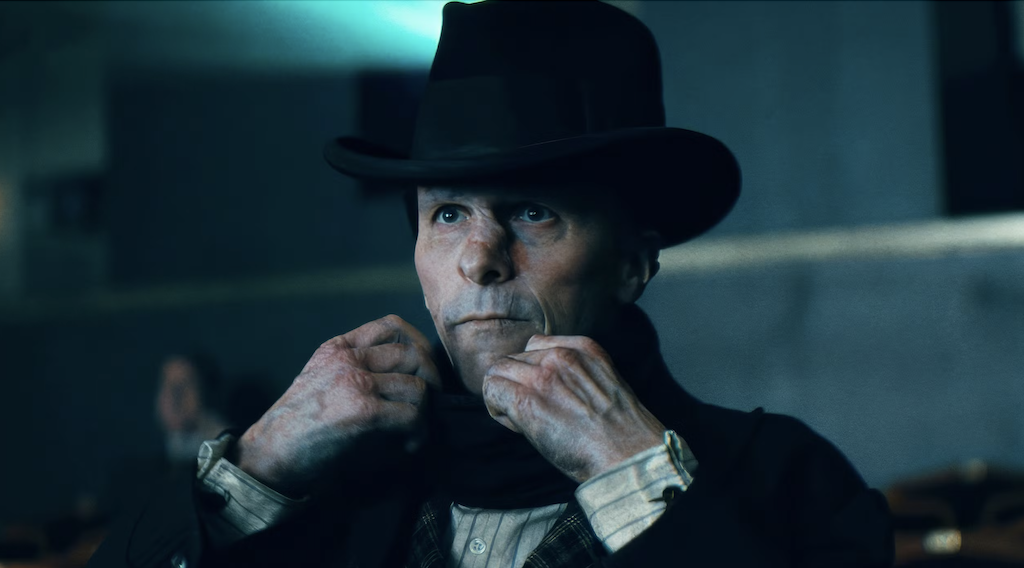
Christian Bale in
The Bride!
. (Warner Bros. Pictures)
The Jake and Myrna characters are never credible for an instant, yet a lot of screen time gets used up with Sarsgaard overplaying a self-pitying sellout in a fedora, while Cruz, who never looked lusher or sounded more extravagantly Spanish, seems completely out of place in her incongruous “Lois Lane, girl reporter” outfits. Compared to these two, Buckley and Bale achieve remarkable verisimilitude.
Gyllenhaal is trying for a bold level of stylization here that allows her to lurch around among character types borrowed from older media of various eras, but she never succeeds in establishing a consistent tone of her own that could hold them all together in a compelling way.
If you want to see a wildly stylized movie that locks into a surreal worldview with flawless conviction, see James Whale’s original
Bride of Frankenstein
. Clearly the catalyst for Gyllenhaal’s film, it also starts with Mary Shelley (Elsa Lanchester) saying that her novel
Frankenstein
didn’t tell the whole story. She then goes on to narrate the tale of the monster’s quest for a mate. The unforgettable, iconic bride that results — also played by Lanchester — is created by Dr Frankenstein (Colin Clive) and his hilariously odd mentor Dr Pretorius (Ernest Thesiger).
The film is considered a camp classic for its arch, macabre, darkly humorous tone, with the hilarious Dr Pretorius firmly on the side of the undead and the exhilarating alternative possibilities promised by their mode of life and love.
But to hear Gyllenhaal tell it in
interviews
, she’s achieved such a punked-out, mind-blowing sensory extravaganza with
The Bride!
, she’s schooling us all in the potentialities of twenty-first-century filmmaking:
Mary Shelley wrote
Frankenstein
on a dare. This movie is a kind of dare. Can you step into a new language, into a new grammar? Can you try something new? What if it turns you on? What if it excites you in a way that you haven’t felt before? Can you take it?
The problem with
The Bride!
isn’t that it might overwhelm audiences in a mass erotic freak-out, it’s that it doesn’t go half far enough. It has some imaginative glimmers but no sustained vision. A perfect example of its tendency toward little narrative sparks that flame out quickly is the social revolt the Bride inspires, which is handled by showing us various women who have imitated the Bride’s look, painting their tongues black and their faces with the Bride’s inky side-of-the-mouth splotch. They rage around violently confronting men, yelling “Brain attack!” The whole “brides rebellion” sequence is contained in a montage that lasts about a minute and has no further effect on the plot.
In interviews, Gyllenhaal comes across like an erudite cinephile who can reference films going back decades, somehow without realizing that people who really love the medium can take
The Bride!
and raise her a
Passion of Joan of Arc
, a
Meshes of the Afternoon
, a
High and Low
, an
Hour of the Furnaces
, a
Scorpio Rising
, a
Stalker
, a
Videodrome
, a
Twin Peaks: The Return
, and a thousand other cinematic stunners. Meanwhile she’s splashing around in the shallow end of the Hollywood pool, impressing her friends and some test audiences with a few mildly startling images and vaguely feminist notions she had that riff off of
Bride of Frankenstein
.
Her movie has a couple of nice flourishes, which is not nothing in these aesthetically timid times. But it’s a sadly disappointing mess of a movie nevertheless, which makes that exclamation point in the film’s title — presumably meant to be cheesy and ironic in a cool-kid sort of way — seem unironically embarrassing and unearned. |
| Markdown | [Jacobin](https://jacobin.com/)
- [Subscribe](https://jacobin.com/subscribe)
- [Magazine](https://jacobin.com/issue/teen-jacobin)
- [Donate](https://jacobin.com/donate)
- [Catalyst](http://catalyst-journal.com/)
## Maggie Gyllenhaal’s The Bride\! Is a Monstrous Mess
- Login
Password Login
Email Code
Google Account
Institutional Access
## Set Up or Reset Your Password
Enter your email address and we’ll send you a link to reset your password.
## Log in with Password
If you haven’t set up a password with us yet or need to change an existing one, go here. If you prefer to log in without a password, you can receive a sign-in code instead.
## Log In with Sign-In Code
Tired of trying to remember your password? Enter the email address associated with your account to receive a verification code and log in with ease.
## Verify Account
Enter the verification code we sent to
## Log in with Google Account
If your subscription is tied to a Google email, you can log in via your Google account.
Continue
## Log in via institution
If your institution has a subscription, you can obtain access with Single Sign-On.
Continue
[Our special spring issue is out now. Get a discounted subscription to our print magazine today. Your support keeps us publishing\!](https://jacobin.com/subscribe/?code=TEENJACOBIN)
03\.10.2026
- [United States](https://jacobin.com/location/united-states)
- [Film and TV](https://jacobin.com/category/film)
# Maggie Gyllenhaal’s The Bride\! Is a Monstrous Mess
By
[Eileen Jones](https://jacobin.com/author/eileen-jones)
Maggie Gyllenhaal’s The Bride\! swings for a radical, genre-bending reinvention of Bride of Frankenstein. But the result is a messy, overstuffed film that makes an awkward attempt at feminist relevance.

Jessie Buckley stars in The Bride\!. (Warner Bros. Pictures)
*Jacobin*‘s special spring issue, “Teen Jacobin,” is out now. [Follow this link to get a discounted subscription to our beautiful print quarterly.](https://jacobin.com/subscribe/?code=TEENJACOBIN)
# [Israel’s Young Settler Vanguard](https://jacobin.com/2026/03/israels-young-settler-vanguard)
[E. A. Halevi](https://jacobin.com/author/e-a-halevi)
# [The Making of the Teenager](https://jacobin.com/2026/03/the-making-of-the-teenager)
[Lauren Fadiman](https://jacobin.com/author/lauren-fadiman)
# [Zohran Needs to Create Popular Assemblies](https://jacobin.com/2025/12/mamdani-popular-assemblies-democratic-socialism)
[Gabriel Hetland](https://jacobin.com/author/gabriel-hetland)[Bhaskar Sunkara](https://jacobin.com/author/bhaskar-sunkara)
# [A Half-Century of Harry Braverman’s Labor and Monopoly Capital](https://jacobin.com/2025/06/braverman-labor-monopoly-capital-legacy)
[Sophina Clark](https://jacobin.com/author/sophina-clark)[Daniel Judt](https://jacobin.com/author/daniel-judt)
Jessie Buckley achieves such a fine and daring visual effect as the reanimated Bride that for a little while there, I thought writer-director Maggie Gyllenhaal might really have locked into something interesting with her second film.
Kudos, at any rate, to the actor (Buckley) and the costumer (Sandy Powell) and the makeup artist (Nadia Stacey). But after a few initial thrills, the addled neo-gothic vision of Gyllenhaal’s *The Bride\!*, loosely inspired by the splendid horror classic *Bride of Frankenstein* (1935) gets more strained and incoherent and exhausting as it goes on. And good grief, does it go on. Almost every scene seems to last too long, and the plot keeps veering in the least interesting directions, till by the late climactic scenes that are presumably supposed to pack an emotional punch, it’s hard to care anymore about the fate of the undead lovers, the Bride and Frankenstein’s monster (Christian Bale).
But let’s return to the hopeful beginning. The film starts with Mary Shelley (also played by Buckley), author of the 1818 source novel, *Frankenstein; or, The Modern Prometheus*, trapped in post-death black-and-white limbo. She’s ranting wryly about her tragic life and thwarted creativity. She has a lot more to say beyond her most famous book, and she intends to say it posthumously by possessing a latter-day woman, a mid-1930s hard case in rough circumstances. “Let’s call her Ida, at least until she finds her own name,” says Mary.
And so we move into full color and meet “Ida,” a tough “bar girl” of her times, paid to entertain low-life gangsters in a dive eatery. Things swiftly go south for Ida as she’s possessed by Mary and spooks her companions by switching dangerously back and forth between her own brand of twentieth-century Chicago sass and Mary’s nineteenth-century upper-class British denunciations of men in power. The gangland capo, Lupino (Zlatko Burić ), seated nearby, isn’t pleased to be called out in public for his bloody crimes against women, and he orders his goons to take care of Ida. She’s hurled down the stairs in a slo-mo swan dive of death, ending up like a broken doll one floor below.
And there her story would end if it weren’t for Frankenstein’s monster, still up and around, but experienced enough in public persecution to keep his alarming stitched-together flesh cloaked and masked. He’s more desperately lonely than ever after a few hundred years of solitude, and he’s developed a recent movie-going habit that assuages his feeling of isolation. He’s a huge fan of the grinning tap-dancing star Ronnie Reed (Jake Gyllenhaal) and never misses a chance to drop into a theater to catch his latest black-and-white musical flick.
[](https://images.jacobinmag.com/wp-content/uploads/2026/03/10102133/download_bride.jpeg)
Still from
The Bride\!
. (Warner Bros. Pictures)
But his urgent mission in coming to Chicago is to persuade the eccentric scientist Dr Euphronious (Annette Bening) to create a mate for him. After some pushback — she especially objects to the suggestion that she’s in the business of supplying women to men shopping for ready-made companions — she agrees to go with him to dig up a body.
The reanimated Ida remembers almost nothing of her identity or her past. But she has no intention of hanging around as a lab specimen for Dr Euphronious to study, or of being paired off with “Frank.” She’s retained her stroppy attitude and makes her escape, saying, “All I know is, I’m pretty sure I don’t live here.”
From there, it’s a bizarre romance of the traumatized undead as the besotted Frank goes with her and conducts his bizarre extended courtship. He’s her self-appointed protector — a necessary job, since her wild behavior seems to make her a constant target of cops as well as would-be rapists. There were [test audience objections](https://deadline.com/2026/03/maggie-gyllenhaal-pulled-back-sexual-violence-the-bride-1236744503/) to the extended sexual assault scenes, which Gyllenhaal claims operate as social commentary on “a major reality in the culture.” But those objecting are right; the scenes are manifestly titillating, with a deliberate building of excited suspense as to whether Frank will save her before actual penetration occurs.
Frank also invents an elaborate backstory that convinces Ida they have a meaningful past together. He provides her the name Penelope “Penny” Rogers (she wasn’t willing to go with Ginger Rogers) and ultimately, they bond over a spontaneous musical-comedy-inspired dance performance that ignites the posh crowd in a frenzy of “monster mash” dance moves. Frank caps it off by baying, “Puttin’ on the ritz!” That’s an homage to Mel Brooks’s *Young Frankenstein* (1974), in which Peter Boyle as the monster alongside Gene Wilder’s Dr Frankenstein give memorable tap-dancing performances to Irving Berlin’s “Puttin’ on the Ritz,” both dressed in top hat, white tie, and tails.
There are constant references throughout *The Bride\!* to older movies, which add to its distracted, scattershot quality. *Bonnie and Clyde* (1967) takes over the narrative halfway through as Frank and Penny shoot it out with cops and careen across rural expanses while negotiating their rocky romance. And the lesser-known film *Marked Woman* (1937) is a major factor in a subplot of *The Bride\!*.
*Marked Woman* is an excellent Warner Brothers crime drama starring Humphrey Bogart as a crusading district attorney trying to bring down a top gangster by enlisting as informants the “bar girls” who work for him. The toughest of them is played by Bette Davis, and once her cooperation with the DA is revealed, she gets beaten up by the gangster’s goons, with her face “marked” by an X cut into her cheek. In short, their bravery costs the women dearly, while the DA wins his case and public acclaim. One of the “bar girls” is killed, as Ida was, by being knocked down a flight of stairs, and that fate becomes key to Ida’s backstory when it’s finally revealed in *The Bride*.
*Marked Woman* is a terrific potboiler, but the whole plotline borrowed from it seems pointlessly crammed into *The Bride\!*. Instead of a crusading DA, there’s a louche police detective named Jake Wiles (Peter Sarsgaard) as the one who’d persuaded “bar girls” like Ida to inform on the gangster they work for, before leaving them to their fates. He’s also one of the cops chasing Frank and Penny, but when it comes to any detective work, he’s a burnout relying on his “assistant,” who’s really the brains of the outfit, Myrna Malloy (Penélope Cruz).
Gyllenhaal seems to be shoehorning Myrna into the film as another example of an aggrieved woman whose talents are crushed by the patriarchy. The director’s awkward attempts at feminist relevance also include a scene in which Ida is fulminating about male abuse and shouts out, in an absurd moment of topicality, “Me too! Me too!”
[](https://images.jacobinmag.com/wp-content/uploads/2026/03/10102008/bride_bale.png)
Christian Bale in
The Bride\!
. (Warner Bros. Pictures)
The Jake and Myrna characters are never credible for an instant, yet a lot of screen time gets used up with Sarsgaard overplaying a self-pitying sellout in a fedora, while Cruz, who never looked lusher or sounded more extravagantly Spanish, seems completely out of place in her incongruous “Lois Lane, girl reporter” outfits. Compared to these two, Buckley and Bale achieve remarkable verisimilitude.
Gyllenhaal is trying for a bold level of stylization here that allows her to lurch around among character types borrowed from older media of various eras, but she never succeeds in establishing a consistent tone of her own that could hold them all together in a compelling way.
If you want to see a wildly stylized movie that locks into a surreal worldview with flawless conviction, see James Whale’s original *Bride of Frankenstein*. Clearly the catalyst for Gyllenhaal’s film, it also starts with Mary Shelley (Elsa Lanchester) saying that her novel *Frankenstein* didn’t tell the whole story. She then goes on to narrate the tale of the monster’s quest for a mate. The unforgettable, iconic bride that results — also played by Lanchester — is created by Dr Frankenstein (Colin Clive) and his hilariously odd mentor Dr Pretorius (Ernest Thesiger).
The film is considered a camp classic for its arch, macabre, darkly humorous tone, with the hilarious Dr Pretorius firmly on the side of the undead and the exhilarating alternative possibilities promised by their mode of life and love.
But to hear Gyllenhaal tell it in [interviews](https://www.hollywoodreporter.com/movies/movie-features/maggie-gyllenhaal-interview-the-bride-feature-1236522609/), she’s achieved such a punked-out, mind-blowing sensory extravaganza with *The Bride\!*, she’s schooling us all in the potentialities of twenty-first-century filmmaking:
> Mary Shelley wrote *Frankenstein* on a dare. This movie is a kind of dare. Can you step into a new language, into a new grammar? Can you try something new? What if it turns you on? What if it excites you in a way that you haven’t felt before? Can you take it?
The problem with *The Bride\!* isn’t that it might overwhelm audiences in a mass erotic freak-out, it’s that it doesn’t go half far enough. It has some imaginative glimmers but no sustained vision. A perfect example of its tendency toward little narrative sparks that flame out quickly is the social revolt the Bride inspires, which is handled by showing us various women who have imitated the Bride’s look, painting their tongues black and their faces with the Bride’s inky side-of-the-mouth splotch. They rage around violently confronting men, yelling “Brain attack!” The whole “brides rebellion” sequence is contained in a montage that lasts about a minute and has no further effect on the plot.
In interviews, Gyllenhaal comes across like an erudite cinephile who can reference films going back decades, somehow without realizing that people who really love the medium can take *The Bride\!* and raise her a *Passion of Joan of Arc*, a *Meshes of the Afternoon*, a *High and Low*, an *Hour of the Furnaces*, a *Scorpio Rising*, a *Stalker*, a *Videodrome*, a *Twin Peaks: The Return*, and a thousand other cinematic stunners. Meanwhile she’s splashing around in the shallow end of the Hollywood pool, impressing her friends and some test audiences with a few mildly startling images and vaguely feminist notions she had that riff off of *Bride of Frankenstein*.
Her movie has a couple of nice flourishes, which is not nothing in these aesthetically timid times. But it’s a sadly disappointing mess of a movie nevertheless, which makes that exclamation point in the film’s title — presumably meant to be cheesy and ironic in a cool-kid sort of way — seem unironically embarrassing and unearned.
#### Share this article
[Facebook]()[Twitter]()[Email](<mailto:?subject=Maggie Gyllenhaal’s The Bride! Is a Monstrous Mess&body=https://jacobin.com/2026/03/gyllenhaal-the-bride-film-review>)
#### Contributors
Eileen Jones is a film critic at Jacobin, host of the Filmsuck podcast, and author of Filmsuck, USA.
#### Filed Under
- [United States](https://jacobin.com/location/united-states)
- [Film and TV](https://jacobin.com/category/film)
- [Film Review](https://jacobin.com/tag/film-review)
# Sign up for our mailing list
[Already on our list? Get our print magazine for just \$20 a year.](https://jacobin.com/subscribe/?code=ONTHELIST)
# Further Reading
# [Scream 7 Is More Tedious Meta-Horror Fan Service](https://jacobin.com/2026/03/scream-7-horror-campbell-cox)
- [Eileen Jones](https://jacobin.com/author/eileen-jones)
# [Good Luck, Have Fun, Don’t Die Is the Burned-Out End of Something](https://jacobin.com/2026/02/verbinski-good-luck-movie-review)
- [Eileen Jones](https://jacobin.com/author/eileen-jones)
# [Just Think of Wuthering Heights as a Barbie Offshoot](https://jacobin.com/2026/02/wuthering-heights-barbie-fennell-review)
- [Eileen Jones](https://jacobin.com/author/eileen-jones)
# [The Road House Remake Is Actually a Great Time](https://jacobin.com/2024/03/road-house-gyllenhaal-film-review)
- [Eileen Jones](https://jacobin.com/author/eileen-jones)
- [Subscribe](https://jacobin.com/subscribe)
- [Donate](https://jacobin.com/donate)
*Jacobin*‘s special spring issue, “Teen Jacobin,” is out now. [Follow this link to get a discounted subscription to our beautiful print quarterly.](https://jacobin.com/subscribe/?code=TEENJACOBIN)
A journal of theory and strategy published by Jacobin
- [Catalyst](http://catalyst-journal.com/)
- [About Us](https://jacobin.com/about)
- [Contact Us](https://jacobin.com/contact)
- [Advertise](https://jacobin.com/advertise)
- [Privacy Policy](https://jacobin.com/privacy)
- **© 2024**
 |
| Readable Markdown | Jessie Buckley achieves such a fine and daring visual effect as the reanimated Bride that for a little while there, I thought writer-director Maggie Gyllenhaal might really have locked into something interesting with her second film.
Kudos, at any rate, to the actor (Buckley) and the costumer (Sandy Powell) and the makeup artist (Nadia Stacey). But after a few initial thrills, the addled neo-gothic vision of Gyllenhaal’s *The Bride\!*, loosely inspired by the splendid horror classic *Bride of Frankenstein* (1935) gets more strained and incoherent and exhausting as it goes on. And good grief, does it go on. Almost every scene seems to last too long, and the plot keeps veering in the least interesting directions, till by the late climactic scenes that are presumably supposed to pack an emotional punch, it’s hard to care anymore about the fate of the undead lovers, the Bride and Frankenstein’s monster (Christian Bale).
But let’s return to the hopeful beginning. The film starts with Mary Shelley (also played by Buckley), author of the 1818 source novel, *Frankenstein; or, The Modern Prometheus*, trapped in post-death black-and-white limbo. She’s ranting wryly about her tragic life and thwarted creativity. She has a lot more to say beyond her most famous book, and she intends to say it posthumously by possessing a latter-day woman, a mid-1930s hard case in rough circumstances. “Let’s call her Ida, at least until she finds her own name,” says Mary.
And so we move into full color and meet “Ida,” a tough “bar girl” of her times, paid to entertain low-life gangsters in a dive eatery. Things swiftly go south for Ida as she’s possessed by Mary and spooks her companions by switching dangerously back and forth between her own brand of twentieth-century Chicago sass and Mary’s nineteenth-century upper-class British denunciations of men in power. The gangland capo, Lupino (Zlatko Burić ), seated nearby, isn’t pleased to be called out in public for his bloody crimes against women, and he orders his goons to take care of Ida. She’s hurled down the stairs in a slo-mo swan dive of death, ending up like a broken doll one floor below.
And there her story would end if it weren’t for Frankenstein’s monster, still up and around, but experienced enough in public persecution to keep his alarming stitched-together flesh cloaked and masked. He’s more desperately lonely than ever after a few hundred years of solitude, and he’s developed a recent movie-going habit that assuages his feeling of isolation. He’s a huge fan of the grinning tap-dancing star Ronnie Reed (Jake Gyllenhaal) and never misses a chance to drop into a theater to catch his latest black-and-white musical flick.
[](https://images.jacobinmag.com/wp-content/uploads/2026/03/10102133/download_bride.jpeg)
Still from
The Bride\!
. (Warner Bros. Pictures)
But his urgent mission in coming to Chicago is to persuade the eccentric scientist Dr Euphronious (Annette Bening) to create a mate for him. After some pushback — she especially objects to the suggestion that she’s in the business of supplying women to men shopping for ready-made companions — she agrees to go with him to dig up a body.
The reanimated Ida remembers almost nothing of her identity or her past. But she has no intention of hanging around as a lab specimen for Dr Euphronious to study, or of being paired off with “Frank.” She’s retained her stroppy attitude and makes her escape, saying, “All I know is, I’m pretty sure I don’t live here.”
From there, it’s a bizarre romance of the traumatized undead as the besotted Frank goes with her and conducts his bizarre extended courtship. He’s her self-appointed protector — a necessary job, since her wild behavior seems to make her a constant target of cops as well as would-be rapists. There were [test audience objections](https://deadline.com/2026/03/maggie-gyllenhaal-pulled-back-sexual-violence-the-bride-1236744503/) to the extended sexual assault scenes, which Gyllenhaal claims operate as social commentary on “a major reality in the culture.” But those objecting are right; the scenes are manifestly titillating, with a deliberate building of excited suspense as to whether Frank will save her before actual penetration occurs.
Frank also invents an elaborate backstory that convinces Ida they have a meaningful past together. He provides her the name Penelope “Penny” Rogers (she wasn’t willing to go with Ginger Rogers) and ultimately, they bond over a spontaneous musical-comedy-inspired dance performance that ignites the posh crowd in a frenzy of “monster mash” dance moves. Frank caps it off by baying, “Puttin’ on the ritz!” That’s an homage to Mel Brooks’s *Young Frankenstein* (1974), in which Peter Boyle as the monster alongside Gene Wilder’s Dr Frankenstein give memorable tap-dancing performances to Irving Berlin’s “Puttin’ on the Ritz,” both dressed in top hat, white tie, and tails.
There are constant references throughout *The Bride\!* to older movies, which add to its distracted, scattershot quality. *Bonnie and Clyde* (1967) takes over the narrative halfway through as Frank and Penny shoot it out with cops and careen across rural expanses while negotiating their rocky romance. And the lesser-known film *Marked Woman* (1937) is a major factor in a subplot of *The Bride\!*.
*Marked Woman* is an excellent Warner Brothers crime drama starring Humphrey Bogart as a crusading district attorney trying to bring down a top gangster by enlisting as informants the “bar girls” who work for him. The toughest of them is played by Bette Davis, and once her cooperation with the DA is revealed, she gets beaten up by the gangster’s goons, with her face “marked” by an X cut into her cheek. In short, their bravery costs the women dearly, while the DA wins his case and public acclaim. One of the “bar girls” is killed, as Ida was, by being knocked down a flight of stairs, and that fate becomes key to Ida’s backstory when it’s finally revealed in *The Bride*.
*Marked Woman* is a terrific potboiler, but the whole plotline borrowed from it seems pointlessly crammed into *The Bride\!*. Instead of a crusading DA, there’s a louche police detective named Jake Wiles (Peter Sarsgaard) as the one who’d persuaded “bar girls” like Ida to inform on the gangster they work for, before leaving them to their fates. He’s also one of the cops chasing Frank and Penny, but when it comes to any detective work, he’s a burnout relying on his “assistant,” who’s really the brains of the outfit, Myrna Malloy (Penélope Cruz).
Gyllenhaal seems to be shoehorning Myrna into the film as another example of an aggrieved woman whose talents are crushed by the patriarchy. The director’s awkward attempts at feminist relevance also include a scene in which Ida is fulminating about male abuse and shouts out, in an absurd moment of topicality, “Me too! Me too!”
[](https://images.jacobinmag.com/wp-content/uploads/2026/03/10102008/bride_bale.png)
Christian Bale in
The Bride\!
. (Warner Bros. Pictures)
The Jake and Myrna characters are never credible for an instant, yet a lot of screen time gets used up with Sarsgaard overplaying a self-pitying sellout in a fedora, while Cruz, who never looked lusher or sounded more extravagantly Spanish, seems completely out of place in her incongruous “Lois Lane, girl reporter” outfits. Compared to these two, Buckley and Bale achieve remarkable verisimilitude.
Gyllenhaal is trying for a bold level of stylization here that allows her to lurch around among character types borrowed from older media of various eras, but she never succeeds in establishing a consistent tone of her own that could hold them all together in a compelling way.
If you want to see a wildly stylized movie that locks into a surreal worldview with flawless conviction, see James Whale’s original *Bride of Frankenstein*. Clearly the catalyst for Gyllenhaal’s film, it also starts with Mary Shelley (Elsa Lanchester) saying that her novel *Frankenstein* didn’t tell the whole story. She then goes on to narrate the tale of the monster’s quest for a mate. The unforgettable, iconic bride that results — also played by Lanchester — is created by Dr Frankenstein (Colin Clive) and his hilariously odd mentor Dr Pretorius (Ernest Thesiger).
The film is considered a camp classic for its arch, macabre, darkly humorous tone, with the hilarious Dr Pretorius firmly on the side of the undead and the exhilarating alternative possibilities promised by their mode of life and love.
But to hear Gyllenhaal tell it in [interviews](https://www.hollywoodreporter.com/movies/movie-features/maggie-gyllenhaal-interview-the-bride-feature-1236522609/), she’s achieved such a punked-out, mind-blowing sensory extravaganza with *The Bride\!*, she’s schooling us all in the potentialities of twenty-first-century filmmaking:
> Mary Shelley wrote *Frankenstein* on a dare. This movie is a kind of dare. Can you step into a new language, into a new grammar? Can you try something new? What if it turns you on? What if it excites you in a way that you haven’t felt before? Can you take it?
The problem with *The Bride\!* isn’t that it might overwhelm audiences in a mass erotic freak-out, it’s that it doesn’t go half far enough. It has some imaginative glimmers but no sustained vision. A perfect example of its tendency toward little narrative sparks that flame out quickly is the social revolt the Bride inspires, which is handled by showing us various women who have imitated the Bride’s look, painting their tongues black and their faces with the Bride’s inky side-of-the-mouth splotch. They rage around violently confronting men, yelling “Brain attack!” The whole “brides rebellion” sequence is contained in a montage that lasts about a minute and has no further effect on the plot.
In interviews, Gyllenhaal comes across like an erudite cinephile who can reference films going back decades, somehow without realizing that people who really love the medium can take *The Bride\!* and raise her a *Passion of Joan of Arc*, a *Meshes of the Afternoon*, a *High and Low*, an *Hour of the Furnaces*, a *Scorpio Rising*, a *Stalker*, a *Videodrome*, a *Twin Peaks: The Return*, and a thousand other cinematic stunners. Meanwhile she’s splashing around in the shallow end of the Hollywood pool, impressing her friends and some test audiences with a few mildly startling images and vaguely feminist notions she had that riff off of *Bride of Frankenstein*.
Her movie has a couple of nice flourishes, which is not nothing in these aesthetically timid times. But it’s a sadly disappointing mess of a movie nevertheless, which makes that exclamation point in the film’s title — presumably meant to be cheesy and ironic in a cool-kid sort of way — seem unironically embarrassing and unearned. |
| Shard | 145 (laksa) |
| Root Hash | 4985007275732074745 |
| Unparsed URL | com,jacobin!/2026/03/gyllenhaal-the-bride-film-review s443 |