ℹ️ Skipped - page is already crawled
| Filter | Status | Condition | Details |
|---|---|---|---|
| HTTP status | PASS | download_http_code = 200 | HTTP 200 |
| Age cutoff | PASS | download_stamp > now() - 6 MONTH | 0 months ago |
| History drop | PASS | isNull(history_drop_reason) | No drop reason |
| Spam/ban | PASS | fh_dont_index != 1 AND ml_spam_score = 0 | ml_spam_score=0 |
| Canonical | PASS | meta_canonical IS NULL OR = '' OR = src_unparsed | Not set |
| Property | Value |
|---|---|
| URL | https://insideclimatenews.org/news/25022026/west-coast-whale-entanglements-heatwaves/ |
| Last Crawled | 2026-04-15 21:56:13 (1 day ago) |
| First Indexed | 2026-02-25 22:04:52 (1 month ago) |
| HTTP Status Code | 200 |
| Meta Title | Whale Entanglements in Fishing Gear Surge Off U.S. West Coast During Marine Heatwaves - Inside Climate News |
| Meta Description | New research finds that rising ocean temperatures are shrinking cool-water feeding grounds, pushing humpbacks into gear-heavy waters near shore. Scientists say ocean forecasting tool could help fisheries reduce the risk. |
| Meta Canonical | null |
| Boilerpipe Text | We need your help this Earth Day!
2X match to support our work
The story you’re about to read is free to access—no paywall, no subscription, no ads—but it isn’t free to produce.
Our nonprofit newsroom investigates the biggest threats to our planet, holds decision-makers accountable, and pushes back on climate disinformation so facts stay front and center.
We need your support to keep this work going.
Please donate right now in honor of Earth Day and your gift will be doubled.
One-time
Monthly
$35
$50
$100
Other: $
Donate
Each spring, humpback whales start to feed off the coast of California and Oregon on dense schools of anchovies, sardines and krill—prey sustained by cool, nutrient-rich water that seasonal winds draw up from the deep ocean.
That process, known as coastal upwelling, turns the California Current into one of the most productive marine ecosystems in the world, giving whales a chance to rebuild the energy reserves they depleted during months of fasting in their winter breeding grounds in Mexico.
But according to
a new study published on Wednesday
in the scientific journal, PLOS Climate, rising ocean temperatures are shrinking and redefining this critical foraging habitat, putting the humpbacks at greater risk of entanglement in fishing gear.
Marine heatwaves weaken upwelling, reducing the amount of cold, nutrient-rich water reaching the surface. That, in turn, reduces offshore krill blooms. Humpbacks then begin to move inshore, where other prey, like anchovies and sardines tend to swarm. There, they are more likely to overlap with dangerous fishing activity and fixed gear, like Dungeness crab traps.
Scientists refer to this process as “habitat compression,” when the whales’ normal feeding grounds are squeezed into a much narrower strip of cooler water along the coast.
NOAA authors of the study were not available for comment. But the study states: “Reported entanglements within the California Current Large Marine Ecosystem (CCLME) have increased markedly over past decades with an unprecedented record number during a persistent multi-year marine heatwave,” the study says. “Habitat compression is an underlying driver of these entanglements.”
The highest number of entanglements across the U.S. West Coast occurred in years when warmer temperatures significantly reduced their foraging grounds. Before 2014, for instance, fewer than 10 humpback entanglements were reported annually. That pattern changed dramatically in 2015 and 2016 during a prolonged marine heatwave known as “the Blob.”
The unusually large and long-lasting mass of warm water was first detected in 2013. By 2014, it had extended from the Gulf of Alaska to Baja California. It caused sea surface temperatures to
rise more than 7 degrees Fahrenheit above average.
“We saw a spike in entanglements,” said Ryan Bartling, senior environmental scientist at the California Department of Fish and Wildlife. At least 40 entangled humpbacks were reported during that period, according to the study.
With less cold, nutrient-rich water reaching the surface, the marine food web was completely disrupted, causing massive die-offs of seabirds and marine mammals like sea lions, which were unable to find enough food.
In 2024, there was another surge in whale entanglements coinciding with unusually warm ocean conditions linked to El Niño—a naturally occurring climate pattern that develops every few years when surface waters in the central and eastern tropical Pacific become warmer than average.
While 31 whales were reported entangled that year, the study noted that it was impossible to determine the exact number of animals affected. Many entanglements likely go undetected. Those that are spotted are often recognized by fishers and whale watchers.
According to NOAA,
most of these incidents are not immediately life-threatening if they are reported in time for one of its specially trained teams to respond and cut the animal free.
The authors, including Jarrod Santora—a research fish biologist at the institution’s Southwest Fisheries Science Center—analyzed 25 years of data to better understand how and why humpbacks are particularly impacted.
During marine heatwaves, humpback feeding grounds along the U.S. West Coast are shrinking, forcing the whales to forage closer to shore where chances are higher of them becoming entangled in fishing gear, like Dungeness crab traps, which are also concentrated in coastal waters. Credit: Santora JA, et al./PLOS Climate/CC-BY 4.0
In the past, some scientists have suggested that growing humpback populations could explain the increase in entanglements. The whales have rebounded significantly since commercial whaling was banned in the 1980s, but NOAA authors of the study rule this out as a primary driver.
“We suggest that the elevated entanglement reports observed during and after the heatwave were not merely a function of there being more whales, but that habitat compression led to both the higher overlap of whales with fishing gear and more whales concentrated closer to shore,” the report read.
Along the West Coast, the study identifies fixed gear used in the Dungeness crab fishery as the primary source of entanglement risk for humpbacks. The fishery relies on heavy pots set on the seafloor that are connected to surface buoys by vertical lines. At least 100,000 of these lines can riddle coastal waters when the season opens, usually in late fall, Bartling said.
Whales can become entangled in various ways.
At times, they may encounter lines while feeding or swimming. Humpbacks can be curious and are known to rub on kelp and fishing lines that could become wrapped around their bodies, said Kathi George, director of cetacean conservation biology at the Marine Mammal Center in Sausalito, California. As the whales lunge for prey, they can also snag a line in their mouths or baleen plates.
“If it gets in the mouth, they can’t push it out with the tongue because it’s caught in the baleen. And then they go through that kind of throwing themselves, breaching, trying to get rid of the entanglement,” George said. That movement can tighten the line and worsen the situation, she said.
In other cases, loose or floating equipment, known as “ghost gear,” can wrap around fins or flukes as whales pass by. According to the study, the Dungeness crab fishery experiences a high rate of gear loss—upwards of 10 percent each season.
When whales become entangled, Bartling said, they often are unable to feed. It also impedes their ability to move normally and reproduce. In some cases, the gear cuts deep wounds into the animals’ flesh. Some entanglements prove fatal, he said.
This story is funded by readers like you.
Our nonprofit newsroom provides award-winning climate coverage free of charge and advertising. We rely on donations from readers like you to keep going. Please donate now to support our work.
Donate Now
When a live whale is reported entangled, responders mobilize through a coordinated federal network. Anyone who spots an entangled whale can call a 24/7 NOAA Fisheries hotline to immediately report entangled, injured, or distressed marine life on the West Coast. They can also alert the U.S. Coast Guard, said George, who is authorized by NOAA to respond and attempt to free entangled whales.
Specially trained rescue crews approach the affected whale in small boats. Using drones and cameras mounted on long poles, they assess how the whale is wrapped before cutting anything.
“We review the footage and talk about a plan and how we can safely approach the whale and we can cut the entanglement off of it,” George said.
Once a plan is devised, responders attach a buoyed “working line” to help track and slow the whale and then carefully remove the gear using specialized cutting tools designed to minimize additional injury.
Retrieved gear is analyzed to determine which fishery it came from and whether it was active or lost equipment—information that helps regulators focus on prevention, which George said is the ultimate goal.
A key tool used in the latest research is NOAA’s Habitat Compression Index (HCI), developed under Santora’s leadership. The index measures how much cool, nutrient-rich upwelled water is available along the coast and tracks when that productive habitat becomes compressed toward shore. By quantifying shifts in the extent of cold-water feeding grounds, HCI identifies periods when whales, their prey, and possibly other marine life, may converge in nearshore waters where fishing gear is deployed.
The study found that the index not only explains past spikes in entanglements but can forecast ocean conditions up to a year in advance. Researchers say integrating HCI into fisheries management could provide an early warning system, allowing regulators to adjust season timing, trap limits or other mitigation measures before entanglement risk peaks.
The California Department of Fish and Wildlife is already working to reduce the risk of whale entanglements through its Whale Safe Fisheries initiative. Under the program, regulators can require fleet-wide trap reductions during high-risk periods. For example, a vessel permitted to fish 500 Dungeness crab traps may be limited to deploying only half that number, said Bartling, who supervises the program. When applied across the fleet, he said, such reductions can cut the number of vertical lines in the water from roughly 100,000 at a traditional season opener by half, to about 50,000.
The program is also pushing for increased use of alternative fishing gear that eliminates the vertical lines connecting traps to surface buoys, mitigating the threat of entanglement to whales and other marine life. “It’s a way to really reduce risk to theoretically almost zero,” Bartling said. This spring, he said, between 20 and 50 crab fishers will be “ready to go ropeless.”
About This Story
Perhaps you noticed: This story, like all the news we publish, is free to read. That’s because Inside Climate News is a 501c3 nonprofit organization. We do not charge a subscription fee, lock our news behind a paywall, or clutter our website with ads. We make our news on climate and the environment freely available to you and anyone who wants it.
That’s not all. We also share our news for free with scores of other media organizations around the country. Many of them can’t afford to do environmental journalism of their own. We’ve built bureaus from coast to coast to report local stories, collaborate with local newsrooms and co-publish articles so that this vital work is shared as widely as possible.
Two of us launched ICN in 2007. Six years later we earned a Pulitzer Prize for National Reporting, and now we run the oldest and largest dedicated climate newsroom in the nation. We tell the story in all its complexity. We hold polluters accountable. We expose environmental injustice. We debunk misinformation. We scrutinize solutions and inspire action.
Donations from readers like you fund every aspect of what we do. If you don’t already, will you support our ongoing work, our reporting on the biggest crisis facing our planet, and help us reach even more readers in more places?
Please take a moment to make a tax-deductible donation. Every one of them makes a difference.
Thank you,
One-time
Monthly
$35
$50
$100
Other: $
Donate
Teresa Tomassoni
Oceans Correspondent
Teresa Tomassoni is an environmental journalist covering the intersections between oceans, climate change, coastal communities and wildlife for Inside Climate News. Her previous work has appeared in The Washington Post, NPR, NBC Latino and the Smithsonian American Indian Magazine. Teresa holds a master’s degree in Journalism from the Craig Newmark Graduate School of Journalism. She is also a recipient of the Stone & Holt Weeks Social Justice Reporting Fellowship. She has taught journalism for Long Island University and the School of the New York Times. She is an avid scuba diver and spends much of her free time underwater. |
| Markdown | [Skip to content](https://insideclimatenews.org/news/25022026/west-coast-whale-entanglements-heatwaves/#content)
- [Science](https://insideclimatenews.org/category/science/)
- [Politics](https://insideclimatenews.org/category/politics-policy/)
- [Justice & Health](https://insideclimatenews.org/category/justice/)
- [Fossil Fuels](https://insideclimatenews.org/category/fossil-fuels/)
- [Clean Energy](https://insideclimatenews.org/category/clean-energy/)
- [ICN Local](https://insideclimatenews.org/icn-local/)
- [Projects](https://insideclimatenews.org/projects/)
- [About Us](https://insideclimatenews.org/about/)
Open Menu
[](https://insideclimatenews.org/)
Pulitzer Prize-winning, nonpartisan reporting on the biggest crisis facing our planet.
[Donate](https://insideclimate.fundjournalism.org/donate/?amount=15&campaign=7013a000002DS1nAAG&frequency=monthly)
[Trump 2.0: The Reckoning](https://insideclimatenews.org/project/trump-second-term-the-reckoning/)
[](https://insideclimatenews.org/)
[Donate](https://insideclimate.fundjournalism.org/donate/?amount=15&campaign=7013a000002DS1nAAG&frequency=monthly)
Open Menu
Close Menu
### Search
- [Science](https://insideclimatenews.org/category/science/)
- [Politics](https://insideclimatenews.org/category/politics-policy/)
- [Justice & Health](https://insideclimatenews.org/category/justice/)
- [Fossil Fuels](https://insideclimatenews.org/category/fossil-fuels/)
- [Clean Energy](https://insideclimatenews.org/category/clean-energy/)
- [ICN Local](https://insideclimatenews.org/icn-local/)
- [Projects](https://insideclimatenews.org/projects/)
- [About Us](https://insideclimatenews.org/about/)
- [Newsletters](https://insideclimatenews.org/newsletter/)
- [ICN Sunday Morning](https://insideclimatenews.org/icn-sunday-morning/)
- [Contact Us](https://insideclimatenews.org/contact/)
### Topics
- [A.I. & Data Centers](https://insideclimatenews.org/topic/ai-data-centers/)
- [Activism](https://insideclimatenews.org/topic/activism/)
- [Arctic](https://insideclimatenews.org/topic/arctic/)
- [Biodiversity & Conservation](https://insideclimatenews.org/topic/biodiversity-conservation/)
- [Business & Finance](https://insideclimatenews.org/topic/business-finance/)
- [Climate Law & Liability](https://insideclimatenews.org/topic/climate-law-liability/)
- [Climate Treaties](https://insideclimatenews.org/topic/climate-treaties/)
- [Denial & Misinformation](https://insideclimatenews.org/topic/denial-misinformation/)
- [Environment & Health](https://insideclimatenews.org/topic/environment-health/)
- [Extreme Weather](https://insideclimatenews.org/topic/extreme-weather/)
- [Food & Agriculture](https://insideclimatenews.org/topic/food-agriculture/)
- [Fracking](https://insideclimatenews.org/topic/fracking/)
- [Nuclear](https://insideclimatenews.org/topic/nuclear/)
- [Pipelines](https://insideclimatenews.org/topic/pipelines/)
- [Plastics](https://insideclimatenews.org/topic/plastics/)
- [Public Lands](https://insideclimatenews.org/topic/public-lands/)
- [Regulation](https://insideclimatenews.org/topic/regulation/)
- [Super-Pollutants](https://insideclimatenews.org/topic/super-climate-pollutants/)
- [Water/Drought](https://insideclimatenews.org/topic/water-drought/)
- [Wildfires](https://insideclimatenews.org/topic/wildfires/)
### Information
- [About](https://insideclimatenews.org/about/)
- [Job Openings](https://insideclimatenews.org/about/jobs/)
- [Reporting Network](https://insideclimatenews.org/icn-local/)
- [Whistleblowers](https://insideclimatenews.org/whistleblowers/)
- [Memberships](https://insideclimatenews.org/about/membership/)
- [Ways to Give](https://insideclimatenews.org/ways-to-give/)
- [Fellows & Fellowships](https://insideclimatenews.org/about/fellows/)
### Publications
- [E-Books](https://insideclimatenews.org/ebooks/)
- [Documents](https://insideclimatenews.org/documents/)
## We need your help this Earth Day\! 2X match to support our work
The story you’re about to read is free to access—no paywall, no subscription, no ads—but it isn’t free to produce.
Our nonprofit newsroom investigates the biggest threats to our planet, holds decision-makers accountable, and pushes back on climate disinformation so facts stay front and center.
**We need your support to keep this work going. Please donate right now in honor of Earth Day and your gift will be doubled.**
- One-time
- Monthly
- \$35
- \$50
- \$100
- Other: \$
[Donate](https://insideclimate.fundjournalism.org/donate/?campaign=701Qn00001G18rVIAR&frequency=one_time&amount=35)
### [Justice & Health](https://insideclimatenews.org/category/justice/)
# Whale Entanglements in Fishing Gear Surge Off U.S. West Coast During Marine Heatwaves
## New research finds that rising ocean temperatures are shrinking cool-water feeding grounds, pushing humpbacks into gear-heavy waters near shore. Scientists say ocean forecasting tool could help fisheries reduce the risk.

By [Teresa Tomassoni](https://insideclimatenews.org/profile/teresa-tomassoni/)
February 25, 2026
### Share This Article
- [Republish](https://insideclimatenews.org/republish?article=west-coast-whale-entanglements-heatwaves)
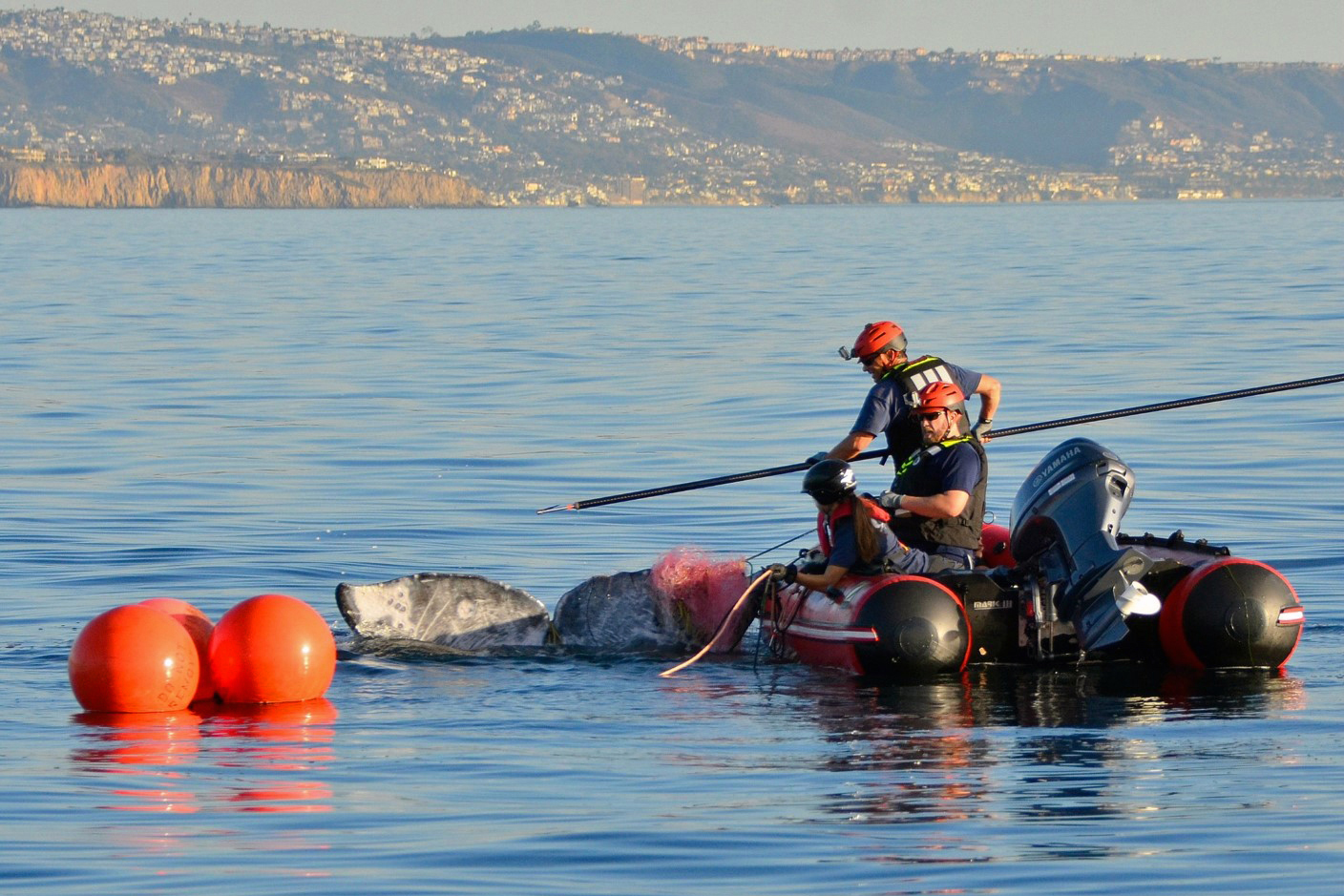
A trained team from the West Coast Large Whale Entanglement Response Program works to free an entangled gray whale off the coast of Orange County, Calif., in December 2017. Credit: West Coast Marine Mammal Stranding Network
### Related
- [How a Groundbreaking Indigenous Treaty on Whales’ Rights Could Change National Laws ](https://insideclimatenews.org/news/22022026/new-zealand-indigenous-whale-rights-declaration/)
- [Whale and Dolphin Migrations are Being Disrupted by Climate Change ](https://insideclimatenews.org/news/24102025/marine-mammal-migrations-disrupted-by-climate-change/)
- [Scientists Identify Global Hotspots for Whale-Ship Collisions—and Hardly Any Have Protections in Place ](https://insideclimatenews.org/news/21112024/whale-ship-collision-global-hotspots-lack-protections/)
### Share This Article
- [Republish](https://insideclimatenews.org/republish?article=west-coast-whale-entanglements-heatwaves)
### Most Popular
1. [Cancer Rates Are Higher Near Large Livestock Feeding Operations in 3 States, a New Study Finds](https://insideclimatenews.org/news/12042026/cancer-rates-higher-near-livestock-operations-study-finds/)
2. [Norway Reopens Annual Whale Hunt Despite Pressure to End Commercial Whaling](https://insideclimatenews.org/news/14042026/norway-reopens-commercial-whaling-despite-demand-decline/)
3. [Meeting Climate Targets Requires Humanity to Reorient Its Relationship With Nature, New Study Says](https://insideclimatenews.org/news/09042026/yellowstone-to-yukon-conservation-climate-targets/)
Each spring, humpback whales start to feed off the coast of California and Oregon on dense schools of anchovies, sardines and krill—prey sustained by cool, nutrient-rich water that seasonal winds draw up from the deep ocean.
That process, known as coastal upwelling, turns the California Current into one of the most productive marine ecosystems in the world, giving whales a chance to rebuild the energy reserves they depleted during months of fasting in their winter breeding grounds in Mexico.
But according to [a new study published on Wednesday](https://journals.plos.org/climate/article?id=10.1371/journal.pclm.0000723&utm_source=pr&utm_medium=email&utm_campaign=plos006) in the scientific journal, PLOS Climate, rising ocean temperatures are shrinking and redefining this critical foraging habitat, putting the humpbacks at greater risk of entanglement in fishing gear.
Marine heatwaves weaken upwelling, reducing the amount of cold, nutrient-rich water reaching the surface. That, in turn, reduces offshore krill blooms. Humpbacks then begin to move inshore, where other prey, like anchovies and sardines tend to swarm. There, they are more likely to overlap with dangerous fishing activity and fixed gear, like Dungeness crab traps.
Scientists refer to this process as “habitat compression,” when the whales’ normal feeding grounds are squeezed into a much narrower strip of cooler water along the coast.
NOAA authors of the study were not available for comment. But the study states: “Reported entanglements within the California Current Large Marine Ecosystem (CCLME) have increased markedly over past decades with an unprecedented record number during a persistent multi-year marine heatwave,” the study says. “Habitat compression is an underlying driver of these entanglements.”
The highest number of entanglements across the U.S. West Coast occurred in years when warmer temperatures significantly reduced their foraging grounds. Before 2014, for instance, fewer than 10 humpback entanglements were reported annually. That pattern changed dramatically in 2015 and 2016 during a prolonged marine heatwave known as “the Blob.”
The unusually large and long-lasting mass of warm water was first detected in 2013. By 2014, it had extended from the Gulf of Alaska to Baja California. It caused sea surface temperatures to [rise more than 7 degrees Fahrenheit above average.](https://www.fisheries.noaa.gov/feature-story/looking-back-blob-record-warming-drives-unprecedented-ocean-change)
“We saw a spike in entanglements,” said Ryan Bartling, senior environmental scientist at the California Department of Fish and Wildlife. At least 40 entangled humpbacks were reported during that period, according to the study.
With less cold, nutrient-rich water reaching the surface, the marine food web was completely disrupted, causing massive die-offs of seabirds and marine mammals like sea lions, which were unable to find enough food.
In 2024, there was another surge in whale entanglements coinciding with unusually warm ocean conditions linked to El Niño—a naturally occurring climate pattern that develops every few years when surface waters in the central and eastern tropical Pacific become warmer than average.
While 31 whales were reported entangled that year, the study noted that it was impossible to determine the exact number of animals affected. Many entanglements likely go undetected. Those that are spotted are often recognized by fishers and whale watchers. [According to NOAA,](https://www.fisheries.noaa.gov/west-coast/marine-mammal-protection/west-coast-large-whale-entanglement-response-program#:~:text=Most%20entanglement%20reports%20are%20not,effective%20response%20to%20the%20entanglement.) most of these incidents are not immediately life-threatening if they are reported in time for one of its specially trained teams to respond and cut the animal free.
The authors, including Jarrod Santora—a research fish biologist at the institution’s Southwest Fisheries Science Center—analyzed 25 years of data to better understand how and why humpbacks are particularly impacted.
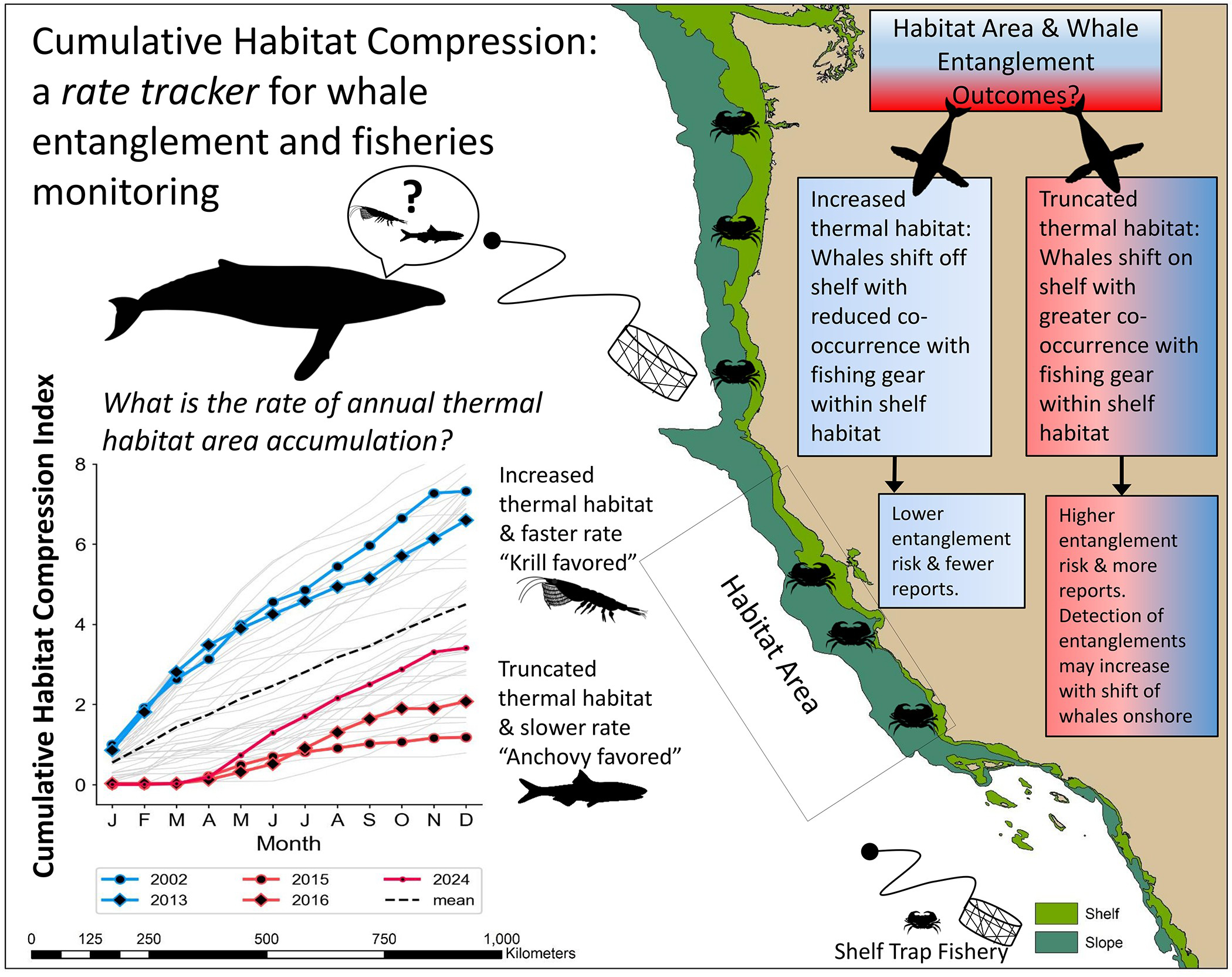

During marine heatwaves, humpback feeding grounds along the U.S. West Coast are shrinking, forcing the whales to forage closer to shore where chances are higher of them becoming entangled in fishing gear, like Dungeness crab traps, which are also concentrated in coastal waters. Credit: Santora JA, et al./PLOS Climate/CC-BY 4.0
In the past, some scientists have suggested that growing humpback populations could explain the increase in entanglements. The whales have rebounded significantly since commercial whaling was banned in the 1980s, but NOAA authors of the study rule this out as a primary driver.
“We suggest that the elevated entanglement reports observed during and after the heatwave were not merely a function of there being more whales, but that habitat compression led to both the higher overlap of whales with fishing gear and more whales concentrated closer to shore,” the report read.
Along the West Coast, the study identifies fixed gear used in the Dungeness crab fishery as the primary source of entanglement risk for humpbacks. The fishery relies on heavy pots set on the seafloor that are connected to surface buoys by vertical lines. At least 100,000 of these lines can riddle coastal waters when the season opens, usually in late fall, Bartling said.
Whales can become entangled in various ways.
At times, they may encounter lines while feeding or swimming. Humpbacks can be curious and are known to rub on kelp and fishing lines that could become wrapped around their bodies, said Kathi George, director of cetacean conservation biology at the Marine Mammal Center in Sausalito, California. As the whales lunge for prey, they can also snag a line in their mouths or baleen plates.
“If it gets in the mouth, they can’t push it out with the tongue because it’s caught in the baleen. And then they go through that kind of throwing themselves, breaching, trying to get rid of the entanglement,” George said. That movement can tighten the line and worsen the situation, she said.
In other cases, loose or floating equipment, known as “ghost gear,” can wrap around fins or flukes as whales pass by. According to the study, the Dungeness crab fishery experiences a high rate of gear loss—upwards of 10 percent each season.
When whales become entangled, Bartling said, they often are unable to feed. It also impedes their ability to move normally and reproduce. In some cases, the gear cuts deep wounds into the animals’ flesh. Some entanglements prove fatal, he said.
### This story is funded by readers like you.
Our nonprofit newsroom provides award-winning climate coverage free of charge and advertising. We rely on donations from readers like you to keep going. Please donate now to support our work.
[Donate Now](https://insideclimate.fundjournalism.org/donate/?amount=15&campaign=7013a000003Bk97AAC&frequency=monthly)
When a live whale is reported entangled, responders mobilize through a coordinated federal network. Anyone who spots an entangled whale can call a 24/7 NOAA Fisheries hotline to immediately report entangled, injured, or distressed marine life on the West Coast. They can also alert the U.S. Coast Guard, said George, who is authorized by NOAA to respond and attempt to free entangled whales.
Specially trained rescue crews approach the affected whale in small boats. Using drones and cameras mounted on long poles, they assess how the whale is wrapped before cutting anything.
“We review the footage and talk about a plan and how we can safely approach the whale and we can cut the entanglement off of it,” George said.
Once a plan is devised, responders attach a buoyed “working line” to help track and slow the whale and then carefully remove the gear using specialized cutting tools designed to minimize additional injury.
Retrieved gear is analyzed to determine which fishery it came from and whether it was active or lost equipment—information that helps regulators focus on prevention, which George said is the ultimate goal.
A key tool used in the latest research is NOAA’s Habitat Compression Index (HCI), developed under Santora’s leadership. The index measures how much cool, nutrient-rich upwelled water is available along the coast and tracks when that productive habitat becomes compressed toward shore. By quantifying shifts in the extent of cold-water feeding grounds, HCI identifies periods when whales, their prey, and possibly other marine life, may converge in nearshore waters where fishing gear is deployed.
The study found that the index not only explains past spikes in entanglements but can forecast ocean conditions up to a year in advance. Researchers say integrating HCI into fisheries management could provide an early warning system, allowing regulators to adjust season timing, trap limits or other mitigation measures before entanglement risk peaks.
The California Department of Fish and Wildlife is already working to reduce the risk of whale entanglements through its Whale Safe Fisheries initiative. Under the program, regulators can require fleet-wide trap reductions during high-risk periods. For example, a vessel permitted to fish 500 Dungeness crab traps may be limited to deploying only half that number, said Bartling, who supervises the program. When applied across the fleet, he said, such reductions can cut the number of vertical lines in the water from roughly 100,000 at a traditional season opener by half, to about 50,000.
The program is also pushing for increased use of alternative fishing gear that eliminates the vertical lines connecting traps to surface buoys, mitigating the threat of entanglement to whales and other marine life. “It’s a way to really reduce risk to theoretically almost zero,” Bartling said. This spring, he said, between 20 and 50 crab fishers will be “ready to go ropeless.”
## About This Story
Perhaps you noticed: This story, like all the news we publish, is free to read. That’s because Inside Climate News is a 501c3 nonprofit organization. We do not charge a subscription fee, lock our news behind a paywall, or clutter our website with ads. We make our news on climate and the environment freely available to you and anyone who wants it.
That’s not all. We also share our news for free with scores of other media organizations around the country. Many of them can’t afford to do environmental journalism of their own. We’ve built bureaus from coast to coast to report local stories, collaborate with local newsrooms and co-publish articles so that this vital work is shared as widely as possible.
Two of us launched ICN in 2007. Six years later we earned a Pulitzer Prize for National Reporting, and now we run the oldest and largest dedicated climate newsroom in the nation. We tell the story in all its complexity. We hold polluters accountable. We expose environmental injustice. We debunk misinformation. We scrutinize solutions and inspire action.
Donations from readers like you fund every aspect of what we do. If you don’t already, will you support our ongoing work, our reporting on the biggest crisis facing our planet, and help us reach even more readers in more places?
Please take a moment to make a tax-deductible donation. Every one of them makes a difference.
Thank you,
David Sassoon
Founder and Publisher
Vernon Loeb
Executive Editor
- One-time
- Monthly
- \$35
- \$50
- \$100
- Other: \$
[Donate](https://insideclimate.fundjournalism.org/donate/?campaign=701Qn00000D2vihIAB&frequency=one_time&amount=35)
### Share This Article
- [Republish](https://insideclimatenews.org/republish?article=west-coast-whale-entanglements-heatwaves)


### [Teresa Tomassoni](https://insideclimatenews.org/profile/teresa-tomassoni/)
#### Oceans Correspondent
Teresa Tomassoni is an environmental journalist covering the intersections between oceans, climate change, coastal communities and wildlife for Inside Climate News. Her previous work has appeared in The Washington Post, NPR, NBC Latino and the Smithsonian American Indian Magazine. Teresa holds a master’s degree in Journalism from the Craig Newmark Graduate School of Journalism. She is also a recipient of the Stone & Holt Weeks Social Justice Reporting Fellowship. She has taught journalism for Long Island University and the School of the New York Times. She is an avid scuba diver and spends much of her free time underwater.
- [teresa.tomassoni@insideclimatenews.org](mailto:teresa.tomassoni@insideclimatenews.org)
### Related
[  How a Groundbreaking Indigenous Treaty on Whales’ Rights Could Change National Laws By Katie Surma](https://insideclimatenews.org/news/22022026/new-zealand-indigenous-whale-rights-declaration/)
[  Whale and Dolphin Migrations are Being Disrupted by Climate Change By Teresa Tomassoni](https://insideclimatenews.org/news/24102025/marine-mammal-migrations-disrupted-by-climate-change/)
[  Scientists Identify Global Hotspots for Whale-Ship Collisions—and Hardly Any Have Protections in Place By Kiley Price](https://insideclimatenews.org/news/21112024/whale-ship-collision-global-hotspots-lack-protections/)
### Most Popular
[  Cancer Rates Are Higher Near Large Livestock Feeding Operations in 3 States, a New Study Finds By Steven Rodas](https://insideclimatenews.org/news/12042026/cancer-rates-higher-near-livestock-operations-study-finds/)
[  Norway Reopens Annual Whale Hunt Despite Pressure to End Commercial Whaling By Teresa Tomassoni](https://insideclimatenews.org/news/14042026/norway-reopens-commercial-whaling-despite-demand-decline/)
[  Meeting Climate Targets Requires Humanity to Reorient Its Relationship With Nature, New Study Says By Jake Bolster](https://insideclimatenews.org/news/09042026/yellowstone-to-yukon-conservation-climate-targets/)
### [Justice & Health](https://insideclimatenews.org/category/justice/)
[Climate Activists Stage Mock Funeral for Landmark Climate Rule The Trump EPA’s repeal of the 2009 endangerment finding revokes the agency’s authority to regulate climate pollution. Environmental activists are mourning the loss while vowing to resurrect it. By Liza Gross](https://insideclimatenews.org/news/15042026/endangerment-finding-repeal-mock-funeral/)
#### [Iowa Moves to Shield Farmers, Ethanol Plants, From Lawsuits Over Emissions](https://insideclimatenews.org/news/15042026/iowa-farm-emissions-bill-could-benefit-ethanol-plants/)
#### [Chemical Threats Nearby? Trump’s EPA Doesn’t Want You to Know.](https://insideclimatenews.org/news/14042026/trump-epa-chemical-safety-rollback/)

## Keep Environmental Journalism Alive
ICN provides award-winning climate coverage free of charge and advertising. We rely on donations from readers like you to keep going.
[Donate Now](https://insideclimate.fundjournalism.org/donate/?amount=15&campaign=7013a000002DbIPAA0&frequency=monthly)
[](https://insideclimatenews.org/)
- [Science](https://insideclimatenews.org/category/science/)
- [Politics](https://insideclimatenews.org/category/politics-policy/)
- [Justice & Health](https://insideclimatenews.org/category/justice/)
- [Fossil Fuels](https://insideclimatenews.org/category/fossil-fuels/)
- [Clean Energy](https://insideclimatenews.org/category/clean-energy/)
- [Home](https://insideclimatenews.org/)
- [About](https://insideclimatenews.org/about/)
- [Contact Us](https://insideclimatenews.org/contact/)
- [Whistleblowers](https://insideclimatenews.org/whistleblowers/)
- [Privacy Policy](https://insideclimatenews.org/about/privacy-policy/)
- [](https://www.guidestar.org/profile/56-2451141)
- [](https://www.charitynavigator.org/ein/562451141)
Inside Climate News uses cookies. By continuing to use this site, you accept this policy. [Learn More](https://insideclimatenews.org/about/privacy-policy/)
Accept |
| Readable Markdown | ## We need your help this Earth Day\! 2X match to support our work
The story you’re about to read is free to access—no paywall, no subscription, no ads—but it isn’t free to produce.
Our nonprofit newsroom investigates the biggest threats to our planet, holds decision-makers accountable, and pushes back on climate disinformation so facts stay front and center.
**We need your support to keep this work going. Please donate right now in honor of Earth Day and your gift will be doubled.**
- One-time
- Monthly
- \$35
- \$50
- \$100
- Other: \$
[Donate](https://insideclimate.fundjournalism.org/donate/?campaign=701Qn00001G18rVIAR&frequency=one_time&amount=35)
Each spring, humpback whales start to feed off the coast of California and Oregon on dense schools of anchovies, sardines and krill—prey sustained by cool, nutrient-rich water that seasonal winds draw up from the deep ocean.
That process, known as coastal upwelling, turns the California Current into one of the most productive marine ecosystems in the world, giving whales a chance to rebuild the energy reserves they depleted during months of fasting in their winter breeding grounds in Mexico.
But according to [a new study published on Wednesday](https://journals.plos.org/climate/article?id=10.1371/journal.pclm.0000723&utm_source=pr&utm_medium=email&utm_campaign=plos006) in the scientific journal, PLOS Climate, rising ocean temperatures are shrinking and redefining this critical foraging habitat, putting the humpbacks at greater risk of entanglement in fishing gear.
Marine heatwaves weaken upwelling, reducing the amount of cold, nutrient-rich water reaching the surface. That, in turn, reduces offshore krill blooms. Humpbacks then begin to move inshore, where other prey, like anchovies and sardines tend to swarm. There, they are more likely to overlap with dangerous fishing activity and fixed gear, like Dungeness crab traps.
Scientists refer to this process as “habitat compression,” when the whales’ normal feeding grounds are squeezed into a much narrower strip of cooler water along the coast.
NOAA authors of the study were not available for comment. But the study states: “Reported entanglements within the California Current Large Marine Ecosystem (CCLME) have increased markedly over past decades with an unprecedented record number during a persistent multi-year marine heatwave,” the study says. “Habitat compression is an underlying driver of these entanglements.”
The highest number of entanglements across the U.S. West Coast occurred in years when warmer temperatures significantly reduced their foraging grounds. Before 2014, for instance, fewer than 10 humpback entanglements were reported annually. That pattern changed dramatically in 2015 and 2016 during a prolonged marine heatwave known as “the Blob.”
The unusually large and long-lasting mass of warm water was first detected in 2013. By 2014, it had extended from the Gulf of Alaska to Baja California. It caused sea surface temperatures to [rise more than 7 degrees Fahrenheit above average.](https://www.fisheries.noaa.gov/feature-story/looking-back-blob-record-warming-drives-unprecedented-ocean-change)
“We saw a spike in entanglements,” said Ryan Bartling, senior environmental scientist at the California Department of Fish and Wildlife. At least 40 entangled humpbacks were reported during that period, according to the study.
With less cold, nutrient-rich water reaching the surface, the marine food web was completely disrupted, causing massive die-offs of seabirds and marine mammals like sea lions, which were unable to find enough food.
In 2024, there was another surge in whale entanglements coinciding with unusually warm ocean conditions linked to El Niño—a naturally occurring climate pattern that develops every few years when surface waters in the central and eastern tropical Pacific become warmer than average.
While 31 whales were reported entangled that year, the study noted that it was impossible to determine the exact number of animals affected. Many entanglements likely go undetected. Those that are spotted are often recognized by fishers and whale watchers. [According to NOAA,](https://www.fisheries.noaa.gov/west-coast/marine-mammal-protection/west-coast-large-whale-entanglement-response-program#:~:text=Most%20entanglement%20reports%20are%20not,effective%20response%20to%20the%20entanglement.) most of these incidents are not immediately life-threatening if they are reported in time for one of its specially trained teams to respond and cut the animal free.
The authors, including Jarrod Santora—a research fish biologist at the institution’s Southwest Fisheries Science Center—analyzed 25 years of data to better understand how and why humpbacks are particularly impacted.

During marine heatwaves, humpback feeding grounds along the U.S. West Coast are shrinking, forcing the whales to forage closer to shore where chances are higher of them becoming entangled in fishing gear, like Dungeness crab traps, which are also concentrated in coastal waters. Credit: Santora JA, et al./PLOS Climate/CC-BY 4.0
In the past, some scientists have suggested that growing humpback populations could explain the increase in entanglements. The whales have rebounded significantly since commercial whaling was banned in the 1980s, but NOAA authors of the study rule this out as a primary driver.
“We suggest that the elevated entanglement reports observed during and after the heatwave were not merely a function of there being more whales, but that habitat compression led to both the higher overlap of whales with fishing gear and more whales concentrated closer to shore,” the report read.
Along the West Coast, the study identifies fixed gear used in the Dungeness crab fishery as the primary source of entanglement risk for humpbacks. The fishery relies on heavy pots set on the seafloor that are connected to surface buoys by vertical lines. At least 100,000 of these lines can riddle coastal waters when the season opens, usually in late fall, Bartling said.
Whales can become entangled in various ways.
At times, they may encounter lines while feeding or swimming. Humpbacks can be curious and are known to rub on kelp and fishing lines that could become wrapped around their bodies, said Kathi George, director of cetacean conservation biology at the Marine Mammal Center in Sausalito, California. As the whales lunge for prey, they can also snag a line in their mouths or baleen plates.
“If it gets in the mouth, they can’t push it out with the tongue because it’s caught in the baleen. And then they go through that kind of throwing themselves, breaching, trying to get rid of the entanglement,” George said. That movement can tighten the line and worsen the situation, she said.
In other cases, loose or floating equipment, known as “ghost gear,” can wrap around fins or flukes as whales pass by. According to the study, the Dungeness crab fishery experiences a high rate of gear loss—upwards of 10 percent each season.
When whales become entangled, Bartling said, they often are unable to feed. It also impedes their ability to move normally and reproduce. In some cases, the gear cuts deep wounds into the animals’ flesh. Some entanglements prove fatal, he said.
### This story is funded by readers like you.
Our nonprofit newsroom provides award-winning climate coverage free of charge and advertising. We rely on donations from readers like you to keep going. Please donate now to support our work.
[Donate Now](https://insideclimate.fundjournalism.org/donate/?amount=15&campaign=7013a000003Bk97AAC&frequency=monthly)
When a live whale is reported entangled, responders mobilize through a coordinated federal network. Anyone who spots an entangled whale can call a 24/7 NOAA Fisheries hotline to immediately report entangled, injured, or distressed marine life on the West Coast. They can also alert the U.S. Coast Guard, said George, who is authorized by NOAA to respond and attempt to free entangled whales.
Specially trained rescue crews approach the affected whale in small boats. Using drones and cameras mounted on long poles, they assess how the whale is wrapped before cutting anything.
“We review the footage and talk about a plan and how we can safely approach the whale and we can cut the entanglement off of it,” George said.
Once a plan is devised, responders attach a buoyed “working line” to help track and slow the whale and then carefully remove the gear using specialized cutting tools designed to minimize additional injury.
Retrieved gear is analyzed to determine which fishery it came from and whether it was active or lost equipment—information that helps regulators focus on prevention, which George said is the ultimate goal.
A key tool used in the latest research is NOAA’s Habitat Compression Index (HCI), developed under Santora’s leadership. The index measures how much cool, nutrient-rich upwelled water is available along the coast and tracks when that productive habitat becomes compressed toward shore. By quantifying shifts in the extent of cold-water feeding grounds, HCI identifies periods when whales, their prey, and possibly other marine life, may converge in nearshore waters where fishing gear is deployed.
The study found that the index not only explains past spikes in entanglements but can forecast ocean conditions up to a year in advance. Researchers say integrating HCI into fisheries management could provide an early warning system, allowing regulators to adjust season timing, trap limits or other mitigation measures before entanglement risk peaks.
The California Department of Fish and Wildlife is already working to reduce the risk of whale entanglements through its Whale Safe Fisheries initiative. Under the program, regulators can require fleet-wide trap reductions during high-risk periods. For example, a vessel permitted to fish 500 Dungeness crab traps may be limited to deploying only half that number, said Bartling, who supervises the program. When applied across the fleet, he said, such reductions can cut the number of vertical lines in the water from roughly 100,000 at a traditional season opener by half, to about 50,000.
The program is also pushing for increased use of alternative fishing gear that eliminates the vertical lines connecting traps to surface buoys, mitigating the threat of entanglement to whales and other marine life. “It’s a way to really reduce risk to theoretically almost zero,” Bartling said. This spring, he said, between 20 and 50 crab fishers will be “ready to go ropeless.”
## About This Story
Perhaps you noticed: This story, like all the news we publish, is free to read. That’s because Inside Climate News is a 501c3 nonprofit organization. We do not charge a subscription fee, lock our news behind a paywall, or clutter our website with ads. We make our news on climate and the environment freely available to you and anyone who wants it.
That’s not all. We also share our news for free with scores of other media organizations around the country. Many of them can’t afford to do environmental journalism of their own. We’ve built bureaus from coast to coast to report local stories, collaborate with local newsrooms and co-publish articles so that this vital work is shared as widely as possible.
Two of us launched ICN in 2007. Six years later we earned a Pulitzer Prize for National Reporting, and now we run the oldest and largest dedicated climate newsroom in the nation. We tell the story in all its complexity. We hold polluters accountable. We expose environmental injustice. We debunk misinformation. We scrutinize solutions and inspire action.
Donations from readers like you fund every aspect of what we do. If you don’t already, will you support our ongoing work, our reporting on the biggest crisis facing our planet, and help us reach even more readers in more places?
Please take a moment to make a tax-deductible donation. Every one of them makes a difference.
Thank you,
- One-time
- Monthly
- \$35
- \$50
- \$100
- Other: \$
[Donate](https://insideclimate.fundjournalism.org/donate/?campaign=701Qn00000D2vihIAB&frequency=one_time&amount=35)

### [Teresa Tomassoni](https://insideclimatenews.org/profile/teresa-tomassoni/)
#### Oceans Correspondent
Teresa Tomassoni is an environmental journalist covering the intersections between oceans, climate change, coastal communities and wildlife for Inside Climate News. Her previous work has appeared in The Washington Post, NPR, NBC Latino and the Smithsonian American Indian Magazine. Teresa holds a master’s degree in Journalism from the Craig Newmark Graduate School of Journalism. She is also a recipient of the Stone & Holt Weeks Social Justice Reporting Fellowship. She has taught journalism for Long Island University and the School of the New York Times. She is an avid scuba diver and spends much of her free time underwater. |
| Shard | 87 (laksa) |
| Root Hash | 18055583677713059487 |
| Unparsed URL | org,insideclimatenews!/news/25022026/west-coast-whale-entanglements-heatwaves/ s443 |