ℹ️ Skipped - page is already crawled
| Filter | Status | Condition | Details |
|---|---|---|---|
| HTTP status | PASS | download_http_code = 200 | HTTP 200 |
| Age cutoff | PASS | download_stamp > now() - 6 MONTH | 0 months ago |
| History drop | PASS | isNull(history_drop_reason) | No drop reason |
| Spam/ban | PASS | fh_dont_index != 1 AND ml_spam_score = 0 | ml_spam_score=0 |
| Canonical | PASS | meta_canonical IS NULL OR = '' OR = src_unparsed | Not set |
| Property | Value |
|---|---|
| URL | https://influencermarketinghub.com/nft-marketplace/ |
| Last Crawled | 2026-04-14 12:29:17 (16 hours ago) |
| First Indexed | 2022-06-09 13:44:03 (3 years ago) |
| HTTP Status Code | 200 |
| Meta Title | Top 15 NFT Marketplaces for Creators to Sell Non-Fungible Tokens in 2025 |
| Meta Description | Discover the top NFT marketplaces for creators in 2025, including fees, chains, minting options and the best platform for every use case. |
| Meta Canonical | null |
| Boilerpipe Text | NFTs have evolved far beyond the 2021 boom, and creators entering the space face a very different landscape in 2025. Blockchains have diversified, marketplaces have specialized, and creator tools have become more sophisticated.
The question is no longer “
Should I mint an NFT?
” but rather “
Where should I mint, and which platform gives my work the best chance to succeed?
”
Marketplace trends now reflect broader shifts in Web3: lower-cost chains such as
Solana
and
Cardano
making minting more accessible, curated
Ethereum galleries
elevating digital art, and exchange-driven platforms introducing liquidity at a scale not seen before.
At the same time, creators increasingly prioritize contract ownership, flexible minting mechanics, and dependable royalty systems.
This guide helps you navigate those changes by breaking down the leading NFT marketplaces in 2025, what they offer, who they serve, and how to choose the platform that aligns most closely with your creative goals.
1. OpenSea
2. JPG.Store
3. Binance NFT
4. Solanart
5. Rarible
6. SuperRare
7. Foundation
8. AtomicMarket
9. BakerySwap
10. KnownOrigin
11. Enjin Marketplace
12. Portion
13. Nifty Gateway
14. Decentraland
15. Axie Infinity
Which NFT Marketplace Should You Go With?
Finding the Right Marketplace to Power Your NFT Journey
Frequently Asked Questions
Top
nft marketplace
2026
1.
OpenSea
Best For
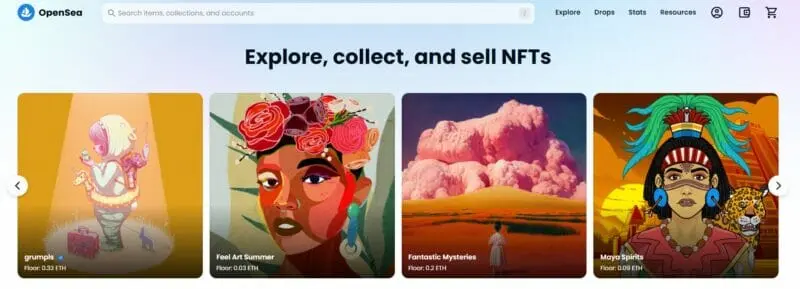
: Creators and collectors looking for the largest, most established, multi-chain NFT marketplace with a broad reach.
Supported Blockchain
: Ethereum, Polygon, Arbitrum, Optimism, Avalanche, Solana, Base, Blast, Zora, Flow, and many more (22+ chains total).
Service Fees
:
1.0 % platform fee on NFT sales (as of September 2025)
Creator royalties (secondary sales) are optional depending on collection settings.
NFT Types
: General marketplace; supports digital art, collectibles, virtual goods, music, video, domain names, gaming assets, virtual real estate and more.
Minting & Upload Options
: OpenSea offers “lazy-minting” on supported lower-cost chains (e.g., Polygon), meaning you can upload metadata and create a listing without paying gas upfront. On high-cost chains (like Ethereum), you’ll need to pay gas for minting.
If you are a creator or influencer exploring the NFT space in 2025, OpenSea remains the
most recognized and widely used marketplace
. Founded in 2017, it has grown from a peer-to-peer NFT bazaar into a massive
multi-chain marketplace
and crypto aggregator
that supports NFTs across more than 20 blockchains.
Its scale and diversity give you one of the highest chances of finding buyers, whether you produce digital art, music files, gaming items, or virtual real estate.
Because OpenSea now embraces many chains, you have flexibility: if gas fees are too high on Ethereum, you can mint and list on a cheaper chain like Polygon and still tap into a global collector base. For emerging creators or those testing a first drop, that flexibility reduces upfront cost and risk.
On top of that, the platform remains broadly accepted, and many collectors and traders expect to see new projects there.
Unmatched Chain Flexibility
OpenSea’s multi-chain support is arguably its greatest strength. By 2025, it supports over 22 blockchains, from major networks like Ethereum and Solana to newer alternatives like Base or Blast.
That means as a creator you can choose the blockchain that fits your budget and audience; cheaper minting on Polygon or fast trade-ready tokens on Solana, without sacrificing marketplace reach.
Massive Buyer & Collector Network
Because OpenSea has been around since 2017 and survived the NFT boom and bust, it remains the largest marketplace by listings and user base. Millions of tradable items, and a wide variety of asset types (art, collectibles, gaming items, music, virtual real estate, etc.) make it more likely that your work will be discovered.
Low Platform Fees + Optional Royalty Structures
With only a
1.0 % platform fee for sales
and the option to
enable royalties per collection
, OpenSea gives you a competitive economic structure. Combined with the ability to mint via lazy-minting on low-fee chains, this keeps your upfront and ongoing costs lean and lets you maximize net revenue.
Pros
Extremely broad chain support — many blockchain options to optimize for cost/ audience.
Large, well-established user base and maximum visibility for new drops.
Low platform fee (1.0 %) compared with many niche marketplaces.
Lazy-minting and lower-cost chain options help minimize upfront costs.
Supports a wide variety of NFT types (art, gaming, music, virtual real estate, collectibles, etc.).
Cons
Creator royalties are not guaranteed; they depend on collection settings, and secondary-sale buyers may skip optional royalty payments.
Gas fees can still be high on major networks like Ethereum, especially when network demand surges.
Because it is so large and general, discoverability can still be a challenge — many projects compete for attention.
The platform’s pivot toward becoming a broader crypto/tokens aggregator may dilute focus on NFTs over time.
OpenSea
The world’s largest digital marketplace for crypto collectibles and non-fungible tokens (NFTs), including ERC721 and ERC1155 assets. Buy, sell, and discover exclusive digital assets like Axies, ENS names, CryptoKitties, Decentraland, and more.
2. JPG.Store
Best For
: Creators, artists, and NFT-project builders working on Cardano-native NFTs, especially those targeting low-gas minting, affordable entry, and a community of Cardano collectors.
Supported Blockchain
: Cardano (ADA-backed)
Service Fees
:
Marketplace sale fee: 2.5% of sale price (seller pays) — minimum 2 ADA.
Minting fee (for creators / minters): 2 ADA per mint + typical Cardano blockchain transaction fees.
NFT Types
: General Cardano-native NFTs — digital art, collectibles, avatars or gaming-style assets, utility or community NFTs, and other Cardano-compatible formats.
Minting & Upload Options
: Native Cardano NFT support with smart-contract infrastructure; you can create single NFTs or collections (via “Policy ID”), and mint directly on Cardano using JPG Store’s minting tools. Wallet-based minting; no lazy-minting model but low mint costs (Cardano gas is typically low compared to Ethereum).
JPG Store stands out as the largest and most widely used
NFT marketplace on Cardano
, tailored for creators and collectors operating within
Cardano’s ecosystem
. It offers a smooth
on-ramp to minting
,
listing
, and
selling NFTs in ADA
, which keeps cost and complexity relatively low.
Because minting costs are modest (
2 ADA + network fees
), JPG Store lowers the barrier to entry compared to high-gas chains. For creators experimenting with small collections, community-driven art drops, or utility-oriented NFTs (games, avatars, metaverse-style items), JPG Store presents a practical and purpose-built option.
Also, JPG Store has evolved beyond basic marketplace functions. It supports collection launches, verification workflows, and a suite of creator tools, including a
launchpad for new projects
, and offers lending/borrowing features using NFTs as collateral.
For Cardano-native artists or projects whose audience lives on Cardano — or who want to tap into a less saturated NFT ecosystem compared with Ethereum — JPG Store can serve as a credible primary marketplace.
Multi-Chain Alternative Inside Cardano Ecosystem
Because JPG Store operates on
Cardano
rather than Ethereum, you benefit from lower fees, a growing community of Cardano-native users, and a different supply-demand dynamic than on saturated Ethereum marketplaces.
Low Minting & Transaction Costs
With a fixed
2 ADA mint fee
and relatively low Cardano blockchain fees, you can mint NFTs affordably. This makes JPG Store suitable for creators testing collections or producing multiple works without high upfront costs.
Robust Creator Tools & Community Infrastructure
The platform offers collection creation via “
Policy ID
”, verification options, and a launchpad for new projects — enabling creators to manage drops, metadata, and community-ready launches without needing deep technical expertise.
Pros
Very low minting and transaction costs compared with Ethereum-based platforms (2 ADA + Cardano fees)
Transparent, smart-contract-based NFT infrastructure on Cardano — good provenance and decentralization
Support for a wide range of NFT types — digital art, collectibles, avatars, utility NFTs, community projects
Native Cardano ecosystem and audience — less competition than saturated NFT markets, potential for upward growth as Cardano adoption expands
Cons
Because the marketplace is Cardano-specific, your potential buyer base may be narrower than on major, cross-chain generalist platforms
No lazy-minting or gasless-minting feature — you still pay upfront minting costs (though relatively low)
While active, Cardano-NFT ecosystems are less mature than Ethereum’s; volume, liquidity, and resale demand can be lower or more volatile
Success may depend heavily on targeting Cardano-native users and communities rather than broad crypto-or art-audiences
Read also:
3.
Binance NFT
Best For
: Creators and brands looking for high liquidity, access to a large existing crypto-user base, and a streamlined NFT experience integrated with a major exchange.
Supported Blockchain
: Binance Smart Chain (BSC) and Ethereum.
Service Fees
:
Platform fee on sales: 1% of sale price.
No listing fee.
Royalty fees vary by collection (creators can set royalty % for secondary sales).
NFT Types
: General marketplace — digital art, collectibles, gaming items, mystery-box NFTs, entertainment and sports-related drops, utility-style NFTs.
Minting & Upload Options
: Minting is possible, but by default only approved/authorized creators can create NFTs on Binance NFT. Gas or network fees apply depending on chain (BSC or Ethereum).
Binance NFT is the
non-fungible token marketplace operated by Binance
, one of the
largest global crypto exchanges
. Launched in 2021, the marketplace leverages Binance’s massive user base, exchange liquidity, and security infrastructure to offer a straightforward entry point into NFTs.
Because Binance NFTs work across BSC and Ethereum, the platform caters to both users who prefer
lower-fee
,
faster transactions
(via BSC) and those who want compatibility with the
broader Ethereum ecosystem
.
For a creator or brand, this dual-chain support gives flexibility: you can choose BSC for cost-efficient drops or Ethereum for broader visibility among traditional NFT collectors.
Binance integrates NFT trading with its broader exchange ecosystem — meaning you can use the same account, wallet, and crypto balances you already hold on Binance to mint, buy or sell NFTs.
Because of its scale, Binance NFT tends to offer high liquidity and visibility. Drops from major brands, gaming projects or entertainment-linked NFTs can reach a big audience quickly. For creators who prioritize reach, volume, and ease of use, Binance represents one of the more pragmatic NFT marketplaces in 2025.
Dual-Chain Infrastructure for Flexibility
With support for both BSC and Ethereum, Binance NFT lets you pick the chain that fits your project’s economics and target audience. Lower-cost BSC for volume drops, or Ethereum for reach among traditional crypto art collectors.
Large User Base and Exchange Integration
Binance’s massive ecosystem,
exchange users
,
wallets
,
liquidity
, offers built-in potential buyers and exposure. For creators, this means easier onboarding for collectors who already use Binance, reducing friction in discovery and purchase.
Competitive Fee Structure and Simplified Marketplace Entry
With a flat
1% service fee on sales
,
no listing fees
, and configurable creator royalties on secondary sales, Binance NFT presents a cost-effective alternative to many high-fee marketplaces.
Pros
High liquidity and large pre-existing user base from Binance exchange world
Dual-chain support (BSC + Ethereum) provides flexibility and lower-fee options
Flat and low 1% platform fee on sales; no listing fee lowers barrier to entry
Integration with Binance account/wallet simplifies onboarding for creators and buyers
Supports a broad variety of NFT types: art, collectibles, gaming, entertainment, mystery boxes
Cons
Minting permissions are restricted: only pre-approved creators can mint — not open to everyone by default, which limits accessibility for new creators
As a centralized marketplace (owned by Binance), some in the NFT community may view centralization as a trade-off compared with decentralized platforms
NFT collections and offerings may be less niche or exclusive than on curated art-specific platforms — volume may favor quantity over quality
Depending on the chosen blockchain network (especially Ethereum), gas fees and network congestion can still pose cost/risk for creators or buyers
Read also:
4.
Solanart
Best For
: Digital artists, PFP collectors, gaming-asset creators and anyone working with Solana-native NFTs who want a straightforward, low-fee marketplace on a fast, high-throughput blockchain.
Supported Blockchain
: Solana
Service Fees
:
3% marketplace commission on sales.
Some sources mention a small listing fee (e.g. 0.02%) depending on the sale type.
NFT Types
: Solana-based digital art, profile-picture (PFP) collections, collectibles, gaming/metaverse assets and general Solana NFT categories.
Minting & Upload Options
: Creators mint NFTs using Solana — listing and selling require standard chain transaction (SOL) fees. There is no widely advertised lazy-minting or gasless-mint option.
Solanart is among the
original and most established NFT marketplaces built on Solana
, recognized for offering creators and collectors access to many of the chain’s notable NFT collections.
Its infrastructure leverages Solana’s strengths — fast confirmations, high throughput, and low transaction costs — enabling comparatively inexpensive minting and trading compared with high-gas chains.
The platform’s community and track record include hundreds of thousands of trades to date, making it a trusted environment for Solana-native NFTs.
As a creator, this means your work is exposed to a base of users already active in Solana’s NFT ecosystem, and you benefit from a marketplace optimized for speed and cost-efficiency.
For projects oriented around PFP collections, collectibles, gaming assets, or general digital art, especially those aiming for Solana users, Solanart offers a solid foundation: relatively low fees, native-chain compatibility, and access to an established Solana-NFT audience.
Strong Solana-Native Infrastructure
Solanart runs
purely on
Solana
, which allows it to benefit from the blockchain’s high throughput and low fees. That makes minting, listing and trading more cost-efficient for creators and collectors compared with high-fee chains.
Focused on Popular Solana Collections & PFP/Collectible-Style Work
Many prominent Solana collections and PFP/collectible projects list via Solanart. If your work aligns with these formats — rather than fine art or highly curated galleries — Solanart provides ready demand and community familiarity.
Transparent and Simple Fee Structure
With a flat
~3% marketplace fee
and
minimal or no listing fees
(depending on sale type), the economics are clear and predictable, helping creators plan pricing without complex fee surprises.
Pros
Low marketplace fee (~3%) and low transaction cost thanks to Solana’s efficient network
Solana-native — gives full compatibility with the Solana ecosystem and wallets popular among NFT users
Good for PFP, collectibles, gaming items or general NFT formats rather than high-end art
Established marketplace with history of many trades, offering existing liquidity and user base
Cons
Marketplace focus is narrower and more mass-market than curated art-first platforms — may limit exposure for art-style NFT projects seeking premium positioning
Fewer NFT categories compared with large generalist, multi-chain marketplaces — emphasis on digital art / collectibles / PFP / gaming assets
No known lazy-minting or gasless-minting options — creators must handle mint costs upfront in SOL
Secondary-market liquidity and resale value may be lower compared with top-tier marketplaces on major blockchains
Read also:
5.
Rarible
Best For
: Creators who want flexibility across many blockchains and a community-driven environment with low-barrier minting.
Supported Blockchain
: Ethereum, Polygon, Immutable X, Base, zkSync Era, RARI Chain, Celo, Moonbeam, Palm, Aptos and several others.
Service Fees
:
Sliding scale from 0.% per party for higher-value sales to 7.5% per party for lower-priced items.
NFT Types
: Digital art, collectibles, gaming items, metaverse assets and other general NFT categories.
Minting & Upload Options
: Lazy minting available on supported chains, enabling creators to list NFTs without upfront gas fees.
Rarible has evolved into one of the most flexible
multi-chain NFT marketplaces
in 2025, structured around broad accessibility and community influence. Its defining characteristic is its reach across a large number of blockchains, which positions it as a versatile option for creators who want choice in how they mint and sell their work.
By supporting both high-traffic ecosystems such as
Ethereum
and lower-cost or emerging networks like
Immutable X
,
Base
or
Aptos
, the platform allows creators to adapt their strategy to their budget, audience and technical needs.
Another notable aspect of Rarible is its fee structure. Unlike flat-fee marketplaces, Rarible uses a sliding model that becomes more favorable as the item price increases. This can make the platform especially appealing to creators producing mid-tier or premium pieces.
In addition, lazy minting remains a practical option for those who prefer to avoid upfront blockchain costs, making the onboarding experience smoother across chains that support this feature.
Rarible’s marketplace activity is influenced heavily by
community participation
, and its decentralized ethos still shapes how features roll out and evolve. For creators who value experimentation and cross-chain reach, Rarible offers a low-friction way to publish work while maintaining control over pricing, royalties and distribution strategy.
Community Driven Multi-Chain Model
Rarible’s architecture emphasizes chain diversity. With support for more than twenty networks, creators can choose environments that balance cost, liquidity and audience alignment without switching platforms.
Fee Structure That Scales With Value
The sliding fee system becomes more advantageous as sale prices increase. This benefits creators with higher-value work and creates a pricing environment that aligns revenue potential with platform costs.
Minting Designed to Reduce Upfront Cost
Lazy minting offers a practical approach to publishing NFTs without incurring blockchain fees upfront. This is particularly useful in multi-chain ecosystems where gas conditions vary widely.
Pros
Wide multi-chain support offers flexibility in cost and audience targeting
Sliding fees benefit mid-range and premium NFT pricing
Lazy minting reduces initial financial risk
Supports a broad mix of NFT categories
Cons
Higher fees for low-priced NFTs may limit entry-level profit margins
Smaller marketplace visibility compared to the very largest platforms
Marketplace evolution is fast and may require creators to adapt frequently
Read also:
6.
SuperRare
Best For
: Artists who create one-of-a-kind digital art and want exposure within a curated, high-quality NFT art gallery environment.
Supported Blockchain
: Ethereum
Service Fees
:
15% commission on primary sales (creator receives 85%)
3% transaction fee paid by the buyer on purchases
Creators receive 10% royalties on secondary sales
NFT Types
: Curated digital art (1/1 unique pieces), including images, animations, 3D art and other original digital artworks.
Minting & Upload Option
s: Minting occurs via ETH on Ethereum. There is no public “lazy-minting” option; artists must pay gas fees to mint their work.
SuperRare stands out as a
premium
,
invitation-based NFT marketplace
that positions itself as a
digital art gallery
more than a general NFT bazaar. Since launching in 2018, it has specialized in single-edition (1/1) digital artworks, giving collectors access to unique, limited-edition pieces.
The platform operates exclusively on Ethereum. All transactions, from minting, listing, bidding, and purchases, are denominated in ETH.
Because of its curated nature, SuperRare tends to attract serious collectors who value rarity, provenance, and aesthetic quality, rather than users browsing for mass-market or utility NFTs.
SuperRare is best suited for artists with strong portfolios and a commitment to digital art as a medium. If your art fits that profile and you aim for premium positioning, SuperRare can serve as a gallery-like platform that signals quality and scarcity.
High-End Gallery Positioning
SuperRare preserves a high standard by curating which artists can list. By maintaining an exclusive artist roster, the platform builds a high-end brand reputation in digital art. Collectors expecting polished, rare, one-of-a-kind pieces tend to browse here, which can elevate perceived value for listed works.
Provenance and True Scarcity for Each Piece
Every NFT on SuperRare is a 1/1 — truly one-of-a-kind. That means if you list on SuperRare and your work sells, it will not be diluted by editions or reprints. For serious art collectors and artists building digital-art careers, this provenance and scarcity can significantly enhance long-term value and collectability.
Ongoing Royalties & Marketplace Governance via Token
Secondary-sale royalties (10%) give creators a stream of income beyond the first sale. In addition, the platform is governed by a community via token-based governance (holders of the platform’s native token participate in decisions and curation), which gives artists and collectors a stake in how the marketplace evolves.
SuperRare may not be the easiest entry point due to its exclusivity and higher costs, but for creators focused on high-quality, collectible digital art, it remains one of the most respected marketplaces in Web3.
Pros
High-quality, curated platform that reinforces the value of unique digital art
Every NFT is 1/1 — ensures true scarcity and provenance
Secondary-sale royalties (10 percent) give ongoing earnings potential
Attracts serious collectors willing to pay for quality and uniqueness
Cons
15% commission on primary sales and 3% buyer fee make it costly compared to open marketplaces
Only supports Ethereum — gas fees can be high and unpredictable
Entry is restricted; artists must be approved before listing
Smaller volume and narrower audience than generalist marketplaces, which may limit exposure for less-established artists
7.
Foundation
Best For
: Digital artists and creators focused on high-quality, art-centric NFTs and curated auctions.
Supported Blockchain
: Ethereum (with optional drop/mint support on L2 chain Base since 2024)
Service Fees
:
5% marketplace fee on Auctions, Offers, or Buy Now sales
For Drops and Editions: 0.0008 ETH per mint (plus standard gas fees)
NFT Types
: Curated digital art, 1-of-1 artworks, drops and editions, galleries or curated collections
Minting & Upload Options
: Creators deploy their own smart-contract Collections. Minting requires gas; there is no “gasless lazy-minting” option. For Drops or Editions, you pay the per-mint fee (0.0008 ETH) plus gas.
Foundation remains one of the most respected curated NFT marketplaces in 2025, known for its focus on
high-quality digital art
and a
community-led
,
invitation-based onboarding model
. Originally launched in 2021, the platform’s mission centers on putting artists first by ensuring that works listed are serious art pieces rather than mass-minted disposable items.
The marketplace leans heavily into
auction-driven sales
and
curated editions or drops
. That structure tends to attract collectors who value scarcity, provenance, and artistic merit. Because you mint using your own smart-contract collection, you retain control over your contract and artwork ownership, an appealing setup for creators wanting long-term control over how their work is managed and resold
In 2024, the platform added support for the
Ethereum L2 chain Base
. That gives creators optional flexibility to mint or sell on a lower-fee chain when appropriate, though Ethereum remains the backbone.
Signature Curation Model
Foundation uses a selective, invitation-based approach rather than open minting. This keeps overall marketplace quality high and ensures works remain art-focused rather than flood-driven. As a creator, this means your art appears in a context where collectors expect refinement and worth.
Direct Contract Ownership and Control
On Foundation, you deploy your own smart-contract Collection, meaning you
own and control your contract and future releases
. That gives you long-term control over how your art is managed, updated, or evolved.
Flexible Formats: Auctions, Drops, Editions
Foundation accommodates traditional 1-of-1 auctions but also supports drops and editions, giving you flexibility in how you release your work depending on strategy and audience.
Pros
Curated, art-first environment that supports serious digital art and builds credibility for your work
Ownership of your own smart-contract collection preserves creator control over metadata, future editions, and provenance
Flexible selling formats (auctions, drops, editions) enabling tailored release strategies
Optional chain flexibility with L2 support (Base) for potentially lower gas/mint costs
Cons
Minting requires gas (no lazy-minting), which can be costly on Ethereum
Because the platform is selective, onboarding may be harder than open marketplaces
User base is narrower than general-purpose marketplaces, which may limit visibility and volume of potential buyers
Focus on curated art excludes many NFT categories (e.g. gaming NFTs, domains, utility NFTs) — limiting reach for non-art creators
Read also:
8.
AtomicMarket
Best For
: Creators, game-asset developers, and collectors who want low-cost NFTs on a blockchain built for digital collectibles and gaming, seeking shared liquidity and efficient marketplaces.
Supported Blockchain
: WAX (via the AtomicAssets standard on EOSIO-related chains).
Service Fees
:
Marketplace fee defaults to 1% for both maker (lister) and taker (buyer) per sale/auction.
Collections themselves can define an additional market fee (from 0% up to 15%) that goes to collection authors.
NFT Types
: Digital collectibles, gaming and metaverse items, virtual goods, in-game assets, and other AtomicAssets-compatible NFTs (art, utility, game items).
Minting & Upload Options
: Creators mint via the WAX blockchain using AtomicAssets. There is no typical “lazy-minting” setup like L2 lazy-mint platforms; minting and listing require creation under the AtomicAssets standard.
AtomicMarket acts as a
decentralized smart-contract marketplace
on
WAX (EOSIO)
built around the
AtomicAssets standard
. Because of the shared-liquidity model, any NFT listed through AtomicMarket becomes visible across all front-ends that use its contract, increasing exposure without requiring multiple listings.
As a creator or game-asset developer, this shared liquidity and cross-platform visibility mean a single listing can reach a broader ecosystem of collectors, gamers, and traders.
The platform’s design lets you
list and auction multiple NFTs or bundles
(as long as they belong to the same collection) under a unified contract. Because ownership is held in the smart-contract until sale, sellers maintain control until a buyer accepts the offer, preserving security and reducing nthe eed for repeated transfers or approvals.
For creators working in gaming assets, tradable virtual items, or collectibles, this gives efficient distribution and resale capabilities.
Given WAX’s orientation toward NFTs and gaming items, often with lower barriers to entry and lower transaction friction compared with major chains, AtomicMarket provides a practical, cost-effective alternative for creators who prioritize affordability and liquidity over the speculative art-market pricing found on Ethereum-based marketplaces.
Shared Liquidity via a Single Smart Contract
AtomicMarket’s core smart contract aggregates inventory across all marketplaces using it. That means when you list an NFT or bundle the sale becomes available to all front-ends — maximizing visibility without duplication.
Control Until Sale via Offer Mechanism
NFTs are not transferred to escrow at listing. Instead, an “
offer
” is created. Ownership remains with you until a buyer purchases, minimizing unnecessary gas or transfer overhead and reducing risk and complexity for creators.
Low Fees and Flexible Collection-Level Settings
Base marketplace fee is
1% maker + 1% taker
. Moreover, developers of collections can set their own market fee
up to 15%
, giving flexibility to monetize their collection governance or community directly. This makes AtomicMarket more flexible than rigid-fee platforms.
Pros
Shared liquidity increases visibility across multiple front-ends from a single listing
Very low base fees (1% + 1%) compared with many Ethereum marketplaces
Smart-contract-based ownership until sale reduces administrative friction and transfer overhead
Strong support for game items, collectibles, virtual goods and AtomicAssets-native NFT types
Cons
Blockchain is WAX (EOSIO), which may have smaller collector base than Ethereum or major generalist marketplaces
Less suitability for high-art or premium digital art aimed at Ethereum-native collectors
No lazy-minting alternative: minting depends on AtomicAssets contract and smart-contract workflow
Because the ecosystem is oriented toward collectibles and gaming, resale value and exposure may be more volatile
9.
BakerySwap
Best For
: Creators, artists and NFT-project builders who prefer low-cost minting and trading on BSC and want a combined DeFi + NFT environment.
Supported Blockchain
: BNB Smart Chain (BSC)
Service Fees
:
Typical trading fee on token swaps: 0.30% (of which 0.25% goes to liquidity providers and 0.05% may go to BAKE holders)
Marketplace/NFT sale or listing fees are variable depending on collection and listing settings.
NFT Types
: General NFTs — digital collectibles, gaming or metaverse-style items, NFT “combos”, and marketplace art/collectible listings.
Minting & Upload Options
: You mint NFTs through smart contracts on BSC; BakerySwap does not offer ETH-style “lazy-minting.” Gas and BSC transaction fees apply for creation and transfers
BakerySwap
combines decentralized finance (DeFi)
and NFTs under one roof
, built on the
BNB Smart Chain
. Originally launched in 2020, it became recognized as the first NFT-ready automated market maker (AMM) on BSC.
The platform’s dual nature, a
DEX plus an NFT
marketplace
, allows creators not only to mint and sell NFTs but also to engage with DeFi features such as liquidity pools, staking, or yield farming. That gives it a unique positioning: if you are working on NFTs but interested in tokenomics and DeFi-native audiences, BakerySwap offers an integrated ecosystem.
Because it runs on BSC, transaction and gas fees tend to be far lower than on chains like Ethereum. That can make it a pragmatic choice for artists or projects experimenting with budget-conscious drops, frequent editions or gaming/metaverse-style assets rather than high-end digital art.
The “cost-efficiency + flexibility” formula makes BakerySwap especially interesting for creators aiming for volume, affordable entry or utility-oriented NFTs rather than 1-of-1 gallery-type pieces.
Signature AMM + NFT Integration
BakerySwap blends a
Uniswap-like AMM DEX
with a functioning NFT marketplace. That means, besides selling your NFTs, you could use
liquidity pools
,
yield farming
or
staking
to engage with crypto users. This dual model gives creators more flexibility in monetization and exposure compared to NFT-only platforms.
Low-Cost, Fast Transactions on BSC
Since BakerySwap runs on BSC, network fees and gas costs are significantly lower than on typical Ethereum-based NFT platforms. For creators planning frequent mints, multiple editions, or lower-price drops, this reduces entry barriers and risk.
Accessible to Projects Beyond High-Art — Collectibles, Gaming and Utility NFTs
BakerySwap supports NFTs beyond pure art: gaming assets, “combo” NFTs tied to staking or token rewards, collectible items, and other utility-style NFTs. That flexibility broadens your potential project types beyond traditional digital art and opens doors to community or game-oriented NFT builds.
Pros
Low network and transaction costs because of BSC base chain
Integrated DeFi + NFT marketplace model giving creators more monetization flexibility
Support for a wide range of NFT types beyond just collectible art (gaming items, metadata, utility NFTs, combos)
Suitable for creators or projects with limited budget or aiming for frequent/affordable drops
Cons
Audience and collector demand likely smaller and more niche than on major Ethereum-based NFT marketplaces
Lower exposure for high-art or premium NFTs — platform tends toward utility, collectibles, gaming or speculative demand
Minting and listing still require gas and BSC transaction fees (no lazy-minting)
Because of the broader DeFi focus, NFTs might compete with token liquidity and farming — making the marketplace less curated than art-specific platforms
Read also:
10.
KnownOrigin
Best For
: Digital artists focused on curated, high-quality art and collectors seeking exclusive Ethereum-native digital artworks
Supported Blockchain
: Ethereum only
Service Fees
:
15% service fee on primary sales
On secondary sales, 2.5% marketplace fee plus 10% royalty to original artist (i.e. original artist receives 10% of resale)
NFT Types
: Curated digital art (1-of-1 art, limited editions, crypto-art, images / GIFs / multimedia)
Minting & Upload Options
: Minting requires paying Ethereum gas fees. There is no public lazy-minting or alternative chain support. Editions are mint-on-demand but still require on-chain gas.
KnownOrigin is one of the
oldest and most tightly curated NFT art marketplaces
. Since its launch in 2018, it has built a reputation as a
gallery-style platform
specializing exclusively in digital art rather than gaming assets, collectibles, or utility NFTs.
By focusing on
Ethereum
and the
ERC-721 standard
, KnownOrigin ensures full provenance tracking and compatibility with standard Web3 wallets.
The platform’s curated onboarding process means not every artist can list — this helps maintain high quality and reduces spam, but also limits access for many creators.
finder.com
Because of that curation, KnownOrigin tends to attract
serious digital-art buyers
who value uniqueness and scarcity. For creators whose work aligns with fine-digital-art sensibilities — graphic or generative art, limited-edition pieces, visually distinct NFTs — KnownOrigin provides a higher prestige context than broader NFT marketplaces.
Curated Ethereum Art Gallery Environment
KnownOrigin’s strict selection criteria keep the marketplace focused on serious digital art. That means as a creator accepted there, your work sits among curated peers — which can enhance perceived value, credibility, and appeal to discerning collectors.
High Royalties for Secondary Sales
With
10% royalties
on resales plus a
2.5% marketplace cut
, KnownOrigin ensures creators benefit from ongoing resale value. This royalty setup is more favorable than many mass-market platforms for art-centric creators.
Transparent Provenance and Edition Controls
Because KnownOrigin uses
Ethereum
and
ERC-721
, every token has clear, immutable provenance. Editions are mint-on-demand, giving creators flexibility in supply while preserving token fungibility and ownership transparency.
Pros
Strong curated environment that supports high-quality digital art and helps filter out noise
High secondary sale royalties (10%) support long-term value for creators
Ethereum-native, using standard ERC-721 — good provenance and broad wallet compatibility
Editions + mint-on-demand give creators control over supply
Cons
15% primary sale fee is steep compared with many general-purpose marketplaces
Gas fees on Ethereum add friction and cost for minting and transactions
Artist onboarding is selective and often closed — not all creators can list
Marketplace reach and user base are smaller than large generalist platforms, which may limit exposure
11.
Enjin Marketplace
Best For
: Creators building gaming assets, metaverse or utility-oriented NFTs who want a blockchain environment purpose-built for games and digital assets.
Supported Blockchain
: Enjin Blockchain (native), with NFTs backed by Enjin Coin (ENJ) and integrated into the broader Enjin ecosystem.
Service Fees
:
Public documentation on exact platform commission is limited; sources cite a baseline 2.5% marketplace fee on sales.
All transactions (minting, trading) require ENJ tokens as a payment medium, no fiat support for purchases.
NFT Types
: Gaming items, virtual goods, utility NFTs, metaverse assets, in-game assets, blockchain-native collectibles, digital assets built with Enjin’s tooling.
Minting & Upload Options
: NFTs are minted using Enjin’s tooling, requiring ENJ to back creations; metadata and blockchain storage follow Enjin’s standards. There is no widely-advertised “lazy-minting” or gas-free minting option.
Enjin Marketplace, often referenced under the name
NFT.io
, is part of a
broader Web3 ecosystem
designed specifically for
gaming
,
digital assets
, and
utility NFTs
. For creators who are building game items, virtual goods, or metaverse assets rather than purely collectible art pieces, this can offer a more aligned environment than typical art-centric or generalist NFT platforms.
The marketplace is closely integrated with the
Enjin Blockchain
and uses the
ENJ token
as the backbone for minting and trading.
Because the platform’s architecture and tooling are tailored to game-ready NFTs and utility/collectible assets, creators working on game integrations, in-game economies, or interoperable digital goods benefit from out-of-the-box blockchain compatibility, asset backing, and ecosystem support.
The emphasis is not on art-gallery style listings but on assets with potential utility, functionality, or in-game utility, which aligns with many modern Web3 game or metaverse creators’ needs.
When you mint an NFT via Enjin, it is backed by ENJ and easily integrated with Enjin Wallet and ecosystem tools, facilitating trading, transfers, and game interoperability.
For creators interested in utility NFTs or in-game items rather than speculative art drops, Enjin Marketplace may present a lower-friction, more purpose-driven environment compared to Ethereum-centric art marketplaces.
Gaming & Utility-First Ecosystem
Enjin’s core design centers on
game assets
,
virtual goods
, and
utility NFTs
rather than fine art. If you build NFTs intended for games, metaverse, or utility, Enjin’s tooling, ENJ-backed assets and blockchain are designed to support such use cases efficiently.
Built-in Ecosystem Integration (Wallet, Token, Blockchain)
With a full stack, blockchain, native token (ENJ), wallet, and marketplace, Enjin offers a
unified infrastructure
. That reduces fragmentation for creators building across games and assets, simplifying minting, ownership, and trading workflows.
Access to Existing Gaming & Collectible Communities
Because Enjin has a history in gaming and game-asset communities, listing on Enjin Marketplace gives access to audiences specifically interested in game NFTs, digital goods, and blockchain-native collectible ecosystems rather than general NFT art buyers.
Pros
Purpose-built for gaming, utility, metaverse and collectible NFTs rather than purely art-focused drops
Full infrastructure: blockchain, token (ENJ), wallet and marketplace — fewer moving parts to manage
ENJ backing provides a base value layer and liquidity framework for NFTs in the ecosystem
Access to gaming-oriented collectors/users — more aligned demand for in-game assets or utility NFTs
Cons
Marketplace fee structure and commissions are not clearly transparent or well-documented compared with mainstream NFT marketplaces
Requires using ENJ token for minting/trading — no fiat on-ramp or widespread crypto standard like ETH by default
Less suited for traditional digital art or wide-audience art collectors; weaker visibility for purely aesthetic NFTs compared with art-centric platforms
Limited public information on minting flexibility (no known gasless or lazy-minting feature), which may raise upfront cost or entry friction for creators new to blockchain
Read also:
12.
Portion
Best For
: Artists and collectors interested in digital or physical art and collectibles, especially those who value transparent provenance, optional physical-asset backing, and a marketplace that bridges crypto-native NFTs with traditional art/collectible sensibilities.
Supported Blockchain
: Ethereum (uses ETH + smart contracts)
Service Fees
:
On primary sales, creators receive 100% of proceeds (i.e. 0% commission) according to the official platform statement.
For secondary sales, royalty fee set at 11% (to the original artist) is cited in public sources.
NFT Types
: Digital art, physical-art backed NFTs, art collectibles, mixed digital/physical collectibles, luxury art tied to provenance certificates.
Minting & Upload Options
: Tokenization of both digital and physical artwork via a drag-and-drop interface; minting happens on Ethereum, with art metadata stored via decentralized storage (IPFS).
Portion positions itself as more than “just another NFT marketplace.” It aims to merge
digital-native NFT technology
with
traditional art and collectible markets
. That means you can tokenize purely digital art — or tie a token to a physical artwork or collectible, complete with provenance records and optional real-world storage or delivery.
Launched originally in 2018 and relaunched in version 2.0 around 2020, Portion sought to democratize access to the art and collectibles marketplace by removing intermediaries like galleries and auction houses.
On Portion, creators keep
full control of proceeds from primary sales
, while the platform enforces an
11% royalty for secondary sales
.
This model can appeal strongly if you want to retain maximum upside from first sales and also benefit from resale activity.
Portion’s offer isn’t limited to digital-only assets. The infrastructure supports tokenization of physical art and collectibles, enabling fractional ownership or full ownership via blockchain-backed provenance certificates.
Given this positioning, Portion is especially relevant for creators who straddle both traditional art/collectible markets and the crypto-native NFT world — or those who envision hybrid physical-digital releases.
Global Art + Blockchain Hybrid Model
Portion blends Ethereum-based NFT minting with real-world art market features: provenance certificates, optional physical delivery or storage, and support for both digital and physical collectibles. That makes it ideal for creators building for an audience beyond crypto-native collectors.
Zero Commission on Primary Sales
Creators receive
100% of proceeds from their first sale
, a rare feature among NFT marketplaces — which maximizes upfront revenue potential.
Secondary Market Royalties + Transparent Resale Infrastructure
With
11% royalties on resales
, Portion offers ongoing earnings for artists as NFTs/certificates change hands — a long-term value path typical of art and collectibles markets.
Pros
0% commission on primary sales — creators keep full proceeds on first sale
Supports both digital and physical art/collectibles, with blockchain-backed provenance and optional physical delivery or storage
Works on Ethereum + decentralized storage (IPFS), combining Web3 transparency with art-market credibility
Secondary-sale royalties (11%) give ongoing earning potential for creators
Cons
Because minting happens on Ethereum, gas fees may still apply depending on network conditions
Marketplace seems more niche than mass-market platforms — demand and exposure may be limited compared with top-tier generalist marketplaces
Payment methods beyond crypto are reportedly limited — no clear support for card/PayPal on public documentation.
13.
Nifty Gateway
Best For
: Artists and creators aiming for curated, high-end digital art drops or limited-edition NFT releases, especially if you value curated positioning, fiat payment options, and streamlined UX.
Supported Blockchain
: Ethereum (NFTs on Nifty Gateway are backed by ETH).
Service Fees
:
5% platform fee + US$0.30 on secondary sales (when using custodial mode).
If using self-custody wallet (wallet-to-wallet flow), 2.5% fee applies plus regular gas fees.
NFT Types
: Curated digital art and limited-edition drops.
Minting & Upload Options
: Minting happens on Ethereum. For NFTs minted and stored in Nifty Gateway’s custodial Omnibus wallet, buyers and creators may avoid paying gas fees at time of purchase.
Nifty Gateway remains one of the most visible and curated
Ethereum-based NFT marketplaces
. The platform differentiates itself by focusing on
high-quality
,
limited-edition digital art
and works with
established artists and brands
to launch curated NFT drops.
Because it is backed by the established crypto-exchange
Gemini
, Nifty Gateway combines crypto-native NFT capabilities with a more user-friendly, fiat-accessible interface — enabling artists to reach collectors who are comfortable with card payments or fiat balances rather than requiring prior crypto-ownership.
The marketplace is curated, meaning not everyone can list. Many high-profile NFTs and celebrity-artist drops have originated on Nifty Gateway, which reinforces its positioning as a premium storefront rather than an open-listing bazaar.
At the same time, Nifty Gateway’s combination of curated art, NFT-native blockchain underpinnings, and more traditional payment methods gives you a hybrid access path: you get the benefits of blockchain authenticity and provenance while offering accessibility to a broader collector base, including those who may not use crypto regularly.
Curated Premium Drops for High-End Collectors
Nifty Gateway’s curated-drop model ensures that listed NFTs come with selectivity. That means works tend to carry more perceived value, and collectors browsing Nifty expect higher-caliber art. As a creator, being featured can elevate your positioning and align your brand with premium NFT art.
Custodial Wallet + Fiat or Crypto Checkout Simplifies Onboarding
Because Nifty uses a custodial omnibus wallet system, buyers can use
credit/debit cards
,
fiat
, or
ETH
, lowering friction for collectors who are not crypto-native. This also means gas fees can be avoided or deferred for many transactions, easing the buying process for a wider audience.
Hybrid Chain-Native Infrastructure with Traditional UX Benefits
Nifty blends blockchain-native ownership and provenance with a
smooth
,
consumer-friendly purchase experience
. For creators, that balance can open doors to both legacy-style art buyers and crypto-aware collectors — expanding potential reach beyond strictly crypto-native audiences.
Pros
High-end curation and selective drops give NFTs a premium positioning and scarcity value
Supports fiat (card) purchases and ETH, broadening buyer pool beyond crypto-native users
Custodial wallet infrastructure reduces friction: gas fees often avoided for custodial transactions
Well-established reputation and backing by Gemini increase trust and exposure potential
Cons
Entry to listing is selective — not every creator gets approved for drops
Service fees (5% + $0.30 in custodial mode; 2.5% plus gas in wallet mode) may reduce net revenue compared with self-managed marketplaces
Smaller volume and fewer listing opportunities than open marketplaces — competition for attention among curated drops can be high
Dependence on a custodial wallet may deter users or collectors who prefer full self-custody and control
Read also:
14.
Decentraland
Best For
: Creators and developers who build virtual-world assets, 3D environments, wearable NFTs, and interactive digital real estate.
Supported Blockchain
: Ethereum (ownership of LAND, wearables, and other NFTs is recorded on Ethereum via smart contracts)
Service Fees
:
Marketplace transactions (land, wearables, in-world asset sales) include a transaction fee; some sources note a 2.5% fee on marketplace transfers.
In addition to platform fees, blockchain gas fees apply because the underlying assets live on Ethereum.
NFT Types
: Virtual land parcels (LAND), 3D real-estate, avatar wearables and accessories, virtual fashion items, metaverse-ready items, interactive content, in-world assets.
Minting & Upload Options
: Minting or purchasing LAND and wearables happens on Ethereum.
Decentraland blends the concept of a virtual world with blockchain ownership. Rather than being a traditional NFT marketplace for digital art, it is a
fully-fledged
metaverse
where digital land and 3D parcels are tokenized as NFTs.
Creators, developers, and designers can buy or build parcels of virtual land (
LAND
), design environments, avatar wearables, virtual fashion items, interactive installations, and virtual real-estate — then trade, rent, or monetize them in ways that mimic real-world digital property or experiences.
Because Decentraland uses Ethereum to register ownership through smart contracts, all assets, land, wearables, and user-generated 3D content are verifiable, transferable, and subject to blockchain standards.
The platform’s scope extends beyond static NFTs. Instead of one-off image or video NFT drops, your creations become part of a shared, persistent 3D world. That makes Decentraland especially interesting if you envision your NFT not as a standalone asset but as part of an immersive world.
Real-Estate & 3D Asset Marketplace — Not Just Simple NFTs
Unlike art-focused NFT marketplaces, Decentraland is about land, 3D space, and wearable/virtual goods that have utility within the metaverse. If you build environments or assets meant to be walked through, worn by avatars, or interacted with — rather than displayed — Decentraland gives a framework to monetize them.
Ethereum-Backed Ownership with Smart-Contract Certainty
Every parcel of land, wearable, or in-world asset uses Ethereum smart contracts for provenance and ownership. That brings transparency, transferability, and permanence — critical for property-like virtual assets where proof of ownership matters.
Metaverse & Community Integration
Assets on Decentraland are embedded in a communal, social 3D world. Users can explore, interact, wear NFT clothes, attend events, use wearables — turning NFTs into experiences rather than just collectibles. This creates potential for ongoing engagement and repeat value beyond a one-time NFT sale.
Pros
Virtual-land and 3D content marketplace taps into immersive, interactive web3 worlds — good for creators building metaverse experiences or games
Smart-contract registration ensures real, blockchain-native ownership of land, wearables, and virtual goods
Utility-driven NFTs (wearables, environment builds, experiences) — not just static art — enabling creative and functional distribution models
Possibility to monetize not only via sales, but via land ownership, rentals, in-world commerce, or virtual events/experiences
Cons
All assets live on Ethereum — minting and transaction gas fees may be high, especially during network congestion
Decentraland’s activity and user engagement have fluctuated; some critics note large areas remain empty or underused, which can limit the exposure or utility of assets
Market for virtual land or wearables is niche compared to the broad NFT-art marketplaces; demand may be lower and more specialized
Success often depends on building or curating an engaging virtual experience — more resource-intensive than minting standalone art
Read also:
15.
Axie Infinity
Best For
: Creators, players and developers who want to mint, sell, or trade in-game NFTs (Axies, land, items) inside a well-established Web3 gaming ecosystem.
Supported Blockchain
: Assets are hosted on the game’s own sidechain, Ronin Network (Ethereum-linked), which underpins the marketplace and reduces reliance on main-chain gas.
Service Fees
:
5.25% marketplace fee on NFT sales (seller side) is the standard as of 2022 update.
For sales tied to creator-codes: 4.25% fee goes to platform/treasury and additional 1% may go back to participating creators under certain referral or creator-code programs.
NFT Types
: Game-native items: digital pets (Axies), in-game items, virtual land parcels, in-game assets, breeding-offspring NFTs, other Lunacia metaverse assets.
Minting & Upload Options
: There’s no traditional “open-art” minting — NFTs are generated via in-game mechanisms (e.g. breeding) or via official game asset creation; you cannot simply upload arbitrary art.
Axie Infinity operates a
fully integrated NFT marketplace
designed specifically for its
gaming universe
rather than as a general art marketplace. Every asset, from creature NFTs (
Axies
) to land parcels and in-game items, is native to its ecosystem and tied to game mechanics: breeding, battling, owning land, or participating in the broader metaverse.
Because the marketplace runs on the
Ronin sidechain
, it affords lower friction compared with main-chain Ethereum marketplaces: transfer and transaction overhead tend to be more optimized for gaming use.
When you list an asset, whether an Axie, land parcel, or in-game item, you can choose between a
fixed-price sale or auction
. Auctions follow a “clock auction” format: you set a starting price, an ending price, and a schedule. This system gives flexibility for sellers to target both price-sensitive and premium buyers, depending on how they structure their sale.
Utility-Native Game Asset Economy
Because all NFTs on Axie Infinity have in-game utility — pets, land, resources — the marketplace supports real functional demand rather than speculative art-market demand. That makes it more stable for creators/developers focused on gaming, utility, and engagement rather than pure aesthetics.
Built-In Liquidity Pool via Game User Base
Axie Infinity remains one of the most recognized blockchain games. Its active users and the fact that NFTs double as playable assets increase the likelihood of resale, trading, or demand — especially among players seeking new Axies, land, or resources.
Flexible Sales Format: Auctions and Fixed Price Listing
The marketplace supports both fixed-price and auction-style listings. Auctions allow sellers to set initial and final price over a duration, giving flexibility in pricing strategy depending on demand, rarity, or supply.
Pros
Native gaming/metaverse integration: NFTs serve functional in-game or land/asset purposes rather than just collectible value
Market liquidity supported by game user base, not just speculative NFT collectors
Lower friction for transfers and trades thanks to Ronin sidechain – more efficient than heavy-gas Ethereum marketplaces
Flexible listing options, including fixed-price and auction (clock-auction) for diverse sale strategies
Cons
Marketplace only supports in-game assets — you cannot upload arbitrary art or external NFTs; utility-only scope limits creative variety
High entry barrier: to benefit from game mechanics you often need initial investment (e.g. acquiring multiple Axies) — may not suit casual or indie digital artists
Revenue cut from fees (5.25%), plus it depends on the game’s ecosystem health and token economy (demand, utility, liquidity rely on user base)
Long-term value depends on continued popularity and engagement in the game
Which NFT Marketplace Should You Go With?
Choosing the right NFT marketplace is less about size and more about fit. Different platforms serve different creative goals, technical needs, and audience types.
The scenarios below map common creator goals to the marketplace best designed to support them.
Lowest-cost minting and budget-friendly experimentation ->
JPG Store
Maximum reach, chain flexibility, and broadest collector base ->
OpenSea
High liquidity for brand, entertainment, and utility-driven NFT releases ->
Binance NFT
Fast, low-fee environment for PFPs, collectibles, and gaming assets ->
Solanart
Multi-chain publishing with strong creator controls and lazy-mint options ->
Rarible
Premium gallery setting for 1-of-1 digital art ->
SuperRare
Art-first platform with creator-owned smart contracts and curated drop formats ->
Foundation
Marketplace
Best For
Supported Blockchain
Service Fees
NFT Type
Minting Options
Use For
OpenSea
Creators wanting maximum reach and multi-chain flexibility
22+ chains including Ethereum, Polygon, Solana, Base, Arbitrum, Optimism, Avalanche, Flow
1% platform fee; optional royalties
General marketplace: art, collectibles, gaming, domains, music, virtual goods
Lazy-minting on low-fee chains; standard minting on others
Broadest exposure across chains and audiences
JPG Store
Cardano-native creators seeking low-cost minting
Cardano
2.5% sale fee + 2 ADA mint fee
Cardano NFTs: art, collectibles, avatars, utility NFTs
Direct minting; no lazy-minting; very low fees
Budget-conscious creators testing collections
Binance NFT
Brands and creators needing high liquidity and exchange-native visibility
BSC + Ethereum
1% platform fee; royalties vary
General NFTs: art, collectibles, gaming, entertainment
Minting restricted to approved creators; chain fees apply
Accessing a massive built-in crypto user base
Solanart
Solana creators building PFPs, collectibles, or gaming-style assets
Solana
~3% marketplace fee
Solana NFTs: PFPs, art, collectibles, gaming items
Standard Solana minting; no lazy-minting
Fast, low-cost trading for high-volume drops
Rarible
Multi-chain creators wanting flexibility and creator-first controls
Ethereum, Polygon, Immutable X, Base, Aptos, more
Sliding 0–7.5% fee per party
General marketplace: art, collectibles, gaming, metaverse items
Lazy-minting on supported chains
Multi-chain publishing with customizable royalties
SuperRare
Fine-art creators focused on 1-of-1 art
Ethereum
15% primary sale fee; 3% buyer fee; 10% royalties
Curated digital art (1/1)
Standard ETH minting; no lazy-minting
Premium gallery placement for serious collectors
Foundation
Artists needing curated art context with custom contract ownership
Ethereum + Base
5% marketplace fee; 0.0008 ETH per mint for drops
Digital art, auctions, editions, curated collections
Smart-contract collections; no lazy-minting
Art-focused auctions and editions with contract control
AtomicMarket
Creators of gaming assets and digital collectibles on WAX
WAX (EOSIO)
1% maker + 1% taker; optional collection-level fee
Digital collectibles, gaming items, virtual goods
AtomicAssets standard; no lazy-minting
Shared liquidity across multiple WAX marketplaces
BakerySwap
BSC creators wanting cost-efficient, DeFi-integrated NFT drops
BNB Smart Chain
Variable marketplace fees
General NFTs, gaming items, utility NFTs
Standard BSC minting; gas required
Low-cost drops with DeFi audience crossover
KnownOrigin
Artists seeking curated Ethereum-based art exposure
Ethereum
15% primary sale fee; 2.5% + 10% royalties on secondary
Curated art: 1-of-1, editions, multimedia
Standard ETH minting; no lazy-minting
High-quality curated environment for serious digital art
Finding the Right Marketplace to Power Your NFT Journey
The NFT landscape can feel overwhelming, but the core decision is simple: choose the platform that aligns with what you create and who you want to reach. Each marketplace operates with its own strengths, from ultra-low-cost minting and multi-chain flexibility to curated art environments and high-liquidity ecosystems.
By exploring how each platform handles fees, supported blockchains, audience size, and creative formats, you can confidently map your work to the marketplace where it will perform best. There is no universal winner here; the “right” choice depends entirely on your artistic goals and the experience you want to deliver.
With a clear understanding of the landscape, you’re now equipped to pick the marketplace that elevates your creative vision and gives your NFTs the strongest chance to thrive.
Frequently Asked Questions
What is an NFT?
An NFT is a non-fungible token. It is a unique item that you cannot replace with something else. An example of an NFT is a one-of-a-kind trading card, such as a digital artwork, that you simply cannot replace with any other artwork.
Today, the majority of NFTs are digital which makes it very easy for creators to give their supporters something unique and rare. While they are similar to Bitcoins and other cryptocurrencies, they are non-fungible and non-divisible.
How can creators quickly generate large NFT collections without coding?
Creators who want to scale output efficiently often rely on automated tools such as an
NFT collection generator
, which supports trait layering, rarity setups, and metadata export for streamlined production.
Are there NFT marketplaces designed specifically for sports brands and athletes?
Yes, certain platforms focus on athlete IP and fan collectibles, and interest continues to grow around dedicated
sport NFT marketplace
ecosystems built for leagues, teams, and athlete-driven drops.
What traits set top-performing NFT artists apart from others?
Artists who stand out often develop a recognisable style and consistent release cadence, drawing on insights from how
top NFT creators
build long-term collector trust.
What promotion tactics help new NFT collections gain early traction?
Creators frequently rely on early-community building, allowlists, and platform-native engagement, supported by structured
crypto NFT promotional strategies
that improve discovery.
Which metrics matter most when evaluating an NFT campaign’s performance?
Collectors and creators often assess engagement depth, mint participation, and retention across drops — all core
NFT campaign metrics
that signal real demand.
How do generative-art creators find the right audience for algorithmic work?
Many algorithmic artists tap niche digital-art communities and collaborate with creators who already reach collectors interested in generative aesthetics, similar to approaches in
influencer marketing for generative-art NFTs
.
Can micro-influencers help small NFT collections sell out more reliably?
When should a creator or brand partner with a crypto-native agency?
Partnerships become useful when projects need coordinated storytelling, launch sequencing, and technical execution typically handled by
crypto agencies
.
About the Author
Writer
Kalin Anastasov plays a pivotal role as an content manager and editor at Influencer Marketing Hub. He expertly applies his SEO and content writing experience to enhance each piece, ensuring it aligns with our guidelines and delivers unmatched quality to our readers. |
| Markdown | [](https://influencermarketinghub.com/ "Influencer Marketing Hub")
- [Articles](https://influencermarketinghub.com/articles)
- [Influencer Marketing](https://influencermarketinghub.com/influencermarketing/)
- [Social Media](https://influencermarketinghub.com/social-media/)
- [eCommerce](https://influencermarketinghub.com/ecommerce/)
- [Affiliate Marketing](https://influencermarketinghub.com/affiliatemarketing/)
- [eMail Marketing](https://influencermarketinghub.com/email-marketing/)
- [Creator Economy](https://influencermarketinghub.com/creatoreconomy/)
- [AI Marketing](https://influencermarketinghub.com/ai-marketing/)
- [Digital Marketing](https://influencermarketinghub.com/digital-marketing/)
- [Platforms](https://influencermarketinghub.com/influencer-marketing-platforms/)
- [Influencer Marketing Platforms](https://influencermarketinghub.com/influencer-marketing-platforms/)
- [Social Media Monitoring](https://influencermarketinghub.com/social-media-monitoring-platforms/)
- [Social Media Marketing](https://influencermarketinghub.com/social-media-marketing-platforms/)
- [Affiliate Marketing Software](https://influencermarketinghub.com/affiliate-marketing-software/)
- [Email Marketing](https://influencermarketinghub.com/email-marketing-software/)
- [eCommerce](https://influencermarketinghub.com/ecommerce-platforms/)
- [Online Learning](https://influencermarketinghub.com/online-learning-software/)
- [Video Editing Software](https://influencermarketinghub.com/free-video-editing-software/)
- [Creator Tools](https://influencermarketinghub.com/creator-tools/)
- [Employee Advocacy](https://influencermarketinghub.com/employee-advocacy-platforms/)
- [AI Marketing](https://influencermarketinghub.com/ai-marketing-software/)
- [Social Commerce Software](https://influencermarketinghub.com/social-commerce-software/)
- [Amazon Marketing Software](https://influencermarketinghub.com/amazon-marketing-software/)
- [View All Platforms](https://influencermarketinghub.com/sitemap)
- [Agencies](https://influencermarketinghub.com/influencer-marketing-agencies/)
- [Influencer Marketing Agencies](https://influencermarketinghub.com/influencer-marketing-agencies/)
- [Social Media Agencies](https://influencermarketinghub.com/social-media-marketing-agencies/)
- [Public Relations Agencies](https://influencermarketinghub.com/pr-agencies/)
- [UX/UI Agencies](https://influencermarketinghub.com/ux-ui-agencies/)
- [Influencer Talent Management Agencies](https://influencermarketinghub.com/influencer-talent-management-agencies/)
- [Digital Marketing Agencies](https://influencermarketinghub.com/digital-marketing-agencies/)
- [eCommerce Agencies](https://influencermarketinghub.com/ecommerce-agencies/)
- [Branding Agencies](https://influencermarketinghub.com/branding-marketing-agencies/)
- [Crypto & NFT Agencies](https://influencermarketinghub.com/crypto-agencies/)
- [Web-Development Agencies](https://influencermarketinghub.com/web-development-agencies/)
- [Web Design Agencies](https://influencermarketinghub.com/web-design-agencies)
- [View All Agencies](https://influencermarketinghub.com/sitemap)
- [Tools](https://influencermarketinghub.com/tools)
- [2026 Industry Report](https://influencermarketinghub.com/influencer-marketing-benchmark-report)
- [List Your Agency](https://influencermarketinghub.com/submit-your-influencer-marketing-agency)
- [List Your Tool](https://influencermarketinghub.com/contact)
You are here: [Influencer Marketing Hub](https://influencermarketinghub.com/) » [Creator Economy](https://influencermarketinghub.com/creatoreconomy/) » **Top 15 NFT Marketplaces for Creators to Sell Non-Fungible Tokens in 2025**
# Top 15 NFT Marketplaces for Creators to Sell Non-Fungible Tokens in 2025

by [Kalin Anastasov](https://influencermarketinghub.com/author/kalin/)
Last Updated:
April 14th, 2026
12 min read
[Creator Economy](https://influencermarketinghub.com/creatoreconomy/)
Advertising Disclosure
NFTs have evolved far beyond the 2021 boom, and creators entering the space face a very different landscape in 2025. Blockchains have diversified, marketplaces have specialized, and creator tools have become more sophisticated.
The question is no longer “*Should I mint an NFT?*” but rather “*Where should I mint, and which platform gives my work the best chance to succeed?*”
Marketplace trends now reflect broader shifts in Web3: lower-cost chains such as **Solana** and **Cardano** making minting more accessible, curated **Ethereum galleries** elevating digital art, and exchange-driven platforms introducing liquidity at a scale not seen before.
At the same time, creators increasingly prioritize contract ownership, flexible minting mechanics, and dependable royalty systems.
This guide helps you navigate those changes by breaking down the leading NFT marketplaces in 2025, what they offer, who they serve, and how to choose the platform that aligns most closely with your creative goals.
- [1\. OpenSea](https://influencermarketinghub.com/nft-marketplace/#toc-0)
- [2\. JPG.Store](https://influencermarketinghub.com/nft-marketplace/#toc-1)
- [3\. Binance NFT](https://influencermarketinghub.com/nft-marketplace/#toc-2)
- [4\. Solanart](https://influencermarketinghub.com/nft-marketplace/#toc-3)
- [5\. Rarible](https://influencermarketinghub.com/nft-marketplace/#toc-4)
- [6\. SuperRare](https://influencermarketinghub.com/nft-marketplace/#toc-5)
- [7\. Foundation](https://influencermarketinghub.com/nft-marketplace/#toc-6)
- [8\. AtomicMarket](https://influencermarketinghub.com/nft-marketplace/#toc-7)
- [9\. BakerySwap](https://influencermarketinghub.com/nft-marketplace/#toc-8)
- [10\. KnownOrigin](https://influencermarketinghub.com/nft-marketplace/#toc-9)
- [11\. Enjin Marketplace](https://influencermarketinghub.com/nft-marketplace/#toc-10)
- [12\. Portion](https://influencermarketinghub.com/nft-marketplace/#toc-11)
- [13\. Nifty Gateway](https://influencermarketinghub.com/nft-marketplace/#toc-12)
- [14\. Decentraland](https://influencermarketinghub.com/nft-marketplace/#toc-13)
- [15\. Axie Infinity](https://influencermarketinghub.com/nft-marketplace/#toc-14)
- [Which NFT Marketplace Should You Go With?](https://influencermarketinghub.com/nft-marketplace/#toc-15)
- [Finding the Right Marketplace to Power Your NFT Journey](https://influencermarketinghub.com/nft-marketplace/#toc-16)
- [Frequently Asked Questions](https://influencermarketinghub.com/nft-marketplace/#toc-17)
***
Top
nft marketplace
2026
## 1\. [OpenSea](https://opensea.io/?ref=0x4509a6dd84e88fd0d894726abb036d98e411c966)

**Best For**: Creators and collectors looking for the largest, most established, multi-chain NFT marketplace with a broad reach.
**Supported Blockchain**: Ethereum, Polygon, Arbitrum, Optimism, Avalanche, Solana, Base, Blast, Zora, Flow, and many more (22+ chains total).
**Service Fees**:
- 1\.0 % platform fee on NFT sales (as of September 2025)
- Creator royalties (secondary sales) are optional depending on collection settings.
**NFT Types**: General marketplace; supports digital art, collectibles, virtual goods, music, video, domain names, gaming assets, virtual real estate and more.
**Minting & Upload Options**: OpenSea offers “lazy-minting” on supported lower-cost chains (e.g., Polygon), meaning you can upload metadata and create a listing without paying gas upfront. On high-cost chains (like Ethereum), you’ll need to pay gas for minting.
If you are a creator or influencer exploring the NFT space in 2025, OpenSea remains the **most recognized and widely used marketplace**. Founded in 2017, it has grown from a peer-to-peer NFT bazaar into a massive **multi-chain marketplace** **and crypto aggregator** that supports NFTs across more than 20 blockchains.
Its scale and diversity give you one of the highest chances of finding buyers, whether you produce digital art, music files, gaming items, or virtual real estate.
Because OpenSea now embraces many chains, you have flexibility: if gas fees are too high on Ethereum, you can mint and list on a cheaper chain like Polygon and still tap into a global collector base. For emerging creators or those testing a first drop, that flexibility reduces upfront cost and risk.
On top of that, the platform remains broadly accepted, and many collectors and traders expect to see new projects there.
### **Unmatched Chain Flexibility**
OpenSea’s multi-chain support is arguably its greatest strength. By 2025, it supports over 22 blockchains, from major networks like Ethereum and Solana to newer alternatives like Base or Blast.
That means as a creator you can choose the blockchain that fits your budget and audience; cheaper minting on Polygon or fast trade-ready tokens on Solana, without sacrificing marketplace reach.
### **Massive Buyer & Collector Network**
Because OpenSea has been around since 2017 and survived the NFT boom and bust, it remains the largest marketplace by listings and user base. Millions of tradable items, and a wide variety of asset types (art, collectibles, gaming items, music, virtual real estate, etc.) make it more likely that your work will be discovered.
### **Low Platform Fees + Optional Royalty Structures**
With only a **1\.0 % platform fee for sales** and the option to **enable royalties per collection**, OpenSea gives you a competitive economic structure. Combined with the ability to mint via lazy-minting on low-fee chains, this keeps your upfront and ongoing costs lean and lets you maximize net revenue.
### **Pros**
- Extremely broad chain support — many blockchain options to optimize for cost/ audience.
- Large, well-established user base and maximum visibility for new drops.
- Low platform fee (1.0 %) compared with many niche marketplaces.
- Lazy-minting and lower-cost chain options help minimize upfront costs.
- Supports a wide variety of NFT types (art, gaming, music, virtual real estate, collectibles, etc.).
### **Cons**
- Creator royalties are not guaranteed; they depend on collection settings, and secondary-sale buyers may skip optional royalty payments.
- Gas fees can still be high on major networks like Ethereum, especially when network demand surges.
- Because it is so large and general, discoverability can still be a challenge — many projects compete for attention.
- The platform’s pivot toward becoming a broader crypto/tokens aggregator may dilute focus on NFTs over time.


### OpenSea
The world’s largest digital marketplace for crypto collectibles and non-fungible tokens (NFTs), including ERC721 and ERC1155 assets. Buy, sell, and discover exclusive digital assets like Axies, ENS names, CryptoKitties, Decentraland, and more.
[VISIT](https://opensea.io/?ref=0x4509a6dd84e88fd0d894726abb036d98e411c966)
***
## 2\. JPG.Store
**Best For**: Creators, artists, and NFT-project builders working on Cardano-native NFTs, especially those targeting low-gas minting, affordable entry, and a community of Cardano collectors.
**Supported Blockchain**: Cardano (ADA-backed)
**Service Fees**:
- Marketplace sale fee: 2.5% of sale price (seller pays) — minimum 2 ADA.
- Minting fee (for creators / minters): 2 ADA per mint + typical Cardano blockchain transaction fees.
**NFT Types**: General Cardano-native NFTs — digital art, collectibles, avatars or gaming-style assets, utility or community NFTs, and other Cardano-compatible formats.
**Minting & Upload Options**: Native Cardano NFT support with smart-contract infrastructure; you can create single NFTs or collections (via “Policy ID”), and mint directly on Cardano using JPG Store’s minting tools. Wallet-based minting; no lazy-minting model but low mint costs (Cardano gas is typically low compared to Ethereum).
JPG Store stands out as the largest and most widely used **NFT marketplace on Cardano**, tailored for creators and collectors operating within **Cardano’s ecosystem**. It offers a smooth **on-ramp to minting**, **listing**, and **selling NFTs in ADA**, which keeps cost and complexity relatively low.
Because minting costs are modest (**2 ADA + network fees**), JPG Store lowers the barrier to entry compared to high-gas chains. For creators experimenting with small collections, community-driven art drops, or utility-oriented NFTs (games, avatars, metaverse-style items), JPG Store presents a practical and purpose-built option.
Also, JPG Store has evolved beyond basic marketplace functions. It supports collection launches, verification workflows, and a suite of creator tools, including a **launchpad for new projects**, and offers lending/borrowing features using NFTs as collateral.
For Cardano-native artists or projects whose audience lives on Cardano — or who want to tap into a less saturated NFT ecosystem compared with Ethereum — JPG Store can serve as a credible primary marketplace.
### **Multi-Chain Alternative Inside Cardano Ecosystem**
Because JPG Store operates on **Cardano** rather than Ethereum, you benefit from lower fees, a growing community of Cardano-native users, and a different supply-demand dynamic than on saturated Ethereum marketplaces.
### **Low Minting & Transaction Costs**
With a fixed **2 ADA mint fee** and relatively low Cardano blockchain fees, you can mint NFTs affordably. This makes JPG Store suitable for creators testing collections or producing multiple works without high upfront costs.
### **Robust Creator Tools & Community Infrastructure**
The platform offers collection creation via “**Policy ID**”, verification options, and a launchpad for new projects — enabling creators to manage drops, metadata, and community-ready launches without needing deep technical expertise.
### **Pros**
- Very low minting and transaction costs compared with Ethereum-based platforms (2 ADA + Cardano fees)
- Transparent, smart-contract-based NFT infrastructure on Cardano — good provenance and decentralization
- Support for a wide range of NFT types — digital art, collectibles, avatars, utility NFTs, community projects
- Native Cardano ecosystem and audience — less competition than saturated NFT markets, potential for upward growth as Cardano adoption expands
### **Cons**
- Because the marketplace is Cardano-specific, your potential buyer base may be narrower than on major, cross-chain generalist platforms
- No lazy-minting or gasless-minting feature — you still pay upfront minting costs (though relatively low)
- While active, Cardano-NFT ecosystems are less mature than Ethereum’s; volume, liquidity, and resale demand can be lower or more volatile
- Success may depend heavily on targeting Cardano-native users and communities rather than broad crypto-or art-audiences
Read also:
Read also:
Check out the [11 of the Best Crypto Fintech Companies](https://influencermarketinghub.com/crypto-fintech-companies/)
[Check it out](https://influencermarketinghub.com/crypto-fintech-companies/)
***
## 3\. [Binance NFT](https://www.binance.com/en/nft/home)

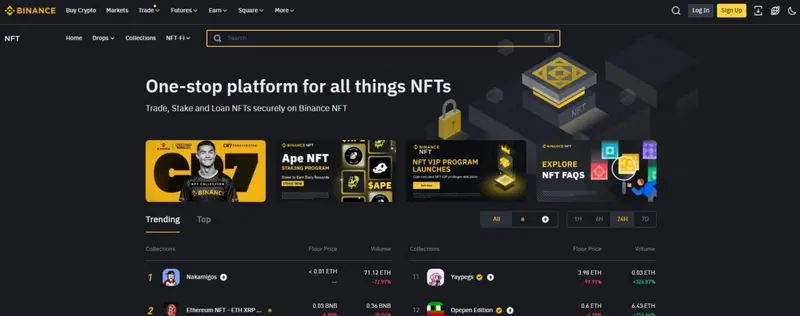
**Best For**: Creators and brands looking for high liquidity, access to a large existing crypto-user base, and a streamlined NFT experience integrated with a major exchange.
**Supported Blockchain**: Binance Smart Chain (BSC) and Ethereum.
**Service Fees**:
- Platform fee on sales: 1% of sale price.
- No listing fee.
- Royalty fees vary by collection (creators can set royalty % for secondary sales).
**NFT Types**: General marketplace — digital art, collectibles, gaming items, mystery-box NFTs, entertainment and sports-related drops, utility-style NFTs.
**Minting & Upload Options**: Minting is possible, but by default only approved/authorized creators can create NFTs on Binance NFT. Gas or network fees apply depending on chain (BSC or Ethereum).
Binance NFT is the **non-fungible token marketplace operated by Binance**, one of the [largest global crypto exchanges](https://influencermarketinghub.com/top-crypto-exchanges/). Launched in 2021, the marketplace leverages Binance’s massive user base, exchange liquidity, and security infrastructure to offer a straightforward entry point into NFTs.
Because Binance NFTs work across BSC and Ethereum, the platform caters to both users who prefer **lower-fee**, **faster transactions** (via BSC) and those who want compatibility with the **broader Ethereum ecosystem**.
For a creator or brand, this dual-chain support gives flexibility: you can choose BSC for cost-efficient drops or Ethereum for broader visibility among traditional NFT collectors.
Binance integrates NFT trading with its broader exchange ecosystem — meaning you can use the same account, wallet, and crypto balances you already hold on Binance to mint, buy or sell NFTs.
Because of its scale, Binance NFT tends to offer high liquidity and visibility. Drops from major brands, gaming projects or entertainment-linked NFTs can reach a big audience quickly. For creators who prioritize reach, volume, and ease of use, Binance represents one of the more pragmatic NFT marketplaces in 2025.
### **Dual-Chain Infrastructure for Flexibility**
With support for both BSC and Ethereum, Binance NFT lets you pick the chain that fits your project’s economics and target audience. Lower-cost BSC for volume drops, or Ethereum for reach among traditional crypto art collectors.
### **Large User Base and Exchange Integration**
Binance’s massive ecosystem, **exchange users**, **wallets**, **liquidity**, offers built-in potential buyers and exposure. For creators, this means easier onboarding for collectors who already use Binance, reducing friction in discovery and purchase.
### **Competitive Fee Structure and Simplified Marketplace Entry**
With a flat **1% service fee on sales**, **no listing fees**, and configurable creator royalties on secondary sales, Binance NFT presents a cost-effective alternative to many high-fee marketplaces.
### **Pros**
- High liquidity and large pre-existing user base from Binance exchange world
- Dual-chain support (BSC + Ethereum) provides flexibility and lower-fee options
- Flat and low 1% platform fee on sales; no listing fee lowers barrier to entry
- Integration with Binance account/wallet simplifies onboarding for creators and buyers
- Supports a broad variety of NFT types: art, collectibles, gaming, entertainment, mystery boxes
### **Cons**
- Minting permissions are restricted: only pre-approved creators can mint — not open to everyone by default, which limits accessibility for new creators
- As a centralized marketplace (owned by Binance), some in the NFT community may view centralization as a trade-off compared with decentralized platforms
- NFT collections and offerings may be less niche or exclusive than on curated art-specific platforms — volume may favor quantity over quality
- Depending on the chosen blockchain network (especially Ethereum), gas fees and network congestion can still pose cost/risk for creators or buyers
Read also:
Read also:
Check out the [How To Buy an NFT – Your Ultimate Guide in 2024](https://influencermarketinghub.com/how-to-buy-an-nft/)
[Check it out](https://influencermarketinghub.com/how-to-buy-an-nft/)
***
## 4\. [Solanart](https://solanart.io/)


**Best For**: Digital artists, PFP collectors, gaming-asset creators and anyone working with Solana-native NFTs who want a straightforward, low-fee marketplace on a fast, high-throughput blockchain.
**Supported Blockchain**: Solana
**Service Fees**:
- 3% marketplace commission on sales.
- Some sources mention a small listing fee (e.g. 0.02%) depending on the sale type.
**NFT Types**: Solana-based digital art, profile-picture (PFP) collections, collectibles, gaming/metaverse assets and general Solana NFT categories.
**Minting & Upload Options**: Creators mint NFTs using Solana — listing and selling require standard chain transaction (SOL) fees. There is no widely advertised lazy-minting or gasless-mint option.
Solanart is among the **original and most established NFT marketplaces built on Solana**, recognized for offering creators and collectors access to many of the chain’s notable NFT collections.
Its infrastructure leverages Solana’s strengths — fast confirmations, high throughput, and low transaction costs — enabling comparatively inexpensive minting and trading compared with high-gas chains.
The platform’s community and track record include hundreds of thousands of trades to date, making it a trusted environment for Solana-native NFTs.
As a creator, this means your work is exposed to a base of users already active in Solana’s NFT ecosystem, and you benefit from a marketplace optimized for speed and cost-efficiency.
For projects oriented around PFP collections, collectibles, gaming assets, or general digital art, especially those aiming for Solana users, Solanart offers a solid foundation: relatively low fees, native-chain compatibility, and access to an established Solana-NFT audience.
### **Strong Solana-Native Infrastructure**
Solanart runs **purely on** **Solana**, which allows it to benefit from the blockchain’s high throughput and low fees. That makes minting, listing and trading more cost-efficient for creators and collectors compared with high-fee chains.
### **Focused on Popular Solana Collections & PFP/Collectible-Style Work**
Many prominent Solana collections and PFP/collectible projects list via Solanart. If your work aligns with these formats — rather than fine art or highly curated galleries — Solanart provides ready demand and community familiarity.
### **Transparent and Simple Fee Structure**
With a flat **~3% marketplace fee** and **minimal or no listing fees** (depending on sale type), the economics are clear and predictable, helping creators plan pricing without complex fee surprises.
### **Pros**
- Low marketplace fee (~3%) and low transaction cost thanks to Solana’s efficient network
- Solana-native — gives full compatibility with the Solana ecosystem and wallets popular among NFT users
- Good for PFP, collectibles, gaming items or general NFT formats rather than high-end art
- Established marketplace with history of many trades, offering existing liquidity and user base
### **Cons**
- Marketplace focus is narrower and more mass-market than curated art-first platforms — may limit exposure for art-style NFT projects seeking premium positioning
- Fewer NFT categories compared with large generalist, multi-chain marketplaces — emphasis on digital art / collectibles / PFP / gaming assets
- No known lazy-minting or gasless-minting options — creators must handle mint costs upfront in SOL
- Secondary-market liquidity and resale value may be lower compared with top-tier marketplaces on major blockchains
Read also:
Read also:
Check out the [How Influencers Are Monetizing NFTs Without Launching Their Own Collection](https://influencermarketinghub.com/how-influencers-are-monetizing-nfts/)
[Check it out](https://influencermarketinghub.com/how-influencers-are-monetizing-nfts/)
***
## 5\. [Rarible](https://rarible.com/)

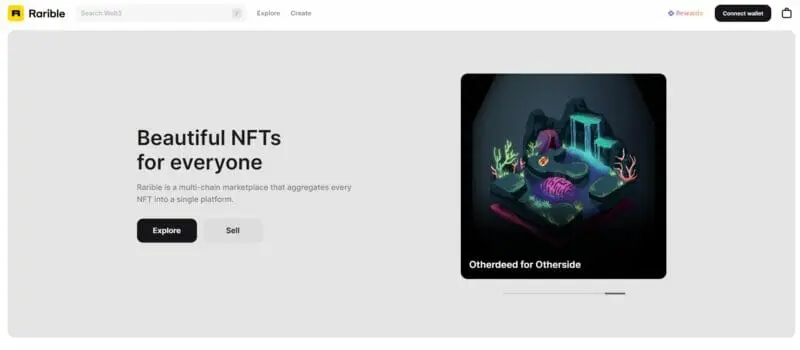
**Best For**: Creators who want flexibility across many blockchains and a community-driven environment with low-barrier minting.
**Supported Blockchain**: Ethereum, Polygon, Immutable X, Base, zkSync Era, RARI Chain, Celo, Moonbeam, Palm, Aptos and several others.
**Service Fees**:
- Sliding scale from 0.% per party for higher-value sales to 7.5% per party for lower-priced items.
**NFT Types**: Digital art, collectibles, gaming items, metaverse assets and other general NFT categories.
**Minting & Upload Options**: Lazy minting available on supported chains, enabling creators to list NFTs without upfront gas fees.
Rarible has evolved into one of the most flexible **multi-chain NFT marketplaces** in 2025, structured around broad accessibility and community influence. Its defining characteristic is its reach across a large number of blockchains, which positions it as a versatile option for creators who want choice in how they mint and sell their work.
By supporting both high-traffic ecosystems such as **Ethereum** and lower-cost or emerging networks like **Immutable X**, **Base** or **Aptos**, the platform allows creators to adapt their strategy to their budget, audience and technical needs.
Another notable aspect of Rarible is its fee structure. Unlike flat-fee marketplaces, Rarible uses a sliding model that becomes more favorable as the item price increases. This can make the platform especially appealing to creators producing mid-tier or premium pieces.
In addition, lazy minting remains a practical option for those who prefer to avoid upfront blockchain costs, making the onboarding experience smoother across chains that support this feature.
Rarible’s marketplace activity is influenced heavily by **community participation**, and its decentralized ethos still shapes how features roll out and evolve. For creators who value experimentation and cross-chain reach, Rarible offers a low-friction way to publish work while maintaining control over pricing, royalties and distribution strategy.
### **Community Driven Multi-Chain Model**
Rarible’s architecture emphasizes chain diversity. With support for more than twenty networks, creators can choose environments that balance cost, liquidity and audience alignment without switching platforms.
### **Fee Structure That Scales With Value**
The sliding fee system becomes more advantageous as sale prices increase. This benefits creators with higher-value work and creates a pricing environment that aligns revenue potential with platform costs.
### **Minting Designed to Reduce Upfront Cost**
Lazy minting offers a practical approach to publishing NFTs without incurring blockchain fees upfront. This is particularly useful in multi-chain ecosystems where gas conditions vary widely.
### **Pros**
- Wide multi-chain support offers flexibility in cost and audience targeting
- Sliding fees benefit mid-range and premium NFT pricing
- Lazy minting reduces initial financial risk
- Supports a broad mix of NFT categories
### **Cons**
- Higher fees for low-priced NFTs may limit entry-level profit margins
- Smaller marketplace visibility compared to the very largest platforms
- Marketplace evolution is fast and may require creators to adapt frequently
Read also:
Read also:
Check out the [Top 10 NFT Telegram Groups Worth Joining Now](https://influencermarketinghub.com/nft-telegram-groups/)
[Check it out](https://influencermarketinghub.com/nft-telegram-groups/)
***
## 6\. [SuperRare](https://superrare.co/)

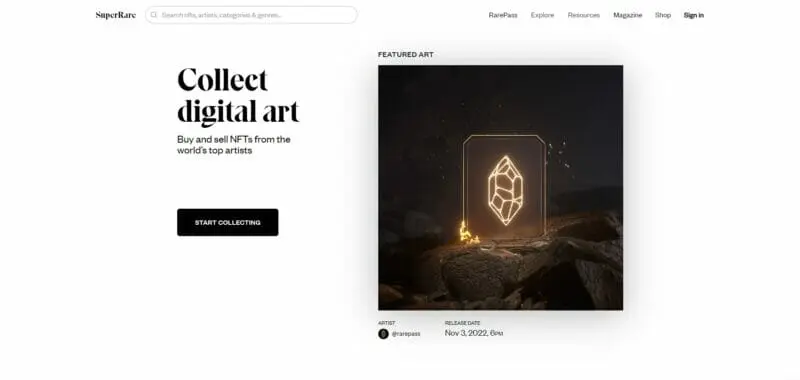
**Best For**: Artists who create one-of-a-kind digital art and want exposure within a curated, high-quality NFT art gallery environment.
**Supported Blockchain**: Ethereum
**Service Fees**:
- 15% commission on primary sales (creator receives 85%)
- 3% transaction fee paid by the buyer on purchases
- Creators receive 10% royalties on secondary sales
**NFT Types**: Curated digital art (1/1 unique pieces), including images, animations, 3D art and other original digital artworks.
**Minting & Upload Option**s: Minting occurs via ETH on Ethereum. There is no public “lazy-minting” option; artists must pay gas fees to mint their work.
SuperRare stands out as a **premium**, **invitation-based NFT marketplace** that positions itself as a **digital art gallery** more than a general NFT bazaar. Since launching in 2018, it has specialized in single-edition (1/1) digital artworks, giving collectors access to unique, limited-edition pieces.
The platform operates exclusively on Ethereum. All transactions, from minting, listing, bidding, and purchases, are denominated in ETH.
Because of its curated nature, SuperRare tends to attract serious collectors who value rarity, provenance, and aesthetic quality, rather than users browsing for mass-market or utility NFTs.
SuperRare is best suited for artists with strong portfolios and a commitment to digital art as a medium. If your art fits that profile and you aim for premium positioning, SuperRare can serve as a gallery-like platform that signals quality and scarcity.
### **High-End Gallery Positioning**
SuperRare preserves a high standard by curating which artists can list. By maintaining an exclusive artist roster, the platform builds a high-end brand reputation in digital art. Collectors expecting polished, rare, one-of-a-kind pieces tend to browse here, which can elevate perceived value for listed works.
### **Provenance and True Scarcity for Each Piece**
Every NFT on SuperRare is a 1/1 — truly one-of-a-kind. That means if you list on SuperRare and your work sells, it will not be diluted by editions or reprints. For serious art collectors and artists building digital-art careers, this provenance and scarcity can significantly enhance long-term value and collectability.
### **Ongoing Royalties & Marketplace Governance via Token**
Secondary-sale royalties (10%) give creators a stream of income beyond the first sale. In addition, the platform is governed by a community via token-based governance (holders of the platform’s native token participate in decisions and curation), which gives artists and collectors a stake in how the marketplace evolves.
SuperRare may not be the easiest entry point due to its exclusivity and higher costs, but for creators focused on high-quality, collectible digital art, it remains one of the most respected marketplaces in Web3.
### **Pros**
- High-quality, curated platform that reinforces the value of unique digital art
- Every NFT is 1/1 — ensures true scarcity and provenance
- Secondary-sale royalties (10 percent) give ongoing earnings potential
- Attracts serious collectors willing to pay for quality and uniqueness
### **Cons**
- 15% commission on primary sales and 3% buyer fee make it costly compared to open marketplaces
- Only supports Ethereum — gas fees can be high and unpredictable
- Entry is restricted; artists must be approved before listing
- Smaller volume and narrower audience than generalist marketplaces, which may limit exposure for less-established artists
***
## 7\. [Foundation](https://foundation.app/)

**Best For**: Digital artists and creators focused on high-quality, art-centric NFTs and curated auctions.
**Supported Blockchain**: Ethereum (with optional drop/mint support on L2 chain Base since 2024)
**Service Fees**:
- 5% marketplace fee on Auctions, Offers, or Buy Now sales
- For Drops and Editions: 0.0008 ETH per mint (plus standard gas fees)
**NFT Types**: Curated digital art, 1-of-1 artworks, drops and editions, galleries or curated collections
**Minting & Upload Options**: Creators deploy their own smart-contract Collections. Minting requires gas; there is no “gasless lazy-minting” option. For Drops or Editions, you pay the per-mint fee (0.0008 ETH) plus gas.
Foundation remains one of the most respected curated NFT marketplaces in 2025, known for its focus on **high-quality digital art** and a **community-led**, **invitation-based onboarding model**. Originally launched in 2021, the platform’s mission centers on putting artists first by ensuring that works listed are serious art pieces rather than mass-minted disposable items.
The marketplace leans heavily into **auction-driven sales** and **curated editions or drops**. That structure tends to attract collectors who value scarcity, provenance, and artistic merit. Because you mint using your own smart-contract collection, you retain control over your contract and artwork ownership, an appealing setup for creators wanting long-term control over how their work is managed and resold
In 2024, the platform added support for the **Ethereum L2 chain Base**. That gives creators optional flexibility to mint or sell on a lower-fee chain when appropriate, though Ethereum remains the backbone.
### **Signature Curation Model**
Foundation uses a selective, invitation-based approach rather than open minting. This keeps overall marketplace quality high and ensures works remain art-focused rather than flood-driven. As a creator, this means your art appears in a context where collectors expect refinement and worth.
### **Direct Contract Ownership and Control**
On Foundation, you deploy your own smart-contract Collection, meaning you **own and control your contract and future releases**. That gives you long-term control over how your art is managed, updated, or evolved.
### **Flexible Formats: Auctions, Drops, Editions**
Foundation accommodates traditional 1-of-1 auctions but also supports drops and editions, giving you flexibility in how you release your work depending on strategy and audience.
### **Pros**
- Curated, art-first environment that supports serious digital art and builds credibility for your work
- Ownership of your own smart-contract collection preserves creator control over metadata, future editions, and provenance
- Flexible selling formats (auctions, drops, editions) enabling tailored release strategies
- Optional chain flexibility with L2 support (Base) for potentially lower gas/mint costs
### **Cons**
- Minting requires gas (no lazy-minting), which can be costly on Ethereum
- Because the platform is selective, onboarding may be harder than open marketplaces
- User base is narrower than general-purpose marketplaces, which may limit visibility and volume of potential buyers
- Focus on curated art excludes many NFT categories (e.g. gaming NFTs, domains, utility NFTs) — limiting reach for non-art creators
Read also:
Read also:
Check out the [Top 20 NFT Discord Groups and Servers to Join](https://influencermarketinghub.com/nft-discord-groups-servers/)
[Check it out](https://influencermarketinghub.com/nft-discord-groups-servers/)
***
## 8\. [AtomicMarket](https://wax.atomicmarket.io/)

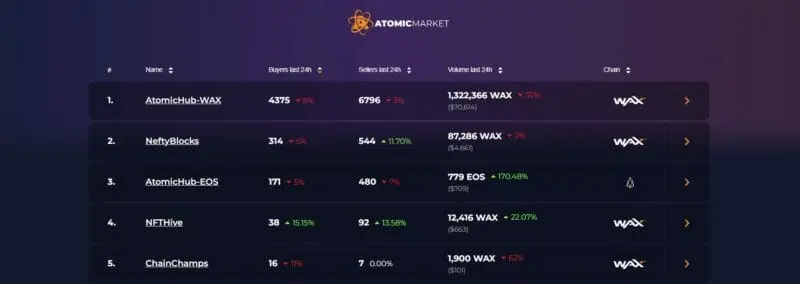
**Best For**: Creators, game-asset developers, and collectors who want low-cost NFTs on a blockchain built for digital collectibles and gaming, seeking shared liquidity and efficient marketplaces.
**Supported Blockchain**: WAX (via the AtomicAssets standard on EOSIO-related chains).
**Service Fees**:
- Marketplace fee defaults to 1% for both maker (lister) and taker (buyer) per sale/auction.
- Collections themselves can define an additional market fee (from 0% up to 15%) that goes to collection authors.
**NFT Types**: Digital collectibles, gaming and metaverse items, virtual goods, in-game assets, and other AtomicAssets-compatible NFTs (art, utility, game items).
**Minting & Upload Options**: Creators mint via the WAX blockchain using AtomicAssets. There is no typical “lazy-minting” setup like L2 lazy-mint platforms; minting and listing require creation under the AtomicAssets standard.
AtomicMarket acts as a **decentralized smart-contract marketplace** on **WAX (EOSIO)** built around the **AtomicAssets standard**. Because of the shared-liquidity model, any NFT listed through AtomicMarket becomes visible across all front-ends that use its contract, increasing exposure without requiring multiple listings.
As a creator or game-asset developer, this shared liquidity and cross-platform visibility mean a single listing can reach a broader ecosystem of collectors, gamers, and traders.
The platform’s design lets you **list and auction multiple NFTs or bundles** (as long as they belong to the same collection) under a unified contract. Because ownership is held in the smart-contract until sale, sellers maintain control until a buyer accepts the offer, preserving security and reducing nthe eed for repeated transfers or approvals.
For creators working in gaming assets, tradable virtual items, or collectibles, this gives efficient distribution and resale capabilities.
Given WAX’s orientation toward NFTs and gaming items, often with lower barriers to entry and lower transaction friction compared with major chains, AtomicMarket provides a practical, cost-effective alternative for creators who prioritize affordability and liquidity over the speculative art-market pricing found on Ethereum-based marketplaces.
### **Shared Liquidity via a Single Smart Contract**
AtomicMarket’s core smart contract aggregates inventory across all marketplaces using it. That means when you list an NFT or bundle the sale becomes available to all front-ends — maximizing visibility without duplication.
### **Control Until Sale via Offer Mechanism**
NFTs are not transferred to escrow at listing. Instead, an “**offer**” is created. Ownership remains with you until a buyer purchases, minimizing unnecessary gas or transfer overhead and reducing risk and complexity for creators.
### **Low Fees and Flexible Collection-Level Settings**
Base marketplace fee is **1% maker + 1% taker**. Moreover, developers of collections can set their own market fee **up to 15%**, giving flexibility to monetize their collection governance or community directly. This makes AtomicMarket more flexible than rigid-fee platforms.
### **Pros**
- Shared liquidity increases visibility across multiple front-ends from a single listing
- Very low base fees (1% + 1%) compared with many Ethereum marketplaces
- Smart-contract-based ownership until sale reduces administrative friction and transfer overhead
- Strong support for game items, collectibles, virtual goods and AtomicAssets-native NFT types
### **Cons**
- Blockchain is WAX (EOSIO), which may have smaller collector base than Ethereum or major generalist marketplaces
- Less suitability for high-art or premium digital art aimed at Ethereum-native collectors
- No lazy-minting alternative: minting depends on AtomicAssets contract and smart-contract workflow
- Because the ecosystem is oriented toward collectibles and gaming, resale value and exposure may be more volatile
***
## 9\. [BakerySwap](https://www.bakeryswap.org/#/home)

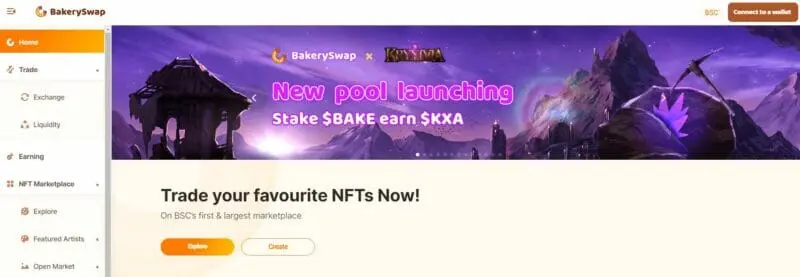
**Best For**: Creators, artists and NFT-project builders who prefer low-cost minting and trading on BSC and want a combined DeFi + NFT environment.
**Supported Blockchain**: BNB Smart Chain (BSC)
**Service Fees**:
- Typical trading fee on token swaps: 0.30% (of which 0.25% goes to liquidity providers and 0.05% may go to BAKE holders)
- Marketplace/NFT sale or listing fees are variable depending on collection and listing settings.
**NFT Types**: General NFTs — digital collectibles, gaming or metaverse-style items, NFT “combos”, and marketplace art/collectible listings.
**Minting & Upload Options**: You mint NFTs through smart contracts on BSC; BakerySwap does not offer ETH-style “lazy-minting.” Gas and BSC transaction fees apply for creation and transfers
BakerySwap **combines decentralized finance (DeFi)** **and NFTs under one roof**, built on the **BNB Smart Chain**. Originally launched in 2020, it became recognized as the first NFT-ready automated market maker (AMM) on BSC.
The platform’s dual nature, a **DEX plus an NFT** **marketplace**, allows creators not only to mint and sell NFTs but also to engage with DeFi features such as liquidity pools, staking, or yield farming. That gives it a unique positioning: if you are working on NFTs but interested in tokenomics and DeFi-native audiences, BakerySwap offers an integrated ecosystem.
Because it runs on BSC, transaction and gas fees tend to be far lower than on chains like Ethereum. That can make it a pragmatic choice for artists or projects experimenting with budget-conscious drops, frequent editions or gaming/metaverse-style assets rather than high-end digital art.
The “cost-efficiency + flexibility” formula makes BakerySwap especially interesting for creators aiming for volume, affordable entry or utility-oriented NFTs rather than 1-of-1 gallery-type pieces.
### **Signature AMM + NFT Integration**
BakerySwap blends a **Uniswap-like AMM DEX** with a functioning NFT marketplace. That means, besides selling your NFTs, you could use **liquidity pools**, **yield farming** or **staking** to engage with crypto users. This dual model gives creators more flexibility in monetization and exposure compared to NFT-only platforms.
### **Low-Cost, Fast Transactions on BSC**
Since BakerySwap runs on BSC, network fees and gas costs are significantly lower than on typical Ethereum-based NFT platforms. For creators planning frequent mints, multiple editions, or lower-price drops, this reduces entry barriers and risk.
### **Accessible to Projects Beyond High-Art — Collectibles, Gaming and Utility NFTs**
BakerySwap supports NFTs beyond pure art: gaming assets, “combo” NFTs tied to staking or token rewards, collectible items, and other utility-style NFTs. That flexibility broadens your potential project types beyond traditional digital art and opens doors to community or game-oriented NFT builds.
### **Pros**
- Low network and transaction costs because of BSC base chain
- Integrated DeFi + NFT marketplace model giving creators more monetization flexibility
- Support for a wide range of NFT types beyond just collectible art (gaming items, metadata, utility NFTs, combos)
- Suitable for creators or projects with limited budget or aiming for frequent/affordable drops
### **Cons**
- Audience and collector demand likely smaller and more niche than on major Ethereum-based NFT marketplaces
- Lower exposure for high-art or premium NFTs — platform tends toward utility, collectibles, gaming or speculative demand
- Minting and listing still require gas and BSC transaction fees (no lazy-minting)
- Because of the broader DeFi focus, NFTs might compete with token liquidity and farming — making the marketplace less curated than art-specific platforms
Read also:
Read also:
Check out the [Best Tokenomics Marketing Agencies](https://influencermarketinghub.com/tokenomics-marketing-agencies/)
[Check it out](https://influencermarketinghub.com/tokenomics-marketing-agencies/)
***
## 10\. [KnownOrigin](https://knownorigin.io/)

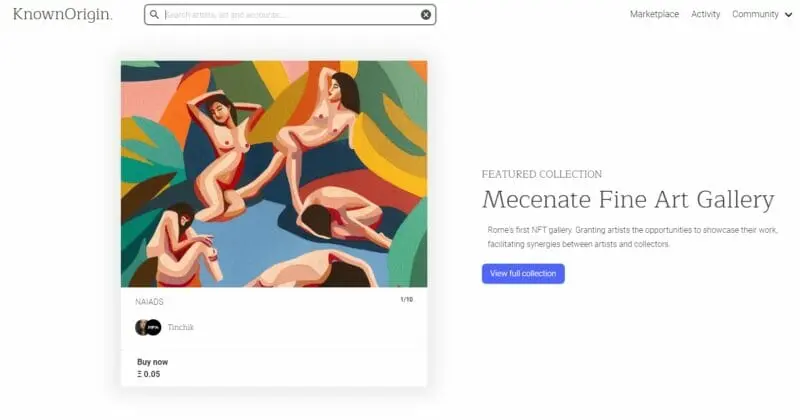
**Best For**: Digital artists focused on curated, high-quality art and collectors seeking exclusive Ethereum-native digital artworks
**Supported Blockchain**: Ethereum only
**Service Fees**:
- 15% service fee on primary sales
- On secondary sales, 2.5% marketplace fee plus 10% royalty to original artist (i.e. original artist receives 10% of resale)
**NFT Types**: Curated digital art (1-of-1 art, limited editions, crypto-art, images / GIFs / multimedia)
**Minting & Upload Options**: Minting requires paying Ethereum gas fees. There is no public lazy-minting or alternative chain support. Editions are mint-on-demand but still require on-chain gas.
KnownOrigin is one of the **oldest and most tightly curated NFT art marketplaces**. Since its launch in 2018, it has built a reputation as a **gallery-style platform** specializing exclusively in digital art rather than gaming assets, collectibles, or utility NFTs.
By focusing on **Ethereum** and the **ERC-721 standard**, KnownOrigin ensures full provenance tracking and compatibility with standard Web3 wallets.
The platform’s curated onboarding process means not every artist can list — this helps maintain high quality and reduces spam, but also limits access for many creators.
finder.com
Because of that curation, KnownOrigin tends to attract **serious digital-art buyers** who value uniqueness and scarcity. For creators whose work aligns with fine-digital-art sensibilities — graphic or generative art, limited-edition pieces, visually distinct NFTs — KnownOrigin provides a higher prestige context than broader NFT marketplaces.
### **Curated Ethereum Art Gallery Environment**
KnownOrigin’s strict selection criteria keep the marketplace focused on serious digital art. That means as a creator accepted there, your work sits among curated peers — which can enhance perceived value, credibility, and appeal to discerning collectors.
### **High Royalties for Secondary Sales**
With **10% royalties** on resales plus a **2\.5% marketplace cut**, KnownOrigin ensures creators benefit from ongoing resale value. This royalty setup is more favorable than many mass-market platforms for art-centric creators.
### **Transparent Provenance and Edition Controls**
Because KnownOrigin uses **Ethereum** and **ERC-721**, every token has clear, immutable provenance. Editions are mint-on-demand, giving creators flexibility in supply while preserving token fungibility and ownership transparency.
### **Pros**
- Strong curated environment that supports high-quality digital art and helps filter out noise
- High secondary sale royalties (10%) support long-term value for creators
- Ethereum-native, using standard ERC-721 — good provenance and broad wallet compatibility
- Editions + mint-on-demand give creators control over supply
### **Cons**
- 15% primary sale fee is steep compared with many general-purpose marketplaces
- Gas fees on Ethereum add friction and cost for minting and transactions
- Artist onboarding is selective and often closed — not all creators can list
- Marketplace reach and user base are smaller than large generalist platforms, which may limit exposure
***
## 11\. [Enjin Marketplace](https://nft.io/)

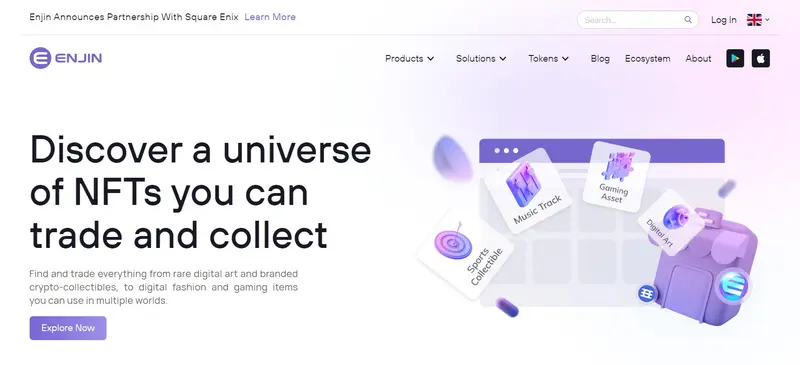
**Best For**: Creators building gaming assets, metaverse or utility-oriented NFTs who want a blockchain environment purpose-built for games and digital assets.
**Supported Blockchain**: Enjin Blockchain (native), with NFTs backed by Enjin Coin (ENJ) and integrated into the broader Enjin ecosystem.
**Service Fees**:
- Public documentation on exact platform commission is limited; sources cite a baseline 2.5% marketplace fee on sales.
- All transactions (minting, trading) require ENJ tokens as a payment medium, no fiat support for purchases.
**NFT Types**: Gaming items, virtual goods, utility NFTs, metaverse assets, in-game assets, blockchain-native collectibles, digital assets built with Enjin’s tooling.
**Minting & Upload Options**: NFTs are minted using Enjin’s tooling, requiring ENJ to back creations; metadata and blockchain storage follow Enjin’s standards. There is no widely-advertised “lazy-minting” or gas-free minting option.
Enjin Marketplace, often referenced under the name **NFT.io**, is part of a **broader Web3 ecosystem** designed specifically for **gaming**, **digital assets**, and **utility NFTs**. For creators who are building game items, virtual goods, or metaverse assets rather than purely collectible art pieces, this can offer a more aligned environment than typical art-centric or generalist NFT platforms.
The marketplace is closely integrated with the **Enjin Blockchain** and uses the **ENJ token** as the backbone for minting and trading.
Because the platform’s architecture and tooling are tailored to game-ready NFTs and utility/collectible assets, creators working on game integrations, in-game economies, or interoperable digital goods benefit from out-of-the-box blockchain compatibility, asset backing, and ecosystem support.
The emphasis is not on art-gallery style listings but on assets with potential utility, functionality, or in-game utility, which aligns with many modern Web3 game or metaverse creators’ needs.
When you mint an NFT via Enjin, it is backed by ENJ and easily integrated with Enjin Wallet and ecosystem tools, facilitating trading, transfers, and game interoperability.
For creators interested in utility NFTs or in-game items rather than speculative art drops, Enjin Marketplace may present a lower-friction, more purpose-driven environment compared to Ethereum-centric art marketplaces.
### **Gaming & Utility-First Ecosystem**
Enjin’s core design centers on **game assets**, **virtual goods**, and **utility NFTs** rather than fine art. If you build NFTs intended for games, metaverse, or utility, Enjin’s tooling, ENJ-backed assets and blockchain are designed to support such use cases efficiently.
### **Built-in Ecosystem Integration (Wallet, Token, Blockchain)**
With a full stack, blockchain, native token (ENJ), wallet, and marketplace, Enjin offers a **unified infrastructure**. That reduces fragmentation for creators building across games and assets, simplifying minting, ownership, and trading workflows.
### **Access to Existing Gaming & Collectible Communities**
Because Enjin has a history in gaming and game-asset communities, listing on Enjin Marketplace gives access to audiences specifically interested in game NFTs, digital goods, and blockchain-native collectible ecosystems rather than general NFT art buyers.
### **Pros**
- Purpose-built for gaming, utility, metaverse and collectible NFTs rather than purely art-focused drops
- Full infrastructure: blockchain, token (ENJ), wallet and marketplace — fewer moving parts to manage
- ENJ backing provides a base value layer and liquidity framework for NFTs in the ecosystem
- Access to gaming-oriented collectors/users — more aligned demand for in-game assets or utility NFTs
### **Cons**
- Marketplace fee structure and commissions are not clearly transparent or well-documented compared with mainstream NFT marketplaces
- Requires using ENJ token for minting/trading — no fiat on-ramp or widespread crypto standard like ETH by default
- Less suited for traditional digital art or wide-audience art collectors; weaker visibility for purely aesthetic NFTs compared with art-centric platforms
- Limited public information on minting flexibility (no known gasless or lazy-minting feature), which may raise upfront cost or entry friction for creators new to blockchain
Read also:
Read also:
Check out the [Top 12 Exciting Play-to-Earn Crypto Games You Should Check Out](https://influencermarketinghub.com/play-to-earn-crypto-games/)
[Check it out](https://influencermarketinghub.com/play-to-earn-crypto-games/)
***
## 12\. [Portion](https://portion.io/)

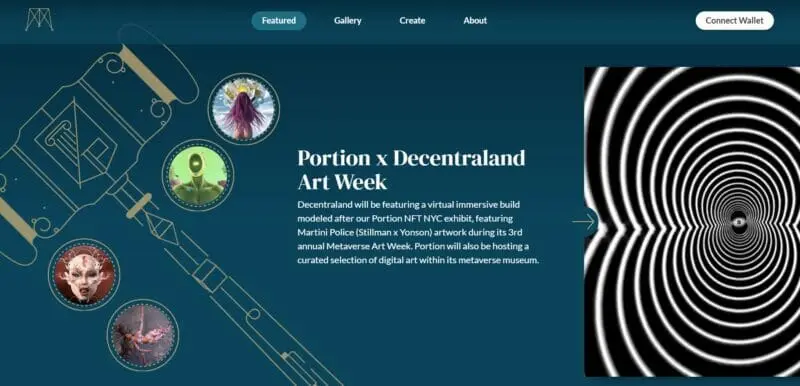
**Best For**: Artists and collectors interested in digital or physical art and collectibles, especially those who value transparent provenance, optional physical-asset backing, and a marketplace that bridges crypto-native NFTs with traditional art/collectible sensibilities.
**Supported Blockchain**: Ethereum (uses ETH + smart contracts)
**Service Fees**:
- On primary sales, creators receive 100% of proceeds (i.e. 0% commission) according to the official platform statement.
- For secondary sales, royalty fee set at 11% (to the original artist) is cited in public sources.
**NFT Types**: Digital art, physical-art backed NFTs, art collectibles, mixed digital/physical collectibles, luxury art tied to provenance certificates.
**Minting & Upload Options**: Tokenization of both digital and physical artwork via a drag-and-drop interface; minting happens on Ethereum, with art metadata stored via decentralized storage (IPFS).
Portion positions itself as more than “just another NFT marketplace.” It aims to merge **digital-native NFT technology** with **traditional art and collectible markets**. That means you can tokenize purely digital art — or tie a token to a physical artwork or collectible, complete with provenance records and optional real-world storage or delivery.
Launched originally in 2018 and relaunched in version 2.0 around 2020, Portion sought to democratize access to the art and collectibles marketplace by removing intermediaries like galleries and auction houses.
On Portion, creators keep **full control of proceeds from primary sales**, while the platform enforces an **11% royalty for secondary sales**.
This model can appeal strongly if you want to retain maximum upside from first sales and also benefit from resale activity.
Portion’s offer isn’t limited to digital-only assets. The infrastructure supports tokenization of physical art and collectibles, enabling fractional ownership or full ownership via blockchain-backed provenance certificates.
Given this positioning, Portion is especially relevant for creators who straddle both traditional art/collectible markets and the crypto-native NFT world — or those who envision hybrid physical-digital releases.
### **Global Art + Blockchain Hybrid Model**
Portion blends Ethereum-based NFT minting with real-world art market features: provenance certificates, optional physical delivery or storage, and support for both digital and physical collectibles. That makes it ideal for creators building for an audience beyond crypto-native collectors.
### **Zero Commission on Primary Sales**
Creators receive **100% of proceeds from their first sale**, a rare feature among NFT marketplaces — which maximizes upfront revenue potential.
### **Secondary Market Royalties + Transparent Resale Infrastructure**
With **11% royalties on resales**, Portion offers ongoing earnings for artists as NFTs/certificates change hands — a long-term value path typical of art and collectibles markets.
### **Pros**
- 0% commission on primary sales — creators keep full proceeds on first sale
- Supports both digital and physical art/collectibles, with blockchain-backed provenance and optional physical delivery or storage
- Works on Ethereum + decentralized storage (IPFS), combining Web3 transparency with art-market credibility
- Secondary-sale royalties (11%) give ongoing earning potential for creators
### **Cons**
- Because minting happens on Ethereum, gas fees may still apply depending on network conditions
- Marketplace seems more niche than mass-market platforms — demand and exposure may be limited compared with top-tier generalist marketplaces
- Payment methods beyond crypto are reportedly limited — no clear support for card/PayPal on public documentation.
***
## 13\. [Nifty Gateway](https://niftygateway.com/)

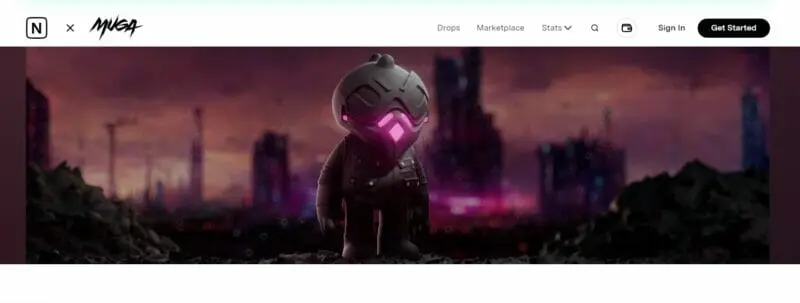
**Best For**: Artists and creators aiming for curated, high-end digital art drops or limited-edition NFT releases, especially if you value curated positioning, fiat payment options, and streamlined UX.
**Supported Blockchain**: Ethereum (NFTs on Nifty Gateway are backed by ETH).
**Service Fees**:
- 5% platform fee + US\$0.30 on secondary sales (when using custodial mode).
- If using self-custody wallet (wallet-to-wallet flow), 2.5% fee applies plus regular gas fees.
**NFT Types**: Curated digital art and limited-edition drops.
**Minting & Upload Options**: Minting happens on Ethereum. For NFTs minted and stored in Nifty Gateway’s custodial Omnibus wallet, buyers and creators may avoid paying gas fees at time of purchase.
Nifty Gateway remains one of the most visible and curated **Ethereum-based NFT marketplaces**. The platform differentiates itself by focusing on **high-quality**, **limited-edition digital art** and works with **established artists and brands** to launch curated NFT drops.
Because it is backed by the established crypto-exchange **Gemini**, Nifty Gateway combines crypto-native NFT capabilities with a more user-friendly, fiat-accessible interface — enabling artists to reach collectors who are comfortable with card payments or fiat balances rather than requiring prior crypto-ownership.
The marketplace is curated, meaning not everyone can list. Many high-profile NFTs and celebrity-artist drops have originated on Nifty Gateway, which reinforces its positioning as a premium storefront rather than an open-listing bazaar.
At the same time, Nifty Gateway’s combination of curated art, NFT-native blockchain underpinnings, and more traditional payment methods gives you a hybrid access path: you get the benefits of blockchain authenticity and provenance while offering accessibility to a broader collector base, including those who may not use crypto regularly.
### **Curated Premium Drops for High-End Collectors**
Nifty Gateway’s curated-drop model ensures that listed NFTs come with selectivity. That means works tend to carry more perceived value, and collectors browsing Nifty expect higher-caliber art. As a creator, being featured can elevate your positioning and align your brand with premium NFT art.
### **Custodial Wallet + Fiat or Crypto Checkout Simplifies Onboarding**
Because Nifty uses a custodial omnibus wallet system, buyers can use **credit/debit cards**, **fiat**, or **ETH**, lowering friction for collectors who are not crypto-native. This also means gas fees can be avoided or deferred for many transactions, easing the buying process for a wider audience.
### **Hybrid Chain-Native Infrastructure with Traditional UX Benefits**
Nifty blends blockchain-native ownership and provenance with a **smooth**, **consumer-friendly purchase experience**. For creators, that balance can open doors to both legacy-style art buyers and crypto-aware collectors — expanding potential reach beyond strictly crypto-native audiences.
### **Pros**
- High-end curation and selective drops give NFTs a premium positioning and scarcity value
- Supports fiat (card) purchases and ETH, broadening buyer pool beyond crypto-native users
- Custodial wallet infrastructure reduces friction: gas fees often avoided for custodial transactions
- Well-established reputation and backing by Gemini increase trust and exposure potential
### **Cons**
- Entry to listing is selective — not every creator gets approved for drops
- Service fees (5% + \$0.30 in custodial mode; 2.5% plus gas in wallet mode) may reduce net revenue compared with self-managed marketplaces
- Smaller volume and fewer listing opportunities than open marketplaces — competition for attention among curated drops can be high
- Dependence on a custodial wallet may deter users or collectors who prefer full self-custody and control
Read also:
Read also:
Check out the [Top Crypto & NFT Promotional Campaigns Redefining Industry Success](https://influencermarketinghub.com/crypto-nft-promotional-campaigns/)
[Check it out](https://influencermarketinghub.com/crypto-nft-promotional-campaigns/)
***
## 14\. [Decentraland](https://decentraland.org/)

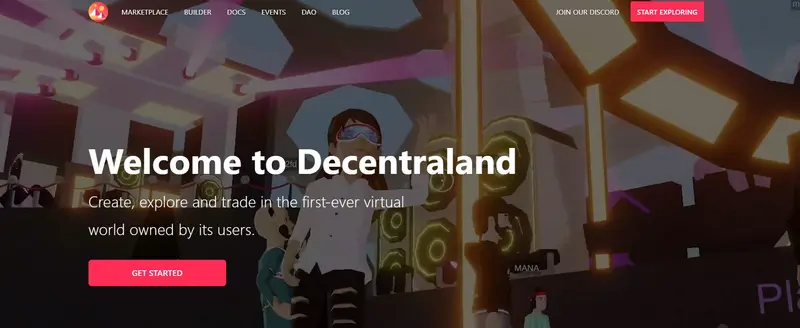
**Best For**: Creators and developers who build virtual-world assets, 3D environments, wearable NFTs, and interactive digital real estate.
**Supported Blockchain**: Ethereum (ownership of LAND, wearables, and other NFTs is recorded on Ethereum via smart contracts)
**Service Fees**:
- Marketplace transactions (land, wearables, in-world asset sales) include a transaction fee; some sources note a 2.5% fee on marketplace transfers.
- In addition to platform fees, blockchain gas fees apply because the underlying assets live on Ethereum.
**NFT Types**: Virtual land parcels (LAND), 3D real-estate, avatar wearables and accessories, virtual fashion items, metaverse-ready items, interactive content, in-world assets.
**Minting & Upload Options**: Minting or purchasing LAND and wearables happens on Ethereum.
Decentraland blends the concept of a virtual world with blockchain ownership. Rather than being a traditional NFT marketplace for digital art, it is a **fully-fledged [metaverse](https://influencermarketinghub.com/metaverse-examples/)** where digital land and 3D parcels are tokenized as NFTs.
Creators, developers, and designers can buy or build parcels of virtual land (**LAND**), design environments, avatar wearables, virtual fashion items, interactive installations, and virtual real-estate — then trade, rent, or monetize them in ways that mimic real-world digital property or experiences.
Because Decentraland uses Ethereum to register ownership through smart contracts, all assets, land, wearables, and user-generated 3D content are verifiable, transferable, and subject to blockchain standards.
The platform’s scope extends beyond static NFTs. Instead of one-off image or video NFT drops, your creations become part of a shared, persistent 3D world. That makes Decentraland especially interesting if you envision your NFT not as a standalone asset but as part of an immersive world.
### **Real-Estate & 3D Asset Marketplace — Not Just Simple NFTs**
Unlike art-focused NFT marketplaces, Decentraland is about land, 3D space, and wearable/virtual goods that have utility within the metaverse. If you build environments or assets meant to be walked through, worn by avatars, or interacted with — rather than displayed — Decentraland gives a framework to monetize them.
### **Ethereum-Backed Ownership with Smart-Contract Certainty**
Every parcel of land, wearable, or in-world asset uses Ethereum smart contracts for provenance and ownership. That brings transparency, transferability, and permanence — critical for property-like virtual assets where proof of ownership matters.
### **Metaverse & Community Integration**
Assets on Decentraland are embedded in a communal, social 3D world. Users can explore, interact, wear NFT clothes, attend events, use wearables — turning NFTs into experiences rather than just collectibles. This creates potential for ongoing engagement and repeat value beyond a one-time NFT sale.
### **Pros**
- Virtual-land and 3D content marketplace taps into immersive, interactive web3 worlds — good for creators building metaverse experiences or games
- Smart-contract registration ensures real, blockchain-native ownership of land, wearables, and virtual goods
- Utility-driven NFTs (wearables, environment builds, experiences) — not just static art — enabling creative and functional distribution models
- Possibility to monetize not only via sales, but via land ownership, rentals, in-world commerce, or virtual events/experiences
### **Cons**
- All assets live on Ethereum — minting and transaction gas fees may be high, especially during network congestion
- Decentraland’s activity and user engagement have fluctuated; some critics note large areas remain empty or underused, which can limit the exposure or utility of assets
- Market for virtual land or wearables is niche compared to the broad NFT-art marketplaces; demand may be lower and more specialized
- Success often depends on building or curating an engaging virtual experience — more resource-intensive than minting standalone art
Read also:
Read also:
Check out the [The Ultimate Guide to Buying Real Estate in Decentraland](https://influencermarketinghub.com/decentraland-real-estate/)
[Check it out](https://influencermarketinghub.com/decentraland-real-estate/)
***
## 15\. [Axie Infinity](https://app.axieinfinity.com/marketplace/)

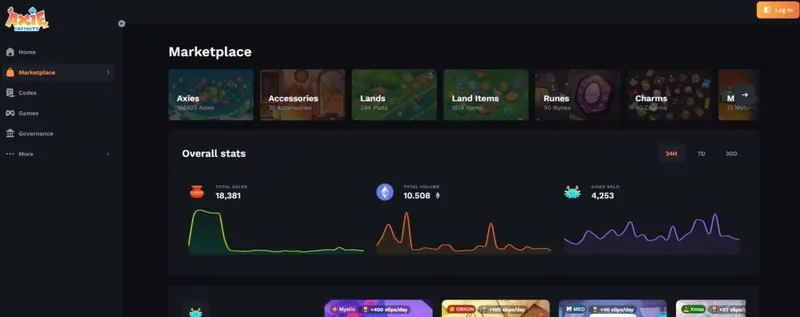
**Best For**: Creators, players and developers who want to mint, sell, or trade in-game NFTs (Axies, land, items) inside a well-established Web3 gaming ecosystem.
**Supported Blockchain**: Assets are hosted on the game’s own sidechain, Ronin Network (Ethereum-linked), which underpins the marketplace and reduces reliance on main-chain gas.
**Service Fees**:
- 5\.25% marketplace fee on NFT sales (seller side) is the standard as of 2022 update.
- For sales tied to creator-codes: 4.25% fee goes to platform/treasury and additional 1% may go back to participating creators under certain referral or creator-code programs.
**NFT Types**: Game-native items: digital pets (Axies), in-game items, virtual land parcels, in-game assets, breeding-offspring NFTs, other Lunacia metaverse assets.
**Minting & Upload Options**: There’s no traditional “open-art” minting — NFTs are generated via in-game mechanisms (e.g. breeding) or via official game asset creation; you cannot simply upload arbitrary art.
Axie Infinity operates a **fully integrated NFT marketplace** designed specifically for its **gaming universe** rather than as a general art marketplace. Every asset, from creature NFTs (**Axies**) to land parcels and in-game items, is native to its ecosystem and tied to game mechanics: breeding, battling, owning land, or participating in the broader metaverse.
Because the marketplace runs on the **Ronin sidechain**, it affords lower friction compared with main-chain Ethereum marketplaces: transfer and transaction overhead tend to be more optimized for gaming use.
When you list an asset, whether an Axie, land parcel, or in-game item, you can choose between a **fixed-price sale or auction**. Auctions follow a “clock auction” format: you set a starting price, an ending price, and a schedule. This system gives flexibility for sellers to target both price-sensitive and premium buyers, depending on how they structure their sale.
### **Utility-Native Game Asset Economy**
Because all NFTs on Axie Infinity have in-game utility — pets, land, resources — the marketplace supports real functional demand rather than speculative art-market demand. That makes it more stable for creators/developers focused on gaming, utility, and engagement rather than pure aesthetics.
### **Built-In Liquidity Pool via Game User Base**
Axie Infinity remains one of the most recognized blockchain games. Its active users and the fact that NFTs double as playable assets increase the likelihood of resale, trading, or demand — especially among players seeking new Axies, land, or resources.
### **Flexible Sales Format: Auctions and Fixed Price Listing**
The marketplace supports both fixed-price and auction-style listings. Auctions allow sellers to set initial and final price over a duration, giving flexibility in pricing strategy depending on demand, rarity, or supply.
### **Pros**
- Native gaming/metaverse integration: NFTs serve functional in-game or land/asset purposes rather than just collectible value
- Market liquidity supported by game user base, not just speculative NFT collectors
- Lower friction for transfers and trades thanks to Ronin sidechain – more efficient than heavy-gas Ethereum marketplaces
- Flexible listing options, including fixed-price and auction (clock-auction) for diverse sale strategies
### **Cons**
- Marketplace only supports in-game assets — you cannot upload arbitrary art or external NFTs; utility-only scope limits creative variety
- High entry barrier: to benefit from game mechanics you often need initial investment (e.g. acquiring multiple Axies) — may not suit casual or indie digital artists
- Revenue cut from fees (5.25%), plus it depends on the game’s ecosystem health and token economy (demand, utility, liquidity rely on user base)
- Long-term value depends on continued popularity and engagement in the game
***
**Related Content:**
- [The 14 Best-Selling NFT Creators to Watch Out For in 2025](https://influencermarketinghub.com/top-nft-creators/)
- [Top 16 NFT & Crypto Marketing Agencies for 2025](https://influencermarketinghub.com/nft-marketing-agency/)
- [How To Buy an NFT – Your Ultimate Guide in 2024](https://influencermarketinghub.com/how-to-buy-an-nft/)
***
## **Which NFT Marketplace Should You Go With?**
Choosing the right NFT marketplace is less about size and more about fit. Different platforms serve different creative goals, technical needs, and audience types.
The scenarios below map common creator goals to the marketplace best designed to support them.
Lowest-cost minting and budget-friendly experimentation -\> **JPG Store**
Maximum reach, chain flexibility, and broadest collector base -\> **OpenSea**
High liquidity for brand, entertainment, and utility-driven NFT releases -\> **Binance NFT**
Fast, low-fee environment for PFPs, collectibles, and gaming assets -\> **Solanart**
Multi-chain publishing with strong creator controls and lazy-mint options -\> **Rarible**
Premium gallery setting for 1-of-1 digital art -\> **SuperRare**
Art-first platform with creator-owned smart contracts and curated drop formats -\> **Foundation**
| | | | | | | |
|---|---|---|---|---|---|---|
| **Marketplace** | **Best For** | **Supported Blockchain** | **Service Fees** | **NFT Type** | **Minting Options** | **Use For** |
| **OpenSea** | Creators wanting maximum reach and multi-chain flexibility | 22+ chains including Ethereum, Polygon, Solana, Base, Arbitrum, Optimism, Avalanche, Flow | 1% platform fee; optional royalties | General marketplace: art, collectibles, gaming, domains, music, virtual goods | Lazy-minting on low-fee chains; standard minting on others | Broadest exposure across chains and audiences |
| **JPG Store** | Cardano-native creators seeking low-cost minting | Cardano | 2\.5% sale fee + 2 ADA mint fee | Cardano NFTs: art, collectibles, avatars, utility NFTs | Direct minting; no lazy-minting; very low fees | Budget-conscious creators testing collections |
| **Binance NFT** | Brands and creators needing high liquidity and exchange-native visibility | BSC + Ethereum | 1% platform fee; royalties vary | General NFTs: art, collectibles, gaming, entertainment | Minting restricted to approved creators; chain fees apply | Accessing a massive built-in crypto user base |
| **Solanart** | Solana creators building PFPs, collectibles, or gaming-style assets | Solana | ~3% marketplace fee | Solana NFTs: PFPs, art, collectibles, gaming items | Standard Solana minting; no lazy-minting | Fast, low-cost trading for high-volume drops |
| **Rarible** | Multi-chain creators wanting flexibility and creator-first controls | Ethereum, Polygon, Immutable X, Base, Aptos, more | Sliding 0–7.5% fee per party | General marketplace: art, collectibles, gaming, metaverse items | Lazy-minting on supported chains | Multi-chain publishing with customizable royalties |
| **SuperRare** | Fine-art creators focused on 1-of-1 art | Ethereum | 15% primary sale fee; 3% buyer fee; 10% royalties | Curated digital art (1/1) | Standard ETH minting; no lazy-minting | Premium gallery placement for serious collectors |
| **Foundation** | Artists needing curated art context with custom contract ownership | Ethereum + Base | 5% marketplace fee; 0.0008 ETH per mint for drops | Digital art, auctions, editions, curated collections | Smart-contract collections; no lazy-minting | Art-focused auctions and editions with contract control |
| **AtomicMarket** | Creators of gaming assets and digital collectibles on WAX | WAX (EOSIO) | 1% maker + 1% taker; optional collection-level fee | Digital collectibles, gaming items, virtual goods | AtomicAssets standard; no lazy-minting | Shared liquidity across multiple WAX marketplaces |
| **BakerySwap** | BSC creators wanting cost-efficient, DeFi-integrated NFT drops | BNB Smart Chain | Variable marketplace fees | General NFTs, gaming items, utility NFTs | Standard BSC minting; gas required | Low-cost drops with DeFi audience crossover |
| **KnownOrigin** | Artists seeking curated Ethereum-based art exposure | Ethereum | 15% primary sale fee; 2.5% + 10% royalties on secondary | Curated art: 1-of-1, editions, multimedia | Standard ETH minting; no lazy-minting | High-quality curated environment for serious digital art |
***
## **Finding the Right Marketplace to Power Your NFT Journey**
The NFT landscape can feel overwhelming, but the core decision is simple: choose the platform that aligns with what you create and who you want to reach. Each marketplace operates with its own strengths, from ultra-low-cost minting and multi-chain flexibility to curated art environments and high-liquidity ecosystems.
By exploring how each platform handles fees, supported blockchains, audience size, and creative formats, you can confidently map your work to the marketplace where it will perform best. There is no universal winner here; the “right” choice depends entirely on your artistic goals and the experience you want to deliver.
With a clear understanding of the landscape, you’re now equipped to pick the marketplace that elevates your creative vision and gives your NFTs the strongest chance to thrive.
## Frequently Asked Questions
### What is an NFT?
An NFT is a non-fungible token. It is a unique item that you cannot replace with something else. An example of an NFT is a one-of-a-kind trading card, such as a digital artwork, that you simply cannot replace with any other artwork.
Today, the majority of NFTs are digital which makes it very easy for creators to give their supporters something unique and rare. While they are similar to Bitcoins and other cryptocurrencies, they are non-fungible and non-divisible.
### How can creators quickly generate large NFT collections without coding?
Creators who want to scale output efficiently often rely on automated tools such as an [NFT collection generator](https://influencermarketinghub.com/nft-collection-generator/), which supports trait layering, rarity setups, and metadata export for streamlined production.
### Are there NFT marketplaces designed specifically for sports brands and athletes?
Yes, certain platforms focus on athlete IP and fan collectibles, and interest continues to grow around dedicated [sport NFT marketplace](https://influencermarketinghub.com/sport-nft-marketplace/) ecosystems built for leagues, teams, and athlete-driven drops.
### What traits set top-performing NFT artists apart from others?
Artists who stand out often develop a recognisable style and consistent release cadence, drawing on insights from how [top NFT creators](https://influencermarketinghub.com/top-nft-creators/) build long-term collector trust.
### What promotion tactics help new NFT collections gain early traction?
Creators frequently rely on early-community building, allowlists, and platform-native engagement, supported by structured [crypto NFT promotional strategies](https://influencermarketinghub.com/crypto-nft-promotional-strategies/) that improve discovery.
### Which metrics matter most when evaluating an NFT campaign’s performance?
Collectors and creators often assess engagement depth, mint participation, and retention across drops — all core [NFT campaign metrics](https://influencermarketinghub.com/nft-campaign-metrics/) that signal real demand.
### How do generative-art creators find the right audience for algorithmic work?
Many algorithmic artists tap niche digital-art communities and collaborate with creators who already reach collectors interested in generative aesthetics, similar to approaches in [influencer marketing for generative-art NFTs](https://influencermarketinghub.com/influencer-marketing-for-generative-art-nfts/).
### Can micro-influencers help small NFT collections sell out more reliably?
Micro-creators often convert better because of focused, high-trust audiences, making [how to build NFT campaigns with micro-influencers](https://influencermarketinghub.com/how-to-build-nft-campaigns-with-micro-influencers/) a valuable strategy for sell-through.
### When should a creator or brand partner with a crypto-native agency?
Partnerships become useful when projects need coordinated storytelling, launch sequencing, and technical execution typically handled by [crypto agencies](https://influencermarketinghub.com/crypto-agencies/).
About the Author

[Kalin Anastasov](https://influencermarketinghub.com/author/kalin/)
Writer
Kalin Anastasov plays a pivotal role as an content manager and editor at Influencer Marketing Hub. He expertly applies his SEO and content writing experience to enhance each piece, ensuring it aligns with our guidelines and delivers unmatched quality to our readers.
### SUGGESTED
[](https://influencermarketinghub.com/nft-events "Top 5 NFT Events and Conferences to Check Out in 2026")
## [Top 5 NFT Events and Conferences to Check Out in 2026](https://influencermarketinghub.com/nft-events "Top 5 NFT Events and Conferences to Check Out in 2026")
Discover the top 5 NFT events and conferences in 2026 shaping digital assets Web3...
[](https://influencermarketinghub.com/sport-nft-marketplace "The 15 Best NFT Sports Marketplaces: A Complete Guide")
## [The 15 Best NFT Sports Marketplaces: A Complete Guide](https://influencermarketinghub.com/sport-nft-marketplace "The 15 Best NFT Sports Marketplaces: A Complete Guide")
This guide provides you with a list of the top 15 sport-based NFT marketplaces to help...
[](https://influencermarketinghub.com/nft-marketing-agency "Top 16 NFT & Crypto Marketing Agencies for 2025")
## [Top 16 NFT & Crypto Marketing Agencies for 2025](https://influencermarketinghub.com/nft-marketing-agency "Top 16 NFT & Crypto Marketing Agencies for 2025")
Looking to work with a Leading NFT Marketing Agency? We have hand curated the Top NFT...
[](https://influencermarketinghub.com/)
- [Cookie Policy](https://influencermarketinghub.com/policy/)
- [Privacy Policy](https://influencermarketinghub.com/privacy-policy/)
- [Terms & Conditions](https://influencermarketinghub.com/terms-and-conditions/)
- [Affiliate Disclaimer](https://influencermarketinghub.com/affiliate-disclaimer/)
- [Contact Us](https://influencermarketinghub.com/contact/)
All Rights Reserved © 2026 |
| Readable Markdown | NFTs have evolved far beyond the 2021 boom, and creators entering the space face a very different landscape in 2025. Blockchains have diversified, marketplaces have specialized, and creator tools have become more sophisticated.
The question is no longer “*Should I mint an NFT?*” but rather “*Where should I mint, and which platform gives my work the best chance to succeed?*”
Marketplace trends now reflect broader shifts in Web3: lower-cost chains such as **Solana** and **Cardano** making minting more accessible, curated **Ethereum galleries** elevating digital art, and exchange-driven platforms introducing liquidity at a scale not seen before.
At the same time, creators increasingly prioritize contract ownership, flexible minting mechanics, and dependable royalty systems.
This guide helps you navigate those changes by breaking down the leading NFT marketplaces in 2025, what they offer, who they serve, and how to choose the platform that aligns most closely with your creative goals.
- [1\. OpenSea](https://influencermarketinghub.com/nft-marketplace/#toc-0)
- [2\. JPG.Store](https://influencermarketinghub.com/nft-marketplace/#toc-1)
- [3\. Binance NFT](https://influencermarketinghub.com/nft-marketplace/#toc-2)
- [4\. Solanart](https://influencermarketinghub.com/nft-marketplace/#toc-3)
- [5\. Rarible](https://influencermarketinghub.com/nft-marketplace/#toc-4)
- [6\. SuperRare](https://influencermarketinghub.com/nft-marketplace/#toc-5)
- [7\. Foundation](https://influencermarketinghub.com/nft-marketplace/#toc-6)
- [8\. AtomicMarket](https://influencermarketinghub.com/nft-marketplace/#toc-7)
- [9\. BakerySwap](https://influencermarketinghub.com/nft-marketplace/#toc-8)
- [10\. KnownOrigin](https://influencermarketinghub.com/nft-marketplace/#toc-9)
- [11\. Enjin Marketplace](https://influencermarketinghub.com/nft-marketplace/#toc-10)
- [12\. Portion](https://influencermarketinghub.com/nft-marketplace/#toc-11)
- [13\. Nifty Gateway](https://influencermarketinghub.com/nft-marketplace/#toc-12)
- [14\. Decentraland](https://influencermarketinghub.com/nft-marketplace/#toc-13)
- [15\. Axie Infinity](https://influencermarketinghub.com/nft-marketplace/#toc-14)
- [Which NFT Marketplace Should You Go With?](https://influencermarketinghub.com/nft-marketplace/#toc-15)
- [Finding the Right Marketplace to Power Your NFT Journey](https://influencermarketinghub.com/nft-marketplace/#toc-16)
- [Frequently Asked Questions](https://influencermarketinghub.com/nft-marketplace/#toc-17)
***
Top
nft marketplace
2026
## 1\. [OpenSea](https://opensea.io/?ref=0x4509a6dd84e88fd0d894726abb036d98e411c966)

**Best For**: Creators and collectors looking for the largest, most established, multi-chain NFT marketplace with a broad reach.
**Supported Blockchain**: Ethereum, Polygon, Arbitrum, Optimism, Avalanche, Solana, Base, Blast, Zora, Flow, and many more (22+ chains total).
**Service Fees**:
- 1\.0 % platform fee on NFT sales (as of September 2025)
- Creator royalties (secondary sales) are optional depending on collection settings.
**NFT Types**: General marketplace; supports digital art, collectibles, virtual goods, music, video, domain names, gaming assets, virtual real estate and more.
**Minting & Upload Options**: OpenSea offers “lazy-minting” on supported lower-cost chains (e.g., Polygon), meaning you can upload metadata and create a listing without paying gas upfront. On high-cost chains (like Ethereum), you’ll need to pay gas for minting.
If you are a creator or influencer exploring the NFT space in 2025, OpenSea remains the **most recognized and widely used marketplace**. Founded in 2017, it has grown from a peer-to-peer NFT bazaar into a massive **multi-chain marketplace** **and crypto aggregator** that supports NFTs across more than 20 blockchains.
Its scale and diversity give you one of the highest chances of finding buyers, whether you produce digital art, music files, gaming items, or virtual real estate.
Because OpenSea now embraces many chains, you have flexibility: if gas fees are too high on Ethereum, you can mint and list on a cheaper chain like Polygon and still tap into a global collector base. For emerging creators or those testing a first drop, that flexibility reduces upfront cost and risk.
On top of that, the platform remains broadly accepted, and many collectors and traders expect to see new projects there.
### **Unmatched Chain Flexibility**
OpenSea’s multi-chain support is arguably its greatest strength. By 2025, it supports over 22 blockchains, from major networks like Ethereum and Solana to newer alternatives like Base or Blast.
That means as a creator you can choose the blockchain that fits your budget and audience; cheaper minting on Polygon or fast trade-ready tokens on Solana, without sacrificing marketplace reach.
### **Massive Buyer & Collector Network**
Because OpenSea has been around since 2017 and survived the NFT boom and bust, it remains the largest marketplace by listings and user base. Millions of tradable items, and a wide variety of asset types (art, collectibles, gaming items, music, virtual real estate, etc.) make it more likely that your work will be discovered.
### **Low Platform Fees + Optional Royalty Structures**
With only a **1\.0 % platform fee for sales** and the option to **enable royalties per collection**, OpenSea gives you a competitive economic structure. Combined with the ability to mint via lazy-minting on low-fee chains, this keeps your upfront and ongoing costs lean and lets you maximize net revenue.
### **Pros**
- Extremely broad chain support — many blockchain options to optimize for cost/ audience.
- Large, well-established user base and maximum visibility for new drops.
- Low platform fee (1.0 %) compared with many niche marketplaces.
- Lazy-minting and lower-cost chain options help minimize upfront costs.
- Supports a wide variety of NFT types (art, gaming, music, virtual real estate, collectibles, etc.).
### **Cons**
- Creator royalties are not guaranteed; they depend on collection settings, and secondary-sale buyers may skip optional royalty payments.
- Gas fees can still be high on major networks like Ethereum, especially when network demand surges.
- Because it is so large and general, discoverability can still be a challenge — many projects compete for attention.
- The platform’s pivot toward becoming a broader crypto/tokens aggregator may dilute focus on NFTs over time.

### OpenSea
The world’s largest digital marketplace for crypto collectibles and non-fungible tokens (NFTs), including ERC721 and ERC1155 assets. Buy, sell, and discover exclusive digital assets like Axies, ENS names, CryptoKitties, Decentraland, and more.
***
## 2\. JPG.Store
**Best For**: Creators, artists, and NFT-project builders working on Cardano-native NFTs, especially those targeting low-gas minting, affordable entry, and a community of Cardano collectors.
**Supported Blockchain**: Cardano (ADA-backed)
**Service Fees**:
- Marketplace sale fee: 2.5% of sale price (seller pays) — minimum 2 ADA.
- Minting fee (for creators / minters): 2 ADA per mint + typical Cardano blockchain transaction fees.
**NFT Types**: General Cardano-native NFTs — digital art, collectibles, avatars or gaming-style assets, utility or community NFTs, and other Cardano-compatible formats.
**Minting & Upload Options**: Native Cardano NFT support with smart-contract infrastructure; you can create single NFTs or collections (via “Policy ID”), and mint directly on Cardano using JPG Store’s minting tools. Wallet-based minting; no lazy-minting model but low mint costs (Cardano gas is typically low compared to Ethereum).
JPG Store stands out as the largest and most widely used **NFT marketplace on Cardano**, tailored for creators and collectors operating within **Cardano’s ecosystem**. It offers a smooth **on-ramp to minting**, **listing**, and **selling NFTs in ADA**, which keeps cost and complexity relatively low.
Because minting costs are modest (**2 ADA + network fees**), JPG Store lowers the barrier to entry compared to high-gas chains. For creators experimenting with small collections, community-driven art drops, or utility-oriented NFTs (games, avatars, metaverse-style items), JPG Store presents a practical and purpose-built option.
Also, JPG Store has evolved beyond basic marketplace functions. It supports collection launches, verification workflows, and a suite of creator tools, including a **launchpad for new projects**, and offers lending/borrowing features using NFTs as collateral.
For Cardano-native artists or projects whose audience lives on Cardano — or who want to tap into a less saturated NFT ecosystem compared with Ethereum — JPG Store can serve as a credible primary marketplace.
### **Multi-Chain Alternative Inside Cardano Ecosystem**
Because JPG Store operates on **Cardano** rather than Ethereum, you benefit from lower fees, a growing community of Cardano-native users, and a different supply-demand dynamic than on saturated Ethereum marketplaces.
### **Low Minting & Transaction Costs**
With a fixed **2 ADA mint fee** and relatively low Cardano blockchain fees, you can mint NFTs affordably. This makes JPG Store suitable for creators testing collections or producing multiple works without high upfront costs.
### **Robust Creator Tools & Community Infrastructure**
The platform offers collection creation via “**Policy ID**”, verification options, and a launchpad for new projects — enabling creators to manage drops, metadata, and community-ready launches without needing deep technical expertise.
### **Pros**
- Very low minting and transaction costs compared with Ethereum-based platforms (2 ADA + Cardano fees)
- Transparent, smart-contract-based NFT infrastructure on Cardano — good provenance and decentralization
- Support for a wide range of NFT types — digital art, collectibles, avatars, utility NFTs, community projects
- Native Cardano ecosystem and audience — less competition than saturated NFT markets, potential for upward growth as Cardano adoption expands
### **Cons**
- Because the marketplace is Cardano-specific, your potential buyer base may be narrower than on major, cross-chain generalist platforms
- No lazy-minting or gasless-minting feature — you still pay upfront minting costs (though relatively low)
- While active, Cardano-NFT ecosystems are less mature than Ethereum’s; volume, liquidity, and resale demand can be lower or more volatile
- Success may depend heavily on targeting Cardano-native users and communities rather than broad crypto-or art-audiences
Read also:
***
## 3\. [Binance NFT](https://www.binance.com/en/nft/home)

**Best For**: Creators and brands looking for high liquidity, access to a large existing crypto-user base, and a streamlined NFT experience integrated with a major exchange.
**Supported Blockchain**: Binance Smart Chain (BSC) and Ethereum.
**Service Fees**:
- Platform fee on sales: 1% of sale price.
- No listing fee.
- Royalty fees vary by collection (creators can set royalty % for secondary sales).
**NFT Types**: General marketplace — digital art, collectibles, gaming items, mystery-box NFTs, entertainment and sports-related drops, utility-style NFTs.
**Minting & Upload Options**: Minting is possible, but by default only approved/authorized creators can create NFTs on Binance NFT. Gas or network fees apply depending on chain (BSC or Ethereum).
Binance NFT is the **non-fungible token marketplace operated by Binance**, one of the [largest global crypto exchanges](https://influencermarketinghub.com/top-crypto-exchanges/). Launched in 2021, the marketplace leverages Binance’s massive user base, exchange liquidity, and security infrastructure to offer a straightforward entry point into NFTs.
Because Binance NFTs work across BSC and Ethereum, the platform caters to both users who prefer **lower-fee**, **faster transactions** (via BSC) and those who want compatibility with the **broader Ethereum ecosystem**.
For a creator or brand, this dual-chain support gives flexibility: you can choose BSC for cost-efficient drops or Ethereum for broader visibility among traditional NFT collectors.
Binance integrates NFT trading with its broader exchange ecosystem — meaning you can use the same account, wallet, and crypto balances you already hold on Binance to mint, buy or sell NFTs.
Because of its scale, Binance NFT tends to offer high liquidity and visibility. Drops from major brands, gaming projects or entertainment-linked NFTs can reach a big audience quickly. For creators who prioritize reach, volume, and ease of use, Binance represents one of the more pragmatic NFT marketplaces in 2025.
### **Dual-Chain Infrastructure for Flexibility**
With support for both BSC and Ethereum, Binance NFT lets you pick the chain that fits your project’s economics and target audience. Lower-cost BSC for volume drops, or Ethereum for reach among traditional crypto art collectors.
### **Large User Base and Exchange Integration**
Binance’s massive ecosystem, **exchange users**, **wallets**, **liquidity**, offers built-in potential buyers and exposure. For creators, this means easier onboarding for collectors who already use Binance, reducing friction in discovery and purchase.
### **Competitive Fee Structure and Simplified Marketplace Entry**
With a flat **1% service fee on sales**, **no listing fees**, and configurable creator royalties on secondary sales, Binance NFT presents a cost-effective alternative to many high-fee marketplaces.
### **Pros**
- High liquidity and large pre-existing user base from Binance exchange world
- Dual-chain support (BSC + Ethereum) provides flexibility and lower-fee options
- Flat and low 1% platform fee on sales; no listing fee lowers barrier to entry
- Integration with Binance account/wallet simplifies onboarding for creators and buyers
- Supports a broad variety of NFT types: art, collectibles, gaming, entertainment, mystery boxes
### **Cons**
- Minting permissions are restricted: only pre-approved creators can mint — not open to everyone by default, which limits accessibility for new creators
- As a centralized marketplace (owned by Binance), some in the NFT community may view centralization as a trade-off compared with decentralized platforms
- NFT collections and offerings may be less niche or exclusive than on curated art-specific platforms — volume may favor quantity over quality
- Depending on the chosen blockchain network (especially Ethereum), gas fees and network congestion can still pose cost/risk for creators or buyers
Read also:
***
## 4\. [Solanart](https://solanart.io/)

**Best For**: Digital artists, PFP collectors, gaming-asset creators and anyone working with Solana-native NFTs who want a straightforward, low-fee marketplace on a fast, high-throughput blockchain.
**Supported Blockchain**: Solana
**Service Fees**:
- 3% marketplace commission on sales.
- Some sources mention a small listing fee (e.g. 0.02%) depending on the sale type.
**NFT Types**: Solana-based digital art, profile-picture (PFP) collections, collectibles, gaming/metaverse assets and general Solana NFT categories.
**Minting & Upload Options**: Creators mint NFTs using Solana — listing and selling require standard chain transaction (SOL) fees. There is no widely advertised lazy-minting or gasless-mint option.
Solanart is among the **original and most established NFT marketplaces built on Solana**, recognized for offering creators and collectors access to many of the chain’s notable NFT collections.
Its infrastructure leverages Solana’s strengths — fast confirmations, high throughput, and low transaction costs — enabling comparatively inexpensive minting and trading compared with high-gas chains.
The platform’s community and track record include hundreds of thousands of trades to date, making it a trusted environment for Solana-native NFTs.
As a creator, this means your work is exposed to a base of users already active in Solana’s NFT ecosystem, and you benefit from a marketplace optimized for speed and cost-efficiency.
For projects oriented around PFP collections, collectibles, gaming assets, or general digital art, especially those aiming for Solana users, Solanart offers a solid foundation: relatively low fees, native-chain compatibility, and access to an established Solana-NFT audience.
### **Strong Solana-Native Infrastructure**
Solanart runs **purely on** **Solana**, which allows it to benefit from the blockchain’s high throughput and low fees. That makes minting, listing and trading more cost-efficient for creators and collectors compared with high-fee chains.
### **Focused on Popular Solana Collections & PFP/Collectible-Style Work**
Many prominent Solana collections and PFP/collectible projects list via Solanart. If your work aligns with these formats — rather than fine art or highly curated galleries — Solanart provides ready demand and community familiarity.
### **Transparent and Simple Fee Structure**
With a flat **~3% marketplace fee** and **minimal or no listing fees** (depending on sale type), the economics are clear and predictable, helping creators plan pricing without complex fee surprises.
### **Pros**
- Low marketplace fee (~3%) and low transaction cost thanks to Solana’s efficient network
- Solana-native — gives full compatibility with the Solana ecosystem and wallets popular among NFT users
- Good for PFP, collectibles, gaming items or general NFT formats rather than high-end art
- Established marketplace with history of many trades, offering existing liquidity and user base
### **Cons**
- Marketplace focus is narrower and more mass-market than curated art-first platforms — may limit exposure for art-style NFT projects seeking premium positioning
- Fewer NFT categories compared with large generalist, multi-chain marketplaces — emphasis on digital art / collectibles / PFP / gaming assets
- No known lazy-minting or gasless-minting options — creators must handle mint costs upfront in SOL
- Secondary-market liquidity and resale value may be lower compared with top-tier marketplaces on major blockchains
Read also:
***
## 5\. [Rarible](https://rarible.com/)

**Best For**: Creators who want flexibility across many blockchains and a community-driven environment with low-barrier minting.
**Supported Blockchain**: Ethereum, Polygon, Immutable X, Base, zkSync Era, RARI Chain, Celo, Moonbeam, Palm, Aptos and several others.
**Service Fees**:
- Sliding scale from 0.% per party for higher-value sales to 7.5% per party for lower-priced items.
**NFT Types**: Digital art, collectibles, gaming items, metaverse assets and other general NFT categories.
**Minting & Upload Options**: Lazy minting available on supported chains, enabling creators to list NFTs without upfront gas fees.
Rarible has evolved into one of the most flexible **multi-chain NFT marketplaces** in 2025, structured around broad accessibility and community influence. Its defining characteristic is its reach across a large number of blockchains, which positions it as a versatile option for creators who want choice in how they mint and sell their work.
By supporting both high-traffic ecosystems such as **Ethereum** and lower-cost or emerging networks like **Immutable X**, **Base** or **Aptos**, the platform allows creators to adapt their strategy to their budget, audience and technical needs.
Another notable aspect of Rarible is its fee structure. Unlike flat-fee marketplaces, Rarible uses a sliding model that becomes more favorable as the item price increases. This can make the platform especially appealing to creators producing mid-tier or premium pieces.
In addition, lazy minting remains a practical option for those who prefer to avoid upfront blockchain costs, making the onboarding experience smoother across chains that support this feature.
Rarible’s marketplace activity is influenced heavily by **community participation**, and its decentralized ethos still shapes how features roll out and evolve. For creators who value experimentation and cross-chain reach, Rarible offers a low-friction way to publish work while maintaining control over pricing, royalties and distribution strategy.
### **Community Driven Multi-Chain Model**
Rarible’s architecture emphasizes chain diversity. With support for more than twenty networks, creators can choose environments that balance cost, liquidity and audience alignment without switching platforms.
### **Fee Structure That Scales With Value**
The sliding fee system becomes more advantageous as sale prices increase. This benefits creators with higher-value work and creates a pricing environment that aligns revenue potential with platform costs.
### **Minting Designed to Reduce Upfront Cost**
Lazy minting offers a practical approach to publishing NFTs without incurring blockchain fees upfront. This is particularly useful in multi-chain ecosystems where gas conditions vary widely.
### **Pros**
- Wide multi-chain support offers flexibility in cost and audience targeting
- Sliding fees benefit mid-range and premium NFT pricing
- Lazy minting reduces initial financial risk
- Supports a broad mix of NFT categories
### **Cons**
- Higher fees for low-priced NFTs may limit entry-level profit margins
- Smaller marketplace visibility compared to the very largest platforms
- Marketplace evolution is fast and may require creators to adapt frequently
Read also:
***
## 6\. [SuperRare](https://superrare.co/)

**Best For**: Artists who create one-of-a-kind digital art and want exposure within a curated, high-quality NFT art gallery environment.
**Supported Blockchain**: Ethereum
**Service Fees**:
- 15% commission on primary sales (creator receives 85%)
- 3% transaction fee paid by the buyer on purchases
- Creators receive 10% royalties on secondary sales
**NFT Types**: Curated digital art (1/1 unique pieces), including images, animations, 3D art and other original digital artworks.
**Minting & Upload Option**s: Minting occurs via ETH on Ethereum. There is no public “lazy-minting” option; artists must pay gas fees to mint their work.
SuperRare stands out as a **premium**, **invitation-based NFT marketplace** that positions itself as a **digital art gallery** more than a general NFT bazaar. Since launching in 2018, it has specialized in single-edition (1/1) digital artworks, giving collectors access to unique, limited-edition pieces.
The platform operates exclusively on Ethereum. All transactions, from minting, listing, bidding, and purchases, are denominated in ETH.
Because of its curated nature, SuperRare tends to attract serious collectors who value rarity, provenance, and aesthetic quality, rather than users browsing for mass-market or utility NFTs.
SuperRare is best suited for artists with strong portfolios and a commitment to digital art as a medium. If your art fits that profile and you aim for premium positioning, SuperRare can serve as a gallery-like platform that signals quality and scarcity.
### **High-End Gallery Positioning**
SuperRare preserves a high standard by curating which artists can list. By maintaining an exclusive artist roster, the platform builds a high-end brand reputation in digital art. Collectors expecting polished, rare, one-of-a-kind pieces tend to browse here, which can elevate perceived value for listed works.
### **Provenance and True Scarcity for Each Piece**
Every NFT on SuperRare is a 1/1 — truly one-of-a-kind. That means if you list on SuperRare and your work sells, it will not be diluted by editions or reprints. For serious art collectors and artists building digital-art careers, this provenance and scarcity can significantly enhance long-term value and collectability.
### **Ongoing Royalties & Marketplace Governance via Token**
Secondary-sale royalties (10%) give creators a stream of income beyond the first sale. In addition, the platform is governed by a community via token-based governance (holders of the platform’s native token participate in decisions and curation), which gives artists and collectors a stake in how the marketplace evolves.
SuperRare may not be the easiest entry point due to its exclusivity and higher costs, but for creators focused on high-quality, collectible digital art, it remains one of the most respected marketplaces in Web3.
### **Pros**
- High-quality, curated platform that reinforces the value of unique digital art
- Every NFT is 1/1 — ensures true scarcity and provenance
- Secondary-sale royalties (10 percent) give ongoing earnings potential
- Attracts serious collectors willing to pay for quality and uniqueness
### **Cons**
- 15% commission on primary sales and 3% buyer fee make it costly compared to open marketplaces
- Only supports Ethereum — gas fees can be high and unpredictable
- Entry is restricted; artists must be approved before listing
- Smaller volume and narrower audience than generalist marketplaces, which may limit exposure for less-established artists
***
## 7\. [Foundation](https://foundation.app/)

**Best For**: Digital artists and creators focused on high-quality, art-centric NFTs and curated auctions.
**Supported Blockchain**: Ethereum (with optional drop/mint support on L2 chain Base since 2024)
**Service Fees**:
- 5% marketplace fee on Auctions, Offers, or Buy Now sales
- For Drops and Editions: 0.0008 ETH per mint (plus standard gas fees)
**NFT Types**: Curated digital art, 1-of-1 artworks, drops and editions, galleries or curated collections
**Minting & Upload Options**: Creators deploy their own smart-contract Collections. Minting requires gas; there is no “gasless lazy-minting” option. For Drops or Editions, you pay the per-mint fee (0.0008 ETH) plus gas.
Foundation remains one of the most respected curated NFT marketplaces in 2025, known for its focus on **high-quality digital art** and a **community-led**, **invitation-based onboarding model**. Originally launched in 2021, the platform’s mission centers on putting artists first by ensuring that works listed are serious art pieces rather than mass-minted disposable items.
The marketplace leans heavily into **auction-driven sales** and **curated editions or drops**. That structure tends to attract collectors who value scarcity, provenance, and artistic merit. Because you mint using your own smart-contract collection, you retain control over your contract and artwork ownership, an appealing setup for creators wanting long-term control over how their work is managed and resold
In 2024, the platform added support for the **Ethereum L2 chain Base**. That gives creators optional flexibility to mint or sell on a lower-fee chain when appropriate, though Ethereum remains the backbone.
### **Signature Curation Model**
Foundation uses a selective, invitation-based approach rather than open minting. This keeps overall marketplace quality high and ensures works remain art-focused rather than flood-driven. As a creator, this means your art appears in a context where collectors expect refinement and worth.
### **Direct Contract Ownership and Control**
On Foundation, you deploy your own smart-contract Collection, meaning you **own and control your contract and future releases**. That gives you long-term control over how your art is managed, updated, or evolved.
### **Flexible Formats: Auctions, Drops, Editions**
Foundation accommodates traditional 1-of-1 auctions but also supports drops and editions, giving you flexibility in how you release your work depending on strategy and audience.
### **Pros**
- Curated, art-first environment that supports serious digital art and builds credibility for your work
- Ownership of your own smart-contract collection preserves creator control over metadata, future editions, and provenance
- Flexible selling formats (auctions, drops, editions) enabling tailored release strategies
- Optional chain flexibility with L2 support (Base) for potentially lower gas/mint costs
### **Cons**
- Minting requires gas (no lazy-minting), which can be costly on Ethereum
- Because the platform is selective, onboarding may be harder than open marketplaces
- User base is narrower than general-purpose marketplaces, which may limit visibility and volume of potential buyers
- Focus on curated art excludes many NFT categories (e.g. gaming NFTs, domains, utility NFTs) — limiting reach for non-art creators
Read also:
***
## 8\. [AtomicMarket](https://wax.atomicmarket.io/)

**Best For**: Creators, game-asset developers, and collectors who want low-cost NFTs on a blockchain built for digital collectibles and gaming, seeking shared liquidity and efficient marketplaces.
**Supported Blockchain**: WAX (via the AtomicAssets standard on EOSIO-related chains).
**Service Fees**:
- Marketplace fee defaults to 1% for both maker (lister) and taker (buyer) per sale/auction.
- Collections themselves can define an additional market fee (from 0% up to 15%) that goes to collection authors.
**NFT Types**: Digital collectibles, gaming and metaverse items, virtual goods, in-game assets, and other AtomicAssets-compatible NFTs (art, utility, game items).
**Minting & Upload Options**: Creators mint via the WAX blockchain using AtomicAssets. There is no typical “lazy-minting” setup like L2 lazy-mint platforms; minting and listing require creation under the AtomicAssets standard.
AtomicMarket acts as a **decentralized smart-contract marketplace** on **WAX (EOSIO)** built around the **AtomicAssets standard**. Because of the shared-liquidity model, any NFT listed through AtomicMarket becomes visible across all front-ends that use its contract, increasing exposure without requiring multiple listings.
As a creator or game-asset developer, this shared liquidity and cross-platform visibility mean a single listing can reach a broader ecosystem of collectors, gamers, and traders.
The platform’s design lets you **list and auction multiple NFTs or bundles** (as long as they belong to the same collection) under a unified contract. Because ownership is held in the smart-contract until sale, sellers maintain control until a buyer accepts the offer, preserving security and reducing nthe eed for repeated transfers or approvals.
For creators working in gaming assets, tradable virtual items, or collectibles, this gives efficient distribution and resale capabilities.
Given WAX’s orientation toward NFTs and gaming items, often with lower barriers to entry and lower transaction friction compared with major chains, AtomicMarket provides a practical, cost-effective alternative for creators who prioritize affordability and liquidity over the speculative art-market pricing found on Ethereum-based marketplaces.
### **Shared Liquidity via a Single Smart Contract**
AtomicMarket’s core smart contract aggregates inventory across all marketplaces using it. That means when you list an NFT or bundle the sale becomes available to all front-ends — maximizing visibility without duplication.
### **Control Until Sale via Offer Mechanism**
NFTs are not transferred to escrow at listing. Instead, an “**offer**” is created. Ownership remains with you until a buyer purchases, minimizing unnecessary gas or transfer overhead and reducing risk and complexity for creators.
### **Low Fees and Flexible Collection-Level Settings**
Base marketplace fee is **1% maker + 1% taker**. Moreover, developers of collections can set their own market fee **up to 15%**, giving flexibility to monetize their collection governance or community directly. This makes AtomicMarket more flexible than rigid-fee platforms.
### **Pros**
- Shared liquidity increases visibility across multiple front-ends from a single listing
- Very low base fees (1% + 1%) compared with many Ethereum marketplaces
- Smart-contract-based ownership until sale reduces administrative friction and transfer overhead
- Strong support for game items, collectibles, virtual goods and AtomicAssets-native NFT types
### **Cons**
- Blockchain is WAX (EOSIO), which may have smaller collector base than Ethereum or major generalist marketplaces
- Less suitability for high-art or premium digital art aimed at Ethereum-native collectors
- No lazy-minting alternative: minting depends on AtomicAssets contract and smart-contract workflow
- Because the ecosystem is oriented toward collectibles and gaming, resale value and exposure may be more volatile
***
## 9\. [BakerySwap](https://www.bakeryswap.org/#/home)

**Best For**: Creators, artists and NFT-project builders who prefer low-cost minting and trading on BSC and want a combined DeFi + NFT environment.
**Supported Blockchain**: BNB Smart Chain (BSC)
**Service Fees**:
- Typical trading fee on token swaps: 0.30% (of which 0.25% goes to liquidity providers and 0.05% may go to BAKE holders)
- Marketplace/NFT sale or listing fees are variable depending on collection and listing settings.
**NFT Types**: General NFTs — digital collectibles, gaming or metaverse-style items, NFT “combos”, and marketplace art/collectible listings.
**Minting & Upload Options**: You mint NFTs through smart contracts on BSC; BakerySwap does not offer ETH-style “lazy-minting.” Gas and BSC transaction fees apply for creation and transfers
BakerySwap **combines decentralized finance (DeFi)** **and NFTs under one roof**, built on the **BNB Smart Chain**. Originally launched in 2020, it became recognized as the first NFT-ready automated market maker (AMM) on BSC.
The platform’s dual nature, a **DEX plus an NFT** **marketplace**, allows creators not only to mint and sell NFTs but also to engage with DeFi features such as liquidity pools, staking, or yield farming. That gives it a unique positioning: if you are working on NFTs but interested in tokenomics and DeFi-native audiences, BakerySwap offers an integrated ecosystem.
Because it runs on BSC, transaction and gas fees tend to be far lower than on chains like Ethereum. That can make it a pragmatic choice for artists or projects experimenting with budget-conscious drops, frequent editions or gaming/metaverse-style assets rather than high-end digital art.
The “cost-efficiency + flexibility” formula makes BakerySwap especially interesting for creators aiming for volume, affordable entry or utility-oriented NFTs rather than 1-of-1 gallery-type pieces.
### **Signature AMM + NFT Integration**
BakerySwap blends a **Uniswap-like AMM DEX** with a functioning NFT marketplace. That means, besides selling your NFTs, you could use **liquidity pools**, **yield farming** or **staking** to engage with crypto users. This dual model gives creators more flexibility in monetization and exposure compared to NFT-only platforms.
### **Low-Cost, Fast Transactions on BSC**
Since BakerySwap runs on BSC, network fees and gas costs are significantly lower than on typical Ethereum-based NFT platforms. For creators planning frequent mints, multiple editions, or lower-price drops, this reduces entry barriers and risk.
### **Accessible to Projects Beyond High-Art — Collectibles, Gaming and Utility NFTs**
BakerySwap supports NFTs beyond pure art: gaming assets, “combo” NFTs tied to staking or token rewards, collectible items, and other utility-style NFTs. That flexibility broadens your potential project types beyond traditional digital art and opens doors to community or game-oriented NFT builds.
### **Pros**
- Low network and transaction costs because of BSC base chain
- Integrated DeFi + NFT marketplace model giving creators more monetization flexibility
- Support for a wide range of NFT types beyond just collectible art (gaming items, metadata, utility NFTs, combos)
- Suitable for creators or projects with limited budget or aiming for frequent/affordable drops
### **Cons**
- Audience and collector demand likely smaller and more niche than on major Ethereum-based NFT marketplaces
- Lower exposure for high-art or premium NFTs — platform tends toward utility, collectibles, gaming or speculative demand
- Minting and listing still require gas and BSC transaction fees (no lazy-minting)
- Because of the broader DeFi focus, NFTs might compete with token liquidity and farming — making the marketplace less curated than art-specific platforms
Read also:
***
## 10\. [KnownOrigin](https://knownorigin.io/)

**Best For**: Digital artists focused on curated, high-quality art and collectors seeking exclusive Ethereum-native digital artworks
**Supported Blockchain**: Ethereum only
**Service Fees**:
- 15% service fee on primary sales
- On secondary sales, 2.5% marketplace fee plus 10% royalty to original artist (i.e. original artist receives 10% of resale)
**NFT Types**: Curated digital art (1-of-1 art, limited editions, crypto-art, images / GIFs / multimedia)
**Minting & Upload Options**: Minting requires paying Ethereum gas fees. There is no public lazy-minting or alternative chain support. Editions are mint-on-demand but still require on-chain gas.
KnownOrigin is one of the **oldest and most tightly curated NFT art marketplaces**. Since its launch in 2018, it has built a reputation as a **gallery-style platform** specializing exclusively in digital art rather than gaming assets, collectibles, or utility NFTs.
By focusing on **Ethereum** and the **ERC-721 standard**, KnownOrigin ensures full provenance tracking and compatibility with standard Web3 wallets.
The platform’s curated onboarding process means not every artist can list — this helps maintain high quality and reduces spam, but also limits access for many creators.
finder.com
Because of that curation, KnownOrigin tends to attract **serious digital-art buyers** who value uniqueness and scarcity. For creators whose work aligns with fine-digital-art sensibilities — graphic or generative art, limited-edition pieces, visually distinct NFTs — KnownOrigin provides a higher prestige context than broader NFT marketplaces.
### **Curated Ethereum Art Gallery Environment**
KnownOrigin’s strict selection criteria keep the marketplace focused on serious digital art. That means as a creator accepted there, your work sits among curated peers — which can enhance perceived value, credibility, and appeal to discerning collectors.
### **High Royalties for Secondary Sales**
With **10% royalties** on resales plus a **2\.5% marketplace cut**, KnownOrigin ensures creators benefit from ongoing resale value. This royalty setup is more favorable than many mass-market platforms for art-centric creators.
### **Transparent Provenance and Edition Controls**
Because KnownOrigin uses **Ethereum** and **ERC-721**, every token has clear, immutable provenance. Editions are mint-on-demand, giving creators flexibility in supply while preserving token fungibility and ownership transparency.
### **Pros**
- Strong curated environment that supports high-quality digital art and helps filter out noise
- High secondary sale royalties (10%) support long-term value for creators
- Ethereum-native, using standard ERC-721 — good provenance and broad wallet compatibility
- Editions + mint-on-demand give creators control over supply
### **Cons**
- 15% primary sale fee is steep compared with many general-purpose marketplaces
- Gas fees on Ethereum add friction and cost for minting and transactions
- Artist onboarding is selective and often closed — not all creators can list
- Marketplace reach and user base are smaller than large generalist platforms, which may limit exposure
***
## 11\. [Enjin Marketplace](https://nft.io/)

**Best For**: Creators building gaming assets, metaverse or utility-oriented NFTs who want a blockchain environment purpose-built for games and digital assets.
**Supported Blockchain**: Enjin Blockchain (native), with NFTs backed by Enjin Coin (ENJ) and integrated into the broader Enjin ecosystem.
**Service Fees**:
- Public documentation on exact platform commission is limited; sources cite a baseline 2.5% marketplace fee on sales.
- All transactions (minting, trading) require ENJ tokens as a payment medium, no fiat support for purchases.
**NFT Types**: Gaming items, virtual goods, utility NFTs, metaverse assets, in-game assets, blockchain-native collectibles, digital assets built with Enjin’s tooling.
**Minting & Upload Options**: NFTs are minted using Enjin’s tooling, requiring ENJ to back creations; metadata and blockchain storage follow Enjin’s standards. There is no widely-advertised “lazy-minting” or gas-free minting option.
Enjin Marketplace, often referenced under the name **NFT.io**, is part of a **broader Web3 ecosystem** designed specifically for **gaming**, **digital assets**, and **utility NFTs**. For creators who are building game items, virtual goods, or metaverse assets rather than purely collectible art pieces, this can offer a more aligned environment than typical art-centric or generalist NFT platforms.
The marketplace is closely integrated with the **Enjin Blockchain** and uses the **ENJ token** as the backbone for minting and trading.
Because the platform’s architecture and tooling are tailored to game-ready NFTs and utility/collectible assets, creators working on game integrations, in-game economies, or interoperable digital goods benefit from out-of-the-box blockchain compatibility, asset backing, and ecosystem support.
The emphasis is not on art-gallery style listings but on assets with potential utility, functionality, or in-game utility, which aligns with many modern Web3 game or metaverse creators’ needs.
When you mint an NFT via Enjin, it is backed by ENJ and easily integrated with Enjin Wallet and ecosystem tools, facilitating trading, transfers, and game interoperability.
For creators interested in utility NFTs or in-game items rather than speculative art drops, Enjin Marketplace may present a lower-friction, more purpose-driven environment compared to Ethereum-centric art marketplaces.
### **Gaming & Utility-First Ecosystem**
Enjin’s core design centers on **game assets**, **virtual goods**, and **utility NFTs** rather than fine art. If you build NFTs intended for games, metaverse, or utility, Enjin’s tooling, ENJ-backed assets and blockchain are designed to support such use cases efficiently.
### **Built-in Ecosystem Integration (Wallet, Token, Blockchain)**
With a full stack, blockchain, native token (ENJ), wallet, and marketplace, Enjin offers a **unified infrastructure**. That reduces fragmentation for creators building across games and assets, simplifying minting, ownership, and trading workflows.
### **Access to Existing Gaming & Collectible Communities**
Because Enjin has a history in gaming and game-asset communities, listing on Enjin Marketplace gives access to audiences specifically interested in game NFTs, digital goods, and blockchain-native collectible ecosystems rather than general NFT art buyers.
### **Pros**
- Purpose-built for gaming, utility, metaverse and collectible NFTs rather than purely art-focused drops
- Full infrastructure: blockchain, token (ENJ), wallet and marketplace — fewer moving parts to manage
- ENJ backing provides a base value layer and liquidity framework for NFTs in the ecosystem
- Access to gaming-oriented collectors/users — more aligned demand for in-game assets or utility NFTs
### **Cons**
- Marketplace fee structure and commissions are not clearly transparent or well-documented compared with mainstream NFT marketplaces
- Requires using ENJ token for minting/trading — no fiat on-ramp or widespread crypto standard like ETH by default
- Less suited for traditional digital art or wide-audience art collectors; weaker visibility for purely aesthetic NFTs compared with art-centric platforms
- Limited public information on minting flexibility (no known gasless or lazy-minting feature), which may raise upfront cost or entry friction for creators new to blockchain
Read also:
***
## 12\. [Portion](https://portion.io/)

**Best For**: Artists and collectors interested in digital or physical art and collectibles, especially those who value transparent provenance, optional physical-asset backing, and a marketplace that bridges crypto-native NFTs with traditional art/collectible sensibilities.
**Supported Blockchain**: Ethereum (uses ETH + smart contracts)
**Service Fees**:
- On primary sales, creators receive 100% of proceeds (i.e. 0% commission) according to the official platform statement.
- For secondary sales, royalty fee set at 11% (to the original artist) is cited in public sources.
**NFT Types**: Digital art, physical-art backed NFTs, art collectibles, mixed digital/physical collectibles, luxury art tied to provenance certificates.
**Minting & Upload Options**: Tokenization of both digital and physical artwork via a drag-and-drop interface; minting happens on Ethereum, with art metadata stored via decentralized storage (IPFS).
Portion positions itself as more than “just another NFT marketplace.” It aims to merge **digital-native NFT technology** with **traditional art and collectible markets**. That means you can tokenize purely digital art — or tie a token to a physical artwork or collectible, complete with provenance records and optional real-world storage or delivery.
Launched originally in 2018 and relaunched in version 2.0 around 2020, Portion sought to democratize access to the art and collectibles marketplace by removing intermediaries like galleries and auction houses.
On Portion, creators keep **full control of proceeds from primary sales**, while the platform enforces an **11% royalty for secondary sales**.
This model can appeal strongly if you want to retain maximum upside from first sales and also benefit from resale activity.
Portion’s offer isn’t limited to digital-only assets. The infrastructure supports tokenization of physical art and collectibles, enabling fractional ownership or full ownership via blockchain-backed provenance certificates.
Given this positioning, Portion is especially relevant for creators who straddle both traditional art/collectible markets and the crypto-native NFT world — or those who envision hybrid physical-digital releases.
### **Global Art + Blockchain Hybrid Model**
Portion blends Ethereum-based NFT minting with real-world art market features: provenance certificates, optional physical delivery or storage, and support for both digital and physical collectibles. That makes it ideal for creators building for an audience beyond crypto-native collectors.
### **Zero Commission on Primary Sales**
Creators receive **100% of proceeds from their first sale**, a rare feature among NFT marketplaces — which maximizes upfront revenue potential.
### **Secondary Market Royalties + Transparent Resale Infrastructure**
With **11% royalties on resales**, Portion offers ongoing earnings for artists as NFTs/certificates change hands — a long-term value path typical of art and collectibles markets.
### **Pros**
- 0% commission on primary sales — creators keep full proceeds on first sale
- Supports both digital and physical art/collectibles, with blockchain-backed provenance and optional physical delivery or storage
- Works on Ethereum + decentralized storage (IPFS), combining Web3 transparency with art-market credibility
- Secondary-sale royalties (11%) give ongoing earning potential for creators
### **Cons**
- Because minting happens on Ethereum, gas fees may still apply depending on network conditions
- Marketplace seems more niche than mass-market platforms — demand and exposure may be limited compared with top-tier generalist marketplaces
- Payment methods beyond crypto are reportedly limited — no clear support for card/PayPal on public documentation.
***
## 13\. [Nifty Gateway](https://niftygateway.com/)

**Best For**: Artists and creators aiming for curated, high-end digital art drops or limited-edition NFT releases, especially if you value curated positioning, fiat payment options, and streamlined UX.
**Supported Blockchain**: Ethereum (NFTs on Nifty Gateway are backed by ETH).
**Service Fees**:
- 5% platform fee + US\$0.30 on secondary sales (when using custodial mode).
- If using self-custody wallet (wallet-to-wallet flow), 2.5% fee applies plus regular gas fees.
**NFT Types**: Curated digital art and limited-edition drops.
**Minting & Upload Options**: Minting happens on Ethereum. For NFTs minted and stored in Nifty Gateway’s custodial Omnibus wallet, buyers and creators may avoid paying gas fees at time of purchase.
Nifty Gateway remains one of the most visible and curated **Ethereum-based NFT marketplaces**. The platform differentiates itself by focusing on **high-quality**, **limited-edition digital art** and works with **established artists and brands** to launch curated NFT drops.
Because it is backed by the established crypto-exchange **Gemini**, Nifty Gateway combines crypto-native NFT capabilities with a more user-friendly, fiat-accessible interface — enabling artists to reach collectors who are comfortable with card payments or fiat balances rather than requiring prior crypto-ownership.
The marketplace is curated, meaning not everyone can list. Many high-profile NFTs and celebrity-artist drops have originated on Nifty Gateway, which reinforces its positioning as a premium storefront rather than an open-listing bazaar.
At the same time, Nifty Gateway’s combination of curated art, NFT-native blockchain underpinnings, and more traditional payment methods gives you a hybrid access path: you get the benefits of blockchain authenticity and provenance while offering accessibility to a broader collector base, including those who may not use crypto regularly.
### **Curated Premium Drops for High-End Collectors**
Nifty Gateway’s curated-drop model ensures that listed NFTs come with selectivity. That means works tend to carry more perceived value, and collectors browsing Nifty expect higher-caliber art. As a creator, being featured can elevate your positioning and align your brand with premium NFT art.
### **Custodial Wallet + Fiat or Crypto Checkout Simplifies Onboarding**
Because Nifty uses a custodial omnibus wallet system, buyers can use **credit/debit cards**, **fiat**, or **ETH**, lowering friction for collectors who are not crypto-native. This also means gas fees can be avoided or deferred for many transactions, easing the buying process for a wider audience.
### **Hybrid Chain-Native Infrastructure with Traditional UX Benefits**
Nifty blends blockchain-native ownership and provenance with a **smooth**, **consumer-friendly purchase experience**. For creators, that balance can open doors to both legacy-style art buyers and crypto-aware collectors — expanding potential reach beyond strictly crypto-native audiences.
### **Pros**
- High-end curation and selective drops give NFTs a premium positioning and scarcity value
- Supports fiat (card) purchases and ETH, broadening buyer pool beyond crypto-native users
- Custodial wallet infrastructure reduces friction: gas fees often avoided for custodial transactions
- Well-established reputation and backing by Gemini increase trust and exposure potential
### **Cons**
- Entry to listing is selective — not every creator gets approved for drops
- Service fees (5% + \$0.30 in custodial mode; 2.5% plus gas in wallet mode) may reduce net revenue compared with self-managed marketplaces
- Smaller volume and fewer listing opportunities than open marketplaces — competition for attention among curated drops can be high
- Dependence on a custodial wallet may deter users or collectors who prefer full self-custody and control
Read also:
***
## 14\. [Decentraland](https://decentraland.org/)

**Best For**: Creators and developers who build virtual-world assets, 3D environments, wearable NFTs, and interactive digital real estate.
**Supported Blockchain**: Ethereum (ownership of LAND, wearables, and other NFTs is recorded on Ethereum via smart contracts)
**Service Fees**:
- Marketplace transactions (land, wearables, in-world asset sales) include a transaction fee; some sources note a 2.5% fee on marketplace transfers.
- In addition to platform fees, blockchain gas fees apply because the underlying assets live on Ethereum.
**NFT Types**: Virtual land parcels (LAND), 3D real-estate, avatar wearables and accessories, virtual fashion items, metaverse-ready items, interactive content, in-world assets.
**Minting & Upload Options**: Minting or purchasing LAND and wearables happens on Ethereum.
Decentraland blends the concept of a virtual world with blockchain ownership. Rather than being a traditional NFT marketplace for digital art, it is a **fully-fledged [metaverse](https://influencermarketinghub.com/metaverse-examples/)** where digital land and 3D parcels are tokenized as NFTs.
Creators, developers, and designers can buy or build parcels of virtual land (**LAND**), design environments, avatar wearables, virtual fashion items, interactive installations, and virtual real-estate — then trade, rent, or monetize them in ways that mimic real-world digital property or experiences.
Because Decentraland uses Ethereum to register ownership through smart contracts, all assets, land, wearables, and user-generated 3D content are verifiable, transferable, and subject to blockchain standards.
The platform’s scope extends beyond static NFTs. Instead of one-off image or video NFT drops, your creations become part of a shared, persistent 3D world. That makes Decentraland especially interesting if you envision your NFT not as a standalone asset but as part of an immersive world.
### **Real-Estate & 3D Asset Marketplace — Not Just Simple NFTs**
Unlike art-focused NFT marketplaces, Decentraland is about land, 3D space, and wearable/virtual goods that have utility within the metaverse. If you build environments or assets meant to be walked through, worn by avatars, or interacted with — rather than displayed — Decentraland gives a framework to monetize them.
### **Ethereum-Backed Ownership with Smart-Contract Certainty**
Every parcel of land, wearable, or in-world asset uses Ethereum smart contracts for provenance and ownership. That brings transparency, transferability, and permanence — critical for property-like virtual assets where proof of ownership matters.
### **Metaverse & Community Integration**
Assets on Decentraland are embedded in a communal, social 3D world. Users can explore, interact, wear NFT clothes, attend events, use wearables — turning NFTs into experiences rather than just collectibles. This creates potential for ongoing engagement and repeat value beyond a one-time NFT sale.
### **Pros**
- Virtual-land and 3D content marketplace taps into immersive, interactive web3 worlds — good for creators building metaverse experiences or games
- Smart-contract registration ensures real, blockchain-native ownership of land, wearables, and virtual goods
- Utility-driven NFTs (wearables, environment builds, experiences) — not just static art — enabling creative and functional distribution models
- Possibility to monetize not only via sales, but via land ownership, rentals, in-world commerce, or virtual events/experiences
### **Cons**
- All assets live on Ethereum — minting and transaction gas fees may be high, especially during network congestion
- Decentraland’s activity and user engagement have fluctuated; some critics note large areas remain empty or underused, which can limit the exposure or utility of assets
- Market for virtual land or wearables is niche compared to the broad NFT-art marketplaces; demand may be lower and more specialized
- Success often depends on building or curating an engaging virtual experience — more resource-intensive than minting standalone art
Read also:
***
## 15\. [Axie Infinity](https://app.axieinfinity.com/marketplace/)

**Best For**: Creators, players and developers who want to mint, sell, or trade in-game NFTs (Axies, land, items) inside a well-established Web3 gaming ecosystem.
**Supported Blockchain**: Assets are hosted on the game’s own sidechain, Ronin Network (Ethereum-linked), which underpins the marketplace and reduces reliance on main-chain gas.
**Service Fees**:
- 5\.25% marketplace fee on NFT sales (seller side) is the standard as of 2022 update.
- For sales tied to creator-codes: 4.25% fee goes to platform/treasury and additional 1% may go back to participating creators under certain referral or creator-code programs.
**NFT Types**: Game-native items: digital pets (Axies), in-game items, virtual land parcels, in-game assets, breeding-offspring NFTs, other Lunacia metaverse assets.
**Minting & Upload Options**: There’s no traditional “open-art” minting — NFTs are generated via in-game mechanisms (e.g. breeding) or via official game asset creation; you cannot simply upload arbitrary art.
Axie Infinity operates a **fully integrated NFT marketplace** designed specifically for its **gaming universe** rather than as a general art marketplace. Every asset, from creature NFTs (**Axies**) to land parcels and in-game items, is native to its ecosystem and tied to game mechanics: breeding, battling, owning land, or participating in the broader metaverse.
Because the marketplace runs on the **Ronin sidechain**, it affords lower friction compared with main-chain Ethereum marketplaces: transfer and transaction overhead tend to be more optimized for gaming use.
When you list an asset, whether an Axie, land parcel, or in-game item, you can choose between a **fixed-price sale or auction**. Auctions follow a “clock auction” format: you set a starting price, an ending price, and a schedule. This system gives flexibility for sellers to target both price-sensitive and premium buyers, depending on how they structure their sale.
### **Utility-Native Game Asset Economy**
Because all NFTs on Axie Infinity have in-game utility — pets, land, resources — the marketplace supports real functional demand rather than speculative art-market demand. That makes it more stable for creators/developers focused on gaming, utility, and engagement rather than pure aesthetics.
### **Built-In Liquidity Pool via Game User Base**
Axie Infinity remains one of the most recognized blockchain games. Its active users and the fact that NFTs double as playable assets increase the likelihood of resale, trading, or demand — especially among players seeking new Axies, land, or resources.
### **Flexible Sales Format: Auctions and Fixed Price Listing**
The marketplace supports both fixed-price and auction-style listings. Auctions allow sellers to set initial and final price over a duration, giving flexibility in pricing strategy depending on demand, rarity, or supply.
### **Pros**
- Native gaming/metaverse integration: NFTs serve functional in-game or land/asset purposes rather than just collectible value
- Market liquidity supported by game user base, not just speculative NFT collectors
- Lower friction for transfers and trades thanks to Ronin sidechain – more efficient than heavy-gas Ethereum marketplaces
- Flexible listing options, including fixed-price and auction (clock-auction) for diverse sale strategies
### **Cons**
- Marketplace only supports in-game assets — you cannot upload arbitrary art or external NFTs; utility-only scope limits creative variety
- High entry barrier: to benefit from game mechanics you often need initial investment (e.g. acquiring multiple Axies) — may not suit casual or indie digital artists
- Revenue cut from fees (5.25%), plus it depends on the game’s ecosystem health and token economy (demand, utility, liquidity rely on user base)
- Long-term value depends on continued popularity and engagement in the game
***
***
## **Which NFT Marketplace Should You Go With?**
Choosing the right NFT marketplace is less about size and more about fit. Different platforms serve different creative goals, technical needs, and audience types.
The scenarios below map common creator goals to the marketplace best designed to support them.
Lowest-cost minting and budget-friendly experimentation -\> **JPG Store**
Maximum reach, chain flexibility, and broadest collector base -\> **OpenSea**
High liquidity for brand, entertainment, and utility-driven NFT releases -\> **Binance NFT**
Fast, low-fee environment for PFPs, collectibles, and gaming assets -\> **Solanart**
Multi-chain publishing with strong creator controls and lazy-mint options -\> **Rarible**
Premium gallery setting for 1-of-1 digital art -\> **SuperRare**
Art-first platform with creator-owned smart contracts and curated drop formats -\> **Foundation**
| | | | | | | |
|---|---|---|---|---|---|---|
| **Marketplace** | **Best For** | **Supported Blockchain** | **Service Fees** | **NFT Type** | **Minting Options** | **Use For** |
| **OpenSea** | Creators wanting maximum reach and multi-chain flexibility | 22+ chains including Ethereum, Polygon, Solana, Base, Arbitrum, Optimism, Avalanche, Flow | 1% platform fee; optional royalties | General marketplace: art, collectibles, gaming, domains, music, virtual goods | Lazy-minting on low-fee chains; standard minting on others | Broadest exposure across chains and audiences |
| **JPG Store** | Cardano-native creators seeking low-cost minting | Cardano | 2\.5% sale fee + 2 ADA mint fee | Cardano NFTs: art, collectibles, avatars, utility NFTs | Direct minting; no lazy-minting; very low fees | Budget-conscious creators testing collections |
| **Binance NFT** | Brands and creators needing high liquidity and exchange-native visibility | BSC + Ethereum | 1% platform fee; royalties vary | General NFTs: art, collectibles, gaming, entertainment | Minting restricted to approved creators; chain fees apply | Accessing a massive built-in crypto user base |
| **Solanart** | Solana creators building PFPs, collectibles, or gaming-style assets | Solana | ~3% marketplace fee | Solana NFTs: PFPs, art, collectibles, gaming items | Standard Solana minting; no lazy-minting | Fast, low-cost trading for high-volume drops |
| **Rarible** | Multi-chain creators wanting flexibility and creator-first controls | Ethereum, Polygon, Immutable X, Base, Aptos, more | Sliding 0–7.5% fee per party | General marketplace: art, collectibles, gaming, metaverse items | Lazy-minting on supported chains | Multi-chain publishing with customizable royalties |
| **SuperRare** | Fine-art creators focused on 1-of-1 art | Ethereum | 15% primary sale fee; 3% buyer fee; 10% royalties | Curated digital art (1/1) | Standard ETH minting; no lazy-minting | Premium gallery placement for serious collectors |
| **Foundation** | Artists needing curated art context with custom contract ownership | Ethereum + Base | 5% marketplace fee; 0.0008 ETH per mint for drops | Digital art, auctions, editions, curated collections | Smart-contract collections; no lazy-minting | Art-focused auctions and editions with contract control |
| **AtomicMarket** | Creators of gaming assets and digital collectibles on WAX | WAX (EOSIO) | 1% maker + 1% taker; optional collection-level fee | Digital collectibles, gaming items, virtual goods | AtomicAssets standard; no lazy-minting | Shared liquidity across multiple WAX marketplaces |
| **BakerySwap** | BSC creators wanting cost-efficient, DeFi-integrated NFT drops | BNB Smart Chain | Variable marketplace fees | General NFTs, gaming items, utility NFTs | Standard BSC minting; gas required | Low-cost drops with DeFi audience crossover |
| **KnownOrigin** | Artists seeking curated Ethereum-based art exposure | Ethereum | 15% primary sale fee; 2.5% + 10% royalties on secondary | Curated art: 1-of-1, editions, multimedia | Standard ETH minting; no lazy-minting | High-quality curated environment for serious digital art |
***
## **Finding the Right Marketplace to Power Your NFT Journey**
The NFT landscape can feel overwhelming, but the core decision is simple: choose the platform that aligns with what you create and who you want to reach. Each marketplace operates with its own strengths, from ultra-low-cost minting and multi-chain flexibility to curated art environments and high-liquidity ecosystems.
By exploring how each platform handles fees, supported blockchains, audience size, and creative formats, you can confidently map your work to the marketplace where it will perform best. There is no universal winner here; the “right” choice depends entirely on your artistic goals and the experience you want to deliver.
With a clear understanding of the landscape, you’re now equipped to pick the marketplace that elevates your creative vision and gives your NFTs the strongest chance to thrive.
## Frequently Asked Questions
### What is an NFT?
An NFT is a non-fungible token. It is a unique item that you cannot replace with something else. An example of an NFT is a one-of-a-kind trading card, such as a digital artwork, that you simply cannot replace with any other artwork.
Today, the majority of NFTs are digital which makes it very easy for creators to give their supporters something unique and rare. While they are similar to Bitcoins and other cryptocurrencies, they are non-fungible and non-divisible.
### How can creators quickly generate large NFT collections without coding?
Creators who want to scale output efficiently often rely on automated tools such as an [NFT collection generator](https://influencermarketinghub.com/nft-collection-generator/), which supports trait layering, rarity setups, and metadata export for streamlined production.
### Are there NFT marketplaces designed specifically for sports brands and athletes?
Yes, certain platforms focus on athlete IP and fan collectibles, and interest continues to grow around dedicated [sport NFT marketplace](https://influencermarketinghub.com/sport-nft-marketplace/) ecosystems built for leagues, teams, and athlete-driven drops.
### What traits set top-performing NFT artists apart from others?
Artists who stand out often develop a recognisable style and consistent release cadence, drawing on insights from how [top NFT creators](https://influencermarketinghub.com/top-nft-creators/) build long-term collector trust.
### What promotion tactics help new NFT collections gain early traction?
Creators frequently rely on early-community building, allowlists, and platform-native engagement, supported by structured [crypto NFT promotional strategies](https://influencermarketinghub.com/crypto-nft-promotional-strategies/) that improve discovery.
### Which metrics matter most when evaluating an NFT campaign’s performance?
Collectors and creators often assess engagement depth, mint participation, and retention across drops — all core [NFT campaign metrics](https://influencermarketinghub.com/nft-campaign-metrics/) that signal real demand.
### How do generative-art creators find the right audience for algorithmic work?
Many algorithmic artists tap niche digital-art communities and collaborate with creators who already reach collectors interested in generative aesthetics, similar to approaches in [influencer marketing for generative-art NFTs](https://influencermarketinghub.com/influencer-marketing-for-generative-art-nfts/).
### Can micro-influencers help small NFT collections sell out more reliably?
### When should a creator or brand partner with a crypto-native agency?
Partnerships become useful when projects need coordinated storytelling, launch sequencing, and technical execution typically handled by [crypto agencies](https://influencermarketinghub.com/crypto-agencies/).
About the Author

Writer
Kalin Anastasov plays a pivotal role as an content manager and editor at Influencer Marketing Hub. He expertly applies his SEO and content writing experience to enhance each piece, ensuring it aligns with our guidelines and delivers unmatched quality to our readers. |
| Shard | 50 (laksa) |
| Root Hash | 12062964791971276650 |
| Unparsed URL | com,influencermarketinghub!/nft-marketplace/ s443 |