ℹ️ Skipped - page is already crawled
| Filter | Status | Condition | Details |
|---|---|---|---|
| HTTP status | PASS | download_http_code = 200 | HTTP 200 |
| Age cutoff | PASS | download_stamp > now() - 6 MONTH | 0.1 months ago |
| History drop | PASS | isNull(history_drop_reason) | No drop reason |
| Spam/ban | PASS | fh_dont_index != 1 AND ml_spam_score = 0 | ml_spam_score=0 |
| Canonical | PASS | meta_canonical IS NULL OR = '' OR = src_unparsed | Not set |
| Property | Value | |||||||||
|---|---|---|---|---|---|---|---|---|---|---|
| URL | https://homebrewersassociation.org/beer-food/how-to-make-hard-kombucha/ | |||||||||
| Last Crawled | 2026-04-25 12:09:27 (2 days ago) | |||||||||
| First Indexed | 2025-07-08 08:44:15 (9 months ago) | |||||||||
| HTTP Status Code | 200 | |||||||||
| Content | ||||||||||
| Meta Title | How to Make Hard Kombucha - American Homebrewers Association | |||||||||
| Meta Description | These hard beverages are becoming popular as they present a blank canvas on which a limitless number of flavors and colors can be painted. | |||||||||
| Meta Canonical | null | |||||||||
| Boilerpipe Text | Link to article
By Amahl Turczyn
As a follow-up to the kombucha article that appeared in the
September/October 2021 issue of
Zymurgy
magazine
, we now turn to fermenting kombucha with a higher level of alcohol. These hard beverages are becoming popular with craft breweries and dedicated “kombucheries” alike, as they present a blank canvas on which a limitless number of flavors and colors can be painted.
The basic kombucha process is the same: brew up a batch of tea, sweeten it, introduce it to your symbiotic culture of bacteria and yeast (SCOBY), and the microbes will do the rest. This multi-strain culture includes several forms of acid-producing bacteria, mainly various strains of Acetobacter, and as the yeast feeds on the sugar you’ve provided, they produce CO₂ and ethanol; the acetic bacteria then change the ethanol into acids, producing a tart, sweet, fizzy end product.
So what if you want to keep some of that ethanol around in your finished beverage? There needs to be an intermediary step that inhibits acetobacter and encourages ethanol-producing yeast. Your SCOBY thrives in an aerobic environment, which is why you cover the fermenter with cheesecloth or a coffee filter; this keeps curious insects out but allows bacteria in the SCOBY to get the oxygen they need to play their acid-producing role.
For hard kombucha, cutting off that air supply is crucial, but since we don’t want to injure our SCOBY, we simply make kombucha in the usual fashion until it reaches a palatable balance of sweetness, dryness, and acidity, and then remove the SCOBY. Your SCOBY will be perfectly happy at room temperature, in a covered container, in two cups or so of low-pH (4.3 or lower) kombucha. Once removed, we can proceed with “hardening” the otherwise finished kombucha you’ve produced.
Plenty of yeast is active in finished kombucha, but it’s best to introduce a new slurry of fresh, active yeast to bump up alcohol levels quickly. I like Lalvin ICV D47 for this purpose, as it’s slightly fruity (citrus), is alcohol tolerant, produces a full-bodied kombucha, and is relatively clean at its preferred ale temperature range of 59–68°F (15–20°C). It’s used by a lot of winemakers for Chardonnay if that gives you any idea of the expected flavor profile.
Any fresh ale yeast you have on hand will work for hard kombucha, so feel free to experiment. For a 2-gallon batch size, one 5-gram packet hydrated per the yeast manufacturer’s instructions is sufficient. Once your SCOBY has been removed, you hydrate the dry yeast in 2 ounces (50 mL) of water at 104–109°F (40–43°C), and, if it’s been stored correctly, it should start foaming within 10 minutes. Add it to your kombucha, and then prepare your sugar solution—you’ll need to feed this yeast to get it to produce the ethanol you’re after.
I prefer jun kombucha, which likes honey and oolong tea much better than table sugar and black tea. But remember, we’re feeding the D47 we just introduced, not the yeast in the jun SCOBY, so table sugar is just fine. I’ve experimented with various sugars, including honey, glucose syrup, dextrose powder (pretty much the same thing), and others, but table sugar is the least expensive option here, and I’ve seen no improvement in yeast performance using simpler or more complex sugars.
As you would to prime beer, dissolve the sugar in water, bring it to a boil, and then cool it to your yeast’s fermentation temperature range before stirring it into your kombucha. How much is a matter of preference, but as a rough guide, a pound of added sugar per gallon boosts your already sweetened kombucha to about 15°P (1.061). Depending on how sweet or boozy you like your finished hard kombucha, you can expect a final alcohol content of about 6% by volume, assuming you’ll be bottling it at a medium-sweet gravity of 4°P (1.016).
Once all the sugar is evenly stirred in, you’ll need to make sure the fermenter is sealed off from air, preferably with a tight lid and an airlock to allow CO2 to escape. Then you just need to keep the fermenter in the proper temperature range and wait for the yeast to do its job. Average wait times for attenuation vary from 7 to 14 days. The same rules for fermenting a sour beer apply here.
Depending on the strain, yeast can be somewhat reluctant to ferment and attenuate strongly and quickly in low-pH environments, so make sure you: use fresh, active yeast; pitch double the amount you’d normally pitch in a beer; be ready to wait longer for full attenuation; and never re-pitch the yeast you use for a sour ferment. Hardy strains such as the D47 mentioned above work well for hard kombucha, but I’ve also seen favorable results from kveik ale yeast types.
While it isn’t completely accurate, a handheld refractometer allows you to monitor fermentation progress without having to pull a full hydrometer sample each time you measure. (See “Revisiting the Refractometer” and “Using a Refractometer” in the Jul/Aug 2017 and Jul/Aug 2013 issues of Zymurgy, respectively, for information on adjusting finishing gravity readings using a refractometer.) You can also just dip a sample and taste it; it’s fairly obvious when the sugars start to dry out.
When you’ve reached your preferred sweet, tart, and alcoholic balance and are ready to bottle, an optional step is to add any flavorings you think might work well with your boozy tea. Fruit purees, herbs, and spices are all options; I like to combine my affinity for tepache with hard kombucha and add the (well-washed) rind and core of a ripe organic pineapple directly to the fermenter, along with whole allspice berries and a cinnamon stick. (This can be done much earlier in fermentation, when the specific gravity has fallen to about 10°P. The wine yeast will feast on the sugars from the pineapple and give the batch a really nice floral, fruity, tropical tartness.)
Another option is to add an ounce or two of mango, apricot, or peach nectar to each bottle before filling it the rest of the way with hard kombucha. This gives is a pleasing color, flavor, and often some fruit pulp that will bloom up and mix into solution when you open the carbonated bottle.
For a beautiful red color, try dried hibiscus flowers, fresh raspberries or strawberries, or tart cherry or cranberry concentrate. Coconut, passion fruit, or mango purees add a pleasing tropical dimension. Dried spearmint tends to accentuate the green tea notes, dried chilies can add a spike of heat, and melissa (or lemon balm) contributes an herbal, citrus note.
If you’re a jun kombucha fan, experimenting with different varieties of honey is great fun—one of my personal favorites is hard kombucha with orange blossom honey in both the first and second ferments, with a splash of Lebanese orange blossom water mixed in right before bottling. You can usually find this in Middle Eastern or Indian food markets. So many possibilities—commercial hard kombucha companies are a great source of inspiration for new flavor combinations to try. Really, the options are endless.
Keep in mind that if using fresh fruit or purees, you may be adding extra sugar, which can throw off the final balance (and, if you’re not careful, over-carbonate the finished beverage). You don’t have to add any sugar to prime your kombucha—it will carbonate just fine with its own residual sugar, but adding additional sugar at bottling will jumpstart the process.
Bottle the batch in pressure-tolerant screw-top PET bottles, as has been suggested previously for “soft” kombucha. Your yeast may still be quite active once it hits the recommended gravity of 4°P, so bottle conditioning can happen quickly, especially at warm temperatures; plan to give your PET bottles a squeeze every 4 to 6 hours after bottling to see how much pressure is building up. It may take 8 or 12 hours at ambient temperatures, but it’s best to stay on top of it so you don’t go overboard. It’s not uncommon to open an over-carbonated bottle of kombucha—it can be a wild and somewhat unpredictable beverage—so if those PET bottles feel rock hard when you take them out of the fridge, plan on opening them over the sink, just to be safe.
Take your kombucha brewing to the next level and discover a tasty, infinitely variable flavored sparkling beverage that’s a delicious alternative to beer. If you have a favorite brewing method or combination of flavors you’d like to share, let us know!
Hard Kombucha Recipe
The following recipe makes for a great base for your hard kombucha. Build upon this with other ingredients!
Ingredients (8 liters / 2.1 gallons)
FERMENTABLES
400 g sucrose (table sugar)
40 g tea leaves (bagged or loose)
2 lb. (900 g) table sugar (second ferment)
YEAST
1 fully hydrated, active kombucha SCOBY (first ferment)
1 packet Lalvin D47 dry yeast, hydrated per label instructions (second ferment)
ADDITIONAL
ITEMS
8 L filtered, chlorine-free water
citric or lactic acid as needed to adjust pre-ferment pH
other flavorings to add at bottling (fruit purees, spices, herbs, etc.), optional
Equipment
pH meter or test strips in the 2.8 to 4.4 range
2.5-gallon bucket to use as a fermenter, with lid and airlock for second ferment
coffee filter or tight-weave cloth and rubber band to cover fermenter for first ferment
pressure-ready PET bottles
Instructions
Boil water and add tea leaves. Steep 1–5 minutes, depending upon tea variety. Remove tea leaves and stir in sugar until it dissolves. Cover tightly with a lid or plastic wrap and allow to come to room temperature (70–80°F or 21–27°C). Add sweetened tea to sanitized fermenter, then add SCOBY and 2 cups of starter kombucha (or ¼–½ cup distilled vinegar). Stir well, then remove a small sample and test pH. If below 4.5, cover fermenter with screen material and secure with rubber band. Keep fermenter in the correct temperature range for 7 days. Take a small sample, smell, and taste. If you are happy with the flavor and acid balance, use a sanitized funnel to fill your bottles. Don’t worry about splashing—Acetobacter likes air. Leave about an inch of head space in each bottle. If your tea is still too sweet, ferment a few days more and taste again.
When the first ferment suits your tastes, it’s ready to move to the second, anaerobic (alcohol-producing) stage. Remove your SCOBY and keep it in a separate, covered container with 2 cups of the kombucha you just produced. It will continue to produce CO2, so make sure to burp the lid every couple of days if tightly sealed.
Add 2 lb. (900 g) table sugar to just enough boiling water to completely dissolve all the sugar crystals—about ½ quart (473 mL). Cool to fermentation temperature and add to your fermenter. Cover with lid and airlock for second fermentation. Hydrate your secondary yeast strain using the instructions on the packet, if using dry yeast. When active and foamy, stir into your sweetened kombucha. You should see signs of vigorous fermentation within a couple of hours.
Ferment from 7 to 12 days at around 20°C (68°F). After about a week, or when airlock activity begins to slow, take a small sample. As it attenuates past 5°P (1.020 SG), it should begin to taste less sweet and more balanced with the acids. If you have a pH meter, you can expect your finished kombucha to measure out between 2.5 and 3.5.
If targeting the recommended 4°P (1.016 SG) finishing gravity, 5°P is when you want to add your flavorings. Herbs and spices can be steeped for a day or two and then removed. Fruit nectars or purees can be added now, though your yeast may need an extra day or so to finish at 4°P, depending upon how much sugar your fruit adds.
To carbonate, there’s no need to add additional priming sugar—your tea should still have plenty of sucrose. Just keep the bottles at the same temperature for three to seven days, squeezing them gently every day or two to gauge the level of condition. When fully carbonated, transfer to the fridge and enjoy cold. As stated above, it is easy to over-carbonate any kombucha, so drink it fresh! Remember it will still ferment slowly even under refrigeration, so if you forget a six-pack is in there, you may have difficulty getting it into a glass. Fortunately PET bottles can hold a whole lot of pressure, so the risk of bottle bombs is pretty low.
Amahl Turczyn is associate editor of
Zymurgy
. | |||||||||
| Markdown | [Skip to content](https://homebrewersassociation.org/beer-food/how-to-make-hard-kombucha/#content)
[Register for Homebrew Con, June 19-20 in Asheville, NC\!](https://homebrewersassociation.org/aha-events/homebrewcon/)
My Account
Account
- [Join the AHA](https://homebrewersassociation.org/membership/join-or-renew/)
- [Member Deals](https://homebrewersassociation.org/membership/aha-member-deals/)
- [Supply Shops](https://homebrewersassociation.org/how-to-brew/find-a-homebrew-supply-shop/)
- [Homebrew Clubs](https://homebrewersassociation.org/homebrew-clubs/find-a-homebrew-club/)
- [Forum](https://forum.homebrewersassociation.org/)
- [Newsletter](https://homebrewersassociation.org/newsletter-signup/)
- [Membership FAQ](https://homebrewersassociation.org/contact-us/membership-faq/)
Account
My Account
[Log In](https://homebrewer.memberclicks.net/oauth/v1/authorize?response_type=code&client_id=M2Je4zcB5TemDrzhWH0b&scope=read&state=/beer-food/how-to-make-hard-kombucha/&redirect_uri=https://homebrewersassociation.org) [Forgot Password](https://homebrewer.memberclicks.net/login#/reset-password)
[Join the AHA](https://homebrewersassociation.org/join-or-renew)
[My Profile](https://homebrewer.memberclicks.net/my-profile#/profile) [Log Out](https://homebrewersassociation.org/wp-content/themes/aha2020/includes/proc_logout.php)
[Renew](https://homebrewersassociation.org/membership/join-or-renew)
[ American Homebrewers Association](https://homebrewersassociation.org/ "American Homebrewers Association")
[mobile account menu toggle](https://homebrewersassociation.org/beer-food/how-to-make-hard-kombucha/)
MENU
- [Join the AHA](https://homebrewersassociation.org/support-the-aha/)
- [Member Deals & Brewery Finder](https://homebrewersassociation.org/membership/aha-member-deals/)
- [Supply Shops](https://homebrewersassociation.org/how-to-brew/find-a-homebrew-supply-shop/)
- [Homebrew Clubs](https://homebrewersassociation.org/homebrew-clubs/find-a-homebrew-club/)
- [AHA Forum](https://forum.homebrewersassociation.org/)
- [Your Membership Benefits](https://homebrewersassociation.org/beer-food/how-to-make-hard-kombucha/)
[Renew](https://homebrewersassociation.org/membership/join-or-renew/)[Membership FAQ](https://homebrewersassociation.org/contact-us/membership-faq/)[Membership Card](https://homebrewer.memberclicks.net/member-card)[Volunteer Opportunities](https://homebrewersassociation.org/membership/volunteer-opportunities/)[AHA Assistant Brewer](https://homebrewersassociation.org/home/aha-assistant-brewer-for-aha-members/)[AHA Member Deals](https://homebrewersassociation.org/membership/aha-member-deals/)[Seminar Archive](https://homebrewersassociation.org/seminars/)[Locked Recipes](https://homebrewersassociation.org/beer-recipes/)[AHA Forum](https://forum.homebrewersassociation.org/)[*Zymurgy* Online Archive](https://homebrewersassociation.org/zymurgy-magazine/)
- [Membership](https://homebrewersassociation.org/membership/)
[Join or Renew](https://homebrewersassociation.org/membership/join-or-renew/)[Membership Benefits](https://homebrewersassociation.org/membership/membership-benefits/)[Volunteer Opportunities](https://homebrewersassociation.org/membership/volunteer-opportunities/)[AHA Assistant Brewer](https://homebrewersassociation.org/home/aha-assistant-brewer-for-nonmembers/)[AHA Forum](https://forum.homebrewersassociation.org/)[About the AHA](https://homebrewersassociation.org/membership/american-homebrewers-association/)
- [Homebrew Recipes](https://homebrewersassociation.org/beer-recipes/)
[Beer Recipes](https://homebrewersassociation.org/beer-recipes/)[Medal-Winning Recipes](https://homebrewersassociation.org/homebrew-recipes/?aha-recipes%5BhierarchicalMenu%5D%5Bwinners.lvl0%5D%5B0%5D=National%20Homebrew%20Competition)[Pro Clone Recipes](https://homebrewersassociation.org/homebrew-recipes/?aha-recipes%5Btoggle%5D%5Bclone%5D=true)[Top 50 Homebrew Clone Recipes](https://homebrewersassociation.org/top-50-commercial-clone-beer-recipes/)[Mead Recipes](https://homebrewersassociation.org/homebrew-recipes/?aha-recipes%5Bmenu%5D%5Bbev_type%5D=Mead&recipes-1-30-25%5Brange%5D%5Babv_num%5D=%3A20)[Cider Recipes](https://homebrewersassociation.org/homebrew-recipes/?aha-recipes%5Bmenu%5D%5Bbev_type%5D=Cider)[Homebrew Recipe Archive](https://homebrewersassociation.org/homebrew-recipes/)[Fermentation Beyond Beer](https://homebrewersassociation.org/fermentation-lessons/)
- [How to Make Beer](https://homebrewersassociation.org/how-to-brew/)
[How to Brew](https://homebrewersassociation.org/how-to-brew/)[Tutorials](https://homebrewersassociation.org/category/tutorials/)[The Easy Guide to Making Beer](https://homebrewersassociation.org/the-easy-guide-to-making-beer/)[Seminar Recordings](https://homebrewersassociation.org/seminars/)[Ingredients](https://homebrewersassociation.org/how-to-brew/homebrew-ingredients/)[Equipment](https://homebrewersassociation.org/how-to-brew/homebrew-equipment/)[Mead](https://homebrewersassociation.org/how-to-brew/mead/)[Cider](https://homebrewersassociation.org/how-to-brew/how-to-make-cider/)
- [Events & Competitions](https://homebrewersassociation.org/aha-events/)
[National Homebrew Competition](https://homebrewersassociation.org/national-homebrew-competition/)[Homebrew Con 2026](https://homebrewersassociation.org/aha-events/homebrewcon/)[Zymurgy Live](https://homebrewersassociation.org/presentations/zymurgy-live/)[Big Brew for National Homebrew Day](https://homebrewersassociation.org/aha-events/big-brew-national-homebrew-day/)[Home Fermentation Day](https://homebrewersassociation.org/aha-events/home-fermentation-day/)[Learn to Homebrew Day](https://homebrewersassociation.org/aha-events/learn-to-homebrew-day/)[AHA/BJCP Sanctioned Competitions](https://homebrewersassociation.org/aha-events/aha-bjcp-sanctioned-competition/)[GABF Pro-Am Competition](http://www.greatamericanbeerfestival.com/the-competition/pro-am-competition/)
- [*Zymurgy* Magazine](https://homebrewersassociation.org/zymurgy-magazine/)
[Current Issue](https://homebrewersassociation.org/zymurgy-magazine/may-june-2026/)[Search Past Issues](https://homebrewersassociation.org/zymurgy-magazine/)[Subscribe](https://homebrewersassociation.org/magazine/subscribe/)[Pitch Your Content](https://homebrewersassociation.org/magazine/content-submission/)[Zymurgy Live](https://homebrewersassociation.org/presentations/zymurgy-live/)
- [menu-divider](https://homebrewersassociation.org/beer-food/how-to-make-hard-kombucha/)
Share Post
[Link to Facebook](https://www.facebook.com/sharer/sharer.php?u=https://homebrewersassociation.org/beer-food/how-to-make-hard-kombucha/) [Link to Reddit](https://www.reddit.com/submit?url=https://homebrewersassociation.org/beer-food/how-to-make-hard-kombucha/)[Link to Pinterest](https://pinterest.com/pin/create/button/?url=https://homebrewersassociation.org/beer-food/how-to-make-hard-kombucha/&media=https://homebrewersassociation.org/wp-content/uploads/2022/08/making-hard-kombucha.jpg&description=making-hard-kombucha)
1. [Beer & Food](https://homebrewersassociation.org/category/beer-food)
# How to Make Hard Kombucha
Link to article
***By Amahl Turczyn***
As a follow-up to the kombucha article that appeared in the [September/October 2021 issue of *Zymurgy* magazine](https://homebrewersassociation.org/zymurgy-magazine/september-october-2021/), we now turn to fermenting kombucha with a higher level of alcohol. These hard beverages are becoming popular with craft breweries and dedicated “kombucheries” alike, as they present a blank canvas on which a limitless number of flavors and colors can be painted.
The basic kombucha process is the same: brew up a batch of tea, sweeten it, introduce it to your symbiotic culture of bacteria and yeast (SCOBY), and the microbes will do the rest. This multi-strain culture includes several forms of acid-producing bacteria, mainly various strains of Acetobacter, and as the yeast feeds on the sugar you’ve provided, they produce CO₂ and ethanol; the acetic bacteria then change the ethanol into acids, producing a tart, sweet, fizzy end product.
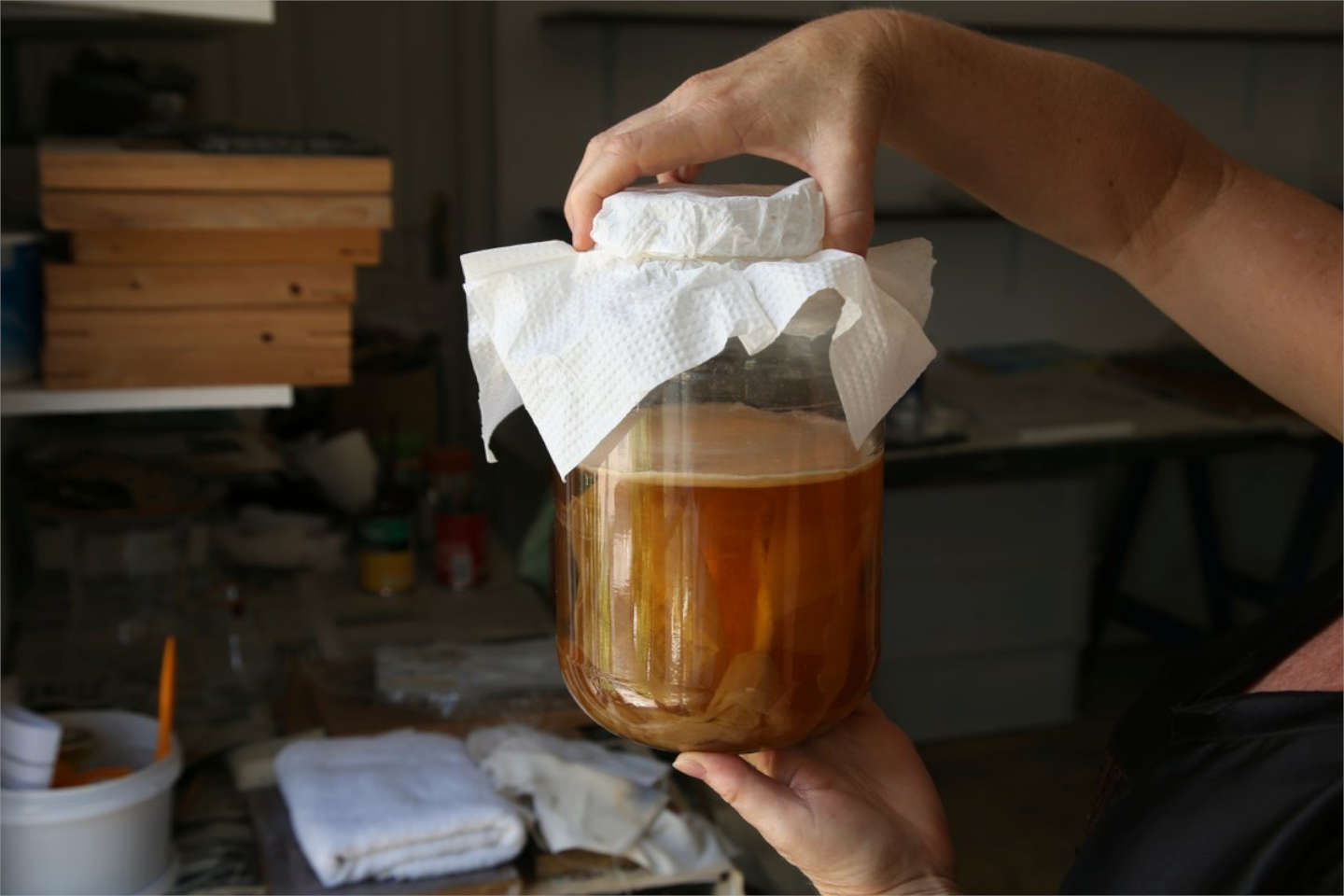
So what if you want to keep some of that ethanol around in your finished beverage? There needs to be an intermediary step that inhibits acetobacter and encourages ethanol-producing yeast. Your SCOBY thrives in an aerobic environment, which is why you cover the fermenter with cheesecloth or a coffee filter; this keeps curious insects out but allows bacteria in the SCOBY to get the oxygen they need to play their acid-producing role.
For hard kombucha, cutting off that air supply is crucial, but since we don’t want to injure our SCOBY, we simply make kombucha in the usual fashion until it reaches a palatable balance of sweetness, dryness, and acidity, and then remove the SCOBY. Your SCOBY will be perfectly happy at room temperature, in a covered container, in two cups or so of low-pH (4.3 or lower) kombucha. Once removed, we can proceed with “hardening” the otherwise finished kombucha you’ve produced.
Plenty of yeast is active in finished kombucha, but it’s best to introduce a new slurry of fresh, active yeast to bump up alcohol levels quickly. I like Lalvin ICV D47 for this purpose, as it’s slightly fruity (citrus), is alcohol tolerant, produces a full-bodied kombucha, and is relatively clean at its preferred ale temperature range of 59–68°F (15–20°C). It’s used by a lot of winemakers for Chardonnay if that gives you any idea of the expected flavor profile.
Any fresh ale yeast you have on hand will work for hard kombucha, so feel free to experiment. For a 2-gallon batch size, one 5-gram packet hydrated per the yeast manufacturer’s instructions is sufficient. Once your SCOBY has been removed, you hydrate the dry yeast in 2 ounces (50 mL) of water at 104–109°F (40–43°C), and, if it’s been stored correctly, it should start foaming within 10 minutes. Add it to your kombucha, and then prepare your sugar solution—you’ll need to feed this yeast to get it to produce the ethanol you’re after.
I prefer jun kombucha, which likes honey and oolong tea much better than table sugar and black tea. But remember, we’re feeding the D47 we just introduced, not the yeast in the jun SCOBY, so table sugar is just fine. I’ve experimented with various sugars, including honey, glucose syrup, dextrose powder (pretty much the same thing), and others, but table sugar is the least expensive option here, and I’ve seen no improvement in yeast performance using simpler or more complex sugars.
As you would to prime beer, dissolve the sugar in water, bring it to a boil, and then cool it to your yeast’s fermentation temperature range before stirring it into your kombucha. How much is a matter of preference, but as a rough guide, a pound of added sugar per gallon boosts your already sweetened kombucha to about 15°P (1.061). Depending on how sweet or boozy you like your finished hard kombucha, you can expect a final alcohol content of about 6% by volume, assuming you’ll be bottling it at a medium-sweet gravity of 4°P (1.016).
Once all the sugar is evenly stirred in, you’ll need to make sure the fermenter is sealed off from air, preferably with a tight lid and an airlock to allow CO2 to escape. Then you just need to keep the fermenter in the proper temperature range and wait for the yeast to do its job. Average wait times for attenuation vary from 7 to 14 days. The same rules for fermenting a sour beer apply here.
Depending on the strain, yeast can be somewhat reluctant to ferment and attenuate strongly and quickly in low-pH environments, so make sure you: use fresh, active yeast; pitch double the amount you’d normally pitch in a beer; be ready to wait longer for full attenuation; and never re-pitch the yeast you use for a sour ferment. Hardy strains such as the D47 mentioned above work well for hard kombucha, but I’ve also seen favorable results from kveik ale yeast types.
While it isn’t completely accurate, a handheld refractometer allows you to monitor fermentation progress without having to pull a full hydrometer sample each time you measure. (See “Revisiting the Refractometer” and “Using a Refractometer” in the Jul/Aug 2017 and Jul/Aug 2013 issues of Zymurgy, respectively, for information on adjusting finishing gravity readings using a refractometer.) You can also just dip a sample and taste it; it’s fairly obvious when the sugars start to dry out.
When you’ve reached your preferred sweet, tart, and alcoholic balance and are ready to bottle, an optional step is to add any flavorings you think might work well with your boozy tea. Fruit purees, herbs, and spices are all options; I like to combine my affinity for tepache with hard kombucha and add the (well-washed) rind and core of a ripe organic pineapple directly to the fermenter, along with whole allspice berries and a cinnamon stick. (This can be done much earlier in fermentation, when the specific gravity has fallen to about 10°P. The wine yeast will feast on the sugars from the pineapple and give the batch a really nice floral, fruity, tropical tartness.)
Another option is to add an ounce or two of mango, apricot, or peach nectar to each bottle before filling it the rest of the way with hard kombucha. This gives is a pleasing color, flavor, and often some fruit pulp that will bloom up and mix into solution when you open the carbonated bottle.
For a beautiful red color, try dried hibiscus flowers, fresh raspberries or strawberries, or tart cherry or cranberry concentrate. Coconut, passion fruit, or mango purees add a pleasing tropical dimension. Dried spearmint tends to accentuate the green tea notes, dried chilies can add a spike of heat, and melissa (or lemon balm) contributes an herbal, citrus note.
If you’re a jun kombucha fan, experimenting with different varieties of honey is great fun—one of my personal favorites is hard kombucha with orange blossom honey in both the first and second ferments, with a splash of Lebanese orange blossom water mixed in right before bottling. You can usually find this in Middle Eastern or Indian food markets. So many possibilities—commercial hard kombucha companies are a great source of inspiration for new flavor combinations to try. Really, the options are endless.
Keep in mind that if using fresh fruit or purees, you may be adding extra sugar, which can throw off the final balance (and, if you’re not careful, over-carbonate the finished beverage). You don’t have to add any sugar to prime your kombucha—it will carbonate just fine with its own residual sugar, but adding additional sugar at bottling will jumpstart the process.
Bottle the batch in pressure-tolerant screw-top PET bottles, as has been suggested previously for “soft” kombucha. Your yeast may still be quite active once it hits the recommended gravity of 4°P, so bottle conditioning can happen quickly, especially at warm temperatures; plan to give your PET bottles a squeeze every 4 to 6 hours after bottling to see how much pressure is building up. It may take 8 or 12 hours at ambient temperatures, but it’s best to stay on top of it so you don’t go overboard. It’s not uncommon to open an over-carbonated bottle of kombucha—it can be a wild and somewhat unpredictable beverage—so if those PET bottles feel rock hard when you take them out of the fridge, plan on opening them over the sink, just to be safe.
Take your kombucha brewing to the next level and discover a tasty, infinitely variable flavored sparkling beverage that’s a delicious alternative to beer. If you have a favorite brewing method or combination of flavors you’d like to share, let us know\!
## Hard Kombucha Recipe
The following recipe makes for a great base for your hard kombucha. Build upon this with other ingredients\!
### Ingredients (8 liters / 2.1 gallons)
- **FERMENTABLES**
- 400 g sucrose (table sugar)
- 40 g tea leaves (bagged or loose)
- 2 lb. (900 g) table sugar (second ferment)
- **YEAST**
- 1 fully hydrated, active kombucha SCOBY (first ferment)
- 1 packet Lalvin D47 dry yeast, hydrated per label instructions (second ferment)
- **ADDITIONAL** ITEMS
- 8 L filtered, chlorine-free water
- citric or lactic acid as needed to adjust pre-ferment pH
- other flavorings to add at bottling (fruit purees, spices, herbs, etc.), optional
### Equipment
- pH meter or test strips in the 2.8 to 4.4 range
- 2\.5-gallon bucket to use as a fermenter, with lid and airlock for second ferment
- coffee filter or tight-weave cloth and rubber band to cover fermenter for first ferment
- pressure-ready PET bottles
### Instructions
Boil water and add tea leaves. Steep 1–5 minutes, depending upon tea variety. Remove tea leaves and stir in sugar until it dissolves. Cover tightly with a lid or plastic wrap and allow to come to room temperature (70–80°F or 21–27°C). Add sweetened tea to sanitized fermenter, then add SCOBY and 2 cups of starter kombucha (or ¼–½ cup distilled vinegar). Stir well, then remove a small sample and test pH. If below 4.5, cover fermenter with screen material and secure with rubber band. Keep fermenter in the correct temperature range for 7 days. Take a small sample, smell, and taste. If you are happy with the flavor and acid balance, use a sanitized funnel to fill your bottles. Don’t worry about splashing—Acetobacter likes air. Leave about an inch of head space in each bottle. If your tea is still too sweet, ferment a few days more and taste again.
When the first ferment suits your tastes, it’s ready to move to the second, anaerobic (alcohol-producing) stage. Remove your SCOBY and keep it in a separate, covered container with 2 cups of the kombucha you just produced. It will continue to produce CO2, so make sure to burp the lid every couple of days if tightly sealed.
Add 2 lb. (900 g) table sugar to just enough boiling water to completely dissolve all the sugar crystals—about ½ quart (473 mL). Cool to fermentation temperature and add to your fermenter. Cover with lid and airlock for second fermentation. Hydrate your secondary yeast strain using the instructions on the packet, if using dry yeast. When active and foamy, stir into your sweetened kombucha. You should see signs of vigorous fermentation within a couple of hours.
Ferment from 7 to 12 days at around 20°C (68°F). After about a week, or when airlock activity begins to slow, take a small sample. As it attenuates past 5°P (1.020 SG), it should begin to taste less sweet and more balanced with the acids. If you have a pH meter, you can expect your finished kombucha to measure out between 2.5 and 3.5.
If targeting the recommended 4°P (1.016 SG) finishing gravity, 5°P is when you want to add your flavorings. Herbs and spices can be steeped for a day or two and then removed. Fruit nectars or purees can be added now, though your yeast may need an extra day or so to finish at 4°P, depending upon how much sugar your fruit adds.
To carbonate, there’s no need to add additional priming sugar—your tea should still have plenty of sucrose. Just keep the bottles at the same temperature for three to seven days, squeezing them gently every day or two to gauge the level of condition. When fully carbonated, transfer to the fridge and enjoy cold. As stated above, it is easy to over-carbonate any kombucha, so drink it fresh! Remember it will still ferment slowly even under refrigeration, so if you forget a six-pack is in there, you may have difficulty getting it into a glass. Fortunately PET bottles can hold a whole lot of pressure, so the risk of bottle bombs is pretty low.
***Amahl Turczyn is associate editor of* Zymurgy*.***
## You might also like...
[Link to article ](https://homebrewersassociation.org/homebrew-recipes-collection/30-beer-recipes-from-past-big-brew-celebrations/)
## [30 Beer Recipes from Past AHA Big Brew Celebrations](https://homebrewersassociation.org/homebrew-recipes-collection/30-beer-recipes-from-past-big-brew-celebrations/)
## Start Your Monthly Membership
[Join for \$4.99](https://www.homebrewersassociation.org/membership/monthly-membership)
- [Join / Renew](https://homebrewersassociation.org/membership/join-or-renew/)
- [Membership Benefits](https://homebrewersassociation.org/membership/membership-benefits/)
- [Volunteer Opportunities](https://homebrewersassociation.org/membership/volunteer-opportunities/)
- [About the AHA](https://homebrewersassociation.org/membership/american-homebrewers-association/)
- [Contact Us](https://homebrewersassociation.org/contact-us/)
- [Advocacy](https://homebrewersassociation.org/beer-food/how-to-make-hard-kombucha/)
- [State Statutes](https://homebrewersassociation.org/homebrewing-rights/statutes/)
- [Legislation 101](https://homebrewersassociation.org/homebrewing-rights/legislation-101/)
- [Supply Shops](https://homebrewersassociation.org/beer-food/how-to-make-hard-kombucha/)
- [Find a Shop](https://homebrewersassociation.org/how-to-brew/find-a-homebrew-supply-shop/)
- [Shop of the Year Award](https://homebrewersassociation.org/news/homebrew-shop-year-award/)
- [Free Brewing Guides](https://homebrewersassociation.org/business-tools/request-free-pamphlets/)
- [Homebrew Industry Support](https://homebrewersassociation.org/business-tools/industry-support/)
- [Sell AHA Membership](https://homebrewersassociation.org/business-tools/sell-aha-memberships/)
- [Advertise](https://homebrewersassociation.org/beer-food/how-to-make-hard-kombucha/)
- [Advertising Overview](https://homebrewersassociation.org/advertise/)
- [*Zymurgy* Magazine](https://homebrewersassociation.org/advertise/zymurgy-magazine/)
- [Online Advertising](https://homebrewersassociation.org/advertise/online-advertising/)
- [eNewsletters](https://homebrewersassociation.org/advertise/enewsletters/)
- [Sponsored Content](https://homebrewersassociation.org/advertise/sponsored-content/)
- [Homebrew Clubs](https://homebrewersassociation.org/beer-food/how-to-make-hard-kombucha/)
- [Find a Club](https://homebrewersassociation.org/homebrew-clubs/find-a-homebrew-club/)
- [Insurance Program](https://homebrewersassociation.org/homebrew-clubs/homebrew-club-insurance/)
- [Generate Revenue](https://homebrewersassociation.org/news/generate-revenue-with-the-aha-referral-program)
- [Brewing Tools](https://homebrewersassociation.org/beer-food/how-to-make-hard-kombucha/)
- [AHA Assistant Brewer](https://homebrewersassociation.org/home/aha-assistant-brewer-for-nonmembers/)
- [Beer Recipes](https://homebrewersassociation.org/beer-recipes/)
- [*Zymurgy* Magazine](https://homebrewersassociation.org/zymurgy-magazine/)
- [Brewing Tutorials](https://homebrewersassociation.org/how-to-brew/)
- [Seminar Recordings](https://homebrewersassociation.org/seminars/)
- [AHA Events](https://homebrewersassociation.org/beer-food/how-to-make-hard-kombucha/)
- [National Homebrew Competition](https://homebrewersassociation.org/national-homebrew-competition/)
- [Big Brew for National Homebrew Day](https://homebrewersassociation.org/aha-events/big-brew-national-homebrew-day/)
- [Home Fermentation Day](https://homebrewersassociation.org/aha-events/home-fermentation-day/)
- [Learn to Homebrew Day](https://homebrewersassociation.org/aha-events/learn-to-homebrew-day/)
- [American Homebrewers Association](https://homebrewersassociation.org/beer-food/how-to-make-hard-kombucha/)
- [News](https://homebrewersassociation.org/category/news/)
- [Membership FAQ](https://homebrewersassociation.org/contact-us/membership-faq/)
- [Recognition Awards](https://homebrewersassociation.org/american-homebrewers-association-awards/)
- [Wellness & DEI Resources](https://homebrewersassociation.org/content-collections/mental-wellness-and-diversity-equity-inclusion-resources/)
- [Virtual & In-Person Speaking Engagement Request](https://homebrewersassociation.org/contact-us/virtual-in-person-speaking-engagement-request/)
- [Contact Us](https://homebrewersassociation.org/contact-us/)
©2026 American Homebrewers Association • [Privacy Policy](https://www.homebrewersassociation.org/aha-privacy-policy/) • [Terms and Conditions](https://www.homebrewersassociation.org/terms-and-conditions/) • [Non-Discrimination Policy](https://www.homebrewersassociation.org/non-discrimination-policy/) • [AI Summary](https://homebrewersassociation.org/wp-content/uploads/2026/03/aha-ai-summary.pdf)
### Logging you in and unlocking exclusive member content.
#### Logging in
## Loading
×
### Your membership is expiring soon\!
Renew now to keep your *Zymurgy®* subscription, and access to member-only discounts, medal-winning recipes, how-to videos, and more\!
[Renew Now](https://homebrewersassociation.org/membership/join-or-renew)
### Logging you in and unlocking this member exclusive.
### Enjoy\!
#### Redirecting
×
### Your membership has expired.
Renew now to keep your *Zymurgy®* subscription, and access to member-only discounts, medal-winning recipes, how-to videos, and more\!
[Renew Now](https://homebrewer.memberclicks.net/join)
×
### There is a problem with your profile.
Please [contact our membership team](https://homebrewersassociation.org/cdn-cgi/l/email-protection#e1888f878ea1898e8c84839384968493928092928e82888095888e8fcf8e9386de9294838b848295dca2808f8f8e95c18d8e86888fccc191938e838d848cc196889589c18c98c1a78e8f95849780c191938e87888d84) to evaluate your profile.
Cookie Settings
This website uses cookies to enhance user experience and to analyze performance and traffic on our website. Not consenting or withdrawing consent may adversely affect certain features and functions.
Functional
Functional
Always active
The technical storage or access is strictly necessary for the legitimate purpose of enabling the use of a specific service explicitly requested by the subscriber or user, or for the sole purpose of carrying out the transmission of a communication over an electronic communications network.
Preferences
Preferences
The technical storage or access is necessary for the legitimate purpose of storing preferences that are not requested by the subscriber or user.
Statistics
Statistics
The technical storage or access that is used exclusively for statistical purposes. The technical storage or access that is used exclusively for anonymous statistical purposes. Without a subpoena, voluntary compliance on the part of your Internet Service Provider, or additional records from a third party, information stored or retrieved for this purpose alone cannot usually be used to identify you.
Marketing
Marketing
The technical storage or access is required to create user profiles to send advertising, or to track the user on a website or across several websites for similar marketing purposes.
- [Manage options](https://homebrewersassociation.org/beer-food/how-to-make-hard-kombucha/)
- [Manage services](https://homebrewersassociation.org/beer-food/how-to-make-hard-kombucha/)
- [Manage {vendor\_count} vendors](https://homebrewersassociation.org/beer-food/how-to-make-hard-kombucha/)
- [Read more about these purposes](https://cookiedatabase.org/tcf/purposes/)
Accept
Deny
View preferences
Save preferences
[View preferences](https://homebrewersassociation.org/beer-food/how-to-make-hard-kombucha/)
- [{title}](https://homebrewersassociation.org/beer-food/how-to-make-hard-kombucha/)
- [{title}](https://homebrewersassociation.org/beer-food/how-to-make-hard-kombucha/)
- [{title}](https://homebrewersassociation.org/beer-food/how-to-make-hard-kombucha/)
Cookie Settings | |||||||||
| Readable Markdown | Link to article

***By Amahl Turczyn***
As a follow-up to the kombucha article that appeared in the [September/October 2021 issue of *Zymurgy* magazine](https://homebrewersassociation.org/zymurgy-magazine/september-october-2021/), we now turn to fermenting kombucha with a higher level of alcohol. These hard beverages are becoming popular with craft breweries and dedicated “kombucheries” alike, as they present a blank canvas on which a limitless number of flavors and colors can be painted.
The basic kombucha process is the same: brew up a batch of tea, sweeten it, introduce it to your symbiotic culture of bacteria and yeast (SCOBY), and the microbes will do the rest. This multi-strain culture includes several forms of acid-producing bacteria, mainly various strains of Acetobacter, and as the yeast feeds on the sugar you’ve provided, they produce CO₂ and ethanol; the acetic bacteria then change the ethanol into acids, producing a tart, sweet, fizzy end product.
So what if you want to keep some of that ethanol around in your finished beverage? There needs to be an intermediary step that inhibits acetobacter and encourages ethanol-producing yeast. Your SCOBY thrives in an aerobic environment, which is why you cover the fermenter with cheesecloth or a coffee filter; this keeps curious insects out but allows bacteria in the SCOBY to get the oxygen they need to play their acid-producing role.
For hard kombucha, cutting off that air supply is crucial, but since we don’t want to injure our SCOBY, we simply make kombucha in the usual fashion until it reaches a palatable balance of sweetness, dryness, and acidity, and then remove the SCOBY. Your SCOBY will be perfectly happy at room temperature, in a covered container, in two cups or so of low-pH (4.3 or lower) kombucha. Once removed, we can proceed with “hardening” the otherwise finished kombucha you’ve produced.
Plenty of yeast is active in finished kombucha, but it’s best to introduce a new slurry of fresh, active yeast to bump up alcohol levels quickly. I like Lalvin ICV D47 for this purpose, as it’s slightly fruity (citrus), is alcohol tolerant, produces a full-bodied kombucha, and is relatively clean at its preferred ale temperature range of 59–68°F (15–20°C). It’s used by a lot of winemakers for Chardonnay if that gives you any idea of the expected flavor profile.
Any fresh ale yeast you have on hand will work for hard kombucha, so feel free to experiment. For a 2-gallon batch size, one 5-gram packet hydrated per the yeast manufacturer’s instructions is sufficient. Once your SCOBY has been removed, you hydrate the dry yeast in 2 ounces (50 mL) of water at 104–109°F (40–43°C), and, if it’s been stored correctly, it should start foaming within 10 minutes. Add it to your kombucha, and then prepare your sugar solution—you’ll need to feed this yeast to get it to produce the ethanol you’re after.
I prefer jun kombucha, which likes honey and oolong tea much better than table sugar and black tea. But remember, we’re feeding the D47 we just introduced, not the yeast in the jun SCOBY, so table sugar is just fine. I’ve experimented with various sugars, including honey, glucose syrup, dextrose powder (pretty much the same thing), and others, but table sugar is the least expensive option here, and I’ve seen no improvement in yeast performance using simpler or more complex sugars.
As you would to prime beer, dissolve the sugar in water, bring it to a boil, and then cool it to your yeast’s fermentation temperature range before stirring it into your kombucha. How much is a matter of preference, but as a rough guide, a pound of added sugar per gallon boosts your already sweetened kombucha to about 15°P (1.061). Depending on how sweet or boozy you like your finished hard kombucha, you can expect a final alcohol content of about 6% by volume, assuming you’ll be bottling it at a medium-sweet gravity of 4°P (1.016).
Once all the sugar is evenly stirred in, you’ll need to make sure the fermenter is sealed off from air, preferably with a tight lid and an airlock to allow CO2 to escape. Then you just need to keep the fermenter in the proper temperature range and wait for the yeast to do its job. Average wait times for attenuation vary from 7 to 14 days. The same rules for fermenting a sour beer apply here.
Depending on the strain, yeast can be somewhat reluctant to ferment and attenuate strongly and quickly in low-pH environments, so make sure you: use fresh, active yeast; pitch double the amount you’d normally pitch in a beer; be ready to wait longer for full attenuation; and never re-pitch the yeast you use for a sour ferment. Hardy strains such as the D47 mentioned above work well for hard kombucha, but I’ve also seen favorable results from kveik ale yeast types.
While it isn’t completely accurate, a handheld refractometer allows you to monitor fermentation progress without having to pull a full hydrometer sample each time you measure. (See “Revisiting the Refractometer” and “Using a Refractometer” in the Jul/Aug 2017 and Jul/Aug 2013 issues of Zymurgy, respectively, for information on adjusting finishing gravity readings using a refractometer.) You can also just dip a sample and taste it; it’s fairly obvious when the sugars start to dry out.
When you’ve reached your preferred sweet, tart, and alcoholic balance and are ready to bottle, an optional step is to add any flavorings you think might work well with your boozy tea. Fruit purees, herbs, and spices are all options; I like to combine my affinity for tepache with hard kombucha and add the (well-washed) rind and core of a ripe organic pineapple directly to the fermenter, along with whole allspice berries and a cinnamon stick. (This can be done much earlier in fermentation, when the specific gravity has fallen to about 10°P. The wine yeast will feast on the sugars from the pineapple and give the batch a really nice floral, fruity, tropical tartness.)
Another option is to add an ounce or two of mango, apricot, or peach nectar to each bottle before filling it the rest of the way with hard kombucha. This gives is a pleasing color, flavor, and often some fruit pulp that will bloom up and mix into solution when you open the carbonated bottle.
For a beautiful red color, try dried hibiscus flowers, fresh raspberries or strawberries, or tart cherry or cranberry concentrate. Coconut, passion fruit, or mango purees add a pleasing tropical dimension. Dried spearmint tends to accentuate the green tea notes, dried chilies can add a spike of heat, and melissa (or lemon balm) contributes an herbal, citrus note.
If you’re a jun kombucha fan, experimenting with different varieties of honey is great fun—one of my personal favorites is hard kombucha with orange blossom honey in both the first and second ferments, with a splash of Lebanese orange blossom water mixed in right before bottling. You can usually find this in Middle Eastern or Indian food markets. So many possibilities—commercial hard kombucha companies are a great source of inspiration for new flavor combinations to try. Really, the options are endless.
Keep in mind that if using fresh fruit or purees, you may be adding extra sugar, which can throw off the final balance (and, if you’re not careful, over-carbonate the finished beverage). You don’t have to add any sugar to prime your kombucha—it will carbonate just fine with its own residual sugar, but adding additional sugar at bottling will jumpstart the process.
Bottle the batch in pressure-tolerant screw-top PET bottles, as has been suggested previously for “soft” kombucha. Your yeast may still be quite active once it hits the recommended gravity of 4°P, so bottle conditioning can happen quickly, especially at warm temperatures; plan to give your PET bottles a squeeze every 4 to 6 hours after bottling to see how much pressure is building up. It may take 8 or 12 hours at ambient temperatures, but it’s best to stay on top of it so you don’t go overboard. It’s not uncommon to open an over-carbonated bottle of kombucha—it can be a wild and somewhat unpredictable beverage—so if those PET bottles feel rock hard when you take them out of the fridge, plan on opening them over the sink, just to be safe.
Take your kombucha brewing to the next level and discover a tasty, infinitely variable flavored sparkling beverage that’s a delicious alternative to beer. If you have a favorite brewing method or combination of flavors you’d like to share, let us know\!
## Hard Kombucha Recipe
The following recipe makes for a great base for your hard kombucha. Build upon this with other ingredients\!
### Ingredients (8 liters / 2.1 gallons)
- **FERMENTABLES**
- 400 g sucrose (table sugar)
- 40 g tea leaves (bagged or loose)
- 2 lb. (900 g) table sugar (second ferment)
- **YEAST**
- 1 fully hydrated, active kombucha SCOBY (first ferment)
- 1 packet Lalvin D47 dry yeast, hydrated per label instructions (second ferment)
- **ADDITIONAL** ITEMS
- 8 L filtered, chlorine-free water
- citric or lactic acid as needed to adjust pre-ferment pH
- other flavorings to add at bottling (fruit purees, spices, herbs, etc.), optional
### Equipment
- pH meter or test strips in the 2.8 to 4.4 range
- 2\.5-gallon bucket to use as a fermenter, with lid and airlock for second ferment
- coffee filter or tight-weave cloth and rubber band to cover fermenter for first ferment
- pressure-ready PET bottles
### Instructions
Boil water and add tea leaves. Steep 1–5 minutes, depending upon tea variety. Remove tea leaves and stir in sugar until it dissolves. Cover tightly with a lid or plastic wrap and allow to come to room temperature (70–80°F or 21–27°C). Add sweetened tea to sanitized fermenter, then add SCOBY and 2 cups of starter kombucha (or ¼–½ cup distilled vinegar). Stir well, then remove a small sample and test pH. If below 4.5, cover fermenter with screen material and secure with rubber band. Keep fermenter in the correct temperature range for 7 days. Take a small sample, smell, and taste. If you are happy with the flavor and acid balance, use a sanitized funnel to fill your bottles. Don’t worry about splashing—Acetobacter likes air. Leave about an inch of head space in each bottle. If your tea is still too sweet, ferment a few days more and taste again.
When the first ferment suits your tastes, it’s ready to move to the second, anaerobic (alcohol-producing) stage. Remove your SCOBY and keep it in a separate, covered container with 2 cups of the kombucha you just produced. It will continue to produce CO2, so make sure to burp the lid every couple of days if tightly sealed.
Add 2 lb. (900 g) table sugar to just enough boiling water to completely dissolve all the sugar crystals—about ½ quart (473 mL). Cool to fermentation temperature and add to your fermenter. Cover with lid and airlock for second fermentation. Hydrate your secondary yeast strain using the instructions on the packet, if using dry yeast. When active and foamy, stir into your sweetened kombucha. You should see signs of vigorous fermentation within a couple of hours.
Ferment from 7 to 12 days at around 20°C (68°F). After about a week, or when airlock activity begins to slow, take a small sample. As it attenuates past 5°P (1.020 SG), it should begin to taste less sweet and more balanced with the acids. If you have a pH meter, you can expect your finished kombucha to measure out between 2.5 and 3.5.
If targeting the recommended 4°P (1.016 SG) finishing gravity, 5°P is when you want to add your flavorings. Herbs and spices can be steeped for a day or two and then removed. Fruit nectars or purees can be added now, though your yeast may need an extra day or so to finish at 4°P, depending upon how much sugar your fruit adds.
To carbonate, there’s no need to add additional priming sugar—your tea should still have plenty of sucrose. Just keep the bottles at the same temperature for three to seven days, squeezing them gently every day or two to gauge the level of condition. When fully carbonated, transfer to the fridge and enjoy cold. As stated above, it is easy to over-carbonate any kombucha, so drink it fresh! Remember it will still ferment slowly even under refrigeration, so if you forget a six-pack is in there, you may have difficulty getting it into a glass. Fortunately PET bottles can hold a whole lot of pressure, so the risk of bottle bombs is pretty low.
***Amahl Turczyn is associate editor of* Zymurgy*.*** | |||||||||
| ML Classification | ||||||||||
| ML Categories |
Raw JSON{
"/Food_and_Drink": 990,
"/Food_and_Drink/Beverages": 967,
"/Food_and_Drink/Beverages/Alcoholic_Beverages": 594
} | |||||||||
| ML Page Types |
Raw JSON{
"/Article": 998,
"/Article/How_to": 852
} | |||||||||
| ML Intent Types |
Raw JSON{
"Informational": 999
} | |||||||||
| Content Metadata | ||||||||||
| Language | en-us | |||||||||
| Author | null | |||||||||
| Publish Time | 2022-09-07 14:00:00 (3 years ago) | |||||||||
| Original Publish Time | 2022-09-07 14:00:00 (3 years ago) | |||||||||
| Republished | No | |||||||||
| Word Count (Total) | 2,801 | |||||||||
| Word Count (Content) | 2,109 | |||||||||
| Links | ||||||||||
| External Links | 15 | |||||||||
| Internal Links | 79 | |||||||||
| Technical SEO | ||||||||||
| Meta Nofollow | No | |||||||||
| Meta Noarchive | No | |||||||||
| JS Rendered | No | |||||||||
| Redirect Target | null | |||||||||
| Performance | ||||||||||
| Download Time (ms) | 141 | |||||||||
| TTFB (ms) | 121 | |||||||||
| Download Size (bytes) | 26,683 | |||||||||
| Shard | 121 (laksa) | |||||||||
| Root Hash | 2092760126412454521 | |||||||||
| Unparsed URL | org,homebrewersassociation!/beer-food/how-to-make-hard-kombucha/ s443 | |||||||||