ℹ️ Skipped - page is already crawled
| Filter | Status | Condition | Details |
|---|---|---|---|
| HTTP status | PASS | download_http_code = 200 | HTTP 200 |
| Age cutoff | PASS | download_stamp > now() - 6 MONTH | 0.4 months ago |
| History drop | PASS | isNull(history_drop_reason) | No drop reason |
| Spam/ban | PASS | fh_dont_index != 1 AND ml_spam_score = 0 | ml_spam_score=0 |
| Canonical | PASS | meta_canonical IS NULL OR = '' OR = src_unparsed | Not set |
| Property | Value | ||||||
|---|---|---|---|---|---|---|---|
| URL | https://health.ucdavis.edu/children/patient-education/fevers-in-children | ||||||
| Last Crawled | 2026-04-11 17:11:07 (12 days ago) | ||||||
| First Indexed | 2023-04-10 12:35:19 (3 years ago) | ||||||
| HTTP Status Code | 200 | ||||||
| Content | |||||||
| Meta Title | Pediatrician tips on fevers in children | | Patient Education | UC Davis Children's Hospital | ||||||
| Meta Description | UC Davis pediatrician Lena van der List shares tips on fevers in children | ||||||
| Meta Canonical | null | ||||||
| Boilerpipe Text | What is a fever?
A fever:
is 100.4 or greater.
is your child’s body responding to fight off infection.
is not dangerous.
can be treated with medication, but it is not required.
can contribute to dehydration, so fluids are encouraged.
can warrant a trip to the pediatrician when certain criteria are met.
As is the case with any health concern for your child, please call your pediatrician if you have questions or need advice on this topic.
Fevers in children are common. So are the fever-related concerns of parents and caregivers … especially during COVID-19.
After an increase in pediatrician visits due to fever, UC Davis chief of pediatric infectious diseases Dean Blumberg and UC Davis pediatrician Lena van der List are revisiting some long-held myths and questions that are keeping kids and parents up at night. Here they outline what normal body temperature is and does, what to look for when your child has a fever and when to take it more seriously.
Normal body temperature is not always 98.6.
According to van der List, it is normal to have some fluctuation in body temperature from one degree below 98.6 to one above. Lower body temperatures usually occur early in the day and higher temperatures occur in the afternoon.
Fever is not a bad thing and it’s not necessarily dangerous.
Considered to be 100.4 Fahrenheit or higher, a fever is the body’s way of mounting a defense so conditions are less favorable for viruses or bacteria. Pyrogens - which are biochemical substances - float by the hypothalamus area of the brain and trigger the body to say, “something is off.”
“You might think of the hypothalamus as the body’s thermostat,” Lena van der List said. “It’s not a bad thing to have a fever when you’re sick.”
Kids get more frequent and higher fevers than adults.
Because their immune systems are still developing, kids may create pyrogens for each new infection they come in contact with. Alternatively, adults may have already created immunity to those infections.
If you don’t treat a fever, it will NOT automatically increase.
“There is a common myth that if you don’t treat the fever, it will keep going higher. This is not true either,” Blumberg said. | ||||||
| Markdown | search Search All UC Davis Health
Main Menuadd
menuMain Menu
Open global navigation modal
closeMain Menu
Close global navigation modal
[](https://health.ucdavis.edu/welcome/ "UC Davis Health")
Main Menuremove
- [UC Davis Health Home](https://health.ucdavis.edu/welcome/)
- [Patients & Visitors](https://health.ucdavis.edu/patients-visitors/)
- [Services & Specialties](https://health.ucdavis.edu/patients-visitors/services-specialties/)
- [Health Care Professionals](https://health.ucdavis.edu/healthcare-professionals/)
- [Schools & Programs](https://health.ucdavis.edu/schools-programs/)
- [Research](https://health.ucdavis.edu/research/)
- [News](https://health.ucdavis.edu/news/)
- [About UC Davis Health](https://health.ucdavis.edu/about/)
- [Giving](https://health.ucdavis.edu/giving/)
- [Careers](https://hr.ucdavis.edu/)
search Search
[](https://health.ucdavis.edu/welcome/ "UC Davis Health")
×
Search All UC Davis Health
Search enhanced by Google
[](https://health.ucdavis.edu/welcome/ "UC Davis Health")
close
Search All UC Davis Health
Search enhanced by Google
[ ](https://health.ucdavis.edu/children/ "Children's Hospital")
- [how\_to\_regMyUCDavisHealth](https://health.ucdavis.edu/login/)
- [volunteer\_activismMake a Donation](https://give.ucdavis.edu/MCMN)
- [location\_onLocations](https://health.ucdavis.edu/children/directions/)
- [person\_searchFind a Pediatrician](https://health.ucdavis.edu/children/team/pediatricians-and-specialists)
Showmenu
menuMenu
- Pediatric Serviceschevron\_right
chevron\_leftBack
[Pediatric Servicesarrow\_forward](https://health.ucdavis.edu/children/services/)
Nationally ranked UC Davis Children’s Hospital offers families the highest level of care for virtually every pediatric health condition.
- [Specialty Care](https://health.ucdavis.edu/children/services/pediatric-specialty-care)
- [Pharmacy Services](https://health.ucdavis.edu/children/services/pediatric-pharmacy-services)
- [Support Services](https://health.ucdavis.edu/children/services/support-services)
- [Patient Education A-Z](https://health.ucdavis.edu/children/patient-education/)
- Patients & Familieschevron\_right
chevron\_leftBack
[Patients & Familiesarrow\_forward](https://health.ucdavis.edu/children/patients/)
Helping you and your child receive extraordinary care is priority one.
- [General Information](https://health.ucdavis.edu/children/patients/)
- [Find a Pediatrician or Specialist](https://health.ucdavis.edu/children/team/pediatricians-and-specialists)
- [Preparing for Your Child’s Stay](https://health.ucdavis.edu/children/patients/child-hospital-stay)
- [Family and Visitor Information](https://health.ucdavis.edu/children/visitors/visitor-information)
[Patient Education A to Zarrow\_forward](https://health.ucdavis.edu/children/patient-education/)
Helpful guides for parents and caregivers for pediatric conditions, procedures and care at home.
- Visiting the Children’s Hospitalchevron\_right
chevron\_leftBack
[Visiting the Children’s Hospitalarrow\_forward](https://health.ucdavis.edu/children/visitors/)
Find information about visiting UC Davis Children’s Hospital.
- [Preparing for Your Child’s Stay](https://health.ucdavis.edu/children/patients/child-hospital-stay)
- [Family and Visitor Information](https://health.ucdavis.edu/children/visitors/visitor-information)
- [Important Phone Numbers](https://health.ucdavis.edu/children/contact/)
- [Visitor Guidelines](https://health.ucdavis.edu/patients-visitors/visitor-policies)
- [Family Video Visits](https://health.ucdavis.edu/myucdavishealth/family-video-visits/)
[Directions and Parking](https://health.ucdavis.edu/children/directions/)
- [Appointments & Referrals](https://health.ucdavis.edu/children/appointments-referrals/)
- Our Teamchevron\_right
chevron\_leftBack
Our Team
- [Your Child’s Patient Care Team](https://health.ucdavis.edu/children/team/)
- [Pediatricians by Specialty or Service](https://health.ucdavis.edu/children/team/pediatricians-and-specialists)
- [Why Choose Us](https://health.ucdavis.edu/children/about/)
- [News](https://health.ucdavis.edu/children/news/)
- Quick Links
- [how\_to\_regMyUCDavisHealth](https://health.ucdavis.edu/login/)
- [volunteer\_activismMake a Donation](https://give.ucdavis.edu/MCMN)
- [location\_onLocations](https://health.ucdavis.edu/children/directions/)
- [person\_searchFind a Pediatrician](https://health.ucdavis.edu/children/team/pediatricians-and-specialists)
# Pediatrician tips on fevers in children \| \| Patient Education \| UC Davis Children's Hospital
1. [UC Davis Health](https://health.ucdavis.edu/welcome/ "UC Davis Health")
2. [Children’s Hospital](https://health.ucdavis.edu/children/ "Children’s Hospital")
3. [Patients](https://health.ucdavis.edu/children/patients/ "Patients")
4. [Patient Education A to Z](https://health.ucdavis.edu/children/patient-education/ "Patient Education A to Z")
5. Tips on Fevers in Children
## Tips on fevers in children
## What is a fever?
A fever:
- is 100.4 or greater.
- is your child’s body responding to fight off infection.
- is not dangerous.
- can be treated with medication, but it is not required.
- can contribute to dehydration, so fluids are encouraged.
- can warrant a trip to the pediatrician when certain criteria are met.
*As is the case with any health concern for your child, please call your pediatrician if you have questions or need advice on this topic.*
Fevers in children are common. So are the fever-related concerns of parents and caregivers … especially during COVID-19.
After an increase in pediatrician visits due to fever, UC Davis chief of pediatric infectious diseases Dean Blumberg and UC Davis pediatrician Lena van der List are revisiting some long-held myths and questions that are keeping kids and parents up at night. Here they outline what normal body temperature is and does, what to look for when your child has a fever and when to take it more seriously.
## Normal body temperature is not always 98.6.
According to van der List, it is normal to have some fluctuation in body temperature from one degree below 98.6 to one above. Lower body temperatures usually occur early in the day and higher temperatures occur in the afternoon.
## Fever is not a bad thing and it’s not necessarily dangerous.
Considered to be 100.4 Fahrenheit or higher, a fever is the body’s way of mounting a defense so conditions are less favorable for viruses or bacteria. Pyrogens - which are biochemical substances - float by the hypothalamus area of the brain and trigger the body to say, “something is off.”
“You might think of the hypothalamus as the body’s thermostat,” Lena van der List said. “It’s not a bad thing to have a fever when you’re sick.”
## Kids get more frequent and higher fevers than adults.
Because their immune systems are still developing, kids may create pyrogens for each new infection they come in contact with. Alternatively, adults may have already created immunity to those infections.
## If you don’t treat a fever, it will NOT automatically increase.
“There is a common myth that if you don’t treat the fever, it will keep going higher. This is not true either,” Blumberg said.
[ Pediatric infectious diseases Expert care for children Treating common and uncommon pediatric infectious diseases in kids About our infectious diseases care](https://health.ucdavis.edu/children/services/pediatric-infectious-diseases/ "Expert care for children")
## Treating the fever is not required, unless your child’s condition meets certain criteria. There are things you can do at home.
“Depending on how uncomfortable your child appears, not every fever needs to be treated,” Blumberg said. “But if they do seem uncomfortable, you may want to start with an antipyretic … a medication given to reduce fever.”
Here are some guidelines if you determine you want to give your child a fever-reducing medication:
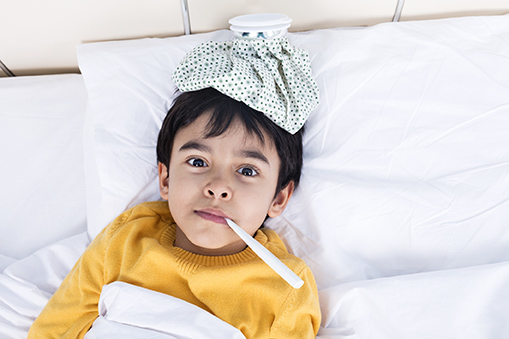
- Acetaminophen (Tylenol) or ibuprofen (Motrin) are two of the most common.
- Tylenol is safe to give at any age, but Motrin should not be used in children under six months of age.
- Give appropriate doses of these medications based on weight.
- Confusion between drug names and brands (ie: giving acetaminophen and Tylenol - they are the same) can lead to overmedicating. Be aware.
- Alternating acetaminophen (Tylenol) and ibuprofen (Motrin) is commonly recommended to help keep a child’s fever down.
“Hydration is also extremely important, and your child will need even more than usual because of the fever,” van der List said. “I tell parents to encourage sips throughout the day, offering things like popsicles and juice if that’s the only thing their child will drink. Some rules go out the window when your child is sick.”
## The number on the thermometer is less important than you think.
“Parents may have heard that fevers above 104 are dangerous and can cause brain damage. It’s just not true,” van der List said. “Only temperatures above 108 degrees F (42 degrees C) can cause brain damage and it's very rare for the body temperature to climb this high from illness alone.”
“Really, the number matters less than how your child looks or acts or how long the fever lasts,” Blumberg said. “The fever will usually follow the natural course of the infection which is typically one to four days. After that, it’s time to call your pediatrician.”
## A visit to a pediatrician is warranted when certain criteria are met. These include if your child:
- is 3 months old or younger and has a fever. Since their immune system is immature, they could have a serious infection without showing many signs.
- has a fever that lasts more than four days without a source of infection.
- shows signs of dehydration. These signs include no tears when crying, less frequent urination, dry mouth or tongue, sunken eyes and listlessness.
- has significant behavior changes.
- is immunocompromised.
- appears very ill or drowsy.
- has a severe headache, earache, urinary tract infection, stiff neck, sore throat or repeated vomiting and diarrhea you can’t manage at home.
For more information, listen to the [Kids Considered Podcast](https://bit.ly/3mdBlrg "Kids Considered Podcast") hosted by Blumberg and van der List.
## Connect with us
- [](https://www.facebook.com/UCDavisChildrensHospital "Like UC Davis Children's Hospital on Facebook")
- [](http://www.youtube.com/playlist?list=PL42A0FD6E14392D4E "Subscribe to UC Davis Children's Hospital on YouTube")
- [](http://instagram.com/ucdavischildren "Follow UC Davis Children's Hospital on Instagram")
- [](http://www.pinterest.com/ucdavishealth/childrens-health/ "Follow UC Davis Children's Hospital on Pinterest")
## UC Davis Children’s Hospital
[Make a Gift](https://give.ucdavis.edu/MCMN "Make a Gift")
[4301 X St. Sacramento, CA 95817](https://maps.app.goo.gl/R47MTsKAXZv1xC8M9)
Main Contact Phone:
[1-800-UCD-4-KIDS](tel:1-800-823-4543)
24-Hour Hospital Operator:
[916-734-2011](tel:1-916-734-2011)
### Quick links
- [Find a pediatric specialty or service](https://health.ucdavis.edu/children/services/pediatric-specialty-care "Find a pediatric specialty or service")
- [Physicians referrals, transfers and consults](https://health.ucdavis.edu/children/appointments-referrals/ "Appointments and referrals")
- [Patient appointments and referrals](https://health.ucdavis.edu/children/appointments-referrals/ "Patient appointments and referrals")
- [Family and visitor information](https://health.ucdavis.edu/children/visitors/ "Family and visitor guidelines for the Children's Hospital")
- [Directions and parking](https://health.ucdavis.edu/children/directions/ "Directions and parking information for UC Davis Children's Hospital")
- [Contact us](https://health.ucdavis.edu/children/contact/)
[](https://health.ucdavis.edu/welcome/ "UC Davis Health")
[](https://www.youtube.com/ucdavishealth "Visit us on YouTube")[](https://www.facebook.com/UCDavisHealth "Visit us on Facebook")[](https://www.linkedin.com/company/uc-davis-health "Follow us on LinkedIn")[](https://twitter.com/UCDavisHealth "Visit us on X")[](https://www.instagram.com/ucdavishealth "Follow us on Instagram")[](https://health.ucdavis.edu/news/social-media/#social-rss-feeds "RSS")
- [Medical Center](https://health.ucdavis.edu/medical-center/)
- [Children’s Hospital](https://health.ucdavis.edu/children/)
- [Rehabilitation Hospital](https://www.ucdavisrehabhospital.com/)
- [Neighborhood clinics](https://health.ucdavis.edu/patients-visitors/locations/primary-care/)
- [School of Medicine](https://health.ucdavis.edu/medical-school/)
- [Betty Irene Moore School of Nursing](https://health.ucdavis.edu/nursing/)
- [Medical Group](https://health.ucdavis.edu/medical-group/)
### ABOUT UC DAVIS HEALTH
- [About Us](https://health.ucdavis.edu/about/)
- [Contact Us](https://health.ucdavis.edu/contact/)
- [Social Media](https://health.ucdavis.edu/news/social-media/)
- [Maps and Directions](https://health.ucdavis.edu/patients-visitors/locations/)
### FOR PATIENTS
- [MyUCDavisHealth](https://health.ucdavis.edu/login/)
- [Find a Provider or Faculty](https://physicians.ucdavis.edu/)
- [Clinic Locations](https://health.ucdavis.edu/patients-visitors/locations/primary-care/)
- [Clinical Trials](https://health.ucdavis.edu/participate/)
- [Referring Physicians](https://health.ucdavis.edu/referrals/)
- [Help Paying Your Bill](https://health.ucdavis.edu/patients-visitors/insurance-billing/financial-assistance)
- [Price Transparency](https://health.ucdavis.edu/news/public-reporting/chargemaster)
- [COVID-19 Resources](https://health.ucdavis.edu/conditions/infectious-diseases/viral-infections/covid-19)
### WE ARE PART OF
- [UC Davis](https://www.ucdavis.edu/)
- [University of California Health](https://health.universityofcalifornia.edu/)
- [University of California](https://www.universityofcalifornia.edu/)
***
© 2026 UC Regents. All Rights Reserved \| [Terms & Conditions](https://health.ucdavis.edu/legal/) \| [Privacy Policy](https://health.ucdavis.edu/legal/privacy/)
[4301 X St., Sacramento, CA 95817](https://www.google.com/maps/dir//4301+X+Street,+Sacramento,+CA+95817/@38.5536375,-121.4575672,17z/data=!3m2!4b1!5s0x809ad07cda872d07:0x5f26da684f78b234!4m9!4m8!1m0!1m5!1m1!1s0x809ad07b61a69c5f:0xafd10ea1f63dceb1!2m2!1d-121.4553785!2d38.5536333!3e2) | ||||||
| Readable Markdown | ## What is a fever?
A fever:
- is 100.4 or greater.
- is your child’s body responding to fight off infection.
- is not dangerous.
- can be treated with medication, but it is not required.
- can contribute to dehydration, so fluids are encouraged.
- can warrant a trip to the pediatrician when certain criteria are met.
*As is the case with any health concern for your child, please call your pediatrician if you have questions or need advice on this topic.*
Fevers in children are common. So are the fever-related concerns of parents and caregivers … especially during COVID-19.
After an increase in pediatrician visits due to fever, UC Davis chief of pediatric infectious diseases Dean Blumberg and UC Davis pediatrician Lena van der List are revisiting some long-held myths and questions that are keeping kids and parents up at night. Here they outline what normal body temperature is and does, what to look for when your child has a fever and when to take it more seriously.
## Normal body temperature is not always 98.6.
According to van der List, it is normal to have some fluctuation in body temperature from one degree below 98.6 to one above. Lower body temperatures usually occur early in the day and higher temperatures occur in the afternoon.
## Fever is not a bad thing and it’s not necessarily dangerous.
Considered to be 100.4 Fahrenheit or higher, a fever is the body’s way of mounting a defense so conditions are less favorable for viruses or bacteria. Pyrogens - which are biochemical substances - float by the hypothalamus area of the brain and trigger the body to say, “something is off.”
“You might think of the hypothalamus as the body’s thermostat,” Lena van der List said. “It’s not a bad thing to have a fever when you’re sick.”
## Kids get more frequent and higher fevers than adults.
Because their immune systems are still developing, kids may create pyrogens for each new infection they come in contact with. Alternatively, adults may have already created immunity to those infections.
## If you don’t treat a fever, it will NOT automatically increase.
“There is a common myth that if you don’t treat the fever, it will keep going higher. This is not true either,” Blumberg said. | ||||||
| ML Classification | |||||||
| ML Categories |
Raw JSON{
"/Health": 999,
"/Health/Pediatrics": 998
} | ||||||
| ML Page Types |
Raw JSON{
"/Article": 994,
"/Article/How_to": 525
} | ||||||
| ML Intent Types |
Raw JSON{
"Informational": 999
} | ||||||
| Content Metadata | |||||||
| Language | en | ||||||
| Author | null | ||||||
| Publish Time | not set | ||||||
| Original Publish Time | 2023-04-10 12:35:19 (3 years ago) | ||||||
| Republished | No | ||||||
| Word Count (Total) | 1,297 | ||||||
| Word Count (Content) | 372 | ||||||
| Links | |||||||
| External Links | 15 | ||||||
| Internal Links | 53 | ||||||
| Technical SEO | |||||||
| Meta Nofollow | No | ||||||
| Meta Noarchive | No | ||||||
| JS Rendered | No | ||||||
| Redirect Target | null | ||||||
| Performance | |||||||
| Download Time (ms) | 456 | ||||||
| TTFB (ms) | 286 | ||||||
| Download Size (bytes) | 44,716 | ||||||
| Shard | 23 (laksa) | ||||||
| Root Hash | 4136449595062038623 | ||||||
| Unparsed URL | edu,ucdavis!health,/children/patient-education/fevers-in-children s443 | ||||||