ℹ️ Skipped - page is already crawled
| Filter | Status | Condition | Details |
|---|---|---|---|
| HTTP status | PASS | download_http_code = 200 | HTTP 200 |
| Age cutoff | PASS | download_stamp > now() - 6 MONTH | 0.2 months ago |
| History drop | PASS | isNull(history_drop_reason) | No drop reason |
| Spam/ban | PASS | fh_dont_index != 1 AND ml_spam_score = 0 | ml_spam_score=0 |
| Canonical | PASS | meta_canonical IS NULL OR = '' OR = src_unparsed | Not set |
| Property | Value | ||||||||||||
|---|---|---|---|---|---|---|---|---|---|---|---|---|---|
| URL | https://health.clevelandclinic.org/whats-happening-in-my-body-when-i-have-a-fever | ||||||||||||
| Last Crawled | 2026-04-20 14:08:06 (4 days ago) | ||||||||||||
| First Indexed | 2019-03-08 22:04:53 (7 years ago) | ||||||||||||
| HTTP Status Code | 200 | ||||||||||||
| Content | |||||||||||||
| Meta Title | What Happens When Your Body Has a Fever? | ||||||||||||
| Meta Description | During a fever, your body raises its temperature to fight infection, activating your immune system, and causing chills, sweating and fatigue while suppressing pathogens. | ||||||||||||
| Meta Canonical | null | ||||||||||||
| Boilerpipe Text | Most of us associate a fever with someone touching our forehead and saying: “You’re feeling a little warm.”
Medically speaking, a fever is measured by temperature: specifically, 100.4 degrees Fahrenheit (38 degrees Celsius) or higher. This happens not because of the infection or virus. Rather, because the virus or bacteria is seen as an attack, which triggers a response from your body’s immune system.
“We tend to think of a fever as something bad that we want to bring down — it’s very uncomfortable. But the funny thing is, it’s our own body starting to fight off what’s invading us,” explains family medicine specialist
John Hanicak, MD
.
Here, Dr. Hanicak breaks down exactly what happens to your body when you have a fever, and how to find relief.
What’s happening to my body when I have a fever?
When you have a fever, warming up is your body’s natural response to fighting a virus. Think of it like a fire alarm that goes off when there’s a sign of smoke. Normally, your body temperature is around 98.6 F (37 C). When it hits 100.4 F (38 C) or higher, it’s signaling that something is wrong.
“If a virus gets into our system, it’s in the mucus membranes and it starts to show up in the bloodstream,” says Dr. Hanicak. “Then, our
immune system
releases inflammatory chemicals that increase our core temperature.
“That higher temperature makes it very uncomfortable for the virus to live. Your body is literally trying to cook the virus out.”
Some other things that happen when you have a fever:
An increase in metabolism.
During a fever, your body uses more oxygen, increases your heart and respiratory rates, and uses more protein as an energy source.
Your immune system goes into overdrive.
Your immune system works better in higher temperatures, and your white blood cells become more active. This helps your cells respond quicker against the infection.
Your muscles contract.
This can cause you to shiver or feel chills (even if you’re sweating or feeling hot at the same time).
Your blood vessels constrict.
When you have a fever, your vessels narrow to elevate your body’s temperature and fight infection.
Low-grade vs. high-grade fever
There are different types of fevers that tell us the severity of the infection. If your temperature goes slightly above the normal range, it’s not always a cause for concern.
A low-grade fever is between 99 F and 100.9 F ( 37.2C to 38.3 C). “What we call a low-grade fever may actually represent a different set of illnesses than something that gives a high fever,” clarifies Dr. Hanicak.
You can get a low-grade fever with any virus, as well as other issues like an
ear infection
or
strep throat
. The symptoms of a low-grade fever are typically on the milder side, like slight fatigue, headache and/or chills.
On the other hand, a high fever is usually a sign of a more serious infection or inflammatory condition. A high-grade fever is 103 F (29.4 C) or higher. It can be seen with something like
influenza (the flu)
,
pneumonia
or
COVID-19
.
With a high fever, you may feel symptoms like severe chills, confusion, rapid breathing and increased heart rate.
This is when you should seek medical attention if the temperature doesn’t go down within a day or two.
How to fight a fever
According to Dr. Hanicak, you don’t always have to get rid of a fever because it’s a natural part of our immune response. But that doesn’t make it any less uncomfortable to deal with. If the fever is making you very uncomfortable, then it is worth treating.
“At that point, the goal is to get more comfortable so you’re not losing as much fluid and can sleep and rest and, therefore, get better faster,” he adds.
Here’s what he recommends:
Medications.
“We do recommend that you take something like
acetaminophen
(Tylenol®) or anti-inflammatory medications (NSAIDS or nonsteroidal anti-inflammatory drugs) like ibuprofen (Advil® or Motrin®) or Alleve® (naproxen) to bring down the temperature because you can get dehydrated easily when your body is warm,” explains Dr. Hanicak.
Consume lots of fluids.
You’re sweating more and your immune system is running in high gear, which makes you lose fluids, so it’s important to drink more than usual. That’s why our caregivers bring us water, tea and chicken soup.
Rest.
Whether it’s a low or high fever, now is the time to take it easy. Remember, your body is hard at work fighting off an infection, so don’t make it do any more than it needs. Focus on getting bed rest and staying off your feet at least until the fever starts to drop.
Cool down.
If you’re feeling especially warm, try applying a cool, damp cloth to your forehead or the back of your head. Keep your clothes light and loose so
your body has a lot of room to breathe
.
When should I see a doctor for a fever?
How do you know when to go to the doctor? Dr. Hanicak says that if your temperature is below 100.4 F, you’re probably OK. But you should see a healthcare provider if you’re experiencing:
A high-grade fever.
If the fever is above 103 F (39.4 C) in adults or
100.4 F (38 C) in infants
, you should see a provider.
A persistent fever.
Even if your fever isn’t technically rising, it’s still not a good sign if it’s not going down. If the fever lasts more than three days, it’s best to see a healthcare provider.
Other symptoms.
If your fever is paired with severe symptoms like a stiff neck, confusion, difficulty breathing, persistent vomiting, a rash or any concerning symptoms, it’s important to see a provider. | ||||||||||||
| Markdown | Locations:
[Abu Dhabi](https://www.clevelandclinicabudhabi.ae/)\|[Canada](https://my.clevelandclinic.org/canada)\|[Florida](https://my.clevelandclinic.org/florida)\|[London](https://clevelandcliniclondon.uk/)\|[Nevada](https://my.clevelandclinic.org/locations/nevada)\|[Ohio](https://my.clevelandclinic.org/)\|

- [Health Essentials](https://health.clevelandclinic.org/)
- [Health Library](https://my.clevelandclinic.org/health)
- [Find a Provider](https://my.clevelandclinic.org/providers)
- [Make an Appointment](https://my.clevelandclinic.org/patients/information/access)
- [News](https://newsroom.clevelandclinic.org/)
- [Careers](https://jobs.clevelandclinic.org/)
- [Contact Us](https://health.clevelandclinic.org/contact-us)
[](https://my.clevelandclinic.org/)[](https://my.clevelandclinic.org/)
[](https://health.clevelandclinic.org/)


Search
Advertisement
Advertisement
December 16, 2024/[Health Conditions](https://health.clevelandclinic.org/health-conditions)/[Cold, Flu & Respiratory Illnesses](https://health.clevelandclinic.org/health-conditions/cold-flu-respiratory-illnesses)
# What Happens When Your Body Has a Fever
When your body is fighting infection, your internal temperature rises as a defensive response
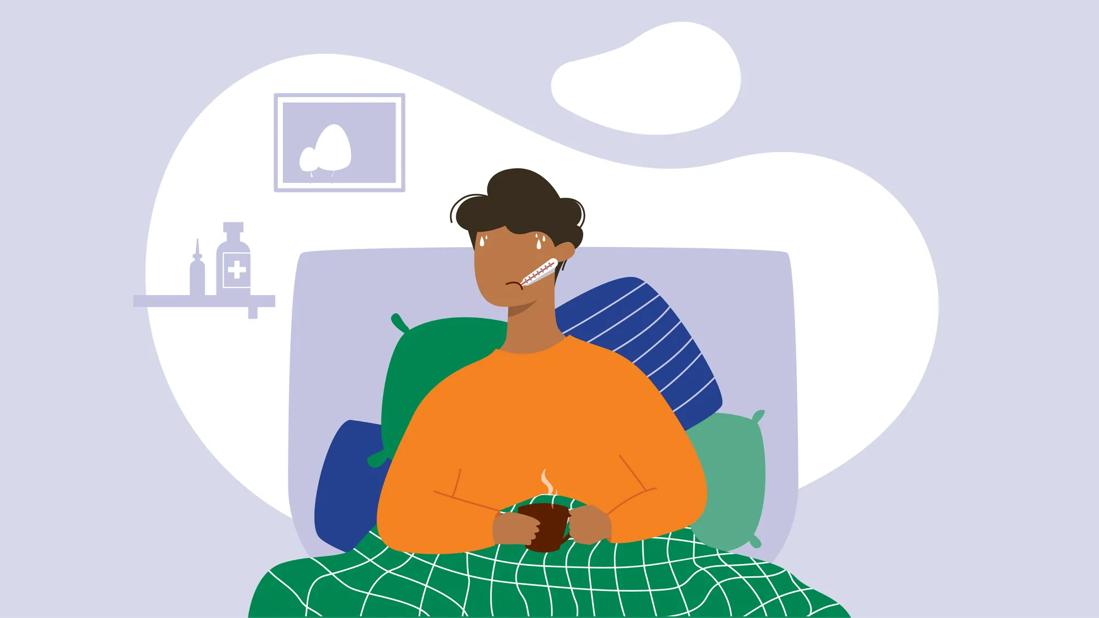
**Image content:** This image is available to view online.
View image online (https://assets.clevelandclinic.org/transform/8d718a53-6bfd-4b3e-bd67-2afa9a32d4f1/in-bed-with-fever-1189107436)
Person sitting up in bed holding hot mug, with thermometer in mouth, with perspiration
Most of us associate a fever with someone touching our forehead and saying: “You’re feeling a little warm.”
Advertisement
Cleveland Clinic is a non-profit academic medical center. Advertising on our site helps support our mission. We do not endorse non-Cleveland Clinic products or services. [Policy](https://health.clevelandclinic.org/advertising)
Medically speaking, a fever is measured by temperature: specifically, 100.4 degrees Fahrenheit (38 degrees Celsius) or higher. This happens not because of the infection or virus. Rather, because the virus or bacteria is seen as an attack, which triggers a response from your body’s immune system.
“We tend to think of a fever as something bad that we want to bring down — it’s very uncomfortable. But the funny thing is, it’s our own body starting to fight off what’s invading us,” explains family medicine specialist [John Hanicak, MD](https://my.clevelandclinic.org/staff/15223-john-hanicak).
Here, Dr. Hanicak breaks down exactly what happens to your body when you have a fever, and how to find relief.
## What’s happening to my body when I have a fever?
When you have a fever, warming up is your body’s natural response to fighting a virus. Think of it like a fire alarm that goes off when there’s a sign of smoke. Normally, your body temperature is around 98.6 F (37 C). When it hits 100.4 F (38 C) or higher, it’s signaling that something is wrong.
“If a virus gets into our system, it’s in the mucus membranes and it starts to show up in the bloodstream,” says Dr. Hanicak. “Then, our [immune system](https://my.clevelandclinic.org/health/body/21196-immune-system) releases inflammatory chemicals that increase our core temperature.
“That higher temperature makes it very uncomfortable for the virus to live. Your body is literally trying to cook the virus out.”
Advertisement
Some other things that happen when you have a fever:
- **An increase in metabolism.** During a fever, your body uses more oxygen, increases your heart and respiratory rates, and uses more protein as an energy source.
- **Your immune system goes into overdrive.** Your immune system works better in higher temperatures, and your white blood cells become more active. This helps your cells respond quicker against the infection.
- **Your muscles contract.** This can cause you to shiver or feel chills (even if you’re sweating or feeling hot at the same time).
- **Your blood vessels constrict.** When you have a fever, your vessels narrow to elevate your body’s temperature and fight infection.
### Low-grade vs. high-grade fever
There are different types of fevers that tell us the severity of the infection. If your temperature goes slightly above the normal range, it’s not always a cause for concern.
A low-grade fever is between 99 F and 100.9 F ( 37.2C to 38.3 C). “What we call a low-grade fever may actually represent a different set of illnesses than something that gives a high fever,” clarifies Dr. Hanicak.
You can get a low-grade fever with any virus, as well as other issues like an [ear infection](https://health.clevelandclinic.org/home-remedies-for-ear-infection) or [strep throat](https://health.clevelandclinic.org/strep-throat-sore-throat-best-ways-can-tell/). The symptoms of a low-grade fever are typically on the milder side, like slight fatigue, headache and/or chills.
On the other hand, a high fever is usually a sign of a more serious infection or inflammatory condition. A high-grade fever is 103 F (29.4 C) or higher. It can be seen with something like [influenza (the flu)](https://my.clevelandclinic.org/health/diseases/4335-influenza-flu), [pneumonia](https://my.clevelandclinic.org/health/diseases/4471-pneumonia) or [COVID-19](https://health.clevelandclinic.org/is-covid-still-dangerous).
With a high fever, you may feel symptoms like severe chills, confusion, rapid breathing and increased heart rate.
This is when you should seek medical attention if the temperature doesn’t go down within a day or two.
### How to fight a fever
According to Dr. Hanicak, you don’t always have to get rid of a fever because it’s a natural part of our immune response. But that doesn’t make it any less uncomfortable to deal with. If the fever is making you very uncomfortable, then it is worth treating.
“At that point, the goal is to get more comfortable so you’re not losing as much fluid and can sleep and rest and, therefore, get better faster,” he adds.
Here’s what he recommends:
- [**Medications.**](https://my.clevelandclinic.org/health/treatments/11086-non-steroidal-anti-inflammatory-medicines-nsaids) “We do recommend that you take something like [acetaminophen](https://my.clevelandclinic.org/health/drugs/18829-acetaminophen-capsules-or-tablets) (Tylenol®) or anti-inflammatory medications (NSAIDS or nonsteroidal anti-inflammatory drugs) like ibuprofen (Advil® or Motrin®) or Alleve® (naproxen) to bring down the temperature because you can get dehydrated easily when your body is warm,” explains Dr. Hanicak.
- **Consume lots of fluids.** You’re sweating more and your immune system is running in high gear, which makes you lose fluids, so it’s important to drink more than usual. That’s why our caregivers bring us water, tea and chicken soup.
- **Rest.** Whether it’s a low or high fever, now is the time to take it easy. Remember, your body is hard at work fighting off an infection, so don’t make it do any more than it needs. Focus on getting bed rest and staying off your feet at least until the fever starts to drop.
- **Cool down.** If you’re feeling especially warm, try applying a cool, damp cloth to your forehead or the back of your head. Keep your clothes light and loose so [your body has a lot of room to breathe](https://health.clevelandclinic.org/night-sweats-how-you-can-find-relief).
Advertisement
### When should I see a doctor for a fever?
How do you know when to go to the doctor? Dr. Hanicak says that if your temperature is below 100.4 F, you’re probably OK. But you should see a healthcare provider if you’re experiencing:
- **A high-grade fever.** If the fever is above 103 F (39.4 C) in adults or [100\.4 F (38 C) in infants](https://health.clevelandclinic.org/kids-fevers-when-to-worry-when-to-relax), you should see a provider.
- **A persistent fever.** Even if your fever isn’t technically rising, it’s still not a good sign if it’s not going down. If the fever lasts more than three days, it’s best to see a healthcare provider.
- **Other symptoms.** If your fever is paired with severe symptoms like a stiff neck, confusion, difficulty breathing, persistent vomiting, a rash or any concerning symptoms, it’s important to see a provider.
Advertisement
[](https://my.clevelandclinic.org/)[](https://my.clevelandclinic.org/)
[](https://health.clevelandclinic.org/)

## Better health starts here
Sign up for our Health Essentials emails for expert guidance on nutrition, fitness, sleep, skin care and more.
[Example email](https://assets.clevelandclinic.org/transform/2ff943a2-abb1-4a1c-8ede-f8848703e789/HealthEssentials-SampleEmail-2026)[Sign up](https://my.clevelandclinic.org/health-essentials-sign-up)
[Sign up](https://my.clevelandclinic.org/health-essentials-sign-up)[Example email](https://assets.clevelandclinic.org/transform/2ff943a2-abb1-4a1c-8ede-f8848703e789/HealthEssentials-SampleEmail-2026)
Learn more about our [editorial process](https://my.clevelandclinic.org/about/website/editorial-policy).
Health Library
Fever
[Overview](https://my.clevelandclinic.org/health/symptoms/10880-fever#overview)
[Possible Causes](https://my.clevelandclinic.org/health/symptoms/10880-fever#possible-causes)
[Care and Treatment](https://my.clevelandclinic.org/health/symptoms/10880-fever#care-and-treatment)
[When To Call the Doctor](https://my.clevelandclinic.org/health/symptoms/10880-fever#when-to-call-the-doctor)
[Additional Common Questions](https://my.clevelandclinic.org/health/symptoms/10880-fever#additional-common-questions)
Health Library
Fever
[Overview](https://my.clevelandclinic.org/health/symptoms/10880-fever#overview)
[Possible Causes](https://my.clevelandclinic.org/health/symptoms/10880-fever#possible-causes)
[Care and Treatment](https://my.clevelandclinic.org/health/symptoms/10880-fever#care-and-treatment)
[When To Call the Doctor](https://my.clevelandclinic.org/health/symptoms/10880-fever#when-to-call-the-doctor)
[Additional Common Questions](https://my.clevelandclinic.org/health/symptoms/10880-fever#additional-common-questions)
Advertisement
## Related Articles
[](https://health.clevelandclinic.org/why-cancer-patients-should-take-fevers-seriously)
November 20, 2025/[Cancer Care & Prevention](https://health.clevelandclinic.org/health-conditions/cancer-care-prevention)
### [When You Have Cancer, Take a Fever Seriously](https://health.clevelandclinic.org/why-cancer-patients-should-take-fevers-seriously)
https://health.clevelandclinic.org/why-cancer-patients-should-take-fevers-seriously
Any fever, especially one of 100.5 degrees Fahrenheit or higher, should trigger a call to your oncologist — and maybe a trip to the ER
[](https://health.clevelandclinic.org/breaking-a-fever)
October 29, 2025/[Primary Care](https://health.clevelandclinic.org/living-healthy/primary-care)
### [Hot Tips: How To Break a Fever](https://health.clevelandclinic.org/breaking-a-fever)
https://health.clevelandclinic.org/breaking-a-fever
A combination of rest, fluids and over-the-counter medications can help you feel better fast
[](https://health.clevelandclinic.org/kids-fevers-when-to-worry-when-to-relax)
October 24, 2024/[Children’s Health](https://health.clevelandclinic.org/living-healthy/childrens-health)
### [When Should You Worry About Your Child’s Fever?](https://health.clevelandclinic.org/kids-fevers-when-to-worry-when-to-relax)
https://health.clevelandclinic.org/kids-fevers-when-to-worry-when-to-relax
Most cases are mild and can be treated at home, but some situations may require medical care or a trip to the ER
[](https://health.clevelandclinic.org/rubbing-alcohol-for-fever)
April 27, 2023/[Cold, Flu & Respiratory Illnesses](https://health.clevelandclinic.org/health-conditions/cold-flu-respiratory-illnesses)
### [Never Use Rubbing Alcohol To Bring Down a Fever](https://health.clevelandclinic.org/rubbing-alcohol-for-fever)
https://health.clevelandclinic.org/rubbing-alcohol-for-fever
It can cause alcohol poisoning and other serious health issues, especially in kids
[](https://health.clevelandclinic.org/reduce-fever-naturally)
April 17, 2023/[Children’s Health](https://health.clevelandclinic.org/living-healthy/childrens-health)
### [How To Treat Your Child’s Fever Naturally (and When To Let It Run Its Course)](https://health.clevelandclinic.org/reduce-fever-naturally)
https://health.clevelandclinic.org/reduce-fever-naturally
It’s important not to give them fever-reducing medications right off the bat
[](https://health.clevelandclinic.org/why-am-i-always-cold)
March 9, 2022/[Primary Care](https://health.clevelandclinic.org/living-healthy/primary-care)
### [Why Am I Always Cold?](https://health.clevelandclinic.org/why-am-i-always-cold)
https://health.clevelandclinic.org/why-am-i-always-cold
Is it just a passing chill or something more serious?
[](https://health.clevelandclinic.org/your-childs-fevers-5-common-myths-debunked)
September 29, 2021/[Children’s Health](https://health.clevelandclinic.org/living-healthy/childrens-health)
### [When Your Child Has a Fever: 5 Myths Debunked](https://health.clevelandclinic.org/your-childs-fevers-5-common-myths-debunked)
https://health.clevelandclinic.org/your-childs-fevers-5-common-myths-debunked
What you need to know about these common misconceptions
[](https://health.clevelandclinic.org/when-your-childs-fever-leads-to-a-seizure-8-things-to-do-when-to-call-9-1-1)
October 9, 2018/[Children’s Health](https://health.clevelandclinic.org/living-healthy/childrens-health)
### [When Your Child’s Fever Leads to a Seizure: 8 Things to Do + When to Call 9-1-1](https://health.clevelandclinic.org/when-your-childs-fever-leads-to-a-seizure-8-things-to-do-when-to-call-9-1-1)
https://health.clevelandclinic.org/when-your-childs-fever-leads-to-a-seizure-8-things-to-do-when-to-call-9-1-1
## Trending Topics
[](https://health.clevelandclinic.org/what-is-cali-sober)
[Mental Health](https://health.clevelandclinic.org/health-conditions/mental-health)
### [What Does It Mean To Be ‘California Sober’?](https://health.clevelandclinic.org/what-is-cali-sober)
https://health.clevelandclinic.org/what-is-cali-sober
This ‘harm reduction’ approach to sobriety involves subbing one substance for another — a method that isn’t backed by research
[](https://health.clevelandclinic.org/does-your-child-want-to-wear-makeup-5-things-you-should-know)
[Children’s Health](https://health.clevelandclinic.org/living-healthy/childrens-health)
### [Is It OK for Your Kid To Wear Makeup? 5 Things To Consider](https://health.clevelandclinic.org/does-your-child-want-to-wear-makeup-5-things-you-should-know)
https://health.clevelandclinic.org/does-your-child-want-to-wear-makeup-5-things-you-should-know
Educate your child about body image, expectations and skin care first
[](https://health.clevelandclinic.org/chlorine-rash)
[Skin Care & Beauty](https://health.clevelandclinic.org/health-conditions/skin-care-beauty)
### [Is That a Chlorine Rash? What Your Skin Is Telling You](https://health.clevelandclinic.org/chlorine-rash)
https://health.clevelandclinic.org/chlorine-rash
A true chlorine allergy is extremely rare — it’s far more likely that you have a damaged skin barrier
## Health Categories To Explore
[](https://health.clevelandclinic.org/health-conditions/brain-nervous-system)[Brain & Nervous System](https://health.clevelandclinic.org/health-conditions/brain-nervous-system)
[](https://health.clevelandclinic.org/living-healthy/childrens-health)[Children’s Health](https://health.clevelandclinic.org/living-healthy/childrens-health)
[](https://health.clevelandclinic.org/diet-food-fitness/exercise-fitness)[Exercise & Fitness](https://health.clevelandclinic.org/diet-food-fitness/exercise-fitness)
[](https://health.clevelandclinic.org/health-conditions/heart-health)[Heart Health](https://health.clevelandclinic.org/health-conditions/heart-health)
[](https://health.clevelandclinic.org/living-healthy/mens-health)[Men’s Health](https://health.clevelandclinic.org/living-healthy/mens-health)
[](https://health.clevelandclinic.org/health-conditions/mental-health)[Mental Health](https://health.clevelandclinic.org/health-conditions/mental-health)
[](https://health.clevelandclinic.org/diet-food-fitness/nutrition)[Nutrition](https://health.clevelandclinic.org/diet-food-fitness/nutrition)
[](https://health.clevelandclinic.org/health-conditions/orthopaedics)[Orthopaedics](https://health.clevelandclinic.org/health-conditions/orthopaedics)
[](https://health.clevelandclinic.org/living-healthy/primary-care)[Primary Care](https://health.clevelandclinic.org/living-healthy/primary-care)
[](https://health.clevelandclinic.org/health-conditions/skin-care-beauty)[Skin Care & Beauty](https://health.clevelandclinic.org/health-conditions/skin-care-beauty)
[](https://health.clevelandclinic.org/living-healthy/wellness)[Wellness](https://health.clevelandclinic.org/living-healthy/wellness)
[](https://health.clevelandclinic.org/living-healthy/womens-health)[Women’s Health](https://health.clevelandclinic.org/living-healthy/womens-health)
### Other Popular Categories
[Aging Well](https://health.clevelandclinic.org/living-healthy/aging-well)[Allergies](https://health.clevelandclinic.org/health-conditions/allergies)[Cancer Care & Prevention](https://health.clevelandclinic.org/health-conditions/cancer-care-prevention)[Chronic Pain](https://health.clevelandclinic.org/health-conditions/chronic-pain)[Cold, Flu & Respiratory Illnesses](https://health.clevelandclinic.org/health-conditions/cold-flu-respiratory-illnesses)[Diabetes & Endocrinology](https://health.clevelandclinic.org/health-conditions/diabetes-endocrinology)[Digestive](https://health.clevelandclinic.org/health-conditions/digestive-health)[Ear, Nose & Throat](https://health.clevelandclinic.org/health-conditions/ear-nose-throat)[Eye Care](https://health.clevelandclinic.org/health-conditions/eye-care)[Infectious Disease](https://health.clevelandclinic.org/health-conditions/infectious-disease)[Lung](https://health.clevelandclinic.org/health-conditions/lung-health)[Oral Health](https://health.clevelandclinic.org/health-conditions/oral-health)[Parenting](https://health.clevelandclinic.org/living-healthy/parenting-category)[Pregnancy & Childbirth](https://health.clevelandclinic.org/living-healthy/pregnancy-childbirth)[Recipes](https://health.clevelandclinic.org/diet-food-fitness/recipes)[Rheumatology & Immunology](https://health.clevelandclinic.org/health-conditions/rheumatology-immunology)[Senior Health](https://health.clevelandclinic.org/living-healthy/senior-health)[Sex & Relationships](https://health.clevelandclinic.org/living-healthy/sex-relationships)[Sleep](https://health.clevelandclinic.org/living-healthy/sleep)[Urinary & Kidney Health](https://health.clevelandclinic.org/health-conditions/urinary-kidney-health)[Weight Loss](https://health.clevelandclinic.org/diet-food-fitness/weight-loss)
Ad
Rendered: Sat Apr 18 2026 15:09:23 GMT+0000 (Coordinated Universal Time)
#### Cleveland Clinic
[Home](https://my.clevelandclinic.org/)[About Cleveland Clinic](https://my.clevelandclinic.org/about)[Careers at Cleveland Clinic](https://jobs.clevelandclinic.org/)[Giving](https://my.clevelandclinic.org/giving)[Community Outreach](https://my.clevelandclinic.org/about/community/government-relations)[Research & Innovations](https://my.clevelandclinic.org/research)[Health Library](https://my.clevelandclinic.org/health)[Free Health eNewsletters](https://my.clevelandclinic.org/health-essentials-newsletter?utm_medium=email&utm_source=jotform&utm_campaign=he&utm_content=signuppage)[Resources for Medical Professionals](https://my.clevelandclinic.org/professionals)[Media Relations](https://newsroom.clevelandclinic.org/)
#### Site Information & Policies
[Send Us Feedback](https://my.clevelandclinic.org/webmail)[About this Website](https://my.clevelandclinic.org/about/website)[Advertising Policy](https://health.clevelandclinic.org/advertising/)[Social Media Policy](https://my.clevelandclinic.org/about/website/social-media)[Copyright, Reprints & Licensing](https://my.clevelandclinic.org/about/website/reprints-licensing)[Website Terms of Use](https://my.clevelandclinic.org/about/website/terms-of-use)[Website Privacy Policy](https://my.clevelandclinic.org/about/website/privacy-security)[Notice of Privacy Practices](https://my.clevelandclinic.org/about/website/privacy-practices)[Non-Discrimination and Availability](https://my.clevelandclinic.org/about/website/non-discrimination-notice)
#### Resources
[Mobile Apps](https://my.clevelandclinic.org/mobile-apps)[Podcasts](https://my.clevelandclinic.org/podcasts/health-essentials)
9500 Euclid Avenue, Cleveland, Ohio 44195 \| [800\.223.2273](tel:8002232273) \| © 2026 Cleveland Clinic. All Rights Reserved. | ||||||||||||
| Readable Markdown | Most of us associate a fever with someone touching our forehead and saying: “You’re feeling a little warm.”
Medically speaking, a fever is measured by temperature: specifically, 100.4 degrees Fahrenheit (38 degrees Celsius) or higher. This happens not because of the infection or virus. Rather, because the virus or bacteria is seen as an attack, which triggers a response from your body’s immune system.
“We tend to think of a fever as something bad that we want to bring down — it’s very uncomfortable. But the funny thing is, it’s our own body starting to fight off what’s invading us,” explains family medicine specialist [John Hanicak, MD](https://my.clevelandclinic.org/staff/15223-john-hanicak).
Here, Dr. Hanicak breaks down exactly what happens to your body when you have a fever, and how to find relief.
## What’s happening to my body when I have a fever?
When you have a fever, warming up is your body’s natural response to fighting a virus. Think of it like a fire alarm that goes off when there’s a sign of smoke. Normally, your body temperature is around 98.6 F (37 C). When it hits 100.4 F (38 C) or higher, it’s signaling that something is wrong.
“If a virus gets into our system, it’s in the mucus membranes and it starts to show up in the bloodstream,” says Dr. Hanicak. “Then, our [immune system](https://my.clevelandclinic.org/health/body/21196-immune-system) releases inflammatory chemicals that increase our core temperature.
“That higher temperature makes it very uncomfortable for the virus to live. Your body is literally trying to cook the virus out.”
Some other things that happen when you have a fever:
- **An increase in metabolism.** During a fever, your body uses more oxygen, increases your heart and respiratory rates, and uses more protein as an energy source.
- **Your immune system goes into overdrive.** Your immune system works better in higher temperatures, and your white blood cells become more active. This helps your cells respond quicker against the infection.
- **Your muscles contract.** This can cause you to shiver or feel chills (even if you’re sweating or feeling hot at the same time).
- **Your blood vessels constrict.** When you have a fever, your vessels narrow to elevate your body’s temperature and fight infection.
### Low-grade vs. high-grade fever
There are different types of fevers that tell us the severity of the infection. If your temperature goes slightly above the normal range, it’s not always a cause for concern.
A low-grade fever is between 99 F and 100.9 F ( 37.2C to 38.3 C). “What we call a low-grade fever may actually represent a different set of illnesses than something that gives a high fever,” clarifies Dr. Hanicak.
You can get a low-grade fever with any virus, as well as other issues like an [ear infection](https://health.clevelandclinic.org/home-remedies-for-ear-infection) or [strep throat](https://health.clevelandclinic.org/strep-throat-sore-throat-best-ways-can-tell/). The symptoms of a low-grade fever are typically on the milder side, like slight fatigue, headache and/or chills.
On the other hand, a high fever is usually a sign of a more serious infection or inflammatory condition. A high-grade fever is 103 F (29.4 C) or higher. It can be seen with something like [influenza (the flu)](https://my.clevelandclinic.org/health/diseases/4335-influenza-flu), [pneumonia](https://my.clevelandclinic.org/health/diseases/4471-pneumonia) or [COVID-19](https://health.clevelandclinic.org/is-covid-still-dangerous).
With a high fever, you may feel symptoms like severe chills, confusion, rapid breathing and increased heart rate.
This is when you should seek medical attention if the temperature doesn’t go down within a day or two.
### How to fight a fever
According to Dr. Hanicak, you don’t always have to get rid of a fever because it’s a natural part of our immune response. But that doesn’t make it any less uncomfortable to deal with. If the fever is making you very uncomfortable, then it is worth treating.
“At that point, the goal is to get more comfortable so you’re not losing as much fluid and can sleep and rest and, therefore, get better faster,” he adds.
Here’s what he recommends:
- [**Medications.**](https://my.clevelandclinic.org/health/treatments/11086-non-steroidal-anti-inflammatory-medicines-nsaids) “We do recommend that you take something like [acetaminophen](https://my.clevelandclinic.org/health/drugs/18829-acetaminophen-capsules-or-tablets) (Tylenol®) or anti-inflammatory medications (NSAIDS or nonsteroidal anti-inflammatory drugs) like ibuprofen (Advil® or Motrin®) or Alleve® (naproxen) to bring down the temperature because you can get dehydrated easily when your body is warm,” explains Dr. Hanicak.
- **Consume lots of fluids.** You’re sweating more and your immune system is running in high gear, which makes you lose fluids, so it’s important to drink more than usual. That’s why our caregivers bring us water, tea and chicken soup.
- **Rest.** Whether it’s a low or high fever, now is the time to take it easy. Remember, your body is hard at work fighting off an infection, so don’t make it do any more than it needs. Focus on getting bed rest and staying off your feet at least until the fever starts to drop.
- **Cool down.** If you’re feeling especially warm, try applying a cool, damp cloth to your forehead or the back of your head. Keep your clothes light and loose so [your body has a lot of room to breathe](https://health.clevelandclinic.org/night-sweats-how-you-can-find-relief).
### When should I see a doctor for a fever?
How do you know when to go to the doctor? Dr. Hanicak says that if your temperature is below 100.4 F, you’re probably OK. But you should see a healthcare provider if you’re experiencing:
- **A high-grade fever.** If the fever is above 103 F (39.4 C) in adults or [100\.4 F (38 C) in infants](https://health.clevelandclinic.org/kids-fevers-when-to-worry-when-to-relax), you should see a provider.
- **A persistent fever.** Even if your fever isn’t technically rising, it’s still not a good sign if it’s not going down. If the fever lasts more than three days, it’s best to see a healthcare provider.
- **Other symptoms.** If your fever is paired with severe symptoms like a stiff neck, confusion, difficulty breathing, persistent vomiting, a rash or any concerning symptoms, it’s important to see a provider. | ||||||||||||
| ML Classification | |||||||||||||
| ML Categories |
Raw JSON{
"/Health": 999,
"/Health/Health_Conditions": 882,
"/Health/Health_Conditions/Infectious_Diseases": 830,
"/Health/Health_Conditions/Infectious_Diseases/Other": 813
} | ||||||||||||
| ML Page Types |
Raw JSON{
"/Article": 999,
"/Article/Definitions": 411
} | ||||||||||||
| ML Intent Types |
Raw JSON{
"Informational": 999
} | ||||||||||||
| Content Metadata | |||||||||||||
| Language | en | ||||||||||||
| Author | Cleveland Clinic | ||||||||||||
| Publish Time | not set | ||||||||||||
| Original Publish Time | 2019-03-08 22:04:53 (7 years ago) | ||||||||||||
| Republished | No | ||||||||||||
| Word Count (Total) | 1,689 | ||||||||||||
| Word Count (Content) | 963 | ||||||||||||
| Links | |||||||||||||
| External Links | 12 | ||||||||||||
| Internal Links | 90 | ||||||||||||
| Technical SEO | |||||||||||||
| Meta Nofollow | No | ||||||||||||
| Meta Noarchive | No | ||||||||||||
| JS Rendered | No | ||||||||||||
| Redirect Target | null | ||||||||||||
| Performance | |||||||||||||
| Download Time (ms) | 53 | ||||||||||||
| TTFB (ms) | 51 | ||||||||||||
| Download Size (bytes) | 41,512 | ||||||||||||
| Shard | 143 (laksa) | ||||||||||||
| Root Hash | 9889140825964526943 | ||||||||||||
| Unparsed URL | org,clevelandclinic!health,/whats-happening-in-my-body-when-i-have-a-fever s443 | ||||||||||||