ℹ️ Skipped - page is already crawled
| Filter | Status | Condition | Details |
|---|---|---|---|
| HTTP status | PASS | download_http_code = 200 | HTTP 200 |
| Age cutoff | PASS | download_stamp > now() - 6 MONTH | 0.2 months ago |
| History drop | PASS | isNull(history_drop_reason) | No drop reason |
| Spam/ban | PASS | fh_dont_index != 1 AND ml_spam_score = 0 | ml_spam_score=0 |
| Canonical | PASS | meta_canonical IS NULL OR = '' OR = src_unparsed | Not set |
| Property | Value |
|---|---|
| URL | https://getfleek.app/blog/shutter-island-ending-explained |
| Last Crawled | 2026-04-02 08:00:06 (5 days ago) |
| First Indexed | 2025-08-01 08:02:11 (8 months ago) |
| HTTP Status Code | 200 |
| Meta Title | Shutter Island Ending Explained– Reality, Delusion, or a Masterful Bluff? |
| Meta Description | Explore the chilling conclusion of Sector 36 in our detailed ending explained. Discover hidden meanings, character motives, and unravel the intense climax. |
| Meta Canonical | null |
| Boilerpipe Text | Martin Scorsese’s
Shutter Island
(2010) is a gripping psychological thriller that has kept viewers questioning its twist for years. Based on Dennis Lehane’s novel, the film stars Leonardo DiCaprio as U.S. Marshal Teddy Daniels investigating the disappearance of a patient from Ashecliffe Hospital — but the ending flips the story on its head.
Shutter Island Ending Explained – Reality, Delusion, or a Masterful Bluff?
Let’s dive into the unraveling mystery and what the ending really means.
Plot Recap – The Setup of Illusion
Leonardo DiCaprio plays
Teddy Daniels
, a U.S. Marshal who arrives at a remote mental institution with his partner, Chuck (Mark Ruffalo), to investigate the disappearance of a patient named Rachel Solando. As Teddy digs deeper, he begins to suspect unethical experiments and a conspiracy involving the staff.
However, strange dreams and flashbacks hint that Teddy may be losing grip on reality. As he spirals, the line between hallucination and truth begins to blur.
The Big Reveal – Who Is Teddy Daniels Really?
In the final act,
Dr. Cawley (Ben Kingsley)
drops a bombshell: Teddy Daniels is not real. His real name is
Andrew Laeddis
, a patient at the asylum for the criminally insane.
Andrew was committed after murdering his manic-depressive wife Dolores, who drowned their three children. His “investigation” was actually a
role-play experiment
created by the doctors as a last-ditch attempt to break through his delusion.
Chuck is revealed to be Dr. Sheehan — Andrew's psychiatrist — playing along to observe whether the treatment will succeed.
Was It All in His Head? Yes... and No
Yes, Andrew/Teddy was living in a carefully constructed fantasy. He created the identity of Teddy Daniels to avoid the trauma of killing his wife and losing his family.
The names are even symbolic:
Teddy Daniels
= an anagram of
Edward Daniels
Rachel Solando
= an anagram of
Dolores Chanal
But even after the truth is laid bare, Andrew’s grip on reality remains fragile.
The Final Scene – A Line That Changes Everything
After the role-play, Andrew appears lucid. He talks to Dr. Sheehan about “getting off the island” — implying he accepts reality.
But then he utters this haunting line:
“Which would be worse: To live as a monster, or to die as a good man?”
This is the
key to the ending
.
Ending Interpretations – Two Powerful Theories
1. He Relapsed
This is the official reading: Andrew briefly gained clarity but slipped back into delusion. His trauma is too deep, and the doctors conclude that the experiment failed.
He’s lobotomized, ending the cycle of violence and pain.
2. He Pretended to Relapse
This theory, widely debated by fans, suggests Andrew
pretends
to relapse. He remembers everything, but chooses to be lobotomized because he can’t live with the guilt.
The final line is a cryptic farewell — a man choosing peace over truth.
This theory positions Andrew as the film’s true tragic hero
, making a conscious, self-sacrificial choice.
Symbolism in the Ending
The Lighthouse
: Represents enlightenment, truth, and exposure. Once feared as a place of torture, it becomes the site of revelation.
Water
: Constantly linked to trauma (drowning of his kids) and represents emotional depth and denial.
Fire
: Used in hallucinations — symbolizes illusion and destruction of memory.
Stairs & Spiral Shots
: Reflect Andrew’s mental descent and cyclical delusions.
Themes in the Finale
Trauma & Denial
Andrew’s psyche created Teddy as a coping mechanism. The mind’s ability to protect itself through delusion is at the heart of the film.
Guilt & Redemption
Whether he accepts his truth or not, Andrew is haunted by guilt. The ending may be his way of finding peace — even through destruction.
The Ethics of Psychiatry
The doctors’ elaborate role-play raises questions: was it therapy or manipulation? Did they truly try to help — or break — him?
Fan Reactions & Theories
Some fans argue the movie deliberately keeps things ambiguous — Scorsese never confirms either theory.
Others believe Scorsese leans toward the “pretending” theory, citing DiCaprio’s subtle final expressions.
Reddit debates often center around body language in the final scene — is the cigarette a clue?
Final Thoughts
Shutter Island
is a masterclass in psychological storytelling. Its ending delivers not just a twist, but a tragic emotional punch.
Whether Andrew Laeddis chose to forget or genuinely couldn’t accept the truth, his story is one of deep human pain. The island becomes a metaphor for isolation — not just physically, but mentally.
It's not about whether he was sane or not — it’s about what sanity means when guilt is unbearable.
FAQs
Q: Was Teddy Daniels real?
A: No. He was a persona created by Andrew Laeddis, a patient at Ashecliffe.
Q: What does the lighthouse represent?
A: It symbolizes truth and the final confrontation with reality.
Q: Did Andrew choose to be lobotomized?
A: Possibly. His final line suggests he may have pretended to relapse as a way to escape his guilt.
Q: Is
Shutter Island
based on a true story?
A: No. It’s adapted from a novel by Dennis Lehane.
Q: Why is the ending so ambiguous?
A: Director Martin Scorsese deliberately leaves it open to interpretation, allowing viewers to choose the truth that resonates most.
|
| Markdown | [Drumrolls! You can now purchase subscriptions through our Fleek website!BUY NOW!EXPLORE](https://web.getfleek.app/marketplace)
[](https://getfleek.app/)
[Discover Subscriptions](https://web.getfleek.app/marketplace)[Partner with us](https://getfleek.app/partner-with-us)[About us](https://getfleek.app/about-us)[Blog](https://getfleek.app/)[Careers](https://getfleek.app/careers)[Download Now](https://getfleek.onelink.me/MDpg/l4qs48w8)
[Download Now](https://getfleek.app/blog/shutter-island-ending-explained)
[Install the App](https://onelink.to/2ws4qq)

# Ready to manage your subscriptions ?
We will send you the link shortly.
Oops! Something went wrong while submitting the form.
[Back to Blog](https://getfleek.app/blog)
Entertainment
# Shutter Island Ending Explained– Reality, Delusion, or a Masterful Bluff?
August 2, 2025
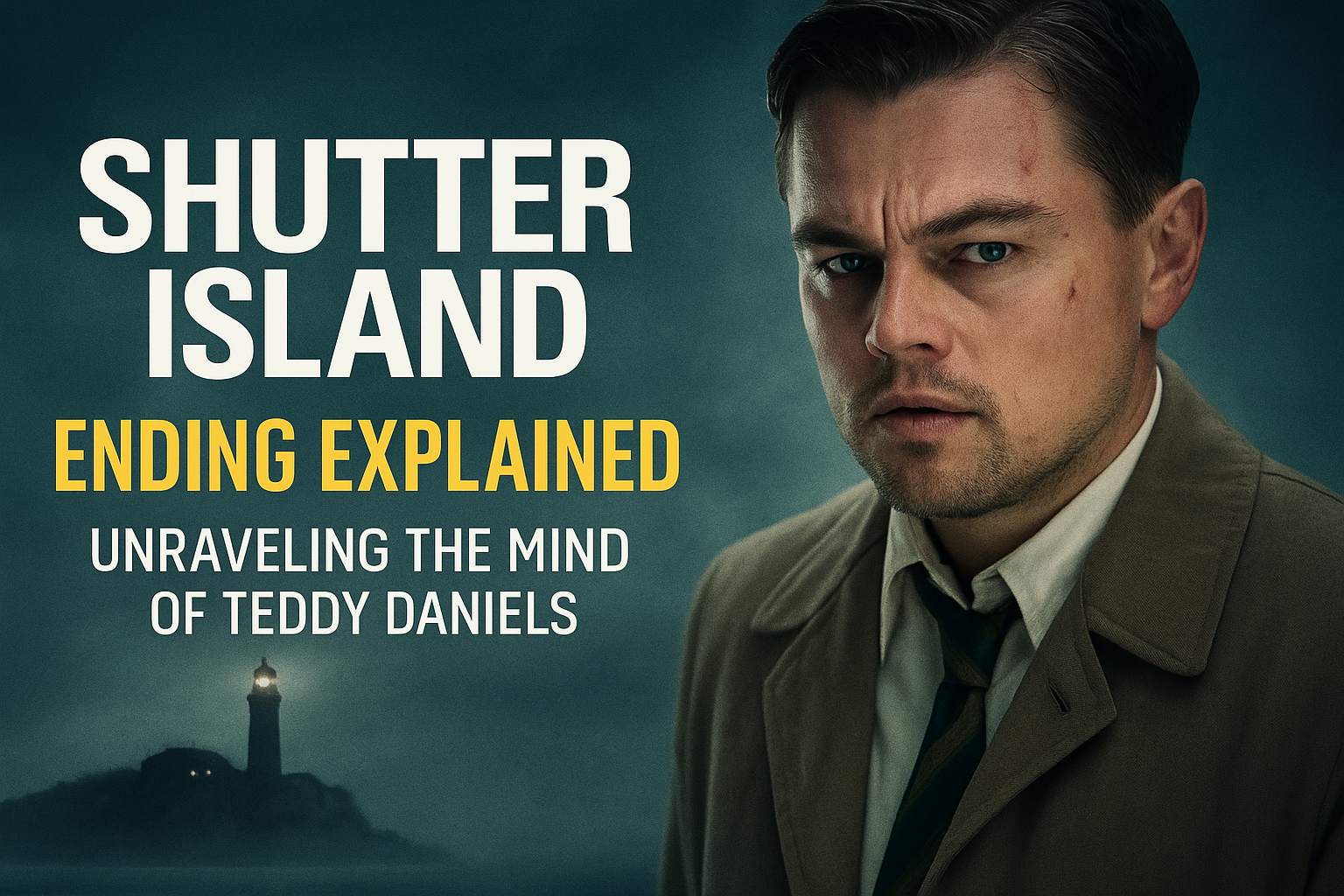
Martin Scorsese’s *Shutter Island* (2010) is a gripping psychological thriller that has kept viewers questioning its twist for years. Based on Dennis Lehane’s novel, the film stars Leonardo DiCaprio as U.S. Marshal Teddy Daniels investigating the disappearance of a patient from Ashecliffe Hospital — but the ending flips the story on its head.
## **Shutter Island Ending Explained – Reality, Delusion, or a Masterful Bluff?**
Let’s dive into the unraveling mystery and what the ending really means.
## **Plot Recap – The Setup of Illusion**
Leonardo DiCaprio plays **Teddy Daniels**, a U.S. Marshal who arrives at a remote mental institution with his partner, Chuck (Mark Ruffalo), to investigate the disappearance of a patient named Rachel Solando. As Teddy digs deeper, he begins to suspect unethical experiments and a conspiracy involving the staff.
However, strange dreams and flashbacks hint that Teddy may be losing grip on reality. As he spirals, the line between hallucination and truth begins to blur.
## **The Big Reveal – Who Is Teddy Daniels Really?**
In the final act, **Dr. Cawley (Ben Kingsley)** drops a bombshell: Teddy Daniels is not real. His real name is **Andrew Laeddis**, a patient at the asylum for the criminally insane.
Andrew was committed after murdering his manic-depressive wife Dolores, who drowned their three children. His “investigation” was actually a **role-play experiment** created by the doctors as a last-ditch attempt to break through his delusion.
Chuck is revealed to be Dr. Sheehan — Andrew's psychiatrist — playing along to observe whether the treatment will succeed.
## **Was It All in His Head? Yes... and No**
Yes, Andrew/Teddy was living in a carefully constructed fantasy. He created the identity of Teddy Daniels to avoid the trauma of killing his wife and losing his family.
The names are even symbolic:
- **Teddy Daniels** = an anagram of **Edward Daniels**
- **Rachel Solando** = an anagram of **Dolores Chanal**
But even after the truth is laid bare, Andrew’s grip on reality remains fragile.
## **The Final Scene – A Line That Changes Everything**
After the role-play, Andrew appears lucid. He talks to Dr. Sheehan about “getting off the island” — implying he accepts reality.
But then he utters this haunting line:
“Which would be worse: To live as a monster, or to die as a good man?”
This is the **key to the ending**.
## **Ending Interpretations – Two Powerful Theories**
### **1\. He Relapsed**
This is the official reading: Andrew briefly gained clarity but slipped back into delusion. His trauma is too deep, and the doctors conclude that the experiment failed.
He’s lobotomized, ending the cycle of violence and pain.
### **2\. He Pretended to Relapse**
This theory, widely debated by fans, suggests Andrew *pretends* to relapse. He remembers everything, but chooses to be lobotomized because he can’t live with the guilt.
The final line is a cryptic farewell — a man choosing peace over truth.
**This theory positions Andrew as the film’s true tragic hero**, making a conscious, self-sacrificial choice.
## **Symbolism in the Ending**
- **The Lighthouse**: Represents enlightenment, truth, and exposure. Once feared as a place of torture, it becomes the site of revelation.
- **Water**: Constantly linked to trauma (drowning of his kids) and represents emotional depth and denial.
- **Fire**: Used in hallucinations — symbolizes illusion and destruction of memory.
- **Stairs & Spiral Shots**: Reflect Andrew’s mental descent and cyclical delusions.
## **Themes in the Finale**
### **Trauma & Denial**
Andrew’s psyche created Teddy as a coping mechanism. The mind’s ability to protect itself through delusion is at the heart of the film.
### **Guilt & Redemption**
Whether he accepts his truth or not, Andrew is haunted by guilt. The ending may be his way of finding peace — even through destruction.
### **The Ethics of Psychiatry**
The doctors’ elaborate role-play raises questions: was it therapy or manipulation? Did they truly try to help — or break — him?
## **Fan Reactions & Theories**
- Some fans argue the movie deliberately keeps things ambiguous — Scorsese never confirms either theory.
- Others believe Scorsese leans toward the “pretending” theory, citing DiCaprio’s subtle final expressions.
- Reddit debates often center around body language in the final scene — is the cigarette a clue?
## **Final Thoughts**
*Shutter Island* is a masterclass in psychological storytelling. Its ending delivers not just a twist, but a tragic emotional punch.
Whether Andrew Laeddis chose to forget or genuinely couldn’t accept the truth, his story is one of deep human pain. The island becomes a metaphor for isolation — not just physically, but mentally.
It's not about whether he was sane or not — it’s about what sanity means when guilt is unbearable.
## **FAQs**
#### **Q: Was Teddy Daniels real?**
A: No. He was a persona created by Andrew Laeddis, a patient at Ashecliffe.
#### **Q: What does the lighthouse represent?**
A: It symbolizes truth and the final confrontation with reality.
#### **Q: Did Andrew choose to be lobotomized?**
A: Possibly. His final line suggests he may have pretended to relapse as a way to escape his guilt.
#### **Q: Is *Shutter Island* based on a true story?**
A: No. It’s adapted from a novel by Dennis Lehane.
#### **Q: Why is the ending so ambiguous?**
A: Director Martin Scorsese deliberately leaves it open to interpretation, allowing viewers to choose the truth that resonates most.
[Click Here to Buy Now\!](https://web.getfleek.app/marketplace)
## Subscribe to our Newsletter\!
Thank you! Your submission has been received\!
Oops! Something went wrong while submitting the form.
Related Articles
[Best Thriller Movies on Hotstar in Hindi (2025 Edition)  April 16, 2025](https://getfleek.app/blog/best-thriller-movies-on-hotstar)
[Subscriptions How to Cancel Apple Music Subscription  July 19, 2025](https://getfleek.app/blog/how-to-cancel-apple-music-subscription)
[Entertainment Best OTT Platforms for Movie Buffs : A Cinephile’s Streaming Guide  July 19, 2025](https://getfleek.app/blog/best-ott-platforms-for-movie-buffs)
The Best of subscription news all in one place \!
Subscribe below to stay updated\!
Thank you! Your submission has been received\!
Oops! Something went wrong while submitting the form.
[](https://getfleek.app/blog/shutter-island-ending-explained)
## **Join the Fleek Revolution\!**
Never pay full price for subscriptions again. And save more by tracking & managing subscriptions in the same place. Think Subscriptions, think Fleek\!
## Fleek
- [About Us](https://getfleek.app/about-us)
- [Careers](https://getfleek.app/careers)
- [Blog](https://getfleek.app/blog/shutter-island-ending-explained)[Corporate Booking](https://www.getfleek.app/partner-with-us#corporate-bookings)[Partner with us](https://getfleek.app/partner-with-us)
[FAQ](https://getfleek.app/faq/general)[Blog](https://getfleek.app/blog)
## Help & Support
- [Privacy Policy](https://getfleek.app/privacy-policy)[Terms & Conditions](https://getfleek.app/terms-and-conditions)
## Follow us on
[](https://www.linkedin.com/company/getfleekapp/mycompany/)
[](https://www.facebook.com/getfleekdotapp)
[](https://www.instagram.com/getfleekapp/)
[](https://mobile.twitter.com/getfleekdotapp)
[](https://www.youtube.com/channel/UCLI-QMbCPY81cuhfNpBEHSQ)
.png)
\+91 9353853270

\+91 9353853270
Copyright © 2020 Fleek Technologies. All rights reserved. |
| Readable Markdown | Martin Scorsese’s *Shutter Island* (2010) is a gripping psychological thriller that has kept viewers questioning its twist for years. Based on Dennis Lehane’s novel, the film stars Leonardo DiCaprio as U.S. Marshal Teddy Daniels investigating the disappearance of a patient from Ashecliffe Hospital — but the ending flips the story on its head.
## **Shutter Island Ending Explained – Reality, Delusion, or a Masterful Bluff?**
Let’s dive into the unraveling mystery and what the ending really means.
## **Plot Recap – The Setup of Illusion**
Leonardo DiCaprio plays **Teddy Daniels**, a U.S. Marshal who arrives at a remote mental institution with his partner, Chuck (Mark Ruffalo), to investigate the disappearance of a patient named Rachel Solando. As Teddy digs deeper, he begins to suspect unethical experiments and a conspiracy involving the staff.
However, strange dreams and flashbacks hint that Teddy may be losing grip on reality. As he spirals, the line between hallucination and truth begins to blur.
## **The Big Reveal – Who Is Teddy Daniels Really?**
In the final act, **Dr. Cawley (Ben Kingsley)** drops a bombshell: Teddy Daniels is not real. His real name is **Andrew Laeddis**, a patient at the asylum for the criminally insane.
Andrew was committed after murdering his manic-depressive wife Dolores, who drowned their three children. His “investigation” was actually a **role-play experiment** created by the doctors as a last-ditch attempt to break through his delusion.
Chuck is revealed to be Dr. Sheehan — Andrew's psychiatrist — playing along to observe whether the treatment will succeed.
## **Was It All in His Head? Yes... and No**
Yes, Andrew/Teddy was living in a carefully constructed fantasy. He created the identity of Teddy Daniels to avoid the trauma of killing his wife and losing his family.
The names are even symbolic:
- **Teddy Daniels** = an anagram of **Edward Daniels**
- **Rachel Solando** = an anagram of **Dolores Chanal**
But even after the truth is laid bare, Andrew’s grip on reality remains fragile.
## **The Final Scene – A Line That Changes Everything**
After the role-play, Andrew appears lucid. He talks to Dr. Sheehan about “getting off the island” — implying he accepts reality.
But then he utters this haunting line:
“Which would be worse: To live as a monster, or to die as a good man?”
This is the **key to the ending**.
## **Ending Interpretations – Two Powerful Theories**
### **1\. He Relapsed**
This is the official reading: Andrew briefly gained clarity but slipped back into delusion. His trauma is too deep, and the doctors conclude that the experiment failed.
He’s lobotomized, ending the cycle of violence and pain.
### **2\. He Pretended to Relapse**
This theory, widely debated by fans, suggests Andrew *pretends* to relapse. He remembers everything, but chooses to be lobotomized because he can’t live with the guilt.
The final line is a cryptic farewell — a man choosing peace over truth.
**This theory positions Andrew as the film’s true tragic hero**, making a conscious, self-sacrificial choice.
## **Symbolism in the Ending**
- **The Lighthouse**: Represents enlightenment, truth, and exposure. Once feared as a place of torture, it becomes the site of revelation.
- **Water**: Constantly linked to trauma (drowning of his kids) and represents emotional depth and denial.
- **Fire**: Used in hallucinations — symbolizes illusion and destruction of memory.
- **Stairs & Spiral Shots**: Reflect Andrew’s mental descent and cyclical delusions.
## **Themes in the Finale**
### **Trauma & Denial**
Andrew’s psyche created Teddy as a coping mechanism. The mind’s ability to protect itself through delusion is at the heart of the film.
### **Guilt & Redemption**
Whether he accepts his truth or not, Andrew is haunted by guilt. The ending may be his way of finding peace — even through destruction.
### **The Ethics of Psychiatry**
The doctors’ elaborate role-play raises questions: was it therapy or manipulation? Did they truly try to help — or break — him?
## **Fan Reactions & Theories**
- Some fans argue the movie deliberately keeps things ambiguous — Scorsese never confirms either theory.
- Others believe Scorsese leans toward the “pretending” theory, citing DiCaprio’s subtle final expressions.
- Reddit debates often center around body language in the final scene — is the cigarette a clue?
## **Final Thoughts**
*Shutter Island* is a masterclass in psychological storytelling. Its ending delivers not just a twist, but a tragic emotional punch.
Whether Andrew Laeddis chose to forget or genuinely couldn’t accept the truth, his story is one of deep human pain. The island becomes a metaphor for isolation — not just physically, but mentally.
It's not about whether he was sane or not — it’s about what sanity means when guilt is unbearable.
## **FAQs**
#### **Q: Was Teddy Daniels real?**
A: No. He was a persona created by Andrew Laeddis, a patient at Ashecliffe.
#### **Q: What does the lighthouse represent?**
A: It symbolizes truth and the final confrontation with reality.
#### **Q: Did Andrew choose to be lobotomized?**
A: Possibly. His final line suggests he may have pretended to relapse as a way to escape his guilt.
#### **Q: Is *Shutter Island* based on a true story?**
A: No. It’s adapted from a novel by Dennis Lehane.
#### **Q: Why is the ending so ambiguous?**
A: Director Martin Scorsese deliberately leaves it open to interpretation, allowing viewers to choose the truth that resonates most.
|
| Shard | 132 (laksa) |
| Root Hash | 17641757450897613332 |
| Unparsed URL | app,getfleek!/blog/shutter-island-ending-explained s443 |