ℹ️ Skipped - page is already crawled
| Filter | Status | Condition | Details |
|---|---|---|---|
| HTTP status | PASS | download_http_code = 200 | HTTP 200 |
| Age cutoff | PASS | download_stamp > now() - 6 MONTH | 1.2 months ago |
| History drop | PASS | isNull(history_drop_reason) | No drop reason |
| Spam/ban | PASS | fh_dont_index != 1 AND ml_spam_score = 0 | ml_spam_score=0 |
| Canonical | PASS | meta_canonical IS NULL OR = '' OR = src_unparsed | Not set |
| Property | Value | |||||||||
|---|---|---|---|---|---|---|---|---|---|---|
| URL | https://gardeningsolutions.ifas.ufl.edu/care/planting/planting-and-establishing-trees/ | |||||||||
| Last Crawled | 2026-03-24 12:34:25 (1 month ago) | |||||||||
| First Indexed | 2024-06-25 22:15:48 (1 year ago) | |||||||||
| HTTP Status Code | 200 | |||||||||
| Content | ||||||||||
| Meta Title | Planting and Establishing Trees – Gardening Solutions | |||||||||
| Meta Description | null | |||||||||
| Meta Canonical | null | |||||||||
| Boilerpipe Text | How you plant and initially care for a tree has a significant impact on its health. When you plant a tree, keep the following in mind:
Choose high-quality trees with good structure.
Like any good investment, spending a little extra cash up front on a tree of superior quality will likely pay off in the long run.
Think ahead.
Don’t plant trees that grow large beneath power lines
, close to your house, or in other potentially hazardous sites. If your home features solar panels, be sure any trees you plant will not block them.
Give trees adequate rooting space, with no obstructions.
Sturdy trees have straight main roots. Curbs, foundations, and sidewalks all act as barriers to roots, making them turn and twist. A tree with twisted roots will not be as stable as one with strong, straight roots.
If you can, plant trees in groups.
Trees planted in groups are much better protected in high winds. In addition, trees planted in combination with appropriate shrubs and groundcovers form effective windbreaks and wildlife habitat.
Placement matters.
Position trees and shrubs strategically to naturally cool or heat your home. Plant deciduous shade trees on the south, east, and west sides of a house to cast shade in summer and allow warming in winter. Tree shade can reduce air conditioning costs significantly—an air-conditioning system’s outdoor compressor/condenser unit uses less energy when it is shaded from direct sun during the day. Just be careful not to block the unit’s airflow with low branches.
How to Plant Trees
Begin your landscape renovation by putting walkways, irrigation systems or patios into place first; then plant trees. Because trees are a more permanent addition to the landscape, careful site selection and proper planting techniques are essential.
Look up.
Find a new planting site if there is a wire, security light or building nearby that could interfere with the tree as it grows.
Dig a wide, shallow hole.
Dig a hole that is two to three times the width of the root ball (the roots and soil attached to the plant when you remove it from its pot). You can also dig a hole that is only slightly larger than the root ball and simply loosen the soil around it with a shovel.
Find the point where the uppermost root emerges from the trunk.
This point is called the trunk flare, root flare or root crown and should be even with, or slightly above, the soil surface. Remove any roots that circle close to the trunk.
Slide the tree into the planting hole and position it carefully.
Place the trunk flare slightly above the surface of the landscape soil and begin to fill the hole with the excavated soil, making sure the tree is straight as you go. As you add the soil, slice a shovel down into it twenty to thirty times, all around the tree. Compress the soil with your foot to stabilize the tree.
Shave off the outer inch or so of the root ball with a sharp shovel.
This removes roots that could strangle the trunk later as it grows in diameter. It also encourages roots to quickly grow into the landscape soil and makes the tree sturdier in winds.
Add plenty of water to the root ball and planting hole.
Make sure the root ball and surrounding soil are thoroughly moistened. Add more soil around the root ball if needed.
Cover the backfill soil with mulch.
Apply mulch to a minimum 8-foot diameter circle 3 inches deep around the tree, with a gap of 12 inches between the trunk and the mulch.
Stake the tree, if necessary.
Staking holds the root ball firmly in the soil. Top-heavy trees might require staking, especially if they’re located in a windy location. Stakes should be removed within one year of planting.
Water trees frequently so roots fully establish.
Light, frequent irrigation fosters the quickest establishment for trees (see “Establishing Trees” below for more information). Following the initial few months of frequent irrigation, water weekly until plants are fully established.
Protecting Tree Roots
The health of a tree’s roots is one of the biggest factors in its success. Most tree roots are located in the top two feet of soil, where oxygen is most available. Digging near trees can cut roots, so make sure utilities are placed around or under them.
Compacted soil is also a problem for tree roots. It contains little oxygen, which tree roots need to survive and grow. Soil compaction is caused by mowing under the tree canopy, heavy equipment traffic (common during construction), and the use of fill soil in the landscape. To prevent soil compaction, do not operate equipment (like a lawn mower) or park your car under your trees. Before beginning construction, consult with your contractor to create a plan for preserving your trees. You can also construct a barrier fence outside the trees’ drip lines to keep vehicles, construction materials, and foot traffic from compacting the soil. (The fence will also protect the branches and trunk from injury.)
Trees particularly sensitive to soil compaction include sweetgum (
Liquidambar
), dogwood (
Cornus
spp.), sassafras (
Sassafras
spp.), tupelo (
Nyssa
spp.), pine (
Pinus
spp.), white oak (
Quercus alba
), laurel oak (
Quercus laurifolia
) and most nut trees, such as black walnut
(Juglans nigra
), hickory (
Carya
spp.), and pecan (
Carya illinoinensis
).
Establishing Trees
It’s important to make sure that the tree sits level in its hole and that the root ball ends up an inch or so above the surrounding ground once the hole is backfilled.
Newly planted trees need regular irrigation to rapidly grow the roots necessary for proper establishment. For trees planted in spring or summer, water two to three times per week. After the first few months, provide weekly irrigation until plants are fully established. Irrigations should be 2 to 3 gallons of water per inch trunk diameter. For example, a 2-inch tree should be watered 4 to 6 gallons each irrigation. Handwatering may be the only way you can follow this schedule and still comply with water restrictions.
Establish a structural pruning program early on to maintain one dominant trunk. Trees with one main trunk are stronger than trees with two or more trunks (co-dominant stems). Reducing the length of competing stems early in the tree’s life ensures that one trunk will dominate the others and become the main trunk, giving the tree strength and stability. This type of pruning is best performed on a regular basis for the first fifteen or twenty years after a tree is planted.
Also on Gardening Solutions
Trees
Common Landscape Pitfalls: Tree Root Problems
Planting Palms
Planting and Establishing Shrubs
Planting Trees for Energy Savings
Pruning and Maintaining Trees
More from UF/IFAS
Planting and Establishing Trees–Ask IFAS
Learn Much More About Trees
UF/IFAS Landscape Plants — Dr. Edward Gilman
(Don’t be put off by the vague name; this website is the most thorough source of research-based information on trees and shrubs found online.) | |||||||||
| Markdown | 
[Skip to main content](https://gardeningsolutions.ifas.ufl.edu/care/planting/planting-and-establishing-trees/#content)
[](https://gardeningsolutions.ifas.ufl.edu/)School Logo Link

MENU
[UF/IFAS Extension](https://sfyl.ifas.ufl.edu/) [University of Florida](https://www.ufl.edu/)

[More Resources...](https://gardeningsolutions.ifas.ufl.edu/care/planting/planting-and-establishing-trees/)
- [Infographics Collection](https://gardeningsolutions.ifas.ufl.edu/infographics-collection/)
- [Your local Extension office](https://sfyl.ifas.ufl.edu/find-your-local-office/)
- [Sign up for our newsletter](https://gardeningsolutions.ifas.ufl.edu/mastergardener/resources/newsletters/)
- [UF/IFAS News](https://blogs.ifas.ufl.edu/news/)
[UF/IFAS Extension](https://sfyl.ifas.ufl.edu/)[University of Florida](https://www.ufl.edu/)
MENU
- [Plants](https://gardeningsolutions.ifas.ufl.edu/plants/)
- [Edible Plants](https://gardeningsolutions.ifas.ufl.edu/plants/edibles/)
- [Ornamental Plants](https://gardeningsolutions.ifas.ufl.edu/plants/ornamentals/)
- [Houseplants](https://gardeningsolutions.ifas.ufl.edu/plants/houseplants/)
- [Trees and Shrubs](https://gardeningsolutions.ifas.ufl.edu/plants/trees-and-shrubs/)
- [Care](https://gardeningsolutions.ifas.ufl.edu/care/)
- [Planting](https://gardeningsolutions.ifas.ufl.edu/care/planting/)
- [Pruning](https://gardeningsolutions.ifas.ufl.edu/care/pruning/)
- [Irrigation](https://gardeningsolutions.ifas.ufl.edu/care/irrigation/)
- [Fertilizer](https://gardeningsolutions.ifas.ufl.edu/care/fertilizer/)
- [Pests and Diseases](https://gardeningsolutions.ifas.ufl.edu/care/pests-and-diseases/)
- [Weather](https://gardeningsolutions.ifas.ufl.edu/care/weather/)
- [Weeds and Invasive Plants](https://gardeningsolutions.ifas.ufl.edu/care/weeds-and-invasive-plants/)
- [Tools and Equipment](https://gardeningsolutions.ifas.ufl.edu/care/tools-and-equipment/)
- [Florida-Friendly Landscapes](https://gardeningsolutions.ifas.ufl.edu/care/florida-friendly/)
- [Design](https://gardeningsolutions.ifas.ufl.edu/design/)
- [Types of Gardens](https://gardeningsolutions.ifas.ufl.edu/design/types-of-gardens/)
- [Outdoor Living](https://gardeningsolutions.ifas.ufl.edu/design/outdoor-living/)
- [Gardening with Wildlife](https://gardeningsolutions.ifas.ufl.edu/design/gardening-with-wildlife/)
- [Landscaping for Specific Sites](https://gardeningsolutions.ifas.ufl.edu/design/landscaping-for-specific-sites/)
- [Lawns](https://gardeningsolutions.ifas.ufl.edu/lawns/)
- [Fertilizer](https://gardeningsolutions.ifas.ufl.edu/care/fertilizer/)
- [Irrigation](https://gardeningsolutions.ifas.ufl.edu/care/irrigation/)
- [Turf Types](https://gardeningsolutions.ifas.ufl.edu/lawns/turf-types/)
- [Maintenance and Care](https://gardeningsolutions.ifas.ufl.edu/lawns/maintenance-and-care/)
- [Lawn Problems and Solutions](https://gardeningsolutions.ifas.ufl.edu/lawns/problems-and-solutions/)
- [About Us](https://gardeningsolutions.ifas.ufl.edu/about-gardening-solutions/about-this-site/)
- [About Gardening Solutions](https://gardeningsolutions.ifas.ufl.edu/about-gardening-solutions/)
- [About CLUE](https://gardeningsolutions.ifas.ufl.edu/about-gardening-solutions/about-clue/)
***
[More Resources...](https://gardeningsolutions.ifas.ufl.edu/care/planting/planting-and-establishing-trees/)
- [Infographics Collection](https://gardeningsolutions.ifas.ufl.edu/infographics-collection/)
- [Your local Extension office](https://sfyl.ifas.ufl.edu/find-your-local-office/)
- [Sign up for our newsletter](https://gardeningsolutions.ifas.ufl.edu/mastergardener/resources/newsletters/)
- [UF/IFAS News](https://blogs.ifas.ufl.edu/news/)
1. [Care](https://gardeningsolutions.ifas.ufl.edu/care/ "Care")
2. [Planting](https://gardeningsolutions.ifas.ufl.edu/care/planting/ "Planting")
3. Planting and Establishing Trees
## Planting and Establishing Trees
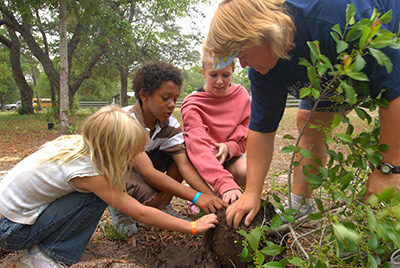
How you plant and initially care for a tree has a significant impact on its health. When you plant a tree, keep the following in mind:
- **Choose high-quality trees with good structure.** Like any good investment, spending a little extra cash up front on a tree of superior quality will likely pay off in the long run.
- **Think ahead.** [Don’t plant trees that grow large beneath power lines](https://gardeningsolutions.ifas.ufl.edu/home/care/planting/trees-and-powerlines/), close to your house, or in other potentially hazardous sites. If your home features solar panels, be sure any trees you plant will not block them.
- **Give trees adequate rooting space, with no obstructions.** Sturdy trees have straight main roots. Curbs, foundations, and sidewalks all act as barriers to roots, making them turn and twist. A tree with twisted roots will not be as stable as one with strong, straight roots.
- **If you can, plant trees in groups.** Trees planted in groups are much better protected in high winds. In addition, trees planted in combination with appropriate shrubs and groundcovers form effective windbreaks and wildlife habitat.
- **Placement matters.** Position trees and shrubs strategically to naturally cool or heat your home. Plant deciduous shade trees on the south, east, and west sides of a house to cast shade in summer and allow warming in winter. Tree shade can reduce air conditioning costs significantly—an air-conditioning system’s outdoor compressor/condenser unit uses less energy when it is shaded from direct sun during the day. Just be careful not to block the unit’s airflow with low branches.
### How to Plant Trees
Begin your landscape renovation by putting walkways, irrigation systems or patios into place first; then plant trees. Because trees are a more permanent addition to the landscape, careful site selection and proper planting techniques are essential.
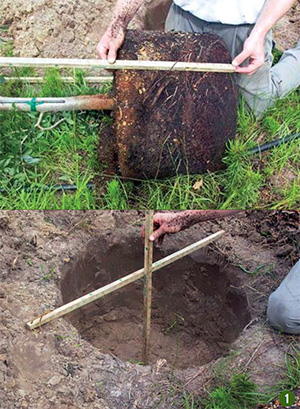
- **Look up.** Find a new planting site if there is a wire, security light or building nearby that could interfere with the tree as it grows.
- **Dig a wide, shallow hole.** Dig a hole that is two to three times the width of the root ball (the roots and soil attached to the plant when you remove it from its pot). You can also dig a hole that is only slightly larger than the root ball and simply loosen the soil around it with a shovel.
- **Find the point where the uppermost root emerges from the trunk.** This point is called the trunk flare, root flare or root crown and should be even with, or slightly above, the soil surface. Remove any roots that circle close to the trunk.
- **Slide the tree into the planting hole and position it carefully.** Place the trunk flare slightly above the surface of the landscape soil and begin to fill the hole with the excavated soil, making sure the tree is straight as you go. As you add the soil, slice a shovel down into it twenty to thirty times, all around the tree. Compress the soil with your foot to stabilize the tree.
- **Shave off the outer inch or so of the root ball with a sharp shovel.** This removes roots that could strangle the trunk later as it grows in diameter. It also encourages roots to quickly grow into the landscape soil and makes the tree sturdier in winds.
- **Add plenty of water to the root ball and planting hole.** Make sure the root ball and surrounding soil are thoroughly moistened. Add more soil around the root ball if needed.
- **Cover the backfill soil with mulch.** Apply mulch to a minimum 8-foot diameter circle 3 inches deep around the tree, with a gap of 12 inches between the trunk and the mulch.
- **Stake the tree, if necessary.** Staking holds the root ball firmly in the soil. Top-heavy trees might require staking, especially if they’re located in a windy location. Stakes should be removed within one year of planting.
- **Water trees frequently so roots fully establish.** Light, frequent irrigation fosters the quickest establishment for trees (see “Establishing Trees” below for more information). Following the initial few months of frequent irrigation, water weekly until plants are fully established.
### Protecting Tree Roots
The health of a tree’s roots is one of the biggest factors in its success. Most tree roots are located in the top two feet of soil, where oxygen is most available. Digging near trees can cut roots, so make sure utilities are placed around or under them.
Compacted soil is also a problem for tree roots. It contains little oxygen, which tree roots need to survive and grow. Soil compaction is caused by mowing under the tree canopy, heavy equipment traffic (common during construction), and the use of fill soil in the landscape. To prevent soil compaction, do not operate equipment (like a lawn mower) or park your car under your trees. Before beginning construction, consult with your contractor to create a plan for preserving your trees. You can also construct a barrier fence outside the trees’ drip lines to keep vehicles, construction materials, and foot traffic from compacting the soil. (The fence will also protect the branches and trunk from injury.)
Trees particularly sensitive to soil compaction include sweetgum (*Liquidambar*), dogwood (*Cornus* spp.), sassafras (*Sassafras* spp.), tupelo (*Nyssa* spp.), pine (*Pinus* spp.), white oak (*Quercus alba*), laurel oak (*Quercus laurifolia*) and most nut trees, such as black walnut *(Juglans nigra*), hickory (*Carya* spp.), and pecan (*Carya illinoinensis*).
### Establishing Trees
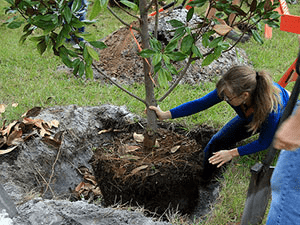
It’s important to make sure that the tree sits level in its hole and that the root ball ends up an inch or so above the surrounding ground once the hole is backfilled.
Newly planted trees need regular irrigation to rapidly grow the roots necessary for proper establishment. For trees planted in spring or summer, water two to three times per week. After the first few months, provide weekly irrigation until plants are fully established. Irrigations should be 2 to 3 gallons of water per inch trunk diameter. For example, a 2-inch tree should be watered 4 to 6 gallons each irrigation. Handwatering may be the only way you can follow this schedule and still comply with water restrictions.
Establish a structural pruning program early on to maintain one dominant trunk. Trees with one main trunk are stronger than trees with two or more trunks (co-dominant stems). Reducing the length of competing stems early in the tree’s life ensures that one trunk will dominate the others and become the main trunk, giving the tree strength and stability. This type of pruning is best performed on a regular basis for the first fifteen or twenty years after a tree is planted.
#### Also on Gardening Solutions
- [Trees](https://gardeningsolutions.ifas.ufl.edu/home/plants/trees-and-more/trees/)
- [Common Landscape Pitfalls: Tree Root Problems](https://gardeningsolutions.ifas.ufl.edu/home/plants/trees-and-more/trees/tree-root-problems/)
- [Planting Palms](https://gardeningsolutions.ifas.ufl.edu/home/care/planting/planting-palms/)
- [Planting and Establishing Shrubs](https://gardeningsolutions.ifas.ufl.edu/home/care/planting/planting-shrubs/)
- [Planting Trees for Energy Savings](https://gardeningsolutions.ifas.ufl.edu/home/design/landscaping-for-specific-sites/planting-trees-for-energy-savings/)
- [Pruning and Maintaining Trees](https://gardeningsolutions.ifas.ufl.edu/home/care/pruning/pruning-and-maintaining-trees/)
#### More from UF/IFAS
- [Planting and Establishing Trees–Ask IFAS](https://ask.ifas.ufl.edu/publication/EP314)
#### Learn Much More About Trees
- [UF/IFAS Landscape Plants — Dr. Edward Gilman](https://hort.ifas.ufl.edu/woody/)
*(Don’t be put off by the vague name; this website is the most thorough source of research-based information on trees and shrubs found online.)*
Was this page helpful? [Yes 😀](https://forms.office.com/Pages/ResponsePage.aspx?id=-KBNDTFKdk2s5gpiMx4bhH6vH0lWO5NAhkabd9tj7LhUOFI3TkpUTUlGSUowSTc3U0FVNjIwQUVNNSQlQCN0PWcu&r53d580373f41467faa50e14698ec415b=https%3A%2F%2Fgardeningsolutions.ifas.ufl.edu%2Fcare%2Fplanting%2Fplanting-and-establishing-trees%2F&rb0fd652373b44bdea159f6854746faf5=%22Yes%22) [No ☹️](https://forms.office.com/Pages/ResponsePage.aspx?id=-KBNDTFKdk2s5gpiMx4bhH6vH0lWO5NAhkabd9tj7LhUOFI3TkpUTUlGSUowSTc3U0FVNjIwQUVNNSQlQCN0PWcu&r53d580373f41467faa50e14698ec415b=https%3A%2F%2Fgardeningsolutions.ifas.ufl.edu%2Fcare%2Fplanting%2Fplanting-and-establishing-trees%2F&rb0fd652373b44bdea159f6854746faf5=%22No%22)
[](https://gardeningsolutions.ifas.ufl.edu/)
[Facebook Icon](https://www.facebook.com/florida.mastergardeners)
[Twitter Icon](https://x.com/floridamgs)
[Instagram Icon](https://www.instagram.com/florida.master.gardeners/)
[Youtube Icon](https://www.youtube.com/@UFGARDENING)
#### Contact
**[UF/IFAS Center for Land Use Efficiency](https://clue.ifas.ufl.edu/)**
2140 NE Waldo Road
Bldg. 1603 East Campus
PO Box 110675
Gainesville, FL 32609
[Site Feedback](mailto:jsykes@ufl.edu)
#### **Our Programs**
- [The Center for Land Use Efficiency](https://clue.ifas.ufl.edu/)
- [Agricultural BMP Program](https://bmp.ifas.ufl.edu/)
- [Florida-Friendly Landscaping™ Program](https://ffl.ifas.ufl.edu/)
- [The Florida Master Gardener Volunteer Program](https://gardeningsolutions.ifas.ufl.edu/mastergardener/)
- [The Neighborhood Gardener newsletter](https://gardeningsolutions.ifas.ufl.edu/mastergardener/resources/newsletters/)
#### **UF/IFAS Extension**
- [Agriculture](https://sfyl.ifas.ufl.edu/agriculture/)
- [Natural Resources](https://sfyl.ifas.ufl.edu/natural-resources/)
- [Lawn & Garden](https://sfyl.ifas.ufl.edu/lawn-and-garden/)
- [Family Resources](https://sfyl.ifas.ufl.edu/family-resources/)
- [4-H Youth Development](https://sfyl.ifas.ufl.edu/4-h-youth-development/)
#### Web Policy
- [Accessible UF](https://accessibility.ufl.edu/)
- [IFAS EEO Statement](https://ics.ifas.ufl.edu/uf-ifas-legal-statements/)
- [IFAS Web Policy](https://ics.ifas.ufl.edu/our-services/web-services/)
- [Privacy UF](https://privacy.ufl.edu/privacy-policies-and-procedures/onlineinternet-privacy-statement/)
- [Analytics (Google Privacy)](https://policies.google.com/privacy)
© 2026. [University of Florida](https://www.ufl.edu/) [IFAS Extension](https://sfyl.ifas.ufl.edu/)
Notifications | |||||||||
| Readable Markdown | 
How you plant and initially care for a tree has a significant impact on its health. When you plant a tree, keep the following in mind:
- **Choose high-quality trees with good structure.** Like any good investment, spending a little extra cash up front on a tree of superior quality will likely pay off in the long run.
- **Think ahead.** [Don’t plant trees that grow large beneath power lines](https://gardeningsolutions.ifas.ufl.edu/home/care/planting/trees-and-powerlines/), close to your house, or in other potentially hazardous sites. If your home features solar panels, be sure any trees you plant will not block them.
- **Give trees adequate rooting space, with no obstructions.** Sturdy trees have straight main roots. Curbs, foundations, and sidewalks all act as barriers to roots, making them turn and twist. A tree with twisted roots will not be as stable as one with strong, straight roots.
- **If you can, plant trees in groups.** Trees planted in groups are much better protected in high winds. In addition, trees planted in combination with appropriate shrubs and groundcovers form effective windbreaks and wildlife habitat.
- **Placement matters.** Position trees and shrubs strategically to naturally cool or heat your home. Plant deciduous shade trees on the south, east, and west sides of a house to cast shade in summer and allow warming in winter. Tree shade can reduce air conditioning costs significantly—an air-conditioning system’s outdoor compressor/condenser unit uses less energy when it is shaded from direct sun during the day. Just be careful not to block the unit’s airflow with low branches.
### How to Plant Trees
Begin your landscape renovation by putting walkways, irrigation systems or patios into place first; then plant trees. Because trees are a more permanent addition to the landscape, careful site selection and proper planting techniques are essential.

- **Look up.** Find a new planting site if there is a wire, security light or building nearby that could interfere with the tree as it grows.
- **Dig a wide, shallow hole.** Dig a hole that is two to three times the width of the root ball (the roots and soil attached to the plant when you remove it from its pot). You can also dig a hole that is only slightly larger than the root ball and simply loosen the soil around it with a shovel.
- **Find the point where the uppermost root emerges from the trunk.** This point is called the trunk flare, root flare or root crown and should be even with, or slightly above, the soil surface. Remove any roots that circle close to the trunk.
- **Slide the tree into the planting hole and position it carefully.** Place the trunk flare slightly above the surface of the landscape soil and begin to fill the hole with the excavated soil, making sure the tree is straight as you go. As you add the soil, slice a shovel down into it twenty to thirty times, all around the tree. Compress the soil with your foot to stabilize the tree.
- **Shave off the outer inch or so of the root ball with a sharp shovel.** This removes roots that could strangle the trunk later as it grows in diameter. It also encourages roots to quickly grow into the landscape soil and makes the tree sturdier in winds.
- **Add plenty of water to the root ball and planting hole.** Make sure the root ball and surrounding soil are thoroughly moistened. Add more soil around the root ball if needed.
- **Cover the backfill soil with mulch.** Apply mulch to a minimum 8-foot diameter circle 3 inches deep around the tree, with a gap of 12 inches between the trunk and the mulch.
- **Stake the tree, if necessary.** Staking holds the root ball firmly in the soil. Top-heavy trees might require staking, especially if they’re located in a windy location. Stakes should be removed within one year of planting.
- **Water trees frequently so roots fully establish.** Light, frequent irrigation fosters the quickest establishment for trees (see “Establishing Trees” below for more information). Following the initial few months of frequent irrigation, water weekly until plants are fully established.
### Protecting Tree Roots
The health of a tree’s roots is one of the biggest factors in its success. Most tree roots are located in the top two feet of soil, where oxygen is most available. Digging near trees can cut roots, so make sure utilities are placed around or under them.
Compacted soil is also a problem for tree roots. It contains little oxygen, which tree roots need to survive and grow. Soil compaction is caused by mowing under the tree canopy, heavy equipment traffic (common during construction), and the use of fill soil in the landscape. To prevent soil compaction, do not operate equipment (like a lawn mower) or park your car under your trees. Before beginning construction, consult with your contractor to create a plan for preserving your trees. You can also construct a barrier fence outside the trees’ drip lines to keep vehicles, construction materials, and foot traffic from compacting the soil. (The fence will also protect the branches and trunk from injury.)
Trees particularly sensitive to soil compaction include sweetgum (*Liquidambar*), dogwood (*Cornus* spp.), sassafras (*Sassafras* spp.), tupelo (*Nyssa* spp.), pine (*Pinus* spp.), white oak (*Quercus alba*), laurel oak (*Quercus laurifolia*) and most nut trees, such as black walnut *(Juglans nigra*), hickory (*Carya* spp.), and pecan (*Carya illinoinensis*).
### Establishing Trees

It’s important to make sure that the tree sits level in its hole and that the root ball ends up an inch or so above the surrounding ground once the hole is backfilled.
Newly planted trees need regular irrigation to rapidly grow the roots necessary for proper establishment. For trees planted in spring or summer, water two to three times per week. After the first few months, provide weekly irrigation until plants are fully established. Irrigations should be 2 to 3 gallons of water per inch trunk diameter. For example, a 2-inch tree should be watered 4 to 6 gallons each irrigation. Handwatering may be the only way you can follow this schedule and still comply with water restrictions.
Establish a structural pruning program early on to maintain one dominant trunk. Trees with one main trunk are stronger than trees with two or more trunks (co-dominant stems). Reducing the length of competing stems early in the tree’s life ensures that one trunk will dominate the others and become the main trunk, giving the tree strength and stability. This type of pruning is best performed on a regular basis for the first fifteen or twenty years after a tree is planted.
#### Also on Gardening Solutions
- [Trees](https://gardeningsolutions.ifas.ufl.edu/home/plants/trees-and-more/trees/)
- [Common Landscape Pitfalls: Tree Root Problems](https://gardeningsolutions.ifas.ufl.edu/home/plants/trees-and-more/trees/tree-root-problems/)
- [Planting Palms](https://gardeningsolutions.ifas.ufl.edu/home/care/planting/planting-palms/)
- [Planting and Establishing Shrubs](https://gardeningsolutions.ifas.ufl.edu/home/care/planting/planting-shrubs/)
- [Planting Trees for Energy Savings](https://gardeningsolutions.ifas.ufl.edu/home/design/landscaping-for-specific-sites/planting-trees-for-energy-savings/)
- [Pruning and Maintaining Trees](https://gardeningsolutions.ifas.ufl.edu/home/care/pruning/pruning-and-maintaining-trees/)
#### More from UF/IFAS
- [Planting and Establishing Trees–Ask IFAS](https://ask.ifas.ufl.edu/publication/EP314)
#### Learn Much More About Trees
- [UF/IFAS Landscape Plants — Dr. Edward Gilman](https://hort.ifas.ufl.edu/woody/)
*(Don’t be put off by the vague name; this website is the most thorough source of research-based information on trees and shrubs found online.)* | |||||||||
| ML Classification | ||||||||||
| ML Categories |
Raw JSON{
"/Home_and_Garden": 999,
"/Home_and_Garden/Patio,_Lawn_and_Garden": 996,
"/Home_and_Garden/Patio,_Lawn_and_Garden/Gardening": 943
} | |||||||||
| ML Page Types |
Raw JSON{
"/Article": 996,
"/Article/How_to": 810
} | |||||||||
| ML Intent Types |
Raw JSON{
"Informational": 998
} | |||||||||
| Content Metadata | ||||||||||
| Language | en-us | |||||||||
| Author | null | |||||||||
| Publish Time | not set | |||||||||
| Original Publish Time | 2024-06-25 22:15:48 (1 year ago) | |||||||||
| Republished | No | |||||||||
| Word Count (Total) | 1,398 | |||||||||
| Word Count (Content) | 1,173 | |||||||||
| Links | ||||||||||
| External Links | 7 | |||||||||
| Internal Links | 66 | |||||||||
| Technical SEO | ||||||||||
| Meta Nofollow | No | |||||||||
| Meta Noarchive | No | |||||||||
| JS Rendered | Yes | |||||||||
| Redirect Target | null | |||||||||
| Performance | ||||||||||
| Download Time (ms) | 196 | |||||||||
| TTFB (ms) | 150 | |||||||||
| Download Size (bytes) | 31,806 | |||||||||
| Shard | 65 (laksa) | |||||||||
| Root Hash | 9649183866810524865 | |||||||||
| Unparsed URL | edu,ufl!ifas,gardeningsolutions,/care/planting/planting-and-establishing-trees/ s443 | |||||||||