ℹ️ Skipped - page is already crawled
| Filter | Status | Condition | Details |
|---|---|---|---|
| HTTP status | PASS | download_http_code = 200 | HTTP 200 |
| Age cutoff | PASS | download_stamp > now() - 6 MONTH | 1 months ago |
| History drop | PASS | isNull(history_drop_reason) | No drop reason |
| Spam/ban | PASS | fh_dont_index != 1 AND ml_spam_score = 0 | ml_spam_score=0 |
| Canonical | PASS | meta_canonical IS NULL OR = '' OR = src_unparsed | Not set |
| Property | Value |
|---|---|
| URL | https://forresthanson.substack.com/p/quantum-mysticisms-fake-physics |
| Last Crawled | 2026-03-12 00:01:43 (29 days ago) |
| First Indexed | not set |
| HTTP Status Code | 200 |
| Meta Title | Why do people think their thoughts affect reality? |
| Meta Description | From Real Science to Magical Thinking |
| Meta Canonical | null |
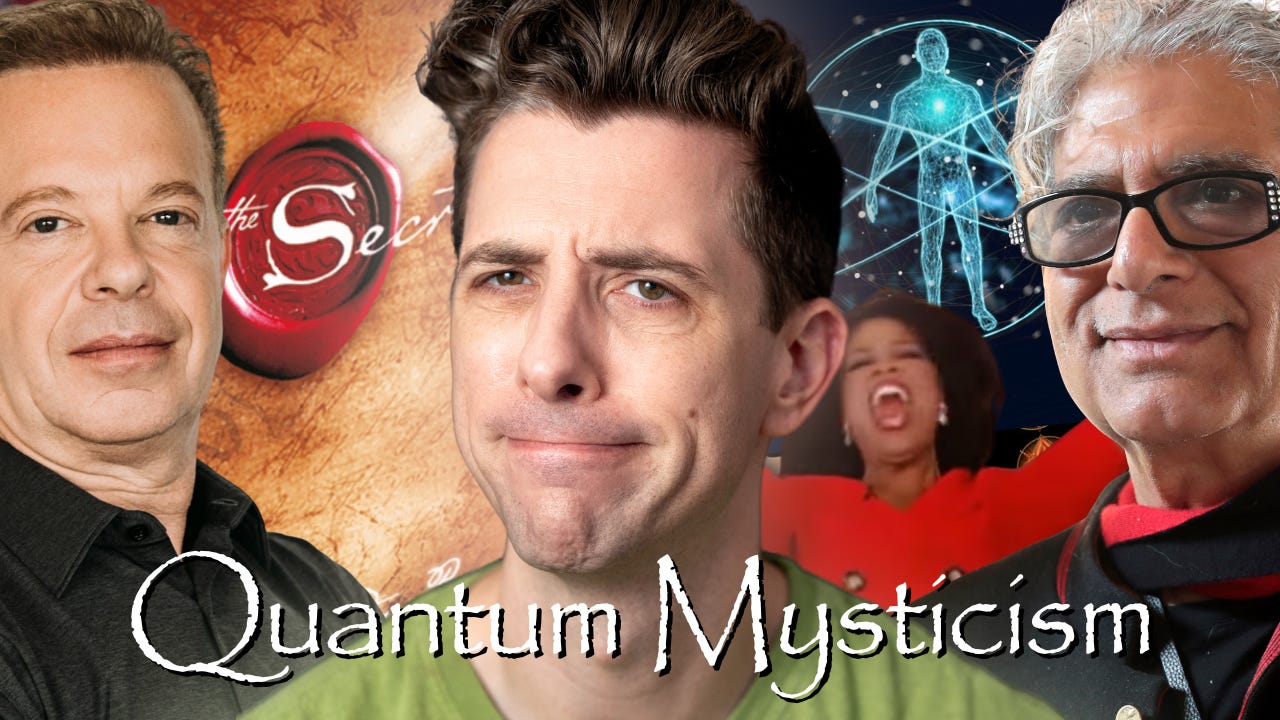
| Boilerpipe Text | I recently posted a new
YouTube video
based on the article I shared last month,
Why Are Self-Help Gurus So Interested in Quantum Physics?
It’s my favorite video we’ve made, and I hope you’ll check it out.
When working on that video, something kept bugging me.
The Secret,
The Law of Attraction, and people like Deepak Chopra and Joe Dispenza regularly refer to quantum physics as the justification for their various wacky beliefs. For example, here’s the
Law of Attraction
:
Under laboratory conditions, cutting edge science has confirmed that every thought is made up of energy and has its own unique frequency. And when this energy and frequency of a single thought radiates out into the Universe, it naturally interacts with the material world. Of course, it has long been known that matter, or physical objects, are also just packets of energy at the sub-microscopic, quantum level. And so, as your thought radiates out, it attracts the energy and frequencies of like thoughts, like objects, and even like people, and draws those things back to you.
It follows then that your THOUGHTS… BECOME… THINGS!
These claims are a complete misunderstanding (or a deliberate misrepresentation) of physics, there is
no empirical evidence
that supports the Law of Attraction, and it’s widely considered a
pseudoscience
. It’s easy to just brush things off from there, but if you’re inclined to give people the benefit of the doubt there’s still a lingering question: where did these ideas come from? Did they just make this stuff up, or were there real concepts present in quantum mechanics that led to quantum mysticism?
The simple answer is kinda. These people scaled up their misunderstanding of what are called ‘quantum observer effects’ into a whole ideology. Following this line of thinking led me down a rabbit hole that I found incredibly interesting, but which also pushed the limits of my understanding. I’m sure I’ll get some of the details wrong here, but I’ll do my best to explain how we got from Schrödinger’s cat to “my thoughts create reality.”
Schrödinger’s Cat
is a thought experiment that comes from a 1935 conversation between physicist
Erwin Schrödinger
and
Albert Einstein
. To be clear, this was not a real experiment - it was just a thought experiment that illustrated how weird quantum stuff looks when you scale it up to the size of an everyday object. In the thought experiment, a cat is put into a sealed box with a tiny radioactive source, a Geiger counter (that’s a device that can detect radioactive decay) and a vial of poison linked to a hammer. The odds of decay - which releases radioactivity - are 50/50, and if the Geiger counter detects any radioactivity, it triggers the hammer, which smashes the vial and kills the cat. If it doesn’t,
Boots
survives another day.
Now here’s where things get weird. In Schrödinger’s experiment there’s a 50% chance the cat is alive and a 50% chance the cat is dead. So you, a normal human, are probably thinking something like, “Great, the cat is either alive
or
dead, who cares?” And I say “I care, Boots matters to me.” But then a quantum physicist comes in and says, “Actually, the cat is both alive and dead.”
Wait, what?
In ordinary life, when we’re uncertain about something it usually means one of two things:
Something hasn’t yet been decided.
Something has been decided, but we don’t know what the answer is.
It’s either one or the other. Think of flipping a coin and then hiding it in your hand. We don’t know whether it’s heads or tails, but one of those things is true. The outcome has already been decided, not knowing what the coin is doesn’t change what the coin is, and opening my hand to see what’s going on doesn’t affect the coin enough to change it. But in the theory of quantum mechanics, there’s a
wave equation
that determines the state of a quantum system. When we don’t know the exact state of a system - because we haven’t measured it yet - there are many different possible states that system could be in. This is called
quantum superposition:
a mathematical combination of different possibilities that describes the system. Up until the moment you measure it, mathematically, the system is thought of as being in all of those states at the same time. This is a huge difference between our direct observation of the world (i.e., not knowing what the coin is doesn’t change what the coin is) and quantum mechanics (i.e., not knowing where the particle is means we have to treat it like it’s everywhere it plausibly could be).
But why do they do it that way? Why not just say “we don’t know?” Because in these microscopic quantum situations, superpositions actually
interfere
with each other in a way “it’s either this or that” doesn’t explain - it really seems like the particle is in all those places at the same time. The most famous example of this is the
double-slit
experiment, and yes, this is also very brain melting for people who actually study this stuff. I absolutely love
this clip
.
Leave a comment
So what does all of this have to do with the Law of Attraction?
Remember that final claim: “thoughts can become things.” One of the big problems in quantum physics is called the
measurement problem
:
superpositions exist in theory, but measurements only have a single, definitive result. So if the cat is both alive
and
dead, when does it transform into being
just
alive
or
dead? A common shorthand answer is “when it’s observed.” Which takes us to another big question: what’s the observer doing
exactly?
The
observer effect
is the idea that we can’t measure something without physically interacting with it. The word “observer” is a bit confusing, it’s really more the “measurer,” in part because it doesn’t need to be a living observer - in Schrödinger’s experiment, the Geiger counter is observing the system by measuring whether decay is happening.
Everyday examples are helpful to understand how observing a system messes with it (for example, checking the pressure of a tire can let a little air out), but this is taken to the max in quantum systems. Quantum measurement is incredibly specific and extreme: we’re talking about tiny, tiny scales, and at these scales the interaction required to get information can fundamentally change what state the system is in. Going all the way back to the flip a coin example, it would be like if the coin were volatile enough that opening our hand changed whether it was heads or tails.
This is where we get all the way back to the law of attraction. The Law of Attraction takes a real idea from quantum mechanics - that measurement affects systems - and starts playing very fast and loose with it. If our “observation” is a part of the process, then it might suggest to someone that the mind, or the consciousness, of the
person doing the observing
is affecting things. That idea was
really
appealing to people who already had a metaphysical bent, so they took it and ran with it without caring much about whether or not it was demonstrably true.
As near as we can tell, it just isn’t. There’s nothing special about it being a person that’s the observer; a Geiger counter doesn’t need a mind to take a measurement. It’s not thinking about the cat or praying that the cat is alive that alters the system, it’s when the person physically interacts with it. If anything, this is a useful metaphor for the value of real life, hands-in-the-dirt action over the power of positive thinking.
You see this kind of bait-and-switch all over quantum self-help stuff. They start with a true statement (e.g., measurement affects a quantum system) or a useful idea (e.g., thinking you can do something makes it more likely you’ll do it) then lead you through a series of logical leaps to a superficially similar but in truth totally different idea (e.g., my thoughts create reality).
Thanks for reading Being Well with Forrest Hanson! This post is public so feel free to share it.
Share
I hope you enjoyed the post, and check out
the related video
. And if you happen to be a physicist, please feel free to correct anything I got wrong in the comments. |
| Markdown | [](https://forresthanson.substack.com/)
# [](https://forresthanson.substack.com/)
Subscribe
Sign in
# Why do people think their thoughts affect reality?
### From Real Science to Magical Thinking
[](https://substack.com/@forresthanson)
[Forrest Hanson](https://substack.com/@forresthanson)
Mar 04, 2026
33
8
3
Share
I recently posted a new [YouTube video](https://youtu.be/ISA7nifVRHw) based on the article I shared last month, *[Why Are Self-Help Gurus So Interested in Quantum Physics?](https://forresthanson.substack.com/p/why-are-self-help-gurus-so-interested)* It’s my favorite video we’ve made, and I hope you’ll check it out.
[](https://substackcdn.com/image/fetch/$s_!M2Gq!,f_auto,q_auto:good,fl_progressive:steep/https%3A%2F%2Fsubstack-post-media.s3.amazonaws.com%2Fpublic%2Fimages%2F12d9349e-d66f-4778-b432-113fa6220c54_1280x720.png)
When working on that video, something kept bugging me. *The Secret,* The Law of Attraction, and people like Deepak Chopra and Joe Dispenza regularly refer to quantum physics as the justification for their various wacky beliefs. For example, here’s the [Law of Attraction](https://www.thesecret.tv/law-of-attraction/):
> Under laboratory conditions, cutting edge science has confirmed that every thought is made up of energy and has its own unique frequency. And when this energy and frequency of a single thought radiates out into the Universe, it naturally interacts with the material world. Of course, it has long been known that matter, or physical objects, are also just packets of energy at the sub-microscopic, quantum level. And so, as your thought radiates out, it attracts the energy and frequencies of like thoughts, like objects, and even like people, and draws those things back to you.
>
> It follows then that your THOUGHTS… BECOME… THINGS\!
These claims are a complete misunderstanding (or a deliberate misrepresentation) of physics, there is [no empirical evidence](https://www.scientificamerican.com/article/the-other-secret/) that supports the Law of Attraction, and it’s widely considered a [pseudoscience](https://www.livescience.com/5303-pseudoscience-secret.html). It’s easy to just brush things off from there, but if you’re inclined to give people the benefit of the doubt there’s still a lingering question: where did these ideas come from? Did they just make this stuff up, or were there real concepts present in quantum mechanics that led to quantum mysticism?
The simple answer is kinda. These people scaled up their misunderstanding of what are called ‘quantum observer effects’ into a whole ideology. Following this line of thinking led me down a rabbit hole that I found incredibly interesting, but which also pushed the limits of my understanding. I’m sure I’ll get some of the details wrong here, but I’ll do my best to explain how we got from Schrödinger’s cat to “my thoughts create reality.”
Being Well with Forrest Hanson is a reader-supported publication. To receive new posts and support my work, consider becoming a free or paid subscriber.
### Yes, Quantum Stuff is Weird
[Schrödinger’s Cat](https://www.youtube.com/watch?v=UjaAxUO6-Uw) is a thought experiment that comes from a 1935 conversation between physicist [Erwin Schrödinger](https://en.wikipedia.org/wiki/Erwin_Schr%C3%B6dinger) and [Albert Einstein](https://en.wikipedia.org/wiki/Albert_Einstein). To be clear, this was not a real experiment - it was just a thought experiment that illustrated how weird quantum stuff looks when you scale it up to the size of an everyday object. In the thought experiment, a cat is put into a sealed box with a tiny radioactive source, a Geiger counter (that’s a device that can detect radioactive decay) and a vial of poison linked to a hammer. The odds of decay - which releases radioactivity - are 50/50, and if the Geiger counter detects any radioactivity, it triggers the hammer, which smashes the vial and kills the cat. If it doesn’t, [Boots](https://upload.wikimedia.org/wikipedia/en/8/8a/Puss_in_Boots_from_Shrek.png) survives another day.
Now here’s where things get weird. In Schrödinger’s experiment there’s a 50% chance the cat is alive and a 50% chance the cat is dead. So you, a normal human, are probably thinking something like, “Great, the cat is either alive **or** dead, who cares?” And I say “I care, Boots matters to me.” But then a quantum physicist comes in and says, “Actually, the cat is both alive and dead.”
Wait, what?
In ordinary life, when we’re uncertain about something it usually means one of two things:
1. Something hasn’t yet been decided.
2. Something has been decided, but we don’t know what the answer is.
It’s either one or the other. Think of flipping a coin and then hiding it in your hand. We don’t know whether it’s heads or tails, but one of those things is true. The outcome has already been decided, not knowing what the coin is doesn’t change what the coin is, and opening my hand to see what’s going on doesn’t affect the coin enough to change it. But in the theory of quantum mechanics, there’s a *[wave equation](https://en.wikipedia.org/wiki/Schr%C3%B6dinger_equation)* that determines the state of a quantum system. When we don’t know the exact state of a system - because we haven’t measured it yet - there are many different possible states that system could be in. This is called *quantum superposition:* a mathematical combination of different possibilities that describes the system. Up until the moment you measure it, mathematically, the system is thought of as being in all of those states at the same time. This is a huge difference between our direct observation of the world (i.e., not knowing what the coin is doesn’t change what the coin is) and quantum mechanics (i.e., not knowing where the particle is means we have to treat it like it’s everywhere it plausibly could be).
But why do they do it that way? Why not just say “we don’t know?” Because in these microscopic quantum situations, superpositions actually *[interfere](https://en.wikipedia.org/wiki/Wave_interference)* with each other in a way “it’s either this or that” doesn’t explain - it really seems like the particle is in all those places at the same time. The most famous example of this is the [double-slit](https://en.wikipedia.org/wiki/Double-slit_experiment) experiment, and yes, this is also very brain melting for people who actually study this stuff. I absolutely love [this clip](https://www.youtube.com/shorts/X4pehLRhFhI).
[Leave a comment](https://forresthanson.substack.com/p/quantum-mysticisms-fake-physics/comments)
### From Quantum Mechanics to Magical Thinking
So what does all of this have to do with the Law of Attraction?
Remember that final claim: “thoughts can become things.” One of the big problems in quantum physics is called the *[measurement problem](https://en.wikipedia.org/wiki/Measurement_problem):* superpositions exist in theory, but measurements only have a single, definitive result. So if the cat is both alive **and** dead, when does it transform into being **just** alive **or** dead? A common shorthand answer is “when it’s observed.” Which takes us to another big question: what’s the observer doingexactly?
The *[observer effect](https://en.wikipedia.org/wiki/Observer_effect_\(physics\))* is the idea that we can’t measure something without physically interacting with it. The word “observer” is a bit confusing, it’s really more the “measurer,” in part because it doesn’t need to be a living observer - in Schrödinger’s experiment, the Geiger counter is observing the system by measuring whether decay is happening.
Everyday examples are helpful to understand how observing a system messes with it (for example, checking the pressure of a tire can let a little air out), but this is taken to the max in quantum systems. Quantum measurement is incredibly specific and extreme: we’re talking about tiny, tiny scales, and at these scales the interaction required to get information can fundamentally change what state the system is in. Going all the way back to the flip a coin example, it would be like if the coin were volatile enough that opening our hand changed whether it was heads or tails.
This is where we get all the way back to the law of attraction. The Law of Attraction takes a real idea from quantum mechanics - that measurement affects systems - and starts playing very fast and loose with it. If our “observation” is a part of the process, then it might suggest to someone that the mind, or the consciousness, of the **person doing the observing**is affecting things. That idea was *really* appealing to people who already had a metaphysical bent, so they took it and ran with it without caring much about whether or not it was demonstrably true.
As near as we can tell, it just isn’t. There’s nothing special about it being a person that’s the observer; a Geiger counter doesn’t need a mind to take a measurement. It’s not thinking about the cat or praying that the cat is alive that alters the system, it’s when the person physically interacts with it. If anything, this is a useful metaphor for the value of real life, hands-in-the-dirt action over the power of positive thinking.
You see this kind of bait-and-switch all over quantum self-help stuff. They start with a true statement (e.g., measurement affects a quantum system) or a useful idea (e.g., thinking you can do something makes it more likely you’ll do it) then lead you through a series of logical leaps to a superficially similar but in truth totally different idea (e.g., my thoughts create reality).
Thanks for reading Being Well with Forrest Hanson! This post is public so feel free to share it.
[Share](https://forresthanson.substack.com/p/quantum-mysticisms-fake-physics?utm_source=substack&utm_medium=email&utm_content=share&action=share)
I hope you enjoyed the post, and check out [the related video](https://youtu.be/ISA7nifVRHw). And if you happen to be a physicist, please feel free to correct anything I got wrong in the comments.
33
8
3
Share
Previous
#### Discussion about this post
Comments
Restacks
[](https://substack.com/profile/201169102-shannon-bindler?utm_source=comment)
[Shannon Bindler](https://substack.com/profile/201169102-shannon-bindler?utm_source=substack-feed-item)
[7d](https://forresthanson.substack.com/p/quantum-mysticisms-fake-physics/comment/223189200 "Mar 5, 2026, 1:14 AM")
I’ve always had issues with the "The Secret"-type thinking. What kind of bad thoughts would cause a child to be born into poverty or war? What about severe illness in babies? It just never made sense.
This earth plane is random and weird things happen, I'm all for positive thinking but its dangerous to blame bad things on bad thoughts.
[Reply]()
[Share]()
[](https://substack.com/profile/1725052-caroline-contillo?utm_source=comment)
[Caroline Contillo](https://substack.com/profile/1725052-caroline-contillo?utm_source=substack-feed-item)
[7d](https://forresthanson.substack.com/p/quantum-mysticisms-fake-physics/comment/223182059 "Mar 5, 2026, 12:54 AM")
How do you square this with the foundational Buddhist teaching that mental patterns literally structure the world of experience?
[Reply]()
[Share]()
[3 replies](https://forresthanson.substack.com/p/quantum-mysticisms-fake-physics/comment/223182059)
[6 more comments...](https://forresthanson.substack.com/p/quantum-mysticisms-fake-physics/comments)
Top
Latest
Discussions
No posts
### Ready for more?
© 2026 Forrest Hanson · [Privacy](https://substack.com/privacy) ∙ [Terms](https://substack.com/tos) ∙ [Collection notice](https://substack.com/ccpa#personal-data-collected)
[Start your Substack](https://substack.com/signup?utm_source=substack&utm_medium=web&utm_content=footer)
[Get the app](https://substack.com/app/app-store-redirect?utm_campaign=app-marketing&utm_content=web-footer-button)
[Substack](https://substack.com/) is the home for great culture
This site requires JavaScript to run correctly. Please [turn on JavaScript](https://enable-javascript.com/) or unblock scripts |
| Readable Markdown | I recently posted a new [YouTube video](https://youtu.be/ISA7nifVRHw) based on the article I shared last month, *[Why Are Self-Help Gurus So Interested in Quantum Physics?](https://forresthanson.substack.com/p/why-are-self-help-gurus-so-interested)* It’s my favorite video we’ve made, and I hope you’ll check it out.
[](https://substackcdn.com/image/fetch/$s_!M2Gq!,f_auto,q_auto:good,fl_progressive:steep/https%3A%2F%2Fsubstack-post-media.s3.amazonaws.com%2Fpublic%2Fimages%2F12d9349e-d66f-4778-b432-113fa6220c54_1280x720.png)
When working on that video, something kept bugging me. *The Secret,* The Law of Attraction, and people like Deepak Chopra and Joe Dispenza regularly refer to quantum physics as the justification for their various wacky beliefs. For example, here’s the [Law of Attraction](https://www.thesecret.tv/law-of-attraction/):
> Under laboratory conditions, cutting edge science has confirmed that every thought is made up of energy and has its own unique frequency. And when this energy and frequency of a single thought radiates out into the Universe, it naturally interacts with the material world. Of course, it has long been known that matter, or physical objects, are also just packets of energy at the sub-microscopic, quantum level. And so, as your thought radiates out, it attracts the energy and frequencies of like thoughts, like objects, and even like people, and draws those things back to you.
>
> It follows then that your THOUGHTS… BECOME… THINGS\!
These claims are a complete misunderstanding (or a deliberate misrepresentation) of physics, there is [no empirical evidence](https://www.scientificamerican.com/article/the-other-secret/) that supports the Law of Attraction, and it’s widely considered a [pseudoscience](https://www.livescience.com/5303-pseudoscience-secret.html). It’s easy to just brush things off from there, but if you’re inclined to give people the benefit of the doubt there’s still a lingering question: where did these ideas come from? Did they just make this stuff up, or were there real concepts present in quantum mechanics that led to quantum mysticism?
The simple answer is kinda. These people scaled up their misunderstanding of what are called ‘quantum observer effects’ into a whole ideology. Following this line of thinking led me down a rabbit hole that I found incredibly interesting, but which also pushed the limits of my understanding. I’m sure I’ll get some of the details wrong here, but I’ll do my best to explain how we got from Schrödinger’s cat to “my thoughts create reality.”
[Schrödinger’s Cat](https://www.youtube.com/watch?v=UjaAxUO6-Uw) is a thought experiment that comes from a 1935 conversation between physicist [Erwin Schrödinger](https://en.wikipedia.org/wiki/Erwin_Schr%C3%B6dinger) and [Albert Einstein](https://en.wikipedia.org/wiki/Albert_Einstein). To be clear, this was not a real experiment - it was just a thought experiment that illustrated how weird quantum stuff looks when you scale it up to the size of an everyday object. In the thought experiment, a cat is put into a sealed box with a tiny radioactive source, a Geiger counter (that’s a device that can detect radioactive decay) and a vial of poison linked to a hammer. The odds of decay - which releases radioactivity - are 50/50, and if the Geiger counter detects any radioactivity, it triggers the hammer, which smashes the vial and kills the cat. If it doesn’t, [Boots](https://upload.wikimedia.org/wikipedia/en/8/8a/Puss_in_Boots_from_Shrek.png) survives another day.
Now here’s where things get weird. In Schrödinger’s experiment there’s a 50% chance the cat is alive and a 50% chance the cat is dead. So you, a normal human, are probably thinking something like, “Great, the cat is either alive **or** dead, who cares?” And I say “I care, Boots matters to me.” But then a quantum physicist comes in and says, “Actually, the cat is both alive and dead.”
Wait, what?
In ordinary life, when we’re uncertain about something it usually means one of two things:
1. Something hasn’t yet been decided.
2. Something has been decided, but we don’t know what the answer is.
It’s either one or the other. Think of flipping a coin and then hiding it in your hand. We don’t know whether it’s heads or tails, but one of those things is true. The outcome has already been decided, not knowing what the coin is doesn’t change what the coin is, and opening my hand to see what’s going on doesn’t affect the coin enough to change it. But in the theory of quantum mechanics, there’s a *[wave equation](https://en.wikipedia.org/wiki/Schr%C3%B6dinger_equation)* that determines the state of a quantum system. When we don’t know the exact state of a system - because we haven’t measured it yet - there are many different possible states that system could be in. This is called *quantum superposition:* a mathematical combination of different possibilities that describes the system. Up until the moment you measure it, mathematically, the system is thought of as being in all of those states at the same time. This is a huge difference between our direct observation of the world (i.e., not knowing what the coin is doesn’t change what the coin is) and quantum mechanics (i.e., not knowing where the particle is means we have to treat it like it’s everywhere it plausibly could be).
But why do they do it that way? Why not just say “we don’t know?” Because in these microscopic quantum situations, superpositions actually *[interfere](https://en.wikipedia.org/wiki/Wave_interference)* with each other in a way “it’s either this or that” doesn’t explain - it really seems like the particle is in all those places at the same time. The most famous example of this is the [double-slit](https://en.wikipedia.org/wiki/Double-slit_experiment) experiment, and yes, this is also very brain melting for people who actually study this stuff. I absolutely love [this clip](https://www.youtube.com/shorts/X4pehLRhFhI).
[Leave a comment](https://forresthanson.substack.com/p/quantum-mysticisms-fake-physics/comments)
So what does all of this have to do with the Law of Attraction?
Remember that final claim: “thoughts can become things.” One of the big problems in quantum physics is called the *[measurement problem](https://en.wikipedia.org/wiki/Measurement_problem):* superpositions exist in theory, but measurements only have a single, definitive result. So if the cat is both alive **and** dead, when does it transform into being **just** alive **or** dead? A common shorthand answer is “when it’s observed.” Which takes us to another big question: what’s the observer doingexactly?
The *[observer effect](https://en.wikipedia.org/wiki/Observer_effect_\(physics\))* is the idea that we can’t measure something without physically interacting with it. The word “observer” is a bit confusing, it’s really more the “measurer,” in part because it doesn’t need to be a living observer - in Schrödinger’s experiment, the Geiger counter is observing the system by measuring whether decay is happening.
Everyday examples are helpful to understand how observing a system messes with it (for example, checking the pressure of a tire can let a little air out), but this is taken to the max in quantum systems. Quantum measurement is incredibly specific and extreme: we’re talking about tiny, tiny scales, and at these scales the interaction required to get information can fundamentally change what state the system is in. Going all the way back to the flip a coin example, it would be like if the coin were volatile enough that opening our hand changed whether it was heads or tails.
This is where we get all the way back to the law of attraction. The Law of Attraction takes a real idea from quantum mechanics - that measurement affects systems - and starts playing very fast and loose with it. If our “observation” is a part of the process, then it might suggest to someone that the mind, or the consciousness, of the **person doing the observing**is affecting things. That idea was *really* appealing to people who already had a metaphysical bent, so they took it and ran with it without caring much about whether or not it was demonstrably true.
As near as we can tell, it just isn’t. There’s nothing special about it being a person that’s the observer; a Geiger counter doesn’t need a mind to take a measurement. It’s not thinking about the cat or praying that the cat is alive that alters the system, it’s when the person physically interacts with it. If anything, this is a useful metaphor for the value of real life, hands-in-the-dirt action over the power of positive thinking.
You see this kind of bait-and-switch all over quantum self-help stuff. They start with a true statement (e.g., measurement affects a quantum system) or a useful idea (e.g., thinking you can do something makes it more likely you’ll do it) then lead you through a series of logical leaps to a superficially similar but in truth totally different idea (e.g., my thoughts create reality).
Thanks for reading Being Well with Forrest Hanson! This post is public so feel free to share it.
[Share](https://forresthanson.substack.com/p/quantum-mysticisms-fake-physics?utm_source=substack&utm_medium=email&utm_content=share&action=share)
I hope you enjoyed the post, and check out [the related video](https://youtu.be/ISA7nifVRHw). And if you happen to be a physicist, please feel free to correct anything I got wrong in the comments. |
| Shard | 76 (laksa) |
| Root Hash | 14862242593741677076 |
| Unparsed URL | com,substack!forresthanson,/p/quantum-mysticisms-fake-physics s443 |