ℹ️ Skipped - page is already crawled
| Filter | Status | Condition | Details |
|---|---|---|---|
| HTTP status | PASS | download_http_code = 200 | HTTP 200 |
| Age cutoff | PASS | download_stamp > now() - 6 MONTH | 0.8 months ago |
| History drop | PASS | isNull(history_drop_reason) | No drop reason |
| Spam/ban | PASS | fh_dont_index != 1 AND ml_spam_score = 0 | ml_spam_score=0 |
| Canonical | PASS | meta_canonical IS NULL OR = '' OR = src_unparsed | Not set |
| Property | Value |
|---|---|
| URL | https://en.wikiversity.org/wiki/Baryons |
| Last Crawled | 2026-03-31 09:31:02 (23 days ago) |
| First Indexed | 2015-06-15 06:36:46 (10 years ago) |
| HTTP Status Code | 200 |
| Content | |
| Meta Title | Baryons - Wikiversity |
| Meta Description | null |
| Meta Canonical | null |
| Boilerpipe Text | The following is modified from
w:Baryon
.
A
baryon
is a composite subatomic particle made of three
quarks
. Baryons are opposed to
mesons
which are made of one quark and one
antiquark
. Both baryons and mesons belong to the
hadron
family, which are the particles made of quarks. The name "baryon" comes from the Greek word for "heavy" (βαρύς, barys), because at the time of their naming, most known particles had lower masses than the baryons'.
Since baryons are composed of quarks, they participate in the
strong interaction
.
Leptons
, on the other hand, are not composed of quarks and as such do not participate in the strong interaction. The most well known baryons are the
protons
and
neutrons
which make up most of the mass of the visible
matter
in the
universe
, whereas
electrons
(the other major component of
atoms
) are leptons. Each baryon has a corresponding
antiparticle
(antibaryon) where quarks are replaced by their corresponding antiquarks. For example, a proton is made of two up quarks and one down quark; and its corresponding antiparticle, the
antiproton
, is made of two up antiquarks and one down antiquark.
Until recently, it was believed that some experiments showed the existence of
pentaquarks
—"exotic" baryons made of four quarks and one antiquark.
[
1
]
[
2
]
The particle physics community as a whole did not view their existence as likely in 2006,
[
3
]
and in 2008, considered evidence to be overwhelmingly against the existence of the reported pentaquarks.
[
4
]
Baryons are strongly interacting
fermions
—that is, they experience the
strong nuclear force
and are described by
Fermi−Dirac statistics
, which apply to all particles obeying the
Pauli exclusion principle
. This is in contrast to the
bosons
, which do not obey the exclusion principle.
Baryons, along with
mesons
, are
hadrons
, meaning they are particles composed of
quarks
. Quarks have baryon numbers of
B
=
1
⁄
3
and antiquarks have baryon number of
B
= −
1
⁄
3
. The term "baryon" usually refers to
triquarks
—baryons made of three quarks (
B
=
1
⁄
3
+
1
⁄
3
+
1
⁄
3
= 1). Other
"exotic" baryons
have been proposed, such as
pentaquarks
—baryons made of four quarks and one antiquark (
B
=
1
⁄
3
+
1
⁄
3
+
1
⁄
3
+
1
⁄
3
−
1
⁄
3
= 1), but their existence is not generally accepted. Theoretically, heptaquarks (5 quarks, 2 antiquarks), nonaquarks (6 quarks, 3 antiquarks), etc. could also exist.
Baryonic
matter
is matter composed mostly of baryons (by mass), which includes
atoms
of any sort (and thus includes nearly all matter that we may encounter or
experience
in everyday life, including our bodies).
Non-baryonic matter
, as implied by the name, is any sort of matter that is not primarily composed of baryons. This might include such ordinary matter as
neutrinos
or free
electrons
; however, it may also include exotic species of non-baryonic
dark matter
, such as
supersymmetric particles
,
axions
or
black holes
. The distinction between baryonic and non-baryonic matter is important in
cosmology
, because
Big Bang nucleosynthesis
models set tight constraints on the amount of baryonic matter present in the early
universe
.
The very existence of baryons is also a significant issue in cosmology because we have assumed that the Big Bang produced a state with equal amounts of baryons and antibaryons. The process by which baryons come to outnumber their antiparticles is called
baryogenesis
(in contrast to a process by which
leptons
account for the predominance of matter over antimatter,
leptogenesis
).
Experiments are consistent with the number of quarks in the universe being a constant and, more specifically, the number of baryons being a constant; in technical language, the total
baryon number
appears to be
conserved
.
Within the prevailing
Standard Model
of particle physics, the number of baryons may change in multiples of three due to the action of
sphalerons
, although this is rare and has not been observed experimentally. Some
grand unified theories
of particle physics also predict that a single
proton
can decay, changing the baryon number by one; however, this has not yet been observed experimentally. The excess of baryons over antibaryons in the present universe is thought to be due to non-
conservation of baryon number
in the very early universe, though this is not well understood.
Combinations of three u, d or s quarks forming baryons with a spin-
3
⁄
2
form the
uds baryon decuplet
Combinations of three u, d or s quarks forming baryons with a spin-
1
⁄
2
form the
uds baryon octet
The concept of isospin was first proposed by
Werner Heisenberg
in 1932 to explain the similarities between protons and neutrons under the
strong interaction
.
[
5
]
Although they had different electric charges, their masses were so similar that physicists believed they were actually the same particle. The different electric charges were explained as being the result of some unknown excitation similar to spin. This unknown excitation was later dubbed
isospin
by
Eugene Wigner
in 1937.
[
6
]
This belief lasted until
Murray Gell-Mann
proposed the
quark model
in 1964 (containing originally only the u, d, and s quarks).
[
7
]
The success of the isospin model is now understood to be the result of the similar masses of the u and d quarks. Since the u and d quarks have similar masses, particles made of the same number then also have similar masses. The exact specific u and d quark composition determines the charge, as u quarks carry charge +
2
⁄
3
while d quarks carry charge −
1
⁄
3
. For example the four Deltas all have different charges (
Δ
++
(uuu),
Δ
+
(uud),
Δ
0
(udd),
Δ
−
(ddd)), but have similar masses (~1,232 MeV/c
2
) as they are each made of a total of three u and d quarks. Under the isospin model, they were considered to be a single particle in different charged states.
The mathematics of isospin was modeled after that of spin. Isospin projections varied in increments of 1 just like those of spin, and to each projection was associated a "
charged state
". Since the "Delta particle" had four "charged states", it was said to be of isospin
I
=
3
⁄
2
. Its "charged states"
Δ
++
,
Δ
+
,
Δ
0
, and
Δ
−
, corresponded to the isospin projections
I
3
= +
3
⁄
2
,
I
3
= +
1
⁄
2
,
I
3
= −
1
⁄
2
, and
I
3
= −
3
⁄
2
respectively. Another example is the "nucleon particle". As there were two nucleon "charged states", it was said to be of isospin
1
⁄
2
. The positive nucleon
N
+
(proton) was identified with
I
3
= +
1
⁄
2
and the neutral nucleon
N
0
(neutron) with
I
3
= −
1
⁄
2
.
[
8
]
It was later noted that the isospin projections were related to the up and down quark content of particles by the relation:
where the
n'
s are the number of up and down quarks and antiquarks.
In the "isospin picture", the four Deltas and the two nucleons were thought to be the different states of two particles. However in the quark model, Deltas are different states of nucleons (the N
++
or N
−
are forbidden by
Pauli's exclusion principle
). Isospin, although conveying an inaccurate picture of things, is still used to classify baryons, leading to unnatural and often confusing nomenclature.
The
strangeness
flavour quantum number
S
(not to be confused with spin) was noticed to go up and down along with particle mass. The higher the mass, the lower the strangeness (the more s quarks). Particles could be described with isospin projections (related to charge) and strangeness (mass) (see the uds octet and decuplet figures on the right). As other quarks were discovered, new quantum numbers were made to have similar description of udc and udb octets and decuplets. Since only the u and d mass are similar, this description of particle mass and charge in terms of isospin and flavour quantum numbers only works well for octet and decuplet made of one u, one d and one other quark and breaks down for the other octets and decuplets (for example ucb octet and decuplet). If the quarks all had the same mass, their behaviour would be called
symmetric
, as they would all behave in exactly the same way with respect to the strong interaction. Since quarks do not have the same mass, they do not interact in the same way (exactly like an electron placed in an electric field will accelerate more than a proton placed in the same field because of its lighter mass), and the symmetry is said to be
broken
.
It was noted that charge (
Q
) was related to the isospin projection (
I
3
), the
baryon number
(
B
) and flavour quantum numbers (
S
,
C
,
B
′,
T
) by the
Gell-Mann–Nishijima formula
:
[
8
]
where
S
,
C
,
B
′, and
T
represent the
strangeness
,
charm
,
bottomness
and
topness
flavour quantum numbers respectively. They are related to the number of strange, charm, bottom, and top quarks and antiquark according to the relations:
meaning that the Gell-Mann–Nishijima formula is equivalent to the expression of charge in terms of quark content:
Spin, orbital angular momentum, and total angular momentum
[
edit
|
edit source
]
Spin
(quantum number
S
) is a
vector
quantity that represents the "intrinsic"
angular momentum
of a particle. It comes in increments of
1
⁄
2
ħ
(pronounced "h-bar"). The ħ is often dropped because it is the "fundamental" unit of spin, and it is implied that "spin 1" means "spin 1 ħ". In some systems of
natural units
, ħ is chosen to be 1, therefore does not appear anywhere.
Quarks
are
fermionic
particles of spin
1
⁄
2
(
S
=
1
⁄
2
). Because spin projections varies in increments of 1 (that is 1 ħ), a single quark has a spin vector of length
1
⁄
2
, and has two spin projections (
S
z
= +
1
⁄
2
and
S
z
= −
1
⁄
2
). Two quarks can have their spins aligned, in which case the two spin vectors add to make a vector of length
S
= 1 and three spin projections (
S
z
= +1,
S
z
= 0, and
S
z
= −1). If two quarks have unaligned spins, the spin vectors add up to make a vector of length
S
= 0 and has only one spin projection (
S
z
= 0), etc. Since baryons are made of three quarks, their spin vectors can add to make a vector of length
S
=
3
⁄
2
which has four spin projections (
S
z
= +
3
⁄
2
,
S
z
= +
1
⁄
2
,
S
z
= −
1
⁄
2
, and
S
z
= −
3
⁄
2
), or a vector of length
S
=
1
⁄
2
with two spin projections (
S
z
= +
1
⁄
2
, and
S
z
= −
1
⁄
2
).
[
9
]
There is another quantity of angular momentum, called the
orbital angular momentum
(quantum number
L
), that comes in increments of 1 ħ, which represent the angular moment due to quarks orbiting around each other. The total angular momentum (quantum number
J
) of a particle is therefore the combination of intrinsic angular momentum (spin) and orbital angular momentum. It can take any value from
J
= |
L
−
S
|
to
J
= |
L
+
S
|
, in increments of 1.
Baryon angular momentum quantum numbers for
L
= 0, 1, 2, 3
Spin (
S
)
Orbital angular momentum (
L
)
Total angular momentum (
J
)
Parity (
P
)
(
See below
)
Condensed notation (
J
P
)
1
⁄
2
0
1
⁄
2
+
1
⁄
2
+
1
3
⁄
2
,
1
⁄
2
−
3
⁄
2
−
,
1
⁄
2
−
2
5
⁄
2
,
3
⁄
2
+
5
⁄
2
+
,
3
⁄
2
+
3
7
⁄
2
,
5
⁄
2
−
7
⁄
2
−
,
5
⁄
2
−
3
⁄
2
0
3
⁄
2
+
3
⁄
2
+
1
5
⁄
2
,
3
⁄
2
,
1
⁄
2
−
5
⁄
2
−
,
3
⁄
2
−
,
1
⁄
2
−
2
7
⁄
2
,
5
⁄
2
,
3
⁄
2
+
7
⁄
2
+
,
5
⁄
2
+
,
3
⁄
2
+
3
9
⁄
2
,
7
⁄
2
,
5
⁄
2
−
9
⁄
2
−
,
7
⁄
2
−
,
5
⁄
2
−
Particle physicists are most interested in baryons with no orbital angular momentum (
L
= 0), as they correspond to
ground states
—states of minimal energy. Therefore the two groups of baryons most studied are the
S
=
1
⁄
2
;
L
= 0 and
S
=
3
⁄
2
;
L
= 0, which corresponds to
J
=
1
⁄
2
+
and
J
=
3
⁄
2
+
respectively, although they are not the only ones. It is also possible to obtain
J
=
3
⁄
2
+
particles from
S
=
1
⁄
2
and
L
= 2, as well as
S
=
3
⁄
2
and
L
= 2. This phenomena of having multiple particles in the same total angular momentum configuration is called
degeneracy
. How to distinguish between these degenerate baryons is an active area of research in
baryon spectroscopy
.
[
10
]
[
11
]
If the universe were reflected in a mirror, most of the laws of physics would be identical—things would behave the same way regardless of what we call "left" and what we call "right". This concept of mirror reflection is called
intrinsic parity
or
parity
(
P
).
Gravity
, the
electromagnetic force
, and the
strong interaction
all behave in the same way regardless of whether or not the universe is reflected in a mirror, and thus are said to
conserve parity
(P-symmetry). However, the weak interaction
does
distinguish "left" from "right", a phenomenon called
parity violation
(P-violation).
Based on this, one might think that if the
wavefunction
for each particle (more precisely, the
quantum field
for each particle type) were simultaneously mirror-reversed, then the new set of wavefunctions would perfectly satisfy the laws of physics (apart from the weak interaction). It turns out that this is not quite true: In order for the equations to be satisfied, the wavefunctions of certain types of particles have to be multiplied by −1, in addition to being mirror-reversed. Such particle types are said to have
negative
or
odd
parity (
P
= −1, or alternatively
P
= –), while the other particles are said to have
positive
or
even
parity (
P
= +1, or alternatively
P
= +).
For baryons, the parity is related to the orbital angular momentum by the relation:
[
12
]
As a consequence, baryons with no orbital angular momentum (
L
= 0) all have even parity (
P
= +).
Baryons are classified into groups according to their
isospin
(
I
) values and
quark
(
q
) content. There are six groups of baryons—
nucleon
(
N
),
Delta
(
Δ
),
Lambda
(
Λ
),
Sigma
(
Σ
),
Xi
(
Ξ
), and
Omega
(
Ω
). The rules for classification are defined by the
Particle Data Group
. These rules consider the
up
(
u
),
down
(
d
) and
strange
(
s
) quarks to be
light
and the
charm
(
c
),
bottom quark
(
b
), and
top
(
t
) to be
heavy
. The rules cover all the particles that can be made from three of each of the six quarks, even though baryons made of t quarks are not expected to exist because of the
t quark's short lifetime
. The rules do not cover pentaquarks.
[
13
]
Baryons with three [[up quark
|
u
]] and/or [[down quark
|
d
]] quarks are [[nucleon
|
N
]]'s (
I
=
1
⁄
2
) or [[delta baryon
|
Δ
]]'s (
I
=
3
⁄
2
).
Baryons with two [[up quark
|
u
]] and/or [[down quark
|
d
]] quarks are [[lambda baryon
|
Λ
]]'s (
I
= 0) or [[sigma baryon
|
Σ
]]'s (
I
= 1). If the third quark is heavy, its identity is given by a subscript.
Baryons with one [[up quark
|
u
]] or [[down quark
|
d
]] quark are [[xi baryon
|
Ξ
]]'s (
I
=
1
⁄
2
). One or two subscripts are used if one or both of the remaining quarks are heavy.
Baryons with no [[up quark
|
u
]] or [[down quark
|
d
]] quarks are [[omega baryon
|
Ω
]]'s (
I
= 0), and subscripts indicate any heavy quark content.
Baryons that decay strongly have their masses as part of their names. For example, Σ
0
does not decay strongly, but Δ
++
(1232) does.
It is also a widespread (but not universal) practice to follow some additional rules when distinguishing between some states which would otherwise have the same symbol.
[
8
]
Baryons in
total angular momentum
J
=
3
⁄
2
configuration which have the same symbols as their
J
=
1
⁄
2
counterparts are denoted by an asterisk ( * ).
Two baryons can be made of three different quarks in
J
=
1
⁄
2
configuration. In this case, a prime ( ′ ) is used to distinguish between them.
Exception
: When two of the three quarks are one up and one down quark, one baryon is dubbed Λ while the other is dubbed Σ.
Quarks carry charge, so knowing the charge of a particle indirectly gives the quark content. For example, the rules above say that a
Ξ
+
c
contains a c quark and some combination of two u and/or d quarks. The c quark as a charge of (
Q
= +
2
⁄
3
), therefore the other two must be a u quark (
Q
= +
2
⁄
3
), and a d quark (
Q
= −
1
⁄
3
) to have the correct total charge (
Q
= +1).
Ions
Mesons
Nuclear physics
Particle physics
↑
H. Muir (2003)
↑
K. Carter (2003)
↑
W.-M. Yao
et al.
(2006):
Particle listings – Θ
+
↑
C. Amsler
et al.
(2008):
Pentaquarks
↑
W. Heisenberg (1932)
↑
E. Wigner (1937)
↑
M. Gell-Mann (1964)
↑
Jump up to:
8.0
8.1
8.2
S.S.M. Wong (1998a)
↑
R. Shankar (1994)
↑
H. Garcilazo
et al.
(2007)
↑
D.M. Manley (2005)
↑
S.S.M. Wong (1998b)
↑
C. Amsler
et al.
(2008):
Naming scheme for hadrons
C. Amsler
et al.
(Particle Data Group) (2008). "Review of Particle Physics".
Physics Letters B
667
(1): 1–1340. doi:
10.1016/j.physletb.2008.07.018
.
H. Garcilazo, J. Vijande, and A. Valcarce (2007). "Faddeev study of heavy-baryon spectroscopy".
Journal of Physics G
34
(5): 961–976. doi:
10.1088/0954-3899/34/5/014
.
K. Carter (2006).
"The rise and fall of the pentaquark"
. Fermilab and Stanford Linear Accelerator Center (SLAC)
. Retrieved
2008-05-27
.
W.-M. Yao
et al.
(Particle Data Group) (2006). "Review of Particle Physics".
Journal of Physics G
33
: 1–1232. doi:
10.1088/0954-3899/33/1/001
.
D.M. Manley (2005). "Status of baryon spectroscopy".
Journal of Physics: Conference Series
5
: 230–237. doi:
10.1088/1742-6596/9/1/043
.
H. Muir (2003).
"Pentaquark discovery confounds sceptics"
. New Scientist
. Retrieved
2008-05-27
.
S.S.M. Wong (1998a). "Chapter 2—Nucleon Structure".
Introductory Nuclear Physics
(2nd ed.). New York (NY): John Wiley & Sons. pp. 21–56. ISBN
0-471-23973-9
.
S.S.M. Wong (1998b). "Chapter 3—The Deuteron".
Introductory Nuclear Physics
(2nd ed.). New York (NY): John Wiley & Sons. pp. 57–104. ISBN
0-471-23973-9
.
R. Shankar (1994).
Principles of Quantum Mechanics
(2nd ed.). New York (NY): Plenum Press. ISBN
0-306-44790-8
.
E. Wigner (1937). "On the Consequences of the Symmetry of the Nuclear Hamiltonian on the Spectroscopy of Nuclei".
Physical Review
51
(2): 106–119. doi:
10.1103/PhysRev.51.106
.
M. Gell-Mann (1964). "A Schematic of Baryons and Mesons".
Physics Letters
8
(3): 214–215. doi:
10.1016/S0031-9163(64)92001-3
.
W. Heisenberg (1932). "Über den Bau der Atomkerne I".
Zeitschrift für Physik
77
: 1–11. doi:
10.1007/BF01342433
.
(German)
W. Heisenberg (1932). "Über den Bau der Atomkerne II".
Zeitschrift für Physik
78
: 156–164. doi:
10.1007/BF01337585
.
(German)
W. Heisenberg (1932). "Über den Bau der Atomkerne III".
Zeitschrift für Physik
80
: 587–596. doi:
10.1007/BF01335696
.
(German)
Particle Data Group—
Review of Particle Physics (2008).
Georgia State University—
HyperPhysics
{{
Charge ontology
}} |
| Markdown | [Jump to content](https://en.wikiversity.org/wiki/Baryons#bodyContent)
Main menu
Main menu
move to sidebar
hide
Navigation
- [Main Page](https://en.wikiversity.org/wiki/Wikiversity:Main_Page)
- [Browse](https://en.wikiversity.org/wiki/Wikiversity:Browse)
- [Recent changes](https://en.wikiversity.org/wiki/Special:RecentChanges "A list of recent changes in the wiki [alt-r]")
- [Guided tours](https://en.wikiversity.org/wiki/Help:Guides)
- [Random](https://en.wikiversity.org/wiki/Special:RandomRootpage)
- [Help](https://en.wikiversity.org/wiki/Help:Contents "The place to find out")
Community
- [Portal](https://en.wikiversity.org/wiki/Wikiversity:Community_Portal "About the project, what you can do, where to find things")
- [Colloquium](https://en.wikiversity.org/wiki/Wikiversity:Colloquium)
- [News](https://en.wikiversity.org/wiki/Wikiversity:News "Find background information on current events")
- [Projects](https://en.wikiversity.org/wiki/Wikiversity:Community_projects)
- [Sandbox](https://en.wikiversity.org/wiki/Wikiversity:Sandbox)
[ ](https://en.wikiversity.org/wiki/Wikiversity:Main_Page)
[Search](https://en.wikiversity.org/wiki/Special:Search "Search Wikiversity [alt-f]")
Appearance
Appearance
move to sidebar
hide
Text
This page always uses small font size
Width
The content is as wide as possible for your browser window.
Color (beta)
This page is always in light mode.
- [Donate](https://donate.wikimedia.org/?wmf_source=donate&wmf_medium=sidebar&wmf_campaign=en.wikiversity.org&uselang=en)
- [Create account](https://en.wikiversity.org/w/index.php?title=Special:CreateAccount&returnto=Baryons "You are encouraged to create an account and log in; however, it is not mandatory")
- [Log in](https://en.wikiversity.org/w/index.php?title=Special:UserLogin&returnto=Baryons "You are encouraged to log in; however, it is not mandatory [alt-o]")
Personal tools
- [Donate](https://donate.wikimedia.org/?wmf_source=donate&wmf_medium=sidebar&wmf_campaign=en.wikiversity.org&uselang=en)
- [Create account](https://en.wikiversity.org/w/index.php?title=Special:CreateAccount&returnto=Baryons "You are encouraged to create an account and log in; however, it is not mandatory")
- [Log in](https://en.wikiversity.org/w/index.php?title=Special:UserLogin&returnto=Baryons "You are encouraged to log in; however, it is not mandatory [alt-o]")
\[[dismiss]()\]
[Why create a Wikiversity account?](https://en.wikiversity.org/wiki/Wikiversity:Why_create_an_account%3F "Wikiversity:Why create an account?")
Toggle the table of contents
## Contents
move to sidebar
hide
- [Beginning](https://en.wikiversity.org/wiki/Baryons)
- [1 Background](https://en.wikiversity.org/wiki/Baryons#Background)
- [2 Baryonic matter](https://en.wikiversity.org/wiki/Baryons#Baryonic_matter)
- [3 Baryogenesis](https://en.wikiversity.org/wiki/Baryons#Baryogenesis)
- [4 Properties](https://en.wikiversity.org/wiki/Baryons#Properties)
Toggle Properties subsection
- [4\.1 Isospin and charge](https://en.wikiversity.org/wiki/Baryons#Isospin_and_charge)
- [4\.2 Flavour quantum numbers](https://en.wikiversity.org/wiki/Baryons#Flavour_quantum_numbers)
- [4\.3 Spin, orbital angular momentum, and total angular momentum](https://en.wikiversity.org/wiki/Baryons#Spin,_orbital_angular_momentum,_and_total_angular_momentum)
- [4\.4 Parity](https://en.wikiversity.org/wiki/Baryons#Parity)
- [5 Nomenclature](https://en.wikiversity.org/wiki/Baryons#Nomenclature)
- [6 See also](https://en.wikiversity.org/wiki/Baryons#See_also)
- [7 Notes](https://en.wikiversity.org/wiki/Baryons#Notes)
- [8 References](https://en.wikiversity.org/wiki/Baryons#References)
- [9 External links](https://en.wikiversity.org/wiki/Baryons#External_links)
# Baryons
Add languages
[Add links](https://www.wikidata.org/wiki/Special:EntityPage/Q159731#sitelinks-wikiversity "Add interlanguage links")
- [Resource](https://en.wikiversity.org/wiki/Baryons "View the content page [alt-c]")
- [Discuss](https://en.wikiversity.org/w/index.php?title=Talk:Baryons&action=edit&redlink=1 "Discussion about the content page (page does not exist) [alt-t]")
English
- [Read](https://en.wikiversity.org/wiki/Baryons)
- [Edit](https://en.wikiversity.org/w/index.php?title=Baryons&veaction=edit "Edit this page [alt-v]")
- [Edit source](https://en.wikiversity.org/w/index.php?title=Baryons&action=edit "Edit the source code of this page [alt-e]")
- [View history](https://en.wikiversity.org/w/index.php?title=Baryons&action=history "Past revisions of this page [alt-h]")
Tools
Tools
move to sidebar
hide
Actions
- [Read](https://en.wikiversity.org/wiki/Baryons)
- [Edit](https://en.wikiversity.org/w/index.php?title=Baryons&veaction=edit "Edit this page [alt-v]")
- [Edit source](https://en.wikiversity.org/w/index.php?title=Baryons&action=edit "Edit the source code of this page [alt-e]")
- [View history](https://en.wikiversity.org/w/index.php?title=Baryons&action=history)
General
- [What links here](https://en.wikiversity.org/wiki/Special:WhatLinksHere/Baryons "A list of all wiki pages that link here [alt-j]")
- [Related changes](https://en.wikiversity.org/wiki/Special:RecentChangesLinked/Baryons "Recent changes in pages linked from this page [alt-k]")
- [Permanent link](https://en.wikiversity.org/w/index.php?title=Baryons&oldid=1993467 "Permanent link to this revision of this page")
- [Page information](https://en.wikiversity.org/w/index.php?title=Baryons&action=info "More information about this page")
- [Cite this page](https://en.wikiversity.org/w/index.php?title=Special:CiteThisPage&page=Baryons&id=1993467&wpFormIdentifier=titleform "Information on how to cite this page")
- [Get shortened URL](https://en.wikiversity.org/w/index.php?title=Special:UrlShortener&url=https%3A%2F%2Fen.wikiversity.org%2Fwiki%2FBaryons)
- [Expand all](https://en.wikiversity.org/wiki/Baryons "Expand all collapsible elements on the current page")
- [Add interlanguage links](https://www.wikidata.org/wiki/Special:EntityPage/Q159731#sitelinks-wikiversity "Add interlanguage links")
Wikimedia Projects
- [Commons](https://commons.wikimedia.org/wiki/Main_Page)
- [Wikibooks](https://en.wikibooks.org/wiki/Project:Main_Page)
- [Wikidata](https://www.wikidata.org/wiki/Wikidata:Main_Page)
- [Wikinews](https://en.wikinews.org/wiki/Main_Page)
- [Wikipedia](https://en.wikipedia.org/wiki/Main_Page)
- [Wikiquote](https://en.wikiquote.org/wiki/Main_Page)
- [Wikisource](https://en.wikisource.org/wiki/Main_Page)
- [Wikispecies](https://species.wikimedia.org/wiki/Main_Page)
- [Wikivoyage](https://en.wikivoyage.org/wiki/Main_Page)
- [Wiktionary](https://en.wiktionary.org/wiki/Project:Main_Page)
- [Meta-Wiki](https://meta.wikimedia.org/wiki/Main_Page)
- [Outreach](https://outreach.wikimedia.org/wiki/Main_Page)
- [MediaWiki](https://www.mediawiki.org/wiki/MediaWiki)
- [Wikimania](https://meta.wikimedia.org/wiki/Wikimania)
Print/export
- [Create a book](https://en.wikiversity.org/w/index.php?title=Special:Book&bookcmd=book_creator&referer=Baryons)
- [Download as PDF](https://en.wikiversity.org/w/index.php?title=Special:DownloadAsPdf&page=Baryons&action=show-download-screen)
- [Printable version](https://en.wikiversity.org/w/index.php?title=Baryons&printable=yes "Printable version of this page [alt-p]")
In other projects
- [Wikimedia Commons](https://commons.wikimedia.org/wiki/Category:Baryons)
- [Wikipedia](https://en.wikipedia.org/wiki/Baryon)
- [Wikidata item](https://www.wikidata.org/wiki/Special:EntityPage/Q159731 "Link to connected data repository item [alt-g]")
From Wikiversity
*The following is modified from [w:Baryon](https://en.wikipedia.org/wiki/Baryon "w:Baryon")*.
A **baryon** is a composite subatomic particle made of three [quarks](https://en.wikiversity.org/w/index.php?title=Quark&action=edit&redlink=1 "Quark (page does not exist)"). Baryons are opposed to [mesons](https://en.wikiversity.org/w/index.php?title=Radiation/Mesons&action=edit&redlink=1 "Radiation/Mesons (page does not exist)") which are made of one quark and one [antiquark](https://en.wikiversity.org/w/index.php?title=Antiquark&action=edit&redlink=1 "Antiquark (page does not exist)"). Both baryons and mesons belong to the *[hadron](https://en.wikiversity.org/w/index.php?title=Hadron&action=edit&redlink=1 "Hadron (page does not exist)")* family, which are the particles made of quarks. The name "baryon" comes from the Greek word for "heavy" (βαρύς, barys), because at the time of their naming, most known particles had lower masses than the baryons'.
Since baryons are composed of quarks, they participate in the [strong interaction](https://en.wikiversity.org/w/index.php?title=Charges/Interactions/Strong&action=edit&redlink=1 "Charges/Interactions/Strong (page does not exist)"). [Leptons](https://en.wikiversity.org/w/index.php?title=Lepton&action=edit&redlink=1 "Lepton (page does not exist)"), on the other hand, are not composed of quarks and as such do not participate in the strong interaction. The most well known baryons are the [protons](https://en.wikiversity.org/w/index.php?title=Protons&action=edit&redlink=1 "Protons (page does not exist)") and [neutrons](https://en.wikiversity.org/w/index.php?title=Neutrons&action=edit&redlink=1 "Neutrons (page does not exist)") which make up most of the mass of the visible [matter](https://en.wikiversity.org/w/index.php?title=Matter&action=edit&redlink=1 "Matter (page does not exist)") in the [universe](https://en.wikiversity.org/wiki/Universe "Universe"), whereas [electrons](https://en.wikiversity.org/w/index.php?title=Electron&action=edit&redlink=1 "Electron (page does not exist)") (the other major component of [atoms](https://en.wikiversity.org/w/index.php?title=Atom&action=edit&redlink=1 "Atom (page does not exist)")) are leptons. Each baryon has a corresponding [antiparticle](https://en.wikiversity.org/w/index.php?title=Antiparticle&action=edit&redlink=1 "Antiparticle (page does not exist)") (antibaryon) where quarks are replaced by their corresponding antiquarks. For example, a proton is made of two up quarks and one down quark; and its corresponding antiparticle, the [antiproton](https://en.wikiversity.org/w/index.php?title=Antiproton&action=edit&redlink=1 "Antiproton (page does not exist)"), is made of two up antiquarks and one down antiquark.
Until recently, it was believed that some experiments showed the existence of *[pentaquarks](https://en.wikiversity.org/w/index.php?title=Pentaquark&action=edit&redlink=1 "Pentaquark (page does not exist)")*—"exotic" baryons made of four quarks and one antiquark.[\[1\]](https://en.wikiversity.org/wiki/Baryons#cite_note-1)[\[2\]](https://en.wikiversity.org/wiki/Baryons#cite_note-2) The particle physics community as a whole did not view their existence as likely in 2006,[\[3\]](https://en.wikiversity.org/wiki/Baryons#cite_note-PDGPentaquarks2006-3) and in 2008, considered evidence to be overwhelmingly against the existence of the reported pentaquarks.[\[4\]](https://en.wikiversity.org/wiki/Baryons#cite_note-PDGPentaquarks2008-4)
## Background
\[[edit](https://en.wikiversity.org/w/index.php?title=Baryons&veaction=edit§ion=1 "Edit section: Background") \| [edit source](https://en.wikiversity.org/w/index.php?title=Baryons&action=edit§ion=1 "Edit section's source code: Background")\]
Baryons are strongly interacting [fermions](https://en.wikiversity.org/w/index.php?title=Fermion&action=edit&redlink=1 "Fermion (page does not exist)")—that is, they experience the [strong nuclear force](https://en.wikiversity.org/w/index.php?title=Strong_nuclear_force&action=edit&redlink=1 "Strong nuclear force (page does not exist)") and are described by [Fermi−Dirac statistics](https://en.wikiversity.org/w/index.php?title=Fermi%E2%88%92Dirac_statistics&action=edit&redlink=1 "Fermi−Dirac statistics (page does not exist)"), which apply to all particles obeying the [Pauli exclusion principle](https://en.wikiversity.org/w/index.php?title=Pauli_exclusion_principle&action=edit&redlink=1 "Pauli exclusion principle (page does not exist)"). This is in contrast to the [bosons](https://en.wikiversity.org/w/index.php?title=Boson&action=edit&redlink=1 "Boson (page does not exist)"), which do not obey the exclusion principle.
Baryons, along with [mesons](https://en.wikiversity.org/w/index.php?title=Meson&action=edit&redlink=1 "Meson (page does not exist)"), are [hadrons](https://en.wikiversity.org/w/index.php?title=Hadron&action=edit&redlink=1 "Hadron (page does not exist)"), meaning they are particles composed of [quarks](https://en.wikiversity.org/w/index.php?title=Quark&action=edit&redlink=1 "Quark (page does not exist)"). Quarks have baryon numbers of *B* = 1⁄3 and antiquarks have baryon number of *B* = −1⁄3. The term "baryon" usually refers to *triquarks*—baryons made of three quarks (*B* = 1⁄3 + 1⁄3 + 1⁄3 = 1). Other ["exotic" baryons](https://en.wikiversity.org/w/index.php?title=Exotic_baryon&action=edit&redlink=1 "Exotic baryon (page does not exist)") have been proposed, such as [pentaquarks](https://en.wikiversity.org/w/index.php?title=Pentaquark&action=edit&redlink=1 "Pentaquark (page does not exist)")—baryons made of four quarks and one antiquark (*B* = 1⁄3 + 1⁄3 + 1⁄3 + 1⁄3 − 1⁄3 = 1), but their existence is not generally accepted. Theoretically, heptaquarks (5 quarks, 2 antiquarks), nonaquarks (6 quarks, 3 antiquarks), etc. could also exist.
## Baryonic matter
\[[edit](https://en.wikiversity.org/w/index.php?title=Baryons&veaction=edit§ion=2 "Edit section: Baryonic matter") \| [edit source](https://en.wikiversity.org/w/index.php?title=Baryons&action=edit§ion=2 "Edit section's source code: Baryonic matter")\]
**Baryonic [matter](https://en.wikiversity.org/w/index.php?title=Matter&action=edit&redlink=1 "Matter (page does not exist)")** is matter composed mostly of baryons (by mass), which includes [atoms](https://en.wikiversity.org/w/index.php?title=Atom&action=edit&redlink=1 "Atom (page does not exist)") of any sort (and thus includes nearly all matter that we may encounter or [experience](https://en.wikiversity.org/w/index.php?title=Experience&action=edit&redlink=1 "Experience (page does not exist)") in everyday life, including our bodies). **Non-baryonic matter**, as implied by the name, is any sort of matter that is not primarily composed of baryons. This might include such ordinary matter as [neutrinos](https://en.wikiversity.org/w/index.php?title=Neutrino&action=edit&redlink=1 "Neutrino (page does not exist)") or free [electrons](https://en.wikiversity.org/w/index.php?title=Electron&action=edit&redlink=1 "Electron (page does not exist)"); however, it may also include exotic species of non-baryonic [dark matter](https://en.wikiversity.org/wiki/Dark_matter "Dark matter"), such as [supersymmetric particles](https://en.wikiversity.org/w/index.php?title=Supersymmetry&action=edit&redlink=1 "Supersymmetry (page does not exist)"), [axions](https://en.wikiversity.org/w/index.php?title=Axion&action=edit&redlink=1 "Axion (page does not exist)") or [black holes](https://en.wikiversity.org/wiki/Black_hole "Black hole"). The distinction between baryonic and non-baryonic matter is important in [cosmology](https://en.wikiversity.org/w/index.php?title=Physical_cosmology&action=edit&redlink=1 "Physical cosmology (page does not exist)"), because [Big Bang nucleosynthesis](https://en.wikiversity.org/w/index.php?title=Big_Bang_nucleosynthesis&action=edit&redlink=1 "Big Bang nucleosynthesis (page does not exist)") models set tight constraints on the amount of baryonic matter present in the early [universe](https://en.wikiversity.org/wiki/Universe "Universe").
The very existence of baryons is also a significant issue in cosmology because we have assumed that the Big Bang produced a state with equal amounts of baryons and antibaryons. The process by which baryons come to outnumber their antiparticles is called [baryogenesis](https://en.wikiversity.org/w/index.php?title=Baryogenesis&action=edit&redlink=1 "Baryogenesis (page does not exist)") (in contrast to a process by which [leptons](https://en.wikiversity.org/w/index.php?title=Lepton&action=edit&redlink=1 "Lepton (page does not exist)") account for the predominance of matter over antimatter, [leptogenesis](https://en.wikiversity.org/w/index.php?title=Leptogenesis_\(physics\)&action=edit&redlink=1 "Leptogenesis (physics) (page does not exist)")).
## Baryogenesis
\[[edit](https://en.wikiversity.org/w/index.php?title=Baryons&veaction=edit§ion=3 "Edit section: Baryogenesis") \| [edit source](https://en.wikiversity.org/w/index.php?title=Baryons&action=edit§ion=3 "Edit section's source code: Baryogenesis")\]
Experiments are consistent with the number of quarks in the universe being a constant and, more specifically, the number of baryons being a constant; in technical language, the total [baryon number](https://en.wikiversity.org/w/index.php?title=Baryon_number&action=edit&redlink=1 "Baryon number (page does not exist)") appears to be *[conserved](https://en.wikiversity.org/w/index.php?title=Conservation_law&action=edit&redlink=1 "Conservation law (page does not exist)").* Within the prevailing [Standard Model](https://en.wikiversity.org/w/index.php?title=Standard_Model&action=edit&redlink=1 "Standard Model (page does not exist)") of particle physics, the number of baryons may change in multiples of three due to the action of [sphalerons](https://en.wikiversity.org/w/index.php?title=Sphaleron&action=edit&redlink=1 "Sphaleron (page does not exist)"), although this is rare and has not been observed experimentally. Some [grand unified theories](https://en.wikiversity.org/w/index.php?title=Grand_unified_theory&action=edit&redlink=1 "Grand unified theory (page does not exist)") of particle physics also predict that a single [proton](https://en.wikiversity.org/w/index.php?title=Proton&action=edit&redlink=1 "Proton (page does not exist)") can decay, changing the baryon number by one; however, this has not yet been observed experimentally. The excess of baryons over antibaryons in the present universe is thought to be due to non-[conservation of baryon number](https://en.wikiversity.org/w/index.php?title=Conservation_of_baryon_number&action=edit&redlink=1 "Conservation of baryon number (page does not exist)") in the very early universe, though this is not well understood.
## Properties
\[[edit](https://en.wikiversity.org/w/index.php?title=Baryons&veaction=edit§ion=4 "Edit section: Properties") \| [edit source](https://en.wikiversity.org/w/index.php?title=Baryons&action=edit§ion=4 "Edit section's source code: Properties")\]
### Isospin and charge
\[[edit](https://en.wikiversity.org/w/index.php?title=Baryons&veaction=edit§ion=5 "Edit section: Isospin and charge") \| [edit source](https://en.wikiversity.org/w/index.php?title=Baryons&action=edit§ion=5 "Edit section's source code: Isospin and charge")\]
[](https://en.wikiversity.org/wiki/File:Baryon-decuplet-small.svg)
Combinations of three u, d or s quarks forming baryons with a spin-3⁄2 form the *[uds baryon decuplet](https://en.wikiversity.org/w/index.php?title=Eightfold_way_\(physics\)&action=edit&redlink=1 "Eightfold way (physics) (page does not exist)")*
[](https://en.wikiversity.org/wiki/File:Baryon-octet-small.svg)
Combinations of three u, d or s quarks forming baryons with a spin-1⁄2 form the *[uds baryon octet](https://en.wikiversity.org/w/index.php?title=Eightfold_way_\(physics\)&action=edit&redlink=1 "Eightfold way (physics) (page does not exist)")*
The concept of isospin was first proposed by [Werner Heisenberg](https://en.wikiversity.org/w/index.php?title=Werner_Heisenberg&action=edit&redlink=1 "Werner Heisenberg (page does not exist)") in 1932 to explain the similarities between protons and neutrons under the [strong interaction](https://en.wikiversity.org/w/index.php?title=Charges/Interactions/Strong&action=edit&redlink=1 "Charges/Interactions/Strong (page does not exist)").[\[5\]](https://en.wikiversity.org/wiki/Baryons#cite_note-5) Although they had different electric charges, their masses were so similar that physicists believed they were actually the same particle. The different electric charges were explained as being the result of some unknown excitation similar to spin. This unknown excitation was later dubbed *isospin* by [Eugene Wigner](https://en.wikiversity.org/w/index.php?title=Eugene_Wigner&action=edit&redlink=1 "Eugene Wigner (page does not exist)") in 1937.[\[6\]](https://en.wikiversity.org/wiki/Baryons#cite_note-6)
This belief lasted until [Murray Gell-Mann](https://en.wikiversity.org/w/index.php?title=Murray_Gell-Mann&action=edit&redlink=1 "Murray Gell-Mann (page does not exist)") proposed the [quark model](https://en.wikiversity.org/w/index.php?title=Quark_model&action=edit&redlink=1 "Quark model (page does not exist)") in 1964 (containing originally only the u, d, and s quarks).[\[7\]](https://en.wikiversity.org/wiki/Baryons#cite_note-7) The success of the isospin model is now understood to be the result of the similar masses of the u and d quarks. Since the u and d quarks have similar masses, particles made of the same number then also have similar masses. The exact specific u and d quark composition determines the charge, as u quarks carry charge +2⁄3 while d quarks carry charge −1⁄3. For example the four Deltas all have different charges (Δ\++
(uuu), Δ\+
(uud), Δ0
(udd), Δ−
(ddd)), but have similar masses (~1,232 MeV/c2) as they are each made of a total of three u and d quarks. Under the isospin model, they were considered to be a single particle in different charged states.
The mathematics of isospin was modeled after that of spin. Isospin projections varied in increments of 1 just like those of spin, and to each projection was associated a "[charged state](https://en.wikiversity.org/w/index.php?title=State_\(physics\)&action=edit&redlink=1 "State (physics) (page does not exist)")". Since the "Delta particle" had four "charged states", it was said to be of isospin *I* = 3⁄2. Its "charged states" Δ\++
, Δ\+
, Δ0
, and Δ−
, corresponded to the isospin projections *I*3 = +3⁄2, *I*3 = +1⁄2, *I*3 = −1⁄2, and *I*3 = −3⁄2 respectively. Another example is the "nucleon particle". As there were two nucleon "charged states", it was said to be of isospin 1⁄2. The positive nucleon N\+
(proton) was identified with *I*3 = +1⁄2 and the neutral nucleon N0
(neutron) with *I*3 = −1⁄2.[\[8\]](https://en.wikiversity.org/wiki/Baryons#cite_note-WongA-8) It was later noted that the isospin projections were related to the up and down quark content of particles by the relation:
I
3
\=
1
2
\[
(
n
u
−
n
u
¯
)
−
(
n
d
−
n
d
¯
)
\]
,
{\\displaystyle I\_{\\mathrm {3} }={\\frac {1}{2}}\[(n\_{\\mathrm {u} }-n\_{\\mathrm {\\bar {u}} })-(n\_{\\mathrm {d} }-n\_{\\mathrm {\\bar {d}} })\],}
![{\\displaystyle I\_{\\mathrm {3} }={\\frac {1}{2}}\[(n\_{\\mathrm {u} }-n\_{\\mathrm {\\bar {u}} })-(n\_{\\mathrm {d} }-n\_{\\mathrm {\\bar {d}} })\],}](https://wikimedia.org/api/rest_v1/media/math/render/svg/9ee3958c17cfa816641e621b04abfbd8fd88689a)
where the *n'*s are the number of up and down quarks and antiquarks.
In the "isospin picture", the four Deltas and the two nucleons were thought to be the different states of two particles. However in the quark model, Deltas are different states of nucleons (the N\++ or N− are forbidden by [Pauli's exclusion principle](https://en.wikiversity.org/w/index.php?title=Pauli%27s_exclusion_principle&action=edit&redlink=1 "Pauli's exclusion principle (page does not exist)")). Isospin, although conveying an inaccurate picture of things, is still used to classify baryons, leading to unnatural and often confusing nomenclature.
### Flavour quantum numbers
\[[edit](https://en.wikiversity.org/w/index.php?title=Baryons&veaction=edit§ion=6 "Edit section: Flavour quantum numbers") \| [edit source](https://en.wikiversity.org/w/index.php?title=Baryons&action=edit§ion=6 "Edit section's source code: Flavour quantum numbers")\]
The [strangeness](https://en.wikiversity.org/w/index.php?title=Strangeness&action=edit&redlink=1 "Strangeness (page does not exist)") [flavour quantum number](https://en.wikiversity.org/w/index.php?title=Flavour_\(particle_physics\)&action=edit&redlink=1 "Flavour (particle physics) (page does not exist)") *S* (not to be confused with spin) was noticed to go up and down along with particle mass. The higher the mass, the lower the strangeness (the more s quarks). Particles could be described with isospin projections (related to charge) and strangeness (mass) (see the uds octet and decuplet figures on the right). As other quarks were discovered, new quantum numbers were made to have similar description of udc and udb octets and decuplets. Since only the u and d mass are similar, this description of particle mass and charge in terms of isospin and flavour quantum numbers only works well for octet and decuplet made of one u, one d and one other quark and breaks down for the other octets and decuplets (for example ucb octet and decuplet). If the quarks all had the same mass, their behaviour would be called *symmetric*, as they would all behave in exactly the same way with respect to the strong interaction. Since quarks do not have the same mass, they do not interact in the same way (exactly like an electron placed in an electric field will accelerate more than a proton placed in the same field because of its lighter mass), and the symmetry is said to be [broken](https://en.wikiversity.org/w/index.php?title=Broken_symmetry&action=edit&redlink=1 "Broken symmetry (page does not exist)").
It was noted that charge (*Q*) was related to the isospin projection (*I*3), the [baryon number](https://en.wikiversity.org/w/index.php?title=Baryon_number&action=edit&redlink=1 "Baryon number (page does not exist)") (*B*) and flavour quantum numbers (*S*, *C*, *B*′, *T*) by the [Gell-Mann–Nishijima formula](https://en.wikiversity.org/w/index.php?title=Gell-Mann%E2%80%93Nishijima_formula&action=edit&redlink=1 "Gell-Mann–Nishijima formula (page does not exist)"):[\[8\]](https://en.wikiversity.org/wiki/Baryons#cite_note-WongA-8)
Q
\=
I
3
\+
1
2
(
B
\+
S
\+
C
\+
B
′
\+
T
)
,
{\\displaystyle Q=I\_{\\mathrm {3} }+{\\frac {1}{2}}(B+S+C+B^{\\prime }+T),}

where *S*, *C*, *B*′, and *T* represent the [strangeness](https://en.wikiversity.org/w/index.php?title=Strangeness&action=edit&redlink=1 "Strangeness (page does not exist)"), [charm](https://en.wikiversity.org/w/index.php?title=Charm_\(quantum_number\)&action=edit&redlink=1 "Charm (quantum number) (page does not exist)"), [bottomness](https://en.wikiversity.org/w/index.php?title=Bottomness&action=edit&redlink=1 "Bottomness (page does not exist)") and [topness](https://en.wikiversity.org/w/index.php?title=Topness&action=edit&redlink=1 "Topness (page does not exist)") flavour quantum numbers respectively. They are related to the number of strange, charm, bottom, and top quarks and antiquark according to the relations:
S
\=
−
(
n
s
−
n
s
¯
)
,
{\\displaystyle S=-(n\_{\\mathrm {s} }-n\_{\\mathrm {\\bar {s}} }),}

C
\=
\+
(
n
c
−
n
c
¯
)
,
{\\displaystyle C=+(n\_{\\mathrm {c} }-n\_{\\mathrm {\\bar {c}} }),}

B
′
\=
−
(
n
b
−
n
b
¯
)
,
{\\displaystyle B^{\\prime }=-(n\_{\\mathrm {b} }-n\_{\\mathrm {\\bar {b}} }),}

T
\=
\+
(
n
t
−
n
t
¯
)
,
{\\displaystyle T=+(n\_{\\mathrm {t} }-n\_{\\mathrm {\\bar {t}} }),}

meaning that the Gell-Mann–Nishijima formula is equivalent to the expression of charge in terms of quark content:
Q
\=
2
3
\[
(
n
u
−
n
u
¯
)
\+
(
n
c
−
n
c
¯
)
\+
(
n
t
−
n
t
¯
)
\]
−
1
3
\[
(
n
d
−
n
d
¯
)
\+
(
n
s
−
n
s
¯
)
\+
(
n
b
−
n
b
¯
)
\]
.
{\\displaystyle Q={\\frac {2}{3}}\[(n\_{\\mathrm {u} }-n\_{\\mathrm {\\bar {u}} })+(n\_{\\mathrm {c} }-n\_{\\mathrm {\\bar {c}} })+(n\_{\\mathrm {t} }-n\_{\\mathrm {\\bar {t}} })\]-{\\frac {1}{3}}\[(n\_{\\mathrm {d} }-n\_{\\mathrm {\\bar {d}} })+(n\_{\\mathrm {s} }-n\_{\\mathrm {\\bar {s}} })+(n\_{\\mathrm {b} }-n\_{\\mathrm {\\bar {b}} })\].}
![{\\displaystyle Q={\\frac {2}{3}}\[(n\_{\\mathrm {u} }-n\_{\\mathrm {\\bar {u}} })+(n\_{\\mathrm {c} }-n\_{\\mathrm {\\bar {c}} })+(n\_{\\mathrm {t} }-n\_{\\mathrm {\\bar {t}} })\]-{\\frac {1}{3}}\[(n\_{\\mathrm {d} }-n\_{\\mathrm {\\bar {d}} })+(n\_{\\mathrm {s} }-n\_{\\mathrm {\\bar {s}} })+(n\_{\\mathrm {b} }-n\_{\\mathrm {\\bar {b}} })\].}](https://wikimedia.org/api/rest_v1/media/math/render/svg/107a2df1166649f31f164b8ab950f189017c4a6e)
### Spin, orbital angular momentum, and total angular momentum
\[[edit](https://en.wikiversity.org/w/index.php?title=Baryons&veaction=edit§ion=7 "Edit section: Spin, orbital angular momentum, and total angular momentum") \| [edit source](https://en.wikiversity.org/w/index.php?title=Baryons&action=edit§ion=7 "Edit section's source code: Spin, orbital angular momentum, and total angular momentum")\]
[Spin](https://en.wikiversity.org/w/index.php?title=Spin_\(physics\)&action=edit&redlink=1 "Spin (physics) (page does not exist)") (quantum number *S*) is a [vector](https://en.wikiversity.org/w/index.php?title=Euclidean_vector&action=edit&redlink=1 "Euclidean vector (page does not exist)") quantity that represents the "intrinsic" [angular momentum](https://en.wikiversity.org/w/index.php?title=Angular_momentum&action=edit&redlink=1 "Angular momentum (page does not exist)") of a particle. It comes in increments of 1⁄2 [ħ](https://en.wikiversity.org/w/index.php?title=Plank%27s_constant&action=edit&redlink=1 "Plank's constant (page does not exist)") (pronounced "h-bar"). The ħ is often dropped because it is the "fundamental" unit of spin, and it is implied that "spin 1" means "spin 1 ħ". In some systems of [natural units](https://en.wikiversity.org/wiki/Natural_units "Natural units"), ħ is chosen to be 1, therefore does not appear anywhere.
[Quarks](https://en.wikiversity.org/w/index.php?title=Quark&action=edit&redlink=1 "Quark (page does not exist)") are [fermionic](https://en.wikiversity.org/w/index.php?title=Fermion&action=edit&redlink=1 "Fermion (page does not exist)") particles of spin 1⁄2 (*S* = 1⁄2). Because spin projections varies in increments of 1 (that is 1 ħ), a single quark has a spin vector of length 1⁄2, and has two spin projections (*S*z = +1⁄2 and *S*z = −1⁄2). Two quarks can have their spins aligned, in which case the two spin vectors add to make a vector of length *S* = 1 and three spin projections (*S*z = +1, *S*z = 0, and *S*z = −1). If two quarks have unaligned spins, the spin vectors add up to make a vector of length *S* = 0 and has only one spin projection (*S*z = 0), etc. Since baryons are made of three quarks, their spin vectors can add to make a vector of length *S* = 3⁄2 which has four spin projections (*S*z = +3⁄2, *S*z = +1⁄2, *S*z = −1⁄2, and *S*z = −3⁄2), or a vector of length *S* = 1⁄2 with two spin projections (*S*z = +1⁄2, and *S*z = −1⁄2).[\[9\]](https://en.wikiversity.org/wiki/Baryons#cite_note-Shankar-9)
There is another quantity of angular momentum, called the [orbital angular momentum](https://en.wikiversity.org/w/index.php?title=Orbital_angular_momentum&action=edit&redlink=1 "Orbital angular momentum (page does not exist)") (quantum number *L*), that comes in increments of 1 ħ, which represent the angular moment due to quarks orbiting around each other. The total angular momentum (quantum number *J*) of a particle is therefore the combination of intrinsic angular momentum (spin) and orbital angular momentum. It can take any value from *J* = \|*L* − *S*\| to *J* = \|*L* + *S*\|, in increments of 1.
| Spin (*S*) | Orbital angular momentum (*L*) | Total angular momentum (*J*) | Parity (*P*) ([See below](https://en.wikiversity.org/wiki/Baryons#Parity)) | Condensed notation (*J**P*) |
|---|---|---|---|---|
| 1⁄2 | 0 | 1⁄2 | \+ | 1⁄2\+ |
| 1 | 3⁄2, 1⁄2 | − | 3⁄2−, 1⁄2− | |
| 2 | 5⁄2, 3⁄2 | \+ | 5⁄2\+, 3⁄2\+ | |
| 3 | 7⁄2, 5⁄2 | − | 7⁄2−, 5⁄2− | |
| 3⁄2 | 0 | 3⁄2 | \+ | 3⁄2\+ |
| 1 | 5⁄2, 3⁄2, 1⁄2 | − | 5⁄2−, 3⁄2−, 1⁄2− | |
| 2 | 7⁄2, 5⁄2, 3⁄2 | \+ | 7⁄2\+, 5⁄2\+, 3⁄2\+ | |
| 3 | 9⁄2, 7⁄2, 5⁄2 | − | 9⁄2−, 7⁄2−, 5⁄2− | |
Particle physicists are most interested in baryons with no orbital angular momentum (*L* = 0), as they correspond to [ground states](https://en.wikiversity.org/w/index.php?title=Ground_state&action=edit&redlink=1 "Ground state (page does not exist)")—states of minimal energy. Therefore the two groups of baryons most studied are the *S* = 1⁄2; *L* = 0 and *S* = 3⁄2; *L* = 0, which corresponds to *J* = 1⁄2\+ and *J* = 3⁄2\+ respectively, although they are not the only ones. It is also possible to obtain *J* = 3⁄2\+ particles from *S* = 1⁄2 and *L* = 2, as well as *S* = 3⁄2 and *L* = 2. This phenomena of having multiple particles in the same total angular momentum configuration is called *[degeneracy](https://en.wikiversity.org/w/index.php?title=Degenerate_energy_level&action=edit&redlink=1 "Degenerate energy level (page does not exist)")*. How to distinguish between these degenerate baryons is an active area of research in [baryon spectroscopy](https://en.wikiversity.org/w/index.php?title=Baryon_spectroscopy&action=edit&redlink=1 "Baryon spectroscopy (page does not exist)").[\[10\]](https://en.wikiversity.org/wiki/Baryons#cite_note-10)[\[11\]](https://en.wikiversity.org/wiki/Baryons#cite_note-11)
### Parity
\[[edit](https://en.wikiversity.org/w/index.php?title=Baryons&veaction=edit§ion=8 "Edit section: Parity") \| [edit source](https://en.wikiversity.org/w/index.php?title=Baryons&action=edit§ion=8 "Edit section's source code: Parity")\]
If the universe were reflected in a mirror, most of the laws of physics would be identical—things would behave the same way regardless of what we call "left" and what we call "right". This concept of mirror reflection is called *[intrinsic parity](https://en.wikiversity.org/w/index.php?title=Parity_\(physics\)&action=edit&redlink=1 "Parity (physics) (page does not exist)")* or *parity* (*P*). [Gravity](https://en.wikiversity.org/wiki/Gravity "Gravity"), the [electromagnetic force](https://en.wikiversity.org/w/index.php?title=Electromagnetic_force&action=edit&redlink=1 "Electromagnetic force (page does not exist)"), and the [strong interaction](https://en.wikiversity.org/w/index.php?title=Charges/Interactions/Strong&action=edit&redlink=1 "Charges/Interactions/Strong (page does not exist)") all behave in the same way regardless of whether or not the universe is reflected in a mirror, and thus are said to [conserve parity](https://en.wikiversity.org/w/index.php?title=P-symmetry&action=edit&redlink=1 "P-symmetry (page does not exist)") (P-symmetry). However, the weak interaction *does* distinguish "left" from "right", a phenomenon called [parity violation](https://en.wikiversity.org/w/index.php?title=Parity_violation&action=edit&redlink=1 "Parity violation (page does not exist)") (P-violation).
Based on this, one might think that if the [wavefunction](https://en.wikiversity.org/w/index.php?title=Wavefunction&action=edit&redlink=1 "Wavefunction (page does not exist)") for each particle (more precisely, the [quantum field](https://en.wikiversity.org/w/index.php?title=Quantum_field&action=edit&redlink=1 "Quantum field (page does not exist)") for each particle type) were simultaneously mirror-reversed, then the new set of wavefunctions would perfectly satisfy the laws of physics (apart from the weak interaction). It turns out that this is not quite true: In order for the equations to be satisfied, the wavefunctions of certain types of particles have to be multiplied by −1, in addition to being mirror-reversed. Such particle types are said to have *negative* or *odd* parity (*P* = −1, or alternatively *P* = –), while the other particles are said to have *positive* or *even* parity (*P* = +1, or alternatively *P* = +).
For baryons, the parity is related to the orbital angular momentum by the relation:[\[12\]](https://en.wikiversity.org/wiki/Baryons#cite_note-WongB-12)
P
\=
(
−
1
)
L
.
{\\displaystyle P=(-1)^{L}.\\ }
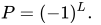
As a consequence, baryons with no orbital angular momentum (*L* = 0) all have even parity (*P* = +).
## Nomenclature
\[[edit](https://en.wikiversity.org/w/index.php?title=Baryons&veaction=edit§ion=9 "Edit section: Nomenclature") \| [edit source](https://en.wikiversity.org/w/index.php?title=Baryons&action=edit§ion=9 "Edit section's source code: Nomenclature")\]
Baryons are classified into groups according to their [isospin](https://en.wikiversity.org/w/index.php?title=Isospin&action=edit&redlink=1 "Isospin (page does not exist)") (*I*) values and [quark](https://en.wikiversity.org/w/index.php?title=Quark&action=edit&redlink=1 "Quark (page does not exist)") (*q*) content. There are six groups of baryons—[nucleon](https://en.wikiversity.org/w/index.php?title=Nucleon&action=edit&redlink=1 "Nucleon (page does not exist)") (N), [Delta](https://en.wikiversity.org/w/index.php?title=Delta_baryon&action=edit&redlink=1 "Delta baryon (page does not exist)") (Δ), [Lambda](https://en.wikiversity.org/w/index.php?title=Lambda_baryon&action=edit&redlink=1 "Lambda baryon (page does not exist)") (Λ), [Sigma](https://en.wikiversity.org/w/index.php?title=Sigma_baryon&action=edit&redlink=1 "Sigma baryon (page does not exist)") (Σ), [Xi](https://en.wikiversity.org/w/index.php?title=Xi_baryon&action=edit&redlink=1 "Xi baryon (page does not exist)") (Ξ), and [Omega](https://en.wikiversity.org/w/index.php?title=Omega_baryon&action=edit&redlink=1 "Omega baryon (page does not exist)") (Ω). The rules for classification are defined by the [Particle Data Group](https://en.wikiversity.org/w/index.php?title=Particle_Data_Group&action=edit&redlink=1 "Particle Data Group (page does not exist)"). These rules consider the [up](https://en.wikiversity.org/w/index.php?title=Up_quark&action=edit&redlink=1 "Up quark (page does not exist)") (u), [down](https://en.wikiversity.org/w/index.php?title=Down_quark&action=edit&redlink=1 "Down quark (page does not exist)") (d) and [strange](https://en.wikiversity.org/w/index.php?title=Strange_quark&action=edit&redlink=1 "Strange quark (page does not exist)") (s) quarks to be *light* and the [charm](https://en.wikiversity.org/w/index.php?title=Charm_quark&action=edit&redlink=1 "Charm quark (page does not exist)") (c), [bottom quark](https://en.wikiversity.org/w/index.php?title=Bottom_quark&action=edit&redlink=1 "Bottom quark (page does not exist)") (b), and [top](https://en.wikiversity.org/w/index.php?title=Top_quark&action=edit&redlink=1 "Top quark (page does not exist)") (t) to be *heavy*. The rules cover all the particles that can be made from three of each of the six quarks, even though baryons made of t quarks are not expected to exist because of the [t quark's short lifetime](https://en.wikiversity.org/w/index.php?title=Top_quark&action=edit&redlink=1 "Top quark (page does not exist)"). The rules do not cover pentaquarks.[\[13\]](https://en.wikiversity.org/wiki/Baryons#cite_note-PDGBaryonsymbols-13)
- Baryons with three \[\[up quark
\|u\]\] and/or \[\[down quark \|d\]\] quarks are \[\[nucleon \|N\]\]'s (*I* = 1⁄2) or \[\[delta baryon \|Δ\]\]'s (*I* = 3⁄2).
- Baryons with two \[\[up quark
\|u\]\] and/or \[\[down quark \|d\]\] quarks are \[\[lambda baryon \|Λ\]\]'s (*I* = 0) or \[\[sigma baryon \|Σ\]\]'s (*I* = 1). If the third quark is heavy, its identity is given by a subscript.
- Baryons with one \[\[up quark
\|u\]\] or \[\[down quark \|d\]\] quark are \[\[xi baryon \|Ξ\]\]'s (*I* = 1⁄2). One or two subscripts are used if one or both of the remaining quarks are heavy.
- Baryons with no \[\[up quark
\|u\]\] or \[\[down quark \|d\]\] quarks are \[\[omega baryon \|Ω\]\]'s (*I* = 0), and subscripts indicate any heavy quark content.
- Baryons that decay strongly have their masses as part of their names. For example, Σ0 does not decay strongly, but Δ\++(1232) does.
It is also a widespread (but not universal) practice to follow some additional rules when distinguishing between some states which would otherwise have the same symbol.[\[8\]](https://en.wikiversity.org/wiki/Baryons#cite_note-WongA-8)
- Baryons in [total angular momentum](https://en.wikiversity.org/w/index.php?title=Total_angular_momentum&action=edit&redlink=1 "Total angular momentum (page does not exist)") *J* = 3⁄2 configuration which have the same symbols as their *J* = 1⁄2 counterparts are denoted by an asterisk ( \* ).
- Two baryons can be made of three different quarks in *J* = 1⁄2 configuration. In this case, a prime ( ′ ) is used to distinguish between them.
- *Exception*: When two of the three quarks are one up and one down quark, one baryon is dubbed Λ while the other is dubbed Σ.
Quarks carry charge, so knowing the charge of a particle indirectly gives the quark content. For example, the rules above say that a Ξ\+
c contains a c quark and some combination of two u and/or d quarks. The c quark as a charge of (*Q* = +2⁄3), therefore the other two must be a u quark (*Q* = +2⁄3), and a d quark (*Q* = −1⁄3) to have the correct total charge (*Q* = +1).
## See also
\[[edit](https://en.wikiversity.org/w/index.php?title=Baryons&veaction=edit§ion=10 "Edit section: See also") \| [edit source](https://en.wikiversity.org/w/index.php?title=Baryons&action=edit§ion=10 "Edit section's source code: See also")\]
- [Ions](https://en.wikiversity.org/wiki/Ions "Ions")
- [Mesons](https://en.wikiversity.org/w/index.php?title=Mesons&action=edit&redlink=1 "Mesons (page does not exist)")
- [Nuclear physics](https://en.wikiversity.org/w/index.php?title=Nuclear_physics&action=edit&redlink=1 "Nuclear physics (page does not exist)")
- [Particle physics](https://en.wikiversity.org/wiki/Particle_physics "Particle physics")
## Notes
\[[edit](https://en.wikiversity.org/w/index.php?title=Baryons&veaction=edit§ion=11 "Edit section: Notes") \| [edit source](https://en.wikiversity.org/w/index.php?title=Baryons&action=edit§ion=11 "Edit section's source code: Notes")\]
1. [↑](https://en.wikiversity.org/wiki/Baryons#cite_ref-1 "Jump up") H. Muir (2003)
2. [↑](https://en.wikiversity.org/wiki/Baryons#cite_ref-2 "Jump up") K. Carter (2003)
3. [↑](https://en.wikiversity.org/wiki/Baryons#cite_ref-PDGPentaquarks2006_3-0 "Jump up") W.-M. Yao *et al.* (2006): [Particle listings – Θ\+](http://pdg.lbl.gov/2006/reviews/theta_b152.pdf)
4. [↑](https://en.wikiversity.org/wiki/Baryons#cite_ref-PDGPentaquarks2008_4-0 "Jump up") C. Amsler *et al.* (2008): [Pentaquarks](http://pdg.lbl.gov/2008/reviews/pentaquarks_b801.pdf)
5. [↑](https://en.wikiversity.org/wiki/Baryons#cite_ref-5 "Jump up") W. Heisenberg (1932)
6. [↑](https://en.wikiversity.org/wiki/Baryons#cite_ref-6 "Jump up") E. Wigner (1937)
7. [↑](https://en.wikiversity.org/wiki/Baryons#cite_ref-7 "Jump up") M. Gell-Mann (1964)
8. ↑ [Jump up to: 8\.0](https://en.wikiversity.org/wiki/Baryons#cite_ref-WongA_8-0) [8\.1](https://en.wikiversity.org/wiki/Baryons#cite_ref-WongA_8-1) [8\.2](https://en.wikiversity.org/wiki/Baryons#cite_ref-WongA_8-2) S.S.M. Wong (1998a)
9. [↑](https://en.wikiversity.org/wiki/Baryons#cite_ref-Shankar_9-0 "Jump up") R. Shankar (1994)
10. [↑](https://en.wikiversity.org/wiki/Baryons#cite_ref-10 "Jump up") H. Garcilazo *et al.* (2007)
11. [↑](https://en.wikiversity.org/wiki/Baryons#cite_ref-11 "Jump up") D.M. Manley (2005)
12. [↑](https://en.wikiversity.org/wiki/Baryons#cite_ref-WongB_12-0 "Jump up") S.S.M. Wong (1998b)
13. [↑](https://en.wikiversity.org/wiki/Baryons#cite_ref-PDGBaryonsymbols_13-0 "Jump up") C. Amsler *et al.* (2008): [Naming scheme for hadrons](http://pdg.lbl.gov/2008/reviews/namingrpp.pdf)
## References
\[[edit](https://en.wikiversity.org/w/index.php?title=Baryons&veaction=edit§ion=12 "Edit section: References") \| [edit source](https://en.wikiversity.org/w/index.php?title=Baryons&action=edit§ion=12 "Edit section's source code: References")\]
- C. Amsler *et al.* (Particle Data Group) (2008). "Review of Particle Physics". *Physics Letters B* **667** (1): 1–1340. doi:[10\.1016/j.physletb.2008.07.018](https://doi.org/10.1016%2Fj.physletb.2008.07.018).
- H. Garcilazo, J. Vijande, and A. Valcarce (2007). "Faddeev study of heavy-baryon spectroscopy". *Journal of Physics G* **34** (5): 961–976. doi:[10\.1088/0954-3899/34/5/014](https://doi.org/10.1088%2F0954-3899%2F34%2F5%2F014).
- K. Carter (2006). ["The rise and fall of the pentaquark"](http://www.symmetrymagazine.org/cms/?pid=1000377). Fermilab and Stanford Linear Accelerator Center (SLAC). Retrieved 2008-05-27.
- W.-M. Yao *et al.*(Particle Data Group) (2006). "Review of Particle Physics". *Journal of Physics G* **33**: 1–1232. doi:[10\.1088/0954-3899/33/1/001](https://doi.org/10.1088%2F0954-3899%2F33%2F1%2F001).
- D.M. Manley (2005). "Status of baryon spectroscopy". *Journal of Physics: Conference Series* **5**: 230–237. doi:[10\.1088/1742-6596/9/1/043](https://doi.org/10.1088%2F1742-6596%2F9%2F1%2F043).
- H. Muir (2003). ["Pentaquark discovery confounds sceptics"](http://www.newscientist.com/article/dn3903). New Scientist. Retrieved 2008-05-27.
- S.S.M. Wong (1998a). "Chapter 2—Nucleon Structure". *Introductory Nuclear Physics* (2nd ed.). New York (NY): John Wiley & Sons. pp. 21–56. ISBN [0-471-23973-9](https://en.wikiversity.org/wiki/Special:BookSources/0-471-23973-9 "Special:BookSources/0-471-23973-9").
- S.S.M. Wong (1998b). "Chapter 3—The Deuteron". *Introductory Nuclear Physics* (2nd ed.). New York (NY): John Wiley & Sons. pp. 57–104. ISBN [0-471-23973-9](https://en.wikiversity.org/wiki/Special:BookSources/0-471-23973-9 "Special:BookSources/0-471-23973-9").
- R. Shankar (1994). *Principles of Quantum Mechanics* (2nd ed.). New York (NY): Plenum Press. ISBN [0-306-44790-8](https://en.wikiversity.org/wiki/Special:BookSources/0-306-44790-8 "Special:BookSources/0-306-44790-8").
- E. Wigner (1937). "On the Consequences of the Symmetry of the Nuclear Hamiltonian on the Spectroscopy of Nuclei". *Physical Review* **51** (2): 106–119. doi:[10\.1103/PhysRev.51.106](https://doi.org/10.1103%2FPhysRev.51.106).
- M. Gell-Mann (1964). "A Schematic of Baryons and Mesons". *Physics Letters* **8** (3): 214–215. doi:[10\.1016/S0031-9163(64)92001-3](https://doi.org/10.1016%2FS0031-9163%2864%2992001-3).
- W. Heisenberg (1932). "Über den Bau der Atomkerne I". *Zeitschrift für Physik* **77**: 1–11. doi:[10\.1007/BF01342433](https://doi.org/10.1007%2FBF01342433). (German)
- W. Heisenberg (1932). "Über den Bau der Atomkerne II". *Zeitschrift für Physik* **78**: 156–164. doi:[10\.1007/BF01337585](https://doi.org/10.1007%2FBF01337585). (German)
- W. Heisenberg (1932). "Über den Bau der Atomkerne III". *Zeitschrift für Physik* **80**: 587–596. doi:[10\.1007/BF01335696](https://doi.org/10.1007%2FBF01335696). (German)
## External links
\[[edit](https://en.wikiversity.org/w/index.php?title=Baryons&veaction=edit§ion=13 "Edit section: External links") \| [edit source](https://en.wikiversity.org/w/index.php?title=Baryons&action=edit§ion=13 "Edit section's source code: External links")\]
- Particle Data Group—[Review of Particle Physics (2008).](http://pdg.lbl.gov/index.html)
- Georgia State University—[HyperPhysics](http://hyperphysics.phy-astr.gsu.edu/hbase/hframe.html)
`{{Charge ontology}}`
| hide[v](https://en.wikiversity.org/wiki/Template:Physics_resources "Template:Physics resources") [t](https://en.wikiversity.org/w/index.php?title=Template_talk:Physics_resources&action=edit&redlink=1 "Template talk:Physics resources (page does not exist)") [e](https://en.wikiversity.org/wiki/Special:EditPage/Template:Physics_resources "Special:EditPage/Template:Physics resources")Physics resources | |
|---|---|
| Activities | [Analytical astronomy](https://en.wikiversity.org/w/index.php?title=Radiation/Analysis/Laboratory&action=edit&redlink=1 "Radiation/Analysis/Laboratory (page does not exist)") [Astrognosy](https://en.wikiversity.org/w/index.php?title=Astrognosy/Laboratory&action=edit&redlink=1 "Astrognosy/Laboratory (page does not exist)") [Cosmogony laboratory](https://en.wikiversity.org/w/index.php?title=Cosmogony/Laboratory&action=edit&redlink=1 "Cosmogony/Laboratory (page does not exist)") [Cratering laboratory](https://en.wikiversity.org/w/index.php?title=Astronomy/Craters/Laboratory&action=edit&redlink=1 "Astronomy/Craters/Laboratory (page does not exist)") [Distance to the Moon](https://en.wikiversity.org/w/index.php?title=Distance_to_the_Moon&action=edit&redlink=1 "Distance to the Moon (page does not exist)") [Electric orbits](https://en.wikiversity.org/w/index.php?title=Electric_orbits&action=edit&redlink=1 "Electric orbits (page does not exist)") [Electron beam heating](https://en.wikiversity.org/w/index.php?title=Electron_beam_heating/Laboratory&action=edit&redlink=1 "Electron beam heating/Laboratory (page does not exist)") [Empirical radiation astronomy](https://en.wikiversity.org/w/index.php?title=Radiation_astronomy/Empiricisms/Laboratory&action=edit&redlink=1 "Radiation astronomy/Empiricisms/Laboratory (page does not exist)") [Radiation astronomy/Laboratories](https://en.wikiversity.org/w/index.php?title=Radiation_astronomy/Laboratories&action=edit&redlink=1 "Radiation astronomy/Laboratories (page does not exist)") [Galaxies](https://en.wikiversity.org/w/index.php?title=Stars/Galaxies/Laboratory&action=edit&redlink=1 "Stars/Galaxies/Laboratory (page does not exist)") [Intergalactic medium](https://en.wikiversity.org/w/index.php?title=Radiation_astronomy/Intergalactic_medium/Laboratory&action=edit&redlink=1 "Radiation astronomy/Intergalactic medium/Laboratory (page does not exist)") [Liquid water on Europa](https://en.wikiversity.org/w/index.php?title=Liquid_water_on_Europa&action=edit&redlink=1 "Liquid water on Europa (page does not exist)") [Locating the Sun](https://en.wikiversity.org/w/index.php?title=Stars/Sun/Locating_the_Sun&action=edit&redlink=1 "Stars/Sun/Locating the Sun (page does not exist)") [Magnetic field reversal](https://en.wikiversity.org/w/index.php?title=Magnetic_field_reversals/Laboratory&action=edit&redlink=1 "Magnetic field reversals/Laboratory (page does not exist)") [Meteorites](https://en.wikiversity.org/w/index.php?title=Rocks/Meteorites/Laboratory&action=edit&redlink=1 "Rocks/Meteorites/Laboratory (page does not exist)") [Neutrinos from the Sun](https://en.wikiversity.org/w/index.php?title=Stars/Sun/Neutrinos&action=edit&redlink=1 "Stars/Sun/Neutrinos (page does not exist)") [Observational astronomy](https://en.wikiversity.org/wiki/Observational_astronomy "Observational astronomy") [Physics/Activities](https://en.wikiversity.org/w/index.php?title=Physics/Activities&action=edit&redlink=1 "Physics/Activities (page does not exist)") [Physics and Astronomy Labs](https://en.wikiversity.org/wiki/Physics_and_Astronomy_Labs "Physics and Astronomy Labs") [Polar reversals](https://en.wikiversity.org/w/index.php?title=Polar_reversals&action=edit&redlink=1 "Polar reversals (page does not exist)") [Spectrum of Vega](https://en.wikiversity.org/w/index.php?title=Stars/Vega/Spectrum&action=edit&redlink=1 "Stars/Vega/Spectrum (page does not exist)") [Standard candles](https://en.wikiversity.org/w/index.php?title=Standard_candles/Laboratory&action=edit&redlink=1 "Standard candles/Laboratory (page does not exist)") [Stellarium](https://en.wikiversity.org/w/index.php?title=Stellarium&action=edit&redlink=1 "Stellarium (page does not exist)") [Vertical precession](https://en.wikiversity.org/w/index.php?title=Vertical_precession&action=edit&redlink=1 "Vertical precession (page does not exist)") [X-ray classification of a star](https://en.wikiversity.org/w/index.php?title=Stars/X-ray_classification/Laboratory&action=edit&redlink=1 "Stars/X-ray classification/Laboratory (page does not exist)") [X-ray trigonometric parallax](https://en.wikiversity.org/w/index.php?title=X-ray_trigonometric_parallax/Laboratory&action=edit&redlink=1 "X-ray trigonometric parallax/Laboratory (page does not exist)") |
| Articles | [Earth-impact events](https://en.wikiversity.org/wiki/Earth-impact_events "Earth-impact events") [Highest temperature on Jupiter](https://en.wikiversity.org/w/index.php?title=Highest_temperature_on_Jupiter&action=edit&redlink=1 "Highest temperature on Jupiter (page does not exist)") [Physics/Articles](https://en.wikiversity.org/w/index.php?title=Physics/Articles&action=edit&redlink=1 "Physics/Articles (page does not exist)") [Radio Interferometer Telescope](https://en.wikiversity.org/wiki/Radio_Interferometer_Telescope "Radio Interferometer Telescope") [Spectral analysis of stars](https://en.wikiversity.org/wiki/Changes_in_the_properties_of_matter_\(mass_spectrometer_and_spectral_analysis_of_stars\) "Changes in the properties of matter (mass spectrometer and spectral analysis of stars)") |
| Categories | [Applied mechanics](https://en.wikiversity.org/wiki/Category:Applied_mechanics "Category:Applied mechanics") [Applied physics](https://en.wikiversity.org/w/index.php?title=Category:Applied_physics&action=edit&redlink=1 "Category:Applied physics (page does not exist)") [Astronomy](https://en.wikiversity.org/wiki/Category:Astronomy "Category:Astronomy") [Astrophysics](https://en.wikiversity.org/wiki/Category:Astrophysics "Category:Astrophysics") [Atomic, molecular, and optical physics](https://en.wikiversity.org/wiki/Category:Atomic,_molecular,_and_optical_physics "Category:Atomic, molecular, and optical physics") [Aviation](https://en.wikiversity.org/wiki/Category:Aviation "Category:Aviation") [Avionics](https://en.wikiversity.org/wiki/Category:Avionics "Category:Avionics") [Biophysics](https://en.wikiversity.org/wiki/Category:Biophysics "Category:Biophysics") [Cold fusion](https://en.wikiversity.org/wiki/Category:Cold_fusion "Category:Cold fusion") [Computational physics](https://en.wikiversity.org/wiki/Category:Computational_physics "Category:Computational physics") [Concepts in physics](https://en.wikiversity.org/wiki/Category:Concepts_in_physics "Category:Concepts in physics") [Condensed matter physics](https://en.wikiversity.org/wiki/Category:Condensed_matter_physics "Category:Condensed matter physics") [Dimension](https://en.wikiversity.org/wiki/Category:Dimension "Category:Dimension") [Dynamics](https://en.wikiversity.org/wiki/Category:Dynamics "Category:Dynamics") [Electricity](https://en.wikiversity.org/wiki/Category:Electricity "Category:Electricity") [Electromagnetism](https://en.wikiversity.org/wiki/Category:Electromagnetism "Category:Electromagnetism") [Energy](https://en.wikiversity.org/wiki/Category:Energy "Category:Energy") [Experimental physics](https://en.wikiversity.org/wiki/Category:Experimental_physics "Category:Experimental physics") [Fundamental physics concepts](https://en.wikiversity.org/wiki/Category:Fundamental_physics_concepts "Category:Fundamental physics concepts") [General relativity](https://en.wikiversity.org/wiki/Category:General_relativity "Category:General relativity") [Gravitation](https://en.wikiversity.org/wiki/Category:Gravitation "Category:Gravitation") [History of physics](https://en.wikiversity.org/wiki/Category:History_of_Physics "Category:History of Physics") [Materials science](https://en.wikiversity.org/wiki/Category:Materials_science "Category:Materials science") [Mathematical physics](https://en.wikiversity.org/wiki/Category:Mathematical_physics "Category:Mathematical physics") [Mathematics](https://en.wikiversity.org/wiki/Category:Mathematics "Category:Mathematics") [Matter](https://en.wikiversity.org/wiki/Category:Matter "Category:Matter") [Mechanics](https://en.wikiversity.org/wiki/Category:Mechanics "Category:Mechanics") [Biophysics](https://en.wikiversity.org/wiki/Category:Biophysics "Category:Biophysics") [Medical physics](https://en.wikiversity.org/wiki/Category:Medical_physics "Category:Medical physics") [Mesoscopic Physics](https://en.wikiversity.org/wiki/Category:Mesoscopic_Physics "Category:Mesoscopic Physics") [Nanoscience](https://en.wikiversity.org/wiki/Category:Nanoscience "Category:Nanoscience") [Nanotechnology](https://en.wikiversity.org/wiki/Category:Nanotechnology "Category:Nanotechnology") [Optics](https://en.wikiversity.org/wiki/Category:Optics "Category:Optics") [Physics and Astronomy](https://en.wikiversity.org/w/index.php?title=Category:Physics_and_Astronomy&action=edit&redlink=1 "Category:Physics and Astronomy (page does not exist)") [Scientific terminology](https://en.wikiversity.org/wiki/Category:Scientific_terminology "Category:Scientific terminology") [Technology](https://en.wikiversity.org/wiki/Category:Technology "Category:Technology") |
| Courses | [Introduction to astronomy](https://en.wikiversity.org/wiki/Introduction_to_astronomy "Introduction to astronomy") [Introduction to astrophysics](https://en.wikiversity.org/wiki/Introduction_to_astrophysics "Introduction to astrophysics") [Physics/Courses](https://en.wikiversity.org/w/index.php?title=Physics/Courses&action=edit&redlink=1 "Physics/Courses (page does not exist)") [Physics equations](https://en.wikiversity.org/wiki/Physics_equations "Physics equations") [Radiation astronomy/Courses](https://en.wikiversity.org/w/index.php?title=Radiation_astronomy/Courses&action=edit&redlink=1 "Radiation astronomy/Courses (page does not exist)") [Principles of radiation astronomy](https://en.wikiversity.org/w/index.php?title=Radiation_astronomy/Courses/Principles&action=edit&redlink=1 "Radiation astronomy/Courses/Principles (page does not exist)") [Special relativity and steps towards general relativity](https://en.wikiversity.org/wiki/Special_relativity_and_steps_towards_general_relativity "Special relativity and steps towards general relativity") |
| Glossaries | [Astronomy glossary](https://en.wikiversity.org/wiki/Astronomy_glossary "Astronomy glossary") [Christoffel symbols](https://en.wikiversity.org/wiki/Christoffel_symbols "Christoffel symbols") [Tables of Physics Formulae](https://en.wikiversity.org/wiki/Physics_Formulae "Physics Formulae") |
| Lectures | [Alpha decay](https://en.wikiversity.org/wiki/Alpha_decay "Alpha decay") [Astrophysics](https://en.wikiversity.org/wiki/Astrophysics "Astrophysics") [Atomic structure](https://en.wikiversity.org/wiki/Atomic_structure "Atomic structure") [Basic kinematics](https://en.wikiversity.org/wiki/Basic_kinematics "Basic kinematics") [Beta decay](https://en.wikiversity.org/wiki/Beta_decay "Beta decay") [Biot-Savart Law](https://en.wikiversity.org/wiki/Biot-Savart_Law "Biot-Savart Law") [Capacitor](https://en.wikiversity.org/wiki/Capacitor "Capacitor") [Conservation of energy](https://en.wikiversity.org/wiki/Conservation_of_energy "Conservation of energy") [Coordinate systems](https://en.wikiversity.org/wiki/Coordinate_systems "Coordinate systems") [Cosmogony](https://en.wikiversity.org/wiki/Cosmogony "Cosmogony") [Cosmology](https://en.wikiversity.org/wiki/Cosmology "Cosmology") [Coulomb's Law](https://en.wikiversity.org/wiki/Coulomb%27s_Law "Coulomb's Law") [Cross product](https://en.wikiversity.org/wiki/Cross_product "Cross product") [Curl](https://en.wikiversity.org/wiki/Curl "Curl") [Damped oscillation](https://en.wikiversity.org/wiki/Damped_oscillation "Damped oscillation") [Dark matter](https://en.wikiversity.org/wiki/Dark_matter "Dark matter") [Divergence](https://en.wikiversity.org/wiki/Divergence "Divergence") [Dominant group/Physics](https://en.wikiversity.org/w/index.php?title=Dominant_group/Physics&action=edit&redlink=1 "Dominant group/Physics (page does not exist)") [Electrical current](https://en.wikiversity.org/wiki/Electrical_current "Electrical current") [Electricity](https://en.wikiversity.org/wiki/Electricity "Electricity") [Electromagnetic interaction](https://en.wikiversity.org/w/index.php?title=Charges/Interactions/Electromagnetics&action=edit&redlink=1 "Charges/Interactions/Electromagnetics (page does not exist)") [Electrostatic fields](https://en.wikiversity.org/wiki/Electrostatic_fields "Electrostatic fields") [Gamma decay](https://en.wikiversity.org/w/index.php?title=Gamma_decay&action=edit&redlink=1 "Gamma decay (page does not exist)") [General relativity](https://en.wikiversity.org/wiki/General_relativity "General relativity") [Heliognosy](https://en.wikiversity.org/w/index.php?title=Stars/Sun/Heliognosy&action=edit&redlink=1 "Stars/Sun/Heliognosy (page does not exist)") [Heliogony](https://en.wikiversity.org/w/index.php?title=Stars/Sun/Heliogony&action=edit&redlink=1 "Stars/Sun/Heliogony (page does not exist)") [Heliography](https://en.wikiversity.org/w/index.php?title=Stars/Sun/Heliography&action=edit&redlink=1 "Stars/Sun/Heliography (page does not exist)") [Heliology](https://en.wikiversity.org/w/index.php?title=Stars/Sun/Heliology&action=edit&redlink=1 "Stars/Sun/Heliology (page does not exist)") [Heliometry](https://en.wikiversity.org/w/index.php?title=Stars/Sun/Heliometry&action=edit&redlink=1 "Stars/Sun/Heliometry (page does not exist)") [Heliophysics](https://en.wikiversity.org/w/index.php?title=Stars/Sun/Heliophysics&action=edit&redlink=1 "Stars/Sun/Heliophysics (page does not exist)") [Heliosphere](https://en.wikiversity.org/w/index.php?title=Stars/Sun/Heliospheres&action=edit&redlink=1 "Stars/Sun/Heliospheres (page does not exist)") [Magnetohydrodynamics](https://en.wikiversity.org/w/index.php?title=Plasmas/Magnetohydrodynamics&action=edit&redlink=1 "Plasmas/Magnetohydrodynamics (page does not exist)") [Materials](https://en.wikiversity.org/w/index.php?title=Chemicals/Materials&action=edit&redlink=1 "Chemicals/Materials (page does not exist)") [Mathematics of theoretical physics](https://en.wikiversity.org/wiki/Mathematics_of_theoretical_physics "Mathematics of theoretical physics") [Maxwell's equations](https://en.wikiversity.org/wiki/Maxwell%27s_equations "Maxwell's equations") [Minerals](https://en.wikiversity.org/wiki/Minerals "Minerals") [Newton's Laws of Motion](https://en.wikiversity.org/wiki/Basic_kinematics "Basic kinematics") [Nucleosynthesis](https://en.wikiversity.org/w/index.php?title=Plasmas/Plasma_objects/Nucleosynthesis&action=edit&redlink=1 "Plasmas/Plasma objects/Nucleosynthesis (page does not exist)") [Particle physics](https://en.wikiversity.org/wiki/Particle_physics "Particle physics") [Physics/Lectures](https://en.wikiversity.org/w/index.php?title=Physics/Lectures&action=edit&redlink=1 "Physics/Lectures (page does not exist)") [Quantum mechanics](https://en.wikiversity.org/wiki/Quantum_mechanics "Quantum mechanics") [Radiation](https://en.wikiversity.org/w/index.php?title=Radiation&action=edit&redlink=1 "Radiation (page does not exist)") [Radiation detectors](https://en.wikiversity.org/w/index.php?title=Radiation_astronomy/Detectors&action=edit&redlink=1 "Radiation astronomy/Detectors (page does not exist)") [Radiative dynamo](https://en.wikiversity.org/w/index.php?title=Stars/Radiative_dynamo&action=edit&redlink=1 "Stars/Radiative dynamo (page does not exist)") [Rocks](https://en.wikiversity.org/w/index.php?title=Rocks&action=edit&redlink=1 "Rocks (page does not exist)") [Schrödinger equation](https://en.wikiversity.org/wiki/Schr%C3%B6dinger_equation "Schrödinger equation") [Special relativity](https://en.wikiversity.org/wiki/Special_relativity "Special relativity") [Standard solar model](https://en.wikiversity.org/w/index.php?title=Stars/Sun/Standard_models&action=edit&redlink=1 "Stars/Sun/Standard models (page does not exist)") [Star fission](https://en.wikiversity.org/w/index.php?title=Stars/Star_fissions&action=edit&redlink=1 "Stars/Star fissions (page does not exist)") [Statistical mechanics](https://en.wikiversity.org/wiki/Statistical_mechanics "Statistical mechanics") [Stellar surface fusion](https://en.wikiversity.org/w/index.php?title=Stars/Surface_fusion&action=edit&redlink=1 "Stars/Surface fusion (page does not exist)") [Strong force](https://en.wikiversity.org/w/index.php?title=Charges/Interactions/Strong&action=edit&redlink=1 "Charges/Interactions/Strong (page does not exist)") [Submillimeter astronomy](https://en.wikiversity.org/w/index.php?title=Radiation_astronomy/Submillimeters&action=edit&redlink=1 "Radiation astronomy/Submillimeters (page does not exist)") [Tensors](https://en.wikiversity.org/wiki/Tensors "Tensors") [Thermodynamics](https://en.wikiversity.org/wiki/Thermodynamics "Thermodynamics") [Vectors](https://en.wikiversity.org/w/index.php?title=Vectors&action=edit&redlink=1 "Vectors (page does not exist)") [Weak force](https://en.wikiversity.org/w/index.php?title=Charges/Interactions/Weak&action=edit&redlink=1 "Charges/Interactions/Weak (page does not exist)") |
| Lessons | [Physics/Lessons](https://en.wikiversity.org/w/index.php?title=Physics/Lessons&action=edit&redlink=1 "Physics/Lessons (page does not exist)") |
| Lists | [Asteroid Surveys](https://en.wikiversity.org/wiki/Asteroid_Surveys "Asteroid Surveys") |
| Problem sets | [Angular momentum and energy](https://en.wikiversity.org/w/index.php?title=Angular_momentum_and_energy&action=edit&redlink=1 "Angular momentum and energy (page does not exist)") [Astronomy/Problems](https://en.wikiversity.org/wiki/Astronomy/Problems "Astronomy/Problems") [Column densities](https://en.wikiversity.org/w/index.php?title=Column_densities&action=edit&redlink=1 "Column densities (page does not exist)") [Cosmic circuits](https://en.wikiversity.org/w/index.php?title=Cosmic_circuits&action=edit&redlink=1 "Cosmic circuits (page does not exist)") [Energy phantoms](https://en.wikiversity.org/w/index.php?title=Energy_phantoms&action=edit&redlink=1 "Energy phantoms (page does not exist)") [Furlongs per fortnight](https://en.wikiversity.org/w/index.php?title=Furlongs_per_fortnight&action=edit&redlink=1 "Furlongs per fortnight (page does not exist)") [Lenses and focal length](https://en.wikiversity.org/wiki/Lenses_and_focal_length "Lenses and focal length") [Neutrino emissions](https://en.wikiversity.org/w/index.php?title=Neutrino_emissions&action=edit&redlink=1 "Neutrino emissions (page does not exist)") [Physics/Problems](https://en.wikiversity.org/w/index.php?title=Physics/Problems&action=edit&redlink=1 "Physics/Problems (page does not exist)") [Planck's equation](https://en.wikiversity.org/w/index.php?title=Planck%27s_equation&action=edit&redlink=1 "Planck's equation (page does not exist)") [Radiation astronomy/Problem set](https://en.wikiversity.org/w/index.php?title=Radiation_astronomy/Problem_set&action=edit&redlink=1 "Radiation astronomy/Problem set (page does not exist)") [Radiation dosage](https://en.wikiversity.org/w/index.php?title=Radiation_dosage&action=edit&redlink=1 "Radiation dosage (page does not exist)") [Radiation mathematics/Problem set](https://en.wikiversity.org/w/index.php?title=Radiation_astronomy/Mathematics/Problem_set&action=edit&redlink=1 "Radiation astronomy/Mathematics/Problem set (page does not exist)") [Spectrographs](https://en.wikiversity.org/w/index.php?title=Spectrographs&action=edit&redlink=1 "Spectrographs (page does not exist)") [Star jumping](https://en.wikiversity.org/w/index.php?title=Star_jumping&action=edit&redlink=1 "Star jumping (page does not exist)") [Synchrotron radiation/Problem set](https://en.wikiversity.org/w/index.php?title=Synchrotron_radiation/Problem_set&action=edit&redlink=1 "Synchrotron radiation/Problem set (page does not exist)") [Telescopes and cameras](https://en.wikiversity.org/w/index.php?title=Telescopes_and_cameras&action=edit&redlink=1 "Telescopes and cameras (page does not exist)") [Unknown coordinate systems](https://en.wikiversity.org/w/index.php?title=Unknown_coordinate_systems&action=edit&redlink=1 "Unknown coordinate systems (page does not exist)") [Unusual units](https://en.wikiversity.org/w/index.php?title=Unusual_units&action=edit&redlink=1 "Unusual units (page does not exist)") [Vectors and coordinates](https://en.wikiversity.org/w/index.php?title=Vectors_and_coordinates&action=edit&redlink=1 "Vectors and coordinates (page does not exist)") |
| Projects | [Physics Project](https://en.wikiversity.org/w/index.php?title=Physics_Project&action=edit&redlink=1 "Physics Project (page does not exist)") |
| Quizzes | [Astronomy/Quiz](https://en.wikiversity.org/wiki/Astronomy/Quiz "Astronomy/Quiz") [Astrophysics/Quiz](https://en.wikiversity.org/w/index.php?title=Astrophysics/Quiz&action=edit&redlink=1 "Astrophysics/Quiz (page does not exist)") [Cosmogony/Quiz](https://en.wikiversity.org/w/index.php?title=Cosmogony/Quiz&action=edit&redlink=1 "Cosmogony/Quiz (page does not exist)") [Electromagnetic interaction/Quiz](https://en.wikiversity.org/w/index.php?title=Charges/Interactions/Electromagnetics/Quiz&action=edit&redlink=1 "Charges/Interactions/Electromagnetics/Quiz (page does not exist)") [Electroweak interaction/Quiz](https://en.wikiversity.org/w/index.php?title=Electroweak_interaction/Quiz&action=edit&redlink=1 "Electroweak interaction/Quiz (page does not exist)") [Gases/Quiz](https://en.wikiversity.org/w/index.php?title=Gases/Quiz&action=edit&redlink=1 "Gases/Quiz (page does not exist)") [Heliophysics/Quiz](https://en.wikiversity.org/w/index.php?title=Heliophysics/Quiz&action=edit&redlink=1 "Heliophysics/Quiz (page does not exist)") [Liquids/Quiz](https://en.wikiversity.org/w/index.php?title=Liquids/Quiz&action=edit&redlink=1 "Liquids/Quiz (page does not exist)") [Magnetohydrodynamics/Quiz](https://en.wikiversity.org/w/index.php?title=Plasmas/Magnetohydrodynamics/Quiz&action=edit&redlink=1 "Plasmas/Magnetohydrodynamics/Quiz (page does not exist)") [Materials/Quiz](https://en.wikiversity.org/w/index.php?title=Materials/Quiz&action=edit&redlink=1 "Materials/Quiz (page does not exist)") [Mineraloids/Quiz](https://en.wikiversity.org/w/index.php?title=Mineraloids/Quiz&action=edit&redlink=1 "Mineraloids/Quiz (page does not exist)") [Minerals/Quiz](https://en.wikiversity.org/w/index.php?title=Minerals/Quiz&action=edit&redlink=1 "Minerals/Quiz (page does not exist)") [Nucleosynthesis/Quiz](https://en.wikiversity.org/w/index.php?title=Plasmas/Plasma_objects/Nucleosynthesis/Quiz&action=edit&redlink=1 "Plasmas/Plasma objects/Nucleosynthesis/Quiz (page does not exist)") [Physics/Quiz](https://en.wikiversity.org/w/index.php?title=Physics/Quiz&action=edit&redlink=1 "Physics/Quiz (page does not exist)") [Physics/Quizzes](https://en.wikiversity.org/w/index.php?title=Physics/Quizzes&action=edit&redlink=1 "Physics/Quizzes (page does not exist)") [Planetary physics/Quiz](https://en.wikiversity.org/w/index.php?title=Planetary_physics/Quiz&action=edit&redlink=1 "Planetary physics/Quiz (page does not exist)") [Plasmas/Quiz](https://en.wikiversity.org/w/index.php?title=Plasmas/Quiz&action=edit&redlink=1 "Plasmas/Quiz (page does not exist)") [Radiation/Quiz](https://en.wikiversity.org/w/index.php?title=Radiation/Quiz&action=edit&redlink=1 "Radiation/Quiz (page does not exist)") [Radiation detectors/Quiz](https://en.wikiversity.org/w/index.php?title=Radiation_astronomy/Detectors/Quiz&action=edit&redlink=1 "Radiation astronomy/Detectors/Quiz (page does not exist)") [Radiation physics/Quiz](https://en.wikiversity.org/w/index.php?title=Radiation_physics/Quiz&action=edit&redlink=1 "Radiation physics/Quiz (page does not exist)") [Radiative dynamo/Quiz](https://en.wikiversity.org/w/index.php?title=Stars/Radiative_dynamo/Quiz&action=edit&redlink=1 "Stars/Radiative dynamo/Quiz (page does not exist)") [Rocks/Quiz](https://en.wikiversity.org/w/index.php?title=Rocks/Quiz&action=edit&redlink=1 "Rocks/Quiz (page does not exist)") [Solids/Quiz](https://en.wikiversity.org/w/index.php?title=Solids/Quiz&action=edit&redlink=1 "Solids/Quiz (page does not exist)") [Standard solar model/Quiz](https://en.wikiversity.org/w/index.php?title=Stars/Sun/Standard_models/Quiz&action=edit&redlink=1 "Stars/Sun/Standard models/Quiz (page does not exist)") [Stellar surface fusion/Quiz](https://en.wikiversity.org/w/index.php?title=Stars/Surface_fusion/Quiz&action=edit&redlink=1 "Stars/Surface fusion/Quiz (page does not exist)") [Strong interaction/Quiz](https://en.wikiversity.org/w/index.php?title=Charges/Interactions/Strong/Quiz&action=edit&redlink=1 "Charges/Interactions/Strong/Quiz (page does not exist)") |
| Portals | [Applied physics](https://en.wikiversity.org/wiki/Portal:Physics_and_Astronomy "Portal:Physics and Astronomy") [Astrophysics](https://en.wikiversity.org/wiki/Portal:Astrophysics "Portal:Astrophysics") [Atmospheric physics](https://en.wikiversity.org/wiki/Portal:Atmospheric_physics "Portal:Atmospheric physics") [Condensed matter physics](https://en.wikiversity.org/wiki/Portal:Physics_and_Astronomy "Portal:Physics and Astronomy") [Cosmology](https://en.wikiversity.org/wiki/Portal:Cosmology "Portal:Cosmology") [General relativity](https://en.wikiversity.org/wiki/Portal:General_relativity "Portal:General relativity") [Particle physics](https://en.wikiversity.org/wiki/Portal:Particle_physics "Portal:Particle physics") [Physics](https://en.wikiversity.org/w/index.php?title=Topic:Physics&action=edit&redlink=1 "Topic:Physics (page does not exist)") [Plasma physics](https://en.wikiversity.org/wiki/Portal:Plasma_physics "Portal:Plasma physics") [Special relativity](https://en.wikiversity.org/wiki/Portal:Special_relativity "Portal:Special relativity") [Statistical mechanics](https://en.wikiversity.org/wiki/Portal:Statistical_mechanics "Portal:Statistical mechanics") |
| Resources | [Gases](https://en.wikiversity.org/w/index.php?title=Gases&action=edit&redlink=1 "Gases (page does not exist)") [Liquids](https://en.wikiversity.org/w/index.php?title=Liquids&action=edit&redlink=1 "Liquids (page does not exist)") [Minerals](https://en.wikiversity.org/wiki/Minerals "Minerals") [Plasmas](https://en.wikiversity.org/w/index.php?title=Plasmas&action=edit&redlink=1 "Plasmas (page does not exist)") [Rocks](https://en.wikiversity.org/w/index.php?title=Rocks&action=edit&redlink=1 "Rocks (page does not exist)") [Solid](https://en.wikiversity.org/w/index.php?title=Solid&action=edit&redlink=1 "Solid (page does not exist)") |
| | |
|---|---|
| | [](https://en.wikibooks.org/wiki/Special:Search/Baryons "Wikibooks") [](https://en.wikipedia.org/wiki/Special:Search/Baryons "Wikipedia") [](https://en.wiktionary.org/wiki/Special:Search/Baryons "Wiktionary") [](https://en.wikiquote.org/wiki/Special:Search/Baryons "Wikiquote") [](https://en.wikisource.org/wiki/Special:Search/Baryons "Wikisource") [](https://commons.wikimedia.org/wiki/Special:Search/Baryons "Wikimedia Commons") [](https://species.wikimedia.org/wiki/Special:Search/Baryons "Wikispecies") [](https://www.wikidata.org/wiki/Special:Search/Baryons "Wikidata") [](https://en.wikivoyage.org/wiki/Special:Search/Baryons "Wikivoyage") [](https://en.wikinews.org/wiki/Special:Search/Baryons "Wikinews") Learn more about **Baryons** |

Retrieved from "<https://en.wikiversity.org/w/index.php?title=Baryons&oldid=1993467>"
[Categories](https://en.wikiversity.org/wiki/Special:Categories "Special:Categories"):
- [Baryons](https://en.wikiversity.org/w/index.php?title=Category:Baryons&action=edit&redlink=1 "Category:Baryons (page does not exist)")
- [Particle physics](https://en.wikiversity.org/wiki/Category:Particle_physics "Category:Particle physics")
- [Physics](https://en.wikiversity.org/wiki/Category:Physics "Category:Physics")
- [Resources last modified in April 2019](https://en.wikiversity.org/wiki/Category:Resources_last_modified_in_April_2019 "Category:Resources last modified in April 2019")
- This page was last edited on 1 April 2019, at 06:51.
- Text is available under the [Creative Commons Attribution-ShareAlike License](https://creativecommons.org/licenses/by-sa/4.0/); additional terms may apply. By using this site, you agree to the [Terms of Use](https://foundation.wikimedia.org/wiki/Special:MyLanguage/Policy:Terms_of_Use) and [Privacy Policy.](https://foundation.wikimedia.org/wiki/Special:MyLanguage/Policy:Privacy_policy)
- [Privacy policy](https://foundation.wikimedia.org/wiki/Special:MyLanguage/Policy:Privacy_policy)
- [About Wikiversity](https://en.wikiversity.org/wiki/Wikiversity:About)
- [Disclaimers](https://en.wikiversity.org/wiki/Wikiversity:General_disclaimer)
- [Code of Conduct](https://foundation.wikimedia.org/wiki/Special:MyLanguage/Policy:Universal_Code_of_Conduct)
- [Developers](https://developer.wikimedia.org/)
- [Statistics](https://stats.wikimedia.org/#/en.wikiversity.org)
- [Cookie statement](https://foundation.wikimedia.org/wiki/Special:MyLanguage/Policy:Cookie_statement)
- [Mobile view](https://en.wikiversity.org/w/index.php?title=Baryons&mobileaction=toggle_view_mobile)
- [](https://www.wikimedia.org/)
- [](https://www.mediawiki.org/)
Search
Toggle the table of contents
Baryons
Add languages
[Add topic](https://en.wikiversity.org/wiki/Baryons) |
| Readable Markdown | *The following is modified from [w:Baryon](https://en.wikipedia.org/wiki/Baryon "w:Baryon")*.
A **baryon** is a composite subatomic particle made of three [quarks](https://en.wikiversity.org/w/index.php?title=Quark&action=edit&redlink=1 "Quark (page does not exist)"). Baryons are opposed to [mesons](https://en.wikiversity.org/w/index.php?title=Radiation/Mesons&action=edit&redlink=1 "Radiation/Mesons (page does not exist)") which are made of one quark and one [antiquark](https://en.wikiversity.org/w/index.php?title=Antiquark&action=edit&redlink=1 "Antiquark (page does not exist)"). Both baryons and mesons belong to the *[hadron](https://en.wikiversity.org/w/index.php?title=Hadron&action=edit&redlink=1 "Hadron (page does not exist)")* family, which are the particles made of quarks. The name "baryon" comes from the Greek word for "heavy" (βαρύς, barys), because at the time of their naming, most known particles had lower masses than the baryons'.
Since baryons are composed of quarks, they participate in the [strong interaction](https://en.wikiversity.org/w/index.php?title=Charges/Interactions/Strong&action=edit&redlink=1 "Charges/Interactions/Strong (page does not exist)"). [Leptons](https://en.wikiversity.org/w/index.php?title=Lepton&action=edit&redlink=1 "Lepton (page does not exist)"), on the other hand, are not composed of quarks and as such do not participate in the strong interaction. The most well known baryons are the [protons](https://en.wikiversity.org/w/index.php?title=Protons&action=edit&redlink=1 "Protons (page does not exist)") and [neutrons](https://en.wikiversity.org/w/index.php?title=Neutrons&action=edit&redlink=1 "Neutrons (page does not exist)") which make up most of the mass of the visible [matter](https://en.wikiversity.org/w/index.php?title=Matter&action=edit&redlink=1 "Matter (page does not exist)") in the [universe](https://en.wikiversity.org/wiki/Universe "Universe"), whereas [electrons](https://en.wikiversity.org/w/index.php?title=Electron&action=edit&redlink=1 "Electron (page does not exist)") (the other major component of [atoms](https://en.wikiversity.org/w/index.php?title=Atom&action=edit&redlink=1 "Atom (page does not exist)")) are leptons. Each baryon has a corresponding [antiparticle](https://en.wikiversity.org/w/index.php?title=Antiparticle&action=edit&redlink=1 "Antiparticle (page does not exist)") (antibaryon) where quarks are replaced by their corresponding antiquarks. For example, a proton is made of two up quarks and one down quark; and its corresponding antiparticle, the [antiproton](https://en.wikiversity.org/w/index.php?title=Antiproton&action=edit&redlink=1 "Antiproton (page does not exist)"), is made of two up antiquarks and one down antiquark.
Until recently, it was believed that some experiments showed the existence of *[pentaquarks](https://en.wikiversity.org/w/index.php?title=Pentaquark&action=edit&redlink=1 "Pentaquark (page does not exist)")*—"exotic" baryons made of four quarks and one antiquark.[\[1\]](https://en.wikiversity.org/wiki/Baryons#cite_note-1)[\[2\]](https://en.wikiversity.org/wiki/Baryons#cite_note-2) The particle physics community as a whole did not view their existence as likely in 2006,[\[3\]](https://en.wikiversity.org/wiki/Baryons#cite_note-PDGPentaquarks2006-3) and in 2008, considered evidence to be overwhelmingly against the existence of the reported pentaquarks.[\[4\]](https://en.wikiversity.org/wiki/Baryons#cite_note-PDGPentaquarks2008-4)
Baryons are strongly interacting [fermions](https://en.wikiversity.org/w/index.php?title=Fermion&action=edit&redlink=1 "Fermion (page does not exist)")—that is, they experience the [strong nuclear force](https://en.wikiversity.org/w/index.php?title=Strong_nuclear_force&action=edit&redlink=1 "Strong nuclear force (page does not exist)") and are described by [Fermi−Dirac statistics](https://en.wikiversity.org/w/index.php?title=Fermi%E2%88%92Dirac_statistics&action=edit&redlink=1 "Fermi−Dirac statistics (page does not exist)"), which apply to all particles obeying the [Pauli exclusion principle](https://en.wikiversity.org/w/index.php?title=Pauli_exclusion_principle&action=edit&redlink=1 "Pauli exclusion principle (page does not exist)"). This is in contrast to the [bosons](https://en.wikiversity.org/w/index.php?title=Boson&action=edit&redlink=1 "Boson (page does not exist)"), which do not obey the exclusion principle.
Baryons, along with [mesons](https://en.wikiversity.org/w/index.php?title=Meson&action=edit&redlink=1 "Meson (page does not exist)"), are [hadrons](https://en.wikiversity.org/w/index.php?title=Hadron&action=edit&redlink=1 "Hadron (page does not exist)"), meaning they are particles composed of [quarks](https://en.wikiversity.org/w/index.php?title=Quark&action=edit&redlink=1 "Quark (page does not exist)"). Quarks have baryon numbers of *B* = 1⁄3 and antiquarks have baryon number of *B* = −1⁄3. The term "baryon" usually refers to *triquarks*—baryons made of three quarks (*B* = 1⁄3 + 1⁄3 + 1⁄3 = 1). Other ["exotic" baryons](https://en.wikiversity.org/w/index.php?title=Exotic_baryon&action=edit&redlink=1 "Exotic baryon (page does not exist)") have been proposed, such as [pentaquarks](https://en.wikiversity.org/w/index.php?title=Pentaquark&action=edit&redlink=1 "Pentaquark (page does not exist)")—baryons made of four quarks and one antiquark (*B* = 1⁄3 + 1⁄3 + 1⁄3 + 1⁄3 − 1⁄3 = 1), but their existence is not generally accepted. Theoretically, heptaquarks (5 quarks, 2 antiquarks), nonaquarks (6 quarks, 3 antiquarks), etc. could also exist.
**Baryonic [matter](https://en.wikiversity.org/w/index.php?title=Matter&action=edit&redlink=1 "Matter (page does not exist)")** is matter composed mostly of baryons (by mass), which includes [atoms](https://en.wikiversity.org/w/index.php?title=Atom&action=edit&redlink=1 "Atom (page does not exist)") of any sort (and thus includes nearly all matter that we may encounter or [experience](https://en.wikiversity.org/w/index.php?title=Experience&action=edit&redlink=1 "Experience (page does not exist)") in everyday life, including our bodies). **Non-baryonic matter**, as implied by the name, is any sort of matter that is not primarily composed of baryons. This might include such ordinary matter as [neutrinos](https://en.wikiversity.org/w/index.php?title=Neutrino&action=edit&redlink=1 "Neutrino (page does not exist)") or free [electrons](https://en.wikiversity.org/w/index.php?title=Electron&action=edit&redlink=1 "Electron (page does not exist)"); however, it may also include exotic species of non-baryonic [dark matter](https://en.wikiversity.org/wiki/Dark_matter "Dark matter"), such as [supersymmetric particles](https://en.wikiversity.org/w/index.php?title=Supersymmetry&action=edit&redlink=1 "Supersymmetry (page does not exist)"), [axions](https://en.wikiversity.org/w/index.php?title=Axion&action=edit&redlink=1 "Axion (page does not exist)") or [black holes](https://en.wikiversity.org/wiki/Black_hole "Black hole"). The distinction between baryonic and non-baryonic matter is important in [cosmology](https://en.wikiversity.org/w/index.php?title=Physical_cosmology&action=edit&redlink=1 "Physical cosmology (page does not exist)"), because [Big Bang nucleosynthesis](https://en.wikiversity.org/w/index.php?title=Big_Bang_nucleosynthesis&action=edit&redlink=1 "Big Bang nucleosynthesis (page does not exist)") models set tight constraints on the amount of baryonic matter present in the early [universe](https://en.wikiversity.org/wiki/Universe "Universe").
The very existence of baryons is also a significant issue in cosmology because we have assumed that the Big Bang produced a state with equal amounts of baryons and antibaryons. The process by which baryons come to outnumber their antiparticles is called [baryogenesis](https://en.wikiversity.org/w/index.php?title=Baryogenesis&action=edit&redlink=1 "Baryogenesis (page does not exist)") (in contrast to a process by which [leptons](https://en.wikiversity.org/w/index.php?title=Lepton&action=edit&redlink=1 "Lepton (page does not exist)") account for the predominance of matter over antimatter, [leptogenesis](https://en.wikiversity.org/w/index.php?title=Leptogenesis_\(physics\)&action=edit&redlink=1 "Leptogenesis (physics) (page does not exist)")).
Experiments are consistent with the number of quarks in the universe being a constant and, more specifically, the number of baryons being a constant; in technical language, the total [baryon number](https://en.wikiversity.org/w/index.php?title=Baryon_number&action=edit&redlink=1 "Baryon number (page does not exist)") appears to be *[conserved](https://en.wikiversity.org/w/index.php?title=Conservation_law&action=edit&redlink=1 "Conservation law (page does not exist)").* Within the prevailing [Standard Model](https://en.wikiversity.org/w/index.php?title=Standard_Model&action=edit&redlink=1 "Standard Model (page does not exist)") of particle physics, the number of baryons may change in multiples of three due to the action of [sphalerons](https://en.wikiversity.org/w/index.php?title=Sphaleron&action=edit&redlink=1 "Sphaleron (page does not exist)"), although this is rare and has not been observed experimentally. Some [grand unified theories](https://en.wikiversity.org/w/index.php?title=Grand_unified_theory&action=edit&redlink=1 "Grand unified theory (page does not exist)") of particle physics also predict that a single [proton](https://en.wikiversity.org/w/index.php?title=Proton&action=edit&redlink=1 "Proton (page does not exist)") can decay, changing the baryon number by one; however, this has not yet been observed experimentally. The excess of baryons over antibaryons in the present universe is thought to be due to non-[conservation of baryon number](https://en.wikiversity.org/w/index.php?title=Conservation_of_baryon_number&action=edit&redlink=1 "Conservation of baryon number (page does not exist)") in the very early universe, though this is not well understood.
[](https://en.wikiversity.org/wiki/File:Baryon-decuplet-small.svg)
Combinations of three u, d or s quarks forming baryons with a spin-3⁄2 form the *[uds baryon decuplet](https://en.wikiversity.org/w/index.php?title=Eightfold_way_\(physics\)&action=edit&redlink=1 "Eightfold way (physics) (page does not exist)")*
[](https://en.wikiversity.org/wiki/File:Baryon-octet-small.svg)
Combinations of three u, d or s quarks forming baryons with a spin-1⁄2 form the *[uds baryon octet](https://en.wikiversity.org/w/index.php?title=Eightfold_way_\(physics\)&action=edit&redlink=1 "Eightfold way (physics) (page does not exist)")*
The concept of isospin was first proposed by [Werner Heisenberg](https://en.wikiversity.org/w/index.php?title=Werner_Heisenberg&action=edit&redlink=1 "Werner Heisenberg (page does not exist)") in 1932 to explain the similarities between protons and neutrons under the [strong interaction](https://en.wikiversity.org/w/index.php?title=Charges/Interactions/Strong&action=edit&redlink=1 "Charges/Interactions/Strong (page does not exist)").[\[5\]](https://en.wikiversity.org/wiki/Baryons#cite_note-5) Although they had different electric charges, their masses were so similar that physicists believed they were actually the same particle. The different electric charges were explained as being the result of some unknown excitation similar to spin. This unknown excitation was later dubbed *isospin* by [Eugene Wigner](https://en.wikiversity.org/w/index.php?title=Eugene_Wigner&action=edit&redlink=1 "Eugene Wigner (page does not exist)") in 1937.[\[6\]](https://en.wikiversity.org/wiki/Baryons#cite_note-6)
This belief lasted until [Murray Gell-Mann](https://en.wikiversity.org/w/index.php?title=Murray_Gell-Mann&action=edit&redlink=1 "Murray Gell-Mann (page does not exist)") proposed the [quark model](https://en.wikiversity.org/w/index.php?title=Quark_model&action=edit&redlink=1 "Quark model (page does not exist)") in 1964 (containing originally only the u, d, and s quarks).[\[7\]](https://en.wikiversity.org/wiki/Baryons#cite_note-7) The success of the isospin model is now understood to be the result of the similar masses of the u and d quarks. Since the u and d quarks have similar masses, particles made of the same number then also have similar masses. The exact specific u and d quark composition determines the charge, as u quarks carry charge +2⁄3 while d quarks carry charge −1⁄3. For example the four Deltas all have different charges (Δ\++
(uuu), Δ\+
(uud), Δ0
(udd), Δ−
(ddd)), but have similar masses (~1,232 MeV/c2) as they are each made of a total of three u and d quarks. Under the isospin model, they were considered to be a single particle in different charged states.
The mathematics of isospin was modeled after that of spin. Isospin projections varied in increments of 1 just like those of spin, and to each projection was associated a "[charged state](https://en.wikiversity.org/w/index.php?title=State_\(physics\)&action=edit&redlink=1 "State (physics) (page does not exist)")". Since the "Delta particle" had four "charged states", it was said to be of isospin *I* = 3⁄2. Its "charged states" Δ\++
, Δ\+
, Δ0
, and Δ−
, corresponded to the isospin projections *I*3 = +3⁄2, *I*3 = +1⁄2, *I*3 = −1⁄2, and *I*3 = −3⁄2 respectively. Another example is the "nucleon particle". As there were two nucleon "charged states", it was said to be of isospin 1⁄2. The positive nucleon N\+
(proton) was identified with *I*3 = +1⁄2 and the neutral nucleon N0
(neutron) with *I*3 = −1⁄2.[\[8\]](https://en.wikiversity.org/wiki/Baryons#cite_note-WongA-8) It was later noted that the isospin projections were related to the up and down quark content of particles by the relation:
![{\\displaystyle I\_{\\mathrm {3} }={\\frac {1}{2}}\[(n\_{\\mathrm {u} }-n\_{\\mathrm {\\bar {u}} })-(n\_{\\mathrm {d} }-n\_{\\mathrm {\\bar {d}} })\],}](https://wikimedia.org/api/rest_v1/media/math/render/svg/9ee3958c17cfa816641e621b04abfbd8fd88689a)
where the *n'*s are the number of up and down quarks and antiquarks.
In the "isospin picture", the four Deltas and the two nucleons were thought to be the different states of two particles. However in the quark model, Deltas are different states of nucleons (the N\++ or N− are forbidden by [Pauli's exclusion principle](https://en.wikiversity.org/w/index.php?title=Pauli%27s_exclusion_principle&action=edit&redlink=1 "Pauli's exclusion principle (page does not exist)")). Isospin, although conveying an inaccurate picture of things, is still used to classify baryons, leading to unnatural and often confusing nomenclature.
The [strangeness](https://en.wikiversity.org/w/index.php?title=Strangeness&action=edit&redlink=1 "Strangeness (page does not exist)") [flavour quantum number](https://en.wikiversity.org/w/index.php?title=Flavour_\(particle_physics\)&action=edit&redlink=1 "Flavour (particle physics) (page does not exist)") *S* (not to be confused with spin) was noticed to go up and down along with particle mass. The higher the mass, the lower the strangeness (the more s quarks). Particles could be described with isospin projections (related to charge) and strangeness (mass) (see the uds octet and decuplet figures on the right). As other quarks were discovered, new quantum numbers were made to have similar description of udc and udb octets and decuplets. Since only the u and d mass are similar, this description of particle mass and charge in terms of isospin and flavour quantum numbers only works well for octet and decuplet made of one u, one d and one other quark and breaks down for the other octets and decuplets (for example ucb octet and decuplet). If the quarks all had the same mass, their behaviour would be called *symmetric*, as they would all behave in exactly the same way with respect to the strong interaction. Since quarks do not have the same mass, they do not interact in the same way (exactly like an electron placed in an electric field will accelerate more than a proton placed in the same field because of its lighter mass), and the symmetry is said to be [broken](https://en.wikiversity.org/w/index.php?title=Broken_symmetry&action=edit&redlink=1 "Broken symmetry (page does not exist)").
It was noted that charge (*Q*) was related to the isospin projection (*I*3), the [baryon number](https://en.wikiversity.org/w/index.php?title=Baryon_number&action=edit&redlink=1 "Baryon number (page does not exist)") (*B*) and flavour quantum numbers (*S*, *C*, *B*′, *T*) by the [Gell-Mann–Nishijima formula](https://en.wikiversity.org/w/index.php?title=Gell-Mann%E2%80%93Nishijima_formula&action=edit&redlink=1 "Gell-Mann–Nishijima formula (page does not exist)"):[\[8\]](https://en.wikiversity.org/wiki/Baryons#cite_note-WongA-8)

where *S*, *C*, *B*′, and *T* represent the [strangeness](https://en.wikiversity.org/w/index.php?title=Strangeness&action=edit&redlink=1 "Strangeness (page does not exist)"), [charm](https://en.wikiversity.org/w/index.php?title=Charm_\(quantum_number\)&action=edit&redlink=1 "Charm (quantum number) (page does not exist)"), [bottomness](https://en.wikiversity.org/w/index.php?title=Bottomness&action=edit&redlink=1 "Bottomness (page does not exist)") and [topness](https://en.wikiversity.org/w/index.php?title=Topness&action=edit&redlink=1 "Topness (page does not exist)") flavour quantum numbers respectively. They are related to the number of strange, charm, bottom, and top quarks and antiquark according to the relations:




meaning that the Gell-Mann–Nishijima formula is equivalent to the expression of charge in terms of quark content:
![{\\displaystyle Q={\\frac {2}{3}}\[(n\_{\\mathrm {u} }-n\_{\\mathrm {\\bar {u}} })+(n\_{\\mathrm {c} }-n\_{\\mathrm {\\bar {c}} })+(n\_{\\mathrm {t} }-n\_{\\mathrm {\\bar {t}} })\]-{\\frac {1}{3}}\[(n\_{\\mathrm {d} }-n\_{\\mathrm {\\bar {d}} })+(n\_{\\mathrm {s} }-n\_{\\mathrm {\\bar {s}} })+(n\_{\\mathrm {b} }-n\_{\\mathrm {\\bar {b}} })\].}](https://wikimedia.org/api/rest_v1/media/math/render/svg/107a2df1166649f31f164b8ab950f189017c4a6e)
### Spin, orbital angular momentum, and total angular momentum
\[[edit](https://en.wikiversity.org/w/index.php?title=Baryons&veaction=edit§ion=7 "Edit section: Spin, orbital angular momentum, and total angular momentum") \| [edit source](https://en.wikiversity.org/w/index.php?title=Baryons&action=edit§ion=7 "Edit section's source code: Spin, orbital angular momentum, and total angular momentum")\]
[Spin](https://en.wikiversity.org/w/index.php?title=Spin_\(physics\)&action=edit&redlink=1 "Spin (physics) (page does not exist)") (quantum number *S*) is a [vector](https://en.wikiversity.org/w/index.php?title=Euclidean_vector&action=edit&redlink=1 "Euclidean vector (page does not exist)") quantity that represents the "intrinsic" [angular momentum](https://en.wikiversity.org/w/index.php?title=Angular_momentum&action=edit&redlink=1 "Angular momentum (page does not exist)") of a particle. It comes in increments of 1⁄2 [ħ](https://en.wikiversity.org/w/index.php?title=Plank%27s_constant&action=edit&redlink=1 "Plank's constant (page does not exist)") (pronounced "h-bar"). The ħ is often dropped because it is the "fundamental" unit of spin, and it is implied that "spin 1" means "spin 1 ħ". In some systems of [natural units](https://en.wikiversity.org/wiki/Natural_units "Natural units"), ħ is chosen to be 1, therefore does not appear anywhere.
[Quarks](https://en.wikiversity.org/w/index.php?title=Quark&action=edit&redlink=1 "Quark (page does not exist)") are [fermionic](https://en.wikiversity.org/w/index.php?title=Fermion&action=edit&redlink=1 "Fermion (page does not exist)") particles of spin 1⁄2 (*S* = 1⁄2). Because spin projections varies in increments of 1 (that is 1 ħ), a single quark has a spin vector of length 1⁄2, and has two spin projections (*S*z = +1⁄2 and *S*z = −1⁄2). Two quarks can have their spins aligned, in which case the two spin vectors add to make a vector of length *S* = 1 and three spin projections (*S*z = +1, *S*z = 0, and *S*z = −1). If two quarks have unaligned spins, the spin vectors add up to make a vector of length *S* = 0 and has only one spin projection (*S*z = 0), etc. Since baryons are made of three quarks, their spin vectors can add to make a vector of length *S* = 3⁄2 which has four spin projections (*S*z = +3⁄2, *S*z = +1⁄2, *S*z = −1⁄2, and *S*z = −3⁄2), or a vector of length *S* = 1⁄2 with two spin projections (*S*z = +1⁄2, and *S*z = −1⁄2).[\[9\]](https://en.wikiversity.org/wiki/Baryons#cite_note-Shankar-9)
There is another quantity of angular momentum, called the [orbital angular momentum](https://en.wikiversity.org/w/index.php?title=Orbital_angular_momentum&action=edit&redlink=1 "Orbital angular momentum (page does not exist)") (quantum number *L*), that comes in increments of 1 ħ, which represent the angular moment due to quarks orbiting around each other. The total angular momentum (quantum number *J*) of a particle is therefore the combination of intrinsic angular momentum (spin) and orbital angular momentum. It can take any value from *J* = \|*L* − *S*\| to *J* = \|*L* + *S*\|, in increments of 1.
| Spin (*S*) | Orbital angular momentum (*L*) | Total angular momentum (*J*) | Parity (*P*) ([See below](https://en.wikiversity.org/wiki/Baryons#Parity)) | Condensed notation (*J**P*) |
|---|---|---|---|---|
| 1⁄2 | 0 | 1⁄2 | \+ | 1⁄2\+ |
| 1 | 3⁄2, 1⁄2 | − | 3⁄2−, 1⁄2− | |
| 2 | 5⁄2, 3⁄2 | \+ | 5⁄2\+, 3⁄2\+ | |
| 3 | 7⁄2, 5⁄2 | − | 7⁄2−, 5⁄2− | |
| 3⁄2 | 0 | 3⁄2 | \+ | 3⁄2\+ |
| 1 | 5⁄2, 3⁄2, 1⁄2 | − | 5⁄2−, 3⁄2−, 1⁄2− | |
| 2 | 7⁄2, 5⁄2, 3⁄2 | \+ | 7⁄2\+, 5⁄2\+, 3⁄2\+ | |
| 3 | 9⁄2, 7⁄2, 5⁄2 | − | 9⁄2−, 7⁄2−, 5⁄2− | |
Particle physicists are most interested in baryons with no orbital angular momentum (*L* = 0), as they correspond to [ground states](https://en.wikiversity.org/w/index.php?title=Ground_state&action=edit&redlink=1 "Ground state (page does not exist)")—states of minimal energy. Therefore the two groups of baryons most studied are the *S* = 1⁄2; *L* = 0 and *S* = 3⁄2; *L* = 0, which corresponds to *J* = 1⁄2\+ and *J* = 3⁄2\+ respectively, although they are not the only ones. It is also possible to obtain *J* = 3⁄2\+ particles from *S* = 1⁄2 and *L* = 2, as well as *S* = 3⁄2 and *L* = 2. This phenomena of having multiple particles in the same total angular momentum configuration is called *[degeneracy](https://en.wikiversity.org/w/index.php?title=Degenerate_energy_level&action=edit&redlink=1 "Degenerate energy level (page does not exist)")*. How to distinguish between these degenerate baryons is an active area of research in [baryon spectroscopy](https://en.wikiversity.org/w/index.php?title=Baryon_spectroscopy&action=edit&redlink=1 "Baryon spectroscopy (page does not exist)").[\[10\]](https://en.wikiversity.org/wiki/Baryons#cite_note-10)[\[11\]](https://en.wikiversity.org/wiki/Baryons#cite_note-11)
If the universe were reflected in a mirror, most of the laws of physics would be identical—things would behave the same way regardless of what we call "left" and what we call "right". This concept of mirror reflection is called *[intrinsic parity](https://en.wikiversity.org/w/index.php?title=Parity_\(physics\)&action=edit&redlink=1 "Parity (physics) (page does not exist)")* or *parity* (*P*). [Gravity](https://en.wikiversity.org/wiki/Gravity "Gravity"), the [electromagnetic force](https://en.wikiversity.org/w/index.php?title=Electromagnetic_force&action=edit&redlink=1 "Electromagnetic force (page does not exist)"), and the [strong interaction](https://en.wikiversity.org/w/index.php?title=Charges/Interactions/Strong&action=edit&redlink=1 "Charges/Interactions/Strong (page does not exist)") all behave in the same way regardless of whether or not the universe is reflected in a mirror, and thus are said to [conserve parity](https://en.wikiversity.org/w/index.php?title=P-symmetry&action=edit&redlink=1 "P-symmetry (page does not exist)") (P-symmetry). However, the weak interaction *does* distinguish "left" from "right", a phenomenon called [parity violation](https://en.wikiversity.org/w/index.php?title=Parity_violation&action=edit&redlink=1 "Parity violation (page does not exist)") (P-violation).
Based on this, one might think that if the [wavefunction](https://en.wikiversity.org/w/index.php?title=Wavefunction&action=edit&redlink=1 "Wavefunction (page does not exist)") for each particle (more precisely, the [quantum field](https://en.wikiversity.org/w/index.php?title=Quantum_field&action=edit&redlink=1 "Quantum field (page does not exist)") for each particle type) were simultaneously mirror-reversed, then the new set of wavefunctions would perfectly satisfy the laws of physics (apart from the weak interaction). It turns out that this is not quite true: In order for the equations to be satisfied, the wavefunctions of certain types of particles have to be multiplied by −1, in addition to being mirror-reversed. Such particle types are said to have *negative* or *odd* parity (*P* = −1, or alternatively *P* = –), while the other particles are said to have *positive* or *even* parity (*P* = +1, or alternatively *P* = +).
For baryons, the parity is related to the orbital angular momentum by the relation:[\[12\]](https://en.wikiversity.org/wiki/Baryons#cite_note-WongB-12)

As a consequence, baryons with no orbital angular momentum (*L* = 0) all have even parity (*P* = +).
Baryons are classified into groups according to their [isospin](https://en.wikiversity.org/w/index.php?title=Isospin&action=edit&redlink=1 "Isospin (page does not exist)") (*I*) values and [quark](https://en.wikiversity.org/w/index.php?title=Quark&action=edit&redlink=1 "Quark (page does not exist)") (*q*) content. There are six groups of baryons—[nucleon](https://en.wikiversity.org/w/index.php?title=Nucleon&action=edit&redlink=1 "Nucleon (page does not exist)") (N), [Delta](https://en.wikiversity.org/w/index.php?title=Delta_baryon&action=edit&redlink=1 "Delta baryon (page does not exist)") (Δ), [Lambda](https://en.wikiversity.org/w/index.php?title=Lambda_baryon&action=edit&redlink=1 "Lambda baryon (page does not exist)") (Λ), [Sigma](https://en.wikiversity.org/w/index.php?title=Sigma_baryon&action=edit&redlink=1 "Sigma baryon (page does not exist)") (Σ), [Xi](https://en.wikiversity.org/w/index.php?title=Xi_baryon&action=edit&redlink=1 "Xi baryon (page does not exist)") (Ξ), and [Omega](https://en.wikiversity.org/w/index.php?title=Omega_baryon&action=edit&redlink=1 "Omega baryon (page does not exist)") (Ω). The rules for classification are defined by the [Particle Data Group](https://en.wikiversity.org/w/index.php?title=Particle_Data_Group&action=edit&redlink=1 "Particle Data Group (page does not exist)"). These rules consider the [up](https://en.wikiversity.org/w/index.php?title=Up_quark&action=edit&redlink=1 "Up quark (page does not exist)") (u), [down](https://en.wikiversity.org/w/index.php?title=Down_quark&action=edit&redlink=1 "Down quark (page does not exist)") (d) and [strange](https://en.wikiversity.org/w/index.php?title=Strange_quark&action=edit&redlink=1 "Strange quark (page does not exist)") (s) quarks to be *light* and the [charm](https://en.wikiversity.org/w/index.php?title=Charm_quark&action=edit&redlink=1 "Charm quark (page does not exist)") (c), [bottom quark](https://en.wikiversity.org/w/index.php?title=Bottom_quark&action=edit&redlink=1 "Bottom quark (page does not exist)") (b), and [top](https://en.wikiversity.org/w/index.php?title=Top_quark&action=edit&redlink=1 "Top quark (page does not exist)") (t) to be *heavy*. The rules cover all the particles that can be made from three of each of the six quarks, even though baryons made of t quarks are not expected to exist because of the [t quark's short lifetime](https://en.wikiversity.org/w/index.php?title=Top_quark&action=edit&redlink=1 "Top quark (page does not exist)"). The rules do not cover pentaquarks.[\[13\]](https://en.wikiversity.org/wiki/Baryons#cite_note-PDGBaryonsymbols-13)
- Baryons with three \[\[up quark
\|u\]\] and/or \[\[down quark \|d\]\] quarks are \[\[nucleon \|N\]\]'s (*I* = 1⁄2) or \[\[delta baryon \|Δ\]\]'s (*I* = 3⁄2).
- Baryons with two \[\[up quark
\|u\]\] and/or \[\[down quark \|d\]\] quarks are \[\[lambda baryon \|Λ\]\]'s (*I* = 0) or \[\[sigma baryon \|Σ\]\]'s (*I* = 1). If the third quark is heavy, its identity is given by a subscript.
- Baryons with one \[\[up quark
\|u\]\] or \[\[down quark \|d\]\] quark are \[\[xi baryon \|Ξ\]\]'s (*I* = 1⁄2). One or two subscripts are used if one or both of the remaining quarks are heavy.
- Baryons with no \[\[up quark
\|u\]\] or \[\[down quark \|d\]\] quarks are \[\[omega baryon \|Ω\]\]'s (*I* = 0), and subscripts indicate any heavy quark content.
- Baryons that decay strongly have their masses as part of their names. For example, Σ0 does not decay strongly, but Δ\++(1232) does.
It is also a widespread (but not universal) practice to follow some additional rules when distinguishing between some states which would otherwise have the same symbol.[\[8\]](https://en.wikiversity.org/wiki/Baryons#cite_note-WongA-8)
- Baryons in [total angular momentum](https://en.wikiversity.org/w/index.php?title=Total_angular_momentum&action=edit&redlink=1 "Total angular momentum (page does not exist)") *J* = 3⁄2 configuration which have the same symbols as their *J* = 1⁄2 counterparts are denoted by an asterisk ( \* ).
- Two baryons can be made of three different quarks in *J* = 1⁄2 configuration. In this case, a prime ( ′ ) is used to distinguish between them.
- *Exception*: When two of the three quarks are one up and one down quark, one baryon is dubbed Λ while the other is dubbed Σ.
Quarks carry charge, so knowing the charge of a particle indirectly gives the quark content. For example, the rules above say that a Ξ\+
c contains a c quark and some combination of two u and/or d quarks. The c quark as a charge of (*Q* = +2⁄3), therefore the other two must be a u quark (*Q* = +2⁄3), and a d quark (*Q* = −1⁄3) to have the correct total charge (*Q* = +1).
- [Ions](https://en.wikiversity.org/wiki/Ions "Ions")
- [Mesons](https://en.wikiversity.org/w/index.php?title=Mesons&action=edit&redlink=1 "Mesons (page does not exist)")
- [Nuclear physics](https://en.wikiversity.org/w/index.php?title=Nuclear_physics&action=edit&redlink=1 "Nuclear physics (page does not exist)")
- [Particle physics](https://en.wikiversity.org/wiki/Particle_physics "Particle physics")
1. [↑](https://en.wikiversity.org/wiki/Baryons#cite_ref-1 "Jump up") H. Muir (2003)
2. [↑](https://en.wikiversity.org/wiki/Baryons#cite_ref-2 "Jump up") K. Carter (2003)
3. [↑](https://en.wikiversity.org/wiki/Baryons#cite_ref-PDGPentaquarks2006_3-0 "Jump up") W.-M. Yao *et al.* (2006): [Particle listings – Θ\+](http://pdg.lbl.gov/2006/reviews/theta_b152.pdf)
4. [↑](https://en.wikiversity.org/wiki/Baryons#cite_ref-PDGPentaquarks2008_4-0 "Jump up") C. Amsler *et al.* (2008): [Pentaquarks](http://pdg.lbl.gov/2008/reviews/pentaquarks_b801.pdf)
5. [↑](https://en.wikiversity.org/wiki/Baryons#cite_ref-5 "Jump up") W. Heisenberg (1932)
6. [↑](https://en.wikiversity.org/wiki/Baryons#cite_ref-6 "Jump up") E. Wigner (1937)
7. [↑](https://en.wikiversity.org/wiki/Baryons#cite_ref-7 "Jump up") M. Gell-Mann (1964)
8. ↑ [Jump up to: 8\.0](https://en.wikiversity.org/wiki/Baryons#cite_ref-WongA_8-0) [8\.1](https://en.wikiversity.org/wiki/Baryons#cite_ref-WongA_8-1) [8\.2](https://en.wikiversity.org/wiki/Baryons#cite_ref-WongA_8-2) S.S.M. Wong (1998a)
9. [↑](https://en.wikiversity.org/wiki/Baryons#cite_ref-Shankar_9-0 "Jump up") R. Shankar (1994)
10. [↑](https://en.wikiversity.org/wiki/Baryons#cite_ref-10 "Jump up") H. Garcilazo *et al.* (2007)
11. [↑](https://en.wikiversity.org/wiki/Baryons#cite_ref-11 "Jump up") D.M. Manley (2005)
12. [↑](https://en.wikiversity.org/wiki/Baryons#cite_ref-WongB_12-0 "Jump up") S.S.M. Wong (1998b)
13. [↑](https://en.wikiversity.org/wiki/Baryons#cite_ref-PDGBaryonsymbols_13-0 "Jump up") C. Amsler *et al.* (2008): [Naming scheme for hadrons](http://pdg.lbl.gov/2008/reviews/namingrpp.pdf)
- C. Amsler *et al.* (Particle Data Group) (2008). "Review of Particle Physics". *Physics Letters B* **667** (1): 1–1340. doi:[10\.1016/j.physletb.2008.07.018](https://doi.org/10.1016%2Fj.physletb.2008.07.018).
- H. Garcilazo, J. Vijande, and A. Valcarce (2007). "Faddeev study of heavy-baryon spectroscopy". *Journal of Physics G* **34** (5): 961–976. doi:[10\.1088/0954-3899/34/5/014](https://doi.org/10.1088%2F0954-3899%2F34%2F5%2F014).
- K. Carter (2006). ["The rise and fall of the pentaquark"](http://www.symmetrymagazine.org/cms/?pid=1000377). Fermilab and Stanford Linear Accelerator Center (SLAC). Retrieved 2008-05-27.
- W.-M. Yao *et al.*(Particle Data Group) (2006). "Review of Particle Physics". *Journal of Physics G* **33**: 1–1232. doi:[10\.1088/0954-3899/33/1/001](https://doi.org/10.1088%2F0954-3899%2F33%2F1%2F001).
- D.M. Manley (2005). "Status of baryon spectroscopy". *Journal of Physics: Conference Series* **5**: 230–237. doi:[10\.1088/1742-6596/9/1/043](https://doi.org/10.1088%2F1742-6596%2F9%2F1%2F043).
- H. Muir (2003). ["Pentaquark discovery confounds sceptics"](http://www.newscientist.com/article/dn3903). New Scientist. Retrieved 2008-05-27.
- S.S.M. Wong (1998a). "Chapter 2—Nucleon Structure". *Introductory Nuclear Physics* (2nd ed.). New York (NY): John Wiley & Sons. pp. 21–56. ISBN [0-471-23973-9](https://en.wikiversity.org/wiki/Special:BookSources/0-471-23973-9 "Special:BookSources/0-471-23973-9").
- S.S.M. Wong (1998b). "Chapter 3—The Deuteron". *Introductory Nuclear Physics* (2nd ed.). New York (NY): John Wiley & Sons. pp. 57–104. ISBN [0-471-23973-9](https://en.wikiversity.org/wiki/Special:BookSources/0-471-23973-9 "Special:BookSources/0-471-23973-9").
- R. Shankar (1994). *Principles of Quantum Mechanics* (2nd ed.). New York (NY): Plenum Press. ISBN [0-306-44790-8](https://en.wikiversity.org/wiki/Special:BookSources/0-306-44790-8 "Special:BookSources/0-306-44790-8").
- E. Wigner (1937). "On the Consequences of the Symmetry of the Nuclear Hamiltonian on the Spectroscopy of Nuclei". *Physical Review* **51** (2): 106–119. doi:[10\.1103/PhysRev.51.106](https://doi.org/10.1103%2FPhysRev.51.106).
- M. Gell-Mann (1964). "A Schematic of Baryons and Mesons". *Physics Letters* **8** (3): 214–215. doi:[10\.1016/S0031-9163(64)92001-3](https://doi.org/10.1016%2FS0031-9163%2864%2992001-3).
- W. Heisenberg (1932). "Über den Bau der Atomkerne I". *Zeitschrift für Physik* **77**: 1–11. doi:[10\.1007/BF01342433](https://doi.org/10.1007%2FBF01342433). (German)
- W. Heisenberg (1932). "Über den Bau der Atomkerne II". *Zeitschrift für Physik* **78**: 156–164. doi:[10\.1007/BF01337585](https://doi.org/10.1007%2FBF01337585). (German)
- W. Heisenberg (1932). "Über den Bau der Atomkerne III". *Zeitschrift für Physik* **80**: 587–596. doi:[10\.1007/BF01335696](https://doi.org/10.1007%2FBF01335696). (German)
- Particle Data Group—[Review of Particle Physics (2008).](http://pdg.lbl.gov/index.html)
- Georgia State University—[HyperPhysics](http://hyperphysics.phy-astr.gsu.edu/hbase/hframe.html)
`{{Charge ontology}}` |
| ML Classification | |
| ML Categories | null |
| ML Page Types | null |
| ML Intent Types | null |
| Content Metadata | |
| Language | en |
| Author | null |
| Publish Time | not set |
| Original Publish Time | 2015-06-15 06:36:46 (10 years ago) |
| Republished | No |
| Word Count (Total) | 4,641 |
| Word Count (Content) | 3,625 |
| Links | |
| External Links | 95 |
| Internal Links | 362 |
| Technical SEO | |
| Meta Nofollow | No |
| Meta Noarchive | No |
| JS Rendered | Yes |
| Redirect Target | null |
| Performance | |
| Download Time (ms) | 206 |
| TTFB (ms) | 182 |
| Download Size (bytes) | 33,351 |
| Shard | 73 (laksa) |
| Root Hash | 155228971404203473 |
| Unparsed URL | org,wikiversity!en,/wiki/Baryons s443 |