ℹ️ Skipped - page is already crawled
| Filter | Status | Condition | Details |
|---|---|---|---|
| HTTP status | PASS | download_http_code = 200 | HTTP 200 |
| Age cutoff | PASS | download_stamp > now() - 6 MONTH | 8.8 months ago (distributed domain, exempt) |
| History drop | PASS | isNull(history_drop_reason) | No drop reason |
| Spam/ban | PASS | fh_dont_index != 1 AND ml_spam_score = 0 | ml_spam_score=0 |
| Canonical | PASS | meta_canonical IS NULL OR = '' OR = src_unparsed | Not set |
| Property | Value |
|---|---|
| URL | https://en.wikipedia.org/wiki/Two-sided_Laplace_transform |
| Last Crawled | 2025-07-30 13:35:01 (8 months ago) |
| First Indexed | 2015-06-13 07:36:56 (10 years ago) |
| HTTP Status Code | 200 |
| Meta Title | Two-sided Laplace transform - Wikipedia |
| Meta Description | null |
| Meta Canonical | null |
| Boilerpipe Text | In mathematics , the two-sided Laplace transform or bilateral Laplace transform is an integral transform equivalent to probability 's moment-generating function . Two-sided Laplace transforms are closely related to the Fourier transform , the Mellin transform , the Z-transform and the ordinary or one-sided Laplace transform . If f ( t ) is a real- or complex-valued function of the real variable t defined for all real numbers, then the two-sided Laplace transform is defined by the integral
B { f } ( s ) = F ( s ) = ∫ − ∞ ∞ e − s t f ( t ) d t . {\displaystyle {\mathcal {B}}\{f\}(s)=F(s)=\int _{-\infty }^{\infty }e^{-st}f(t)\,dt.} The integral is most commonly understood as an improper integral , which converges if and only if both integrals
∫ 0 ∞ e − s t f ( t ) d t , ∫ − ∞ 0 e − s t f ( t ) d t {\displaystyle \int _{0}^{\infty }e^{-st}f(t)\,dt,\quad \int _{-\infty }^{0}e^{-st}f(t)\,dt} exist. There seems to be no generally accepted notation for the two-sided transform; the
B {\displaystyle {\mathcal {B}}} used here recalls "bilateral". The two-sided transform
used by some authors is
T { f } ( s ) = s B { f } ( s ) = s F ( s ) = s ∫ − ∞ ∞ e − s t f ( t ) d t . {\displaystyle {\mathcal {T}}\{f\}(s)=s{\mathcal {B}}\{f\}(s)=sF(s)=s\int _{-\infty }^{\infty }e^{-st}f(t)\,dt.} In pure mathematics the argument t can be any variable, and Laplace transforms are used to study how differential operators transform the function.
In science and engineering applications, the argument t often represents time (in seconds), and the function f ( t ) often represents a signal or waveform that varies with time. In these cases, the signals are transformed by filters , that work like a mathematical operator, but with a restriction. They have to be causal, which means that the output in a given time t cannot depend on an output which is a higher value of t .
In population ecology, the argument t often represents spatial displacement in a dispersal kernel.
When working with functions of time, f ( t ) is called the time domain representation of the signal, while F ( s ) is called the s-domain (or Laplace domain ) representation. The inverse transformation then represents a synthesis of the signal as the sum of its frequency components taken over all frequencies, whereas the forward transformation represents the analysis of the signal into its frequency components.
Relationship to the Fourier transform [ edit ] The Fourier transform can be defined in terms of the two-sided Laplace transform:
F { f ( t ) } = F ( s = i ω ) = F ( ω ) . {\displaystyle {\mathcal {F}}\{f(t)\}=F(s=i\omega )=F(\omega ).} Note that definitions of the Fourier transform differ, and in particular
F { f ( t ) } = F ( s = i ω ) = 1 2 π B { f ( t ) } ( s ) {\displaystyle {\mathcal {F}}\{f(t)\}=F(s=i\omega )={\frac {1}{\sqrt {2\pi }}}{\mathcal {B}}\{f(t)\}(s)} is often used instead. In terms of the Fourier transform, we may also obtain the two-sided Laplace transform, as
B { f ( t ) } ( s ) = F { f ( t ) } ( − i s ) . {\displaystyle {\mathcal {B}}\{f(t)\}(s)={\mathcal {F}}\{f(t)\}(-is).} The Fourier transform is normally defined so that it exists for real values; the above definition defines the image in a strip a < ℑ ( s ) < b {\displaystyle a<\Im (s)<b} which may not include the real axis where the Fourier transform is supposed to converge.
This is then why Laplace transforms retain their value in control theory and signal processing: the convergence of a Fourier transform integral within its domain only means that a linear, shift-invariant system described by it is stable or critical. The Laplace one on the other hand will somewhere converge for every impulse response which is at most exponentially growing, because it involves an extra term which can be taken as an exponential regulator. Since there are no superexponentially growing linear feedback networks, Laplace transform based analysis and solution of linear, shift-invariant systems, takes its most general form in the context of Laplace, not Fourier, transforms.
At the same time, nowadays Laplace transform theory falls within the ambit of more general integral transforms , or even general harmonic analysis . In that framework and nomenclature, Laplace transforms are simply another form of Fourier analysis, even if more general in hindsight.
Relationship to other integral transforms [ edit ] If u is the Heaviside step function , equal to zero when its argument is less than zero, to one-half when its argument equals zero, and to one when its argument is greater than zero, then the Laplace transform L {\displaystyle {\mathcal {L}}} may be defined in terms of the two-sided Laplace transform by
L { f } = B { f u } . {\displaystyle {\mathcal {L}}\{f\}={\mathcal {B}}\{fu\}.} On the other hand, we also have
B { f } = L { f } + L { f ∘ m } ∘ m , {\displaystyle {\mathcal {B}}\{f\}={\mathcal {L}}\{f\}+{\mathcal {L}}\{f\circ m\}\circ m,} where m : R → R {\displaystyle m:\mathbb {R} \to \mathbb {R} } is the function that multiplies by minus one ( m ( x ) = − x {\displaystyle m(x)=-x} ), so either version of the Laplace transform can be defined in terms of the other.
The Mellin transform may be defined in terms of the two-sided Laplace transform by
M { f } = B { f ∘ exp ∘ m } , {\displaystyle {\mathcal {M}}\{f\}={\mathcal {B}}\{f\circ {\exp }\circ m\},} with m {\displaystyle m} as above, and conversely we can get the two-sided transform from the Mellin transform by
B { f } = M { f ∘ m ∘ log } . {\displaystyle {\mathcal {B}}\{f\}={\mathcal {M}}\{f\circ m\circ \log \}.} The moment-generating function of a continuous probability density function ƒ ( x ) can be expressed as B { f } ( − s ) {\displaystyle {\mathcal {B}}\{f\}(-s)} .
The following properties can be found in Bracewell (2000) and Oppenheim & Willsky (1997) Most properties of the bilateral Laplace transform are very similar to properties of the unilateral Laplace transform,
but there are some important differences:
Parseval's theorem and Plancherel's theorem [ edit ] Let f 1 ( t ) {\displaystyle f_{1}(t)} and f 2 ( t ) {\displaystyle f_{2}(t)} be functions with bilateral Laplace transforms
F 1 ( s ) {\displaystyle F_{1}(s)} and F 2 ( s ) {\displaystyle F_{2}(s)} in the strips of convergence
α 1 , 2 < ℜ s < β 1 , 2 {\displaystyle \alpha _{1,2}<\Re s<\beta _{1,2}} .
Let c ∈ R {\displaystyle c\in \mathbb {R} } with max ( − β 1 , α 2 ) < c < min ( − α 1 , β 2 ) {\displaystyle \max(-\beta _{1},\alpha _{2})<c<\min(-\alpha _{1},\beta _{2})} .
Then Parseval's theorem holds:
[ 1 ] ∫ − ∞ ∞ f 1 ( t ) ¯ f 2 ( t ) d t = 1 2 π i ∫ c − i ∞ c + i ∞ F 1 ( − s ¯ ) ¯ F 2 ( s ) d s {\displaystyle \int _{-\infty }^{\infty }{\overline {f_{1}(t)}}\,f_{2}(t)\,dt={\frac {1}{2\pi i}}\int _{c-i\infty }^{c+i\infty }{\overline {F_{1}(-{\overline {s}})}}\,F_{2}(s)\,ds} This theorem is proved by applying the inverse Laplace transform on the convolution theorem in form of the cross-correlation.
Let f ( t ) {\displaystyle f(t)} be a function with bilateral Laplace transform F ( s ) {\displaystyle F(s)}
in the strip of convergence α < ℜ s < β {\displaystyle \alpha <\Re s<\beta } .
Let c ∈ R {\displaystyle c\in \mathbb {R} } with α < c < β {\displaystyle \alpha <c<\beta } .
Then the Plancherel theorem holds:
[ 2 ] ∫ − ∞ ∞ e − 2 c t | f ( t ) | 2 d t = 1 2 π ∫ − ∞ ∞ | F ( c + i r ) | 2 d r {\displaystyle \int _{-\infty }^{\infty }e^{-2c\,t}\,|f(t)|^{2}\,dt={\frac {1}{2\pi }}\int _{-\infty }^{\infty }|F(c+ir)|^{2}\,dr} For any two functions f , g {\textstyle f,g} for which the two-sided Laplace transforms T { f } , T { g } {\textstyle {\mathcal {T}}\{f\},{\mathcal {T}}\{g\}} exist, if T { f } = T { g } , {\textstyle {\mathcal {T}}\{f\}={\mathcal {T}}\{g\},} i.e. T { f } ( s ) = T { g } ( s ) {\textstyle {\mathcal {T}}\{f\}(s)={\mathcal {T}}\{g\}(s)} for every value of s ∈ R , {\textstyle s\in \mathbb {R} ,} then f = g {\textstyle f=g} almost everywhere .
Region of convergence [ edit ] Bilateral transform requirements for convergence are more difficult than for unilateral transforms. The region of convergence will be normally smaller.
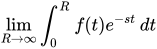
If f is a locally integrable function (or more generally a Borel measure locally of bounded variation ), then the Laplace transform F ( s ) of f converges provided that the limit
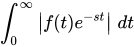
lim R → ∞ ∫ 0 R f ( t ) e − s t d t {\displaystyle \lim _{R\to \infty }\int _{0}^{R}f(t)e^{-st}\,dt} exists. The Laplace transform converges absolutely if the integral
∫ 0 ∞ | f ( t ) e − s t | d t {\displaystyle \int _{0}^{\infty }\left|f(t)e^{-st}\right|\,dt} exists (as a proper Lebesgue integral ). The Laplace transform is usually understood as conditionally convergent, meaning that it converges in the former instead of the latter sense.
The set of values for which F ( s ) converges absolutely is either of the form Re( s ) > a or else Re( s ) ≥ a , where a is an extended real constant , −∞ ≤ a ≤ ∞. (This follows from the dominated convergence theorem .) The constant a is known as the abscissa of absolute convergence , and depends on the growth behavior of f ( t ). [ 3 ] Analogously, the two-sided transform converges absolutely in a strip of the form a < Re( s ) < b , and possibly including the lines Re( s ) = a or Re( s ) = b . [ 4 ] The subset of values of s for which the Laplace transform converges absolutely is called the region of absolute convergence or the domain of absolute convergence. In the two-sided case, it is sometimes called the strip of absolute convergence. The Laplace transform is analytic in the region of absolute convergence.
Similarly, the set of values for which F ( s ) converges (conditionally or absolutely) is known as the region of conditional convergence, or simply the region of convergence (ROC). If the Laplace transform converges (conditionally) at s = s 0 , then it automatically converges for all s with Re( s ) > Re( s 0 ). Therefore, the region of convergence is a half-plane of the form Re( s ) > a , possibly including some points of the boundary line Re( s ) = a . In the region of convergence Re( s ) > Re( s 0 ), the Laplace transform of f can be expressed by integrating by parts as the integral
F ( s ) = ( s − s 0 ) ∫ 0 ∞ e − ( s − s 0 ) t β ( t ) d t , β ( u ) = ∫ 0 u e − s 0 t f ( t ) d t . {\displaystyle F(s)=(s-s_{0})\int _{0}^{\infty }e^{-(s-s_{0})t}\beta (t)\,dt,\quad \beta (u)=\int _{0}^{u}e^{-s_{0}t}f(t)\,dt.} That is, in the region of convergence F ( s ) can effectively be expressed as the absolutely convergent Laplace transform of some other function. In particular, it is analytic.
There are several Paley–Wiener theorems concerning the relationship between the decay properties of f and the properties of the Laplace transform within the region of convergence.
In engineering applications, a function corresponding to a linear time-invariant (LTI) system is stable if every bounded input produces a bounded output.
Bilateral transforms do not respect causality . They make sense when applied over generic functions but when working with functions of time (signals) unilateral transforms are preferred.
Table of selected bilateral Laplace transforms [ edit ] Following list of interesting examples for the bilateral Laplace transform can be deduced from the corresponding Fourier or
unilateral Laplace transformations
(see also Bracewell (2000) ):
LePage, Wilbur R. (1980). Complex Variables and the Laplace Transform for Engineers . Dover Publications. Van der Pol, Balthasar, and Bremmer, H., Operational Calculus Based on the Two-Sided Laplace Integral , Chelsea Pub. Co., 3rd ed., 1987. Widder, David Vernon (1941), The Laplace Transform , Princeton Mathematical Series, v. 6, Princeton University Press , MR 0005923 . Bracewell, Ronald N. (2000). The Fourier Transform and Its Applications (3rd ed.). Oppenheim, Alan V.; Willsky, Alan S. (1997). Signals & Systems (2nd ed.). |
| Markdown | [Jump to content](https://en.wikipedia.org/wiki/Two-sided_Laplace_transform#bodyContent)
Main menu
Main menu
move to sidebar
hide
Navigation
- [Main page](https://en.wikipedia.org/wiki/Main_Page "Visit the main page [z]")
- [Contents](https://en.wikipedia.org/wiki/Wikipedia:Contents "Guides to browsing Wikipedia")
- [Current events](https://en.wikipedia.org/wiki/Portal:Current_events "Articles related to current events")
- [Random article](https://en.wikipedia.org/wiki/Special:Random "Visit a randomly selected article [x]")
- [About Wikipedia](https://en.wikipedia.org/wiki/Wikipedia:About "Learn about Wikipedia and how it works")
- [Contact us](https://en.wikipedia.org/wiki/Wikipedia:Contact_us "How to contact Wikipedia")
Contribute
- [Help](https://en.wikipedia.org/wiki/Help:Contents "Guidance on how to use and edit Wikipedia")
- [Learn to edit](https://en.wikipedia.org/wiki/Help:Introduction "Learn how to edit Wikipedia")
- [Community portal](https://en.wikipedia.org/wiki/Wikipedia:Community_portal "The hub for editors")
- [Recent changes](https://en.wikipedia.org/wiki/Special:RecentChanges "A list of recent changes to Wikipedia [r]")
- [Upload file](https://en.wikipedia.org/wiki/Wikipedia:File_upload_wizard "Add images or other media for use on Wikipedia")
- [Special pages](https://en.wikipedia.org/wiki/Special:SpecialPages)
[  ](https://en.wikipedia.org/wiki/Main_Page)
[Search](https://en.wikipedia.org/wiki/Special:Search "Search Wikipedia [f]")
Appearance
- [Donate](https://donate.wikimedia.org/?wmf_source=donate&wmf_medium=sidebar&wmf_campaign=en.wikipedia.org&uselang=en)
- [Create account](https://en.wikipedia.org/w/index.php?title=Special:CreateAccount&returnto=Two-sided+Laplace+transform "You are encouraged to create an account and log in; however, it is not mandatory")
- [Log in](https://en.wikipedia.org/w/index.php?title=Special:UserLogin&returnto=Two-sided+Laplace+transform "You're encouraged to log in; however, it's not mandatory. [o]")
Personal tools
- [Donate](https://donate.wikimedia.org/?wmf_source=donate&wmf_medium=sidebar&wmf_campaign=en.wikipedia.org&uselang=en)
- [Create account](https://en.wikipedia.org/w/index.php?title=Special:CreateAccount&returnto=Two-sided+Laplace+transform "You are encouraged to create an account and log in; however, it is not mandatory")
- [Log in](https://en.wikipedia.org/w/index.php?title=Special:UserLogin&returnto=Two-sided+Laplace+transform "You're encouraged to log in; however, it's not mandatory. [o]")
Pages for logged out editors [learn more](https://en.wikipedia.org/wiki/Help:Introduction)
- [Contributions](https://en.wikipedia.org/wiki/Special:MyContributions "A list of edits made from this IP address [y]")
- [Talk](https://en.wikipedia.org/wiki/Special:MyTalk "Discussion about edits from this IP address [n]")
## Contents
move to sidebar
hide
- [(Top)](https://en.wikipedia.org/wiki/Two-sided_Laplace_transform)
- [1 Relationship to the Fourier transform](https://en.wikipedia.org/wiki/Two-sided_Laplace_transform#Relationship_to_the_Fourier_transform)
- [2 Relationship to other integral transforms](https://en.wikipedia.org/wiki/Two-sided_Laplace_transform#Relationship_to_other_integral_transforms)
- [3 Properties](https://en.wikipedia.org/wiki/Two-sided_Laplace_transform#Properties)
Toggle Properties subsection
- [3\.1 Parseval's theorem and Plancherel's theorem](https://en.wikipedia.org/wiki/Two-sided_Laplace_transform#Parseval's_theorem_and_Plancherel's_theorem)
- [3\.2 Uniqueness](https://en.wikipedia.org/wiki/Two-sided_Laplace_transform#Uniqueness)
- [4 Region of convergence](https://en.wikipedia.org/wiki/Two-sided_Laplace_transform#Region_of_convergence)
- [5 Causality](https://en.wikipedia.org/wiki/Two-sided_Laplace_transform#Causality)
- [6 Table of selected bilateral Laplace transforms](https://en.wikipedia.org/wiki/Two-sided_Laplace_transform#Table_of_selected_bilateral_Laplace_transforms)
- [7 See also](https://en.wikipedia.org/wiki/Two-sided_Laplace_transform#See_also)
- [8 References](https://en.wikipedia.org/wiki/Two-sided_Laplace_transform#References)
Toggle the table of contents
# Two-sided Laplace transform
12 languages
- [Català](https://ca.wikipedia.org/wiki/Transformada_de_Laplace_bilateral "Transformada de Laplace bilateral – Catalan")
- [Deutsch](https://de.wikipedia.org/wiki/Zweiseitige_Laplace-Transformation "Zweiseitige Laplace-Transformation – German")
- [Esperanto](https://eo.wikipedia.org/wiki/Amba%C5%ADflanka_laplaca_transformo "Ambaŭflanka laplaca transformo – Esperanto")
- [فارسی](https://fa.wikipedia.org/wiki/%D8%AA%D8%A8%D8%AF%DB%8C%D9%84_%D9%84%D8%A7%D9%BE%D9%84%D8%A7%D8%B3_%D8%AF%D9%88%D8%B3%D9%88%DB%8C%D9%87 "تبدیل لاپلاس دوسویه – Persian")
- [Français](https://fr.wikipedia.org/wiki/Transformation_bilat%C3%A9rale_de_Laplace "Transformation bilatérale de Laplace – French")
- [Magyar](https://hu.wikipedia.org/wiki/K%C3%A9toldali_Laplace-transzform%C3%A1ci%C3%B3 "Kétoldali Laplace-transzformáció – Hungarian")
- [日本語](https://ja.wikipedia.org/wiki/%E4%B8%A1%E5%81%B4%E3%83%A9%E3%83%97%E3%83%A9%E3%82%B9%E5%A4%89%E6%8F%9B "両側ラプラス変換 – Japanese")
- [Polski](https://pl.wikipedia.org/wiki/Dwustronna_transformacja_Laplace%E2%80%99a "Dwustronna transformacja Laplace’a – Polish")
- [Português](https://pt.wikipedia.org/wiki/Transformada_de_Laplace_bilateral "Transformada de Laplace bilateral – Portuguese")
- [Русский](https://ru.wikipedia.org/wiki/%D0%94%D0%B2%D1%83%D1%81%D1%82%D0%BE%D1%80%D0%BE%D0%BD%D0%BD%D0%B5%D0%B5_%D0%BF%D1%80%D0%B5%D0%BE%D0%B1%D1%80%D0%B0%D0%B7%D0%BE%D0%B2%D0%B0%D0%BD%D0%B8%D0%B5_%D0%9B%D0%B0%D0%BF%D0%BB%D0%B0%D1%81%D0%B0 "Двустороннее преобразование Лапласа – Russian")
- [Українська](https://uk.wikipedia.org/wiki/%D0%94%D0%B2%D0%BE%D1%81%D1%82%D0%BE%D1%80%D0%BE%D0%BD%D0%BD%D1%94_%D0%BF%D0%B5%D1%80%D0%B5%D1%82%D0%B2%D0%BE%D1%80%D0%B5%D0%BD%D0%BD%D1%8F_%D0%9B%D0%B0%D0%BF%D0%BB%D0%B0%D1%81%D0%B0 "Двостороннє перетворення Лапласа – Ukrainian")
- [中文](https://zh.wikipedia.org/wiki/%E5%8F%8C%E8%BE%B9%E6%8B%89%E6%99%AE%E6%8B%89%E6%96%AF%E5%8F%98%E6%8D%A2 "双边拉普拉斯变换 – Chinese")
[Edit links](https://www.wikidata.org/wiki/Special:EntityPage/Q1785576#sitelinks-wikipedia "Edit interlanguage links")
- [Article](https://en.wikipedia.org/wiki/Two-sided_Laplace_transform "View the content page [c]")
- [Talk](https://en.wikipedia.org/wiki/Talk:Two-sided_Laplace_transform "Discuss improvements to the content page [t]")
English
- [Read](https://en.wikipedia.org/wiki/Two-sided_Laplace_transform)
- [Edit](https://en.wikipedia.org/w/index.php?title=Two-sided_Laplace_transform&action=edit "Edit this page [e]")
- [View history](https://en.wikipedia.org/w/index.php?title=Two-sided_Laplace_transform&action=history "Past revisions of this page [h]")
Tools
Tools
move to sidebar
hide
Actions
- [Read](https://en.wikipedia.org/wiki/Two-sided_Laplace_transform)
- [Edit](https://en.wikipedia.org/w/index.php?title=Two-sided_Laplace_transform&action=edit "Edit this page [e]")
- [View history](https://en.wikipedia.org/w/index.php?title=Two-sided_Laplace_transform&action=history)
General
- [What links here](https://en.wikipedia.org/wiki/Special:WhatLinksHere/Two-sided_Laplace_transform "List of all English Wikipedia pages containing links to this page [j]")
- [Related changes](https://en.wikipedia.org/wiki/Special:RecentChangesLinked/Two-sided_Laplace_transform "Recent changes in pages linked from this page [k]")
- [Upload file](https://en.wikipedia.org/wiki/Wikipedia:File_Upload_Wizard "Upload files [u]")
- [Permanent link](https://en.wikipedia.org/w/index.php?title=Two-sided_Laplace_transform&oldid=1278022173 "Permanent link to this revision of this page")
- [Page information](https://en.wikipedia.org/w/index.php?title=Two-sided_Laplace_transform&action=info "More information about this page")
- [Cite this page](https://en.wikipedia.org/w/index.php?title=Special:CiteThisPage&page=Two-sided_Laplace_transform&id=1278022173&wpFormIdentifier=titleform "Information on how to cite this page")
- [Get shortened URL](https://en.wikipedia.org/w/index.php?title=Special:UrlShortener&url=https%3A%2F%2Fen.wikipedia.org%2Fwiki%2FTwo-sided_Laplace_transform)
- [Download QR code](https://en.wikipedia.org/w/index.php?title=Special:QrCode&url=https%3A%2F%2Fen.wikipedia.org%2Fwiki%2FTwo-sided_Laplace_transform)
Print/export
- [Download as PDF](https://en.wikipedia.org/w/index.php?title=Special:DownloadAsPdf&page=Two-sided_Laplace_transform&action=show-download-screen "Download this page as a PDF file")
- [Printable version](https://en.wikipedia.org/w/index.php?title=Two-sided_Laplace_transform&printable=yes "Printable version of this page [p]")
In other projects
- [Wikidata item](https://www.wikidata.org/wiki/Special:EntityPage/Q1785576 "Structured data on this page hosted by Wikidata [g]")
Appearance
move to sidebar
hide
From Wikipedia, the free encyclopedia
Mathematical operation
| | |
|---|---|
|  | This article includes a list of [general references](https://en.wikipedia.org/wiki/Wikipedia:Citing_sources#General_references "Wikipedia:Citing sources"), but **it lacks sufficient corresponding [inline citations](https://en.wikipedia.org/wiki/Wikipedia:Citing_sources#Inline_citations "Wikipedia:Citing sources")**. Please help to [improve](https://en.wikipedia.org/wiki/Wikipedia:WikiProject_Reliability "Wikipedia:WikiProject Reliability") this article by [introducing](https://en.wikipedia.org/wiki/Wikipedia:When_to_cite "Wikipedia:When to cite") more precise citations. *(September 2015)* *([Learn how and when to remove this message](https://en.wikipedia.org/wiki/Help:Maintenance_template_removal "Help:Maintenance template removal"))* |
In [mathematics](https://en.wikipedia.org/wiki/Mathematics "Mathematics"), the **two-sided Laplace transform** or **bilateral Laplace transform** is an [integral transform](https://en.wikipedia.org/wiki/Integral_transform "Integral transform") equivalent to [probability](https://en.wikipedia.org/wiki/Probability "Probability")'s [moment-generating function](https://en.wikipedia.org/wiki/Moment-generating_function "Moment-generating function"). Two-sided Laplace transforms are closely related to the [Fourier transform](https://en.wikipedia.org/wiki/Fourier_transform "Fourier transform"), the [Mellin transform](https://en.wikipedia.org/wiki/Mellin_transform "Mellin transform"), the [Z-transform](https://en.wikipedia.org/wiki/Z-transform "Z-transform") and the ordinary or one-sided [Laplace transform](https://en.wikipedia.org/wiki/Laplace_transform "Laplace transform"). If *f*(*t*) is a real- or complex-valued function of the real variable *t* defined for all real numbers, then the two-sided Laplace transform is defined by the integral
B
{
f
}
(
s
)
\=
F
(
s
)
\=
∫
−
∞
∞
e
−
s
t
f
(
t
)
d
t
.
{\\displaystyle {\\mathcal {B}}\\{f\\}(s)=F(s)=\\int \_{-\\infty }^{\\infty }e^{-st}f(t)\\,dt.}

The integral is most commonly understood as an [improper integral](https://en.wikipedia.org/wiki/Improper_integral "Improper integral"), which converges [if and only if](https://en.wikipedia.org/wiki/If_and_only_if "If and only if") both integrals
∫
0
∞
e
−
s
t
f
(
t
)
d
t
,
∫
−
∞
0
e
−
s
t
f
(
t
)
d
t
{\\displaystyle \\int \_{0}^{\\infty }e^{-st}f(t)\\,dt,\\quad \\int \_{-\\infty }^{0}e^{-st}f(t)\\,dt}

exist. There seems to be no generally accepted notation for the two-sided transform; the B {\\displaystyle {\\mathcal {B}}}  used here recalls "bilateral". The two-sided transform used by some authors is
T
{
f
}
(
s
)
\=
s
B
{
f
}
(
s
)
\=
s
F
(
s
)
\=
s
∫
−
∞
∞
e
−
s
t
f
(
t
)
d
t
.
{\\displaystyle {\\mathcal {T}}\\{f\\}(s)=s{\\mathcal {B}}\\{f\\}(s)=sF(s)=s\\int \_{-\\infty }^{\\infty }e^{-st}f(t)\\,dt.}

In pure mathematics the argument *t* can be any variable, and Laplace transforms are used to study how [differential operators](https://en.wikipedia.org/wiki/Differential_operator "Differential operator") transform the function.
In [science](https://en.wikipedia.org/wiki/Science "Science") and [engineering](https://en.wikipedia.org/wiki/Engineering "Engineering") applications, the argument *t* often represents time (in seconds), and the function *f*(*t*) often represents a [signal](https://en.wikipedia.org/wiki/Signal_\(information_theory\) "Signal (information theory)") or waveform that varies with time. In these cases, the signals are transformed by [filters](https://en.wikipedia.org/wiki/Filter_\(signal_processing\) "Filter (signal processing)"), that work like a mathematical operator, but with a restriction. They have to be causal, which means that the output in a given time *t* cannot depend on an output which is a higher value of *t*. In population ecology, the argument *t* often represents spatial displacement in a dispersal kernel.
When working with functions of time, *f*(*t*) is called the **time domain** representation of the signal, while *F*(*s*) is called the **s-domain** (or *Laplace domain*) representation. The inverse transformation then represents a *synthesis* of the signal as the sum of its frequency components taken over all frequencies, whereas the forward transformation represents the *analysis* of the signal into its frequency components.
## Relationship to the Fourier transform
\[[edit](https://en.wikipedia.org/w/index.php?title=Two-sided_Laplace_transform&action=edit§ion=1 "Edit section: Relationship to the Fourier transform")\]
The [Fourier transform](https://en.wikipedia.org/wiki/Fourier_transform "Fourier transform") can be defined in terms of the two-sided Laplace transform:
F
{
f
(
t
)
}
\=
F
(
s
\=
i
ω
)
\=
F
(
ω
)
.
{\\displaystyle {\\mathcal {F}}\\{f(t)\\}=F(s=i\\omega )=F(\\omega ).}

Note that definitions of the Fourier transform differ, and in particular
F
{
f
(
t
)
}
\=
F
(
s
\=
i
ω
)
\=
1
2
π
B
{
f
(
t
)
}
(
s
)
{\\displaystyle {\\mathcal {F}}\\{f(t)\\}=F(s=i\\omega )={\\frac {1}{\\sqrt {2\\pi }}}{\\mathcal {B}}\\{f(t)\\}(s)}

is often used instead. In terms of the Fourier transform, we may also obtain the two-sided Laplace transform, as
B
{
f
(
t
)
}
(
s
)
\=
F
{
f
(
t
)
}
(
−
i
s
)
.
{\\displaystyle {\\mathcal {B}}\\{f(t)\\}(s)={\\mathcal {F}}\\{f(t)\\}(-is).}

The Fourier transform is normally defined so that it exists for real values; the above definition defines the image in a strip a \< ℑ ( s ) \< b {\\displaystyle a\<\\Im (s)\<b} 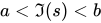 which may not include the real axis where the Fourier transform is supposed to converge.
This is then why Laplace transforms retain their value in control theory and signal processing: the convergence of a Fourier transform integral within its domain only means that a linear, shift-invariant system described by it is stable or critical. The Laplace one on the other hand will somewhere converge for every impulse response which is at most exponentially growing, because it involves an extra term which can be taken as an exponential regulator. Since there are no superexponentially growing linear feedback networks, Laplace transform based analysis and solution of linear, shift-invariant systems, takes its most general form in the context of Laplace, not Fourier, transforms.
At the same time, nowadays Laplace transform theory falls within the ambit of more general [integral transforms](https://en.wikipedia.org/wiki/Integral_transform "Integral transform"), or even general [harmonic analysis](https://en.wikipedia.org/wiki/Harmonic_analysis "Harmonic analysis"). In that framework and nomenclature, Laplace transforms are simply another form of Fourier analysis, even if more general in hindsight.
## Relationship to other integral transforms
\[[edit](https://en.wikipedia.org/w/index.php?title=Two-sided_Laplace_transform&action=edit§ion=2 "Edit section: Relationship to other integral transforms")\]
If *u* is the [Heaviside step function](https://en.wikipedia.org/wiki/Heaviside_step_function "Heaviside step function"), equal to zero when its argument is less than zero, to one-half when its argument equals zero, and to one when its argument is greater than zero, then the Laplace transform L {\\displaystyle {\\mathcal {L}}}  may be defined in terms of the two-sided Laplace transform by
L
{
f
}
\=
B
{
f
u
}
.
{\\displaystyle {\\mathcal {L}}\\{f\\}={\\mathcal {B}}\\{fu\\}.}

On the other hand, we also have
B
{
f
}
\=
L
{
f
}
\+
L
{
f
∘
m
}
∘
m
,
{\\displaystyle {\\mathcal {B}}\\{f\\}={\\mathcal {L}}\\{f\\}+{\\mathcal {L}}\\{f\\circ m\\}\\circ m,}

where m : R → R {\\displaystyle m:\\mathbb {R} \\to \\mathbb {R} }  is the function that multiplies by minus one (m ( x ) \= − x {\\displaystyle m(x)=-x} ), so either version of the Laplace transform can be defined in terms of the other.
The [Mellin transform](https://en.wikipedia.org/wiki/Mellin_transform "Mellin transform") may be defined in terms of the two-sided Laplace transform by
M
{
f
}
\=
B
{
f
∘
exp
∘
m
}
,
{\\displaystyle {\\mathcal {M}}\\{f\\}={\\mathcal {B}}\\{f\\circ {\\exp }\\circ m\\},}

with m {\\displaystyle m}  as above, and conversely we can get the two-sided transform from the Mellin transform by
B
{
f
}
\=
M
{
f
∘
m
∘
log
}
.
{\\displaystyle {\\mathcal {B}}\\{f\\}={\\mathcal {M}}\\{f\\circ m\\circ \\log \\}.}

The [moment-generating function](https://en.wikipedia.org/wiki/Moment-generating_function "Moment-generating function") of a continuous [probability density function](https://en.wikipedia.org/wiki/Probability_density_function "Probability density function") *ƒ*(*x*) can be expressed as B { f } ( − s ) {\\displaystyle {\\mathcal {B}}\\{f\\}(-s)} .
## Properties
\[[edit](https://en.wikipedia.org/w/index.php?title=Two-sided_Laplace_transform&action=edit§ion=3 "Edit section: Properties")\]
The following properties can be found in [Bracewell (2000)](https://en.wikipedia.org/wiki/Two-sided_Laplace_transform#CITEREFBracewell2000) and [Oppenheim & Willsky (1997)](https://en.wikipedia.org/wiki/Two-sided_Laplace_transform#CITEREFOppenheimWillsky1997)
| Property | Time domain | *s* domain | Strip of convergence | Comment |
|---|---|---|---|---|
| Definition | f ( t ) {\\displaystyle f(t)}  | | | |
Most properties of the bilateral Laplace transform are very similar to properties of the unilateral Laplace transform, but there are some important differences:
| | unilateral time domain | bilateral time domain | unilateral-'s' domain | bilateral-'s' domain |
|---|---|---|---|---|
| [Differentiation](https://en.wikipedia.org/wiki/Derivative "Derivative") | f ′ ( t ) {\\displaystyle f'(t)\\ }  | | | |
### Parseval's theorem and Plancherel's theorem
\[[edit](https://en.wikipedia.org/w/index.php?title=Two-sided_Laplace_transform&action=edit§ion=4 "Edit section: Parseval's theorem and Plancherel's theorem")\]
Let f 1 ( t ) {\\displaystyle f\_{1}(t)}  and f 2 ( t ) {\\displaystyle f\_{2}(t)}  be functions with bilateral Laplace transforms F 1 ( s ) {\\displaystyle F\_{1}(s)}  and F 2 ( s ) {\\displaystyle F\_{2}(s)}  in the strips of convergence α 1 , 2 \< ℜ s \< β 1 , 2 {\\displaystyle \\alpha \_{1,2}\<\\Re s\<\\beta \_{1,2}} . Let c ∈ R {\\displaystyle c\\in \\mathbb {R} }  with max ( − β 1 , α 2 ) \< c \< min ( − α 1 , β 2 ) {\\displaystyle \\max(-\\beta \_{1},\\alpha \_{2})\<c\<\\min(-\\alpha \_{1},\\beta \_{2})} . Then [Parseval's theorem](https://en.wikipedia.org/wiki/Parseval%27s_theorem "Parseval's theorem") holds: [\[1\]](https://en.wikipedia.org/wiki/Two-sided_Laplace_transform#cite_note-1)
∫
−
∞
∞
f
1
(
t
)
¯
f
2
(
t
)
d
t
\=
1
2
π
i
∫
c
−
i
∞
c
\+
i
∞
F
1
(
−
s
¯
)
¯
F
2
(
s
)
d
s
{\\displaystyle \\int \_{-\\infty }^{\\infty }{\\overline {f\_{1}(t)}}\\,f\_{2}(t)\\,dt={\\frac {1}{2\\pi i}}\\int \_{c-i\\infty }^{c+i\\infty }{\\overline {F\_{1}(-{\\overline {s}})}}\\,F\_{2}(s)\\,ds}

This theorem is proved by applying the inverse Laplace transform on the convolution theorem in form of the cross-correlation.
Let f ( t ) {\\displaystyle f(t)}  be a function with bilateral Laplace transform F ( s ) {\\displaystyle F(s)}  in the strip of convergence α \< ℜ s \< β {\\displaystyle \\alpha \<\\Re s\<\\beta } . Let c ∈ R {\\displaystyle c\\in \\mathbb {R} }  with α \< c \< β {\\displaystyle \\alpha \<c\<\\beta } . Then the [Plancherel theorem](https://en.wikipedia.org/wiki/Plancherel_theorem "Plancherel theorem") holds: [\[2\]](https://en.wikipedia.org/wiki/Two-sided_Laplace_transform#cite_note-2)
∫
−
∞
∞
e
−
2
c
t
\|
f
(
t
)
\|
2
d
t
\=
1
2
π
∫
−
∞
∞
\|
F
(
c
\+
i
r
)
\|
2
d
r
{\\displaystyle \\int \_{-\\infty }^{\\infty }e^{-2c\\,t}\\,\|f(t)\|^{2}\\,dt={\\frac {1}{2\\pi }}\\int \_{-\\infty }^{\\infty }\|F(c+ir)\|^{2}\\,dr}

### Uniqueness
\[[edit](https://en.wikipedia.org/w/index.php?title=Two-sided_Laplace_transform&action=edit§ion=5 "Edit section: Uniqueness")\]
For any two functions f , g {\\textstyle f,g}  for which the two-sided Laplace transforms T { f } , T { g } {\\textstyle {\\mathcal {T}}\\{f\\},{\\mathcal {T}}\\{g\\}}  exist, if T { f } \= T { g } , {\\textstyle {\\mathcal {T}}\\{f\\}={\\mathcal {T}}\\{g\\},}  i.e. T { f } ( s ) \= T { g } ( s ) {\\textstyle {\\mathcal {T}}\\{f\\}(s)={\\mathcal {T}}\\{g\\}(s)}  for every value of s ∈ R , {\\textstyle s\\in \\mathbb {R} ,}  then f \= g {\\textstyle f=g}  [almost everywhere](https://en.wikipedia.org/wiki/Almost_everywhere "Almost everywhere").
## Region of convergence
\[[edit](https://en.wikipedia.org/w/index.php?title=Two-sided_Laplace_transform&action=edit§ion=6 "Edit section: Region of convergence")\]
Bilateral transform requirements for convergence are more difficult than for unilateral transforms. The region of convergence will be normally smaller.
If *f* is a [locally integrable](https://en.wikipedia.org/wiki/Locally_integrable "Locally integrable") function (or more generally a [Borel measure](https://en.wikipedia.org/wiki/Borel_measure "Borel measure") locally of [bounded variation](https://en.wikipedia.org/wiki/Bounded_variation "Bounded variation")), then the Laplace transform *F*(*s*) of *f* converges provided that the limit
lim
R
→
∞
∫
0
R
f
(
t
)
e
−
s
t
d
t
{\\displaystyle \\lim \_{R\\to \\infty }\\int \_{0}^{R}f(t)e^{-st}\\,dt}
exists. The Laplace transform converges absolutely if the integral
∫
0
∞
\|
f
(
t
)
e
−
s
t
\|
d
t
{\\displaystyle \\int \_{0}^{\\infty }\\left\|f(t)e^{-st}\\right\|\\,dt}
exists (as a proper [Lebesgue integral](https://en.wikipedia.org/wiki/Lebesgue_integral "Lebesgue integral")). The Laplace transform is usually understood as conditionally convergent, meaning that it converges in the former instead of the latter sense.
The set of values for which *F*(*s*) converges absolutely is either of the form Re(*s*) \> *a* or else Re(*s*) ≥ *a*, where *a* is an [extended real constant](https://en.wikipedia.org/wiki/Extended_real_number "Extended real number"), −∞ ≤ *a* ≤ ∞. (This follows from the [dominated convergence theorem](https://en.wikipedia.org/wiki/Dominated_convergence_theorem "Dominated convergence theorem").) The constant *a* is known as the abscissa of [absolute convergence](https://en.wikipedia.org/wiki/Absolute_convergence "Absolute convergence"), and depends on the growth behavior of *f*(*t*).[\[3\]](https://en.wikipedia.org/wiki/Two-sided_Laplace_transform#cite_note-3) Analogously, the two-sided transform converges absolutely in a strip of the form *a* \< Re(*s*) \< *b*, and possibly including the lines Re(*s*) = *a* or Re(*s*) = *b*.[\[4\]](https://en.wikipedia.org/wiki/Two-sided_Laplace_transform#cite_note-4) The subset of values of *s* for which the Laplace transform converges absolutely is called the region of absolute convergence or the domain of absolute convergence. In the two-sided case, it is sometimes called the strip of absolute convergence. The Laplace transform is [analytic](https://en.wikipedia.org/wiki/Analytic_function "Analytic function") in the region of absolute convergence.
Similarly, the set of values for which *F*(*s*) converges (conditionally or absolutely) is known as the region of conditional convergence, or simply the **[region of convergence](https://en.wikipedia.org/wiki/Region_of_convergence "Region of convergence")** (ROC). If the Laplace transform converges (conditionally) at *s* = *s*0, then it automatically converges for all *s* with Re(*s*) \> Re(*s*0). Therefore, the region of convergence is a half-plane of the form Re(*s*) \> *a*, possibly including some points of the boundary line Re(*s*) = *a*. In the region of convergence Re(*s*) \> Re(*s*0), the Laplace transform of *f* can be expressed by [integrating by parts](https://en.wikipedia.org/wiki/Integration_by_parts "Integration by parts") as the integral
F
(
s
)
\=
(
s
−
s
0
)
∫
0
∞
e
−
(
s
−
s
0
)
t
β
(
t
)
d
t
,
β
(
u
)
\=
∫
0
u
e
−
s
0
t
f
(
t
)
d
t
.
{\\displaystyle F(s)=(s-s\_{0})\\int \_{0}^{\\infty }e^{-(s-s\_{0})t}\\beta (t)\\,dt,\\quad \\beta (u)=\\int \_{0}^{u}e^{-s\_{0}t}f(t)\\,dt.}

That is, in the region of convergence *F*(*s*) can effectively be expressed as the absolutely convergent Laplace transform of some other function. In particular, it is analytic.
There are several [Paley–Wiener theorems](https://en.wikipedia.org/wiki/Paley%E2%80%93Wiener_theorem "Paley–Wiener theorem") concerning the relationship between the decay properties of *f* and the properties of the Laplace transform within the region of convergence.
In engineering applications, a function corresponding to a [linear time-invariant (LTI) system](https://en.wikipedia.org/wiki/LTI_system "LTI system") is *stable* if every bounded input produces a bounded output.
## Causality
\[[edit](https://en.wikipedia.org/w/index.php?title=Two-sided_Laplace_transform&action=edit§ion=7 "Edit section: Causality")\]
Bilateral transforms do not respect [causality](https://en.wikipedia.org/wiki/Causality "Causality"). They make sense when applied over generic functions but when working with functions of time (signals) unilateral transforms are preferred.
## Table of selected bilateral Laplace transforms
\[[edit](https://en.wikipedia.org/w/index.php?title=Two-sided_Laplace_transform&action=edit§ion=8 "Edit section: Table of selected bilateral Laplace transforms")\]
Following list of interesting examples for the bilateral Laplace transform can be deduced from the corresponding Fourier or unilateral Laplace transformations (see also [Bracewell (2000)](https://en.wikipedia.org/wiki/Two-sided_Laplace_transform#CITEREFBracewell2000)):
| Function | Time domain f ( t ) \= B − 1 { F } ( t ) {\\displaystyle f(t)={\\mathcal {B}}^{-1}\\{F\\}(t)}  |
|---|---|
## See also
\[[edit](https://en.wikipedia.org/w/index.php?title=Two-sided_Laplace_transform&action=edit§ion=9 "Edit section: See also")\]
- [Causal filter](https://en.wikipedia.org/wiki/Causal_filter "Causal filter")
- [Acausal system](https://en.wikipedia.org/wiki/Acausal_system "Acausal system")
- [Causal system](https://en.wikipedia.org/wiki/Causal_system "Causal system")
- [Sinc filter](https://en.wikipedia.org/wiki/Sinc_filter "Sinc filter") – ideal sinc filter (aka rectangular filter) is acausal and has an infinite delay.
## References
\[[edit](https://en.wikipedia.org/w/index.php?title=Two-sided_Laplace_transform&action=edit§ion=10 "Edit section: References")\]
1. **[^](https://en.wikipedia.org/wiki/Two-sided_Laplace_transform#cite_ref-1)** [LePage 1980](https://en.wikipedia.org/wiki/Two-sided_Laplace_transform#CITEREFLePage1980), Chapter 11-3, p.340
2. **[^](https://en.wikipedia.org/wiki/Two-sided_Laplace_transform#cite_ref-2)** [Widder 1941](https://en.wikipedia.org/wiki/Two-sided_Laplace_transform#CITEREFWidder1941), Chapter VI, §8, p.246
3. **[^](https://en.wikipedia.org/wiki/Two-sided_Laplace_transform#cite_ref-3)** [Widder 1941](https://en.wikipedia.org/wiki/Two-sided_Laplace_transform#CITEREFWidder1941), Chapter II, §1
4. **[^](https://en.wikipedia.org/wiki/Two-sided_Laplace_transform#cite_ref-4)** [Widder 1941](https://en.wikipedia.org/wiki/Two-sided_Laplace_transform#CITEREFWidder1941), Chapter VI, §2
- LePage, Wilbur R. (1980). *Complex Variables and the Laplace Transform for Engineers*. Dover Publications.
- Van der Pol, Balthasar, and Bremmer, H., *Operational Calculus Based on the Two-Sided Laplace Integral*, Chelsea Pub. Co., 3rd ed., 1987.
- Widder, David Vernon (1941), *The Laplace Transform*, Princeton Mathematical Series, v. 6, [Princeton University Press](https://en.wikipedia.org/wiki/Princeton_University_Press "Princeton University Press"), [MR](https://en.wikipedia.org/wiki/MR_\(identifier\) "MR (identifier)") [0005923](https://mathscinet.ams.org/mathscinet-getitem?mr=0005923)
.
- Bracewell, Ronald N. (2000). *The Fourier Transform and Its Applications* (3rd ed.).
- Oppenheim, Alan V.; Willsky, Alan S. (1997). *Signals & Systems* (2nd ed.).

Retrieved from "<https://en.wikipedia.org/w/index.php?title=Two-sided_Laplace_transform&oldid=1278022173>"
[Categories](https://en.wikipedia.org/wiki/Help:Category "Help:Category"):
- [Integral transforms](https://en.wikipedia.org/wiki/Category:Integral_transforms "Category:Integral transforms")
- [Laplace transforms](https://en.wikipedia.org/wiki/Category:Laplace_transforms "Category:Laplace transforms")
Hidden categories:
- [Articles with short description](https://en.wikipedia.org/wiki/Category:Articles_with_short_description "Category:Articles with short description")
- [Short description is different from Wikidata](https://en.wikipedia.org/wiki/Category:Short_description_is_different_from_Wikidata "Category:Short description is different from Wikidata")
- [Articles lacking in-text citations from September 2015](https://en.wikipedia.org/wiki/Category:Articles_lacking_in-text_citations_from_September_2015 "Category:Articles lacking in-text citations from September 2015")
- [All articles lacking in-text citations](https://en.wikipedia.org/wiki/Category:All_articles_lacking_in-text_citations "Category:All articles lacking in-text citations")
- This page was last edited on 28 February 2025, at 01:40 (UTC).
- Text is available under the [Creative Commons Attribution-ShareAlike 4.0 License](https://en.wikipedia.org/wiki/Wikipedia:Text_of_the_Creative_Commons_Attribution-ShareAlike_4.0_International_License "Wikipedia:Text of the Creative Commons Attribution-ShareAlike 4.0 International License"); additional terms may apply. By using this site, you agree to the [Terms of Use](https://foundation.wikimedia.org/wiki/Special:MyLanguage/Policy:Terms_of_Use "foundation:Special:MyLanguage/Policy:Terms of Use") and [Privacy Policy](https://foundation.wikimedia.org/wiki/Special:MyLanguage/Policy:Privacy_policy "foundation:Special:MyLanguage/Policy:Privacy policy"). Wikipedia® is a registered trademark of the [Wikimedia Foundation, Inc.](https://wikimediafoundation.org/), a non-profit organization.
- [Privacy policy](https://foundation.wikimedia.org/wiki/Special:MyLanguage/Policy:Privacy_policy)
- [About Wikipedia](https://en.wikipedia.org/wiki/Wikipedia:About)
- [Disclaimers](https://en.wikipedia.org/wiki/Wikipedia:General_disclaimer)
- [Contact Wikipedia](https://en.wikipedia.org/wiki/Wikipedia:Contact_us)
- [Code of Conduct](https://foundation.wikimedia.org/wiki/Special:MyLanguage/Policy:Universal_Code_of_Conduct)
- [Developers](https://developer.wikimedia.org/)
- [Statistics](https://stats.wikimedia.org/#/en.wikipedia.org)
- [Cookie statement](https://foundation.wikimedia.org/wiki/Special:MyLanguage/Policy:Cookie_statement)
- [Mobile view](https://en.m.wikipedia.org/w/index.php?title=Two-sided_Laplace_transform&mobileaction=toggle_view_mobile)
- [](https://www.wikimedia.org/)
- [](https://www.mediawiki.org/)
Search
Toggle the table of contents
Two-sided Laplace transform
12 languages
[Add topic](https://en.wikipedia.org/wiki/Two-sided_Laplace_transform) |
| Readable Markdown | null |
| Shard | 152 (laksa) |
| Root Hash | 17790707453426894952 |
| Unparsed URL | org,wikipedia!en,/wiki/Two-sided_Laplace_transform s443 |