ℹ️ Skipped - page is already crawled
| Filter | Status | Condition | Details |
|---|---|---|---|
| HTTP status | PASS | download_http_code = 200 | HTTP 200 |
| Age cutoff | PASS | download_stamp > now() - 6 MONTH | 0.3 months ago (distributed domain, exempt) |
| History drop | PASS | isNull(history_drop_reason) | No drop reason |
| Spam/ban | PASS | fh_dont_index != 1 AND ml_spam_score = 0 | ml_spam_score=0 |
| Canonical | PASS | meta_canonical IS NULL OR = '' OR = src_unparsed | Not set |
| Property | Value | |||||||||||||||
|---|---|---|---|---|---|---|---|---|---|---|---|---|---|---|---|---|
| URL | https://en.wikipedia.org/wiki/Torus | |||||||||||||||
| Last Crawled | 2026-04-19 02:35:37 (9 days ago) | |||||||||||||||
| First Indexed | 2013-08-08 18:18:19 (12 years ago) | |||||||||||||||
| HTTP Status Code | 200 | |||||||||||||||
| Content | ||||||||||||||||
| Meta Title | Torus - Wikipedia | |||||||||||||||
| Meta Description | null | |||||||||||||||
| Meta Canonical | null | |||||||||||||||
| Boilerpipe Text | Not to be confused with
Taurus
.
A ring torus with a selection of circles on its surface
As the distance from the axis of revolution decreases, the ring torus becomes a horn torus, then a spindle torus, and finally
degenerates
into a double-covered
sphere
.
A ring torus with aspect ratio 3, the ratio between the diameters of the larger (blue) circle and the smaller (red) circle. The two radii coordinates are shown as well. The radius denoted by capital, R, is the distance from the geometric center of the outer ring lying outside the volume, to the center of the inner ring. The radius denoted by lower case, r, is the distance from the inner ring's center to the surface of the torus.
In
geometry
, a
torus
(
pl.
:
tori
or
toruses
) is a
surface of revolution
generated by revolving a
circle
in
three-dimensional space
one full revolution about an axis that is
coplanar
with the circle. The main types of toruses include ring toruses, horn toruses, and spindle toruses. A ring torus is sometimes colloquially referred to as a
doughnut
.
If the
axis of revolution
does not touch the circle, the surface has a ring shape and is called a
torus of revolution
, also known as a
ring torus
. If the axis of revolution is
tangent
to the circle, the surface is a
horn torus
. If the axis of revolution passes twice through the circle, the surface is a
spindle torus
(or
self-crossing torus
or
self-intersecting torus
). If the axis of revolution passes through the center of the circle, the surface is a degenerate torus, a double-covered
sphere
. If the revolved curve is not a circle, the surface is called a
toroid
, as in a square toroid.
Real-world objects that approximate a torus of revolution include
swim rings
,
inner tubes
and
ringette rings
.
A torus is different than a
solid torus
, which is formed by rotating a
disk
, rather than a circle, around an axis. A solid torus is a torus plus the
volume
inside the torus. Real-world objects that approximate a
solid torus
include
O-rings
, non-inflatable
lifebuoys
, ring
doughnuts
, and
bagels
.
In
topology
, a ring torus is
homeomorphic
to the
Cartesian product
of two
circles
:
S
1
×
S
1
, which is sometimes used as the definition. It is a compact 2-manifold of genus 1. The ring torus is one way to embed this space into
Euclidean space
, but another way to do this is the Cartesian product of the
embedding
of
S
1
in the plane with itself. This produces a geometric object called the
Clifford torus
, a surface in
4-space
.
In the field of
topology
, a torus is any topological space that is homeomorphic to a torus.
[
1
]
The surface of a coffee cup and a doughnut are both topological tori with
genus
one.
An example of a torus can be constructed by taking a rectangular strip of flexible material such as rubber, and joining the top edge to the bottom edge, and the left edge to the right edge, without any half-twists (compare
Klein bottle
).
Torus
is a Latin word denoting something round, a swelling, an elevation, a protuberance.
R
>
r
: ring torus or anchor ring
R
=
r
: horn torus
R
<
r
: self-intersecting spindle torus
A torus of revolution in 3-space can be
parametrized
as:
[
2
]
using angular coordinates
, representing rotation around the tube and rotation around the torus's axis of revolution, respectively, where the
major radius
R
is the distance from the center of the tube to the center of the torus and the
minor radius
r
is the radius of the tube.
[
3
]
The ratio
R
/
r
is called the
aspect ratio
of the torus. The typical doughnut confectionery has an aspect ratio of about 3 to 2.
An
implicit
equation in
Cartesian coordinates
for a torus radially symmetric about the z-
axis
is
Algebraically eliminating the
square root
gives a
quartic equation
,
An
apple
and a
lemon
derived from a spindle torus with proportions of a
vesica piscis
The three classes of standard tori correspond to the three possible aspect ratios between
R
and
r
:
When
R
>
r
, the surface will be the familiar ring torus or anchor ring.
R
=
r
corresponds to the horn torus, which in effect is a torus with no "hole".
R
<
r
describes the self-intersecting spindle torus; its inner shell is a
lemon
and its outer shell is an
apple
.
When
R
= 0
, the torus degenerates to the sphere radius
r
.
When
r
= 0
, the torus degenerates to the circle radius
R
.
When
R
≥
r
, the
interior
of this torus is
diffeomorphic
(and, hence, homeomorphic) to a
product
of a
Euclidean open disk
and a circle. The
volume
of this solid torus and the
surface area
of its torus are easily computed using
Pappus's centroid theorem
, giving:
[
4
]
These formulae are the same as for a cylinder of length
2π
R
and radius
r
, obtained from cutting the tube along the plane of a small circle, and unrolling it by straightening out (rectifying) the line running around the center of the tube. The losses in surface area and volume on the inner side of the tube exactly cancel out the gains on the outer side.
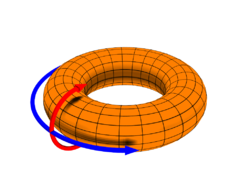
Poloidal direction (red arrow) and toroidal direction (blue arrow)
Expressing the surface area and the volume by the distance
p
of an outermost point on the surface of the torus to the center, and the distance
q
of an innermost point to the center (so that
R
=
p
+
q
/
2
and
r
=
p
−
q
/
2
), yields
As a torus is the product of two circles, a modified version of the
spherical coordinate system
is sometimes used.
In traditional spherical coordinates there are three measures,
R
, the distance from the center of the coordinate system, and
θ
and
φ
, angles measured from the center point.
As a torus has, effectively, two center points, the centerpoints of the angles are moved;
φ
measures the same angle as it does in the spherical system, but is known as the "toroidal" direction. The center point of
θ
is moved to the center of
r
, and is known as the "poloidal" direction. These terms were first used in a discussion of the Earth's magnetic field, where "poloidal" was used to denote "the direction toward the poles".
[
5
]
In modern use,
toroidal and poloidal
are more commonly used to discuss
magnetic confinement fusion
devices.
Differential geometry for the ring torus
[
edit
]
Using the parametrization of the torus given at the beginning of the section, it is straight forward to compute various common objects of differential calculus for the ring torus because it is not a self-intersecting surface. The partial angular velocity fields are given as,
,
.
The transpose of the Jacobian matrix,
, is given by,
.
The
Jacobian matrix determinant
,
, can then be computed as the Euclidean norm (magnitude) of the cross product of
with
as,
. The result is
. From this expression, one can then compute the surface area, and the volume by integrating
over the coordinates of the ring torus's defined ranges:
,
,
, and
.
[
6
]
.
.
The usual differential operators of vector calculus can be calculated using the same parametrization to obtain their ring toroidal forms. For example, the
Laplace operator
for the ring torus, with the same variable ranges as for the integrals above, is given by the expression below.
The metric tensor can be calculated as
. The result is,
.
One can check that the square root of the determinant of the metric tensor is equal to the determinant of the Jacobi matrix, i.e.
.
Topologically
, a torus is a
closed surface
defined as the
product
of two
circles
:
S
1
×
S
1
. This can be viewed as lying in
C
2
and is a subset of the
3-sphere
S
3
of radius
√2
. This topological torus is also often called the
Clifford torus
.
[
7
]
In fact,
S
3
is
filled out
by a family of nested tori in this manner (with two degenerate circles), a fact that is important in the study of
S
3
as a
fiber bundle
over
S
2
(the
Hopf bundle
).
The surface described above, given the
relative topology
from
R
3
, is
homeomorphic
to a topological torus as long as it does not intersect its own axis. A particular homeomorphism is given by
stereographically projecting
the topological torus into
R
3
from the north pole of
S
3
.
The torus can also be described as a
quotient
of the
Cartesian plane
under the identifications
or, equivalently, as the quotient of the
unit square
by pasting the opposite edges together, described as a
fundamental polygon
ABA
−1
B
−1
.
Turning a punctured torus inside-out
The
fundamental group
of the torus is just the
direct product
of the fundamental group of the circle with itself:
[
8
]
Intuitively speaking, this means that a
closed path
that circles the torus's "hole" (say, a circle that traces out a particular latitude) and then circles the torus's "body" (say, a circle that traces out a particular longitude) can be deformed to a path that circles the body and then the hole. So, strictly 'latitudinal' and strictly 'longitudinal' paths commute. An equivalent statement may be imagined as two shoelaces passing through each other, then unwinding, then rewinding.
The fundamental group can also be derived from taking the torus as the quotient
(see below), so that
may be taken as its
universal cover
, with
deck transformation
group
.
Its higher
homotopy groups
are all trivial, since a universal cover projection
always induces isomorphisms between the groups
and
for
, and
is
contractible
.
The torus has
homology groups
:
Thus, the first homology group of the torus is
isomorphic
to its fundamental group-- which in particular can be deduced from the
Hurewicz theorem
since
is
abelian
.
The cohomology groups with integer coefficients are isomorphic to the homology ones-- which can be seen either by direct computation,
the universal coefficient theorem
or even
Poincaré duality
.
If a torus is punctured and turned inside out then another torus results, with lines of latitude and longitude interchanged. This is equivalent to building a torus from a cylinder, by joining the circular ends together, in two ways: around the outside like joining two ends of a garden hose, or through the inside like rolling a sock (with the toe cut off). Additionally, if the cylinder was made by gluing two opposite sides of a rectangle together, choosing the other two sides instead will cause the same reversal of orientation.
The 2-torus is a twofold branched cover of the 2-sphere, with four
ramification points
. Every
conformal structure
on the 2-torus can be represented as such a two-sheeted cover of the 2-sphere. The points on the torus corresponding to the ramification points are the
Weierstrass points
. In fact, the conformal type of the torus is determined by the
cross-ratio
of the four points.
n
-dimensional torus
[
edit
]
A stereographic projection of a
Clifford torus
in four dimensions performing a simple rotation through the
xz
-plane
The torus has a generalization to higher dimensions, the
n
-dimensional torus
, often called the
n
-torus
or
hypertorus
for short. (This is the more typical meaning of the term "
n
-torus", the other referring to
n
holes or of genus
n
.
[
9
]
) Just as the ordinary torus is topologically the product space of two circles, the
n
-dimensional torus is
topologically equivalent to
the product of
n
circles. That is:
The standard 1-torus is just the circle:
T
1
=
S
1
. The torus discussed above is the standard 2-torus,
T
2
. And similar to the 2-torus, the
n
-torus,
T
n
can be described as a quotient of
R
n
under integral shifts in any coordinate. That is, the
n
-torus is
R
n
modulo the
action
of the integer
lattice
Z
n
(with the action being taken as vector addition). Equivalently, the
n
-torus is obtained from the
n
-dimensional
hypercube
by gluing the opposite faces together.
An
n
-torus in this sense is an example of an
n-
dimensional
compact
manifold
. It is also an example of a compact
abelian
Lie group
. This follows from the fact that the
unit circle
is a compact abelian Lie group (when identified with the unit
complex numbers
with multiplication). Group multiplication on the torus is then defined by coordinate-wise multiplication.
Toroidal groups play an important part in the theory of
compact Lie groups
. This is due in part to the fact that in any compact Lie group
G
one can always find a
maximal torus
; that is, a closed
subgroup
which is a torus of the largest possible dimension. Such maximal tori
T
have a controlling role to play in theory of connected
G
. Toroidal groups are examples of
protori
, which (like tori) are compact connected abelian groups, which are not required to be
manifolds
.
Automorphisms
of
T
are easily constructed from automorphisms of the lattice
Z
n
, which are classified by
invertible
integral matrices
of size
n
with an integral inverse; these are just the integral matrices with determinant
±1
. Making them act on
R
n
in the usual way, one has the typical
toral automorphism
on the quotient.
The
fundamental group
of an
n
-torus is a
free abelian group
of rank
n
. The
k
th
homology group
of an
n
-torus is a free abelian group of rank
n
choose
k
. It follows that the
Euler characteristic
of the
n
-torus is
0
for all
n
. The
cohomology ring
H
•
(
,
Z
) can be identified with the
exterior algebra
over the
Z
-
module
Z
n
whose generators are the duals of the
n
nontrivial cycles.
Configuration space
[
edit
]
The configuration space of 2 not necessarily distinct points on the circle is the
orbifold
quotient of the 2-torus,
T
2
/
S
2
, which is the
Möbius strip
.
The
Tonnetz
is an example of a torus in music theory.
The Tonnetz is only truly a torus if
enharmonic equivalence
is assumed, so that the
(F♯-A♯)
segment of the right edge of the repeated parallelogram is identified with the
(G♭-B♭)
segment of the left edge.
As the
n
-torus is the
n
-fold product of the circle, the
n
-torus is the
configuration space
of
n
ordered, not necessarily distinct points on the circle. Symbolically,
T
n
= (
S
1
)
n
. The configuration space of
unordered
, not necessarily distinct points is accordingly the
orbifold
T
n
/
S
n
, which is the quotient of the torus by the
symmetric group
on
n
letters (by permuting the coordinates).
For
n
= 2
, the quotient is the
Möbius strip
, the edge corresponding to the orbifold points where the two coordinates coincide. For
n
= 3
this quotient may be described as a solid torus with cross-section an
equilateral triangle
, with a
twist
; equivalently, as a
triangular prism
whose top and bottom faces are connected with a 1/3 twist (120°): the 3-dimensional interior corresponds to the points on the 3-torus where all 3 coordinates are distinct, the 2-dimensional face corresponds to points with 2 coordinates equal and the 3rd different, while the 1-dimensional edge corresponds to points with all 3 coordinates identical.
These orbifolds have found significant
applications to music theory
in the work of Dmitri Tymoczko and collaborators (Felipe Posada, Michael Kolinas, et al.), being used to model
musical triads
.
[
10
]
[
11
]
In three dimensions, one can bend a rectangle into a torus, but doing this necessarily affects the distances measured along the surface, as seen by the distortion of the checkered pattern.
Seen in
stereographic projection
, a 4D
flat torus
can be projected into 3-dimensions and rotated on a fixed axis.
The simplest tiling of a flat torus is
{4,4}
1,0
, constructed on the surface of a
duocylinder
with 1 vertex, 2 orthogonal edges, and one square face. It is seen here stereographically projected into 3-space as a torus.
A
flat torus
is a torus with the metric inherited from its representation as the
quotient
,
R
2
/
L
, where
L
is a discrete subgroup of
R
2
isomorphic to
Z
2
. This gives the quotient the structure of a
Riemannian manifold
, as well as the structure of an abelian Lie group. Perhaps the simplest example of this is when
L
=
Z
2
:
R
2
/
Z
2
, which can also be described as the
Cartesian plane
under the identifications
(
x
,
y
) ~ (
x
+ 1,
y
) ~ (
x
,
y
+ 1)
. This particular flat torus (and any uniformly scaled version of it) is known as the
square
flat torus.
This metric of the square flat torus can also be realised by specific embeddings of the familiar 2-torus into Euclidean 4-space or higher dimensions. Its surface has zero
Gaussian curvature
everywhere. It is flat in the same sense that the surface of a cylinder is flat. In 3 dimensions, one can bend a flat sheet of paper into a cylinder without stretching the paper, but this cylinder cannot be bent into a torus without stretching the paper (unless some regularity and differentiability conditions are given up, see below).
A simple 4-dimensional Euclidean embedding of a rectangular flat torus (more general than the square one) is as follows:
where
R
and
P
are positive constants determining the aspect ratio. It is
diffeomorphic
to a regular torus but not
isometric
. It can not be
analytically
embedded (
smooth
of class
C
k
, 2 ≤
k
≤ ∞
) into Euclidean 3-space.
Mapping
it into
3
-space requires one to stretch it, in which case it looks like a regular torus. For example, in the following map:
If
R
and
P
in the above flat torus parametrization form a unit vector
(
R
,
P
) = (cos(
η
), sin(
η
))
then
u
,
v
, and
0 <
η
< π/2
parameterize the unit 3-sphere as
Hopf coordinates
. In particular, for certain very specific choices of a square flat torus in the
3-sphere
S
3
, where
η
= π/4
above, the torus will partition the 3-sphere into two
congruent
solid tori subsets with the aforesaid flat torus surface as their common
boundary
. One example is the torus
T
defined by
Other tori in
S
3
having this partitioning property include the square tori of the form
Q
⋅
T
, where
Q
is a rotation of 4-dimensional space
R
4
, or in other words
Q
is a member of the Lie group
SO(4)
.
It is known that there exists no
C
2
(twice continuously differentiable) embedding of a flat torus into 3-space. (The idea of the proof is to take a large sphere containing such a flat torus in its interior, and shrink the radius of the sphere until it just touches the torus for the first time. Such a point of contact must be a tangency. But that would imply that part of the torus, since it has zero curvature everywhere, must lie strictly outside the sphere, which is a contradiction.) On the other hand, according to the
Nash-Kuiper theorem
, which was proven in the 1950s, an isometric
C
1
embedding exists. This is solely an existence proof and does not provide explicit equations for such an embedding.
isometric embedding of a flat torus in
R
3
, with corrugations
In April 2012, an explicit
C
1
(continuously differentiable) isometric embedding of a flat torus into 3-dimensional Euclidean space
R
3
was found.
[
12
]
[
13
]
[
14
]
[
15
]
It is a flat torus in the sense that, as a metric space, it is isometric to a flat square torus. It is similar in structure to a
fractal
as it is constructed by repeatedly corrugating an ordinary torus at smaller scales. Like fractals, it has no defined Gaussian curvature. However, unlike fractals, it does have defined
surface normals
, yielding a so-called "smooth fractal". The key to obtaining the smoothness of this corrugated torus is to have the amplitudes of successive corrugations decreasing faster than their "wavelengths".
[
16
]
(These infinitely recursive corrugations are used only for embedding into three dimensions; they are not an intrinsic feature of the flat torus.) This is the first time that any such embedding was defined by explicit equations or depicted by computer graphics.
Conformal classification of flat tori
[
edit
]
In the study of
Riemann surfaces
, one says that any two smooth compact geometric surfaces are "conformally equivalent" when there exists a smooth homeomorphism between them that is both angle-preserving and orientation-preserving. The
Uniformization theorem
guarantees that every Riemann surface is
conformally equivalent
to one that has constant
Gaussian curvature
. In the case of a torus, the constant curvature must be zero. Then one defines the "
moduli space
" of the torus to contain one point for each conformal equivalence class, with the appropriate topology. It turns out that this moduli space
M
may be identified with a punctured sphere that is smooth except for two points that have less angle than 2π (radians) around them: One has total angle π and the other has total angle 2π/3.
M
may be turned into a compact space
M*
– topologically equivalent to a sphere – by adding one additional point that represents the limiting case as a rectangular torus approaches an aspect ratio of 0 in the limit. The result is that this compactified moduli space is a sphere with
three
points each having less than 2π total angle around them. (Such a point is termed a "cusp", and may be thought of as the vertex of a cone, also called a "conepoint".) This third conepoint will have zero total angle around it. Due to symmetry,
M*
may be constructed by glueing together two congruent
geodesic triangles
in the
hyperbolic plane
along their (identical) boundaries, where each triangle has angles of
π/2
,
π/3
, and
0
. (The three angles of a hyperbolic triangle T determine T up to congruence.) As a result, the
Gauss–Bonnet theorem
shows that the area of each triangle can be calculated as
π − (π/2 + π/3 + 0) = π/6
, so it follows that the compactified moduli space
M*
has area equal to
π/3
.
The other two cusps occur at the points corresponding in
M*
to (a) the square torus (total angle
π
) and (b) the hexagonal torus (total angle
2π/3
). These are the only conformal equivalence classes of flat tori that have any conformal automorphisms other than those generated by translations and negation.
In the theory of
surfaces
there is a more general family of objects, the "
genus
"
g
surfaces. A genus
g
surface is the
connected sum
of
g
two-tori. (And so the torus itself is the surface of genus 1.) To form a connected sum of two surfaces, remove from each the interior of a disk and "glue" the surfaces together along the boundary circles. (That is, merge the two boundary circles so they become just one circle.) To form the connected sum of more than two surfaces, successively take the connected sum of two of them at a time until they are all connected. In this sense, a genus
g
surface resembles the surface of
g
doughnuts stuck together side by side, or a
2-sphere
with
g
handles attached.
As examples, a genus zero surface (without boundary) is the
two-sphere
while a genus one surface (without boundary) is the ordinary torus. The surfaces of higher genus are sometimes called
n
-holed tori (or, rarely,
n
-fold tori). The terms
double torus
and
triple torus
are also occasionally used.
The
classification theorem
for surfaces states that every
compact
connected
surface is topologically equivalent to either the sphere or the connect sum of some number of tori, disks, and real
projective planes
.
A
toroidal polyhedron
with
6 × 4 = 24
quadrilateral
faces
Polyhedra
with the topological type of a torus are called toroidal polyhedra, and have
Euler characteristic
V
−
E
+
F
= 0
. For any number of holes, the formula generalizes to
V
−
E
+
F
= 2 − 2
g
, where
g
is the topological genus.
Toroidal polyhedra have been used to show that the maximum number of colors to color a map on a torus is seven. The
Szilassi polyhedron
is one example of a toroidal polyhedron with this property.
[
17
]
The Szilassi polyhedron's dual, the
Császár polyhedron
, is the only polyhedron other than the tetrahedron which has the property that every possible edge connecting two vertices is an edge of the polyhedron.
[
18
]
The term "toroidal polyhedron" is also used for higher-genus polyhedra and for
immersions
of toroidal polyhedra, although some authors only include those with genus 1.
[
19
]
Self-crossing toroidal polyhedra are determined by the topology of their abstract manifold. One subset of the self-crossing toroidal polyhedra are the crown polyhedra, which are the only toroidal polyhedra that are also
noble
.
The
homeomorphism group
(or the subgroup of diffeomorphisms) of the torus is studied in
geometric topology
. Its
mapping class group
(the connected components of the homeomorphism group) is surjective onto the group
of invertible integer matrices, which can be realized as linear maps on the universal covering space
that preserve the standard lattice
(this corresponds to integer coefficients) and thus descend to the quotient.
At the level of
homotopy
and
homology
, the mapping class group can be identified as the action on the first homology (or equivalently, first cohomology, or on the
fundamental group
, as these are all naturally isomorphic; also the first
cohomology group
generates the
cohomology
algebra:
Since the torus is an
Eilenberg–MacLane space
K
(
G
, 1)
, its homotopy equivalences, up to homotopy, can be identified with automorphisms of the fundamental group); all homotopy equivalences of the torus can be realized by homeomorphisms – every homotopy equivalence is homotopic to a homeomorphism.
Thus the
short exact sequence
of the mapping class group splits (an identification of the torus as the quotient of
gives a splitting, via the linear maps, as above):
The mapping class group of higher genus surfaces is much more complicated, and an area of active research.
The torus's
Heawood number
is seven, meaning every graph that can be
embedded on the torus
has a
chromatic number
of at most seven. (Since the
complete graph
can be embedded on the torus, and
, the upper bound is tight.) Equivalently, in a torus divided into regions, it is always possible to color the regions using no more than seven colors so that no neighboring regions are the same color. (Contrast with the
four color theorem
for the
plane
.)
This construction shows the torus divided into seven regions, every one of which touches every other, meaning each must be assigned a unique color.
STL
model of de Bruijn torus
(16,32;3,3)
2
with 1s as panels and 0s as holes in the mesh – with consistent orientation, every 3×3 matrix appears exactly once
In
combinatorial
mathematics, a
de Bruijn torus
is an
array
of symbols from an alphabet (often just 0 and 1) that contains every
m
-by-
n
matrix
exactly once. It is a torus because the edges are considered wraparound for the purpose of finding matrices. Its name comes from the
De Bruijn sequence
, which can be considered a special case where
n
is 1 (one dimension).
A solid torus of revolution can be cut by
n
(> 0) planes into at most
parts.
[
20
]
(This assumes the pieces may not be rearranged but must remain in place for all cuts.)
The first 11 numbers of parts, for
0 ≤
n
≤ 10
(including the case of
n
= 0
, not covered by the above formulas), are as follows:
1, 2, 6, 13, 24, 40, 62, 91, 128, 174, 230, ... (sequence
A003600
in the
OEIS
).
3-torus
Algebraic torus
Angenent torus
Annulus (geometry)
Clifford torus
Complex torus
Dupin cyclide
Elliptic curve
Irrational winding of a torus
Joint European Torus
Klein bottle
Loewner's torus inequality
Maximal torus
Period lattice
Real projective plane
Sphere
Spiric section
Surface (topology)
Toric lens
Toric section
Toric variety
Toroid
Toroidal and poloidal
Torus-based cryptography
Torus knot
Umbilic torus
Villarceau circles
Nociones de Geometría Analítica y Álgebra Lineal
,
ISBN
978-970-10-6596-9
, Author: Kozak Ana Maria, Pompeya Pastorelli Sonia, Verdanega Pedro Emilio, Editorial: McGraw-Hill, Edition 2007, 744 pages, language: Spanish
Allen Hatcher.
Algebraic Topology
. Cambridge University Press, 2002.
ISBN
0-521-79540-0
.
V. V. Nikulin, I. R. Shafarevich.
Geometries and Groups
. Springer, 1987.
ISBN
3-540-15281-4
,
ISBN
978-3-540-15281-1
.
"Tore (notion géométrique)" at
Encyclopédie des Formes Mathématiques Remarquables
^
Gallier, Jean
;
Xu, Dianna
(2013).
A Guide to the Classification Theorem for Compact Surfaces
. Geometry and Computing. Vol. 9. Springer, Heidelberg.
doi
:
10.1007/978-3-642-34364-3
.
ISBN
978-3-642-34363-6
.
MR
3026641
.
^
"Equations for the Standard Torus"
. Geom.uiuc.edu. 6 July 1995.
Archived
from the original on 29 April 2012
. Retrieved
21 July
2012
.
^
"Torus"
. Spatial Corp.
Archived
from the original on 13 December 2014
. Retrieved
16 November
2014
.
^
Weisstein, Eric W.
"Torus"
.
MathWorld
.
^
"poloidal"
.
Oxford English Dictionary Online
. Oxford University Press
. Retrieved
10 August
2007
.
^
O'Neill, Barrett (1997).
Elementary Differential Geometry
(2nd ed.). San Diego: Academic Press. pp.
134–
141.
ISBN
978-0-12-526745-8
.
^
De Graef, Marc (7 March 2024).
"Applications of the Clifford torus to material textures"
(PDF)
.
Journal of Applied Crystallography
.
57
(3):
638–
648.
Bibcode
:
2024JApCr..57..638D
.
doi
:
10.1107/S160057672400219X
.
PMC
11151663
.
PMID
38846769
.
^
Padgett, Adele (2014). "Fundamental groups: motivation, computation methods, and applications", REA Program, Uchicago.
https://math.uchicago.edu/~may/REU2014/REUPapers/Padgett.pdf
^
Weisstein, Eric W.
"Torus"
.
mathworld.wolfram.com
. Retrieved
27 July
2021
.
^
Tymoczko, Dmitri (7 July 2006).
"The Geometry of Musical Chords"
(PDF)
.
Science
.
313
(5783):
72–
74.
Bibcode
:
2006Sci...313...72T
.
CiteSeerX
10.1.1.215.7449
.
doi
:
10.1126/science.1126287
.
PMID
16825563
.
S2CID
2877171
.
Archived
(PDF)
from the original on 25 July 2011.
^
Phillips, Tony (October 2006).
"Take on Math in the Media"
.
American Mathematical Society
. Archived from
the original
on 5 October 2008.
^
Filippelli, Gianluigi (27 April 2012).
"Doc Madhattan: A flat torus in three dimensional space"
.
Proceedings of the National Academy of Sciences
.
109
(19):
7218–
7223.
doi
:
10.1073/pnas.1118478109
.
PMC
3358891
.
PMID
22523238
.
Archived
from the original on 25 June 2012
. Retrieved
21 July
2012
.
^
Enrico de Lazaro (18 April 2012).
"Mathematicians Produce First-Ever Image of Flat Torus in 3D | Mathematics"
.
Sci-News.com
.
Archived
from the original on 1 June 2012
. Retrieved
21 July
2012
.
^
"Mathematics: first-ever image of a flat torus in 3D – CNRS Web site – CNRS"
. Archived from
the original
on 5 July 2012
. Retrieved
21 July
2012
.
^
"Flat tori finally visualized!"
. Math.univ-lyon1.fr. 18 April 2012. Archived from
the original
on 18 June 2012
. Retrieved
21 July
2012
.
^
Hoang, Lê Nguyên (2016).
"The Tortuous Geometry of the Flat Torus"
.
Science4All
. Retrieved
1 November
2022
.
^
Heawood, P. J. (1949).
"Map-Colour Theorem"
.
Proceedings of the London Mathematical Society
. s2-51 (1):
161–
175.
doi
:
10.1112/plms/s2-51.3.161
.
ISSN
1460-244X
.
^
Bobenko, Aleksandr I. (2008).
Discrete Differential Geometry
. Oberwolfach Seminars Ser. Peter Schröder, John M. Sullivan, Günter M. Ziegler. Basel: Birkhäuser Boston.
ISBN
978-3-7643-8620-7
.
^
Webber, William T. (1 August 1997).
"Monohedral Idemvalent Polyhedra that are Toroids"
.
Geometriae Dedicata
.
67
(1):
31–
44.
doi
:
10.1023/A:1004997029852
.
ISSN
1572-9168
.
^
Weisstein, Eric W.
"Torus Cutting"
.
MathWorld
.
Look up
torus
in Wiktionary, the free dictionary.
Creation of a torus
at
cut-the-knot
"4D torus"
Fly-through cross-sections of a four-dimensional torus
"Relational Perspective Map"
Visualizing high dimensional data with flat torus
Polydoes, doughnut-shaped polygons
Archived at
Ghostarchive
and the
Wayback Machine
:
Séquin, Carlo H
(27 January 2014).
"Topology of a Twisted Torus – Numberphile"
(video)
.
Brady Haran
.
Anders Sandberg (4 February 2014).
"Torus Earth"
. Retrieved
24 July
2019
. | |||||||||||||||
| Markdown | [Jump to content](https://en.wikipedia.org/wiki/Torus#bodyContent)
Main menu
Main menu
move to sidebar
hide
Navigation
- [Main page](https://en.wikipedia.org/wiki/Main_Page "Visit the main page [z]")
- [Contents](https://en.wikipedia.org/wiki/Wikipedia:Contents "Guides to browsing Wikipedia")
- [Current events](https://en.wikipedia.org/wiki/Portal:Current_events "Articles related to current events")
- [Random article](https://en.wikipedia.org/wiki/Special:Random "Visit a randomly selected article [x]")
- [About Wikipedia](https://en.wikipedia.org/wiki/Wikipedia:About "Learn about Wikipedia and how it works")
- [Contact us](https://en.wikipedia.org/wiki/Wikipedia:Contact_us "How to contact Wikipedia")
Contribute
- [Help](https://en.wikipedia.org/wiki/Help:Contents "Guidance on how to use and edit Wikipedia")
- [Learn to edit](https://en.wikipedia.org/wiki/Help:Introduction "Learn how to edit Wikipedia")
- [Community portal](https://en.wikipedia.org/wiki/Wikipedia:Community_portal "The hub for editors")
- [Recent changes](https://en.wikipedia.org/wiki/Special:RecentChanges "A list of recent changes to Wikipedia [r]")
- [Upload file](https://en.wikipedia.org/wiki/Wikipedia:File_upload_wizard "Add images or other media for use on Wikipedia")
- [Special pages](https://en.wikipedia.org/wiki/Special:SpecialPages "A list of all special pages [q]")
[  ](https://en.wikipedia.org/wiki/Main_Page)
[Search](https://en.wikipedia.org/wiki/Special:Search "Search Wikipedia [f]")
Appearance
- [Donate](https://donate.wikimedia.org/?wmf_source=donate&wmf_medium=sidebar&wmf_campaign=en.wikipedia.org&uselang=en)
- [Create account](https://en.wikipedia.org/w/index.php?title=Special:CreateAccount&returnto=Torus "You are encouraged to create an account and log in; however, it is not mandatory")
- [Log in](https://en.wikipedia.org/w/index.php?title=Special:UserLogin&returnto=Torus "You're encouraged to log in; however, it's not mandatory. [o]")
Personal tools
- [Donate](https://donate.wikimedia.org/?wmf_source=donate&wmf_medium=sidebar&wmf_campaign=en.wikipedia.org&uselang=en)
- [Create account](https://en.wikipedia.org/w/index.php?title=Special:CreateAccount&returnto=Torus "You are encouraged to create an account and log in; however, it is not mandatory")
- [Log in](https://en.wikipedia.org/w/index.php?title=Special:UserLogin&returnto=Torus "You're encouraged to log in; however, it's not mandatory. [o]")
## Contents
move to sidebar
hide
- [(Top)](https://en.wikipedia.org/wiki/Torus)
- [1 Etymology](https://en.wikipedia.org/wiki/Torus#Etymology)
- [2 Geometry](https://en.wikipedia.org/wiki/Torus#Geometry)
Toggle Geometry subsection
- [2\.1 Differential geometry for the ring torus](https://en.wikipedia.org/wiki/Torus#Differential_geometry_for_the_ring_torus)
- [3 Topology](https://en.wikipedia.org/wiki/Torus#Topology)
- [4 Two-sheeted cover](https://en.wikipedia.org/wiki/Torus#Two-sheeted_cover)
- [5 *n*\-dimensional torus](https://en.wikipedia.org/wiki/Torus#n-dimensional_torus)
Toggle *n*\-dimensional torus subsection
- [5\.1 Configuration space](https://en.wikipedia.org/wiki/Torus#Configuration_space)
- [6 Flat torus](https://en.wikipedia.org/wiki/Torus#Flat_torus)
Toggle Flat torus subsection
- [6\.1 Conformal classification of flat tori](https://en.wikipedia.org/wiki/Torus#Conformal_classification_of_flat_tori)
- [7 Genus *g* surface](https://en.wikipedia.org/wiki/Torus#Genus_g_surface)
- [8 Toroidal polyhedra](https://en.wikipedia.org/wiki/Torus#Toroidal_polyhedra)
- [9 Automorphisms](https://en.wikipedia.org/wiki/Torus#Automorphisms)
- [10 Coloring a torus](https://en.wikipedia.org/wiki/Torus#Coloring_a_torus)
- [11 de Bruijn torus](https://en.wikipedia.org/wiki/Torus#de_Bruijn_torus)
- [12 Cutting a torus](https://en.wikipedia.org/wiki/Torus#Cutting_a_torus)
- [13 See also](https://en.wikipedia.org/wiki/Torus#See_also)
- [14 Notes](https://en.wikipedia.org/wiki/Torus#Notes)
- [15 References](https://en.wikipedia.org/wiki/Torus#References)
- [16 External links](https://en.wikipedia.org/wiki/Torus#External_links)
Toggle the table of contents
# Torus
70 languages
- [Afrikaans](https://af.wikipedia.org/wiki/Torus "Torus – Afrikaans")
- [العربية](https://ar.wikipedia.org/wiki/%D8%B7%D8%A7%D8%B1%D8%A9_\(%D8%B1%D9%8A%D8%A7%D8%B6%D9%8A%D8%A7%D8%AA\) "طارة (رياضيات) – Arabic")
- [Azərbaycanca](https://az.wikipedia.org/wiki/Tor_\(h%C9%99nd%C9%99si_fiqur\) "Tor (həndəsi fiqur) – Azerbaijani")
- [Беларуская](https://be.wikipedia.org/wiki/%D0%A2%D0%BE%D1%80_\(%D0%B3%D0%B5%D0%B0%D0%BC%D0%B5%D1%82%D1%80%D1%8B%D1%8F\) "Тор (геаметрыя) – Belarusian")
- [Български](https://bg.wikipedia.org/wiki/%D0%A2%D0%BE%D1%80_\(%D0%B3%D0%B5%D0%BE%D0%BC%D0%B5%D1%82%D1%80%D0%B8%D1%8F\) "Тор (геометрия) – Bulgarian")
- [বাংলা](https://bn.wikipedia.org/wiki/%E0%A6%9F%E0%A6%B0%E0%A6%BE%E0%A6%B8_\(%E0%A6%9C%E0%A7%8D%E0%A6%AF%E0%A6%BE%E0%A6%AE%E0%A6%BF%E0%A6%A4%E0%A6%BF\) "টরাস (জ্যামিতি) – Bangla")
- [Bosanski](https://bs.wikipedia.org/wiki/Torus "Torus – Bosnian")
- [Català](https://ca.wikipedia.org/wiki/Tor_\(geometria\) "Tor (geometria) – Catalan")
- [Corsu](https://co.wikipedia.org/wiki/Toru_\(giumitria\) "Toru (giumitria) – Corsican")
- [Čeština](https://cs.wikipedia.org/wiki/Torus "Torus – Czech")
- [Чӑвашла](https://cv.wikipedia.org/wiki/%D0%A2%D0%BE%D1%80_\(%C3%A7%D0%B8%D0%B9\) "Тор (çий) – Chuvash")
- [Dansk](https://da.wikipedia.org/wiki/Torus "Torus – Danish")
- [Deutsch](https://de.wikipedia.org/wiki/Torus "Torus – German")
- [Ελληνικά](https://el.wikipedia.org/wiki/%CE%A4%CF%8C%CF%81%CE%BF%CF%82 "Τόρος – Greek")
- [Esperanto](https://eo.wikipedia.org/wiki/Toro_\(geometrio\) "Toro (geometrio) – Esperanto")
- [Español](https://es.wikipedia.org/wiki/Toro_\(geometr%C3%ADa\) "Toro (geometría) – Spanish")
- [Eesti](https://et.wikipedia.org/wiki/Toor "Toor – Estonian")
- [Euskara](https://eu.wikipedia.org/wiki/Toru "Toru – Basque")
- [فارسی](https://fa.wikipedia.org/wiki/%DA%86%D9%86%D8%A8%D8%B1%D9%87 "چنبره – Persian")
- [Suomi](https://fi.wikipedia.org/wiki/Torus "Torus – Finnish")
- [Français](https://fr.wikipedia.org/wiki/Tore "Tore – French")
- [Nordfriisk](https://frr.wikipedia.org/wiki/Ring_\(Geometrii\) "Ring (Geometrii) – Northern Frisian")
- [Gaeilge](https://ga.wikipedia.org/wiki/T%C3%B3ras "Tóras – Irish")
- [Galego](https://gl.wikipedia.org/wiki/Toro_\(xeometr%C3%ADa_e_topolox%C3%ADa\) "Toro (xeometría e topoloxía) – Galician")
- [עברית](https://he.wikipedia.org/wiki/%D7%98%D7%95%D7%A8%D7%95%D7%A1 "טורוס – Hebrew")
- [हिन्दी](https://hi.wikipedia.org/wiki/%E0%A4%9F%E0%A5%89%E0%A4%B0%E0%A4%B8 "टॉरस – Hindi")
- [Hrvatski](https://hr.wikipedia.org/wiki/Torus "Torus – Croatian")
- [Magyar](https://hu.wikipedia.org/wiki/T%C3%B3rusz "Tórusz – Hungarian")
- [Հայերեն](https://hy.wikipedia.org/wiki/%D5%8F%D5%B8%D6%80_\(%D5%B4%D5%A1%D5%AF%D5%A5%D6%80%D6%87%D5%B8%D6%82%D5%B5%D5%A9\) "Տոր (մակերևույթ) – Armenian")
- [Արեւմտահայերէն](https://hyw.wikipedia.org/wiki/%D4%B9%D5%B8%D6%80 "Թոր – Western Armenian")
- [Interlingua](https://ia.wikipedia.org/wiki/Toro "Toro – Interlingua")
- [Bahasa Indonesia](https://id.wikipedia.org/wiki/Torus "Torus – Indonesian")
- [Ido](https://io.wikipedia.org/wiki/Toro "Toro – Ido")
- [Italiano](https://it.wikipedia.org/wiki/Toro_\(geometria\) "Toro (geometria) – Italian")
- [日本語](https://ja.wikipedia.org/wiki/%E3%83%88%E3%83%BC%E3%83%A9%E3%82%B9 "トーラス – Japanese")
- [ქართული](https://ka.wikipedia.org/wiki/%E1%83%A2%E1%83%9D%E1%83%A0%E1%83%98_\(%E1%83%92%E1%83%94%E1%83%9D%E1%83%9B%E1%83%94%E1%83%A2%E1%83%A0%E1%83%98%E1%83%90\) "ტორი (გეომეტრია) – Georgian")
- [Gĩkũyũ](https://ki.wikipedia.org/wiki/Mbirig%C5%A9_\(mathabu\) "Mbirigũ (mathabu) – Kikuyu")
- [한국어](https://ko.wikipedia.org/wiki/%EC%9B%90%ED%99%98%EB%A9%B4 "원환면 – Korean")
- [Latina](https://la.wikipedia.org/wiki/Torus_\(mathematica\) "Torus (mathematica) – Latin")
- [Lëtzebuergesch](https://lb.wikipedia.org/wiki/Torus "Torus – Luxembourgish")
- [Lietuvių](https://lt.wikipedia.org/wiki/Toras_\(geometrija\) "Toras (geometrija) – Lithuanian")
- [Latviešu](https://lv.wikipedia.org/wiki/Tors_\(%C4%A3eometrija\) "Tors (ģeometrija) – Latvian")
- [Македонски](https://mk.wikipedia.org/wiki/%D0%A2%D0%BE%D1%80_\(%D0%B3%D0%B5%D0%BE%D0%BC%D0%B5%D1%82%D1%80%D0%B8%D1%98%D0%B0\) "Тор (геометрија) – Macedonian")
- [മലയാളം](https://ml.wikipedia.org/wiki/%E0%B4%9F%E0%B5%8B%E0%B4%B1%E0%B4%B8%E0%B5%8D "ടോറസ് – Malayalam")
- [Bahasa Melayu](https://ms.wikipedia.org/wiki/Torus "Torus – Malay")
- [Nederlands](https://nl.wikipedia.org/wiki/Torus "Torus – Dutch")
- [Norsk nynorsk](https://nn.wikipedia.org/wiki/Torus "Torus – Norwegian Nynorsk")
- [Norsk bokmål](https://no.wikipedia.org/wiki/Torus "Torus – Norwegian Bokmål")
- [Occitan](https://oc.wikipedia.org/wiki/T%C3%B2r_\(geometria\) "Tòr (geometria) – Occitan")
- [Polski](https://pl.wikipedia.org/wiki/Torus_\(matematyka\) "Torus (matematyka) – Polish")
- [Português](https://pt.wikipedia.org/wiki/Toro_\(topologia\) "Toro (topologia) – Portuguese")
- [Română](https://ro.wikipedia.org/wiki/Tor "Tor – Romanian")
- [Русский](https://ru.wikipedia.org/wiki/%D0%A2%D0%BE%D1%80_\(%D0%BF%D0%BE%D0%B2%D0%B5%D1%80%D1%85%D0%BD%D0%BE%D1%81%D1%82%D1%8C\) "Тор (поверхность) – Russian")
- [Sicilianu](https://scn.wikipedia.org/wiki/Toru_\(giometr%C3%ACa\) "Toru (giometrìa) – Sicilian")
- [Srpskohrvatski / српскохрватски](https://sh.wikipedia.org/wiki/Torus "Torus – Serbo-Croatian")
- [Simple English](https://simple.wikipedia.org/wiki/Torus "Torus – Simple English")
- [Slovenčina](https://sk.wikipedia.org/wiki/Torus_\(geometria\) "Torus (geometria) – Slovak")
- [Slovenščina](https://sl.wikipedia.org/wiki/Torus "Torus – Slovenian")
- [Shqip](https://sq.wikipedia.org/wiki/Torusi "Torusi – Albanian")
- [Српски / srpski](https://sr.wikipedia.org/wiki/%D0%A2%D0%BE%D1%80%D1%83%D1%81 "Торус – Serbian")
- [Svenska](https://sv.wikipedia.org/wiki/Torus "Torus – Swedish")
- [தமிழ்](https://ta.wikipedia.org/wiki/%E0%AE%89%E0%AE%B0%E0%AF%81%E0%AE%B3%E0%AF%8D%E0%AE%B5%E0%AE%B3%E0%AF%88%E0%AE%AF%E0%AE%AE%E0%AF%8D "உருள்வளையம் – Tamil")
- [ไทย](https://th.wikipedia.org/wiki/%E0%B8%97%E0%B8%AD%E0%B8%A3%E0%B8%B1%E0%B8%AA_\(%E0%B9%80%E0%B8%A3%E0%B8%82%E0%B8%B2%E0%B8%84%E0%B8%93%E0%B8%B4%E0%B8%95\) "ทอรัส (เรขาคณิต) – Thai")
- [Türkçe](https://tr.wikipedia.org/wiki/Simit_\(geometri\) "Simit (geometri) – Turkish")
- [Українська](https://uk.wikipedia.org/wiki/%D0%A2%D0%BE%D1%80_\(%D0%B3%D0%B5%D0%BE%D0%BC%D0%B5%D1%82%D1%80%D1%96%D1%8F\) "Тор (геометрія) – Ukrainian")
- [Oʻzbekcha / ўзбекча](https://uz.wikipedia.org/wiki/Tor_\(jism\) "Tor (jism) – Uzbek")
- [Tiếng Việt](https://vi.wikipedia.org/wiki/H%C3%ACnh_xuy%E1%BA%BFn "Hình xuyến – Vietnamese")
- [吴语](https://wuu.wikipedia.org/wiki/%E7%8E%AF%E9%9D%A2 "环面 – Wu")
- [Хальмг](https://xal.wikipedia.org/wiki/%D0%A2%D0%BE%D1%80 "Тор – Kalmyk")
- [中文](https://zh.wikipedia.org/wiki/%E7%8E%AF%E9%9D%A2 "环面 – Chinese")
[Edit links](https://www.wikidata.org/wiki/Special:EntityPage/Q12510#sitelinks-wikipedia "Edit interlanguage links")
- [Article](https://en.wikipedia.org/wiki/Torus "View the content page [c]")
- [Talk](https://en.wikipedia.org/wiki/Talk:Torus "Discuss improvements to the content page [t]")
English
- [Read](https://en.wikipedia.org/wiki/Torus)
- [Edit](https://en.wikipedia.org/w/index.php?title=Torus&action=edit "Edit this page [e]")
- [View history](https://en.wikipedia.org/w/index.php?title=Torus&action=history "Past revisions of this page [h]")
Tools
Tools
move to sidebar
hide
Actions
- [Read](https://en.wikipedia.org/wiki/Torus)
- [Edit](https://en.wikipedia.org/w/index.php?title=Torus&action=edit "Edit this page [e]")
- [View history](https://en.wikipedia.org/w/index.php?title=Torus&action=history)
General
- [What links here](https://en.wikipedia.org/wiki/Special:WhatLinksHere/Torus "List of all English Wikipedia pages containing links to this page [j]")
- [Related changes](https://en.wikipedia.org/wiki/Special:RecentChangesLinked/Torus "Recent changes in pages linked from this page [k]")
- [Upload file](https://en.wikipedia.org/wiki/Wikipedia:File_Upload_Wizard "Upload files [u]")
- [Permanent link](https://en.wikipedia.org/w/index.php?title=Torus&oldid=1343885708 "Permanent link to this revision of this page")
- [Page information](https://en.wikipedia.org/w/index.php?title=Torus&action=info "More information about this page")
- [Cite this page](https://en.wikipedia.org/w/index.php?title=Special:CiteThisPage&page=Torus&id=1343885708&wpFormIdentifier=titleform "Information on how to cite this page")
- [Get shortened URL](https://en.wikipedia.org/w/index.php?title=Special:UrlShortener&url=https%3A%2F%2Fen.wikipedia.org%2Fwiki%2FTorus)
Print/export
- [Download as PDF](https://en.wikipedia.org/w/index.php?title=Special:DownloadAsPdf&page=Torus&action=show-download-screen "Download this page as a PDF file")
- [Printable version](https://en.wikipedia.org/w/index.php?title=Torus&printable=yes "Printable version of this page [p]")
In other projects
- [Wikimedia Commons](https://commons.wikimedia.org/wiki/Torus)
- [Wikidata item](https://www.wikidata.org/wiki/Special:EntityPage/Q12510 "Structured data on this page hosted by Wikidata [g]")
Appearance
move to sidebar
hide
From Wikipedia, the free encyclopedia
Doughnut-shaped surface of revolution
Not to be confused with [Taurus](https://en.wikipedia.org/wiki/Taurus_\(disambiguation\) "Taurus (disambiguation)").
This article is about the mathematical surface. For the volume, see [Solid torus](https://en.wikipedia.org/wiki/Solid_torus "Solid torus"). For other uses, see [Torus (disambiguation)](https://en.wikipedia.org/wiki/Torus_\(disambiguation\) "Torus (disambiguation)").
[](https://en.wikipedia.org/wiki/File:Tesseract_torus.png)
A ring torus with a selection of circles on its surface
[](https://en.wikipedia.org/wiki/File:Ring_Torus_to_Degenerate_Torus_\(Short\).gif)
As the distance from the axis of revolution decreases, the ring torus becomes a horn torus, then a spindle torus, and finally [degenerates](https://en.wikipedia.org/wiki/Degeneracy_\(mathematics\) "Degeneracy (mathematics)") into a double-covered [sphere](https://en.wikipedia.org/wiki/Sphere "Sphere").
[](https://en.wikipedia.org/wiki/File:Torus_cycles001.svg)
A ring torus with aspect ratio 3, the ratio between the diameters of the larger (blue) circle and the smaller (red) circle. The two radii coordinates are shown as well. The radius denoted by capital, R, is the distance from the geometric center of the outer ring lying outside the volume, to the center of the inner ring. The radius denoted by lower case, r, is the distance from the inner ring's center to the surface of the torus.
In [geometry](https://en.wikipedia.org/wiki/Geometry "Geometry"), a **torus** (pl.: **tori** or **toruses**) is a [surface of revolution](https://en.wikipedia.org/wiki/Surface_of_revolution "Surface of revolution") generated by revolving a [circle](https://en.wikipedia.org/wiki/Circle "Circle") in [three-dimensional space](https://en.wikipedia.org/wiki/Three-dimensional_space "Three-dimensional space") one full revolution about an axis that is [coplanar](https://en.wikipedia.org/wiki/Coplanarity "Coplanarity") with the circle. The main types of toruses include ring toruses, horn toruses, and spindle toruses. A ring torus is sometimes colloquially referred to as a **[doughnut](https://en.wikipedia.org/wiki/Doughnut "Doughnut")**.
If the [axis of revolution](https://en.wikipedia.org/wiki/Axis_of_revolution "Axis of revolution") does not touch the circle, the surface has a ring shape and is called a **torus of revolution**, also known as a **ring torus**. If the axis of revolution is [tangent](https://en.wikipedia.org/wiki/Tangent "Tangent") to the circle, the surface is a **horn torus**. If the axis of revolution passes twice through the circle, the surface is a **[spindle torus](https://en.wikipedia.org/wiki/Lemon_\(geometry\) "Lemon (geometry)")** (or *self-crossing torus* or *self-intersecting torus*). If the axis of revolution passes through the center of the circle, the surface is a degenerate torus, a double-covered [sphere](https://en.wikipedia.org/wiki/Sphere "Sphere"). If the revolved curve is not a circle, the surface is called a *[toroid](https://en.wikipedia.org/wiki/Toroid "Toroid")*, as in a square toroid.
Real-world objects that approximate a torus of revolution include [swim rings](https://en.wikipedia.org/wiki/Swim_ring "Swim ring"), [inner tubes](https://en.wikipedia.org/wiki/Inner_tube "Inner tube") and [ringette rings](https://en.wikipedia.org/wiki/Ringette_ring "Ringette ring").
A torus is different than a *[solid torus](https://en.wikipedia.org/wiki/Solid_torus "Solid torus")*, which is formed by rotating a [disk](https://en.wikipedia.org/wiki/Disk_\(geometry\) "Disk (geometry)"), rather than a circle, around an axis. A solid torus is a torus plus the [volume](https://en.wikipedia.org/wiki/Volume "Volume") inside the torus. Real-world objects that approximate a *solid torus* include [O-rings](https://en.wikipedia.org/wiki/O-ring "O-ring"), non-inflatable [lifebuoys](https://en.wikipedia.org/wiki/Lifebuoy "Lifebuoy"), ring [doughnuts](https://en.wikipedia.org/wiki/Doughnut "Doughnut"), and [bagels](https://en.wikipedia.org/wiki/Bagel "Bagel").
In [topology](https://en.wikipedia.org/wiki/Topology "Topology"), a ring torus is [homeomorphic](https://en.wikipedia.org/wiki/Homeomorphism "Homeomorphism") to the [Cartesian product](https://en.wikipedia.org/wiki/Product_topology "Product topology") of two [circles](https://en.wikipedia.org/wiki/Circle "Circle"): *S*1 × *S*1, which is sometimes used as the definition. It is a compact 2-manifold of genus 1. The ring torus is one way to embed this space into [Euclidean space](https://en.wikipedia.org/wiki/Euclidean_space "Euclidean space"), but another way to do this is the Cartesian product of the [embedding](https://en.wikipedia.org/wiki/Embedding "Embedding") of *S*1 in the plane with itself. This produces a geometric object called the [Clifford torus](https://en.wikipedia.org/wiki/Clifford_torus "Clifford torus"), a surface in [4-space](https://en.wikipedia.org/wiki/Four-dimensional_space "Four-dimensional space").
In the field of [topology](https://en.wikipedia.org/wiki/Topology "Topology"), a torus is any topological space that is homeomorphic to a torus.[\[1\]](https://en.wikipedia.org/wiki/Torus#cite_note-1) The surface of a coffee cup and a doughnut are both topological tori with [genus](https://en.wikipedia.org/wiki/Genus_\(mathematics\) "Genus (mathematics)") one.
An example of a torus can be constructed by taking a rectangular strip of flexible material such as rubber, and joining the top edge to the bottom edge, and the left edge to the right edge, without any half-twists (compare [Klein bottle](https://en.wikipedia.org/wiki/Klein_bottle "Klein bottle")).
## Etymology
\[[edit](https://en.wikipedia.org/w/index.php?title=Torus&action=edit§ion=1 "Edit section: Etymology")\]
*[Torus](https://en.wiktionary.org/wiki/torus "wikt:torus")* is a Latin word denoting something round, a swelling, an elevation, a protuberance.
## Geometry
\[[edit](https://en.wikipedia.org/w/index.php?title=Torus&action=edit§ion=2 "Edit section: Geometry")\]
Bottom-halves and
vertical cross-sections
[](https://en.wikipedia.org/wiki/File:Standard_torus-ring.png)
*R* \> *r*: ring torus or anchor ring
[](https://en.wikipedia.org/wiki/File:Standard_torus-horn.png)
*R*\=*r*: horn torus
[](https://en.wikipedia.org/wiki/File:Standard_torus-spindle.png)
*R* \< *r*: self-intersecting spindle torus
A torus of revolution in 3-space can be [parametrized](https://en.wikipedia.org/wiki/Parametric_equation "Parametric equation") as:[\[2\]](https://en.wikipedia.org/wiki/Torus#cite_note-2) x ( θ , φ ) \= ( R \+ r sin θ ) cos φ y ( θ , φ ) \= ( R \+ r sin θ ) sin φ z ( θ , φ ) \= r cos θ {\\displaystyle {\\begin{aligned}x(\\theta ,\\varphi )&=(R+r\\sin \\theta )\\cos {\\varphi }\\\\y(\\theta ,\\varphi )&=(R+r\\sin \\theta )\\sin {\\varphi }\\\\z(\\theta ,\\varphi )&=r\\cos \\theta \\\\\\end{aligned}}}  using angular coordinates θ , φ ∈ \[ 0 , 2 π ) {\\displaystyle \\theta ,\\varphi \\in \[0,2\\pi )} 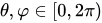, representing rotation around the tube and rotation around the torus's axis of revolution, respectively, where the *major radius* *R* is the distance from the center of the tube to the center of the torus and the *minor radius* *r* is the radius of the tube.[\[3\]](https://en.wikipedia.org/wiki/Torus#cite_note-3)
The ratio *R*/*r* is called the *[aspect ratio](https://en.wikipedia.org/wiki/Aspect_ratio "Aspect ratio")* of the torus. The typical doughnut confectionery has an aspect ratio of about 3 to 2.
An [implicit](https://en.wikipedia.org/wiki/Implicit_function "Implicit function") equation in [Cartesian coordinates](https://en.wikipedia.org/wiki/Cartesian_coordinates "Cartesian coordinates") for a torus radially symmetric about the z-[axis](https://en.wikipedia.org/wiki/Coordinate_axis "Coordinate axis") is ( x 2 \+ y 2 − R ) 2 \+ z 2 \= r 2 . {\\displaystyle {\\textstyle {\\bigl (}{\\sqrt {x^{2}+y^{2}}}-R{\\bigr )}^{2}}+z^{2}=r^{2}.} 
Algebraically eliminating the [square root](https://en.wikipedia.org/wiki/Square_root "Square root") gives a [quartic equation](https://en.wikipedia.org/wiki/Quartic_equation "Quartic equation"), ( x 2 \+ y 2 \+ z 2 \+ R 2 − r 2 ) 2 \= 4 R 2 ( x 2 \+ y 2 ) . {\\displaystyle \\left(x^{2}+y^{2}+z^{2}+R^{2}-r^{2}\\right)^{2}=4R^{2}\\left(x^{2}+y^{2}\\right).} 
[](https://en.wikipedia.org/wiki/File:Spindle_torus_apple_lemon.png)
An *apple* and a *lemon* derived from a spindle torus with proportions of a [vesica piscis](https://en.wikipedia.org/wiki/Vesica_piscis "Vesica piscis")
The three classes of standard tori correspond to the three possible aspect ratios between R and r:
- When *R* \> *r*, the surface will be the familiar ring torus or anchor ring.
- *R* = *r* corresponds to the horn torus, which in effect is a torus with no "hole".
- *R* \< *r* describes the self-intersecting spindle torus; its inner shell is a *[lemon](https://en.wikipedia.org/wiki/Lemon_\(geometry\) "Lemon (geometry)")* and its outer shell is an *[apple](https://en.wikipedia.org/wiki/Apple_\(geometry\) "Apple (geometry)")*.
- When *R* = 0, the torus degenerates to the sphere radius *r*.
- When *r* = 0, the torus degenerates to the circle radius *R*.
When *R* ≥ *r*, the [interior](https://en.wikipedia.org/wiki/Interior_\(topology\) "Interior (topology)") ( x 2 \+ y 2 − R ) 2 \+ z 2 \< r 2 {\\displaystyle {\\textstyle {\\bigl (}{\\sqrt {x^{2}+y^{2}}}-R{\\bigr )}^{2}}+z^{2}\<r^{2}}  of this torus is [diffeomorphic](https://en.wikipedia.org/wiki/Diffeomorphism "Diffeomorphism") (and, hence, homeomorphic) to a [product](https://en.wikipedia.org/wiki/Cartesian_product "Cartesian product") of a [Euclidean open disk](https://en.wikipedia.org/wiki/Disk_\(geometry\) "Disk (geometry)") and a circle. The [volume](https://en.wikipedia.org/wiki/Volume "Volume") of this solid torus and the [surface area](https://en.wikipedia.org/wiki/Surface_area "Surface area") of its torus are easily computed using [Pappus's centroid theorem](https://en.wikipedia.org/wiki/Pappus%27s_centroid_theorem "Pappus's centroid theorem"), giving:[\[4\]](https://en.wikipedia.org/wiki/Torus#cite_note-4)
A \= ( 2 π r ) ( 2 π R ) \= 4 π 2 R r , V \= ( π r 2 ) ( 2 π R ) \= 2 π 2 R r 2 . {\\displaystyle {\\begin{aligned}A&=\\left(2\\pi r\\right)\\left(2\\pi R\\right)=4\\pi ^{2}Rr,\\\\\[5mu\]V&=\\left(\\pi r^{2}\\right)\\left(2\\pi R\\right)=2\\pi ^{2}Rr^{2}.\\end{aligned}}} ![{\\displaystyle {\\begin{aligned}A&=\\left(2\\pi r\\right)\\left(2\\pi R\\right)=4\\pi ^{2}Rr,\\\\\[5mu\]V&=\\left(\\pi r^{2}\\right)\\left(2\\pi R\\right)=2\\pi ^{2}Rr^{2}.\\end{aligned}}}](https://wikimedia.org/api/rest_v1/media/math/render/svg/759188c729542a0e2cac84f62573b2d5745054c8)These formulae are the same as for a cylinder of length 2π*R* and radius r, obtained from cutting the tube along the plane of a small circle, and unrolling it by straightening out (rectifying) the line running around the center of the tube. The losses in surface area and volume on the inner side of the tube exactly cancel out the gains on the outer side.
[](https://en.wikipedia.org/wiki/File:Toroidal_coord.png)
Poloidal direction (red arrow) and toroidal direction (blue arrow)
Expressing the surface area and the volume by the distance p of an outermost point on the surface of the torus to the center, and the distance q of an innermost point to the center (so that *R* = *p* + *q*/2 and *r* = *p* − *q*/2), yields A \= 4 π 2 ( p \+ q 2 ) ( p − q 2 ) \= π 2 ( p \+ q ) ( p − q ) , V \= 2 π 2 ( p \+ q 2 ) ( p − q 2 ) 2 \= 1 4 π 2 ( p \+ q ) ( p − q ) 2 . {\\displaystyle {\\begin{aligned}A&=4\\pi ^{2}\\left({\\frac {p+q}{2}}\\right)\\left({\\frac {p-q}{2}}\\right)=\\pi ^{2}(p+q)(p-q),\\\\\[5mu\]V&=2\\pi ^{2}\\left({\\frac {p+q}{2}}\\right)\\left({\\frac {p-q}{2}}\\right)^{2}={\\tfrac {1}{4}}\\pi ^{2}(p+q)(p-q)^{2}.\\end{aligned}}} ![{\\displaystyle {\\begin{aligned}A&=4\\pi ^{2}\\left({\\frac {p+q}{2}}\\right)\\left({\\frac {p-q}{2}}\\right)=\\pi ^{2}(p+q)(p-q),\\\\\[5mu\]V&=2\\pi ^{2}\\left({\\frac {p+q}{2}}\\right)\\left({\\frac {p-q}{2}}\\right)^{2}={\\tfrac {1}{4}}\\pi ^{2}(p+q)(p-q)^{2}.\\end{aligned}}}](https://wikimedia.org/api/rest_v1/media/math/render/svg/daad86f31332f0d59870358e78e2b38488e1340f)As a torus is the product of two circles, a modified version of the [spherical coordinate system](https://en.wikipedia.org/wiki/Spherical_coordinate_system "Spherical coordinate system") is sometimes used. In traditional spherical coordinates there are three measures, R, the distance from the center of the coordinate system, and θ and φ, angles measured from the center point.
As a torus has, effectively, two center points, the centerpoints of the angles are moved; φ measures the same angle as it does in the spherical system, but is known as the "toroidal" direction. The center point of θ is moved to the center of r, and is known as the "poloidal" direction. These terms were first used in a discussion of the Earth's magnetic field, where "poloidal" was used to denote "the direction toward the poles".[\[5\]](https://en.wikipedia.org/wiki/Torus#cite_note-5)
In modern use, [toroidal and poloidal](https://en.wikipedia.org/wiki/Toroidal_and_poloidal "Toroidal and poloidal") are more commonly used to discuss [magnetic confinement fusion](https://en.wikipedia.org/wiki/Magnetic_confinement_fusion "Magnetic confinement fusion") devices.
### Differential geometry for the ring torus
\[[edit](https://en.wikipedia.org/w/index.php?title=Torus&action=edit§ion=3 "Edit section: Differential geometry for the ring torus")\]
Using the parametrization of the torus given at the beginning of the section, it is straight forward to compute various common objects of differential calculus for the ring torus because it is not a self-intersecting surface. The partial angular velocity fields are given as,
v φ \= ( − ( R \+ r sin θ ) sin φ , ( R \+ r sin θ ) cos φ , 0 ) {\\displaystyle v\_{\\varphi }=(-(R+r\\sin \\theta )\\sin \\varphi ,\\,(R+r\\sin \\theta )\\cos \\varphi ,\\,0)} ,
v θ \= ( r cos θ cos φ , r cos θ sin φ , − r sin θ ) {\\displaystyle v\_{\\theta }=(r\\cos \\theta \\cos \\varphi ,\\,r\\cos \\theta \\sin \\varphi ,\\,-r\\sin \\theta )} .
The transpose of the Jacobian matrix, J T {\\displaystyle J^{\\rm {T}}} , is given by,
J T \= ( cos φ sin θ sin φ sin θ cos θ r cos φ cos θ r sin φ cos θ − r sin θ − ( R \+ r sin θ ) sin φ ( R \+ r sin θ ) cos φ 0 ) {\\displaystyle J^{\\rm {T}}={\\begin{pmatrix}\\cos \\varphi \\sin \\theta &\\sin \\varphi \\sin \\theta &\\cos \\theta \\\\r\\cos \\varphi \\cos \\theta \&r\\sin \\varphi \\cos \\theta &-r\\sin \\theta \\\\-(R+r\\sin \\theta )\\sin \\varphi &(R+r\\sin \\theta )\\cos \\varphi &0\\end{pmatrix}}} .
The [Jacobian matrix determinant](https://en.wikipedia.org/wiki/Jacobian_matrix_and_determinant "Jacobian matrix and determinant"), \| J T \| \= \| J \| {\\displaystyle \|J^{\\rm {T}}\|=\|J\|} , can then be computed as the Euclidean norm (magnitude) of the cross product of v φ {\\displaystyle v\_{\\varphi }}  with v θ {\\displaystyle v\_{\\theta }}  as, \| J \| \= ‖ v φ × v θ ‖ {\\displaystyle \|J\|=\\\|v\_{\\varphi }\\times v\_{\\theta }\\\|} . The result is \| J \| \= r ( R \+ r sin θ ) {\\displaystyle \|J\|=r(R+r\\sin \\theta )} . From this expression, one can then compute the surface area, and the volume by integrating \| J \| {\\displaystyle \|J\|}  over the coordinates of the ring torus's defined ranges: 0 ≤ θ ≤ 2 π {\\displaystyle 0\\leq \\theta \\leq 2\\pi } , R \= constant {\\displaystyle R={\\text{constant}}} , 0 ≤ φ ≤ 2 π {\\displaystyle 0\\leq \\varphi \\leq 2\\pi } , and R \> r ≥ 0 {\\displaystyle R\>r\\geq 0} . [\[6\]](https://en.wikipedia.org/wiki/Torus#cite_note-:0-6)
A s u r f a c e \= ∫ 0 2 π ∫ 0 2 π r ( R \+ r sin θ ) d θ d φ \= 4 π 2 R r {\\displaystyle A\_{\\rm {surface}}=\\int \\limits \_{0}^{2\\pi }\\int \\limits \_{0}^{2\\pi }r(R+r\\sin \\theta )\\;\\;d\\theta \\;d\\varphi =4\\pi ^{2}Rr} .
V \= ∫ 0 r ∫ 0 2 π ∫ 0 2 π r ′ ( R \+ r ′ sin θ ) d θ d φ d r ′ \= 2 π 2 R r 2 {\\displaystyle V=\\int \\limits \_{0}^{r}\\int \\limits \_{0}^{2\\pi }\\int \\limits \_{0}^{2\\pi }r'(R+r'\\sin \\theta )\\quad d\\theta \\;d\\varphi \\;dr'=2\\pi ^{2}Rr^{2}} .
The usual differential operators of vector calculus can be calculated using the same parametrization to obtain their ring toroidal forms. For example, the [Laplace operator](https://en.wikipedia.org/wiki/Laplace_operator "Laplace operator") for the ring torus, with the same variable ranges as for the integrals above, is given by the expression below.
∇ 2 f ( r , θ , ϕ ) \= ∂ 2 f ∂ r 2 \+ R \+ 2 r sin θ r ( R \+ r sin θ ) ∂ f ∂ r \+ 1 r 2 ∂ 2 f ∂ θ 2 \+ cos θ r ( R \+ r sin θ ) ∂ f ∂ θ \+ 1 ( R \+ r sin θ ) 2 ∂ 2 f ∂ φ 2 {\\displaystyle \\nabla ^{2}f(r,\\,\\theta ,\\,\\phi )={\\frac {\\partial ^{2}f}{\\partial r^{2}}}+{\\frac {R+2r\\sin \\theta }{r(R+r\\sin \\theta )}}{\\frac {\\partial f}{\\partial r}}+{\\frac {1}{r^{2}}}{\\frac {\\partial ^{2}f}{\\partial \\theta ^{2}}}+{\\frac {\\cos \\theta }{r(R+r\\sin \\theta )}}{\\frac {\\partial f}{\\partial \\theta }}+{\\frac {1}{(R+r\\sin \\theta )^{2}}}{\\frac {\\partial ^{2}f}{\\partial \\varphi ^{2}}}} 
The metric tensor can be calculated as g \= J T J {\\displaystyle g=J^{\\rm {T}}J} . The result is,
g \= ( 1 0 0 0 r 2 0 0 0 ( R \+ r sin θ ) 2 ) {\\displaystyle g={\\begin{pmatrix}1&0&0\\\\0\&r^{2}&0\\\\0&0&(R+r\\sin \\theta )^{2}\\end{pmatrix}}} .
One can check that the square root of the determinant of the metric tensor is equal to the determinant of the Jacobi matrix, i.e. \| g \| \= \| J \| {\\displaystyle {\\sqrt {\|g\|}}=\|J\|} .
## Topology
\[[edit](https://en.wikipedia.org/w/index.php?title=Torus&action=edit§ion=4 "Edit section: Topology")\]
| | |
|---|---|
|  | This section includes a [list of references](https://en.wikipedia.org/wiki/Wikipedia:Citing_sources "Wikipedia:Citing sources"), [related reading](https://en.wikipedia.org/wiki/Wikipedia:Further_reading "Wikipedia:Further reading"), or [external links](https://en.wikipedia.org/wiki/Wikipedia:External_links "Wikipedia:External links"), **but its sources remain unclear because it lacks [inline citations](https://en.wikipedia.org/wiki/Wikipedia:Citing_sources#Inline_citations "Wikipedia:Citing sources")**. Please help [improve](https://en.wikipedia.org/wiki/Wikipedia:WikiProject_Fact_and_Reference_Check "Wikipedia:WikiProject Fact and Reference Check") this section by [introducing](https://en.wikipedia.org/wiki/Wikipedia:When_to_cite "Wikipedia:When to cite") more precise citations. *(November 2015)* *([Learn how and when to remove this message](https://en.wikipedia.org/wiki/Help:Maintenance_template_removal "Help:Maintenance template removal"))* |
[Topologically](https://en.wikipedia.org/wiki/Topology "Topology"), a torus is a [closed surface](https://en.wikipedia.org/wiki/Closed_surface "Closed surface") defined as the [product](https://en.wikipedia.org/wiki/Product_topology "Product topology") of two [circles](https://en.wikipedia.org/wiki/Circle "Circle"): *S*1 × *S*1. This can be viewed as lying in [**C**2](https://en.wikipedia.org/wiki/Complex_coordinate_space "Complex coordinate space") and is a subset of the [3-sphere](https://en.wikipedia.org/wiki/3-sphere "3-sphere") *S*3 of radius √2. This topological torus is also often called the [Clifford torus](https://en.wikipedia.org/wiki/Clifford_torus "Clifford torus").[\[7\]](https://en.wikipedia.org/wiki/Torus#cite_note-7) In fact, *S*3 is [filled out](https://en.wikipedia.org/wiki/Foliation "Foliation") by a family of nested tori in this manner (with two degenerate circles), a fact that is important in the study of *S*3 as a [fiber bundle](https://en.wikipedia.org/wiki/Fiber_bundle "Fiber bundle") over *S*2 (the [Hopf bundle](https://en.wikipedia.org/wiki/Hopf_bundle "Hopf bundle")).
The surface described above, given the [relative topology](https://en.wikipedia.org/wiki/Relative_topology "Relative topology") from [**R**3](https://en.wikipedia.org/wiki/Real_coordinate_space "Real coordinate space"), is [homeomorphic](https://en.wikipedia.org/wiki/Homeomorphic "Homeomorphic") to a topological torus as long as it does not intersect its own axis. A particular homeomorphism is given by [stereographically projecting](https://en.wikipedia.org/wiki/Stereographic_projection "Stereographic projection") the topological torus into **R**3 from the north pole of *S*3.
The torus can also be described as a [quotient](https://en.wikipedia.org/wiki/Quotient_space_\(topology\) "Quotient space (topology)") of the [Cartesian plane](https://en.wikipedia.org/wiki/Cartesian_plane "Cartesian plane") under the identifications
(
x
,
y
)
∼
(
x
\+
1
,
y
)
∼
(
x
,
y
\+
1
)
,
{\\displaystyle (x,y)\\sim (x+1,y)\\sim (x,y+1),\\,}

or, equivalently, as the quotient of the [unit square](https://en.wikipedia.org/wiki/Unit_square "Unit square") by pasting the opposite edges together, described as a [fundamental polygon](https://en.wikipedia.org/wiki/Fundamental_polygon "Fundamental polygon") *ABA*−1*B*−1.
[](https://en.wikipedia.org/wiki/File:Inside-out_torus_\(animated,_small\).gif)
Turning a punctured torus inside-out
The [fundamental group](https://en.wikipedia.org/wiki/Fundamental_group "Fundamental group") of the torus is just the [direct product](https://en.wikipedia.org/wiki/Direct_product_of_groups "Direct product of groups") of the fundamental group of the circle with itself:
π
1
(
T
2
)
\=
π
1
(
S
1
)
×
π
1
(
S
1
)
≅
Z
×
Z
.
{\\displaystyle \\pi \_{1}(T^{2})=\\pi \_{1}(S^{1})\\times \\pi \_{1}(S^{1})\\cong \\mathrm {Z} \\times \\mathrm {Z} .}

[\[8\]](https://en.wikipedia.org/wiki/Torus#cite_note-8)
Intuitively speaking, this means that a [closed path](https://en.wikipedia.org/wiki/Loop_\(topology\) "Loop (topology)") that circles the torus's "hole" (say, a circle that traces out a particular latitude) and then circles the torus's "body" (say, a circle that traces out a particular longitude) can be deformed to a path that circles the body and then the hole. So, strictly 'latitudinal' and strictly 'longitudinal' paths commute. An equivalent statement may be imagined as two shoelaces passing through each other, then unwinding, then rewinding.
The fundamental group can also be derived from taking the torus as the quotient T 2 ≅ R 2 / Z 2 {\\displaystyle T^{2}\\cong \\mathbb {R} ^{2}/\\mathbb {Z} ^{2}}  (see below), so that R 2 {\\displaystyle \\mathbb {R} ^{2}}  may be taken as its [universal cover](https://en.wikipedia.org/wiki/Universal_cover "Universal cover"), with [deck transformation](https://en.wikipedia.org/wiki/Deck_transformation "Deck transformation") group Z 2 \= π 1 ( T 2 ) {\\displaystyle \\mathbb {Z} ^{2}=\\pi \_{1}(T^{2})} .
Its higher [homotopy groups](https://en.wikipedia.org/wiki/Homotopy_group "Homotopy group") are all trivial, since a universal cover projection p : X ~ → X {\\displaystyle p:{\\widetilde {X}}\\rightarrow X}  always induces isomorphisms between the groups π n ( X ~ ) {\\displaystyle \\pi \_{n}({\\widetilde {X}})}  and π n ( X ) {\\displaystyle \\pi \_{n}(X)}  for n \> 1 {\\displaystyle n\>1} , and R 2 {\\displaystyle \\mathbb {R} ^{2}}  is [contractible](https://en.wikipedia.org/wiki/Contractible_space "Contractible space").
The torus has [homology groups](https://en.wikipedia.org/wiki/Homology_groups "Homology groups"):
H n ( T 2 ) \= { Z , n \= 0 , 2 Z ⊕ Z , n \= 1 0 else. {\\displaystyle H\_{n}(T^{2})={\\begin{cases}\\mathbb {Z} ,\&n=0,2\\\\\\mathbb {Z} \\oplus \\mathbb {Z} ,\&n=1\\\\0&{\\text{else.}}\\end{cases}}} 
Thus, the first homology group of the torus is [isomorphic](https://en.wikipedia.org/wiki/Isomorphism "Isomorphism") to its fundamental group-- which in particular can be deduced from the [Hurewicz theorem](https://en.wikipedia.org/wiki/Hurewicz_theorem "Hurewicz theorem") since π 1 ( T 2 ) {\\displaystyle \\pi \_{1}(T^{2})}  is [abelian](https://en.wikipedia.org/wiki/Abelian_group "Abelian group").
The cohomology groups with integer coefficients are isomorphic to the homology ones-- which can be seen either by direct computation, [the universal coefficient theorem](https://en.wikipedia.org/wiki/Universal_coefficient_theorem "Universal coefficient theorem") or even [Poincaré duality](https://en.wikipedia.org/wiki/Poincar%C3%A9_duality "Poincaré duality").
If a torus is punctured and turned inside out then another torus results, with lines of latitude and longitude interchanged. This is equivalent to building a torus from a cylinder, by joining the circular ends together, in two ways: around the outside like joining two ends of a garden hose, or through the inside like rolling a sock (with the toe cut off). Additionally, if the cylinder was made by gluing two opposite sides of a rectangle together, choosing the other two sides instead will cause the same reversal of orientation.
## Two-sheeted cover
\[[edit](https://en.wikipedia.org/w/index.php?title=Torus&action=edit§ion=5 "Edit section: Two-sheeted cover")\]
The 2-torus is a twofold branched cover of the 2-sphere, with four [ramification points](https://en.wikipedia.org/wiki/Ramification_point "Ramification point"). Every [conformal structure](https://en.wikipedia.org/wiki/Conformal_structure "Conformal structure") on the 2-torus can be represented as such a two-sheeted cover of the 2-sphere. The points on the torus corresponding to the ramification points are the [Weierstrass points](https://en.wikipedia.org/wiki/Weierstrass_point "Weierstrass point"). In fact, the conformal type of the torus is determined by the [cross-ratio](https://en.wikipedia.org/wiki/Cross-ratio "Cross-ratio") of the four points.
## *n*\-dimensional torus
\[[edit](https://en.wikipedia.org/w/index.php?title=Torus&action=edit§ion=6 "Edit section: n-dimensional torus")\]
[](https://en.wikipedia.org/wiki/File:Clifford-torus.gif)
A stereographic projection of a [Clifford torus](https://en.wikipedia.org/wiki/Clifford_torus "Clifford torus") in four dimensions performing a simple rotation through the *xz*\-plane
The torus has a generalization to higher dimensions, the **n*\-dimensional torus*, often called the **n*\-torus* or *hypertorus* for short. (This is the more typical meaning of the term "*n*\-torus", the other referring to *n* holes or of genus *n*.[\[9\]](https://en.wikipedia.org/wiki/Torus#cite_note-9)) Just as the ordinary torus is topologically the product space of two circles, the *n*\-dimensional torus is *topologically equivalent to* the product of *n* circles. That is:
T
n
\=
S
1
×
⋯
×
S
1
⏟
n
.
{\\displaystyle T^{n}=\\underbrace {S^{1}\\times \\cdots \\times S^{1}} \_{n}.}

The standard 1-torus is just the circle: *T*1 = *S*1. The torus discussed above is the standard 2-torus, *T*2. And similar to the 2-torus, the *n*\-torus, *T**n* can be described as a quotient of **R***n* under integral shifts in any coordinate. That is, the *n*\-torus is **R***n* modulo the [action](https://en.wikipedia.org/wiki/Group_action_\(mathematics\) "Group action (mathematics)") of the integer [lattice](https://en.wikipedia.org/wiki/Lattice_\(group\) "Lattice (group)") **Z***n* (with the action being taken as vector addition). Equivalently, the *n*\-torus is obtained from the *n*\-dimensional [hypercube](https://en.wikipedia.org/wiki/Hypercube "Hypercube") by gluing the opposite faces together.
An *n*\-torus in this sense is an example of an *n-*dimensional [compact](https://en.wikipedia.org/wiki/Compact_space "Compact space") [manifold](https://en.wikipedia.org/wiki/Manifold "Manifold"). It is also an example of a compact [abelian](https://en.wikipedia.org/wiki/Abelian_group "Abelian group") [Lie group](https://en.wikipedia.org/wiki/Lie_group "Lie group"). This follows from the fact that the [unit circle](https://en.wikipedia.org/wiki/Unit_circle "Unit circle") is a compact abelian Lie group (when identified with the unit [complex numbers](https://en.wikipedia.org/wiki/Complex_number "Complex number") with multiplication). Group multiplication on the torus is then defined by coordinate-wise multiplication.
Toroidal groups play an important part in the theory of [compact Lie groups](https://en.wikipedia.org/wiki/Compact_Lie_group "Compact Lie group"). This is due in part to the fact that in any compact Lie group *G* one can always find a [maximal torus](https://en.wikipedia.org/wiki/Maximal_torus "Maximal torus"); that is, a closed [subgroup](https://en.wikipedia.org/wiki/Subgroup "Subgroup") which is a torus of the largest possible dimension. Such maximal tori *T* have a controlling role to play in theory of connected *G*. Toroidal groups are examples of [protori](https://en.wikipedia.org/wiki/Protorus "Protorus"), which (like tori) are compact connected abelian groups, which are not required to be [manifolds](https://en.wikipedia.org/wiki/Manifold "Manifold").
[Automorphisms](https://en.wikipedia.org/wiki/Automorphism "Automorphism") of *T* are easily constructed from automorphisms of the lattice **Z***n*, which are classified by [invertible](https://en.wikipedia.org/wiki/Invertible_matrix "Invertible matrix") [integral matrices](https://en.wikipedia.org/wiki/Integral_matrices "Integral matrices") of size *n* with an integral inverse; these are just the integral matrices with determinant ±1. Making them act on **R***n* in the usual way, one has the typical *toral automorphism* on the quotient.
The [fundamental group](https://en.wikipedia.org/wiki/Fundamental_group "Fundamental group") of an *n*\-torus is a [free abelian group](https://en.wikipedia.org/wiki/Free_abelian_group "Free abelian group") of rank *n*. The *k*th [homology group](https://en.wikipedia.org/wiki/Homology_group "Homology group") of an *n*\-torus is a free abelian group of rank *n* [choose](https://en.wikipedia.org/wiki/Binomial_coefficient "Binomial coefficient") *k*. It follows that the [Euler characteristic](https://en.wikipedia.org/wiki/Euler_characteristic "Euler characteristic") of the *n*\-torus is 0 for all *n*. The [cohomology ring](https://en.wikipedia.org/wiki/Cohomology_ring "Cohomology ring") *H*•(T n {\\displaystyle T^{n}} , **Z**) can be identified with the [exterior algebra](https://en.wikipedia.org/wiki/Exterior_algebra "Exterior algebra") over the **Z**\-[module](https://en.wikipedia.org/wiki/Module_\(mathematics\) "Module (mathematics)") **Z***n* whose generators are the duals of the *n* nontrivial cycles.
See also: [Quasitoric manifold](https://en.wikipedia.org/wiki/Quasitoric_manifold "Quasitoric manifold")
### Configuration space
\[[edit](https://en.wikipedia.org/w/index.php?title=Torus&action=edit§ion=7 "Edit section: Configuration space")\]
[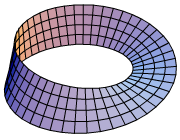](https://en.wikipedia.org/wiki/File:Moebius_Surface_1_Display_Small.png)
The configuration space of 2 not necessarily distinct points on the circle is the [orbifold](https://en.wikipedia.org/wiki/Orbifold "Orbifold") quotient of the 2-torus, *T*2 / *S*2, which is the [Möbius strip](https://en.wikipedia.org/wiki/M%C3%B6bius_strip "Möbius strip").
[](https://en.wikipedia.org/wiki/File:Neo-Riemannian_Tonnetz.svg)
The *[Tonnetz](https://en.wikipedia.org/wiki/Tonnetz "Tonnetz")* is an example of a torus in music theory.
The Tonnetz is only truly a torus if [enharmonic equivalence](https://en.wikipedia.org/wiki/Enharmonic_equivalence "Enharmonic equivalence") is assumed, so that the (F♯-A♯) segment of the right edge of the repeated parallelogram is identified with the (G♭-B♭) segment of the left edge.
As the *n*\-torus is the *n*\-fold product of the circle, the *n*\-torus is the [configuration space](https://en.wikipedia.org/wiki/Configuration_space_\(physics\) "Configuration space (physics)") of *n* ordered, not necessarily distinct points on the circle. Symbolically, *T**n* = (*S*1)*n*. The configuration space of *unordered*, not necessarily distinct points is accordingly the [orbifold](https://en.wikipedia.org/wiki/Orbifold "Orbifold") *T**n* / *S**n*, which is the quotient of the torus by the [symmetric group](https://en.wikipedia.org/wiki/Symmetric_group "Symmetric group") on *n* letters (by permuting the coordinates).
For *n* = 2, the quotient is the [Möbius strip](https://en.wikipedia.org/wiki/M%C3%B6bius_strip "Möbius strip"), the edge corresponding to the orbifold points where the two coordinates coincide. For *n* = 3 this quotient may be described as a solid torus with cross-section an [equilateral triangle](https://en.wikipedia.org/wiki/Equilateral_triangle "Equilateral triangle"), with a [twist](https://en.wikipedia.org/wiki/Dehn_twist "Dehn twist"); equivalently, as a [triangular prism](https://en.wikipedia.org/wiki/Triangular_prism "Triangular prism") whose top and bottom faces are connected with a 1/3 twist (120°): the 3-dimensional interior corresponds to the points on the 3-torus where all 3 coordinates are distinct, the 2-dimensional face corresponds to points with 2 coordinates equal and the 3rd different, while the 1-dimensional edge corresponds to points with all 3 coordinates identical.
These orbifolds have found significant [applications to music theory](https://en.wikipedia.org/wiki/Orbifold#Music_theory "Orbifold") in the work of Dmitri Tymoczko and collaborators (Felipe Posada, Michael Kolinas, et al.), being used to model [musical triads](https://en.wikipedia.org/wiki/Triad_\(music\) "Triad (music)").[\[10\]](https://en.wikipedia.org/wiki/Torus#cite_note-10)[\[11\]](https://en.wikipedia.org/wiki/Torus#cite_note-11)
## Flat torus
\[[edit](https://en.wikipedia.org/w/index.php?title=Torus&action=edit§ion=8 "Edit section: Flat torus")\]
[](https://en.wikipedia.org/wiki/File:Torus_from_rectangle.gif)
In three dimensions, one can bend a rectangle into a torus, but doing this necessarily affects the distances measured along the surface, as seen by the distortion of the checkered pattern.
[](https://en.wikipedia.org/wiki/File:Duocylinder_ridge_animated.gif)
Seen in [stereographic projection](https://en.wikipedia.org/wiki/Stereographic_projection "Stereographic projection"), a 4D *flat torus* can be projected into 3-dimensions and rotated on a fixed axis.
[](https://en.wikipedia.org/wiki/File:Toroidal_monohedron.png)
The simplest tiling of a flat torus is [{4,4}1,0](https://en.wikipedia.org/wiki/Regular_map_\(graph_theory\)#Toroidal_polyhedra "Regular map (graph theory)"), constructed on the surface of a [duocylinder](https://en.wikipedia.org/wiki/Duocylinder "Duocylinder") with 1 vertex, 2 orthogonal edges, and one square face. It is seen here stereographically projected into 3-space as a torus.
A **flat torus** is a torus with the metric inherited from its representation as the [quotient](https://en.wikipedia.org/wiki/Quotient_space_\(topology\) "Quotient space (topology)"), **R**2 / **L**, where **L** is a discrete subgroup of **R**2 isomorphic to **Z**2. This gives the quotient the structure of a [Riemannian manifold](https://en.wikipedia.org/wiki/Riemannian_manifold "Riemannian manifold"), as well as the structure of an abelian Lie group. Perhaps the simplest example of this is when **L** = **Z**2: **R**2 / **Z**2, which can also be described as the [Cartesian plane](https://en.wikipedia.org/wiki/Cartesian_plane "Cartesian plane") under the identifications (*x*, *y*) ~ (*x* + 1, *y*) ~ (*x*, *y* + 1). This particular flat torus (and any uniformly scaled version of it) is known as the *square* flat torus.
This metric of the square flat torus can also be realised by specific embeddings of the familiar 2-torus into Euclidean 4-space or higher dimensions. Its surface has zero [Gaussian curvature](https://en.wikipedia.org/wiki/Gaussian_curvature "Gaussian curvature") everywhere. It is flat in the same sense that the surface of a cylinder is flat. In 3 dimensions, one can bend a flat sheet of paper into a cylinder without stretching the paper, but this cylinder cannot be bent into a torus without stretching the paper (unless some regularity and differentiability conditions are given up, see below).
A simple 4-dimensional Euclidean embedding of a rectangular flat torus (more general than the square one) is as follows:
(
x
,
y
,
z
,
w
)
\=
(
R
cos
u
,
R
sin
u
,
P
cos
v
,
P
sin
v
)
{\\displaystyle (x,y,z,w)=(R\\cos u,R\\sin u,P\\cos v,P\\sin v)}

where *R* and *P* are positive constants determining the aspect ratio. It is [diffeomorphic](https://en.wikipedia.org/wiki/Diffeomorphism "Diffeomorphism") to a regular torus but not [isometric](https://en.wikipedia.org/wiki/Isometry "Isometry"). It can not be [analytically](https://en.wikipedia.org/wiki/Analytic_function "Analytic function") embedded ([smooth](https://en.wikipedia.org/wiki/Smooth_function "Smooth function") of class *Ck*, 2 ≤ *k* ≤ ∞) into Euclidean 3-space. [Mapping](https://en.wikipedia.org/wiki/Map_\(mathematics\) "Map (mathematics)") it into *3*\-space requires one to stretch it, in which case it looks like a regular torus. For example, in the following map:
(
x
,
y
,
z
)
\=
(
(
R
\+
P
sin
v
)
cos
u
,
(
R
\+
P
sin
v
)
sin
u
,
P
cos
v
)
.
{\\displaystyle (x,y,z)=((R+P\\sin v)\\cos u,(R+P\\sin v)\\sin u,P\\cos v).}

If *R* and *P* in the above flat torus parametrization form a unit vector (*R*, *P*) = (cos(*η*), sin(*η*)) then *u*, *v*, and 0 \< *η* \< π/2 parameterize the unit 3-sphere as [Hopf coordinates](https://en.wikipedia.org/wiki/Hopf_coordinates "Hopf coordinates"). In particular, for certain very specific choices of a square flat torus in the [3-sphere](https://en.wikipedia.org/wiki/3-sphere "3-sphere") *S*3, where *η* = π/4 above, the torus will partition the 3-sphere into two [congruent](https://en.wikipedia.org/wiki/Congruence_\(geometry\) "Congruence (geometry)") solid tori subsets with the aforesaid flat torus surface as their common [boundary](https://en.wikipedia.org/wiki/Boundary_\(topology\) "Boundary (topology)"). One example is the torus *T* defined by
T
\=
{
(
x
,
y
,
z
,
w
)
∈
S
3
∣
x
2
\+
y
2
\=
1
2
,
z
2
\+
w
2
\=
1
2
}
.
{\\displaystyle T=\\left\\{(x,y,z,w)\\in S^{3}\\mid x^{2}+y^{2}={\\frac {1}{2}},\\ z^{2}+w^{2}={\\frac {1}{2}}\\right\\}.}

Other tori in *S*3 having this partitioning property include the square tori of the form *Q* ⋅ *T*, where *Q* is a rotation of 4-dimensional space **R**4, or in other words *Q* is a member of the Lie group SO(4).
It is known that there exists no *C*2 (twice continuously differentiable) embedding of a flat torus into 3-space. (The idea of the proof is to take a large sphere containing such a flat torus in its interior, and shrink the radius of the sphere until it just touches the torus for the first time. Such a point of contact must be a tangency. But that would imply that part of the torus, since it has zero curvature everywhere, must lie strictly outside the sphere, which is a contradiction.) On the other hand, according to the [Nash-Kuiper theorem](https://en.wikipedia.org/wiki/Nash_embedding_theorem "Nash embedding theorem"), which was proven in the 1950s, an isometric *C*1 embedding exists. This is solely an existence proof and does not provide explicit equations for such an embedding.
[](https://en.wikipedia.org/wiki/File:Flat_torus_Havea_embedding.png)
C
1
{\\displaystyle C^{1}}

isometric embedding of a flat torus in **R**3, with corrugations
In April 2012, an explicit *C*1 (continuously differentiable) isometric embedding of a flat torus into 3-dimensional Euclidean space **R**3 was found.[\[12\]](https://en.wikipedia.org/wiki/Torus#cite_note-12)[\[13\]](https://en.wikipedia.org/wiki/Torus#cite_note-13)[\[14\]](https://en.wikipedia.org/wiki/Torus#cite_note-14)[\[15\]](https://en.wikipedia.org/wiki/Torus#cite_note-15) It is a flat torus in the sense that, as a metric space, it is isometric to a flat square torus. It is similar in structure to a [fractal](https://en.wikipedia.org/wiki/Fractal "Fractal") as it is constructed by repeatedly corrugating an ordinary torus at smaller scales. Like fractals, it has no defined Gaussian curvature. However, unlike fractals, it does have defined [surface normals](https://en.wikipedia.org/wiki/Normal_\(geometry\) "Normal (geometry)"), yielding a so-called "smooth fractal". The key to obtaining the smoothness of this corrugated torus is to have the amplitudes of successive corrugations decreasing faster than their "wavelengths".[\[16\]](https://en.wikipedia.org/wiki/Torus#cite_note-16) (These infinitely recursive corrugations are used only for embedding into three dimensions; they are not an intrinsic feature of the flat torus.) This is the first time that any such embedding was defined by explicit equations or depicted by computer graphics.
### Conformal classification of flat tori
\[[edit](https://en.wikipedia.org/w/index.php?title=Torus&action=edit§ion=9 "Edit section: Conformal classification of flat tori")\]
In the study of [Riemann surfaces](https://en.wikipedia.org/wiki/Riemann_surface "Riemann surface"), one says that any two smooth compact geometric surfaces are "conformally equivalent" when there exists a smooth homeomorphism between them that is both angle-preserving and orientation-preserving. The [Uniformization theorem](https://en.wikipedia.org/wiki/Uniformization_theorem "Uniformization theorem") guarantees that every Riemann surface is [conformally equivalent](https://en.wikipedia.org/wiki/Conformal_map "Conformal map") to one that has constant [Gaussian curvature](https://en.wikipedia.org/wiki/Gaussian_curvature "Gaussian curvature"). In the case of a torus, the constant curvature must be zero. Then one defines the "[moduli space](https://en.wikipedia.org/wiki/Moduli_space "Moduli space")" of the torus to contain one point for each conformal equivalence class, with the appropriate topology. It turns out that this moduli space *M* may be identified with a punctured sphere that is smooth except for two points that have less angle than 2π (radians) around them: One has total angle π and the other has total angle 2π/3.
*M* may be turned into a compact space *M\** – topologically equivalent to a sphere – by adding one additional point that represents the limiting case as a rectangular torus approaches an aspect ratio of 0 in the limit. The result is that this compactified moduli space is a sphere with *three* points each having less than 2π total angle around them. (Such a point is termed a "cusp", and may be thought of as the vertex of a cone, also called a "conepoint".) This third conepoint will have zero total angle around it. Due to symmetry, *M\** may be constructed by glueing together two congruent [geodesic triangles](https://en.wikipedia.org/wiki/Geodesic_triangle "Geodesic triangle") in the [hyperbolic plane](https://en.wikipedia.org/wiki/Hyperbolic_plane "Hyperbolic plane") along their (identical) boundaries, where each triangle has angles of π/2, π/3, and 0. (The three angles of a hyperbolic triangle T determine T up to congruence.) As a result, the [Gauss–Bonnet theorem](https://en.wikipedia.org/wiki/Gauss%E2%80%93Bonnet_theorem "Gauss–Bonnet theorem") shows that the area of each triangle can be calculated as π − (π/2 + π/3 + 0) = π/6, so it follows that the compactified moduli space *M\** has area equal to π/3.
The other two cusps occur at the points corresponding in *M\** to (a) the square torus (total angle π) and (b) the hexagonal torus (total angle 2π/3). These are the only conformal equivalence classes of flat tori that have any conformal automorphisms other than those generated by translations and negation.
## Genus *g* surface
\[[edit](https://en.wikipedia.org/w/index.php?title=Torus&action=edit§ion=10 "Edit section: Genus g surface")\]
Main article: [Genus g surface](https://en.wikipedia.org/wiki/Genus_g_surface "Genus g surface")
In the theory of [surfaces](https://en.wikipedia.org/wiki/Surface_\(topology\) "Surface (topology)") there is a more general family of objects, the "[genus](https://en.wikipedia.org/wiki/Genus_\(mathematics\) "Genus (mathematics)")" *g* surfaces. A genus *g* surface is the [connected sum](https://en.wikipedia.org/wiki/Connected_sum "Connected sum") of *g* two-tori. (And so the torus itself is the surface of genus 1.) To form a connected sum of two surfaces, remove from each the interior of a disk and "glue" the surfaces together along the boundary circles. (That is, merge the two boundary circles so they become just one circle.) To form the connected sum of more than two surfaces, successively take the connected sum of two of them at a time until they are all connected. In this sense, a genus *g* surface resembles the surface of *g* doughnuts stuck together side by side, or a [2-sphere](https://en.wikipedia.org/wiki/Sphere "Sphere") with *g* handles attached.
As examples, a genus zero surface (without boundary) is the [two-sphere](https://en.wikipedia.org/wiki/Sphere "Sphere") while a genus one surface (without boundary) is the ordinary torus. The surfaces of higher genus are sometimes called *n*\-holed tori (or, rarely, *n*\-fold tori). The terms [double torus](https://en.wikipedia.org/wiki/Double_torus "Double torus") and [triple torus](https://en.wikipedia.org/wiki/Triple_torus "Triple torus") are also occasionally used.
The [classification theorem](https://en.wikipedia.org/wiki/Classification_theorem "Classification theorem") for surfaces states that every [compact](https://en.wikipedia.org/wiki/Compact_space "Compact space") [connected](https://en.wikipedia.org/wiki/Connected_space "Connected space") surface is topologically equivalent to either the sphere or the connect sum of some number of tori, disks, and real [projective planes](https://en.wikipedia.org/wiki/Projective_plane "Projective plane").
| | |
|---|---|
| [](https://en.wikipedia.org/wiki/File:Double_torus_illustration.png) [genus two](https://en.wikipedia.org/wiki/Double_torus "Double torus") | [](https://en.wikipedia.org/wiki/File:Triple_torus_illustration.png) [genus three](https://en.wikipedia.org/wiki/Triple_torus "Triple torus") |
## Toroidal polyhedra
\[[edit](https://en.wikipedia.org/w/index.php?title=Torus&action=edit§ion=11 "Edit section: Toroidal polyhedra")\]
Further information: [Toroidal polyhedron](https://en.wikipedia.org/wiki/Toroidal_polyhedron "Toroidal polyhedron")
[](https://en.wikipedia.org/wiki/File:Hexagonal_torus.svg)
A [toroidal polyhedron](https://en.wikipedia.org/wiki/Toroidal_polyhedron "Toroidal polyhedron") with 6 × 4 = 24 [quadrilateral](https://en.wikipedia.org/wiki/Quadrilateral "Quadrilateral") faces
[Polyhedra](https://en.wikipedia.org/wiki/Polyhedron "Polyhedron") with the topological type of a torus are called toroidal polyhedra, and have [Euler characteristic](https://en.wikipedia.org/wiki/Euler_characteristic "Euler characteristic") *V* − *E* + *F* = 0. For any number of holes, the formula generalizes to *V* − *E* + *F* = 2 − 2*g*, where *g* is the topological genus.
Toroidal polyhedra have been used to show that the maximum number of colors to color a map on a torus is seven. The [Szilassi polyhedron](https://en.wikipedia.org/wiki/Szilassi_polyhedron "Szilassi polyhedron") is one example of a toroidal polyhedron with this property.[\[17\]](https://en.wikipedia.org/wiki/Torus#cite_note-17)
The Szilassi polyhedron's dual, the [Császár polyhedron](https://en.wikipedia.org/wiki/Cs%C3%A1sz%C3%A1r_polyhedron "Császár polyhedron"), is the only polyhedron other than the tetrahedron which has the property that every possible edge connecting two vertices is an edge of the polyhedron.[\[18\]](https://en.wikipedia.org/wiki/Torus#cite_note-18)
The term "toroidal polyhedron" is also used for higher-genus polyhedra and for [immersions](https://en.wikipedia.org/wiki/Immersion_\(mathematics\) "Immersion (mathematics)") of toroidal polyhedra, although some authors only include those with genus 1.[\[19\]](https://en.wikipedia.org/wiki/Torus#cite_note-19)
Self-crossing toroidal polyhedra are determined by the topology of their abstract manifold. One subset of the self-crossing toroidal polyhedra are the crown polyhedra, which are the only toroidal polyhedra that are also [noble](https://en.wikipedia.org/wiki/Noble_polyhedron "Noble polyhedron").
## Automorphisms
\[[edit](https://en.wikipedia.org/w/index.php?title=Torus&action=edit§ion=12 "Edit section: Automorphisms")\]
The [homeomorphism group](https://en.wikipedia.org/wiki/Homeomorphism_group "Homeomorphism group") (or the subgroup of diffeomorphisms) of the torus is studied in [geometric topology](https://en.wikipedia.org/wiki/Geometric_topology "Geometric topology"). Its [mapping class group](https://en.wikipedia.org/wiki/Mapping_class_group "Mapping class group") (the connected components of the homeomorphism group) is surjective onto the group GL ( n , Z ) {\\displaystyle \\operatorname {GL} (n,\\mathbf {Z} )}  of invertible integer matrices, which can be realized as linear maps on the universal covering space R n {\\displaystyle \\mathbf {R} ^{n}}  that preserve the standard lattice Z n {\\displaystyle \\mathbf {Z} ^{n}}  (this corresponds to integer coefficients) and thus descend to the quotient.
At the level of [homotopy](https://en.wikipedia.org/wiki/Homotopy "Homotopy") and [homology](https://en.wikipedia.org/wiki/Homology_\(mathematics\) "Homology (mathematics)"), the mapping class group can be identified as the action on the first homology (or equivalently, first cohomology, or on the [fundamental group](https://en.wikipedia.org/wiki/Fundamental_group "Fundamental group"), as these are all naturally isomorphic; also the first [cohomology group](https://en.wikipedia.org/wiki/Cohomology_group "Cohomology group") generates the [cohomology](https://en.wikipedia.org/wiki/Cohomology "Cohomology") algebra:
MCG
Ho
(
T
n
)
\=
Aut
(
π
1
(
X
)
)
\=
Aut
(
Z
n
)
\=
GL
(
n
,
Z
)
.
{\\displaystyle \\operatorname {MCG} \_{\\operatorname {Ho} }(T^{n})=\\operatorname {Aut} (\\pi \_{1}(X))=\\operatorname {Aut} (\\mathbf {Z} ^{n})=\\operatorname {GL} (n,\\mathbf {Z} ).}

Since the torus is an [Eilenberg–MacLane space](https://en.wikipedia.org/wiki/Eilenberg%E2%80%93MacLane_space "Eilenberg–MacLane space") *K*(*G*, 1), its homotopy equivalences, up to homotopy, can be identified with automorphisms of the fundamental group); all homotopy equivalences of the torus can be realized by homeomorphisms – every homotopy equivalence is homotopic to a homeomorphism.
Thus the [short exact sequence](https://en.wikipedia.org/wiki/Short_exact_sequence "Short exact sequence") of the mapping class group splits (an identification of the torus as the quotient of R n {\\displaystyle \\mathbf {R} ^{n}}  gives a splitting, via the linear maps, as above):
1
→
Homeo
0
(
T
n
)
→
Homeo
(
T
n
)
→
MCG
TOP
(
T
n
)
→
1\.
{\\displaystyle 1\\to \\operatorname {Homeo} \_{0}(T^{n})\\to \\operatorname {Homeo} (T^{n})\\to \\operatorname {MCG} \_{\\operatorname {TOP} }(T^{n})\\to 1.}

The mapping class group of higher genus surfaces is much more complicated, and an area of active research.
## Coloring a torus
\[[edit](https://en.wikipedia.org/w/index.php?title=Torus&action=edit§ion=13 "Edit section: Coloring a torus")\]
The torus's [Heawood number](https://en.wikipedia.org/wiki/Heawood_number "Heawood number") is seven, meaning every graph that can be [embedded on the torus](https://en.wikipedia.org/wiki/Toroidal_graph "Toroidal graph") has a [chromatic number](https://en.wikipedia.org/wiki/Chromatic_number "Chromatic number") of at most seven. (Since the [complete graph](https://en.wikipedia.org/wiki/Complete_graph "Complete graph") K 7 {\\displaystyle {\\mathsf {K\_{7}}}}  can be embedded on the torus, and χ ( K 7 ) \= 7 {\\displaystyle \\chi ({\\mathsf {K\_{7}}})=7} , the upper bound is tight.) Equivalently, in a torus divided into regions, it is always possible to color the regions using no more than seven colors so that no neighboring regions are the same color. (Contrast with the [four color theorem](https://en.wikipedia.org/wiki/Four_color_theorem "Four color theorem") for the [plane](https://en.wikipedia.org/wiki/Plane_\(mathematics\) "Plane (mathematics)").)
[](https://en.wikipedia.org/wiki/File:Projection_color_torus.png)
This construction shows the torus divided into seven regions, every one of which touches every other, meaning each must be assigned a unique color.
## de Bruijn torus
\[[edit](https://en.wikipedia.org/w/index.php?title=Torus&action=edit§ion=14 "Edit section: de Bruijn torus")\]
Main article: [de Bruijn torus](https://en.wikipedia.org/wiki/De_Bruijn_torus "De Bruijn torus")
[](http://viewstl.com/classic/?embedded&url=http://upload.wikimedia.org/wikipedia/commons/1/1e/De_bruijn_torus_3x3.stl&bgcolor=black)
[STL](https://en.wikipedia.org/wiki/STL_\(file_format\) "STL (file format)") model of de Bruijn torus (16,32;3,3)2 with 1s as panels and 0s as holes in the mesh – with consistent orientation, every 3×3 matrix appears exactly once
In [combinatorial](https://en.wikipedia.org/wiki/Combinatorics "Combinatorics") mathematics, a *de Bruijn torus* is an [array](https://en.wikipedia.org/wiki/Matrix_\(mathematics\) "Matrix (mathematics)") of symbols from an alphabet (often just 0 and 1) that contains every *m*\-by-*n* [matrix](https://en.wikipedia.org/wiki/Matrix_\(mathematics\) "Matrix (mathematics)") exactly once. It is a torus because the edges are considered wraparound for the purpose of finding matrices. Its name comes from the [De Bruijn sequence](https://en.wikipedia.org/wiki/De_Bruijn_sequence "De Bruijn sequence"), which can be considered a special case where *n* is 1 (one dimension).
## Cutting a torus
\[[edit](https://en.wikipedia.org/w/index.php?title=Torus&action=edit§ion=15 "Edit section: Cutting a torus")\]
A solid torus of revolution can be cut by *n* (\> 0) planes into at most
(
n
\+
2
n
−
1
)
\+
(
n
n
−
1
)
\=
1
6
(
n
3
\+
3
n
2
\+
8
n
)
{\\displaystyle {\\begin{pmatrix}n+2\\\\n-1\\end{pmatrix}}+{\\begin{pmatrix}n\\\\n-1\\end{pmatrix}}={\\tfrac {1}{6}}(n^{3}+3n^{2}+8n)}

parts.[\[20\]](https://en.wikipedia.org/wiki/Torus#cite_note-20) (This assumes the pieces may not be rearranged but must remain in place for all cuts.)
The first 11 numbers of parts, for 0 ≤ *n* ≤ 10 (including the case of *n* = 0, not covered by the above formulas), are as follows:
1, 2, 6, 13, 24, 40, 62, 91, 128, 174, 230, ... (sequence [A003600](https://oeis.org/A003600 "oeis:A003600") in the [OEIS](https://en.wikipedia.org/wiki/On-Line_Encyclopedia_of_Integer_Sequences "On-Line Encyclopedia of Integer Sequences")).
## See also
\[[edit](https://en.wikipedia.org/w/index.php?title=Torus&action=edit§ion=16 "Edit section: See also")\]
- [](https://en.wikipedia.org/wiki/File:Nuvola_apps_edu_mathematics_blue-p.svg)[Mathematics portal](https://en.wikipedia.org/wiki/Portal:Mathematics "Portal:Mathematics")
- [3-torus](https://en.wikipedia.org/wiki/3-torus "3-torus")
- [Algebraic torus](https://en.wikipedia.org/wiki/Algebraic_torus "Algebraic torus")
- [Angenent torus](https://en.wikipedia.org/wiki/Angenent_torus "Angenent torus")
- [Annulus (geometry)](https://en.wikipedia.org/wiki/Annulus_\(geometry\) "Annulus (geometry)")
- [Clifford torus](https://en.wikipedia.org/wiki/Clifford_torus "Clifford torus")
- [Complex torus](https://en.wikipedia.org/wiki/Complex_torus "Complex torus")
- [Dupin cyclide](https://en.wikipedia.org/wiki/Dupin_cyclide "Dupin cyclide")
- [Elliptic curve](https://en.wikipedia.org/wiki/Elliptic_curve "Elliptic curve")
- [Irrational winding of a torus](https://en.wikipedia.org/wiki/Irrational_winding_of_a_torus "Irrational winding of a torus")
- [Joint European Torus](https://en.wikipedia.org/wiki/Joint_European_Torus "Joint European Torus")
- [Klein bottle](https://en.wikipedia.org/wiki/Klein_bottle "Klein bottle")
- [Loewner's torus inequality](https://en.wikipedia.org/wiki/Loewner%27s_torus_inequality "Loewner's torus inequality")
- [Maximal torus](https://en.wikipedia.org/wiki/Maximal_torus "Maximal torus")
- [Period lattice](https://en.wikipedia.org/wiki/Period_lattice "Period lattice")
- [Real projective plane](https://en.wikipedia.org/wiki/Real_projective_plane "Real projective plane")
- [Sphere](https://en.wikipedia.org/wiki/Sphere "Sphere")
- [Spiric section](https://en.wikipedia.org/wiki/Spiric_section "Spiric section")
- [Surface (topology)](https://en.wikipedia.org/wiki/Surface_\(topology\) "Surface (topology)")
- [Toric lens](https://en.wikipedia.org/wiki/Toric_lens "Toric lens")
- [Toric section](https://en.wikipedia.org/wiki/Toric_section "Toric section")
- [Toric variety](https://en.wikipedia.org/wiki/Toric_variety "Toric variety")
- [Toroid](https://en.wikipedia.org/wiki/Toroid "Toroid")
- [Toroidal and poloidal](https://en.wikipedia.org/wiki/Toroidal_and_poloidal "Toroidal and poloidal")
- [Torus-based cryptography](https://en.wikipedia.org/wiki/Torus-based_cryptography "Torus-based cryptography")
- [Torus knot](https://en.wikipedia.org/wiki/Torus_knot "Torus knot")
- [Umbilic torus](https://en.wikipedia.org/wiki/Umbilic_torus "Umbilic torus")
- [Villarceau circles](https://en.wikipedia.org/wiki/Villarceau_circles "Villarceau circles")
## Notes
\[[edit](https://en.wikipedia.org/w/index.php?title=Torus&action=edit§ion=17 "Edit section: Notes")\]
- *Nociones de Geometría Analítica y Álgebra Lineal*, [ISBN](https://en.wikipedia.org/wiki/ISBN_\(identifier\) "ISBN (identifier)")
[978-970-10-6596-9](https://en.wikipedia.org/wiki/Special:BookSources/978-970-10-6596-9 "Special:BookSources/978-970-10-6596-9")
, Author: Kozak Ana Maria, Pompeya Pastorelli Sonia, Verdanega Pedro Emilio, Editorial: McGraw-Hill, Edition 2007, 744 pages, language: Spanish
- Allen Hatcher. [*Algebraic Topology*](https://pi.math.cornell.edu/~hatcher/AT/ATpage.html). Cambridge University Press, 2002.
[ISBN](https://en.wikipedia.org/wiki/ISBN_\(identifier\) "ISBN (identifier)")
[0-521-79540-0](https://en.wikipedia.org/wiki/Special:BookSources/0-521-79540-0 "Special:BookSources/0-521-79540-0")
.
- V. V. Nikulin, I. R. Shafarevich. *Geometries and Groups*. Springer, 1987.
[ISBN](https://en.wikipedia.org/wiki/ISBN_\(identifier\) "ISBN (identifier)")
[3-540-15281-4](https://en.wikipedia.org/wiki/Special:BookSources/3-540-15281-4 "Special:BookSources/3-540-15281-4")
,
[ISBN](https://en.wikipedia.org/wiki/ISBN_\(identifier\) "ISBN (identifier)")
[978-3-540-15281-1](https://en.wikipedia.org/wiki/Special:BookSources/978-3-540-15281-1 "Special:BookSources/978-3-540-15281-1")
.
- ["Tore (notion géométrique)" at *Encyclopédie des Formes Mathématiques Remarquables*](http://www.mathcurve.com/surfaces/tore/tore.shtml)
## References
\[[edit](https://en.wikipedia.org/w/index.php?title=Torus&action=edit§ion=18 "Edit section: References")\]
1. **[^](https://en.wikipedia.org/wiki/Torus#cite_ref-1)**
[Gallier, Jean](https://en.wikipedia.org/wiki/Jean_Gallier "Jean Gallier"); [Xu, Dianna](https://en.wikipedia.org/wiki/Dianna_Xu "Dianna Xu") (2013). [*A Guide to the Classification Theorem for Compact Surfaces*](https://en.wikipedia.org/wiki/A_Guide_to_the_Classification_Theorem_for_Compact_Surfaces "A Guide to the Classification Theorem for Compact Surfaces"). Geometry and Computing. Vol. 9. Springer, Heidelberg. [doi](https://en.wikipedia.org/wiki/Doi_\(identifier\) "Doi (identifier)"):[10\.1007/978-3-642-34364-3](https://doi.org/10.1007%2F978-3-642-34364-3). [ISBN](https://en.wikipedia.org/wiki/ISBN_\(identifier\) "ISBN (identifier)")
[978-3-642-34363-6](https://en.wikipedia.org/wiki/Special:BookSources/978-3-642-34363-6 "Special:BookSources/978-3-642-34363-6")
. [MR](https://en.wikipedia.org/wiki/MR_\(identifier\) "MR (identifier)") [3026641](https://mathscinet.ams.org/mathscinet-getitem?mr=3026641).
2. **[^](https://en.wikipedia.org/wiki/Torus#cite_ref-2)**
["Equations for the Standard Torus"](http://www.geom.uiuc.edu/zoo/toptype/torus/standard/eqns.html). Geom.uiuc.edu. 6 July 1995. [Archived](https://web.archive.org/web/20120429011957/http://www.geom.uiuc.edu/zoo/toptype/torus/standard/eqns.html) from the original on 29 April 2012. Retrieved 21 July 2012.
3. **[^](https://en.wikipedia.org/wiki/Torus#cite_ref-3)**
["Torus"](http://doc.spatial.com/index.php/Torus). Spatial Corp. [Archived](https://web.archive.org/web/20141213210422/http://doc.spatial.com/index.php/Torus) from the original on 13 December 2014. Retrieved 16 November 2014.
4. **[^](https://en.wikipedia.org/wiki/Torus#cite_ref-4)**
[Weisstein, Eric W.](https://en.wikipedia.org/wiki/Eric_W._Weisstein "Eric W. Weisstein") ["Torus"](https://mathworld.wolfram.com/Torus.html). *[MathWorld](https://en.wikipedia.org/wiki/MathWorld "MathWorld")*.
5. **[^](https://en.wikipedia.org/wiki/Torus#cite_ref-5)**
["poloidal"](http://dictionary.oed.com/cgi/entry/50183023?single=1&query_type=word&queryword=poloidal&first=1&max_to_show=10). *Oxford English Dictionary Online*. Oxford University Press. Retrieved 10 August 2007.
6. **[^](https://en.wikipedia.org/wiki/Torus#cite_ref-:0_6-0)**
O'Neill, Barrett (1997). *Elementary Differential Geometry* (2nd ed.). San Diego: Academic Press. pp. 134–141\. [ISBN](https://en.wikipedia.org/wiki/ISBN_\(identifier\) "ISBN (identifier)")
[978-0-12-526745-8](https://en.wikipedia.org/wiki/Special:BookSources/978-0-12-526745-8 "Special:BookSources/978-0-12-526745-8")
.
7. **[^](https://en.wikipedia.org/wiki/Torus#cite_ref-7)**
De Graef, Marc (7 March 2024). ["Applications of the Clifford torus to material textures"](https://journals.iucr.org/j/issues/2024/03/00/iu5046/iu5046.pdf) (PDF). *Journal of Applied Crystallography*. **57** (3): 638–648\. [Bibcode](https://en.wikipedia.org/wiki/Bibcode_\(identifier\) "Bibcode (identifier)"):[2024JApCr..57..638D](https://ui.adsabs.harvard.edu/abs/2024JApCr..57..638D). [doi](https://en.wikipedia.org/wiki/Doi_\(identifier\) "Doi (identifier)"):[10\.1107/S160057672400219X](https://doi.org/10.1107%2FS160057672400219X). [PMC](https://en.wikipedia.org/wiki/PMC_\(identifier\) "PMC (identifier)") [11151663](https://www.ncbi.nlm.nih.gov/pmc/articles/PMC11151663). [PMID](https://en.wikipedia.org/wiki/PMID_\(identifier\) "PMID (identifier)") [38846769](https://pubmed.ncbi.nlm.nih.gov/38846769).
8. **[^](https://en.wikipedia.org/wiki/Torus#cite_ref-8)** Padgett, Adele (2014). "Fundamental groups: motivation, computation methods, and applications", REA Program, Uchicago. <https://math.uchicago.edu/~may/REU2014/REUPapers/Padgett.pdf>
9. **[^](https://en.wikipedia.org/wiki/Torus#cite_ref-9)**
Weisstein, Eric W. ["Torus"](https://mathworld.wolfram.com/Torus.html). *mathworld.wolfram.com*. Retrieved 27 July 2021.
10. **[^](https://en.wikipedia.org/wiki/Torus#cite_ref-10)**
Tymoczko, Dmitri (7 July 2006). ["The Geometry of Musical Chords"](http://www.brainmusic.org/EducationalActivitiesFolder/Tymoczko_chords2006.pdf) (PDF). *[Science](https://en.wikipedia.org/wiki/Science_\(journal\) "Science (journal)")*. **313** (5783): 72–74\. [Bibcode](https://en.wikipedia.org/wiki/Bibcode_\(identifier\) "Bibcode (identifier)"):[2006Sci...313...72T](https://ui.adsabs.harvard.edu/abs/2006Sci...313...72T). [CiteSeerX](https://en.wikipedia.org/wiki/CiteSeerX_\(identifier\) "CiteSeerX (identifier)") [10\.1.1.215.7449](https://citeseerx.ist.psu.edu/viewdoc/summary?doi=10.1.1.215.7449). [doi](https://en.wikipedia.org/wiki/Doi_\(identifier\) "Doi (identifier)"):[10\.1126/science.1126287](https://doi.org/10.1126%2Fscience.1126287). [PMID](https://en.wikipedia.org/wiki/PMID_\(identifier\) "PMID (identifier)") [16825563](https://pubmed.ncbi.nlm.nih.gov/16825563). [S2CID](https://en.wikipedia.org/wiki/S2CID_\(identifier\) "S2CID (identifier)") [2877171](https://api.semanticscholar.org/CorpusID:2877171). [Archived](https://web.archive.org/web/20110725100537/http://www.brainmusic.org/EducationalActivitiesFolder/Tymoczko_chords2006.pdf) (PDF) from the original on 25 July 2011.
11. **[^](https://en.wikipedia.org/wiki/Torus#cite_ref-11)**
Phillips, Tony (October 2006). ["Take on Math in the Media"](https://web.archive.org/web/20081005194933/http://www.ams.org/mathmedia/archive/10-2006-media.html). [American Mathematical Society](https://en.wikipedia.org/wiki/American_Mathematical_Society "American Mathematical Society"). Archived from [the original](http://www.ams.org/mathmedia/archive/10-2006-media.html) on 5 October 2008.
12. **[^](https://en.wikipedia.org/wiki/Torus#cite_ref-12)**
Filippelli, Gianluigi (27 April 2012). ["Doc Madhattan: A flat torus in three dimensional space"](http://docmadhattan.fieldofscience.com/2012/04/flat-torus-in-three-dimensional-space.html). *Proceedings of the National Academy of Sciences*. **109** (19): 7218–7223\. [doi](https://en.wikipedia.org/wiki/Doi_\(identifier\) "Doi (identifier)"):[10\.1073/pnas.1118478109](https://doi.org/10.1073%2Fpnas.1118478109). [PMC](https://en.wikipedia.org/wiki/PMC_\(identifier\) "PMC (identifier)") [3358891](https://www.ncbi.nlm.nih.gov/pmc/articles/PMC3358891). [PMID](https://en.wikipedia.org/wiki/PMID_\(identifier\) "PMID (identifier)") [22523238](https://pubmed.ncbi.nlm.nih.gov/22523238). [Archived](https://web.archive.org/web/20120625222341/http://docmadhattan.fieldofscience.com/2012/04/flat-torus-in-three-dimensional-space.html) from the original on 25 June 2012. Retrieved 21 July 2012.
13. **[^](https://en.wikipedia.org/wiki/Torus#cite_ref-13)**
Enrico de Lazaro (18 April 2012). ["Mathematicians Produce First-Ever Image of Flat Torus in 3D \| Mathematics"](http://www.sci-news.com/othersciences/mathematics/article00279.html). *Sci-News.com*. [Archived](https://web.archive.org/web/20120601021059/http://www.sci-news.com/othersciences/mathematics/article00279.html) from the original on 1 June 2012. Retrieved 21 July 2012.
14. **[^](https://en.wikipedia.org/wiki/Torus#cite_ref-14)**
["Mathematics: first-ever image of a flat torus in 3D – CNRS Web site – CNRS"](https://web.archive.org/web/20120705120058/http://www2.cnrs.fr/en/2027.htm). Archived from [the original](http://www2.cnrs.fr/en/2027.htm) on 5 July 2012. Retrieved 21 July 2012.
15. **[^](https://en.wikipedia.org/wiki/Torus#cite_ref-15)**
["Flat tori finally visualized!"](https://web.archive.org/web/20120618084643/http://math.univ-lyon1.fr/~borrelli/Hevea/Presse/index-en.html). Math.univ-lyon1.fr. 18 April 2012. Archived from [the original](http://math.univ-lyon1.fr/~borrelli/Hevea/Presse/index-en.html) on 18 June 2012. Retrieved 21 July 2012.
16. **[^](https://en.wikipedia.org/wiki/Torus#cite_ref-16)**
Hoang, Lê Nguyên (2016). ["The Tortuous Geometry of the Flat Torus"](http://www.science4all.org/article/flat-torus/). *Science4All*. Retrieved 1 November 2022.
17. **[^](https://en.wikipedia.org/wiki/Torus#cite_ref-17)**
Heawood, P. J. (1949). ["Map-Colour Theorem"](https://onlinelibrary.wiley.com/doi/abs/10.1112/plms/s2-51.3.161). *Proceedings of the London Mathematical Society*. s2-51 (1): 161–175\. [doi](https://en.wikipedia.org/wiki/Doi_\(identifier\) "Doi (identifier)"):[10\.1112/plms/s2-51.3.161](https://doi.org/10.1112%2Fplms%2Fs2-51.3.161). [ISSN](https://en.wikipedia.org/wiki/ISSN_\(identifier\) "ISSN (identifier)") [1460-244X](https://search.worldcat.org/issn/1460-244X).
18. **[^](https://en.wikipedia.org/wiki/Torus#cite_ref-18)**
Bobenko, Aleksandr I. (2008). *Discrete Differential Geometry*. Oberwolfach Seminars Ser. Peter Schröder, John M. Sullivan, Günter M. Ziegler. Basel: Birkhäuser Boston. [ISBN](https://en.wikipedia.org/wiki/ISBN_\(identifier\) "ISBN (identifier)")
[978-3-7643-8620-7](https://en.wikipedia.org/wiki/Special:BookSources/978-3-7643-8620-7 "Special:BookSources/978-3-7643-8620-7")
.
19. **[^](https://en.wikipedia.org/wiki/Torus#cite_ref-19)**
Webber, William T. (1 August 1997). ["Monohedral Idemvalent Polyhedra that are Toroids"](https://doi.org/10.1023/A:1004997029852). *Geometriae Dedicata*. **67** (1): 31–44\. [doi](https://en.wikipedia.org/wiki/Doi_\(identifier\) "Doi (identifier)"):[10\.1023/A:1004997029852](https://doi.org/10.1023%2FA%3A1004997029852). [ISSN](https://en.wikipedia.org/wiki/ISSN_\(identifier\) "ISSN (identifier)") [1572-9168](https://search.worldcat.org/issn/1572-9168).
20. **[^](https://en.wikipedia.org/wiki/Torus#cite_ref-20)**
[Weisstein, Eric W.](https://en.wikipedia.org/wiki/Eric_W._Weisstein "Eric W. Weisstein") ["Torus Cutting"](https://mathworld.wolfram.com/TorusCutting.html). *[MathWorld](https://en.wikipedia.org/wiki/MathWorld "MathWorld")*.
## External links
\[[edit](https://en.wikipedia.org/w/index.php?title=Torus&action=edit§ion=19 "Edit section: External links")\]
[](https://en.wikipedia.org/wiki/File:Wiktionary-logo-en-v2.svg)
Look up ***[torus](https://en.wiktionary.org/wiki/Special:Search/torus "wiktionary:Special:Search/torus")*** in Wiktionary, the free dictionary.
[](https://en.wikipedia.org/wiki/File:Commons-logo.svg)
[Wikimedia Commons](https://en.wikipedia.org/wiki/Wikimedia_Commons "Wikimedia Commons") has media related to:
[Torus](https://commons.wikimedia.org/wiki/Torus "commons:Torus") ([category](https://commons.wikimedia.org/wiki/Category:Torus "commons:Category:Torus"))
- [Creation of a torus](http://www.cut-the-knot.org/shortcut.shtml) at [cut-the-knot](https://en.wikipedia.org/wiki/Cut-the-knot "Cut-the-knot")
- ["4D torus"](http://www.dr-mikes-maths.com/4d-torus.html) Fly-through cross-sections of a four-dimensional torus
- ["Relational Perspective Map"](http://www.visumap.net/index.aspx?p=Resources/RpmOverview) Visualizing high dimensional data with flat torus
- [Polydoes, doughnut-shaped polygons](http://tofique.fatehi.us/Mathematics/Polydoes/polydoes.html)
- Archived at [Ghostarchive](https://ghostarchive.org/varchive/youtube/20211211/3_VydFQmtZ8) and the [Wayback Machine](https://web.archive.org/web/20140128170125/http://www.youtube.com/watch?v=3_VydFQmtZ8&gl=US&hl=en):
[Séquin, Carlo H](https://en.wikipedia.org/wiki/Carlo_H._S%C3%A9quin "Carlo H. Séquin") (27 January 2014). ["Topology of a Twisted Torus – Numberphile"](https://www.youtube.com/watch?v=3_VydFQmtZ8) (video). [Brady Haran](https://en.wikipedia.org/wiki/Brady_Haran "Brady Haran").
- Anders Sandberg (4 February 2014). ["Torus Earth"](http://www.aleph.se/andart/archives/2014/02/torusearth.html). Retrieved 24 July 2019.
| [v](https://en.wikipedia.org/wiki/Template:Compact_topological_surfaces "Template:Compact topological surfaces") [t](https://en.wikipedia.org/wiki/Template_talk:Compact_topological_surfaces "Template talk:Compact topological surfaces") [e](https://en.wikipedia.org/wiki/Special:EditPage/Template:Compact_topological_surfaces "Special:EditPage/Template:Compact topological surfaces")Compact topological surfaces and their immersions in 3D | |
|---|---|
| Without boundary | |
| | |
| Orientable | [Sphere](https://en.wikipedia.org/wiki/Sphere "Sphere") (genus 0) [Torus]() (genus 1) Number 8 (genus 2) Pretzel (genus 3) ... |
| Non-orientable | [Real projective plane](https://en.wikipedia.org/wiki/Real_projective_plane "Real projective plane") genus 1; [Boy's surface](https://en.wikipedia.org/wiki/Boy%27s_surface "Boy's surface") [Roman surface](https://en.wikipedia.org/wiki/Roman_surface "Roman surface") [Klein bottle](https://en.wikipedia.org/wiki/Klein_bottle "Klein bottle") (genus 2) [Dyck's surface](https://en.wikipedia.org/wiki/Dyck%27s_surface "Dyck's surface") (genus 3) ... |
| With boundary | [Disk](https://en.wikipedia.org/wiki/Disk_\(mathematics\) "Disk (mathematics)") Semisphere Ribbon [Annulus](https://en.wikipedia.org/wiki/Annulus_\(mathematics\) "Annulus (mathematics)") [Cylinder](https://en.wikipedia.org/wiki/Cylinder "Cylinder") [Möbius strip](https://en.wikipedia.org/wiki/M%C3%B6bius_strip "Möbius strip") [Cross-cap](https://en.wikipedia.org/wiki/Cross-cap "Cross-cap") [Sphere with three holes](https://en.wikipedia.org/wiki/Pair_of_pants_\(mathematics\) "Pair of pants (mathematics)") ... |
| Related notions | |
| | |
| Properties | [Connectedness](https://en.wikipedia.org/wiki/Connected_space "Connected space") [Compactness](https://en.wikipedia.org/wiki/Compact_space "Compact space") [Triangulatedness](https://en.wikipedia.org/wiki/Triangulation_\(topology\) "Triangulation (topology)") or [smoothness](https://en.wikipedia.org/wiki/Differentiable_manifold "Differentiable manifold") [Orientability](https://en.wikipedia.org/wiki/Orientability "Orientability") |
| Characteristics | Number of [boundary](https://en.wikipedia.org/wiki/Boundary_\(topology\) "Boundary (topology)") components [Genus](https://en.wikipedia.org/wiki/Genus_\(mathematics\) "Genus (mathematics)") [Euler characteristic](https://en.wikipedia.org/wiki/Euler_characteristic "Euler characteristic") |
| Operations | [Connected sum](https://en.wikipedia.org/wiki/Connected_sum "Connected sum") Making a hole Gluing a [handle](https://en.wikipedia.org/wiki/Handle_decomposition "Handle decomposition") Gluing a [cross-cap](https://en.wikipedia.org/wiki/Cross-cap "Cross-cap") [Immersion](https://en.wikipedia.org/wiki/Immersion_\(mathematics\) "Immersion (mathematics)") |
| [Authority control databases](https://en.wikipedia.org/wiki/Help:Authority_control "Help:Authority control") [](https://www.wikidata.org/wiki/Q12510#identifiers "Edit this at Wikidata") | |
|---|---|
| International | [GND](https://d-nb.info/gnd/4185738-0) |
| National | [Poland](https://dbn.bn.org.pl/descriptor-details/9810673128305606) |
| Other | [Yale LUX](https://lux.collections.yale.edu/view/concept/fb5140f8-f946-42f3-842d-57ee9c946ea7) |

Retrieved from "<https://en.wikipedia.org/w/index.php?title=Torus&oldid=1343885708>"
[Category](https://en.wikipedia.org/wiki/Help:Category "Help:Category"):
- [Surfaces of revolution](https://en.wikipedia.org/wiki/Category:Surfaces_of_revolution "Category:Surfaces of revolution")
Hidden categories:
- [CS1: long volume value](https://en.wikipedia.org/wiki/Category:CS1:_long_volume_value "Category:CS1: long volume value")
- [Articles with short description](https://en.wikipedia.org/wiki/Category:Articles_with_short_description "Category:Articles with short description")
- [Short description is different from Wikidata](https://en.wikipedia.org/wiki/Category:Short_description_is_different_from_Wikidata "Category:Short description is different from Wikidata")
- [Use dmy dates from August 2021](https://en.wikipedia.org/wiki/Category:Use_dmy_dates_from_August_2021 "Category:Use dmy dates from August 2021")
- [Pages using multiple image with auto scaled images](https://en.wikipedia.org/wiki/Category:Pages_using_multiple_image_with_auto_scaled_images "Category:Pages using multiple image with auto scaled images")
- [Articles lacking in-text citations from November 2015](https://en.wikipedia.org/wiki/Category:Articles_lacking_in-text_citations_from_November_2015 "Category:Articles lacking in-text citations from November 2015")
- [All articles lacking in-text citations](https://en.wikipedia.org/wiki/Category:All_articles_lacking_in-text_citations "Category:All articles lacking in-text citations")
- This page was last edited on 17 March 2026, at 00:16 (UTC).
- Text is available under the [Creative Commons Attribution-ShareAlike 4.0 License](https://en.wikipedia.org/wiki/Wikipedia:Text_of_the_Creative_Commons_Attribution-ShareAlike_4.0_International_License "Wikipedia:Text of the Creative Commons Attribution-ShareAlike 4.0 International License"); additional terms may apply. By using this site, you agree to the [Terms of Use](https://foundation.wikimedia.org/wiki/Special:MyLanguage/Policy:Terms_of_Use "foundation:Special:MyLanguage/Policy:Terms of Use") and [Privacy Policy](https://foundation.wikimedia.org/wiki/Special:MyLanguage/Policy:Privacy_policy "foundation:Special:MyLanguage/Policy:Privacy policy"). Wikipedia® is a registered trademark of the [Wikimedia Foundation, Inc.](https://wikimediafoundation.org/), a non-profit organization.
- [Privacy policy](https://foundation.wikimedia.org/wiki/Special:MyLanguage/Policy:Privacy_policy)
- [About Wikipedia](https://en.wikipedia.org/wiki/Wikipedia:About)
- [Disclaimers](https://en.wikipedia.org/wiki/Wikipedia:General_disclaimer)
- [Contact Wikipedia](https://en.wikipedia.org/wiki/Wikipedia:Contact_us)
- [Legal & safety contacts](https://foundation.wikimedia.org/wiki/Special:MyLanguage/Legal:Wikimedia_Foundation_Legal_and_Safety_Contact_Information)
- [Code of Conduct](https://foundation.wikimedia.org/wiki/Special:MyLanguage/Policy:Universal_Code_of_Conduct)
- [Developers](https://developer.wikimedia.org/)
- [Statistics](https://stats.wikimedia.org/#/en.wikipedia.org)
- [Cookie statement](https://foundation.wikimedia.org/wiki/Special:MyLanguage/Policy:Cookie_statement)
- [Mobile view](https://en.wikipedia.org/w/index.php?title=Torus&mobileaction=toggle_view_mobile)
- [](https://www.wikimedia.org/)
- [](https://www.mediawiki.org/)
Search
Toggle the table of contents
Torus
70 languages
[Add topic](https://en.wikipedia.org/wiki/Torus) | |||||||||||||||
| Readable Markdown | Not to be confused with [Taurus](https://en.wikipedia.org/wiki/Taurus_\(disambiguation\) "Taurus (disambiguation)").
[](https://en.wikipedia.org/wiki/File:Tesseract_torus.png)
A ring torus with a selection of circles on its surface
[](https://en.wikipedia.org/wiki/File:Ring_Torus_to_Degenerate_Torus_\(Short\).gif)
As the distance from the axis of revolution decreases, the ring torus becomes a horn torus, then a spindle torus, and finally [degenerates](https://en.wikipedia.org/wiki/Degeneracy_\(mathematics\) "Degeneracy (mathematics)") into a double-covered [sphere](https://en.wikipedia.org/wiki/Sphere "Sphere").
[](https://en.wikipedia.org/wiki/File:Torus_cycles001.svg)
A ring torus with aspect ratio 3, the ratio between the diameters of the larger (blue) circle and the smaller (red) circle. The two radii coordinates are shown as well. The radius denoted by capital, R, is the distance from the geometric center of the outer ring lying outside the volume, to the center of the inner ring. The radius denoted by lower case, r, is the distance from the inner ring's center to the surface of the torus.
In [geometry](https://en.wikipedia.org/wiki/Geometry "Geometry"), a **torus** (pl.: **tori** or **toruses**) is a [surface of revolution](https://en.wikipedia.org/wiki/Surface_of_revolution "Surface of revolution") generated by revolving a [circle](https://en.wikipedia.org/wiki/Circle "Circle") in [three-dimensional space](https://en.wikipedia.org/wiki/Three-dimensional_space "Three-dimensional space") one full revolution about an axis that is [coplanar](https://en.wikipedia.org/wiki/Coplanarity "Coplanarity") with the circle. The main types of toruses include ring toruses, horn toruses, and spindle toruses. A ring torus is sometimes colloquially referred to as a **[doughnut](https://en.wikipedia.org/wiki/Doughnut "Doughnut")**.
If the [axis of revolution](https://en.wikipedia.org/wiki/Axis_of_revolution "Axis of revolution") does not touch the circle, the surface has a ring shape and is called a **torus of revolution**, also known as a **ring torus**. If the axis of revolution is [tangent](https://en.wikipedia.org/wiki/Tangent "Tangent") to the circle, the surface is a **horn torus**. If the axis of revolution passes twice through the circle, the surface is a **[spindle torus](https://en.wikipedia.org/wiki/Lemon_\(geometry\) "Lemon (geometry)")** (or *self-crossing torus* or *self-intersecting torus*). If the axis of revolution passes through the center of the circle, the surface is a degenerate torus, a double-covered [sphere](https://en.wikipedia.org/wiki/Sphere "Sphere"). If the revolved curve is not a circle, the surface is called a *[toroid](https://en.wikipedia.org/wiki/Toroid "Toroid")*, as in a square toroid.
Real-world objects that approximate a torus of revolution include [swim rings](https://en.wikipedia.org/wiki/Swim_ring "Swim ring"), [inner tubes](https://en.wikipedia.org/wiki/Inner_tube "Inner tube") and [ringette rings](https://en.wikipedia.org/wiki/Ringette_ring "Ringette ring").
A torus is different than a *[solid torus](https://en.wikipedia.org/wiki/Solid_torus "Solid torus")*, which is formed by rotating a [disk](https://en.wikipedia.org/wiki/Disk_\(geometry\) "Disk (geometry)"), rather than a circle, around an axis. A solid torus is a torus plus the [volume](https://en.wikipedia.org/wiki/Volume "Volume") inside the torus. Real-world objects that approximate a *solid torus* include [O-rings](https://en.wikipedia.org/wiki/O-ring "O-ring"), non-inflatable [lifebuoys](https://en.wikipedia.org/wiki/Lifebuoy "Lifebuoy"), ring [doughnuts](https://en.wikipedia.org/wiki/Doughnut "Doughnut"), and [bagels](https://en.wikipedia.org/wiki/Bagel "Bagel").
In [topology](https://en.wikipedia.org/wiki/Topology "Topology"), a ring torus is [homeomorphic](https://en.wikipedia.org/wiki/Homeomorphism "Homeomorphism") to the [Cartesian product](https://en.wikipedia.org/wiki/Product_topology "Product topology") of two [circles](https://en.wikipedia.org/wiki/Circle "Circle"): *S*1 × *S*1, which is sometimes used as the definition. It is a compact 2-manifold of genus 1. The ring torus is one way to embed this space into [Euclidean space](https://en.wikipedia.org/wiki/Euclidean_space "Euclidean space"), but another way to do this is the Cartesian product of the [embedding](https://en.wikipedia.org/wiki/Embedding "Embedding") of *S*1 in the plane with itself. This produces a geometric object called the [Clifford torus](https://en.wikipedia.org/wiki/Clifford_torus "Clifford torus"), a surface in [4-space](https://en.wikipedia.org/wiki/Four-dimensional_space "Four-dimensional space").
In the field of [topology](https://en.wikipedia.org/wiki/Topology "Topology"), a torus is any topological space that is homeomorphic to a torus.[\[1\]](https://en.wikipedia.org/wiki/Torus#cite_note-1) The surface of a coffee cup and a doughnut are both topological tori with [genus](https://en.wikipedia.org/wiki/Genus_\(mathematics\) "Genus (mathematics)") one.
An example of a torus can be constructed by taking a rectangular strip of flexible material such as rubber, and joining the top edge to the bottom edge, and the left edge to the right edge, without any half-twists (compare [Klein bottle](https://en.wikipedia.org/wiki/Klein_bottle "Klein bottle")).
*[Torus](https://en.wiktionary.org/wiki/torus "wikt:torus")* is a Latin word denoting something round, a swelling, an elevation, a protuberance.
[](https://en.wikipedia.org/wiki/File:Standard_torus-ring.png)
*R* \> *r*: ring torus or anchor ring
[](https://en.wikipedia.org/wiki/File:Standard_torus-horn.png)
*R*\=*r*: horn torus
[](https://en.wikipedia.org/wiki/File:Standard_torus-spindle.png)
*R* \< *r*: self-intersecting spindle torus
A torus of revolution in 3-space can be [parametrized](https://en.wikipedia.org/wiki/Parametric_equation "Parametric equation") as:[\[2\]](https://en.wikipedia.org/wiki/Torus#cite_note-2)  using angular coordinates , representing rotation around the tube and rotation around the torus's axis of revolution, respectively, where the *major radius* *R* is the distance from the center of the tube to the center of the torus and the *minor radius* *r* is the radius of the tube.[\[3\]](https://en.wikipedia.org/wiki/Torus#cite_note-3)
The ratio *R*/*r* is called the *[aspect ratio](https://en.wikipedia.org/wiki/Aspect_ratio "Aspect ratio")* of the torus. The typical doughnut confectionery has an aspect ratio of about 3 to 2.
An [implicit](https://en.wikipedia.org/wiki/Implicit_function "Implicit function") equation in [Cartesian coordinates](https://en.wikipedia.org/wiki/Cartesian_coordinates "Cartesian coordinates") for a torus radially symmetric about the z-[axis](https://en.wikipedia.org/wiki/Coordinate_axis "Coordinate axis") is 
Algebraically eliminating the [square root](https://en.wikipedia.org/wiki/Square_root "Square root") gives a [quartic equation](https://en.wikipedia.org/wiki/Quartic_equation "Quartic equation"), 
[](https://en.wikipedia.org/wiki/File:Spindle_torus_apple_lemon.png)
An *apple* and a *lemon* derived from a spindle torus with proportions of a [vesica piscis](https://en.wikipedia.org/wiki/Vesica_piscis "Vesica piscis")
The three classes of standard tori correspond to the three possible aspect ratios between R and r:
- When *R* \> *r*, the surface will be the familiar ring torus or anchor ring.
- *R* = *r* corresponds to the horn torus, which in effect is a torus with no "hole".
- *R* \< *r* describes the self-intersecting spindle torus; its inner shell is a *[lemon](https://en.wikipedia.org/wiki/Lemon_\(geometry\) "Lemon (geometry)")* and its outer shell is an *[apple](https://en.wikipedia.org/wiki/Apple_\(geometry\) "Apple (geometry)")*.
- When *R* = 0, the torus degenerates to the sphere radius *r*.
- When *r* = 0, the torus degenerates to the circle radius *R*.
When *R* ≥ *r*, the [interior](https://en.wikipedia.org/wiki/Interior_\(topology\) "Interior (topology)")  of this torus is [diffeomorphic](https://en.wikipedia.org/wiki/Diffeomorphism "Diffeomorphism") (and, hence, homeomorphic) to a [product](https://en.wikipedia.org/wiki/Cartesian_product "Cartesian product") of a [Euclidean open disk](https://en.wikipedia.org/wiki/Disk_\(geometry\) "Disk (geometry)") and a circle. The [volume](https://en.wikipedia.org/wiki/Volume "Volume") of this solid torus and the [surface area](https://en.wikipedia.org/wiki/Surface_area "Surface area") of its torus are easily computed using [Pappus's centroid theorem](https://en.wikipedia.org/wiki/Pappus%27s_centroid_theorem "Pappus's centroid theorem"), giving:[\[4\]](https://en.wikipedia.org/wiki/Torus#cite_note-4)
![{\\displaystyle {\\begin{aligned}A&=\\left(2\\pi r\\right)\\left(2\\pi R\\right)=4\\pi ^{2}Rr,\\\\\[5mu\]V&=\\left(\\pi r^{2}\\right)\\left(2\\pi R\\right)=2\\pi ^{2}Rr^{2}.\\end{aligned}}}](https://wikimedia.org/api/rest_v1/media/math/render/svg/759188c729542a0e2cac84f62573b2d5745054c8)These formulae are the same as for a cylinder of length 2π*R* and radius r, obtained from cutting the tube along the plane of a small circle, and unrolling it by straightening out (rectifying) the line running around the center of the tube. The losses in surface area and volume on the inner side of the tube exactly cancel out the gains on the outer side.
[](https://en.wikipedia.org/wiki/File:Toroidal_coord.png)
Poloidal direction (red arrow) and toroidal direction (blue arrow)
Expressing the surface area and the volume by the distance p of an outermost point on the surface of the torus to the center, and the distance q of an innermost point to the center (so that *R* = *p* + *q*/2 and *r* = *p* − *q*/2), yields ![{\\displaystyle {\\begin{aligned}A&=4\\pi ^{2}\\left({\\frac {p+q}{2}}\\right)\\left({\\frac {p-q}{2}}\\right)=\\pi ^{2}(p+q)(p-q),\\\\\[5mu\]V&=2\\pi ^{2}\\left({\\frac {p+q}{2}}\\right)\\left({\\frac {p-q}{2}}\\right)^{2}={\\tfrac {1}{4}}\\pi ^{2}(p+q)(p-q)^{2}.\\end{aligned}}}](https://wikimedia.org/api/rest_v1/media/math/render/svg/daad86f31332f0d59870358e78e2b38488e1340f)As a torus is the product of two circles, a modified version of the [spherical coordinate system](https://en.wikipedia.org/wiki/Spherical_coordinate_system "Spherical coordinate system") is sometimes used. In traditional spherical coordinates there are three measures, R, the distance from the center of the coordinate system, and θ and φ, angles measured from the center point.
As a torus has, effectively, two center points, the centerpoints of the angles are moved; φ measures the same angle as it does in the spherical system, but is known as the "toroidal" direction. The center point of θ is moved to the center of r, and is known as the "poloidal" direction. These terms were first used in a discussion of the Earth's magnetic field, where "poloidal" was used to denote "the direction toward the poles".[\[5\]](https://en.wikipedia.org/wiki/Torus#cite_note-5)
In modern use, [toroidal and poloidal](https://en.wikipedia.org/wiki/Toroidal_and_poloidal "Toroidal and poloidal") are more commonly used to discuss [magnetic confinement fusion](https://en.wikipedia.org/wiki/Magnetic_confinement_fusion "Magnetic confinement fusion") devices.
### Differential geometry for the ring torus
\[[edit](https://en.wikipedia.org/w/index.php?title=Torus&action=edit§ion=3 "Edit section: Differential geometry for the ring torus")\]
Using the parametrization of the torus given at the beginning of the section, it is straight forward to compute various common objects of differential calculus for the ring torus because it is not a self-intersecting surface. The partial angular velocity fields are given as,
,
.
The transpose of the Jacobian matrix, , is given by,
.
The [Jacobian matrix determinant](https://en.wikipedia.org/wiki/Jacobian_matrix_and_determinant "Jacobian matrix and determinant"), , can then be computed as the Euclidean norm (magnitude) of the cross product of  with  as, . The result is . From this expression, one can then compute the surface area, and the volume by integrating  over the coordinates of the ring torus's defined ranges: , , , and . [\[6\]](https://en.wikipedia.org/wiki/Torus#cite_note-:0-6)
.
.
The usual differential operators of vector calculus can be calculated using the same parametrization to obtain their ring toroidal forms. For example, the [Laplace operator](https://en.wikipedia.org/wiki/Laplace_operator "Laplace operator") for the ring torus, with the same variable ranges as for the integrals above, is given by the expression below.

The metric tensor can be calculated as . The result is,
.
One can check that the square root of the determinant of the metric tensor is equal to the determinant of the Jacobi matrix, i.e. .
[Topologically](https://en.wikipedia.org/wiki/Topology "Topology"), a torus is a [closed surface](https://en.wikipedia.org/wiki/Closed_surface "Closed surface") defined as the [product](https://en.wikipedia.org/wiki/Product_topology "Product topology") of two [circles](https://en.wikipedia.org/wiki/Circle "Circle"): *S*1 × *S*1. This can be viewed as lying in [**C**2](https://en.wikipedia.org/wiki/Complex_coordinate_space "Complex coordinate space") and is a subset of the [3-sphere](https://en.wikipedia.org/wiki/3-sphere "3-sphere") *S*3 of radius √2. This topological torus is also often called the [Clifford torus](https://en.wikipedia.org/wiki/Clifford_torus "Clifford torus").[\[7\]](https://en.wikipedia.org/wiki/Torus#cite_note-7) In fact, *S*3 is [filled out](https://en.wikipedia.org/wiki/Foliation "Foliation") by a family of nested tori in this manner (with two degenerate circles), a fact that is important in the study of *S*3 as a [fiber bundle](https://en.wikipedia.org/wiki/Fiber_bundle "Fiber bundle") over *S*2 (the [Hopf bundle](https://en.wikipedia.org/wiki/Hopf_bundle "Hopf bundle")).
The surface described above, given the [relative topology](https://en.wikipedia.org/wiki/Relative_topology "Relative topology") from [**R**3](https://en.wikipedia.org/wiki/Real_coordinate_space "Real coordinate space"), is [homeomorphic](https://en.wikipedia.org/wiki/Homeomorphic "Homeomorphic") to a topological torus as long as it does not intersect its own axis. A particular homeomorphism is given by [stereographically projecting](https://en.wikipedia.org/wiki/Stereographic_projection "Stereographic projection") the topological torus into **R**3 from the north pole of *S*3.
The torus can also be described as a [quotient](https://en.wikipedia.org/wiki/Quotient_space_\(topology\) "Quotient space (topology)") of the [Cartesian plane](https://en.wikipedia.org/wiki/Cartesian_plane "Cartesian plane") under the identifications

or, equivalently, as the quotient of the [unit square](https://en.wikipedia.org/wiki/Unit_square "Unit square") by pasting the opposite edges together, described as a [fundamental polygon](https://en.wikipedia.org/wiki/Fundamental_polygon "Fundamental polygon") *ABA*−1*B*−1.
[](https://en.wikipedia.org/wiki/File:Inside-out_torus_\(animated,_small\).gif)
Turning a punctured torus inside-out
The [fundamental group](https://en.wikipedia.org/wiki/Fundamental_group "Fundamental group") of the torus is just the [direct product](https://en.wikipedia.org/wiki/Direct_product_of_groups "Direct product of groups") of the fundamental group of the circle with itself:
[\[8\]](https://en.wikipedia.org/wiki/Torus#cite_note-8)
Intuitively speaking, this means that a [closed path](https://en.wikipedia.org/wiki/Loop_\(topology\) "Loop (topology)") that circles the torus's "hole" (say, a circle that traces out a particular latitude) and then circles the torus's "body" (say, a circle that traces out a particular longitude) can be deformed to a path that circles the body and then the hole. So, strictly 'latitudinal' and strictly 'longitudinal' paths commute. An equivalent statement may be imagined as two shoelaces passing through each other, then unwinding, then rewinding.
The fundamental group can also be derived from taking the torus as the quotient  (see below), so that  may be taken as its [universal cover](https://en.wikipedia.org/wiki/Universal_cover "Universal cover"), with [deck transformation](https://en.wikipedia.org/wiki/Deck_transformation "Deck transformation") group .
Its higher [homotopy groups](https://en.wikipedia.org/wiki/Homotopy_group "Homotopy group") are all trivial, since a universal cover projection  always induces isomorphisms between the groups  and  for , and  is [contractible](https://en.wikipedia.org/wiki/Contractible_space "Contractible space").
The torus has [homology groups](https://en.wikipedia.org/wiki/Homology_groups "Homology groups"):

Thus, the first homology group of the torus is [isomorphic](https://en.wikipedia.org/wiki/Isomorphism "Isomorphism") to its fundamental group-- which in particular can be deduced from the [Hurewicz theorem](https://en.wikipedia.org/wiki/Hurewicz_theorem "Hurewicz theorem") since  is [abelian](https://en.wikipedia.org/wiki/Abelian_group "Abelian group").
The cohomology groups with integer coefficients are isomorphic to the homology ones-- which can be seen either by direct computation, [the universal coefficient theorem](https://en.wikipedia.org/wiki/Universal_coefficient_theorem "Universal coefficient theorem") or even [Poincaré duality](https://en.wikipedia.org/wiki/Poincar%C3%A9_duality "Poincaré duality").
If a torus is punctured and turned inside out then another torus results, with lines of latitude and longitude interchanged. This is equivalent to building a torus from a cylinder, by joining the circular ends together, in two ways: around the outside like joining two ends of a garden hose, or through the inside like rolling a sock (with the toe cut off). Additionally, if the cylinder was made by gluing two opposite sides of a rectangle together, choosing the other two sides instead will cause the same reversal of orientation.
The 2-torus is a twofold branched cover of the 2-sphere, with four [ramification points](https://en.wikipedia.org/wiki/Ramification_point "Ramification point"). Every [conformal structure](https://en.wikipedia.org/wiki/Conformal_structure "Conformal structure") on the 2-torus can be represented as such a two-sheeted cover of the 2-sphere. The points on the torus corresponding to the ramification points are the [Weierstrass points](https://en.wikipedia.org/wiki/Weierstrass_point "Weierstrass point"). In fact, the conformal type of the torus is determined by the [cross-ratio](https://en.wikipedia.org/wiki/Cross-ratio "Cross-ratio") of the four points.
## *n*\-dimensional torus
\[[edit](https://en.wikipedia.org/w/index.php?title=Torus&action=edit§ion=6 "Edit section: n-dimensional torus")\]
[](https://en.wikipedia.org/wiki/File:Clifford-torus.gif)
A stereographic projection of a [Clifford torus](https://en.wikipedia.org/wiki/Clifford_torus "Clifford torus") in four dimensions performing a simple rotation through the *xz*\-plane
The torus has a generalization to higher dimensions, the **n*\-dimensional torus*, often called the **n*\-torus* or *hypertorus* for short. (This is the more typical meaning of the term "*n*\-torus", the other referring to *n* holes or of genus *n*.[\[9\]](https://en.wikipedia.org/wiki/Torus#cite_note-9)) Just as the ordinary torus is topologically the product space of two circles, the *n*\-dimensional torus is *topologically equivalent to* the product of *n* circles. That is:

The standard 1-torus is just the circle: *T*1 = *S*1. The torus discussed above is the standard 2-torus, *T*2. And similar to the 2-torus, the *n*\-torus, *T**n* can be described as a quotient of **R***n* under integral shifts in any coordinate. That is, the *n*\-torus is **R***n* modulo the [action](https://en.wikipedia.org/wiki/Group_action_\(mathematics\) "Group action (mathematics)") of the integer [lattice](https://en.wikipedia.org/wiki/Lattice_\(group\) "Lattice (group)") **Z***n* (with the action being taken as vector addition). Equivalently, the *n*\-torus is obtained from the *n*\-dimensional [hypercube](https://en.wikipedia.org/wiki/Hypercube "Hypercube") by gluing the opposite faces together.
An *n*\-torus in this sense is an example of an *n-*dimensional [compact](https://en.wikipedia.org/wiki/Compact_space "Compact space") [manifold](https://en.wikipedia.org/wiki/Manifold "Manifold"). It is also an example of a compact [abelian](https://en.wikipedia.org/wiki/Abelian_group "Abelian group") [Lie group](https://en.wikipedia.org/wiki/Lie_group "Lie group"). This follows from the fact that the [unit circle](https://en.wikipedia.org/wiki/Unit_circle "Unit circle") is a compact abelian Lie group (when identified with the unit [complex numbers](https://en.wikipedia.org/wiki/Complex_number "Complex number") with multiplication). Group multiplication on the torus is then defined by coordinate-wise multiplication.
Toroidal groups play an important part in the theory of [compact Lie groups](https://en.wikipedia.org/wiki/Compact_Lie_group "Compact Lie group"). This is due in part to the fact that in any compact Lie group *G* one can always find a [maximal torus](https://en.wikipedia.org/wiki/Maximal_torus "Maximal torus"); that is, a closed [subgroup](https://en.wikipedia.org/wiki/Subgroup "Subgroup") which is a torus of the largest possible dimension. Such maximal tori *T* have a controlling role to play in theory of connected *G*. Toroidal groups are examples of [protori](https://en.wikipedia.org/wiki/Protorus "Protorus"), which (like tori) are compact connected abelian groups, which are not required to be [manifolds](https://en.wikipedia.org/wiki/Manifold "Manifold").
[Automorphisms](https://en.wikipedia.org/wiki/Automorphism "Automorphism") of *T* are easily constructed from automorphisms of the lattice **Z***n*, which are classified by [invertible](https://en.wikipedia.org/wiki/Invertible_matrix "Invertible matrix") [integral matrices](https://en.wikipedia.org/wiki/Integral_matrices "Integral matrices") of size *n* with an integral inverse; these are just the integral matrices with determinant ±1. Making them act on **R***n* in the usual way, one has the typical *toral automorphism* on the quotient.
The [fundamental group](https://en.wikipedia.org/wiki/Fundamental_group "Fundamental group") of an *n*\-torus is a [free abelian group](https://en.wikipedia.org/wiki/Free_abelian_group "Free abelian group") of rank *n*. The *k*th [homology group](https://en.wikipedia.org/wiki/Homology_group "Homology group") of an *n*\-torus is a free abelian group of rank *n* [choose](https://en.wikipedia.org/wiki/Binomial_coefficient "Binomial coefficient") *k*. It follows that the [Euler characteristic](https://en.wikipedia.org/wiki/Euler_characteristic "Euler characteristic") of the *n*\-torus is 0 for all *n*. The [cohomology ring](https://en.wikipedia.org/wiki/Cohomology_ring "Cohomology ring") *H*•(, **Z**) can be identified with the [exterior algebra](https://en.wikipedia.org/wiki/Exterior_algebra "Exterior algebra") over the **Z**\-[module](https://en.wikipedia.org/wiki/Module_\(mathematics\) "Module (mathematics)") **Z***n* whose generators are the duals of the *n* nontrivial cycles.
### Configuration space
\[[edit](https://en.wikipedia.org/w/index.php?title=Torus&action=edit§ion=7 "Edit section: Configuration space")\]
[](https://en.wikipedia.org/wiki/File:Moebius_Surface_1_Display_Small.png)
The configuration space of 2 not necessarily distinct points on the circle is the [orbifold](https://en.wikipedia.org/wiki/Orbifold "Orbifold") quotient of the 2-torus, *T*2 / *S*2, which is the [Möbius strip](https://en.wikipedia.org/wiki/M%C3%B6bius_strip "Möbius strip").
[](https://en.wikipedia.org/wiki/File:Neo-Riemannian_Tonnetz.svg)
The *[Tonnetz](https://en.wikipedia.org/wiki/Tonnetz "Tonnetz")* is an example of a torus in music theory.
The Tonnetz is only truly a torus if [enharmonic equivalence](https://en.wikipedia.org/wiki/Enharmonic_equivalence "Enharmonic equivalence") is assumed, so that the (F♯-A♯) segment of the right edge of the repeated parallelogram is identified with the (G♭-B♭) segment of the left edge.
As the *n*\-torus is the *n*\-fold product of the circle, the *n*\-torus is the [configuration space](https://en.wikipedia.org/wiki/Configuration_space_\(physics\) "Configuration space (physics)") of *n* ordered, not necessarily distinct points on the circle. Symbolically, *T**n* = (*S*1)*n*. The configuration space of *unordered*, not necessarily distinct points is accordingly the [orbifold](https://en.wikipedia.org/wiki/Orbifold "Orbifold") *T**n* / *S**n*, which is the quotient of the torus by the [symmetric group](https://en.wikipedia.org/wiki/Symmetric_group "Symmetric group") on *n* letters (by permuting the coordinates).
For *n* = 2, the quotient is the [Möbius strip](https://en.wikipedia.org/wiki/M%C3%B6bius_strip "Möbius strip"), the edge corresponding to the orbifold points where the two coordinates coincide. For *n* = 3 this quotient may be described as a solid torus with cross-section an [equilateral triangle](https://en.wikipedia.org/wiki/Equilateral_triangle "Equilateral triangle"), with a [twist](https://en.wikipedia.org/wiki/Dehn_twist "Dehn twist"); equivalently, as a [triangular prism](https://en.wikipedia.org/wiki/Triangular_prism "Triangular prism") whose top and bottom faces are connected with a 1/3 twist (120°): the 3-dimensional interior corresponds to the points on the 3-torus where all 3 coordinates are distinct, the 2-dimensional face corresponds to points with 2 coordinates equal and the 3rd different, while the 1-dimensional edge corresponds to points with all 3 coordinates identical.
These orbifolds have found significant [applications to music theory](https://en.wikipedia.org/wiki/Orbifold#Music_theory "Orbifold") in the work of Dmitri Tymoczko and collaborators (Felipe Posada, Michael Kolinas, et al.), being used to model [musical triads](https://en.wikipedia.org/wiki/Triad_\(music\) "Triad (music)").[\[10\]](https://en.wikipedia.org/wiki/Torus#cite_note-10)[\[11\]](https://en.wikipedia.org/wiki/Torus#cite_note-11)
[](https://en.wikipedia.org/wiki/File:Torus_from_rectangle.gif)
In three dimensions, one can bend a rectangle into a torus, but doing this necessarily affects the distances measured along the surface, as seen by the distortion of the checkered pattern.
[](https://en.wikipedia.org/wiki/File:Duocylinder_ridge_animated.gif)
Seen in [stereographic projection](https://en.wikipedia.org/wiki/Stereographic_projection "Stereographic projection"), a 4D *flat torus* can be projected into 3-dimensions and rotated on a fixed axis.
[](https://en.wikipedia.org/wiki/File:Toroidal_monohedron.png)
The simplest tiling of a flat torus is [{4,4}1,0](https://en.wikipedia.org/wiki/Regular_map_\(graph_theory\)#Toroidal_polyhedra "Regular map (graph theory)"), constructed on the surface of a [duocylinder](https://en.wikipedia.org/wiki/Duocylinder "Duocylinder") with 1 vertex, 2 orthogonal edges, and one square face. It is seen here stereographically projected into 3-space as a torus.
A **flat torus** is a torus with the metric inherited from its representation as the [quotient](https://en.wikipedia.org/wiki/Quotient_space_\(topology\) "Quotient space (topology)"), **R**2 / **L**, where **L** is a discrete subgroup of **R**2 isomorphic to **Z**2. This gives the quotient the structure of a [Riemannian manifold](https://en.wikipedia.org/wiki/Riemannian_manifold "Riemannian manifold"), as well as the structure of an abelian Lie group. Perhaps the simplest example of this is when **L** = **Z**2: **R**2 / **Z**2, which can also be described as the [Cartesian plane](https://en.wikipedia.org/wiki/Cartesian_plane "Cartesian plane") under the identifications (*x*, *y*) ~ (*x* + 1, *y*) ~ (*x*, *y* + 1). This particular flat torus (and any uniformly scaled version of it) is known as the *square* flat torus.
This metric of the square flat torus can also be realised by specific embeddings of the familiar 2-torus into Euclidean 4-space or higher dimensions. Its surface has zero [Gaussian curvature](https://en.wikipedia.org/wiki/Gaussian_curvature "Gaussian curvature") everywhere. It is flat in the same sense that the surface of a cylinder is flat. In 3 dimensions, one can bend a flat sheet of paper into a cylinder without stretching the paper, but this cylinder cannot be bent into a torus without stretching the paper (unless some regularity and differentiability conditions are given up, see below).
A simple 4-dimensional Euclidean embedding of a rectangular flat torus (more general than the square one) is as follows:

where *R* and *P* are positive constants determining the aspect ratio. It is [diffeomorphic](https://en.wikipedia.org/wiki/Diffeomorphism "Diffeomorphism") to a regular torus but not [isometric](https://en.wikipedia.org/wiki/Isometry "Isometry"). It can not be [analytically](https://en.wikipedia.org/wiki/Analytic_function "Analytic function") embedded ([smooth](https://en.wikipedia.org/wiki/Smooth_function "Smooth function") of class *Ck*, 2 ≤ *k* ≤ ∞) into Euclidean 3-space. [Mapping](https://en.wikipedia.org/wiki/Map_\(mathematics\) "Map (mathematics)") it into *3*\-space requires one to stretch it, in which case it looks like a regular torus. For example, in the following map:

If *R* and *P* in the above flat torus parametrization form a unit vector (*R*, *P*) = (cos(*η*), sin(*η*)) then *u*, *v*, and 0 \< *η* \< π/2 parameterize the unit 3-sphere as [Hopf coordinates](https://en.wikipedia.org/wiki/Hopf_coordinates "Hopf coordinates"). In particular, for certain very specific choices of a square flat torus in the [3-sphere](https://en.wikipedia.org/wiki/3-sphere "3-sphere") *S*3, where *η* = π/4 above, the torus will partition the 3-sphere into two [congruent](https://en.wikipedia.org/wiki/Congruence_\(geometry\) "Congruence (geometry)") solid tori subsets with the aforesaid flat torus surface as their common [boundary](https://en.wikipedia.org/wiki/Boundary_\(topology\) "Boundary (topology)"). One example is the torus *T* defined by

Other tori in *S*3 having this partitioning property include the square tori of the form *Q* ⋅ *T*, where *Q* is a rotation of 4-dimensional space **R**4, or in other words *Q* is a member of the Lie group SO(4).
It is known that there exists no *C*2 (twice continuously differentiable) embedding of a flat torus into 3-space. (The idea of the proof is to take a large sphere containing such a flat torus in its interior, and shrink the radius of the sphere until it just touches the torus for the first time. Such a point of contact must be a tangency. But that would imply that part of the torus, since it has zero curvature everywhere, must lie strictly outside the sphere, which is a contradiction.) On the other hand, according to the [Nash-Kuiper theorem](https://en.wikipedia.org/wiki/Nash_embedding_theorem "Nash embedding theorem"), which was proven in the 1950s, an isometric *C*1 embedding exists. This is solely an existence proof and does not provide explicit equations for such an embedding.
[](https://en.wikipedia.org/wiki/File:Flat_torus_Havea_embedding.png)
 isometric embedding of a flat torus in **R**3, with corrugations
In April 2012, an explicit *C*1 (continuously differentiable) isometric embedding of a flat torus into 3-dimensional Euclidean space **R**3 was found.[\[12\]](https://en.wikipedia.org/wiki/Torus#cite_note-12)[\[13\]](https://en.wikipedia.org/wiki/Torus#cite_note-13)[\[14\]](https://en.wikipedia.org/wiki/Torus#cite_note-14)[\[15\]](https://en.wikipedia.org/wiki/Torus#cite_note-15) It is a flat torus in the sense that, as a metric space, it is isometric to a flat square torus. It is similar in structure to a [fractal](https://en.wikipedia.org/wiki/Fractal "Fractal") as it is constructed by repeatedly corrugating an ordinary torus at smaller scales. Like fractals, it has no defined Gaussian curvature. However, unlike fractals, it does have defined [surface normals](https://en.wikipedia.org/wiki/Normal_\(geometry\) "Normal (geometry)"), yielding a so-called "smooth fractal". The key to obtaining the smoothness of this corrugated torus is to have the amplitudes of successive corrugations decreasing faster than their "wavelengths".[\[16\]](https://en.wikipedia.org/wiki/Torus#cite_note-16) (These infinitely recursive corrugations are used only for embedding into three dimensions; they are not an intrinsic feature of the flat torus.) This is the first time that any such embedding was defined by explicit equations or depicted by computer graphics.
### Conformal classification of flat tori
\[[edit](https://en.wikipedia.org/w/index.php?title=Torus&action=edit§ion=9 "Edit section: Conformal classification of flat tori")\]
In the study of [Riemann surfaces](https://en.wikipedia.org/wiki/Riemann_surface "Riemann surface"), one says that any two smooth compact geometric surfaces are "conformally equivalent" when there exists a smooth homeomorphism between them that is both angle-preserving and orientation-preserving. The [Uniformization theorem](https://en.wikipedia.org/wiki/Uniformization_theorem "Uniformization theorem") guarantees that every Riemann surface is [conformally equivalent](https://en.wikipedia.org/wiki/Conformal_map "Conformal map") to one that has constant [Gaussian curvature](https://en.wikipedia.org/wiki/Gaussian_curvature "Gaussian curvature"). In the case of a torus, the constant curvature must be zero. Then one defines the "[moduli space](https://en.wikipedia.org/wiki/Moduli_space "Moduli space")" of the torus to contain one point for each conformal equivalence class, with the appropriate topology. It turns out that this moduli space *M* may be identified with a punctured sphere that is smooth except for two points that have less angle than 2π (radians) around them: One has total angle π and the other has total angle 2π/3.
*M* may be turned into a compact space *M\** – topologically equivalent to a sphere – by adding one additional point that represents the limiting case as a rectangular torus approaches an aspect ratio of 0 in the limit. The result is that this compactified moduli space is a sphere with *three* points each having less than 2π total angle around them. (Such a point is termed a "cusp", and may be thought of as the vertex of a cone, also called a "conepoint".) This third conepoint will have zero total angle around it. Due to symmetry, *M\** may be constructed by glueing together two congruent [geodesic triangles](https://en.wikipedia.org/wiki/Geodesic_triangle "Geodesic triangle") in the [hyperbolic plane](https://en.wikipedia.org/wiki/Hyperbolic_plane "Hyperbolic plane") along their (identical) boundaries, where each triangle has angles of π/2, π/3, and 0. (The three angles of a hyperbolic triangle T determine T up to congruence.) As a result, the [Gauss–Bonnet theorem](https://en.wikipedia.org/wiki/Gauss%E2%80%93Bonnet_theorem "Gauss–Bonnet theorem") shows that the area of each triangle can be calculated as π − (π/2 + π/3 + 0) = π/6, so it follows that the compactified moduli space *M\** has area equal to π/3.
The other two cusps occur at the points corresponding in *M\** to (a) the square torus (total angle π) and (b) the hexagonal torus (total angle 2π/3). These are the only conformal equivalence classes of flat tori that have any conformal automorphisms other than those generated by translations and negation.
In the theory of [surfaces](https://en.wikipedia.org/wiki/Surface_\(topology\) "Surface (topology)") there is a more general family of objects, the "[genus](https://en.wikipedia.org/wiki/Genus_\(mathematics\) "Genus (mathematics)")" *g* surfaces. A genus *g* surface is the [connected sum](https://en.wikipedia.org/wiki/Connected_sum "Connected sum") of *g* two-tori. (And so the torus itself is the surface of genus 1.) To form a connected sum of two surfaces, remove from each the interior of a disk and "glue" the surfaces together along the boundary circles. (That is, merge the two boundary circles so they become just one circle.) To form the connected sum of more than two surfaces, successively take the connected sum of two of them at a time until they are all connected. In this sense, a genus *g* surface resembles the surface of *g* doughnuts stuck together side by side, or a [2-sphere](https://en.wikipedia.org/wiki/Sphere "Sphere") with *g* handles attached.
As examples, a genus zero surface (without boundary) is the [two-sphere](https://en.wikipedia.org/wiki/Sphere "Sphere") while a genus one surface (without boundary) is the ordinary torus. The surfaces of higher genus are sometimes called *n*\-holed tori (or, rarely, *n*\-fold tori). The terms [double torus](https://en.wikipedia.org/wiki/Double_torus "Double torus") and [triple torus](https://en.wikipedia.org/wiki/Triple_torus "Triple torus") are also occasionally used.
The [classification theorem](https://en.wikipedia.org/wiki/Classification_theorem "Classification theorem") for surfaces states that every [compact](https://en.wikipedia.org/wiki/Compact_space "Compact space") [connected](https://en.wikipedia.org/wiki/Connected_space "Connected space") surface is topologically equivalent to either the sphere or the connect sum of some number of tori, disks, and real [projective planes](https://en.wikipedia.org/wiki/Projective_plane "Projective plane").
[](https://en.wikipedia.org/wiki/File:Hexagonal_torus.svg)
A [toroidal polyhedron](https://en.wikipedia.org/wiki/Toroidal_polyhedron "Toroidal polyhedron") with 6 × 4 = 24 [quadrilateral](https://en.wikipedia.org/wiki/Quadrilateral "Quadrilateral") faces
[Polyhedra](https://en.wikipedia.org/wiki/Polyhedron "Polyhedron") with the topological type of a torus are called toroidal polyhedra, and have [Euler characteristic](https://en.wikipedia.org/wiki/Euler_characteristic "Euler characteristic") *V* − *E* + *F* = 0. For any number of holes, the formula generalizes to *V* − *E* + *F* = 2 − 2*g*, where *g* is the topological genus.
Toroidal polyhedra have been used to show that the maximum number of colors to color a map on a torus is seven. The [Szilassi polyhedron](https://en.wikipedia.org/wiki/Szilassi_polyhedron "Szilassi polyhedron") is one example of a toroidal polyhedron with this property.[\[17\]](https://en.wikipedia.org/wiki/Torus#cite_note-17)
The Szilassi polyhedron's dual, the [Császár polyhedron](https://en.wikipedia.org/wiki/Cs%C3%A1sz%C3%A1r_polyhedron "Császár polyhedron"), is the only polyhedron other than the tetrahedron which has the property that every possible edge connecting two vertices is an edge of the polyhedron.[\[18\]](https://en.wikipedia.org/wiki/Torus#cite_note-18)
The term "toroidal polyhedron" is also used for higher-genus polyhedra and for [immersions](https://en.wikipedia.org/wiki/Immersion_\(mathematics\) "Immersion (mathematics)") of toroidal polyhedra, although some authors only include those with genus 1.[\[19\]](https://en.wikipedia.org/wiki/Torus#cite_note-19)
Self-crossing toroidal polyhedra are determined by the topology of their abstract manifold. One subset of the self-crossing toroidal polyhedra are the crown polyhedra, which are the only toroidal polyhedra that are also [noble](https://en.wikipedia.org/wiki/Noble_polyhedron "Noble polyhedron").
The [homeomorphism group](https://en.wikipedia.org/wiki/Homeomorphism_group "Homeomorphism group") (or the subgroup of diffeomorphisms) of the torus is studied in [geometric topology](https://en.wikipedia.org/wiki/Geometric_topology "Geometric topology"). Its [mapping class group](https://en.wikipedia.org/wiki/Mapping_class_group "Mapping class group") (the connected components of the homeomorphism group) is surjective onto the group  of invertible integer matrices, which can be realized as linear maps on the universal covering space  that preserve the standard lattice  (this corresponds to integer coefficients) and thus descend to the quotient.
At the level of [homotopy](https://en.wikipedia.org/wiki/Homotopy "Homotopy") and [homology](https://en.wikipedia.org/wiki/Homology_\(mathematics\) "Homology (mathematics)"), the mapping class group can be identified as the action on the first homology (or equivalently, first cohomology, or on the [fundamental group](https://en.wikipedia.org/wiki/Fundamental_group "Fundamental group"), as these are all naturally isomorphic; also the first [cohomology group](https://en.wikipedia.org/wiki/Cohomology_group "Cohomology group") generates the [cohomology](https://en.wikipedia.org/wiki/Cohomology "Cohomology") algebra:

Since the torus is an [Eilenberg–MacLane space](https://en.wikipedia.org/wiki/Eilenberg%E2%80%93MacLane_space "Eilenberg–MacLane space") *K*(*G*, 1), its homotopy equivalences, up to homotopy, can be identified with automorphisms of the fundamental group); all homotopy equivalences of the torus can be realized by homeomorphisms – every homotopy equivalence is homotopic to a homeomorphism.
Thus the [short exact sequence](https://en.wikipedia.org/wiki/Short_exact_sequence "Short exact sequence") of the mapping class group splits (an identification of the torus as the quotient of  gives a splitting, via the linear maps, as above):

The mapping class group of higher genus surfaces is much more complicated, and an area of active research.
The torus's [Heawood number](https://en.wikipedia.org/wiki/Heawood_number "Heawood number") is seven, meaning every graph that can be [embedded on the torus](https://en.wikipedia.org/wiki/Toroidal_graph "Toroidal graph") has a [chromatic number](https://en.wikipedia.org/wiki/Chromatic_number "Chromatic number") of at most seven. (Since the [complete graph](https://en.wikipedia.org/wiki/Complete_graph "Complete graph")  can be embedded on the torus, and , the upper bound is tight.) Equivalently, in a torus divided into regions, it is always possible to color the regions using no more than seven colors so that no neighboring regions are the same color. (Contrast with the [four color theorem](https://en.wikipedia.org/wiki/Four_color_theorem "Four color theorem") for the [plane](https://en.wikipedia.org/wiki/Plane_\(mathematics\) "Plane (mathematics)").)
[](https://en.wikipedia.org/wiki/File:Projection_color_torus.png)
This construction shows the torus divided into seven regions, every one of which touches every other, meaning each must be assigned a unique color.
[](http://viewstl.com/classic/?embedded&url=http://upload.wikimedia.org/wikipedia/commons/1/1e/De_bruijn_torus_3x3.stl&bgcolor=black)
[STL](https://en.wikipedia.org/wiki/STL_\(file_format\) "STL (file format)") model of de Bruijn torus (16,32;3,3)2 with 1s as panels and 0s as holes in the mesh – with consistent orientation, every 3×3 matrix appears exactly once
In [combinatorial](https://en.wikipedia.org/wiki/Combinatorics "Combinatorics") mathematics, a *de Bruijn torus* is an [array](https://en.wikipedia.org/wiki/Matrix_\(mathematics\) "Matrix (mathematics)") of symbols from an alphabet (often just 0 and 1) that contains every *m*\-by-*n* [matrix](https://en.wikipedia.org/wiki/Matrix_\(mathematics\) "Matrix (mathematics)") exactly once. It is a torus because the edges are considered wraparound for the purpose of finding matrices. Its name comes from the [De Bruijn sequence](https://en.wikipedia.org/wiki/De_Bruijn_sequence "De Bruijn sequence"), which can be considered a special case where *n* is 1 (one dimension).
A solid torus of revolution can be cut by *n* (\> 0) planes into at most

parts.[\[20\]](https://en.wikipedia.org/wiki/Torus#cite_note-20) (This assumes the pieces may not be rearranged but must remain in place for all cuts.)
The first 11 numbers of parts, for 0 ≤ *n* ≤ 10 (including the case of *n* = 0, not covered by the above formulas), are as follows:
1, 2, 6, 13, 24, 40, 62, 91, 128, 174, 230, ... (sequence [A003600](https://oeis.org/A003600 "oeis:A003600") in the [OEIS](https://en.wikipedia.org/wiki/On-Line_Encyclopedia_of_Integer_Sequences "On-Line Encyclopedia of Integer Sequences")).
- [3-torus](https://en.wikipedia.org/wiki/3-torus "3-torus")
- [Algebraic torus](https://en.wikipedia.org/wiki/Algebraic_torus "Algebraic torus")
- [Angenent torus](https://en.wikipedia.org/wiki/Angenent_torus "Angenent torus")
- [Annulus (geometry)](https://en.wikipedia.org/wiki/Annulus_\(geometry\) "Annulus (geometry)")
- [Clifford torus](https://en.wikipedia.org/wiki/Clifford_torus "Clifford torus")
- [Complex torus](https://en.wikipedia.org/wiki/Complex_torus "Complex torus")
- [Dupin cyclide](https://en.wikipedia.org/wiki/Dupin_cyclide "Dupin cyclide")
- [Elliptic curve](https://en.wikipedia.org/wiki/Elliptic_curve "Elliptic curve")
- [Irrational winding of a torus](https://en.wikipedia.org/wiki/Irrational_winding_of_a_torus "Irrational winding of a torus")
- [Joint European Torus](https://en.wikipedia.org/wiki/Joint_European_Torus "Joint European Torus")
- [Klein bottle](https://en.wikipedia.org/wiki/Klein_bottle "Klein bottle")
- [Loewner's torus inequality](https://en.wikipedia.org/wiki/Loewner%27s_torus_inequality "Loewner's torus inequality")
- [Maximal torus](https://en.wikipedia.org/wiki/Maximal_torus "Maximal torus")
- [Period lattice](https://en.wikipedia.org/wiki/Period_lattice "Period lattice")
- [Real projective plane](https://en.wikipedia.org/wiki/Real_projective_plane "Real projective plane")
- [Sphere](https://en.wikipedia.org/wiki/Sphere "Sphere")
- [Spiric section](https://en.wikipedia.org/wiki/Spiric_section "Spiric section")
- [Surface (topology)](https://en.wikipedia.org/wiki/Surface_\(topology\) "Surface (topology)")
- [Toric lens](https://en.wikipedia.org/wiki/Toric_lens "Toric lens")
- [Toric section](https://en.wikipedia.org/wiki/Toric_section "Toric section")
- [Toric variety](https://en.wikipedia.org/wiki/Toric_variety "Toric variety")
- [Toroid](https://en.wikipedia.org/wiki/Toroid "Toroid")
- [Toroidal and poloidal](https://en.wikipedia.org/wiki/Toroidal_and_poloidal "Toroidal and poloidal")
- [Torus-based cryptography](https://en.wikipedia.org/wiki/Torus-based_cryptography "Torus-based cryptography")
- [Torus knot](https://en.wikipedia.org/wiki/Torus_knot "Torus knot")
- [Umbilic torus](https://en.wikipedia.org/wiki/Umbilic_torus "Umbilic torus")
- [Villarceau circles](https://en.wikipedia.org/wiki/Villarceau_circles "Villarceau circles")
- *Nociones de Geometría Analítica y Álgebra Lineal*, [ISBN](https://en.wikipedia.org/wiki/ISBN_\(identifier\) "ISBN (identifier)")
[978-970-10-6596-9](https://en.wikipedia.org/wiki/Special:BookSources/978-970-10-6596-9 "Special:BookSources/978-970-10-6596-9")
, Author: Kozak Ana Maria, Pompeya Pastorelli Sonia, Verdanega Pedro Emilio, Editorial: McGraw-Hill, Edition 2007, 744 pages, language: Spanish
- Allen Hatcher. [*Algebraic Topology*](https://pi.math.cornell.edu/~hatcher/AT/ATpage.html). Cambridge University Press, 2002. [ISBN](https://en.wikipedia.org/wiki/ISBN_\(identifier\) "ISBN (identifier)")
[0-521-79540-0](https://en.wikipedia.org/wiki/Special:BookSources/0-521-79540-0 "Special:BookSources/0-521-79540-0")
.
- V. V. Nikulin, I. R. Shafarevich. *Geometries and Groups*. Springer, 1987. [ISBN](https://en.wikipedia.org/wiki/ISBN_\(identifier\) "ISBN (identifier)")
[3-540-15281-4](https://en.wikipedia.org/wiki/Special:BookSources/3-540-15281-4 "Special:BookSources/3-540-15281-4")
, [ISBN](https://en.wikipedia.org/wiki/ISBN_\(identifier\) "ISBN (identifier)")
[978-3-540-15281-1](https://en.wikipedia.org/wiki/Special:BookSources/978-3-540-15281-1 "Special:BookSources/978-3-540-15281-1")
.
- ["Tore (notion géométrique)" at *Encyclopédie des Formes Mathématiques Remarquables*](http://www.mathcurve.com/surfaces/tore/tore.shtml)
1. **[^](https://en.wikipedia.org/wiki/Torus#cite_ref-1)**
[Gallier, Jean](https://en.wikipedia.org/wiki/Jean_Gallier "Jean Gallier"); [Xu, Dianna](https://en.wikipedia.org/wiki/Dianna_Xu "Dianna Xu") (2013). [*A Guide to the Classification Theorem for Compact Surfaces*](https://en.wikipedia.org/wiki/A_Guide_to_the_Classification_Theorem_for_Compact_Surfaces "A Guide to the Classification Theorem for Compact Surfaces"). Geometry and Computing. Vol. 9. Springer, Heidelberg. [doi](https://en.wikipedia.org/wiki/Doi_\(identifier\) "Doi (identifier)"):[10\.1007/978-3-642-34364-3](https://doi.org/10.1007%2F978-3-642-34364-3). [ISBN](https://en.wikipedia.org/wiki/ISBN_\(identifier\) "ISBN (identifier)")
[978-3-642-34363-6](https://en.wikipedia.org/wiki/Special:BookSources/978-3-642-34363-6 "Special:BookSources/978-3-642-34363-6")
. [MR](https://en.wikipedia.org/wiki/MR_\(identifier\) "MR (identifier)") [3026641](https://mathscinet.ams.org/mathscinet-getitem?mr=3026641).
2. **[^](https://en.wikipedia.org/wiki/Torus#cite_ref-2)**
["Equations for the Standard Torus"](http://www.geom.uiuc.edu/zoo/toptype/torus/standard/eqns.html). Geom.uiuc.edu. 6 July 1995. [Archived](https://web.archive.org/web/20120429011957/http://www.geom.uiuc.edu/zoo/toptype/torus/standard/eqns.html) from the original on 29 April 2012. Retrieved 21 July 2012.
3. **[^](https://en.wikipedia.org/wiki/Torus#cite_ref-3)**
["Torus"](http://doc.spatial.com/index.php/Torus). Spatial Corp. [Archived](https://web.archive.org/web/20141213210422/http://doc.spatial.com/index.php/Torus) from the original on 13 December 2014. Retrieved 16 November 2014.
4. **[^](https://en.wikipedia.org/wiki/Torus#cite_ref-4)**
[Weisstein, Eric W.](https://en.wikipedia.org/wiki/Eric_W._Weisstein "Eric W. Weisstein") ["Torus"](https://mathworld.wolfram.com/Torus.html). *[MathWorld](https://en.wikipedia.org/wiki/MathWorld "MathWorld")*.
5. **[^](https://en.wikipedia.org/wiki/Torus#cite_ref-5)**
["poloidal"](http://dictionary.oed.com/cgi/entry/50183023?single=1&query_type=word&queryword=poloidal&first=1&max_to_show=10). *Oxford English Dictionary Online*. Oxford University Press. Retrieved 10 August 2007.
6. **[^](https://en.wikipedia.org/wiki/Torus#cite_ref-:0_6-0)**
O'Neill, Barrett (1997). *Elementary Differential Geometry* (2nd ed.). San Diego: Academic Press. pp. 134–141\. [ISBN](https://en.wikipedia.org/wiki/ISBN_\(identifier\) "ISBN (identifier)")
[978-0-12-526745-8](https://en.wikipedia.org/wiki/Special:BookSources/978-0-12-526745-8 "Special:BookSources/978-0-12-526745-8")
.
7. **[^](https://en.wikipedia.org/wiki/Torus#cite_ref-7)**
De Graef, Marc (7 March 2024). ["Applications of the Clifford torus to material textures"](https://journals.iucr.org/j/issues/2024/03/00/iu5046/iu5046.pdf) (PDF). *Journal of Applied Crystallography*. **57** (3): 638–648\. [Bibcode](https://en.wikipedia.org/wiki/Bibcode_\(identifier\) "Bibcode (identifier)"):[2024JApCr..57..638D](https://ui.adsabs.harvard.edu/abs/2024JApCr..57..638D). [doi](https://en.wikipedia.org/wiki/Doi_\(identifier\) "Doi (identifier)"):[10\.1107/S160057672400219X](https://doi.org/10.1107%2FS160057672400219X). [PMC](https://en.wikipedia.org/wiki/PMC_\(identifier\) "PMC (identifier)") [11151663](https://www.ncbi.nlm.nih.gov/pmc/articles/PMC11151663). [PMID](https://en.wikipedia.org/wiki/PMID_\(identifier\) "PMID (identifier)") [38846769](https://pubmed.ncbi.nlm.nih.gov/38846769).
8. **[^](https://en.wikipedia.org/wiki/Torus#cite_ref-8)** Padgett, Adele (2014). "Fundamental groups: motivation, computation methods, and applications", REA Program, Uchicago. <https://math.uchicago.edu/~may/REU2014/REUPapers/Padgett.pdf>
9. **[^](https://en.wikipedia.org/wiki/Torus#cite_ref-9)**
Weisstein, Eric W. ["Torus"](https://mathworld.wolfram.com/Torus.html). *mathworld.wolfram.com*. Retrieved 27 July 2021.
10. **[^](https://en.wikipedia.org/wiki/Torus#cite_ref-10)**
Tymoczko, Dmitri (7 July 2006). ["The Geometry of Musical Chords"](http://www.brainmusic.org/EducationalActivitiesFolder/Tymoczko_chords2006.pdf) (PDF). *[Science](https://en.wikipedia.org/wiki/Science_\(journal\) "Science (journal)")*. **313** (5783): 72–74\. [Bibcode](https://en.wikipedia.org/wiki/Bibcode_\(identifier\) "Bibcode (identifier)"):[2006Sci...313...72T](https://ui.adsabs.harvard.edu/abs/2006Sci...313...72T). [CiteSeerX](https://en.wikipedia.org/wiki/CiteSeerX_\(identifier\) "CiteSeerX (identifier)") [10\.1.1.215.7449](https://citeseerx.ist.psu.edu/viewdoc/summary?doi=10.1.1.215.7449). [doi](https://en.wikipedia.org/wiki/Doi_\(identifier\) "Doi (identifier)"):[10\.1126/science.1126287](https://doi.org/10.1126%2Fscience.1126287). [PMID](https://en.wikipedia.org/wiki/PMID_\(identifier\) "PMID (identifier)") [16825563](https://pubmed.ncbi.nlm.nih.gov/16825563). [S2CID](https://en.wikipedia.org/wiki/S2CID_\(identifier\) "S2CID (identifier)") [2877171](https://api.semanticscholar.org/CorpusID:2877171). [Archived](https://web.archive.org/web/20110725100537/http://www.brainmusic.org/EducationalActivitiesFolder/Tymoczko_chords2006.pdf) (PDF) from the original on 25 July 2011.
11. **[^](https://en.wikipedia.org/wiki/Torus#cite_ref-11)**
Phillips, Tony (October 2006). ["Take on Math in the Media"](https://web.archive.org/web/20081005194933/http://www.ams.org/mathmedia/archive/10-2006-media.html). [American Mathematical Society](https://en.wikipedia.org/wiki/American_Mathematical_Society "American Mathematical Society"). Archived from [the original](http://www.ams.org/mathmedia/archive/10-2006-media.html) on 5 October 2008.
12. **[^](https://en.wikipedia.org/wiki/Torus#cite_ref-12)**
Filippelli, Gianluigi (27 April 2012). ["Doc Madhattan: A flat torus in three dimensional space"](http://docmadhattan.fieldofscience.com/2012/04/flat-torus-in-three-dimensional-space.html). *Proceedings of the National Academy of Sciences*. **109** (19): 7218–7223\. [doi](https://en.wikipedia.org/wiki/Doi_\(identifier\) "Doi (identifier)"):[10\.1073/pnas.1118478109](https://doi.org/10.1073%2Fpnas.1118478109). [PMC](https://en.wikipedia.org/wiki/PMC_\(identifier\) "PMC (identifier)") [3358891](https://www.ncbi.nlm.nih.gov/pmc/articles/PMC3358891). [PMID](https://en.wikipedia.org/wiki/PMID_\(identifier\) "PMID (identifier)") [22523238](https://pubmed.ncbi.nlm.nih.gov/22523238). [Archived](https://web.archive.org/web/20120625222341/http://docmadhattan.fieldofscience.com/2012/04/flat-torus-in-three-dimensional-space.html) from the original on 25 June 2012. Retrieved 21 July 2012.
13. **[^](https://en.wikipedia.org/wiki/Torus#cite_ref-13)**
Enrico de Lazaro (18 April 2012). ["Mathematicians Produce First-Ever Image of Flat Torus in 3D \| Mathematics"](http://www.sci-news.com/othersciences/mathematics/article00279.html). *Sci-News.com*. [Archived](https://web.archive.org/web/20120601021059/http://www.sci-news.com/othersciences/mathematics/article00279.html) from the original on 1 June 2012. Retrieved 21 July 2012.
14. **[^](https://en.wikipedia.org/wiki/Torus#cite_ref-14)**
["Mathematics: first-ever image of a flat torus in 3D – CNRS Web site – CNRS"](https://web.archive.org/web/20120705120058/http://www2.cnrs.fr/en/2027.htm). Archived from [the original](http://www2.cnrs.fr/en/2027.htm) on 5 July 2012. Retrieved 21 July 2012.
15. **[^](https://en.wikipedia.org/wiki/Torus#cite_ref-15)**
["Flat tori finally visualized!"](https://web.archive.org/web/20120618084643/http://math.univ-lyon1.fr/~borrelli/Hevea/Presse/index-en.html). Math.univ-lyon1.fr. 18 April 2012. Archived from [the original](http://math.univ-lyon1.fr/~borrelli/Hevea/Presse/index-en.html) on 18 June 2012. Retrieved 21 July 2012.
16. **[^](https://en.wikipedia.org/wiki/Torus#cite_ref-16)**
Hoang, Lê Nguyên (2016). ["The Tortuous Geometry of the Flat Torus"](http://www.science4all.org/article/flat-torus/). *Science4All*. Retrieved 1 November 2022.
17. **[^](https://en.wikipedia.org/wiki/Torus#cite_ref-17)**
Heawood, P. J. (1949). ["Map-Colour Theorem"](https://onlinelibrary.wiley.com/doi/abs/10.1112/plms/s2-51.3.161). *Proceedings of the London Mathematical Society*. s2-51 (1): 161–175\. [doi](https://en.wikipedia.org/wiki/Doi_\(identifier\) "Doi (identifier)"):[10\.1112/plms/s2-51.3.161](https://doi.org/10.1112%2Fplms%2Fs2-51.3.161). [ISSN](https://en.wikipedia.org/wiki/ISSN_\(identifier\) "ISSN (identifier)") [1460-244X](https://search.worldcat.org/issn/1460-244X).
18. **[^](https://en.wikipedia.org/wiki/Torus#cite_ref-18)**
Bobenko, Aleksandr I. (2008). *Discrete Differential Geometry*. Oberwolfach Seminars Ser. Peter Schröder, John M. Sullivan, Günter M. Ziegler. Basel: Birkhäuser Boston. [ISBN](https://en.wikipedia.org/wiki/ISBN_\(identifier\) "ISBN (identifier)")
[978-3-7643-8620-7](https://en.wikipedia.org/wiki/Special:BookSources/978-3-7643-8620-7 "Special:BookSources/978-3-7643-8620-7")
.
19. **[^](https://en.wikipedia.org/wiki/Torus#cite_ref-19)**
Webber, William T. (1 August 1997). ["Monohedral Idemvalent Polyhedra that are Toroids"](https://doi.org/10.1023/A:1004997029852). *Geometriae Dedicata*. **67** (1): 31–44\. [doi](https://en.wikipedia.org/wiki/Doi_\(identifier\) "Doi (identifier)"):[10\.1023/A:1004997029852](https://doi.org/10.1023%2FA%3A1004997029852). [ISSN](https://en.wikipedia.org/wiki/ISSN_\(identifier\) "ISSN (identifier)") [1572-9168](https://search.worldcat.org/issn/1572-9168).
20. **[^](https://en.wikipedia.org/wiki/Torus#cite_ref-20)**
[Weisstein, Eric W.](https://en.wikipedia.org/wiki/Eric_W._Weisstein "Eric W. Weisstein") ["Torus Cutting"](https://mathworld.wolfram.com/TorusCutting.html). *[MathWorld](https://en.wikipedia.org/wiki/MathWorld "MathWorld")*.
[](https://en.wikipedia.org/wiki/File:Wiktionary-logo-en-v2.svg)
Look up ***[torus](https://en.wiktionary.org/wiki/Special:Search/torus "wiktionary:Special:Search/torus")*** in Wiktionary, the free dictionary.
[](https://en.wikipedia.org/wiki/File:Commons-logo.svg)
- [Creation of a torus](http://www.cut-the-knot.org/shortcut.shtml) at [cut-the-knot](https://en.wikipedia.org/wiki/Cut-the-knot "Cut-the-knot")
- ["4D torus"](http://www.dr-mikes-maths.com/4d-torus.html) Fly-through cross-sections of a four-dimensional torus
- ["Relational Perspective Map"](http://www.visumap.net/index.aspx?p=Resources/RpmOverview) Visualizing high dimensional data with flat torus
- [Polydoes, doughnut-shaped polygons](http://tofique.fatehi.us/Mathematics/Polydoes/polydoes.html)
- Archived at [Ghostarchive](https://ghostarchive.org/varchive/youtube/20211211/3_VydFQmtZ8) and the [Wayback Machine](https://web.archive.org/web/20140128170125/http://www.youtube.com/watch?v=3_VydFQmtZ8&gl=US&hl=en):
[Séquin, Carlo H](https://en.wikipedia.org/wiki/Carlo_H._S%C3%A9quin "Carlo H. Séquin") (27 January 2014). ["Topology of a Twisted Torus – Numberphile"](https://www.youtube.com/watch?v=3_VydFQmtZ8) (video). [Brady Haran](https://en.wikipedia.org/wiki/Brady_Haran "Brady Haran").
- Anders Sandberg (4 February 2014). ["Torus Earth"](http://www.aleph.se/andart/archives/2014/02/torusearth.html). Retrieved 24 July 2019. | |||||||||||||||
| ML Classification | ||||||||||||||||
| ML Categories |
Raw JSON{
"/Science": 790,
"/Science/Mathematics": 657,
"/Science/Mathematics/Other": 646,
"/Arts_and_Entertainment": 251,
"/Arts_and_Entertainment/Visual_Art_and_Design": 236
} | |||||||||||||||
| ML Page Types |
Raw JSON{
"/Article": 998,
"/Article/Wiki": 880
} | |||||||||||||||
| ML Intent Types |
Raw JSON{
"Informational": 999
} | |||||||||||||||
| Content Metadata | ||||||||||||||||
| Language | en | |||||||||||||||
| Author | null | |||||||||||||||
| Publish Time | not set | |||||||||||||||
| Original Publish Time | 2013-08-08 18:18:19 (12 years ago) | |||||||||||||||
| Republished | No | |||||||||||||||
| Word Count (Total) | 7,595 | |||||||||||||||
| Word Count (Content) | 5,538 | |||||||||||||||
| Links | ||||||||||||||||
| External Links | 93 | |||||||||||||||
| Internal Links | 412 | |||||||||||||||
| Technical SEO | ||||||||||||||||
| Meta Nofollow | No | |||||||||||||||
| Meta Noarchive | No | |||||||||||||||
| JS Rendered | No | |||||||||||||||
| Redirect Target | null | |||||||||||||||
| Performance | ||||||||||||||||
| Download Time (ms) | 113 | |||||||||||||||
| TTFB (ms) | 61 | |||||||||||||||
| Download Size (bytes) | 56,661 | |||||||||||||||
| Shard | 152 (laksa) | |||||||||||||||
| Root Hash | 17790707453426894952 | |||||||||||||||
| Unparsed URL | org,wikipedia!en,/wiki/Torus s443 | |||||||||||||||