ℹ️ Skipped - page is already crawled
| Filter | Status | Condition | Details |
|---|---|---|---|
| HTTP status | PASS | download_http_code = 200 | HTTP 200 |
| Age cutoff | PASS | download_stamp > now() - 6 MONTH | 0.3 months ago (distributed domain, exempt) |
| History drop | PASS | isNull(history_drop_reason) | No drop reason |
| Spam/ban | PASS | fh_dont_index != 1 AND ml_spam_score = 0 | ml_spam_score=0 |
| Canonical | PASS | meta_canonical IS NULL OR = '' OR = src_unparsed | Not set |
| Property | Value | ||||||
|---|---|---|---|---|---|---|---|
| URL | https://en.wikipedia.org/wiki/Specific_heat_capacity | ||||||
| Last Crawled | 2026-04-16 04:48:49 (9 days ago) | ||||||
| First Indexed | 2013-08-08 19:15:44 (12 years ago) | ||||||
| HTTP Status Code | 200 | ||||||
| Content | |||||||
| Meta Title | Specific heat capacity - Wikipedia | ||||||
| Meta Description | null | ||||||
| Meta Canonical | null | ||||||
| Boilerpipe Text | Specific heat capacity
Other names
Specific heat
Common symbols
c
SI unit
J⋅kg
−1
⋅K
−1
In
SI base units
m
2
⋅K
−1
⋅s
−2
Intensive
?
Yes
Dimension
L
2
⋅T
−2
⋅Θ
−1
In
thermodynamics
, the
specific heat capacity
(symbol
c
) of a substance is the amount of
heat
that must be added to one unit of mass of the substance in order to cause an increase of one unit in
temperature
. It is also referred to as
massic heat capacity
or as the
specific heat.
More formally it is the
heat capacity
of a sample of the substance divided by the
mass
of the sample.
[
1
]
The
SI
unit of specific heat capacity is
joule
per
kelvin
per
kilogram
, J⋅kg
−1
⋅K
−1
.
[
2
]
For example, the heat required to raise the temperature of
1 kg
of
water
by
1 K
is
4184 joules
, so the specific heat capacity of water is
4184 J⋅kg
−1
⋅K
−1
.
[
3
]
Specific heat capacity often varies with temperature, and is different for each
state of matter
. Liquid water has one of the highest specific heat capacities among common substances, about
4184 J⋅kg
−1
⋅K
−1
at 20 °C, but that of ice, just below 0 °C, is only
2093 J⋅kg
−1
⋅K
−1
. The specific heat capacities of
iron
,
granite
, and
hydrogen
gas are about 449 J⋅kg
−1
⋅K
−1
, 790 J⋅kg
−1
⋅K
−1
, and 14300 J⋅kg
−1
⋅K
−1
, respectively.
[
4
]
While the substance is undergoing a
phase transition
, such as melting or boiling, its specific heat capacity is technically undefined, because the heat goes into changing its state rather than raising its temperature.
The specific heat capacity of a substance, especially a gas, may be significantly higher when it is allowed to expand as it is heated (specific heat capacity
at constant pressure
) than when it is heated in a closed vessel that prevents expansion (specific heat capacity
at constant volume
). These two values are usually denoted by
and
, respectively; their quotient
is the
heat capacity ratio
.
The term
specific heat
may also refer to the ratio between the specific heat capacities of a substance at a given temperature and of a reference substance at a reference temperature, such as water at 15 °C;
[
5
]
much in the fashion of
specific gravity
. Specific heat capacity is also related to other intensive measures of heat capacity with other denominators. If the amount of substance is measured as a number of
moles
, one gets the
molar heat capacity
instead, whose SI unit is joule per kelvin per mole, J⋅mol
−1
⋅K
−1
. If the amount is taken to be the
volume
of the sample (as is sometimes done in engineering), one gets the
volumetric heat capacity
, whose SI unit is joule per kelvin per
cubic meter
, J⋅m
−3
⋅K
−1
.
Discovery of specific heat
[
edit
]
Joseph Black
One of the first scientists to use the concept was
Joseph Black
, an 18th-century medical doctor and professor of medicine at
Glasgow University
. He measured the specific heat capacities of many substances, using the term
capacity for heat
.
[
6
]
In 1756 or soon thereafter, Black began an extensive study of heat.
[
7
]
In 1760 he realized that when two different substances of equal mass but different temperatures are mixed, the changes in number of degrees in the two substances differ, though the heat gained by the cooler substance and lost by the hotter is the same. Black related an experiment conducted by
Daniel Gabriel Fahrenheit
on behalf of Dutch physician
Herman Boerhaave
. For clarity, he then described a hypothetical, but realistic variant of the experiment: If equal masses of 100 °F water and 150 °F mercury are mixed, the water temperature increases by 20 ° and the mercury temperature decreases by 30 ° (both arriving at 120 °F), even though the heat gained by the water and lost by the mercury is the same. This clarified the distinction between heat and temperature. It also introduced the concept of specific heat capacity, being different for different substances. Black wrote: "Quicksilver [mercury] ... has less capacity for the matter of heat than water."
[
8
]
[
9
]
The specific heat capacity of a substance, usually denoted by
or
, is the heat capacity
of a sample of the substance, divided by the mass
of the sample:
[
10
]
where
represents
the amount of heat needed to uniformly raise the temperature of the sample by a small increment
.
Like the heat capacity of an object, the specific heat capacity of a substance may vary, sometimes substantially, depending on the starting temperature
of the sample and the
pressure
applied to it. Therefore, it should be considered a function
of those two variables.
These parameters are usually specified when giving the specific heat capacity of a substance. For example, "Water (liquid):
= 4187 J⋅kg
−1
⋅K
−1
(15 °C)."
[
11
]
When not specified, published values of the specific heat capacity
generally are valid for some
standard conditions for temperature and pressure
.
However, the dependency of
on starting temperature and pressure can often be ignored in practical contexts, e.g. when working in narrow ranges of those variables. In those contexts one usually omits the qualifier
and approximates the specific heat capacity by a constant
suitable for those ranges.
Specific heat capacity is an
intensive property
of a substance, an intrinsic characteristic that does not depend on the size or shape of the amount in consideration. (The qualifier "specific" in front of an extensive property often indicates an intensive property derived from it.
[
12
]
)
The injection of heat energy into a substance, besides raising its temperature, usually causes an increase in its volume and/or its pressure, depending on how the sample is confined. The choice made about the latter affects the measured specific heat capacity, even for the same starting pressure
and starting temperature
. Two particular choices are widely used:
The value of
is always less than the value of
for all fluids. This difference is particularly notable in gases where values under constant pressure are typically 30% to 66.7% greater than those at constant volume. Hence the
heat capacity ratio
of gases is typically between 1.3 and 1.67.
[
13
]
The specific heat capacity can be defined and measured for gases, liquids, and solids of fairly general composition and molecular structure. These include gas mixtures, solutions and alloys, or heterogenous materials such as milk, sand, granite, and concrete, if considered at a sufficiently large scale.
The specific heat capacity can be defined also for materials that change state or composition as the temperature and pressure change, as long as the changes are reversible and gradual. Thus, for example, the concepts are definable for a gas or liquid that dissociates as the temperature increases, as long as the products of the dissociation promptly and completely recombine when it drops.
The specific heat capacity is not meaningful if the substance undergoes irreversible chemical changes, or if there is a
phase change
, such as melting or boiling, at a sharp temperature within the range of temperatures spanned by the measurement.
The specific heat capacity of a substance is typically determined according to the definition; namely, by measuring the heat capacity of a sample of the substance, usually with a
calorimeter
, and dividing by the sample's mass. Several techniques can be applied for estimating the heat capacity of a substance, such as
differential scanning calorimetry
.
[
14
]
[
15
]
Graph of temperature of phases of water heated from
−100 °C
to
200 °C
– the dashed line example shows that melting and heating
1 kg
of ice at
−50 °C
to water at
40 °C
needs
600 kJ
The specific heat capacities of gases can be measured at constant volume, by enclosing the sample in a rigid container. On the other hand, measuring the specific heat capacity at constant volume can be prohibitively difficult for liquids and solids, since one often would need impractical pressures in order to prevent the expansion that would be caused by even small increases in temperature. Instead, the common practice is to measure the specific heat capacity at constant pressure (allowing the material to expand or contract as it wishes), determine separately the
coefficient of thermal expansion
and the
compressibility
of the material, and compute the specific heat capacity at constant volume from these data according to the laws of thermodynamics.
[
citation needed
]
International system
[
edit
]
The SI unit for specific heat capacity is joule per kelvin per kilogram
J
/
kg⋅K
, J⋅K
−1
⋅kg
−1
. Since an increment of temperature of one
degree Celsius
is the same as an increment of one kelvin, that is the same as joule per degree Celsius per kilogram: J/(kg⋅°C). Sometimes the
gram
is used instead of kilogram for the unit of mass: 1 J⋅g
−1
⋅K
−1
= 1000 J⋅kg
−1
⋅K
−1
.
The specific heat capacity of a substance (per unit of mass) has
dimension
L
2
⋅Θ
−1
⋅T
−2
, or (L/T)
2
/Θ. Therefore, the SI unit J⋅kg
−1
⋅K
−1
is equivalent to
metre
squared per
second
squared per
kelvin
(m
2
⋅K
−1
⋅s
−2
).
Imperial engineering units
[
edit
]
Professionals in
construction
,
civil engineering
,
chemical engineering
, and other technical disciplines, especially in the
United States
, may use
English Engineering units
including the
pound
(lb = 0.45359237 kg) as the unit of mass, the
degree Fahrenheit
or
Rankine
(°R =
5
/
9
K, about 0.555556 K) as the unit of temperature increment, and the
British thermal unit
(BTU ≈ 1055.056 J),
[
16
]
[
17
]
as the unit of heat.
In those contexts, the unit of specific heat capacity is BTU/lb⋅°R, or 1
BTU
/
lb⋅°R
= 4186.68
J
/
kg⋅K
.
[
18
]
The BTU was originally defined so that the average specific heat capacity of water would be 1 BTU/lb⋅°F.
[
19
]
Note the value's similarity to that of the calorie - 4187 J/kg⋅°C ≈ 4184 J/kg⋅°C (~.07%) - as they are essentially measuring the same energy, using water as a basis reference, scaled to their systems' respective lbs and °F, or kg and °C.
In chemistry, heat amounts were often measured in
calories
. Confusingly, there are two common units with that name, respectively denoted
cal
and
Cal
:
the
small calorie
(
gram-calorie, cal
) is 4.184 J exactly. It was originally defined so that the specific heat capacity of liquid water would be 1 cal/(°C⋅g).
The
grand calorie
(
kilocalorie, kilogram-calorie, food calorie, kcal, Cal
) is 1000 small calories, 4184 J exactly. It was defined so that the specific heat capacity of water would be 1 Cal/(°C⋅kg).
While these units are still used in some contexts (such as kilogram calorie in
nutrition
), their use is now deprecated in technical and scientific fields. When heat is measured in these units, the unit of specific heat capacity is usually:
1
cal
/
°C⋅g
= 1
Cal
/
°C⋅kg
= 1
kcal
/
°C⋅kg
= 4184
J
/
kg⋅K
[
20
]
= 4.184
kJ
/
kg⋅K
.
Note that while cal is
1
⁄
1000
of a Cal or kcal, it is also per
gram
instead of
kilo
gram
: ergo, in either unit, the specific heat capacity of water is approximately 1.
The temperature of a sample of a substance reflects the average
kinetic energy
of its constituent particles (atoms or molecules) relative to its center of mass. However, not all energy provided to a sample of a substance will go into raising its temperature, exemplified via the
equipartition theorem
.
Statistical mechanics
predicts that at room temperature and ordinary pressures, an isolated atom in a gas cannot store any significant amount of energy except in the form of kinetic energy, unless multiple electronic states are accessible at room temperature (such is the case for atomic fluorine).
[
21
]
Thus, the
heat capacity per mole
at room temperature is the same for all of the noble gases as well as for many other atomic vapors. More precisely,
and
, where
is the
ideal gas unit
(which is the product of
Boltzmann conversion constant
from
kelvin
microscopic energy unit to the macroscopic energy unit
joule
, and the
Avogadro number
).
Therefore, the specific heat capacity (per gram, not per mole) of a monatomic gas will be inversely proportional to its (adimensional)
atomic weight
. That is, approximately,
For the noble gases, from helium to xenon, these computed values are
Gas
He
Ne
Ar
Kr
Xe
4.00
20.17
39.95
83.80
131.29
(J⋅K
−1
⋅kg
−1
)
3118
618.3
312.2
148.8
94.99
(J⋅K
−1
⋅kg
−1
)
5197
1031
520.3
248.0
158.3
A polyatomic gas molecule can store energy in additional degrees of freedom. Its kinetic energy contributes to the heat capacity in the same way as monatomic gases, but there are also contributions from the
rotations
of the molecule and vibration of the atoms relative to each other (including internal
potential energy
).
The heat capacity may also have contribution from
excited electronic states
for molecules with a sufficiently small energy gap between the ground state and the excited state, such as in
NO
.
[
22
]
For a few systems, quantum spin statistics can also be important contributions to the heat capacity, even at room temperature. The analysis of the heat capacity of
H
2
due to ortho/para separation,
[
23
]
which arises from
nuclear spin
statistics, has been referred to as "one of the great triumphs of post-quantum mechanical statistical mechanics."
[
24
]
These extra
degrees of freedom
or "modes" contribute to the specific heat capacity of the substance. Namely, when energy is introduced into a gas with polyatomic molecules, only part of it will increase their kinetic energy, and hence the temperature; the rest will go to into the other degrees of freedom. To achieve the same increase in temperature, more heat is needed for a gram of that substance than for a gram of a monatomic gas. Thus, the specific heat capacity per mole of a polyatomic gas depends both on the molecular mass and the number of degrees of freedom of the molecules.
[
25
]
[
26
]
[
27
]
Quantum statistical mechanics
predicts that each rotational or vibrational mode can only take or lose energy in certain discrete amounts (quanta), and that this affects the system's thermodynamic properties. Depending on the temperature, the average energy per molecule may be too small compared to the quanta needed to activate some of those degrees of freedom. Those modes are said to be "frozen out". In that case, the specific heat capacity of the substance increases with temperature, sometimes in a step-like fashion as mode becomes unfrozen and starts absorbing part of the input heat.
For example, the molar heat capacity of
nitrogen
N
2
at constant volume is
(at 15 °C, 1 atm), which is
.
[
28
]
That is the value expected from the
Equipartition Theorem
if each molecule had 5 kinetic degrees of freedom. These turn out to be three degrees of the molecule's velocity vector, plus two degrees from its rotation about an axis through the center of mass and perpendicular to the line of the two atoms. Because of those two extra degrees of freedom, the specific heat capacity
of
N
2
(736 J⋅K
−1
⋅kg
−1
) is greater than that of an hypothetical monatomic gas with the same molecular mass 28 (445 J⋅K
−1
⋅kg
−1
), by a factor of
5
/
3
. The vibrational and electronic degrees of freedom do not contribute significantly to the heat capacity in this case, due to the relatively large energy level gaps for both vibrational and electronic excitation in this molecule.
This value for the specific heat capacity of nitrogen is practically constant from below −150 °C to about 300 °C. In that temperature range, the two additional degrees of freedom that correspond to vibrations of the atoms, stretching and compressing the bond, are still "frozen out". At about that temperature, those modes begin to "un-freeze" as vibrationally excited states become accessible. As a result
starts to increase rapidly at first, then slower as it tends to another constant value. It is 35.5 J⋅K
−1
⋅mol
−1
at 1500 °C, 36.9 at 2500 °C, and 37.5 at 3500 °C.
[
29
]
The last value corresponds almost exactly to the value predicted by the Equipartition Theorem, since in the high-temperature limit the theorem predicts that the vibrational degree of freedom contributes twice as much to the heat capacity as any one of the translational or rotational degrees of freedom.
Derivations of heat capacity
[
edit
]
Relation between specific heat capacities
[
edit
]
Starting from the
fundamental thermodynamic relation
one can show,
where
A derivation is discussed in the article
Relations between specific heats
.
For an
ideal gas
, if
is expressed as
molar
density in the above equation, this equation reduces simply to
Mayer
's relation,
where
and
are
intensive property
heat capacities expressed on a per mole basis at constant pressure and constant volume, respectively.
Specific heat capacity
[
edit
]
The specific heat capacity of a material on a per mass basis is
which in the absence of phase transitions is equivalent to
where
is the heat capacity of a body made of the material in question,
is the mass of the body,
is the volume of the body, and
is the density of the material.
For gases, and also for other materials under high pressures, there is need to distinguish between different boundary conditions for the processes under consideration (since values differ significantly between different conditions). Typical processes for which a heat capacity may be defined include
isobaric
(constant pressure,
) or
isochoric
(constant volume,
) processes. The corresponding specific heat capacities are expressed as
A related parameter to
is
, the
volumetric heat capacity
. In engineering practice,
for solids or liquids often signifies a volumetric heat capacity, rather than a constant-volume one. In such cases, the mass-specific heat capacity is often explicitly written with the subscript
, as
. Of course, from the above relationships, for solids one writes
For pure homogeneous
chemical compounds
with established
molecular or molar mass
or a
molar quantity
is established, heat capacity as an
intensive property
can be expressed on a per
mole
basis instead of a per mass basis by the following equations analogous to the per mass equations:
where
n
= number of moles in the body or
thermodynamic system
. One may refer to such a
per mole
quantity as molar heat capacity to distinguish it from specific heat capacity on a per-mass basis.
Polytropic heat capacity
[
edit
]
The
polytropic
heat capacity is calculated at processes if all the thermodynamic properties (pressure, volume, temperature) change
The most important polytropic processes run between the adiabatic and the isotherm functions, the polytropic index is between
1
and the adiabatic exponent (
γ
or
κ
)
Dimensionless heat capacity
[
edit
]
The
dimensionless
heat capacity of a material is
where
C
is the heat capacity of a body made of the material in question (J/K)
n
is the
amount of substance
in the body (
mol
)
R
is the
gas constant
(J⋅K
−1
⋅mol
−1
)
N
is the number of molecules in the body. (dimensionless)
k
B
is the
Boltzmann constant
(J⋅K
−1
)
Again,
SI
units shown for example.
In the
Ideal gas
article, dimensionless heat capacity
is expressed as
.
Heat capacity at absolute zero
[
edit
]
From the definition of
entropy
the absolute entropy can be calculated by integrating from zero kelvins temperature to the final temperature
T
f
The heat capacity must be zero at zero temperature in order for the above integral not to yield an infinite absolute entropy, thus violating the
third law of thermodynamics
. One of the strengths of the
Debye model
is that (unlike the preceding Einstein model) it predicts the proper mathematical form of the approach of heat capacity toward zero, as absolute zero temperature is approached.
The theoretical maximum heat capacity for larger and larger multi-atomic gases at higher temperatures, also approaches the Dulong–Petit limit of 3
R
, so long as this is calculated per mole of atoms, not molecules. The reason is that gases with very large molecules, in theory have almost the same high-temperature heat capacity as solids, lacking only the (small) heat capacity contribution that comes from potential energy that cannot be stored between separate molecules in a gas.
The Dulong–Petit limit results from the
equipartition theorem
, and as such is only valid in the classical limit of a
microstate continuum
, which is a high temperature limit. For light and non-metallic elements, as well as most of the common molecular solids based on carbon compounds at
standard ambient temperature
, quantum effects may also play an important role, as they do in multi-atomic gases. These effects usually combine to give heat capacities lower than 3
R
per mole of
atoms
in the solid, although in molecular solids, heat capacities calculated
per mole of molecules
in molecular solids may be more than 3
R
. For example, the heat capacity of water ice at the melting point is about 4.6
R
per mole of molecules, but only 1.5
R
per mole of atoms. The lower than 3
R
number "per atom" (as is the case with diamond and beryllium) results from the "freezing out" of possible vibration modes for light atoms at suitably low temperatures, just as in many low-mass-atom gases at room temperatures. Because of high crystal binding energies, these effects are seen in solids more often than liquids: for example the heat capacity of liquid water is twice that of ice at near the same temperature, and is again close to the 3
R
per mole of atoms of the Dulong–Petit theoretical maximum.
For a more modern and precise analysis of the heat capacities of solids, especially at low temperatures, it is useful to use the idea of
phonons
. See
Debye model
.
Theoretical estimation
[
edit
]
The path integral Monte Carlo method is a numerical approach for determining the values of heat capacity, based on quantum dynamical principles. However, good approximations can be made for gases in many states using simpler methods outlined below. For many solids composed of relatively heavy atoms (atomic number > iron), at non-cryogenic temperatures, the heat capacity at room temperature approaches 3R = 24.94 joules per kelvin per mole of atoms (Dulong–Petit law, R is the gas constant). Low temperature approximations for both gases and solids at temperatures less than their characteristic Einstein temperatures or Debye temperatures can be made by the methods of Einstein and Debye discussed below.
Water (liquid): CP = 4185.5 J⋅K
−1
⋅kg
−1
(15 °C, 101.325 kPa)
Water (liquid): CVH = 74.539 J⋅K
−1
⋅mol
−1
(25 °C)
For liquids and gases, it is important to know the pressure to which given heat capacity data refer. Most published data are given for standard pressure. However, different standard conditions for temperature and pressure have been defined by different organizations. The International Union of Pure and Applied Chemistry (IUPAC) changed its recommendation from one atmosphere to the round value 100 kPa (≈750.062 Torr).
[
notes 1
]
Relation between heat capacities
[
edit
]
Measuring the specific heat capacity at constant volume can be prohibitively difficult for liquids and solids. That is, small temperature changes typically require large pressures to maintain a liquid or solid at constant volume, implying that the containing vessel must be nearly rigid or at least very strong (see
coefficient of thermal expansion
and
compressibility
). Instead, it is easier to measure the heat capacity at constant pressure (allowing the material to expand or contract freely) and solve for the heat capacity at constant volume using mathematical relationships derived from the basic thermodynamic laws.
The
heat capacity ratio
, or adiabatic index, is the ratio of the heat capacity at constant pressure to heat capacity at constant volume. It is sometimes also known as the isentropic expansion factor.
For an
ideal gas
, evaluating the partial derivatives above according to the
equation of state
, where
R
is the
gas constant
, for an ideal gas
[
30
]
Substituting
this equation reduces simply to
Mayer
's relation:
The differences in heat capacities as defined by the above Mayer relation is only exact for an ideal gas and would be different for any real gas.
Specific heat capacity
[
edit
]
The specific heat capacity of a material on a per mass basis is
which in the absence of phase transitions is equivalent to
where
is the heat capacity of a body made of the material in question,
is the mass of the body,
is the volume of the body,
is the density of the material.
For gases, and also for other materials under high pressures, there is need to distinguish between different boundary conditions for the processes under consideration (since values differ significantly between different conditions). Typical processes for which a heat capacity may be defined include
isobaric
(constant pressure,
) or
isochoric
(constant volume,
) processes. The corresponding specific heat capacities are expressed as
From the results of the previous section, dividing through by the mass gives the relation
A related parameter to
is
, the
volumetric heat capacity
. In engineering practice,
for solids or liquids often signifies a volumetric heat capacity, rather than a constant-volume one. In such cases, the specific heat capacity is often explicitly written with the subscript
, as
. Of course, from the above relationships, for solids one writes
For pure
homogeneous
chemical compounds
with established
molecular or molar mass
, or a
molar quantity
, heat capacity as an
intensive property
can be expressed on a per-
mole
basis instead of a per-mass basis by the following equations analogous to the per mass equations:
where
n
is the number of moles in the body or
thermodynamic system
. One may refer to such a per-mole quantity as
molar heat capacity
to distinguish it from specific heat capacity on a per-mass basis.
Polytropic heat capacity
[
edit
]
The
polytropic
heat capacity is calculated at processes if all the thermodynamic properties (pressure, volume, temperature) change:
The most important polytropic processes run between the adiabatic and the isotherm functions, the polytropic index is between 1 and the adiabatic exponent (
γ
or
κ
).
Dimensionless heat capacity
[
edit
]
The
dimensionless
heat capacity of a material is
where
is the heat capacity of a body made of the material in question (J/K),
n
is the
amount of substance
in the body (
mol
),
R
is the
gas constant
(J/(K⋅mol)),
N
is the number of molecules in the body (dimensionless),
k
B
is the
Boltzmann constant
(J/(K⋅molecule)).
In the
ideal gas
article, dimensionless heat capacity
is expressed as
and is related there directly to half the number of degrees of freedom per particle. This holds true for quadratic degrees of freedom, a consequence of the
equipartition theorem
.
More generally, the dimensionless heat capacity relates the logarithmic increase in temperature to the increase in the
dimensionless entropy
per particle
, measured in
nats
.
Alternatively, using base-2 logarithms,
relates the base-2 logarithmic increase in temperature to the increase in the dimensionless entropy measured in
bits
.
[
31
]
Heat capacity at absolute zero
[
edit
]
From the definition of
entropy
the absolute entropy can be calculated by integrating from zero to the final temperature
T
f
:
Thermodynamic derivation
[
edit
]
In theory, the specific heat capacity of a substance can also be derived from its abstract thermodynamic modeling by an
equation of state
and an
internal energy function
.
State of matter in a homogeneous sample
[
edit
]
To apply the theory, one considers the sample of the substance (solid, liquid, or gas) for which the specific heat capacity can be defined; in particular, that it has homogeneous composition and fixed mass
. Assume that the evolution of the system is always slow enough for the internal pressure
and temperature
be considered uniform throughout. The pressure
would be equal to the pressure applied to it by the enclosure or some surrounding fluid, such as air.
The state of the material can then be specified by three parameters: its temperature
, the pressure
, and its
specific volume
, where
is the volume of the sample. (This quantity is the reciprocal
of the material's
density
.) Like
and
, the specific volume
is an intensive property of the material and its state, that does not depend on the amount of substance in the sample.
Those variables are not independent. The allowed states are defined by an
equation of state
relating those three variables:
The function
depends on the material under consideration. The
specific internal energy
stored internally in the sample, per unit of mass, will then be another function
of these state variables, that is also specific of the material. The total internal energy in the sample then will be
.
For some simple materials, like an
ideal gas
, one can derive from basic theory the equation of state
and even the specific internal energy
In general, these functions must be determined experimentally for each substance.
Conservation of energy
[
edit
]
The absolute value of this quantity
is undefined, and (for the purposes of thermodynamics) the state of "zero internal energy" can be chosen arbitrarily. However, by the
law of conservation of energy
, any infinitesimal increase
in the total internal energy
must be matched by the net flow of heat energy
into the sample, plus any net mechanical energy provided to it by enclosure or surrounding medium on it. The latter is
, where
is the change in the sample's volume in that infinitesimal step.
[
32
]
Therefore
hence
If the volume of the sample (hence the specific volume of the material) is kept constant during the injection of the heat amount
, then the term
is zero (no mechanical work is done). Then, dividing by
,
where
is the change in temperature that resulted from the heat input. The left-hand side is the specific heat capacity at constant volume
of the material.
For the heat capacity at constant pressure, it is useful to define the
specific enthalpy
of the system as the sum
. An infinitesimal change in the specific enthalpy will then be
therefore
If the pressure is kept constant, the second term on the left-hand side is zero, and
The left-hand side is the specific heat capacity at constant pressure
of the material.
Connection to equation of state
[
edit
]
In general, the infinitesimal quantities
are constrained by the equation of state and the specific internal energy function. Namely,
Here
denotes the (partial) derivative of the state equation
with respect to its
argument, keeping the other two arguments fixed, evaluated at the state
in question. The other partial derivatives are defined in the same way. These two equations on the four infinitesimal increments normally constrain them to a two-dimensional linear subspace space of possible infinitesimal state changes, that depends on the material and on the state. The constant-volume and constant-pressure changes are only two particular directions in this space.
This analysis also holds no matter how the energy increment
is injected into the sample, namely by
heat conduction
, irradiation,
electromagnetic induction
,
radioactive decay
, etc.
Relation between heat capacities
[
edit
]
For any specific volume
, denote
the function that describes how the pressure varies with the temperature
, as allowed by the equation of state, when the specific volume of the material is forcefully kept constant at
. Analogously, for any pressure
, let
be the function that describes how the specific volume varies with the temperature, when the pressure is kept constant at
. Namely, those functions are such that
and
for any values of
. In other words, the graphs of
and
are slices of the surface defined by the state equation, cut by planes of constant
and constant
, respectively.
Then, from the
fundamental thermodynamic relation
it follows that
This equation can be rewritten as
where
both depending on the state
.
The
heat capacity ratio
, or adiabatic index, is the ratio
of the heat capacity at constant pressure to heat capacity at constant volume. It is sometimes also known as the isentropic expansion factor.
Calculation from first principles
[
edit
]
The
path integral Monte Carlo
method is a numerical approach for determining the values of heat capacity, based on quantum dynamical principles. However, good approximations can be made for gases in many states using simpler methods outlined below. For many solids composed of relatively heavy atoms (atomic number > iron), at non-cryogenic temperatures, the heat capacity at room temperature approaches 3
R
= 24.94 joules per kelvin per mole of atoms (
Dulong–Petit law
,
R
is the
gas constant
). Low temperature approximations for both gases and solids at temperatures less than their characteristic
Einstein temperatures
or
Debye temperatures
can be made by the methods of Einstein and Debye discussed below. However, attention should be made for the consistency of such ab-initio considerations when used along with an equation of state for the considered material.
[
33
]
For an
ideal gas
, evaluating the partial derivatives above according to the
equation of state
, where
R
is the
gas constant
, for an ideal gas
[
34
]
Substituting
this equation reduces simply to
Mayer
's relation:
The differences in heat capacities as defined by the above Mayer relation is only exact for an ideal gas and would be different for any real gas.
Physics portal
Enthalpy of fusion
(latent heat of melting)
Enthalpy of vaporization
(latent heat of vaporization)
Frenkel line
Heat capacity ratio
Heat equation
Heat transfer coefficient
History of thermodynamics
Joback method
(Estimation of heat capacities)
Latent heat
Material properties (thermodynamics)
Quantum statistical mechanics
R-value (insulation)
Statistical mechanics
Table of specific heat capacities
Thermal mass
Thermodynamic databases for pure substances
Thermodynamic equations
Volumetric heat capacity
^
IUPAC
,
Compendium of Chemical Terminology
, 5th ed. (the "Gold Book") (2025). Online version: (2006–) "
Standard Pressure
".
doi
:
10.1351/goldbook.S05921
.
^
Halliday, David; Resnick, Robert; Walker, Jearl (2001).
Fundamentals of Physics
(6th ed.). New York, NY US:
John Wiley & Sons
.
^
Open University (2008).
S104 Book 3 Energy and Light
, p. 59.
The Open University
.
ISBN
9781848731646
.
^
Open University (2008).
S104 Book 3 Energy and Light
, p. 179.
The Open University
.
ISBN
9781848731646
.
^
Engineering ToolBox (2003).
"Specific Heat of some common Substances"
.
^
(2001):
Columbia Encyclopedia
, 6th ed.; as quoted by
Encyclopedia.com
. Columbia University Press. Accessed on 2019-04-11.
^
Laidler, Keith J. (1993).
The World of Physical Chemistry
. Oxford University Press.
ISBN
0-19-855919-4
.
^
Ramsay, William
(1918).
The life and letters of Joseph Black, M.D
. Constable. pp.
38–
39.
^
Black, Joseph (1807). Robison, John (ed.).
Lectures on the Elements of Chemistry: Delivered in the University of Edinburgh
. Vol. 1. Mathew Carey. pp.
76–
77.
^
West, John B. (2014-06-15).
"Joseph Black, carbon dioxide, latent heat, and the beginnings of the discovery of the respiratory gases"
.
American Journal of Physiology. Lung Cellular and Molecular Physiology
.
306
(12):
L1057–
L1063.
doi
:
10.1152/ajplung.00020.2014
.
ISSN
1040-0605
.
PMID
24682452
.
^
International Bureau of Weights and Measures
(2006),
The International System of Units (SI)
(PDF)
(8th ed.),
ISBN
92-822-2213-6
,
archived
(PDF)
from the original on 2021-06-04
, retrieved
2021-12-16
^
"Water – Thermal Properties"
. Engineeringtoolbox.com
. Retrieved
2021-03-29
.
^
International Union of Pure and Applied Chemistry, Physical Chemistry Division.
"Quantities, Units and Symbols in Physical Chemistry"
(PDF)
. Blackwell Sciences. p. 7.
The adjective specific before the name of an extensive quantity is often used to mean divided by mass.
^
Lange's Handbook of Chemistry, 10th ed., page 1524.
^
Quick, C. R.; Schawe, J. E. K.; Uggowitzer, P. J.; Pogatscher, S. (2019-07-01).
"Measurement of specific heat capacity via fast scanning calorimetry—Accuracy and loss corrections"
.
Thermochimica Acta
. Special Issue on occasion of the 65th birthday of Christoph Schick.
677
:
12–
20.
Bibcode
:
2019TcAc..677...12Q
.
doi
:
10.1016/j.tca.2019.03.021
.
ISSN
0040-6031
.
^
Pogatscher, S.; Leutenegger, D.; Schawe, J. E. K.; Uggowitzer, P. J.; Löffler, J. F. (September 2016).
"Solid–solid phase transitions via melting in metals"
.
Nature Communications
.
7
(1) 11113.
Bibcode
:
2016NatCo...711113P
.
doi
:
10.1038/ncomms11113
.
ISSN
2041-1723
.
PMC
4844691
.
PMID
27103085
.
^
Koch, Werner (2013).
VDI Steam Tables
(4 ed.). Springer. p. 8.
ISBN
978-3-642-52941-2
.
Published under the auspices of the
Verein Deutscher Ingenieure
(VDI).
^
Cardarelli, Francois (2012).
Scientific Unit Conversion: A Practical Guide to Metrication
. M.J. Shields (translation) (2 ed.). Springer. p. 19.
ISBN
978-1-4471-0805-4
.
^
From direct values: 1
BTU
/
lb⋅°R
× 1055.06
J
/
BTU
× (
1
/
0.45359237
)
lb
/
kg
x
9
/
5
°R
/
K
= 4186.82
J
/
kg⋅K
^
°F=°R
^
°C=K
^
McQuarrie, Donald A. (1973).
Statistical Thermodynamics
. New York, NY:
University Science Books
. pp.
83–
85.
^
"6.6: Electronic Partition Function"
.
Chemistry LibreTexts
. 2020-11-26
. Retrieved
2024-12-16
.
^
Bonhoeffer, K.F.; Harteck, P. (1926).
"Über Para- und Orthowasserstoff"
.
Z. Phys. Chem
.
4B
:
113–
141.
doi
:
10.1515/zpch-1929-0408
.
^
McQuarrie, Donald A. (1973).
Statistical Thermodynamics
. New York, NY: University Science Books. p. 107.
^
Feynman, R.,
The Feynman Lectures on Physics
, Vol. 1, ch. 40, pp. 7–8
^
Reif, F. (1965).
Fundamentals of statistical and thermal physics
. McGraw-Hill. pp.
253–254
.
^
Kittel, Charles; Kroemer, Herbert (2000).
Thermal physics
. W. H. Freeman. p. 78.
ISBN
978-0-7167-1088-2
.
^
Thornton, Steven T. and Rex, Andrew (1993)
Modern Physics for Scientists and Engineers
, Saunders College Publishing
^
Chase, M.W. Jr. (1998)
NIST-JANAF Themochemical Tables, Fourth Edition
, In
Journal of Physical and Chemical Reference Data
, Monograph 9, pages 1–1951.
^
Yunus A. Cengel and Michael A. Boles,
Thermodynamics: An Engineering Approach
, 7th Edition, McGraw-Hill, 2010,
ISBN
007-352932-X
.
^
Fraundorf, P. (2003). "Heat capacity in bits".
American Journal of Physics
.
71
(11): 1142.
arXiv
:
cond-mat/9711074
.
Bibcode
:
2003AmJPh..71.1142F
.
doi
:
10.1119/1.1593658
.
S2CID
18742525
.
^
Feynman, Richard,
The Feynman Lectures on Physics
, Vol. 1, Ch. 45
^
S. Benjelloun, "Thermodynamic identities and thermodynamic consistency of Equation of States",
Link to Archiv e-print
Link to Hal e-print
^
Cengel, Yunus A. and Boles, Michael A. (2010)
Thermodynamics: An Engineering Approach
, 7th Edition, McGraw-Hill
ISBN
007-352932-X
.
Emmerich Wilhelm & Trevor M. Letcher, Eds., 2010,
Heat Capacities: Liquids, Solutions and Vapours
, Cambridge, U.K.:Royal Society of Chemistry,
ISBN
0-85404-176-1
. A very recent outline of selected traditional aspects of the title subject, including a recent specialist introduction to its theory, Emmerich Wilhelm, "Heat Capacities: Introduction, Concepts, and Selected Applications" (Chapter 1, pp. 1–27), chapters on traditional and more contemporary experimental methods such as
photoacoustic
methods, e.g., Jan Thoen & Christ Glorieux, "Photothermal Techniques for Heat Capacities," and chapters on newer research interests, including on the heat capacities of proteins and other polymeric systems (Chs. 16, 15), of liquid crystals (Ch. 17), etc.
(2012-05may-24)
Phonon theory sheds light on liquid thermodynamics, heat capacity – Physics World
The phonon theory of liquid thermodynamics | Scientific Reports | ||||||
| Markdown | [Jump to content](https://en.wikipedia.org/wiki/Specific_heat_capacity#bodyContent)
Main menu
Main menu
move to sidebar
hide
Navigation
- [Main page](https://en.wikipedia.org/wiki/Main_Page "Visit the main page [z]")
- [Contents](https://en.wikipedia.org/wiki/Wikipedia:Contents "Guides to browsing Wikipedia")
- [Current events](https://en.wikipedia.org/wiki/Portal:Current_events "Articles related to current events")
- [Random article](https://en.wikipedia.org/wiki/Special:Random "Visit a randomly selected article [x]")
- [About Wikipedia](https://en.wikipedia.org/wiki/Wikipedia:About "Learn about Wikipedia and how it works")
- [Contact us](https://en.wikipedia.org/wiki/Wikipedia:Contact_us "How to contact Wikipedia")
Contribute
- [Help](https://en.wikipedia.org/wiki/Help:Contents "Guidance on how to use and edit Wikipedia")
- [Learn to edit](https://en.wikipedia.org/wiki/Help:Introduction "Learn how to edit Wikipedia")
- [Community portal](https://en.wikipedia.org/wiki/Wikipedia:Community_portal "The hub for editors")
- [Recent changes](https://en.wikipedia.org/wiki/Special:RecentChanges "A list of recent changes to Wikipedia [r]")
- [Upload file](https://en.wikipedia.org/wiki/Wikipedia:File_upload_wizard "Add images or other media for use on Wikipedia")
- [Special pages](https://en.wikipedia.org/wiki/Special:SpecialPages "A list of all special pages [q]")
[  ](https://en.wikipedia.org/wiki/Main_Page)
[Search](https://en.wikipedia.org/wiki/Special:Search "Search Wikipedia [f]")
Appearance
- [Donate](https://donate.wikimedia.org/?wmf_source=donate&wmf_medium=sidebar&wmf_campaign=en.wikipedia.org&uselang=en)
- [Create account](https://en.wikipedia.org/w/index.php?title=Special:CreateAccount&returnto=Specific+heat+capacity "You are encouraged to create an account and log in; however, it is not mandatory")
- [Log in](https://en.wikipedia.org/w/index.php?title=Special:UserLogin&returnto=Specific+heat+capacity "You're encouraged to log in; however, it's not mandatory. [o]")
Personal tools
- [Donate](https://donate.wikimedia.org/?wmf_source=donate&wmf_medium=sidebar&wmf_campaign=en.wikipedia.org&uselang=en)
- [Create account](https://en.wikipedia.org/w/index.php?title=Special:CreateAccount&returnto=Specific+heat+capacity "You are encouraged to create an account and log in; however, it is not mandatory")
- [Log in](https://en.wikipedia.org/w/index.php?title=Special:UserLogin&returnto=Specific+heat+capacity "You're encouraged to log in; however, it's not mandatory. [o]")
## Contents
move to sidebar
hide
- [(Top)](https://en.wikipedia.org/wiki/Specific_heat_capacity)
- [1 History](https://en.wikipedia.org/wiki/Specific_heat_capacity#History)
Toggle History subsection
- [1\.1 Discovery of specific heat](https://en.wikipedia.org/wiki/Specific_heat_capacity#Discovery_of_specific_heat)
- [2 Definition](https://en.wikipedia.org/wiki/Specific_heat_capacity#Definition)
Toggle Definition subsection
- [2\.1 Variations](https://en.wikipedia.org/wiki/Specific_heat_capacity#Variations)
- [2\.2 Applicability](https://en.wikipedia.org/wiki/Specific_heat_capacity#Applicability)
- [3 Measurement](https://en.wikipedia.org/wiki/Specific_heat_capacity#Measurement)
- [4 Units](https://en.wikipedia.org/wiki/Specific_heat_capacity#Units)
Toggle Units subsection
- [4\.1 International system](https://en.wikipedia.org/wiki/Specific_heat_capacity#International_system)
- [4\.2 Imperial engineering units](https://en.wikipedia.org/wiki/Specific_heat_capacity#Imperial_engineering_units)
- [4\.3 Calories](https://en.wikipedia.org/wiki/Specific_heat_capacity#Calories)
- [5 Physical basis](https://en.wikipedia.org/wiki/Specific_heat_capacity#Physical_basis)
Toggle Physical basis subsection
- [5\.1 Monatomic gases](https://en.wikipedia.org/wiki/Specific_heat_capacity#Monatomic_gases)
- [5\.2 Polyatomic gases](https://en.wikipedia.org/wiki/Specific_heat_capacity#Polyatomic_gases)
- [6 Derivations of heat capacity](https://en.wikipedia.org/wiki/Specific_heat_capacity#Derivations_of_heat_capacity)
Toggle Derivations of heat capacity subsection
- [6\.1 Relation between specific heat capacities](https://en.wikipedia.org/wiki/Specific_heat_capacity#Relation_between_specific_heat_capacities)
- [6\.2 Specific heat capacity](https://en.wikipedia.org/wiki/Specific_heat_capacity#Specific_heat_capacity)
- [6\.3 Polytropic heat capacity](https://en.wikipedia.org/wiki/Specific_heat_capacity#Polytropic_heat_capacity)
- [6\.4 Dimensionless heat capacity](https://en.wikipedia.org/wiki/Specific_heat_capacity#Dimensionless_heat_capacity)
- [6\.5 Heat capacity at absolute zero](https://en.wikipedia.org/wiki/Specific_heat_capacity#Heat_capacity_at_absolute_zero)
- [6\.6 Solid phase](https://en.wikipedia.org/wiki/Specific_heat_capacity#Solid_phase)
- [6\.7 Theoretical estimation](https://en.wikipedia.org/wiki/Specific_heat_capacity#Theoretical_estimation)
- [6\.8 Relation between heat capacities](https://en.wikipedia.org/wiki/Specific_heat_capacity#Relation_between_heat_capacities)
- [6\.8.1 Ideal gas](https://en.wikipedia.org/wiki/Specific_heat_capacity#Ideal_gas)
- [6\.9 Specific heat capacity](https://en.wikipedia.org/wiki/Specific_heat_capacity#Specific_heat_capacity_2)
- [6\.10 Polytropic heat capacity](https://en.wikipedia.org/wiki/Specific_heat_capacity#Polytropic_heat_capacity_2)
- [6\.11 Dimensionless heat capacity](https://en.wikipedia.org/wiki/Specific_heat_capacity#Dimensionless_heat_capacity_2)
- [6\.12 Heat capacity at absolute zero](https://en.wikipedia.org/wiki/Specific_heat_capacity#Heat_capacity_at_absolute_zero_2)
- [7 Thermodynamic derivation](https://en.wikipedia.org/wiki/Specific_heat_capacity#Thermodynamic_derivation)
Toggle Thermodynamic derivation subsection
- [7\.1 State of matter in a homogeneous sample](https://en.wikipedia.org/wiki/Specific_heat_capacity#State_of_matter_in_a_homogeneous_sample)
- [7\.2 Conservation of energy](https://en.wikipedia.org/wiki/Specific_heat_capacity#Conservation_of_energy)
- [7\.3 Connection to equation of state](https://en.wikipedia.org/wiki/Specific_heat_capacity#Connection_to_equation_of_state)
- [7\.4 Relation between heat capacities](https://en.wikipedia.org/wiki/Specific_heat_capacity#Relation_between_heat_capacities_2)
- [7\.5 Calculation from first principles](https://en.wikipedia.org/wiki/Specific_heat_capacity#Calculation_from_first_principles)
- [7\.5.1 Ideal gas](https://en.wikipedia.org/wiki/Specific_heat_capacity#Ideal_gas_2)
- [8 See also](https://en.wikipedia.org/wiki/Specific_heat_capacity#See_also)
- [9 Notes](https://en.wikipedia.org/wiki/Specific_heat_capacity#Notes)
- [10 References](https://en.wikipedia.org/wiki/Specific_heat_capacity#References)
- [11 Further reading](https://en.wikipedia.org/wiki/Specific_heat_capacity#Further_reading)
- [12 External links](https://en.wikipedia.org/wiki/Specific_heat_capacity#External_links)
Toggle the table of contents
# Specific heat capacity
61 languages
- [Aragonés](https://an.wikipedia.org/wiki/Calor_especifica "Calor especifica – Aragonese")
- [العربية](https://ar.wikipedia.org/wiki/%D8%AD%D8%B1%D8%A7%D8%B1%D8%A9_%D9%86%D9%88%D8%B9%D9%8A%D8%A9 "حرارة نوعية – Arabic")
- [Asturianu](https://ast.wikipedia.org/wiki/Calor_espec%C3%ADfico "Calor específico – Asturian")
- [Azərbaycanca](https://az.wikipedia.org/wiki/X%C3%BCsusi_istilik_tutumu "Xüsusi istilik tutumu – Azerbaijani")
- [Boarisch](https://bar.wikipedia.org/wiki/Spezifische_W%C3%A4rmekapazit%C3%A4t "Spezifische Wärmekapazität – Bavarian")
- [Беларуская](https://be.wikipedia.org/wiki/%D0%A3%D0%B4%D0%B7%D0%B5%D0%BB%D1%8C%D0%BD%D0%B0%D1%8F_%D1%86%D0%B5%D0%BF%D0%BB%D0%B0%D1%91%D0%BC%D1%96%D1%81%D1%82%D0%B0%D1%81%D1%86%D1%8C "Удзельная цеплаёмістасць – Belarusian")
- [Български](https://bg.wikipedia.org/wiki/%D0%A1%D0%BF%D0%B5%D1%86%D0%B8%D1%84%D0%B8%D1%87%D0%B5%D0%BD_%D1%82%D0%BE%D0%BF%D0%BB%D0%B8%D0%BD%D0%B5%D0%BD_%D0%BA%D0%B0%D0%BF%D0%B0%D1%86%D0%B8%D1%82%D0%B5%D1%82 "Специфичен топлинен капацитет – Bulgarian")
- [Bosanski](https://bs.wikipedia.org/wiki/Specifi%C4%8Dna_toplota "Specifična toplota – Bosnian")
- [Català](https://ca.wikipedia.org/wiki/Capacitat_calor%C3%ADfica_espec%C3%ADfica_\(termodin%C3%A0mica\) "Capacitat calorífica específica (termodinàmica) – Catalan")
- [کوردی](https://ckb.wikipedia.org/wiki/%DA%AF%DB%95%D8%B1%D9%85%DB%8C%DB%8C_%D8%AC%DB%86%D8%B1%DB%8C "گەرمیی جۆری – Central Kurdish")
- [Čeština](https://cs.wikipedia.org/wiki/M%C4%9Brn%C3%A1_tepeln%C3%A1_kapacita "Měrná tepelná kapacita – Czech")
- [Чӑвашла](https://cv.wikipedia.org/wiki/%D0%9F%D0%B0%D0%B9%D0%BB%D0%B0%D0%B2%D0%BB%D0%B0_%C4%83%D1%88%C4%83%D1%88%C4%83%D0%BD%C4%83%C3%A7%D1%82%D0%B0%D1%80%C4%83%D1%88 "Пайлавла ăшăшăнăçтарăш – Chuvash")
- [Dansk](https://da.wikipedia.org/wiki/Varmefylde "Varmefylde – Danish")
- [Deutsch](https://de.wikipedia.org/wiki/Spezifische_W%C3%A4rmekapazit%C3%A4t "Spezifische Wärmekapazität – German")
- [Esperanto](https://eo.wikipedia.org/wiki/Masa_varmokapacito "Masa varmokapacito – Esperanto")
- [Español](https://es.wikipedia.org/wiki/Calor_espec%C3%ADfico "Calor específico – Spanish")
- [Eesti](https://et.wikipedia.org/wiki/Erisoojus "Erisoojus – Estonian")
- [Euskara](https://eu.wikipedia.org/wiki/Bero_espezifiko "Bero espezifiko – Basque")
- [فارسی](https://fa.wikipedia.org/wiki/%D8%B8%D8%B1%D9%81%DB%8C%D8%AA_%DA%AF%D8%B1%D9%85%D8%A7%DB%8C%DB%8C_%D9%88%DB%8C%DA%98%D9%87 "ظرفیت گرمایی ویژه – Persian")
- [Suomi](https://fi.wikipedia.org/wiki/Ominaisl%C3%A4mp%C3%B6kapasiteetti "Ominaislämpökapasiteetti – Finnish")
- [Français](https://fr.wikipedia.org/wiki/Capacit%C3%A9_thermique_massique "Capacité thermique massique – French")
- [Galego](https://gl.wikipedia.org/wiki/Calor_espec%C3%ADfica "Calor específica – Galician")
- [हिन्दी](https://hi.wikipedia.org/wiki/%E0%A4%B5%E0%A4%BF%E0%A4%B6%E0%A4%BF%E0%A4%B7%E0%A5%8D%E0%A4%9F_%E0%A4%8A%E0%A4%B7%E0%A5%8D%E0%A4%AE%E0%A4%BE_%E0%A4%A7%E0%A4%BE%E0%A4%B0%E0%A4%BF%E0%A4%A4%E0%A4%BE "विशिष्ट ऊष्मा धारिता – Hindi")
- [Hrvatski](https://hr.wikipedia.org/wiki/Specifi%C4%8Dna_toplina "Specifična toplina – Croatian")
- [Հայերեն](https://hy.wikipedia.org/wiki/%D5%8F%D5%A5%D5%BD%D5%A1%D5%AF%D5%A1%D6%80%D5%A1%D6%80_%D5%BB%D5%A5%D6%80%D5%B4%D5%B8%D6%82%D5%B6%D5%A1%D5%AF%D5%B8%D6%82%D5%A9%D5%B5%D5%B8%D6%82%D5%B6 "Տեսակարար ջերմունակություն – Armenian")
- [Bahasa Indonesia](https://id.wikipedia.org/wiki/Kalor_jenis "Kalor jenis – Indonesian")
- [Íslenska](https://is.wikipedia.org/wiki/E%C3%B0lisvarmi "Eðlisvarmi – Icelandic")
- [Italiano](https://it.wikipedia.org/wiki/Calore_specifico "Calore specifico – Italian")
- [日本語](https://ja.wikipedia.org/wiki/%E6%AF%94%E7%86%B1%E5%AE%B9%E9%87%8F "比熱容量 – Japanese")
- [La .lojban.](https://jbo.wikipedia.org/wiki/glanejni_sroka%27e "glanejni sroka'e – Lojban")
- [ქართული](https://ka.wikipedia.org/wiki/%E1%83%99%E1%83%A3%E1%83%97%E1%83%A0%E1%83%98_%E1%83%97%E1%83%91%E1%83%9D%E1%83%A2%E1%83%94%E1%83%95%E1%83%90%E1%83%93%E1%83%9D%E1%83%91%E1%83%90 "კუთრი თბოტევადობა – Georgian")
- [한국어](https://ko.wikipedia.org/wiki/%EB%B9%84%EC%97%B4%EC%9A%A9%EB%9F%89 "비열용량 – Korean")
- [Lietuvių](https://lt.wikipedia.org/wiki/Savitoji_%C5%A1ilumin%C4%97_talpa "Savitoji šiluminė talpa – Lithuanian")
- [Македонски](https://mk.wikipedia.org/wiki/%D0%A1%D0%BF%D0%B5%D1%86%D0%B8%D1%84%D0%B8%D1%87%D0%B5%D0%BD_%D1%82%D0%BE%D0%BF%D0%BB%D0%B8%D0%BD%D1%81%D0%BA%D0%B8_%D0%BA%D0%B0%D0%BF%D0%B0%D1%86%D0%B8%D1%82%D0%B5%D1%82 "Специфичен топлински капацитет – Macedonian")
- [Bahasa Melayu](https://ms.wikipedia.org/wiki/Muatan_haba_tentu "Muatan haba tentu – Malay")
- [Nederlands](https://nl.wikipedia.org/wiki/Soortelijke_warmte "Soortelijke warmte – Dutch")
- [Norsk nynorsk](https://nn.wikipedia.org/wiki/Spesifikk_varmekapasitet "Spesifikk varmekapasitet – Norwegian Nynorsk")
- [Norsk bokmål](https://no.wikipedia.org/wiki/Spesifikk_varmekapasitet "Spesifikk varmekapasitet – Norwegian Bokmål")
- [Polski](https://pl.wikipedia.org/wiki/Ciep%C5%82o_w%C5%82a%C5%9Bciwe "Ciepło właściwe – Polish")
- [Português](https://pt.wikipedia.org/wiki/Calor_espec%C3%ADfico "Calor específico – Portuguese")
- [Română](https://ro.wikipedia.org/wiki/Capacitate_termic%C4%83_masic%C4%83 "Capacitate termică masică – Romanian")
- [Русский](https://ru.wikipedia.org/wiki/%D0%A3%D0%B4%D0%B5%D0%BB%D1%8C%D0%BD%D0%B0%D1%8F_%D1%82%D0%B5%D0%BF%D0%BB%D0%BE%D1%91%D0%BC%D0%BA%D0%BE%D1%81%D1%82%D1%8C "Удельная теплоёмкость – Russian")
- [Sicilianu](https://scn.wikipedia.org/wiki/Caluri_spic%C3%ACficu "Caluri spicìficu – Sicilian")
- [Srpskohrvatski / српскохрватски](https://sh.wikipedia.org/wiki/Specifi%C4%8Dna_toplota "Specifična toplota – Serbo-Croatian")
- [Simple English](https://simple.wikipedia.org/wiki/Specific_heat "Specific heat – Simple English")
- [Slovenčina](https://sk.wikipedia.org/wiki/Hmotnostn%C3%A1_tepeln%C3%A1_kapacita "Hmotnostná tepelná kapacita – Slovak")
- [Slovenščina](https://sl.wikipedia.org/wiki/Specifi%C4%8Dna_toplota "Specifična toplota – Slovenian")
- [Shqip](https://sq.wikipedia.org/wiki/Nxeht%C3%ABsia_specifike_e_trupit "Nxehtësia specifike e trupit – Albanian")
- [Српски / srpski](https://sr.wikipedia.org/wiki/%D0%A1%D0%BF%D0%B5%D1%86%D0%B8%D1%84%D0%B8%D1%87%D0%BD%D0%B0_%D1%82%D0%BE%D0%BF%D0%BB%D0%BE%D1%82%D0%B0 "Специфична топлота – Serbian")
- [Svenska](https://sv.wikipedia.org/wiki/Specifik_v%C3%A4rmekapacitet "Specifik värmekapacitet – Swedish")
- [தமிழ்](https://ta.wikipedia.org/wiki/%E0%AE%A4%E0%AE%A9%E0%AF%8D%E0%AE%B5%E0%AF%86%E0%AE%AA%E0%AF%8D%E0%AE%AA_%E0%AE%8F%E0%AE%B1%E0%AF%8D%E0%AE%AA%E0%AF%81%E0%AE%A4%E0%AF%8D%E0%AE%A4%E0%AE%BF%E0%AE%B1%E0%AE%A9%E0%AF%8D "தன்வெப்ப ஏற்புத்திறன் – Tamil")
- [ไทย](https://th.wikipedia.org/wiki/%E0%B8%84%E0%B8%A7%E0%B8%B2%E0%B8%A1%E0%B8%88%E0%B8%B8%E0%B8%84%E0%B8%A7%E0%B8%B2%E0%B8%A1%E0%B8%A3%E0%B9%89%E0%B8%AD%E0%B8%99%E0%B8%88%E0%B8%B3%E0%B9%80%E0%B8%9E%E0%B8%B2%E0%B8%B0 "ความจุความร้อนจำเพาะ – Thai")
- [Türkçe](https://tr.wikipedia.org/wiki/%C3%96zg%C3%BCl_%C4%B1s%C4%B1 "Özgül ısı – Turkish")
- [Українська](https://uk.wikipedia.org/wiki/%D0%9F%D0%B8%D1%82%D0%BE%D0%BC%D0%B0_%D1%82%D0%B5%D0%BF%D0%BB%D0%BE%D1%94%D0%BC%D0%BD%D1%96%D1%81%D1%82%D1%8C "Питома теплоємність – Ukrainian")
- [اردو](https://ur.wikipedia.org/wiki/%D8%AD%D8%B1%D8%A7%D8%B1%D8%AA_%D8%A7%D8%B6%D8%A7%D9%81%DB%8C "حرارت اضافی – Urdu")
- [Oʻzbekcha / ўзбекча](https://uz.wikipedia.org/wiki/Solishtirma_issiqlik_sig%CA%BBimi "Solishtirma issiqlik sigʻimi – Uzbek")
- [Vèneto](https://vec.wikipedia.org/wiki/Ca%C5%82or_spesifego "Całor spesifego – Venetian")
- [Tiếng Việt](https://vi.wikipedia.org/wiki/Nhi%E1%BB%87t_dung_ri%C3%AAng "Nhiệt dung riêng – Vietnamese")
- [吴语](https://wuu.wikipedia.org/wiki/%E6%AF%94%E7%83%AD%E5%AE%B9 "比热容 – Wu")
- [粵語](https://zh-yue.wikipedia.org/wiki/%E6%AF%94%E7%86%B1%E5%AE%B9%E9%87%8F "比熱容量 – Cantonese")
- [中文](https://zh.wikipedia.org/wiki/%E6%AF%94%E7%86%B1%E5%AE%B9 "比熱容 – Chinese")
[Edit links](https://www.wikidata.org/wiki/Special:EntityPage/Q487756#sitelinks-wikipedia "Edit interlanguage links")
- [Article](https://en.wikipedia.org/wiki/Specific_heat_capacity "View the content page [c]")
- [Talk](https://en.wikipedia.org/wiki/Talk:Specific_heat_capacity "Discuss improvements to the content page [t]")
English
- [Read](https://en.wikipedia.org/wiki/Specific_heat_capacity)
- [Edit](https://en.wikipedia.org/w/index.php?title=Specific_heat_capacity&action=edit "Edit this page [e]")
- [View history](https://en.wikipedia.org/w/index.php?title=Specific_heat_capacity&action=history "Past revisions of this page [h]")
Tools
Tools
move to sidebar
hide
Actions
- [Read](https://en.wikipedia.org/wiki/Specific_heat_capacity)
- [Edit](https://en.wikipedia.org/w/index.php?title=Specific_heat_capacity&action=edit "Edit this page [e]")
- [View history](https://en.wikipedia.org/w/index.php?title=Specific_heat_capacity&action=history)
General
- [What links here](https://en.wikipedia.org/wiki/Special:WhatLinksHere/Specific_heat_capacity "List of all English Wikipedia pages containing links to this page [j]")
- [Related changes](https://en.wikipedia.org/wiki/Special:RecentChangesLinked/Specific_heat_capacity "Recent changes in pages linked from this page [k]")
- [Upload file](https://en.wikipedia.org/wiki/Wikipedia:File_Upload_Wizard "Upload files [u]")
- [Permanent link](https://en.wikipedia.org/w/index.php?title=Specific_heat_capacity&oldid=1340264896 "Permanent link to this revision of this page")
- [Page information](https://en.wikipedia.org/w/index.php?title=Specific_heat_capacity&action=info "More information about this page")
- [Cite this page](https://en.wikipedia.org/w/index.php?title=Special:CiteThisPage&page=Specific_heat_capacity&id=1340264896&wpFormIdentifier=titleform "Information on how to cite this page")
- [Get shortened URL](https://en.wikipedia.org/w/index.php?title=Special:UrlShortener&url=https%3A%2F%2Fen.wikipedia.org%2Fwiki%2FSpecific_heat_capacity)
Print/export
- [Download as PDF](https://en.wikipedia.org/w/index.php?title=Special:DownloadAsPdf&page=Specific_heat_capacity&action=show-download-screen "Download this page as a PDF file")
- [Printable version](https://en.wikipedia.org/w/index.php?title=Specific_heat_capacity&printable=yes "Printable version of this page [p]")
In other projects
- [Wikimedia Commons](https://commons.wikimedia.org/wiki/Category:Specific_heat_capacity)
- [Wikidata item](https://www.wikidata.org/wiki/Special:EntityPage/Q487756 "Structured data on this page hosted by Wikidata [g]")
Appearance
move to sidebar
hide
From Wikipedia, the free encyclopedia
Heat required to raise the temperature of a given unit of mass of a substance
For the specific heat capacities of particular substances, see [Table of specific heat capacities](https://en.wikipedia.org/wiki/Table_of_specific_heat_capacities "Table of specific heat capacities").
| Specific heat capacity | |
|---|---|
| Other names | Specific heat |
| Common symbols | *c* |
| [SI unit](https://en.wikipedia.org/wiki/SI_unit "SI unit") | J⋅kg−1⋅K−1 |
| In [SI base units](https://en.wikipedia.org/wiki/SI_base_unit "SI base unit") | m2⋅K−1⋅s−2 |
| [Intensive](https://en.wikipedia.org/wiki/Intensive_and_extensive_properties "Intensive and extensive properties")? | Yes |
| [Dimension](https://en.wikipedia.org/wiki/Dimensional_analysis#Formulation "Dimensional analysis") | L2⋅T−2⋅Θ−1 |
| [Thermodynamics](https://en.wikipedia.org/wiki/Thermodynamics "Thermodynamics") | |
|---|---|
| [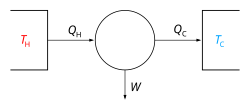](https://en.wikipedia.org/wiki/Carnot_heat_engine "Carnot heat engine")The classical [Carnot heat engine](https://en.wikipedia.org/wiki/Carnot_heat_engine "Carnot heat engine") | |
| Branches [Classical](https://en.wikipedia.org/wiki/Thermodynamics "Thermodynamics") [Statistical](https://en.wikipedia.org/wiki/Statistical_mechanics "Statistical mechanics") [Chemical](https://en.wikipedia.org/wiki/Chemical_thermodynamics "Chemical thermodynamics") [Quantum thermodynamics](https://en.wikipedia.org/wiki/Quantum_thermodynamics "Quantum thermodynamics") [Equilibrium](https://en.wikipedia.org/wiki/Equilibrium_thermodynamics "Equilibrium thermodynamics") / [Non-equilibrium](https://en.wikipedia.org/wiki/Non-equilibrium_thermodynamics "Non-equilibrium thermodynamics") | |
| [Laws](https://en.wikipedia.org/wiki/Laws_of_thermodynamics "Laws of thermodynamics") [Zeroth](https://en.wikipedia.org/wiki/Zeroth_law_of_thermodynamics "Zeroth law of thermodynamics") [First](https://en.wikipedia.org/wiki/First_law_of_thermodynamics "First law of thermodynamics") [Second](https://en.wikipedia.org/wiki/Second_law_of_thermodynamics "Second law of thermodynamics") [Third](https://en.wikipedia.org/wiki/Third_law_of_thermodynamics "Third law of thermodynamics") | |
| [State](https://en.wikipedia.org/wiki/Thermodynamic_state "Thermodynamic state") | |
| [Equation of state](https://en.wikipedia.org/wiki/Equation_of_state "Equation of state") [Ideal gas](https://en.wikipedia.org/wiki/Ideal_gas "Ideal gas") [Real gas](https://en.wikipedia.org/wiki/Real_gas "Real gas") [State of matter](https://en.wikipedia.org/wiki/State_of_matter "State of matter") [Phase (matter)](https://en.wikipedia.org/wiki/Phase_\(matter\) "Phase (matter)") [Equilibrium](https://en.wikipedia.org/wiki/Thermodynamic_equilibrium "Thermodynamic equilibrium") [Control volume](https://en.wikipedia.org/wiki/Control_volume "Control volume") [Instruments](https://en.wikipedia.org/wiki/Thermodynamic_instruments "Thermodynamic instruments") | |
| [Processes](https://en.wikipedia.org/wiki/Thermodynamic_process "Thermodynamic process") | |
| [Isobaric](https://en.wikipedia.org/wiki/Isobaric_process "Isobaric process") [Isochoric](https://en.wikipedia.org/wiki/Isochoric_process "Isochoric process") [Isothermal](https://en.wikipedia.org/wiki/Isothermal_process "Isothermal process") [Adiabatic](https://en.wikipedia.org/wiki/Adiabatic_process "Adiabatic process") [Isentropic](https://en.wikipedia.org/wiki/Isentropic_process "Isentropic process") [Isenthalpic](https://en.wikipedia.org/wiki/Isenthalpic_process "Isenthalpic process") [Quasistatic](https://en.wikipedia.org/wiki/Quasistatic_process "Quasistatic process") [Polytropic](https://en.wikipedia.org/wiki/Polytropic_process "Polytropic process") [Free expansion](https://en.wikipedia.org/wiki/Free_expansion "Free expansion") [Reversibility](https://en.wikipedia.org/wiki/Reversible_process_\(thermodynamics\) "Reversible process (thermodynamics)") [Irreversibility](https://en.wikipedia.org/wiki/Irreversible_process "Irreversible process") [Endoreversibility](https://en.wikipedia.org/wiki/Endoreversible_thermodynamics "Endoreversible thermodynamics") | |
| [Cycles](https://en.wikipedia.org/wiki/Thermodynamic_cycle "Thermodynamic cycle") | |
| [Heat engines](https://en.wikipedia.org/wiki/Heat_engine "Heat engine") [Heat pumps](https://en.wikipedia.org/wiki/Heat_pump_and_refrigeration_cycle "Heat pump and refrigeration cycle") [Thermal efficiency](https://en.wikipedia.org/wiki/Thermal_efficiency "Thermal efficiency") | |
| | |
| [Property diagrams](https://en.wikipedia.org/wiki/Thermodynamic_diagrams "Thermodynamic diagrams") [Intensive and extensive properties](https://en.wikipedia.org/wiki/Intensive_and_extensive_properties "Intensive and extensive properties") | |
| [Process functions](https://en.wikipedia.org/wiki/Process_function "Process function") | |
| [Work](https://en.wikipedia.org/wiki/Work_\(thermodynamics\) "Work (thermodynamics)") [Heat](https://en.wikipedia.org/wiki/Heat "Heat") | |
| [Functions of state](https://en.wikipedia.org/wiki/State_function "State function") | |
| [Temperature](https://en.wikipedia.org/wiki/Thermodynamic_temperature "Thermodynamic temperature") / *[Entropy](https://en.wikipedia.org/wiki/Entropy "Entropy")* ([introduction](https://en.wikipedia.org/wiki/Introduction_to_entropy "Introduction to entropy")) [Pressure](https://en.wikipedia.org/wiki/Pressure "Pressure") / *[Volume](https://en.wikipedia.org/wiki/Volume_\(thermodynamics\) "Volume (thermodynamics)")* [Chemical potential](https://en.wikipedia.org/wiki/Chemical_potential "Chemical potential") / *[Particle number](https://en.wikipedia.org/wiki/Particle_number "Particle number")* [Vapor quality](https://en.wikipedia.org/wiki/Vapor_quality "Vapor quality") [Reduced properties](https://en.wikipedia.org/wiki/Reduced_properties "Reduced properties") | |
| | |
| [Specific heat capacity](https://en.wikipedia.org/wiki/Heat_capacity "Heat capacity") | c \= {\\displaystyle c=}  |
| Scientists [Bernoulli](https://en.wikipedia.org/wiki/Daniel_Bernoulli "Daniel Bernoulli") [Boltzmann](https://en.wikipedia.org/wiki/Ludwig_Boltzmann "Ludwig Boltzmann") [Bridgman](https://en.wikipedia.org/wiki/Percy_Williams_Bridgman "Percy Williams Bridgman") [Callen](https://en.wikipedia.org/wiki/Herbert_Callen "Herbert Callen") [Carathéodory](https://en.wikipedia.org/wiki/Constantin_Carath%C3%A9odory "Constantin Carathéodory") [Carnot](https://en.wikipedia.org/wiki/Nicolas_L%C3%A9onard_Sadi_Carnot "Nicolas Léonard Sadi Carnot") [Clapeyron](https://en.wikipedia.org/wiki/Beno%C3%AEt_Paul_%C3%89mile_Clapeyron "Benoît Paul Émile Clapeyron") [Clausius](https://en.wikipedia.org/wiki/Rudolf_Clausius "Rudolf Clausius") [de Donder](https://en.wikipedia.org/wiki/Th%C3%A9ophile_de_Donder "Théophile de Donder") [Duhem](https://en.wikipedia.org/wiki/Pierre_Duhem "Pierre Duhem") [Gibbs](https://en.wikipedia.org/wiki/Josiah_Willard_Gibbs "Josiah Willard Gibbs") [von Helmholtz](https://en.wikipedia.org/wiki/Hermann_von_Helmholtz "Hermann von Helmholtz") [Joule](https://en.wikipedia.org/wiki/James_Prescott_Joule "James Prescott Joule") [Kelvin](https://en.wikipedia.org/wiki/Lord_Kelvin "Lord Kelvin") [Lewis](https://en.wikipedia.org/wiki/Gilbert_N._Lewis "Gilbert N. Lewis") [Massieu](https://en.wikipedia.org/wiki/Fran%C3%A7ois_Massieu "François Massieu") [Maxwell](https://en.wikipedia.org/wiki/James_Clerk_Maxwell "James Clerk Maxwell") [von Mayer](https://en.wikipedia.org/wiki/Julius_von_Mayer "Julius von Mayer") [Nernst](https://en.wikipedia.org/wiki/Walther_Nernst "Walther Nernst") [Onsager](https://en.wikipedia.org/wiki/Lars_Onsager "Lars Onsager") [Planck](https://en.wikipedia.org/wiki/Max_Planck "Max Planck") [Rankine](https://en.wikipedia.org/wiki/William_John_Macquorn_Rankine "William John Macquorn Rankine") [Smeaton](https://en.wikipedia.org/wiki/John_Smeaton "John Smeaton") [Stahl](https://en.wikipedia.org/wiki/Georg_Ernst_Stahl "Georg Ernst Stahl") [Tait](https://en.wikipedia.org/wiki/Peter_Tait_\(physicist\) "Peter Tait (physicist)") [Thompson](https://en.wikipedia.org/wiki/Benjamin_Thompson "Benjamin Thompson") [van der Waals](https://en.wikipedia.org/wiki/Johannes_Diderik_van_der_Waals "Johannes Diderik van der Waals") [Waterston](https://en.wikipedia.org/wiki/John_James_Waterston "John James Waterston") | |
| Other [Nucleation](https://en.wikipedia.org/wiki/Nucleation "Nucleation") [Self-assembly](https://en.wikipedia.org/wiki/Self-assembly "Self-assembly") [Self-organization](https://en.wikipedia.org/wiki/Self-organization "Self-organization") | |
|  [Category](https://en.wikipedia.org/wiki/Category:Thermodynamics "Category:Thermodynamics") | |
| [v](https://en.wikipedia.org/wiki/Template:Thermodynamics_sidebar "Template:Thermodynamics sidebar") [t](https://en.wikipedia.org/wiki/Template_talk:Thermodynamics_sidebar "Template talk:Thermodynamics sidebar") [e](https://en.wikipedia.org/wiki/Special:EditPage/Template:Thermodynamics_sidebar "Special:EditPage/Template:Thermodynamics sidebar") | |
In [thermodynamics](https://en.wikipedia.org/wiki/Thermodynamics "Thermodynamics"), the **specific heat capacity** (symbol *c*) of a substance is the amount of [heat](https://en.wikipedia.org/wiki/Heat "Heat") that must be added to one unit of mass of the substance in order to cause an increase of one unit in [temperature](https://en.wikipedia.org/wiki/Temperature "Temperature"). It is also referred to as **massic heat capacity** or as the **specific heat.** More formally it is the [heat capacity](https://en.wikipedia.org/wiki/Heat_capacity "Heat capacity") of a sample of the substance divided by the [mass](https://en.wikipedia.org/wiki/Mass "Mass") of the sample.[\[1\]](https://en.wikipedia.org/wiki/Specific_heat_capacity#cite_note-1) The [SI](https://en.wikipedia.org/wiki/International_System_of_Units "International System of Units") unit of specific heat capacity is [joule](https://en.wikipedia.org/wiki/Joule "Joule") per [kelvin](https://en.wikipedia.org/wiki/Kelvin "Kelvin") per [kilogram](https://en.wikipedia.org/wiki/Kilogram "Kilogram"), J⋅kg−1⋅K−1.[\[2\]](https://en.wikipedia.org/wiki/Specific_heat_capacity#cite_note-2) For example, the heat required to raise the temperature of 1 kg of [water](https://en.wikipedia.org/wiki/Water "Water") by 1 K is 4184 joules, so the specific heat capacity of water is 4184 J⋅kg−1⋅K−1.[\[3\]](https://en.wikipedia.org/wiki/Specific_heat_capacity#cite_note-3)
Specific heat capacity often varies with temperature, and is different for each [state of matter](https://en.wikipedia.org/wiki/State_of_matter "State of matter"). Liquid water has one of the highest specific heat capacities among common substances, about 4184 J⋅kg−1⋅K−1 at 20 °C, but that of ice, just below 0 °C, is only 2093 J⋅kg−1⋅K−1. The specific heat capacities of [iron](https://en.wikipedia.org/wiki/Iron "Iron"), [granite](https://en.wikipedia.org/wiki/Granite "Granite"), and [hydrogen](https://en.wikipedia.org/wiki/Hydrogen "Hydrogen") gas are about 449 J⋅kg−1⋅K−1, 790 J⋅kg−1⋅K−1, and 14300 J⋅kg−1⋅K−1, respectively.[\[4\]](https://en.wikipedia.org/wiki/Specific_heat_capacity#cite_note-4) While the substance is undergoing a [phase transition](https://en.wikipedia.org/wiki/Phase_transition "Phase transition"), such as melting or boiling, its specific heat capacity is technically undefined, because the heat goes into changing its state rather than raising its temperature.
The specific heat capacity of a substance, especially a gas, may be significantly higher when it is allowed to expand as it is heated (specific heat capacity *at constant pressure*) than when it is heated in a closed vessel that prevents expansion (specific heat capacity *at constant volume*). These two values are usually denoted by c p {\\displaystyle c\_{p}}  and c V {\\displaystyle c\_{V}} , respectively; their quotient γ \= c p / c V {\\displaystyle \\gamma =c\_{p}/c\_{V}}  is the [heat capacity ratio](https://en.wikipedia.org/wiki/Heat_capacity_ratio "Heat capacity ratio").
The term *specific heat* may also refer to the ratio between the specific heat capacities of a substance at a given temperature and of a reference substance at a reference temperature, such as water at 15 °C;[\[5\]](https://en.wikipedia.org/wiki/Specific_heat_capacity#cite_note-colen2001-5) much in the fashion of [specific gravity](https://en.wikipedia.org/wiki/Specific_gravity "Specific gravity"). Specific heat capacity is also related to other intensive measures of heat capacity with other denominators. If the amount of substance is measured as a number of [moles](https://en.wikipedia.org/wiki/Mole_\(unit\) "Mole (unit)"), one gets the [molar heat capacity](https://en.wikipedia.org/wiki/Molar_heat_capacity "Molar heat capacity") instead, whose SI unit is joule per kelvin per mole, J⋅mol−1⋅K−1. If the amount is taken to be the [volume](https://en.wikipedia.org/wiki/Volume "Volume") of the sample (as is sometimes done in engineering), one gets the [volumetric heat capacity](https://en.wikipedia.org/wiki/Volumetric_heat_capacity "Volumetric heat capacity"), whose SI unit is joule per kelvin per [cubic meter](https://en.wikipedia.org/wiki/Cubic_meter "Cubic meter"), J⋅m−3⋅K−1.
## History
\[[edit](https://en.wikipedia.org/w/index.php?title=Specific_heat_capacity&action=edit§ion=1 "Edit section: History")\]
### Discovery of specific heat
\[[edit](https://en.wikipedia.org/w/index.php?title=Specific_heat_capacity&action=edit§ion=2 "Edit section: Discovery of specific heat")\]
[](https://en.wikipedia.org/wiki/File:Black_Joseph_\(cropped\).jpg)
Joseph Black
One of the first scientists to use the concept was [Joseph Black](https://en.wikipedia.org/wiki/Joseph_Black "Joseph Black"), an 18th-century medical doctor and professor of medicine at [Glasgow University](https://en.wikipedia.org/wiki/Glasgow_University "Glasgow University"). He measured the specific heat capacities of many substances, using the term *capacity for heat*.[\[6\]](https://en.wikipedia.org/wiki/Specific_heat_capacity#cite_note-6) In 1756 or soon thereafter, Black began an extensive study of heat.[\[7\]](https://en.wikipedia.org/wiki/Specific_heat_capacity#cite_note-:1-7) In 1760 he realized that when two different substances of equal mass but different temperatures are mixed, the changes in number of degrees in the two substances differ, though the heat gained by the cooler substance and lost by the hotter is the same. Black related an experiment conducted by [Daniel Gabriel Fahrenheit](https://en.wikipedia.org/wiki/Daniel_Gabriel_Fahrenheit "Daniel Gabriel Fahrenheit") on behalf of Dutch physician [Herman Boerhaave](https://en.wikipedia.org/wiki/Herman_Boerhaave "Herman Boerhaave"). For clarity, he then described a hypothetical, but realistic variant of the experiment: If equal masses of 100 °F water and 150 °F mercury are mixed, the water temperature increases by 20 ° and the mercury temperature decreases by 30 ° (both arriving at 120 °F), even though the heat gained by the water and lost by the mercury is the same. This clarified the distinction between heat and temperature. It also introduced the concept of specific heat capacity, being different for different substances. Black wrote: "Quicksilver \[mercury\] ... has less capacity for the matter of heat than water."[\[8\]](https://en.wikipedia.org/wiki/Specific_heat_capacity#cite_note-8)[\[9\]](https://en.wikipedia.org/wiki/Specific_heat_capacity#cite_note-:0-9)
## Definition
\[[edit](https://en.wikipedia.org/w/index.php?title=Specific_heat_capacity&action=edit§ion=3 "Edit section: Definition")\]
The specific heat capacity of a substance, usually denoted by c {\\displaystyle c}  or s {\\displaystyle s} , is the heat capacity C {\\displaystyle C}  of a sample of the substance, divided by the mass M {\\displaystyle M}  of the sample:[\[10\]](https://en.wikipedia.org/wiki/Specific_heat_capacity#cite_note-10) c \= C M \= 1 M ⋅ d Q d T , {\\displaystyle c={\\frac {C}{M}}={\\frac {1}{M}}\\cdot {\\frac {\\mathrm {d} Q}{\\mathrm {d} T}},} 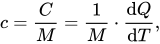 where d Q {\\displaystyle \\mathrm {d} Q}  [represents](https://en.wikipedia.org/wiki/Derivative "Derivative") the amount of heat needed to uniformly raise the temperature of the sample by a small increment d T {\\displaystyle \\mathrm {d} T} .
Like the heat capacity of an object, the specific heat capacity of a substance may vary, sometimes substantially, depending on the starting temperature T {\\displaystyle T}  of the sample and the [pressure](https://en.wikipedia.org/wiki/Pressure "Pressure") p {\\displaystyle p}  applied to it. Therefore, it should be considered a function c ( p , T ) {\\displaystyle c(p,T)}  of those two variables.
These parameters are usually specified when giving the specific heat capacity of a substance. For example, "Water (liquid): c p {\\displaystyle c\_{p}}  = 4187 J⋅kg−1⋅K−1 (15 °C)."[\[11\]](https://en.wikipedia.org/wiki/Specific_heat_capacity#cite_note-toolbox-11) When not specified, published values of the specific heat capacity c {\\displaystyle c}  generally are valid for some [standard conditions for temperature and pressure](https://en.wikipedia.org/wiki/Standard_conditions_for_temperature_and_pressure "Standard conditions for temperature and pressure").
However, the dependency of c {\\displaystyle c}  on starting temperature and pressure can often be ignored in practical contexts, e.g. when working in narrow ranges of those variables. In those contexts one usually omits the qualifier ( p , T ) {\\displaystyle (p,T)}  and approximates the specific heat capacity by a constant c {\\displaystyle c}  suitable for those ranges.
Specific heat capacity is an [intensive property](https://en.wikipedia.org/wiki/Intensive_property "Intensive property") of a substance, an intrinsic characteristic that does not depend on the size or shape of the amount in consideration. (The qualifier "specific" in front of an extensive property often indicates an intensive property derived from it.[\[12\]](https://en.wikipedia.org/wiki/Specific_heat_capacity#cite_note-12))
### Variations
\[[edit](https://en.wikipedia.org/w/index.php?title=Specific_heat_capacity&action=edit§ion=4 "Edit section: Variations")\]
The injection of heat energy into a substance, besides raising its temperature, usually causes an increase in its volume and/or its pressure, depending on how the sample is confined. The choice made about the latter affects the measured specific heat capacity, even for the same starting pressure p {\\displaystyle p}  and starting temperature T {\\displaystyle T} . Two particular choices are widely used:
- If the pressure is kept constant (for instance, at the ambient atmospheric pressure), and the sample is allowed to expand, the expansion generates [work](https://en.wikipedia.org/wiki/Work_\(thermodynamics\) "Work (thermodynamics)"), as the force from the pressure displaces the enclosure or the surrounding fluid. That work must come from the heat energy provided. The specific heat capacity thus obtained is said to be measured **at constant pressure** (or **isobaric**) and is often denoted
c
p
{\\displaystyle c\_{p}}

.
- On the other hand, if the expansion is prevented – for example, by a sufficiently rigid enclosure or by increasing the external pressure to counteract the internal one – no work is generated, and the heat energy that would have gone into it must instead contribute to the internal energy of the sample, including raising its temperature by an extra amount. The specific heat capacity obtained this way is said to be measured **at constant volume** (or **isochoric**) and denoted
c
V
{\\displaystyle c\_{V}}

.
The value of c V {\\displaystyle c\_{V}}  is always less than the value of c p {\\displaystyle c\_{p}}  for all fluids. This difference is particularly notable in gases where values under constant pressure are typically 30% to 66.7% greater than those at constant volume. Hence the [heat capacity ratio](https://en.wikipedia.org/wiki/Heat_capacity_ratio "Heat capacity ratio") of gases is typically between 1.3 and 1.67.[\[13\]](https://en.wikipedia.org/wiki/Specific_heat_capacity#cite_note-Lange-13)
### Applicability
\[[edit](https://en.wikipedia.org/w/index.php?title=Specific_heat_capacity&action=edit§ion=5 "Edit section: Applicability")\]
The specific heat capacity can be defined and measured for gases, liquids, and solids of fairly general composition and molecular structure. These include gas mixtures, solutions and alloys, or heterogenous materials such as milk, sand, granite, and concrete, if considered at a sufficiently large scale.
The specific heat capacity can be defined also for materials that change state or composition as the temperature and pressure change, as long as the changes are reversible and gradual. Thus, for example, the concepts are definable for a gas or liquid that dissociates as the temperature increases, as long as the products of the dissociation promptly and completely recombine when it drops.
The specific heat capacity is not meaningful if the substance undergoes irreversible chemical changes, or if there is a [phase change](https://en.wikipedia.org/wiki/Phase_transition "Phase transition"), such as melting or boiling, at a sharp temperature within the range of temperatures spanned by the measurement.
## Measurement
\[[edit](https://en.wikipedia.org/w/index.php?title=Specific_heat_capacity&action=edit§ion=6 "Edit section: Measurement")\]
The specific heat capacity of a substance is typically determined according to the definition; namely, by measuring the heat capacity of a sample of the substance, usually with a [calorimeter](https://en.wikipedia.org/wiki/Calorimeter "Calorimeter"), and dividing by the sample's mass. Several techniques can be applied for estimating the heat capacity of a substance, such as [differential scanning calorimetry](https://en.wikipedia.org/wiki/Differential_scanning_calorimetry "Differential scanning calorimetry").[\[14\]](https://en.wikipedia.org/wiki/Specific_heat_capacity#cite_note-14)[\[15\]](https://en.wikipedia.org/wiki/Specific_heat_capacity#cite_note-15)
[](https://en.wikipedia.org/wiki/File:Water_temperature_vs_heat_added.svg)
Graph of temperature of phases of water heated from −100 °C to 200 °C – the dashed line example shows that melting and heating 1 kg of ice at −50 °C to water at 40 °C needs 600 kJ
The specific heat capacities of gases can be measured at constant volume, by enclosing the sample in a rigid container. On the other hand, measuring the specific heat capacity at constant volume can be prohibitively difficult for liquids and solids, since one often would need impractical pressures in order to prevent the expansion that would be caused by even small increases in temperature. Instead, the common practice is to measure the specific heat capacity at constant pressure (allowing the material to expand or contract as it wishes), determine separately the [coefficient of thermal expansion](https://en.wikipedia.org/wiki/Coefficient_of_thermal_expansion "Coefficient of thermal expansion") and the [compressibility](https://en.wikipedia.org/wiki/Bulk_modulus "Bulk modulus") of the material, and compute the specific heat capacity at constant volume from these data according to the laws of thermodynamics.\[*[citation needed](https://en.wikipedia.org/wiki/Wikipedia:Citation_needed "Wikipedia:Citation needed")*\]
## Units
\[[edit](https://en.wikipedia.org/w/index.php?title=Specific_heat_capacity&action=edit§ion=7 "Edit section: Units")\]
### International system
\[[edit](https://en.wikipedia.org/w/index.php?title=Specific_heat_capacity&action=edit§ion=8 "Edit section: International system")\]
The SI unit for specific heat capacity is joule per kelvin per kilogram J/kg⋅K, J⋅K−1⋅kg−1. Since an increment of temperature of one [degree Celsius](https://en.wikipedia.org/wiki/Celsius_scale "Celsius scale") is the same as an increment of one kelvin, that is the same as joule per degree Celsius per kilogram: J/(kg⋅°C). Sometimes the [gram](https://en.wikipedia.org/wiki/Gram "Gram") is used instead of kilogram for the unit of mass: 1 J⋅g−1⋅K−1 = 1000 J⋅kg−1⋅K−1.
The specific heat capacity of a substance (per unit of mass) has [dimension](https://en.wikipedia.org/wiki/Dimensional_analysis "Dimensional analysis") L2⋅Θ−1⋅T−2, or (L/T)2/Θ. Therefore, the SI unit J⋅kg−1⋅K−1 is equivalent to [metre](https://en.wikipedia.org/wiki/Metre "Metre") squared per [second](https://en.wikipedia.org/wiki/Second "Second") squared per [kelvin](https://en.wikipedia.org/wiki/Kelvin "Kelvin") (m2⋅K−1⋅s−2).
### Imperial engineering units
\[[edit](https://en.wikipedia.org/w/index.php?title=Specific_heat_capacity&action=edit§ion=9 "Edit section: Imperial engineering units")\]
Professionals in [construction](https://en.wikipedia.org/wiki/Construction "Construction"), [civil engineering](https://en.wikipedia.org/wiki/Civil_engineering "Civil engineering"), [chemical engineering](https://en.wikipedia.org/wiki/Chemical_engineering "Chemical engineering"), and other technical disciplines, especially in the [United States](https://en.wikipedia.org/wiki/United_States "United States"), may use [English Engineering units](https://en.wikipedia.org/wiki/English_Engineering_Units "English Engineering Units") including the [pound](https://en.wikipedia.org/wiki/Pound_\(mass\) "Pound (mass)") (lb = 0.45359237 kg) as the unit of mass, the [degree Fahrenheit](https://en.wikipedia.org/wiki/Fahrenheit "Fahrenheit") or [Rankine](https://en.wikipedia.org/wiki/Rankine_scale "Rankine scale") (°R = 5/9 K, about 0.555556 K) as the unit of temperature increment, and the [British thermal unit](https://en.wikipedia.org/wiki/British_thermal_unit "British thermal unit") (BTU ≈ 1055.056 J),[\[16\]](https://en.wikipedia.org/wiki/Specific_heat_capacity#cite_note-Koch-16)[\[17\]](https://en.wikipedia.org/wiki/Specific_heat_capacity#cite_note-17) as the unit of heat.
In those contexts, the unit of specific heat capacity is BTU/lb⋅°R, or 1 BTU/lb⋅°R = 4186.68J/kg⋅K.[\[18\]](https://en.wikipedia.org/wiki/Specific_heat_capacity#cite_note-18) The BTU was originally defined so that the average specific heat capacity of water would be 1 BTU/lb⋅°F.[\[19\]](https://en.wikipedia.org/wiki/Specific_heat_capacity#cite_note-19) Note the value's similarity to that of the calorie - 4187 J/kg⋅°C ≈ 4184 J/kg⋅°C (~.07%) - as they are essentially measuring the same energy, using water as a basis reference, scaled to their systems' respective lbs and °F, or kg and °C.
### Calories
\[[edit](https://en.wikipedia.org/w/index.php?title=Specific_heat_capacity&action=edit§ion=10 "Edit section: Calories")\]
In chemistry, heat amounts were often measured in [calories](https://en.wikipedia.org/wiki/Calorie "Calorie"). Confusingly, there are two common units with that name, respectively denoted *cal* and *Cal*:
- the *small calorie* (*gram-calorie, cal*) is 4.184 J exactly. It was originally defined so that the specific heat capacity of liquid water would be 1 cal/(°C⋅g).
- The *grand calorie* (*kilocalorie, kilogram-calorie, food calorie, kcal, Cal*) is 1000 small calories, 4184 J exactly. It was defined so that the specific heat capacity of water would be 1 Cal/(°C⋅kg).
While these units are still used in some contexts (such as kilogram calorie in [nutrition](https://en.wikipedia.org/wiki/Nutrition "Nutrition")), their use is now deprecated in technical and scientific fields. When heat is measured in these units, the unit of specific heat capacity is usually:
1
cal/°C⋅g = 1
Cal/°C⋅kg = 1
kcal/°C⋅kg = 4184
J/kg⋅K[\[20\]](https://en.wikipedia.org/wiki/Specific_heat_capacity#cite_note-20) = 4.184
kJ/kg⋅K.
Note that while cal is **1⁄1000** of a Cal or kcal, it is also per *gram* instead of **kilo***gram*: ergo, in either unit, the specific heat capacity of water is approximately 1.
## Physical basis
\[[edit](https://en.wikipedia.org/w/index.php?title=Specific_heat_capacity&action=edit§ion=11 "Edit section: Physical basis")\]
Main article: [Molar heat capacity § Physical basis](https://en.wikipedia.org/wiki/Molar_heat_capacity#Physical_basis "Molar heat capacity")
The temperature of a sample of a substance reflects the average [kinetic energy](https://en.wikipedia.org/wiki/Kinetic_energy "Kinetic energy") of its constituent particles (atoms or molecules) relative to its center of mass. However, not all energy provided to a sample of a substance will go into raising its temperature, exemplified via the [equipartition theorem](https://en.wikipedia.org/wiki/Equipartition_theorem "Equipartition theorem").
### Monatomic gases
\[[edit](https://en.wikipedia.org/w/index.php?title=Specific_heat_capacity&action=edit§ion=12 "Edit section: Monatomic gases")\]
[Statistical mechanics](https://en.wikipedia.org/wiki/Statistical_mechanics "Statistical mechanics") predicts that at room temperature and ordinary pressures, an isolated atom in a gas cannot store any significant amount of energy except in the form of kinetic energy, unless multiple electronic states are accessible at room temperature (such is the case for atomic fluorine).[\[21\]](https://en.wikipedia.org/wiki/Specific_heat_capacity#cite_note-21) Thus, the [heat capacity per mole](https://en.wikipedia.org/wiki/Molar_heat_capacity "Molar heat capacity") at room temperature is the same for all of the noble gases as well as for many other atomic vapors. More precisely, c V , m \= 3 R / 2 ≈ 12\.5 J ⋅ K − 1 ⋅ m o l − 1 {\\displaystyle c\_{V,\\mathrm {m} }=3R/2\\approx \\mathrm {12.5\\,J\\cdot K^{-1}\\cdot mol^{-1}} }  and c P , m \= 5 R / 2 ≈ 21 J ⋅ K − 1 ⋅ m o l − 1 {\\displaystyle c\_{P,\\mathrm {m} }=5R/2\\approx \\mathrm {21\\,J\\cdot K^{-1}\\cdot mol^{-1}} } , where R ≈ 8\.31446 J ⋅ K − 1 ⋅ m o l − 1 {\\displaystyle R\\approx \\mathrm {8.31446\\,J\\cdot K^{-1}\\cdot mol^{-1}} }  is the [ideal gas unit](https://en.wikipedia.org/wiki/Ideal_gas_constant "Ideal gas constant") (which is the product of [Boltzmann conversion constant](https://en.wikipedia.org/wiki/Boltzmann_constant "Boltzmann constant") from [kelvin](https://en.wikipedia.org/wiki/Kelvin "Kelvin") microscopic energy unit to the macroscopic energy unit [joule](https://en.wikipedia.org/wiki/Joule "Joule"), and the [Avogadro number](https://en.wikipedia.org/wiki/Avogadro_number "Avogadro number")).
Therefore, the specific heat capacity (per gram, not per mole) of a monatomic gas will be inversely proportional to its (adimensional) [atomic weight](https://en.wikipedia.org/wiki/Atomic_weight "Atomic weight") A {\\displaystyle A} . That is, approximately,
c V ≈ 12470 J ⋅ K − 1 ⋅ k g − 1 / A c p ≈ 20785 J ⋅ K − 1 ⋅ k g − 1 / A {\\displaystyle c\_{V}\\approx \\mathrm {12470\\,J\\cdot K^{-1}\\cdot kg^{-1}} /A\\quad \\quad \\quad c\_{p}\\approx \\mathrm {20785\\,J\\cdot K^{-1}\\cdot kg^{-1}} /A} 
For the noble gases, from helium to xenon, these computed values are
| Gas | He | Ne | Ar | Kr | Xe |
|---|---|---|---|---|---|
| A {\\displaystyle A}  | | | | | |
### Polyatomic gases
\[[edit](https://en.wikipedia.org/w/index.php?title=Specific_heat_capacity&action=edit§ion=13 "Edit section: Polyatomic gases")\]
A polyatomic gas molecule can store energy in additional degrees of freedom. Its kinetic energy contributes to the heat capacity in the same way as monatomic gases, but there are also contributions from the [rotations](https://en.wikipedia.org/wiki/Rotational_energy "Rotational energy") of the molecule and vibration of the atoms relative to each other (including internal [potential energy](https://en.wikipedia.org/wiki/Potential_energy "Potential energy")).
The heat capacity may also have contribution from [excited electronic states](https://en.wikipedia.org/wiki/Excited_state "Excited state") for molecules with a sufficiently small energy gap between the ground state and the excited state, such as in NO.[\[22\]](https://en.wikipedia.org/wiki/Specific_heat_capacity#cite_note-22) For a few systems, quantum spin statistics can also be important contributions to the heat capacity, even at room temperature. The analysis of the heat capacity of H
2 due to ortho/para separation,[\[23\]](https://en.wikipedia.org/wiki/Specific_heat_capacity#cite_note-23) which arises from [nuclear spin](https://en.wikipedia.org/wiki/Spin_quantum_number "Spin quantum number") statistics, has been referred to as "one of the great triumphs of post-quantum mechanical statistical mechanics."[\[24\]](https://en.wikipedia.org/wiki/Specific_heat_capacity#cite_note-24)
These extra [degrees of freedom](https://en.wikipedia.org/wiki/Degrees_of_freedom_\(physics_and_chemistry\) "Degrees of freedom (physics and chemistry)") or "modes" contribute to the specific heat capacity of the substance. Namely, when energy is introduced into a gas with polyatomic molecules, only part of it will increase their kinetic energy, and hence the temperature; the rest will go to into the other degrees of freedom. To achieve the same increase in temperature, more heat is needed for a gram of that substance than for a gram of a monatomic gas. Thus, the specific heat capacity per mole of a polyatomic gas depends both on the molecular mass and the number of degrees of freedom of the molecules.[\[25\]](https://en.wikipedia.org/wiki/Specific_heat_capacity#cite_note-25)[\[26\]](https://en.wikipedia.org/wiki/Specific_heat_capacity#cite_note-26)[\[27\]](https://en.wikipedia.org/wiki/Specific_heat_capacity#cite_note-27)
[Quantum statistical mechanics](https://en.wikipedia.org/wiki/Quantum_statistical_mechanics "Quantum statistical mechanics") predicts that each rotational or vibrational mode can only take or lose energy in certain discrete amounts (quanta), and that this affects the system's thermodynamic properties. Depending on the temperature, the average energy per molecule may be too small compared to the quanta needed to activate some of those degrees of freedom. Those modes are said to be "frozen out". In that case, the specific heat capacity of the substance increases with temperature, sometimes in a step-like fashion as mode becomes unfrozen and starts absorbing part of the input heat.
For example, the molar heat capacity of [nitrogen](https://en.wikipedia.org/wiki/Nitrogen "Nitrogen") N
2 at constant volume is c V , m \= 20\.6 J ⋅ K − 1 ⋅ m o l − 1 {\\displaystyle c\_{V,\\mathrm {m} }=\\mathrm {20.6\\,J\\cdot K^{-1}\\cdot mol^{-1}} }  (at 15 °C, 1 atm), which is 2\.49 R {\\displaystyle 2.49R} .[\[28\]](https://en.wikipedia.org/wiki/Specific_heat_capacity#cite_note-thor1993-28) That is the value expected from the [Equipartition Theorem](https://en.wikipedia.org/wiki/Equipartition_theorem "Equipartition theorem") if each molecule had 5 kinetic degrees of freedom. These turn out to be three degrees of the molecule's velocity vector, plus two degrees from its rotation about an axis through the center of mass and perpendicular to the line of the two atoms. Because of those two extra degrees of freedom, the specific heat capacity c V {\\displaystyle c\_{V}}  of N
2 (736 J⋅K−1⋅kg−1) is greater than that of an hypothetical monatomic gas with the same molecular mass 28 (445 J⋅K−1⋅kg−1), by a factor of 5/3. The vibrational and electronic degrees of freedom do not contribute significantly to the heat capacity in this case, due to the relatively large energy level gaps for both vibrational and electronic excitation in this molecule.
This value for the specific heat capacity of nitrogen is practically constant from below −150 °C to about 300 °C. In that temperature range, the two additional degrees of freedom that correspond to vibrations of the atoms, stretching and compressing the bond, are still "frozen out". At about that temperature, those modes begin to "un-freeze" as vibrationally excited states become accessible. As a result c V {\\displaystyle c\_{V}}  starts to increase rapidly at first, then slower as it tends to another constant value. It is 35.5 J⋅K−1⋅mol−1 at 1500 °C, 36.9 at 2500 °C, and 37.5 at 3500 °C.[\[29\]](https://en.wikipedia.org/wiki/Specific_heat_capacity#cite_note-chas1998-29) The last value corresponds almost exactly to the value predicted by the Equipartition Theorem, since in the high-temperature limit the theorem predicts that the vibrational degree of freedom contributes twice as much to the heat capacity as any one of the translational or rotational degrees of freedom.
## Derivations of heat capacity
\[[edit](https://en.wikipedia.org/w/index.php?title=Specific_heat_capacity&action=edit§ion=14 "Edit section: Derivations of heat capacity")\]
### Relation between specific heat capacities
\[[edit](https://en.wikipedia.org/w/index.php?title=Specific_heat_capacity&action=edit§ion=15 "Edit section: Relation between specific heat capacities")\]
Starting from the [fundamental thermodynamic relation](https://en.wikipedia.org/wiki/Fundamental_thermodynamic_relation "Fundamental thermodynamic relation") one can show,
c p − c v \= α 2 T ρ β T {\\displaystyle c\_{p}-c\_{v}={\\frac {\\alpha ^{2}T}{\\rho \\beta \_{T}}}} 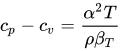
where
- α
{\\displaystyle \\alpha }

is the [coefficient of thermal expansion](https://en.wikipedia.org/wiki/Coefficient_of_thermal_expansion "Coefficient of thermal expansion"),
- β
T
{\\displaystyle \\beta \_{T}}

is the [isothermal](https://en.wikipedia.org/wiki/Isothermal "Isothermal") [compressibility](https://en.wikipedia.org/wiki/Compressibility "Compressibility"), and
- ρ
{\\displaystyle \\rho }

is [density](https://en.wikipedia.org/wiki/Density "Density").
A derivation is discussed in the article [Relations between specific heats](https://en.wikipedia.org/wiki/Relations_between_specific_heats "Relations between specific heats").
For an [ideal gas](https://en.wikipedia.org/wiki/Ideal_gas "Ideal gas"), if ρ {\\displaystyle \\rho }  is expressed as [molar](https://en.wikipedia.org/wiki/Mole_\(chemistry\) "Mole (chemistry)") density in the above equation, this equation reduces simply to [Mayer](https://en.wikipedia.org/wiki/Julius_Robert_von_Mayer "Julius Robert von Mayer")'s relation,
C p , m − C v , m \= R {\\displaystyle C\_{p,m}-C\_{v,m}=R\\!} 
where C p , m {\\displaystyle C\_{p,m}}  and C v , m {\\displaystyle C\_{v,m}}  are [intensive property](https://en.wikipedia.org/wiki/Intensive_property "Intensive property") heat capacities expressed on a per mole basis at constant pressure and constant volume, respectively.
### Specific heat capacity
\[[edit](https://en.wikipedia.org/w/index.php?title=Specific_heat_capacity&action=edit§ion=16 "Edit section: Specific heat capacity")\]
The specific heat capacity of a material on a per mass basis is
c \= ∂ C ∂ m , {\\displaystyle c={\\partial C \\over \\partial m},} 
which in the absence of phase transitions is equivalent to
c \= E m \= C m \= C ρ V , {\\displaystyle c=E\_{m}={C \\over m}={C \\over {\\rho V}},} 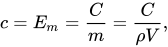
where
- C
{\\displaystyle C}

is the heat capacity of a body made of the material in question,
- m
{\\displaystyle m}

is the mass of the body,
- V
{\\displaystyle V}

is the volume of the body, and
- ρ
\=
m
V
{\\displaystyle \\rho ={\\frac {m}{V}}}

is the density of the material.
For gases, and also for other materials under high pressures, there is need to distinguish between different boundary conditions for the processes under consideration (since values differ significantly between different conditions). Typical processes for which a heat capacity may be defined include [isobaric](https://en.wikipedia.org/wiki/Isobaric_process "Isobaric process") (constant pressure, d p \= 0 {\\displaystyle dp=0} ) or [isochoric](https://en.wikipedia.org/wiki/Isochoric_process "Isochoric process") (constant volume, d V \= 0 {\\displaystyle dV=0} ) processes. The corresponding specific heat capacities are expressed as
c p \= ( ∂ C ∂ m ) p , c V \= ( ∂ C ∂ m ) V . {\\displaystyle {\\begin{aligned}c\_{p}&=\\left({\\frac {\\partial C}{\\partial m}}\\right)\_{p},\\\\c\_{V}&=\\left({\\frac {\\partial C}{\\partial m}}\\right)\_{V}.\\end{aligned}}} 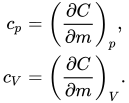
A related parameter to c {\\displaystyle c}  is C V − 1 {\\displaystyle CV^{-1}} , the [volumetric heat capacity](https://en.wikipedia.org/wiki/Volumetric_heat_capacity "Volumetric heat capacity"). In engineering practice, c V {\\displaystyle c\_{V}}  for solids or liquids often signifies a volumetric heat capacity, rather than a constant-volume one. In such cases, the mass-specific heat capacity is often explicitly written with the subscript m {\\displaystyle m} , as c m {\\displaystyle c\_{m}} . Of course, from the above relationships, for solids one writes
c m \= C m \= c V ρ . {\\displaystyle c\_{m}={\\frac {C}{m}}={\\frac {c\_{V}}{\\rho }}.} 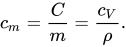
For pure homogeneous [chemical compounds](https://en.wikipedia.org/wiki/Chemical_compound "Chemical compound") with established [molecular or molar mass](https://en.wikipedia.org/wiki/Molecular_mass "Molecular mass") or a [molar quantity](https://en.wikipedia.org/wiki/Mole_\(chemistry\) "Mole (chemistry)") is established, heat capacity as an [intensive property](https://en.wikipedia.org/wiki/Intensive_property "Intensive property") can be expressed on a per [mole](https://en.wikipedia.org/wiki/Mole_\(chemistry\) "Mole (chemistry)") basis instead of a per mass basis by the following equations analogous to the per mass equations:
C p , m \= ( ∂ C ∂ n ) p \= molar heat capacity at constant pressure C V , m \= ( ∂ C ∂ n ) V \= molar heat capacity at constant volume {\\displaystyle {\\begin{alignedat}{3}C\_{p,m}=\\left({\\frac {\\partial C}{\\partial n}}\\right)\_{p}&={\\text{molar heat capacity at constant pressure}}\\\\C\_{V,m}=\\left({\\frac {\\partial C}{\\partial n}}\\right)\_{V}&={\\text{molar heat capacity at constant volume}}\\end{alignedat}}} 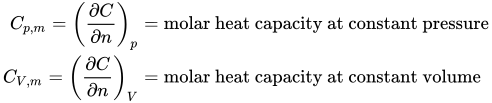
where *n* = number of moles in the body or [thermodynamic system](https://en.wikipedia.org/wiki/Thermodynamic_system "Thermodynamic system"). One may refer to such a *per mole* quantity as molar heat capacity to distinguish it from specific heat capacity on a per-mass basis.
### Polytropic heat capacity
\[[edit](https://en.wikipedia.org/w/index.php?title=Specific_heat_capacity&action=edit§ion=17 "Edit section: Polytropic heat capacity")\]
The [polytropic](https://en.wikipedia.org/wiki/Polytropic "Polytropic") heat capacity is calculated at processes if all the thermodynamic properties (pressure, volume, temperature) change
C i , m \= ( ∂ C ∂ n ) \= molar heat capacity at polytropic process {\\displaystyle C\_{i,m}=\\left({\\frac {\\partial C}{\\partial n}}\\right)={\\text{molar heat capacity at polytropic process}}} 
The most important polytropic processes run between the adiabatic and the isotherm functions, the polytropic index is between **1** and the adiabatic exponent (*γ* or *κ*)
### Dimensionless heat capacity
\[[edit](https://en.wikipedia.org/w/index.php?title=Specific_heat_capacity&action=edit§ion=18 "Edit section: Dimensionless heat capacity")\]
The [dimensionless](https://en.wikipedia.org/wiki/Dimensionless_number "Dimensionless number") heat capacity of a material is
C ∗ \= C n R \= C N k B {\\displaystyle C^{\*}={\\frac {C}{nR}}={\\frac {C}{Nk\_{\\text{B}}}}} 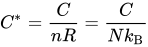
where
- *C* is the heat capacity of a body made of the material in question (J/K)
- *n* is the [amount of substance](https://en.wikipedia.org/wiki/Amount_of_substance "Amount of substance") in the body ([mol](https://en.wikipedia.org/wiki/Mole_\(unit\) "Mole (unit)"))
- *R* is the [gas constant](https://en.wikipedia.org/wiki/Gas_constant "Gas constant") (J⋅K−1⋅mol−1)
- *N* is the number of molecules in the body. (dimensionless)
- *k*B is the [Boltzmann constant](https://en.wikipedia.org/wiki/Boltzmann_constant "Boltzmann constant") (J⋅K−1)
Again, [SI](https://en.wikipedia.org/wiki/SI "SI") units shown for example.
In the [Ideal gas](https://en.wikipedia.org/wiki/Ideal_gas "Ideal gas") article, dimensionless heat capacity C ∗ {\\displaystyle C^{\*}}  is expressed as c ^ {\\displaystyle {\\hat {c}}} .
### Heat capacity at absolute zero
\[[edit](https://en.wikipedia.org/w/index.php?title=Specific_heat_capacity&action=edit§ion=19 "Edit section: Heat capacity at absolute zero")\]
From the definition of [entropy](https://en.wikipedia.org/wiki/Entropy#Thermodynamic_definition_of_entropy "Entropy")
T d S \= δ Q {\\displaystyle TdS=\\delta Q} 
the absolute entropy can be calculated by integrating from zero kelvins temperature to the final temperature *Tf*
S ( T f ) \= ∫ T \= 0 T f δ Q T \= ∫ 0 T f δ Q d T d T T \= ∫ 0 T f C ( T ) d T T . {\\displaystyle S(T\_{f})=\\int \_{T=0}^{T\_{f}}{\\frac {\\delta Q}{T}}=\\int \_{0}^{T\_{f}}{\\frac {\\delta Q}{dT}}{\\frac {dT}{T}}=\\int \_{0}^{T\_{f}}C(T)\\,{\\frac {dT}{T}}.} 
The heat capacity must be zero at zero temperature in order for the above integral not to yield an infinite absolute entropy, thus violating the [third law of thermodynamics](https://en.wikipedia.org/wiki/Third_law_of_thermodynamics "Third law of thermodynamics"). One of the strengths of the [Debye model](https://en.wikipedia.org/wiki/Debye_model "Debye model") is that (unlike the preceding Einstein model) it predicts the proper mathematical form of the approach of heat capacity toward zero, as absolute zero temperature is approached.
### Solid phase
\[[edit](https://en.wikipedia.org/w/index.php?title=Specific_heat_capacity&action=edit§ion=20 "Edit section: Solid phase")\]
The theoretical maximum heat capacity for larger and larger multi-atomic gases at higher temperatures, also approaches the Dulong–Petit limit of 3*R*, so long as this is calculated per mole of atoms, not molecules. The reason is that gases with very large molecules, in theory have almost the same high-temperature heat capacity as solids, lacking only the (small) heat capacity contribution that comes from potential energy that cannot be stored between separate molecules in a gas.
The Dulong–Petit limit results from the [equipartition theorem](https://en.wikipedia.org/wiki/Equipartition_theorem "Equipartition theorem"), and as such is only valid in the classical limit of a [microstate continuum](https://en.wikipedia.org/w/index.php?title=Microstate_continuum&action=edit&redlink=1 "Microstate continuum (page does not exist)"), which is a high temperature limit. For light and non-metallic elements, as well as most of the common molecular solids based on carbon compounds at [standard ambient temperature](https://en.wikipedia.org/wiki/Standard_ambient_temperature_and_pressure "Standard ambient temperature and pressure"), quantum effects may also play an important role, as they do in multi-atomic gases. These effects usually combine to give heat capacities lower than 3*R* per mole of *atoms* in the solid, although in molecular solids, heat capacities calculated *per mole of molecules* in molecular solids may be more than 3*R*. For example, the heat capacity of water ice at the melting point is about 4.6*R* per mole of molecules, but only 1.5*R* per mole of atoms. The lower than 3*R* number "per atom" (as is the case with diamond and beryllium) results from the "freezing out" of possible vibration modes for light atoms at suitably low temperatures, just as in many low-mass-atom gases at room temperatures. Because of high crystal binding energies, these effects are seen in solids more often than liquids: for example the heat capacity of liquid water is twice that of ice at near the same temperature, and is again close to the 3*R* per mole of atoms of the Dulong–Petit theoretical maximum.
For a more modern and precise analysis of the heat capacities of solids, especially at low temperatures, it is useful to use the idea of [phonons](https://en.wikipedia.org/wiki/Phonons "Phonons"). See [Debye model](https://en.wikipedia.org/wiki/Debye_model "Debye model").
### Theoretical estimation
\[[edit](https://en.wikipedia.org/w/index.php?title=Specific_heat_capacity&action=edit§ion=21 "Edit section: Theoretical estimation")\]
The path integral Monte Carlo method is a numerical approach for determining the values of heat capacity, based on quantum dynamical principles. However, good approximations can be made for gases in many states using simpler methods outlined below. For many solids composed of relatively heavy atoms (atomic number \> iron), at non-cryogenic temperatures, the heat capacity at room temperature approaches 3R = 24.94 joules per kelvin per mole of atoms (Dulong–Petit law, R is the gas constant). Low temperature approximations for both gases and solids at temperatures less than their characteristic Einstein temperatures or Debye temperatures can be made by the methods of Einstein and Debye discussed below.
- Water (liquid): CP = 4185.5 J⋅K−1⋅kg−1 (15 °C, 101.325 kPa)
- Water (liquid): CVH = 74.539 J⋅K−1⋅mol−1 (25 °C)
For liquids and gases, it is important to know the pressure to which given heat capacity data refer. Most published data are given for standard pressure. However, different standard conditions for temperature and pressure have been defined by different organizations. The International Union of Pure and Applied Chemistry (IUPAC) changed its recommendation from one atmosphere to the round value 100 kPa (≈750.062 Torr).[\[notes 1\]](https://en.wikipedia.org/wiki/Specific_heat_capacity#cite_note-gold-30)
### Relation between heat capacities
\[[edit](https://en.wikipedia.org/w/index.php?title=Specific_heat_capacity&action=edit§ion=22 "Edit section: Relation between heat capacities")\]
Main article: [Relations between heat capacities](https://en.wikipedia.org/wiki/Relations_between_heat_capacities "Relations between heat capacities")
Measuring the specific heat capacity at constant volume can be prohibitively difficult for liquids and solids. That is, small temperature changes typically require large pressures to maintain a liquid or solid at constant volume, implying that the containing vessel must be nearly rigid or at least very strong (see [coefficient of thermal expansion](https://en.wikipedia.org/wiki/Coefficient_of_thermal_expansion "Coefficient of thermal expansion") and [compressibility](https://en.wikipedia.org/wiki/Compressibility "Compressibility")). Instead, it is easier to measure the heat capacity at constant pressure (allowing the material to expand or contract freely) and solve for the heat capacity at constant volume using mathematical relationships derived from the basic thermodynamic laws.
The [heat capacity ratio](https://en.wikipedia.org/wiki/Heat_capacity_ratio "Heat capacity ratio"), or adiabatic index, is the ratio of the heat capacity at constant pressure to heat capacity at constant volume. It is sometimes also known as the isentropic expansion factor.
#### Ideal gas
\[[edit](https://en.wikipedia.org/w/index.php?title=Specific_heat_capacity&action=edit§ion=23 "Edit section: Ideal gas")\]
For an [ideal gas](https://en.wikipedia.org/wiki/Ideal_gas "Ideal gas"), evaluating the partial derivatives above according to the [equation of state](https://en.wikipedia.org/wiki/Equation_of_state "Equation of state"), where *R* is the [gas constant](https://en.wikipedia.org/wiki/Gas_constant "Gas constant"), for an ideal gas[\[30\]](https://en.wikipedia.org/wiki/Specific_heat_capacity#cite_note-31)
P V \= n R T , C P − C V \= T ( ∂ P ∂ T ) V , n ( ∂ V ∂ T ) P , n , P \= n R T V ⇒ ( ∂ P ∂ T ) V , n \= n R V , V \= n R T P ⇒ ( ∂ V ∂ T ) P , n \= n R P . {\\displaystyle {\\begin{alignedat}{3}PV&=nRT,&\\\\C\_{P}-C\_{V}&=T\\left({\\frac {\\partial P}{\\partial T}}\\right)\_{V,n}\\left({\\frac {\\partial V}{\\partial T}}\\right)\_{P,n},&\\\\P&={\\frac {nRT}{V}}\\Rightarrow \\left({\\frac {\\partial P}{\\partial T}}\\right)\_{V,n}&={\\frac {nR}{V}},\\\\V&={\\frac {nRT}{P}}\\Rightarrow \\left({\\frac {\\partial V}{\\partial T}}\\right)\_{P,n}&={\\frac {nR}{P}}.\\end{alignedat}}} 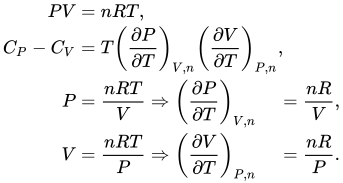
Substituting
T ( ∂ P ∂ T ) V , n ( ∂ V ∂ T ) P , n \= T n R V n R P \= n R T V n R P \= P n R P \= n R , {\\displaystyle T\\left({\\frac {\\partial P}{\\partial T}}\\right)\_{V,n}\\left({\\frac {\\partial V}{\\partial T}}\\right)\_{P,n}=T{\\frac {nR}{V}}{\\frac {nR}{P}}={\\frac {nRT}{V}}{\\frac {nR}{P}}=P{\\frac {nR}{P}}=nR,} 
this equation reduces simply to [Mayer](https://en.wikipedia.org/wiki/Julius_Robert_von_Mayer "Julius Robert von Mayer")'s relation:
C P , m − C V , m \= R . {\\displaystyle C\_{P,m}-C\_{V,m}=R.} 
The differences in heat capacities as defined by the above Mayer relation is only exact for an ideal gas and would be different for any real gas.
### Specific heat capacity
\[[edit](https://en.wikipedia.org/w/index.php?title=Specific_heat_capacity&action=edit§ion=24 "Edit section: Specific heat capacity")\]
The specific heat capacity of a material on a per mass basis is
c \= ∂ C ∂ m , {\\displaystyle c={\\frac {\\partial C}{\\partial m}},} 
which in the absence of phase transitions is equivalent to
c \= E m \= C m \= C ρ V , {\\displaystyle c=E\_{m}={\\frac {C}{m}}={\\frac {C}{\\rho V}},} 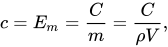
where
- C
{\\displaystyle C}

is the heat capacity of a body made of the material in question,
- m
{\\displaystyle m}

is the mass of the body,
- V
{\\displaystyle V}

is the volume of the body,
- ρ
\=
m
V
{\\displaystyle \\rho ={\\frac {m}{V}}}

is the density of the material.
For gases, and also for other materials under high pressures, there is need to distinguish between different boundary conditions for the processes under consideration (since values differ significantly between different conditions). Typical processes for which a heat capacity may be defined include [isobaric](https://en.wikipedia.org/wiki/Isobaric_process "Isobaric process") (constant pressure, d P \= 0 {\\displaystyle {\\text{d}}P=0} ) or [isochoric](https://en.wikipedia.org/wiki/Isochoric_process "Isochoric process") (constant volume, d V \= 0 {\\displaystyle {\\text{d}}V=0} ) processes. The corresponding specific heat capacities are expressed as
c P \= ( ∂ C ∂ m ) P , c V \= ( ∂ C ∂ m ) V . {\\displaystyle {\\begin{aligned}c\_{P}&=\\left({\\frac {\\partial C}{\\partial m}}\\right)\_{P},\\\\c\_{V}&=\\left({\\frac {\\partial C}{\\partial m}}\\right)\_{V}.\\end{aligned}}} 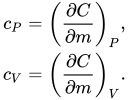
From the results of the previous section, dividing through by the mass gives the relation
c P − c V \= α 2 T ρ β T . {\\displaystyle c\_{P}-c\_{V}={\\frac {\\alpha ^{2}T}{\\rho \\beta \_{T}}}.} 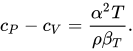
A related parameter to c {\\displaystyle c}  is C / V {\\displaystyle C/V} , the [volumetric heat capacity](https://en.wikipedia.org/wiki/Volumetric_heat_capacity "Volumetric heat capacity"). In engineering practice, c V {\\displaystyle c\_{V}}  for solids or liquids often signifies a volumetric heat capacity, rather than a constant-volume one. In such cases, the specific heat capacity is often explicitly written with the subscript m {\\displaystyle m} , as c m {\\displaystyle c\_{m}} . Of course, from the above relationships, for solids one writes
c m \= C m \= c volumetric ρ . {\\displaystyle c\_{m}={\\frac {C}{m}}={\\frac {c\_{\\text{volumetric}}}{\\rho }}.} 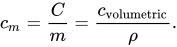
For pure [homogeneous](https://en.wikipedia.org/wiki/Homogeneous "Homogeneous") [chemical compounds](https://en.wikipedia.org/wiki/Chemical_compound "Chemical compound") with established [molecular or molar mass](https://en.wikipedia.org/wiki/Molecular_mass "Molecular mass"), or a [molar quantity](https://en.wikipedia.org/wiki/Mole_\(chemistry\) "Mole (chemistry)"), heat capacity as an [intensive property](https://en.wikipedia.org/wiki/Intensive_property "Intensive property") can be expressed on a per-[mole](https://en.wikipedia.org/wiki/Mole_\(chemistry\) "Mole (chemistry)") basis instead of a per-mass basis by the following equations analogous to the per mass equations:
C P , m \= ( ∂ C ∂ n ) P \= molar heat capacity at constant pressure, C V , m \= ( ∂ C ∂ n ) V \= molar heat capacity at constant volume, {\\displaystyle {\\begin{alignedat}{3}C\_{P,m}&=\\left({\\frac {\\partial C}{\\partial n}}\\right)\_{P}&={\\text{molar heat capacity at constant pressure,}}\\\\C\_{V,m}&=\\left({\\frac {\\partial C}{\\partial n}}\\right)\_{V}&={\\text{molar heat capacity at constant volume,}}\\end{alignedat}}} 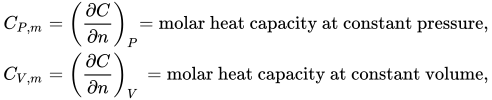
where *n* is the number of moles in the body or [thermodynamic system](https://en.wikipedia.org/wiki/Thermodynamic_system "Thermodynamic system"). One may refer to such a per-mole quantity as **molar heat capacity** to distinguish it from specific heat capacity on a per-mass basis.
### Polytropic heat capacity
\[[edit](https://en.wikipedia.org/w/index.php?title=Specific_heat_capacity&action=edit§ion=25 "Edit section: Polytropic heat capacity")\]
The [polytropic](https://en.wikipedia.org/wiki/Polytropic "Polytropic") heat capacity is calculated at processes if all the thermodynamic properties (pressure, volume, temperature) change:
C i , m \= ( ∂ C ∂ n ) \= molar heat capacity at polytropic process. {\\displaystyle C\_{i,m}=\\left({\\frac {\\partial C}{\\partial n}}\\right)={\\text{molar heat capacity at polytropic process.}}} 
The most important polytropic processes run between the adiabatic and the isotherm functions, the polytropic index is between 1 and the adiabatic exponent (*γ* or *κ*).
### Dimensionless heat capacity
\[[edit](https://en.wikipedia.org/w/index.php?title=Specific_heat_capacity&action=edit§ion=26 "Edit section: Dimensionless heat capacity")\]
The [dimensionless](https://en.wikipedia.org/wiki/Dimensionless_number "Dimensionless number") heat capacity of a material is
C ∗ \= C n R \= C N k B , {\\displaystyle C^{\*}={\\frac {C}{nR}}={\\frac {C}{Nk\_{\\text{B}}}},} 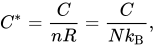
where
- C
{\\displaystyle C}

is the heat capacity of a body made of the material in question (J/K),
- *n* is the [amount of substance](https://en.wikipedia.org/wiki/Amount_of_substance "Amount of substance") in the body ([mol](https://en.wikipedia.org/wiki/Mole_\(unit\) "Mole (unit)")),
- *R* is the [gas constant](https://en.wikipedia.org/wiki/Gas_constant "Gas constant") (J/(K⋅mol)),
- *N* is the number of molecules in the body (dimensionless),
- *k*B is the [Boltzmann constant](https://en.wikipedia.org/wiki/Boltzmann_constant "Boltzmann constant") (J/(K⋅molecule)).
In the [ideal gas](https://en.wikipedia.org/wiki/Ideal_gas "Ideal gas") article, dimensionless heat capacity C ∗ {\\displaystyle C^{\*}}  is expressed as c ^ {\\displaystyle {\\hat {c}}}  and is related there directly to half the number of degrees of freedom per particle. This holds true for quadratic degrees of freedom, a consequence of the [equipartition theorem](https://en.wikipedia.org/wiki/Equipartition_theorem "Equipartition theorem").
More generally, the dimensionless heat capacity relates the logarithmic increase in temperature to the increase in the [dimensionless entropy](https://en.wikipedia.org/wiki/Dimensionless_entropy "Dimensionless entropy") per particle S ∗ \= S / N k B {\\displaystyle S^{\*}=S/Nk\_{\\text{B}}} 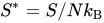, measured in [nats](https://en.wikipedia.org/wiki/Nat_\(unit\) "Nat (unit)").
C ∗ \= d S ∗ d ( ln T ) . {\\displaystyle C^{\*}={\\frac {{\\text{d}}S^{\*}}{{\\text{d}}(\\ln T)}}.} 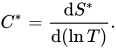
Alternatively, using base-2 logarithms, C ∗ {\\displaystyle C^{\*}}  relates the base-2 logarithmic increase in temperature to the increase in the dimensionless entropy measured in [bits](https://en.wikipedia.org/wiki/Bit "Bit").[\[31\]](https://en.wikipedia.org/wiki/Specific_heat_capacity#cite_note-32)
### Heat capacity at absolute zero
\[[edit](https://en.wikipedia.org/w/index.php?title=Specific_heat_capacity&action=edit§ion=27 "Edit section: Heat capacity at absolute zero")\]
From the definition of [entropy](https://en.wikipedia.org/wiki/Entropy#Thermodynamic_definition_of_entropy "Entropy")
T d S \= δ Q , {\\displaystyle T\\,{\\text{d}}S=\\delta Q,} 
the absolute entropy can be calculated by integrating from zero to the final temperature *T*f:
S ( T f ) \= ∫ T \= 0 T f δ Q T \= ∫ 0 T f δ Q d T d T T \= ∫ 0 T f C ( T ) d T T . {\\displaystyle S(T\_{\\text{f}})=\\int \_{T=0}^{T\_{\\text{f}}}{\\frac {\\delta Q}{T}}=\\int \_{0}^{T\_{\\text{f}}}{\\frac {\\delta Q}{{\\text{d}}T}}{\\frac {{\\text{d}}T}{T}}=\\int \_{0}^{T\_{\\text{f}}}C(T)\\,{\\frac {{\\text{d}}T}{T}}.} 
## Thermodynamic derivation
\[[edit](https://en.wikipedia.org/w/index.php?title=Specific_heat_capacity&action=edit§ion=28 "Edit section: Thermodynamic derivation")\]
In theory, the specific heat capacity of a substance can also be derived from its abstract thermodynamic modeling by an [equation of state](https://en.wikipedia.org/wiki/Equation_of_state "Equation of state") and an [internal energy function](https://en.wikipedia.org/w/index.php?title=Internal_energy_function&action=edit&redlink=1 "Internal energy function (page does not exist)").
### State of matter in a homogeneous sample
\[[edit](https://en.wikipedia.org/w/index.php?title=Specific_heat_capacity&action=edit§ion=29 "Edit section: State of matter in a homogeneous sample")\]
To apply the theory, one considers the sample of the substance (solid, liquid, or gas) for which the specific heat capacity can be defined; in particular, that it has homogeneous composition and fixed mass M {\\displaystyle M} . Assume that the evolution of the system is always slow enough for the internal pressure P {\\displaystyle P}  and temperature T {\\displaystyle T}  be considered uniform throughout. The pressure P {\\displaystyle P}  would be equal to the pressure applied to it by the enclosure or some surrounding fluid, such as air.
The state of the material can then be specified by three parameters: its temperature T {\\displaystyle T} , the pressure P {\\displaystyle P} , and its [specific volume](https://en.wikipedia.org/wiki/Specific_volume "Specific volume") ν \= V / M {\\displaystyle \\nu =V/M} , where V {\\displaystyle V}  is the volume of the sample. (This quantity is the reciprocal 1 / ρ {\\displaystyle 1/\\rho }  of the material's [density](https://en.wikipedia.org/wiki/Density "Density") ρ \= M / V {\\displaystyle \\rho =M/V} .) Like T {\\displaystyle T}  and P {\\displaystyle P} , the specific volume ν {\\displaystyle \\nu }  is an intensive property of the material and its state, that does not depend on the amount of substance in the sample.
Those variables are not independent. The allowed states are defined by an [equation of state](https://en.wikipedia.org/wiki/Equation_of_state "Equation of state") relating those three variables: F ( T , P , ν ) \= 0\. {\\displaystyle F(T,P,\\nu )=0.}  The function F {\\displaystyle F}  depends on the material under consideration. The [specific internal energy](https://en.wikipedia.org/wiki/Specific_internal_energy "Specific internal energy") stored internally in the sample, per unit of mass, will then be another function U ( T , P , ν ) {\\displaystyle U(T,P,\\nu )}  of these state variables, that is also specific of the material. The total internal energy in the sample then will be M U ( T , P , ν ) {\\displaystyle M\\,U(T,P,\\nu )} 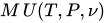.
For some simple materials, like an [ideal gas](https://en.wikipedia.org/wiki/Ideal_gas "Ideal gas"), one can derive from basic theory the equation of state F \= 0 {\\displaystyle F=0}  and even the specific internal energy U {\\displaystyle U}  In general, these functions must be determined experimentally for each substance.
### Conservation of energy
\[[edit](https://en.wikipedia.org/w/index.php?title=Specific_heat_capacity&action=edit§ion=30 "Edit section: Conservation of energy")\]
The absolute value of this quantity U {\\displaystyle U}  is undefined, and (for the purposes of thermodynamics) the state of "zero internal energy" can be chosen arbitrarily. However, by the [law of conservation of energy](https://en.wikipedia.org/wiki/Law_of_conservation_of_energy "Law of conservation of energy"), any infinitesimal increase M d U {\\displaystyle M\\,\\mathrm {d} U}  in the total internal energy M U {\\displaystyle MU}  must be matched by the net flow of heat energy d Q {\\displaystyle \\mathrm {d} Q}  into the sample, plus any net mechanical energy provided to it by enclosure or surrounding medium on it. The latter is − P d V {\\displaystyle -P\\,\\mathrm {d} V} , where d V {\\displaystyle \\mathrm {d} V}  is the change in the sample's volume in that infinitesimal step.[\[32\]](https://en.wikipedia.org/wiki/Specific_heat_capacity#cite_note-fein-33) Therefore
d Q − P d V \= M d U {\\displaystyle \\mathrm {d} Q-P\\,\\mathrm {d} V=M\\,\\mathrm {d} U} 
hence
d Q M − P d ν \= d U {\\displaystyle {\\frac {\\mathrm {d} Q}{M}}-P\\,\\mathrm {d} \\nu =\\mathrm {d} U} 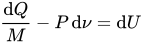
If the volume of the sample (hence the specific volume of the material) is kept constant during the injection of the heat amount d Q {\\displaystyle \\mathrm {d} Q} , then the term P d ν {\\displaystyle P\\,\\mathrm {d} \\nu }  is zero (no mechanical work is done). Then, dividing by d T {\\displaystyle \\mathrm {d} T} ,
d Q M d T \= d U d T {\\displaystyle {\\frac {\\mathrm {d} Q}{M\\,\\mathrm {d} T}}={\\frac {\\mathrm {d} U}{\\mathrm {d} T}}} 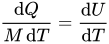
where d T {\\displaystyle \\mathrm {d} T}  is the change in temperature that resulted from the heat input. The left-hand side is the specific heat capacity at constant volume c V {\\displaystyle c\_{V}}  of the material.
For the heat capacity at constant pressure, it is useful to define the [specific enthalpy](https://en.wikipedia.org/wiki/Specific_enthalpy "Specific enthalpy") of the system as the sum h ( T , P , ν ) \= U ( T , P , ν ) \+ P ν {\\displaystyle h(T,P,\\nu )=U(T,P,\\nu )+P\\nu } . An infinitesimal change in the specific enthalpy will then be
d h \= d U \+ V d P \+ P d V {\\displaystyle \\mathrm {d} h=\\mathrm {d} U+V\\,\\mathrm {d} P+P\\,\\mathrm {d} V} 
therefore
d Q M \+ V d P \= d h {\\displaystyle {\\frac {\\mathrm {d} Q}{M}}+V\\,\\mathrm {d} P=\\mathrm {d} h} 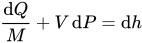
If the pressure is kept constant, the second term on the left-hand side is zero, and
d Q M d T \= d h d T {\\displaystyle {\\frac {\\mathrm {d} Q}{M\\,\\mathrm {d} T}}={\\frac {\\mathrm {d} h}{\\mathrm {d} T}}} 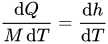
The left-hand side is the specific heat capacity at constant pressure c P {\\displaystyle c\_{P}}  of the material.
### Connection to equation of state
\[[edit](https://en.wikipedia.org/w/index.php?title=Specific_heat_capacity&action=edit§ion=31 "Edit section: Connection to equation of state")\]
In general, the infinitesimal quantities d T , d P , d V , d U {\\displaystyle \\mathrm {d} T,\\mathrm {d} P,\\mathrm {d} V,\\mathrm {d} U}  are constrained by the equation of state and the specific internal energy function. Namely,
{ d T ∂ F ∂ T ( T , P , V ) \+ d P ∂ F ∂ P ( T , P , V ) \+ d V ∂ F ∂ V ( T , P , V ) \= 0 d T ∂ U ∂ T ( T , P , V ) \+ d P ∂ U ∂ P ( T , P , V ) \+ d V ∂ U ∂ V ( T , P , V ) \= d U {\\displaystyle {\\begin{cases}\\displaystyle \\mathrm {d} T{\\frac {\\partial F}{\\partial T}}(T,P,V)+\\mathrm {d} P{\\frac {\\partial F}{\\partial P}}(T,P,V)+\\mathrm {d} V{\\frac {\\partial F}{\\partial V}}(T,P,V)&=&0\\\\\[2ex\]\\displaystyle \\mathrm {d} T{\\frac {\\partial U}{\\partial T}}(T,P,V)+\\mathrm {d} P{\\frac {\\partial U}{\\partial P}}(T,P,V)+\\mathrm {d} V{\\frac {\\partial U}{\\partial V}}(T,P,V)&=&\\mathrm {d} U\\end{cases}}} ![{\\displaystyle {\\begin{cases}\\displaystyle \\mathrm {d} T{\\frac {\\partial F}{\\partial T}}(T,P,V)+\\mathrm {d} P{\\frac {\\partial F}{\\partial P}}(T,P,V)+\\mathrm {d} V{\\frac {\\partial F}{\\partial V}}(T,P,V)&=&0\\\\\[2ex\]\\displaystyle \\mathrm {d} T{\\frac {\\partial U}{\\partial T}}(T,P,V)+\\mathrm {d} P{\\frac {\\partial U}{\\partial P}}(T,P,V)+\\mathrm {d} V{\\frac {\\partial U}{\\partial V}}(T,P,V)&=&\\mathrm {d} U\\end{cases}}}](https://wikimedia.org/api/rest_v1/media/math/render/svg/957c9a178ff753bc04a30bed2819d7e5155314a0)
Here ( ∂ F / ∂ T ) ( T , P , V ) {\\displaystyle (\\partial F/\\partial T)(T,P,V)}  denotes the (partial) derivative of the state equation F {\\displaystyle F}  with respect to its T {\\displaystyle T}  argument, keeping the other two arguments fixed, evaluated at the state ( T , P , V ) {\\displaystyle (T,P,V)}  in question. The other partial derivatives are defined in the same way. These two equations on the four infinitesimal increments normally constrain them to a two-dimensional linear subspace space of possible infinitesimal state changes, that depends on the material and on the state. The constant-volume and constant-pressure changes are only two particular directions in this space.
This analysis also holds no matter how the energy increment d Q {\\displaystyle \\mathrm {d} Q}  is injected into the sample, namely by [heat conduction](https://en.wikipedia.org/wiki/Heat_conduction "Heat conduction"), irradiation, [electromagnetic induction](https://en.wikipedia.org/wiki/Electromagnetic_induction "Electromagnetic induction"), [radioactive decay](https://en.wikipedia.org/wiki/Radioactive_decay "Radioactive decay"), etc.
### Relation between heat capacities
\[[edit](https://en.wikipedia.org/w/index.php?title=Specific_heat_capacity&action=edit§ion=32 "Edit section: Relation between heat capacities")\]
For any specific volume ν {\\displaystyle \\nu } , denote p ν ( T ) {\\displaystyle p\_{\\nu }(T)}  the function that describes how the pressure varies with the temperature T {\\displaystyle T} , as allowed by the equation of state, when the specific volume of the material is forcefully kept constant at ν {\\displaystyle \\nu } . Analogously, for any pressure P {\\displaystyle P} , let ν P ( T ) {\\displaystyle \\nu \_{P}(T)}  be the function that describes how the specific volume varies with the temperature, when the pressure is kept constant at P {\\displaystyle P} . Namely, those functions are such that
F ( T , p ν ( T ) , ν ) \= 0 {\\displaystyle F(T,p\_{\\nu }(T),\\nu )=0} andF ( T , P , ν P ( T ) ) \= 0 {\\displaystyle F(T,P,\\nu \_{P}(T))=0} 
for any values of T , P , ν {\\displaystyle T,P,\\nu } . In other words, the graphs of p ν ( T ) {\\displaystyle p\_{\\nu }(T)}  and ν P ( T ) {\\displaystyle \\nu \_{P}(T)}  are slices of the surface defined by the state equation, cut by planes of constant ν {\\displaystyle \\nu }  and constant P {\\displaystyle P} , respectively.
Then, from the [fundamental thermodynamic relation](https://en.wikipedia.org/wiki/Fundamental_thermodynamic_relation "Fundamental thermodynamic relation") it follows that
c P ( T , P , ν ) − c V ( T , P , ν ) \= T \[ d p ν d T ( T ) \] \[ d ν P d T ( T ) \] {\\displaystyle c\_{P}(T,P,\\nu )-c\_{V}(T,P,\\nu )=T\\left\[{\\frac {\\mathrm {d} p\_{\\nu }}{\\mathrm {d} T}}(T)\\right\]\\left\[{\\frac {\\mathrm {d} \\nu \_{P}}{\\mathrm {d} T}}(T)\\right\]} ![{\\displaystyle c\_{P}(T,P,\\nu )-c\_{V}(T,P,\\nu )=T\\left\[{\\frac {\\mathrm {d} p\_{\\nu }}{\\mathrm {d} T}}(T)\\right\]\\left\[{\\frac {\\mathrm {d} \\nu \_{P}}{\\mathrm {d} T}}(T)\\right\]}](https://wikimedia.org/api/rest_v1/media/math/render/svg/24554d2ae7d16cbb75b6ad485bf92856b55cf7bd)
This equation can be rewritten as
c P ( T , P , ν ) − c V ( T , P , ν ) \= ν T α 2 β T , {\\displaystyle c\_{P}(T,P,\\nu )-c\_{V}(T,P,\\nu )=\\nu T{\\frac {\\alpha ^{2}}{\\beta \_{T}}},} 
where
- α
{\\displaystyle \\alpha }

is the [coefficient of thermal expansion](https://en.wikipedia.org/wiki/Coefficient_of_thermal_expansion "Coefficient of thermal expansion"),
- β
T
{\\displaystyle \\beta \_{T}}

is the [isothermal](https://en.wikipedia.org/wiki/Isothermal "Isothermal") [compressibility](https://en.wikipedia.org/wiki/Compressibility "Compressibility"),
both depending on the state ( T , P , ν ) {\\displaystyle (T,P,\\nu )} .
The [heat capacity ratio](https://en.wikipedia.org/wiki/Heat_capacity_ratio "Heat capacity ratio"), or adiabatic index, is the ratio c P / c V {\\displaystyle c\_{P}/c\_{V}}  of the heat capacity at constant pressure to heat capacity at constant volume. It is sometimes also known as the isentropic expansion factor.
### Calculation from first principles
\[[edit](https://en.wikipedia.org/w/index.php?title=Specific_heat_capacity&action=edit§ion=33 "Edit section: Calculation from first principles")\]
The [path integral Monte Carlo](https://en.wikipedia.org/wiki/Path_integral_Monte_Carlo "Path integral Monte Carlo") method is a numerical approach for determining the values of heat capacity, based on quantum dynamical principles. However, good approximations can be made for gases in many states using simpler methods outlined below. For many solids composed of relatively heavy atoms (atomic number \> iron), at non-cryogenic temperatures, the heat capacity at room temperature approaches 3*R* = 24.94 joules per kelvin per mole of atoms ([Dulong–Petit law](https://en.wikipedia.org/wiki/Dulong%E2%80%93Petit_law "Dulong–Petit law"), *R* is the [gas constant](https://en.wikipedia.org/wiki/Gas_constant "Gas constant")). Low temperature approximations for both gases and solids at temperatures less than their characteristic [Einstein temperatures](https://en.wikipedia.org/wiki/Einstein_temperature "Einstein temperature") or [Debye temperatures](https://en.wikipedia.org/wiki/Debye_temperature "Debye temperature") can be made by the methods of Einstein and Debye discussed below. However, attention should be made for the consistency of such ab-initio considerations when used along with an equation of state for the considered material.[\[33\]](https://en.wikipedia.org/wiki/Specific_heat_capacity#cite_note-Benjelloun-34)
#### Ideal gas
\[[edit](https://en.wikipedia.org/w/index.php?title=Specific_heat_capacity&action=edit§ion=34 "Edit section: Ideal gas")\]
For an [ideal gas](https://en.wikipedia.org/wiki/Ideal_gas "Ideal gas"), evaluating the partial derivatives above according to the [equation of state](https://en.wikipedia.org/wiki/Equation_of_state "Equation of state"), where *R* is the [gas constant](https://en.wikipedia.org/wiki/Gas_constant "Gas constant"), for an ideal gas[\[34\]](https://en.wikipedia.org/wiki/Specific_heat_capacity#cite_note-35)
P V \= n R T , C P − C V \= T ( ∂ P ∂ T ) V , n ( ∂ V ∂ T ) P , n , P \= n R T V ⇒ ( ∂ P ∂ T ) V , n \= n R V , V \= n R T P ⇒ ( ∂ V ∂ T ) P , n \= n R P . {\\displaystyle {\\begin{alignedat}{3}PV&=nRT,\\\\C\_{P}-C\_{V}&=T\\left({\\frac {\\partial P}{\\partial T}}\\right)\_{V,n}\\left({\\frac {\\partial V}{\\partial T}}\\right)\_{P,n},\\\\P&={\\frac {nRT}{V}}\\Rightarrow \\left({\\frac {\\partial P}{\\partial T}}\\right)\_{V,n}&={\\frac {nR}{V}},\\\\V&={\\frac {nRT}{P}}\\Rightarrow \\left({\\frac {\\partial V}{\\partial T}}\\right)\_{P,n}&={\\frac {nR}{P}}.\\end{alignedat}}} 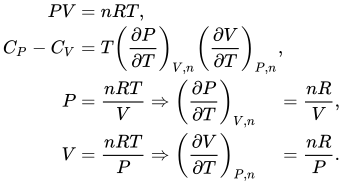
Substituting
T ( ∂ P ∂ T ) V , n ( ∂ V ∂ T ) P , n \= T n R V n R P \= n R T V n R P \= P n R P \= n R , {\\displaystyle T\\left({\\frac {\\partial P}{\\partial T}}\\right)\_{V,n}\\left({\\frac {\\partial V}{\\partial T}}\\right)\_{P,n}=T{\\frac {nR}{V}}{\\frac {nR}{P}}={\\frac {nRT}{V}}{\\frac {nR}{P}}=P{\\frac {nR}{P}}=nR,} 
this equation reduces simply to [Mayer](https://en.wikipedia.org/wiki/Julius_Robert_von_Mayer "Julius Robert von Mayer")'s relation:
C P , m − C V , m \= R . {\\displaystyle C\_{P,m}-C\_{V,m}=R.} 
The differences in heat capacities as defined by the above Mayer relation is only exact for an ideal gas and would be different for any real gas.
## See also
\[[edit](https://en.wikipedia.org/w/index.php?title=Specific_heat_capacity&action=edit§ion=35 "Edit section: See also")\]
[](https://en.wikipedia.org/wiki/File:Stylised_atom_with_three_Bohr_model_orbits_and_stylised_nucleus.svg) [Physics portal](https://en.wikipedia.org/wiki/Portal:Physics "Portal:Physics")
- [Enthalpy of fusion](https://en.wikipedia.org/wiki/Enthalpy_of_fusion "Enthalpy of fusion") (latent heat of melting)
- [Enthalpy of vaporization](https://en.wikipedia.org/wiki/Enthalpy_of_vaporization "Enthalpy of vaporization") (latent heat of vaporization)
- [Frenkel line](https://en.wikipedia.org/wiki/Frenkel_line "Frenkel line")
- [Heat capacity ratio](https://en.wikipedia.org/wiki/Heat_capacity_ratio "Heat capacity ratio")
- [Heat equation](https://en.wikipedia.org/wiki/Heat_equation "Heat equation")
- [Heat transfer coefficient](https://en.wikipedia.org/wiki/Heat_transfer_coefficient "Heat transfer coefficient")
- [History of thermodynamics](https://en.wikipedia.org/wiki/History_of_thermodynamics "History of thermodynamics")
- [Joback method](https://en.wikipedia.org/wiki/Joback_method "Joback method") (Estimation of heat capacities)
- [Latent heat](https://en.wikipedia.org/wiki/Latent_heat "Latent heat")
- [Material properties (thermodynamics)](https://en.wikipedia.org/wiki/Material_properties_\(thermodynamics\) "Material properties (thermodynamics)")
- [Quantum statistical mechanics](https://en.wikipedia.org/wiki/Quantum_statistical_mechanics "Quantum statistical mechanics")
- [R-value (insulation)](https://en.wikipedia.org/wiki/R-value_\(insulation\) "R-value (insulation)")
- [Statistical mechanics](https://en.wikipedia.org/wiki/Statistical_mechanics "Statistical mechanics")
- [Table of specific heat capacities](https://en.wikipedia.org/wiki/Table_of_specific_heat_capacities "Table of specific heat capacities")
- [Thermal mass](https://en.wikipedia.org/wiki/Thermal_mass "Thermal mass")
- [Thermodynamic databases for pure substances](https://en.wikipedia.org/wiki/Thermodynamic_databases_for_pure_substances "Thermodynamic databases for pure substances")
- [Thermodynamic equations](https://en.wikipedia.org/wiki/Thermodynamic_equations "Thermodynamic equations")
- [Volumetric heat capacity](https://en.wikipedia.org/wiki/Volumetric_heat_capacity "Volumetric heat capacity")
## Notes
\[[edit](https://en.wikipedia.org/w/index.php?title=Specific_heat_capacity&action=edit§ion=36 "Edit section: Notes")\]
1. **[^](https://en.wikipedia.org/wiki/Specific_heat_capacity#cite_ref-gold_30-0)** [IUPAC](https://en.wikipedia.org/wiki/International_Union_of_Pure_and_Applied_Chemistry "International Union of Pure and Applied Chemistry"), *[Compendium of Chemical Terminology](https://en.wikipedia.org/wiki/IUPAC_books#Gold_Book "IUPAC books")*, 5th ed. (the "Gold Book") (2025). Online version: (2006–) "[Standard Pressure](https://goldbook.iupac.org/terms/view/S05921.html)". [doi](https://en.wikipedia.org/wiki/Doi_\(identifier\) "Doi (identifier)"):[10\.1351/goldbook.S05921](https://doi.org/10.1351%2Fgoldbook.S05921).
## References
\[[edit](https://en.wikipedia.org/w/index.php?title=Specific_heat_capacity&action=edit§ion=37 "Edit section: References")\]
1. **[^](https://en.wikipedia.org/wiki/Specific_heat_capacity#cite_ref-1)**
Halliday, David; Resnick, Robert; Walker, Jearl (2001). *Fundamentals of Physics* (6th ed.). New York, NY US: [John Wiley & Sons](https://en.wikipedia.org/wiki/John_Wiley_%26_Sons "John Wiley & Sons").
2. **[^](https://en.wikipedia.org/wiki/Specific_heat_capacity#cite_ref-2)**
Open University (2008). *S104 Book 3 Energy and Light*, p. 59. [The Open University](https://en.wikipedia.org/wiki/The_Open_University "The Open University").
[ISBN](https://en.wikipedia.org/wiki/ISBN_\(identifier\) "ISBN (identifier)")
[9781848731646](https://en.wikipedia.org/wiki/Special:BookSources/9781848731646 "Special:BookSources/9781848731646")
.
3. **[^](https://en.wikipedia.org/wiki/Specific_heat_capacity#cite_ref-3)**
Open University (2008). *S104 Book 3 Energy and Light*, p. 179. [The Open University](https://en.wikipedia.org/wiki/The_Open_University "The Open University").
[ISBN](https://en.wikipedia.org/wiki/ISBN_\(identifier\) "ISBN (identifier)")
[9781848731646](https://en.wikipedia.org/wiki/Special:BookSources/9781848731646 "Special:BookSources/9781848731646")
.
4. **[^](https://en.wikipedia.org/wiki/Specific_heat_capacity#cite_ref-4)**
Engineering ToolBox (2003). ["Specific Heat of some common Substances"](https://www.engineeringtoolbox.com/specific-heat-capacity-d_391.html).
5. **[^](https://en.wikipedia.org/wiki/Specific_heat_capacity#cite_ref-colen2001_5-0)** (2001): *Columbia Encyclopedia*, 6th ed.; as quoted by [Encyclopedia.com](https://www.encyclopedia.com/science-and-technology/physics/physics/specific-heat#1E1specheat). Columbia University Press. Accessed on 2019-04-11.
6. **[^](https://en.wikipedia.org/wiki/Specific_heat_capacity#cite_ref-6)**
Laidler, Keith J. (1993). [*The World of Physical Chemistry*](https://books.google.com/books?id=01LRlPbH80cC). Oxford University Press. [ISBN](https://en.wikipedia.org/wiki/ISBN_\(identifier\) "ISBN (identifier)")
[0-19-855919-4](https://en.wikipedia.org/wiki/Special:BookSources/0-19-855919-4 "Special:BookSources/0-19-855919-4")
.
7. **[^](https://en.wikipedia.org/wiki/Specific_heat_capacity#cite_ref-:1_7-0)**
[Ramsay, William](https://en.wikipedia.org/wiki/William_Ramsay "William Ramsay") (1918). *The life and letters of Joseph Black, M.D*. Constable. pp. 38–39\.
8. **[^](https://en.wikipedia.org/wiki/Specific_heat_capacity#cite_ref-8)**
Black, Joseph (1807). Robison, John (ed.). [*Lectures on the Elements of Chemistry: Delivered in the University of Edinburgh*](https://books.google.com/books?id=lqI9AQAAMAAJ&pg=PA76). Vol. 1. Mathew Carey. pp. 76–77\.
9. **[^](https://en.wikipedia.org/wiki/Specific_heat_capacity#cite_ref-:0_9-0)**
West, John B. (2014-06-15). ["Joseph Black, carbon dioxide, latent heat, and the beginnings of the discovery of the respiratory gases"](https://www.physiology.org/doi/10.1152/ajplung.00020.2014). *American Journal of Physiology. Lung Cellular and Molecular Physiology*. **306** (12): L1057–L1063. [doi](https://en.wikipedia.org/wiki/Doi_\(identifier\) "Doi (identifier)"):[10\.1152/ajplung.00020.2014](https://doi.org/10.1152%2Fajplung.00020.2014). [ISSN](https://en.wikipedia.org/wiki/ISSN_\(identifier\) "ISSN (identifier)") [1040-0605](https://search.worldcat.org/issn/1040-0605). [PMID](https://en.wikipedia.org/wiki/PMID_\(identifier\) "PMID (identifier)") [24682452](https://pubmed.ncbi.nlm.nih.gov/24682452).
10. **[^](https://en.wikipedia.org/wiki/Specific_heat_capacity#cite_ref-10)**
[International Bureau of Weights and Measures](https://en.wikipedia.org/wiki/International_Bureau_of_Weights_and_Measures "International Bureau of Weights and Measures") (2006), [*The International System of Units (SI)*](https://www.bipm.org/documents/20126/41483022/si_brochure_8.pdf) (PDF) (8th ed.), [ISBN](https://en.wikipedia.org/wiki/ISBN_\(identifier\) "ISBN (identifier)")
[92-822-2213-6](https://en.wikipedia.org/wiki/Special:BookSources/92-822-2213-6 "Special:BookSources/92-822-2213-6")
, [archived](https://web.archive.org/web/20210604163219/https://www.bipm.org/documents/20126/41483022/si_brochure_8.pdf) (PDF) from the original on 2021-06-04, retrieved 2021-12-16
11. **[^](https://en.wikipedia.org/wiki/Specific_heat_capacity#cite_ref-toolbox_11-0)**
["Water – Thermal Properties"](http://www.engineeringtoolbox.com/water-thermal-properties-d_162.html). Engineeringtoolbox.com. Retrieved 2021-03-29.
12. **[^](https://en.wikipedia.org/wiki/Specific_heat_capacity#cite_ref-12)**
International Union of Pure and Applied Chemistry, Physical Chemistry Division. ["Quantities, Units and Symbols in Physical Chemistry"](http://old.iupac.org/publications/books/gbook/green_book_2ed.pdf) (PDF). Blackwell Sciences. p. 7. "The adjective specific before the name of an extensive quantity is often used to mean divided by mass."
13. **[^](https://en.wikipedia.org/wiki/Specific_heat_capacity#cite_ref-Lange_13-0)** Lange's Handbook of Chemistry, 10th ed., page 1524.
14. **[^](https://en.wikipedia.org/wiki/Specific_heat_capacity#cite_ref-14)**
Quick, C. R.; Schawe, J. E. K.; Uggowitzer, P. J.; Pogatscher, S. (2019-07-01). ["Measurement of specific heat capacity via fast scanning calorimetry—Accuracy and loss corrections"](https://doi.org/10.1016%2Fj.tca.2019.03.021). *Thermochimica Acta*. Special Issue on occasion of the 65th birthday of Christoph Schick. **677**: 12–20\. [Bibcode](https://en.wikipedia.org/wiki/Bibcode_\(identifier\) "Bibcode (identifier)"):[2019TcAc..677...12Q](https://ui.adsabs.harvard.edu/abs/2019TcAc..677...12Q). [doi](https://en.wikipedia.org/wiki/Doi_\(identifier\) "Doi (identifier)"):[10\.1016/j.tca.2019.03.021](https://doi.org/10.1016%2Fj.tca.2019.03.021). [ISSN](https://en.wikipedia.org/wiki/ISSN_\(identifier\) "ISSN (identifier)") [0040-6031](https://search.worldcat.org/issn/0040-6031).
15. **[^](https://en.wikipedia.org/wiki/Specific_heat_capacity#cite_ref-15)**
Pogatscher, S.; Leutenegger, D.; Schawe, J. E. K.; Uggowitzer, P. J.; Löffler, J. F. (September 2016). ["Solid–solid phase transitions via melting in metals"](https://www.ncbi.nlm.nih.gov/pmc/articles/PMC4844691). *Nature Communications*. **7** (1) 11113. [Bibcode](https://en.wikipedia.org/wiki/Bibcode_\(identifier\) "Bibcode (identifier)"):[2016NatCo...711113P](https://ui.adsabs.harvard.edu/abs/2016NatCo...711113P). [doi](https://en.wikipedia.org/wiki/Doi_\(identifier\) "Doi (identifier)"):[10\.1038/ncomms11113](https://doi.org/10.1038%2Fncomms11113). [ISSN](https://en.wikipedia.org/wiki/ISSN_\(identifier\) "ISSN (identifier)") [2041-1723](https://search.worldcat.org/issn/2041-1723). [PMC](https://en.wikipedia.org/wiki/PMC_\(identifier\) "PMC (identifier)") [4844691](https://www.ncbi.nlm.nih.gov/pmc/articles/PMC4844691). [PMID](https://en.wikipedia.org/wiki/PMID_\(identifier\) "PMID (identifier)") [27103085](https://pubmed.ncbi.nlm.nih.gov/27103085).
16. **[^](https://en.wikipedia.org/wiki/Specific_heat_capacity#cite_ref-Koch_16-0)**
Koch, Werner (2013). [*VDI Steam Tables*](https://books.google.com/books?id=bJ_wBgAAQBAJ&pg=PA8) (4 ed.). Springer. p. 8. [ISBN](https://en.wikipedia.org/wiki/ISBN_\(identifier\) "ISBN (identifier)")
[978-3-642-52941-2](https://en.wikipedia.org/wiki/Special:BookSources/978-3-642-52941-2 "Special:BookSources/978-3-642-52941-2")
.
Published under the auspices of the *Verein Deutscher Ingenieure* (VDI).
17. **[^](https://en.wikipedia.org/wiki/Specific_heat_capacity#cite_ref-17)**
Cardarelli, Francois (2012). [*Scientific Unit Conversion: A Practical Guide to Metrication*](https://books.google.com/books?id=-ZveBwAAQBAJ&pg=PA19-IA35). M.J. Shields (translation) (2 ed.). Springer. p. 19. [ISBN](https://en.wikipedia.org/wiki/ISBN_\(identifier\) "ISBN (identifier)")
[978-1-4471-0805-4](https://en.wikipedia.org/wiki/Special:BookSources/978-1-4471-0805-4 "Special:BookSources/978-1-4471-0805-4")
.
18. **[^](https://en.wikipedia.org/wiki/Specific_heat_capacity#cite_ref-18)**
From direct values: 1
BTU/lb⋅°R × 1055.06
J/BTU × (
1/0\.45359237)
lb/kg x
9/5
°R/K = 4186.82
J/kg⋅K
19. **[^](https://en.wikipedia.org/wiki/Specific_heat_capacity#cite_ref-19)** °F=°R
20. **[^](https://en.wikipedia.org/wiki/Specific_heat_capacity#cite_ref-20)** °C=K
21. **[^](https://en.wikipedia.org/wiki/Specific_heat_capacity#cite_ref-21)**
McQuarrie, Donald A. (1973). *Statistical Thermodynamics*. New York, NY: [University Science Books](https://en.wikipedia.org/w/index.php?title=University_Science_Books&action=edit&redlink=1 "University Science Books (page does not exist)"). pp. 83–85\.
22. **[^](https://en.wikipedia.org/wiki/Specific_heat_capacity#cite_ref-22)**
["6.6: Electronic Partition Function"](https://chem.libretexts.org/Bookshelves/Physical_and_Theoretical_Chemistry_Textbook_Maps/Statistical_Thermodynamics_\(Jeschke\)/06:_Partition_Functions_of_Gases/6.06:_Electronic_Partition_Function). *Chemistry LibreTexts*. 2020-11-26. Retrieved 2024-12-16.
23. **[^](https://en.wikipedia.org/wiki/Specific_heat_capacity#cite_ref-23)**
Bonhoeffer, K.F.; Harteck, P. (1926). ["Über Para- und Orthowasserstoff"](https://www.degruyter.com/document/doi/10.1515/zpch-1929-0408/html). *Z. Phys. Chem*. **4B**: 113–141\. [doi](https://en.wikipedia.org/wiki/Doi_\(identifier\) "Doi (identifier)"):[10\.1515/zpch-1929-0408](https://doi.org/10.1515%2Fzpch-1929-0408).
24. **[^](https://en.wikipedia.org/wiki/Specific_heat_capacity#cite_ref-24)**
McQuarrie, Donald A. (1973). *Statistical Thermodynamics*. New York, NY: University Science Books. p. 107.
25. **[^](https://en.wikipedia.org/wiki/Specific_heat_capacity#cite_ref-25)** Feynman, R., *[The Feynman Lectures on Physics](https://en.wikipedia.org/wiki/The_Feynman_Lectures_on_Physics "The Feynman Lectures on Physics")*, Vol. 1, ch. 40, pp. 7–8
26. **[^](https://en.wikipedia.org/wiki/Specific_heat_capacity#cite_ref-26)**
Reif, F. (1965). [*Fundamentals of statistical and thermal physics*](https://archive.org/details/fundamentalsofst00reif). McGraw-Hill. pp. [253–254](https://archive.org/details/fundamentalsofst00reif/page/253).
27. **[^](https://en.wikipedia.org/wiki/Specific_heat_capacity#cite_ref-27)**
Kittel, Charles; Kroemer, Herbert (2000). *Thermal physics*. W. H. Freeman. p. 78. [ISBN](https://en.wikipedia.org/wiki/ISBN_\(identifier\) "ISBN (identifier)")
[978-0-7167-1088-2](https://en.wikipedia.org/wiki/Special:BookSources/978-0-7167-1088-2 "Special:BookSources/978-0-7167-1088-2")
.
28. **[^](https://en.wikipedia.org/wiki/Specific_heat_capacity#cite_ref-thor1993_28-0)** Thornton, Steven T. and Rex, Andrew (1993) *Modern Physics for Scientists and Engineers*, Saunders College Publishing
29. **[^](https://en.wikipedia.org/wiki/Specific_heat_capacity#cite_ref-chas1998_29-0)** Chase, M.W. Jr. (1998) *[NIST-JANAF Themochemical Tables, Fourth Edition](https://webbook.nist.gov/cgi/cbook.cgi?ID=C7727379&Type=JANAFG)*, In *Journal of Physical and Chemical Reference Data*, Monograph 9, pages 1–1951.
30. **[^](https://en.wikipedia.org/wiki/Specific_heat_capacity#cite_ref-31)**
Yunus A. Cengel and Michael A. Boles, *Thermodynamics: An Engineering Approach*, 7th Edition, McGraw-Hill, 2010,
[ISBN](https://en.wikipedia.org/wiki/ISBN_\(identifier\) "ISBN (identifier)")
[007-352932-X](https://en.wikipedia.org/wiki/Special:BookSources/007-352932-X "Special:BookSources/007-352932-X")
.
31. **[^](https://en.wikipedia.org/wiki/Specific_heat_capacity#cite_ref-32)**
Fraundorf, P. (2003). "Heat capacity in bits". *American Journal of Physics*. **71** (11): 1142. [arXiv](https://en.wikipedia.org/wiki/ArXiv_\(identifier\) "ArXiv (identifier)"):[cond-mat/9711074](https://arxiv.org/abs/cond-mat/9711074). [Bibcode](https://en.wikipedia.org/wiki/Bibcode_\(identifier\) "Bibcode (identifier)"):[2003AmJPh..71.1142F](https://ui.adsabs.harvard.edu/abs/2003AmJPh..71.1142F). [doi](https://en.wikipedia.org/wiki/Doi_\(identifier\) "Doi (identifier)"):[10\.1119/1.1593658](https://doi.org/10.1119%2F1.1593658). [S2CID](https://en.wikipedia.org/wiki/S2CID_\(identifier\) "S2CID (identifier)") [18742525](https://api.semanticscholar.org/CorpusID:18742525).
32. **[^](https://en.wikipedia.org/wiki/Specific_heat_capacity#cite_ref-fein_33-0)** Feynman, Richard, *[The Feynman Lectures on Physics](https://en.wikipedia.org/wiki/The_Feynman_Lectures_on_Physics "The Feynman Lectures on Physics")*, Vol. 1, Ch. 45
33. **[^](https://en.wikipedia.org/wiki/Specific_heat_capacity#cite_ref-Benjelloun_34-0)** S. Benjelloun, "Thermodynamic identities and thermodynamic consistency of Equation of States", [Link to Archiv e-print](https://arxiv.org/abs/2105.04845) [Link to Hal e-print](https://hal.archives-ouvertes.fr/hal-03216379/)
34. **[^](https://en.wikipedia.org/wiki/Specific_heat_capacity#cite_ref-35)**
Cengel, Yunus A. and Boles, Michael A. (2010) *Thermodynamics: An Engineering Approach*, 7th Edition, McGraw-Hill
[ISBN](https://en.wikipedia.org/wiki/ISBN_\(identifier\) "ISBN (identifier)")
[007-352932-X](https://en.wikipedia.org/wiki/Special:BookSources/007-352932-X "Special:BookSources/007-352932-X")
.
## Further reading
\[[edit](https://en.wikipedia.org/w/index.php?title=Specific_heat_capacity&action=edit§ion=38 "Edit section: Further reading")\]
- Emmerich Wilhelm & Trevor M. Letcher, Eds., 2010, *Heat Capacities: Liquids, Solutions and Vapours*, Cambridge, U.K.:Royal Society of Chemistry,
[ISBN](https://en.wikipedia.org/wiki/ISBN_\(identifier\) "ISBN (identifier)")
[0-85404-176-1](https://en.wikipedia.org/wiki/Special:BookSources/0-85404-176-1 "Special:BookSources/0-85404-176-1")
. A very recent outline of selected traditional aspects of the title subject, including a recent specialist introduction to its theory, Emmerich Wilhelm, "Heat Capacities: Introduction, Concepts, and Selected Applications" (Chapter 1, pp. 1–27), chapters on traditional and more contemporary experimental methods such as [photoacoustic](https://en.wikipedia.org/wiki/Photoacoustic_effect "Photoacoustic effect") methods, e.g., Jan Thoen & Christ Glorieux, "Photothermal Techniques for Heat Capacities," and chapters on newer research interests, including on the heat capacities of proteins and other polymeric systems (Chs. 16, 15), of liquid crystals (Ch. 17), etc.
## External links
\[[edit](https://en.wikipedia.org/w/index.php?title=Specific_heat_capacity&action=edit§ion=39 "Edit section: External links")\]
- (2012-05may-24) [Phonon theory sheds light on liquid thermodynamics, heat capacity – Physics World](https://physicsworld.com/a/phonon-theory-sheds-light-on-liquid-thermodynamics/) [The phonon theory of liquid thermodynamics \| Scientific Reports](https://www.nature.com/articles/srep00421)
| [Authority control databases](https://en.wikipedia.org/wiki/Help:Authority_control "Help:Authority control") [](https://www.wikidata.org/wiki/Q487756#identifiers "Edit this at Wikidata") | |
|---|---|
| International | [GND](https://d-nb.info/gnd/4182218-3) |
| National | [United States](https://id.loc.gov/authorities/sh85126389) [France](https://catalogue.bnf.fr/ark:/12148/cb12274423z) [BnF data](https://data.bnf.fr/ark:/12148/cb12274423z) [Israel](https://www.nli.org.il/en/authorities/987007565726505171) |
| Other | [Yale LUX](https://lux.collections.yale.edu/view/concept/4a484350-e872-49a3-87de-3b087bf8c5e5) |

Retrieved from "<https://en.wikipedia.org/w/index.php?title=Specific_heat_capacity&oldid=1340264896>"
[Categories](https://en.wikipedia.org/wiki/Help:Category "Help:Category"):
- [Physical quantities](https://en.wikipedia.org/wiki/Category:Physical_quantities "Category:Physical quantities")
- [Thermodynamic properties](https://en.wikipedia.org/wiki/Category:Thermodynamic_properties "Category:Thermodynamic properties")
Hidden categories:
- [Articles with short description](https://en.wikipedia.org/wiki/Category:Articles_with_short_description "Category:Articles with short description")
- [Short description is different from Wikidata](https://en.wikipedia.org/wiki/Category:Short_description_is_different_from_Wikidata "Category:Short description is different from Wikidata")
- [All articles with unsourced statements](https://en.wikipedia.org/wiki/Category:All_articles_with_unsourced_statements "Category:All articles with unsourced statements")
- [Articles with unsourced statements from April 2019](https://en.wikipedia.org/wiki/Category:Articles_with_unsourced_statements_from_April_2019 "Category:Articles with unsourced statements from April 2019")
- [Pages using div col with small parameter](https://en.wikipedia.org/wiki/Category:Pages_using_div_col_with_small_parameter "Category:Pages using div col with small parameter")
- This page was last edited on 24 February 2026, at 19:58 (UTC).
- Text is available under the [Creative Commons Attribution-ShareAlike 4.0 License](https://en.wikipedia.org/wiki/Wikipedia:Text_of_the_Creative_Commons_Attribution-ShareAlike_4.0_International_License "Wikipedia:Text of the Creative Commons Attribution-ShareAlike 4.0 International License"); additional terms may apply. By using this site, you agree to the [Terms of Use](https://foundation.wikimedia.org/wiki/Special:MyLanguage/Policy:Terms_of_Use "foundation:Special:MyLanguage/Policy:Terms of Use") and [Privacy Policy](https://foundation.wikimedia.org/wiki/Special:MyLanguage/Policy:Privacy_policy "foundation:Special:MyLanguage/Policy:Privacy policy"). Wikipedia® is a registered trademark of the [Wikimedia Foundation, Inc.](https://wikimediafoundation.org/), a non-profit organization.
- [Privacy policy](https://foundation.wikimedia.org/wiki/Special:MyLanguage/Policy:Privacy_policy)
- [About Wikipedia](https://en.wikipedia.org/wiki/Wikipedia:About)
- [Disclaimers](https://en.wikipedia.org/wiki/Wikipedia:General_disclaimer)
- [Contact Wikipedia](https://en.wikipedia.org/wiki/Wikipedia:Contact_us)
- [Legal & safety contacts](https://foundation.wikimedia.org/wiki/Special:MyLanguage/Legal:Wikimedia_Foundation_Legal_and_Safety_Contact_Information)
- [Code of Conduct](https://foundation.wikimedia.org/wiki/Special:MyLanguage/Policy:Universal_Code_of_Conduct)
- [Developers](https://developer.wikimedia.org/)
- [Statistics](https://stats.wikimedia.org/#/en.wikipedia.org)
- [Cookie statement](https://foundation.wikimedia.org/wiki/Special:MyLanguage/Policy:Cookie_statement)
- [Mobile view](https://en.wikipedia.org/w/index.php?title=Specific_heat_capacity&mobileaction=toggle_view_mobile)
- [](https://www.wikimedia.org/)
- [](https://www.mediawiki.org/)
Search
Toggle the table of contents
Specific heat capacity
61 languages
[Add topic](https://en.wikipedia.org/wiki/Specific_heat_capacity) | ||||||
| Readable Markdown | | Specific heat capacity | |
|---|---|
| Other names | Specific heat |
| Common symbols | *c* |
| [SI unit](https://en.wikipedia.org/wiki/SI_unit "SI unit") | J⋅kg−1⋅K−1 |
| In [SI base units](https://en.wikipedia.org/wiki/SI_base_unit "SI base unit") | m2⋅K−1⋅s−2 |
| [Intensive](https://en.wikipedia.org/wiki/Intensive_and_extensive_properties "Intensive and extensive properties")? | Yes |
| [Dimension](https://en.wikipedia.org/wiki/Dimensional_analysis#Formulation "Dimensional analysis") | L2⋅T−2⋅Θ−1 |
In [thermodynamics](https://en.wikipedia.org/wiki/Thermodynamics "Thermodynamics"), the **specific heat capacity** (symbol *c*) of a substance is the amount of [heat](https://en.wikipedia.org/wiki/Heat "Heat") that must be added to one unit of mass of the substance in order to cause an increase of one unit in [temperature](https://en.wikipedia.org/wiki/Temperature "Temperature"). It is also referred to as **massic heat capacity** or as the **specific heat.** More formally it is the [heat capacity](https://en.wikipedia.org/wiki/Heat_capacity "Heat capacity") of a sample of the substance divided by the [mass](https://en.wikipedia.org/wiki/Mass "Mass") of the sample.[\[1\]](https://en.wikipedia.org/wiki/Specific_heat_capacity#cite_note-1) The [SI](https://en.wikipedia.org/wiki/International_System_of_Units "International System of Units") unit of specific heat capacity is [joule](https://en.wikipedia.org/wiki/Joule "Joule") per [kelvin](https://en.wikipedia.org/wiki/Kelvin "Kelvin") per [kilogram](https://en.wikipedia.org/wiki/Kilogram "Kilogram"), J⋅kg−1⋅K−1.[\[2\]](https://en.wikipedia.org/wiki/Specific_heat_capacity#cite_note-2) For example, the heat required to raise the temperature of 1 kg of [water](https://en.wikipedia.org/wiki/Water "Water") by 1 K is 4184 joules, so the specific heat capacity of water is 4184 J⋅kg−1⋅K−1.[\[3\]](https://en.wikipedia.org/wiki/Specific_heat_capacity#cite_note-3)
Specific heat capacity often varies with temperature, and is different for each [state of matter](https://en.wikipedia.org/wiki/State_of_matter "State of matter"). Liquid water has one of the highest specific heat capacities among common substances, about 4184 J⋅kg−1⋅K−1 at 20 °C, but that of ice, just below 0 °C, is only 2093 J⋅kg−1⋅K−1. The specific heat capacities of [iron](https://en.wikipedia.org/wiki/Iron "Iron"), [granite](https://en.wikipedia.org/wiki/Granite "Granite"), and [hydrogen](https://en.wikipedia.org/wiki/Hydrogen "Hydrogen") gas are about 449 J⋅kg−1⋅K−1, 790 J⋅kg−1⋅K−1, and 14300 J⋅kg−1⋅K−1, respectively.[\[4\]](https://en.wikipedia.org/wiki/Specific_heat_capacity#cite_note-4) While the substance is undergoing a [phase transition](https://en.wikipedia.org/wiki/Phase_transition "Phase transition"), such as melting or boiling, its specific heat capacity is technically undefined, because the heat goes into changing its state rather than raising its temperature.
The specific heat capacity of a substance, especially a gas, may be significantly higher when it is allowed to expand as it is heated (specific heat capacity *at constant pressure*) than when it is heated in a closed vessel that prevents expansion (specific heat capacity *at constant volume*). These two values are usually denoted by  and , respectively; their quotient  is the [heat capacity ratio](https://en.wikipedia.org/wiki/Heat_capacity_ratio "Heat capacity ratio").
The term *specific heat* may also refer to the ratio between the specific heat capacities of a substance at a given temperature and of a reference substance at a reference temperature, such as water at 15 °C;[\[5\]](https://en.wikipedia.org/wiki/Specific_heat_capacity#cite_note-colen2001-5) much in the fashion of [specific gravity](https://en.wikipedia.org/wiki/Specific_gravity "Specific gravity"). Specific heat capacity is also related to other intensive measures of heat capacity with other denominators. If the amount of substance is measured as a number of [moles](https://en.wikipedia.org/wiki/Mole_\(unit\) "Mole (unit)"), one gets the [molar heat capacity](https://en.wikipedia.org/wiki/Molar_heat_capacity "Molar heat capacity") instead, whose SI unit is joule per kelvin per mole, J⋅mol−1⋅K−1. If the amount is taken to be the [volume](https://en.wikipedia.org/wiki/Volume "Volume") of the sample (as is sometimes done in engineering), one gets the [volumetric heat capacity](https://en.wikipedia.org/wiki/Volumetric_heat_capacity "Volumetric heat capacity"), whose SI unit is joule per kelvin per [cubic meter](https://en.wikipedia.org/wiki/Cubic_meter "Cubic meter"), J⋅m−3⋅K−1.
### Discovery of specific heat
\[[edit](https://en.wikipedia.org/w/index.php?title=Specific_heat_capacity&action=edit§ion=2 "Edit section: Discovery of specific heat")\]
[](https://en.wikipedia.org/wiki/File:Black_Joseph_\(cropped\).jpg)
Joseph Black
One of the first scientists to use the concept was [Joseph Black](https://en.wikipedia.org/wiki/Joseph_Black "Joseph Black"), an 18th-century medical doctor and professor of medicine at [Glasgow University](https://en.wikipedia.org/wiki/Glasgow_University "Glasgow University"). He measured the specific heat capacities of many substances, using the term *capacity for heat*.[\[6\]](https://en.wikipedia.org/wiki/Specific_heat_capacity#cite_note-6) In 1756 or soon thereafter, Black began an extensive study of heat.[\[7\]](https://en.wikipedia.org/wiki/Specific_heat_capacity#cite_note-:1-7) In 1760 he realized that when two different substances of equal mass but different temperatures are mixed, the changes in number of degrees in the two substances differ, though the heat gained by the cooler substance and lost by the hotter is the same. Black related an experiment conducted by [Daniel Gabriel Fahrenheit](https://en.wikipedia.org/wiki/Daniel_Gabriel_Fahrenheit "Daniel Gabriel Fahrenheit") on behalf of Dutch physician [Herman Boerhaave](https://en.wikipedia.org/wiki/Herman_Boerhaave "Herman Boerhaave"). For clarity, he then described a hypothetical, but realistic variant of the experiment: If equal masses of 100 °F water and 150 °F mercury are mixed, the water temperature increases by 20 ° and the mercury temperature decreases by 30 ° (both arriving at 120 °F), even though the heat gained by the water and lost by the mercury is the same. This clarified the distinction between heat and temperature. It also introduced the concept of specific heat capacity, being different for different substances. Black wrote: "Quicksilver \[mercury\] ... has less capacity for the matter of heat than water."[\[8\]](https://en.wikipedia.org/wiki/Specific_heat_capacity#cite_note-8)[\[9\]](https://en.wikipedia.org/wiki/Specific_heat_capacity#cite_note-:0-9)
The specific heat capacity of a substance, usually denoted by  or , is the heat capacity  of a sample of the substance, divided by the mass  of the sample:[\[10\]](https://en.wikipedia.org/wiki/Specific_heat_capacity#cite_note-10)  where  [represents](https://en.wikipedia.org/wiki/Derivative "Derivative") the amount of heat needed to uniformly raise the temperature of the sample by a small increment .
Like the heat capacity of an object, the specific heat capacity of a substance may vary, sometimes substantially, depending on the starting temperature  of the sample and the [pressure](https://en.wikipedia.org/wiki/Pressure "Pressure")  applied to it. Therefore, it should be considered a function  of those two variables.
These parameters are usually specified when giving the specific heat capacity of a substance. For example, "Water (liquid):  = 4187 J⋅kg−1⋅K−1 (15 °C)."[\[11\]](https://en.wikipedia.org/wiki/Specific_heat_capacity#cite_note-toolbox-11) When not specified, published values of the specific heat capacity  generally are valid for some [standard conditions for temperature and pressure](https://en.wikipedia.org/wiki/Standard_conditions_for_temperature_and_pressure "Standard conditions for temperature and pressure").
However, the dependency of  on starting temperature and pressure can often be ignored in practical contexts, e.g. when working in narrow ranges of those variables. In those contexts one usually omits the qualifier  and approximates the specific heat capacity by a constant  suitable for those ranges.
Specific heat capacity is an [intensive property](https://en.wikipedia.org/wiki/Intensive_property "Intensive property") of a substance, an intrinsic characteristic that does not depend on the size or shape of the amount in consideration. (The qualifier "specific" in front of an extensive property often indicates an intensive property derived from it.[\[12\]](https://en.wikipedia.org/wiki/Specific_heat_capacity#cite_note-12))
The injection of heat energy into a substance, besides raising its temperature, usually causes an increase in its volume and/or its pressure, depending on how the sample is confined. The choice made about the latter affects the measured specific heat capacity, even for the same starting pressure  and starting temperature . Two particular choices are widely used:
The value of  is always less than the value of  for all fluids. This difference is particularly notable in gases where values under constant pressure are typically 30% to 66.7% greater than those at constant volume. Hence the [heat capacity ratio](https://en.wikipedia.org/wiki/Heat_capacity_ratio "Heat capacity ratio") of gases is typically between 1.3 and 1.67.[\[13\]](https://en.wikipedia.org/wiki/Specific_heat_capacity#cite_note-Lange-13)
The specific heat capacity can be defined and measured for gases, liquids, and solids of fairly general composition and molecular structure. These include gas mixtures, solutions and alloys, or heterogenous materials such as milk, sand, granite, and concrete, if considered at a sufficiently large scale.
The specific heat capacity can be defined also for materials that change state or composition as the temperature and pressure change, as long as the changes are reversible and gradual. Thus, for example, the concepts are definable for a gas or liquid that dissociates as the temperature increases, as long as the products of the dissociation promptly and completely recombine when it drops.
The specific heat capacity is not meaningful if the substance undergoes irreversible chemical changes, or if there is a [phase change](https://en.wikipedia.org/wiki/Phase_transition "Phase transition"), such as melting or boiling, at a sharp temperature within the range of temperatures spanned by the measurement.
The specific heat capacity of a substance is typically determined according to the definition; namely, by measuring the heat capacity of a sample of the substance, usually with a [calorimeter](https://en.wikipedia.org/wiki/Calorimeter "Calorimeter"), and dividing by the sample's mass. Several techniques can be applied for estimating the heat capacity of a substance, such as [differential scanning calorimetry](https://en.wikipedia.org/wiki/Differential_scanning_calorimetry "Differential scanning calorimetry").[\[14\]](https://en.wikipedia.org/wiki/Specific_heat_capacity#cite_note-14)[\[15\]](https://en.wikipedia.org/wiki/Specific_heat_capacity#cite_note-15)
[](https://en.wikipedia.org/wiki/File:Water_temperature_vs_heat_added.svg)
Graph of temperature of phases of water heated from −100 °C to 200 °C – the dashed line example shows that melting and heating 1 kg of ice at −50 °C to water at 40 °C needs 600 kJ
The specific heat capacities of gases can be measured at constant volume, by enclosing the sample in a rigid container. On the other hand, measuring the specific heat capacity at constant volume can be prohibitively difficult for liquids and solids, since one often would need impractical pressures in order to prevent the expansion that would be caused by even small increases in temperature. Instead, the common practice is to measure the specific heat capacity at constant pressure (allowing the material to expand or contract as it wishes), determine separately the [coefficient of thermal expansion](https://en.wikipedia.org/wiki/Coefficient_of_thermal_expansion "Coefficient of thermal expansion") and the [compressibility](https://en.wikipedia.org/wiki/Bulk_modulus "Bulk modulus") of the material, and compute the specific heat capacity at constant volume from these data according to the laws of thermodynamics.\[*[citation needed](https://en.wikipedia.org/wiki/Wikipedia:Citation_needed "Wikipedia:Citation needed")*\]
### International system
\[[edit](https://en.wikipedia.org/w/index.php?title=Specific_heat_capacity&action=edit§ion=8 "Edit section: International system")\]
The SI unit for specific heat capacity is joule per kelvin per kilogram J/kg⋅K, J⋅K−1⋅kg−1. Since an increment of temperature of one [degree Celsius](https://en.wikipedia.org/wiki/Celsius_scale "Celsius scale") is the same as an increment of one kelvin, that is the same as joule per degree Celsius per kilogram: J/(kg⋅°C). Sometimes the [gram](https://en.wikipedia.org/wiki/Gram "Gram") is used instead of kilogram for the unit of mass: 1 J⋅g−1⋅K−1 = 1000 J⋅kg−1⋅K−1.
The specific heat capacity of a substance (per unit of mass) has [dimension](https://en.wikipedia.org/wiki/Dimensional_analysis "Dimensional analysis") L2⋅Θ−1⋅T−2, or (L/T)2/Θ. Therefore, the SI unit J⋅kg−1⋅K−1 is equivalent to [metre](https://en.wikipedia.org/wiki/Metre "Metre") squared per [second](https://en.wikipedia.org/wiki/Second "Second") squared per [kelvin](https://en.wikipedia.org/wiki/Kelvin "Kelvin") (m2⋅K−1⋅s−2).
### Imperial engineering units
\[[edit](https://en.wikipedia.org/w/index.php?title=Specific_heat_capacity&action=edit§ion=9 "Edit section: Imperial engineering units")\]
Professionals in [construction](https://en.wikipedia.org/wiki/Construction "Construction"), [civil engineering](https://en.wikipedia.org/wiki/Civil_engineering "Civil engineering"), [chemical engineering](https://en.wikipedia.org/wiki/Chemical_engineering "Chemical engineering"), and other technical disciplines, especially in the [United States](https://en.wikipedia.org/wiki/United_States "United States"), may use [English Engineering units](https://en.wikipedia.org/wiki/English_Engineering_Units "English Engineering Units") including the [pound](https://en.wikipedia.org/wiki/Pound_\(mass\) "Pound (mass)") (lb = 0.45359237 kg) as the unit of mass, the [degree Fahrenheit](https://en.wikipedia.org/wiki/Fahrenheit "Fahrenheit") or [Rankine](https://en.wikipedia.org/wiki/Rankine_scale "Rankine scale") (°R = 5/9 K, about 0.555556 K) as the unit of temperature increment, and the [British thermal unit](https://en.wikipedia.org/wiki/British_thermal_unit "British thermal unit") (BTU ≈ 1055.056 J),[\[16\]](https://en.wikipedia.org/wiki/Specific_heat_capacity#cite_note-Koch-16)[\[17\]](https://en.wikipedia.org/wiki/Specific_heat_capacity#cite_note-17) as the unit of heat.
In those contexts, the unit of specific heat capacity is BTU/lb⋅°R, or 1 BTU/lb⋅°R = 4186.68J/kg⋅K.[\[18\]](https://en.wikipedia.org/wiki/Specific_heat_capacity#cite_note-18) The BTU was originally defined so that the average specific heat capacity of water would be 1 BTU/lb⋅°F.[\[19\]](https://en.wikipedia.org/wiki/Specific_heat_capacity#cite_note-19) Note the value's similarity to that of the calorie - 4187 J/kg⋅°C ≈ 4184 J/kg⋅°C (~.07%) - as they are essentially measuring the same energy, using water as a basis reference, scaled to their systems' respective lbs and °F, or kg and °C.
In chemistry, heat amounts were often measured in [calories](https://en.wikipedia.org/wiki/Calorie "Calorie"). Confusingly, there are two common units with that name, respectively denoted *cal* and *Cal*:
- the *small calorie* (*gram-calorie, cal*) is 4.184 J exactly. It was originally defined so that the specific heat capacity of liquid water would be 1 cal/(°C⋅g).
- The *grand calorie* (*kilocalorie, kilogram-calorie, food calorie, kcal, Cal*) is 1000 small calories, 4184 J exactly. It was defined so that the specific heat capacity of water would be 1 Cal/(°C⋅kg).
While these units are still used in some contexts (such as kilogram calorie in [nutrition](https://en.wikipedia.org/wiki/Nutrition "Nutrition")), their use is now deprecated in technical and scientific fields. When heat is measured in these units, the unit of specific heat capacity is usually:
1
cal/°C⋅g = 1
Cal/°C⋅kg = 1
kcal/°C⋅kg = 4184
J/kg⋅K[\[20\]](https://en.wikipedia.org/wiki/Specific_heat_capacity#cite_note-20) = 4.184
kJ/kg⋅K.
Note that while cal is **1⁄1000** of a Cal or kcal, it is also per *gram* instead of **kilo***gram*: ergo, in either unit, the specific heat capacity of water is approximately 1.
The temperature of a sample of a substance reflects the average [kinetic energy](https://en.wikipedia.org/wiki/Kinetic_energy "Kinetic energy") of its constituent particles (atoms or molecules) relative to its center of mass. However, not all energy provided to a sample of a substance will go into raising its temperature, exemplified via the [equipartition theorem](https://en.wikipedia.org/wiki/Equipartition_theorem "Equipartition theorem").
[Statistical mechanics](https://en.wikipedia.org/wiki/Statistical_mechanics "Statistical mechanics") predicts that at room temperature and ordinary pressures, an isolated atom in a gas cannot store any significant amount of energy except in the form of kinetic energy, unless multiple electronic states are accessible at room temperature (such is the case for atomic fluorine).[\[21\]](https://en.wikipedia.org/wiki/Specific_heat_capacity#cite_note-21) Thus, the [heat capacity per mole](https://en.wikipedia.org/wiki/Molar_heat_capacity "Molar heat capacity") at room temperature is the same for all of the noble gases as well as for many other atomic vapors. More precisely,  and , where  is the [ideal gas unit](https://en.wikipedia.org/wiki/Ideal_gas_constant "Ideal gas constant") (which is the product of [Boltzmann conversion constant](https://en.wikipedia.org/wiki/Boltzmann_constant "Boltzmann constant") from [kelvin](https://en.wikipedia.org/wiki/Kelvin "Kelvin") microscopic energy unit to the macroscopic energy unit [joule](https://en.wikipedia.org/wiki/Joule "Joule"), and the [Avogadro number](https://en.wikipedia.org/wiki/Avogadro_number "Avogadro number")).
Therefore, the specific heat capacity (per gram, not per mole) of a monatomic gas will be inversely proportional to its (adimensional) [atomic weight](https://en.wikipedia.org/wiki/Atomic_weight "Atomic weight") . That is, approximately,

For the noble gases, from helium to xenon, these computed values are
| Gas | He | Ne | Ar | Kr | Xe |
|---|---|---|---|---|---|
|  | | | | | |
A polyatomic gas molecule can store energy in additional degrees of freedom. Its kinetic energy contributes to the heat capacity in the same way as monatomic gases, but there are also contributions from the [rotations](https://en.wikipedia.org/wiki/Rotational_energy "Rotational energy") of the molecule and vibration of the atoms relative to each other (including internal [potential energy](https://en.wikipedia.org/wiki/Potential_energy "Potential energy")).
The heat capacity may also have contribution from [excited electronic states](https://en.wikipedia.org/wiki/Excited_state "Excited state") for molecules with a sufficiently small energy gap between the ground state and the excited state, such as in NO.[\[22\]](https://en.wikipedia.org/wiki/Specific_heat_capacity#cite_note-22) For a few systems, quantum spin statistics can also be important contributions to the heat capacity, even at room temperature. The analysis of the heat capacity of H
2 due to ortho/para separation,[\[23\]](https://en.wikipedia.org/wiki/Specific_heat_capacity#cite_note-23) which arises from [nuclear spin](https://en.wikipedia.org/wiki/Spin_quantum_number "Spin quantum number") statistics, has been referred to as "one of the great triumphs of post-quantum mechanical statistical mechanics."[\[24\]](https://en.wikipedia.org/wiki/Specific_heat_capacity#cite_note-24)
These extra [degrees of freedom](https://en.wikipedia.org/wiki/Degrees_of_freedom_\(physics_and_chemistry\) "Degrees of freedom (physics and chemistry)") or "modes" contribute to the specific heat capacity of the substance. Namely, when energy is introduced into a gas with polyatomic molecules, only part of it will increase their kinetic energy, and hence the temperature; the rest will go to into the other degrees of freedom. To achieve the same increase in temperature, more heat is needed for a gram of that substance than for a gram of a monatomic gas. Thus, the specific heat capacity per mole of a polyatomic gas depends both on the molecular mass and the number of degrees of freedom of the molecules.[\[25\]](https://en.wikipedia.org/wiki/Specific_heat_capacity#cite_note-25)[\[26\]](https://en.wikipedia.org/wiki/Specific_heat_capacity#cite_note-26)[\[27\]](https://en.wikipedia.org/wiki/Specific_heat_capacity#cite_note-27)
[Quantum statistical mechanics](https://en.wikipedia.org/wiki/Quantum_statistical_mechanics "Quantum statistical mechanics") predicts that each rotational or vibrational mode can only take or lose energy in certain discrete amounts (quanta), and that this affects the system's thermodynamic properties. Depending on the temperature, the average energy per molecule may be too small compared to the quanta needed to activate some of those degrees of freedom. Those modes are said to be "frozen out". In that case, the specific heat capacity of the substance increases with temperature, sometimes in a step-like fashion as mode becomes unfrozen and starts absorbing part of the input heat.
For example, the molar heat capacity of [nitrogen](https://en.wikipedia.org/wiki/Nitrogen "Nitrogen") N
2 at constant volume is  (at 15 °C, 1 atm), which is .[\[28\]](https://en.wikipedia.org/wiki/Specific_heat_capacity#cite_note-thor1993-28) That is the value expected from the [Equipartition Theorem](https://en.wikipedia.org/wiki/Equipartition_theorem "Equipartition theorem") if each molecule had 5 kinetic degrees of freedom. These turn out to be three degrees of the molecule's velocity vector, plus two degrees from its rotation about an axis through the center of mass and perpendicular to the line of the two atoms. Because of those two extra degrees of freedom, the specific heat capacity  of N
2 (736 J⋅K−1⋅kg−1) is greater than that of an hypothetical monatomic gas with the same molecular mass 28 (445 J⋅K−1⋅kg−1), by a factor of 5/3. The vibrational and electronic degrees of freedom do not contribute significantly to the heat capacity in this case, due to the relatively large energy level gaps for both vibrational and electronic excitation in this molecule.
This value for the specific heat capacity of nitrogen is practically constant from below −150 °C to about 300 °C. In that temperature range, the two additional degrees of freedom that correspond to vibrations of the atoms, stretching and compressing the bond, are still "frozen out". At about that temperature, those modes begin to "un-freeze" as vibrationally excited states become accessible. As a result  starts to increase rapidly at first, then slower as it tends to another constant value. It is 35.5 J⋅K−1⋅mol−1 at 1500 °C, 36.9 at 2500 °C, and 37.5 at 3500 °C.[\[29\]](https://en.wikipedia.org/wiki/Specific_heat_capacity#cite_note-chas1998-29) The last value corresponds almost exactly to the value predicted by the Equipartition Theorem, since in the high-temperature limit the theorem predicts that the vibrational degree of freedom contributes twice as much to the heat capacity as any one of the translational or rotational degrees of freedom.
## Derivations of heat capacity
\[[edit](https://en.wikipedia.org/w/index.php?title=Specific_heat_capacity&action=edit§ion=14 "Edit section: Derivations of heat capacity")\]
### Relation between specific heat capacities
\[[edit](https://en.wikipedia.org/w/index.php?title=Specific_heat_capacity&action=edit§ion=15 "Edit section: Relation between specific heat capacities")\]
Starting from the [fundamental thermodynamic relation](https://en.wikipedia.org/wiki/Fundamental_thermodynamic_relation "Fundamental thermodynamic relation") one can show,

where
A derivation is discussed in the article [Relations between specific heats](https://en.wikipedia.org/wiki/Relations_between_specific_heats "Relations between specific heats").
For an [ideal gas](https://en.wikipedia.org/wiki/Ideal_gas "Ideal gas"), if  is expressed as [molar](https://en.wikipedia.org/wiki/Mole_\(chemistry\) "Mole (chemistry)") density in the above equation, this equation reduces simply to [Mayer](https://en.wikipedia.org/wiki/Julius_Robert_von_Mayer "Julius Robert von Mayer")'s relation,

where  and  are [intensive property](https://en.wikipedia.org/wiki/Intensive_property "Intensive property") heat capacities expressed on a per mole basis at constant pressure and constant volume, respectively.
### Specific heat capacity
\[[edit](https://en.wikipedia.org/w/index.php?title=Specific_heat_capacity&action=edit§ion=16 "Edit section: Specific heat capacity")\]
The specific heat capacity of a material on a per mass basis is

which in the absence of phase transitions is equivalent to

where
-  is the heat capacity of a body made of the material in question,
-  is the mass of the body,
-  is the volume of the body, and
-  is the density of the material.
For gases, and also for other materials under high pressures, there is need to distinguish between different boundary conditions for the processes under consideration (since values differ significantly between different conditions). Typical processes for which a heat capacity may be defined include [isobaric](https://en.wikipedia.org/wiki/Isobaric_process "Isobaric process") (constant pressure, ) or [isochoric](https://en.wikipedia.org/wiki/Isochoric_process "Isochoric process") (constant volume, ) processes. The corresponding specific heat capacities are expressed as

A related parameter to  is , the [volumetric heat capacity](https://en.wikipedia.org/wiki/Volumetric_heat_capacity "Volumetric heat capacity"). In engineering practice,  for solids or liquids often signifies a volumetric heat capacity, rather than a constant-volume one. In such cases, the mass-specific heat capacity is often explicitly written with the subscript , as . Of course, from the above relationships, for solids one writes

For pure homogeneous [chemical compounds](https://en.wikipedia.org/wiki/Chemical_compound "Chemical compound") with established [molecular or molar mass](https://en.wikipedia.org/wiki/Molecular_mass "Molecular mass") or a [molar quantity](https://en.wikipedia.org/wiki/Mole_\(chemistry\) "Mole (chemistry)") is established, heat capacity as an [intensive property](https://en.wikipedia.org/wiki/Intensive_property "Intensive property") can be expressed on a per [mole](https://en.wikipedia.org/wiki/Mole_\(chemistry\) "Mole (chemistry)") basis instead of a per mass basis by the following equations analogous to the per mass equations:

where *n* = number of moles in the body or [thermodynamic system](https://en.wikipedia.org/wiki/Thermodynamic_system "Thermodynamic system"). One may refer to such a *per mole* quantity as molar heat capacity to distinguish it from specific heat capacity on a per-mass basis.
### Polytropic heat capacity
\[[edit](https://en.wikipedia.org/w/index.php?title=Specific_heat_capacity&action=edit§ion=17 "Edit section: Polytropic heat capacity")\]
The [polytropic](https://en.wikipedia.org/wiki/Polytropic "Polytropic") heat capacity is calculated at processes if all the thermodynamic properties (pressure, volume, temperature) change

The most important polytropic processes run between the adiabatic and the isotherm functions, the polytropic index is between **1** and the adiabatic exponent (*γ* or *κ*)
### Dimensionless heat capacity
\[[edit](https://en.wikipedia.org/w/index.php?title=Specific_heat_capacity&action=edit§ion=18 "Edit section: Dimensionless heat capacity")\]
The [dimensionless](https://en.wikipedia.org/wiki/Dimensionless_number "Dimensionless number") heat capacity of a material is

where
- *C* is the heat capacity of a body made of the material in question (J/K)
- *n* is the [amount of substance](https://en.wikipedia.org/wiki/Amount_of_substance "Amount of substance") in the body ([mol](https://en.wikipedia.org/wiki/Mole_\(unit\) "Mole (unit)"))
- *R* is the [gas constant](https://en.wikipedia.org/wiki/Gas_constant "Gas constant") (J⋅K−1⋅mol−1)
- *N* is the number of molecules in the body. (dimensionless)
- *k*B is the [Boltzmann constant](https://en.wikipedia.org/wiki/Boltzmann_constant "Boltzmann constant") (J⋅K−1)
Again, [SI](https://en.wikipedia.org/wiki/SI "SI") units shown for example.
In the [Ideal gas](https://en.wikipedia.org/wiki/Ideal_gas "Ideal gas") article, dimensionless heat capacity  is expressed as .
### Heat capacity at absolute zero
\[[edit](https://en.wikipedia.org/w/index.php?title=Specific_heat_capacity&action=edit§ion=19 "Edit section: Heat capacity at absolute zero")\]
From the definition of [entropy](https://en.wikipedia.org/wiki/Entropy#Thermodynamic_definition_of_entropy "Entropy")

the absolute entropy can be calculated by integrating from zero kelvins temperature to the final temperature *Tf*

The heat capacity must be zero at zero temperature in order for the above integral not to yield an infinite absolute entropy, thus violating the [third law of thermodynamics](https://en.wikipedia.org/wiki/Third_law_of_thermodynamics "Third law of thermodynamics"). One of the strengths of the [Debye model](https://en.wikipedia.org/wiki/Debye_model "Debye model") is that (unlike the preceding Einstein model) it predicts the proper mathematical form of the approach of heat capacity toward zero, as absolute zero temperature is approached.
The theoretical maximum heat capacity for larger and larger multi-atomic gases at higher temperatures, also approaches the Dulong–Petit limit of 3*R*, so long as this is calculated per mole of atoms, not molecules. The reason is that gases with very large molecules, in theory have almost the same high-temperature heat capacity as solids, lacking only the (small) heat capacity contribution that comes from potential energy that cannot be stored between separate molecules in a gas.
The Dulong–Petit limit results from the [equipartition theorem](https://en.wikipedia.org/wiki/Equipartition_theorem "Equipartition theorem"), and as such is only valid in the classical limit of a [microstate continuum](https://en.wikipedia.org/w/index.php?title=Microstate_continuum&action=edit&redlink=1 "Microstate continuum (page does not exist)"), which is a high temperature limit. For light and non-metallic elements, as well as most of the common molecular solids based on carbon compounds at [standard ambient temperature](https://en.wikipedia.org/wiki/Standard_ambient_temperature_and_pressure "Standard ambient temperature and pressure"), quantum effects may also play an important role, as they do in multi-atomic gases. These effects usually combine to give heat capacities lower than 3*R* per mole of *atoms* in the solid, although in molecular solids, heat capacities calculated *per mole of molecules* in molecular solids may be more than 3*R*. For example, the heat capacity of water ice at the melting point is about 4.6*R* per mole of molecules, but only 1.5*R* per mole of atoms. The lower than 3*R* number "per atom" (as is the case with diamond and beryllium) results from the "freezing out" of possible vibration modes for light atoms at suitably low temperatures, just as in many low-mass-atom gases at room temperatures. Because of high crystal binding energies, these effects are seen in solids more often than liquids: for example the heat capacity of liquid water is twice that of ice at near the same temperature, and is again close to the 3*R* per mole of atoms of the Dulong–Petit theoretical maximum.
For a more modern and precise analysis of the heat capacities of solids, especially at low temperatures, it is useful to use the idea of [phonons](https://en.wikipedia.org/wiki/Phonons "Phonons"). See [Debye model](https://en.wikipedia.org/wiki/Debye_model "Debye model").
### Theoretical estimation
\[[edit](https://en.wikipedia.org/w/index.php?title=Specific_heat_capacity&action=edit§ion=21 "Edit section: Theoretical estimation")\]
The path integral Monte Carlo method is a numerical approach for determining the values of heat capacity, based on quantum dynamical principles. However, good approximations can be made for gases in many states using simpler methods outlined below. For many solids composed of relatively heavy atoms (atomic number \> iron), at non-cryogenic temperatures, the heat capacity at room temperature approaches 3R = 24.94 joules per kelvin per mole of atoms (Dulong–Petit law, R is the gas constant). Low temperature approximations for both gases and solids at temperatures less than their characteristic Einstein temperatures or Debye temperatures can be made by the methods of Einstein and Debye discussed below.
- Water (liquid): CP = 4185.5 J⋅K−1⋅kg−1 (15 °C, 101.325 kPa)
- Water (liquid): CVH = 74.539 J⋅K−1⋅mol−1 (25 °C)
For liquids and gases, it is important to know the pressure to which given heat capacity data refer. Most published data are given for standard pressure. However, different standard conditions for temperature and pressure have been defined by different organizations. The International Union of Pure and Applied Chemistry (IUPAC) changed its recommendation from one atmosphere to the round value 100 kPa (≈750.062 Torr).[\[notes 1\]](https://en.wikipedia.org/wiki/Specific_heat_capacity#cite_note-gold-30)
### Relation between heat capacities
\[[edit](https://en.wikipedia.org/w/index.php?title=Specific_heat_capacity&action=edit§ion=22 "Edit section: Relation between heat capacities")\]
Measuring the specific heat capacity at constant volume can be prohibitively difficult for liquids and solids. That is, small temperature changes typically require large pressures to maintain a liquid or solid at constant volume, implying that the containing vessel must be nearly rigid or at least very strong (see [coefficient of thermal expansion](https://en.wikipedia.org/wiki/Coefficient_of_thermal_expansion "Coefficient of thermal expansion") and [compressibility](https://en.wikipedia.org/wiki/Compressibility "Compressibility")). Instead, it is easier to measure the heat capacity at constant pressure (allowing the material to expand or contract freely) and solve for the heat capacity at constant volume using mathematical relationships derived from the basic thermodynamic laws.
The [heat capacity ratio](https://en.wikipedia.org/wiki/Heat_capacity_ratio "Heat capacity ratio"), or adiabatic index, is the ratio of the heat capacity at constant pressure to heat capacity at constant volume. It is sometimes also known as the isentropic expansion factor.
For an [ideal gas](https://en.wikipedia.org/wiki/Ideal_gas "Ideal gas"), evaluating the partial derivatives above according to the [equation of state](https://en.wikipedia.org/wiki/Equation_of_state "Equation of state"), where *R* is the [gas constant](https://en.wikipedia.org/wiki/Gas_constant "Gas constant"), for an ideal gas[\[30\]](https://en.wikipedia.org/wiki/Specific_heat_capacity#cite_note-31)

Substituting

this equation reduces simply to [Mayer](https://en.wikipedia.org/wiki/Julius_Robert_von_Mayer "Julius Robert von Mayer")'s relation:

The differences in heat capacities as defined by the above Mayer relation is only exact for an ideal gas and would be different for any real gas.
### Specific heat capacity
\[[edit](https://en.wikipedia.org/w/index.php?title=Specific_heat_capacity&action=edit§ion=24 "Edit section: Specific heat capacity")\]
The specific heat capacity of a material on a per mass basis is

which in the absence of phase transitions is equivalent to

where
-  is the heat capacity of a body made of the material in question,
-  is the mass of the body,
-  is the volume of the body,
-  is the density of the material.
For gases, and also for other materials under high pressures, there is need to distinguish between different boundary conditions for the processes under consideration (since values differ significantly between different conditions). Typical processes for which a heat capacity may be defined include [isobaric](https://en.wikipedia.org/wiki/Isobaric_process "Isobaric process") (constant pressure, ) or [isochoric](https://en.wikipedia.org/wiki/Isochoric_process "Isochoric process") (constant volume, ) processes. The corresponding specific heat capacities are expressed as

From the results of the previous section, dividing through by the mass gives the relation

A related parameter to  is , the [volumetric heat capacity](https://en.wikipedia.org/wiki/Volumetric_heat_capacity "Volumetric heat capacity"). In engineering practice,  for solids or liquids often signifies a volumetric heat capacity, rather than a constant-volume one. In such cases, the specific heat capacity is often explicitly written with the subscript , as . Of course, from the above relationships, for solids one writes

For pure [homogeneous](https://en.wikipedia.org/wiki/Homogeneous "Homogeneous") [chemical compounds](https://en.wikipedia.org/wiki/Chemical_compound "Chemical compound") with established [molecular or molar mass](https://en.wikipedia.org/wiki/Molecular_mass "Molecular mass"), or a [molar quantity](https://en.wikipedia.org/wiki/Mole_\(chemistry\) "Mole (chemistry)"), heat capacity as an [intensive property](https://en.wikipedia.org/wiki/Intensive_property "Intensive property") can be expressed on a per-[mole](https://en.wikipedia.org/wiki/Mole_\(chemistry\) "Mole (chemistry)") basis instead of a per-mass basis by the following equations analogous to the per mass equations:

where *n* is the number of moles in the body or [thermodynamic system](https://en.wikipedia.org/wiki/Thermodynamic_system "Thermodynamic system"). One may refer to such a per-mole quantity as **molar heat capacity** to distinguish it from specific heat capacity on a per-mass basis.
### Polytropic heat capacity
\[[edit](https://en.wikipedia.org/w/index.php?title=Specific_heat_capacity&action=edit§ion=25 "Edit section: Polytropic heat capacity")\]
The [polytropic](https://en.wikipedia.org/wiki/Polytropic "Polytropic") heat capacity is calculated at processes if all the thermodynamic properties (pressure, volume, temperature) change:

The most important polytropic processes run between the adiabatic and the isotherm functions, the polytropic index is between 1 and the adiabatic exponent (*γ* or *κ*).
### Dimensionless heat capacity
\[[edit](https://en.wikipedia.org/w/index.php?title=Specific_heat_capacity&action=edit§ion=26 "Edit section: Dimensionless heat capacity")\]
The [dimensionless](https://en.wikipedia.org/wiki/Dimensionless_number "Dimensionless number") heat capacity of a material is

where
-  is the heat capacity of a body made of the material in question (J/K),
- *n* is the [amount of substance](https://en.wikipedia.org/wiki/Amount_of_substance "Amount of substance") in the body ([mol](https://en.wikipedia.org/wiki/Mole_\(unit\) "Mole (unit)")),
- *R* is the [gas constant](https://en.wikipedia.org/wiki/Gas_constant "Gas constant") (J/(K⋅mol)),
- *N* is the number of molecules in the body (dimensionless),
- *k*B is the [Boltzmann constant](https://en.wikipedia.org/wiki/Boltzmann_constant "Boltzmann constant") (J/(K⋅molecule)).
In the [ideal gas](https://en.wikipedia.org/wiki/Ideal_gas "Ideal gas") article, dimensionless heat capacity  is expressed as  and is related there directly to half the number of degrees of freedom per particle. This holds true for quadratic degrees of freedom, a consequence of the [equipartition theorem](https://en.wikipedia.org/wiki/Equipartition_theorem "Equipartition theorem").
More generally, the dimensionless heat capacity relates the logarithmic increase in temperature to the increase in the [dimensionless entropy](https://en.wikipedia.org/wiki/Dimensionless_entropy "Dimensionless entropy") per particle , measured in [nats](https://en.wikipedia.org/wiki/Nat_\(unit\) "Nat (unit)").

Alternatively, using base-2 logarithms,  relates the base-2 logarithmic increase in temperature to the increase in the dimensionless entropy measured in [bits](https://en.wikipedia.org/wiki/Bit "Bit").[\[31\]](https://en.wikipedia.org/wiki/Specific_heat_capacity#cite_note-32)
### Heat capacity at absolute zero
\[[edit](https://en.wikipedia.org/w/index.php?title=Specific_heat_capacity&action=edit§ion=27 "Edit section: Heat capacity at absolute zero")\]
From the definition of [entropy](https://en.wikipedia.org/wiki/Entropy#Thermodynamic_definition_of_entropy "Entropy")

the absolute entropy can be calculated by integrating from zero to the final temperature *T*f:

## Thermodynamic derivation
\[[edit](https://en.wikipedia.org/w/index.php?title=Specific_heat_capacity&action=edit§ion=28 "Edit section: Thermodynamic derivation")\]
In theory, the specific heat capacity of a substance can also be derived from its abstract thermodynamic modeling by an [equation of state](https://en.wikipedia.org/wiki/Equation_of_state "Equation of state") and an [internal energy function](https://en.wikipedia.org/w/index.php?title=Internal_energy_function&action=edit&redlink=1 "Internal energy function (page does not exist)").
### State of matter in a homogeneous sample
\[[edit](https://en.wikipedia.org/w/index.php?title=Specific_heat_capacity&action=edit§ion=29 "Edit section: State of matter in a homogeneous sample")\]
To apply the theory, one considers the sample of the substance (solid, liquid, or gas) for which the specific heat capacity can be defined; in particular, that it has homogeneous composition and fixed mass . Assume that the evolution of the system is always slow enough for the internal pressure  and temperature  be considered uniform throughout. The pressure  would be equal to the pressure applied to it by the enclosure or some surrounding fluid, such as air.
The state of the material can then be specified by three parameters: its temperature , the pressure , and its [specific volume](https://en.wikipedia.org/wiki/Specific_volume "Specific volume") , where  is the volume of the sample. (This quantity is the reciprocal  of the material's [density](https://en.wikipedia.org/wiki/Density "Density") .) Like  and , the specific volume  is an intensive property of the material and its state, that does not depend on the amount of substance in the sample.
Those variables are not independent. The allowed states are defined by an [equation of state](https://en.wikipedia.org/wiki/Equation_of_state "Equation of state") relating those three variables:  The function  depends on the material under consideration. The [specific internal energy](https://en.wikipedia.org/wiki/Specific_internal_energy "Specific internal energy") stored internally in the sample, per unit of mass, will then be another function  of these state variables, that is also specific of the material. The total internal energy in the sample then will be .
For some simple materials, like an [ideal gas](https://en.wikipedia.org/wiki/Ideal_gas "Ideal gas"), one can derive from basic theory the equation of state  and even the specific internal energy  In general, these functions must be determined experimentally for each substance.
### Conservation of energy
\[[edit](https://en.wikipedia.org/w/index.php?title=Specific_heat_capacity&action=edit§ion=30 "Edit section: Conservation of energy")\]
The absolute value of this quantity  is undefined, and (for the purposes of thermodynamics) the state of "zero internal energy" can be chosen arbitrarily. However, by the [law of conservation of energy](https://en.wikipedia.org/wiki/Law_of_conservation_of_energy "Law of conservation of energy"), any infinitesimal increase  in the total internal energy  must be matched by the net flow of heat energy  into the sample, plus any net mechanical energy provided to it by enclosure or surrounding medium on it. The latter is , where  is the change in the sample's volume in that infinitesimal step.[\[32\]](https://en.wikipedia.org/wiki/Specific_heat_capacity#cite_note-fein-33) Therefore

hence

If the volume of the sample (hence the specific volume of the material) is kept constant during the injection of the heat amount , then the term  is zero (no mechanical work is done). Then, dividing by ,

where  is the change in temperature that resulted from the heat input. The left-hand side is the specific heat capacity at constant volume  of the material.
For the heat capacity at constant pressure, it is useful to define the [specific enthalpy](https://en.wikipedia.org/wiki/Specific_enthalpy "Specific enthalpy") of the system as the sum . An infinitesimal change in the specific enthalpy will then be

therefore

If the pressure is kept constant, the second term on the left-hand side is zero, and

The left-hand side is the specific heat capacity at constant pressure  of the material.
### Connection to equation of state
\[[edit](https://en.wikipedia.org/w/index.php?title=Specific_heat_capacity&action=edit§ion=31 "Edit section: Connection to equation of state")\]
In general, the infinitesimal quantities  are constrained by the equation of state and the specific internal energy function. Namely,
![{\\displaystyle {\\begin{cases}\\displaystyle \\mathrm {d} T{\\frac {\\partial F}{\\partial T}}(T,P,V)+\\mathrm {d} P{\\frac {\\partial F}{\\partial P}}(T,P,V)+\\mathrm {d} V{\\frac {\\partial F}{\\partial V}}(T,P,V)&=&0\\\\\[2ex\]\\displaystyle \\mathrm {d} T{\\frac {\\partial U}{\\partial T}}(T,P,V)+\\mathrm {d} P{\\frac {\\partial U}{\\partial P}}(T,P,V)+\\mathrm {d} V{\\frac {\\partial U}{\\partial V}}(T,P,V)&=&\\mathrm {d} U\\end{cases}}}](https://wikimedia.org/api/rest_v1/media/math/render/svg/957c9a178ff753bc04a30bed2819d7e5155314a0)
Here  denotes the (partial) derivative of the state equation  with respect to its  argument, keeping the other two arguments fixed, evaluated at the state  in question. The other partial derivatives are defined in the same way. These two equations on the four infinitesimal increments normally constrain them to a two-dimensional linear subspace space of possible infinitesimal state changes, that depends on the material and on the state. The constant-volume and constant-pressure changes are only two particular directions in this space.
This analysis also holds no matter how the energy increment  is injected into the sample, namely by [heat conduction](https://en.wikipedia.org/wiki/Heat_conduction "Heat conduction"), irradiation, [electromagnetic induction](https://en.wikipedia.org/wiki/Electromagnetic_induction "Electromagnetic induction"), [radioactive decay](https://en.wikipedia.org/wiki/Radioactive_decay "Radioactive decay"), etc.
### Relation between heat capacities
\[[edit](https://en.wikipedia.org/w/index.php?title=Specific_heat_capacity&action=edit§ion=32 "Edit section: Relation between heat capacities")\]
For any specific volume , denote  the function that describes how the pressure varies with the temperature , as allowed by the equation of state, when the specific volume of the material is forcefully kept constant at . Analogously, for any pressure , let  be the function that describes how the specific volume varies with the temperature, when the pressure is kept constant at . Namely, those functions are such that
and
for any values of . In other words, the graphs of  and  are slices of the surface defined by the state equation, cut by planes of constant  and constant , respectively.
Then, from the [fundamental thermodynamic relation](https://en.wikipedia.org/wiki/Fundamental_thermodynamic_relation "Fundamental thermodynamic relation") it follows that
![{\\displaystyle c\_{P}(T,P,\\nu )-c\_{V}(T,P,\\nu )=T\\left\[{\\frac {\\mathrm {d} p\_{\\nu }}{\\mathrm {d} T}}(T)\\right\]\\left\[{\\frac {\\mathrm {d} \\nu \_{P}}{\\mathrm {d} T}}(T)\\right\]}](https://wikimedia.org/api/rest_v1/media/math/render/svg/24554d2ae7d16cbb75b6ad485bf92856b55cf7bd)
This equation can be rewritten as

where
both depending on the state .
The [heat capacity ratio](https://en.wikipedia.org/wiki/Heat_capacity_ratio "Heat capacity ratio"), or adiabatic index, is the ratio  of the heat capacity at constant pressure to heat capacity at constant volume. It is sometimes also known as the isentropic expansion factor.
### Calculation from first principles
\[[edit](https://en.wikipedia.org/w/index.php?title=Specific_heat_capacity&action=edit§ion=33 "Edit section: Calculation from first principles")\]
The [path integral Monte Carlo](https://en.wikipedia.org/wiki/Path_integral_Monte_Carlo "Path integral Monte Carlo") method is a numerical approach for determining the values of heat capacity, based on quantum dynamical principles. However, good approximations can be made for gases in many states using simpler methods outlined below. For many solids composed of relatively heavy atoms (atomic number \> iron), at non-cryogenic temperatures, the heat capacity at room temperature approaches 3*R* = 24.94 joules per kelvin per mole of atoms ([Dulong–Petit law](https://en.wikipedia.org/wiki/Dulong%E2%80%93Petit_law "Dulong–Petit law"), *R* is the [gas constant](https://en.wikipedia.org/wiki/Gas_constant "Gas constant")). Low temperature approximations for both gases and solids at temperatures less than their characteristic [Einstein temperatures](https://en.wikipedia.org/wiki/Einstein_temperature "Einstein temperature") or [Debye temperatures](https://en.wikipedia.org/wiki/Debye_temperature "Debye temperature") can be made by the methods of Einstein and Debye discussed below. However, attention should be made for the consistency of such ab-initio considerations when used along with an equation of state for the considered material.[\[33\]](https://en.wikipedia.org/wiki/Specific_heat_capacity#cite_note-Benjelloun-34)
For an [ideal gas](https://en.wikipedia.org/wiki/Ideal_gas "Ideal gas"), evaluating the partial derivatives above according to the [equation of state](https://en.wikipedia.org/wiki/Equation_of_state "Equation of state"), where *R* is the [gas constant](https://en.wikipedia.org/wiki/Gas_constant "Gas constant"), for an ideal gas[\[34\]](https://en.wikipedia.org/wiki/Specific_heat_capacity#cite_note-35)

Substituting

this equation reduces simply to [Mayer](https://en.wikipedia.org/wiki/Julius_Robert_von_Mayer "Julius Robert von Mayer")'s relation:

The differences in heat capacities as defined by the above Mayer relation is only exact for an ideal gas and would be different for any real gas.
[](https://en.wikipedia.org/wiki/File:Stylised_atom_with_three_Bohr_model_orbits_and_stylised_nucleus.svg) [Physics portal](https://en.wikipedia.org/wiki/Portal:Physics "Portal:Physics")
- [Enthalpy of fusion](https://en.wikipedia.org/wiki/Enthalpy_of_fusion "Enthalpy of fusion") (latent heat of melting)
- [Enthalpy of vaporization](https://en.wikipedia.org/wiki/Enthalpy_of_vaporization "Enthalpy of vaporization") (latent heat of vaporization)
- [Frenkel line](https://en.wikipedia.org/wiki/Frenkel_line "Frenkel line")
- [Heat capacity ratio](https://en.wikipedia.org/wiki/Heat_capacity_ratio "Heat capacity ratio")
- [Heat equation](https://en.wikipedia.org/wiki/Heat_equation "Heat equation")
- [Heat transfer coefficient](https://en.wikipedia.org/wiki/Heat_transfer_coefficient "Heat transfer coefficient")
- [History of thermodynamics](https://en.wikipedia.org/wiki/History_of_thermodynamics "History of thermodynamics")
- [Joback method](https://en.wikipedia.org/wiki/Joback_method "Joback method") (Estimation of heat capacities)
- [Latent heat](https://en.wikipedia.org/wiki/Latent_heat "Latent heat")
- [Material properties (thermodynamics)](https://en.wikipedia.org/wiki/Material_properties_\(thermodynamics\) "Material properties (thermodynamics)")
- [Quantum statistical mechanics](https://en.wikipedia.org/wiki/Quantum_statistical_mechanics "Quantum statistical mechanics")
- [R-value (insulation)](https://en.wikipedia.org/wiki/R-value_\(insulation\) "R-value (insulation)")
- [Statistical mechanics](https://en.wikipedia.org/wiki/Statistical_mechanics "Statistical mechanics")
- [Table of specific heat capacities](https://en.wikipedia.org/wiki/Table_of_specific_heat_capacities "Table of specific heat capacities")
- [Thermal mass](https://en.wikipedia.org/wiki/Thermal_mass "Thermal mass")
- [Thermodynamic databases for pure substances](https://en.wikipedia.org/wiki/Thermodynamic_databases_for_pure_substances "Thermodynamic databases for pure substances")
- [Thermodynamic equations](https://en.wikipedia.org/wiki/Thermodynamic_equations "Thermodynamic equations")
- [Volumetric heat capacity](https://en.wikipedia.org/wiki/Volumetric_heat_capacity "Volumetric heat capacity")
1. **[^](https://en.wikipedia.org/wiki/Specific_heat_capacity#cite_ref-gold_30-0)** [IUPAC](https://en.wikipedia.org/wiki/International_Union_of_Pure_and_Applied_Chemistry "International Union of Pure and Applied Chemistry"), *[Compendium of Chemical Terminology](https://en.wikipedia.org/wiki/IUPAC_books#Gold_Book "IUPAC books")*, 5th ed. (the "Gold Book") (2025). Online version: (2006–) "[Standard Pressure](https://goldbook.iupac.org/terms/view/S05921.html)". [doi](https://en.wikipedia.org/wiki/Doi_\(identifier\) "Doi (identifier)"):[10\.1351/goldbook.S05921](https://doi.org/10.1351%2Fgoldbook.S05921).
1. **[^](https://en.wikipedia.org/wiki/Specific_heat_capacity#cite_ref-1)**
Halliday, David; Resnick, Robert; Walker, Jearl (2001). *Fundamentals of Physics* (6th ed.). New York, NY US: [John Wiley & Sons](https://en.wikipedia.org/wiki/John_Wiley_%26_Sons "John Wiley & Sons").
2. **[^](https://en.wikipedia.org/wiki/Specific_heat_capacity#cite_ref-2)**
Open University (2008). *S104 Book 3 Energy and Light*, p. 59. [The Open University](https://en.wikipedia.org/wiki/The_Open_University "The Open University"). [ISBN](https://en.wikipedia.org/wiki/ISBN_\(identifier\) "ISBN (identifier)")
[9781848731646](https://en.wikipedia.org/wiki/Special:BookSources/9781848731646 "Special:BookSources/9781848731646")
.
3. **[^](https://en.wikipedia.org/wiki/Specific_heat_capacity#cite_ref-3)**
Open University (2008). *S104 Book 3 Energy and Light*, p. 179. [The Open University](https://en.wikipedia.org/wiki/The_Open_University "The Open University"). [ISBN](https://en.wikipedia.org/wiki/ISBN_\(identifier\) "ISBN (identifier)")
[9781848731646](https://en.wikipedia.org/wiki/Special:BookSources/9781848731646 "Special:BookSources/9781848731646")
.
4. **[^](https://en.wikipedia.org/wiki/Specific_heat_capacity#cite_ref-4)**
Engineering ToolBox (2003). ["Specific Heat of some common Substances"](https://www.engineeringtoolbox.com/specific-heat-capacity-d_391.html).
5. **[^](https://en.wikipedia.org/wiki/Specific_heat_capacity#cite_ref-colen2001_5-0)** (2001): *Columbia Encyclopedia*, 6th ed.; as quoted by [Encyclopedia.com](https://www.encyclopedia.com/science-and-technology/physics/physics/specific-heat#1E1specheat). Columbia University Press. Accessed on 2019-04-11.
6. **[^](https://en.wikipedia.org/wiki/Specific_heat_capacity#cite_ref-6)**
Laidler, Keith J. (1993). [*The World of Physical Chemistry*](https://books.google.com/books?id=01LRlPbH80cC). Oxford University Press. [ISBN](https://en.wikipedia.org/wiki/ISBN_\(identifier\) "ISBN (identifier)")
[0-19-855919-4](https://en.wikipedia.org/wiki/Special:BookSources/0-19-855919-4 "Special:BookSources/0-19-855919-4")
.
7. **[^](https://en.wikipedia.org/wiki/Specific_heat_capacity#cite_ref-:1_7-0)**
[Ramsay, William](https://en.wikipedia.org/wiki/William_Ramsay "William Ramsay") (1918). *The life and letters of Joseph Black, M.D*. Constable. pp. 38–39\.
8. **[^](https://en.wikipedia.org/wiki/Specific_heat_capacity#cite_ref-8)**
Black, Joseph (1807). Robison, John (ed.). [*Lectures on the Elements of Chemistry: Delivered in the University of Edinburgh*](https://books.google.com/books?id=lqI9AQAAMAAJ&pg=PA76). Vol. 1. Mathew Carey. pp. 76–77\.
9. **[^](https://en.wikipedia.org/wiki/Specific_heat_capacity#cite_ref-:0_9-0)**
West, John B. (2014-06-15). ["Joseph Black, carbon dioxide, latent heat, and the beginnings of the discovery of the respiratory gases"](https://www.physiology.org/doi/10.1152/ajplung.00020.2014). *American Journal of Physiology. Lung Cellular and Molecular Physiology*. **306** (12): L1057–L1063. [doi](https://en.wikipedia.org/wiki/Doi_\(identifier\) "Doi (identifier)"):[10\.1152/ajplung.00020.2014](https://doi.org/10.1152%2Fajplung.00020.2014). [ISSN](https://en.wikipedia.org/wiki/ISSN_\(identifier\) "ISSN (identifier)") [1040-0605](https://search.worldcat.org/issn/1040-0605). [PMID](https://en.wikipedia.org/wiki/PMID_\(identifier\) "PMID (identifier)") [24682452](https://pubmed.ncbi.nlm.nih.gov/24682452).
10. **[^](https://en.wikipedia.org/wiki/Specific_heat_capacity#cite_ref-10)**
[International Bureau of Weights and Measures](https://en.wikipedia.org/wiki/International_Bureau_of_Weights_and_Measures "International Bureau of Weights and Measures") (2006), [*The International System of Units (SI)*](https://www.bipm.org/documents/20126/41483022/si_brochure_8.pdf) (PDF) (8th ed.), [ISBN](https://en.wikipedia.org/wiki/ISBN_\(identifier\) "ISBN (identifier)")
[92-822-2213-6](https://en.wikipedia.org/wiki/Special:BookSources/92-822-2213-6 "Special:BookSources/92-822-2213-6")
, [archived](https://web.archive.org/web/20210604163219/https://www.bipm.org/documents/20126/41483022/si_brochure_8.pdf) (PDF) from the original on 2021-06-04, retrieved 2021-12-16
11. **[^](https://en.wikipedia.org/wiki/Specific_heat_capacity#cite_ref-toolbox_11-0)**
["Water – Thermal Properties"](http://www.engineeringtoolbox.com/water-thermal-properties-d_162.html). Engineeringtoolbox.com. Retrieved 2021-03-29.
12. **[^](https://en.wikipedia.org/wiki/Specific_heat_capacity#cite_ref-12)**
International Union of Pure and Applied Chemistry, Physical Chemistry Division. ["Quantities, Units and Symbols in Physical Chemistry"](http://old.iupac.org/publications/books/gbook/green_book_2ed.pdf) (PDF). Blackwell Sciences. p. 7. "The adjective specific before the name of an extensive quantity is often used to mean divided by mass."
13. **[^](https://en.wikipedia.org/wiki/Specific_heat_capacity#cite_ref-Lange_13-0)** Lange's Handbook of Chemistry, 10th ed., page 1524.
14. **[^](https://en.wikipedia.org/wiki/Specific_heat_capacity#cite_ref-14)**
Quick, C. R.; Schawe, J. E. K.; Uggowitzer, P. J.; Pogatscher, S. (2019-07-01). ["Measurement of specific heat capacity via fast scanning calorimetry—Accuracy and loss corrections"](https://doi.org/10.1016%2Fj.tca.2019.03.021). *Thermochimica Acta*. Special Issue on occasion of the 65th birthday of Christoph Schick. **677**: 12–20\. [Bibcode](https://en.wikipedia.org/wiki/Bibcode_\(identifier\) "Bibcode (identifier)"):[2019TcAc..677...12Q](https://ui.adsabs.harvard.edu/abs/2019TcAc..677...12Q). [doi](https://en.wikipedia.org/wiki/Doi_\(identifier\) "Doi (identifier)"):[10\.1016/j.tca.2019.03.021](https://doi.org/10.1016%2Fj.tca.2019.03.021). [ISSN](https://en.wikipedia.org/wiki/ISSN_\(identifier\) "ISSN (identifier)") [0040-6031](https://search.worldcat.org/issn/0040-6031).
15. **[^](https://en.wikipedia.org/wiki/Specific_heat_capacity#cite_ref-15)**
Pogatscher, S.; Leutenegger, D.; Schawe, J. E. K.; Uggowitzer, P. J.; Löffler, J. F. (September 2016). ["Solid–solid phase transitions via melting in metals"](https://www.ncbi.nlm.nih.gov/pmc/articles/PMC4844691). *Nature Communications*. **7** (1) 11113. [Bibcode](https://en.wikipedia.org/wiki/Bibcode_\(identifier\) "Bibcode (identifier)"):[2016NatCo...711113P](https://ui.adsabs.harvard.edu/abs/2016NatCo...711113P). [doi](https://en.wikipedia.org/wiki/Doi_\(identifier\) "Doi (identifier)"):[10\.1038/ncomms11113](https://doi.org/10.1038%2Fncomms11113). [ISSN](https://en.wikipedia.org/wiki/ISSN_\(identifier\) "ISSN (identifier)") [2041-1723](https://search.worldcat.org/issn/2041-1723). [PMC](https://en.wikipedia.org/wiki/PMC_\(identifier\) "PMC (identifier)") [4844691](https://www.ncbi.nlm.nih.gov/pmc/articles/PMC4844691). [PMID](https://en.wikipedia.org/wiki/PMID_\(identifier\) "PMID (identifier)") [27103085](https://pubmed.ncbi.nlm.nih.gov/27103085).
16. **[^](https://en.wikipedia.org/wiki/Specific_heat_capacity#cite_ref-Koch_16-0)**
Koch, Werner (2013). [*VDI Steam Tables*](https://books.google.com/books?id=bJ_wBgAAQBAJ&pg=PA8) (4 ed.). Springer. p. 8. [ISBN](https://en.wikipedia.org/wiki/ISBN_\(identifier\) "ISBN (identifier)")
[978-3-642-52941-2](https://en.wikipedia.org/wiki/Special:BookSources/978-3-642-52941-2 "Special:BookSources/978-3-642-52941-2")
.
Published under the auspices of the *Verein Deutscher Ingenieure* (VDI).
17. **[^](https://en.wikipedia.org/wiki/Specific_heat_capacity#cite_ref-17)**
Cardarelli, Francois (2012). [*Scientific Unit Conversion: A Practical Guide to Metrication*](https://books.google.com/books?id=-ZveBwAAQBAJ&pg=PA19-IA35). M.J. Shields (translation) (2 ed.). Springer. p. 19. [ISBN](https://en.wikipedia.org/wiki/ISBN_\(identifier\) "ISBN (identifier)")
[978-1-4471-0805-4](https://en.wikipedia.org/wiki/Special:BookSources/978-1-4471-0805-4 "Special:BookSources/978-1-4471-0805-4")
.
18. **[^](https://en.wikipedia.org/wiki/Specific_heat_capacity#cite_ref-18)** From direct values: 1BTU/lb⋅°R × 1055.06J/BTU × (1/0\.45359237)lb/kg x 9/5°R/K = 4186.82J/kg⋅K
19. **[^](https://en.wikipedia.org/wiki/Specific_heat_capacity#cite_ref-19)** °F=°R
20. **[^](https://en.wikipedia.org/wiki/Specific_heat_capacity#cite_ref-20)** °C=K
21. **[^](https://en.wikipedia.org/wiki/Specific_heat_capacity#cite_ref-21)**
McQuarrie, Donald A. (1973). *Statistical Thermodynamics*. New York, NY: [University Science Books](https://en.wikipedia.org/w/index.php?title=University_Science_Books&action=edit&redlink=1 "University Science Books (page does not exist)"). pp. 83–85\.
22. **[^](https://en.wikipedia.org/wiki/Specific_heat_capacity#cite_ref-22)**
["6.6: Electronic Partition Function"](https://chem.libretexts.org/Bookshelves/Physical_and_Theoretical_Chemistry_Textbook_Maps/Statistical_Thermodynamics_\(Jeschke\)/06:_Partition_Functions_of_Gases/6.06:_Electronic_Partition_Function). *Chemistry LibreTexts*. 2020-11-26. Retrieved 2024-12-16.
23. **[^](https://en.wikipedia.org/wiki/Specific_heat_capacity#cite_ref-23)**
Bonhoeffer, K.F.; Harteck, P. (1926). ["Über Para- und Orthowasserstoff"](https://www.degruyter.com/document/doi/10.1515/zpch-1929-0408/html). *Z. Phys. Chem*. **4B**: 113–141\. [doi](https://en.wikipedia.org/wiki/Doi_\(identifier\) "Doi (identifier)"):[10\.1515/zpch-1929-0408](https://doi.org/10.1515%2Fzpch-1929-0408).
24. **[^](https://en.wikipedia.org/wiki/Specific_heat_capacity#cite_ref-24)**
McQuarrie, Donald A. (1973). *Statistical Thermodynamics*. New York, NY: University Science Books. p. 107.
25. **[^](https://en.wikipedia.org/wiki/Specific_heat_capacity#cite_ref-25)** Feynman, R., *[The Feynman Lectures on Physics](https://en.wikipedia.org/wiki/The_Feynman_Lectures_on_Physics "The Feynman Lectures on Physics")*, Vol. 1, ch. 40, pp. 7–8
26. **[^](https://en.wikipedia.org/wiki/Specific_heat_capacity#cite_ref-26)**
Reif, F. (1965). [*Fundamentals of statistical and thermal physics*](https://archive.org/details/fundamentalsofst00reif). McGraw-Hill. pp. [253–254](https://archive.org/details/fundamentalsofst00reif/page/253).
27. **[^](https://en.wikipedia.org/wiki/Specific_heat_capacity#cite_ref-27)**
Kittel, Charles; Kroemer, Herbert (2000). *Thermal physics*. W. H. Freeman. p. 78. [ISBN](https://en.wikipedia.org/wiki/ISBN_\(identifier\) "ISBN (identifier)")
[978-0-7167-1088-2](https://en.wikipedia.org/wiki/Special:BookSources/978-0-7167-1088-2 "Special:BookSources/978-0-7167-1088-2")
.
28. **[^](https://en.wikipedia.org/wiki/Specific_heat_capacity#cite_ref-thor1993_28-0)** Thornton, Steven T. and Rex, Andrew (1993) *Modern Physics for Scientists and Engineers*, Saunders College Publishing
29. **[^](https://en.wikipedia.org/wiki/Specific_heat_capacity#cite_ref-chas1998_29-0)** Chase, M.W. Jr. (1998) *[NIST-JANAF Themochemical Tables, Fourth Edition](https://webbook.nist.gov/cgi/cbook.cgi?ID=C7727379&Type=JANAFG)*, In *Journal of Physical and Chemical Reference Data*, Monograph 9, pages 1–1951.
30. **[^](https://en.wikipedia.org/wiki/Specific_heat_capacity#cite_ref-31)**
Yunus A. Cengel and Michael A. Boles, *Thermodynamics: An Engineering Approach*, 7th Edition, McGraw-Hill, 2010, [ISBN](https://en.wikipedia.org/wiki/ISBN_\(identifier\) "ISBN (identifier)")
[007-352932-X](https://en.wikipedia.org/wiki/Special:BookSources/007-352932-X "Special:BookSources/007-352932-X")
.
31. **[^](https://en.wikipedia.org/wiki/Specific_heat_capacity#cite_ref-32)**
Fraundorf, P. (2003). "Heat capacity in bits". *American Journal of Physics*. **71** (11): 1142. [arXiv](https://en.wikipedia.org/wiki/ArXiv_\(identifier\) "ArXiv (identifier)"):[cond-mat/9711074](https://arxiv.org/abs/cond-mat/9711074). [Bibcode](https://en.wikipedia.org/wiki/Bibcode_\(identifier\) "Bibcode (identifier)"):[2003AmJPh..71.1142F](https://ui.adsabs.harvard.edu/abs/2003AmJPh..71.1142F). [doi](https://en.wikipedia.org/wiki/Doi_\(identifier\) "Doi (identifier)"):[10\.1119/1.1593658](https://doi.org/10.1119%2F1.1593658). [S2CID](https://en.wikipedia.org/wiki/S2CID_\(identifier\) "S2CID (identifier)") [18742525](https://api.semanticscholar.org/CorpusID:18742525).
32. **[^](https://en.wikipedia.org/wiki/Specific_heat_capacity#cite_ref-fein_33-0)** Feynman, Richard, *[The Feynman Lectures on Physics](https://en.wikipedia.org/wiki/The_Feynman_Lectures_on_Physics "The Feynman Lectures on Physics")*, Vol. 1, Ch. 45
33. **[^](https://en.wikipedia.org/wiki/Specific_heat_capacity#cite_ref-Benjelloun_34-0)** S. Benjelloun, "Thermodynamic identities and thermodynamic consistency of Equation of States", [Link to Archiv e-print](https://arxiv.org/abs/2105.04845) [Link to Hal e-print](https://hal.archives-ouvertes.fr/hal-03216379/)
34. **[^](https://en.wikipedia.org/wiki/Specific_heat_capacity#cite_ref-35)**
Cengel, Yunus A. and Boles, Michael A. (2010) *Thermodynamics: An Engineering Approach*, 7th Edition, McGraw-Hill [ISBN](https://en.wikipedia.org/wiki/ISBN_\(identifier\) "ISBN (identifier)")
[007-352932-X](https://en.wikipedia.org/wiki/Special:BookSources/007-352932-X "Special:BookSources/007-352932-X")
.
- Emmerich Wilhelm & Trevor M. Letcher, Eds., 2010, *Heat Capacities: Liquids, Solutions and Vapours*, Cambridge, U.K.:Royal Society of Chemistry, [ISBN](https://en.wikipedia.org/wiki/ISBN_\(identifier\) "ISBN (identifier)")
[0-85404-176-1](https://en.wikipedia.org/wiki/Special:BookSources/0-85404-176-1 "Special:BookSources/0-85404-176-1")
. A very recent outline of selected traditional aspects of the title subject, including a recent specialist introduction to its theory, Emmerich Wilhelm, "Heat Capacities: Introduction, Concepts, and Selected Applications" (Chapter 1, pp. 1–27), chapters on traditional and more contemporary experimental methods such as [photoacoustic](https://en.wikipedia.org/wiki/Photoacoustic_effect "Photoacoustic effect") methods, e.g., Jan Thoen & Christ Glorieux, "Photothermal Techniques for Heat Capacities," and chapters on newer research interests, including on the heat capacities of proteins and other polymeric systems (Chs. 16, 15), of liquid crystals (Ch. 17), etc.
- (2012-05may-24) [Phonon theory sheds light on liquid thermodynamics, heat capacity – Physics World](https://physicsworld.com/a/phonon-theory-sheds-light-on-liquid-thermodynamics/) [The phonon theory of liquid thermodynamics \| Scientific Reports](https://www.nature.com/articles/srep00421) | ||||||
| ML Classification | |||||||
| ML Categories |
Raw JSON{
"/Science": 989,
"/Science/Physics": 826
} | ||||||
| ML Page Types |
Raw JSON{
"/Article": 998,
"/Article/Wiki": 760
} | ||||||
| ML Intent Types |
Raw JSON{
"Informational": 999
} | ||||||
| Content Metadata | |||||||
| Language | en | ||||||
| Author | null | ||||||
| Publish Time | not set | ||||||
| Original Publish Time | 2013-08-08 19:15:44 (12 years ago) | ||||||
| Republished | No | ||||||
| Word Count (Total) | 9,937 | ||||||
| Word Count (Content) | 6,712 | ||||||
| Links | |||||||
| External Links | 87 | ||||||
| Internal Links | 445 | ||||||
| Technical SEO | |||||||
| Meta Nofollow | No | ||||||
| Meta Noarchive | No | ||||||
| JS Rendered | No | ||||||
| Redirect Target | null | ||||||
| Performance | |||||||
| Download Time (ms) | 56 | ||||||
| TTFB (ms) | 33 | ||||||
| Download Size (bytes) | 70,099 | ||||||
| Shard | 152 (laksa) | ||||||
| Root Hash | 17790707453426894952 | ||||||
| Unparsed URL | org,wikipedia!en,/wiki/Specific_heat_capacity s443 | ||||||