ℹ️ Skipped - page is already crawled
| Filter | Status | Condition | Details |
|---|---|---|---|
| HTTP status | PASS | download_http_code = 200 | HTTP 200 |
| Age cutoff | PASS | download_stamp > now() - 6 MONTH | 0.1 months ago (distributed domain, exempt) |
| History drop | PASS | isNull(history_drop_reason) | No drop reason |
| Spam/ban | PASS | fh_dont_index != 1 AND ml_spam_score = 0 | ml_spam_score=0 |
| Canonical | PASS | meta_canonical IS NULL OR = '' OR = src_unparsed | Not set |
| Property | Value | ||||||
|---|---|---|---|---|---|---|---|
| URL | https://en.wikipedia.org/wiki/Quantum_mechanics | ||||||
| Last Crawled | 2026-04-23 18:32:05 (2 days ago) | ||||||
| First Indexed | 2013-08-08 16:22:55 (12 years ago) | ||||||
| HTTP Status Code | 200 | ||||||
| Content | |||||||
| Meta Title | Quantum mechanics - Wikipedia | ||||||
| Meta Description | null | ||||||
| Meta Canonical | null | ||||||
| Boilerpipe Text | "Quantum systems" redirects here. For the company, see
Quantum-Systems
.
Wave functions
of the
electron
in a hydrogen atom at different energy levels. Quantum mechanics cannot predict the exact location of a particle in space, only the probability of finding it at different locations.
[
1
]
The brighter areas represent a higher probability of finding the electron.
Quantum mechanics
is the fundamental physical
theory
that describes the behavior of matter and of light; its unusual characteristics typically occur at and below the scale of
atoms
.
[
2
]
: 1.1
It is the foundation of all
quantum physics
, which includes
quantum chemistry
,
quantum biology
,
quantum field theory
,
quantum technology
, and
quantum information science
.
Quantum mechanics can describe many systems that
classical physics
cannot. Classical physics can describe many aspects of nature at an ordinary (
macroscopic
and
(optical) microscopic
) scale, however is insufficient for describing them at very small
submicroscopic
(atomic and
subatomic
) scales. Classical mechanics can be derived from quantum mechanics as an approximation that is valid at ordinary scales.
[
3
]
Quantum systems
have
bound
states that are
quantized
to
discrete values
of
energy
,
momentum
,
angular momentum
, and other quantities, in contrast to classical systems where these quantities can be measured continuously. Measurements of quantum systems show characteristics of both
particles
and
waves
(
wave–particle duality
), and there are limits to how accurately the value of a physical quantity can be predicted prior to its measurement, given a complete set of initial conditions (the
uncertainty principle
).
Quantum mechanics arose gradually from theories to explain observations that could not be reconciled with
classical physics
, such as
Max Planck
's solution in 1900 to the
black-body radiation
problem, and the correspondence between energy and frequency in
Albert Einstein
's
1905 paper
, which explained the
photoelectric effect
. These early attempts to understand microscopic phenomena, now known as the "
old quantum theory
", led to the full development of quantum mechanics in the mid-1920s by
Niels Bohr
,
Erwin Schrödinger
,
Werner Heisenberg
,
Max Born
,
Paul Dirac
and others. The modern theory is formulated in various
specially developed mathematical formalisms
. In one of them, a mathematical entity called the
wave function
provides information, in the form of
probability amplitudes
, about what measurements of a particle's energy, momentum, and other physical properties may yield.
Overview and fundamental concepts
Quantum mechanics allows the calculation of properties and behaviour of
physical systems
. It is typically applied to microscopic systems:
molecules
,
atoms
and
subatomic particles
. It has been demonstrated to hold for complex molecules with thousands of atoms,
[
4
]
but its application to human beings raises philosophical problems, such as
Wigner's friend
, and its application to the universe as a whole remains speculative.
[
5
]
Predictions of quantum mechanics have been verified experimentally to an extremely high degree of
accuracy
. For example, the refinement of quantum mechanics for the interaction of light and matter, known as
quantum electrodynamics
(QED), has been
shown to agree with experiment
to within 1 part in 10
12
when predicting the magnetic properties of an electron.
[
6
]
A fundamental feature of the theory is that it usually cannot predict with certainty what will happen, but only gives probabilities. Mathematically, a probability is found by taking the square of the absolute value of a
complex number
, known as a probability amplitude. This is known as the
Born rule
, named after physicist
Max Born
. For example, a quantum particle like an
electron
can be described by a wave function, which associates to each point in space a probability amplitude. Applying the Born rule to these amplitudes gives a
probability density function
for the position that the electron will be found to have when an experiment is performed to measure it. This is the best the theory can do; it cannot say for certain where the electron will be found. The
Schrödinger equation
relates the collection of probability amplitudes that pertain to one moment of time to the collection of probability amplitudes that pertain to another.
[
7
]
: 67–87
One consequence of the mathematical rules of quantum mechanics is a tradeoff in predictability between measurable quantities. The most famous form of this
uncertainty principle
says that no matter how a quantum particle is prepared or how carefully experiments upon it are arranged, it is impossible to have a precise prediction for a measurement of its position and also at the same time for a measurement of its
momentum
.
[
7
]
: 427–435
An illustration of the
double-slit experiment
Another consequence of the mathematical rules of quantum mechanics is the phenomenon of
quantum interference
, which is often illustrated with the
double-slit experiment
. In the basic version of this experiment, a
coherent light source
, such as a
laser
beam, illuminates a plate pierced by two parallel slits, and the light passing through the slits is observed on a screen behind the plate.
[
8
]
: 102–111
[
2
]
: 1.1–1.8
The wave nature of light causes the light waves passing through the two slits to
interfere
, producing bright and dark bands on the screen – a result that would not be expected if light consisted of classical particles.
[
8
]
However, the light is always found to be absorbed at the screen at discrete points, as individual particles rather than waves; the interference pattern appears via the varying density of these particle hits on the screen. Furthermore, versions of the experiment that include detectors at the slits find that each detected
photon
passes through one slit (as would a classical particle), and not through both slits (as would a wave).
[
8
]
: 109
[
9
]
[
10
]
However,
such experiments
demonstrate that particles do not form the interference pattern if one detects which slit they pass through. This behavior is known as
wave–particle duality
. In addition to light,
electrons
,
atoms
, and
molecules
are all found to exhibit the same dual behavior when fired towards a double slit.
[
2
]
A simplified diagram of
quantum tunneling
, a phenomenon by which a particle may move through a barrier which would be impossible under classical mechanics
Another non-classical phenomenon predicted by quantum mechanics is
quantum tunnelling
: a particle that goes up against a
potential barrier
can cross it, even if its kinetic energy is smaller than the maximum of the potential.
[
11
]
In classical mechanics this particle would be trapped. Quantum tunnelling has several important consequences, enabling
radioactive decay
,
nuclear fusion
in stars, and applications such as
scanning tunnelling microscopy
,
tunnel diode
and
tunnel field-effect transistor
.
[
12
]
[
13
]
When quantum systems interact, the result can be the creation of
quantum entanglement
: their properties become so intertwined that a description of the whole solely in terms of the individual parts is no longer possible. Erwin Schrödinger called entanglement "...
the
characteristic trait of quantum mechanics, the one that enforces its entire departure from classical lines of thought".
[
14
]
Quantum entanglement enables
quantum computing
and is part of quantum communication protocols, such as
quantum key distribution
and
superdense coding
.
[
15
]
Contrary to popular misconception, entanglement does not allow sending signals
faster than light
, as demonstrated by the
no-communication theorem
.
[
15
]
Another possibility opened by entanglement is testing for "
hidden variables
", hypothetical properties more fundamental than the quantities addressed in quantum theory itself, knowledge of which would allow more exact predictions than quantum theory provides. A collection of results, most significantly
Bell's theorem
, have demonstrated that broad classes of such hidden-variable theories are in fact incompatible with quantum physics. According to Bell's theorem, if nature actually operates in accord with any theory of
local
hidden variables, then the results of a
Bell test
will be constrained in a particular, quantifiable way. Many Bell tests have been performed and they have shown results incompatible with the constraints imposed by local hidden variables.
[
16
]
[
17
]
It is not possible to present these concepts in more than a superficial way without introducing the mathematics involved; understanding quantum mechanics requires not only manipulating complex numbers, but also
linear algebra
,
differential equations
,
group theory
, and other more advanced subjects.
[
18
]
[
19
]
Accordingly, this article will present a mathematical formulation of quantum mechanics and survey its application to some useful and oft-studied examples.
Mathematical formulation
In the mathematically rigorous formulation of quantum mechanics, the state of a quantum mechanical system is a vector
belonging to a (
separable
) complex
Hilbert space
. This vector is postulated to be normalized under the Hilbert space inner product, that is, it obeys
, and it is well-defined up to a complex number of modulus 1 (the global phase), that is,
and
represent the same physical system. In other words, the possible states are points in the
projective space
of a Hilbert space, usually called the
complex projective space
. The exact nature of this Hilbert space is dependent on the system – for example, for describing position and momentum the Hilbert space is the space of complex
square-integrable
functions
,
[
20
]
: 13
while the Hilbert space for the
spin
of a single proton is simply the space of two-dimensional complex vectors
with the usual inner product.
[
20
]
: 20
Physical quantities of interest – position, momentum, energy, spin – are represented by observables, which are
Hermitian
(more precisely,
self-adjoint
) linear
operators
acting on the Hilbert space.
[
20
]
: 17
A quantum state can be an
eigenvector
of an observable, in which case it is called an
eigenstate
, and the associated
eigenvalue
corresponds to the value of the observable in that eigenstate. More generally, a quantum state will be a linear combination of the eigenstates, known as a
quantum superposition
. When an observable is measured, the result will be one of its eigenvalues with probability given by the
Born rule
: in the simplest case the eigenvalue
is non-degenerate and the probability is given by
, where
is its associated unit-length eigenvector. More generally, the eigenvalue is degenerate and the probability is given by
, where
is the projector onto its associated eigenspace.
[
21
]
In the continuous case, these formulas give instead the
probability density
.
After the
measurement
, if result
was obtained, the quantum state is postulated to
collapse
to
, in the non-degenerate case, or to
, in the general case. The
probabilistic
nature of quantum mechanics thus stems from the act of measurement. This is one of the most debated aspects of quantum theory, with different
interpretations of quantum mechanics
giving radically different answers to questions regarding quantum-state collapse, as discussed
below
.
Time evolution of a quantum state
The time evolution of a quantum state is described by the Schrödinger equation:
Here
denotes the
Hamiltonian
, the observable corresponding to the
total energy
of the system, and
is the reduced
Planck constant
. The constant
is introduced so that the Hamiltonian is reduced to the
classical Hamiltonian
in cases where the quantum system can be approximated by a classical system; the ability to make such an approximation in certain limits is called the
correspondence principle
.
The solution of this differential equation is given by
The operator
is known as the time-evolution operator, and has the crucial property that it is
unitary
. This time evolution is
deterministic
in the sense that – given an initial quantum state
– it makes a definite prediction of what the quantum state
will be at any later time.
[
22
]
Fig. 1:
Probability densities
corresponding to the wave functions of an electron in a hydrogen atom possessing definite energy levels (increasing from the top of the image to the bottom:
n
= 1, 2, 3, ...) and angular momenta (increasing across from left to right:
s
,
p
,
d
, ...). Denser areas correspond to higher probability density in a position measurement.
Such wave functions are directly comparable to
Chladni's figures
of
acoustic
modes of vibration in classical physics and are modes of oscillation as well, possessing a sharp energy and thus, a definite frequency. The
angular momentum
and energy are
quantized
and take
only
discrete values like those shown – as is the case for
resonant frequencies
in acoustics.
Some wave functions produce probability distributions that are independent of time, such as
eigenstates
of the Hamiltonian.
[
7
]
: 133–137
Many systems that are treated dynamically in classical mechanics are described by such "static" wave functions. For example, a single electron in an unexcited atom is pictured classically as a particle moving in a circular trajectory around the
atomic nucleus
, whereas in quantum mechanics, it is described by a static wave function surrounding the nucleus. For example, the electron wave function for an unexcited hydrogen atom is a spherically symmetric function known as an
s
orbital
(
Fig. 1
).
Analytic solutions of the Schrödinger equation are known for
very few relatively simple model Hamiltonians
including the
quantum harmonic oscillator
, the
particle in a box
, the
dihydrogen cation
, and the
hydrogen atom
. Even the
helium
atom – which contains just two electrons – has defied all attempts at a fully analytic treatment, admitting no solution in
closed form
.
[
23
]
[
24
]
[
25
]
However, there are techniques for finding approximate solutions. One method, called
perturbation theory
, uses the analytic result for a simple quantum mechanical model to create a result for a related but more complicated model by (for example) the addition of a weak
potential energy
.
[
7
]
: 793
Another approximation method applies to systems for which quantum mechanics produces only small deviations from classical behavior. These deviations can then be computed based on the classical motion.
[
7
]
: 849
Uncertainty principle
One consequence of the basic quantum formalism is the uncertainty principle. In its most familiar form, this states that no preparation of a quantum particle can imply simultaneously precise predictions both for a measurement of its position and for a measurement of its momentum.
[
26
]
[
27
]
Both position and momentum are observables, meaning that they are represented by
Hermitian operators
. The position operator
and momentum operator
do not commute, but rather satisfy the
canonical commutation relation
:
Given a quantum state, the Born rule lets us compute expectation values for both
and
, and moreover for powers of them. Defining the uncertainty for an observable by a
standard deviation
, we have
and likewise for the momentum:
The uncertainty principle states that
Either standard deviation can in principle be made arbitrarily small, but not both simultaneously.
[
28
]
This inequality generalizes to arbitrary pairs of self-adjoint operators
and
. The
commutator
of these two operators is
and this provides the lower bound on the product of standard deviations:
Another consequence of the canonical commutation relation is that the position and momentum operators are
Fourier transforms
of each other, so that a description of an object according to its momentum is the Fourier transform of its description according to its position. The fact that dependence in momentum is the Fourier transform of the dependence in position means that the momentum operator is equivalent (up to an
factor) to taking the derivative according to the position, since in Fourier analysis
differentiation corresponds to multiplication in the dual space
. This is why in quantum equations in position space, the momentum
is replaced by
, and in particular in the
non-relativistic Schrödinger equation in position space
the momentum-squared term is replaced with a Laplacian times
.
[
26
]
Composite systems and entanglement
When two different quantum systems are considered together, the Hilbert space of the combined system is the
tensor product
of the Hilbert spaces of the two components. For example, let
A
and
B
be two quantum systems, with Hilbert spaces
and
, respectively. The Hilbert space of the composite system is then
If the state for the first system is the vector
and the state for the second system is
, then the state of the composite system is
Not all states in the joint Hilbert space
can be written in this form, however, because the superposition principle implies that linear combinations of these "separable" or "product states" are also valid. For example, if
and
are both possible states for system
, and likewise
and
are both possible states for system
, then
is a valid joint state that is not separable. States that are not separable are called
entangled
.
[
29
]
[
30
]
If the state for a composite system is entangled, it is impossible to describe either component system
A
or system
B
by a state vector. One can instead define
reduced density matrices
that describe the statistics that can be obtained by making measurements on either component system alone. This necessarily causes a loss of information, though: knowing the reduced density matrices of the individual systems is not enough to reconstruct the state of the composite system.
[
29
]
[
30
]
Just as density matrices specify the state of a subsystem of a larger system, analogously,
positive operator-valued measures
(POVMs) describe the effect on a subsystem of a measurement performed on a larger system. POVMs are extensively used in quantum information theory.
[
29
]
[
31
]
As described above, entanglement is a key feature of models of measurement processes in which an apparatus becomes entangled with the system being measured. Systems interacting with the environment in which they reside generally become entangled with that environment, a phenomenon known as
quantum decoherence
. This can explain why, in practice, quantum effects are difficult to observe in systems larger than microscopic.
[
32
]
Equivalence between formulations
There are many mathematically equivalent formulations of quantum mechanics. One of the oldest and most common is the "
transformation theory
" proposed by
Paul Dirac
, which unifies and generalizes the two earliest formulations of quantum mechanics –
matrix mechanics
(invented by
Werner Heisenberg
) and wave mechanics (invented by
Erwin Schrödinger
).
[
33
]
An alternative formulation of quantum mechanics is
Feynman
's
path integral formulation
, in which a quantum-mechanical amplitude is considered as a sum over all possible classical and non-classical paths between the initial and final states. This is the quantum-mechanical counterpart of the
action principle
in classical mechanics.
[
34
]
Symmetries and conservation laws
The Hamiltonian
is known as the
generator
of time evolution, since it defines a unitary time-evolution operator
for each value of
. From this relation between
and
, it follows that any observable
that commutes with
will be
conserved
: its expectation value will not change over time.
[
7
]
: 471
This statement generalizes, as mathematically, any Hermitian operator
can generate a family of unitary operators parameterized by a variable
. Under the evolution generated by
, any observable
that commutes with
will be conserved. Moreover, if
is conserved by evolution under
, then
is conserved under the evolution generated by
. This implies a quantum version of the result proven by
Emmy Noether
in classical (
Lagrangian
) mechanics: for every
differentiable
symmetry
of a Hamiltonian, there exists a corresponding
conservation law
.
Examples
Free particle
Position space probability density of a Gaussian
wave packet
moving in one dimension in free space
The simplest example of a quantum system with a position degree of freedom is a free particle in a single spatial dimension. A free particle is one which is not subject to external influences, so that its Hamiltonian consists only of its kinetic energy:
The general solution of the Schrödinger equation is given by
which is a superposition of all possible
plane waves
, which are eigenstates of the momentum operator with momentum
. The coefficients of the superposition are
, which is the Fourier transform of the initial quantum state
.
It is not possible for the solution to be a single momentum eigenstate, or a single position eigenstate, as these are not normalizable quantum states.
[
note 1
]
Instead, we can consider a Gaussian
wave packet
:
which has Fourier transform, and therefore momentum distribution
We see that as we make
smaller the spread in position gets smaller, but the spread in momentum gets larger. Conversely, by making
larger we make the spread in momentum smaller, but the spread in position gets larger. This illustrates the uncertainty principle.
As we let the Gaussian wave packet evolve in time, we see that its center moves through space at a constant velocity (like a classical particle with no forces acting on it). However, the wave packet will also spread out as time progresses, which means that the position becomes more and more uncertain. The uncertainty in momentum, however, stays constant.
[
35
]
Particle in a box
1-dimensional potential energy box (or infinite potential well)
The particle in a one-dimensional potential energy box is the most mathematically simple example where restraints lead to the quantization of energy levels. The box is defined as having zero potential energy everywhere
inside
a certain region, and therefore infinite potential energy everywhere
outside
that region.
[
26
]
: 77–78
For the one-dimensional case in the
direction, the time-independent Schrödinger equation may be written
With the differential operator defined by
the previous equation is evocative of the
classic kinetic energy analogue
,
with state
in this case having energy
coincident with the kinetic energy of the particle.
The general solutions of the Schrödinger equation for the particle in a box are
or, from
Euler's formula
,
The infinite potential walls of the box determine the values of
and
at
and
where
must be zero. Thus, at
,
and
. At
,
in which
cannot be zero as this would conflict with the postulate that
has norm 1. Therefore, since
,
must be an integer multiple of
,
This constraint on
implies a constraint on the energy levels, yielding
A
finite potential well
is the generalization of the infinite potential well problem to potential wells having finite depth. The finite potential well problem is mathematically more complicated than the infinite particle-in-a-box problem as the wave function is not pinned to zero at the walls of the well. Instead, the wave function must satisfy more complicated mathematical boundary conditions as it is nonzero in regions outside the well. Another related problem is that of the
rectangular potential barrier
, which furnishes a model for the
quantum tunneling
effect that plays an important role in the performance of modern technologies such as
flash memory
and
scanning tunneling microscopy
.
Harmonic oscillator
Some trajectories of a
harmonic oscillator
(i.e. a ball attached to a
spring
) in
classical mechanics
(A-B) and quantum mechanics (C-H). In quantum mechanics, the position of the ball is represented by a
wave
(called the wave function), with the
real part
shown in blue and the
imaginary part
shown in red. Some of the trajectories (such as C, D, E, and F) are
standing waves
(or "
stationary states
"). Each standing-wave frequency is proportional to a possible
energy level
of the oscillator. This "energy quantization" does not occur in classical physics, where the oscillator can have
any
energy.
As in the classical case, the potential for the quantum harmonic oscillator is given by
[
7
]
: 234
This problem can either be treated by directly solving the Schrödinger equation, which is not trivial, or by using the more elegant "ladder method" first proposed by Paul Dirac. The
eigenstates
are given by
where
H
n
are the
Hermite polynomials
and the corresponding energy levels are
This is another example illustrating the discretization of energy for
bound states
.
Mach–Zehnder interferometer
Schematic of a Mach–Zehnder interferometer
The
Mach–Zehnder interferometer
(MZI) illustrates the concepts of superposition and interference with linear algebra in dimension 2, rather than differential equations. It can be seen as a simplified version of the double-slit experiment, but it is of interest in its own right, for example in the
delayed choice quantum eraser
, the
Elitzur–Vaidman bomb tester
, and in studies of quantum entanglement.
[
36
]
[
37
]
We can model a photon going through the interferometer by considering that at each point it can be in a superposition of only two paths: the "lower" path which starts from the left, goes straight through both beam splitters, and ends at the top, and the "upper" path which starts from the bottom, goes straight through both beam splitters, and ends at the right. The quantum state of the photon is therefore a vector
that is a superposition of the "lower" path
and the "upper" path
, that is,
for complex
. In order to respect the postulate that
we require that
.
Both
beam splitters
are modelled as the unitary matrix
, which means that when a photon meets the beam splitter it will either stay on the same path with a probability amplitude of
, or be reflected to the other path with a probability amplitude of
. The phase shifter on the upper arm is modelled as the unitary matrix
, which means that if the photon is on the "upper" path it will gain a relative phase of
, and it will stay unchanged if it is in the lower path.
A photon that enters the interferometer from the left will then be acted upon with a beam splitter
, a phase shifter
, and another beam splitter
, and so end up in the state
and the probabilities that it will be detected at the right or at the top are given respectively by
One can therefore use the Mach–Zehnder interferometer to estimate the
phase shift
by estimating these probabilities.
It is interesting to consider what would happen if the photon were definitely in either the "lower" or "upper" paths between the beam splitters. This can be accomplished by blocking one of the paths, or equivalently by removing the first beam splitter (and feeding the photon from the left or the bottom, as desired). In both cases, there will be no interference between the paths anymore, and the probabilities are given by
, independently of the phase
. From this we can conclude that the photon does not take one path or another after the first beam splitter, but rather that it is in a genuine quantum superposition of the two paths.
[
38
]
Applications
Quantum mechanics has had enormous success in explaining many of the features of our universe, with regard to small-scale and discrete quantities and interactions which cannot be explained by
classical methods
.
[
note 2
]
Quantum mechanics is often the only theory that can reveal the individual behaviors of the subatomic particles that make up all forms of matter (electrons,
protons
,
neutrons
,
photons
, and others).
Solid-state physics
and
materials science
are dependent upon quantum mechanics.
[
39
]
In many aspects, modern technology operates at a scale where quantum effects are significant. Important applications of quantum theory include
quantum chemistry
,
quantum optics
,
quantum computing
,
superconducting magnets
,
light-emitting diodes
, the
optical amplifier
and the laser, the
transistor
and
semiconductors
such as the
microprocessor
,
medical and research imaging
such as
magnetic resonance imaging
and
electron microscopy
.
[
40
]
Explanations for many biological and physical phenomena are rooted in the nature of the chemical bond, most notably the macro-molecule
DNA
.
Relation to other scientific theories
Classical mechanics
The rules of quantum mechanics assert that the state space of a system is a Hilbert space and that observables of the system are Hermitian operators acting on vectors in that space – although they do not tell us which Hilbert space or which operators. These can be chosen appropriately in order to obtain a quantitative description of a quantum system, a necessary step in making physical predictions. An important guide for making these choices is the
correspondence principle
, a heuristic which states that the predictions of quantum mechanics reduce to those of
classical mechanics
in the regime of large
quantum numbers
.
[
41
]
One can also start from an established classical model of a particular system, and then try to guess the underlying quantum model that would give rise to the classical model in the correspondence limit. This approach is known as
quantization
.
[
42
]
: 299
[
43
]
When quantum mechanics was originally formulated, it was applied to models whose correspondence limit was
non-relativistic
classical mechanics. For instance, the well-known model of the
quantum harmonic oscillator
uses an explicitly non-relativistic expression for the
kinetic energy
of the oscillator, and is thus a quantum version of the
classical harmonic oscillator
.
[
7
]
: 234
Complications arise with
chaotic systems
, which do not have good quantum numbers, and
quantum chaos
studies the relationship between classical and quantum descriptions in these systems.
[
42
]
: 353
Quantum decoherence
is a mechanism through which quantum systems lose
coherence
, and thus become incapable of displaying many typically quantum effects:
quantum superpositions
become simply probabilistic mixtures, and quantum entanglement becomes simply classical correlations.
[
7
]
: 687–730
Quantum coherence is not typically evident at macroscopic scales, though at temperatures approaching
absolute zero
quantum behavior may manifest macroscopically.
[
note 3
]
Many macroscopic properties of a classical system are a direct consequence of the quantum behavior of its parts. For example, the stability of bulk matter (consisting of atoms and
molecules
which would quickly collapse under electric forces alone), the rigidity of solids, and the mechanical, thermal, chemical, optical and magnetic properties of matter are all results of the interaction of
electric charges
under the rules of quantum mechanics.
[
44
]
Special relativity and electrodynamics
Early attempts to merge quantum mechanics with
special relativity
involved the replacement of the Schrödinger equation with a covariant equation such as the
Klein–Gordon equation
or the
Dirac equation
. While these theories were successful in explaining many experimental results, they had certain unsatisfactory qualities stemming from their neglect of the relativistic creation and annihilation of particles. A fully relativistic quantum theory required the development of quantum field theory, which applies quantization to a field (rather than a fixed set of particles). The first complete quantum field theory,
quantum electrodynamics
, provides a fully quantum description of the
electromagnetic interaction
. Quantum electrodynamics is, along with
general relativity
, one of the most accurate physical theories ever devised.
[
45
]
[
46
]
The full apparatus of quantum field theory is often unnecessary for describing electrodynamic systems. A simpler approach, one that has been used since the inception of quantum mechanics, is to treat
charged
particles as quantum mechanical objects being acted on by a classical
electromagnetic field
. For example, the elementary quantum model of the
hydrogen atom
describes the
electric field
of the hydrogen atom using a classical
Coulomb potential
.
[
7
]
: 285
Likewise, in a
Stern–Gerlach experiment
, a charged particle is modeled as a quantum system, while the background magnetic field is described classically.
[
42
]
: 26
This "semi-classical" approach fails if quantum fluctuations in the electromagnetic field play an important role, such as in the emission of photons by
charged particles
.
Quantum field
theories for the
strong nuclear force
and the
weak nuclear force
have also been developed. The quantum field theory of the strong nuclear force is called
quantum chromodynamics
, and describes the interactions of subnuclear particles such as
quarks
and
gluons
. The weak nuclear force and the electromagnetic force were unified, in their quantized forms, into a single quantum field theory (known as
electroweak theory
), by the physicists
Abdus Salam
,
Sheldon Glashow
and
Steven Weinberg
.
[
47
]
Relation to general relativity
Even though the predictions of both quantum theory and general relativity have been supported by rigorous and repeated
empirical evidence
, their abstract formalisms contradict each other and they have proven extremely difficult to incorporate into one consistent, cohesive model. Gravity is negligible in many areas of particle physics, so that unification between general relativity and quantum mechanics is not an urgent issue in those particular applications. However, the lack of a correct theory of
quantum gravity
is an important issue in
physical cosmology
and the search by physicists for an elegant "
Theory of Everything
" (TOE). Consequently, resolving the inconsistencies between both theories has been a major goal of 20th- and 21st-century physics. This TOE would combine not only the models of subatomic physics but also derive the four fundamental forces of nature from a single force or phenomenon.
[
48
]
One proposal for doing so is
string theory
, which posits that the
point-like particles
of
particle physics
are replaced by
one-dimensional
objects called
strings
. String theory describes how these strings propagate through space and interact with each other. On distance scales larger than the string scale, a string looks just like an ordinary particle, with its
mass
,
charge
, and other properties determined by the
vibrational
state of the string. In string theory, one of the many vibrational states of the string corresponds to the
graviton
, a quantum mechanical particle that carries gravitational force.
[
49
]
[
50
]
Another popular theory is
loop quantum gravity
(LQG), which describes quantum properties of gravity and is thus a theory of
quantum spacetime
. LQG is an attempt to merge and adapt standard quantum mechanics and standard general relativity. This theory describes space as an extremely fine fabric "woven" of finite loops called
spin networks
. The evolution of a spin network over time is called a
spin foam
. The characteristic length scale of a spin foam is the
Planck length
, approximately 1.616×10
−35
m, and so lengths shorter than the Planck length are not physically meaningful in LQG.
[
51
]
Philosophical implications
Unsolved problem in physics
Is there a preferred interpretation of quantum mechanics? How does the quantum description of reality, which includes elements such as the "
superposition
of states" and "
wave function collapse
", give rise to the reality we perceive?
Since its inception, the many counter-intuitive aspects and results of quantum mechanics have provoked strong
philosophical
debates and many
interpretations
. The arguments centre on the probabilistic nature of quantum mechanics, the difficulties with
wavefunction collapse
and the related
measurement problem
, and
quantum nonlocality
. Perhaps the only consensus that exists about these issues is that there is no consensus.
Richard Feynman
once said, "I think I can safely say that nobody understands quantum mechanics."
[
52
]
According to
Steven Weinberg
, "There is now in my opinion no entirely satisfactory interpretation of quantum mechanics."
[
53
]
The views of
Niels Bohr
, Werner Heisenberg and other physicists are often grouped together as the "
Copenhagen interpretation
".
[
54
]
[
55
]
According to these views, the probabilistic nature of quantum mechanics is not a
temporary
feature which will eventually be replaced by a deterministic theory, but is instead a
final
renunciation of the classical idea of "causality". Bohr in particular emphasized that any well-defined application of the quantum mechanical formalism must always make reference to the experimental arrangement, due to the
complementary
nature of evidence obtained under different experimental situations. Copenhagen-type interpretations were adopted by Nobel laureates in quantum physics, including Bohr,
[
56
]
Heisenberg,
[
57
]
Schrödinger,
[
58
]
Feynman,
[
2
]
and
Zeilinger
[
59
]
as well as 21st-century researchers in quantum foundations.
[
60
]
Albert Einstein
, himself one of the founders of
quantum theory
, was troubled by its apparent failure to respect some cherished metaphysical principles, such as
determinism
and
locality
. Einstein's long-running exchanges with Bohr about the meaning and status of quantum mechanics are now known as the
Bohr–Einstein debates
. Einstein believed that underlying quantum mechanics must be a theory that explicitly forbids
action at a distance
. He argued that quantum mechanics was incomplete, a theory that was valid but not fundamental, analogous to how
thermodynamics
is valid, but the fundamental theory behind it is
statistical mechanics
. In 1935, Einstein and his collaborators
Boris Podolsky
and
Nathan Rosen
published an argument that the principle of locality implies the incompleteness of quantum mechanics, a
thought experiment
later termed the
Einstein–Podolsky–Rosen paradox
.
[
note 4
]
In 1964,
John Bell
showed that EPR's principle of locality, together with determinism, was actually incompatible with quantum mechanics: they implied constraints on the correlations produced by distance systems, now known as
Bell inequalities
, that can be violated by entangled particles.
[
65
]
Since then
several experiments
have been performed to obtain these correlations, with the result that they do in fact violate Bell inequalities, and thus falsify the conjunction of locality with determinism.
[
16
]
[
17
]
Bohmian mechanics
shows that it is possible to reformulate quantum mechanics to make it deterministic, at the price of making it explicitly nonlocal. It attributes not only a wave function to a physical system, but in addition a real position, that evolves deterministically under a nonlocal guiding equation. The evolution of a physical system is given at all times by the Schrödinger equation together with the guiding equation; there is never a collapse of the wave function. This solves the measurement problem.
[
66
]
The
Schrödinger's cat
thought experiment can be used to visualize the many-worlds interpretation of quantum mechanics, where a branching of the universe occurs through a superposition of two quantum mechanical states.
Everett's
many-worlds interpretation
, formulated in 1956, holds that
all
the possibilities described by quantum theory
simultaneously
occur in a multiverse composed of mostly independent parallel universes.
[
67
]
This is a consequence of removing the axiom of the collapse of the wave packet. All possible states of the measured system and the measuring apparatus, together with the observer, are present in a real physical quantum superposition. While the multiverse is deterministic, we perceive non-deterministic behavior governed by probabilities, because we do not observe the multiverse as a whole, but only one parallel universe at a time. Exactly how this is supposed to work has been the subject of much debate. Several attempts have been made to make sense of this and derive the Born rule,
[
68
]
[
69
]
with no consensus on whether they have been successful.
[
70
]
[
71
]
[
72
]
Relational quantum mechanics
appeared in the late 1990s as a modern derivative of Copenhagen-type ideas,
[
73
]
[
74
]
and
QBism
was developed some years later.
[
75
]
[
76
]
History
Quantum mechanics was developed in the early decades of the 20th century, driven by the need to explain phenomena that, in some cases, had been observed in earlier times. Scientific inquiry into the wave nature of light began in the 17th and 18th centuries, when scientists such as
Robert Hooke
,
Christiaan Huygens
and
Leonhard Euler
proposed a wave theory of light based on experimental observations.
[
77
]
In 1803 English
polymath
Thomas Young
described the famous
double-slit experiment
.
[
78
]
This experiment played a major role in the general acceptance of the
wave theory of light
.
During the early 19th century,
chemical
research by
John Dalton
and
Amedeo Avogadro
lent weight to the
atomic theory
of matter, an idea that
James Clerk Maxwell
,
Ludwig Boltzmann
and others built upon to establish the
kinetic theory of gases
. The successes of kinetic theory gave further credence to the idea that matter is composed of atoms, yet the theory also had shortcomings that would only be resolved by the development of quantum mechanics.
[
79
]
While the early conception of atoms from
Greek philosophy
had been that they were indivisible units – the word "atom" deriving from the
Greek
for 'uncuttable' – the 19th century saw the formulation of hypotheses about subatomic structure. One important discovery in that regard was
Michael Faraday
's 1838 observation of a glow caused by an electrical discharge inside a glass tube containing gas at low pressure.
Julius Plücker
,
Johann Wilhelm Hittorf
and
Eugen Goldstein
carried on and improved upon Faraday's work, leading to the identification of
cathode rays
, which
J. J. Thomson
found to consist of subatomic particles that would be called electrons.
[
80
]
[
81
]
Max Planck
is considered the father of the quantum theory.
The
black-body radiation
problem was discovered by
Gustav Kirchhoff
in 1859. In 1900, Max Planck proposed the hypothesis that energy is radiated and absorbed in discrete "quanta" (or energy packets), yielding a calculation that precisely matched the observed patterns of black-body radiation.
[
82
]
The word
quantum
derives from the
Latin
, meaning "how great" or "how much".
[
83
]
According to Planck, quantities of energy could be thought of as divided into "elements" whose size (
E
) would be proportional to their
frequency
(
ν
):
,
where
h
is the
Planck constant
. Planck cautiously insisted that this was only an aspect of the processes of absorption and emission of radiation and was not the
physical reality
of the radiation.
[
84
]
In fact, he considered his quantum hypothesis a mathematical trick to get the right answer rather than a sizable discovery.
[
85
]
However, in 1905 Albert Einstein interpreted Planck's quantum hypothesis
realistically
and used it to explain the
photoelectric effect
, in which shining light on certain materials can eject electrons from the material. Niels Bohr then developed Planck's ideas about radiation into a
model of the hydrogen atom
that successfully predicted the
spectral lines
of hydrogen.
[
86
]
Einstein further developed this idea to show that an
electromagnetic wave
such as light could also be described as a particle (later called the photon), with a discrete amount of energy that depends on its frequency.
[
87
]
In his paper "On the Quantum Theory of Radiation", Einstein expanded on the interaction between energy and matter to explain the absorption and emission of energy by atoms. Although overshadowed at the time by his general theory of relativity, this paper articulated the mechanism underlying the stimulated emission of radiation,
[
88
]
which became the basis of the laser.
[
89
]
The 1927
Solvay Conference
in
Brussels
was the fifth world physics conference.
This phase is known as the
old quantum theory
. Never complete or self-consistent, the old quantum theory was rather a set of
heuristic
corrections to classical mechanics.
[
90
]
[
91
]
The theory is now understood as a
semi-classical approximation
to modern quantum mechanics.
[
92
]
[
93
]
Notable results from this period include, in addition to the work of Planck, Einstein and Bohr mentioned above, Einstein and
Peter Debye
's work on the
specific heat
of solids, Bohr and
Hendrika Johanna van Leeuwen
's
proof
that classical physics cannot account for
diamagnetism
, and
Arnold Sommerfeld
's extension of the Bohr model to include special-relativistic effects.
[
90
]
[
94
]
In the mid-1920s quantum mechanics was developed to become the standard formulation for atomic physics. In 1923, the French physicist
Louis de Broglie
put forward his theory of matter waves by stating that particles can exhibit wave characteristics and vice versa. Building on de Broglie's approach, modern quantum mechanics was born in 1925, when the German physicists Werner Heisenberg, Max Born, and
Pascual Jordan
[
95
]
[
96
]
developed
matrix mechanics
and the Austrian physicist Erwin Schrödinger invented
wave mechanics
. Born introduced the probabilistic interpretation of Schrödinger's wave function in July 1926.
[
97
]
Thus, the entire field of quantum physics emerged, leading to its wider acceptance at the Fifth
Solvay Conference
in 1927.
[
98
]
By 1930, quantum mechanics had been further unified and formalized by
David Hilbert
, Paul Dirac and
John von Neumann
[
99
]
with greater emphasis on
measurement
, the statistical nature of our knowledge of reality, and
philosophical speculation about the 'observer'
. It has since permeated many disciplines, including quantum chemistry,
quantum electronics
,
quantum optics
, and
quantum information science
. It also provides a useful framework for many features of the modern
periodic table of elements
, and describes the behaviors of
atoms
during
chemical bonding
and the flow of electrons in computer
semiconductors
, and therefore plays a crucial role in many modern technologies. While quantum mechanics was constructed to describe the world of the very small, it is also needed to explain some
macroscopic
phenomena such as
superconductors
[
100
]
and
superfluids
.
[
101
]
See also
Bra–ket notation
Einstein's thought experiments
List of textbooks on classical mechanics and quantum mechanics
Macroscopic quantum phenomena
Phase-space formulation
Regularization (physics)
Two-state quantum system
Explanatory notes
^
A momentum eigenstate would be a perfectly monochromatic wave of infinite extent, which is not square-integrable. Likewise, a position eigenstate would be a
Dirac delta distribution
, not square-integrable and technically not a function at all. Consequently, neither can belong to the particle's Hilbert space. Physicists sometimes introduce fictitious "bases" for a Hilbert space comprising elements outside that space. These are invented for calculational convenience and do not represent physical states.
[
26
]
: 100–105
^
See, for example,
the Feynman Lectures on Physics
for some of the technological applications which use quantum mechanics, e.g.,
transistors
(vol
III
, pp. 14–11 ff),
integrated circuits
, which are follow-on technology in solid-state physics (vol
II
, pp. 8–6), and
lasers
(vol
III
, pp. 9–13).
^
See
Macroscopic quantum phenomena
,
Bose–Einstein condensate
, and
Quantum machine
^
The published form of the EPR argument was due to Podolsky, and Einstein himself was not satisfied with it. In his own publications and correspondence, Einstein used a different argument to insist that quantum mechanics is an incomplete theory.
[
61
]
[
62
]
[
63
]
[
64
]
References
^
Born, M.
(1926). "Zur Quantenmechanik der Stoßvorgänge" [On the Quantum Mechanics of Collision Processes].
Zeitschrift für Physik
(in German).
37
(12):
863–
867.
Bibcode
:
1926ZPhy...37..863B
.
doi
:
10.1007/BF01397477
.
ISSN
1434-6001
.
S2CID
119896026
.
^
a
b
c
d
Feynman, Richard; Leighton, Robert; Sands, Matthew (1964).
The Feynman Lectures on Physics
. Vol. 3. California Institute of Technology
. Retrieved
19 December
2020
.
Reprinted, Addison-Wesley, 1989,
ISBN
978-0-201-50064-6
^
Jaeger, Gregg (September 2014). "What in the (quantum) world is macroscopic?".
American Journal of Physics
.
82
(9):
896–
905.
Bibcode
:
2014AmJPh..82..896J
.
doi
:
10.1119/1.4878358
.
^
Fein, Yaakov Y.; Geyer, Philipp; Zwick, Patrick; Kiałka, Filip; Pedalino, Sebastian; Mayor, Marcel; Gerlich, Stefan; Arndt, Markus (September 2019). "Quantum superposition of molecules beyond 25 kDa".
Nature Physics
.
15
(12):
1242–
1245.
Bibcode
:
2019NatPh..15.1242F
.
doi
:
10.1038/s41567-019-0663-9
.
S2CID
203638258
.
^
Bojowald, Martin (2015). "Quantum cosmology: a review".
Reports on Progress in Physics
.
78
(2) 023901.
arXiv
:
1501.04899
.
Bibcode
:
2015RPPh...78b3901B
.
doi
:
10.1088/0034-4885/78/2/023901
.
PMID
25582917
.
S2CID
18463042
.
^
^
a
b
c
d
e
f
g
h
i
j
Zwiebach, Barton
(2022).
Mastering Quantum Mechanics: Essentials, Theory, and Applications
. MIT Press.
ISBN
978-0-262-04613-8
.
^
a
b
c
Lederman, Leon M.; Hill, Christopher T. (2011).
Quantum Physics for Poets
. US: Prometheus Books.
ISBN
978-1-61614-281-0
.
^
Müller-Kirsten, H. J. W. (2006).
Introduction to Quantum Mechanics: Schrödinger Equation and Path Integral
. US: World Scientific. p. 14.
ISBN
978-981-256-691-1
.
^
Plotnitsky, Arkady (2012).
Niels Bohr and Complementarity: An Introduction
. US: Springer. pp.
75–
76.
ISBN
978-1-4614-4517-3
.
^
Griffiths, David J.
(1995).
Introduction to Quantum Mechanics
. Prentice Hall.
ISBN
0-13-124405-1
.
^
Trixler, F. (2013).
"Quantum tunnelling to the origin and evolution of life"
.
Current Organic Chemistry
.
17
(16):
1758–
1770.
doi
:
10.2174/13852728113179990083
.
PMC
3768233
.
PMID
24039543
.
^
Phifer, Arnold (2012-03-27).
"Developing more energy-efficient transistors through quantum tunneling"
.
Notre Dame News
. Retrieved
2024-06-07
.
^
Bub, Jeffrey
(2019).
"Quantum entanglement"
. In Zalta, Edward N. (ed.).
Stanford Encyclopedia of Philosophy
. Metaphysics Research Lab, Stanford University.
^
a
b
Caves, Carlton M.
(2015). "Quantum Information Science: Emerging No More". In Kelley, Paul; Agrawal, Govind; Bass, Mike; Hecht, Jeff; Stroud, Carlos (eds.).
OSA Century of Optics
.
The Optical Society
. pp.
320–
323.
arXiv
:
1302.1864
.
Bibcode
:
2013arXiv1302.1864C
.
ISBN
978-1-943580-04-0
.
^
a
b
Wiseman, Howard
(October 2015).
"Death by experiment for local realism"
.
Nature
.
526
(7575):
649–
650.
doi
:
10.1038/nature15631
.
ISSN
0028-0836
.
PMID
26503054
.
^
a
b
Wolchover, Natalie
(7 February 2017).
"Experiment Reaffirms Quantum Weirdness"
.
Quanta Magazine
. Retrieved
8 February
2020
.
^
Baez, John C.
(20 March 2020).
"How to Learn Math and Physics"
.
University of California, Riverside
. Retrieved
19 December
2020
.
there's no way to understand the interpretation of quantum mechanics without also being able to
solve quantum mechanics problems
– to understand the theory, you need to be able to use it (and vice versa)
^
Sagan, Carl
(1996).
The Demon-Haunted World: Science as a Candle in the Dark
. Ballantine Books. p. 249.
ISBN
0-345-40946-9
.
"For most physics students, (the "mathematical underpinning" of quantum mechanics) might occupy them from, say, third grade to early graduate school – roughly 15 years. ... The job of the popularizer of science, trying to get across some idea of quantum mechanics to a general audience that has not gone through these initiation rites, is daunting. Indeed, there are no successful popularizations of quantum mechanics in my opinion – partly for this reason.
^
a
b
c
Holevo, Alexander S.
(2001).
Statistical Structure of Quantum Theory
. Lecture Notes in Physics. Springer.
ISBN
3-540-42082-7
.
OCLC
318268606
.
^
Hall, Brian C. (2013).
Quantum Theory for Mathematicians
.
Graduate Texts in Mathematics
. Vol. 267. Springer. p. 125.
ISBN
978-1-4614-7115-8
.
^
Weinberg, Steven (2010).
Dreams Of A Final Theory: The Search for The Fundamental Laws of Nature
. Random House. p.
82
.
ISBN
978-1-4070-6396-6
.
^
Zhang, Ruiqin; Deng, Conghao (1993). "Exact solutions of the Schrödinger equation for some quantum-mechanical many-body systems".
Physical Review A
.
47
(1):
71–
77.
Bibcode
:
1993PhRvA..47...71Z
.
doi
:
10.1103/PhysRevA.47.71
.
ISSN
1050-2947
.
PMID
9908895
.
^
Li, Jing; Drummond, N. D.; Schuck, Peter; Olevano, Valerio (2019-04-01).
"Comparing many-body approaches against the helium atom exact solution"
.
SciPost Physics
.
6
(4): 40.
arXiv
:
1801.09977
.
Bibcode
:
2019ScPP....6...40L
.
doi
:
10.21468/SciPostPhys.6.4.040
.
ISSN
2542-4653
.
^
Drake, Gordon W. F. (2023). "High Precision Calculations for Helium". In Drake, Gordon W. F. (ed.).
Springer Handbook of Atomic, Molecular, and Optical Physics
. Springer Handbooks. Cham: Springer International Publishing. pp.
199–
216.
doi
:
10.1007/978-3-030-73893-8_12
.
ISBN
978-3-030-73892-1
.
^
a
b
c
d
Cohen-Tannoudji, Claude
; Diu, Bernard; Laloë, Franck (2005).
Quantum Mechanics
. Translated by Hemley, Susan Reid; Ostrowsky, Nicole; Ostrowsky, Dan. John Wiley & Sons.
ISBN
0-471-16433-X
.
^
Landau, Lev D.
;
Lifschitz, Evgeny M.
(1977).
Quantum Mechanics: Non-Relativistic Theory
. Vol. 3 (3rd ed.).
Pergamon Press
.
ISBN
978-0-08-020940-1
.
OCLC
2284121
.
^
Section 3.2 of
Ballentine, Leslie E. (1970), "The Statistical Interpretation of Quantum Mechanics",
Reviews of Modern Physics
,
42
(4):
358–
381,
Bibcode
:
1970RvMP...42..358B
,
doi
:
10.1103/RevModPhys.42.358
,
S2CID
120024263
. This fact is experimentally well-known for example in quantum optics; see e.g. chap. 2 and Fig. 2.1
Leonhardt, Ulf (1997),
Measuring the Quantum State of Light
, Cambridge: Cambridge University Press,
Bibcode
:
1997mqsl.book.....L
,
ISBN
0-521-49730-2
.
^
a
b
c
Nielsen, Michael A.
;
Chuang, Isaac L.
(2010).
Quantum Computation and Quantum Information
(2nd ed.). Cambridge University Press.
ISBN
978-1-107-00217-3
.
OCLC
844974180
.
^
a
b
Rieffel, Eleanor G.
; Polak, Wolfgang H. (2011).
Quantum Computing: A Gentle Introduction
. MIT Press.
ISBN
978-0-262-01506-6
.
^
Wilde, Mark M. (2017).
Quantum Information Theory
(2nd ed.). Cambridge University Press.
arXiv
:
1106.1445
.
doi
:
10.1017/9781316809976.001
.
ISBN
978-1-107-17616-4
.
OCLC
973404322
.
S2CID
2515538
.
^
Schlosshauer, Maximilian (October 2019). "Quantum decoherence".
Physics Reports
.
831
:
1–
57.
arXiv
:
1911.06282
.
Bibcode
:
2019PhR...831....1S
.
doi
:
10.1016/j.physrep.2019.10.001
.
S2CID
208006050
.
^
Rechenberg, Helmut
(1987).
"Erwin Schrödinger and the creation of wave mechanics"
(PDF)
.
Acta Physica Polonica B
.
19
(8):
683–
695
. Retrieved
13 June
2016
.
^
Feynman, Richard P.; Hibbs, Albert R. (2005). Steyer, Daniel F. (ed.).
Quantum Mechanics and Path Integrals
(Emended ed.). McGraw-Hill. pp.
v–
vii.
ISBN
978-0-486-47722-0
.
^
Mathews, Piravonu Mathews; Venkatesan, K. (1976).
"The Schrödinger Equation and Stationary States"
.
A Textbook of Quantum Mechanics
. Tata McGraw-Hill. p.
36
.
ISBN
978-0-07-096510-2
.
^
Paris, M. G. A. (1999). "Entanglement and visibility at the output of a Mach–Zehnder interferometer".
Physical Review A
.
59
(2):
1615–
1621.
arXiv
:
quant-ph/9811078
.
Bibcode
:
1999PhRvA..59.1615P
.
doi
:
10.1103/PhysRevA.59.1615
.
S2CID
13963928
.
^
Haack, G. R.; Förster, H.; Büttiker, M. (2010). "Parity detection and entanglement with a Mach-Zehnder interferometer".
Physical Review B
.
82
(15) 155303.
arXiv
:
1005.3976
.
Bibcode
:
2010PhRvB..82o5303H
.
doi
:
10.1103/PhysRevB.82.155303
.
S2CID
119261326
.
^
Vedral, Vlatko
(2006).
Introduction to Quantum Information Science
. Oxford University Press.
ISBN
978-0-19-921570-6
.
OCLC
442351498
.
^
Cohen, Marvin L. (2008).
"Essay: Fifty Years of Condensed Matter Physics"
.
Physical Review Letters
.
101
(25) 250001.
Bibcode
:
2008PhRvL.101y0001C
.
doi
:
10.1103/PhysRevLett.101.250001
.
PMID
19113681
. Retrieved
31 March
2012
.
^
Matson, John.
"What Is Quantum Mechanics Good for?"
.
Scientific American
. Retrieved
18 May
2016
.
^
Tipler, Paul; Llewellyn, Ralph (2008).
Modern Physics
(5th ed.). W. H. Freeman and Company. pp.
160–
161.
ISBN
978-0-7167-7550-8
.
^
a
b
c
Peres, Asher
(1993).
Quantum Theory: Concepts and Methods
. Kluwer.
ISBN
0-7923-2549-4
.
^
Baez, John C.
(2019-02-26).
"The Math That Takes Newton Into the Quantum World"
.
Nautilus Quarterly
. Retrieved
2024-03-23
.
^
"Atomic Properties"
. Academic.brooklyn.cuny.edu
. Retrieved
18 August
2012
.
^
Hawking, Stephen; Penrose, Roger (2010).
The Nature of Space and Time
. Princeton University Press.
ISBN
978-1-4008-3474-7
.
^
Aoyama, Tatsumi; Hayakawa, Masashi; Kinoshita, Toichiro; Nio, Makiko (2012). "Tenth-Order QED Contribution to the Electron g-2 and an Improved Value of the Fine Structure Constant".
Physical Review Letters
.
109
(11) 111807.
arXiv
:
1205.5368
.
Bibcode
:
2012PhRvL.109k1807A
.
doi
:
10.1103/PhysRevLett.109.111807
.
PMID
23005618
.
S2CID
14712017
.
^
"The Nobel Prize in Physics 1979"
. Nobel Foundation
. Retrieved
16 December
2020
.
^
Overbye, Dennis
(10 October 2022).
"Black Holes May Hide a Mind-Bending Secret About Our Universe – Take gravity, add quantum mechanics, stir. What do you get? Just maybe, a holographic cosmos"
.
The New York Times
. Retrieved
10 October
2022
.
^
Becker, Katrin;
Becker, Melanie
; Schwarz, John (2007).
String theory and M-theory: A modern introduction
. Cambridge University Press.
ISBN
978-0-521-86069-7
.
^
Zwiebach, Barton
(2009).
A First Course in String Theory
. Cambridge University Press.
ISBN
978-0-521-88032-9
.
^
Rovelli, Carlo; Vidotto, Francesca (2014).
Covariant Loop Quantum Gravity: An Elementary Introduction to Quantum Gravity and Spinfoam Theory
. Cambridge University Press.
ISBN
978-1-316-14811-2
.
^
Feynman, Richard
(1967).
The Character of Physical Law
. MIT Press. p. 129.
ISBN
0-262-56003-8
.
^
Weinberg, Steven (2012). "Collapse of the state vector".
Physical Review A
.
85
(6) 062116.
arXiv
:
1109.6462
.
Bibcode
:
2012PhRvA..85f2116W
.
doi
:
10.1103/PhysRevA.85.062116
.
S2CID
119273840
.
^
Howard, Don (December 2004).
"Who Invented the 'Copenhagen Interpretation'? A Study in Mythology"
.
Philosophy of Science
.
71
(5):
669–
682.
doi
:
10.1086/425941
.
ISSN
0031-8248
.
S2CID
9454552
.
^
Camilleri, Kristian (May 2009).
"Constructing the Myth of the Copenhagen Interpretation"
.
Perspectives on Science
.
17
(1):
26–
57.
doi
:
10.1162/posc.2009.17.1.26
.
ISSN
1063-6145
.
S2CID
57559199
.
^
Bohr, Neils
(1928).
"The Quantum Postulate and the Recent Development of Atomic Theory"
.
Nature
.
121
(3050):
580–
590.
Bibcode
:
1928Natur.121..580B
.
doi
:
10.1038/121580a0
.
^
Heisenberg, Werner
(1971).
Physics and philosophy: the revolution in modern science
. World perspectives (3 ed.). London: Allen & Unwin.
ISBN
978-0-04-530016-7
.
OCLC
743037461
.
^
Schrödinger, Erwin (1980) [1935]. Trimmer, John (ed.). "Die gegenwärtige Situation in der Quantenmechanik" [The Present Situation in Quantum Mechanics].
Naturwissenschaften
(in German).
23
(50):
844–
849.
doi
:
10.1007/BF01491987
.
JSTOR
986572
.
S2CID
22433857
.
^
Ma, Xiao-song; Kofler, Johannes; Zeilinger, Anton (2016-03-03). "Delayed-choice gedanken experiments and their realizations".
Reviews of Modern Physics
.
88
(1) 015005.
arXiv
:
1407.2930
.
Bibcode
:
2016RvMP...88a5005M
.
doi
:
10.1103/RevModPhys.88.015005
.
ISSN
0034-6861
.
S2CID
34901303
.
^
Schlosshauer, Maximilian; Kofler, Johannes; Zeilinger, Anton (1 August 2013). "A snapshot of foundational attitudes toward quantum mechanics".
Studies in History and Philosophy of Science Part B
.
44
(3):
222–
230.
arXiv
:
1301.1069
.
Bibcode
:
2013SHPMP..44..222S
.
doi
:
10.1016/j.shpsb.2013.04.004
.
S2CID
55537196
.
^
Harrigan, Nicholas;
Spekkens, Robert W.
(2010). "Einstein, incompleteness, and the epistemic view of quantum states".
Foundations of Physics
.
40
(2): 125.
arXiv
:
0706.2661
.
Bibcode
:
2010FoPh...40..125H
.
doi
:
10.1007/s10701-009-9347-0
.
S2CID
32755624
.
^
Howard, D. (1985). "Einstein on locality and separability".
Studies in History and Philosophy of Science Part A
.
16
(3):
171–
201.
Bibcode
:
1985SHPSA..16..171H
.
doi
:
10.1016/0039-3681(85)90001-9
.
^
Sauer, Tilman
(1 December 2007).
"An Einstein manuscript on the EPR paradox for spin observables"
.
Studies in History and Philosophy of Science Part B: Studies in History and Philosophy of Modern Physics
.
38
(4):
879–
887.
Bibcode
:
2007SHPMP..38..879S
.
CiteSeerX
10.1.1.571.6089
.
doi
:
10.1016/j.shpsb.2007.03.002
.
ISSN
1355-2198
.
^
Einstein, Albert (1949). "Autobiographical Notes". In Schilpp, Paul Arthur (ed.).
Albert Einstein: Philosopher-Scientist
. Open Court Publishing Company.
^
Bell, John Stewart
(1 November 1964).
"On the Einstein Podolsky Rosen paradox"
.
Physics Physique Fizika
.
1
(3):
195–
200.
Bibcode
:
1964PhyNY...1..195B
.
doi
:
10.1103/PhysicsPhysiqueFizika.1.195
.
^
Goldstein, Sheldon (2017).
"Bohmian Mechanics"
.
Stanford Encyclopedia of Philosophy
. Metaphysics Research Lab, Stanford University.
^
Barrett, Jeffrey (2018).
"Everett's Relative-State Formulation of Quantum Mechanics"
. In Zalta, Edward N. (ed.).
Stanford Encyclopedia of Philosophy
. Metaphysics Research Lab, Stanford University.
^
Everett, Hugh
;
Wheeler, J. A.
;
DeWitt, B. S.
;
Cooper, L. N.
; Van Vechten, D.; Graham, N. (1973).
DeWitt, Bryce
; Graham, R. Neill (eds.).
The Many-Worlds Interpretation of Quantum Mechanics
. Princeton Series in Physics. Princeton, NJ:
Princeton University Press
. p. v.
ISBN
0-691-08131-X
.
^
Wallace, David (2003). "Everettian Rationality: defending Deutsch's approach to probability in the Everett interpretation".
Stud. Hist. Phil. Mod. Phys
.
34
(3):
415–
438.
arXiv
:
quant-ph/0303050
.
Bibcode
:
2003SHPMP..34..415W
.
doi
:
10.1016/S1355-2198(03)00036-4
.
S2CID
1921913
.
^
Ballentine, L. E. (1973). "Can the statistical postulate of quantum theory be derived? – A critique of the many-universes interpretation".
Foundations of Physics
.
3
(2):
229–
240.
Bibcode
:
1973FoPh....3..229B
.
doi
:
10.1007/BF00708440
.
S2CID
121747282
.
^
Landsman, N. P. (2008).
"The Born rule and its interpretation"
(PDF)
. In Weinert, F.; Hentschel, K.; Greenberger, D.; Falkenburg, B. (eds.).
Compendium of Quantum Physics
. Springer.
ISBN
978-3-540-70622-9
.
The conclusion seems to be that no generally accepted derivation of the Born rule has been given to date, but this does not imply that such a derivation is impossible in principle.
^
Kent, Adrian
(2010). "One world versus many: The inadequacy of Everettian accounts of evolution, probability, and scientific confirmation". In S. Saunders; J. Barrett; A. Kent; D. Wallace (eds.).
Many Worlds? Everett, Quantum Theory and Reality
. Oxford University Press.
arXiv
:
0905.0624
.
Bibcode
:
2009arXiv0905.0624K
.
^
Van Fraassen, Bas C.
(April 2010).
"Rovelli's World"
.
Foundations of Physics
.
40
(4):
390–
417.
Bibcode
:
2010FoPh...40..390V
.
doi
:
10.1007/s10701-009-9326-5
.
ISSN
0015-9018
.
S2CID
17217776
.
^
Calosi, Claudio
; Riedel, Timotheus (2024).
"Relational Quantum Mechanics at the Crossroads"
.
Foundations of Physics
.
54
(6): 74.
Bibcode
:
2024FoPh...54...74C
.
doi
:
10.1007/s10701-024-00810-5
.
hdl
:
10278/5097808
.
^
Healey, Richard (2016).
"Quantum-Bayesian and Pragmatist Views of Quantum Theory"
. In Zalta, Edward N. (ed.).
Stanford Encyclopedia of Philosophy
. Metaphysics Research Lab, Stanford University.
^
Stacey, Blake C. (2023). "Toward a World Game-Flavored as a Hawk's Wing". In Berghofer, Philipp; Wiltsche, Harald A. (eds.).
Phenomenology and QBism: New Approaches to Quantum Mechanics
. Routledge. pp.
49–
77.
doi
:
10.4324/9781003259008-3
.
ISBN
978-1-032-19181-2
.
^
Born, Max
;
Wolf, Emil
(1999).
Principles of Optics
. Cambridge University Press.
ISBN
0-521-64222-1
.
OCLC
1151058062
.
^
Scheider, Walter (April 1986).
"Bringing one of the great moments of science to the classroom"
.
The Physics Teacher
.
24
(4):
217–
219.
Bibcode
:
1986PhTea..24..217S
.
doi
:
10.1119/1.2341987
.
ISSN
0031-921X
.
^
Feynman, Richard; Leighton, Robert; Sands, Matthew (1964).
The Feynman Lectures on Physics
. Vol. 1. California Institute of Technology
. Retrieved
30 September
2021
.
Reprinted, Addison-Wesley, 1989,
ISBN
978-0-201-50064-6
^
Martin, Andre (1986), "Cathode Ray Tubes for Industrial and Military Applications", in Hawkes, Peter (ed.),
Advances in Electronics and Electron Physics, Volume 67
, Academic Press, p. 183,
ISBN
978-0-08-057733-3
,
Evidence for the existence of "cathode-rays" was first found by Plücker and Hittorf ...
^
Dahl, Per F. (1997).
Flash of the Cathode Rays: A History of J. J. Thomson's Electron
. CRC Press. pp.
47–
57.
ISBN
978-0-7503-0453-5
.
^
Mehra, J.
; Rechenberg, H. (1982).
The Historical Development of Quantum Theory, Vol. 1: The Quantum Theory of Planck, Einstein, Bohr and Sommerfeld. Its Foundation and the Rise of Its Difficulties (1900–1925)
. New York: Springer-Verlag.
ISBN
978-0-387-90642-3
.
^
"Quantum"
.
Merriam-Webster Dictionary
.
Archived
from the original on Oct 26, 2012
. Retrieved
18 August
2012
.
^
Kuhn, T. S.
(1978).
Black-body theory and the quantum discontinuity 1894–1912
. Oxford: Clarendon Press.
ISBN
978-0-19-502383-1
.
^
Kragh, Helge
(1 December 2000).
"Max Planck: the reluctant revolutionary"
.
Physics World
. Retrieved
12 December
2020
.
^
Stachel, John
(2009). "Bohr and the Photon".
Quantum Reality, Relativistic Causality, and Closing the Epistemic Circle
. The Western Ontario Series in Philosophy of Science. Vol. 73. Dordrecht: Springer. pp.
69–
83.
doi
:
10.1007/978-1-4020-9107-0_5
.
ISBN
978-1-4020-9106-3
.
^
Einstein, Albert (1905).
"Über einen die Erzeugung und Verwandlung des Lichtes betreffenden heuristischen Gesichtspunkt"
[On a heuristic point of view concerning the production and transformation of light].
Annalen der Physik
(in German).
17
(6):
132–
148.
Bibcode
:
1905AnP...322..132E
.
doi
:
10.1002/andp.19053220607
.
Reprinted in
Stachel, John
, ed. (1989).
The Collected Papers of Albert Einstein
(in German). Vol. 2. Princeton University Press. pp.
149–
166.
See also "Einstein's early work on the quantum hypothesis", ibid. pp. 134–148.
^
Einstein, Albert
(1917). "Zur Quantentheorie der Strahlung" [On the Quantum Theory of Radiation].
Physikalische Zeitschrift
(in German).
18
:
121–
128.
Bibcode
:
1917PhyZ...18..121E
.
Translated in
Einstein, A. (1967). "On the Quantum Theory of Radiation".
The Old Quantum Theory
. Elsevier. pp.
167–
183.
doi
:
10.1016/b978-0-08-012102-4.50018-8
.
ISBN
978-0-08-012102-4
.
^
Ball, Philip
(2017-08-31).
"A century ago Einstein sparked the notion of the laser"
.
Physics World
. Retrieved
2024-03-23
.
^
a
b
ter Haar, D. (1967).
The Old Quantum Theory
. Pergamon Press. pp.
3–
75.
ISBN
978-0-08-012101-7
.
LCCN
66-29628
.
^
Bokulich, Alisa; Bokulich, Peter (2020-08-13).
"Bohr's Correspondence Principle"
. In
Zalta, Edward N.
(ed.).
Stanford Encyclopedia of Philosophy
.
ISSN
1095-5054
.
OCLC
429049174
.
^
"Semi-classical approximation"
.
Encyclopedia of Mathematics
. Archived from
the original
on 7 October 2022
. Retrieved
1 February
2020
.
^
Sakurai, J. J.
; Napolitano, J. (2014). "Quantum Dynamics".
Modern Quantum Mechanics
. Pearson.
ISBN
978-1-292-02410-3
.
OCLC
929609283
.
^
Aharoni, Amikam
(1996).
Introduction to the Theory of Ferromagnetism
.
Clarendon Press
. pp.
6–7
.
ISBN
0-19-851791-2
.
^
David Edwards, "The Mathematical Foundations of Quantum Mechanics",
Synthese
, Volume 42, Number 1/September, 1979, pp. 1–70.
^
David Edwards, "The Mathematical Foundations of Quantum Field Theory: Fermions, Gauge Fields, and Super-symmetry, Part I: Lattice Field Theories",
International Journal of Theoretical Physics
, Vol. 20, No. 7 (1981).
^
Bernstein, Jeremy
(November 2005).
"Max Born and the quantum theory"
.
American Journal of Physics
.
73
(11):
999–
1008.
Bibcode
:
2005AmJPh..73..999B
.
doi
:
10.1119/1.2060717
.
ISSN
0002-9505
.
^
Pais, Abraham
(1997).
A Tale of Two Continents: A Physicist's Life in a Turbulent World
. Princeton, New Jersey: Princeton University Press.
ISBN
0-691-01243-1
.
^
Van Hove, Leon (1958).
"Von Neumann's contributions to quantum mechanics"
(PDF)
.
Bulletin of the American Mathematical Society
.
64
(3): Part 2:95–99.
doi
:
10.1090/s0002-9904-1958-10206-2
.
Archived
(PDF)
from the original on Jan 20, 2024.
^
Feynman, Richard
.
"The Feynman Lectures on Physics Vol. III Ch. 21: The Schrödinger Equation in a Classical Context: A Seminar on Superconductivity, 21-4"
.
California Institute of Technology
. Retrieved
24 November
2015
.
...it was long believed that the wave function of the Schrödinger equation would never have a macroscopic representation analogous to the macroscopic representation of the amplitude for photons. On the other hand, it is now realized that the phenomena of superconductivity presents us with just this situation.
{{
cite web
}}
: CS1 maint: url-status (
link
)
^
Packard, Richard (2006).
"Berkeley Experiments on Superfluid Macroscopic Quantum Effects"
(PDF)
. Physics Department, University of California, Berkeley. Archived from
the original
(PDF)
on 25 November 2015
. Retrieved
24 November
2015
.
Further reading
The following titles, all by working physicists, attempt to communicate quantum theory to lay people, using a minimum of technical apparatus:
Chester, Marvin
(1987).
Primer of Quantum Mechanics
. John Wiley.
ISBN
0-486-42878-8
Cox, Brian
;
Forshaw, Jeff
(2011).
The Quantum Universe: Everything That Can Happen Does Happen
. Allen Lane.
ISBN
978-1-84614-432-5
.
Richard Feynman
, 1985.
QED: The Strange Theory of Light and Matter
, Princeton University Press.
ISBN
0-691-08388-6
. Four elementary lectures on quantum electrodynamics and
quantum field theory
, yet containing many insights for the expert.
Ghirardi, GianCarlo
, 2004.
Sneaking a Look at God's Cards
, Gerald Malsbary, trans. Princeton Univ. Press. The most technical of the works cited here. Passages using
algebra
,
trigonometry
, and
bra–ket notation
can be passed over on a first reading.
N. David Mermin
, 1990, "Spooky actions at a distance: mysteries of the QT" in his
Boojums All the Way Through
. Cambridge University Press: 110–76.
Victor Stenger
, 2000.
Timeless Reality: Symmetry, Simplicity, and Multiple Universes
. Buffalo, New York: Prometheus Books. Chpts. 5–8. Includes cosmological and philosophical considerations.
More technical:
Bernstein, Jeremy
(2009).
Quantum Leaps
. Cambridge, Massachusetts: Belknap Press of Harvard University Press.
ISBN
978-0-674-03541-6
.
Bohm, David
(1989).
Quantum Theory
. Dover Publications.
ISBN
978-0-486-65969-5
.
Binney, James
; Skinner, David (2008).
The Physics of Quantum Mechanics
. Oxford University Press.
ISBN
978-0-19-968857-9
.
Eisberg, Robert;
Resnick, Robert
(1985).
Quantum Physics of Atoms, Molecules, Solids, Nuclei, and Particles
(2nd ed.). Wiley.
ISBN
978-0-471-87373-0
.
Bryce DeWitt
, R. Neill Graham, eds., 1973.
The Many-Worlds Interpretation of Quantum Mechanics
, Princeton Series in Physics, Princeton University Press.
ISBN
0-691-08131-X
Everett, Hugh
(1957). "Relative State Formulation of Quantum Mechanics".
Reviews of Modern Physics
.
29
(3):
454–
462.
Bibcode
:
1957RvMP...29..454E
.
doi
:
10.1103/RevModPhys.29.454
.
S2CID
17178479
.
Feynman, Richard P.
;
Leighton, Robert B.
; Sands, Matthew (1965).
The Feynman Lectures on Physics
. Vol.
1–
3. Addison-Wesley.
ISBN
978-0-7382-0008-8
.
D. Greenberger
,
K. Hentschel
, F. Weinert, eds., 2009.
Compendium of quantum physics, Concepts, experiments, history and philosophy
, Springer-Verlag, Berlin, Heidelberg. Short articles on many QM topics.
Griffiths, David J.
(2004).
Introduction to Quantum Mechanics
(2nd ed.). Prentice Hall.
ISBN
978-0-13-111892-8
.
OCLC
40251748
.
A standard undergraduate text.
Max Jammer
, 1966.
The Conceptual Development of Quantum Mechanics
. McGraw Hill.
Hagen Kleinert
, 2004.
Path Integrals in Quantum Mechanics, Statistics, Polymer Physics, and Financial Markets
, 3rd ed. Singapore: World Scientific.
Draft of 4th edition.
Archived
2008-06-15 at the
Wayback Machine
Landau, L. D.; Lifshitz, E. M. (1977).
Quantum Mechanics: Non-Relativistic Theory
. Vol. 3 (3rd ed.).
Pergamon Press
.
ISBN
978-0-08-020940-1
.
Online copy
Liboff, Richard L.
(2002).
Introductory Quantum Mechanics
. Addison-Wesley.
ISBN
978-0-8053-8714-8
.
Gunther Ludwig, 1968.
Wave Mechanics
. London: Pergamon Press.
ISBN
0-08-203204-1
George Mackey
(2004).
The mathematical foundations of quantum mechanics
. Dover Publications.
ISBN
0-486-43517-2
.
Merzbacher, Eugen
(1998).
Quantum Mechanics
. Wiley, John & Sons, Inc.
ISBN
978-0-471-88702-7
.
Albert Messiah
, 1966.
Quantum Mechanics
(Vol. I), English translation from French by G. M. Temmer. North Holland, John Wiley & Sons. Cf. chpt. IV, section III.
Omnès, Roland
(1999).
Understanding Quantum Mechanics
. Princeton University Press.
ISBN
978-0-691-00435-8
.
OCLC
39849482
.
Scerri, Eric. R.
(2006).
The Periodic Table: Its Story and Its Significance
. Oxford University Press.
ISBN
0-19-530573-6
.
Considers the extent to which chemistry and the periodic system have been reduced to quantum mechanics.
Schiff, Leonard I.
(1955).
Quantum Mechanics
. McGraw Hill.
Shankar, R.
(1994).
Principles of Quantum Mechanics
. Springer.
ISBN
978-0-306-44790-7
.
Stone, A. Douglas
(2013).
Einstein and the Quantum
. Princeton University Press.
ISBN
978-0-691-13968-5
.
What is Quantum Mechanics? A Physics Adventure
. Boston:
Transnational College
, Language Research Foundation. 1996.
ISBN
978-0-9643504-1-0
.
OCLC
34661512
.
Veltman, Martinus J. G.
(2003),
Facts and Mysteries in Elementary Particle Physics
.
External links
Introduction to quantum mechanics by Timon Idema
Quantum Physics Made Relatively Simple
: three video lectures by
Hans Bethe
.
Course material
Quantum Cook Book
and
PHYS 201: Fundamentals of Physics II
by
Ramamurti Shankar
, Yale OpenCourseware.
Modern Physics: With waves, thermodynamics, and optics
– an online textbook.
MIT OpenCourseWare
:
Chemistry
and
Physics
. See
8.04
,
8.05
and
8.06
.
5
+
1
/
2
Examples in Quantum Mechanics
.
Philosophy
Ismael, Jenann.
"Quantum Mechanics"
. In
Zalta, Edward N.
(ed.).
Stanford Encyclopedia of Philosophy
.
ISSN
1095-5054
.
OCLC
429049174
.
Zalta, Edward N.
(ed.).
"Philosophical Issues in Quantum Theory"
.
Stanford Encyclopedia of Philosophy
.
ISSN
1095-5054
.
OCLC
429049174
. | ||||||
| Markdown | [Jump to content](https://en.wikipedia.org/wiki/Quantum_mechanics#bodyContent)
Main menu
Main menu
move to sidebar
hide
Navigation
- [Main page](https://en.wikipedia.org/wiki/Main_Page "Visit the main page [z]")
- [Contents](https://en.wikipedia.org/wiki/Wikipedia:Contents "Guides to browsing Wikipedia")
- [Current events](https://en.wikipedia.org/wiki/Portal:Current_events "Articles related to current events")
- [Random article](https://en.wikipedia.org/wiki/Special:Random "Visit a randomly selected article [x]")
- [About Wikipedia](https://en.wikipedia.org/wiki/Wikipedia:About "Learn about Wikipedia and how it works")
- [Contact us](https://en.wikipedia.org/wiki/Wikipedia:Contact_us "How to contact Wikipedia")
Contribute
- [Help](https://en.wikipedia.org/wiki/Help:Contents "Guidance on how to use and edit Wikipedia")
- [Learn to edit](https://en.wikipedia.org/wiki/Help:Introduction "Learn how to edit Wikipedia")
- [Community portal](https://en.wikipedia.org/wiki/Wikipedia:Community_portal "The hub for editors")
- [Recent changes](https://en.wikipedia.org/wiki/Special:RecentChanges "A list of recent changes to Wikipedia [r]")
- [Upload file](https://en.wikipedia.org/wiki/Wikipedia:File_upload_wizard "Add images or other media for use on Wikipedia")
- [Special pages](https://en.wikipedia.org/wiki/Special:SpecialPages "A list of all special pages [q]")
[  ](https://en.wikipedia.org/wiki/Main_Page)
[Search](https://en.wikipedia.org/wiki/Special:Search "Search Wikipedia [f]")
Appearance
- [Donate](https://donate.wikimedia.org/?wmf_source=donate&wmf_medium=sidebar&wmf_campaign=en.wikipedia.org&uselang=en)
- [Create account](https://en.wikipedia.org/w/index.php?title=Special:CreateAccount&returnto=Quantum+mechanics "You are encouraged to create an account and log in; however, it is not mandatory")
- [Log in](https://en.wikipedia.org/w/index.php?title=Special:UserLogin&returnto=Quantum+mechanics "You're encouraged to log in; however, it's not mandatory. [o]")
Personal tools
- [Donate](https://donate.wikimedia.org/?wmf_source=donate&wmf_medium=sidebar&wmf_campaign=en.wikipedia.org&uselang=en)
- [Create account](https://en.wikipedia.org/w/index.php?title=Special:CreateAccount&returnto=Quantum+mechanics "You are encouraged to create an account and log in; however, it is not mandatory")
- [Log in](https://en.wikipedia.org/w/index.php?title=Special:UserLogin&returnto=Quantum+mechanics "You're encouraged to log in; however, it's not mandatory. [o]")
## Contents
move to sidebar
hide
- [(Top)](https://en.wikipedia.org/wiki/Quantum_mechanics)
- [1 Overview and fundamental concepts](https://en.wikipedia.org/wiki/Quantum_mechanics#Overview_and_fundamental_concepts)
- [2 Mathematical formulation](https://en.wikipedia.org/wiki/Quantum_mechanics#Mathematical_formulation)
Toggle Mathematical formulation subsection
- [2\.1 Time evolution of a quantum state](https://en.wikipedia.org/wiki/Quantum_mechanics#Time_evolution_of_a_quantum_state)
- [2\.2 Uncertainty principle](https://en.wikipedia.org/wiki/Quantum_mechanics#Uncertainty_principle)
- [2\.3 Composite systems and entanglement](https://en.wikipedia.org/wiki/Quantum_mechanics#Composite_systems_and_entanglement)
- [2\.4 Equivalence between formulations](https://en.wikipedia.org/wiki/Quantum_mechanics#Equivalence_between_formulations)
- [2\.5 Symmetries and conservation laws](https://en.wikipedia.org/wiki/Quantum_mechanics#Symmetries_and_conservation_laws)
- [3 Examples](https://en.wikipedia.org/wiki/Quantum_mechanics#Examples)
Toggle Examples subsection
- [3\.1 Free particle](https://en.wikipedia.org/wiki/Quantum_mechanics#Free_particle)
- [3\.2 Particle in a box](https://en.wikipedia.org/wiki/Quantum_mechanics#Particle_in_a_box)
- [3\.3 Harmonic oscillator](https://en.wikipedia.org/wiki/Quantum_mechanics#Harmonic_oscillator)
- [3\.4 Mach–Zehnder interferometer](https://en.wikipedia.org/wiki/Quantum_mechanics#Mach%E2%80%93Zehnder_interferometer)
- [4 Applications](https://en.wikipedia.org/wiki/Quantum_mechanics#Applications)
- [5 Relation to other scientific theories](https://en.wikipedia.org/wiki/Quantum_mechanics#Relation_to_other_scientific_theories)
Toggle Relation to other scientific theories subsection
- [5\.1 Classical mechanics](https://en.wikipedia.org/wiki/Quantum_mechanics#Classical_mechanics)
- [5\.2 Special relativity and electrodynamics](https://en.wikipedia.org/wiki/Quantum_mechanics#Special_relativity_and_electrodynamics)
- [5\.3 Relation to general relativity](https://en.wikipedia.org/wiki/Quantum_mechanics#Relation_to_general_relativity)
- [6 Philosophical implications](https://en.wikipedia.org/wiki/Quantum_mechanics#Philosophical_implications)
- [7 History](https://en.wikipedia.org/wiki/Quantum_mechanics#History)
- [8 See also](https://en.wikipedia.org/wiki/Quantum_mechanics#See_also)
- [9 Explanatory notes](https://en.wikipedia.org/wiki/Quantum_mechanics#Explanatory_notes)
- [10 References](https://en.wikipedia.org/wiki/Quantum_mechanics#References)
- [11 Further reading](https://en.wikipedia.org/wiki/Quantum_mechanics#Further_reading)
- [12 External links](https://en.wikipedia.org/wiki/Quantum_mechanics#External_links)
Toggle the table of contents
# Quantum mechanics
142 languages
- [Afrikaans](https://af.wikipedia.org/wiki/Kwantummeganika "Kwantummeganika – Afrikaans")
- [Alemannisch](https://als.wikipedia.org/wiki/Quantenmechanik "Quantenmechanik – Alemannic")
- [Aragonés](https://an.wikipedia.org/wiki/Mecanica_cuantica "Mecanica cuantica – Aragonese")
- [अंगिका](https://anp.wikipedia.org/wiki/%E0%A4%95%E0%A5%8D%E0%A4%B5%E0%A4%BE%E0%A4%82%E0%A4%9F%E0%A4%AE_%E0%A4%B8%E0%A4%BF%E0%A4%A6%E0%A5%8D%E0%A4%A7%E0%A4%BE%E0%A4%82%E0%A4%A4 "क्वांटम सिद्धांत – Angika")
- [العربية](https://ar.wikipedia.org/wiki/%D9%85%D9%8A%D9%83%D8%A7%D9%86%D9%8A%D9%83%D8%A7_%D8%A7%D9%84%D9%83%D9%85 "ميكانيكا الكم – Arabic")
- [مصرى](https://arz.wikipedia.org/wiki/%D8%A7%D9%84%D9%85%D9%8A%D9%83%D8%A7%D9%86%D9%8A%D9%83%D8%A7_%D8%A7%D9%84%D9%83%D9%85%D9%8A%D9%87 "الميكانيكا الكميه – Egyptian Arabic")
- [অসমীয়া](https://as.wikipedia.org/wiki/%E0%A6%95%E0%A7%8B%E0%A7%B1%E0%A6%BE%E0%A6%A3%E0%A7%8D%E0%A6%9F%E0%A6%BE%E0%A6%AE_%E0%A6%AC%E0%A6%B2%E0%A6%AC%E0%A6%BF%E0%A6%9C%E0%A7%8D%E0%A6%9E%E0%A6%BE%E0%A6%A8 "কোৱাণ্টাম বলবিজ্ঞান – Assamese")
- [Asturianu](https://ast.wikipedia.org/wiki/Mec%C3%A1nica_cu%C3%A1ntica "Mecánica cuántica – Asturian")
- [Azərbaycanca](https://az.wikipedia.org/wiki/Kvant_mexanikas%C4%B1 "Kvant mexanikası – Azerbaijani")
- [تۆرکجه](https://azb.wikipedia.org/wiki/%DA%A9%D9%88%D8%A7%D9%86%D8%AA%D9%88%D9%85_%D9%85%DA%A9%D8%A7%D9%86%DB%8C%DA%A9%DB%8C "کوانتوم مکانیکی – South Azerbaijani")
- [Башҡортса](https://ba.wikipedia.org/wiki/%D0%9A%D0%B2%D0%B0%D0%BD%D1%82_%D0%BC%D0%B5%D1%85%D0%B0%D0%BD%D0%B8%D0%BA%D0%B0%D2%BB%D1%8B "Квант механикаһы – Bashkir")
- [Basa Bali](https://ban.wikipedia.org/wiki/M%C3%A9kanika_kuantum "Mékanika kuantum – Balinese")
- [Boarisch](https://bar.wikipedia.org/wiki/Fuzalmechanik "Fuzalmechanik – Bavarian")
- [Žemaitėška](https://bat-smg.wikipedia.org/wiki/Kvant%C4%97n%C4%97_mekan%C4%97ka "Kvantėnė mekanėka – Samogitian")
- [Bikol Central](https://bcl.wikipedia.org/wiki/Mekanikang_kwantum "Mekanikang kwantum – Central Bikol")
- [Беларуская (тарашкевіца)](https://be-tarask.wikipedia.org/wiki/%D0%9A%D0%B2%D0%B0%D0%BD%D1%82%D0%B0%D0%B2%D0%B0%D1%8F_%D0%BC%D1%8D%D1%85%D0%B0%D0%BD%D1%96%D0%BA%D0%B0 "Квантавая мэханіка – Belarusian (Taraškievica orthography)")
- [Беларуская](https://be.wikipedia.org/wiki/%D0%9A%D0%B2%D0%B0%D0%BD%D1%82%D0%B0%D0%B2%D0%B0%D1%8F_%D0%BC%D0%B5%D1%85%D0%B0%D0%BD%D1%96%D0%BA%D0%B0 "Квантавая механіка – Belarusian")
- [Български](https://bg.wikipedia.org/wiki/%D0%9A%D0%B2%D0%B0%D0%BD%D1%82%D0%BE%D0%B2%D0%B0_%D0%BC%D0%B5%D1%85%D0%B0%D0%BD%D0%B8%D0%BA%D0%B0 "Квантова механика – Bulgarian")
- [भोजपुरी](https://bh.wikipedia.org/wiki/%E0%A4%95%E0%A5%8D%E0%A4%B5%E0%A4%BE%E0%A4%82%E0%A4%9F%E0%A4%AE_%E0%A4%AE%E0%A5%88%E0%A4%95%E0%A5%87%E0%A4%A8%E0%A4%BF%E0%A4%95%E0%A5%8D%E0%A4%B8 "क्वांटम मैकेनिक्स – Bhojpuri")
- [ပအိုဝ်ႏဘာႏသာႏ](https://blk.wikipedia.org/wiki/%E1%80%80%E1%80%BD%E1%80%99%E1%80%BA%E1%80%90%E1%80%99%E1%80%BA%E1%80%99%E1%80%80%E1%80%B9%E1%80%80%E1%80%94%E1%80%85%E1%80%BA "ကွမ်တမ်မက္ကနစ် – Pa'O")
- [বাংলা](https://bn.wikipedia.org/wiki/%E0%A6%95%E0%A7%8B%E0%A6%AF%E0%A6%BC%E0%A6%BE%E0%A6%A8%E0%A7%8D%E0%A6%9F%E0%A6%BE%E0%A6%AE_%E0%A6%AC%E0%A6%B2%E0%A6%AC%E0%A6%BF%E0%A6%9C%E0%A7%8D%E0%A6%9E%E0%A6%BE%E0%A6%A8 "কোয়ান্টাম বলবিজ্ঞান – Bangla")
- [Brezhoneg](https://br.wikipedia.org/wiki/Mekanikerezh_kwantek "Mekanikerezh kwantek – Breton")
- [Bosanski](https://bs.wikipedia.org/wiki/Kvantna_mehanika "Kvantna mehanika – Bosnian")
- [Буряад](https://bxr.wikipedia.org/wiki/%D0%9A%D0%B2%D0%B0%D0%BD%D1%82%D1%8B%D0%BD_%D0%BC%D0%B5%D1%85%D0%B0%D0%BD%D0%B8%D0%BA%D0%B0 "Квантын механика – Russia Buriat")
- [Català](https://ca.wikipedia.org/wiki/Mec%C3%A0nica_qu%C3%A0ntica "Mecànica quàntica – Catalan")
- [閩東語 / Mìng-dĕ̤ng-ngṳ̄](https://cdo.wikipedia.org/wiki/Li%C3%B4ng-c%E1%B9%B3%CC%84_l%C4%ADk-h%C5%8Fk "Liông-cṳ̄ lĭk-hŏk – Mindong")
- [کوردی](https://ckb.wikipedia.org/wiki/%D9%85%DB%8C%DA%A9%D8%A7%D9%86%DB%8C%DA%A9%DB%8C_%DA%A9%D9%88%D8%A7%D9%86%D8%AA%DB%86%D9%85 "میکانیکی کوانتۆم – Central Kurdish")
- [Čeština](https://cs.wikipedia.org/wiki/Kvantov%C3%A1_mechanika "Kvantová mechanika – Czech")
- [Чӑвашла](https://cv.wikipedia.org/wiki/%D0%9A%D0%B2%D0%B0%D0%BD%D1%82%D0%BB%D0%B0_%D0%BC%D0%B5%D1%85%D0%B0%D0%BD%D0%B8%D0%BA%D0%B0 "Квантла механика – Chuvash")
- [Cymraeg](https://cy.wikipedia.org/wiki/Mecaneg_cwantwm "Mecaneg cwantwm – Welsh")
- [Dansk](https://da.wikipedia.org/wiki/Kvantemekanik "Kvantemekanik – Danish")
- [Deutsch](https://de.wikipedia.org/wiki/Quantenmechanik "Quantenmechanik – German")
- [Ελληνικά](https://el.wikipedia.org/wiki/%CE%9A%CE%B2%CE%B1%CE%BD%CF%84%CE%B9%CE%BA%CE%AE_%CE%BC%CE%B7%CF%87%CE%B1%CE%BD%CE%B9%CE%BA%CE%AE "Κβαντική μηχανική – Greek")
- [Esperanto](https://eo.wikipedia.org/wiki/Kvantuma_mekaniko "Kvantuma mekaniko – Esperanto")
- [Español](https://es.wikipedia.org/wiki/Mec%C3%A1nica_cu%C3%A1ntica "Mecánica cuántica – Spanish")
- [Eesti](https://et.wikipedia.org/wiki/Kvantmehaanika "Kvantmehaanika – Estonian")
- [Euskara](https://eu.wikipedia.org/wiki/Mekanika_kuantiko "Mekanika kuantiko – Basque")
- [Estremeñu](https://ext.wikipedia.org/wiki/Mec%C3%A1nica_cu%C3%A1ntica "Mecánica cuántica – Extremaduran")
- [فارسی](https://fa.wikipedia.org/wiki/%D9%85%DA%A9%D8%A7%D9%86%DB%8C%DA%A9_%DA%A9%D9%88%D8%A7%D9%86%D8%AA%D9%88%D9%85%DB%8C "مکانیک کوانتومی – Persian")
- [Suomi](https://fi.wikipedia.org/wiki/Kvanttimekaniikka "Kvanttimekaniikka – Finnish")
- [Võro](https://fiu-vro.wikipedia.org/wiki/Kvantmekaaniga "Kvantmekaaniga – Võro")
- [Français](https://fr.wikipedia.org/wiki/M%C3%A9canique_quantique "Mécanique quantique – French")
- [Nordfriisk](https://frr.wikipedia.org/wiki/Kwantenmechaanik "Kwantenmechaanik – Northern Frisian")
- [Gaeilge](https://ga.wikipedia.org/wiki/Meicnic_chandamach "Meicnic chandamach – Irish")
- [Kriyòl gwiyannen](https://gcr.wikipedia.org/wiki/M%C3%A9kanik_kantik "Mékanik kantik – Guianan Creole")
- [Gàidhlig](https://gd.wikipedia.org/wiki/Meacanaigs_quantumach "Meacanaigs quantumach – Scottish Gaelic")
- [Galego](https://gl.wikipedia.org/wiki/Mec%C3%A1nica_cu%C3%A1ntica "Mecánica cuántica – Galician")
- [Avañe'ẽ](https://gn.wikipedia.org/wiki/Mek%C3%A1nika_ku%C3%A1ntika "Mekánika kuántika – Guarani")
- [Hausa](https://ha.wikipedia.org/wiki/Kimiyyar_kwantom "Kimiyyar kwantom – Hausa")
- [עברית](https://he.wikipedia.org/wiki/%D7%9E%D7%9B%D7%A0%D7%99%D7%A7%D7%AA_%D7%94%D7%A7%D7%95%D7%95%D7%A0%D7%98%D7%99%D7%9D "מכניקת הקוונטים – Hebrew")
- [हिन्दी](https://hi.wikipedia.org/wiki/%E0%A4%AA%E0%A5%8D%E0%A4%B0%E0%A4%AE%E0%A4%BE%E0%A4%A4%E0%A5%8D%E0%A4%B0%E0%A4%BE_%E0%A4%AF%E0%A4%BE%E0%A4%A8%E0%A5%8D%E0%A4%A4%E0%A5%8D%E0%A4%B0%E0%A4%BF%E0%A4%95%E0%A5%80 "प्रमात्रा यान्त्रिकी – Hindi")
- [Fiji Hindi](https://hif.wikipedia.org/wiki/Quantum_mechanics "Quantum mechanics – Fiji Hindi")
- [Hrvatski](https://hr.wikipedia.org/wiki/Kvantna_mehanika "Kvantna mehanika – Croatian")
- [Kreyòl ayisyen](https://ht.wikipedia.org/wiki/Mekanik_kantik "Mekanik kantik – Haitian Creole")
- [Magyar](https://hu.wikipedia.org/wiki/Kvantummechanika "Kvantummechanika – Hungarian")
- [Հայերեն](https://hy.wikipedia.org/wiki/%D5%94%D5%BE%D5%A1%D5%B6%D5%BF%D5%A1%D5%B5%D5%AB%D5%B6_%D5%B4%D5%A5%D5%AD%D5%A1%D5%B6%D5%AB%D5%AF%D5%A1 "Քվանտային մեխանիկա – Armenian")
- [Արեւմտահայերէն](https://hyw.wikipedia.org/wiki/%D5%94%D5%B8%D6%82%D5%A1%D5%B6%D5%BF%D5%A1%D5%B5%D5%AB%D5%B6_%D5%B4%D5%A5%D5%A3%D5%A1%D5%B6%D5%AB%D5%AF "Քուանտային մեգանիկ – Western Armenian")
- [Interlingua](https://ia.wikipedia.org/wiki/Mechanica_quantic "Mechanica quantic – Interlingua")
- [Bahasa Indonesia](https://id.wikipedia.org/wiki/Mekanika_kuantum "Mekanika kuantum – Indonesian")
- [Igbo](https://ig.wikipedia.org/wiki/Quantum_mechanics "Quantum mechanics – Igbo")
- [Ido](https://io.wikipedia.org/wiki/Quantumala_mekaniko "Quantumala mekaniko – Ido")
- [Íslenska](https://is.wikipedia.org/wiki/Skammtafr%C3%A6%C3%B0i "Skammtafræði – Icelandic")
- [Italiano](https://it.wikipedia.org/wiki/Meccanica_quantistica "Meccanica quantistica – Italian")
- [日本語](https://ja.wikipedia.org/wiki/%E9%87%8F%E5%AD%90%E5%8A%9B%E5%AD%A6 "量子力学 – Japanese")
- [Patois](https://jam.wikipedia.org/wiki/Kuantom_mikianix "Kuantom mikianix – Jamaican Creole English")
- [ქართული](https://ka.wikipedia.org/wiki/%E1%83%99%E1%83%95%E1%83%90%E1%83%9C%E1%83%A2%E1%83%A3%E1%83%A0%E1%83%98_%E1%83%9B%E1%83%94%E1%83%A5%E1%83%90%E1%83%9C%E1%83%98%E1%83%99%E1%83%90 "კვანტური მექანიკა – Georgian")
- [Qaraqalpaqsha](https://kaa.wikipedia.org/wiki/Kvant_mexanika "Kvant mexanika – Kara-Kalpak")
- [Kabɩyɛ](https://kbp.wikipedia.org/wiki/%C3%91%CA%8B%C5%8B_ho%C9%96e "Ñʋŋ hoɖe – Kabiye")
- [Қазақша](https://kk.wikipedia.org/wiki/%D0%9A%D0%B2%D0%B0%D0%BD%D1%82%D1%82%D1%8B%D2%9B_%D0%BC%D0%B5%D1%85%D0%B0%D0%BD%D0%B8%D0%BA%D0%B0 "Кванттық механика – Kazakh")
- [ಕನ್ನಡ](https://kn.wikipedia.org/wiki/%E0%B2%95%E0%B3%8D%E0%B2%B5%E0%B2%BE%E0%B2%82%E0%B2%9F%E0%B2%AE%E0%B3%8D_%E0%B2%AD%E0%B3%8C%E0%B2%A4%E0%B2%B6%E0%B2%BE%E0%B2%B8%E0%B3%8D%E0%B2%A4%E0%B3%8D%E0%B2%B0 "ಕ್ವಾಂಟಮ್ ಭೌತಶಾಸ್ತ್ರ – Kannada")
- [한국어](https://ko.wikipedia.org/wiki/%EC%96%91%EC%9E%90%EC%97%AD%ED%95%99 "양자역학 – Korean")
- [Кыргызча](https://ky.wikipedia.org/wiki/%D0%9A%D0%B2%D0%B0%D0%BD%D1%82%D1%82%D1%8B%D0%BA_%D0%BC%D0%B5%D1%85%D0%B0%D0%BD%D0%B8%D0%BA%D0%B0 "Кванттык механика – Kyrgyz")
- [Latina](https://la.wikipedia.org/wiki/Mechanica_quantica "Mechanica quantica – Latin")
- [Limburgs](https://li.wikipedia.org/wiki/Kwantummechanica "Kwantummechanica – Limburgish")
- [Lombard](https://lmo.wikipedia.org/wiki/Mec%C3%A0nega_quant%C3%ACstega "Mecànega quantìstega – Lombard")
- [Lietuvių](https://lt.wikipedia.org/wiki/Kvantin%C4%97_mechanika "Kvantinė mechanika – Lithuanian")
- [Latviešu](https://lv.wikipedia.org/wiki/Kvantu_meh%C4%81nika "Kvantu mehānika – Latvian")
- [Македонски](https://mk.wikipedia.org/wiki/%D0%9A%D0%B2%D0%B0%D0%BD%D1%82%D0%BD%D0%B0_%D0%BC%D0%B5%D1%85%D0%B0%D0%BD%D0%B8%D0%BA%D0%B0 "Квантна механика – Macedonian")
- [മലയാളം](https://ml.wikipedia.org/wiki/%E0%B4%95%E0%B5%8D%E0%B4%B5%E0%B4%BE%E0%B4%A3%E0%B5%8D%E0%B4%9F%E0%B4%82_%E0%B4%AC%E0%B4%B2%E0%B4%A4%E0%B4%A8%E0%B5%8D%E0%B4%A4%E0%B5%8D%E0%B4%B0%E0%B4%82 "ക്വാണ്ടം ബലതന്ത്രം – Malayalam")
- [Монгол](https://mn.wikipedia.org/wiki/%D0%9A%D0%B2%D0%B0%D0%BD%D1%82_%D0%BC%D0%B5%D1%85%D0%B0%D0%BD%D0%B8%D0%BA "Квант механик – Mongolian")
- [मराठी](https://mr.wikipedia.org/wiki/%E0%A4%AA%E0%A5%81%E0%A4%82%E0%A4%9C_%E0%A4%AF%E0%A4%BE%E0%A4%AE%E0%A4%BF%E0%A4%95%E0%A5%80 "पुंज यामिकी – Marathi")
- [Bahasa Melayu](https://ms.wikipedia.org/wiki/Mekanik_kuantum "Mekanik kuantum – Malay")
- [Malti](https://mt.wikipedia.org/wiki/Mekkanika_kwantistika "Mekkanika kwantistika – Maltese")
- [မြန်မာဘာသာ](https://my.wikipedia.org/wiki/%E1%80%80%E1%80%BD%E1%80%99%E1%80%BA%E1%80%90%E1%80%99%E1%80%BA%E1%80%99%E1%80%80%E1%80%B9%E1%80%80%E1%80%84%E1%80%BA%E1%80%B8%E1%80%94%E1%80%85%E1%80%BA "ကွမ်တမ်မက္ကင်းနစ် – Burmese")
- [مازِرونی](https://mzn.wikipedia.org/wiki/%DA%A9%D9%88%D8%A7%D9%86%D8%AA%D9%88%D9%85%DB%8C_%D9%81%DB%8C%D8%B2%DB%8C%DA%A9 "کوانتومی فیزیک – Mazanderani")
- [Plattdüütsch](https://nds.wikipedia.org/wiki/Quantenmechanik "Quantenmechanik – Low German")
- [नेपाली](https://ne.wikipedia.org/wiki/%E0%A4%AA%E0%A5%8D%E0%A4%B0%E0%A4%AE%E0%A4%BE%E0%A4%A4%E0%A5%8D%E0%A4%B0%E0%A4%BE_%E0%A4%AF%E0%A4%BE%E0%A4%A8%E0%A5%8D%E0%A4%A4%E0%A5%8D%E0%A4%B0%E0%A4%BF%E0%A4%95%E0%A5%80 "प्रमात्रा यान्त्रिकी – Nepali")
- [नेपाल भाषा](https://new.wikipedia.org/wiki/%E0%A4%95%E0%A5%8D%E0%A4%B5%E0%A4%BE%E0%A4%A8%E0%A5%8D%E0%A4%9F%E0%A4%AE_%E0%A4%AE%E0%A5%87%E0%A4%95%E0%A4%BE%E0%A4%A8%E0%A4%BF%E0%A4%95%E0%A5%8D%E0%A4%B8%E0%A5%8D "क्वान्टम मेकानिक्स् – Newari")
- [Nederlands](https://nl.wikipedia.org/wiki/Kwantummechanica "Kwantummechanica – Dutch")
- [Norsk nynorsk](https://nn.wikipedia.org/wiki/Kvantemekanikk "Kvantemekanikk – Norwegian Nynorsk")
- [Norsk bokmål](https://no.wikipedia.org/wiki/Kvantemekanikk "Kvantemekanikk – Norwegian Bokmål")
- [Occitan](https://oc.wikipedia.org/wiki/Mecanica_quantica "Mecanica quantica – Occitan")
- [ਪੰਜਾਬੀ](https://pa.wikipedia.org/wiki/%E0%A8%95%E0%A9%81%E0%A8%86%E0%A8%82%E0%A8%9F%E0%A8%AE_%E0%A8%AE%E0%A8%95%E0%A9%88%E0%A8%A8%E0%A8%BF%E0%A8%95%E0%A8%B8 "ਕੁਆਂਟਮ ਮਕੈਨਿਕਸ – Punjabi")
- [Polski](https://pl.wikipedia.org/wiki/Mechanika_kwantowa "Mechanika kwantowa – Polish")
- [Piemontèis](https://pms.wikipedia.org/wiki/Mec%C3%A0nica_qu%C3%A0ntica "Mecànica quàntica – Piedmontese")
- [پنجابی](https://pnb.wikipedia.org/wiki/%DA%A9%D9%88%D8%A7%D9%86%D9%B9%D9%85_%D9%85%DA%A9%DB%8C%D9%86%DA%A9%D8%B3 "کوانٹم مکینکس – Western Punjabi")
- [پښتو](https://ps.wikipedia.org/wiki/%DA%A9%D9%88%D8%A7%D9%86%D9%BC%D9%88%D9%85_%D9%85%DB%8C%D8%AE%D8%A7%D9%86%DB%8C%DA%A9 "کوانټوم میخانیک – Pashto")
- [Português](https://pt.wikipedia.org/wiki/Mec%C3%A2nica_qu%C3%A2ntica "Mecânica quântica – Portuguese")
- [ရခိုင်](https://rki.wikipedia.org/wiki/%E1%80%80%E1%80%BD%E1%80%99%E1%80%BA%E1%80%90%E1%80%99%E1%80%BA%E1%80%99%E1%80%80%E1%80%B9%E1%80%80%E1%80%84%E1%80%BA%E1%80%B8%E1%80%94%E1%80%85%E1%80%BA "ကွမ်တမ်မက္ကင်းနစ် – Arakanese")
- [Română](https://ro.wikipedia.org/wiki/Mecanic%C4%83_cuantic%C4%83 "Mecanică cuantică – Romanian")
- [Русский](https://ru.wikipedia.org/wiki/%D0%9A%D0%B2%D0%B0%D0%BD%D1%82%D0%BE%D0%B2%D0%B0%D1%8F_%D0%BC%D0%B5%D1%85%D0%B0%D0%BD%D0%B8%D0%BA%D0%B0 "Квантовая механика – Russian")
- [Русиньскый](https://rue.wikipedia.org/wiki/%D0%9A%D0%B2%D0%B0%D0%BD%D1%82%D0%BE%D0%B2%D0%B0_%D0%BC%D0%B5%D1%85%D0%B0%D0%BD%D1%96%D0%BA%D0%B0 "Квантова механіка – Rusyn")
- [संस्कृतम्](https://sa.wikipedia.org/wiki/%E0%A4%B8%E0%A5%82%E0%A4%95%E0%A5%8D%E0%A4%B7%E0%A5%8D%E0%A4%AE%E0%A4%AD%E0%A5%8C%E0%A4%A4%E0%A4%BF%E0%A4%95%E0%A4%B6%E0%A4%BE%E0%A4%B8%E0%A5%8D%E0%A4%A4%E0%A5%8D%E0%A4%B0%E0%A4%AE%E0%A5%8D "सूक्ष्मभौतिकशास्त्रम् – Sanskrit")
- [Саха тыла](https://sah.wikipedia.org/wiki/%D0%9A%D0%B2%D0%B0%D0%BD%D1%82%D0%BE%D0%B2%D0%B0%D0%B9_%D1%84%D0%B8%D0%B7%D0%B8%D0%BA%D0%B0 "Квантовай физика – Yakut")
- [Sicilianu](https://scn.wikipedia.org/wiki/Micc%C3%A0nica_quant%C3%ACstica "Miccànica quantìstica – Sicilian")
- [Scots](https://sco.wikipedia.org/wiki/Quantum_mechanics "Quantum mechanics – Scots")
- [سنڌي](https://sd.wikipedia.org/wiki/%DA%AA%D9%88%D8%A7%D9%86%D9%BD%D9%85_%D9%85%DA%AA%D9%8A%D9%86%DA%AA%D8%B3 "ڪوانٽم مڪينڪس – Sindhi")
- [Srpskohrvatski / српскохрватски](https://sh.wikipedia.org/wiki/Kvantna_mehanika "Kvantna mehanika – Serbo-Croatian")
- [Taclḥit](https://shi.wikipedia.org/wiki/Tamikanikt_tasmktant "Tamikanikt tasmktant – Tachelhit")
- [සිංහල](https://si.wikipedia.org/wiki/%E0%B6%9A%E0%B7%8A%E0%B7%80%E0%B7%9C%E0%B6%B1%E0%B7%8A%E0%B6%A7%E0%B6%B8%E0%B7%8A_%E0%B6%BA%E0%B7%8F%E0%B6%B1%E0%B7%8A%E0%B6%AD%E0%B7%8A%E2%80%8D%E0%B6%BB_%E0%B7%80%E0%B7%92%E0%B6%AF%E0%B7%8A%E2%80%8D%E0%B6%BA%E0%B7%8F%E2%80%8D%E0%B7%80 "ක්වොන්ටම් යාන්ත්ර විද්යාව – Sinhala")
- [Simple English](https://simple.wikipedia.org/wiki/Quantum_mechanics "Quantum mechanics – Simple English")
- [Slovenčina](https://sk.wikipedia.org/wiki/Kvantov%C3%A1_mechanika "Kvantová mechanika – Slovak")
- [Slovenščina](https://sl.wikipedia.org/wiki/Kvantna_mehanika "Kvantna mehanika – Slovenian")
- [Shqip](https://sq.wikipedia.org/wiki/Mekanika_kuantike "Mekanika kuantike – Albanian")
- [Српски / srpski](https://sr.wikipedia.org/wiki/%D0%9A%D0%B2%D0%B0%D0%BD%D1%82%D0%BD%D0%B0_%D0%BC%D0%B5%D1%85%D0%B0%D0%BD%D0%B8%D0%BA%D0%B0 "Квантна механика – Serbian")
- [Sunda](https://su.wikipedia.org/wiki/M%C3%A9kanika_kuantum "Mékanika kuantum – Sundanese")
- [Svenska](https://sv.wikipedia.org/wiki/Kvantmekanik "Kvantmekanik – Swedish")
- [Kiswahili](https://sw.wikipedia.org/wiki/Umakanika_kwanta "Umakanika kwanta – Swahili")
- [Ślůnski](https://szl.wikipedia.org/wiki/Kwantow%C5%8F_mechanika "Kwantowŏ mechanika – Silesian")
- [தமிழ்](https://ta.wikipedia.org/wiki/%E0%AE%95%E0%AF%81%E0%AE%B5%E0%AE%BE%E0%AE%A3%E0%AF%8D%E0%AE%9F%E0%AE%AE%E0%AF%8D_%E0%AE%87%E0%AE%AF%E0%AE%99%E0%AF%8D%E0%AE%95%E0%AE%BF%E0%AE%AF%E0%AE%B2%E0%AF%8D "குவாண்டம் இயங்கியல் – Tamil")
- [తెలుగు](https://te.wikipedia.org/wiki/%E0%B0%95%E0%B1%8D%E0%B0%B5%E0%B0%BE%E0%B0%82%E0%B0%9F%E0%B0%82_%E0%B0%AF%E0%B0%BE%E0%B0%82%E0%B0%A4%E0%B1%8D%E0%B0%B0%E0%B0%BF%E0%B0%95_%E0%B0%B6%E0%B0%BE%E0%B0%B8%E0%B1%8D%E0%B0%A4%E0%B1%8D%E0%B0%B0%E0%B0%82 "క్వాంటం యాంత్రిక శాస్త్రం – Telugu")
- [Тоҷикӣ](https://tg.wikipedia.org/wiki/%D0%9C%D0%B5%D1%85%D0%B0%D0%BD%D0%B8%D0%BA%D0%B0%D0%B8_%D0%BA%D0%B2%D0%B0%D0%BD%D1%82%D3%A3 "Механикаи квантӣ – Tajik")
- [ไทย](https://th.wikipedia.org/wiki/%E0%B8%81%E0%B8%A5%E0%B8%A8%E0%B8%B2%E0%B8%AA%E0%B8%95%E0%B8%A3%E0%B9%8C%E0%B8%84%E0%B8%A7%E0%B8%AD%E0%B8%99%E0%B8%95%E0%B8%B1%E0%B8%A1 "กลศาสตร์ควอนตัม – Thai")
- [Tagalog](https://tl.wikipedia.org/wiki/Mekanikang_quantum "Mekanikang quantum – Tagalog")
- [Toki pona](https://tok.wikipedia.org/wiki/sona_tawa_pi_wan_lili "sona tawa pi wan lili – Toki Pona")
- [Türkçe](https://tr.wikipedia.org/wiki/Kuantum_mekani%C4%9Fi "Kuantum mekaniği – Turkish")
- [Татарча / tatarça](https://tt.wikipedia.org/wiki/%D0%9A%D0%B2%D0%B0%D0%BD%D1%82_%D0%BC%D0%B5%D1%85%D0%B0%D0%BD%D0%B8%D0%BA%D0%B0%D1%81%D1%8B "Квант механикасы – Tatar")
- [Українська](https://uk.wikipedia.org/wiki/%D0%9A%D0%B2%D0%B0%D0%BD%D1%82%D0%BE%D0%B2%D0%B0_%D0%BC%D0%B5%D1%85%D0%B0%D0%BD%D1%96%D0%BA%D0%B0 "Квантова механіка – Ukrainian")
- [اردو](https://ur.wikipedia.org/wiki/%D9%82%D8%AF%D8%B1%DB%8C_%D9%85%DB%8C%DA%A9%D8%A7%D9%86%DB%8C%D8%A7%D8%AA "قدری میکانیات – Urdu")
- [Oʻzbekcha / ўзбекча](https://uz.wikipedia.org/wiki/Kvant_mexanika "Kvant mexanika – Uzbek")
- [Vèneto](https://vec.wikipedia.org/wiki/Mec%C3%A0nega_cuant%C3%ACstega "Mecànega cuantìstega – Venetian")
- [Vepsän kel’](https://vep.wikipedia.org/wiki/Kvantmehanik "Kvantmehanik – Veps")
- [Tiếng Việt](https://vi.wikipedia.org/wiki/C%C6%A1_h%E1%BB%8Dc_l%C6%B0%E1%BB%A3ng_t%E1%BB%AD "Cơ học lượng tử – Vietnamese")
- [Winaray](https://war.wikipedia.org/wiki/Mekanika_kwantum "Mekanika kwantum – Waray")
- [吴语](https://wuu.wikipedia.org/wiki/%E9%87%8F%E5%AD%90%E5%8A%9B%E5%AD%A6 "量子力学 – Wu")
- [ייִדיש](https://yi.wikipedia.org/wiki/%D7%A7%D7%95%D7%95%D7%90%D7%A0%D7%98%D7%9F-%D7%9E%D7%A2%D7%9B%D7%90%D7%A0%D7%99%D7%A7 "קוואנטן-מעכאניק – Yiddish")
- [ⵜⴰⵎⴰⵣⵉⵖⵜ ⵜⴰⵏⴰⵡⴰⵢⵜ](https://zgh.wikipedia.org/wiki/%E2%B5%9C%E2%B4%B0%E2%B5%99%E2%B5%8F%E2%B4%B7%E2%B4%B7%E2%B5%93%E2%B5%9C_%E2%B5%9C%E2%B4%B0%E2%B5%99%E2%B5%8E%E2%B4%BD%E2%B5%9C%E2%B4%B0%E2%B5%A2%E2%B5%9C "ⵜⴰⵙⵏⴷⴷⵓⵜ ⵜⴰⵙⵎⴽⵜⴰⵢⵜ – Standard Moroccan Tamazight")
- [文言](https://zh-classical.wikipedia.org/wiki/%E9%87%8F%E5%AD%90%E5%8A%9B%E5%AD%B8 "量子力學 – Literary Chinese")
- [閩南語 / Bân-lâm-gí](https://zh-min-nan.wikipedia.org/wiki/Li%C5%8Dng-ch%C3%BA_le%CC%8Dk-ha%CC%8Dk "Liōng-chú le̍k-ha̍k – Minnan")
- [粵語](https://zh-yue.wikipedia.org/wiki/%E9%87%8F%E5%AD%90%E5%8A%9B%E5%AD%B8 "量子力學 – Cantonese")
- [中文](https://zh.wikipedia.org/wiki/%E9%87%8F%E5%AD%90%E5%8A%9B%E5%AD%A6 "量子力学 – Chinese")
- [IsiZulu](https://zu.wikipedia.org/wiki/Ukuguxazela_kohoyana "Ukuguxazela kohoyana – Zulu")
[Edit links](https://www.wikidata.org/wiki/Special:EntityPage/Q944#sitelinks-wikipedia "Edit interlanguage links")
- [Article](https://en.wikipedia.org/wiki/Quantum_mechanics "View the content page [c]")
- [Talk](https://en.wikipedia.org/wiki/Talk:Quantum_mechanics "Discuss improvements to the content page [t]")
English
- [Read](https://en.wikipedia.org/wiki/Quantum_mechanics)
- [View source](https://en.wikipedia.org/w/index.php?title=Quantum_mechanics&action=edit "This page is protected.
You can view its source [e]")
- [View history](https://en.wikipedia.org/w/index.php?title=Quantum_mechanics&action=history "Past revisions of this page [h]")
Tools
Tools
move to sidebar
hide
Actions
- [Read](https://en.wikipedia.org/wiki/Quantum_mechanics)
- [View source](https://en.wikipedia.org/w/index.php?title=Quantum_mechanics&action=edit)
- [View history](https://en.wikipedia.org/w/index.php?title=Quantum_mechanics&action=history)
General
- [What links here](https://en.wikipedia.org/wiki/Special:WhatLinksHere/Quantum_mechanics "List of all English Wikipedia pages containing links to this page [j]")
- [Related changes](https://en.wikipedia.org/wiki/Special:RecentChangesLinked/Quantum_mechanics "Recent changes in pages linked from this page [k]")
- [Upload file](https://en.wikipedia.org/wiki/Wikipedia:File_Upload_Wizard "Upload files [u]")
- [Permanent link](https://en.wikipedia.org/w/index.php?title=Quantum_mechanics&oldid=1350602249 "Permanent link to this revision of this page")
- [Page information](https://en.wikipedia.org/w/index.php?title=Quantum_mechanics&action=info "More information about this page")
- [Cite this page](https://en.wikipedia.org/w/index.php?title=Special:CiteThisPage&page=Quantum_mechanics&id=1350602249&wpFormIdentifier=titleform "Information on how to cite this page")
- [Get shortened URL](https://en.wikipedia.org/w/index.php?title=Special:UrlShortener&url=https%3A%2F%2Fen.wikipedia.org%2Fwiki%2FQuantum_mechanics)
Print/export
- [Download as PDF](https://en.wikipedia.org/w/index.php?title=Special:DownloadAsPdf&page=Quantum_mechanics&action=show-download-screen "Download this page as a PDF file")
- [Printable version](https://en.wikipedia.org/w/index.php?title=Quantum_mechanics&printable=yes "Printable version of this page [p]")
In other projects
- [Abstract Wikipedia](https://abstract.wikipedia.org/wiki/Q944)
- [Wikimedia Commons](https://commons.wikimedia.org/wiki/Category:Quantum_mechanics)
- [Wikibooks](https://en.wikibooks.org/wiki/Quantum_Mechanics)
- [Wikiquote](https://en.wikiquote.org/wiki/Quantum_mechanics)
- [Wikiversity](https://en.wikiversity.org/wiki/Quantum_mechanics)
- [Wikidata item](https://www.wikidata.org/wiki/Special:EntityPage/Q944 "Structured data on this page hosted by Wikidata [g]")
Appearance
move to sidebar
hide
[](https://en.wikipedia.org/wiki/Wikipedia:Good_articles* "This is a good article. Click here for more information.")
[](https://en.wikipedia.org/wiki/Wikipedia:Protection_policy#semi "This article is semi-protected.")
From Wikipedia, the free encyclopedia
Description of physical properties at the atomic and subatomic scale
"Quantum systems" redirects here. For the company, see [Quantum-Systems](https://en.wikipedia.org/wiki/Quantum-Systems "Quantum-Systems").
For a more accessible and less technical introduction to this topic, see [Introduction to quantum mechanics](https://en.wikipedia.org/wiki/Introduction_to_quantum_mechanics "Introduction to quantum mechanics").
[](https://en.wikipedia.org/wiki/File:Hydrogen_Density_Plots.png)
[Wave functions](https://en.wikipedia.org/wiki/Wave_function "Wave function") of the [electron](https://en.wikipedia.org/wiki/Electron "Electron") in a hydrogen atom at different energy levels. Quantum mechanics cannot predict the exact location of a particle in space, only the probability of finding it at different locations.[\[1\]](https://en.wikipedia.org/wiki/Quantum_mechanics#cite_note-Born1926-1) The brighter areas represent a higher probability of finding the electron.
| |
|---|
| Part of a series of articles about |
| [Quantum mechanics]() |
| i ℏ d d t \| Ψ ⟩ \= H ^ \| Ψ ⟩ {\\displaystyle i\\hbar {\\frac {d}{dt}}\|\\Psi \\rangle ={\\hat {H}}\|\\Psi \\rangle } 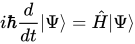[Schrödinger equation](https://en.wikipedia.org/wiki/Schr%C3%B6dinger_equation "Schrödinger equation") |
**Quantum mechanics** is the fundamental physical [theory](https://en.wikipedia.org/wiki/Scientific_theory "Scientific theory") that describes the behavior of matter and of light; its unusual characteristics typically occur at and below the scale of [atoms](https://en.wikipedia.org/wiki/Atom "Atom").[\[2\]](https://en.wikipedia.org/wiki/Quantum_mechanics#cite_note-Feynman-2): 1.1 It is the foundation of all **quantum physics**, which includes [quantum chemistry](https://en.wikipedia.org/wiki/Quantum_chemistry "Quantum chemistry"), [quantum biology](https://en.wikipedia.org/wiki/Quantum_biology "Quantum biology"), [quantum field theory](https://en.wikipedia.org/wiki/Quantum_field_theory "Quantum field theory"), [quantum technology](https://en.wikipedia.org/wiki/Quantum_technology "Quantum technology"), and [quantum information science](https://en.wikipedia.org/wiki/Quantum_information_science "Quantum information science").
Quantum mechanics can describe many systems that [classical physics](https://en.wikipedia.org/wiki/Classical_physics "Classical physics") cannot. Classical physics can describe many aspects of nature at an ordinary ([macroscopic](https://en.wikipedia.org/wiki/Macroscopic "Macroscopic") and [(optical) microscopic](https://en.wikipedia.org/wiki/Microscopic_scale "Microscopic scale")) scale, however is insufficient for describing them at very small [submicroscopic](https://en.wikipedia.org/wiki/Submicroscopic "Submicroscopic") (atomic and [subatomic](https://en.wikipedia.org/wiki/Subatomic "Subatomic")) scales. Classical mechanics can be derived from quantum mechanics as an approximation that is valid at ordinary scales.[\[3\]](https://en.wikipedia.org/wiki/Quantum_mechanics#cite_note-3)
**Quantum systems** have [bound](https://en.wikipedia.org/wiki/Bound_state "Bound state") states that are [quantized](https://en.wikipedia.org/wiki/Quantization_\(physics\) "Quantization (physics)") to [discrete values](https://en.wikipedia.org/wiki/Discrete_mathematics "Discrete mathematics") of [energy](https://en.wikipedia.org/wiki/Energy "Energy"), [momentum](https://en.wikipedia.org/wiki/Momentum "Momentum"), [angular momentum](https://en.wikipedia.org/wiki/Angular_momentum "Angular momentum"), and other quantities, in contrast to classical systems where these quantities can be measured continuously. Measurements of quantum systems show characteristics of both [particles](https://en.wikipedia.org/wiki/Particle "Particle") and [waves](https://en.wikipedia.org/wiki/Wave "Wave") ([wave–particle duality](https://en.wikipedia.org/wiki/Wave%E2%80%93particle_duality "Wave–particle duality")), and there are limits to how accurately the value of a physical quantity can be predicted prior to its measurement, given a complete set of initial conditions (the [uncertainty principle](https://en.wikipedia.org/wiki/Uncertainty_principle "Uncertainty principle")).
Quantum mechanics arose gradually from theories to explain observations that could not be reconciled with [classical physics](https://en.wikipedia.org/wiki/Classical_physics "Classical physics"), such as [Max Planck](https://en.wikipedia.org/wiki/Max_Planck "Max Planck")'s solution in 1900 to the [black-body radiation](https://en.wikipedia.org/wiki/Black-body_radiation "Black-body radiation") problem, and the correspondence between energy and frequency in [Albert Einstein](https://en.wikipedia.org/wiki/Albert_Einstein "Albert Einstein")'s [1905 paper](https://en.wikipedia.org/wiki/Annus_Mirabilis_papers#Photoelectric_effect "Annus Mirabilis papers"), which explained the [photoelectric effect](https://en.wikipedia.org/wiki/Photoelectric_effect "Photoelectric effect"). These early attempts to understand microscopic phenomena, now known as the "[old quantum theory](https://en.wikipedia.org/wiki/Old_quantum_theory "Old quantum theory")", led to the full development of quantum mechanics in the mid-1920s by [Niels Bohr](https://en.wikipedia.org/wiki/Niels_Bohr "Niels Bohr"), [Erwin Schrödinger](https://en.wikipedia.org/wiki/Erwin_Schr%C3%B6dinger "Erwin Schrödinger"), [Werner Heisenberg](https://en.wikipedia.org/wiki/Werner_Heisenberg "Werner Heisenberg"), [Max Born](https://en.wikipedia.org/wiki/Max_Born "Max Born"), [Paul Dirac](https://en.wikipedia.org/wiki/Paul_Dirac "Paul Dirac") and others. The modern theory is formulated in various [specially developed mathematical formalisms](https://en.wikipedia.org/wiki/Mathematical_formulations_of_quantum_mechanics "Mathematical formulations of quantum mechanics"). In one of them, a mathematical entity called the [wave function](https://en.wikipedia.org/wiki/Wave_function "Wave function") provides information, in the form of [probability amplitudes](https://en.wikipedia.org/wiki/Probability_amplitude "Probability amplitude"), about what measurements of a particle's energy, momentum, and other physical properties may yield.
## Overview and fundamental concepts
Quantum mechanics allows the calculation of properties and behaviour of [physical systems](https://en.wikipedia.org/wiki/Physical_systems "Physical systems"). It is typically applied to microscopic systems: [molecules](https://en.wikipedia.org/wiki/Molecules "Molecules"), [atoms](https://en.wikipedia.org/wiki/Atoms "Atoms") and [subatomic particles](https://en.wikipedia.org/wiki/Subatomic_particle "Subatomic particle"). It has been demonstrated to hold for complex molecules with thousands of atoms,[\[4\]](https://en.wikipedia.org/wiki/Quantum_mechanics#cite_note-4) but its application to human beings raises philosophical problems, such as [Wigner's friend](https://en.wikipedia.org/wiki/Wigner%27s_friend "Wigner's friend"), and its application to the universe as a whole remains speculative.[\[5\]](https://en.wikipedia.org/wiki/Quantum_mechanics#cite_note-5) Predictions of quantum mechanics have been verified experimentally to an extremely high degree of [accuracy](https://en.wikipedia.org/wiki/Accuracy "Accuracy"). For example, the refinement of quantum mechanics for the interaction of light and matter, known as [quantum electrodynamics](https://en.wikipedia.org/wiki/Quantum_electrodynamics "Quantum electrodynamics") (QED), has been [shown to agree with experiment](https://en.wikipedia.org/wiki/Precision_tests_of_QED "Precision tests of QED") to within 1 part in 1012 when predicting the magnetic properties of an electron.[\[6\]](https://en.wikipedia.org/wiki/Quantum_mechanics#cite_note-6)
A fundamental feature of the theory is that it usually cannot predict with certainty what will happen, but only gives probabilities. Mathematically, a probability is found by taking the square of the absolute value of a [complex number](https://en.wikipedia.org/wiki/Complex_number "Complex number"), known as a probability amplitude. This is known as the [Born rule](https://en.wikipedia.org/wiki/Born_rule "Born rule"), named after physicist [Max Born](https://en.wikipedia.org/wiki/Max_Born "Max Born"). For example, a quantum particle like an [electron](https://en.wikipedia.org/wiki/Electron "Electron") can be described by a wave function, which associates to each point in space a probability amplitude. Applying the Born rule to these amplitudes gives a [probability density function](https://en.wikipedia.org/wiki/Probability_density_function "Probability density function") for the position that the electron will be found to have when an experiment is performed to measure it. This is the best the theory can do; it cannot say for certain where the electron will be found. The [Schrödinger equation](https://en.wikipedia.org/wiki/Schr%C3%B6dinger_equation "Schrödinger equation") relates the collection of probability amplitudes that pertain to one moment of time to the collection of probability amplitudes that pertain to another.[\[7\]](https://en.wikipedia.org/wiki/Quantum_mechanics#cite_note-Zwiebach2022-7): 67–87
One consequence of the mathematical rules of quantum mechanics is a tradeoff in predictability between measurable quantities. The most famous form of this [uncertainty principle](https://en.wikipedia.org/wiki/Uncertainty_principle "Uncertainty principle") says that no matter how a quantum particle is prepared or how carefully experiments upon it are arranged, it is impossible to have a precise prediction for a measurement of its position and also at the same time for a measurement of its [momentum](https://en.wikipedia.org/wiki/Momentum "Momentum").[\[7\]](https://en.wikipedia.org/wiki/Quantum_mechanics#cite_note-Zwiebach2022-7): 427–435
[](https://en.wikipedia.org/wiki/File:Double-slit.svg)
An illustration of the [double-slit experiment](https://en.wikipedia.org/wiki/Double-slit_experiment "Double-slit experiment")
Another consequence of the mathematical rules of quantum mechanics is the phenomenon of [quantum interference](https://en.wikipedia.org/wiki/Quantum_interference "Quantum interference"), which is often illustrated with the [double-slit experiment](https://en.wikipedia.org/wiki/Double-slit_experiment "Double-slit experiment"). In the basic version of this experiment, a [coherent light source](https://en.wikipedia.org/wiki/Coherence_\(physics\) "Coherence (physics)"), such as a [laser](https://en.wikipedia.org/wiki/Laser "Laser") beam, illuminates a plate pierced by two parallel slits, and the light passing through the slits is observed on a screen behind the plate.[\[8\]](https://en.wikipedia.org/wiki/Quantum_mechanics#cite_note-Lederman-8): 102–111 [\[2\]](https://en.wikipedia.org/wiki/Quantum_mechanics#cite_note-Feynman-2): 1.1–1.8 The wave nature of light causes the light waves passing through the two slits to [interfere](https://en.wikipedia.org/wiki/Interference_\(wave_propagation\) "Interference (wave propagation)"), producing bright and dark bands on the screen – a result that would not be expected if light consisted of classical particles.[\[8\]](https://en.wikipedia.org/wiki/Quantum_mechanics#cite_note-Lederman-8) However, the light is always found to be absorbed at the screen at discrete points, as individual particles rather than waves; the interference pattern appears via the varying density of these particle hits on the screen. Furthermore, versions of the experiment that include detectors at the slits find that each detected [photon](https://en.wikipedia.org/wiki/Photon "Photon") passes through one slit (as would a classical particle), and not through both slits (as would a wave).[\[8\]](https://en.wikipedia.org/wiki/Quantum_mechanics#cite_note-Lederman-8): 109 [\[9\]](https://en.wikipedia.org/wiki/Quantum_mechanics#cite_note-M%C3%BCller-Kirsten-9)[\[10\]](https://en.wikipedia.org/wiki/Quantum_mechanics#cite_note-Plotnitsky-10) However, [such experiments](https://en.wikipedia.org/wiki/Double-slit_experiment#Which_way "Double-slit experiment") demonstrate that particles do not form the interference pattern if one detects which slit they pass through. This behavior is known as [wave–particle duality](https://en.wikipedia.org/wiki/Wave%E2%80%93particle_duality "Wave–particle duality"). In addition to light, [electrons](https://en.wikipedia.org/wiki/Electrons "Electrons"), [atoms](https://en.wikipedia.org/wiki/Atoms "Atoms"), and [molecules](https://en.wikipedia.org/wiki/Molecules "Molecules") are all found to exhibit the same dual behavior when fired towards a double slit.[\[2\]](https://en.wikipedia.org/wiki/Quantum_mechanics#cite_note-Feynman-2)
[](https://en.wikipedia.org/wiki/File:QuantumTunnel.jpg)
A simplified diagram of [quantum tunneling](https://en.wikipedia.org/wiki/Quantum_tunneling "Quantum tunneling"), a phenomenon by which a particle may move through a barrier which would be impossible under classical mechanics
Another non-classical phenomenon predicted by quantum mechanics is [quantum tunnelling](https://en.wikipedia.org/wiki/Quantum_tunnelling "Quantum tunnelling"): a particle that goes up against a [potential barrier](https://en.wikipedia.org/wiki/Potential_barrier "Potential barrier") can cross it, even if its kinetic energy is smaller than the maximum of the potential.[\[11\]](https://en.wikipedia.org/wiki/Quantum_mechanics#cite_note-11) In classical mechanics this particle would be trapped. Quantum tunnelling has several important consequences, enabling [radioactive decay](https://en.wikipedia.org/wiki/Radioactive_decay "Radioactive decay"), [nuclear fusion](https://en.wikipedia.org/wiki/Nuclear_fusion "Nuclear fusion") in stars, and applications such as [scanning tunnelling microscopy](https://en.wikipedia.org/wiki/Scanning_tunnelling_microscopy "Scanning tunnelling microscopy"), [tunnel diode](https://en.wikipedia.org/wiki/Tunnel_diode "Tunnel diode") and [tunnel field-effect transistor](https://en.wikipedia.org/wiki/Tunnel_field-effect_transistor "Tunnel field-effect transistor").[\[12\]](https://en.wikipedia.org/wiki/Quantum_mechanics#cite_note-Trixler2013-12)[\[13\]](https://en.wikipedia.org/wiki/Quantum_mechanics#cite_note-13)
When quantum systems interact, the result can be the creation of [quantum entanglement](https://en.wikipedia.org/wiki/Quantum_entanglement "Quantum entanglement"): their properties become so intertwined that a description of the whole solely in terms of the individual parts is no longer possible. Erwin Schrödinger called entanglement "...*the* characteristic trait of quantum mechanics, the one that enforces its entire departure from classical lines of thought".[\[14\]](https://en.wikipedia.org/wiki/Quantum_mechanics#cite_note-14) Quantum entanglement enables [quantum computing](https://en.wikipedia.org/wiki/Quantum_computing "Quantum computing") and is part of quantum communication protocols, such as [quantum key distribution](https://en.wikipedia.org/wiki/Quantum_key_distribution "Quantum key distribution") and [superdense coding](https://en.wikipedia.org/wiki/Superdense_coding "Superdense coding").[\[15\]](https://en.wikipedia.org/wiki/Quantum_mechanics#cite_note-Caves-15) Contrary to popular misconception, entanglement does not allow sending signals [faster than light](https://en.wikipedia.org/wiki/Faster_than_light "Faster than light"), as demonstrated by the [no-communication theorem](https://en.wikipedia.org/wiki/No-communication_theorem "No-communication theorem").[\[15\]](https://en.wikipedia.org/wiki/Quantum_mechanics#cite_note-Caves-15)
Another possibility opened by entanglement is testing for "[hidden variables](https://en.wikipedia.org/wiki/Hidden_variable_theory "Hidden variable theory")", hypothetical properties more fundamental than the quantities addressed in quantum theory itself, knowledge of which would allow more exact predictions than quantum theory provides. A collection of results, most significantly [Bell's theorem](https://en.wikipedia.org/wiki/Bell%27s_theorem "Bell's theorem"), have demonstrated that broad classes of such hidden-variable theories are in fact incompatible with quantum physics. According to Bell's theorem, if nature actually operates in accord with any theory of *local* hidden variables, then the results of a [Bell test](https://en.wikipedia.org/wiki/Bell_test "Bell test") will be constrained in a particular, quantifiable way. Many Bell tests have been performed and they have shown results incompatible with the constraints imposed by local hidden variables.[\[16\]](https://en.wikipedia.org/wiki/Quantum_mechanics#cite_note-wiseman15-16)[\[17\]](https://en.wikipedia.org/wiki/Quantum_mechanics#cite_note-wolchover17-17)
It is not possible to present these concepts in more than a superficial way without introducing the mathematics involved; understanding quantum mechanics requires not only manipulating complex numbers, but also [linear algebra](https://en.wikipedia.org/wiki/Linear_algebra "Linear algebra"), [differential equations](https://en.wikipedia.org/wiki/Differential_equation "Differential equation"), [group theory](https://en.wikipedia.org/wiki/Group_theory "Group theory"), and other more advanced subjects.[\[18\]](https://en.wikipedia.org/wiki/Quantum_mechanics#cite_note-18)[\[19\]](https://en.wikipedia.org/wiki/Quantum_mechanics#cite_note-19) Accordingly, this article will present a mathematical formulation of quantum mechanics and survey its application to some useful and oft-studied examples.
## Mathematical formulation
Main article: [Mathematical formulation of quantum mechanics](https://en.wikipedia.org/wiki/Mathematical_formulation_of_quantum_mechanics "Mathematical formulation of quantum mechanics")
In the mathematically rigorous formulation of quantum mechanics, the state of a quantum mechanical system is a vector ψ {\\displaystyle \\psi }  belonging to a ([separable](https://en.wikipedia.org/wiki/Separable_space "Separable space")) complex [Hilbert space](https://en.wikipedia.org/wiki/Hilbert_space "Hilbert space") H {\\displaystyle {\\mathcal {H}}} . This vector is postulated to be normalized under the Hilbert space inner product, that is, it obeys ⟨ ψ , ψ ⟩ \= 1 {\\displaystyle \\langle \\psi ,\\psi \\rangle =1} , and it is well-defined up to a complex number of modulus 1 (the global phase), that is, ψ {\\displaystyle \\psi }  and e i α ψ {\\displaystyle e^{i\\alpha }\\psi }  represent the same physical system. In other words, the possible states are points in the [projective space](https://en.wikipedia.org/wiki/Projective_space "Projective space") of a Hilbert space, usually called the [complex projective space](https://en.wikipedia.org/wiki/Complex_projective_space "Complex projective space"). The exact nature of this Hilbert space is dependent on the system – for example, for describing position and momentum the Hilbert space is the space of complex [square-integrable](https://en.wikipedia.org/wiki/Square-integrable "Square-integrable") functions L 2 ( C ) {\\displaystyle L^{2}(\\mathbb {C} )} ,[\[20\]](https://en.wikipedia.org/wiki/Quantum_mechanics#cite_note-Holevo2001-20): 13 while the Hilbert space for the [spin](https://en.wikipedia.org/wiki/Spin_\(physics\) "Spin (physics)") of a single proton is simply the space of two-dimensional complex vectors C 2 {\\displaystyle \\mathbb {C} ^{2}}  with the usual inner product.[\[20\]](https://en.wikipedia.org/wiki/Quantum_mechanics#cite_note-Holevo2001-20): 20
Physical quantities of interest – position, momentum, energy, spin – are represented by observables, which are [Hermitian](https://en.wikipedia.org/wiki/Hermitian_adjoint#Hermitian_operators "Hermitian adjoint") (more precisely, [self-adjoint](https://en.wikipedia.org/wiki/Self-adjoint_operator "Self-adjoint operator")) linear [operators](https://en.wikipedia.org/wiki/Operator_\(physics\) "Operator (physics)") acting on the Hilbert space.[\[20\]](https://en.wikipedia.org/wiki/Quantum_mechanics#cite_note-Holevo2001-20): 17 A quantum state can be an [eigenvector](https://en.wikipedia.org/wiki/Eigenvector "Eigenvector") of an observable, in which case it is called an [eigenstate](https://en.wikipedia.org/wiki/Eigenstate "Eigenstate"), and the associated [eigenvalue](https://en.wikipedia.org/wiki/Eigenvalue "Eigenvalue") corresponds to the value of the observable in that eigenstate. More generally, a quantum state will be a linear combination of the eigenstates, known as a [quantum superposition](https://en.wikipedia.org/wiki/Quantum_superposition "Quantum superposition"). When an observable is measured, the result will be one of its eigenvalues with probability given by the [Born rule](https://en.wikipedia.org/wiki/Born_rule "Born rule"): in the simplest case the eigenvalue λ {\\displaystyle \\lambda }  is non-degenerate and the probability is given by \| ⟨ λ → , ψ ⟩ \| 2 {\\displaystyle \|\\langle {\\vec {\\lambda }},\\psi \\rangle \|^{2}} , where λ → {\\displaystyle {\\vec {\\lambda }}}  is its associated unit-length eigenvector. More generally, the eigenvalue is degenerate and the probability is given by ⟨ ψ , P λ ψ ⟩ {\\displaystyle \\langle \\psi ,P\_{\\lambda }\\psi \\rangle } , where P λ {\\displaystyle P\_{\\lambda }}  is the projector onto its associated eigenspace.[\[21\]](https://en.wikipedia.org/wiki/Quantum_mechanics#cite_note-21) In the continuous case, these formulas give instead the [probability density](https://en.wikipedia.org/wiki/Probability_density "Probability density").
After the [measurement](https://en.wikipedia.org/wiki/Measurement_in_quantum_mechanics "Measurement in quantum mechanics"), if result λ {\\displaystyle \\lambda }  was obtained, the quantum state is postulated to [collapse](https://en.wikipedia.org/wiki/Collapse_of_the_wavefunction "Collapse of the wavefunction") to λ → {\\displaystyle {\\vec {\\lambda }}} , in the non-degenerate case, or to P λ ψ / ⟨ ψ , P λ ψ ⟩ {\\textstyle P\_{\\lambda }\\psi {\\big /}\\!{\\sqrt {\\langle \\psi ,P\_{\\lambda }\\psi \\rangle }}} 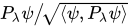, in the general case. The [probabilistic](https://en.wikipedia.org/wiki/Probabilistic "Probabilistic") nature of quantum mechanics thus stems from the act of measurement. This is one of the most debated aspects of quantum theory, with different [interpretations of quantum mechanics](https://en.wikipedia.org/wiki/Interpretations_of_quantum_mechanics "Interpretations of quantum mechanics") giving radically different answers to questions regarding quantum-state collapse, as discussed [below](https://en.wikipedia.org/wiki/Quantum_mechanics#Philosophical_implications).
### Time evolution of a quantum state
The time evolution of a quantum state is described by the Schrödinger equation: i ℏ ∂ ∂ t ψ ( t ) \= H ψ ( t ) . {\\displaystyle i\\hbar {\\frac {\\partial }{\\partial t}}\\psi (t)=H\\psi (t).} 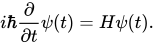 Here H {\\displaystyle H}  denotes the [Hamiltonian](https://en.wikipedia.org/wiki/Hamiltonian_\(quantum_mechanics\) "Hamiltonian (quantum mechanics)"), the observable corresponding to the [total energy](https://en.wikipedia.org/wiki/Total_energy "Total energy") of the system, and ℏ {\\displaystyle \\hbar }  is the reduced [Planck constant](https://en.wikipedia.org/wiki/Planck_constant "Planck constant"). The constant i ℏ {\\displaystyle i\\hbar }  is introduced so that the Hamiltonian is reduced to the [classical Hamiltonian](https://en.wikipedia.org/wiki/Hamiltonian_mechanics "Hamiltonian mechanics") in cases where the quantum system can be approximated by a classical system; the ability to make such an approximation in certain limits is called the [correspondence principle](https://en.wikipedia.org/wiki/Correspondence_principle "Correspondence principle").
The solution of this differential equation is given by ψ ( t ) \= e − i H t / ℏ ψ ( 0 ) . {\\displaystyle \\psi (t)=e^{-iHt/\\hbar }\\psi (0).}  The operator U ( t ) \= e − i H t / ℏ {\\displaystyle U(t)=e^{-iHt/\\hbar }} 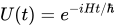 is known as the time-evolution operator, and has the crucial property that it is [unitary](https://en.wikipedia.org/wiki/Unitarity_\(physics\) "Unitarity (physics)"). This time evolution is [deterministic](https://en.wikipedia.org/wiki/Deterministic "Deterministic") in the sense that – given an initial quantum state ψ ( 0 ) {\\displaystyle \\psi (0)}  – it makes a definite prediction of what the quantum state ψ ( t ) {\\displaystyle \\psi (t)}  will be at any later time.[\[22\]](https://en.wikipedia.org/wiki/Quantum_mechanics#cite_note-22)
[](https://en.wikipedia.org/wiki/File:Atomic-orbital-clouds_spd_m0.png)
Fig. 1: [Probability densities](https://en.wikipedia.org/wiki/Probability_density_function "Probability density function") corresponding to the wave functions of an electron in a hydrogen atom possessing definite energy levels (increasing from the top of the image to the bottom: *n* = 1, 2, 3, ...) and angular momenta (increasing across from left to right: *s*, *p*, *d*, ...). Denser areas correspond to higher probability density in a position measurement.
Such wave functions are directly comparable to [Chladni's figures](https://en.wikipedia.org/wiki/Chladni%27s_figures "Chladni's figures") of [acoustic](https://en.wikipedia.org/wiki/Acoustics "Acoustics") modes of vibration in classical physics and are modes of oscillation as well, possessing a sharp energy and thus, a definite frequency. The [angular momentum](https://en.wikipedia.org/wiki/Angular_momentum "Angular momentum") and energy are [quantized](https://en.wikipedia.org/wiki/Quantization_\(physics\) "Quantization (physics)") and take *only* discrete values like those shown – as is the case for [resonant frequencies](https://en.wikipedia.org/wiki/Resonant_frequencies "Resonant frequencies") in acoustics.
Some wave functions produce probability distributions that are independent of time, such as [eigenstates](https://en.wikipedia.org/wiki/Eigenstate "Eigenstate") of the Hamiltonian.[\[7\]](https://en.wikipedia.org/wiki/Quantum_mechanics#cite_note-Zwiebach2022-7): 133–137 Many systems that are treated dynamically in classical mechanics are described by such "static" wave functions. For example, a single electron in an unexcited atom is pictured classically as a particle moving in a circular trajectory around the [atomic nucleus](https://en.wikipedia.org/wiki/Atomic_nucleus "Atomic nucleus"), whereas in quantum mechanics, it is described by a static wave function surrounding the nucleus. For example, the electron wave function for an unexcited hydrogen atom is a spherically symmetric function known as an [*s* orbital](https://en.wikipedia.org/wiki/Atomic_orbital "Atomic orbital") ([Fig. 1](https://en.wikipedia.org/wiki/Quantum_mechanics#fig1)).
Analytic solutions of the Schrödinger equation are known for [very few relatively simple model Hamiltonians](https://en.wikipedia.org/wiki/List_of_quantum-mechanical_systems_with_analytical_solutions "List of quantum-mechanical systems with analytical solutions") including the [quantum harmonic oscillator](https://en.wikipedia.org/wiki/Quantum_harmonic_oscillator "Quantum harmonic oscillator"), the [particle in a box](https://en.wikipedia.org/wiki/Particle_in_a_box "Particle in a box"), the [dihydrogen cation](https://en.wikipedia.org/wiki/Dihydrogen_cation "Dihydrogen cation"), and the [hydrogen atom](https://en.wikipedia.org/wiki/Hydrogen_atom "Hydrogen atom"). Even the [helium](https://en.wikipedia.org/wiki/Helium "Helium") atom – which contains just two electrons – has defied all attempts at a fully analytic treatment, admitting no solution in [closed form](https://en.wikipedia.org/wiki/Closed-form_expression "Closed-form expression").[\[23\]](https://en.wikipedia.org/wiki/Quantum_mechanics#cite_note-23)[\[24\]](https://en.wikipedia.org/wiki/Quantum_mechanics#cite_note-24)[\[25\]](https://en.wikipedia.org/wiki/Quantum_mechanics#cite_note-25)
However, there are techniques for finding approximate solutions. One method, called [perturbation theory](https://en.wikipedia.org/wiki/Perturbation_theory_\(quantum_mechanics\) "Perturbation theory (quantum mechanics)"), uses the analytic result for a simple quantum mechanical model to create a result for a related but more complicated model by (for example) the addition of a weak [potential energy](https://en.wikipedia.org/wiki/Potential_energy "Potential energy").[\[7\]](https://en.wikipedia.org/wiki/Quantum_mechanics#cite_note-Zwiebach2022-7): 793 Another approximation method applies to systems for which quantum mechanics produces only small deviations from classical behavior. These deviations can then be computed based on the classical motion.[\[7\]](https://en.wikipedia.org/wiki/Quantum_mechanics#cite_note-Zwiebach2022-7): 849
### Uncertainty principle
One consequence of the basic quantum formalism is the uncertainty principle. In its most familiar form, this states that no preparation of a quantum particle can imply simultaneously precise predictions both for a measurement of its position and for a measurement of its momentum.[\[26\]](https://en.wikipedia.org/wiki/Quantum_mechanics#cite_note-Cohen-Tannoudji-26)[\[27\]](https://en.wikipedia.org/wiki/Quantum_mechanics#cite_note-L&L-27) Both position and momentum are observables, meaning that they are represented by [Hermitian operators](https://en.wikipedia.org/wiki/Hermitian_operators "Hermitian operators"). The position operator X ^ {\\displaystyle {\\hat {X}}}  and momentum operator P ^ {\\displaystyle {\\hat {P}}}  do not commute, but rather satisfy the [canonical commutation relation](https://en.wikipedia.org/wiki/Canonical_commutation_relation "Canonical commutation relation"): \[ X ^ , P ^ \] \= i ℏ . {\\displaystyle \[{\\hat {X}},{\\hat {P}}\]=i\\hbar .} ![{\\displaystyle \[{\\hat {X}},{\\hat {P}}\]=i\\hbar .}](https://wikimedia.org/api/rest_v1/media/math/render/svg/803fe39b0eeaff8d1570df480e738cf5a968cc71) Given a quantum state, the Born rule lets us compute expectation values for both X {\\displaystyle X}  and P {\\displaystyle P} , and moreover for powers of them. Defining the uncertainty for an observable by a [standard deviation](https://en.wikipedia.org/wiki/Standard_deviation "Standard deviation"), we have σ X \= ⟨ X 2 ⟩ − ⟨ X ⟩ 2 , {\\displaystyle \\sigma \_{X}={\\textstyle {\\sqrt {\\left\\langle X^{2}\\right\\rangle -\\left\\langle X\\right\\rangle ^{2}}}},} 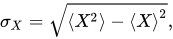 and likewise for the momentum: σ P \= ⟨ P 2 ⟩ − ⟨ P ⟩ 2 . {\\displaystyle \\sigma \_{P}={\\sqrt {\\left\\langle P^{2}\\right\\rangle -\\left\\langle P\\right\\rangle ^{2}}}.} 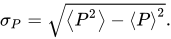 The uncertainty principle states that σ X σ P ≥ ℏ 2 . {\\displaystyle \\sigma \_{X}\\sigma \_{P}\\geq {\\frac {\\hbar }{2}}.}  Either standard deviation can in principle be made arbitrarily small, but not both simultaneously.[\[28\]](https://en.wikipedia.org/wiki/Quantum_mechanics#cite_note-ballentine1970-28) This inequality generalizes to arbitrary pairs of self-adjoint operators A {\\displaystyle A}  and B {\\displaystyle B} . The [commutator](https://en.wikipedia.org/wiki/Commutator "Commutator") of these two operators is \[ A , B \] \= A B − B A , {\\displaystyle \[A,B\]=AB-BA,} ![{\\displaystyle \[A,B\]=AB-BA,}](https://wikimedia.org/api/rest_v1/media/math/render/svg/b2a47259b42e63c048c65f67d304404867841951) and this provides the lower bound on the product of standard deviations: σ A σ B ≥ 1 2 \| ⟨ \[ A , B \] ⟩ \| . {\\displaystyle \\sigma \_{A}\\sigma \_{B}\\geq {\\tfrac {1}{2}}\\left\|{\\bigl \\langle }\[A,B\]{\\bigr \\rangle }\\right\|.} ![{\\displaystyle \\sigma \_{A}\\sigma \_{B}\\geq {\\tfrac {1}{2}}\\left\|{\\bigl \\langle }\[A,B\]{\\bigr \\rangle }\\right\|.}](https://wikimedia.org/api/rest_v1/media/math/render/svg/d0fd768b447334e150b8b98181f74b475e41ee52)
Another consequence of the canonical commutation relation is that the position and momentum operators are [Fourier transforms](https://en.wikipedia.org/wiki/Fourier_transform#Uncertainty_principle "Fourier transform") of each other, so that a description of an object according to its momentum is the Fourier transform of its description according to its position. The fact that dependence in momentum is the Fourier transform of the dependence in position means that the momentum operator is equivalent (up to an i / ℏ {\\displaystyle i/\\hbar }  factor) to taking the derivative according to the position, since in Fourier analysis [differentiation corresponds to multiplication in the dual space](https://en.wikipedia.org/wiki/Fourier_transform#Differentiation "Fourier transform"). This is why in quantum equations in position space, the momentum p i {\\displaystyle p\_{i}}  is replaced by − i ℏ ∂ ∂ x {\\displaystyle -i\\hbar {\\frac {\\partial }{\\partial x}}} , and in particular in the [non-relativistic Schrödinger equation in position space](https://en.wikipedia.org/wiki/Schr%C3%B6dinger_equation#Equation "Schrödinger equation") the momentum-squared term is replaced with a Laplacian times − ℏ 2 {\\displaystyle -\\hbar ^{2}} .[\[26\]](https://en.wikipedia.org/wiki/Quantum_mechanics#cite_note-Cohen-Tannoudji-26)
### Composite systems and entanglement
When two different quantum systems are considered together, the Hilbert space of the combined system is the [tensor product](https://en.wikipedia.org/wiki/Tensor_product "Tensor product") of the Hilbert spaces of the two components. For example, let A and B be two quantum systems, with Hilbert spaces H A {\\displaystyle {\\mathcal {H}}\_{A}}  and H B {\\displaystyle {\\mathcal {H}}\_{B}} , respectively. The Hilbert space of the composite system is then H A B \= H A ⊗ H B . {\\displaystyle {\\mathcal {H}}\_{AB}={\\mathcal {H}}\_{A}\\otimes {\\mathcal {H}}\_{B}.}  If the state for the first system is the vector ψ A {\\displaystyle \\psi \_{A}}  and the state for the second system is ψ B {\\displaystyle \\psi \_{B}} , then the state of the composite system is ψ A ⊗ ψ B . {\\displaystyle \\psi \_{A}\\otimes \\psi \_{B}.}  Not all states in the joint Hilbert space H A B {\\displaystyle {\\mathcal {H}}\_{AB}}  can be written in this form, however, because the superposition principle implies that linear combinations of these "separable" or "product states" are also valid. For example, if ψ A {\\displaystyle \\psi \_{A}}  and ϕ A {\\displaystyle \\phi \_{A}}  are both possible states for system A {\\displaystyle A} , and likewise ψ B {\\displaystyle \\psi \_{B}}  and ϕ B {\\displaystyle \\phi \_{B}}  are both possible states for system B {\\displaystyle B} , then 1 2 ( ψ A ⊗ ψ B \+ ϕ A ⊗ ϕ B ) {\\displaystyle {\\tfrac {1}{\\sqrt {2}}}\\left(\\psi \_{A}\\otimes \\psi \_{B}+\\phi \_{A}\\otimes \\phi \_{B}\\right)}  is a valid joint state that is not separable. States that are not separable are called [entangled](https://en.wikipedia.org/wiki/Quantum_entanglement "Quantum entanglement").[\[29\]](https://en.wikipedia.org/wiki/Quantum_mechanics#cite_note-:0-29)[\[30\]](https://en.wikipedia.org/wiki/Quantum_mechanics#cite_note-:1-30)
If the state for a composite system is entangled, it is impossible to describe either component system A or system B by a state vector. One can instead define [reduced density matrices](https://en.wikipedia.org/wiki/Reduced_density_matrix "Reduced density matrix") that describe the statistics that can be obtained by making measurements on either component system alone. This necessarily causes a loss of information, though: knowing the reduced density matrices of the individual systems is not enough to reconstruct the state of the composite system.[\[29\]](https://en.wikipedia.org/wiki/Quantum_mechanics#cite_note-:0-29)[\[30\]](https://en.wikipedia.org/wiki/Quantum_mechanics#cite_note-:1-30) Just as density matrices specify the state of a subsystem of a larger system, analogously, [positive operator-valued measures](https://en.wikipedia.org/wiki/POVM "POVM") (POVMs) describe the effect on a subsystem of a measurement performed on a larger system. POVMs are extensively used in quantum information theory.[\[29\]](https://en.wikipedia.org/wiki/Quantum_mechanics#cite_note-:0-29)[\[31\]](https://en.wikipedia.org/wiki/Quantum_mechanics#cite_note-wilde-31)
As described above, entanglement is a key feature of models of measurement processes in which an apparatus becomes entangled with the system being measured. Systems interacting with the environment in which they reside generally become entangled with that environment, a phenomenon known as [quantum decoherence](https://en.wikipedia.org/wiki/Quantum_decoherence "Quantum decoherence"). This can explain why, in practice, quantum effects are difficult to observe in systems larger than microscopic.[\[32\]](https://en.wikipedia.org/wiki/Quantum_mechanics#cite_note-32)
### Equivalence between formulations
There are many mathematically equivalent formulations of quantum mechanics. One of the oldest and most common is the "[transformation theory](https://en.wikipedia.org/wiki/Transformation_theory_\(quantum_mechanics\) "Transformation theory (quantum mechanics)")" proposed by [Paul Dirac](https://en.wikipedia.org/wiki/Paul_Dirac "Paul Dirac"), which unifies and generalizes the two earliest formulations of quantum mechanics – [matrix mechanics](https://en.wikipedia.org/wiki/Matrix_mechanics "Matrix mechanics") (invented by [Werner Heisenberg](https://en.wikipedia.org/wiki/Werner_Heisenberg "Werner Heisenberg")) and wave mechanics (invented by [Erwin Schrödinger](https://en.wikipedia.org/wiki/Erwin_Schr%C3%B6dinger "Erwin Schrödinger")).[\[33\]](https://en.wikipedia.org/wiki/Quantum_mechanics#cite_note-33) An alternative formulation of quantum mechanics is [Feynman](https://en.wikipedia.org/wiki/Feynman "Feynman")'s [path integral formulation](https://en.wikipedia.org/wiki/Path_integral_formulation "Path integral formulation"), in which a quantum-mechanical amplitude is considered as a sum over all possible classical and non-classical paths between the initial and final states. This is the quantum-mechanical counterpart of the [action principle](https://en.wikipedia.org/wiki/Action_principle "Action principle") in classical mechanics.[\[34\]](https://en.wikipedia.org/wiki/Quantum_mechanics#cite_note-34)
### Symmetries and conservation laws
Main article: [Noether's theorem](https://en.wikipedia.org/wiki/Noether%27s_theorem "Noether's theorem")
The Hamiltonian H {\\displaystyle H}  is known as the *generator* of time evolution, since it defines a unitary time-evolution operator U ( t ) \= e − i H t / ℏ {\\displaystyle U(t)=e^{-iHt/\\hbar }}  for each value of t {\\displaystyle t} . From this relation between U ( t ) {\\displaystyle U(t)}  and H {\\displaystyle H} , it follows that any observable A {\\displaystyle A}  that commutes with H {\\displaystyle H}  will be *conserved*: its expectation value will not change over time.[\[7\]](https://en.wikipedia.org/wiki/Quantum_mechanics#cite_note-Zwiebach2022-7): 471 This statement generalizes, as mathematically, any Hermitian operator A {\\displaystyle A}  can generate a family of unitary operators parameterized by a variable t {\\displaystyle t} . Under the evolution generated by A {\\displaystyle A} , any observable B {\\displaystyle B}  that commutes with A {\\displaystyle A}  will be conserved. Moreover, if B {\\displaystyle B}  is conserved by evolution under A {\\displaystyle A} , then A {\\displaystyle A}  is conserved under the evolution generated by B {\\displaystyle B} . This implies a quantum version of the result proven by [Emmy Noether](https://en.wikipedia.org/wiki/Emmy_Noether "Emmy Noether") in classical ([Lagrangian](https://en.wikipedia.org/wiki/Lagrangian_mechanics "Lagrangian mechanics")) mechanics: for every [differentiable](https://en.wikipedia.org/wiki/Differentiable "Differentiable") [symmetry](https://en.wikipedia.org/wiki/Symmetry_\(physics\) "Symmetry (physics)") of a Hamiltonian, there exists a corresponding [conservation law](https://en.wikipedia.org/wiki/Conservation_law "Conservation law").
## Examples
### Free particle
Main article: [Free particle](https://en.wikipedia.org/wiki/Free_particle "Free particle")
[](https://en.wikipedia.org/wiki/File:Guassian_Dispersion.gif)
Position space probability density of a Gaussian [wave packet](https://en.wikipedia.org/wiki/Wave_packet "Wave packet") moving in one dimension in free space
The simplest example of a quantum system with a position degree of freedom is a free particle in a single spatial dimension. A free particle is one which is not subject to external influences, so that its Hamiltonian consists only of its kinetic energy: H \= 1 2 m P 2 \= − ℏ 2 2 m d 2 d x 2 . {\\displaystyle H={\\frac {1}{2m}}P^{2}=-{\\frac {\\hbar ^{2}}{2m}}{\\frac {d^{2}}{dx^{2}}}.} 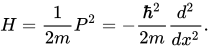 The general solution of the Schrödinger equation is given by ψ ( x , t ) \= 1 2 π ∫ − ∞ ∞ ψ ^ ( k , 0 ) e i ( k x − ℏ k 2 2 m t ) d k , {\\displaystyle \\psi (x,t)={\\frac {1}{\\sqrt {2\\pi }}}\\int \_{-\\infty }^{\\infty }{\\hat {\\psi }}(k,0)e^{i(kx-{\\frac {\\hbar k^{2}}{2m}}t)}\\mathrm {d} k,}  which is a superposition of all possible [plane waves](https://en.wikipedia.org/wiki/Plane_wave "Plane wave") e i ( k x − ℏ k 2 2 m t ) {\\displaystyle e^{i(kx-{\\frac {\\hbar k^{2}}{2m}}t)}} , which are eigenstates of the momentum operator with momentum p \= ℏ k {\\displaystyle p=\\hbar k} . The coefficients of the superposition are ψ ^ ( k , 0 ) {\\displaystyle {\\hat {\\psi }}(k,0)} , which is the Fourier transform of the initial quantum state ψ ( x , 0 ) {\\displaystyle \\psi (x,0)} .
It is not possible for the solution to be a single momentum eigenstate, or a single position eigenstate, as these are not normalizable quantum states.[\[note 1\]](https://en.wikipedia.org/wiki/Quantum_mechanics#cite_note-35) Instead, we can consider a Gaussian [wave packet](https://en.wikipedia.org/wiki/Wave_packet "Wave packet"): ψ ( x , 0 ) \= 1 π a 4 e − x 2 2 a {\\displaystyle \\psi (x,0)={\\frac {1}{\\sqrt\[{4}\]{\\pi a}}}e^{-{\\frac {x^{2}}{2a}}}} ![{\\displaystyle \\psi (x,0)={\\frac {1}{\\sqrt\[{4}\]{\\pi a}}}e^{-{\\frac {x^{2}}{2a}}}}](https://wikimedia.org/api/rest_v1/media/math/render/svg/a4c2dae82312897d5fd4c58986c426a6009e6840) which has Fourier transform, and therefore momentum distribution ψ ^ ( k , 0 ) \= a π 4 e − a k 2 2 . {\\displaystyle {\\hat {\\psi }}(k,0)={\\sqrt\[{4}\]{\\frac {a}{\\pi }}}e^{-{\\frac {ak^{2}}{2}}}.} ![{\\displaystyle {\\hat {\\psi }}(k,0)={\\sqrt\[{4}\]{\\frac {a}{\\pi }}}e^{-{\\frac {ak^{2}}{2}}}.}](https://wikimedia.org/api/rest_v1/media/math/render/svg/c4991535bba434314af8c27c16fff74f49ce367e) We see that as we make a {\\displaystyle a}  smaller the spread in position gets smaller, but the spread in momentum gets larger. Conversely, by making a {\\displaystyle a}  larger we make the spread in momentum smaller, but the spread in position gets larger. This illustrates the uncertainty principle.
As we let the Gaussian wave packet evolve in time, we see that its center moves through space at a constant velocity (like a classical particle with no forces acting on it). However, the wave packet will also spread out as time progresses, which means that the position becomes more and more uncertain. The uncertainty in momentum, however, stays constant.[\[35\]](https://en.wikipedia.org/wiki/Quantum_mechanics#cite_note-36)
### Particle in a box
[](https://en.wikipedia.org/wiki/File:Infinite_potential_well.svg)
1-dimensional potential energy box (or infinite potential well)
Main article: [Particle in a box](https://en.wikipedia.org/wiki/Particle_in_a_box "Particle in a box")
The particle in a one-dimensional potential energy box is the most mathematically simple example where restraints lead to the quantization of energy levels. The box is defined as having zero potential energy everywhere *inside* a certain region, and therefore infinite potential energy everywhere *outside* that region.[\[26\]](https://en.wikipedia.org/wiki/Quantum_mechanics#cite_note-Cohen-Tannoudji-26): 77–78 For the one-dimensional case in the x {\\displaystyle x}  direction, the time-independent Schrödinger equation may be written − ℏ 2 2 m d 2 ψ d x 2 \= E ψ . {\\displaystyle -{\\frac {\\hbar ^{2}}{2m}}{\\frac {d^{2}\\psi }{dx^{2}}}=E\\psi .} 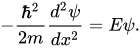
With the differential operator defined by p ^ x \= − i ℏ d d x {\\displaystyle {\\hat {p}}\_{x}=-i\\hbar {\\frac {d}{dx}}} 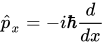the previous equation is evocative of the [classic kinetic energy analogue](https://en.wikipedia.org/wiki/Kinetic_energy#Kinetic_energy_of_rigid_bodies "Kinetic energy"), 1 2 m p ^ x 2 \= E , {\\displaystyle {\\frac {1}{2m}}{\\hat {p}}\_{x}^{2}=E,}  with state ψ {\\displaystyle \\psi }  in this case having energy E {\\displaystyle E}  coincident with the kinetic energy of the particle.
The general solutions of the Schrödinger equation for the particle in a box are ψ ( x ) \= A e i k x \+ B e − i k x E \= ℏ 2 k 2 2 m {\\displaystyle \\psi (x)=Ae^{ikx}+Be^{-ikx}\\qquad \\qquad E={\\frac {\\hbar ^{2}k^{2}}{2m}}}  or, from [Euler's formula](https://en.wikipedia.org/wiki/Euler%27s_formula "Euler's formula"), ψ ( x ) \= C sin ( k x ) \+ D cos ( k x ) . {\\displaystyle \\psi (x)=C\\sin(kx)+D\\cos(kx).\\!} 
The infinite potential walls of the box determine the values of C , D , {\\displaystyle C,D,}  and k {\\displaystyle k}  at x \= 0 {\\displaystyle x=0}  and x \= L {\\displaystyle x=L}  where ψ {\\displaystyle \\psi }  must be zero. Thus, at x \= 0 {\\displaystyle x=0} , ψ ( 0 ) \= 0 \= C sin ( 0 ) \+ D cos ( 0 ) \= D {\\displaystyle \\psi (0)=0=C\\sin(0)+D\\cos(0)=D}  and D \= 0 {\\displaystyle D=0} . At x \= L {\\displaystyle x=L} , ψ ( L ) \= 0 \= C sin ( k L ) , {\\displaystyle \\psi (L)=0=C\\sin(kL),}  in which C {\\displaystyle C}  cannot be zero as this would conflict with the postulate that ψ {\\displaystyle \\psi }  has norm 1. Therefore, since sin ( k L ) \= 0 {\\displaystyle \\sin(kL)=0} , k L {\\displaystyle kL}  must be an integer multiple of π {\\displaystyle \\pi } , k \= n π L n \= 1 , 2 , 3 , … . {\\displaystyle k={\\frac {n\\pi }{L}}\\qquad \\qquad n=1,2,3,\\ldots .} 
This constraint on k {\\displaystyle k}  implies a constraint on the energy levels, yielding E n \= ℏ 2 π 2 n 2 2 m L 2 \= n 2 h 2 8 m L 2 . {\\displaystyle E\_{n}={\\frac {\\hbar ^{2}\\pi ^{2}n^{2}}{2mL^{2}}}={\\frac {n^{2}h^{2}}{8mL^{2}}}.} 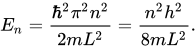
A [finite potential well](https://en.wikipedia.org/wiki/Finite_potential_well "Finite potential well") is the generalization of the infinite potential well problem to potential wells having finite depth. The finite potential well problem is mathematically more complicated than the infinite particle-in-a-box problem as the wave function is not pinned to zero at the walls of the well. Instead, the wave function must satisfy more complicated mathematical boundary conditions as it is nonzero in regions outside the well. Another related problem is that of the [rectangular potential barrier](https://en.wikipedia.org/wiki/Rectangular_potential_barrier "Rectangular potential barrier"), which furnishes a model for the [quantum tunneling](https://en.wikipedia.org/wiki/Quantum_tunneling "Quantum tunneling") effect that plays an important role in the performance of modern technologies such as [flash memory](https://en.wikipedia.org/wiki/Flash_memory "Flash memory") and [scanning tunneling microscopy](https://en.wikipedia.org/wiki/Scanning_tunneling_microscopy "Scanning tunneling microscopy").
### Harmonic oscillator
Main article: [Quantum harmonic oscillator](https://en.wikipedia.org/wiki/Quantum_harmonic_oscillator "Quantum harmonic oscillator")
[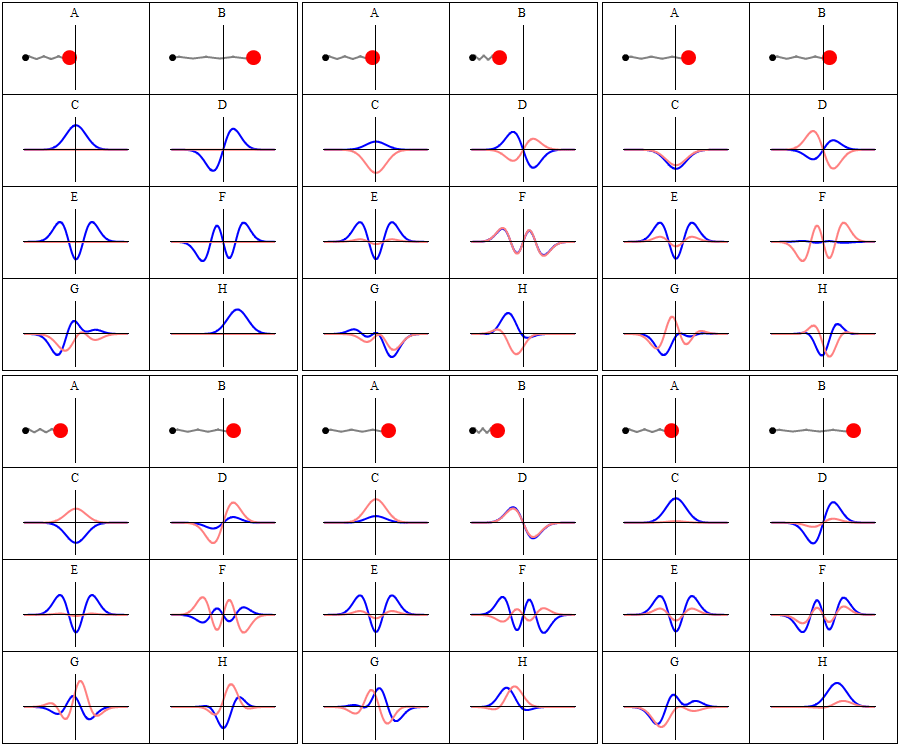](https://en.wikipedia.org/wiki/File:QuantumHarmonicOscillatorAnimation.gif)
Some trajectories of a [harmonic oscillator](https://en.wikipedia.org/wiki/Harmonic_oscillator "Harmonic oscillator") (i.e. a ball attached to a [spring](https://en.wikipedia.org/wiki/Hooke%27s_law "Hooke's law")) in [classical mechanics](https://en.wikipedia.org/wiki/Classical_mechanics "Classical mechanics") (A-B) and quantum mechanics (C-H). In quantum mechanics, the position of the ball is represented by a [wave](https://en.wikipedia.org/wiki/Wave "Wave") (called the wave function), with the [real part](https://en.wikipedia.org/wiki/Real_part "Real part") shown in blue and the [imaginary part](https://en.wikipedia.org/wiki/Imaginary_part "Imaginary part") shown in red. Some of the trajectories (such as C, D, E, and F) are [standing waves](https://en.wikipedia.org/wiki/Standing_wave "Standing wave") (or "[stationary states](https://en.wikipedia.org/wiki/Stationary_state "Stationary state")"). Each standing-wave frequency is proportional to a possible [energy level](https://en.wikipedia.org/wiki/Energy_level "Energy level") of the oscillator. This "energy quantization" does not occur in classical physics, where the oscillator can have *any* energy.
As in the classical case, the potential for the quantum harmonic oscillator is given by[\[7\]](https://en.wikipedia.org/wiki/Quantum_mechanics#cite_note-Zwiebach2022-7): 234 V ( x ) \= 1 2 m ω 2 x 2 . {\\displaystyle V(x)={\\frac {1}{2}}m\\omega ^{2}x^{2}.} 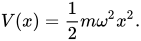
This problem can either be treated by directly solving the Schrödinger equation, which is not trivial, or by using the more elegant "ladder method" first proposed by Paul Dirac. The [eigenstates](https://en.wikipedia.org/wiki/Eigenstate "Eigenstate") are given by ψ n ( x ) \= 1 2 n n \! ⋅ ( m ω π ℏ ) 1 / 4 ⋅ e − m ω x 2 2 ℏ ⋅ H n ( m ω ℏ x ) , {\\displaystyle \\psi \_{n}(x)={\\sqrt {\\frac {1}{2^{n}\\,n!}}}\\cdot \\left({\\frac {m\\omega }{\\pi \\hbar }}\\right)^{1/4}\\cdot e^{-{\\frac {m\\omega x^{2}}{2\\hbar }}}\\cdot H\_{n}\\left({\\sqrt {\\frac {m\\omega }{\\hbar }}}x\\right),\\qquad }  n \= 0 , 1 , 2 , … . {\\displaystyle n=0,1,2,\\ldots .}  where *Hn* are the [Hermite polynomials](https://en.wikipedia.org/wiki/Hermite_polynomials "Hermite polynomials") H n ( x ) \= ( − 1 ) n e x 2 d n d x n ( e − x 2 ) , {\\displaystyle H\_{n}(x)=(-1)^{n}e^{x^{2}}{\\frac {d^{n}}{dx^{n}}}\\left(e^{-x^{2}}\\right),}  and the corresponding energy levels are E n \= ℏ ω ( n \+ 1 2 ) . {\\displaystyle E\_{n}=\\hbar \\omega \\left(n+{1 \\over 2}\\right).} 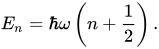
This is another example illustrating the discretization of energy for [bound states](https://en.wikipedia.org/wiki/Bound_state "Bound state").
### Mach–Zehnder interferometer
[](https://en.wikipedia.org/wiki/File:Mach-Zehnder_interferometer.svg)
Schematic of a Mach–Zehnder interferometer
The [Mach–Zehnder interferometer](https://en.wikipedia.org/wiki/Mach%E2%80%93Zehnder_interferometer "Mach–Zehnder interferometer") (MZI) illustrates the concepts of superposition and interference with linear algebra in dimension 2, rather than differential equations. It can be seen as a simplified version of the double-slit experiment, but it is of interest in its own right, for example in the [delayed choice quantum eraser](https://en.wikipedia.org/wiki/Delayed_choice_quantum_eraser "Delayed choice quantum eraser"), the [Elitzur–Vaidman bomb tester](https://en.wikipedia.org/wiki/Elitzur%E2%80%93Vaidman_bomb_tester "Elitzur–Vaidman bomb tester"), and in studies of quantum entanglement.[\[36\]](https://en.wikipedia.org/wiki/Quantum_mechanics#cite_note-Paris1999-37)[\[37\]](https://en.wikipedia.org/wiki/Quantum_mechanics#cite_note-Haack2010-38)
We can model a photon going through the interferometer by considering that at each point it can be in a superposition of only two paths: the "lower" path which starts from the left, goes straight through both beam splitters, and ends at the top, and the "upper" path which starts from the bottom, goes straight through both beam splitters, and ends at the right. The quantum state of the photon is therefore a vector ψ ∈ C 2 {\\displaystyle \\psi \\in \\mathbb {C} ^{2}}  that is a superposition of the "lower" path ψ l \= ( 1 0 ) {\\displaystyle \\psi \_{l}={\\begin{pmatrix}1\\\\0\\end{pmatrix}}}  and the "upper" path ψ u \= ( 0 1 ) {\\displaystyle \\psi \_{u}={\\begin{pmatrix}0\\\\1\\end{pmatrix}}} , that is, ψ \= α ψ l \+ β ψ u {\\displaystyle \\psi =\\alpha \\psi \_{l}+\\beta \\psi \_{u}}  for complex α , β {\\displaystyle \\alpha ,\\beta } . In order to respect the postulate that ⟨ ψ , ψ ⟩ \= 1 {\\displaystyle \\langle \\psi ,\\psi \\rangle =1}  we require that \| α \| 2 \+ \| β \| 2 \= 1 {\\displaystyle \|\\alpha \|^{2}+\|\\beta \|^{2}=1} 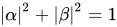.
Both [beam splitters](https://en.wikipedia.org/wiki/Beam_splitter "Beam splitter") are modelled as the unitary matrix B \= 1 2 ( 1 i i 1 ) {\\displaystyle B={\\frac {1}{\\sqrt {2}}}{\\begin{pmatrix}1\&i\\\\i&1\\end{pmatrix}}} 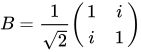, which means that when a photon meets the beam splitter it will either stay on the same path with a probability amplitude of 1 / 2 {\\displaystyle 1/{\\sqrt {2}}} , or be reflected to the other path with a probability amplitude of i / 2 {\\displaystyle i/{\\sqrt {2}}} . The phase shifter on the upper arm is modelled as the unitary matrix P \= ( 1 0 0 e i Δ Φ ) {\\displaystyle P={\\begin{pmatrix}1&0\\\\0\&e^{i\\Delta \\Phi }\\end{pmatrix}}} 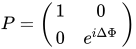, which means that if the photon is on the "upper" path it will gain a relative phase of Δ Φ {\\displaystyle \\Delta \\Phi } , and it will stay unchanged if it is in the lower path.
A photon that enters the interferometer from the left will then be acted upon with a beam splitter B {\\displaystyle B} , a phase shifter P {\\displaystyle P} , and another beam splitter B {\\displaystyle B} , and so end up in the state B P B ψ l \= i e i Δ Φ / 2 ( − sin ( Δ Φ / 2 ) cos ( Δ Φ / 2 ) ) , {\\displaystyle BPB\\psi \_{l}=ie^{i\\Delta \\Phi /2}{\\begin{pmatrix}-\\sin(\\Delta \\Phi /2)\\\\\\cos(\\Delta \\Phi /2)\\end{pmatrix}},}  and the probabilities that it will be detected at the right or at the top are given respectively by p ( u ) \= \| ⟨ ψ u , B P B ψ l ⟩ \| 2 \= cos 2 Δ Φ 2 , {\\displaystyle p(u)=\|\\langle \\psi \_{u},BPB\\psi \_{l}\\rangle \|^{2}=\\cos ^{2}{\\frac {\\Delta \\Phi }{2}},}  p ( l ) \= \| ⟨ ψ l , B P B ψ l ⟩ \| 2 \= sin 2 Δ Φ 2 . {\\displaystyle p(l)=\|\\langle \\psi \_{l},BPB\\psi \_{l}\\rangle \|^{2}=\\sin ^{2}{\\frac {\\Delta \\Phi }{2}}.}  One can therefore use the Mach–Zehnder interferometer to estimate the [phase shift](https://en.wikipedia.org/wiki/Phase_\(waves\) "Phase (waves)") by estimating these probabilities.
It is interesting to consider what would happen if the photon were definitely in either the "lower" or "upper" paths between the beam splitters. This can be accomplished by blocking one of the paths, or equivalently by removing the first beam splitter (and feeding the photon from the left or the bottom, as desired). In both cases, there will be no interference between the paths anymore, and the probabilities are given by p ( u ) \= p ( l ) \= 1 / 2 {\\displaystyle p(u)=p(l)=1/2} , independently of the phase Δ Φ {\\displaystyle \\Delta \\Phi } . From this we can conclude that the photon does not take one path or another after the first beam splitter, but rather that it is in a genuine quantum superposition of the two paths.[\[38\]](https://en.wikipedia.org/wiki/Quantum_mechanics#cite_note-vedral-39)
## Applications
Main article: [Applications of quantum mechanics](https://en.wikipedia.org/wiki/Applications_of_quantum_mechanics "Applications of quantum mechanics")
Quantum mechanics has had enormous success in explaining many of the features of our universe, with regard to small-scale and discrete quantities and interactions which cannot be explained by [classical methods](https://en.wikipedia.org/wiki/Classical_physics "Classical physics").[\[note 2\]](https://en.wikipedia.org/wiki/Quantum_mechanics#cite_note-feynmanIII-40) Quantum mechanics is often the only theory that can reveal the individual behaviors of the subatomic particles that make up all forms of matter (electrons, [protons](https://en.wikipedia.org/wiki/Proton "Proton"), [neutrons](https://en.wikipedia.org/wiki/Neutron "Neutron"), [photons](https://en.wikipedia.org/wiki/Photon "Photon"), and others). [Solid-state physics](https://en.wikipedia.org/wiki/Solid-state_physics "Solid-state physics") and [materials science](https://en.wikipedia.org/wiki/Materials_science "Materials science") are dependent upon quantum mechanics.[\[39\]](https://en.wikipedia.org/wiki/Quantum_mechanics#cite_note-marvincohen2008-41)
In many aspects, modern technology operates at a scale where quantum effects are significant. Important applications of quantum theory include [quantum chemistry](https://en.wikipedia.org/wiki/Quantum_chemistry "Quantum chemistry"), [quantum optics](https://en.wikipedia.org/wiki/Quantum_optics "Quantum optics"), [quantum computing](https://en.wikipedia.org/wiki/Quantum_computing "Quantum computing"), [superconducting magnets](https://en.wikipedia.org/wiki/Superconducting_magnet "Superconducting magnet"), [light-emitting diodes](https://en.wikipedia.org/wiki/Light-emitting_diode "Light-emitting diode"), the [optical amplifier](https://en.wikipedia.org/wiki/Optical_amplifier "Optical amplifier") and the laser, the [transistor](https://en.wikipedia.org/wiki/Transistor "Transistor") and [semiconductors](https://en.wikipedia.org/wiki/Semiconductor "Semiconductor") such as the [microprocessor](https://en.wikipedia.org/wiki/Microprocessor "Microprocessor"), [medical and research imaging](https://en.wikipedia.org/wiki/Medical_imaging "Medical imaging") such as [magnetic resonance imaging](https://en.wikipedia.org/wiki/Magnetic_resonance_imaging "Magnetic resonance imaging") and [electron microscopy](https://en.wikipedia.org/wiki/Electron_microscopy "Electron microscopy").[\[40\]](https://en.wikipedia.org/wiki/Quantum_mechanics#cite_note-42) Explanations for many biological and physical phenomena are rooted in the nature of the chemical bond, most notably the macro-molecule [DNA](https://en.wikipedia.org/wiki/DNA "DNA").
## Relation to other scientific theories
| [Modern physics](https://en.wikipedia.org/wiki/Modern_physics "Modern physics") |
|---|
| H ^ \| ψ n ( t ) ⟩ \= i ℏ d d t \| ψ n ( t ) ⟩ {\\displaystyle {\\hat {H}}\|\\psi \_{n}(t)\\rangle =i\\hbar {\\frac {d}{dt}}\|\\psi \_{n}(t)\\rangle } 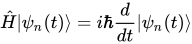 G μ ν \+ Λ g μ ν \= κ T μ ν {\\displaystyle G\_{\\mu \\nu }+\\Lambda g\_{\\mu \\nu }={\\kappa }T\_{\\mu \\nu }} [Schrödinger](https://en.wikipedia.org/wiki/Schr%C3%B6dinger_equation "Schrödinger equation") and [Einstein field equations](https://en.wikipedia.org/wiki/Einstein_field_equations "Einstein field equations") |
### Classical mechanics
The rules of quantum mechanics assert that the state space of a system is a Hilbert space and that observables of the system are Hermitian operators acting on vectors in that space – although they do not tell us which Hilbert space or which operators. These can be chosen appropriately in order to obtain a quantitative description of a quantum system, a necessary step in making physical predictions. An important guide for making these choices is the [correspondence principle](https://en.wikipedia.org/wiki/Correspondence_principle "Correspondence principle"), a heuristic which states that the predictions of quantum mechanics reduce to those of [classical mechanics](https://en.wikipedia.org/wiki/Classical_mechanics "Classical mechanics") in the regime of large [quantum numbers](https://en.wikipedia.org/wiki/Quantum_number "Quantum number").[\[41\]](https://en.wikipedia.org/wiki/Quantum_mechanics#cite_note-Tipler-43) One can also start from an established classical model of a particular system, and then try to guess the underlying quantum model that would give rise to the classical model in the correspondence limit. This approach is known as [quantization](https://en.wikipedia.org/wiki/Canonical_quantization "Canonical quantization").[\[42\]](https://en.wikipedia.org/wiki/Quantum_mechanics#cite_note-Peres1993-44): 299 [\[43\]](https://en.wikipedia.org/wiki/Quantum_mechanics#cite_note-45)
When quantum mechanics was originally formulated, it was applied to models whose correspondence limit was [non-relativistic](https://en.wikipedia.org/wiki/Theory_of_relativity "Theory of relativity") classical mechanics. For instance, the well-known model of the [quantum harmonic oscillator](https://en.wikipedia.org/wiki/Quantum_harmonic_oscillator "Quantum harmonic oscillator") uses an explicitly non-relativistic expression for the [kinetic energy](https://en.wikipedia.org/wiki/Kinetic_energy "Kinetic energy") of the oscillator, and is thus a quantum version of the [classical harmonic oscillator](https://en.wikipedia.org/wiki/Harmonic_oscillator "Harmonic oscillator").[\[7\]](https://en.wikipedia.org/wiki/Quantum_mechanics#cite_note-Zwiebach2022-7): 234
Complications arise with [chaotic systems](https://en.wikipedia.org/wiki/Chaotic_systems "Chaotic systems"), which do not have good quantum numbers, and [quantum chaos](https://en.wikipedia.org/wiki/Quantum_chaos "Quantum chaos") studies the relationship between classical and quantum descriptions in these systems.[\[42\]](https://en.wikipedia.org/wiki/Quantum_mechanics#cite_note-Peres1993-44): 353
[Quantum decoherence](https://en.wikipedia.org/wiki/Quantum_decoherence "Quantum decoherence") is a mechanism through which quantum systems lose [coherence](https://en.wikipedia.org/wiki/Quantum_coherence "Quantum coherence"), and thus become incapable of displaying many typically quantum effects: [quantum superpositions](https://en.wikipedia.org/wiki/Quantum_superposition "Quantum superposition") become simply probabilistic mixtures, and quantum entanglement becomes simply classical correlations.[\[7\]](https://en.wikipedia.org/wiki/Quantum_mechanics#cite_note-Zwiebach2022-7): 687–730 Quantum coherence is not typically evident at macroscopic scales, though at temperatures approaching [absolute zero](https://en.wikipedia.org/wiki/Absolute_zero "Absolute zero") quantum behavior may manifest macroscopically.[\[note 3\]](https://en.wikipedia.org/wiki/Quantum_mechanics#cite_note-46)
Many macroscopic properties of a classical system are a direct consequence of the quantum behavior of its parts. For example, the stability of bulk matter (consisting of atoms and [molecules](https://en.wikipedia.org/wiki/Molecule "Molecule") which would quickly collapse under electric forces alone), the rigidity of solids, and the mechanical, thermal, chemical, optical and magnetic properties of matter are all results of the interaction of [electric charges](https://en.wikipedia.org/wiki/Electric_charge "Electric charge") under the rules of quantum mechanics.[\[44\]](https://en.wikipedia.org/wiki/Quantum_mechanics#cite_note-47)
### Special relativity and electrodynamics
Early attempts to merge quantum mechanics with [special relativity](https://en.wikipedia.org/wiki/Special_relativity "Special relativity") involved the replacement of the Schrödinger equation with a covariant equation such as the [Klein–Gordon equation](https://en.wikipedia.org/wiki/Klein%E2%80%93Gordon_equation "Klein–Gordon equation") or the [Dirac equation](https://en.wikipedia.org/wiki/Dirac_equation "Dirac equation"). While these theories were successful in explaining many experimental results, they had certain unsatisfactory qualities stemming from their neglect of the relativistic creation and annihilation of particles. A fully relativistic quantum theory required the development of quantum field theory, which applies quantization to a field (rather than a fixed set of particles). The first complete quantum field theory, [quantum electrodynamics](https://en.wikipedia.org/wiki/Quantum_electrodynamics "Quantum electrodynamics"), provides a fully quantum description of the [electromagnetic interaction](https://en.wikipedia.org/wiki/Electromagnetic_interaction "Electromagnetic interaction"). Quantum electrodynamics is, along with [general relativity](https://en.wikipedia.org/wiki/General_relativity "General relativity"), one of the most accurate physical theories ever devised.[\[45\]](https://en.wikipedia.org/wiki/Quantum_mechanics#cite_note-48)[\[46\]](https://en.wikipedia.org/wiki/Quantum_mechanics#cite_note-49)
The full apparatus of quantum field theory is often unnecessary for describing electrodynamic systems. A simpler approach, one that has been used since the inception of quantum mechanics, is to treat [charged](https://en.wikipedia.org/wiki/Electric_charge "Electric charge") particles as quantum mechanical objects being acted on by a classical [electromagnetic field](https://en.wikipedia.org/wiki/Electromagnetic_field "Electromagnetic field"). For example, the elementary quantum model of the [hydrogen atom](https://en.wikipedia.org/wiki/Hydrogen_atom "Hydrogen atom") describes the [electric field](https://en.wikipedia.org/wiki/Electric_field "Electric field") of the hydrogen atom using a classical − e 2 / ( 4 π ϵ 0 r ) {\\displaystyle \\textstyle -e^{2}/(4\\pi \\epsilon \_{\_{0}}r)} 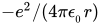 [Coulomb potential](https://en.wikipedia.org/wiki/Electric_potential "Electric potential").[\[7\]](https://en.wikipedia.org/wiki/Quantum_mechanics#cite_note-Zwiebach2022-7): 285 Likewise, in a [Stern–Gerlach experiment](https://en.wikipedia.org/wiki/Stern%E2%80%93Gerlach_experiment "Stern–Gerlach experiment"), a charged particle is modeled as a quantum system, while the background magnetic field is described classically.[\[42\]](https://en.wikipedia.org/wiki/Quantum_mechanics#cite_note-Peres1993-44): 26 This "semi-classical" approach fails if quantum fluctuations in the electromagnetic field play an important role, such as in the emission of photons by [charged particles](https://en.wikipedia.org/wiki/Charged_particle "Charged particle").
[Quantum field](https://en.wikipedia.org/wiki/Field_\(physics\) "Field (physics)") theories for the [strong nuclear force](https://en.wikipedia.org/wiki/Strong_nuclear_force "Strong nuclear force") and the [weak nuclear force](https://en.wikipedia.org/wiki/Weak_nuclear_force "Weak nuclear force") have also been developed. The quantum field theory of the strong nuclear force is called [quantum chromodynamics](https://en.wikipedia.org/wiki/Quantum_chromodynamics "Quantum chromodynamics"), and describes the interactions of subnuclear particles such as [quarks](https://en.wikipedia.org/wiki/Quark "Quark") and [gluons](https://en.wikipedia.org/wiki/Gluon "Gluon"). The weak nuclear force and the electromagnetic force were unified, in their quantized forms, into a single quantum field theory (known as [electroweak theory](https://en.wikipedia.org/wiki/Electroweak_theory "Electroweak theory")), by the physicists [Abdus Salam](https://en.wikipedia.org/wiki/Abdus_Salam "Abdus Salam"), [Sheldon Glashow](https://en.wikipedia.org/wiki/Sheldon_Glashow "Sheldon Glashow") and [Steven Weinberg](https://en.wikipedia.org/wiki/Steven_Weinberg "Steven Weinberg").[\[47\]](https://en.wikipedia.org/wiki/Quantum_mechanics#cite_note-50)
### Relation to general relativity
Even though the predictions of both quantum theory and general relativity have been supported by rigorous and repeated [empirical evidence](https://en.wikipedia.org/wiki/Empirical_evidence "Empirical evidence"), their abstract formalisms contradict each other and they have proven extremely difficult to incorporate into one consistent, cohesive model. Gravity is negligible in many areas of particle physics, so that unification between general relativity and quantum mechanics is not an urgent issue in those particular applications. However, the lack of a correct theory of [quantum gravity](https://en.wikipedia.org/wiki/Quantum_gravity "Quantum gravity") is an important issue in [physical cosmology](https://en.wikipedia.org/wiki/Physical_cosmology "Physical cosmology") and the search by physicists for an elegant "[Theory of Everything](https://en.wikipedia.org/wiki/Theory_of_Everything "Theory of Everything")" (TOE). Consequently, resolving the inconsistencies between both theories has been a major goal of 20th- and 21st-century physics. This TOE would combine not only the models of subatomic physics but also derive the four fundamental forces of nature from a single force or phenomenon.[\[48\]](https://en.wikipedia.org/wiki/Quantum_mechanics#cite_note-NYT-20221010-51)
One proposal for doing so is [string theory](https://en.wikipedia.org/wiki/String_theory "String theory"), which posits that the [point-like particles](https://en.wikipedia.org/wiki/Point_particle "Point particle") of [particle physics](https://en.wikipedia.org/wiki/Particle_physics "Particle physics") are replaced by [one-dimensional](https://en.wikipedia.org/wiki/Dimension_\(mathematics_and_physics\) "Dimension (mathematics and physics)") objects called [strings](https://en.wikipedia.org/wiki/String_\(physics\) "String (physics)"). String theory describes how these strings propagate through space and interact with each other. On distance scales larger than the string scale, a string looks just like an ordinary particle, with its [mass](https://en.wikipedia.org/wiki/Mass "Mass"), [charge](https://en.wikipedia.org/wiki/Charge_\(physics\) "Charge (physics)"), and other properties determined by the [vibrational](https://en.wikipedia.org/wiki/Vibration "Vibration") state of the string. In string theory, one of the many vibrational states of the string corresponds to the [graviton](https://en.wikipedia.org/wiki/Graviton "Graviton"), a quantum mechanical particle that carries gravitational force.[\[49\]](https://en.wikipedia.org/wiki/Quantum_mechanics#cite_note-52)[\[50\]](https://en.wikipedia.org/wiki/Quantum_mechanics#cite_note-53)
Another popular theory is [loop quantum gravity](https://en.wikipedia.org/wiki/Loop_quantum_gravity "Loop quantum gravity") (LQG), which describes quantum properties of gravity and is thus a theory of [quantum spacetime](https://en.wikipedia.org/wiki/Quantum_spacetime "Quantum spacetime"). LQG is an attempt to merge and adapt standard quantum mechanics and standard general relativity. This theory describes space as an extremely fine fabric "woven" of finite loops called [spin networks](https://en.wikipedia.org/wiki/Spin_network "Spin network"). The evolution of a spin network over time is called a [spin foam](https://en.wikipedia.org/wiki/Spin_foam "Spin foam"). The characteristic length scale of a spin foam is the [Planck length](https://en.wikipedia.org/wiki/Planck_length "Planck length"), approximately 1.616×10⁻³⁵ m, and so lengths shorter than the Planck length are not physically meaningful in LQG.[\[51\]](https://en.wikipedia.org/wiki/Quantum_mechanics#cite_note-54)
## Philosophical implications
Main article: [Interpretations of quantum mechanics](https://en.wikipedia.org/wiki/Interpretations_of_quantum_mechanics "Interpretations of quantum mechanics")
Unsolved problem in physics
Is there a preferred interpretation of quantum mechanics? How does the quantum description of reality, which includes elements such as the "[superposition](https://en.wikipedia.org/wiki/Superposition_principle "Superposition principle") of states" and "[wave function collapse](https://en.wikipedia.org/wiki/Wave_function_collapse "Wave function collapse")", give rise to the reality we perceive?
[More unsolved problems in physics](https://en.wikipedia.org/wiki/List_of_unsolved_problems_in_physics "List of unsolved problems in physics")
Since its inception, the many counter-intuitive aspects and results of quantum mechanics have provoked strong [philosophical](https://en.wikipedia.org/wiki/Philosophical "Philosophical") debates and many [interpretations](https://en.wikipedia.org/wiki/Interpretations_of_quantum_mechanics "Interpretations of quantum mechanics"). The arguments centre on the probabilistic nature of quantum mechanics, the difficulties with [wavefunction collapse](https://en.wikipedia.org/wiki/Wavefunction_collapse "Wavefunction collapse") and the related [measurement problem](https://en.wikipedia.org/wiki/Measurement_problem "Measurement problem"), and [quantum nonlocality](https://en.wikipedia.org/wiki/Quantum_nonlocality "Quantum nonlocality"). Perhaps the only consensus that exists about these issues is that there is no consensus. [Richard Feynman](https://en.wikipedia.org/wiki/Richard_Feynman "Richard Feynman") once said, "I think I can safely say that nobody understands quantum mechanics."[\[52\]](https://en.wikipedia.org/wiki/Quantum_mechanics#cite_note-55) According to [Steven Weinberg](https://en.wikipedia.org/wiki/Steven_Weinberg "Steven Weinberg"), "There is now in my opinion no entirely satisfactory interpretation of quantum mechanics."[\[53\]](https://en.wikipedia.org/wiki/Quantum_mechanics#cite_note-56)
The views of [Niels Bohr](https://en.wikipedia.org/wiki/Niels_Bohr "Niels Bohr"), Werner Heisenberg and other physicists are often grouped together as the "[Copenhagen interpretation](https://en.wikipedia.org/wiki/Copenhagen_interpretation "Copenhagen interpretation")".[\[54\]](https://en.wikipedia.org/wiki/Quantum_mechanics#cite_note-57)[\[55\]](https://en.wikipedia.org/wiki/Quantum_mechanics#cite_note-58) According to these views, the probabilistic nature of quantum mechanics is not a *temporary* feature which will eventually be replaced by a deterministic theory, but is instead a *final* renunciation of the classical idea of "causality". Bohr in particular emphasized that any well-defined application of the quantum mechanical formalism must always make reference to the experimental arrangement, due to the [complementary](https://en.wikipedia.org/wiki/Complementarity_\(physics\) "Complementarity (physics)") nature of evidence obtained under different experimental situations. Copenhagen-type interpretations were adopted by Nobel laureates in quantum physics, including Bohr,[\[56\]](https://en.wikipedia.org/wiki/Quantum_mechanics#cite_note-BohrComo-59) Heisenberg,[\[57\]](https://en.wikipedia.org/wiki/Quantum_mechanics#cite_note-60) Schrödinger,[\[58\]](https://en.wikipedia.org/wiki/Quantum_mechanics#cite_note-61) Feynman,[\[2\]](https://en.wikipedia.org/wiki/Quantum_mechanics#cite_note-Feynman-2) and [Zeilinger](https://en.wikipedia.org/wiki/Anton_Zeilinger "Anton Zeilinger")[\[59\]](https://en.wikipedia.org/wiki/Quantum_mechanics#cite_note-MaKoflerZeilinger-62) as well as 21st-century researchers in quantum foundations.[\[60\]](https://en.wikipedia.org/wiki/Quantum_mechanics#cite_note-:25-63)
[Albert Einstein](https://en.wikipedia.org/wiki/Albert_Einstein "Albert Einstein"), himself one of the founders of [quantum theory](https://en.wikipedia.org/wiki/Old_quantum_theory "Old quantum theory"), was troubled by its apparent failure to respect some cherished metaphysical principles, such as [determinism](https://en.wikipedia.org/wiki/Determinism "Determinism") and [locality](https://en.wikipedia.org/wiki/Principle_of_locality "Principle of locality"). Einstein's long-running exchanges with Bohr about the meaning and status of quantum mechanics are now known as the [Bohr–Einstein debates](https://en.wikipedia.org/wiki/Bohr%E2%80%93Einstein_debates "Bohr–Einstein debates"). Einstein believed that underlying quantum mechanics must be a theory that explicitly forbids [action at a distance](https://en.wikipedia.org/wiki/Action_at_a_distance "Action at a distance"). He argued that quantum mechanics was incomplete, a theory that was valid but not fundamental, analogous to how [thermodynamics](https://en.wikipedia.org/wiki/Thermodynamics "Thermodynamics") is valid, but the fundamental theory behind it is [statistical mechanics](https://en.wikipedia.org/wiki/Statistical_mechanics "Statistical mechanics"). In 1935, Einstein and his collaborators [Boris Podolsky](https://en.wikipedia.org/wiki/Boris_Podolsky "Boris Podolsky") and [Nathan Rosen](https://en.wikipedia.org/wiki/Nathan_Rosen "Nathan Rosen") published an argument that the principle of locality implies the incompleteness of quantum mechanics, a [thought experiment](https://en.wikipedia.org/wiki/Thought_experiment "Thought experiment") later termed the [Einstein–Podolsky–Rosen paradox](https://en.wikipedia.org/wiki/Einstein%E2%80%93Podolsky%E2%80%93Rosen_paradox "Einstein–Podolsky–Rosen paradox").[\[note 4\]](https://en.wikipedia.org/wiki/Quantum_mechanics#cite_note-68) In 1964, [John Bell](https://en.wikipedia.org/wiki/John_Stewart_Bell "John Stewart Bell") showed that EPR's principle of locality, together with determinism, was actually incompatible with quantum mechanics: they implied constraints on the correlations produced by distance systems, now known as [Bell inequalities](https://en.wikipedia.org/wiki/Bell_inequalities "Bell inequalities"), that can be violated by entangled particles.[\[65\]](https://en.wikipedia.org/wiki/Quantum_mechanics#cite_note-69) Since then [several experiments](https://en.wikipedia.org/wiki/Bell_test "Bell test") have been performed to obtain these correlations, with the result that they do in fact violate Bell inequalities, and thus falsify the conjunction of locality with determinism.[\[16\]](https://en.wikipedia.org/wiki/Quantum_mechanics#cite_note-wiseman15-16)[\[17\]](https://en.wikipedia.org/wiki/Quantum_mechanics#cite_note-wolchover17-17)
[Bohmian mechanics](https://en.wikipedia.org/wiki/Bohmian_mechanics "Bohmian mechanics") shows that it is possible to reformulate quantum mechanics to make it deterministic, at the price of making it explicitly nonlocal. It attributes not only a wave function to a physical system, but in addition a real position, that evolves deterministically under a nonlocal guiding equation. The evolution of a physical system is given at all times by the Schrödinger equation together with the guiding equation; there is never a collapse of the wave function. This solves the measurement problem.[\[66\]](https://en.wikipedia.org/wiki/Quantum_mechanics#cite_note-70)
[](https://en.wikipedia.org/wiki/File:Schroedingers_cat_film.svg)
The [Schrödinger's cat](https://en.wikipedia.org/wiki/Schr%C3%B6dinger%27s_cat "Schrödinger's cat") thought experiment can be used to visualize the many-worlds interpretation of quantum mechanics, where a branching of the universe occurs through a superposition of two quantum mechanical states.
Everett's [many-worlds interpretation](https://en.wikipedia.org/wiki/Many-worlds_interpretation "Many-worlds interpretation"), formulated in 1956, holds that *all* the possibilities described by quantum theory *simultaneously* occur in a multiverse composed of mostly independent parallel universes.[\[67\]](https://en.wikipedia.org/wiki/Quantum_mechanics#cite_note-71) This is a consequence of removing the axiom of the collapse of the wave packet. All possible states of the measured system and the measuring apparatus, together with the observer, are present in a real physical quantum superposition. While the multiverse is deterministic, we perceive non-deterministic behavior governed by probabilities, because we do not observe the multiverse as a whole, but only one parallel universe at a time. Exactly how this is supposed to work has been the subject of much debate. Several attempts have been made to make sense of this and derive the Born rule,[\[68\]](https://en.wikipedia.org/wiki/Quantum_mechanics#cite_note-dewitt73-72)[\[69\]](https://en.wikipedia.org/wiki/Quantum_mechanics#cite_note-wallace2003-73) with no consensus on whether they have been successful.[\[70\]](https://en.wikipedia.org/wiki/Quantum_mechanics#cite_note-ballentine1973-74)[\[71\]](https://en.wikipedia.org/wiki/Quantum_mechanics#cite_note-75)[\[72\]](https://en.wikipedia.org/wiki/Quantum_mechanics#cite_note-kent2009-76)
[Relational quantum mechanics](https://en.wikipedia.org/wiki/Relational_quantum_mechanics "Relational quantum mechanics") appeared in the late 1990s as a modern derivative of Copenhagen-type ideas,[\[73\]](https://en.wikipedia.org/wiki/Quantum_mechanics#cite_note-77)[\[74\]](https://en.wikipedia.org/wiki/Quantum_mechanics#cite_note-78) and [QBism](https://en.wikipedia.org/wiki/QBism "QBism") was developed some years later.[\[75\]](https://en.wikipedia.org/wiki/Quantum_mechanics#cite_note-:23-79)[\[76\]](https://en.wikipedia.org/wiki/Quantum_mechanics#cite_note-80)
## History
Main articles: [History of quantum mechanics](https://en.wikipedia.org/wiki/History_of_quantum_mechanics "History of quantum mechanics") and [Atomic theory](https://en.wikipedia.org/wiki/Atomic_theory "Atomic theory")
Quantum mechanics was developed in the early decades of the 20th century, driven by the need to explain phenomena that, in some cases, had been observed in earlier times. Scientific inquiry into the wave nature of light began in the 17th and 18th centuries, when scientists such as [Robert Hooke](https://en.wikipedia.org/wiki/Robert_Hooke "Robert Hooke"), [Christiaan Huygens](https://en.wikipedia.org/wiki/Christiaan_Huygens "Christiaan Huygens") and [Leonhard Euler](https://en.wikipedia.org/wiki/Leonhard_Euler "Leonhard Euler") proposed a wave theory of light based on experimental observations.[\[77\]](https://en.wikipedia.org/wiki/Quantum_mechanics#cite_note-Born_&_Wolf-81) In 1803 English [polymath](https://en.wikipedia.org/wiki/Polymath "Polymath") [Thomas Young](https://en.wikipedia.org/wiki/Thomas_Young_\(scientist\) "Thomas Young (scientist)") described the famous [double-slit experiment](https://en.wikipedia.org/wiki/Young%27s_interference_experiment "Young's interference experiment").[\[78\]](https://en.wikipedia.org/wiki/Quantum_mechanics#cite_note-82) This experiment played a major role in the general acceptance of the [wave theory of light](https://en.wikipedia.org/wiki/Wave_theory_of_light "Wave theory of light").
During the early 19th century, [chemical](https://en.wikipedia.org/wiki/Chemistry "Chemistry") research by [John Dalton](https://en.wikipedia.org/wiki/John_Dalton "John Dalton") and [Amedeo Avogadro](https://en.wikipedia.org/wiki/Amedeo_Avogadro "Amedeo Avogadro") lent weight to the [atomic theory](https://en.wikipedia.org/wiki/Atomic_theory "Atomic theory") of matter, an idea that [James Clerk Maxwell](https://en.wikipedia.org/wiki/James_Clerk_Maxwell "James Clerk Maxwell"), [Ludwig Boltzmann](https://en.wikipedia.org/wiki/Ludwig_Boltzmann "Ludwig Boltzmann") and others built upon to establish the [kinetic theory of gases](https://en.wikipedia.org/wiki/Kinetic_theory_of_gases "Kinetic theory of gases"). The successes of kinetic theory gave further credence to the idea that matter is composed of atoms, yet the theory also had shortcomings that would only be resolved by the development of quantum mechanics.[\[79\]](https://en.wikipedia.org/wiki/Quantum_mechanics#cite_note-Feynman-kinetic-theory-83) While the early conception of atoms from [Greek philosophy](https://en.wikipedia.org/wiki/Greek_philosophy "Greek philosophy") had been that they were indivisible units – the word "atom" deriving from the [Greek](https://en.wikipedia.org/wiki/Greek_language "Greek language") for 'uncuttable' – the 19th century saw the formulation of hypotheses about subatomic structure. One important discovery in that regard was [Michael Faraday](https://en.wikipedia.org/wiki/Michael_Faraday "Michael Faraday")'s 1838 observation of a glow caused by an electrical discharge inside a glass tube containing gas at low pressure. [Julius Plücker](https://en.wikipedia.org/wiki/Julius_Pl%C3%BCcker "Julius Plücker"), [Johann Wilhelm Hittorf](https://en.wikipedia.org/wiki/Johann_Wilhelm_Hittorf "Johann Wilhelm Hittorf") and [Eugen Goldstein](https://en.wikipedia.org/wiki/Eugen_Goldstein "Eugen Goldstein") carried on and improved upon Faraday's work, leading to the identification of [cathode rays](https://en.wikipedia.org/wiki/Cathode_rays "Cathode rays"), which [J. J. Thomson](https://en.wikipedia.org/wiki/J._J._Thomson "J. J. Thomson") found to consist of subatomic particles that would be called electrons.[\[80\]](https://en.wikipedia.org/wiki/Quantum_mechanics#cite_note-84)[\[81\]](https://en.wikipedia.org/wiki/Quantum_mechanics#cite_note-85)
[](https://en.wikipedia.org/wiki/File:Max_Planck_\(1858-1947\).jpg)
[Max Planck](https://en.wikipedia.org/wiki/Max_Planck "Max Planck") is considered the father of the quantum theory.
The [black-body radiation](https://en.wikipedia.org/wiki/Black-body_radiation "Black-body radiation") problem was discovered by [Gustav Kirchhoff](https://en.wikipedia.org/wiki/Gustav_Kirchhoff "Gustav Kirchhoff") in 1859. In 1900, Max Planck proposed the hypothesis that energy is radiated and absorbed in discrete "quanta" (or energy packets), yielding a calculation that precisely matched the observed patterns of black-body radiation.[\[82\]](https://en.wikipedia.org/wiki/Quantum_mechanics#cite_note-86) The word *quantum* derives from the [Latin](https://en.wikipedia.org/wiki/Latin "Latin"), meaning "how great" or "how much".[\[83\]](https://en.wikipedia.org/wiki/Quantum_mechanics#cite_note-87) According to Planck, quantities of energy could be thought of as divided into "elements" whose size (*E*) would be proportional to their [frequency](https://en.wikipedia.org/wiki/Frequency "Frequency") (*ν*): E \= h ν {\\displaystyle E=h\\nu \\ } , where *h* is the [Planck constant](https://en.wikipedia.org/wiki/Planck_constant "Planck constant"). Planck cautiously insisted that this was only an aspect of the processes of absorption and emission of radiation and was not the *physical reality* of the radiation.[\[84\]](https://en.wikipedia.org/wiki/Quantum_mechanics#cite_note-88) In fact, he considered his quantum hypothesis a mathematical trick to get the right answer rather than a sizable discovery.[\[85\]](https://en.wikipedia.org/wiki/Quantum_mechanics#cite_note-Kragh-89) However, in 1905 Albert Einstein interpreted Planck's quantum hypothesis [realistically](https://en.wikipedia.org/wiki/Local_realism "Local realism") and used it to explain the [photoelectric effect](https://en.wikipedia.org/wiki/Photoelectric_effect "Photoelectric effect"), in which shining light on certain materials can eject electrons from the material. Niels Bohr then developed Planck's ideas about radiation into a [model of the hydrogen atom](https://en.wikipedia.org/wiki/Bohr_model "Bohr model") that successfully predicted the [spectral lines](https://en.wikipedia.org/wiki/Spectral_line "Spectral line") of hydrogen.[\[86\]](https://en.wikipedia.org/wiki/Quantum_mechanics#cite_note-90) Einstein further developed this idea to show that an [electromagnetic wave](https://en.wikipedia.org/wiki/Electromagnetic_wave "Electromagnetic wave") such as light could also be described as a particle (later called the photon), with a discrete amount of energy that depends on its frequency.[\[87\]](https://en.wikipedia.org/wiki/Quantum_mechanics#cite_note-91) In his paper "On the Quantum Theory of Radiation", Einstein expanded on the interaction between energy and matter to explain the absorption and emission of energy by atoms. Although overshadowed at the time by his general theory of relativity, this paper articulated the mechanism underlying the stimulated emission of radiation,[\[88\]](https://en.wikipedia.org/wiki/Quantum_mechanics#cite_note-92) which became the basis of the laser.[\[89\]](https://en.wikipedia.org/wiki/Quantum_mechanics#cite_note-93)
[](https://en.wikipedia.org/wiki/File:Solvay_conference_1927.jpg)
The 1927 [Solvay Conference](https://en.wikipedia.org/wiki/Solvay_Conference "Solvay Conference") in [Brussels](https://en.wikipedia.org/wiki/Brussels "Brussels") was the fifth world physics conference.
This phase is known as the [old quantum theory](https://en.wikipedia.org/wiki/Old_quantum_theory "Old quantum theory"). Never complete or self-consistent, the old quantum theory was rather a set of [heuristic](https://en.wikipedia.org/wiki/Heuristic "Heuristic") corrections to classical mechanics.[\[90\]](https://en.wikipedia.org/wiki/Quantum_mechanics#cite_note-terHaar-94)[\[91\]](https://en.wikipedia.org/wiki/Quantum_mechanics#cite_note-95) The theory is now understood as a [semi-classical approximation](https://en.wikipedia.org/wiki/WKB_approximation#Application_to_the_Schr%C3%B6dinger_equation "WKB approximation") to modern quantum mechanics.[\[92\]](https://en.wikipedia.org/wiki/Quantum_mechanics#cite_note-96)[\[93\]](https://en.wikipedia.org/wiki/Quantum_mechanics#cite_note-97) Notable results from this period include, in addition to the work of Planck, Einstein and Bohr mentioned above, Einstein and [Peter Debye](https://en.wikipedia.org/wiki/Peter_Debye "Peter Debye")'s work on the [specific heat](https://en.wikipedia.org/wiki/Specific_heat "Specific heat") of solids, Bohr and [Hendrika Johanna van Leeuwen](https://en.wikipedia.org/wiki/Hendrika_Johanna_van_Leeuwen "Hendrika Johanna van Leeuwen")'s [proof](https://en.wikipedia.org/wiki/Bohr%E2%80%93Van_Leeuwen_theorem "Bohr–Van Leeuwen theorem") that classical physics cannot account for [diamagnetism](https://en.wikipedia.org/wiki/Diamagnetism "Diamagnetism"), and [Arnold Sommerfeld](https://en.wikipedia.org/wiki/Arnold_Sommerfeld "Arnold Sommerfeld")'s extension of the Bohr model to include special-relativistic effects.[\[90\]](https://en.wikipedia.org/wiki/Quantum_mechanics#cite_note-terHaar-94)[\[94\]](https://en.wikipedia.org/wiki/Quantum_mechanics#cite_note-Aharoni-98)
In the mid-1920s quantum mechanics was developed to become the standard formulation for atomic physics. In 1923, the French physicist [Louis de Broglie](https://en.wikipedia.org/wiki/Louis_de_Broglie "Louis de Broglie") put forward his theory of matter waves by stating that particles can exhibit wave characteristics and vice versa. Building on de Broglie's approach, modern quantum mechanics was born in 1925, when the German physicists Werner Heisenberg, Max Born, and [Pascual Jordan](https://en.wikipedia.org/wiki/Pascual_Jordan "Pascual Jordan")[\[95\]](https://en.wikipedia.org/wiki/Quantum_mechanics#cite_note-Edwards79-99)[\[96\]](https://en.wikipedia.org/wiki/Quantum_mechanics#cite_note-Edwards81-100) developed [matrix mechanics](https://en.wikipedia.org/wiki/Matrix_mechanics "Matrix mechanics") and the Austrian physicist Erwin Schrödinger invented [wave mechanics](https://en.wikipedia.org/wiki/Schr%C3%B6dinger_equation "Schrödinger equation"). Born introduced the probabilistic interpretation of Schrödinger's wave function in July 1926.[\[97\]](https://en.wikipedia.org/wiki/Quantum_mechanics#cite_note-101) Thus, the entire field of quantum physics emerged, leading to its wider acceptance at the Fifth [Solvay Conference](https://en.wikipedia.org/wiki/Solvay_Conference "Solvay Conference") in 1927.[\[98\]](https://en.wikipedia.org/wiki/Quantum_mechanics#cite_note-pais1997-102)
By 1930, quantum mechanics had been further unified and formalized by [David Hilbert](https://en.wikipedia.org/wiki/David_Hilbert "David Hilbert"), Paul Dirac and [John von Neumann](https://en.wikipedia.org/wiki/John_von_Neumann "John von Neumann")[\[99\]](https://en.wikipedia.org/wiki/Quantum_mechanics#cite_note-103) with greater emphasis on [measurement](https://en.wikipedia.org/wiki/Measurement_in_quantum_mechanics "Measurement in quantum mechanics"), the statistical nature of our knowledge of reality, and [philosophical speculation about the 'observer'](https://en.wikipedia.org/wiki/Interpretations_of_quantum_mechanics "Interpretations of quantum mechanics"). It has since permeated many disciplines, including quantum chemistry, [quantum electronics](https://en.wikipedia.org/wiki/Quantum_electronics "Quantum electronics"), [quantum optics](https://en.wikipedia.org/wiki/Quantum_optics "Quantum optics"), and [quantum information science](https://en.wikipedia.org/wiki/Quantum_information_science "Quantum information science"). It also provides a useful framework for many features of the modern [periodic table of elements](https://en.wikipedia.org/wiki/Periodic_table_of_elements "Periodic table of elements"), and describes the behaviors of [atoms](https://en.wikipedia.org/wiki/Atoms "Atoms") during [chemical bonding](https://en.wikipedia.org/wiki/Chemical_bond "Chemical bond") and the flow of electrons in computer [semiconductors](https://en.wikipedia.org/wiki/Semiconductor "Semiconductor"), and therefore plays a crucial role in many modern technologies. While quantum mechanics was constructed to describe the world of the very small, it is also needed to explain some [macroscopic](https://en.wikipedia.org/wiki/Macroscopic "Macroscopic") phenomena such as [superconductors](https://en.wikipedia.org/wiki/Superconductors "Superconductors")[\[100\]](https://en.wikipedia.org/wiki/Quantum_mechanics#cite_note-feynman2015-104) and [superfluids](https://en.wikipedia.org/wiki/Superfluid "Superfluid").[\[101\]](https://en.wikipedia.org/wiki/Quantum_mechanics#cite_note-105)
## See also
- [Bra–ket notation](https://en.wikipedia.org/wiki/Bra%E2%80%93ket_notation "Bra–ket notation")
- [Einstein's thought experiments](https://en.wikipedia.org/wiki/Einstein%27s_thought_experiments "Einstein's thought experiments")
- [List of textbooks on classical mechanics and quantum mechanics](https://en.wikipedia.org/wiki/List_of_textbooks_on_classical_mechanics_and_quantum_mechanics "List of textbooks on classical mechanics and quantum mechanics")
- [Macroscopic quantum phenomena](https://en.wikipedia.org/wiki/Macroscopic_quantum_phenomena "Macroscopic quantum phenomena")
- [Phase-space formulation](https://en.wikipedia.org/wiki/Phase-space_formulation "Phase-space formulation")
- [Regularization (physics)](https://en.wikipedia.org/wiki/Regularization_\(physics\) "Regularization (physics)")
- [Two-state quantum system](https://en.wikipedia.org/wiki/Two-state_quantum_system "Two-state quantum system")
## Explanatory notes
1. **[^](https://en.wikipedia.org/wiki/Quantum_mechanics#cite_ref-35)** A momentum eigenstate would be a perfectly monochromatic wave of infinite extent, which is not square-integrable. Likewise, a position eigenstate would be a [Dirac delta distribution](https://en.wikipedia.org/wiki/Dirac_delta_distribution "Dirac delta distribution"), not square-integrable and technically not a function at all. Consequently, neither can belong to the particle's Hilbert space. Physicists sometimes introduce fictitious "bases" for a Hilbert space comprising elements outside that space. These are invented for calculational convenience and do not represent physical states.[\[26\]](https://en.wikipedia.org/wiki/Quantum_mechanics#cite_note-Cohen-Tannoudji-26): 100–105
2. **[^](https://en.wikipedia.org/wiki/Quantum_mechanics#cite_ref-feynmanIII_40-0)** See, for example, [the Feynman Lectures on Physics](https://en.wikipedia.org/wiki/The_Feynman_Lectures_on_Physics "The Feynman Lectures on Physics") for some of the technological applications which use quantum mechanics, e.g., [transistors](https://en.wikipedia.org/wiki/Transistor "Transistor") (vol **III**, pp. 14–11 ff), [integrated circuits](https://en.wikipedia.org/wiki/Integrated_circuit "Integrated circuit"), which are follow-on technology in solid-state physics (vol **II**, pp. 8–6), and [lasers](https://en.wikipedia.org/wiki/Laser "Laser") (vol **III**, pp. 9–13).
3. **[^](https://en.wikipedia.org/wiki/Quantum_mechanics#cite_ref-46)** See *[Macroscopic quantum phenomena](https://en.wikipedia.org/wiki/Macroscopic_quantum_phenomena "Macroscopic quantum phenomena")*, *[Bose–Einstein condensate](https://en.wikipedia.org/wiki/Bose%E2%80%93Einstein_condensate "Bose–Einstein condensate")*, and *[Quantum machine](https://en.wikipedia.org/wiki/Quantum_machine "Quantum machine")*
4. **[^](https://en.wikipedia.org/wiki/Quantum_mechanics#cite_ref-68)** The published form of the EPR argument was due to Podolsky, and Einstein himself was not satisfied with it. In his own publications and correspondence, Einstein used a different argument to insist that quantum mechanics is an incomplete theory.[\[61\]](https://en.wikipedia.org/wiki/Quantum_mechanics#cite_note-spekkens-64)[\[62\]](https://en.wikipedia.org/wiki/Quantum_mechanics#cite_note-howard-65)[\[63\]](https://en.wikipedia.org/wiki/Quantum_mechanics#cite_note-66)[\[64\]](https://en.wikipedia.org/wiki/Quantum_mechanics#cite_note-67)
## References
1. **[^](https://en.wikipedia.org/wiki/Quantum_mechanics#cite_ref-Born1926_1-0)**
[Born, M.](https://en.wikipedia.org/wiki/Max_Born "Max Born") (1926). "Zur Quantenmechanik der Stoßvorgänge" \[On the Quantum Mechanics of Collision Processes\]. *Zeitschrift für Physik* (in German). **37** (12): 863–867\. [Bibcode](https://en.wikipedia.org/wiki/Bibcode_\(identifier\) "Bibcode (identifier)"):[1926ZPhy...37..863B](https://ui.adsabs.harvard.edu/abs/1926ZPhy...37..863B). [doi](https://en.wikipedia.org/wiki/Doi_\(identifier\) "Doi (identifier)"):[10\.1007/BF01397477](https://doi.org/10.1007%2FBF01397477). [ISSN](https://en.wikipedia.org/wiki/ISSN_\(identifier\) "ISSN (identifier)") [1434-6001](https://search.worldcat.org/issn/1434-6001). [S2CID](https://en.wikipedia.org/wiki/S2CID_\(identifier\) "S2CID (identifier)") [119896026](https://api.semanticscholar.org/CorpusID:119896026).
2. ^ [***a***](https://en.wikipedia.org/wiki/Quantum_mechanics#cite_ref-Feynman_2-0) [***b***](https://en.wikipedia.org/wiki/Quantum_mechanics#cite_ref-Feynman_2-1) [***c***](https://en.wikipedia.org/wiki/Quantum_mechanics#cite_ref-Feynman_2-2) [***d***](https://en.wikipedia.org/wiki/Quantum_mechanics#cite_ref-Feynman_2-3)
Feynman, Richard; Leighton, Robert; Sands, Matthew (1964). [*The Feynman Lectures on Physics*](https://feynmanlectures.caltech.edu/III_01.html). Vol. 3. California Institute of Technology. Retrieved 19 December 2020.
Reprinted, Addison-Wesley, 1989,
[ISBN](https://en.wikipedia.org/wiki/ISBN_\(identifier\) "ISBN (identifier)")
[978-0-201-50064-6](https://en.wikipedia.org/wiki/Special:BookSources/978-0-201-50064-6 "Special:BookSources/978-0-201-50064-6")
3. **[^](https://en.wikipedia.org/wiki/Quantum_mechanics#cite_ref-3)**
Jaeger, Gregg (September 2014). "What in the (quantum) world is macroscopic?". *American Journal of Physics*. **82** (9): 896–905\. [Bibcode](https://en.wikipedia.org/wiki/Bibcode_\(identifier\) "Bibcode (identifier)"):[2014AmJPh..82..896J](https://ui.adsabs.harvard.edu/abs/2014AmJPh..82..896J). [doi](https://en.wikipedia.org/wiki/Doi_\(identifier\) "Doi (identifier)"):[10\.1119/1.4878358](https://doi.org/10.1119%2F1.4878358).
4. **[^](https://en.wikipedia.org/wiki/Quantum_mechanics#cite_ref-4)**
Fein, Yaakov Y.; Geyer, Philipp; Zwick, Patrick; Kiałka, Filip; Pedalino, Sebastian; Mayor, Marcel; Gerlich, Stefan; Arndt, Markus (September 2019). "Quantum superposition of molecules beyond 25 kDa". *Nature Physics*. **15** (12): 1242–1245\. [Bibcode](https://en.wikipedia.org/wiki/Bibcode_\(identifier\) "Bibcode (identifier)"):[2019NatPh..15.1242F](https://ui.adsabs.harvard.edu/abs/2019NatPh..15.1242F). [doi](https://en.wikipedia.org/wiki/Doi_\(identifier\) "Doi (identifier)"):[10\.1038/s41567-019-0663-9](https://doi.org/10.1038%2Fs41567-019-0663-9). [S2CID](https://en.wikipedia.org/wiki/S2CID_\(identifier\) "S2CID (identifier)") [203638258](https://api.semanticscholar.org/CorpusID:203638258).
5. **[^](https://en.wikipedia.org/wiki/Quantum_mechanics#cite_ref-5)**
Bojowald, Martin (2015). "Quantum cosmology: a review". *Reports on Progress in Physics*. **78** (2) 023901. [arXiv](https://en.wikipedia.org/wiki/ArXiv_\(identifier\) "ArXiv (identifier)"):[1501\.04899](https://arxiv.org/abs/1501.04899). [Bibcode](https://en.wikipedia.org/wiki/Bibcode_\(identifier\) "Bibcode (identifier)"):[2015RPPh...78b3901B](https://ui.adsabs.harvard.edu/abs/2015RPPh...78b3901B). [doi](https://en.wikipedia.org/wiki/Doi_\(identifier\) "Doi (identifier)"):[10\.1088/0034-4885/78/2/023901](https://doi.org/10.1088%2F0034-4885%2F78%2F2%2F023901). [PMID](https://en.wikipedia.org/wiki/PMID_\(identifier\) "PMID (identifier)") [25582917](https://pubmed.ncbi.nlm.nih.gov/25582917). [S2CID](https://en.wikipedia.org/wiki/S2CID_\(identifier\) "S2CID (identifier)") [18463042](https://api.semanticscholar.org/CorpusID:18463042).
6. **[^](https://en.wikipedia.org/wiki/Quantum_mechanics#cite_ref-6)**
Fan, X.; Myers, T. G.; Sukra, B. A. D.; Gabrielse, G. (2023-02-13). "Measurement of the Electron Magnetic Moment". *Physical Review Letters*. **130** (7) 071801. [arXiv](https://en.wikipedia.org/wiki/ArXiv_\(identifier\) "ArXiv (identifier)"):[2209\.13084](https://arxiv.org/abs/2209.13084). [Bibcode](https://en.wikipedia.org/wiki/Bibcode_\(identifier\) "Bibcode (identifier)"):[2023PhRvL.130g1801F](https://ui.adsabs.harvard.edu/abs/2023PhRvL.130g1801F). [doi](https://en.wikipedia.org/wiki/Doi_\(identifier\) "Doi (identifier)"):[10\.1103/PhysRevLett.130.071801](https://doi.org/10.1103%2FPhysRevLett.130.071801). [PMID](https://en.wikipedia.org/wiki/PMID_\(identifier\) "PMID (identifier)") [36867820](https://pubmed.ncbi.nlm.nih.gov/36867820).
7. ^ [***a***](https://en.wikipedia.org/wiki/Quantum_mechanics#cite_ref-Zwiebach2022_7-0) [***b***](https://en.wikipedia.org/wiki/Quantum_mechanics#cite_ref-Zwiebach2022_7-1) [***c***](https://en.wikipedia.org/wiki/Quantum_mechanics#cite_ref-Zwiebach2022_7-2) [***d***](https://en.wikipedia.org/wiki/Quantum_mechanics#cite_ref-Zwiebach2022_7-3) [***e***](https://en.wikipedia.org/wiki/Quantum_mechanics#cite_ref-Zwiebach2022_7-4) [***f***](https://en.wikipedia.org/wiki/Quantum_mechanics#cite_ref-Zwiebach2022_7-5) [***g***](https://en.wikipedia.org/wiki/Quantum_mechanics#cite_ref-Zwiebach2022_7-6) [***h***](https://en.wikipedia.org/wiki/Quantum_mechanics#cite_ref-Zwiebach2022_7-7) [***i***](https://en.wikipedia.org/wiki/Quantum_mechanics#cite_ref-Zwiebach2022_7-8) [***j***](https://en.wikipedia.org/wiki/Quantum_mechanics#cite_ref-Zwiebach2022_7-9)
[Zwiebach, Barton](https://en.wikipedia.org/wiki/Barton_Zwiebach "Barton Zwiebach") (2022). *Mastering Quantum Mechanics: Essentials, Theory, and Applications*. MIT Press. [ISBN](https://en.wikipedia.org/wiki/ISBN_\(identifier\) "ISBN (identifier)")
[978-0-262-04613-8](https://en.wikipedia.org/wiki/Special:BookSources/978-0-262-04613-8 "Special:BookSources/978-0-262-04613-8")
.
8. ^ [***a***](https://en.wikipedia.org/wiki/Quantum_mechanics#cite_ref-Lederman_8-0) [***b***](https://en.wikipedia.org/wiki/Quantum_mechanics#cite_ref-Lederman_8-1) [***c***](https://en.wikipedia.org/wiki/Quantum_mechanics#cite_ref-Lederman_8-2)
Lederman, Leon M.; Hill, Christopher T. (2011). [*Quantum Physics for Poets*](https://books.google.com/books?id=qY_yOwHg_WYC&pg=PA102). US: Prometheus Books. [ISBN](https://en.wikipedia.org/wiki/ISBN_\(identifier\) "ISBN (identifier)")
[978-1-61614-281-0](https://en.wikipedia.org/wiki/Special:BookSources/978-1-61614-281-0 "Special:BookSources/978-1-61614-281-0")
.
9. **[^](https://en.wikipedia.org/wiki/Quantum_mechanics#cite_ref-M%C3%BCller-Kirsten_9-0)**
Müller-Kirsten, H. J. W. (2006). [*Introduction to Quantum Mechanics: Schrödinger Equation and Path Integral*](https://books.google.com/books?id=p1_Z81Le58MC&pg=PA14). US: World Scientific. p. 14. [ISBN](https://en.wikipedia.org/wiki/ISBN_\(identifier\) "ISBN (identifier)")
[978-981-256-691-1](https://en.wikipedia.org/wiki/Special:BookSources/978-981-256-691-1 "Special:BookSources/978-981-256-691-1")
.
10. **[^](https://en.wikipedia.org/wiki/Quantum_mechanics#cite_ref-Plotnitsky_10-0)**
Plotnitsky, Arkady (2012). [*Niels Bohr and Complementarity: An Introduction*](https://books.google.com/books?id=dmdUp97S4AYC&pg=PA75). US: Springer. pp. 75–76\. [ISBN](https://en.wikipedia.org/wiki/ISBN_\(identifier\) "ISBN (identifier)")
[978-1-4614-4517-3](https://en.wikipedia.org/wiki/Special:BookSources/978-1-4614-4517-3 "Special:BookSources/978-1-4614-4517-3")
.
11. **[^](https://en.wikipedia.org/wiki/Quantum_mechanics#cite_ref-11)**
[Griffiths, David J.](https://en.wikipedia.org/wiki/David_J._Griffiths "David J. Griffiths") (1995). [*Introduction to Quantum Mechanics*](https://en.wikipedia.org/wiki/Introduction_to_Quantum_Mechanics_\(book\) "Introduction to Quantum Mechanics (book)"). Prentice Hall. [ISBN](https://en.wikipedia.org/wiki/ISBN_\(identifier\) "ISBN (identifier)")
[0-13-124405-1](https://en.wikipedia.org/wiki/Special:BookSources/0-13-124405-1 "Special:BookSources/0-13-124405-1")
.
12. **[^](https://en.wikipedia.org/wiki/Quantum_mechanics#cite_ref-Trixler2013_12-0)**
Trixler, F. (2013). ["Quantum tunnelling to the origin and evolution of life"](https://www.ncbi.nlm.nih.gov/pmc/articles/PMC3768233). *Current Organic Chemistry*. **17** (16): 1758–1770\. [doi](https://en.wikipedia.org/wiki/Doi_\(identifier\) "Doi (identifier)"):[10\.2174/13852728113179990083](https://doi.org/10.2174%2F13852728113179990083). [PMC](https://en.wikipedia.org/wiki/PMC_\(identifier\) "PMC (identifier)") [3768233](https://www.ncbi.nlm.nih.gov/pmc/articles/PMC3768233). [PMID](https://en.wikipedia.org/wiki/PMID_\(identifier\) "PMID (identifier)") [24039543](https://pubmed.ncbi.nlm.nih.gov/24039543).
13. **[^](https://en.wikipedia.org/wiki/Quantum_mechanics#cite_ref-13)**
Phifer, Arnold (2012-03-27). ["Developing more energy-efficient transistors through quantum tunneling"](https://news.nd.edu/news/developing-more-energy-efficient-transistors-through-quantum-tunneling/). *Notre Dame News*. Retrieved 2024-06-07.
14. **[^](https://en.wikipedia.org/wiki/Quantum_mechanics#cite_ref-14)**
[Bub, Jeffrey](https://en.wikipedia.org/wiki/Jeffrey_Bub "Jeffrey Bub") (2019). ["Quantum entanglement"](https://plato.stanford.edu/entries/qt-entangle/). In Zalta, Edward N. (ed.). *Stanford Encyclopedia of Philosophy*. Metaphysics Research Lab, Stanford University.
15. ^ [***a***](https://en.wikipedia.org/wiki/Quantum_mechanics#cite_ref-Caves_15-0) [***b***](https://en.wikipedia.org/wiki/Quantum_mechanics#cite_ref-Caves_15-1)
[Caves, Carlton M.](https://en.wikipedia.org/wiki/Carlton_M._Caves "Carlton M. Caves") (2015). "Quantum Information Science: Emerging No More". In Kelley, Paul; Agrawal, Govind; Bass, Mike; Hecht, Jeff; Stroud, Carlos (eds.). *OSA Century of Optics*. [The Optical Society](https://en.wikipedia.org/wiki/The_Optical_Society "The Optical Society"). pp. 320–323\. [arXiv](https://en.wikipedia.org/wiki/ArXiv_\(identifier\) "ArXiv (identifier)"):[1302\.1864](https://arxiv.org/abs/1302.1864). [Bibcode](https://en.wikipedia.org/wiki/Bibcode_\(identifier\) "Bibcode (identifier)"):[2013arXiv1302.1864C](https://ui.adsabs.harvard.edu/abs/2013arXiv1302.1864C). [ISBN](https://en.wikipedia.org/wiki/ISBN_\(identifier\) "ISBN (identifier)")
[978-1-943580-04-0](https://en.wikipedia.org/wiki/Special:BookSources/978-1-943580-04-0 "Special:BookSources/978-1-943580-04-0")
.
16. ^ [***a***](https://en.wikipedia.org/wiki/Quantum_mechanics#cite_ref-wiseman15_16-0) [***b***](https://en.wikipedia.org/wiki/Quantum_mechanics#cite_ref-wiseman15_16-1)
[Wiseman, Howard](https://en.wikipedia.org/wiki/Howard_M._Wiseman "Howard M. Wiseman") (October 2015). ["Death by experiment for local realism"](https://doi.org/10.1038%2Fnature15631). *[Nature](https://en.wikipedia.org/wiki/Nature_\(journal\) "Nature (journal)")*. **526** (7575): 649–650\. [doi](https://en.wikipedia.org/wiki/Doi_\(identifier\) "Doi (identifier)"):[10\.1038/nature15631](https://doi.org/10.1038%2Fnature15631). [ISSN](https://en.wikipedia.org/wiki/ISSN_\(identifier\) "ISSN (identifier)") [0028-0836](https://search.worldcat.org/issn/0028-0836). [PMID](https://en.wikipedia.org/wiki/PMID_\(identifier\) "PMID (identifier)") [26503054](https://pubmed.ncbi.nlm.nih.gov/26503054).
17. ^ [***a***](https://en.wikipedia.org/wiki/Quantum_mechanics#cite_ref-wolchover17_17-0) [***b***](https://en.wikipedia.org/wiki/Quantum_mechanics#cite_ref-wolchover17_17-1)
[Wolchover, Natalie](https://en.wikipedia.org/wiki/Natalie_Wolchover "Natalie Wolchover") (7 February 2017). ["Experiment Reaffirms Quantum Weirdness"](https://www.quantamagazine.org/20170207-bell-test-quantum-loophole/). *[Quanta Magazine](https://en.wikipedia.org/wiki/Quanta_Magazine "Quanta Magazine")*. Retrieved 8 February 2020.
18. **[^](https://en.wikipedia.org/wiki/Quantum_mechanics#cite_ref-18)**
[Baez, John C.](https://en.wikipedia.org/wiki/John_C._Baez "John C. Baez") (20 March 2020). ["How to Learn Math and Physics"](https://math.ucr.edu/home/baez/books.html). *University of California, Riverside*. Retrieved 19 December 2020. "there's no way to understand the interpretation of quantum mechanics without also being able to *solve quantum mechanics problems* – to understand the theory, you need to be able to use it (and vice versa)"
19. **[^](https://en.wikipedia.org/wiki/Quantum_mechanics#cite_ref-19)**
[Sagan, Carl](https://en.wikipedia.org/wiki/Carl_Sagan "Carl Sagan") (1996). [*The Demon-Haunted World: Science as a Candle in the Dark*](https://en.wikipedia.org/wiki/The_Demon-Haunted_World "The Demon-Haunted World"). Ballantine Books. p. 249. [ISBN](https://en.wikipedia.org/wiki/ISBN_\(identifier\) "ISBN (identifier)")
[0-345-40946-9](https://en.wikipedia.org/wiki/Special:BookSources/0-345-40946-9 "Special:BookSources/0-345-40946-9")
. ""For most physics students, (the "mathematical underpinning" of quantum mechanics) might occupy them from, say, third grade to early graduate school – roughly 15 years. ... The job of the popularizer of science, trying to get across some idea of quantum mechanics to a general audience that has not gone through these initiation rites, is daunting. Indeed, there are no successful popularizations of quantum mechanics in my opinion – partly for this reason."
20. ^ [***a***](https://en.wikipedia.org/wiki/Quantum_mechanics#cite_ref-Holevo2001_20-0) [***b***](https://en.wikipedia.org/wiki/Quantum_mechanics#cite_ref-Holevo2001_20-1) [***c***](https://en.wikipedia.org/wiki/Quantum_mechanics#cite_ref-Holevo2001_20-2)
[Holevo, Alexander S.](https://en.wikipedia.org/wiki/Alexander_Holevo "Alexander Holevo") (2001). *Statistical Structure of Quantum Theory*. Lecture Notes in Physics. Springer. [ISBN](https://en.wikipedia.org/wiki/ISBN_\(identifier\) "ISBN (identifier)")
[3-540-42082-7](https://en.wikipedia.org/wiki/Special:BookSources/3-540-42082-7 "Special:BookSources/3-540-42082-7")
. [OCLC](https://en.wikipedia.org/wiki/OCLC_\(identifier\) "OCLC (identifier)") [318268606](https://search.worldcat.org/oclc/318268606).
21. **[^](https://en.wikipedia.org/wiki/Quantum_mechanics#cite_ref-21)**
Hall, Brian C. (2013). *Quantum Theory for Mathematicians*. [Graduate Texts in Mathematics](https://en.wikipedia.org/wiki/Graduate_Texts_in_Mathematics "Graduate Texts in Mathematics"). Vol. 267. Springer. p. 125. [ISBN](https://en.wikipedia.org/wiki/ISBN_\(identifier\) "ISBN (identifier)")
[978-1-4614-7115-8](https://en.wikipedia.org/wiki/Special:BookSources/978-1-4614-7115-8 "Special:BookSources/978-1-4614-7115-8")
.
22. **[^](https://en.wikipedia.org/wiki/Quantum_mechanics#cite_ref-22)**
Weinberg, Steven (2010). [*Dreams Of A Final Theory: The Search for The Fundamental Laws of Nature*](https://books.google.com/books?id=OLrZkgPsZR0C). Random House. p. [82](https://books.google.com/books?id=OLrZkgPsZR0C&pg=PT82). [ISBN](https://en.wikipedia.org/wiki/ISBN_\(identifier\) "ISBN (identifier)")
[978-1-4070-6396-6](https://en.wikipedia.org/wiki/Special:BookSources/978-1-4070-6396-6 "Special:BookSources/978-1-4070-6396-6")
.
23. **[^](https://en.wikipedia.org/wiki/Quantum_mechanics#cite_ref-23)**
Zhang, Ruiqin; Deng, Conghao (1993). "Exact solutions of the Schrödinger equation for some quantum-mechanical many-body systems". *Physical Review A*. **47** (1): 71–77\. [Bibcode](https://en.wikipedia.org/wiki/Bibcode_\(identifier\) "Bibcode (identifier)"):[1993PhRvA..47...71Z](https://ui.adsabs.harvard.edu/abs/1993PhRvA..47...71Z). [doi](https://en.wikipedia.org/wiki/Doi_\(identifier\) "Doi (identifier)"):[10\.1103/PhysRevA.47.71](https://doi.org/10.1103%2FPhysRevA.47.71). [ISSN](https://en.wikipedia.org/wiki/ISSN_\(identifier\) "ISSN (identifier)") [1050-2947](https://search.worldcat.org/issn/1050-2947). [PMID](https://en.wikipedia.org/wiki/PMID_\(identifier\) "PMID (identifier)") [9908895](https://pubmed.ncbi.nlm.nih.gov/9908895).
24. **[^](https://en.wikipedia.org/wiki/Quantum_mechanics#cite_ref-24)**
Li, Jing; Drummond, N. D.; Schuck, Peter; Olevano, Valerio (2019-04-01). ["Comparing many-body approaches against the helium atom exact solution"](https://doi.org/10.21468%2FSciPostPhys.6.4.040). *SciPost Physics*. **6** (4): 40. [arXiv](https://en.wikipedia.org/wiki/ArXiv_\(identifier\) "ArXiv (identifier)"):[1801\.09977](https://arxiv.org/abs/1801.09977). [Bibcode](https://en.wikipedia.org/wiki/Bibcode_\(identifier\) "Bibcode (identifier)"):[2019ScPP....6...40L](https://ui.adsabs.harvard.edu/abs/2019ScPP....6...40L). [doi](https://en.wikipedia.org/wiki/Doi_\(identifier\) "Doi (identifier)"):[10\.21468/SciPostPhys.6.4.040](https://doi.org/10.21468%2FSciPostPhys.6.4.040). [ISSN](https://en.wikipedia.org/wiki/ISSN_\(identifier\) "ISSN (identifier)") [2542-4653](https://search.worldcat.org/issn/2542-4653).
25. **[^](https://en.wikipedia.org/wiki/Quantum_mechanics#cite_ref-25)**
Drake, Gordon W. F. (2023). "High Precision Calculations for Helium". In Drake, Gordon W. F. (ed.). *Springer Handbook of Atomic, Molecular, and Optical Physics*. Springer Handbooks. Cham: Springer International Publishing. pp. 199–216\. [doi](https://en.wikipedia.org/wiki/Doi_\(identifier\) "Doi (identifier)"):[10\.1007/978-3-030-73893-8\_12](https://doi.org/10.1007%2F978-3-030-73893-8_12). [ISBN](https://en.wikipedia.org/wiki/ISBN_\(identifier\) "ISBN (identifier)")
[978-3-030-73892-1](https://en.wikipedia.org/wiki/Special:BookSources/978-3-030-73892-1 "Special:BookSources/978-3-030-73892-1")
.
26. ^ [***a***](https://en.wikipedia.org/wiki/Quantum_mechanics#cite_ref-Cohen-Tannoudji_26-0) [***b***](https://en.wikipedia.org/wiki/Quantum_mechanics#cite_ref-Cohen-Tannoudji_26-1) [***c***](https://en.wikipedia.org/wiki/Quantum_mechanics#cite_ref-Cohen-Tannoudji_26-2) [***d***](https://en.wikipedia.org/wiki/Quantum_mechanics#cite_ref-Cohen-Tannoudji_26-3)
[Cohen-Tannoudji, Claude](https://en.wikipedia.org/wiki/Claude_Cohen-Tannoudji "Claude Cohen-Tannoudji"); Diu, Bernard; Laloë, Franck (2005). *Quantum Mechanics*. Translated by Hemley, Susan Reid; Ostrowsky, Nicole; Ostrowsky, Dan. John Wiley & Sons. [ISBN](https://en.wikipedia.org/wiki/ISBN_\(identifier\) "ISBN (identifier)")
[0-471-16433-X](https://en.wikipedia.org/wiki/Special:BookSources/0-471-16433-X "Special:BookSources/0-471-16433-X")
.
27. **[^](https://en.wikipedia.org/wiki/Quantum_mechanics#cite_ref-L&L_27-0)**
[Landau, Lev D.](https://en.wikipedia.org/wiki/Lev_Landau "Lev Landau"); [Lifschitz, Evgeny M.](https://en.wikipedia.org/wiki/Evgeny_Lifshitz "Evgeny Lifshitz") (1977). [*Quantum Mechanics: Non-Relativistic Theory*](https://archive.org/details/QuantumMechanics_104). Vol. 3 (3rd ed.). [Pergamon Press](https://en.wikipedia.org/wiki/Pergamon_Press "Pergamon Press"). [ISBN](https://en.wikipedia.org/wiki/ISBN_\(identifier\) "ISBN (identifier)")
[978-0-08-020940-1](https://en.wikipedia.org/wiki/Special:BookSources/978-0-08-020940-1 "Special:BookSources/978-0-08-020940-1")
. [OCLC](https://en.wikipedia.org/wiki/OCLC_\(identifier\) "OCLC (identifier)") [2284121](https://search.worldcat.org/oclc/2284121).
28. **[^](https://en.wikipedia.org/wiki/Quantum_mechanics#cite_ref-ballentine1970_28-0)**
Section 3.2 of
Ballentine, Leslie E. (1970), "The Statistical Interpretation of Quantum Mechanics", *Reviews of Modern Physics*, **42** (4): 358–381, [Bibcode](https://en.wikipedia.org/wiki/Bibcode_\(identifier\) "Bibcode (identifier)"):[1970RvMP...42..358B](https://ui.adsabs.harvard.edu/abs/1970RvMP...42..358B), [doi](https://en.wikipedia.org/wiki/Doi_\(identifier\) "Doi (identifier)"):[10\.1103/RevModPhys.42.358](https://doi.org/10.1103%2FRevModPhys.42.358), [S2CID](https://en.wikipedia.org/wiki/S2CID_\(identifier\) "S2CID (identifier)") [120024263](https://api.semanticscholar.org/CorpusID:120024263)
. This fact is experimentally well-known for example in quantum optics; see e.g. chap. 2 and Fig. 2.1
Leonhardt, Ulf (1997), [*Measuring the Quantum State of Light*](https://archive.org/details/measuringquantum0000leon), Cambridge: Cambridge University Press, [Bibcode](https://en.wikipedia.org/wiki/Bibcode_\(identifier\) "Bibcode (identifier)"):[1997mqsl.book.....L](https://ui.adsabs.harvard.edu/abs/1997mqsl.book.....L), [ISBN](https://en.wikipedia.org/wiki/ISBN_\(identifier\) "ISBN (identifier)")
[0-521-49730-2](https://en.wikipedia.org/wiki/Special:BookSources/0-521-49730-2 "Special:BookSources/0-521-49730-2")
.
29. ^ [***a***](https://en.wikipedia.org/wiki/Quantum_mechanics#cite_ref-:0_29-0) [***b***](https://en.wikipedia.org/wiki/Quantum_mechanics#cite_ref-:0_29-1) [***c***](https://en.wikipedia.org/wiki/Quantum_mechanics#cite_ref-:0_29-2)
[Nielsen, Michael A.](https://en.wikipedia.org/wiki/Michael_Nielsen "Michael Nielsen"); [Chuang, Isaac L.](https://en.wikipedia.org/wiki/Isaac_Chuang "Isaac Chuang") (2010). *Quantum Computation and Quantum Information* (2nd ed.). Cambridge University Press. [ISBN](https://en.wikipedia.org/wiki/ISBN_\(identifier\) "ISBN (identifier)")
[978-1-107-00217-3](https://en.wikipedia.org/wiki/Special:BookSources/978-1-107-00217-3 "Special:BookSources/978-1-107-00217-3")
. [OCLC](https://en.wikipedia.org/wiki/OCLC_\(identifier\) "OCLC (identifier)") [844974180](https://search.worldcat.org/oclc/844974180).
30. ^ [***a***](https://en.wikipedia.org/wiki/Quantum_mechanics#cite_ref-:1_30-0) [***b***](https://en.wikipedia.org/wiki/Quantum_mechanics#cite_ref-:1_30-1)
[Rieffel, Eleanor G.](https://en.wikipedia.org/wiki/Eleanor_Rieffel "Eleanor Rieffel"); Polak, Wolfgang H. (2011). [*Quantum Computing: A Gentle Introduction*](https://en.wikipedia.org/wiki/Quantum_Computing:_A_Gentle_Introduction "Quantum Computing: A Gentle Introduction"). MIT Press. [ISBN](https://en.wikipedia.org/wiki/ISBN_\(identifier\) "ISBN (identifier)")
[978-0-262-01506-6](https://en.wikipedia.org/wiki/Special:BookSources/978-0-262-01506-6 "Special:BookSources/978-0-262-01506-6")
.
31. **[^](https://en.wikipedia.org/wiki/Quantum_mechanics#cite_ref-wilde_31-0)**
Wilde, Mark M. (2017). *Quantum Information Theory* (2nd ed.). Cambridge University Press. [arXiv](https://en.wikipedia.org/wiki/ArXiv_\(identifier\) "ArXiv (identifier)"):[1106\.1445](https://arxiv.org/abs/1106.1445). [doi](https://en.wikipedia.org/wiki/Doi_\(identifier\) "Doi (identifier)"):[10\.1017/9781316809976.001](https://doi.org/10.1017%2F9781316809976.001). [ISBN](https://en.wikipedia.org/wiki/ISBN_\(identifier\) "ISBN (identifier)")
[978-1-107-17616-4](https://en.wikipedia.org/wiki/Special:BookSources/978-1-107-17616-4 "Special:BookSources/978-1-107-17616-4")
. [OCLC](https://en.wikipedia.org/wiki/OCLC_\(identifier\) "OCLC (identifier)") [973404322](https://search.worldcat.org/oclc/973404322). [S2CID](https://en.wikipedia.org/wiki/S2CID_\(identifier\) "S2CID (identifier)") [2515538](https://api.semanticscholar.org/CorpusID:2515538).
32. **[^](https://en.wikipedia.org/wiki/Quantum_mechanics#cite_ref-32)**
Schlosshauer, Maximilian (October 2019). "Quantum decoherence". *Physics Reports*. **831**: 1–57\. [arXiv](https://en.wikipedia.org/wiki/ArXiv_\(identifier\) "ArXiv (identifier)"):[1911\.06282](https://arxiv.org/abs/1911.06282). [Bibcode](https://en.wikipedia.org/wiki/Bibcode_\(identifier\) "Bibcode (identifier)"):[2019PhR...831....1S](https://ui.adsabs.harvard.edu/abs/2019PhR...831....1S). [doi](https://en.wikipedia.org/wiki/Doi_\(identifier\) "Doi (identifier)"):[10\.1016/j.physrep.2019.10.001](https://doi.org/10.1016%2Fj.physrep.2019.10.001). [S2CID](https://en.wikipedia.org/wiki/S2CID_\(identifier\) "S2CID (identifier)") [208006050](https://api.semanticscholar.org/CorpusID:208006050).
33. **[^](https://en.wikipedia.org/wiki/Quantum_mechanics#cite_ref-33)**
[Rechenberg, Helmut](https://en.wikipedia.org/wiki/Helmut_Rechenberg "Helmut Rechenberg") (1987). ["Erwin Schrödinger and the creation of wave mechanics"](http://www.actaphys.uj.edu.pl/fulltext?series=Reg&vol=19&page=683) (PDF). *[Acta Physica Polonica B](https://en.wikipedia.org/wiki/Acta_Physica_Polonica_B "Acta Physica Polonica B")*. **19** (8): 683–695. Retrieved 13 June 2016.
34. **[^](https://en.wikipedia.org/wiki/Quantum_mechanics#cite_ref-34)**
Feynman, Richard P.; Hibbs, Albert R. (2005). Steyer, Daniel F. (ed.). *Quantum Mechanics and Path Integrals* (Emended ed.). McGraw-Hill. pp. v–vii. [ISBN](https://en.wikipedia.org/wiki/ISBN_\(identifier\) "ISBN (identifier)")
[978-0-486-47722-0](https://en.wikipedia.org/wiki/Special:BookSources/978-0-486-47722-0 "Special:BookSources/978-0-486-47722-0")
.
35. **[^](https://en.wikipedia.org/wiki/Quantum_mechanics#cite_ref-36)**
Mathews, Piravonu Mathews; Venkatesan, K. (1976). ["The Schrödinger Equation and Stationary States"](https://books.google.com/books?id=_qzs1DD3TcsC&pg=PA36). *A Textbook of Quantum Mechanics*. Tata McGraw-Hill. p. [36](https://books.google.com/books?id=_qzs1DD3TcsC&pg=PA36). [ISBN](https://en.wikipedia.org/wiki/ISBN_\(identifier\) "ISBN (identifier)")
[978-0-07-096510-2](https://en.wikipedia.org/wiki/Special:BookSources/978-0-07-096510-2 "Special:BookSources/978-0-07-096510-2")
.
36. **[^](https://en.wikipedia.org/wiki/Quantum_mechanics#cite_ref-Paris1999_37-0)**
Paris, M. G. A. (1999). "Entanglement and visibility at the output of a Mach–Zehnder interferometer". *[Physical Review A](https://en.wikipedia.org/wiki/Physical_Review_A "Physical Review A")*. **59** (2): 1615–1621\. [arXiv](https://en.wikipedia.org/wiki/ArXiv_\(identifier\) "ArXiv (identifier)"):[quant-ph/9811078](https://arxiv.org/abs/quant-ph/9811078). [Bibcode](https://en.wikipedia.org/wiki/Bibcode_\(identifier\) "Bibcode (identifier)"):[1999PhRvA..59.1615P](https://ui.adsabs.harvard.edu/abs/1999PhRvA..59.1615P). [doi](https://en.wikipedia.org/wiki/Doi_\(identifier\) "Doi (identifier)"):[10\.1103/PhysRevA.59.1615](https://doi.org/10.1103%2FPhysRevA.59.1615). [S2CID](https://en.wikipedia.org/wiki/S2CID_\(identifier\) "S2CID (identifier)") [13963928](https://api.semanticscholar.org/CorpusID:13963928).
37. **[^](https://en.wikipedia.org/wiki/Quantum_mechanics#cite_ref-Haack2010_38-0)**
Haack, G. R.; Förster, H.; Büttiker, M. (2010). "Parity detection and entanglement with a Mach-Zehnder interferometer". *[Physical Review B](https://en.wikipedia.org/wiki/Physical_Review_B "Physical Review B")*. **82** (15) 155303. [arXiv](https://en.wikipedia.org/wiki/ArXiv_\(identifier\) "ArXiv (identifier)"):[1005\.3976](https://arxiv.org/abs/1005.3976). [Bibcode](https://en.wikipedia.org/wiki/Bibcode_\(identifier\) "Bibcode (identifier)"):[2010PhRvB..82o5303H](https://ui.adsabs.harvard.edu/abs/2010PhRvB..82o5303H). [doi](https://en.wikipedia.org/wiki/Doi_\(identifier\) "Doi (identifier)"):[10\.1103/PhysRevB.82.155303](https://doi.org/10.1103%2FPhysRevB.82.155303). [S2CID](https://en.wikipedia.org/wiki/S2CID_\(identifier\) "S2CID (identifier)") [119261326](https://api.semanticscholar.org/CorpusID:119261326).
38. **[^](https://en.wikipedia.org/wiki/Quantum_mechanics#cite_ref-vedral_39-0)**
[Vedral, Vlatko](https://en.wikipedia.org/wiki/Vlatko_Vedral "Vlatko Vedral") (2006). *Introduction to Quantum Information Science*. Oxford University Press. [ISBN](https://en.wikipedia.org/wiki/ISBN_\(identifier\) "ISBN (identifier)")
[978-0-19-921570-6](https://en.wikipedia.org/wiki/Special:BookSources/978-0-19-921570-6 "Special:BookSources/978-0-19-921570-6")
. [OCLC](https://en.wikipedia.org/wiki/OCLC_\(identifier\) "OCLC (identifier)") [442351498](https://search.worldcat.org/oclc/442351498).
39. **[^](https://en.wikipedia.org/wiki/Quantum_mechanics#cite_ref-marvincohen2008_41-0)**
Cohen, Marvin L. (2008). ["Essay: Fifty Years of Condensed Matter Physics"](http://prl.aps.org/edannounce/PhysRevLett.101.250001). *Physical Review Letters*. **101** (25) 250001. [Bibcode](https://en.wikipedia.org/wiki/Bibcode_\(identifier\) "Bibcode (identifier)"):[2008PhRvL.101y0001C](https://ui.adsabs.harvard.edu/abs/2008PhRvL.101y0001C). [doi](https://en.wikipedia.org/wiki/Doi_\(identifier\) "Doi (identifier)"):[10\.1103/PhysRevLett.101.250001](https://doi.org/10.1103%2FPhysRevLett.101.250001). [PMID](https://en.wikipedia.org/wiki/PMID_\(identifier\) "PMID (identifier)") [19113681](https://pubmed.ncbi.nlm.nih.gov/19113681). Retrieved 31 March 2012.
40. **[^](https://en.wikipedia.org/wiki/Quantum_mechanics#cite_ref-42)**
Matson, John. ["What Is Quantum Mechanics Good for?"](http://www.scientificamerican.com/article/everyday-quantum-physics/). *Scientific American*. Retrieved 18 May 2016.
41. **[^](https://en.wikipedia.org/wiki/Quantum_mechanics#cite_ref-Tipler_43-0)**
Tipler, Paul; Llewellyn, Ralph (2008). *Modern Physics* (5th ed.). W. H. Freeman and Company. pp. 160–161\. [ISBN](https://en.wikipedia.org/wiki/ISBN_\(identifier\) "ISBN (identifier)")
[978-0-7167-7550-8](https://en.wikipedia.org/wiki/Special:BookSources/978-0-7167-7550-8 "Special:BookSources/978-0-7167-7550-8")
.
42. ^ [***a***](https://en.wikipedia.org/wiki/Quantum_mechanics#cite_ref-Peres1993_44-0) [***b***](https://en.wikipedia.org/wiki/Quantum_mechanics#cite_ref-Peres1993_44-1) [***c***](https://en.wikipedia.org/wiki/Quantum_mechanics#cite_ref-Peres1993_44-2)
[Peres, Asher](https://en.wikipedia.org/wiki/Asher_Peres "Asher Peres") (1993). [*Quantum Theory: Concepts and Methods*](https://en.wikipedia.org/wiki/Quantum_Theory:_Concepts_and_Methods "Quantum Theory: Concepts and Methods"). Kluwer. [ISBN](https://en.wikipedia.org/wiki/ISBN_\(identifier\) "ISBN (identifier)")
[0-7923-2549-4](https://en.wikipedia.org/wiki/Special:BookSources/0-7923-2549-4 "Special:BookSources/0-7923-2549-4")
.
43. **[^](https://en.wikipedia.org/wiki/Quantum_mechanics#cite_ref-45)**
[Baez, John C.](https://en.wikipedia.org/wiki/John_C._Baez "John C. Baez") (2019-02-26). ["The Math That Takes Newton Into the Quantum World"](https://nautil.us/the-math-that-takes-newton-into-the-quantum-world-237339/). *[Nautilus Quarterly](https://en.wikipedia.org/wiki/Nautilus_Quarterly "Nautilus Quarterly")*. Retrieved 2024-03-23.
44. **[^](https://en.wikipedia.org/wiki/Quantum_mechanics#cite_ref-47)**
["Atomic Properties"](http://academic.brooklyn.cuny.edu/physics/sobel/Nucphys/atomprop.html). Academic.brooklyn.cuny.edu. Retrieved 18 August 2012.
45. **[^](https://en.wikipedia.org/wiki/Quantum_mechanics#cite_ref-48)**
Hawking, Stephen; Penrose, Roger (2010). [*The Nature of Space and Time*](https://books.google.com/books?id=6a-agBFWuyQC&pg=PA61). Princeton University Press. [ISBN](https://en.wikipedia.org/wiki/ISBN_\(identifier\) "ISBN (identifier)")
[978-1-4008-3474-7](https://en.wikipedia.org/wiki/Special:BookSources/978-1-4008-3474-7 "Special:BookSources/978-1-4008-3474-7")
.
46. **[^](https://en.wikipedia.org/wiki/Quantum_mechanics#cite_ref-49)**
Aoyama, Tatsumi; Hayakawa, Masashi; Kinoshita, Toichiro; Nio, Makiko (2012). "Tenth-Order QED Contribution to the Electron g-2 and an Improved Value of the Fine Structure Constant". *[Physical Review Letters](https://en.wikipedia.org/wiki/Physical_Review_Letters "Physical Review Letters")*. **109** (11) 111807. [arXiv](https://en.wikipedia.org/wiki/ArXiv_\(identifier\) "ArXiv (identifier)"):[1205\.5368](https://arxiv.org/abs/1205.5368). [Bibcode](https://en.wikipedia.org/wiki/Bibcode_\(identifier\) "Bibcode (identifier)"):[2012PhRvL.109k1807A](https://ui.adsabs.harvard.edu/abs/2012PhRvL.109k1807A). [doi](https://en.wikipedia.org/wiki/Doi_\(identifier\) "Doi (identifier)"):[10\.1103/PhysRevLett.109.111807](https://doi.org/10.1103%2FPhysRevLett.109.111807). [PMID](https://en.wikipedia.org/wiki/PMID_\(identifier\) "PMID (identifier)") [23005618](https://pubmed.ncbi.nlm.nih.gov/23005618). [S2CID](https://en.wikipedia.org/wiki/S2CID_\(identifier\) "S2CID (identifier)") [14712017](https://api.semanticscholar.org/CorpusID:14712017).
47. **[^](https://en.wikipedia.org/wiki/Quantum_mechanics#cite_ref-50)**
["The Nobel Prize in Physics 1979"](http://nobelprize.org/nobel_prizes/physics/laureates/1979/index.html). Nobel Foundation. Retrieved 16 December 2020.
48. **[^](https://en.wikipedia.org/wiki/Quantum_mechanics#cite_ref-NYT-20221010_51-0)**
[Overbye, Dennis](https://en.wikipedia.org/wiki/Dennis_Overbye "Dennis Overbye") (10 October 2022). ["Black Holes May Hide a Mind-Bending Secret About Our Universe – Take gravity, add quantum mechanics, stir. What do you get? Just maybe, a holographic cosmos"](https://www.nytimes.com/2022/10/10/science/black-holes-cosmology-hologram.html). *[The New York Times](https://en.wikipedia.org/wiki/The_New_York_Times "The New York Times")*. Retrieved 10 October 2022.
49. **[^](https://en.wikipedia.org/wiki/Quantum_mechanics#cite_ref-52)**
Becker, Katrin; [Becker, Melanie](https://en.wikipedia.org/wiki/Melanie_Becker "Melanie Becker"); Schwarz, John (2007). *String theory and M-theory: A modern introduction*. Cambridge University Press. [ISBN](https://en.wikipedia.org/wiki/ISBN_\(identifier\) "ISBN (identifier)")
[978-0-521-86069-7](https://en.wikipedia.org/wiki/Special:BookSources/978-0-521-86069-7 "Special:BookSources/978-0-521-86069-7")
.
50. **[^](https://en.wikipedia.org/wiki/Quantum_mechanics#cite_ref-53)**
[Zwiebach, Barton](https://en.wikipedia.org/wiki/Barton_Zwiebach "Barton Zwiebach") (2009). *A First Course in String Theory*. Cambridge University Press. [ISBN](https://en.wikipedia.org/wiki/ISBN_\(identifier\) "ISBN (identifier)")
[978-0-521-88032-9](https://en.wikipedia.org/wiki/Special:BookSources/978-0-521-88032-9 "Special:BookSources/978-0-521-88032-9")
.
51. **[^](https://en.wikipedia.org/wiki/Quantum_mechanics#cite_ref-54)**
Rovelli, Carlo; Vidotto, Francesca (2014). [*Covariant Loop Quantum Gravity: An Elementary Introduction to Quantum Gravity and Spinfoam Theory*](https://books.google.com/books?id=w6z0BQAAQBAJ). Cambridge University Press. [ISBN](https://en.wikipedia.org/wiki/ISBN_\(identifier\) "ISBN (identifier)")
[978-1-316-14811-2](https://en.wikipedia.org/wiki/Special:BookSources/978-1-316-14811-2 "Special:BookSources/978-1-316-14811-2")
.
52. **[^](https://en.wikipedia.org/wiki/Quantum_mechanics#cite_ref-55)**
[Feynman, Richard](https://en.wikipedia.org/wiki/Richard_Feynman "Richard Feynman") (1967). [*The Character of Physical Law*](https://en.wikipedia.org/wiki/The_Character_of_Physical_Law "The Character of Physical Law"). MIT Press. p. 129. [ISBN](https://en.wikipedia.org/wiki/ISBN_\(identifier\) "ISBN (identifier)")
[0-262-56003-8](https://en.wikipedia.org/wiki/Special:BookSources/0-262-56003-8 "Special:BookSources/0-262-56003-8")
.
53. **[^](https://en.wikipedia.org/wiki/Quantum_mechanics#cite_ref-56)**
Weinberg, Steven (2012). "Collapse of the state vector". *Physical Review A*. **85** (6) 062116. [arXiv](https://en.wikipedia.org/wiki/ArXiv_\(identifier\) "ArXiv (identifier)"):[1109\.6462](https://arxiv.org/abs/1109.6462). [Bibcode](https://en.wikipedia.org/wiki/Bibcode_\(identifier\) "Bibcode (identifier)"):[2012PhRvA..85f2116W](https://ui.adsabs.harvard.edu/abs/2012PhRvA..85f2116W). [doi](https://en.wikipedia.org/wiki/Doi_\(identifier\) "Doi (identifier)"):[10\.1103/PhysRevA.85.062116](https://doi.org/10.1103%2FPhysRevA.85.062116). [S2CID](https://en.wikipedia.org/wiki/S2CID_\(identifier\) "S2CID (identifier)") [119273840](https://api.semanticscholar.org/CorpusID:119273840).
54. **[^](https://en.wikipedia.org/wiki/Quantum_mechanics#cite_ref-57)**
Howard, Don (December 2004). ["Who Invented the 'Copenhagen Interpretation'? A Study in Mythology"](https://www.journals.uchicago.edu/doi/10.1086/425941). *Philosophy of Science*. **71** (5): 669–682\. [doi](https://en.wikipedia.org/wiki/Doi_\(identifier\) "Doi (identifier)"):[10\.1086/425941](https://doi.org/10.1086%2F425941). [ISSN](https://en.wikipedia.org/wiki/ISSN_\(identifier\) "ISSN (identifier)") [0031-8248](https://search.worldcat.org/issn/0031-8248). [S2CID](https://en.wikipedia.org/wiki/S2CID_\(identifier\) "S2CID (identifier)") [9454552](https://api.semanticscholar.org/CorpusID:9454552).
55. **[^](https://en.wikipedia.org/wiki/Quantum_mechanics#cite_ref-58)**
Camilleri, Kristian (May 2009). ["Constructing the Myth of the Copenhagen Interpretation"](http://www.mitpressjournals.org/doi/10.1162/posc.2009.17.1.26). *Perspectives on Science*. **17** (1): 26–57\. [doi](https://en.wikipedia.org/wiki/Doi_\(identifier\) "Doi (identifier)"):[10\.1162/posc.2009.17.1.26](https://doi.org/10.1162%2Fposc.2009.17.1.26). [ISSN](https://en.wikipedia.org/wiki/ISSN_\(identifier\) "ISSN (identifier)") [1063-6145](https://search.worldcat.org/issn/1063-6145). [S2CID](https://en.wikipedia.org/wiki/S2CID_\(identifier\) "S2CID (identifier)") [57559199](https://api.semanticscholar.org/CorpusID:57559199).
56. **[^](https://en.wikipedia.org/wiki/Quantum_mechanics#cite_ref-BohrComo_59-0)**
[Bohr, Neils](https://en.wikipedia.org/wiki/Niels_Bohr "Niels Bohr") (1928). ["The Quantum Postulate and the Recent Development of Atomic Theory"](https://doi.org/10.1038%2F121580a0). *Nature*. **121** (3050): 580–590\. [Bibcode](https://en.wikipedia.org/wiki/Bibcode_\(identifier\) "Bibcode (identifier)"):[1928Natur.121..580B](https://ui.adsabs.harvard.edu/abs/1928Natur.121..580B). [doi](https://en.wikipedia.org/wiki/Doi_\(identifier\) "Doi (identifier)"):[10\.1038/121580a0](https://doi.org/10.1038%2F121580a0).
57. **[^](https://en.wikipedia.org/wiki/Quantum_mechanics#cite_ref-60)**
[Heisenberg, Werner](https://en.wikipedia.org/wiki/Werner_Heisenberg "Werner Heisenberg") (1971). *Physics and philosophy: the revolution in modern science*. World perspectives (3 ed.). London: Allen & Unwin. [ISBN](https://en.wikipedia.org/wiki/ISBN_\(identifier\) "ISBN (identifier)")
[978-0-04-530016-7](https://en.wikipedia.org/wiki/Special:BookSources/978-0-04-530016-7 "Special:BookSources/978-0-04-530016-7")
. [OCLC](https://en.wikipedia.org/wiki/OCLC_\(identifier\) "OCLC (identifier)") [743037461](https://search.worldcat.org/oclc/743037461).
58. **[^](https://en.wikipedia.org/wiki/Quantum_mechanics#cite_ref-61)**
Schrödinger, Erwin (1980) \[1935\]. Trimmer, John (ed.). "Die gegenwärtige Situation in der Quantenmechanik" \[The Present Situation in Quantum Mechanics\]. *Naturwissenschaften* (in German). **23** (50): 844–849\. [doi](https://en.wikipedia.org/wiki/Doi_\(identifier\) "Doi (identifier)"):[10\.1007/BF01491987](https://doi.org/10.1007%2FBF01491987). [JSTOR](https://en.wikipedia.org/wiki/JSTOR_\(identifier\) "JSTOR (identifier)") [986572](https://www.jstor.org/stable/986572). [S2CID](https://en.wikipedia.org/wiki/S2CID_\(identifier\) "S2CID (identifier)") [22433857](https://api.semanticscholar.org/CorpusID:22433857).
59. **[^](https://en.wikipedia.org/wiki/Quantum_mechanics#cite_ref-MaKoflerZeilinger_62-0)**
Ma, Xiao-song; Kofler, Johannes; Zeilinger, Anton (2016-03-03). "Delayed-choice gedanken experiments and their realizations". *Reviews of Modern Physics*. **88** (1) 015005. [arXiv](https://en.wikipedia.org/wiki/ArXiv_\(identifier\) "ArXiv (identifier)"):[1407\.2930](https://arxiv.org/abs/1407.2930). [Bibcode](https://en.wikipedia.org/wiki/Bibcode_\(identifier\) "Bibcode (identifier)"):[2016RvMP...88a5005M](https://ui.adsabs.harvard.edu/abs/2016RvMP...88a5005M). [doi](https://en.wikipedia.org/wiki/Doi_\(identifier\) "Doi (identifier)"):[10\.1103/RevModPhys.88.015005](https://doi.org/10.1103%2FRevModPhys.88.015005). [ISSN](https://en.wikipedia.org/wiki/ISSN_\(identifier\) "ISSN (identifier)") [0034-6861](https://search.worldcat.org/issn/0034-6861). [S2CID](https://en.wikipedia.org/wiki/S2CID_\(identifier\) "S2CID (identifier)") [34901303](https://api.semanticscholar.org/CorpusID:34901303).
60. **[^](https://en.wikipedia.org/wiki/Quantum_mechanics#cite_ref-:25_63-0)**
Schlosshauer, Maximilian; Kofler, Johannes; Zeilinger, Anton (1 August 2013). "A snapshot of foundational attitudes toward quantum mechanics". *Studies in History and Philosophy of Science Part B*. **44** (3): 222–230\. [arXiv](https://en.wikipedia.org/wiki/ArXiv_\(identifier\) "ArXiv (identifier)"):[1301\.1069](https://arxiv.org/abs/1301.1069). [Bibcode](https://en.wikipedia.org/wiki/Bibcode_\(identifier\) "Bibcode (identifier)"):[2013SHPMP..44..222S](https://ui.adsabs.harvard.edu/abs/2013SHPMP..44..222S). [doi](https://en.wikipedia.org/wiki/Doi_\(identifier\) "Doi (identifier)"):[10\.1016/j.shpsb.2013.04.004](https://doi.org/10.1016%2Fj.shpsb.2013.04.004). [S2CID](https://en.wikipedia.org/wiki/S2CID_\(identifier\) "S2CID (identifier)") [55537196](https://api.semanticscholar.org/CorpusID:55537196).
61. **[^](https://en.wikipedia.org/wiki/Quantum_mechanics#cite_ref-spekkens_64-0)**
Harrigan, Nicholas; [Spekkens, Robert W.](https://en.wikipedia.org/wiki/Robert_Spekkens "Robert Spekkens") (2010). "Einstein, incompleteness, and the epistemic view of quantum states". *[Foundations of Physics](https://en.wikipedia.org/wiki/Foundations_of_Physics "Foundations of Physics")*. **40** (2): 125. [arXiv](https://en.wikipedia.org/wiki/ArXiv_\(identifier\) "ArXiv (identifier)"):[0706\.2661](https://arxiv.org/abs/0706.2661). [Bibcode](https://en.wikipedia.org/wiki/Bibcode_\(identifier\) "Bibcode (identifier)"):[2010FoPh...40..125H](https://ui.adsabs.harvard.edu/abs/2010FoPh...40..125H). [doi](https://en.wikipedia.org/wiki/Doi_\(identifier\) "Doi (identifier)"):[10\.1007/s10701-009-9347-0](https://doi.org/10.1007%2Fs10701-009-9347-0). [S2CID](https://en.wikipedia.org/wiki/S2CID_\(identifier\) "S2CID (identifier)") [32755624](https://api.semanticscholar.org/CorpusID:32755624).
62. **[^](https://en.wikipedia.org/wiki/Quantum_mechanics#cite_ref-howard_65-0)**
Howard, D. (1985). "Einstein on locality and separability". *Studies in History and Philosophy of Science Part A*. **16** (3): 171–201\. [Bibcode](https://en.wikipedia.org/wiki/Bibcode_\(identifier\) "Bibcode (identifier)"):[1985SHPSA..16..171H](https://ui.adsabs.harvard.edu/abs/1985SHPSA..16..171H). [doi](https://en.wikipedia.org/wiki/Doi_\(identifier\) "Doi (identifier)"):[10\.1016/0039-3681(85)90001-9](https://doi.org/10.1016%2F0039-3681%2885%2990001-9).
63. **[^](https://en.wikipedia.org/wiki/Quantum_mechanics#cite_ref-66)**
[Sauer, Tilman](https://en.wikipedia.org/wiki/Tilman_Sauer "Tilman Sauer") (1 December 2007). ["An Einstein manuscript on the EPR paradox for spin observables"](http://philsci-archive.pitt.edu/3222/). *Studies in History and Philosophy of Science Part B: Studies in History and Philosophy of Modern Physics*. **38** (4): 879–887\. [Bibcode](https://en.wikipedia.org/wiki/Bibcode_\(identifier\) "Bibcode (identifier)"):[2007SHPMP..38..879S](https://ui.adsabs.harvard.edu/abs/2007SHPMP..38..879S). [CiteSeerX](https://en.wikipedia.org/wiki/CiteSeerX_\(identifier\) "CiteSeerX (identifier)") [10\.1.1.571.6089](https://citeseerx.ist.psu.edu/viewdoc/summary?doi=10.1.1.571.6089). [doi](https://en.wikipedia.org/wiki/Doi_\(identifier\) "Doi (identifier)"):[10\.1016/j.shpsb.2007.03.002](https://doi.org/10.1016%2Fj.shpsb.2007.03.002). [ISSN](https://en.wikipedia.org/wiki/ISSN_\(identifier\) "ISSN (identifier)") [1355-2198](https://search.worldcat.org/issn/1355-2198).
64. **[^](https://en.wikipedia.org/wiki/Quantum_mechanics#cite_ref-67)**
Einstein, Albert (1949). "Autobiographical Notes". In Schilpp, Paul Arthur (ed.). *Albert Einstein: Philosopher-Scientist*. Open Court Publishing Company.
65. **[^](https://en.wikipedia.org/wiki/Quantum_mechanics#cite_ref-69)**
[Bell, John Stewart](https://en.wikipedia.org/wiki/John_Stewart_Bell "John Stewart Bell") (1 November 1964). ["On the Einstein Podolsky Rosen paradox"](https://doi.org/10.1103%2FPhysicsPhysiqueFizika.1.195). *[Physics Physique Fizika](https://en.wikipedia.org/wiki/Physics_Physique_Fizika "Physics Physique Fizika")*. **1** (3): 195–200\. [Bibcode](https://en.wikipedia.org/wiki/Bibcode_\(identifier\) "Bibcode (identifier)"):[1964PhyNY...1..195B](https://ui.adsabs.harvard.edu/abs/1964PhyNY...1..195B). [doi](https://en.wikipedia.org/wiki/Doi_\(identifier\) "Doi (identifier)"):[10\.1103/PhysicsPhysiqueFizika.1.195](https://doi.org/10.1103%2FPhysicsPhysiqueFizika.1.195).
66. **[^](https://en.wikipedia.org/wiki/Quantum_mechanics#cite_ref-70)**
Goldstein, Sheldon (2017). ["Bohmian Mechanics"](https://plato.stanford.edu/entries/qm-bohm/). *Stanford Encyclopedia of Philosophy*. Metaphysics Research Lab, Stanford University.
67. **[^](https://en.wikipedia.org/wiki/Quantum_mechanics#cite_ref-71)**
Barrett, Jeffrey (2018). ["Everett's Relative-State Formulation of Quantum Mechanics"](https://plato.stanford.edu/entries/qm-everett/). In Zalta, Edward N. (ed.). *Stanford Encyclopedia of Philosophy*. Metaphysics Research Lab, Stanford University.
68. **[^](https://en.wikipedia.org/wiki/Quantum_mechanics#cite_ref-dewitt73_72-0)**
[Everett, Hugh](https://en.wikipedia.org/wiki/Hugh_Everett_III "Hugh Everett III"); [Wheeler, J. A.](https://en.wikipedia.org/wiki/John_Archibald_Wheeler "John Archibald Wheeler"); [DeWitt, B. S.](https://en.wikipedia.org/wiki/Bryce_DeWitt "Bryce DeWitt"); [Cooper, L. N.](https://en.wikipedia.org/wiki/Leon_Cooper "Leon Cooper"); Van Vechten, D.; Graham, N. (1973). [DeWitt, Bryce](https://en.wikipedia.org/wiki/Bryce_DeWitt "Bryce DeWitt"); Graham, R. Neill (eds.). *The Many-Worlds Interpretation of Quantum Mechanics*. Princeton Series in Physics. Princeton, NJ: [Princeton University Press](https://en.wikipedia.org/wiki/Princeton_University_Press "Princeton University Press"). p. v. [ISBN](https://en.wikipedia.org/wiki/ISBN_\(identifier\) "ISBN (identifier)")
[0-691-08131-X](https://en.wikipedia.org/wiki/Special:BookSources/0-691-08131-X "Special:BookSources/0-691-08131-X")
.
69. **[^](https://en.wikipedia.org/wiki/Quantum_mechanics#cite_ref-wallace2003_73-0)**
Wallace, David (2003). "Everettian Rationality: defending Deutsch's approach to probability in the Everett interpretation". *Stud. Hist. Phil. Mod. Phys*. **34** (3): 415–438\. [arXiv](https://en.wikipedia.org/wiki/ArXiv_\(identifier\) "ArXiv (identifier)"):[quant-ph/0303050](https://arxiv.org/abs/quant-ph/0303050). [Bibcode](https://en.wikipedia.org/wiki/Bibcode_\(identifier\) "Bibcode (identifier)"):[2003SHPMP..34..415W](https://ui.adsabs.harvard.edu/abs/2003SHPMP..34..415W). [doi](https://en.wikipedia.org/wiki/Doi_\(identifier\) "Doi (identifier)"):[10\.1016/S1355-2198(03)00036-4](https://doi.org/10.1016%2FS1355-2198%2803%2900036-4). [S2CID](https://en.wikipedia.org/wiki/S2CID_\(identifier\) "S2CID (identifier)") [1921913](https://api.semanticscholar.org/CorpusID:1921913).
70. **[^](https://en.wikipedia.org/wiki/Quantum_mechanics#cite_ref-ballentine1973_74-0)**
Ballentine, L. E. (1973). "Can the statistical postulate of quantum theory be derived? – A critique of the many-universes interpretation". *Foundations of Physics*. **3** (2): 229–240\. [Bibcode](https://en.wikipedia.org/wiki/Bibcode_\(identifier\) "Bibcode (identifier)"):[1973FoPh....3..229B](https://ui.adsabs.harvard.edu/abs/1973FoPh....3..229B). [doi](https://en.wikipedia.org/wiki/Doi_\(identifier\) "Doi (identifier)"):[10\.1007/BF00708440](https://doi.org/10.1007%2FBF00708440). [S2CID](https://en.wikipedia.org/wiki/S2CID_\(identifier\) "S2CID (identifier)") [121747282](https://api.semanticscholar.org/CorpusID:121747282).
71. **[^](https://en.wikipedia.org/wiki/Quantum_mechanics#cite_ref-75)**
Landsman, N. P. (2008). ["The Born rule and its interpretation"](https://www.math.ru.nl/~landsman/Born.pdf) (PDF). In Weinert, F.; Hentschel, K.; Greenberger, D.; Falkenburg, B. (eds.). *Compendium of Quantum Physics*. Springer. [ISBN](https://en.wikipedia.org/wiki/ISBN_\(identifier\) "ISBN (identifier)")
[978-3-540-70622-9](https://en.wikipedia.org/wiki/Special:BookSources/978-3-540-70622-9 "Special:BookSources/978-3-540-70622-9")
. "The conclusion seems to be that no generally accepted derivation of the Born rule has been given to date, but this does not imply that such a derivation is impossible in principle."
72. **[^](https://en.wikipedia.org/wiki/Quantum_mechanics#cite_ref-kent2009_76-0)**
[Kent, Adrian](https://en.wikipedia.org/wiki/Adrian_Kent "Adrian Kent") (2010). "One world versus many: The inadequacy of Everettian accounts of evolution, probability, and scientific confirmation". In S. Saunders; J. Barrett; A. Kent; D. Wallace (eds.). *Many Worlds? Everett, Quantum Theory and Reality*. Oxford University Press. [arXiv](https://en.wikipedia.org/wiki/ArXiv_\(identifier\) "ArXiv (identifier)"):[0905\.0624](https://arxiv.org/abs/0905.0624). [Bibcode](https://en.wikipedia.org/wiki/Bibcode_\(identifier\) "Bibcode (identifier)"):[2009arXiv0905.0624K](https://ui.adsabs.harvard.edu/abs/2009arXiv0905.0624K).
73. **[^](https://en.wikipedia.org/wiki/Quantum_mechanics#cite_ref-77)**
[Van Fraassen, Bas C.](https://en.wikipedia.org/wiki/Bas_van_Fraassen "Bas van Fraassen") (April 2010). ["Rovelli's World"](http://link.springer.com/10.1007/s10701-009-9326-5). *[Foundations of Physics](https://en.wikipedia.org/wiki/Foundations_of_Physics "Foundations of Physics")*. **40** (4): 390–417\. [Bibcode](https://en.wikipedia.org/wiki/Bibcode_\(identifier\) "Bibcode (identifier)"):[2010FoPh...40..390V](https://ui.adsabs.harvard.edu/abs/2010FoPh...40..390V). [doi](https://en.wikipedia.org/wiki/Doi_\(identifier\) "Doi (identifier)"):[10\.1007/s10701-009-9326-5](https://doi.org/10.1007%2Fs10701-009-9326-5). [ISSN](https://en.wikipedia.org/wiki/ISSN_\(identifier\) "ISSN (identifier)") [0015-9018](https://search.worldcat.org/issn/0015-9018). [S2CID](https://en.wikipedia.org/wiki/S2CID_\(identifier\) "S2CID (identifier)") [17217776](https://api.semanticscholar.org/CorpusID:17217776).
74. **[^](https://en.wikipedia.org/wiki/Quantum_mechanics#cite_ref-78)**
[Calosi, Claudio](https://en.wikipedia.org/wiki/Claudio_Calosi_\(philosopher\) "Claudio Calosi (philosopher)"); Riedel, Timotheus (2024). ["Relational Quantum Mechanics at the Crossroads"](https://doi.org/10.1007%2Fs10701-024-00810-5). *Foundations of Physics*. **54** (6): 74. [Bibcode](https://en.wikipedia.org/wiki/Bibcode_\(identifier\) "Bibcode (identifier)"):[2024FoPh...54...74C](https://ui.adsabs.harvard.edu/abs/2024FoPh...54...74C). [doi](https://en.wikipedia.org/wiki/Doi_\(identifier\) "Doi (identifier)"):[10\.1007/s10701-024-00810-5](https://doi.org/10.1007%2Fs10701-024-00810-5). [hdl](https://en.wikipedia.org/wiki/Hdl_\(identifier\) "Hdl (identifier)"):[10278/5097808](https://hdl.handle.net/10278%2F5097808).
75. **[^](https://en.wikipedia.org/wiki/Quantum_mechanics#cite_ref-:23_79-0)**
Healey, Richard (2016). ["Quantum-Bayesian and Pragmatist Views of Quantum Theory"](https://plato.stanford.edu/entries/quantum-bayesian/). In Zalta, Edward N. (ed.). *[Stanford Encyclopedia of Philosophy](https://en.wikipedia.org/wiki/Stanford_Encyclopedia_of_Philosophy "Stanford Encyclopedia of Philosophy")*. Metaphysics Research Lab, Stanford University.
76. **[^](https://en.wikipedia.org/wiki/Quantum_mechanics#cite_ref-80)**
Stacey, Blake C. (2023). "Toward a World Game-Flavored as a Hawk's Wing". In Berghofer, Philipp; Wiltsche, Harald A. (eds.). *Phenomenology and QBism: New Approaches to Quantum Mechanics*. Routledge. pp. 49–77\. [doi](https://en.wikipedia.org/wiki/Doi_\(identifier\) "Doi (identifier)"):[10\.4324/9781003259008-3](https://doi.org/10.4324%2F9781003259008-3). [ISBN](https://en.wikipedia.org/wiki/ISBN_\(identifier\) "ISBN (identifier)")
[978-1-032-19181-2](https://en.wikipedia.org/wiki/Special:BookSources/978-1-032-19181-2 "Special:BookSources/978-1-032-19181-2")
.
77. **[^](https://en.wikipedia.org/wiki/Quantum_mechanics#cite_ref-Born_&_Wolf_81-0)**
[Born, Max](https://en.wikipedia.org/wiki/Max_Born "Max Born"); [Wolf, Emil](https://en.wikipedia.org/wiki/Emil_Wolf "Emil Wolf") (1999). [*Principles of Optics*](https://en.wikipedia.org/wiki/Principles_of_Optics "Principles of Optics"). Cambridge University Press. [ISBN](https://en.wikipedia.org/wiki/ISBN_\(identifier\) "ISBN (identifier)")
[0-521-64222-1](https://en.wikipedia.org/wiki/Special:BookSources/0-521-64222-1 "Special:BookSources/0-521-64222-1")
. [OCLC](https://en.wikipedia.org/wiki/OCLC_\(identifier\) "OCLC (identifier)") [1151058062](https://search.worldcat.org/oclc/1151058062).
78. **[^](https://en.wikipedia.org/wiki/Quantum_mechanics#cite_ref-82)**
Scheider, Walter (April 1986). ["Bringing one of the great moments of science to the classroom"](http://www.cavendishscience.org/phys/tyoung/tyoung.htm). *[The Physics Teacher](https://en.wikipedia.org/wiki/The_Physics_Teacher "The Physics Teacher")*. **24** (4): 217–219\. [Bibcode](https://en.wikipedia.org/wiki/Bibcode_\(identifier\) "Bibcode (identifier)"):[1986PhTea..24..217S](https://ui.adsabs.harvard.edu/abs/1986PhTea..24..217S). [doi](https://en.wikipedia.org/wiki/Doi_\(identifier\) "Doi (identifier)"):[10\.1119/1.2341987](https://doi.org/10.1119%2F1.2341987). [ISSN](https://en.wikipedia.org/wiki/ISSN_\(identifier\) "ISSN (identifier)") [0031-921X](https://search.worldcat.org/issn/0031-921X).
79. **[^](https://en.wikipedia.org/wiki/Quantum_mechanics#cite_ref-Feynman-kinetic-theory_83-0)**
Feynman, Richard; Leighton, Robert; Sands, Matthew (1964). [*The Feynman Lectures on Physics*](https://feynmanlectures.caltech.edu/I_40.html). Vol. 1. California Institute of Technology. Retrieved 30 September 2021.
Reprinted, Addison-Wesley, 1989,
[ISBN](https://en.wikipedia.org/wiki/ISBN_\(identifier\) "ISBN (identifier)")
[978-0-201-50064-6](https://en.wikipedia.org/wiki/Special:BookSources/978-0-201-50064-6 "Special:BookSources/978-0-201-50064-6")
80. **[^](https://en.wikipedia.org/wiki/Quantum_mechanics#cite_ref-84)**
Martin, Andre (1986), "Cathode Ray Tubes for Industrial and Military Applications", in Hawkes, Peter (ed.), *Advances in Electronics and Electron Physics, Volume 67*, Academic Press, p. 183, [ISBN](https://en.wikipedia.org/wiki/ISBN_\(identifier\) "ISBN (identifier)")
[978-0-08-057733-3](https://en.wikipedia.org/wiki/Special:BookSources/978-0-08-057733-3 "Special:BookSources/978-0-08-057733-3")
, "Evidence for the existence of "cathode-rays" was first found by Plücker and Hittorf ..."
81. **[^](https://en.wikipedia.org/wiki/Quantum_mechanics#cite_ref-85)**
Dahl, Per F. (1997). [*Flash of the Cathode Rays: A History of J. J. Thomson's Electron*](https://books.google.com/books?id=xUzaWGocMdMC). CRC Press. pp. 47–57\. [ISBN](https://en.wikipedia.org/wiki/ISBN_\(identifier\) "ISBN (identifier)")
[978-0-7503-0453-5](https://en.wikipedia.org/wiki/Special:BookSources/978-0-7503-0453-5 "Special:BookSources/978-0-7503-0453-5")
.
82. **[^](https://en.wikipedia.org/wiki/Quantum_mechanics#cite_ref-86)**
[Mehra, J.](https://en.wikipedia.org/wiki/Jagdish_Mehra "Jagdish Mehra"); Rechenberg, H. (1982). *The Historical Development of Quantum Theory, Vol. 1: The Quantum Theory of Planck, Einstein, Bohr and Sommerfeld. Its Foundation and the Rise of Its Difficulties (1900–1925)*. New York: Springer-Verlag. [ISBN](https://en.wikipedia.org/wiki/ISBN_\(identifier\) "ISBN (identifier)")
[978-0-387-90642-3](https://en.wikipedia.org/wiki/Special:BookSources/978-0-387-90642-3 "Special:BookSources/978-0-387-90642-3")
.
83. **[^](https://en.wikipedia.org/wiki/Quantum_mechanics#cite_ref-87)**
["Quantum"](http://www.merriam-webster.com/dictionary/quantum). *Merriam-Webster Dictionary*. [Archived](https://web.archive.org/web/20121026104456/http://www.merriam-webster.com/dictionary/quantum) from the original on Oct 26, 2012. Retrieved 18 August 2012.
84. **[^](https://en.wikipedia.org/wiki/Quantum_mechanics#cite_ref-88)**
[Kuhn, T. S.](https://en.wikipedia.org/wiki/Thomas_Samuel_Kuhn "Thomas Samuel Kuhn") (1978). *Black-body theory and the quantum discontinuity 1894–1912*. Oxford: Clarendon Press. [ISBN](https://en.wikipedia.org/wiki/ISBN_\(identifier\) "ISBN (identifier)")
[978-0-19-502383-1](https://en.wikipedia.org/wiki/Special:BookSources/978-0-19-502383-1 "Special:BookSources/978-0-19-502383-1")
.
85. **[^](https://en.wikipedia.org/wiki/Quantum_mechanics#cite_ref-Kragh_89-0)**
[Kragh, Helge](https://en.wikipedia.org/wiki/Helge_Kragh "Helge Kragh") (1 December 2000). ["Max Planck: the reluctant revolutionary"](https://physicsworld.com/a/max-planck-the-reluctant-revolutionary/). *[Physics World](https://en.wikipedia.org/wiki/Physics_World "Physics World")*. Retrieved 12 December 2020.
86. **[^](https://en.wikipedia.org/wiki/Quantum_mechanics#cite_ref-90)**
[Stachel, John](https://en.wikipedia.org/wiki/John_Stachel "John Stachel") (2009). "Bohr and the Photon". *Quantum Reality, Relativistic Causality, and Closing the Epistemic Circle*. The Western Ontario Series in Philosophy of Science. Vol. 73. Dordrecht: Springer. pp. 69–83\. [doi](https://en.wikipedia.org/wiki/Doi_\(identifier\) "Doi (identifier)"):[10\.1007/978-1-4020-9107-0\_5](https://doi.org/10.1007%2F978-1-4020-9107-0_5). [ISBN](https://en.wikipedia.org/wiki/ISBN_\(identifier\) "ISBN (identifier)")
[978-1-4020-9106-3](https://en.wikipedia.org/wiki/Special:BookSources/978-1-4020-9106-3 "Special:BookSources/978-1-4020-9106-3")
.
87. **[^](https://en.wikipedia.org/wiki/Quantum_mechanics#cite_ref-91)**
Einstein, Albert (1905). ["Über einen die Erzeugung und Verwandlung des Lichtes betreffenden heuristischen Gesichtspunkt"](https://doi.org/10.1002%2Fandp.19053220607) \[On a heuristic point of view concerning the production and transformation of light\]. *[Annalen der Physik](https://en.wikipedia.org/wiki/Annalen_der_Physik "Annalen der Physik")* (in German). **17** (6): 132–148\. [Bibcode](https://en.wikipedia.org/wiki/Bibcode_\(identifier\) "Bibcode (identifier)"):[1905AnP...322..132E](https://ui.adsabs.harvard.edu/abs/1905AnP...322..132E). [doi](https://en.wikipedia.org/wiki/Doi_\(identifier\) "Doi (identifier)"):[10\.1002/andp.19053220607](https://doi.org/10.1002%2Fandp.19053220607).
Reprinted in
[Stachel, John](https://en.wikipedia.org/wiki/John_Stachel "John Stachel"), ed. (1989). *The Collected Papers of Albert Einstein* (in German). Vol. 2. Princeton University Press. pp. 149–166\.
See also "Einstein's early work on the quantum hypothesis", ibid. pp. 134–148.
88. **[^](https://en.wikipedia.org/wiki/Quantum_mechanics#cite_ref-92)**
[Einstein, Albert](https://en.wikipedia.org/wiki/Albert_Einstein "Albert Einstein") (1917). "Zur Quantentheorie der Strahlung" \[On the Quantum Theory of Radiation\]. *[Physikalische Zeitschrift](https://en.wikipedia.org/wiki/Physikalische_Zeitschrift "Physikalische Zeitschrift")* (in German). **18**: 121–128\. [Bibcode](https://en.wikipedia.org/wiki/Bibcode_\(identifier\) "Bibcode (identifier)"):[1917PhyZ...18..121E](https://ui.adsabs.harvard.edu/abs/1917PhyZ...18..121E).
Translated in
Einstein, A. (1967). "On the Quantum Theory of Radiation". *The Old Quantum Theory*. Elsevier. pp. 167–183\. [doi](https://en.wikipedia.org/wiki/Doi_\(identifier\) "Doi (identifier)"):[10\.1016/b978-0-08-012102-4.50018-8](https://doi.org/10.1016%2Fb978-0-08-012102-4.50018-8). [ISBN](https://en.wikipedia.org/wiki/ISBN_\(identifier\) "ISBN (identifier)")
[978-0-08-012102-4](https://en.wikipedia.org/wiki/Special:BookSources/978-0-08-012102-4 "Special:BookSources/978-0-08-012102-4")
.
89. **[^](https://en.wikipedia.org/wiki/Quantum_mechanics#cite_ref-93)**
[Ball, Philip](https://en.wikipedia.org/wiki/Philip_Ball "Philip Ball") (2017-08-31). ["A century ago Einstein sparked the notion of the laser"](https://physicsworld.com/a/a-century-ago-einstein-sparked-the-notion-of-the-laser/). *[Physics World](https://en.wikipedia.org/wiki/Physics_World "Physics World")*. Retrieved 2024-03-23.
90. ^ [***a***](https://en.wikipedia.org/wiki/Quantum_mechanics#cite_ref-terHaar_94-0) [***b***](https://en.wikipedia.org/wiki/Quantum_mechanics#cite_ref-terHaar_94-1)
ter Haar, D. (1967). [*The Old Quantum Theory*](https://archive.org/details/oldquantumtheory0000haar). Pergamon Press. pp. 3–75\. [ISBN](https://en.wikipedia.org/wiki/ISBN_\(identifier\) "ISBN (identifier)")
[978-0-08-012101-7](https://en.wikipedia.org/wiki/Special:BookSources/978-0-08-012101-7 "Special:BookSources/978-0-08-012101-7")
. [LCCN](https://en.wikipedia.org/wiki/LCCN_\(identifier\) "LCCN (identifier)") [66-29628](https://lccn.loc.gov/66-29628).
91. **[^](https://en.wikipedia.org/wiki/Quantum_mechanics#cite_ref-95)**
Bokulich, Alisa; Bokulich, Peter (2020-08-13). ["Bohr's Correspondence Principle"](https://plato.stanford.edu/entries/bohr-correspondence/). In [Zalta, Edward N.](https://en.wikipedia.org/wiki/Edward_N._Zalta "Edward N. Zalta") (ed.). *[Stanford Encyclopedia of Philosophy](https://en.wikipedia.org/wiki/Stanford_Encyclopedia_of_Philosophy "Stanford Encyclopedia of Philosophy")*. [ISSN](https://en.wikipedia.org/wiki/ISSN_\(identifier\) "ISSN (identifier)") [1095-5054](https://search.worldcat.org/issn/1095-5054). [OCLC](https://en.wikipedia.org/wiki/OCLC_\(identifier\) "OCLC (identifier)") [429049174](https://search.worldcat.org/oclc/429049174).
92. **[^](https://en.wikipedia.org/wiki/Quantum_mechanics#cite_ref-96)**
["Semi-classical approximation"](https://web.archive.org/web/20221007190530/https://encyclopediaofmath.org/index.php?title=Semi-classical_approximation). *Encyclopedia of Mathematics*. Archived from [the original](https://www.encyclopediaofmath.org/index.php?title=Semi-classical_approximation) on 7 October 2022. Retrieved 1 February 2020.
93. **[^](https://en.wikipedia.org/wiki/Quantum_mechanics#cite_ref-97)**
[Sakurai, J. J.](https://en.wikipedia.org/wiki/J._J._Sakurai "J. J. Sakurai"); Napolitano, J. (2014). "Quantum Dynamics". [*Modern Quantum Mechanics*](https://en.wikipedia.org/wiki/Modern_Quantum_Mechanics "Modern Quantum Mechanics"). Pearson. [ISBN](https://en.wikipedia.org/wiki/ISBN_\(identifier\) "ISBN (identifier)")
[978-1-292-02410-3](https://en.wikipedia.org/wiki/Special:BookSources/978-1-292-02410-3 "Special:BookSources/978-1-292-02410-3")
. [OCLC](https://en.wikipedia.org/wiki/OCLC_\(identifier\) "OCLC (identifier)") [929609283](https://search.worldcat.org/oclc/929609283).
94. **[^](https://en.wikipedia.org/wiki/Quantum_mechanics#cite_ref-Aharoni_98-0)**
[Aharoni, Amikam](https://en.wikipedia.org/wiki/Amikam_Aharoni "Amikam Aharoni") (1996). [*Introduction to the Theory of Ferromagnetism*](https://archive.org/details/introductiontoth00ahar/page/6). [Clarendon Press](https://en.wikipedia.org/wiki/Clarendon_Press "Clarendon Press"). pp. [6–7](https://archive.org/details/introductiontoth00ahar/page/6). [ISBN](https://en.wikipedia.org/wiki/ISBN_\(identifier\) "ISBN (identifier)")
[0-19-851791-2](https://en.wikipedia.org/wiki/Special:BookSources/0-19-851791-2 "Special:BookSources/0-19-851791-2")
.
95. **[^](https://en.wikipedia.org/wiki/Quantum_mechanics#cite_ref-Edwards79_99-0)** David Edwards, "The Mathematical Foundations of Quantum Mechanics", *Synthese*, Volume 42, Number 1/September, 1979, pp. 1–70.
96. **[^](https://en.wikipedia.org/wiki/Quantum_mechanics#cite_ref-Edwards81_100-0)** David Edwards, "The Mathematical Foundations of Quantum Field Theory: Fermions, Gauge Fields, and Super-symmetry, Part I: Lattice Field Theories", *International Journal of Theoretical Physics*, Vol. 20, No. 7 (1981).
97. **[^](https://en.wikipedia.org/wiki/Quantum_mechanics#cite_ref-101)**
[Bernstein, Jeremy](https://en.wikipedia.org/wiki/Jeremy_Bernstein "Jeremy Bernstein") (November 2005). ["Max Born and the quantum theory"](https://doi.org/10.1119%2F1.2060717). *[American Journal of Physics](https://en.wikipedia.org/wiki/American_Journal_of_Physics "American Journal of Physics")*. **73** (11): 999–1008\. [Bibcode](https://en.wikipedia.org/wiki/Bibcode_\(identifier\) "Bibcode (identifier)"):[2005AmJPh..73..999B](https://ui.adsabs.harvard.edu/abs/2005AmJPh..73..999B). [doi](https://en.wikipedia.org/wiki/Doi_\(identifier\) "Doi (identifier)"):[10\.1119/1.2060717](https://doi.org/10.1119%2F1.2060717). [ISSN](https://en.wikipedia.org/wiki/ISSN_\(identifier\) "ISSN (identifier)") [0002-9505](https://search.worldcat.org/issn/0002-9505).
98. **[^](https://en.wikipedia.org/wiki/Quantum_mechanics#cite_ref-pais1997_102-0)**
[Pais, Abraham](https://en.wikipedia.org/wiki/Abraham_Pais "Abraham Pais") (1997). [*A Tale of Two Continents: A Physicist's Life in a Turbulent World*](https://archive.org/details/taleoftwocontine00pais). Princeton, New Jersey: Princeton University Press. [ISBN](https://en.wikipedia.org/wiki/ISBN_\(identifier\) "ISBN (identifier)")
[0-691-01243-1](https://en.wikipedia.org/wiki/Special:BookSources/0-691-01243-1 "Special:BookSources/0-691-01243-1")
.
99. **[^](https://en.wikipedia.org/wiki/Quantum_mechanics#cite_ref-103)**
Van Hove, Leon (1958). ["Von Neumann's contributions to quantum mechanics"](https://www.ams.org/journals/bull/1958-64-03/S0002-9904-1958-10206-2/S0002-9904-1958-10206-2.pdf) (PDF). *[Bulletin of the American Mathematical Society](https://en.wikipedia.org/wiki/Bulletin_of_the_American_Mathematical_Society "Bulletin of the American Mathematical Society")*. **64** (3): Part 2:95–99. [doi](https://en.wikipedia.org/wiki/Doi_\(identifier\) "Doi (identifier)"):[10\.1090/s0002-9904-1958-10206-2](https://doi.org/10.1090%2Fs0002-9904-1958-10206-2). [Archived](https://web.archive.org/web/20240120073106/https://www.ams.org/journals/bull/1958-64-03/S0002-9904-1958-10206-2/S0002-9904-1958-10206-2.pdf) (PDF) from the original on Jan 20, 2024.
100. **[^](https://en.wikipedia.org/wiki/Quantum_mechanics#cite_ref-feynman2015_104-0)**
[Feynman, Richard](https://en.wikipedia.org/wiki/Richard_Feynman "Richard Feynman"). ["The Feynman Lectures on Physics Vol. III Ch. 21: The Schrödinger Equation in a Classical Context: A Seminar on Superconductivity, 21-4"](https://feynmanlectures.caltech.edu/III_21.html#Ch21-S5). [California Institute of Technology](https://en.wikipedia.org/wiki/California_Institute_of_Technology "California Institute of Technology"). Retrieved 24 November 2015. "...it was long believed that the wave function of the Schrödinger equation would never have a macroscopic representation analogous to the macroscopic representation of the amplitude for photons. On the other hand, it is now realized that the phenomena of superconductivity presents us with just this situation."
`{{cite web}}`: CS1 maint: url-status ([link](https://en.wikipedia.org/wiki/Category:CS1_maint:_url-status "Category:CS1 maint: url-status"))
101. **[^](https://en.wikipedia.org/wiki/Quantum_mechanics#cite_ref-105)**
Packard, Richard (2006). ["Berkeley Experiments on Superfluid Macroscopic Quantum Effects"](https://web.archive.org/web/20151125112132/http://research.physics.berkeley.edu/packard/publications/Articles/LT24_Berk_expts_on_macro_sup_effects.pdf) (PDF). Physics Department, University of California, Berkeley. Archived from [the original](http://physics.berkeley.edu/sites/default/files/_/lt24_berk_expts_on_macro_sup_effects.pdf) (PDF) on 25 November 2015. Retrieved 24 November 2015.
## Further reading
The following titles, all by working physicists, attempt to communicate quantum theory to lay people, using a minimum of technical apparatus:
- [Chester, Marvin](https://en.wikipedia.org/wiki/Marvin_Chester "Marvin Chester") (1987). *Primer of Quantum Mechanics*. John Wiley.
[ISBN](https://en.wikipedia.org/wiki/ISBN_\(identifier\) "ISBN (identifier)")
[0-486-42878-8](https://en.wikipedia.org/wiki/Special:BookSources/0-486-42878-8 "Special:BookSources/0-486-42878-8")
- [Cox, Brian](https://en.wikipedia.org/wiki/Brian_Cox_\(physicist\) "Brian Cox (physicist)"); [Forshaw, Jeff](https://en.wikipedia.org/wiki/Jeff_Forshaw "Jeff Forshaw") (2011). [*The Quantum Universe: Everything That Can Happen Does Happen*](https://en.wikipedia.org/wiki/The_Quantum_Universe "The Quantum Universe"). Allen Lane. [ISBN](https://en.wikipedia.org/wiki/ISBN_\(identifier\) "ISBN (identifier)")
[978-1-84614-432-5](https://en.wikipedia.org/wiki/Special:BookSources/978-1-84614-432-5 "Special:BookSources/978-1-84614-432-5")
.
- [Richard Feynman](https://en.wikipedia.org/wiki/Richard_Feynman "Richard Feynman"), 1985. *[QED: The Strange Theory of Light and Matter](https://en.wikipedia.org/wiki/QED:_The_Strange_Theory_of_Light_and_Matter "QED: The Strange Theory of Light and Matter")*, Princeton University Press.
[ISBN](https://en.wikipedia.org/wiki/ISBN_\(identifier\) "ISBN (identifier)")
[0-691-08388-6](https://en.wikipedia.org/wiki/Special:BookSources/0-691-08388-6 "Special:BookSources/0-691-08388-6")
. Four elementary lectures on quantum electrodynamics and [quantum field theory](https://en.wikipedia.org/wiki/Quantum_field_theory "Quantum field theory"), yet containing many insights for the expert.
- [Ghirardi, GianCarlo](https://en.wikipedia.org/wiki/Giancarlo_Ghirardi "Giancarlo Ghirardi"), 2004. *Sneaking a Look at God's Cards*, Gerald Malsbary, trans. Princeton Univ. Press. The most technical of the works cited here. Passages using [algebra](https://en.wikipedia.org/wiki/Algebra "Algebra"), [trigonometry](https://en.wikipedia.org/wiki/Trigonometry "Trigonometry"), and [bra–ket notation](https://en.wikipedia.org/wiki/Bra%E2%80%93ket_notation "Bra–ket notation") can be passed over on a first reading.
- [N. David Mermin](https://en.wikipedia.org/wiki/N._David_Mermin "N. David Mermin"), 1990, "Spooky actions at a distance: mysteries of the QT" in his *Boojums All the Way Through*. Cambridge University Press: 110–76.
- [Victor Stenger](https://en.wikipedia.org/wiki/Victor_Stenger "Victor Stenger"), 2000. *Timeless Reality: Symmetry, Simplicity, and Multiple Universes*. Buffalo, New York: Prometheus Books. Chpts. 5–8. Includes cosmological and philosophical considerations.
More technical:
- [Bernstein, Jeremy](https://en.wikipedia.org/wiki/Jeremy_Bernstein "Jeremy Bernstein") (2009). [*Quantum Leaps*](https://books.google.com/books?id=j0Me3brYOL0C). Cambridge, Massachusetts: Belknap Press of Harvard University Press. [ISBN](https://en.wikipedia.org/wiki/ISBN_\(identifier\) "ISBN (identifier)")
[978-0-674-03541-6](https://en.wikipedia.org/wiki/Special:BookSources/978-0-674-03541-6 "Special:BookSources/978-0-674-03541-6")
.
- [Bohm, David](https://en.wikipedia.org/wiki/David_Bohm "David Bohm") (1989). [*Quantum Theory*](https://archive.org/details/quantumtheory0000bohm). Dover Publications. [ISBN](https://en.wikipedia.org/wiki/ISBN_\(identifier\) "ISBN (identifier)")
[978-0-486-65969-5](https://en.wikipedia.org/wiki/Special:BookSources/978-0-486-65969-5 "Special:BookSources/978-0-486-65969-5")
.
- [Binney, James](https://en.wikipedia.org/wiki/James_Binney "James Binney"); Skinner, David (2008). *The Physics of Quantum Mechanics*. Oxford University Press. [ISBN](https://en.wikipedia.org/wiki/ISBN_\(identifier\) "ISBN (identifier)")
[978-0-19-968857-9](https://en.wikipedia.org/wiki/Special:BookSources/978-0-19-968857-9 "Special:BookSources/978-0-19-968857-9")
.
- Eisberg, Robert; [Resnick, Robert](https://en.wikipedia.org/wiki/Robert_Resnick "Robert Resnick") (1985). [*Quantum Physics of Atoms, Molecules, Solids, Nuclei, and Particles*](https://archive.org/details/quantumphysicsof00eisb) (2nd ed.). Wiley. [ISBN](https://en.wikipedia.org/wiki/ISBN_\(identifier\) "ISBN (identifier)")
[978-0-471-87373-0](https://en.wikipedia.org/wiki/Special:BookSources/978-0-471-87373-0 "Special:BookSources/978-0-471-87373-0")
.
- [Bryce DeWitt](https://en.wikipedia.org/wiki/Bryce_DeWitt "Bryce DeWitt"), R. Neill Graham, eds., 1973. *The Many-Worlds Interpretation of Quantum Mechanics*, Princeton Series in Physics, Princeton University Press.
[ISBN](https://en.wikipedia.org/wiki/ISBN_\(identifier\) "ISBN (identifier)")
[0-691-08131-X](https://en.wikipedia.org/wiki/Special:BookSources/0-691-08131-X "Special:BookSources/0-691-08131-X")
- [Everett, Hugh](https://en.wikipedia.org/wiki/Hugh_Everett "Hugh Everett") (1957). "Relative State Formulation of Quantum Mechanics". *Reviews of Modern Physics*. **29** (3): 454–462\. [Bibcode](https://en.wikipedia.org/wiki/Bibcode_\(identifier\) "Bibcode (identifier)"):[1957RvMP...29..454E](https://ui.adsabs.harvard.edu/abs/1957RvMP...29..454E). [doi](https://en.wikipedia.org/wiki/Doi_\(identifier\) "Doi (identifier)"):[10\.1103/RevModPhys.29.454](https://doi.org/10.1103%2FRevModPhys.29.454). [S2CID](https://en.wikipedia.org/wiki/S2CID_\(identifier\) "S2CID (identifier)") [17178479](https://api.semanticscholar.org/CorpusID:17178479).
- [Feynman, Richard P.](https://en.wikipedia.org/wiki/Richard_Feynman "Richard Feynman"); [Leighton, Robert B.](https://en.wikipedia.org/wiki/Robert_B._Leighton "Robert B. Leighton"); Sands, Matthew (1965). [*The Feynman Lectures on Physics*](https://en.wikipedia.org/wiki/The_Feynman_Lectures_on_Physics "The Feynman Lectures on Physics"). Vol. 1–3\. Addison-Wesley. [ISBN](https://en.wikipedia.org/wiki/ISBN_\(identifier\) "ISBN (identifier)")
[978-0-7382-0008-8](https://en.wikipedia.org/wiki/Special:BookSources/978-0-7382-0008-8 "Special:BookSources/978-0-7382-0008-8")
.
- [D. Greenberger](https://en.wikipedia.org/wiki/Daniel_Greenberger "Daniel Greenberger"), [K. Hentschel](https://en.wikipedia.org/wiki/Klaus_Hentschel "Klaus Hentschel"), F. Weinert, eds., 2009. *Compendium of quantum physics, Concepts, experiments, history and philosophy*, Springer-Verlag, Berlin, Heidelberg. Short articles on many QM topics.
- [Griffiths, David J.](https://en.wikipedia.org/wiki/David_J._Griffiths "David J. Griffiths") (2004). *[Introduction to Quantum Mechanics](https://en.wikipedia.org/wiki/Introduction_to_Quantum_Mechanics_\(book\) "Introduction to Quantum Mechanics (book)")* (2nd ed.). Prentice Hall. [ISBN](https://en.wikipedia.org/wiki/ISBN_\(identifier\) "ISBN (identifier)")
[978-0-13-111892-8](https://en.wikipedia.org/wiki/Special:BookSources/978-0-13-111892-8 "Special:BookSources/978-0-13-111892-8")
. [OCLC](https://en.wikipedia.org/wiki/OCLC_\(identifier\) "OCLC (identifier)") [40251748](https://search.worldcat.org/oclc/40251748).
A standard undergraduate text.
- [Max Jammer](https://en.wikipedia.org/wiki/Max_Jammer "Max Jammer"), 1966. *The Conceptual Development of Quantum Mechanics*. McGraw Hill.
- [Hagen Kleinert](https://en.wikipedia.org/wiki/Hagen_Kleinert "Hagen Kleinert"), 2004. *Path Integrals in Quantum Mechanics, Statistics, Polymer Physics, and Financial Markets*, 3rd ed. Singapore: World Scientific. [Draft of 4th edition.](http://www.physik.fu-berlin.de/~kleinert/b5) [Archived](https://web.archive.org/web/20080615134934/http://www.physik.fu-berlin.de/~kleinert/b5) 2008-06-15 at the [Wayback Machine](https://en.wikipedia.org/wiki/Wayback_Machine "Wayback Machine")
- Landau, L. D.; Lifshitz, E. M. (1977). *Quantum Mechanics: Non-Relativistic Theory*. Vol. 3 (3rd ed.). [Pergamon Press](https://en.wikipedia.org/wiki/Pergamon_Press "Pergamon Press"). [ISBN](https://en.wikipedia.org/wiki/ISBN_\(identifier\) "ISBN (identifier)")
[978-0-08-020940-1](https://en.wikipedia.org/wiki/Special:BookSources/978-0-08-020940-1 "Special:BookSources/978-0-08-020940-1")
.
[Online copy](https://archive.org/details/QuantumMechanics_104)
- [Liboff, Richard L.](https://en.wikipedia.org/wiki/Liboff,_Richard "Liboff, Richard") (2002). *Introductory Quantum Mechanics*. Addison-Wesley. [ISBN](https://en.wikipedia.org/wiki/ISBN_\(identifier\) "ISBN (identifier)")
[978-0-8053-8714-8](https://en.wikipedia.org/wiki/Special:BookSources/978-0-8053-8714-8 "Special:BookSources/978-0-8053-8714-8")
.
- Gunther Ludwig, 1968. *Wave Mechanics*. London: Pergamon Press.
[ISBN](https://en.wikipedia.org/wiki/ISBN_\(identifier\) "ISBN (identifier)")
[0-08-203204-1](https://en.wikipedia.org/wiki/Special:BookSources/0-08-203204-1 "Special:BookSources/0-08-203204-1")
- [George Mackey](https://en.wikipedia.org/wiki/George_Mackey "George Mackey") (2004). *The mathematical foundations of quantum mechanics*. Dover Publications.
[ISBN](https://en.wikipedia.org/wiki/ISBN_\(identifier\) "ISBN (identifier)")
[0-486-43517-2](https://en.wikipedia.org/wiki/Special:BookSources/0-486-43517-2 "Special:BookSources/0-486-43517-2")
.
- [Merzbacher, Eugen](https://en.wikipedia.org/wiki/Eugen_Merzbacher "Eugen Merzbacher") (1998). *Quantum Mechanics*. Wiley, John & Sons, Inc. [ISBN](https://en.wikipedia.org/wiki/ISBN_\(identifier\) "ISBN (identifier)")
[978-0-471-88702-7](https://en.wikipedia.org/wiki/Special:BookSources/978-0-471-88702-7 "Special:BookSources/978-0-471-88702-7")
.
- [Albert Messiah](https://en.wikipedia.org/wiki/Albert_Messiah "Albert Messiah"), 1966. *Quantum Mechanics* (Vol. I), English translation from French by G. M. Temmer. North Holland, John Wiley & Sons. Cf. chpt. IV, section III.
- [Omnès, Roland](https://en.wikipedia.org/wiki/Roland_Omn%C3%A8s "Roland Omnès") (1999). [*Understanding Quantum Mechanics*](https://archive.org/details/understandingqua00omne). Princeton University Press. [ISBN](https://en.wikipedia.org/wiki/ISBN_\(identifier\) "ISBN (identifier)")
[978-0-691-00435-8](https://en.wikipedia.org/wiki/Special:BookSources/978-0-691-00435-8 "Special:BookSources/978-0-691-00435-8")
. [OCLC](https://en.wikipedia.org/wiki/OCLC_\(identifier\) "OCLC (identifier)") [39849482](https://search.worldcat.org/oclc/39849482).
- [Scerri, Eric. R.](https://en.wikipedia.org/wiki/Eric_R._Scerri "Eric R. Scerri") (2006). *The Periodic Table: Its Story and Its Significance*. Oxford University Press. [ISBN](https://en.wikipedia.org/wiki/ISBN_\(identifier\) "ISBN (identifier)")
[0-19-530573-6](https://en.wikipedia.org/wiki/Special:BookSources/0-19-530573-6 "Special:BookSources/0-19-530573-6")
.
Considers the extent to which chemistry and the periodic system have been reduced to quantum mechanics.
- [Schiff, Leonard I.](https://en.wikipedia.org/wiki/Leonard_I._Schiff "Leonard I. Schiff") (1955). *Quantum Mechanics*. McGraw Hill.
- [Shankar, R.](https://en.wikipedia.org/wiki/Ramamurti_Shankar "Ramamurti Shankar") (1994). *Principles of Quantum Mechanics*. Springer. [ISBN](https://en.wikipedia.org/wiki/ISBN_\(identifier\) "ISBN (identifier)")
[978-0-306-44790-7](https://en.wikipedia.org/wiki/Special:BookSources/978-0-306-44790-7 "Special:BookSources/978-0-306-44790-7")
.
- [Stone, A. Douglas](https://en.wikipedia.org/wiki/A._Douglas_Stone "A. Douglas Stone") (2013). [*Einstein and the Quantum*](https://archive.org/details/einsteinquantumq0000ston). Princeton University Press. [ISBN](https://en.wikipedia.org/wiki/ISBN_\(identifier\) "ISBN (identifier)")
[978-0-691-13968-5](https://en.wikipedia.org/wiki/Special:BookSources/978-0-691-13968-5 "Special:BookSources/978-0-691-13968-5")
.
- *What is Quantum Mechanics? A Physics Adventure*. Boston: [Transnational College](https://en.wikipedia.org/w/index.php?title=Transnational_College&action=edit&redlink=1 "Transnational College (page does not exist)"), Language Research Foundation. 1996. [ISBN](https://en.wikipedia.org/wiki/ISBN_\(identifier\) "ISBN (identifier)")
[978-0-9643504-1-0](https://en.wikipedia.org/wiki/Special:BookSources/978-0-9643504-1-0 "Special:BookSources/978-0-9643504-1-0")
. [OCLC](https://en.wikipedia.org/wiki/OCLC_\(identifier\) "OCLC (identifier)") [34661512](https://search.worldcat.org/oclc/34661512).
- [Veltman, Martinus J. G.](https://en.wikipedia.org/wiki/Martinus_J._G._Veltman "Martinus J. G. Veltman") (2003), *Facts and Mysteries in Elementary Particle Physics*.
## External links
**Quantum mechanics** at Wikipedia's [sister projects](https://en.wikipedia.org/wiki/Wikipedia:Wikimedia_sister_projects "Wikipedia:Wikimedia sister projects")
- [](https://en.wikipedia.org/wiki/File:Wiktionary-logo-en-v2.svg)[Definitions](https://en.wiktionary.org/wiki/Special:Search/Quantum_mechanics "wikt:Special:Search/Quantum mechanics") from Wiktionary
- [](https://en.wikipedia.org/wiki/File:Commons-logo.svg)[Media](https://commons.wikimedia.org/wiki/Category:Quantum_mechanics "c:Category:Quantum mechanics") from Commons
- [](https://en.wikipedia.org/wiki/File:Wikinews-logo.svg)[News](https://en.wikinews.org/wiki/Special:Search/Quantum_mechanics "n:Special:Search/Quantum mechanics") from Wikinews
- [Quotations](https://en.wikiquote.org/wiki/Quantum_mechanics "q:Quantum mechanics") from Wikiquote
- [](https://en.wikipedia.org/wiki/File:Wikisource-logo.svg)[Texts](https://en.wikisource.org/wiki/Quantum_mechanics "s:Quantum mechanics") from Wikisource
- [](https://en.wikipedia.org/wiki/File:Wikibooks-logo.svg)[Textbooks](https://en.wikibooks.org/wiki/Quantum_Mechanics "b:Quantum Mechanics") from Wikibooks
- [](https://en.wikipedia.org/wiki/File:Wikiversity_logo_2017.svg)[Resources](https://en.wikiversity.org/wiki/Quantum_mechanics "v:Quantum mechanics") from Wikiversity
- [Introduction to quantum mechanics by Timon Idema](https://interactivetextbooks.tudelft.nl/introduction-to-quantum-mechanics/)
- [Quantum Physics Made Relatively Simple](https://bethe.cornell.edu/): three video lectures by [Hans Bethe](https://en.wikipedia.org/wiki/Hans_Bethe "Hans Bethe").
**Course material**
- [Quantum Cook Book](http://oyc.yale.edu/sites/default/files/notes_quantum_cookbook.pdf) and [PHYS 201: Fundamentals of Physics II](http://oyc.yale.edu/physics/phys-201#sessions) by [Ramamurti Shankar](https://en.wikipedia.org/wiki/Ramamurti_Shankar "Ramamurti Shankar"), Yale OpenCourseware.
- *[Modern Physics: With waves, thermodynamics, and optics](https://lightandmatter.com/mod/)* – an online textbook.
- [MIT OpenCourseWare](https://en.wikipedia.org/wiki/MIT_OpenCourseWare "MIT OpenCourseWare"): [Chemistry](https://ocw.mit.edu/courses/chemistry/) and [Physics](https://ocw.mit.edu/courses/physics/). See [8\.04](https://ocw.mit.edu/courses/physics/8-04-quantum-physics-i-spring-2016/), [8\.05](https://ocw.mit.edu/courses/physics/8-05-quantum-physics-ii-fall-2013/index.htm) and [8\.06](https://ocw.mit.edu/courses/physics/8-06-quantum-physics-iii-spring-2018/index.htm).
- [5\+1/2 Examples in Quantum Mechanics](http://physics.csbsju.edu/QM/).
**Philosophy**
- Ismael, Jenann. ["Quantum Mechanics"](https://plato.stanford.edu/entries/qm/). In [Zalta, Edward N.](https://en.wikipedia.org/wiki/Edward_N._Zalta "Edward N. Zalta") (ed.). *[Stanford Encyclopedia of Philosophy](https://en.wikipedia.org/wiki/Stanford_Encyclopedia_of_Philosophy "Stanford Encyclopedia of Philosophy")*. [ISSN](https://en.wikipedia.org/wiki/ISSN_\(identifier\) "ISSN (identifier)") [1095-5054](https://search.worldcat.org/issn/1095-5054). [OCLC](https://en.wikipedia.org/wiki/OCLC_\(identifier\) "OCLC (identifier)") [429049174](https://search.worldcat.org/oclc/429049174).
- [Zalta, Edward N.](https://en.wikipedia.org/wiki/Edward_N._Zalta "Edward N. Zalta") (ed.). ["Philosophical Issues in Quantum Theory"](https://plato.stanford.edu/entries/qt-issues/). *[Stanford Encyclopedia of Philosophy](https://en.wikipedia.org/wiki/Stanford_Encyclopedia_of_Philosophy "Stanford Encyclopedia of Philosophy")*. [ISSN](https://en.wikipedia.org/wiki/ISSN_\(identifier\) "ISSN (identifier)") [1095-5054](https://search.worldcat.org/issn/1095-5054). [OCLC](https://en.wikipedia.org/wiki/OCLC_\(identifier\) "OCLC (identifier)") [429049174](https://search.worldcat.org/oclc/429049174).
| [v](https://en.wikipedia.org/wiki/Template:Quantum_mechanics_topics "Template:Quantum mechanics topics") [t](https://en.wikipedia.org/wiki/Template_talk:Quantum_mechanics_topics "Template talk:Quantum mechanics topics") [e](https://en.wikipedia.org/wiki/Special:EditPage/Template:Quantum_mechanics_topics "Special:EditPage/Template:Quantum mechanics topics")[Quantum mechanics]() | |
|---|---|
| Background | [Introduction](https://en.wikipedia.org/wiki/Introduction_to_quantum_mechanics "Introduction to quantum mechanics") [History](https://en.wikipedia.org/wiki/History_of_quantum_mechanics "History of quantum mechanics") [Timeline](https://en.wikipedia.org/wiki/Timeline_of_quantum_mechanics "Timeline of quantum mechanics") [Classical mechanics](https://en.wikipedia.org/wiki/Classical_mechanics "Classical mechanics") [Old quantum theory](https://en.wikipedia.org/wiki/Old_quantum_theory "Old quantum theory") [Glossary](https://en.wikipedia.org/wiki/Glossary_of_elementary_quantum_mechanics "Glossary of elementary quantum mechanics") |
| Fundamentals | [Born rule](https://en.wikipedia.org/wiki/Born_rule "Born rule") [Bra–ket notation](https://en.wikipedia.org/wiki/Bra%E2%80%93ket_notation "Bra–ket notation") [Complementarity](https://en.wikipedia.org/wiki/Complementarity_\(physics\) "Complementarity (physics)") [Density matrix](https://en.wikipedia.org/wiki/Density_matrix "Density matrix") [Energy level](https://en.wikipedia.org/wiki/Energy_level "Energy level") [Ground state](https://en.wikipedia.org/wiki/Ground_state "Ground state") [Excited state](https://en.wikipedia.org/wiki/Excited_state "Excited state") [Degenerate levels](https://en.wikipedia.org/wiki/Degenerate_energy_levels "Degenerate energy levels") [Zero-point energy](https://en.wikipedia.org/wiki/Zero-point_energy "Zero-point energy") [Entanglement](https://en.wikipedia.org/wiki/Quantum_entanglement "Quantum entanglement") [Hamiltonian](https://en.wikipedia.org/wiki/Hamiltonian_\(quantum_mechanics\) "Hamiltonian (quantum mechanics)") [Interference](https://en.wikipedia.org/wiki/Wave_interference "Wave interference") [Decoherence](https://en.wikipedia.org/wiki/Quantum_decoherence "Quantum decoherence") [Measurement](https://en.wikipedia.org/wiki/Measurement_in_quantum_mechanics "Measurement in quantum mechanics") [Nonlocality](https://en.wikipedia.org/wiki/Quantum_nonlocality "Quantum nonlocality") [Quantum state](https://en.wikipedia.org/wiki/Quantum_state "Quantum state") [quantum jump](https://en.wikipedia.org/wiki/Quantum_jump "Quantum jump") [Superposition](https://en.wikipedia.org/wiki/Quantum_superposition "Quantum superposition") [Tunnelling](https://en.wikipedia.org/wiki/Quantum_tunnelling "Quantum tunnelling") [Scattering theory](https://en.wikipedia.org/wiki/Scattering#Theory "Scattering") [Symmetry in quantum mechanics](https://en.wikipedia.org/wiki/Symmetry_in_quantum_mechanics "Symmetry in quantum mechanics") [Uncertainty](https://en.wikipedia.org/wiki/Uncertainty_principle "Uncertainty principle") [Wave function](https://en.wikipedia.org/wiki/Wave_function "Wave function") [Collapse](https://en.wikipedia.org/wiki/Wave_function_collapse "Wave function collapse") [Wave–particle duality](https://en.wikipedia.org/wiki/Wave%E2%80%93particle_duality "Wave–particle duality") |
| Formulations | [Formulations](https://en.wikipedia.org/wiki/Mathematical_formulation_of_quantum_mechanics "Mathematical formulation of quantum mechanics") [Heisenberg](https://en.wikipedia.org/wiki/Heisenberg_picture "Heisenberg picture") [Interaction](https://en.wikipedia.org/wiki/Interaction_picture "Interaction picture") [Matrix mechanics](https://en.wikipedia.org/wiki/Matrix_mechanics "Matrix mechanics") [Schrödinger](https://en.wikipedia.org/wiki/Schr%C3%B6dinger_picture "Schrödinger picture") [Path integral formulation](https://en.wikipedia.org/wiki/Path_integral_formulation "Path integral formulation") [Phase space](https://en.wikipedia.org/wiki/Phase-space_formulation "Phase-space formulation") |
| Equations | [Klein–Gordon](https://en.wikipedia.org/wiki/Klein%E2%80%93Gordon_equation "Klein–Gordon equation") [Dirac](https://en.wikipedia.org/wiki/Dirac_equation "Dirac equation") [Weyl](https://en.wikipedia.org/wiki/Weyl_equation "Weyl equation") [Majorana](https://en.wikipedia.org/wiki/Majorana_equation "Majorana equation") [Rarita–Schwinger](https://en.wikipedia.org/wiki/Rarita%E2%80%93Schwinger_equation "Rarita–Schwinger equation") [Pauli](https://en.wikipedia.org/wiki/Pauli_equation "Pauli equation") [Rydberg](https://en.wikipedia.org/wiki/Rydberg_formula "Rydberg formula") [Schrödinger](https://en.wikipedia.org/wiki/Schr%C3%B6dinger_equation "Schrödinger equation") |
| [Interpretations](https://en.wikipedia.org/wiki/Interpretations_of_quantum_mechanics "Interpretations of quantum mechanics") | [Bayesian](https://en.wikipedia.org/wiki/Quantum_Bayesianism "Quantum Bayesianism") [Consciousness causes collapse](https://en.wikipedia.org/wiki/Consciousness_causes_collapse "Consciousness causes collapse") [Consistent histories](https://en.wikipedia.org/wiki/Consistent_histories "Consistent histories") [Copenhagen](https://en.wikipedia.org/wiki/Copenhagen_interpretation "Copenhagen interpretation") [de Broglie–Bohm](https://en.wikipedia.org/wiki/De_Broglie%E2%80%93Bohm_theory "De Broglie–Bohm theory") [Ensemble](https://en.wikipedia.org/wiki/Ensemble_interpretation "Ensemble interpretation") [Hidden-variable](https://en.wikipedia.org/wiki/Hidden-variable_theory "Hidden-variable theory") [Local](https://en.wikipedia.org/wiki/Local_hidden-variable_theory "Local hidden-variable theory") [Superdeterminism](https://en.wikipedia.org/wiki/Superdeterminism "Superdeterminism") [Many-worlds](https://en.wikipedia.org/wiki/Many-worlds_interpretation "Many-worlds interpretation") [Objective collapse](https://en.wikipedia.org/wiki/Objective-collapse_theory "Objective-collapse theory") [Quantum logic](https://en.wikipedia.org/wiki/Quantum_logic "Quantum logic") [Relational](https://en.wikipedia.org/wiki/Relational_quantum_mechanics "Relational quantum mechanics") [Transactional](https://en.wikipedia.org/wiki/Transactional_interpretation "Transactional interpretation") |
| Experiments | [Bell test](https://en.wikipedia.org/wiki/Bell_test "Bell test") [Davisson–Germer](https://en.wikipedia.org/wiki/Davisson%E2%80%93Germer_experiment "Davisson–Germer experiment") [Delayed-choice quantum eraser](https://en.wikipedia.org/wiki/Delayed-choice_quantum_eraser "Delayed-choice quantum eraser") [Double-slit](https://en.wikipedia.org/wiki/Double-slit_experiment "Double-slit experiment") [Franck–Hertz](https://en.wikipedia.org/wiki/Franck%E2%80%93Hertz_experiment "Franck–Hertz experiment") [Mach–Zehnder interferometer](https://en.wikipedia.org/wiki/Mach%E2%80%93Zehnder_interferometer "Mach–Zehnder interferometer") [Elitzur–Vaidman](https://en.wikipedia.org/wiki/Elitzur%E2%80%93Vaidman_bomb_tester "Elitzur–Vaidman bomb tester") [Popper](https://en.wikipedia.org/wiki/Popper%27s_experiment "Popper's experiment") [Quantum eraser](https://en.wikipedia.org/wiki/Quantum_eraser_experiment "Quantum eraser experiment") [Stern–Gerlach](https://en.wikipedia.org/wiki/Stern%E2%80%93Gerlach_experiment "Stern–Gerlach experiment") [Wheeler's delayed choice](https://en.wikipedia.org/wiki/Wheeler%27s_delayed-choice_experiment "Wheeler's delayed-choice experiment") |
| [Science](https://en.wikipedia.org/wiki/Nanotechnology "Nanotechnology") | [Quantum biology](https://en.wikipedia.org/wiki/Quantum_biology "Quantum biology") [Quantum chemistry](https://en.wikipedia.org/wiki/Quantum_chemistry "Quantum chemistry") [Quantum chaos](https://en.wikipedia.org/wiki/Quantum_chaos "Quantum chaos") [Quantum cosmology](https://en.wikipedia.org/wiki/Quantum_cosmology "Quantum cosmology") [Quantum differential calculus](https://en.wikipedia.org/wiki/Quantum_differential_calculus "Quantum differential calculus") [Quantum dynamics](https://en.wikipedia.org/wiki/Quantum_dynamics "Quantum dynamics") [Quantum geometry](https://en.wikipedia.org/wiki/Quantum_geometry "Quantum geometry") [Quantum measurement problem](https://en.wikipedia.org/wiki/Measurement_problem "Measurement problem") [Quantum mind](https://en.wikipedia.org/wiki/Quantum_mind "Quantum mind") [Quantum stochastic calculus](https://en.wikipedia.org/wiki/Quantum_stochastic_calculus "Quantum stochastic calculus") [Quantum spacetime](https://en.wikipedia.org/wiki/Quantum_spacetime "Quantum spacetime") |
| [Technology](https://en.wikipedia.org/wiki/Quantum_engineering "Quantum engineering") | [Quantum algorithms](https://en.wikipedia.org/wiki/Quantum_algorithm "Quantum algorithm") [Quantum amplifier](https://en.wikipedia.org/wiki/Quantum_amplifier "Quantum amplifier") [Quantum bus](https://en.wikipedia.org/wiki/Quantum_bus "Quantum bus") [Quantum cellular automata](https://en.wikipedia.org/wiki/Quantum_cellular_automaton "Quantum cellular automaton") [Quantum finite automata](https://en.wikipedia.org/wiki/Quantum_finite_automaton "Quantum finite automaton") [Quantum channel](https://en.wikipedia.org/wiki/Quantum_channel "Quantum channel") [Quantum circuit](https://en.wikipedia.org/wiki/Quantum_circuit "Quantum circuit") [Quantum complexity theory](https://en.wikipedia.org/wiki/Quantum_complexity_theory "Quantum complexity theory") [Quantum computing](https://en.wikipedia.org/wiki/Quantum_computing "Quantum computing") [Timeline](https://en.wikipedia.org/wiki/Timeline_of_quantum_computing_and_communication "Timeline of quantum computing and communication") [Quantum cryptography](https://en.wikipedia.org/wiki/Quantum_cryptography "Quantum cryptography") [Quantum electronics](https://en.wikipedia.org/wiki/Quantum_optics#Quantum_electronics "Quantum optics") [Quantum error correction](https://en.wikipedia.org/wiki/Quantum_error_correction "Quantum error correction") [Quantum imaging](https://en.wikipedia.org/wiki/Quantum_imaging "Quantum imaging") [Quantum image processing](https://en.wikipedia.org/wiki/Quantum_image_processing "Quantum image processing") [Quantum information](https://en.wikipedia.org/wiki/Quantum_information "Quantum information") [Quantum key distribution](https://en.wikipedia.org/wiki/Quantum_key_distribution "Quantum key distribution") [Quantum logic](https://en.wikipedia.org/wiki/Quantum_logic "Quantum logic") [Quantum logic gates](https://en.wikipedia.org/wiki/Quantum_logic_gate "Quantum logic gate") [Quantum machine](https://en.wikipedia.org/wiki/Quantum_machine "Quantum machine") [Quantum machine learning](https://en.wikipedia.org/wiki/Quantum_machine_learning "Quantum machine learning") [Quantum metamaterial](https://en.wikipedia.org/wiki/Quantum_metamaterial "Quantum metamaterial") [Quantum metrology](https://en.wikipedia.org/wiki/Quantum_metrology "Quantum metrology") [Quantum network](https://en.wikipedia.org/wiki/Quantum_network "Quantum network") [Quantum neural network](https://en.wikipedia.org/wiki/Quantum_neural_network "Quantum neural network") [Quantum optics](https://en.wikipedia.org/wiki/Quantum_optics "Quantum optics") [Quantum programming](https://en.wikipedia.org/wiki/Quantum_programming "Quantum programming") [Quantum sensing](https://en.wikipedia.org/wiki/Quantum_sensor "Quantum sensor") [Quantum simulator](https://en.wikipedia.org/wiki/Quantum_simulator "Quantum simulator") [Quantum teleportation](https://en.wikipedia.org/wiki/Quantum_teleportation "Quantum teleportation") |
| Extensions | [Quantum fluctuation](https://en.wikipedia.org/wiki/Quantum_fluctuation "Quantum fluctuation") [Casimir effect](https://en.wikipedia.org/wiki/Casimir_effect "Casimir effect") [Quantum statistical mechanics](https://en.wikipedia.org/wiki/Quantum_statistical_mechanics "Quantum statistical mechanics") [Quantum field theory](https://en.wikipedia.org/wiki/Quantum_field_theory "Quantum field theory") [History](https://en.wikipedia.org/wiki/History_of_quantum_field_theory "History of quantum field theory") [Quantum gravity](https://en.wikipedia.org/wiki/Quantum_gravity "Quantum gravity") [Relativistic quantum mechanics](https://en.wikipedia.org/wiki/Relativistic_quantum_mechanics "Relativistic quantum mechanics") |
| Related | [Schrödinger's cat](https://en.wikipedia.org/wiki/Schr%C3%B6dinger%27s_cat "Schrödinger's cat") [in popular culture](https://en.wikipedia.org/wiki/Schr%C3%B6dinger%27s_cat_in_popular_culture "Schrödinger's cat in popular culture") [Wigner's friend](https://en.wikipedia.org/wiki/Wigner%27s_friend "Wigner's friend") [EPR paradox](https://en.wikipedia.org/wiki/Einstein%E2%80%93Podolsky%E2%80%93Rosen_paradox "Einstein–Podolsky–Rosen paradox") [Quantum mysticism](https://en.wikipedia.org/wiki/Quantum_mysticism "Quantum mysticism") |
|  [Category](https://en.wikipedia.org/wiki/Category:Quantum_mechanics "Category:Quantum mechanics") | |
| [v](https://en.wikipedia.org/wiki/Template:Branches_of_physics "Template:Branches of physics") [t](https://en.wikipedia.org/wiki/Template_talk:Branches_of_physics "Template talk:Branches of physics") [e](https://en.wikipedia.org/wiki/Special:EditPage/Template:Branches_of_physics "Special:EditPage/Template:Branches of physics")Major [branches of physics](https://en.wikipedia.org/wiki/Branches_of_physics "Branches of physics") | |
|---|---|
| Divisions | [Pure](https://en.wikipedia.org/wiki/Basic_research "Basic research") [Applied](https://en.wikipedia.org/wiki/Applied_physics "Applied physics") [Engineering](https://en.wikipedia.org/wiki/Engineering_physics "Engineering physics") |
| Approaches | [Experimental](https://en.wikipedia.org/wiki/Experimental_physics "Experimental physics") [Theoretical](https://en.wikipedia.org/wiki/Theoretical_physics "Theoretical physics") [Computational](https://en.wikipedia.org/wiki/Computational_physics "Computational physics") |
| [Classical](https://en.wikipedia.org/wiki/Classical_physics "Classical physics") | [Classical mechanics](https://en.wikipedia.org/wiki/Classical_mechanics "Classical mechanics") [Newtonian](https://en.wikipedia.org/wiki/Newton%27s_laws_of_motion "Newton's laws of motion") [Analytical](https://en.wikipedia.org/wiki/Analytical_mechanics "Analytical mechanics") [Celestial](https://en.wikipedia.org/wiki/Celestial_mechanics "Celestial mechanics") [Continuum](https://en.wikipedia.org/wiki/Continuum_mechanics "Continuum mechanics") [Acoustics](https://en.wikipedia.org/wiki/Acoustics "Acoustics") [Classical electromagnetism](https://en.wikipedia.org/wiki/Classical_electromagnetism "Classical electromagnetism") [Classical optics](https://en.wikipedia.org/wiki/Classical_optics "Classical optics") [Ray](https://en.wikipedia.org/wiki/Geometrical_optics "Geometrical optics") [Wave](https://en.wikipedia.org/wiki/Physical_optics "Physical optics") [Thermodynamics](https://en.wikipedia.org/wiki/Thermodynamics "Thermodynamics") [Statistical](https://en.wikipedia.org/wiki/Statistical_mechanics "Statistical mechanics") [Non-equilibrium](https://en.wikipedia.org/wiki/Non-equilibrium_thermodynamics "Non-equilibrium thermodynamics") |
| [Modern](https://en.wikipedia.org/wiki/Modern_physics "Modern physics") | [Relativistic mechanics](https://en.wikipedia.org/wiki/Relativistic_mechanics "Relativistic mechanics") [Special](https://en.wikipedia.org/wiki/Special_relativity "Special relativity") [General](https://en.wikipedia.org/wiki/General_relativity "General relativity") [Nuclear physics](https://en.wikipedia.org/wiki/Nuclear_physics "Nuclear physics") [Particle physics](https://en.wikipedia.org/wiki/Particle_physics "Particle physics") [Quantum mechanics]() [Atomic, molecular, and optical physics](https://en.wikipedia.org/wiki/Atomic,_molecular,_and_optical_physics "Atomic, molecular, and optical physics") [Atomic](https://en.wikipedia.org/wiki/Atomic_physics "Atomic physics") [Molecular](https://en.wikipedia.org/wiki/Molecular_physics "Molecular physics") [Modern optics](https://en.wikipedia.org/wiki/Optics#Modern_optics "Optics") [Condensed matter physics](https://en.wikipedia.org/wiki/Condensed_matter_physics "Condensed matter physics") [Solid-state physics](https://en.wikipedia.org/wiki/Solid-state_physics "Solid-state physics") [Crystallography](https://en.wikipedia.org/wiki/Crystallography "Crystallography") |
| [Interdisciplinary](https://en.wikipedia.org/wiki/Category:Applied_and_interdisciplinary_physics "Category:Applied and interdisciplinary physics") | [Astrophysics](https://en.wikipedia.org/wiki/Astrophysics "Astrophysics") ([outline](https://en.wikipedia.org/wiki/Outline_of_astrophysics "Outline of astrophysics")) [Atmospheric physics](https://en.wikipedia.org/wiki/Atmospheric_physics "Atmospheric physics") [Biophysics](https://en.wikipedia.org/wiki/Biophysics "Biophysics") [Chemical physics](https://en.wikipedia.org/wiki/Chemical_physics "Chemical physics") [Geophysics](https://en.wikipedia.org/wiki/Geophysics "Geophysics") [Materials science](https://en.wikipedia.org/wiki/Materials_science "Materials science") [Mathematical physics](https://en.wikipedia.org/wiki/Mathematical_physics "Mathematical physics") [Medical physics](https://en.wikipedia.org/wiki/Medical_physics "Medical physics") [Ocean physics](https://en.wikipedia.org/wiki/Physical_oceanography "Physical oceanography") [Quantum information science](https://en.wikipedia.org/wiki/Quantum_information_science "Quantum information science") |
| Related | [History of physics](https://en.wikipedia.org/wiki/History_of_physics "History of physics") [Nobel Prize in Physics](https://en.wikipedia.org/wiki/Nobel_Prize_in_Physics "Nobel Prize in Physics") [Philosophy of physics](https://en.wikipedia.org/wiki/Philosophy_of_physics "Philosophy of physics") [Physics education](https://en.wikipedia.org/wiki/Physics_education "Physics education") [research](https://en.wikipedia.org/wiki/Physics_education_research "Physics education research") [Timeline of physics discoveries](https://en.wikipedia.org/wiki/Timeline_of_fundamental_physics_discoveries "Timeline of fundamental physics discoveries") |
[Portals](https://en.wikipedia.org/wiki/Wikipedia:Contents/Portals "Wikipedia:Contents/Portals"):
-  [Astronomy](https://en.wikipedia.org/wiki/Portal:Astronomy "Portal:Astronomy")
-  [Chemistry](https://en.wikipedia.org/wiki/Portal:Chemistry "Portal:Chemistry")
- [](https://en.wikipedia.org/wiki/File:Nuvola_apps_ksim.png) [Electronics](https://en.wikipedia.org/wiki/Portal:Electronics "Portal:Electronics")
- [](https://en.wikipedia.org/wiki/File:Crystal_energy.svg) [Energy](https://en.wikipedia.org/wiki/Portal:Energy "Portal:Energy")
-  [History of science](https://en.wikipedia.org/wiki/Portal:History_of_science "Portal:History of science")
- [](https://en.wikipedia.org/wiki/File:Nuvola_apps_edu_mathematics_blue-p.svg) [Mathematics](https://en.wikipedia.org/wiki/Portal:Mathematics "Portal:Mathematics")
- [](https://en.wikipedia.org/wiki/File:Stylised_atom_with_three_Bohr_model_orbits_and_stylised_nucleus.svg) [Physics](https://en.wikipedia.org/wiki/Portal:Physics "Portal:Physics")
- [](https://en.wikipedia.org/wiki/File:Nuvola_apps_kalzium.svg) [Science](https://en.wikipedia.org/wiki/Portal:Science "Portal:Science")
- [](https://en.wikipedia.org/wiki/File:He1523a.jpg) [Stars](https://en.wikipedia.org/wiki/Portal:Stars "Portal:Stars")
| [Authority control databases](https://en.wikipedia.org/wiki/Help:Authority_control "Help:Authority control") [](https://www.wikidata.org/wiki/Q944#identifiers "Edit this at Wikidata") | |
|---|---|
| International | [GND](https://d-nb.info/gnd/4047989-4) [FAST](https://id.worldcat.org/fast/1085128) |
| National | [United States](https://id.loc.gov/authorities/sh85109469) [France](https://catalogue.bnf.fr/ark:/12148/cb11938463d) [BnF data](https://data.bnf.fr/ark:/12148/cb11938463d) [Japan](https://id.ndl.go.jp/auth/ndlna/00569870) [Czech Republic](https://aleph.nkp.cz/F/?func=find-c&local_base=aut&ccl_term=ica=ph115047&CON_LNG=ENG) [Spain](https://datos.bne.es/resource/XX4576425) [Israel](https://www.nli.org.il/en/authorities/987007550893405171) |
| Other | [IdRef](https://www.idref.fr/02731569X) [Yale LUX](https://lux.collections.yale.edu/view/concept/a6a1ec92-b2a8-4b8c-a61e-a46548fa31a9) |

Retrieved from "<https://en.wikipedia.org/w/index.php?title=Quantum_mechanics&oldid=1350602249>"
[Categories](https://en.wikipedia.org/wiki/Help:Category "Help:Category"):
- [1920s introductions](https://en.wikipedia.org/wiki/Category:1920s_introductions "Category:1920s introductions")
- [Quantum mechanics](https://en.wikipedia.org/wiki/Category:Quantum_mechanics "Category:Quantum mechanics")
Hidden categories:
- [CS1 German-language sources (de)](https://en.wikipedia.org/wiki/Category:CS1_German-language_sources_\(de\) "Category:CS1 German-language sources (de)")
- [CS1 maint: url-status](https://en.wikipedia.org/wiki/Category:CS1_maint:_url-status "Category:CS1 maint: url-status")
- [Articles with short description](https://en.wikipedia.org/wiki/Category:Articles_with_short_description "Category:Articles with short description")
- [Short description is different from Wikidata](https://en.wikipedia.org/wiki/Category:Short_description_is_different_from_Wikidata "Category:Short description is different from Wikidata")
- [Wikipedia indefinitely semi-protected pages](https://en.wikipedia.org/wiki/Category:Wikipedia_indefinitely_semi-protected_pages "Category:Wikipedia indefinitely semi-protected pages")
- [Good articles](https://en.wikipedia.org/wiki/Category:Good_articles "Category:Good articles")
- [Articles with separate introductions](https://en.wikipedia.org/wiki/Category:Articles_with_separate_introductions "Category:Articles with separate introductions")
- [Webarchive template wayback links](https://en.wikipedia.org/wiki/Category:Webarchive_template_wayback_links "Category:Webarchive template wayback links")
- [Pages using Sister project links with default search](https://en.wikipedia.org/wiki/Category:Pages_using_Sister_project_links_with_default_search "Category:Pages using Sister project links with default search")
- [Pages that use a deprecated format of the math tags](https://en.wikipedia.org/wiki/Category:Pages_that_use_a_deprecated_format_of_the_math_tags "Category:Pages that use a deprecated format of the math tags")
- This page was last edited on 22 April 2026, at 21:52 (UTC).
- Text is available under the [Creative Commons Attribution-ShareAlike 4.0 License](https://en.wikipedia.org/wiki/Wikipedia:Text_of_the_Creative_Commons_Attribution-ShareAlike_4.0_International_License "Wikipedia:Text of the Creative Commons Attribution-ShareAlike 4.0 International License"); additional terms may apply. By using this site, you agree to the [Terms of Use](https://foundation.wikimedia.org/wiki/Special:MyLanguage/Policy:Terms_of_Use "foundation:Special:MyLanguage/Policy:Terms of Use") and [Privacy Policy](https://foundation.wikimedia.org/wiki/Special:MyLanguage/Policy:Privacy_policy "foundation:Special:MyLanguage/Policy:Privacy policy"). Wikipedia® is a registered trademark of the [Wikimedia Foundation, Inc.](https://wikimediafoundation.org/), a non-profit organization.
- [Privacy policy](https://foundation.wikimedia.org/wiki/Special:MyLanguage/Policy:Privacy_policy)
- [About Wikipedia](https://en.wikipedia.org/wiki/Wikipedia:About)
- [Disclaimers](https://en.wikipedia.org/wiki/Wikipedia:General_disclaimer)
- [Contact Wikipedia](https://en.wikipedia.org/wiki/Wikipedia:Contact_us)
- [Legal & safety contacts](https://foundation.wikimedia.org/wiki/Special:MyLanguage/Legal:Wikimedia_Foundation_Legal_and_Safety_Contact_Information)
- [Code of Conduct](https://foundation.wikimedia.org/wiki/Special:MyLanguage/Policy:Universal_Code_of_Conduct)
- [Developers](https://developer.wikimedia.org/)
- [Statistics](https://stats.wikimedia.org/#/en.wikipedia.org)
- [Cookie statement](https://foundation.wikimedia.org/wiki/Special:MyLanguage/Policy:Cookie_statement)
- [Mobile view](https://en.wikipedia.org/w/index.php?title=Quantum_mechanics&mobileaction=toggle_view_mobile)
- [](https://www.wikimedia.org/)
- [](https://www.mediawiki.org/)
Search
Toggle the table of contents
Quantum mechanics
142 languages
[Add topic](https://en.wikipedia.org/wiki/Quantum_mechanics) | ||||||
| Readable Markdown | "Quantum systems" redirects here. For the company, see [Quantum-Systems](https://en.wikipedia.org/wiki/Quantum-Systems "Quantum-Systems").
[](https://en.wikipedia.org/wiki/File:Hydrogen_Density_Plots.png)
[Wave functions](https://en.wikipedia.org/wiki/Wave_function "Wave function") of the [electron](https://en.wikipedia.org/wiki/Electron "Electron") in a hydrogen atom at different energy levels. Quantum mechanics cannot predict the exact location of a particle in space, only the probability of finding it at different locations.[\[1\]](https://en.wikipedia.org/wiki/Quantum_mechanics#cite_note-Born1926-1) The brighter areas represent a higher probability of finding the electron.
**Quantum mechanics** is the fundamental physical [theory](https://en.wikipedia.org/wiki/Scientific_theory "Scientific theory") that describes the behavior of matter and of light; its unusual characteristics typically occur at and below the scale of [atoms](https://en.wikipedia.org/wiki/Atom "Atom").[\[2\]](https://en.wikipedia.org/wiki/Quantum_mechanics#cite_note-Feynman-2): 1.1 It is the foundation of all **quantum physics**, which includes [quantum chemistry](https://en.wikipedia.org/wiki/Quantum_chemistry "Quantum chemistry"), [quantum biology](https://en.wikipedia.org/wiki/Quantum_biology "Quantum biology"), [quantum field theory](https://en.wikipedia.org/wiki/Quantum_field_theory "Quantum field theory"), [quantum technology](https://en.wikipedia.org/wiki/Quantum_technology "Quantum technology"), and [quantum information science](https://en.wikipedia.org/wiki/Quantum_information_science "Quantum information science").
Quantum mechanics can describe many systems that [classical physics](https://en.wikipedia.org/wiki/Classical_physics "Classical physics") cannot. Classical physics can describe many aspects of nature at an ordinary ([macroscopic](https://en.wikipedia.org/wiki/Macroscopic "Macroscopic") and [(optical) microscopic](https://en.wikipedia.org/wiki/Microscopic_scale "Microscopic scale")) scale, however is insufficient for describing them at very small [submicroscopic](https://en.wikipedia.org/wiki/Submicroscopic "Submicroscopic") (atomic and [subatomic](https://en.wikipedia.org/wiki/Subatomic "Subatomic")) scales. Classical mechanics can be derived from quantum mechanics as an approximation that is valid at ordinary scales.[\[3\]](https://en.wikipedia.org/wiki/Quantum_mechanics#cite_note-3)
**Quantum systems** have [bound](https://en.wikipedia.org/wiki/Bound_state "Bound state") states that are [quantized](https://en.wikipedia.org/wiki/Quantization_\(physics\) "Quantization (physics)") to [discrete values](https://en.wikipedia.org/wiki/Discrete_mathematics "Discrete mathematics") of [energy](https://en.wikipedia.org/wiki/Energy "Energy"), [momentum](https://en.wikipedia.org/wiki/Momentum "Momentum"), [angular momentum](https://en.wikipedia.org/wiki/Angular_momentum "Angular momentum"), and other quantities, in contrast to classical systems where these quantities can be measured continuously. Measurements of quantum systems show characteristics of both [particles](https://en.wikipedia.org/wiki/Particle "Particle") and [waves](https://en.wikipedia.org/wiki/Wave "Wave") ([wave–particle duality](https://en.wikipedia.org/wiki/Wave%E2%80%93particle_duality "Wave–particle duality")), and there are limits to how accurately the value of a physical quantity can be predicted prior to its measurement, given a complete set of initial conditions (the [uncertainty principle](https://en.wikipedia.org/wiki/Uncertainty_principle "Uncertainty principle")).
Quantum mechanics arose gradually from theories to explain observations that could not be reconciled with [classical physics](https://en.wikipedia.org/wiki/Classical_physics "Classical physics"), such as [Max Planck](https://en.wikipedia.org/wiki/Max_Planck "Max Planck")'s solution in 1900 to the [black-body radiation](https://en.wikipedia.org/wiki/Black-body_radiation "Black-body radiation") problem, and the correspondence between energy and frequency in [Albert Einstein](https://en.wikipedia.org/wiki/Albert_Einstein "Albert Einstein")'s [1905 paper](https://en.wikipedia.org/wiki/Annus_Mirabilis_papers#Photoelectric_effect "Annus Mirabilis papers"), which explained the [photoelectric effect](https://en.wikipedia.org/wiki/Photoelectric_effect "Photoelectric effect"). These early attempts to understand microscopic phenomena, now known as the "[old quantum theory](https://en.wikipedia.org/wiki/Old_quantum_theory "Old quantum theory")", led to the full development of quantum mechanics in the mid-1920s by [Niels Bohr](https://en.wikipedia.org/wiki/Niels_Bohr "Niels Bohr"), [Erwin Schrödinger](https://en.wikipedia.org/wiki/Erwin_Schr%C3%B6dinger "Erwin Schrödinger"), [Werner Heisenberg](https://en.wikipedia.org/wiki/Werner_Heisenberg "Werner Heisenberg"), [Max Born](https://en.wikipedia.org/wiki/Max_Born "Max Born"), [Paul Dirac](https://en.wikipedia.org/wiki/Paul_Dirac "Paul Dirac") and others. The modern theory is formulated in various [specially developed mathematical formalisms](https://en.wikipedia.org/wiki/Mathematical_formulations_of_quantum_mechanics "Mathematical formulations of quantum mechanics"). In one of them, a mathematical entity called the [wave function](https://en.wikipedia.org/wiki/Wave_function "Wave function") provides information, in the form of [probability amplitudes](https://en.wikipedia.org/wiki/Probability_amplitude "Probability amplitude"), about what measurements of a particle's energy, momentum, and other physical properties may yield.
Overview and fundamental concepts
Quantum mechanics allows the calculation of properties and behaviour of [physical systems](https://en.wikipedia.org/wiki/Physical_systems "Physical systems"). It is typically applied to microscopic systems: [molecules](https://en.wikipedia.org/wiki/Molecules "Molecules"), [atoms](https://en.wikipedia.org/wiki/Atoms "Atoms") and [subatomic particles](https://en.wikipedia.org/wiki/Subatomic_particle "Subatomic particle"). It has been demonstrated to hold for complex molecules with thousands of atoms,[\[4\]](https://en.wikipedia.org/wiki/Quantum_mechanics#cite_note-4) but its application to human beings raises philosophical problems, such as [Wigner's friend](https://en.wikipedia.org/wiki/Wigner%27s_friend "Wigner's friend"), and its application to the universe as a whole remains speculative.[\[5\]](https://en.wikipedia.org/wiki/Quantum_mechanics#cite_note-5) Predictions of quantum mechanics have been verified experimentally to an extremely high degree of [accuracy](https://en.wikipedia.org/wiki/Accuracy "Accuracy"). For example, the refinement of quantum mechanics for the interaction of light and matter, known as [quantum electrodynamics](https://en.wikipedia.org/wiki/Quantum_electrodynamics "Quantum electrodynamics") (QED), has been [shown to agree with experiment](https://en.wikipedia.org/wiki/Precision_tests_of_QED "Precision tests of QED") to within 1 part in 1012 when predicting the magnetic properties of an electron.[\[6\]](https://en.wikipedia.org/wiki/Quantum_mechanics#cite_note-6)
A fundamental feature of the theory is that it usually cannot predict with certainty what will happen, but only gives probabilities. Mathematically, a probability is found by taking the square of the absolute value of a [complex number](https://en.wikipedia.org/wiki/Complex_number "Complex number"), known as a probability amplitude. This is known as the [Born rule](https://en.wikipedia.org/wiki/Born_rule "Born rule"), named after physicist [Max Born](https://en.wikipedia.org/wiki/Max_Born "Max Born"). For example, a quantum particle like an [electron](https://en.wikipedia.org/wiki/Electron "Electron") can be described by a wave function, which associates to each point in space a probability amplitude. Applying the Born rule to these amplitudes gives a [probability density function](https://en.wikipedia.org/wiki/Probability_density_function "Probability density function") for the position that the electron will be found to have when an experiment is performed to measure it. This is the best the theory can do; it cannot say for certain where the electron will be found. The [Schrödinger equation](https://en.wikipedia.org/wiki/Schr%C3%B6dinger_equation "Schrödinger equation") relates the collection of probability amplitudes that pertain to one moment of time to the collection of probability amplitudes that pertain to another.[\[7\]](https://en.wikipedia.org/wiki/Quantum_mechanics#cite_note-Zwiebach2022-7): 67–87
One consequence of the mathematical rules of quantum mechanics is a tradeoff in predictability between measurable quantities. The most famous form of this [uncertainty principle](https://en.wikipedia.org/wiki/Uncertainty_principle "Uncertainty principle") says that no matter how a quantum particle is prepared or how carefully experiments upon it are arranged, it is impossible to have a precise prediction for a measurement of its position and also at the same time for a measurement of its [momentum](https://en.wikipedia.org/wiki/Momentum "Momentum").[\[7\]](https://en.wikipedia.org/wiki/Quantum_mechanics#cite_note-Zwiebach2022-7): 427–435
[](https://en.wikipedia.org/wiki/File:Double-slit.svg)
An illustration of the [double-slit experiment](https://en.wikipedia.org/wiki/Double-slit_experiment "Double-slit experiment")
Another consequence of the mathematical rules of quantum mechanics is the phenomenon of [quantum interference](https://en.wikipedia.org/wiki/Quantum_interference "Quantum interference"), which is often illustrated with the [double-slit experiment](https://en.wikipedia.org/wiki/Double-slit_experiment "Double-slit experiment"). In the basic version of this experiment, a [coherent light source](https://en.wikipedia.org/wiki/Coherence_\(physics\) "Coherence (physics)"), such as a [laser](https://en.wikipedia.org/wiki/Laser "Laser") beam, illuminates a plate pierced by two parallel slits, and the light passing through the slits is observed on a screen behind the plate.[\[8\]](https://en.wikipedia.org/wiki/Quantum_mechanics#cite_note-Lederman-8): 102–111 [\[2\]](https://en.wikipedia.org/wiki/Quantum_mechanics#cite_note-Feynman-2): 1.1–1.8 The wave nature of light causes the light waves passing through the two slits to [interfere](https://en.wikipedia.org/wiki/Interference_\(wave_propagation\) "Interference (wave propagation)"), producing bright and dark bands on the screen – a result that would not be expected if light consisted of classical particles.[\[8\]](https://en.wikipedia.org/wiki/Quantum_mechanics#cite_note-Lederman-8) However, the light is always found to be absorbed at the screen at discrete points, as individual particles rather than waves; the interference pattern appears via the varying density of these particle hits on the screen. Furthermore, versions of the experiment that include detectors at the slits find that each detected [photon](https://en.wikipedia.org/wiki/Photon "Photon") passes through one slit (as would a classical particle), and not through both slits (as would a wave).[\[8\]](https://en.wikipedia.org/wiki/Quantum_mechanics#cite_note-Lederman-8): 109 [\[9\]](https://en.wikipedia.org/wiki/Quantum_mechanics#cite_note-M%C3%BCller-Kirsten-9)[\[10\]](https://en.wikipedia.org/wiki/Quantum_mechanics#cite_note-Plotnitsky-10) However, [such experiments](https://en.wikipedia.org/wiki/Double-slit_experiment#Which_way "Double-slit experiment") demonstrate that particles do not form the interference pattern if one detects which slit they pass through. This behavior is known as [wave–particle duality](https://en.wikipedia.org/wiki/Wave%E2%80%93particle_duality "Wave–particle duality"). In addition to light, [electrons](https://en.wikipedia.org/wiki/Electrons "Electrons"), [atoms](https://en.wikipedia.org/wiki/Atoms "Atoms"), and [molecules](https://en.wikipedia.org/wiki/Molecules "Molecules") are all found to exhibit the same dual behavior when fired towards a double slit.[\[2\]](https://en.wikipedia.org/wiki/Quantum_mechanics#cite_note-Feynman-2)
[](https://en.wikipedia.org/wiki/File:QuantumTunnel.jpg)
A simplified diagram of [quantum tunneling](https://en.wikipedia.org/wiki/Quantum_tunneling "Quantum tunneling"), a phenomenon by which a particle may move through a barrier which would be impossible under classical mechanics
Another non-classical phenomenon predicted by quantum mechanics is [quantum tunnelling](https://en.wikipedia.org/wiki/Quantum_tunnelling "Quantum tunnelling"): a particle that goes up against a [potential barrier](https://en.wikipedia.org/wiki/Potential_barrier "Potential barrier") can cross it, even if its kinetic energy is smaller than the maximum of the potential.[\[11\]](https://en.wikipedia.org/wiki/Quantum_mechanics#cite_note-11) In classical mechanics this particle would be trapped. Quantum tunnelling has several important consequences, enabling [radioactive decay](https://en.wikipedia.org/wiki/Radioactive_decay "Radioactive decay"), [nuclear fusion](https://en.wikipedia.org/wiki/Nuclear_fusion "Nuclear fusion") in stars, and applications such as [scanning tunnelling microscopy](https://en.wikipedia.org/wiki/Scanning_tunnelling_microscopy "Scanning tunnelling microscopy"), [tunnel diode](https://en.wikipedia.org/wiki/Tunnel_diode "Tunnel diode") and [tunnel field-effect transistor](https://en.wikipedia.org/wiki/Tunnel_field-effect_transistor "Tunnel field-effect transistor").[\[12\]](https://en.wikipedia.org/wiki/Quantum_mechanics#cite_note-Trixler2013-12)[\[13\]](https://en.wikipedia.org/wiki/Quantum_mechanics#cite_note-13)
When quantum systems interact, the result can be the creation of [quantum entanglement](https://en.wikipedia.org/wiki/Quantum_entanglement "Quantum entanglement"): their properties become so intertwined that a description of the whole solely in terms of the individual parts is no longer possible. Erwin Schrödinger called entanglement "...*the* characteristic trait of quantum mechanics, the one that enforces its entire departure from classical lines of thought".[\[14\]](https://en.wikipedia.org/wiki/Quantum_mechanics#cite_note-14) Quantum entanglement enables [quantum computing](https://en.wikipedia.org/wiki/Quantum_computing "Quantum computing") and is part of quantum communication protocols, such as [quantum key distribution](https://en.wikipedia.org/wiki/Quantum_key_distribution "Quantum key distribution") and [superdense coding](https://en.wikipedia.org/wiki/Superdense_coding "Superdense coding").[\[15\]](https://en.wikipedia.org/wiki/Quantum_mechanics#cite_note-Caves-15) Contrary to popular misconception, entanglement does not allow sending signals [faster than light](https://en.wikipedia.org/wiki/Faster_than_light "Faster than light"), as demonstrated by the [no-communication theorem](https://en.wikipedia.org/wiki/No-communication_theorem "No-communication theorem").[\[15\]](https://en.wikipedia.org/wiki/Quantum_mechanics#cite_note-Caves-15)
Another possibility opened by entanglement is testing for "[hidden variables](https://en.wikipedia.org/wiki/Hidden_variable_theory "Hidden variable theory")", hypothetical properties more fundamental than the quantities addressed in quantum theory itself, knowledge of which would allow more exact predictions than quantum theory provides. A collection of results, most significantly [Bell's theorem](https://en.wikipedia.org/wiki/Bell%27s_theorem "Bell's theorem"), have demonstrated that broad classes of such hidden-variable theories are in fact incompatible with quantum physics. According to Bell's theorem, if nature actually operates in accord with any theory of *local* hidden variables, then the results of a [Bell test](https://en.wikipedia.org/wiki/Bell_test "Bell test") will be constrained in a particular, quantifiable way. Many Bell tests have been performed and they have shown results incompatible with the constraints imposed by local hidden variables.[\[16\]](https://en.wikipedia.org/wiki/Quantum_mechanics#cite_note-wiseman15-16)[\[17\]](https://en.wikipedia.org/wiki/Quantum_mechanics#cite_note-wolchover17-17)
It is not possible to present these concepts in more than a superficial way without introducing the mathematics involved; understanding quantum mechanics requires not only manipulating complex numbers, but also [linear algebra](https://en.wikipedia.org/wiki/Linear_algebra "Linear algebra"), [differential equations](https://en.wikipedia.org/wiki/Differential_equation "Differential equation"), [group theory](https://en.wikipedia.org/wiki/Group_theory "Group theory"), and other more advanced subjects.[\[18\]](https://en.wikipedia.org/wiki/Quantum_mechanics#cite_note-18)[\[19\]](https://en.wikipedia.org/wiki/Quantum_mechanics#cite_note-19) Accordingly, this article will present a mathematical formulation of quantum mechanics and survey its application to some useful and oft-studied examples.
Mathematical formulation
In the mathematically rigorous formulation of quantum mechanics, the state of a quantum mechanical system is a vector  belonging to a ([separable](https://en.wikipedia.org/wiki/Separable_space "Separable space")) complex [Hilbert space](https://en.wikipedia.org/wiki/Hilbert_space "Hilbert space") . This vector is postulated to be normalized under the Hilbert space inner product, that is, it obeys , and it is well-defined up to a complex number of modulus 1 (the global phase), that is,  and  represent the same physical system. In other words, the possible states are points in the [projective space](https://en.wikipedia.org/wiki/Projective_space "Projective space") of a Hilbert space, usually called the [complex projective space](https://en.wikipedia.org/wiki/Complex_projective_space "Complex projective space"). The exact nature of this Hilbert space is dependent on the system – for example, for describing position and momentum the Hilbert space is the space of complex [square-integrable](https://en.wikipedia.org/wiki/Square-integrable "Square-integrable") functions ,[\[20\]](https://en.wikipedia.org/wiki/Quantum_mechanics#cite_note-Holevo2001-20): 13 while the Hilbert space for the [spin](https://en.wikipedia.org/wiki/Spin_\(physics\) "Spin (physics)") of a single proton is simply the space of two-dimensional complex vectors  with the usual inner product.[\[20\]](https://en.wikipedia.org/wiki/Quantum_mechanics#cite_note-Holevo2001-20): 20
Physical quantities of interest – position, momentum, energy, spin – are represented by observables, which are [Hermitian](https://en.wikipedia.org/wiki/Hermitian_adjoint#Hermitian_operators "Hermitian adjoint") (more precisely, [self-adjoint](https://en.wikipedia.org/wiki/Self-adjoint_operator "Self-adjoint operator")) linear [operators](https://en.wikipedia.org/wiki/Operator_\(physics\) "Operator (physics)") acting on the Hilbert space.[\[20\]](https://en.wikipedia.org/wiki/Quantum_mechanics#cite_note-Holevo2001-20): 17 A quantum state can be an [eigenvector](https://en.wikipedia.org/wiki/Eigenvector "Eigenvector") of an observable, in which case it is called an [eigenstate](https://en.wikipedia.org/wiki/Eigenstate "Eigenstate"), and the associated [eigenvalue](https://en.wikipedia.org/wiki/Eigenvalue "Eigenvalue") corresponds to the value of the observable in that eigenstate. More generally, a quantum state will be a linear combination of the eigenstates, known as a [quantum superposition](https://en.wikipedia.org/wiki/Quantum_superposition "Quantum superposition"). When an observable is measured, the result will be one of its eigenvalues with probability given by the [Born rule](https://en.wikipedia.org/wiki/Born_rule "Born rule"): in the simplest case the eigenvalue  is non-degenerate and the probability is given by , where  is its associated unit-length eigenvector. More generally, the eigenvalue is degenerate and the probability is given by , where  is the projector onto its associated eigenspace.[\[21\]](https://en.wikipedia.org/wiki/Quantum_mechanics#cite_note-21) In the continuous case, these formulas give instead the [probability density](https://en.wikipedia.org/wiki/Probability_density "Probability density").
After the [measurement](https://en.wikipedia.org/wiki/Measurement_in_quantum_mechanics "Measurement in quantum mechanics"), if result  was obtained, the quantum state is postulated to [collapse](https://en.wikipedia.org/wiki/Collapse_of_the_wavefunction "Collapse of the wavefunction") to , in the non-degenerate case, or to , in the general case. The [probabilistic](https://en.wikipedia.org/wiki/Probabilistic "Probabilistic") nature of quantum mechanics thus stems from the act of measurement. This is one of the most debated aspects of quantum theory, with different [interpretations of quantum mechanics](https://en.wikipedia.org/wiki/Interpretations_of_quantum_mechanics "Interpretations of quantum mechanics") giving radically different answers to questions regarding quantum-state collapse, as discussed [below](https://en.wikipedia.org/wiki/Quantum_mechanics#Philosophical_implications).
Time evolution of a quantum state
The time evolution of a quantum state is described by the Schrödinger equation:  Here  denotes the [Hamiltonian](https://en.wikipedia.org/wiki/Hamiltonian_\(quantum_mechanics\) "Hamiltonian (quantum mechanics)"), the observable corresponding to the [total energy](https://en.wikipedia.org/wiki/Total_energy "Total energy") of the system, and  is the reduced [Planck constant](https://en.wikipedia.org/wiki/Planck_constant "Planck constant"). The constant  is introduced so that the Hamiltonian is reduced to the [classical Hamiltonian](https://en.wikipedia.org/wiki/Hamiltonian_mechanics "Hamiltonian mechanics") in cases where the quantum system can be approximated by a classical system; the ability to make such an approximation in certain limits is called the [correspondence principle](https://en.wikipedia.org/wiki/Correspondence_principle "Correspondence principle").
The solution of this differential equation is given by  The operator  is known as the time-evolution operator, and has the crucial property that it is [unitary](https://en.wikipedia.org/wiki/Unitarity_\(physics\) "Unitarity (physics)"). This time evolution is [deterministic](https://en.wikipedia.org/wiki/Deterministic "Deterministic") in the sense that – given an initial quantum state  – it makes a definite prediction of what the quantum state  will be at any later time.[\[22\]](https://en.wikipedia.org/wiki/Quantum_mechanics#cite_note-22)
[](https://en.wikipedia.org/wiki/File:Atomic-orbital-clouds_spd_m0.png)
Fig. 1: [Probability densities](https://en.wikipedia.org/wiki/Probability_density_function "Probability density function") corresponding to the wave functions of an electron in a hydrogen atom possessing definite energy levels (increasing from the top of the image to the bottom: *n* = 1, 2, 3, ...) and angular momenta (increasing across from left to right: *s*, *p*, *d*, ...). Denser areas correspond to higher probability density in a position measurement.Such wave functions are directly comparable to [Chladni's figures](https://en.wikipedia.org/wiki/Chladni%27s_figures "Chladni's figures") of [acoustic](https://en.wikipedia.org/wiki/Acoustics "Acoustics") modes of vibration in classical physics and are modes of oscillation as well, possessing a sharp energy and thus, a definite frequency. The [angular momentum](https://en.wikipedia.org/wiki/Angular_momentum "Angular momentum") and energy are [quantized](https://en.wikipedia.org/wiki/Quantization_\(physics\) "Quantization (physics)") and take *only* discrete values like those shown – as is the case for [resonant frequencies](https://en.wikipedia.org/wiki/Resonant_frequencies "Resonant frequencies") in acoustics.
Some wave functions produce probability distributions that are independent of time, such as [eigenstates](https://en.wikipedia.org/wiki/Eigenstate "Eigenstate") of the Hamiltonian.[\[7\]](https://en.wikipedia.org/wiki/Quantum_mechanics#cite_note-Zwiebach2022-7): 133–137 Many systems that are treated dynamically in classical mechanics are described by such "static" wave functions. For example, a single electron in an unexcited atom is pictured classically as a particle moving in a circular trajectory around the [atomic nucleus](https://en.wikipedia.org/wiki/Atomic_nucleus "Atomic nucleus"), whereas in quantum mechanics, it is described by a static wave function surrounding the nucleus. For example, the electron wave function for an unexcited hydrogen atom is a spherically symmetric function known as an [*s* orbital](https://en.wikipedia.org/wiki/Atomic_orbital "Atomic orbital") ([Fig. 1](https://en.wikipedia.org/wiki/Quantum_mechanics#fig1)).
Analytic solutions of the Schrödinger equation are known for [very few relatively simple model Hamiltonians](https://en.wikipedia.org/wiki/List_of_quantum-mechanical_systems_with_analytical_solutions "List of quantum-mechanical systems with analytical solutions") including the [quantum harmonic oscillator](https://en.wikipedia.org/wiki/Quantum_harmonic_oscillator "Quantum harmonic oscillator"), the [particle in a box](https://en.wikipedia.org/wiki/Particle_in_a_box "Particle in a box"), the [dihydrogen cation](https://en.wikipedia.org/wiki/Dihydrogen_cation "Dihydrogen cation"), and the [hydrogen atom](https://en.wikipedia.org/wiki/Hydrogen_atom "Hydrogen atom"). Even the [helium](https://en.wikipedia.org/wiki/Helium "Helium") atom – which contains just two electrons – has defied all attempts at a fully analytic treatment, admitting no solution in [closed form](https://en.wikipedia.org/wiki/Closed-form_expression "Closed-form expression").[\[23\]](https://en.wikipedia.org/wiki/Quantum_mechanics#cite_note-23)[\[24\]](https://en.wikipedia.org/wiki/Quantum_mechanics#cite_note-24)[\[25\]](https://en.wikipedia.org/wiki/Quantum_mechanics#cite_note-25)
However, there are techniques for finding approximate solutions. One method, called [perturbation theory](https://en.wikipedia.org/wiki/Perturbation_theory_\(quantum_mechanics\) "Perturbation theory (quantum mechanics)"), uses the analytic result for a simple quantum mechanical model to create a result for a related but more complicated model by (for example) the addition of a weak [potential energy](https://en.wikipedia.org/wiki/Potential_energy "Potential energy").[\[7\]](https://en.wikipedia.org/wiki/Quantum_mechanics#cite_note-Zwiebach2022-7): 793 Another approximation method applies to systems for which quantum mechanics produces only small deviations from classical behavior. These deviations can then be computed based on the classical motion.[\[7\]](https://en.wikipedia.org/wiki/Quantum_mechanics#cite_note-Zwiebach2022-7): 849
Uncertainty principle
One consequence of the basic quantum formalism is the uncertainty principle. In its most familiar form, this states that no preparation of a quantum particle can imply simultaneously precise predictions both for a measurement of its position and for a measurement of its momentum.[\[26\]](https://en.wikipedia.org/wiki/Quantum_mechanics#cite_note-Cohen-Tannoudji-26)[\[27\]](https://en.wikipedia.org/wiki/Quantum_mechanics#cite_note-L&L-27) Both position and momentum are observables, meaning that they are represented by [Hermitian operators](https://en.wikipedia.org/wiki/Hermitian_operators "Hermitian operators"). The position operator  and momentum operator  do not commute, but rather satisfy the [canonical commutation relation](https://en.wikipedia.org/wiki/Canonical_commutation_relation "Canonical commutation relation"): ![{\\displaystyle \[{\\hat {X}},{\\hat {P}}\]=i\\hbar .}](https://wikimedia.org/api/rest_v1/media/math/render/svg/803fe39b0eeaff8d1570df480e738cf5a968cc71) Given a quantum state, the Born rule lets us compute expectation values for both  and , and moreover for powers of them. Defining the uncertainty for an observable by a [standard deviation](https://en.wikipedia.org/wiki/Standard_deviation "Standard deviation"), we have  and likewise for the momentum:  The uncertainty principle states that  Either standard deviation can in principle be made arbitrarily small, but not both simultaneously.[\[28\]](https://en.wikipedia.org/wiki/Quantum_mechanics#cite_note-ballentine1970-28) This inequality generalizes to arbitrary pairs of self-adjoint operators  and . The [commutator](https://en.wikipedia.org/wiki/Commutator "Commutator") of these two operators is ![{\\displaystyle \[A,B\]=AB-BA,}](https://wikimedia.org/api/rest_v1/media/math/render/svg/b2a47259b42e63c048c65f67d304404867841951) and this provides the lower bound on the product of standard deviations: ![{\\displaystyle \\sigma \_{A}\\sigma \_{B}\\geq {\\tfrac {1}{2}}\\left\|{\\bigl \\langle }\[A,B\]{\\bigr \\rangle }\\right\|.}](https://wikimedia.org/api/rest_v1/media/math/render/svg/d0fd768b447334e150b8b98181f74b475e41ee52)
Another consequence of the canonical commutation relation is that the position and momentum operators are [Fourier transforms](https://en.wikipedia.org/wiki/Fourier_transform#Uncertainty_principle "Fourier transform") of each other, so that a description of an object according to its momentum is the Fourier transform of its description according to its position. The fact that dependence in momentum is the Fourier transform of the dependence in position means that the momentum operator is equivalent (up to an  factor) to taking the derivative according to the position, since in Fourier analysis [differentiation corresponds to multiplication in the dual space](https://en.wikipedia.org/wiki/Fourier_transform#Differentiation "Fourier transform"). This is why in quantum equations in position space, the momentum  is replaced by , and in particular in the [non-relativistic Schrödinger equation in position space](https://en.wikipedia.org/wiki/Schr%C3%B6dinger_equation#Equation "Schrödinger equation") the momentum-squared term is replaced with a Laplacian times .[\[26\]](https://en.wikipedia.org/wiki/Quantum_mechanics#cite_note-Cohen-Tannoudji-26)
Composite systems and entanglement
When two different quantum systems are considered together, the Hilbert space of the combined system is the [tensor product](https://en.wikipedia.org/wiki/Tensor_product "Tensor product") of the Hilbert spaces of the two components. For example, let A and B be two quantum systems, with Hilbert spaces  and , respectively. The Hilbert space of the composite system is then  If the state for the first system is the vector  and the state for the second system is , then the state of the composite system is  Not all states in the joint Hilbert space  can be written in this form, however, because the superposition principle implies that linear combinations of these "separable" or "product states" are also valid. For example, if  and  are both possible states for system , and likewise  and  are both possible states for system , then  is a valid joint state that is not separable. States that are not separable are called [entangled](https://en.wikipedia.org/wiki/Quantum_entanglement "Quantum entanglement").[\[29\]](https://en.wikipedia.org/wiki/Quantum_mechanics#cite_note-:0-29)[\[30\]](https://en.wikipedia.org/wiki/Quantum_mechanics#cite_note-:1-30)
If the state for a composite system is entangled, it is impossible to describe either component system A or system B by a state vector. One can instead define [reduced density matrices](https://en.wikipedia.org/wiki/Reduced_density_matrix "Reduced density matrix") that describe the statistics that can be obtained by making measurements on either component system alone. This necessarily causes a loss of information, though: knowing the reduced density matrices of the individual systems is not enough to reconstruct the state of the composite system.[\[29\]](https://en.wikipedia.org/wiki/Quantum_mechanics#cite_note-:0-29)[\[30\]](https://en.wikipedia.org/wiki/Quantum_mechanics#cite_note-:1-30) Just as density matrices specify the state of a subsystem of a larger system, analogously, [positive operator-valued measures](https://en.wikipedia.org/wiki/POVM "POVM") (POVMs) describe the effect on a subsystem of a measurement performed on a larger system. POVMs are extensively used in quantum information theory.[\[29\]](https://en.wikipedia.org/wiki/Quantum_mechanics#cite_note-:0-29)[\[31\]](https://en.wikipedia.org/wiki/Quantum_mechanics#cite_note-wilde-31)
As described above, entanglement is a key feature of models of measurement processes in which an apparatus becomes entangled with the system being measured. Systems interacting with the environment in which they reside generally become entangled with that environment, a phenomenon known as [quantum decoherence](https://en.wikipedia.org/wiki/Quantum_decoherence "Quantum decoherence"). This can explain why, in practice, quantum effects are difficult to observe in systems larger than microscopic.[\[32\]](https://en.wikipedia.org/wiki/Quantum_mechanics#cite_note-32)
Equivalence between formulations
There are many mathematically equivalent formulations of quantum mechanics. One of the oldest and most common is the "[transformation theory](https://en.wikipedia.org/wiki/Transformation_theory_\(quantum_mechanics\) "Transformation theory (quantum mechanics)")" proposed by [Paul Dirac](https://en.wikipedia.org/wiki/Paul_Dirac "Paul Dirac"), which unifies and generalizes the two earliest formulations of quantum mechanics – [matrix mechanics](https://en.wikipedia.org/wiki/Matrix_mechanics "Matrix mechanics") (invented by [Werner Heisenberg](https://en.wikipedia.org/wiki/Werner_Heisenberg "Werner Heisenberg")) and wave mechanics (invented by [Erwin Schrödinger](https://en.wikipedia.org/wiki/Erwin_Schr%C3%B6dinger "Erwin Schrödinger")).[\[33\]](https://en.wikipedia.org/wiki/Quantum_mechanics#cite_note-33) An alternative formulation of quantum mechanics is [Feynman](https://en.wikipedia.org/wiki/Feynman "Feynman")'s [path integral formulation](https://en.wikipedia.org/wiki/Path_integral_formulation "Path integral formulation"), in which a quantum-mechanical amplitude is considered as a sum over all possible classical and non-classical paths between the initial and final states. This is the quantum-mechanical counterpart of the [action principle](https://en.wikipedia.org/wiki/Action_principle "Action principle") in classical mechanics.[\[34\]](https://en.wikipedia.org/wiki/Quantum_mechanics#cite_note-34)
Symmetries and conservation laws
The Hamiltonian  is known as the *generator* of time evolution, since it defines a unitary time-evolution operator  for each value of . From this relation between  and , it follows that any observable  that commutes with  will be *conserved*: its expectation value will not change over time.[\[7\]](https://en.wikipedia.org/wiki/Quantum_mechanics#cite_note-Zwiebach2022-7): 471 This statement generalizes, as mathematically, any Hermitian operator  can generate a family of unitary operators parameterized by a variable . Under the evolution generated by , any observable  that commutes with  will be conserved. Moreover, if  is conserved by evolution under , then  is conserved under the evolution generated by . This implies a quantum version of the result proven by [Emmy Noether](https://en.wikipedia.org/wiki/Emmy_Noether "Emmy Noether") in classical ([Lagrangian](https://en.wikipedia.org/wiki/Lagrangian_mechanics "Lagrangian mechanics")) mechanics: for every [differentiable](https://en.wikipedia.org/wiki/Differentiable "Differentiable") [symmetry](https://en.wikipedia.org/wiki/Symmetry_\(physics\) "Symmetry (physics)") of a Hamiltonian, there exists a corresponding [conservation law](https://en.wikipedia.org/wiki/Conservation_law "Conservation law").
Examples
Free particle
[](https://en.wikipedia.org/wiki/File:Guassian_Dispersion.gif)
Position space probability density of a Gaussian [wave packet](https://en.wikipedia.org/wiki/Wave_packet "Wave packet") moving in one dimension in free space
The simplest example of a quantum system with a position degree of freedom is a free particle in a single spatial dimension. A free particle is one which is not subject to external influences, so that its Hamiltonian consists only of its kinetic energy:  The general solution of the Schrödinger equation is given by  which is a superposition of all possible [plane waves](https://en.wikipedia.org/wiki/Plane_wave "Plane wave") , which are eigenstates of the momentum operator with momentum . The coefficients of the superposition are , which is the Fourier transform of the initial quantum state .
It is not possible for the solution to be a single momentum eigenstate, or a single position eigenstate, as these are not normalizable quantum states.[\[note 1\]](https://en.wikipedia.org/wiki/Quantum_mechanics#cite_note-35) Instead, we can consider a Gaussian [wave packet](https://en.wikipedia.org/wiki/Wave_packet "Wave packet"): ![{\\displaystyle \\psi (x,0)={\\frac {1}{\\sqrt\[{4}\]{\\pi a}}}e^{-{\\frac {x^{2}}{2a}}}}](https://wikimedia.org/api/rest_v1/media/math/render/svg/a4c2dae82312897d5fd4c58986c426a6009e6840) which has Fourier transform, and therefore momentum distribution ![{\\displaystyle {\\hat {\\psi }}(k,0)={\\sqrt\[{4}\]{\\frac {a}{\\pi }}}e^{-{\\frac {ak^{2}}{2}}}.}](https://wikimedia.org/api/rest_v1/media/math/render/svg/c4991535bba434314af8c27c16fff74f49ce367e) We see that as we make  smaller the spread in position gets smaller, but the spread in momentum gets larger. Conversely, by making  larger we make the spread in momentum smaller, but the spread in position gets larger. This illustrates the uncertainty principle.
As we let the Gaussian wave packet evolve in time, we see that its center moves through space at a constant velocity (like a classical particle with no forces acting on it). However, the wave packet will also spread out as time progresses, which means that the position becomes more and more uncertain. The uncertainty in momentum, however, stays constant.[\[35\]](https://en.wikipedia.org/wiki/Quantum_mechanics#cite_note-36)
Particle in a box
[](https://en.wikipedia.org/wiki/File:Infinite_potential_well.svg)
1-dimensional potential energy box (or infinite potential well)
The particle in a one-dimensional potential energy box is the most mathematically simple example where restraints lead to the quantization of energy levels. The box is defined as having zero potential energy everywhere *inside* a certain region, and therefore infinite potential energy everywhere *outside* that region.[\[26\]](https://en.wikipedia.org/wiki/Quantum_mechanics#cite_note-Cohen-Tannoudji-26): 77–78 For the one-dimensional case in the  direction, the time-independent Schrödinger equation may be written 
With the differential operator defined by the previous equation is evocative of the [classic kinetic energy analogue](https://en.wikipedia.org/wiki/Kinetic_energy#Kinetic_energy_of_rigid_bodies "Kinetic energy"),  with state  in this case having energy  coincident with the kinetic energy of the particle.
The general solutions of the Schrödinger equation for the particle in a box are  or, from [Euler's formula](https://en.wikipedia.org/wiki/Euler%27s_formula "Euler's formula"), 
The infinite potential walls of the box determine the values of  and  at  and  where  must be zero. Thus, at ,  and . At ,  in which  cannot be zero as this would conflict with the postulate that  has norm 1. Therefore, since ,  must be an integer multiple of , 
This constraint on  implies a constraint on the energy levels, yielding 
A [finite potential well](https://en.wikipedia.org/wiki/Finite_potential_well "Finite potential well") is the generalization of the infinite potential well problem to potential wells having finite depth. The finite potential well problem is mathematically more complicated than the infinite particle-in-a-box problem as the wave function is not pinned to zero at the walls of the well. Instead, the wave function must satisfy more complicated mathematical boundary conditions as it is nonzero in regions outside the well. Another related problem is that of the [rectangular potential barrier](https://en.wikipedia.org/wiki/Rectangular_potential_barrier "Rectangular potential barrier"), which furnishes a model for the [quantum tunneling](https://en.wikipedia.org/wiki/Quantum_tunneling "Quantum tunneling") effect that plays an important role in the performance of modern technologies such as [flash memory](https://en.wikipedia.org/wiki/Flash_memory "Flash memory") and [scanning tunneling microscopy](https://en.wikipedia.org/wiki/Scanning_tunneling_microscopy "Scanning tunneling microscopy").
Harmonic oscillator
[](https://en.wikipedia.org/wiki/File:QuantumHarmonicOscillatorAnimation.gif)
Some trajectories of a [harmonic oscillator](https://en.wikipedia.org/wiki/Harmonic_oscillator "Harmonic oscillator") (i.e. a ball attached to a [spring](https://en.wikipedia.org/wiki/Hooke%27s_law "Hooke's law")) in [classical mechanics](https://en.wikipedia.org/wiki/Classical_mechanics "Classical mechanics") (A-B) and quantum mechanics (C-H). In quantum mechanics, the position of the ball is represented by a [wave](https://en.wikipedia.org/wiki/Wave "Wave") (called the wave function), with the [real part](https://en.wikipedia.org/wiki/Real_part "Real part") shown in blue and the [imaginary part](https://en.wikipedia.org/wiki/Imaginary_part "Imaginary part") shown in red. Some of the trajectories (such as C, D, E, and F) are [standing waves](https://en.wikipedia.org/wiki/Standing_wave "Standing wave") (or "[stationary states](https://en.wikipedia.org/wiki/Stationary_state "Stationary state")"). Each standing-wave frequency is proportional to a possible [energy level](https://en.wikipedia.org/wiki/Energy_level "Energy level") of the oscillator. This "energy quantization" does not occur in classical physics, where the oscillator can have *any* energy.
As in the classical case, the potential for the quantum harmonic oscillator is given by[\[7\]](https://en.wikipedia.org/wiki/Quantum_mechanics#cite_note-Zwiebach2022-7): 234 
This problem can either be treated by directly solving the Schrödinger equation, which is not trivial, or by using the more elegant "ladder method" first proposed by Paul Dirac. The [eigenstates](https://en.wikipedia.org/wiki/Eigenstate "Eigenstate") are given by   where *Hn* are the [Hermite polynomials](https://en.wikipedia.org/wiki/Hermite_polynomials "Hermite polynomials")  and the corresponding energy levels are 
This is another example illustrating the discretization of energy for [bound states](https://en.wikipedia.org/wiki/Bound_state "Bound state").
Mach–Zehnder interferometer
[](https://en.wikipedia.org/wiki/File:Mach-Zehnder_interferometer.svg)
Schematic of a Mach–Zehnder interferometer
The [Mach–Zehnder interferometer](https://en.wikipedia.org/wiki/Mach%E2%80%93Zehnder_interferometer "Mach–Zehnder interferometer") (MZI) illustrates the concepts of superposition and interference with linear algebra in dimension 2, rather than differential equations. It can be seen as a simplified version of the double-slit experiment, but it is of interest in its own right, for example in the [delayed choice quantum eraser](https://en.wikipedia.org/wiki/Delayed_choice_quantum_eraser "Delayed choice quantum eraser"), the [Elitzur–Vaidman bomb tester](https://en.wikipedia.org/wiki/Elitzur%E2%80%93Vaidman_bomb_tester "Elitzur–Vaidman bomb tester"), and in studies of quantum entanglement.[\[36\]](https://en.wikipedia.org/wiki/Quantum_mechanics#cite_note-Paris1999-37)[\[37\]](https://en.wikipedia.org/wiki/Quantum_mechanics#cite_note-Haack2010-38)
We can model a photon going through the interferometer by considering that at each point it can be in a superposition of only two paths: the "lower" path which starts from the left, goes straight through both beam splitters, and ends at the top, and the "upper" path which starts from the bottom, goes straight through both beam splitters, and ends at the right. The quantum state of the photon is therefore a vector  that is a superposition of the "lower" path  and the "upper" path , that is,  for complex . In order to respect the postulate that  we require that .
Both [beam splitters](https://en.wikipedia.org/wiki/Beam_splitter "Beam splitter") are modelled as the unitary matrix , which means that when a photon meets the beam splitter it will either stay on the same path with a probability amplitude of , or be reflected to the other path with a probability amplitude of . The phase shifter on the upper arm is modelled as the unitary matrix , which means that if the photon is on the "upper" path it will gain a relative phase of , and it will stay unchanged if it is in the lower path.
A photon that enters the interferometer from the left will then be acted upon with a beam splitter , a phase shifter , and another beam splitter , and so end up in the state  and the probabilities that it will be detected at the right or at the top are given respectively by   One can therefore use the Mach–Zehnder interferometer to estimate the [phase shift](https://en.wikipedia.org/wiki/Phase_\(waves\) "Phase (waves)") by estimating these probabilities.
It is interesting to consider what would happen if the photon were definitely in either the "lower" or "upper" paths between the beam splitters. This can be accomplished by blocking one of the paths, or equivalently by removing the first beam splitter (and feeding the photon from the left or the bottom, as desired). In both cases, there will be no interference between the paths anymore, and the probabilities are given by , independently of the phase . From this we can conclude that the photon does not take one path or another after the first beam splitter, but rather that it is in a genuine quantum superposition of the two paths.[\[38\]](https://en.wikipedia.org/wiki/Quantum_mechanics#cite_note-vedral-39)
Applications
Quantum mechanics has had enormous success in explaining many of the features of our universe, with regard to small-scale and discrete quantities and interactions which cannot be explained by [classical methods](https://en.wikipedia.org/wiki/Classical_physics "Classical physics").[\[note 2\]](https://en.wikipedia.org/wiki/Quantum_mechanics#cite_note-feynmanIII-40) Quantum mechanics is often the only theory that can reveal the individual behaviors of the subatomic particles that make up all forms of matter (electrons, [protons](https://en.wikipedia.org/wiki/Proton "Proton"), [neutrons](https://en.wikipedia.org/wiki/Neutron "Neutron"), [photons](https://en.wikipedia.org/wiki/Photon "Photon"), and others). [Solid-state physics](https://en.wikipedia.org/wiki/Solid-state_physics "Solid-state physics") and [materials science](https://en.wikipedia.org/wiki/Materials_science "Materials science") are dependent upon quantum mechanics.[\[39\]](https://en.wikipedia.org/wiki/Quantum_mechanics#cite_note-marvincohen2008-41)
In many aspects, modern technology operates at a scale where quantum effects are significant. Important applications of quantum theory include [quantum chemistry](https://en.wikipedia.org/wiki/Quantum_chemistry "Quantum chemistry"), [quantum optics](https://en.wikipedia.org/wiki/Quantum_optics "Quantum optics"), [quantum computing](https://en.wikipedia.org/wiki/Quantum_computing "Quantum computing"), [superconducting magnets](https://en.wikipedia.org/wiki/Superconducting_magnet "Superconducting magnet"), [light-emitting diodes](https://en.wikipedia.org/wiki/Light-emitting_diode "Light-emitting diode"), the [optical amplifier](https://en.wikipedia.org/wiki/Optical_amplifier "Optical amplifier") and the laser, the [transistor](https://en.wikipedia.org/wiki/Transistor "Transistor") and [semiconductors](https://en.wikipedia.org/wiki/Semiconductor "Semiconductor") such as the [microprocessor](https://en.wikipedia.org/wiki/Microprocessor "Microprocessor"), [medical and research imaging](https://en.wikipedia.org/wiki/Medical_imaging "Medical imaging") such as [magnetic resonance imaging](https://en.wikipedia.org/wiki/Magnetic_resonance_imaging "Magnetic resonance imaging") and [electron microscopy](https://en.wikipedia.org/wiki/Electron_microscopy "Electron microscopy").[\[40\]](https://en.wikipedia.org/wiki/Quantum_mechanics#cite_note-42) Explanations for many biological and physical phenomena are rooted in the nature of the chemical bond, most notably the macro-molecule [DNA](https://en.wikipedia.org/wiki/DNA "DNA").
Relation to other scientific theories
Classical mechanics
The rules of quantum mechanics assert that the state space of a system is a Hilbert space and that observables of the system are Hermitian operators acting on vectors in that space – although they do not tell us which Hilbert space or which operators. These can be chosen appropriately in order to obtain a quantitative description of a quantum system, a necessary step in making physical predictions. An important guide for making these choices is the [correspondence principle](https://en.wikipedia.org/wiki/Correspondence_principle "Correspondence principle"), a heuristic which states that the predictions of quantum mechanics reduce to those of [classical mechanics](https://en.wikipedia.org/wiki/Classical_mechanics "Classical mechanics") in the regime of large [quantum numbers](https://en.wikipedia.org/wiki/Quantum_number "Quantum number").[\[41\]](https://en.wikipedia.org/wiki/Quantum_mechanics#cite_note-Tipler-43) One can also start from an established classical model of a particular system, and then try to guess the underlying quantum model that would give rise to the classical model in the correspondence limit. This approach is known as [quantization](https://en.wikipedia.org/wiki/Canonical_quantization "Canonical quantization").[\[42\]](https://en.wikipedia.org/wiki/Quantum_mechanics#cite_note-Peres1993-44): 299 [\[43\]](https://en.wikipedia.org/wiki/Quantum_mechanics#cite_note-45)
When quantum mechanics was originally formulated, it was applied to models whose correspondence limit was [non-relativistic](https://en.wikipedia.org/wiki/Theory_of_relativity "Theory of relativity") classical mechanics. For instance, the well-known model of the [quantum harmonic oscillator](https://en.wikipedia.org/wiki/Quantum_harmonic_oscillator "Quantum harmonic oscillator") uses an explicitly non-relativistic expression for the [kinetic energy](https://en.wikipedia.org/wiki/Kinetic_energy "Kinetic energy") of the oscillator, and is thus a quantum version of the [classical harmonic oscillator](https://en.wikipedia.org/wiki/Harmonic_oscillator "Harmonic oscillator").[\[7\]](https://en.wikipedia.org/wiki/Quantum_mechanics#cite_note-Zwiebach2022-7): 234
Complications arise with [chaotic systems](https://en.wikipedia.org/wiki/Chaotic_systems "Chaotic systems"), which do not have good quantum numbers, and [quantum chaos](https://en.wikipedia.org/wiki/Quantum_chaos "Quantum chaos") studies the relationship between classical and quantum descriptions in these systems.[\[42\]](https://en.wikipedia.org/wiki/Quantum_mechanics#cite_note-Peres1993-44): 353
[Quantum decoherence](https://en.wikipedia.org/wiki/Quantum_decoherence "Quantum decoherence") is a mechanism through which quantum systems lose [coherence](https://en.wikipedia.org/wiki/Quantum_coherence "Quantum coherence"), and thus become incapable of displaying many typically quantum effects: [quantum superpositions](https://en.wikipedia.org/wiki/Quantum_superposition "Quantum superposition") become simply probabilistic mixtures, and quantum entanglement becomes simply classical correlations.[\[7\]](https://en.wikipedia.org/wiki/Quantum_mechanics#cite_note-Zwiebach2022-7): 687–730 Quantum coherence is not typically evident at macroscopic scales, though at temperatures approaching [absolute zero](https://en.wikipedia.org/wiki/Absolute_zero "Absolute zero") quantum behavior may manifest macroscopically.[\[note 3\]](https://en.wikipedia.org/wiki/Quantum_mechanics#cite_note-46)
Many macroscopic properties of a classical system are a direct consequence of the quantum behavior of its parts. For example, the stability of bulk matter (consisting of atoms and [molecules](https://en.wikipedia.org/wiki/Molecule "Molecule") which would quickly collapse under electric forces alone), the rigidity of solids, and the mechanical, thermal, chemical, optical and magnetic properties of matter are all results of the interaction of [electric charges](https://en.wikipedia.org/wiki/Electric_charge "Electric charge") under the rules of quantum mechanics.[\[44\]](https://en.wikipedia.org/wiki/Quantum_mechanics#cite_note-47)
Special relativity and electrodynamics
Early attempts to merge quantum mechanics with [special relativity](https://en.wikipedia.org/wiki/Special_relativity "Special relativity") involved the replacement of the Schrödinger equation with a covariant equation such as the [Klein–Gordon equation](https://en.wikipedia.org/wiki/Klein%E2%80%93Gordon_equation "Klein–Gordon equation") or the [Dirac equation](https://en.wikipedia.org/wiki/Dirac_equation "Dirac equation"). While these theories were successful in explaining many experimental results, they had certain unsatisfactory qualities stemming from their neglect of the relativistic creation and annihilation of particles. A fully relativistic quantum theory required the development of quantum field theory, which applies quantization to a field (rather than a fixed set of particles). The first complete quantum field theory, [quantum electrodynamics](https://en.wikipedia.org/wiki/Quantum_electrodynamics "Quantum electrodynamics"), provides a fully quantum description of the [electromagnetic interaction](https://en.wikipedia.org/wiki/Electromagnetic_interaction "Electromagnetic interaction"). Quantum electrodynamics is, along with [general relativity](https://en.wikipedia.org/wiki/General_relativity "General relativity"), one of the most accurate physical theories ever devised.[\[45\]](https://en.wikipedia.org/wiki/Quantum_mechanics#cite_note-48)[\[46\]](https://en.wikipedia.org/wiki/Quantum_mechanics#cite_note-49)
The full apparatus of quantum field theory is often unnecessary for describing electrodynamic systems. A simpler approach, one that has been used since the inception of quantum mechanics, is to treat [charged](https://en.wikipedia.org/wiki/Electric_charge "Electric charge") particles as quantum mechanical objects being acted on by a classical [electromagnetic field](https://en.wikipedia.org/wiki/Electromagnetic_field "Electromagnetic field"). For example, the elementary quantum model of the [hydrogen atom](https://en.wikipedia.org/wiki/Hydrogen_atom "Hydrogen atom") describes the [electric field](https://en.wikipedia.org/wiki/Electric_field "Electric field") of the hydrogen atom using a classical  [Coulomb potential](https://en.wikipedia.org/wiki/Electric_potential "Electric potential").[\[7\]](https://en.wikipedia.org/wiki/Quantum_mechanics#cite_note-Zwiebach2022-7): 285 Likewise, in a [Stern–Gerlach experiment](https://en.wikipedia.org/wiki/Stern%E2%80%93Gerlach_experiment "Stern–Gerlach experiment"), a charged particle is modeled as a quantum system, while the background magnetic field is described classically.[\[42\]](https://en.wikipedia.org/wiki/Quantum_mechanics#cite_note-Peres1993-44): 26 This "semi-classical" approach fails if quantum fluctuations in the electromagnetic field play an important role, such as in the emission of photons by [charged particles](https://en.wikipedia.org/wiki/Charged_particle "Charged particle").
[Quantum field](https://en.wikipedia.org/wiki/Field_\(physics\) "Field (physics)") theories for the [strong nuclear force](https://en.wikipedia.org/wiki/Strong_nuclear_force "Strong nuclear force") and the [weak nuclear force](https://en.wikipedia.org/wiki/Weak_nuclear_force "Weak nuclear force") have also been developed. The quantum field theory of the strong nuclear force is called [quantum chromodynamics](https://en.wikipedia.org/wiki/Quantum_chromodynamics "Quantum chromodynamics"), and describes the interactions of subnuclear particles such as [quarks](https://en.wikipedia.org/wiki/Quark "Quark") and [gluons](https://en.wikipedia.org/wiki/Gluon "Gluon"). The weak nuclear force and the electromagnetic force were unified, in their quantized forms, into a single quantum field theory (known as [electroweak theory](https://en.wikipedia.org/wiki/Electroweak_theory "Electroweak theory")), by the physicists [Abdus Salam](https://en.wikipedia.org/wiki/Abdus_Salam "Abdus Salam"), [Sheldon Glashow](https://en.wikipedia.org/wiki/Sheldon_Glashow "Sheldon Glashow") and [Steven Weinberg](https://en.wikipedia.org/wiki/Steven_Weinberg "Steven Weinberg").[\[47\]](https://en.wikipedia.org/wiki/Quantum_mechanics#cite_note-50)
Relation to general relativity
Even though the predictions of both quantum theory and general relativity have been supported by rigorous and repeated [empirical evidence](https://en.wikipedia.org/wiki/Empirical_evidence "Empirical evidence"), their abstract formalisms contradict each other and they have proven extremely difficult to incorporate into one consistent, cohesive model. Gravity is negligible in many areas of particle physics, so that unification between general relativity and quantum mechanics is not an urgent issue in those particular applications. However, the lack of a correct theory of [quantum gravity](https://en.wikipedia.org/wiki/Quantum_gravity "Quantum gravity") is an important issue in [physical cosmology](https://en.wikipedia.org/wiki/Physical_cosmology "Physical cosmology") and the search by physicists for an elegant "[Theory of Everything](https://en.wikipedia.org/wiki/Theory_of_Everything "Theory of Everything")" (TOE). Consequently, resolving the inconsistencies between both theories has been a major goal of 20th- and 21st-century physics. This TOE would combine not only the models of subatomic physics but also derive the four fundamental forces of nature from a single force or phenomenon.[\[48\]](https://en.wikipedia.org/wiki/Quantum_mechanics#cite_note-NYT-20221010-51)
One proposal for doing so is [string theory](https://en.wikipedia.org/wiki/String_theory "String theory"), which posits that the [point-like particles](https://en.wikipedia.org/wiki/Point_particle "Point particle") of [particle physics](https://en.wikipedia.org/wiki/Particle_physics "Particle physics") are replaced by [one-dimensional](https://en.wikipedia.org/wiki/Dimension_\(mathematics_and_physics\) "Dimension (mathematics and physics)") objects called [strings](https://en.wikipedia.org/wiki/String_\(physics\) "String (physics)"). String theory describes how these strings propagate through space and interact with each other. On distance scales larger than the string scale, a string looks just like an ordinary particle, with its [mass](https://en.wikipedia.org/wiki/Mass "Mass"), [charge](https://en.wikipedia.org/wiki/Charge_\(physics\) "Charge (physics)"), and other properties determined by the [vibrational](https://en.wikipedia.org/wiki/Vibration "Vibration") state of the string. In string theory, one of the many vibrational states of the string corresponds to the [graviton](https://en.wikipedia.org/wiki/Graviton "Graviton"), a quantum mechanical particle that carries gravitational force.[\[49\]](https://en.wikipedia.org/wiki/Quantum_mechanics#cite_note-52)[\[50\]](https://en.wikipedia.org/wiki/Quantum_mechanics#cite_note-53)
Another popular theory is [loop quantum gravity](https://en.wikipedia.org/wiki/Loop_quantum_gravity "Loop quantum gravity") (LQG), which describes quantum properties of gravity and is thus a theory of [quantum spacetime](https://en.wikipedia.org/wiki/Quantum_spacetime "Quantum spacetime"). LQG is an attempt to merge and adapt standard quantum mechanics and standard general relativity. This theory describes space as an extremely fine fabric "woven" of finite loops called [spin networks](https://en.wikipedia.org/wiki/Spin_network "Spin network"). The evolution of a spin network over time is called a [spin foam](https://en.wikipedia.org/wiki/Spin_foam "Spin foam"). The characteristic length scale of a spin foam is the [Planck length](https://en.wikipedia.org/wiki/Planck_length "Planck length"), approximately 1.616×10⁻³⁵ m, and so lengths shorter than the Planck length are not physically meaningful in LQG.[\[51\]](https://en.wikipedia.org/wiki/Quantum_mechanics#cite_note-54)
Philosophical implications
Unsolved problem in physics
Is there a preferred interpretation of quantum mechanics? How does the quantum description of reality, which includes elements such as the "[superposition](https://en.wikipedia.org/wiki/Superposition_principle "Superposition principle") of states" and "[wave function collapse](https://en.wikipedia.org/wiki/Wave_function_collapse "Wave function collapse")", give rise to the reality we perceive?
Since its inception, the many counter-intuitive aspects and results of quantum mechanics have provoked strong [philosophical](https://en.wikipedia.org/wiki/Philosophical "Philosophical") debates and many [interpretations](https://en.wikipedia.org/wiki/Interpretations_of_quantum_mechanics "Interpretations of quantum mechanics"). The arguments centre on the probabilistic nature of quantum mechanics, the difficulties with [wavefunction collapse](https://en.wikipedia.org/wiki/Wavefunction_collapse "Wavefunction collapse") and the related [measurement problem](https://en.wikipedia.org/wiki/Measurement_problem "Measurement problem"), and [quantum nonlocality](https://en.wikipedia.org/wiki/Quantum_nonlocality "Quantum nonlocality"). Perhaps the only consensus that exists about these issues is that there is no consensus. [Richard Feynman](https://en.wikipedia.org/wiki/Richard_Feynman "Richard Feynman") once said, "I think I can safely say that nobody understands quantum mechanics."[\[52\]](https://en.wikipedia.org/wiki/Quantum_mechanics#cite_note-55) According to [Steven Weinberg](https://en.wikipedia.org/wiki/Steven_Weinberg "Steven Weinberg"), "There is now in my opinion no entirely satisfactory interpretation of quantum mechanics."[\[53\]](https://en.wikipedia.org/wiki/Quantum_mechanics#cite_note-56)
The views of [Niels Bohr](https://en.wikipedia.org/wiki/Niels_Bohr "Niels Bohr"), Werner Heisenberg and other physicists are often grouped together as the "[Copenhagen interpretation](https://en.wikipedia.org/wiki/Copenhagen_interpretation "Copenhagen interpretation")".[\[54\]](https://en.wikipedia.org/wiki/Quantum_mechanics#cite_note-57)[\[55\]](https://en.wikipedia.org/wiki/Quantum_mechanics#cite_note-58) According to these views, the probabilistic nature of quantum mechanics is not a *temporary* feature which will eventually be replaced by a deterministic theory, but is instead a *final* renunciation of the classical idea of "causality". Bohr in particular emphasized that any well-defined application of the quantum mechanical formalism must always make reference to the experimental arrangement, due to the [complementary](https://en.wikipedia.org/wiki/Complementarity_\(physics\) "Complementarity (physics)") nature of evidence obtained under different experimental situations. Copenhagen-type interpretations were adopted by Nobel laureates in quantum physics, including Bohr,[\[56\]](https://en.wikipedia.org/wiki/Quantum_mechanics#cite_note-BohrComo-59) Heisenberg,[\[57\]](https://en.wikipedia.org/wiki/Quantum_mechanics#cite_note-60) Schrödinger,[\[58\]](https://en.wikipedia.org/wiki/Quantum_mechanics#cite_note-61) Feynman,[\[2\]](https://en.wikipedia.org/wiki/Quantum_mechanics#cite_note-Feynman-2) and [Zeilinger](https://en.wikipedia.org/wiki/Anton_Zeilinger "Anton Zeilinger")[\[59\]](https://en.wikipedia.org/wiki/Quantum_mechanics#cite_note-MaKoflerZeilinger-62) as well as 21st-century researchers in quantum foundations.[\[60\]](https://en.wikipedia.org/wiki/Quantum_mechanics#cite_note-:25-63)
[Albert Einstein](https://en.wikipedia.org/wiki/Albert_Einstein "Albert Einstein"), himself one of the founders of [quantum theory](https://en.wikipedia.org/wiki/Old_quantum_theory "Old quantum theory"), was troubled by its apparent failure to respect some cherished metaphysical principles, such as [determinism](https://en.wikipedia.org/wiki/Determinism "Determinism") and [locality](https://en.wikipedia.org/wiki/Principle_of_locality "Principle of locality"). Einstein's long-running exchanges with Bohr about the meaning and status of quantum mechanics are now known as the [Bohr–Einstein debates](https://en.wikipedia.org/wiki/Bohr%E2%80%93Einstein_debates "Bohr–Einstein debates"). Einstein believed that underlying quantum mechanics must be a theory that explicitly forbids [action at a distance](https://en.wikipedia.org/wiki/Action_at_a_distance "Action at a distance"). He argued that quantum mechanics was incomplete, a theory that was valid but not fundamental, analogous to how [thermodynamics](https://en.wikipedia.org/wiki/Thermodynamics "Thermodynamics") is valid, but the fundamental theory behind it is [statistical mechanics](https://en.wikipedia.org/wiki/Statistical_mechanics "Statistical mechanics"). In 1935, Einstein and his collaborators [Boris Podolsky](https://en.wikipedia.org/wiki/Boris_Podolsky "Boris Podolsky") and [Nathan Rosen](https://en.wikipedia.org/wiki/Nathan_Rosen "Nathan Rosen") published an argument that the principle of locality implies the incompleteness of quantum mechanics, a [thought experiment](https://en.wikipedia.org/wiki/Thought_experiment "Thought experiment") later termed the [Einstein–Podolsky–Rosen paradox](https://en.wikipedia.org/wiki/Einstein%E2%80%93Podolsky%E2%80%93Rosen_paradox "Einstein–Podolsky–Rosen paradox").[\[note 4\]](https://en.wikipedia.org/wiki/Quantum_mechanics#cite_note-68) In 1964, [John Bell](https://en.wikipedia.org/wiki/John_Stewart_Bell "John Stewart Bell") showed that EPR's principle of locality, together with determinism, was actually incompatible with quantum mechanics: they implied constraints on the correlations produced by distance systems, now known as [Bell inequalities](https://en.wikipedia.org/wiki/Bell_inequalities "Bell inequalities"), that can be violated by entangled particles.[\[65\]](https://en.wikipedia.org/wiki/Quantum_mechanics#cite_note-69) Since then [several experiments](https://en.wikipedia.org/wiki/Bell_test "Bell test") have been performed to obtain these correlations, with the result that they do in fact violate Bell inequalities, and thus falsify the conjunction of locality with determinism.[\[16\]](https://en.wikipedia.org/wiki/Quantum_mechanics#cite_note-wiseman15-16)[\[17\]](https://en.wikipedia.org/wiki/Quantum_mechanics#cite_note-wolchover17-17)
[Bohmian mechanics](https://en.wikipedia.org/wiki/Bohmian_mechanics "Bohmian mechanics") shows that it is possible to reformulate quantum mechanics to make it deterministic, at the price of making it explicitly nonlocal. It attributes not only a wave function to a physical system, but in addition a real position, that evolves deterministically under a nonlocal guiding equation. The evolution of a physical system is given at all times by the Schrödinger equation together with the guiding equation; there is never a collapse of the wave function. This solves the measurement problem.[\[66\]](https://en.wikipedia.org/wiki/Quantum_mechanics#cite_note-70)
[](https://en.wikipedia.org/wiki/File:Schroedingers_cat_film.svg)
The [Schrödinger's cat](https://en.wikipedia.org/wiki/Schr%C3%B6dinger%27s_cat "Schrödinger's cat") thought experiment can be used to visualize the many-worlds interpretation of quantum mechanics, where a branching of the universe occurs through a superposition of two quantum mechanical states.
Everett's [many-worlds interpretation](https://en.wikipedia.org/wiki/Many-worlds_interpretation "Many-worlds interpretation"), formulated in 1956, holds that *all* the possibilities described by quantum theory *simultaneously* occur in a multiverse composed of mostly independent parallel universes.[\[67\]](https://en.wikipedia.org/wiki/Quantum_mechanics#cite_note-71) This is a consequence of removing the axiom of the collapse of the wave packet. All possible states of the measured system and the measuring apparatus, together with the observer, are present in a real physical quantum superposition. While the multiverse is deterministic, we perceive non-deterministic behavior governed by probabilities, because we do not observe the multiverse as a whole, but only one parallel universe at a time. Exactly how this is supposed to work has been the subject of much debate. Several attempts have been made to make sense of this and derive the Born rule,[\[68\]](https://en.wikipedia.org/wiki/Quantum_mechanics#cite_note-dewitt73-72)[\[69\]](https://en.wikipedia.org/wiki/Quantum_mechanics#cite_note-wallace2003-73) with no consensus on whether they have been successful.[\[70\]](https://en.wikipedia.org/wiki/Quantum_mechanics#cite_note-ballentine1973-74)[\[71\]](https://en.wikipedia.org/wiki/Quantum_mechanics#cite_note-75)[\[72\]](https://en.wikipedia.org/wiki/Quantum_mechanics#cite_note-kent2009-76)
[Relational quantum mechanics](https://en.wikipedia.org/wiki/Relational_quantum_mechanics "Relational quantum mechanics") appeared in the late 1990s as a modern derivative of Copenhagen-type ideas,[\[73\]](https://en.wikipedia.org/wiki/Quantum_mechanics#cite_note-77)[\[74\]](https://en.wikipedia.org/wiki/Quantum_mechanics#cite_note-78) and [QBism](https://en.wikipedia.org/wiki/QBism "QBism") was developed some years later.[\[75\]](https://en.wikipedia.org/wiki/Quantum_mechanics#cite_note-:23-79)[\[76\]](https://en.wikipedia.org/wiki/Quantum_mechanics#cite_note-80)
History
Quantum mechanics was developed in the early decades of the 20th century, driven by the need to explain phenomena that, in some cases, had been observed in earlier times. Scientific inquiry into the wave nature of light began in the 17th and 18th centuries, when scientists such as [Robert Hooke](https://en.wikipedia.org/wiki/Robert_Hooke "Robert Hooke"), [Christiaan Huygens](https://en.wikipedia.org/wiki/Christiaan_Huygens "Christiaan Huygens") and [Leonhard Euler](https://en.wikipedia.org/wiki/Leonhard_Euler "Leonhard Euler") proposed a wave theory of light based on experimental observations.[\[77\]](https://en.wikipedia.org/wiki/Quantum_mechanics#cite_note-Born_&_Wolf-81) In 1803 English [polymath](https://en.wikipedia.org/wiki/Polymath "Polymath") [Thomas Young](https://en.wikipedia.org/wiki/Thomas_Young_\(scientist\) "Thomas Young (scientist)") described the famous [double-slit experiment](https://en.wikipedia.org/wiki/Young%27s_interference_experiment "Young's interference experiment").[\[78\]](https://en.wikipedia.org/wiki/Quantum_mechanics#cite_note-82) This experiment played a major role in the general acceptance of the [wave theory of light](https://en.wikipedia.org/wiki/Wave_theory_of_light "Wave theory of light").
During the early 19th century, [chemical](https://en.wikipedia.org/wiki/Chemistry "Chemistry") research by [John Dalton](https://en.wikipedia.org/wiki/John_Dalton "John Dalton") and [Amedeo Avogadro](https://en.wikipedia.org/wiki/Amedeo_Avogadro "Amedeo Avogadro") lent weight to the [atomic theory](https://en.wikipedia.org/wiki/Atomic_theory "Atomic theory") of matter, an idea that [James Clerk Maxwell](https://en.wikipedia.org/wiki/James_Clerk_Maxwell "James Clerk Maxwell"), [Ludwig Boltzmann](https://en.wikipedia.org/wiki/Ludwig_Boltzmann "Ludwig Boltzmann") and others built upon to establish the [kinetic theory of gases](https://en.wikipedia.org/wiki/Kinetic_theory_of_gases "Kinetic theory of gases"). The successes of kinetic theory gave further credence to the idea that matter is composed of atoms, yet the theory also had shortcomings that would only be resolved by the development of quantum mechanics.[\[79\]](https://en.wikipedia.org/wiki/Quantum_mechanics#cite_note-Feynman-kinetic-theory-83) While the early conception of atoms from [Greek philosophy](https://en.wikipedia.org/wiki/Greek_philosophy "Greek philosophy") had been that they were indivisible units – the word "atom" deriving from the [Greek](https://en.wikipedia.org/wiki/Greek_language "Greek language") for 'uncuttable' – the 19th century saw the formulation of hypotheses about subatomic structure. One important discovery in that regard was [Michael Faraday](https://en.wikipedia.org/wiki/Michael_Faraday "Michael Faraday")'s 1838 observation of a glow caused by an electrical discharge inside a glass tube containing gas at low pressure. [Julius Plücker](https://en.wikipedia.org/wiki/Julius_Pl%C3%BCcker "Julius Plücker"), [Johann Wilhelm Hittorf](https://en.wikipedia.org/wiki/Johann_Wilhelm_Hittorf "Johann Wilhelm Hittorf") and [Eugen Goldstein](https://en.wikipedia.org/wiki/Eugen_Goldstein "Eugen Goldstein") carried on and improved upon Faraday's work, leading to the identification of [cathode rays](https://en.wikipedia.org/wiki/Cathode_rays "Cathode rays"), which [J. J. Thomson](https://en.wikipedia.org/wiki/J._J._Thomson "J. J. Thomson") found to consist of subatomic particles that would be called electrons.[\[80\]](https://en.wikipedia.org/wiki/Quantum_mechanics#cite_note-84)[\[81\]](https://en.wikipedia.org/wiki/Quantum_mechanics#cite_note-85)
[](https://en.wikipedia.org/wiki/File:Max_Planck_\(1858-1947\).jpg)
[Max Planck](https://en.wikipedia.org/wiki/Max_Planck "Max Planck") is considered the father of the quantum theory.
The [black-body radiation](https://en.wikipedia.org/wiki/Black-body_radiation "Black-body radiation") problem was discovered by [Gustav Kirchhoff](https://en.wikipedia.org/wiki/Gustav_Kirchhoff "Gustav Kirchhoff") in 1859. In 1900, Max Planck proposed the hypothesis that energy is radiated and absorbed in discrete "quanta" (or energy packets), yielding a calculation that precisely matched the observed patterns of black-body radiation.[\[82\]](https://en.wikipedia.org/wiki/Quantum_mechanics#cite_note-86) The word *quantum* derives from the [Latin](https://en.wikipedia.org/wiki/Latin "Latin"), meaning "how great" or "how much".[\[83\]](https://en.wikipedia.org/wiki/Quantum_mechanics#cite_note-87) According to Planck, quantities of energy could be thought of as divided into "elements" whose size (*E*) would be proportional to their [frequency](https://en.wikipedia.org/wiki/Frequency "Frequency") (*ν*): , where *h* is the [Planck constant](https://en.wikipedia.org/wiki/Planck_constant "Planck constant"). Planck cautiously insisted that this was only an aspect of the processes of absorption and emission of radiation and was not the *physical reality* of the radiation.[\[84\]](https://en.wikipedia.org/wiki/Quantum_mechanics#cite_note-88) In fact, he considered his quantum hypothesis a mathematical trick to get the right answer rather than a sizable discovery.[\[85\]](https://en.wikipedia.org/wiki/Quantum_mechanics#cite_note-Kragh-89) However, in 1905 Albert Einstein interpreted Planck's quantum hypothesis [realistically](https://en.wikipedia.org/wiki/Local_realism "Local realism") and used it to explain the [photoelectric effect](https://en.wikipedia.org/wiki/Photoelectric_effect "Photoelectric effect"), in which shining light on certain materials can eject electrons from the material. Niels Bohr then developed Planck's ideas about radiation into a [model of the hydrogen atom](https://en.wikipedia.org/wiki/Bohr_model "Bohr model") that successfully predicted the [spectral lines](https://en.wikipedia.org/wiki/Spectral_line "Spectral line") of hydrogen.[\[86\]](https://en.wikipedia.org/wiki/Quantum_mechanics#cite_note-90) Einstein further developed this idea to show that an [electromagnetic wave](https://en.wikipedia.org/wiki/Electromagnetic_wave "Electromagnetic wave") such as light could also be described as a particle (later called the photon), with a discrete amount of energy that depends on its frequency.[\[87\]](https://en.wikipedia.org/wiki/Quantum_mechanics#cite_note-91) In his paper "On the Quantum Theory of Radiation", Einstein expanded on the interaction between energy and matter to explain the absorption and emission of energy by atoms. Although overshadowed at the time by his general theory of relativity, this paper articulated the mechanism underlying the stimulated emission of radiation,[\[88\]](https://en.wikipedia.org/wiki/Quantum_mechanics#cite_note-92) which became the basis of the laser.[\[89\]](https://en.wikipedia.org/wiki/Quantum_mechanics#cite_note-93)
[](https://en.wikipedia.org/wiki/File:Solvay_conference_1927.jpg)
The 1927 [Solvay Conference](https://en.wikipedia.org/wiki/Solvay_Conference "Solvay Conference") in [Brussels](https://en.wikipedia.org/wiki/Brussels "Brussels") was the fifth world physics conference.
This phase is known as the [old quantum theory](https://en.wikipedia.org/wiki/Old_quantum_theory "Old quantum theory"). Never complete or self-consistent, the old quantum theory was rather a set of [heuristic](https://en.wikipedia.org/wiki/Heuristic "Heuristic") corrections to classical mechanics.[\[90\]](https://en.wikipedia.org/wiki/Quantum_mechanics#cite_note-terHaar-94)[\[91\]](https://en.wikipedia.org/wiki/Quantum_mechanics#cite_note-95) The theory is now understood as a [semi-classical approximation](https://en.wikipedia.org/wiki/WKB_approximation#Application_to_the_Schr%C3%B6dinger_equation "WKB approximation") to modern quantum mechanics.[\[92\]](https://en.wikipedia.org/wiki/Quantum_mechanics#cite_note-96)[\[93\]](https://en.wikipedia.org/wiki/Quantum_mechanics#cite_note-97) Notable results from this period include, in addition to the work of Planck, Einstein and Bohr mentioned above, Einstein and [Peter Debye](https://en.wikipedia.org/wiki/Peter_Debye "Peter Debye")'s work on the [specific heat](https://en.wikipedia.org/wiki/Specific_heat "Specific heat") of solids, Bohr and [Hendrika Johanna van Leeuwen](https://en.wikipedia.org/wiki/Hendrika_Johanna_van_Leeuwen "Hendrika Johanna van Leeuwen")'s [proof](https://en.wikipedia.org/wiki/Bohr%E2%80%93Van_Leeuwen_theorem "Bohr–Van Leeuwen theorem") that classical physics cannot account for [diamagnetism](https://en.wikipedia.org/wiki/Diamagnetism "Diamagnetism"), and [Arnold Sommerfeld](https://en.wikipedia.org/wiki/Arnold_Sommerfeld "Arnold Sommerfeld")'s extension of the Bohr model to include special-relativistic effects.[\[90\]](https://en.wikipedia.org/wiki/Quantum_mechanics#cite_note-terHaar-94)[\[94\]](https://en.wikipedia.org/wiki/Quantum_mechanics#cite_note-Aharoni-98)
In the mid-1920s quantum mechanics was developed to become the standard formulation for atomic physics. In 1923, the French physicist [Louis de Broglie](https://en.wikipedia.org/wiki/Louis_de_Broglie "Louis de Broglie") put forward his theory of matter waves by stating that particles can exhibit wave characteristics and vice versa. Building on de Broglie's approach, modern quantum mechanics was born in 1925, when the German physicists Werner Heisenberg, Max Born, and [Pascual Jordan](https://en.wikipedia.org/wiki/Pascual_Jordan "Pascual Jordan")[\[95\]](https://en.wikipedia.org/wiki/Quantum_mechanics#cite_note-Edwards79-99)[\[96\]](https://en.wikipedia.org/wiki/Quantum_mechanics#cite_note-Edwards81-100) developed [matrix mechanics](https://en.wikipedia.org/wiki/Matrix_mechanics "Matrix mechanics") and the Austrian physicist Erwin Schrödinger invented [wave mechanics](https://en.wikipedia.org/wiki/Schr%C3%B6dinger_equation "Schrödinger equation"). Born introduced the probabilistic interpretation of Schrödinger's wave function in July 1926.[\[97\]](https://en.wikipedia.org/wiki/Quantum_mechanics#cite_note-101) Thus, the entire field of quantum physics emerged, leading to its wider acceptance at the Fifth [Solvay Conference](https://en.wikipedia.org/wiki/Solvay_Conference "Solvay Conference") in 1927.[\[98\]](https://en.wikipedia.org/wiki/Quantum_mechanics#cite_note-pais1997-102)
By 1930, quantum mechanics had been further unified and formalized by [David Hilbert](https://en.wikipedia.org/wiki/David_Hilbert "David Hilbert"), Paul Dirac and [John von Neumann](https://en.wikipedia.org/wiki/John_von_Neumann "John von Neumann")[\[99\]](https://en.wikipedia.org/wiki/Quantum_mechanics#cite_note-103) with greater emphasis on [measurement](https://en.wikipedia.org/wiki/Measurement_in_quantum_mechanics "Measurement in quantum mechanics"), the statistical nature of our knowledge of reality, and [philosophical speculation about the 'observer'](https://en.wikipedia.org/wiki/Interpretations_of_quantum_mechanics "Interpretations of quantum mechanics"). It has since permeated many disciplines, including quantum chemistry, [quantum electronics](https://en.wikipedia.org/wiki/Quantum_electronics "Quantum electronics"), [quantum optics](https://en.wikipedia.org/wiki/Quantum_optics "Quantum optics"), and [quantum information science](https://en.wikipedia.org/wiki/Quantum_information_science "Quantum information science"). It also provides a useful framework for many features of the modern [periodic table of elements](https://en.wikipedia.org/wiki/Periodic_table_of_elements "Periodic table of elements"), and describes the behaviors of [atoms](https://en.wikipedia.org/wiki/Atoms "Atoms") during [chemical bonding](https://en.wikipedia.org/wiki/Chemical_bond "Chemical bond") and the flow of electrons in computer [semiconductors](https://en.wikipedia.org/wiki/Semiconductor "Semiconductor"), and therefore plays a crucial role in many modern technologies. While quantum mechanics was constructed to describe the world of the very small, it is also needed to explain some [macroscopic](https://en.wikipedia.org/wiki/Macroscopic "Macroscopic") phenomena such as [superconductors](https://en.wikipedia.org/wiki/Superconductors "Superconductors")[\[100\]](https://en.wikipedia.org/wiki/Quantum_mechanics#cite_note-feynman2015-104) and [superfluids](https://en.wikipedia.org/wiki/Superfluid "Superfluid").[\[101\]](https://en.wikipedia.org/wiki/Quantum_mechanics#cite_note-105)
See also
- [Bra–ket notation](https://en.wikipedia.org/wiki/Bra%E2%80%93ket_notation "Bra–ket notation")
- [Einstein's thought experiments](https://en.wikipedia.org/wiki/Einstein%27s_thought_experiments "Einstein's thought experiments")
- [List of textbooks on classical mechanics and quantum mechanics](https://en.wikipedia.org/wiki/List_of_textbooks_on_classical_mechanics_and_quantum_mechanics "List of textbooks on classical mechanics and quantum mechanics")
- [Macroscopic quantum phenomena](https://en.wikipedia.org/wiki/Macroscopic_quantum_phenomena "Macroscopic quantum phenomena")
- [Phase-space formulation](https://en.wikipedia.org/wiki/Phase-space_formulation "Phase-space formulation")
- [Regularization (physics)](https://en.wikipedia.org/wiki/Regularization_\(physics\) "Regularization (physics)")
- [Two-state quantum system](https://en.wikipedia.org/wiki/Two-state_quantum_system "Two-state quantum system")
Explanatory notes
1. **[^](https://en.wikipedia.org/wiki/Quantum_mechanics#cite_ref-35)** A momentum eigenstate would be a perfectly monochromatic wave of infinite extent, which is not square-integrable. Likewise, a position eigenstate would be a [Dirac delta distribution](https://en.wikipedia.org/wiki/Dirac_delta_distribution "Dirac delta distribution"), not square-integrable and technically not a function at all. Consequently, neither can belong to the particle's Hilbert space. Physicists sometimes introduce fictitious "bases" for a Hilbert space comprising elements outside that space. These are invented for calculational convenience and do not represent physical states.[\[26\]](https://en.wikipedia.org/wiki/Quantum_mechanics#cite_note-Cohen-Tannoudji-26): 100–105
2. **[^](https://en.wikipedia.org/wiki/Quantum_mechanics#cite_ref-feynmanIII_40-0)** See, for example, [the Feynman Lectures on Physics](https://en.wikipedia.org/wiki/The_Feynman_Lectures_on_Physics "The Feynman Lectures on Physics") for some of the technological applications which use quantum mechanics, e.g., [transistors](https://en.wikipedia.org/wiki/Transistor "Transistor") (vol **III**, pp. 14–11 ff), [integrated circuits](https://en.wikipedia.org/wiki/Integrated_circuit "Integrated circuit"), which are follow-on technology in solid-state physics (vol **II**, pp. 8–6), and [lasers](https://en.wikipedia.org/wiki/Laser "Laser") (vol **III**, pp. 9–13).
3. **[^](https://en.wikipedia.org/wiki/Quantum_mechanics#cite_ref-46)** See *[Macroscopic quantum phenomena](https://en.wikipedia.org/wiki/Macroscopic_quantum_phenomena "Macroscopic quantum phenomena")*, *[Bose–Einstein condensate](https://en.wikipedia.org/wiki/Bose%E2%80%93Einstein_condensate "Bose–Einstein condensate")*, and *[Quantum machine](https://en.wikipedia.org/wiki/Quantum_machine "Quantum machine")*
4. **[^](https://en.wikipedia.org/wiki/Quantum_mechanics#cite_ref-68)** The published form of the EPR argument was due to Podolsky, and Einstein himself was not satisfied with it. In his own publications and correspondence, Einstein used a different argument to insist that quantum mechanics is an incomplete theory.[\[61\]](https://en.wikipedia.org/wiki/Quantum_mechanics#cite_note-spekkens-64)[\[62\]](https://en.wikipedia.org/wiki/Quantum_mechanics#cite_note-howard-65)[\[63\]](https://en.wikipedia.org/wiki/Quantum_mechanics#cite_note-66)[\[64\]](https://en.wikipedia.org/wiki/Quantum_mechanics#cite_note-67)
References
1. **[^](https://en.wikipedia.org/wiki/Quantum_mechanics#cite_ref-Born1926_1-0)**
[Born, M.](https://en.wikipedia.org/wiki/Max_Born "Max Born") (1926). "Zur Quantenmechanik der Stoßvorgänge" \[On the Quantum Mechanics of Collision Processes\]. *Zeitschrift für Physik* (in German). **37** (12): 863–867\. [Bibcode](https://en.wikipedia.org/wiki/Bibcode_\(identifier\) "Bibcode (identifier)"):[1926ZPhy...37..863B](https://ui.adsabs.harvard.edu/abs/1926ZPhy...37..863B). [doi](https://en.wikipedia.org/wiki/Doi_\(identifier\) "Doi (identifier)"):[10\.1007/BF01397477](https://doi.org/10.1007%2FBF01397477). [ISSN](https://en.wikipedia.org/wiki/ISSN_\(identifier\) "ISSN (identifier)") [1434-6001](https://search.worldcat.org/issn/1434-6001). [S2CID](https://en.wikipedia.org/wiki/S2CID_\(identifier\) "S2CID (identifier)") [119896026](https://api.semanticscholar.org/CorpusID:119896026).
2. ^ [***a***](https://en.wikipedia.org/wiki/Quantum_mechanics#cite_ref-Feynman_2-0) [***b***](https://en.wikipedia.org/wiki/Quantum_mechanics#cite_ref-Feynman_2-1) [***c***](https://en.wikipedia.org/wiki/Quantum_mechanics#cite_ref-Feynman_2-2) [***d***](https://en.wikipedia.org/wiki/Quantum_mechanics#cite_ref-Feynman_2-3)
Feynman, Richard; Leighton, Robert; Sands, Matthew (1964). [*The Feynman Lectures on Physics*](https://feynmanlectures.caltech.edu/III_01.html). Vol. 3. California Institute of Technology. Retrieved 19 December 2020.
Reprinted, Addison-Wesley, 1989, [ISBN](https://en.wikipedia.org/wiki/ISBN_\(identifier\) "ISBN (identifier)")
[978-0-201-50064-6](https://en.wikipedia.org/wiki/Special:BookSources/978-0-201-50064-6 "Special:BookSources/978-0-201-50064-6")
3. **[^](https://en.wikipedia.org/wiki/Quantum_mechanics#cite_ref-3)**
Jaeger, Gregg (September 2014). "What in the (quantum) world is macroscopic?". *American Journal of Physics*. **82** (9): 896–905\. [Bibcode](https://en.wikipedia.org/wiki/Bibcode_\(identifier\) "Bibcode (identifier)"):[2014AmJPh..82..896J](https://ui.adsabs.harvard.edu/abs/2014AmJPh..82..896J). [doi](https://en.wikipedia.org/wiki/Doi_\(identifier\) "Doi (identifier)"):[10\.1119/1.4878358](https://doi.org/10.1119%2F1.4878358).
4. **[^](https://en.wikipedia.org/wiki/Quantum_mechanics#cite_ref-4)**
Fein, Yaakov Y.; Geyer, Philipp; Zwick, Patrick; Kiałka, Filip; Pedalino, Sebastian; Mayor, Marcel; Gerlich, Stefan; Arndt, Markus (September 2019). "Quantum superposition of molecules beyond 25 kDa". *Nature Physics*. **15** (12): 1242–1245\. [Bibcode](https://en.wikipedia.org/wiki/Bibcode_\(identifier\) "Bibcode (identifier)"):[2019NatPh..15.1242F](https://ui.adsabs.harvard.edu/abs/2019NatPh..15.1242F). [doi](https://en.wikipedia.org/wiki/Doi_\(identifier\) "Doi (identifier)"):[10\.1038/s41567-019-0663-9](https://doi.org/10.1038%2Fs41567-019-0663-9). [S2CID](https://en.wikipedia.org/wiki/S2CID_\(identifier\) "S2CID (identifier)") [203638258](https://api.semanticscholar.org/CorpusID:203638258).
5. **[^](https://en.wikipedia.org/wiki/Quantum_mechanics#cite_ref-5)**
Bojowald, Martin (2015). "Quantum cosmology: a review". *Reports on Progress in Physics*. **78** (2) 023901. [arXiv](https://en.wikipedia.org/wiki/ArXiv_\(identifier\) "ArXiv (identifier)"):[1501\.04899](https://arxiv.org/abs/1501.04899). [Bibcode](https://en.wikipedia.org/wiki/Bibcode_\(identifier\) "Bibcode (identifier)"):[2015RPPh...78b3901B](https://ui.adsabs.harvard.edu/abs/2015RPPh...78b3901B). [doi](https://en.wikipedia.org/wiki/Doi_\(identifier\) "Doi (identifier)"):[10\.1088/0034-4885/78/2/023901](https://doi.org/10.1088%2F0034-4885%2F78%2F2%2F023901). [PMID](https://en.wikipedia.org/wiki/PMID_\(identifier\) "PMID (identifier)") [25582917](https://pubmed.ncbi.nlm.nih.gov/25582917). [S2CID](https://en.wikipedia.org/wiki/S2CID_\(identifier\) "S2CID (identifier)") [18463042](https://api.semanticscholar.org/CorpusID:18463042).
6. **[^](https://en.wikipedia.org/wiki/Quantum_mechanics#cite_ref-6)**
7. ^ [***a***](https://en.wikipedia.org/wiki/Quantum_mechanics#cite_ref-Zwiebach2022_7-0) [***b***](https://en.wikipedia.org/wiki/Quantum_mechanics#cite_ref-Zwiebach2022_7-1) [***c***](https://en.wikipedia.org/wiki/Quantum_mechanics#cite_ref-Zwiebach2022_7-2) [***d***](https://en.wikipedia.org/wiki/Quantum_mechanics#cite_ref-Zwiebach2022_7-3) [***e***](https://en.wikipedia.org/wiki/Quantum_mechanics#cite_ref-Zwiebach2022_7-4) [***f***](https://en.wikipedia.org/wiki/Quantum_mechanics#cite_ref-Zwiebach2022_7-5) [***g***](https://en.wikipedia.org/wiki/Quantum_mechanics#cite_ref-Zwiebach2022_7-6) [***h***](https://en.wikipedia.org/wiki/Quantum_mechanics#cite_ref-Zwiebach2022_7-7) [***i***](https://en.wikipedia.org/wiki/Quantum_mechanics#cite_ref-Zwiebach2022_7-8) [***j***](https://en.wikipedia.org/wiki/Quantum_mechanics#cite_ref-Zwiebach2022_7-9)
[Zwiebach, Barton](https://en.wikipedia.org/wiki/Barton_Zwiebach "Barton Zwiebach") (2022). *Mastering Quantum Mechanics: Essentials, Theory, and Applications*. MIT Press. [ISBN](https://en.wikipedia.org/wiki/ISBN_\(identifier\) "ISBN (identifier)")
[978-0-262-04613-8](https://en.wikipedia.org/wiki/Special:BookSources/978-0-262-04613-8 "Special:BookSources/978-0-262-04613-8")
.
8. ^ [***a***](https://en.wikipedia.org/wiki/Quantum_mechanics#cite_ref-Lederman_8-0) [***b***](https://en.wikipedia.org/wiki/Quantum_mechanics#cite_ref-Lederman_8-1) [***c***](https://en.wikipedia.org/wiki/Quantum_mechanics#cite_ref-Lederman_8-2)
Lederman, Leon M.; Hill, Christopher T. (2011). [*Quantum Physics for Poets*](https://books.google.com/books?id=qY_yOwHg_WYC&pg=PA102). US: Prometheus Books. [ISBN](https://en.wikipedia.org/wiki/ISBN_\(identifier\) "ISBN (identifier)")
[978-1-61614-281-0](https://en.wikipedia.org/wiki/Special:BookSources/978-1-61614-281-0 "Special:BookSources/978-1-61614-281-0")
.
9. **[^](https://en.wikipedia.org/wiki/Quantum_mechanics#cite_ref-M%C3%BCller-Kirsten_9-0)**
Müller-Kirsten, H. J. W. (2006). [*Introduction to Quantum Mechanics: Schrödinger Equation and Path Integral*](https://books.google.com/books?id=p1_Z81Le58MC&pg=PA14). US: World Scientific. p. 14. [ISBN](https://en.wikipedia.org/wiki/ISBN_\(identifier\) "ISBN (identifier)")
[978-981-256-691-1](https://en.wikipedia.org/wiki/Special:BookSources/978-981-256-691-1 "Special:BookSources/978-981-256-691-1")
.
10. **[^](https://en.wikipedia.org/wiki/Quantum_mechanics#cite_ref-Plotnitsky_10-0)**
Plotnitsky, Arkady (2012). [*Niels Bohr and Complementarity: An Introduction*](https://books.google.com/books?id=dmdUp97S4AYC&pg=PA75). US: Springer. pp. 75–76\. [ISBN](https://en.wikipedia.org/wiki/ISBN_\(identifier\) "ISBN (identifier)")
[978-1-4614-4517-3](https://en.wikipedia.org/wiki/Special:BookSources/978-1-4614-4517-3 "Special:BookSources/978-1-4614-4517-3")
.
11. **[^](https://en.wikipedia.org/wiki/Quantum_mechanics#cite_ref-11)**
[Griffiths, David J.](https://en.wikipedia.org/wiki/David_J._Griffiths "David J. Griffiths") (1995). [*Introduction to Quantum Mechanics*](https://en.wikipedia.org/wiki/Introduction_to_Quantum_Mechanics_\(book\) "Introduction to Quantum Mechanics (book)"). Prentice Hall. [ISBN](https://en.wikipedia.org/wiki/ISBN_\(identifier\) "ISBN (identifier)")
[0-13-124405-1](https://en.wikipedia.org/wiki/Special:BookSources/0-13-124405-1 "Special:BookSources/0-13-124405-1")
.
12. **[^](https://en.wikipedia.org/wiki/Quantum_mechanics#cite_ref-Trixler2013_12-0)**
Trixler, F. (2013). ["Quantum tunnelling to the origin and evolution of life"](https://www.ncbi.nlm.nih.gov/pmc/articles/PMC3768233). *Current Organic Chemistry*. **17** (16): 1758–1770\. [doi](https://en.wikipedia.org/wiki/Doi_\(identifier\) "Doi (identifier)"):[10\.2174/13852728113179990083](https://doi.org/10.2174%2F13852728113179990083). [PMC](https://en.wikipedia.org/wiki/PMC_\(identifier\) "PMC (identifier)") [3768233](https://www.ncbi.nlm.nih.gov/pmc/articles/PMC3768233). [PMID](https://en.wikipedia.org/wiki/PMID_\(identifier\) "PMID (identifier)") [24039543](https://pubmed.ncbi.nlm.nih.gov/24039543).
13. **[^](https://en.wikipedia.org/wiki/Quantum_mechanics#cite_ref-13)**
Phifer, Arnold (2012-03-27). ["Developing more energy-efficient transistors through quantum tunneling"](https://news.nd.edu/news/developing-more-energy-efficient-transistors-through-quantum-tunneling/). *Notre Dame News*. Retrieved 2024-06-07.
14. **[^](https://en.wikipedia.org/wiki/Quantum_mechanics#cite_ref-14)**
[Bub, Jeffrey](https://en.wikipedia.org/wiki/Jeffrey_Bub "Jeffrey Bub") (2019). ["Quantum entanglement"](https://plato.stanford.edu/entries/qt-entangle/). In Zalta, Edward N. (ed.). *Stanford Encyclopedia of Philosophy*. Metaphysics Research Lab, Stanford University.
15. ^ [***a***](https://en.wikipedia.org/wiki/Quantum_mechanics#cite_ref-Caves_15-0) [***b***](https://en.wikipedia.org/wiki/Quantum_mechanics#cite_ref-Caves_15-1)
[Caves, Carlton M.](https://en.wikipedia.org/wiki/Carlton_M._Caves "Carlton M. Caves") (2015). "Quantum Information Science: Emerging No More". In Kelley, Paul; Agrawal, Govind; Bass, Mike; Hecht, Jeff; Stroud, Carlos (eds.). *OSA Century of Optics*. [The Optical Society](https://en.wikipedia.org/wiki/The_Optical_Society "The Optical Society"). pp. 320–323\. [arXiv](https://en.wikipedia.org/wiki/ArXiv_\(identifier\) "ArXiv (identifier)"):[1302\.1864](https://arxiv.org/abs/1302.1864). [Bibcode](https://en.wikipedia.org/wiki/Bibcode_\(identifier\) "Bibcode (identifier)"):[2013arXiv1302.1864C](https://ui.adsabs.harvard.edu/abs/2013arXiv1302.1864C). [ISBN](https://en.wikipedia.org/wiki/ISBN_\(identifier\) "ISBN (identifier)")
[978-1-943580-04-0](https://en.wikipedia.org/wiki/Special:BookSources/978-1-943580-04-0 "Special:BookSources/978-1-943580-04-0")
.
16. ^ [***a***](https://en.wikipedia.org/wiki/Quantum_mechanics#cite_ref-wiseman15_16-0) [***b***](https://en.wikipedia.org/wiki/Quantum_mechanics#cite_ref-wiseman15_16-1)
[Wiseman, Howard](https://en.wikipedia.org/wiki/Howard_M._Wiseman "Howard M. Wiseman") (October 2015). ["Death by experiment for local realism"](https://doi.org/10.1038%2Fnature15631). *[Nature](https://en.wikipedia.org/wiki/Nature_\(journal\) "Nature (journal)")*. **526** (7575): 649–650\. [doi](https://en.wikipedia.org/wiki/Doi_\(identifier\) "Doi (identifier)"):[10\.1038/nature15631](https://doi.org/10.1038%2Fnature15631). [ISSN](https://en.wikipedia.org/wiki/ISSN_\(identifier\) "ISSN (identifier)") [0028-0836](https://search.worldcat.org/issn/0028-0836). [PMID](https://en.wikipedia.org/wiki/PMID_\(identifier\) "PMID (identifier)") [26503054](https://pubmed.ncbi.nlm.nih.gov/26503054).
17. ^ [***a***](https://en.wikipedia.org/wiki/Quantum_mechanics#cite_ref-wolchover17_17-0) [***b***](https://en.wikipedia.org/wiki/Quantum_mechanics#cite_ref-wolchover17_17-1)
[Wolchover, Natalie](https://en.wikipedia.org/wiki/Natalie_Wolchover "Natalie Wolchover") (7 February 2017). ["Experiment Reaffirms Quantum Weirdness"](https://www.quantamagazine.org/20170207-bell-test-quantum-loophole/). *[Quanta Magazine](https://en.wikipedia.org/wiki/Quanta_Magazine "Quanta Magazine")*. Retrieved 8 February 2020.
18. **[^](https://en.wikipedia.org/wiki/Quantum_mechanics#cite_ref-18)**
[Baez, John C.](https://en.wikipedia.org/wiki/John_C._Baez "John C. Baez") (20 March 2020). ["How to Learn Math and Physics"](https://math.ucr.edu/home/baez/books.html). *University of California, Riverside*. Retrieved 19 December 2020. "there's no way to understand the interpretation of quantum mechanics without also being able to *solve quantum mechanics problems* – to understand the theory, you need to be able to use it (and vice versa)"
19. **[^](https://en.wikipedia.org/wiki/Quantum_mechanics#cite_ref-19)**
[Sagan, Carl](https://en.wikipedia.org/wiki/Carl_Sagan "Carl Sagan") (1996). [*The Demon-Haunted World: Science as a Candle in the Dark*](https://en.wikipedia.org/wiki/The_Demon-Haunted_World "The Demon-Haunted World"). Ballantine Books. p. 249. [ISBN](https://en.wikipedia.org/wiki/ISBN_\(identifier\) "ISBN (identifier)")
[0-345-40946-9](https://en.wikipedia.org/wiki/Special:BookSources/0-345-40946-9 "Special:BookSources/0-345-40946-9")
. ""For most physics students, (the "mathematical underpinning" of quantum mechanics) might occupy them from, say, third grade to early graduate school – roughly 15 years. ... The job of the popularizer of science, trying to get across some idea of quantum mechanics to a general audience that has not gone through these initiation rites, is daunting. Indeed, there are no successful popularizations of quantum mechanics in my opinion – partly for this reason."
20. ^ [***a***](https://en.wikipedia.org/wiki/Quantum_mechanics#cite_ref-Holevo2001_20-0) [***b***](https://en.wikipedia.org/wiki/Quantum_mechanics#cite_ref-Holevo2001_20-1) [***c***](https://en.wikipedia.org/wiki/Quantum_mechanics#cite_ref-Holevo2001_20-2)
[Holevo, Alexander S.](https://en.wikipedia.org/wiki/Alexander_Holevo "Alexander Holevo") (2001). *Statistical Structure of Quantum Theory*. Lecture Notes in Physics. Springer. [ISBN](https://en.wikipedia.org/wiki/ISBN_\(identifier\) "ISBN (identifier)")
[3-540-42082-7](https://en.wikipedia.org/wiki/Special:BookSources/3-540-42082-7 "Special:BookSources/3-540-42082-7")
. [OCLC](https://en.wikipedia.org/wiki/OCLC_\(identifier\) "OCLC (identifier)") [318268606](https://search.worldcat.org/oclc/318268606).
21. **[^](https://en.wikipedia.org/wiki/Quantum_mechanics#cite_ref-21)**
Hall, Brian C. (2013). *Quantum Theory for Mathematicians*. [Graduate Texts in Mathematics](https://en.wikipedia.org/wiki/Graduate_Texts_in_Mathematics "Graduate Texts in Mathematics"). Vol. 267. Springer. p. 125. [ISBN](https://en.wikipedia.org/wiki/ISBN_\(identifier\) "ISBN (identifier)")
[978-1-4614-7115-8](https://en.wikipedia.org/wiki/Special:BookSources/978-1-4614-7115-8 "Special:BookSources/978-1-4614-7115-8")
.
22. **[^](https://en.wikipedia.org/wiki/Quantum_mechanics#cite_ref-22)**
Weinberg, Steven (2010). [*Dreams Of A Final Theory: The Search for The Fundamental Laws of Nature*](https://books.google.com/books?id=OLrZkgPsZR0C). Random House. p. [82](https://books.google.com/books?id=OLrZkgPsZR0C&pg=PT82). [ISBN](https://en.wikipedia.org/wiki/ISBN_\(identifier\) "ISBN (identifier)")
[978-1-4070-6396-6](https://en.wikipedia.org/wiki/Special:BookSources/978-1-4070-6396-6 "Special:BookSources/978-1-4070-6396-6")
.
23. **[^](https://en.wikipedia.org/wiki/Quantum_mechanics#cite_ref-23)**
Zhang, Ruiqin; Deng, Conghao (1993). "Exact solutions of the Schrödinger equation for some quantum-mechanical many-body systems". *Physical Review A*. **47** (1): 71–77\. [Bibcode](https://en.wikipedia.org/wiki/Bibcode_\(identifier\) "Bibcode (identifier)"):[1993PhRvA..47...71Z](https://ui.adsabs.harvard.edu/abs/1993PhRvA..47...71Z). [doi](https://en.wikipedia.org/wiki/Doi_\(identifier\) "Doi (identifier)"):[10\.1103/PhysRevA.47.71](https://doi.org/10.1103%2FPhysRevA.47.71). [ISSN](https://en.wikipedia.org/wiki/ISSN_\(identifier\) "ISSN (identifier)") [1050-2947](https://search.worldcat.org/issn/1050-2947). [PMID](https://en.wikipedia.org/wiki/PMID_\(identifier\) "PMID (identifier)") [9908895](https://pubmed.ncbi.nlm.nih.gov/9908895).
24. **[^](https://en.wikipedia.org/wiki/Quantum_mechanics#cite_ref-24)**
Li, Jing; Drummond, N. D.; Schuck, Peter; Olevano, Valerio (2019-04-01). ["Comparing many-body approaches against the helium atom exact solution"](https://doi.org/10.21468%2FSciPostPhys.6.4.040). *SciPost Physics*. **6** (4): 40. [arXiv](https://en.wikipedia.org/wiki/ArXiv_\(identifier\) "ArXiv (identifier)"):[1801\.09977](https://arxiv.org/abs/1801.09977). [Bibcode](https://en.wikipedia.org/wiki/Bibcode_\(identifier\) "Bibcode (identifier)"):[2019ScPP....6...40L](https://ui.adsabs.harvard.edu/abs/2019ScPP....6...40L). [doi](https://en.wikipedia.org/wiki/Doi_\(identifier\) "Doi (identifier)"):[10\.21468/SciPostPhys.6.4.040](https://doi.org/10.21468%2FSciPostPhys.6.4.040). [ISSN](https://en.wikipedia.org/wiki/ISSN_\(identifier\) "ISSN (identifier)") [2542-4653](https://search.worldcat.org/issn/2542-4653).
25. **[^](https://en.wikipedia.org/wiki/Quantum_mechanics#cite_ref-25)**
Drake, Gordon W. F. (2023). "High Precision Calculations for Helium". In Drake, Gordon W. F. (ed.). *Springer Handbook of Atomic, Molecular, and Optical Physics*. Springer Handbooks. Cham: Springer International Publishing. pp. 199–216\. [doi](https://en.wikipedia.org/wiki/Doi_\(identifier\) "Doi (identifier)"):[10\.1007/978-3-030-73893-8\_12](https://doi.org/10.1007%2F978-3-030-73893-8_12). [ISBN](https://en.wikipedia.org/wiki/ISBN_\(identifier\) "ISBN (identifier)")
[978-3-030-73892-1](https://en.wikipedia.org/wiki/Special:BookSources/978-3-030-73892-1 "Special:BookSources/978-3-030-73892-1")
.
26. ^ [***a***](https://en.wikipedia.org/wiki/Quantum_mechanics#cite_ref-Cohen-Tannoudji_26-0) [***b***](https://en.wikipedia.org/wiki/Quantum_mechanics#cite_ref-Cohen-Tannoudji_26-1) [***c***](https://en.wikipedia.org/wiki/Quantum_mechanics#cite_ref-Cohen-Tannoudji_26-2) [***d***](https://en.wikipedia.org/wiki/Quantum_mechanics#cite_ref-Cohen-Tannoudji_26-3)
[Cohen-Tannoudji, Claude](https://en.wikipedia.org/wiki/Claude_Cohen-Tannoudji "Claude Cohen-Tannoudji"); Diu, Bernard; Laloë, Franck (2005). *Quantum Mechanics*. Translated by Hemley, Susan Reid; Ostrowsky, Nicole; Ostrowsky, Dan. John Wiley & Sons. [ISBN](https://en.wikipedia.org/wiki/ISBN_\(identifier\) "ISBN (identifier)")
[0-471-16433-X](https://en.wikipedia.org/wiki/Special:BookSources/0-471-16433-X "Special:BookSources/0-471-16433-X")
.
27. **[^](https://en.wikipedia.org/wiki/Quantum_mechanics#cite_ref-L&L_27-0)**
[Landau, Lev D.](https://en.wikipedia.org/wiki/Lev_Landau "Lev Landau"); [Lifschitz, Evgeny M.](https://en.wikipedia.org/wiki/Evgeny_Lifshitz "Evgeny Lifshitz") (1977). [*Quantum Mechanics: Non-Relativistic Theory*](https://archive.org/details/QuantumMechanics_104). Vol. 3 (3rd ed.). [Pergamon Press](https://en.wikipedia.org/wiki/Pergamon_Press "Pergamon Press"). [ISBN](https://en.wikipedia.org/wiki/ISBN_\(identifier\) "ISBN (identifier)")
[978-0-08-020940-1](https://en.wikipedia.org/wiki/Special:BookSources/978-0-08-020940-1 "Special:BookSources/978-0-08-020940-1")
. [OCLC](https://en.wikipedia.org/wiki/OCLC_\(identifier\) "OCLC (identifier)") [2284121](https://search.worldcat.org/oclc/2284121).
28. **[^](https://en.wikipedia.org/wiki/Quantum_mechanics#cite_ref-ballentine1970_28-0)**
Section 3.2 of
Ballentine, Leslie E. (1970), "The Statistical Interpretation of Quantum Mechanics", *Reviews of Modern Physics*, **42** (4): 358–381, [Bibcode](https://en.wikipedia.org/wiki/Bibcode_\(identifier\) "Bibcode (identifier)"):[1970RvMP...42..358B](https://ui.adsabs.harvard.edu/abs/1970RvMP...42..358B), [doi](https://en.wikipedia.org/wiki/Doi_\(identifier\) "Doi (identifier)"):[10\.1103/RevModPhys.42.358](https://doi.org/10.1103%2FRevModPhys.42.358), [S2CID](https://en.wikipedia.org/wiki/S2CID_\(identifier\) "S2CID (identifier)") [120024263](https://api.semanticscholar.org/CorpusID:120024263)
. This fact is experimentally well-known for example in quantum optics; see e.g. chap. 2 and Fig. 2.1
Leonhardt, Ulf (1997), [*Measuring the Quantum State of Light*](https://archive.org/details/measuringquantum0000leon), Cambridge: Cambridge University Press, [Bibcode](https://en.wikipedia.org/wiki/Bibcode_\(identifier\) "Bibcode (identifier)"):[1997mqsl.book.....L](https://ui.adsabs.harvard.edu/abs/1997mqsl.book.....L), [ISBN](https://en.wikipedia.org/wiki/ISBN_\(identifier\) "ISBN (identifier)")
[0-521-49730-2](https://en.wikipedia.org/wiki/Special:BookSources/0-521-49730-2 "Special:BookSources/0-521-49730-2")
.
29. ^ [***a***](https://en.wikipedia.org/wiki/Quantum_mechanics#cite_ref-:0_29-0) [***b***](https://en.wikipedia.org/wiki/Quantum_mechanics#cite_ref-:0_29-1) [***c***](https://en.wikipedia.org/wiki/Quantum_mechanics#cite_ref-:0_29-2)
[Nielsen, Michael A.](https://en.wikipedia.org/wiki/Michael_Nielsen "Michael Nielsen"); [Chuang, Isaac L.](https://en.wikipedia.org/wiki/Isaac_Chuang "Isaac Chuang") (2010). *Quantum Computation and Quantum Information* (2nd ed.). Cambridge University Press. [ISBN](https://en.wikipedia.org/wiki/ISBN_\(identifier\) "ISBN (identifier)")
[978-1-107-00217-3](https://en.wikipedia.org/wiki/Special:BookSources/978-1-107-00217-3 "Special:BookSources/978-1-107-00217-3")
. [OCLC](https://en.wikipedia.org/wiki/OCLC_\(identifier\) "OCLC (identifier)") [844974180](https://search.worldcat.org/oclc/844974180).
30. ^ [***a***](https://en.wikipedia.org/wiki/Quantum_mechanics#cite_ref-:1_30-0) [***b***](https://en.wikipedia.org/wiki/Quantum_mechanics#cite_ref-:1_30-1)
[Rieffel, Eleanor G.](https://en.wikipedia.org/wiki/Eleanor_Rieffel "Eleanor Rieffel"); Polak, Wolfgang H. (2011). [*Quantum Computing: A Gentle Introduction*](https://en.wikipedia.org/wiki/Quantum_Computing:_A_Gentle_Introduction "Quantum Computing: A Gentle Introduction"). MIT Press. [ISBN](https://en.wikipedia.org/wiki/ISBN_\(identifier\) "ISBN (identifier)")
[978-0-262-01506-6](https://en.wikipedia.org/wiki/Special:BookSources/978-0-262-01506-6 "Special:BookSources/978-0-262-01506-6")
.
31. **[^](https://en.wikipedia.org/wiki/Quantum_mechanics#cite_ref-wilde_31-0)**
Wilde, Mark M. (2017). *Quantum Information Theory* (2nd ed.). Cambridge University Press. [arXiv](https://en.wikipedia.org/wiki/ArXiv_\(identifier\) "ArXiv (identifier)"):[1106\.1445](https://arxiv.org/abs/1106.1445). [doi](https://en.wikipedia.org/wiki/Doi_\(identifier\) "Doi (identifier)"):[10\.1017/9781316809976.001](https://doi.org/10.1017%2F9781316809976.001). [ISBN](https://en.wikipedia.org/wiki/ISBN_\(identifier\) "ISBN (identifier)")
[978-1-107-17616-4](https://en.wikipedia.org/wiki/Special:BookSources/978-1-107-17616-4 "Special:BookSources/978-1-107-17616-4")
. [OCLC](https://en.wikipedia.org/wiki/OCLC_\(identifier\) "OCLC (identifier)") [973404322](https://search.worldcat.org/oclc/973404322). [S2CID](https://en.wikipedia.org/wiki/S2CID_\(identifier\) "S2CID (identifier)") [2515538](https://api.semanticscholar.org/CorpusID:2515538).
32. **[^](https://en.wikipedia.org/wiki/Quantum_mechanics#cite_ref-32)**
Schlosshauer, Maximilian (October 2019). "Quantum decoherence". *Physics Reports*. **831**: 1–57\. [arXiv](https://en.wikipedia.org/wiki/ArXiv_\(identifier\) "ArXiv (identifier)"):[1911\.06282](https://arxiv.org/abs/1911.06282). [Bibcode](https://en.wikipedia.org/wiki/Bibcode_\(identifier\) "Bibcode (identifier)"):[2019PhR...831....1S](https://ui.adsabs.harvard.edu/abs/2019PhR...831....1S). [doi](https://en.wikipedia.org/wiki/Doi_\(identifier\) "Doi (identifier)"):[10\.1016/j.physrep.2019.10.001](https://doi.org/10.1016%2Fj.physrep.2019.10.001). [S2CID](https://en.wikipedia.org/wiki/S2CID_\(identifier\) "S2CID (identifier)") [208006050](https://api.semanticscholar.org/CorpusID:208006050).
33. **[^](https://en.wikipedia.org/wiki/Quantum_mechanics#cite_ref-33)**
[Rechenberg, Helmut](https://en.wikipedia.org/wiki/Helmut_Rechenberg "Helmut Rechenberg") (1987). ["Erwin Schrödinger and the creation of wave mechanics"](http://www.actaphys.uj.edu.pl/fulltext?series=Reg&vol=19&page=683) (PDF). *[Acta Physica Polonica B](https://en.wikipedia.org/wiki/Acta_Physica_Polonica_B "Acta Physica Polonica B")*. **19** (8): 683–695. Retrieved 13 June 2016.
34. **[^](https://en.wikipedia.org/wiki/Quantum_mechanics#cite_ref-34)**
Feynman, Richard P.; Hibbs, Albert R. (2005). Steyer, Daniel F. (ed.). *Quantum Mechanics and Path Integrals* (Emended ed.). McGraw-Hill. pp. v–vii. [ISBN](https://en.wikipedia.org/wiki/ISBN_\(identifier\) "ISBN (identifier)")
[978-0-486-47722-0](https://en.wikipedia.org/wiki/Special:BookSources/978-0-486-47722-0 "Special:BookSources/978-0-486-47722-0")
.
35. **[^](https://en.wikipedia.org/wiki/Quantum_mechanics#cite_ref-36)**
Mathews, Piravonu Mathews; Venkatesan, K. (1976). ["The Schrödinger Equation and Stationary States"](https://books.google.com/books?id=_qzs1DD3TcsC&pg=PA36). *A Textbook of Quantum Mechanics*. Tata McGraw-Hill. p. [36](https://books.google.com/books?id=_qzs1DD3TcsC&pg=PA36). [ISBN](https://en.wikipedia.org/wiki/ISBN_\(identifier\) "ISBN (identifier)")
[978-0-07-096510-2](https://en.wikipedia.org/wiki/Special:BookSources/978-0-07-096510-2 "Special:BookSources/978-0-07-096510-2")
.
36. **[^](https://en.wikipedia.org/wiki/Quantum_mechanics#cite_ref-Paris1999_37-0)**
Paris, M. G. A. (1999). "Entanglement and visibility at the output of a Mach–Zehnder interferometer". *[Physical Review A](https://en.wikipedia.org/wiki/Physical_Review_A "Physical Review A")*. **59** (2): 1615–1621\. [arXiv](https://en.wikipedia.org/wiki/ArXiv_\(identifier\) "ArXiv (identifier)"):[quant-ph/9811078](https://arxiv.org/abs/quant-ph/9811078). [Bibcode](https://en.wikipedia.org/wiki/Bibcode_\(identifier\) "Bibcode (identifier)"):[1999PhRvA..59.1615P](https://ui.adsabs.harvard.edu/abs/1999PhRvA..59.1615P). [doi](https://en.wikipedia.org/wiki/Doi_\(identifier\) "Doi (identifier)"):[10\.1103/PhysRevA.59.1615](https://doi.org/10.1103%2FPhysRevA.59.1615). [S2CID](https://en.wikipedia.org/wiki/S2CID_\(identifier\) "S2CID (identifier)") [13963928](https://api.semanticscholar.org/CorpusID:13963928).
37. **[^](https://en.wikipedia.org/wiki/Quantum_mechanics#cite_ref-Haack2010_38-0)**
Haack, G. R.; Förster, H.; Büttiker, M. (2010). "Parity detection and entanglement with a Mach-Zehnder interferometer". *[Physical Review B](https://en.wikipedia.org/wiki/Physical_Review_B "Physical Review B")*. **82** (15) 155303. [arXiv](https://en.wikipedia.org/wiki/ArXiv_\(identifier\) "ArXiv (identifier)"):[1005\.3976](https://arxiv.org/abs/1005.3976). [Bibcode](https://en.wikipedia.org/wiki/Bibcode_\(identifier\) "Bibcode (identifier)"):[2010PhRvB..82o5303H](https://ui.adsabs.harvard.edu/abs/2010PhRvB..82o5303H). [doi](https://en.wikipedia.org/wiki/Doi_\(identifier\) "Doi (identifier)"):[10\.1103/PhysRevB.82.155303](https://doi.org/10.1103%2FPhysRevB.82.155303). [S2CID](https://en.wikipedia.org/wiki/S2CID_\(identifier\) "S2CID (identifier)") [119261326](https://api.semanticscholar.org/CorpusID:119261326).
38. **[^](https://en.wikipedia.org/wiki/Quantum_mechanics#cite_ref-vedral_39-0)**
[Vedral, Vlatko](https://en.wikipedia.org/wiki/Vlatko_Vedral "Vlatko Vedral") (2006). *Introduction to Quantum Information Science*. Oxford University Press. [ISBN](https://en.wikipedia.org/wiki/ISBN_\(identifier\) "ISBN (identifier)")
[978-0-19-921570-6](https://en.wikipedia.org/wiki/Special:BookSources/978-0-19-921570-6 "Special:BookSources/978-0-19-921570-6")
. [OCLC](https://en.wikipedia.org/wiki/OCLC_\(identifier\) "OCLC (identifier)") [442351498](https://search.worldcat.org/oclc/442351498).
39. **[^](https://en.wikipedia.org/wiki/Quantum_mechanics#cite_ref-marvincohen2008_41-0)**
Cohen, Marvin L. (2008). ["Essay: Fifty Years of Condensed Matter Physics"](http://prl.aps.org/edannounce/PhysRevLett.101.250001). *Physical Review Letters*. **101** (25) 250001. [Bibcode](https://en.wikipedia.org/wiki/Bibcode_\(identifier\) "Bibcode (identifier)"):[2008PhRvL.101y0001C](https://ui.adsabs.harvard.edu/abs/2008PhRvL.101y0001C). [doi](https://en.wikipedia.org/wiki/Doi_\(identifier\) "Doi (identifier)"):[10\.1103/PhysRevLett.101.250001](https://doi.org/10.1103%2FPhysRevLett.101.250001). [PMID](https://en.wikipedia.org/wiki/PMID_\(identifier\) "PMID (identifier)") [19113681](https://pubmed.ncbi.nlm.nih.gov/19113681). Retrieved 31 March 2012.
40. **[^](https://en.wikipedia.org/wiki/Quantum_mechanics#cite_ref-42)**
Matson, John. ["What Is Quantum Mechanics Good for?"](http://www.scientificamerican.com/article/everyday-quantum-physics/). *Scientific American*. Retrieved 18 May 2016.
41. **[^](https://en.wikipedia.org/wiki/Quantum_mechanics#cite_ref-Tipler_43-0)**
Tipler, Paul; Llewellyn, Ralph (2008). *Modern Physics* (5th ed.). W. H. Freeman and Company. pp. 160–161\. [ISBN](https://en.wikipedia.org/wiki/ISBN_\(identifier\) "ISBN (identifier)")
[978-0-7167-7550-8](https://en.wikipedia.org/wiki/Special:BookSources/978-0-7167-7550-8 "Special:BookSources/978-0-7167-7550-8")
.
42. ^ [***a***](https://en.wikipedia.org/wiki/Quantum_mechanics#cite_ref-Peres1993_44-0) [***b***](https://en.wikipedia.org/wiki/Quantum_mechanics#cite_ref-Peres1993_44-1) [***c***](https://en.wikipedia.org/wiki/Quantum_mechanics#cite_ref-Peres1993_44-2)
[Peres, Asher](https://en.wikipedia.org/wiki/Asher_Peres "Asher Peres") (1993). [*Quantum Theory: Concepts and Methods*](https://en.wikipedia.org/wiki/Quantum_Theory:_Concepts_and_Methods "Quantum Theory: Concepts and Methods"). Kluwer. [ISBN](https://en.wikipedia.org/wiki/ISBN_\(identifier\) "ISBN (identifier)")
[0-7923-2549-4](https://en.wikipedia.org/wiki/Special:BookSources/0-7923-2549-4 "Special:BookSources/0-7923-2549-4")
.
43. **[^](https://en.wikipedia.org/wiki/Quantum_mechanics#cite_ref-45)**
[Baez, John C.](https://en.wikipedia.org/wiki/John_C._Baez "John C. Baez") (2019-02-26). ["The Math That Takes Newton Into the Quantum World"](https://nautil.us/the-math-that-takes-newton-into-the-quantum-world-237339/). *[Nautilus Quarterly](https://en.wikipedia.org/wiki/Nautilus_Quarterly "Nautilus Quarterly")*. Retrieved 2024-03-23.
44. **[^](https://en.wikipedia.org/wiki/Quantum_mechanics#cite_ref-47)**
["Atomic Properties"](http://academic.brooklyn.cuny.edu/physics/sobel/Nucphys/atomprop.html). Academic.brooklyn.cuny.edu. Retrieved 18 August 2012.
45. **[^](https://en.wikipedia.org/wiki/Quantum_mechanics#cite_ref-48)**
Hawking, Stephen; Penrose, Roger (2010). [*The Nature of Space and Time*](https://books.google.com/books?id=6a-agBFWuyQC&pg=PA61). Princeton University Press. [ISBN](https://en.wikipedia.org/wiki/ISBN_\(identifier\) "ISBN (identifier)")
[978-1-4008-3474-7](https://en.wikipedia.org/wiki/Special:BookSources/978-1-4008-3474-7 "Special:BookSources/978-1-4008-3474-7")
.
46. **[^](https://en.wikipedia.org/wiki/Quantum_mechanics#cite_ref-49)**
Aoyama, Tatsumi; Hayakawa, Masashi; Kinoshita, Toichiro; Nio, Makiko (2012). "Tenth-Order QED Contribution to the Electron g-2 and an Improved Value of the Fine Structure Constant". *[Physical Review Letters](https://en.wikipedia.org/wiki/Physical_Review_Letters "Physical Review Letters")*. **109** (11) 111807. [arXiv](https://en.wikipedia.org/wiki/ArXiv_\(identifier\) "ArXiv (identifier)"):[1205\.5368](https://arxiv.org/abs/1205.5368). [Bibcode](https://en.wikipedia.org/wiki/Bibcode_\(identifier\) "Bibcode (identifier)"):[2012PhRvL.109k1807A](https://ui.adsabs.harvard.edu/abs/2012PhRvL.109k1807A). [doi](https://en.wikipedia.org/wiki/Doi_\(identifier\) "Doi (identifier)"):[10\.1103/PhysRevLett.109.111807](https://doi.org/10.1103%2FPhysRevLett.109.111807). [PMID](https://en.wikipedia.org/wiki/PMID_\(identifier\) "PMID (identifier)") [23005618](https://pubmed.ncbi.nlm.nih.gov/23005618). [S2CID](https://en.wikipedia.org/wiki/S2CID_\(identifier\) "S2CID (identifier)") [14712017](https://api.semanticscholar.org/CorpusID:14712017).
47. **[^](https://en.wikipedia.org/wiki/Quantum_mechanics#cite_ref-50)**
["The Nobel Prize in Physics 1979"](http://nobelprize.org/nobel_prizes/physics/laureates/1979/index.html). Nobel Foundation. Retrieved 16 December 2020.
48. **[^](https://en.wikipedia.org/wiki/Quantum_mechanics#cite_ref-NYT-20221010_51-0)**
[Overbye, Dennis](https://en.wikipedia.org/wiki/Dennis_Overbye "Dennis Overbye") (10 October 2022). ["Black Holes May Hide a Mind-Bending Secret About Our Universe – Take gravity, add quantum mechanics, stir. What do you get? Just maybe, a holographic cosmos"](https://www.nytimes.com/2022/10/10/science/black-holes-cosmology-hologram.html). *[The New York Times](https://en.wikipedia.org/wiki/The_New_York_Times "The New York Times")*. Retrieved 10 October 2022.
49. **[^](https://en.wikipedia.org/wiki/Quantum_mechanics#cite_ref-52)**
Becker, Katrin; [Becker, Melanie](https://en.wikipedia.org/wiki/Melanie_Becker "Melanie Becker"); Schwarz, John (2007). *String theory and M-theory: A modern introduction*. Cambridge University Press. [ISBN](https://en.wikipedia.org/wiki/ISBN_\(identifier\) "ISBN (identifier)")
[978-0-521-86069-7](https://en.wikipedia.org/wiki/Special:BookSources/978-0-521-86069-7 "Special:BookSources/978-0-521-86069-7")
.
50. **[^](https://en.wikipedia.org/wiki/Quantum_mechanics#cite_ref-53)**
[Zwiebach, Barton](https://en.wikipedia.org/wiki/Barton_Zwiebach "Barton Zwiebach") (2009). *A First Course in String Theory*. Cambridge University Press. [ISBN](https://en.wikipedia.org/wiki/ISBN_\(identifier\) "ISBN (identifier)")
[978-0-521-88032-9](https://en.wikipedia.org/wiki/Special:BookSources/978-0-521-88032-9 "Special:BookSources/978-0-521-88032-9")
.
51. **[^](https://en.wikipedia.org/wiki/Quantum_mechanics#cite_ref-54)**
Rovelli, Carlo; Vidotto, Francesca (2014). [*Covariant Loop Quantum Gravity: An Elementary Introduction to Quantum Gravity and Spinfoam Theory*](https://books.google.com/books?id=w6z0BQAAQBAJ). Cambridge University Press. [ISBN](https://en.wikipedia.org/wiki/ISBN_\(identifier\) "ISBN (identifier)")
[978-1-316-14811-2](https://en.wikipedia.org/wiki/Special:BookSources/978-1-316-14811-2 "Special:BookSources/978-1-316-14811-2")
.
52. **[^](https://en.wikipedia.org/wiki/Quantum_mechanics#cite_ref-55)**
[Feynman, Richard](https://en.wikipedia.org/wiki/Richard_Feynman "Richard Feynman") (1967). [*The Character of Physical Law*](https://en.wikipedia.org/wiki/The_Character_of_Physical_Law "The Character of Physical Law"). MIT Press. p. 129. [ISBN](https://en.wikipedia.org/wiki/ISBN_\(identifier\) "ISBN (identifier)")
[0-262-56003-8](https://en.wikipedia.org/wiki/Special:BookSources/0-262-56003-8 "Special:BookSources/0-262-56003-8")
.
53. **[^](https://en.wikipedia.org/wiki/Quantum_mechanics#cite_ref-56)**
Weinberg, Steven (2012). "Collapse of the state vector". *Physical Review A*. **85** (6) 062116. [arXiv](https://en.wikipedia.org/wiki/ArXiv_\(identifier\) "ArXiv (identifier)"):[1109\.6462](https://arxiv.org/abs/1109.6462). [Bibcode](https://en.wikipedia.org/wiki/Bibcode_\(identifier\) "Bibcode (identifier)"):[2012PhRvA..85f2116W](https://ui.adsabs.harvard.edu/abs/2012PhRvA..85f2116W). [doi](https://en.wikipedia.org/wiki/Doi_\(identifier\) "Doi (identifier)"):[10\.1103/PhysRevA.85.062116](https://doi.org/10.1103%2FPhysRevA.85.062116). [S2CID](https://en.wikipedia.org/wiki/S2CID_\(identifier\) "S2CID (identifier)") [119273840](https://api.semanticscholar.org/CorpusID:119273840).
54. **[^](https://en.wikipedia.org/wiki/Quantum_mechanics#cite_ref-57)**
Howard, Don (December 2004). ["Who Invented the 'Copenhagen Interpretation'? A Study in Mythology"](https://www.journals.uchicago.edu/doi/10.1086/425941). *Philosophy of Science*. **71** (5): 669–682\. [doi](https://en.wikipedia.org/wiki/Doi_\(identifier\) "Doi (identifier)"):[10\.1086/425941](https://doi.org/10.1086%2F425941). [ISSN](https://en.wikipedia.org/wiki/ISSN_\(identifier\) "ISSN (identifier)") [0031-8248](https://search.worldcat.org/issn/0031-8248). [S2CID](https://en.wikipedia.org/wiki/S2CID_\(identifier\) "S2CID (identifier)") [9454552](https://api.semanticscholar.org/CorpusID:9454552).
55. **[^](https://en.wikipedia.org/wiki/Quantum_mechanics#cite_ref-58)**
Camilleri, Kristian (May 2009). ["Constructing the Myth of the Copenhagen Interpretation"](http://www.mitpressjournals.org/doi/10.1162/posc.2009.17.1.26). *Perspectives on Science*. **17** (1): 26–57\. [doi](https://en.wikipedia.org/wiki/Doi_\(identifier\) "Doi (identifier)"):[10\.1162/posc.2009.17.1.26](https://doi.org/10.1162%2Fposc.2009.17.1.26). [ISSN](https://en.wikipedia.org/wiki/ISSN_\(identifier\) "ISSN (identifier)") [1063-6145](https://search.worldcat.org/issn/1063-6145). [S2CID](https://en.wikipedia.org/wiki/S2CID_\(identifier\) "S2CID (identifier)") [57559199](https://api.semanticscholar.org/CorpusID:57559199).
56. **[^](https://en.wikipedia.org/wiki/Quantum_mechanics#cite_ref-BohrComo_59-0)**
[Bohr, Neils](https://en.wikipedia.org/wiki/Niels_Bohr "Niels Bohr") (1928). ["The Quantum Postulate and the Recent Development of Atomic Theory"](https://doi.org/10.1038%2F121580a0). *Nature*. **121** (3050): 580–590\. [Bibcode](https://en.wikipedia.org/wiki/Bibcode_\(identifier\) "Bibcode (identifier)"):[1928Natur.121..580B](https://ui.adsabs.harvard.edu/abs/1928Natur.121..580B). [doi](https://en.wikipedia.org/wiki/Doi_\(identifier\) "Doi (identifier)"):[10\.1038/121580a0](https://doi.org/10.1038%2F121580a0).
57. **[^](https://en.wikipedia.org/wiki/Quantum_mechanics#cite_ref-60)**
[Heisenberg, Werner](https://en.wikipedia.org/wiki/Werner_Heisenberg "Werner Heisenberg") (1971). *Physics and philosophy: the revolution in modern science*. World perspectives (3 ed.). London: Allen & Unwin. [ISBN](https://en.wikipedia.org/wiki/ISBN_\(identifier\) "ISBN (identifier)")
[978-0-04-530016-7](https://en.wikipedia.org/wiki/Special:BookSources/978-0-04-530016-7 "Special:BookSources/978-0-04-530016-7")
. [OCLC](https://en.wikipedia.org/wiki/OCLC_\(identifier\) "OCLC (identifier)") [743037461](https://search.worldcat.org/oclc/743037461).
58. **[^](https://en.wikipedia.org/wiki/Quantum_mechanics#cite_ref-61)**
Schrödinger, Erwin (1980) \[1935\]. Trimmer, John (ed.). "Die gegenwärtige Situation in der Quantenmechanik" \[The Present Situation in Quantum Mechanics\]. *Naturwissenschaften* (in German). **23** (50): 844–849\. [doi](https://en.wikipedia.org/wiki/Doi_\(identifier\) "Doi (identifier)"):[10\.1007/BF01491987](https://doi.org/10.1007%2FBF01491987). [JSTOR](https://en.wikipedia.org/wiki/JSTOR_\(identifier\) "JSTOR (identifier)") [986572](https://www.jstor.org/stable/986572). [S2CID](https://en.wikipedia.org/wiki/S2CID_\(identifier\) "S2CID (identifier)") [22433857](https://api.semanticscholar.org/CorpusID:22433857).
59. **[^](https://en.wikipedia.org/wiki/Quantum_mechanics#cite_ref-MaKoflerZeilinger_62-0)**
Ma, Xiao-song; Kofler, Johannes; Zeilinger, Anton (2016-03-03). "Delayed-choice gedanken experiments and their realizations". *Reviews of Modern Physics*. **88** (1) 015005. [arXiv](https://en.wikipedia.org/wiki/ArXiv_\(identifier\) "ArXiv (identifier)"):[1407\.2930](https://arxiv.org/abs/1407.2930). [Bibcode](https://en.wikipedia.org/wiki/Bibcode_\(identifier\) "Bibcode (identifier)"):[2016RvMP...88a5005M](https://ui.adsabs.harvard.edu/abs/2016RvMP...88a5005M). [doi](https://en.wikipedia.org/wiki/Doi_\(identifier\) "Doi (identifier)"):[10\.1103/RevModPhys.88.015005](https://doi.org/10.1103%2FRevModPhys.88.015005). [ISSN](https://en.wikipedia.org/wiki/ISSN_\(identifier\) "ISSN (identifier)") [0034-6861](https://search.worldcat.org/issn/0034-6861). [S2CID](https://en.wikipedia.org/wiki/S2CID_\(identifier\) "S2CID (identifier)") [34901303](https://api.semanticscholar.org/CorpusID:34901303).
60. **[^](https://en.wikipedia.org/wiki/Quantum_mechanics#cite_ref-:25_63-0)**
Schlosshauer, Maximilian; Kofler, Johannes; Zeilinger, Anton (1 August 2013). "A snapshot of foundational attitudes toward quantum mechanics". *Studies in History and Philosophy of Science Part B*. **44** (3): 222–230\. [arXiv](https://en.wikipedia.org/wiki/ArXiv_\(identifier\) "ArXiv (identifier)"):[1301\.1069](https://arxiv.org/abs/1301.1069). [Bibcode](https://en.wikipedia.org/wiki/Bibcode_\(identifier\) "Bibcode (identifier)"):[2013SHPMP..44..222S](https://ui.adsabs.harvard.edu/abs/2013SHPMP..44..222S). [doi](https://en.wikipedia.org/wiki/Doi_\(identifier\) "Doi (identifier)"):[10\.1016/j.shpsb.2013.04.004](https://doi.org/10.1016%2Fj.shpsb.2013.04.004). [S2CID](https://en.wikipedia.org/wiki/S2CID_\(identifier\) "S2CID (identifier)") [55537196](https://api.semanticscholar.org/CorpusID:55537196).
61. **[^](https://en.wikipedia.org/wiki/Quantum_mechanics#cite_ref-spekkens_64-0)**
Harrigan, Nicholas; [Spekkens, Robert W.](https://en.wikipedia.org/wiki/Robert_Spekkens "Robert Spekkens") (2010). "Einstein, incompleteness, and the epistemic view of quantum states". *[Foundations of Physics](https://en.wikipedia.org/wiki/Foundations_of_Physics "Foundations of Physics")*. **40** (2): 125. [arXiv](https://en.wikipedia.org/wiki/ArXiv_\(identifier\) "ArXiv (identifier)"):[0706\.2661](https://arxiv.org/abs/0706.2661). [Bibcode](https://en.wikipedia.org/wiki/Bibcode_\(identifier\) "Bibcode (identifier)"):[2010FoPh...40..125H](https://ui.adsabs.harvard.edu/abs/2010FoPh...40..125H). [doi](https://en.wikipedia.org/wiki/Doi_\(identifier\) "Doi (identifier)"):[10\.1007/s10701-009-9347-0](https://doi.org/10.1007%2Fs10701-009-9347-0). [S2CID](https://en.wikipedia.org/wiki/S2CID_\(identifier\) "S2CID (identifier)") [32755624](https://api.semanticscholar.org/CorpusID:32755624).
62. **[^](https://en.wikipedia.org/wiki/Quantum_mechanics#cite_ref-howard_65-0)**
Howard, D. (1985). "Einstein on locality and separability". *Studies in History and Philosophy of Science Part A*. **16** (3): 171–201\. [Bibcode](https://en.wikipedia.org/wiki/Bibcode_\(identifier\) "Bibcode (identifier)"):[1985SHPSA..16..171H](https://ui.adsabs.harvard.edu/abs/1985SHPSA..16..171H). [doi](https://en.wikipedia.org/wiki/Doi_\(identifier\) "Doi (identifier)"):[10\.1016/0039-3681(85)90001-9](https://doi.org/10.1016%2F0039-3681%2885%2990001-9).
63. **[^](https://en.wikipedia.org/wiki/Quantum_mechanics#cite_ref-66)**
[Sauer, Tilman](https://en.wikipedia.org/wiki/Tilman_Sauer "Tilman Sauer") (1 December 2007). ["An Einstein manuscript on the EPR paradox for spin observables"](http://philsci-archive.pitt.edu/3222/). *Studies in History and Philosophy of Science Part B: Studies in History and Philosophy of Modern Physics*. **38** (4): 879–887\. [Bibcode](https://en.wikipedia.org/wiki/Bibcode_\(identifier\) "Bibcode (identifier)"):[2007SHPMP..38..879S](https://ui.adsabs.harvard.edu/abs/2007SHPMP..38..879S). [CiteSeerX](https://en.wikipedia.org/wiki/CiteSeerX_\(identifier\) "CiteSeerX (identifier)") [10\.1.1.571.6089](https://citeseerx.ist.psu.edu/viewdoc/summary?doi=10.1.1.571.6089). [doi](https://en.wikipedia.org/wiki/Doi_\(identifier\) "Doi (identifier)"):[10\.1016/j.shpsb.2007.03.002](https://doi.org/10.1016%2Fj.shpsb.2007.03.002). [ISSN](https://en.wikipedia.org/wiki/ISSN_\(identifier\) "ISSN (identifier)") [1355-2198](https://search.worldcat.org/issn/1355-2198).
64. **[^](https://en.wikipedia.org/wiki/Quantum_mechanics#cite_ref-67)**
Einstein, Albert (1949). "Autobiographical Notes". In Schilpp, Paul Arthur (ed.). *Albert Einstein: Philosopher-Scientist*. Open Court Publishing Company.
65. **[^](https://en.wikipedia.org/wiki/Quantum_mechanics#cite_ref-69)**
[Bell, John Stewart](https://en.wikipedia.org/wiki/John_Stewart_Bell "John Stewart Bell") (1 November 1964). ["On the Einstein Podolsky Rosen paradox"](https://doi.org/10.1103%2FPhysicsPhysiqueFizika.1.195). *[Physics Physique Fizika](https://en.wikipedia.org/wiki/Physics_Physique_Fizika "Physics Physique Fizika")*. **1** (3): 195–200\. [Bibcode](https://en.wikipedia.org/wiki/Bibcode_\(identifier\) "Bibcode (identifier)"):[1964PhyNY...1..195B](https://ui.adsabs.harvard.edu/abs/1964PhyNY...1..195B). [doi](https://en.wikipedia.org/wiki/Doi_\(identifier\) "Doi (identifier)"):[10\.1103/PhysicsPhysiqueFizika.1.195](https://doi.org/10.1103%2FPhysicsPhysiqueFizika.1.195).
66. **[^](https://en.wikipedia.org/wiki/Quantum_mechanics#cite_ref-70)**
Goldstein, Sheldon (2017). ["Bohmian Mechanics"](https://plato.stanford.edu/entries/qm-bohm/). *Stanford Encyclopedia of Philosophy*. Metaphysics Research Lab, Stanford University.
67. **[^](https://en.wikipedia.org/wiki/Quantum_mechanics#cite_ref-71)**
Barrett, Jeffrey (2018). ["Everett's Relative-State Formulation of Quantum Mechanics"](https://plato.stanford.edu/entries/qm-everett/). In Zalta, Edward N. (ed.). *Stanford Encyclopedia of Philosophy*. Metaphysics Research Lab, Stanford University.
68. **[^](https://en.wikipedia.org/wiki/Quantum_mechanics#cite_ref-dewitt73_72-0)**
[Everett, Hugh](https://en.wikipedia.org/wiki/Hugh_Everett_III "Hugh Everett III"); [Wheeler, J. A.](https://en.wikipedia.org/wiki/John_Archibald_Wheeler "John Archibald Wheeler"); [DeWitt, B. S.](https://en.wikipedia.org/wiki/Bryce_DeWitt "Bryce DeWitt"); [Cooper, L. N.](https://en.wikipedia.org/wiki/Leon_Cooper "Leon Cooper"); Van Vechten, D.; Graham, N. (1973). [DeWitt, Bryce](https://en.wikipedia.org/wiki/Bryce_DeWitt "Bryce DeWitt"); Graham, R. Neill (eds.). *The Many-Worlds Interpretation of Quantum Mechanics*. Princeton Series in Physics. Princeton, NJ: [Princeton University Press](https://en.wikipedia.org/wiki/Princeton_University_Press "Princeton University Press"). p. v. [ISBN](https://en.wikipedia.org/wiki/ISBN_\(identifier\) "ISBN (identifier)")
[0-691-08131-X](https://en.wikipedia.org/wiki/Special:BookSources/0-691-08131-X "Special:BookSources/0-691-08131-X")
.
69. **[^](https://en.wikipedia.org/wiki/Quantum_mechanics#cite_ref-wallace2003_73-0)**
Wallace, David (2003). "Everettian Rationality: defending Deutsch's approach to probability in the Everett interpretation". *Stud. Hist. Phil. Mod. Phys*. **34** (3): 415–438\. [arXiv](https://en.wikipedia.org/wiki/ArXiv_\(identifier\) "ArXiv (identifier)"):[quant-ph/0303050](https://arxiv.org/abs/quant-ph/0303050). [Bibcode](https://en.wikipedia.org/wiki/Bibcode_\(identifier\) "Bibcode (identifier)"):[2003SHPMP..34..415W](https://ui.adsabs.harvard.edu/abs/2003SHPMP..34..415W). [doi](https://en.wikipedia.org/wiki/Doi_\(identifier\) "Doi (identifier)"):[10\.1016/S1355-2198(03)00036-4](https://doi.org/10.1016%2FS1355-2198%2803%2900036-4). [S2CID](https://en.wikipedia.org/wiki/S2CID_\(identifier\) "S2CID (identifier)") [1921913](https://api.semanticscholar.org/CorpusID:1921913).
70. **[^](https://en.wikipedia.org/wiki/Quantum_mechanics#cite_ref-ballentine1973_74-0)**
Ballentine, L. E. (1973). "Can the statistical postulate of quantum theory be derived? – A critique of the many-universes interpretation". *Foundations of Physics*. **3** (2): 229–240\. [Bibcode](https://en.wikipedia.org/wiki/Bibcode_\(identifier\) "Bibcode (identifier)"):[1973FoPh....3..229B](https://ui.adsabs.harvard.edu/abs/1973FoPh....3..229B). [doi](https://en.wikipedia.org/wiki/Doi_\(identifier\) "Doi (identifier)"):[10\.1007/BF00708440](https://doi.org/10.1007%2FBF00708440). [S2CID](https://en.wikipedia.org/wiki/S2CID_\(identifier\) "S2CID (identifier)") [121747282](https://api.semanticscholar.org/CorpusID:121747282).
71. **[^](https://en.wikipedia.org/wiki/Quantum_mechanics#cite_ref-75)**
Landsman, N. P. (2008). ["The Born rule and its interpretation"](https://www.math.ru.nl/~landsman/Born.pdf) (PDF). In Weinert, F.; Hentschel, K.; Greenberger, D.; Falkenburg, B. (eds.). *Compendium of Quantum Physics*. Springer. [ISBN](https://en.wikipedia.org/wiki/ISBN_\(identifier\) "ISBN (identifier)")
[978-3-540-70622-9](https://en.wikipedia.org/wiki/Special:BookSources/978-3-540-70622-9 "Special:BookSources/978-3-540-70622-9")
. "The conclusion seems to be that no generally accepted derivation of the Born rule has been given to date, but this does not imply that such a derivation is impossible in principle."
72. **[^](https://en.wikipedia.org/wiki/Quantum_mechanics#cite_ref-kent2009_76-0)**
[Kent, Adrian](https://en.wikipedia.org/wiki/Adrian_Kent "Adrian Kent") (2010). "One world versus many: The inadequacy of Everettian accounts of evolution, probability, and scientific confirmation". In S. Saunders; J. Barrett; A. Kent; D. Wallace (eds.). *Many Worlds? Everett, Quantum Theory and Reality*. Oxford University Press. [arXiv](https://en.wikipedia.org/wiki/ArXiv_\(identifier\) "ArXiv (identifier)"):[0905\.0624](https://arxiv.org/abs/0905.0624). [Bibcode](https://en.wikipedia.org/wiki/Bibcode_\(identifier\) "Bibcode (identifier)"):[2009arXiv0905.0624K](https://ui.adsabs.harvard.edu/abs/2009arXiv0905.0624K).
73. **[^](https://en.wikipedia.org/wiki/Quantum_mechanics#cite_ref-77)**
[Van Fraassen, Bas C.](https://en.wikipedia.org/wiki/Bas_van_Fraassen "Bas van Fraassen") (April 2010). ["Rovelli's World"](http://link.springer.com/10.1007/s10701-009-9326-5). *[Foundations of Physics](https://en.wikipedia.org/wiki/Foundations_of_Physics "Foundations of Physics")*. **40** (4): 390–417\. [Bibcode](https://en.wikipedia.org/wiki/Bibcode_\(identifier\) "Bibcode (identifier)"):[2010FoPh...40..390V](https://ui.adsabs.harvard.edu/abs/2010FoPh...40..390V). [doi](https://en.wikipedia.org/wiki/Doi_\(identifier\) "Doi (identifier)"):[10\.1007/s10701-009-9326-5](https://doi.org/10.1007%2Fs10701-009-9326-5). [ISSN](https://en.wikipedia.org/wiki/ISSN_\(identifier\) "ISSN (identifier)") [0015-9018](https://search.worldcat.org/issn/0015-9018). [S2CID](https://en.wikipedia.org/wiki/S2CID_\(identifier\) "S2CID (identifier)") [17217776](https://api.semanticscholar.org/CorpusID:17217776).
74. **[^](https://en.wikipedia.org/wiki/Quantum_mechanics#cite_ref-78)**
[Calosi, Claudio](https://en.wikipedia.org/wiki/Claudio_Calosi_\(philosopher\) "Claudio Calosi (philosopher)"); Riedel, Timotheus (2024). ["Relational Quantum Mechanics at the Crossroads"](https://doi.org/10.1007%2Fs10701-024-00810-5). *Foundations of Physics*. **54** (6): 74. [Bibcode](https://en.wikipedia.org/wiki/Bibcode_\(identifier\) "Bibcode (identifier)"):[2024FoPh...54...74C](https://ui.adsabs.harvard.edu/abs/2024FoPh...54...74C). [doi](https://en.wikipedia.org/wiki/Doi_\(identifier\) "Doi (identifier)"):[10\.1007/s10701-024-00810-5](https://doi.org/10.1007%2Fs10701-024-00810-5). [hdl](https://en.wikipedia.org/wiki/Hdl_\(identifier\) "Hdl (identifier)"):[10278/5097808](https://hdl.handle.net/10278%2F5097808).
75. **[^](https://en.wikipedia.org/wiki/Quantum_mechanics#cite_ref-:23_79-0)**
Healey, Richard (2016). ["Quantum-Bayesian and Pragmatist Views of Quantum Theory"](https://plato.stanford.edu/entries/quantum-bayesian/). In Zalta, Edward N. (ed.). *[Stanford Encyclopedia of Philosophy](https://en.wikipedia.org/wiki/Stanford_Encyclopedia_of_Philosophy "Stanford Encyclopedia of Philosophy")*. Metaphysics Research Lab, Stanford University.
76. **[^](https://en.wikipedia.org/wiki/Quantum_mechanics#cite_ref-80)**
Stacey, Blake C. (2023). "Toward a World Game-Flavored as a Hawk's Wing". In Berghofer, Philipp; Wiltsche, Harald A. (eds.). *Phenomenology and QBism: New Approaches to Quantum Mechanics*. Routledge. pp. 49–77\. [doi](https://en.wikipedia.org/wiki/Doi_\(identifier\) "Doi (identifier)"):[10\.4324/9781003259008-3](https://doi.org/10.4324%2F9781003259008-3). [ISBN](https://en.wikipedia.org/wiki/ISBN_\(identifier\) "ISBN (identifier)")
[978-1-032-19181-2](https://en.wikipedia.org/wiki/Special:BookSources/978-1-032-19181-2 "Special:BookSources/978-1-032-19181-2")
.
77. **[^](https://en.wikipedia.org/wiki/Quantum_mechanics#cite_ref-Born_&_Wolf_81-0)**
[Born, Max](https://en.wikipedia.org/wiki/Max_Born "Max Born"); [Wolf, Emil](https://en.wikipedia.org/wiki/Emil_Wolf "Emil Wolf") (1999). [*Principles of Optics*](https://en.wikipedia.org/wiki/Principles_of_Optics "Principles of Optics"). Cambridge University Press. [ISBN](https://en.wikipedia.org/wiki/ISBN_\(identifier\) "ISBN (identifier)")
[0-521-64222-1](https://en.wikipedia.org/wiki/Special:BookSources/0-521-64222-1 "Special:BookSources/0-521-64222-1")
. [OCLC](https://en.wikipedia.org/wiki/OCLC_\(identifier\) "OCLC (identifier)") [1151058062](https://search.worldcat.org/oclc/1151058062).
78. **[^](https://en.wikipedia.org/wiki/Quantum_mechanics#cite_ref-82)**
Scheider, Walter (April 1986). ["Bringing one of the great moments of science to the classroom"](http://www.cavendishscience.org/phys/tyoung/tyoung.htm). *[The Physics Teacher](https://en.wikipedia.org/wiki/The_Physics_Teacher "The Physics Teacher")*. **24** (4): 217–219\. [Bibcode](https://en.wikipedia.org/wiki/Bibcode_\(identifier\) "Bibcode (identifier)"):[1986PhTea..24..217S](https://ui.adsabs.harvard.edu/abs/1986PhTea..24..217S). [doi](https://en.wikipedia.org/wiki/Doi_\(identifier\) "Doi (identifier)"):[10\.1119/1.2341987](https://doi.org/10.1119%2F1.2341987). [ISSN](https://en.wikipedia.org/wiki/ISSN_\(identifier\) "ISSN (identifier)") [0031-921X](https://search.worldcat.org/issn/0031-921X).
79. **[^](https://en.wikipedia.org/wiki/Quantum_mechanics#cite_ref-Feynman-kinetic-theory_83-0)**
Feynman, Richard; Leighton, Robert; Sands, Matthew (1964). [*The Feynman Lectures on Physics*](https://feynmanlectures.caltech.edu/I_40.html). Vol. 1. California Institute of Technology. Retrieved 30 September 2021.
Reprinted, Addison-Wesley, 1989, [ISBN](https://en.wikipedia.org/wiki/ISBN_\(identifier\) "ISBN (identifier)")
[978-0-201-50064-6](https://en.wikipedia.org/wiki/Special:BookSources/978-0-201-50064-6 "Special:BookSources/978-0-201-50064-6")
80. **[^](https://en.wikipedia.org/wiki/Quantum_mechanics#cite_ref-84)**
Martin, Andre (1986), "Cathode Ray Tubes for Industrial and Military Applications", in Hawkes, Peter (ed.), *Advances in Electronics and Electron Physics, Volume 67*, Academic Press, p. 183, [ISBN](https://en.wikipedia.org/wiki/ISBN_\(identifier\) "ISBN (identifier)")
[978-0-08-057733-3](https://en.wikipedia.org/wiki/Special:BookSources/978-0-08-057733-3 "Special:BookSources/978-0-08-057733-3")
, "Evidence for the existence of "cathode-rays" was first found by Plücker and Hittorf ..."
81. **[^](https://en.wikipedia.org/wiki/Quantum_mechanics#cite_ref-85)**
Dahl, Per F. (1997). [*Flash of the Cathode Rays: A History of J. J. Thomson's Electron*](https://books.google.com/books?id=xUzaWGocMdMC). CRC Press. pp. 47–57\. [ISBN](https://en.wikipedia.org/wiki/ISBN_\(identifier\) "ISBN (identifier)")
[978-0-7503-0453-5](https://en.wikipedia.org/wiki/Special:BookSources/978-0-7503-0453-5 "Special:BookSources/978-0-7503-0453-5")
.
82. **[^](https://en.wikipedia.org/wiki/Quantum_mechanics#cite_ref-86)**
[Mehra, J.](https://en.wikipedia.org/wiki/Jagdish_Mehra "Jagdish Mehra"); Rechenberg, H. (1982). *The Historical Development of Quantum Theory, Vol. 1: The Quantum Theory of Planck, Einstein, Bohr and Sommerfeld. Its Foundation and the Rise of Its Difficulties (1900–1925)*. New York: Springer-Verlag. [ISBN](https://en.wikipedia.org/wiki/ISBN_\(identifier\) "ISBN (identifier)")
[978-0-387-90642-3](https://en.wikipedia.org/wiki/Special:BookSources/978-0-387-90642-3 "Special:BookSources/978-0-387-90642-3")
.
83. **[^](https://en.wikipedia.org/wiki/Quantum_mechanics#cite_ref-87)**
["Quantum"](http://www.merriam-webster.com/dictionary/quantum). *Merriam-Webster Dictionary*. [Archived](https://web.archive.org/web/20121026104456/http://www.merriam-webster.com/dictionary/quantum) from the original on Oct 26, 2012. Retrieved 18 August 2012.
84. **[^](https://en.wikipedia.org/wiki/Quantum_mechanics#cite_ref-88)**
[Kuhn, T. S.](https://en.wikipedia.org/wiki/Thomas_Samuel_Kuhn "Thomas Samuel Kuhn") (1978). *Black-body theory and the quantum discontinuity 1894–1912*. Oxford: Clarendon Press. [ISBN](https://en.wikipedia.org/wiki/ISBN_\(identifier\) "ISBN (identifier)")
[978-0-19-502383-1](https://en.wikipedia.org/wiki/Special:BookSources/978-0-19-502383-1 "Special:BookSources/978-0-19-502383-1")
.
85. **[^](https://en.wikipedia.org/wiki/Quantum_mechanics#cite_ref-Kragh_89-0)**
[Kragh, Helge](https://en.wikipedia.org/wiki/Helge_Kragh "Helge Kragh") (1 December 2000). ["Max Planck: the reluctant revolutionary"](https://physicsworld.com/a/max-planck-the-reluctant-revolutionary/). *[Physics World](https://en.wikipedia.org/wiki/Physics_World "Physics World")*. Retrieved 12 December 2020.
86. **[^](https://en.wikipedia.org/wiki/Quantum_mechanics#cite_ref-90)**
[Stachel, John](https://en.wikipedia.org/wiki/John_Stachel "John Stachel") (2009). "Bohr and the Photon". *Quantum Reality, Relativistic Causality, and Closing the Epistemic Circle*. The Western Ontario Series in Philosophy of Science. Vol. 73. Dordrecht: Springer. pp. 69–83\. [doi](https://en.wikipedia.org/wiki/Doi_\(identifier\) "Doi (identifier)"):[10\.1007/978-1-4020-9107-0\_5](https://doi.org/10.1007%2F978-1-4020-9107-0_5). [ISBN](https://en.wikipedia.org/wiki/ISBN_\(identifier\) "ISBN (identifier)")
[978-1-4020-9106-3](https://en.wikipedia.org/wiki/Special:BookSources/978-1-4020-9106-3 "Special:BookSources/978-1-4020-9106-3")
.
87. **[^](https://en.wikipedia.org/wiki/Quantum_mechanics#cite_ref-91)**
Einstein, Albert (1905). ["Über einen die Erzeugung und Verwandlung des Lichtes betreffenden heuristischen Gesichtspunkt"](https://doi.org/10.1002%2Fandp.19053220607) \[On a heuristic point of view concerning the production and transformation of light\]. *[Annalen der Physik](https://en.wikipedia.org/wiki/Annalen_der_Physik "Annalen der Physik")* (in German). **17** (6): 132–148\. [Bibcode](https://en.wikipedia.org/wiki/Bibcode_\(identifier\) "Bibcode (identifier)"):[1905AnP...322..132E](https://ui.adsabs.harvard.edu/abs/1905AnP...322..132E). [doi](https://en.wikipedia.org/wiki/Doi_\(identifier\) "Doi (identifier)"):[10\.1002/andp.19053220607](https://doi.org/10.1002%2Fandp.19053220607).
Reprinted in
[Stachel, John](https://en.wikipedia.org/wiki/John_Stachel "John Stachel"), ed. (1989). *The Collected Papers of Albert Einstein* (in German). Vol. 2. Princeton University Press. pp. 149–166\.
See also "Einstein's early work on the quantum hypothesis", ibid. pp. 134–148.
88. **[^](https://en.wikipedia.org/wiki/Quantum_mechanics#cite_ref-92)**
[Einstein, Albert](https://en.wikipedia.org/wiki/Albert_Einstein "Albert Einstein") (1917). "Zur Quantentheorie der Strahlung" \[On the Quantum Theory of Radiation\]. *[Physikalische Zeitschrift](https://en.wikipedia.org/wiki/Physikalische_Zeitschrift "Physikalische Zeitschrift")* (in German). **18**: 121–128\. [Bibcode](https://en.wikipedia.org/wiki/Bibcode_\(identifier\) "Bibcode (identifier)"):[1917PhyZ...18..121E](https://ui.adsabs.harvard.edu/abs/1917PhyZ...18..121E).
Translated in
Einstein, A. (1967). "On the Quantum Theory of Radiation". *The Old Quantum Theory*. Elsevier. pp. 167–183\. [doi](https://en.wikipedia.org/wiki/Doi_\(identifier\) "Doi (identifier)"):[10\.1016/b978-0-08-012102-4.50018-8](https://doi.org/10.1016%2Fb978-0-08-012102-4.50018-8). [ISBN](https://en.wikipedia.org/wiki/ISBN_\(identifier\) "ISBN (identifier)")
[978-0-08-012102-4](https://en.wikipedia.org/wiki/Special:BookSources/978-0-08-012102-4 "Special:BookSources/978-0-08-012102-4")
.
89. **[^](https://en.wikipedia.org/wiki/Quantum_mechanics#cite_ref-93)**
[Ball, Philip](https://en.wikipedia.org/wiki/Philip_Ball "Philip Ball") (2017-08-31). ["A century ago Einstein sparked the notion of the laser"](https://physicsworld.com/a/a-century-ago-einstein-sparked-the-notion-of-the-laser/). *[Physics World](https://en.wikipedia.org/wiki/Physics_World "Physics World")*. Retrieved 2024-03-23.
90. ^ [***a***](https://en.wikipedia.org/wiki/Quantum_mechanics#cite_ref-terHaar_94-0) [***b***](https://en.wikipedia.org/wiki/Quantum_mechanics#cite_ref-terHaar_94-1)
ter Haar, D. (1967). [*The Old Quantum Theory*](https://archive.org/details/oldquantumtheory0000haar). Pergamon Press. pp. 3–75\. [ISBN](https://en.wikipedia.org/wiki/ISBN_\(identifier\) "ISBN (identifier)")
[978-0-08-012101-7](https://en.wikipedia.org/wiki/Special:BookSources/978-0-08-012101-7 "Special:BookSources/978-0-08-012101-7")
. [LCCN](https://en.wikipedia.org/wiki/LCCN_\(identifier\) "LCCN (identifier)") [66-29628](https://lccn.loc.gov/66-29628).
91. **[^](https://en.wikipedia.org/wiki/Quantum_mechanics#cite_ref-95)**
Bokulich, Alisa; Bokulich, Peter (2020-08-13). ["Bohr's Correspondence Principle"](https://plato.stanford.edu/entries/bohr-correspondence/). In [Zalta, Edward N.](https://en.wikipedia.org/wiki/Edward_N._Zalta "Edward N. Zalta") (ed.). *[Stanford Encyclopedia of Philosophy](https://en.wikipedia.org/wiki/Stanford_Encyclopedia_of_Philosophy "Stanford Encyclopedia of Philosophy")*. [ISSN](https://en.wikipedia.org/wiki/ISSN_\(identifier\) "ISSN (identifier)") [1095-5054](https://search.worldcat.org/issn/1095-5054). [OCLC](https://en.wikipedia.org/wiki/OCLC_\(identifier\) "OCLC (identifier)") [429049174](https://search.worldcat.org/oclc/429049174).
92. **[^](https://en.wikipedia.org/wiki/Quantum_mechanics#cite_ref-96)**
["Semi-classical approximation"](https://web.archive.org/web/20221007190530/https://encyclopediaofmath.org/index.php?title=Semi-classical_approximation). *Encyclopedia of Mathematics*. Archived from [the original](https://www.encyclopediaofmath.org/index.php?title=Semi-classical_approximation) on 7 October 2022. Retrieved 1 February 2020.
93. **[^](https://en.wikipedia.org/wiki/Quantum_mechanics#cite_ref-97)**
[Sakurai, J. J.](https://en.wikipedia.org/wiki/J._J._Sakurai "J. J. Sakurai"); Napolitano, J. (2014). "Quantum Dynamics". [*Modern Quantum Mechanics*](https://en.wikipedia.org/wiki/Modern_Quantum_Mechanics "Modern Quantum Mechanics"). Pearson. [ISBN](https://en.wikipedia.org/wiki/ISBN_\(identifier\) "ISBN (identifier)")
[978-1-292-02410-3](https://en.wikipedia.org/wiki/Special:BookSources/978-1-292-02410-3 "Special:BookSources/978-1-292-02410-3")
. [OCLC](https://en.wikipedia.org/wiki/OCLC_\(identifier\) "OCLC (identifier)") [929609283](https://search.worldcat.org/oclc/929609283).
94. **[^](https://en.wikipedia.org/wiki/Quantum_mechanics#cite_ref-Aharoni_98-0)**
[Aharoni, Amikam](https://en.wikipedia.org/wiki/Amikam_Aharoni "Amikam Aharoni") (1996). [*Introduction to the Theory of Ferromagnetism*](https://archive.org/details/introductiontoth00ahar/page/6). [Clarendon Press](https://en.wikipedia.org/wiki/Clarendon_Press "Clarendon Press"). pp. [6–7](https://archive.org/details/introductiontoth00ahar/page/6). [ISBN](https://en.wikipedia.org/wiki/ISBN_\(identifier\) "ISBN (identifier)")
[0-19-851791-2](https://en.wikipedia.org/wiki/Special:BookSources/0-19-851791-2 "Special:BookSources/0-19-851791-2")
.
95. **[^](https://en.wikipedia.org/wiki/Quantum_mechanics#cite_ref-Edwards79_99-0)** David Edwards, "The Mathematical Foundations of Quantum Mechanics", *Synthese*, Volume 42, Number 1/September, 1979, pp. 1–70.
96. **[^](https://en.wikipedia.org/wiki/Quantum_mechanics#cite_ref-Edwards81_100-0)** David Edwards, "The Mathematical Foundations of Quantum Field Theory: Fermions, Gauge Fields, and Super-symmetry, Part I: Lattice Field Theories", *International Journal of Theoretical Physics*, Vol. 20, No. 7 (1981).
97. **[^](https://en.wikipedia.org/wiki/Quantum_mechanics#cite_ref-101)**
[Bernstein, Jeremy](https://en.wikipedia.org/wiki/Jeremy_Bernstein "Jeremy Bernstein") (November 2005). ["Max Born and the quantum theory"](https://doi.org/10.1119%2F1.2060717). *[American Journal of Physics](https://en.wikipedia.org/wiki/American_Journal_of_Physics "American Journal of Physics")*. **73** (11): 999–1008\. [Bibcode](https://en.wikipedia.org/wiki/Bibcode_\(identifier\) "Bibcode (identifier)"):[2005AmJPh..73..999B](https://ui.adsabs.harvard.edu/abs/2005AmJPh..73..999B). [doi](https://en.wikipedia.org/wiki/Doi_\(identifier\) "Doi (identifier)"):[10\.1119/1.2060717](https://doi.org/10.1119%2F1.2060717). [ISSN](https://en.wikipedia.org/wiki/ISSN_\(identifier\) "ISSN (identifier)") [0002-9505](https://search.worldcat.org/issn/0002-9505).
98. **[^](https://en.wikipedia.org/wiki/Quantum_mechanics#cite_ref-pais1997_102-0)**
[Pais, Abraham](https://en.wikipedia.org/wiki/Abraham_Pais "Abraham Pais") (1997). [*A Tale of Two Continents: A Physicist's Life in a Turbulent World*](https://archive.org/details/taleoftwocontine00pais). Princeton, New Jersey: Princeton University Press. [ISBN](https://en.wikipedia.org/wiki/ISBN_\(identifier\) "ISBN (identifier)")
[0-691-01243-1](https://en.wikipedia.org/wiki/Special:BookSources/0-691-01243-1 "Special:BookSources/0-691-01243-1")
.
99. **[^](https://en.wikipedia.org/wiki/Quantum_mechanics#cite_ref-103)**
Van Hove, Leon (1958). ["Von Neumann's contributions to quantum mechanics"](https://www.ams.org/journals/bull/1958-64-03/S0002-9904-1958-10206-2/S0002-9904-1958-10206-2.pdf) (PDF). *[Bulletin of the American Mathematical Society](https://en.wikipedia.org/wiki/Bulletin_of_the_American_Mathematical_Society "Bulletin of the American Mathematical Society")*. **64** (3): Part 2:95–99. [doi](https://en.wikipedia.org/wiki/Doi_\(identifier\) "Doi (identifier)"):[10\.1090/s0002-9904-1958-10206-2](https://doi.org/10.1090%2Fs0002-9904-1958-10206-2). [Archived](https://web.archive.org/web/20240120073106/https://www.ams.org/journals/bull/1958-64-03/S0002-9904-1958-10206-2/S0002-9904-1958-10206-2.pdf) (PDF) from the original on Jan 20, 2024.
100. **[^](https://en.wikipedia.org/wiki/Quantum_mechanics#cite_ref-feynman2015_104-0)**
[Feynman, Richard](https://en.wikipedia.org/wiki/Richard_Feynman "Richard Feynman"). ["The Feynman Lectures on Physics Vol. III Ch. 21: The Schrödinger Equation in a Classical Context: A Seminar on Superconductivity, 21-4"](https://feynmanlectures.caltech.edu/III_21.html#Ch21-S5). [California Institute of Technology](https://en.wikipedia.org/wiki/California_Institute_of_Technology "California Institute of Technology"). Retrieved 24 November 2015. "...it was long believed that the wave function of the Schrödinger equation would never have a macroscopic representation analogous to the macroscopic representation of the amplitude for photons. On the other hand, it is now realized that the phenomena of superconductivity presents us with just this situation."
`{{cite web}}`: CS1 maint: url-status ([link](https://en.wikipedia.org/wiki/Category:CS1_maint:_url-status "Category:CS1 maint: url-status"))
101. **[^](https://en.wikipedia.org/wiki/Quantum_mechanics#cite_ref-105)**
Packard, Richard (2006). ["Berkeley Experiments on Superfluid Macroscopic Quantum Effects"](https://web.archive.org/web/20151125112132/http://research.physics.berkeley.edu/packard/publications/Articles/LT24_Berk_expts_on_macro_sup_effects.pdf) (PDF). Physics Department, University of California, Berkeley. Archived from [the original](http://physics.berkeley.edu/sites/default/files/_/lt24_berk_expts_on_macro_sup_effects.pdf) (PDF) on 25 November 2015. Retrieved 24 November 2015.
Further reading
The following titles, all by working physicists, attempt to communicate quantum theory to lay people, using a minimum of technical apparatus:
- [Chester, Marvin](https://en.wikipedia.org/wiki/Marvin_Chester "Marvin Chester") (1987). *Primer of Quantum Mechanics*. John Wiley. [ISBN](https://en.wikipedia.org/wiki/ISBN_\(identifier\) "ISBN (identifier)")
[0-486-42878-8](https://en.wikipedia.org/wiki/Special:BookSources/0-486-42878-8 "Special:BookSources/0-486-42878-8")
- [Cox, Brian](https://en.wikipedia.org/wiki/Brian_Cox_\(physicist\) "Brian Cox (physicist)"); [Forshaw, Jeff](https://en.wikipedia.org/wiki/Jeff_Forshaw "Jeff Forshaw") (2011). [*The Quantum Universe: Everything That Can Happen Does Happen*](https://en.wikipedia.org/wiki/The_Quantum_Universe "The Quantum Universe"). Allen Lane. [ISBN](https://en.wikipedia.org/wiki/ISBN_\(identifier\) "ISBN (identifier)")
[978-1-84614-432-5](https://en.wikipedia.org/wiki/Special:BookSources/978-1-84614-432-5 "Special:BookSources/978-1-84614-432-5")
.
- [Richard Feynman](https://en.wikipedia.org/wiki/Richard_Feynman "Richard Feynman"), 1985. *[QED: The Strange Theory of Light and Matter](https://en.wikipedia.org/wiki/QED:_The_Strange_Theory_of_Light_and_Matter "QED: The Strange Theory of Light and Matter")*, Princeton University Press. [ISBN](https://en.wikipedia.org/wiki/ISBN_\(identifier\) "ISBN (identifier)")
[0-691-08388-6](https://en.wikipedia.org/wiki/Special:BookSources/0-691-08388-6 "Special:BookSources/0-691-08388-6")
. Four elementary lectures on quantum electrodynamics and [quantum field theory](https://en.wikipedia.org/wiki/Quantum_field_theory "Quantum field theory"), yet containing many insights for the expert.
- [Ghirardi, GianCarlo](https://en.wikipedia.org/wiki/Giancarlo_Ghirardi "Giancarlo Ghirardi"), 2004. *Sneaking a Look at God's Cards*, Gerald Malsbary, trans. Princeton Univ. Press. The most technical of the works cited here. Passages using [algebra](https://en.wikipedia.org/wiki/Algebra "Algebra"), [trigonometry](https://en.wikipedia.org/wiki/Trigonometry "Trigonometry"), and [bra–ket notation](https://en.wikipedia.org/wiki/Bra%E2%80%93ket_notation "Bra–ket notation") can be passed over on a first reading.
- [N. David Mermin](https://en.wikipedia.org/wiki/N._David_Mermin "N. David Mermin"), 1990, "Spooky actions at a distance: mysteries of the QT" in his *Boojums All the Way Through*. Cambridge University Press: 110–76.
- [Victor Stenger](https://en.wikipedia.org/wiki/Victor_Stenger "Victor Stenger"), 2000. *Timeless Reality: Symmetry, Simplicity, and Multiple Universes*. Buffalo, New York: Prometheus Books. Chpts. 5–8. Includes cosmological and philosophical considerations.
More technical:
- [Bernstein, Jeremy](https://en.wikipedia.org/wiki/Jeremy_Bernstein "Jeremy Bernstein") (2009). [*Quantum Leaps*](https://books.google.com/books?id=j0Me3brYOL0C). Cambridge, Massachusetts: Belknap Press of Harvard University Press. [ISBN](https://en.wikipedia.org/wiki/ISBN_\(identifier\) "ISBN (identifier)")
[978-0-674-03541-6](https://en.wikipedia.org/wiki/Special:BookSources/978-0-674-03541-6 "Special:BookSources/978-0-674-03541-6")
.
- [Bohm, David](https://en.wikipedia.org/wiki/David_Bohm "David Bohm") (1989). [*Quantum Theory*](https://archive.org/details/quantumtheory0000bohm). Dover Publications. [ISBN](https://en.wikipedia.org/wiki/ISBN_\(identifier\) "ISBN (identifier)")
[978-0-486-65969-5](https://en.wikipedia.org/wiki/Special:BookSources/978-0-486-65969-5 "Special:BookSources/978-0-486-65969-5")
.
- [Binney, James](https://en.wikipedia.org/wiki/James_Binney "James Binney"); Skinner, David (2008). *The Physics of Quantum Mechanics*. Oxford University Press. [ISBN](https://en.wikipedia.org/wiki/ISBN_\(identifier\) "ISBN (identifier)")
[978-0-19-968857-9](https://en.wikipedia.org/wiki/Special:BookSources/978-0-19-968857-9 "Special:BookSources/978-0-19-968857-9")
.
- Eisberg, Robert; [Resnick, Robert](https://en.wikipedia.org/wiki/Robert_Resnick "Robert Resnick") (1985). [*Quantum Physics of Atoms, Molecules, Solids, Nuclei, and Particles*](https://archive.org/details/quantumphysicsof00eisb) (2nd ed.). Wiley. [ISBN](https://en.wikipedia.org/wiki/ISBN_\(identifier\) "ISBN (identifier)")
[978-0-471-87373-0](https://en.wikipedia.org/wiki/Special:BookSources/978-0-471-87373-0 "Special:BookSources/978-0-471-87373-0")
.
- [Bryce DeWitt](https://en.wikipedia.org/wiki/Bryce_DeWitt "Bryce DeWitt"), R. Neill Graham, eds., 1973. *The Many-Worlds Interpretation of Quantum Mechanics*, Princeton Series in Physics, Princeton University Press. [ISBN](https://en.wikipedia.org/wiki/ISBN_\(identifier\) "ISBN (identifier)")
[0-691-08131-X](https://en.wikipedia.org/wiki/Special:BookSources/0-691-08131-X "Special:BookSources/0-691-08131-X")
- [Everett, Hugh](https://en.wikipedia.org/wiki/Hugh_Everett "Hugh Everett") (1957). "Relative State Formulation of Quantum Mechanics". *Reviews of Modern Physics*. **29** (3): 454–462\. [Bibcode](https://en.wikipedia.org/wiki/Bibcode_\(identifier\) "Bibcode (identifier)"):[1957RvMP...29..454E](https://ui.adsabs.harvard.edu/abs/1957RvMP...29..454E). [doi](https://en.wikipedia.org/wiki/Doi_\(identifier\) "Doi (identifier)"):[10\.1103/RevModPhys.29.454](https://doi.org/10.1103%2FRevModPhys.29.454). [S2CID](https://en.wikipedia.org/wiki/S2CID_\(identifier\) "S2CID (identifier)") [17178479](https://api.semanticscholar.org/CorpusID:17178479).
- [Feynman, Richard P.](https://en.wikipedia.org/wiki/Richard_Feynman "Richard Feynman"); [Leighton, Robert B.](https://en.wikipedia.org/wiki/Robert_B._Leighton "Robert B. Leighton"); Sands, Matthew (1965). [*The Feynman Lectures on Physics*](https://en.wikipedia.org/wiki/The_Feynman_Lectures_on_Physics "The Feynman Lectures on Physics"). Vol. 1–3\. Addison-Wesley. [ISBN](https://en.wikipedia.org/wiki/ISBN_\(identifier\) "ISBN (identifier)")
[978-0-7382-0008-8](https://en.wikipedia.org/wiki/Special:BookSources/978-0-7382-0008-8 "Special:BookSources/978-0-7382-0008-8")
.
- [D. Greenberger](https://en.wikipedia.org/wiki/Daniel_Greenberger "Daniel Greenberger"), [K. Hentschel](https://en.wikipedia.org/wiki/Klaus_Hentschel "Klaus Hentschel"), F. Weinert, eds., 2009. *Compendium of quantum physics, Concepts, experiments, history and philosophy*, Springer-Verlag, Berlin, Heidelberg. Short articles on many QM topics.
- [Griffiths, David J.](https://en.wikipedia.org/wiki/David_J._Griffiths "David J. Griffiths") (2004). *[Introduction to Quantum Mechanics](https://en.wikipedia.org/wiki/Introduction_to_Quantum_Mechanics_\(book\) "Introduction to Quantum Mechanics (book)")* (2nd ed.). Prentice Hall. [ISBN](https://en.wikipedia.org/wiki/ISBN_\(identifier\) "ISBN (identifier)")
[978-0-13-111892-8](https://en.wikipedia.org/wiki/Special:BookSources/978-0-13-111892-8 "Special:BookSources/978-0-13-111892-8")
. [OCLC](https://en.wikipedia.org/wiki/OCLC_\(identifier\) "OCLC (identifier)") [40251748](https://search.worldcat.org/oclc/40251748).
A standard undergraduate text.
- [Max Jammer](https://en.wikipedia.org/wiki/Max_Jammer "Max Jammer"), 1966. *The Conceptual Development of Quantum Mechanics*. McGraw Hill.
- [Hagen Kleinert](https://en.wikipedia.org/wiki/Hagen_Kleinert "Hagen Kleinert"), 2004. *Path Integrals in Quantum Mechanics, Statistics, Polymer Physics, and Financial Markets*, 3rd ed. Singapore: World Scientific. [Draft of 4th edition.](http://www.physik.fu-berlin.de/~kleinert/b5) [Archived](https://web.archive.org/web/20080615134934/http://www.physik.fu-berlin.de/~kleinert/b5) 2008-06-15 at the [Wayback Machine](https://en.wikipedia.org/wiki/Wayback_Machine "Wayback Machine")
- Landau, L. D.; Lifshitz, E. M. (1977). *Quantum Mechanics: Non-Relativistic Theory*. Vol. 3 (3rd ed.). [Pergamon Press](https://en.wikipedia.org/wiki/Pergamon_Press "Pergamon Press"). [ISBN](https://en.wikipedia.org/wiki/ISBN_\(identifier\) "ISBN (identifier)")
[978-0-08-020940-1](https://en.wikipedia.org/wiki/Special:BookSources/978-0-08-020940-1 "Special:BookSources/978-0-08-020940-1")
.
[Online copy](https://archive.org/details/QuantumMechanics_104)
- [Liboff, Richard L.](https://en.wikipedia.org/wiki/Liboff,_Richard "Liboff, Richard") (2002). *Introductory Quantum Mechanics*. Addison-Wesley. [ISBN](https://en.wikipedia.org/wiki/ISBN_\(identifier\) "ISBN (identifier)")
[978-0-8053-8714-8](https://en.wikipedia.org/wiki/Special:BookSources/978-0-8053-8714-8 "Special:BookSources/978-0-8053-8714-8")
.
- Gunther Ludwig, 1968. *Wave Mechanics*. London: Pergamon Press. [ISBN](https://en.wikipedia.org/wiki/ISBN_\(identifier\) "ISBN (identifier)")
[0-08-203204-1](https://en.wikipedia.org/wiki/Special:BookSources/0-08-203204-1 "Special:BookSources/0-08-203204-1")
- [George Mackey](https://en.wikipedia.org/wiki/George_Mackey "George Mackey") (2004). *The mathematical foundations of quantum mechanics*. Dover Publications. [ISBN](https://en.wikipedia.org/wiki/ISBN_\(identifier\) "ISBN (identifier)")
[0-486-43517-2](https://en.wikipedia.org/wiki/Special:BookSources/0-486-43517-2 "Special:BookSources/0-486-43517-2")
.
- [Merzbacher, Eugen](https://en.wikipedia.org/wiki/Eugen_Merzbacher "Eugen Merzbacher") (1998). *Quantum Mechanics*. Wiley, John & Sons, Inc. [ISBN](https://en.wikipedia.org/wiki/ISBN_\(identifier\) "ISBN (identifier)")
[978-0-471-88702-7](https://en.wikipedia.org/wiki/Special:BookSources/978-0-471-88702-7 "Special:BookSources/978-0-471-88702-7")
.
- [Albert Messiah](https://en.wikipedia.org/wiki/Albert_Messiah "Albert Messiah"), 1966. *Quantum Mechanics* (Vol. I), English translation from French by G. M. Temmer. North Holland, John Wiley & Sons. Cf. chpt. IV, section III.
- [Omnès, Roland](https://en.wikipedia.org/wiki/Roland_Omn%C3%A8s "Roland Omnès") (1999). [*Understanding Quantum Mechanics*](https://archive.org/details/understandingqua00omne). Princeton University Press. [ISBN](https://en.wikipedia.org/wiki/ISBN_\(identifier\) "ISBN (identifier)")
[978-0-691-00435-8](https://en.wikipedia.org/wiki/Special:BookSources/978-0-691-00435-8 "Special:BookSources/978-0-691-00435-8")
. [OCLC](https://en.wikipedia.org/wiki/OCLC_\(identifier\) "OCLC (identifier)") [39849482](https://search.worldcat.org/oclc/39849482).
- [Scerri, Eric. R.](https://en.wikipedia.org/wiki/Eric_R._Scerri "Eric R. Scerri") (2006). *The Periodic Table: Its Story and Its Significance*. Oxford University Press. [ISBN](https://en.wikipedia.org/wiki/ISBN_\(identifier\) "ISBN (identifier)")
[0-19-530573-6](https://en.wikipedia.org/wiki/Special:BookSources/0-19-530573-6 "Special:BookSources/0-19-530573-6")
.
Considers the extent to which chemistry and the periodic system have been reduced to quantum mechanics.
- [Schiff, Leonard I.](https://en.wikipedia.org/wiki/Leonard_I._Schiff "Leonard I. Schiff") (1955). *Quantum Mechanics*. McGraw Hill.
- [Shankar, R.](https://en.wikipedia.org/wiki/Ramamurti_Shankar "Ramamurti Shankar") (1994). *Principles of Quantum Mechanics*. Springer. [ISBN](https://en.wikipedia.org/wiki/ISBN_\(identifier\) "ISBN (identifier)")
[978-0-306-44790-7](https://en.wikipedia.org/wiki/Special:BookSources/978-0-306-44790-7 "Special:BookSources/978-0-306-44790-7")
.
- [Stone, A. Douglas](https://en.wikipedia.org/wiki/A._Douglas_Stone "A. Douglas Stone") (2013). [*Einstein and the Quantum*](https://archive.org/details/einsteinquantumq0000ston). Princeton University Press. [ISBN](https://en.wikipedia.org/wiki/ISBN_\(identifier\) "ISBN (identifier)")
[978-0-691-13968-5](https://en.wikipedia.org/wiki/Special:BookSources/978-0-691-13968-5 "Special:BookSources/978-0-691-13968-5")
.
- *What is Quantum Mechanics? A Physics Adventure*. Boston: [Transnational College](https://en.wikipedia.org/w/index.php?title=Transnational_College&action=edit&redlink=1 "Transnational College (page does not exist)"), Language Research Foundation. 1996. [ISBN](https://en.wikipedia.org/wiki/ISBN_\(identifier\) "ISBN (identifier)")
[978-0-9643504-1-0](https://en.wikipedia.org/wiki/Special:BookSources/978-0-9643504-1-0 "Special:BookSources/978-0-9643504-1-0")
. [OCLC](https://en.wikipedia.org/wiki/OCLC_\(identifier\) "OCLC (identifier)") [34661512](https://search.worldcat.org/oclc/34661512).
- [Veltman, Martinus J. G.](https://en.wikipedia.org/wiki/Martinus_J._G._Veltman "Martinus J. G. Veltman") (2003), *Facts and Mysteries in Elementary Particle Physics*.
External links
- [Introduction to quantum mechanics by Timon Idema](https://interactivetextbooks.tudelft.nl/introduction-to-quantum-mechanics/)
- [Quantum Physics Made Relatively Simple](https://bethe.cornell.edu/): three video lectures by [Hans Bethe](https://en.wikipedia.org/wiki/Hans_Bethe "Hans Bethe").
**Course material**
- [Quantum Cook Book](http://oyc.yale.edu/sites/default/files/notes_quantum_cookbook.pdf) and [PHYS 201: Fundamentals of Physics II](http://oyc.yale.edu/physics/phys-201#sessions) by [Ramamurti Shankar](https://en.wikipedia.org/wiki/Ramamurti_Shankar "Ramamurti Shankar"), Yale OpenCourseware.
- *[Modern Physics: With waves, thermodynamics, and optics](https://lightandmatter.com/mod/)* – an online textbook.
- [MIT OpenCourseWare](https://en.wikipedia.org/wiki/MIT_OpenCourseWare "MIT OpenCourseWare"): [Chemistry](https://ocw.mit.edu/courses/chemistry/) and [Physics](https://ocw.mit.edu/courses/physics/). See [8\.04](https://ocw.mit.edu/courses/physics/8-04-quantum-physics-i-spring-2016/), [8\.05](https://ocw.mit.edu/courses/physics/8-05-quantum-physics-ii-fall-2013/index.htm) and [8\.06](https://ocw.mit.edu/courses/physics/8-06-quantum-physics-iii-spring-2018/index.htm).
- [5\+1/2 Examples in Quantum Mechanics](http://physics.csbsju.edu/QM/).
**Philosophy**
- Ismael, Jenann. ["Quantum Mechanics"](https://plato.stanford.edu/entries/qm/). In [Zalta, Edward N.](https://en.wikipedia.org/wiki/Edward_N._Zalta "Edward N. Zalta") (ed.). *[Stanford Encyclopedia of Philosophy](https://en.wikipedia.org/wiki/Stanford_Encyclopedia_of_Philosophy "Stanford Encyclopedia of Philosophy")*. [ISSN](https://en.wikipedia.org/wiki/ISSN_\(identifier\) "ISSN (identifier)") [1095-5054](https://search.worldcat.org/issn/1095-5054). [OCLC](https://en.wikipedia.org/wiki/OCLC_\(identifier\) "OCLC (identifier)") [429049174](https://search.worldcat.org/oclc/429049174).
- [Zalta, Edward N.](https://en.wikipedia.org/wiki/Edward_N._Zalta "Edward N. Zalta") (ed.). ["Philosophical Issues in Quantum Theory"](https://plato.stanford.edu/entries/qt-issues/). *[Stanford Encyclopedia of Philosophy](https://en.wikipedia.org/wiki/Stanford_Encyclopedia_of_Philosophy "Stanford Encyclopedia of Philosophy")*. [ISSN](https://en.wikipedia.org/wiki/ISSN_\(identifier\) "ISSN (identifier)") [1095-5054](https://search.worldcat.org/issn/1095-5054). [OCLC](https://en.wikipedia.org/wiki/OCLC_\(identifier\) "OCLC (identifier)") [429049174](https://search.worldcat.org/oclc/429049174). | ||||||
| ML Classification | |||||||
| ML Categories |
Raw JSON{
"/Science": 975,
"/Science/Physics": 930
} | ||||||
| ML Page Types |
Raw JSON{
"/Article": 999,
"/Article/Wiki": 911
} | ||||||
| ML Intent Types |
Raw JSON{
"Informational": 999
} | ||||||
| Content Metadata | |||||||
| Language | en | ||||||
| Author | null | ||||||
| Publish Time | not set | ||||||
| Original Publish Time | 2013-08-08 16:22:55 (12 years ago) | ||||||
| Republished | No | ||||||
| Word Count (Total) | 14,757 | ||||||
| Word Count (Content) | 11,777 | ||||||
| Links | |||||||
| External Links | 424 | ||||||
| Internal Links | 967 | ||||||
| Technical SEO | |||||||
| Meta Nofollow | No | ||||||
| Meta Noarchive | No | ||||||
| JS Rendered | No | ||||||
| Redirect Target | null | ||||||
| Performance | |||||||
| Download Time (ms) | 65 | ||||||
| TTFB (ms) | 34 | ||||||
| Download Size (bytes) | 113,727 | ||||||
| Shard | 152 (laksa) | ||||||
| Root Hash | 17790707453426894952 | ||||||
| Unparsed URL | org,wikipedia!en,/wiki/Quantum_mechanics s443 | ||||||