ℹ️ Skipped - page is already crawled
| Filter | Status | Condition | Details |
|---|---|---|---|
| HTTP status | PASS | download_http_code = 200 | HTTP 200 |
| Age cutoff | PASS | download_stamp > now() - 6 MONTH | 0.1 months ago (distributed domain, exempt) |
| History drop | PASS | isNull(history_drop_reason) | No drop reason |
| Spam/ban | PASS | fh_dont_index != 1 AND ml_spam_score = 0 | ml_spam_score=0 |
| Canonical | PASS | meta_canonical IS NULL OR = '' OR = src_unparsed | Not set |
| Property | Value |
|---|---|
| URL | https://en.wikipedia.org/wiki/Near-death_experience |
| Last Crawled | 2026-04-09 19:35:02 (2 days ago) |
| First Indexed | 2013-08-08 19:06:07 (12 years ago) |
| HTTP Status Code | 200 |
| Meta Title | Near-death experience - Wikipedia |
| Meta Description | null |
| Meta Canonical | null |
| Boilerpipe Text | A
near-death experience
(
NDE
) is a profound personal experience associated with
death
or impending death, which researchers describe as having similar characteristics. When positive, which most, but not all reported experiences are,
[
1
]
such experiences may encompass a variety of sensations including detachment from the body, feelings of levitation, total serenity, security, warmth, joy, the experience of absolute dissolution, review of major life events, the presence of a light, and seeing dead relatives. While there are common elements, people's experiences and their interpretations of these experiences generally reflect their
cultural
,
philosophical
, or
religious
beliefs.
[
2
]
[
3
]
NDEs usually occur during reversible
clinical death
. Explanations for NDEs vary from scientific to religious.
Neuroscience
research hypothesizes that an NDE is a
subjective
phenomenon
resulting from "disturbed bodily multisensory integration" that occurs during life-threatening events.
[
4
]
Some
transcendental
and
religious
beliefs about an
afterlife
include descriptions similar to NDEs.
[
5
]
[
6
]
[
7
]
[
8
]
[
9
]
The equivalent
French
term
expérience de mort imminente
("experience of imminent death") was proposed by French
psychologist
and
epistemologist
Victor Egger as a result of discussions in the 1890s among
philosophers
and psychologists concerning
climbers'
stories of the panoramic
life review
during falls.
[
10
]
[
11
]
In 1892, a series of subjective observations by workers falling from scaffolds, soldiers who suffered injuries, climbers who had fallen from heights and other individuals who had come close to death such as in near drownings and accidents was reported by
Albert Heim
. This was also the first time the phenomenon was described as a clinical syndrome.
[
12
]
In 1968,
Celia Green
published an analysis of 400 first-hand accounts of
out-of-body experiences
.
[
13
]
This represented the first attempt to provide a
taxonomy
of such experiences, viewed simply as anomalous perceptual experiences or
hallucinations
. In 1969, Swiss-American
psychiatrist
and pioneer in near-death studies
Elisabeth Kübler-Ross
published her well-known book
On Death and Dying: What the Dying Have to Teach Doctors, Nurses, Clergy, and Their Own Families
.
[
14
]
The term "near-death experience" was used by
John C. Lilly
in 1972.
[
15
]
The term was popularized in 1975 by the work of psychiatrist
Raymond Moody
, who used it as an umbrella term for out-of-body experiences (OBEs), the "panoramic life review", the Light, the tunnel, or the border.
[
12
]
Elements according to Moody (1975, close to death or death experiences)
[
edit
]
A 1975 study conducted by psychiatrist Raymond Moody on around 150 patients who all claimed to have witnessed an NDE stated that such an experience has fifteen elements.
[
16
]
[
17
]
Moody focused in depth on approximately 50 cases from the group.
[
16
]
One of the unifying aspects of all these patients' experiences was that they had suffered from critical illness, experienced life-threatening conditions or died.
[
16
]
[
17
]
Eleven of the fifteen elements pertain to the experience itself and include:
Finding it challenging to express the experience in one's own words.
Learning one is dead from spectators or doctors.
One's pain is replaced by pleasant sensations or/and feelings of peace.
Hearing a disturbing noise or pleasant unearthly music.
Travelling through a dark tunnel.
Finding oneself outside the body.
Meeting other people.
Meeting with a being of light.
Panoramic review of one's life.
Arriving at boundary, frontier or point of no return.
Returning to one's body and earthly life.
Moody then described four more elements that relate to events occurring after the experience:
[
17
]
Sharing the experience with other people.
Impact on one's life.
Changing one's view of death.
Corroboration of the experience.
Moody explained how not every NDE will have each and every one of these steps, and how it could be different for each experience.
Elements according to Ring (1980)
[
edit
]
Entering darkness, seeing the light
Kenneth Ring
(1980) simplified Moody's observations and subdivided the NDE on a five-stage
continuum
(using Moody's 15 elements as inspiration). The subdivisions were:
[
18
]
Peace
Body separation
Entering darkness
Seeing the light
Entering another realm of existence, through the light
The final stage is the person being resuscitated.
[
19
]
Common elements (2022 guidelines – close to death or death)
[
edit
]
Since patient populations studied since Moody's original publication have drifted away from the original definition of NDEs—and thus from pathophysiological states resulting from critical illness, death, closeness to death—it has become challenging to compare peer reviewed publications where patients have diverse medical and non-medical conditions.
[
17
]
Recent guidelines have addressed challenge by proposing to make a clear distinction between patient groups having experienced an authentic near-death experience, as in Moody's original publication, from other experiences (medical and non-medical).
[
17
]
To better identify patients' populations, the guidelines stress the importance of studying patients whose experiences follow the narrative arc of Moody's original transcendent experiences:
[
17
]
A relation with death.
A sensation of surpassing the physical or material world.
Ineffability.
Beneficial life changes tied to a deeper sense of meaning and purpose.
The guidelines also recommend to focus on experiences where:
the severity of illness leads to loss of consciousness (LOC); and
there are no signs of the usual coma-associated phenomena like typical dreams, delirium, or delusional thinking, regardless of whether the person was in the ICU or a different environment.
The last two points are important:
to appropriately identify death-related experiences;
to exclude coma-related critical illness/life threatening; and
to exclude diverse non-death related human experiences.
[
17
]
2022 guidelines
[
17
]
Separation
1
Detaching from the physical body
2
Unexpected mental clarity
3
Initial disorientation
4
Realizing one's own death
5
Feeling freed and light as air
6
Visual perception: viewing the scene or body from above
7
Panoramic vision: felt capable of seeing in every direction
8
Emotional distance from earthly events
9
Core sense of "self" persists
10
Releasing the physical form
11
Connected via an energetic "thread"
12
Suspended or drifting in space
Heading to a place
13
Being pulled toward a certain place
14
Passing through or seeing a tunnel
Life playback: actions and motives are important
15
Life playback: every thought, action, and motive is important
16
The inexpressible: encounter with a radiant, loving, and ideal presence
17
Not measuring up: evaluating my real human value
18
Revisiting life events: reliving each experience
19
Empathy through others' eyes: understanding their perspective
20
Brief glimpse into both past and distant past
21
Ripple effect: understanding the chain reactions of my actions
22
The value of dignity: leading a life practicing ethics and morality
23
Everything has a cause: the principle of cause and effect
24
Regret and humility: recognizing I could have done better
25
Learning opportunity: the urge to grow as a person
26
A greater calling: wishing I had understood life's true purpose
"Home" again
27
Coming back to a familiar place called "home"
28
Time functions differently
29
An environment filled with knowledge, goodness, gentleness, and truth
30
Receiving guidance or help
31
Meeting beings or experiencing themselves as light or images varying in intensity and magnitude
32
Communication through thought alone
33
Letting go of earthly attachments
34
Sudden acquisition of vast knowledge
35
Earthly life felt unreal: this was much more authentic
36
Existence of hierarchies that correspond to different levels of understanding
37
My hierarchical level depends on my wisdom and understanding
Coming back
38
Connection to a primary source or origin
39
Approaching an irreversible threshold
40
Strong desire to remain
41
Obligation to return
42
Sensory impressions during the return
43
Recognition of a personal life purpose
Effects after living the event
44
Hard to put into words
45
Forgetting significant amounts of information
46
A positive event despite mistakes
47
Difficulties in interpreting the experience personally
48
A renewed quest for life's purpose and meaning
49
Diminished fear of dying
50
Reevaluating the role of struggles in life
51
Lasting beneficial impact
Common elements in mislabeled NDEs (patients not facing impending death or death)
[
edit
]
Ascent of the Blessed
by
Hieronymus Bosch
is associated by some NDE researchers with aspects of the NDE.
[
20
]
[
21
]
Due to a poor definition of what being "near-death" means, over the years
researchers
have drifted away from studying the same populations as Moody where patients suffered from critical illness, cardiac arrest or were in life critical-conditions.
[
17
]
For example, in one series, 22% of the mislabeled NDEs have been claimed to occur during general anesthesia.
[
22
]
There is disagreement between the 2022 guidelines and another author about the existence of some common elements or not:
[
17
]
[
23
]
Classical (or authentic) near-death experiences occurring in populations facing impending death or death; and
mislabeled NDEs occurring in populations not facing impending death or death.
Assertions of phenomenological diversity
[
edit
]
The 2022 guidelines
[
17
]
stress that the themes of authentic death experiences have little in common with mislabeled NDEs, except perhaps for shallow similarities, like mentioning religious symbols or saying the experience felt peaceful. The physiological context of patients near-death or experiencing death (as defined by cardiopulmonary criteria) leads to a decline in mental clarity and consciousness and, in extreme cases, complete loss of detectable cerebral function.
[
17
]
Paradoxically, genuine/authentic near death experiences—characterized by coherence, meaning, purpose, and lucid life review—arise during this state, not under normal conditions of preserved brain metabolism and function.
[
17
]
According to the 2022 guidelines,
[
17
]
experiences termed "NDE-like" including those induced by ketamine or DMT, reliably display features unlike recalled experiences of death:
distorted body sensations,
inflated or self-centered perspectives, and
varied imagery such as elves, celebrities, geometric forms, aliens, or bright neon scenes.
Likewise, dreams and seizures exhibit unrelated, non-authentic NDE themes.
[
17
]
Claims of common elements
[
edit
]
Another author
[
23
]
instead claims that similar traits have been identified despite the differences among populations being studied and these include:
50% awareness of being dead.
[
23
]
56% a sense of
peace
,
well-being
, painlessness, bliss, euphoria and other positive
emotions
.
[
23
]
24% an
out-of-body experience
(OBE). An OBE may be part of an NDE and involves a perception of one's body from an outside position, sometimes observing medical professionals performing resuscitation efforts.
[
7
]
[
24
]
[
23
]
31% a "tunnel experience" or entering a darkness. A sense of moving up, or through, a passageway or staircase.
[
7
]
[
24
]
[
23
]
32% being reunited with deceased loved ones or seeing religious figures.
[
24
]
[
23
]
[
25
]
Interpretation of NDEs
[
edit
]
A person's interpretation of an NDE experience often corresponds with one's
cultural
,
philosophical
, or
religious
beliefs. For example, in the US, where 46% of the population believes in
guardian angels
, the Light will often be identified as angels or deceased loved ones (or will be unidentified), while Hindus will often identify them as messengers of the
god of death
.
[
2
]
[
3
]
The cultural beliefs held by NDErs seem to dictate some of the phenomena experienced during the NDE, but more so affect the later interpretation thereof.
[
2
]
[
page needed
]
Negative NDEs or ICU delirium and delusions
[
edit
]
In the years following Moody's descriptions of classical near-death experiences, reports of unpleasant experiences where people felt persecuted, distressed or frightened began to appear in the literature and in the media. These NDEs were categorized as negative or "hellish" (NDEs).
[
26
]
[
27
]
More recent research, indicates that these distressing experiences generally do not share the same narrative structure or thematic elements as classical NDEs, nor do they exhibit the same long-term transformative impact, transcendent characteristics and ineffability.
[
17
]
In essence, negative NDEs appear to be fundamentally and phenomenologically distinct from classical NDEs. In fact, most of these accounts are better understood as mislabelings of ICU delirium and delusions—phenomena that are well documented in the literature, particularly in the context of toxic metabolic disturbances, withdrawal syndromes, and other conditions that can produce persecutory, frightening, or dream-like experiences in hospitalized and critically ill patients.
[
17
]
[
28
]
[
29
]
The original misclassification of these experiences lacked specific criteria or a scientific basis, and no formal definition or consensus has ever been established. Nevertheless, the use of these terms has contributed to the propagation of the idea of negative or "hellish" death-related experiences in the media and beyond.
[
17
]
Those who attempt suicide and survive will sometimes report enduring intense emotional pain that feels, to them, like a torment of their own creation.
[
30
]
These individuals often find themselves in a state that they perceive as a personal and self-created hell.
[
30
]
Bruce Greyson scale and false positives
[
edit
]
To improve diagnosis of NDEs, Bruce Greyson created a questionnaire for NDErs, composed of 80 characteristics. The questionnaire studies common effects, mechanisms, sensations and reactions.
[
31
]
Greyson replaced that questionnaire in 1983 with a scale for researchers to use.
[
31
]
Nearly four decades after the development of the standardized Greyson NDE scale, several limitations have come to light. Notably, many of the terms and questions used (in the Greyson scale) — interpreted literally by the public — lack the precision to reliably distinguish true NDEs from other different kinds of human experiences. For instance, Greyson's scale includes vague terms like "strange bodily sensations", "unearthly place", "mystical feelings", "joy", "harmony", "pleasantness", and "spirits", which could apply to a variety of non-NDE experiences. The term "unearthly", for example, could easily describe anything from a stunning vacation setting to the altered state brought on by drugs. Because this scale was developed without a clear definition of what it means to be "near death". it failed to include criteria that tie the experience to a real life-threatening event. As a result, using the scale outside its intended context can lead to false positives. For example, someone recalling a peaceful vacation and reflecting on life might meet several of the scale's criteria—such as peace, harmony, an unearthly place, and life review—leading to the incorrect labeling of the event as an NDE. Researchers must be cautious of such misclassifications.
[
17
]
Patients' management and after-effects
[
edit
]
Moody described the correct approach to an NDE patient is to "Ask, Listen, Validate, Educate, and Refer".
[
32
]
Due to the potential confusion or shock attributed to those who experience near-death experiences, it is important to treat them in a calm and understanding way right after their return from the NDE. NDEs are associated with changes in personality and outlook on life.
[
7
]
Ring has identified a consistent set of value and belief changes associated with people who have had an NDE. Among these changes, he found a greater appreciation for life, higher self-esteem, greater compassion for others, less concern for acquiring material wealth, a heightened sense of purpose and self-understanding, desire to learn, elevated spirituality, greater ecological sensitivity and planetary concern, a feeling of being more intuitive,
[
7
]
no longer worrying about death, and claiming to have witnessed an afterlife.
[
33
]
Although people who have experienced NDEs become more spiritual, it does not mean they become necessarily more religious.
[
34
]
Not all after-effects are beneficial,
[
35
]
and Greyson describes circumstances in which changes in attitudes and behavior can lead to psychosocial and psychospiritual problems.
[
36
]
Establishment of research framework
[
edit
]
To establish a rigorous research framework for the study of experiences of encounters with death, the 2022 guidelines agreed to adopt the more precise term
recalled experience of death
(
RED
) instead of near-death experience (NDE).
[
17
]
A RED is an authentic near-death experience (see
Common Elements, 2022 Guidelines
). Hence, a RED refers to a distinct cognitive and emotional event that takes place during a period of loss of consciousness associated with a life-threatening episode, such as cardiac arrest.
[
17
]
REDs, just like authentic near-death experiences, follow the narrative arc of Moody's original transcendent experiences
[
17
]
:
A relation with death.
A sensation of surpassing the physical or material world
Ineffability
Beneficial life changes tied to a deeper sense of meaning and purpose.
REDs do not feature signs of the usual coma-associated phenomena like typical dreams, delirium, or delusional thinking.
[
17
]
The term RED eliminates the vagueness of “near-death” by including both severe, life-threatening conditions that bring a person close to death (from a medical or pathophysiological standpoint) and states involving the actual physiological processes of death itself, such as cardiac arrest or other forms of cardiac standstill.
[
17
]
The authors of the 2022 guidelines believe that focusing on REDs will provide a more robust research framework. Studies of REDs will avoid mixing distinct phenomena such as drug induced hallucinations, dreams, misattributed memories formed during emergence out of coma, etc.
[
17
]
NDEs have been recorded since ancient times.
[
37
]
The oldest known medical report of near-death experiences was written by Pierre-Jean du Monchaux, an 18th-century French military doctor who described such a case in his book
Anecdotes de Médecine
.
[
38
]
Monchaux hypothesized that an influx of blood in the brain stimulated a strong feeling in the individual, and therefore caused a near-death experience.
[
38
]
In the 19th century a few studies moved beyond individual cases – one privately done by members of
the Church of Jesus Christ of Latter-day Saints
[
39
]
and one in Switzerland. Up to 2005, 95% of world cultures are known to have made some mention of NDEs.
[
37
]
In the U.S., an estimated nine million people have reported an NDE according to a 2011 study in
Annals of the New York Academy of Sciences
. Most of these near-death experiences resulted from serious injury affecting the body or brain.
[
40
]
A number of more contemporary sources report the incidence of near death experiences as:
17% amongst critically ill patients, in nine prospective studies from four different countries.
[
41
]
10–20% of people who have come close to death.
[
12
]
EEG
research data by Gang Xu,
et al
.
Bruce Greyson (psychiatrist),
Kenneth Ring
(psychologist), and
Michael Sabom
(cardiologist), helped to launch the field of near-death studies and introduced the study of near-death experiences to the academic setting. From 1975 to 2005, some 2,500 self-reported individuals in the US had been reviewed in retrospective studies of the phenomena,
[
37
]
with an additional 600 outside the US in the West,
[
37
]
and 70 in Asia.
[
37
]
Additionally, prospective studies had identified 270 individuals. Prospective studies review groups of individuals (e.g., selected emergency room patients) and then find who had an NDE during the study's time; such studies cost more to perform.
[
37
]
In all, close to 3,500 individual cases between 1975 and 2005 had been reviewed in one or another study. All these studies were carried out by some 55 researchers or teams of researchers.
[
37
]
Melvin L. Morse
, head of the Institute for the Scientific Study of Consciousness, and colleagues have investigated near-death experiences in a pediatric population.
[
24
]
[
42
]
[
43
]
Researchers from the
University of Michigan
led by Jimo Borjigin discovered that areas of the brain responsible for interior visual experience were more active during cardiac arrest.
[
44
]
Following the rapid gamma activation locally within the posterior TPO zones, the long-range, global, and interhemispheric communications in
gamma oscillations
between the TPO zones and the prefrontal areas were activated in the dying brain, evidenced by the delayed activation of temporofrontal, parietofrontal, and Occipitofrontal networks when heart rate began to decline. Intriguingly, the long-range gamma connectivity between the posterior hot zones and the prefrontal areas at near-death was significantly higher over baseline only for those crossing the midline. Studies suggest that interhemispheric circuitry is important for memory recall, and gamma synchrony across the midlines is critical for learning, information integration, and perception.
[
44
]
The Near Death Experience Research Foundation (NDERF)
[
edit
]
American radiation oncologist Jeffrey Long has amassed a large database of NDEs through the Near Death Experience Research Foundation (NDERF).
[
45
]
835 out of 1,122 people who had experienced NDE seemed to feel an increase in alertness and consciousness although studies proved no sign of electrical brain activity.
[
46
]
His second line of evidence studies the increase of accuracy developed by NDErs defining their resuscitation process with a 97.6% accuracy rate.
[
46
]
Long documented seven more lines of evidence that all point to realism in NDE experiences, yet not all of them verifiable or defined by today's medical advances and technology.
[
46
]
Having such an abnormally large amount (95.6% of 1,000 participants) of those who had experienced NDE proclaiming NDEs as real experiences, he concludes that although NDE are medically inexplicable, they are most probably a real phenomenon.
[
46
]
Recognition and criticism
[
edit
]
According to literature, the field of near-death studies is associated with discovery, challenges, and controversy.
[
47
]
Cant and colleagues note that "curiosity about the origin and prevalence of NDEs has escalated as technology and resuscitation techniques have improved".
[
48
]
The topic attracts a lot of interest, which is reflected in search engine results, medical literature, opinion pieces and commentary. Kopel and Webb note that there has been a "burgeoning literature on near-death experiences", reflecting both the naturalistic perspectives of neurology and physiology, as well as perspectives that are not naturalistic.
[
49
]
Skepticism towards the findings of near-death studies, and the validity of the near-death experience as a subject for scientific study, has been widespread. According to Knapton, in
The Daily Telegraph
,
[
50
]
the subject was, until recently, controversial. Both scientists and medical professionals have in general tended to be skeptical.
[
51
]
[
52
]
[
53
]
[
54
]
According to commentators in the field, the early study of near-death experiences was met with "academic disbelief".
[
55
]
Acceptance of NDEs as a legitimate topic for scientific study has improved,
[
51
]
but the process has been slow.
[
56
]
According to literature, "psychiatrists have played a role in the recognition of the "near-death" phenomenon as well as popularization of the subject and subsequent research".
[
57
]
Kinsella noted that "Growing scholarly interest has followed popular interest in the subject".
[
58
]
While there is not yet any academic consensus as to what the philosophical implications of NDE studies might be, the question of whatever the true and fundamental nature of human consciousness might be yet remains both unanswered, and highly contentious. Still, NDE researchers are in general agreement that NDE research is now a legitimate academic field of scientific research, and many recent discoveries in this field give rise to the hopes by some researchers that a "breakthrough" in the modern day understanding of the dying process may be imminent.
[
59
]
Kovoor and colleagues noted that there are some "methodological concerns within many of the prospective studies" mapped by their scoping review. They further observed: "Longer-term outcomes may have been biased by clinical characteristics and comorbidities, rather than near-death experiences, and this should remain a pertinent consideration."
[
60
]
Skeptics have remarked that it is difficult to verify many of the anecdotal reports that are being used as background material in order to outline the features of the NDE.
[
51
]
[
61
]
The findings of NDE research have been contested by several writers in the fields of psychology and neuroscience.
[
61
]
Criticism of the field has also come from commentators within its own ranks. In an open letter to the NDE community, Ring has pointed to the "issue of possible religious bias in near-death studies". According to Ring, the field of near-death studies, as well as the larger NDE movement, has attracted a variety of religious and spiritual affiliations, from a number of traditions, which makes ideological claims on behalf of NDE research. In his view, this has compromised the integrity of research and discussion.
[
62
]
A 2021 study of 101 patients that underwent
Deep hypothermic circulatory arrest
found that none of them had anything that could be described as a Near-Death Experience.
[
63
]
Clinical research in cardiac arrest patients
[
edit
]
Parnia's study in 2001
[
edit
]
In 2001,
Sam Parnia
and colleagues published the results of a year-long study of cardiac arrest survivors that was conducted at Southampton General Hospital. 63 survivors were interviewed. They had been resuscitated after being
clinically dead
with no pulse, no respiration, and fixed dilated pupils. Parnia and colleagues investigated out-of-body experience claims by placing figures in areas where patients were likely to be resuscitated on suspended boards facing the ceiling, not visible from the floor. Four had experiences that, according to the study criteria, were NDEs but none of them experienced the out-of-body experience. Thus, they were not able to identify the figures.
[
64
]
[
26
]
[
65
]
Psychologist
Chris French
wrote regarding the study "unfortunately, and somewhat atypically, none of the survivors in this sample experienced an out of body experience".
[
26
]
Pim van Lommel
In 2001,
Pim van Lommel
, a cardiologist from the Netherlands, and his team conducted a study on NDEs including 344 cardiac arrest patients who had been successfully resuscitated in 10 Dutch hospitals. Patients not reporting NDEs were used as controls for patients who did, and psychological (e.g., fear before cardiac arrest), demographic (e.g., age, sex), medical (e.g., more than one
cardiopulmonary resuscitation
(CPR)), and pharmacological data were compared between the two groups.
[
66
]
The work also included a longitudinal study where the two groups (those who had had an NDE and those who had not had one) were compared at two and eight years, for life changes. One patient had a conventional out of body experience. He reported being able to watch and recall events during the time of his cardiac arrest. His claims were confirmed by hospital personnel. "This did not appear consistent with hallucinatory or illusory experiences, as the recollections were compatible with real and verifiable rather than imagined events".
[
65
]
[
66
]
Awareness during resuscitation (AWARE) study
[
edit
]
While at the
University of Southampton
, Parnia was the principal investigator of the AWARE Study, which was launched in 2008.
[13]
The study, which concluded in 2012, included 33 investigators across 15 medical centers in the UK, Austria and the US and tested consciousness, memories and awareness during cardiac arrest. The accuracy of claims of visual and auditory awareness was examined using specific tests.
[
67
]
One such test consisted of installing shelves, bearing a variety of images and facing the ceiling, hence not visible to hospital staff, in rooms where cardiac-arrest patients were more likely to occur. The results of the study were published in October 2014.
[
68
]
[
69
]
A review article analyzing the results reports that, out of 2,060 cardiac arrest events, 101 of 140 cardiac arrest survivors could complete the questionnaires. Of these 101 patients, 9% could be classified as near-death experiences. Two more patients (2% of those completing the questionnaires) described "seeing and hearing actual events related to the period of cardiac arrest". These two patients' cardiac arrests did not occur in areas equipped with ceiling shelves, hence no images could be used to objectively test for visual awareness claims. One of the two patients was too sick and the accuracy of her recount could not be verified. For the second patient, however, it was possible to verify the accuracy of the experience and to show that awareness occurred paradoxically some minutes after the heart stopped, at a time when "the brain ordinarily stops functioning and cortical activity becomes isoelectric (i.e., without any discernible electric activity)." The experience was not compatible with an illusion, imaginary event or hallucination since visual (other than of ceiling shelves' images) and auditory awareness could be corroborated.
[
65
]
As of May 2016
, a posting at the UK Clinical Trials Gateway website described plans for
AWARE II
, a two-year multicenter observational study of 900–1,500 patients experiencing cardiac arrest, which said that subject recruitment had started on 1 August 2014 and that the scheduled end date was 31 May 2017.
[
70
]
The study was extended, continuing until 2020.
[
71
]
In 2019, a report of a condensed version of the study with 465 patients was released. Only one patient remembered the auditory stimuli while none remembered the visual.
[
72
]
In November 2022, the full study was published.
[
73
]
In a 2005 review article, psychologist
Chris French
categorized models that try to explain NDEs into three broad groups which "are not distinct and independent, but instead show considerable overlap": spiritual (or transcendental), psychological, and physiological.
[
26
]
Spiritual or transcendental models
[
edit
]
French summarizes this model by saying: "the most popular interpretation is that the NDE is exactly what it appears to be to the person having the experience".
[
26
]
The NDE would represent evidence of the immaterial existence of a soul or mind, which leaves the body upon death, and provides information about an immaterial world where the soul journeys after death.
[
26
]
According to Greyson, some NDE phenomena cannot be easily explained with our current knowledge of human physiology and psychology. For instance, at a time when they were unconscious, patients could accurately describe events "from an out-of-body spatial perspective".
[
12
]
In two different studies of patients who had survived a cardiac arrest, those who had reported leaving their bodies could describe accurately their resuscitation procedures or unexpected events, whereas others "described incorrect equipment and procedures".
[
12
]
Sam Parnia also refers to two cardiac arrest studies and one deep hypothermic circulatory arrest study where patients reported visual and/or auditory awareness occurring when their brain function had ceased. These reports "were corroborated with actual and real events".
[
74
]
[
65
]
Five prospective studies have been carried out to test the accuracy of out of body perceptions by placing "unusual targets in locations likely to be seen by persons having NDEs, such as in an upper corner of a room in the emergency department, the coronary care unit, or the intensive care unit of a hospital." Twelve patients reported leaving their bodies, but none could describe the hidden visual targets. Although this is a small sample, the failure of purported out-of-body experiencers to describe the hidden targets raises questions about the accuracy of the anecdotal reports described above.
[
12
]
Neuroscientist Charlotte Martial states that there is a dearth of solid empirical evidence about theories of non-local consciousness,
[
75
]
which is claimed by some authors.
[
76
]
[
77
]
Chris French has noted that "the survivalist approach does not appear to generate clear and testable hypotheses. Because of the vagueness and imprecision of the survivalist account, it can be made to explain any possible set of findings and is therefore unfalsifiable and unscientific."
[
78
]
Psychological models
[
edit
]
French summarises the main psychological explanations, which include the depersonalization, the expectancy and the dissociation models.
[
26
]
Depersonalization model
[
edit
]
A depersonalization model was proposed in the 1970s by professor of psychiatry Russell Noyes and clinical psychologist Roy Kletti, which suggested that the NDE is a form of
depersonalization
, experienced under emotional conditions such as life-threatening danger, potentially inescapable danger, and that the NDE can best be understood as a
hallucination
.
[
26
]
[
79
]
[
80
]
[
81
]
[
82
]
According to this model, those who face their impending death become psychologically detached from their surroundings and bodies, no longer feel emotions, and experience time distortions.
[
12
]
This model suffers from a number of limitations to explain NDEs for subjects who do not experience a sensation of being out of their bodies; unlike NDEs, these hallucinatory experiences are dreamlike, unpleasant and characterized by "anxiety, panic and emptiness".
[
12
]
Also, during NDEs subjects remain very lucid of their identities, and their sense of identity is not changed, unlike those experiencing depersonalization.
[
12
]
Another psychological theory is called the expectancy model. It has been suggested that although these experiences could appear very real, they had actually been constructed in the mind, either consciously or subconsciously, in response to the stress of an encounter with death (or perceived encounter with death), and did not correspond to a real event. In a way, they are similar to wish-fulfillment: because someone thought they were about to die, they experienced certain things in accordance with what they expected or wanted to occur. Imagining a heavenly place was, in effect, a way for them to soothe themselves through the stress of knowing that they were close to death.
[
26
]
Subjects use their own personal and cultural expectations to imagine a scenario that would protect them against an imminent threat to their lives.
[
12
]
Subjects' accounts often differed from their own "religious and personal expectations regarding death", which contradicts the hypothesis they may have imagined a scenario based on their cultural and personal background.
[
12
]
Although the term NDE was first coined in 1975 and the experience first described then, recent descriptions of NDEs do not differ from those reported earlier than 1975. The only exception is the more frequent description of a tunnel. Hence, the fact that information about these experiences could be more easily obtained after 1975 had not influenced people's reports of the experiences.
[
12
]
Another flaw of this model can be found in children's accounts of NDEs. These are similar to adults', despite children being less strongly affected by religious and cultural influences about death.
[
12
]
The dissociation model proposes that NDE is a form of withdrawal to protect an individual from a stressful event. Under extreme circumstances, some people may detach from certain unwanted feelings in order to avoid experiencing the emotional impact and suffering associated with them. The person also detaches from one's immediate surroundings.
[
26
]
The birth model suggests that near-death experiences could be a form of reliving the trauma of birth. Since a baby travels from the darkness of the womb to light and is greeted by the love and warmth of the nursing and medical staff, and so, it was proposed, the dying brain could be recreating the passage through a tunnel to light, warmth and affection.
[
26
]
Reports of leaving the body through a tunnel are equally frequent among subjects who were born by cesarean section and natural birth. Newborns do not possess "the visual acuity, spatial stability of their visual images, mental alertness, and cortical coding capacity to register memories of the birth experience".
[
12
]
Physiological models
[
edit
]
A wide range of physiological theories of the NDE have been put forward, including those based upon
cerebral hypoxia
,
anoxia
, and
hypercapnia
;
endorphins
and other
neurotransmitters
; and abnormal activity in the
temporal lobes
.
[
26
]
Neurobiological
factors in the experience have been investigated by researchers in the field of medical science and psychiatry.
[
83
]
Among the researchers and commentators who tend to emphasize a naturalistic and neurological base for the experience is the British psychologist
Susan Blackmore
(1993), with her "dying brain hypothesis".
[
84
]
Neuroanatomical models
[
edit
]
According to Greyson,
[
12
]
multiple neuroanatomical models have been proposed, wherein NDEs have been hypothesized to originate from different anatomical areas of the brain, namely: the
limbic system
, the
hippocampus
, the left
temporal lobe
,
Reissner's fiber
in the central canal of the spinal cord, the
prefrontal cortex
, and the right temporal lobe. Neuroscientists
Olaf Blanke
and Sebastian Dieguez (2009),
[
85
]
from the
Ecole Polytechnique Fédérale de Lausanne
,
Switzerland
, propose a brain-based model with two types of NDEs:
"type 1 NDEs are due to bilateral
frontal
and
occipital
, but predominantly right hemispheric brain damage affecting the right
temporal-parietal junction
and characterized by out-of-body-experiences, altered sense of time, sensations of flying, lightness
vection
and flying"
[
4
]
"type 2 NDEs are also due to bilateral frontal and occipital, but predominantly left hemispheric brain damage affecting the left temporal parietal junction and characterized by feeling of a presence, meeting and communication with spirits, seeing of glowing bodies, as well as voices, sounds, and music without vection"
[
4
]
Animation of the human left temporal lobe
They suggest that damage to the bilateral occipital cortex may lead to visual features of NDEs such as seeing a tunnel or lights, and "damage to unilateral or bilateral temporal lobe structures such as the hippocampus and
amygdala
" may lead to emotional experiences, memory flashbacks or a life review. They concluded that future neuroscientific studies are likely to reveal the neuroanatomical basis of the NDE, which will lead to the demystification of the subject without needing paranormal explanations.
[
4
]
French has written that the "temporal lobe is almost certain to be involved in NDEs, given that both damage to and direct
cortical
stimulation of this area are known to produce a number of experiences corresponding to those of the NDE, including OBEs, hallucinations, and memory flashbacks".
[
26
]
Vanhaudenhuyse
et al
. (2009) reported that recent studies employing
deep brain stimulation
and
neuroimaging
have demonstrated that out-of-body experiences can result from a deficient
multisensory integration
at the temporal-parietal junction and that ongoing studies aim to further identify the functional neuroanatomy of near-death experiences by means of standardized EEG recordings.
[
86
]
Blanke et al.
[
4
]
admit that their model remains speculative due to the lack of data. In addition, the reports of those who had the brain stimulation were almost nothing like OBEs reported by those who had NDEs, mainly characterized by a sense of elevation and (often limited) spatial awareness, while other characteristics of NDEs were absent. Anomalies such as seeing maps, half-bodies and duplications were also noted.
[
87
]
[
88
]
Likewise, Greyson writes that although some, or any of the proposed neuroanatomical models may serve to explain NDEs and pathways through which they are expressed, they remain speculative at this stage, since they have not been tested in empirical studies.
[
12
]
Neurochemical models
[
edit
]
Some theories explain reported NDE experiences as resulting from drugs used during
resuscitation
(in the case of resuscitation-induced NDEs) ─ for example,
ketamine
─ or from
endogenous
chemicals (
neurotransmitters
) that transmit signals between brain cells:
[
26
]
In the early 1980s, Daniel Carr wrote that the NDE has characteristics that are suggestive of a
limbic lobe
syndrome and that the NDE can be explained by the release of
endorphins
and
enkephalins
in the brain.
[
89
]
[
90
]
Endorphins are endogenous molecules "released in times of stress and lead to a reduction in pain perception and a pleasant, even blissful, emotional state."
[
26
]
Judson and Wiltshaw (1983) noted how the administration of endorphin-blocking agents such as
naloxone
had been occasionally reported to produce "hellish" NDEs.
[
91
]
This would be coherent with endorphins' role in causing a "positive emotional tone of most NDEs".
[
26
]
Morse
et al
. (1989) proposed a model arguing that
serotonin
played a more important role than endorphins in generating NDEs,
[
92
]
"at least with respect to mystical hallucinations and OBEs".
[
26
]
A 2019 large-scale study found that
ketamine
,
Salvia divinorum
, and
DMT
(and other classical
psychedelic substances
) are linked to near-death experiences.
[
93
]
While ketamine, and other endogenous chemicals can be a source for NDE, it can also mimic these NDE and simulate that
out-of-body experiences
linked to NDE.
[
94
]
According to Parnia, neurochemical models are not backed by data. This is true for "
NMDA receptor
activation,
serotonin
, and endorphin release" models.
[
65
]
Parnia writes that no data has been collected via thorough and careful experimentation to back "a possible causal relationship or even an association" between neurochemical agents and NDE experiences.
[
74
]
Multi-factorial models
[
edit
]
The first formal neurobiological model for NDEs in 1989 included endorphins, neurotransmitters of the
limbic system
, the temporal lobe and other parts of the brain.
[
95
]
Extensions and variations of their model came from other scientists such as Louis Appleby (1989).
[
96
]
Other authors suggest that all components of near-death experiences can be explained in their entirety via psychological or neurophysiological mechanisms, although the authors admit that these hypotheses have to be tested by science.
[
23
]
Low oxygen levels (and G-LOC) model
[
edit
]
Low oxygen levels in the blood (hypoxia or anoxia) have been hypothesized to induce hallucinations and hence possibly explain NDEs.
[
2
]
[
26
]
This is because low oxygen levels characterize life-threatening situations and also the apparent similarities between NDEs and G-force-induced loss of consciousness (
G-LOC
) episodes. These episodes are observed with fighter pilots experiencing very rapid and intense acceleration that results in lack of sufficient blood supply to the brain. Whinnery
[
97
]
studied almost 1000 cases and noted how the experiences often involved "tunnel vision and bright lights, floating sensations, automatic movement, autoscopy, OBEs, not wanting to be disturbed, paralysis, vivid dreamlets of beautiful places, pleasurable sensations, psychological alterations of euphoria and dissociation, inclusion of friends and family, inclusion of prior memories and thoughts, the experience being very memorable (when it can be remembered),
confabulation
, and a strong urge to understand the experience."
[
26
]
[
97
]
Acceleration-induced hypoxia's primary characteristics are "rhythmic jerking of the limbs, compromised memory of events just prior to the onset of unconsciousness, tingling of extremities ..." that are not observed during NDEs.
[
2
]
G-LOC episodes do not feature life reviews, mystical experiences and "long-lasting transformational aftereffects", although this may be due to the fact that subjects have no expectation of dying.
[
26
]
Hypoxic hallucinations are characterized by "distress and agitation",
[
citation needed
]
and this is very different from near-death experiences, which subjects usually report as being pleasant.
[
12
]
Altered blood gas levels models
[
edit
]
Some investigators have studied whether
hypercarbia
or higher than normal carbon dioxide levels, could explain the occurrence of NDEs. However, studies are difficult to interpret since NDEs have been observed both with increased levels as well as decreased levels of carbon dioxide, and other studies have observed NDEs when levels had not changed, but there is insufficient data on these factors.
[
2
]
French said that at least some reports of NDEs might be based upon
false memories
.
[
98
]
According to Engmann (2008), near-death experiences of people who are
clinically dead
are psychopathological symptoms caused by a severe malfunction of the brain resulting from the cessation of cerebral blood circulation.
[
99
]
An important question is whether it is possible to "translate" the bloomy experiences of the reanimated survivors into psychopathologically basic phenomena, e.g., acoasms (nonverbal auditory hallucinations), central narrowing of the visual field, autoscopia, visual hallucinations, activation of limbic and memory structures (according to Moody's stages). The symptoms suppose a primary affliction of the occipital and temporal cortices under clinical death. This basis could be congruent with the thesis of
pathoclisis
– the inclination of special parts of the brain to be the first to be damaged in case of disease, lack of oxygen, or malnutrition – established in 1922 by
Cécile Vogt-Mugnier
and
Oskar Vogt
.
[
100
]
Professor of neurology
Terence Hines
(2003) claimed that near-death experiences are hallucinations caused by cerebral anoxia, drugs, or brain damage.
[
101
]
Greyson has called into question the adequacy of the materialist, mind-brain identity model for explaining NDEs.
[
22
]
An NDE often involves vivid and complex mentation, sensation and memory-formation under circumstances of completely disabled brain function during general anesthesia, or near-complete cessation of cerebral blood flow and oxygen uptake during cardiac arrest. Materialist models predict that such conscious experiences should be impossible under these conditions. The mind-brain identity model of classic materialist psychology may need to be expanded to adequately explain an NDE.
After-death communication
– Spiritual practice
Beyond and Back
– 1978 film
Cognitive science of religion
– Study of religious thought and behavior
Deathbed phenomena
– Range of experiences reported by dying people
Deism
– Belief in a god based on rational thought
Form constant
– Recurringly observed geometric pattern
Lazarus syndrome
– Medical phenomenon
Near-birth experience
– Alleged recollected event which occurred before or during one's own birth
Neurotheology
– Attempts to explain religious experience in neuroscientific terms
Out-of-body experience
– Phenomenon in which the soul (astral body) is said to exit the physical body
Pam Reynolds case
– Reported near-death experience
Passage
(Willis novel)
– 2001 novel by Connie Willis
Proof of Heaven
– 2012 nonfiction book by Eben Alexander
Psychedelic experience
– Altered state of consciousness
Resurrection
– Concept of coming back to life
Saved by the Light
– 1994 book by Dannion Brinkley
Terminal lucidity
– Sign of impending death
Zendegi Pas Az Zendegi
– Iranian reality TV series (2020–2023)
^
Bush NE, Greyson B (November–December 2014).
"Distressing Near-Death Experiences: The Basics"
.
Mo Med
.
111
(6):
486–
90.
PMC
6173534
.
PMID
25665233
.
^
a
b
c
d
e
f
Holden, Janice Miner; Greyson, Bruce; James, Debbie, eds. (2009).
The handbook of near-death experiences thirty years of investigation
. Westport, Conn.: Praeger Publishers.
ISBN
978-0-313-35865-4
.
^
a
b
Kennard, Mary J (1998). "A Visit from an Angel".
The American Journal of Nursing
.
98
(3):
48–
51.
doi
:
10.1097/00000446-199803000-00041
.
PMID
9536180
.
^
a
b
c
d
e
Blanke, Olaf (2009).
The Neurology of Consciousness
. London: London: Academic Publishers, 2009. pp.
303–
324.
ISBN
978-0-12-374168-4
.
^
Sleutjes, A; Moreira-Almeida, A; Greyson, B (2014). "Almost 40 years investigating near-death experiences: an overview of mainstream scientific journals".
J. Nerv. Ment. Dis
.
202
(11):
833–
6.
doi
:
10.1097/NMD.0000000000000205
.
PMID
25357254
.
S2CID
16765929
.
^
Griffith, LJ (2009).
"Near-death experiences and psychotherapy"
.
Psychiatry (Edgmont)
.
6
(10):
35–
42.
PMC
2790400
.
PMID
20011577
.
^
a
b
c
d
e
Mauro, James. "Bright lights, big mystery",
Psychology Today
, July 1992.
^
Vanhaudenhuyse, A.; Thonnard, M.; Laureys, S. (2009).
"Towards a Neuro-scientific Explanation of Near-death Experiences?"
(PDF)
. In Vincent, Jean-Louis (ed.).
Yearbook of Intensive Care and Emergency Medicine
. Berlin, Heidelberg: Springer Berlin Heidelberg.
ISBN
978-3-540-92276-6
.
^
Koch, Christof (June 1, 2020).
"What Near-Death Experiences Reveal about the Brain"
.
Scientific American
. Retrieved
2020-05-20
.
^
Egger, Victor (1896). "Le moi des mourants",
Revue Philosophique
, XLI : 26–38.
^
J. Bogousslavsky, M. G. Hennerici, H Bazner, C. Bassetti (Eds.) (2010).
Neurological Disorders in Famous Artists, Part 3
. Karger Publishers. p. 189.
ISBN
978-3-8055-9330-4
.
{{
cite book
}}
: CS1 maint: multiple names: authors list (
link
)
^
a
b
c
d
e
f
g
h
i
j
k
l
m
n
o
p
q
Greyson, Bruce (2014). "Chapter 12: Near-Death Experiences". In Cardeña, Etzel; Lynn, Steven Jay; Krippner, Stanley (eds.).
Varieties of anomalous experience: examining the scientific evidence
(Second ed.). Washington, D.C.: American Psychological Association. pp.
333–
367.
ISBN
978-1-4338-1529-4
.
^
Green, C.,
Out-of-the-body Experiences
, London: Hamish Hamilton, 1968.
^
Broom, Sara (30 August 2004).
"Milestones - TIME"
. Archived from
the original
on 2009-02-24
. Retrieved
2023-08-15
.
^
Schlieter, Jens (2018). What is it like to be Dead? Near-death Experiences, Christianity, and the Occult. New York: Oxford University Press, pp. 205-6.
^
a
b
c
Moody, Raymond (1975).
Life After Life
. Mockingbird Books.
ISBN
978-0-89176-037-5
.
^
a
b
c
d
e
f
g
h
i
j
k
l
m
n
o
p
q
r
s
t
u
v
w
x
y
Parnia, Sam; Post, Stephen G.; Lee, Matthew T.; Lyubomirsky, Sonja; Aufderheide, Tom P.; Deakin, Charles D.; Greyson, Bruce; Long, Jeffrey; Gonzales, Anelly M.; Huppert, Elise L.; Dickinson, Analise; Mayer, Stephan; Locicero, Briana; Levin, Jeff; Bossis, Anthony (May 2022).
"Guidelines and standards for the study of death and recalled experiences of death--a multidisciplinary consensus statement and proposed future directions"
.
Annals of the New York Academy of Sciences
.
1511
(1):
5–
21.
Bibcode
:
2022NYASA1511....5P
.
doi
:
10.1111/nyas.14740
.
ISSN
1749-6632
.
PMID
35181885
.
^
Ring, K. (1980). Life at death: A scientific investigation of the near-death experience. New York: Coward, McCann, & Geoghegan., p. 40
^
Hagan III, John C. (November 12, 2018).
"The Near-Death Experience: Diagnosis and Treatment Of a Common Medical Syndrome"
.
Clinical Oncology News
.
^
Pim van Lommel (2010).
Consciousness Beyond Life: The science of the near-death experience
. HarperOne.
ISBN
978-0-06-177725-7
.
^
Evelyn Elsaesser Valarino (1997).
On the Other Side of Life: Exploring the phenomenon of the near-death experience
. Perseus Publishing. p. 203.
ISBN
978-0-7382-0625-7
.
^
a
b
Greyson, Bruce (2010). "Implications of near-death experiences for a postmaterialist psychology".
Psychology of Religion and Spirituality
.
2
(1):
37–
45.
doi
:
10.1037/a0018548
.
^
a
b
c
d
e
f
g
h
Mobbs, Dean; Watt, Caroline (October 2011).
"There is nothing paranormal about near-death experiences: how neuroscience can explain seeing bright lights, meeting the dead, or being convinced you are one of them"
(PDF)
.
Trends in Cognitive Sciences
.
15
(10):
447–
449.
doi
:
10.1016/j.tics.2011.07.010
.
hdl
:
20.500.11820/18d7f026-76f4-4d99-8f39-8b6ac51b6069
.
PMID
21852181
.
S2CID
6080825
.
^
a
b
c
d
Morse, M; Conner, D; Tyler, D (June 1985). "Near-death experiences in a pediatric population. A preliminary report".
Am. J. Dis. Child
.
139
(6):
595–
600.
doi
:
10.1001/archpedi.1985.02140080065034
.
PMID
4003364
.
^
Greyson, Bruce (2003). "Near-Death Experiences in a Psychiatric Outpatient Clinic Population".
Psychiatric Services
.
54
(12):
1649–
1651.
doi
:
10.1176/appi.ps.54.12.1649
.
PMID
14645808
.
^
a
b
c
d
e
f
g
h
i
j
k
l
m
n
o
p
q
r
s
t
French, Christopher C. (2005-01-01). "Near-death experiences in cardiac arrest survivors".
The Boundaries of Consciousness: Neurobiology and Neuropathology
. Progress in Brain Research. Vol. 150. pp.
351–
367.
doi
:
10.1016/S0079-6123(05)50025-6
.
ISBN
978-0-444-51851-4
.
PMID
16186035
.
^
Cassol, Helena; Martial, Charlotte; Annen, Jitka; Martens, Géraldine; Charland-Verville, Vanessa; Majerus, Steve; Laureys, Steven (September 2019). "A systematic analysis of distressing near-death experience accounts".
Memory (Hove, England)
.
27
(8):
1122–
1129.
doi
:
10.1080/09658211.2019.1626438
.
hdl
:
2268/238260
.
ISSN
1464-0686
.
PMID
31189413
.
^
Roberts, Brigit L.; Rickard, Claire M.; Rajbhandari, Dorrilyn; Reynolds, Pamela (October 2006). "Patients' dreams in ICU: recall at two years post discharge and comparison to delirium status during ICU admission. A multicentre cohort study".
Intensive & Critical Care Nursing
.
22
(5):
264–
273.
doi
:
10.1016/j.iccn.2006.02.002
.
ISSN
0964-3397
.
PMID
16549347
.
^
Darbyshire, Julie L.; Greig, Paul R.; Vollam, Sarah; Young, J. Duncan; Hinton, Lisa (2016).
"
"I Can Remember Sort of Vivid People…but to Me They Were Plasticine." Delusions on the Intensive Care Unit: What Do Patients Think Is Going On?"
.
PLOS ONE
.
11
(4) e0153775.
doi
:
10.1371/journal.pone.0153775
.
ISSN
1932-6203
.
PMC
4838295
.
PMID
27096605
.
^
a
b
Parnia, Sam (2024).
Lucid dying: the new science revolutionizing how we understand life and death
(First ed.). New York: Hachette Books. pp.
204–
206.
ISBN
978-0-306-83128-7
.
^
a
b
Greyson, Bruce (1983).
"The Near-Death Experience Scale Construction, Reliability, and Validity"
(PDF)
.
The Journal of Nervous and Mental Disease
.
171
(6):
369–
375.
doi
:
10.1097/00005053-198306000-00007
.
PMID
6854303
.
^
Hagan III, John C. (November 18, 2018).
"The Near-Death Experience: Diagnosis and Treatment Of a Common Medical Syndrome"
.
Clinical Oncology News
.
^
Mendoza, Marilyn A. (March 12, 2018).
"Aftereffects of the Near Death Experience"
.
Psychology Today
.
^
Bendix, Aria (19 March 2022).
"People describe near-death experiences in an eerily similar way. They've convinced some researchers that an afterlife exists"
.
Business Insider
. Retrieved
2022-08-15
.
^
Orne, RM (June 1995). "The meaning of survival: the early aftermath of a near-death experience".
Res Nurs Health
.
18
(3):
239–
47.
doi
:
10.1002/nur.4770180307
.
PMID
7754094
.
^
Greyson, B (May 1997). "The near-death experience as a focus of clinical attention".
J. Nerv. Ment. Dis
.
185
(5):
327–
34.
doi
:
10.1097/00005053-199705000-00007
.
PMID
9171810
.
^
a
b
c
d
e
f
g
Holden, Janice Miner; Greyson, Bruce; James, Debbie, eds. (Jun 22, 2009).
"The Field of Near-Death Studies: Past, Present and Future"
.
The Handbook of Near-Death Experiences: Thirty Years of Investigation
. Greenwood Publishing Group. pp.
1–
16.
ISBN
978-0-313-35864-7
.
^
a
b
Gholipour, Bahar (July 24, 2014).
"Oldest Medical Report of Near-Death Experience Discovered"
.
Live Science
. Retrieved
October 16,
2018
.
^
Top, Brent L. (2019).
"The Near-Death Experience | Religious Studies Center"
.
rsc.byu.edu
.
^
Orlando, Alex (Aug 23, 2021).
"Can Science Explain Near Death Experiences?"
.
Discover Magazine
. Retrieved
2022-03-10
.
^
Zingrone, N L (2009). "Pleasurable Western adult near-death experiences: Features, circumstances, and incidence". In Holden, J M; Greyson, B; James, D (eds.).
The Handbook of Near-Death Experiences: Thirty Years of Investigation
(2009 ed.). Santa Barbara, California: Praeger-ABC-CLIO. pp.
17–
40.
ISBN
978-0-313-35864-7
.
^
Morse M, Castillo P, Venecia D, Milstein J, Tyler DC. (1986) "Childhood near-death experiences".
American Journal of Diseases of Children
, Nov;140(11):1110–4.
^
Singhji, Sant Rajinder (1 December 2018).
"Mystic Mantra: Our soul is immortal"
. The Deccan Chronicle
. Retrieved
17 December
2021
.
^
a
b
Xu, Gang; Mihaylova, Temenuzhka; Li, Duan; Tian, Fangyun; Farrehi, Peter M.; Parent, Jack M.; Mashour, George A.; Wang, Michael M.; Borjigin, Jimo (1 May 2023).
"Surge of neurophysiological coupling and connectivity of gamma oscillations in the dying human brain"
.
Proceedings of the National Academy of Sciences
.
120
(19) e2216268120.
Bibcode
:
2023PNAS..12016268X
.
doi
:
10.1073/pnas.2216268120
.
ISSN
0027-8424
.
PMC
10175832
.
PMID
37126719
.
This article incorporates text from this source, which is available under the
CC BY 4.0
license.
^
"About Jeff & Jody"
.
Near-Death Experience Research Foundation
.
^
a
b
c
d
Long, Jeffrey (2014).
"Near-Death Experiences Evidence for Their Reality"
.
Missouri Medicine
.
111
(5):
372–
380.
PMC
6172100
.
PMID
25438351
.
^
Holden, Janice Miner; Greyson, Bruce; James, Debbie, eds. (2009). "The Field of Near-Death Studies: Past, Present and Future".
The Handbook of Near-Death Experiences: Thirty Years of Investigation
. Greenwood Publishing Group. pp.
1–
16.
ISBN
978-0-313-35864-7
.
^
Cant, Robyn; Cooper, Simon; Chung, Catherine; O'Connor, Margaret. The divided self: Near death experiences of resuscitated patients – A review of literature.
International Emergency Nursing
, Volume 20, Issue 2, 2012, Pages 88-93
^
Kopel, Jonathan; Webb, Mark (2022).
"Near-Death Experiences and Religious Experience: An Exploration of Spirituality in Medicine"
.
Religions
.
13
(2): 156.
doi
:
10.3390/rel13020156
.
hdl
:
2346/92560
.
ISSN
2077-1444
.
^
Knapton, Sarah. First hint of 'life after death' in biggest ever scientific study.
The Telegraph
, online, Oct 7, 2014
^
a
b
c
Mauro, James. Bright lights, big mystery.
Psychology Today
, July 1992
^
Petre, Jonathan.
Soul-searching doctors find life after death
.
The Telegraph
, online, Oct. 22, 2000
^
O'Connor, Anahad. "Following a Bright Light to a Calmer Tomorrow".
New York Times
, online, April 13, 2004
^
Ziegler, Jan. Near-death Experiences Deemed Worthy Of Serious Research . October 06, 1985,
Chicago Tribune
online. Accessed September 21, 2014
^
Bush, Nancy Evans. "Is Ten Years a Life Review?"
Journal of Near-Death Studies
, 10(1) Fall 1991
^
Graves, Lee. Altered States. Scientists analyze the near-death experience.
The University of Virginia Magazine
, Summer 2007 Feature
^
Griffith, Linda J (2009). "Near-Death Experiences and Psychotherapy".
Psychiatry
.
6
(10):
35–
42.
PMID
20011577
.
^
Kinsella, Michael (2017). "Near-Death Experiences and Networked Spirituality: The Emergence of an Afterlife Movement".
Journal of the American Academy of Religion
.
85
(1):
168–
198.
doi
:
10.1093/jaarel/lfw037
.
^
The new science of death: 'There's something happening in the brain that makes no sense'
The Guardian. By Alex Blasdel. 2 April 2024. Retrieved 7 April 2024.
^
Kovoor, JG; Santhosh, S; Stretton, B; Tan, S; Gouldooz, H; Moorthy, S; Pietris, J; Hannemann, C; Yu, LK; Johnson, R; Reddi, BA; Gupta, AK; Wagner, M; Page, GJ; Kovoor, P; Bastiampillai, T; Maddocks, I; Perry, SW; Wong, ML; Licinio, J; Bacchi, S (2024).
"Near-death experiences after cardiac arrest: a scoping review"
.
Discov Ment Health
.
4
(1): 19.
doi
:
10.1007/s44192-024-00072-7
.
PMC
11133272
.
PMID
38806961
.
^
a
b
Beck, Melinda. "Seeking Proof in Near-Death Claims".
The Wall Street Journal (Health Journal)
, October 25, 2010
^
Ring, Kenneth (Summer 2000).
"Religious Wars in the NDE Movement: Some Personal Reflections on Michael Sabom's Light & Death"
.
Journal of Near-Death Studies
.
18
(4) – via ResearchGate.
^
"Does Hypothermic Circulatory Arrest for Aortic Surgery Trigger Near-Death Experience? Incidence of Near-Death Experiences after Aortic Surgeries Performed under Hypothermic Circulatory Arrest"
. National Library of Medicine. 2021-04-09.
^
Parnia, S.; Waller, D. G.; Yeates, R.; Fenwick, P. (2001-02-01). "A qualitative and quantitative study of the incidence, features and aetiology of near death experiences in cardiac arrest survivors".
Resuscitation
.
48
(2):
149–
156.
doi
:
10.1016/s0300-9572(00)00328-2
.
PMID
11426476
.
^
a
b
c
d
e
Parnia, Sam (2014-11-01). "Death and consciousness--an overview of the mental and cognitive experience of death".
Annals of the New York Academy of Sciences
.
1330
(1):
75–
93.
Bibcode
:
2014NYASA1330...75P
.
doi
:
10.1111/nyas.12582
.
PMID
25418460
.
S2CID
33091589
.
^
a
b
van Lommel, P; van Wees, R; Meyers, V; Elfferich, I (15 December 2001). "Near-death experience in survivors of cardiac arrest: a prospective study in the Netherlands".
Lancet
.
358
(9298):
2039–
45.
doi
:
10.1016/S0140-6736(01)07100-8
.
PMID
11755611
.
S2CID
29766030
.
^
Parnia, Sam; Spearpoint, Ken; de Vos, Gabriele; Fenwick, Peter; Goldberg, Diana; Yang, Jie; Zhu, Jiawen; Baker, Katie; Killingback, Hayley (2014-12-01). "AWARE-AWAreness during REsuscitation-a prospective study".
Resuscitation
.
85
(12):
1799–
1805.
doi
:
10.1016/j.resuscitation.2014.09.004
.
PMID
25301715
.
^
Lichfield, Gideon (April 2015).
"The science of near-death experiences: Empirically investigating brushes with the afterlife"
.
The Atlantic
. Retrieved
10 October
2016
.
^
Weintraub, Pamela (September 2014).
"Seeing the light"
.
Psychology Today
. Retrieved
10 October
2016
.
^
UK Clinical Trials Gateway.
Primary Trial ID Number 17129
, entitled "AWARE II (AWAreness during REsuscitation) A Multi-Centre Observational Study of the Relationship between the Quality of Brain Resuscitation and Consciousness, Neurological, Functional and Cognitive Outcomes following Cardiac Arrest" Last updated May 3, 2016. Page archived May 9, 2016
^
"AWARE NDE Study | Psi Encyclopedia"
.
^
Parnia, Sam; Keshavarz, Tara; McMullin, Meghan; Williams, Tori (2019-11-19).
"Abstract 387: Awareness and Cognitive Activity During Cardiac Arrest"
.
Circulation
.
140
(Suppl_2).
doi
:
10.1161/circ.140.suppl_2.387
.
ISSN
0009-7322
.
S2CID
212935146
.
^
Parnia, Sam; Shirazi, Tara Keshavarz; Patel, Jignesh; Tran, Linh; Sinha, Niraj; O'Neill, Caitlin; Roellke, Emma; Mengotto, Amanda; Findlay, Shannon; McBrine, Michael; Spiegel, Rebecca; Tarpey, Thaddeus; Huppert, Elise; Jaffe, Ian; Gonzales, Anelly M. (2023-10-01).
"AWAreness during REsuscitation - II: A multi-center study of consciousness and awareness in cardiac arrest"
.
Resuscitation
.
191
109903.
doi
:
10.1016/j.resuscitation.2023.109903
.
ISSN
0300-9572
.
PMID
37423492
.
^
a
b
Parnia, Sam (February 2017).
"Understanding the cognitive experience of death and the near-death experience"
.
QJM: An International Journal of Medicine
.
110
(2):
67–
69.
doi
:
10.1093/qjmed/hcw185
.
PMID
28100825
.
^
Martial, Charlotte (March 2020).
"Near-Death Experience as a Probe to Explore (Disconnected) Consciousness"
.
Trends in Cognitive Sciences
.
24
(3):
173–
183.
doi
:
10.1016/j.tics.2019.12.010
.
PMID
31982302
.
^
Parnia, Sam (2007). "Do reports of consciousness during cardiac arrest hold the key to discovering the nature of consciousness?".
Medical Hypotheses
.
69
(4):
933–
937.
doi
:
10.1016/j.mehy.2007.01.076
.
ISSN
0306-9877
.
PMID
17459598
.
^
van Lommel, Pim (2013).
"Non-local consciousness: a concept based on scientific research on near-death experiences during cardiac arrest"
(PDF)
.
pimvanlommel.nl
. Retrieved
March 31,
2025
.
^
French, Chris
. (2009).
Near-Death Experiences and the Brain
. In Craig Murray.
Psychological Scientific Perspectives on Out-of-Body and Near-Death Experiences
. Nova Science Publishers. pp. 187–203.
ISBN
978-1-60741-705-7
^
Noyes, R (1972). "The experience of dying".
Psychiatry
.
35
(2):
174–
184.
doi
:
10.1080/00332747.1972.11023710
.
PMID
5024906
.
^
Noyes, R.; Kletti, R. (1976). "Depersonalisation in the face of life-threatening danger: an interpretation".
Omega
.
7
(2):
103–
114.
doi
:
10.2190/7qet-2vau-ycdt-tj9r
.
S2CID
144273683
.
^
Noyes, R.; Kletti, R. (1977). "Depersonalisation in the face of life-threatening danger".
Compr. Psychiatry
.
18
(4):
375–
384.
doi
:
10.1016/0010-440X(77)90010-4
.
PMID
872561
.
^
Noyes, R. and Slymen, D. (1978–1979)
The subjective response to life-threatening danger
.
Omega
9: 313–321.
^
Mayank and Mukesh, 2004; Jansen, 1995; Thomas, 2004; Fenwick and Fenwick 2008
^
Bassham, Gregory (2005).
Critical Thinking: A Student's Introduction
(2nd ed.). Boston: McGraw-Hill. p. 485.
ISBN
978-0-07-287959-9
.
^
Leaving Body And Life Behind:
lnco.epfl.ch
Archived
2014-02-07 at the
Wayback Machine
^
Vincent, Jean-Louis (2009). "Towards a Neuro-scientific Explanation of Near-death Experiences?".
Yearbook of Intensive Care and Emergency Medicine
. [S.l.]: Springer New York. pp.
961–
968.
CiteSeerX
10.1.1.368.4580
.
doi
:
10.1007/978-3-540-92276-6_85
.
ISBN
978-0-387-92277-5
.
^
Blanke, O; Ortigue, S; Landis, T; Seeck, M (2002). "Stimulating illusory own-body perceptions".
Nature
.
419
(6904):
269–
70.
doi
:
10.1038/419269a
.
PMID
12239558
.
^
Out‐of‐body experience and autoscopy of neurological origin.
Brain,
Volume 127, Issue 2, February 2004, Pages 243–258, Olaf Blanke, Theodor Landis, Laurent Spinelli, Margitta Seeck.
^
Carr, Daniel (1981). "Endorphins at the Approach of Death".
Lancet
.
317
(8216): 390.
doi
:
10.1016/s0140-6736(81)91714-1
.
S2CID
45806328
.
^
Carr, Daniel (1982). "Pathophysiology of Stress-Induced Limbic Lobe Dysfunction: A Hypothesis Relevant to Near-Death Experiences".
Anabiosis: The Journal of Near-Death Studies
.
2
:
75–
89.
^
Judson, I. R; Wiltshaw, E. (1983). "A near-death experience".
Lancet
.
322
(8349):
561–
562.
doi
:
10.1016/s0140-6736(83)90582-2
.
PMID
6136705
.
S2CID
13016282
.
^
Morse, M. L; Venecia, D; Milstein, J. (1989). "Near-death experiences: A neurophysiological explanatory model".
Journal of Near-Death Studies
.
8
:
45–
53.
doi
:
10.1007/BF01076138
.
S2CID
18026980
.
^
Martial, C; Cassol, H; Charland-Verville, V; Pallavicini, C; Sanz, C; Zamberlan, F; Vivot, RM; Erowid, F; Erowid, E; Laureys, S; Greyson, B; Tagliazucchi, E (March 2019). "Neurochemical models of near-death experiences: A large-scale study based on the semantic similarity of written reports".
Consciousness and Cognition
.
69
:
52–
69.
doi
:
10.1016/j.concog.2019.01.011
.
hdl
:
2268/231971
.
PMID
30711788
.
S2CID
73432875
.
^
Drinkwater, Ken; Dagnall, Neil (2018-12-04).
"Are near-death experiences hallucinations? Experts explain the science behind this puzzling phenomenon"
.
The Conversation
. Retrieved
2024-09-09
.
^
Saavedra-Aguilar, J.C.; Gómez-Jeria, Juan S. (1989).
"A Neurobiological Model for Near-Death Experiences"
(PDF)
.
Journal of Near-Death Studies
.
7
(4):
205–
222.
doi
:
10.1007/bf01074007
.
S2CID
189940970
. Retrieved
14 August
2020
.
^
Appleby, L (1989).
"Near·death experience: Analogous to other stress induced psychological phenomena"
.
British Medical Journal
.
298
(6679):
976–
977.
doi
:
10.1136/bmj.298.6679.976
.
PMC
1836313
.
PMID
2499387
.
^
a
b
Whinnery, J. E. (1997). "Psychophysiologic correlates of unconsciousness and near-death experiences".
J. Near-Death Stud
.
15
:
231–
258.
^
French, Chris
(2001). "Dying to Know the Truth: Visions of a Dying Brain, or False Memories?".
Lancet
.
358
(9298):
2010–
2011.
doi
:
10.1016/s0140-6736(01)07133-1
.
PMID
11755600
.
S2CID
33004716
.
^
Engmann, B (December 2008). "[Near-death experiences: a review of the thesis of pathoclisis, neurotransmitter abnormalities, and psychological aspects]".
MMW Fortschr Med
.
150
(
51–
52):
42–
3.
doi
:
10.1007/BF03365763
.
PMID
19156957
.
S2CID
79259801
.
^
Vogt C, Vogt O. (1922).
Erkrankungen der Großhirnrinde im Lichte der Topistik, Pathoklise und Pathoarchitektonik
. Journal für Psychologie und Neurologie; Bd. 28. Joh.- Ambr.- Barth- Verlag. Leipzig. (German).
^
Hines, Terence (2002).
Pseudoscience and the Paranormal
(2nd ed.). Amherst, N.Y.: Prometheus Books. pp.
101–
104.
ISBN
978-1-57392-979-0
.
Alcock, James
(1979). "Psychology and Near-Death Experiences".
Skeptical Inquirer
.
3
:
25–
41.
Lee Worth Bailey; Jenny Yates. (1996).
The Near-Death Experience: A Reader
. Routledge.
ISBN
0-415-91431-0
Blackmore, Susan (2002).
"Near-Death Experiences"
. In Shermer, Ed. M. (ed.).
The Skeptic Encyclopedia of Pseudoscience
. Santa Barbara, CA.: ABC-Clio. pp.
152–
157.
ISBN
978-1-57607-653-8
.
Carroll, Robert T. (12 September 2014).
"Near-death experience (NDE)"
. The Skeptic's Dictionary
. Retrieved
21 August
2017
.
Choi, Charles Q. (September 12, 2011).
"Peace of Mind: Near-Death Experiences Now Found to Have Scientific Explanations"
.
Scientific American
.
Engmann, Birk (2014).
Near-death experiences: heavenly insight or human illusion?
. Imprint: Springer.
ISBN
978-3-319-03727-1
.
{{
cite book
}}
: CS1 maint: publisher location (
link
)
Fenwick, Peter
; Fenwick, Elizabeth (1995).
The Truth in the Light
. Berkley Books, New York.
ISBN
0-425-15608-7
.
Bruce Greyson
, Charles Flynn. (1984).
The Near-Death Experience: Problems, Prospects, Perspectives
. Springfield.
ISBN
0-398-05008-2
Perera, Mahendra; Jagadheesan, Karuppiah; Peake, Anthony, eds. (2012).
Making sense of near-death experiences: a handbook for clinicians
. London: Jessica Kingsley Publishers.
ISBN
978-1-84905-149-1
.
Ring, Kenneth
; Elsaesser, Evelyn (2024-07-08).
Lessons from the Light: What Near-Death Experiences Teach Us about Living in the Here and Now
. Red Wheel Weiser.
ISBN
978-1-63748-018-2
.
Roberts, Glenn; Owen, John (1988). "The Near-Death Experience".
British Journal of Psychiatry
.
153
(5):
607–
617.
doi
:
10.1192/bjp.153.5.607
.
PMID
3076496
.
S2CID
36185915
.
Shermer, Michael (April 1, 2013). "Proof of Hallucination".
Scientific American
.
308
(4): 86.
Bibcode
:
2013SciAm.308d..86S
.
doi
:
10.1038/scientificamerican0413-86
.
PMID
23539795
.
Schlieter, Jens (2018).
What is it like to be dead?: Near-death experiences, Christianity, and the Occult times
(Hardcover ed.). New York: Oxford University Press.
ISBN
978-0-19-088884-8
.
van Lommel, Pim (2010).
After life: a scientific approach to near-death experiences
(1st ed.). New York: HarperOne.
ISBN
978-0-06-177725-7
.
Woerlee, G.M. (May 2004).
"Darkness, Tunnels, and Light"
.
Skeptical Inquirer
.
28
(3).
Woerlee, G.M. (2005).
Mortal minds: the biology of near-death experiences
. Amherst, NY: Prometheus Books.
ISBN
978-1-59102-283-1
.
Zaleski, Carol (1987).
Otherworld journeys: accounts of near-death experience in medieval and modern times
(Paperback ed.). New York: Oxford University Press.
ISBN
978-0-19-503915-3
.
Near-Death Experience Research Foundation. Includes searchable database of 5,500+ accounts
Intelligence Squared debate on NDE
featuring
Eben Alexander
,
Raymond Moody
,
Sean Carroll
, and
Steven Novella
International Association for Near-Death Studies (IANDS)
Near death experiences and afterlife
Life after Life: Science Meets Spirit in Our Exploration of the Afterlife (Raymond Moody)
The Skeptic's Dictionary entry on NDE |
| Markdown | [Jump to content](https://en.wikipedia.org/wiki/Near-death_experience#bodyContent)
Main menu
Main menu
move to sidebar
hide
Navigation
- [Main page](https://en.wikipedia.org/wiki/Main_Page "Visit the main page [z]")
- [Contents](https://en.wikipedia.org/wiki/Wikipedia:Contents "Guides to browsing Wikipedia")
- [Current events](https://en.wikipedia.org/wiki/Portal:Current_events "Articles related to current events")
- [Random article](https://en.wikipedia.org/wiki/Special:Random "Visit a randomly selected article [x]")
- [About Wikipedia](https://en.wikipedia.org/wiki/Wikipedia:About "Learn about Wikipedia and how it works")
- [Contact us](https://en.wikipedia.org/wiki/Wikipedia:Contact_us "How to contact Wikipedia")
Contribute
- [Help](https://en.wikipedia.org/wiki/Help:Contents "Guidance on how to use and edit Wikipedia")
- [Learn to edit](https://en.wikipedia.org/wiki/Help:Introduction "Learn how to edit Wikipedia")
- [Community portal](https://en.wikipedia.org/wiki/Wikipedia:Community_portal "The hub for editors")
- [Recent changes](https://en.wikipedia.org/wiki/Special:RecentChanges "A list of recent changes to Wikipedia [r]")
- [Upload file](https://en.wikipedia.org/wiki/Wikipedia:File_upload_wizard "Add images or other media for use on Wikipedia")
- [Special pages](https://en.wikipedia.org/wiki/Special:SpecialPages "A list of all special pages [q]")
[  ](https://en.wikipedia.org/wiki/Main_Page)
[Search](https://en.wikipedia.org/wiki/Special:Search "Search Wikipedia [f]")
Appearance
- [Donate](https://donate.wikimedia.org/?wmf_source=donate&wmf_medium=sidebar&wmf_campaign=en.wikipedia.org&uselang=en)
- [Create account](https://en.wikipedia.org/w/index.php?title=Special:CreateAccount&returnto=Near-death+experience "You are encouraged to create an account and log in; however, it is not mandatory")
- [Log in](https://en.wikipedia.org/w/index.php?title=Special:UserLogin&returnto=Near-death+experience "You're encouraged to log in; however, it's not mandatory. [o]")
Personal tools
- [Donate](https://donate.wikimedia.org/?wmf_source=donate&wmf_medium=sidebar&wmf_campaign=en.wikipedia.org&uselang=en)
- [Create account](https://en.wikipedia.org/w/index.php?title=Special:CreateAccount&returnto=Near-death+experience "You are encouraged to create an account and log in; however, it is not mandatory")
- [Log in](https://en.wikipedia.org/w/index.php?title=Special:UserLogin&returnto=Near-death+experience "You're encouraged to log in; however, it's not mandatory. [o]")
## Contents
move to sidebar
hide
- [(Top)](https://en.wikipedia.org/wiki/Near-death_experience)
- [1 Etymology](https://en.wikipedia.org/wiki/Near-death_experience#Etymology)
- [2 Characteristics](https://en.wikipedia.org/wiki/Near-death_experience#Characteristics)
Toggle Characteristics subsection
- [2\.1 Elements according to Moody (1975, close to death or death experiences)](https://en.wikipedia.org/wiki/Near-death_experience#Elements_according_to_Moody_\(1975,_close_to_death_or_death_experiences\))
- [2\.2 Elements according to Ring (1980)](https://en.wikipedia.org/wiki/Near-death_experience#Elements_according_to_Ring_\(1980\))
- [2\.3 Common elements (2022 guidelines – close to death or death)](https://en.wikipedia.org/wiki/Near-death_experience#Common_elements_\(2022_guidelines_%E2%80%93_close_to_death_or_death\))
- [2\.4 Common elements in mislabeled NDEs (patients not facing impending death or death)](https://en.wikipedia.org/wiki/Near-death_experience#Common_elements_in_mislabeled_NDEs_\(patients_not_facing_impending_death_or_death\))
- [2\.4.1 Assertions of phenomenological diversity](https://en.wikipedia.org/wiki/Near-death_experience#Assertions_of_phenomenological_diversity)
- [2\.4.2 Claims of common elements](https://en.wikipedia.org/wiki/Near-death_experience#Claims_of_common_elements)
- [2\.5 Interpretation of NDEs](https://en.wikipedia.org/wiki/Near-death_experience#Interpretation_of_NDEs)
- [2\.6 Negative NDEs or ICU delirium and delusions](https://en.wikipedia.org/wiki/Near-death_experience#Negative_NDEs_or_ICU_delirium_and_delusions)
- [2\.7 NDEs and suicides](https://en.wikipedia.org/wiki/Near-death_experience#NDEs_and_suicides)
- [2\.8 Bruce Greyson scale and false positives](https://en.wikipedia.org/wiki/Near-death_experience#Bruce_Greyson_scale_and_false_positives)
- [2\.9 Patients' management and after-effects](https://en.wikipedia.org/wiki/Near-death_experience#Patients'_management_and_after-effects)
- [3 Establishment of research framework](https://en.wikipedia.org/wiki/Near-death_experience#Establishment_of_research_framework)
- [4 Historical reports](https://en.wikipedia.org/wiki/Near-death_experience#Historical_reports)
- [5 Near-death studies](https://en.wikipedia.org/wiki/Near-death_experience#Near-death_studies)
Toggle Near-death studies subsection
- [5\.1 The Near Death Experience Research Foundation (NDERF)](https://en.wikipedia.org/wiki/Near-death_experience#The_Near_Death_Experience_Research_Foundation_\(NDERF\))
- [5\.2 Recognition and criticism](https://en.wikipedia.org/wiki/Near-death_experience#Recognition_and_criticism)
- [6 Clinical research in cardiac arrest patients](https://en.wikipedia.org/wiki/Near-death_experience#Clinical_research_in_cardiac_arrest_patients)
Toggle Clinical research in cardiac arrest patients subsection
- [6\.1 Parnia's study in 2001](https://en.wikipedia.org/wiki/Near-death_experience#Parnia's_study_in_2001)
- [6\.2 Van Lommel's study](https://en.wikipedia.org/wiki/Near-death_experience#Van_Lommel's_study)
- [6\.3 Awareness during resuscitation (AWARE) study](https://en.wikipedia.org/wiki/Near-death_experience#Awareness_during_resuscitation_\(AWARE\)_study)
- [7 Explanatory models](https://en.wikipedia.org/wiki/Near-death_experience#Explanatory_models)
Toggle Explanatory models subsection
- [7\.1 Spiritual or transcendental models](https://en.wikipedia.org/wiki/Near-death_experience#Spiritual_or_transcendental_models)
- [7\.1.1 Criticism](https://en.wikipedia.org/wiki/Near-death_experience#Criticism)
- [7\.2 Psychological models](https://en.wikipedia.org/wiki/Near-death_experience#Psychological_models)
- [7\.2.1 Depersonalization model](https://en.wikipedia.org/wiki/Near-death_experience#Depersonalization_model)
- [7\.2.2 Expectancy model](https://en.wikipedia.org/wiki/Near-death_experience#Expectancy_model)
- [7\.2.3 Dissociation model](https://en.wikipedia.org/wiki/Near-death_experience#Dissociation_model)
- [7\.2.4 Birth model](https://en.wikipedia.org/wiki/Near-death_experience#Birth_model)
- [7\.3 Physiological models](https://en.wikipedia.org/wiki/Near-death_experience#Physiological_models)
- [7\.3.1 Neuroanatomical models](https://en.wikipedia.org/wiki/Near-death_experience#Neuroanatomical_models)
- [7\.3.2 Criticism](https://en.wikipedia.org/wiki/Near-death_experience#Criticism_2)
- [7\.3.3 Neurochemical models](https://en.wikipedia.org/wiki/Near-death_experience#Neurochemical_models)
- [7\.3.4 Criticism](https://en.wikipedia.org/wiki/Near-death_experience#Criticism_3)
- [7\.3.5 Multi-factorial models](https://en.wikipedia.org/wiki/Near-death_experience#Multi-factorial_models)
- [7\.3.6 Low oxygen levels (and G-LOC) model](https://en.wikipedia.org/wiki/Near-death_experience#Low_oxygen_levels_\(and_G-LOC\)_model)
- [7\.3.7 Altered blood gas levels models](https://en.wikipedia.org/wiki/Near-death_experience#Altered_blood_gas_levels_models)
- [7\.3.8 Other models](https://en.wikipedia.org/wiki/Near-death_experience#Other_models)
- [8 See also](https://en.wikipedia.org/wiki/Near-death_experience#See_also)
- [9 References](https://en.wikipedia.org/wiki/Near-death_experience#References)
- [10 Further reading](https://en.wikipedia.org/wiki/Near-death_experience#Further_reading)
- [11 External links](https://en.wikipedia.org/wiki/Near-death_experience#External_links)
Toggle the table of contents
# Near-death experience
48 languages
- [العربية](https://ar.wikipedia.org/wiki/%D8%AA%D8%AC%D8%B1%D8%A8%D8%A9_%D8%A7%D9%84%D8%A7%D9%82%D8%AA%D8%B1%D8%A7%D8%A8_%D9%85%D9%86_%D8%A7%D9%84%D9%85%D9%88%D8%AA "تجربة الاقتراب من الموت – Arabic")
- [مصرى](https://arz.wikipedia.org/wiki/%D8%AA%D8%AC%D8%B1%D8%A8%D9%87_%D8%A7%D9%84%D8%A7%D9%82%D8%AA%D8%B1%D8%A7%D8%A8_%D9%85%D9%86_%D8%A7%D9%84%D9%85%D9%88%D8%AA "تجربه الاقتراب من الموت – Egyptian Arabic")
- [Azərbaycanca](https://az.wikipedia.org/wiki/%C3%96l%C3%BCm%C9%99_yax%C4%B1n_t%C9%99cr%C3%BCb%C9%99l%C9%99r "Ölümə yaxın təcrübələr – Azerbaijani")
- [Български](https://bg.wikipedia.org/wiki/%D0%9F%D1%80%D0%B5%D0%B6%D0%B8%D0%B2%D1%8F%D0%B2%D0%B0%D0%BD%D0%B5,_%D0%B1%D0%BB%D0%B8%D0%B7%D0%BA%D0%BE_%D0%B4%D0%BE_%D1%81%D0%BC%D1%8A%D1%80%D1%82%D1%82%D0%B0 "Преживяване, близко до смъртта – Bulgarian")
- [বাংলা](https://bn.wikipedia.org/wiki/%E0%A6%AE%E0%A7%83%E0%A6%A4%E0%A7%8D%E0%A6%AF%E0%A7%81-%E0%A6%AA%E0%A7%82%E0%A6%B0%E0%A7%8D%E0%A6%AC_%E0%A6%85%E0%A6%AD%E0%A6%BF%E0%A6%9C%E0%A7%8D%E0%A6%9E%E0%A6%A4%E0%A6%BE "মৃত্যু-পূর্ব অভিজ্ঞতা – Bangla")
- [Català](https://ca.wikipedia.org/wiki/Experi%C3%A8ncia_propera_a_la_mort "Experiència propera a la mort – Catalan")
- [کوردی](https://ckb.wikipedia.org/wiki/%D8%A6%DB%95%D8%B2%D9%85%D9%88%D9%88%D9%86%DB%8C_%D9%86%D8%B2%DB%8C%DA%A9_%D9%85%DB%95%D8%B1%DA%AF "ئەزموونی نزیک مەرگ – Central Kurdish")
- [Čeština](https://cs.wikipedia.org/wiki/Pro%C5%BEitek_bl%C3%ADzk%C3%A9_smrti "Prožitek blízké smrti – Czech")
- [Dansk](https://da.wikipedia.org/wiki/N%C3%A6rd%C3%B8dsoplevelse "Nærdødsoplevelse – Danish")
- [Deutsch](https://de.wikipedia.org/wiki/Nahtoderfahrung "Nahtoderfahrung – German")
- [Ελληνικά](https://el.wikipedia.org/wiki/%CE%95%CF%80%CE%B9%CE%B8%CE%B1%CE%BD%CE%AC%CF%84%CE%B9%CE%B1_%CE%B5%CE%BC%CF%80%CE%B5%CE%B9%CF%81%CE%AF%CE%B1 "Επιθανάτια εμπειρία – Greek")
- [Español](https://es.wikipedia.org/wiki/Experiencia_cercana_a_la_muerte "Experiencia cercana a la muerte – Spanish")
- [Euskara](https://eu.wikipedia.org/wiki/Heriotza_mugako_esperientzia "Heriotza mugako esperientzia – Basque")
- [فارسی](https://fa.wikipedia.org/wiki/%D8%AA%D8%AC%D8%B1%D8%A8%D9%87_%D9%86%D8%B2%D8%AF%DB%8C%DA%A9_%D8%A8%D9%87_%D9%85%D8%B1%DA%AF "تجربه نزدیک به مرگ – Persian")
- [Suomi](https://fi.wikipedia.org/wiki/Kuolemanrajakokemus "Kuolemanrajakokemus – Finnish")
- [Français](https://fr.wikipedia.org/wiki/Exp%C3%A9rience_de_mort_imminente "Expérience de mort imminente – French")
- [Frysk](https://fy.wikipedia.org/wiki/Benei-dea-%C3%BBnderfining "Benei-dea-ûnderfining – Western Frisian")
- [Galego](https://gl.wikipedia.org/wiki/Experiencia_achegada_%C3%A1_morte "Experiencia achegada á morte – Galician")
- [עברית](https://he.wikipedia.org/wiki/%D7%97%D7%95%D7%95%D7%99%D7%99%D7%AA_%D7%A1%D7%A3_%D7%9E%D7%95%D7%95%D7%AA "חוויית סף מוות – Hebrew")
- [हिन्दी](https://hi.wikipedia.org/wiki/%E0%A4%AE%E0%A5%81%E0%A4%AE%E0%A5%82%E0%A4%B0%E0%A5%8D%E0%A4%B7%E0%A5%8D%E0%A4%B5%E0%A4%A8%E0%A5%81%E0%A4%AD%E0%A4%B5 "मुमूर्ष्वनुभव – Hindi")
- [Hrvatski](https://hr.wikipedia.org/wiki/Blisko_iskustvo_sa_smr%C4%87u "Blisko iskustvo sa smrću – Croatian")
- [Magyar](https://hu.wikipedia.org/wiki/Hal%C3%A1lk%C3%B6zeli_%C3%A9lm%C3%A9ny "Halálközeli élmény – Hungarian")
- [Հայերեն](https://hy.wikipedia.org/wiki/%D5%84%D5%B8%D5%BF%D5%A1%D5%AC%D5%B8%D6%82%D5%BF_%D5%B4%D5%A1%D5%B0%D5%BE%D5%A1%D5%B6_%D6%83%D5%B8%D6%80%D5%B1%D5%A1%D5%BC%D5%B8%D6%82%D5%A9%D5%B5%D5%B8%D6%82%D5%B6 "Մոտալուտ մահվան փորձառություն – Armenian")
- [Bahasa Indonesia](https://id.wikipedia.org/wiki/Pengalaman_menjelang_kematian "Pengalaman menjelang kematian – Indonesian")
- [Italiano](https://it.wikipedia.org/wiki/Esperienze_ai_confini_della_morte "Esperienze ai confini della morte – Italian")
- [日本語](https://ja.wikipedia.org/wiki/%E8%87%A8%E6%AD%BB%E4%BD%93%E9%A8%93 "臨死体験 – Japanese")
- [한국어](https://ko.wikipedia.org/wiki/%EC%9E%84%EC%82%AC_%EC%B2%B4%ED%97%98 "임사 체험 – Korean")
- [Lietuvių](https://lt.wikipedia.org/wiki/Apymirtin%C4%97_patirtis "Apymirtinė patirtis – Lithuanian")
- [Македонски](https://mk.wikipedia.org/wiki/%D0%98%D1%81%D0%BA%D1%83%D1%81%D1%82%D0%B2%D0%B0_%D0%B1%D0%BB%D0%B8%D1%81%D0%BA%D0%B8_%D1%81%D0%BE_%D1%81%D0%BC%D1%80%D1%82%D1%82%D0%B0 "Искуства блиски со смртта – Macedonian")
- [Nederlands](https://nl.wikipedia.org/wiki/Bijna-doodervaring "Bijna-doodervaring – Dutch")
- [Norsk bokmål](https://no.wikipedia.org/wiki/N%C3%A6r_d%C3%B8den-opplevelse "Nær døden-opplevelse – Norwegian Bokmål")
- [Polski](https://pl.wikipedia.org/wiki/Do%C5%9Bwiadczenie_%C5%9Bmierci "Doświadczenie śmierci – Polish")
- [Português](https://pt.wikipedia.org/wiki/Experi%C3%AAncia_de_quase-morte "Experiência de quase-morte – Portuguese")
- [Română](https://ro.wikipedia.org/wiki/Experien%C8%9B%C4%83_aproape_de_moarte "Experiență aproape de moarte – Romanian")
- [Русский](https://ru.wikipedia.org/wiki/%D0%9E%D0%BA%D0%BE%D0%BB%D0%BE%D1%81%D0%BC%D0%B5%D1%80%D1%82%D0%BD%D1%8B%D0%B5_%D0%BF%D0%B5%D1%80%D0%B5%D0%B6%D0%B8%D0%B2%D0%B0%D0%BD%D0%B8%D1%8F "Околосмертные переживания – Russian")
- [Srpskohrvatski / српскохрватски](https://sh.wikipedia.org/wiki/Iskustvo_bliske_smrti "Iskustvo bliske smrti – Serbo-Croatian")
- [Simple English](https://simple.wikipedia.org/wiki/Near_death_experience "Near death experience – Simple English")
- [Shqip](https://sq.wikipedia.org/wiki/P%C3%ABrvoja_af%C3%ABr_vdekjes "Përvoja afër vdekjes – Albanian")
- [Српски / srpski](https://sr.wikipedia.org/wiki/%D0%98%D1%81%D0%BA%D1%83%D1%81%D1%82%D0%B2%D0%BE_%D0%B1%D0%BB%D0%B8%D1%81%D0%BA%D0%B5_%D1%81%D0%BC%D1%80%D1%82%D0%B8 "Искуство блиске смрти – Serbian")
- [Svenska](https://sv.wikipedia.org/wiki/N%C3%A4rad%C3%B6denupplevelse "Näradödenupplevelse – Swedish")
- [Türkçe](https://tr.wikipedia.org/wiki/%C3%96l%C3%BCme_yak%C4%B1n_deneyimler "Ölüme yakın deneyimler – Turkish")
- [Українська](https://uk.wikipedia.org/wiki/%D0%91%D0%BB%D0%B8%D0%B7%D1%8C%D0%BA%D0%BE%D1%81%D0%BC%D0%B5%D1%80%D1%82%D0%BD%D1%96_%D0%B2%D1%80%D0%B0%D0%B6%D0%B5%D0%BD%D0%BD%D1%8F "Близькосмертні враження – Ukrainian")
- [اردو](https://ur.wikipedia.org/wiki/%D8%AA%D8%AC%D8%B1%D8%A8%DB%82_%D9%82%D8%B1%DB%8C%D8%A8_%D8%A7%D9%84%D9%85%D9%88%D8%AA "تجربۂ قریب الموت – Urdu")
- [Tiếng Việt](https://vi.wikipedia.org/wiki/Tr%E1%BA%A3i_nghi%E1%BB%87m_c%E1%BA%ADn_t%E1%BB%AD "Trải nghiệm cận tử – Vietnamese")
- [Walon](https://wa.wikipedia.org/wiki/Apriyesse_do_c%C3%A5zu-moraedje "Apriyesse do cåzu-moraedje – Walloon")
- [吴语](https://wuu.wikipedia.org/wiki/%E7%80%95%E6%AD%BB%E7%B6%93%E9%A9%97 "瀕死經驗 – Wu")
- [粵語](https://zh-yue.wikipedia.org/wiki/%E7%80%95%E6%AD%BB%E9%AB%94%E9%A9%97 "瀕死體驗 – Cantonese")
- [中文](https://zh.wikipedia.org/wiki/%E7%80%95%E6%AD%BB%E7%B6%93%E9%A9%97 "瀕死經驗 – Chinese")
[Edit links](https://www.wikidata.org/wiki/Special:EntityPage/Q219566#sitelinks-wikipedia "Edit interlanguage links")
- [Article](https://en.wikipedia.org/wiki/Near-death_experience "View the content page [c]")
- [Talk](https://en.wikipedia.org/wiki/Talk:Near-death_experience "Discuss improvements to the content page [t]")
English
- [Read](https://en.wikipedia.org/wiki/Near-death_experience)
- [Edit](https://en.wikipedia.org/w/index.php?title=Near-death_experience&action=edit "Edit this page [e]")
- [View history](https://en.wikipedia.org/w/index.php?title=Near-death_experience&action=history "Past revisions of this page [h]")
Tools
Tools
move to sidebar
hide
Actions
- [Read](https://en.wikipedia.org/wiki/Near-death_experience)
- [Edit](https://en.wikipedia.org/w/index.php?title=Near-death_experience&action=edit "Edit this page [e]")
- [View history](https://en.wikipedia.org/w/index.php?title=Near-death_experience&action=history)
General
- [What links here](https://en.wikipedia.org/wiki/Special:WhatLinksHere/Near-death_experience "List of all English Wikipedia pages containing links to this page [j]")
- [Related changes](https://en.wikipedia.org/wiki/Special:RecentChangesLinked/Near-death_experience "Recent changes in pages linked from this page [k]")
- [Upload file](https://en.wikipedia.org/wiki/Wikipedia:File_Upload_Wizard "Upload files [u]")
- [Permanent link](https://en.wikipedia.org/w/index.php?title=Near-death_experience&oldid=1346032849 "Permanent link to this revision of this page")
- [Page information](https://en.wikipedia.org/w/index.php?title=Near-death_experience&action=info "More information about this page")
- [Cite this page](https://en.wikipedia.org/w/index.php?title=Special:CiteThisPage&page=Near-death_experience&id=1346032849&wpFormIdentifier=titleform "Information on how to cite this page")
- [Get shortened URL](https://en.wikipedia.org/w/index.php?title=Special:UrlShortener&url=https%3A%2F%2Fen.wikipedia.org%2Fwiki%2FNear-death_experience)
Print/export
- [Download as PDF](https://en.wikipedia.org/w/index.php?title=Special:DownloadAsPdf&page=Near-death_experience&action=show-download-screen "Download this page as a PDF file")
- [Printable version](https://en.wikipedia.org/w/index.php?title=Near-death_experience&printable=yes "Printable version of this page [p]")
In other projects
- [Wikimedia Commons](https://commons.wikimedia.org/wiki/Category:Near-death_experiences)
- [Wikidata item](https://www.wikidata.org/wiki/Special:EntityPage/Q219566 "Structured data on this page hosted by Wikidata [g]")
Appearance
move to sidebar
hide
From Wikipedia, the free encyclopedia
Personal experiences associated with death or impending death
"Near death" redirects here. For other uses, see [Near Death Experience (disambiguation)](https://en.wikipedia.org/wiki/Near_Death_Experience_\(disambiguation\) "Near Death Experience (disambiguation)").
"NDE" redirects here. For other uses, see [NDE (disambiguation)](https://en.wikipedia.org/wiki/NDE_\(disambiguation\) "NDE (disambiguation)").
A **near-death experience** (**NDE**) is a profound personal experience associated with [death](https://en.wikipedia.org/wiki/Death "Death") or impending death, which researchers describe as having similar characteristics. When positive, which most, but not all reported experiences are,[\[1\]](https://en.wikipedia.org/wiki/Near-death_experience#cite_note-Bush_NE-1) such experiences may encompass a variety of sensations including detachment from the body, feelings of levitation, total serenity, security, warmth, joy, the experience of absolute dissolution, review of major life events, the presence of a light, and seeing dead relatives. While there are common elements, people's experiences and their interpretations of these experiences generally reflect their [cultural](https://en.wikipedia.org/wiki/Culture "Culture"), [philosophical](https://en.wikipedia.org/wiki/Philosophy "Philosophy"), or [religious](https://en.wikipedia.org/wiki/Religion "Religion") beliefs.[\[2\]](https://en.wikipedia.org/wiki/Near-death_experience#cite_note-handbook-2)[\[3\]](https://en.wikipedia.org/wiki/Near-death_experience#cite_note-Kennard,_Mary_J_1998-3)
NDEs usually occur during reversible [clinical death](https://en.wikipedia.org/wiki/Clinical_death "Clinical death"). Explanations for NDEs vary from scientific to religious. [Neuroscience](https://en.wikipedia.org/wiki/Neuroscience "Neuroscience") research hypothesizes that an NDE is a [subjective](https://en.wiktionary.org/wiki/subjective#Adjective "wikt:subjective") [phenomenon](https://en.wikipedia.org/wiki/Hallucination "Hallucination") resulting from "disturbed bodily multisensory integration" that occurs during life-threatening events.[\[4\]](https://en.wikipedia.org/wiki/Near-death_experience#cite_note-blanke2009-4) Some [transcendental](https://en.wikipedia.org/wiki/Transcendence_\(philosophy\) "Transcendence (philosophy)") and [religious](https://en.wikipedia.org/wiki/Transcendence_\(religion\) "Transcendence (religion)") beliefs about an [afterlife](https://en.wikipedia.org/wiki/Afterlife "Afterlife") include descriptions similar to NDEs.[\[5\]](https://en.wikipedia.org/wiki/Near-death_experience#cite_note-Sleutjes2014rev-5)[\[6\]](https://en.wikipedia.org/wiki/Near-death_experience#cite_note-6)[\[7\]](https://en.wikipedia.org/wiki/Near-death_experience#cite_note-Mauro1992pop-7)[\[8\]](https://en.wikipedia.org/wiki/Near-death_experience#cite_note-8)[\[9\]](https://en.wikipedia.org/wiki/Near-death_experience#cite_note-9)
## Etymology
\[[edit](https://en.wikipedia.org/w/index.php?title=Near-death_experience&action=edit§ion=1 "Edit section: Etymology")\]
The equivalent [French](https://en.wikipedia.org/wiki/French_language "French language") term *expérience de mort imminente* ("experience of imminent death") was proposed by French [psychologist](https://en.wikipedia.org/wiki/Psychologist "Psychologist") and [epistemologist](https://en.wikipedia.org/wiki/Epistemologist "Epistemologist") Victor Egger as a result of discussions in the 1890s among [philosophers](https://en.wikipedia.org/wiki/Philosophers "Philosophers") and psychologists concerning [climbers'](https://en.wikipedia.org/wiki/Climbing "Climbing") stories of the panoramic [life review](https://en.wikipedia.org/wiki/Life_review "Life review") during falls.[\[10\]](https://en.wikipedia.org/wiki/Near-death_experience#cite_note-10)[\[11\]](https://en.wikipedia.org/wiki/Near-death_experience#cite_note-11) In 1892, a series of subjective observations by workers falling from scaffolds, soldiers who suffered injuries, climbers who had fallen from heights and other individuals who had come close to death such as in near drownings and accidents was reported by [Albert Heim](https://en.wikipedia.org/wiki/Albert_Heim "Albert Heim"). This was also the first time the phenomenon was described as a clinical syndrome.[\[12\]](https://en.wikipedia.org/wiki/Near-death_experience#cite_note-Greyson2014-12)
In 1968, [Celia Green](https://en.wikipedia.org/wiki/Celia_Green "Celia Green") published an analysis of 400 first-hand accounts of [out-of-body experiences](https://en.wikipedia.org/wiki/Out-of-body_experience "Out-of-body experience").[\[13\]](https://en.wikipedia.org/wiki/Near-death_experience#cite_note-13) This represented the first attempt to provide a [taxonomy](https://en.wikipedia.org/wiki/Taxonomy_\(general\) "Taxonomy (general)") of such experiences, viewed simply as anomalous perceptual experiences or [hallucinations](https://en.wikipedia.org/wiki/Hallucination "Hallucination"). In 1969, Swiss-American [psychiatrist](https://en.wikipedia.org/wiki/Psychiatrist "Psychiatrist") and pioneer in near-death studies [Elisabeth Kübler-Ross](https://en.wikipedia.org/wiki/Elisabeth_K%C3%BCbler-Ross "Elisabeth Kübler-Ross") published her well-known book *[On Death and Dying: What the Dying Have to Teach Doctors, Nurses, Clergy, and Their Own Families](https://en.wikipedia.org/wiki/On_Death_and_Dying "On Death and Dying").*[\[14\]](https://en.wikipedia.org/wiki/Near-death_experience#cite_note-14) The term "near-death experience" was used by [John C. Lilly](https://en.wikipedia.org/wiki/John_C._Lilly "John C. Lilly") in 1972.[\[15\]](https://en.wikipedia.org/wiki/Near-death_experience#cite_note-15) The term was popularized in 1975 by the work of psychiatrist [Raymond Moody](https://en.wikipedia.org/wiki/Raymond_Moody "Raymond Moody"), who used it as an umbrella term for out-of-body experiences (OBEs), the "panoramic life review", the Light, the tunnel, or the border.[\[12\]](https://en.wikipedia.org/wiki/Near-death_experience#cite_note-Greyson2014-12)
## Characteristics
\[[edit](https://en.wikipedia.org/w/index.php?title=Near-death_experience&action=edit§ion=2 "Edit section: Characteristics")\]
### Elements according to Moody (1975, close to death or death experiences)
\[[edit](https://en.wikipedia.org/w/index.php?title=Near-death_experience&action=edit§ion=3 "Edit section: Elements according to Moody (1975, close to death or death experiences)")\]
A 1975 study conducted by psychiatrist Raymond Moody on around 150 patients who all claimed to have witnessed an NDE stated that such an experience has fifteen elements.[\[16\]](https://en.wikipedia.org/wiki/Near-death_experience#cite_note-Moody1975-16)[\[17\]](https://en.wikipedia.org/wiki/Near-death_experience#cite_note-ParniaGuidelines2021-17) Moody focused in depth on approximately 50 cases from the group.[\[16\]](https://en.wikipedia.org/wiki/Near-death_experience#cite_note-Moody1975-16) One of the unifying aspects of all these patients' experiences was that they had suffered from critical illness, experienced life-threatening conditions or died.[\[16\]](https://en.wikipedia.org/wiki/Near-death_experience#cite_note-Moody1975-16)[\[17\]](https://en.wikipedia.org/wiki/Near-death_experience#cite_note-ParniaGuidelines2021-17) Eleven of the fifteen elements pertain to the experience itself and include:
1. Finding it challenging to express the experience in one's own words.
2. Learning one is dead from spectators or doctors.
3. One's pain is replaced by pleasant sensations or/and feelings of peace.
4. Hearing a disturbing noise or pleasant unearthly music.
5. Travelling through a dark tunnel.
6. Finding oneself outside the body.
7. Meeting other people.
8. Meeting with a being of light.
9. Panoramic review of one's life.
10. Arriving at boundary, frontier or point of no return.
11. Returning to one's body and earthly life.
Moody then described four more elements that relate to events occurring after the experience:[\[17\]](https://en.wikipedia.org/wiki/Near-death_experience#cite_note-ParniaGuidelines2021-17)
1. Sharing the experience with other people.
2. Impact on one's life.
3. Changing one's view of death.
4. Corroboration of the experience.
Moody explained how not every NDE will have each and every one of these steps, and how it could be different for each experience.
### Elements according to Ring (1980)
\[[edit](https://en.wikipedia.org/w/index.php?title=Near-death_experience&action=edit§ion=4 "Edit section: Elements according to Ring (1980)")\]
[](https://en.wikipedia.org/wiki/File:The_light_at_the_end_of_the_tunnel_-_Flickr_-_Stiller_Beobachter.jpg)
Entering darkness, seeing the light
[Kenneth Ring](https://en.wikipedia.org/wiki/Kenneth_Ring "Kenneth Ring") (1980) simplified Moody's observations and subdivided the NDE on a five-stage [continuum](https://en.wikipedia.org/wiki/Continuum_\(theory\) "Continuum (theory)") (using Moody's 15 elements as inspiration). The subdivisions were:[\[18\]](https://en.wikipedia.org/wiki/Near-death_experience#cite_note-18)
1. Peace
2. Body separation
3. Entering darkness
4. Seeing the light
5. Entering another realm of existence, through the light
The final stage is the person being resuscitated.[\[19\]](https://en.wikipedia.org/wiki/Near-death_experience#cite_note-19)
### Common elements (2022 guidelines – close to death or death)
\[[edit](https://en.wikipedia.org/w/index.php?title=Near-death_experience&action=edit§ion=5 "Edit section: Common elements (2022 guidelines – close to death or death)")\]
Since patient populations studied since Moody's original publication have drifted away from the original definition of NDEs—and thus from pathophysiological states resulting from critical illness, death, closeness to death—it has become challenging to compare peer reviewed publications where patients have diverse medical and non-medical conditions.[\[17\]](https://en.wikipedia.org/wiki/Near-death_experience#cite_note-ParniaGuidelines2021-17) Recent guidelines have addressed challenge by proposing to make a clear distinction between patient groups having experienced an authentic near-death experience, as in Moody's original publication, from other experiences (medical and non-medical).[\[17\]](https://en.wikipedia.org/wiki/Near-death_experience#cite_note-ParniaGuidelines2021-17) To better identify patients' populations, the guidelines stress the importance of studying patients whose experiences follow the narrative arc of Moody's original transcendent experiences:[\[17\]](https://en.wikipedia.org/wiki/Near-death_experience#cite_note-ParniaGuidelines2021-17)
1. A relation with death.
2. A sensation of surpassing the physical or material world.
3. Ineffability.
4. Beneficial life changes tied to a deeper sense of meaning and purpose.
The guidelines also recommend to focus on experiences where:
- the severity of illness leads to loss of consciousness (LOC); and
- there are no signs of the usual coma-associated phenomena like typical dreams, delirium, or delusional thinking, regardless of whether the person was in the ICU or a different environment.
The last two points are important:
- to appropriately identify death-related experiences;
- to exclude coma-related critical illness/life threatening; and
- to exclude diverse non-death related human experiences.[\[17\]](https://en.wikipedia.org/wiki/Near-death_experience#cite_note-ParniaGuidelines2021-17)
| | |
|---|---|
| **Separation** | |
| 1 | Detaching from the physical body |
| 2 | Unexpected mental clarity |
| 3 | Initial disorientation |
| 4 | Realizing one's own death |
| 5 | Feeling freed and light as air |
| 6 | Visual perception: viewing the scene or body from above |
| 7 | Panoramic vision: felt capable of seeing in every direction |
| 8 | Emotional distance from earthly events |
| 9 | Core sense of "self" persists |
| 10 | Releasing the physical form |
| 11 | Connected via an energetic "thread" |
| 12 | Suspended or drifting in space |
| **Heading to a place** | |
| 13 | Being pulled toward a certain place |
| 14 | Passing through or seeing a tunnel |
| **Life playback: actions and motives are important** | |
| 15 | Life playback: every thought, action, and motive is important |
| 16 | The inexpressible: encounter with a radiant, loving, and ideal presence |
| 17 | Not measuring up: evaluating my real human value |
| 18 | Revisiting life events: reliving each experience |
| 19 | Empathy through others' eyes: understanding their perspective |
| 20 | Brief glimpse into both past and distant past |
| 21 | Ripple effect: understanding the chain reactions of my actions |
| 22 | The value of dignity: leading a life practicing ethics and morality |
| 23 | Everything has a cause: the principle of cause and effect |
| 24 | Regret and humility: recognizing I could have done better |
| 25 | Learning opportunity: the urge to grow as a person |
| 26 | A greater calling: wishing I had understood life's true purpose |
| **"Home" again** | |
| 27 | Coming back to a familiar place called "home" |
| 28 | Time functions differently |
| 29 | An environment filled with knowledge, goodness, gentleness, and truth |
| 30 | Receiving guidance or help |
| 31 | Meeting beings or experiencing themselves as light or images varying in intensity and magnitude |
| 32 | Communication through thought alone |
| 33 | Letting go of earthly attachments |
| 34 | Sudden acquisition of vast knowledge |
| 35 | Earthly life felt unreal: this was much more authentic |
| 36 | Existence of hierarchies that correspond to different levels of understanding |
| 37 | My hierarchical level depends on my wisdom and understanding |
| **Coming back** | |
| 38 | Connection to a primary source or origin |
| 39 | Approaching an irreversible threshold |
| 40 | Strong desire to remain |
| 41 | Obligation to return |
| 42 | Sensory impressions during the return |
| 43 | Recognition of a personal life purpose |
| **Effects after living the event** | |
| 44 | Hard to put into words |
| 45 | Forgetting significant amounts of information |
| 46 | A positive event despite mistakes |
| 47 | Difficulties in interpreting the experience personally |
| 48 | A renewed quest for life's purpose and meaning |
| 49 | Diminished fear of dying |
| 50 | Reevaluating the role of struggles in life |
| 51 | Lasting beneficial impact |
### Common elements in mislabeled NDEs (patients not facing impending death or death)
\[[edit](https://en.wikipedia.org/w/index.php?title=Near-death_experience&action=edit§ion=6 "Edit section: Common elements in mislabeled NDEs (patients not facing impending death or death)")\]
[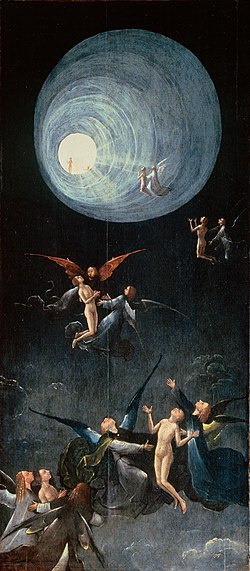](https://en.wikipedia.org/wiki/File:Hieronymus_Bosch_013.jpg)
*[Ascent of the Blessed](https://en.wikipedia.org/wiki/Ascent_of_the_Blessed "Ascent of the Blessed")* by [Hieronymus Bosch](https://en.wikipedia.org/wiki/Hieronymus_Bosch "Hieronymus Bosch") is associated by some NDE researchers with aspects of the NDE.[\[20\]](https://en.wikipedia.org/wiki/Near-death_experience#cite_note-Lommel2010-20)[\[21\]](https://en.wikipedia.org/wiki/Near-death_experience#cite_note-21)
Due to a poor definition of what being "near-death" means, over the years [researchers](https://en.wikipedia.org/wiki/Research "Research") have drifted away from studying the same populations as Moody where patients suffered from critical illness, cardiac arrest or were in life critical-conditions.[\[17\]](https://en.wikipedia.org/wiki/Near-death_experience#cite_note-ParniaGuidelines2021-17) For example, in one series, 22% of the mislabeled NDEs have been claimed to occur during general anesthesia.[\[22\]](https://en.wikipedia.org/wiki/Near-death_experience#cite_note-PRS-22) There is disagreement between the 2022 guidelines and another author about the existence of some common elements or not:[\[17\]](https://en.wikipedia.org/wiki/Near-death_experience#cite_note-ParniaGuidelines2021-17)[\[23\]](https://en.wikipedia.org/wiki/Near-death_experience#cite_note-:6-23)
- Classical (or authentic) near-death experiences occurring in populations facing impending death or death; and
- mislabeled NDEs occurring in populations not facing impending death or death.
#### Assertions of phenomenological diversity
\[[edit](https://en.wikipedia.org/w/index.php?title=Near-death_experience&action=edit§ion=7 "Edit section: Assertions of phenomenological diversity")\]
The 2022 guidelines[\[17\]](https://en.wikipedia.org/wiki/Near-death_experience#cite_note-ParniaGuidelines2021-17) stress that the themes of authentic death experiences have little in common with mislabeled NDEs, except perhaps for shallow similarities, like mentioning religious symbols or saying the experience felt peaceful. The physiological context of patients near-death or experiencing death (as defined by cardiopulmonary criteria) leads to a decline in mental clarity and consciousness and, in extreme cases, complete loss of detectable cerebral function.[\[17\]](https://en.wikipedia.org/wiki/Near-death_experience#cite_note-ParniaGuidelines2021-17) Paradoxically, genuine/authentic near death experiences—characterized by coherence, meaning, purpose, and lucid life review—arise during this state, not under normal conditions of preserved brain metabolism and function.[\[17\]](https://en.wikipedia.org/wiki/Near-death_experience#cite_note-ParniaGuidelines2021-17) According to the 2022 guidelines,[\[17\]](https://en.wikipedia.org/wiki/Near-death_experience#cite_note-ParniaGuidelines2021-17) experiences termed "NDE-like" including those induced by ketamine or DMT, reliably display features unlike recalled experiences of death:
- distorted body sensations,
- inflated or self-centered perspectives, and
- varied imagery such as elves, celebrities, geometric forms, aliens, or bright neon scenes.
Likewise, dreams and seizures exhibit unrelated, non-authentic NDE themes.[\[17\]](https://en.wikipedia.org/wiki/Near-death_experience#cite_note-ParniaGuidelines2021-17)
#### Claims of common elements
\[[edit](https://en.wikipedia.org/w/index.php?title=Near-death_experience&action=edit§ion=8 "Edit section: Claims of common elements")\]
Another author[\[23\]](https://en.wikipedia.org/wiki/Near-death_experience#cite_note-:6-23) instead claims that similar traits have been identified despite the differences among populations being studied and these include:
- 50% awareness of being dead.[\[23\]](https://en.wikipedia.org/wiki/Near-death_experience#cite_note-:6-23)
- 56% a sense of [peace](https://en.wikipedia.org/wiki/Peace "Peace"), [well-being](https://en.wikipedia.org/wiki/Well-being "Well-being"), painlessness, bliss, euphoria and other positive [emotions](https://en.wikipedia.org/wiki/Emotion "Emotion").[\[23\]](https://en.wikipedia.org/wiki/Near-death_experience#cite_note-:6-23)
- 24% an [out-of-body experience](https://en.wikipedia.org/wiki/Out-of-body_experience "Out-of-body experience") (OBE). An OBE may be part of an NDE and involves a perception of one's body from an outside position, sometimes observing medical professionals performing resuscitation efforts.[\[7\]](https://en.wikipedia.org/wiki/Near-death_experience#cite_note-Mauro1992pop-7)[\[24\]](https://en.wikipedia.org/wiki/Near-death_experience#cite_note-Morse_M._1985-24)[\[23\]](https://en.wikipedia.org/wiki/Near-death_experience#cite_note-:6-23)
- 31% a "tunnel experience" or entering a darkness. A sense of moving up, or through, a passageway or staircase.[\[7\]](https://en.wikipedia.org/wiki/Near-death_experience#cite_note-Mauro1992pop-7)[\[24\]](https://en.wikipedia.org/wiki/Near-death_experience#cite_note-Morse_M._1985-24)[\[23\]](https://en.wikipedia.org/wiki/Near-death_experience#cite_note-:6-23)
- 32% being reunited with deceased loved ones or seeing religious figures.[\[24\]](https://en.wikipedia.org/wiki/Near-death_experience#cite_note-Morse_M._1985-24)[\[23\]](https://en.wikipedia.org/wiki/Near-death_experience#cite_note-:6-23)[\[25\]](https://en.wikipedia.org/wiki/Near-death_experience#cite_note-:7-25)
### Interpretation of NDEs
\[[edit](https://en.wikipedia.org/w/index.php?title=Near-death_experience&action=edit§ion=9 "Edit section: Interpretation of NDEs")\]
A person's interpretation of an NDE experience often corresponds with one's [cultural](https://en.wikipedia.org/wiki/Culture "Culture"), [philosophical](https://en.wikipedia.org/wiki/Philosophy "Philosophy"), or [religious](https://en.wikipedia.org/wiki/Religion "Religion") beliefs. For example, in the US, where 46% of the population believes in [guardian angels](https://en.wikipedia.org/wiki/Guardian_angel "Guardian angel"), the Light will often be identified as angels or deceased loved ones (or will be unidentified), while Hindus will often identify them as messengers of the [god of death](https://en.wikipedia.org/wiki/Yama_\(Hinduism\) "Yama (Hinduism)").[\[2\]](https://en.wikipedia.org/wiki/Near-death_experience#cite_note-handbook-2)[\[3\]](https://en.wikipedia.org/wiki/Near-death_experience#cite_note-Kennard,_Mary_J_1998-3) The cultural beliefs held by NDErs seem to dictate some of the phenomena experienced during the NDE, but more so affect the later interpretation thereof.[\[2\]](https://en.wikipedia.org/wiki/Near-death_experience#cite_note-handbook-2)\[*[page needed](https://en.wikipedia.org/wiki/Wikipedia:Citing_sources "Wikipedia:Citing sources")*\]
### Negative NDEs or ICU delirium and delusions
\[[edit](https://en.wikipedia.org/w/index.php?title=Near-death_experience&action=edit§ion=10 "Edit section: Negative NDEs or ICU delirium and delusions")\]
In the years following Moody's descriptions of classical near-death experiences, reports of unpleasant experiences where people felt persecuted, distressed or frightened began to appear in the literature and in the media. These NDEs were categorized as negative or "hellish" (NDEs).[\[26\]](https://en.wikipedia.org/wiki/Near-death_experience#cite_note-French2005rev-26)[\[27\]](https://en.wikipedia.org/wiki/Near-death_experience#cite_note-27) More recent research, indicates that these distressing experiences generally do not share the same narrative structure or thematic elements as classical NDEs, nor do they exhibit the same long-term transformative impact, transcendent characteristics and ineffability.[\[17\]](https://en.wikipedia.org/wiki/Near-death_experience#cite_note-ParniaGuidelines2021-17) In essence, negative NDEs appear to be fundamentally and phenomenologically distinct from classical NDEs. In fact, most of these accounts are better understood as mislabelings of ICU delirium and delusions—phenomena that are well documented in the literature, particularly in the context of toxic metabolic disturbances, withdrawal syndromes, and other conditions that can produce persecutory, frightening, or dream-like experiences in hospitalized and critically ill patients.[\[17\]](https://en.wikipedia.org/wiki/Near-death_experience#cite_note-ParniaGuidelines2021-17)[\[28\]](https://en.wikipedia.org/wiki/Near-death_experience#cite_note-28)[\[29\]](https://en.wikipedia.org/wiki/Near-death_experience#cite_note-29) The original misclassification of these experiences lacked specific criteria or a scientific basis, and no formal definition or consensus has ever been established. Nevertheless, the use of these terms has contributed to the propagation of the idea of negative or "hellish" death-related experiences in the media and beyond.[\[17\]](https://en.wikipedia.org/wiki/Near-death_experience#cite_note-ParniaGuidelines2021-17)
### NDEs and suicides
\[[edit](https://en.wikipedia.org/w/index.php?title=Near-death_experience&action=edit§ion=11 "Edit section: NDEs and suicides")\]
Those who attempt suicide and survive will sometimes report enduring intense emotional pain that feels, to them, like a torment of their own creation.[\[30\]](https://en.wikipedia.org/wiki/Near-death_experience#cite_note-:5-30) These individuals often find themselves in a state that they perceive as a personal and self-created hell.[\[30\]](https://en.wikipedia.org/wiki/Near-death_experience#cite_note-:5-30)
### Bruce Greyson scale and false positives
\[[edit](https://en.wikipedia.org/w/index.php?title=Near-death_experience&action=edit§ion=12 "Edit section: Bruce Greyson scale and false positives")\]
To improve diagnosis of NDEs, Bruce Greyson created a questionnaire for NDErs, composed of 80 characteristics. The questionnaire studies common effects, mechanisms, sensations and reactions.[\[31\]](https://en.wikipedia.org/wiki/Near-death_experience#cite_note-:02-31) Greyson replaced that questionnaire in 1983 with a scale for researchers to use.[\[31\]](https://en.wikipedia.org/wiki/Near-death_experience#cite_note-:02-31) Nearly four decades after the development of the standardized Greyson NDE scale, several limitations have come to light. Notably, many of the terms and questions used (in the Greyson scale) — interpreted literally by the public — lack the precision to reliably distinguish true NDEs from other different kinds of human experiences. For instance, Greyson's scale includes vague terms like "strange bodily sensations", "unearthly place", "mystical feelings", "joy", "harmony", "pleasantness", and "spirits", which could apply to a variety of non-NDE experiences. The term "unearthly", for example, could easily describe anything from a stunning vacation setting to the altered state brought on by drugs. Because this scale was developed without a clear definition of what it means to be "near death". it failed to include criteria that tie the experience to a real life-threatening event. As a result, using the scale outside its intended context can lead to false positives. For example, someone recalling a peaceful vacation and reflecting on life might meet several of the scale's criteria—such as peace, harmony, an unearthly place, and life review—leading to the incorrect labeling of the event as an NDE. Researchers must be cautious of such misclassifications.[\[17\]](https://en.wikipedia.org/wiki/Near-death_experience#cite_note-ParniaGuidelines2021-17)
### Patients' management and after-effects
\[[edit](https://en.wikipedia.org/w/index.php?title=Near-death_experience&action=edit§ion=13 "Edit section: Patients' management and after-effects")\]
Moody described the correct approach to an NDE patient is to "Ask, Listen, Validate, Educate, and Refer".[\[32\]](https://en.wikipedia.org/wiki/Near-death_experience#cite_note-:3-32) Due to the potential confusion or shock attributed to those who experience near-death experiences, it is important to treat them in a calm and understanding way right after their return from the NDE. NDEs are associated with changes in personality and outlook on life.[\[7\]](https://en.wikipedia.org/wiki/Near-death_experience#cite_note-Mauro1992pop-7) Ring has identified a consistent set of value and belief changes associated with people who have had an NDE. Among these changes, he found a greater appreciation for life, higher self-esteem, greater compassion for others, less concern for acquiring material wealth, a heightened sense of purpose and self-understanding, desire to learn, elevated spirituality, greater ecological sensitivity and planetary concern, a feeling of being more intuitive,[\[7\]](https://en.wikipedia.org/wiki/Near-death_experience#cite_note-Mauro1992pop-7) no longer worrying about death, and claiming to have witnessed an afterlife.[\[33\]](https://en.wikipedia.org/wiki/Near-death_experience#cite_note-33) Although people who have experienced NDEs become more spiritual, it does not mean they become necessarily more religious.[\[34\]](https://en.wikipedia.org/wiki/Near-death_experience#cite_note-34) Not all after-effects are beneficial,[\[35\]](https://en.wikipedia.org/wiki/Near-death_experience#cite_note-35) and Greyson describes circumstances in which changes in attitudes and behavior can lead to psychosocial and psychospiritual problems.[\[36\]](https://en.wikipedia.org/wiki/Near-death_experience#cite_note-Greyson1997-36)
## Establishment of research framework
\[[edit](https://en.wikipedia.org/w/index.php?title=Near-death_experience&action=edit§ion=14 "Edit section: Establishment of research framework")\]
To establish a rigorous research framework for the study of experiences of encounters with death, the 2022 guidelines agreed to adopt the more precise term **recalled experience of death** (**RED**) instead of near-death experience (NDE).[\[17\]](https://en.wikipedia.org/wiki/Near-death_experience#cite_note-ParniaGuidelines2021-17) A RED is an authentic near-death experience (see [Common Elements, 2022 Guidelines](https://en.wikipedia.org/wiki/Near-death_experience#Common_elements_\(2022_guidelines_%E2%80%93_close_to_death_or_death\))). Hence, a RED refers to a distinct cognitive and emotional event that takes place during a period of loss of consciousness associated with a life-threatening episode, such as cardiac arrest.[\[17\]](https://en.wikipedia.org/wiki/Near-death_experience#cite_note-ParniaGuidelines2021-17) REDs, just like authentic near-death experiences, follow the narrative arc of Moody's original transcendent experiences[\[17\]](https://en.wikipedia.org/wiki/Near-death_experience#cite_note-ParniaGuidelines2021-17):
1. A relation with death.
2. A sensation of surpassing the physical or material world
3. Ineffability
4. Beneficial life changes tied to a deeper sense of meaning and purpose.
REDs do not feature signs of the usual coma-associated phenomena like typical dreams, delirium, or delusional thinking.[\[17\]](https://en.wikipedia.org/wiki/Near-death_experience#cite_note-ParniaGuidelines2021-17) The term RED eliminates the vagueness of “near-death” by including both severe, life-threatening conditions that bring a person close to death (from a medical or pathophysiological standpoint) and states involving the actual physiological processes of death itself, such as cardiac arrest or other forms of cardiac standstill.[\[17\]](https://en.wikipedia.org/wiki/Near-death_experience#cite_note-ParniaGuidelines2021-17) The authors of the 2022 guidelines believe that focusing on REDs will provide a more robust research framework. Studies of REDs will avoid mixing distinct phenomena such as drug induced hallucinations, dreams, misattributed memories formed during emergence out of coma, etc.[\[17\]](https://en.wikipedia.org/wiki/Near-death_experience#cite_note-ParniaGuidelines2021-17)
## Historical reports
\[[edit](https://en.wikipedia.org/w/index.php?title=Near-death_experience&action=edit§ion=15 "Edit section: Historical reports")\]
NDEs have been recorded since ancient times.[\[37\]](https://en.wikipedia.org/wiki/Near-death_experience#cite_note-HandBook-Field-37) The oldest known medical report of near-death experiences was written by Pierre-Jean du Monchaux, an 18th-century French military doctor who described such a case in his book *Anecdotes de Médecine*.[\[38\]](https://en.wikipedia.org/wiki/Near-death_experience#cite_note-:2-38) Monchaux hypothesized that an influx of blood in the brain stimulated a strong feeling in the individual, and therefore caused a near-death experience.[\[38\]](https://en.wikipedia.org/wiki/Near-death_experience#cite_note-:2-38) In the 19th century a few studies moved beyond individual cases – one privately done by members of [the Church of Jesus Christ of Latter-day Saints](https://en.wikipedia.org/wiki/The_Church_of_Jesus_Christ_of_Latter-day_Saints "The Church of Jesus Christ of Latter-day Saints")[\[39\]](https://en.wikipedia.org/wiki/Near-death_experience#cite_note-39) and one in Switzerland. Up to 2005, 95% of world cultures are known to have made some mention of NDEs.[\[37\]](https://en.wikipedia.org/wiki/Near-death_experience#cite_note-HandBook-Field-37)
In the U.S., an estimated nine million people have reported an NDE according to a 2011 study in *[Annals of the New York Academy of Sciences](https://en.wikipedia.org/wiki/Annals_of_the_New_York_Academy_of_Sciences "Annals of the New York Academy of Sciences")*. Most of these near-death experiences resulted from serious injury affecting the body or brain.[\[40\]](https://en.wikipedia.org/wiki/Near-death_experience#cite_note-40) A number of more contemporary sources report the incidence of near death experiences as:
- 17% amongst critically ill patients, in nine prospective studies from four different countries.[\[41\]](https://en.wikipedia.org/wiki/Near-death_experience#cite_note-41)
- 10–20% of people who have come close to death.[\[12\]](https://en.wikipedia.org/wiki/Near-death_experience#cite_note-Greyson2014-12)
## Near-death studies
\[[edit](https://en.wikipedia.org/w/index.php?title=Near-death_experience&action=edit§ion=16 "Edit section: Near-death studies")\]
Main article: [Near-death studies](https://en.wikipedia.org/wiki/Near-death_studies "Near-death studies")
[](https://en.wikipedia.org/wiki/File:Elevated_Directed_Connectivity_in_Gamma_Oscillations_Within_the_Posterior_Hot_Zones_at_Near-Death.jpg)
[EEG](https://en.wikipedia.org/wiki/Electroencephalography "Electroencephalography") research data by Gang Xu, *et al*.
Bruce Greyson (psychiatrist), [Kenneth Ring](https://en.wikipedia.org/wiki/Kenneth_Ring "Kenneth Ring") (psychologist), and [Michael Sabom](https://en.wikipedia.org/wiki/Michael_Sabom "Michael Sabom") (cardiologist), helped to launch the field of near-death studies and introduced the study of near-death experiences to the academic setting. From 1975 to 2005, some 2,500 self-reported individuals in the US had been reviewed in retrospective studies of the phenomena,[\[37\]](https://en.wikipedia.org/wiki/Near-death_experience#cite_note-HandBook-Field-37) with an additional 600 outside the US in the West,[\[37\]](https://en.wikipedia.org/wiki/Near-death_experience#cite_note-HandBook-Field-37) and 70 in Asia.[\[37\]](https://en.wikipedia.org/wiki/Near-death_experience#cite_note-HandBook-Field-37) Additionally, prospective studies had identified 270 individuals. Prospective studies review groups of individuals (e.g., selected emergency room patients) and then find who had an NDE during the study's time; such studies cost more to perform.[\[37\]](https://en.wikipedia.org/wiki/Near-death_experience#cite_note-HandBook-Field-37) In all, close to 3,500 individual cases between 1975 and 2005 had been reviewed in one or another study. All these studies were carried out by some 55 researchers or teams of researchers.[\[37\]](https://en.wikipedia.org/wiki/Near-death_experience#cite_note-HandBook-Field-37)
[Melvin L. Morse](https://en.wikipedia.org/wiki/Melvin_L._Morse "Melvin L. Morse"), head of the Institute for the Scientific Study of Consciousness, and colleagues have investigated near-death experiences in a pediatric population.[\[24\]](https://en.wikipedia.org/wiki/Near-death_experience#cite_note-Morse_M._1985-24)[\[42\]](https://en.wikipedia.org/wiki/Near-death_experience#cite_note-42)[\[43\]](https://en.wikipedia.org/wiki/Near-death_experience#cite_note-43) Researchers from the [University of Michigan](https://en.wikipedia.org/wiki/University_of_Michigan "University of Michigan") led by Jimo Borjigin discovered that areas of the brain responsible for interior visual experience were more active during cardiac arrest.[\[44\]](https://en.wikipedia.org/wiki/Near-death_experience#cite_note-Xu_et_al-44) Following the rapid gamma activation locally within the posterior TPO zones, the long-range, global, and interhemispheric communications in [gamma oscillations](https://en.wikipedia.org/wiki/Gamma_oscillations "Gamma oscillations") between the TPO zones and the prefrontal areas were activated in the dying brain, evidenced by the delayed activation of temporofrontal, parietofrontal, and Occipitofrontal networks when heart rate began to decline. Intriguingly, the long-range gamma connectivity between the posterior hot zones and the prefrontal areas at near-death was significantly higher over baseline only for those crossing the midline. Studies suggest that interhemispheric circuitry is important for memory recall, and gamma synchrony across the midlines is critical for learning, information integration, and perception.[\[44\]](https://en.wikipedia.org/wiki/Near-death_experience#cite_note-Xu_et_al-44)
### The Near Death Experience Research Foundation (NDERF)
\[[edit](https://en.wikipedia.org/w/index.php?title=Near-death_experience&action=edit§ion=17 "Edit section: The Near Death Experience Research Foundation (NDERF)")\]
American radiation oncologist Jeffrey Long has amassed a large database of NDEs through the Near Death Experience Research Foundation (NDERF).[\[45\]](https://en.wikipedia.org/wiki/Near-death_experience#cite_note-45) 835 out of 1,122 people who had experienced NDE seemed to feel an increase in alertness and consciousness although studies proved no sign of electrical brain activity.[\[46\]](https://en.wikipedia.org/wiki/Near-death_experience#cite_note-:4-46) His second line of evidence studies the increase of accuracy developed by NDErs defining their resuscitation process with a 97.6% accuracy rate.[\[46\]](https://en.wikipedia.org/wiki/Near-death_experience#cite_note-:4-46) Long documented seven more lines of evidence that all point to realism in NDE experiences, yet not all of them verifiable or defined by today's medical advances and technology.[\[46\]](https://en.wikipedia.org/wiki/Near-death_experience#cite_note-:4-46) Having such an abnormally large amount (95.6% of 1,000 participants) of those who had experienced NDE proclaiming NDEs as real experiences, he concludes that although NDE are medically inexplicable, they are most probably a real phenomenon.[\[46\]](https://en.wikipedia.org/wiki/Near-death_experience#cite_note-:4-46)
### Recognition and criticism
\[[edit](https://en.wikipedia.org/w/index.php?title=Near-death_experience&action=edit§ion=18 "Edit section: Recognition and criticism")\]
According to literature, the field of near-death studies is associated with discovery, challenges, and controversy.[\[47\]](https://en.wikipedia.org/wiki/Near-death_experience#cite_note-HandBook-Field2-47) Cant and colleagues note that "curiosity about the origin and prevalence of NDEs has escalated as technology and resuscitation techniques have improved".[\[48\]](https://en.wikipedia.org/wiki/Near-death_experience#cite_note-Cant_et_al_2012-48) The topic attracts a lot of interest, which is reflected in search engine results, medical literature, opinion pieces and commentary. Kopel and Webb note that there has been a "burgeoning literature on near-death experiences", reflecting both the naturalistic perspectives of neurology and physiology, as well as perspectives that are not naturalistic.[\[49\]](https://en.wikipedia.org/wiki/Near-death_experience#cite_note-Kopel_Webb_2022-49) Skepticism towards the findings of near-death studies, and the validity of the near-death experience as a subject for scientific study, has been widespread. According to Knapton, in *[The Daily Telegraph](https://en.wikipedia.org/wiki/The_Daily_Telegraph "The Daily Telegraph")*,[\[50\]](https://en.wikipedia.org/wiki/Near-death_experience#cite_note-50) the subject was, until recently, controversial. Both scientists and medical professionals have in general tended to be skeptical.[\[51\]](https://en.wikipedia.org/wiki/Near-death_experience#cite_note-Mauro_1992-51)[\[52\]](https://en.wikipedia.org/wiki/Near-death_experience#cite_note-Petre_2000-52)[\[53\]](https://en.wikipedia.org/wiki/Near-death_experience#cite_note-O'Connor_2004-53)[\[54\]](https://en.wikipedia.org/wiki/Near-death_experience#cite_note-54) According to commentators in the field, the early study of near-death experiences was met with "academic disbelief".[\[55\]](https://en.wikipedia.org/wiki/Near-death_experience#cite_note-Bush_1991-55) Acceptance of NDEs as a legitimate topic for scientific study has improved,[\[51\]](https://en.wikipedia.org/wiki/Near-death_experience#cite_note-Mauro_1992-51) but the process has been slow.[\[56\]](https://en.wikipedia.org/wiki/Near-death_experience#cite_note-Graves_2007-56)
According to literature, "psychiatrists have played a role in the recognition of the "near-death" phenomenon as well as popularization of the subject and subsequent research".[\[57\]](https://en.wikipedia.org/wiki/Near-death_experience#cite_note-Griffith-57) Kinsella noted that "Growing scholarly interest has followed popular interest in the subject".[\[58\]](https://en.wikipedia.org/wiki/Near-death_experience#cite_note-Kinsella_2017-58) While there is not yet any academic consensus as to what the philosophical implications of NDE studies might be, the question of whatever the true and fundamental nature of human consciousness might be yet remains both unanswered, and highly contentious. Still, NDE researchers are in general agreement that NDE research is now a legitimate academic field of scientific research, and many recent discoveries in this field give rise to the hopes by some researchers that a "breakthrough" in the modern day understanding of the dying process may be imminent.[\[59\]](https://en.wikipedia.org/wiki/Near-death_experience#cite_note-59)
Kovoor and colleagues noted that there are some "methodological concerns within many of the prospective studies" mapped by their scoping review. They further observed: "Longer-term outcomes may have been biased by clinical characteristics and comorbidities, rather than near-death experiences, and this should remain a pertinent consideration."[\[60\]](https://en.wikipedia.org/wiki/Near-death_experience#cite_note-Kovoor_et_al_2024-60) Skeptics have remarked that it is difficult to verify many of the anecdotal reports that are being used as background material in order to outline the features of the NDE.[\[51\]](https://en.wikipedia.org/wiki/Near-death_experience#cite_note-Mauro_1992-51)[\[61\]](https://en.wikipedia.org/wiki/Near-death_experience#cite_note-Beck_2010-61) The findings of NDE research have been contested by several writers in the fields of psychology and neuroscience.[\[61\]](https://en.wikipedia.org/wiki/Near-death_experience#cite_note-Beck_2010-61) Criticism of the field has also come from commentators within its own ranks. In an open letter to the NDE community, Ring has pointed to the "issue of possible religious bias in near-death studies". According to Ring, the field of near-death studies, as well as the larger NDE movement, has attracted a variety of religious and spiritual affiliations, from a number of traditions, which makes ideological claims on behalf of NDE research. In his view, this has compromised the integrity of research and discussion.[\[62\]](https://en.wikipedia.org/wiki/Near-death_experience#cite_note-62)
A 2021 study of 101 patients that underwent [Deep hypothermic circulatory arrest](https://en.wikipedia.org/wiki/Deep_hypothermic_circulatory_arrest "Deep hypothermic circulatory arrest") found that none of them had anything that could be described as a Near-Death Experience.[\[63\]](https://en.wikipedia.org/wiki/Near-death_experience#cite_note-63)
## Clinical research in cardiac arrest patients
\[[edit](https://en.wikipedia.org/w/index.php?title=Near-death_experience&action=edit§ion=19 "Edit section: Clinical research in cardiac arrest patients")\]
### Parnia's study in 2001
\[[edit](https://en.wikipedia.org/w/index.php?title=Near-death_experience&action=edit§ion=20 "Edit section: Parnia's study in 2001")\]
In 2001, [Sam Parnia](https://en.wikipedia.org/wiki/Sam_Parnia "Sam Parnia") and colleagues published the results of a year-long study of cardiac arrest survivors that was conducted at Southampton General Hospital. 63 survivors were interviewed. They had been resuscitated after being [clinically dead](https://en.wikipedia.org/wiki/Clinical_death "Clinical death") with no pulse, no respiration, and fixed dilated pupils. Parnia and colleagues investigated out-of-body experience claims by placing figures in areas where patients were likely to be resuscitated on suspended boards facing the ceiling, not visible from the floor. Four had experiences that, according to the study criteria, were NDEs but none of them experienced the out-of-body experience. Thus, they were not able to identify the figures.[\[64\]](https://en.wikipedia.org/wiki/Near-death_experience#cite_note-Parnia2001primary-64)[\[26\]](https://en.wikipedia.org/wiki/Near-death_experience#cite_note-French2005rev-26)[\[65\]](https://en.wikipedia.org/wiki/Near-death_experience#cite_note-Parnia2014rev-65) Psychologist [Chris French](https://en.wikipedia.org/wiki/Chris_French "Chris French") wrote regarding the study "unfortunately, and somewhat atypically, none of the survivors in this sample experienced an out of body experience".[\[26\]](https://en.wikipedia.org/wiki/Near-death_experience#cite_note-French2005rev-26)
### Van Lommel's study
\[[edit](https://en.wikipedia.org/w/index.php?title=Near-death_experience&action=edit§ion=21 "Edit section: Van Lommel's study")\]
[](https://en.wikipedia.org/wiki/File:Pim_van_Lommel-1.jpg)
[Pim van Lommel](https://en.wikipedia.org/wiki/Pim_van_Lommel "Pim van Lommel")
In 2001, [Pim van Lommel](https://en.wikipedia.org/wiki/Pim_van_Lommel "Pim van Lommel"), a cardiologist from the Netherlands, and his team conducted a study on NDEs including 344 cardiac arrest patients who had been successfully resuscitated in 10 Dutch hospitals. Patients not reporting NDEs were used as controls for patients who did, and psychological (e.g., fear before cardiac arrest), demographic (e.g., age, sex), medical (e.g., more than one [cardiopulmonary resuscitation](https://en.wikipedia.org/wiki/Cardiopulmonary_resuscitation "Cardiopulmonary resuscitation") (CPR)), and pharmacological data were compared between the two groups.[\[66\]](https://en.wikipedia.org/wiki/Near-death_experience#cite_note-Lommel2001primary-66)
The work also included a longitudinal study where the two groups (those who had had an NDE and those who had not had one) were compared at two and eight years, for life changes. One patient had a conventional out of body experience. He reported being able to watch and recall events during the time of his cardiac arrest. His claims were confirmed by hospital personnel. "This did not appear consistent with hallucinatory or illusory experiences, as the recollections were compatible with real and verifiable rather than imagined events".[\[65\]](https://en.wikipedia.org/wiki/Near-death_experience#cite_note-Parnia2014rev-65)[\[66\]](https://en.wikipedia.org/wiki/Near-death_experience#cite_note-Lommel2001primary-66)
### Awareness during resuscitation (AWARE) study
\[[edit](https://en.wikipedia.org/w/index.php?title=Near-death_experience&action=edit§ion=22 "Edit section: Awareness during resuscitation (AWARE) study")\]
While at the [University of Southampton](https://en.wikipedia.org/wiki/University_of_Southampton "University of Southampton"), Parnia was the principal investigator of the AWARE Study, which was launched in 2008.[\[13\]](https://en.wikipedia.org/wiki/Sam_Parnia#cite_note-TIME_magazine_2008-13 "Sam Parnia") The study, which concluded in 2012, included 33 investigators across 15 medical centers in the UK, Austria and the US and tested consciousness, memories and awareness during cardiac arrest. The accuracy of claims of visual and auditory awareness was examined using specific tests.[\[67\]](https://en.wikipedia.org/wiki/Near-death_experience#cite_note-Parnia2015primary-67) One such test consisted of installing shelves, bearing a variety of images and facing the ceiling, hence not visible to hospital staff, in rooms where cardiac-arrest patients were more likely to occur. The results of the study were published in October 2014.[\[68\]](https://en.wikipedia.org/wiki/Near-death_experience#cite_note-68)[\[69\]](https://en.wikipedia.org/wiki/Near-death_experience#cite_note-69)
A review article analyzing the results reports that, out of 2,060 cardiac arrest events, 101 of 140 cardiac arrest survivors could complete the questionnaires. Of these 101 patients, 9% could be classified as near-death experiences. Two more patients (2% of those completing the questionnaires) described "seeing and hearing actual events related to the period of cardiac arrest". These two patients' cardiac arrests did not occur in areas equipped with ceiling shelves, hence no images could be used to objectively test for visual awareness claims. One of the two patients was too sick and the accuracy of her recount could not be verified. For the second patient, however, it was possible to verify the accuracy of the experience and to show that awareness occurred paradoxically some minutes after the heart stopped, at a time when "the brain ordinarily stops functioning and cortical activity becomes isoelectric (i.e., without any discernible electric activity)." The experience was not compatible with an illusion, imaginary event or hallucination since visual (other than of ceiling shelves' images) and auditory awareness could be corroborated.[\[65\]](https://en.wikipedia.org/wiki/Near-death_experience#cite_note-Parnia2014rev-65)
As of May 2016[\[update\]](https://en.wikipedia.org/w/index.php?title=Near-death_experience&action=edit), a posting at the UK Clinical Trials Gateway website described plans for [AWARE II](https://en.wikipedia.org/wiki/Out-of-body_experience#AWARE_Study_II "Out-of-body experience"), a two-year multicenter observational study of 900–1,500 patients experiencing cardiac arrest, which said that subject recruitment had started on 1 August 2014 and that the scheduled end date was 31 May 2017.[\[70\]](https://en.wikipedia.org/wiki/Near-death_experience#cite_note-:1-70) The study was extended, continuing until 2020.[\[71\]](https://en.wikipedia.org/wiki/Near-death_experience#cite_note-71) In 2019, a report of a condensed version of the study with 465 patients was released. Only one patient remembered the auditory stimuli while none remembered the visual.[\[72\]](https://en.wikipedia.org/wiki/Near-death_experience#cite_note-72) In November 2022, the full study was published.[\[73\]](https://en.wikipedia.org/wiki/Near-death_experience#cite_note-73)
## Explanatory models
\[[edit](https://en.wikipedia.org/w/index.php?title=Near-death_experience&action=edit§ion=23 "Edit section: Explanatory models")\]
In a 2005 review article, psychologist [Chris French](https://en.wikipedia.org/wiki/Chris_French "Chris French") categorized models that try to explain NDEs into three broad groups which "are not distinct and independent, but instead show considerable overlap": spiritual (or transcendental), psychological, and physiological.[\[26\]](https://en.wikipedia.org/wiki/Near-death_experience#cite_note-French2005rev-26)
### Spiritual or transcendental models
\[[edit](https://en.wikipedia.org/w/index.php?title=Near-death_experience&action=edit§ion=24 "Edit section: Spiritual or transcendental models")\]
French summarizes this model by saying: "the most popular interpretation is that the NDE is exactly what it appears to be to the person having the experience".[\[26\]](https://en.wikipedia.org/wiki/Near-death_experience#cite_note-French2005rev-26) The NDE would represent evidence of the immaterial existence of a soul or mind, which leaves the body upon death, and provides information about an immaterial world where the soul journeys after death.[\[26\]](https://en.wikipedia.org/wiki/Near-death_experience#cite_note-French2005rev-26)
According to Greyson, some NDE phenomena cannot be easily explained with our current knowledge of human physiology and psychology. For instance, at a time when they were unconscious, patients could accurately describe events "from an out-of-body spatial perspective".[\[12\]](https://en.wikipedia.org/wiki/Near-death_experience#cite_note-Greyson2014-12) In two different studies of patients who had survived a cardiac arrest, those who had reported leaving their bodies could describe accurately their resuscitation procedures or unexpected events, whereas others "described incorrect equipment and procedures".[\[12\]](https://en.wikipedia.org/wiki/Near-death_experience#cite_note-Greyson2014-12) Sam Parnia also refers to two cardiac arrest studies and one deep hypothermic circulatory arrest study where patients reported visual and/or auditory awareness occurring when their brain function had ceased. These reports "were corroborated with actual and real events".[\[74\]](https://en.wikipedia.org/wiki/Near-death_experience#cite_note-:0-74)[\[65\]](https://en.wikipedia.org/wiki/Near-death_experience#cite_note-Parnia2014rev-65)
Five prospective studies have been carried out to test the accuracy of out of body perceptions by placing "unusual targets in locations likely to be seen by persons having NDEs, such as in an upper corner of a room in the emergency department, the coronary care unit, or the intensive care unit of a hospital." Twelve patients reported leaving their bodies, but none could describe the hidden visual targets. Although this is a small sample, the failure of purported out-of-body experiencers to describe the hidden targets raises questions about the accuracy of the anecdotal reports described above.[\[12\]](https://en.wikipedia.org/wiki/Near-death_experience#cite_note-Greyson2014-12)
#### Criticism
\[[edit](https://en.wikipedia.org/w/index.php?title=Near-death_experience&action=edit§ion=25 "Edit section: Criticism")\]
Neuroscientist Charlotte Martial states that there is a dearth of solid empirical evidence about theories of non-local consciousness,[\[75\]](https://en.wikipedia.org/wiki/Near-death_experience#cite_note-75) which is claimed by some authors.[\[76\]](https://en.wikipedia.org/wiki/Near-death_experience#cite_note-76)[\[77\]](https://en.wikipedia.org/wiki/Near-death_experience#cite_note-77) Chris French has noted that "the survivalist approach does not appear to generate clear and testable hypotheses. Because of the vagueness and imprecision of the survivalist account, it can be made to explain any possible set of findings and is therefore unfalsifiable and unscientific."[\[78\]](https://en.wikipedia.org/wiki/Near-death_experience#cite_note-78)
### Psychological models
\[[edit](https://en.wikipedia.org/w/index.php?title=Near-death_experience&action=edit§ion=26 "Edit section: Psychological models")\]
French summarises the main psychological explanations, which include the depersonalization, the expectancy and the dissociation models.[\[26\]](https://en.wikipedia.org/wiki/Near-death_experience#cite_note-French2005rev-26)
#### Depersonalization model
\[[edit](https://en.wikipedia.org/w/index.php?title=Near-death_experience&action=edit§ion=27 "Edit section: Depersonalization model")\]
A depersonalization model was proposed in the 1970s by professor of psychiatry Russell Noyes and clinical psychologist Roy Kletti, which suggested that the NDE is a form of [depersonalization](https://en.wikipedia.org/wiki/Depersonalization "Depersonalization"), experienced under emotional conditions such as life-threatening danger, potentially inescapable danger, and that the NDE can best be understood as a [hallucination](https://en.wikipedia.org/wiki/Hallucination "Hallucination").[\[26\]](https://en.wikipedia.org/wiki/Near-death_experience#cite_note-French2005rev-26)[\[79\]](https://en.wikipedia.org/wiki/Near-death_experience#cite_note-79)[\[80\]](https://en.wikipedia.org/wiki/Near-death_experience#cite_note-80)[\[81\]](https://en.wikipedia.org/wiki/Near-death_experience#cite_note-81)[\[82\]](https://en.wikipedia.org/wiki/Near-death_experience#cite_note-82) According to this model, those who face their impending death become psychologically detached from their surroundings and bodies, no longer feel emotions, and experience time distortions.[\[12\]](https://en.wikipedia.org/wiki/Near-death_experience#cite_note-Greyson2014-12)
This model suffers from a number of limitations to explain NDEs for subjects who do not experience a sensation of being out of their bodies; unlike NDEs, these hallucinatory experiences are dreamlike, unpleasant and characterized by "anxiety, panic and emptiness".[\[12\]](https://en.wikipedia.org/wiki/Near-death_experience#cite_note-Greyson2014-12) Also, during NDEs subjects remain very lucid of their identities, and their sense of identity is not changed, unlike those experiencing depersonalization.[\[12\]](https://en.wikipedia.org/wiki/Near-death_experience#cite_note-Greyson2014-12)
#### Expectancy model
\[[edit](https://en.wikipedia.org/w/index.php?title=Near-death_experience&action=edit§ion=28 "Edit section: Expectancy model")\]
Another psychological theory is called the expectancy model. It has been suggested that although these experiences could appear very real, they had actually been constructed in the mind, either consciously or subconsciously, in response to the stress of an encounter with death (or perceived encounter with death), and did not correspond to a real event. In a way, they are similar to wish-fulfillment: because someone thought they were about to die, they experienced certain things in accordance with what they expected or wanted to occur. Imagining a heavenly place was, in effect, a way for them to soothe themselves through the stress of knowing that they were close to death.[\[26\]](https://en.wikipedia.org/wiki/Near-death_experience#cite_note-French2005rev-26) Subjects use their own personal and cultural expectations to imagine a scenario that would protect them against an imminent threat to their lives.[\[12\]](https://en.wikipedia.org/wiki/Near-death_experience#cite_note-Greyson2014-12)
Subjects' accounts often differed from their own "religious and personal expectations regarding death", which contradicts the hypothesis they may have imagined a scenario based on their cultural and personal background.[\[12\]](https://en.wikipedia.org/wiki/Near-death_experience#cite_note-Greyson2014-12) Although the term NDE was first coined in 1975 and the experience first described then, recent descriptions of NDEs do not differ from those reported earlier than 1975. The only exception is the more frequent description of a tunnel. Hence, the fact that information about these experiences could be more easily obtained after 1975 had not influenced people's reports of the experiences.[\[12\]](https://en.wikipedia.org/wiki/Near-death_experience#cite_note-Greyson2014-12) Another flaw of this model can be found in children's accounts of NDEs. These are similar to adults', despite children being less strongly affected by religious and cultural influences about death.[\[12\]](https://en.wikipedia.org/wiki/Near-death_experience#cite_note-Greyson2014-12)
#### Dissociation model
\[[edit](https://en.wikipedia.org/w/index.php?title=Near-death_experience&action=edit§ion=29 "Edit section: Dissociation model")\]
The dissociation model proposes that NDE is a form of withdrawal to protect an individual from a stressful event. Under extreme circumstances, some people may detach from certain unwanted feelings in order to avoid experiencing the emotional impact and suffering associated with them. The person also detaches from one's immediate surroundings.[\[26\]](https://en.wikipedia.org/wiki/Near-death_experience#cite_note-French2005rev-26)
#### Birth model
\[[edit](https://en.wikipedia.org/w/index.php?title=Near-death_experience&action=edit§ion=30 "Edit section: Birth model")\]
The birth model suggests that near-death experiences could be a form of reliving the trauma of birth. Since a baby travels from the darkness of the womb to light and is greeted by the love and warmth of the nursing and medical staff, and so, it was proposed, the dying brain could be recreating the passage through a tunnel to light, warmth and affection.[\[26\]](https://en.wikipedia.org/wiki/Near-death_experience#cite_note-French2005rev-26) Reports of leaving the body through a tunnel are equally frequent among subjects who were born by cesarean section and natural birth. Newborns do not possess "the visual acuity, spatial stability of their visual images, mental alertness, and cortical coding capacity to register memories of the birth experience".[\[12\]](https://en.wikipedia.org/wiki/Near-death_experience#cite_note-Greyson2014-12)
### Physiological models
\[[edit](https://en.wikipedia.org/w/index.php?title=Near-death_experience&action=edit§ion=31 "Edit section: Physiological models")\]
A wide range of physiological theories of the NDE have been put forward, including those based upon [cerebral hypoxia](https://en.wikipedia.org/wiki/Cerebral_hypoxia "Cerebral hypoxia"), [anoxia](https://en.wikipedia.org/wiki/Anoxic_event "Anoxic event"), and [hypercapnia](https://en.wikipedia.org/wiki/Hypercapnia "Hypercapnia"); [endorphins](https://en.wikipedia.org/wiki/Endorphins "Endorphins") and other [neurotransmitters](https://en.wikipedia.org/wiki/Neurotransmitter "Neurotransmitter"); and abnormal activity in the [temporal lobes](https://en.wikipedia.org/wiki/Temporal_lobe "Temporal lobe").[\[26\]](https://en.wikipedia.org/wiki/Near-death_experience#cite_note-French2005rev-26) [Neurobiological](https://en.wikipedia.org/wiki/Neurobiological "Neurobiological") factors in the experience have been investigated by researchers in the field of medical science and psychiatry.[\[83\]](https://en.wikipedia.org/wiki/Near-death_experience#cite_note-83) Among the researchers and commentators who tend to emphasize a naturalistic and neurological base for the experience is the British psychologist [Susan Blackmore](https://en.wikipedia.org/wiki/Susan_Blackmore "Susan Blackmore") (1993), with her "dying brain hypothesis".[\[84\]](https://en.wikipedia.org/wiki/Near-death_experience#cite_note-84)
#### Neuroanatomical models
\[[edit](https://en.wikipedia.org/w/index.php?title=Near-death_experience&action=edit§ion=32 "Edit section: Neuroanatomical models")\]
According to Greyson,[\[12\]](https://en.wikipedia.org/wiki/Near-death_experience#cite_note-Greyson2014-12) multiple neuroanatomical models have been proposed, wherein NDEs have been hypothesized to originate from different anatomical areas of the brain, namely: the [limbic system](https://en.wikipedia.org/wiki/Limbic_system "Limbic system"), the [hippocampus](https://en.wikipedia.org/wiki/Hippocampus "Hippocampus"), the left [temporal lobe](https://en.wikipedia.org/wiki/Temporal_lobe "Temporal lobe"), [Reissner's fiber](https://en.wikipedia.org/wiki/Reissner%27s_fiber "Reissner's fiber") in the central canal of the spinal cord, the [prefrontal cortex](https://en.wikipedia.org/wiki/Prefrontal_cortex "Prefrontal cortex"), and the right temporal lobe. Neuroscientists [Olaf Blanke](https://en.wikipedia.org/wiki/Olaf_Blanke "Olaf Blanke") and Sebastian Dieguez (2009),[\[85\]](https://en.wikipedia.org/wiki/Near-death_experience#cite_note-85) from the *[Ecole Polytechnique Fédérale de Lausanne](https://en.wikipedia.org/wiki/Ecole_Polytechnique_F%C3%A9d%C3%A9rale_de_Lausanne "Ecole Polytechnique Fédérale de Lausanne")*, [Switzerland](https://en.wikipedia.org/wiki/Switzerland "Switzerland"), propose a brain-based model with two types of NDEs:
- "type 1 NDEs are due to bilateral [frontal](https://en.wikipedia.org/wiki/Frontal_lobe "Frontal lobe") and [occipital](https://en.wikipedia.org/wiki/Occipital_lobe "Occipital lobe"), but predominantly right hemispheric brain damage affecting the right [temporal-parietal junction](https://en.wikipedia.org/wiki/Temporal_parietal_junction "Temporal parietal junction") and characterized by out-of-body-experiences, altered sense of time, sensations of flying, lightness [vection](https://en.wikipedia.org/wiki/Vection "Vection") and flying"[\[4\]](https://en.wikipedia.org/wiki/Near-death_experience#cite_note-blanke2009-4)
- "type 2 NDEs are also due to bilateral frontal and occipital, but predominantly left hemispheric brain damage affecting the left temporal parietal junction and characterized by feeling of a presence, meeting and communication with spirits, seeing of glowing bodies, as well as voices, sounds, and music without vection"[\[4\]](https://en.wikipedia.org/wiki/Near-death_experience#cite_note-blanke2009-4)
[](https://en.wikipedia.org/wiki/File:Temporal_lobe_animation.gif)
Animation of the human left temporal lobe
They suggest that damage to the bilateral occipital cortex may lead to visual features of NDEs such as seeing a tunnel or lights, and "damage to unilateral or bilateral temporal lobe structures such as the hippocampus and [amygdala](https://en.wikipedia.org/wiki/Amygdala "Amygdala")" may lead to emotional experiences, memory flashbacks or a life review. They concluded that future neuroscientific studies are likely to reveal the neuroanatomical basis of the NDE, which will lead to the demystification of the subject without needing paranormal explanations.[\[4\]](https://en.wikipedia.org/wiki/Near-death_experience#cite_note-blanke2009-4)
French has written that the "temporal lobe is almost certain to be involved in NDEs, given that both damage to and direct [cortical](https://en.wikipedia.org/wiki/Cerebral_cortex "Cerebral cortex") stimulation of this area are known to produce a number of experiences corresponding to those of the NDE, including OBEs, hallucinations, and memory flashbacks".[\[26\]](https://en.wikipedia.org/wiki/Near-death_experience#cite_note-French2005rev-26) Vanhaudenhuyse *et al*. (2009) reported that recent studies employing [deep brain stimulation](https://en.wikipedia.org/wiki/Deep_brain_stimulation "Deep brain stimulation") and [neuroimaging](https://en.wikipedia.org/wiki/Neuroimaging "Neuroimaging") have demonstrated that out-of-body experiences can result from a deficient [multisensory integration](https://en.wikipedia.org/wiki/Multisensory_integration "Multisensory integration") at the temporal-parietal junction and that ongoing studies aim to further identify the functional neuroanatomy of near-death experiences by means of standardized EEG recordings.[\[86\]](https://en.wikipedia.org/wiki/Near-death_experience#cite_note-86)
#### Criticism
\[[edit](https://en.wikipedia.org/w/index.php?title=Near-death_experience&action=edit§ion=33 "Edit section: Criticism")\]
Blanke et al.[\[4\]](https://en.wikipedia.org/wiki/Near-death_experience#cite_note-blanke2009-4) admit that their model remains speculative due to the lack of data. In addition, the reports of those who had the brain stimulation were almost nothing like OBEs reported by those who had NDEs, mainly characterized by a sense of elevation and (often limited) spatial awareness, while other characteristics of NDEs were absent. Anomalies such as seeing maps, half-bodies and duplications were also noted.[\[87\]](https://en.wikipedia.org/wiki/Near-death_experience#cite_note-87)[\[88\]](https://en.wikipedia.org/wiki/Near-death_experience#cite_note-88) Likewise, Greyson writes that although some, or any of the proposed neuroanatomical models may serve to explain NDEs and pathways through which they are expressed, they remain speculative at this stage, since they have not been tested in empirical studies.[\[12\]](https://en.wikipedia.org/wiki/Near-death_experience#cite_note-Greyson2014-12)
#### Neurochemical models
\[[edit](https://en.wikipedia.org/w/index.php?title=Near-death_experience&action=edit§ion=34 "Edit section: Neurochemical models")\]
Some theories explain reported NDE experiences as resulting from drugs used during [resuscitation](https://en.wikipedia.org/wiki/Resuscitation "Resuscitation") (in the case of resuscitation-induced NDEs) ─ for example, [ketamine](https://en.wikipedia.org/wiki/Ketamine "Ketamine") ─ or from [endogenous](https://en.wikipedia.org/wiki/Endogeny_\(biology\) "Endogeny (biology)") chemicals ([neurotransmitters](https://en.wikipedia.org/wiki/Neurotransmitter "Neurotransmitter")) that transmit signals between brain cells:[\[26\]](https://en.wikipedia.org/wiki/Near-death_experience#cite_note-French2005rev-26)
- In the early 1980s, Daniel Carr wrote that the NDE has characteristics that are suggestive of a [limbic lobe](https://en.wikipedia.org/wiki/Limbic_lobe "Limbic lobe") syndrome and that the NDE can be explained by the release of [endorphins](https://en.wikipedia.org/wiki/Endorphins "Endorphins") and [enkephalins](https://en.wikipedia.org/wiki/Enkephalin "Enkephalin") in the brain.[\[89\]](https://en.wikipedia.org/wiki/Near-death_experience#cite_note-89)[\[90\]](https://en.wikipedia.org/wiki/Near-death_experience#cite_note-90) Endorphins are endogenous molecules "released in times of stress and lead to a reduction in pain perception and a pleasant, even blissful, emotional state."[\[26\]](https://en.wikipedia.org/wiki/Near-death_experience#cite_note-French2005rev-26)
- Judson and Wiltshaw (1983) noted how the administration of endorphin-blocking agents such as [naloxone](https://en.wikipedia.org/wiki/Naloxone "Naloxone") had been occasionally reported to produce "hellish" NDEs.[\[91\]](https://en.wikipedia.org/wiki/Near-death_experience#cite_note-91) This would be coherent with endorphins' role in causing a "positive emotional tone of most NDEs".[\[26\]](https://en.wikipedia.org/wiki/Near-death_experience#cite_note-French2005rev-26)
- Morse *et al*. (1989) proposed a model arguing that [serotonin](https://en.wikipedia.org/wiki/Serotonin "Serotonin") played a more important role than endorphins in generating NDEs,[\[92\]](https://en.wikipedia.org/wiki/Near-death_experience#cite_note-92) "at least with respect to mystical hallucinations and OBEs".[\[26\]](https://en.wikipedia.org/wiki/Near-death_experience#cite_note-French2005rev-26)
- A 2019 large-scale study found that [ketamine](https://en.wikipedia.org/wiki/Ketamine "Ketamine"), *[Salvia divinorum](https://en.wikipedia.org/wiki/Salvia_divinorum "Salvia divinorum")*, and [DMT](https://en.wikipedia.org/wiki/N,N-Dimethyltryptamine "N,N-Dimethyltryptamine") (and other classical [psychedelic substances](https://en.wikipedia.org/wiki/Psychedelic_substance "Psychedelic substance")) are linked to near-death experiences.[\[93\]](https://en.wikipedia.org/wiki/Near-death_experience#cite_note-93)
- While ketamine, and other endogenous chemicals can be a source for NDE, it can also mimic these NDE and simulate that [out-of-body experiences](https://en.wikipedia.org/wiki/Out-of-body_experience "Out-of-body experience") linked to NDE.[\[94\]](https://en.wikipedia.org/wiki/Near-death_experience#cite_note-94)
#### Criticism
\[[edit](https://en.wikipedia.org/w/index.php?title=Near-death_experience&action=edit§ion=35 "Edit section: Criticism")\]
According to Parnia, neurochemical models are not backed by data. This is true for "[NMDA receptor](https://en.wikipedia.org/wiki/NMDA_receptor "NMDA receptor") activation, [serotonin](https://en.wikipedia.org/wiki/Serotonin "Serotonin"), and endorphin release" models.[\[65\]](https://en.wikipedia.org/wiki/Near-death_experience#cite_note-Parnia2014rev-65) Parnia writes that no data has been collected via thorough and careful experimentation to back "a possible causal relationship or even an association" between neurochemical agents and NDE experiences.[\[74\]](https://en.wikipedia.org/wiki/Near-death_experience#cite_note-:0-74)
#### Multi-factorial models
\[[edit](https://en.wikipedia.org/w/index.php?title=Near-death_experience&action=edit§ion=36 "Edit section: Multi-factorial models")\]
The first formal neurobiological model for NDEs in 1989 included endorphins, neurotransmitters of the [limbic system](https://en.wikipedia.org/wiki/Limbic_system "Limbic system"), the temporal lobe and other parts of the brain.[\[95\]](https://en.wikipedia.org/wiki/Near-death_experience#cite_note-95) Extensions and variations of their model came from other scientists such as Louis Appleby (1989).[\[96\]](https://en.wikipedia.org/wiki/Near-death_experience#cite_note-96) Other authors suggest that all components of near-death experiences can be explained in their entirety via psychological or neurophysiological mechanisms, although the authors admit that these hypotheses have to be tested by science.[\[23\]](https://en.wikipedia.org/wiki/Near-death_experience#cite_note-:6-23)
#### Low oxygen levels (and G-LOC) model
\[[edit](https://en.wikipedia.org/w/index.php?title=Near-death_experience&action=edit§ion=37 "Edit section: Low oxygen levels (and G-LOC) model")\]
Low oxygen levels in the blood (hypoxia or anoxia) have been hypothesized to induce hallucinations and hence possibly explain NDEs.[\[2\]](https://en.wikipedia.org/wiki/Near-death_experience#cite_note-handbook-2)[\[26\]](https://en.wikipedia.org/wiki/Near-death_experience#cite_note-French2005rev-26) This is because low oxygen levels characterize life-threatening situations and also the apparent similarities between NDEs and G-force-induced loss of consciousness ([G-LOC](https://en.wikipedia.org/wiki/G-LOC "G-LOC")) episodes. These episodes are observed with fighter pilots experiencing very rapid and intense acceleration that results in lack of sufficient blood supply to the brain. Whinnery[\[97\]](https://en.wikipedia.org/wiki/Near-death_experience#cite_note-Whinnery-97) studied almost 1000 cases and noted how the experiences often involved "tunnel vision and bright lights, floating sensations, automatic movement, autoscopy, OBEs, not wanting to be disturbed, paralysis, vivid dreamlets of beautiful places, pleasurable sensations, psychological alterations of euphoria and dissociation, inclusion of friends and family, inclusion of prior memories and thoughts, the experience being very memorable (when it can be remembered), [confabulation](https://en.wikipedia.org/wiki/Confabulation "Confabulation"), and a strong urge to understand the experience."[\[26\]](https://en.wikipedia.org/wiki/Near-death_experience#cite_note-French2005rev-26)[\[97\]](https://en.wikipedia.org/wiki/Near-death_experience#cite_note-Whinnery-97)
Acceleration-induced hypoxia's primary characteristics are "rhythmic jerking of the limbs, compromised memory of events just prior to the onset of unconsciousness, tingling of extremities ..." that are not observed during NDEs.[\[2\]](https://en.wikipedia.org/wiki/Near-death_experience#cite_note-handbook-2) G-LOC episodes do not feature life reviews, mystical experiences and "long-lasting transformational aftereffects", although this may be due to the fact that subjects have no expectation of dying.[\[26\]](https://en.wikipedia.org/wiki/Near-death_experience#cite_note-French2005rev-26) Hypoxic hallucinations are characterized by "distress and agitation",\[*[citation needed](https://en.wikipedia.org/wiki/Wikipedia:Citation_needed "Wikipedia:Citation needed")*\] and this is very different from near-death experiences, which subjects usually report as being pleasant.[\[12\]](https://en.wikipedia.org/wiki/Near-death_experience#cite_note-Greyson2014-12)
#### Altered blood gas levels models
\[[edit](https://en.wikipedia.org/w/index.php?title=Near-death_experience&action=edit§ion=38 "Edit section: Altered blood gas levels models")\]
Some investigators have studied whether [hypercarbia](https://en.wiktionary.org/wiki/hypercarbia "wikt:hypercarbia") or higher than normal carbon dioxide levels, could explain the occurrence of NDEs. However, studies are difficult to interpret since NDEs have been observed both with increased levels as well as decreased levels of carbon dioxide, and other studies have observed NDEs when levels had not changed, but there is insufficient data on these factors.[\[2\]](https://en.wikipedia.org/wiki/Near-death_experience#cite_note-handbook-2)
#### Other models
\[[edit](https://en.wikipedia.org/w/index.php?title=Near-death_experience&action=edit§ion=39 "Edit section: Other models")\]
French said that at least some reports of NDEs might be based upon [false memories](https://en.wikipedia.org/wiki/False_memory_syndrome "False memory syndrome").[\[98\]](https://en.wikipedia.org/wiki/Near-death_experience#cite_note-98) According to Engmann (2008), near-death experiences of people who are [clinically dead](https://en.wikipedia.org/wiki/Clinical_death "Clinical death") are psychopathological symptoms caused by a severe malfunction of the brain resulting from the cessation of cerebral blood circulation.[\[99\]](https://en.wikipedia.org/wiki/Near-death_experience#cite_note-99) An important question is whether it is possible to "translate" the bloomy experiences of the reanimated survivors into psychopathologically basic phenomena, e.g., acoasms (nonverbal auditory hallucinations), central narrowing of the visual field, autoscopia, visual hallucinations, activation of limbic and memory structures (according to Moody's stages). The symptoms suppose a primary affliction of the occipital and temporal cortices under clinical death. This basis could be congruent with the thesis of [pathoclisis](https://en.wikipedia.org/wiki/Pathoclisis "Pathoclisis") – the inclination of special parts of the brain to be the first to be damaged in case of disease, lack of oxygen, or malnutrition – established in 1922 by [Cécile Vogt-Mugnier](https://en.wikipedia.org/wiki/C%C3%A9cile_Vogt-Mugnier "Cécile Vogt-Mugnier") and [Oskar Vogt](https://en.wikipedia.org/wiki/Oskar_Vogt "Oskar Vogt").[\[100\]](https://en.wikipedia.org/wiki/Near-death_experience#cite_note-100)
Professor of neurology [Terence Hines](https://en.wikipedia.org/wiki/Terence_Hines "Terence Hines") (2003) claimed that near-death experiences are hallucinations caused by cerebral anoxia, drugs, or brain damage.[\[101\]](https://en.wikipedia.org/wiki/Near-death_experience#cite_note-101) Greyson has called into question the adequacy of the materialist, mind-brain identity model for explaining NDEs.[\[22\]](https://en.wikipedia.org/wiki/Near-death_experience#cite_note-PRS-22) An NDE often involves vivid and complex mentation, sensation and memory-formation under circumstances of completely disabled brain function during general anesthesia, or near-complete cessation of cerebral blood flow and oxygen uptake during cardiac arrest. Materialist models predict that such conscious experiences should be impossible under these conditions. The mind-brain identity model of classic materialist psychology may need to be expanded to adequately explain an NDE.
## See also
\[[edit](https://en.wikipedia.org/w/index.php?title=Near-death_experience&action=edit§ion=40 "Edit section: See also")\]
- [Psychology portal](https://en.wikipedia.org/wiki/Portal:Psychology "Portal:Psychology")
- [](https://en.wikipedia.org/wiki/File:P_religion_world.svg)[Religion portal](https://en.wikipedia.org/wiki/Portal:Religion "Portal:Religion")
- [After-death communication](https://en.wikipedia.org/wiki/After-death_communication "After-death communication") – Spiritual practicePages displaying short descriptions of redirect targets
- [*Beyond and Back*](https://en.wikipedia.org/wiki/Beyond_and_Back "Beyond and Back") – 1978 film
- [Cognitive science of religion](https://en.wikipedia.org/wiki/Cognitive_science_of_religion "Cognitive science of religion") – Study of religious thought and behavior
- [Deathbed phenomena](https://en.wikipedia.org/wiki/Deathbed_phenomena "Deathbed phenomena") – Range of experiences reported by dying people
- [Deism](https://en.wikipedia.org/wiki/Deism "Deism") – Belief in a god based on rational thought
- [Form constant](https://en.wikipedia.org/wiki/Form_constant "Form constant") – Recurringly observed geometric pattern
- [Lazarus syndrome](https://en.wikipedia.org/wiki/Lazarus_syndrome "Lazarus syndrome") – Medical phenomenon
- [Near-birth experience](https://en.wikipedia.org/wiki/Near-birth_experience "Near-birth experience") – Alleged recollected event which occurred before or during one's own birth
- [Neurotheology](https://en.wikipedia.org/wiki/Neurotheology "Neurotheology") – Attempts to explain religious experience in neuroscientific termsPages displaying short descriptions of redirect targets
- [Out-of-body experience](https://en.wikipedia.org/wiki/Out-of-body_experience "Out-of-body experience") – Phenomenon in which the soul (astral body) is said to exit the physical body
- [Pam Reynolds case](https://en.wikipedia.org/wiki/Pam_Reynolds_case "Pam Reynolds case") – Reported near-death experience
- [*Passage* (Willis novel)](https://en.wikipedia.org/wiki/Passage_\(Willis_novel\) "Passage (Willis novel)") – 2001 novel by Connie Willis
- [*Proof of Heaven*](https://en.wikipedia.org/wiki/Proof_of_Heaven "Proof of Heaven") – 2012 nonfiction book by Eben Alexander
- [Psychedelic experience](https://en.wikipedia.org/wiki/Psychedelic_experience "Psychedelic experience") – Altered state of consciousness
- [Resurrection](https://en.wikipedia.org/wiki/Resurrection "Resurrection") – Concept of coming back to life
- [*Saved by the Light*](https://en.wikipedia.org/wiki/Saved_by_the_Light "Saved by the Light") – 1994 book by Dannion Brinkley
- [Terminal lucidity](https://en.wikipedia.org/wiki/Terminal_lucidity "Terminal lucidity") – Sign of impending death
- [*Zendegi Pas Az Zendegi*](https://en.wikipedia.org/wiki/Zendegi_Pas_Az_Zendegi "Zendegi Pas Az Zendegi") – Iranian reality TV series (2020–2023)
## References
\[[edit](https://en.wikipedia.org/w/index.php?title=Near-death_experience&action=edit§ion=41 "Edit section: References")\]
1. **[^](https://en.wikipedia.org/wiki/Near-death_experience#cite_ref-Bush_NE_1-0)**
Bush NE, Greyson B (November–December 2014). ["Distressing Near-Death Experiences: The Basics"](https://www.ncbi.nlm.nih.gov/pmc/articles/PMC6173534). *Mo Med*. **111** (6): 486–90\. [PMC](https://en.wikipedia.org/wiki/PMC_\(identifier\) "PMC (identifier)") [6173534](https://www.ncbi.nlm.nih.gov/pmc/articles/PMC6173534). [PMID](https://en.wikipedia.org/wiki/PMID_\(identifier\) "PMID (identifier)") [25665233](https://pubmed.ncbi.nlm.nih.gov/25665233).
2. ^ [***a***](https://en.wikipedia.org/wiki/Near-death_experience#cite_ref-handbook_2-0) [***b***](https://en.wikipedia.org/wiki/Near-death_experience#cite_ref-handbook_2-1) [***c***](https://en.wikipedia.org/wiki/Near-death_experience#cite_ref-handbook_2-2) [***d***](https://en.wikipedia.org/wiki/Near-death_experience#cite_ref-handbook_2-3) [***e***](https://en.wikipedia.org/wiki/Near-death_experience#cite_ref-handbook_2-4) [***f***](https://en.wikipedia.org/wiki/Near-death_experience#cite_ref-handbook_2-5)
Holden, Janice Miner; Greyson, Bruce; James, Debbie, eds. (2009). *The handbook of near-death experiences thirty years of investigation*. Westport, Conn.: Praeger Publishers. [ISBN](https://en.wikipedia.org/wiki/ISBN_\(identifier\) "ISBN (identifier)")
[978-0-313-35865-4](https://en.wikipedia.org/wiki/Special:BookSources/978-0-313-35865-4 "Special:BookSources/978-0-313-35865-4")
.
3. ^ [***a***](https://en.wikipedia.org/wiki/Near-death_experience#cite_ref-Kennard,_Mary_J_1998_3-0) [***b***](https://en.wikipedia.org/wiki/Near-death_experience#cite_ref-Kennard,_Mary_J_1998_3-1)
Kennard, Mary J (1998). "A Visit from an Angel". *The American Journal of Nursing*. **98** (3): 48–51\. [doi](https://en.wikipedia.org/wiki/Doi_\(identifier\) "Doi (identifier)"):[10\.1097/00000446-199803000-00041](https://doi.org/10.1097%2F00000446-199803000-00041). [PMID](https://en.wikipedia.org/wiki/PMID_\(identifier\) "PMID (identifier)") [9536180](https://pubmed.ncbi.nlm.nih.gov/9536180).
4. ^ [***a***](https://en.wikipedia.org/wiki/Near-death_experience#cite_ref-blanke2009_4-0) [***b***](https://en.wikipedia.org/wiki/Near-death_experience#cite_ref-blanke2009_4-1) [***c***](https://en.wikipedia.org/wiki/Near-death_experience#cite_ref-blanke2009_4-2) [***d***](https://en.wikipedia.org/wiki/Near-death_experience#cite_ref-blanke2009_4-3) [***e***](https://en.wikipedia.org/wiki/Near-death_experience#cite_ref-blanke2009_4-4)
Blanke, Olaf (2009). *The Neurology of Consciousness*. London: London: Academic Publishers, 2009. pp. 303–324\. [ISBN](https://en.wikipedia.org/wiki/ISBN_\(identifier\) "ISBN (identifier)")
[978-0-12-374168-4](https://en.wikipedia.org/wiki/Special:BookSources/978-0-12-374168-4 "Special:BookSources/978-0-12-374168-4")
.
5. **[^](https://en.wikipedia.org/wiki/Near-death_experience#cite_ref-Sleutjes2014rev_5-0)**
Sleutjes, A; Moreira-Almeida, A; Greyson, B (2014). "Almost 40 years investigating near-death experiences: an overview of mainstream scientific journals". *J. Nerv. Ment. Dis*. **202** (11): 833–6\. [doi](https://en.wikipedia.org/wiki/Doi_\(identifier\) "Doi (identifier)"):[10\.1097/NMD.0000000000000205](https://doi.org/10.1097%2FNMD.0000000000000205). [PMID](https://en.wikipedia.org/wiki/PMID_\(identifier\) "PMID (identifier)") [25357254](https://pubmed.ncbi.nlm.nih.gov/25357254). [S2CID](https://en.wikipedia.org/wiki/S2CID_\(identifier\) "S2CID (identifier)") [16765929](https://api.semanticscholar.org/CorpusID:16765929).
6. **[^](https://en.wikipedia.org/wiki/Near-death_experience#cite_ref-6)**
Griffith, LJ (2009). ["Near-death experiences and psychotherapy"](https://www.ncbi.nlm.nih.gov/pmc/articles/PMC2790400). *Psychiatry (Edgmont)*. **6** (10): 35–42\. [PMC](https://en.wikipedia.org/wiki/PMC_\(identifier\) "PMC (identifier)") [2790400](https://www.ncbi.nlm.nih.gov/pmc/articles/PMC2790400). [PMID](https://en.wikipedia.org/wiki/PMID_\(identifier\) "PMID (identifier)") [20011577](https://pubmed.ncbi.nlm.nih.gov/20011577).
7. ^ [***a***](https://en.wikipedia.org/wiki/Near-death_experience#cite_ref-Mauro1992pop_7-0) [***b***](https://en.wikipedia.org/wiki/Near-death_experience#cite_ref-Mauro1992pop_7-1) [***c***](https://en.wikipedia.org/wiki/Near-death_experience#cite_ref-Mauro1992pop_7-2) [***d***](https://en.wikipedia.org/wiki/Near-death_experience#cite_ref-Mauro1992pop_7-3) [***e***](https://en.wikipedia.org/wiki/Near-death_experience#cite_ref-Mauro1992pop_7-4) Mauro, James. "Bright lights, big mystery", *Psychology Today*, July 1992.
8. **[^](https://en.wikipedia.org/wiki/Near-death_experience#cite_ref-8)**
Vanhaudenhuyse, A.; Thonnard, M.; Laureys, S. (2009). ["Towards a Neuro-scientific Explanation of Near-death Experiences?"](http://www.coma.ulg.ac.be/papers/vs/vanhaudenhuyse_NDE2010.pdf) (PDF). In Vincent, Jean-Louis (ed.). *Yearbook of Intensive Care and Emergency Medicine*. Berlin, Heidelberg: Springer Berlin Heidelberg. [ISBN](https://en.wikipedia.org/wiki/ISBN_\(identifier\) "ISBN (identifier)")
[978-3-540-92276-6](https://en.wikipedia.org/wiki/Special:BookSources/978-3-540-92276-6 "Special:BookSources/978-3-540-92276-6")
.
9. **[^](https://en.wikipedia.org/wiki/Near-death_experience#cite_ref-9)**
Koch, Christof (June 1, 2020). ["What Near-Death Experiences Reveal about the Brain"](https://www.scientificamerican.com/article/what-near-death-experiences-reveal-about-the-brain/). *Scientific American*. Retrieved 2020-05-20.
10. **[^](https://en.wikipedia.org/wiki/Near-death_experience#cite_ref-10)** Egger, Victor (1896). "Le moi des mourants", *Revue Philosophique*, XLI : 26–38.
11. **[^](https://en.wikipedia.org/wiki/Near-death_experience#cite_ref-11)**
J. Bogousslavsky, M. G. Hennerici, H Bazner, C. Bassetti (Eds.) (2010). [*Neurological Disorders in Famous Artists, Part 3*](https://books.google.com/books?id=NTmyjVWIrTYC&pg=PA189). Karger Publishers. p. 189. [ISBN](https://en.wikipedia.org/wiki/ISBN_\(identifier\) "ISBN (identifier)")
[978-3-8055-9330-4](https://en.wikipedia.org/wiki/Special:BookSources/978-3-8055-9330-4 "Special:BookSources/978-3-8055-9330-4")
.
`{{cite book}}`: CS1 maint: multiple names: authors list ([link](https://en.wikipedia.org/wiki/Category:CS1_maint:_multiple_names:_authors_list "Category:CS1 maint: multiple names: authors list"))
12. ^ [***a***](https://en.wikipedia.org/wiki/Near-death_experience#cite_ref-Greyson2014_12-0) [***b***](https://en.wikipedia.org/wiki/Near-death_experience#cite_ref-Greyson2014_12-1) [***c***](https://en.wikipedia.org/wiki/Near-death_experience#cite_ref-Greyson2014_12-2) [***d***](https://en.wikipedia.org/wiki/Near-death_experience#cite_ref-Greyson2014_12-3) [***e***](https://en.wikipedia.org/wiki/Near-death_experience#cite_ref-Greyson2014_12-4) [***f***](https://en.wikipedia.org/wiki/Near-death_experience#cite_ref-Greyson2014_12-5) [***g***](https://en.wikipedia.org/wiki/Near-death_experience#cite_ref-Greyson2014_12-6) [***h***](https://en.wikipedia.org/wiki/Near-death_experience#cite_ref-Greyson2014_12-7) [***i***](https://en.wikipedia.org/wiki/Near-death_experience#cite_ref-Greyson2014_12-8) [***j***](https://en.wikipedia.org/wiki/Near-death_experience#cite_ref-Greyson2014_12-9) [***k***](https://en.wikipedia.org/wiki/Near-death_experience#cite_ref-Greyson2014_12-10) [***l***](https://en.wikipedia.org/wiki/Near-death_experience#cite_ref-Greyson2014_12-11) [***m***](https://en.wikipedia.org/wiki/Near-death_experience#cite_ref-Greyson2014_12-12) [***n***](https://en.wikipedia.org/wiki/Near-death_experience#cite_ref-Greyson2014_12-13) [***o***](https://en.wikipedia.org/wiki/Near-death_experience#cite_ref-Greyson2014_12-14) [***p***](https://en.wikipedia.org/wiki/Near-death_experience#cite_ref-Greyson2014_12-15) [***q***](https://en.wikipedia.org/wiki/Near-death_experience#cite_ref-Greyson2014_12-16)
Greyson, Bruce (2014). "Chapter 12: Near-Death Experiences". In Cardeña, Etzel; Lynn, Steven Jay; Krippner, Stanley (eds.). *Varieties of anomalous experience: examining the scientific evidence* (Second ed.). Washington, D.C.: American Psychological Association. pp. 333–367\. [ISBN](https://en.wikipedia.org/wiki/ISBN_\(identifier\) "ISBN (identifier)")
[978-1-4338-1529-4](https://en.wikipedia.org/wiki/Special:BookSources/978-1-4338-1529-4 "Special:BookSources/978-1-4338-1529-4")
.
13. **[^](https://en.wikipedia.org/wiki/Near-death_experience#cite_ref-13)** Green, C., *Out-of-the-body Experiences*, London: Hamish Hamilton, 1968.
14. **[^](https://en.wikipedia.org/wiki/Near-death_experience#cite_ref-14)**
Broom, Sara (30 August 2004). ["Milestones - TIME"](https://web.archive.org/web/20090224074917/http://www.time.com/time/magazine/article/0,9171,689491,00.html). Archived from [the original](http://www.time.com/time/magazine/article/0,9171,689491,00.html) on 2009-02-24. Retrieved 2023-08-15.
15. **[^](https://en.wikipedia.org/wiki/Near-death_experience#cite_ref-15)** Schlieter, Jens (2018). What is it like to be Dead? Near-death Experiences, Christianity, and the Occult. New York: Oxford University Press, pp. 205-6.
16. ^ [***a***](https://en.wikipedia.org/wiki/Near-death_experience#cite_ref-Moody1975_16-0) [***b***](https://en.wikipedia.org/wiki/Near-death_experience#cite_ref-Moody1975_16-1) [***c***](https://en.wikipedia.org/wiki/Near-death_experience#cite_ref-Moody1975_16-2)
Moody, Raymond (1975). *Life After Life*. Mockingbird Books. [ISBN](https://en.wikipedia.org/wiki/ISBN_\(identifier\) "ISBN (identifier)")
[978-0-89176-037-5](https://en.wikipedia.org/wiki/Special:BookSources/978-0-89176-037-5 "Special:BookSources/978-0-89176-037-5")
.
17. ^ [***a***](https://en.wikipedia.org/wiki/Near-death_experience#cite_ref-ParniaGuidelines2021_17-0) [***b***](https://en.wikipedia.org/wiki/Near-death_experience#cite_ref-ParniaGuidelines2021_17-1) [***c***](https://en.wikipedia.org/wiki/Near-death_experience#cite_ref-ParniaGuidelines2021_17-2) [***d***](https://en.wikipedia.org/wiki/Near-death_experience#cite_ref-ParniaGuidelines2021_17-3) [***e***](https://en.wikipedia.org/wiki/Near-death_experience#cite_ref-ParniaGuidelines2021_17-4) [***f***](https://en.wikipedia.org/wiki/Near-death_experience#cite_ref-ParniaGuidelines2021_17-5) [***g***](https://en.wikipedia.org/wiki/Near-death_experience#cite_ref-ParniaGuidelines2021_17-6) [***h***](https://en.wikipedia.org/wiki/Near-death_experience#cite_ref-ParniaGuidelines2021_17-7) [***i***](https://en.wikipedia.org/wiki/Near-death_experience#cite_ref-ParniaGuidelines2021_17-8) [***j***](https://en.wikipedia.org/wiki/Near-death_experience#cite_ref-ParniaGuidelines2021_17-9) [***k***](https://en.wikipedia.org/wiki/Near-death_experience#cite_ref-ParniaGuidelines2021_17-10) [***l***](https://en.wikipedia.org/wiki/Near-death_experience#cite_ref-ParniaGuidelines2021_17-11) [***m***](https://en.wikipedia.org/wiki/Near-death_experience#cite_ref-ParniaGuidelines2021_17-12) [***n***](https://en.wikipedia.org/wiki/Near-death_experience#cite_ref-ParniaGuidelines2021_17-13) [***o***](https://en.wikipedia.org/wiki/Near-death_experience#cite_ref-ParniaGuidelines2021_17-14) [***p***](https://en.wikipedia.org/wiki/Near-death_experience#cite_ref-ParniaGuidelines2021_17-15) [***q***](https://en.wikipedia.org/wiki/Near-death_experience#cite_ref-ParniaGuidelines2021_17-16) [***r***](https://en.wikipedia.org/wiki/Near-death_experience#cite_ref-ParniaGuidelines2021_17-17) [***s***](https://en.wikipedia.org/wiki/Near-death_experience#cite_ref-ParniaGuidelines2021_17-18) [***t***](https://en.wikipedia.org/wiki/Near-death_experience#cite_ref-ParniaGuidelines2021_17-19) [***u***](https://en.wikipedia.org/wiki/Near-death_experience#cite_ref-ParniaGuidelines2021_17-20) [***v***](https://en.wikipedia.org/wiki/Near-death_experience#cite_ref-ParniaGuidelines2021_17-21) [***w***](https://en.wikipedia.org/wiki/Near-death_experience#cite_ref-ParniaGuidelines2021_17-22) [***x***](https://en.wikipedia.org/wiki/Near-death_experience#cite_ref-ParniaGuidelines2021_17-23) [***y***](https://en.wikipedia.org/wiki/Near-death_experience#cite_ref-ParniaGuidelines2021_17-24)
Parnia, Sam; Post, Stephen G.; Lee, Matthew T.; Lyubomirsky, Sonja; Aufderheide, Tom P.; Deakin, Charles D.; Greyson, Bruce; Long, Jeffrey; Gonzales, Anelly M.; Huppert, Elise L.; Dickinson, Analise; Mayer, Stephan; Locicero, Briana; Levin, Jeff; Bossis, Anthony (May 2022). ["Guidelines and standards for the study of death and recalled experiences of death--a multidisciplinary consensus statement and proposed future directions"](https://escholarship.org/uc/item/0wx5g0xz). *Annals of the New York Academy of Sciences*. **1511** (1): 5–21\. [Bibcode](https://en.wikipedia.org/wiki/Bibcode_\(identifier\) "Bibcode (identifier)"):[2022NYASA1511....5P](https://ui.adsabs.harvard.edu/abs/2022NYASA1511....5P). [doi](https://en.wikipedia.org/wiki/Doi_\(identifier\) "Doi (identifier)"):[10\.1111/nyas.14740](https://doi.org/10.1111%2Fnyas.14740). [ISSN](https://en.wikipedia.org/wiki/ISSN_\(identifier\) "ISSN (identifier)") [1749-6632](https://search.worldcat.org/issn/1749-6632). [PMID](https://en.wikipedia.org/wiki/PMID_\(identifier\) "PMID (identifier)") [35181885](https://pubmed.ncbi.nlm.nih.gov/35181885).
18. **[^](https://en.wikipedia.org/wiki/Near-death_experience#cite_ref-18)** Ring, K. (1980). Life at death: A scientific investigation of the near-death experience. New York: Coward, McCann, & Geoghegan., p. 40
19. **[^](https://en.wikipedia.org/wiki/Near-death_experience#cite_ref-19)**
Hagan III, John C. (November 12, 2018). ["The Near-Death Experience: Diagnosis and Treatment Of a Common Medical Syndrome"](https://www.clinicaloncology.com/Current-Practice/Article/11%E2%80%9318/The-NearDeath-Experience-Diagnosis-and-Treatment-Of-a-Common-Medical-Syndrome/53189). *Clinical Oncology News*.
20. **[^](https://en.wikipedia.org/wiki/Near-death_experience#cite_ref-Lommel2010_20-0)**
Pim van Lommel (2010). *Consciousness Beyond Life: The science of the near-death experience*. HarperOne. [ISBN](https://en.wikipedia.org/wiki/ISBN_\(identifier\) "ISBN (identifier)")
[978-0-06-177725-7](https://en.wikipedia.org/wiki/Special:BookSources/978-0-06-177725-7 "Special:BookSources/978-0-06-177725-7")
.
21. **[^](https://en.wikipedia.org/wiki/Near-death_experience#cite_ref-21)**
Evelyn Elsaesser Valarino (1997). *On the Other Side of Life: Exploring the phenomenon of the near-death experience*. Perseus Publishing. p. 203. [ISBN](https://en.wikipedia.org/wiki/ISBN_\(identifier\) "ISBN (identifier)")
[978-0-7382-0625-7](https://en.wikipedia.org/wiki/Special:BookSources/978-0-7382-0625-7 "Special:BookSources/978-0-7382-0625-7")
.
22. ^ [***a***](https://en.wikipedia.org/wiki/Near-death_experience#cite_ref-PRS_22-0) [***b***](https://en.wikipedia.org/wiki/Near-death_experience#cite_ref-PRS_22-1)
Greyson, Bruce (2010). "Implications of near-death experiences for a postmaterialist psychology". *Psychology of Religion and Spirituality*. **2** (1): 37–45\. [doi](https://en.wikipedia.org/wiki/Doi_\(identifier\) "Doi (identifier)"):[10\.1037/a0018548](https://doi.org/10.1037%2Fa0018548).
23. ^ [***a***](https://en.wikipedia.org/wiki/Near-death_experience#cite_ref-:6_23-0) [***b***](https://en.wikipedia.org/wiki/Near-death_experience#cite_ref-:6_23-1) [***c***](https://en.wikipedia.org/wiki/Near-death_experience#cite_ref-:6_23-2) [***d***](https://en.wikipedia.org/wiki/Near-death_experience#cite_ref-:6_23-3) [***e***](https://en.wikipedia.org/wiki/Near-death_experience#cite_ref-:6_23-4) [***f***](https://en.wikipedia.org/wiki/Near-death_experience#cite_ref-:6_23-5) [***g***](https://en.wikipedia.org/wiki/Near-death_experience#cite_ref-:6_23-6) [***h***](https://en.wikipedia.org/wiki/Near-death_experience#cite_ref-:6_23-7)
Mobbs, Dean; Watt, Caroline (October 2011). ["There is nothing paranormal about near-death experiences: how neuroscience can explain seeing bright lights, meeting the dead, or being convinced you are one of them"](https://www.research.ed.ac.uk/portal/files/11919252/2011_There_is_nothing_paranormal_about_near_death_experiences.pdf) (PDF). *Trends in Cognitive Sciences*. **15** (10): 447–449\. [doi](https://en.wikipedia.org/wiki/Doi_\(identifier\) "Doi (identifier)"):[10\.1016/j.tics.2011.07.010](https://doi.org/10.1016%2Fj.tics.2011.07.010). [hdl](https://en.wikipedia.org/wiki/Hdl_\(identifier\) "Hdl (identifier)"):[20\.500.11820/18d7f026-76f4-4d99-8f39-8b6ac51b6069](https://hdl.handle.net/20.500.11820%2F18d7f026-76f4-4d99-8f39-8b6ac51b6069). [PMID](https://en.wikipedia.org/wiki/PMID_\(identifier\) "PMID (identifier)") [21852181](https://pubmed.ncbi.nlm.nih.gov/21852181). [S2CID](https://en.wikipedia.org/wiki/S2CID_\(identifier\) "S2CID (identifier)") [6080825](https://api.semanticscholar.org/CorpusID:6080825).
24. ^ [***a***](https://en.wikipedia.org/wiki/Near-death_experience#cite_ref-Morse_M._1985_24-0) [***b***](https://en.wikipedia.org/wiki/Near-death_experience#cite_ref-Morse_M._1985_24-1) [***c***](https://en.wikipedia.org/wiki/Near-death_experience#cite_ref-Morse_M._1985_24-2) [***d***](https://en.wikipedia.org/wiki/Near-death_experience#cite_ref-Morse_M._1985_24-3)
Morse, M; Conner, D; Tyler, D (June 1985). "Near-death experiences in a pediatric population. A preliminary report". *Am. J. Dis. Child*. **139** (6): 595–600\. [doi](https://en.wikipedia.org/wiki/Doi_\(identifier\) "Doi (identifier)"):[10\.1001/archpedi.1985.02140080065034](https://doi.org/10.1001%2Farchpedi.1985.02140080065034). [PMID](https://en.wikipedia.org/wiki/PMID_\(identifier\) "PMID (identifier)") [4003364](https://pubmed.ncbi.nlm.nih.gov/4003364).
25. **[^](https://en.wikipedia.org/wiki/Near-death_experience#cite_ref-:7_25-0)**
Greyson, Bruce (2003). "Near-Death Experiences in a Psychiatric Outpatient Clinic Population". *Psychiatric Services*. **54** (12): 1649–1651\. [doi](https://en.wikipedia.org/wiki/Doi_\(identifier\) "Doi (identifier)"):[10\.1176/appi.ps.54.12.1649](https://doi.org/10.1176%2Fappi.ps.54.12.1649). [PMID](https://en.wikipedia.org/wiki/PMID_\(identifier\) "PMID (identifier)") [14645808](https://pubmed.ncbi.nlm.nih.gov/14645808).
26. ^ [***a***](https://en.wikipedia.org/wiki/Near-death_experience#cite_ref-French2005rev_26-0) [***b***](https://en.wikipedia.org/wiki/Near-death_experience#cite_ref-French2005rev_26-1) [***c***](https://en.wikipedia.org/wiki/Near-death_experience#cite_ref-French2005rev_26-2) [***d***](https://en.wikipedia.org/wiki/Near-death_experience#cite_ref-French2005rev_26-3) [***e***](https://en.wikipedia.org/wiki/Near-death_experience#cite_ref-French2005rev_26-4) [***f***](https://en.wikipedia.org/wiki/Near-death_experience#cite_ref-French2005rev_26-5) [***g***](https://en.wikipedia.org/wiki/Near-death_experience#cite_ref-French2005rev_26-6) [***h***](https://en.wikipedia.org/wiki/Near-death_experience#cite_ref-French2005rev_26-7) [***i***](https://en.wikipedia.org/wiki/Near-death_experience#cite_ref-French2005rev_26-8) [***j***](https://en.wikipedia.org/wiki/Near-death_experience#cite_ref-French2005rev_26-9) [***k***](https://en.wikipedia.org/wiki/Near-death_experience#cite_ref-French2005rev_26-10) [***l***](https://en.wikipedia.org/wiki/Near-death_experience#cite_ref-French2005rev_26-11) [***m***](https://en.wikipedia.org/wiki/Near-death_experience#cite_ref-French2005rev_26-12) [***n***](https://en.wikipedia.org/wiki/Near-death_experience#cite_ref-French2005rev_26-13) [***o***](https://en.wikipedia.org/wiki/Near-death_experience#cite_ref-French2005rev_26-14) [***p***](https://en.wikipedia.org/wiki/Near-death_experience#cite_ref-French2005rev_26-15) [***q***](https://en.wikipedia.org/wiki/Near-death_experience#cite_ref-French2005rev_26-16) [***r***](https://en.wikipedia.org/wiki/Near-death_experience#cite_ref-French2005rev_26-17) [***s***](https://en.wikipedia.org/wiki/Near-death_experience#cite_ref-French2005rev_26-18) [***t***](https://en.wikipedia.org/wiki/Near-death_experience#cite_ref-French2005rev_26-19)
French, Christopher C. (2005-01-01). "Near-death experiences in cardiac arrest survivors". *The Boundaries of Consciousness: Neurobiology and Neuropathology*. Progress in Brain Research. Vol. 150. pp. 351–367\. [doi](https://en.wikipedia.org/wiki/Doi_\(identifier\) "Doi (identifier)"):[10\.1016/S0079-6123(05)50025-6](https://doi.org/10.1016%2FS0079-6123%2805%2950025-6). [ISBN](https://en.wikipedia.org/wiki/ISBN_\(identifier\) "ISBN (identifier)")
[978-0-444-51851-4](https://en.wikipedia.org/wiki/Special:BookSources/978-0-444-51851-4 "Special:BookSources/978-0-444-51851-4")
. [PMID](https://en.wikipedia.org/wiki/PMID_\(identifier\) "PMID (identifier)") [16186035](https://pubmed.ncbi.nlm.nih.gov/16186035).
27. **[^](https://en.wikipedia.org/wiki/Near-death_experience#cite_ref-27)**
Cassol, Helena; Martial, Charlotte; Annen, Jitka; Martens, Géraldine; Charland-Verville, Vanessa; Majerus, Steve; Laureys, Steven (September 2019). "A systematic analysis of distressing near-death experience accounts". *Memory (Hove, England)*. **27** (8): 1122–1129\. [doi](https://en.wikipedia.org/wiki/Doi_\(identifier\) "Doi (identifier)"):[10\.1080/09658211.2019.1626438](https://doi.org/10.1080%2F09658211.2019.1626438). [hdl](https://en.wikipedia.org/wiki/Hdl_\(identifier\) "Hdl (identifier)"):[2268/238260](https://hdl.handle.net/2268%2F238260). [ISSN](https://en.wikipedia.org/wiki/ISSN_\(identifier\) "ISSN (identifier)") [1464-0686](https://search.worldcat.org/issn/1464-0686). [PMID](https://en.wikipedia.org/wiki/PMID_\(identifier\) "PMID (identifier)") [31189413](https://pubmed.ncbi.nlm.nih.gov/31189413).
28. **[^](https://en.wikipedia.org/wiki/Near-death_experience#cite_ref-28)**
Roberts, Brigit L.; Rickard, Claire M.; Rajbhandari, Dorrilyn; Reynolds, Pamela (October 2006). "Patients' dreams in ICU: recall at two years post discharge and comparison to delirium status during ICU admission. A multicentre cohort study". *Intensive & Critical Care Nursing*. **22** (5): 264–273\. [doi](https://en.wikipedia.org/wiki/Doi_\(identifier\) "Doi (identifier)"):[10\.1016/j.iccn.2006.02.002](https://doi.org/10.1016%2Fj.iccn.2006.02.002). [ISSN](https://en.wikipedia.org/wiki/ISSN_\(identifier\) "ISSN (identifier)") [0964-3397](https://search.worldcat.org/issn/0964-3397). [PMID](https://en.wikipedia.org/wiki/PMID_\(identifier\) "PMID (identifier)") [16549347](https://pubmed.ncbi.nlm.nih.gov/16549347).
29. **[^](https://en.wikipedia.org/wiki/Near-death_experience#cite_ref-29)**
Darbyshire, Julie L.; Greig, Paul R.; Vollam, Sarah; Young, J. Duncan; Hinton, Lisa (2016). [""I Can Remember Sort of Vivid People…but to Me They Were Plasticine." Delusions on the Intensive Care Unit: What Do Patients Think Is Going On?"](https://www.ncbi.nlm.nih.gov/pmc/articles/PMC4838295). *PLOS ONE*. **11** (4) e0153775. [doi](https://en.wikipedia.org/wiki/Doi_\(identifier\) "Doi (identifier)"):[10\.1371/journal.pone.0153775](https://doi.org/10.1371%2Fjournal.pone.0153775). [ISSN](https://en.wikipedia.org/wiki/ISSN_\(identifier\) "ISSN (identifier)") [1932-6203](https://search.worldcat.org/issn/1932-6203). [PMC](https://en.wikipedia.org/wiki/PMC_\(identifier\) "PMC (identifier)") [4838295](https://www.ncbi.nlm.nih.gov/pmc/articles/PMC4838295). [PMID](https://en.wikipedia.org/wiki/PMID_\(identifier\) "PMID (identifier)") [27096605](https://pubmed.ncbi.nlm.nih.gov/27096605).
30. ^ [***a***](https://en.wikipedia.org/wiki/Near-death_experience#cite_ref-:5_30-0) [***b***](https://en.wikipedia.org/wiki/Near-death_experience#cite_ref-:5_30-1)
Parnia, Sam (2024). *Lucid dying: the new science revolutionizing how we understand life and death* (First ed.). New York: Hachette Books. pp. 204–206\. [ISBN](https://en.wikipedia.org/wiki/ISBN_\(identifier\) "ISBN (identifier)")
[978-0-306-83128-7](https://en.wikipedia.org/wiki/Special:BookSources/978-0-306-83128-7 "Special:BookSources/978-0-306-83128-7")
.
31. ^ [***a***](https://en.wikipedia.org/wiki/Near-death_experience#cite_ref-:02_31-0) [***b***](https://en.wikipedia.org/wiki/Near-death_experience#cite_ref-:02_31-1)
Greyson, Bruce (1983). ["The Near-Death Experience Scale Construction, Reliability, and Validity"](https://med.virginia.edu/perceptual-studies/wp-content/uploads/sites/360/2017/01/NDE8.pdf) (PDF). *The Journal of Nervous and Mental Disease*. **171** (6): 369–375\. [doi](https://en.wikipedia.org/wiki/Doi_\(identifier\) "Doi (identifier)"):[10\.1097/00005053-198306000-00007](https://doi.org/10.1097%2F00005053-198306000-00007). [PMID](https://en.wikipedia.org/wiki/PMID_\(identifier\) "PMID (identifier)") [6854303](https://pubmed.ncbi.nlm.nih.gov/6854303).
32. **[^](https://en.wikipedia.org/wiki/Near-death_experience#cite_ref-:3_32-0)**
Hagan III, John C. (November 18, 2018). ["The Near-Death Experience: Diagnosis and Treatment Of a Common Medical Syndrome"](https://www.clinicaloncology.com/Current-Practice/Article/11%E2%80%9318/The-NearDeath-Experience-Diagnosis-and-Treatment-Of-a-Common-Medical-Syndrome/53189). *Clinical Oncology News*.
33. **[^](https://en.wikipedia.org/wiki/Near-death_experience#cite_ref-33)**
Mendoza, Marilyn A. (March 12, 2018). ["Aftereffects of the Near Death Experience"](https://www.psychologytoday.com/ca/blog/understanding-grief/201803/aftereffects-the-near-death-experience). *Psychology Today*.
34. **[^](https://en.wikipedia.org/wiki/Near-death_experience#cite_ref-34)**
Bendix, Aria (19 March 2022). ["People describe near-death experiences in an eerily similar way. They've convinced some researchers that an afterlife exists"](https://www.businessinsider.com/researchers-near-death-experiences-past-lives-afterlife-2022-3). *Business Insider*. Retrieved 2022-08-15.
35. **[^](https://en.wikipedia.org/wiki/Near-death_experience#cite_ref-35)**
Orne, RM (June 1995). "The meaning of survival: the early aftermath of a near-death experience". *Res Nurs Health*. **18** (3): 239–47\. [doi](https://en.wikipedia.org/wiki/Doi_\(identifier\) "Doi (identifier)"):[10\.1002/nur.4770180307](https://doi.org/10.1002%2Fnur.4770180307). [PMID](https://en.wikipedia.org/wiki/PMID_\(identifier\) "PMID (identifier)") [7754094](https://pubmed.ncbi.nlm.nih.gov/7754094).
36. **[^](https://en.wikipedia.org/wiki/Near-death_experience#cite_ref-Greyson1997_36-0)**
Greyson, B (May 1997). "The near-death experience as a focus of clinical attention". *J. Nerv. Ment. Dis*. **185** (5): 327–34\. [doi](https://en.wikipedia.org/wiki/Doi_\(identifier\) "Doi (identifier)"):[10\.1097/00005053-199705000-00007](https://doi.org/10.1097%2F00005053-199705000-00007). [PMID](https://en.wikipedia.org/wiki/PMID_\(identifier\) "PMID (identifier)") [9171810](https://pubmed.ncbi.nlm.nih.gov/9171810).
37. ^ [***a***](https://en.wikipedia.org/wiki/Near-death_experience#cite_ref-HandBook-Field_37-0) [***b***](https://en.wikipedia.org/wiki/Near-death_experience#cite_ref-HandBook-Field_37-1) [***c***](https://en.wikipedia.org/wiki/Near-death_experience#cite_ref-HandBook-Field_37-2) [***d***](https://en.wikipedia.org/wiki/Near-death_experience#cite_ref-HandBook-Field_37-3) [***e***](https://en.wikipedia.org/wiki/Near-death_experience#cite_ref-HandBook-Field_37-4) [***f***](https://en.wikipedia.org/wiki/Near-death_experience#cite_ref-HandBook-Field_37-5) [***g***](https://en.wikipedia.org/wiki/Near-death_experience#cite_ref-HandBook-Field_37-6)
Holden, Janice Miner; Greyson, Bruce; James, Debbie, eds. (Jun 22, 2009). ["The Field of Near-Death Studies: Past, Present and Future"](https://books.google.com/books?id=9MdUPgAACAAJ). *The Handbook of Near-Death Experiences: Thirty Years of Investigation*. Greenwood Publishing Group. pp. 1–16\. [ISBN](https://en.wikipedia.org/wiki/ISBN_\(identifier\) "ISBN (identifier)")
[978-0-313-35864-7](https://en.wikipedia.org/wiki/Special:BookSources/978-0-313-35864-7 "Special:BookSources/978-0-313-35864-7")
.
38. ^ [***a***](https://en.wikipedia.org/wiki/Near-death_experience#cite_ref-:2_38-0) [***b***](https://en.wikipedia.org/wiki/Near-death_experience#cite_ref-:2_38-1)
Gholipour, Bahar (July 24, 2014). ["Oldest Medical Report of Near-Death Experience Discovered"](https://www.livescience.com/46993-oldest-medical-report-of-near-death-experience.html). *Live Science*. Retrieved October 16, 2018.
39. **[^](https://en.wikipedia.org/wiki/Near-death_experience#cite_ref-39)**
Top, Brent L. (2019). ["The Near-Death Experience \| Religious Studies Center"](https://rsc.byu.edu/life-beyond-grave/near-death-experience). *rsc.byu.edu*.
40. **[^](https://en.wikipedia.org/wiki/Near-death_experience#cite_ref-40)**
Orlando, Alex (Aug 23, 2021). ["Can Science Explain Near Death Experiences?"](https://www.discovermagazine.com/mind/can-science-explain-near-death-experiences). *Discover Magazine*. Retrieved 2022-03-10.
41. **[^](https://en.wikipedia.org/wiki/Near-death_experience#cite_ref-41)**
Zingrone, N L (2009). "Pleasurable Western adult near-death experiences: Features, circumstances, and incidence". In Holden, J M; Greyson, B; James, D (eds.). *The Handbook of Near-Death Experiences: Thirty Years of Investigation* (2009 ed.). Santa Barbara, California: Praeger-ABC-CLIO. pp. 17–40\. [ISBN](https://en.wikipedia.org/wiki/ISBN_\(identifier\) "ISBN (identifier)")
[978-0-313-35864-7](https://en.wikipedia.org/wiki/Special:BookSources/978-0-313-35864-7 "Special:BookSources/978-0-313-35864-7")
.
42. **[^](https://en.wikipedia.org/wiki/Near-death_experience#cite_ref-42)** Morse M, Castillo P, Venecia D, Milstein J, Tyler DC. (1986) "Childhood near-death experiences". *American Journal of Diseases of Children*, Nov;140(11):1110–4.
43. **[^](https://en.wikipedia.org/wiki/Near-death_experience#cite_ref-43)**
Singhji, Sant Rajinder (1 December 2018). ["Mystic Mantra: Our soul is immortal"](https://www.deccanchronicle.com/opinion/op-ed/011218/mystic-mantra-our-soul-is-immortal.html). The Deccan Chronicle. Retrieved 17 December 2021.
44. ^ [***a***](https://en.wikipedia.org/wiki/Near-death_experience#cite_ref-Xu_et_al_44-0) [***b***](https://en.wikipedia.org/wiki/Near-death_experience#cite_ref-Xu_et_al_44-1)
Xu, Gang; Mihaylova, Temenuzhka; Li, Duan; Tian, Fangyun; Farrehi, Peter M.; Parent, Jack M.; Mashour, George A.; Wang, Michael M.; Borjigin, Jimo (1 May 2023). ["Surge of neurophysiological coupling and connectivity of gamma oscillations in the dying human brain"](https://www.ncbi.nlm.nih.gov/pmc/articles/PMC10175832). *Proceedings of the National Academy of Sciences*. **120** (19) e2216268120. [Bibcode](https://en.wikipedia.org/wiki/Bibcode_\(identifier\) "Bibcode (identifier)"):[2023PNAS..12016268X](https://ui.adsabs.harvard.edu/abs/2023PNAS..12016268X). [doi](https://en.wikipedia.org/wiki/Doi_\(identifier\) "Doi (identifier)"):[10\.1073/pnas.2216268120](https://doi.org/10.1073%2Fpnas.2216268120). [ISSN](https://en.wikipedia.org/wiki/ISSN_\(identifier\) "ISSN (identifier)") [0027-8424](https://search.worldcat.org/issn/0027-8424). [PMC](https://en.wikipedia.org/wiki/PMC_\(identifier\) "PMC (identifier)") [10175832](https://www.ncbi.nlm.nih.gov/pmc/articles/PMC10175832). [PMID](https://en.wikipedia.org/wiki/PMID_\(identifier\) "PMID (identifier)") [37126719](https://pubmed.ncbi.nlm.nih.gov/37126719).
*[](https://creativecommons.org/licenses/by/4.0/ "creativecommons:by/4.0/") This article incorporates text from this source, which is available under the [CC BY 4.0](https://creativecommons.org/licenses/by/4.0/ "creativecommons:by/4.0/") license.*
45. **[^](https://en.wikipedia.org/wiki/Near-death_experience#cite_ref-45)**
["About Jeff & Jody"](https://www.nderf.org/pages_about.html). *Near-Death Experience Research Foundation*.
46. ^ [***a***](https://en.wikipedia.org/wiki/Near-death_experience#cite_ref-:4_46-0) [***b***](https://en.wikipedia.org/wiki/Near-death_experience#cite_ref-:4_46-1) [***c***](https://en.wikipedia.org/wiki/Near-death_experience#cite_ref-:4_46-2) [***d***](https://en.wikipedia.org/wiki/Near-death_experience#cite_ref-:4_46-3)
Long, Jeffrey (2014). ["Near-Death Experiences Evidence for Their Reality"](https://www.ncbi.nlm.nih.gov/pmc/articles/PMC6172100). *Missouri Medicine*. **111** (5): 372–380\. [PMC](https://en.wikipedia.org/wiki/PMC_\(identifier\) "PMC (identifier)") [6172100](https://www.ncbi.nlm.nih.gov/pmc/articles/PMC6172100). [PMID](https://en.wikipedia.org/wiki/PMID_\(identifier\) "PMID (identifier)") [25438351](https://pubmed.ncbi.nlm.nih.gov/25438351).
47. **[^](https://en.wikipedia.org/wiki/Near-death_experience#cite_ref-HandBook-Field2_47-0)**
Holden, Janice Miner; Greyson, Bruce; James, Debbie, eds. (2009). "The Field of Near-Death Studies: Past, Present and Future". [*The Handbook of Near-Death Experiences: Thirty Years of Investigation*](https://books.google.com/books?id=9MdUPgAACAAJ). Greenwood Publishing Group. pp. 1–16\. [ISBN](https://en.wikipedia.org/wiki/ISBN_\(identifier\) "ISBN (identifier)")
[978-0-313-35864-7](https://en.wikipedia.org/wiki/Special:BookSources/978-0-313-35864-7 "Special:BookSources/978-0-313-35864-7")
.
48. **[^](https://en.wikipedia.org/wiki/Near-death_experience#cite_ref-Cant_et_al_2012_48-0)** Cant, Robyn; Cooper, Simon; Chung, Catherine; O'Connor, Margaret. The divided self: Near death experiences of resuscitated patients – A review of literature. *International Emergency Nursing*, Volume 20, Issue 2, 2012, Pages 88-93
49. **[^](https://en.wikipedia.org/wiki/Near-death_experience#cite_ref-Kopel_Webb_2022_49-0)**
Kopel, Jonathan; Webb, Mark (2022). ["Near-Death Experiences and Religious Experience: An Exploration of Spirituality in Medicine"](https://doi.org/10.3390%2Frel13020156). *Religions*. **13** (2): 156. [doi](https://en.wikipedia.org/wiki/Doi_\(identifier\) "Doi (identifier)"):[10\.3390/rel13020156](https://doi.org/10.3390%2Frel13020156). [hdl](https://en.wikipedia.org/wiki/Hdl_\(identifier\) "Hdl (identifier)"):[2346/92560](https://hdl.handle.net/2346%2F92560). [ISSN](https://en.wikipedia.org/wiki/ISSN_\(identifier\) "ISSN (identifier)") [2077-1444](https://search.worldcat.org/issn/2077-1444).
50. **[^](https://en.wikipedia.org/wiki/Near-death_experience#cite_ref-50)** Knapton, Sarah. First hint of 'life after death' in biggest ever scientific study. *The Telegraph*, online, Oct 7, 2014
51. ^ [***a***](https://en.wikipedia.org/wiki/Near-death_experience#cite_ref-Mauro_1992_51-0) [***b***](https://en.wikipedia.org/wiki/Near-death_experience#cite_ref-Mauro_1992_51-1) [***c***](https://en.wikipedia.org/wiki/Near-death_experience#cite_ref-Mauro_1992_51-2) Mauro, James. Bright lights, big mystery. *Psychology Today*, July 1992
52. **[^](https://en.wikipedia.org/wiki/Near-death_experience#cite_ref-Petre_2000_52-0)** Petre, Jonathan. *Soul-searching doctors find life after death*. *The Telegraph*, online, Oct. 22, 2000
53. **[^](https://en.wikipedia.org/wiki/Near-death_experience#cite_ref-O'Connor_2004_53-0)** O'Connor, Anahad. "Following a Bright Light to a Calmer Tomorrow". *New York Times*, online, April 13, 2004
54. **[^](https://en.wikipedia.org/wiki/Near-death_experience#cite_ref-54)** Ziegler, Jan. Near-death Experiences Deemed Worthy Of Serious Research . October 06, 1985, *Chicago Tribune* online. Accessed September 21, 2014
55. **[^](https://en.wikipedia.org/wiki/Near-death_experience#cite_ref-Bush_1991_55-0)** Bush, Nancy Evans. "Is Ten Years a Life Review?" *Journal of Near-Death Studies*, 10(1) Fall 1991
56. **[^](https://en.wikipedia.org/wiki/Near-death_experience#cite_ref-Graves_2007_56-0)** Graves, Lee. Altered States. Scientists analyze the near-death experience. *The University of Virginia Magazine*, Summer 2007 Feature
57. **[^](https://en.wikipedia.org/wiki/Near-death_experience#cite_ref-Griffith_57-0)**
Griffith, Linda J (2009). "Near-Death Experiences and Psychotherapy". *Psychiatry*. **6** (10): 35–42\. [PMID](https://en.wikipedia.org/wiki/PMID_\(identifier\) "PMID (identifier)") [20011577](https://pubmed.ncbi.nlm.nih.gov/20011577).
58. **[^](https://en.wikipedia.org/wiki/Near-death_experience#cite_ref-Kinsella_2017_58-0)**
Kinsella, Michael (2017). "Near-Death Experiences and Networked Spirituality: The Emergence of an Afterlife Movement". *Journal of the American Academy of Religion*. **85** (1): 168–198\. [doi](https://en.wikipedia.org/wiki/Doi_\(identifier\) "Doi (identifier)"):[10\.1093/jaarel/lfw037](https://doi.org/10.1093%2Fjaarel%2Flfw037).
59. **[^](https://en.wikipedia.org/wiki/Near-death_experience#cite_ref-59)** [The new science of death: 'There's something happening in the brain that makes no sense'](https://www.theguardian.com/society/2024/apr/02/new-science-of-death-brain-activity-consciousness-near-death-experience) The Guardian. By Alex Blasdel. 2 April 2024. Retrieved 7 April 2024.
60. **[^](https://en.wikipedia.org/wiki/Near-death_experience#cite_ref-Kovoor_et_al_2024_60-0)**
Kovoor, JG; Santhosh, S; Stretton, B; Tan, S; Gouldooz, H; Moorthy, S; Pietris, J; Hannemann, C; Yu, LK; Johnson, R; Reddi, BA; Gupta, AK; Wagner, M; Page, GJ; Kovoor, P; Bastiampillai, T; Maddocks, I; Perry, SW; Wong, ML; Licinio, J; Bacchi, S (2024). ["Near-death experiences after cardiac arrest: a scoping review"](https://www.ncbi.nlm.nih.gov/pmc/articles/PMC11133272). *Discov Ment Health*. **4** (1): 19. [doi](https://en.wikipedia.org/wiki/Doi_\(identifier\) "Doi (identifier)"):[10\.1007/s44192-024-00072-7](https://doi.org/10.1007%2Fs44192-024-00072-7). [PMC](https://en.wikipedia.org/wiki/PMC_\(identifier\) "PMC (identifier)") [11133272](https://www.ncbi.nlm.nih.gov/pmc/articles/PMC11133272). [PMID](https://en.wikipedia.org/wiki/PMID_\(identifier\) "PMID (identifier)") [38806961](https://pubmed.ncbi.nlm.nih.gov/38806961).
61. ^ [***a***](https://en.wikipedia.org/wiki/Near-death_experience#cite_ref-Beck_2010_61-0) [***b***](https://en.wikipedia.org/wiki/Near-death_experience#cite_ref-Beck_2010_61-1) Beck, Melinda. "Seeking Proof in Near-Death Claims". *The Wall Street Journal (Health Journal)*, October 25, 2010
62. **[^](https://en.wikipedia.org/wiki/Near-death_experience#cite_ref-62)**
Ring, Kenneth (Summer 2000). ["Religious Wars in the NDE Movement: Some Personal Reflections on Michael Sabom's Light & Death"](https://www.researchgate.net/publication/251214322). *[Journal of Near-Death Studies](https://en.wikipedia.org/wiki/Journal_of_Near-Death_Studies "Journal of Near-Death Studies")*. **18** (4) – via ResearchGate.
63. **[^](https://en.wikipedia.org/wiki/Near-death_experience#cite_ref-63)**
["Does Hypothermic Circulatory Arrest for Aortic Surgery Trigger Near-Death Experience? Incidence of Near-Death Experiences after Aortic Surgeries Performed under Hypothermic Circulatory Arrest"](https://pubmed.ncbi.nlm.nih.gov/34666377/). National Library of Medicine. 2021-04-09.
64. **[^](https://en.wikipedia.org/wiki/Near-death_experience#cite_ref-Parnia2001primary_64-0)**
Parnia, S.; Waller, D. G.; Yeates, R.; Fenwick, P. (2001-02-01). "A qualitative and quantitative study of the incidence, features and aetiology of near death experiences in cardiac arrest survivors". *Resuscitation*. **48** (2): 149–156\. [doi](https://en.wikipedia.org/wiki/Doi_\(identifier\) "Doi (identifier)"):[10\.1016/s0300-9572(00)00328-2](https://doi.org/10.1016%2Fs0300-9572%2800%2900328-2). [PMID](https://en.wikipedia.org/wiki/PMID_\(identifier\) "PMID (identifier)") [11426476](https://pubmed.ncbi.nlm.nih.gov/11426476).
65. ^ [***a***](https://en.wikipedia.org/wiki/Near-death_experience#cite_ref-Parnia2014rev_65-0) [***b***](https://en.wikipedia.org/wiki/Near-death_experience#cite_ref-Parnia2014rev_65-1) [***c***](https://en.wikipedia.org/wiki/Near-death_experience#cite_ref-Parnia2014rev_65-2) [***d***](https://en.wikipedia.org/wiki/Near-death_experience#cite_ref-Parnia2014rev_65-3) [***e***](https://en.wikipedia.org/wiki/Near-death_experience#cite_ref-Parnia2014rev_65-4)
Parnia, Sam (2014-11-01). "Death and consciousness--an overview of the mental and cognitive experience of death". *Annals of the New York Academy of Sciences*. **1330** (1): 75–93\. [Bibcode](https://en.wikipedia.org/wiki/Bibcode_\(identifier\) "Bibcode (identifier)"):[2014NYASA1330...75P](https://ui.adsabs.harvard.edu/abs/2014NYASA1330...75P). [doi](https://en.wikipedia.org/wiki/Doi_\(identifier\) "Doi (identifier)"):[10\.1111/nyas.12582](https://doi.org/10.1111%2Fnyas.12582). [PMID](https://en.wikipedia.org/wiki/PMID_\(identifier\) "PMID (identifier)") [25418460](https://pubmed.ncbi.nlm.nih.gov/25418460). [S2CID](https://en.wikipedia.org/wiki/S2CID_\(identifier\) "S2CID (identifier)") [33091589](https://api.semanticscholar.org/CorpusID:33091589).
66. ^ [***a***](https://en.wikipedia.org/wiki/Near-death_experience#cite_ref-Lommel2001primary_66-0) [***b***](https://en.wikipedia.org/wiki/Near-death_experience#cite_ref-Lommel2001primary_66-1)
van Lommel, P; van Wees, R; Meyers, V; Elfferich, I (15 December 2001). "Near-death experience in survivors of cardiac arrest: a prospective study in the Netherlands". *Lancet*. **358** (9298): 2039–45\. [doi](https://en.wikipedia.org/wiki/Doi_\(identifier\) "Doi (identifier)"):[10\.1016/S0140-6736(01)07100-8](https://doi.org/10.1016%2FS0140-6736%2801%2907100-8). [PMID](https://en.wikipedia.org/wiki/PMID_\(identifier\) "PMID (identifier)") [11755611](https://pubmed.ncbi.nlm.nih.gov/11755611). [S2CID](https://en.wikipedia.org/wiki/S2CID_\(identifier\) "S2CID (identifier)") [29766030](https://api.semanticscholar.org/CorpusID:29766030).
67. **[^](https://en.wikipedia.org/wiki/Near-death_experience#cite_ref-Parnia2015primary_67-0)**
Parnia, Sam; Spearpoint, Ken; de Vos, Gabriele; Fenwick, Peter; Goldberg, Diana; Yang, Jie; Zhu, Jiawen; Baker, Katie; Killingback, Hayley (2014-12-01). "AWARE-AWAreness during REsuscitation-a prospective study". *Resuscitation*. **85** (12): 1799–1805\. [doi](https://en.wikipedia.org/wiki/Doi_\(identifier\) "Doi (identifier)"):[10\.1016/j.resuscitation.2014.09.004](https://doi.org/10.1016%2Fj.resuscitation.2014.09.004). [PMID](https://en.wikipedia.org/wiki/PMID_\(identifier\) "PMID (identifier)") [25301715](https://pubmed.ncbi.nlm.nih.gov/25301715).
68. **[^](https://en.wikipedia.org/wiki/Near-death_experience#cite_ref-68)**
Lichfield, Gideon (April 2015). ["The science of near-death experiences: Empirically investigating brushes with the afterlife"](https://www.theatlantic.com/magazine/archive/2015/04/the-science-of-near-death-experiences/386231/). *The Atlantic*. Retrieved 10 October 2016.
69. **[^](https://en.wikipedia.org/wiki/Near-death_experience#cite_ref-69)**
Weintraub, Pamela (September 2014). ["Seeing the light"](https://www.psychologytoday.com/articles/201409/seeing-the-light). *Psychology Today*. Retrieved 10 October 2016.
70. **[^](https://en.wikipedia.org/wiki/Near-death_experience#cite_ref-:1_70-0)** UK Clinical Trials Gateway. [Primary Trial ID Number 17129](https://web.archive.org/web/20160509201054/https://www.ukctg.nihr.ac.uk/trials/trial-details/trial-details?trialId=31651), entitled "AWARE II (AWAreness during REsuscitation) A Multi-Centre Observational Study of the Relationship between the Quality of Brain Resuscitation and Consciousness, Neurological, Functional and Cognitive Outcomes following Cardiac Arrest" Last updated May 3, 2016. Page archived May 9, 2016
71. **[^](https://en.wikipedia.org/wiki/Near-death_experience#cite_ref-71)**
["AWARE NDE Study \| Psi Encyclopedia"](https://psi-encyclopedia.spr.ac.uk/articles/aware-nde-study).
72. **[^](https://en.wikipedia.org/wiki/Near-death_experience#cite_ref-72)**
Parnia, Sam; Keshavarz, Tara; McMullin, Meghan; Williams, Tori (2019-11-19). ["Abstract 387: Awareness and Cognitive Activity During Cardiac Arrest"](https://www.ahajournals.org/doi/10.1161/circ.140.suppl_2.387). *Circulation*. **140** (Suppl\_2). [doi](https://en.wikipedia.org/wiki/Doi_\(identifier\) "Doi (identifier)"):[10\.1161/circ.140.suppl\_2.387](https://doi.org/10.1161%2Fcirc.140.suppl_2.387). [ISSN](https://en.wikipedia.org/wiki/ISSN_\(identifier\) "ISSN (identifier)") [0009-7322](https://search.worldcat.org/issn/0009-7322). [S2CID](https://en.wikipedia.org/wiki/S2CID_\(identifier\) "S2CID (identifier)") [212935146](https://api.semanticscholar.org/CorpusID:212935146).
73. **[^](https://en.wikipedia.org/wiki/Near-death_experience#cite_ref-73)**
Parnia, Sam; Shirazi, Tara Keshavarz; Patel, Jignesh; Tran, Linh; Sinha, Niraj; O'Neill, Caitlin; Roellke, Emma; Mengotto, Amanda; Findlay, Shannon; McBrine, Michael; Spiegel, Rebecca; Tarpey, Thaddeus; Huppert, Elise; Jaffe, Ian; Gonzales, Anelly M. (2023-10-01). ["AWAreness during REsuscitation - II: A multi-center study of consciousness and awareness in cardiac arrest"](https://www.resuscitationjournal.com/article/S0300-9572\(23\)00216-2/abstract). *Resuscitation*. **191** 109903. [doi](https://en.wikipedia.org/wiki/Doi_\(identifier\) "Doi (identifier)"):[10\.1016/j.resuscitation.2023.109903](https://doi.org/10.1016%2Fj.resuscitation.2023.109903). [ISSN](https://en.wikipedia.org/wiki/ISSN_\(identifier\) "ISSN (identifier)") [0300-9572](https://search.worldcat.org/issn/0300-9572). [PMID](https://en.wikipedia.org/wiki/PMID_\(identifier\) "PMID (identifier)") [37423492](https://pubmed.ncbi.nlm.nih.gov/37423492).
74. ^ [***a***](https://en.wikipedia.org/wiki/Near-death_experience#cite_ref-:0_74-0) [***b***](https://en.wikipedia.org/wiki/Near-death_experience#cite_ref-:0_74-1)
Parnia, Sam (February 2017). ["Understanding the cognitive experience of death and the near-death experience"](https://academic.oup.com/qjmed/article-abstract/110/2/67/2681812?redirectedFrom=fulltext). *QJM: An International Journal of Medicine*. **110** (2): 67–69\. [doi](https://en.wikipedia.org/wiki/Doi_\(identifier\) "Doi (identifier)"):[10\.1093/qjmed/hcw185](https://doi.org/10.1093%2Fqjmed%2Fhcw185). [PMID](https://en.wikipedia.org/wiki/PMID_\(identifier\) "PMID (identifier)") [28100825](https://pubmed.ncbi.nlm.nih.gov/28100825).
75. **[^](https://en.wikipedia.org/wiki/Near-death_experience#cite_ref-75)**
Martial, Charlotte (March 2020). ["Near-Death Experience as a Probe to Explore (Disconnected) Consciousness"](https://doi.org/10.1016%2Fj.tics.2019.12.010). *Trends in Cognitive Sciences*. **24** (3): 173–183\. [doi](https://en.wikipedia.org/wiki/Doi_\(identifier\) "Doi (identifier)"):[10\.1016/j.tics.2019.12.010](https://doi.org/10.1016%2Fj.tics.2019.12.010). [PMID](https://en.wikipedia.org/wiki/PMID_\(identifier\) "PMID (identifier)") [31982302](https://pubmed.ncbi.nlm.nih.gov/31982302).
76. **[^](https://en.wikipedia.org/wiki/Near-death_experience#cite_ref-76)**
Parnia, Sam (2007). "Do reports of consciousness during cardiac arrest hold the key to discovering the nature of consciousness?". *Medical Hypotheses*. **69** (4): 933–937\. [doi](https://en.wikipedia.org/wiki/Doi_\(identifier\) "Doi (identifier)"):[10\.1016/j.mehy.2007.01.076](https://doi.org/10.1016%2Fj.mehy.2007.01.076). [ISSN](https://en.wikipedia.org/wiki/ISSN_\(identifier\) "ISSN (identifier)") [0306-9877](https://search.worldcat.org/issn/0306-9877). [PMID](https://en.wikipedia.org/wiki/PMID_\(identifier\) "PMID (identifier)") [17459598](https://pubmed.ncbi.nlm.nih.gov/17459598).
77. **[^](https://en.wikipedia.org/wiki/Near-death_experience#cite_ref-77)**
van Lommel, Pim (2013). ["Non-local consciousness: a concept based on scientific research on near-death experiences during cardiac arrest"](https://pimvanlommel.nl/wp-content/uploads/2017/10/Pim-van-Lommel-Nonlocal-Consciousness-article-JCS-2013.pdf) (PDF). *pimvanlommel.nl*. Retrieved March 31, 2025.
78. **[^](https://en.wikipedia.org/wiki/Near-death_experience#cite_ref-78)**
[French, Chris](https://en.wikipedia.org/wiki/Chris_French "Chris French"). (2009). *[Near-Death Experiences and the Brain](https://www.novapublishers.com/catalog/product_info.php?products_id=10186)*. In Craig Murray. *Psychological Scientific Perspectives on Out-of-Body and Near-Death Experiences*. Nova Science Publishers. pp. 187–203.
[ISBN](https://en.wikipedia.org/wiki/ISBN_\(identifier\) "ISBN (identifier)")
[978-1-60741-705-7](https://en.wikipedia.org/wiki/Special:BookSources/978-1-60741-705-7 "Special:BookSources/978-1-60741-705-7")
79. **[^](https://en.wikipedia.org/wiki/Near-death_experience#cite_ref-79)**
Noyes, R (1972). "The experience of dying". *Psychiatry*. **35** (2): 174–184\. [doi](https://en.wikipedia.org/wiki/Doi_\(identifier\) "Doi (identifier)"):[10\.1080/00332747.1972.11023710](https://doi.org/10.1080%2F00332747.1972.11023710). [PMID](https://en.wikipedia.org/wiki/PMID_\(identifier\) "PMID (identifier)") [5024906](https://pubmed.ncbi.nlm.nih.gov/5024906).
80. **[^](https://en.wikipedia.org/wiki/Near-death_experience#cite_ref-80)**
Noyes, R.; Kletti, R. (1976). "Depersonalisation in the face of life-threatening danger: an interpretation". *Omega*. **7** (2): 103–114\. [doi](https://en.wikipedia.org/wiki/Doi_\(identifier\) "Doi (identifier)"):[10\.2190/7qet-2vau-ycdt-tj9r](https://doi.org/10.2190%2F7qet-2vau-ycdt-tj9r). [S2CID](https://en.wikipedia.org/wiki/S2CID_\(identifier\) "S2CID (identifier)") [144273683](https://api.semanticscholar.org/CorpusID:144273683).
81. **[^](https://en.wikipedia.org/wiki/Near-death_experience#cite_ref-81)**
Noyes, R.; Kletti, R. (1977). "Depersonalisation in the face of life-threatening danger". *Compr. Psychiatry*. **18** (4): 375–384\. [doi](https://en.wikipedia.org/wiki/Doi_\(identifier\) "Doi (identifier)"):[10\.1016/0010-440X(77)90010-4](https://doi.org/10.1016%2F0010-440X%2877%2990010-4). [PMID](https://en.wikipedia.org/wiki/PMID_\(identifier\) "PMID (identifier)") [872561](https://pubmed.ncbi.nlm.nih.gov/872561).
82. **[^](https://en.wikipedia.org/wiki/Near-death_experience#cite_ref-82)** Noyes, R. and Slymen, D. (1978–1979) *The subjective response to life-threatening danger*. *Omega* 9: 313–321.
83. **[^](https://en.wikipedia.org/wiki/Near-death_experience#cite_ref-83)** Mayank and Mukesh, 2004; Jansen, 1995; Thomas, 2004; Fenwick and Fenwick 2008
84. **[^](https://en.wikipedia.org/wiki/Near-death_experience#cite_ref-84)**
Bassham, Gregory (2005). *Critical Thinking: A Student's Introduction* (2nd ed.). Boston: McGraw-Hill. p. 485. [ISBN](https://en.wikipedia.org/wiki/ISBN_\(identifier\) "ISBN (identifier)")
[978-0-07-287959-9](https://en.wikipedia.org/wiki/Special:BookSources/978-0-07-287959-9 "Special:BookSources/978-0-07-287959-9")
.
85. **[^](https://en.wikipedia.org/wiki/Near-death_experience#cite_ref-85)** Leaving Body And Life Behind: [lnco.epfl.ch](http://lnco.epfl.ch/files/content/sites/lnco/files/shared/publications/lnco/2009_Dieguez_NC\(chap\)_leaving%20body%20and%20life%20behind-out%20of%20body%20and%20near%20death%20experience.pdf) [Archived](https://web.archive.org/web/20140207082442/http://lnco.epfl.ch/files/content/sites/lnco/files/shared/publications/lnco/2009_Dieguez_NC\(chap\)_leaving%20body%20and%20life%20behind-out%20of%20body%20and%20near%20death%20experience.pdf) 2014-02-07 at the [Wayback Machine](https://en.wikipedia.org/wiki/Wayback_Machine "Wayback Machine")
86. **[^](https://en.wikipedia.org/wiki/Near-death_experience#cite_ref-86)**
Vincent, Jean-Louis (2009). "Towards a Neuro-scientific Explanation of Near-death Experiences?". *Yearbook of Intensive Care and Emergency Medicine*. \[S.l.\]: Springer New York. pp. 961–968\. [CiteSeerX](https://en.wikipedia.org/wiki/CiteSeerX_\(identifier\) "CiteSeerX (identifier)") [10\.1.1.368.4580](https://citeseerx.ist.psu.edu/viewdoc/summary?doi=10.1.1.368.4580). [doi](https://en.wikipedia.org/wiki/Doi_\(identifier\) "Doi (identifier)"):[10\.1007/978-3-540-92276-6\_85](https://doi.org/10.1007%2F978-3-540-92276-6_85). [ISBN](https://en.wikipedia.org/wiki/ISBN_\(identifier\) "ISBN (identifier)")
[978-0-387-92277-5](https://en.wikipedia.org/wiki/Special:BookSources/978-0-387-92277-5 "Special:BookSources/978-0-387-92277-5")
.
87. **[^](https://en.wikipedia.org/wiki/Near-death_experience#cite_ref-87)**
Blanke, O; Ortigue, S; Landis, T; Seeck, M (2002). "Stimulating illusory own-body perceptions". *Nature*. **419** (6904): 269–70\. [doi](https://en.wikipedia.org/wiki/Doi_\(identifier\) "Doi (identifier)"):[10\.1038/419269a](https://doi.org/10.1038%2F419269a). [PMID](https://en.wikipedia.org/wiki/PMID_\(identifier\) "PMID (identifier)") [12239558](https://pubmed.ncbi.nlm.nih.gov/12239558).
88. **[^](https://en.wikipedia.org/wiki/Near-death_experience#cite_ref-88)** Out‐of‐body experience and autoscopy of neurological origin.*Brain,* Volume 127, Issue 2, February 2004, Pages 243–258, Olaf Blanke, Theodor Landis, Laurent Spinelli, Margitta Seeck.
89. **[^](https://en.wikipedia.org/wiki/Near-death_experience#cite_ref-89)**
Carr, Daniel (1981). "Endorphins at the Approach of Death". *Lancet*. **317** (8216): 390. [doi](https://en.wikipedia.org/wiki/Doi_\(identifier\) "Doi (identifier)"):[10\.1016/s0140-6736(81)91714-1](https://doi.org/10.1016%2Fs0140-6736%2881%2991714-1). [S2CID](https://en.wikipedia.org/wiki/S2CID_\(identifier\) "S2CID (identifier)") [45806328](https://api.semanticscholar.org/CorpusID:45806328).
90. **[^](https://en.wikipedia.org/wiki/Near-death_experience#cite_ref-90)**
Carr, Daniel (1982). "Pathophysiology of Stress-Induced Limbic Lobe Dysfunction: A Hypothesis Relevant to Near-Death Experiences". *Anabiosis: The Journal of Near-Death Studies*. **2**: 75–89\.
91. **[^](https://en.wikipedia.org/wiki/Near-death_experience#cite_ref-91)**
Judson, I. R; Wiltshaw, E. (1983). "A near-death experience". *Lancet*. **322** (8349): 561–562\. [doi](https://en.wikipedia.org/wiki/Doi_\(identifier\) "Doi (identifier)"):[10\.1016/s0140-6736(83)90582-2](https://doi.org/10.1016%2Fs0140-6736%2883%2990582-2). [PMID](https://en.wikipedia.org/wiki/PMID_\(identifier\) "PMID (identifier)") [6136705](https://pubmed.ncbi.nlm.nih.gov/6136705). [S2CID](https://en.wikipedia.org/wiki/S2CID_\(identifier\) "S2CID (identifier)") [13016282](https://api.semanticscholar.org/CorpusID:13016282).
92. **[^](https://en.wikipedia.org/wiki/Near-death_experience#cite_ref-92)**
Morse, M. L; Venecia, D; Milstein, J. (1989). "Near-death experiences: A neurophysiological explanatory model". *Journal of Near-Death Studies*. **8**: 45–53\. [doi](https://en.wikipedia.org/wiki/Doi_\(identifier\) "Doi (identifier)"):[10\.1007/BF01076138](https://doi.org/10.1007%2FBF01076138). [S2CID](https://en.wikipedia.org/wiki/S2CID_\(identifier\) "S2CID (identifier)") [18026980](https://api.semanticscholar.org/CorpusID:18026980).
93. **[^](https://en.wikipedia.org/wiki/Near-death_experience#cite_ref-93)**
Martial, C; Cassol, H; Charland-Verville, V; Pallavicini, C; Sanz, C; Zamberlan, F; Vivot, RM; Erowid, F; Erowid, E; Laureys, S; Greyson, B; Tagliazucchi, E (March 2019). "Neurochemical models of near-death experiences: A large-scale study based on the semantic similarity of written reports". *Consciousness and Cognition*. **69**: 52–69\. [doi](https://en.wikipedia.org/wiki/Doi_\(identifier\) "Doi (identifier)"):[10\.1016/j.concog.2019.01.011](https://doi.org/10.1016%2Fj.concog.2019.01.011). [hdl](https://en.wikipedia.org/wiki/Hdl_\(identifier\) "Hdl (identifier)"):[2268/231971](https://hdl.handle.net/2268%2F231971). [PMID](https://en.wikipedia.org/wiki/PMID_\(identifier\) "PMID (identifier)") [30711788](https://pubmed.ncbi.nlm.nih.gov/30711788). [S2CID](https://en.wikipedia.org/wiki/S2CID_\(identifier\) "S2CID (identifier)") [73432875](https://api.semanticscholar.org/CorpusID:73432875).
94. **[^](https://en.wikipedia.org/wiki/Near-death_experience#cite_ref-94)**
Drinkwater, Ken; Dagnall, Neil (2018-12-04). ["Are near-death experiences hallucinations? Experts explain the science behind this puzzling phenomenon"](https://theconversation.com/are-near-death-experiences-hallucinations-experts-explain-the-science-behind-this-puzzling-phenomenon-106286). *The Conversation*. Retrieved 2024-09-09.
95. **[^](https://en.wikipedia.org/wiki/Near-death_experience#cite_ref-95)**
Saavedra-Aguilar, J.C.; Gómez-Jeria, Juan S. (1989). ["A Neurobiological Model for Near-Death Experiences"](http://repositorio.uchile.cl/bitstream/handle/2250/119355/Gomez_Jeria_Juan_S.pdf?sequence=1&isAllowed=y) (PDF). *Journal of Near-Death Studies*. **7** (4): 205–222\. [doi](https://en.wikipedia.org/wiki/Doi_\(identifier\) "Doi (identifier)"):[10\.1007/bf01074007](https://doi.org/10.1007%2Fbf01074007). [S2CID](https://en.wikipedia.org/wiki/S2CID_\(identifier\) "S2CID (identifier)") [189940970](https://api.semanticscholar.org/CorpusID:189940970). Retrieved 14 August 2020.
96. **[^](https://en.wikipedia.org/wiki/Near-death_experience#cite_ref-96)**
Appleby, L (1989). ["Near·death experience: Analogous to other stress induced psychological phenomena"](https://www.ncbi.nlm.nih.gov/pmc/articles/PMC1836313). *British Medical Journal*. **298** (6679): 976–977\. [doi](https://en.wikipedia.org/wiki/Doi_\(identifier\) "Doi (identifier)"):[10\.1136/bmj.298.6679.976](https://doi.org/10.1136%2Fbmj.298.6679.976). [PMC](https://en.wikipedia.org/wiki/PMC_\(identifier\) "PMC (identifier)") [1836313](https://www.ncbi.nlm.nih.gov/pmc/articles/PMC1836313). [PMID](https://en.wikipedia.org/wiki/PMID_\(identifier\) "PMID (identifier)") [2499387](https://pubmed.ncbi.nlm.nih.gov/2499387).
97. ^ [***a***](https://en.wikipedia.org/wiki/Near-death_experience#cite_ref-Whinnery_97-0) [***b***](https://en.wikipedia.org/wiki/Near-death_experience#cite_ref-Whinnery_97-1)
Whinnery, J. E. (1997). "Psychophysiologic correlates of unconsciousness and near-death experiences". *J. Near-Death Stud*. **15**: 231–258\.
98. **[^](https://en.wikipedia.org/wiki/Near-death_experience#cite_ref-98)**
[French, Chris](https://en.wikipedia.org/wiki/Chris_French "Chris French") (2001). "Dying to Know the Truth: Visions of a Dying Brain, or False Memories?". *Lancet*. **358** (9298): 2010–2011\. [doi](https://en.wikipedia.org/wiki/Doi_\(identifier\) "Doi (identifier)"):[10\.1016/s0140-6736(01)07133-1](https://doi.org/10.1016%2Fs0140-6736%2801%2907133-1). [PMID](https://en.wikipedia.org/wiki/PMID_\(identifier\) "PMID (identifier)") [11755600](https://pubmed.ncbi.nlm.nih.gov/11755600). [S2CID](https://en.wikipedia.org/wiki/S2CID_\(identifier\) "S2CID (identifier)") [33004716](https://api.semanticscholar.org/CorpusID:33004716).
99. **[^](https://en.wikipedia.org/wiki/Near-death_experience#cite_ref-99)**
Engmann, B (December 2008). "\[Near-death experiences: a review of the thesis of pathoclisis, neurotransmitter abnormalities, and psychological aspects\]". *MMW Fortschr Med*. **150** (51–52\): 42–3\. [doi](https://en.wikipedia.org/wiki/Doi_\(identifier\) "Doi (identifier)"):[10\.1007/BF03365763](https://doi.org/10.1007%2FBF03365763). [PMID](https://en.wikipedia.org/wiki/PMID_\(identifier\) "PMID (identifier)") [19156957](https://pubmed.ncbi.nlm.nih.gov/19156957). [S2CID](https://en.wikipedia.org/wiki/S2CID_\(identifier\) "S2CID (identifier)") [79259801](https://api.semanticscholar.org/CorpusID:79259801).
100. **[^](https://en.wikipedia.org/wiki/Near-death_experience#cite_ref-100)** Vogt C, Vogt O. (1922). *Erkrankungen der Großhirnrinde im Lichte der Topistik, Pathoklise und Pathoarchitektonik*. Journal für Psychologie und Neurologie; Bd. 28. Joh.- Ambr.- Barth- Verlag. Leipzig. (German).
101. **[^](https://en.wikipedia.org/wiki/Near-death_experience#cite_ref-101)**
Hines, Terence (2002). *Pseudoscience and the Paranormal* (2nd ed.). Amherst, N.Y.: Prometheus Books. pp. 101–104\. [ISBN](https://en.wikipedia.org/wiki/ISBN_\(identifier\) "ISBN (identifier)")
[978-1-57392-979-0](https://en.wikipedia.org/wiki/Special:BookSources/978-1-57392-979-0 "Special:BookSources/978-1-57392-979-0")
.
## Further reading
\[[edit](https://en.wikipedia.org/w/index.php?title=Near-death_experience&action=edit§ion=42 "Edit section: Further reading")\]
- [Alcock, James](https://en.wikipedia.org/wiki/James_Alcock "James Alcock") (1979). "Psychology and Near-Death Experiences". *Skeptical Inquirer*. **3**: 25–41\.
- Lee Worth Bailey; Jenny Yates. (1996). *The Near-Death Experience: A Reader*. Routledge.
[ISBN](https://en.wikipedia.org/wiki/ISBN_\(identifier\) "ISBN (identifier)")
[0-415-91431-0](https://en.wikipedia.org/wiki/Special:BookSources/0-415-91431-0 "Special:BookSources/0-415-91431-0")
- Blackmore, Susan (2002). ["Near-Death Experiences"](https://www.susanblackmore.co.uk/chapters/near-death-experiences/). In Shermer, Ed. M. (ed.). *The Skeptic Encyclopedia of Pseudoscience*. Santa Barbara, CA.: ABC-Clio. pp. 152–157\. [ISBN](https://en.wikipedia.org/wiki/ISBN_\(identifier\) "ISBN (identifier)")
[978-1-57607-653-8](https://en.wikipedia.org/wiki/Special:BookSources/978-1-57607-653-8 "Special:BookSources/978-1-57607-653-8")
.
- Carroll, Robert T. (12 September 2014). ["Near-death experience (NDE)"](https://www.skepdic.com/nde.html). The Skeptic's Dictionary. Retrieved 21 August 2017.
- Choi, Charles Q. (September 12, 2011). ["Peace of Mind: Near-Death Experiences Now Found to Have Scientific Explanations"](https://www.scientificamerican.com/article/peace-of-mind-near-death/). *Scientific American*.
- Engmann, Birk (2014). *Near-death experiences: heavenly insight or human illusion?*. Imprint: Springer. [ISBN](https://en.wikipedia.org/wiki/ISBN_\(identifier\) "ISBN (identifier)")
[978-3-319-03727-1](https://en.wikipedia.org/wiki/Special:BookSources/978-3-319-03727-1 "Special:BookSources/978-3-319-03727-1")
.
`{{cite book}}`: CS1 maint: publisher location ([link](https://en.wikipedia.org/wiki/Category:CS1_maint:_publisher_location "Category:CS1 maint: publisher location"))
- [Fenwick, Peter](https://en.wikipedia.org/wiki/Peter_Fenwick_\(neuropsychologist\) "Peter Fenwick (neuropsychologist)"); Fenwick, Elizabeth (1995). *The Truth in the Light*. Berkley Books, New York. [ISBN](https://en.wikipedia.org/wiki/ISBN_\(identifier\) "ISBN (identifier)")
[0-425-15608-7](https://en.wikipedia.org/wiki/Special:BookSources/0-425-15608-7 "Special:BookSources/0-425-15608-7")
.
- [Bruce Greyson](https://en.wikipedia.org/wiki/Bruce_Greyson "Bruce Greyson"), Charles Flynn. (1984). *The Near-Death Experience: Problems, Prospects, Perspectives*. Springfield.
[ISBN](https://en.wikipedia.org/wiki/ISBN_\(identifier\) "ISBN (identifier)")
[0-398-05008-2](https://en.wikipedia.org/wiki/Special:BookSources/0-398-05008-2 "Special:BookSources/0-398-05008-2")
- Perera, Mahendra; Jagadheesan, Karuppiah; Peake, Anthony, eds. (2012). *Making sense of near-death experiences: a handbook for clinicians*. London: Jessica Kingsley Publishers. [ISBN](https://en.wikipedia.org/wiki/ISBN_\(identifier\) "ISBN (identifier)")
[978-1-84905-149-1](https://en.wikipedia.org/wiki/Special:BookSources/978-1-84905-149-1 "Special:BookSources/978-1-84905-149-1")
.
- [Ring, Kenneth](https://en.wikipedia.org/wiki/Kenneth_Ring "Kenneth Ring"); Elsaesser, Evelyn (2024-07-08). [*Lessons from the Light: What Near-Death Experiences Teach Us about Living in the Here and Now*](https://redwheelweiser.com/book/lessons-from-the-light-9781637480182/). Red Wheel Weiser. [ISBN](https://en.wikipedia.org/wiki/ISBN_\(identifier\) "ISBN (identifier)")
[978-1-63748-018-2](https://en.wikipedia.org/wiki/Special:BookSources/978-1-63748-018-2 "Special:BookSources/978-1-63748-018-2")
.
- Roberts, Glenn; Owen, John (1988). "The Near-Death Experience". *British Journal of Psychiatry*. **153** (5): 607–617\. [doi](https://en.wikipedia.org/wiki/Doi_\(identifier\) "Doi (identifier)"):[10\.1192/bjp.153.5.607](https://doi.org/10.1192%2Fbjp.153.5.607). [PMID](https://en.wikipedia.org/wiki/PMID_\(identifier\) "PMID (identifier)") [3076496](https://pubmed.ncbi.nlm.nih.gov/3076496). [S2CID](https://en.wikipedia.org/wiki/S2CID_\(identifier\) "S2CID (identifier)") [36185915](https://api.semanticscholar.org/CorpusID:36185915).
- Shermer, Michael (April 1, 2013). "Proof of Hallucination". *Scientific American*. **308** (4): 86. [Bibcode](https://en.wikipedia.org/wiki/Bibcode_\(identifier\) "Bibcode (identifier)"):[2013SciAm.308d..86S](https://ui.adsabs.harvard.edu/abs/2013SciAm.308d..86S). [doi](https://en.wikipedia.org/wiki/Doi_\(identifier\) "Doi (identifier)"):[10\.1038/scientificamerican0413-86](https://doi.org/10.1038%2Fscientificamerican0413-86). [PMID](https://en.wikipedia.org/wiki/PMID_\(identifier\) "PMID (identifier)") [23539795](https://pubmed.ncbi.nlm.nih.gov/23539795).
- Schlieter, Jens (2018). *What is it like to be dead?: Near-death experiences, Christianity, and the Occult times* (Hardcover ed.). New York: Oxford University Press. [ISBN](https://en.wikipedia.org/wiki/ISBN_\(identifier\) "ISBN (identifier)")
[978-0-19-088884-8](https://en.wikipedia.org/wiki/Special:BookSources/978-0-19-088884-8 "Special:BookSources/978-0-19-088884-8")
.
- van Lommel, Pim (2010). *After life: a scientific approach to near-death experiences* (1st ed.). New York: HarperOne. [ISBN](https://en.wikipedia.org/wiki/ISBN_\(identifier\) "ISBN (identifier)")
[978-0-06-177725-7](https://en.wikipedia.org/wiki/Special:BookSources/978-0-06-177725-7 "Special:BookSources/978-0-06-177725-7")
.
- Woerlee, G.M. (May 2004). ["Darkness, Tunnels, and Light"](https://www.csicop.org/si/show/darkness_tunnels_and_light). *Skeptical Inquirer*. **28** (3).
- Woerlee, G.M. (2005). *Mortal minds: the biology of near-death experiences*. Amherst, NY: Prometheus Books. [ISBN](https://en.wikipedia.org/wiki/ISBN_\(identifier\) "ISBN (identifier)")
[978-1-59102-283-1](https://en.wikipedia.org/wiki/Special:BookSources/978-1-59102-283-1 "Special:BookSources/978-1-59102-283-1")
.
- Zaleski, Carol (1987). [*Otherworld journeys: accounts of near-death experience in medieval and modern times*](https://archive.org/details/otherworldjourne00zale) (Paperback ed.). New York: Oxford University Press. [ISBN](https://en.wikipedia.org/wiki/ISBN_\(identifier\) "ISBN (identifier)")
[978-0-19-503915-3](https://en.wikipedia.org/wiki/Special:BookSources/978-0-19-503915-3 "Special:BookSources/978-0-19-503915-3")
.
## External links
\[[edit](https://en.wikipedia.org/w/index.php?title=Near-death_experience&action=edit§ion=43 "Edit section: External links")\]
[](https://en.wikipedia.org/wiki/File:Commons-logo.svg)
Wikimedia Commons has media related to [Near-death experiences](https://commons.wikimedia.org/wiki/Category:Near-death_experiences "commons:Category:Near-death experiences").
- [Near-Death Experience Research Foundation. Includes searchable database of 5,500+ accounts](https://www.nderf.org/)
- [Intelligence Squared debate on NDE](https://opentodebate.org/debate/death-not-final/) featuring [Eben Alexander](https://en.wikipedia.org/wiki/Eben_Alexander_\(author\) "Eben Alexander (author)"), [Raymond Moody](https://en.wikipedia.org/wiki/Raymond_Moody "Raymond Moody"), [Sean Carroll](https://en.wikipedia.org/wiki/Sean_M._Carroll "Sean M. Carroll"), and [Steven Novella](https://en.wikipedia.org/wiki/Steven_Novella "Steven Novella")
- [International Association for Near-Death Studies (IANDS)](https://www.iands.org/)
- [Near death experiences and afterlife](https://near-death.com/)
- [Life after Life: Science Meets Spirit in Our Exploration of the Afterlife (Raymond Moody)](https://www.lifeafterlife.com/)
- [The Skeptic's Dictionary entry on NDE](https://www.skepdic.com/nde.html)
| [v](https://en.wikipedia.org/wiki/Template:Parapsychology "Template:Parapsychology") [t](https://en.wikipedia.org/wiki/Template_talk:Parapsychology "Template talk:Parapsychology") [e](https://en.wikipedia.org/wiki/Special:EditPage/Template:Parapsychology "Special:EditPage/Template:Parapsychology")[Parapsychology](https://en.wikipedia.org/wiki/Parapsychology "Parapsychology") | |
|---|---|
| [Outline](https://en.wikipedia.org/wiki/Outline_of_parapsychology "Outline of parapsychology") | |
| Topics | [Apparitional experience](https://en.wikipedia.org/wiki/Apparitional_experience "Apparitional experience") [Astral projection](https://en.wikipedia.org/wiki/Astral_projection "Astral projection") [Auras](https://en.wikipedia.org/wiki/Aura_\(paranormal\) "Aura (paranormal)") [Bilocation](https://en.wikipedia.org/wiki/Bilocation "Bilocation") [Clairvoyance](https://en.wikipedia.org/wiki/Clairvoyance "Clairvoyance") [Deathbed phenomena](https://en.wikipedia.org/wiki/Deathbed_phenomena "Deathbed phenomena") [Dermo-optical perception](https://en.wikipedia.org/wiki/Dermo-optical_perception "Dermo-optical perception") [Dream telepathy](https://en.wikipedia.org/wiki/Dream_telepathy "Dream telepathy") [Ectoplasm](https://en.wikipedia.org/wiki/Ectoplasm_\(paranormal\) "Ectoplasm (paranormal)") [Electronic voice phenomenon](https://en.wikipedia.org/wiki/Electronic_voice_phenomenon "Electronic voice phenomenon") [Extrasensory perception](https://en.wikipedia.org/wiki/Extrasensory_perception "Extrasensory perception") [Ganzfeld experiment](https://en.wikipedia.org/wiki/Ganzfeld_experiment "Ganzfeld experiment") [Ghosts](https://en.wikipedia.org/wiki/Ghost "Ghost") [Kirlian photography](https://en.wikipedia.org/wiki/Kirlian_photography "Kirlian photography") [Levitation](https://en.wikipedia.org/wiki/Levitation_\(paranormal\) "Levitation (paranormal)") [Materialization](https://en.wikipedia.org/wiki/Materialization_\(paranormal\) "Materialization (paranormal)") [Mediumship](https://en.wikipedia.org/wiki/Mediumship "Mediumship") [Near-death experience]() [Orb](https://en.wikipedia.org/wiki/Orb_\(paranormal\) "Orb (paranormal)") [Out-of-body experience](https://en.wikipedia.org/wiki/Out-of-body_experience "Out-of-body experience") [Pam Reynolds case](https://en.wikipedia.org/wiki/Pam_Reynolds_case "Pam Reynolds case") [Paranormal](https://en.wikipedia.org/wiki/Paranormal "Paranormal") [Parapsychology research at SRI](https://en.wikipedia.org/wiki/Parapsychology_research_at_SRI "Parapsychology research at SRI") [Past life regression](https://en.wikipedia.org/wiki/Past_life_regression "Past life regression") [Plant perception (paranormal)](https://en.wikipedia.org/wiki/Plant_perception_\(paranormal\) "Plant perception (paranormal)") [Poltergeist](https://en.wikipedia.org/wiki/Poltergeist "Poltergeist") [Precognition](https://en.wikipedia.org/wiki/Precognition "Precognition") [Psychic](https://en.wikipedia.org/wiki/Psychic "Psychic") [Psychic detective](https://en.wikipedia.org/wiki/Psychic_detective "Psychic detective") [Psychic reading](https://en.wikipedia.org/wiki/Psychic_reading "Psychic reading") [Psychic surgery](https://en.wikipedia.org/wiki/Psychic_surgery "Psychic surgery") [Psychometry](https://en.wikipedia.org/wiki/Psychometry_\(paranormal\) "Psychometry (paranormal)") [Pyrokinesis](https://en.wikipedia.org/wiki/Pyrokinesis "Pyrokinesis") [Reincarnation](https://en.wikipedia.org/wiki/Reincarnation "Reincarnation") [Remote viewing](https://en.wikipedia.org/wiki/Remote_viewing "Remote viewing") [Retrocognition](https://en.wikipedia.org/wiki/Retrocognition "Retrocognition") [Second sight](https://en.wikipedia.org/wiki/Second_sight "Second sight") [Sensory leakage](https://en.wikipedia.org/wiki/Sensory_leakage "Sensory leakage") [Spoon bending](https://en.wikipedia.org/wiki/Spoon_bending "Spoon bending") [Superconscious](https://en.wikipedia.org/wiki/Superconscious "Superconscious") [Telekinesis](https://en.wikipedia.org/wiki/Telekinesis "Telekinesis") [Telepathy](https://en.wikipedia.org/wiki/Telepathy "Telepathy") [Thoughtography](https://en.wikipedia.org/wiki/Thoughtography "Thoughtography") [Xenoglossy](https://en.wikipedia.org/wiki/Xenoglossy "Xenoglossy") [Zener cards](https://en.wikipedia.org/wiki/Zener_cards "Zener cards") |
| Active organizations | [American Society for Psychical Research](https://en.wikipedia.org/wiki/American_Society_for_Psychical_Research "American Society for Psychical Research") [Archives of the Impossible](https://en.wikipedia.org/wiki/Archives_of_the_Impossible "Archives of the Impossible") [Archives for the Unexplained](https://en.wikipedia.org/wiki/Archives_for_the_Unexplained "Archives for the Unexplained") [Association for the Scientific Study of Anomalous Phenomena](https://en.wikipedia.org/wiki/Association_for_the_Scientific_Study_of_Anomalous_Phenomena "Association for the Scientific Study of Anomalous Phenomena") [College of Psychic Studies](https://en.wikipedia.org/wiki/College_of_Psychic_Studies "College of Psychic Studies") [Institut Métapsychique International](https://en.wikipedia.org/wiki/Institut_M%C3%A9tapsychique_International "Institut Métapsychique International") [Institute of Noetic Sciences](https://en.wikipedia.org/wiki/Institute_of_Noetic_Sciences "Institute of Noetic Sciences") [International Association for Near-Death Studies](https://en.wikipedia.org/wiki/International_Association_for_Near-Death_Studies "International Association for Near-Death Studies") [Koestler Parapsychology Unit](https://en.wikipedia.org/wiki/Koestler_Parapsychology_Unit "Koestler Parapsychology Unit") [Parapsychological Association](https://en.wikipedia.org/wiki/Parapsychological_Association "Parapsychological Association") [Parapsychology Foundation](https://en.wikipedia.org/wiki/Parapsychology_Foundation "Parapsychology Foundation") [Rhine Research Center](https://en.wikipedia.org/wiki/Rhine_Research_Center "Rhine Research Center") [Society for Psychical Research](https://en.wikipedia.org/wiki/Society_for_Psychical_Research "Society for Psychical Research") [The Ghost Club](https://en.wikipedia.org/wiki/The_Ghost_Club "The Ghost Club") |
| Defunct organizations | [American Psychical Institute](https://en.wikipedia.org/wiki/American_Psychical_Institute "American Psychical Institute") [British College of Psychic Science](https://en.wikipedia.org/wiki/British_College_of_Psychic_Science "British College of Psychic Science") [Cambridge Ghost Society](https://en.wikipedia.org/wiki/Cambridge_Ghost_Society "Cambridge Ghost Society") [International Institute for Psychical Research](https://en.wikipedia.org/wiki/International_Institute_for_Psychical_Research "International Institute for Psychical Research") [London Dialectical Society](https://en.wikipedia.org/wiki/London_Dialectical_Society "London Dialectical Society") [Metropolitan Psychical Society](https://en.wikipedia.org/wiki/Metropolitan_Psychical_Society "Metropolitan Psychical Society") [National Laboratory of Psychical Research](https://en.wikipedia.org/wiki/National_Laboratory_of_Psychical_Research "National Laboratory of Psychical Research") [Oxford Phasmatological Society](https://en.wikipedia.org/wiki/Oxford_Phasmatological_Society "Oxford Phasmatological Society") [Princeton Engineering Anomalies Research Laboratory](https://en.wikipedia.org/wiki/Princeton_Engineering_Anomalies_Research_Lab "Princeton Engineering Anomalies Research Lab") [Society for the Study of Supernormal Pictures](https://en.wikipedia.org/wiki/Society_for_the_Study_of_Supernormal_Pictures "Society for the Study of Supernormal Pictures") [Stargate Project (U.S. Army unit)](https://en.wikipedia.org/wiki/Stargate_Project_\(U.S._Army_unit\) "Stargate Project (U.S. Army unit)") |
| People | [List of parapsychologists](https://en.wikipedia.org/wiki/List_of_parapsychologists "List of parapsychologists") [Skeptics of parapsychology](https://en.wikipedia.org/wiki/Skeptics_of_parapsychology "Skeptics of parapsychology") |
| Publications | *[An Experiment with Time](https://en.wikipedia.org/wiki/An_Experiment_with_Time "An Experiment with Time")* *[Extrasensory Perception](https://en.wikipedia.org/wiki/Extrasensory_Perception_\(book\) "Extrasensory Perception (book)")* *[Irreducible Mind](https://en.wikipedia.org/wiki/Irreducible_Mind "Irreducible Mind")* *[Journal of Near-Death Studies](https://en.wikipedia.org/wiki/Journal_of_Near-Death_Studies "Journal of Near-Death Studies")* *[Journal of Parapsychology](https://en.wikipedia.org/wiki/Journal_of_Parapsychology "Journal of Parapsychology")* *[Journal of Scientific Exploration](https://en.wikipedia.org/wiki/Journal_of_Scientific_Exploration "Journal of Scientific Exploration")* *[Life After Life](https://en.wikipedia.org/wiki/Life_After_Life_\(Moody_book\) "Life After Life (Moody book)")* *[Life Before Life](https://en.wikipedia.org/wiki/Life_Before_Life "Life Before Life")* *[Mental Radio](https://en.wikipedia.org/wiki/Mental_Radio "Mental Radio")* *[Old Souls: The Scientific Evidence for Past Lives](https://en.wikipedia.org/wiki/Old_Souls_\(book\) "Old Souls (book)")* *[Parapsychology: Frontier Science of the Mind](https://en.wikipedia.org/wiki/Parapsychology:_Frontier_Science_of_the_Mind "Parapsychology: Frontier Science of the Mind")* *[The Roots of Coincidence](https://en.wikipedia.org/wiki/The_Roots_of_Coincidence "The Roots of Coincidence")* *[Twenty Cases Suggestive of Reincarnation](https://en.wikipedia.org/wiki/Twenty_Cases_Suggestive_of_Reincarnation "Twenty Cases Suggestive of Reincarnation")* *[Varieties of Anomalous Experience](https://en.wikipedia.org/wiki/Varieties_of_Anomalous_Experience "Varieties of Anomalous Experience")* |
|  **[Category](https://en.wikipedia.org/wiki/Category:Parapsychology "Category:Parapsychology")** [](https://en.wikipedia.org/wiki/File:Commons-logo.svg "Commons page") [**Commons**](https://commons.wikimedia.org/wiki/Category:Parapsychology "commons:Category:Parapsychology") | |
| [v](https://en.wikipedia.org/wiki/Template:Death "Template:Death") [t](https://en.wikipedia.org/wiki/Template_talk:Death "Template talk:Death") [e](https://en.wikipedia.org/wiki/Special:EditPage/Template:Death "Special:EditPage/Template:Death")[Death](https://en.wikipedia.org/wiki/Death "Death") | |
|---|---|
| In medicine | |
| | |
| [Cell death](https://en.wikipedia.org/wiki/Cell_death "Cell death") | [Abortion](https://en.wikipedia.org/wiki/Abortion "Abortion") [Necrosis](https://en.wikipedia.org/wiki/Necrosis "Necrosis") [Avascular necrosis](https://en.wikipedia.org/wiki/Avascular_necrosis "Avascular necrosis") [Coagulative necrosis](https://en.wikipedia.org/wiki/Coagulative_necrosis "Coagulative necrosis") [Liquefactive necrosis](https://en.wikipedia.org/wiki/Liquefactive_necrosis "Liquefactive necrosis") [Gangrenous necrosis](https://en.wikipedia.org/wiki/Gangrene "Gangrene") [Caseous necrosis](https://en.wikipedia.org/wiki/Caseous_necrosis "Caseous necrosis") [Fat necrosis](https://en.wikipedia.org/wiki/Fat_necrosis "Fat necrosis") [Fibrinoid necrosis](https://en.wikipedia.org/wiki/Fibrinoid_necrosis "Fibrinoid necrosis") [Temporal lobe necrosis](https://en.wikipedia.org/wiki/Temporal_lobe_necrosis "Temporal lobe necrosis") [Programmed cell death](https://en.wikipedia.org/wiki/Programmed_cell_death "Programmed cell death") [AICD](https://en.wikipedia.org/wiki/Activation-induced_cell_death "Activation-induced cell death") [Anoikis](https://en.wikipedia.org/wiki/Anoikis "Anoikis") [Apoptosis](https://en.wikipedia.org/wiki/Apoptosis "Apoptosis") [Autophagy](https://en.wikipedia.org/wiki/Autophagy "Autophagy") [Intrinsic apoptosis](https://en.wikipedia.org/wiki/Intrinsic_apoptosis "Intrinsic apoptosis") [Necroptosis](https://en.wikipedia.org/wiki/Necroptosis "Necroptosis") [Paraptosis](https://en.wikipedia.org/wiki/Paraptosis "Paraptosis") [Parthanatos](https://en.wikipedia.org/wiki/Parthanatos "Parthanatos") [Phenoptosis](https://en.wikipedia.org/wiki/Phenoptosis "Phenoptosis") [Pseudoapoptosis](https://en.wikipedia.org/wiki/Pseudoapoptosis "Pseudoapoptosis") [Pyroptosis](https://en.wikipedia.org/wiki/Pyroptosis "Pyroptosis") [Autolysis](https://en.wikipedia.org/wiki/Autolysis_\(biology\) "Autolysis (biology)") [Autoschizis](https://en.wikipedia.org/wiki/Autoschizis "Autoschizis") [Eschar](https://en.wikipedia.org/wiki/Eschar "Eschar") [Immunogenic cell death](https://en.wikipedia.org/wiki/Immunogenic_cell_death "Immunogenic cell death") [Ischemic cell death](https://en.wikipedia.org/wiki/Ischemic_cell_death "Ischemic cell death") [Pyknosis](https://en.wikipedia.org/wiki/Pyknosis "Pyknosis") [Karyorrhexis](https://en.wikipedia.org/wiki/Karyorrhexis "Karyorrhexis") [Karyolysis](https://en.wikipedia.org/wiki/Karyolysis "Karyolysis") [Mitotic catastrophe](https://en.wikipedia.org/wiki/Mitotic_catastrophe "Mitotic catastrophe") [Suicide gene](https://en.wikipedia.org/wiki/Suicide_gene "Suicide gene") |
| [Accidental death](https://en.wikipedia.org/wiki/Accidental_death "Accidental death") [Autopsy](https://en.wikipedia.org/wiki/Autopsy "Autopsy") [Brain death](https://en.wikipedia.org/wiki/Brain_death "Brain death") [Brainstem death](https://en.wikipedia.org/wiki/Brainstem_death "Brainstem death") [Clinical death](https://en.wikipedia.org/wiki/Clinical_death "Clinical death") [DOA](https://en.wikipedia.org/wiki/Dead_on_arrival "Dead on arrival") [Death by natural causes](https://en.wikipedia.org/wiki/Manner_of_death "Manner of death") [Death rattle](https://en.wikipedia.org/wiki/Death_rattle "Death rattle") [Dysthanasia](https://en.wikipedia.org/wiki/Dysthanasia "Dysthanasia") [End-of-life care](https://en.wikipedia.org/wiki/End-of-life_care "End-of-life care") [Euthanasia](https://en.wikipedia.org/wiki/Euthanasia "Euthanasia") [Animal euthanasia](https://en.wikipedia.org/wiki/Animal_euthanasia "Animal euthanasia") [Euthanasia for mental illness](https://en.wikipedia.org/wiki/Euthanasia_for_mental_illness "Euthanasia for mental illness") [Involuntary euthanasia](https://en.wikipedia.org/wiki/Involuntary_euthanasia "Involuntary euthanasia") [Voluntary euthanasia](https://en.wikipedia.org/wiki/Voluntary_euthanasia "Voluntary euthanasia") [Lazarus sign](https://en.wikipedia.org/wiki/Lazarus_sign "Lazarus sign") [Lazarus syndrome](https://en.wikipedia.org/wiki/Lazarus_syndrome "Lazarus syndrome") [Medical declaration of death](https://en.wikipedia.org/wiki/Legal_death#Medical_declaration "Legal death") [Organ donation](https://en.wikipedia.org/wiki/Organ_donation "Organ donation") [Terminal illness](https://en.wikipedia.org/wiki/Terminal_illness "Terminal illness") [Unnatural death](https://en.wikipedia.org/wiki/Manner_of_death "Manner of death") | |
| [Lists](https://en.wikipedia.org/wiki/Category:Death-related_lists "Category:Death-related lists") | [Causes of death by rate](https://en.wikipedia.org/wiki/List_of_causes_of_death_by_rate "List of causes of death by rate") [Notable deaths by year](https://en.wikipedia.org/wiki/Lists_of_deaths_by_year "Lists of deaths by year") [Expressions related to death](https://en.wikipedia.org/wiki/List_of_expressions_related_to_death "List of expressions related to death") [Natural disasters](https://en.wikipedia.org/wiki/List_of_natural_disasters_by_death_toll "List of natural disasters by death toll") [People by cause of death](https://en.wikipedia.org/wiki/Lists_of_people_by_cause_of_death "Lists of people by cause of death") [Premature obituaries](https://en.wikipedia.org/wiki/List_of_premature_obituaries "List of premature obituaries") [Preventable causes of death](https://en.wikipedia.org/wiki/Preventable_causes_of_death "Preventable causes of death") [Unusual deaths](https://en.wikipedia.org/wiki/List_of_unusual_deaths "List of unusual deaths") [List of ways people dishonor the dead](https://en.wikipedia.org/wiki/List_of_ways_people_dishonor_the_dead "List of ways people dishonor the dead") [List of ways people honor the dead](https://en.wikipedia.org/wiki/List_of_ways_people_honor_the_dead "List of ways people honor the dead") |
| Mortality | [Birthday effect](https://en.wikipedia.org/wiki/Birthday_effect "Birthday effect") [Child mortality](https://en.wikipedia.org/wiki/Child_mortality "Child mortality") [Adult mortality](https://en.wikipedia.org/wiki/Adult_mortality "Adult mortality") [Excess mortality](https://en.wikipedia.org/wiki/Excess_mortality "Excess mortality") [Gompertz–Makeham law of mortality](https://en.wikipedia.org/wiki/Gompertz%E2%80%93Makeham_law_of_mortality "Gompertz–Makeham law of mortality") [Infant mortality](https://en.wikipedia.org/wiki/Infant_mortality "Infant mortality") [Karoshi](https://en.wikipedia.org/wiki/Karoshi "Karoshi") [Maternal death](https://en.wikipedia.org/wiki/Maternal_death "Maternal death") [Maternal mortality in fiction](https://en.wikipedia.org/wiki/Maternal_mortality_in_fiction "Maternal mortality in fiction") *[Memento mori](https://en.wikipedia.org/wiki/Memento_mori "Memento mori")* [Micromort](https://en.wikipedia.org/wiki/Micromort "Micromort") [Mortality rate](https://en.wikipedia.org/wiki/Mortality_rate "Mortality rate") [RAMR](https://en.wikipedia.org/wiki/Risk_adjusted_mortality_rate "Risk adjusted mortality rate") [Mortality salience](https://en.wikipedia.org/wiki/Mortality_salience "Mortality salience") [Perinatal mortality](https://en.wikipedia.org/wiki/Perinatal_mortality "Perinatal mortality") |
| After death | |
| | |
| **[Body](https://en.wikipedia.org/wiki/Cadaver "Cadaver")** | |
| | |
| Stages | [Pallor mortis](https://en.wikipedia.org/wiki/Pallor_mortis "Pallor mortis") [Livor mortis](https://en.wikipedia.org/wiki/Livor_mortis "Livor mortis") [Algor mortis](https://en.wikipedia.org/wiki/Algor_mortis "Algor mortis") [Rigor mortis](https://en.wikipedia.org/wiki/Rigor_mortis "Rigor mortis") [Putrefaction](https://en.wikipedia.org/wiki/Putrefaction "Putrefaction") [Decomposition](https://en.wikipedia.org/wiki/Decomposition "Decomposition") [Skeletonization](https://en.wikipedia.org/wiki/Skeletonization "Skeletonization") [Fossilization](https://en.wikipedia.org/wiki/Fossil "Fossil") |
| Preservation | [Cryopreservation](https://en.wikipedia.org/wiki/Cryopreservation "Cryopreservation") [Cryonics](https://en.wikipedia.org/wiki/Cryonics "Cryonics") [Neuropreservation](https://en.wikipedia.org/wiki/Neuropreservation "Neuropreservation") [Embalming](https://en.wikipedia.org/wiki/Embalming "Embalming") [Maceration](https://en.wikipedia.org/wiki/Maceration_\(bone\) "Maceration (bone)") [Mummification](https://en.wikipedia.org/wiki/Mummy "Mummy") [Plastination](https://en.wikipedia.org/wiki/Plastination "Plastination") [Prosection](https://en.wikipedia.org/wiki/Prosection "Prosection") [Taxidermy](https://en.wikipedia.org/wiki/Taxidermy "Taxidermy") |
| [Disposal](https://en.wikipedia.org/wiki/Disposal_of_human_corpses "Disposal of human corpses") | [Burial](https://en.wikipedia.org/wiki/Burial "Burial") [Natural burial](https://en.wikipedia.org/wiki/Natural_burial "Natural burial") [Sky burial](https://en.wikipedia.org/wiki/Sky_burial "Sky burial") [Ocean burial](https://en.wikipedia.org/wiki/Burial_at_sea "Burial at sea") [Cremation](https://en.wikipedia.org/wiki/Cremation "Cremation") [Dismemberment](https://en.wikipedia.org/wiki/Dismemberment "Dismemberment") [Excarnation](https://en.wikipedia.org/wiki/Excarnation "Excarnation") [Promession](https://en.wikipedia.org/wiki/Promession "Promession") [Resomation](https://en.wikipedia.org/wiki/Water_cremation "Water cremation") |
| [Beating heart cadaver](https://en.wikipedia.org/wiki/Beating_heart_cadaver "Beating heart cadaver") [Body donation](https://en.wikipedia.org/wiki/Body_donation "Body donation") [Cadaveric spasm](https://en.wikipedia.org/wiki/Cadaveric_spasm "Cadaveric spasm") [Coffin birth](https://en.wikipedia.org/wiki/Coffin_birth "Coffin birth") [Death erection](https://en.wikipedia.org/wiki/Death_erection "Death erection") [Dissection](https://en.wikipedia.org/wiki/Dissection "Dissection") [Gibbeting](https://en.wikipedia.org/wiki/Gibbeting "Gibbeting") [Postmortem caloricity](https://en.wikipedia.org/wiki/Postmortem_caloricity "Postmortem caloricity") [Post-mortem interval](https://en.wikipedia.org/wiki/Post-mortem_interval "Post-mortem interval") | |
| **Other aspects** | [Carrion](https://en.wikipedia.org/wiki/Carrion "Carrion") [Cemetery](https://en.wikipedia.org/wiki/Cemetery "Cemetery") [Consciousness after death](https://en.wikipedia.org/wiki/Consciousness_after_death "Consciousness after death") [Afterlife](https://en.wikipedia.org/wiki/Afterlife "Afterlife") [Tukdam](https://en.wikipedia.org/wiki/Tukdam "Tukdam") [Customs](https://en.wikipedia.org/wiki/Category:Death_customs "Category:Death customs") [Crematorium](https://en.wikipedia.org/wiki/Crematorium "Crematorium") [Desecration of graves](https://en.wikipedia.org/wiki/Desecration_of_graves "Desecration of graves") [Eternal oblivion](https://en.wikipedia.org/wiki/Eternal_oblivion "Eternal oblivion") [Examination](https://en.wikipedia.org/wiki/Medical_examiner "Medical examiner") [Funeral](https://en.wikipedia.org/wiki/Funeral "Funeral") [Grief](https://en.wikipedia.org/wiki/Grief "Grief") [Internet](https://en.wikipedia.org/wiki/Death_and_the_Internet "Death and the Internet") [Midwife](https://en.wikipedia.org/wiki/Death_midwife "Death midwife") [Mourning](https://en.wikipedia.org/wiki/Mourning "Mourning") [Online mourning](https://en.wikipedia.org/wiki/Online_mourning "Online mourning") [Obituary](https://en.wikipedia.org/wiki/Obituary "Obituary") [Reincarnation](https://en.wikipedia.org/wiki/Reincarnation "Reincarnation") [Palingenesis](https://en.wikipedia.org/wiki/Palingenesis "Palingenesis") [Saṃsāra](https://en.wikipedia.org/wiki/Sa%E1%B9%83s%C4%81ra "Saṃsāra") [Resurrection](https://en.wikipedia.org/wiki/Resurrection "Resurrection") [Underworld](https://en.wikipedia.org/wiki/Underworld "Underworld") [Viewing](https://en.wikipedia.org/wiki/Viewing_\(funeral\) "Viewing (funeral)") [Vigil](https://en.wikipedia.org/wiki/Vigil "Vigil") [Wake](https://en.wikipedia.org/wiki/Wake_\(ceremony\) "Wake (ceremony)") |
| Paranormal | [Ghosts](https://en.wikipedia.org/wiki/Ghost "Ghost") [Near-death experience]() [Near-death studies](https://en.wikipedia.org/wiki/Near-death_studies "Near-death studies") [Necromancy](https://en.wikipedia.org/wiki/Necromancy "Necromancy") [Out-of-body experience](https://en.wikipedia.org/wiki/Out-of-body_experience "Out-of-body experience") [Reincarnation research](https://en.wikipedia.org/wiki/Template:Reincarnation_research "Template:Reincarnation research") [Séance](https://en.wikipedia.org/wiki/S%C3%A9ance "Séance") |
| Legal | [Abortion law](https://en.wikipedia.org/wiki/Abortion_law "Abortion law") [Administration](https://en.wikipedia.org/wiki/Administration_\(probate_law\) "Administration (probate law)") [Capital punishment](https://en.wikipedia.org/wiki/Capital_punishment "Capital punishment") [Cause of death](https://en.wikipedia.org/wiki/Cause_of_death "Cause of death") [Civil death](https://en.wikipedia.org/wiki/Civil_death "Civil death") [Coroner](https://en.wikipedia.org/wiki/Coroner "Coroner") [Death-qualified jury](https://en.wikipedia.org/wiki/Death-qualified_jury "Death-qualified jury") [Death certificate](https://en.wikipedia.org/wiki/Death_certificate "Death certificate") [Declared death *in absentia*](https://en.wikipedia.org/wiki/Presumption_of_death "Presumption of death") [Death row](https://en.wikipedia.org/wiki/Death_row "Death row") [Dying declaration](https://en.wikipedia.org/wiki/Dying_declaration "Dying declaration") [Inquest](https://en.wikipedia.org/wiki/Inquest "Inquest") [Legal death](https://en.wikipedia.org/wiki/Legal_death "Legal death") [Murder](https://en.wikipedia.org/wiki/Murder "Murder") [Necropolitics](https://en.wikipedia.org/wiki/Necropolitics "Necropolitics") [Prohibition of dying](https://en.wikipedia.org/wiki/Prohibition_of_dying "Prohibition of dying") [Right to die](https://en.wikipedia.org/wiki/Right_to_die "Right to die") [Suspicious death](https://en.wikipedia.org/wiki/Suspicious_death "Suspicious death") [Trust law](https://en.wikipedia.org/wiki/Trust_\(law\) "Trust (law)") [Will](https://en.wikipedia.org/wiki/Will_and_testament "Will and testament") |
| Fields | [Death tech](https://en.wikipedia.org/wiki/Death_tech "Death tech") [Forensic pathology](https://en.wikipedia.org/wiki/Forensic_pathology "Forensic pathology") [Funeral director](https://en.wikipedia.org/wiki/Funeral_director "Funeral director") [Mortuary science](https://en.wikipedia.org/wiki/Mortuary_science "Mortuary science") [Necrobiology](https://en.wikipedia.org/wiki/Cell_death "Cell death") [Post-mortem chemistry](https://en.wikipedia.org/wiki/Post-mortem_chemistry "Post-mortem chemistry") [Post-mortem photography](https://en.wikipedia.org/wiki/Post-mortem_photography "Post-mortem photography") [Taphonomy](https://en.wikipedia.org/wiki/Taphonomy "Taphonomy") [Biostratinomy](https://en.wikipedia.org/wiki/Biostratinomy "Biostratinomy") [Thanatology](https://en.wikipedia.org/wiki/Thanatology "Thanatology") |
| Other | [Apparent death](https://en.wikipedia.org/wiki/Apparent_death "Apparent death") [Chinese burial money](https://en.wikipedia.org/wiki/Chinese_burial_money "Chinese burial money") [Coins for the dead](https://en.wikipedia.org/wiki/Coins_for_the_dead "Coins for the dead") [Coup de grâce](https://en.wikipedia.org/wiki/Coup_de_gr%C3%A2ce "Coup de grâce") [Dark tourism](https://en.wikipedia.org/wiki/Dark_tourism "Dark tourism") [Darwin Awards](https://en.wikipedia.org/wiki/Darwin_Awards "Darwin Awards") [Death and culture](https://en.wikipedia.org/wiki/Death_and_culture "Death and culture") [Death anniversary](https://en.wikipedia.org/wiki/Death_anniversary "Death anniversary") [Death anxiety](https://en.wikipedia.org/wiki/Death_anxiety "Death anxiety") [Death deity](https://en.wikipedia.org/wiki/List_of_death_deities "List of death deities") [Personification of death](https://en.wikipedia.org/wiki/Personifications_of_death "Personifications of death") [Dying-and-rising god](https://en.wikipedia.org/wiki/Dying-and-rising_deity "Dying-and-rising deity") [Psychopomp](https://en.wikipedia.org/wiki/Psychopomp "Psychopomp") [Death camp](https://en.wikipedia.org/wiki/Extermination_camp "Extermination camp") [Death drive](https://en.wikipedia.org/wiki/Death_drive "Death drive") [Death education](https://en.wikipedia.org/wiki/Death_education "Death education") [Death from laughter](https://en.wikipedia.org/wiki/Death_from_laughter "Death from laughter") [Death hoax](https://en.wikipedia.org/wiki/Death_hoax "Death hoax") [Death knell](https://en.wikipedia.org/wiki/Death_knell "Death knell") [Death march](https://en.wikipedia.org/wiki/Death_march "Death march") [Death messenger](https://en.wikipedia.org/wiki/Death_messenger "Death messenger") [Death notification](https://en.wikipedia.org/wiki/Death_notification "Death notification") [Death panel](https://en.wikipedia.org/wiki/Death_panel "Death panel") [Death poem](https://en.wikipedia.org/wiki/Death_poem "Death poem") [Death pose](https://en.wikipedia.org/wiki/Opisthotonic_death_pose "Opisthotonic death pose") [Death-positive movement](https://en.wikipedia.org/wiki/Death-positive_movement "Death-positive movement") [Death squad](https://en.wikipedia.org/wiki/Death_squad "Death squad") [Death threat](https://en.wikipedia.org/wiki/Death_threat "Death threat") [Death trajectory](https://en.wikipedia.org/wiki/Death_trajectory "Death trajectory") [Dignified death](https://en.wikipedia.org/wiki/Dignified_death "Dignified death") [Extinction](https://en.wikipedia.org/wiki/Extinction "Extinction") [Festival of the Dead](https://en.wikipedia.org/wiki/Festival_of_the_Dead "Festival of the Dead") [Fascination with death](https://en.wikipedia.org/wiki/Fascination_with_death "Fascination with death") [Hierarchy of death](https://en.wikipedia.org/wiki/Hierarchy_of_death "Hierarchy of death") [Homicide](https://en.wikipedia.org/wiki/Homicide "Homicide") [Immortality](https://en.wikipedia.org/wiki/Immortality "Immortality") [Last rites](https://en.wikipedia.org/wiki/Last_rites "Last rites") [Longevity](https://en.wikipedia.org/wiki/Longevity "Longevity") [Martyr](https://en.wikipedia.org/wiki/Martyr "Martyr") [Museum of Death](https://en.wikipedia.org/wiki/Museum_of_Death "Museum of Death") [Necronym](https://en.wikipedia.org/wiki/Necronym "Necronym") [Necrophilia](https://en.wikipedia.org/wiki/Necrophilia "Necrophilia") [Necrophobia](https://en.wikipedia.org/wiki/Necrophobia "Necrophobia") [Philosophy of death](https://en.wikipedia.org/wiki/Philosophy_of_death "Philosophy of death") [Predation](https://en.wikipedia.org/wiki/Predation "Predation") [Sacrifice](https://en.wikipedia.org/wiki/Sacrifice "Sacrifice") [human](https://en.wikipedia.org/wiki/Human_sacrifice "Human sacrifice") [Suicide](https://en.wikipedia.org/wiki/Suicide "Suicide") [Assisted suicide](https://en.wikipedia.org/wiki/Assisted_suicide "Assisted suicide") [Thanabot](https://en.wikipedia.org/w/index.php?title=Thanabot&action=edit&redlink=1 "Thanabot (page does not exist)") \[[ca](https://ca.wikipedia.org/wiki/Grief_bot "ca:Grief bot")\] [Thanatosensitivity](https://en.wikipedia.org/wiki/Thanatosensitivity "Thanatosensitivity") |
|  [Category](https://en.wikipedia.org/wiki/Category:Death "Category:Death")  [Outline](https://en.wikipedia.org/wiki/Outline_of_death "Outline of death") | |
| [Authority control databases](https://en.wikipedia.org/wiki/Help:Authority_control "Help:Authority control") [](https://www.wikidata.org/wiki/Q219566#identifiers "Edit this at Wikidata") | |
|---|---|
| International | [GND](https://d-nb.info/gnd/4273509-9) |
| National | [United States](https://id.loc.gov/authorities/sh85090498) [Japan](https://id.ndl.go.jp/auth/ndlna/01212181) [Czech Republic](https://aleph.nkp.cz/F/?func=find-c&local_base=aut&ccl_term=ica=ph710604&CON_LNG=ENG) [Latvia](https://kopkatalogs.lv/F?func=direct&local_base=lnc10&doc_number=000059818&P_CON_LNG=ENG) [Israel](https://www.nli.org.il/en/authorities/987007562898505171) |
| Other | [Yale LUX](https://lux.collections.yale.edu/view/concept/ef9cf7f6-966b-4955-94a7-20252a396175) |

Retrieved from "<https://en.wikipedia.org/w/index.php?title=Near-death_experience&oldid=1346032849>"
[Categories](https://en.wikipedia.org/wiki/Help:Category "Help:Category"):
- [Near-death experiences](https://en.wikipedia.org/wiki/Category:Near-death_experiences "Category:Near-death experiences")
- [Afterlife](https://en.wikipedia.org/wiki/Category:Afterlife "Category:Afterlife")
- [Neuropsychiatry](https://en.wikipedia.org/wiki/Category:Neuropsychiatry "Category:Neuropsychiatry")
- [Parapsychology](https://en.wikipedia.org/wiki/Category:Parapsychology "Category:Parapsychology")
- [Psychiatric research](https://en.wikipedia.org/wiki/Category:Psychiatric_research "Category:Psychiatric research")
- [Scientific controversies](https://en.wikipedia.org/wiki/Category:Scientific_controversies "Category:Scientific controversies")
Hidden categories:
- [CS1 maint: multiple names: authors list](https://en.wikipedia.org/wiki/Category:CS1_maint:_multiple_names:_authors_list "Category:CS1 maint: multiple names: authors list")
- [Articles with imported Creative Commons Attribution 4.0 text](https://en.wikipedia.org/wiki/Category:Articles_with_imported_Creative_Commons_Attribution_4.0_text "Category:Articles with imported Creative Commons Attribution 4.0 text")
- [Webarchive template wayback links](https://en.wikipedia.org/wiki/Category:Webarchive_template_wayback_links "Category:Webarchive template wayback links")
- [Articles with short description](https://en.wikipedia.org/wiki/Category:Articles_with_short_description "Category:Articles with short description")
- [Short description is different from Wikidata](https://en.wikipedia.org/wiki/Category:Short_description_is_different_from_Wikidata "Category:Short description is different from Wikidata")
- [Wikipedia indefinitely move-protected pages](https://en.wikipedia.org/wiki/Category:Wikipedia_indefinitely_move-protected_pages "Category:Wikipedia indefinitely move-protected pages")
- [Wikipedia articles needing page number citations from August 2017](https://en.wikipedia.org/wiki/Category:Wikipedia_articles_needing_page_number_citations_from_August_2017 "Category:Wikipedia articles needing page number citations from August 2017")
- [Articles containing French-language text](https://en.wikipedia.org/wiki/Category:Articles_containing_French-language_text "Category:Articles containing French-language text")
- [Articles containing potentially dated statements from May 2016](https://en.wikipedia.org/wiki/Category:Articles_containing_potentially_dated_statements_from_May_2016 "Category:Articles containing potentially dated statements from May 2016")
- [All articles containing potentially dated statements](https://en.wikipedia.org/wiki/Category:All_articles_containing_potentially_dated_statements "Category:All articles containing potentially dated statements")
- [All articles with unsourced statements](https://en.wikipedia.org/wiki/Category:All_articles_with_unsourced_statements "Category:All articles with unsourced statements")
- [Articles with unsourced statements from November 2025](https://en.wikipedia.org/wiki/Category:Articles_with_unsourced_statements_from_November_2025 "Category:Articles with unsourced statements from November 2025")
- [Pages displaying short descriptions of redirect targets via Module:Annotated link](https://en.wikipedia.org/wiki/Category:Pages_displaying_short_descriptions_of_redirect_targets_via_Module:Annotated_link "Category:Pages displaying short descriptions of redirect targets via Module:Annotated link")
- [CS1 maint: publisher location](https://en.wikipedia.org/wiki/Category:CS1_maint:_publisher_location "Category:CS1 maint: publisher location")
- [Commons category link is on Wikidata](https://en.wikipedia.org/wiki/Category:Commons_category_link_is_on_Wikidata "Category:Commons category link is on Wikidata")
- This page was last edited on 29 March 2026, at 15:12 (UTC).
- Text is available under the [Creative Commons Attribution-ShareAlike 4.0 License](https://en.wikipedia.org/wiki/Wikipedia:Text_of_the_Creative_Commons_Attribution-ShareAlike_4.0_International_License "Wikipedia:Text of the Creative Commons Attribution-ShareAlike 4.0 International License"); additional terms may apply. By using this site, you agree to the [Terms of Use](https://foundation.wikimedia.org/wiki/Special:MyLanguage/Policy:Terms_of_Use "foundation:Special:MyLanguage/Policy:Terms of Use") and [Privacy Policy](https://foundation.wikimedia.org/wiki/Special:MyLanguage/Policy:Privacy_policy "foundation:Special:MyLanguage/Policy:Privacy policy"). Wikipedia® is a registered trademark of the [Wikimedia Foundation, Inc.](https://wikimediafoundation.org/), a non-profit organization.
- [Privacy policy](https://foundation.wikimedia.org/wiki/Special:MyLanguage/Policy:Privacy_policy)
- [About Wikipedia](https://en.wikipedia.org/wiki/Wikipedia:About)
- [Disclaimers](https://en.wikipedia.org/wiki/Wikipedia:General_disclaimer)
- [Contact Wikipedia](https://en.wikipedia.org/wiki/Wikipedia:Contact_us)
- [Legal & safety contacts](https://foundation.wikimedia.org/wiki/Special:MyLanguage/Legal:Wikimedia_Foundation_Legal_and_Safety_Contact_Information)
- [Code of Conduct](https://foundation.wikimedia.org/wiki/Special:MyLanguage/Policy:Universal_Code_of_Conduct)
- [Developers](https://developer.wikimedia.org/)
- [Statistics](https://stats.wikimedia.org/#/en.wikipedia.org)
- [Cookie statement](https://foundation.wikimedia.org/wiki/Special:MyLanguage/Policy:Cookie_statement)
- [Mobile view](https://en.wikipedia.org/w/index.php?title=Near-death_experience&mobileaction=toggle_view_mobile)
- [](https://www.wikimedia.org/)
- [](https://www.mediawiki.org/)
Search
Toggle the table of contents
Near-death experience
48 languages
[Add topic](https://en.wikipedia.org/wiki/Near-death_experience) |
| Readable Markdown | A **near-death experience** (**NDE**) is a profound personal experience associated with [death](https://en.wikipedia.org/wiki/Death "Death") or impending death, which researchers describe as having similar characteristics. When positive, which most, but not all reported experiences are,[\[1\]](https://en.wikipedia.org/wiki/Near-death_experience#cite_note-Bush_NE-1) such experiences may encompass a variety of sensations including detachment from the body, feelings of levitation, total serenity, security, warmth, joy, the experience of absolute dissolution, review of major life events, the presence of a light, and seeing dead relatives. While there are common elements, people's experiences and their interpretations of these experiences generally reflect their [cultural](https://en.wikipedia.org/wiki/Culture "Culture"), [philosophical](https://en.wikipedia.org/wiki/Philosophy "Philosophy"), or [religious](https://en.wikipedia.org/wiki/Religion "Religion") beliefs.[\[2\]](https://en.wikipedia.org/wiki/Near-death_experience#cite_note-handbook-2)[\[3\]](https://en.wikipedia.org/wiki/Near-death_experience#cite_note-Kennard,_Mary_J_1998-3)
NDEs usually occur during reversible [clinical death](https://en.wikipedia.org/wiki/Clinical_death "Clinical death"). Explanations for NDEs vary from scientific to religious. [Neuroscience](https://en.wikipedia.org/wiki/Neuroscience "Neuroscience") research hypothesizes that an NDE is a [subjective](https://en.wiktionary.org/wiki/subjective#Adjective "wikt:subjective") [phenomenon](https://en.wikipedia.org/wiki/Hallucination "Hallucination") resulting from "disturbed bodily multisensory integration" that occurs during life-threatening events.[\[4\]](https://en.wikipedia.org/wiki/Near-death_experience#cite_note-blanke2009-4) Some [transcendental](https://en.wikipedia.org/wiki/Transcendence_\(philosophy\) "Transcendence (philosophy)") and [religious](https://en.wikipedia.org/wiki/Transcendence_\(religion\) "Transcendence (religion)") beliefs about an [afterlife](https://en.wikipedia.org/wiki/Afterlife "Afterlife") include descriptions similar to NDEs.[\[5\]](https://en.wikipedia.org/wiki/Near-death_experience#cite_note-Sleutjes2014rev-5)[\[6\]](https://en.wikipedia.org/wiki/Near-death_experience#cite_note-6)[\[7\]](https://en.wikipedia.org/wiki/Near-death_experience#cite_note-Mauro1992pop-7)[\[8\]](https://en.wikipedia.org/wiki/Near-death_experience#cite_note-8)[\[9\]](https://en.wikipedia.org/wiki/Near-death_experience#cite_note-9)
The equivalent [French](https://en.wikipedia.org/wiki/French_language "French language") term *expérience de mort imminente* ("experience of imminent death") was proposed by French [psychologist](https://en.wikipedia.org/wiki/Psychologist "Psychologist") and [epistemologist](https://en.wikipedia.org/wiki/Epistemologist "Epistemologist") Victor Egger as a result of discussions in the 1890s among [philosophers](https://en.wikipedia.org/wiki/Philosophers "Philosophers") and psychologists concerning [climbers'](https://en.wikipedia.org/wiki/Climbing "Climbing") stories of the panoramic [life review](https://en.wikipedia.org/wiki/Life_review "Life review") during falls.[\[10\]](https://en.wikipedia.org/wiki/Near-death_experience#cite_note-10)[\[11\]](https://en.wikipedia.org/wiki/Near-death_experience#cite_note-11) In 1892, a series of subjective observations by workers falling from scaffolds, soldiers who suffered injuries, climbers who had fallen from heights and other individuals who had come close to death such as in near drownings and accidents was reported by [Albert Heim](https://en.wikipedia.org/wiki/Albert_Heim "Albert Heim"). This was also the first time the phenomenon was described as a clinical syndrome.[\[12\]](https://en.wikipedia.org/wiki/Near-death_experience#cite_note-Greyson2014-12)
In 1968, [Celia Green](https://en.wikipedia.org/wiki/Celia_Green "Celia Green") published an analysis of 400 first-hand accounts of [out-of-body experiences](https://en.wikipedia.org/wiki/Out-of-body_experience "Out-of-body experience").[\[13\]](https://en.wikipedia.org/wiki/Near-death_experience#cite_note-13) This represented the first attempt to provide a [taxonomy](https://en.wikipedia.org/wiki/Taxonomy_\(general\) "Taxonomy (general)") of such experiences, viewed simply as anomalous perceptual experiences or [hallucinations](https://en.wikipedia.org/wiki/Hallucination "Hallucination"). In 1969, Swiss-American [psychiatrist](https://en.wikipedia.org/wiki/Psychiatrist "Psychiatrist") and pioneer in near-death studies [Elisabeth Kübler-Ross](https://en.wikipedia.org/wiki/Elisabeth_K%C3%BCbler-Ross "Elisabeth Kübler-Ross") published her well-known book *[On Death and Dying: What the Dying Have to Teach Doctors, Nurses, Clergy, and Their Own Families](https://en.wikipedia.org/wiki/On_Death_and_Dying "On Death and Dying").*[\[14\]](https://en.wikipedia.org/wiki/Near-death_experience#cite_note-14) The term "near-death experience" was used by [John C. Lilly](https://en.wikipedia.org/wiki/John_C._Lilly "John C. Lilly") in 1972.[\[15\]](https://en.wikipedia.org/wiki/Near-death_experience#cite_note-15) The term was popularized in 1975 by the work of psychiatrist [Raymond Moody](https://en.wikipedia.org/wiki/Raymond_Moody "Raymond Moody"), who used it as an umbrella term for out-of-body experiences (OBEs), the "panoramic life review", the Light, the tunnel, or the border.[\[12\]](https://en.wikipedia.org/wiki/Near-death_experience#cite_note-Greyson2014-12)
### Elements according to Moody (1975, close to death or death experiences)
\[[edit](https://en.wikipedia.org/w/index.php?title=Near-death_experience&action=edit§ion=3 "Edit section: Elements according to Moody (1975, close to death or death experiences)")\]
A 1975 study conducted by psychiatrist Raymond Moody on around 150 patients who all claimed to have witnessed an NDE stated that such an experience has fifteen elements.[\[16\]](https://en.wikipedia.org/wiki/Near-death_experience#cite_note-Moody1975-16)[\[17\]](https://en.wikipedia.org/wiki/Near-death_experience#cite_note-ParniaGuidelines2021-17) Moody focused in depth on approximately 50 cases from the group.[\[16\]](https://en.wikipedia.org/wiki/Near-death_experience#cite_note-Moody1975-16) One of the unifying aspects of all these patients' experiences was that they had suffered from critical illness, experienced life-threatening conditions or died.[\[16\]](https://en.wikipedia.org/wiki/Near-death_experience#cite_note-Moody1975-16)[\[17\]](https://en.wikipedia.org/wiki/Near-death_experience#cite_note-ParniaGuidelines2021-17) Eleven of the fifteen elements pertain to the experience itself and include:
1. Finding it challenging to express the experience in one's own words.
2. Learning one is dead from spectators or doctors.
3. One's pain is replaced by pleasant sensations or/and feelings of peace.
4. Hearing a disturbing noise or pleasant unearthly music.
5. Travelling through a dark tunnel.
6. Finding oneself outside the body.
7. Meeting other people.
8. Meeting with a being of light.
9. Panoramic review of one's life.
10. Arriving at boundary, frontier or point of no return.
11. Returning to one's body and earthly life.
Moody then described four more elements that relate to events occurring after the experience:[\[17\]](https://en.wikipedia.org/wiki/Near-death_experience#cite_note-ParniaGuidelines2021-17)
1. Sharing the experience with other people.
2. Impact on one's life.
3. Changing one's view of death.
4. Corroboration of the experience.
Moody explained how not every NDE will have each and every one of these steps, and how it could be different for each experience.
### Elements according to Ring (1980)
\[[edit](https://en.wikipedia.org/w/index.php?title=Near-death_experience&action=edit§ion=4 "Edit section: Elements according to Ring (1980)")\]
[](https://en.wikipedia.org/wiki/File:The_light_at_the_end_of_the_tunnel_-_Flickr_-_Stiller_Beobachter.jpg)
Entering darkness, seeing the light
[Kenneth Ring](https://en.wikipedia.org/wiki/Kenneth_Ring "Kenneth Ring") (1980) simplified Moody's observations and subdivided the NDE on a five-stage [continuum](https://en.wikipedia.org/wiki/Continuum_\(theory\) "Continuum (theory)") (using Moody's 15 elements as inspiration). The subdivisions were:[\[18\]](https://en.wikipedia.org/wiki/Near-death_experience#cite_note-18)
1. Peace
2. Body separation
3. Entering darkness
4. Seeing the light
5. Entering another realm of existence, through the light
The final stage is the person being resuscitated.[\[19\]](https://en.wikipedia.org/wiki/Near-death_experience#cite_note-19)
### Common elements (2022 guidelines – close to death or death)
\[[edit](https://en.wikipedia.org/w/index.php?title=Near-death_experience&action=edit§ion=5 "Edit section: Common elements (2022 guidelines – close to death or death)")\]
Since patient populations studied since Moody's original publication have drifted away from the original definition of NDEs—and thus from pathophysiological states resulting from critical illness, death, closeness to death—it has become challenging to compare peer reviewed publications where patients have diverse medical and non-medical conditions.[\[17\]](https://en.wikipedia.org/wiki/Near-death_experience#cite_note-ParniaGuidelines2021-17) Recent guidelines have addressed challenge by proposing to make a clear distinction between patient groups having experienced an authentic near-death experience, as in Moody's original publication, from other experiences (medical and non-medical).[\[17\]](https://en.wikipedia.org/wiki/Near-death_experience#cite_note-ParniaGuidelines2021-17) To better identify patients' populations, the guidelines stress the importance of studying patients whose experiences follow the narrative arc of Moody's original transcendent experiences:[\[17\]](https://en.wikipedia.org/wiki/Near-death_experience#cite_note-ParniaGuidelines2021-17)
1. A relation with death.
2. A sensation of surpassing the physical or material world.
3. Ineffability.
4. Beneficial life changes tied to a deeper sense of meaning and purpose.
The guidelines also recommend to focus on experiences where:
- the severity of illness leads to loss of consciousness (LOC); and
- there are no signs of the usual coma-associated phenomena like typical dreams, delirium, or delusional thinking, regardless of whether the person was in the ICU or a different environment.
The last two points are important:
- to appropriately identify death-related experiences;
- to exclude coma-related critical illness/life threatening; and
- to exclude diverse non-death related human experiences.[\[17\]](https://en.wikipedia.org/wiki/Near-death_experience#cite_note-ParniaGuidelines2021-17)
| | |
|---|---|
| **Separation** | |
| 1 | Detaching from the physical body |
| 2 | Unexpected mental clarity |
| 3 | Initial disorientation |
| 4 | Realizing one's own death |
| 5 | Feeling freed and light as air |
| 6 | Visual perception: viewing the scene or body from above |
| 7 | Panoramic vision: felt capable of seeing in every direction |
| 8 | Emotional distance from earthly events |
| 9 | Core sense of "self" persists |
| 10 | Releasing the physical form |
| 11 | Connected via an energetic "thread" |
| 12 | Suspended or drifting in space |
| **Heading to a place** | |
| 13 | Being pulled toward a certain place |
| 14 | Passing through or seeing a tunnel |
| **Life playback: actions and motives are important** | |
| 15 | Life playback: every thought, action, and motive is important |
| 16 | The inexpressible: encounter with a radiant, loving, and ideal presence |
| 17 | Not measuring up: evaluating my real human value |
| 18 | Revisiting life events: reliving each experience |
| 19 | Empathy through others' eyes: understanding their perspective |
| 20 | Brief glimpse into both past and distant past |
| 21 | Ripple effect: understanding the chain reactions of my actions |
| 22 | The value of dignity: leading a life practicing ethics and morality |
| 23 | Everything has a cause: the principle of cause and effect |
| 24 | Regret and humility: recognizing I could have done better |
| 25 | Learning opportunity: the urge to grow as a person |
| 26 | A greater calling: wishing I had understood life's true purpose |
| **"Home" again** | |
| 27 | Coming back to a familiar place called "home" |
| 28 | Time functions differently |
| 29 | An environment filled with knowledge, goodness, gentleness, and truth |
| 30 | Receiving guidance or help |
| 31 | Meeting beings or experiencing themselves as light or images varying in intensity and magnitude |
| 32 | Communication through thought alone |
| 33 | Letting go of earthly attachments |
| 34 | Sudden acquisition of vast knowledge |
| 35 | Earthly life felt unreal: this was much more authentic |
| 36 | Existence of hierarchies that correspond to different levels of understanding |
| 37 | My hierarchical level depends on my wisdom and understanding |
| **Coming back** | |
| 38 | Connection to a primary source or origin |
| 39 | Approaching an irreversible threshold |
| 40 | Strong desire to remain |
| 41 | Obligation to return |
| 42 | Sensory impressions during the return |
| 43 | Recognition of a personal life purpose |
| **Effects after living the event** | |
| 44 | Hard to put into words |
| 45 | Forgetting significant amounts of information |
| 46 | A positive event despite mistakes |
| 47 | Difficulties in interpreting the experience personally |
| 48 | A renewed quest for life's purpose and meaning |
| 49 | Diminished fear of dying |
| 50 | Reevaluating the role of struggles in life |
| 51 | Lasting beneficial impact |
### Common elements in mislabeled NDEs (patients not facing impending death or death)
\[[edit](https://en.wikipedia.org/w/index.php?title=Near-death_experience&action=edit§ion=6 "Edit section: Common elements in mislabeled NDEs (patients not facing impending death or death)")\]
[](https://en.wikipedia.org/wiki/File:Hieronymus_Bosch_013.jpg)
*[Ascent of the Blessed](https://en.wikipedia.org/wiki/Ascent_of_the_Blessed "Ascent of the Blessed")* by [Hieronymus Bosch](https://en.wikipedia.org/wiki/Hieronymus_Bosch "Hieronymus Bosch") is associated by some NDE researchers with aspects of the NDE.[\[20\]](https://en.wikipedia.org/wiki/Near-death_experience#cite_note-Lommel2010-20)[\[21\]](https://en.wikipedia.org/wiki/Near-death_experience#cite_note-21)
Due to a poor definition of what being "near-death" means, over the years [researchers](https://en.wikipedia.org/wiki/Research "Research") have drifted away from studying the same populations as Moody where patients suffered from critical illness, cardiac arrest or were in life critical-conditions.[\[17\]](https://en.wikipedia.org/wiki/Near-death_experience#cite_note-ParniaGuidelines2021-17) For example, in one series, 22% of the mislabeled NDEs have been claimed to occur during general anesthesia.[\[22\]](https://en.wikipedia.org/wiki/Near-death_experience#cite_note-PRS-22) There is disagreement between the 2022 guidelines and another author about the existence of some common elements or not:[\[17\]](https://en.wikipedia.org/wiki/Near-death_experience#cite_note-ParniaGuidelines2021-17)[\[23\]](https://en.wikipedia.org/wiki/Near-death_experience#cite_note-:6-23)
- Classical (or authentic) near-death experiences occurring in populations facing impending death or death; and
- mislabeled NDEs occurring in populations not facing impending death or death.
#### Assertions of phenomenological diversity
\[[edit](https://en.wikipedia.org/w/index.php?title=Near-death_experience&action=edit§ion=7 "Edit section: Assertions of phenomenological diversity")\]
The 2022 guidelines[\[17\]](https://en.wikipedia.org/wiki/Near-death_experience#cite_note-ParniaGuidelines2021-17) stress that the themes of authentic death experiences have little in common with mislabeled NDEs, except perhaps for shallow similarities, like mentioning religious symbols or saying the experience felt peaceful. The physiological context of patients near-death or experiencing death (as defined by cardiopulmonary criteria) leads to a decline in mental clarity and consciousness and, in extreme cases, complete loss of detectable cerebral function.[\[17\]](https://en.wikipedia.org/wiki/Near-death_experience#cite_note-ParniaGuidelines2021-17) Paradoxically, genuine/authentic near death experiences—characterized by coherence, meaning, purpose, and lucid life review—arise during this state, not under normal conditions of preserved brain metabolism and function.[\[17\]](https://en.wikipedia.org/wiki/Near-death_experience#cite_note-ParniaGuidelines2021-17) According to the 2022 guidelines,[\[17\]](https://en.wikipedia.org/wiki/Near-death_experience#cite_note-ParniaGuidelines2021-17) experiences termed "NDE-like" including those induced by ketamine or DMT, reliably display features unlike recalled experiences of death:
- distorted body sensations,
- inflated or self-centered perspectives, and
- varied imagery such as elves, celebrities, geometric forms, aliens, or bright neon scenes.
Likewise, dreams and seizures exhibit unrelated, non-authentic NDE themes.[\[17\]](https://en.wikipedia.org/wiki/Near-death_experience#cite_note-ParniaGuidelines2021-17)
#### Claims of common elements
\[[edit](https://en.wikipedia.org/w/index.php?title=Near-death_experience&action=edit§ion=8 "Edit section: Claims of common elements")\]
Another author[\[23\]](https://en.wikipedia.org/wiki/Near-death_experience#cite_note-:6-23) instead claims that similar traits have been identified despite the differences among populations being studied and these include:
- 50% awareness of being dead.[\[23\]](https://en.wikipedia.org/wiki/Near-death_experience#cite_note-:6-23)
- 56% a sense of [peace](https://en.wikipedia.org/wiki/Peace "Peace"), [well-being](https://en.wikipedia.org/wiki/Well-being "Well-being"), painlessness, bliss, euphoria and other positive [emotions](https://en.wikipedia.org/wiki/Emotion "Emotion").[\[23\]](https://en.wikipedia.org/wiki/Near-death_experience#cite_note-:6-23)
- 24% an [out-of-body experience](https://en.wikipedia.org/wiki/Out-of-body_experience "Out-of-body experience") (OBE). An OBE may be part of an NDE and involves a perception of one's body from an outside position, sometimes observing medical professionals performing resuscitation efforts.[\[7\]](https://en.wikipedia.org/wiki/Near-death_experience#cite_note-Mauro1992pop-7)[\[24\]](https://en.wikipedia.org/wiki/Near-death_experience#cite_note-Morse_M._1985-24)[\[23\]](https://en.wikipedia.org/wiki/Near-death_experience#cite_note-:6-23)
- 31% a "tunnel experience" or entering a darkness. A sense of moving up, or through, a passageway or staircase.[\[7\]](https://en.wikipedia.org/wiki/Near-death_experience#cite_note-Mauro1992pop-7)[\[24\]](https://en.wikipedia.org/wiki/Near-death_experience#cite_note-Morse_M._1985-24)[\[23\]](https://en.wikipedia.org/wiki/Near-death_experience#cite_note-:6-23)
- 32% being reunited with deceased loved ones or seeing religious figures.[\[24\]](https://en.wikipedia.org/wiki/Near-death_experience#cite_note-Morse_M._1985-24)[\[23\]](https://en.wikipedia.org/wiki/Near-death_experience#cite_note-:6-23)[\[25\]](https://en.wikipedia.org/wiki/Near-death_experience#cite_note-:7-25)
### Interpretation of NDEs
\[[edit](https://en.wikipedia.org/w/index.php?title=Near-death_experience&action=edit§ion=9 "Edit section: Interpretation of NDEs")\]
A person's interpretation of an NDE experience often corresponds with one's [cultural](https://en.wikipedia.org/wiki/Culture "Culture"), [philosophical](https://en.wikipedia.org/wiki/Philosophy "Philosophy"), or [religious](https://en.wikipedia.org/wiki/Religion "Religion") beliefs. For example, in the US, where 46% of the population believes in [guardian angels](https://en.wikipedia.org/wiki/Guardian_angel "Guardian angel"), the Light will often be identified as angels or deceased loved ones (or will be unidentified), while Hindus will often identify them as messengers of the [god of death](https://en.wikipedia.org/wiki/Yama_\(Hinduism\) "Yama (Hinduism)").[\[2\]](https://en.wikipedia.org/wiki/Near-death_experience#cite_note-handbook-2)[\[3\]](https://en.wikipedia.org/wiki/Near-death_experience#cite_note-Kennard,_Mary_J_1998-3) The cultural beliefs held by NDErs seem to dictate some of the phenomena experienced during the NDE, but more so affect the later interpretation thereof.[\[2\]](https://en.wikipedia.org/wiki/Near-death_experience#cite_note-handbook-2)\[*[page needed](https://en.wikipedia.org/wiki/Wikipedia:Citing_sources "Wikipedia:Citing sources")*\]
### Negative NDEs or ICU delirium and delusions
\[[edit](https://en.wikipedia.org/w/index.php?title=Near-death_experience&action=edit§ion=10 "Edit section: Negative NDEs or ICU delirium and delusions")\]
In the years following Moody's descriptions of classical near-death experiences, reports of unpleasant experiences where people felt persecuted, distressed or frightened began to appear in the literature and in the media. These NDEs were categorized as negative or "hellish" (NDEs).[\[26\]](https://en.wikipedia.org/wiki/Near-death_experience#cite_note-French2005rev-26)[\[27\]](https://en.wikipedia.org/wiki/Near-death_experience#cite_note-27) More recent research, indicates that these distressing experiences generally do not share the same narrative structure or thematic elements as classical NDEs, nor do they exhibit the same long-term transformative impact, transcendent characteristics and ineffability.[\[17\]](https://en.wikipedia.org/wiki/Near-death_experience#cite_note-ParniaGuidelines2021-17) In essence, negative NDEs appear to be fundamentally and phenomenologically distinct from classical NDEs. In fact, most of these accounts are better understood as mislabelings of ICU delirium and delusions—phenomena that are well documented in the literature, particularly in the context of toxic metabolic disturbances, withdrawal syndromes, and other conditions that can produce persecutory, frightening, or dream-like experiences in hospitalized and critically ill patients.[\[17\]](https://en.wikipedia.org/wiki/Near-death_experience#cite_note-ParniaGuidelines2021-17)[\[28\]](https://en.wikipedia.org/wiki/Near-death_experience#cite_note-28)[\[29\]](https://en.wikipedia.org/wiki/Near-death_experience#cite_note-29) The original misclassification of these experiences lacked specific criteria or a scientific basis, and no formal definition or consensus has ever been established. Nevertheless, the use of these terms has contributed to the propagation of the idea of negative or "hellish" death-related experiences in the media and beyond.[\[17\]](https://en.wikipedia.org/wiki/Near-death_experience#cite_note-ParniaGuidelines2021-17)
Those who attempt suicide and survive will sometimes report enduring intense emotional pain that feels, to them, like a torment of their own creation.[\[30\]](https://en.wikipedia.org/wiki/Near-death_experience#cite_note-:5-30) These individuals often find themselves in a state that they perceive as a personal and self-created hell.[\[30\]](https://en.wikipedia.org/wiki/Near-death_experience#cite_note-:5-30)
### Bruce Greyson scale and false positives
\[[edit](https://en.wikipedia.org/w/index.php?title=Near-death_experience&action=edit§ion=12 "Edit section: Bruce Greyson scale and false positives")\]
To improve diagnosis of NDEs, Bruce Greyson created a questionnaire for NDErs, composed of 80 characteristics. The questionnaire studies common effects, mechanisms, sensations and reactions.[\[31\]](https://en.wikipedia.org/wiki/Near-death_experience#cite_note-:02-31) Greyson replaced that questionnaire in 1983 with a scale for researchers to use.[\[31\]](https://en.wikipedia.org/wiki/Near-death_experience#cite_note-:02-31) Nearly four decades after the development of the standardized Greyson NDE scale, several limitations have come to light. Notably, many of the terms and questions used (in the Greyson scale) — interpreted literally by the public — lack the precision to reliably distinguish true NDEs from other different kinds of human experiences. For instance, Greyson's scale includes vague terms like "strange bodily sensations", "unearthly place", "mystical feelings", "joy", "harmony", "pleasantness", and "spirits", which could apply to a variety of non-NDE experiences. The term "unearthly", for example, could easily describe anything from a stunning vacation setting to the altered state brought on by drugs. Because this scale was developed without a clear definition of what it means to be "near death". it failed to include criteria that tie the experience to a real life-threatening event. As a result, using the scale outside its intended context can lead to false positives. For example, someone recalling a peaceful vacation and reflecting on life might meet several of the scale's criteria—such as peace, harmony, an unearthly place, and life review—leading to the incorrect labeling of the event as an NDE. Researchers must be cautious of such misclassifications.[\[17\]](https://en.wikipedia.org/wiki/Near-death_experience#cite_note-ParniaGuidelines2021-17)
### Patients' management and after-effects
\[[edit](https://en.wikipedia.org/w/index.php?title=Near-death_experience&action=edit§ion=13 "Edit section: Patients' management and after-effects")\]
Moody described the correct approach to an NDE patient is to "Ask, Listen, Validate, Educate, and Refer".[\[32\]](https://en.wikipedia.org/wiki/Near-death_experience#cite_note-:3-32) Due to the potential confusion or shock attributed to those who experience near-death experiences, it is important to treat them in a calm and understanding way right after their return from the NDE. NDEs are associated with changes in personality and outlook on life.[\[7\]](https://en.wikipedia.org/wiki/Near-death_experience#cite_note-Mauro1992pop-7) Ring has identified a consistent set of value and belief changes associated with people who have had an NDE. Among these changes, he found a greater appreciation for life, higher self-esteem, greater compassion for others, less concern for acquiring material wealth, a heightened sense of purpose and self-understanding, desire to learn, elevated spirituality, greater ecological sensitivity and planetary concern, a feeling of being more intuitive,[\[7\]](https://en.wikipedia.org/wiki/Near-death_experience#cite_note-Mauro1992pop-7) no longer worrying about death, and claiming to have witnessed an afterlife.[\[33\]](https://en.wikipedia.org/wiki/Near-death_experience#cite_note-33) Although people who have experienced NDEs become more spiritual, it does not mean they become necessarily more religious.[\[34\]](https://en.wikipedia.org/wiki/Near-death_experience#cite_note-34) Not all after-effects are beneficial,[\[35\]](https://en.wikipedia.org/wiki/Near-death_experience#cite_note-35) and Greyson describes circumstances in which changes in attitudes and behavior can lead to psychosocial and psychospiritual problems.[\[36\]](https://en.wikipedia.org/wiki/Near-death_experience#cite_note-Greyson1997-36)
## Establishment of research framework
\[[edit](https://en.wikipedia.org/w/index.php?title=Near-death_experience&action=edit§ion=14 "Edit section: Establishment of research framework")\]
To establish a rigorous research framework for the study of experiences of encounters with death, the 2022 guidelines agreed to adopt the more precise term **recalled experience of death** (**RED**) instead of near-death experience (NDE).[\[17\]](https://en.wikipedia.org/wiki/Near-death_experience#cite_note-ParniaGuidelines2021-17) A RED is an authentic near-death experience (see [Common Elements, 2022 Guidelines](https://en.wikipedia.org/wiki/Near-death_experience#Common_elements_\(2022_guidelines_%E2%80%93_close_to_death_or_death\))). Hence, a RED refers to a distinct cognitive and emotional event that takes place during a period of loss of consciousness associated with a life-threatening episode, such as cardiac arrest.[\[17\]](https://en.wikipedia.org/wiki/Near-death_experience#cite_note-ParniaGuidelines2021-17) REDs, just like authentic near-death experiences, follow the narrative arc of Moody's original transcendent experiences[\[17\]](https://en.wikipedia.org/wiki/Near-death_experience#cite_note-ParniaGuidelines2021-17):
1. A relation with death.
2. A sensation of surpassing the physical or material world
3. Ineffability
4. Beneficial life changes tied to a deeper sense of meaning and purpose.
REDs do not feature signs of the usual coma-associated phenomena like typical dreams, delirium, or delusional thinking.[\[17\]](https://en.wikipedia.org/wiki/Near-death_experience#cite_note-ParniaGuidelines2021-17) The term RED eliminates the vagueness of “near-death” by including both severe, life-threatening conditions that bring a person close to death (from a medical or pathophysiological standpoint) and states involving the actual physiological processes of death itself, such as cardiac arrest or other forms of cardiac standstill.[\[17\]](https://en.wikipedia.org/wiki/Near-death_experience#cite_note-ParniaGuidelines2021-17) The authors of the 2022 guidelines believe that focusing on REDs will provide a more robust research framework. Studies of REDs will avoid mixing distinct phenomena such as drug induced hallucinations, dreams, misattributed memories formed during emergence out of coma, etc.[\[17\]](https://en.wikipedia.org/wiki/Near-death_experience#cite_note-ParniaGuidelines2021-17)
NDEs have been recorded since ancient times.[\[37\]](https://en.wikipedia.org/wiki/Near-death_experience#cite_note-HandBook-Field-37) The oldest known medical report of near-death experiences was written by Pierre-Jean du Monchaux, an 18th-century French military doctor who described such a case in his book *Anecdotes de Médecine*.[\[38\]](https://en.wikipedia.org/wiki/Near-death_experience#cite_note-:2-38) Monchaux hypothesized that an influx of blood in the brain stimulated a strong feeling in the individual, and therefore caused a near-death experience.[\[38\]](https://en.wikipedia.org/wiki/Near-death_experience#cite_note-:2-38) In the 19th century a few studies moved beyond individual cases – one privately done by members of [the Church of Jesus Christ of Latter-day Saints](https://en.wikipedia.org/wiki/The_Church_of_Jesus_Christ_of_Latter-day_Saints "The Church of Jesus Christ of Latter-day Saints")[\[39\]](https://en.wikipedia.org/wiki/Near-death_experience#cite_note-39) and one in Switzerland. Up to 2005, 95% of world cultures are known to have made some mention of NDEs.[\[37\]](https://en.wikipedia.org/wiki/Near-death_experience#cite_note-HandBook-Field-37)
In the U.S., an estimated nine million people have reported an NDE according to a 2011 study in *[Annals of the New York Academy of Sciences](https://en.wikipedia.org/wiki/Annals_of_the_New_York_Academy_of_Sciences "Annals of the New York Academy of Sciences")*. Most of these near-death experiences resulted from serious injury affecting the body or brain.[\[40\]](https://en.wikipedia.org/wiki/Near-death_experience#cite_note-40) A number of more contemporary sources report the incidence of near death experiences as:
- 17% amongst critically ill patients, in nine prospective studies from four different countries.[\[41\]](https://en.wikipedia.org/wiki/Near-death_experience#cite_note-41)
- 10–20% of people who have come close to death.[\[12\]](https://en.wikipedia.org/wiki/Near-death_experience#cite_note-Greyson2014-12)
[](https://en.wikipedia.org/wiki/File:Elevated_Directed_Connectivity_in_Gamma_Oscillations_Within_the_Posterior_Hot_Zones_at_Near-Death.jpg)
[EEG](https://en.wikipedia.org/wiki/Electroencephalography "Electroencephalography") research data by Gang Xu, *et al*.
Bruce Greyson (psychiatrist), [Kenneth Ring](https://en.wikipedia.org/wiki/Kenneth_Ring "Kenneth Ring") (psychologist), and [Michael Sabom](https://en.wikipedia.org/wiki/Michael_Sabom "Michael Sabom") (cardiologist), helped to launch the field of near-death studies and introduced the study of near-death experiences to the academic setting. From 1975 to 2005, some 2,500 self-reported individuals in the US had been reviewed in retrospective studies of the phenomena,[\[37\]](https://en.wikipedia.org/wiki/Near-death_experience#cite_note-HandBook-Field-37) with an additional 600 outside the US in the West,[\[37\]](https://en.wikipedia.org/wiki/Near-death_experience#cite_note-HandBook-Field-37) and 70 in Asia.[\[37\]](https://en.wikipedia.org/wiki/Near-death_experience#cite_note-HandBook-Field-37) Additionally, prospective studies had identified 270 individuals. Prospective studies review groups of individuals (e.g., selected emergency room patients) and then find who had an NDE during the study's time; such studies cost more to perform.[\[37\]](https://en.wikipedia.org/wiki/Near-death_experience#cite_note-HandBook-Field-37) In all, close to 3,500 individual cases between 1975 and 2005 had been reviewed in one or another study. All these studies were carried out by some 55 researchers or teams of researchers.[\[37\]](https://en.wikipedia.org/wiki/Near-death_experience#cite_note-HandBook-Field-37)
[Melvin L. Morse](https://en.wikipedia.org/wiki/Melvin_L._Morse "Melvin L. Morse"), head of the Institute for the Scientific Study of Consciousness, and colleagues have investigated near-death experiences in a pediatric population.[\[24\]](https://en.wikipedia.org/wiki/Near-death_experience#cite_note-Morse_M._1985-24)[\[42\]](https://en.wikipedia.org/wiki/Near-death_experience#cite_note-42)[\[43\]](https://en.wikipedia.org/wiki/Near-death_experience#cite_note-43) Researchers from the [University of Michigan](https://en.wikipedia.org/wiki/University_of_Michigan "University of Michigan") led by Jimo Borjigin discovered that areas of the brain responsible for interior visual experience were more active during cardiac arrest.[\[44\]](https://en.wikipedia.org/wiki/Near-death_experience#cite_note-Xu_et_al-44) Following the rapid gamma activation locally within the posterior TPO zones, the long-range, global, and interhemispheric communications in [gamma oscillations](https://en.wikipedia.org/wiki/Gamma_oscillations "Gamma oscillations") between the TPO zones and the prefrontal areas were activated in the dying brain, evidenced by the delayed activation of temporofrontal, parietofrontal, and Occipitofrontal networks when heart rate began to decline. Intriguingly, the long-range gamma connectivity between the posterior hot zones and the prefrontal areas at near-death was significantly higher over baseline only for those crossing the midline. Studies suggest that interhemispheric circuitry is important for memory recall, and gamma synchrony across the midlines is critical for learning, information integration, and perception.[\[44\]](https://en.wikipedia.org/wiki/Near-death_experience#cite_note-Xu_et_al-44)
### The Near Death Experience Research Foundation (NDERF)
\[[edit](https://en.wikipedia.org/w/index.php?title=Near-death_experience&action=edit§ion=17 "Edit section: The Near Death Experience Research Foundation (NDERF)")\]
American radiation oncologist Jeffrey Long has amassed a large database of NDEs through the Near Death Experience Research Foundation (NDERF).[\[45\]](https://en.wikipedia.org/wiki/Near-death_experience#cite_note-45) 835 out of 1,122 people who had experienced NDE seemed to feel an increase in alertness and consciousness although studies proved no sign of electrical brain activity.[\[46\]](https://en.wikipedia.org/wiki/Near-death_experience#cite_note-:4-46) His second line of evidence studies the increase of accuracy developed by NDErs defining their resuscitation process with a 97.6% accuracy rate.[\[46\]](https://en.wikipedia.org/wiki/Near-death_experience#cite_note-:4-46) Long documented seven more lines of evidence that all point to realism in NDE experiences, yet not all of them verifiable or defined by today's medical advances and technology.[\[46\]](https://en.wikipedia.org/wiki/Near-death_experience#cite_note-:4-46) Having such an abnormally large amount (95.6% of 1,000 participants) of those who had experienced NDE proclaiming NDEs as real experiences, he concludes that although NDE are medically inexplicable, they are most probably a real phenomenon.[\[46\]](https://en.wikipedia.org/wiki/Near-death_experience#cite_note-:4-46)
### Recognition and criticism
\[[edit](https://en.wikipedia.org/w/index.php?title=Near-death_experience&action=edit§ion=18 "Edit section: Recognition and criticism")\]
According to literature, the field of near-death studies is associated with discovery, challenges, and controversy.[\[47\]](https://en.wikipedia.org/wiki/Near-death_experience#cite_note-HandBook-Field2-47) Cant and colleagues note that "curiosity about the origin and prevalence of NDEs has escalated as technology and resuscitation techniques have improved".[\[48\]](https://en.wikipedia.org/wiki/Near-death_experience#cite_note-Cant_et_al_2012-48) The topic attracts a lot of interest, which is reflected in search engine results, medical literature, opinion pieces and commentary. Kopel and Webb note that there has been a "burgeoning literature on near-death experiences", reflecting both the naturalistic perspectives of neurology and physiology, as well as perspectives that are not naturalistic.[\[49\]](https://en.wikipedia.org/wiki/Near-death_experience#cite_note-Kopel_Webb_2022-49) Skepticism towards the findings of near-death studies, and the validity of the near-death experience as a subject for scientific study, has been widespread. According to Knapton, in *[The Daily Telegraph](https://en.wikipedia.org/wiki/The_Daily_Telegraph "The Daily Telegraph")*,[\[50\]](https://en.wikipedia.org/wiki/Near-death_experience#cite_note-50) the subject was, until recently, controversial. Both scientists and medical professionals have in general tended to be skeptical.[\[51\]](https://en.wikipedia.org/wiki/Near-death_experience#cite_note-Mauro_1992-51)[\[52\]](https://en.wikipedia.org/wiki/Near-death_experience#cite_note-Petre_2000-52)[\[53\]](https://en.wikipedia.org/wiki/Near-death_experience#cite_note-O'Connor_2004-53)[\[54\]](https://en.wikipedia.org/wiki/Near-death_experience#cite_note-54) According to commentators in the field, the early study of near-death experiences was met with "academic disbelief".[\[55\]](https://en.wikipedia.org/wiki/Near-death_experience#cite_note-Bush_1991-55) Acceptance of NDEs as a legitimate topic for scientific study has improved,[\[51\]](https://en.wikipedia.org/wiki/Near-death_experience#cite_note-Mauro_1992-51) but the process has been slow.[\[56\]](https://en.wikipedia.org/wiki/Near-death_experience#cite_note-Graves_2007-56)
According to literature, "psychiatrists have played a role in the recognition of the "near-death" phenomenon as well as popularization of the subject and subsequent research".[\[57\]](https://en.wikipedia.org/wiki/Near-death_experience#cite_note-Griffith-57) Kinsella noted that "Growing scholarly interest has followed popular interest in the subject".[\[58\]](https://en.wikipedia.org/wiki/Near-death_experience#cite_note-Kinsella_2017-58) While there is not yet any academic consensus as to what the philosophical implications of NDE studies might be, the question of whatever the true and fundamental nature of human consciousness might be yet remains both unanswered, and highly contentious. Still, NDE researchers are in general agreement that NDE research is now a legitimate academic field of scientific research, and many recent discoveries in this field give rise to the hopes by some researchers that a "breakthrough" in the modern day understanding of the dying process may be imminent.[\[59\]](https://en.wikipedia.org/wiki/Near-death_experience#cite_note-59)
Kovoor and colleagues noted that there are some "methodological concerns within many of the prospective studies" mapped by their scoping review. They further observed: "Longer-term outcomes may have been biased by clinical characteristics and comorbidities, rather than near-death experiences, and this should remain a pertinent consideration."[\[60\]](https://en.wikipedia.org/wiki/Near-death_experience#cite_note-Kovoor_et_al_2024-60) Skeptics have remarked that it is difficult to verify many of the anecdotal reports that are being used as background material in order to outline the features of the NDE.[\[51\]](https://en.wikipedia.org/wiki/Near-death_experience#cite_note-Mauro_1992-51)[\[61\]](https://en.wikipedia.org/wiki/Near-death_experience#cite_note-Beck_2010-61) The findings of NDE research have been contested by several writers in the fields of psychology and neuroscience.[\[61\]](https://en.wikipedia.org/wiki/Near-death_experience#cite_note-Beck_2010-61) Criticism of the field has also come from commentators within its own ranks. In an open letter to the NDE community, Ring has pointed to the "issue of possible religious bias in near-death studies". According to Ring, the field of near-death studies, as well as the larger NDE movement, has attracted a variety of religious and spiritual affiliations, from a number of traditions, which makes ideological claims on behalf of NDE research. In his view, this has compromised the integrity of research and discussion.[\[62\]](https://en.wikipedia.org/wiki/Near-death_experience#cite_note-62)
A 2021 study of 101 patients that underwent [Deep hypothermic circulatory arrest](https://en.wikipedia.org/wiki/Deep_hypothermic_circulatory_arrest "Deep hypothermic circulatory arrest") found that none of them had anything that could be described as a Near-Death Experience.[\[63\]](https://en.wikipedia.org/wiki/Near-death_experience#cite_note-63)
## Clinical research in cardiac arrest patients
\[[edit](https://en.wikipedia.org/w/index.php?title=Near-death_experience&action=edit§ion=19 "Edit section: Clinical research in cardiac arrest patients")\]
### Parnia's study in 2001
\[[edit](https://en.wikipedia.org/w/index.php?title=Near-death_experience&action=edit§ion=20 "Edit section: Parnia's study in 2001")\]
In 2001, [Sam Parnia](https://en.wikipedia.org/wiki/Sam_Parnia "Sam Parnia") and colleagues published the results of a year-long study of cardiac arrest survivors that was conducted at Southampton General Hospital. 63 survivors were interviewed. They had been resuscitated after being [clinically dead](https://en.wikipedia.org/wiki/Clinical_death "Clinical death") with no pulse, no respiration, and fixed dilated pupils. Parnia and colleagues investigated out-of-body experience claims by placing figures in areas where patients were likely to be resuscitated on suspended boards facing the ceiling, not visible from the floor. Four had experiences that, according to the study criteria, were NDEs but none of them experienced the out-of-body experience. Thus, they were not able to identify the figures.[\[64\]](https://en.wikipedia.org/wiki/Near-death_experience#cite_note-Parnia2001primary-64)[\[26\]](https://en.wikipedia.org/wiki/Near-death_experience#cite_note-French2005rev-26)[\[65\]](https://en.wikipedia.org/wiki/Near-death_experience#cite_note-Parnia2014rev-65) Psychologist [Chris French](https://en.wikipedia.org/wiki/Chris_French "Chris French") wrote regarding the study "unfortunately, and somewhat atypically, none of the survivors in this sample experienced an out of body experience".[\[26\]](https://en.wikipedia.org/wiki/Near-death_experience#cite_note-French2005rev-26)
[](https://en.wikipedia.org/wiki/File:Pim_van_Lommel-1.jpg)
[Pim van Lommel](https://en.wikipedia.org/wiki/Pim_van_Lommel "Pim van Lommel")
In 2001, [Pim van Lommel](https://en.wikipedia.org/wiki/Pim_van_Lommel "Pim van Lommel"), a cardiologist from the Netherlands, and his team conducted a study on NDEs including 344 cardiac arrest patients who had been successfully resuscitated in 10 Dutch hospitals. Patients not reporting NDEs were used as controls for patients who did, and psychological (e.g., fear before cardiac arrest), demographic (e.g., age, sex), medical (e.g., more than one [cardiopulmonary resuscitation](https://en.wikipedia.org/wiki/Cardiopulmonary_resuscitation "Cardiopulmonary resuscitation") (CPR)), and pharmacological data were compared between the two groups.[\[66\]](https://en.wikipedia.org/wiki/Near-death_experience#cite_note-Lommel2001primary-66)
The work also included a longitudinal study where the two groups (those who had had an NDE and those who had not had one) were compared at two and eight years, for life changes. One patient had a conventional out of body experience. He reported being able to watch and recall events during the time of his cardiac arrest. His claims were confirmed by hospital personnel. "This did not appear consistent with hallucinatory or illusory experiences, as the recollections were compatible with real and verifiable rather than imagined events".[\[65\]](https://en.wikipedia.org/wiki/Near-death_experience#cite_note-Parnia2014rev-65)[\[66\]](https://en.wikipedia.org/wiki/Near-death_experience#cite_note-Lommel2001primary-66)
### Awareness during resuscitation (AWARE) study
\[[edit](https://en.wikipedia.org/w/index.php?title=Near-death_experience&action=edit§ion=22 "Edit section: Awareness during resuscitation (AWARE) study")\]
While at the [University of Southampton](https://en.wikipedia.org/wiki/University_of_Southampton "University of Southampton"), Parnia was the principal investigator of the AWARE Study, which was launched in 2008.[\[13\]](https://en.wikipedia.org/wiki/Sam_Parnia#cite_note-TIME_magazine_2008-13 "Sam Parnia") The study, which concluded in 2012, included 33 investigators across 15 medical centers in the UK, Austria and the US and tested consciousness, memories and awareness during cardiac arrest. The accuracy of claims of visual and auditory awareness was examined using specific tests.[\[67\]](https://en.wikipedia.org/wiki/Near-death_experience#cite_note-Parnia2015primary-67) One such test consisted of installing shelves, bearing a variety of images and facing the ceiling, hence not visible to hospital staff, in rooms where cardiac-arrest patients were more likely to occur. The results of the study were published in October 2014.[\[68\]](https://en.wikipedia.org/wiki/Near-death_experience#cite_note-68)[\[69\]](https://en.wikipedia.org/wiki/Near-death_experience#cite_note-69)
A review article analyzing the results reports that, out of 2,060 cardiac arrest events, 101 of 140 cardiac arrest survivors could complete the questionnaires. Of these 101 patients, 9% could be classified as near-death experiences. Two more patients (2% of those completing the questionnaires) described "seeing and hearing actual events related to the period of cardiac arrest". These two patients' cardiac arrests did not occur in areas equipped with ceiling shelves, hence no images could be used to objectively test for visual awareness claims. One of the two patients was too sick and the accuracy of her recount could not be verified. For the second patient, however, it was possible to verify the accuracy of the experience and to show that awareness occurred paradoxically some minutes after the heart stopped, at a time when "the brain ordinarily stops functioning and cortical activity becomes isoelectric (i.e., without any discernible electric activity)." The experience was not compatible with an illusion, imaginary event or hallucination since visual (other than of ceiling shelves' images) and auditory awareness could be corroborated.[\[65\]](https://en.wikipedia.org/wiki/Near-death_experience#cite_note-Parnia2014rev-65)
As of May 2016, a posting at the UK Clinical Trials Gateway website described plans for [AWARE II](https://en.wikipedia.org/wiki/Out-of-body_experience#AWARE_Study_II "Out-of-body experience"), a two-year multicenter observational study of 900–1,500 patients experiencing cardiac arrest, which said that subject recruitment had started on 1 August 2014 and that the scheduled end date was 31 May 2017.[\[70\]](https://en.wikipedia.org/wiki/Near-death_experience#cite_note-:1-70) The study was extended, continuing until 2020.[\[71\]](https://en.wikipedia.org/wiki/Near-death_experience#cite_note-71) In 2019, a report of a condensed version of the study with 465 patients was released. Only one patient remembered the auditory stimuli while none remembered the visual.[\[72\]](https://en.wikipedia.org/wiki/Near-death_experience#cite_note-72) In November 2022, the full study was published.[\[73\]](https://en.wikipedia.org/wiki/Near-death_experience#cite_note-73)
In a 2005 review article, psychologist [Chris French](https://en.wikipedia.org/wiki/Chris_French "Chris French") categorized models that try to explain NDEs into three broad groups which "are not distinct and independent, but instead show considerable overlap": spiritual (or transcendental), psychological, and physiological.[\[26\]](https://en.wikipedia.org/wiki/Near-death_experience#cite_note-French2005rev-26)
### Spiritual or transcendental models
\[[edit](https://en.wikipedia.org/w/index.php?title=Near-death_experience&action=edit§ion=24 "Edit section: Spiritual or transcendental models")\]
French summarizes this model by saying: "the most popular interpretation is that the NDE is exactly what it appears to be to the person having the experience".[\[26\]](https://en.wikipedia.org/wiki/Near-death_experience#cite_note-French2005rev-26) The NDE would represent evidence of the immaterial existence of a soul or mind, which leaves the body upon death, and provides information about an immaterial world where the soul journeys after death.[\[26\]](https://en.wikipedia.org/wiki/Near-death_experience#cite_note-French2005rev-26)
According to Greyson, some NDE phenomena cannot be easily explained with our current knowledge of human physiology and psychology. For instance, at a time when they were unconscious, patients could accurately describe events "from an out-of-body spatial perspective".[\[12\]](https://en.wikipedia.org/wiki/Near-death_experience#cite_note-Greyson2014-12) In two different studies of patients who had survived a cardiac arrest, those who had reported leaving their bodies could describe accurately their resuscitation procedures or unexpected events, whereas others "described incorrect equipment and procedures".[\[12\]](https://en.wikipedia.org/wiki/Near-death_experience#cite_note-Greyson2014-12) Sam Parnia also refers to two cardiac arrest studies and one deep hypothermic circulatory arrest study where patients reported visual and/or auditory awareness occurring when their brain function had ceased. These reports "were corroborated with actual and real events".[\[74\]](https://en.wikipedia.org/wiki/Near-death_experience#cite_note-:0-74)[\[65\]](https://en.wikipedia.org/wiki/Near-death_experience#cite_note-Parnia2014rev-65)
Five prospective studies have been carried out to test the accuracy of out of body perceptions by placing "unusual targets in locations likely to be seen by persons having NDEs, such as in an upper corner of a room in the emergency department, the coronary care unit, or the intensive care unit of a hospital." Twelve patients reported leaving their bodies, but none could describe the hidden visual targets. Although this is a small sample, the failure of purported out-of-body experiencers to describe the hidden targets raises questions about the accuracy of the anecdotal reports described above.[\[12\]](https://en.wikipedia.org/wiki/Near-death_experience#cite_note-Greyson2014-12)
Neuroscientist Charlotte Martial states that there is a dearth of solid empirical evidence about theories of non-local consciousness,[\[75\]](https://en.wikipedia.org/wiki/Near-death_experience#cite_note-75) which is claimed by some authors.[\[76\]](https://en.wikipedia.org/wiki/Near-death_experience#cite_note-76)[\[77\]](https://en.wikipedia.org/wiki/Near-death_experience#cite_note-77) Chris French has noted that "the survivalist approach does not appear to generate clear and testable hypotheses. Because of the vagueness and imprecision of the survivalist account, it can be made to explain any possible set of findings and is therefore unfalsifiable and unscientific."[\[78\]](https://en.wikipedia.org/wiki/Near-death_experience#cite_note-78)
### Psychological models
\[[edit](https://en.wikipedia.org/w/index.php?title=Near-death_experience&action=edit§ion=26 "Edit section: Psychological models")\]
French summarises the main psychological explanations, which include the depersonalization, the expectancy and the dissociation models.[\[26\]](https://en.wikipedia.org/wiki/Near-death_experience#cite_note-French2005rev-26)
#### Depersonalization model
\[[edit](https://en.wikipedia.org/w/index.php?title=Near-death_experience&action=edit§ion=27 "Edit section: Depersonalization model")\]
A depersonalization model was proposed in the 1970s by professor of psychiatry Russell Noyes and clinical psychologist Roy Kletti, which suggested that the NDE is a form of [depersonalization](https://en.wikipedia.org/wiki/Depersonalization "Depersonalization"), experienced under emotional conditions such as life-threatening danger, potentially inescapable danger, and that the NDE can best be understood as a [hallucination](https://en.wikipedia.org/wiki/Hallucination "Hallucination").[\[26\]](https://en.wikipedia.org/wiki/Near-death_experience#cite_note-French2005rev-26)[\[79\]](https://en.wikipedia.org/wiki/Near-death_experience#cite_note-79)[\[80\]](https://en.wikipedia.org/wiki/Near-death_experience#cite_note-80)[\[81\]](https://en.wikipedia.org/wiki/Near-death_experience#cite_note-81)[\[82\]](https://en.wikipedia.org/wiki/Near-death_experience#cite_note-82) According to this model, those who face their impending death become psychologically detached from their surroundings and bodies, no longer feel emotions, and experience time distortions.[\[12\]](https://en.wikipedia.org/wiki/Near-death_experience#cite_note-Greyson2014-12)
This model suffers from a number of limitations to explain NDEs for subjects who do not experience a sensation of being out of their bodies; unlike NDEs, these hallucinatory experiences are dreamlike, unpleasant and characterized by "anxiety, panic and emptiness".[\[12\]](https://en.wikipedia.org/wiki/Near-death_experience#cite_note-Greyson2014-12) Also, during NDEs subjects remain very lucid of their identities, and their sense of identity is not changed, unlike those experiencing depersonalization.[\[12\]](https://en.wikipedia.org/wiki/Near-death_experience#cite_note-Greyson2014-12)
Another psychological theory is called the expectancy model. It has been suggested that although these experiences could appear very real, they had actually been constructed in the mind, either consciously or subconsciously, in response to the stress of an encounter with death (or perceived encounter with death), and did not correspond to a real event. In a way, they are similar to wish-fulfillment: because someone thought they were about to die, they experienced certain things in accordance with what they expected or wanted to occur. Imagining a heavenly place was, in effect, a way for them to soothe themselves through the stress of knowing that they were close to death.[\[26\]](https://en.wikipedia.org/wiki/Near-death_experience#cite_note-French2005rev-26) Subjects use their own personal and cultural expectations to imagine a scenario that would protect them against an imminent threat to their lives.[\[12\]](https://en.wikipedia.org/wiki/Near-death_experience#cite_note-Greyson2014-12)
Subjects' accounts often differed from their own "religious and personal expectations regarding death", which contradicts the hypothesis they may have imagined a scenario based on their cultural and personal background.[\[12\]](https://en.wikipedia.org/wiki/Near-death_experience#cite_note-Greyson2014-12) Although the term NDE was first coined in 1975 and the experience first described then, recent descriptions of NDEs do not differ from those reported earlier than 1975. The only exception is the more frequent description of a tunnel. Hence, the fact that information about these experiences could be more easily obtained after 1975 had not influenced people's reports of the experiences.[\[12\]](https://en.wikipedia.org/wiki/Near-death_experience#cite_note-Greyson2014-12) Another flaw of this model can be found in children's accounts of NDEs. These are similar to adults', despite children being less strongly affected by religious and cultural influences about death.[\[12\]](https://en.wikipedia.org/wiki/Near-death_experience#cite_note-Greyson2014-12)
The dissociation model proposes that NDE is a form of withdrawal to protect an individual from a stressful event. Under extreme circumstances, some people may detach from certain unwanted feelings in order to avoid experiencing the emotional impact and suffering associated with them. The person also detaches from one's immediate surroundings.[\[26\]](https://en.wikipedia.org/wiki/Near-death_experience#cite_note-French2005rev-26)
The birth model suggests that near-death experiences could be a form of reliving the trauma of birth. Since a baby travels from the darkness of the womb to light and is greeted by the love and warmth of the nursing and medical staff, and so, it was proposed, the dying brain could be recreating the passage through a tunnel to light, warmth and affection.[\[26\]](https://en.wikipedia.org/wiki/Near-death_experience#cite_note-French2005rev-26) Reports of leaving the body through a tunnel are equally frequent among subjects who were born by cesarean section and natural birth. Newborns do not possess "the visual acuity, spatial stability of their visual images, mental alertness, and cortical coding capacity to register memories of the birth experience".[\[12\]](https://en.wikipedia.org/wiki/Near-death_experience#cite_note-Greyson2014-12)
### Physiological models
\[[edit](https://en.wikipedia.org/w/index.php?title=Near-death_experience&action=edit§ion=31 "Edit section: Physiological models")\]
A wide range of physiological theories of the NDE have been put forward, including those based upon [cerebral hypoxia](https://en.wikipedia.org/wiki/Cerebral_hypoxia "Cerebral hypoxia"), [anoxia](https://en.wikipedia.org/wiki/Anoxic_event "Anoxic event"), and [hypercapnia](https://en.wikipedia.org/wiki/Hypercapnia "Hypercapnia"); [endorphins](https://en.wikipedia.org/wiki/Endorphins "Endorphins") and other [neurotransmitters](https://en.wikipedia.org/wiki/Neurotransmitter "Neurotransmitter"); and abnormal activity in the [temporal lobes](https://en.wikipedia.org/wiki/Temporal_lobe "Temporal lobe").[\[26\]](https://en.wikipedia.org/wiki/Near-death_experience#cite_note-French2005rev-26) [Neurobiological](https://en.wikipedia.org/wiki/Neurobiological "Neurobiological") factors in the experience have been investigated by researchers in the field of medical science and psychiatry.[\[83\]](https://en.wikipedia.org/wiki/Near-death_experience#cite_note-83) Among the researchers and commentators who tend to emphasize a naturalistic and neurological base for the experience is the British psychologist [Susan Blackmore](https://en.wikipedia.org/wiki/Susan_Blackmore "Susan Blackmore") (1993), with her "dying brain hypothesis".[\[84\]](https://en.wikipedia.org/wiki/Near-death_experience#cite_note-84)
#### Neuroanatomical models
\[[edit](https://en.wikipedia.org/w/index.php?title=Near-death_experience&action=edit§ion=32 "Edit section: Neuroanatomical models")\]
According to Greyson,[\[12\]](https://en.wikipedia.org/wiki/Near-death_experience#cite_note-Greyson2014-12) multiple neuroanatomical models have been proposed, wherein NDEs have been hypothesized to originate from different anatomical areas of the brain, namely: the [limbic system](https://en.wikipedia.org/wiki/Limbic_system "Limbic system"), the [hippocampus](https://en.wikipedia.org/wiki/Hippocampus "Hippocampus"), the left [temporal lobe](https://en.wikipedia.org/wiki/Temporal_lobe "Temporal lobe"), [Reissner's fiber](https://en.wikipedia.org/wiki/Reissner%27s_fiber "Reissner's fiber") in the central canal of the spinal cord, the [prefrontal cortex](https://en.wikipedia.org/wiki/Prefrontal_cortex "Prefrontal cortex"), and the right temporal lobe. Neuroscientists [Olaf Blanke](https://en.wikipedia.org/wiki/Olaf_Blanke "Olaf Blanke") and Sebastian Dieguez (2009),[\[85\]](https://en.wikipedia.org/wiki/Near-death_experience#cite_note-85) from the *[Ecole Polytechnique Fédérale de Lausanne](https://en.wikipedia.org/wiki/Ecole_Polytechnique_F%C3%A9d%C3%A9rale_de_Lausanne "Ecole Polytechnique Fédérale de Lausanne")*, [Switzerland](https://en.wikipedia.org/wiki/Switzerland "Switzerland"), propose a brain-based model with two types of NDEs:
- "type 1 NDEs are due to bilateral [frontal](https://en.wikipedia.org/wiki/Frontal_lobe "Frontal lobe") and [occipital](https://en.wikipedia.org/wiki/Occipital_lobe "Occipital lobe"), but predominantly right hemispheric brain damage affecting the right [temporal-parietal junction](https://en.wikipedia.org/wiki/Temporal_parietal_junction "Temporal parietal junction") and characterized by out-of-body-experiences, altered sense of time, sensations of flying, lightness [vection](https://en.wikipedia.org/wiki/Vection "Vection") and flying"[\[4\]](https://en.wikipedia.org/wiki/Near-death_experience#cite_note-blanke2009-4)
- "type 2 NDEs are also due to bilateral frontal and occipital, but predominantly left hemispheric brain damage affecting the left temporal parietal junction and characterized by feeling of a presence, meeting and communication with spirits, seeing of glowing bodies, as well as voices, sounds, and music without vection"[\[4\]](https://en.wikipedia.org/wiki/Near-death_experience#cite_note-blanke2009-4)
[](https://en.wikipedia.org/wiki/File:Temporal_lobe_animation.gif)
Animation of the human left temporal lobe
They suggest that damage to the bilateral occipital cortex may lead to visual features of NDEs such as seeing a tunnel or lights, and "damage to unilateral or bilateral temporal lobe structures such as the hippocampus and [amygdala](https://en.wikipedia.org/wiki/Amygdala "Amygdala")" may lead to emotional experiences, memory flashbacks or a life review. They concluded that future neuroscientific studies are likely to reveal the neuroanatomical basis of the NDE, which will lead to the demystification of the subject without needing paranormal explanations.[\[4\]](https://en.wikipedia.org/wiki/Near-death_experience#cite_note-blanke2009-4)
French has written that the "temporal lobe is almost certain to be involved in NDEs, given that both damage to and direct [cortical](https://en.wikipedia.org/wiki/Cerebral_cortex "Cerebral cortex") stimulation of this area are known to produce a number of experiences corresponding to those of the NDE, including OBEs, hallucinations, and memory flashbacks".[\[26\]](https://en.wikipedia.org/wiki/Near-death_experience#cite_note-French2005rev-26) Vanhaudenhuyse *et al*. (2009) reported that recent studies employing [deep brain stimulation](https://en.wikipedia.org/wiki/Deep_brain_stimulation "Deep brain stimulation") and [neuroimaging](https://en.wikipedia.org/wiki/Neuroimaging "Neuroimaging") have demonstrated that out-of-body experiences can result from a deficient [multisensory integration](https://en.wikipedia.org/wiki/Multisensory_integration "Multisensory integration") at the temporal-parietal junction and that ongoing studies aim to further identify the functional neuroanatomy of near-death experiences by means of standardized EEG recordings.[\[86\]](https://en.wikipedia.org/wiki/Near-death_experience#cite_note-86)
Blanke et al.[\[4\]](https://en.wikipedia.org/wiki/Near-death_experience#cite_note-blanke2009-4) admit that their model remains speculative due to the lack of data. In addition, the reports of those who had the brain stimulation were almost nothing like OBEs reported by those who had NDEs, mainly characterized by a sense of elevation and (often limited) spatial awareness, while other characteristics of NDEs were absent. Anomalies such as seeing maps, half-bodies and duplications were also noted.[\[87\]](https://en.wikipedia.org/wiki/Near-death_experience#cite_note-87)[\[88\]](https://en.wikipedia.org/wiki/Near-death_experience#cite_note-88) Likewise, Greyson writes that although some, or any of the proposed neuroanatomical models may serve to explain NDEs and pathways through which they are expressed, they remain speculative at this stage, since they have not been tested in empirical studies.[\[12\]](https://en.wikipedia.org/wiki/Near-death_experience#cite_note-Greyson2014-12)
#### Neurochemical models
\[[edit](https://en.wikipedia.org/w/index.php?title=Near-death_experience&action=edit§ion=34 "Edit section: Neurochemical models")\]
Some theories explain reported NDE experiences as resulting from drugs used during [resuscitation](https://en.wikipedia.org/wiki/Resuscitation "Resuscitation") (in the case of resuscitation-induced NDEs) ─ for example, [ketamine](https://en.wikipedia.org/wiki/Ketamine "Ketamine") ─ or from [endogenous](https://en.wikipedia.org/wiki/Endogeny_\(biology\) "Endogeny (biology)") chemicals ([neurotransmitters](https://en.wikipedia.org/wiki/Neurotransmitter "Neurotransmitter")) that transmit signals between brain cells:[\[26\]](https://en.wikipedia.org/wiki/Near-death_experience#cite_note-French2005rev-26)
- In the early 1980s, Daniel Carr wrote that the NDE has characteristics that are suggestive of a [limbic lobe](https://en.wikipedia.org/wiki/Limbic_lobe "Limbic lobe") syndrome and that the NDE can be explained by the release of [endorphins](https://en.wikipedia.org/wiki/Endorphins "Endorphins") and [enkephalins](https://en.wikipedia.org/wiki/Enkephalin "Enkephalin") in the brain.[\[89\]](https://en.wikipedia.org/wiki/Near-death_experience#cite_note-89)[\[90\]](https://en.wikipedia.org/wiki/Near-death_experience#cite_note-90) Endorphins are endogenous molecules "released in times of stress and lead to a reduction in pain perception and a pleasant, even blissful, emotional state."[\[26\]](https://en.wikipedia.org/wiki/Near-death_experience#cite_note-French2005rev-26)
- Judson and Wiltshaw (1983) noted how the administration of endorphin-blocking agents such as [naloxone](https://en.wikipedia.org/wiki/Naloxone "Naloxone") had been occasionally reported to produce "hellish" NDEs.[\[91\]](https://en.wikipedia.org/wiki/Near-death_experience#cite_note-91) This would be coherent with endorphins' role in causing a "positive emotional tone of most NDEs".[\[26\]](https://en.wikipedia.org/wiki/Near-death_experience#cite_note-French2005rev-26)
- Morse *et al*. (1989) proposed a model arguing that [serotonin](https://en.wikipedia.org/wiki/Serotonin "Serotonin") played a more important role than endorphins in generating NDEs,[\[92\]](https://en.wikipedia.org/wiki/Near-death_experience#cite_note-92) "at least with respect to mystical hallucinations and OBEs".[\[26\]](https://en.wikipedia.org/wiki/Near-death_experience#cite_note-French2005rev-26)
- A 2019 large-scale study found that [ketamine](https://en.wikipedia.org/wiki/Ketamine "Ketamine"), *[Salvia divinorum](https://en.wikipedia.org/wiki/Salvia_divinorum "Salvia divinorum")*, and [DMT](https://en.wikipedia.org/wiki/N,N-Dimethyltryptamine "N,N-Dimethyltryptamine") (and other classical [psychedelic substances](https://en.wikipedia.org/wiki/Psychedelic_substance "Psychedelic substance")) are linked to near-death experiences.[\[93\]](https://en.wikipedia.org/wiki/Near-death_experience#cite_note-93)
- While ketamine, and other endogenous chemicals can be a source for NDE, it can also mimic these NDE and simulate that [out-of-body experiences](https://en.wikipedia.org/wiki/Out-of-body_experience "Out-of-body experience") linked to NDE.[\[94\]](https://en.wikipedia.org/wiki/Near-death_experience#cite_note-94)
According to Parnia, neurochemical models are not backed by data. This is true for "[NMDA receptor](https://en.wikipedia.org/wiki/NMDA_receptor "NMDA receptor") activation, [serotonin](https://en.wikipedia.org/wiki/Serotonin "Serotonin"), and endorphin release" models.[\[65\]](https://en.wikipedia.org/wiki/Near-death_experience#cite_note-Parnia2014rev-65) Parnia writes that no data has been collected via thorough and careful experimentation to back "a possible causal relationship or even an association" between neurochemical agents and NDE experiences.[\[74\]](https://en.wikipedia.org/wiki/Near-death_experience#cite_note-:0-74)
#### Multi-factorial models
\[[edit](https://en.wikipedia.org/w/index.php?title=Near-death_experience&action=edit§ion=36 "Edit section: Multi-factorial models")\]
The first formal neurobiological model for NDEs in 1989 included endorphins, neurotransmitters of the [limbic system](https://en.wikipedia.org/wiki/Limbic_system "Limbic system"), the temporal lobe and other parts of the brain.[\[95\]](https://en.wikipedia.org/wiki/Near-death_experience#cite_note-95) Extensions and variations of their model came from other scientists such as Louis Appleby (1989).[\[96\]](https://en.wikipedia.org/wiki/Near-death_experience#cite_note-96) Other authors suggest that all components of near-death experiences can be explained in their entirety via psychological or neurophysiological mechanisms, although the authors admit that these hypotheses have to be tested by science.[\[23\]](https://en.wikipedia.org/wiki/Near-death_experience#cite_note-:6-23)
#### Low oxygen levels (and G-LOC) model
\[[edit](https://en.wikipedia.org/w/index.php?title=Near-death_experience&action=edit§ion=37 "Edit section: Low oxygen levels (and G-LOC) model")\]
Low oxygen levels in the blood (hypoxia or anoxia) have been hypothesized to induce hallucinations and hence possibly explain NDEs.[\[2\]](https://en.wikipedia.org/wiki/Near-death_experience#cite_note-handbook-2)[\[26\]](https://en.wikipedia.org/wiki/Near-death_experience#cite_note-French2005rev-26) This is because low oxygen levels characterize life-threatening situations and also the apparent similarities between NDEs and G-force-induced loss of consciousness ([G-LOC](https://en.wikipedia.org/wiki/G-LOC "G-LOC")) episodes. These episodes are observed with fighter pilots experiencing very rapid and intense acceleration that results in lack of sufficient blood supply to the brain. Whinnery[\[97\]](https://en.wikipedia.org/wiki/Near-death_experience#cite_note-Whinnery-97) studied almost 1000 cases and noted how the experiences often involved "tunnel vision and bright lights, floating sensations, automatic movement, autoscopy, OBEs, not wanting to be disturbed, paralysis, vivid dreamlets of beautiful places, pleasurable sensations, psychological alterations of euphoria and dissociation, inclusion of friends and family, inclusion of prior memories and thoughts, the experience being very memorable (when it can be remembered), [confabulation](https://en.wikipedia.org/wiki/Confabulation "Confabulation"), and a strong urge to understand the experience."[\[26\]](https://en.wikipedia.org/wiki/Near-death_experience#cite_note-French2005rev-26)[\[97\]](https://en.wikipedia.org/wiki/Near-death_experience#cite_note-Whinnery-97)
Acceleration-induced hypoxia's primary characteristics are "rhythmic jerking of the limbs, compromised memory of events just prior to the onset of unconsciousness, tingling of extremities ..." that are not observed during NDEs.[\[2\]](https://en.wikipedia.org/wiki/Near-death_experience#cite_note-handbook-2) G-LOC episodes do not feature life reviews, mystical experiences and "long-lasting transformational aftereffects", although this may be due to the fact that subjects have no expectation of dying.[\[26\]](https://en.wikipedia.org/wiki/Near-death_experience#cite_note-French2005rev-26) Hypoxic hallucinations are characterized by "distress and agitation",\[*[citation needed](https://en.wikipedia.org/wiki/Wikipedia:Citation_needed "Wikipedia:Citation needed")*\] and this is very different from near-death experiences, which subjects usually report as being pleasant.[\[12\]](https://en.wikipedia.org/wiki/Near-death_experience#cite_note-Greyson2014-12)
#### Altered blood gas levels models
\[[edit](https://en.wikipedia.org/w/index.php?title=Near-death_experience&action=edit§ion=38 "Edit section: Altered blood gas levels models")\]
Some investigators have studied whether [hypercarbia](https://en.wiktionary.org/wiki/hypercarbia "wikt:hypercarbia") or higher than normal carbon dioxide levels, could explain the occurrence of NDEs. However, studies are difficult to interpret since NDEs have been observed both with increased levels as well as decreased levels of carbon dioxide, and other studies have observed NDEs when levels had not changed, but there is insufficient data on these factors.[\[2\]](https://en.wikipedia.org/wiki/Near-death_experience#cite_note-handbook-2)
French said that at least some reports of NDEs might be based upon [false memories](https://en.wikipedia.org/wiki/False_memory_syndrome "False memory syndrome").[\[98\]](https://en.wikipedia.org/wiki/Near-death_experience#cite_note-98) According to Engmann (2008), near-death experiences of people who are [clinically dead](https://en.wikipedia.org/wiki/Clinical_death "Clinical death") are psychopathological symptoms caused by a severe malfunction of the brain resulting from the cessation of cerebral blood circulation.[\[99\]](https://en.wikipedia.org/wiki/Near-death_experience#cite_note-99) An important question is whether it is possible to "translate" the bloomy experiences of the reanimated survivors into psychopathologically basic phenomena, e.g., acoasms (nonverbal auditory hallucinations), central narrowing of the visual field, autoscopia, visual hallucinations, activation of limbic and memory structures (according to Moody's stages). The symptoms suppose a primary affliction of the occipital and temporal cortices under clinical death. This basis could be congruent with the thesis of [pathoclisis](https://en.wikipedia.org/wiki/Pathoclisis "Pathoclisis") – the inclination of special parts of the brain to be the first to be damaged in case of disease, lack of oxygen, or malnutrition – established in 1922 by [Cécile Vogt-Mugnier](https://en.wikipedia.org/wiki/C%C3%A9cile_Vogt-Mugnier "Cécile Vogt-Mugnier") and [Oskar Vogt](https://en.wikipedia.org/wiki/Oskar_Vogt "Oskar Vogt").[\[100\]](https://en.wikipedia.org/wiki/Near-death_experience#cite_note-100)
Professor of neurology [Terence Hines](https://en.wikipedia.org/wiki/Terence_Hines "Terence Hines") (2003) claimed that near-death experiences are hallucinations caused by cerebral anoxia, drugs, or brain damage.[\[101\]](https://en.wikipedia.org/wiki/Near-death_experience#cite_note-101) Greyson has called into question the adequacy of the materialist, mind-brain identity model for explaining NDEs.[\[22\]](https://en.wikipedia.org/wiki/Near-death_experience#cite_note-PRS-22) An NDE often involves vivid and complex mentation, sensation and memory-formation under circumstances of completely disabled brain function during general anesthesia, or near-complete cessation of cerebral blood flow and oxygen uptake during cardiac arrest. Materialist models predict that such conscious experiences should be impossible under these conditions. The mind-brain identity model of classic materialist psychology may need to be expanded to adequately explain an NDE.
- [After-death communication](https://en.wikipedia.org/wiki/After-death_communication "After-death communication") – Spiritual practice
- [*Beyond and Back*](https://en.wikipedia.org/wiki/Beyond_and_Back "Beyond and Back") – 1978 film
- [Cognitive science of religion](https://en.wikipedia.org/wiki/Cognitive_science_of_religion "Cognitive science of religion") – Study of religious thought and behavior
- [Deathbed phenomena](https://en.wikipedia.org/wiki/Deathbed_phenomena "Deathbed phenomena") – Range of experiences reported by dying people
- [Deism](https://en.wikipedia.org/wiki/Deism "Deism") – Belief in a god based on rational thought
- [Form constant](https://en.wikipedia.org/wiki/Form_constant "Form constant") – Recurringly observed geometric pattern
- [Lazarus syndrome](https://en.wikipedia.org/wiki/Lazarus_syndrome "Lazarus syndrome") – Medical phenomenon
- [Near-birth experience](https://en.wikipedia.org/wiki/Near-birth_experience "Near-birth experience") – Alleged recollected event which occurred before or during one's own birth
- [Neurotheology](https://en.wikipedia.org/wiki/Neurotheology "Neurotheology") – Attempts to explain religious experience in neuroscientific terms
- [Out-of-body experience](https://en.wikipedia.org/wiki/Out-of-body_experience "Out-of-body experience") – Phenomenon in which the soul (astral body) is said to exit the physical body
- [Pam Reynolds case](https://en.wikipedia.org/wiki/Pam_Reynolds_case "Pam Reynolds case") – Reported near-death experience
- [*Passage* (Willis novel)](https://en.wikipedia.org/wiki/Passage_\(Willis_novel\) "Passage (Willis novel)") – 2001 novel by Connie Willis
- [*Proof of Heaven*](https://en.wikipedia.org/wiki/Proof_of_Heaven "Proof of Heaven") – 2012 nonfiction book by Eben Alexander
- [Psychedelic experience](https://en.wikipedia.org/wiki/Psychedelic_experience "Psychedelic experience") – Altered state of consciousness
- [Resurrection](https://en.wikipedia.org/wiki/Resurrection "Resurrection") – Concept of coming back to life
- [*Saved by the Light*](https://en.wikipedia.org/wiki/Saved_by_the_Light "Saved by the Light") – 1994 book by Dannion Brinkley
- [Terminal lucidity](https://en.wikipedia.org/wiki/Terminal_lucidity "Terminal lucidity") – Sign of impending death
- [*Zendegi Pas Az Zendegi*](https://en.wikipedia.org/wiki/Zendegi_Pas_Az_Zendegi "Zendegi Pas Az Zendegi") – Iranian reality TV series (2020–2023)
1. **[^](https://en.wikipedia.org/wiki/Near-death_experience#cite_ref-Bush_NE_1-0)**
Bush NE, Greyson B (November–December 2014). ["Distressing Near-Death Experiences: The Basics"](https://www.ncbi.nlm.nih.gov/pmc/articles/PMC6173534). *Mo Med*. **111** (6): 486–90\. [PMC](https://en.wikipedia.org/wiki/PMC_\(identifier\) "PMC (identifier)") [6173534](https://www.ncbi.nlm.nih.gov/pmc/articles/PMC6173534). [PMID](https://en.wikipedia.org/wiki/PMID_\(identifier\) "PMID (identifier)") [25665233](https://pubmed.ncbi.nlm.nih.gov/25665233).
2. ^ [***a***](https://en.wikipedia.org/wiki/Near-death_experience#cite_ref-handbook_2-0) [***b***](https://en.wikipedia.org/wiki/Near-death_experience#cite_ref-handbook_2-1) [***c***](https://en.wikipedia.org/wiki/Near-death_experience#cite_ref-handbook_2-2) [***d***](https://en.wikipedia.org/wiki/Near-death_experience#cite_ref-handbook_2-3) [***e***](https://en.wikipedia.org/wiki/Near-death_experience#cite_ref-handbook_2-4) [***f***](https://en.wikipedia.org/wiki/Near-death_experience#cite_ref-handbook_2-5)
Holden, Janice Miner; Greyson, Bruce; James, Debbie, eds. (2009). *The handbook of near-death experiences thirty years of investigation*. Westport, Conn.: Praeger Publishers. [ISBN](https://en.wikipedia.org/wiki/ISBN_\(identifier\) "ISBN (identifier)")
[978-0-313-35865-4](https://en.wikipedia.org/wiki/Special:BookSources/978-0-313-35865-4 "Special:BookSources/978-0-313-35865-4")
.
3. ^ [***a***](https://en.wikipedia.org/wiki/Near-death_experience#cite_ref-Kennard,_Mary_J_1998_3-0) [***b***](https://en.wikipedia.org/wiki/Near-death_experience#cite_ref-Kennard,_Mary_J_1998_3-1)
Kennard, Mary J (1998). "A Visit from an Angel". *The American Journal of Nursing*. **98** (3): 48–51\. [doi](https://en.wikipedia.org/wiki/Doi_\(identifier\) "Doi (identifier)"):[10\.1097/00000446-199803000-00041](https://doi.org/10.1097%2F00000446-199803000-00041). [PMID](https://en.wikipedia.org/wiki/PMID_\(identifier\) "PMID (identifier)") [9536180](https://pubmed.ncbi.nlm.nih.gov/9536180).
4. ^ [***a***](https://en.wikipedia.org/wiki/Near-death_experience#cite_ref-blanke2009_4-0) [***b***](https://en.wikipedia.org/wiki/Near-death_experience#cite_ref-blanke2009_4-1) [***c***](https://en.wikipedia.org/wiki/Near-death_experience#cite_ref-blanke2009_4-2) [***d***](https://en.wikipedia.org/wiki/Near-death_experience#cite_ref-blanke2009_4-3) [***e***](https://en.wikipedia.org/wiki/Near-death_experience#cite_ref-blanke2009_4-4)
Blanke, Olaf (2009). *The Neurology of Consciousness*. London: London: Academic Publishers, 2009. pp. 303–324\. [ISBN](https://en.wikipedia.org/wiki/ISBN_\(identifier\) "ISBN (identifier)")
[978-0-12-374168-4](https://en.wikipedia.org/wiki/Special:BookSources/978-0-12-374168-4 "Special:BookSources/978-0-12-374168-4")
.
5. **[^](https://en.wikipedia.org/wiki/Near-death_experience#cite_ref-Sleutjes2014rev_5-0)**
Sleutjes, A; Moreira-Almeida, A; Greyson, B (2014). "Almost 40 years investigating near-death experiences: an overview of mainstream scientific journals". *J. Nerv. Ment. Dis*. **202** (11): 833–6\. [doi](https://en.wikipedia.org/wiki/Doi_\(identifier\) "Doi (identifier)"):[10\.1097/NMD.0000000000000205](https://doi.org/10.1097%2FNMD.0000000000000205). [PMID](https://en.wikipedia.org/wiki/PMID_\(identifier\) "PMID (identifier)") [25357254](https://pubmed.ncbi.nlm.nih.gov/25357254). [S2CID](https://en.wikipedia.org/wiki/S2CID_\(identifier\) "S2CID (identifier)") [16765929](https://api.semanticscholar.org/CorpusID:16765929).
6. **[^](https://en.wikipedia.org/wiki/Near-death_experience#cite_ref-6)**
Griffith, LJ (2009). ["Near-death experiences and psychotherapy"](https://www.ncbi.nlm.nih.gov/pmc/articles/PMC2790400). *Psychiatry (Edgmont)*. **6** (10): 35–42\. [PMC](https://en.wikipedia.org/wiki/PMC_\(identifier\) "PMC (identifier)") [2790400](https://www.ncbi.nlm.nih.gov/pmc/articles/PMC2790400). [PMID](https://en.wikipedia.org/wiki/PMID_\(identifier\) "PMID (identifier)") [20011577](https://pubmed.ncbi.nlm.nih.gov/20011577).
7. ^ [***a***](https://en.wikipedia.org/wiki/Near-death_experience#cite_ref-Mauro1992pop_7-0) [***b***](https://en.wikipedia.org/wiki/Near-death_experience#cite_ref-Mauro1992pop_7-1) [***c***](https://en.wikipedia.org/wiki/Near-death_experience#cite_ref-Mauro1992pop_7-2) [***d***](https://en.wikipedia.org/wiki/Near-death_experience#cite_ref-Mauro1992pop_7-3) [***e***](https://en.wikipedia.org/wiki/Near-death_experience#cite_ref-Mauro1992pop_7-4) Mauro, James. "Bright lights, big mystery", *Psychology Today*, July 1992.
8. **[^](https://en.wikipedia.org/wiki/Near-death_experience#cite_ref-8)**
Vanhaudenhuyse, A.; Thonnard, M.; Laureys, S. (2009). ["Towards a Neuro-scientific Explanation of Near-death Experiences?"](http://www.coma.ulg.ac.be/papers/vs/vanhaudenhuyse_NDE2010.pdf) (PDF). In Vincent, Jean-Louis (ed.). *Yearbook of Intensive Care and Emergency Medicine*. Berlin, Heidelberg: Springer Berlin Heidelberg. [ISBN](https://en.wikipedia.org/wiki/ISBN_\(identifier\) "ISBN (identifier)")
[978-3-540-92276-6](https://en.wikipedia.org/wiki/Special:BookSources/978-3-540-92276-6 "Special:BookSources/978-3-540-92276-6")
.
9. **[^](https://en.wikipedia.org/wiki/Near-death_experience#cite_ref-9)**
Koch, Christof (June 1, 2020). ["What Near-Death Experiences Reveal about the Brain"](https://www.scientificamerican.com/article/what-near-death-experiences-reveal-about-the-brain/). *Scientific American*. Retrieved 2020-05-20.
10. **[^](https://en.wikipedia.org/wiki/Near-death_experience#cite_ref-10)** Egger, Victor (1896). "Le moi des mourants", *Revue Philosophique*, XLI : 26–38.
11. **[^](https://en.wikipedia.org/wiki/Near-death_experience#cite_ref-11)**
J. Bogousslavsky, M. G. Hennerici, H Bazner, C. Bassetti (Eds.) (2010). [*Neurological Disorders in Famous Artists, Part 3*](https://books.google.com/books?id=NTmyjVWIrTYC&pg=PA189). Karger Publishers. p. 189. [ISBN](https://en.wikipedia.org/wiki/ISBN_\(identifier\) "ISBN (identifier)")
[978-3-8055-9330-4](https://en.wikipedia.org/wiki/Special:BookSources/978-3-8055-9330-4 "Special:BookSources/978-3-8055-9330-4")
.
`{{cite book}}`: CS1 maint: multiple names: authors list ([link](https://en.wikipedia.org/wiki/Category:CS1_maint:_multiple_names:_authors_list "Category:CS1 maint: multiple names: authors list"))
12. ^ [***a***](https://en.wikipedia.org/wiki/Near-death_experience#cite_ref-Greyson2014_12-0) [***b***](https://en.wikipedia.org/wiki/Near-death_experience#cite_ref-Greyson2014_12-1) [***c***](https://en.wikipedia.org/wiki/Near-death_experience#cite_ref-Greyson2014_12-2) [***d***](https://en.wikipedia.org/wiki/Near-death_experience#cite_ref-Greyson2014_12-3) [***e***](https://en.wikipedia.org/wiki/Near-death_experience#cite_ref-Greyson2014_12-4) [***f***](https://en.wikipedia.org/wiki/Near-death_experience#cite_ref-Greyson2014_12-5) [***g***](https://en.wikipedia.org/wiki/Near-death_experience#cite_ref-Greyson2014_12-6) [***h***](https://en.wikipedia.org/wiki/Near-death_experience#cite_ref-Greyson2014_12-7) [***i***](https://en.wikipedia.org/wiki/Near-death_experience#cite_ref-Greyson2014_12-8) [***j***](https://en.wikipedia.org/wiki/Near-death_experience#cite_ref-Greyson2014_12-9) [***k***](https://en.wikipedia.org/wiki/Near-death_experience#cite_ref-Greyson2014_12-10) [***l***](https://en.wikipedia.org/wiki/Near-death_experience#cite_ref-Greyson2014_12-11) [***m***](https://en.wikipedia.org/wiki/Near-death_experience#cite_ref-Greyson2014_12-12) [***n***](https://en.wikipedia.org/wiki/Near-death_experience#cite_ref-Greyson2014_12-13) [***o***](https://en.wikipedia.org/wiki/Near-death_experience#cite_ref-Greyson2014_12-14) [***p***](https://en.wikipedia.org/wiki/Near-death_experience#cite_ref-Greyson2014_12-15) [***q***](https://en.wikipedia.org/wiki/Near-death_experience#cite_ref-Greyson2014_12-16)
Greyson, Bruce (2014). "Chapter 12: Near-Death Experiences". In Cardeña, Etzel; Lynn, Steven Jay; Krippner, Stanley (eds.). *Varieties of anomalous experience: examining the scientific evidence* (Second ed.). Washington, D.C.: American Psychological Association. pp. 333–367\. [ISBN](https://en.wikipedia.org/wiki/ISBN_\(identifier\) "ISBN (identifier)")
[978-1-4338-1529-4](https://en.wikipedia.org/wiki/Special:BookSources/978-1-4338-1529-4 "Special:BookSources/978-1-4338-1529-4")
.
13. **[^](https://en.wikipedia.org/wiki/Near-death_experience#cite_ref-13)** Green, C., *Out-of-the-body Experiences*, London: Hamish Hamilton, 1968.
14. **[^](https://en.wikipedia.org/wiki/Near-death_experience#cite_ref-14)**
Broom, Sara (30 August 2004). ["Milestones - TIME"](https://web.archive.org/web/20090224074917/http://www.time.com/time/magazine/article/0,9171,689491,00.html). Archived from [the original](http://www.time.com/time/magazine/article/0,9171,689491,00.html) on 2009-02-24. Retrieved 2023-08-15.
15. **[^](https://en.wikipedia.org/wiki/Near-death_experience#cite_ref-15)** Schlieter, Jens (2018). What is it like to be Dead? Near-death Experiences, Christianity, and the Occult. New York: Oxford University Press, pp. 205-6.
16. ^ [***a***](https://en.wikipedia.org/wiki/Near-death_experience#cite_ref-Moody1975_16-0) [***b***](https://en.wikipedia.org/wiki/Near-death_experience#cite_ref-Moody1975_16-1) [***c***](https://en.wikipedia.org/wiki/Near-death_experience#cite_ref-Moody1975_16-2)
Moody, Raymond (1975). *Life After Life*. Mockingbird Books. [ISBN](https://en.wikipedia.org/wiki/ISBN_\(identifier\) "ISBN (identifier)")
[978-0-89176-037-5](https://en.wikipedia.org/wiki/Special:BookSources/978-0-89176-037-5 "Special:BookSources/978-0-89176-037-5")
.
17. ^ [***a***](https://en.wikipedia.org/wiki/Near-death_experience#cite_ref-ParniaGuidelines2021_17-0) [***b***](https://en.wikipedia.org/wiki/Near-death_experience#cite_ref-ParniaGuidelines2021_17-1) [***c***](https://en.wikipedia.org/wiki/Near-death_experience#cite_ref-ParniaGuidelines2021_17-2) [***d***](https://en.wikipedia.org/wiki/Near-death_experience#cite_ref-ParniaGuidelines2021_17-3) [***e***](https://en.wikipedia.org/wiki/Near-death_experience#cite_ref-ParniaGuidelines2021_17-4) [***f***](https://en.wikipedia.org/wiki/Near-death_experience#cite_ref-ParniaGuidelines2021_17-5) [***g***](https://en.wikipedia.org/wiki/Near-death_experience#cite_ref-ParniaGuidelines2021_17-6) [***h***](https://en.wikipedia.org/wiki/Near-death_experience#cite_ref-ParniaGuidelines2021_17-7) [***i***](https://en.wikipedia.org/wiki/Near-death_experience#cite_ref-ParniaGuidelines2021_17-8) [***j***](https://en.wikipedia.org/wiki/Near-death_experience#cite_ref-ParniaGuidelines2021_17-9) [***k***](https://en.wikipedia.org/wiki/Near-death_experience#cite_ref-ParniaGuidelines2021_17-10) [***l***](https://en.wikipedia.org/wiki/Near-death_experience#cite_ref-ParniaGuidelines2021_17-11) [***m***](https://en.wikipedia.org/wiki/Near-death_experience#cite_ref-ParniaGuidelines2021_17-12) [***n***](https://en.wikipedia.org/wiki/Near-death_experience#cite_ref-ParniaGuidelines2021_17-13) [***o***](https://en.wikipedia.org/wiki/Near-death_experience#cite_ref-ParniaGuidelines2021_17-14) [***p***](https://en.wikipedia.org/wiki/Near-death_experience#cite_ref-ParniaGuidelines2021_17-15) [***q***](https://en.wikipedia.org/wiki/Near-death_experience#cite_ref-ParniaGuidelines2021_17-16) [***r***](https://en.wikipedia.org/wiki/Near-death_experience#cite_ref-ParniaGuidelines2021_17-17) [***s***](https://en.wikipedia.org/wiki/Near-death_experience#cite_ref-ParniaGuidelines2021_17-18) [***t***](https://en.wikipedia.org/wiki/Near-death_experience#cite_ref-ParniaGuidelines2021_17-19) [***u***](https://en.wikipedia.org/wiki/Near-death_experience#cite_ref-ParniaGuidelines2021_17-20) [***v***](https://en.wikipedia.org/wiki/Near-death_experience#cite_ref-ParniaGuidelines2021_17-21) [***w***](https://en.wikipedia.org/wiki/Near-death_experience#cite_ref-ParniaGuidelines2021_17-22) [***x***](https://en.wikipedia.org/wiki/Near-death_experience#cite_ref-ParniaGuidelines2021_17-23) [***y***](https://en.wikipedia.org/wiki/Near-death_experience#cite_ref-ParniaGuidelines2021_17-24)
Parnia, Sam; Post, Stephen G.; Lee, Matthew T.; Lyubomirsky, Sonja; Aufderheide, Tom P.; Deakin, Charles D.; Greyson, Bruce; Long, Jeffrey; Gonzales, Anelly M.; Huppert, Elise L.; Dickinson, Analise; Mayer, Stephan; Locicero, Briana; Levin, Jeff; Bossis, Anthony (May 2022). ["Guidelines and standards for the study of death and recalled experiences of death--a multidisciplinary consensus statement and proposed future directions"](https://escholarship.org/uc/item/0wx5g0xz). *Annals of the New York Academy of Sciences*. **1511** (1): 5–21\. [Bibcode](https://en.wikipedia.org/wiki/Bibcode_\(identifier\) "Bibcode (identifier)"):[2022NYASA1511....5P](https://ui.adsabs.harvard.edu/abs/2022NYASA1511....5P). [doi](https://en.wikipedia.org/wiki/Doi_\(identifier\) "Doi (identifier)"):[10\.1111/nyas.14740](https://doi.org/10.1111%2Fnyas.14740). [ISSN](https://en.wikipedia.org/wiki/ISSN_\(identifier\) "ISSN (identifier)") [1749-6632](https://search.worldcat.org/issn/1749-6632). [PMID](https://en.wikipedia.org/wiki/PMID_\(identifier\) "PMID (identifier)") [35181885](https://pubmed.ncbi.nlm.nih.gov/35181885).
18. **[^](https://en.wikipedia.org/wiki/Near-death_experience#cite_ref-18)** Ring, K. (1980). Life at death: A scientific investigation of the near-death experience. New York: Coward, McCann, & Geoghegan., p. 40
19. **[^](https://en.wikipedia.org/wiki/Near-death_experience#cite_ref-19)**
Hagan III, John C. (November 12, 2018). ["The Near-Death Experience: Diagnosis and Treatment Of a Common Medical Syndrome"](https://www.clinicaloncology.com/Current-Practice/Article/11%E2%80%9318/The-NearDeath-Experience-Diagnosis-and-Treatment-Of-a-Common-Medical-Syndrome/53189). *Clinical Oncology News*.
20. **[^](https://en.wikipedia.org/wiki/Near-death_experience#cite_ref-Lommel2010_20-0)**
Pim van Lommel (2010). *Consciousness Beyond Life: The science of the near-death experience*. HarperOne. [ISBN](https://en.wikipedia.org/wiki/ISBN_\(identifier\) "ISBN (identifier)")
[978-0-06-177725-7](https://en.wikipedia.org/wiki/Special:BookSources/978-0-06-177725-7 "Special:BookSources/978-0-06-177725-7")
.
21. **[^](https://en.wikipedia.org/wiki/Near-death_experience#cite_ref-21)**
Evelyn Elsaesser Valarino (1997). *On the Other Side of Life: Exploring the phenomenon of the near-death experience*. Perseus Publishing. p. 203. [ISBN](https://en.wikipedia.org/wiki/ISBN_\(identifier\) "ISBN (identifier)")
[978-0-7382-0625-7](https://en.wikipedia.org/wiki/Special:BookSources/978-0-7382-0625-7 "Special:BookSources/978-0-7382-0625-7")
.
22. ^ [***a***](https://en.wikipedia.org/wiki/Near-death_experience#cite_ref-PRS_22-0) [***b***](https://en.wikipedia.org/wiki/Near-death_experience#cite_ref-PRS_22-1)
Greyson, Bruce (2010). "Implications of near-death experiences for a postmaterialist psychology". *Psychology of Religion and Spirituality*. **2** (1): 37–45\. [doi](https://en.wikipedia.org/wiki/Doi_\(identifier\) "Doi (identifier)"):[10\.1037/a0018548](https://doi.org/10.1037%2Fa0018548).
23. ^ [***a***](https://en.wikipedia.org/wiki/Near-death_experience#cite_ref-:6_23-0) [***b***](https://en.wikipedia.org/wiki/Near-death_experience#cite_ref-:6_23-1) [***c***](https://en.wikipedia.org/wiki/Near-death_experience#cite_ref-:6_23-2) [***d***](https://en.wikipedia.org/wiki/Near-death_experience#cite_ref-:6_23-3) [***e***](https://en.wikipedia.org/wiki/Near-death_experience#cite_ref-:6_23-4) [***f***](https://en.wikipedia.org/wiki/Near-death_experience#cite_ref-:6_23-5) [***g***](https://en.wikipedia.org/wiki/Near-death_experience#cite_ref-:6_23-6) [***h***](https://en.wikipedia.org/wiki/Near-death_experience#cite_ref-:6_23-7)
Mobbs, Dean; Watt, Caroline (October 2011). ["There is nothing paranormal about near-death experiences: how neuroscience can explain seeing bright lights, meeting the dead, or being convinced you are one of them"](https://www.research.ed.ac.uk/portal/files/11919252/2011_There_is_nothing_paranormal_about_near_death_experiences.pdf) (PDF). *Trends in Cognitive Sciences*. **15** (10): 447–449\. [doi](https://en.wikipedia.org/wiki/Doi_\(identifier\) "Doi (identifier)"):[10\.1016/j.tics.2011.07.010](https://doi.org/10.1016%2Fj.tics.2011.07.010). [hdl](https://en.wikipedia.org/wiki/Hdl_\(identifier\) "Hdl (identifier)"):[20\.500.11820/18d7f026-76f4-4d99-8f39-8b6ac51b6069](https://hdl.handle.net/20.500.11820%2F18d7f026-76f4-4d99-8f39-8b6ac51b6069). [PMID](https://en.wikipedia.org/wiki/PMID_\(identifier\) "PMID (identifier)") [21852181](https://pubmed.ncbi.nlm.nih.gov/21852181). [S2CID](https://en.wikipedia.org/wiki/S2CID_\(identifier\) "S2CID (identifier)") [6080825](https://api.semanticscholar.org/CorpusID:6080825).
24. ^ [***a***](https://en.wikipedia.org/wiki/Near-death_experience#cite_ref-Morse_M._1985_24-0) [***b***](https://en.wikipedia.org/wiki/Near-death_experience#cite_ref-Morse_M._1985_24-1) [***c***](https://en.wikipedia.org/wiki/Near-death_experience#cite_ref-Morse_M._1985_24-2) [***d***](https://en.wikipedia.org/wiki/Near-death_experience#cite_ref-Morse_M._1985_24-3)
Morse, M; Conner, D; Tyler, D (June 1985). "Near-death experiences in a pediatric population. A preliminary report". *Am. J. Dis. Child*. **139** (6): 595–600\. [doi](https://en.wikipedia.org/wiki/Doi_\(identifier\) "Doi (identifier)"):[10\.1001/archpedi.1985.02140080065034](https://doi.org/10.1001%2Farchpedi.1985.02140080065034). [PMID](https://en.wikipedia.org/wiki/PMID_\(identifier\) "PMID (identifier)") [4003364](https://pubmed.ncbi.nlm.nih.gov/4003364).
25. **[^](https://en.wikipedia.org/wiki/Near-death_experience#cite_ref-:7_25-0)**
Greyson, Bruce (2003). "Near-Death Experiences in a Psychiatric Outpatient Clinic Population". *Psychiatric Services*. **54** (12): 1649–1651\. [doi](https://en.wikipedia.org/wiki/Doi_\(identifier\) "Doi (identifier)"):[10\.1176/appi.ps.54.12.1649](https://doi.org/10.1176%2Fappi.ps.54.12.1649). [PMID](https://en.wikipedia.org/wiki/PMID_\(identifier\) "PMID (identifier)") [14645808](https://pubmed.ncbi.nlm.nih.gov/14645808).
26. ^ [***a***](https://en.wikipedia.org/wiki/Near-death_experience#cite_ref-French2005rev_26-0) [***b***](https://en.wikipedia.org/wiki/Near-death_experience#cite_ref-French2005rev_26-1) [***c***](https://en.wikipedia.org/wiki/Near-death_experience#cite_ref-French2005rev_26-2) [***d***](https://en.wikipedia.org/wiki/Near-death_experience#cite_ref-French2005rev_26-3) [***e***](https://en.wikipedia.org/wiki/Near-death_experience#cite_ref-French2005rev_26-4) [***f***](https://en.wikipedia.org/wiki/Near-death_experience#cite_ref-French2005rev_26-5) [***g***](https://en.wikipedia.org/wiki/Near-death_experience#cite_ref-French2005rev_26-6) [***h***](https://en.wikipedia.org/wiki/Near-death_experience#cite_ref-French2005rev_26-7) [***i***](https://en.wikipedia.org/wiki/Near-death_experience#cite_ref-French2005rev_26-8) [***j***](https://en.wikipedia.org/wiki/Near-death_experience#cite_ref-French2005rev_26-9) [***k***](https://en.wikipedia.org/wiki/Near-death_experience#cite_ref-French2005rev_26-10) [***l***](https://en.wikipedia.org/wiki/Near-death_experience#cite_ref-French2005rev_26-11) [***m***](https://en.wikipedia.org/wiki/Near-death_experience#cite_ref-French2005rev_26-12) [***n***](https://en.wikipedia.org/wiki/Near-death_experience#cite_ref-French2005rev_26-13) [***o***](https://en.wikipedia.org/wiki/Near-death_experience#cite_ref-French2005rev_26-14) [***p***](https://en.wikipedia.org/wiki/Near-death_experience#cite_ref-French2005rev_26-15) [***q***](https://en.wikipedia.org/wiki/Near-death_experience#cite_ref-French2005rev_26-16) [***r***](https://en.wikipedia.org/wiki/Near-death_experience#cite_ref-French2005rev_26-17) [***s***](https://en.wikipedia.org/wiki/Near-death_experience#cite_ref-French2005rev_26-18) [***t***](https://en.wikipedia.org/wiki/Near-death_experience#cite_ref-French2005rev_26-19)
French, Christopher C. (2005-01-01). "Near-death experiences in cardiac arrest survivors". *The Boundaries of Consciousness: Neurobiology and Neuropathology*. Progress in Brain Research. Vol. 150. pp. 351–367\. [doi](https://en.wikipedia.org/wiki/Doi_\(identifier\) "Doi (identifier)"):[10\.1016/S0079-6123(05)50025-6](https://doi.org/10.1016%2FS0079-6123%2805%2950025-6). [ISBN](https://en.wikipedia.org/wiki/ISBN_\(identifier\) "ISBN (identifier)")
[978-0-444-51851-4](https://en.wikipedia.org/wiki/Special:BookSources/978-0-444-51851-4 "Special:BookSources/978-0-444-51851-4")
. [PMID](https://en.wikipedia.org/wiki/PMID_\(identifier\) "PMID (identifier)") [16186035](https://pubmed.ncbi.nlm.nih.gov/16186035).
27. **[^](https://en.wikipedia.org/wiki/Near-death_experience#cite_ref-27)**
Cassol, Helena; Martial, Charlotte; Annen, Jitka; Martens, Géraldine; Charland-Verville, Vanessa; Majerus, Steve; Laureys, Steven (September 2019). "A systematic analysis of distressing near-death experience accounts". *Memory (Hove, England)*. **27** (8): 1122–1129\. [doi](https://en.wikipedia.org/wiki/Doi_\(identifier\) "Doi (identifier)"):[10\.1080/09658211.2019.1626438](https://doi.org/10.1080%2F09658211.2019.1626438). [hdl](https://en.wikipedia.org/wiki/Hdl_\(identifier\) "Hdl (identifier)"):[2268/238260](https://hdl.handle.net/2268%2F238260). [ISSN](https://en.wikipedia.org/wiki/ISSN_\(identifier\) "ISSN (identifier)") [1464-0686](https://search.worldcat.org/issn/1464-0686). [PMID](https://en.wikipedia.org/wiki/PMID_\(identifier\) "PMID (identifier)") [31189413](https://pubmed.ncbi.nlm.nih.gov/31189413).
28. **[^](https://en.wikipedia.org/wiki/Near-death_experience#cite_ref-28)**
Roberts, Brigit L.; Rickard, Claire M.; Rajbhandari, Dorrilyn; Reynolds, Pamela (October 2006). "Patients' dreams in ICU: recall at two years post discharge and comparison to delirium status during ICU admission. A multicentre cohort study". *Intensive & Critical Care Nursing*. **22** (5): 264–273\. [doi](https://en.wikipedia.org/wiki/Doi_\(identifier\) "Doi (identifier)"):[10\.1016/j.iccn.2006.02.002](https://doi.org/10.1016%2Fj.iccn.2006.02.002). [ISSN](https://en.wikipedia.org/wiki/ISSN_\(identifier\) "ISSN (identifier)") [0964-3397](https://search.worldcat.org/issn/0964-3397). [PMID](https://en.wikipedia.org/wiki/PMID_\(identifier\) "PMID (identifier)") [16549347](https://pubmed.ncbi.nlm.nih.gov/16549347).
29. **[^](https://en.wikipedia.org/wiki/Near-death_experience#cite_ref-29)**
Darbyshire, Julie L.; Greig, Paul R.; Vollam, Sarah; Young, J. Duncan; Hinton, Lisa (2016). [""I Can Remember Sort of Vivid People…but to Me They Were Plasticine." Delusions on the Intensive Care Unit: What Do Patients Think Is Going On?"](https://www.ncbi.nlm.nih.gov/pmc/articles/PMC4838295). *PLOS ONE*. **11** (4) e0153775. [doi](https://en.wikipedia.org/wiki/Doi_\(identifier\) "Doi (identifier)"):[10\.1371/journal.pone.0153775](https://doi.org/10.1371%2Fjournal.pone.0153775). [ISSN](https://en.wikipedia.org/wiki/ISSN_\(identifier\) "ISSN (identifier)") [1932-6203](https://search.worldcat.org/issn/1932-6203). [PMC](https://en.wikipedia.org/wiki/PMC_\(identifier\) "PMC (identifier)") [4838295](https://www.ncbi.nlm.nih.gov/pmc/articles/PMC4838295). [PMID](https://en.wikipedia.org/wiki/PMID_\(identifier\) "PMID (identifier)") [27096605](https://pubmed.ncbi.nlm.nih.gov/27096605).
30. ^ [***a***](https://en.wikipedia.org/wiki/Near-death_experience#cite_ref-:5_30-0) [***b***](https://en.wikipedia.org/wiki/Near-death_experience#cite_ref-:5_30-1)
Parnia, Sam (2024). *Lucid dying: the new science revolutionizing how we understand life and death* (First ed.). New York: Hachette Books. pp. 204–206\. [ISBN](https://en.wikipedia.org/wiki/ISBN_\(identifier\) "ISBN (identifier)")
[978-0-306-83128-7](https://en.wikipedia.org/wiki/Special:BookSources/978-0-306-83128-7 "Special:BookSources/978-0-306-83128-7")
.
31. ^ [***a***](https://en.wikipedia.org/wiki/Near-death_experience#cite_ref-:02_31-0) [***b***](https://en.wikipedia.org/wiki/Near-death_experience#cite_ref-:02_31-1)
Greyson, Bruce (1983). ["The Near-Death Experience Scale Construction, Reliability, and Validity"](https://med.virginia.edu/perceptual-studies/wp-content/uploads/sites/360/2017/01/NDE8.pdf) (PDF). *The Journal of Nervous and Mental Disease*. **171** (6): 369–375\. [doi](https://en.wikipedia.org/wiki/Doi_\(identifier\) "Doi (identifier)"):[10\.1097/00005053-198306000-00007](https://doi.org/10.1097%2F00005053-198306000-00007). [PMID](https://en.wikipedia.org/wiki/PMID_\(identifier\) "PMID (identifier)") [6854303](https://pubmed.ncbi.nlm.nih.gov/6854303).
32. **[^](https://en.wikipedia.org/wiki/Near-death_experience#cite_ref-:3_32-0)**
Hagan III, John C. (November 18, 2018). ["The Near-Death Experience: Diagnosis and Treatment Of a Common Medical Syndrome"](https://www.clinicaloncology.com/Current-Practice/Article/11%E2%80%9318/The-NearDeath-Experience-Diagnosis-and-Treatment-Of-a-Common-Medical-Syndrome/53189). *Clinical Oncology News*.
33. **[^](https://en.wikipedia.org/wiki/Near-death_experience#cite_ref-33)**
Mendoza, Marilyn A. (March 12, 2018). ["Aftereffects of the Near Death Experience"](https://www.psychologytoday.com/ca/blog/understanding-grief/201803/aftereffects-the-near-death-experience). *Psychology Today*.
34. **[^](https://en.wikipedia.org/wiki/Near-death_experience#cite_ref-34)**
Bendix, Aria (19 March 2022). ["People describe near-death experiences in an eerily similar way. They've convinced some researchers that an afterlife exists"](https://www.businessinsider.com/researchers-near-death-experiences-past-lives-afterlife-2022-3). *Business Insider*. Retrieved 2022-08-15.
35. **[^](https://en.wikipedia.org/wiki/Near-death_experience#cite_ref-35)**
Orne, RM (June 1995). "The meaning of survival: the early aftermath of a near-death experience". *Res Nurs Health*. **18** (3): 239–47\. [doi](https://en.wikipedia.org/wiki/Doi_\(identifier\) "Doi (identifier)"):[10\.1002/nur.4770180307](https://doi.org/10.1002%2Fnur.4770180307). [PMID](https://en.wikipedia.org/wiki/PMID_\(identifier\) "PMID (identifier)") [7754094](https://pubmed.ncbi.nlm.nih.gov/7754094).
36. **[^](https://en.wikipedia.org/wiki/Near-death_experience#cite_ref-Greyson1997_36-0)**
Greyson, B (May 1997). "The near-death experience as a focus of clinical attention". *J. Nerv. Ment. Dis*. **185** (5): 327–34\. [doi](https://en.wikipedia.org/wiki/Doi_\(identifier\) "Doi (identifier)"):[10\.1097/00005053-199705000-00007](https://doi.org/10.1097%2F00005053-199705000-00007). [PMID](https://en.wikipedia.org/wiki/PMID_\(identifier\) "PMID (identifier)") [9171810](https://pubmed.ncbi.nlm.nih.gov/9171810).
37. ^ [***a***](https://en.wikipedia.org/wiki/Near-death_experience#cite_ref-HandBook-Field_37-0) [***b***](https://en.wikipedia.org/wiki/Near-death_experience#cite_ref-HandBook-Field_37-1) [***c***](https://en.wikipedia.org/wiki/Near-death_experience#cite_ref-HandBook-Field_37-2) [***d***](https://en.wikipedia.org/wiki/Near-death_experience#cite_ref-HandBook-Field_37-3) [***e***](https://en.wikipedia.org/wiki/Near-death_experience#cite_ref-HandBook-Field_37-4) [***f***](https://en.wikipedia.org/wiki/Near-death_experience#cite_ref-HandBook-Field_37-5) [***g***](https://en.wikipedia.org/wiki/Near-death_experience#cite_ref-HandBook-Field_37-6)
Holden, Janice Miner; Greyson, Bruce; James, Debbie, eds. (Jun 22, 2009). ["The Field of Near-Death Studies: Past, Present and Future"](https://books.google.com/books?id=9MdUPgAACAAJ). *The Handbook of Near-Death Experiences: Thirty Years of Investigation*. Greenwood Publishing Group. pp. 1–16\. [ISBN](https://en.wikipedia.org/wiki/ISBN_\(identifier\) "ISBN (identifier)")
[978-0-313-35864-7](https://en.wikipedia.org/wiki/Special:BookSources/978-0-313-35864-7 "Special:BookSources/978-0-313-35864-7")
.
38. ^ [***a***](https://en.wikipedia.org/wiki/Near-death_experience#cite_ref-:2_38-0) [***b***](https://en.wikipedia.org/wiki/Near-death_experience#cite_ref-:2_38-1)
Gholipour, Bahar (July 24, 2014). ["Oldest Medical Report of Near-Death Experience Discovered"](https://www.livescience.com/46993-oldest-medical-report-of-near-death-experience.html). *Live Science*. Retrieved October 16, 2018.
39. **[^](https://en.wikipedia.org/wiki/Near-death_experience#cite_ref-39)**
Top, Brent L. (2019). ["The Near-Death Experience \| Religious Studies Center"](https://rsc.byu.edu/life-beyond-grave/near-death-experience). *rsc.byu.edu*.
40. **[^](https://en.wikipedia.org/wiki/Near-death_experience#cite_ref-40)**
Orlando, Alex (Aug 23, 2021). ["Can Science Explain Near Death Experiences?"](https://www.discovermagazine.com/mind/can-science-explain-near-death-experiences). *Discover Magazine*. Retrieved 2022-03-10.
41. **[^](https://en.wikipedia.org/wiki/Near-death_experience#cite_ref-41)**
Zingrone, N L (2009). "Pleasurable Western adult near-death experiences: Features, circumstances, and incidence". In Holden, J M; Greyson, B; James, D (eds.). *The Handbook of Near-Death Experiences: Thirty Years of Investigation* (2009 ed.). Santa Barbara, California: Praeger-ABC-CLIO. pp. 17–40\. [ISBN](https://en.wikipedia.org/wiki/ISBN_\(identifier\) "ISBN (identifier)")
[978-0-313-35864-7](https://en.wikipedia.org/wiki/Special:BookSources/978-0-313-35864-7 "Special:BookSources/978-0-313-35864-7")
.
42. **[^](https://en.wikipedia.org/wiki/Near-death_experience#cite_ref-42)** Morse M, Castillo P, Venecia D, Milstein J, Tyler DC. (1986) "Childhood near-death experiences". *American Journal of Diseases of Children*, Nov;140(11):1110–4.
43. **[^](https://en.wikipedia.org/wiki/Near-death_experience#cite_ref-43)**
Singhji, Sant Rajinder (1 December 2018). ["Mystic Mantra: Our soul is immortal"](https://www.deccanchronicle.com/opinion/op-ed/011218/mystic-mantra-our-soul-is-immortal.html). The Deccan Chronicle. Retrieved 17 December 2021.
44. ^ [***a***](https://en.wikipedia.org/wiki/Near-death_experience#cite_ref-Xu_et_al_44-0) [***b***](https://en.wikipedia.org/wiki/Near-death_experience#cite_ref-Xu_et_al_44-1)
Xu, Gang; Mihaylova, Temenuzhka; Li, Duan; Tian, Fangyun; Farrehi, Peter M.; Parent, Jack M.; Mashour, George A.; Wang, Michael M.; Borjigin, Jimo (1 May 2023). ["Surge of neurophysiological coupling and connectivity of gamma oscillations in the dying human brain"](https://www.ncbi.nlm.nih.gov/pmc/articles/PMC10175832). *Proceedings of the National Academy of Sciences*. **120** (19) e2216268120. [Bibcode](https://en.wikipedia.org/wiki/Bibcode_\(identifier\) "Bibcode (identifier)"):[2023PNAS..12016268X](https://ui.adsabs.harvard.edu/abs/2023PNAS..12016268X). [doi](https://en.wikipedia.org/wiki/Doi_\(identifier\) "Doi (identifier)"):[10\.1073/pnas.2216268120](https://doi.org/10.1073%2Fpnas.2216268120). [ISSN](https://en.wikipedia.org/wiki/ISSN_\(identifier\) "ISSN (identifier)") [0027-8424](https://search.worldcat.org/issn/0027-8424). [PMC](https://en.wikipedia.org/wiki/PMC_\(identifier\) "PMC (identifier)") [10175832](https://www.ncbi.nlm.nih.gov/pmc/articles/PMC10175832). [PMID](https://en.wikipedia.org/wiki/PMID_\(identifier\) "PMID (identifier)") [37126719](https://pubmed.ncbi.nlm.nih.gov/37126719).
*[](https://creativecommons.org/licenses/by/4.0/ "creativecommons:by/4.0/") This article incorporates text from this source, which is available under the [CC BY 4.0](https://creativecommons.org/licenses/by/4.0/ "creativecommons:by/4.0/") license.*
45. **[^](https://en.wikipedia.org/wiki/Near-death_experience#cite_ref-45)**
["About Jeff & Jody"](https://www.nderf.org/pages_about.html). *Near-Death Experience Research Foundation*.
46. ^ [***a***](https://en.wikipedia.org/wiki/Near-death_experience#cite_ref-:4_46-0) [***b***](https://en.wikipedia.org/wiki/Near-death_experience#cite_ref-:4_46-1) [***c***](https://en.wikipedia.org/wiki/Near-death_experience#cite_ref-:4_46-2) [***d***](https://en.wikipedia.org/wiki/Near-death_experience#cite_ref-:4_46-3)
Long, Jeffrey (2014). ["Near-Death Experiences Evidence for Their Reality"](https://www.ncbi.nlm.nih.gov/pmc/articles/PMC6172100). *Missouri Medicine*. **111** (5): 372–380\. [PMC](https://en.wikipedia.org/wiki/PMC_\(identifier\) "PMC (identifier)") [6172100](https://www.ncbi.nlm.nih.gov/pmc/articles/PMC6172100). [PMID](https://en.wikipedia.org/wiki/PMID_\(identifier\) "PMID (identifier)") [25438351](https://pubmed.ncbi.nlm.nih.gov/25438351).
47. **[^](https://en.wikipedia.org/wiki/Near-death_experience#cite_ref-HandBook-Field2_47-0)**
Holden, Janice Miner; Greyson, Bruce; James, Debbie, eds. (2009). "The Field of Near-Death Studies: Past, Present and Future". [*The Handbook of Near-Death Experiences: Thirty Years of Investigation*](https://books.google.com/books?id=9MdUPgAACAAJ). Greenwood Publishing Group. pp. 1–16\. [ISBN](https://en.wikipedia.org/wiki/ISBN_\(identifier\) "ISBN (identifier)")
[978-0-313-35864-7](https://en.wikipedia.org/wiki/Special:BookSources/978-0-313-35864-7 "Special:BookSources/978-0-313-35864-7")
.
48. **[^](https://en.wikipedia.org/wiki/Near-death_experience#cite_ref-Cant_et_al_2012_48-0)** Cant, Robyn; Cooper, Simon; Chung, Catherine; O'Connor, Margaret. The divided self: Near death experiences of resuscitated patients – A review of literature. *International Emergency Nursing*, Volume 20, Issue 2, 2012, Pages 88-93
49. **[^](https://en.wikipedia.org/wiki/Near-death_experience#cite_ref-Kopel_Webb_2022_49-0)**
Kopel, Jonathan; Webb, Mark (2022). ["Near-Death Experiences and Religious Experience: An Exploration of Spirituality in Medicine"](https://doi.org/10.3390%2Frel13020156). *Religions*. **13** (2): 156. [doi](https://en.wikipedia.org/wiki/Doi_\(identifier\) "Doi (identifier)"):[10\.3390/rel13020156](https://doi.org/10.3390%2Frel13020156). [hdl](https://en.wikipedia.org/wiki/Hdl_\(identifier\) "Hdl (identifier)"):[2346/92560](https://hdl.handle.net/2346%2F92560). [ISSN](https://en.wikipedia.org/wiki/ISSN_\(identifier\) "ISSN (identifier)") [2077-1444](https://search.worldcat.org/issn/2077-1444).
50. **[^](https://en.wikipedia.org/wiki/Near-death_experience#cite_ref-50)** Knapton, Sarah. First hint of 'life after death' in biggest ever scientific study. *The Telegraph*, online, Oct 7, 2014
51. ^ [***a***](https://en.wikipedia.org/wiki/Near-death_experience#cite_ref-Mauro_1992_51-0) [***b***](https://en.wikipedia.org/wiki/Near-death_experience#cite_ref-Mauro_1992_51-1) [***c***](https://en.wikipedia.org/wiki/Near-death_experience#cite_ref-Mauro_1992_51-2) Mauro, James. Bright lights, big mystery. *Psychology Today*, July 1992
52. **[^](https://en.wikipedia.org/wiki/Near-death_experience#cite_ref-Petre_2000_52-0)** Petre, Jonathan. *Soul-searching doctors find life after death*. *The Telegraph*, online, Oct. 22, 2000
53. **[^](https://en.wikipedia.org/wiki/Near-death_experience#cite_ref-O'Connor_2004_53-0)** O'Connor, Anahad. "Following a Bright Light to a Calmer Tomorrow". *New York Times*, online, April 13, 2004
54. **[^](https://en.wikipedia.org/wiki/Near-death_experience#cite_ref-54)** Ziegler, Jan. Near-death Experiences Deemed Worthy Of Serious Research . October 06, 1985, *Chicago Tribune* online. Accessed September 21, 2014
55. **[^](https://en.wikipedia.org/wiki/Near-death_experience#cite_ref-Bush_1991_55-0)** Bush, Nancy Evans. "Is Ten Years a Life Review?" *Journal of Near-Death Studies*, 10(1) Fall 1991
56. **[^](https://en.wikipedia.org/wiki/Near-death_experience#cite_ref-Graves_2007_56-0)** Graves, Lee. Altered States. Scientists analyze the near-death experience. *The University of Virginia Magazine*, Summer 2007 Feature
57. **[^](https://en.wikipedia.org/wiki/Near-death_experience#cite_ref-Griffith_57-0)**
Griffith, Linda J (2009). "Near-Death Experiences and Psychotherapy". *Psychiatry*. **6** (10): 35–42\. [PMID](https://en.wikipedia.org/wiki/PMID_\(identifier\) "PMID (identifier)") [20011577](https://pubmed.ncbi.nlm.nih.gov/20011577).
58. **[^](https://en.wikipedia.org/wiki/Near-death_experience#cite_ref-Kinsella_2017_58-0)**
Kinsella, Michael (2017). "Near-Death Experiences and Networked Spirituality: The Emergence of an Afterlife Movement". *Journal of the American Academy of Religion*. **85** (1): 168–198\. [doi](https://en.wikipedia.org/wiki/Doi_\(identifier\) "Doi (identifier)"):[10\.1093/jaarel/lfw037](https://doi.org/10.1093%2Fjaarel%2Flfw037).
59. **[^](https://en.wikipedia.org/wiki/Near-death_experience#cite_ref-59)** [The new science of death: 'There's something happening in the brain that makes no sense'](https://www.theguardian.com/society/2024/apr/02/new-science-of-death-brain-activity-consciousness-near-death-experience) The Guardian. By Alex Blasdel. 2 April 2024. Retrieved 7 April 2024.
60. **[^](https://en.wikipedia.org/wiki/Near-death_experience#cite_ref-Kovoor_et_al_2024_60-0)**
Kovoor, JG; Santhosh, S; Stretton, B; Tan, S; Gouldooz, H; Moorthy, S; Pietris, J; Hannemann, C; Yu, LK; Johnson, R; Reddi, BA; Gupta, AK; Wagner, M; Page, GJ; Kovoor, P; Bastiampillai, T; Maddocks, I; Perry, SW; Wong, ML; Licinio, J; Bacchi, S (2024). ["Near-death experiences after cardiac arrest: a scoping review"](https://www.ncbi.nlm.nih.gov/pmc/articles/PMC11133272). *Discov Ment Health*. **4** (1): 19. [doi](https://en.wikipedia.org/wiki/Doi_\(identifier\) "Doi (identifier)"):[10\.1007/s44192-024-00072-7](https://doi.org/10.1007%2Fs44192-024-00072-7). [PMC](https://en.wikipedia.org/wiki/PMC_\(identifier\) "PMC (identifier)") [11133272](https://www.ncbi.nlm.nih.gov/pmc/articles/PMC11133272). [PMID](https://en.wikipedia.org/wiki/PMID_\(identifier\) "PMID (identifier)") [38806961](https://pubmed.ncbi.nlm.nih.gov/38806961).
61. ^ [***a***](https://en.wikipedia.org/wiki/Near-death_experience#cite_ref-Beck_2010_61-0) [***b***](https://en.wikipedia.org/wiki/Near-death_experience#cite_ref-Beck_2010_61-1) Beck, Melinda. "Seeking Proof in Near-Death Claims". *The Wall Street Journal (Health Journal)*, October 25, 2010
62. **[^](https://en.wikipedia.org/wiki/Near-death_experience#cite_ref-62)**
Ring, Kenneth (Summer 2000). ["Religious Wars in the NDE Movement: Some Personal Reflections on Michael Sabom's Light & Death"](https://www.researchgate.net/publication/251214322). *[Journal of Near-Death Studies](https://en.wikipedia.org/wiki/Journal_of_Near-Death_Studies "Journal of Near-Death Studies")*. **18** (4) – via ResearchGate.
63. **[^](https://en.wikipedia.org/wiki/Near-death_experience#cite_ref-63)**
["Does Hypothermic Circulatory Arrest for Aortic Surgery Trigger Near-Death Experience? Incidence of Near-Death Experiences after Aortic Surgeries Performed under Hypothermic Circulatory Arrest"](https://pubmed.ncbi.nlm.nih.gov/34666377/). National Library of Medicine. 2021-04-09.
64. **[^](https://en.wikipedia.org/wiki/Near-death_experience#cite_ref-Parnia2001primary_64-0)**
Parnia, S.; Waller, D. G.; Yeates, R.; Fenwick, P. (2001-02-01). "A qualitative and quantitative study of the incidence, features and aetiology of near death experiences in cardiac arrest survivors". *Resuscitation*. **48** (2): 149–156\. [doi](https://en.wikipedia.org/wiki/Doi_\(identifier\) "Doi (identifier)"):[10\.1016/s0300-9572(00)00328-2](https://doi.org/10.1016%2Fs0300-9572%2800%2900328-2). [PMID](https://en.wikipedia.org/wiki/PMID_\(identifier\) "PMID (identifier)") [11426476](https://pubmed.ncbi.nlm.nih.gov/11426476).
65. ^ [***a***](https://en.wikipedia.org/wiki/Near-death_experience#cite_ref-Parnia2014rev_65-0) [***b***](https://en.wikipedia.org/wiki/Near-death_experience#cite_ref-Parnia2014rev_65-1) [***c***](https://en.wikipedia.org/wiki/Near-death_experience#cite_ref-Parnia2014rev_65-2) [***d***](https://en.wikipedia.org/wiki/Near-death_experience#cite_ref-Parnia2014rev_65-3) [***e***](https://en.wikipedia.org/wiki/Near-death_experience#cite_ref-Parnia2014rev_65-4)
Parnia, Sam (2014-11-01). "Death and consciousness--an overview of the mental and cognitive experience of death". *Annals of the New York Academy of Sciences*. **1330** (1): 75–93\. [Bibcode](https://en.wikipedia.org/wiki/Bibcode_\(identifier\) "Bibcode (identifier)"):[2014NYASA1330...75P](https://ui.adsabs.harvard.edu/abs/2014NYASA1330...75P). [doi](https://en.wikipedia.org/wiki/Doi_\(identifier\) "Doi (identifier)"):[10\.1111/nyas.12582](https://doi.org/10.1111%2Fnyas.12582). [PMID](https://en.wikipedia.org/wiki/PMID_\(identifier\) "PMID (identifier)") [25418460](https://pubmed.ncbi.nlm.nih.gov/25418460). [S2CID](https://en.wikipedia.org/wiki/S2CID_\(identifier\) "S2CID (identifier)") [33091589](https://api.semanticscholar.org/CorpusID:33091589).
66. ^ [***a***](https://en.wikipedia.org/wiki/Near-death_experience#cite_ref-Lommel2001primary_66-0) [***b***](https://en.wikipedia.org/wiki/Near-death_experience#cite_ref-Lommel2001primary_66-1)
van Lommel, P; van Wees, R; Meyers, V; Elfferich, I (15 December 2001). "Near-death experience in survivors of cardiac arrest: a prospective study in the Netherlands". *Lancet*. **358** (9298): 2039–45\. [doi](https://en.wikipedia.org/wiki/Doi_\(identifier\) "Doi (identifier)"):[10\.1016/S0140-6736(01)07100-8](https://doi.org/10.1016%2FS0140-6736%2801%2907100-8). [PMID](https://en.wikipedia.org/wiki/PMID_\(identifier\) "PMID (identifier)") [11755611](https://pubmed.ncbi.nlm.nih.gov/11755611). [S2CID](https://en.wikipedia.org/wiki/S2CID_\(identifier\) "S2CID (identifier)") [29766030](https://api.semanticscholar.org/CorpusID:29766030).
67. **[^](https://en.wikipedia.org/wiki/Near-death_experience#cite_ref-Parnia2015primary_67-0)**
Parnia, Sam; Spearpoint, Ken; de Vos, Gabriele; Fenwick, Peter; Goldberg, Diana; Yang, Jie; Zhu, Jiawen; Baker, Katie; Killingback, Hayley (2014-12-01). "AWARE-AWAreness during REsuscitation-a prospective study". *Resuscitation*. **85** (12): 1799–1805\. [doi](https://en.wikipedia.org/wiki/Doi_\(identifier\) "Doi (identifier)"):[10\.1016/j.resuscitation.2014.09.004](https://doi.org/10.1016%2Fj.resuscitation.2014.09.004). [PMID](https://en.wikipedia.org/wiki/PMID_\(identifier\) "PMID (identifier)") [25301715](https://pubmed.ncbi.nlm.nih.gov/25301715).
68. **[^](https://en.wikipedia.org/wiki/Near-death_experience#cite_ref-68)**
Lichfield, Gideon (April 2015). ["The science of near-death experiences: Empirically investigating brushes with the afterlife"](https://www.theatlantic.com/magazine/archive/2015/04/the-science-of-near-death-experiences/386231/). *The Atlantic*. Retrieved 10 October 2016.
69. **[^](https://en.wikipedia.org/wiki/Near-death_experience#cite_ref-69)**
Weintraub, Pamela (September 2014). ["Seeing the light"](https://www.psychologytoday.com/articles/201409/seeing-the-light). *Psychology Today*. Retrieved 10 October 2016.
70. **[^](https://en.wikipedia.org/wiki/Near-death_experience#cite_ref-:1_70-0)** UK Clinical Trials Gateway. [Primary Trial ID Number 17129](https://web.archive.org/web/20160509201054/https://www.ukctg.nihr.ac.uk/trials/trial-details/trial-details?trialId=31651), entitled "AWARE II (AWAreness during REsuscitation) A Multi-Centre Observational Study of the Relationship between the Quality of Brain Resuscitation and Consciousness, Neurological, Functional and Cognitive Outcomes following Cardiac Arrest" Last updated May 3, 2016. Page archived May 9, 2016
71. **[^](https://en.wikipedia.org/wiki/Near-death_experience#cite_ref-71)**
["AWARE NDE Study \| Psi Encyclopedia"](https://psi-encyclopedia.spr.ac.uk/articles/aware-nde-study).
72. **[^](https://en.wikipedia.org/wiki/Near-death_experience#cite_ref-72)**
Parnia, Sam; Keshavarz, Tara; McMullin, Meghan; Williams, Tori (2019-11-19). ["Abstract 387: Awareness and Cognitive Activity During Cardiac Arrest"](https://www.ahajournals.org/doi/10.1161/circ.140.suppl_2.387). *Circulation*. **140** (Suppl\_2). [doi](https://en.wikipedia.org/wiki/Doi_\(identifier\) "Doi (identifier)"):[10\.1161/circ.140.suppl\_2.387](https://doi.org/10.1161%2Fcirc.140.suppl_2.387). [ISSN](https://en.wikipedia.org/wiki/ISSN_\(identifier\) "ISSN (identifier)") [0009-7322](https://search.worldcat.org/issn/0009-7322). [S2CID](https://en.wikipedia.org/wiki/S2CID_\(identifier\) "S2CID (identifier)") [212935146](https://api.semanticscholar.org/CorpusID:212935146).
73. **[^](https://en.wikipedia.org/wiki/Near-death_experience#cite_ref-73)**
Parnia, Sam; Shirazi, Tara Keshavarz; Patel, Jignesh; Tran, Linh; Sinha, Niraj; O'Neill, Caitlin; Roellke, Emma; Mengotto, Amanda; Findlay, Shannon; McBrine, Michael; Spiegel, Rebecca; Tarpey, Thaddeus; Huppert, Elise; Jaffe, Ian; Gonzales, Anelly M. (2023-10-01). ["AWAreness during REsuscitation - II: A multi-center study of consciousness and awareness in cardiac arrest"](https://www.resuscitationjournal.com/article/S0300-9572\(23\)00216-2/abstract). *Resuscitation*. **191** 109903. [doi](https://en.wikipedia.org/wiki/Doi_\(identifier\) "Doi (identifier)"):[10\.1016/j.resuscitation.2023.109903](https://doi.org/10.1016%2Fj.resuscitation.2023.109903). [ISSN](https://en.wikipedia.org/wiki/ISSN_\(identifier\) "ISSN (identifier)") [0300-9572](https://search.worldcat.org/issn/0300-9572). [PMID](https://en.wikipedia.org/wiki/PMID_\(identifier\) "PMID (identifier)") [37423492](https://pubmed.ncbi.nlm.nih.gov/37423492).
74. ^ [***a***](https://en.wikipedia.org/wiki/Near-death_experience#cite_ref-:0_74-0) [***b***](https://en.wikipedia.org/wiki/Near-death_experience#cite_ref-:0_74-1)
Parnia, Sam (February 2017). ["Understanding the cognitive experience of death and the near-death experience"](https://academic.oup.com/qjmed/article-abstract/110/2/67/2681812?redirectedFrom=fulltext). *QJM: An International Journal of Medicine*. **110** (2): 67–69\. [doi](https://en.wikipedia.org/wiki/Doi_\(identifier\) "Doi (identifier)"):[10\.1093/qjmed/hcw185](https://doi.org/10.1093%2Fqjmed%2Fhcw185). [PMID](https://en.wikipedia.org/wiki/PMID_\(identifier\) "PMID (identifier)") [28100825](https://pubmed.ncbi.nlm.nih.gov/28100825).
75. **[^](https://en.wikipedia.org/wiki/Near-death_experience#cite_ref-75)**
Martial, Charlotte (March 2020). ["Near-Death Experience as a Probe to Explore (Disconnected) Consciousness"](https://doi.org/10.1016%2Fj.tics.2019.12.010). *Trends in Cognitive Sciences*. **24** (3): 173–183\. [doi](https://en.wikipedia.org/wiki/Doi_\(identifier\) "Doi (identifier)"):[10\.1016/j.tics.2019.12.010](https://doi.org/10.1016%2Fj.tics.2019.12.010). [PMID](https://en.wikipedia.org/wiki/PMID_\(identifier\) "PMID (identifier)") [31982302](https://pubmed.ncbi.nlm.nih.gov/31982302).
76. **[^](https://en.wikipedia.org/wiki/Near-death_experience#cite_ref-76)**
Parnia, Sam (2007). "Do reports of consciousness during cardiac arrest hold the key to discovering the nature of consciousness?". *Medical Hypotheses*. **69** (4): 933–937\. [doi](https://en.wikipedia.org/wiki/Doi_\(identifier\) "Doi (identifier)"):[10\.1016/j.mehy.2007.01.076](https://doi.org/10.1016%2Fj.mehy.2007.01.076). [ISSN](https://en.wikipedia.org/wiki/ISSN_\(identifier\) "ISSN (identifier)") [0306-9877](https://search.worldcat.org/issn/0306-9877). [PMID](https://en.wikipedia.org/wiki/PMID_\(identifier\) "PMID (identifier)") [17459598](https://pubmed.ncbi.nlm.nih.gov/17459598).
77. **[^](https://en.wikipedia.org/wiki/Near-death_experience#cite_ref-77)**
van Lommel, Pim (2013). ["Non-local consciousness: a concept based on scientific research on near-death experiences during cardiac arrest"](https://pimvanlommel.nl/wp-content/uploads/2017/10/Pim-van-Lommel-Nonlocal-Consciousness-article-JCS-2013.pdf) (PDF). *pimvanlommel.nl*. Retrieved March 31, 2025.
78. **[^](https://en.wikipedia.org/wiki/Near-death_experience#cite_ref-78)**
[French, Chris](https://en.wikipedia.org/wiki/Chris_French "Chris French"). (2009). *[Near-Death Experiences and the Brain](https://www.novapublishers.com/catalog/product_info.php?products_id=10186)*. In Craig Murray. *Psychological Scientific Perspectives on Out-of-Body and Near-Death Experiences*. Nova Science Publishers. pp. 187–203. [ISBN](https://en.wikipedia.org/wiki/ISBN_\(identifier\) "ISBN (identifier)")
[978-1-60741-705-7](https://en.wikipedia.org/wiki/Special:BookSources/978-1-60741-705-7 "Special:BookSources/978-1-60741-705-7")
79. **[^](https://en.wikipedia.org/wiki/Near-death_experience#cite_ref-79)**
Noyes, R (1972). "The experience of dying". *Psychiatry*. **35** (2): 174–184\. [doi](https://en.wikipedia.org/wiki/Doi_\(identifier\) "Doi (identifier)"):[10\.1080/00332747.1972.11023710](https://doi.org/10.1080%2F00332747.1972.11023710). [PMID](https://en.wikipedia.org/wiki/PMID_\(identifier\) "PMID (identifier)") [5024906](https://pubmed.ncbi.nlm.nih.gov/5024906).
80. **[^](https://en.wikipedia.org/wiki/Near-death_experience#cite_ref-80)**
Noyes, R.; Kletti, R. (1976). "Depersonalisation in the face of life-threatening danger: an interpretation". *Omega*. **7** (2): 103–114\. [doi](https://en.wikipedia.org/wiki/Doi_\(identifier\) "Doi (identifier)"):[10\.2190/7qet-2vau-ycdt-tj9r](https://doi.org/10.2190%2F7qet-2vau-ycdt-tj9r). [S2CID](https://en.wikipedia.org/wiki/S2CID_\(identifier\) "S2CID (identifier)") [144273683](https://api.semanticscholar.org/CorpusID:144273683).
81. **[^](https://en.wikipedia.org/wiki/Near-death_experience#cite_ref-81)**
Noyes, R.; Kletti, R. (1977). "Depersonalisation in the face of life-threatening danger". *Compr. Psychiatry*. **18** (4): 375–384\. [doi](https://en.wikipedia.org/wiki/Doi_\(identifier\) "Doi (identifier)"):[10\.1016/0010-440X(77)90010-4](https://doi.org/10.1016%2F0010-440X%2877%2990010-4). [PMID](https://en.wikipedia.org/wiki/PMID_\(identifier\) "PMID (identifier)") [872561](https://pubmed.ncbi.nlm.nih.gov/872561).
82. **[^](https://en.wikipedia.org/wiki/Near-death_experience#cite_ref-82)** Noyes, R. and Slymen, D. (1978–1979) *The subjective response to life-threatening danger*. *Omega* 9: 313–321.
83. **[^](https://en.wikipedia.org/wiki/Near-death_experience#cite_ref-83)** Mayank and Mukesh, 2004; Jansen, 1995; Thomas, 2004; Fenwick and Fenwick 2008
84. **[^](https://en.wikipedia.org/wiki/Near-death_experience#cite_ref-84)**
Bassham, Gregory (2005). *Critical Thinking: A Student's Introduction* (2nd ed.). Boston: McGraw-Hill. p. 485. [ISBN](https://en.wikipedia.org/wiki/ISBN_\(identifier\) "ISBN (identifier)")
[978-0-07-287959-9](https://en.wikipedia.org/wiki/Special:BookSources/978-0-07-287959-9 "Special:BookSources/978-0-07-287959-9")
.
85. **[^](https://en.wikipedia.org/wiki/Near-death_experience#cite_ref-85)** Leaving Body And Life Behind: [lnco.epfl.ch](http://lnco.epfl.ch/files/content/sites/lnco/files/shared/publications/lnco/2009_Dieguez_NC\(chap\)_leaving%20body%20and%20life%20behind-out%20of%20body%20and%20near%20death%20experience.pdf) [Archived](https://web.archive.org/web/20140207082442/http://lnco.epfl.ch/files/content/sites/lnco/files/shared/publications/lnco/2009_Dieguez_NC\(chap\)_leaving%20body%20and%20life%20behind-out%20of%20body%20and%20near%20death%20experience.pdf) 2014-02-07 at the [Wayback Machine](https://en.wikipedia.org/wiki/Wayback_Machine "Wayback Machine")
86. **[^](https://en.wikipedia.org/wiki/Near-death_experience#cite_ref-86)**
Vincent, Jean-Louis (2009). "Towards a Neuro-scientific Explanation of Near-death Experiences?". *Yearbook of Intensive Care and Emergency Medicine*. \[S.l.\]: Springer New York. pp. 961–968\. [CiteSeerX](https://en.wikipedia.org/wiki/CiteSeerX_\(identifier\) "CiteSeerX (identifier)") [10\.1.1.368.4580](https://citeseerx.ist.psu.edu/viewdoc/summary?doi=10.1.1.368.4580). [doi](https://en.wikipedia.org/wiki/Doi_\(identifier\) "Doi (identifier)"):[10\.1007/978-3-540-92276-6\_85](https://doi.org/10.1007%2F978-3-540-92276-6_85). [ISBN](https://en.wikipedia.org/wiki/ISBN_\(identifier\) "ISBN (identifier)")
[978-0-387-92277-5](https://en.wikipedia.org/wiki/Special:BookSources/978-0-387-92277-5 "Special:BookSources/978-0-387-92277-5")
.
87. **[^](https://en.wikipedia.org/wiki/Near-death_experience#cite_ref-87)**
Blanke, O; Ortigue, S; Landis, T; Seeck, M (2002). "Stimulating illusory own-body perceptions". *Nature*. **419** (6904): 269–70\. [doi](https://en.wikipedia.org/wiki/Doi_\(identifier\) "Doi (identifier)"):[10\.1038/419269a](https://doi.org/10.1038%2F419269a). [PMID](https://en.wikipedia.org/wiki/PMID_\(identifier\) "PMID (identifier)") [12239558](https://pubmed.ncbi.nlm.nih.gov/12239558).
88. **[^](https://en.wikipedia.org/wiki/Near-death_experience#cite_ref-88)** Out‐of‐body experience and autoscopy of neurological origin.*Brain,* Volume 127, Issue 2, February 2004, Pages 243–258, Olaf Blanke, Theodor Landis, Laurent Spinelli, Margitta Seeck.
89. **[^](https://en.wikipedia.org/wiki/Near-death_experience#cite_ref-89)**
Carr, Daniel (1981). "Endorphins at the Approach of Death". *Lancet*. **317** (8216): 390. [doi](https://en.wikipedia.org/wiki/Doi_\(identifier\) "Doi (identifier)"):[10\.1016/s0140-6736(81)91714-1](https://doi.org/10.1016%2Fs0140-6736%2881%2991714-1). [S2CID](https://en.wikipedia.org/wiki/S2CID_\(identifier\) "S2CID (identifier)") [45806328](https://api.semanticscholar.org/CorpusID:45806328).
90. **[^](https://en.wikipedia.org/wiki/Near-death_experience#cite_ref-90)**
Carr, Daniel (1982). "Pathophysiology of Stress-Induced Limbic Lobe Dysfunction: A Hypothesis Relevant to Near-Death Experiences". *Anabiosis: The Journal of Near-Death Studies*. **2**: 75–89\.
91. **[^](https://en.wikipedia.org/wiki/Near-death_experience#cite_ref-91)**
Judson, I. R; Wiltshaw, E. (1983). "A near-death experience". *Lancet*. **322** (8349): 561–562\. [doi](https://en.wikipedia.org/wiki/Doi_\(identifier\) "Doi (identifier)"):[10\.1016/s0140-6736(83)90582-2](https://doi.org/10.1016%2Fs0140-6736%2883%2990582-2). [PMID](https://en.wikipedia.org/wiki/PMID_\(identifier\) "PMID (identifier)") [6136705](https://pubmed.ncbi.nlm.nih.gov/6136705). [S2CID](https://en.wikipedia.org/wiki/S2CID_\(identifier\) "S2CID (identifier)") [13016282](https://api.semanticscholar.org/CorpusID:13016282).
92. **[^](https://en.wikipedia.org/wiki/Near-death_experience#cite_ref-92)**
Morse, M. L; Venecia, D; Milstein, J. (1989). "Near-death experiences: A neurophysiological explanatory model". *Journal of Near-Death Studies*. **8**: 45–53\. [doi](https://en.wikipedia.org/wiki/Doi_\(identifier\) "Doi (identifier)"):[10\.1007/BF01076138](https://doi.org/10.1007%2FBF01076138). [S2CID](https://en.wikipedia.org/wiki/S2CID_\(identifier\) "S2CID (identifier)") [18026980](https://api.semanticscholar.org/CorpusID:18026980).
93. **[^](https://en.wikipedia.org/wiki/Near-death_experience#cite_ref-93)**
Martial, C; Cassol, H; Charland-Verville, V; Pallavicini, C; Sanz, C; Zamberlan, F; Vivot, RM; Erowid, F; Erowid, E; Laureys, S; Greyson, B; Tagliazucchi, E (March 2019). "Neurochemical models of near-death experiences: A large-scale study based on the semantic similarity of written reports". *Consciousness and Cognition*. **69**: 52–69\. [doi](https://en.wikipedia.org/wiki/Doi_\(identifier\) "Doi (identifier)"):[10\.1016/j.concog.2019.01.011](https://doi.org/10.1016%2Fj.concog.2019.01.011). [hdl](https://en.wikipedia.org/wiki/Hdl_\(identifier\) "Hdl (identifier)"):[2268/231971](https://hdl.handle.net/2268%2F231971). [PMID](https://en.wikipedia.org/wiki/PMID_\(identifier\) "PMID (identifier)") [30711788](https://pubmed.ncbi.nlm.nih.gov/30711788). [S2CID](https://en.wikipedia.org/wiki/S2CID_\(identifier\) "S2CID (identifier)") [73432875](https://api.semanticscholar.org/CorpusID:73432875).
94. **[^](https://en.wikipedia.org/wiki/Near-death_experience#cite_ref-94)**
Drinkwater, Ken; Dagnall, Neil (2018-12-04). ["Are near-death experiences hallucinations? Experts explain the science behind this puzzling phenomenon"](https://theconversation.com/are-near-death-experiences-hallucinations-experts-explain-the-science-behind-this-puzzling-phenomenon-106286). *The Conversation*. Retrieved 2024-09-09.
95. **[^](https://en.wikipedia.org/wiki/Near-death_experience#cite_ref-95)**
Saavedra-Aguilar, J.C.; Gómez-Jeria, Juan S. (1989). ["A Neurobiological Model for Near-Death Experiences"](http://repositorio.uchile.cl/bitstream/handle/2250/119355/Gomez_Jeria_Juan_S.pdf?sequence=1&isAllowed=y) (PDF). *Journal of Near-Death Studies*. **7** (4): 205–222\. [doi](https://en.wikipedia.org/wiki/Doi_\(identifier\) "Doi (identifier)"):[10\.1007/bf01074007](https://doi.org/10.1007%2Fbf01074007). [S2CID](https://en.wikipedia.org/wiki/S2CID_\(identifier\) "S2CID (identifier)") [189940970](https://api.semanticscholar.org/CorpusID:189940970). Retrieved 14 August 2020.
96. **[^](https://en.wikipedia.org/wiki/Near-death_experience#cite_ref-96)**
Appleby, L (1989). ["Near·death experience: Analogous to other stress induced psychological phenomena"](https://www.ncbi.nlm.nih.gov/pmc/articles/PMC1836313). *British Medical Journal*. **298** (6679): 976–977\. [doi](https://en.wikipedia.org/wiki/Doi_\(identifier\) "Doi (identifier)"):[10\.1136/bmj.298.6679.976](https://doi.org/10.1136%2Fbmj.298.6679.976). [PMC](https://en.wikipedia.org/wiki/PMC_\(identifier\) "PMC (identifier)") [1836313](https://www.ncbi.nlm.nih.gov/pmc/articles/PMC1836313). [PMID](https://en.wikipedia.org/wiki/PMID_\(identifier\) "PMID (identifier)") [2499387](https://pubmed.ncbi.nlm.nih.gov/2499387).
97. ^ [***a***](https://en.wikipedia.org/wiki/Near-death_experience#cite_ref-Whinnery_97-0) [***b***](https://en.wikipedia.org/wiki/Near-death_experience#cite_ref-Whinnery_97-1)
Whinnery, J. E. (1997). "Psychophysiologic correlates of unconsciousness and near-death experiences". *J. Near-Death Stud*. **15**: 231–258\.
98. **[^](https://en.wikipedia.org/wiki/Near-death_experience#cite_ref-98)**
[French, Chris](https://en.wikipedia.org/wiki/Chris_French "Chris French") (2001). "Dying to Know the Truth: Visions of a Dying Brain, or False Memories?". *Lancet*. **358** (9298): 2010–2011\. [doi](https://en.wikipedia.org/wiki/Doi_\(identifier\) "Doi (identifier)"):[10\.1016/s0140-6736(01)07133-1](https://doi.org/10.1016%2Fs0140-6736%2801%2907133-1). [PMID](https://en.wikipedia.org/wiki/PMID_\(identifier\) "PMID (identifier)") [11755600](https://pubmed.ncbi.nlm.nih.gov/11755600). [S2CID](https://en.wikipedia.org/wiki/S2CID_\(identifier\) "S2CID (identifier)") [33004716](https://api.semanticscholar.org/CorpusID:33004716).
99. **[^](https://en.wikipedia.org/wiki/Near-death_experience#cite_ref-99)**
Engmann, B (December 2008). "\[Near-death experiences: a review of the thesis of pathoclisis, neurotransmitter abnormalities, and psychological aspects\]". *MMW Fortschr Med*. **150** (51–52\): 42–3\. [doi](https://en.wikipedia.org/wiki/Doi_\(identifier\) "Doi (identifier)"):[10\.1007/BF03365763](https://doi.org/10.1007%2FBF03365763). [PMID](https://en.wikipedia.org/wiki/PMID_\(identifier\) "PMID (identifier)") [19156957](https://pubmed.ncbi.nlm.nih.gov/19156957). [S2CID](https://en.wikipedia.org/wiki/S2CID_\(identifier\) "S2CID (identifier)") [79259801](https://api.semanticscholar.org/CorpusID:79259801).
100. **[^](https://en.wikipedia.org/wiki/Near-death_experience#cite_ref-100)** Vogt C, Vogt O. (1922). *Erkrankungen der Großhirnrinde im Lichte der Topistik, Pathoklise und Pathoarchitektonik*. Journal für Psychologie und Neurologie; Bd. 28. Joh.- Ambr.- Barth- Verlag. Leipzig. (German).
101. **[^](https://en.wikipedia.org/wiki/Near-death_experience#cite_ref-101)**
Hines, Terence (2002). *Pseudoscience and the Paranormal* (2nd ed.). Amherst, N.Y.: Prometheus Books. pp. 101–104\. [ISBN](https://en.wikipedia.org/wiki/ISBN_\(identifier\) "ISBN (identifier)")
[978-1-57392-979-0](https://en.wikipedia.org/wiki/Special:BookSources/978-1-57392-979-0 "Special:BookSources/978-1-57392-979-0")
.
- [Alcock, James](https://en.wikipedia.org/wiki/James_Alcock "James Alcock") (1979). "Psychology and Near-Death Experiences". *Skeptical Inquirer*. **3**: 25–41\.
- Lee Worth Bailey; Jenny Yates. (1996). *The Near-Death Experience: A Reader*. Routledge. [ISBN](https://en.wikipedia.org/wiki/ISBN_\(identifier\) "ISBN (identifier)")
[0-415-91431-0](https://en.wikipedia.org/wiki/Special:BookSources/0-415-91431-0 "Special:BookSources/0-415-91431-0")
- Blackmore, Susan (2002). ["Near-Death Experiences"](https://www.susanblackmore.co.uk/chapters/near-death-experiences/). In Shermer, Ed. M. (ed.). *The Skeptic Encyclopedia of Pseudoscience*. Santa Barbara, CA.: ABC-Clio. pp. 152–157\. [ISBN](https://en.wikipedia.org/wiki/ISBN_\(identifier\) "ISBN (identifier)")
[978-1-57607-653-8](https://en.wikipedia.org/wiki/Special:BookSources/978-1-57607-653-8 "Special:BookSources/978-1-57607-653-8")
.
- Carroll, Robert T. (12 September 2014). ["Near-death experience (NDE)"](https://www.skepdic.com/nde.html). The Skeptic's Dictionary. Retrieved 21 August 2017.
- Choi, Charles Q. (September 12, 2011). ["Peace of Mind: Near-Death Experiences Now Found to Have Scientific Explanations"](https://www.scientificamerican.com/article/peace-of-mind-near-death/). *Scientific American*.
- Engmann, Birk (2014). *Near-death experiences: heavenly insight or human illusion?*. Imprint: Springer. [ISBN](https://en.wikipedia.org/wiki/ISBN_\(identifier\) "ISBN (identifier)")
[978-3-319-03727-1](https://en.wikipedia.org/wiki/Special:BookSources/978-3-319-03727-1 "Special:BookSources/978-3-319-03727-1")
.
`{{cite book}}`: CS1 maint: publisher location ([link](https://en.wikipedia.org/wiki/Category:CS1_maint:_publisher_location "Category:CS1 maint: publisher location"))
- [Fenwick, Peter](https://en.wikipedia.org/wiki/Peter_Fenwick_\(neuropsychologist\) "Peter Fenwick (neuropsychologist)"); Fenwick, Elizabeth (1995). *The Truth in the Light*. Berkley Books, New York. [ISBN](https://en.wikipedia.org/wiki/ISBN_\(identifier\) "ISBN (identifier)")
[0-425-15608-7](https://en.wikipedia.org/wiki/Special:BookSources/0-425-15608-7 "Special:BookSources/0-425-15608-7")
.
- [Bruce Greyson](https://en.wikipedia.org/wiki/Bruce_Greyson "Bruce Greyson"), Charles Flynn. (1984). *The Near-Death Experience: Problems, Prospects, Perspectives*. Springfield. [ISBN](https://en.wikipedia.org/wiki/ISBN_\(identifier\) "ISBN (identifier)")
[0-398-05008-2](https://en.wikipedia.org/wiki/Special:BookSources/0-398-05008-2 "Special:BookSources/0-398-05008-2")
- Perera, Mahendra; Jagadheesan, Karuppiah; Peake, Anthony, eds. (2012). *Making sense of near-death experiences: a handbook for clinicians*. London: Jessica Kingsley Publishers. [ISBN](https://en.wikipedia.org/wiki/ISBN_\(identifier\) "ISBN (identifier)")
[978-1-84905-149-1](https://en.wikipedia.org/wiki/Special:BookSources/978-1-84905-149-1 "Special:BookSources/978-1-84905-149-1")
.
- [Ring, Kenneth](https://en.wikipedia.org/wiki/Kenneth_Ring "Kenneth Ring"); Elsaesser, Evelyn (2024-07-08). [*Lessons from the Light: What Near-Death Experiences Teach Us about Living in the Here and Now*](https://redwheelweiser.com/book/lessons-from-the-light-9781637480182/). Red Wheel Weiser. [ISBN](https://en.wikipedia.org/wiki/ISBN_\(identifier\) "ISBN (identifier)")
[978-1-63748-018-2](https://en.wikipedia.org/wiki/Special:BookSources/978-1-63748-018-2 "Special:BookSources/978-1-63748-018-2")
.
- Roberts, Glenn; Owen, John (1988). "The Near-Death Experience". *British Journal of Psychiatry*. **153** (5): 607–617\. [doi](https://en.wikipedia.org/wiki/Doi_\(identifier\) "Doi (identifier)"):[10\.1192/bjp.153.5.607](https://doi.org/10.1192%2Fbjp.153.5.607). [PMID](https://en.wikipedia.org/wiki/PMID_\(identifier\) "PMID (identifier)") [3076496](https://pubmed.ncbi.nlm.nih.gov/3076496). [S2CID](https://en.wikipedia.org/wiki/S2CID_\(identifier\) "S2CID (identifier)") [36185915](https://api.semanticscholar.org/CorpusID:36185915).
- Shermer, Michael (April 1, 2013). "Proof of Hallucination". *Scientific American*. **308** (4): 86. [Bibcode](https://en.wikipedia.org/wiki/Bibcode_\(identifier\) "Bibcode (identifier)"):[2013SciAm.308d..86S](https://ui.adsabs.harvard.edu/abs/2013SciAm.308d..86S). [doi](https://en.wikipedia.org/wiki/Doi_\(identifier\) "Doi (identifier)"):[10\.1038/scientificamerican0413-86](https://doi.org/10.1038%2Fscientificamerican0413-86). [PMID](https://en.wikipedia.org/wiki/PMID_\(identifier\) "PMID (identifier)") [23539795](https://pubmed.ncbi.nlm.nih.gov/23539795).
- Schlieter, Jens (2018). *What is it like to be dead?: Near-death experiences, Christianity, and the Occult times* (Hardcover ed.). New York: Oxford University Press. [ISBN](https://en.wikipedia.org/wiki/ISBN_\(identifier\) "ISBN (identifier)")
[978-0-19-088884-8](https://en.wikipedia.org/wiki/Special:BookSources/978-0-19-088884-8 "Special:BookSources/978-0-19-088884-8")
.
- van Lommel, Pim (2010). *After life: a scientific approach to near-death experiences* (1st ed.). New York: HarperOne. [ISBN](https://en.wikipedia.org/wiki/ISBN_\(identifier\) "ISBN (identifier)")
[978-0-06-177725-7](https://en.wikipedia.org/wiki/Special:BookSources/978-0-06-177725-7 "Special:BookSources/978-0-06-177725-7")
.
- Woerlee, G.M. (May 2004). ["Darkness, Tunnels, and Light"](https://www.csicop.org/si/show/darkness_tunnels_and_light). *Skeptical Inquirer*. **28** (3).
- Woerlee, G.M. (2005). *Mortal minds: the biology of near-death experiences*. Amherst, NY: Prometheus Books. [ISBN](https://en.wikipedia.org/wiki/ISBN_\(identifier\) "ISBN (identifier)")
[978-1-59102-283-1](https://en.wikipedia.org/wiki/Special:BookSources/978-1-59102-283-1 "Special:BookSources/978-1-59102-283-1")
.
- Zaleski, Carol (1987). [*Otherworld journeys: accounts of near-death experience in medieval and modern times*](https://archive.org/details/otherworldjourne00zale) (Paperback ed.). New York: Oxford University Press. [ISBN](https://en.wikipedia.org/wiki/ISBN_\(identifier\) "ISBN (identifier)")
[978-0-19-503915-3](https://en.wikipedia.org/wiki/Special:BookSources/978-0-19-503915-3 "Special:BookSources/978-0-19-503915-3")
.
- [Near-Death Experience Research Foundation. Includes searchable database of 5,500+ accounts](https://www.nderf.org/)
- [Intelligence Squared debate on NDE](https://opentodebate.org/debate/death-not-final/) featuring [Eben Alexander](https://en.wikipedia.org/wiki/Eben_Alexander_\(author\) "Eben Alexander (author)"), [Raymond Moody](https://en.wikipedia.org/wiki/Raymond_Moody "Raymond Moody"), [Sean Carroll](https://en.wikipedia.org/wiki/Sean_M._Carroll "Sean M. Carroll"), and [Steven Novella](https://en.wikipedia.org/wiki/Steven_Novella "Steven Novella")
- [International Association for Near-Death Studies (IANDS)](https://www.iands.org/)
- [Near death experiences and afterlife](https://near-death.com/)
- [Life after Life: Science Meets Spirit in Our Exploration of the Afterlife (Raymond Moody)](https://www.lifeafterlife.com/)
- [The Skeptic's Dictionary entry on NDE](https://www.skepdic.com/nde.html) |
| Shard | 152 (laksa) |
| Root Hash | 17790707453426894952 |
| Unparsed URL | org,wikipedia!en,/wiki/Near-death_experience s443 |