ℹ️ Skipped - page is already crawled
| Filter | Status | Condition | Details |
|---|---|---|---|
| HTTP status | PASS | download_http_code = 200 | HTTP 200 |
| Age cutoff | PASS | download_stamp > now() - 6 MONTH | 0.2 months ago (distributed domain, exempt) |
| History drop | PASS | isNull(history_drop_reason) | No drop reason |
| Spam/ban | PASS | fh_dont_index != 1 AND ml_spam_score = 0 | ml_spam_score=0 |
| Canonical | PASS | meta_canonical IS NULL OR = '' OR = src_unparsed | Not set |
| Property | Value |
|---|---|
| URL | https://en.wikipedia.org/wiki/Gamma_function |
| Last Crawled | 2026-04-05 22:05:38 (6 days ago) |
| First Indexed | 2013-08-11 17:28:01 (12 years ago) |
| HTTP Status Code | 200 |
| Meta Title | Gamma function - Wikipedia |
| Meta Description | null |
| Meta Canonical | null |
| Boilerpipe Text | For the gamma function of ordinals, see
Veblen function
. For the gamma distribution in statistics, see
Gamma distribution
. For the function used in video and image color representations, see
Gamma correction
.
Gamma
The gamma function along part of the real axis
General information
General definition
Fields of applicationCalculus, mathematical analysis, statistics, physics
In
mathematics
, the
gamma function
(represented by
, capital
Greek
letter
gamma
) is the most common extension of the
factorial function
to
complex numbers
. First studied by
Daniel Bernoulli
, the gamma function
is defined for all complex numbers
except non-positive integers, and
for every
positive integer
. The gamma function can be defined via a convergent
improper integral
for complex numbers with positive real part:
The gamma function then is defined in the complex plane as the
analytic continuation
of this integral function: it is a
meromorphic function
which is
holomorphic
except at zero and the negative integers, where it has simple
poles
.
Since the gamma function has no zeros,
its reciprocal
is an
entire function
. In fact, the gamma function corresponds to the
Mellin transform
of the
exponential decay
:
Other extensions of the factorial function do exist, but the gamma function is the most popular and useful. It appears as a factor in various probability-distribution functions and other formulas in the fields of
probability
,
statistics
,
analytic number theory
, and
combinatorics
.
interpolates the factorial function to non-integer values.
The gamma function can be seen as a solution to the
interpolation
problem of finding a
smooth curve
that connects the points of the factorial sequence:
for all positive integer values of
. The simple formula for the factorial,
is only valid when
is a positive integer, and no
elementary function
has this property, but a good solution is the gamma function
.
[
1
]
The gamma function is not only smooth but
analytic
(except at the non-positive integers), and it can be defined in several explicit ways. However, it is not the only analytic function that extends the factorial, as one may add any analytic function that is zero on the positive integers, such as
for an integer
.
[
1
]
Such a function is known as a
pseudogamma function
, the most famous being the
Hadamard
function.
[
2
]
The gamma function,
Γ(
z
)
in blue, plotted along with
Γ(
z
) + sin(π
z
)
in green. Notice the intersection at positive integers. Both are valid extensions of the factorials to a meromorphic function on the complex plane.
A more restrictive requirement is the
functional equation
that interpolates the shifted factorial
:
[
3
]
[
4
]
But this still does not give a unique solution, since it allows for multiplication by any periodic function
with
and
, such as
.
One way to resolve the ambiguity is the
Bohr–Mollerup theorem
, which shows that
is the unique interpolating function for the factorial, defined over the positive reals, which is
logarithmically convex
,
[
5
]
meaning that
is
convex
.
[
6
]
The notation
is due to
Legendre
.
[
1
]
If the real part of the complex number
is strictly positive (
), then the
integral
converges absolutely
, and is known as the
Euler integral of the second kind
. (Euler's integral of the first kind is the
beta function
.
[
1
]
)
Absolute value (vertical) and argument (hue) of the gamma function on the complex plane
The value
can be calculated as
Integrating by parts
, one sees that
Recognizing that
as
(so long as
) and as
,
Thus we have shown that
for any positive integer
n
by
induction
.
The identity
can be used (or, yielding the same result,
analytic continuation
can be used) to uniquely extend the integral formulation for
to a
meromorphic function
defined for all complex numbers
, except integers less than or equal to zero.
[
1
]
It is this extended version that is commonly referred to as the gamma function.
[
1
]
Alternative definitions
[
edit
]
There are many equivalent definitions.
Euler's definition as an infinite product
[
edit
]
For a fixed integer
, as the integer
increases, we have that
[
7
]
If
is not an integer then this equation is meaningless since, in this section, the factorial of a non-integer has not been defined yet. However, in order to define the Gamma function for non-integers, let us assume that this equation continues to hold when
is replaced by an arbitrary complex number
:
Multiplying both sides by
gives
This
infinite product
, which is due to Euler,
[
8
]
converges for all complex numbers
except the non-positive integers, which fail because of a division by zero. In fact, the above assumption produces a unique definition of
as
.
Intuitively, this formula indicates that
is approximately the result of computing
for some large integer
, multiplying by
to approximate
, and then using the relationship
backwards
times to get an approximation for
; and furthermore that this approximation becomes exact as
increases to infinity.
The infinite product for the
reciprocal
is an
entire function
, converging for every complex number
.
Weierstrass's definition
[
edit
]
The definition for the gamma function due to
Weierstrass
is also valid for all complex numbers
except non-positive integers:
where
is the
Euler–Mascheroni constant
.
[
1
]
This is the
Hadamard product
of
in a rewritten form.
Besides the fundamental property discussed above,
Other important functional equations for the gamma function are
Euler's reflection formula
,
which implies
and the
Legendre duplication formula
Derivation of the Legendre duplication formula
The
beta function
can be represented as
Setting
yields
After the substitution
:
The function
is even, hence
Now
Then
This implies
Since
the Legendre duplication formula follows:
The duplication formula is a special case of the
multiplication theorem
(see
[
9
]
Eq. 5.5.6):
A simple but useful property, which can be seen from the limit definition, is:
In particular, with
, this product is
If the real part is an integer or a
half-integer
, this can be finitely expressed in
closed form
:
Proof of absolute value formulas for arguments of integer or half-integer real part
First, consider the reflection formula applied to
.
Applying the recurrence relation to the second term:
which with simple rearrangement gives
Second, consider the reflection formula applied to
.
Formulas for other values of
for which the real part is integer or half-integer quickly follow by
induction
using the recurrence relation in the positive and negative directions.
Perhaps the best-known value of the gamma function at a non-integer argument is
which can be found by setting
in the reflection formula, by using the relation to the
beta function
given below with
, or simply by making the substitution
in the integral definition of the gamma function, resulting in a
Gaussian integral
. In general, for non-negative integer values of
we have:
where the
double factorial
. See
Particular values of the gamma function
for calculated values.
It might be tempting to generalize the result that
by looking for a formula for other individual values
where
is rational, especially because according to
Gauss's digamma theorem
, it is possible to do so for the closely related
digamma function
at every rational value. However, these numbers
are not known to be expressible by themselves in terms of elementary functions. It has been proved that
is a
transcendental number
and
algebraically independent
of
for any integer
and each of the fractions
.
[
10
]
In general, when computing values of the gamma function, we must settle for numerical approximations.
The derivatives of the gamma function are described in terms of the
polygamma function
,
:
For a positive integer
the derivative of the gamma function can be calculated as follows:
Hue showing the argument of the gamma function in the complex plane from
−2 − 2
i
to
6 + 2
i
where
is the
th
harmonic number
and
is the
Euler–Mascheroni constant
.
For
the
th derivative of the gamma function is:
(This can be derived by
differentiating the integral
form of the gamma function with respect to
.)
Using the identity
where
is the
Riemann zeta function
, and
is the
th
Bell polynomial
, we have in particular the
Laurent series
expansion of the gamma function
[
11
]
When restricted to the
positive real numbers
, the gamma function is a strictly
logarithmically convex function
. This property may be stated in any of the following three equivalent ways:
The last of these statements is, essentially by definition, the same as the statement that
, where
is the
polygamma function
of order 1. To prove the logarithmic convexity of the gamma function, it therefore suffices to observe that
has a series representation which, for positive real
x
, consists of only positive terms.
Logarithmic convexity and
Jensen's inequality
together imply, for any positive real numbers
and
,
There are also bounds on ratios of gamma functions. The best-known is
Gautschi's inequality
, which says that for any positive real number
x
and any
s
∈ (0, 1)
,
Representation of the gamma function in the complex plane. Each point
is colored according to the argument of
. The contour plot of the modulus
is also displayed.
3-dimensional plot of the absolute value of the complex gamma function
The behavior of
for an increasing positive real variable is given by
Stirling's formula
where the symbol
means asymptotic convergence: the ratio of the two sides converges to
in the limit
.
[
1
]
This growth is faster than exponential,
, for any fixed value of
.
Another useful limit for asymptotic approximations for
is:
When writing the error term as an infinite product, Stirling's formula can be used to define the gamma function:
[
12
]
Extension to negative, non-integer values
[
edit
]
Although the main definition of the gamma function—the Euler integral of the second kind—is only valid (on the real axis) for positive arguments, its domain can be extended with
analytic continuation
[
13
]
to negative arguments by shifting the negative argument to positive values by using either the Euler's reflection formula,
or the fundamental property,
when
. For example,
The behavior for non-positive
is more intricate. Euler's integral does not converge for
, but the function it defines in the positive complex half-plane has a unique
analytic continuation
to the negative half-plane. One way to find that analytic continuation is to use Euler's integral for positive arguments and extend the domain to negative numbers by repeated application of the recurrence formula,
[
1
]
choosing
such that
is positive. The product in the denominator is zero when
equals any of the integers
. Thus, the gamma function must be undefined at those points to avoid
division by zero
; it is a
meromorphic function
with
simple poles
at the non-positive integers.
[
1
]
For a function
of a complex variable
, at a
simple pole
, the
residue
of
is given by:
For the simple pole
, the recurrence formula can be rewritten as:
The numerator at
, is
and the denominator
So the residues of the gamma function at those points are:
[
14
]
The gamma function is non-zero everywhere along the real line, although it comes arbitrarily close to zero as
. There is in fact no complex number
for which
, and hence the
reciprocal gamma function
is an
entire function
, with zeros at
.
[
1
]
On the real line, the gamma function has a local minimum at
z
min
≈
+1.46163
21449
68362
34126
[
15
]
where it attains the value
Γ(
z
min
) ≈
+0.88560
31944
10888
70027
.
[
16
]
The gamma function rises to either side of this minimum. The solution to
Γ(
z
− 0.5) = Γ(
z
+ 0.5)
is
z
= +1.5
and the common value is
Γ(1) = Γ(2) = +1
. The positive solution to
Γ(
z
− 1) = Γ(
z
+ 1)
is
z
=
φ
≈ +1.618
, the
golden ratio
, and the common value is
Γ(
φ
− 1) = Γ(
φ
+ 1) =
φ
! ≈
+1.44922
96022
69896
60037
.
[
17
]
The gamma function must alternate sign between its poles at the non-positive integers because the product in the forward recurrence contains an odd number of negative factors if the number of poles between
and
is odd, and an even number if the number of poles is even.
[
14
]
The values at the local extrema of the gamma function along the real axis between the non-positive integers are:
Γ(
−0.50408
30082
64455
40925...
[
18
]
) =
−3.54464
36111
55005
08912...
,
Γ(
−1.57349
84731
62390
45877...
[
19
]
) =
2.30240
72583
39680
13582...
,
Γ(
−2.61072
08684
44144
65000...
[
20
]
) =
−0.88813
63584
01241
92009...
,
Γ(
−3.63529
33664
36901
09783...
[
21
]
) =
0.24512
75398
34366
25043...
,
Γ(
−4.65323
77617
43142
44171...
[
22
]
) =
−0.05277
96395
87319
40076...
, etc.
Integral representations
[
edit
]
There are many formulas, besides the Euler integral of the second kind, that express the gamma function as an integral. For instance, when the real part of
is positive,
[
23
]
and
[
24
]
where the three integrals respectively follow from the substitutions
,
[
25
]
and
[
26
]
in Euler's second integral. The last integral in particular makes clear the connection between the gamma function at half integer arguments and the
Gaussian integral
: if
we get
Binet's first integral formula for the gamma function states that, when the real part of
z
is positive, then:
[
27
]
The integral on the right-hand side may be interpreted as a
Laplace transform
. That is,
Binet's second integral formula states that, again when the real part of
z
is positive, then:
[
28
]
Let
C
be a
Hankel contour
, meaning a path that begins and ends at the point
∞
on the
Riemann sphere
, whose unit tangent vector converges to
−1
at the start of the path and to
1
at the end, which has
winding number
1 around
0
, and which does not cross
. Fix a branch of
by taking a branch cut along
and by taking
to be real when
is on the negative real axis. If
is not an integer, then Hankel's formula for the gamma function is:
[
29
]
where
is interpreted as
. The reflection formula leads to the closely related expression
which is valid whenever
.
Continued fraction representation
[
edit
]
The gamma function can also be represented by a sum of two
continued fractions
:
[
30
]
[
31
]
where
.
Fourier series expansion
[
edit
]
The
logarithm of the gamma function
has the following
Fourier series
expansion for
which was for a long time attributed to
Ernst Kummer
, who derived it in 1847.
[
32
]
[
33
]
However, Iaroslav Blagouchine discovered that
Carl Johan Malmsten
first derived this series in 1842.
[
34
]
[
35
]
In 1840
Joseph Ludwig Raabe
proved that
In particular, if
then
The latter can be derived taking the logarithm in the above multiplication formula, which gives an expression for the Riemann sum of the integrand. Taking the limit for
gives the formula.
An alternative notation introduced by
Gauss
is the
-function, a shifted version of the gamma function:
so that
for every non-negative integer
.
Using the pi function, the reflection formula is:
using the normalized
sinc function
; while the multiplication theorem becomes:
The shifted
reciprocal gamma function
is sometimes denoted
, an
entire function
.
The
volume of an
n
-ellipsoid
with radii
r
1
, ...,
r
n
can be expressed as
Relation to other functions
[
edit
]
Including up to the first 20 digits after the decimal point, some particular values of the gamma function are:
(These numbers can be found in the
OEIS
.
[
36
]
[
37
]
[
38
]
[
39
]
[
40
]
[
41
]
The values presented here are truncated rather than rounded.) The complex-valued gamma function is undefined for non-positive integers, but in these cases the value can be defined in the
Riemann sphere
as
. The
reciprocal gamma function
is
well defined
and
analytic
at these values (and in the
entire complex plane
):
The analytic function
logΓ(
z
)
Because the gamma and factorial functions grow so rapidly for moderately large arguments, many computing environments include a function that returns the
natural logarithm
of the gamma function, often given the name
lgamma
or
lngamma
in programming environments or
gammaln
in spreadsheets. This grows much more slowly, and for combinatorial calculations allows adding and subtracting logarithmic values instead of multiplying and dividing very large values. It is often defined as
[
42
]
The
digamma function
, which is the derivative of this function, is also commonly seen.
In the context of technical and physical applications, e.g. with wave propagation, the functional equation
Logarithmic gamma function in the complex plane
from
−2 − 2i
to
2 + 2i
with hue giving the complex argument
is often used since it allows one to determine function values in one strip of width 1 in
from the neighbouring strip. In particular, starting with a good approximation for a
with large real part one may go step by step down to the desired
. Following an indication of
Carl Friedrich Gauss
, Rocktaeschel (1922) proposed for
an approximation for large
:
This can be used to accurately approximate
for
with a smaller
via (P.E.Böhmer, 1939)
A more accurate approximation can be obtained by using more terms from the asymptotic expansions of
and
, which are based on Stirling's approximation.
as
at constant
. (See sequences
A001163
and
A001164
in the
OEIS
.)
In a more "natural" presentation,
as
at constant
. (See sequences
A046968
and
A046969
in the
OEIS
.)
The coefficients of the terms with
of
in the last expansion are simply
where the
are the
Bernoulli numbers
.
The gamma function also has Stirling Series (derived by
Charles Hermite
in 1900) equal to
[
43
]
The
Bohr–Mollerup theorem
states that among all functions extending the factorial functions to the positive real numbers, only the gamma function is
log-convex
, that is, its
natural logarithm
is
convex
on the positive real axis. Another characterisation is given by the
Wielandt theorem
.
The gamma function is the unique function that simultaneously satisfies
,
for all complex numbers
except the non-positive integers, and,
for integer
n
,
for all complex numbers
.
[
1
]
In a certain sense, the log-gamma function is the more natural form; it makes some intrinsic attributes of the function clearer. A striking example is the
Taylor series
of
logΓ
around 1:
with
denoting the
Riemann zeta function
at
.
So, using the following property:
an integral representation for the log-gamma function is:
or, setting
to obtain an integral for
, we can replace the
term with its integral and incorporate that into the above formula, to get:
There also exist special formulas for the logarithm of the gamma function for rational
.
For instance, if
and
are integers with
and
, then
[
44
]
This formula is sometimes used for numerical computation, since the integrand decreases very quickly.
Integration over log-gamma
[
edit
]
The integral
can be expressed in terms of the
Barnes
G
-function
[
45
]
[
46
]
(see
Barnes
G
-function
for a proof):
where
.
It can also be written in terms of the
Hurwitz zeta function
:
[
47
]
[
48
]
When
it follows that
and this is a consequence of
Raabe's formula
as well. Espinosa and Moll derived a similar formula for the integral of the square of
:
[
49
]
where
is
.
D. H. Bailey and his co-authors
[
50
]
gave an evaluation for
when
in terms of the Tornheim–Witten zeta function and its derivatives.
In addition, it is also known that
[
51
]
Comparison of the gamma function (blue line) with the factorial (blue dots) and Stirling's approximation (magenta line)
Complex values of the gamma function can be approximated using
Stirling's approximation
or the
Lanczos approximation
,
[
citation needed
]
This is precise in the sense that the ratio of the approximation to the true value approaches
in the limit as
.
The gamma function can be computed to fixed precision for
by applying
integration by parts
to Euler's integral. For any positive number
the gamma function can be written
When
and
, the absolute value of the last integral is smaller than
. By choosing a large enough
, this last expression can be made smaller than
for any desired value
. Thus, the gamma function can be evaluated to
bits of precision with the above series.
A fast algorithm for calculation of the Euler gamma function for any algebraic argument (including rational) was constructed by E.A. Karatsuba.
[
52
]
[
53
]
[
54
]
For arguments that are integer multiples of
, the gamma function can also be evaluated quickly using
arithmetic–geometric mean
iterations (see
particular values of the gamma function
).
[
55
]
Practical implementations
[
edit
]
Unlike many other functions, such as a
Normal Distribution
, no obvious fast, accurate implementation that is easy to implement for the Gamma Function
is easily found. Therefore, it is worth investigating potential solutions. For the case that speed is more important than accuracy, published tables for
are easily found in an Internet search, such as the Online Wiley Library. Such tables may be used with
linear interpolation
. Greater accuracy is obtainable with the use of
cubic interpolation
at the cost of more computational overhead. Since
tables are usually published for argument values between 1 and 2, the property
may be used to quickly and easily translate all real values
and
into the range
, such that only tabulated values of
between 1 and 2 need be used.
[
56
]
If interpolation tables are not desirable, then the
Lanczos approximation
mentioned above works well for 1 to 2 digits of accuracy for small, commonly used values of
. If the Lanczos approximation is not sufficiently accurate, the
Stirling's formula for the Gamma Function
may be used.
One author describes the gamma function as "Arguably, the most common
special function
, or the least 'special' of them. The other transcendental functions [...] are called 'special' because you could conceivably avoid some of them by staying away from many specialized mathematical topics. On the other hand, the gamma function
is most difficult to avoid."
[
57
]
Integration problems
[
edit
]
The gamma function finds application in such diverse areas as
quantum physics
,
astrophysics
and
fluid dynamics
.
[
58
]
The
gamma distribution
, which is formulated in terms of the gamma function, is used in
statistics
to model a wide range of processes; for example, the time between occurrences of earthquakes.
[
59
]
The primary reason for the gamma function's usefulness in such contexts is the prevalence of expressions of the type
, which describe processes that decay exponentially in time or space. Integrals of such expressions can occasionally be solved in terms of the gamma function when no elementary solution exists. For example, if
is a power function and
is a linear function, a simple change of variables
gives the evaluation
The fact that the integration is performed along the entire positive real line might signify that the gamma function describes the cumulation of a time-dependent process that continues indefinitely, or the value might be the total of a distribution in an infinite space.
It is of course frequently useful to take limits of integration other than
and
to describe the cumulation of a finite process, in which case the ordinary gamma function is no longer a solution; the solution is then called an
incomplete gamma function
. (The ordinary gamma function, obtained by integrating across the entire positive real line, is sometimes called the
complete gamma function
for contrast.)
An important category of exponentially decaying functions is that of
Gaussian functions
and integrals thereof, such as the
error function
. There are many interrelations between these functions and the gamma function; notably, the factor
obtained by evaluating
is the "same" as that found in the normalizing factor of the error function and the
normal distribution
.
The integrals discussed so far involve
transcendental functions
, but the gamma function also arises from integrals of purely algebraic functions. In particular, the
arc lengths
of
ellipses
and of the
lemniscate
, which are curves defined by algebraic equations, are given by
elliptic integrals
that in special cases can be evaluated in terms of the gamma function. The gamma function can also be used to
calculate "volume" and "area"
of
-dimensional
hyperspheres
.
Calculating products
[
edit
]
The gamma function's ability to generalize factorial products immediately leads to applications in many areas of mathematics; in
combinatorics
, and by extension in areas such as
probability theory
and the calculation of
power series
. Many expressions involving products of successive integers can be written as some combination of factorials, the most important example perhaps being that of the
binomial coefficient
. For example, for any complex numbers
and
, with
, we can write
which closely resembles the binomial coefficient when
is a non-negative integer,
The example of binomial coefficients motivates why the properties of the gamma function when extended to negative numbers are natural. A binomial coefficient gives the number of ways to choose
elements from a set of
elements; if
, there are of course no ways. If
, then
is the factorial of a negative integer and hence infinite if we use the gamma function definition of factorials—
dividing by infinity
gives the expected value of
.
We can replace the factorial by a gamma function to extend any such formula to the complex numbers. Generally, this works for any product wherein each factor is a
rational function
of the index variable, by factoring the rational function into linear expressions. If
and
are monic polynomials of degree
and
with respective roots
and
, we have
If we have a way to calculate the gamma function numerically, it is very simple to calculate numerical values of such products. The number of gamma functions in the right-hand side depends only on the degree of the polynomials, so it does not matter whether
equals 5 or 10
5
. By taking the appropriate limits, the equation can also be made to hold even when the left-hand product contains zeros or poles.
By taking limits, certain rational products with infinitely many factors can be evaluated in terms of the gamma function as well. Due to the
Weierstrass factorization theorem
, analytic functions can be written as infinite products, and these can sometimes be represented as finite products or quotients of the gamma function. We have already seen one striking example: the reflection formula essentially represents the sine function as the product of two gamma functions. Starting from this formula, the exponential function as well as all the trigonometric and hyperbolic functions can be expressed in terms of the gamma function.
More functions yet, including the
hypergeometric function
and special cases thereof, can be represented by means of complex
contour integrals
of products and quotients of the gamma function, called
Mellin–Barnes integrals
.
Analytic number theory
[
edit
]
An application of the gamma function is the study of the
Riemann zeta function
. A fundamental property of the Riemann zeta function is its
functional equation
:
Among other things, this provides an explicit form for the
analytic continuation
of the zeta function to a meromorphic function in the complex plane and leads to an immediate proof that the zeta function has infinitely many so-called "trivial" zeros on the real line.
[
60
]
Another powerful formula is
Both formulas were derived by
Bernhard Riemann
in his seminal 1859 paper "
Ueber die Anzahl der Primzahlen unter einer gegebenen Größe
" ("On the Number of Primes Less Than a Given Magnitude"), one of the milestones in the development of
analytic number theory
—the branch of mathematics that studies
prime numbers
using the tools of mathematical analysis.
The gamma function has caught the interest of some of the most prominent mathematicians of all time. Its history, notably documented by
Philip J. Davis
in an article that won him the 1963
Chauvenet Prize
, reflects many of the major developments within mathematics since the 18th century. In the words of Davis, "each generation has found something of interest to say about the gamma function. Perhaps the next generation will also."
[
1
]
18th century: Euler and Stirling
[
edit
]
Daniel Bernoulli
's letter to
Christian Goldbach
(Oct 6, 1729)
The problem of extending the factorial to non-integer arguments was apparently first considered by
Daniel Bernoulli
and
Christian Goldbach
in the 1720s. In particular, in a letter from Bernoulli to Goldbach dated 6 October 1729 Bernoulli introduced the product representation
[
61
]
which is well defined for real values of
x
other than the negative integers.
Leonhard Euler
later gave two different definitions: the first was not his integral but an
infinite product
that is well defined for all complex numbers
n
other than the negative integers,
of which he informed Goldbach in a letter dated 13 October 1729. He wrote to Goldbach again on 8 January 1730, to announce his discovery of the integral representation
which is valid when the real part of the complex number
is strictly greater than
(i.e.,
). By the change of variables
, this becomes the familiar Euler integral. Euler published his results in the paper "De progressionibus transcendentibus seu quarum termini generales algebraice dari nequeunt" ("On transcendental progressions, that is, those whose general terms cannot be given algebraically"), submitted to the
St. Petersburg Academy
on 28 November 1729.
[
62
]
Euler further discovered some of the gamma function's important functional properties, including the reflection formula.
James Stirling
, a contemporary of Euler, also attempted to find a continuous expression for the factorial and came up with what is now known as
Stirling's formula
. Although Stirling's formula gives a good estimate of
, also for non-integers, it does not provide the exact value. Extensions of his formula that correct the error were given by Stirling himself and by
Jacques Philippe Marie Binet
.
19th century: Gauss, Weierstrass, and Legendre
[
edit
]
The first page of Euler's paper
Carl Friedrich Gauss
rewrote Euler's product as
and used this formula to discover new properties of the gamma function. Although Euler was a pioneer in the theory of complex variables, he does not appear to have considered the factorial of a complex number, as instead Gauss first did.
[
63
]
Gauss also proved the
multiplication theorem
of the gamma function and investigated the connection between the gamma function and
elliptic integrals
.
Karl Weierstrass
further established the role of the gamma function in
complex analysis
, starting from yet another product representation,
where
is the
Euler–Mascheroni constant
. Weierstrass originally wrote his product as one for
, in which case it is taken over the function's zeros rather than its poles. Inspired by this result, he proved what is known as the
Weierstrass factorization theorem
—that any entire function can be written as a product over its zeros in the complex plane; a generalization of the
fundamental theorem of algebra
.
The name gamma function and the symbol
were introduced by
Adrien-Marie Legendre
around 1811; Legendre also rewrote Euler's integral definition in its modern form. Although the symbol is an upper-case Greek gamma, there is no accepted standard for whether the function name should be written "gamma function" or "Gamma function" (some authors simply write "
-function"). The alternative "pi function" notation
due to Gauss is sometimes encountered in older literature, but Legendre's notation is dominant in modern works.
It is justified to ask why we distinguish between the "ordinary factorial" and the gamma function by using distinct symbols, and particularly why the gamma function should be normalized to
instead of simply using
. Consider that the notation for exponents,
, has been generalized from integers to complex numbers
without any change. Legendre's motivation for the normalization is not known, and has been criticized as cumbersome by some (the 20th-century mathematician
Cornelius Lanczos
, for example, called it "void of any rationality" and would instead use
).
[
64
]
Legendre's normalization does simplify some formulae, but complicates others. From a modern point of view, the Legendre normalization of the gamma function is the integral of the additive
character
against the multiplicative character
with respect to the
Haar measure
on the
Lie group
. Thus this normalization makes it clearer that the gamma function is a continuous analogue of a
Gauss sum
.
[
65
]
19th–20th centuries: characterizing the gamma function
[
edit
]
It is somewhat problematic that a large number of definitions have been given for the gamma function. Although they describe the same function, it is not entirely straightforward to prove the equivalence. Stirling never proved that his extended formula corresponds exactly to Euler's gamma function; a proof was first given by
Charles Hermite
in 1900.
[
66
]
Instead of finding a specialized proof for each formula, it would be desirable to have a general method of identifying the gamma function.
One way to prove equivalence would be to find a
differential equation
that characterizes the gamma function. Most special functions in applied mathematics arise as solutions to differential equations, whose solutions are unique. However, the gamma function does not appear to satisfy any simple differential equation.
Otto Hölder
proved in 1887 that the gamma function at least does not satisfy any
algebraic
differential equation
by showing that a solution to such an equation could not satisfy the gamma function's recurrence formula, making it a
transcendentally transcendental function
. This result is known as
Hölder's theorem
.
A definite and generally applicable characterization of the gamma function was not given until 1922.
Harald Bohr
and
Johannes Mollerup
then proved what is known as the
Bohr–Mollerup theorem
: that the gamma function is the unique solution to the factorial
recurrence relation
that is positive and
logarithmically convex
for positive
and whose value at
is
(a function is logarithmically convex if its logarithm is convex). Another characterisation is given by the
Wielandt theorem
.
The Bohr–Mollerup theorem is useful because it is relatively easy to prove logarithmic convexity for any of the different formulas used to define the gamma function. Taking things further, instead of defining the gamma function by any particular formula, we can choose the conditions of the Bohr–Mollerup theorem as the definition, and then pick any formula we like that satisfies the conditions as a starting point for studying the gamma function. This approach was used by the
Bourbaki group
.
Borwein
& Corless review three centuries of work on the gamma function.
[
67
]
Reference tables and software
[
edit
]
A hand-drawn graph of the absolute value of the complex gamma function, from
Tables of Higher Functions
by
Jahnke
and
Emde
[
de
]
Although the gamma function can be calculated virtually as easily as any mathematically simpler function with a modern computer—even with a programmable pocket calculator—this was of course not always the case. Until the mid-20th century, mathematicians relied on hand-made tables; in the case of the gamma function, notably a table computed by Gauss in 1813 and one computed by Legendre in 1825.
[
68
]
Tables of complex values of the gamma function, as well as hand-drawn graphs, were given in
Tables of Functions With Formulas and Curves
by
Jahnke
and
Emde
[
de
]
, first published in Germany in 1909. According to
Michael Berry
, "the publication in J&E of a three-dimensional graph showing the poles of the gamma function in the complex plane acquired an almost iconic status."
[
69
]
There was in fact little practical need for anything but real values of the gamma function until the 1930s, when applications for the complex gamma function were discovered in theoretical physics. As electronic computers became available for the production of tables in the 1950s, several extensive tables for the complex gamma function were published to meet the demand, including a table accurate to 12 decimal places from the U.S.
National Bureau of Standards
.
[
1
]
Reproduction of a famous complex plot of
by Janhke and Emde of the gamma function for
and
. (
Tables of Functions with Formulas and Curves
, 4th ed., Dover, 1945)
Double-precision floating-point implementations of the gamma function and its logarithm are now available in most scientific computing software and special functions libraries, for example
TK Solver
,
Matlab
,
GNU Octave
, and the
GNU Scientific Library
. The gamma function was also added to the
C
standard library (
math.h
). Arbitrary-precision implementations are available in most
computer algebra systems
, such as
Mathematica
and
Maple
.
PARI/GP
,
MPFR
and MPFUN contain free arbitrary-precision implementations. In some
software calculators
, such the
Windows Calculator
and
GNOME
Calculator, the factorial function returns
when the input
is a non-integer value.
[
70
]
[
71
]
Ascending factorial
Cahen–Mellin integral
Elliptic gamma function
Lemniscate constant
Pseudogamma function
Hadamard's gamma function
Inverse gamma function
Lanczos approximation
Multiple gamma function
Multivariate gamma function
p
-adic gamma function
Pochhammer
k
-symbol
Polygamma function
q
-gamma function
Ramanujan's master theorem
Spouge's approximation
Stirling's approximation
Bhargava factorial
^
a
b
c
d
e
f
g
h
i
j
k
l
m
n
Davis, P. J. (1959).
"Leonhard Euler's Integral: A Historical Profile of the Gamma Function"
.
American Mathematical Monthly
.
66
(10):
849–
869.
doi
:
10.2307/2309786
.
JSTOR
2309786
. Archived from
the original
on 7 November 2012
. Retrieved
3 December
2016
.
^
"Is the Gamma function misdefined? Or: Hadamard versus Euler – Who found the better Gamma function?"
.
^
Beals, Richard; Wong, Roderick (2010).
Special Functions: A Graduate Text
. Cambridge University Press. p. 28.
ISBN
978-1-139-49043-6
.
Extract of page 28
^
Ross, Clay C. (2013).
Differential Equations: An Introduction with Mathematica
(illustrated ed.). Springer Science & Business Media. p. 293.
ISBN
978-1-4757-3949-7
.
Expression G.2 on page 293
^
Kingman, J. F. C. (1961). "A Convexity Property of Positive Matrices".
The Quarterly Journal of Mathematics
.
12
(1):
283–
284.
Bibcode
:
1961QJMat..12..283K
.
doi
:
10.1093/qmath/12.1.283
.
^
Weisstein, Eric W.
"Bohr–Mollerup Theorem"
.
MathWorld
.
^
Davis, Philip.
"Leonhard Euler's Integral: A Historical Profile of the Gamma Function"
(PDF)
.
maa.org
.
^
Bonvini, Marco (9 October 2010).
"The Gamma function"
(PDF)
.
Roma1.infn.it
.
^
Askey, R. A.
; Roy, R. (2010),
"Series Expansions"
, in
Olver, Frank W. J.
; Lozier, Daniel M.; Boisvert, Ronald F.; Clark, Charles W. (eds.),
NIST Handbook of Mathematical Functions
, Cambridge University Press,
ISBN
978-0-521-19225-5
,
MR
2723248
.
^
Waldschmidt, M. (2006).
"Transcendence of Periods: The State of the Art"
(PDF)
.
Pure Appl. Math. Quart
.
2
(2):
435–
463.
doi
:
10.4310/pamq.2006.v2.n2.a3
.
Archived
(PDF)
from the original on 6 May 2006.
^
"How to obtain the Laurent expansion of gamma function around $z=0$?"
.
Mathematics Stack Exchange
. Retrieved
17 August
2022
.
^
Artin, Emil (2015).
The Gamma Function
. Dover. p. 24.
^
Oldham, Keith; Myland, Jan; Spanier, Jerome (2010). "Chapter 43 - The Gamma Function
".
An Atlas of Functions
(2 ed.). New York, NY: Springer Science & Business Media.
ISBN
9780387488073
.
^
a
b
Weisstein, Eric W.
"Gamma Function"
.
MathWorld
.
^
Sloane, N. J. A.
(ed.).
"Sequence A030169 (Decimal expansion of real number x such that y = Gamma(x) is a minimum)"
.
The
On-Line Encyclopedia of Integer Sequences
. OEIS Foundation.
^
Sloane, N. J. A.
(ed.).
"Sequence A030171 (Decimal expansion of real number y such that y = Gamma(x) is a minimum)"
.
The
On-Line Encyclopedia of Integer Sequences
. OEIS Foundation.
^
Sloane, N. J. A.
(ed.).
"Sequence A178840 (Decimal expansion of the factorial of Golden Ratio)"
.
The
On-Line Encyclopedia of Integer Sequences
. OEIS Foundation.
^
Sloane, N. J. A.
(ed.).
"Sequence A175472 (Decimal expansion of the absolute value of the abscissa of the local maximum of the Gamma function in the interval [ -1,0])"
.
The
On-Line Encyclopedia of Integer Sequences
. OEIS Foundation.
^
Sloane, N. J. A.
(ed.).
"Sequence A175473 (Decimal expansion of the absolute value of the abscissa of the local minimum of the Gamma function in the interval [ -2,-1])"
.
The
On-Line Encyclopedia of Integer Sequences
. OEIS Foundation.
^
Sloane, N. J. A.
(ed.).
"Sequence A175474 (Decimal expansion of the absolute value of the abscissa of the local maximum of the Gamma function in the interval [ -3,-2])"
.
The
On-Line Encyclopedia of Integer Sequences
. OEIS Foundation.
^
Sloane, N. J. A.
(ed.).
"Sequence A256681 (Decimal expansion of the [negated] abscissa of the Gamma function local minimum in the interval [-4,-3])"
.
The
On-Line Encyclopedia of Integer Sequences
. OEIS Foundation.
^
Sloane, N. J. A.
(ed.).
"Sequence A256682 (Decimal expansion of the [negated] abscissa of the Gamma function local maximum in the interval [-5,-4])"
.
The
On-Line Encyclopedia of Integer Sequences
. OEIS Foundation.
^
Gradshteyn, I. S.; Ryzhik, I. M. (2007).
Table of Integrals, Series, and Products
(Seventh ed.). Academic Press. p. 893.
ISBN
978-0-12-373637-6
.
^
Whittaker and Watson, 12.2 example 1.
^
Detlef, Gronau.
"Why is the gamma function so as it is?"
(PDF)
.
Imsc.uni-graz.at
.
^
Pascal Sebah, Xavier Gourdon.
"Introduction to the Gamma Function"
(PDF)
.
Numbers Computation
. Archived from
the original
(PDF)
on 30 January 2023
. Retrieved
30 January
2023
.
^
Whittaker and Watson, 12.31.
^
Whittaker and Watson, 12.32.
^
Whittaker and Watson, 12.22.
^
"Exponential integral E: Continued fraction representations (Formula 06.34.10.0005)"
.
^
"Exponential integral E: Continued fraction representations (Formula 06.34.10.0003)"
.
^
Bateman, Harry; Erdélyi, Arthur (1955).
Higher Transcendental Functions
. McGraw-Hill.
OCLC
627135
.
^
Srivastava, H. M.; Choi, J. (2001).
Series Associated with the Zeta and Related Functions
. The Netherlands: Kluwer Academic.
ISBN
0-7923-7054-6
.
^
Blagouchine, Iaroslav V. (2014).
"Rediscovery of Malmsten's integrals, their evaluation by contour integration methods and some related results"
.
Ramanujan J
.
35
(1):
21–
110.
doi
:
10.1007/s11139-013-9528-5
.
S2CID
120943474
.
^
Blagouchine, Iaroslav V. (2016). "Erratum and Addendum to "Rediscovery of Malmsten's integrals, their evaluation by contour integration methods and some related results"
".
Ramanujan J
.
42
(3):
777–
781.
doi
:
10.1007/s11139-015-9763-z
.
S2CID
125198685
.
^
Sloane, N. J. A.
(ed.).
"Sequence A245886 (Decimal expansion of Gamma(-3/2), where Gamma is Euler's gamma function)"
.
The
On-Line Encyclopedia of Integer Sequences
. OEIS Foundation.
^
Sloane, N. J. A.
(ed.).
"Sequence A019707 (Decimal expansion of sqrt(Pi)/5)"
.
The
On-Line Encyclopedia of Integer Sequences
. OEIS Foundation.
^
Sloane, N. J. A.
(ed.).
"Sequence A002161 (Decimal expansion of square root of Pi)"
.
The
On-Line Encyclopedia of Integer Sequences
. OEIS Foundation.
^
Sloane, N. J. A.
(ed.).
"Sequence A019704 (Decimal expansion of sqrt(Pi)/2)"
.
The
On-Line Encyclopedia of Integer Sequences
. OEIS Foundation.
^
Sloane, N. J. A.
(ed.).
"Sequence A245884 (Decimal expansion of Gamma(5/2), where Gamma is Euler's gamma function)"
.
The
On-Line Encyclopedia of Integer Sequences
. OEIS Foundation.
^
Sloane, N. J. A.
(ed.).
"Sequence A245885 (Decimal expansion of Gamma(7/2), where Gamma is Euler's gamma function)"
.
The
On-Line Encyclopedia of Integer Sequences
. OEIS Foundation.
^
"Log Gamma Function"
.
Wolfram MathWorld
. Retrieved
3 January
2019
.
^
"Leonhard Euler's Integral: An Historical Profile of the Gamma Function"
(PDF)
.
Archived
(PDF)
from the original on 12 September 2014
. Retrieved
11 April
2022
.
^
Blagouchine, Iaroslav V. (2015). "A theorem for the closed-form evaluation of the first generalized Stieltjes constant at rational arguments and some related summations".
Journal of Number Theory
.
148
:
537–
592.
arXiv
:
1401.3724
.
doi
:
10.1016/j.jnt.2014.08.009
.
^
Alexejewsky, W. P. (1894). "Über eine Classe von Funktionen, die der Gammafunktion analog sind" [On a class of functions analogous to the gamma function].
Leipzig Weidmannsche Buchhandlung
.
46
:
268–
275.
^
Barnes, E. W. (1899). "The theory of the
G
-function".
Quart. J. Math
.
31
:
264–
314.
^
Adamchik, Victor S. (1998).
"Polygamma functions of negative order"
.
J. Comput. Appl. Math
.
100
(2):
191–
199.
doi
:
10.1016/S0377-0427(98)00192-7
.
^
Gosper, R. W. (1997). "
in special functions,
q
-series and related topics".
J. Am. Math. Soc
.
14
.
^
Espinosa, Olivier; Moll, Victor H. (2002). "On Some Integrals Involving the Hurwitz Zeta Function: Part 1".
The Ramanujan Journal
.
6
(2):
159–
188.
doi
:
10.1023/A:1015706300169
.
S2CID
128246166
.
^
Bailey, David H.; Borwein, David; Borwein, Jonathan M. (2015). "On Eulerian log-gamma integrals and Tornheim-Witten zeta functions".
The Ramanujan Journal
.
36
(
1–
2):
43–
68.
doi
:
10.1007/s11139-012-9427-1
.
S2CID
7335291
.
^
Amdeberhan, T.; Coffey, Mark W.; Espinosa, Olivier; Koutschan, Christoph; Manna, Dante V.; Moll, Victor H. (2011).
"Integrals of powers of loggamma"
.
Proc. Amer. Math. Soc
.
139
(2):
535–
545.
doi
:
10.1090/S0002-9939-2010-10589-0
.
^
E.A. Karatsuba, Fast evaluation of transcendental functions. Probl. Inf. Transm. Vol.27, No. 4, pp. 339–360 (1991).
^
E.A. Karatsuba, On a new method for fast evaluation of transcendental functions. Russ. Math. Surv. Vol.46, No. 2, pp. 246–247 (1991).
^
E.A. Karatsuba "
Fast Algorithms and the FEE Method
".
^
Borwein, J. M.; Zucker, I. J. (1992). "Fast evaluation of the gamma function for small rational fractions using complete elliptic integrals of the first kind".
IMA Journal of Numerical Analysis
.
12
(4):
519–
526.
doi
:
10.1093/IMANUM/12.4.519
.
^
Werner, Helmut; Collinge, Robert (1961). "Chebyshev approximations to the Gamma Function".
Math. Comput
.
15
(74):
195–
197.
doi
:
10.1090/S0025-5718-61-99220-1
.
JSTOR
2004230
.
^
Michon, G. P. "
Trigonometry and Basic Functions
Archived
9 January 2010 at the
Wayback Machine
".
Numericana
. Retrieved 5 May 2007.
^
Chaudry, M. A.; Zubair, S. M. (2001).
On A Class of Incomplete Gamma Functions with Applications
. Boca Raton: CRC Press. p. 37.
ISBN
1-58488-143-7
.
^
Rice, J. A. (1995).
Mathematical Statistics and Data Analysis
(Second ed.). Belmont: Duxbury Press. pp.
52–
53.
ISBN
0-534-20934-3
.
^
Borwein, J.; Bailey, D. H. & Girgensohn, R. (2003).
Experimentation in Mathematics
. A. K. Peters. p. 133.
ISBN
978-1-56881-136-9
.
^
"Interpolating the natural factorial
n
! or The birth of the real factorial function (1729–1826)"
.
^
Euler's paper was published in
Commentarii academiae scientiarum Petropolitanae
5, 1738, 36–57. See
E19 – De progressionibus transcendentibus seu quarum termini generales algebraice dari nequeunt
, from The Euler Archive, which includes a scanned copy of the original article.
^
Remmert, R. (2006).
Classical Topics in Complex Function Theory
. Translated by Kay, L. D. Springer.
ISBN
978-0-387-98221-2
.
^
Lanczos, C. (1964). "A precision approximation of the gamma function".
Journal of the Society for Industrial and Applied Mathematics, Series B: Numerical Analysis
.
1
(1): 86.
Bibcode
:
1964SJNA....1...86L
.
doi
:
10.1137/0701008
.
^
Ilker Inam; Engin Büyükaşşk (2019).
Notes from the International Autumn School on Computational Number Theory
. Springer. p. 205.
ISBN
978-3-030-12558-5
.
Extract of page 205
^
Knuth, D. E. (1997).
The Art of Computer Programming
. Vol. 1 (Fundamental Algorithms). Addison-Wesley.
ISBN
0-201-89683-4
.
^
Borwein, Jonathan M.
; Corless, Robert M. (2017). "Gamma and Factorial in the Monthly".
American Mathematical Monthly
.
125
(5). Mathematical Association of America:
400–
24.
arXiv
:
1703.05349
.
Bibcode
:
2017arXiv170305349B
.
doi
:
10.1080/00029890.2018.1420983
.
S2CID
119324101
.
^
"What's the history of Gamma_function?"
.
yearis.com
. Retrieved
5 November
2022
.
^
Berry, M. (April 2001).
"Why are special functions special?"
.
Physics Today
.
^
"microsoft/calculator"
.
GitHub
. Retrieved
25 December
2020
.
^
"gnome-calculator"
.
GNOME.org
. Retrieved
3 March
2023
.
This article incorporates material from the
Citizendium
article "
Gamma function
", which is licensed under the
Creative Commons Attribution-ShareAlike 3.0 Unported License
but not under the
GFDL
.
Abramowitz, Milton; Stegun, Irene A., eds. (1972).
"Chapter 6"
.
Handbook of Mathematical Functions with Formulas, Graphs, and Mathematical Tables
. New York: Dover.
Andrews, G. E.
; Askey, R.; Roy, R. (1999). "Chapter 1 (Gamma and Beta functions)".
Special Functions
. New York: Cambridge University Press.
ISBN
978-0-521-78988-2
.
Artin, Emil
(2006). "The Gamma Function". In Rosen, Michael (ed.).
Exposition by Emil Artin: a selection
. History of Mathematics. Vol. 30. Providence, RI: American Mathematical Society.
Askey, R.
; Roy, R. (2010),
"Gamma function"
, in
Olver, Frank W. J.
; Lozier, Daniel M.; Boisvert, Ronald F.; Clark, Charles W. (eds.),
NIST Handbook of Mathematical Functions
, Cambridge University Press,
ISBN
978-0-521-19225-5
,
MR
2723248
.
Birkhoff, George D.
(1913).
"Note on the gamma function"
.
Bull. Amer. Math. Soc
.
20
(1):
1–
10.
doi
:
10.1090/s0002-9904-1913-02429-7
.
MR
1559418
.
Böhmer, P. E. (1939).
Differenzengleichungen und bestimmte Integrale
[
Differential Equations and Definite Integrals
]. Leipzig: Köhler Verlag.
Davis, Philip J. (1959). "Leonhard Euler's Integral: A Historical Profile of the Gamma Function".
American Mathematical Monthly
.
66
(10):
849–
869.
doi
:
10.2307/2309786
.
JSTOR
2309786
.
Post, Emil (1919). "The Generalized Gamma Functions".
Annals of Mathematics
. Second Series.
20
(3):
202–
217.
doi
:
10.2307/1967871
.
JSTOR
1967871
.
Press, W. H.; Teukolsky, S. A.; Vetterling, W. T.; Flannery, B. P. (2007).
"Section 6.1. Gamma Function"
.
Numerical Recipes: The Art of Scientific Computing
(3rd ed.). New York: Cambridge University Press.
ISBN
978-0-521-88068-8
.
Rocktäschel, O. R. (1922).
Methoden zur Berechnung der Gammafunktion für komplexes Argument
[
Methods for Calculating the Gamma Function for Complex Arguments
]. Dresden:
Technical University of Dresden
.
Temme, Nico M. (1996).
Special Functions: An Introduction to the Classical Functions of Mathematical Physics
. New York: John Wiley & Sons.
ISBN
978-0-471-11313-3
.
Whittaker, E. T.
;
Watson, G. N.
(1927).
A Course of Modern Analysis
. Cambridge University Press.
ISBN
978-0-521-58807-2
Li, Xin; Chen, Chao-Ping (2017).
"Pade approximant related to asymptotics of the gamma function"
.
J. Inequal. Applic
.
2017
(1): 53.
doi
:
10.1186/s13660-017-1315-1
.
PMC
5331117
.
PMID
28303079
.
NIST Digital Library of Mathematical Functions:Gamma function
Pascal Sebah and Xavier Gourdon.
Introduction to the Gamma Function
. In
PostScript
and
HTML
formats.
C++ reference for
std::tgamma
gamma()
and
lgamma()
exposed from C99 in Postgres version 18
Examples of problems involving the gamma function can be found at
Exampleproblems.com
.
"Gamma function"
,
Encyclopedia of Mathematics
,
EMS Press
, 2001 [1994]
Wolfram gamma function evaluator (arbitrary precision)
Archived
28 October 2019 at the
Wayback Machine
"Gamma"
.
Wolfram
Functions Site.
Volume of n-Spheres and the Gamma Function
at MathPages |
| Markdown | [Jump to content](https://en.wikipedia.org/wiki/Gamma_function#bodyContent)
Main menu
Main menu
move to sidebar
hide
Navigation
- [Main page](https://en.wikipedia.org/wiki/Main_Page "Visit the main page [z]")
- [Contents](https://en.wikipedia.org/wiki/Wikipedia:Contents "Guides to browsing Wikipedia")
- [Current events](https://en.wikipedia.org/wiki/Portal:Current_events "Articles related to current events")
- [Random article](https://en.wikipedia.org/wiki/Special:Random "Visit a randomly selected article [x]")
- [About Wikipedia](https://en.wikipedia.org/wiki/Wikipedia:About "Learn about Wikipedia and how it works")
- [Contact us](https://en.wikipedia.org/wiki/Wikipedia:Contact_us "How to contact Wikipedia")
Contribute
- [Help](https://en.wikipedia.org/wiki/Help:Contents "Guidance on how to use and edit Wikipedia")
- [Learn to edit](https://en.wikipedia.org/wiki/Help:Introduction "Learn how to edit Wikipedia")
- [Community portal](https://en.wikipedia.org/wiki/Wikipedia:Community_portal "The hub for editors")
- [Recent changes](https://en.wikipedia.org/wiki/Special:RecentChanges "A list of recent changes to Wikipedia [r]")
- [Upload file](https://en.wikipedia.org/wiki/Wikipedia:File_upload_wizard "Add images or other media for use on Wikipedia")
- [Special pages](https://en.wikipedia.org/wiki/Special:SpecialPages "A list of all special pages [q]")
[  ](https://en.wikipedia.org/wiki/Main_Page)
[Search](https://en.wikipedia.org/wiki/Special:Search "Search Wikipedia [f]")
Appearance
- [Donate](https://donate.wikimedia.org/?wmf_source=donate&wmf_medium=sidebar&wmf_campaign=en.wikipedia.org&uselang=en)
- [Create account](https://en.wikipedia.org/w/index.php?title=Special:CreateAccount&returnto=Gamma+function "You are encouraged to create an account and log in; however, it is not mandatory")
- [Log in](https://en.wikipedia.org/w/index.php?title=Special:UserLogin&returnto=Gamma+function "You're encouraged to log in; however, it's not mandatory. [o]")
Personal tools
- [Donate](https://donate.wikimedia.org/?wmf_source=donate&wmf_medium=sidebar&wmf_campaign=en.wikipedia.org&uselang=en)
- [Create account](https://en.wikipedia.org/w/index.php?title=Special:CreateAccount&returnto=Gamma+function "You are encouraged to create an account and log in; however, it is not mandatory")
- [Log in](https://en.wikipedia.org/w/index.php?title=Special:UserLogin&returnto=Gamma+function "You're encouraged to log in; however, it's not mandatory. [o]")
## Contents
move to sidebar
hide
- [(Top)](https://en.wikipedia.org/wiki/Gamma_function)
- [1 Motivation](https://en.wikipedia.org/wiki/Gamma_function#Motivation)
- [2 Definition](https://en.wikipedia.org/wiki/Gamma_function#Definition)
Toggle Definition subsection
- [2\.1 Main definition](https://en.wikipedia.org/wiki/Gamma_function#Main_definition)
- [2\.2 Alternative definitions](https://en.wikipedia.org/wiki/Gamma_function#Alternative_definitions)
- [2\.2.1 Euler's definition as an infinite product](https://en.wikipedia.org/wiki/Gamma_function#Euler's_definition_as_an_infinite_product)
- [2\.2.2 Weierstrass's definition](https://en.wikipedia.org/wiki/Gamma_function#Weierstrass's_definition)
- [3 Properties](https://en.wikipedia.org/wiki/Gamma_function#Properties)
Toggle Properties subsection
- [3\.1 General](https://en.wikipedia.org/wiki/Gamma_function#General)
- [3\.2 Inequalities](https://en.wikipedia.org/wiki/Gamma_function#Inequalities)
- [3\.3 Stirling's formula](https://en.wikipedia.org/wiki/Gamma_function#Stirling's_formula)
- [3\.4 Extension to negative, non-integer values](https://en.wikipedia.org/wiki/Gamma_function#Extension_to_negative,_non-integer_values)
- [3\.5 Residues](https://en.wikipedia.org/wiki/Gamma_function#Residues)
- [3\.6 Minima and maxima](https://en.wikipedia.org/wiki/Gamma_function#Minima_and_maxima)
- [3\.7 Integral representations](https://en.wikipedia.org/wiki/Gamma_function#Integral_representations)
- [3\.8 Continued fraction representation](https://en.wikipedia.org/wiki/Gamma_function#Continued_fraction_representation)
- [3\.9 Fourier series expansion](https://en.wikipedia.org/wiki/Gamma_function#Fourier_series_expansion)
- [3\.10 Raabe's formula](https://en.wikipedia.org/wiki/Gamma_function#Raabe's_formula)
- [3\.11 Pi function](https://en.wikipedia.org/wiki/Gamma_function#Pi_function)
- [3\.12 Relation to other functions](https://en.wikipedia.org/wiki/Gamma_function#Relation_to_other_functions)
- [3\.13 Particular values](https://en.wikipedia.org/wiki/Gamma_function#Particular_values)
- [4 Log-gamma function](https://en.wikipedia.org/wiki/Gamma_function#Log-gamma_function)
Toggle Log-gamma function subsection
- [4\.1 Properties](https://en.wikipedia.org/wiki/Gamma_function#Properties_2)
- [4\.2 Integration over log-gamma](https://en.wikipedia.org/wiki/Gamma_function#Integration_over_log-gamma)
- [5 Approximations](https://en.wikipedia.org/wiki/Gamma_function#Approximations)
- [6 Practical implementations](https://en.wikipedia.org/wiki/Gamma_function#Practical_implementations)
- [7 Applications](https://en.wikipedia.org/wiki/Gamma_function#Applications)
Toggle Applications subsection
- [7\.1 Integration problems](https://en.wikipedia.org/wiki/Gamma_function#Integration_problems)
- [7\.2 Calculating products](https://en.wikipedia.org/wiki/Gamma_function#Calculating_products)
- [7\.3 Analytic number theory](https://en.wikipedia.org/wiki/Gamma_function#Analytic_number_theory)
- [8 History](https://en.wikipedia.org/wiki/Gamma_function#History)
Toggle History subsection
- [8\.1 18th century: Euler and Stirling](https://en.wikipedia.org/wiki/Gamma_function#18th_century:_Euler_and_Stirling)
- [8\.2 19th century: Gauss, Weierstrass, and Legendre](https://en.wikipedia.org/wiki/Gamma_function#19th_century:_Gauss,_Weierstrass,_and_Legendre)
- [8\.3 19th–20th centuries: characterizing the gamma function](https://en.wikipedia.org/wiki/Gamma_function#19th%E2%80%9320th_centuries:_characterizing_the_gamma_function)
- [8\.4 Reference tables and software](https://en.wikipedia.org/wiki/Gamma_function#Reference_tables_and_software)
- [9 See also](https://en.wikipedia.org/wiki/Gamma_function#See_also)
- [10 Notes](https://en.wikipedia.org/wiki/Gamma_function#Notes)
- [11 Further reading](https://en.wikipedia.org/wiki/Gamma_function#Further_reading)
- [12 External links](https://en.wikipedia.org/wiki/Gamma_function#External_links)
Toggle the table of contents
# Gamma function
65 languages
- [العربية](https://ar.wikipedia.org/wiki/%D8%AF%D8%A7%D9%84%D8%A9_%D8%BA%D8%A7%D9%85%D8%A7 "دالة غاما – Arabic")
- [Asturianu](https://ast.wikipedia.org/wiki/Funci%C3%B3n_gamma "Función gamma – Asturian")
- [Башҡортса](https://ba.wikipedia.org/wiki/%D0%93%D0%B0%D0%BC%D0%BC%D0%B0-%D1%84%D1%83%D0%BD%D0%BA%D1%86%D0%B8%D1%8F "Гамма-функция – Bashkir")
- [Беларуская](https://be.wikipedia.org/wiki/%D0%93%D0%B0%D0%BC%D0%B0-%D1%84%D1%83%D0%BD%D0%BA%D1%86%D1%8B%D1%8F "Гама-функцыя – Belarusian")
- [Български](https://bg.wikipedia.org/wiki/%D0%93%D0%B0%D0%BC%D0%B0-%D1%84%D1%83%D0%BD%D0%BA%D1%86%D0%B8%D1%8F "Гама-функция – Bulgarian")
- [বাংলা](https://bn.wikipedia.org/wiki/%E0%A6%97%E0%A6%BE%E0%A6%AE%E0%A6%BE_%E0%A6%85%E0%A6%AA%E0%A7%87%E0%A6%95%E0%A7%8D%E0%A6%B7%E0%A6%95 "গামা অপেক্ষক – Bangla")
- [Bosanski](https://bs.wikipedia.org/wiki/Gama_funkcija "Gama funkcija – Bosnian")
- [Català](https://ca.wikipedia.org/wiki/Funci%C3%B3_gamma "Funció gamma – Catalan")
- [کوردی](https://ckb.wikipedia.org/wiki/%D9%81%D8%A7%D9%86%DA%A9%D8%B4%D9%86%DB%8C_%DA%AF%D8%A7%D9%85%D8%A7 "فانکشنی گاما – Central Kurdish")
- [Čeština](https://cs.wikipedia.org/wiki/Gama_funkce "Gama funkce – Czech")
- [Deutsch](https://de.wikipedia.org/wiki/Gammafunktion "Gammafunktion – German")
- [Ελληνικά](https://el.wikipedia.org/wiki/%CE%A3%CF%85%CE%BD%CE%AC%CF%81%CF%84%CE%B7%CF%83%CE%B7_%CE%B3%CE%AC%CE%BC%CE%BC%CE%B1 "Συνάρτηση γάμμα – Greek")
- [Esperanto](https://eo.wikipedia.org/wiki/%CE%93-funkcio "Γ-funkcio – Esperanto")
- [Español](https://es.wikipedia.org/wiki/Funci%C3%B3n_gamma "Función gamma – Spanish")
- [Eesti](https://et.wikipedia.org/wiki/Gammafunktsioon "Gammafunktsioon – Estonian")
- [Euskara](https://eu.wikipedia.org/wiki/Gamma_funtzio "Gamma funtzio – Basque")
- [فارسی](https://fa.wikipedia.org/wiki/%D8%AA%D8%A7%D8%A8%D8%B9_%DA%AF%D8%A7%D9%85%D8%A7 "تابع گاما – Persian")
- [Suomi](https://fi.wikipedia.org/wiki/Gammafunktio "Gammafunktio – Finnish")
- [Français](https://fr.wikipedia.org/wiki/Fonction_gamma "Fonction gamma – French")
- [Galego](https://gl.wikipedia.org/wiki/Funci%C3%B3n_gamma "Función gamma – Galician")
- [עברית](https://he.wikipedia.org/wiki/%D7%A4%D7%95%D7%A0%D7%A7%D7%A6%D7%99%D7%99%D7%AA_%D7%92%D7%9E%D7%90 "פונקציית גמא – Hebrew")
- [हिन्दी](https://hi.wikipedia.org/wiki/%E0%A4%97%E0%A4%BE%E0%A4%AE%E0%A4%BE_%E0%A4%AB%E0%A4%B2%E0%A4%A8 "गामा फलन – Hindi")
- [Hrvatski](https://hr.wikipedia.org/wiki/Gama-funkcija "Gama-funkcija – Croatian")
- [Magyar](https://hu.wikipedia.org/wiki/Gamma-f%C3%BCggv%C3%A9ny "Gamma-függvény – Hungarian")
- [Հայերեն](https://hy.wikipedia.org/wiki/%D4%B3%D5%A1%D5%B4%D5%B4%D5%A1_%D6%86%D5%B8%D6%82%D5%B6%D5%AF%D6%81%D5%AB%D5%A1 "Գամմա ֆունկցիա – Armenian")
- [Bahasa Indonesia](https://id.wikipedia.org/wiki/Fungsi_gamma "Fungsi gamma – Indonesian")
- [Íslenska](https://is.wikipedia.org/wiki/Gammafalli%C3%B0 "Gammafallið – Icelandic")
- [Italiano](https://it.wikipedia.org/wiki/Funzione_Gamma "Funzione Gamma – Italian")
- [日本語](https://ja.wikipedia.org/wiki/%E3%82%AC%E3%83%B3%E3%83%9E%E9%96%A2%E6%95%B0 "ガンマ関数 – Japanese")
- [ភាសាខ្មែរ](https://km.wikipedia.org/wiki/%E1%9E%A2%E1%9E%93%E1%9E%BB%E1%9E%82%E1%9E%98%E1%9E%93%E1%9F%8D%E1%9E%A0%E1%9F%92%E1%9E%82%E1%9E%B6%E1%9F%86%E1%9E%98%E1%9F%89%E1%9E%B6 "អនុគមន៍ហ្គាំម៉ា – Khmer")
- [ಕನ್ನಡ](https://kn.wikipedia.org/wiki/%E0%B2%97%E0%B3%8D%E0%B2%AF%E0%B2%BE%E0%B2%AE_%E0%B2%89%E0%B2%A4%E0%B3%8D%E0%B2%AA%E0%B2%A8%E0%B3%8D%E0%B2%A8 "ಗ್ಯಾಮ ಉತ್ಪನ್ನ – Kannada")
- [한국어](https://ko.wikipedia.org/wiki/%EA%B0%90%EB%A7%88_%ED%95%A8%EC%88%98 "감마 함수 – Korean")
- [Latina](https://la.wikipedia.org/wiki/Functio_gamma "Functio gamma – Latin")
- [Lëtzebuergesch](https://lb.wikipedia.org/wiki/Gammafunktioun "Gammafunktioun – Luxembourgish")
- [Lietuvių](https://lt.wikipedia.org/wiki/Gama_funkcija "Gama funkcija – Lithuanian")
- [Latviešu](https://lv.wikipedia.org/wiki/Gamma_funkcija "Gamma funkcija – Latvian")
- [मराठी](https://mr.wikipedia.org/wiki/%E0%A4%97%E0%A5%85%E0%A4%AE%E0%A4%BE_%E0%A4%AB%E0%A4%B2 "गॅमा फल – Marathi")
- [Bahasa Melayu](https://ms.wikipedia.org/wiki/Fungsi_gamma "Fungsi gamma – Malay")
- [Nederlands](https://nl.wikipedia.org/wiki/Gammafunctie "Gammafunctie – Dutch")
- [Norsk nynorsk](https://nn.wikipedia.org/wiki/Gammafunksjonen "Gammafunksjonen – Norwegian Nynorsk")
- [Norsk bokmål](https://no.wikipedia.org/wiki/Gammafunksjon "Gammafunksjon – Norwegian Bokmål")
- [ਪੰਜਾਬੀ](https://pa.wikipedia.org/wiki/%E0%A8%97%E0%A8%BE%E0%A8%AE%E0%A8%BE_%E0%A8%AB%E0%A9%B0%E0%A8%95%E0%A8%B8%E0%A8%BC%E0%A8%A8 "ਗਾਮਾ ਫੰਕਸ਼ਨ – Punjabi")
- [Polski](https://pl.wikipedia.org/wiki/Funkcja_%CE%93 "Funkcja Γ – Polish")
- [Piemontèis](https://pms.wikipedia.org/wiki/Fonsion_Gama_d%27Euler "Fonsion Gama d'Euler – Piedmontese")
- [Português](https://pt.wikipedia.org/wiki/Fun%C3%A7%C3%A3o_gama "Função gama – Portuguese")
- [Română](https://ro.wikipedia.org/wiki/Func%C8%9Bia_gamma "Funcția gamma – Romanian")
- [Русский](https://ru.wikipedia.org/wiki/%D0%93%D0%B0%D0%BC%D0%BC%D0%B0-%D1%84%D1%83%D0%BD%D0%BA%D1%86%D0%B8%D1%8F "Гамма-функция – Russian")
- [Simple English](https://simple.wikipedia.org/wiki/Gamma_function "Gamma function – Simple English")
- [Slovenčina](https://sk.wikipedia.org/wiki/Gama_funkcia "Gama funkcia – Slovak")
- [Slovenščina](https://sl.wikipedia.org/wiki/Funkcija_gama "Funkcija gama – Slovenian")
- [Shqip](https://sq.wikipedia.org/wiki/Funksioni_Gama "Funksioni Gama – Albanian")
- [Српски / srpski](https://sr.wikipedia.org/wiki/%D0%93%D0%B0%D0%BC%D0%B0-%D1%84%D1%83%D0%BD%D0%BA%D1%86%D0%B8%D1%98%D0%B0 "Гама-функција – Serbian")
- [Sunda](https://su.wikipedia.org/wiki/Fungsi_gamma "Fungsi gamma – Sundanese")
- [Svenska](https://sv.wikipedia.org/wiki/Gammafunktionen "Gammafunktionen – Swedish")
- [தமிழ்](https://ta.wikipedia.org/wiki/%E0%AE%95%E0%AE%BE%E0%AE%AE%E0%AE%BE_%E0%AE%9A%E0%AE%BE%E0%AE%B0%E0%AF%8D%E0%AE%AA%E0%AE%BF%E0%AE%AF%E0%AE%AE%E0%AF%8D "காமா சார்பியம் – Tamil")
- [Тоҷикӣ](https://tg.wikipedia.org/wiki/%D0%93%D0%B0%D0%BC%D0%BC%D0%B0-%D1%84%D1%83%D0%BD%D0%BA%D1%81%D0%B8%D1%8F "Гамма-функсия – Tajik")
- [ไทย](https://th.wikipedia.org/wiki/%E0%B8%9F%E0%B8%B1%E0%B8%87%E0%B8%81%E0%B9%8C%E0%B8%8A%E0%B8%B1%E0%B8%99%E0%B9%81%E0%B8%81%E0%B8%A1%E0%B8%A1%E0%B8%B2 "ฟังก์ชันแกมมา – Thai")
- [Türkçe](https://tr.wikipedia.org/wiki/Gama_fonksiyonu "Gama fonksiyonu – Turkish")
- [Українська](https://uk.wikipedia.org/wiki/%D0%93%D0%B0%D0%BC%D0%BC%D0%B0-%D1%84%D1%83%D0%BD%D0%BA%D1%86%D1%96%D1%8F "Гамма-функція – Ukrainian")
- [اردو](https://ur.wikipedia.org/wiki/%DA%AF%D8%A7%D9%85%D8%A7_%D9%81%D9%86%DA%A9%D8%B4%D9%86 "گاما فنکشن – Urdu")
- [Oʻzbekcha / ўзбекча](https://uz.wikipedia.org/wiki/Gamma-funksiya "Gamma-funksiya – Uzbek")
- [Tiếng Việt](https://vi.wikipedia.org/wiki/H%C3%A0m_gamma "Hàm gamma – Vietnamese")
- [吴语](https://wuu.wikipedia.org/wiki/%CE%93%E5%87%BD%E6%95%B0 "Γ函数 – Wu")
- [粵語](https://zh-yue.wikipedia.org/wiki/%CE%93%E5%87%BD%E6%95%B8 "Γ函數 – Cantonese")
- [中文](https://zh.wikipedia.org/wiki/%CE%93%E5%87%BD%E6%95%B0 "Γ函数 – Chinese")
[Edit links](https://www.wikidata.org/wiki/Special:EntityPage/Q190573#sitelinks-wikipedia "Edit interlanguage links")
- [Article](https://en.wikipedia.org/wiki/Gamma_function "View the content page [c]")
- [Talk](https://en.wikipedia.org/wiki/Talk:Gamma_function "Discuss improvements to the content page [t]")
English
- [Read](https://en.wikipedia.org/wiki/Gamma_function)
- [Edit](https://en.wikipedia.org/w/index.php?title=Gamma_function&action=edit "Edit this page [e]")
- [View history](https://en.wikipedia.org/w/index.php?title=Gamma_function&action=history "Past revisions of this page [h]")
Tools
Tools
move to sidebar
hide
Actions
- [Read](https://en.wikipedia.org/wiki/Gamma_function)
- [Edit](https://en.wikipedia.org/w/index.php?title=Gamma_function&action=edit "Edit this page [e]")
- [View history](https://en.wikipedia.org/w/index.php?title=Gamma_function&action=history)
General
- [What links here](https://en.wikipedia.org/wiki/Special:WhatLinksHere/Gamma_function "List of all English Wikipedia pages containing links to this page [j]")
- [Related changes](https://en.wikipedia.org/wiki/Special:RecentChangesLinked/Gamma_function "Recent changes in pages linked from this page [k]")
- [Upload file](https://en.wikipedia.org/wiki/Wikipedia:File_Upload_Wizard "Upload files [u]")
- [Permanent link](https://en.wikipedia.org/w/index.php?title=Gamma_function&oldid=1346501926 "Permanent link to this revision of this page")
- [Page information](https://en.wikipedia.org/w/index.php?title=Gamma_function&action=info "More information about this page")
- [Cite this page](https://en.wikipedia.org/w/index.php?title=Special:CiteThisPage&page=Gamma_function&id=1346501926&wpFormIdentifier=titleform "Information on how to cite this page")
- [Get shortened URL](https://en.wikipedia.org/w/index.php?title=Special:UrlShortener&url=https%3A%2F%2Fen.wikipedia.org%2Fwiki%2FGamma_function)
Print/export
- [Download as PDF](https://en.wikipedia.org/w/index.php?title=Special:DownloadAsPdf&page=Gamma_function&action=show-download-screen "Download this page as a PDF file")
- [Printable version](https://en.wikipedia.org/w/index.php?title=Gamma_function&printable=yes "Printable version of this page [p]")
In other projects
- [Wikimedia Commons](https://commons.wikimedia.org/wiki/Category:Gamma_and_related_functions)
- [Wikifunctions](https://www.wikifunctions.org/wiki/Z16483)
- [Wikidata item](https://www.wikidata.org/wiki/Special:EntityPage/Q190573 "Structured data on this page hosted by Wikidata [g]")
Appearance
move to sidebar
hide
From Wikipedia, the free encyclopedia
Extension of the factorial function
This article uses technical mathematical notation for logarithms. All instances of log(*x*) without a subscript base should be interpreted as a [natural logarithm](https://en.wikipedia.org/wiki/Natural_logarithm "Natural logarithm"), also commonly written as ln(*x*) or log*e*(*x*).
For the gamma function of ordinals, see [Veblen function](https://en.wikipedia.org/wiki/Veblen_function "Veblen function"). For the gamma distribution in statistics, see [Gamma distribution](https://en.wikipedia.org/wiki/Gamma_distribution "Gamma distribution"). For the function used in video and image color representations, see [Gamma correction](https://en.wikipedia.org/wiki/Gamma_correction "Gamma correction").
| Gamma | |
|---|---|
| [](https://en.wikipedia.org/wiki/File:Gamma_plot.svg)The gamma function along part of the real axis | |
| General information | |
| General definition | Γ ( z ) \= ∫ 0 ∞ t z − 1 e − t d t {\\displaystyle \\Gamma (z)=\\int \_{0}^{\\infty }t^{z-1}e^{-t}\\,dt} 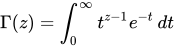 |
In [mathematics](https://en.wikipedia.org/wiki/Mathematics "Mathematics"), the **gamma function** (represented by Γ {\\displaystyle \\Gamma }  , capital [Greek](https://en.wikipedia.org/wiki/Greek_alphabet "Greek alphabet") letter [gamma](https://en.wikipedia.org/wiki/Gamma "Gamma")) is the most common extension of the [factorial function](https://en.wikipedia.org/wiki/Factorial_function "Factorial function") to [complex numbers](https://en.wikipedia.org/wiki/Complex_number "Complex number"). First studied by [Daniel Bernoulli](https://en.wikipedia.org/wiki/Daniel_Bernoulli "Daniel Bernoulli"), the gamma function Γ ( z ) {\\displaystyle \\Gamma (z)}  is defined for all complex numbers z {\\displaystyle z}  except non-positive integers, and Γ ( n ) \= ( n − 1 ) \! {\\displaystyle \\Gamma (n)=(n-1)!}  for every [positive integer](https://en.wikipedia.org/wiki/Positive_integer "Positive integer") n {\\displaystyle n}  . The gamma function can be defined via a convergent [improper integral](https://en.wikipedia.org/wiki/Improper_integral "Improper integral") for complex numbers with positive real part: Γ ( z ) \= ∫ 0 ∞ t z − 1 e − t d t , ℜ ( z ) \> 0\. {\\displaystyle \\Gamma (z)=\\int \_{0}^{\\infty }t^{z-1}e^{-t}\\,dt,\\ \\qquad \\Re (z)\>0.} The gamma function then is defined in the complex plane as the [analytic continuation](https://en.wikipedia.org/wiki/Analytic_continuation "Analytic continuation") of this integral function: it is a [meromorphic function](https://en.wikipedia.org/wiki/Meromorphic_function "Meromorphic function") which is [holomorphic](https://en.wikipedia.org/wiki/Holomorphic_function "Holomorphic function") except at zero and the negative integers, where it has simple [poles](https://en.wikipedia.org/wiki/Zeros_and_poles "Zeros and poles").
Since the gamma function has no zeros, [its reciprocal](https://en.wikipedia.org/wiki/Reciprocal_gamma_function "Reciprocal gamma function") 1 Γ {\\displaystyle {\\frac {1}{\\Gamma }}}  is an [entire function](https://en.wikipedia.org/wiki/Entire_function "Entire function"). In fact, the gamma function corresponds to the [Mellin transform](https://en.wikipedia.org/wiki/Mellin_transform "Mellin transform") of the [exponential decay](https://en.wikipedia.org/wiki/Exponential_decay "Exponential decay"): Γ ( z ) \= M { e − x } ( z ) . {\\displaystyle \\Gamma (z)={\\mathcal {M}}\\{e^{-x}\\}(z)\\,.} 
Other extensions of the factorial function do exist, but the gamma function is the most popular and useful. It appears as a factor in various probability-distribution functions and other formulas in the fields of [probability](https://en.wikipedia.org/wiki/Probability "Probability"), [statistics](https://en.wikipedia.org/wiki/Statistics "Statistics"), [analytic number theory](https://en.wikipedia.org/wiki/Analytic_number_theory "Analytic number theory"), and [combinatorics](https://en.wikipedia.org/wiki/Combinatorics "Combinatorics").
## Motivation
\[[edit](https://en.wikipedia.org/w/index.php?title=Gamma_function&action=edit§ion=1 "Edit section: Motivation")\]
[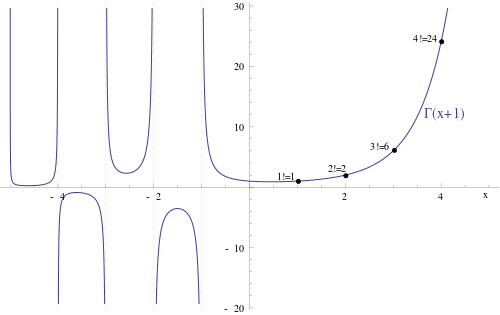](https://en.wikipedia.org/wiki/File:Generalized_factorial_function_more_infos.svg)
Γ
(
x
\+
1
)
{\\displaystyle \\Gamma (x+1)}

interpolates the factorial function to non-integer values.
The gamma function can be seen as a solution to the [interpolation](https://en.wikipedia.org/wiki/Interpolation "Interpolation") problem of finding a [smooth curve](https://en.wikipedia.org/wiki/Smooth_curve "Smooth curve") y \= f ( x ) {\\displaystyle y=f(x)}  that connects the points of the factorial sequence: ( x , y ) \= ( n , n \! ) {\\displaystyle (x,y)=(n,n!)}  for all positive integer values of n {\\displaystyle n}  . The simple formula for the factorial, x \! \= 1 ⋅ 2 ⋅ 3 ⋯ x {\\displaystyle x!=1\\cdot 2\\cdot 3\\cdots x}  is only valid when x {\\displaystyle x}  is a positive integer, and no [elementary function](https://en.wikipedia.org/wiki/Elementary_function "Elementary function") has this property, but a good solution is the gamma function f ( x ) \= Γ ( x \+ 1 ) {\\displaystyle f(x)=\\Gamma (x+1)}  .[\[1\]](https://en.wikipedia.org/wiki/Gamma_function#cite_note-Davis-1)
The gamma function is not only smooth but [analytic](https://en.wikipedia.org/wiki/Analytic_function "Analytic function") (except at the non-positive integers), and it can be defined in several explicit ways. However, it is not the only analytic function that extends the factorial, as one may add any analytic function that is zero on the positive integers, such as k sin ( m π x ) {\\displaystyle k\\sin(m\\pi x)}  for an integer m {\\displaystyle m}  .[\[1\]](https://en.wikipedia.org/wiki/Gamma_function#cite_note-Davis-1) Such a function is known as a [pseudogamma function](https://en.wikipedia.org/wiki/Pseudogamma_function "Pseudogamma function"), the most famous being the [Hadamard](https://en.wikipedia.org/wiki/Hadamard%27s_gamma_function "Hadamard's gamma function") function.[\[2\]](https://en.wikipedia.org/wiki/Gamma_function#cite_note-2)
[](https://en.wikipedia.org/wiki/File:Gamma_plus_sin_pi_z.svg)
The gamma function, Γ(*z*) in blue, plotted along with Γ(*z*) + sin(π*z*) in green. Notice the intersection at positive integers. Both are valid extensions of the factorials to a meromorphic function on the complex plane.
A more restrictive requirement is the [functional equation](https://en.wikipedia.org/wiki/Functional_equation "Functional equation") that interpolates the shifted factorial f ( n ) \= ( n − 1 ) \! {\\displaystyle f(n)=(n-1)!}  :[\[3\]](https://en.wikipedia.org/wiki/Gamma_function#cite_note-3)[\[4\]](https://en.wikipedia.org/wiki/Gamma_function#cite_note-4) f ( x \+ 1 ) \= x f ( x ) for all x \> 0 , f ( 1 ) \= 1\. {\\displaystyle f(x+1)=xf(x)\\ {\\text{ for all }}x\>0,\\qquad f(1)=1.} 
But this still does not give a unique solution, since it allows for multiplication by any periodic function g ( x ) {\\displaystyle g(x)}  with g ( x ) \= g ( x \+ 1 ) {\\displaystyle g(x)=g(x+1)}  and g ( 0 ) \= 1 {\\displaystyle g(0)=1}  , such as g ( x ) \= e k sin ( m π x ) {\\displaystyle g(x)=e^{k\\sin(m\\pi x)}} 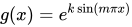 .
One way to resolve the ambiguity is the [Bohr–Mollerup theorem](https://en.wikipedia.org/wiki/Bohr%E2%80%93Mollerup_theorem "Bohr–Mollerup theorem"), which shows that f ( x ) \= Γ ( x ) {\\displaystyle f(x)=\\Gamma (x)}  is the unique interpolating function for the factorial, defined over the positive reals, which is [logarithmically convex](https://en.wikipedia.org/wiki/Logarithmically_convex_function "Logarithmically convex function"),[\[5\]](https://en.wikipedia.org/wiki/Gamma_function#cite_note-Kingman1961-5) meaning that y \= log f ( x ) {\\displaystyle y=\\log f(x)}  is [convex](https://en.wikipedia.org/wiki/Convex_function "Convex function").[\[6\]](https://en.wikipedia.org/wiki/Gamma_function#cite_note-6)
## Definition
\[[edit](https://en.wikipedia.org/w/index.php?title=Gamma_function&action=edit§ion=2 "Edit section: Definition")\]
### Main definition
\[[edit](https://en.wikipedia.org/w/index.php?title=Gamma_function&action=edit§ion=3 "Edit section: Main definition")\]
The notation Γ ( z ) {\\displaystyle \\Gamma (z)}  is due to [Legendre](https://en.wikipedia.org/wiki/Adrien-Marie_Legendre "Adrien-Marie Legendre").[\[1\]](https://en.wikipedia.org/wiki/Gamma_function#cite_note-Davis-1) If the real part of the complex number z {\\displaystyle z}  is strictly positive ( ℜ ( z ) \> 0 {\\displaystyle \\Re (z)\>0}  ), then the [integral](https://en.wikipedia.org/wiki/Integral "Integral")Γ ( z ) \= ∫ 0 ∞ t z − 1 e − t d t {\\displaystyle \\Gamma (z)=\\int \_{0}^{\\infty }t^{z-1}e^{-t}\\,dt}  [converges absolutely](https://en.wikipedia.org/wiki/Absolute_convergence "Absolute convergence"), and is known as the **Euler integral of the second kind**. (Euler's integral of the first kind is the [beta function](https://en.wikipedia.org/wiki/Beta_function "Beta function").[\[1\]](https://en.wikipedia.org/wiki/Gamma_function#cite_note-Davis-1))
[](https://en.wikipedia.org/wiki/File:Plot_of_gamma_function_in_complex_plane_in_3D_with_color_and_legend_and_1000_plot_points_created_with_Mathematica.svg)
Absolute value (vertical) and argument (hue) of the gamma function on the complex plane
The value Γ ( 1 ) {\\displaystyle \\Gamma (1)}  can be calculated asΓ ( 1 ) \= ∫ 0 ∞ t 1 − 1 e − t d t \= ∫ 0 ∞ e − t d t \= 1\. {\\displaystyle {\\begin{aligned}\\Gamma (1)&=\\int \_{0}^{\\infty }t^{1-1}e^{-t}\\,dt\\\\\[6pt\]&=\\int \_{0}^{\\infty }e^{-t}\\,dt=1.\\end{aligned}}} ![{\\displaystyle {\\begin{aligned}\\Gamma (1)&=\\int \_{0}^{\\infty }t^{1-1}e^{-t}\\,dt\\\\\[6pt\]&=\\int \_{0}^{\\infty }e^{-t}\\,dt=1.\\end{aligned}}}](https://wikimedia.org/api/rest_v1/media/math/render/svg/8c6addb58fe26eac70e551ca0237e2abebfd732d)
[Integrating by parts](https://en.wikipedia.org/wiki/Integration_by_parts "Integration by parts"), one sees thatΓ ( z \+ 1 ) \= ∫ 0 ∞ t z e − t d t \= \[ − t z e − t \] 0 ∞ \+ ∫ 0 ∞ z t z − 1 e − t d t . {\\displaystyle {\\begin{aligned}\\Gamma (z+1)&=\\int \_{0}^{\\infty }t^{z}e^{-t}\\,dt\\\\\[6pt\]&={\\Bigl \[}-t^{z}e^{-t}{\\Bigr \]}\_{0}^{\\infty }+\\int \_{0}^{\\infty }z\\,t^{z-1}e^{-t}\\,dt.\\end{aligned}}} ![{\\displaystyle {\\begin{aligned}\\Gamma (z+1)&=\\int \_{0}^{\\infty }t^{z}e^{-t}\\,dt\\\\\[6pt\]&={\\Bigl \[}-t^{z}e^{-t}{\\Bigr \]}\_{0}^{\\infty }+\\int \_{0}^{\\infty }z\\,t^{z-1}e^{-t}\\,dt.\\end{aligned}}}](https://wikimedia.org/api/rest_v1/media/math/render/svg/5f8eb3c3ad7c29c757c6399e8fc280968fec241b)Recognizing that − t z e − t → 0 {\\displaystyle -t^{z}e^{-t}\\to 0}  as t → 0 {\\displaystyle t\\to 0}  (so long as ℜ ( z ) \> 0 {\\displaystyle \\Re (z)\>0}  ) and as t → ∞ {\\displaystyle t\\to \\infty }  ,Γ ( z \+ 1 ) \= z ∫ 0 ∞ t z − 1 e − t d t \= z Γ ( z ) . {\\displaystyle {\\begin{aligned}\\Gamma (z+1)&=z\\int \_{0}^{\\infty }t^{z-1}e^{-t}\\,dt\\\\\[6pt\]&=z\\,\\Gamma (z).\\end{aligned}}} ![{\\displaystyle {\\begin{aligned}\\Gamma (z+1)&=z\\int \_{0}^{\\infty }t^{z-1}e^{-t}\\,dt\\\\\[6pt\]&=z\\,\\Gamma (z).\\end{aligned}}}](https://wikimedia.org/api/rest_v1/media/math/render/svg/4913570a9b44130046e71f40c4347fa0edac043f)
Thus we have shown that Γ ( n ) \= ( n − 1 ) \! {\\displaystyle \\Gamma (n)=(n-1)!}  for any positive integer n by [induction](https://en.wikipedia.org/wiki/Proof_by_induction "Proof by induction").
The identity z Γ ( z ) \= Γ ( z \+ 1 ) {\\textstyle z\\Gamma (z)=\\Gamma (z+1)}  can be used (or, yielding the same result, [analytic continuation](https://en.wikipedia.org/wiki/Analytic_continuation "Analytic continuation") can be used) to uniquely extend the integral formulation for Γ ( z ) {\\displaystyle \\Gamma (z)}  to a [meromorphic function](https://en.wikipedia.org/wiki/Meromorphic_function "Meromorphic function") defined for all complex numbers z {\\displaystyle z}  , except integers less than or equal to zero.[\[1\]](https://en.wikipedia.org/wiki/Gamma_function#cite_note-Davis-1) It is this extended version that is commonly referred to as the gamma function.[\[1\]](https://en.wikipedia.org/wiki/Gamma_function#cite_note-Davis-1)
### Alternative definitions
\[[edit](https://en.wikipedia.org/w/index.php?title=Gamma_function&action=edit§ion=4 "Edit section: Alternative definitions")\]
There are many equivalent definitions.
#### Euler's definition as an infinite product
\[[edit](https://en.wikipedia.org/w/index.php?title=Gamma_function&action=edit§ion=5 "Edit section: Euler's definition as an infinite product")\]
For a fixed integer m {\\displaystyle m}  , as the integer n {\\displaystyle n}  increases, we have that[\[7\]](https://en.wikipedia.org/wiki/Gamma_function#cite_note-7) lim n → ∞ n \! ( n \+ 1 ) m ( n \+ m ) \! \= 1 . {\\displaystyle \\lim \_{n\\to \\infty }{\\frac {n!\\,\\left(n+1\\right)^{m}}{(n+m)!}}=1\\,.} 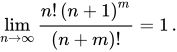
If m {\\displaystyle m}  is not an integer then this equation is meaningless since, in this section, the factorial of a non-integer has not been defined yet. However, in order to define the Gamma function for non-integers, let us assume that this equation continues to hold when m {\\displaystyle m}  is replaced by an arbitrary complex number z {\\displaystyle z}  :
lim n → ∞ n \! ( n \+ 1 ) z ( n \+ z ) \! \= 1 . {\\displaystyle \\lim \_{n\\to \\infty }{\\frac {n!\\,\\left(n+1\\right)^{z}}{(n+z)!}}=1\\,.} 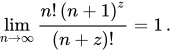 Multiplying both sides by ( z − 1 ) \! {\\displaystyle (z-1)!}  gives ( z − 1 ) \! \= 1 z lim n → ∞ n \! z \! ( n \+ z ) \! ( n \+ 1 ) z \= 1 z lim n → ∞ ( 1 ⋅ 2 ⋯ n ) 1 ( 1 \+ z ) ⋯ ( n \+ z ) ( 2 1 ⋅ 3 2 ⋯ n \+ 1 n ) z \= 1 z ∏ n \= 1 ∞ \[ 1 1 \+ z n ( 1 \+ 1 n ) z \] . {\\displaystyle {\\begin{aligned}(z-1)!&={\\frac {1}{z}}\\lim \_{n\\to \\infty }n!{\\frac {z!}{(n+z)!}}(n+1)^{z}\\\\\[6pt\]&={\\frac {1}{z}}\\lim \_{n\\to \\infty }(1\\cdot 2\\cdots n){\\frac {1}{(1+z)\\cdots (n+z)}}\\left({\\frac {2}{1}}\\cdot {\\frac {3}{2}}\\cdots {\\frac {n+1}{n}}\\right)^{z}\\\\\[6pt\]&={\\frac {1}{z}}\\prod \_{n=1}^{\\infty }\\left\[{\\frac {1}{1+{\\frac {z}{n}}}}\\left(1+{\\frac {1}{n}}\\right)^{z}\\right\].\\end{aligned}}} ![{\\displaystyle {\\begin{aligned}(z-1)!&={\\frac {1}{z}}\\lim \_{n\\to \\infty }n!{\\frac {z!}{(n+z)!}}(n+1)^{z}\\\\\[6pt\]&={\\frac {1}{z}}\\lim \_{n\\to \\infty }(1\\cdot 2\\cdots n){\\frac {1}{(1+z)\\cdots (n+z)}}\\left({\\frac {2}{1}}\\cdot {\\frac {3}{2}}\\cdots {\\frac {n+1}{n}}\\right)^{z}\\\\\[6pt\]&={\\frac {1}{z}}\\prod \_{n=1}^{\\infty }\\left\[{\\frac {1}{1+{\\frac {z}{n}}}}\\left(1+{\\frac {1}{n}}\\right)^{z}\\right\].\\end{aligned}}}](https://wikimedia.org/api/rest_v1/media/math/render/svg/d985df8d67d43c90a474e6eb4c0f806527316ae7)This [infinite product](https://en.wikipedia.org/wiki/Infinite_product "Infinite product"), which is due to Euler,[\[8\]](https://en.wikipedia.org/wiki/Gamma_function#cite_note-8) converges for all complex numbers z {\\displaystyle z}  except the non-positive integers, which fail because of a division by zero. In fact, the above assumption produces a unique definition of Γ ( z ) {\\displaystyle \\Gamma (z)}  as ( z − 1 ) \! {\\displaystyle (z-1)!}  .
Intuitively, this formula indicates that Γ ( z ) {\\displaystyle \\Gamma (z)}  is approximately the result of computing Γ ( n \+ 1 ) \= n \! {\\displaystyle \\Gamma (n+1)=n!} 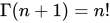 for some large integer n {\\displaystyle n}  , multiplying by ( n \+ 1 ) z {\\displaystyle (n+1)^{z}}  to approximate Γ ( n \+ z \+ 1 ) {\\displaystyle \\Gamma (n+z+1)} 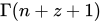 , and then using the relationship Γ ( x \+ 1 ) \= x Γ ( x ) {\\displaystyle \\Gamma (x+1)=x\\Gamma (x)}  backwards n \+ 1 {\\displaystyle n+1}  times to get an approximation for Γ ( z ) {\\displaystyle \\Gamma (z)}  ; and furthermore that this approximation becomes exact as n {\\displaystyle n}  increases to infinity.
The infinite product for the [reciprocal](https://en.wikipedia.org/wiki/Reciprocal_gamma_function "Reciprocal gamma function")1 Γ ( z ) \= z ∏ n \= 1 ∞ \[ ( 1 \+ z n ) / ( 1 \+ 1 n ) z \] {\\displaystyle {\\frac {1}{\\Gamma (z)}}=z\\prod \_{n=1}^{\\infty }\\left\[\\left(1+{\\frac {z}{n}}\\right)/{\\left(1+{\\frac {1}{n}}\\right)^{z}}\\right\]} ![{\\displaystyle {\\frac {1}{\\Gamma (z)}}=z\\prod \_{n=1}^{\\infty }\\left\[\\left(1+{\\frac {z}{n}}\\right)/{\\left(1+{\\frac {1}{n}}\\right)^{z}}\\right\]}](https://wikimedia.org/api/rest_v1/media/math/render/svg/fdf39a91c13c9fb4dd32b61d30273d02638025ea) is an [entire function](https://en.wikipedia.org/wiki/Entire_function "Entire function"), converging for every complex number z {\\displaystyle z}  .
#### Weierstrass's definition
\[[edit](https://en.wikipedia.org/w/index.php?title=Gamma_function&action=edit§ion=6 "Edit section: Weierstrass's definition")\]
The definition for the gamma function due to [Weierstrass](https://en.wikipedia.org/wiki/Karl_Weierstrass "Karl Weierstrass") is also valid for all complex numbers z {\\displaystyle z}  except non-positive integers: Γ ( z ) \= e − γ z z ∏ n \= 1 ∞ ( 1 \+ z n ) − 1 e z / n , {\\displaystyle \\Gamma (z)={\\frac {e^{-\\gamma z}}{z}}\\prod \_{n=1}^{\\infty }\\left(1+{\\frac {z}{n}}\\right)^{-1}e^{z/n},} 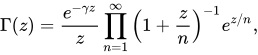 where γ ≈ 0\.577216 {\\displaystyle \\gamma \\approx 0.577216} 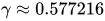 is the [Euler–Mascheroni constant](https://en.wikipedia.org/wiki/Euler%E2%80%93Mascheroni_constant "Euler–Mascheroni constant").[\[1\]](https://en.wikipedia.org/wiki/Gamma_function#cite_note-Davis-1) This is the [Hadamard product](https://en.wikipedia.org/wiki/Entire_function#Genus "Entire function") of 1 Γ ( z ) {\\displaystyle \\textstyle {\\frac {1}{\\Gamma (z)}}}  in a rewritten form.
| Proof of equivalence of the three definitions |
|---|
| **Equivalence of the integral definition and Weierstrass definition**By the integral definition, the relation Γ ( z \+ 1 ) \= z Γ ( z ) {\\displaystyle \\Gamma (z+1)=z\\Gamma (z)}  and [Hadamard factorization theorem](https://en.wikipedia.org/wiki/Hadamard_factorization_theorem "Hadamard factorization theorem"), 1 Γ ( z ) \= z e c 1 z \+ c 2 ∏ n \= 1 ∞ e − z n ( 1 \+ z n ) {\\displaystyle {\\frac {1}{\\Gamma (z)}}=ze^{c\_{1}z+c\_{2}}\\prod \_{n=1}^{\\infty }e^{-{\\frac {z}{n}}}\\left(1+{\\frac {z}{n}}\\right)}  for some constants c 1 {\\displaystyle c\_{1}}  , c 2 {\\displaystyle c\_{2}}  since 1 / Γ {\\displaystyle 1/\\Gamma }  is an entire function of order 1 {\\displaystyle 1}  . Since z Γ ( z ) → 1 {\\displaystyle z\\Gamma (z)\\to 1}  as z → 0 {\\displaystyle z\\to 0}  , c 2 \= 0 {\\displaystyle c\_{2}=0}  (or an integer multiple of 2 π i {\\displaystyle 2\\pi i}  ) and since Γ ( 1 ) \= 1 {\\displaystyle \\Gamma (1)=1}  , e − c 1 \= ∏ n \= 1 ∞ e − 1 n ( 1 \+ 1 n ) \= exp ( lim N → ∞ ∑ n \= 1 N ( log ( 1 \+ 1 n ) − 1 n ) ) \= exp ( lim N → ∞ ( log ( N \+ 1 ) − ∑ n \= 1 N 1 n ) ) . {\\displaystyle {\\begin{aligned}e^{-c\_{1}}&=\\prod \_{n=1}^{\\infty }e^{-{\\frac {1}{n}}}\\left(1+{\\frac {1}{n}}\\right)\\\\&=\\exp \\left(\\lim \_{N\\to \\infty }\\sum \_{n=1}^{N}\\left(\\log \\left(1+{\\frac {1}{n}}\\right)-{\\frac {1}{n}}\\right)\\right)\\\\&=\\exp \\left(\\lim \_{N\\to \\infty }\\left(\\log(N+1)-\\sum \_{n=1}^{N}{\\frac {1}{n}}\\right)\\right).\\end{aligned}}} where c 1 \= γ \+ 2 π i k {\\displaystyle c\_{1}=\\gamma +2\\pi ik}  for some integer k {\\displaystyle k}  . Since Γ ( z ) ∈ R {\\displaystyle \\Gamma (z)\\in \\mathbb {R} }  for z ∈ R ∖ Z 0 − {\\displaystyle z\\in \\mathbb {R} \\setminus \\mathbb {Z} \_{0}^{-}}  , we have k \= 0 {\\displaystyle k=0}  and 1 Γ ( z ) \= z e γ z ∏ n \= 1 ∞ e − z n ( 1 \+ z n ) {\\displaystyle {\\frac {1}{\\Gamma (z)}}=ze^{\\gamma z}\\prod \_{n=1}^{\\infty }e^{-{\\frac {z}{n}}}\\left(1+{\\frac {z}{n}}\\right)} **Equivalence of the Weierstrass definition and Euler definition**Γ ( z ) \= e − γ z z ∏ n \= 1 ∞ ( 1 \+ z n ) − 1 e z / n \= 1 z lim n → ∞ e z ( log ( n \+ 1 ) − 1 − 1 2 − 1 3 − ⋯ − 1 n ) e z ( 1 \+ 1 2 \+ 1 3 \+ ⋯ \+ 1 n ) ( 1 \+ z ) ( 1 \+ z 2 ) ⋯ ( 1 \+ z n ) \= 1 z lim n → ∞ 1 ( 1 \+ z ) ( 1 \+ z 2 ) ⋯ ( 1 \+ z n ) e z log ( n \+ 1 ) \= lim n → ∞ n \! ( n \+ 1 ) z z ( z \+ 1 ) ⋯ ( z \+ n ) , z ∈ C ∖ Z 0 − {\\displaystyle {\\begin{aligned}\\Gamma (z)&={\\frac {e^{-\\gamma z}}{z}}\\prod \_{n=1}^{\\infty }\\left(1+{\\frac {z}{n}}\\right)^{-1}e^{z/n}\\\\&={\\frac {1}{z}}\\lim \_{n\\to \\infty }e^{z\\left(\\log(n+1)-1-{\\frac {1}{2}}-{\\frac {1}{3}}-\\cdots -{\\frac {1}{n}}\\right)}{\\frac {e^{z\\left(1+{\\frac {1}{2}}+{\\frac {1}{3}}+\\cdots +{\\frac {1}{n}}\\right)}}{\\left(1+z\\right)\\left(1+{\\frac {z}{2}}\\right)\\cdots \\left(1+{\\frac {z}{n}}\\right)}}\\\\&={\\frac {1}{z}}\\lim \_{n\\to \\infty }{\\frac {1}{\\left(1+z\\right)\\left(1+{\\frac {z}{2}}\\right)\\cdots \\left(1+{\\frac {z}{n}}\\right)}}e^{z\\log \\left(n+1\\right)}\\\\&=\\lim \_{n\\to \\infty }{\\frac {n!(n+1)^{z}}{z(z+1)\\cdots (z+n)}},\\quad z\\in \\mathbb {C} \\setminus \\mathbb {Z} \_{0}^{-}\\end{aligned}}}  |
## Properties
\[[edit](https://en.wikipedia.org/w/index.php?title=Gamma_function&action=edit§ion=7 "Edit section: Properties")\]
### General
\[[edit](https://en.wikipedia.org/w/index.php?title=Gamma_function&action=edit§ion=8 "Edit section: General")\]
Besides the fundamental property discussed above,Γ ( z \+ 1 ) \= z Γ ( z ) . {\\displaystyle \\Gamma (z+1)=z\\ \\Gamma (z).} Other important functional equations for the gamma function are [Euler's reflection formula](https://en.wikipedia.org/wiki/Reflection_formula "Reflection formula"),Γ ( 1 − z ) Γ ( z ) \= π sin π z , z ∉ Z , {\\displaystyle \\Gamma (1-z)\\Gamma (z)={\\frac {\\pi }{\\sin \\pi z}},\\qquad z\\not \\in \\mathbb {Z} ,} which impliesΓ ( z − n ) \= ( − 1 ) n − 1 Γ ( − z ) Γ ( 1 \+ z ) Γ ( n \+ 1 − z ) , n ∈ Z {\\displaystyle \\Gamma (z-n)=(-1)^{n-1}\\;{\\frac {\\Gamma (-z)\\Gamma (1+z)}{\\Gamma (n+1-z)}},\\qquad n\\in \\mathbb {Z} }  and the [Legendre duplication formula](https://en.wikipedia.org/wiki/Multiplication_theorem#Gamma_function%E2%80%93Legendre_formula "Multiplication theorem") Γ ( z ) Γ ( z \+ 1 2 ) \= 2 1 − 2 z π Γ ( 2 z ) . {\\displaystyle \\Gamma (z)\\Gamma \\left(z+{\\frac {1}{2}}\\right)=2^{1-2z}\\,{\\sqrt {\\pi }}\\,\\Gamma (2z).} 
| Derivation of Euler's reflection formula |
|---|
| **Proof 1**With Euler's infinite product Γ ( z ) \= 1 z ∏ n \= 1 ∞ ( 1 \+ 1 / n ) z 1 \+ z / n {\\displaystyle \\Gamma (z)={\\frac {1}{z}}\\prod \_{n=1}^{\\infty }{\\frac {(1+1/n)^{z}}{1+z/n}}} 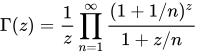 compute 1 Γ ( 1 − z ) Γ ( z ) \= 1 ( − z ) Γ ( − z ) Γ ( z ) \= z ∏ n \= 1 ∞ ( 1 − z / n ) ( 1 \+ z / n ) ( 1 \+ 1 / n ) − z ( 1 \+ 1 / n ) z \= z ∏ n \= 1 ∞ ( 1 − z 2 n 2 ) \= sin π z π , {\\displaystyle {\\frac {1}{\\Gamma (1-z)\\Gamma (z)}}={\\frac {1}{(-z)\\Gamma (-z)\\Gamma (z)}}=z\\prod \_{n=1}^{\\infty }{\\frac {(1-z/n)(1+z/n)}{(1+1/n)^{-z}(1+1/n)^{z}}}=z\\prod \_{n=1}^{\\infty }\\left(1-{\\frac {z^{2}}{n^{2}}}\\right)={\\frac {\\sin \\pi z}{\\pi }}\\,,}  where the last equality is a [known result](https://en.wikipedia.org/wiki/Sine#Partial_fraction_and_product_expansions_of_complex_sine "Sine"). A similar derivation begins with Weierstrass's definition.**Proof 2**First prove that I \= ∫ − ∞ ∞ e a x 1 \+ e x d x \= ∫ 0 ∞ v a − 1 1 \+ v d v \= π sin π a , a ∈ ( 0 , 1 ) . {\\displaystyle I=\\int \_{-\\infty }^{\\infty }{\\frac {e^{ax}}{1+e^{x}}}\\,dx=\\int \_{0}^{\\infty }{\\frac {v^{a-1}}{1+v}}\\,dv={\\frac {\\pi }{\\sin \\pi a}},\\quad a\\in (0,1).}  Consider the positively oriented rectangular contour C R {\\displaystyle C\_{R}}  with vertices at R {\\displaystyle R}  , − R {\\displaystyle -R}  , R \+ 2 π i {\\displaystyle R+2\\pi i}  and − R \+ 2 π i {\\displaystyle -R+2\\pi i}  where R ∈ R \+ {\\displaystyle R\\in \\mathbb {R} ^{+}}  . Then by the [residue theorem](https://en.wikipedia.org/wiki/Residue_theorem "Residue theorem"), ∫ C R e a z 1 \+ e z d z \= − 2 π i e a π i . {\\displaystyle \\int \_{C\_{R}}{\\frac {e^{az}}{1+e^{z}}}\\,dz=-2\\pi ie^{a\\pi i}.} 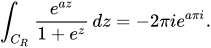 Let I R \= ∫ − R R e a x 1 \+ e x d x {\\displaystyle I\_{R}=\\int \_{-R}^{R}{\\frac {e^{ax}}{1+e^{x}}}\\,dx} 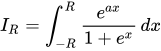 and let I R ′ {\\displaystyle I\_{R}'}  be the analogous integral over the top side of the rectangle. Then I R → I {\\displaystyle I\_{R}\\to I}  as R → ∞ {\\displaystyle R\\to \\infty }  and I R ′ \= − e 2 π i a I R {\\displaystyle I\_{R}'=-e^{2\\pi ia}I\_{R}} 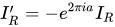 . If A R {\\displaystyle A\_{R}}  denotes the right vertical side of the rectangle, then \| ∫ A R e a z 1 \+ e z d z \| ≤ ∫ 0 2 π \| e a ( R \+ i t ) 1 \+ e R \+ i t \| d t ≤ C e ( a − 1 ) R {\\displaystyle \\left\|\\int \_{A\_{R}}{\\frac {e^{az}}{1+e^{z}}}\\,dz\\right\|\\leq \\int \_{0}^{2\\pi }\\left\|{\\frac {e^{a(R+it)}}{1+e^{R+it}}}\\right\|\\,dt\\leq Ce^{(a-1)R}}  for some constant C {\\displaystyle C}  and since a \< 1 {\\displaystyle a\<1}  , the integral tends to 0 {\\displaystyle 0}  as R → ∞ {\\displaystyle R\\to \\infty }  . Analogously, the integral over the left vertical side of the rectangle tends to 0 {\\displaystyle 0}  as R → ∞ {\\displaystyle R\\to \\infty }  . Therefore I − e 2 π i a I \= − 2 π i e a π i , {\\displaystyle I-e^{2\\pi ia}I=-2\\pi ie^{a\\pi i},}  from which I \= π sin π a , a ∈ ( 0 , 1 ) . {\\displaystyle I={\\frac {\\pi }{\\sin \\pi a}},\\quad a\\in (0,1).}  Then Γ ( 1 − z ) \= ∫ 0 ∞ e − u u − z d u \= t ∫ 0 ∞ e − v t ( v t ) − z d v , t \> 0 {\\displaystyle \\Gamma (1-z)=\\int \_{0}^{\\infty }e^{-u}u^{-z}\\,du=t\\int \_{0}^{\\infty }e^{-vt}(vt)^{-z}\\,dv,\\quad t\>0}  and Γ ( z ) Γ ( 1 − z ) \= ∫ 0 ∞ ∫ 0 ∞ e − t ( 1 \+ v ) v − z d v d t \= ∫ 0 ∞ v − z 1 \+ v d v \= π sin π ( 1 − z ) \= π sin π z , z ∈ ( 0 , 1 ) . {\\displaystyle {\\begin{aligned}\\Gamma (z)\\Gamma (1-z)&=\\int \_{0}^{\\infty }\\int \_{0}^{\\infty }e^{-t(1+v)}v^{-z}\\,dv\\,dt\\\\&=\\int \_{0}^{\\infty }{\\frac {v^{-z}}{1+v}}\\,dv\\\\&={\\frac {\\pi }{\\sin \\pi (1-z)}}\\\\&={\\frac {\\pi }{\\sin \\pi z}},\\quad z\\in (0,1).\\end{aligned}}} 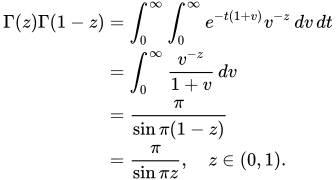 Proving the reflection formula for all z ∈ ( 0 , 1 ) {\\displaystyle z\\in (0,1)}  proves it for all z ∈ C ∖ Z {\\displaystyle z\\in \\mathbb {C} \\setminus \\mathbb {Z} }  by analytic continuation. |
| Derivation of the Legendre duplication formula |
|---|
| The [beta function](https://en.wikipedia.org/wiki/Beta_function "Beta function") can be represented as B ( z 1 , z 2 ) \= Γ ( z 1 ) Γ ( z 2 ) Γ ( z 1 \+ z 2 ) \= ∫ 0 1 t z 1 − 1 ( 1 − t ) z 2 − 1 d t . {\\displaystyle \\mathrm {B} (z\_{1},z\_{2})={\\frac {\\Gamma (z\_{1})\\Gamma (z\_{2})}{\\Gamma (z\_{1}+z\_{2})}}=\\int \_{0}^{1}t^{z\_{1}-1}(1-t)^{z\_{2}-1}\\,dt.} Setting z 1 \= z 2 \= z {\\displaystyle z\_{1}=z\_{2}=z}  yields Γ 2 ( z ) Γ ( 2 z ) \= ∫ 0 1 t z − 1 ( 1 − t ) z − 1 d t . {\\displaystyle {\\frac {\\Gamma ^{2}(z)}{\\Gamma (2z)}}=\\int \_{0}^{1}t^{z-1}(1-t)^{z-1}\\,dt.} 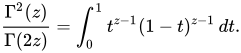After the substitution t \= 1 \+ u 2 {\\displaystyle t={\\frac {1+u}{2}}}  : Γ 2 ( z ) Γ ( 2 z ) \= 1 2 2 z − 1 ∫ − 1 1 ( 1 − u 2 ) z − 1 d u . {\\displaystyle {\\frac {\\Gamma ^{2}(z)}{\\Gamma (2z)}}={\\frac {1}{2^{2z-1}}}\\int \_{-1}^{1}\\left(1-u^{2}\\right)^{z-1}\\,du.} The function ( 1 − u 2 ) z − 1 {\\displaystyle (1-u^{2})^{z-1}}  is even, hence 2 2 z − 1 Γ 2 ( z ) \= 2 Γ ( 2 z ) ∫ 0 1 ( 1 − u 2 ) z − 1 d u . {\\displaystyle 2^{2z-1}\\Gamma ^{2}(z)=2\\Gamma (2z)\\int \_{0}^{1}(1-u^{2})^{z-1}\\,du.} Now B ( 1 2 , z ) \= ∫ 0 1 t 1 2 − 1 ( 1 − t ) z − 1 d t , t \= s 2 . {\\displaystyle \\mathrm {B} \\left({\\frac {1}{2}},z\\right)=\\int \_{0}^{1}t^{{\\frac {1}{2}}-1}(1-t)^{z-1}\\,dt,\\quad t=s^{2}.} Then B ( 1 2 , z ) \= 2 ∫ 0 1 ( 1 − s 2 ) z − 1 d s \= 2 ∫ 0 1 ( 1 − u 2 ) z − 1 d u . {\\displaystyle \\mathrm {B} \\left({\\frac {1}{2}},z\\right)=2\\int \_{0}^{1}(1-s^{2})^{z-1}\\,ds=2\\int \_{0}^{1}(1-u^{2})^{z-1}\\,du.} This implies 2 2 z − 1 Γ 2 ( z ) \= Γ ( 2 z ) B ( 1 2 , z ) . {\\displaystyle 2^{2z-1}\\Gamma ^{2}(z)=\\Gamma (2z)\\mathrm {B} \\left({\\frac {1}{2}},z\\right).} 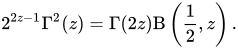Since B ( 1 2 , z ) \= Γ ( 1 2 ) Γ ( z ) Γ ( z \+ 1 2 ) , Γ ( 1 2 ) \= π , {\\displaystyle \\mathrm {B} \\left({\\frac {1}{2}},z\\right)={\\frac {\\Gamma \\left({\\frac {1}{2}}\\right)\\Gamma (z)}{\\Gamma \\left(z+{\\frac {1}{2}}\\right)}},\\quad \\Gamma \\left({\\frac {1}{2}}\\right)={\\sqrt {\\pi }},}  the Legendre duplication formula follows: Γ ( z ) Γ ( z \+ 1 2 ) \= 2 1 − 2 z π Γ ( 2 z ) . {\\displaystyle \\Gamma (z)\\Gamma \\left(z+{\\frac {1}{2}}\\right)=2^{1-2z}{\\sqrt {\\pi }}\\;\\Gamma (2z).}  |
The duplication formula is a special case of the [multiplication theorem](https://en.wikipedia.org/wiki/Multiplication_theorem "Multiplication theorem") (see [\[9\]](https://en.wikipedia.org/wiki/Gamma_function#cite_note-ReferenceA-9) Eq. 5.5.6): ∏ k \= 0 m − 1 Γ ( z \+ k m ) \= ( 2 π ) m − 1 2 m 1 2 − m z Γ ( m z ) . {\\displaystyle \\prod \_{k=0}^{m-1}\\Gamma \\left(z+{\\frac {k}{m}}\\right)=(2\\pi )^{\\frac {m-1}{2}}\\;m^{{\\frac {1}{2}}-mz}\\;\\Gamma (mz).} 
A simple but useful property, which can be seen from the limit definition, is: Γ ( z ) ¯ \= Γ ( z ¯ ) ⇒ Γ ( z ) Γ ( z ¯ ) ∈ R . {\\displaystyle {\\overline {\\Gamma (z)}}=\\Gamma ({\\overline {z}})\\;\\Rightarrow \\;\\Gamma (z)\\Gamma ({\\overline {z}})\\in \\mathbb {R} .} 
In particular, with z \= a \+ b i {\\displaystyle z=a+bi}  , this product is \| Γ ( a \+ b i ) \| 2 \= \| Γ ( a ) \| 2 ∏ k \= 0 ∞ 1 1 \+ b 2 ( a \+ k ) 2 {\\displaystyle \|\\Gamma (a+bi)\|^{2}=\|\\Gamma (a)\|^{2}\\prod \_{k=0}^{\\infty }{\\frac {1}{1+{\\frac {b^{2}}{(a+k)^{2}}}}}} 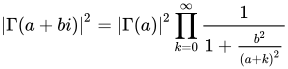
If the real part is an integer or a [half-integer](https://en.wikipedia.org/wiki/Half-integer "Half-integer"), this can be finitely expressed in [closed form](https://en.wikipedia.org/wiki/Closed-form_expression "Closed-form expression"): \| Γ ( b i ) \| 2 \= π b sinh π b \| Γ ( 1 2 \+ b i ) \| 2 \= π cosh π b \| Γ ( 1 \+ b i ) \| 2 \= π b sinh π b \| Γ ( 1 \+ n \+ b i ) \| 2 \= π b sinh π b ∏ k \= 1 n ( k 2 \+ b 2 ) , n ∈ N \| Γ ( − n \+ b i ) \| 2 \= π b sinh π b ∏ k \= 1 n ( k 2 \+ b 2 ) − 1 , n ∈ N \| Γ ( 1 2 ± n \+ b i ) \| 2 \= π cosh π b ∏ k \= 1 n ( ( k − 1 2 ) 2 \+ b 2 ) ± 1 , n ∈ N {\\displaystyle {\\begin{aligned}\|\\Gamma (bi)\|^{2}&={\\frac {\\pi }{b\\sinh \\pi b}}\\\\\[6pt\]\\left\|\\Gamma \\left({\\tfrac {1}{2}}+bi\\right)\\right\|^{2}&={\\frac {\\pi }{\\cosh \\pi b}}\\\\\[6pt\]\\left\|\\Gamma \\left(1+bi\\right)\\right\|^{2}&={\\frac {\\pi b}{\\sinh \\pi b}}\\\\\[6pt\]\\left\|\\Gamma \\left(1+n+bi\\right)\\right\|^{2}&={\\frac {\\pi b}{\\sinh \\pi b}}\\prod \_{k=1}^{n}\\left(k^{2}+b^{2}\\right),\\quad n\\in \\mathbb {N} \\\\\[6pt\]\\left\|\\Gamma \\left(-n+bi\\right)\\right\|^{2}&={\\frac {\\pi }{b\\sinh \\pi b}}\\prod \_{k=1}^{n}\\left(k^{2}+b^{2}\\right)^{-1},\\quad n\\in \\mathbb {N} \\\\\[6pt\]\\left\|\\Gamma \\left({\\tfrac {1}{2}}\\pm n+bi\\right)\\right\|^{2}&={\\frac {\\pi }{\\cosh \\pi b}}\\prod \_{k=1}^{n}\\left(\\left(k-{\\tfrac {1}{2}}\\right)^{2}+b^{2}\\right)^{\\pm 1},\\quad n\\in \\mathbb {N} \\\\\[-1ex\]&\\end{aligned}}} ![{\\displaystyle {\\begin{aligned}\|\\Gamma (bi)\|^{2}&={\\frac {\\pi }{b\\sinh \\pi b}}\\\\\[6pt\]\\left\|\\Gamma \\left({\\tfrac {1}{2}}+bi\\right)\\right\|^{2}&={\\frac {\\pi }{\\cosh \\pi b}}\\\\\[6pt\]\\left\|\\Gamma \\left(1+bi\\right)\\right\|^{2}&={\\frac {\\pi b}{\\sinh \\pi b}}\\\\\[6pt\]\\left\|\\Gamma \\left(1+n+bi\\right)\\right\|^{2}&={\\frac {\\pi b}{\\sinh \\pi b}}\\prod \_{k=1}^{n}\\left(k^{2}+b^{2}\\right),\\quad n\\in \\mathbb {N} \\\\\[6pt\]\\left\|\\Gamma \\left(-n+bi\\right)\\right\|^{2}&={\\frac {\\pi }{b\\sinh \\pi b}}\\prod \_{k=1}^{n}\\left(k^{2}+b^{2}\\right)^{-1},\\quad n\\in \\mathbb {N} \\\\\[6pt\]\\left\|\\Gamma \\left({\\tfrac {1}{2}}\\pm n+bi\\right)\\right\|^{2}&={\\frac {\\pi }{\\cosh \\pi b}}\\prod \_{k=1}^{n}\\left(\\left(k-{\\tfrac {1}{2}}\\right)^{2}+b^{2}\\right)^{\\pm 1},\\quad n\\in \\mathbb {N} \\\\\[-1ex\]&\\end{aligned}}}](https://wikimedia.org/api/rest_v1/media/math/render/svg/a84245d2b5e677d413a3bc7821a0c78f47163303)
| Proof of absolute value formulas for arguments of integer or half-integer real part |
|---|
| First, consider the reflection formula applied to z \= b i {\\displaystyle z=bi}  . Γ ( b i ) Γ ( 1 − b i ) \= π sin π b i {\\displaystyle \\Gamma (bi)\\Gamma (1-bi)={\\frac {\\pi }{\\sin \\pi bi}}} 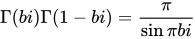 Applying the recurrence relation to the second term: − b i ⋅ Γ ( b i ) Γ ( − b i ) \= π sin π b i {\\displaystyle -bi\\cdot \\Gamma (bi)\\Gamma (-bi)={\\frac {\\pi }{\\sin \\pi bi}}}  which with simple rearrangement gives Γ ( b i ) Γ ( − b i ) \= π − b i sin π b i \= π b sinh π b {\\displaystyle \\Gamma (bi)\\Gamma (-bi)={\\frac {\\pi }{-bi\\sin \\pi bi}}={\\frac {\\pi }{b\\sinh \\pi b}}} Second, consider the reflection formula applied to z \= 1 2 \+ b i {\\displaystyle z={\\tfrac {1}{2}}+bi}  . Γ ( 1 2 \+ b i ) Γ ( 1 − ( 1 2 \+ b i ) ) \= Γ ( 1 2 \+ b i ) Γ ( 1 2 − b i ) \= π sin π ( 1 2 \+ b i ) \= π cos π b i \= π cosh π b {\\displaystyle \\Gamma ({\\tfrac {1}{2}}+bi)\\Gamma \\left(1-({\\tfrac {1}{2}}+bi)\\right)=\\Gamma ({\\tfrac {1}{2}}+bi)\\Gamma ({\\tfrac {1}{2}}-bi)={\\frac {\\pi }{\\sin \\pi ({\\tfrac {1}{2}}+bi)}}={\\frac {\\pi }{\\cos \\pi bi}}={\\frac {\\pi }{\\cosh \\pi b}}} Formulas for other values of z {\\displaystyle z}  for which the real part is integer or half-integer quickly follow by [induction](https://en.wikipedia.org/wiki/Mathematical_induction "Mathematical induction") using the recurrence relation in the positive and negative directions. |
Perhaps the best-known value of the gamma function at a non-integer argument is Γ ( 1 2 ) \= π , {\\displaystyle \\Gamma \\left({\\tfrac {1}{2}}\\right)={\\sqrt {\\pi }},} 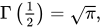 which can be found by setting z \= 1 2 {\\textstyle z={\\frac {1}{2}}}  in the reflection formula, by using the relation to the [beta function](https://en.wikipedia.org/wiki/Beta_function "Beta function") given below with z 1 \= z 2 \= 1 2 {\\displaystyle z\_{1}=z\_{2}={\\frac {1}{2}}}  , or simply by making the substitution t \= u 2 {\\displaystyle t=u^{2}}  in the integral definition of the gamma function, resulting in a [Gaussian integral](https://en.wikipedia.org/wiki/Gaussian_integral "Gaussian integral"). In general, for non-negative integer values of n {\\displaystyle n}  we have: Γ ( 1 2 \+ n ) \= ( 2 n ) \! 4 n n \! π \= ( 2 n − 1 ) \! \! 2 n π \= ( n − 1 2 n ) n \! π Γ ( 1 2 − n ) \= ( − 4 ) n n \! ( 2 n ) \! π \= ( − 2 ) n ( 2 n − 1 ) \! \! π \= π ( − 1 / 2 n ) n \! {\\displaystyle {\\begin{aligned}\\Gamma \\left({\\frac {1}{2}}+n\\right)&={(2n)! \\over 4^{n}n!}{\\sqrt {\\pi }}={\\frac {(2n-1)!!}{2^{n}}}{\\sqrt {\\pi }}={\\binom {n-{\\frac {1}{2}}}{n}}\\,n!\\,{\\sqrt {\\pi }}\\\\\[6pt\]\\Gamma \\left({\\frac {1}{2}}-n\\right)&={(-4)^{n}n! \\over (2n)!}{\\sqrt {\\pi }}={\\frac {(-2)^{n}}{(2n-1)!!}}{\\sqrt {\\pi }}={\\frac {\\sqrt {\\pi }}{{\\binom {-1/2}{n}}\\,n!}}\\end{aligned}}} ![{\\displaystyle {\\begin{aligned}\\Gamma \\left({\\frac {1}{2}}+n\\right)&={(2n)! \\over 4^{n}n!}{\\sqrt {\\pi }}={\\frac {(2n-1)!!}{2^{n}}}{\\sqrt {\\pi }}={\\binom {n-{\\frac {1}{2}}}{n}}\\,n!\\,{\\sqrt {\\pi }}\\\\\[6pt\]\\Gamma \\left({\\frac {1}{2}}-n\\right)&={(-4)^{n}n! \\over (2n)!}{\\sqrt {\\pi }}={\\frac {(-2)^{n}}{(2n-1)!!}}{\\sqrt {\\pi }}={\\frac {\\sqrt {\\pi }}{{\\binom {-1/2}{n}}\\,n!}}\\end{aligned}}}](https://wikimedia.org/api/rest_v1/media/math/render/svg/67673ba808d47122022446cca8cb4cbff0bd91f5)where the [double factorial](https://en.wikipedia.org/wiki/Double_factorial "Double factorial") ( 2 n − 1 ) \! \! \= ( 2 n − 1 ) ( 2 n − 3 ) ⋯ ( 3 ) ( 1 ) {\\displaystyle (2n-1)!!=(2n-1)(2n-3)\\cdots (3)(1)}  . See [Particular values of the gamma function](https://en.wikipedia.org/wiki/Particular_values_of_the_gamma_function "Particular values of the gamma function") for calculated values.
It might be tempting to generalize the result that Γ ( 1 2 ) \= π {\\textstyle \\Gamma \\left({\\frac {1}{2}}\\right)={\\sqrt {\\pi }}}  by looking for a formula for other individual values Γ ( r ) {\\displaystyle \\Gamma (r)}  where r {\\displaystyle r}  is rational, especially because according to [Gauss's digamma theorem](https://en.wikipedia.org/wiki/Digamma_function#Gauss's_digamma_theorem "Digamma function"), it is possible to do so for the closely related [digamma function](https://en.wikipedia.org/wiki/Digamma_function "Digamma function") at every rational value. However, these numbers Γ ( r ) {\\displaystyle \\Gamma (r)}  are not known to be expressible by themselves in terms of elementary functions. It has been proved that Γ ( n \+ r ) {\\displaystyle \\Gamma (n+r)}  is a [transcendental number](https://en.wikipedia.org/wiki/Transcendental_number "Transcendental number") and [algebraically independent](https://en.wikipedia.org/wiki/Algebraic_independence "Algebraic independence") of π {\\displaystyle \\pi }  for any integer n {\\displaystyle n}  and each of the fractions r \= 1 6 , 1 4 , 1 3 , 2 3 , 3 4 , 5 6 {\\displaystyle \\textstyle r={\\frac {1}{6}},{\\frac {1}{4}},{\\frac {1}{3}},{\\frac {2}{3}},{\\frac {3}{4}},{\\frac {5}{6}}}  .[\[10\]](https://en.wikipedia.org/wiki/Gamma_function#cite_note-10) In general, when computing values of the gamma function, we must settle for numerical approximations.
The derivatives of the gamma function are described in terms of the [polygamma function](https://en.wikipedia.org/wiki/Polygamma_function "Polygamma function"), ψ ( m ) ( z ) {\\displaystyle \\psi ^{(m)}(z)}  : Γ ′ ( z ) \= Γ ( z ) ψ ( 0 ) ( z ) . {\\displaystyle \\Gamma '(z)=\\Gamma (z)\\psi ^{(0)}(z).} For a positive integer m {\\displaystyle m}  the derivative of the gamma function can be calculated as follows:
[](https://en.wikipedia.org/wiki/File:Plot_of_gamma_function_in_the_complex_plane_from_-2-i_to_6%2B2i_with_colors_created_in_Mathematica.svg)
Hue showing the argument of the gamma function in the complex plane from −2 − 2*i* to 6 + 2*i*
Γ ′ ( m \+ 1 ) \= m \! ( − γ \+ ∑ k \= 1 m 1 k ) \= m \! ( − γ \+ H ( m ) ) , {\\displaystyle \\Gamma '(m+1)=m!\\left(-\\gamma +\\sum \_{k=1}^{m}{\\frac {1}{k}}\\right)=m!\\left(-\\gamma +H(m)\\right)\\,,}  where H ( m ) {\\displaystyle H(m)}  is the m {\\displaystyle m} th [harmonic number](https://en.wikipedia.org/wiki/Harmonic_number "Harmonic number") and γ {\\displaystyle \\gamma }  is the [Euler–Mascheroni constant](https://en.wikipedia.org/wiki/Euler%E2%80%93Mascheroni_constant "Euler–Mascheroni constant").
For ℜ ( z ) \> 0 {\\displaystyle \\Re (z)\>0}  the n {\\displaystyle n} th derivative of the gamma function is:d n d z n Γ ( z ) \= ∫ 0 ∞ t z − 1 e − t ( log t ) n d t . {\\displaystyle {\\frac {d^{n}}{dz^{n}}}\\Gamma (z)=\\int \_{0}^{\\infty }t^{z-1}e^{-t}(\\log t)^{n}\\,dt.} (This can be derived by [differentiating the integral](https://en.wikipedia.org/wiki/Differentiating_under_the_integral_sign "Differentiating under the integral sign") form of the gamma function with respect to z {\\displaystyle z}  .)
Using the identityΓ ( n ) ( 1 ) \= ( − 1 ) n B n ( γ , 1 \! ζ ( 2 ) , … , ( n − 1 ) \! ζ ( n ) ) , {\\displaystyle \\Gamma ^{(n)}(1)=(-1)^{n}B\_{n}(\\gamma ,1!\\zeta (2),\\ldots ,(n-1)!\\,\\zeta (n)),} where ζ ( z ) {\\displaystyle \\zeta (z)}  is the [Riemann zeta function](https://en.wikipedia.org/wiki/Riemann_zeta_function "Riemann zeta function"), and B n {\\displaystyle B\_{n}}  is the n {\\displaystyle n} th [Bell polynomial](https://en.wikipedia.org/wiki/Bell_polynomials "Bell polynomials"), we have in particular the [Laurent series](https://en.wikipedia.org/wiki/Laurent_series "Laurent series") expansion of the gamma function [\[11\]](https://en.wikipedia.org/wiki/Gamma_function#cite_note-11)Γ ( z ) \= 1 z − γ \+ 1 2 ( γ 2 \+ π 2 6 ) z − 1 6 ( γ 3 \+ γ π 2 2 \+ 2 ζ ( 3 ) ) z 2 \+ O ( z 3 ) . {\\displaystyle \\Gamma (z)={\\frac {1}{z}}-\\gamma +{\\frac {1}{2}}\\left(\\gamma ^{2}+{\\frac {\\pi ^{2}}{6}}\\right)z-{\\frac {1}{6}}\\left(\\gamma ^{3}+{\\frac {\\gamma \\pi ^{2}}{2}}+2\\zeta (3)\\right)z^{2}+O(z^{3}).} 
### Inequalities
\[[edit](https://en.wikipedia.org/w/index.php?title=Gamma_function&action=edit§ion=9 "Edit section: Inequalities")\]
When restricted to the [positive real numbers](https://en.wikipedia.org/wiki/Positive_real_numbers "Positive real numbers"), the gamma function is a strictly [logarithmically convex function](https://en.wikipedia.org/wiki/Logarithmically_convex_function "Logarithmically convex function"). This property may be stated in any of the following three equivalent ways:
- For any two positive real numbers
x
1
{\\displaystyle x\_{1}}

and
x
2
{\\displaystyle x\_{2}}

, and for any
t
∈
\[
0
,
1
\]
{\\displaystyle t\\in \[0,1\]}
![{\\displaystyle t\\in \[0,1\]}](https://wikimedia.org/api/rest_v1/media/math/render/svg/31a5c18739ff04858eecc8fec2f53912c348e0e5)
,
Γ
(
t
x
1
\+
(
1
−
t
)
x
2
)
≤
Γ
(
x
1
)
t
Γ
(
x
2
)
1
−
t
.
{\\displaystyle \\Gamma (tx\_{1}+(1-t)x\_{2})\\leq \\Gamma (x\_{1})^{t}\\Gamma (x\_{2})^{1-t}.}

- For any two positive real numbers
x
1
{\\displaystyle x\_{1}}

and
x
2
{\\displaystyle x\_{2}}

, and
x
2
{\\displaystyle x\_{2}}

\>
x
1
{\\displaystyle x\_{1}}

(
Γ
(
x
2
)
Γ
(
x
1
)
)
1
x
2
−
x
1
\>
exp
(
Γ
′
(
x
1
)
Γ
(
x
1
)
)
.
{\\displaystyle \\left({\\frac {\\Gamma (x\_{2})}{\\Gamma (x\_{1})}}\\right)^{\\frac {1}{x\_{2}-x\_{1}}}\>\\exp \\left({\\frac {\\Gamma '(x\_{1})}{\\Gamma (x\_{1})}}\\right).}
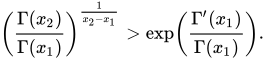
- For any positive real number
x
{\\displaystyle x}

,
Γ
″
(
x
)
Γ
(
x
)
\>
Γ
′
(
x
)
2
.
{\\displaystyle \\Gamma ''(x)\\Gamma (x)\>\\Gamma '(x)^{2}.}

The last of these statements is, essentially by definition, the same as the statement that ψ ( 1 ) ( x ) \> 0 {\\displaystyle \\psi ^{(1)}(x)\>0}  , where ψ ( 1 ) {\\displaystyle \\psi ^{(1)}}  is the [polygamma function](https://en.wikipedia.org/wiki/Polygamma_function "Polygamma function") of order 1. To prove the logarithmic convexity of the gamma function, it therefore suffices to observe that ψ ( 1 ) {\\displaystyle \\psi ^{(1)}}  has a series representation which, for positive real x, consists of only positive terms.
Logarithmic convexity and [Jensen's inequality](https://en.wikipedia.org/wiki/Jensen%27s_inequality "Jensen's inequality") together imply, for any positive real numbers x 1 , … , x n {\\displaystyle x\_{1},\\ldots ,x\_{n}}  and a 1 , … , a n {\\displaystyle a\_{1},\\ldots ,a\_{n}}  , Γ ( a 1 x 1 \+ ⋯ \+ a n x n a 1 \+ ⋯ \+ a n ) ≤ ( Γ ( x 1 ) a 1 ⋯ Γ ( x n ) a n ) 1 a 1 \+ ⋯ \+ a n . {\\displaystyle \\Gamma \\left({\\frac {a\_{1}x\_{1}+\\cdots +a\_{n}x\_{n}}{a\_{1}+\\cdots +a\_{n}}}\\right)\\leq {\\bigl (}\\Gamma (x\_{1})^{a\_{1}}\\cdots \\Gamma (x\_{n})^{a\_{n}}{\\bigr )}^{\\frac {1}{a\_{1}+\\cdots +a\_{n}}}.} 
There are also bounds on ratios of gamma functions. The best-known is [Gautschi's inequality](https://en.wikipedia.org/wiki/Gautschi%27s_inequality "Gautschi's inequality"), which says that for any positive real number x and any *s* ∈ (0, 1), x 1 − s \< Γ ( x \+ 1 ) Γ ( x \+ s ) \< ( x \+ 1 ) 1 − s . {\\displaystyle x^{1-s}\<{\\frac {\\Gamma (x+1)}{\\Gamma (x+s)}}\<\\left(x+1\\right)^{1-s}.} 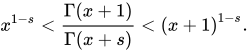
### Stirling's formula
\[[edit](https://en.wikipedia.org/w/index.php?title=Gamma_function&action=edit§ion=10 "Edit section: Stirling's formula")\]
Main article: [Stirling's approximation](https://en.wikipedia.org/wiki/Stirling%27s_approximation "Stirling's approximation")
[](https://en.wikipedia.org/wiki/File:Gamma_cplot.svg)
Representation of the gamma function in the complex plane. Each point
z
{\\displaystyle z}

is colored according to the argument of
Γ
(
z
)
{\\displaystyle \\Gamma (z)}

. The contour plot of the modulus
\|
Γ
(
z
)
\|
{\\displaystyle \|\\Gamma (z)\|}

is also displayed.
[](https://en.wikipedia.org/wiki/File:Gamma_abs_3D.png)
3-dimensional plot of the absolute value of the complex gamma function
The behavior of Γ ( x ) {\\displaystyle \\Gamma (x)}  for an increasing positive real variable is given by [Stirling's formula](https://en.wikipedia.org/wiki/Stirling%27s_formula "Stirling's formula")Γ ( x \+ 1 ) ∼ 2 π x ( x e ) x , {\\displaystyle \\Gamma (x+1)\\sim {\\sqrt {2\\pi x}}\\left({\\frac {x}{e}}\\right)^{x},} 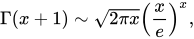where the symbol ∼ {\\displaystyle \\sim }  means asymptotic convergence: the ratio of the two sides converges to 1 {\\displaystyle 1}  in the limit x → \+ ∞ {\\displaystyle \\textstyle x\\to +\\infty }  .[\[1\]](https://en.wikipedia.org/wiki/Gamma_function#cite_note-Davis-1) This growth is faster than exponential, exp ( β x ) {\\displaystyle \\exp(\\beta x)}  , for any fixed value of β {\\displaystyle \\beta }  .
Another useful limit for asymptotic approximations for x → \+ ∞ {\\displaystyle x\\to +\\infty }  is:Γ ( x \+ α ) ∼ Γ ( x ) x α , α ∈ C . {\\displaystyle {\\Gamma (x+\\alpha )}\\sim {\\Gamma (x)x^{\\alpha }},\\qquad \\alpha \\in \\mathbb {C} .} 
When writing the error term as an infinite product, Stirling's formula can be used to define the gamma function:[\[12\]](https://en.wikipedia.org/wiki/Gamma_function#cite_note-12)Γ ( x ) \= 2 π x ( x e ) x ∏ n \= 0 ∞ \[ 1 e ( 1 \+ 1 x \+ n ) x \+ n \+ 1 2 \] . {\\displaystyle \\Gamma (x)={\\sqrt {\\frac {2\\pi }{x}}}\\left({\\frac {x}{e}}\\right)^{x}\\prod \_{n=0}^{\\infty }\\left\[{\\frac {1}{e}}\\left(1+{\\frac {1}{x+n}}\\right)^{x+n+{\\frac {1}{2}}}\\right\].} ![{\\displaystyle \\Gamma (x)={\\sqrt {\\frac {2\\pi }{x}}}\\left({\\frac {x}{e}}\\right)^{x}\\prod \_{n=0}^{\\infty }\\left\[{\\frac {1}{e}}\\left(1+{\\frac {1}{x+n}}\\right)^{x+n+{\\frac {1}{2}}}\\right\].}](https://wikimedia.org/api/rest_v1/media/math/render/svg/1b6b7fc752464cb3ff57fe9a172e6282526150bb)
### Extension to negative, non-integer values
\[[edit](https://en.wikipedia.org/w/index.php?title=Gamma_function&action=edit§ion=11 "Edit section: Extension to negative, non-integer values")\]
Although the main definition of the gamma function—the Euler integral of the second kind—is only valid (on the real axis) for positive arguments, its domain can be extended with [analytic continuation](https://en.wikipedia.org/wiki/Analytic_continuation "Analytic continuation")[\[13\]](https://en.wikipedia.org/wiki/Gamma_function#cite_note-13) to negative arguments by shifting the negative argument to positive values by using either the Euler's reflection formula,Γ ( − x ) \= 1 Γ ( x \+ 1 ) π sin ( π ( x \+ 1 ) ) , {\\displaystyle \\Gamma (-x)={\\frac {1}{\\Gamma (x+1)}}{\\frac {\\pi }{\\sin {\\big (}\\pi (x+1){\\big )}}},} or the fundamental property,Γ ( − x ) := 1 − x Γ ( − x \+ 1 ) , {\\displaystyle \\Gamma (-x):={\\frac {\\,1}{-x}}\\,\\Gamma (-x+1),} when x ∉ Z {\\displaystyle x\\not \\in \\mathbb {Z} }  . For example,Γ ( − 1 2 ) \= − 2 Γ ( 1 2 ) . {\\displaystyle \\Gamma \\!\\left(\\!-{\\frac {1}{2}}\\right)=-2\\,\\Gamma \\!\\left({\\frac {1}{2}}\\right).} 
### Residues
\[[edit](https://en.wikipedia.org/w/index.php?title=Gamma_function&action=edit§ion=12 "Edit section: Residues")\]
The behavior for non-positive z {\\displaystyle z}  is more intricate. Euler's integral does not converge for ℜ ( z ) ≤ 0 {\\displaystyle \\Re (z)\\leq 0}  , but the function it defines in the positive complex half-plane has a unique [analytic continuation](https://en.wikipedia.org/wiki/Analytic_continuation "Analytic continuation") to the negative half-plane. One way to find that analytic continuation is to use Euler's integral for positive arguments and extend the domain to negative numbers by repeated application of the recurrence formula,[\[1\]](https://en.wikipedia.org/wiki/Gamma_function#cite_note-Davis-1)Γ ( z ) \= Γ ( z \+ n \+ 1 ) z ( z \+ 1 ) ⋯ ( z \+ n ) , {\\displaystyle \\Gamma (z)={\\frac {\\Gamma (z+n+1)}{z(z+1)\\cdots (z+n)}},} 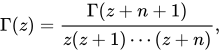choosing n {\\displaystyle n}  such that z \+ n {\\displaystyle z+n}  is positive. The product in the denominator is zero when z {\\displaystyle z}  equals any of the integers 0 , − 1 , − 2 , … {\\displaystyle 0,-1,-2,\\ldots }  . Thus, the gamma function must be undefined at those points to avoid [division by zero](https://en.wikipedia.org/wiki/Division_by_zero "Division by zero"); it is a [meromorphic function](https://en.wikipedia.org/wiki/Meromorphic_function "Meromorphic function") with [simple poles](https://en.wikipedia.org/wiki/Simple_pole "Simple pole") at the non-positive integers.[\[1\]](https://en.wikipedia.org/wiki/Gamma_function#cite_note-Davis-1)
For a function f {\\displaystyle f}  of a complex variable z {\\displaystyle z}  , at a [simple pole](https://en.wikipedia.org/wiki/Simple_pole "Simple pole") c {\\displaystyle c}  , the [residue](https://en.wikipedia.org/wiki/Residue_\(complex_analysis\) "Residue (complex analysis)") of f {\\displaystyle f}  is given by:Res ( f , c ) \= lim z → c ( z − c ) f ( z ) . {\\displaystyle \\operatorname {Res} (f,c)=\\lim \_{z\\to c}(z-c)f(z).} 
For the simple pole z \= − n {\\displaystyle z=-n}  , the recurrence formula can be rewritten as:( z \+ n ) Γ ( z ) \= Γ ( z \+ n \+ 1 ) z ( z \+ 1 ) ⋯ ( z \+ n − 1 ) . {\\displaystyle (z+n)\\Gamma (z)={\\frac {\\Gamma (z+n+1)}{z(z+1)\\cdots (z+n-1)}}.} The numerator at z \= − n {\\displaystyle z=-n}  , isΓ ( z \+ n \+ 1 ) \= Γ ( 1 ) \= 1 {\\displaystyle \\Gamma (z+n+1)=\\Gamma (1)=1} and the denominatorz ( z \+ 1 ) ⋯ ( z \+ n − 1 ) \= − n ( 1 − n ) ⋯ ( n − 1 − n ) \= ( − 1 ) n n \! . {\\displaystyle z(z+1)\\cdots (z+n-1)=-n(1-n)\\cdots (n-1-n)=(-1)^{n}n!.} So the residues of the gamma function at those points are:[\[14\]](https://en.wikipedia.org/wiki/Gamma_function#cite_note-Mathworld-14)Res ( Γ , − n ) \= ( − 1 ) n n \! . {\\displaystyle \\operatorname {Res} (\\Gamma ,-n)={\\frac {(-1)^{n}}{n!}}.} 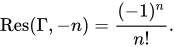The gamma function is non-zero everywhere along the real line, although it comes arbitrarily close to zero as z → − ∞ {\\displaystyle z\\rightarrow -\\infty }  . There is in fact no complex number z {\\displaystyle z}  for which Γ ( z ) \= 0 {\\displaystyle \\Gamma (z)=0}  , and hence the [reciprocal gamma function](https://en.wikipedia.org/wiki/Reciprocal_gamma_function "Reciprocal gamma function") 1 Γ ( z ) {\\textstyle {\\dfrac {1}{\\Gamma (z)}}}  is an [entire function](https://en.wikipedia.org/wiki/Entire_function "Entire function"), with zeros at z \= 0 , − 1 , − 2 , … {\\displaystyle z=0,-1,-2,\\ldots }  .[\[1\]](https://en.wikipedia.org/wiki/Gamma_function#cite_note-Davis-1)
### Minima and maxima
\[[edit](https://en.wikipedia.org/w/index.php?title=Gamma_function&action=edit§ion=13 "Edit section: Minima and maxima")\]
On the real line, the gamma function has a local minimum at *z*min ≈ \+1.46163214496836234126[\[15\]](https://en.wikipedia.org/wiki/Gamma_function#cite_note-15) where it attains the value Γ(*z*min) ≈ \+0.88560319441088870027.[\[16\]](https://en.wikipedia.org/wiki/Gamma_function#cite_note-16) The gamma function rises to either side of this minimum. The solution to Γ(*z* − 0.5) = Γ(*z* + 0.5) is *z* = +1.5 and the common value is Γ(1) = Γ(2) = +1. The positive solution to Γ(*z* − 1) = Γ(*z* + 1) is *z* = *φ* ≈ +1.618, the [golden ratio](https://en.wikipedia.org/wiki/Golden_ratio "Golden ratio"), and the common value is Γ(*φ* − 1) = Γ(*φ* + 1) = *φ*! ≈ \+1.44922960226989660037.[\[17\]](https://en.wikipedia.org/wiki/Gamma_function#cite_note-17)
The gamma function must alternate sign between its poles at the non-positive integers because the product in the forward recurrence contains an odd number of negative factors if the number of poles between z {\\displaystyle z}  and z \+ n {\\displaystyle z+n}  is odd, and an even number if the number of poles is even.[\[14\]](https://en.wikipedia.org/wiki/Gamma_function#cite_note-Mathworld-14) The values at the local extrema of the gamma function along the real axis between the non-positive integers are:
Γ(−0.50408300826445540925\...[\[18\]](https://en.wikipedia.org/wiki/Gamma_function#cite_note-18)) = −3.54464361115500508912\...,
Γ(−1.57349847316239045877\...[\[19\]](https://en.wikipedia.org/wiki/Gamma_function#cite_note-19)) = 2\.30240725833968013582\...,
Γ(−2.61072086844414465000\...[\[20\]](https://en.wikipedia.org/wiki/Gamma_function#cite_note-20)) = −0.88813635840124192009\...,
Γ(−3.63529336643690109783\...[\[21\]](https://en.wikipedia.org/wiki/Gamma_function#cite_note-21)) = 0\.24512753983436625043\...,
Γ(−4.65323776174314244171\...[\[22\]](https://en.wikipedia.org/wiki/Gamma_function#cite_note-22)) = −0.05277963958731940076\..., etc.
### Integral representations
\[[edit](https://en.wikipedia.org/w/index.php?title=Gamma_function&action=edit§ion=14 "Edit section: Integral representations")\]
There are many formulas, besides the Euler integral of the second kind, that express the gamma function as an integral. For instance, when the real part of z {\\displaystyle z}  is positive,[\[23\]](https://en.wikipedia.org/wiki/Gamma_function#cite_note-23) Γ ( z ) \= ∫ − ∞ ∞ e z t − e t d t {\\displaystyle \\Gamma (z)=\\int \_{-\\infty }^{\\infty }e^{zt-e^{t}}\\,dt} 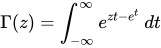and[\[24\]](https://en.wikipedia.org/wiki/Gamma_function#cite_note-24)Γ ( z ) \= ∫ 0 1 ( log 1 t ) z − 1 d t , {\\displaystyle \\Gamma (z)=\\int \_{0}^{1}\\left(\\log {\\frac {1}{t}}\\right)^{z-1}\\,dt,}  Γ ( z ) \= 2 c z ∫ 0 ∞ t 2 z − 1 e − c t 2 d t , c \> 0 {\\displaystyle \\Gamma (z)=2c^{z}\\int \_{0}^{\\infty }t^{2z-1}e^{-ct^{2}}\\,dt\\,,\\;c\>0}  where the three integrals respectively follow from the substitutions t \= e − x {\\displaystyle t=e^{-x}}  , t \= − log x {\\displaystyle t=-\\log x}  [\[25\]](https://en.wikipedia.org/wiki/Gamma_function#cite_note-25) and t \= c x 2 {\\displaystyle t=cx^{2}} [\[26\]](https://en.wikipedia.org/wiki/Gamma_function#cite_note-26) in Euler's second integral. The last integral in particular makes clear the connection between the gamma function at half integer arguments and the [Gaussian integral](https://en.wikipedia.org/wiki/Gaussian_integral "Gaussian integral"): if z \= 1 / 2 , c \= 1 {\\displaystyle z=1/2,\\;c=1}  we getΓ ( 1 / 2 ) \= 2 ∫ 0 ∞ e − t 2 d t \= π . {\\displaystyle \\Gamma (1/2)=2\\int \_{0}^{\\infty }e^{-t^{2}}\\,dt={\\sqrt {\\pi }}\\;.} 
Binet's first integral formula for the gamma function states that, when the real part of z is positive, then:[\[27\]](https://en.wikipedia.org/wiki/Gamma_function#cite_note-27)l o g Γ ( z ) \= ( z − 1 2 ) log z − z \+ 1 2 log ( 2 π ) \+ ∫ 0 ∞ ( 1 2 − 1 t \+ 1 e t − 1 ) e − t z t d t . {\\displaystyle \\operatorname {log\\Gamma } (z)=\\left(z-{\\frac {1}{2}}\\right)\\log z-z+{\\frac {1}{2}}\\log(2\\pi )+\\int \_{0}^{\\infty }\\left({\\frac {1}{2}}-{\\frac {1}{t}}+{\\frac {1}{e^{t}-1}}\\right){\\frac {e^{-tz}}{t}}\\,dt.} The integral on the right-hand side may be interpreted as a [Laplace transform](https://en.wikipedia.org/wiki/Laplace_transform "Laplace transform"). That is,log ( Γ ( z ) ( e z ) z z 2 π ) \= L ( 1 2 t − 1 t 2 \+ 1 t ( e t − 1 ) ) ( z ) . {\\displaystyle \\log \\left(\\Gamma (z)\\left({\\frac {e}{z}}\\right)^{z}{\\sqrt {\\frac {z}{2\\pi }}}\\right)={\\mathcal {L}}\\left({\\frac {1}{2t}}-{\\frac {1}{t^{2}}}+{\\frac {1}{t(e^{t}-1)}}\\right)(z).} 
Binet's second integral formula states that, again when the real part of z is positive, then:[\[28\]](https://en.wikipedia.org/wiki/Gamma_function#cite_note-28)l o g Γ ( z ) \= ( z − 1 2 ) log z − z \+ 1 2 log ( 2 π ) \+ 2 ∫ 0 ∞ arctan ( t / z ) e 2 π t − 1 d t . {\\displaystyle \\operatorname {log\\Gamma } (z)=\\left(z-{\\frac {1}{2}}\\right)\\log z-z+{\\frac {1}{2}}\\log(2\\pi )+2\\int \_{0}^{\\infty }{\\frac {\\arctan(t/z)}{e^{2\\pi t}-1}}\\,dt.} 
Let C be a [Hankel contour](https://en.wikipedia.org/wiki/Hankel_contour "Hankel contour"), meaning a path that begins and ends at the point ∞ on the [Riemann sphere](https://en.wikipedia.org/wiki/Riemann_sphere "Riemann sphere"), whose unit tangent vector converges to −1 at the start of the path and to 1 at the end, which has [winding number](https://en.wikipedia.org/wiki/Winding_number "Winding number") 1 around 0, and which does not cross \[ 0 , ∞ ) {\\displaystyle \[0,\\infty )}  . Fix a branch of log ( − t ) {\\displaystyle \\log(-t)}  by taking a branch cut along \[ 0 , ∞ ) {\\displaystyle \[0,\\infty )}  and by taking log ( − t ) {\\displaystyle \\log(-t)}  to be real when t {\\displaystyle t}  is on the negative real axis. If z {\\displaystyle z}  is not an integer, then Hankel's formula for the gamma function is:[\[29\]](https://en.wikipedia.org/wiki/Gamma_function#cite_note-29)Γ ( z ) \= − 1 2 i sin π z ∫ C ( − t ) z − 1 e − t d t , {\\displaystyle \\Gamma (z)=-{\\frac {1}{2i\\sin \\pi z}}\\int \_{C}(-t)^{z-1}e^{-t}\\,dt,} where ( − t ) z − 1 {\\displaystyle (-t)^{z-1}}  is interpreted as exp ( ( z − 1 ) log ( − t ) ) {\\displaystyle \\exp((z-1)\\log(-t))}  . The reflection formula leads to the closely related expression1 Γ ( z ) \= i 2 π ∫ C ( − t ) − z e − t d t , {\\displaystyle {\\frac {1}{\\Gamma (z)}}={\\frac {i}{2\\pi }}\\int \_{C}(-t)^{-z}e^{-t}\\,dt,} 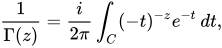which is valid whenever z ∉ Z {\\displaystyle z\\not \\in \\mathbb {Z} }  .
### Continued fraction representation
\[[edit](https://en.wikipedia.org/w/index.php?title=Gamma_function&action=edit§ion=15 "Edit section: Continued fraction representation")\]
The gamma function can also be represented by a sum of two [continued fractions](https://en.wikipedia.org/wiki/Continued_fraction "Continued fraction"):[\[30\]](https://en.wikipedia.org/wiki/Gamma_function#cite_note-30)[\[31\]](https://en.wikipedia.org/wiki/Gamma_function#cite_note-31) Γ ( z ) \= e − 1 2 \+ 0 − z \+ 1 z − 1 2 \+ 2 − z \+ 2 z − 2 2 \+ 4 − z \+ 3 z − 3 2 \+ 6 − z \+ 4 z − 4 2 \+ 8 − z \+ 5 z − 5 2 \+ 10 − z \+ ⋱ \+ e − 1 z \+ 0 − z \+ 0 z \+ 1 \+ 1 z \+ 2 − z \+ 1 z \+ 3 \+ 2 z \+ 4 − z \+ 2 z \+ 5 \+ 3 z \+ 6 − ⋱ {\\displaystyle {\\begin{aligned}\\Gamma (z)&={\\cfrac {e^{-1}}{2+0-z+1{\\cfrac {z-1}{2+2-z+2{\\cfrac {z-2}{2+4-z+3{\\cfrac {z-3}{2+6-z+4{\\cfrac {z-4}{2+8-z+5{\\cfrac {z-5}{2+10-z+\\ddots }}}}}}}}}}}}\\\\&+\\ {\\cfrac {e^{-1}}{z+0-{\\cfrac {z+0}{z+1+{\\cfrac {1}{z+2-{\\cfrac {z+1}{z+3+{\\cfrac {2}{z+4-{\\cfrac {z+2}{z+5+{\\cfrac {3}{z+6-\\ddots }}}}}}}}}}}}}}\\end{aligned}}} where z ∈ C {\\displaystyle z\\in \\mathbb {C} }  .
### Fourier series expansion
\[[edit](https://en.wikipedia.org/w/index.php?title=Gamma_function&action=edit§ion=16 "Edit section: Fourier series expansion")\]
The [logarithm of the gamma function](https://en.wikipedia.org/wiki/Gamma_function#Log-gamma_function) has the following [Fourier series](https://en.wikipedia.org/wiki/Fourier_series "Fourier series") expansion for 0 \< z \< 1 : {\\displaystyle 0\<z\<1:} l o g Γ ( z ) \= ( 1 2 − z ) ( γ \+ log 2 ) \+ ( 1 − z ) log π − 1 2 log sin ( π z ) \+ 1 π ∑ n \= 1 ∞ log n n sin ( 2 π n z ) , {\\displaystyle \\operatorname {log\\Gamma } (z)=\\left({\\frac {1}{2}}-z\\right)(\\gamma +\\log 2)+(1-z)\\log \\pi -{\\frac {1}{2}}\\log \\sin(\\pi z)+{\\frac {1}{\\pi }}\\sum \_{n=1}^{\\infty }{\\frac {\\log n}{n}}\\sin(2\\pi nz),}  which was for a long time attributed to [Ernst Kummer](https://en.wikipedia.org/wiki/Ernst_Kummer "Ernst Kummer"), who derived it in 1847.[\[32\]](https://en.wikipedia.org/wiki/Gamma_function#cite_note-32)[\[33\]](https://en.wikipedia.org/wiki/Gamma_function#cite_note-33) However, Iaroslav Blagouchine discovered that [Carl Johan Malmsten](https://en.wikipedia.org/wiki/Carl_Johan_Malmsten "Carl Johan Malmsten") first derived this series in 1842.[\[34\]](https://en.wikipedia.org/wiki/Gamma_function#cite_note-iaroslav_06-34)[\[35\]](https://en.wikipedia.org/wiki/Gamma_function#cite_note-iaroslav_06bis-35)
### Raabe's formula
\[[edit](https://en.wikipedia.org/w/index.php?title=Gamma_function&action=edit§ion=17 "Edit section: Raabe's formula")\]
In 1840 [Joseph Ludwig Raabe](https://en.wikipedia.org/wiki/Joseph_Ludwig_Raabe "Joseph Ludwig Raabe") proved that∫ a a \+ 1 log Γ ( z ) d z \= 1 2 log 2 π \+ a log a − a , a \> 0\. {\\displaystyle \\int \_{a}^{a+1}\\log \\Gamma (z)\\,dz={\\tfrac {1}{2}}\\log 2\\pi +a\\log a-a,\\quad a\>0.}  In particular, if a \= 0 {\\displaystyle a=0}  then∫ 0 1 log Γ ( z ) d z \= 1 2 log ( 2 π ) . {\\displaystyle \\int \_{0}^{1}\\log \\Gamma (z)\\,dz={\\frac {1}{2}}\\log(2\\pi ).} 
The latter can be derived taking the logarithm in the above multiplication formula, which gives an expression for the Riemann sum of the integrand. Taking the limit for a → ∞ {\\displaystyle a\\to \\infty }  gives the formula.
### Pi function
\[[edit](https://en.wikipedia.org/w/index.php?title=Gamma_function&action=edit§ion=18 "Edit section: Pi function")\]
An alternative notation introduced by [Gauss](https://en.wikipedia.org/wiki/Carl_Friedrich_Gauss "Carl Friedrich Gauss") is the Π {\\displaystyle \\Pi } \-function, a shifted version of the gamma function: Π ( z ) \= Γ ( z \+ 1 ) \= z Γ ( z ) \= ∫ 0 ∞ e − t t z d t , {\\displaystyle \\Pi (z)=\\Gamma (z+1)=z\\Gamma (z)=\\int \_{0}^{\\infty }e^{-t}t^{z}\\,dt,}  so that Π ( n ) \= n \! {\\displaystyle \\Pi (n)=n!}  for every non-negative integer n {\\displaystyle n}  .
Using the pi function, the reflection formula is: Π ( z ) Π ( − z ) \= π z sin ( π z ) \= 1 sinc ( z ) {\\displaystyle \\Pi (z)\\Pi (-z)={\\frac {\\pi z}{\\sin(\\pi z)}}={\\frac {1}{\\operatorname {sinc} (z)}}}  using the normalized [sinc function](https://en.wikipedia.org/wiki/Sinc_function "Sinc function"); while the multiplication theorem becomes: Π ( z m ) Π ( z − 1 m ) ⋯ Π ( z − m \+ 1 m ) \= ( 2 π ) m − 1 2 m − z − 1 2 Π ( z ) . {\\displaystyle \\Pi \\left({\\frac {z}{m}}\\right)\\,\\Pi \\left({\\frac {z-1}{m}}\\right)\\cdots \\Pi \\left({\\frac {z-m+1}{m}}\\right)=(2\\pi )^{\\frac {m-1}{2}}m^{-z-{\\frac {1}{2}}}\\Pi (z)\\ .} 
The shifted [reciprocal gamma function](https://en.wikipedia.org/wiki/Reciprocal_gamma_function "Reciprocal gamma function") is sometimes denoted π ( z ) \= 1 Π ( z ) {\\displaystyle \\pi (z)={\\frac {1}{\\Pi (z)}}} 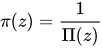 , an [entire function](https://en.wikipedia.org/wiki/Entire_function "Entire function").
The [volume of an n\-ellipsoid](https://en.wikipedia.org/wiki/Volume_of_an_n-ball "Volume of an n-ball") with radii *r*1, ..., *r**n* can be expressed asV n ( r 1 , … , r n ) \= π n 2 Π ( n 2 ) ∏ k \= 1 n r k . {\\displaystyle V\_{n}(r\_{1},\\dotsc ,r\_{n})={\\frac {\\pi ^{\\frac {n}{2}}}{\\Pi \\left({\\frac {n}{2}}\\right)}}\\prod \_{k=1}^{n}r\_{k}.} 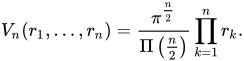
### Relation to other functions
\[[edit](https://en.wikipedia.org/w/index.php?title=Gamma_function&action=edit§ion=19 "Edit section: Relation to other functions")\]
- In the first integral defining the gamma function, the limits of integration are fixed. The upper [incomplete gamma function](https://en.wikipedia.org/wiki/Incomplete_gamma_function "Incomplete gamma function") is obtained by allowing the lower limit of integration to vary:
Γ
(
z
,
x
)
\=
∫
x
∞
t
z
−
1
e
−
t
d
t
.
{\\displaystyle \\Gamma (z,x)=\\int \_{x}^{\\infty }t^{z-1}e^{-t}dt.}

There is a similar lower incomplete gamma function.
- The gamma function is related to Euler's [beta function](https://en.wikipedia.org/wiki/Beta_function "Beta function") by the formula
B
(
z
1
,
z
2
)
\=
∫
0
1
t
z
1
−
1
(
1
−
t
)
z
2
−
1
d
t
\=
Γ
(
z
1
)
Γ
(
z
2
)
Γ
(
z
1
\+
z
2
)
.
{\\displaystyle \\mathrm {B} (z\_{1},z\_{2})=\\int \_{0}^{1}t^{z\_{1}-1}(1-t)^{z\_{2}-1}\\,dt={\\frac {\\Gamma (z\_{1})\\,\\Gamma (z\_{2})}{\\Gamma (z\_{1}+z\_{2})}}.}

- The [logarithmic derivative](https://en.wikipedia.org/wiki/Logarithmic_derivative "Logarithmic derivative") of the gamma function is called the [digamma function](https://en.wikipedia.org/wiki/Digamma_function "Digamma function"); higher derivatives are the [polygamma functions](https://en.wikipedia.org/wiki/Polygamma_function "Polygamma function").
- The analog of the gamma function over a [finite field](https://en.wikipedia.org/wiki/Finite_field "Finite field") or a [finite ring](https://en.wikipedia.org/wiki/Finite_ring "Finite ring") is the [Gaussian sums](https://en.wikipedia.org/wiki/Gaussian_sum "Gaussian sum"), a type of [exponential sum](https://en.wikipedia.org/wiki/Exponential_sum "Exponential sum").
- The [reciprocal gamma function](https://en.wikipedia.org/wiki/Reciprocal_gamma_function "Reciprocal gamma function") is an [entire function](https://en.wikipedia.org/wiki/Entire_function "Entire function") and has been studied as a specific topic.
- The gamma function also shows up in an important relation with the [Riemann zeta function](https://en.wikipedia.org/wiki/Riemann_zeta_function "Riemann zeta function"),
ζ
(
z
)
{\\displaystyle \\zeta (z)}

.
π
−
z
2
Γ
(
z
2
)
ζ
(
z
)
\=
π
−
1
−
z
2
Γ
(
1
−
z
2
)
ζ
(
1
−
z
)
.
{\\displaystyle \\pi ^{-{\\frac {z}{2}}}\\;\\Gamma \\left({\\frac {z}{2}}\\right)\\zeta (z)=\\pi ^{-{\\frac {1-z}{2}}}\\;\\Gamma \\left({\\frac {1-z}{2}}\\right)\\;\\zeta (1-z).}

It also appears in the following formula:
ζ
(
z
)
Γ
(
z
)
\=
∫
0
∞
u
z
e
u
−
1
d
u
u
,
{\\displaystyle \\zeta (z)\\Gamma (z)=\\int \_{0}^{\\infty }{\\frac {u^{z}}{e^{u}-1}}\\,{\\frac {du}{u}},}
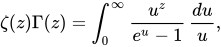
which is valid only for
ℜ
(
z
)
\>
1
{\\displaystyle \\Re (z)\>1}

.
The logarithm of the gamma function satisfies the following formula due to Lerch:
l
o
g
Γ
(
z
)
\=
ζ
H
′
(
0
,
z
)
−
ζ
′
(
0
)
,
{\\displaystyle \\operatorname {log\\Gamma } (z)=\\zeta \_{H}'(0,z)-\\zeta '(0),}

where
ζ
H
{\\displaystyle \\zeta \_{H}}

is the [Hurwitz zeta function](https://en.wikipedia.org/wiki/Hurwitz_zeta_function "Hurwitz zeta function"),
ζ
{\\displaystyle \\zeta }

is the Riemann zeta function and the prime (′) denotes differentiation in the first variable.
- The gamma function is related to the [stretched exponential function](https://en.wikipedia.org/wiki/Stretched_exponential_function "Stretched exponential function"). For instance, the moments of that function are
⟨
τ
n
⟩
≡
∫
0
∞
t
n
−
1
e
−
(
t
τ
)
β
d
t
\=
τ
n
β
Γ
(
n
β
)
.
{\\displaystyle \\langle \\tau ^{n}\\rangle \\equiv \\int \_{0}^{\\infty }t^{n-1}\\,e^{-\\left({\\frac {t}{\\tau }}\\right)^{\\beta }}\\,\\mathrm {d} t={\\frac {\\tau ^{n}}{\\beta }}\\Gamma \\left({n \\over \\beta }\\right).}

### Particular values
\[[edit](https://en.wikipedia.org/w/index.php?title=Gamma_function&action=edit§ion=20 "Edit section: Particular values")\]
Main article: [Particular values of the gamma function](https://en.wikipedia.org/wiki/Particular_values_of_the_gamma_function "Particular values of the gamma function")
Including up to the first 20 digits after the decimal point, some particular values of the gamma function are: Γ ( − 3 2 ) \= 4 π 3 ≈ \+ 2\.36327 18012 07354 70306 Γ ( − 1 2 ) \= − 2 π ≈ − 3\.54490 77018 11032 05459 Γ ( 1 2 ) \= π ≈ \+ 1\.77245 38509 05516 02729 Γ ( 1 ) \= 0 \! \= \+ 1 Γ ( 3 2 ) \= π 2 ≈ \+ 0\.88622 69254 52758 01364 Γ ( 2 ) \= 1 \! \= \+ 1 Γ ( 5 2 ) \= 3 π 4 ≈ \+ 1\.32934 03881 79137 02047 Γ ( 3 ) \= 2 \! \= \+ 2 Γ ( 7 2 ) \= 15 π 8 ≈ \+ 3\.32335 09704 47842 55118 Γ ( 4 ) \= 3 \! \= \+ 6 {\\displaystyle {\\begin{array}{rcccl}\\Gamma \\left(-{\\frac {3}{2}}\\right)&=&{\\frac {4{\\sqrt {\\pi }}}{3}}&\\approx &+2.36327\\,18012\\,07354\\,70306\\\\\[6pt\]\\Gamma \\left(-{\\frac {1}{2}}\\right)&=&-2{\\sqrt {\\pi }}&\\approx &-3.54490\\,77018\\,11032\\,05459\\\\\[6pt\]\\Gamma \\left({\\frac {1}{2}}\\right)&=&{\\sqrt {\\pi }}&\\approx &+1.77245\\,38509\\,05516\\,02729\\\\\[6pt\]\\Gamma (1)&=&0!&=&+1\\\\\[6pt\]\\Gamma \\left({\\frac {3}{2}}\\right)&=&{\\frac {\\sqrt {\\pi }}{2}}&\\approx &+0.88622\\,69254\\,52758\\,01364\\\\\[6pt\]\\Gamma (2)&=&1!&=&+1\\\\\[6pt\]\\Gamma \\left({\\frac {5}{2}}\\right)&=&{\\frac {3{\\sqrt {\\pi }}}{4}}&\\approx &+1.32934\\,03881\\,79137\\,02047\\\\\[6pt\]\\Gamma (3)&=&2!&=&+2\\\\\[6pt\]\\Gamma \\left({\\frac {7}{2}}\\right)&=&{\\tfrac {15{\\sqrt {\\pi }}}{8}}&\\approx &+3.32335\\,09704\\,47842\\,55118\\\\\[6pt\]\\Gamma (4)&=&3!&=&+6\\end{array}}} ![{\\displaystyle {\\begin{array}{rcccl}\\Gamma \\left(-{\\frac {3}{2}}\\right)&=&{\\frac {4{\\sqrt {\\pi }}}{3}}&\\approx &+2.36327\\,18012\\,07354\\,70306\\\\\[6pt\]\\Gamma \\left(-{\\frac {1}{2}}\\right)&=&-2{\\sqrt {\\pi }}&\\approx &-3.54490\\,77018\\,11032\\,05459\\\\\[6pt\]\\Gamma \\left({\\frac {1}{2}}\\right)&=&{\\sqrt {\\pi }}&\\approx &+1.77245\\,38509\\,05516\\,02729\\\\\[6pt\]\\Gamma (1)&=&0!&=&+1\\\\\[6pt\]\\Gamma \\left({\\frac {3}{2}}\\right)&=&{\\frac {\\sqrt {\\pi }}{2}}&\\approx &+0.88622\\,69254\\,52758\\,01364\\\\\[6pt\]\\Gamma (2)&=&1!&=&+1\\\\\[6pt\]\\Gamma \\left({\\frac {5}{2}}\\right)&=&{\\frac {3{\\sqrt {\\pi }}}{4}}&\\approx &+1.32934\\,03881\\,79137\\,02047\\\\\[6pt\]\\Gamma (3)&=&2!&=&+2\\\\\[6pt\]\\Gamma \\left({\\frac {7}{2}}\\right)&=&{\\tfrac {15{\\sqrt {\\pi }}}{8}}&\\approx &+3.32335\\,09704\\,47842\\,55118\\\\\[6pt\]\\Gamma (4)&=&3!&=&+6\\end{array}}}](https://wikimedia.org/api/rest_v1/media/math/render/svg/d3cd625689207e32ab0dc5e3593bffefecb76e06)(These numbers can be found in the [OEIS](https://en.wikipedia.org/wiki/On-Line_Encyclopedia_of_Integer_Sequences "On-Line Encyclopedia of Integer Sequences").[\[36\]](https://en.wikipedia.org/wiki/Gamma_function#cite_note-36)[\[37\]](https://en.wikipedia.org/wiki/Gamma_function#cite_note-37)[\[38\]](https://en.wikipedia.org/wiki/Gamma_function#cite_note-38)[\[39\]](https://en.wikipedia.org/wiki/Gamma_function#cite_note-39)[\[40\]](https://en.wikipedia.org/wiki/Gamma_function#cite_note-40)[\[41\]](https://en.wikipedia.org/wiki/Gamma_function#cite_note-41) The values presented here are truncated rather than rounded.) The complex-valued gamma function is undefined for non-positive integers, but in these cases the value can be defined in the [Riemann sphere](https://en.wikipedia.org/wiki/Riemann_sphere "Riemann sphere") as ∞ {\\displaystyle \\infty }  . The [reciprocal gamma function](https://en.wikipedia.org/wiki/Reciprocal_gamma_function "Reciprocal gamma function") is [well defined](https://en.wikipedia.org/wiki/Well_defined "Well defined") and [analytic](https://en.wikipedia.org/wiki/Analytic_function "Analytic function") at these values (and in the [entire complex plane](https://en.wikipedia.org/wiki/Entire_function "Entire function")):1 Γ ( − 3 ) \= 1 Γ ( − 2 ) \= 1 Γ ( − 1 ) \= 1 Γ ( 0 ) \= 0\. {\\displaystyle {\\frac {1}{\\Gamma (-3)}}={\\frac {1}{\\Gamma (-2)}}={\\frac {1}{\\Gamma (-1)}}={\\frac {1}{\\Gamma (0)}}=0.} 
## Log-gamma function
\[[edit](https://en.wikipedia.org/w/index.php?title=Gamma_function&action=edit§ion=21 "Edit section: Log-gamma function")\]
[](https://en.wikipedia.org/wiki/File:LogGamma_Analytic_Function.png)
The analytic function logΓ(*z*)
Because the gamma and factorial functions grow so rapidly for moderately large arguments, many computing environments include a function that returns the [natural logarithm](https://en.wikipedia.org/wiki/Natural_logarithm "Natural logarithm") of the gamma function, often given the name `lgamma` or `lngamma` in programming environments or `gammaln` in spreadsheets. This grows much more slowly, and for combinatorial calculations allows adding and subtracting logarithmic values instead of multiplying and dividing very large values. It is often defined as[\[42\]](https://en.wikipedia.org/wiki/Gamma_function#cite_note-42)l o g Γ ( z ) \= − γ z − log z \+ ∑ k \= 1 ∞ \[ z k − log ( 1 \+ z k ) \] . {\\displaystyle \\operatorname {log\\Gamma } (z)=-\\gamma z-\\log z+\\sum \_{k=1}^{\\infty }\\left\[{\\frac {z}{k}}-\\log \\left(1+{\\frac {z}{k}}\\right)\\right\].} ![{\\displaystyle \\operatorname {log\\Gamma } (z)=-\\gamma z-\\log z+\\sum \_{k=1}^{\\infty }\\left\[{\\frac {z}{k}}-\\log \\left(1+{\\frac {z}{k}}\\right)\\right\].}](https://wikimedia.org/api/rest_v1/media/math/render/svg/8a820683fab8456c9492047148c2e7339080e0e3)
The [digamma function](https://en.wikipedia.org/wiki/Digamma_function "Digamma function"), which is the derivative of this function, is also commonly seen. In the context of technical and physical applications, e.g. with wave propagation, the functional equation l o g Γ ( z ) \= l o g Γ ( z \+ 1 ) − log z {\\displaystyle \\operatorname {log\\Gamma } (z)=\\operatorname {log\\Gamma } (z+1)-\\log z} 
[](https://en.wikipedia.org/wiki/File:Plot_of_logarithmic_gamma_function_in_the_complex_plane_from_-2-2i_to_2%2B2i_with_colors_created_with_Mathematica_13.1_function_ComplexPlot3D.svg)
Logarithmic gamma function in the complex plane
from −2 − 2i to 2 + 2i with hue giving the complex argument
is often used since it allows one to determine function values in one strip of width 1 in z {\\displaystyle z}  from the neighbouring strip. In particular, starting with a good approximation for a z {\\displaystyle z}  with large real part one may go step by step down to the desired z {\\displaystyle z}  . Following an indication of [Carl Friedrich Gauss](https://en.wikipedia.org/wiki/Carl_Friedrich_Gauss "Carl Friedrich Gauss"), Rocktaeschel (1922) proposed for log Γ ( z ) {\\displaystyle \\log \\Gamma (z)}  an approximation for large ℜ ( z ) {\\displaystyle \\Re (z)}  :l o g Γ ( z ) ≈ ( z − 1 2 ) log z − z \+ 1 2 log ( 2 π ) . {\\displaystyle \\operatorname {log\\Gamma } (z)\\approx (z-{\\tfrac {1}{2}})\\log z-z+{\\tfrac {1}{2}}\\log(2\\pi ).} 
This can be used to accurately approximate log Γ ( z ) {\\displaystyle \\log \\Gamma (z)}  for z {\\displaystyle z}  with a smaller ℜ ( z ) {\\displaystyle \\Re (z)}  via (P.E.Böhmer, 1939) l o g Γ ( z − m ) \= l o g Γ ( z ) − ∑ k \= 1 m log ( z − k ) . {\\displaystyle \\operatorname {log\\Gamma } (z-m)=\\operatorname {log\\Gamma } (z)-\\sum \_{k=1}^{m}\\log(z-k).} 
A more accurate approximation can be obtained by using more terms from the asymptotic expansions of log Γ ( z ) {\\displaystyle \\log \\Gamma (z)}  and Γ ( z ) {\\displaystyle \\Gamma (z)}  , which are based on Stirling's approximation.Γ ( z ) ∼ z z − 1 2 e − z 2 π ( 1 \+ 1 12 z \+ 1 288 z 2 − 139 51 840 z 3 − 571 2 488 320 z 4 ) {\\displaystyle \\Gamma (z)\\sim z^{z-{\\frac {1}{2}}}e^{-z}{\\sqrt {2\\pi }}\\left(1+{\\frac {1}{12z}}+{\\frac {1}{288z^{2}}}-{\\frac {139}{51\\,840z^{3}}}-{\\frac {571}{2\\,488\\,320z^{4}}}\\right)} 
as
\|
z
\|
→
∞
{\\displaystyle \|z\|\\rightarrow \\infty }

at constant
\|
arg
(
z
)
\|
\<
π
{\\displaystyle \\vert \\arg(z)\\vert \<\\pi }

. (See sequences [A001163](https://oeis.org/A001163 "oeis:A001163") and [A001164](https://oeis.org/A001164 "oeis:A001164") in the [OEIS](https://en.wikipedia.org/wiki/On-Line_Encyclopedia_of_Integer_Sequences "On-Line Encyclopedia of Integer Sequences").)
In a more "natural" presentation,log Γ ( z ) \= z log z − z − 1 2 log z \+ 1 2 log 2 π \+ 1 12 z − 1 360 z 3 \+ 1 1260 z 5 \+ O ( 1 z 5 ) {\\displaystyle \\log \\Gamma (z)=z\\log z-z-{\\frac {1}{2}}\\log z+{\\frac {1}{2}}\\log 2\\pi +{\\frac {1}{12z}}-{\\frac {1}{360z^{3}}}+{\\frac {1}{1260z^{5}}}+O\\left({\\frac {1}{z^{5}}}\\right)} 
as
\|
z
\|
→
∞
{\\displaystyle \|z\|\\rightarrow \\infty }

at constant
\|
arg
(
z
)
\|
\<
π
{\\displaystyle \\vert \\arg(z)\\vert \<\\pi }

. (See sequences [A046968](https://oeis.org/A046968 "oeis:A046968") and [A046969](https://oeis.org/A046969 "oeis:A046969") in the [OEIS](https://en.wikipedia.org/wiki/On-Line_Encyclopedia_of_Integer_Sequences "On-Line Encyclopedia of Integer Sequences").)
The coefficients of the terms with k \> 1 {\\displaystyle k\>1}  of z 1 − k {\\displaystyle z^{1-k}}  in the last expansion are simplyB k k ( k − 1 ) , {\\displaystyle {\\frac {B\_{k}}{k(k-1)}},} where the B k {\\displaystyle B\_{k}}  are the [Bernoulli numbers](https://en.wikipedia.org/wiki/Bernoulli_numbers "Bernoulli numbers").
The gamma function also has Stirling Series (derived by [Charles Hermite](https://en.wikipedia.org/wiki/Charles_Hermite "Charles Hermite") in 1900) equal to[\[43\]](https://en.wikipedia.org/wiki/Gamma_function#cite_note-43) l o g Γ ( 1 \+ x ) \= x ( x − 1 ) 2 \! log ( 2 ) \+ x ( x − 1 ) ( x − 2 ) 3 \! ( log ( 3 ) − 2 log ( 2 ) ) \+ ⋯ , ℜ ( x ) \> 0\. {\\displaystyle \\operatorname {log\\Gamma } (1+x)={\\frac {x(x-1)}{2!}}\\log(2)+{\\frac {x(x-1)(x-2)}{3!}}(\\log(3)-2\\log(2))+\\cdots ,\\quad \\Re (x)\>0.} 
### Properties
\[[edit](https://en.wikipedia.org/w/index.php?title=Gamma_function&action=edit§ion=22 "Edit section: Properties")\]
The [Bohr–Mollerup theorem](https://en.wikipedia.org/wiki/Bohr%E2%80%93Mollerup_theorem "Bohr–Mollerup theorem") states that among all functions extending the factorial functions to the positive real numbers, only the gamma function is [log-convex](https://en.wikipedia.org/wiki/Log-convex "Log-convex"), that is, its [natural logarithm](https://en.wikipedia.org/wiki/Natural_logarithm "Natural logarithm") is [convex](https://en.wikipedia.org/wiki/Convex_function "Convex function") on the positive real axis. Another characterisation is given by the [Wielandt theorem](https://en.wikipedia.org/wiki/Wielandt_theorem "Wielandt theorem").
The gamma function is the unique function that simultaneously satisfies
1.
Γ
(
1
)
\=
1
{\\displaystyle \\Gamma (1)=1}

,
2. Γ
(
z
\+
1
)
\=
z
Γ
(
z
)
{\\displaystyle \\Gamma (z+1)=z\\Gamma (z)}

for all complex numbers
z
{\\displaystyle z}

except the non-positive integers, and,
3. for integer n,
lim
n
→
∞
Γ
(
n
\+
z
)
Γ
(
n
)
n
z
\=
1
{\\textstyle \\lim \_{n\\to \\infty }{\\frac {\\Gamma (n+z)}{\\Gamma (n)\\;n^{z}}}=1}
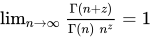
for all complex numbers
z
{\\displaystyle z}

.[\[1\]](https://en.wikipedia.org/wiki/Gamma_function#cite_note-Davis-1)
In a certain sense, the log-gamma function is the more natural form; it makes some intrinsic attributes of the function clearer. A striking example is the [Taylor series](https://en.wikipedia.org/wiki/Taylor_series "Taylor series") of logΓ around 1: l o g Γ ( z \+ 1 ) \= − γ z \+ ∑ k \= 2 ∞ ζ ( k ) k ( − z ) k ∀ \| z \| \< 1 {\\displaystyle \\operatorname {log\\Gamma } (z+1)=-\\gamma z+\\sum \_{k=2}^{\\infty }{\\frac {\\zeta (k)}{k}}\\,(-z)^{k}\\qquad \\forall \\;\|z\|\<1}  with ζ ( k ) {\\displaystyle \\zeta (k)}  denoting the [Riemann zeta function](https://en.wikipedia.org/wiki/Riemann_zeta_function "Riemann zeta function") at k {\\displaystyle k}  .
So, using the following property: ζ ( s ) Γ ( s ) \= ∫ 0 ∞ t s e t − 1 d t t {\\displaystyle \\zeta (s)\\Gamma (s)=\\int \_{0}^{\\infty }{\\frac {t^{s}}{e^{t}-1}}\\,{\\frac {dt}{t}}} 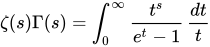 an integral representation for the log-gamma function is: l o g Γ ( z \+ 1 ) \= − γ z \+ ∫ 0 ∞ e − z t − 1 \+ z t t ( e t − 1 ) d t {\\displaystyle \\operatorname {log\\Gamma } (z+1)=-\\gamma z+\\int \_{0}^{\\infty }{\\frac {e^{-zt}-1+zt}{t\\left(e^{t}-1\\right)}}\\,dt}  or, setting z \= 1 {\\displaystyle z=1}  to obtain an integral for γ {\\displaystyle \\gamma }  , we can replace the γ {\\displaystyle \\gamma }  term with its integral and incorporate that into the above formula, to get: l o g Γ ( z \+ 1 ) \= ∫ 0 ∞ e − z t − z e − t − 1 \+ z t ( e t − 1 ) d t . {\\displaystyle \\operatorname {log\\Gamma } (z+1)=\\int \_{0}^{\\infty }{\\frac {e^{-zt}-ze^{-t}-1+z}{t\\left(e^{t}-1\\right)}}\\,dt\\,.} 
There also exist special formulas for the logarithm of the gamma function for rational z {\\displaystyle z}  . For instance, if k {\\displaystyle k}  and n {\\displaystyle n}  are integers with k \< n {\\displaystyle k\<n}  and k ≠ n / 2 {\\displaystyle k\\neq n/2}  , then[\[44\]](https://en.wikipedia.org/wiki/Gamma_function#cite_note-iaroslav_07-44) l o g Γ ( k n ) \= ( n − 2 k ) log 2 π 2 n \+ 1 2 { log π − log sin π k n } \+ 1 π ∑ r \= 1 n − 1 γ \+ log r r ⋅ sin 2 π r k n − 1 2 π sin 2 π k n ⋅ ∫ 0 ∞ e − n x ⋅ log x cosh x − cos ( 2 π k / n ) d x . {\\displaystyle {\\begin{aligned}\\operatorname {log\\Gamma } \\left({\\frac {k}{n}}\\right)={}&{\\frac {\\,(n-2k)\\log 2\\pi \\,}{2n}}+{\\frac {1}{2}}\\left\\{\\,\\log \\pi -\\log \\sin {\\frac {\\pi k}{n}}\\,\\right\\}+{\\frac {1}{\\pi }}\\!\\sum \_{r=1}^{n-1}{\\frac {\\,\\gamma +\\log r\\,}{r}}\\cdot \\sin {\\frac {\\,2\\pi rk\\,}{n}}\\\\&{}-{\\frac {1}{2\\pi }}\\sin {\\frac {2\\pi k}{n}}\\cdot \\!\\int \_{0}^{\\infty }\\!\\!{\\frac {\\,e^{-nx}\\!\\cdot \\log x\\,}{\\,\\cosh x-\\cos(2\\pi k/n)\\,}}\\,{\\mathrm {d} }x.\\end{aligned}}} This formula is sometimes used for numerical computation, since the integrand decreases very quickly.
### Integration over log-gamma
\[[edit](https://en.wikipedia.org/w/index.php?title=Gamma_function&action=edit§ion=23 "Edit section: Integration over log-gamma")\]
The integral ∫ 0 z l o g Γ ( x ) d x {\\displaystyle \\int \_{0}^{z}\\operatorname {log\\Gamma } (x)\\,dx}  can be expressed in terms of the [Barnes G\-function](https://en.wikipedia.org/wiki/Barnes_G-function "Barnes G-function")[\[45\]](https://en.wikipedia.org/wiki/Gamma_function#cite_note-Alexejewsky-45)[\[46\]](https://en.wikipedia.org/wiki/Gamma_function#cite_note-Barnes-46) (see [Barnes G\-function](https://en.wikipedia.org/wiki/Barnes_G-function "Barnes G-function") for a proof): ∫ 0 z l o g Γ ( x ) d x \= z 2 log ( 2 π ) \+ z ( 1 − z ) 2 \+ z l o g Γ ( z ) − log G ( z \+ 1 ) {\\displaystyle \\int \_{0}^{z}\\operatorname {log\\Gamma } (x)\\,dx={\\frac {z}{2}}\\log(2\\pi )+{\\frac {z(1-z)}{2}}+z\\operatorname {log\\Gamma } (z)-\\log G(z+1)}  where ℜ ( z ) \> − 1 {\\displaystyle \\Re (z)\>-1}  .
It can also be written in terms of the [Hurwitz zeta function](https://en.wikipedia.org/wiki/Hurwitz_zeta_function "Hurwitz zeta function"):[\[47\]](https://en.wikipedia.org/wiki/Gamma_function#cite_note-Adamchik-47)[\[48\]](https://en.wikipedia.org/wiki/Gamma_function#cite_note-Gosper-48) ∫ 0 z l o g Γ ( x ) d x \= z 2 log ( 2 π ) \+ z ( 1 − z ) 2 − ζ ′ ( − 1 ) \+ ζ ′ ( − 1 , z ) . {\\displaystyle \\int \_{0}^{z}\\operatorname {log\\Gamma } (x)\\,dx={\\frac {z}{2}}\\log(2\\pi )+{\\frac {z(1-z)}{2}}-\\zeta '(-1)+\\zeta '(-1,z).} 
When z \= 1 {\\displaystyle z=1}  it follows that ∫ 0 1 l o g Γ ( x ) d x \= 1 2 log ( 2 π ) , {\\displaystyle \\int \_{0}^{1}\\operatorname {log\\Gamma } (x)\\,dx={\\frac {1}{2}}\\log(2\\pi ),}  and this is a consequence of [Raabe's formula](https://en.wikipedia.org/wiki/Raabe%27s_formula "Raabe's formula") as well. Espinosa and Moll derived a similar formula for the integral of the square of l o g Γ {\\displaystyle \\operatorname {log\\Gamma } }  :[\[49\]](https://en.wikipedia.org/wiki/Gamma_function#cite_note-EspinosaMoll-49) ∫ 0 1 log 2 Γ ( x ) d x \= γ 2 12 \+ π 2 48 \+ 1 3 γ L 1 \+ 4 3 L 1 2 − ( γ \+ 2 L 1 ) ζ ′ ( 2 ) π 2 \+ ζ ′ ′ ( 2 ) 2 π 2 , {\\displaystyle \\int \_{0}^{1}\\log ^{2}\\Gamma (x)dx={\\frac {\\gamma ^{2}}{12}}+{\\frac {\\pi ^{2}}{48}}+{\\frac {1}{3}}\\gamma L\_{1}+{\\frac {4}{3}}L\_{1}^{2}-\\left(\\gamma +2L\_{1}\\right){\\frac {\\zeta ^{\\prime }(2)}{\\pi ^{2}}}+{\\frac {\\zeta ^{\\prime \\prime }(2)}{2\\pi ^{2}}},}  where L 1 {\\displaystyle L\_{1}}  is 1 2 log ( 2 π ) {\\displaystyle {\\frac {1}{2}}\\log(2\\pi )}  .
D. H. Bailey and his co-authors[\[50\]](https://en.wikipedia.org/wiki/Gamma_function#cite_note-Bailey-50) gave an evaluation for L n := ∫ 0 1 log n Γ ( x ) d x {\\displaystyle L\_{n}:=\\int \_{0}^{1}\\log ^{n}\\Gamma (x)\\,dx}  when n \= 1 , 2 {\\displaystyle n=1,2}  in terms of the Tornheim–Witten zeta function and its derivatives.
In addition, it is also known that[\[51\]](https://en.wikipedia.org/wiki/Gamma_function#cite_note-ACEKNM-51) lim n → ∞ L n n \! \= 1\. {\\displaystyle \\lim \_{n\\to \\infty }{\\frac {L\_{n}}{n!}}=1.} 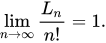
## Approximations
\[[edit](https://en.wikipedia.org/w/index.php?title=Gamma_function&action=edit§ion=24 "Edit section: Approximations")\]
[](https://en.wikipedia.org/wiki/File:Mplwp_factorial_gamma_stirling.svg)
Comparison of the gamma function (blue line) with the factorial (blue dots) and Stirling's approximation (magenta line)
Complex values of the gamma function can be approximated using [Stirling's approximation](https://en.wikipedia.org/wiki/Stirling%27s_approximation "Stirling's approximation") or the [Lanczos approximation](https://en.wikipedia.org/wiki/Lanczos_approximation "Lanczos approximation"),\[*[citation needed](https://en.wikipedia.org/wiki/Wikipedia:Citation_needed "Wikipedia:Citation needed")*\] Γ ( z ) ∼ 2 π z z − 1 / 2 e − z as z → ∞ in \| arg ( z ) \| \< π . {\\displaystyle \\Gamma (z)\\sim {\\sqrt {2\\pi }}z^{z-1/2}e^{-z}\\quad {\\hbox{as }}z\\to \\infty {\\hbox{ in }}\\left\|\\arg(z)\\right\|\<\\pi .}  This is precise in the sense that the ratio of the approximation to the true value approaches 1 {\\displaystyle 1}  in the limit as \| z \| → ∞ {\\displaystyle \\vert z\\vert \\rightarrow \\infty }  .
The gamma function can be computed to fixed precision for ℜ ( z ) ∈ \[ 1 , 2 \] {\\displaystyle \\Re (z)\\in \[1,2\]} ![{\\displaystyle \\Re (z)\\in \[1,2\]}](https://wikimedia.org/api/rest_v1/media/math/render/svg/dd48b020ff31b1d309a15463de5ada3b347784aa) by applying [integration by parts](https://en.wikipedia.org/wiki/Integration_by_parts "Integration by parts") to Euler's integral. For any positive number x {\\displaystyle x}  the gamma function can be written Γ ( z ) \= ∫ 0 x e − t t z d t t \+ ∫ x ∞ e − t t z d t t \= x z e − x ∑ n \= 0 ∞ x n z ( z \+ 1 ) ⋯ ( z \+ n ) \+ ∫ x ∞ e − t t z d t t . {\\displaystyle {\\begin{aligned}\\Gamma (z)&=\\int \_{0}^{x}e^{-t}t^{z}\\,{\\frac {dt}{t}}+\\int \_{x}^{\\infty }e^{-t}t^{z}\\,{\\frac {dt}{t}}\\\\&=x^{z}e^{-x}\\sum \_{n=0}^{\\infty }{\\frac {x^{n}}{z(z+1)\\cdots (z+n)}}+\\int \_{x}^{\\infty }e^{-t}t^{z}\\,{\\frac {dt}{t}}.\\end{aligned}}} 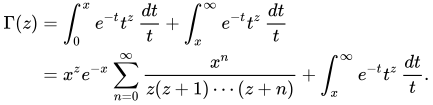
When ℜ ( z ) ∈ \[ 1 , 2 \] {\\displaystyle \\Re (z)\\in \[1,2\]} ![{\\displaystyle \\Re (z)\\in \[1,2\]}](https://wikimedia.org/api/rest_v1/media/math/render/svg/dd48b020ff31b1d309a15463de5ada3b347784aa) and x ≥ 1 {\\displaystyle x\\geq 1}  , the absolute value of the last integral is smaller than ( x \+ 1 ) e − x {\\displaystyle (x+1)e^{-x}}  . By choosing a large enough x {\\displaystyle x}  , this last expression can be made smaller than 2 − N {\\displaystyle 2^{-N}}  for any desired value N {\\displaystyle N}  . Thus, the gamma function can be evaluated to N {\\displaystyle N}  bits of precision with the above series.
A fast algorithm for calculation of the Euler gamma function for any algebraic argument (including rational) was constructed by E.A. Karatsuba.[\[52\]](https://en.wikipedia.org/wiki/Gamma_function#cite_note-52)[\[53\]](https://en.wikipedia.org/wiki/Gamma_function#cite_note-53)[\[54\]](https://en.wikipedia.org/wiki/Gamma_function#cite_note-54)
For arguments that are integer multiples of 1 24 {\\displaystyle {\\tfrac {1}{24}}}  , the gamma function can also be evaluated quickly using [arithmetic–geometric mean](https://en.wikipedia.org/wiki/Arithmetic%E2%80%93geometric_mean "Arithmetic–geometric mean") iterations (see [particular values of the gamma function](https://en.wikipedia.org/wiki/Particular_values_of_the_gamma_function "Particular values of the gamma function")).[\[55\]](https://en.wikipedia.org/wiki/Gamma_function#cite_note-55)
## Practical implementations
\[[edit](https://en.wikipedia.org/w/index.php?title=Gamma_function&action=edit§ion=25 "Edit section: Practical implementations")\]
Unlike many other functions, such as a [Normal Distribution](https://en.wikipedia.org/wiki/Normal_Distribution "Normal Distribution"), no obvious fast, accurate implementation that is easy to implement for the Gamma Function Γ ( z ) {\\displaystyle \\Gamma (z)}  is easily found. Therefore, it is worth investigating potential solutions. For the case that speed is more important than accuracy, published tables for Γ ( z ) {\\displaystyle \\Gamma (z)}  are easily found in an Internet search, such as the Online Wiley Library. Such tables may be used with [linear interpolation](https://en.wikipedia.org/wiki/Linear_interpolation "Linear interpolation"). Greater accuracy is obtainable with the use of [cubic interpolation](https://en.wikipedia.org/wiki/Cubic_Hermite_spline "Cubic Hermite spline") at the cost of more computational overhead. Since Γ ( z ) {\\displaystyle \\Gamma (z)}  tables are usually published for argument values between 1 and 2, the property Γ ( z \+ 1 ) \= z Γ ( z ) {\\displaystyle \\Gamma (z+1)=z\\ \\Gamma (z)}  may be used to quickly and easily translate all real values z \< 1 {\\displaystyle z\<1}  and z \> 2 {\\displaystyle z\>2}  into the range 1 ≤ z ≤ 2 {\\displaystyle 1\\leq z\\leq 2}  , such that only tabulated values of z {\\displaystyle z}  between 1 and 2 need be used.[\[56\]](https://en.wikipedia.org/wiki/Gamma_function#cite_note-56)
If interpolation tables are not desirable, then the [Lanczos approximation](https://en.wikipedia.org/wiki/Gamma_function#Approximations) mentioned above works well for 1 to 2 digits of accuracy for small, commonly used values of z {\\displaystyle z}  . If the Lanczos approximation is not sufficiently accurate, the [Stirling's formula for the Gamma Function](https://en.wikipedia.org/wiki/Stirling%27s_approximation#Stirling's_formula_for_the_gamma_function "Stirling's approximation") may be used.
## Applications
\[[edit](https://en.wikipedia.org/w/index.php?title=Gamma_function&action=edit§ion=26 "Edit section: Applications")\]
One author describes the gamma function as "Arguably, the most common [special function](https://en.wikipedia.org/wiki/Special_functions "Special functions"), or the least 'special' of them. The other transcendental functions \[...\] are called 'special' because you could conceivably avoid some of them by staying away from many specialized mathematical topics. On the other hand, the gamma function Γ ( z ) {\\displaystyle \\Gamma (z)}  is most difficult to avoid."[\[57\]](https://en.wikipedia.org/wiki/Gamma_function#cite_note-57)
### Integration problems
\[[edit](https://en.wikipedia.org/w/index.php?title=Gamma_function&action=edit§ion=27 "Edit section: Integration problems")\]
The gamma function finds application in such diverse areas as [quantum physics](https://en.wikipedia.org/wiki/Quantum_physics "Quantum physics"), [astrophysics](https://en.wikipedia.org/wiki/Astrophysics "Astrophysics") and [fluid dynamics](https://en.wikipedia.org/wiki/Fluid_dynamics "Fluid dynamics").[\[58\]](https://en.wikipedia.org/wiki/Gamma_function#cite_note-58) The [gamma distribution](https://en.wikipedia.org/wiki/Gamma_distribution "Gamma distribution"), which is formulated in terms of the gamma function, is used in [statistics](https://en.wikipedia.org/wiki/Statistics "Statistics") to model a wide range of processes; for example, the time between occurrences of earthquakes.[\[59\]](https://en.wikipedia.org/wiki/Gamma_function#cite_note-59)
The primary reason for the gamma function's usefulness in such contexts is the prevalence of expressions of the type f ( t ) e − g ( t ) {\\displaystyle f(t)e^{-g(t)}}  , which describe processes that decay exponentially in time or space. Integrals of such expressions can occasionally be solved in terms of the gamma function when no elementary solution exists. For example, if f {\\displaystyle f}  is a power function and g {\\displaystyle g}  is a linear function, a simple change of variables u := a ⋅ t {\\displaystyle u:=a\\cdot t}  gives the evaluation ∫ 0 ∞ t b e − a t d t \= 1 a b ∫ 0 ∞ u b e − u d ( u a ) \= Γ ( b \+ 1 ) a b \+ 1 . {\\displaystyle \\int \_{0}^{\\infty }t^{b}\\,e^{-at}\\,dt={\\frac {1}{a^{b}}}\\int \_{0}^{\\infty }u^{b}\\,e^{-u}\\,d\\left({\\frac {u}{a}}\\right)={\\frac {\\Gamma (b+1)}{a^{b+1}}}.} 
The fact that the integration is performed along the entire positive real line might signify that the gamma function describes the cumulation of a time-dependent process that continues indefinitely, or the value might be the total of a distribution in an infinite space.
It is of course frequently useful to take limits of integration other than 0 {\\displaystyle 0}  and ∞ {\\displaystyle \\infty }  to describe the cumulation of a finite process, in which case the ordinary gamma function is no longer a solution; the solution is then called an [incomplete gamma function](https://en.wikipedia.org/wiki/Incomplete_gamma_function "Incomplete gamma function"). (The ordinary gamma function, obtained by integrating across the entire positive real line, is sometimes called the *complete gamma function* for contrast.)
An important category of exponentially decaying functions is that of [Gaussian functions](https://en.wikipedia.org/wiki/Gaussian_function "Gaussian function")a e − ( x − b ) 2 c 2 {\\displaystyle ae^{-{\\frac {(x-b)^{2}}{c^{2}}}}}  and integrals thereof, such as the [error function](https://en.wikipedia.org/wiki/Error_function "Error function"). There are many interrelations between these functions and the gamma function; notably, the factor π {\\displaystyle {\\sqrt {\\pi }}}  obtained by evaluating Γ ( 1 2 ) {\\textstyle \\Gamma \\left({\\frac {1}{2}}\\right)}  is the "same" as that found in the normalizing factor of the error function and the [normal distribution](https://en.wikipedia.org/wiki/Normal_distribution "Normal distribution").
The integrals discussed so far involve [transcendental functions](https://en.wikipedia.org/wiki/Transcendental_function "Transcendental function"), but the gamma function also arises from integrals of purely algebraic functions. In particular, the [arc lengths](https://en.wikipedia.org/wiki/Arc_length "Arc length") of [ellipses](https://en.wikipedia.org/wiki/Ellipse "Ellipse") and of the [lemniscate](https://en.wikipedia.org/wiki/Lemniscate_of_Bernoulli#Arc_length_and_elliptic_functions "Lemniscate of Bernoulli"), which are curves defined by algebraic equations, are given by [elliptic integrals](https://en.wikipedia.org/wiki/Elliptic_integral "Elliptic integral") that in special cases can be evaluated in terms of the gamma function. The gamma function can also be used to [calculate "volume" and "area"](https://en.wikipedia.org/wiki/Volume_of_an_n-ball "Volume of an n-ball") of n {\\displaystyle n} \-dimensional [hyperspheres](https://en.wikipedia.org/wiki/Hypersphere "Hypersphere").
### Calculating products
\[[edit](https://en.wikipedia.org/w/index.php?title=Gamma_function&action=edit§ion=28 "Edit section: Calculating products")\]
The gamma function's ability to generalize factorial products immediately leads to applications in many areas of mathematics; in [combinatorics](https://en.wikipedia.org/wiki/Combinatorics "Combinatorics"), and by extension in areas such as [probability theory](https://en.wikipedia.org/wiki/Probability_theory "Probability theory") and the calculation of [power series](https://en.wikipedia.org/wiki/Power_series "Power series"). Many expressions involving products of successive integers can be written as some combination of factorials, the most important example perhaps being that of the [binomial coefficient](https://en.wikipedia.org/wiki/Binomial_coefficient "Binomial coefficient"). For example, for any complex numbers z {\\displaystyle z}  and n {\\displaystyle n}  , with \| z \| \< 1 {\\displaystyle \\vert z\\vert \<1}  , we can write( 1 \+ z ) n \= ∑ k \= 0 ∞ Γ ( n \+ 1 ) k \! Γ ( n − k \+ 1 ) z k , {\\displaystyle (1+z)^{n}=\\sum \_{k=0}^{\\infty }{\\frac {\\Gamma (n+1)}{k!\\Gamma (n-k+1)}}z^{k},} 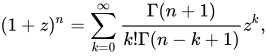which closely resembles the binomial coefficient when n {\\displaystyle n}  is a non-negative integer, ( 1 \+ z ) n \= ∑ k \= 0 n n \! k \! ( n − k ) \! z k \= ∑ k \= 0 n ( n k ) z k . {\\displaystyle (1+z)^{n}=\\sum \_{k=0}^{n}{\\frac {n!}{k!(n-k)!}}z^{k}=\\sum \_{k=0}^{n}{\\binom {n}{k}}z^{k}.} 
The example of binomial coefficients motivates why the properties of the gamma function when extended to negative numbers are natural. A binomial coefficient gives the number of ways to choose k {\\displaystyle k}  elements from a set of n {\\displaystyle n}  elements; if k \> n {\\displaystyle k\>n}  , there are of course no ways. If k \> n {\\displaystyle k\>n}  , then ( n − k ) \! {\\displaystyle (n-k)!}  is the factorial of a negative integer and hence infinite if we use the gamma function definition of factorials—[dividing by infinity](https://en.wikipedia.org/wiki/Division_by_infinity "Division by infinity") gives the expected value of 0 {\\displaystyle 0}  .
We can replace the factorial by a gamma function to extend any such formula to the complex numbers. Generally, this works for any product wherein each factor is a [rational function](https://en.wikipedia.org/wiki/Rational_function "Rational function") of the index variable, by factoring the rational function into linear expressions. If P {\\displaystyle P}  and Q {\\displaystyle Q}  are monic polynomials of degree m {\\displaystyle m}  and n {\\displaystyle n}  with respective roots p 1 , ⋯ , p m {\\displaystyle p\_{1},\\cdots ,p\_{m}}  and q 1 , ⋯ , q m {\\displaystyle q\_{1},\\cdots ,q\_{m}}  , we have∏ i \= a b P ( i ) Q ( i ) \= ( ∏ j \= 1 m Γ ( b − p j \+ 1 ) Γ ( a − p j ) ) ( ∏ k \= 1 n Γ ( a − q k ) Γ ( b − q k \+ 1 ) ) . {\\displaystyle \\prod \_{i=a}^{b}{\\frac {P(i)}{Q(i)}}=\\left(\\prod \_{j=1}^{m}{\\frac {\\Gamma (b-p\_{j}+1)}{\\Gamma (a-p\_{j})}}\\right)\\left(\\prod \_{k=1}^{n}{\\frac {\\Gamma (a-q\_{k})}{\\Gamma (b-q\_{k}+1)}}\\right).} 
If we have a way to calculate the gamma function numerically, it is very simple to calculate numerical values of such products. The number of gamma functions in the right-hand side depends only on the degree of the polynomials, so it does not matter whether b − a {\\displaystyle b-a}  equals 5 or 105. By taking the appropriate limits, the equation can also be made to hold even when the left-hand product contains zeros or poles.
By taking limits, certain rational products with infinitely many factors can be evaluated in terms of the gamma function as well. Due to the [Weierstrass factorization theorem](https://en.wikipedia.org/wiki/Weierstrass_factorization_theorem "Weierstrass factorization theorem"), analytic functions can be written as infinite products, and these can sometimes be represented as finite products or quotients of the gamma function. We have already seen one striking example: the reflection formula essentially represents the sine function as the product of two gamma functions. Starting from this formula, the exponential function as well as all the trigonometric and hyperbolic functions can be expressed in terms of the gamma function.
More functions yet, including the [hypergeometric function](https://en.wikipedia.org/wiki/Hypergeometric_function "Hypergeometric function") and special cases thereof, can be represented by means of complex [contour integrals](https://en.wikipedia.org/wiki/Contour_integral "Contour integral") of products and quotients of the gamma function, called [Mellin–Barnes integrals](https://en.wikipedia.org/wiki/Barnes_integral "Barnes integral").
### Analytic number theory
\[[edit](https://en.wikipedia.org/w/index.php?title=Gamma_function&action=edit§ion=29 "Edit section: Analytic number theory")\]
An application of the gamma function is the study of the [Riemann zeta function](https://en.wikipedia.org/wiki/Riemann_zeta_function "Riemann zeta function"). A fundamental property of the Riemann zeta function is its [functional equation](https://en.wikipedia.org/wiki/Functional_equation "Functional equation"):Γ ( s 2 ) ζ ( s ) π − s 2 \= Γ ( 1 − s 2 ) ζ ( 1 − s ) π − 1 − s 2 . {\\displaystyle \\Gamma \\left({\\frac {s}{2}}\\right)\\,\\zeta (s)\\,\\pi ^{-{\\frac {s}{2}}}=\\Gamma \\left({\\frac {1-s}{2}}\\right)\\,\\zeta (1-s)\\,\\pi ^{-{\\frac {1-s}{2}}}.} 
Among other things, this provides an explicit form for the [analytic continuation](https://en.wikipedia.org/wiki/Analytic_continuation "Analytic continuation") of the zeta function to a meromorphic function in the complex plane and leads to an immediate proof that the zeta function has infinitely many so-called "trivial" zeros on the real line.[\[60\]](https://en.wikipedia.org/wiki/Gamma_function#cite_note-60) Another powerful formula isζ ( s ) Γ ( s ) \= ∫ 0 ∞ t s e t − 1 d t t . {\\displaystyle \\zeta (s)\\;\\Gamma (s)=\\int \_{0}^{\\infty }{\\frac {t^{s}}{e^{t}-1}}\\,{\\frac {dt}{t}}.} 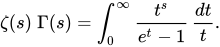
Both formulas were derived by [Bernhard Riemann](https://en.wikipedia.org/wiki/Bernhard_Riemann "Bernhard Riemann") in his seminal 1859 paper "*[Ueber die Anzahl der Primzahlen unter einer gegebenen Größe](https://en.wikipedia.org/wiki/On_the_Number_of_Primes_Less_Than_a_Given_Magnitude "On the Number of Primes Less Than a Given Magnitude")*" ("On the Number of Primes Less Than a Given Magnitude"), one of the milestones in the development of [analytic number theory](https://en.wikipedia.org/wiki/Analytic_number_theory "Analytic number theory")—the branch of mathematics that studies [prime numbers](https://en.wikipedia.org/wiki/Prime_number "Prime number") using the tools of mathematical analysis.
## History
\[[edit](https://en.wikipedia.org/w/index.php?title=Gamma_function&action=edit§ion=30 "Edit section: History")\]
The gamma function has caught the interest of some of the most prominent mathematicians of all time. Its history, notably documented by [Philip J. Davis](https://en.wikipedia.org/wiki/Philip_J._Davis "Philip J. Davis") in an article that won him the 1963 [Chauvenet Prize](https://en.wikipedia.org/wiki/Chauvenet_Prize "Chauvenet Prize"), reflects many of the major developments within mathematics since the 18th century. In the words of Davis, "each generation has found something of interest to say about the gamma function. Perhaps the next generation will also."[\[1\]](https://en.wikipedia.org/wiki/Gamma_function#cite_note-Davis-1)
### 18th century: Euler and Stirling
\[[edit](https://en.wikipedia.org/w/index.php?title=Gamma_function&action=edit§ion=31 "Edit section: 18th century: Euler and Stirling")\]
[](https://en.wikipedia.org/wiki/File:DanielBernoulliLettreAGoldbach-1729-10-06.jpg)
[Daniel Bernoulli](https://en.wikipedia.org/wiki/Daniel_Bernoulli "Daniel Bernoulli")'s letter to [Christian Goldbach](https://en.wikipedia.org/wiki/Christian_Goldbach "Christian Goldbach") (Oct 6, 1729)
The problem of extending the factorial to non-integer arguments was apparently first considered by [Daniel Bernoulli](https://en.wikipedia.org/wiki/Daniel_Bernoulli "Daniel Bernoulli") and [Christian Goldbach](https://en.wikipedia.org/wiki/Christian_Goldbach "Christian Goldbach") in the 1720s. In particular, in a letter from Bernoulli to Goldbach dated 6 October 1729 Bernoulli introduced the product representation[\[61\]](https://en.wikipedia.org/wiki/Gamma_function#cite_note-61)x \! \= lim n → ∞ ( n \+ 1 \+ x 2 ) x − 1 ∏ k \= 1 n k \+ 1 k \+ x , {\\displaystyle x!=\\lim \_{n\\to \\infty }\\left(n+1+{\\frac {x}{2}}\\right)^{x-1}\\prod \_{k=1}^{n}{\\frac {k+1}{k+x}},} which is well defined for real values of x other than the negative integers.
[Leonhard Euler](https://en.wikipedia.org/wiki/Leonhard_Euler "Leonhard Euler") later gave two different definitions: the first was not his integral but an [infinite product](https://en.wikipedia.org/wiki/Infinite_product "Infinite product") that is well defined for all complex numbers n other than the negative integers,n \! \= ∏ k \= 1 ∞ ( 1 \+ 1 k ) n 1 \+ n k , {\\displaystyle n!=\\prod \_{k=1}^{\\infty }{\\frac {\\left(1+{\\frac {1}{k}}\\right)^{n}}{1+{\\frac {n}{k}}}}\\,,} 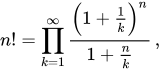of which he informed Goldbach in a letter dated 13 October 1729. He wrote to Goldbach again on 8 January 1730, to announce his discovery of the integral representationn \! \= ∫ 0 1 ( − log s ) n d s , {\\displaystyle n!=\\int \_{0}^{1}(-\\log s)^{n}\\,ds,} 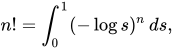 which is valid when the real part of the complex number n {\\displaystyle n}  is strictly greater than − 1 {\\displaystyle -1}  (i.e., ℜ ( n ) \> − 1 {\\displaystyle \\Re (n)\>-1}  ). By the change of variables t \= − ln s {\\displaystyle t=-\\ln s}  , this becomes the familiar Euler integral. Euler published his results in the paper "De progressionibus transcendentibus seu quarum termini generales algebraice dari nequeunt" ("On transcendental progressions, that is, those whose general terms cannot be given algebraically"), submitted to the [St. Petersburg Academy](https://en.wikipedia.org/wiki/St._Petersburg_Academy "St. Petersburg Academy") on 28 November 1729.[\[62\]](https://en.wikipedia.org/wiki/Gamma_function#cite_note-62) Euler further discovered some of the gamma function's important functional properties, including the reflection formula.
[James Stirling](https://en.wikipedia.org/wiki/James_Stirling_\(mathematician\) "James Stirling (mathematician)"), a contemporary of Euler, also attempted to find a continuous expression for the factorial and came up with what is now known as [Stirling's formula](https://en.wikipedia.org/wiki/Stirling%27s_formula "Stirling's formula"). Although Stirling's formula gives a good estimate of n \! {\\displaystyle n!}  , also for non-integers, it does not provide the exact value. Extensions of his formula that correct the error were given by Stirling himself and by [Jacques Philippe Marie Binet](https://en.wikipedia.org/wiki/Jacques_Philippe_Marie_Binet "Jacques Philippe Marie Binet").
### 19th century: Gauss, Weierstrass, and Legendre
\[[edit](https://en.wikipedia.org/w/index.php?title=Gamma_function&action=edit§ion=32 "Edit section: 19th century: Gauss, Weierstrass, and Legendre")\]
[](https://en.wikipedia.org/wiki/File:Euler_factorial_paper.png)
The first page of Euler's paper
[Carl Friedrich Gauss](https://en.wikipedia.org/wiki/Carl_Friedrich_Gauss "Carl Friedrich Gauss") rewrote Euler's product asΓ ( z ) \= lim m → ∞ m z m \! z ( z \+ 1 ) ( z \+ 2 ) ⋯ ( z \+ m ) {\\displaystyle \\Gamma (z)=\\lim \_{m\\to \\infty }{\\frac {m^{z}m!}{z(z+1)(z+2)\\cdots (z+m)}}} and used this formula to discover new properties of the gamma function. Although Euler was a pioneer in the theory of complex variables, he does not appear to have considered the factorial of a complex number, as instead Gauss first did.[\[63\]](https://en.wikipedia.org/wiki/Gamma_function#cite_note-Remmert-63) Gauss also proved the [multiplication theorem](https://en.wikipedia.org/wiki/Multiplication_theorem "Multiplication theorem") of the gamma function and investigated the connection between the gamma function and [elliptic integrals](https://en.wikipedia.org/wiki/Elliptic_integral "Elliptic integral").
[Karl Weierstrass](https://en.wikipedia.org/wiki/Karl_Weierstrass "Karl Weierstrass") further established the role of the gamma function in [complex analysis](https://en.wikipedia.org/wiki/Complex_analysis "Complex analysis"), starting from yet another product representation,Γ ( z ) \= e − γ z z ∏ k \= 1 ∞ ( 1 \+ z k ) − 1 e z k , {\\displaystyle \\Gamma (z)={\\frac {e^{-\\gamma z}}{z}}\\prod \_{k=1}^{\\infty }\\left(1+{\\frac {z}{k}}\\right)^{-1}e^{\\frac {z}{k}},} 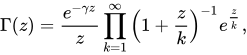where γ {\\displaystyle \\gamma }  is the [Euler–Mascheroni constant](https://en.wikipedia.org/wiki/Euler%E2%80%93Mascheroni_constant "Euler–Mascheroni constant"). Weierstrass originally wrote his product as one for 1 Γ {\\displaystyle \\textstyle {\\frac {1}{\\Gamma }}}  , in which case it is taken over the function's zeros rather than its poles. Inspired by this result, he proved what is known as the [Weierstrass factorization theorem](https://en.wikipedia.org/wiki/Weierstrass_factorization_theorem "Weierstrass factorization theorem")—that any entire function can be written as a product over its zeros in the complex plane; a generalization of the [fundamental theorem of algebra](https://en.wikipedia.org/wiki/Fundamental_theorem_of_algebra "Fundamental theorem of algebra").
The name gamma function and the symbol Γ {\\displaystyle \\Gamma }  were introduced by [Adrien-Marie Legendre](https://en.wikipedia.org/wiki/Adrien-Marie_Legendre "Adrien-Marie Legendre") around 1811; Legendre also rewrote Euler's integral definition in its modern form. Although the symbol is an upper-case Greek gamma, there is no accepted standard for whether the function name should be written "gamma function" or "Gamma function" (some authors simply write " Γ {\\displaystyle \\Gamma }  \-function"). The alternative "pi function" notation Π ( z ) \= z \! {\\displaystyle \\Pi (z)=z!}  due to Gauss is sometimes encountered in older literature, but Legendre's notation is dominant in modern works.
It is justified to ask why we distinguish between the "ordinary factorial" and the gamma function by using distinct symbols, and particularly why the gamma function should be normalized to Γ ( n \+ 1 ) \= n \! {\\displaystyle \\Gamma (n+1)=n!}  instead of simply using Γ ( n ) \= n \! {\\displaystyle \\Gamma (n)=n!}  . Consider that the notation for exponents, x n {\\displaystyle x^{n}}  , has been generalized from integers to complex numbers x z {\\displaystyle x^{z}}  without any change. Legendre's motivation for the normalization is not known, and has been criticized as cumbersome by some (the 20th-century mathematician [Cornelius Lanczos](https://en.wikipedia.org/wiki/Cornelius_Lanczos "Cornelius Lanczos"), for example, called it "void of any rationality" and would instead use z \! {\\displaystyle z!}  ).[\[64\]](https://en.wikipedia.org/wiki/Gamma_function#cite_note-64) Legendre's normalization does simplify some formulae, but complicates others. From a modern point of view, the Legendre normalization of the gamma function is the integral of the additive [character](https://en.wikipedia.org/wiki/Character_\(mathematics\) "Character (mathematics)") e − x {\\displaystyle e^{-x}}  against the multiplicative character x z {\\displaystyle x^{z}}  with respect to the [Haar measure](https://en.wikipedia.org/wiki/Haar_measure "Haar measure") d x x {\\textstyle {\\frac {dx}{x}}}  on the [Lie group](https://en.wikipedia.org/wiki/Lie_group "Lie group") R \+ {\\displaystyle \\mathbb {R} ^{+}}  . Thus this normalization makes it clearer that the gamma function is a continuous analogue of a [Gauss sum](https://en.wikipedia.org/wiki/Gauss_sum "Gauss sum").[\[65\]](https://en.wikipedia.org/wiki/Gamma_function#cite_note-65)
### 19th–20th centuries: characterizing the gamma function
\[[edit](https://en.wikipedia.org/w/index.php?title=Gamma_function&action=edit§ion=33 "Edit section: 19th–20th centuries: characterizing the gamma function")\]
It is somewhat problematic that a large number of definitions have been given for the gamma function. Although they describe the same function, it is not entirely straightforward to prove the equivalence. Stirling never proved that his extended formula corresponds exactly to Euler's gamma function; a proof was first given by [Charles Hermite](https://en.wikipedia.org/wiki/Charles_Hermite "Charles Hermite") in 1900.[\[66\]](https://en.wikipedia.org/wiki/Gamma_function#cite_note-Knuth-66) Instead of finding a specialized proof for each formula, it would be desirable to have a general method of identifying the gamma function.
One way to prove equivalence would be to find a [differential equation](https://en.wikipedia.org/wiki/Differential_equation "Differential equation") that characterizes the gamma function. Most special functions in applied mathematics arise as solutions to differential equations, whose solutions are unique. However, the gamma function does not appear to satisfy any simple differential equation. [Otto Hölder](https://en.wikipedia.org/wiki/Otto_H%C3%B6lder "Otto Hölder") proved in 1887 that the gamma function at least does not satisfy any [*algebraic* differential equation](https://en.wikipedia.org/wiki/Algebraic_differential_equation "Algebraic differential equation") by showing that a solution to such an equation could not satisfy the gamma function's recurrence formula, making it a [transcendentally transcendental function](https://en.wikipedia.org/wiki/Transcendentally_transcendental_function "Transcendentally transcendental function"). This result is known as [Hölder's theorem](https://en.wikipedia.org/wiki/H%C3%B6lder%27s_theorem "Hölder's theorem").
A definite and generally applicable characterization of the gamma function was not given until 1922. [Harald Bohr](https://en.wikipedia.org/wiki/Harald_Bohr "Harald Bohr") and [Johannes Mollerup](https://en.wikipedia.org/wiki/Johannes_Mollerup "Johannes Mollerup") then proved what is known as the [Bohr–Mollerup theorem](https://en.wikipedia.org/wiki/Bohr%E2%80%93Mollerup_theorem "Bohr–Mollerup theorem"): that the gamma function is the unique solution to the factorial [recurrence relation](https://en.wikipedia.org/wiki/Recurrence_relation "Recurrence relation") that is positive and *[logarithmically convex](https://en.wikipedia.org/wiki/Logarithmic_convexity "Logarithmic convexity")* for positive z {\\displaystyle z}  and whose value at 1 {\\displaystyle 1}  is 1 {\\displaystyle 1}  (a function is logarithmically convex if its logarithm is convex). Another characterisation is given by the [Wielandt theorem](https://en.wikipedia.org/wiki/Wielandt_theorem "Wielandt theorem").
The Bohr–Mollerup theorem is useful because it is relatively easy to prove logarithmic convexity for any of the different formulas used to define the gamma function. Taking things further, instead of defining the gamma function by any particular formula, we can choose the conditions of the Bohr–Mollerup theorem as the definition, and then pick any formula we like that satisfies the conditions as a starting point for studying the gamma function. This approach was used by the [Bourbaki group](https://en.wikipedia.org/wiki/Bourbaki_group "Bourbaki group").
[Borwein](https://en.wikipedia.org/wiki/Jonathan_Borwein "Jonathan Borwein") & Corless review three centuries of work on the gamma function.[\[67\]](https://en.wikipedia.org/wiki/Gamma_function#cite_note-67)
### Reference tables and software
\[[edit](https://en.wikipedia.org/w/index.php?title=Gamma_function&action=edit§ion=34 "Edit section: Reference tables and software")\]
[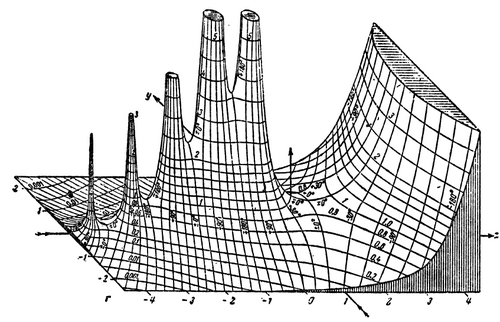](https://en.wikipedia.org/wiki/File:Jahnke_gamma_function.png)
A hand-drawn graph of the absolute value of the complex gamma function, from *Tables of Higher Functions* by [Jahnke](https://en.wikipedia.org/wiki/Eugen_Jahnke "Eugen Jahnke") and [Emde](https://en.wikipedia.org/w/index.php?title=Fritz_Emde&action=edit&redlink=1 "Fritz Emde (page does not exist)") \[[de](https://de.wikipedia.org/wiki/Fritz_Emde "de:Fritz Emde")\]
Although the gamma function can be calculated virtually as easily as any mathematically simpler function with a modern computer—even with a programmable pocket calculator—this was of course not always the case. Until the mid-20th century, mathematicians relied on hand-made tables; in the case of the gamma function, notably a table computed by Gauss in 1813 and one computed by Legendre in 1825.[\[68\]](https://en.wikipedia.org/wiki/Gamma_function#cite_note-68)
Tables of complex values of the gamma function, as well as hand-drawn graphs, were given in *[Tables of Functions With Formulas and Curves](https://en.wikipedia.org/wiki/Tables_of_Functions_With_Formulas_and_Curves "Tables of Functions With Formulas and Curves")* by [Jahnke](https://en.wikipedia.org/wiki/Eugen_Jahnke "Eugen Jahnke") and [Emde](https://en.wikipedia.org/w/index.php?title=Fritz_Emde&action=edit&redlink=1 "Fritz Emde (page does not exist)") \[[de](https://de.wikipedia.org/wiki/Fritz_Emde "de:Fritz Emde")\], first published in Germany in 1909. According to [Michael Berry](https://en.wikipedia.org/wiki/Michael_Berry_\(physicist\) "Michael Berry (physicist)"), "the publication in J\&E of a three-dimensional graph showing the poles of the gamma function in the complex plane acquired an almost iconic status."[\[69\]](https://en.wikipedia.org/wiki/Gamma_function#cite_note-69)
There was in fact little practical need for anything but real values of the gamma function until the 1930s, when applications for the complex gamma function were discovered in theoretical physics. As electronic computers became available for the production of tables in the 1950s, several extensive tables for the complex gamma function were published to meet the demand, including a table accurate to 12 decimal places from the U.S. [National Bureau of Standards](https://en.wikipedia.org/wiki/National_Bureau_of_Standards "National Bureau of Standards").[\[1\]](https://en.wikipedia.org/wiki/Gamma_function#cite_note-Davis-1)
[](https://en.wikipedia.org/wiki/File:Famous_complex_plot_by_Janhke_and_Emde_\(Tables_of_Functions_with_Formulas_and_Curves,_4th_ed.,_Dover,_1945\)_gamma_function_from_-4.5-2.5i_to_4.5%2B2.5i.svg)
Reproduction of a famous complex plot of
Γ
(
z
)
{\\displaystyle \\Gamma (z)}

by Janhke and Emde of the gamma function for
−
4\.5
\<
ℜ
(
z
)
\<
−
4\.5
{\\displaystyle -4.5\<\\Re (z)\<-4.5}

and
−
2\.5
\<
ℑ
(
z
)
\<
2\.5
{\\displaystyle -2.5\<\\Im (z)\<2.5}

. (*Tables of Functions with Formulas and Curves*, 4th ed., Dover, 1945)
Double-precision floating-point implementations of the gamma function and its logarithm are now available in most scientific computing software and special functions libraries, for example [TK Solver](https://en.wikipedia.org/wiki/TK_Solver "TK Solver"), [Matlab](https://en.wikipedia.org/wiki/Matlab "Matlab"), [GNU Octave](https://en.wikipedia.org/wiki/GNU_Octave "GNU Octave"), and the [GNU Scientific Library](https://en.wikipedia.org/wiki/GNU_Scientific_Library "GNU Scientific Library"). The gamma function was also added to the [C](https://en.wikipedia.org/wiki/C_\(programming_language\) "C (programming language)") standard library ([math.h](https://en.wikipedia.org/wiki/Math.h "Math.h")). Arbitrary-precision implementations are available in most [computer algebra systems](https://en.wikipedia.org/wiki/Computer_algebra_system "Computer algebra system"), such as [Mathematica](https://en.wikipedia.org/wiki/Mathematica "Mathematica") and [Maple](https://en.wikipedia.org/wiki/Maple_\(software\) "Maple (software)"). [PARI/GP](https://en.wikipedia.org/wiki/PARI/GP "PARI/GP"), [MPFR](https://en.wikipedia.org/wiki/MPFR "MPFR") and MPFUN contain free arbitrary-precision implementations. In some [software calculators](https://en.wikipedia.org/wiki/Software_calculator "Software calculator"), such the [Windows Calculator](https://en.wikipedia.org/wiki/Windows_Calculator "Windows Calculator") and [GNOME](https://en.wikipedia.org/wiki/GNOME "GNOME") Calculator, the factorial function returns Γ ( x \+ 1 ) {\\displaystyle \\Gamma (x+1)}  when the input x {\\displaystyle x}  is a non-integer value.[\[70\]](https://en.wikipedia.org/wiki/Gamma_function#cite_note-70)[\[71\]](https://en.wikipedia.org/wiki/Gamma_function#cite_note-71)
## See also
\[[edit](https://en.wikipedia.org/w/index.php?title=Gamma_function&action=edit§ion=35 "Edit section: See also")\]
- [Ascending factorial](https://en.wikipedia.org/wiki/Ascending_factorial "Ascending factorial")
- [Cahen–Mellin integral](https://en.wikipedia.org/wiki/Cahen%E2%80%93Mellin_integral "Cahen–Mellin integral")
- [Elliptic gamma function](https://en.wikipedia.org/wiki/Elliptic_gamma_function "Elliptic gamma function")
- [Lemniscate constant](https://en.wikipedia.org/wiki/Lemniscate_constant "Lemniscate constant")
- [Pseudogamma function](https://en.wikipedia.org/wiki/Pseudogamma_function "Pseudogamma function")
- [Hadamard's gamma function](https://en.wikipedia.org/wiki/Hadamard%27s_gamma_function "Hadamard's gamma function")
- [Inverse gamma function](https://en.wikipedia.org/wiki/Inverse_gamma_function "Inverse gamma function")
- [Lanczos approximation](https://en.wikipedia.org/wiki/Lanczos_approximation "Lanczos approximation")
- [Multiple gamma function](https://en.wikipedia.org/wiki/Multiple_gamma_function "Multiple gamma function")
- [Multivariate gamma function](https://en.wikipedia.org/wiki/Multivariate_gamma_function "Multivariate gamma function")
- [p\-adic gamma function](https://en.wikipedia.org/wiki/P-adic_gamma_function "P-adic gamma function")
- [Pochhammer k\-symbol](https://en.wikipedia.org/wiki/Pochhammer_k-symbol "Pochhammer k-symbol")
- [Polygamma function](https://en.wikipedia.org/wiki/Polygamma_function "Polygamma function")
- [q\-gamma function](https://en.wikipedia.org/wiki/Q-gamma_function "Q-gamma function")
- [Ramanujan's master theorem](https://en.wikipedia.org/wiki/Ramanujan%27s_master_theorem "Ramanujan's master theorem")
- [Spouge's approximation](https://en.wikipedia.org/wiki/Spouge%27s_approximation "Spouge's approximation")
- [Stirling's approximation](https://en.wikipedia.org/wiki/Stirling%27s_approximation "Stirling's approximation")
- [Bhargava factorial](https://en.wikipedia.org/wiki/Bhargava_factorial "Bhargava factorial")
## Notes
\[[edit](https://en.wikipedia.org/w/index.php?title=Gamma_function&action=edit§ion=36 "Edit section: Notes")\]
1. ^ [***a***](https://en.wikipedia.org/wiki/Gamma_function#cite_ref-Davis_1-0) [***b***](https://en.wikipedia.org/wiki/Gamma_function#cite_ref-Davis_1-1) [***c***](https://en.wikipedia.org/wiki/Gamma_function#cite_ref-Davis_1-2) [***d***](https://en.wikipedia.org/wiki/Gamma_function#cite_ref-Davis_1-3) [***e***](https://en.wikipedia.org/wiki/Gamma_function#cite_ref-Davis_1-4) [***f***](https://en.wikipedia.org/wiki/Gamma_function#cite_ref-Davis_1-5) [***g***](https://en.wikipedia.org/wiki/Gamma_function#cite_ref-Davis_1-6) [***h***](https://en.wikipedia.org/wiki/Gamma_function#cite_ref-Davis_1-7) [***i***](https://en.wikipedia.org/wiki/Gamma_function#cite_ref-Davis_1-8) [***j***](https://en.wikipedia.org/wiki/Gamma_function#cite_ref-Davis_1-9) [***k***](https://en.wikipedia.org/wiki/Gamma_function#cite_ref-Davis_1-10) [***l***](https://en.wikipedia.org/wiki/Gamma_function#cite_ref-Davis_1-11) [***m***](https://en.wikipedia.org/wiki/Gamma_function#cite_ref-Davis_1-12) [***n***](https://en.wikipedia.org/wiki/Gamma_function#cite_ref-Davis_1-13)
Davis, P. J. (1959). ["Leonhard Euler's Integral: A Historical Profile of the Gamma Function"](https://web.archive.org/web/20121107190256/http://mathdl.maa.org/mathDL/22/?pa=content&sa=viewDocument&nodeId=3104). *[American Mathematical Monthly](https://en.wikipedia.org/wiki/American_Mathematical_Monthly "American Mathematical Monthly")*. **66** (10): 849–869\. [doi](https://en.wikipedia.org/wiki/Doi_\(identifier\) "Doi (identifier)"):[10\.2307/2309786](https://doi.org/10.2307%2F2309786). [JSTOR](https://en.wikipedia.org/wiki/JSTOR_\(identifier\) "JSTOR (identifier)") [2309786](https://www.jstor.org/stable/2309786). Archived from [the original](http://mathdl.maa.org/mathDL/22/?pa=content&sa=viewDocument&nodeId=3104) on 7 November 2012. Retrieved 3 December 2016.
2. **[^](https://en.wikipedia.org/wiki/Gamma_function#cite_ref-2)**
["Is the Gamma function misdefined? Or: Hadamard versus Euler – Who found the better Gamma function?"](https://www.luschny.de/math/factorial/hadamard/HadamardsGammaFunctionMJ.html).
3. **[^](https://en.wikipedia.org/wiki/Gamma_function#cite_ref-3)**
Beals, Richard; Wong, Roderick (2010). [*Special Functions: A Graduate Text*](https://books.google.com/books?id=w87QUuTVIXYC). Cambridge University Press. p. 28. [ISBN](https://en.wikipedia.org/wiki/ISBN_\(identifier\) "ISBN (identifier)")
[978-1-139-49043-6](https://en.wikipedia.org/wiki/Special:BookSources/978-1-139-49043-6 "Special:BookSources/978-1-139-49043-6")
.
[Extract of page 28](https://books.google.com/books?id=w87QUuTVIXYC&pg=PA28)
4. **[^](https://en.wikipedia.org/wiki/Gamma_function#cite_ref-4)**
Ross, Clay C. (2013). [*Differential Equations: An Introduction with Mathematica*](https://books.google.com/books?id=Z4bjBwAAQBAJ) (illustrated ed.). Springer Science & Business Media. p. 293. [ISBN](https://en.wikipedia.org/wiki/ISBN_\(identifier\) "ISBN (identifier)")
[978-1-4757-3949-7](https://en.wikipedia.org/wiki/Special:BookSources/978-1-4757-3949-7 "Special:BookSources/978-1-4757-3949-7")
.
[Expression G.2 on page 293](https://books.google.com/books?id=Z4bjBwAAQBAJ&pg=PA293)
5. **[^](https://en.wikipedia.org/wiki/Gamma_function#cite_ref-Kingman1961_5-0)**
Kingman, J. F. C. (1961). "A Convexity Property of Positive Matrices". *The Quarterly Journal of Mathematics*. **12** (1): 283–284\. [Bibcode](https://en.wikipedia.org/wiki/Bibcode_\(identifier\) "Bibcode (identifier)"):[1961QJMat..12..283K](https://ui.adsabs.harvard.edu/abs/1961QJMat..12..283K). [doi](https://en.wikipedia.org/wiki/Doi_\(identifier\) "Doi (identifier)"):[10\.1093/qmath/12.1.283](https://doi.org/10.1093%2Fqmath%2F12.1.283).
6. **[^](https://en.wikipedia.org/wiki/Gamma_function#cite_ref-6)**
[Weisstein, Eric W.](https://en.wikipedia.org/wiki/Eric_W._Weisstein "Eric W. Weisstein") ["Bohr–Mollerup Theorem"](https://mathworld.wolfram.com/Bohr-MollerupTheorem.html). *[MathWorld](https://en.wikipedia.org/wiki/MathWorld "MathWorld")*.
7. **[^](https://en.wikipedia.org/wiki/Gamma_function#cite_ref-7)**
Davis, Philip. ["Leonhard Euler's Integral: A Historical Profile of the Gamma Function"](https://ia800108.us.archive.org/view_archive.php?archive=/24/items/wikipedia-scholarly-sources-corpus/10.2307%252F2287541.zip&file=10.2307%252F2309786.pdf) (PDF). *maa.org*.
8. **[^](https://en.wikipedia.org/wiki/Gamma_function#cite_ref-8)**
Bonvini, Marco (9 October 2010). ["The Gamma function"](https://www.roma1.infn.it/~bonvini/math/Marco_Bonvini__Gamma_function.pdf) (PDF). *Roma1.infn.it*.
9. **[^](https://en.wikipedia.org/wiki/Gamma_function#cite_ref-ReferenceA_9-0)**
[Askey, R. A.](https://en.wikipedia.org/wiki/Richard_Askey "Richard Askey"); Roy, R. (2010), ["Series Expansions"](http://dlmf.nist.gov/8.7), in [Olver, Frank W. J.](https://en.wikipedia.org/wiki/Frank_W._J._Olver "Frank W. J. Olver"); Lozier, Daniel M.; Boisvert, Ronald F.; Clark, Charles W. (eds.), *[NIST Handbook of Mathematical Functions](https://en.wikipedia.org/wiki/Digital_Library_of_Mathematical_Functions "Digital Library of Mathematical Functions")*, Cambridge University Press, [ISBN](https://en.wikipedia.org/wiki/ISBN_\(identifier\) "ISBN (identifier)")
[978-0-521-19225-5](https://en.wikipedia.org/wiki/Special:BookSources/978-0-521-19225-5 "Special:BookSources/978-0-521-19225-5")
, [MR](https://en.wikipedia.org/wiki/MR_\(identifier\) "MR (identifier)") [2723248](https://mathscinet.ams.org/mathscinet-getitem?mr=2723248)
.
10. **[^](https://en.wikipedia.org/wiki/Gamma_function#cite_ref-10)**
Waldschmidt, M. (2006). ["Transcendence of Periods: The State of the Art"](http://www.math.jussieu.fr/~miw/articles/pdf/TranscendencePeriods.pdf) (PDF). *Pure Appl. Math. Quart*. **2** (2): 435–463\. [doi](https://en.wikipedia.org/wiki/Doi_\(identifier\) "Doi (identifier)"):[10\.4310/pamq.2006.v2.n2.a3](https://doi.org/10.4310%2Fpamq.2006.v2.n2.a3). [Archived](https://web.archive.org/web/20060506050646/http://www.math.jussieu.fr/~miw/articles/pdf/TranscendencePeriods.pdf) (PDF) from the original on 6 May 2006.
11. **[^](https://en.wikipedia.org/wiki/Gamma_function#cite_ref-11)**
["How to obtain the Laurent expansion of gamma function around \$z=0\$?"](https://math.stackexchange.com/q/1287555). *Mathematics Stack Exchange*. Retrieved 17 August 2022.
12. **[^](https://en.wikipedia.org/wiki/Gamma_function#cite_ref-12)**
Artin, Emil (2015). *The Gamma Function*. Dover. p. 24.
13. **[^](https://en.wikipedia.org/wiki/Gamma_function#cite_ref-13)**
Oldham, Keith; Myland, Jan; Spanier, Jerome (2010). "Chapter 43 - The Gamma Function
Γ
(
ν
)
{\\displaystyle \\Gamma (\\nu )}

". *An Atlas of Functions* (2 ed.). New York, NY: Springer Science & Business Media. [ISBN](https://en.wikipedia.org/wiki/ISBN_\(identifier\) "ISBN (identifier)")
[9780387488073](https://en.wikipedia.org/wiki/Special:BookSources/9780387488073 "Special:BookSources/9780387488073")
.
14. ^ [***a***](https://en.wikipedia.org/wiki/Gamma_function#cite_ref-Mathworld_14-0) [***b***](https://en.wikipedia.org/wiki/Gamma_function#cite_ref-Mathworld_14-1)
[Weisstein, Eric W.](https://en.wikipedia.org/wiki/Eric_W._Weisstein "Eric W. Weisstein") ["Gamma Function"](https://mathworld.wolfram.com/GammaFunction.html). *[MathWorld](https://en.wikipedia.org/wiki/MathWorld "MathWorld")*.
15. **[^](https://en.wikipedia.org/wiki/Gamma_function#cite_ref-15)**
[Sloane, N. J. A.](https://en.wikipedia.org/wiki/Neil_Sloane "Neil Sloane") (ed.). ["Sequence A030169 (Decimal expansion of real number x such that y = Gamma(x) is a minimum)"](https://oeis.org/A030169). *The [On-Line Encyclopedia of Integer Sequences](https://en.wikipedia.org/wiki/On-Line_Encyclopedia_of_Integer_Sequences "On-Line Encyclopedia of Integer Sequences")*. OEIS Foundation.
16. **[^](https://en.wikipedia.org/wiki/Gamma_function#cite_ref-16)**
[Sloane, N. J. A.](https://en.wikipedia.org/wiki/Neil_Sloane "Neil Sloane") (ed.). ["Sequence A030171 (Decimal expansion of real number y such that y = Gamma(x) is a minimum)"](https://oeis.org/A030171). *The [On-Line Encyclopedia of Integer Sequences](https://en.wikipedia.org/wiki/On-Line_Encyclopedia_of_Integer_Sequences "On-Line Encyclopedia of Integer Sequences")*. OEIS Foundation.
17. **[^](https://en.wikipedia.org/wiki/Gamma_function#cite_ref-17)**
[Sloane, N. J. A.](https://en.wikipedia.org/wiki/Neil_Sloane "Neil Sloane") (ed.). ["Sequence A178840 (Decimal expansion of the factorial of Golden Ratio)"](https://oeis.org/A178840). *The [On-Line Encyclopedia of Integer Sequences](https://en.wikipedia.org/wiki/On-Line_Encyclopedia_of_Integer_Sequences "On-Line Encyclopedia of Integer Sequences")*. OEIS Foundation.
18. **[^](https://en.wikipedia.org/wiki/Gamma_function#cite_ref-18)**
[Sloane, N. J. A.](https://en.wikipedia.org/wiki/Neil_Sloane "Neil Sloane") (ed.). ["Sequence A175472 (Decimal expansion of the absolute value of the abscissa of the local maximum of the Gamma function in the interval \[ -1,0\])"](https://oeis.org/A175472). *The [On-Line Encyclopedia of Integer Sequences](https://en.wikipedia.org/wiki/On-Line_Encyclopedia_of_Integer_Sequences "On-Line Encyclopedia of Integer Sequences")*. OEIS Foundation.
19. **[^](https://en.wikipedia.org/wiki/Gamma_function#cite_ref-19)**
[Sloane, N. J. A.](https://en.wikipedia.org/wiki/Neil_Sloane "Neil Sloane") (ed.). ["Sequence A175473 (Decimal expansion of the absolute value of the abscissa of the local minimum of the Gamma function in the interval \[ -2,-1\])"](https://oeis.org/A175473). *The [On-Line Encyclopedia of Integer Sequences](https://en.wikipedia.org/wiki/On-Line_Encyclopedia_of_Integer_Sequences "On-Line Encyclopedia of Integer Sequences")*. OEIS Foundation.
20. **[^](https://en.wikipedia.org/wiki/Gamma_function#cite_ref-20)**
[Sloane, N. J. A.](https://en.wikipedia.org/wiki/Neil_Sloane "Neil Sloane") (ed.). ["Sequence A175474 (Decimal expansion of the absolute value of the abscissa of the local maximum of the Gamma function in the interval \[ -3,-2\])"](https://oeis.org/A175474). *The [On-Line Encyclopedia of Integer Sequences](https://en.wikipedia.org/wiki/On-Line_Encyclopedia_of_Integer_Sequences "On-Line Encyclopedia of Integer Sequences")*. OEIS Foundation.
21. **[^](https://en.wikipedia.org/wiki/Gamma_function#cite_ref-21)**
[Sloane, N. J. A.](https://en.wikipedia.org/wiki/Neil_Sloane "Neil Sloane") (ed.). ["Sequence A256681 (Decimal expansion of the \[negated\] abscissa of the Gamma function local minimum in the interval \[-4,-3\])"](https://oeis.org/A256681). *The [On-Line Encyclopedia of Integer Sequences](https://en.wikipedia.org/wiki/On-Line_Encyclopedia_of_Integer_Sequences "On-Line Encyclopedia of Integer Sequences")*. OEIS Foundation.
22. **[^](https://en.wikipedia.org/wiki/Gamma_function#cite_ref-22)**
[Sloane, N. J. A.](https://en.wikipedia.org/wiki/Neil_Sloane "Neil Sloane") (ed.). ["Sequence A256682 (Decimal expansion of the \[negated\] abscissa of the Gamma function local maximum in the interval \[-5,-4\])"](https://oeis.org/A256682). *The [On-Line Encyclopedia of Integer Sequences](https://en.wikipedia.org/wiki/On-Line_Encyclopedia_of_Integer_Sequences "On-Line Encyclopedia of Integer Sequences")*. OEIS Foundation.
23. **[^](https://en.wikipedia.org/wiki/Gamma_function#cite_ref-23)**
Gradshteyn, I. S.; Ryzhik, I. M. (2007). *Table of Integrals, Series, and Products* (Seventh ed.). Academic Press. p. 893. [ISBN](https://en.wikipedia.org/wiki/ISBN_\(identifier\) "ISBN (identifier)")
[978-0-12-373637-6](https://en.wikipedia.org/wiki/Special:BookSources/978-0-12-373637-6 "Special:BookSources/978-0-12-373637-6")
.
24. **[^](https://en.wikipedia.org/wiki/Gamma_function#cite_ref-24)** Whittaker and Watson, 12.2 example 1.
25. **[^](https://en.wikipedia.org/wiki/Gamma_function#cite_ref-25)**
Detlef, Gronau. ["Why is the gamma function so as it is?"](https://imsc.uni-graz.at/gronau/TMCS_1_2003.pdf) (PDF). *Imsc.uni-graz.at*.
26. **[^](https://en.wikipedia.org/wiki/Gamma_function#cite_ref-26)**
Pascal Sebah, Xavier Gourdon. ["Introduction to the Gamma Function"](https://web.archive.org/web/20230130155521/https://www.csie.ntu.edu.tw/~b89089/link/gammaFunction.pdf) (PDF). *Numbers Computation*. Archived from [the original](https://www.csie.ntu.edu.tw/~b89089/link/gammaFunction.pdf) (PDF) on 30 January 2023. Retrieved 30 January 2023.
27. **[^](https://en.wikipedia.org/wiki/Gamma_function#cite_ref-27)** Whittaker and Watson, 12.31.
28. **[^](https://en.wikipedia.org/wiki/Gamma_function#cite_ref-28)** Whittaker and Watson, 12.32.
29. **[^](https://en.wikipedia.org/wiki/Gamma_function#cite_ref-29)** Whittaker and Watson, 12.22.
30. **[^](https://en.wikipedia.org/wiki/Gamma_function#cite_ref-30)**
["Exponential integral E: Continued fraction representations (Formula 06.34.10.0005)"](https://functions.wolfram.com/GammaBetaErf/ExpIntegralE/10/0005/).
31. **[^](https://en.wikipedia.org/wiki/Gamma_function#cite_ref-31)**
["Exponential integral E: Continued fraction representations (Formula 06.34.10.0003)"](https://functions.wolfram.com/GammaBetaErf/ExpIntegralE/10/0003/).
32. **[^](https://en.wikipedia.org/wiki/Gamma_function#cite_ref-32)**
Bateman, Harry; Erdélyi, Arthur (1955). *Higher Transcendental Functions*. McGraw-Hill. [OCLC](https://en.wikipedia.org/wiki/OCLC_\(identifier\) "OCLC (identifier)") [627135](https://search.worldcat.org/oclc/627135).
33. **[^](https://en.wikipedia.org/wiki/Gamma_function#cite_ref-33)**
Srivastava, H. M.; Choi, J. (2001). *Series Associated with the Zeta and Related Functions*. The Netherlands: Kluwer Academic. [ISBN](https://en.wikipedia.org/wiki/ISBN_\(identifier\) "ISBN (identifier)")
[0-7923-7054-6](https://en.wikipedia.org/wiki/Special:BookSources/0-7923-7054-6 "Special:BookSources/0-7923-7054-6")
.
34. **[^](https://en.wikipedia.org/wiki/Gamma_function#cite_ref-iaroslav_06_34-0)**
Blagouchine, Iaroslav V. (2014). ["Rediscovery of Malmsten's integrals, their evaluation by contour integration methods and some related results"](https://www.researchgate.net/publication/257381156). *Ramanujan J*. **35** (1): 21–110\. [doi](https://en.wikipedia.org/wiki/Doi_\(identifier\) "Doi (identifier)"):[10\.1007/s11139-013-9528-5](https://doi.org/10.1007%2Fs11139-013-9528-5). [S2CID](https://en.wikipedia.org/wiki/S2CID_\(identifier\) "S2CID (identifier)") [120943474](https://api.semanticscholar.org/CorpusID:120943474).
35. **[^](https://en.wikipedia.org/wiki/Gamma_function#cite_ref-iaroslav_06bis_35-0)**
Blagouchine, Iaroslav V. (2016). "Erratum and Addendum to "Rediscovery of Malmsten's integrals, their evaluation by contour integration methods and some related results"". *Ramanujan J*. **42** (3): 777–781\. [doi](https://en.wikipedia.org/wiki/Doi_\(identifier\) "Doi (identifier)"):[10\.1007/s11139-015-9763-z](https://doi.org/10.1007%2Fs11139-015-9763-z). [S2CID](https://en.wikipedia.org/wiki/S2CID_\(identifier\) "S2CID (identifier)") [125198685](https://api.semanticscholar.org/CorpusID:125198685).
36. **[^](https://en.wikipedia.org/wiki/Gamma_function#cite_ref-36)**
[Sloane, N. J. A.](https://en.wikipedia.org/wiki/Neil_Sloane "Neil Sloane") (ed.). ["Sequence A245886 (Decimal expansion of Gamma(-3/2), where Gamma is Euler's gamma function)"](https://oeis.org/A245886). *The [On-Line Encyclopedia of Integer Sequences](https://en.wikipedia.org/wiki/On-Line_Encyclopedia_of_Integer_Sequences "On-Line Encyclopedia of Integer Sequences")*. OEIS Foundation.
37. **[^](https://en.wikipedia.org/wiki/Gamma_function#cite_ref-37)**
[Sloane, N. J. A.](https://en.wikipedia.org/wiki/Neil_Sloane "Neil Sloane") (ed.). ["Sequence A019707 (Decimal expansion of sqrt(Pi)/5)"](https://oeis.org/A019707). *The [On-Line Encyclopedia of Integer Sequences](https://en.wikipedia.org/wiki/On-Line_Encyclopedia_of_Integer_Sequences "On-Line Encyclopedia of Integer Sequences")*. OEIS Foundation.
38. **[^](https://en.wikipedia.org/wiki/Gamma_function#cite_ref-38)**
[Sloane, N. J. A.](https://en.wikipedia.org/wiki/Neil_Sloane "Neil Sloane") (ed.). ["Sequence A002161 (Decimal expansion of square root of Pi)"](https://oeis.org/A002161). *The [On-Line Encyclopedia of Integer Sequences](https://en.wikipedia.org/wiki/On-Line_Encyclopedia_of_Integer_Sequences "On-Line Encyclopedia of Integer Sequences")*. OEIS Foundation.
39. **[^](https://en.wikipedia.org/wiki/Gamma_function#cite_ref-39)**
[Sloane, N. J. A.](https://en.wikipedia.org/wiki/Neil_Sloane "Neil Sloane") (ed.). ["Sequence A019704 (Decimal expansion of sqrt(Pi)/2)"](https://oeis.org/A019704). *The [On-Line Encyclopedia of Integer Sequences](https://en.wikipedia.org/wiki/On-Line_Encyclopedia_of_Integer_Sequences "On-Line Encyclopedia of Integer Sequences")*. OEIS Foundation.
40. **[^](https://en.wikipedia.org/wiki/Gamma_function#cite_ref-40)**
[Sloane, N. J. A.](https://en.wikipedia.org/wiki/Neil_Sloane "Neil Sloane") (ed.). ["Sequence A245884 (Decimal expansion of Gamma(5/2), where Gamma is Euler's gamma function)"](https://oeis.org/A245884). *The [On-Line Encyclopedia of Integer Sequences](https://en.wikipedia.org/wiki/On-Line_Encyclopedia_of_Integer_Sequences "On-Line Encyclopedia of Integer Sequences")*. OEIS Foundation.
41. **[^](https://en.wikipedia.org/wiki/Gamma_function#cite_ref-41)**
[Sloane, N. J. A.](https://en.wikipedia.org/wiki/Neil_Sloane "Neil Sloane") (ed.). ["Sequence A245885 (Decimal expansion of Gamma(7/2), where Gamma is Euler's gamma function)"](https://oeis.org/A245885). *The [On-Line Encyclopedia of Integer Sequences](https://en.wikipedia.org/wiki/On-Line_Encyclopedia_of_Integer_Sequences "On-Line Encyclopedia of Integer Sequences")*. OEIS Foundation.
42. **[^](https://en.wikipedia.org/wiki/Gamma_function#cite_ref-42)**
["Log Gamma Function"](http://mathworld.wolfram.com/LogGammaFunction.html). *Wolfram MathWorld*. Retrieved 3 January 2019.
43. **[^](https://en.wikipedia.org/wiki/Gamma_function#cite_ref-43)**
["Leonhard Euler's Integral: An Historical Profile of the Gamma Function"](https://www.maa.org/sites/default/files/pdf/upload_library/22/Chauvenet/Davis.pdf) (PDF). [Archived](https://web.archive.org/web/20140912213629/http://www.maa.org/sites/default/files/pdf/upload_library/22/Chauvenet/Davis.pdf) (PDF) from the original on 12 September 2014. Retrieved 11 April 2022.
44. **[^](https://en.wikipedia.org/wiki/Gamma_function#cite_ref-iaroslav_07_44-0)**
Blagouchine, Iaroslav V. (2015). "A theorem for the closed-form evaluation of the first generalized Stieltjes constant at rational arguments and some related summations". *Journal of Number Theory*. **148**: 537–592\. [arXiv](https://en.wikipedia.org/wiki/ArXiv_\(identifier\) "ArXiv (identifier)"):[1401\.3724](https://arxiv.org/abs/1401.3724). [doi](https://en.wikipedia.org/wiki/Doi_\(identifier\) "Doi (identifier)"):[10\.1016/j.jnt.2014.08.009](https://doi.org/10.1016%2Fj.jnt.2014.08.009).
45. **[^](https://en.wikipedia.org/wiki/Gamma_function#cite_ref-Alexejewsky_45-0)**
Alexejewsky, W. P. (1894). "Über eine Classe von Funktionen, die der Gammafunktion analog sind" \[On a class of functions analogous to the gamma function\]. *Leipzig Weidmannsche Buchhandlung*. **46**: 268–275\.
46. **[^](https://en.wikipedia.org/wiki/Gamma_function#cite_ref-Barnes_46-0)**
Barnes, E. W. (1899). "The theory of the *G*\-function". *Quart. J. Math*. **31**: 264–314\.
47. **[^](https://en.wikipedia.org/wiki/Gamma_function#cite_ref-Adamchik_47-0)**
Adamchik, Victor S. (1998). ["Polygamma functions of negative order"](https://doi.org/10.1016%2FS0377-0427%2898%2900192-7). *J. Comput. Appl. Math*. **100** (2): 191–199\. [doi](https://en.wikipedia.org/wiki/Doi_\(identifier\) "Doi (identifier)"):[10\.1016/S0377-0427(98)00192-7](https://doi.org/10.1016%2FS0377-0427%2898%2900192-7).
48. **[^](https://en.wikipedia.org/wiki/Gamma_function#cite_ref-Gosper_48-0)**
Gosper, R. W. (1997). "
∫
n
/
4
m
/
6
log
F
(
z
)
d
z
{\\displaystyle \\textstyle \\int \_{n/4}^{m/6}\\log F(z)\\,dz}
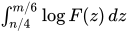
in special functions, *q*\-series and related topics". *J. Am. Math. Soc*. **14**.
49. **[^](https://en.wikipedia.org/wiki/Gamma_function#cite_ref-EspinosaMoll_49-0)**
Espinosa, Olivier; Moll, Victor H. (2002). "On Some Integrals Involving the Hurwitz Zeta Function: Part 1". *The Ramanujan Journal*. **6** (2): 159–188\. [doi](https://en.wikipedia.org/wiki/Doi_\(identifier\) "Doi (identifier)"):[10\.1023/A:1015706300169](https://doi.org/10.1023%2FA%3A1015706300169). [S2CID](https://en.wikipedia.org/wiki/S2CID_\(identifier\) "S2CID (identifier)") [128246166](https://api.semanticscholar.org/CorpusID:128246166).
50. **[^](https://en.wikipedia.org/wiki/Gamma_function#cite_ref-Bailey_50-0)**
Bailey, David H.; Borwein, David; Borwein, Jonathan M. (2015). "On Eulerian log-gamma integrals and Tornheim-Witten zeta functions". *The Ramanujan Journal*. **36** (1–2\): 43–68\. [doi](https://en.wikipedia.org/wiki/Doi_\(identifier\) "Doi (identifier)"):[10\.1007/s11139-012-9427-1](https://doi.org/10.1007%2Fs11139-012-9427-1). [S2CID](https://en.wikipedia.org/wiki/S2CID_\(identifier\) "S2CID (identifier)") [7335291](https://api.semanticscholar.org/CorpusID:7335291).
51. **[^](https://en.wikipedia.org/wiki/Gamma_function#cite_ref-ACEKNM_51-0)**
Amdeberhan, T.; Coffey, Mark W.; Espinosa, Olivier; Koutschan, Christoph; Manna, Dante V.; Moll, Victor H. (2011). ["Integrals of powers of loggamma"](https://doi.org/10.1090%2FS0002-9939-2010-10589-0). *Proc. Amer. Math. Soc*. **139** (2): 535–545\. [doi](https://en.wikipedia.org/wiki/Doi_\(identifier\) "Doi (identifier)"):[10\.1090/S0002-9939-2010-10589-0](https://doi.org/10.1090%2FS0002-9939-2010-10589-0).
52. **[^](https://en.wikipedia.org/wiki/Gamma_function#cite_ref-52)** E.A. Karatsuba, Fast evaluation of transcendental functions. Probl. Inf. Transm. Vol.27, No. 4, pp. 339–360 (1991).
53. **[^](https://en.wikipedia.org/wiki/Gamma_function#cite_ref-53)** E.A. Karatsuba, On a new method for fast evaluation of transcendental functions. Russ. Math. Surv. Vol.46, No. 2, pp. 246–247 (1991).
54. **[^](https://en.wikipedia.org/wiki/Gamma_function#cite_ref-54)** E.A. Karatsuba "[Fast Algorithms and the FEE Method](http://www.ccas.ru/personal/karatsuba/algen.htm)".
55. **[^](https://en.wikipedia.org/wiki/Gamma_function#cite_ref-55)**
Borwein, J. M.; Zucker, I. J. (1992). "Fast evaluation of the gamma function for small rational fractions using complete elliptic integrals of the first kind". *IMA Journal of Numerical Analysis*. **12** (4): 519–526\. [doi](https://en.wikipedia.org/wiki/Doi_\(identifier\) "Doi (identifier)"):[10\.1093/IMANUM/12.4.519](https://doi.org/10.1093%2FIMANUM%2F12.4.519).
56. **[^](https://en.wikipedia.org/wiki/Gamma_function#cite_ref-56)**
Werner, Helmut; Collinge, Robert (1961). "Chebyshev approximations to the Gamma Function". *Math. Comput*. **15** (74): 195–197\. [doi](https://en.wikipedia.org/wiki/Doi_\(identifier\) "Doi (identifier)"):[10\.1090/S0025-5718-61-99220-1](https://doi.org/10.1090%2FS0025-5718-61-99220-1). [JSTOR](https://en.wikipedia.org/wiki/JSTOR_\(identifier\) "JSTOR (identifier)") [2004230](https://www.jstor.org/stable/2004230).
57. **[^](https://en.wikipedia.org/wiki/Gamma_function#cite_ref-57)** Michon, G. P. "[Trigonometry and Basic Functions](http://home.att.net/~numericana/answer/functions.htm) [Archived](https://web.archive.org/web/20100109035934/http://home.att.net/~numericana/answer/functions.htm) 9 January 2010 at the [Wayback Machine](https://en.wikipedia.org/wiki/Wayback_Machine "Wayback Machine")". *Numericana*. Retrieved 5 May 2007.
58. **[^](https://en.wikipedia.org/wiki/Gamma_function#cite_ref-58)**
Chaudry, M. A.; Zubair, S. M. (2001). *On A Class of Incomplete Gamma Functions with Applications*. Boca Raton: CRC Press. p. 37. [ISBN](https://en.wikipedia.org/wiki/ISBN_\(identifier\) "ISBN (identifier)")
[1-58488-143-7](https://en.wikipedia.org/wiki/Special:BookSources/1-58488-143-7 "Special:BookSources/1-58488-143-7")
.
59. **[^](https://en.wikipedia.org/wiki/Gamma_function#cite_ref-59)**
Rice, J. A. (1995). *Mathematical Statistics and Data Analysis* (Second ed.). Belmont: Duxbury Press. pp. 52–53\. [ISBN](https://en.wikipedia.org/wiki/ISBN_\(identifier\) "ISBN (identifier)")
[0-534-20934-3](https://en.wikipedia.org/wiki/Special:BookSources/0-534-20934-3 "Special:BookSources/0-534-20934-3")
.
60. **[^](https://en.wikipedia.org/wiki/Gamma_function#cite_ref-60)**
Borwein, J.; Bailey, D. H. & Girgensohn, R. (2003). *Experimentation in Mathematics*. A. K. Peters. p. 133. [ISBN](https://en.wikipedia.org/wiki/ISBN_\(identifier\) "ISBN (identifier)")
[978-1-56881-136-9](https://en.wikipedia.org/wiki/Special:BookSources/978-1-56881-136-9 "Special:BookSources/978-1-56881-136-9")
.
61. **[^](https://en.wikipedia.org/wiki/Gamma_function#cite_ref-61)**
["Interpolating the natural factorial *n*! or The birth of the real factorial function (1729–1826)"](https://www.luschny.de/math/factorial/history.html).
62. **[^](https://en.wikipedia.org/wiki/Gamma_function#cite_ref-62)** Euler's paper was published in *Commentarii academiae scientiarum Petropolitanae* 5, 1738, 36–57. See [E19 – De progressionibus transcendentibus seu quarum termini generales algebraice dari nequeunt](http://math.dartmouth.edu/~euler/pages/E019.html), from The Euler Archive, which includes a scanned copy of the original article.
63. **[^](https://en.wikipedia.org/wiki/Gamma_function#cite_ref-Remmert_63-0)**
Remmert, R. (2006). *Classical Topics in Complex Function Theory*. Translated by Kay, L. D. Springer. [ISBN](https://en.wikipedia.org/wiki/ISBN_\(identifier\) "ISBN (identifier)")
[978-0-387-98221-2](https://en.wikipedia.org/wiki/Special:BookSources/978-0-387-98221-2 "Special:BookSources/978-0-387-98221-2")
.
64. **[^](https://en.wikipedia.org/wiki/Gamma_function#cite_ref-64)**
Lanczos, C. (1964). "A precision approximation of the gamma function". *Journal of the Society for Industrial and Applied Mathematics, Series B: Numerical Analysis*. **1** (1): 86. [Bibcode](https://en.wikipedia.org/wiki/Bibcode_\(identifier\) "Bibcode (identifier)"):[1964SJNA....1...86L](https://ui.adsabs.harvard.edu/abs/1964SJNA....1...86L). [doi](https://en.wikipedia.org/wiki/Doi_\(identifier\) "Doi (identifier)"):[10\.1137/0701008](https://doi.org/10.1137%2F0701008).
65. **[^](https://en.wikipedia.org/wiki/Gamma_function#cite_ref-65)**
Ilker Inam; Engin Büyükaşşk (2019). [*Notes from the International Autumn School on Computational Number Theory*](https://books.google.com/books?id=khCTDwAAQBAJ). Springer. p. 205. [ISBN](https://en.wikipedia.org/wiki/ISBN_\(identifier\) "ISBN (identifier)")
[978-3-030-12558-5](https://en.wikipedia.org/wiki/Special:BookSources/978-3-030-12558-5 "Special:BookSources/978-3-030-12558-5")
.
[Extract of page 205](https://books.google.com/books?id=khCTDwAAQBAJ&pg=PA205)
66. **[^](https://en.wikipedia.org/wiki/Gamma_function#cite_ref-Knuth_66-0)**
Knuth, D. E. (1997). *The Art of Computer Programming*. Vol. 1 (Fundamental Algorithms). Addison-Wesley. [ISBN](https://en.wikipedia.org/wiki/ISBN_\(identifier\) "ISBN (identifier)")
[0-201-89683-4](https://en.wikipedia.org/wiki/Special:BookSources/0-201-89683-4 "Special:BookSources/0-201-89683-4")
.
67. **[^](https://en.wikipedia.org/wiki/Gamma_function#cite_ref-67)**
[Borwein, Jonathan M.](https://en.wikipedia.org/wiki/Jonathan_Borwein "Jonathan Borwein"); Corless, Robert M. (2017). "Gamma and Factorial in the Monthly". *American Mathematical Monthly*. **125** (5). Mathematical Association of America: 400–24\. [arXiv](https://en.wikipedia.org/wiki/ArXiv_\(identifier\) "ArXiv (identifier)"):[1703\.05349](https://arxiv.org/abs/1703.05349). [Bibcode](https://en.wikipedia.org/wiki/Bibcode_\(identifier\) "Bibcode (identifier)"):[2017arXiv170305349B](https://ui.adsabs.harvard.edu/abs/2017arXiv170305349B). [doi](https://en.wikipedia.org/wiki/Doi_\(identifier\) "Doi (identifier)"):[10\.1080/00029890.2018.1420983](https://doi.org/10.1080%2F00029890.2018.1420983). [S2CID](https://en.wikipedia.org/wiki/S2CID_\(identifier\) "S2CID (identifier)") [119324101](https://api.semanticscholar.org/CorpusID:119324101).
68. **[^](https://en.wikipedia.org/wiki/Gamma_function#cite_ref-68)**
["What's the history of Gamma\_function?"](https://yearis.com/gamma_function/). *yearis.com*. Retrieved 5 November 2022.
69. **[^](https://en.wikipedia.org/wiki/Gamma_function#cite_ref-69)**
Berry, M. (April 2001). ["Why are special functions special?"](http://scitation.aip.org/journals/doc/PHTOAD-ft/vol_54/iss_4/11_1.shtml?bypassSSO=1). *Physics Today*.
70. **[^](https://en.wikipedia.org/wiki/Gamma_function#cite_ref-70)**
["microsoft/calculator"](https://github.com/microsoft/calculator). *GitHub*. Retrieved 25 December 2020.
71. **[^](https://en.wikipedia.org/wiki/Gamma_function#cite_ref-71)**
["gnome-calculator"](https://gitlab.gnome.org/GNOME/gnome-calculator). *GNOME.org*. Retrieved 3 March 2023.
- *This article incorporates material from the [Citizendium](https://en.wikipedia.org/wiki/Citizendium "Citizendium") article "[Gamma function](https://en.citizendium.org/wiki/Gamma_function "citizendium:Gamma function")", which is licensed under the [Creative Commons Attribution-ShareAlike 3.0 Unported License](https://en.wikipedia.org/wiki/Wikipedia:Text_of_the_Creative_Commons_Attribution-ShareAlike_3.0_Unported_License "Wikipedia:Text of the Creative Commons Attribution-ShareAlike 3.0 Unported License") but not under the [GFDL](https://en.wikipedia.org/wiki/Wikipedia:Text_of_the_GNU_Free_Documentation_License "Wikipedia:Text of the GNU Free Documentation License").*
## Further reading
\[[edit](https://en.wikipedia.org/w/index.php?title=Gamma_function&action=edit§ion=37 "Edit section: Further reading")\]
- Abramowitz, Milton; Stegun, Irene A., eds. (1972). ["Chapter 6"](http://www.math.sfu.ca/~cbm/aands/page_253.htm). [*Handbook of Mathematical Functions with Formulas, Graphs, and Mathematical Tables*](https://en.wikipedia.org/wiki/Abramowitz_and_Stegun "Abramowitz and Stegun"). New York: Dover.
- [Andrews, G. E.](https://en.wikipedia.org/wiki/Richard_Askey "Richard Askey"); Askey, R.; Roy, R. (1999). "Chapter 1 (Gamma and Beta functions)". *Special Functions*. New York: Cambridge University Press. [ISBN](https://en.wikipedia.org/wiki/ISBN_\(identifier\) "ISBN (identifier)")
[978-0-521-78988-2](https://en.wikipedia.org/wiki/Special:BookSources/978-0-521-78988-2 "Special:BookSources/978-0-521-78988-2")
.
- [Artin, Emil](https://en.wikipedia.org/wiki/Emil_Artin "Emil Artin") (2006). "The Gamma Function". In Rosen, Michael (ed.). *Exposition by Emil Artin: a selection*. History of Mathematics. Vol. 30. Providence, RI: American Mathematical Society.
- [Askey, R.](https://en.wikipedia.org/wiki/Richard_Askey "Richard Askey"); Roy, R. (2010), ["Gamma function"](http://dlmf.nist.gov/5), in [Olver, Frank W. J.](https://en.wikipedia.org/wiki/Frank_W._J._Olver "Frank W. J. Olver"); Lozier, Daniel M.; Boisvert, Ronald F.; Clark, Charles W. (eds.), *[NIST Handbook of Mathematical Functions](https://en.wikipedia.org/wiki/Digital_Library_of_Mathematical_Functions "Digital Library of Mathematical Functions")*, Cambridge University Press, [ISBN](https://en.wikipedia.org/wiki/ISBN_\(identifier\) "ISBN (identifier)")
[978-0-521-19225-5](https://en.wikipedia.org/wiki/Special:BookSources/978-0-521-19225-5 "Special:BookSources/978-0-521-19225-5")
, [MR](https://en.wikipedia.org/wiki/MR_\(identifier\) "MR (identifier)") [2723248](https://mathscinet.ams.org/mathscinet-getitem?mr=2723248)
.
- [Birkhoff, George D.](https://en.wikipedia.org/wiki/George_David_Birkhoff "George David Birkhoff") (1913). ["Note on the gamma function"](https://doi.org/10.1090%2Fs0002-9904-1913-02429-7). *Bull. Amer. Math. Soc*. **20** (1): 1–10\. [doi](https://en.wikipedia.org/wiki/Doi_\(identifier\) "Doi (identifier)"):[10\.1090/s0002-9904-1913-02429-7](https://doi.org/10.1090%2Fs0002-9904-1913-02429-7). [MR](https://en.wikipedia.org/wiki/MR_\(identifier\) "MR (identifier)") [1559418](https://mathscinet.ams.org/mathscinet-getitem?mr=1559418).
- Böhmer, P. E. (1939). *Differenzengleichungen und bestimmte Integrale* \[*Differential Equations and Definite Integrals*\]. Leipzig: Köhler Verlag.
- Davis, Philip J. (1959). "Leonhard Euler's Integral: A Historical Profile of the Gamma Function". *[American Mathematical Monthly](https://en.wikipedia.org/wiki/American_Mathematical_Monthly "American Mathematical Monthly")*. **66** (10): 849–869\. [doi](https://en.wikipedia.org/wiki/Doi_\(identifier\) "Doi (identifier)"):[10\.2307/2309786](https://doi.org/10.2307%2F2309786). [JSTOR](https://en.wikipedia.org/wiki/JSTOR_\(identifier\) "JSTOR (identifier)") [2309786](https://www.jstor.org/stable/2309786).
- Post, Emil (1919). "The Generalized Gamma Functions". *Annals of Mathematics*. Second Series. **20** (3): 202–217\. [doi](https://en.wikipedia.org/wiki/Doi_\(identifier\) "Doi (identifier)"):[10\.2307/1967871](https://doi.org/10.2307%2F1967871). [JSTOR](https://en.wikipedia.org/wiki/JSTOR_\(identifier\) "JSTOR (identifier)") [1967871](https://www.jstor.org/stable/1967871).
- Press, W. H.; Teukolsky, S. A.; Vetterling, W. T.; Flannery, B. P. (2007). ["Section 6.1. Gamma Function"](http://apps.nrbook.com/empanel/index.html?pg=256). *Numerical Recipes: The Art of Scientific Computing* (3rd ed.). New York: Cambridge University Press. [ISBN](https://en.wikipedia.org/wiki/ISBN_\(identifier\) "ISBN (identifier)")
[978-0-521-88068-8](https://en.wikipedia.org/wiki/Special:BookSources/978-0-521-88068-8 "Special:BookSources/978-0-521-88068-8")
.
- Rocktäschel, O. R. (1922). *Methoden zur Berechnung der Gammafunktion für komplexes Argument* \[*Methods for Calculating the Gamma Function for Complex Arguments*\]. Dresden: [Technical University of Dresden](https://en.wikipedia.org/wiki/Technische_Universit%C3%A4t_Dresden "Technische Universität Dresden").
- Temme, Nico M. (1996). *Special Functions: An Introduction to the Classical Functions of Mathematical Physics*. New York: John Wiley & Sons. [ISBN](https://en.wikipedia.org/wiki/ISBN_\(identifier\) "ISBN (identifier)")
[978-0-471-11313-3](https://en.wikipedia.org/wiki/Special:BookSources/978-0-471-11313-3 "Special:BookSources/978-0-471-11313-3")
.
- [Whittaker, E. T.](https://en.wikipedia.org/wiki/E._T._Whittaker "E. T. Whittaker"); [Watson, G. N.](https://en.wikipedia.org/wiki/G._N._Watson "G. N. Watson") (1927). *[A Course of Modern Analysis](https://en.wikipedia.org/wiki/A_Course_of_Modern_Analysis "A Course of Modern Analysis")*. Cambridge University Press.
[ISBN](https://en.wikipedia.org/wiki/ISBN_\(identifier\) "ISBN (identifier)")
[978-0-521-58807-2](https://en.wikipedia.org/wiki/Special:BookSources/978-0-521-58807-2 "Special:BookSources/978-0-521-58807-2")
- Li, Xin; Chen, Chao-Ping (2017). ["Pade approximant related to asymptotics of the gamma function"](https://www.ncbi.nlm.nih.gov/pmc/articles/PMC5331117). *J. Inequal. Applic*. **2017** (1): 53. [doi](https://en.wikipedia.org/wiki/Doi_\(identifier\) "Doi (identifier)"):[10\.1186/s13660-017-1315-1](https://doi.org/10.1186%2Fs13660-017-1315-1). [PMC](https://en.wikipedia.org/wiki/PMC_\(identifier\) "PMC (identifier)") [5331117](https://www.ncbi.nlm.nih.gov/pmc/articles/PMC5331117). [PMID](https://en.wikipedia.org/wiki/PMID_\(identifier\) "PMID (identifier)") [28303079](https://pubmed.ncbi.nlm.nih.gov/28303079).
## External links
\[[edit](https://en.wikipedia.org/w/index.php?title=Gamma_function&action=edit§ion=38 "Edit section: External links")\]
[](https://en.wikipedia.org/wiki/File:Commons-logo.svg)
Wikimedia Commons has media related to [Gamma and related functions](https://commons.wikimedia.org/wiki/Category:Gamma_and_related_functions "commons:Category:Gamma and related functions").
- [NIST Digital Library of Mathematical Functions:Gamma function](http://dlmf.nist.gov/5)
- Pascal Sebah and Xavier Gourdon. *Introduction to the Gamma Function*. In [PostScript](http://numbers.computation.free.fr/Constants/Miscellaneous/gammaFunction.ps) and [HTML](http://numbers.computation.free.fr/Constants/Miscellaneous/gammaFunction.html) formats.
- [C++ reference for `std::tgamma`](http://en.cppreference.com/w/cpp/numeric/math/tgamma)
- [`gamma()` and `lgamma()` exposed from C99 in Postgres version 18](https://www.postgresql.org/docs/18/release-18.html#RELEASE-18-FUNCTIONS)
- Examples of problems involving the gamma function can be found at [Exampleproblems.com](https://web.archive.org/web/20161002083601/http://www.exampleproblems.com/wiki/index.php?title=Special_Functions).
- ["Gamma function"](https://www.encyclopediaofmath.org/index.php?title=Gamma_function), *[Encyclopedia of Mathematics](https://en.wikipedia.org/wiki/Encyclopedia_of_Mathematics "Encyclopedia of Mathematics")*, [EMS Press](https://en.wikipedia.org/wiki/European_Mathematical_Society "European Mathematical Society"), 2001 \[1994\]
- [Wolfram gamma function evaluator (arbitrary precision)](http://functions.wolfram.com/webMathematica/FunctionEvaluation.jsp?name=Gamma) [Archived](https://web.archive.org/web/20191028215555/http://functions.wolfram.com/webMathematica/FunctionEvaluation.jsp?name=Gamma) 28 October 2019 at the [Wayback Machine](https://en.wikipedia.org/wiki/Wayback_Machine "Wayback Machine")
- ["Gamma"](http://functions.wolfram.com/GammaBetaErf/Gamma/). [Wolfram](https://en.wikipedia.org/wiki/Wolfram_Research "Wolfram Research") Functions Site.
- [Volume of n-Spheres and the Gamma Function](http://www.mathpages.com/home/kmath163/kmath163.htm) at MathPages
| [Authority control databases](https://en.wikipedia.org/wiki/Help:Authority_control "Help:Authority control") [](https://www.wikidata.org/wiki/Q190573#identifiers "Edit this at Wikidata") | |
|---|---|
| International | [GND](https://d-nb.info/gnd/4289118-8) |
| National | [Japan](https://id.ndl.go.jp/auth/ndlna/00562231) |
| Other | [Yale LUX](https://lux.collections.yale.edu/view/concept/af3216f0-d056-4355-9291-e8c43b271fe3) |

Retrieved from "<https://en.wikipedia.org/w/index.php?title=Gamma_function&oldid=1346501926>"
[Categories](https://en.wikipedia.org/wiki/Help:Category "Help:Category"):
- [Gamma and related functions](https://en.wikipedia.org/wiki/Category:Gamma_and_related_functions "Category:Gamma and related functions")
- [Special hypergeometric functions](https://en.wikipedia.org/wiki/Category:Special_hypergeometric_functions "Category:Special hypergeometric functions")
- [Meromorphic functions](https://en.wikipedia.org/wiki/Category:Meromorphic_functions "Category:Meromorphic functions")
Hidden categories:
- [Webarchive template wayback links](https://en.wikipedia.org/wiki/Category:Webarchive_template_wayback_links "Category:Webarchive template wayback links")
- [CS1: long volume value](https://en.wikipedia.org/wiki/Category:CS1:_long_volume_value "Category:CS1: long volume value")
- [Articles with short description](https://en.wikipedia.org/wiki/Category:Articles_with_short_description "Category:Articles with short description")
- [Short description is different from Wikidata](https://en.wikipedia.org/wiki/Category:Short_description_is_different_from_Wikidata "Category:Short description is different from Wikidata")
- [Use dmy dates from December 2016](https://en.wikipedia.org/wiki/Category:Use_dmy_dates_from_December_2016 "Category:Use dmy dates from December 2016")
- [All articles with unsourced statements](https://en.wikipedia.org/wiki/Category:All_articles_with_unsourced_statements "Category:All articles with unsourced statements")
- [Articles with unsourced statements from March 2026](https://en.wikipedia.org/wiki/Category:Articles_with_unsourced_statements_from_March_2026 "Category:Articles with unsourced statements from March 2026")
- [Wikipedia articles incorporating text from Citizendium](https://en.wikipedia.org/wiki/Category:Wikipedia_articles_incorporating_text_from_Citizendium "Category:Wikipedia articles incorporating text from Citizendium")
- [Commons category link is on Wikidata](https://en.wikipedia.org/wiki/Category:Commons_category_link_is_on_Wikidata "Category:Commons category link is on Wikidata")
- [Pages that use a deprecated format of the math tags](https://en.wikipedia.org/wiki/Category:Pages_that_use_a_deprecated_format_of_the_math_tags "Category:Pages that use a deprecated format of the math tags")
- This page was last edited on 1 April 2026, at 05:02 (UTC).
- Text is available under the [Creative Commons Attribution-ShareAlike 4.0 License](https://en.wikipedia.org/wiki/Wikipedia:Text_of_the_Creative_Commons_Attribution-ShareAlike_4.0_International_License "Wikipedia:Text of the Creative Commons Attribution-ShareAlike 4.0 International License"); additional terms may apply. By using this site, you agree to the [Terms of Use](https://foundation.wikimedia.org/wiki/Special:MyLanguage/Policy:Terms_of_Use "foundation:Special:MyLanguage/Policy:Terms of Use") and [Privacy Policy](https://foundation.wikimedia.org/wiki/Special:MyLanguage/Policy:Privacy_policy "foundation:Special:MyLanguage/Policy:Privacy policy"). Wikipedia® is a registered trademark of the [Wikimedia Foundation, Inc.](https://wikimediafoundation.org/), a non-profit organization.
- [Privacy policy](https://foundation.wikimedia.org/wiki/Special:MyLanguage/Policy:Privacy_policy)
- [About Wikipedia](https://en.wikipedia.org/wiki/Wikipedia:About)
- [Disclaimers](https://en.wikipedia.org/wiki/Wikipedia:General_disclaimer)
- [Contact Wikipedia](https://en.wikipedia.org/wiki/Wikipedia:Contact_us)
- [Legal & safety contacts](https://foundation.wikimedia.org/wiki/Special:MyLanguage/Legal:Wikimedia_Foundation_Legal_and_Safety_Contact_Information)
- [Code of Conduct](https://foundation.wikimedia.org/wiki/Special:MyLanguage/Policy:Universal_Code_of_Conduct)
- [Developers](https://developer.wikimedia.org/)
- [Statistics](https://stats.wikimedia.org/#/en.wikipedia.org)
- [Cookie statement](https://foundation.wikimedia.org/wiki/Special:MyLanguage/Policy:Cookie_statement)
- [Mobile view](https://en.wikipedia.org/w/index.php?title=Gamma_function&mobileaction=toggle_view_mobile)
- [](https://www.wikimedia.org/)
- [](https://www.mediawiki.org/)
Search
Toggle the table of contents
Gamma function
65 languages
[Add topic](https://en.wikipedia.org/wiki/Gamma_function) |
| Readable Markdown | For the gamma function of ordinals, see [Veblen function](https://en.wikipedia.org/wiki/Veblen_function "Veblen function"). For the gamma distribution in statistics, see [Gamma distribution](https://en.wikipedia.org/wiki/Gamma_distribution "Gamma distribution"). For the function used in video and image color representations, see [Gamma correction](https://en.wikipedia.org/wiki/Gamma_correction "Gamma correction").
Gamma [](https://en.wikipedia.org/wiki/File:Gamma_plot.svg)The gamma function along part of the real axis General information General definition 
In [mathematics](https://en.wikipedia.org/wiki/Mathematics "Mathematics"), the **gamma function** (represented by , capital [Greek](https://en.wikipedia.org/wiki/Greek_alphabet "Greek alphabet") letter [gamma](https://en.wikipedia.org/wiki/Gamma "Gamma")) is the most common extension of the [factorial function](https://en.wikipedia.org/wiki/Factorial_function "Factorial function") to [complex numbers](https://en.wikipedia.org/wiki/Complex_number "Complex number"). First studied by [Daniel Bernoulli](https://en.wikipedia.org/wiki/Daniel_Bernoulli "Daniel Bernoulli"), the gamma function  is defined for all complex numbers  except non-positive integers, and  for every [positive integer](https://en.wikipedia.org/wiki/Positive_integer "Positive integer") . The gamma function can be defined via a convergent [improper integral](https://en.wikipedia.org/wiki/Improper_integral "Improper integral") for complex numbers with positive real part: The gamma function then is defined in the complex plane as the [analytic continuation](https://en.wikipedia.org/wiki/Analytic_continuation "Analytic continuation") of this integral function: it is a [meromorphic function](https://en.wikipedia.org/wiki/Meromorphic_function "Meromorphic function") which is [holomorphic](https://en.wikipedia.org/wiki/Holomorphic_function "Holomorphic function") except at zero and the negative integers, where it has simple [poles](https://en.wikipedia.org/wiki/Zeros_and_poles "Zeros and poles").
Since the gamma function has no zeros, [its reciprocal](https://en.wikipedia.org/wiki/Reciprocal_gamma_function "Reciprocal gamma function")  is an [entire function](https://en.wikipedia.org/wiki/Entire_function "Entire function"). In fact, the gamma function corresponds to the [Mellin transform](https://en.wikipedia.org/wiki/Mellin_transform "Mellin transform") of the [exponential decay](https://en.wikipedia.org/wiki/Exponential_decay "Exponential decay"): 
Other extensions of the factorial function do exist, but the gamma function is the most popular and useful. It appears as a factor in various probability-distribution functions and other formulas in the fields of [probability](https://en.wikipedia.org/wiki/Probability "Probability"), [statistics](https://en.wikipedia.org/wiki/Statistics "Statistics"), [analytic number theory](https://en.wikipedia.org/wiki/Analytic_number_theory "Analytic number theory"), and [combinatorics](https://en.wikipedia.org/wiki/Combinatorics "Combinatorics").
[](https://en.wikipedia.org/wiki/File:Generalized_factorial_function_more_infos.svg)  interpolates the factorial function to non-integer values.
The gamma function can be seen as a solution to the [interpolation](https://en.wikipedia.org/wiki/Interpolation "Interpolation") problem of finding a [smooth curve](https://en.wikipedia.org/wiki/Smooth_curve "Smooth curve")  that connects the points of the factorial sequence:  for all positive integer values of . The simple formula for the factorial,  is only valid when  is a positive integer, and no [elementary function](https://en.wikipedia.org/wiki/Elementary_function "Elementary function") has this property, but a good solution is the gamma function .[\[1\]](https://en.wikipedia.org/wiki/Gamma_function#cite_note-Davis-1)
The gamma function is not only smooth but [analytic](https://en.wikipedia.org/wiki/Analytic_function "Analytic function") (except at the non-positive integers), and it can be defined in several explicit ways. However, it is not the only analytic function that extends the factorial, as one may add any analytic function that is zero on the positive integers, such as  for an integer .[\[1\]](https://en.wikipedia.org/wiki/Gamma_function#cite_note-Davis-1) Such a function is known as a [pseudogamma function](https://en.wikipedia.org/wiki/Pseudogamma_function "Pseudogamma function"), the most famous being the [Hadamard](https://en.wikipedia.org/wiki/Hadamard%27s_gamma_function "Hadamard's gamma function") function.[\[2\]](https://en.wikipedia.org/wiki/Gamma_function#cite_note-2)
[](https://en.wikipedia.org/wiki/File:Gamma_plus_sin_pi_z.svg)
The gamma function, Γ(*z*) in blue, plotted along with Γ(*z*) + sin(π*z*) in green. Notice the intersection at positive integers. Both are valid extensions of the factorials to a meromorphic function on the complex plane.
A more restrictive requirement is the [functional equation](https://en.wikipedia.org/wiki/Functional_equation "Functional equation") that interpolates the shifted factorial :[\[3\]](https://en.wikipedia.org/wiki/Gamma_function#cite_note-3)[\[4\]](https://en.wikipedia.org/wiki/Gamma_function#cite_note-4) 
But this still does not give a unique solution, since it allows for multiplication by any periodic function  with  and , such as .
One way to resolve the ambiguity is the [Bohr–Mollerup theorem](https://en.wikipedia.org/wiki/Bohr%E2%80%93Mollerup_theorem "Bohr–Mollerup theorem"), which shows that  is the unique interpolating function for the factorial, defined over the positive reals, which is [logarithmically convex](https://en.wikipedia.org/wiki/Logarithmically_convex_function "Logarithmically convex function"),[\[5\]](https://en.wikipedia.org/wiki/Gamma_function#cite_note-Kingman1961-5) meaning that  is [convex](https://en.wikipedia.org/wiki/Convex_function "Convex function").[\[6\]](https://en.wikipedia.org/wiki/Gamma_function#cite_note-6)
The notation  is due to [Legendre](https://en.wikipedia.org/wiki/Adrien-Marie_Legendre "Adrien-Marie Legendre").[\[1\]](https://en.wikipedia.org/wiki/Gamma_function#cite_note-Davis-1) If the real part of the complex number  is strictly positive (), then the [integral](https://en.wikipedia.org/wiki/Integral "Integral") [converges absolutely](https://en.wikipedia.org/wiki/Absolute_convergence "Absolute convergence"), and is known as the **Euler integral of the second kind**. (Euler's integral of the first kind is the [beta function](https://en.wikipedia.org/wiki/Beta_function "Beta function").[\[1\]](https://en.wikipedia.org/wiki/Gamma_function#cite_note-Davis-1))
[](https://en.wikipedia.org/wiki/File:Plot_of_gamma_function_in_complex_plane_in_3D_with_color_and_legend_and_1000_plot_points_created_with_Mathematica.svg)
Absolute value (vertical) and argument (hue) of the gamma function on the complex plane
The value  can be calculated as![{\\displaystyle {\\begin{aligned}\\Gamma (1)&=\\int \_{0}^{\\infty }t^{1-1}e^{-t}\\,dt\\\\\[6pt\]&=\\int \_{0}^{\\infty }e^{-t}\\,dt=1.\\end{aligned}}}](https://wikimedia.org/api/rest_v1/media/math/render/svg/8c6addb58fe26eac70e551ca0237e2abebfd732d)
[Integrating by parts](https://en.wikipedia.org/wiki/Integration_by_parts "Integration by parts"), one sees that![{\\displaystyle {\\begin{aligned}\\Gamma (z+1)&=\\int \_{0}^{\\infty }t^{z}e^{-t}\\,dt\\\\\[6pt\]&={\\Bigl \[}-t^{z}e^{-t}{\\Bigr \]}\_{0}^{\\infty }+\\int \_{0}^{\\infty }z\\,t^{z-1}e^{-t}\\,dt.\\end{aligned}}}](https://wikimedia.org/api/rest_v1/media/math/render/svg/5f8eb3c3ad7c29c757c6399e8fc280968fec241b)Recognizing that  as  (so long as ) and as ,![{\\displaystyle {\\begin{aligned}\\Gamma (z+1)&=z\\int \_{0}^{\\infty }t^{z-1}e^{-t}\\,dt\\\\\[6pt\]&=z\\,\\Gamma (z).\\end{aligned}}}](https://wikimedia.org/api/rest_v1/media/math/render/svg/4913570a9b44130046e71f40c4347fa0edac043f)
Thus we have shown that  for any positive integer n by [induction](https://en.wikipedia.org/wiki/Proof_by_induction "Proof by induction").
The identity  can be used (or, yielding the same result, [analytic continuation](https://en.wikipedia.org/wiki/Analytic_continuation "Analytic continuation") can be used) to uniquely extend the integral formulation for  to a [meromorphic function](https://en.wikipedia.org/wiki/Meromorphic_function "Meromorphic function") defined for all complex numbers , except integers less than or equal to zero.[\[1\]](https://en.wikipedia.org/wiki/Gamma_function#cite_note-Davis-1) It is this extended version that is commonly referred to as the gamma function.[\[1\]](https://en.wikipedia.org/wiki/Gamma_function#cite_note-Davis-1)
### Alternative definitions
\[[edit](https://en.wikipedia.org/w/index.php?title=Gamma_function&action=edit§ion=4 "Edit section: Alternative definitions")\]
There are many equivalent definitions.
#### Euler's definition as an infinite product
\[[edit](https://en.wikipedia.org/w/index.php?title=Gamma_function&action=edit§ion=5 "Edit section: Euler's definition as an infinite product")\]
For a fixed integer , as the integer  increases, we have that[\[7\]](https://en.wikipedia.org/wiki/Gamma_function#cite_note-7) 
If  is not an integer then this equation is meaningless since, in this section, the factorial of a non-integer has not been defined yet. However, in order to define the Gamma function for non-integers, let us assume that this equation continues to hold when  is replaced by an arbitrary complex number :
 Multiplying both sides by  gives ![{\\displaystyle {\\begin{aligned}(z-1)!&={\\frac {1}{z}}\\lim \_{n\\to \\infty }n!{\\frac {z!}{(n+z)!}}(n+1)^{z}\\\\\[6pt\]&={\\frac {1}{z}}\\lim \_{n\\to \\infty }(1\\cdot 2\\cdots n){\\frac {1}{(1+z)\\cdots (n+z)}}\\left({\\frac {2}{1}}\\cdot {\\frac {3}{2}}\\cdots {\\frac {n+1}{n}}\\right)^{z}\\\\\[6pt\]&={\\frac {1}{z}}\\prod \_{n=1}^{\\infty }\\left\[{\\frac {1}{1+{\\frac {z}{n}}}}\\left(1+{\\frac {1}{n}}\\right)^{z}\\right\].\\end{aligned}}}](https://wikimedia.org/api/rest_v1/media/math/render/svg/d985df8d67d43c90a474e6eb4c0f806527316ae7)This [infinite product](https://en.wikipedia.org/wiki/Infinite_product "Infinite product"), which is due to Euler,[\[8\]](https://en.wikipedia.org/wiki/Gamma_function#cite_note-8) converges for all complex numbers  except the non-positive integers, which fail because of a division by zero. In fact, the above assumption produces a unique definition of  as .
Intuitively, this formula indicates that  is approximately the result of computing  for some large integer , multiplying by  to approximate , and then using the relationship  backwards  times to get an approximation for ; and furthermore that this approximation becomes exact as  increases to infinity.
The infinite product for the [reciprocal](https://en.wikipedia.org/wiki/Reciprocal_gamma_function "Reciprocal gamma function")![{\\displaystyle {\\frac {1}{\\Gamma (z)}}=z\\prod \_{n=1}^{\\infty }\\left\[\\left(1+{\\frac {z}{n}}\\right)/{\\left(1+{\\frac {1}{n}}\\right)^{z}}\\right\]}](https://wikimedia.org/api/rest_v1/media/math/render/svg/fdf39a91c13c9fb4dd32b61d30273d02638025ea) is an [entire function](https://en.wikipedia.org/wiki/Entire_function "Entire function"), converging for every complex number .
#### Weierstrass's definition
\[[edit](https://en.wikipedia.org/w/index.php?title=Gamma_function&action=edit§ion=6 "Edit section: Weierstrass's definition")\]
The definition for the gamma function due to [Weierstrass](https://en.wikipedia.org/wiki/Karl_Weierstrass "Karl Weierstrass") is also valid for all complex numbers  except non-positive integers:  where  is the [Euler–Mascheroni constant](https://en.wikipedia.org/wiki/Euler%E2%80%93Mascheroni_constant "Euler–Mascheroni constant").[\[1\]](https://en.wikipedia.org/wiki/Gamma_function#cite_note-Davis-1) This is the [Hadamard product](https://en.wikipedia.org/wiki/Entire_function#Genus "Entire function") of  in a rewritten form.
Besides the fundamental property discussed above,Other important functional equations for the gamma function are [Euler's reflection formula](https://en.wikipedia.org/wiki/Reflection_formula "Reflection formula"),which implies and the [Legendre duplication formula](https://en.wikipedia.org/wiki/Multiplication_theorem#Gamma_function%E2%80%93Legendre_formula "Multiplication theorem") 
| Derivation of the Legendre duplication formula |
|---|
| The [beta function](https://en.wikipedia.org/wiki/Beta_function "Beta function") can be represented as Setting  yields After the substitution : The function  is even, hence Now Then This implies Since  the Legendre duplication formula follows:  |
The duplication formula is a special case of the [multiplication theorem](https://en.wikipedia.org/wiki/Multiplication_theorem "Multiplication theorem") (see [\[9\]](https://en.wikipedia.org/wiki/Gamma_function#cite_note-ReferenceA-9) Eq. 5.5.6): 
A simple but useful property, which can be seen from the limit definition, is: 
In particular, with , this product is 
If the real part is an integer or a [half-integer](https://en.wikipedia.org/wiki/Half-integer "Half-integer"), this can be finitely expressed in [closed form](https://en.wikipedia.org/wiki/Closed-form_expression "Closed-form expression"): ![{\\displaystyle {\\begin{aligned}\|\\Gamma (bi)\|^{2}&={\\frac {\\pi }{b\\sinh \\pi b}}\\\\\[6pt\]\\left\|\\Gamma \\left({\\tfrac {1}{2}}+bi\\right)\\right\|^{2}&={\\frac {\\pi }{\\cosh \\pi b}}\\\\\[6pt\]\\left\|\\Gamma \\left(1+bi\\right)\\right\|^{2}&={\\frac {\\pi b}{\\sinh \\pi b}}\\\\\[6pt\]\\left\|\\Gamma \\left(1+n+bi\\right)\\right\|^{2}&={\\frac {\\pi b}{\\sinh \\pi b}}\\prod \_{k=1}^{n}\\left(k^{2}+b^{2}\\right),\\quad n\\in \\mathbb {N} \\\\\[6pt\]\\left\|\\Gamma \\left(-n+bi\\right)\\right\|^{2}&={\\frac {\\pi }{b\\sinh \\pi b}}\\prod \_{k=1}^{n}\\left(k^{2}+b^{2}\\right)^{-1},\\quad n\\in \\mathbb {N} \\\\\[6pt\]\\left\|\\Gamma \\left({\\tfrac {1}{2}}\\pm n+bi\\right)\\right\|^{2}&={\\frac {\\pi }{\\cosh \\pi b}}\\prod \_{k=1}^{n}\\left(\\left(k-{\\tfrac {1}{2}}\\right)^{2}+b^{2}\\right)^{\\pm 1},\\quad n\\in \\mathbb {N} \\\\\[-1ex\]&\\end{aligned}}}](https://wikimedia.org/api/rest_v1/media/math/render/svg/a84245d2b5e677d413a3bc7821a0c78f47163303)
| Proof of absolute value formulas for arguments of integer or half-integer real part |
|---|
| First, consider the reflection formula applied to .  Applying the recurrence relation to the second term:  which with simple rearrangement gives Second, consider the reflection formula applied to . Formulas for other values of  for which the real part is integer or half-integer quickly follow by [induction](https://en.wikipedia.org/wiki/Mathematical_induction "Mathematical induction") using the recurrence relation in the positive and negative directions. |
Perhaps the best-known value of the gamma function at a non-integer argument is  which can be found by setting  in the reflection formula, by using the relation to the [beta function](https://en.wikipedia.org/wiki/Beta_function "Beta function") given below with , or simply by making the substitution  in the integral definition of the gamma function, resulting in a [Gaussian integral](https://en.wikipedia.org/wiki/Gaussian_integral "Gaussian integral"). In general, for non-negative integer values of  we have: ![{\\displaystyle {\\begin{aligned}\\Gamma \\left({\\frac {1}{2}}+n\\right)&={(2n)! \\over 4^{n}n!}{\\sqrt {\\pi }}={\\frac {(2n-1)!!}{2^{n}}}{\\sqrt {\\pi }}={\\binom {n-{\\frac {1}{2}}}{n}}\\,n!\\,{\\sqrt {\\pi }}\\\\\[6pt\]\\Gamma \\left({\\frac {1}{2}}-n\\right)&={(-4)^{n}n! \\over (2n)!}{\\sqrt {\\pi }}={\\frac {(-2)^{n}}{(2n-1)!!}}{\\sqrt {\\pi }}={\\frac {\\sqrt {\\pi }}{{\\binom {-1/2}{n}}\\,n!}}\\end{aligned}}}](https://wikimedia.org/api/rest_v1/media/math/render/svg/67673ba808d47122022446cca8cb4cbff0bd91f5)where the [double factorial](https://en.wikipedia.org/wiki/Double_factorial "Double factorial") . See [Particular values of the gamma function](https://en.wikipedia.org/wiki/Particular_values_of_the_gamma_function "Particular values of the gamma function") for calculated values.
It might be tempting to generalize the result that  by looking for a formula for other individual values  where  is rational, especially because according to [Gauss's digamma theorem](https://en.wikipedia.org/wiki/Digamma_function#Gauss's_digamma_theorem "Digamma function"), it is possible to do so for the closely related [digamma function](https://en.wikipedia.org/wiki/Digamma_function "Digamma function") at every rational value. However, these numbers  are not known to be expressible by themselves in terms of elementary functions. It has been proved that  is a [transcendental number](https://en.wikipedia.org/wiki/Transcendental_number "Transcendental number") and [algebraically independent](https://en.wikipedia.org/wiki/Algebraic_independence "Algebraic independence") of  for any integer  and each of the fractions .[\[10\]](https://en.wikipedia.org/wiki/Gamma_function#cite_note-10) In general, when computing values of the gamma function, we must settle for numerical approximations.
The derivatives of the gamma function are described in terms of the [polygamma function](https://en.wikipedia.org/wiki/Polygamma_function "Polygamma function"), : For a positive integer  the derivative of the gamma function can be calculated as follows:
[](https://en.wikipedia.org/wiki/File:Plot_of_gamma_function_in_the_complex_plane_from_-2-i_to_6%2B2i_with_colors_created_in_Mathematica.svg)
Hue showing the argument of the gamma function in the complex plane from −2 − 2*i* to 6 + 2*i*
 where  is the th [harmonic number](https://en.wikipedia.org/wiki/Harmonic_number "Harmonic number") and  is the [Euler–Mascheroni constant](https://en.wikipedia.org/wiki/Euler%E2%80%93Mascheroni_constant "Euler–Mascheroni constant").
For  the th derivative of the gamma function is:(This can be derived by [differentiating the integral](https://en.wikipedia.org/wiki/Differentiating_under_the_integral_sign "Differentiating under the integral sign") form of the gamma function with respect to .)
Using the identitywhere  is the [Riemann zeta function](https://en.wikipedia.org/wiki/Riemann_zeta_function "Riemann zeta function"), and  is the th [Bell polynomial](https://en.wikipedia.org/wiki/Bell_polynomials "Bell polynomials"), we have in particular the [Laurent series](https://en.wikipedia.org/wiki/Laurent_series "Laurent series") expansion of the gamma function [\[11\]](https://en.wikipedia.org/wiki/Gamma_function#cite_note-11)
When restricted to the [positive real numbers](https://en.wikipedia.org/wiki/Positive_real_numbers "Positive real numbers"), the gamma function is a strictly [logarithmically convex function](https://en.wikipedia.org/wiki/Logarithmically_convex_function "Logarithmically convex function"). This property may be stated in any of the following three equivalent ways:
The last of these statements is, essentially by definition, the same as the statement that , where  is the [polygamma function](https://en.wikipedia.org/wiki/Polygamma_function "Polygamma function") of order 1. To prove the logarithmic convexity of the gamma function, it therefore suffices to observe that  has a series representation which, for positive real x, consists of only positive terms.
Logarithmic convexity and [Jensen's inequality](https://en.wikipedia.org/wiki/Jensen%27s_inequality "Jensen's inequality") together imply, for any positive real numbers  and , 
There are also bounds on ratios of gamma functions. The best-known is [Gautschi's inequality](https://en.wikipedia.org/wiki/Gautschi%27s_inequality "Gautschi's inequality"), which says that for any positive real number x and any *s* ∈ (0, 1), 
[](https://en.wikipedia.org/wiki/File:Gamma_cplot.svg)
Representation of the gamma function in the complex plane. Each point  is colored according to the argument of . The contour plot of the modulus  is also displayed.
[](https://en.wikipedia.org/wiki/File:Gamma_abs_3D.png)
3-dimensional plot of the absolute value of the complex gamma function
The behavior of  for an increasing positive real variable is given by [Stirling's formula](https://en.wikipedia.org/wiki/Stirling%27s_formula "Stirling's formula")where the symbol  means asymptotic convergence: the ratio of the two sides converges to  in the limit .[\[1\]](https://en.wikipedia.org/wiki/Gamma_function#cite_note-Davis-1) This growth is faster than exponential, , for any fixed value of .
Another useful limit for asymptotic approximations for  is:
When writing the error term as an infinite product, Stirling's formula can be used to define the gamma function:[\[12\]](https://en.wikipedia.org/wiki/Gamma_function#cite_note-12)![{\\displaystyle \\Gamma (x)={\\sqrt {\\frac {2\\pi }{x}}}\\left({\\frac {x}{e}}\\right)^{x}\\prod \_{n=0}^{\\infty }\\left\[{\\frac {1}{e}}\\left(1+{\\frac {1}{x+n}}\\right)^{x+n+{\\frac {1}{2}}}\\right\].}](https://wikimedia.org/api/rest_v1/media/math/render/svg/1b6b7fc752464cb3ff57fe9a172e6282526150bb)
### Extension to negative, non-integer values
\[[edit](https://en.wikipedia.org/w/index.php?title=Gamma_function&action=edit§ion=11 "Edit section: Extension to negative, non-integer values")\]
Although the main definition of the gamma function—the Euler integral of the second kind—is only valid (on the real axis) for positive arguments, its domain can be extended with [analytic continuation](https://en.wikipedia.org/wiki/Analytic_continuation "Analytic continuation")[\[13\]](https://en.wikipedia.org/wiki/Gamma_function#cite_note-13) to negative arguments by shifting the negative argument to positive values by using either the Euler's reflection formula,or the fundamental property,when . For example,
The behavior for non-positive  is more intricate. Euler's integral does not converge for , but the function it defines in the positive complex half-plane has a unique [analytic continuation](https://en.wikipedia.org/wiki/Analytic_continuation "Analytic continuation") to the negative half-plane. One way to find that analytic continuation is to use Euler's integral for positive arguments and extend the domain to negative numbers by repeated application of the recurrence formula,[\[1\]](https://en.wikipedia.org/wiki/Gamma_function#cite_note-Davis-1)choosing  such that  is positive. The product in the denominator is zero when  equals any of the integers . Thus, the gamma function must be undefined at those points to avoid [division by zero](https://en.wikipedia.org/wiki/Division_by_zero "Division by zero"); it is a [meromorphic function](https://en.wikipedia.org/wiki/Meromorphic_function "Meromorphic function") with [simple poles](https://en.wikipedia.org/wiki/Simple_pole "Simple pole") at the non-positive integers.[\[1\]](https://en.wikipedia.org/wiki/Gamma_function#cite_note-Davis-1)
For a function  of a complex variable , at a [simple pole](https://en.wikipedia.org/wiki/Simple_pole "Simple pole") , the [residue](https://en.wikipedia.org/wiki/Residue_\(complex_analysis\) "Residue (complex analysis)") of  is given by:
For the simple pole , the recurrence formula can be rewritten as:The numerator at , isand the denominatorSo the residues of the gamma function at those points are:[\[14\]](https://en.wikipedia.org/wiki/Gamma_function#cite_note-Mathworld-14)The gamma function is non-zero everywhere along the real line, although it comes arbitrarily close to zero as . There is in fact no complex number  for which , and hence the [reciprocal gamma function](https://en.wikipedia.org/wiki/Reciprocal_gamma_function "Reciprocal gamma function")  is an [entire function](https://en.wikipedia.org/wiki/Entire_function "Entire function"), with zeros at .[\[1\]](https://en.wikipedia.org/wiki/Gamma_function#cite_note-Davis-1)
On the real line, the gamma function has a local minimum at *z*min ≈ \+1.46163214496836234126[\[15\]](https://en.wikipedia.org/wiki/Gamma_function#cite_note-15) where it attains the value Γ(*z*min) ≈ \+0.88560319441088870027.[\[16\]](https://en.wikipedia.org/wiki/Gamma_function#cite_note-16) The gamma function rises to either side of this minimum. The solution to Γ(*z* − 0.5) = Γ(*z* + 0.5) is *z* = +1.5 and the common value is Γ(1) = Γ(2) = +1. The positive solution to Γ(*z* − 1) = Γ(*z* + 1) is *z* = *φ* ≈ +1.618, the [golden ratio](https://en.wikipedia.org/wiki/Golden_ratio "Golden ratio"), and the common value is Γ(*φ* − 1) = Γ(*φ* + 1) = *φ*! ≈ \+1.44922960226989660037.[\[17\]](https://en.wikipedia.org/wiki/Gamma_function#cite_note-17)
The gamma function must alternate sign between its poles at the non-positive integers because the product in the forward recurrence contains an odd number of negative factors if the number of poles between  and  is odd, and an even number if the number of poles is even.[\[14\]](https://en.wikipedia.org/wiki/Gamma_function#cite_note-Mathworld-14) The values at the local extrema of the gamma function along the real axis between the non-positive integers are:
Γ(−0.50408300826445540925\...[\[18\]](https://en.wikipedia.org/wiki/Gamma_function#cite_note-18)) = −3.54464361115500508912\...,
Γ(−1.57349847316239045877\...[\[19\]](https://en.wikipedia.org/wiki/Gamma_function#cite_note-19)) = 2\.30240725833968013582\...,
Γ(−2.61072086844414465000\...[\[20\]](https://en.wikipedia.org/wiki/Gamma_function#cite_note-20)) = −0.88813635840124192009\...,
Γ(−3.63529336643690109783\...[\[21\]](https://en.wikipedia.org/wiki/Gamma_function#cite_note-21)) = 0\.24512753983436625043\...,
Γ(−4.65323776174314244171\...[\[22\]](https://en.wikipedia.org/wiki/Gamma_function#cite_note-22)) = −0.05277963958731940076\..., etc.
### Integral representations
\[[edit](https://en.wikipedia.org/w/index.php?title=Gamma_function&action=edit§ion=14 "Edit section: Integral representations")\]
There are many formulas, besides the Euler integral of the second kind, that express the gamma function as an integral. For instance, when the real part of  is positive,[\[23\]](https://en.wikipedia.org/wiki/Gamma_function#cite_note-23) and[\[24\]](https://en.wikipedia.org/wiki/Gamma_function#cite_note-24)  where the three integrals respectively follow from the substitutions ,  [\[25\]](https://en.wikipedia.org/wiki/Gamma_function#cite_note-25) and [\[26\]](https://en.wikipedia.org/wiki/Gamma_function#cite_note-26) in Euler's second integral. The last integral in particular makes clear the connection between the gamma function at half integer arguments and the [Gaussian integral](https://en.wikipedia.org/wiki/Gaussian_integral "Gaussian integral"): if  we get
Binet's first integral formula for the gamma function states that, when the real part of z is positive, then:[\[27\]](https://en.wikipedia.org/wiki/Gamma_function#cite_note-27)The integral on the right-hand side may be interpreted as a [Laplace transform](https://en.wikipedia.org/wiki/Laplace_transform "Laplace transform"). That is,
Binet's second integral formula states that, again when the real part of z is positive, then:[\[28\]](https://en.wikipedia.org/wiki/Gamma_function#cite_note-28)
Let C be a [Hankel contour](https://en.wikipedia.org/wiki/Hankel_contour "Hankel contour"), meaning a path that begins and ends at the point ∞ on the [Riemann sphere](https://en.wikipedia.org/wiki/Riemann_sphere "Riemann sphere"), whose unit tangent vector converges to −1 at the start of the path and to 1 at the end, which has [winding number](https://en.wikipedia.org/wiki/Winding_number "Winding number") 1 around 0, and which does not cross . Fix a branch of  by taking a branch cut along  and by taking  to be real when  is on the negative real axis. If  is not an integer, then Hankel's formula for the gamma function is:[\[29\]](https://en.wikipedia.org/wiki/Gamma_function#cite_note-29)where  is interpreted as . The reflection formula leads to the closely related expressionwhich is valid whenever .
### Continued fraction representation
\[[edit](https://en.wikipedia.org/w/index.php?title=Gamma_function&action=edit§ion=15 "Edit section: Continued fraction representation")\]
The gamma function can also be represented by a sum of two [continued fractions](https://en.wikipedia.org/wiki/Continued_fraction "Continued fraction"):[\[30\]](https://en.wikipedia.org/wiki/Gamma_function#cite_note-30)[\[31\]](https://en.wikipedia.org/wiki/Gamma_function#cite_note-31) where .
### Fourier series expansion
\[[edit](https://en.wikipedia.org/w/index.php?title=Gamma_function&action=edit§ion=16 "Edit section: Fourier series expansion")\]
The [logarithm of the gamma function](https://en.wikipedia.org/wiki/Gamma_function#Log-gamma_function) has the following [Fourier series](https://en.wikipedia.org/wiki/Fourier_series "Fourier series") expansion for  which was for a long time attributed to [Ernst Kummer](https://en.wikipedia.org/wiki/Ernst_Kummer "Ernst Kummer"), who derived it in 1847.[\[32\]](https://en.wikipedia.org/wiki/Gamma_function#cite_note-32)[\[33\]](https://en.wikipedia.org/wiki/Gamma_function#cite_note-33) However, Iaroslav Blagouchine discovered that [Carl Johan Malmsten](https://en.wikipedia.org/wiki/Carl_Johan_Malmsten "Carl Johan Malmsten") first derived this series in 1842.[\[34\]](https://en.wikipedia.org/wiki/Gamma_function#cite_note-iaroslav_06-34)[\[35\]](https://en.wikipedia.org/wiki/Gamma_function#cite_note-iaroslav_06bis-35)
In 1840 [Joseph Ludwig Raabe](https://en.wikipedia.org/wiki/Joseph_Ludwig_Raabe "Joseph Ludwig Raabe") proved that In particular, if  then
The latter can be derived taking the logarithm in the above multiplication formula, which gives an expression for the Riemann sum of the integrand. Taking the limit for  gives the formula.
An alternative notation introduced by [Gauss](https://en.wikipedia.org/wiki/Carl_Friedrich_Gauss "Carl Friedrich Gauss") is the \-function, a shifted version of the gamma function:  so that  for every non-negative integer .
Using the pi function, the reflection formula is:  using the normalized [sinc function](https://en.wikipedia.org/wiki/Sinc_function "Sinc function"); while the multiplication theorem becomes: 
The shifted [reciprocal gamma function](https://en.wikipedia.org/wiki/Reciprocal_gamma_function "Reciprocal gamma function") is sometimes denoted , an [entire function](https://en.wikipedia.org/wiki/Entire_function "Entire function").
The [volume of an n\-ellipsoid](https://en.wikipedia.org/wiki/Volume_of_an_n-ball "Volume of an n-ball") with radii *r*1, ..., *r**n* can be expressed as
### Relation to other functions
\[[edit](https://en.wikipedia.org/w/index.php?title=Gamma_function&action=edit§ion=19 "Edit section: Relation to other functions")\]
Including up to the first 20 digits after the decimal point, some particular values of the gamma function are: ![{\\displaystyle {\\begin{array}{rcccl}\\Gamma \\left(-{\\frac {3}{2}}\\right)&=&{\\frac {4{\\sqrt {\\pi }}}{3}}&\\approx &+2.36327\\,18012\\,07354\\,70306\\\\\[6pt\]\\Gamma \\left(-{\\frac {1}{2}}\\right)&=&-2{\\sqrt {\\pi }}&\\approx &-3.54490\\,77018\\,11032\\,05459\\\\\[6pt\]\\Gamma \\left({\\frac {1}{2}}\\right)&=&{\\sqrt {\\pi }}&\\approx &+1.77245\\,38509\\,05516\\,02729\\\\\[6pt\]\\Gamma (1)&=&0!&=&+1\\\\\[6pt\]\\Gamma \\left({\\frac {3}{2}}\\right)&=&{\\frac {\\sqrt {\\pi }}{2}}&\\approx &+0.88622\\,69254\\,52758\\,01364\\\\\[6pt\]\\Gamma (2)&=&1!&=&+1\\\\\[6pt\]\\Gamma \\left({\\frac {5}{2}}\\right)&=&{\\frac {3{\\sqrt {\\pi }}}{4}}&\\approx &+1.32934\\,03881\\,79137\\,02047\\\\\[6pt\]\\Gamma (3)&=&2!&=&+2\\\\\[6pt\]\\Gamma \\left({\\frac {7}{2}}\\right)&=&{\\tfrac {15{\\sqrt {\\pi }}}{8}}&\\approx &+3.32335\\,09704\\,47842\\,55118\\\\\[6pt\]\\Gamma (4)&=&3!&=&+6\\end{array}}}](https://wikimedia.org/api/rest_v1/media/math/render/svg/d3cd625689207e32ab0dc5e3593bffefecb76e06)(These numbers can be found in the [OEIS](https://en.wikipedia.org/wiki/On-Line_Encyclopedia_of_Integer_Sequences "On-Line Encyclopedia of Integer Sequences").[\[36\]](https://en.wikipedia.org/wiki/Gamma_function#cite_note-36)[\[37\]](https://en.wikipedia.org/wiki/Gamma_function#cite_note-37)[\[38\]](https://en.wikipedia.org/wiki/Gamma_function#cite_note-38)[\[39\]](https://en.wikipedia.org/wiki/Gamma_function#cite_note-39)[\[40\]](https://en.wikipedia.org/wiki/Gamma_function#cite_note-40)[\[41\]](https://en.wikipedia.org/wiki/Gamma_function#cite_note-41) The values presented here are truncated rather than rounded.) The complex-valued gamma function is undefined for non-positive integers, but in these cases the value can be defined in the [Riemann sphere](https://en.wikipedia.org/wiki/Riemann_sphere "Riemann sphere") as . The [reciprocal gamma function](https://en.wikipedia.org/wiki/Reciprocal_gamma_function "Reciprocal gamma function") is [well defined](https://en.wikipedia.org/wiki/Well_defined "Well defined") and [analytic](https://en.wikipedia.org/wiki/Analytic_function "Analytic function") at these values (and in the [entire complex plane](https://en.wikipedia.org/wiki/Entire_function "Entire function")):
[](https://en.wikipedia.org/wiki/File:LogGamma_Analytic_Function.png)
The analytic function logΓ(*z*)
Because the gamma and factorial functions grow so rapidly for moderately large arguments, many computing environments include a function that returns the [natural logarithm](https://en.wikipedia.org/wiki/Natural_logarithm "Natural logarithm") of the gamma function, often given the name `lgamma` or `lngamma` in programming environments or `gammaln` in spreadsheets. This grows much more slowly, and for combinatorial calculations allows adding and subtracting logarithmic values instead of multiplying and dividing very large values. It is often defined as[\[42\]](https://en.wikipedia.org/wiki/Gamma_function#cite_note-42)![{\\displaystyle \\operatorname {log\\Gamma } (z)=-\\gamma z-\\log z+\\sum \_{k=1}^{\\infty }\\left\[{\\frac {z}{k}}-\\log \\left(1+{\\frac {z}{k}}\\right)\\right\].}](https://wikimedia.org/api/rest_v1/media/math/render/svg/8a820683fab8456c9492047148c2e7339080e0e3)
The [digamma function](https://en.wikipedia.org/wiki/Digamma_function "Digamma function"), which is the derivative of this function, is also commonly seen. In the context of technical and physical applications, e.g. with wave propagation, the functional equation 
[](https://en.wikipedia.org/wiki/File:Plot_of_logarithmic_gamma_function_in_the_complex_plane_from_-2-2i_to_2%2B2i_with_colors_created_with_Mathematica_13.1_function_ComplexPlot3D.svg)
Logarithmic gamma function in the complex plane
from −2 − 2i to 2 + 2i with hue giving the complex argument
is often used since it allows one to determine function values in one strip of width 1 in  from the neighbouring strip. In particular, starting with a good approximation for a  with large real part one may go step by step down to the desired . Following an indication of [Carl Friedrich Gauss](https://en.wikipedia.org/wiki/Carl_Friedrich_Gauss "Carl Friedrich Gauss"), Rocktaeschel (1922) proposed for  an approximation for large :
This can be used to accurately approximate  for  with a smaller  via (P.E.Böhmer, 1939) 
A more accurate approximation can be obtained by using more terms from the asymptotic expansions of  and , which are based on Stirling's approximation.
as  at constant . (See sequences [A001163](https://oeis.org/A001163 "oeis:A001163") and [A001164](https://oeis.org/A001164 "oeis:A001164") in the [OEIS](https://en.wikipedia.org/wiki/On-Line_Encyclopedia_of_Integer_Sequences "On-Line Encyclopedia of Integer Sequences").)
In a more "natural" presentation,
as  at constant . (See sequences [A046968](https://oeis.org/A046968 "oeis:A046968") and [A046969](https://oeis.org/A046969 "oeis:A046969") in the [OEIS](https://en.wikipedia.org/wiki/On-Line_Encyclopedia_of_Integer_Sequences "On-Line Encyclopedia of Integer Sequences").)
The coefficients of the terms with  of  in the last expansion are simplywhere the  are the [Bernoulli numbers](https://en.wikipedia.org/wiki/Bernoulli_numbers "Bernoulli numbers").
The gamma function also has Stirling Series (derived by [Charles Hermite](https://en.wikipedia.org/wiki/Charles_Hermite "Charles Hermite") in 1900) equal to[\[43\]](https://en.wikipedia.org/wiki/Gamma_function#cite_note-43) 
The [Bohr–Mollerup theorem](https://en.wikipedia.org/wiki/Bohr%E2%80%93Mollerup_theorem "Bohr–Mollerup theorem") states that among all functions extending the factorial functions to the positive real numbers, only the gamma function is [log-convex](https://en.wikipedia.org/wiki/Log-convex "Log-convex"), that is, its [natural logarithm](https://en.wikipedia.org/wiki/Natural_logarithm "Natural logarithm") is [convex](https://en.wikipedia.org/wiki/Convex_function "Convex function") on the positive real axis. Another characterisation is given by the [Wielandt theorem](https://en.wikipedia.org/wiki/Wielandt_theorem "Wielandt theorem").
The gamma function is the unique function that simultaneously satisfies
1. ,
2.  for all complex numbers  except the non-positive integers, and,
3. for integer n,  for all complex numbers .[\[1\]](https://en.wikipedia.org/wiki/Gamma_function#cite_note-Davis-1)
In a certain sense, the log-gamma function is the more natural form; it makes some intrinsic attributes of the function clearer. A striking example is the [Taylor series](https://en.wikipedia.org/wiki/Taylor_series "Taylor series") of logΓ around 1:  with  denoting the [Riemann zeta function](https://en.wikipedia.org/wiki/Riemann_zeta_function "Riemann zeta function") at .
So, using the following property:  an integral representation for the log-gamma function is:  or, setting  to obtain an integral for , we can replace the  term with its integral and incorporate that into the above formula, to get: 
There also exist special formulas for the logarithm of the gamma function for rational . For instance, if  and  are integers with  and , then[\[44\]](https://en.wikipedia.org/wiki/Gamma_function#cite_note-iaroslav_07-44) This formula is sometimes used for numerical computation, since the integrand decreases very quickly.
### Integration over log-gamma
\[[edit](https://en.wikipedia.org/w/index.php?title=Gamma_function&action=edit§ion=23 "Edit section: Integration over log-gamma")\]
The integral  can be expressed in terms of the [Barnes G\-function](https://en.wikipedia.org/wiki/Barnes_G-function "Barnes G-function")[\[45\]](https://en.wikipedia.org/wiki/Gamma_function#cite_note-Alexejewsky-45)[\[46\]](https://en.wikipedia.org/wiki/Gamma_function#cite_note-Barnes-46) (see [Barnes G\-function](https://en.wikipedia.org/wiki/Barnes_G-function "Barnes G-function") for a proof):  where .
It can also be written in terms of the [Hurwitz zeta function](https://en.wikipedia.org/wiki/Hurwitz_zeta_function "Hurwitz zeta function"):[\[47\]](https://en.wikipedia.org/wiki/Gamma_function#cite_note-Adamchik-47)[\[48\]](https://en.wikipedia.org/wiki/Gamma_function#cite_note-Gosper-48) 
When  it follows that  and this is a consequence of [Raabe's formula](https://en.wikipedia.org/wiki/Raabe%27s_formula "Raabe's formula") as well. Espinosa and Moll derived a similar formula for the integral of the square of :[\[49\]](https://en.wikipedia.org/wiki/Gamma_function#cite_note-EspinosaMoll-49)  where  is .
D. H. Bailey and his co-authors[\[50\]](https://en.wikipedia.org/wiki/Gamma_function#cite_note-Bailey-50) gave an evaluation for  when  in terms of the Tornheim–Witten zeta function and its derivatives.
In addition, it is also known that[\[51\]](https://en.wikipedia.org/wiki/Gamma_function#cite_note-ACEKNM-51) 
[](https://en.wikipedia.org/wiki/File:Mplwp_factorial_gamma_stirling.svg)
Comparison of the gamma function (blue line) with the factorial (blue dots) and Stirling's approximation (magenta line)
Complex values of the gamma function can be approximated using [Stirling's approximation](https://en.wikipedia.org/wiki/Stirling%27s_approximation "Stirling's approximation") or the [Lanczos approximation](https://en.wikipedia.org/wiki/Lanczos_approximation "Lanczos approximation"),\[*[citation needed](https://en.wikipedia.org/wiki/Wikipedia:Citation_needed "Wikipedia:Citation needed")*\]  This is precise in the sense that the ratio of the approximation to the true value approaches  in the limit as .
The gamma function can be computed to fixed precision for ![{\\displaystyle \\Re (z)\\in \[1,2\]}](https://wikimedia.org/api/rest_v1/media/math/render/svg/dd48b020ff31b1d309a15463de5ada3b347784aa) by applying [integration by parts](https://en.wikipedia.org/wiki/Integration_by_parts "Integration by parts") to Euler's integral. For any positive number  the gamma function can be written 
When ![{\\displaystyle \\Re (z)\\in \[1,2\]}](https://wikimedia.org/api/rest_v1/media/math/render/svg/dd48b020ff31b1d309a15463de5ada3b347784aa) and , the absolute value of the last integral is smaller than . By choosing a large enough , this last expression can be made smaller than  for any desired value . Thus, the gamma function can be evaluated to  bits of precision with the above series.
A fast algorithm for calculation of the Euler gamma function for any algebraic argument (including rational) was constructed by E.A. Karatsuba.[\[52\]](https://en.wikipedia.org/wiki/Gamma_function#cite_note-52)[\[53\]](https://en.wikipedia.org/wiki/Gamma_function#cite_note-53)[\[54\]](https://en.wikipedia.org/wiki/Gamma_function#cite_note-54)
For arguments that are integer multiples of , the gamma function can also be evaluated quickly using [arithmetic–geometric mean](https://en.wikipedia.org/wiki/Arithmetic%E2%80%93geometric_mean "Arithmetic–geometric mean") iterations (see [particular values of the gamma function](https://en.wikipedia.org/wiki/Particular_values_of_the_gamma_function "Particular values of the gamma function")).[\[55\]](https://en.wikipedia.org/wiki/Gamma_function#cite_note-55)
## Practical implementations
\[[edit](https://en.wikipedia.org/w/index.php?title=Gamma_function&action=edit§ion=25 "Edit section: Practical implementations")\]
Unlike many other functions, such as a [Normal Distribution](https://en.wikipedia.org/wiki/Normal_Distribution "Normal Distribution"), no obvious fast, accurate implementation that is easy to implement for the Gamma Function  is easily found. Therefore, it is worth investigating potential solutions. For the case that speed is more important than accuracy, published tables for  are easily found in an Internet search, such as the Online Wiley Library. Such tables may be used with [linear interpolation](https://en.wikipedia.org/wiki/Linear_interpolation "Linear interpolation"). Greater accuracy is obtainable with the use of [cubic interpolation](https://en.wikipedia.org/wiki/Cubic_Hermite_spline "Cubic Hermite spline") at the cost of more computational overhead. Since  tables are usually published for argument values between 1 and 2, the property  may be used to quickly and easily translate all real values  and  into the range , such that only tabulated values of  between 1 and 2 need be used.[\[56\]](https://en.wikipedia.org/wiki/Gamma_function#cite_note-56)
If interpolation tables are not desirable, then the [Lanczos approximation](https://en.wikipedia.org/wiki/Gamma_function#Approximations) mentioned above works well for 1 to 2 digits of accuracy for small, commonly used values of . If the Lanczos approximation is not sufficiently accurate, the [Stirling's formula for the Gamma Function](https://en.wikipedia.org/wiki/Stirling%27s_approximation#Stirling's_formula_for_the_gamma_function "Stirling's approximation") may be used.
One author describes the gamma function as "Arguably, the most common [special function](https://en.wikipedia.org/wiki/Special_functions "Special functions"), or the least 'special' of them. The other transcendental functions \[...\] are called 'special' because you could conceivably avoid some of them by staying away from many specialized mathematical topics. On the other hand, the gamma function  is most difficult to avoid."[\[57\]](https://en.wikipedia.org/wiki/Gamma_function#cite_note-57)
### Integration problems
\[[edit](https://en.wikipedia.org/w/index.php?title=Gamma_function&action=edit§ion=27 "Edit section: Integration problems")\]
The gamma function finds application in such diverse areas as [quantum physics](https://en.wikipedia.org/wiki/Quantum_physics "Quantum physics"), [astrophysics](https://en.wikipedia.org/wiki/Astrophysics "Astrophysics") and [fluid dynamics](https://en.wikipedia.org/wiki/Fluid_dynamics "Fluid dynamics").[\[58\]](https://en.wikipedia.org/wiki/Gamma_function#cite_note-58) The [gamma distribution](https://en.wikipedia.org/wiki/Gamma_distribution "Gamma distribution"), which is formulated in terms of the gamma function, is used in [statistics](https://en.wikipedia.org/wiki/Statistics "Statistics") to model a wide range of processes; for example, the time between occurrences of earthquakes.[\[59\]](https://en.wikipedia.org/wiki/Gamma_function#cite_note-59)
The primary reason for the gamma function's usefulness in such contexts is the prevalence of expressions of the type , which describe processes that decay exponentially in time or space. Integrals of such expressions can occasionally be solved in terms of the gamma function when no elementary solution exists. For example, if  is a power function and  is a linear function, a simple change of variables  gives the evaluation 
The fact that the integration is performed along the entire positive real line might signify that the gamma function describes the cumulation of a time-dependent process that continues indefinitely, or the value might be the total of a distribution in an infinite space.
It is of course frequently useful to take limits of integration other than  and  to describe the cumulation of a finite process, in which case the ordinary gamma function is no longer a solution; the solution is then called an [incomplete gamma function](https://en.wikipedia.org/wiki/Incomplete_gamma_function "Incomplete gamma function"). (The ordinary gamma function, obtained by integrating across the entire positive real line, is sometimes called the *complete gamma function* for contrast.)
An important category of exponentially decaying functions is that of [Gaussian functions](https://en.wikipedia.org/wiki/Gaussian_function "Gaussian function") and integrals thereof, such as the [error function](https://en.wikipedia.org/wiki/Error_function "Error function"). There are many interrelations between these functions and the gamma function; notably, the factor  obtained by evaluating  is the "same" as that found in the normalizing factor of the error function and the [normal distribution](https://en.wikipedia.org/wiki/Normal_distribution "Normal distribution").
The integrals discussed so far involve [transcendental functions](https://en.wikipedia.org/wiki/Transcendental_function "Transcendental function"), but the gamma function also arises from integrals of purely algebraic functions. In particular, the [arc lengths](https://en.wikipedia.org/wiki/Arc_length "Arc length") of [ellipses](https://en.wikipedia.org/wiki/Ellipse "Ellipse") and of the [lemniscate](https://en.wikipedia.org/wiki/Lemniscate_of_Bernoulli#Arc_length_and_elliptic_functions "Lemniscate of Bernoulli"), which are curves defined by algebraic equations, are given by [elliptic integrals](https://en.wikipedia.org/wiki/Elliptic_integral "Elliptic integral") that in special cases can be evaluated in terms of the gamma function. The gamma function can also be used to [calculate "volume" and "area"](https://en.wikipedia.org/wiki/Volume_of_an_n-ball "Volume of an n-ball") of \-dimensional [hyperspheres](https://en.wikipedia.org/wiki/Hypersphere "Hypersphere").
### Calculating products
\[[edit](https://en.wikipedia.org/w/index.php?title=Gamma_function&action=edit§ion=28 "Edit section: Calculating products")\]
The gamma function's ability to generalize factorial products immediately leads to applications in many areas of mathematics; in [combinatorics](https://en.wikipedia.org/wiki/Combinatorics "Combinatorics"), and by extension in areas such as [probability theory](https://en.wikipedia.org/wiki/Probability_theory "Probability theory") and the calculation of [power series](https://en.wikipedia.org/wiki/Power_series "Power series"). Many expressions involving products of successive integers can be written as some combination of factorials, the most important example perhaps being that of the [binomial coefficient](https://en.wikipedia.org/wiki/Binomial_coefficient "Binomial coefficient"). For example, for any complex numbers  and , with , we can writewhich closely resembles the binomial coefficient when  is a non-negative integer, 
The example of binomial coefficients motivates why the properties of the gamma function when extended to negative numbers are natural. A binomial coefficient gives the number of ways to choose  elements from a set of  elements; if , there are of course no ways. If , then  is the factorial of a negative integer and hence infinite if we use the gamma function definition of factorials—[dividing by infinity](https://en.wikipedia.org/wiki/Division_by_infinity "Division by infinity") gives the expected value of .
We can replace the factorial by a gamma function to extend any such formula to the complex numbers. Generally, this works for any product wherein each factor is a [rational function](https://en.wikipedia.org/wiki/Rational_function "Rational function") of the index variable, by factoring the rational function into linear expressions. If  and  are monic polynomials of degree  and  with respective roots  and , we have
If we have a way to calculate the gamma function numerically, it is very simple to calculate numerical values of such products. The number of gamma functions in the right-hand side depends only on the degree of the polynomials, so it does not matter whether  equals 5 or 105. By taking the appropriate limits, the equation can also be made to hold even when the left-hand product contains zeros or poles.
By taking limits, certain rational products with infinitely many factors can be evaluated in terms of the gamma function as well. Due to the [Weierstrass factorization theorem](https://en.wikipedia.org/wiki/Weierstrass_factorization_theorem "Weierstrass factorization theorem"), analytic functions can be written as infinite products, and these can sometimes be represented as finite products or quotients of the gamma function. We have already seen one striking example: the reflection formula essentially represents the sine function as the product of two gamma functions. Starting from this formula, the exponential function as well as all the trigonometric and hyperbolic functions can be expressed in terms of the gamma function.
More functions yet, including the [hypergeometric function](https://en.wikipedia.org/wiki/Hypergeometric_function "Hypergeometric function") and special cases thereof, can be represented by means of complex [contour integrals](https://en.wikipedia.org/wiki/Contour_integral "Contour integral") of products and quotients of the gamma function, called [Mellin–Barnes integrals](https://en.wikipedia.org/wiki/Barnes_integral "Barnes integral").
### Analytic number theory
\[[edit](https://en.wikipedia.org/w/index.php?title=Gamma_function&action=edit§ion=29 "Edit section: Analytic number theory")\]
An application of the gamma function is the study of the [Riemann zeta function](https://en.wikipedia.org/wiki/Riemann_zeta_function "Riemann zeta function"). A fundamental property of the Riemann zeta function is its [functional equation](https://en.wikipedia.org/wiki/Functional_equation "Functional equation"):
Among other things, this provides an explicit form for the [analytic continuation](https://en.wikipedia.org/wiki/Analytic_continuation "Analytic continuation") of the zeta function to a meromorphic function in the complex plane and leads to an immediate proof that the zeta function has infinitely many so-called "trivial" zeros on the real line.[\[60\]](https://en.wikipedia.org/wiki/Gamma_function#cite_note-60) Another powerful formula is
Both formulas were derived by [Bernhard Riemann](https://en.wikipedia.org/wiki/Bernhard_Riemann "Bernhard Riemann") in his seminal 1859 paper "*[Ueber die Anzahl der Primzahlen unter einer gegebenen Größe](https://en.wikipedia.org/wiki/On_the_Number_of_Primes_Less_Than_a_Given_Magnitude "On the Number of Primes Less Than a Given Magnitude")*" ("On the Number of Primes Less Than a Given Magnitude"), one of the milestones in the development of [analytic number theory](https://en.wikipedia.org/wiki/Analytic_number_theory "Analytic number theory")—the branch of mathematics that studies [prime numbers](https://en.wikipedia.org/wiki/Prime_number "Prime number") using the tools of mathematical analysis.
The gamma function has caught the interest of some of the most prominent mathematicians of all time. Its history, notably documented by [Philip J. Davis](https://en.wikipedia.org/wiki/Philip_J._Davis "Philip J. Davis") in an article that won him the 1963 [Chauvenet Prize](https://en.wikipedia.org/wiki/Chauvenet_Prize "Chauvenet Prize"), reflects many of the major developments within mathematics since the 18th century. In the words of Davis, "each generation has found something of interest to say about the gamma function. Perhaps the next generation will also."[\[1\]](https://en.wikipedia.org/wiki/Gamma_function#cite_note-Davis-1)
### 18th century: Euler and Stirling
\[[edit](https://en.wikipedia.org/w/index.php?title=Gamma_function&action=edit§ion=31 "Edit section: 18th century: Euler and Stirling")\]
[](https://en.wikipedia.org/wiki/File:DanielBernoulliLettreAGoldbach-1729-10-06.jpg)
[Daniel Bernoulli](https://en.wikipedia.org/wiki/Daniel_Bernoulli "Daniel Bernoulli")'s letter to [Christian Goldbach](https://en.wikipedia.org/wiki/Christian_Goldbach "Christian Goldbach") (Oct 6, 1729)
The problem of extending the factorial to non-integer arguments was apparently first considered by [Daniel Bernoulli](https://en.wikipedia.org/wiki/Daniel_Bernoulli "Daniel Bernoulli") and [Christian Goldbach](https://en.wikipedia.org/wiki/Christian_Goldbach "Christian Goldbach") in the 1720s. In particular, in a letter from Bernoulli to Goldbach dated 6 October 1729 Bernoulli introduced the product representation[\[61\]](https://en.wikipedia.org/wiki/Gamma_function#cite_note-61)which is well defined for real values of x other than the negative integers.
[Leonhard Euler](https://en.wikipedia.org/wiki/Leonhard_Euler "Leonhard Euler") later gave two different definitions: the first was not his integral but an [infinite product](https://en.wikipedia.org/wiki/Infinite_product "Infinite product") that is well defined for all complex numbers n other than the negative integers,of which he informed Goldbach in a letter dated 13 October 1729. He wrote to Goldbach again on 8 January 1730, to announce his discovery of the integral representation which is valid when the real part of the complex number  is strictly greater than  (i.e., ). By the change of variables , this becomes the familiar Euler integral. Euler published his results in the paper "De progressionibus transcendentibus seu quarum termini generales algebraice dari nequeunt" ("On transcendental progressions, that is, those whose general terms cannot be given algebraically"), submitted to the [St. Petersburg Academy](https://en.wikipedia.org/wiki/St._Petersburg_Academy "St. Petersburg Academy") on 28 November 1729.[\[62\]](https://en.wikipedia.org/wiki/Gamma_function#cite_note-62) Euler further discovered some of the gamma function's important functional properties, including the reflection formula.
[James Stirling](https://en.wikipedia.org/wiki/James_Stirling_\(mathematician\) "James Stirling (mathematician)"), a contemporary of Euler, also attempted to find a continuous expression for the factorial and came up with what is now known as [Stirling's formula](https://en.wikipedia.org/wiki/Stirling%27s_formula "Stirling's formula"). Although Stirling's formula gives a good estimate of , also for non-integers, it does not provide the exact value. Extensions of his formula that correct the error were given by Stirling himself and by [Jacques Philippe Marie Binet](https://en.wikipedia.org/wiki/Jacques_Philippe_Marie_Binet "Jacques Philippe Marie Binet").
### 19th century: Gauss, Weierstrass, and Legendre
\[[edit](https://en.wikipedia.org/w/index.php?title=Gamma_function&action=edit§ion=32 "Edit section: 19th century: Gauss, Weierstrass, and Legendre")\]
[](https://en.wikipedia.org/wiki/File:Euler_factorial_paper.png)
The first page of Euler's paper
[Carl Friedrich Gauss](https://en.wikipedia.org/wiki/Carl_Friedrich_Gauss "Carl Friedrich Gauss") rewrote Euler's product asand used this formula to discover new properties of the gamma function. Although Euler was a pioneer in the theory of complex variables, he does not appear to have considered the factorial of a complex number, as instead Gauss first did.[\[63\]](https://en.wikipedia.org/wiki/Gamma_function#cite_note-Remmert-63) Gauss also proved the [multiplication theorem](https://en.wikipedia.org/wiki/Multiplication_theorem "Multiplication theorem") of the gamma function and investigated the connection between the gamma function and [elliptic integrals](https://en.wikipedia.org/wiki/Elliptic_integral "Elliptic integral").
[Karl Weierstrass](https://en.wikipedia.org/wiki/Karl_Weierstrass "Karl Weierstrass") further established the role of the gamma function in [complex analysis](https://en.wikipedia.org/wiki/Complex_analysis "Complex analysis"), starting from yet another product representation,where  is the [Euler–Mascheroni constant](https://en.wikipedia.org/wiki/Euler%E2%80%93Mascheroni_constant "Euler–Mascheroni constant"). Weierstrass originally wrote his product as one for , in which case it is taken over the function's zeros rather than its poles. Inspired by this result, he proved what is known as the [Weierstrass factorization theorem](https://en.wikipedia.org/wiki/Weierstrass_factorization_theorem "Weierstrass factorization theorem")—that any entire function can be written as a product over its zeros in the complex plane; a generalization of the [fundamental theorem of algebra](https://en.wikipedia.org/wiki/Fundamental_theorem_of_algebra "Fundamental theorem of algebra").
The name gamma function and the symbol  were introduced by [Adrien-Marie Legendre](https://en.wikipedia.org/wiki/Adrien-Marie_Legendre "Adrien-Marie Legendre") around 1811; Legendre also rewrote Euler's integral definition in its modern form. Although the symbol is an upper-case Greek gamma, there is no accepted standard for whether the function name should be written "gamma function" or "Gamma function" (some authors simply write "\-function"). The alternative "pi function" notation  due to Gauss is sometimes encountered in older literature, but Legendre's notation is dominant in modern works.
It is justified to ask why we distinguish between the "ordinary factorial" and the gamma function by using distinct symbols, and particularly why the gamma function should be normalized to  instead of simply using . Consider that the notation for exponents, , has been generalized from integers to complex numbers  without any change. Legendre's motivation for the normalization is not known, and has been criticized as cumbersome by some (the 20th-century mathematician [Cornelius Lanczos](https://en.wikipedia.org/wiki/Cornelius_Lanczos "Cornelius Lanczos"), for example, called it "void of any rationality" and would instead use ).[\[64\]](https://en.wikipedia.org/wiki/Gamma_function#cite_note-64) Legendre's normalization does simplify some formulae, but complicates others. From a modern point of view, the Legendre normalization of the gamma function is the integral of the additive [character](https://en.wikipedia.org/wiki/Character_\(mathematics\) "Character (mathematics)")  against the multiplicative character  with respect to the [Haar measure](https://en.wikipedia.org/wiki/Haar_measure "Haar measure")  on the [Lie group](https://en.wikipedia.org/wiki/Lie_group "Lie group") . Thus this normalization makes it clearer that the gamma function is a continuous analogue of a [Gauss sum](https://en.wikipedia.org/wiki/Gauss_sum "Gauss sum").[\[65\]](https://en.wikipedia.org/wiki/Gamma_function#cite_note-65)
### 19th–20th centuries: characterizing the gamma function
\[[edit](https://en.wikipedia.org/w/index.php?title=Gamma_function&action=edit§ion=33 "Edit section: 19th–20th centuries: characterizing the gamma function")\]
It is somewhat problematic that a large number of definitions have been given for the gamma function. Although they describe the same function, it is not entirely straightforward to prove the equivalence. Stirling never proved that his extended formula corresponds exactly to Euler's gamma function; a proof was first given by [Charles Hermite](https://en.wikipedia.org/wiki/Charles_Hermite "Charles Hermite") in 1900.[\[66\]](https://en.wikipedia.org/wiki/Gamma_function#cite_note-Knuth-66) Instead of finding a specialized proof for each formula, it would be desirable to have a general method of identifying the gamma function.
One way to prove equivalence would be to find a [differential equation](https://en.wikipedia.org/wiki/Differential_equation "Differential equation") that characterizes the gamma function. Most special functions in applied mathematics arise as solutions to differential equations, whose solutions are unique. However, the gamma function does not appear to satisfy any simple differential equation. [Otto Hölder](https://en.wikipedia.org/wiki/Otto_H%C3%B6lder "Otto Hölder") proved in 1887 that the gamma function at least does not satisfy any [*algebraic* differential equation](https://en.wikipedia.org/wiki/Algebraic_differential_equation "Algebraic differential equation") by showing that a solution to such an equation could not satisfy the gamma function's recurrence formula, making it a [transcendentally transcendental function](https://en.wikipedia.org/wiki/Transcendentally_transcendental_function "Transcendentally transcendental function"). This result is known as [Hölder's theorem](https://en.wikipedia.org/wiki/H%C3%B6lder%27s_theorem "Hölder's theorem").
A definite and generally applicable characterization of the gamma function was not given until 1922. [Harald Bohr](https://en.wikipedia.org/wiki/Harald_Bohr "Harald Bohr") and [Johannes Mollerup](https://en.wikipedia.org/wiki/Johannes_Mollerup "Johannes Mollerup") then proved what is known as the [Bohr–Mollerup theorem](https://en.wikipedia.org/wiki/Bohr%E2%80%93Mollerup_theorem "Bohr–Mollerup theorem"): that the gamma function is the unique solution to the factorial [recurrence relation](https://en.wikipedia.org/wiki/Recurrence_relation "Recurrence relation") that is positive and *[logarithmically convex](https://en.wikipedia.org/wiki/Logarithmic_convexity "Logarithmic convexity")* for positive  and whose value at  is  (a function is logarithmically convex if its logarithm is convex). Another characterisation is given by the [Wielandt theorem](https://en.wikipedia.org/wiki/Wielandt_theorem "Wielandt theorem").
The Bohr–Mollerup theorem is useful because it is relatively easy to prove logarithmic convexity for any of the different formulas used to define the gamma function. Taking things further, instead of defining the gamma function by any particular formula, we can choose the conditions of the Bohr–Mollerup theorem as the definition, and then pick any formula we like that satisfies the conditions as a starting point for studying the gamma function. This approach was used by the [Bourbaki group](https://en.wikipedia.org/wiki/Bourbaki_group "Bourbaki group").
[Borwein](https://en.wikipedia.org/wiki/Jonathan_Borwein "Jonathan Borwein") & Corless review three centuries of work on the gamma function.[\[67\]](https://en.wikipedia.org/wiki/Gamma_function#cite_note-67)
### Reference tables and software
\[[edit](https://en.wikipedia.org/w/index.php?title=Gamma_function&action=edit§ion=34 "Edit section: Reference tables and software")\]
[](https://en.wikipedia.org/wiki/File:Jahnke_gamma_function.png)
A hand-drawn graph of the absolute value of the complex gamma function, from *Tables of Higher Functions* by [Jahnke](https://en.wikipedia.org/wiki/Eugen_Jahnke "Eugen Jahnke") and [Emde](https://en.wikipedia.org/w/index.php?title=Fritz_Emde&action=edit&redlink=1 "Fritz Emde (page does not exist)") \[[de](https://de.wikipedia.org/wiki/Fritz_Emde "de:Fritz Emde")\]
Although the gamma function can be calculated virtually as easily as any mathematically simpler function with a modern computer—even with a programmable pocket calculator—this was of course not always the case. Until the mid-20th century, mathematicians relied on hand-made tables; in the case of the gamma function, notably a table computed by Gauss in 1813 and one computed by Legendre in 1825.[\[68\]](https://en.wikipedia.org/wiki/Gamma_function#cite_note-68)
Tables of complex values of the gamma function, as well as hand-drawn graphs, were given in *[Tables of Functions With Formulas and Curves](https://en.wikipedia.org/wiki/Tables_of_Functions_With_Formulas_and_Curves "Tables of Functions With Formulas and Curves")* by [Jahnke](https://en.wikipedia.org/wiki/Eugen_Jahnke "Eugen Jahnke") and [Emde](https://en.wikipedia.org/w/index.php?title=Fritz_Emde&action=edit&redlink=1 "Fritz Emde (page does not exist)") \[[de](https://de.wikipedia.org/wiki/Fritz_Emde "de:Fritz Emde")\], first published in Germany in 1909. According to [Michael Berry](https://en.wikipedia.org/wiki/Michael_Berry_\(physicist\) "Michael Berry (physicist)"), "the publication in J\&E of a three-dimensional graph showing the poles of the gamma function in the complex plane acquired an almost iconic status."[\[69\]](https://en.wikipedia.org/wiki/Gamma_function#cite_note-69)
There was in fact little practical need for anything but real values of the gamma function until the 1930s, when applications for the complex gamma function were discovered in theoretical physics. As electronic computers became available for the production of tables in the 1950s, several extensive tables for the complex gamma function were published to meet the demand, including a table accurate to 12 decimal places from the U.S. [National Bureau of Standards](https://en.wikipedia.org/wiki/National_Bureau_of_Standards "National Bureau of Standards").[\[1\]](https://en.wikipedia.org/wiki/Gamma_function#cite_note-Davis-1)
[](https://en.wikipedia.org/wiki/File:Famous_complex_plot_by_Janhke_and_Emde_\(Tables_of_Functions_with_Formulas_and_Curves,_4th_ed.,_Dover,_1945\)_gamma_function_from_-4.5-2.5i_to_4.5%2B2.5i.svg)
Reproduction of a famous complex plot of  by Janhke and Emde of the gamma function for  and . (*Tables of Functions with Formulas and Curves*, 4th ed., Dover, 1945)
Double-precision floating-point implementations of the gamma function and its logarithm are now available in most scientific computing software and special functions libraries, for example [TK Solver](https://en.wikipedia.org/wiki/TK_Solver "TK Solver"), [Matlab](https://en.wikipedia.org/wiki/Matlab "Matlab"), [GNU Octave](https://en.wikipedia.org/wiki/GNU_Octave "GNU Octave"), and the [GNU Scientific Library](https://en.wikipedia.org/wiki/GNU_Scientific_Library "GNU Scientific Library"). The gamma function was also added to the [C](https://en.wikipedia.org/wiki/C_\(programming_language\) "C (programming language)") standard library ([math.h](https://en.wikipedia.org/wiki/Math.h "Math.h")). Arbitrary-precision implementations are available in most [computer algebra systems](https://en.wikipedia.org/wiki/Computer_algebra_system "Computer algebra system"), such as [Mathematica](https://en.wikipedia.org/wiki/Mathematica "Mathematica") and [Maple](https://en.wikipedia.org/wiki/Maple_\(software\) "Maple (software)"). [PARI/GP](https://en.wikipedia.org/wiki/PARI/GP "PARI/GP"), [MPFR](https://en.wikipedia.org/wiki/MPFR "MPFR") and MPFUN contain free arbitrary-precision implementations. In some [software calculators](https://en.wikipedia.org/wiki/Software_calculator "Software calculator"), such the [Windows Calculator](https://en.wikipedia.org/wiki/Windows_Calculator "Windows Calculator") and [GNOME](https://en.wikipedia.org/wiki/GNOME "GNOME") Calculator, the factorial function returns  when the input  is a non-integer value.[\[70\]](https://en.wikipedia.org/wiki/Gamma_function#cite_note-70)[\[71\]](https://en.wikipedia.org/wiki/Gamma_function#cite_note-71)
- [Ascending factorial](https://en.wikipedia.org/wiki/Ascending_factorial "Ascending factorial")
- [Cahen–Mellin integral](https://en.wikipedia.org/wiki/Cahen%E2%80%93Mellin_integral "Cahen–Mellin integral")
- [Elliptic gamma function](https://en.wikipedia.org/wiki/Elliptic_gamma_function "Elliptic gamma function")
- [Lemniscate constant](https://en.wikipedia.org/wiki/Lemniscate_constant "Lemniscate constant")
- [Pseudogamma function](https://en.wikipedia.org/wiki/Pseudogamma_function "Pseudogamma function")
- [Hadamard's gamma function](https://en.wikipedia.org/wiki/Hadamard%27s_gamma_function "Hadamard's gamma function")
- [Inverse gamma function](https://en.wikipedia.org/wiki/Inverse_gamma_function "Inverse gamma function")
- [Lanczos approximation](https://en.wikipedia.org/wiki/Lanczos_approximation "Lanczos approximation")
- [Multiple gamma function](https://en.wikipedia.org/wiki/Multiple_gamma_function "Multiple gamma function")
- [Multivariate gamma function](https://en.wikipedia.org/wiki/Multivariate_gamma_function "Multivariate gamma function")
- [p\-adic gamma function](https://en.wikipedia.org/wiki/P-adic_gamma_function "P-adic gamma function")
- [Pochhammer k\-symbol](https://en.wikipedia.org/wiki/Pochhammer_k-symbol "Pochhammer k-symbol")
- [Polygamma function](https://en.wikipedia.org/wiki/Polygamma_function "Polygamma function")
- [q\-gamma function](https://en.wikipedia.org/wiki/Q-gamma_function "Q-gamma function")
- [Ramanujan's master theorem](https://en.wikipedia.org/wiki/Ramanujan%27s_master_theorem "Ramanujan's master theorem")
- [Spouge's approximation](https://en.wikipedia.org/wiki/Spouge%27s_approximation "Spouge's approximation")
- [Stirling's approximation](https://en.wikipedia.org/wiki/Stirling%27s_approximation "Stirling's approximation")
- [Bhargava factorial](https://en.wikipedia.org/wiki/Bhargava_factorial "Bhargava factorial")
1. ^ [***a***](https://en.wikipedia.org/wiki/Gamma_function#cite_ref-Davis_1-0) [***b***](https://en.wikipedia.org/wiki/Gamma_function#cite_ref-Davis_1-1) [***c***](https://en.wikipedia.org/wiki/Gamma_function#cite_ref-Davis_1-2) [***d***](https://en.wikipedia.org/wiki/Gamma_function#cite_ref-Davis_1-3) [***e***](https://en.wikipedia.org/wiki/Gamma_function#cite_ref-Davis_1-4) [***f***](https://en.wikipedia.org/wiki/Gamma_function#cite_ref-Davis_1-5) [***g***](https://en.wikipedia.org/wiki/Gamma_function#cite_ref-Davis_1-6) [***h***](https://en.wikipedia.org/wiki/Gamma_function#cite_ref-Davis_1-7) [***i***](https://en.wikipedia.org/wiki/Gamma_function#cite_ref-Davis_1-8) [***j***](https://en.wikipedia.org/wiki/Gamma_function#cite_ref-Davis_1-9) [***k***](https://en.wikipedia.org/wiki/Gamma_function#cite_ref-Davis_1-10) [***l***](https://en.wikipedia.org/wiki/Gamma_function#cite_ref-Davis_1-11) [***m***](https://en.wikipedia.org/wiki/Gamma_function#cite_ref-Davis_1-12) [***n***](https://en.wikipedia.org/wiki/Gamma_function#cite_ref-Davis_1-13)
Davis, P. J. (1959). ["Leonhard Euler's Integral: A Historical Profile of the Gamma Function"](https://web.archive.org/web/20121107190256/http://mathdl.maa.org/mathDL/22/?pa=content&sa=viewDocument&nodeId=3104). *[American Mathematical Monthly](https://en.wikipedia.org/wiki/American_Mathematical_Monthly "American Mathematical Monthly")*. **66** (10): 849–869\. [doi](https://en.wikipedia.org/wiki/Doi_\(identifier\) "Doi (identifier)"):[10\.2307/2309786](https://doi.org/10.2307%2F2309786). [JSTOR](https://en.wikipedia.org/wiki/JSTOR_\(identifier\) "JSTOR (identifier)") [2309786](https://www.jstor.org/stable/2309786). Archived from [the original](http://mathdl.maa.org/mathDL/22/?pa=content&sa=viewDocument&nodeId=3104) on 7 November 2012. Retrieved 3 December 2016.
2. **[^](https://en.wikipedia.org/wiki/Gamma_function#cite_ref-2)**
["Is the Gamma function misdefined? Or: Hadamard versus Euler – Who found the better Gamma function?"](https://www.luschny.de/math/factorial/hadamard/HadamardsGammaFunctionMJ.html).
3. **[^](https://en.wikipedia.org/wiki/Gamma_function#cite_ref-3)**
Beals, Richard; Wong, Roderick (2010). [*Special Functions: A Graduate Text*](https://books.google.com/books?id=w87QUuTVIXYC). Cambridge University Press. p. 28. [ISBN](https://en.wikipedia.org/wiki/ISBN_\(identifier\) "ISBN (identifier)")
[978-1-139-49043-6](https://en.wikipedia.org/wiki/Special:BookSources/978-1-139-49043-6 "Special:BookSources/978-1-139-49043-6")
.
[Extract of page 28](https://books.google.com/books?id=w87QUuTVIXYC&pg=PA28)
4. **[^](https://en.wikipedia.org/wiki/Gamma_function#cite_ref-4)**
Ross, Clay C. (2013). [*Differential Equations: An Introduction with Mathematica*](https://books.google.com/books?id=Z4bjBwAAQBAJ) (illustrated ed.). Springer Science & Business Media. p. 293. [ISBN](https://en.wikipedia.org/wiki/ISBN_\(identifier\) "ISBN (identifier)")
[978-1-4757-3949-7](https://en.wikipedia.org/wiki/Special:BookSources/978-1-4757-3949-7 "Special:BookSources/978-1-4757-3949-7")
.
[Expression G.2 on page 293](https://books.google.com/books?id=Z4bjBwAAQBAJ&pg=PA293)
5. **[^](https://en.wikipedia.org/wiki/Gamma_function#cite_ref-Kingman1961_5-0)**
Kingman, J. F. C. (1961). "A Convexity Property of Positive Matrices". *The Quarterly Journal of Mathematics*. **12** (1): 283–284\. [Bibcode](https://en.wikipedia.org/wiki/Bibcode_\(identifier\) "Bibcode (identifier)"):[1961QJMat..12..283K](https://ui.adsabs.harvard.edu/abs/1961QJMat..12..283K). [doi](https://en.wikipedia.org/wiki/Doi_\(identifier\) "Doi (identifier)"):[10\.1093/qmath/12.1.283](https://doi.org/10.1093%2Fqmath%2F12.1.283).
6. **[^](https://en.wikipedia.org/wiki/Gamma_function#cite_ref-6)**
[Weisstein, Eric W.](https://en.wikipedia.org/wiki/Eric_W._Weisstein "Eric W. Weisstein") ["Bohr–Mollerup Theorem"](https://mathworld.wolfram.com/Bohr-MollerupTheorem.html). *[MathWorld](https://en.wikipedia.org/wiki/MathWorld "MathWorld")*.
7. **[^](https://en.wikipedia.org/wiki/Gamma_function#cite_ref-7)**
Davis, Philip. ["Leonhard Euler's Integral: A Historical Profile of the Gamma Function"](https://ia800108.us.archive.org/view_archive.php?archive=/24/items/wikipedia-scholarly-sources-corpus/10.2307%252F2287541.zip&file=10.2307%252F2309786.pdf) (PDF). *maa.org*.
8. **[^](https://en.wikipedia.org/wiki/Gamma_function#cite_ref-8)**
Bonvini, Marco (9 October 2010). ["The Gamma function"](https://www.roma1.infn.it/~bonvini/math/Marco_Bonvini__Gamma_function.pdf) (PDF). *Roma1.infn.it*.
9. **[^](https://en.wikipedia.org/wiki/Gamma_function#cite_ref-ReferenceA_9-0)**
[Askey, R. A.](https://en.wikipedia.org/wiki/Richard_Askey "Richard Askey"); Roy, R. (2010), ["Series Expansions"](http://dlmf.nist.gov/8.7), in [Olver, Frank W. J.](https://en.wikipedia.org/wiki/Frank_W._J._Olver "Frank W. J. Olver"); Lozier, Daniel M.; Boisvert, Ronald F.; Clark, Charles W. (eds.), *[NIST Handbook of Mathematical Functions](https://en.wikipedia.org/wiki/Digital_Library_of_Mathematical_Functions "Digital Library of Mathematical Functions")*, Cambridge University Press, [ISBN](https://en.wikipedia.org/wiki/ISBN_\(identifier\) "ISBN (identifier)")
[978-0-521-19225-5](https://en.wikipedia.org/wiki/Special:BookSources/978-0-521-19225-5 "Special:BookSources/978-0-521-19225-5")
, [MR](https://en.wikipedia.org/wiki/MR_\(identifier\) "MR (identifier)") [2723248](https://mathscinet.ams.org/mathscinet-getitem?mr=2723248)
.
10. **[^](https://en.wikipedia.org/wiki/Gamma_function#cite_ref-10)**
Waldschmidt, M. (2006). ["Transcendence of Periods: The State of the Art"](http://www.math.jussieu.fr/~miw/articles/pdf/TranscendencePeriods.pdf) (PDF). *Pure Appl. Math. Quart*. **2** (2): 435–463\. [doi](https://en.wikipedia.org/wiki/Doi_\(identifier\) "Doi (identifier)"):[10\.4310/pamq.2006.v2.n2.a3](https://doi.org/10.4310%2Fpamq.2006.v2.n2.a3). [Archived](https://web.archive.org/web/20060506050646/http://www.math.jussieu.fr/~miw/articles/pdf/TranscendencePeriods.pdf) (PDF) from the original on 6 May 2006.
11. **[^](https://en.wikipedia.org/wiki/Gamma_function#cite_ref-11)**
["How to obtain the Laurent expansion of gamma function around \$z=0\$?"](https://math.stackexchange.com/q/1287555). *Mathematics Stack Exchange*. Retrieved 17 August 2022.
12. **[^](https://en.wikipedia.org/wiki/Gamma_function#cite_ref-12)**
Artin, Emil (2015). *The Gamma Function*. Dover. p. 24.
13. **[^](https://en.wikipedia.org/wiki/Gamma_function#cite_ref-13)**
Oldham, Keith; Myland, Jan; Spanier, Jerome (2010). "Chapter 43 - The Gamma Function ". *An Atlas of Functions* (2 ed.). New York, NY: Springer Science & Business Media. [ISBN](https://en.wikipedia.org/wiki/ISBN_\(identifier\) "ISBN (identifier)")
[9780387488073](https://en.wikipedia.org/wiki/Special:BookSources/9780387488073 "Special:BookSources/9780387488073")
.
14. ^ [***a***](https://en.wikipedia.org/wiki/Gamma_function#cite_ref-Mathworld_14-0) [***b***](https://en.wikipedia.org/wiki/Gamma_function#cite_ref-Mathworld_14-1)
[Weisstein, Eric W.](https://en.wikipedia.org/wiki/Eric_W._Weisstein "Eric W. Weisstein") ["Gamma Function"](https://mathworld.wolfram.com/GammaFunction.html). *[MathWorld](https://en.wikipedia.org/wiki/MathWorld "MathWorld")*.
15. **[^](https://en.wikipedia.org/wiki/Gamma_function#cite_ref-15)**
[Sloane, N. J. A.](https://en.wikipedia.org/wiki/Neil_Sloane "Neil Sloane") (ed.). ["Sequence A030169 (Decimal expansion of real number x such that y = Gamma(x) is a minimum)"](https://oeis.org/A030169). *The [On-Line Encyclopedia of Integer Sequences](https://en.wikipedia.org/wiki/On-Line_Encyclopedia_of_Integer_Sequences "On-Line Encyclopedia of Integer Sequences")*. OEIS Foundation.
16. **[^](https://en.wikipedia.org/wiki/Gamma_function#cite_ref-16)**
[Sloane, N. J. A.](https://en.wikipedia.org/wiki/Neil_Sloane "Neil Sloane") (ed.). ["Sequence A030171 (Decimal expansion of real number y such that y = Gamma(x) is a minimum)"](https://oeis.org/A030171). *The [On-Line Encyclopedia of Integer Sequences](https://en.wikipedia.org/wiki/On-Line_Encyclopedia_of_Integer_Sequences "On-Line Encyclopedia of Integer Sequences")*. OEIS Foundation.
17. **[^](https://en.wikipedia.org/wiki/Gamma_function#cite_ref-17)**
[Sloane, N. J. A.](https://en.wikipedia.org/wiki/Neil_Sloane "Neil Sloane") (ed.). ["Sequence A178840 (Decimal expansion of the factorial of Golden Ratio)"](https://oeis.org/A178840). *The [On-Line Encyclopedia of Integer Sequences](https://en.wikipedia.org/wiki/On-Line_Encyclopedia_of_Integer_Sequences "On-Line Encyclopedia of Integer Sequences")*. OEIS Foundation.
18. **[^](https://en.wikipedia.org/wiki/Gamma_function#cite_ref-18)**
[Sloane, N. J. A.](https://en.wikipedia.org/wiki/Neil_Sloane "Neil Sloane") (ed.). ["Sequence A175472 (Decimal expansion of the absolute value of the abscissa of the local maximum of the Gamma function in the interval \[ -1,0\])"](https://oeis.org/A175472). *The [On-Line Encyclopedia of Integer Sequences](https://en.wikipedia.org/wiki/On-Line_Encyclopedia_of_Integer_Sequences "On-Line Encyclopedia of Integer Sequences")*. OEIS Foundation.
19. **[^](https://en.wikipedia.org/wiki/Gamma_function#cite_ref-19)**
[Sloane, N. J. A.](https://en.wikipedia.org/wiki/Neil_Sloane "Neil Sloane") (ed.). ["Sequence A175473 (Decimal expansion of the absolute value of the abscissa of the local minimum of the Gamma function in the interval \[ -2,-1\])"](https://oeis.org/A175473). *The [On-Line Encyclopedia of Integer Sequences](https://en.wikipedia.org/wiki/On-Line_Encyclopedia_of_Integer_Sequences "On-Line Encyclopedia of Integer Sequences")*. OEIS Foundation.
20. **[^](https://en.wikipedia.org/wiki/Gamma_function#cite_ref-20)**
[Sloane, N. J. A.](https://en.wikipedia.org/wiki/Neil_Sloane "Neil Sloane") (ed.). ["Sequence A175474 (Decimal expansion of the absolute value of the abscissa of the local maximum of the Gamma function in the interval \[ -3,-2\])"](https://oeis.org/A175474). *The [On-Line Encyclopedia of Integer Sequences](https://en.wikipedia.org/wiki/On-Line_Encyclopedia_of_Integer_Sequences "On-Line Encyclopedia of Integer Sequences")*. OEIS Foundation.
21. **[^](https://en.wikipedia.org/wiki/Gamma_function#cite_ref-21)**
[Sloane, N. J. A.](https://en.wikipedia.org/wiki/Neil_Sloane "Neil Sloane") (ed.). ["Sequence A256681 (Decimal expansion of the \[negated\] abscissa of the Gamma function local minimum in the interval \[-4,-3\])"](https://oeis.org/A256681). *The [On-Line Encyclopedia of Integer Sequences](https://en.wikipedia.org/wiki/On-Line_Encyclopedia_of_Integer_Sequences "On-Line Encyclopedia of Integer Sequences")*. OEIS Foundation.
22. **[^](https://en.wikipedia.org/wiki/Gamma_function#cite_ref-22)**
[Sloane, N. J. A.](https://en.wikipedia.org/wiki/Neil_Sloane "Neil Sloane") (ed.). ["Sequence A256682 (Decimal expansion of the \[negated\] abscissa of the Gamma function local maximum in the interval \[-5,-4\])"](https://oeis.org/A256682). *The [On-Line Encyclopedia of Integer Sequences](https://en.wikipedia.org/wiki/On-Line_Encyclopedia_of_Integer_Sequences "On-Line Encyclopedia of Integer Sequences")*. OEIS Foundation.
23. **[^](https://en.wikipedia.org/wiki/Gamma_function#cite_ref-23)**
Gradshteyn, I. S.; Ryzhik, I. M. (2007). *Table of Integrals, Series, and Products* (Seventh ed.). Academic Press. p. 893. [ISBN](https://en.wikipedia.org/wiki/ISBN_\(identifier\) "ISBN (identifier)")
[978-0-12-373637-6](https://en.wikipedia.org/wiki/Special:BookSources/978-0-12-373637-6 "Special:BookSources/978-0-12-373637-6")
.
24. **[^](https://en.wikipedia.org/wiki/Gamma_function#cite_ref-24)** Whittaker and Watson, 12.2 example 1.
25. **[^](https://en.wikipedia.org/wiki/Gamma_function#cite_ref-25)**
Detlef, Gronau. ["Why is the gamma function so as it is?"](https://imsc.uni-graz.at/gronau/TMCS_1_2003.pdf) (PDF). *Imsc.uni-graz.at*.
26. **[^](https://en.wikipedia.org/wiki/Gamma_function#cite_ref-26)**
Pascal Sebah, Xavier Gourdon. ["Introduction to the Gamma Function"](https://web.archive.org/web/20230130155521/https://www.csie.ntu.edu.tw/~b89089/link/gammaFunction.pdf) (PDF). *Numbers Computation*. Archived from [the original](https://www.csie.ntu.edu.tw/~b89089/link/gammaFunction.pdf) (PDF) on 30 January 2023. Retrieved 30 January 2023.
27. **[^](https://en.wikipedia.org/wiki/Gamma_function#cite_ref-27)** Whittaker and Watson, 12.31.
28. **[^](https://en.wikipedia.org/wiki/Gamma_function#cite_ref-28)** Whittaker and Watson, 12.32.
29. **[^](https://en.wikipedia.org/wiki/Gamma_function#cite_ref-29)** Whittaker and Watson, 12.22.
30. **[^](https://en.wikipedia.org/wiki/Gamma_function#cite_ref-30)**
["Exponential integral E: Continued fraction representations (Formula 06.34.10.0005)"](https://functions.wolfram.com/GammaBetaErf/ExpIntegralE/10/0005/).
31. **[^](https://en.wikipedia.org/wiki/Gamma_function#cite_ref-31)**
["Exponential integral E: Continued fraction representations (Formula 06.34.10.0003)"](https://functions.wolfram.com/GammaBetaErf/ExpIntegralE/10/0003/).
32. **[^](https://en.wikipedia.org/wiki/Gamma_function#cite_ref-32)**
Bateman, Harry; Erdélyi, Arthur (1955). *Higher Transcendental Functions*. McGraw-Hill. [OCLC](https://en.wikipedia.org/wiki/OCLC_\(identifier\) "OCLC (identifier)") [627135](https://search.worldcat.org/oclc/627135).
33. **[^](https://en.wikipedia.org/wiki/Gamma_function#cite_ref-33)**
Srivastava, H. M.; Choi, J. (2001). *Series Associated with the Zeta and Related Functions*. The Netherlands: Kluwer Academic. [ISBN](https://en.wikipedia.org/wiki/ISBN_\(identifier\) "ISBN (identifier)")
[0-7923-7054-6](https://en.wikipedia.org/wiki/Special:BookSources/0-7923-7054-6 "Special:BookSources/0-7923-7054-6")
.
34. **[^](https://en.wikipedia.org/wiki/Gamma_function#cite_ref-iaroslav_06_34-0)**
Blagouchine, Iaroslav V. (2014). ["Rediscovery of Malmsten's integrals, their evaluation by contour integration methods and some related results"](https://www.researchgate.net/publication/257381156). *Ramanujan J*. **35** (1): 21–110\. [doi](https://en.wikipedia.org/wiki/Doi_\(identifier\) "Doi (identifier)"):[10\.1007/s11139-013-9528-5](https://doi.org/10.1007%2Fs11139-013-9528-5). [S2CID](https://en.wikipedia.org/wiki/S2CID_\(identifier\) "S2CID (identifier)") [120943474](https://api.semanticscholar.org/CorpusID:120943474).
35. **[^](https://en.wikipedia.org/wiki/Gamma_function#cite_ref-iaroslav_06bis_35-0)**
Blagouchine, Iaroslav V. (2016). "Erratum and Addendum to "Rediscovery of Malmsten's integrals, their evaluation by contour integration methods and some related results"". *Ramanujan J*. **42** (3): 777–781\. [doi](https://en.wikipedia.org/wiki/Doi_\(identifier\) "Doi (identifier)"):[10\.1007/s11139-015-9763-z](https://doi.org/10.1007%2Fs11139-015-9763-z). [S2CID](https://en.wikipedia.org/wiki/S2CID_\(identifier\) "S2CID (identifier)") [125198685](https://api.semanticscholar.org/CorpusID:125198685).
36. **[^](https://en.wikipedia.org/wiki/Gamma_function#cite_ref-36)**
[Sloane, N. J. A.](https://en.wikipedia.org/wiki/Neil_Sloane "Neil Sloane") (ed.). ["Sequence A245886 (Decimal expansion of Gamma(-3/2), where Gamma is Euler's gamma function)"](https://oeis.org/A245886). *The [On-Line Encyclopedia of Integer Sequences](https://en.wikipedia.org/wiki/On-Line_Encyclopedia_of_Integer_Sequences "On-Line Encyclopedia of Integer Sequences")*. OEIS Foundation.
37. **[^](https://en.wikipedia.org/wiki/Gamma_function#cite_ref-37)**
[Sloane, N. J. A.](https://en.wikipedia.org/wiki/Neil_Sloane "Neil Sloane") (ed.). ["Sequence A019707 (Decimal expansion of sqrt(Pi)/5)"](https://oeis.org/A019707). *The [On-Line Encyclopedia of Integer Sequences](https://en.wikipedia.org/wiki/On-Line_Encyclopedia_of_Integer_Sequences "On-Line Encyclopedia of Integer Sequences")*. OEIS Foundation.
38. **[^](https://en.wikipedia.org/wiki/Gamma_function#cite_ref-38)**
[Sloane, N. J. A.](https://en.wikipedia.org/wiki/Neil_Sloane "Neil Sloane") (ed.). ["Sequence A002161 (Decimal expansion of square root of Pi)"](https://oeis.org/A002161). *The [On-Line Encyclopedia of Integer Sequences](https://en.wikipedia.org/wiki/On-Line_Encyclopedia_of_Integer_Sequences "On-Line Encyclopedia of Integer Sequences")*. OEIS Foundation.
39. **[^](https://en.wikipedia.org/wiki/Gamma_function#cite_ref-39)**
[Sloane, N. J. A.](https://en.wikipedia.org/wiki/Neil_Sloane "Neil Sloane") (ed.). ["Sequence A019704 (Decimal expansion of sqrt(Pi)/2)"](https://oeis.org/A019704). *The [On-Line Encyclopedia of Integer Sequences](https://en.wikipedia.org/wiki/On-Line_Encyclopedia_of_Integer_Sequences "On-Line Encyclopedia of Integer Sequences")*. OEIS Foundation.
40. **[^](https://en.wikipedia.org/wiki/Gamma_function#cite_ref-40)**
[Sloane, N. J. A.](https://en.wikipedia.org/wiki/Neil_Sloane "Neil Sloane") (ed.). ["Sequence A245884 (Decimal expansion of Gamma(5/2), where Gamma is Euler's gamma function)"](https://oeis.org/A245884). *The [On-Line Encyclopedia of Integer Sequences](https://en.wikipedia.org/wiki/On-Line_Encyclopedia_of_Integer_Sequences "On-Line Encyclopedia of Integer Sequences")*. OEIS Foundation.
41. **[^](https://en.wikipedia.org/wiki/Gamma_function#cite_ref-41)**
[Sloane, N. J. A.](https://en.wikipedia.org/wiki/Neil_Sloane "Neil Sloane") (ed.). ["Sequence A245885 (Decimal expansion of Gamma(7/2), where Gamma is Euler's gamma function)"](https://oeis.org/A245885). *The [On-Line Encyclopedia of Integer Sequences](https://en.wikipedia.org/wiki/On-Line_Encyclopedia_of_Integer_Sequences "On-Line Encyclopedia of Integer Sequences")*. OEIS Foundation.
42. **[^](https://en.wikipedia.org/wiki/Gamma_function#cite_ref-42)**
["Log Gamma Function"](http://mathworld.wolfram.com/LogGammaFunction.html). *Wolfram MathWorld*. Retrieved 3 January 2019.
43. **[^](https://en.wikipedia.org/wiki/Gamma_function#cite_ref-43)**
["Leonhard Euler's Integral: An Historical Profile of the Gamma Function"](https://www.maa.org/sites/default/files/pdf/upload_library/22/Chauvenet/Davis.pdf) (PDF). [Archived](https://web.archive.org/web/20140912213629/http://www.maa.org/sites/default/files/pdf/upload_library/22/Chauvenet/Davis.pdf) (PDF) from the original on 12 September 2014. Retrieved 11 April 2022.
44. **[^](https://en.wikipedia.org/wiki/Gamma_function#cite_ref-iaroslav_07_44-0)**
Blagouchine, Iaroslav V. (2015). "A theorem for the closed-form evaluation of the first generalized Stieltjes constant at rational arguments and some related summations". *Journal of Number Theory*. **148**: 537–592\. [arXiv](https://en.wikipedia.org/wiki/ArXiv_\(identifier\) "ArXiv (identifier)"):[1401\.3724](https://arxiv.org/abs/1401.3724). [doi](https://en.wikipedia.org/wiki/Doi_\(identifier\) "Doi (identifier)"):[10\.1016/j.jnt.2014.08.009](https://doi.org/10.1016%2Fj.jnt.2014.08.009).
45. **[^](https://en.wikipedia.org/wiki/Gamma_function#cite_ref-Alexejewsky_45-0)**
Alexejewsky, W. P. (1894). "Über eine Classe von Funktionen, die der Gammafunktion analog sind" \[On a class of functions analogous to the gamma function\]. *Leipzig Weidmannsche Buchhandlung*. **46**: 268–275\.
46. **[^](https://en.wikipedia.org/wiki/Gamma_function#cite_ref-Barnes_46-0)**
Barnes, E. W. (1899). "The theory of the *G*\-function". *Quart. J. Math*. **31**: 264–314\.
47. **[^](https://en.wikipedia.org/wiki/Gamma_function#cite_ref-Adamchik_47-0)**
Adamchik, Victor S. (1998). ["Polygamma functions of negative order"](https://doi.org/10.1016%2FS0377-0427%2898%2900192-7). *J. Comput. Appl. Math*. **100** (2): 191–199\. [doi](https://en.wikipedia.org/wiki/Doi_\(identifier\) "Doi (identifier)"):[10\.1016/S0377-0427(98)00192-7](https://doi.org/10.1016%2FS0377-0427%2898%2900192-7).
48. **[^](https://en.wikipedia.org/wiki/Gamma_function#cite_ref-Gosper_48-0)**
Gosper, R. W. (1997). " in special functions, *q*\-series and related topics". *J. Am. Math. Soc*. **14**.
49. **[^](https://en.wikipedia.org/wiki/Gamma_function#cite_ref-EspinosaMoll_49-0)**
Espinosa, Olivier; Moll, Victor H. (2002). "On Some Integrals Involving the Hurwitz Zeta Function: Part 1". *The Ramanujan Journal*. **6** (2): 159–188\. [doi](https://en.wikipedia.org/wiki/Doi_\(identifier\) "Doi (identifier)"):[10\.1023/A:1015706300169](https://doi.org/10.1023%2FA%3A1015706300169). [S2CID](https://en.wikipedia.org/wiki/S2CID_\(identifier\) "S2CID (identifier)") [128246166](https://api.semanticscholar.org/CorpusID:128246166).
50. **[^](https://en.wikipedia.org/wiki/Gamma_function#cite_ref-Bailey_50-0)**
Bailey, David H.; Borwein, David; Borwein, Jonathan M. (2015). "On Eulerian log-gamma integrals and Tornheim-Witten zeta functions". *The Ramanujan Journal*. **36** (1–2\): 43–68\. [doi](https://en.wikipedia.org/wiki/Doi_\(identifier\) "Doi (identifier)"):[10\.1007/s11139-012-9427-1](https://doi.org/10.1007%2Fs11139-012-9427-1). [S2CID](https://en.wikipedia.org/wiki/S2CID_\(identifier\) "S2CID (identifier)") [7335291](https://api.semanticscholar.org/CorpusID:7335291).
51. **[^](https://en.wikipedia.org/wiki/Gamma_function#cite_ref-ACEKNM_51-0)**
Amdeberhan, T.; Coffey, Mark W.; Espinosa, Olivier; Koutschan, Christoph; Manna, Dante V.; Moll, Victor H. (2011). ["Integrals of powers of loggamma"](https://doi.org/10.1090%2FS0002-9939-2010-10589-0). *Proc. Amer. Math. Soc*. **139** (2): 535–545\. [doi](https://en.wikipedia.org/wiki/Doi_\(identifier\) "Doi (identifier)"):[10\.1090/S0002-9939-2010-10589-0](https://doi.org/10.1090%2FS0002-9939-2010-10589-0).
52. **[^](https://en.wikipedia.org/wiki/Gamma_function#cite_ref-52)** E.A. Karatsuba, Fast evaluation of transcendental functions. Probl. Inf. Transm. Vol.27, No. 4, pp. 339–360 (1991).
53. **[^](https://en.wikipedia.org/wiki/Gamma_function#cite_ref-53)** E.A. Karatsuba, On a new method for fast evaluation of transcendental functions. Russ. Math. Surv. Vol.46, No. 2, pp. 246–247 (1991).
54. **[^](https://en.wikipedia.org/wiki/Gamma_function#cite_ref-54)** E.A. Karatsuba "[Fast Algorithms and the FEE Method](http://www.ccas.ru/personal/karatsuba/algen.htm)".
55. **[^](https://en.wikipedia.org/wiki/Gamma_function#cite_ref-55)**
Borwein, J. M.; Zucker, I. J. (1992). "Fast evaluation of the gamma function for small rational fractions using complete elliptic integrals of the first kind". *IMA Journal of Numerical Analysis*. **12** (4): 519–526\. [doi](https://en.wikipedia.org/wiki/Doi_\(identifier\) "Doi (identifier)"):[10\.1093/IMANUM/12.4.519](https://doi.org/10.1093%2FIMANUM%2F12.4.519).
56. **[^](https://en.wikipedia.org/wiki/Gamma_function#cite_ref-56)**
Werner, Helmut; Collinge, Robert (1961). "Chebyshev approximations to the Gamma Function". *Math. Comput*. **15** (74): 195–197\. [doi](https://en.wikipedia.org/wiki/Doi_\(identifier\) "Doi (identifier)"):[10\.1090/S0025-5718-61-99220-1](https://doi.org/10.1090%2FS0025-5718-61-99220-1). [JSTOR](https://en.wikipedia.org/wiki/JSTOR_\(identifier\) "JSTOR (identifier)") [2004230](https://www.jstor.org/stable/2004230).
57. **[^](https://en.wikipedia.org/wiki/Gamma_function#cite_ref-57)** Michon, G. P. "[Trigonometry and Basic Functions](http://home.att.net/~numericana/answer/functions.htm) [Archived](https://web.archive.org/web/20100109035934/http://home.att.net/~numericana/answer/functions.htm) 9 January 2010 at the [Wayback Machine](https://en.wikipedia.org/wiki/Wayback_Machine "Wayback Machine")". *Numericana*. Retrieved 5 May 2007.
58. **[^](https://en.wikipedia.org/wiki/Gamma_function#cite_ref-58)**
Chaudry, M. A.; Zubair, S. M. (2001). *On A Class of Incomplete Gamma Functions with Applications*. Boca Raton: CRC Press. p. 37. [ISBN](https://en.wikipedia.org/wiki/ISBN_\(identifier\) "ISBN (identifier)")
[1-58488-143-7](https://en.wikipedia.org/wiki/Special:BookSources/1-58488-143-7 "Special:BookSources/1-58488-143-7")
.
59. **[^](https://en.wikipedia.org/wiki/Gamma_function#cite_ref-59)**
Rice, J. A. (1995). *Mathematical Statistics and Data Analysis* (Second ed.). Belmont: Duxbury Press. pp. 52–53\. [ISBN](https://en.wikipedia.org/wiki/ISBN_\(identifier\) "ISBN (identifier)")
[0-534-20934-3](https://en.wikipedia.org/wiki/Special:BookSources/0-534-20934-3 "Special:BookSources/0-534-20934-3")
.
60. **[^](https://en.wikipedia.org/wiki/Gamma_function#cite_ref-60)**
Borwein, J.; Bailey, D. H. & Girgensohn, R. (2003). *Experimentation in Mathematics*. A. K. Peters. p. 133. [ISBN](https://en.wikipedia.org/wiki/ISBN_\(identifier\) "ISBN (identifier)")
[978-1-56881-136-9](https://en.wikipedia.org/wiki/Special:BookSources/978-1-56881-136-9 "Special:BookSources/978-1-56881-136-9")
.
61. **[^](https://en.wikipedia.org/wiki/Gamma_function#cite_ref-61)**
["Interpolating the natural factorial *n*! or The birth of the real factorial function (1729–1826)"](https://www.luschny.de/math/factorial/history.html).
62. **[^](https://en.wikipedia.org/wiki/Gamma_function#cite_ref-62)** Euler's paper was published in *Commentarii academiae scientiarum Petropolitanae* 5, 1738, 36–57. See [E19 – De progressionibus transcendentibus seu quarum termini generales algebraice dari nequeunt](http://math.dartmouth.edu/~euler/pages/E019.html), from The Euler Archive, which includes a scanned copy of the original article.
63. **[^](https://en.wikipedia.org/wiki/Gamma_function#cite_ref-Remmert_63-0)**
Remmert, R. (2006). *Classical Topics in Complex Function Theory*. Translated by Kay, L. D. Springer. [ISBN](https://en.wikipedia.org/wiki/ISBN_\(identifier\) "ISBN (identifier)")
[978-0-387-98221-2](https://en.wikipedia.org/wiki/Special:BookSources/978-0-387-98221-2 "Special:BookSources/978-0-387-98221-2")
.
64. **[^](https://en.wikipedia.org/wiki/Gamma_function#cite_ref-64)**
Lanczos, C. (1964). "A precision approximation of the gamma function". *Journal of the Society for Industrial and Applied Mathematics, Series B: Numerical Analysis*. **1** (1): 86. [Bibcode](https://en.wikipedia.org/wiki/Bibcode_\(identifier\) "Bibcode (identifier)"):[1964SJNA....1...86L](https://ui.adsabs.harvard.edu/abs/1964SJNA....1...86L). [doi](https://en.wikipedia.org/wiki/Doi_\(identifier\) "Doi (identifier)"):[10\.1137/0701008](https://doi.org/10.1137%2F0701008).
65. **[^](https://en.wikipedia.org/wiki/Gamma_function#cite_ref-65)**
Ilker Inam; Engin Büyükaşşk (2019). [*Notes from the International Autumn School on Computational Number Theory*](https://books.google.com/books?id=khCTDwAAQBAJ). Springer. p. 205. [ISBN](https://en.wikipedia.org/wiki/ISBN_\(identifier\) "ISBN (identifier)")
[978-3-030-12558-5](https://en.wikipedia.org/wiki/Special:BookSources/978-3-030-12558-5 "Special:BookSources/978-3-030-12558-5")
.
[Extract of page 205](https://books.google.com/books?id=khCTDwAAQBAJ&pg=PA205)
66. **[^](https://en.wikipedia.org/wiki/Gamma_function#cite_ref-Knuth_66-0)**
Knuth, D. E. (1997). *The Art of Computer Programming*. Vol. 1 (Fundamental Algorithms). Addison-Wesley. [ISBN](https://en.wikipedia.org/wiki/ISBN_\(identifier\) "ISBN (identifier)")
[0-201-89683-4](https://en.wikipedia.org/wiki/Special:BookSources/0-201-89683-4 "Special:BookSources/0-201-89683-4")
.
67. **[^](https://en.wikipedia.org/wiki/Gamma_function#cite_ref-67)**
[Borwein, Jonathan M.](https://en.wikipedia.org/wiki/Jonathan_Borwein "Jonathan Borwein"); Corless, Robert M. (2017). "Gamma and Factorial in the Monthly". *American Mathematical Monthly*. **125** (5). Mathematical Association of America: 400–24\. [arXiv](https://en.wikipedia.org/wiki/ArXiv_\(identifier\) "ArXiv (identifier)"):[1703\.05349](https://arxiv.org/abs/1703.05349). [Bibcode](https://en.wikipedia.org/wiki/Bibcode_\(identifier\) "Bibcode (identifier)"):[2017arXiv170305349B](https://ui.adsabs.harvard.edu/abs/2017arXiv170305349B). [doi](https://en.wikipedia.org/wiki/Doi_\(identifier\) "Doi (identifier)"):[10\.1080/00029890.2018.1420983](https://doi.org/10.1080%2F00029890.2018.1420983). [S2CID](https://en.wikipedia.org/wiki/S2CID_\(identifier\) "S2CID (identifier)") [119324101](https://api.semanticscholar.org/CorpusID:119324101).
68. **[^](https://en.wikipedia.org/wiki/Gamma_function#cite_ref-68)**
["What's the history of Gamma\_function?"](https://yearis.com/gamma_function/). *yearis.com*. Retrieved 5 November 2022.
69. **[^](https://en.wikipedia.org/wiki/Gamma_function#cite_ref-69)**
Berry, M. (April 2001). ["Why are special functions special?"](http://scitation.aip.org/journals/doc/PHTOAD-ft/vol_54/iss_4/11_1.shtml?bypassSSO=1). *Physics Today*.
70. **[^](https://en.wikipedia.org/wiki/Gamma_function#cite_ref-70)**
["microsoft/calculator"](https://github.com/microsoft/calculator). *GitHub*. Retrieved 25 December 2020.
71. **[^](https://en.wikipedia.org/wiki/Gamma_function#cite_ref-71)**
["gnome-calculator"](https://gitlab.gnome.org/GNOME/gnome-calculator). *GNOME.org*. Retrieved 3 March 2023.
- *This article incorporates material from the [Citizendium](https://en.wikipedia.org/wiki/Citizendium "Citizendium") article "[Gamma function](https://en.citizendium.org/wiki/Gamma_function "citizendium:Gamma function")", which is licensed under the [Creative Commons Attribution-ShareAlike 3.0 Unported License](https://en.wikipedia.org/wiki/Wikipedia:Text_of_the_Creative_Commons_Attribution-ShareAlike_3.0_Unported_License "Wikipedia:Text of the Creative Commons Attribution-ShareAlike 3.0 Unported License") but not under the [GFDL](https://en.wikipedia.org/wiki/Wikipedia:Text_of_the_GNU_Free_Documentation_License "Wikipedia:Text of the GNU Free Documentation License").*
- Abramowitz, Milton; Stegun, Irene A., eds. (1972). ["Chapter 6"](http://www.math.sfu.ca/~cbm/aands/page_253.htm). [*Handbook of Mathematical Functions with Formulas, Graphs, and Mathematical Tables*](https://en.wikipedia.org/wiki/Abramowitz_and_Stegun "Abramowitz and Stegun"). New York: Dover.
- [Andrews, G. E.](https://en.wikipedia.org/wiki/Richard_Askey "Richard Askey"); Askey, R.; Roy, R. (1999). "Chapter 1 (Gamma and Beta functions)". *Special Functions*. New York: Cambridge University Press. [ISBN](https://en.wikipedia.org/wiki/ISBN_\(identifier\) "ISBN (identifier)")
[978-0-521-78988-2](https://en.wikipedia.org/wiki/Special:BookSources/978-0-521-78988-2 "Special:BookSources/978-0-521-78988-2")
.
- [Artin, Emil](https://en.wikipedia.org/wiki/Emil_Artin "Emil Artin") (2006). "The Gamma Function". In Rosen, Michael (ed.). *Exposition by Emil Artin: a selection*. History of Mathematics. Vol. 30. Providence, RI: American Mathematical Society.
- [Askey, R.](https://en.wikipedia.org/wiki/Richard_Askey "Richard Askey"); Roy, R. (2010), ["Gamma function"](http://dlmf.nist.gov/5), in [Olver, Frank W. J.](https://en.wikipedia.org/wiki/Frank_W._J._Olver "Frank W. J. Olver"); Lozier, Daniel M.; Boisvert, Ronald F.; Clark, Charles W. (eds.), *[NIST Handbook of Mathematical Functions](https://en.wikipedia.org/wiki/Digital_Library_of_Mathematical_Functions "Digital Library of Mathematical Functions")*, Cambridge University Press, [ISBN](https://en.wikipedia.org/wiki/ISBN_\(identifier\) "ISBN (identifier)")
[978-0-521-19225-5](https://en.wikipedia.org/wiki/Special:BookSources/978-0-521-19225-5 "Special:BookSources/978-0-521-19225-5")
, [MR](https://en.wikipedia.org/wiki/MR_\(identifier\) "MR (identifier)") [2723248](https://mathscinet.ams.org/mathscinet-getitem?mr=2723248)
.
- [Birkhoff, George D.](https://en.wikipedia.org/wiki/George_David_Birkhoff "George David Birkhoff") (1913). ["Note on the gamma function"](https://doi.org/10.1090%2Fs0002-9904-1913-02429-7). *Bull. Amer. Math. Soc*. **20** (1): 1–10\. [doi](https://en.wikipedia.org/wiki/Doi_\(identifier\) "Doi (identifier)"):[10\.1090/s0002-9904-1913-02429-7](https://doi.org/10.1090%2Fs0002-9904-1913-02429-7). [MR](https://en.wikipedia.org/wiki/MR_\(identifier\) "MR (identifier)") [1559418](https://mathscinet.ams.org/mathscinet-getitem?mr=1559418).
- Böhmer, P. E. (1939). *Differenzengleichungen und bestimmte Integrale* \[*Differential Equations and Definite Integrals*\]. Leipzig: Köhler Verlag.
- Davis, Philip J. (1959). "Leonhard Euler's Integral: A Historical Profile of the Gamma Function". *[American Mathematical Monthly](https://en.wikipedia.org/wiki/American_Mathematical_Monthly "American Mathematical Monthly")*. **66** (10): 849–869\. [doi](https://en.wikipedia.org/wiki/Doi_\(identifier\) "Doi (identifier)"):[10\.2307/2309786](https://doi.org/10.2307%2F2309786). [JSTOR](https://en.wikipedia.org/wiki/JSTOR_\(identifier\) "JSTOR (identifier)") [2309786](https://www.jstor.org/stable/2309786).
- Post, Emil (1919). "The Generalized Gamma Functions". *Annals of Mathematics*. Second Series. **20** (3): 202–217\. [doi](https://en.wikipedia.org/wiki/Doi_\(identifier\) "Doi (identifier)"):[10\.2307/1967871](https://doi.org/10.2307%2F1967871). [JSTOR](https://en.wikipedia.org/wiki/JSTOR_\(identifier\) "JSTOR (identifier)") [1967871](https://www.jstor.org/stable/1967871).
- Press, W. H.; Teukolsky, S. A.; Vetterling, W. T.; Flannery, B. P. (2007). ["Section 6.1. Gamma Function"](http://apps.nrbook.com/empanel/index.html?pg=256). *Numerical Recipes: The Art of Scientific Computing* (3rd ed.). New York: Cambridge University Press. [ISBN](https://en.wikipedia.org/wiki/ISBN_\(identifier\) "ISBN (identifier)")
[978-0-521-88068-8](https://en.wikipedia.org/wiki/Special:BookSources/978-0-521-88068-8 "Special:BookSources/978-0-521-88068-8")
.
- Rocktäschel, O. R. (1922). *Methoden zur Berechnung der Gammafunktion für komplexes Argument* \[*Methods for Calculating the Gamma Function for Complex Arguments*\]. Dresden: [Technical University of Dresden](https://en.wikipedia.org/wiki/Technische_Universit%C3%A4t_Dresden "Technische Universität Dresden").
- Temme, Nico M. (1996). *Special Functions: An Introduction to the Classical Functions of Mathematical Physics*. New York: John Wiley & Sons. [ISBN](https://en.wikipedia.org/wiki/ISBN_\(identifier\) "ISBN (identifier)")
[978-0-471-11313-3](https://en.wikipedia.org/wiki/Special:BookSources/978-0-471-11313-3 "Special:BookSources/978-0-471-11313-3")
.
- [Whittaker, E. T.](https://en.wikipedia.org/wiki/E._T._Whittaker "E. T. Whittaker"); [Watson, G. N.](https://en.wikipedia.org/wiki/G._N._Watson "G. N. Watson") (1927). *[A Course of Modern Analysis](https://en.wikipedia.org/wiki/A_Course_of_Modern_Analysis "A Course of Modern Analysis")*. Cambridge University Press.
[ISBN](https://en.wikipedia.org/wiki/ISBN_\(identifier\) "ISBN (identifier)")
[978-0-521-58807-2](https://en.wikipedia.org/wiki/Special:BookSources/978-0-521-58807-2 "Special:BookSources/978-0-521-58807-2")
- Li, Xin; Chen, Chao-Ping (2017). ["Pade approximant related to asymptotics of the gamma function"](https://www.ncbi.nlm.nih.gov/pmc/articles/PMC5331117). *J. Inequal. Applic*. **2017** (1): 53. [doi](https://en.wikipedia.org/wiki/Doi_\(identifier\) "Doi (identifier)"):[10\.1186/s13660-017-1315-1](https://doi.org/10.1186%2Fs13660-017-1315-1). [PMC](https://en.wikipedia.org/wiki/PMC_\(identifier\) "PMC (identifier)") [5331117](https://www.ncbi.nlm.nih.gov/pmc/articles/PMC5331117). [PMID](https://en.wikipedia.org/wiki/PMID_\(identifier\) "PMID (identifier)") [28303079](https://pubmed.ncbi.nlm.nih.gov/28303079).
- [NIST Digital Library of Mathematical Functions:Gamma function](http://dlmf.nist.gov/5)
- Pascal Sebah and Xavier Gourdon. *Introduction to the Gamma Function*. In [PostScript](http://numbers.computation.free.fr/Constants/Miscellaneous/gammaFunction.ps) and [HTML](http://numbers.computation.free.fr/Constants/Miscellaneous/gammaFunction.html) formats.
- [C++ reference for `std::tgamma`](http://en.cppreference.com/w/cpp/numeric/math/tgamma)
- [`gamma()` and `lgamma()` exposed from C99 in Postgres version 18](https://www.postgresql.org/docs/18/release-18.html#RELEASE-18-FUNCTIONS)
- Examples of problems involving the gamma function can be found at [Exampleproblems.com](https://web.archive.org/web/20161002083601/http://www.exampleproblems.com/wiki/index.php?title=Special_Functions).
- ["Gamma function"](https://www.encyclopediaofmath.org/index.php?title=Gamma_function), *[Encyclopedia of Mathematics](https://en.wikipedia.org/wiki/Encyclopedia_of_Mathematics "Encyclopedia of Mathematics")*, [EMS Press](https://en.wikipedia.org/wiki/European_Mathematical_Society "European Mathematical Society"), 2001 \[1994\]
- [Wolfram gamma function evaluator (arbitrary precision)](http://functions.wolfram.com/webMathematica/FunctionEvaluation.jsp?name=Gamma) [Archived](https://web.archive.org/web/20191028215555/http://functions.wolfram.com/webMathematica/FunctionEvaluation.jsp?name=Gamma) 28 October 2019 at the [Wayback Machine](https://en.wikipedia.org/wiki/Wayback_Machine "Wayback Machine")
- ["Gamma"](http://functions.wolfram.com/GammaBetaErf/Gamma/). [Wolfram](https://en.wikipedia.org/wiki/Wolfram_Research "Wolfram Research") Functions Site.
- [Volume of n-Spheres and the Gamma Function](http://www.mathpages.com/home/kmath163/kmath163.htm) at MathPages |
| Shard | 152 (laksa) |
| Root Hash | 17790707453426894952 |
| Unparsed URL | org,wikipedia!en,/wiki/Gamma_function s443 |