ℹ️ Skipped - page is already crawled
| Filter | Status | Condition | Details |
|---|---|---|---|
| HTTP status | PASS | download_http_code = 200 | HTTP 200 |
| Age cutoff | PASS | download_stamp > now() - 6 MONTH | 0.7 months ago (distributed domain, exempt) |
| History drop | PASS | isNull(history_drop_reason) | No drop reason |
| Spam/ban | PASS | fh_dont_index != 1 AND ml_spam_score = 0 | ml_spam_score=0 |
| Canonical | PASS | meta_canonical IS NULL OR = '' OR = src_unparsed | Not set |
| Property | Value | |||||||||||||||
|---|---|---|---|---|---|---|---|---|---|---|---|---|---|---|---|---|
| URL | https://en.wikipedia.org/wiki/French_language | |||||||||||||||
| Last Crawled | 2026-04-07 14:35:20 (20 days ago) | |||||||||||||||
| First Indexed | 2013-08-08 16:23:14 (12 years ago) | |||||||||||||||
| HTTP Status Code | 200 | |||||||||||||||
| Content | ||||||||||||||||
| Meta Title | French language - Wikipedia | |||||||||||||||
| Meta Description | null | |||||||||||||||
| Meta Canonical | null | |||||||||||||||
| Boilerpipe Text | French
français
Pronunciation
[fʁɑ̃sɛ]
Native to
France
,
Belgium
,
Switzerland
,
Monaco
,
Francophone Africa
,
Canada
, and other locations in the
Francophonie
Speakers
L1
: 74 million (2012–2024)
[
1
]
L2
: 238 million (2012–2022)
[
1
]
Total: 312 million
[
1
]
Language family
Indo-European
Italic
Latino-Faliscan
Latinic
Romance
Italo-Western
Western
Gallo
-
Iberian
[
2
]
Gallo-Romance
Gallo-Rhaetian?
[
3
]
Arpitan
–
Oïl
Oïl
Francien zone
French
Early forms
Old Latin
Vulgar Latin
Proto-Romance
Old Gallo-Romance
Old French
Middle French
Writing system
Latin script
(
French alphabet
)
French Braille
Signed forms
Signed French
(
français signé
)
Official status
Official language in
26 countries
and
10 dependent territories
Organizations including the
OIF
,
UN
,
IOC
,
CGPM
,
ICRC
,
EU
,
AU
,
NATO
,
WTO
and
CoE
Regulated by
Académie Française
(France)
Office québécois de la langue française
(Quebec)
Direction de la langue française
[
fr
]
(Belgium)
Language codes
ISO 639-1
fr
ISO 639-2
fre
(
B
)
fra
(
T
)
ISO 639-3
fra
Glottolog
stan1290
Linguasphere
51-AAA-i
Countries and regions where French is the native language of the majority
[
a
]
Countries and regions where French is an official or de facto official language, but not a majority native language
Countries, regions, and territories where French is an administrative or cultural language but with no official status
This article contains
IPA
phonetic symbols.
Without proper
rendering support
, you may see
question marks, boxes, or other symbols
instead of
Unicode
characters. For an introductory guide on IPA symbols, see
Help:IPA
.
French
(
français
[fʁɑ̃sɛ]
ⓘ
or
langue française
[lɑ̃ɡ
fʁɑ̃sɛːz]
ⓘ
) is a
Romance language
of the
Indo-European family
. Like all other
Romance
languages, it descended from the
Vulgar Latin
of the
Roman Empire
. French evolved from Northern
Old Gallo-Romance
, a descendant of the Latin spoken in Northern
Gaul
. Its closest relatives are the other
langues d'oïl
—languages historically spoken in northern
France
and in southern
Belgium
, which French (
Francien
) largely supplanted. It was also
influenced
by native
Celtic languages
of Northern
Roman Gaul
and by the
Germanic
Frankish language
of the post-Roman
Frankish
invaders. As a result of French and Belgian colonialism from the 16th century onward, it was introduced to new territories in the Americas, Africa, and Asia, and numerous
French-based creole languages
, most notably
Haitian Creole
, were developed. A French-speaking person or nation may be referred to as
Francophone
in both
English
and French.
French is an
official language
in
26 countries
, as well as one of the most geographically widespread languages in the world, with speakers in about 50 countries.
[
4
]
Most of these countries are members of the
Organisation internationale de la Francophonie
(OIF), the community of 54 member states which share the use or teaching of French. It is estimated to have about 310 million speakers, of which about 74 million are native speakers;
[
5
]
it is spoken as a first language (in descending order of the number of speakers) in France, Canada (
Quebec
), Belgium (
Wallonia
and the
Brussels-Capital Region
), western Switzerland (
Romandy
region), parts of Luxembourg, and Monaco.
[
6
]
Meanwhile, in Francophone Africa it is spoken mainly as a second language or
lingua franca
, though it has also become a native language in a small number of urban areas; in some North African countries like
Algeria
, despite not having official status, it is also a first language among some
upper classes
of the population alongside the indigenous ones, but only a second one among the general population.
[
7
]
In 2015, approximately 40% of the Francophone population (including
L2
and partial speakers) lived in Europe, 36% in sub-Saharan Africa and the Indian Ocean, 15% in North Africa and the Middle East, 8% in the Americas, and 1% in Asia and Oceania.
[
8
]
French is the second most widely spoken mother tongue in the
European Union
.
[
9
]
Of Europeans who speak other languages natively, approximately one-fifth are able to speak French as a second language.
[
10
]
Many institutions of the EU use French as a working language along with English,
German
and
Italian
; in some institutions, French is the sole working language (e.g. at the
Court of Justice of the European Union
).
[
11
]
French is also the 22nd
most natively spoken language
in the world,
[
12
]
the sixth
most spoken language by total number of speakers
, and is among the top five most studied languages worldwide, with about 120 million learners as of 2017
.
[
13
]
[
14
]
French has a long history as an international language of literature and scientific standards and is a primary or second language of many international organizations including the
United Nations
, the European Union, the
North Atlantic Treaty Organization
, the
World Trade Organization
, the
International Olympic Committee
, the
General Conference on Weights and Measures
, and the
International Committee of the Red Cross
.
History
French is a
Romance language
(meaning that it is descended primarily from
Vulgar Latin
) that evolved out of the Gallo-Romance dialects spoken in northern France. The language's early forms include
Old French
and
Middle French
.
Vulgar Latin in Gaul
Due to Roman rule, Latin was gradually adopted by the inhabitants of Gaul. As the language was learned by the common people, it developed a distinct local character, with grammatical differences from Latin as spoken elsewhere, some of which is attested in graffiti.
[
15
]
This local variety evolved into the Gallo-Romance tongues, which include French and its closest relatives, such as
Franco-Provençal
.
The evolution of Latin in Gaul was shaped by its coexistence for over half a millennium beside the native
Gaulish
, which did not go extinct until the late sixth century, long after the
fall of the Western Roman Empire
.
[
16
]
Because few Latin speakers settled in rural areas during Roman times, Latin there held little or no social value for the
peasantry
; as a result, 90% of the total population of Gaul remained indigenous in origin. The urban aristocracy, who used Latin for trade, education or official uses, sent their children to Roman schools and administered lands for Rome. In the fifth century, at the time of the fall of the Western Roman Empire, the vast majority of the (predominantly rural) population remained Gaulish speakers. They shifted to Latin as their native speech only one century after the
Frankish
conquest of Gaul, adopting the
prestige language
of their urban literate elite. This eventual spread of Latin can be attributed to the social migration from the focus of urban power to village-centred economies and legal
serfdom
.
[
17
]
[
18
]
[
19
]
The Gaulish language likely survived into the sixth century in France despite considerable
Romanization
.
[
16
]
Coexisting with Latin, Gaulish helped shape the
Vulgar Latin
dialects that developed into French
[
19
]
[
16
]
contributing
loanwords
and
calques
(including
oui
,
[
20
]
the word for "yes"),
[
21
]
sound changes shaped by Gaulish influence,
[
22
]
[
23
]
[
24
]
and influences in conjugation and word order.
[
21
]
[
25
]
[
15
]
Recent computational studies suggest that early gender shifts may have been motivated by the gender of the corresponding word in Gaulish.
[
26
]
The estimated number of French words that can be attributed to Gaulish is placed at 154 by the
Petit Robert
,
[
27
]
which is often viewed as representing standardized French, while if non-standard dialects are included, the number increases to 240.
[
28
]
Known Gaulish loans are skewed toward certain semantic fields, such as plant life (
chêne
,
bille
, etc.), animals (
mouton
,
cheval
, etc.), nature (
boue
, etc.), domestic activities (ex.
berceau
), farming and rural units of measure (
arpent
,
lieue
,
borne
,
boisseau
), weapons,
[
29
]
and products traded regionally rather than further afield.
[
30
]
This semantic distribution has been attributed to peasants being the last to hold onto Gaulish.
[
30
]
[
29
]
Old French
The beginning of French in Gaul was greatly influenced by Germanic invasions into the country. These invasions had the greatest impact on the northern part of the country and on the language there.
[
31
]
A language divide began to grow across the country. The population in the north spoke
langues d'oïl
while the population in the south spoke
langues d'oc
.
[
31
]
One
langue d'oïl
became
Old French
. The Old French period spanned between the late 8th
[
32
]
and mid-14th centuries. Old French shared many characteristics with Latin. For example, Old French used different word orders, just as Latin did, because
it had a case system
retaining the distinction between nominative subjects and oblique non-subjects.
[
33
]
The period is marked by a heavy
superstrate
influence from the Germanic
Frankish language
, which non-exhaustively included the use in upper-class speech and higher registers of
V2 word order
,
[
34
]
a large percentage of the vocabulary (now at around 15% of modern French vocabulary
[
35
]
) including the impersonal singular pronoun
on
(a calque of Germanic
man
), and the name of the language itself.
Up until its later stages,
Old French
, alongside the
langue d'oc
called
Old Occitan
, maintained a relic of the old nominal
case system
of Latin longer than most other Romance languages (with the notable exception of Romanian which still currently maintains a case distinction), differentiating between an oblique case and a nominative case. The phonology was characterized by heavy syllabic stress, which led to the emergence of various complicated
diphthongs
such as
-eau
, which would later be leveled as monophthongs.
[
citation needed
]
The earliest evidence of what became Old French can be seen in the
Oaths of Strasbourg
and the
Sequence of Saint Eulalia
, while
Old French literature
began to be produced in the eleventh century, with major early works often focusing on the lives of saints (such as the
Vie de Saint Alexis
), or wars and royal courts, notably including the
Chanson de Roland
, the
Matter of Britain
, as well as
a cycle focused
on
William of Orange
.
[
citation needed
]
During the period of the
Crusades
, French became so dominant in the
Mediterranean Sea
that it became the
lingua franca
(literally 'Frankish language'). Due to increased contact with
Arabs
(who referred to the Crusaders as
Franj
), numerous
Arabic loanwords entered French
, such as
amiral
(admiral),
alcool
(alcohol),
coton
(cotton) and
sirop
(syrop), as well as scientific terms such as
algébre
(algebra),
alchimie
(alchemy) and
zéro
(zero).
[
36
]
Middle French
Within Old French many dialects emerged but the
Francien
dialect is one that not only continued but also thrived during the Middle French period (14th–17th centuries).
[
31
]
Modern French grew out of this Francien dialect.
[
31
]
Grammatically, during the period of Middle French, noun declensions were lost and there began to be standardized rules.
Robert Estienne
published the first Latin-French dictionary, which included information about phonetics, etymology, and grammar.
[
37
]
Politically, the first government authority to adopt Modern French as official was the
Aosta Valley
in 1536, while the
Ordinance of Villers-Cotterêts
(1539) named French the language of law in the
Kingdom of France
.
Modern French
During the 17th century, French replaced
Latin
as the most important language of diplomacy and international relations (
lingua franca
). It retained this role until approximately the middle of the 20th century, when it was
replaced by English
as the United States became the dominant global power following the
Second World War
.
[
38
]
[
39
]
Stanley Meisler of the
Los Angeles Times
said that the fact that the
Treaty of Versailles
was written in English as well as French was the "first diplomatic blow" against the language.
[
40
]
During the
Grand Siècle
(17th century), France, under the rule of powerful leaders such as
Cardinal Richelieu
and
Louis XIV
, enjoyed a period of prosperity and prominence among European nations. Richelieu established the
Académie française
to protect the French language. By the early 1800s, Parisian French had become the primary language of the aristocracy in France.
Near the beginning of the 19th century, the
French government
began to pursue policies with the end goal of eradicating the many minorities and regional languages (
patois
) spoken in France. This began in 1794 with
Henri Grégoire
's "Report on the necessity and means to annihilate the patois and to universalize the use of the French language".
[
41
]
When public education was made
compulsory
, only French was taught and the use of any other (
patois
) language was punished. The goals of the
public school system
were made especially clear to the French-speaking teachers sent to teach students in regions such as
Occitania
and
Brittany
. Instructions given by a French official to teachers in the
department
of
Finistère
, in western Brittany, included the following: "And remember, Gents: you were given your position in order to kill the Breton language".
[
42
]
The prefect of
Basses-Pyrénées
in the
French Basque Country
wrote in 1846: "Our schools in the Basque Country are particularly meant to replace the
Basque language
with French..."
[
42
]
Students were taught that their ancestral languages were inferior and they should be ashamed of them; this process was known in the Occitan-speaking region as
Vergonha
.
[
43
]
French in the 21st Century
In the 21st century, the French language has undergone significant transformations in both linguistic and sociopolitical contexts. Linguistically, French is increasingly shaped by regional variations, particularly those emerging from sub-Saharan Africa. Youth sociolects and vernacular influences, such as
Camfranglais
in Cameroon and
Nouchi
in Côte d'Ivoire, have given rise to hybrid linguistic forms that not only dominate local informal communication but are also gaining traction in Francophone popular culture, music, and social media across the broader Francosphere.
[
44
]
[
45
]
[
46
]
While there is significant variation in spoken French, written French stays largely consistent. While French is a significant language on the internet ranking fourth, only approximately 65.5% of Francophones have access to the internet.
[
47
]
[
48
]
In the 21st century, French remains a major language for business, diplomacy, and culture though its use, geography, and sociopolitical context continues to shift with declines in some areas (including academia) and growth in others.
[
48
]
[
49
]
On a global scale, the number of French speakers continues to rise, largely attributable to demographic growth in
sub-Saharan Africa
, where French serves as an official, educational, and administrative language in numerous states. French now serves as a language of instruction in the educational systems serving approximately 93 million pupils from 36 countries and governments worldwide, 24 of which are located in the Africa–Indian Ocean and Middle East regions, either as the sole language or in combination with others.
[
47
]
[
48
]
Notably, 80% of students attending French-language schools are in Africa, where French is commonly used both for teaching and as a shared means of communication among different communities.
[
47
]
[
48
]
The majority of Francophones in the sub-Saharan region and the
Maghreb
are young, and are found in the 15–24 age group.
[
47
]
[
48
]
This growth contrasts with the declining presence of French in parts of Asia, particularly in former French colonies such as
Vietnam
,
Laos
, and
Cambodia
, where it has been largely replaced by local languages and English in both public life and education, though significant immigrant populations from these regions continue in France and other francophone regions.
[
47
]
[
48
]
[
50
]
In sociopolitical terms, French remains deeply entangled in debates over language, identity, and historical legacy. In the
Republic of the Congo
, the
Democratic Republic of the Congo
,
Côte d'Ivoire
, and
Cameroon
, (among others) French remains the undisputed language of government, formal education, and major media. The 2022 OIF report highlights that in
Kinshasa
,
Brazzaville
,
Abidjan
, and
Yaoundé
, French serves as the dominant vehicular language, so entrenched that many urban children acquire it alongside local vernaculars as a de facto first language.
[
47
]
[
48
]
Several
Sahelian
states have formally curtailed French as part of postcolonial language-planning. Many governments and residents perceive it to be a remnant of colonial rule, in a complex context of cultural and political sovereignty discussions, local and Russian propaganda, political and military conflicts, and other factors.
[
47
]
[
48
]
[
51
]
[
52
]
[
53
]
[
54
]
[
55
]
In July 2023,
Mali
’s constitutional referendum demoted French from "official" to merely "working" status while elevating thirteen indigenous tongues to constitutional parity.
[
56
]
Burkina Faso
’s transitional authorities have announced similar plans to strip French of its official role, framing these moves as assertions of cultural sovereignty as well as a closer relationship to Russian than France.
[
57
]
Yet in both
Bamako
and
Ouagadougou
, French endures as the lingua franca of higher education, national media, and interethnic commerce. The language being primarily spoken by secondary-language speakers who have mixed use of the language but reflecting the complicated role of the language in these contexts amidst French military withdrawal in Africa, rising nationalism, shifting alliances, and other factors.
[
58
]
[
59
]
[
47
]
[
48
]
In longstanding Francophone strongholds, policymakers now seek a more balanced multilingual landscape.
Senegal
’s government has expanded Wolof-language programming on public television and begun renaming colonial-era names in
Dakar
, even though French remains the sole constitutional language and continues to dominate academia.
[
60
]
This reflects a real commitment seen in Senegal and elsewhere to shift from French to local languages or English.
[
61
]
[
62
]
[
63
]
Algeria
has mandated
Arabic
-medium instruction in formerly Francophone private schools and introduced English tracks at its universities, framed as part of a broader multilingual strategy but in the context of diplomatic issues with France, yet French persists in judicial proceedings, international business, and everyday urban speech in
Algiers
and
Oran
and debate continues internally on language in the country.
[
64
]
[
65
]
[
66
]
Meanwhile, in
Morocco
and
Tunisia
, French continues to enjoy high prestige, both governments maintain bilingual curricula in secondary and tertiary education, and French remains the lingua franca of tourism, scientific research, and many private-sector enterprises.
[
47
]
[
48
]
Québec
has doubled down on French through
Bill 96
(An Act respecting French, the official and common language of Québec), assented on 1 June 2022. Bill 96 reaffirms French as the province's sole official language, tightens requirements for French language services and commercial signage, and expands the Charter of the French Language's scope which are measures designed to counter anglophone pressures and reinforce cultural identity.
[
67
]
Similarly, countries such as
Madagascar
,
Central African Republic
,
Chad
, and
Haiti
, have legally committed to French alongside local languages.
[
68
]
[
69
]
[
70
]
Overall, French remains a practical and widely accepted medium of communication, particularly where linguistic diversity demands a neutral lingua franca.
[
47
]
[
48
]
Despite regional tensions or reductions in certain contexts, French continues to expand as a global language of diplomacy, development, and multilateral cooperation.
[
47
]
[
48
]
Several non-Francophone countries, including
Rwanda
,
Ethiopia
,
Ghana
, and even countries outside Africa such as
Moldova
and the
United Arab Emirates
, have joined or expanded their involvement in the
Organisation internationale de la Francophonie
(OIF).
[
71
]
Their participation reflects an interest in leveraging French for international diplomacy, educational exchange, and regional economic integration.
[
47
]
[
48
]
[
72
]
French is also used for collaboration on public health, economic development, business and local governance including through the
Association internationale des maires francophones
(AIMF) and other organizations.
[
73
]
[
74
]
[
75
]
Francophone collaboration today spans an increasingly diverse set of domains. In media, international broadcasters such as TV5Monde, Radio France Internationale (RFI), and France 24 play key roles in disseminating French-language content worldwide, especially across Africa, Europe, the Middle East, and the Caribbean.
[
76
]
[
77
]
In education, institutions like the
Agence universitaire de la Francophonie
(AUF) and
Espace Francophone pour la Recherche, Développement et l’Innovation
support research and academic partnerships between Francophone universities across five continents.
[
78
]
[
79
]
In culture, the arts, and sports events like the
Jeux de la Francophonie
foster artistic exchange and culture and reflect increased francophone art and culture emerging outside of Europe and used in local communities around the world including new francophone social media,
francophone cinema
, TV,
francophone literature
, art,
francophone music
, and sport.
[
80
]
[
81
]
[
82
]
[
83
]
Future
According to a demographic projection led by the
Réseau Démographie de l'Agence universitaire de la Francophonie
, the total number of French speakers will reach approximately 500 million in 2025 and over 1 billion by 2050, largely due to rapid population growth in
sub-Saharan Africa
.
[
84
]
OIF estimates 700 million French speakers by 2050, 80% of whom will be in Africa.
[
8
]
In the
European Union
, French was the dominant language within all institutions until the 1990s. After several enlargements of the EU (1995, 2004), French significantly lost ground in favour of English, which is more widely spoken and taught in most EU countries. French currently remains one of the three working languages, or "procedural languages", of the EU, along with English and German. It is the second-most widely used language within EU institutions after English, but remains the preferred language of certain institutions or administrations such as the
Court of Justice of the European Union
, where it is the sole internal working language, or the
Directorate-General for Agriculture
. Since 2016,
Brexit
has rekindled discussions on whether or not French should again hold greater role within the institutions of the European Union.
[
85
]
Geographic distribution
Distribution of native French speakers in 6 countries in 2023
Europe
Knowledge of French in the
European Union
and candidate countries
[
86
]
Spoken by 19.71% of the European Union's population, French is the third most widely spoken language in the EU, after English and German and the second-most-widely taught language after English.
[
9
]
[
87
]
Under the
Constitution of France
, French has been the official language of the Republic since 1992,
[
88
]
although the
Ordinance of Villers-Cotterêts
made it mandatory for legal documents in 1539. France mandates the use of French in official government publications, public education except in specific cases, and legal contracts; advertisements must bear a translation of foreign words.
In Belgium, French is an official language at the federal level along with Dutch and German. At the regional level, French is the sole official language of
Wallonia
(excluding a part of the
East Cantons
, which are
German-speaking
) and one of the two official languages—along with
Dutch
—of the
Brussels-Capital Region
, where it is spoken by the majority of the population (approx. 80%), often as their primary language.
[
89
]
French is one of the four official languages of Switzerland, along with German, Italian, and
Romansh
, and is spoken in the western part of Switzerland, called
Romandy
, of which Geneva is the largest city. The language divisions in Switzerland do not coincide with political subdivisions, and some
cantons
have bilingual status: for example, cities such as
Biel/Bienne
and cantons such as
Valais
,
Fribourg
and
Bern
. French is the native language of about 23% of the Swiss population, and is spoken by 50%
[
90
]
of the population.
Along with Luxembourgish and German, French is one of the three official languages of
Luxembourg
, where it is generally the preferred language of business as well as of the different public administrations. It is also the official language of
Monaco
.
At a regional level, French is acknowledged as an official language in the
Aosta Valley
region of
Italy
(the first government authority to adopt Modern French as the official language in 1536, three years before France itself),
[
91
]
in which is spoken as a first language by 1.25% of the population and as a second one by approximately 50%.
[
92
]
French dialects remain spoken by minorities on the
Channel Islands
; it is also spoken in
Andorra
and is the main language after
Catalan
in
El Pas de la Casa
. The language is taught as the primary second language in the German state of
Saarland
, with French being taught from pre-school and over 43% of citizens being able to speak French.
[
93
]
[
94
]
Africa
Official status of French in Africa as of 2025
:
Countries in which it is an official
de jure
language
Regions in which is spoken as a native language
Countries of Africa by percentage of French speakers in 2023
0–10% Francophone
11–20% Francophone
21–30% Francophone
31–40% Francophone
41–50% Francophone
>50% Francophone
The majority of the world's French-speaking population lives in Africa; while it is an official language in 18 countries, it is not spoken as a first language by the majority, acting mainly as a second one or a
lingua franca
due to the many indigenous languages spoken in the territories.
[
95
]
According to a 2023 estimate from the
Organisation internationale de la Francophonie
, an estimated 167 million African people spread across 35 countries and territories
[
b
]
can speak French as either a
first
or a
second language
;
[
96
]
[
97
]
only 1.2 million of these spoke it as a first language according to
Ethnologue
.
[
98
]
This number does not include the people living in non-Francophone African countries who have learned French as a foreign language. There is not a single
African French
, but multiple forms that diverged through contact with various indigenous
African languages
.
[
99
]
Language and slang from francophone Africa, particularly as popularized through music, are playing a growing role in influencing French across the francophone world.
[
100
]
While spoken mainly as a second language, French is increasingly being spoken as a native language in Francophone Africa among some communities in urban areas or the elite class. This is especially true in the cities of
Abidjan
,
[
101
]
[
102
]
Kinshasa
, and
Lubumbashi
,
[
103
]
[
104
]
[
105
]
[
106
]
Douala
,
[
107
]
[
108
]
Libreville
,
[
109
]
[
110
]
Antananarivo
,
[
111
]
Cotonou,
[
112
]
and Brazzaville.
[
113
]
However, in contrast to Central Africa and most of West Africa where French had been entrenched, countries in North Africa and the
Sahel
have generally distanced themselves from the language due to colonial connections.
[
114
]
For example,
Algeria
intermittently attempted to remove the use of French in favor of a strong native language (see
Arabization
), and French has recently also been removed as an official language in
Mali
,
Burkina Faso
, and
Niger
in 2023, 2024, and 2025, respectively.
[
56
]
[
115
]
[
116
]
Despite these changes and the emergence of English as a global lingua franca, French today remains a major language in the societies of
Morocco
, Algeria and
Tunisia
.
[
117
]
Due to the rise of French in Africa, the total French-speaking population worldwide is expected to reach 700 million people in 2050.
[
118
]
[
119
]
[
120
]
French was the fastest growing language on the continent (in terms of either official or foreign languages).
[
121
]
[
122
]
Sub-Saharan Africa
is the region where the French language is most likely to expand, because of the expansion of education and rapid population growth.
[
123
]
It is also where the language has evolved the most in recent years.
[
124
]
[
125
]
Some vernacular forms of French in Africa can be difficult to understand for French speakers from other countries,
[
126
]
but written forms of the language are very closely related to those of the rest of the French-speaking world.
Americas
Canada
French language distribution in Canada
Regions where French is the main language and an official language at both the federal and provincial level
Regions where French is an official language at the federal level but not a majority native language or an official language at the provincial level
The
"arrêt" signs
(French for "stop") are used in the Canadian province of Québec, while the English stop, which is also a valid French word, is used in France and other French-speaking countries and regions.
French is the second most commonly spoken language in Canada and one of two federal official languages alongside English. As of the
2021 Canadian census
, it was the native language of 7.7 million people (21% of the population) and the second language of 2.9 million (8% of the population).
[
127
]
[
128
]
Although French is spoken throughout Canada, it is mostly present in
Quebec
, with significant Francophone populations also being found in
New Brunswick
, especially the region of
Acadia
, and parts of
Northern
and
Eastern Ontario
.
[
129
]
[
130
]
French is the sole official language in the province of
Quebec
, where some 80% of the population speak it as a native language and 95% are capable of conducting a conversation in it.
[
127
]
Quebec is also home to the city of
Montreal
, which is the world's fourth-largest French-speaking city, by number of first language speakers.
[
131
]
[
132
]
New Brunswick
and
Manitoba
are the only officially bilingual provinces, though full bilingualism is enacted only in New Brunswick, where about one third of the population is Francophone. French is also an official language of all of the territories (
Northwest Territories
,
Nunavut
, and
Yukon
). Out of the three, Yukon has the most French speakers, making up just under 4% of the population.
[
133
]
Furthermore, while French is not an official language in
Ontario
, the
French Language Services Act
ensures that provincial services are available in the language. The Act applies to areas of the province where there are significant Francophone communities, namely
Eastern Ontario
and
Northern Ontario
. Elsewhere, sizable French-speaking minorities are found in southern Manitoba,
Nova Scotia
, Prince Edward Island and the
Port au Port Peninsula
in Newfoundland and Labrador, where the unique
Newfoundland French
dialect was historically spoken. Smaller pockets of French speakers exist in all other provinces. The Ontarian city of
Ottawa
, the Canadian capital, is also effectively bilingual, as it has a large population of federal government workers, who are required to offer services in both French and English,
[
134
]
and is just across the river from the Quebecois city of
Gatineau
.
United States
French language spread in the United States. Counties marked in lighter pink are those where 6–12% of the population speaks French at home; medium pink, 12–18%; darker pink, over 18%.
French-based creole languages
are not included.
According to the
United States Census Bureau
(2011), French is the fourth
[
135
]
most spoken language in the United States after English, Spanish, and Chinese, when all forms of French are considered together and all dialects of Chinese are similarly combined. French is the second-most spoken language (after English) in the states of
Maine
and
Vermont
. In
Louisiana
, it is tied with Spanish for second-most spoken if Louisiana French and all creoles such as Haitian are included. French is the third most spoken language (after English and Spanish) in the states of
Connecticut
,
Rhode Island
, and
New Hampshire
.
[
136
]
Louisiana is home to many distinct French dialects, collectively known as
Louisiana French
.
New England French
, essentially a variant of
Canadian French
, is spoken in parts of
New England
.
Missouri French
was historically spoken in
Missouri
and
Illinois
(formerly known as
Upper Louisiana
), but is nearly extinct today.
[
137
]
French also survived in isolated pockets along the
Gulf Coast
of what was previously French
Lower Louisiana
, such as
Mon Louis Island
, Alabama and
DeLisle, Mississippi
(the latter only being discovered by linguists in the 1990s) but these varieties are severely endangered or presumed extinct.
Caribbean
French is one of two official languages in
Haiti
alongside
Haitian Creole
. It is the principal language of education, administration, business, and public signage and is spoken by all educated Haitians. It is also used for ceremonial events such as weddings, graduations, and church masses. The vast majority of the population speaks Haitian Creole as their first language; the rest largely speak French as a first language.
[
138
]
As a
French Creole language
, Haitian Creole draws the large majority of its vocabulary from French, with influences from West African languages, as well as several European languages. It is closely related to Louisiana Creole and the creole from the
Lesser Antilles
.
[
139
]
French is the sole official language of all the overseas territories of France in the Caribbean that are collectively referred to as the
French West Indies
, namely
Guadeloupe
,
Saint Barthélemy
,
Saint Martin
, and
Martinique
.
Other Caribbean French Creoles
In the countries of
Dominica
,
Grenada
,
St Lucia
,
Trinidad
[
140
]
Venezuela
[
141
]
and
Panama
[
142
]
French based
creoles
are used in lesser capacities,
[
143
]
being secondary languages.
[
144
]
It should be understood that Creoles are distinct from French although they are occasionally intelligible (depending on the Creole and how much French influence the language received). The Creoles of Venezuela and Panama are dying/severely endangered. In Trinidad and Grenada creole (known colloquially as Patwa) are only spoken by elders although revitalisation efforts are growing. In Dominica and St Lucia standard French is also used unofficially as a third language and some people use French and French creoles interchangeably.
Other territories
French is the official language of both
French Guiana
on the South American continent,
[
145
]
and of
Saint Pierre and Miquelon
,
[
146
]
an archipelago off the coast of Newfoundland in North America.
Asia
Southeast Asia
French was the official language of the colony of
French Indochina
, comprising modern-day
Vietnam
,
Laos
, and
Cambodia
. It continues to be an administrative language in Laos and Cambodia, although its influence has waned in recent decades.
[
147
]
In colonial Vietnam, the elites primarily spoke French, while many servants who worked in French households spoke a French pidgin known as "
Tây Bồi
" (now extinct). After French rule ended,
South Vietnam
continued to use French in administration, education, and trade.
[
148
]
However, since the
Fall of Saigon
and the opening of a unified Vietnam's economy, French has gradually declined in modern Vietnam: it has been effectively displaced as the first foreign language of choice by English, and slightly under 1% of the population was fluent in French in 2018.
[
149
]
Nevertheless, it continues to be taught as the other main foreign language in the Vietnamese educational system and is regarded as a cultural language.
[
150
]
All three countries are full members of La Francophonie (OIF).
Lebanon
Town sign in
Standard Arabic
and French at the entrance of
Rechmaya
in Lebanon
A former French
mandate
,
Lebanon
designates
Arabic
as the sole official language, while a special law regulates cases when French can be publicly used. Article 11 of Lebanon's Constitution states that "Arabic is the official national language. A law determines the cases in which the French language is to be used".
[
151
]
The
French language in Lebanon
is a widespread second language among the
Lebanese people
, and is taught in many schools along with Arabic and English. French is used on
Lebanese pound
banknotes, on road signs, on Lebanese
license plates
, and on official buildings (alongside Arabic).
Today, French and English are secondary languages of
Lebanon
, with about 40% of the population being
Francophone
and 40% Anglophone.
[
152
]
The use of English is growing in the business and media environment. Out of about 900,000 students, about 500,000 are enrolled in Francophone schools, public or private, in which the teaching of mathematics and scientific subjects is provided in French.
[
153
]
Actual usage of French varies depending on the region and social status. One-third of high school students educated in French go on to pursue higher education in English-speaking institutions. English is the language of business and communication, with French being an element of social distinction, chosen for its emotional value.
[
154
]
India
French was the official language of
French India
, consisting of the geographically separate enclaves referred to as
Puducherry
. It continued to be an
official language of the territory
even after its cession to India in 1956 until 1965.
[
155
]
A small number of older locals still retain knowledge of the language, although it has now given way to Tamil and English.
[
155
]
[
156
]
Oceania
A 500-
CFP franc
(€4.20; US$5.00) banknote, used in
French Polynesia
,
New Caledonia
and
Wallis and Futuna
French is an official language of the
Pacific Island
nation of
Vanuatu
, where 31% of the population was estimated to speak it in 2023.
[
97
]
It is the sole official language in the French special collectivity of
New Caledonia
and the overseas collectivities of
Wallis and Futuna
and
French Polynesia
.
[
157
]
In New Caledonia, 97% of the population can speak, read and write French
[
158
]
while in French Polynesia this figure is 95%,
[
159
]
and in Wallis and Futuna, it is 84%.
[
160
]
In French Polynesia and to a lesser extent Wallis and Futuna, where oral and written knowledge of the French language has become almost universal, French increasingly tends to displace the native
Polynesian languages
as the language most spoken at home. In French Polynesia, the percentage of the population who reported that French was the language they use the most at home rose from 67% at the 2007 census to 74% at the 2017 census.
[
161
]
[
159
]
In Wallis and Futuna, the percentage of the population who reported that French was the language they use the most at home rose from 10% at the 2008 census to 13% at the 2018 census.
[
160
]
[
162
]
Varieties
African French
Maghreb French
(North African French)
Aostan French
Belgian French
Cambodian French
Canadian French
Acadian French
Newfoundland French
New England French
Ontario French
Quebec French
French French
Guianese French
Meridional French
Haitian French
Indian French
Jersey Legal French
Lao French
Louisiana French
Cajun French
Missouri French
South East Asian French
Swiss French
Vietnamese French
West Indian French
Varieties of the French language in the world
Current status and importance
According to the OIF, approximately 321 million people worldwide are "able to speak the language" as of 2022
,
[
163
]
without specifying the criteria for this estimation or whom it encompasses.
[
164
]
French is regarded as an influential
world language
because of its wide use in the worlds of journalism,
jurisprudence
, education, and diplomacy,
[
165
]
though its use, geography, and sociopolitical context continues to shift with declines in some areas, including academia, and growth in others.
[
48
]
Given the demographic prospects of the French-speaking nations of Africa, researcher Pascal-Emmanuel Gobry wrote in 2014 that French "could be the language of the future";
[
166
]
despite this growth in parts of Central and West Africa, where it had been entrenched as an official, administrative and educational language in numerous states, countries in North Africa and the Sahel have generally distanced themselves from the language due to colonial connections: some countries such as
Algeria
intermittently attempted to eradicate the use of French, and it was removed as an official language in
Mali
,
Burkina Faso
and
Niger
in 2023, 2024, and 2025, respectively.
[
56
]
[
115
]
Its use is also largely declined in parts of Asia, particularly in former French colonies such as Vietnam, Laos, and Cambodia, where it has been replaced by local languages and English in both public life and education.
[
47
]
[
48
]
In diplomacy, French is one of the six official languages of the United Nations (and one of the
UN Secretariat
's only two working languages
[
167
]
), one of twenty official and three procedural languages of the
European Union
, an official language of
NATO
, the
International Olympic Committee
, the
Council of Europe
, the
Organisation for Economic Co-operation and Development
,
Organization of American States
(alongside Spanish, Portuguese and English), the
Eurovision Song Contest
, one of eighteen official languages of the
European Space Agency
,
World Trade Organization
and the least used of the three official languages in the
North American Free Trade Agreement
countries. It is also a working language in nonprofit organisations such as the
Red Cross
(alongside English, German, Spanish, Portuguese, Arabic and Russian),
Amnesty International
(alongside 32 other languages of which English is the most used, followed by Spanish, Portuguese, German, and Italian),
Médecins sans Frontières
(used alongside English, Spanish, Portuguese and Arabic), and
Médecins du Monde
(used alongside English).
[
168
]
Significant as a judicial language, French is one of the official languages of such major international and regional courts, tribunals, and dispute-settlement bodies as the
African Court on Human and Peoples' Rights
, the
Caribbean Court of Justice
, the
Court of Justice for the Economic Community of West African States
, the
Inter-American Court of Human Rights
, the
International Court of Justice
, the
International Criminal Tribunal for the former Yugoslavia
,
International Criminal Tribunal for Rwanda
, the
International Tribunal for the Law of the Sea
the
International Criminal Court
and the
World Trade Organization Appellate Body
. It is the sole internal working language of the
Court of Justice of the European Union
, and makes with English the
European Court of Human Rights
's two working languages.
[
169
]
In 1997, George Weber published, in
Language Today
, a comprehensive academic study entitled "The World's 10 most influential languages". In the article, Weber ranked French as, after English, the second-most
influential
language of the world, ahead of Spanish. His criteria were the numbers of native speakers, the number of secondary speakers (especially high for French among fellow world languages), the number of countries using the language and their respective populations, the economic power of the countries using the language, the number of major areas in which the language is used, and the
linguistic prestige
associated with the mastery of the language (Weber highlighted that French in particular enjoys considerable linguistic prestige). In a 2008 reassessment of his article, Weber concluded that his findings were still correct since "the situation among the top ten remains unchanged."
[
170
]
Knowledge of French is often considered to be a useful skill by business owners in the United Kingdom; a 2014 study found that 50% of British managers considered French to be a valuable asset for their business, thus ranking French as the most sought-after foreign language there, ahead of German (49%) and Spanish (44%).
[
171
]
MIT economist Albert Saiz calculated a 2.3% premium for those who have French as a foreign language in the workplace.
[
172
]
In 2011,
Bloomberg Businessweek
ranked French the third most useful language for business, after English and
Standard Mandarin Chinese
.
[
173
]
Phonology
Spoken French (Africa)
Consonant phonemes in French
Bilabial
Labiodental
Dental
/
Alveolar
Palatal
/
Postalveolar
Velar
Uvular
Nasal
m
n
ɲ
(
ŋ
)
Stop
voiceless
p
t
k
voiced
b
d
ɡ
Fricative
voiceless
f
s
ʃ
ʁ
voiced
v
z
ʒ
Approximant
plain
j
labial
w
ɥ
Lateral Approximant
l
Vowel phonemes in French
Oral
Front
Central
Back
unrounded
rounded
Close
i
y
u
Close-mid
e
ø
(
ə
)
o
Open-mid
ɛ
/(
ɛː
)
œ
ɔ
Open
a
(
ɑ
)
Nasal
Front
Back
unrounded
rounded
Open-mid
ɛ̃
(
œ̃
)
ɔ̃
Open
ɑ̃
Although there are many French regional accents, foreign learners normally use only one variety of the language.
There are a maximum of 17 vowels in French, not all of which are used in every dialect:
/a/,
/ɑ/,
/e/,
/ɛ/,
/ɛː/,
/ə/,
/i/,
/o/,
/ɔ/,
/y/,
/u/,
/œ/,
/ø/,
plus the nasalized vowels
/ɑ̃/,
/ɛ̃/,
/ɔ̃/
and
/œ̃/
. In France, the vowels
/ɑ/
,
/ɛː/
and
/œ̃/
are tending to be replaced by
/a/
,
/ɛ/
and
/ɛ̃/
in many people's speech, but the distinction of
/ɛ̃/
and
/œ̃/
is present in
Meridional French
. In Quebec and Belgian French, the vowels
/ɑ/
,
/ə/
,
/ɛː/
and
/œ̃/
are present.
Voiced stops (i.e.,
/b,
d,
ɡ/
) are typically produced fully voiced throughout.
Voiceless stops (i.e.,
/p,
t,
k/
) are unaspirated.
The velar nasal
/ŋ/
can occur in final position in borrowed (usually English) words:
parking, camping, swing
.
The palatal nasal
/ɲ/
, which is written ⟨gn⟩, can occur in word initial position (e.g.,
gnon
), but it is most frequently found in intervocalic, onset position or word-finally (e.g.,
montagne
).
French has three pairs of homorganic fricatives distinguished by voicing, i.e., labiodental
/f/~/v/
, dental
/s/~/z/
, and palato-alveolar
/ʃ/~/ʒ/
.
/s/~/z/
are dental, like the plosives
/t/~/d/
and the nasal
/n/
.
French has one rhotic whose pronunciation varies considerably among speakers and phonetic contexts. In general, it is described as a
voiced uvular fricative
, as in
[ʁu]
roue
, "wheel". Vowels are often lengthened before this segment. It can be reduced to an approximant, particularly in final position (e.g.,
fort
), or reduced to zero in some word-final positions. For other speakers, a uvular trill is also common, and an apical trill
[r]
occurs in some dialects. The cluster /ʁw/ is generally pronounced as a labialised voiced uvular fricative
[ʁʷ]
, such as in
[ʁʷa]
roi
, "king", or
[kʁʷaʁ]
croire
, "to believe".
Lateral and central approximants: The lateral approximant
/l/
is unvelarised in both onset (
lire
) and coda position (
il
). In the onset, the central approximants
[w]
,
[ɥ]
, and
[j]
each correspond to a high vowel,
/u/
,
/y/
, and
/i/
respectively. There are a few
minimal pairs
where the approximant and corresponding vowel contrast, but there are also many cases where they are in free variation. Contrasts between
/j/
and
/i/
occur in final position as in
/pɛj/
paye
, "pay", vs.
/pɛi/
pays
, "country".
The lateral approximant /l/ can be
delateralised
when word- or morpheme-final and preceded by /i/, such as in /tʁavaj/
travail
, "work", or when a word ending in ⟨al⟩ is pluralised, giving ⟨aux⟩ /o/.
French pronunciation follows strict rules based on spelling, but French spelling is often based more on history than phonology. The rules for pronunciation vary between dialects, but the standard rules are:
Final single consonants, in particular
s
,
x
,
z
,
t
,
d
,
n
,
p
and
g
, are normally silent. (A consonant is considered "final" when no vowel follows it even if one or more consonants follow it.) The final letters
f
,
k
,
q
, and
l
, however, are normally pronounced. The final
c
is sometimes pronounced, as in
bac
,
sac
,
roc
, but can also be silent, as in
blanc
or
estomac
. The final
r
is usually silent when it follows an
e
in a word of two or more syllables, but it is pronounced in some words (
hiver
,
super
,
cancer
etc.).
When the following word begins with a vowel, however, a silent consonant
may
once again be pronounced, to provide a
liaison
or "link" between the two words. Some liaisons are
mandatory
, for example the
s
in
les amants
or
vous avez
; some are
optional
, depending on
dialect
and
register
, for example, the first
s
in
deux cents euros
or
euros irlandais
; and some are
forbidden
, for example, the
s
in
beaucoup d'hommes aiment
. The
t
of
et
is never pronounced and the silent final consonant of a noun is only pronounced in the plural and in
set phrases
like
pied-à-terre
.
Doubling a final
n
and adding a silent
e
at the end of a word (e.g.,
chien
→
chienne
) makes it clearly pronounced. Doubling a final
l
and adding a silent
e
(e.g.,
gentil
→
gentille
) adds a [j] sound if the
l
is preceded by the letter
i
.
Some monosyllabic function words ending in
a
or
e
, such as
je
and
que
, drop their final vowel when placed before a word that begins with a vowel sound (thus avoiding a
hiatus
). The missing vowel is replaced by an apostrophe. (e.g.,
*
je ai
is instead pronounced and spelled
j'ai
). This gives, for example, the same pronunciation for
l'homme qu'il a vu
("the man whom he saw") and
l'homme qui l'a vu
("the man who saw him"). However, in Belgian French the sentences are pronounced differently; in the first sentence the syllable break is as "
qu'il-a
", while the second breaks as "
qui-l'a
". It can also be noted that, in
Quebec French
, the second example (
l'homme qui l'a vu
) has more emphasis on
l'a vu
.
Writing system
Alphabet
French is written with the 26 letters of the basic
Latin script
, with four diacritics appearing on vowels (
circumflex
accent,
acute accent
,
grave accent
,
diaeresis
) and the
cedilla
appearing in "ç".
There are two
ligatures
, "œ" and "æ", but they are often replaced in contemporary French with "oe" and "ae", because the ligatures do not appear on the
AZERTY
keyboard layout used in French-speaking countries. However, this
[
ambiguous
]
is nonstandard in formal and literary texts.
Orthography
French spelling, like English spelling, tends to preserve obsolete pronunciation rules. This is mainly due to extreme phonetic changes since the Old French period, without a corresponding change in spelling. Moreover, some conscious changes were made to restore Latin orthography (as with some English words such as "debt"):
Old French
doit
> French
doigt
"finger" (Latin
digitus
)
Old French
pie
> French
pied
"foot" [Latin
pes
(stem:
ped-
)]
French orthography is
morphophonemic
. While it contains 130
graphemes
that denote only 36
phonemes
, many of its spelling rules are likely due to a consistency in morphemic patterns such as adding suffixes and prefixes.
[
174
]
Many given spellings of common morphemes usually lead to a predictable sound. In particular, a given vowel combination or diacritic generally leads to one phoneme. However, there is not a one-to-one relation of a phoneme and a single related grapheme, which can be seen in how
tomber
and
tombé
both end with the /e/ phoneme.
[
175
]
Additionally, there are many variations in the pronunciation of consonants at the end of words, demonstrated by how the
x
in
paix
is not pronounced though at the end of
Aix
it is.
As a result, it can be difficult to predict the spelling of a word based on the sound. Final consonants are generally silent, except when the following word begins with a vowel (see
Liaison (French)
). For example, the following words end in a vowel sound:
pied
,
aller
,
les
,
finit
,
beaux
. The same words followed by a vowel, however, may sound the consonants, as they do in these examples:
beaux-arts
,
les amis
,
pied-à-terre
.
French writing, as with any language, is affected by the spoken language. In Old French, the plural for
animal
was
animals
. The
/als/
sequence was unstable
[
further explanation needed
]
and was turned into a diphthong
/aus/
. This change was then reflected in the orthography:
animaus
. The
us
ending, very common in Latin, was then abbreviated by copyists (monks) to the letter
x
, resulting in a written form
animax
. As the French language further evolved, the pronunciation of
au
turned into
/o/
so that the
u
was reestablished in orthography for consistency, resulting in modern French
animaux
(pronounced first
/animos/
before the final
/s/
was dropped in contemporary French). The same is true for
cheval
pluralized as
chevaux
and many others. In addition,
castel
pl.
castels
became
château
pl.
châteaux
.
Nasal
:
n
and
m
. When
n
or
m
follows a vowel or diphthong, the
n
or
m
becomes silent and causes the preceding vowel to become nasalized (i.e., pronounced with the soft palate extended downward so as to allow part of the air to leave through the nostrils). Exceptions are when the
n
or
m
is doubled, or immediately followed by a vowel. The prefixes
en-
and
em-
are always nasalized. The rules are more complex than this but may vary between dialects.
Digraphs
: French uses not only
diacritics
to specify its large range of vowel sounds and
diphthongs
, but also specific combinations of vowels, sometimes with following consonants, to show which sound is intended.
Gemination
: Within words, double consonants are generally not pronounced as geminates in modern French (but geminates can be heard in the cinema or TV news from as recently as the 1970s, and in very refined elocution they may still occur). For example,
illusion
is pronounced
[ilyzjɔ̃]
and not
[ilːyzjɔ̃]
. However, gemination does occur between words; for example,
une info
("a news item" or "a piece of information") is pronounced
[ynɛ̃fo]
, whereas
une nympho
("a nymphomaniac") is pronounced
[ynːɛ̃fo]
.
Accents
are used sometimes for pronunciation, sometimes to distinguish similar words, and sometimes based on etymology alone.
Accents that affect pronunciation
The
acute accent
(
l'accent aigu
)
é
(e.g.,
é
cole
—school) means that the vowel is pronounced
/e/
instead of the default
/ə/
.
The
grave accent
(
l'accent grave
)
è
(e.g.,
él
è
ve
—pupil) means that the vowel is pronounced
/ɛ/
instead of the default
/ə/
.
The
circumflex
(
l'accent circonflexe
)
ê
(e.g.
for
ê
t
—forest) shows that an
e
is pronounced
/ɛ/
and that an
ô
is pronounced
/o/
. In standard French, it also signifies a pronunciation of
/ɑ/
for the letter
â
, but this differentiation is disappearing. In the mid-18th century, the circumflex was used in place of
s
after a vowel, where that letter
s
was not pronounced. Thus,
forest
became
forêt
,
hospital
became
hôpital
, and
hostel
became
hôtel
.
Diaeresis
or
tréma
(
ë
,
ï
,
ü
,
ÿ
): over
e
,
i
,
u
or
y
, indicates that a vowel is to be pronounced separately from the preceding one:
naïve
,
Noël
.
ö
[
clarification needed
]
The combination of
e
with diaeresis following
o
(
N
oë
l
[ɔɛ]
) is nasalized in the regular way if followed by
n
(
Sam
oë
ns
[wɛ̃]
)
The combination of
e
with diaeresis following
a
is either pronounced
[ɛ]
(
Raph
aë
l
,
Isr
aë
l
[aɛ]
) or not pronounced, leaving only the
a
(
St
aë
l
[a]
) and the
a
is nasalized in the regular way if
aë
is followed by
n
(
Saint-S
aë
ns
[ɑ̃]
)
A diaeresis on
y
only occurs in some proper names and in modern editions of old French texts. Some proper names in which
ÿ
appears include
Aÿ
(a commune in
Marne
, formerly
Aÿ-Champagne
),
Rue des Cloÿs
(an alley in Paris),
Croÿ
(family name and hotel on the Boulevard Raspail, Paris),
Château du Faÿ
[
fr
]
(near
Pontoise
),
Ghÿs
(name of Flemish origin spelt
Ghijs
where
ij
in handwriting looked like
ÿ
to French clerks),
L'Haÿ-les-Roses
(commune near Paris),
Pierre Louÿs
(author),
Moÿ-de-l'Aisne
(commune in
Aisne
and a family name), and
Le Blanc de Nicolaÿ
(an insurance company in eastern France).
The diaeresis on
u
appears in the Biblical proper names
Archélaüs
,
Capharnaüm
,
Emmaüs
,
Ésaü
, and
Saül
, as well as French names such as
Haüy
. Nevertheless, since the 1990 orthographic changes, the diaeresis in words containing
guë
(such as
aiguë
or
ciguë
) may be moved onto the
u
:
aigüe
,
cigüe
, and by analogy may be used in verbs such as
j'argüe
.
In addition, words coming from German retain their
umlaut
(
ä
,
ö
and
ü
) if applicable but use often French pronunciation, such as
Kärcher
(trademark of a pressure washer).
The
cedilla
(
la cédille
)
ç
(e.g.,
gar
ç
on
—boy) means that the letter
ç
is pronounced
/s/
in front of the back vowels
a
,
o
and
u
(
c
is otherwise
/k/
before a back vowel).
C
is always pronounced
/s/
in front of the front vowels
e
,
i
, and
y
; thus
ç
is never found in front of front vowels. This letter is used when a front vowel after ⟨c⟩, such as in
France
or
placer
, is replaced with a back vowel. To retain the pronunciation of the ⟨c⟩, it is given a cedilla, as in
français
or
plaçons
.
Accents with no pronunciation effect
The circumflex does not affect the pronunciation of the letters
i
or
u
, nor, in most dialects,
a
. It usually indicates that an
s
came after it long ago, as in
île
(from former
isle
, compare with English word "isle"). The explanation is that some words share the same orthography, so the circumflex is put here to mark the difference between the two words. For example,
dites
(you say) /
dîtes
(you said), or even
du
(of the) /
dû
(past participle for the verb
devoir
= must, have to, owe; in this case, the circumflex disappears in the plural and the feminine).
All other accents are used only to distinguish similar words, as in the case of distinguishing the adverbs
là
and
où
("there", "where") from the article
la
("the" feminine singular) and the conjunction
ou
("or"), respectively.
Some proposals exist to simplify the existing writing system, but they still fail to gather interest.
[
176
]
[
177
]
[
178
]
[
179
]
In 1990, a
reform
accepted some changes to French orthography. At the time the proposed changes were considered to be suggestions. In 2016, schoolbooks in France began to use the newer recommended spellings, with instruction to teachers that both old and new spellings be deemed correct.
[
180
]
Grammar
French is a moderately
inflected
language.
Nouns
and most
pronouns
are inflected for
number
(singular or plural, though in most nouns the plural is pronounced the same as the singular even if spelled differently);
adjectives
, for number and
gender
(masculine or feminine) of their nouns;
personal pronouns
and a few other pronouns, for
person
, number, gender, and
case
; and
verbs
, for
tense
,
aspect
,
mood
, and the person and number of their
subjects
. Case is primarily marked using
word order
and
prepositions
, while certain verb features are marked using
auxiliary verbs
. According to the French lexicogrammatical system, French has a rank-scale hierarchy with clause as the top rank, which is followed by group rank, word rank, and morpheme rank. A French clause is made up of groups, groups are made up of words, and lastly, words are made up of morphemes.
[
181
]
French grammar shares several notable features with most other Romance languages, including
the loss of
Latin declensions
the loss of the neuter gender
the development of grammatical
articles
from Latin
demonstratives
the loss of certain Latin
tenses
and the creation of new tenses from auxiliaries.
Nouns
Every French
noun
is either masculine or feminine. Because French nouns are not inflected for gender, a noun's form cannot specify its gender. For nouns regarding the living, their
grammatical genders
often correspond to that which they refer to. For example, a male teacher is an
enseignant
while a female teacher is an
enseignante
. However, plural nouns that refer to a group that includes both masculine and feminine entities are always masculine. So a group of two male teachers would be
enseignants
. A group of two male teachers and two female teachers would still be
enseignants
. However, a group of two female teachers would be
enseignantes
. In many situations, including in the case of
enseignant
, both the singular and plural form of a noun are pronounced identically. The article used for singular nouns is different from that used for plural nouns and the article provides a distinguishing factor between the two in speech. For example, the singular
le professeur
or
la professeure
(the male or female teacher, professor) can be distinguished from the plural
les professeur(e)s
because
le
/lə/,
la
/la/, and
les
/le(s)/ are all pronounced differently. With
enseignant
, however, for both singular forms the
le
/
la
becomes
l'
, and so the only difference in pronunciation is that the ⟨t⟩ on the end of masculine form is silent, whereas it is pronounced in the feminine. If the word was to be followed by a word starting with a vowel, then liaison would cause the ⟨t⟩ to be pronounced in both forms, resulting in identical pronunciation. There are also some situations where both the feminine and masculine form of a noun are the same and the article provides the only difference. For example,
le dentiste
refers to a male dentist while
la dentiste
refers to a female dentist. Furthermore, a few nouns' meanings depend on their gender. For example,
un livre
(masculine) refers to a book, while
une livre
a (feminine) is a pound.
Verbs
Moods and tense-aspect forms
The French language consists of both finite and non-finite moods. The finite moods include the
indicative mood
(
indicatif
), the
subjunctive mood
(
subjonctif
), the
imperative mood
(
impératif
), and the
conditional mood
(
conditionnel
). The non-finite moods include the
infinitive
mood (
infinitif
), the
present participle
(
participe présent
), and the
past participle
(
participe passé
).
Finite moods
Indicative (
indicatif
)
The indicative mood makes use of eight tense-aspect forms. These include the
present
(
présent
), the
simple past
(
passé composé
and
passé simple
), the
past imperfective
(
imparfait
), the
pluperfect
(
plus-que-parfait
), the
simple future
(
futur simple
), the
future perfect
(
futur antérieur
), and the
past perfect
(
passé antérieur
). Some forms are less commonly used today. In today's spoken French, the
passé composé
is used while the
passé simple
is reserved for formal situations or for literary purposes. Similarly, the
plus-que-parfait
is used for speaking rather than the older
passé antérieur
seen in literary works.
Within the indicative mood, the
passé composé
,
plus-que-parfait
,
futur antérieur
, and
passé antérieur
all use auxiliary verbs in their forms.
Indicatif
Présent
Imparfait
Passé composé
Passé simple
Singular
Plural
Singular
Plural
Singular
Plural
Singular
Plural
1st person
j'aime
nous aimons
j'aimais
nous aimions
j'ai aimé
nous avons aimé
j'aimai
nous aimâmes
2nd person
tu aimes
vous aimez
tu aimais
vous aimiez
tu as aimé
vous avez aimé
tu aimas
vous aimâtes
3rd person
il/elle aime
ils/elles aiment
il/elle aimait
ils/elles aimaient
il/elle a aimé
ils/elles ont aimé
il/elle aima
ils/elles aimèrent
Futur simple
Futur antérieur
Plus-que-parfait
Passé antérieur
Singular
Plural
Singular
Plural
Singular
Plural
Singular
Plural
1st person
j'aimerai
nous aimerons
j'aurai aimé
nous aurons aimé
j'avais aimé
nous avions aimé
j'eus aimé
nous eûmes aimé
2nd person
tu aimeras
vous aimerez
tu auras aimé
vous aurez aimé
tu avais aimé
vous aviez aimé
tu eus aimé
vous eûtes aimé
3rd person
il/elle aimera
ils/elles aimeront
il/elle aura aimé
ils/elles auront aimé
il/elle avait aimé
ils/elles avaient aimé
il/elle eut aimé
ils/elles eurent aimé
Subjunctive (
subjonctif
)
The subjunctive mood only includes four of the tense-aspect forms found in the indicative: present (
présent
), simple past (
passé composé
), past imperfective (
imparfait
), and pluperfect (
plus-que-parfait
).
Within the subjunctive mood, the passé composé and plus-que-parfait use auxiliary verbs in their forms.
Subjonctif
Présent
Imparfait
Passé composé
Plus-que-parfait
Singular
Plural
Singular
Plural
Singular
Plural
Singular
Plural
1st person
j'aime
nous aimions
j'aimasse
nous aimassions
j'aie aimé
nous ayons aimé
j'eusse aimé
nous eussions aimé
2nd person
tu aimes
vous aimiez
tu aimasses
vous aimassiez
tu aies aimé
vous ayez aimé
tu eusses aimé
vous eussiez aimé
3rd person
il/elle aime
ils/elles aiment
il/elle aimât
ils/elles aimassent
il/elle ait aimé
ils/elles aient aimé
il/elle eût aimé
ils/elles eussent aimé
Imperative (
imperatif
)
The imperative is used in the present tense (with the exception of a few instances where it is used in the perfect tense). The imperative is used to give commands to you (
tu
), we/us (
nous
), and plural you (
vous
).
Imperatif
Présent
Singular
Plural
1st person
aimons
2nd person
aime
aimez
Conditional (
conditionnel
)
The conditional makes use of the present (
présent
) and the past (
passé
).
The passé uses auxiliary verbs in its forms.
Conditionnel
Présent
Passé
Singular
Plural
Singular
Plural
1st person
j'aimerais
nous aimerions
j'aurais aimé
nous aurions aimé
2nd person
tu aimerais
vous aimeriez
tu aurais aimé
vous auriez aimé
3rd person
il/elle aimerait
ils/elles aimeraient
il/elle aurait aimé
ils/elles auraient aimé
Voice
French uses both the
active voice
and the
passive voice
. The active voice is unmarked while the passive voice is formed by using a form of verb
être
("to be") and the past participle.
Example of the active voice:
"
Elle aime le chien.
" She loves the dog.
"
Marc a conduit la voiture.
" Marc drove the car.
Example of the passive voice:
"
Le chien est aimé par elle.
" The dog is loved by her.
"
La voiture a été conduite par Marc.
" The car was driven by Marc.
However, unless the subject of the sentence is specified, generally the pronoun
on
"one" is used:
"
On aime le chien.
" The dog is loved. (Literally "one loves the dog.")
"
On conduit la voiture.
" The car is (being) driven. (Literally "one drives the car.")
Word order is
subject–verb–object
although a pronoun object precedes the verb. Some types of sentences allow for or require different word orders, in particular
inversion
of the subject and verb, as in "
Parlez-vous français ?
" when asking a question rather than "
Vous parlez français ?
" Both formulations are used, and carry a rising inflection on the last word. The literal English translations are "Do you speak French?" and "You speak French?", respectively. To avoid inversion while asking a question, "
Est-ce que
" (literally "is it that") may be placed at the beginning of the sentence. "
Parlez-vous français ?
" may become "
Est-ce que vous parlez français ?
" French also uses
verb–object–subject
(VOS) and
object–subject–verb
(OSV) word order. OSV word order is not used often and VOS is reserved for formal writings.
[
33
]
Vocabulary
English
(25.1%)
Other
Germanic languages
(20.6%)
Italian
(16.8%)
Other
Romance languages
(15.3%)
Celtic
(3.81%)
Persian
and
Sanskrit
(2.67%)
Native American
(2.41%)
Other Asian languages (2.12%)
Afro-Asiatic
(6.45%)
Balto-Slavic
(1.31%)
Basque
(0.24%)
Other languages (3.43%)
The majority of French words derive from
Vulgar Latin
or were constructed from
Latin
or
Greek
roots. In many cases, a single etymological root appears in French in a "popular" or native form, inherited from Vulgar Latin, and a learned form, borrowed later from
Classical Latin
. The following pairs consist of a native noun and a learned adjective:
brother:
frère
/
fraternel
from Latin
frater
/
fraternalis
finger:
doigt
/
digital
from Latin
digitus
/
digitalis
faith:
foi
/
fidèle
from Latin
fides
/
fidelis
eye:
œil
/
oculaire
from Latin
oculus
/
ocularis
However, a historical tendency to
Gallicise
Latin roots can be identified, whereas English conversely leans towards a more direct incorporation of the Latin:
rayonnement
/
radiation
from Latin
radiatio
éteindre
/
extinguish
from Latin
exstinguere
noyau
/
nucleus
from Latin
nucleus
ensoleillement
/
insolation
from Latin
insolatio
There are also noun-noun and adjective-adjective pairs:
thing/cause:
chose
/
cause
from Latin
causa
cold:
froid
/
frigide
from Latin
frigidum
It can be difficult to identify the Latin source of native French words because in the evolution from
Vulgar Latin
, unstressed syllables were severely reduced and the remaining vowels and consonants underwent significant modifications.
More recently (1994) the linguistic policy (
Toubon Law
) of the French language academies of France and Quebec has been to provide French equivalents
[
183
]
to (mainly English) imported words, either by using existing vocabulary, extending its meaning or deriving a new word according to French morphological rules. The result is often two (or more) co-existing terms for describing the same phenomenon.
mercatique
/
marketing
finance fantôme
/
shadow banking
bloc-notes
/
notepad
ailière
/
wingsuit
tiers-lieu
/
coworking
It is estimated that 12% (4,200) of common French words found in a typical
dictionary
such as the
Petit Larousse
or
Micro-Robert Plus
(35,000 words) are of foreign origin (where
Greek
and
Latin
learned words are not seen as foreign). About 25% (1,054) of these foreign words come from English and are fairly recent borrowings. The others are some 707 words from Italian, 550 from ancient
Germanic languages
, 481 from other
Gallo-Romance languages
, 215 from Arabic, 164 from German, 160 from
Celtic languages
, 159 from Spanish, 153 from
Dutch
, 112 from
Persian
and
Sanskrit
, 101 from
Native American languages
, 89 from other
Asian languages
, 56 from other
Afro-Asiatic languages
, 55 from
Balto-Slavic languages
, 10 from
Basque
and 144 (about 3%) from other languages.
[
182
]
One study analyzing the similarity of seven Romance languages to Vulgar Latin in terms of accent vocalization estimated that among the languages analyzed, French was the most differentiated language from Vulgar Latin in this respect.
[
184
]
The French language's
lexical similarity
to a selection of other Romance languages is 89% with Italian, 80% with Sardinian, 78% with Rhaeto-Romance, and 75% with Romanian, Spanish and Portuguese.
[
185
]
[
1
]
Numerals
The numeral system used in the majority of Francophone countries employs both
decimal
and
vigesimal
counting. After the use of unique names for the numbers 1–16, those from 17 to 69 are counted by tens, while
twenty
(
vingt
) is used as a base number in the names of numbers from 70 to 99. The French word for 80 is
quatre-vingts
, literally "four twenties", and the word for
75
is
soixante-quinze
, literally "sixty-fifteen". The vigesimal method of counting is analogous to the archaic English use of
score
, as in "fourscore and seven" (87), or "threescore and ten" (70).
Belgian
,
Swiss
, and
Aostan French
[
186
]
as well as that used in the
Democratic Republic of the Congo
,
Rwanda
and
Burundi
, use different names for 70 and 90, namely
septante
and
nonante
. In Switzerland, depending on the local dialect, 80 can be
quatre-vingts
(Geneva, Neuchâtel, Jura) or
huitante
(Vaud, Valais, Fribourg). The
Aosta Valley
similarly uses
huitante
[
186
]
for 80. Conversely, Belgium and in its former African colonies use
quatre-vingts
for 80.
In
Old French
(during the
Middle Ages
), all numbers from 30 to 99 could be said in either base 10 or base 20, e.g.
vint et doze
(twenty and twelve) for 32,
dous vinz et diz
(two twenties and ten) for 50,
uitante
for 80, or
nonante
for 90.
[
187
]
The term
octante
was historically used in Switzerland for 80, but is now considered archaic.
[
188
]
French, like most European languages, uses a space to separate thousands.
[
189
]
The comma (French:
virgule
) is used in French numbers as a decimal point, i.e. "2,5" instead of "2.5". In the case of currencies, the currency markers are substituted for decimal point, i.e. "5$7" for "5 dollars and 7
cents
".
Example text
Article 1 of the
Universal Declaration of Human Rights
in French:
Tous les êtres humains naissent libres et égaux en dignité et en droits. Ils sont doués de raison et de conscience et doivent agir les uns envers les autres dans un esprit de fraternité.
[
190
]
Article 1 of the
Universal Declaration of Human Rights
in English:
All human beings are born free and equal in dignity and rights. They are endowed with reason and conscience and should act towards one another in a spirit of brotherhood.
[
191
]
See also
Alliance Française
– International network for the promotion of the French language and culture
AZERTY
– Keyboard layout used for French
Français fondamental
– Simplified version of French
Francization
– Expansion of the French language
Francophile
– Strong interest in or love of French people, culture, and history
Francophobia
– Hostility towards French people
Francophonie
– French-speaking world
French language in Canada
French language in the United States
French poetry
– Poetry written in French
Glossary of French expressions in English
Influence of French on English
Language education
– Process and practice of acquiring a language
List of countries where French is an official language
List of English words of French origin
List of French loanwords in Persian
List of French words and phrases used by English speakers
List of German words of French origin
Official bilingualism in Canada
– Policy of equal status for English and French languages
Varieties of French
Notes
^
Dots: cities with native transmission, typically a minority.
^
29 full members of the
Organisation internationale de la Francophonie
(OIF):
Benin
,
Burkina Faso
,
Burundi
,
Cameroon
,
Cape Verde
,
Central African Republic
,
Chad
,
Comoros
,
DR Congo
,
Republic of the Congo
,
Côte d'Ivoire
,
Djibouti
,
Egypt
,
Equatorial Guinea
,
Gabon
,
Guinea
,
Guinea-Bissau
,
Madagascar
,
Mali
,
Mauritania
,
Mauritius
,
Morocco
,
Niger
,
Rwanda
,
São Tomé and Príncipe
,
Senegal
,
Seychelles
,
Togo
, and
Tunisia
.
One associate member of the OIF:
Ghana
.
Two observers of the OIF:
Gambia
and
Mozambique
.
One country not member or observer of the OIF:
Algeria
.
Two French territories in Africa:
Réunion
and
Mayotte
.
References
^
a
b
c
d
French
at
Ethnologue
(27th ed., 2024)
^
Hammarström, Harald; Forkel, Robert; Haspelmath, Martin; Bank, Sebastian (24 May 2022).
"Glottolog 4.8 - Shifted Western Romance"
.
Glottolog
.
Max Planck Institute for Evolutionary Anthropology
.
Archived
from the original on 27 November 2023
. Retrieved
11 November
2023
.
^
Hammarström, Harald; Forkel, Robert; Haspelmath, Martin; Bank, Sebastian (24 May 2022).
"Glottolog 4.8 - Oil"
.
Glottolog
.
Max Planck Institute for Evolutionary Anthropology
.
Archived
from the original on 11 November 2023
. Retrieved
11 November
2023
.
^
"The world's languages, in 7 maps and charts"
.
The Washington Post
. 18 April 2022
. Retrieved
19 April
2022
.
{{
cite news
}}
: CS1 maint: deprecated archival service (
link
)
^
French
at
Ethnologue
(26th ed., 2023)
^
"Census in Brief: English, French and official language minorities in Canada"
.
Statistics Canada
. 2 August 2017.
Archived
from the original on 11 March 2018
. Retrieved
25 March
2018
.
^
Benrabah, Mohamed (2007).
"Language Maintenance and Spread: French in Algeria"
.
International Journal of Francophone Studies
.
10
:
193–
215.
doi
:
10.1386/ijfs.10.1and2.193_1
.
Archived
from the original on 25 May 2024
. Retrieved
18 March
2024
– via ResearchGate.
^
a
b
"The status of French in the world"
. Archived from
the original
on 22 September 2015
. Retrieved
23 April
2015
.
^
a
b
European Commission
(June 2012),
"Europeans and their Languages"
(PDF)
,
Special
Eurobarometer
386
,
Europa
, p. 5, archived from
the original
(PDF)
on 6 January 2016
, retrieved
7 September
2014
^
"Why Learn French"
. Archived from
the original
on 19 June 2008.
^
Develey, Alice (25 February 2017).
"Le français est la deuxième langue la plus étudiée dans l'Union européenne"
.
Le Figaro
.
Archived
from the original on 24 April 2017
. Retrieved
20 June
2017
.
^
Statistics
Archived
1 March 2013 at the
Wayback Machine
, in
Eberhard, David M.; Simons, Gary F.; Fennig, Charles D., eds. (2025).
Ethnologue: Languages of the World
(28th ed.). Dallas, Texas: SIL International.
^
"How many people speak French and where is French spoken"
.
Archived
from the original on 21 November 2017
. Retrieved
21 November
2017
.
^
"What are the top 200 most spoken languages?"
.
Ethnologue
.
Archived
from the original on 12 January 2013
. Retrieved
11 March
2025
.
^
a
b
Adams, J. N. (2007). "Chapter V – Regionalisms in provincial texts: Gaul".
The Regional Diversification of Latin 200 BC – AD 600
. pp.
279–
289.
doi
:
10.1017/CBO9780511482977
.
ISBN
978-0-511-48297-7
.
^
a
b
c
Hélix, Laurence (2011).
Histoire de la langue française
. Ellipses Edition Marketing S.A. p. 7.
ISBN
978-2-7298-6470-5
.
^
Lodge, R. Anthony (1993).
French: From Dialect to Standard
. Routledge. p. 46.
ISBN
978-0-415-08071-2
.
Archived
from the original on 18 September 2023
. Retrieved
28 September
2020
.
^
Cravens, Thomas D. (2002).
Comparative Historical Dialectology: Italo-Romance Clues to Ibero-Romance Sound Change
. John Benjamins Publishing. p. 51.
ISBN
1-58811-313-2
.
Archived
from the original on 18 September 2023
. Retrieved
11 November
2020
.
^
a
b
Mufwene, Salikoko S.
(2004). "Language birth and death".
Annu. Rev. Anthropol
.
33
:
201–
222.
doi
:
10.1146/annurev.anthro.33.070203.143852
.
^
Schrijver, Peter (1997).
Studies in the History of Celtic Pronouns and Particles
. Maynooth: Department of Old Irish, National University of Ireland. p. 15.
ISBN
9780901519597
.
^
a
b
Savignac, Jean-Paul (2004).
Dictionnaire Français-Gaulois
. Paris: La Différence. p. 26.
^
Pellegrini, Giovanni Battista (2011). "Substrata". In Posner; Green (eds.).
Romance Comparative and Historical Linguistics
. De Gruyter Mouton. pp.
43–
74.
Celtic influences on French discussed in pages 64–67. Page 65:"In recent years the primary role of the substratum... has been disputed. Best documented is the CT- >
it
change which is found in all Western Romania... more reservations have been expressed about... ū > [y]..."; :"Summary on page 67: "There can be no doubt that the way French stands out from the other Western Romance languages (Vidos 1956: 363) is largely due to the intensity of its Celtic substratum, compared with lateral areas like Iberia and Venetia..."
^
Guiter, Henri (1995). "Sur le substrat gaulois dans la Romania". In Bochnakowa, Anna; Widlak, Stanislan (eds.).
Munus amicitae. Studia linguistica in honorem Witoldi Manczak septuagenarii
. Krakow.
{{
cite book
}}
: CS1 maint: location missing publisher (
link
)
^
Roegiest 2006
, p. 83.
^
Matasovic, Ranko (2007). "Insular Celtic as a Language Area".
The Celtic Languages in Contact: Papers from the Workshop Within the Framework of the XIII International Congress of Celtic Studies
. p. 106.
^
Polinsky, Maria; Van Everbroeck, Ezra (2003). "Development of Gender Classifications: Modeling the Historical Change from Latin to French".
Language
.
79
(2):
356–
390.
CiteSeerX
10.1.1.134.9933
.
doi
:
10.1353/lan.2003.0131
.
ISSN
0097-8507
.
JSTOR
4489422
.
S2CID
6797972
.
^
Schmitt, Christian (1997). "Keltische im heutigen Französisch".
Zeitschrift für Celtische Philologie
.
49–
50:
814–
829.
doi
:
10.1515/zcph.1997.49-50.1.814
.
^
Müller, Bodo (1982). "Geostatistik der gallischen/keltischen Substratwörter in der Galloromania". In Winkelmann, Otto (ed.).
Festschrift für Johannes Hubschmid zum 65. Geburtsag. Beiträge zur allgemeinen, indogermanischen und romanischen Sprachwissenschaft
. pp.
603–
620.
^
a
b
Holmes, Urban; Herman Schutz, Alexander (June 1938).
A History of the French Language
. Biblo & Tannen Publishers. p. 30.
ISBN
978-0-8196-0191-9
.
Archived
from the original on 18 September 2023
. Retrieved
10 June
2021
.
"...sixty-eight or more Celtic words in standard Latin; not all of these came down into Romance.... did not survive among the people. Vulgar speech in Gaul used many others... at least 361 words of Gaulish provenance in French and Provençal. These Celtic words fell into more homely types than... borrowings from Germanː agriculture... household effects... animals... food and drink... trees... body -- 17 (
dor
<
durnu
), dress... construction... birds... fish... insects...
pièce
< *
pettia
, and the remainder divided among weapons, religion, literature, music, persons, sickness and mineral. It is evident that the peasants were the last to hold to their Celtic. The count on the Celtic element was made by Leslie Moss at the University of North Carolina... based on unanimity of agreement among the best lexicographers...
^
a
b
Roegiest 2006
, p. 82.
^
a
b
c
d
"HarvardKey – Login"
.
pin1.harvard.edu
. Archived from
the original
on 13 August 2021
. Retrieved
16 May
2019
.
^
Battye, Adrian; Hintze, Marie-Anne; Rowlett, Paul (2000).
The French Language Today
(2nd ed.). Routledge. p. 12.
ISBN
978-1-136-90328-1
.
[2-4; we might wonder whether there's a point at which it's appropriate to talk of the beginnings of French, that is, when it was deemed no longer make to think of the varieties spoken in Gaul as Latin. Although a precise date can't be given, there is a general consensus (see Wright 1982, 1991, Lodge 1993) that an awareness of a vernacular, distinct from Latin, emerged at the end of the eighth century.]
^
a
b
Lahousse, Karen; Lamiroy, Béatrice (2012).
"Word order in French, Spanish and Italian:A grammaticalization account"
.
Folia Linguistica
.
46
(2).
doi
:
10.1515/flin.2012.014
.
ISSN
1614-7308
.
S2CID
146854174
.
Archived
from the original on 27 April 2021
. Retrieved
7 January
2021
.
^
Rowlett, P. 2007. The Syntax of French. Cambridge: Cambridge University Press. Page 4
^
Pope, Mildred K. (1934). From Latin to Modern French with Especial Consideration of Anglo-Norman Phonology and Morphology. Manchester: Manchester University Press.
^
Nadeau, Jean-Benoit
;
Barlow, Julie
(2008).
The Story of French
. St. Martin's Press. pp. 34ff.
ISBN
978-1-4299-3240-0
.
Archived
from the original on 18 May 2024
. Retrieved
4 August
2024
.
^
Victor, Joseph M. (1978).
Charles de Bovelles, 1479–1553: An Intellectual Biography
. Librairie Droz. p. 28.
^
The World's 10 Most Influential Languages
.
Archived
12 March 2008 at the
Wayback Machine
.
Top Languages
. Retrieved 11 April 2011.
^
Battye, Adrian; Hintze, Marie-Anne; Rowlett, Paul (2003).
The French Language Today: A Linguistic Introduction
. Taylor & Francis.
ISBN
978-0-203-41796-6
.
Archived
from the original on 18 September 2023
. Retrieved
2 July
2015
.
^
Meisler, Stanley (1 March 1986).
"Seduction Still Works: French – a Language in Decline"
.
Los Angeles Times
.
Archived
from the original on 2 July 2015
. Retrieved
18 October
2021
.
^
"Rapport Grégoire an II"
.
Languefrancaise.net
(in French). 18 November 2003. Archived from
the original
on 23 November 2006
. Retrieved
11 June
2007
.
^
a
b
Labouysse, Georges (2007).
L'Imposture. Mensonges et manipulations de l'Histoire officielle
. France: Institut d'études occitanes.
ISBN
978-2-85910-426-9
.
^
Joubert, Aurélie (2010).
"A Comparative Study of the Evolution of Prestige Formations and of Speakers' Attitudes in Occitan and Catalan"
(PDF)
. University of Manchester.
Archived
(PDF)
from the original on 3 July 2018
. Retrieved
5 August
2024
.
^
Vigouroux, Cécile B. (31 May 2022),
"French in African Contact Settings"
,
The Cambridge Handbook of Language Contact
, Cambridge University Press, pp.
540–
582,
doi
:
10.1017/9781316796146.023
,
ISBN
978-1-009-10598-9
, retrieved
2 August
2025
{{
citation
}}
: CS1 maint: work parameter with ISBN (
link
)
^
Boutin, Akissi Béatrice (2021), Hurst-Harosh, Ellen; Brookes, Heather; Mesthrie, Rajend (eds.),
"Exploring Hybridity in Ivorian French and Nouchi"
,
Youth Language Practices and Urban Language Contact in Africa
, Cambridge Approaches to Language Contact, Cambridge: Cambridge University Press, pp.
159–
181,
ISBN
978-1-107-17120-6
,
archived
from the original on 31 August 2021
, retrieved
2 August
2025
{{
citation
}}
: CS1 maint: work parameter with ISBN (
link
)
^
Kießling, Roland (2022). "Camfranglais".
Urban Contact Dialects and Language Change
(1st ed.). Routledge. pp.
540–
582.
ISBN
9780429487958
.
^
a
b
c
d
e
f
g
h
i
j
k
l
m
"THE FRENCH LANGUAGE WORLDWIDE Overview 2022"
(PDF)
.
Organisation internationale de la Francophonie
. 2022.
^
a
b
c
d
e
f
g
h
i
j
k
l
m
n
o
"LA LANGUE FRANÇAISE DANS LE MONDE"
(PDF)
.
Organisation internationale de la Francophonie
. 2022.
Archived
(PDF)
from the original on 18 January 2024
. Retrieved
2 August
2025
.
^
October 2021, Jane Marshall 02.
"Decline of French research investigated by Le Monde"
.
University World News
. Retrieved
3 August
2025
.
{{
cite web
}}
: CS1 maint: numeric names: authors list (
link
)
^
"From Saigon to the Paris suburbs: French-Vietnamese reflect on the legacy of war"
.
RFI
. 30 April 2025
. Retrieved
2 August
2025
.
^
Ritzen, Yarno.
"The 'ghost reporters' writing pro-Russian propaganda in West Africa"
.
Al Jazeera
. Retrieved
2 August
2025
.
^
"Conquering minds: A deep dive into the media offensive of a France-based Russian propagandist | RSF"
.
rsf.org
. 19 May 2025.
Archived
from the original on 9 August 2025
. Retrieved
2 August
2025
.
^
"Russia's Growing Footprint in Africa's Sahel Region"
.
Carnegie Endowment for International Peace
. 28 February 2023
. Retrieved
2 August
2025
.
^
Wolinski, Sofia Josephine (24 March 2025).
"Russia in Africa: Private Military Proxies in the Sahel"
.
Georgetown Journal of International Affairs
. Retrieved
2 August
2025
.
^
"Junta Rule in the Sahel: Decolonization and Destabilization"
.
Harvard International Review
. 25 January 2025.
Archived
from the original on 30 July 2025
. Retrieved
2 August
2025
.
^
a
b
c
"Mali drops French as official language"
.
Africanews
. 26 July 2023
. Retrieved
28 March
2024
.
^
"The end of an era for the French language?"
.
The Independent
. 28 March 2024.
Archived
from the original on 23 May 2024
. Retrieved
3 August
2025
.
^
"Russian propaganda: How Moscow uses disinformation in Africa – DW – 02/03/2025"
.
dw.com
.
Archived
from the original on 30 July 2025
. Retrieved
3 August
2025
.
^
"After the Failure in the Sahel, Rethinking French Policy in Africa | Ifri"
.
www.ifri.org
. Retrieved
3 August
2025
.
^
"In Senegal, the bastion of the region's Francophonie, French is giving way to local languages"
.
AP News
. 4 October 2024
. Retrieved
3 August
2025
.
^
Lawal, Shola.
"From street names to textbooks, Senegal is rewriting French colonial memory"
.
Al Jazeera
. Retrieved
3 August
2025
.
^
"In Senegal, the Bastion of the Region's Francophonie, French Is Giving Way to Local Languages"
.
english.aawsat.com
. Retrieved
3 August
2025
.
^
"
'Time to move on': France faces gradual decline of influence in Africa"
.
France 24
. 2 January 2025
. Retrieved
3 August
2025
.
^
"Algeria forces Francophone schools to adopt Arabic curriculum but says all languages are welcome"
.
AP News
. 10 October 2023
. Retrieved
3 August
2025
.
^
"As France's influence in Africa ebbs, Algeria expands English-language learning"
.
Los Angeles Times
. 29 September 2023
. Retrieved
3 August
2025
.
^
"The Politics of Language in Algerian Education"
.
Carnegie Endowment for International Peace
. 20 July 2023.
Archived
from the original on 18 April 2024
. Retrieved
3 August
2025
.
^
"Modernization of the Charter of the French language"
.
Gouvernement du Québec
.
Archived
from the original on 22 July 2025
. Retrieved
2 August
2025
.
^
"Madagascar 2010 Constitution - Constitute"
.
www.constituteproject.org
. Retrieved
3 August
2025
.
^
"Haiti 1987 (rev. 2012) Constitution - Constitute"
.
www.constituteproject.org
. Retrieved
3 August
2025
.
^
"Central African Republic 2016 Constitution - Constitute"
.
www.constituteproject.org
. Retrieved
3 August
2025
.
^
"Portail de l'Organisation internationale de la Francophonie (OIF)"
.
Organisation internationale de la Francophonie
(in French).
Archived
from the original on 1 June 2013
. Retrieved
2 August
2025
.
^
"Francophone countries reflect strategically on their trade priorities"
.
www.wto.org
. Retrieved
2 August
2025
.
^
"WHO and the International Organisation of the Francophonie (IOF) sign Memorandum of Understanding to strengthen access to health in Francophone countries"
.
www.who.int
.
Archived
from the original on 1 September 2025
. Retrieved
2 August
2025
.
^
"Promoting economic ties with Francophone community a priority of Việt Nam: leader"
.
vietnamnews.vn
. Retrieved
2 August
2025
.
^
"Association internationale des Maires francophones"
.
AIMF
(in French).
Archived
from the original on 11 July 2024
. Retrieved
2 August
2025
.
^
étrangères, Ministère de l'Europe et des Affaires.
"French-speaking media outlets in the world"
.
France Diplomacy - Ministry for Europe and Foreign Affairs
.
Archived
from the original on 11 August 2025
. Retrieved
2 August
2025
.
^
"TV5Monde en discussion pour ouvrir son capital à plusieurs pays africains critiqués pour la liberté de la presse"
(in French). 24 April 2024
. Retrieved
2 August
2025
.
^
MOHAMED.AQEIL (1 November 2024).
"ICESCO and Agence Universitaire de la Francophonie Explore Avenues for Enhanced Cooperation"
.
ICESCO
.
Archived
from the original on 15 August 2025
. Retrieved
2 August
2025
.
^
"Agence universitaire de la Francophonie"
.
AUF
(in Canadian French).
Archived
from the original on 23 May 2017
. Retrieved
2 August
2025
.
^
"Boom times for francophone Africa's TV and film industry"
.
France 24
. 1 February 2023
. Retrieved
2 August
2025
.
^
Lauren.Peterson@groupsjr.com (16 June 2025).
"Francophone Content on Spotify Continues to Thrive Around the World"
.
Spotify
.
Archived
from the original on 3 August 2025
. Retrieved
2 August
2025
.
^
"Musicians in French-speaking Africa eye global market through streaming"
.
RFI
. 23 November 2022
. Retrieved
2 August
2025
.
^
"Africans are reshaping French one rap and joke at a time – Robert"
. 14 December 2023
. Retrieved
2 August
2025
.
^
"Qui parle français dans le monde"
. March 2022.
Archived
from the original on 24 March 2023
. Retrieved
23 October
2025
.
(in French)
^
"Focus – EU after Brexit: Will the French language make a comeback?"
. France 24. 17 October 2019.
Archived
from the original on 2 October 2020
. Retrieved
16 September
2020
.
^
EUROPA
Archived
17 June 2017 at the
Wayback Machine
, data for EU25, published before 2007 enlargement.
^
"Explore language knowledge in Europe"
.
languageknowledge.eu
.
Archived
from the original on 17 September 2016
. Retrieved
24 November
2014
.
^
Novoa, Cristina; Moghaddam, Fathali M. (2014).
"Applied Perspectives: Policies for Managing Cultural Diversity"
. In Benet-Martínez, Verónica; Hong, Ying-Yi (eds.).
The Oxford Handbook of Multicultural Identity
. Oxford Library of Psychology. New York: Oxford University Press. p. 468.
ISBN
978-0-19-979669-4
.
LCCN
2014006430
.
OCLC
871965715
.
^
Van Parijs, Philippe
.
"Belgium's new linguistic challenge"
(PDF)
.
KVS Express (Supplement to Newspaper de Morgen) March–April 2006
: Article from
original source (pdf 4.9 MB)
pp. 34–36 republished by the Belgian Federal Government Service (ministry) of Economy – Directorate–general Statistics Belgium. Archived from
the original
(PDF)
on 13 June 2007
. Retrieved
5 May
2007
.
^
Abalain, Hervé (2007).
Le français et les langues
. Editions Jean-paul Gisserot.
ISBN
978-2-87747-881-6
.
Archived
from the original on 18 September 2023
. Retrieved
10 September
2010
.
^
Caniggia, Mauro; Poggianti, Luca (25 October 2012).
"La Vallée d'Aoste: enclave francophone au sud-est du Mont Blanc"
(in French). Zigzag magazine. Archived from
the original
on 4 December 2013
. Retrieved
28 November
2013
.
^
Une Vallée d'Aoste bilingue dans une Europe plurilingue / Una Valle d'Aosta bilingue in un'Europa plurilingue
, Aoste, Fondation Émile Chanoux, 2003.
^
"Allemagne: le français, bientôt la deuxième langue officielle de la Sarre"
. 28 April 2014.
Archived
from the original on 22 August 2017
. Retrieved
20 June
2017
.
^
"German region of Saarland moves towards bilingualism"
.
BBC News
. 21 January 2014.
Archived
from the original on 14 October 2018
. Retrieved
21 July
2018
.
^
"Why the future of French is African"
.
BBC News
. 7 April 2019.
Archived
from the original on 11 April 2021
. Retrieved
24 April
2021
.
^
Observatoire de la langue française de l'
Organisation internationale de la Francophonie
.
"Francoscope. « 327 millions de francophones dans le monde en 2023 »"
(PDF)
.
Archived
(PDF)
from the original on 15 April 2023
. Retrieved
5 February
2024
.
^
a
b
Observatoire démographique et statistique de l'espace francophone (ODSEF).
"Estimation du pourcentage et des effectifs de francophones (2023-03-15)"
.
Archived
from the original on 24 January 2024
. Retrieved
5 February
2024
.
^
"French"
.
Ethnologue.com
.
Archived
from the original on 28 February 2018
. Retrieved
15 January
2021
.
^
"Annonces import export Francophone"
.
cecif.com
.
Archived
from the original on 17 January 2013
. Retrieved
2 March
2007
.
^
Peltier, Elian; Bashizi, Arlette; Morales, Hannah Reyes (12 December 2023).
"How Africans Are Changing French — One Joke, Rap and Book at a Time"
.
The New York Times
.
ISSN
0362-4331
. Retrieved
13 June
2025
.
^
Simpson, Andrew, ed. (2008).
Language and National Identity in Africa
. y Oxford University Press Language and National Identity in Asia.
ISBN
9780199286751
.
^
Ploog, Katja (25 September 2002).
Le français à Abidjan : Pour une approche syntaxique du non-standard Broché – 25 septembre 2002
.
ASIN
2271059682
.
^
Carson, Ben (2023).
"
'A Metamorphosed Language': Tracing Language Attitudes Towards Lubumbashi Swahili and French in the DRC"
(PDF)
.
SOAS Working Papers in Linguistics
.
21
:
30–
45.
^
Lu, Marcus (31 August 2024).
"Mapped: Top 15 Countries by Native French Speakers"
.
Archived
from the original on 9 September 2024
. Retrieved
6 September
2024
.
^
Hulstaert, Karen (2 November 2018).
"
"French and the school are one" – the role of French in postcolonial Congolese education: memories of pupils"
.
Paedagogica Historica
.
54
(6):
822–
836.
doi
:
10.1080/00309230.2018.1494203
.
ISSN
0030-9230
.
^
Katabe, Isidore M.; Tibategeza, Eustard R. (17 January 2023).
"Language-in-Education Policy and Practice in the Democratic Republic of Congo"
.
European Journal of Language and Culture Studies
.
2
(1):
4–
12.
doi
:
10.24018/ejlang.2023.2.1.58
.
ISSN
2796-0064
.
Archived
from the original on 14 September 2024
. Retrieved
6 September
2024
.
^
Fonyuy, Kelen Ernesta (24 October 2024).
"Revitalizing Cameroon Indigenous Languages Usage in Empowering Realms"
.
^
Rosendal, Tove (2008).
"Multilingual Cameroon Policy, Practice, Problems and Solutions"
(PDF)
.
^
Ndinga-Koumba-Binza, H.S. (22 June 2011).
"From foreign to national: a review of the status of the French language in Gabon"
.
Literator
.
32
(2):
135–
150.
doi
:
10.4102/lit.v32i2.15
.
ISSN
2219-8237
.
^
Ursula, Reutner (December 2023).
"Manual of Romance Languages in Africa"
.
^
Øyvind, Dahl (19 June 2024).
"Linguistic policy challenges in Madagascar"
(PDF)
.
core.ac.uk
.
Archived
(PDF)
from the original on 19 June 2024
. Retrieved
19 June
2024
.
^
Fahrney, Megan (28 February 2025).
"Emphasis on French and English accelerates decline of local language in Benin"
.
^
Massoumou, Omer (12 April 2025).
"The Republic of Congo Francophone Country"
.
Archived
from the original on 12 April 2025
. Retrieved
12 April
2025
.
^
"The expansion of the French language lies in Africa"
.
University World News
. Archived from
the original
on 29 August 2025.
^
a
b
"Burkina abandons French as an official language"
.
Africanews
. 7 December 2023.
Archived
from the original on 10 November 2024
. Retrieved
28 March
2024
.
^
Okafor, Chinedu (8 April 2025).
"Niger downgrades French as it distances from its colonial past with a new official language"
.
Business Insider
.
Archived
from the original on 9 July 2025
. Retrieved
8 April
2025
.
^
Battenburg, John (1997).
"English Versus French: Language Rivalry in Tunisia"
.
World Englishes
.
16
(2):
281–
290.
doi
:
10.1111/1467-971X.00062
.
^
Population Reference Bureau
.
"2023 World Population Data Sheet"
(PDF)
.
Archived
(PDF)
from the original on 20 February 2024
. Retrieved
5 February
2024
.
^
United Nations
.
"World Population Prospects: The 2022 Revision"
(XLSX)
.
Archived
from the original on 6 March 2023
. Retrieved
5 February
2024
.
^
Cross, Tony (19 March 2010),
French language growing, especially in Africa
, Radio France Internationale,
archived
from the original on 25 March 2010
, retrieved
25 May
2013
^
"Agora: La francophonie de demain"
. 24 November 2004.
Archived
from the original on 18 September 2023
. Retrieved
13 June
2011
.
^
"Bulletin de liaison du réseau démographie"
(PDF)
. Archived from
the original
(PDF)
on 26 April 2012
. Retrieved
14 June
2011
.
^
France-Diplomatie
Archived
27 July 2009 at the
Wayback Machine
"Furthermore, the demographic growth of Southern hemisphere countries leads us to anticipate a new increase in the overall number of French speakers."
^
(in French)
"Le français, langue en évolution. Dans beaucoup de pays francophones, surtout sur le continent africain, une proportion importante de la population ne parle pas couramment le français (même s'il est souvent la langue officielle du pays). Ce qui signifie qu'au fur et à mesure que les nouvelles générations vont à l'école, le nombre de francophones augmente : on estime qu'en 2015, ceux-ci seront deux fois plus nombreux qu'aujourd'hui.
Archived
17 January 2013 at the
Wayback Machine
"
^
(in French)
c) Le sabir franco-africain
Archived
17 January 2013 at the
Wayback Machine
:
"C'est la variété du français la plus fluctuante. Le sabir franco-africain est instable et hétérogène sous toutes ses formes. Il existe des énoncés où les mots sont français mais leur ordre reste celui de la langue africaine. En somme, autant les langues africaines sont envahies par les structures et les mots français, autant la langue française se métamorphose en Afrique, donnant naissance à plusieurs variétés."
^
(in French)
République centrafricaine
Archived
5 April 2007 at the
Wayback Machine
:
Il existe une autre variété de français, beaucoup plus répandue et plus permissive : le français local. C'est un français très influencé par les langues centrafricaines, surtout par le sango. Cette variété est parlée par les classes non-instruites, qui n'ont pu terminer leur scolarité. Ils usent ce qu'ils connaissent du français avec des emprunts massifs aux langues locales. Cette variété peut causer des problèmes de compréhension avec les francophones des autres pays, car les interférences linguistiques, d'ordre lexical et sémantique, sont très importantes.
(
One example of a variety of African French that is difficult to understand for European French speakers
).
^
a
b
"Profile table"
.
Census Profile, 2021 Census of Population
.
Statistics Canada
. 9 February 2022.
Archived
from the original on 4 December 2024
. Retrieved
13 November
2024
.
^
"Francophonie ("Qu'est-ce que la Francophonie?")"
.
axl.cefan.ulaval.ca
.
Archived
from the original on 13 July 2015
. Retrieved
6 July
2015
.
^
"Is bilingualism doomed?"
. Archived from
the original
on 26 August 2025.
^
Maxwell F. Yalden.
Language and power in Canada
.
^
"Montreal"
.
World Union of Olympic Cities
. Archived from
the original
on 7 October 2024
. Retrieved
13 November
2024
.
^
Péladeau, Pierrot (13 September 2014).
"Montréal n'est pas la deuxième ville française du monde"
.
Journal de Montréal
(in Canadian French).
Archived
from the original on 7 December 2024
. Retrieved
13 November
2024
.
^
"Detailed Mother Tongue (186), Knowledge of Official Languages (5), Age Groups (17A) and Sex (3) (2006 Census)"
. 2.statcan.ca. 7 December 2010. Archived from
the original
on 2 February 2009
. Retrieved
22 February
2011
.
^
"Services and communications from federal institutions"
.
Office of the Commissioner of Official Languages of Canada
. Government of Canada. Archived from
the original
on 14 November 2024
. Retrieved
13 November
2024
.
^
"Language Use in the United States: 2011, American Community Survey Reports, Camille Ryan, Issued August 2013"
(PDF)
. Archived from
the original
(PDF)
on 5 February 2016
. Retrieved
18 February
2018
.
^
"Language Spoken at Home by Ability to Speak English for the Population 5 Years and Over : Universe: Population 5 years and over: 2007–2011 American Community Survey 5-Year Estimates??"
. Factfinder2.census.gov
. Retrieved
14 March
2015
.
{{
cite web
}}
: CS1 maint: deprecated archival service (
link
)
^
Ammon, Ulrich; International Sociological Association (1989).
Status and Function of Languages and Language Varieties
. Walter de Gruyter. pp.
306–
08.
ISBN
978-0-89925-356-5
.
Archived
from the original on 18 September 2023
. Retrieved
14 November
2011
.
^
DeGraff, Michel; Ruggles, Molly (1 August 2014).
"A Creole Solution for Haiti's Woes"
.
The New York Times
. p. A17.
ISSN
0362-4331
.
Archived
from the original on 6 September 2015.
Under the 1987 Constitution, adopted after the overthrow of Jean‑Claude Duvalier's dictatorship, [Haitian] Creole and French have been the two official languages, but most of the population speaks only Creole fluently.
^
Ministère de l'Éducation nationale
^
"Trinidad and Tobago Endangered Languages"
.
sta.uwi.edu
.
Archived
from the original on 3 September 2025
. Retrieved
14 September
2025
.
^
"UWI Today"
.
sta.uwi.edu
.
Archived
from the original on 14 September 2025
. Retrieved
14 September
2025
.
^
"Language in Panama"
.
Frommers
. Retrieved
14 September
2025
.
^
Campbell, Curlan (4 June 2022).
"Grenadian author captures French Antillean Creole (Patois) in new book | NOW Grenada"
. Retrieved
14 September
2025
.
^
"Lesser Antillean French Creole Language (ACF) – L1 & L2 Speakers, Status, Map, Endangered Level & Official Use | Ethnologue Free"
.
Ethnologue (Free All)
. Retrieved
14 September
2025
.
^
"Guyana – World Travel Guide"
.
Archived
from the original on 18 October 2016
. Retrieved
17 October
2016
.
^
"Saint Pierre and Miquelon"
.
The World Factbook
. 18 October 2021. Archived from
the original
on 2 February 2021
. Retrieved
28 January
2021
.
^
Richardson, Michael (16 October 1993).
"French Declines in Indochina, as English Booms"
.
International Herald Tribune
.
Archived
from the original on 9 October 2018
. Retrieved
18 November
2018
.
^
Chiman, Aly (1 February 2007).
"The Role of English in Vietnam's Foreign Language Policy: A Brief History"
.
worldwide.rs
.
Archived
from the original on 25 February 2021
. Retrieved
26 February
2021
.
^
"Discours du Premier ministre devant la communauté Française au Viêtnam"
.
gouvernement.fr
(in French). Archived from
the original
on 2 August 2021.
^
Kirkpatrick, Andy and Anthony J. Liddicoat,
The Routledge International Handbook of Language Education Policy in Asia.
,
Routledge
, 2019, p. 192
^
Axel Tschentscher, LL.M.
"Article 11 of the Lebanese Constitution"
. Servat.unibe.ch.
Archived
from the original on 16 January 2013
. Retrieved
17 January
2013
.
^
OIF 2014
, p. 217.
^
OIF 2014
, p. 218.
^
OIF 2014
, p. 358.
^
a
b
"English to continue as link language in Puducherry: Court"
.
The Times of India
. 14 September 2014.
Archived
from the original on 21 October 2021
. Retrieved
16 October
2021
.
^
Pondicherry, the French outpost in India
Archived
16 October 2021 at the
Wayback Machine
,
France 24
^
Vernaudon, Jacques (1 July 2020).
"Les langues polynésiennes et kanak, des « langues de France » en contexte de décolonisation"
.
Glottopol. Revue de sociolinguistique en ligne
(in French) (34).
doi
:
10.4000/glottopol.488
.
ISSN
1769-7425
.
^
"P9-1 – Population de 14 ans et plus selon la connaissance du français, le sexe, par commune, "zone" et par province de résidence"
(XLS)
(in French). Government of France.
Archived
from the original on 18 September 2023
. Retrieved
3 October
2009
.
^
a
b
Institut Statistique de Polynésie Française (ISPF).
"Recensement 2017 – Données détaillées Langues"
. Archived from
the original
on 7 April 2019
. Retrieved
7 April
2019
.
^
a
b
STSEE.
"Les premiers résultats du recensement de la population 2018 – Principaux_tableaux_population_2018"
(in French). Archived from
the original
(ODS)
on 8 June 2019
. Retrieved
7 April
2019
.
^
Institut Statistique de Polynésie Française (ISPF).
"Recensement 2007 – Données détaillées Langues"
. Archived from
the original
on 18 February 2020
. Retrieved
7 April
2019
.
^
"Tableau Pop_06_1: Population selon le sexe, la connaissance du français et l'âge décennal"
(in French). Government of France. Archived from
the original
(XLS)
on 4 June 2011
. Retrieved
3 October
2009
.
^
"La langue française dans le monde"
(PDF)
.
Archived
(PDF)
from the original on 17 March 2022
. Retrieved
30 March
2022
.
^
"French language is on the up, report reveals"
.
thelocal.fr
. 6 November 2014.
Archived
from the original on 1 September 2015
. Retrieved
30 August
2015
.
^
Kai Chan, Distinguished Fellow,
INSEAD
Innovation and Policy Initiative,
"These are the most powerful languages in the world"
Archived
24 March 2019 at the
Wayback Machine
,
World Economic Forum
, December 2016
^
Gobry, Pascal-Emmanuel (21 March 2014).
"Want To Know The Language of the Future? The Data Suggests It Could Be...French"
.
Forbes
.
Archived
from the original on 24 September 2015
. Retrieved
18 November
2018
.
^
Rodney Ball, Dawn Marley,
The French-Speaking World: A Practical Introduction to Sociolinguistic Issues
, Taylor & Francis, 2016, page 6
^
The French Ministry of Foreign affairs.
"France-Diplomatie"
.
France Diplomatie: Ministry of Foreign Affairs and International Development
.
Archived
from the original on 19 January 2012
. Retrieved
26 July
2011
.
^
Cohen, Mathilde (April 2016).
"On the Linguistic Design of Multinational Courts – The French Capture"
.
International Journal of Constitutional Law
.
14
(2):
498–
517.
doi
:
10.1093/icon/mow023
.
Archived
from the original on 22 July 2024
. Retrieved
20 June
2024
.
^
The World's 10 most influential languages
, George Weber, 1997,
Language Today
, retrieved on scribd.com
^
Burns, Judith (22 June 2014).
"Foreign languages 'shortfall' for business, CBI says"
.
BBC News
.
Archived
from the original on 30 December 2018
. Retrieved
18 November
2018
.
^
Johnson (9 December 2017).
"Johnson: What is a foreign language worth?"
.
The Economist
.
Archived
from the original on 9 December 2017
. Retrieved
9 December
2017
.
^
Lauerman, John (30 August 2011).
Mandarin Chinese Most Useful Business Language After English
. New York: Bloomberg L.P.
Archived
from the original on 29 March 2015.
French, spoken by 68 million people worldwide and the official language of 27 countries, was ranked second [to Mandarin].
^
Fejzo, Anila (2016).
"The contribution of morphological awareness to the spelling of morphemes and morphologically complex words in French"
.
Reading and Writing
.
29
(2):
207–
228.
doi
:
10.1007/s11145-015-9586-8
.
S2CID
254991244
.
Archived
from the original on 18 September 2023
. Retrieved
30 July
2017
.
^
Brissaud, Catherine; Chevrot, Jean-Pierre (2011).
"The late acquisition of a major difficulty of French inflectional orthography: The homophonic /E/ verbal endings"
(PDF)
.
Writing Systems Research
.
3
(2):
129–
44.
doi
:
10.1093/wsr/wsr003
.
S2CID
15072817
.
Archived
(PDF)
from the original on 22 September 2019
. Retrieved
22 September
2019
.
^
(in French)
Fonétik.fr writing system proposal
Archived
13 May 2012 at the
Wayback Machine
.
^
(in French)
Ortofasil writing system proposal
Archived
14 April 2009 at the
Wayback Machine
.
^
(in French)
Alfograf writing system proposal
Archived
12 January 2010 at the
Wayback Machine
.
^
(in French)
Ortograf.net writing system proposal
Archived
29 September 2009 at the
Wayback Machine
.
^
"End of the circumflex? Changes in French spelling cause uproar"
.
BBC News
. 5 February 2016.
Archived
from the original on 31 May 2018
. Retrieved
30 July
2017
.
^
Caffarel, Alice; Martin, J.R.; Matthiessen, Christian M.I.M.
Language Typology: A Functional Perspective
. Amsterdam/Philadelphia: John Benjamins Publishing Company.
^
a
b
Walter & Walter 1998.
^
"French fight franglais with alternatives for English technology terms"
.
Metro News
. 1 October 2012.
Archived
from the original on 17 May 2013
. Retrieved
21 July
2013
.
^
Pei, Mario
(1949).
Story of Language
. Lippincott.
ISBN
978-0-397-00400-3
.
^
Brincat, Joseph M. (2005).
"Maltese – an unusual formula"
.
MED Magazine
(27).
Archived
from the original on 5 September 2005
. Retrieved
22 February
2008
.
^
a
b
Jean-Pierre Martin,
Description lexicale du français parlé en Vallée d'Aoste
, éd. Musumeci,
Quart
, 1984.
^
Einhorn, E. (1974).
Old French: A Concise Handbook
. Cambridge: Cambridge University Press. p. 110.
ISBN
978-0-521-09838-0
.
^
"Septante, octante (huitante), nonante"
.
langue-fr.net
(in French).
Archived
from the original on 4 September 2010
. Retrieved
19 July
2009
.
. See also the English Wikipedia article on
Welsh language
, especially the section "Counting system" and its note on the influence of
Celtic
in the French counting system.
^
"Questions de langue: Nombres (écriture, lecture, accord)"
(in French).
Académie française
. Archived from
the original
on 1 January 2015
. Retrieved
15 November
2015
.
^
"Universal Declaration of Human Rights"
.
ohchr.org
.
Archived
from the original on 7 January 2022
. Retrieved
7 January
2022
.
^
"Universal Declaration of Human Rights"
. United Nations.
Archived
from the original on 31 July 2021
. Retrieved
7 January
2022
.
Works cited
La langue française dans le monde 2014
(PDF)
(in French). Nathan. 2014.
ISBN
978-2-09-882654-0
. Archived from
the original
(PDF)
on 12 April 2015
. Retrieved
5 April
2015
.
Roegiest, Eugeen (2006).
Vers les sources des langues romanes: Un itinéraire linguistique à travers la Romania
. Leuven, Belgium: Acco.
Further reading
Marc Fumaroli (2011).
When the World Spoke French
. Translated by Richard Howard. New York Review of Books.
ISBN
978-1-59017-375-6
.
Nadeau, Jean-Benoît, and Julie Barlow (2006).
The Story of French
. (First U.S. ed.) New York: St. Martin's Press.
ISBN
0-312-34183-0
.
Ursula Reutner
(2017).
Manuel des francophonies
. Berlin/Boston: de Gruyter.
ISBN
978-3-11-034670-1
External links
Organisations
Fondation Alliance française
: an international organisation for the promotion of French language and culture
(in French)
Agence de promotion du FLE
: Agency for promoting French as a foreign language
Courses and tutorials
Français interactif
: interactive French program,
University of Texas at Austin
Tex's French Grammar
,
University of Texas at Austin
Lingopolo French
French lessons in London
Archived
1 April 2022 at the
Wayback Machine
, The Language machine
Online dictionaries
Oxford Dictionaries
French Dictionary
Collins Online English↔French Dictionary
Centre national de ressources textuelles et lexicales
: monolingual dictionaries (including the
Trésor de la langue française
), language corpora, etc.
Grammar
Verbs
French verb conjugation
at Verbix
Vocabulary
Swadesh list in English and French
Numbers
Smith, Paul.
"French, Numbers"
.
Numberphile
.
Brady Haran
. Archived from
the original
on 2 March 2017
. Retrieved
7 April
2013
.
Books
(in French)
La langue française dans le monde 2010
(Full book freely accessible)
Articles
"
The status of French in the world
".
French Ministry of Foreign Affairs | |||||||||||||||
| Markdown | [Jump to content](https://en.wikipedia.org/wiki/French_language#bodyContent)
Main menu
Main menu
move to sidebar
hide
Navigation
- [Main page](https://en.wikipedia.org/wiki/Main_Page "Visit the main page [z]")
- [Contents](https://en.wikipedia.org/wiki/Wikipedia:Contents "Guides to browsing Wikipedia")
- [Current events](https://en.wikipedia.org/wiki/Portal:Current_events "Articles related to current events")
- [Random article](https://en.wikipedia.org/wiki/Special:Random "Visit a randomly selected article [x]")
- [About Wikipedia](https://en.wikipedia.org/wiki/Wikipedia:About "Learn about Wikipedia and how it works")
- [Contact us](https://en.wikipedia.org/wiki/Wikipedia:Contact_us "How to contact Wikipedia")
Contribute
- [Help](https://en.wikipedia.org/wiki/Help:Contents "Guidance on how to use and edit Wikipedia")
- [Learn to edit](https://en.wikipedia.org/wiki/Help:Introduction "Learn how to edit Wikipedia")
- [Community portal](https://en.wikipedia.org/wiki/Wikipedia:Community_portal "The hub for editors")
- [Recent changes](https://en.wikipedia.org/wiki/Special:RecentChanges "A list of recent changes to Wikipedia [r]")
- [Upload file](https://en.wikipedia.org/wiki/Wikipedia:File_upload_wizard "Add images or other media for use on Wikipedia")
- [Special pages](https://en.wikipedia.org/wiki/Special:SpecialPages "A list of all special pages [q]")
[  ](https://en.wikipedia.org/wiki/Main_Page)
[Search](https://en.wikipedia.org/wiki/Special:Search "Search Wikipedia [f]")
Appearance
- [Donate](https://donate.wikimedia.org/?wmf_source=donate&wmf_medium=sidebar&wmf_campaign=en.wikipedia.org&uselang=en)
- [Create account](https://en.wikipedia.org/w/index.php?title=Special:CreateAccount&returnto=French+language "You are encouraged to create an account and log in; however, it is not mandatory")
- [Log in](https://en.wikipedia.org/w/index.php?title=Special:UserLogin&returnto=French+language "You're encouraged to log in; however, it's not mandatory. [o]")
Personal tools
- [Donate](https://donate.wikimedia.org/?wmf_source=donate&wmf_medium=sidebar&wmf_campaign=en.wikipedia.org&uselang=en)
- [Create account](https://en.wikipedia.org/w/index.php?title=Special:CreateAccount&returnto=French+language "You are encouraged to create an account and log in; however, it is not mandatory")
- [Log in](https://en.wikipedia.org/w/index.php?title=Special:UserLogin&returnto=French+language "You're encouraged to log in; however, it's not mandatory. [o]")
## Contents
move to sidebar
hide
- [(Top)](https://en.wikipedia.org/wiki/French_language)
- [1 History](https://en.wikipedia.org/wiki/French_language#History)
Toggle History subsection
- [1\.1 Vulgar Latin in Gaul](https://en.wikipedia.org/wiki/French_language#Vulgar_Latin_in_Gaul)
- [1\.2 Old French](https://en.wikipedia.org/wiki/French_language#Old_French)
- [1\.3 Middle French](https://en.wikipedia.org/wiki/French_language#Middle_French)
- [1\.4 Modern French](https://en.wikipedia.org/wiki/French_language#Modern_French)
- [1\.5 French in the 21st Century](https://en.wikipedia.org/wiki/French_language#French_in_the_21st_Century)
- [1\.6 Future](https://en.wikipedia.org/wiki/French_language#Future)
- [2 Geographic distribution](https://en.wikipedia.org/wiki/French_language#Geographic_distribution)
Toggle Geographic distribution subsection
- [2\.1 Europe](https://en.wikipedia.org/wiki/French_language#Europe)
- [2\.2 Africa](https://en.wikipedia.org/wiki/French_language#Africa)
- [2\.3 Americas](https://en.wikipedia.org/wiki/French_language#Americas)
- [2\.3.1 Canada](https://en.wikipedia.org/wiki/French_language#Canada)
- [2\.3.2 United States](https://en.wikipedia.org/wiki/French_language#United_States)
- [2\.3.3 Caribbean](https://en.wikipedia.org/wiki/French_language#Caribbean)
- [2\.3.4 Other Caribbean French Creoles](https://en.wikipedia.org/wiki/French_language#Other_Caribbean_French_Creoles)
- [2\.3.5 Other territories](https://en.wikipedia.org/wiki/French_language#Other_territories)
- [2\.4 Asia](https://en.wikipedia.org/wiki/French_language#Asia)
- [2\.4.1 Southeast Asia](https://en.wikipedia.org/wiki/French_language#Southeast_Asia)
- [2\.4.2 Lebanon](https://en.wikipedia.org/wiki/French_language#Lebanon)
- [2\.4.3 India](https://en.wikipedia.org/wiki/French_language#India)
- [2\.5 Oceania](https://en.wikipedia.org/wiki/French_language#Oceania)
- [3 Varieties](https://en.wikipedia.org/wiki/French_language#Varieties)
- [4 Current status and importance](https://en.wikipedia.org/wiki/French_language#Current_status_and_importance)
- [5 Phonology](https://en.wikipedia.org/wiki/French_language#Phonology)
- [6 Writing system](https://en.wikipedia.org/wiki/French_language#Writing_system)
Toggle Writing system subsection
- [6\.1 Alphabet](https://en.wikipedia.org/wiki/French_language#Alphabet)
- [6\.2 Orthography](https://en.wikipedia.org/wiki/French_language#Orthography)
- [7 Grammar](https://en.wikipedia.org/wiki/French_language#Grammar)
Toggle Grammar subsection
- [7\.1 Nouns](https://en.wikipedia.org/wiki/French_language#Nouns)
- [7\.2 Verbs](https://en.wikipedia.org/wiki/French_language#Verbs)
- [7\.2.1 Moods and tense-aspect forms](https://en.wikipedia.org/wiki/French_language#Moods_and_tense-aspect_forms)
- [7\.2.1.1 Finite moods](https://en.wikipedia.org/wiki/French_language#Finite_moods)
- [7\.2.1.1.1 Indicative (*indicatif*)](https://en.wikipedia.org/wiki/French_language#Indicative_\(indicatif\))
- [7\.2.1.1.2 Subjunctive (*subjonctif*)](https://en.wikipedia.org/wiki/French_language#Subjunctive_\(subjonctif\))
- [7\.2.1.1.3 Imperative (*imperatif*)](https://en.wikipedia.org/wiki/French_language#Imperative_\(imperatif\))
- [7\.2.1.1.4 Conditional (*conditionnel*)](https://en.wikipedia.org/wiki/French_language#Conditional_\(conditionnel\))
- [7\.2.2 Voice](https://en.wikipedia.org/wiki/French_language#Voice)
- [8 Vocabulary](https://en.wikipedia.org/wiki/French_language#Vocabulary)
Toggle Vocabulary subsection
- [8\.1 Numerals](https://en.wikipedia.org/wiki/French_language#Numerals)
- [9 Example text](https://en.wikipedia.org/wiki/French_language#Example_text)
- [10 See also](https://en.wikipedia.org/wiki/French_language#See_also)
- [11 Notes](https://en.wikipedia.org/wiki/French_language#Notes)
- [12 References](https://en.wikipedia.org/wiki/French_language#References)
Toggle References subsection
- [12\.1 Works cited](https://en.wikipedia.org/wiki/French_language#Works_cited)
- [13 Further reading](https://en.wikipedia.org/wiki/French_language#Further_reading)
- [14 External links](https://en.wikipedia.org/wiki/French_language#External_links)
Toggle External links subsection
- [14\.1 Organisations](https://en.wikipedia.org/wiki/French_language#Organisations)
- [14\.2 Courses and tutorials](https://en.wikipedia.org/wiki/French_language#Courses_and_tutorials)
- [14\.3 Online dictionaries](https://en.wikipedia.org/wiki/French_language#Online_dictionaries)
- [14\.4 Grammar](https://en.wikipedia.org/wiki/French_language#Grammar_2)
- [14\.4.1 Verbs](https://en.wikipedia.org/wiki/French_language#Verbs_2)
- [14\.5 Vocabulary](https://en.wikipedia.org/wiki/French_language#Vocabulary_2)
- [14\.5.1 Numbers](https://en.wikipedia.org/wiki/French_language#Numbers)
- [14\.5.2 Books](https://en.wikipedia.org/wiki/French_language#Books)
- [14\.5.3 Articles](https://en.wikipedia.org/wiki/French_language#Articles)
Toggle the table of contents
# French language
275 languages
- [Аԥсшәа](https://ab.wikipedia.org/wiki/%D0%90%D1%84%D1%80%D0%B0%D0%BD%D1%86%D1%8B%D0%B7_%D0%B1%D1%8B%D0%B7%D1%88%D3%99%D0%B0 "Афранцыз бызшәа – Abkhazian")
- [abstract:Q150](https://abstract.wikipedia.org/wiki/Q150 "abstract:Q150")
- [Acèh](https://ace.wikipedia.org/wiki/Bahsa_Peurancih "Bahsa Peurancih – Acehnese")
- [Адыгабзэ](https://ady.wikipedia.org/wiki/%D0%A4%D1%80%D0%B0%D0%BD%D1%86%D1%8B%D0%B1%D0%B7%D1%8D "Францыбзэ – Adyghe")
- [Afrikaans](https://af.wikipedia.org/wiki/Frans "Frans – Afrikaans")
- [Alemannisch](https://als.wikipedia.org/wiki/Franz%C3%B6sische_Sprache "Französische Sprache – Alemannic")
- [አማርኛ](https://am.wikipedia.org/wiki/%E1%8D%88%E1%88%A8%E1%8A%95%E1%88%B3%E1%8B%AD%E1%8A%9B "ፈረንሳይኛ – Amharic")
- [Aragonés](https://an.wikipedia.org/wiki/Idioma_franc%C3%A9s "Idioma francés – Aragonese")
- [Ænglisc](https://ang.wikipedia.org/wiki/Frencis%C4%8B_spr%C7%A3%C4%8B "Frencisċ sprǣċ – Old English")
- [अंगिका](https://anp.wikipedia.org/wiki/%E0%A4%AB%E0%A5%8D%E0%A4%B0%E0%A5%87%E0%A4%82%E0%A4%9A_%E0%A4%AD%E0%A4%BE%E0%A4%B7%E0%A4%BE "फ्रेंच भाषा – Angika")
- [العربية](https://ar.wikipedia.org/wiki/%D8%A7%D9%84%D9%84%D8%BA%D8%A9_%D8%A7%D9%84%D9%81%D8%B1%D9%86%D8%B3%D9%8A%D8%A9 "اللغة الفرنسية – Arabic")
- [ܐܪܡܝܐ](https://arc.wikipedia.org/wiki/%DC%A0%DC%AB%DC%A2%DC%90_%DC%A6%DC%AA%DC%A2%DC%A3%DC%9D%DC%90 "ܠܫܢܐ ܦܪܢܣܝܐ – Aramaic")
- [الدارجة](https://ary.wikipedia.org/wiki/%D9%84%D9%81%D8%B1%D8%A7%D9%86%D8%B3%D8%A7%D9%88%D9%8A%D8%A9 "لفرانساوية – Moroccan Arabic")
- [مصرى](https://arz.wikipedia.org/wiki/%D9%81%D8%B1%D9%86%D8%B3%D8%A7%D9%88%D9%89 "فرنساوى – Egyptian Arabic")
- [অসমীয়া](https://as.wikipedia.org/wiki/%E0%A6%AB%E0%A7%B0%E0%A6%BE%E0%A6%9A%E0%A7%80_%E0%A6%AD%E0%A6%BE%E0%A6%B7%E0%A6%BE "ফৰাচী ভাষা – Assamese")
- [Asturianu](https://ast.wikipedia.org/wiki/Idioma_franc%C3%A9s "Idioma francés – Asturian")
- [Авар](https://av.wikipedia.org/wiki/%D0%9F%D0%B0%D1%80%D0%B0%D0%BD%D1%81_%D0%BC%D0%B0%D1%86%D3%80 "Паранс мацӀ – Avaric")
- [Kotava](https://avk.wikipedia.org/wiki/Francava "Francava – Kotava")
- [अवधी](https://awa.wikipedia.org/wiki/%E0%A4%AB%E0%A4%BC%E0%A5%8D%E0%A4%B0%E0%A4%BE%E0%A4%82%E0%A4%B8%E0%A4%BF%E0%A4%B8%E0%A5%80_%E0%A4%AD%E0%A4%BE%E0%A4%B7%E0%A4%BE "फ़्रांसिसी भाषा – Awadhi")
- [Aymar aru](https://ay.wikipedia.org/wiki/Phransi%C3%A4ru "Phransiäru – Aymara")
- [Azərbaycanca](https://az.wikipedia.org/wiki/Frans%C4%B1z_dili "Fransız dili – Azerbaijani")
- [تۆرکجه](https://azb.wikipedia.org/wiki/%D9%81%D8%B1%D8%A7%D9%86%D8%B3%D9%87_%D8%AF%DB%8C%D9%84%DB%8C "فرانسه دیلی – South Azerbaijani")
- [Башҡортса](https://ba.wikipedia.org/wiki/%D0%A4%D1%80%D0%B0%D0%BD%D1%86%D1%83%D0%B7_%D1%82%D0%B5%D0%BB%D0%B5 "Француз теле – Bashkir")
- [Basa Bali](https://ban.wikipedia.org/wiki/Basa_Prancis "Basa Prancis – Balinese")
- [Boarisch](https://bar.wikipedia.org/wiki/Franzesische_Sproch "Franzesische Sproch – Bavarian")
- [Žemaitėška](https://bat-smg.wikipedia.org/wiki/Pranc%C5%ABzu_kalba "Prancūzu kalba – Samogitian")
- [Batak Toba](https://bbc.wikipedia.org/wiki/Hata_Paransis "Hata Paransis – Batak Toba")
- [Bikol Central](https://bcl.wikipedia.org/wiki/Tataramon_na_Pranses "Tataramon na Pranses – Central Bikol")
- [Беларуская (тарашкевіца)](https://be-tarask.wikipedia.org/wiki/%D0%A4%D1%80%D0%B0%D0%BD%D1%86%D1%83%D1%81%D0%BA%D0%B0%D1%8F_%D0%BC%D0%BE%D0%B2%D0%B0 "Француская мова – Belarusian (Taraškievica orthography)")
- [Беларуская](https://be.wikipedia.org/wiki/%D0%A4%D1%80%D0%B0%D0%BD%D1%86%D1%83%D0%B7%D1%81%D0%BA%D0%B0%D1%8F_%D0%BC%D0%BE%D0%B2%D0%B0 "Французская мова – Belarusian")
- [Български](https://bg.wikipedia.org/wiki/%D0%A4%D1%80%D0%B5%D0%BD%D1%81%D0%BA%D0%B8_%D0%B5%D0%B7%D0%B8%D0%BA "Френски език – Bulgarian")
- [भोजपुरी](https://bh.wikipedia.org/wiki/%E0%A4%AB%E0%A5%8D%E0%A4%B0%E0%A4%BE%E0%A4%82%E0%A4%B8%E0%A5%80%E0%A4%B8%E0%A5%80_%E0%A4%AD%E0%A4%BE%E0%A4%B7%E0%A4%BE "फ्रांसीसी भाषा – Bhojpuri")
- [Banjar](https://bjn.wikipedia.org/wiki/Basa_Parancis "Basa Parancis – Banjar")
- [Bamanankan](https://bm.wikipedia.org/wiki/Faransekan "Faransekan – Bambara")
- [বাংলা](https://bn.wikipedia.org/wiki/%E0%A6%AB%E0%A6%B0%E0%A6%BE%E0%A6%B8%E0%A6%BF_%E0%A6%AD%E0%A6%BE%E0%A6%B7%E0%A6%BE "ফরাসি ভাষা – Bangla")
- [བོད་ཡིག](https://bo.wikipedia.org/wiki/%E0%BD%A7%E0%BE%A5%E0%BC%8B%E0%BD%A2%E0%BD%93%E0%BC%8B%E0%BD%A6%E0%BD%B2%E0%BD%A0%E0%BD%B2%E0%BC%8B%E0%BD%A6%E0%BE%90%E0%BD%91%E0%BC%8D "ཧྥ་རན་སིའི་སྐད། – Tibetan")
- [Brezhoneg](https://br.wikipedia.org/wiki/Galleg "Galleg – Breton")
- [Bosanski](https://bs.wikipedia.org/wiki/Francuski_jezik "Francuski jezik – Bosnian")
- [Batak Mandailing](https://btm.wikipedia.org/wiki/Saro_Perancis "Saro Perancis – Batak Mandailing")
- [Буряад](https://bxr.wikipedia.org/wiki/%D0%A4%D1%80%D0%B0%D0%BD%D1%86%D1%83%D0%B7_%D1%85%D1%8D%D0%BB%D1%8D%D0%BD "Француз хэлэн – Russia Buriat")
- [Català](https://ca.wikipedia.org/wiki/Franc%C3%A8s "Francès – Catalan")
- [閩東語 / Mìng-dĕ̤ng-ngṳ̄](https://cdo.wikipedia.org/wiki/Hu%C3%A1k-ng%E1%B9%B3%CC%84 "Huák-ngṳ̄ – Mindong")
- [Нохчийн](https://ce.wikipedia.org/wiki/%D0%9F%D0%B5%D1%80%D0%B5%D0%BD%D0%B3%D0%B8%D0%B9%D0%BD_%D0%BC%D0%BE%D1%82%D1%82 "Перенгийн мотт – Chechen")
- [Cebuano](https://ceb.wikipedia.org/wiki/Prinanses "Prinanses – Cebuano")
- [ᏣᎳᎩ](https://chr.wikipedia.org/wiki/%E1%8E%A6%E1%8E%B8%E1%8F%A5_%E1%8E%A6%E1%8F%AC%E1%8F%82%E1%8E%AF%E1%8F%8D%E1%8F%97 "ᎦᎸᏥ ᎦᏬᏂᎯᏍᏗ – Cherokee")
- [Tsetsêhestâhese](https://chy.wikipedia.org/wiki/Toh%C3%A1ano%27%C3%A9ve%27ho%27etse "Toháano'éve'ho'etse – Cheyenne")
- [کوردی](https://ckb.wikipedia.org/wiki/%D8%B2%D9%85%D8%A7%D9%86%DB%8C_%D9%81%DB%95%DA%95%DB%95%D9%86%D8%B3%DB%8C "زمانی فەڕەنسی – Central Kurdish")
- [Corsu](https://co.wikipedia.org/wiki/Lingua_francese "Lingua francese – Corsican")
- [Qırımtatarca](https://crh.wikipedia.org/wiki/Frenk_tili "Frenk tili – Crimean Tatar")
- [Čeština](https://cs.wikipedia.org/wiki/Francouz%C5%A1tina "Francouzština – Czech")
- [Kaszëbsczi](https://csb.wikipedia.org/wiki/Franc%C3%ABsczi_j%C3%A3z%C3%ABk "Francësczi jãzëk – Kashubian")
- [Словѣньскъ / ⰔⰎⰑⰂⰡⰐⰠⰔⰍⰟ](https://cu.wikipedia.org/wiki/%D0%A4%D1%80%D0%B0%D0%BD%D0%BA%D1%97%D0%B8%D1%81%D0%BA%D1%8A_%D1%A9%EA%99%81%EA%99%91%D0%BA%D1%8A "Франкїискъ ѩꙁꙑкъ – Church Slavic")
- [Чӑвашла](https://cv.wikipedia.org/wiki/%D0%A4%D1%80%D0%B0%D0%BD%D1%81_%D1%87%C4%95%D0%BB%D1%85%D0%B8 "Франс чĕлхи – Chuvash")
- [Cymraeg](https://cy.wikipedia.org/wiki/Ffrangeg "Ffrangeg – Welsh")
- [Dansk](https://da.wikipedia.org/wiki/Fransk_\(sprog\) "Fransk (sprog) – Danish")
- [Deutsch](https://de.wikipedia.org/wiki/Franz%C3%B6sische_Sprache "Französische Sprache – German")
- [Zazaki](https://diq.wikipedia.org/wiki/Frans%C4%B1zki "Fransızki – Dimli")
- [Dolnoserbski](https://dsb.wikipedia.org/wiki/Francojska_r%C4%9Bc "Francojska rěc – Lower Sorbian")
- [Kadazandusun](https://dtp.wikipedia.org/wiki/Boros_Perancis "Boros Perancis – Central Dusun")
- [ދިވެހިބަސް](https://dv.wikipedia.org/wiki/%DE%8A%DE%A6%DE%83%DE%A6%DE%82%DE%B0%DE%90%DE%AD%DE%90%DE%A8 "ފަރަންސޭސި – Divehi")
- [Eʋegbe](https://ee.wikipedia.org/wiki/Fransegbe "Fransegbe – Ewe")
- [Ελληνικά](https://el.wikipedia.org/wiki/%CE%93%CE%B1%CE%BB%CE%BB%CE%B9%CE%BA%CE%AE_%CE%B3%CE%BB%CF%8E%CF%83%CF%83%CE%B1 "Γαλλική γλώσσα – Greek")
- [Emiliàn e rumagnòl](https://eml.wikipedia.org/wiki/Franc%C3%A9s "Francés – Emiliano-Romagnolo")
- [Esperanto](https://eo.wikipedia.org/wiki/Franca_lingvo "Franca lingvo – Esperanto")
- [Español](https://es.wikipedia.org/wiki/Idioma_franc%C3%A9s "Idioma francés – Spanish")
- [Eesti](https://et.wikipedia.org/wiki/Prantsuse_keel "Prantsuse keel – Estonian")
- [Euskara](https://eu.wikipedia.org/wiki/Frantses "Frantses – Basque")
- [Estremeñu](https://ext.wikipedia.org/wiki/Lengua_francesa "Lengua francesa – Extremaduran")
- [فارسی](https://fa.wikipedia.org/wiki/%D8%B2%D8%A8%D8%A7%D9%86_%D9%81%D8%B1%D8%A7%D9%86%D8%B3%D9%88%DB%8C "زبان فرانسوی – Persian")
- [Fulfulde](https://ff.wikipedia.org/wiki/Faransinkoore "Faransinkoore – Fula")
- [Suomi](https://fi.wikipedia.org/wiki/Ranskan_kieli "Ranskan kieli – Finnish")
- [Võro](https://fiu-vro.wikipedia.org/wiki/Prantsus%C3%B5_kiil "Prantsusõ kiil – Võro")
- [Føroyskt](https://fo.wikipedia.org/wiki/Franskt_m%C3%A1l "Franskt mál – Faroese")
- [Fɔ̀ngbè](https://fon.wikipedia.org/wiki/Flansegbe "Flansegbe – Fon")
- [Français](https://fr.wikipedia.org/wiki/Fran%C3%A7ais "Français – French")
- [Arpetan](https://frp.wikipedia.org/wiki/Franc%C3%AAs "Francês – Arpitan")
- [Nordfriisk](https://frr.wikipedia.org/wiki/Frans%C3%B6%C3%B6sk_spriak "Fransöösk spriak – Northern Frisian")
- [Furlan](https://fur.wikipedia.org/wiki/Lenghe_francese "Lenghe francese – Friulian")
- [Frysk](https://fy.wikipedia.org/wiki/Fr%C3%A2nsk "Frânsk – Western Frisian")
- [Gaeilge](https://ga.wikipedia.org/wiki/An_Fhraincis "An Fhraincis – Irish")
- [Gagauz](https://gag.wikipedia.org/wiki/Fran%C8%9Buz_dili "Franțuz dili – Gagauz")
- [贛語](https://gan.wikipedia.org/wiki/%E6%B3%95%E8%AA%9E "法語 – Gan")
- [Kriyòl gwiyannen](https://gcr.wikipedia.org/wiki/Frans%C3%A9 "Fransé – Guianan Creole")
- [Gàidhlig](https://gd.wikipedia.org/wiki/Fraingis "Fraingis – Scottish Gaelic")
- [Galego](https://gl.wikipedia.org/wiki/Lingua_francesa "Lingua francesa – Galician")
- [گیلکی](https://glk.wikipedia.org/wiki/%D9%81%D8%B1%D8%A7%D9%86%D8%B3%D9%88%D9%8A_%D8%B2%D9%88%D8%A7%D9%86 "فرانسوي زوان – Gilaki")
- [Avañe'ẽ](https://gn.wikipedia.org/wiki/Hy%C3%A3sia%C3%B1e%27%E1%BA%BD "Hyãsiañe'ẽ – Guarani")
- [𐌲𐌿𐍄𐌹𐍃𐌺](https://got.wikipedia.org/wiki/%F0%90%8D%86%F0%90%8D%82%F0%90%8C%B0%F0%90%8C%B2%F0%90%8C%BA%F0%90%8C%B0%F0%90%8D%82%F0%90%8C%B0%F0%90%8C%B6%F0%90%8C%B3%F0%90%8C%B0 "𐍆𐍂𐌰𐌲𐌺𐌰𐍂𐌰𐌶𐌳𐌰 – Gothic")
- [Wayuunaiki](https://guc.wikipedia.org/wiki/P%C3%BCranseenaiki "Püranseenaiki – Wayuu")
- [Gaelg](https://gv.wikipedia.org/wiki/Frangish "Frangish – Manx")
- [Hausa](https://ha.wikipedia.org/wiki/Faransanci "Faransanci – Hausa")
- [客家語 / Hak-kâ-ngî](https://hak.wikipedia.org/wiki/Fap-ng%C3%AE "Fap-ngî – Hakka Chinese")
- [Hawaiʻi](https://haw.wikipedia.org/wiki/%CA%BB%C5%8Clelo_Palani "ʻŌlelo Palani – Hawaiian")
- [עברית](https://he.wikipedia.org/wiki/%D7%A6%D7%A8%D7%A4%D7%AA%D7%99%D7%AA "צרפתית – Hebrew")
- [हिन्दी](https://hi.wikipedia.org/wiki/%E0%A4%AB%E0%A4%BC%E0%A5%8D%E0%A4%B0%E0%A4%BE%E0%A4%A8%E0%A5%8D%E0%A4%B8%E0%A5%80%E0%A4%B8%E0%A5%80_%E0%A4%AD%E0%A4%BE%E0%A4%B7%E0%A4%BE "फ़्रान्सीसी भाषा – Hindi")
- [Fiji Hindi](https://hif.wikipedia.org/wiki/French_bhasa "French bhasa – Fiji Hindi")
- [Hrvatski](https://hr.wikipedia.org/wiki/Francuski_jezik "Francuski jezik – Croatian")
- [Hornjoserbsce](https://hsb.wikipedia.org/wiki/Franco%C5%A1%C4%87ina "Francošćina – Upper Sorbian")
- [Kreyòl ayisyen](https://ht.wikipedia.org/wiki/Lang_franse "Lang franse – Haitian Creole")
- [Magyar](https://hu.wikipedia.org/wiki/Francia_nyelv "Francia nyelv – Hungarian")
- [Հայերեն](https://hy.wikipedia.org/wiki/%D5%96%D6%80%D5%A1%D5%B6%D5%BD%D5%A5%D6%80%D5%A5%D5%B6 "Ֆրանսերեն – Armenian")
- [Արեւմտահայերէն](https://hyw.wikipedia.org/wiki/%D5%96%D6%80%D5%A1%D5%B6%D5%BD%D5%A5%D6%80%D5%A7%D5%B6 "Ֆրանսերէն – Western Armenian")
- [Interlingua](https://ia.wikipedia.org/wiki/Lingua_francese "Lingua francese – Interlingua")
- [Jaku Iban](https://iba.wikipedia.org/wiki/Jaku_Peranchis "Jaku Peranchis – Iban")
- [Bahasa Indonesia](https://id.wikipedia.org/wiki/Bahasa_Prancis "Bahasa Prancis – Indonesian")
- [Interlingue](https://ie.wikipedia.org/wiki/Francesi "Francesi – Interlingue")
- [Igbo](https://ig.wikipedia.org/wiki/As%E1%BB%A5s%E1%BB%A5_French "Asụsụ French – Igbo")
- [Iñupiatun](https://ik.wikipedia.org/wiki/Uiviititut "Uiviititut – Inupiaq")
- [Ilokano](https://ilo.wikipedia.org/wiki/Pagsasao_a_Pranses "Pagsasao a Pranses – Iloko")
- [ГӀалгӀай](https://inh.wikipedia.org/wiki/%D0%A4%D0%B0%D1%8C%D1%80%D0%B5%D0%BD%D0%B3%D0%B8%D0%B9_%D0%BC%D0%BE%D1%82%D1%82 "Фаьренгий мотт – Ingush")
- [Ido](https://io.wikipedia.org/wiki/Franca_linguo "Franca linguo – Ido")
- [Íslenska](https://is.wikipedia.org/wiki/Franska "Franska – Icelandic")
- [Italiano](https://it.wikipedia.org/wiki/Lingua_francese "Lingua francese – Italian")
- [ᐃᓄᒃᑎᑐᑦ / inuktitut](https://iu.wikipedia.org/wiki/%E1%90%85%E1%90%83%E1%92%8D%E1%90%83%E1%95%90%E1%92%A5%E1%90%85%E1%96%85 "ᐅᐃᒍᐃᕐᒥᐅᖅ – Inuktitut")
- [日本語](https://ja.wikipedia.org/wiki/%E3%83%95%E3%83%A9%E3%83%B3%E3%82%B9%E8%AA%9E "フランス語 – Japanese")
- [Patois](https://jam.wikipedia.org/wiki/French "French – Jamaican Creole English")
- [La .lojban.](https://jbo.wikipedia.org/wiki/fasybau "fasybau – Lojban")
- [Jawa](https://jv.wikipedia.org/wiki/Basa_Prancis "Basa Prancis – Javanese")
- [ქართული](https://ka.wikipedia.org/wiki/%E1%83%A4%E1%83%A0%E1%83%90%E1%83%9C%E1%83%92%E1%83%A3%E1%83%9A%E1%83%98_%E1%83%94%E1%83%9C%E1%83%90 "ფრანგული ენა – Georgian")
- [Qaraqalpaqsha](https://kaa.wikipedia.org/wiki/Francuz_tili "Francuz tili – Kara-Kalpak")
- [Taqbaylit](https://kab.wikipedia.org/wiki/Taf%E1%B9%9Bansist "Tafṛansist – Kabyle")
- [Адыгэбзэ](https://kbd.wikipedia.org/wiki/%D0%A4%D1%80%D1%8D%D0%BD%D0%B4%D0%B6%D1%8B%D0%B1%D0%B7%D1%8D "Фрэнджыбзэ – Kabardian")
- [Kabɩyɛ](https://kbp.wikipedia.org/wiki/Frans%C9%A9%C9%A9_k%CA%8An%CA%8A%C5%8B "Fransɩɩ kʊnʊŋ – Kabiye")
- [Tyap](https://kcg.wikipedia.org/wiki/Fi%CC%B1ransa_\(a%CC%B1lyem\) "Fi̱ransa (a̱lyem) – Tyap")
- [Kongo](https://kg.wikipedia.org/wiki/Kifalanse "Kifalanse – Kongo")
- [Kumoring](https://kge.wikipedia.org/wiki/Basa_Parancis "Basa Parancis – Komering")
- [Қазақша](https://kk.wikipedia.org/wiki/%D0%A4%D1%80%D0%B0%D0%BD%D1%86%D1%83%D0%B7_%D1%82%D1%96%D0%BB%D1%96 "Француз тілі – Kazakh")
- [ភាសាខ្មែរ](https://km.wikipedia.org/wiki/%E1%9E%97%E1%9E%B6%E1%9E%9F%E1%9E%B6%E1%9E%94%E1%9E%B6%E1%9E%9A%E1%9E%B6%E1%9F%86%E1%9E%84 "ភាសាបារាំង – Khmer")
- [ಕನ್ನಡ](https://kn.wikipedia.org/wiki/%E0%B2%AB%E0%B3%8D%E0%B2%B0%E0%B3%86%E0%B2%82%E0%B2%9A%E0%B3%8D_%E0%B2%AD%E0%B2%BE%E0%B2%B7%E0%B3%86 "ಫ್ರೆಂಚ್ ಭಾಷೆ – Kannada")
- [한국어](https://ko.wikipedia.org/wiki/%ED%94%84%EB%9E%91%EC%8A%A4%EC%96%B4 "프랑스어 – Korean")
- [Перем коми](https://koi.wikipedia.org/wiki/%D0%A4%D1%80%D0%B0%D0%BD%D1%81%D1%83%D0%B7_%D0%BA%D1%8B%D0%B2 "Франсуз кыв – Komi-Permyak")
- [Къарачай-малкъар](https://krc.wikipedia.org/wiki/%D0%A4%D1%80%D0%B0%D0%BD%D1%86%D1%83%D0%B7_%D1%82%D0%B8%D0%BB "Француз тил – Karachay-Balkar")
- [کٲشُر](https://ks.wikipedia.org/wiki/%D9%81%D8%B1%D8%A7%D9%86%D8%B3%DB%8C%D9%96%D8%B3%DB%8C_%D8%B2%D9%8E%D8%A8%D8%A7%D9%86 "فرانسیٖسی زَبان – Kashmiri")
- [Kurdî](https://ku.wikipedia.org/wiki/Ziman%C3%AA_frans%C3%AE "Zimanê fransî – Kurdish")
- [Коми](https://kv.wikipedia.org/wiki/%D0%A4%D1%80%D0%B0%D0%BD%D1%81%D1%83%D0%B7_%D0%BA%D1%8B%D0%B2 "Франсуз кыв – Komi")
- [Kernowek](https://kw.wikipedia.org/wiki/Frynkek "Frynkek – Cornish")
- [Кыргызча](https://ky.wikipedia.org/wiki/%D0%A4%D1%80%D0%B0%D0%BD%D1%86%D1%83%D0%B7_%D1%82%D0%B8%D0%BB%D0%B8 "Француз тили – Kyrgyz")
- [Latina](https://la.wikipedia.org/wiki/Lingua_Francogallica "Lingua Francogallica – Latin")
- [Ladino](https://lad.wikipedia.org/wiki/Lingua_franseza "Lingua franseza – Ladino")
- [Lëtzebuergesch](https://lb.wikipedia.org/wiki/Frans%C3%A9isch "Franséisch – Luxembourgish")
- [Лезги](https://lez.wikipedia.org/wiki/%D0%A4%D1%80%D0%B0%D0%BD%D1%86%D1%83%D0%B7_%D1%87%D3%80%D0%B0%D0%BB "Француз чӀал – Lezghian")
- [Lingua Franca Nova](https://lfn.wikipedia.org/wiki/Franses_\(lingua\) "Franses (lingua) – Lingua Franca Nova")
- [Limburgs](https://li.wikipedia.org/wiki/Frans "Frans – Limburgish")
- [Ligure](https://lij.wikipedia.org/wiki/Lengua_fran%C3%A7%C3%A9ise "Lengua françéise – Ligurian")
- [Ladin](https://lld.wikipedia.org/wiki/Lingaz_franz%C3%ABus "Lingaz franzëus – Ladin")
- [Lombard](https://lmo.wikipedia.org/wiki/Lengua_francesa "Lengua francesa – Lombard")
- [Lingála](https://ln.wikipedia.org/wiki/Falans%C3%A9 "Falansé – Lingala")
- [ລາວ](https://lo.wikipedia.org/wiki/%E0%BA%9E%E0%BA%B2%E0%BA%AA%E0%BA%B2%E0%BA%9D%E0%BA%A3%E0%BA%B1%E0%BB%88%E0%BA%87 "ພາສາຝຣັ່ງ – Lao")
- [Lietuvių](https://lt.wikipedia.org/wiki/Pranc%C5%ABz%C5%B3_kalba "Prancūzų kalba – Lithuanian")
- [Latgaļu](https://ltg.wikipedia.org/wiki/Pra%C5%86c%C4%AB%C5%A1u_vol%C5%ABda "Praņcīšu volūda – Latgalian")
- [Latviešu](https://lv.wikipedia.org/wiki/Fran%C4%8Du_valoda "Franču valoda – Latvian")
- [Madhurâ](https://mad.wikipedia.org/wiki/Bh%C3%A2sa_Prancis "Bhâsa Prancis – Madurese")
- [मैथिली](https://mai.wikipedia.org/wiki/%E0%A4%AB%E0%A5%8D%E0%A4%B0%E0%A4%BE%E0%A4%A8%E0%A5%8D%E0%A4%B8%E0%A5%87%E0%A4%B2%E0%A5%80_%E0%A4%AD%E0%A4%BE%E0%A4%B7%E0%A4%BE "फ्रान्सेली भाषा – Maithili")
- [Мокшень](https://mdf.wikipedia.org/wiki/%D0%9A%D1%80%D0%B0%D0%BD%D1%86%D0%B8%D1%8F%D0%BD%D1%8C_%D0%BA%D1%8F%D0%BB%D1%8C "Кранциянь кяль – Moksha")
- [Malagasy](https://mg.wikipedia.org/wiki/Fiteny_frantsay "Fiteny frantsay – Malagasy")
- [Олык марий](https://mhr.wikipedia.org/wiki/%D0%A4%D1%80%D0%B0%D0%BD%D1%86%D1%83%D0%B7_%D0%B9%D1%8B%D0%BB%D0%BC%D0%B5 "Француз йылме – Eastern Mari")
- [Māori](https://mi.wikipedia.org/wiki/Reo_W%C4%ABw%C4%AB "Reo Wīwī – Māori")
- [Minangkabau](https://min.wikipedia.org/wiki/Bahaso_Parancih "Bahaso Parancih – Minangkabau")
- [Македонски](https://mk.wikipedia.org/wiki/%D0%A4%D1%80%D0%B0%D0%BD%D1%86%D1%83%D1%81%D0%BA%D0%B8_%D1%98%D0%B0%D0%B7%D0%B8%D0%BA "Француски јазик – Macedonian")
- [മലയാളം](https://ml.wikipedia.org/wiki/%E0%B4%AB%E0%B5%8D%E0%B4%B0%E0%B4%9E%E0%B5%8D%E0%B4%9A%E0%B5%8D_%E0%B4%AD%E0%B4%BE%E0%B4%B7 "ഫ്രഞ്ച് ഭാഷ – Malayalam")
- [Монгол](https://mn.wikipedia.org/wiki/%D0%A4%D1%80%D0%B0%D0%BD%D1%86_%D1%85%D1%8D%D0%BB "Франц хэл – Mongolian")
- [ꯃꯤꯇꯩ ꯂꯣꯟ](https://mni.wikipedia.org/wiki/%EA%AF%90%EA%AF%AD%EA%AF%94%EA%AF%A6%EA%AF%9F%EA%AF%AD%EA%AF%86_%EA%AF%82%EA%AF%A3%EA%AF%9F "ꯐ꯭ꯔꯦꯟ꯭ꯆ ꯂꯣꯟ – Manipuri")
- [मराठी](https://mr.wikipedia.org/wiki/%E0%A4%AB%E0%A5%8D%E0%A4%B0%E0%A5%87%E0%A4%82%E0%A4%9A_%E0%A4%AD%E0%A4%BE%E0%A4%B7%E0%A4%BE "फ्रेंच भाषा – Marathi")
- [Bahasa Melayu](https://ms.wikipedia.org/wiki/Bahasa_Perancis "Bahasa Perancis – Malay")
- [Malti](https://mt.wikipedia.org/wiki/Lingwa_Fran%C4%8Bi%C5%BCa "Lingwa Franċiża – Maltese")
- [Mirandés](https://mwl.wikipedia.org/wiki/Lh%C3%A9ngua_francesa "Lhéngua francesa – Mirandese")
- [မြန်မာဘာသာ](https://my.wikipedia.org/wiki/%E1%80%95%E1%80%BC%E1%80%84%E1%80%BA%E1%80%9E%E1%80%85%E1%80%BA%E1%80%98%E1%80%AC%E1%80%9E%E1%80%AC%E1%80%85%E1%80%80%E1%80%AC%E1%80%B8 "ပြင်သစ်ဘာသာစကား – Burmese")
- [Эрзянь](https://myv.wikipedia.org/wiki/%D0%A4%D1%80%D0%B0%D0%BD%D1%86%D1%83%D0%B7%D0%BE%D0%BD%D1%8C_%D0%BA%D0%B5%D0%BB%D1%8C "Французонь кель – Erzya")
- [مازِرونی](https://mzn.wikipedia.org/wiki/%D9%81%D8%B1%D8%A7%D9%86%D8%B3%D9%88%DB%8C "فرانسوی – Mazanderani")
- [Napulitano](https://nap.wikipedia.org/wiki/Lengua_franzese "Lengua franzese – Neapolitan")
- [Nedersaksies](https://nds-nl.wikipedia.org/wiki/Fransk "Fransk – Low Saxon")
- [Plattdüütsch](https://nds.wikipedia.org/wiki/Franz%C3%B6%C3%B6sche_Spraak "Franzöösche Spraak – Low German")
- [नेपाली](https://ne.wikipedia.org/wiki/%E0%A4%AB%E0%A5%8D%E0%A4%B0%E0%A4%BE%E0%A4%A8%E0%A5%8D%E0%A4%B8%E0%A5%87%E0%A4%B2%E0%A5%80_%E0%A4%AD%E0%A4%BE%E0%A4%B7%E0%A4%BE "फ्रान्सेली भाषा – Nepali")
- [नेपाल भाषा](https://new.wikipedia.org/wiki/%E0%A4%AB%E0%A5%8D%E0%A4%B0%E0%A5%87%E0%A4%9E%E0%A5%8D%E0%A4%9A_%E0%A4%AD%E0%A4%BE%E0%A4%B7%E0%A4%BE "फ्रेञ्च भाषा – Newari")
- [Nederlands](https://nl.wikipedia.org/wiki/Frans "Frans – Dutch")
- [Norsk nynorsk](https://nn.wikipedia.org/wiki/Fransk "Fransk – Norwegian Nynorsk")
- [Norsk bokmål](https://no.wikipedia.org/wiki/Fransk "Fransk – Norwegian Bokmål")
- [Novial](https://nov.wikipedia.org/wiki/Fransum "Fransum – Novial")
- [Nouormand](https://nrm.wikipedia.org/wiki/Fraunceis "Fraunceis – Norman")
- [Sesotho sa Leboa](https://nso.wikipedia.org/wiki/Sefora "Sefora – Northern Sotho")
- [Diné bizaad](https://nv.wikipedia.org/wiki/D%C3%A1%C3%A1ghahii_bizaad "Dáághahii bizaad – Navajo")
- [Occitan](https://oc.wikipedia.org/wiki/Franc%C3%A9s "Francés – Occitan")
- [Livvinkarjala](https://olo.wikipedia.org/wiki/Frantsien_kieli "Frantsien kieli – Livvi-Karelian")
- [Ирон](https://os.wikipedia.org/wiki/%D0%A4%D1%80%D0%B0%D0%BD%D1%86%D0%B0%D0%B3_%C3%A6%D0%B2%D0%B7%D0%B0%D0%B3 "Францаг æвзаг – Ossetic")
- [ਪੰਜਾਬੀ](https://pa.wikipedia.org/wiki/%E0%A8%AB%E0%A8%BC%E0%A8%B0%E0%A8%BE%E0%A8%82%E0%A8%B8%E0%A9%80%E0%A8%B8%E0%A9%80_%E0%A8%AD%E0%A8%BE%E0%A8%B8%E0%A8%BC%E0%A8%BE "ਫ਼ਰਾਂਸੀਸੀ ਭਾਸ਼ਾ – Punjabi")
- [Pangasinan](https://pag.wikipedia.org/wiki/Salitan_Fran%C3%A7ais "Salitan Français – Pangasinan")
- [Kapampangan](https://pam.wikipedia.org/wiki/Amanung_Pranses "Amanung Pranses – Pampanga")
- [Papiamentu](https://pap.wikipedia.org/wiki/Frances "Frances – Papiamento")
- [Picard](https://pcd.wikipedia.org/wiki/Frins%C3%A9 "Frinsé – Picard")
- [Pälzisch](https://pfl.wikipedia.org/wiki/Franz%C3%B6sische_Sprache "Französische Sprache – Palatine German")
- [Polski](https://pl.wikipedia.org/wiki/J%C4%99zyk_francuski "Język francuski – Polish")
- [Piemontèis](https://pms.wikipedia.org/wiki/Lenga_frans%C3%A8isa "Lenga fransèisa – Piedmontese")
- [پنجابی](https://pnb.wikipedia.org/wiki/%D9%81%D8%B1%D8%A7%D9%86%D8%B3%DB%8C%D8%B3%DB%8C_%D8%A8%D9%88%D9%84%DB%8C "فرانسیسی بولی – Western Punjabi")
- [پښتو](https://ps.wikipedia.org/wiki/%D9%81%D8%B1%D8%A7%D9%86%D8%B3%D9%88%D9%8A_%DA%98%D8%A8%D9%87 "فرانسوي ژبه – Pashto")
- [Português](https://pt.wikipedia.org/wiki/L%C3%ADngua_francesa "Língua francesa – Portuguese")
- [Runa Simi](https://qu.wikipedia.org/wiki/Phransia_simi "Phransia simi – Quechua")
- [ရခိုင်](https://rki.wikipedia.org/wiki/%E1%80%95%E1%80%BC%E1%80%84%E1%80%BA%E1%80%9E%E1%80%85%E1%80%BA%E1%80%98%E1%80%AC%E1%80%9E%E1%80%AC%E1%80%85%E1%80%80%E1%80%AC%E1%80%B8 "ပြင်သစ်ဘာသာစကား – Arakanese")
- [Rumantsch](https://rm.wikipedia.org/wiki/Lingua_franzosa "Lingua franzosa – Romansh")
- [Ikirundi](https://rn.wikipedia.org/wiki/Igifaransa "Igifaransa – Rundi")
- [Română](https://ro.wikipedia.org/wiki/Limba_francez%C4%83 "Limba franceză – Romanian")
- [Tarandíne](https://roa-tara.wikipedia.org/wiki/L%C3%A8nga_frangese "Lènga frangese – Tarantino")
- [Русский](https://ru.wikipedia.org/wiki/%D0%A4%D1%80%D0%B0%D0%BD%D1%86%D1%83%D0%B7%D1%81%D0%BA%D0%B8%D0%B9_%D1%8F%D0%B7%D1%8B%D0%BA "Французский язык – Russian")
- [Русиньскый](https://rue.wikipedia.org/wiki/%D0%A4%D1%80%D0%B0%D0%BD%D1%86%D1%83%D0%B7%D1%8C%D0%BA%D1%8B%D0%B9_%D1%8F%D0%B7%D1%8B%D0%BA "Французькый язык – Rusyn")
- [Ikinyarwanda](https://rw.wikipedia.org/wiki/Igifaransa "Igifaransa – Kinyarwanda")
- [संस्कृतम्](https://sa.wikipedia.org/wiki/%E0%A4%AB%E0%A5%8D%E0%A4%B0%E0%A5%87%E0%A4%9E%E0%A5%8D%E0%A4%9A%E0%A4%AD%E0%A4%BE%E0%A4%B7%E0%A4%BE "फ्रेञ्चभाषा – Sanskrit")
- [Саха тыла](https://sah.wikipedia.org/wiki/%D0%A4%D1%80%D0%B0%D0%BD%D1%86%D1%83%D0%B7_%D1%82%D1%8B%D0%BB%D0%B0 "Француз тыла – Yakut")
- [ᱥᱟᱱᱛᱟᱲᱤ](https://sat.wikipedia.org/wiki/%E1%B1%AF%E1%B1%B7%E1%B1%A8%E1%B1%AE%E1%B1%B8%E1%B1%AA_%E1%B1%AF%E1%B1%9F%E1%B1%B9%E1%B1%A8%E1%B1%A5%E1%B1%A4 "ᱯᱷᱨᱮᱸᱪ ᱯᱟᱹᱨᱥᱤ – Santali")
- [Sardu](https://sc.wikipedia.org/wiki/Limba_frantzesa "Limba frantzesa – Sardinian")
- [Sicilianu](https://scn.wikipedia.org/wiki/Lingua_francisa "Lingua francisa – Sicilian")
- [Scots](https://sco.wikipedia.org/wiki/French_leid "French leid – Scots")
- [سنڌي](https://sd.wikipedia.org/wiki/%D9%81%D8%B1%D8%A7%D9%86%D8%B3%D9%8A%D8%B3%D9%8A_%D9%BB%D9%88%D9%84%D9%8A "فرانسيسي ٻولي – Sindhi")
- [Davvisámegiella](https://se.wikipedia.org/wiki/Fr%C3%A1nskkagiella "Fránskkagiella – Northern Sami")
- [Srpskohrvatski / српскохрватски](https://sh.wikipedia.org/wiki/Francuski_jezik "Francuski jezik – Serbo-Croatian")
- [Taclḥit](https://shi.wikipedia.org/wiki/Tutlayt_Tafransist "Tutlayt Tafransist – Tachelhit")
- [සිංහල](https://si.wikipedia.org/wiki/%E0%B6%B4%E0%B7%8A%E2%80%8D%E0%B6%BB%E0%B6%82%E0%B7%81_%E0%B6%B7%E0%B7%8F%E0%B7%82%E0%B7%8F%E0%B7%80 "ප්රංශ භාෂාව – Sinhala")
- [Simple English](https://simple.wikipedia.org/wiki/French_language "French language – Simple English")
- [Slovenčina](https://sk.wikipedia.org/wiki/Franc%C3%BAz%C5%A1tina "Francúzština – Slovak")
- [Slovenščina](https://sl.wikipedia.org/wiki/Franco%C5%A1%C4%8Dina "Francoščina – Slovenian")
- [Gagana Samoa](https://sm.wikipedia.org/wiki/Fa%CA%BBa_Farani "Faʻa Farani – Samoan")
- [Anarâškielâ](https://smn.wikipedia.org/wiki/Ranskakiel%C3%A2 "Ranskakielâ – Inari Sami")
- [ChiShona](https://sn.wikipedia.org/wiki/Chifurenji "Chifurenji – Shona")
- [Soomaaliga](https://so.wikipedia.org/wiki/Af-Faransiis "Af-Faransiis – Somali")
- [Shqip](https://sq.wikipedia.org/wiki/Gjuha_fr%C3%ABnge "Gjuha frënge – Albanian")
- [Српски / srpski](https://sr.wikipedia.org/wiki/%D0%A4%D1%80%D0%B0%D0%BD%D1%86%D1%83%D1%81%D0%BA%D0%B8_%D1%98%D0%B5%D0%B7%D0%B8%D0%BA "Француски језик – Serbian")
- [SiSwati](https://ss.wikipedia.org/wiki/S%C3%ADFulentji "SíFulentji – Swati")
- [Sesotho](https://st.wikipedia.org/wiki/Sefora "Sefora – Southern Sotho")
- [Seeltersk](https://stq.wikipedia.org/wiki/Frants%C3%B6%C3%B6ske_Sproake "Frantsööske Sproake – Saterland Frisian")
- [Sunda](https://su.wikipedia.org/wiki/Basa_Prancis "Basa Prancis – Sundanese")
- [Svenska](https://sv.wikipedia.org/wiki/Franska "Franska – Swedish")
- [Kiswahili](https://sw.wikipedia.org/wiki/Kifaransa "Kifaransa – Swahili")
- [ꠍꠤꠟꠐꠤ](https://syl.wikipedia.org/wiki/%EA%A0%9A%EA%A0%A6%EA%A0%9E%EA%A0%A3%EA%A0%98%EA%A0%86%EA%A0%8C%EA%A0%A4_%EA%A0%9D%EA%A0%A3%EA%A0%94 "ꠚꠦꠞꠣꠘ꠆ꠌꠤ ꠝꠣꠔ – Sylheti")
- [Ślůnski](https://szl.wikipedia.org/wiki/Francusk%C5%8F_g%C5%8Fdka "Francuskŏ gŏdka – Silesian")
- [தமிழ்](https://ta.wikipedia.org/wiki/%E0%AE%AA%E0%AE%BF%E0%AE%B0%E0%AE%BE%E0%AE%A9%E0%AF%8D%E0%AE%9A%E0%AE%BF%E0%AE%AF_%E0%AE%AE%E0%AF%8A%E0%AE%B4%E0%AE%BF "பிரான்சிய மொழி – Tamil")
- [ತುಳು](https://tcy.wikipedia.org/wiki/%E0%B2%AB%E0%B3%8D%E0%B2%B0%E0%B3%86%E0%B2%82%E0%B2%9A%E0%B3%8D_%E0%B2%AC%E0%B2%BE%E0%B2%B8%E0%B3%86 "ಫ್ರೆಂಚ್ ಬಾಸೆ – Tulu")
- [తెలుగు](https://te.wikipedia.org/wiki/%E0%B0%AB%E0%B1%8D%E0%B0%B0%E0%B1%86%E0%B0%82%E0%B0%9A%E0%B0%BF_%E0%B0%AD%E0%B0%BE%E0%B0%B7 "ఫ్రెంచి భాష – Telugu")
- [Tetun](https://tet.wikipedia.org/wiki/Lia-frans%C3%A9s "Lia-fransés – Tetum")
- [Тоҷикӣ](https://tg.wikipedia.org/wiki/%D0%97%D0%B0%D0%B1%D0%BE%D0%BD%D0%B8_%D1%84%D0%B0%D1%80%D0%BE%D0%BD%D1%81%D0%B0%D0%B2%D3%A3 "Забони фаронсавӣ – Tajik")
- [ไทย](https://th.wikipedia.org/wiki/%E0%B8%A0%E0%B8%B2%E0%B8%A9%E0%B8%B2%E0%B8%9D%E0%B8%A3%E0%B8%B1%E0%B9%88%E0%B8%87%E0%B9%80%E0%B8%A8%E0%B8%AA "ภาษาฝรั่งเศส – Thai")
- [Türkmençe](https://tk.wikipedia.org/wiki/Fransuz_dili "Fransuz dili – Turkmen")
- [Tagalog](https://tl.wikipedia.org/wiki/Wikang_Pranses "Wikang Pranses – Tagalog")
- [Tolışi](https://tly.wikipedia.org/wiki/Fyr%C9%99ngi_zyvon "Fyrəngi zyvon – Talysh")
- [Setswana](https://tn.wikipedia.org/wiki/Sefora "Sefora – Tswana")
- [Lea faka-Tonga](https://to.wikipedia.org/wiki/Lea_fakafalanis%C4%93 "Lea fakafalanisē – Tongan")
- [Toki pona](https://tok.wikipedia.org/wiki/toki_Kanse "toki Kanse – Toki Pona")
- [Tok Pisin](https://tpi.wikipedia.org/wiki/Tok_Frens "Tok Frens – Tok Pisin")
- [Türkçe](https://tr.wikipedia.org/wiki/Frans%C4%B1zca "Fransızca – Turkish")
- [Seediq](https://trv.wikipedia.org/wiki/Kari_Hwako "Kari Hwako – Taroko")
- [Татарча / tatarça](https://tt.wikipedia.org/wiki/%D0%A4%D1%80%D0%B0%D0%BD%D1%86%D1%83%D0%B7_%D1%82%D0%B5%D0%BB%D0%B5 "Француз теле – Tatar")
- [Reo tahiti](https://ty.wikipedia.org/wiki/Reo_far%C4%81ni "Reo farāni – Tahitian")
- [Тыва дыл](https://tyv.wikipedia.org/wiki/%D0%A4%D1%80%D0%B0%D0%BD%D1%86%D1%83%D0%B7_%D0%B4%D1%8B%D0%BB "Француз дыл – Tuvinian")
- [Удмурт](https://udm.wikipedia.org/wiki/%D0%A4%D1%80%D0%B0%D0%BD%D1%86%D1%83%D0%B7_%D0%BA%D1%8B%D0%BB "Француз кыл – Udmurt")
- [ئۇيغۇرچە / Uyghurche](https://ug.wikipedia.org/wiki/%DA%A7%D8%B1%D8%A7%D9%86%D8%B3%DB%87%D8%B2_%D8%AA%D9%89%D9%84%D9%89 "ڧرانسۇز تىلى – Uyghur")
- [Українська](https://uk.wikipedia.org/wiki/%D0%A4%D1%80%D0%B0%D0%BD%D1%86%D1%83%D0%B7%D1%8C%D0%BA%D0%B0_%D0%BC%D0%BE%D0%B2%D0%B0 "Французька мова – Ukrainian")
- [اردو](https://ur.wikipedia.org/wiki/%D9%81%D8%B1%D8%A7%D9%86%D8%B3%DB%8C%D8%B3%DB%8C_%D8%B2%D8%A8%D8%A7%D9%86 "فرانسیسی زبان – Urdu")
- [Oʻzbekcha / ўзбекча](https://uz.wikipedia.org/wiki/Farang_tili "Farang tili – Uzbek")
- [Vèneto](https://vec.wikipedia.org/wiki/%C5%81%C3%A9ngua_franseze "Łéngua franseze – Venetian")
- [Vepsän kel’](https://vep.wikipedia.org/wiki/Francijan_kel%27 "Francijan kel' – Veps")
- [Tiếng Việt](https://vi.wikipedia.org/wiki/Ti%E1%BA%BFng_Ph%C3%A1p "Tiếng Pháp – Vietnamese")
- [West-Vlams](https://vls.wikipedia.org/wiki/Frans "Frans – West Flemish")
- [Volapük](https://vo.wikipedia.org/wiki/Frans%C3%A4nap%C3%BCk "Fransänapük – Volapük")
- [Walon](https://wa.wikipedia.org/wiki/Franc%C3%A8s_\(lingaedje\) "Francès (lingaedje) – Walloon")
- [Winaray](https://war.wikipedia.org/wiki/Frinanses "Frinanses – Waray")
- [Wolof](https://wo.wikipedia.org/wiki/Wu-faraas "Wu-faraas – Wolof")
- [吴语](https://wuu.wikipedia.org/wiki/%E6%B3%95%E5%9B%BD%E9%97%B2%E8%AF%9D "法国闲话 – Wu")
- [IsiXhosa](https://xh.wikipedia.org/wiki/Ulwimi_lwasiFrentshi "Ulwimi lwasiFrentshi – Xhosa")
- [მარგალური](https://xmf.wikipedia.org/wiki/%E1%83%A4%E1%83%A0%E1%83%90%E1%83%9C%E1%83%92%E1%83%A3%E1%83%9A%E1%83%98_%E1%83%9C%E1%83%98%E1%83%9C%E1%83%90 "ფრანგული ნინა – Mingrelian")
- [ייִדיש](https://yi.wikipedia.org/wiki/%D7%A4%D7%A8%D7%90%D7%A0%D7%A6%D7%95%D7%99%D7%96%D7%99%D7%A9 "פראנצויזיש – Yiddish")
- [Yorùbá](https://yo.wikipedia.org/wiki/%C3%88d%C3%A8_Farans%C3%A9 "Èdè Faransé – Yoruba")
- [Vahcuengh](https://za.wikipedia.org/wiki/Vah_Fazgoz "Vah Fazgoz – Zhuang")
- [Zeêuws](https://zea.wikipedia.org/wiki/Frans "Frans – Zeelandic")
- [ⵜⴰⵎⴰⵣⵉⵖⵜ ⵜⴰⵏⴰⵡⴰⵢⵜ](https://zgh.wikipedia.org/wiki/%E2%B5%9C%E2%B5%93%E2%B5%9C%E2%B5%8D%E2%B4%B0%E2%B5%A2%E2%B5%9C_%E2%B5%9C%E2%B4%B0%E2%B4%BC%E2%B5%95%E2%B4%B0%E2%B5%8F%E2%B5%9A%E2%B5%89%E2%B5%9A%E2%B5%9C "ⵜⵓⵜⵍⴰⵢⵜ ⵜⴰⴼⵕⴰⵏⵚⵉⵚⵜ – Standard Moroccan Tamazight")
- [文言](https://zh-classical.wikipedia.org/wiki/%E6%B3%95%E8%AA%9E "法語 – Literary Chinese")
- [閩南語 / Bân-lâm-gí](https://zh-min-nan.wikipedia.org/wiki/Hoat-g%C3%AD "Hoat-gí – Minnan")
- [粵語](https://zh-yue.wikipedia.org/wiki/%E6%B3%95%E6%96%87 "法文 – Cantonese")
- [中文](https://zh.wikipedia.org/wiki/%E6%B3%95%E8%AF%AD "法语 – Chinese")
[Edit links](https://www.wikidata.org/wiki/Special:EntityPage/Q150#sitelinks-wikipedia "Edit interlanguage links")
- [Article](https://en.wikipedia.org/wiki/French_language "View the content page [c]")
- [Talk](https://en.wikipedia.org/wiki/Talk:French_language "Discuss improvements to the content page [t]")
English
- [Read](https://en.wikipedia.org/wiki/French_language)
- [View source](https://en.wikipedia.org/w/index.php?title=French_language&action=edit "This page is protected.
You can view its source [e]")
- [View history](https://en.wikipedia.org/w/index.php?title=French_language&action=history "Past revisions of this page [h]")
Tools
Tools
move to sidebar
hide
Actions
- [Read](https://en.wikipedia.org/wiki/French_language)
- [View source](https://en.wikipedia.org/w/index.php?title=French_language&action=edit)
- [View history](https://en.wikipedia.org/w/index.php?title=French_language&action=history)
General
- [What links here](https://en.wikipedia.org/wiki/Special:WhatLinksHere/French_language "List of all English Wikipedia pages containing links to this page [j]")
- [Related changes](https://en.wikipedia.org/wiki/Special:RecentChangesLinked/French_language "Recent changes in pages linked from this page [k]")
- [Upload file](https://en.wikipedia.org/wiki/Wikipedia:File_Upload_Wizard "Upload files [u]")
- [Permanent link](https://en.wikipedia.org/w/index.php?title=French_language&oldid=1346080980 "Permanent link to this revision of this page")
- [Page information](https://en.wikipedia.org/w/index.php?title=French_language&action=info "More information about this page")
- [Cite this page](https://en.wikipedia.org/w/index.php?title=Special:CiteThisPage&page=French_language&id=1346080980&wpFormIdentifier=titleform "Information on how to cite this page")
- [Get shortened URL](https://en.wikipedia.org/w/index.php?title=Special:UrlShortener&url=https%3A%2F%2Fen.wikipedia.org%2Fwiki%2FFrench_language)
Print/export
- [Download as PDF](https://en.wikipedia.org/w/index.php?title=Special:DownloadAsPdf&page=French_language&action=show-download-screen "Download this page as a PDF file")
- [Printable version](https://en.wikipedia.org/w/index.php?title=French_language&printable=yes "Printable version of this page [p]")
In other projects
- [Wikimedia Commons](https://commons.wikimedia.org/wiki/Category:French_language)
- [Wikibooks](https://en.wikibooks.org/wiki/French)
- [Wikifunctions](https://www.wikifunctions.org/wiki/Z1004)
- [Wikiquote](https://en.wikiquote.org/wiki/French_language)
- [Wikivoyage](https://en.wikivoyage.org/wiki/French_phrasebook)
- [Wikidata item](https://www.wikidata.org/wiki/Special:EntityPage/Q150 "Structured data on this page hosted by Wikidata [g]")
Appearance
move to sidebar
hide
[](https://en.wikipedia.org/wiki/Wikipedia:Protection_policy#semi "This article is semi-protected.")
From Wikipedia, the free encyclopedia
Romance language
Not to be confused with [Lingua franca](https://en.wikipedia.org/wiki/Lingua_franca "Lingua franca").
| French | |
|---|---|
| *français* | |
| Pronunciation | [\[fʁɑ̃sɛ\]](https://en.wikipedia.org/wiki/Help:IPA/French "Help:IPA/French") |
| Native to | [France](https://en.wikipedia.org/wiki/France "France"), [Belgium](https://en.wikipedia.org/wiki/Belgium "Belgium"), [Switzerland](https://en.wikipedia.org/wiki/Switzerland "Switzerland"), [Monaco](https://en.wikipedia.org/wiki/Monaco "Monaco"), [Francophone Africa](https://en.wikipedia.org/wiki/Francophone_Africa "Francophone Africa"), [Canada](https://en.wikipedia.org/wiki/Canada "Canada"), and other locations in the [Francophonie](https://en.wikipedia.org/wiki/Francophonie "Francophonie") |
| Speakers | [L1](https://en.wikipedia.org/wiki/First_language "First language"): 74 million (2012–2024)[\[1\]](https://en.wikipedia.org/wiki/French_language#cite_note-e27-1) [L2](https://en.wikipedia.org/wiki/Second_language "Second language"): 238 million (2012–2022)[\[1\]](https://en.wikipedia.org/wiki/French_language#cite_note-e27-1) Total: 312 million[\[1\]](https://en.wikipedia.org/wiki/French_language#cite_note-e27-1) |
| [Language family](https://en.wikipedia.org/wiki/Language_family "Language family") | [Indo-European](https://en.wikipedia.org/wiki/Indo-European_languages "Indo-European languages") [Italic](https://en.wikipedia.org/wiki/Italic_languages "Italic languages") [Latino-Faliscan](https://en.wikipedia.org/wiki/Latino-Faliscan_languages "Latino-Faliscan languages") [Latinic](https://en.wikipedia.org/wiki/Latin "Latin") [Romance](https://en.wikipedia.org/wiki/Romance_languages "Romance languages") [Italo-Western](https://en.wikipedia.org/wiki/Italo-Western_languages "Italo-Western languages") [Western](https://en.wikipedia.org/wiki/Western_Romance_languages "Western Romance languages") [Gallo](https://en.wikipedia.org/wiki/Gallo-Romance_languages "Gallo-Romance languages")\-[Iberian](https://en.wikipedia.org/wiki/Iberian_Romance_languages "Iberian Romance languages")[\[2\]](https://en.wikipedia.org/wiki/French_language#cite_note-glottoGI-2) [Gallo-Romance](https://en.wikipedia.org/wiki/Gallo-Romance_languages "Gallo-Romance languages") Gallo-Rhaetian?[\[3\]](https://en.wikipedia.org/wiki/French_language#cite_note-glottoOil-3) [Arpitan](https://en.wikipedia.org/wiki/Franco-Proven%C3%A7al "Franco-Provençal")–[Oïl](https://en.wikipedia.org/wiki/Langues_d%27o%C3%AFl "Langues d'oïl") [Oïl](https://en.wikipedia.org/wiki/Langues_d%27o%C3%AFl "Langues d'oïl") [Francien zone](https://en.wikipedia.org/wiki/Langues_d%27o%C3%AFl#Francien_zone_\(zone_francienne\) "Langues d'oïl") **French** |
| Early forms | [Old Latin](https://en.wikipedia.org/wiki/Old_Latin "Old Latin") [Vulgar Latin](https://en.wikipedia.org/wiki/Vulgar_Latin "Vulgar Latin") [Proto-Romance](https://en.wikipedia.org/wiki/Proto-Romance_language "Proto-Romance language") [Old Gallo-Romance](https://en.wikipedia.org/wiki/Old_Gallo-Romance "Old Gallo-Romance") [Old French](https://en.wikipedia.org/wiki/Old_French "Old French") [Middle French](https://en.wikipedia.org/wiki/Middle_French "Middle French") |
| [Writing system](https://en.wikipedia.org/wiki/Writing_system "Writing system") | [Latin script](https://en.wikipedia.org/wiki/Latin_script "Latin script") ([French alphabet](https://en.wikipedia.org/wiki/French_alphabet "French alphabet")) [French Braille](https://en.wikipedia.org/wiki/French_Braille "French Braille") |
| [Signed forms](https://en.wikipedia.org/wiki/Manually_coded_language "Manually coded language") | [Signed French](https://en.wikipedia.org/wiki/Signed_French "Signed French") *(*français signé*)* |
| Official status | |
| Official language in | [26 countries](https://en.wikipedia.org/wiki/List_of_countries_where_French_is_an_official_language#Sole_official_language "List of countries where French is an official language") and [10 dependent territories](https://en.wikipedia.org/wiki/List_of_countries_and_territories_where_French_is_an_official_language#Dependent_entities "List of countries and territories where French is an official language") Organizations including the [OIF](https://en.wikipedia.org/wiki/Organisation_internationale_de_la_Francophonie "Organisation internationale de la Francophonie"), [UN](https://en.wikipedia.org/wiki/UN "UN"), [IOC](https://en.wikipedia.org/wiki/IOC "IOC"), [CGPM](https://en.wikipedia.org/wiki/CGPM "CGPM"), [ICRC](https://en.wikipedia.org/wiki/ICRC "ICRC"), [EU](https://en.wikipedia.org/wiki/EU "EU"), [AU](https://en.wikipedia.org/wiki/African_Union "African Union"), [NATO](https://en.wikipedia.org/wiki/NATO "NATO"), [WTO](https://en.wikipedia.org/wiki/WTO "WTO") and [CoE](https://en.wikipedia.org/wiki/Council_of_Europe "Council of Europe") |
| [Regulated by](https://en.wikipedia.org/wiki/List_of_language_regulators "List of language regulators") | [Académie Française](https://en.wikipedia.org/wiki/Acad%C3%A9mie_Fran%C3%A7aise "Académie Française") (France) [Office québécois de la langue française](https://en.wikipedia.org/wiki/Office_qu%C3%A9b%C3%A9cois_de_la_langue_fran%C3%A7aise "Office québécois de la langue française") (Quebec) [Direction de la langue française](https://en.wikipedia.org/w/index.php?title=Direction_de_la_langue_fran%C3%A7aise&action=edit&redlink=1 "Direction de la langue française (page does not exist)") \[[fr](https://fr.wikipedia.org/wiki/Direction_de_la_langue_fran%C3%A7aise "fr:Direction de la langue française")\] (Belgium) |
| Language codes | |
| [ISO 639-1](https://en.wikipedia.org/wiki/ISO_639-1 "ISO 639-1") | `fr` |
| [ISO 639-2](https://en.wikipedia.org/wiki/ISO_639-2 "ISO 639-2") | `fre (B)` `fra (T)` |
| [ISO 639-3](https://en.wikipedia.org/wiki/ISO_639-3 "ISO 639-3") | `fra` |
| *[Glottolog](https://en.wikipedia.org/wiki/Glottolog "Glottolog")* | `stan1290` |
| [Linguasphere](https://en.wikipedia.org/wiki/Linguasphere_Observatory "Linguasphere Observatory") | `51-AAA-i` |
| [](https://en.wikipedia.org/wiki/File:Map-Francophone_World.svg)Countries and regions where French is the native language of the majority[\[a\]](https://en.wikipedia.org/wiki/French_language#cite_note-4) Countries and regions where French is an official or de facto official language, but not a majority native language Countries, regions, and territories where French is an administrative or cultural language but with no official status | |
| **This article contains [IPA](https://en.wikipedia.org/wiki/International_Phonetic_Alphabet "International Phonetic Alphabet") phonetic symbols.** Without proper [rendering support](https://en.wikipedia.org/wiki/Help:IPA#Rendering_issues "Help:IPA"), you may see [question marks, boxes, or other symbols](https://en.wikipedia.org/wiki/Specials_\(Unicode_block\)#Replacement_character "Specials (Unicode block)") instead of [Unicode](https://en.wikipedia.org/wiki/Unicode "Unicode") characters. For an introductory guide on IPA symbols, see [Help:IPA](https://en.wikipedia.org/wiki/Help:IPA "Help:IPA"). | |
| |
|---|
| Part of [a series](https://en.wikipedia.org/wiki/Category:French_language "Category:French language") on the |
| [French language]() |
| [Langues d'oïl](https://en.wikipedia.org/wiki/Langues_d%27o%C3%AFl "Langues d'oïl") [Dialects](https://en.wikipedia.org/wiki/Dialects_of_French "Dialects of French") [Creoles](https://en.wikipedia.org/wiki/French-based_creole_languages "French-based creole languages") [Francophonie](https://en.wikipedia.org/wiki/Organisation_internationale_de_la_Francophonie "Organisation internationale de la Francophonie") |
| [History](https://en.wikipedia.org/wiki/History_of_French "History of French") |
| [Phonological history](https://en.wikipedia.org/wiki/Phonological_history_of_French "Phonological history of French") [Oaths of Strasbourg](https://en.wikipedia.org/wiki/Oaths_of_Strasbourg "Oaths of Strasbourg") [Ordinance of Villers-Cotterêts](https://en.wikipedia.org/wiki/Ordinance_of_Villers-Cotter%C3%AAts "Ordinance of Villers-Cotterêts") [Anglo-Norman](https://en.wikipedia.org/wiki/Anglo-Norman_language "Anglo-Norman language") |
| [Grammar](https://en.wikipedia.org/wiki/French_grammar "French grammar") |
| [Adverbs](https://en.wikipedia.org/wiki/French_adverbs "French adverbs") [Articles and determiners](https://en.wikipedia.org/wiki/French_articles_and_determiners "French articles and determiners") [Pronouns](https://en.wikipedia.org/wiki/French_pronouns "French pronouns") ([personal](https://en.wikipedia.org/wiki/French_personal_pronouns "French personal pronouns")) [Verbs](https://en.wikipedia.org/wiki/French_verbs "French verbs") ([conjugation](https://en.wikipedia.org/wiki/French_conjugation "French conjugation") [morphology](https://en.wikipedia.org/wiki/French_verb_morphology "French verb morphology") [passé composé](https://en.wikipedia.org/wiki/Pass%C3%A9_compos%C3%A9 "Passé composé") [passé simple](https://en.wikipedia.org/wiki/Pass%C3%A9_simple "Passé simple")) |
| [Orthography](https://en.wikipedia.org/wiki/French_orthography "French orthography") |
| [Alphabet](https://en.wikipedia.org/wiki/French_alphabet "French alphabet") [Reforms](https://en.wikipedia.org/wiki/Reforms_of_French_orthography "Reforms of French orthography") [Circumflex](https://en.wikipedia.org/wiki/Circumflex_in_French "Circumflex in French") [Braille](https://en.wikipedia.org/wiki/French_Braille "French Braille") |
| [Phonology](https://en.wikipedia.org/wiki/French_phonology "French phonology") |
| [Elision](https://en.wikipedia.org/wiki/Elision_\(French\) "Elision (French)") [Liaison](https://en.wikipedia.org/wiki/Liaison_\(French\) "Liaison (French)") [Aspirated h](https://en.wikipedia.org/wiki/Aspirated_h "Aspirated h") [Help:IPA/French](https://en.wikipedia.org/wiki/Help:IPA/French "Help:IPA/French") |
| [v](https://en.wikipedia.org/wiki/Template:French_language "Template:French language") [t](https://en.wikipedia.org/wiki/Template_talk:French_language "Template talk:French language") [e](https://en.wikipedia.org/wiki/Special:EditPage/Template:French_language "Special:EditPage/Template:French language") |
**French** (*français* [\[fʁɑ̃sɛ\]](https://en.wikipedia.org/wiki/Help:IPA/French "Help:IPA/French") [ⓘ](https://en.wikipedia.org/wiki/File:LL-Q150_\(fra\)-Fhala.K-fran%C3%A7ais.wav "File:LL-Q150 (fra)-Fhala.K-français.wav") or *langue française* [\[lɑ̃ɡ fʁɑ̃sɛːz\]](https://en.wikipedia.org/wiki/Help:IPA/French "Help:IPA/French") [ⓘ](https://en.wikipedia.org/wiki/File:LL-Q150_\(fra\)-WikiLucas00-langue_fran%C3%A7aise.wav "File:LL-Q150 (fra)-WikiLucas00-langue française.wav")) is a [Romance language](https://en.wikipedia.org/wiki/Romance_languages "Romance languages") of the [Indo-European family](https://en.wikipedia.org/wiki/Indo-European_languages "Indo-European languages"). Like all other [Romance](https://en.wikipedia.org/wiki/Romance_languages "Romance languages") languages, it descended from the [Vulgar Latin](https://en.wikipedia.org/wiki/Vulgar_Latin "Vulgar Latin") of the [Roman Empire](https://en.wikipedia.org/wiki/Roman_Empire "Roman Empire"). French evolved from Northern [Old Gallo-Romance](https://en.wikipedia.org/wiki/Old_Gallo-Romance "Old Gallo-Romance"), a descendant of the Latin spoken in Northern [Gaul](https://en.wikipedia.org/wiki/Gaul "Gaul"). Its closest relatives are the other *[langues d'oïl](https://en.wikipedia.org/wiki/Langues_d%27o%C3%AFl "Langues d'oïl")*—languages historically spoken in northern [France](https://en.wikipedia.org/wiki/France "France") and in southern [Belgium](https://en.wikipedia.org/wiki/Belgium "Belgium"), which French ([Francien](https://en.wikipedia.org/wiki/Francien_language "Francien language")) largely supplanted. It was also [influenced](https://en.wikipedia.org/wiki/Substratum_\(linguistics\) "Substratum (linguistics)") by native [Celtic languages](https://en.wikipedia.org/wiki/Celtic_languages "Celtic languages") of Northern [Roman Gaul](https://en.wikipedia.org/wiki/Roman_Gaul "Roman Gaul") and by the [Germanic](https://en.wikipedia.org/wiki/Germanic_languages "Germanic languages") [Frankish language](https://en.wikipedia.org/wiki/Frankish_language "Frankish language") of the post-Roman [Frankish](https://en.wikipedia.org/wiki/Franks "Franks") invaders. As a result of French and Belgian colonialism from the 16th century onward, it was introduced to new territories in the Americas, Africa, and Asia, and numerous [French-based creole languages](https://en.wikipedia.org/wiki/French-based_creole_languages "French-based creole languages"), most notably [Haitian Creole](https://en.wikipedia.org/wiki/Haitian_Creole "Haitian Creole"), were developed. A French-speaking person or nation may be referred to as *[Francophone](https://en.wikipedia.org/wiki/Francophone "Francophone")* in both [English](https://en.wikipedia.org/wiki/English_language "English language") and French.
French is an [official language](https://en.wikipedia.org/wiki/Official_language "Official language") in [26 countries](https://en.wikipedia.org/wiki/List_of_countries_where_French_is_an_official_language "List of countries where French is an official language"), as well as one of the most geographically widespread languages in the world, with speakers in about 50 countries.[\[4\]](https://en.wikipedia.org/wiki/French_language#cite_note-5) Most of these countries are members of the *[Organisation internationale de la Francophonie](https://en.wikipedia.org/wiki/Organisation_internationale_de_la_Francophonie "Organisation internationale de la Francophonie")* (OIF), the community of 54 member states which share the use or teaching of French. It is estimated to have about 310 million speakers, of which about 74 million are native speakers;[\[5\]](https://en.wikipedia.org/wiki/French_language#cite_note-6) it is spoken as a first language (in descending order of the number of speakers) in France, Canada ([Quebec](https://en.wikipedia.org/wiki/Quebec "Quebec")), Belgium ([Wallonia](https://en.wikipedia.org/wiki/Wallonia "Wallonia") and the [Brussels-Capital Region](https://en.wikipedia.org/wiki/Brussels "Brussels")), western Switzerland ([Romandy](https://en.wikipedia.org/wiki/Romandy "Romandy") region), parts of Luxembourg, and Monaco.[\[6\]](https://en.wikipedia.org/wiki/French_language#cite_note-7) Meanwhile, in Francophone Africa it is spoken mainly as a second language or [lingua franca](https://en.wikipedia.org/wiki/Lingua_franca "Lingua franca"), though it has also become a native language in a small number of urban areas; in some North African countries like [Algeria](https://en.wikipedia.org/wiki/Algeria "Algeria"), despite not having official status, it is also a first language among some [upper classes](https://en.wikipedia.org/wiki/Upper_classes "Upper classes") of the population alongside the indigenous ones, but only a second one among the general population.[\[7\]](https://en.wikipedia.org/wiki/French_language#cite_note-8)
In 2015, approximately 40% of the Francophone population (including [L2](https://en.wikipedia.org/wiki/Second_language "Second language") and partial speakers) lived in Europe, 36% in sub-Saharan Africa and the Indian Ocean, 15% in North Africa and the Middle East, 8% in the Americas, and 1% in Asia and Oceania.[\[8\]](https://en.wikipedia.org/wiki/French_language#cite_note-OIF-9) French is the second most widely spoken mother tongue in the [European Union](https://en.wikipedia.org/wiki/European_Union "European Union").[\[9\]](https://en.wikipedia.org/wiki/French_language#cite_note-nativeLanguages-10) Of Europeans who speak other languages natively, approximately one-fifth are able to speak French as a second language.[\[10\]](https://en.wikipedia.org/wiki/French_language#cite_note-11) Many institutions of the EU use French as a working language along with English, [German](https://en.wikipedia.org/wiki/German_language "German language") and [Italian](https://en.wikipedia.org/wiki/Italian_language "Italian language"); in some institutions, French is the sole working language (e.g. at the [Court of Justice of the European Union](https://en.wikipedia.org/wiki/Court_of_Justice_of_the_European_Union "Court of Justice of the European Union")).[\[11\]](https://en.wikipedia.org/wiki/French_language#cite_note-12) French is also the 22nd [most natively spoken language](https://en.wikipedia.org/wiki/List_of_languages_by_number_of_native_speakers "List of languages by number of native speakers") in the world,[\[12\]](https://en.wikipedia.org/wiki/French_language#cite_note-e28-13) the sixth [most spoken language by total number of speakers](https://en.wikipedia.org/wiki/List_of_languages_by_total_number_of_speakers "List of languages by total number of speakers"), and is among the top five most studied languages worldwide, with about 120 million learners as of 2017[\[update\]](https://en.wikipedia.org/w/index.php?title=French_language&action=edit).[\[13\]](https://en.wikipedia.org/wiki/French_language#cite_note-14)[\[14\]](https://en.wikipedia.org/wiki/French_language#cite_note-15) French has a long history as an international language of literature and scientific standards and is a primary or second language of many international organizations including the [United Nations](https://en.wikipedia.org/wiki/United_Nations "United Nations"), the European Union, the [North Atlantic Treaty Organization](https://en.wikipedia.org/wiki/North_Atlantic_Treaty_Organization "North Atlantic Treaty Organization"), the [World Trade Organization](https://en.wikipedia.org/wiki/World_Trade_Organization "World Trade Organization"), the [International Olympic Committee](https://en.wikipedia.org/wiki/International_Olympic_Committee "International Olympic Committee"), the [General Conference on Weights and Measures](https://en.wikipedia.org/wiki/General_Conference_on_Weights_and_Measures "General Conference on Weights and Measures"), and the [International Committee of the Red Cross](https://en.wikipedia.org/wiki/International_Committee_of_the_Red_Cross "International Committee of the Red Cross").
## History
Main article: [History of French](https://en.wikipedia.org/wiki/History_of_French "History of French")
French is a [Romance language](https://en.wikipedia.org/wiki/Romance_language "Romance language") (meaning that it is descended primarily from [Vulgar Latin](https://en.wikipedia.org/wiki/Vulgar_Latin "Vulgar Latin")) that evolved out of the Gallo-Romance dialects spoken in northern France. The language's early forms include [Old French](https://en.wikipedia.org/wiki/Old_French "Old French") and [Middle French](https://en.wikipedia.org/wiki/Middle_French "Middle French").
### Vulgar Latin in Gaul
Due to Roman rule, Latin was gradually adopted by the inhabitants of Gaul. As the language was learned by the common people, it developed a distinct local character, with grammatical differences from Latin as spoken elsewhere, some of which is attested in graffiti.[\[15\]](https://en.wikipedia.org/wiki/French_language#cite_note-Adams-16) This local variety evolved into the Gallo-Romance tongues, which include French and its closest relatives, such as [Franco-Provençal](https://en.wikipedia.org/wiki/Franco-Proven%C3%A7al "Franco-Provençal").
The evolution of Latin in Gaul was shaped by its coexistence for over half a millennium beside the native [Gaulish](https://en.wikipedia.org/wiki/Gaulish "Gaulish"), which did not go extinct until the late sixth century, long after the [fall of the Western Roman Empire](https://en.wikipedia.org/wiki/Fall_of_the_Western_Roman_Empire "Fall of the Western Roman Empire").[\[16\]](https://en.wikipedia.org/wiki/French_language#cite_note-Helix-17) Because few Latin speakers settled in rural areas during Roman times, Latin there held little or no social value for the [peasantry](https://en.wikipedia.org/wiki/Peasantry "Peasantry"); as a result, 90% of the total population of Gaul remained indigenous in origin. The urban aristocracy, who used Latin for trade, education or official uses, sent their children to Roman schools and administered lands for Rome. In the fifth century, at the time of the fall of the Western Roman Empire, the vast majority of the (predominantly rural) population remained Gaulish speakers. They shifted to Latin as their native speech only one century after the [Frankish](https://en.wikipedia.org/wiki/Franks "Franks") conquest of Gaul, adopting the [prestige language](https://en.wikipedia.org/wiki/Prestige_language "Prestige language") of their urban literate elite. This eventual spread of Latin can be attributed to the social migration from the focus of urban power to village-centred economies and legal [serfdom](https://en.wikipedia.org/wiki/Serfdom "Serfdom").[\[17\]](https://en.wikipedia.org/wiki/French_language#cite_note-18)[\[18\]](https://en.wikipedia.org/wiki/French_language#cite_note-19)[\[19\]](https://en.wikipedia.org/wiki/French_language#cite_note-Mufwene-20)
The Gaulish language likely survived into the sixth century in France despite considerable [Romanization](https://en.wikipedia.org/wiki/Romanization "Romanization").[\[16\]](https://en.wikipedia.org/wiki/French_language#cite_note-Helix-17) Coexisting with Latin, Gaulish helped shape the [Vulgar Latin](https://en.wikipedia.org/wiki/Vulgar_Latin "Vulgar Latin") dialects that developed into French[\[19\]](https://en.wikipedia.org/wiki/French_language#cite_note-Mufwene-20)[\[16\]](https://en.wikipedia.org/wiki/French_language#cite_note-Helix-17) contributing [loanwords](https://en.wikipedia.org/wiki/Loanwords "Loanwords") and [calques](https://en.wikipedia.org/wiki/Calque "Calque") (including *oui*,[\[20\]](https://en.wikipedia.org/wiki/French_language#cite_note-21) the word for "yes"),[\[21\]](https://en.wikipedia.org/wiki/French_language#cite_note-Savignac-22) sound changes shaped by Gaulish influence,[\[22\]](https://en.wikipedia.org/wiki/French_language#cite_note-PellegriniCeltic-23)[\[23\]](https://en.wikipedia.org/wiki/French_language#cite_note-24)[\[24\]](https://en.wikipedia.org/wiki/French_language#cite_note-FOOTNOTERoegiest200683-25) and influences in conjugation and word order.[\[21\]](https://en.wikipedia.org/wiki/French_language#cite_note-Savignac-22)[\[25\]](https://en.wikipedia.org/wiki/French_language#cite_note-Matas-26)[\[15\]](https://en.wikipedia.org/wiki/French_language#cite_note-Adams-16) Recent computational studies suggest that early gender shifts may have been motivated by the gender of the corresponding word in Gaulish.[\[26\]](https://en.wikipedia.org/wiki/French_language#cite_note-27)
The estimated number of French words that can be attributed to Gaulish is placed at 154 by the *[Petit Robert](https://en.wikipedia.org/wiki/Petit_Robert "Petit Robert")*,[\[27\]](https://en.wikipedia.org/wiki/French_language#cite_note-SchmittLex-28) which is often viewed as representing standardized French, while if non-standard dialects are included, the number increases to 240.[\[28\]](https://en.wikipedia.org/wiki/French_language#cite_note-29) Known Gaulish loans are skewed toward certain semantic fields, such as plant life (*chêne*, *bille*, etc.), animals (*mouton*, *cheval*, etc.), nature (*boue*, etc.), domestic activities (ex. *berceau*), farming and rural units of measure (*arpent*, *lieue*, *borne*, *boisseau*), weapons,[\[29\]](https://en.wikipedia.org/wiki/French_language#cite_note-HolmesSchutz30-30) and products traded regionally rather than further afield.[\[30\]](https://en.wikipedia.org/wiki/French_language#cite_note-FOOTNOTERoegiest200682-31) This semantic distribution has been attributed to peasants being the last to hold onto Gaulish.[\[30\]](https://en.wikipedia.org/wiki/French_language#cite_note-FOOTNOTERoegiest200682-31)[\[29\]](https://en.wikipedia.org/wiki/French_language#cite_note-HolmesSchutz30-30)
### Old French
Main article: [Old French](https://en.wikipedia.org/wiki/Old_French "Old French")
The beginning of French in Gaul was greatly influenced by Germanic invasions into the country. These invasions had the greatest impact on the northern part of the country and on the language there.[\[31\]](https://en.wikipedia.org/wiki/French_language#cite_note-:02-32) A language divide began to grow across the country. The population in the north spoke *[langues d'oïl](https://en.wikipedia.org/wiki/Langues_d%27o%C3%AFl "Langues d'oïl")* while the population in the south spoke *[langues d'oc](https://en.wikipedia.org/wiki/Occitano-Romance_languages "Occitano-Romance languages")*.[\[31\]](https://en.wikipedia.org/wiki/French_language#cite_note-:02-32) One *langue d'oïl* became [Old French](https://en.wikipedia.org/wiki/Old_French "Old French"). The Old French period spanned between the late 8th[\[32\]](https://en.wikipedia.org/wiki/French_language#cite_note-French_first_attested-33) and mid-14th centuries. Old French shared many characteristics with Latin. For example, Old French used different word orders, just as Latin did, because [it had a case system](https://en.wikipedia.org/wiki/Old_French#Nouns "Old French") retaining the distinction between nominative subjects and oblique non-subjects.[\[33\]](https://en.wikipedia.org/wiki/French_language#cite_note-Lahousse_2012-34) The period is marked by a heavy [superstrate](https://en.wikipedia.org/wiki/Superstrate "Superstrate") influence from the Germanic [Frankish language](https://en.wikipedia.org/wiki/Frankish_language "Frankish language"), which non-exhaustively included the use in upper-class speech and higher registers of [V2 word order](https://en.wikipedia.org/wiki/V2_word_order "V2 word order"),[\[34\]](https://en.wikipedia.org/wiki/French_language#cite_note-35) a large percentage of the vocabulary (now at around 15% of modern French vocabulary[\[35\]](https://en.wikipedia.org/wiki/French_language#cite_note-36)) including the impersonal singular pronoun *on* (a calque of Germanic *man*), and the name of the language itself.
Up until its later stages, [Old French](https://en.wikipedia.org/wiki/Old_French "Old French"), alongside the *langue d'oc* called [Old Occitan](https://en.wikipedia.org/wiki/Old_Occitan "Old Occitan"), maintained a relic of the old nominal [case system](https://en.wikipedia.org/wiki/Case_system "Case system") of Latin longer than most other Romance languages (with the notable exception of Romanian which still currently maintains a case distinction), differentiating between an oblique case and a nominative case. The phonology was characterized by heavy syllabic stress, which led to the emergence of various complicated [diphthongs](https://en.wikipedia.org/wiki/Diphthong "Diphthong") such as *\-eau*, which would later be leveled as monophthongs.\[*[citation needed](https://en.wikipedia.org/wiki/Wikipedia:Citation_needed "Wikipedia:Citation needed")*\]
The earliest evidence of what became Old French can be seen in the [Oaths of Strasbourg](https://en.wikipedia.org/wiki/Oaths_of_Strasbourg "Oaths of Strasbourg") and the *[Sequence of Saint Eulalia](https://en.wikipedia.org/wiki/Sequence_of_Saint_Eulalia "Sequence of Saint Eulalia")*, while [Old French literature](https://en.wikipedia.org/wiki/Medieval_French_literature "Medieval French literature") began to be produced in the eleventh century, with major early works often focusing on the lives of saints (such as the *Vie de Saint Alexis*), or wars and royal courts, notably including the *[Chanson de Roland](https://en.wikipedia.org/wiki/Chanson_de_Roland "Chanson de Roland")*, the [Matter of Britain](https://en.wikipedia.org/wiki/Matter_of_Britain "Matter of Britain"), as well as [a cycle focused](https://en.wikipedia.org/wiki/Geste_de_Garin_de_Monglane "Geste de Garin de Monglane") on [William of Orange](https://en.wikipedia.org/wiki/William_of_Gellone "William of Gellone").\[*[citation needed](https://en.wikipedia.org/wiki/Wikipedia:Citation_needed "Wikipedia:Citation needed")*\]
During the period of the [Crusades](https://en.wikipedia.org/wiki/Crusades "Crusades"), French became so dominant in the [Mediterranean Sea](https://en.wikipedia.org/wiki/Mediterranean_Sea "Mediterranean Sea") that it became the *[lingua franca](https://en.wikipedia.org/wiki/Lingua_franca "Lingua franca")* (literally 'Frankish language'). Due to increased contact with [Arabs](https://en.wikipedia.org/wiki/Arabs "Arabs") (who referred to the Crusaders as *[Franj](https://en.wikipedia.org/wiki/Farang "Farang")*), numerous [Arabic loanwords entered French](https://en.wikipedia.org/wiki/List_of_French_words_of_Arabic_origin "List of French words of Arabic origin"), such as *amiral* (admiral), *alcool* (alcohol), *coton* (cotton) and *sirop* (syrop), as well as scientific terms such as *algébre* (algebra), *alchimie* (alchemy) and *zéro* (zero).[\[36\]](https://en.wikipedia.org/wiki/French_language#cite_note-google.fr-37)
### Middle French
Main article: [Middle French](https://en.wikipedia.org/wiki/Middle_French "Middle French")
Within Old French many dialects emerged but the [Francien](https://en.wikipedia.org/wiki/Francien_language "Francien language") dialect is one that not only continued but also thrived during the Middle French period (14th–17th centuries).[\[31\]](https://en.wikipedia.org/wiki/French_language#cite_note-:02-32) Modern French grew out of this Francien dialect.[\[31\]](https://en.wikipedia.org/wiki/French_language#cite_note-:02-32) Grammatically, during the period of Middle French, noun declensions were lost and there began to be standardized rules. [Robert Estienne](https://en.wikipedia.org/wiki/Robert_Estienne "Robert Estienne") published the first Latin-French dictionary, which included information about phonetics, etymology, and grammar.[\[37\]](https://en.wikipedia.org/wiki/French_language#cite_note-38) Politically, the first government authority to adopt Modern French as official was the [Aosta Valley](https://en.wikipedia.org/wiki/Aosta_Valley "Aosta Valley") in 1536, while the [Ordinance of Villers-Cotterêts](https://en.wikipedia.org/wiki/Ordinance_of_Villers-Cotter%C3%AAts "Ordinance of Villers-Cotterêts") (1539) named French the language of law in the [Kingdom of France](https://en.wikipedia.org/wiki/Kingdom_of_France "Kingdom of France").
### Modern French
During the 17th century, French replaced [Latin](https://en.wikipedia.org/wiki/Latin "Latin") as the most important language of diplomacy and international relations ([lingua franca](https://en.wikipedia.org/wiki/Lingua_franca "Lingua franca")). It retained this role until approximately the middle of the 20th century, when it was [replaced by English](https://en.wikipedia.org/wiki/International_English "International English") as the United States became the dominant global power following the [Second World War](https://en.wikipedia.org/wiki/Second_World_War "Second World War").[\[38\]](https://en.wikipedia.org/wiki/French_language#cite_note-andaman.org-39)[\[39\]](https://en.wikipedia.org/wiki/French_language#cite_note-40) Stanley Meisler of the *[Los Angeles Times](https://en.wikipedia.org/wiki/Los_Angeles_Times "Los Angeles Times")* said that the fact that the [Treaty of Versailles](https://en.wikipedia.org/wiki/Treaty_of_Versailles "Treaty of Versailles") was written in English as well as French was the "first diplomatic blow" against the language.[\[40\]](https://en.wikipedia.org/wiki/French_language#cite_note-41)
During the [Grand Siècle](https://en.wikipedia.org/wiki/Grand_Si%C3%A8cle "Grand Siècle") (17th century), France, under the rule of powerful leaders such as [Cardinal Richelieu](https://en.wikipedia.org/wiki/Cardinal_Richelieu "Cardinal Richelieu") and [Louis XIV](https://en.wikipedia.org/wiki/Louis_XIV "Louis XIV"), enjoyed a period of prosperity and prominence among European nations. Richelieu established the [Académie française](https://en.wikipedia.org/wiki/Acad%C3%A9mie_fran%C3%A7aise "Académie française") to protect the French language. By the early 1800s, Parisian French had become the primary language of the aristocracy in France.
Near the beginning of the 19th century, the [French government](https://en.wikipedia.org/wiki/French_government "French government") began to pursue policies with the end goal of eradicating the many minorities and regional languages (*[patois](https://en.wikipedia.org/wiki/Patois "Patois")*) spoken in France. This began in 1794 with [Henri Grégoire](https://en.wikipedia.org/wiki/Henri_Gr%C3%A9goire "Henri Grégoire")'s "Report on the necessity and means to annihilate the patois and to universalize the use of the French language".[\[41\]](https://en.wikipedia.org/wiki/French_language#cite_note-42) When public education was made [compulsory](https://en.wikipedia.org/wiki/Compulsory_education "Compulsory education"), only French was taught and the use of any other (*patois*) language was punished. The goals of the [public school system](https://en.wikipedia.org/wiki/Education_in_France "Education in France") were made especially clear to the French-speaking teachers sent to teach students in regions such as [Occitania](https://en.wikipedia.org/wiki/Occitania "Occitania") and [Brittany](https://en.wikipedia.org/wiki/Brittany "Brittany"). Instructions given by a French official to teachers in the [department](https://en.wikipedia.org/wiki/Departments_of_France "Departments of France") of [Finistère](https://en.wikipedia.org/wiki/Finist%C3%A8re "Finistère"), in western Brittany, included the following: "And remember, Gents: you were given your position in order to kill the Breton language".[\[42\]](https://en.wikipedia.org/wiki/French_language#cite_note-Labouysse_2007-43) The prefect of [Basses-Pyrénées](https://en.wikipedia.org/wiki/Basses-Pyr%C3%A9n%C3%A9es "Basses-Pyrénées") in the [French Basque Country](https://en.wikipedia.org/wiki/Northern_Basque_Country "Northern Basque Country") wrote in 1846: "Our schools in the Basque Country are particularly meant to replace the [Basque language](https://en.wikipedia.org/wiki/Basque_language "Basque language") with French..."[\[42\]](https://en.wikipedia.org/wiki/French_language#cite_note-Labouysse_2007-43) Students were taught that their ancestral languages were inferior and they should be ashamed of them; this process was known in the Occitan-speaking region as *[Vergonha](https://en.wikipedia.org/wiki/Vergonha "Vergonha")*.[\[43\]](https://en.wikipedia.org/wiki/French_language#cite_note-44)
### French in the 21st Century
In the 21st century, the French language has undergone significant transformations in both linguistic and sociopolitical contexts. Linguistically, French is increasingly shaped by regional variations, particularly those emerging from sub-Saharan Africa. Youth sociolects and vernacular influences, such as [Camfranglais](https://en.wikipedia.org/wiki/Camfranglais "Camfranglais") in Cameroon and [Nouchi](https://en.wikipedia.org/wiki/African_French "African French") in Côte d'Ivoire, have given rise to hybrid linguistic forms that not only dominate local informal communication but are also gaining traction in Francophone popular culture, music, and social media across the broader Francosphere.[\[44\]](https://en.wikipedia.org/wiki/French_language#cite_note-45)[\[45\]](https://en.wikipedia.org/wiki/French_language#cite_note-46)[\[46\]](https://en.wikipedia.org/wiki/French_language#cite_note-47) While there is significant variation in spoken French, written French stays largely consistent. While French is a significant language on the internet ranking fourth, only approximately 65.5% of Francophones have access to the internet.[\[47\]](https://en.wikipedia.org/wiki/French_language#cite_note-:2-48)[\[48\]](https://en.wikipedia.org/wiki/French_language#cite_note-:10-49) In the 21st century, French remains a major language for business, diplomacy, and culture though its use, geography, and sociopolitical context continues to shift with declines in some areas (including academia) and growth in others.[\[48\]](https://en.wikipedia.org/wiki/French_language#cite_note-:10-49)[\[49\]](https://en.wikipedia.org/wiki/French_language#cite_note-50)
On a global scale, the number of French speakers continues to rise, largely attributable to demographic growth in [sub-Saharan Africa](https://en.wikipedia.org/wiki/Sub-Saharan_Africa "Sub-Saharan Africa"), where French serves as an official, educational, and administrative language in numerous states. French now serves as a language of instruction in the educational systems serving approximately 93 million pupils from 36 countries and governments worldwide, 24 of which are located in the Africa–Indian Ocean and Middle East regions, either as the sole language or in combination with others.[\[47\]](https://en.wikipedia.org/wiki/French_language#cite_note-:2-48)[\[48\]](https://en.wikipedia.org/wiki/French_language#cite_note-:10-49) Notably, 80% of students attending French-language schools are in Africa, where French is commonly used both for teaching and as a shared means of communication among different communities.[\[47\]](https://en.wikipedia.org/wiki/French_language#cite_note-:2-48)[\[48\]](https://en.wikipedia.org/wiki/French_language#cite_note-:10-49) The majority of Francophones in the sub-Saharan region and the [Maghreb](https://en.wikipedia.org/wiki/Maghreb "Maghreb") are young, and are found in the 15–24 age group.[\[47\]](https://en.wikipedia.org/wiki/French_language#cite_note-:2-48)[\[48\]](https://en.wikipedia.org/wiki/French_language#cite_note-:10-49) This growth contrasts with the declining presence of French in parts of Asia, particularly in former French colonies such as [Vietnam](https://en.wikipedia.org/wiki/Vietnam "Vietnam"), [Laos](https://en.wikipedia.org/wiki/Laos "Laos"), and [Cambodia](https://en.wikipedia.org/wiki/Cambodia "Cambodia"), where it has been largely replaced by local languages and English in both public life and education, though significant immigrant populations from these regions continue in France and other francophone regions.[\[47\]](https://en.wikipedia.org/wiki/French_language#cite_note-:2-48)[\[48\]](https://en.wikipedia.org/wiki/French_language#cite_note-:10-49)[\[50\]](https://en.wikipedia.org/wiki/French_language#cite_note-51)
In sociopolitical terms, French remains deeply entangled in debates over language, identity, and historical legacy. In the [Republic of the Congo](https://en.wikipedia.org/wiki/Republic_of_the_Congo "Republic of the Congo"), the [Democratic Republic of the Congo](https://en.wikipedia.org/wiki/Democratic_Republic_of_the_Congo "Democratic Republic of the Congo"), [Côte d'Ivoire](https://en.wikipedia.org/wiki/Ivory_Coast "Ivory Coast"), and [Cameroon](https://en.wikipedia.org/wiki/Cameroon "Cameroon"), (among others) French remains the undisputed language of government, formal education, and major media. The 2022 OIF report highlights that in [Kinshasa](https://en.wikipedia.org/wiki/Kinshasa "Kinshasa"), [Brazzaville](https://en.wikipedia.org/wiki/Brazzaville "Brazzaville"), [Abidjan](https://en.wikipedia.org/wiki/Abidjan "Abidjan"), and [Yaoundé](https://en.wikipedia.org/wiki/Yaound%C3%A9 "Yaoundé"), French serves as the dominant vehicular language, so entrenched that many urban children acquire it alongside local vernaculars as a de facto first language.[\[47\]](https://en.wikipedia.org/wiki/French_language#cite_note-:2-48)[\[48\]](https://en.wikipedia.org/wiki/French_language#cite_note-:10-49) Several [Sahelian](https://en.wikipedia.org/wiki/Sahel "Sahel") states have formally curtailed French as part of postcolonial language-planning. Many governments and residents perceive it to be a remnant of colonial rule, in a complex context of cultural and political sovereignty discussions, local and Russian propaganda, political and military conflicts, and other factors.[\[47\]](https://en.wikipedia.org/wiki/French_language#cite_note-:2-48)[\[48\]](https://en.wikipedia.org/wiki/French_language#cite_note-:10-49)[\[51\]](https://en.wikipedia.org/wiki/French_language#cite_note-52)[\[52\]](https://en.wikipedia.org/wiki/French_language#cite_note-53)[\[53\]](https://en.wikipedia.org/wiki/French_language#cite_note-54)[\[54\]](https://en.wikipedia.org/wiki/French_language#cite_note-55)[\[55\]](https://en.wikipedia.org/wiki/French_language#cite_note-56) In July 2023, [Mali](https://en.wikipedia.org/wiki/Mali "Mali")’s constitutional referendum demoted French from "official" to merely "working" status while elevating thirteen indigenous tongues to constitutional parity.[\[56\]](https://en.wikipedia.org/wiki/French_language#cite_note-Africanews-57) [Burkina Faso](https://en.wikipedia.org/wiki/Burkina_Faso "Burkina Faso")’s transitional authorities have announced similar plans to strip French of its official role, framing these moves as assertions of cultural sovereignty as well as a closer relationship to Russian than France.[\[57\]](https://en.wikipedia.org/wiki/French_language#cite_note-58) Yet in both [Bamako](https://en.wikipedia.org/wiki/Bamako "Bamako") and [Ouagadougou](https://en.wikipedia.org/wiki/Ouagadougou "Ouagadougou"), French endures as the lingua franca of higher education, national media, and interethnic commerce. The language being primarily spoken by secondary-language speakers who have mixed use of the language but reflecting the complicated role of the language in these contexts amidst French military withdrawal in Africa, rising nationalism, shifting alliances, and other factors.[\[58\]](https://en.wikipedia.org/wiki/French_language#cite_note-59)[\[59\]](https://en.wikipedia.org/wiki/French_language#cite_note-60)[\[47\]](https://en.wikipedia.org/wiki/French_language#cite_note-:2-48)[\[48\]](https://en.wikipedia.org/wiki/French_language#cite_note-:10-49)
In longstanding Francophone strongholds, policymakers now seek a more balanced multilingual landscape. [Senegal](https://en.wikipedia.org/wiki/Senegal "Senegal")’s government has expanded Wolof-language programming on public television and begun renaming colonial-era names in [Dakar](https://en.wikipedia.org/wiki/Dakar "Dakar"), even though French remains the sole constitutional language and continues to dominate academia.[\[60\]](https://en.wikipedia.org/wiki/French_language#cite_note-61) This reflects a real commitment seen in Senegal and elsewhere to shift from French to local languages or English.[\[61\]](https://en.wikipedia.org/wiki/French_language#cite_note-62)[\[62\]](https://en.wikipedia.org/wiki/French_language#cite_note-63)[\[63\]](https://en.wikipedia.org/wiki/French_language#cite_note-64) [Algeria](https://en.wikipedia.org/wiki/Algeria "Algeria") has mandated [Arabic](https://en.wikipedia.org/wiki/Arabic "Arabic")\-medium instruction in formerly Francophone private schools and introduced English tracks at its universities, framed as part of a broader multilingual strategy but in the context of diplomatic issues with France, yet French persists in judicial proceedings, international business, and everyday urban speech in [Algiers](https://en.wikipedia.org/wiki/Algiers "Algiers") and [Oran](https://en.wikipedia.org/wiki/Oran "Oran") and debate continues internally on language in the country.[\[64\]](https://en.wikipedia.org/wiki/French_language#cite_note-65)[\[65\]](https://en.wikipedia.org/wiki/French_language#cite_note-66)[\[66\]](https://en.wikipedia.org/wiki/French_language#cite_note-67) Meanwhile, in [Morocco](https://en.wikipedia.org/wiki/Morocco "Morocco") and [Tunisia](https://en.wikipedia.org/wiki/Tunisia "Tunisia"), French continues to enjoy high prestige, both governments maintain bilingual curricula in secondary and tertiary education, and French remains the lingua franca of tourism, scientific research, and many private-sector enterprises.[\[47\]](https://en.wikipedia.org/wiki/French_language#cite_note-:2-48)[\[48\]](https://en.wikipedia.org/wiki/French_language#cite_note-:10-49) [Québec](https://en.wikipedia.org/wiki/Quebec "Quebec") has doubled down on French through [Bill 96](https://en.wikipedia.org/wiki/Charter_of_the_French_Language "Charter of the French Language") (An Act respecting French, the official and common language of Québec), assented on 1 June 2022. Bill 96 reaffirms French as the province's sole official language, tightens requirements for French language services and commercial signage, and expands the Charter of the French Language's scope which are measures designed to counter anglophone pressures and reinforce cultural identity.[\[67\]](https://en.wikipedia.org/wiki/French_language#cite_note-68) Similarly, countries such as [Madagascar](https://en.wikipedia.org/wiki/Madagascar "Madagascar"), [Central African Republic](https://en.wikipedia.org/wiki/Central_African_Republic "Central African Republic"), [Chad](https://en.wikipedia.org/wiki/Chad "Chad"), and [Haiti](https://en.wikipedia.org/wiki/Haiti "Haiti"), have legally committed to French alongside local languages.[\[68\]](https://en.wikipedia.org/wiki/French_language#cite_note-69)[\[69\]](https://en.wikipedia.org/wiki/French_language#cite_note-70)[\[70\]](https://en.wikipedia.org/wiki/French_language#cite_note-71)
Overall, French remains a practical and widely accepted medium of communication, particularly where linguistic diversity demands a neutral lingua franca.[\[47\]](https://en.wikipedia.org/wiki/French_language#cite_note-:2-48)[\[48\]](https://en.wikipedia.org/wiki/French_language#cite_note-:10-49) Despite regional tensions or reductions in certain contexts, French continues to expand as a global language of diplomacy, development, and multilateral cooperation.[\[47\]](https://en.wikipedia.org/wiki/French_language#cite_note-:2-48)[\[48\]](https://en.wikipedia.org/wiki/French_language#cite_note-:10-49) Several non-Francophone countries, including [Rwanda](https://en.wikipedia.org/wiki/Rwanda "Rwanda"), [Ethiopia](https://en.wikipedia.org/wiki/Ethiopia "Ethiopia"), [Ghana](https://en.wikipedia.org/wiki/Ghana "Ghana"), and even countries outside Africa such as [Moldova](https://en.wikipedia.org/wiki/Moldova "Moldova") and the [United Arab Emirates](https://en.wikipedia.org/wiki/United_Arab_Emirates "United Arab Emirates"), have joined or expanded their involvement in the [Organisation internationale de la Francophonie](https://en.wikipedia.org/wiki/Organisation_internationale_de_la_Francophonie "Organisation internationale de la Francophonie") (OIF).[\[71\]](https://en.wikipedia.org/wiki/French_language#cite_note-72) Their participation reflects an interest in leveraging French for international diplomacy, educational exchange, and regional economic integration.[\[47\]](https://en.wikipedia.org/wiki/French_language#cite_note-:2-48)[\[48\]](https://en.wikipedia.org/wiki/French_language#cite_note-:10-49)[\[72\]](https://en.wikipedia.org/wiki/French_language#cite_note-73) French is also used for collaboration on public health, economic development, business and local governance including through the [Association internationale des maires francophones](https://en.wikipedia.org/wiki/Association_Internationale_des_Maires_Francophones "Association Internationale des Maires Francophones") (AIMF) and other organizations.[\[73\]](https://en.wikipedia.org/wiki/French_language#cite_note-74)[\[74\]](https://en.wikipedia.org/wiki/French_language#cite_note-75)[\[75\]](https://en.wikipedia.org/wiki/French_language#cite_note-76)
Francophone collaboration today spans an increasingly diverse set of domains. In media, international broadcasters such as TV5Monde, Radio France Internationale (RFI), and France 24 play key roles in disseminating French-language content worldwide, especially across Africa, Europe, the Middle East, and the Caribbean.[\[76\]](https://en.wikipedia.org/wiki/French_language#cite_note-77)[\[77\]](https://en.wikipedia.org/wiki/French_language#cite_note-78) In education, institutions like the *[Agence universitaire de la Francophonie](https://en.wikipedia.org/wiki/Agence_universitaire_de_la_Francophonie "Agence universitaire de la Francophonie")* (AUF) and *Espace Francophone pour la Recherche, Développement et l’Innovation* support research and academic partnerships between Francophone universities across five continents.[\[78\]](https://en.wikipedia.org/wiki/French_language#cite_note-79)[\[79\]](https://en.wikipedia.org/wiki/French_language#cite_note-80) In culture, the arts, and sports events like the [Jeux de la Francophonie](https://en.wikipedia.org/wiki/Jeux_de_la_Francophonie "Jeux de la Francophonie") foster artistic exchange and culture and reflect increased francophone art and culture emerging outside of Europe and used in local communities around the world including new francophone social media, [francophone cinema](https://en.wikipedia.org/w/index.php?title=Francophone_cinema&action=edit&redlink=1 "Francophone cinema (page does not exist)"), TV, [francophone literature](https://en.wikipedia.org/wiki/Francophone_literature "Francophone literature"), art, [francophone music](https://en.wikipedia.org/w/index.php?title=Francophone_music&action=edit&redlink=1 "Francophone music (page does not exist)"), and sport.[\[80\]](https://en.wikipedia.org/wiki/French_language#cite_note-81)[\[81\]](https://en.wikipedia.org/wiki/French_language#cite_note-82)[\[82\]](https://en.wikipedia.org/wiki/French_language#cite_note-83)[\[83\]](https://en.wikipedia.org/wiki/French_language#cite_note-84)
### Future
According to a demographic projection led by the *[Réseau Démographie de l'Agence universitaire de la Francophonie](https://en.wikipedia.org/wiki/Agence_universitaire_de_la_Francophonie "Agence universitaire de la Francophonie")*, the total number of French speakers will reach approximately 500 million in 2025 and over 1 billion by 2050, largely due to rapid population growth in [sub-Saharan Africa](https://en.wikipedia.org/wiki/Sub-Saharan_Africa "Sub-Saharan Africa").[\[84\]](https://en.wikipedia.org/wiki/French_language#cite_note-85) OIF estimates 700 million French speakers by 2050, 80% of whom will be in Africa.[\[8\]](https://en.wikipedia.org/wiki/French_language#cite_note-OIF-9)
In the [European Union](https://en.wikipedia.org/wiki/European_Union "European Union"), French was the dominant language within all institutions until the 1990s. After several enlargements of the EU (1995, 2004), French significantly lost ground in favour of English, which is more widely spoken and taught in most EU countries. French currently remains one of the three working languages, or "procedural languages", of the EU, along with English and German. It is the second-most widely used language within EU institutions after English, but remains the preferred language of certain institutions or administrations such as the [Court of Justice of the European Union](https://en.wikipedia.org/wiki/Court_of_Justice_of_the_European_Union "Court of Justice of the European Union"), where it is the sole internal working language, or the [Directorate-General for Agriculture](https://en.wikipedia.org/wiki/Directorate-General_for_Agriculture_and_Rural_Development "Directorate-General for Agriculture and Rural Development"). Since 2016, [Brexit](https://en.wikipedia.org/wiki/Brexit "Brexit") has rekindled discussions on whether or not French should again hold greater role within the institutions of the European Union.[\[85\]](https://en.wikipedia.org/wiki/French_language#cite_note-86)
## Geographic distribution
Main articles: [Francophonie](https://en.wikipedia.org/wiki/Francophonie "Francophonie") and [Geographical distribution of French speakers](https://en.wikipedia.org/wiki/Geographical_distribution_of_French_speakers "Geographical distribution of French speakers")
[](https://en.wikipedia.org/wiki/File:Top_6_Native_French_Speaking_Countries.jpg)
Distribution of native French speakers in 6 countries in 2023
### Europe
Main article: [European French](https://en.wikipedia.org/wiki/European_French "European French")
[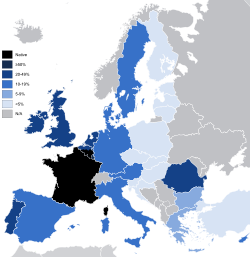](https://en.wikipedia.org/wiki/File:Knowledge_of_French_EU_map.svg)
Knowledge of French in the [European Union](https://en.wikipedia.org/wiki/European_Union "European Union") and candidate countries[\[86\]](https://en.wikipedia.org/wiki/French_language#cite_note-87)
Spoken by 19.71% of the European Union's population, French is the third most widely spoken language in the EU, after English and German and the second-most-widely taught language after English.[\[9\]](https://en.wikipedia.org/wiki/French_language#cite_note-nativeLanguages-10)[\[87\]](https://en.wikipedia.org/wiki/French_language#cite_note-88)
Under the [Constitution of France](https://en.wikipedia.org/wiki/Constitution_of_France "Constitution of France"), French has been the official language of the Republic since 1992,[\[88\]](https://en.wikipedia.org/wiki/French_language#cite_note-Benet-Mart%C3%ADnezHong2014-89) although the [Ordinance of Villers-Cotterêts](https://en.wikipedia.org/wiki/Ordinance_of_Villers-Cotter%C3%AAts "Ordinance of Villers-Cotterêts") made it mandatory for legal documents in 1539. France mandates the use of French in official government publications, public education except in specific cases, and legal contracts; advertisements must bear a translation of foreign words.
In Belgium, French is an official language at the federal level along with Dutch and German. At the regional level, French is the sole official language of [Wallonia](https://en.wikipedia.org/wiki/Wallonia "Wallonia") (excluding a part of the [East Cantons](https://en.wikipedia.org/wiki/East_Cantons "East Cantons"), which are [German-speaking](https://en.wikipedia.org/wiki/German_language "German language")) and one of the two official languages—along with [Dutch](https://en.wikipedia.org/wiki/Dutch_language "Dutch language")—of the [Brussels-Capital Region](https://en.wikipedia.org/wiki/Brussels-Capital_Region "Brussels-Capital Region"), where it is spoken by the majority of the population (approx. 80%), often as their primary language.[\[89\]](https://en.wikipedia.org/wiki/French_language#cite_note-philippevanparijs-90)
French is one of the four official languages of Switzerland, along with German, Italian, and [Romansh](https://en.wikipedia.org/wiki/Romansh_language "Romansh language"), and is spoken in the western part of Switzerland, called [Romandy](https://en.wikipedia.org/wiki/Romandy "Romandy"), of which Geneva is the largest city. The language divisions in Switzerland do not coincide with political subdivisions, and some [cantons](https://en.wikipedia.org/wiki/Cantons_of_Switzerland "Cantons of Switzerland") have bilingual status: for example, cities such as [Biel/Bienne](https://en.wikipedia.org/wiki/Biel/Bienne "Biel/Bienne") and cantons such as [Valais](https://en.wikipedia.org/wiki/Canton_of_Valais "Canton of Valais"), [Fribourg](https://en.wikipedia.org/wiki/Canton_of_Fribourg "Canton of Fribourg") and [Bern](https://en.wikipedia.org/wiki/Canton_of_Bern "Canton of Bern"). French is the native language of about 23% of the Swiss population, and is spoken by 50%[\[90\]](https://en.wikipedia.org/wiki/French_language#cite_note-91) of the population.
Along with Luxembourgish and German, French is one of the three official languages of [Luxembourg](https://en.wikipedia.org/wiki/Luxembourg "Luxembourg"), where it is generally the preferred language of business as well as of the different public administrations. It is also the official language of [Monaco](https://en.wikipedia.org/wiki/Monaco "Monaco").
At a regional level, French is acknowledged as an official language in the [Aosta Valley](https://en.wikipedia.org/wiki/Aosta_Valley "Aosta Valley") region of [Italy](https://en.wikipedia.org/wiki/Italy "Italy") (the first government authority to adopt Modern French as the official language in 1536, three years before France itself),[\[91\]](https://en.wikipedia.org/wiki/French_language#cite_note-92) in which is spoken as a first language by 1.25% of the population and as a second one by approximately 50%.[\[92\]](https://en.wikipedia.org/wiki/French_language#cite_note-93) French dialects remain spoken by minorities on the [Channel Islands](https://en.wikipedia.org/wiki/Channel_Islands "Channel Islands"); it is also spoken in [Andorra](https://en.wikipedia.org/wiki/Andorra "Andorra") and is the main language after [Catalan](https://en.wikipedia.org/wiki/Catalan_language "Catalan language") in [El Pas de la Casa](https://en.wikipedia.org/wiki/El_Pas_de_la_Casa "El Pas de la Casa"). The language is taught as the primary second language in the German state of [Saarland](https://en.wikipedia.org/wiki/Saarland "Saarland"), with French being taught from pre-school and over 43% of citizens being able to speak French.[\[93\]](https://en.wikipedia.org/wiki/French_language#cite_note-94)[\[94\]](https://en.wikipedia.org/wiki/French_language#cite_note-95)
### Africa
Main article: [African French](https://en.wikipedia.org/wiki/African_French "African French")
[](https://en.wikipedia.org/wiki/File:NativevsOfficial.png)
Official status of French in Africa as of 2025[\[update\]](https://en.wikipedia.org/w/index.php?title=French_language&action=edit):
Countries in which it is an official *de jure* language
Regions in which is spoken as a native language
[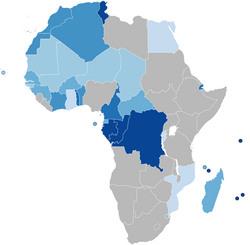](https://en.wikipedia.org/wiki/File:Francophone_Africa_2023.png)
Countries of Africa by percentage of French speakers in 2023
0–10% Francophone
11–20% Francophone
21–30% Francophone
31–40% Francophone
41–50% Francophone
\>50% Francophone
The majority of the world's French-speaking population lives in Africa; while it is an official language in 18 countries, it is not spoken as a first language by the majority, acting mainly as a second one or a [lingua franca](https://en.wikipedia.org/wiki/Lingua_franca "Lingua franca") due to the many indigenous languages spoken in the territories.[\[95\]](https://en.wikipedia.org/wiki/French_language#cite_note-96) According to a 2023 estimate from the Organisation internationale de la Francophonie, an estimated 167 million African people spread across 35 countries and territories[\[b\]](https://en.wikipedia.org/wiki/French_language#cite_note-97) can speak French as either a [first](https://en.wikipedia.org/wiki/First_language "First language") or a [second language](https://en.wikipedia.org/wiki/Second_language "Second language");[\[96\]](https://en.wikipedia.org/wiki/French_language#cite_note-98)[\[97\]](https://en.wikipedia.org/wiki/French_language#cite_note-2023_speakers-99) only 1.2 million of these spoke it as a first language according to [Ethnologue](https://en.wikipedia.org/wiki/Ethnologue "Ethnologue").[\[98\]](https://en.wikipedia.org/wiki/French_language#cite_note-100) This number does not include the people living in non-Francophone African countries who have learned French as a foreign language. There is not a single [African French](https://en.wikipedia.org/wiki/African_French "African French"), but multiple forms that diverged through contact with various indigenous [African languages](https://en.wikipedia.org/wiki/African_languages "African languages").[\[99\]](https://en.wikipedia.org/wiki/French_language#cite_note-101) Language and slang from francophone Africa, particularly as popularized through music, are playing a growing role in influencing French across the francophone world.[\[100\]](https://en.wikipedia.org/wiki/French_language#cite_note-102)
While spoken mainly as a second language, French is increasingly being spoken as a native language in Francophone Africa among some communities in urban areas or the elite class. This is especially true in the cities of [Abidjan](https://en.wikipedia.org/wiki/Abidjan "Abidjan"),[\[101\]](https://en.wikipedia.org/wiki/French_language#cite_note-:0-103)[\[102\]](https://en.wikipedia.org/wiki/French_language#cite_note-:1-104) [Kinshasa](https://en.wikipedia.org/wiki/Kinshasa "Kinshasa"), and [Lubumbashi](https://en.wikipedia.org/wiki/Lubumbashi "Lubumbashi"),[\[103\]](https://en.wikipedia.org/wiki/French_language#cite_note-Carson-105)[\[104\]](https://en.wikipedia.org/wiki/French_language#cite_note-:7-106)[\[105\]](https://en.wikipedia.org/wiki/French_language#cite_note-:8-107)[\[106\]](https://en.wikipedia.org/wiki/French_language#cite_note-:9-108) [Douala](https://en.wikipedia.org/wiki/Douala "Douala"),[\[107\]](https://en.wikipedia.org/wiki/French_language#cite_note-:3-109)[\[108\]](https://en.wikipedia.org/wiki/French_language#cite_note-:4-110) [Libreville](https://en.wikipedia.org/wiki/Libreville "Libreville"),[\[109\]](https://en.wikipedia.org/wiki/French_language#cite_note-:5-111)[\[110\]](https://en.wikipedia.org/wiki/French_language#cite_note-:6-112) [Antananarivo](https://en.wikipedia.org/wiki/Antananarivo "Antananarivo"),[\[111\]](https://en.wikipedia.org/wiki/French_language#cite_note-%C3%98yvind_2024-113) Cotonou,[\[112\]](https://en.wikipedia.org/wiki/French_language#cite_note-114) and Brazzaville.[\[113\]](https://en.wikipedia.org/wiki/French_language#cite_note-115) However, in contrast to Central Africa and most of West Africa where French had been entrenched, countries in North Africa and the [Sahel](https://en.wikipedia.org/wiki/Sahel "Sahel") have generally distanced themselves from the language due to colonial connections.[\[114\]](https://en.wikipedia.org/wiki/French_language#cite_note-116) For example, [Algeria](https://en.wikipedia.org/wiki/Algeria "Algeria") intermittently attempted to remove the use of French in favor of a strong native language (see [Arabization](https://en.wikipedia.org/wiki/Arabization "Arabization")), and French has recently also been removed as an official language in [Mali](https://en.wikipedia.org/wiki/Mali "Mali"), [Burkina Faso](https://en.wikipedia.org/wiki/Burkina_Faso "Burkina Faso"), and [Niger](https://en.wikipedia.org/wiki/Niger "Niger") in 2023, 2024, and 2025, respectively.[\[56\]](https://en.wikipedia.org/wiki/French_language#cite_note-Africanews-57)[\[115\]](https://en.wikipedia.org/wiki/French_language#cite_note-Africanews2-117)[\[116\]](https://en.wikipedia.org/wiki/French_language#cite_note-hasual-118) Despite these changes and the emergence of English as a global lingua franca, French today remains a major language in the societies of [Morocco](https://en.wikipedia.org/wiki/Morocco "Morocco"), Algeria and [Tunisia](https://en.wikipedia.org/wiki/Tunisia "Tunisia").[\[117\]](https://en.wikipedia.org/wiki/French_language#cite_note-119)
Due to the rise of French in Africa, the total French-speaking population worldwide is expected to reach 700 million people in 2050.[\[118\]](https://en.wikipedia.org/wiki/French_language#cite_note-2023_data_sheet-120)[\[119\]](https://en.wikipedia.org/wiki/French_language#cite_note-121)[\[120\]](https://en.wikipedia.org/wiki/French_language#cite_note-122) French was the fastest growing language on the continent (in terms of either official or foreign languages).[\[121\]](https://en.wikipedia.org/wiki/French_language#cite_note-123)[\[122\]](https://en.wikipedia.org/wiki/French_language#cite_note-124) [Sub-Saharan Africa](https://en.wikipedia.org/wiki/Sub-Saharan_Africa "Sub-Saharan Africa") is the region where the French language is most likely to expand, because of the expansion of education and rapid population growth.[\[123\]](https://en.wikipedia.org/wiki/French_language#cite_note-125) It is also where the language has evolved the most in recent years.[\[124\]](https://en.wikipedia.org/wiki/French_language#cite_note-126)[\[125\]](https://en.wikipedia.org/wiki/French_language#cite_note-127) Some vernacular forms of French in Africa can be difficult to understand for French speakers from other countries,[\[126\]](https://en.wikipedia.org/wiki/French_language#cite_note-128) but written forms of the language are very closely related to those of the rest of the French-speaking world.
### Americas
Further information: [Languages of North America](https://en.wikipedia.org/wiki/Languages_of_North_America "Languages of North America"), [Languages of South America](https://en.wikipedia.org/wiki/Languages_of_South_America "Languages of South America"), [Languages of the Caribbean](https://en.wikipedia.org/wiki/Languages_of_the_Caribbean "Languages of the Caribbean"), and [French language in Canada](https://en.wikipedia.org/wiki/French_language_in_Canada "French language in Canada")
#### Canada
[](https://en.wikipedia.org/wiki/File:French_language_distribution_in_Canada.png)
French language distribution in Canada
Regions where French is the main language and an official language at both the federal and provincial level
Regions where French is an official language at the federal level but not a majority native language or an official language at the provincial level
[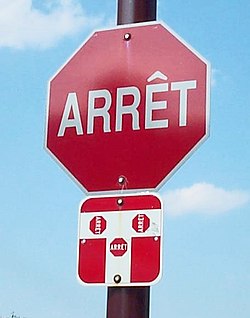](https://en.wikipedia.org/wiki/File:Arret.jpg)
The ["arrêt" signs](https://en.wikipedia.org/wiki/Stop_sign "Stop sign") (French for "stop") are used in the Canadian province of Québec, while the English stop, which is also a valid French word, is used in France and other French-speaking countries and regions.
French is the second most commonly spoken language in Canada and one of two federal official languages alongside English. As of the [2021 Canadian census](https://en.wikipedia.org/wiki/2021_Canadian_census "2021 Canadian census"), it was the native language of 7.7 million people (21% of the population) and the second language of 2.9 million (8% of the population).[\[127\]](https://en.wikipedia.org/wiki/French_language#cite_note-2021-census-129)[\[128\]](https://en.wikipedia.org/wiki/French_language#cite_note-Qu'est-ce_que_la_Francophonie-130) Although French is spoken throughout Canada, it is mostly present in [Quebec](https://en.wikipedia.org/wiki/Quebec "Quebec"), with significant Francophone populations also being found in [New Brunswick](https://en.wikipedia.org/wiki/New_Brunswick "New Brunswick"), especially the region of [Acadia](https://en.wikipedia.org/wiki/Acadia_\(region\) "Acadia (region)"), and parts of [Northern](https://en.wikipedia.org/wiki/Northern_Ontario "Northern Ontario") and [Eastern Ontario](https://en.wikipedia.org/wiki/Eastern_Ontario "Eastern Ontario").[\[129\]](https://en.wikipedia.org/wiki/French_language#cite_note-131)[\[130\]](https://en.wikipedia.org/wiki/French_language#cite_note-132)
French is the sole official language in the province of [Quebec](https://en.wikipedia.org/wiki/Quebec "Quebec"), where some 80% of the population speak it as a native language and 95% are capable of conducting a conversation in it.[\[127\]](https://en.wikipedia.org/wiki/French_language#cite_note-2021-census-129) Quebec is also home to the city of [Montreal](https://en.wikipedia.org/wiki/Montreal "Montreal"), which is the world's fourth-largest French-speaking city, by number of first language speakers.[\[131\]](https://en.wikipedia.org/wiki/French_language#cite_note-133)[\[132\]](https://en.wikipedia.org/wiki/French_language#cite_note-134) [New Brunswick](https://en.wikipedia.org/wiki/New_Brunswick "New Brunswick") and [Manitoba](https://en.wikipedia.org/wiki/Manitoba "Manitoba") are the only officially bilingual provinces, though full bilingualism is enacted only in New Brunswick, where about one third of the population is Francophone. French is also an official language of all of the territories ([Northwest Territories](https://en.wikipedia.org/wiki/Northwest_Territories "Northwest Territories"), [Nunavut](https://en.wikipedia.org/wiki/Nunavut "Nunavut"), and [Yukon](https://en.wikipedia.org/wiki/Yukon "Yukon")). Out of the three, Yukon has the most French speakers, making up just under 4% of the population.[\[133\]](https://en.wikipedia.org/wiki/French_language#cite_note-135) Furthermore, while French is not an official language in [Ontario](https://en.wikipedia.org/wiki/Ontario "Ontario"), the [French Language Services Act](https://en.wikipedia.org/wiki/French_Language_Services_Act_\(Ontario\) "French Language Services Act (Ontario)") ensures that provincial services are available in the language. The Act applies to areas of the province where there are significant Francophone communities, namely [Eastern Ontario](https://en.wikipedia.org/wiki/Eastern_Ontario "Eastern Ontario") and [Northern Ontario](https://en.wikipedia.org/wiki/Northern_Ontario "Northern Ontario"). Elsewhere, sizable French-speaking minorities are found in southern Manitoba, [Nova Scotia](https://en.wikipedia.org/wiki/Nova_Scotia "Nova Scotia"), Prince Edward Island and the [Port au Port Peninsula](https://en.wikipedia.org/wiki/Port_au_Port_Peninsula "Port au Port Peninsula") in Newfoundland and Labrador, where the unique [Newfoundland French](https://en.wikipedia.org/wiki/Newfoundland_French "Newfoundland French") dialect was historically spoken. Smaller pockets of French speakers exist in all other provinces. The Ontarian city of [Ottawa](https://en.wikipedia.org/wiki/Ottawa "Ottawa"), the Canadian capital, is also effectively bilingual, as it has a large population of federal government workers, who are required to offer services in both French and English,[\[134\]](https://en.wikipedia.org/wiki/French_language#cite_note-136) and is just across the river from the Quebecois city of [Gatineau](https://en.wikipedia.org/wiki/Gatineau "Gatineau").
#### United States
[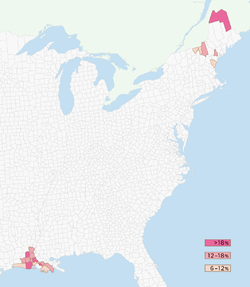](https://en.wikipedia.org/wiki/File:French_in_the_United_States.png)
French language spread in the United States. Counties marked in lighter pink are those where 6–12% of the population speaks French at home; medium pink, 12–18%; darker pink, over 18%. [French-based creole languages](https://en.wikipedia.org/wiki/French-based_creole_languages "French-based creole languages") are not included.
According to the [United States Census Bureau](https://en.wikipedia.org/wiki/United_States_Census_Bureau "United States Census Bureau") (2011), French is the fourth[\[135\]](https://en.wikipedia.org/wiki/French_language#cite_note-137) most spoken language in the United States after English, Spanish, and Chinese, when all forms of French are considered together and all dialects of Chinese are similarly combined. French is the second-most spoken language (after English) in the states of [Maine](https://en.wikipedia.org/wiki/Maine "Maine") and [Vermont](https://en.wikipedia.org/wiki/Vermont "Vermont"). In [Louisiana](https://en.wikipedia.org/wiki/Louisiana "Louisiana"), it is tied with Spanish for second-most spoken if Louisiana French and all creoles such as Haitian are included. French is the third most spoken language (after English and Spanish) in the states of [Connecticut](https://en.wikipedia.org/wiki/Connecticut "Connecticut"), [Rhode Island](https://en.wikipedia.org/wiki/Rhode_Island "Rhode Island"), and [New Hampshire](https://en.wikipedia.org/wiki/New_Hampshire "New Hampshire").[\[136\]](https://en.wikipedia.org/wiki/French_language#cite_note-factfinder2.census.gov-138) Louisiana is home to many distinct French dialects, collectively known as [Louisiana French](https://en.wikipedia.org/wiki/Louisiana_French "Louisiana French"). [New England French](https://en.wikipedia.org/wiki/New_England_French "New England French"), essentially a variant of [Canadian French](https://en.wikipedia.org/wiki/Canadian_French "Canadian French"), is spoken in parts of [New England](https://en.wikipedia.org/wiki/New_England "New England"). [Missouri French](https://en.wikipedia.org/wiki/Missouri_French "Missouri French") was historically spoken in [Missouri](https://en.wikipedia.org/wiki/Missouri "Missouri") and [Illinois](https://en.wikipedia.org/wiki/Illinois "Illinois") (formerly known as [Upper Louisiana](https://en.wikipedia.org/wiki/Upper_Louisiana "Upper Louisiana")), but is nearly extinct today.[\[137\]](https://en.wikipedia.org/wiki/French_language#cite_note-139) French also survived in isolated pockets along the [Gulf Coast](https://en.wikipedia.org/wiki/Gulf_Coast "Gulf Coast") of what was previously French [Lower Louisiana](https://en.wikipedia.org/wiki/Lower_Louisiana "Lower Louisiana"), such as [Mon Louis Island](https://en.wikipedia.org/wiki/Mon_Louis_Island "Mon Louis Island"), Alabama and [DeLisle, Mississippi](https://en.wikipedia.org/wiki/DeLisle,_Mississippi "DeLisle, Mississippi") (the latter only being discovered by linguists in the 1990s) but these varieties are severely endangered or presumed extinct.
#### Caribbean
French is one of two official languages in [Haiti](https://en.wikipedia.org/wiki/Haiti "Haiti") alongside [Haitian Creole](https://en.wikipedia.org/wiki/Haitian_Creole "Haitian Creole"). It is the principal language of education, administration, business, and public signage and is spoken by all educated Haitians. It is also used for ceremonial events such as weddings, graduations, and church masses. The vast majority of the population speaks Haitian Creole as their first language; the rest largely speak French as a first language.[\[138\]](https://en.wikipedia.org/wiki/French_language#cite_note-DeGraff2015-140) As a [French Creole language](https://en.wikipedia.org/wiki/French-based_creole_languages "French-based creole languages"), Haitian Creole draws the large majority of its vocabulary from French, with influences from West African languages, as well as several European languages. It is closely related to Louisiana Creole and the creole from the [Lesser Antilles](https://en.wikipedia.org/wiki/Lesser_Antilles "Lesser Antilles").[\[139\]](https://en.wikipedia.org/wiki/French_language#cite_note-141)
French is the sole official language of all the overseas territories of France in the Caribbean that are collectively referred to as the [French West Indies](https://en.wikipedia.org/wiki/French_West_Indies "French West Indies"), namely [Guadeloupe](https://en.wikipedia.org/wiki/Guadeloupe "Guadeloupe"), [Saint Barthélemy](https://en.wikipedia.org/wiki/Saint_Barth%C3%A9lemy "Saint Barthélemy"), [Saint Martin](https://en.wikipedia.org/wiki/Collectivity_of_Saint_Martin "Collectivity of Saint Martin"), and [Martinique](https://en.wikipedia.org/wiki/Martinique "Martinique").
#### Other Caribbean French Creoles
In the countries of [Dominica](https://en.wikipedia.org/wiki/Dominica "Dominica"), [Grenada](https://en.wikipedia.org/wiki/Grenada "Grenada"), [St Lucia](https://en.wikipedia.org/wiki/Saint_Lucia "Saint Lucia"), [Trinidad](https://en.wikipedia.org/wiki/Trinidad_and_Tobago "Trinidad and Tobago")[\[140\]](https://en.wikipedia.org/wiki/French_language#cite_note-142) [Venezuela](https://en.wikipedia.org/wiki/Venezuela "Venezuela") [\[141\]](https://en.wikipedia.org/wiki/French_language#cite_note-143) and [Panama](https://en.wikipedia.org/wiki/Panama "Panama")[\[142\]](https://en.wikipedia.org/wiki/French_language#cite_note-144) French based [creoles](https://en.wikipedia.org/wiki/Antillean_Creole "Antillean Creole") are used in lesser capacities,[\[143\]](https://en.wikipedia.org/wiki/French_language#cite_note-145) being secondary languages.[\[144\]](https://en.wikipedia.org/wiki/French_language#cite_note-146) It should be understood that Creoles are distinct from French although they are occasionally intelligible (depending on the Creole and how much French influence the language received). The Creoles of Venezuela and Panama are dying/severely endangered. In Trinidad and Grenada creole (known colloquially as Patwa) are only spoken by elders although revitalisation efforts are growing. In Dominica and St Lucia standard French is also used unofficially as a third language and some people use French and French creoles interchangeably.
#### Other territories
French is the official language of both [French Guiana](https://en.wikipedia.org/wiki/French_Guiana "French Guiana") on the South American continent,[\[145\]](https://en.wikipedia.org/wiki/French_language#cite_note-147) and of [Saint Pierre and Miquelon](https://en.wikipedia.org/wiki/Saint_Pierre_and_Miquelon "Saint Pierre and Miquelon"),[\[146\]](https://en.wikipedia.org/wiki/French_language#cite_note-148) an archipelago off the coast of Newfoundland in North America.
### Asia
#### Southeast Asia
See also: [French language in Vietnam](https://en.wikipedia.org/wiki/French_language_in_Vietnam "French language in Vietnam"), [French language in Laos](https://en.wikipedia.org/wiki/French_language_in_Laos "French language in Laos"), and [French language in Cambodia](https://en.wikipedia.org/wiki/French_language_in_Cambodia "French language in Cambodia")
French was the official language of the colony of [French Indochina](https://en.wikipedia.org/wiki/French_Indochina "French Indochina"), comprising modern-day [Vietnam](https://en.wikipedia.org/wiki/Vietnam "Vietnam"), [Laos](https://en.wikipedia.org/wiki/Laos "Laos"), and [Cambodia](https://en.wikipedia.org/wiki/Cambodia "Cambodia"). It continues to be an administrative language in Laos and Cambodia, although its influence has waned in recent decades.[\[147\]](https://en.wikipedia.org/wiki/French_language#cite_note-149) In colonial Vietnam, the elites primarily spoke French, while many servants who worked in French households spoke a French pidgin known as "[Tây Bồi](https://en.wikipedia.org/wiki/T%C3%A2y_B%E1%BB%93i_Pidgin_French "Tây Bồi Pidgin French")" (now extinct). After French rule ended, [South Vietnam](https://en.wikipedia.org/wiki/South_Vietnam "South Vietnam") continued to use French in administration, education, and trade.[\[148\]](https://en.wikipedia.org/wiki/French_language#cite_note-150) However, since the [Fall of Saigon](https://en.wikipedia.org/wiki/Fall_of_Saigon "Fall of Saigon") and the opening of a unified Vietnam's economy, French has gradually declined in modern Vietnam: it has been effectively displaced as the first foreign language of choice by English, and slightly under 1% of the population was fluent in French in 2018.[\[149\]](https://en.wikipedia.org/wiki/French_language#cite_note-151) Nevertheless, it continues to be taught as the other main foreign language in the Vietnamese educational system and is regarded as a cultural language.[\[150\]](https://en.wikipedia.org/wiki/French_language#cite_note-152) All three countries are full members of La Francophonie (OIF).
#### Lebanon
See also: [French language in Lebanon](https://en.wikipedia.org/wiki/French_language_in_Lebanon "French language in Lebanon")
[](https://en.wikipedia.org/wiki/File:Bienvenue_a_Rechmaya.jpg)
Town sign in [Standard Arabic](https://en.wikipedia.org/wiki/Modern_Standard_Arabic "Modern Standard Arabic") and French at the entrance of [Rechmaya](https://en.wikipedia.org/wiki/Rechmaya "Rechmaya") in Lebanon
A former French [mandate](https://en.wikipedia.org/wiki/French_Mandate_for_Syria_and_the_Lebanon "French Mandate for Syria and the Lebanon"), [Lebanon](https://en.wikipedia.org/wiki/Lebanon "Lebanon") designates [Arabic](https://en.wikipedia.org/wiki/Arabic "Arabic") as the sole official language, while a special law regulates cases when French can be publicly used. Article 11 of Lebanon's Constitution states that "Arabic is the official national language. A law determines the cases in which the French language is to be used".[\[151\]](https://en.wikipedia.org/wiki/French_language#cite_note-article_11-153) The [French language in Lebanon](https://en.wikipedia.org/wiki/French_language_in_Lebanon "French language in Lebanon") is a widespread second language among the [Lebanese people](https://en.wikipedia.org/wiki/Lebanese_people "Lebanese people"), and is taught in many schools along with Arabic and English. French is used on [Lebanese pound](https://en.wikipedia.org/wiki/Lebanese_pound "Lebanese pound") banknotes, on road signs, on Lebanese [license plates](https://en.wikipedia.org/wiki/Vehicle_registration_plates_of_Lebanon "Vehicle registration plates of Lebanon"), and on official buildings (alongside Arabic).
Today, French and English are secondary languages of [Lebanon](https://en.wikipedia.org/wiki/Lebanon "Lebanon"), with about 40% of the population being [Francophone](https://en.wikipedia.org/wiki/Francophone "Francophone") and 40% Anglophone.[\[152\]](https://en.wikipedia.org/wiki/French_language#cite_note-FOOTNOTEOIF2014217-154) The use of English is growing in the business and media environment. Out of about 900,000 students, about 500,000 are enrolled in Francophone schools, public or private, in which the teaching of mathematics and scientific subjects is provided in French.[\[153\]](https://en.wikipedia.org/wiki/French_language#cite_note-FOOTNOTEOIF2014218-155) Actual usage of French varies depending on the region and social status. One-third of high school students educated in French go on to pursue higher education in English-speaking institutions. English is the language of business and communication, with French being an element of social distinction, chosen for its emotional value.[\[154\]](https://en.wikipedia.org/wiki/French_language#cite_note-FOOTNOTEOIF2014358-156)
#### India
See also: [Indian French](https://en.wikipedia.org/wiki/Indian_French "Indian French")
French was the official language of [French India](https://en.wikipedia.org/wiki/French_India "French India"), consisting of the geographically separate enclaves referred to as [Puducherry](https://en.wikipedia.org/wiki/Puducherry_\(union_territory\) "Puducherry (union territory)"). It continued to be an [official language of the territory](https://en.wikipedia.org/wiki/Official_languages_of_Puducherry "Official languages of Puducherry") even after its cession to India in 1956 until 1965.[\[155\]](https://en.wikipedia.org/wiki/French_language#cite_note-timesofindia.indiatimes.com-157) A small number of older locals still retain knowledge of the language, although it has now given way to Tamil and English.[\[155\]](https://en.wikipedia.org/wiki/French_language#cite_note-timesofindia.indiatimes.com-157)[\[156\]](https://en.wikipedia.org/wiki/French_language#cite_note-158)
### Oceania
[](https://en.wikipedia.org/wiki/File:CFP_500_recto.jpg)
A 500-[CFP franc](https://en.wikipedia.org/wiki/CFP_franc "CFP franc") (€4.20; US\$5.00) banknote, used in [French Polynesia](https://en.wikipedia.org/wiki/French_Polynesia "French Polynesia"), [New Caledonia](https://en.wikipedia.org/wiki/New_Caledonia "New Caledonia") and [Wallis and Futuna](https://en.wikipedia.org/wiki/Wallis_and_Futuna "Wallis and Futuna")
French is an official language of the [Pacific Island](https://en.wikipedia.org/wiki/Pacific_Island "Pacific Island") nation of [Vanuatu](https://en.wikipedia.org/wiki/Vanuatu "Vanuatu"), where 31% of the population was estimated to speak it in 2023.[\[97\]](https://en.wikipedia.org/wiki/French_language#cite_note-2023_speakers-99) It is the sole official language in the French special collectivity of [New Caledonia](https://en.wikipedia.org/wiki/New_Caledonia "New Caledonia") and the overseas collectivities of [Wallis and Futuna](https://en.wikipedia.org/wiki/Wallis_and_Futuna "Wallis and Futuna") and [French Polynesia](https://en.wikipedia.org/wiki/French_Polynesia "French Polynesia").[\[157\]](https://en.wikipedia.org/wiki/French_language#cite_note-159)
In New Caledonia, 97% of the population can speak, read and write French[\[158\]](https://en.wikipedia.org/wiki/French_language#cite_note-160) while in French Polynesia this figure is 95%,[\[159\]](https://en.wikipedia.org/wiki/French_language#cite_note-PF_2017-161) and in Wallis and Futuna, it is 84%.[\[160\]](https://en.wikipedia.org/wiki/French_language#cite_note-WF_2018-162) In French Polynesia and to a lesser extent Wallis and Futuna, where oral and written knowledge of the French language has become almost universal, French increasingly tends to displace the native [Polynesian languages](https://en.wikipedia.org/wiki/Polynesian_languages "Polynesian languages") as the language most spoken at home. In French Polynesia, the percentage of the population who reported that French was the language they use the most at home rose from 67% at the 2007 census to 74% at the 2017 census.[\[161\]](https://en.wikipedia.org/wiki/French_language#cite_note-PF_2007-163)[\[159\]](https://en.wikipedia.org/wiki/French_language#cite_note-PF_2017-161) In Wallis and Futuna, the percentage of the population who reported that French was the language they use the most at home rose from 10% at the 2008 census to 13% at the 2018 census.[\[160\]](https://en.wikipedia.org/wiki/French_language#cite_note-WF_2018-162)[\[162\]](https://en.wikipedia.org/wiki/French_language#cite_note-WF_2008-164)
## Varieties
Main article: [Varieties of French](https://en.wikipedia.org/wiki/Varieties_of_French "Varieties of French")
| | |
|---|---|
| [](https://en.wikipedia.org/wiki/File:Question_book-new.svg) | This section **does not [cite](https://en.wikipedia.org/wiki/Wikipedia:Citing_sources "Wikipedia:Citing sources") any [sources](https://en.wikipedia.org/wiki/Wikipedia:Verifiability "Wikipedia:Verifiability")**. Please help [improve this section](https://en.wikipedia.org/wiki/Special:EditPage/French_language "Special:EditPage/French language") by [adding citations to reliable sources](https://en.wikipedia.org/wiki/Help:Referencing_for_beginners "Help:Referencing for beginners"). Unsourced material may be challenged and [removed](https://en.wikipedia.org/wiki/Wikipedia:Verifiability#Burden_of_evidence "Wikipedia:Verifiability"). *(January 2026)* *([Learn how and when to remove this message](https://en.wikipedia.org/wiki/Help:Maintenance_template_removal "Help:Maintenance template removal"))* |
- [African French](https://en.wikipedia.org/wiki/African_French "African French")
- [Maghreb French](https://en.wikipedia.org/wiki/Maghreb_French "Maghreb French") (North African French)
- [Aostan French](https://en.wikipedia.org/wiki/Aostan_French "Aostan French")
- [Belgian French](https://en.wikipedia.org/wiki/Belgian_French "Belgian French")
- [Cambodian French](https://en.wikipedia.org/wiki/Cambodian_French "Cambodian French")
- [Canadian French](https://en.wikipedia.org/wiki/Canadian_French "Canadian French")
- [Acadian French](https://en.wikipedia.org/wiki/Acadian_French "Acadian French")
- [Newfoundland French](https://en.wikipedia.org/wiki/Newfoundland_French "Newfoundland French")
- [New England French](https://en.wikipedia.org/wiki/New_England_French "New England French")
- [Ontario French](https://en.wikipedia.org/wiki/Ontario_French "Ontario French")
- [Quebec French](https://en.wikipedia.org/wiki/Quebec_French "Quebec French")
- [French French](https://en.wikipedia.org/wiki/French_in_France "French in France")
- [Guianese French](https://en.wikipedia.org/wiki/French_Guiana "French Guiana")
- [Meridional French](https://en.wikipedia.org/wiki/Meridional_French "Meridional French")
- [Haitian French](https://en.wikipedia.org/wiki/Haitian_French "Haitian French")
- [Indian French](https://en.wikipedia.org/wiki/Indian_French "Indian French")
- [Jersey Legal French](https://en.wikipedia.org/wiki/Jersey_Legal_French "Jersey Legal French")
- [Lao French](https://en.wikipedia.org/wiki/French_language_in_Laos "French language in Laos")
- [Louisiana French](https://en.wikipedia.org/wiki/Louisiana_French "Louisiana French")
- [Cajun French](https://en.wikipedia.org/wiki/Cajun_French "Cajun French")
- [Missouri French](https://en.wikipedia.org/wiki/Missouri_French "Missouri French")
- [South East Asian French](https://en.wikipedia.org/wiki/Varieties_of_French#Asia "Varieties of French")
- [Swiss French](https://en.wikipedia.org/wiki/Swiss_French "Swiss French")
- [Vietnamese French](https://en.wikipedia.org/wiki/French_language_in_Vietnam "French language in Vietnam")
- [West Indian French](https://en.wikipedia.org/wiki/French_West_Indies "French West Indies")
[](https://en.wikipedia.org/wiki/File:Dialects_of_the_french_language.png)
Varieties of the French language in the world
## Current status and importance
According to the OIF, approximately 321 million people worldwide are "able to speak the language" as of 2022[\[update\]](https://en.wikipedia.org/w/index.php?title=French_language&action=edit),[\[163\]](https://en.wikipedia.org/wiki/French_language#cite_note-Francophonie-165) without specifying the criteria for this estimation or whom it encompasses.[\[164\]](https://en.wikipedia.org/wiki/French_language#cite_note-ontheuplocalfr2014-166) French is regarded as an influential [world language](https://en.wikipedia.org/wiki/World_language "World language") because of its wide use in the worlds of journalism, [jurisprudence](https://en.wikipedia.org/wiki/Jurisprudence "Jurisprudence"), education, and diplomacy,[\[165\]](https://en.wikipedia.org/wiki/French_language#cite_note-167) though its use, geography, and sociopolitical context continues to shift with declines in some areas, including academia, and growth in others.[\[48\]](https://en.wikipedia.org/wiki/French_language#cite_note-:10-49) Given the demographic prospects of the French-speaking nations of Africa, researcher Pascal-Emmanuel Gobry wrote in 2014 that French "could be the language of the future";[\[166\]](https://en.wikipedia.org/wiki/French_language#cite_note-168) despite this growth in parts of Central and West Africa, where it had been entrenched as an official, administrative and educational language in numerous states, countries in North Africa and the Sahel have generally distanced themselves from the language due to colonial connections: some countries such as [Algeria](https://en.wikipedia.org/wiki/Algeria "Algeria") intermittently attempted to eradicate the use of French, and it was removed as an official language in [Mali](https://en.wikipedia.org/wiki/Mali "Mali"), [Burkina Faso](https://en.wikipedia.org/wiki/Burkina_Faso "Burkina Faso") and [Niger](https://en.wikipedia.org/wiki/Niger "Niger") in 2023, 2024, and 2025, respectively.[\[56\]](https://en.wikipedia.org/wiki/French_language#cite_note-Africanews-57)[\[115\]](https://en.wikipedia.org/wiki/French_language#cite_note-Africanews2-117) Its use is also largely declined in parts of Asia, particularly in former French colonies such as Vietnam, Laos, and Cambodia, where it has been replaced by local languages and English in both public life and education.[\[47\]](https://en.wikipedia.org/wiki/French_language#cite_note-:2-48)[\[48\]](https://en.wikipedia.org/wiki/French_language#cite_note-:10-49)
In diplomacy, French is one of the six official languages of the United Nations (and one of the [UN Secretariat](https://en.wikipedia.org/wiki/UN_Secretariat "UN Secretariat")'s only two working languages[\[167\]](https://en.wikipedia.org/wiki/French_language#cite_note-dawnmarley-169)), one of twenty official and three procedural languages of the [European Union](https://en.wikipedia.org/wiki/European_Union "European Union"), an official language of [NATO](https://en.wikipedia.org/wiki/NATO "NATO"), the [International Olympic Committee](https://en.wikipedia.org/wiki/International_Olympic_Committee "International Olympic Committee"), the [Council of Europe](https://en.wikipedia.org/wiki/Council_of_Europe "Council of Europe"), the [Organisation for Economic Co-operation and Development](https://en.wikipedia.org/wiki/Organisation_for_Economic_Co-operation_and_Development "Organisation for Economic Co-operation and Development"), [Organization of American States](https://en.wikipedia.org/wiki/Organization_of_American_States "Organization of American States") (alongside Spanish, Portuguese and English), the [Eurovision Song Contest](https://en.wikipedia.org/wiki/Eurovision_Song_Contest "Eurovision Song Contest"), one of eighteen official languages of the [European Space Agency](https://en.wikipedia.org/wiki/European_Space_Agency "European Space Agency"), [World Trade Organization](https://en.wikipedia.org/wiki/World_Trade_Organization "World Trade Organization") and the least used of the three official languages in the [North American Free Trade Agreement](https://en.wikipedia.org/wiki/North_American_Free_Trade_Agreement "North American Free Trade Agreement") countries. It is also a working language in nonprofit organisations such as the [Red Cross](https://en.wikipedia.org/wiki/International_Red_Cross_and_Red_Crescent_Movement "International Red Cross and Red Crescent Movement") (alongside English, German, Spanish, Portuguese, Arabic and Russian), [Amnesty International](https://en.wikipedia.org/wiki/Amnesty_International "Amnesty International") (alongside 32 other languages of which English is the most used, followed by Spanish, Portuguese, German, and Italian), [Médecins sans Frontières](https://en.wikipedia.org/wiki/M%C3%A9decins_sans_Fronti%C3%A8res "Médecins sans Frontières") (used alongside English, Spanish, Portuguese and Arabic), and [Médecins du Monde](https://en.wikipedia.org/wiki/M%C3%A9decins_du_Monde "Médecins du Monde") (used alongside English).[\[168\]](https://en.wikipedia.org/wiki/French_language#cite_note-170)
Significant as a judicial language, French is one of the official languages of such major international and regional courts, tribunals, and dispute-settlement bodies as the [African Court on Human and Peoples' Rights](https://en.wikipedia.org/wiki/African_Court_on_Human_and_Peoples%27_Rights "African Court on Human and Peoples' Rights"), the [Caribbean Court of Justice](https://en.wikipedia.org/wiki/Caribbean_Court_of_Justice "Caribbean Court of Justice"), the [Court of Justice for the Economic Community of West African States](https://en.wikipedia.org/wiki/Economic_Community_of_West_African_States#Community_Court_of_Justice "Economic Community of West African States"), the [Inter-American Court of Human Rights](https://en.wikipedia.org/wiki/Inter-American_Court_of_Human_Rights "Inter-American Court of Human Rights"), the [International Court of Justice](https://en.wikipedia.org/wiki/International_Court_of_Justice "International Court of Justice"), the [International Criminal Tribunal for the former Yugoslavia](https://en.wikipedia.org/wiki/International_Criminal_Tribunal_for_the_former_Yugoslavia "International Criminal Tribunal for the former Yugoslavia"), [International Criminal Tribunal for Rwanda](https://en.wikipedia.org/wiki/International_Criminal_Tribunal_for_Rwanda "International Criminal Tribunal for Rwanda"), the [International Tribunal for the Law of the Sea](https://en.wikipedia.org/wiki/International_Tribunal_for_the_Law_of_the_Sea "International Tribunal for the Law of the Sea") the [International Criminal Court](https://en.wikipedia.org/wiki/International_Criminal_Court "International Criminal Court") and the [World Trade Organization Appellate Body](https://en.wikipedia.org/wiki/Appellate_Body "Appellate Body"). It is the sole internal working language of the [Court of Justice of the European Union](https://en.wikipedia.org/wiki/Court_of_Justice_of_the_European_Union "Court of Justice of the European Union"), and makes with English the [European Court of Human Rights](https://en.wikipedia.org/wiki/European_Court_of_Human_Rights "European Court of Human Rights")'s two working languages.[\[169\]](https://en.wikipedia.org/wiki/French_language#cite_note-171)
In 1997, George Weber published, in *Language Today*, a comprehensive academic study entitled "The World's 10 most influential languages". In the article, Weber ranked French as, after English, the second-most *influential* language of the world, ahead of Spanish. His criteria were the numbers of native speakers, the number of secondary speakers (especially high for French among fellow world languages), the number of countries using the language and their respective populations, the economic power of the countries using the language, the number of major areas in which the language is used, and the [linguistic prestige](https://en.wikipedia.org/wiki/Linguistic_prestige "Linguistic prestige") associated with the mastery of the language (Weber highlighted that French in particular enjoys considerable linguistic prestige). In a 2008 reassessment of his article, Weber concluded that his findings were still correct since "the situation among the top ten remains unchanged."[\[170\]](https://en.wikipedia.org/wiki/French_language#cite_note-weber-172)
Knowledge of French is often considered to be a useful skill by business owners in the United Kingdom; a 2014 study found that 50% of British managers considered French to be a valuable asset for their business, thus ranking French as the most sought-after foreign language there, ahead of German (49%) and Spanish (44%).[\[171\]](https://en.wikipedia.org/wiki/French_language#cite_note-173) MIT economist Albert Saiz calculated a 2.3% premium for those who have French as a foreign language in the workplace.[\[172\]](https://en.wikipedia.org/wiki/French_language#cite_note-174)
In 2011, *[Bloomberg Businessweek](https://en.wikipedia.org/wiki/Bloomberg_Businessweek "Bloomberg Businessweek")* ranked French the third most useful language for business, after English and [Standard Mandarin Chinese](https://en.wikipedia.org/wiki/Standard_Mandarin_Chinese "Standard Mandarin Chinese").[\[173\]](https://en.wikipedia.org/wiki/French_language#cite_note-Lauerman2011-175)
## Phonology
Main article: [French phonology](https://en.wikipedia.org/wiki/French_phonology "French phonology")
| | |
|---|---|
| [](https://en.wikipedia.org/wiki/File:Question_book-new.svg) | This section **does not [cite](https://en.wikipedia.org/wiki/Wikipedia:Citing_sources "Wikipedia:Citing sources") any [sources](https://en.wikipedia.org/wiki/Wikipedia:Verifiability "Wikipedia:Verifiability")**. Please help [improve this section](https://en.wikipedia.org/wiki/Special:EditPage/French_language "Special:EditPage/French language") by [adding citations to reliable sources](https://en.wikipedia.org/wiki/Help:Referencing_for_beginners "Help:Referencing for beginners"). Unsourced material may be challenged and [removed](https://en.wikipedia.org/wiki/Wikipedia:Verifiability#Burden_of_evidence "Wikipedia:Verifiability"). *(January 2026)* *([Learn how and when to remove this message](https://en.wikipedia.org/wiki/Help:Maintenance_template_removal "Help:Maintenance template removal"))* |
Spoken French (Africa)
| | [Bilabial](https://en.wikipedia.org/wiki/Bilabial_consonant "Bilabial consonant") | [Labiodental](https://en.wikipedia.org/wiki/Labiodental_consonant "Labiodental consonant") | [Dental](https://en.wikipedia.org/wiki/Dental_consonant "Dental consonant")/ [Alveolar](https://en.wikipedia.org/wiki/Alveolar_consonant "Alveolar consonant") | [Palatal](https://en.wikipedia.org/wiki/Palatal_consonant "Palatal consonant")/ [Postalveolar](https://en.wikipedia.org/wiki/Postalveolar_consonant "Postalveolar consonant") | [Velar](https://en.wikipedia.org/wiki/Velar_consonant "Velar consonant") | [Uvular](https://en.wikipedia.org/wiki/Uvular_consonant "Uvular consonant") | |
|---|---|---|---|---|---|---|---|
| [Nasal](https://en.wikipedia.org/wiki/Nasal_consonant "Nasal consonant") | [m](https://en.wikipedia.org/wiki/Voiced_bilabial_nasal "Voiced bilabial nasal") | | [n](https://en.wikipedia.org/wiki/Voiced_alveolar_nasal "Voiced alveolar nasal") | [ɲ](https://en.wikipedia.org/wiki/Voiced_palatal_nasal "Voiced palatal nasal") | ([ŋ](https://en.wikipedia.org/wiki/Voiced_velar_nasal "Voiced velar nasal")) | | |
| [Stop](https://en.wikipedia.org/wiki/Stop_consonant "Stop consonant") | [voiceless](https://en.wikipedia.org/wiki/Voicelessness "Voicelessness") | [p](https://en.wikipedia.org/wiki/Voiceless_bilabial_plosive "Voiceless bilabial plosive") | | [t](https://en.wikipedia.org/wiki/Voiceless_alveolar_plosive "Voiceless alveolar plosive") | | [k](https://en.wikipedia.org/wiki/Voiceless_velar_plosive "Voiceless velar plosive") | |
| [voiced](https://en.wikipedia.org/wiki/Voice_\(phonetics\) "Voice (phonetics)") | [b](https://en.wikipedia.org/wiki/Voiced_bilabial_plosive "Voiced bilabial plosive") | | [d](https://en.wikipedia.org/wiki/Voiced_alveolar_plosive "Voiced alveolar plosive") | | [ɡ](https://en.wikipedia.org/wiki/Voiced_velar_plosive "Voiced velar plosive") | | |
| [Fricative](https://en.wikipedia.org/wiki/Fricative_consonant "Fricative consonant") | [voiceless](https://en.wikipedia.org/wiki/Voicelessness "Voicelessness") | | [f](https://en.wikipedia.org/wiki/Voiceless_labiodental_fricative "Voiceless labiodental fricative") | [s](https://en.wikipedia.org/wiki/Voiceless_alveolar_fricative "Voiceless alveolar fricative") | [ʃ](https://en.wikipedia.org/wiki/Voiceless_postalveolar_fricative "Voiceless postalveolar fricative") | | [ʁ](https://en.wikipedia.org/wiki/Voiced_uvular_fricative "Voiced uvular fricative") |
| [voiced](https://en.wikipedia.org/wiki/Voice_\(phonetics\) "Voice (phonetics)") | | [v](https://en.wikipedia.org/wiki/Voiced_labiodental_fricative "Voiced labiodental fricative") | [z](https://en.wikipedia.org/wiki/Voiced_alveolar_fricative "Voiced alveolar fricative") | [ʒ](https://en.wikipedia.org/wiki/Voiced_postalveolar_fricative "Voiced postalveolar fricative") | | | |
| [Approximant](https://en.wikipedia.org/wiki/Approximant_consonant "Approximant consonant") | [plain](https://en.wikipedia.org/wiki/Tenuis_consonant "Tenuis consonant") | | | | [j](https://en.wikipedia.org/wiki/Voiced_palatal_approximant "Voiced palatal approximant") | | |
| [labial](https://en.wikipedia.org/wiki/Labialization "Labialization") | [w](https://en.wikipedia.org/wiki/Voiced_labial%E2%80%93velar_approximant "Voiced labial–velar approximant") | | | [ɥ](https://en.wikipedia.org/wiki/Voiced_labial%E2%80%93palatal_approximant "Voiced labial–palatal approximant") | | | |
| [Lateral Approximant](https://en.wikipedia.org/wiki/Lateral_approximant_consonant "Lateral approximant consonant") | | | [l](https://en.wikipedia.org/wiki/Voiced_alveolar_lateral_approximant "Voiced alveolar lateral approximant") | | | | |
**Vowel phonemes in French**
| | | | | |
|---|---|---|---|---|
| | [Front](https://en.wikipedia.org/wiki/Front_vowel "Front vowel") | [Central](https://en.wikipedia.org/wiki/Central_vowel "Central vowel") | [Back](https://en.wikipedia.org/wiki/Back_vowel "Back vowel") | |
| [unrounded](https://en.wikipedia.org/wiki/Roundedness "Roundedness") | [rounded](https://en.wikipedia.org/wiki/Roundedness "Roundedness") | | | |
| [Close](https://en.wikipedia.org/wiki/Close_vowel "Close vowel") | [i](https://en.wikipedia.org/wiki/Close_front_unrounded_vowel "Close front unrounded vowel") | [y](https://en.wikipedia.org/wiki/Close_front_rounded_vowel "Close front rounded vowel") | | [u](https://en.wikipedia.org/wiki/Close_back_rounded_vowel "Close back rounded vowel") |
| [Close-mid](https://en.wikipedia.org/wiki/Close-mid_vowel "Close-mid vowel") | [e](https://en.wikipedia.org/wiki/Close-mid_front_unrounded_vowel "Close-mid front unrounded vowel") | [ø](https://en.wikipedia.org/wiki/Close-mid_front_rounded_vowel "Close-mid front rounded vowel") | ([ə](https://en.wikipedia.org/wiki/Mid_central_vowel "Mid central vowel")) | [o](https://en.wikipedia.org/wiki/Close-mid_back_rounded_vowel "Close-mid back rounded vowel") |
| [Open-mid](https://en.wikipedia.org/wiki/Open-mid_vowel "Open-mid vowel") | [ɛ](https://en.wikipedia.org/wiki/Open-mid_front_unrounded_vowel "Open-mid front unrounded vowel")/([ɛː](https://en.wikipedia.org/wiki/Open-mid_front_unrounded_vowel "Open-mid front unrounded vowel")) | [œ](https://en.wikipedia.org/wiki/Open-mid_front_rounded_vowel "Open-mid front rounded vowel") | [ɔ](https://en.wikipedia.org/wiki/Open-mid_back_rounded_vowel "Open-mid back rounded vowel") | |
| [Open](https://en.wikipedia.org/wiki/Open_vowel "Open vowel") | [a](https://en.wikipedia.org/wiki/Open_front_unrounded_vowel "Open front unrounded vowel") | | | ([ɑ](https://en.wikipedia.org/wiki/Open_back_unrounded_vowel "Open back unrounded vowel")) |
| | [Front](https://en.wikipedia.org/wiki/Front_vowel "Front vowel") | [Back](https://en.wikipedia.org/wiki/Back_vowel "Back vowel") | | |
| [unrounded](https://en.wikipedia.org/wiki/Roundedness "Roundedness") | [rounded](https://en.wikipedia.org/wiki/Roundedness "Roundedness") | | | |
| [Open-mid](https://en.wikipedia.org/wiki/Open-mid_vowel "Open-mid vowel") | [ɛ̃](https://en.wikipedia.org/wiki/Nasal_vowel "Nasal vowel") | ([œ̃](https://en.wikipedia.org/wiki/Nasal_vowel "Nasal vowel")) | [ɔ̃](https://en.wikipedia.org/wiki/Nasal_vowel "Nasal vowel") | |
| [Open](https://en.wikipedia.org/wiki/Open_vowel "Open vowel") | | | [ɑ̃](https://en.wikipedia.org/wiki/Nasal_vowel "Nasal vowel") | |
Although there are many French regional accents, foreign learners normally use only one variety of the language.
- There are a maximum of 17 vowels in French, not all of which are used in every dialect: /a/, /ɑ/, /e/, /ɛ/, /ɛː/, /ə/, /i/, /o/, /ɔ/, /y/, /u/, /œ/, /ø/, plus the nasalized vowels /ɑ̃/, /ɛ̃/, /ɔ̃/ and /œ̃/. In France, the vowels /ɑ/, /ɛː/ and /œ̃/ are tending to be replaced by /a/, /ɛ/ and /ɛ̃/ in many people's speech, but the distinction of /ɛ̃/ and /œ̃/ is present in [Meridional French](https://en.wikipedia.org/wiki/Meridional_French "Meridional French"). In Quebec and Belgian French, the vowels /ɑ/, /ə/, /ɛː/ and /œ̃/ are present.
- Voiced stops (i.e., /b, d, ɡ/) are typically produced fully voiced throughout.
- Voiceless stops (i.e., /p, t, k/) are unaspirated.
- The velar nasal /ŋ/ can occur in final position in borrowed (usually English) words: *parking, camping, swing*.
- The palatal nasal /ɲ/, which is written ⟨gn⟩, can occur in word initial position (e.g., *gnon*), but it is most frequently found in intervocalic, onset position or word-finally (e.g., *montagne*).
- French has three pairs of homorganic fricatives distinguished by voicing, i.e., labiodental /f/~/v/, dental /s/~/z/, and palato-alveolar /ʃ/~/ʒ/. /s/~/z/ are dental, like the plosives /t/~/d/ and the nasal /n/.
- French has one rhotic whose pronunciation varies considerably among speakers and phonetic contexts. In general, it is described as a [voiced uvular fricative](https://en.wikipedia.org/wiki/Voiced_uvular_fricative "Voiced uvular fricative"), as in \[ʁu\] **[roue](https://en.wiktionary.org/wiki/roue#French "wikt:roue")**, "wheel". Vowels are often lengthened before this segment. It can be reduced to an approximant, particularly in final position (e.g., *fort*), or reduced to zero in some word-final positions. For other speakers, a uvular trill is also common, and an apical trill \[r\] occurs in some dialects. The cluster /ʁw/ is generally pronounced as a labialised voiced uvular fricative \[ʁʷ\], such as in \[ʁʷa\] *roi*, "king", or \[kʁʷaʁ\] *croire*, "to believe".
- Lateral and central approximants: The lateral approximant /l/ is unvelarised in both onset (*lire*) and coda position (*il*). In the onset, the central approximants \[w\], \[ɥ\], and \[j\] each correspond to a high vowel, /u/, /y/, and /i/ respectively. There are a few [minimal pairs](https://en.wikipedia.org/wiki/Minimal_pair "Minimal pair") where the approximant and corresponding vowel contrast, but there are also many cases where they are in free variation. Contrasts between /j/ and /i/ occur in final position as in /pɛj/ **[paye](https://en.wiktionary.org/wiki/paye#French "wikt:paye")**, "pay", vs. /pɛi/ **[pays](https://en.wiktionary.org/wiki/pays#French "wikt:pays")**, "country".
- The lateral approximant /l/ can be [delateralised](https://en.wikipedia.org/wiki/Delateralization "Delateralization") when word- or morpheme-final and preceded by /i/, such as in /tʁavaj/ *travail*, "work", or when a word ending in ⟨al⟩ is pluralised, giving ⟨aux⟩ /o/.
French pronunciation follows strict rules based on spelling, but French spelling is often based more on history than phonology. The rules for pronunciation vary between dialects, but the standard rules are:
- Final single consonants, in particular *s*, *x*, *z*, *t*, *d*, *n*, *p* and *g*, are normally silent. (A consonant is considered "final" when no vowel follows it even if one or more consonants follow it.) The final letters *f*, *k*, *q*, and *l*, however, are normally pronounced. The final **c** is sometimes pronounced, as in **bac**, **sac**, **roc**, but can also be silent, as in **blanc** or **estomac**. The final *r* is usually silent when it follows an *e* in a word of two or more syllables, but it is pronounced in some words (*hiver*, *super*, *cancer* etc.).
- When the following word begins with a vowel, however, a silent consonant *may* once again be pronounced, to provide a *[liaison](https://en.wikipedia.org/wiki/Liaison_\(linguistics\) "Liaison (linguistics)")* or "link" between the two words. Some liaisons are *mandatory*, for example the *s* in *les amants* or *vous avez*; some are *optional*, depending on [dialect](https://en.wikipedia.org/wiki/Dialect "Dialect") and [register](https://en.wikipedia.org/wiki/Register_\(sociolinguistics\) "Register (sociolinguistics)"), for example, the first *s* in *deux cents euros* or *euros irlandais*; and some are *forbidden*, for example, the *s* in *beaucoup d'hommes aiment*. The *t* of *et* is never pronounced and the silent final consonant of a noun is only pronounced in the plural and in [set phrases](https://en.wikipedia.org/wiki/Set_phrase "Set phrase") like *pied-à-terre*.
- Doubling a final *n* and adding a silent *e* at the end of a word (e.g., *chien* → *chienne*) makes it clearly pronounced. Doubling a final *l* and adding a silent *e* (e.g., *gentil* → *gentille*) adds a \[j\] sound if the *l* is preceded by the letter *i*.
- Some monosyllabic function words ending in *a* or *e*, such as *je* and *que*, drop their final vowel when placed before a word that begins with a vowel sound (thus avoiding a [hiatus](https://en.wikipedia.org/wiki/Hiatus_\(linguistics\) "Hiatus (linguistics)")). The missing vowel is replaced by an apostrophe. (e.g., \**je ai* is instead pronounced and spelled *j'ai*). This gives, for example, the same pronunciation for *l'homme qu'il a vu* ("the man whom he saw") and *l'homme qui l'a vu* ("the man who saw him"). However, in Belgian French the sentences are pronounced differently; in the first sentence the syllable break is as "qu'il-a", while the second breaks as "qui-l'a". It can also be noted that, in [Quebec French](https://en.wikipedia.org/wiki/Quebec_French "Quebec French"), the second example (*l'homme qui l'a vu*) has more emphasis on *l'a vu*.
## Writing system
### Alphabet
Main articles: [French alphabet](https://en.wikipedia.org/wiki/French_alphabet "French alphabet") and [French braille](https://en.wikipedia.org/wiki/French_braille "French braille")
| | |
|---|---|
| [](https://en.wikipedia.org/wiki/File:Question_book-new.svg) | This section **does not [cite](https://en.wikipedia.org/wiki/Wikipedia:Citing_sources "Wikipedia:Citing sources") any [sources](https://en.wikipedia.org/wiki/Wikipedia:Verifiability "Wikipedia:Verifiability")**. Please help [improve this section](https://en.wikipedia.org/wiki/Special:EditPage/French_language "Special:EditPage/French language") by [adding citations to reliable sources](https://en.wikipedia.org/wiki/Help:Referencing_for_beginners "Help:Referencing for beginners"). Unsourced material may be challenged and [removed](https://en.wikipedia.org/wiki/Wikipedia:Verifiability#Burden_of_evidence "Wikipedia:Verifiability"). *(January 2026)* *([Learn how and when to remove this message](https://en.wikipedia.org/wiki/Help:Maintenance_template_removal "Help:Maintenance template removal"))* |
French is written with the 26 letters of the basic [Latin script](https://en.wikipedia.org/wiki/Latin_script "Latin script"), with four diacritics appearing on vowels ([circumflex](https://en.wikipedia.org/wiki/Circumflex "Circumflex") accent, [acute accent](https://en.wikipedia.org/wiki/Acute_accent "Acute accent"), [grave accent](https://en.wikipedia.org/wiki/Grave_accent "Grave accent"), [diaeresis](https://en.wikipedia.org/wiki/Diaeresis_\(diacritic\) "Diaeresis (diacritic)")) and the [cedilla](https://en.wikipedia.org/wiki/Cedilla "Cedilla") appearing in "ç".
There are two [ligatures](https://en.wikipedia.org/wiki/Ligature_\(typography\) "Ligature (typography)"), "œ" and "æ", but they are often replaced in contemporary French with "oe" and "ae", because the ligatures do not appear on the [AZERTY](https://en.wikipedia.org/wiki/AZERTY "AZERTY") keyboard layout used in French-speaking countries. However, this\[*[ambiguous](https://en.wikipedia.org/wiki/Wikipedia:Please_clarify "Wikipedia:Please clarify")*\] is nonstandard in formal and literary texts.
### Orthography
Main articles: [French orthography](https://en.wikipedia.org/wiki/French_orthography "French orthography") and [Reforms of French orthography](https://en.wikipedia.org/wiki/Reforms_of_French_orthography "Reforms of French orthography")
French spelling, like English spelling, tends to preserve obsolete pronunciation rules. This is mainly due to extreme phonetic changes since the Old French period, without a corresponding change in spelling. Moreover, some conscious changes were made to restore Latin orthography (as with some English words such as "debt"):
- Old French *doit* \> French *doigt* "finger" (Latin *digitus*)
- Old French *pie* \> French *pied* "foot" \[Latin *pes* (stem: *ped-*)\]
French orthography is [morphophonemic](https://en.wikipedia.org/wiki/Morphophonemic_orthography "Morphophonemic orthography"). While it contains 130 [graphemes](https://en.wikipedia.org/wiki/Grapheme "Grapheme") that denote only 36 [phonemes](https://en.wikipedia.org/wiki/Phoneme "Phoneme"), many of its spelling rules are likely due to a consistency in morphemic patterns such as adding suffixes and prefixes.[\[174\]](https://en.wikipedia.org/wiki/French_language#cite_note-176) Many given spellings of common morphemes usually lead to a predictable sound. In particular, a given vowel combination or diacritic generally leads to one phoneme. However, there is not a one-to-one relation of a phoneme and a single related grapheme, which can be seen in how *tomber* and *tombé* both end with the /e/ phoneme.[\[175\]](https://en.wikipedia.org/wiki/French_language#cite_note-177) Additionally, there are many variations in the pronunciation of consonants at the end of words, demonstrated by how the *x* in *paix* is not pronounced though at the end of *Aix* it is.
As a result, it can be difficult to predict the spelling of a word based on the sound. Final consonants are generally silent, except when the following word begins with a vowel (see [Liaison (French)](https://en.wikipedia.org/wiki/Liaison_\(French\) "Liaison (French)")). For example, the following words end in a vowel sound: *pied*, *aller*, *les*, *finit*, *beaux*. The same words followed by a vowel, however, may sound the consonants, as they do in these examples: *beaux-arts*, *les amis*, *pied-à-terre*.
French writing, as with any language, is affected by the spoken language. In Old French, the plural for *animal* was *animals*. The /als/ sequence was unstable\[*[further explanation needed](https://en.wikipedia.org/wiki/Wikipedia:Please_clarify "Wikipedia:Please clarify")*\] and was turned into a diphthong /aus/. This change was then reflected in the orthography: *animaus*. The *us* ending, very common in Latin, was then abbreviated by copyists (monks) to the letter *x*, resulting in a written form *animax*. As the French language further evolved, the pronunciation of *au* turned into /o/ so that the *u* was reestablished in orthography for consistency, resulting in modern French *animaux* (pronounced first /animos/ before the final /s/ was dropped in contemporary French). The same is true for *cheval* pluralized as *chevaux* and many others. In addition, *castel* pl. *castels* became *château* pl. *châteaux*.
- [Nasal](https://en.wikipedia.org/wiki/Nasal_vowel "Nasal vowel"): *[n](https://en.wikipedia.org/wiki/N "N")* and *m*. When *n* or *m* follows a vowel or diphthong, the *n* or *m* becomes silent and causes the preceding vowel to become nasalized (i.e., pronounced with the soft palate extended downward so as to allow part of the air to leave through the nostrils). Exceptions are when the *n* or *m* is doubled, or immediately followed by a vowel. The prefixes *en-* and *em-* are always nasalized. The rules are more complex than this but may vary between dialects.
- [Digraphs](https://en.wikipedia.org/wiki/Digraph_\(orthography\) "Digraph (orthography)"): French uses not only [diacritics](https://en.wikipedia.org/wiki/Diacritic "Diacritic") to specify its large range of vowel sounds and [diphthongs](https://en.wikipedia.org/wiki/Diphthongs "Diphthongs"), but also specific combinations of vowels, sometimes with following consonants, to show which sound is intended.
- [Gemination](https://en.wikipedia.org/wiki/Consonant_length "Consonant length"): Within words, double consonants are generally not pronounced as geminates in modern French (but geminates can be heard in the cinema or TV news from as recently as the 1970s, and in very refined elocution they may still occur). For example, *illusion* is pronounced \[ilyzjɔ̃\] and not \[ilːyzjɔ̃\]. However, gemination does occur between words; for example, *une info* ("a news item" or "a piece of information") is pronounced \[ynɛ̃fo\], whereas *une nympho* ("a nymphomaniac") is pronounced \[ynːɛ̃fo\].
- [Accents](https://en.wikipedia.org/wiki/Diacritic "Diacritic") are used sometimes for pronunciation, sometimes to distinguish similar words, and sometimes based on etymology alone.
- Accents that affect pronunciation
- The [acute accent](https://en.wikipedia.org/wiki/Acute_accent "Acute accent") (*l'accent aigu*) *é* (e.g., ***é**cole*—school) means that the vowel is pronounced /e/ instead of the default /ə/.
- The [grave accent](https://en.wikipedia.org/wiki/Grave_accent "Grave accent") (*l'accent grave*) *è* (e.g., *él**è**ve*—pupil) means that the vowel is pronounced /ɛ/ instead of the default /ə/.
- The [circumflex](https://en.wikipedia.org/wiki/Circumflex "Circumflex") (*l'accent circonflexe*) *ê* (e.g. *for**ê**t*—forest) shows that an *e* is pronounced /ɛ/ and that an *ô* is pronounced /o/. In standard French, it also signifies a pronunciation of /ɑ/ for the letter *â*, but this differentiation is disappearing. In the mid-18th century, the circumflex was used in place of *s* after a vowel, where that letter *s* was not pronounced. Thus, *forest* became *forêt*, *hospital* became *hôpital*, and *hostel* became *hôtel*.
- [Diaeresis](https://en.wikipedia.org/wiki/Diaeresis_\(diacritic\) "Diaeresis (diacritic)") or *tréma* (*ë*, *ï*, *ü*, *ÿ*): over *e*, *i*, *u* or *y*, indicates that a vowel is to be pronounced separately from the preceding one: *naïve*, *Noël*.
- ö \[*[clarification needed](https://en.wikipedia.org/wiki/Wikipedia:Please_clarify "Wikipedia:Please clarify")*\]
- The combination of *e* with diaeresis following *o* (*N**oë**l* [\[ɔɛ\]](https://en.wikipedia.org/wiki/Help:IPA/French "Help:IPA/French")) is nasalized in the regular way if followed by *n* (*[Sam**oë**ns](https://en.wikipedia.org/wiki/Samo%C3%ABns "Samoëns")* [\[wɛ̃\]](https://en.wikipedia.org/wiki/Help:IPA/French "Help:IPA/French"))
- The combination of *e* with diaeresis following *a* is either pronounced [\[ɛ\]](https://en.wikipedia.org/wiki/Help:IPA/French "Help:IPA/French") (*Raph**aë**l*, *Isr**aë**l* [\[aɛ\]](https://en.wikipedia.org/wiki/Help:IPA/French "Help:IPA/French")) or not pronounced, leaving only the *a* (*[St**aë**l](https://en.wikipedia.org/wiki/Madame_de_Sta%C3%ABl "Madame de Staël")* [\[a\]](https://en.wikipedia.org/wiki/Help:IPA/French "Help:IPA/French")) and the *a* is nasalized in the regular way if *aë* is followed by *n* (*[Saint-S**aë**ns](https://en.wikipedia.org/wiki/Saint-Sa%C3%ABns "Saint-Saëns")* [\[ɑ̃\]](https://en.wikipedia.org/wiki/Help:IPA/French "Help:IPA/French"))
- A diaeresis on *y* only occurs in some proper names and in modern editions of old French texts. Some proper names in which *ÿ* appears include *[Aÿ](https://en.wikipedia.org/wiki/A%C3%BF "Aÿ")* (a commune in [Marne](https://en.wikipedia.org/wiki/Marne_\(department\) "Marne (department)"), formerly *Aÿ-Champagne*), *Rue des Cloÿs* (an alley in Paris), *Croÿ* (family name and hotel on the Boulevard Raspail, Paris), *[Château du Faÿ](https://en.wikipedia.org/w/index.php?title=Ch%C3%A2teau_du_Fa%C3%BF&action=edit&redlink=1 "Château du Faÿ (page does not exist)") \[[fr](https://fr.wikipedia.org/wiki/Ch%C3%A2teau_du_Fa%C3%BF "fr:Château du Faÿ")\]* (near [Pontoise](https://en.wikipedia.org/wiki/Pontoise "Pontoise")), *Ghÿs* (name of Flemish origin spelt *Ghijs* where *ij* in handwriting looked like *ÿ* to French clerks), *[L'Haÿ-les-Roses](https://en.wikipedia.org/wiki/L%27Ha%C3%BF-les-Roses "L'Haÿ-les-Roses")* (commune near Paris), [Pierre Louÿs](https://en.wikipedia.org/wiki/Pierre_Lou%C3%BFs "Pierre Louÿs") (author), [Moÿ-de-l'Aisne](https://en.wikipedia.org/wiki/Mo%C3%BF-de-l%27Aisne "Moÿ-de-l'Aisne") (commune in [Aisne](https://en.wikipedia.org/wiki/Aisne_\(department\) "Aisne (department)") and a family name), and *Le Blanc de Nicolaÿ* (an insurance company in eastern France).
- The diaeresis on *u* appears in the Biblical proper names *Archélaüs*, *Capharnaüm*, *Emmaüs*, *Ésaü*, and *Saül*, as well as French names such as [Haüy](https://en.wikipedia.org/wiki/Ren%C3%A9_Just_Ha%C3%BCy "René Just Haüy"). Nevertheless, since the 1990 orthographic changes, the diaeresis in words containing *guë* (such as *aiguë* or *ciguë*) may be moved onto the *u*: *aigüe*, *cigüe*, and by analogy may be used in verbs such as *j'argüe*.
- In addition, words coming from German retain their [umlaut](https://en.wikipedia.org/wiki/Diaeresis_\(diacritic\)#Umlaut "Diaeresis (diacritic)") (*ä*, *ö* and *ü*) if applicable but use often French pronunciation, such as *Kärcher* (trademark of a pressure washer).
- The [cedilla](https://en.wikipedia.org/wiki/Cedilla "Cedilla") (*la cédille*) *ç* (e.g., *gar**ç**on*—boy) means that the letter *ç* is pronounced /s/ in front of the back vowels *a*, *o* and *u* (*c* is otherwise /k/ before a back vowel). *C* is always pronounced /s/ in front of the front vowels *e*, *i*, and *y*; thus *ç* is never found in front of front vowels. This letter is used when a front vowel after ⟨c⟩, such as in *France* or *placer*, is replaced with a back vowel. To retain the pronunciation of the ⟨c⟩, it is given a cedilla, as in *français* or *plaçons*.
- Accents with no pronunciation effect
- The circumflex does not affect the pronunciation of the letters *i* or *u*, nor, in most dialects, *a*. It usually indicates that an *s* came after it long ago, as in *île* (from former *isle*, compare with English word "isle"). The explanation is that some words share the same orthography, so the circumflex is put here to mark the difference between the two words. For example, *dites* (you say) / *dîtes* (you said), or even *du* (of the) / *dû* (past participle for the verb *devoir* = must, have to, owe; in this case, the circumflex disappears in the plural and the feminine).
- All other accents are used only to distinguish similar words, as in the case of distinguishing the adverbs *là* and *où* ("there", "where") from the article *la* ("the" feminine singular) and the conjunction *ou* ("or"), respectively.
Some proposals exist to simplify the existing writing system, but they still fail to gather interest.[\[176\]](https://en.wikipedia.org/wiki/French_language#cite_note-178)[\[177\]](https://en.wikipedia.org/wiki/French_language#cite_note-179)[\[178\]](https://en.wikipedia.org/wiki/French_language#cite_note-180)[\[179\]](https://en.wikipedia.org/wiki/French_language#cite_note-181)
In 1990, a [reform](https://en.wikipedia.org/wiki/Reforms_of_French_orthography "Reforms of French orthography") accepted some changes to French orthography. At the time the proposed changes were considered to be suggestions. In 2016, schoolbooks in France began to use the newer recommended spellings, with instruction to teachers that both old and new spellings be deemed correct.[\[180\]](https://en.wikipedia.org/wiki/French_language#cite_note-182)
## Grammar
Main article: [French grammar](https://en.wikipedia.org/wiki/French_grammar "French grammar")
French is a moderately [inflected](https://en.wikipedia.org/wiki/Inflection "Inflection") language. [Nouns](https://en.wikipedia.org/wiki/Noun "Noun") and most [pronouns](https://en.wikipedia.org/wiki/Pronoun "Pronoun") are inflected for [number](https://en.wikipedia.org/wiki/Grammatical_number "Grammatical number") (singular or plural, though in most nouns the plural is pronounced the same as the singular even if spelled differently); [adjectives](https://en.wikipedia.org/wiki/Adjective "Adjective"), for number and [gender](https://en.wikipedia.org/wiki/Grammatical_gender "Grammatical gender") (masculine or feminine) of their nouns; [personal pronouns](https://en.wikipedia.org/wiki/Personal_pronoun "Personal pronoun") and a few other pronouns, for [person](https://en.wikipedia.org/wiki/Grammatical_person "Grammatical person"), number, gender, and [case](https://en.wikipedia.org/wiki/Grammatical_case "Grammatical case"); and [verbs](https://en.wikipedia.org/wiki/Verb "Verb"), for [tense](https://en.wikipedia.org/wiki/Grammatical_tense "Grammatical tense"), [aspect](https://en.wikipedia.org/wiki/Grammatical_aspect "Grammatical aspect"), [mood](https://en.wikipedia.org/wiki/Grammatical_mood "Grammatical mood"), and the person and number of their [subjects](https://en.wikipedia.org/wiki/Subject_\(grammar\) "Subject (grammar)"). Case is primarily marked using [word order](https://en.wikipedia.org/wiki/Word_order "Word order") and [prepositions](https://en.wikipedia.org/wiki/Preposition "Preposition"), while certain verb features are marked using [auxiliary verbs](https://en.wikipedia.org/wiki/Auxiliary_verb "Auxiliary verb"). According to the French lexicogrammatical system, French has a rank-scale hierarchy with clause as the top rank, which is followed by group rank, word rank, and morpheme rank. A French clause is made up of groups, groups are made up of words, and lastly, words are made up of morphemes.[\[181\]](https://en.wikipedia.org/wiki/French_language#cite_note-183)
French grammar shares several notable features with most other Romance languages, including
- the loss of [Latin declensions](https://en.wikipedia.org/wiki/Latin_declension "Latin declension")
- the loss of the neuter gender
- the development of grammatical [articles](https://en.wikipedia.org/wiki/Article_\(grammar\) "Article (grammar)") from Latin [demonstratives](https://en.wikipedia.org/wiki/Demonstrative "Demonstrative")
- the loss of certain Latin [tenses](https://en.wikipedia.org/wiki/Grammatical_tense "Grammatical tense") and the creation of new tenses from auxiliaries.
### Nouns
| | |
|---|---|
| [](https://en.wikipedia.org/wiki/File:Question_book-new.svg) | This section **does not [cite](https://en.wikipedia.org/wiki/Wikipedia:Citing_sources "Wikipedia:Citing sources") any [sources](https://en.wikipedia.org/wiki/Wikipedia:Verifiability "Wikipedia:Verifiability")**. Please help [improve this section](https://en.wikipedia.org/wiki/Special:EditPage/French_language "Special:EditPage/French language") by [adding citations to reliable sources](https://en.wikipedia.org/wiki/Help:Referencing_for_beginners "Help:Referencing for beginners"). Unsourced material may be challenged and [removed](https://en.wikipedia.org/wiki/Wikipedia:Verifiability#Burden_of_evidence "Wikipedia:Verifiability"). *(January 2026)* *([Learn how and when to remove this message](https://en.wikipedia.org/wiki/Help:Maintenance_template_removal "Help:Maintenance template removal"))* |
Every French [noun](https://en.wikipedia.org/wiki/Noun "Noun") is either masculine or feminine. Because French nouns are not inflected for gender, a noun's form cannot specify its gender. For nouns regarding the living, their [grammatical genders](https://en.wikipedia.org/wiki/Grammatical_genders "Grammatical genders") often correspond to that which they refer to. For example, a male teacher is an *enseignant* while a female teacher is an *enseignante*. However, plural nouns that refer to a group that includes both masculine and feminine entities are always masculine. So a group of two male teachers would be *enseignants*. A group of two male teachers and two female teachers would still be *enseignants*. However, a group of two female teachers would be *enseignantes*. In many situations, including in the case of *enseignant*, both the singular and plural form of a noun are pronounced identically. The article used for singular nouns is different from that used for plural nouns and the article provides a distinguishing factor between the two in speech. For example, the singular *le professeur* or *la professeure* (the male or female teacher, professor) can be distinguished from the plural *les professeur(e)s* because *le* /lə/, *la* /la/, and *les* /le(s)/ are all pronounced differently. With *enseignant*, however, for both singular forms the *le*/*la* becomes *l'*, and so the only difference in pronunciation is that the ⟨t⟩ on the end of masculine form is silent, whereas it is pronounced in the feminine. If the word was to be followed by a word starting with a vowel, then liaison would cause the ⟨t⟩ to be pronounced in both forms, resulting in identical pronunciation. There are also some situations where both the feminine and masculine form of a noun are the same and the article provides the only difference. For example, *le dentiste* refers to a male dentist while *la dentiste* refers to a female dentist. Furthermore, a few nouns' meanings depend on their gender. For example, *un livre* (masculine) refers to a book, while *une livre* a (feminine) is a pound.
### Verbs
Main article: [French verbs](https://en.wikipedia.org/wiki/French_verbs "French verbs")
#### Moods and tense-aspect forms
| | |
|---|---|
| [](https://en.wikipedia.org/wiki/File:Question_book-new.svg) | This section **does not [cite](https://en.wikipedia.org/wiki/Wikipedia:Citing_sources "Wikipedia:Citing sources") any [sources](https://en.wikipedia.org/wiki/Wikipedia:Verifiability "Wikipedia:Verifiability")**. Please help [improve this section](https://en.wikipedia.org/wiki/Special:EditPage/French_language "Special:EditPage/French language") by [adding citations to reliable sources](https://en.wikipedia.org/wiki/Help:Referencing_for_beginners "Help:Referencing for beginners"). Unsourced material may be challenged and [removed](https://en.wikipedia.org/wiki/Wikipedia:Verifiability#Burden_of_evidence "Wikipedia:Verifiability"). *(January 2026)* *([Learn how and when to remove this message](https://en.wikipedia.org/wiki/Help:Maintenance_template_removal "Help:Maintenance template removal"))* |
The French language consists of both finite and non-finite moods. The finite moods include the [indicative mood](https://en.wikipedia.org/wiki/Indicative_mood "Indicative mood") (*indicatif*), the [subjunctive mood](https://en.wikipedia.org/wiki/Subjunctive_mood "Subjunctive mood") (*subjonctif*), the [imperative mood](https://en.wikipedia.org/wiki/Imperative_mood "Imperative mood") (*impératif*), and the [conditional mood](https://en.wikipedia.org/wiki/Conditional_mood "Conditional mood") (*conditionnel*). The non-finite moods include the [infinitive](https://en.wikipedia.org/wiki/Infinitive "Infinitive") mood (*infinitif*), the [present participle](https://en.wikipedia.org/wiki/Present_participle "Present participle") (*participe présent*), and the [past participle](https://en.wikipedia.org/wiki/Past_participle "Past participle") (*participe passé*).
##### Finite moods
###### Indicative (*indicatif*)
The indicative mood makes use of eight tense-aspect forms. These include the [present](https://en.wikipedia.org/wiki/Present_tense "Present tense") (*présent*), the [simple past](https://en.wikipedia.org/wiki/Simple_past "Simple past") (*[passé composé](https://en.wikipedia.org/wiki/Pass%C3%A9_compos%C3%A9 "Passé composé")* and *[passé simple](https://en.wikipedia.org/wiki/Pass%C3%A9_simple "Passé simple")*), the [past imperfective](https://en.wikipedia.org/wiki/Past_imperfective "Past imperfective") (*[imparfait](https://en.wikipedia.org/wiki/Imparfait "Imparfait")*), the [pluperfect](https://en.wikipedia.org/wiki/Pluperfect "Pluperfect") (*[plus-que-parfait](https://en.wikipedia.org/wiki/Plus-que-parfait "Plus-que-parfait")*), the [simple future](https://en.wikipedia.org/wiki/Simple_future "Simple future") (*[futur simple](https://en.wikipedia.org/wiki/Futur_simple "Futur simple")*), the [future perfect](https://en.wikipedia.org/wiki/Future_perfect "Future perfect") (*[futur antérieur](https://en.wikipedia.org/wiki/Futur_ant%C3%A9rieur "Futur antérieur")*), and the [past perfect](https://en.wikipedia.org/wiki/Past_perfect "Past perfect") (*passé antérieur*). Some forms are less commonly used today. In today's spoken French, the *passé composé* is used while the *passé simple* is reserved for formal situations or for literary purposes. Similarly, the *plus-que-parfait* is used for speaking rather than the older *passé antérieur* seen in literary works.
Within the indicative mood, the *passé composé*, *plus-que-parfait*, *futur antérieur*, and *passé antérieur* all use auxiliary verbs in their forms.
| | *Présent* | *Imparfait* | *Passé composé* | *Passé simple* | | | | |
|---|---|---|---|---|---|---|---|---|
| Singular | Plural | Singular | Plural | Singular | Plural | Singular | Plural | |
| 1st person | *j'aime* | *nous aimons* | *j'aimais* | *nous aimions* | *j'ai aimé* | *nous avons aimé* | *j'aimai* | *nous aimâmes* |
| 2nd person | *tu aimes* | *vous aimez* | *tu aimais* | *vous aimiez* | *tu as aimé* | *vous avez aimé* | *tu aimas* | *vous aimâtes* |
| 3rd person | *il/elle aime* | *ils/elles aiment* | *il/elle aimait* | *ils/elles aimaient* | *il/elle a aimé* | *ils/elles ont aimé* | *il/elle aima* | *ils/elles aimèrent* |
| | *Futur simple* | *Futur antérieur* | *Plus-que-parfait* | *Passé antérieur* | | | | |
| Singular | Plural | Singular | Plural | Singular | Plural | Singular | Plural | |
| 1st person | *j'aimerai* | *nous aimerons* | *j'aurai aimé* | *nous aurons aimé* | *j'avais aimé* | *nous avions aimé* | *j'eus aimé* | *nous eûmes aimé* |
| 2nd person | *tu aimeras* | *vous aimerez* | *tu auras aimé* | *vous aurez aimé* | *tu avais aimé* | *vous aviez aimé* | *tu eus aimé* | *vous eûtes aimé* |
| 3rd person | *il/elle aimera* | *ils/elles aimeront* | *il/elle aura aimé* | *ils/elles auront aimé* | *il/elle avait aimé* | *ils/elles avaient aimé* | *il/elle eut aimé* | *ils/elles eurent aimé* |
###### Subjunctive (*subjonctif*)
The subjunctive mood only includes four of the tense-aspect forms found in the indicative: present (*présent*), simple past (*passé composé*), past imperfective (*imparfait*), and pluperfect (*plus-que-parfait*).
Within the subjunctive mood, the passé composé and plus-que-parfait use auxiliary verbs in their forms.
| | *Présent* | *Imparfait* | *Passé composé* | *Plus-que-parfait* | | | | |
|---|---|---|---|---|---|---|---|---|
| Singular | Plural | Singular | Plural | Singular | Plural | Singular | Plural | |
| 1st person | *j'aime* | *nous aimions* | *j'aimasse* | *nous aimassions* | *j'aie aimé* | *nous ayons aimé* | *j'eusse aimé* | *nous eussions aimé* |
| 2nd person | *tu aimes* | *vous aimiez* | *tu aimasses* | *vous aimassiez* | *tu aies aimé* | *vous ayez aimé* | *tu eusses aimé* | *vous eussiez aimé* |
| 3rd person | *il/elle aime* | *ils/elles aiment* | *il/elle aimât* | *ils/elles aimassent* | *il/elle ait aimé* | *ils/elles aient aimé* | *il/elle eût aimé* | *ils/elles eussent aimé* |
###### Imperative (*imperatif*)
The imperative is used in the present tense (with the exception of a few instances where it is used in the perfect tense). The imperative is used to give commands to you (*tu*), we/us (*nous*), and plural you (*vous*).
| | Présent | |
|---|---|---|
| Singular | Plural | |
| 1st person | | *aimons* |
| 2nd person | *aime* | *aimez* |
###### Conditional (*conditionnel*)
The conditional makes use of the present (*présent*) and the past (*passé*).
The passé uses auxiliary verbs in its forms.
| | *Présent* | *Passé* | | |
|---|---|---|---|---|
| Singular | Plural | Singular | Plural | |
| 1st person | *j'aimerais* | *nous aimerions* | *j'aurais aimé* | *nous aurions aimé* |
| 2nd person | *tu aimerais* | *vous aimeriez* | *tu aurais aimé* | *vous auriez aimé* |
| 3rd person | *il/elle aimerait* | *ils/elles aimeraient* | *il/elle aurait aimé* | *ils/elles auraient aimé* |
#### Voice
French uses both the [active voice](https://en.wikipedia.org/wiki/Active_voice "Active voice") and the [passive voice](https://en.wikipedia.org/wiki/Passive_voice "Passive voice"). The active voice is unmarked while the passive voice is formed by using a form of verb *être* ("to be") and the past participle.
Example of the active voice:
- "*Elle aime le chien.*" She loves the dog.
- "*Marc a conduit la voiture.*" Marc drove the car.
Example of the passive voice:
- "*Le chien est aimé par elle.*" The dog is loved by her.
- "*La voiture a été conduite par Marc.*" The car was driven by Marc.
However, unless the subject of the sentence is specified, generally the pronoun *on* "one" is used:
- "*On aime le chien.*" The dog is loved. (Literally "one loves the dog.")
- "*On conduit la voiture.*" The car is (being) driven. (Literally "one drives the car.")
Word order is [subject–verb–object](https://en.wikipedia.org/wiki/Subject%E2%80%93verb%E2%80%93object "Subject–verb–object") although a pronoun object precedes the verb. Some types of sentences allow for or require different word orders, in particular [inversion](https://en.wikipedia.org/wiki/Inversion_\(linguistics\) "Inversion (linguistics)") of the subject and verb, as in "*Parlez-vous français ?*" when asking a question rather than "*Vous parlez français ?*" Both formulations are used, and carry a rising inflection on the last word. The literal English translations are "Do you speak French?" and "You speak French?", respectively. To avoid inversion while asking a question, "*Est-ce que*" (literally "is it that") may be placed at the beginning of the sentence. "*Parlez-vous français ?*" may become "*Est-ce que vous parlez français ?*" French also uses [verb–object–subject](https://en.wikipedia.org/wiki/Verb%E2%80%93object%E2%80%93subject "Verb–object–subject") (VOS) and [object–subject–verb](https://en.wikipedia.org/wiki/Object%E2%80%93subject%E2%80%93verb "Object–subject–verb") (OSV) word order. OSV word order is not used often and VOS is reserved for formal writings.[\[33\]](https://en.wikipedia.org/wiki/French_language#cite_note-Lahousse_2012-34)
## Vocabulary
Root languages of [loanwords](https://en.wikipedia.org/wiki/Loanwords "Loanwords")[\[182\]](https://en.wikipedia.org/wiki/French_language#cite_note-Walter_1998-184)
1. [English](https://en.wikipedia.org/wiki/English_language "English language") (25.1%)
2. Other [Germanic languages](https://en.wikipedia.org/wiki/Germanic_languages "Germanic languages") (20.6%)
3. [Italian](https://en.wikipedia.org/wiki/Italian_language "Italian language") (16.8%)
4. Other [Romance languages](https://en.wikipedia.org/wiki/Romance_languages "Romance languages") (15.3%)
5. [Celtic](https://en.wikipedia.org/wiki/Celtic_languages "Celtic languages") (3.81%)
6. [Persian](https://en.wikipedia.org/wiki/Persian_language "Persian language") and [Sanskrit](https://en.wikipedia.org/wiki/Sanskrit "Sanskrit") (2.67%)
7. [Native American](https://en.wikipedia.org/wiki/Native_American_languages "Native American languages") (2.41%)
8. Other Asian languages (2.12%)
9. [Afro-Asiatic](https://en.wikipedia.org/wiki/Afro-Asiatic_languages "Afro-Asiatic languages") (6.45%)
10. [Balto-Slavic](https://en.wikipedia.org/wiki/Balto-Slavic_languages "Balto-Slavic languages") (1.31%)
11. [Basque](https://en.wikipedia.org/wiki/Basque_language "Basque language") (0.24%)
12. Other languages (3.43%)
The majority of French words derive from [Vulgar Latin](https://en.wikipedia.org/wiki/Vulgar_Latin "Vulgar Latin") or were constructed from [Latin](https://en.wikipedia.org/wiki/Latin "Latin") or [Greek](https://en.wikipedia.org/wiki/Ancient_Greek "Ancient Greek") roots. In many cases, a single etymological root appears in French in a "popular" or native form, inherited from Vulgar Latin, and a learned form, borrowed later from [Classical Latin](https://en.wikipedia.org/wiki/Classical_Latin "Classical Latin"). The following pairs consist of a native noun and a learned adjective:
- brother: *[frère](https://en.wiktionary.org/wiki/fr%C3%A8re#French "wikt:frère")* / *[fraternel](https://en.wiktionary.org/wiki/fraternel#French "wikt:fraternel")* from Latin *[frater](https://en.wiktionary.org/wiki/frater#Latin "wikt:frater")* / *[fraternalis](https://en.wiktionary.org/wiki/fraternalis#Latin "wikt:fraternalis")*
- finger: *[doigt](https://en.wiktionary.org/wiki/doigt#French "wikt:doigt")* / *[digital](https://en.wiktionary.org/wiki/digital#French "wikt:digital")* from Latin *[digitus](https://en.wiktionary.org/wiki/digitus#Latin "wikt:digitus")* / *[digitalis](https://en.wiktionary.org/wiki/digitalis#Latin "wikt:digitalis")*
- faith: *[foi](https://en.wiktionary.org/wiki/foi#French "wikt:foi")* / *[fidèle](https://en.wiktionary.org/wiki/fid%C3%A8le#French "wikt:fidèle")* from Latin *[fides](https://en.wiktionary.org/wiki/fides#Latin "wikt:fides")* / *[fidelis](https://en.wiktionary.org/wiki/fidelis#Latin "wikt:fidelis")*
- eye: *[œil](https://en.wiktionary.org/wiki/%C5%93il#French "wikt:œil")* / *[oculaire](https://en.wiktionary.org/wiki/oculaire#French "wikt:oculaire")* from Latin *[oculus](https://en.wiktionary.org/wiki/oculus#Latin "wikt:oculus")* / *[ocularis](https://en.wiktionary.org/wiki/ocularis#Latin "wikt:ocularis")*
However, a historical tendency to [Gallicise](https://en.wikipedia.org/wiki/Francization "Francization") Latin roots can be identified, whereas English conversely leans towards a more direct incorporation of the Latin:
- *[rayonnement](https://en.wiktionary.org/wiki/rayonnement#French "wikt:rayonnement")* / *radiation* from Latin *[radiatio](https://en.wiktionary.org/wiki/radiatio#Latin "wikt:radiatio")*
- *[éteindre](https://en.wiktionary.org/wiki/%C3%A9teindre#French "wikt:éteindre")* / *extinguish* from Latin *[exstinguere](https://en.wiktionary.org/wiki/exstinguere#Latin "wikt:exstinguere")*
- *[noyau](https://en.wiktionary.org/wiki/noyau#French "wikt:noyau")* / *nucleus* from Latin *[nucleus](https://en.wiktionary.org/wiki/nucleus#Latin "wikt:nucleus")*
- *[ensoleillement](https://en.wiktionary.org/wiki/ensoleillement#French "wikt:ensoleillement")* / *insolation* from Latin *[insolatio](https://en.wiktionary.org/wiki/insolatio#Latin "wikt:insolatio")*
There are also noun-noun and adjective-adjective pairs:
- thing/cause: *[chose](https://en.wiktionary.org/wiki/chose#French "wikt:chose")* / *[cause](https://en.wiktionary.org/wiki/cause#French "wikt:cause")* from Latin *[causa](https://en.wiktionary.org/wiki/causa#Latin "wikt:causa")*
- cold: *[froid](https://en.wiktionary.org/wiki/froid#French "wikt:froid")* / *[frigide](https://en.wiktionary.org/wiki/frigide#French "wikt:frigide")* from Latin *[frigidum](https://en.wiktionary.org/wiki/frigidum#Latin "wikt:frigidum")*
It can be difficult to identify the Latin source of native French words because in the evolution from [Vulgar Latin](https://en.wikipedia.org/wiki/Vulgar_Latin "Vulgar Latin"), unstressed syllables were severely reduced and the remaining vowels and consonants underwent significant modifications.
More recently (1994) the linguistic policy ([Toubon Law](https://en.wikipedia.org/wiki/Toubon_Law "Toubon Law")) of the French language academies of France and Quebec has been to provide French equivalents[\[183\]](https://en.wikipedia.org/wiki/French_language#cite_note-185) to (mainly English) imported words, either by using existing vocabulary, extending its meaning or deriving a new word according to French morphological rules. The result is often two (or more) co-existing terms for describing the same phenomenon.
- *mercatique* / *marketing*
- *finance fantôme* / *shadow banking*
- *bloc-notes* / *notepad*
- *ailière* / *wingsuit*
- *tiers-lieu* / *coworking*
It is estimated that 12% (4,200) of common French words found in a typical [dictionary](https://en.wikipedia.org/wiki/Dictionary "Dictionary") such as the *[Petit Larousse](https://en.wikipedia.org/wiki/Petit_Larousse "Petit Larousse")* or *Micro-Robert Plus* (35,000 words) are of foreign origin (where [Greek](https://en.wikipedia.org/wiki/Ancient_Greek "Ancient Greek") and [Latin](https://en.wikipedia.org/wiki/Latin_language "Latin language") learned words are not seen as foreign). About 25% (1,054) of these foreign words come from English and are fairly recent borrowings. The others are some 707 words from Italian, 550 from ancient [Germanic languages](https://en.wikipedia.org/wiki/Germanic_languages "Germanic languages"), 481 from other [Gallo-Romance languages](https://en.wikipedia.org/wiki/Gallo-Romance_languages "Gallo-Romance languages"), 215 from Arabic, 164 from German, 160 from [Celtic languages](https://en.wikipedia.org/wiki/Celtic_languages "Celtic languages"), 159 from Spanish, 153 from [Dutch](https://en.wikipedia.org/wiki/Dutch_language "Dutch language"), 112 from [Persian](https://en.wikipedia.org/wiki/Persian_language "Persian language") and [Sanskrit](https://en.wikipedia.org/wiki/Sanskrit_language "Sanskrit language"), 101 from [Native American languages](https://en.wikipedia.org/wiki/Native_American_languages "Native American languages"), 89 from other [Asian languages](https://en.wikipedia.org/wiki/Asian_languages "Asian languages"), 56 from other [Afro-Asiatic languages](https://en.wikipedia.org/wiki/Afro-Asiatic_languages "Afro-Asiatic languages"), 55 from [Balto-Slavic languages](https://en.wikipedia.org/wiki/Balto-Slavic_languages "Balto-Slavic languages"), 10 from [Basque](https://en.wikipedia.org/wiki/Basque_language "Basque language") and 144 (about 3%) from other languages.[\[182\]](https://en.wikipedia.org/wiki/French_language#cite_note-Walter_1998-184)
One study analyzing the similarity of seven Romance languages to Vulgar Latin in terms of accent vocalization estimated that among the languages analyzed, French was the most differentiated language from Vulgar Latin in this respect.[\[184\]](https://en.wikipedia.org/wiki/French_language#cite_note-186) The French language's [lexical similarity](https://en.wikipedia.org/wiki/Lexical_similarity "Lexical similarity") to a selection of other Romance languages is 89% with Italian, 80% with Sardinian, 78% with Rhaeto-Romance, and 75% with Romanian, Spanish and Portuguese.[\[185\]](https://en.wikipedia.org/wiki/French_language#cite_note-MED-187)[\[1\]](https://en.wikipedia.org/wiki/French_language#cite_note-e27-1)
### Numerals
The numeral system used in the majority of Francophone countries employs both [decimal](https://en.wikipedia.org/wiki/Decimal "Decimal") and [vigesimal](https://en.wikipedia.org/wiki/Vigesimal "Vigesimal") counting. After the use of unique names for the numbers 1–16, those from 17 to 69 are counted by tens, while [twenty](https://en.wikipedia.org/wiki/20_\(number\) "20 (number)") (*vingt*) is used as a base number in the names of numbers from 70 to 99. The French word for 80 is *quatre-vingts*, literally "four twenties", and the word for *75* is *soixante-quinze*, literally "sixty-fifteen". The vigesimal method of counting is analogous to the archaic English use of *score*, as in "fourscore and seven" (87), or "threescore and ten" (70).
[Belgian](https://en.wikipedia.org/wiki/Belgian_French "Belgian French"), [Swiss](https://en.wikipedia.org/wiki/Swiss_French "Swiss French"), and [Aostan French](https://en.wikipedia.org/wiki/Aostan_French "Aostan French")[\[186\]](https://en.wikipedia.org/wiki/French_language#cite_note-Jean-Pierre_Martin_1984-188) as well as that used in the [Democratic Republic of the Congo](https://en.wikipedia.org/wiki/Democratic_Republic_of_the_Congo "Democratic Republic of the Congo"), [Rwanda](https://en.wikipedia.org/wiki/Rwanda "Rwanda") and [Burundi](https://en.wikipedia.org/wiki/Burundi "Burundi"), use different names for 70 and 90, namely *septante* and *nonante*. In Switzerland, depending on the local dialect, 80 can be *quatre-vingts* (Geneva, Neuchâtel, Jura) or *huitante* (Vaud, Valais, Fribourg). The [Aosta Valley](https://en.wikipedia.org/wiki/Aosta_Valley "Aosta Valley") similarly uses *huitante*[\[186\]](https://en.wikipedia.org/wiki/French_language#cite_note-Jean-Pierre_Martin_1984-188) for 80. Conversely, Belgium and in its former African colonies use *quatre-vingts* for 80.
In [Old French](https://en.wikipedia.org/wiki/Old_French "Old French") (during the [Middle Ages](https://en.wikipedia.org/wiki/Middle_Ages "Middle Ages")), all numbers from 30 to 99 could be said in either base 10 or base 20, e.g. *vint et doze* (twenty and twelve) for 32, *dous vinz et diz* (two twenties and ten) for 50, *uitante* for 80, or *nonante* for 90.[\[187\]](https://en.wikipedia.org/wiki/French_language#cite_note-189)
The term *octante* was historically used in Switzerland for 80, but is now considered archaic.[\[188\]](https://en.wikipedia.org/wiki/French_language#cite_note-190)
French, like most European languages, uses a space to separate thousands.[\[189\]](https://en.wikipedia.org/wiki/French_language#cite_note-191) The comma (French: *virgule*) is used in French numbers as a decimal point, i.e. "2,5" instead of "2.5". In the case of currencies, the currency markers are substituted for decimal point, i.e. "5\$7" for "5 dollars and 7 [cents](https://en.wikipedia.org/wiki/Cent_\(currency\) "Cent (currency)")".
## Example text
Article 1 of the *[Universal Declaration of Human Rights](https://en.wikipedia.org/wiki/Universal_Declaration_of_Human_Rights "Universal Declaration of Human Rights")* in French:
*Tous les êtres humains naissent libres et égaux en dignité et en droits. Ils sont doués de raison et de conscience et doivent agir les uns envers les autres dans un esprit de fraternité.*[\[190\]](https://en.wikipedia.org/wiki/French_language#cite_note-192)
Article 1 of the *[Universal Declaration of Human Rights](https://en.wikipedia.org/wiki/Universal_Declaration_of_Human_Rights "Universal Declaration of Human Rights")* in English:
*All human beings are born free and equal in dignity and rights. They are endowed with reason and conscience and should act towards one another in a spirit of brotherhood.*[\[191\]](https://en.wikipedia.org/wiki/French_language#cite_note-193)
## See also
- [France portal](https://en.wikipedia.org/wiki/Portal:France "Portal:France")
- [](https://en.wikipedia.org/wiki/File:Globe_of_letters.svg)[Language portal](https://en.wikipedia.org/wiki/Portal:Language "Portal:Language")
- [Alliance Française](https://en.wikipedia.org/wiki/Alliance_Fran%C3%A7aise "Alliance Française") – International network for the promotion of the French language and culturePages displaying short descriptions of redirect targets
- [AZERTY](https://en.wikipedia.org/wiki/AZERTY "AZERTY") – Keyboard layout used for French
- [Français fondamental](https://en.wikipedia.org/wiki/Fran%C3%A7ais_fondamental "Français fondamental") – Simplified version of French
- [Francization](https://en.wikipedia.org/wiki/Francization "Francization") – Expansion of the French language
- [Francophile](https://en.wikipedia.org/wiki/Francophile "Francophile") – Strong interest in or love of French people, culture, and history
- [Francophobia](https://en.wikipedia.org/wiki/Francophobia "Francophobia") – Hostility towards French peoplePages displaying short descriptions of redirect targets
- [Francophonie](https://en.wikipedia.org/wiki/Francophonie "Francophonie") – French-speaking world
- [French language in Canada](https://en.wikipedia.org/wiki/French_language_in_Canada "French language in Canada")
- [French language in the United States](https://en.wikipedia.org/wiki/French_language_in_the_United_States "French language in the United States")
- [French poetry](https://en.wikipedia.org/wiki/French_poetry "French poetry") – Poetry written in French
- [Glossary of French expressions in English](https://en.wikipedia.org/wiki/Glossary_of_French_expressions_in_English "Glossary of French expressions in English")
- [Influence of French on English](https://en.wikipedia.org/wiki/Influence_of_French_on_English "Influence of French on English")
- [Language education](https://en.wikipedia.org/wiki/Language_education "Language education") – Process and practice of acquiring a language
- [List of countries where French is an official language](https://en.wikipedia.org/wiki/List_of_countries_where_French_is_an_official_language "List of countries where French is an official language")
- [List of English words of French origin](https://en.wikipedia.org/wiki/List_of_English_words_of_French_origin "List of English words of French origin")
- [List of French loanwords in Persian](https://en.wikipedia.org/wiki/List_of_French_loanwords_in_Persian "List of French loanwords in Persian")
- [List of French words and phrases used by English speakers](https://en.wikipedia.org/wiki/List_of_French_words_and_phrases_used_by_English_speakers "List of French words and phrases used by English speakers")
- [List of German words of French origin](https://en.wikipedia.org/wiki/List_of_German_words_of_French_origin "List of German words of French origin")
- [Official bilingualism in Canada](https://en.wikipedia.org/wiki/Official_bilingualism_in_Canada "Official bilingualism in Canada") – Policy of equal status for English and French languages
- [Varieties of French](https://en.wikipedia.org/wiki/Varieties_of_French "Varieties of French")
## Notes
1. **[^](https://en.wikipedia.org/wiki/French_language#cite_ref-4)** Dots: cities with native transmission, typically a minority.
2. **[^](https://en.wikipedia.org/wiki/French_language#cite_ref-97)** 29 full members of the [Organisation internationale de la Francophonie](https://en.wikipedia.org/wiki/Organisation_internationale_de_la_Francophonie "Organisation internationale de la Francophonie") (OIF): [Benin](https://en.wikipedia.org/wiki/Benin "Benin"), [Burkina Faso](https://en.wikipedia.org/wiki/Burkina_Faso "Burkina Faso"), [Burundi](https://en.wikipedia.org/wiki/Burundi "Burundi"), [Cameroon](https://en.wikipedia.org/wiki/Cameroon "Cameroon"), [Cape Verde](https://en.wikipedia.org/wiki/Cape_Verde "Cape Verde"), [Central African Republic](https://en.wikipedia.org/wiki/Central_African_Republic "Central African Republic"), [Chad](https://en.wikipedia.org/wiki/Chad "Chad"), [Comoros](https://en.wikipedia.org/wiki/Comoros "Comoros"), [DR Congo](https://en.wikipedia.org/wiki/Democratic_Republic_of_the_Congo "Democratic Republic of the Congo"), [Republic of the Congo](https://en.wikipedia.org/wiki/Republic_of_the_Congo "Republic of the Congo"), [Côte d'Ivoire](https://en.wikipedia.org/wiki/Ivory_Coast "Ivory Coast"), [Djibouti](https://en.wikipedia.org/wiki/Djibouti "Djibouti"), [Egypt](https://en.wikipedia.org/wiki/Egypt "Egypt"), [Equatorial Guinea](https://en.wikipedia.org/wiki/Equatorial_Guinea "Equatorial Guinea"), [Gabon](https://en.wikipedia.org/wiki/Gabon "Gabon"), [Guinea](https://en.wikipedia.org/wiki/Guinea "Guinea"), [Guinea-Bissau](https://en.wikipedia.org/wiki/Guinea-Bissau "Guinea-Bissau"), [Madagascar](https://en.wikipedia.org/wiki/Madagascar "Madagascar"), [Mali](https://en.wikipedia.org/wiki/Mali "Mali"), [Mauritania](https://en.wikipedia.org/wiki/Mauritania "Mauritania"), [Mauritius](https://en.wikipedia.org/wiki/Mauritius "Mauritius"), [Morocco](https://en.wikipedia.org/wiki/Morocco "Morocco"), [Niger](https://en.wikipedia.org/wiki/Niger "Niger"), [Rwanda](https://en.wikipedia.org/wiki/Rwanda "Rwanda"), [São Tomé and Príncipe](https://en.wikipedia.org/wiki/S%C3%A3o_Tom%C3%A9_and_Pr%C3%ADncipe "São Tomé and Príncipe"), [Senegal](https://en.wikipedia.org/wiki/Senegal "Senegal"), [Seychelles](https://en.wikipedia.org/wiki/Seychelles "Seychelles"), [Togo](https://en.wikipedia.org/wiki/Togo "Togo"), and [Tunisia](https://en.wikipedia.org/wiki/Tunisia "Tunisia").
One associate member of the OIF: [Ghana](https://en.wikipedia.org/wiki/Ghana "Ghana").
Two observers of the OIF: [Gambia](https://en.wikipedia.org/wiki/Gambia "Gambia") and [Mozambique](https://en.wikipedia.org/wiki/Mozambique "Mozambique").
One country not member or observer of the OIF: [Algeria](https://en.wikipedia.org/wiki/Algeria "Algeria").
Two French territories in Africa: [Réunion](https://en.wikipedia.org/wiki/R%C3%A9union "Réunion") and [Mayotte](https://en.wikipedia.org/wiki/Mayotte "Mayotte").
## References
1. ^ [***a***](https://en.wikipedia.org/wiki/French_language#cite_ref-e27_1-0) [***b***](https://en.wikipedia.org/wiki/French_language#cite_ref-e27_1-1) [***c***](https://en.wikipedia.org/wiki/French_language#cite_ref-e27_1-2) [***d***](https://en.wikipedia.org/wiki/French_language#cite_ref-e27_1-3) [French](https://www.ethnologue.com/language/fra) at *[Ethnologue](https://en.wikipedia.org/wiki/Ethnologue "Ethnologue")* (27th ed., 2024) [](https://en.wikipedia.org/wiki/Paywall "closed access publication – behind paywall")
2. **[^](https://en.wikipedia.org/wiki/French_language#cite_ref-glottoGI_2-0)**
Hammarström, Harald; Forkel, Robert; Haspelmath, Martin; Bank, Sebastian (24 May 2022). ["Glottolog 4.8 - Shifted Western Romance"](https://glottolog.org/resource/languoid/id/shif1234). *[Glottolog](https://en.wikipedia.org/wiki/Glottolog "Glottolog")*. [Max Planck Institute for Evolutionary Anthropology](https://en.wikipedia.org/wiki/Max_Planck_Institute_for_Evolutionary_Anthropology "Max Planck Institute for Evolutionary Anthropology"). [Archived](https://web.archive.org/web/20231127113834/https://glottolog.org/resource/languoid/id/shif1234) from the original on 27 November 2023. Retrieved 11 November 2023.
3. **[^](https://en.wikipedia.org/wiki/French_language#cite_ref-glottoOil_3-0)**
Hammarström, Harald; Forkel, Robert; Haspelmath, Martin; Bank, Sebastian (24 May 2022). ["Glottolog 4.8 - Oil"](https://glottolog.org/resource/languoid/id/oila1234). *[Glottolog](https://en.wikipedia.org/wiki/Glottolog "Glottolog")*. [Max Planck Institute for Evolutionary Anthropology](https://en.wikipedia.org/wiki/Max_Planck_Institute_for_Evolutionary_Anthropology "Max Planck Institute for Evolutionary Anthropology"). [Archived](https://web.archive.org/web/20231111104954/https://glottolog.org/resource/languoid/id/oila1234) from the original on 11 November 2023. Retrieved 11 November 2023.
4. **[^](https://en.wikipedia.org/wiki/French_language#cite_ref-5)**
["The world's languages, in 7 maps and charts"](https://www.washingtonpost.com/news/worldviews/wp/2015/04/23/the-worlds-languages-in-7-maps-and-charts/). *[The Washington Post](https://en.wikipedia.org/wiki/The_Washington_Post "The Washington Post")*. 18 April 2022. Retrieved 19 April 2022.
`{{cite news}}`: CS1 maint: deprecated archival service ([link](https://en.wikipedia.org/wiki/Category:CS1_maint:_deprecated_archival_service "Category:CS1 maint: deprecated archival service"))
5. **[^](https://en.wikipedia.org/wiki/French_language#cite_ref-6)** [French](https://www.ethnologue.com/language/fra) at *[Ethnologue](https://en.wikipedia.org/wiki/Ethnologue "Ethnologue")* (26th ed., 2023) [](https://en.wikipedia.org/wiki/Paywall "closed access publication – behind paywall")
6. **[^](https://en.wikipedia.org/wiki/French_language#cite_ref-7)**
["Census in Brief: English, French and official language minorities in Canada"](http://www12.statcan.gc.ca/census-recensement/2016/as-sa/98-200-x/2016011/98-200-x2016011-eng.cfm). *Statistics Canada*. 2 August 2017. [Archived](https://web.archive.org/web/20180311010917/http://www12.statcan.gc.ca/census-recensement/2016/as-sa/98-200-x/2016011/98-200-x2016011-eng.cfm) from the original on 11 March 2018. Retrieved 25 March 2018.
7. **[^](https://en.wikipedia.org/wiki/French_language#cite_ref-8)**
Benrabah, Mohamed (2007). ["Language Maintenance and Spread: French in Algeria"](https://www.researchgate.net/publication/249918399). *International Journal of Francophone Studies*. **10**: 193–215\. [doi](https://en.wikipedia.org/wiki/Doi_\(identifier\) "Doi (identifier)"):[10\.1386/ijfs.10.1and2.193\_1](https://doi.org/10.1386%2Fijfs.10.1and2.193_1). [Archived](https://web.archive.org/web/20240525234842/https://www.researchgate.net/publication/249918399_Language_Maintenance_and_Spread_French_in_Algeria) from the original on 25 May 2024. Retrieved 18 March 2024 – via ResearchGate.
8. ^ [***a***](https://en.wikipedia.org/wiki/French_language#cite_ref-OIF_9-0) [***b***](https://en.wikipedia.org/wiki/French_language#cite_ref-OIF_9-1)
["The status of French in the world"](https://web.archive.org/web/20150922033256/http://www.diplomatie.gouv.fr/en/french-foreign-policy/francophony-1113/the-status-of-french-in-the-world). Archived from [the original](http://www.diplomatie.gouv.fr/en/french-foreign-policy-1/francophony-1113/the-status-of-french-in-the-world/) on 22 September 2015. Retrieved 23 April 2015.
9. ^ [***a***](https://en.wikipedia.org/wiki/French_language#cite_ref-nativeLanguages_10-0) [***b***](https://en.wikipedia.org/wiki/French_language#cite_ref-nativeLanguages_10-1)
[European Commission](https://en.wikipedia.org/wiki/European_Commission "European Commission") (June 2012), ["Europeans and their Languages"](https://web.archive.org/web/20160106183351/http://ec.europa.eu/public_opinion/archives/ebs/ebs_386_en.pdf) (PDF), *Special [Eurobarometer](https://en.wikipedia.org/wiki/Eurobarometer "Eurobarometer") 386*, [Europa](https://en.wikipedia.org/wiki/Europa_\(web_portal\) "Europa (web portal)"), p. 5, archived from [the original](http://ec.europa.eu/public_opinion/archives/ebs/ebs_386_en.pdf) (PDF) on 6 January 2016, retrieved 7 September 2014
10. **[^](https://en.wikipedia.org/wiki/French_language#cite_ref-11)**
["Why Learn French"](https://web.archive.org/web/20080619042509/http://www.cpfalta.ab.ca/Learning/whyfrench.htm). Archived from [the original](http://www.cpfalta.ab.ca/Learning/whyfrench.htm) on 19 June 2008.
11. **[^](https://en.wikipedia.org/wiki/French_language#cite_ref-12)**
Develey, Alice (25 February 2017). ["Le français est la deuxième langue la plus étudiée dans l'Union européenne"](http://www.lefigaro.fr/langue-francaise/actu-des-mots/2017/02/25/37002-20170225ARTFIG00101-le-francais-est-la-deuxieme-langue-la-plus-etudiee-dans-l-union-europeenne.php). *Le Figaro*. [Archived](https://web.archive.org/web/20170424220102/http://www.lefigaro.fr/langue-francaise/actu-des-mots/2017/02/25/37002-20170225ARTFIG00101-le-francais-est-la-deuxieme-langue-la-plus-etudiee-dans-l-union-europeenne.php) from the original on 24 April 2017. Retrieved 20 June 2017.
12. **[^](https://en.wikipedia.org/wiki/French_language#cite_ref-e28_13-0)**
[Statistics](https://www.ethnologue.com/statistics/) [Archived](https://web.archive.org/web/20130301033630/https://www.ethnologue.com/statistics/) 1 March 2013 at the [Wayback Machine](https://en.wikipedia.org/wiki/Wayback_Machine "Wayback Machine"), in
Eberhard, David M.; Simons, Gary F.; Fennig, Charles D., eds. (2025). [*Ethnologue: Languages of the World*](https://www.ethnologue.com/) (28th ed.). Dallas, Texas: SIL International.
13. **[^](https://en.wikipedia.org/wiki/French_language#cite_ref-14)**
["How many people speak French and where is French spoken"](https://www.babbel.com/en/magazine/how-many-people-speak-french-and-where-is-french-spoken). [Archived](https://web.archive.org/web/20171121234924/https://www.babbel.com/en/magazine/how-many-people-speak-french-and-where-is-french-spoken) from the original on 21 November 2017. Retrieved 21 November 2017.
14. **[^](https://en.wikipedia.org/wiki/French_language#cite_ref-15)**
["What are the top 200 most spoken languages?"](https://www.ethnologue.com/guides/ethnologue200). *Ethnologue*. [Archived](https://web.archive.org/web/20130112222210/http://www.ethnologue.org/ethno_docs/distribution.asp?by=size) from the original on 12 January 2013. Retrieved 11 March 2025.
15. ^ [***a***](https://en.wikipedia.org/wiki/French_language#cite_ref-Adams_16-0) [***b***](https://en.wikipedia.org/wiki/French_language#cite_ref-Adams_16-1)
Adams, J. N. (2007). "Chapter V – Regionalisms in provincial texts: Gaul". *The Regional Diversification of Latin 200 BC – AD 600*. pp. 279–289\. [doi](https://en.wikipedia.org/wiki/Doi_\(identifier\) "Doi (identifier)"):[10\.1017/CBO9780511482977](https://doi.org/10.1017%2FCBO9780511482977). [ISBN](https://en.wikipedia.org/wiki/ISBN_\(identifier\) "ISBN (identifier)")
[978-0-511-48297-7](https://en.wikipedia.org/wiki/Special:BookSources/978-0-511-48297-7 "Special:BookSources/978-0-511-48297-7")
.
16. ^ [***a***](https://en.wikipedia.org/wiki/French_language#cite_ref-Helix_17-0) [***b***](https://en.wikipedia.org/wiki/French_language#cite_ref-Helix_17-1) [***c***](https://en.wikipedia.org/wiki/French_language#cite_ref-Helix_17-2)
Hélix, Laurence (2011). *Histoire de la langue française*. Ellipses Edition Marketing S.A. p. 7. [ISBN](https://en.wikipedia.org/wiki/ISBN_\(identifier\) "ISBN (identifier)")
[978-2-7298-6470-5](https://en.wikipedia.org/wiki/Special:BookSources/978-2-7298-6470-5 "Special:BookSources/978-2-7298-6470-5")
.
17. **[^](https://en.wikipedia.org/wiki/French_language#cite_ref-18)**
Lodge, R. Anthony (1993). [*French: From Dialect to Standard*](https://books.google.com/books?id=hfanhTGi-z0C). Routledge. p. 46. [ISBN](https://en.wikipedia.org/wiki/ISBN_\(identifier\) "ISBN (identifier)")
[978-0-415-08071-2](https://en.wikipedia.org/wiki/Special:BookSources/978-0-415-08071-2 "Special:BookSources/978-0-415-08071-2")
. [Archived](https://web.archive.org/web/20230918104347/https://books.google.com/books?id=hfanhTGi-z0C) from the original on 18 September 2023. Retrieved 28 September 2020.
18. **[^](https://en.wikipedia.org/wiki/French_language#cite_ref-19)**
Cravens, Thomas D. (2002). [*Comparative Historical Dialectology: Italo-Romance Clues to Ibero-Romance Sound Change*](https://books.google.com/books?id=XvODm8_Y6CgC&q=Braudel&pg=PA1). John Benjamins Publishing. p. 51. [ISBN](https://en.wikipedia.org/wiki/ISBN_\(identifier\) "ISBN (identifier)")
[1-58811-313-2](https://en.wikipedia.org/wiki/Special:BookSources/1-58811-313-2 "Special:BookSources/1-58811-313-2")
. [Archived](https://web.archive.org/web/20230918104417/https://books.google.com/books?id=XvODm8_Y6CgC&q=Braudel&pg=PA1) from the original on 18 September 2023. Retrieved 11 November 2020.
19. ^ [***a***](https://en.wikipedia.org/wiki/French_language#cite_ref-Mufwene_20-0) [***b***](https://en.wikipedia.org/wiki/French_language#cite_ref-Mufwene_20-1)
[Mufwene, Salikoko S.](https://en.wikipedia.org/wiki/Salikoko_Mufwene "Salikoko Mufwene") (2004). "Language birth and death". *Annu. Rev. Anthropol*. **33**: 201–222\. [doi](https://en.wikipedia.org/wiki/Doi_\(identifier\) "Doi (identifier)"):[10\.1146/annurev.anthro.33.070203.143852](https://doi.org/10.1146%2Fannurev.anthro.33.070203.143852).
20. **[^](https://en.wikipedia.org/wiki/French_language#cite_ref-21)**
Schrijver, Peter (1997). *Studies in the History of Celtic Pronouns and Particles*. Maynooth: Department of Old Irish, National University of Ireland. p. 15. [ISBN](https://en.wikipedia.org/wiki/ISBN_\(identifier\) "ISBN (identifier)")
[9780901519597](https://en.wikipedia.org/wiki/Special:BookSources/9780901519597 "Special:BookSources/9780901519597")
.
21. ^ [***a***](https://en.wikipedia.org/wiki/French_language#cite_ref-Savignac_22-0) [***b***](https://en.wikipedia.org/wiki/French_language#cite_ref-Savignac_22-1)
Savignac, Jean-Paul (2004). *Dictionnaire Français-Gaulois*. Paris: La Différence. p. 26.
22. **[^](https://en.wikipedia.org/wiki/French_language#cite_ref-PellegriniCeltic_23-0)**
Pellegrini, Giovanni Battista (2011). "Substrata". In Posner; Green (eds.). *Romance Comparative and Historical Linguistics*. De Gruyter Mouton. pp. 43–74\.
Celtic influences on French discussed in pages 64–67. Page 65:"In recent years the primary role of the substratum... has been disputed. Best documented is the CT- \> *it* change which is found in all Western Romania... more reservations have been expressed about... ū \> \[y\]..."; :"Summary on page 67: "There can be no doubt that the way French stands out from the other Western Romance languages (Vidos 1956: 363) is largely due to the intensity of its Celtic substratum, compared with lateral areas like Iberia and Venetia..."
23. **[^](https://en.wikipedia.org/wiki/French_language#cite_ref-24)**
Guiter, Henri (1995). "Sur le substrat gaulois dans la Romania". In Bochnakowa, Anna; Widlak, Stanislan (eds.). *Munus amicitae. Studia linguistica in honorem Witoldi Manczak septuagenarii*. Krakow.
`{{cite book}}`: CS1 maint: location missing publisher ([link](https://en.wikipedia.org/wiki/Category:CS1_maint:_location_missing_publisher "Category:CS1 maint: location missing publisher"))
24. **[^](https://en.wikipedia.org/wiki/French_language#cite_ref-FOOTNOTERoegiest200683_25-0)** [Roegiest 2006](https://en.wikipedia.org/wiki/French_language#CITEREFRoegiest2006), p. 83.
25. **[^](https://en.wikipedia.org/wiki/French_language#cite_ref-Matas_26-0)**
Matasovic, Ranko (2007). "Insular Celtic as a Language Area". *The Celtic Languages in Contact: Papers from the Workshop Within the Framework of the XIII International Congress of Celtic Studies*. p. 106.
26. **[^](https://en.wikipedia.org/wiki/French_language#cite_ref-27)**
Polinsky, Maria; Van Everbroeck, Ezra (2003). "Development of Gender Classifications: Modeling the Historical Change from Latin to French". *Language*. **79** (2): 356–390\. [CiteSeerX](https://en.wikipedia.org/wiki/CiteSeerX_\(identifier\) "CiteSeerX (identifier)") [10\.1.1.134.9933](https://citeseerx.ist.psu.edu/viewdoc/summary?doi=10.1.1.134.9933). [doi](https://en.wikipedia.org/wiki/Doi_\(identifier\) "Doi (identifier)"):[10\.1353/lan.2003.0131](https://doi.org/10.1353%2Flan.2003.0131). [ISSN](https://en.wikipedia.org/wiki/ISSN_\(identifier\) "ISSN (identifier)") [0097-8507](https://search.worldcat.org/issn/0097-8507). [JSTOR](https://en.wikipedia.org/wiki/JSTOR_\(identifier\) "JSTOR (identifier)") [4489422](https://www.jstor.org/stable/4489422). [S2CID](https://en.wikipedia.org/wiki/S2CID_\(identifier\) "S2CID (identifier)") [6797972](https://api.semanticscholar.org/CorpusID:6797972).
27. **[^](https://en.wikipedia.org/wiki/French_language#cite_ref-SchmittLex_28-0)**
Schmitt, Christian (1997). "Keltische im heutigen Französisch". *Zeitschrift für Celtische Philologie*. 49–50: 814–829\. [doi](https://en.wikipedia.org/wiki/Doi_\(identifier\) "Doi (identifier)"):[10\.1515/zcph.1997.49-50.1.814](https://doi.org/10.1515%2Fzcph.1997.49-50.1.814).
28. **[^](https://en.wikipedia.org/wiki/French_language#cite_ref-29)**
Müller, Bodo (1982). "Geostatistik der gallischen/keltischen Substratwörter in der Galloromania". In Winkelmann, Otto (ed.). *Festschrift für Johannes Hubschmid zum 65. Geburtsag. Beiträge zur allgemeinen, indogermanischen und romanischen Sprachwissenschaft*. pp. 603–620\.
29. ^ [***a***](https://en.wikipedia.org/wiki/French_language#cite_ref-HolmesSchutz30_30-0) [***b***](https://en.wikipedia.org/wiki/French_language#cite_ref-HolmesSchutz30_30-1)
Holmes, Urban; Herman Schutz, Alexander (June 1938). [*A History of the French Language*](https://books.google.com/books?id=jbjX4ebc2lsC&q=gAULISH&pg=PR5). Biblo & Tannen Publishers. p. 30. [ISBN](https://en.wikipedia.org/wiki/ISBN_\(identifier\) "ISBN (identifier)")
[978-0-8196-0191-9](https://en.wikipedia.org/wiki/Special:BookSources/978-0-8196-0191-9 "Special:BookSources/978-0-8196-0191-9")
. [Archived](https://web.archive.org/web/20230918104350/https://books.google.com/books?id=jbjX4ebc2lsC&q=gAULISH&pg=PR5) from the original on 18 September 2023. Retrieved 10 June 2021. ""...sixty-eight or more Celtic words in standard Latin; not all of these came down into Romance.... did not survive among the people. Vulgar speech in Gaul used many others... at least 361 words of Gaulish provenance in French and Provençal. These Celtic words fell into more homely types than... borrowings from Germanː agriculture... household effects... animals... food and drink... trees... body -- 17 (*dor* \< *durnu*), dress... construction... birds... fish... insects... *pièce* \< \**pettia*, and the remainder divided among weapons, religion, literature, music, persons, sickness and mineral. It is evident that the peasants were the last to hold to their Celtic. The count on the Celtic element was made by Leslie Moss at the University of North Carolina... based on unanimity of agreement among the best lexicographers..."
`{{cite book}}`: ISBN / Date incompatibility ([help](https://en.wikipedia.org/wiki/Help:CS1_errors#invalid_isbn_date "Help:CS1 errors"))
30. ^ [***a***](https://en.wikipedia.org/wiki/French_language#cite_ref-FOOTNOTERoegiest200682_31-0) [***b***](https://en.wikipedia.org/wiki/French_language#cite_ref-FOOTNOTERoegiest200682_31-1) [Roegiest 2006](https://en.wikipedia.org/wiki/French_language#CITEREFRoegiest2006), p. 82.
31. ^ [***a***](https://en.wikipedia.org/wiki/French_language#cite_ref-:02_32-0) [***b***](https://en.wikipedia.org/wiki/French_language#cite_ref-:02_32-1) [***c***](https://en.wikipedia.org/wiki/French_language#cite_ref-:02_32-2) [***d***](https://en.wikipedia.org/wiki/French_language#cite_ref-:02_32-3)
["HarvardKey – Login"](https://web.archive.org/web/20210813193930/https://www.pin1.harvard.edu/cas/login;jsessionid=BB951275000142B63AD17A43564E70A5?service=https%3A%2F%2Fwww.pin1.harvard.edu%2Fpin%2Fauthenticate%2FHUL_ACC_MGMT_SVC%3Bjsessionid%3DBB951275000142B63AD17A43564E70A5). *pin1.harvard.edu*. Archived from [the original](https://www.pin1.harvard.edu/cas/login;jsessionid=BB951275000142B63AD17A43564E70A5?service=https%3A%2F%2Fwww.pin1.harvard.edu%2Fpin%2Fauthenticate%2FHUL_ACC_MGMT_SVC%3Bjsessionid%3DBB951275000142B63AD17A43564E70A5) on 13 August 2021. Retrieved 16 May 2019.
32. **[^](https://en.wikipedia.org/wiki/French_language#cite_ref-French_first_attested_33-0)**
Battye, Adrian; Hintze, Marie-Anne; Rowlett, Paul (2000). [*The French Language Today*](https://books.google.com/books?id=RnUGCAAAQBAJ&dq=History+of+French+language&pg=PP1) (2nd ed.). Routledge. p. 12. [ISBN](https://en.wikipedia.org/wiki/ISBN_\(identifier\) "ISBN (identifier)")
[978-1-136-90328-1](https://en.wikipedia.org/wiki/Special:BookSources/978-1-136-90328-1 "Special:BookSources/978-1-136-90328-1")
.
\[2-4; we might wonder whether there's a point at which it's appropriate to talk of the beginnings of French, that is, when it was deemed no longer make to think of the varieties spoken in Gaul as Latin. Although a precise date can't be given, there is a general consensus (see Wright 1982, 1991, Lodge 1993) that an awareness of a vernacular, distinct from Latin, emerged at the end of the eighth century.\]
33. ^ [***a***](https://en.wikipedia.org/wiki/French_language#cite_ref-Lahousse_2012_34-0) [***b***](https://en.wikipedia.org/wiki/French_language#cite_ref-Lahousse_2012_34-1)
Lahousse, Karen; Lamiroy, Béatrice (2012). ["Word order in French, Spanish and Italian:A grammaticalization account"](https://lirias.kuleuven.be/handle/123456789/329255). *Folia Linguistica*. **46** (2). [doi](https://en.wikipedia.org/wiki/Doi_\(identifier\) "Doi (identifier)"):[10\.1515/flin.2012.014](https://doi.org/10.1515%2Fflin.2012.014). [ISSN](https://en.wikipedia.org/wiki/ISSN_\(identifier\) "ISSN (identifier)") [1614-7308](https://search.worldcat.org/issn/1614-7308). [S2CID](https://en.wikipedia.org/wiki/S2CID_\(identifier\) "S2CID (identifier)") [146854174](https://api.semanticscholar.org/CorpusID:146854174). [Archived](https://web.archive.org/web/20210427075923/https://lirias.kuleuven.be/handle/123456789/329255) from the original on 27 April 2021. Retrieved 7 January 2021.
34. **[^](https://en.wikipedia.org/wiki/French_language#cite_ref-35)** Rowlett, P. 2007. The Syntax of French. Cambridge: Cambridge University Press. Page 4
35. **[^](https://en.wikipedia.org/wiki/French_language#cite_ref-36)** Pope, Mildred K. (1934). From Latin to Modern French with Especial Consideration of Anglo-Norman Phonology and Morphology. Manchester: Manchester University Press.
36. **[^](https://en.wikipedia.org/wiki/French_language#cite_ref-google.fr_37-0)**
[Nadeau, Jean-Benoit](https://en.wikipedia.org/wiki/Jean-Beno%C3%AEt_Nadeau "Jean-Benoît Nadeau"); [Barlow, Julie](https://en.wikipedia.org/wiki/Julie_Barlow "Julie Barlow") (2008). [*The Story of French*](https://books.google.com/books?id=JYDOrzMpgGcC&pg=PT34). St. Martin's Press. pp. 34ff. [ISBN](https://en.wikipedia.org/wiki/ISBN_\(identifier\) "ISBN (identifier)")
[978-1-4299-3240-0](https://en.wikipedia.org/wiki/Special:BookSources/978-1-4299-3240-0 "Special:BookSources/978-1-4299-3240-0")
. [Archived](https://web.archive.org/web/20240518175328/https://books.google.com/books?id=JYDOrzMpgGcC&pg=PT34#v=onepage&q&f=false) from the original on 18 May 2024. Retrieved 4 August 2024.
37. **[^](https://en.wikipedia.org/wiki/French_language#cite_ref-38)**
Victor, Joseph M. (1978). *Charles de Bovelles, 1479–1553: An Intellectual Biography*. Librairie Droz. p. 28.
38. **[^](https://en.wikipedia.org/wiki/French_language#cite_ref-andaman.org_39-0)** [The World's 10 Most Influential Languages](http://www.andaman.org/BOOK/reprints/weber/rep-weber.htm). [Archived](https://web.archive.org/web/20080312042140/http://www.andaman.org/BOOK/reprints/weber/rep-weber.htm) 12 March 2008 at the [Wayback Machine](https://en.wikipedia.org/wiki/Wayback_Machine "Wayback Machine"). *Top Languages*. Retrieved 11 April 2011.
39. **[^](https://en.wikipedia.org/wiki/French_language#cite_ref-40)**
Battye, Adrian; Hintze, Marie-Anne; Rowlett, Paul (2003). [*The French Language Today: A Linguistic Introduction*](https://books.google.com/books?id=pya2KY8upAUC&pg=PA2). Taylor & Francis. [ISBN](https://en.wikipedia.org/wiki/ISBN_\(identifier\) "ISBN (identifier)")
[978-0-203-41796-6](https://en.wikipedia.org/wiki/Special:BookSources/978-0-203-41796-6 "Special:BookSources/978-0-203-41796-6")
. [Archived](https://web.archive.org/web/20230918104351/https://books.google.com/books?id=pya2KY8upAUC&pg=PA2) from the original on 18 September 2023. Retrieved 2 July 2015.
40. **[^](https://en.wikipedia.org/wiki/French_language#cite_ref-41)**
Meisler, Stanley (1 March 1986). ["Seduction Still Works: French – a Language in Decline"](https://www.latimes.com/archives/la-xpm-1986-03-01-mn-13048-story.html). *Los Angeles Times*. [Archived](https://web.archive.org/web/20150702203738/http://articles.latimes.com/1986-03-01/news/mn-13048_1_french-language/2) from the original on 2 July 2015. Retrieved 18 October 2021.
41. **[^](https://en.wikipedia.org/wiki/French_language#cite_ref-42)**
["Rapport Grégoire an II"](https://web.archive.org/web/20061123134600/http://www.languefrancaise.net/dossiers/dossiers.php?id_dossier=66). *Languefrancaise.net* (in French). 18 November 2003. Archived from [the original](http://www.languefrancaise.net/dossiers/dossiers.php?id_dossier=66) on 23 November 2006. Retrieved 11 June 2007.
42. ^ [***a***](https://en.wikipedia.org/wiki/French_language#cite_ref-Labouysse_2007_43-0) [***b***](https://en.wikipedia.org/wiki/French_language#cite_ref-Labouysse_2007_43-1)
Labouysse, Georges (2007). *L'Imposture. Mensonges et manipulations de l'Histoire officielle*. France: Institut d'études occitanes. [ISBN](https://en.wikipedia.org/wiki/ISBN_\(identifier\) "ISBN (identifier)")
[978-2-85910-426-9](https://en.wikipedia.org/wiki/Special:BookSources/978-2-85910-426-9 "Special:BookSources/978-2-85910-426-9")
.
43. **[^](https://en.wikipedia.org/wiki/French_language#cite_ref-44)**
Joubert, Aurélie (2010). ["A Comparative Study of the Evolution of Prestige Formations and of Speakers' Attitudes in Occitan and Catalan"](https://www.research.manchester.ac.uk/portal/files/54504513/FULL_TEXT.PDF) (PDF). University of Manchester. [Archived](https://web.archive.org/web/20180703050754/https://www.research.manchester.ac.uk/portal/files/54504513/FULL_TEXT.PDF) (PDF) from the original on 3 July 2018. Retrieved 5 August 2024.
44. **[^](https://en.wikipedia.org/wiki/French_language#cite_ref-45)**
Vigouroux, Cécile B. (31 May 2022), ["French in African Contact Settings"](https://doi.org/10.1017/9781316796146.023), *The Cambridge Handbook of Language Contact*, Cambridge University Press, pp. 540–582, [doi](https://en.wikipedia.org/wiki/Doi_\(identifier\) "Doi (identifier)"):[10\.1017/9781316796146.023](https://doi.org/10.1017%2F9781316796146.023), [ISBN](https://en.wikipedia.org/wiki/ISBN_\(identifier\) "ISBN (identifier)")
[978-1-009-10598-9](https://en.wikipedia.org/wiki/Special:BookSources/978-1-009-10598-9 "Special:BookSources/978-1-009-10598-9")
, retrieved 2 August 2025
`{{citation}}`: CS1 maint: work parameter with ISBN ([link](https://en.wikipedia.org/wiki/Category:CS1_maint:_work_parameter_with_ISBN "Category:CS1 maint: work parameter with ISBN"))
45. **[^](https://en.wikipedia.org/wiki/French_language#cite_ref-46)**
Boutin, Akissi Béatrice (2021), Hurst-Harosh, Ellen; Brookes, Heather; Mesthrie, Rajend (eds.), ["Exploring Hybridity in Ivorian French and Nouchi"](https://www.cambridge.org/core/books/youth-language-practices-and-urban-language-contact-in-africa/exploring-hybridity-in-ivorian-french-and-nouchi/71CBA38840CFCC2BDE8712FDF5755877), *Youth Language Practices and Urban Language Contact in Africa*, Cambridge Approaches to Language Contact, Cambridge: Cambridge University Press, pp. 159–181, [ISBN](https://en.wikipedia.org/wiki/ISBN_\(identifier\) "ISBN (identifier)")
[978-1-107-17120-6](https://en.wikipedia.org/wiki/Special:BookSources/978-1-107-17120-6 "Special:BookSources/978-1-107-17120-6")
, [archived](https://web.archive.org/web/20210831094141/https://www.cambridge.org/core/books/youth-language-practices-and-urban-language-contact-in-africa/exploring-hybridity-in-ivorian-french-and-nouchi/71CBA38840CFCC2BDE8712FDF5755877) from the original on 31 August 2021, retrieved 2 August 2025
`{{citation}}`: CS1 maint: work parameter with ISBN ([link](https://en.wikipedia.org/wiki/Category:CS1_maint:_work_parameter_with_ISBN "Category:CS1 maint: work parameter with ISBN"))
46. **[^](https://en.wikipedia.org/wiki/French_language#cite_ref-47)**
Kießling, Roland (2022). "Camfranglais". *Urban Contact Dialects and Language Change* (1st ed.). Routledge. pp. 540–582\. [ISBN](https://en.wikipedia.org/wiki/ISBN_\(identifier\) "ISBN (identifier)")
[9780429487958](https://en.wikipedia.org/wiki/Special:BookSources/9780429487958 "Special:BookSources/9780429487958")
.
47. ^ [***a***](https://en.wikipedia.org/wiki/French_language#cite_ref-:2_48-0) [***b***](https://en.wikipedia.org/wiki/French_language#cite_ref-:2_48-1) [***c***](https://en.wikipedia.org/wiki/French_language#cite_ref-:2_48-2) [***d***](https://en.wikipedia.org/wiki/French_language#cite_ref-:2_48-3) [***e***](https://en.wikipedia.org/wiki/French_language#cite_ref-:2_48-4) [***f***](https://en.wikipedia.org/wiki/French_language#cite_ref-:2_48-5) [***g***](https://en.wikipedia.org/wiki/French_language#cite_ref-:2_48-6) [***h***](https://en.wikipedia.org/wiki/French_language#cite_ref-:2_48-7) [***i***](https://en.wikipedia.org/wiki/French_language#cite_ref-:2_48-8) [***j***](https://en.wikipedia.org/wiki/French_language#cite_ref-:2_48-9) [***k***](https://en.wikipedia.org/wiki/French_language#cite_ref-:2_48-10) [***l***](https://en.wikipedia.org/wiki/French_language#cite_ref-:2_48-11) [***m***](https://en.wikipedia.org/wiki/French_language#cite_ref-:2_48-12)
["THE FRENCH LANGUAGE WORLDWIDE Overview 2022"](https://observatoire.francophonie.org/wp-content/uploads/2022/07/Livret_OIF2_Anglais-VF.pdf) (PDF). *Organisation internationale de la Francophonie*. 2022.
48. ^ [***a***](https://en.wikipedia.org/wiki/French_language#cite_ref-:10_49-0) [***b***](https://en.wikipedia.org/wiki/French_language#cite_ref-:10_49-1) [***c***](https://en.wikipedia.org/wiki/French_language#cite_ref-:10_49-2) [***d***](https://en.wikipedia.org/wiki/French_language#cite_ref-:10_49-3) [***e***](https://en.wikipedia.org/wiki/French_language#cite_ref-:10_49-4) [***f***](https://en.wikipedia.org/wiki/French_language#cite_ref-:10_49-5) [***g***](https://en.wikipedia.org/wiki/French_language#cite_ref-:10_49-6) [***h***](https://en.wikipedia.org/wiki/French_language#cite_ref-:10_49-7) [***i***](https://en.wikipedia.org/wiki/French_language#cite_ref-:10_49-8) [***j***](https://en.wikipedia.org/wiki/French_language#cite_ref-:10_49-9) [***k***](https://en.wikipedia.org/wiki/French_language#cite_ref-:10_49-10) [***l***](https://en.wikipedia.org/wiki/French_language#cite_ref-:10_49-11) [***m***](https://en.wikipedia.org/wiki/French_language#cite_ref-:10_49-12) [***n***](https://en.wikipedia.org/wiki/French_language#cite_ref-:10_49-13) [***o***](https://en.wikipedia.org/wiki/French_language#cite_ref-:10_49-14)
["LA LANGUE FRANÇAISE DANS LE MONDE"](https://www.francophonie.org/sites/default/files/2023-03/Rapport-La-langue-francaise-dans-le-monde_VF-2022.pdf) (PDF). *Organisation internationale de la Francophonie*. 2022. [Archived](https://web.archive.org/web/20240118183348/https://www.francophonie.org/sites/default/files/2023-03/Rapport-La-langue-francaise-dans-le-monde_VF-2022.pdf) (PDF) from the original on 18 January 2024. Retrieved 2 August 2025.
49. **[^](https://en.wikipedia.org/wiki/French_language#cite_ref-50)**
October 2021, Jane Marshall 02. ["Decline of French research investigated by Le Monde"](https://www.universityworldnews.com/post.php?story=20211002064909710). *University World News*. Retrieved 3 August 2025.
`{{cite web}}`: CS1 maint: numeric names: authors list ([link](https://en.wikipedia.org/wiki/Category:CS1_maint:_numeric_names:_authors_list "Category:CS1 maint: numeric names: authors list"))
50. **[^](https://en.wikipedia.org/wiki/French_language#cite_ref-51)**
["From Saigon to the Paris suburbs: French-Vietnamese reflect on the legacy of war"](https://www.rfi.fr/en/france/20250430-from-saigon-to-the-paris-suburbs-french-vietnamese-reflect-on-the-legacy-of-war). *RFI*. 30 April 2025. Retrieved 2 August 2025.
51. **[^](https://en.wikipedia.org/wiki/French_language#cite_ref-52)**
Ritzen, Yarno. ["The 'ghost reporters' writing pro-Russian propaganda in West Africa"](https://www.aljazeera.com/features/2025/3/20/the-ghost-reporters-writing-pro-russian-propaganda-in-west-africa). *Al Jazeera*. Retrieved 2 August 2025.
52. **[^](https://en.wikipedia.org/wiki/French_language#cite_ref-53)**
["Conquering minds: A deep dive into the media offensive of a France-based Russian propagandist \| RSF"](https://rsf.org/en/conquering-minds-deep-dive-media-offensive-france-based-russian-propagandist). *rsf.org*. 19 May 2025. [Archived](https://web.archive.org/web/20250809162648/https://rsf.org/en/conquering-minds-deep-dive-media-offensive-france-based-russian-propagandist) from the original on 9 August 2025. Retrieved 2 August 2025.
53. **[^](https://en.wikipedia.org/wiki/French_language#cite_ref-54)**
["Russia's Growing Footprint in Africa's Sahel Region"](https://carnegieendowment.org/research/2023/02/russias-growing-footprint-in-africas-sahel-region?lang=en). *Carnegie Endowment for International Peace*. 28 February 2023. Retrieved 2 August 2025.
54. **[^](https://en.wikipedia.org/wiki/French_language#cite_ref-55)**
Wolinski, Sofia Josephine (24 March 2025). ["Russia in Africa: Private Military Proxies in the Sahel"](https://gjia.georgetown.edu/2025/03/24/russia-in-africa-private-military-proxies-in-the-sahel/). *Georgetown Journal of International Affairs*. Retrieved 2 August 2025.
55. **[^](https://en.wikipedia.org/wiki/French_language#cite_ref-56)**
["Junta Rule in the Sahel: Decolonization and Destabilization"](https://hir.harvard.edu/junta-rule-sahel/). *Harvard International Review*. 25 January 2025. [Archived](https://web.archive.org/web/20250730055944/https://hir.harvard.edu/junta-rule-sahel/) from the original on 30 July 2025. Retrieved 2 August 2025.
56. ^ [***a***](https://en.wikipedia.org/wiki/French_language#cite_ref-Africanews_57-0) [***b***](https://en.wikipedia.org/wiki/French_language#cite_ref-Africanews_57-1) [***c***](https://en.wikipedia.org/wiki/French_language#cite_ref-Africanews_57-2)
["Mali drops French as official language"](https://www.africanews.com/2023/07/26/mali-drops-french-as-official-language/). *Africanews*. 26 July 2023. Retrieved 28 March 2024.
57. **[^](https://en.wikipedia.org/wiki/French_language#cite_ref-58)**
["The end of an era for the French language?"](https://www.independent.co.uk/news/world/africa/french-language-colonial-africa-b2486607.html). *The Independent*. 28 March 2024. [Archived](https://web.archive.org/web/20240523085648/https://www.independent.co.uk/news/world/africa/french-language-colonial-africa-b2486607.html) from the original on 23 May 2024. Retrieved 3 August 2025.
58. **[^](https://en.wikipedia.org/wiki/French_language#cite_ref-59)**
["Russian propaganda: How Moscow uses disinformation in Africa – DW – 02/03/2025"](https://www.dw.com/en/how-russias-propaganda-machine-sows-disinformation-in-africa/a-71453082). *dw.com*. [Archived](https://web.archive.org/web/20250730095949/https://www.dw.com/en/how-russias-propaganda-machine-sows-disinformation-in-africa/a-71453082) from the original on 30 July 2025. Retrieved 3 August 2025.
59. **[^](https://en.wikipedia.org/wiki/French_language#cite_ref-60)**
["After the Failure in the Sahel, Rethinking French Policy in Africa \| Ifri"](https://www.ifri.org/en/memos/after-failure-sahel-rethinking-french-policy-africa). *www.ifri.org*. Retrieved 3 August 2025.
60. **[^](https://en.wikipedia.org/wiki/French_language#cite_ref-61)**
["In Senegal, the bastion of the region's Francophonie, French is giving way to local languages"](https://apnews.com/article/senegal-francophonie-french-wolof-de364cda29f5ead569ab76f1bcba56d3). *AP News*. 4 October 2024. Retrieved 3 August 2025.
61. **[^](https://en.wikipedia.org/wiki/French_language#cite_ref-62)**
Lawal, Shola. ["From street names to textbooks, Senegal is rewriting French colonial memory"](https://www.aljazeera.com/features/2025/2/6/from-street-names-to-textbooks-senegal-is-rewriting-french-colonial-memory). *Al Jazeera*. Retrieved 3 August 2025.
62. **[^](https://en.wikipedia.org/wiki/French_language#cite_ref-63)**
["In Senegal, the Bastion of the Region's Francophonie, French Is Giving Way to Local Languages"](https://english.aawsat.com/node/5067785). *english.aawsat.com*. Retrieved 3 August 2025.
63. **[^](https://en.wikipedia.org/wiki/French_language#cite_ref-64)**
["'Time to move on': France faces gradual decline of influence in Africa"](https://www.france24.com/en/africa/20250102-france-faces-gradual-decline-of-influence-in-africa). *France 24*. 2 January 2025. Retrieved 3 August 2025.
64. **[^](https://en.wikipedia.org/wiki/French_language#cite_ref-65)**
["Algeria forces Francophone schools to adopt Arabic curriculum but says all languages are welcome"](https://apnews.com/article/algeria-french-language-schools-arabic-curriculum-2392cf1863c39a66a14e9892627fc1d8). *AP News*. 10 October 2023. Retrieved 3 August 2025.
65. **[^](https://en.wikipedia.org/wiki/French_language#cite_ref-66)**
["As France's influence in Africa ebbs, Algeria expands English-language learning"](https://www.latimes.com/world-nation/story/2023-09-29/algeria-expands-english-learning-france-influence-ebbs). *Los Angeles Times*. 29 September 2023. Retrieved 3 August 2025.
66. **[^](https://en.wikipedia.org/wiki/French_language#cite_ref-67)**
["The Politics of Language in Algerian Education"](https://carnegieendowment.org/sada/2023/07/the-politics-of-language-in-algerian-education?lang=en). *Carnegie Endowment for International Peace*. 20 July 2023. [Archived](https://web.archive.org/web/20240418193904/https://carnegieendowment.org/sada/90230) from the original on 18 April 2024. Retrieved 3 August 2025.
67. **[^](https://en.wikipedia.org/wiki/French_language#cite_ref-68)**
["Modernization of the Charter of the French language"](https://www.quebec.ca/en/government/policies-orientations/french-language/modernization-charter-french-language). *Gouvernement du Québec*. [Archived](https://web.archive.org/web/20250722004445/https://www.quebec.ca/en/government/policies-orientations/french-language/modernization-charter-french-language) from the original on 22 July 2025. Retrieved 2 August 2025.
68. **[^](https://en.wikipedia.org/wiki/French_language#cite_ref-69)**
["Madagascar 2010 Constitution - Constitute"](https://www.constituteproject.org/constitution/Madagascar_2010). *www.constituteproject.org*. Retrieved 3 August 2025.
69. **[^](https://en.wikipedia.org/wiki/French_language#cite_ref-70)**
["Haiti 1987 (rev. 2012) Constitution - Constitute"](https://www.constituteproject.org/constitution/Haiti_2012). *www.constituteproject.org*. Retrieved 3 August 2025.
70. **[^](https://en.wikipedia.org/wiki/French_language#cite_ref-71)**
["Central African Republic 2016 Constitution - Constitute"](https://www.constituteproject.org/constitution/Central_African_Republic_2016). *www.constituteproject.org*. Retrieved 3 August 2025.
71. **[^](https://en.wikipedia.org/wiki/French_language#cite_ref-72)**
["Portail de l'Organisation internationale de la Francophonie (OIF)"](https://www.francophonie.org/). *Organisation internationale de la Francophonie* (in French). [Archived](https://web.archive.org/web/20130601233227/https://www.francophonie.org/) from the original on 1 June 2013. Retrieved 2 August 2025.
72. **[^](https://en.wikipedia.org/wiki/French_language#cite_ref-73)**
["Francophone countries reflect strategically on their trade priorities"](https://www.wto.org/english/news_e/news25_e/tra_30apr25_e.htm). *www.wto.org*. Retrieved 2 August 2025.
73. **[^](https://en.wikipedia.org/wiki/French_language#cite_ref-74)**
["WHO and the International Organisation of the Francophonie (IOF) sign Memorandum of Understanding to strengthen access to health in Francophone countries"](https://www.who.int/news/item/14-04-2021-who-and-the-international-organisation-of-the-francophonie-\(iof\)-sign-memorandum-of-understanding-to-strengthen-access-to-health-in-francophone-countries). *www.who.int*. [Archived](https://web.archive.org/web/20250901130144/https://www.who.int/news/item/14-04-2021-who-and-the-international-organisation-of-the-francophonie-\(iof\)-sign-memorandum-of-understanding-to-strengthen-access-to-health-in-francophone-countries) from the original on 1 September 2025. Retrieved 2 August 2025.
74. **[^](https://en.wikipedia.org/wiki/French_language#cite_ref-75)**
["Promoting economic ties with Francophone community a priority of Việt Nam: leader"](https://vietnamnews.vn/politics-laws/1664333/promoting-economic-ties-with-francophone-community-a-priority-of-viet-nam-leader.html). *vietnamnews.vn*. Retrieved 2 August 2025.
75. **[^](https://en.wikipedia.org/wiki/French_language#cite_ref-76)**
["Association internationale des Maires francophones"](https://www.aimf.asso.fr/). *AIMF* (in French). [Archived](https://web.archive.org/web/20240711000105/https://www.aimf.asso.fr/) from the original on 11 July 2024. Retrieved 2 August 2025.
76. **[^](https://en.wikipedia.org/wiki/French_language#cite_ref-77)**
étrangères, Ministère de l'Europe et des Affaires. ["French-speaking media outlets in the world"](https://www.diplomatie.gouv.fr/en/french-foreign-policy/francophony-and-the-french-language/french-speaking-media-outlets-in-the-world/). *France Diplomacy - Ministry for Europe and Foreign Affairs*. [Archived](https://web.archive.org/web/20250811230834/https://www.diplomatie.gouv.fr/en/french-foreign-policy/francophony-and-the-french-language/french-speaking-media-outlets-in-the-world/) from the original on 11 August 2025. Retrieved 2 August 2025.
77. **[^](https://en.wikipedia.org/wiki/French_language#cite_ref-78)**
["TV5Monde en discussion pour ouvrir son capital à plusieurs pays africains critiqués pour la liberté de la presse"](https://www.lemonde.fr/economie/article/2024/04/24/tv5monde-en-discussion-pour-ouvrir-son-capital-a-plusieurs-pays-africains-critiques-pour-la-liberte-de-la-presse_6229594_3234.html) (in French). 24 April 2024. Retrieved 2 August 2025.
78. **[^](https://en.wikipedia.org/wiki/French_language#cite_ref-79)**
MOHAMED.AQEIL (1 November 2024). ["ICESCO and Agence Universitaire de la Francophonie Explore Avenues for Enhanced Cooperation"](https://icesco.org/en/2024/11/01/icesco-and-agence-universitaire-de-la-francophonie-explore-avenues-for-enhanced-cooperation/). *ICESCO*. [Archived](https://web.archive.org/web/20250815121452/https://icesco.org/en/2024/11/01/icesco-and-agence-universitaire-de-la-francophonie-explore-avenues-for-enhanced-cooperation/) from the original on 15 August 2025. Retrieved 2 August 2025.
79. **[^](https://en.wikipedia.org/wiki/French_language#cite_ref-80)**
["Agence universitaire de la Francophonie"](https://www.auf.org/). *AUF* (in Canadian French). [Archived](https://web.archive.org/web/20170523160248/https://www.auf.org/) from the original on 23 May 2017. Retrieved 2 August 2025.
80. **[^](https://en.wikipedia.org/wiki/French_language#cite_ref-81)**
["Boom times for francophone Africa's TV and film industry"](https://www.france24.com/en/live-news/20230201-boom-times-for-francophone-africa-s-tv-and-film-industry). *France 24*. 1 February 2023. Retrieved 2 August 2025.
81. **[^](https://en.wikipedia.org/wiki/French_language#cite_ref-82)**
Lauren.Peterson@groupsjr.com (16 June 2025). ["Francophone Content on Spotify Continues to Thrive Around the World"](https://newsroom.spotify.com/2025-06-16/francophone-content-on-spotify-continues-to-thrive-around-the-world/). *Spotify*. [Archived](https://web.archive.org/web/20250803093607/https://newsroom.spotify.com/2025-06-16/francophone-content-on-spotify-continues-to-thrive-around-the-world/) from the original on 3 August 2025. Retrieved 2 August 2025.
82. **[^](https://en.wikipedia.org/wiki/French_language#cite_ref-83)**
["Musicians in French-speaking Africa eye global market through streaming"](https://www.rfi.fr/en/business-and-tech/20221123-musicians-in-french-speaking-africa-eye-global-market-through-streaming). *RFI*. 23 November 2022. Retrieved 2 August 2025.
83. **[^](https://en.wikipedia.org/wiki/French_language#cite_ref-84)**
["Africans are reshaping French one rap and joke at a time – Robert"](https://kucera.news/2023/12/14/africans-are-reshaping-french-one-rap-and-joke-at-a-time/). 14 December 2023. Retrieved 2 August 2025.
84. **[^](https://en.wikipedia.org/wiki/French_language#cite_ref-85)**
["Qui parle français dans le monde"](https://observatoire.francophonie.org/qui-parle-francais-dans-le-monde/). March 2022. [Archived](https://web.archive.org/web/20230324065348/https://observatoire.francophonie.org/qui-parle-francais-dans-le-monde/) from the original on 24 March 2023. Retrieved 23 October 2025.
(in French)
85. **[^](https://en.wikipedia.org/wiki/French_language#cite_ref-86)**
["Focus – EU after Brexit: Will the French language make a comeback?"](https://www.france24.com/en/europe/20191017-eu-after-brexit-will-the-french-language-make-a-comeback-1). France 24. 17 October 2019. [Archived](https://web.archive.org/web/20201002121351/https://www.france24.com/en/europe/20191017-eu-after-brexit-will-the-french-language-make-a-comeback-1) from the original on 2 October 2020. Retrieved 16 September 2020.
86. **[^](https://en.wikipedia.org/wiki/French_language#cite_ref-87)** [EUROPA](http://ec.europa.eu/public_opinion/archives/ebs/ebs_243_en.pdf) [Archived](https://web.archive.org/web/20170617020142/http://www.tns-opinion.com/) 17 June 2017 at the [Wayback Machine](https://en.wikipedia.org/wiki/Wayback_Machine "Wayback Machine"), data for EU25, published before 2007 enlargement.
87. **[^](https://en.wikipedia.org/wiki/French_language#cite_ref-88)**
["Explore language knowledge in Europe"](http://languageknowledge.eu/). *languageknowledge.eu*. [Archived](https://web.archive.org/web/20160917153120/http://languageknowledge.eu/) from the original on 17 September 2016. Retrieved 24 November 2014.
88. **[^](https://en.wikipedia.org/wiki/French_language#cite_ref-Benet-Mart%C3%ADnezHong2014_89-0)**
Novoa, Cristina; Moghaddam, Fathali M. (2014). ["Applied Perspectives: Policies for Managing Cultural Diversity"](https://books.google.com/books?id=gAqKAwAAQBAJ&pg=PA468). In Benet-Martínez, Verónica; Hong, Ying-Yi (eds.). *The Oxford Handbook of Multicultural Identity*. Oxford Library of Psychology. New York: Oxford University Press. p. 468. [ISBN](https://en.wikipedia.org/wiki/ISBN_\(identifier\) "ISBN (identifier)")
[978-0-19-979669-4](https://en.wikipedia.org/wiki/Special:BookSources/978-0-19-979669-4 "Special:BookSources/978-0-19-979669-4")
. [LCCN](https://en.wikipedia.org/wiki/LCCN_\(identifier\) "LCCN (identifier)") [2014006430](https://lccn.loc.gov/2014006430). [OCLC](https://en.wikipedia.org/wiki/OCLC_\(identifier\) "OCLC (identifier)") [871965715](https://search.worldcat.org/oclc/871965715).
89. **[^](https://en.wikipedia.org/wiki/French_language#cite_ref-philippevanparijs_90-0)**
[Van Parijs, Philippe](https://en.wikipedia.org/wiki/Philippe_Van_Parijs "Philippe Van Parijs"). ["Belgium's new linguistic challenge"](https://web.archive.org/web/20070613234540/http://www.statbel.fgov.be/studies/ac699_en.pdf) (PDF). *KVS Express (Supplement to Newspaper de Morgen) March–April 2006*: Article from [original source (pdf 4.9 MB)](http://www.kvs.be/kvs_express/KVS_EXPRESS_13_WEB.pdf) pp. 34–36 republished by the Belgian Federal Government Service (ministry) of Economy – Directorate–general Statistics Belgium. Archived from [the original](http://www.statbel.fgov.be/studies/ac699_en.pdf) (PDF) on 13 June 2007. Retrieved 5 May 2007.
90. **[^](https://en.wikipedia.org/wiki/French_language#cite_ref-91)**
Abalain, Hervé (2007). [*Le français et les langues*](https://books.google.com/books?id=abit8Yd6J-cC&pg=PA92). Editions Jean-paul Gisserot. [ISBN](https://en.wikipedia.org/wiki/ISBN_\(identifier\) "ISBN (identifier)")
[978-2-87747-881-6](https://en.wikipedia.org/wiki/Special:BookSources/978-2-87747-881-6 "Special:BookSources/978-2-87747-881-6")
. [Archived](https://web.archive.org/web/20230918104351/https://books.google.com/books?id=abit8Yd6J-cC&pg=PA92) from the original on 18 September 2023. Retrieved 10 September 2010.
91. **[^](https://en.wikipedia.org/wiki/French_language#cite_ref-92)**
Caniggia, Mauro; Poggianti, Luca (25 October 2012). ["La Vallée d'Aoste: enclave francophone au sud-est du Mont Blanc"](https://web.archive.org/web/20131204062709/http://zigzag-francophonie.eu/ITALIE-Le-Val-d-Aoste) (in French). Zigzag magazine. Archived from [the original](http://zigzag-francophonie.eu/ITALIE-Le-Val-d-Aoste) on 4 December 2013. Retrieved 28 November 2013.
92. **[^](https://en.wikipedia.org/wiki/French_language#cite_ref-93)** *Une Vallée d'Aoste bilingue dans une Europe plurilingue / Una Valle d'Aosta bilingue in un'Europa plurilingue*, Aoste, Fondation Émile Chanoux, 2003.
93. **[^](https://en.wikipedia.org/wiki/French_language#cite_ref-94)**
["Allemagne: le français, bientôt la deuxième langue officielle de la Sarre"](http://www.francetvinfo.fr/allemagne-le-francais-bientot-la-deuxieme-langue-officielle-de-la-sarre_587877.html). 28 April 2014. [Archived](https://web.archive.org/web/20170822012043/http://www.francetvinfo.fr/allemagne-le-francais-bientot-la-deuxieme-langue-officielle-de-la-sarre_587877.html) from the original on 22 August 2017. Retrieved 20 June 2017.
94. **[^](https://en.wikipedia.org/wiki/French_language#cite_ref-95)**
["German region of Saarland moves towards bilingualism"](https://www.bbc.co.uk/news/world-europe-25834960). *BBC News*. 21 January 2014. [Archived](https://web.archive.org/web/20181014054905/https://www.bbc.co.uk/news/world-europe-25834960) from the original on 14 October 2018. Retrieved 21 July 2018.
95. **[^](https://en.wikipedia.org/wiki/French_language#cite_ref-96)**
["Why the future of French is African"](https://www.bbc.com/news/world-africa-47790128). *BBC News*. 7 April 2019. [Archived](https://web.archive.org/web/20210411215818/https://www.bbc.com/news/world-africa-47790128) from the original on 11 April 2021. Retrieved 24 April 2021.
96. **[^](https://en.wikipedia.org/wiki/French_language#cite_ref-98)**
Observatoire de la langue française de l'[Organisation internationale de la Francophonie](https://en.wikipedia.org/wiki/Organisation_internationale_de_la_Francophonie "Organisation internationale de la Francophonie"). ["Francoscope. « 327 millions de francophones dans le monde en 2023 »"](https://www.odsef.fss.ulaval.ca/sites/odsef.fss.ulaval.ca/files/uploads/Pr%C3%A9sentation_FRANCOSCOPE_2023-03-15_Finale.pdf) (PDF). [Archived](https://web.archive.org/web/20230415152637/https://www.odsef.fss.ulaval.ca/sites/odsef.fss.ulaval.ca/files/uploads/Pr%C3%A9sentation_FRANCOSCOPE_2023-03-15_Finale.pdf) (PDF) from the original on 15 April 2023. Retrieved 5 February 2024.
97. ^ [***a***](https://en.wikipedia.org/wiki/French_language#cite_ref-2023_speakers_99-0) [***b***](https://en.wikipedia.org/wiki/French_language#cite_ref-2023_speakers_99-1)
Observatoire démographique et statistique de l'espace francophone (ODSEF). ["Estimation du pourcentage et des effectifs de francophones (2023-03-15)"](https://www.outils-odsef-fss.ulaval.ca/francoscope/tab/tab.html). [Archived](https://web.archive.org/web/20240124215019/https://outils-odsef-fss.ulaval.ca/francoscope/tab/tab.html) from the original on 24 January 2024. Retrieved 5 February 2024.
98. **[^](https://en.wikipedia.org/wiki/French_language#cite_ref-100)**
["French"](http://www.ethnologue.com/language/fra). *Ethnologue.com*. [Archived](https://web.archive.org/web/20180228014015/https://www.ethnologue.com/language/fra) from the original on 28 February 2018. Retrieved 15 January 2021.
99. **[^](https://en.wikipedia.org/wiki/French_language#cite_ref-101)**
["Annonces import export Francophone"](http://www.cecif.com/?page=la_francophonie#francaisafrique). *cecif.com*. [Archived](https://web.archive.org/web/20130117012244/http://www.cecif.com/?page=la_francophonie#francaisafrique) from the original on 17 January 2013. Retrieved 2 March 2007.
100. **[^](https://en.wikipedia.org/wiki/French_language#cite_ref-102)**
Peltier, Elian; Bashizi, Arlette; Morales, Hannah Reyes (12 December 2023). ["How Africans Are Changing French — One Joke, Rap and Book at a Time"](https://www.nytimes.com/2023/12/12/world/africa/africa-french-language.html). *The New York Times*. [ISSN](https://en.wikipedia.org/wiki/ISSN_\(identifier\) "ISSN (identifier)") [0362-4331](https://search.worldcat.org/issn/0362-4331). Retrieved 13 June 2025.
101. **[^](https://en.wikipedia.org/wiki/French_language#cite_ref-:0_103-0)**
Simpson, Andrew, ed. (2008). *Language and National Identity in Africa*. y Oxford University Press Language and National Identity in Asia. [ISBN](https://en.wikipedia.org/wiki/ISBN_\(identifier\) "ISBN (identifier)")
[9780199286751](https://en.wikipedia.org/wiki/Special:BookSources/9780199286751 "Special:BookSources/9780199286751")
.
102. **[^](https://en.wikipedia.org/wiki/French_language#cite_ref-:1_104-0)**
Ploog, Katja (25 September 2002). *Le français à Abidjan : Pour une approche syntaxique du non-standard Broché – 25 septembre 2002*. [ASIN](https://en.wikipedia.org/wiki/Amazon_Standard_Identification_Number "Amazon Standard Identification Number") [2271059682](https://www.amazon.fr/dp/2271059682).
103. **[^](https://en.wikipedia.org/wiki/French_language#cite_ref-Carson_105-0)**
Carson, Ben (2023). ["'A Metamorphosed Language': Tracing Language Attitudes Towards Lubumbashi Swahili and French in the DRC"](https://eprints.soas.ac.uk/40382/1/Final_SWPL21_Carson.pdf) (PDF). *SOAS Working Papers in Linguistics*. **21**: 30–45\.
104. **[^](https://en.wikipedia.org/wiki/French_language#cite_ref-:7_106-0)**
Lu, Marcus (31 August 2024). ["Mapped: Top 15 Countries by Native French Speakers"](https://www.visualcapitalist.com/mapped-top-15-countries-by-native-french-speakers/). [Archived](https://web.archive.org/web/20240909055645/https://www.visualcapitalist.com/mapped-top-15-countries-by-native-french-speakers/) from the original on 9 September 2024. Retrieved 6 September 2024.
105. **[^](https://en.wikipedia.org/wiki/French_language#cite_ref-:8_107-0)**
Hulstaert, Karen (2 November 2018). [""French and the school are one" – the role of French in postcolonial Congolese education: memories of pupils"](https://www.researchgate.net/publication/326888188). *Paedagogica Historica*. **54** (6): 822–836\. [doi](https://en.wikipedia.org/wiki/Doi_\(identifier\) "Doi (identifier)"):[10\.1080/00309230.2018.1494203](https://doi.org/10.1080%2F00309230.2018.1494203). [ISSN](https://en.wikipedia.org/wiki/ISSN_\(identifier\) "ISSN (identifier)") [0030-9230](https://search.worldcat.org/issn/0030-9230).
106. **[^](https://en.wikipedia.org/wiki/French_language#cite_ref-:9_108-0)**
Katabe, Isidore M.; Tibategeza, Eustard R. (17 January 2023). ["Language-in-Education Policy and Practice in the Democratic Republic of Congo"](https://www.ej-lang.org/index.php/ejlang/article/view/58). *European Journal of Language and Culture Studies*. **2** (1): 4–12\. [doi](https://en.wikipedia.org/wiki/Doi_\(identifier\) "Doi (identifier)"):[10\.24018/ejlang.2023.2.1.58](https://doi.org/10.24018%2Fejlang.2023.2.1.58). [ISSN](https://en.wikipedia.org/wiki/ISSN_\(identifier\) "ISSN (identifier)") [2796-0064](https://search.worldcat.org/issn/2796-0064). [Archived](https://web.archive.org/web/20240914123909/https://www.ej-lang.org/index.php/ejlang/article/view/58) from the original on 14 September 2024. Retrieved 6 September 2024.
107. **[^](https://en.wikipedia.org/wiki/French_language#cite_ref-:3_109-0)**
Fonyuy, Kelen Ernesta (24 October 2024). ["Revitalizing Cameroon Indigenous Languages Usage in Empowering Realms"](https://scholarspace.manoa.hawaii.edu/server/api/core/bitstreams/ab9d0f98-1724-4994-9c01-72582a009845/content).
108. **[^](https://en.wikipedia.org/wiki/French_language#cite_ref-:4_110-0)**
Rosendal, Tove (2008). ["Multilingual Cameroon Policy, Practice, Problems and Solutions"](http://ndl.ethernet.edu.et/bitstream/123456789/34485/1/8.pdf) (PDF).
109. **[^](https://en.wikipedia.org/wiki/French_language#cite_ref-:5_111-0)**
Ndinga-Koumba-Binza, H.S. (22 June 2011). ["From foreign to national: a review of the status of the French language in Gabon"](https://literator.org.za/index.php/literator/article/view/15). *Literator*. **32** (2): 135–150\. [doi](https://en.wikipedia.org/wiki/Doi_\(identifier\) "Doi (identifier)"):[10\.4102/lit.v32i2.15](https://doi.org/10.4102%2Flit.v32i2.15). [ISSN](https://en.wikipedia.org/wiki/ISSN_\(identifier\) "ISSN (identifier)") [2219-8237](https://search.worldcat.org/issn/2219-8237).
110. **[^](https://en.wikipedia.org/wiki/French_language#cite_ref-:6_112-0)**
Ursula, Reutner (December 2023). ["Manual of Romance Languages in Africa"](https://www.researchgate.net/publication/376319724).
111. **[^](https://en.wikipedia.org/wiki/French_language#cite_ref-%C3%98yvind_2024_113-0)**
Øyvind, Dahl (19 June 2024). ["Linguistic policy challenges in Madagascar"](https://core.ac.uk/download/pdf/225930576.pdf) (PDF). *core.ac.uk*. [Archived](https://web.archive.org/web/20240619230228/https://core.ac.uk/download/pdf/225930576.pdf) (PDF) from the original on 19 June 2024. Retrieved 19 June 2024.
112. **[^](https://en.wikipedia.org/wiki/French_language#cite_ref-114)**
Fahrney, Megan (28 February 2025). ["Emphasis on French and English accelerates decline of local language in Benin"](https://globalvoices.org/2025/02/28/emphasis-on-french-and-english-accelerates-decline-of-local-language-in-benin/).
113. **[^](https://en.wikipedia.org/wiki/French_language#cite_ref-115)**
Massoumou, Omer (12 April 2025). ["The Republic of Congo Francophone Country"](https://www.scribd.com/document/707596878/The-Republic-of-Congo-francophone-country). [Archived](https://web.archive.org/web/20250412175454/https://www.scribd.com/document/707596878/The-Republic-of-Congo-francophone-country) from the original on 12 April 2025. Retrieved 12 April 2025.
114. **[^](https://en.wikipedia.org/wiki/French_language#cite_ref-116)**
["The expansion of the French language lies in Africa"](https://web.archive.org/web/20250829072438/https://www.universityworldnews.com/post.php?story=20120801162231952). *University World News*. Archived from [the original](https://www.universityworldnews.com/post.php?story=20120801162231952) on 29 August 2025.
115. ^ [***a***](https://en.wikipedia.org/wiki/French_language#cite_ref-Africanews2_117-0) [***b***](https://en.wikipedia.org/wiki/French_language#cite_ref-Africanews2_117-1)
["Burkina abandons French as an official language"](https://www.africanews.com/2023/12/07/burkina-abandons-french-as-an-official-language/). *Africanews*. 7 December 2023. [Archived](https://web.archive.org/web/20241110033556/https://www.africanews.com/2023/12/07/burkina-abandons-french-as-an-official-language/) from the original on 10 November 2024. Retrieved 28 March 2024.
116. **[^](https://en.wikipedia.org/wiki/French_language#cite_ref-hasual_118-0)**
Okafor, Chinedu (8 April 2025). ["Niger downgrades French as it distances from its colonial past with a new official language"](https://africa.businessinsider.com/local/lifestyle/niger-downgrades-french-as-it-distances-from-its-colonial-past-with-a-new-official/xl6ldbr). *Business Insider*. [Archived](https://web.archive.org/web/20250709214651/https://africa.businessinsider.com/local/lifestyle/niger-downgrades-french-as-it-distances-from-its-colonial-past-with-a-new-official/xl6ldbr) from the original on 9 July 2025. Retrieved 8 April 2025.
117. **[^](https://en.wikipedia.org/wiki/French_language#cite_ref-119)**
Battenburg, John (1997). ["English Versus French: Language Rivalry in Tunisia"](https://onlinelibrary.wiley.com/doi/abs/10.1111/1467-971X.00062). *World Englishes*. **16** (2): 281–290\. [doi](https://en.wikipedia.org/wiki/Doi_\(identifier\) "Doi (identifier)"):[10\.1111/1467-971X.00062](https://doi.org/10.1111%2F1467-971X.00062).
118. **[^](https://en.wikipedia.org/wiki/French_language#cite_ref-2023_data_sheet_120-0)**
[Population Reference Bureau](https://en.wikipedia.org/wiki/Population_Reference_Bureau "Population Reference Bureau"). ["2023 World Population Data Sheet"](https://www.prb.org/wp-content/uploads/2023/12/2023-World-Population-Data-Sheet-Booklet.pdf) (PDF). [Archived](https://web.archive.org/web/20240220122534/https://www.prb.org/wp-content/uploads/2023/12/2023-World-Population-Data-Sheet-Booklet.pdf) (PDF) from the original on 20 February 2024. Retrieved 5 February 2024.
119. **[^](https://en.wikipedia.org/wiki/French_language#cite_ref-121)**
[United Nations](https://en.wikipedia.org/wiki/United_Nations "United Nations"). ["World Population Prospects: The 2022 Revision"](https://population.un.org/wpp/Download/Files/1_Indicators%20\(Standard\)/EXCEL_FILES/1_General/WPP2022_GEN_F01_DEMOGRAPHIC_INDICATORS_COMPACT_REV1.xlsx) (XLSX). [Archived](https://web.archive.org/web/20230306213755/https://population.un.org/wpp/Download/Files/1_Indicators%20%28Standard%29/EXCEL_FILES/1_General/WPP2022_GEN_F01_DEMOGRAPHIC_INDICATORS_COMPACT_REV1.xlsx) from the original on 6 March 2023. Retrieved 5 February 2024.
120. **[^](https://en.wikipedia.org/wiki/French_language#cite_ref-122)**
Cross, Tony (19 March 2010), [*French language growing, especially in Africa*](http://www.english.rfi.fr/africa/20100319-french-language-growing-especially-africa), Radio France Internationale, [archived](https://web.archive.org/web/20100325094856/http://www.english.rfi.fr/africa/20100319-french-language-growing-especially-africa) from the original on 25 March 2010, retrieved 25 May 2013
121. **[^](https://en.wikipedia.org/wiki/French_language#cite_ref-123)**
["Agora: La francophonie de demain"](https://www.ledevoir.com/non-classe/69236/agora-la-francophonie-de-demain). 24 November 2004. [Archived](https://web.archive.org/web/20230918104416/https://www.ledevoir.com/non-classe/69236/agora-la-francophonie-de-demain) from the original on 18 September 2023. Retrieved 13 June 2011.
122. **[^](https://en.wikipedia.org/wiki/French_language#cite_ref-124)**
["Bulletin de liaison du réseau démographie"](https://web.archive.org/web/20120426011333/http://www.demographie.auf.org/IMG/pdf/BULLETIN_No_22.pdf) (PDF). Archived from [the original](http://www.demographie.auf.org/IMG/pdf/BULLETIN_No_22.pdf) (PDF) on 26 April 2012. Retrieved 14 June 2011.
123. **[^](https://en.wikipedia.org/wiki/French_language#cite_ref-125)** [France-Diplomatie](http://www.diplomatie.gouv.fr/en/France-priorities_1/francophony-french-language_1113/french-language_1934/french-language-in-the-world_3441/the-french-language-in-the-world-an-expanding-community_4289.html) [Archived](https://web.archive.org/web/20090727195522/http://www.diplomatie.gouv.fr/en/France-priorities_1/francophony-french-language_1113/french-language_1934/french-language-in-the-world_3441/the-french-language-in-the-world-an-expanding-community_4289.html) 27 July 2009 at the [Wayback Machine](https://en.wikipedia.org/wiki/Wayback_Machine "Wayback Machine") "Furthermore, the demographic growth of Southern hemisphere countries leads us to anticipate a new increase in the overall number of French speakers."
124. **[^](https://en.wikipedia.org/wiki/French_language#cite_ref-126)** (in French) ["Le français, langue en évolution. Dans beaucoup de pays francophones, surtout sur le continent africain, une proportion importante de la population ne parle pas couramment le français (même s'il est souvent la langue officielle du pays). Ce qui signifie qu'au fur et à mesure que les nouvelles générations vont à l'école, le nombre de francophones augmente : on estime qu'en 2015, ceux-ci seront deux fois plus nombreux qu'aujourd'hui.](http://www.cecif.com/?page=la_francophonie) [Archived](https://web.archive.org/web/20130117012244/http://www.cecif.com/?page=la_francophonie) 17 January 2013 at the [Wayback Machine](https://en.wikipedia.org/wiki/Wayback_Machine "Wayback Machine")"
125. **[^](https://en.wikipedia.org/wiki/French_language#cite_ref-127)** (in French) [c) Le sabir franco-africain](http://www.cecif.com/?page=la_francophonie#francaisafrique) [Archived](https://web.archive.org/web/20130117012244/http://www.cecif.com/?page=la_francophonie#francaisafrique) 17 January 2013 at the [Wayback Machine](https://en.wikipedia.org/wiki/Wayback_Machine "Wayback Machine"): *"C'est la variété du français la plus fluctuante. Le sabir franco-africain est instable et hétérogène sous toutes ses formes. Il existe des énoncés où les mots sont français mais leur ordre reste celui de la langue africaine. En somme, autant les langues africaines sont envahies par les structures et les mots français, autant la langue française se métamorphose en Afrique, donnant naissance à plusieurs variétés."*
126. **[^](https://en.wikipedia.org/wiki/French_language#cite_ref-128)** (in French) [République centrafricaine](http://www.tlfq.ulaval.ca/axl/afrique/centrafrique.htm) [Archived](https://web.archive.org/web/20070405113112/http://www.tlfq.ulaval.ca/axl/afrique/centrafrique.htm) 5 April 2007 at the [Wayback Machine](https://en.wikipedia.org/wiki/Wayback_Machine "Wayback Machine"): *Il existe une autre variété de français, beaucoup plus répandue et plus permissive : le français local. C'est un français très influencé par les langues centrafricaines, surtout par le sango. Cette variété est parlée par les classes non-instruites, qui n'ont pu terminer leur scolarité. Ils usent ce qu'ils connaissent du français avec des emprunts massifs aux langues locales. Cette variété peut causer des problèmes de compréhension avec les francophones des autres pays, car les interférences linguistiques, d'ordre lexical et sémantique, sont très importantes.* (*One example of a variety of African French that is difficult to understand for European French speakers*).
127. ^ [***a***](https://en.wikipedia.org/wiki/French_language#cite_ref-2021-census_129-0) [***b***](https://en.wikipedia.org/wiki/French_language#cite_ref-2021-census_129-1)
["Profile table"](https://www12.statcan.gc.ca/census-recensement/2021/dp-pd/prof/details/page.cfm?Lang=E&SearchText=Quebec&DGUIDlist=2021A000011124,2021A000224&GENDERlist=1,2,3&STATISTIClist=1,4&HEADERlist=15,13,18,12,16,14,17,45,46,47). *Census Profile, 2021 Census of Population*. [Statistics Canada](https://en.wikipedia.org/wiki/Statistics_Canada "Statistics Canada"). 9 February 2022. [Archived](https://web.archive.org/web/20241204155116/https://www12.statcan.gc.ca/census-recensement/2021/dp-pd/prof/details/page.cfm?HEADERlist=15%2C13%2C18%2C12%2C16%2C14%2C17%2C45%2C46%2C47&Lang=E&SearchText=Quebec&DGUIDlist=2021A000011124%2C2021A000224&GENDERlist=1%2C2%2C3&STATISTIClist=1%2C4) from the original on 4 December 2024. Retrieved 13 November 2024.
128. **[^](https://en.wikipedia.org/wiki/French_language#cite_ref-Qu'est-ce_que_la_Francophonie_130-0)**
["Francophonie ("Qu'est-ce que la Francophonie?")"](http://www.axl.cefan.ulaval.ca/francophonie/francophonie.htm). *axl.cefan.ulaval.ca*. [Archived](https://web.archive.org/web/20150713040533/http://www.axl.cefan.ulaval.ca/francophonie/francophonie.htm) from the original on 13 July 2015. Retrieved 6 July 2015.
129. **[^](https://en.wikipedia.org/wiki/French_language#cite_ref-131)**
["Is bilingualism doomed?"](https://web.archive.org/web/20250826145328/https://policyoptions.irpp.org/magazines/september-2022/bilingualism-doomed-in-canada/). Archived from [the original](https://policyoptions.irpp.org/magazines/september-2022/bilingualism-doomed-in-canada/) on 26 August 2025.
130. **[^](https://en.wikipedia.org/wiki/French_language#cite_ref-132)**
Maxwell F. Yalden. *Language and power in Canada*.
131. **[^](https://en.wikipedia.org/wiki/French_language#cite_ref-133)**
["Montreal"](https://web.archive.org/web/20241007092422/https://www.olympiccities.org/montreal/). *World Union of Olympic Cities*. Archived from [the original](https://www.olympiccities.org/montreal/) on 7 October 2024. Retrieved 13 November 2024.
132. **[^](https://en.wikipedia.org/wiki/French_language#cite_ref-134)**
Péladeau, Pierrot (13 September 2014). ["Montréal n'est pas la deuxième ville française du monde"](https://www.journaldemontreal.com/2014/09/13/montreal-nest-pas-la-deuxieme-ville-francaise-du-monde). *Journal de Montréal* (in Canadian French). [Archived](https://web.archive.org/web/20241207071037/https://www.journaldemontreal.com/2014/09/13/montreal-nest-pas-la-deuxieme-ville-francaise-du-monde) from the original on 7 December 2024. Retrieved 13 November 2024.
133. **[^](https://en.wikipedia.org/wiki/French_language#cite_ref-135)**
["Detailed Mother Tongue (186), Knowledge of Official Languages (5), Age Groups (17A) and Sex (3) (2006 Census)"](https://web.archive.org/web/20090202091813/http://www12.statcan.ca/english/census06/data/topics/RetrieveProductTable.cfm?ALEVEL=3&APATH=3&CATNO=&DETAIL=0&DIM=&DS=99&FL=0&FREE=0&GAL=0&GC=99&GK=NA&GRP=1&IPS=&METH=0&ORDER=1&PID=89201&PTYPE=88971&RL=0&S=1&ShowAll=No&StartRow=1&SUB=701&Temporal=2006&Theme=70&VID=0&VNAMEE=&VNAMEF=&GID=838089). 2.statcan.ca. 7 December 2010. Archived from [the original](http://www12.statcan.ca/english/census06/data/topics/RetrieveProductTable.cfm?ALEVEL=3&APATH=3&CATNO=&DETAIL=0&DIM=&DS=99&FL=0&FREE=0&GAL=0&GC=99&GK=NA&GRP=1&IPS=&METH=0&ORDER=1&PID=89201&PTYPE=88971&RL=0&S=1&ShowAll=No&StartRow=1&SUB=701&Temporal=2006&Theme=70&VID=0&VNAMEE=&VNAMEF=&GID=838089) on 2 February 2009. Retrieved 22 February 2011.
134. **[^](https://en.wikipedia.org/wiki/French_language#cite_ref-136)**
["Services and communications from federal institutions"](https://web.archive.org/web/20241114030845/https://www.clo-ocol.gc.ca/en/language-rights/services-communications-federal-institutions). *Office of the Commissioner of Official Languages of Canada*. Government of Canada. Archived from [the original](https://www.clo-ocol.gc.ca/en/language-rights/services-communications-federal-institutions) on 14 November 2024. Retrieved 13 November 2024.
135. **[^](https://en.wikipedia.org/wiki/French_language#cite_ref-137)**
["Language Use in the United States: 2011, American Community Survey Reports, Camille Ryan, Issued August 2013"](https://web.archive.org/web/20160205101044/http://www.census.gov/prod/2013pubs/acs-22.pdf) (PDF). Archived from [the original](https://www.census.gov/prod/2013pubs/acs-22.pdf) (PDF) on 5 February 2016. Retrieved 18 February 2018.
136. **[^](https://en.wikipedia.org/wiki/French_language#cite_ref-factfinder2.census.gov_138-0)**
["Language Spoken at Home by Ability to Speak English for the Population 5 Years and Over : Universe: Population 5 years and over: 2007–2011 American Community Survey 5-Year Estimates??"](http://factfinder.census.gov/faces/tableservices/jsf/pages/productview.xhtml?pid=ACS_11_5YR_B16001&prodType=table). Factfinder2.census.gov. Retrieved 14 March 2015.
`{{cite web}}`: CS1 maint: deprecated archival service ([link](https://en.wikipedia.org/wiki/Category:CS1_maint:_deprecated_archival_service "Category:CS1 maint: deprecated archival service"))
137. **[^](https://en.wikipedia.org/wiki/French_language#cite_ref-139)**
Ammon, Ulrich; International Sociological Association (1989). [*Status and Function of Languages and Language Varieties*](https://books.google.com/books?id=geh261xgI8sC). Walter de Gruyter. pp. 306–08\. [ISBN](https://en.wikipedia.org/wiki/ISBN_\(identifier\) "ISBN (identifier)")
[978-0-89925-356-5](https://en.wikipedia.org/wiki/Special:BookSources/978-0-89925-356-5 "Special:BookSources/978-0-89925-356-5")
. [Archived](https://web.archive.org/web/20230918104854/https://books.google.com/books?id=geh261xgI8sC) from the original on 18 September 2023. Retrieved 14 November 2011.
138. **[^](https://en.wikipedia.org/wiki/French_language#cite_ref-DeGraff2015_140-0)**
DeGraff, Michel; Ruggles, Molly (1 August 2014). ["A Creole Solution for Haiti's Woes"](https://www.nytimes.com/2014/08/02/opinion/a-creole-solution-for-haitis-woes.html). *The New York Times*. p. A17. [ISSN](https://en.wikipedia.org/wiki/ISSN_\(identifier\) "ISSN (identifier)") [0362-4331](https://search.worldcat.org/issn/0362-4331). [Archived](https://web.archive.org/web/20150906084134/http://www.nytimes.com/2014/08/02/opinion/a-creole-solution-for-haitis-woes.html) from the original on 6 September 2015. "Under the 1987 Constitution, adopted after the overthrow of Jean‑Claude Duvalier's dictatorship, \[Haitian\] Creole and French have been the two official languages, but most of the population speaks only Creole fluently."
139. **[^](https://en.wikipedia.org/wiki/French_language#cite_ref-141)** Ministère de l'Éducation nationale
140. **[^](https://en.wikipedia.org/wiki/French_language#cite_ref-142)**
["Trinidad and Tobago Endangered Languages"](https://sta.uwi.edu/rdifund/projects/ttel/patois_history.asp). *sta.uwi.edu*. [Archived](https://web.archive.org/web/20250903001719/https://sta.uwi.edu/rdifund/projects/ttel/patois_history.asp) from the original on 3 September 2025. Retrieved 14 September 2025.
141. **[^](https://en.wikipedia.org/wiki/French_language#cite_ref-143)**
["UWI Today"](https://sta.uwi.edu/uwitoday/archive/april_2013/article5.asp). *sta.uwi.edu*. [Archived](https://web.archive.org/web/20250914163712/https://sta.uwi.edu/uwitoday/archive/april_2013/article5.asp) from the original on 14 September 2025. Retrieved 14 September 2025.
142. **[^](https://en.wikipedia.org/wiki/French_language#cite_ref-144)**
["Language in Panama"](https://www.frommers.com/destinations/panama/in-depth/language/). *Frommers*. Retrieved 14 September 2025.
143. **[^](https://en.wikipedia.org/wiki/French_language#cite_ref-145)**
Campbell, Curlan (4 June 2022). ["Grenadian author captures French Antillean Creole (Patois) in new book \| NOW Grenada"](https://nowgrenada.com/2022/06/grenadian-author-captures-french-antillean-creole-patois-in-new-book/). Retrieved 14 September 2025.
144. **[^](https://en.wikipedia.org/wiki/French_language#cite_ref-146)**
["Lesser Antillean French Creole Language (ACF) – L1 & L2 Speakers, Status, Map, Endangered Level & Official Use \| Ethnologue Free"](https://www.ethnologue.com/language/acf/). *Ethnologue (Free All)*. Retrieved 14 September 2025.
145. **[^](https://en.wikipedia.org/wiki/French_language#cite_ref-147)**
["Guyana – World Travel Guide"](http://www.worldtravelguide.net/french-guiana/history-language-culture). [Archived](https://web.archive.org/web/20161018224639/http://www.worldtravelguide.net/french-guiana/history-language-culture) from the original on 18 October 2016. Retrieved 17 October 2016.
146. **[^](https://en.wikipedia.org/wiki/French_language#cite_ref-148)**
["Saint Pierre and Miquelon"](https://web.archive.org/web/20210202195959/https://www.cia.gov/the-world-factbook/countries/saint-pierre-and-miquelon/). *The World Factbook*. 18 October 2021. Archived from [the original](https://www.cia.gov/the-world-factbook/countries/saint-pierre-and-miquelon/) on 2 February 2021. Retrieved 28 January 2021.
147. **[^](https://en.wikipedia.org/wiki/French_language#cite_ref-149)**
Richardson, Michael (16 October 1993). ["French Declines in Indochina, as English Booms"](https://www.nytimes.com/1993/10/16/style/IHT-french-declines-in-indochina-as-english-booms.html). *[International Herald Tribune](https://en.wikipedia.org/wiki/International_Herald_Tribune "International Herald Tribune")*. [Archived](https://web.archive.org/web/20181009172258/https://www.nytimes.com/1993/10/16/style/IHT-french-declines-in-indochina-as-english-booms.html) from the original on 9 October 2018. Retrieved 18 November 2018.
148. **[^](https://en.wikipedia.org/wiki/French_language#cite_ref-150)**
Chiman, Aly (1 February 2007). ["The Role of English in Vietnam's Foreign Language Policy: A Brief History"](https://www.worldwide.rs/en/role-english-vietnams-foreign-language-policy-brief-history/). *worldwide.rs*. [Archived](https://web.archive.org/web/20210225034415/https://www.worldwide.rs/en/role-english-vietnams-foreign-language-policy-brief-history/) from the original on 25 February 2021. Retrieved 26 February 2021.
149. **[^](https://en.wikipedia.org/wiki/French_language#cite_ref-151)**
["Discours du Premier ministre devant la communauté Française au Viêtnam"](https://web.archive.org/web/20210802090746/https://www.gouvernement.fr/partage/10625-discours-du-premier-ministre-devant-la-communaite-francaise-a-ho-chi-minh-ville). *gouvernement.fr* (in French). Archived from [the original](https://www.gouvernement.fr/partage/10625-discours-du-premier-ministre-devant-la-communaite-francaise-a-ho-chi-minh-ville) on 2 August 2021.
150. **[^](https://en.wikipedia.org/wiki/French_language#cite_ref-152)** Kirkpatrick, Andy and Anthony J. Liddicoat, *The Routledge International Handbook of Language Education Policy in Asia.*, [Routledge](https://en.wikipedia.org/wiki/Routledge "Routledge"), 2019, p. 192
151. **[^](https://en.wikipedia.org/wiki/French_language#cite_ref-article_11_153-0)**
Axel Tschentscher, LL.M. ["Article 11 of the Lebanese Constitution"](http://www.servat.unibe.ch/icl/le00000_.html#A011_). Servat.unibe.ch. [Archived](https://web.archive.org/web/20130116235845/http://www.servat.unibe.ch/icl/le00000_.html#A011_) from the original on 16 January 2013. Retrieved 17 January 2013.
152. **[^](https://en.wikipedia.org/wiki/French_language#cite_ref-FOOTNOTEOIF2014217_154-0)** [OIF 2014](https://en.wikipedia.org/wiki/French_language#CITEREFOIF2014), p. 217.
153. **[^](https://en.wikipedia.org/wiki/French_language#cite_ref-FOOTNOTEOIF2014218_155-0)** [OIF 2014](https://en.wikipedia.org/wiki/French_language#CITEREFOIF2014), p. 218.
154. **[^](https://en.wikipedia.org/wiki/French_language#cite_ref-FOOTNOTEOIF2014358_156-0)** [OIF 2014](https://en.wikipedia.org/wiki/French_language#CITEREFOIF2014), p. 358.
155. ^ [***a***](https://en.wikipedia.org/wiki/French_language#cite_ref-timesofindia.indiatimes.com_157-0) [***b***](https://en.wikipedia.org/wiki/French_language#cite_ref-timesofindia.indiatimes.com_157-1)
["English to continue as link language in Puducherry: Court"](http://timesofindia.indiatimes.com/city/chennai/English-to-continue-as-link-language-in-Puducherry-Court/articleshow/42400463.cms). *The Times of India*. 14 September 2014. [Archived](https://web.archive.org/web/20211021143645/https://timesofindia.indiatimes.com/city/chennai/English-to-continue-as-link-language-in-Puducherry-Court/articleshow/42400463.cms) from the original on 21 October 2021. Retrieved 16 October 2021.
156. **[^](https://en.wikipedia.org/wiki/French_language#cite_ref-158)** [Pondicherry, the French outpost in India](https://www.france24.com/en/20130318-pondicherry-the-French-outpost-in-India) [Archived](https://web.archive.org/web/20211016075001/https://www.france24.com/en/20130318-pondicherry-the-French-outpost-in-India) 16 October 2021 at the [Wayback Machine](https://en.wikipedia.org/wiki/Wayback_Machine "Wayback Machine"), [France 24](https://en.wikipedia.org/wiki/France_24 "France 24")
157. **[^](https://en.wikipedia.org/wiki/French_language#cite_ref-159)**
Vernaudon, Jacques (1 July 2020). ["Les langues polynésiennes et kanak, des « langues de France » en contexte de décolonisation"](https://journals.openedition.org/glottopol/488). *Glottopol. Revue de sociolinguistique en ligne* (in French) (34). [doi](https://en.wikipedia.org/wiki/Doi_\(identifier\) "Doi (identifier)"):[10\.4000/glottopol.488](https://doi.org/10.4000%2Fglottopol.488). [ISSN](https://en.wikipedia.org/wiki/ISSN_\(identifier\) "ISSN (identifier)") [1769-7425](https://search.worldcat.org/issn/1769-7425).
158. **[^](https://en.wikipedia.org/wiki/French_language#cite_ref-160)**
["P9-1 – Population de 14 ans et plus selon la connaissance du français, le sexe, par commune, "zone" et par province de résidence"](http://www.insee.fr/fr/ppp/ir/rpnc04/dd/excel/rpnc04_P9-1.xls) (XLS) (in French). Government of France. [Archived](https://web.archive.org/web/20230918104854/https://www.insee.fr/fr/accueil) from the original on 18 September 2023. Retrieved 3 October 2009.
159. ^ [***a***](https://en.wikipedia.org/wiki/French_language#cite_ref-PF_2017_161-0) [***b***](https://en.wikipedia.org/wiki/French_language#cite_ref-PF_2017_161-1)
Institut Statistique de Polynésie Française (ISPF). ["Recensement 2017 – Données détaillées Langues"](https://web.archive.org/web/20190407144500/http://ispf.pf/bases/Recensements/2017/Donnees_detaillees/Langues.aspx). Archived from [the original](http://ispf.pf/bases/Recensements/2017/Donnees_detaillees/Langues.aspx) on 7 April 2019. Retrieved 7 April 2019.
160. ^ [***a***](https://en.wikipedia.org/wiki/French_language#cite_ref-WF_2018_162-0) [***b***](https://en.wikipedia.org/wiki/French_language#cite_ref-WF_2018_162-1)
STSEE. ["Les premiers résultats du recensement de la population 2018 – Principaux\_tableaux\_population\_2018"](https://web.archive.org/web/20190608211620/http://www.statistique.wf/wp-content/plugins/download-attachments/includes/download.php?id=921) (in French). Archived from [the original](http://www.statistique.wf/wp-content/plugins/download-attachments/includes/download.php?id=921) (ODS) on 8 June 2019. Retrieved 7 April 2019.
161. **[^](https://en.wikipedia.org/wiki/French_language#cite_ref-PF_2007_163-0)**
Institut Statistique de Polynésie Française (ISPF). ["Recensement 2007 – Données détaillées Langues"](https://web.archive.org/web/20200218054513/http://ispf.pf/bases/Recensements/2007/Details/Langues.aspx). Archived from [the original](http://ispf.pf/bases/Recensements/2007/Details/Langues.aspx) on 18 February 2020. Retrieved 7 April 2019.
162. **[^](https://en.wikipedia.org/wiki/French_language#cite_ref-WF_2008_164-0)**
["Tableau Pop\_06\_1: Population selon le sexe, la connaissance du français et l'âge décennal"](https://web.archive.org/web/20110604180112/http://www.insee.fr/fr/ppp/bases-de-donnees/irweb/rpwf08/dd/excel/rpwf08_Pop_06.xls) (in French). Government of France. Archived from [the original](http://www.insee.fr/fr/ppp/bases-de-donnees/irweb/rpwf08/dd/excel/rpwf08_Pop_06.xls) (XLS) on 4 June 2011. Retrieved 3 October 2009.
163. **[^](https://en.wikipedia.org/wiki/French_language#cite_ref-Francophonie_165-0)**
["La langue française dans le monde"](https://www.francophonie.org/sites/default/files/2022-03/Synth%C3%A8se_La_langue_fran%C3%A7aise_dans_le_monde_2022.pdf) (PDF). [Archived](https://web.archive.org/web/20220317150259/https://www.francophonie.org/sites/default/files/2022-03/Synth%C3%A8se_La_langue_fran%C3%A7aise_dans_le_monde_2022.pdf) (PDF) from the original on 17 March 2022. Retrieved 30 March 2022.
164. **[^](https://en.wikipedia.org/wiki/French_language#cite_ref-ontheuplocalfr2014_166-0)**
["French language is on the up, report reveals"](http://www.thelocal.fr/20141106/french-speakers-world-language-english). *thelocal.fr*. 6 November 2014. [Archived](https://web.archive.org/web/20150901065140/http://www.thelocal.fr/20141106/french-speakers-world-language-english) from the original on 1 September 2015. Retrieved 30 August 2015.
165. **[^](https://en.wikipedia.org/wiki/French_language#cite_ref-167)** Kai Chan, Distinguished Fellow, [INSEAD](https://en.wikipedia.org/wiki/INSEAD "INSEAD") Innovation and Policy Initiative, ["These are the most powerful languages in the world"](https://www.weforum.org/agenda/2016/12/these-are-the-most-powerful-languages-in-the-world/) [Archived](https://web.archive.org/web/20190324152019/https://www.weforum.org/agenda/2016/12/these-are-the-most-powerful-languages-in-the-world/) 24 March 2019 at the [Wayback Machine](https://en.wikipedia.org/wiki/Wayback_Machine "Wayback Machine"), [World Economic Forum](https://en.wikipedia.org/wiki/World_Economic_Forum "World Economic Forum"), December 2016
166. **[^](https://en.wikipedia.org/wiki/French_language#cite_ref-168)**
Gobry, Pascal-Emmanuel (21 March 2014). ["Want To Know The Language of the Future? The Data Suggests It Could Be...French"](https://www.forbes.com/sites/pascalemmanuelgobry/2014/03/21/want-to-know-the-language-of-the-future-the-data-suggests-it-could-be-french/). *Forbes*. [Archived](https://web.archive.org/web/20150924181751/http://www.forbes.com/sites/pascalemmanuelgobry/2014/03/21/want-to-know-the-language-of-the-future-the-data-suggests-it-could-be-french/) from the original on 24 September 2015. Retrieved 18 November 2018.
167. **[^](https://en.wikipedia.org/wiki/French_language#cite_ref-dawnmarley_169-0)** Rodney Ball, Dawn Marley, *The French-Speaking World: A Practical Introduction to Sociolinguistic Issues*, Taylor & Francis, 2016, page 6
168. **[^](https://en.wikipedia.org/wiki/French_language#cite_ref-170)**
The French Ministry of Foreign affairs. ["France-Diplomatie"](http://www.diplomatie.gouv.fr/en/article_imprim.php3?id_article=15179). *France Diplomatie: Ministry of Foreign Affairs and International Development*. [Archived](https://web.archive.org/web/20120119053541/http://www.diplomatie.gouv.fr/en/article_imprim.php3?id_article=15179) from the original on 19 January 2012. Retrieved 26 July 2011.
169. **[^](https://en.wikipedia.org/wiki/French_language#cite_ref-171)**
Cohen, Mathilde (April 2016). ["On the Linguistic Design of Multinational Courts – The French Capture"](https://doi.org/10.1093/icon/mow023). *International Journal of Constitutional Law*. **14** (2): 498–517\. [doi](https://en.wikipedia.org/wiki/Doi_\(identifier\) "Doi (identifier)"):[10\.1093/icon/mow023](https://doi.org/10.1093%2Ficon%2Fmow023). [Archived](https://web.archive.org/web/20240722173000/https://academic.oup.com/icon/article/14/2/498/2526798) from the original on 22 July 2024. Retrieved 20 June 2024.
170. **[^](https://en.wikipedia.org/wiki/French_language#cite_ref-weber_172-0)** [The World's 10 most influential languages](https://web.archive.org/web/20130507110651/http://www.andaman.org/BOOK/reprints/weber/rep-weber.htm), George Weber, 1997, *Language Today*, retrieved on scribd.com
171. **[^](https://en.wikipedia.org/wiki/French_language#cite_ref-173)**
Burns, Judith (22 June 2014). ["Foreign languages 'shortfall' for business, CBI says"](https://www.bbc.com/news/education-27948049). *BBC News*. [Archived](https://web.archive.org/web/20181230172911/https://www.bbc.com/news/education-27948049) from the original on 30 December 2018. Retrieved 18 November 2018.
172. **[^](https://en.wikipedia.org/wiki/French_language#cite_ref-174)**
Johnson (9 December 2017). ["Johnson: What is a foreign language worth?"](https://www.economist.com/blogs/prospero/2014/03/language-study). *The Economist*. [Archived](https://web.archive.org/web/20171209204031/https://www.economist.com/blogs/prospero/2014/03/language-study) from the original on 9 December 2017. Retrieved 9 December 2017.
173. **[^](https://en.wikipedia.org/wiki/French_language#cite_ref-Lauerman2011_175-0)**
Lauerman, John (30 August 2011). [*Mandarin Chinese Most Useful Business Language After English*](https://www.bloomberg.com/news/articles/2011-08-30/mandarin-chinese-most-useful-business-language-after-english-1-). New York: Bloomberg L.P. [Archived](https://web.archive.org/web/20150329042844/http://www.bloomberg.com/news/articles/2011-08-30/mandarin-chinese-most-useful-business-language-after-english-1-#content) from the original on 29 March 2015. "French, spoken by 68 million people worldwide and the official language of 27 countries, was ranked second \[to Mandarin\]."
174. **[^](https://en.wikipedia.org/wiki/French_language#cite_ref-176)**
Fejzo, Anila (2016). ["The contribution of morphological awareness to the spelling of morphemes and morphologically complex words in French"](http://rdcu.be/uA31). *Reading and Writing*. **29** (2): 207–228\. [doi](https://en.wikipedia.org/wiki/Doi_\(identifier\) "Doi (identifier)"):[10\.1007/s11145-015-9586-8](https://doi.org/10.1007%2Fs11145-015-9586-8). [S2CID](https://en.wikipedia.org/wiki/S2CID_\(identifier\) "S2CID (identifier)") [254991244](https://api.semanticscholar.org/CorpusID:254991244). [Archived](https://web.archive.org/web/20230918104944/https://link.springer.com/epdf/10.1007/s11145-015-9586-8?shared_access_token=fj3EbiOoyzam8UKhuwMLtPe4RwlQNchNByi7wbcMAY6fqyfpaJaRk9LHTIT6OGlsX30X2E-ygdp9IcmNMMJ-sUHcSCP8TabLegoxOiizuZUCJYNRFSat2jXB-gmvw2Aim8kDwrBN04SUgZBOarccG3rb8CWKC79DANVZ7NhL5Gw=) from the original on 18 September 2023. Retrieved 30 July 2017.
175. **[^](https://en.wikipedia.org/wiki/French_language#cite_ref-177)**
Brissaud, Catherine; Chevrot, Jean-Pierre (2011). ["The late acquisition of a major difficulty of French inflectional orthography: The homophonic /E/ verbal endings"](https://hal.archives-ouvertes.fr/hal-00785731/file/Brissaud_Chevrot_2011_.pdf) (PDF). *Writing Systems Research*. **3** (2): 129–44\. [doi](https://en.wikipedia.org/wiki/Doi_\(identifier\) "Doi (identifier)"):[10\.1093/wsr/wsr003](https://doi.org/10.1093%2Fwsr%2Fwsr003). [S2CID](https://en.wikipedia.org/wiki/S2CID_\(identifier\) "S2CID (identifier)") [15072817](https://api.semanticscholar.org/CorpusID:15072817). [Archived](https://web.archive.org/web/20190922175316/https://hal.archives-ouvertes.fr/hal-00785731/file/Brissaud_Chevrot_2011_.pdf) (PDF) from the original on 22 September 2019. Retrieved 22 September 2019.
176. **[^](https://en.wikipedia.org/wiki/French_language#cite_ref-178)** (in French) [Fonétik.fr writing system proposal](http://fonetik.fr/index-en.html) [Archived](https://web.archive.org/web/20120513070255/http://fonetik.fr/index-en.html) 13 May 2012 at the [Wayback Machine](https://en.wikipedia.org/wiki/Wayback_Machine "Wayback Machine").
177. **[^](https://en.wikipedia.org/wiki/French_language#cite_ref-179)** (in French) [Ortofasil writing system proposal](https://sites.google.com/site/ortofasil/) [Archived](https://web.archive.org/web/20090414052201/http://sites.google.com/site/ortofasil/) 14 April 2009 at the [Wayback Machine](https://en.wikipedia.org/wiki/Wayback_Machine "Wayback Machine").
178. **[^](https://en.wikipedia.org/wiki/French_language#cite_ref-180)** (in French) [Alfograf writing system proposal](http://www.alfograf.net/) [Archived](https://web.archive.org/web/20100112135144/http://www.alfograf.net/) 12 January 2010 at the [Wayback Machine](https://en.wikipedia.org/wiki/Wayback_Machine "Wayback Machine").
179. **[^](https://en.wikipedia.org/wiki/French_language#cite_ref-181)** (in French) [Ortograf.net writing system proposal](http://ortograf.net/) [Archived](https://web.archive.org/web/20090929182843/http://www.ortograf.net/) 29 September 2009 at the [Wayback Machine](https://en.wikipedia.org/wiki/Wayback_Machine "Wayback Machine").
180. **[^](https://en.wikipedia.org/wiki/French_language#cite_ref-182)**
["End of the circumflex? Changes in French spelling cause uproar"](https://www.bbc.co.uk/news/world-europe-35496893). *BBC News*. 5 February 2016. [Archived](https://web.archive.org/web/20180531103153/http://www.bbc.co.uk/news/world-europe-35496893) from the original on 31 May 2018. Retrieved 30 July 2017.
181. **[^](https://en.wikipedia.org/wiki/French_language#cite_ref-183)**
Caffarel, Alice; Martin, J.R.; Matthiessen, Christian M.I.M. *Language Typology: A Functional Perspective*. Amsterdam/Philadelphia: John Benjamins Publishing Company.
182. ^ [***a***](https://en.wikipedia.org/wiki/French_language#cite_ref-Walter_1998_184-0) [***b***](https://en.wikipedia.org/wiki/French_language#cite_ref-Walter_1998_184-1) Walter & Walter 1998.
183. **[^](https://en.wikipedia.org/wiki/French_language#cite_ref-185)**
["French fight franglais with alternatives for English technology terms"](http://metro.co.uk/2012/10/01/french-fight-franglais-with-alternatives-for-english-technology-terms-590128/). *Metro News*. 1 October 2012. [Archived](https://web.archive.org/web/20130517191211/http://metro.co.uk/2012/10/01/french-fight-franglais-with-alternatives-for-english-technology-terms-590128/) from the original on 17 May 2013. Retrieved 21 July 2013.
184. **[^](https://en.wikipedia.org/wiki/French_language#cite_ref-186)**
[Pei, Mario](https://en.wikipedia.org/wiki/Mario_Pei "Mario Pei") (1949). *Story of Language*. Lippincott. [ISBN](https://en.wikipedia.org/wiki/ISBN_\(identifier\) "ISBN (identifier)")
[978-0-397-00400-3](https://en.wikipedia.org/wiki/Special:BookSources/978-0-397-00400-3 "Special:BookSources/978-0-397-00400-3")
.
`{{cite book}}`: ISBN / Date incompatibility ([help](https://en.wikipedia.org/wiki/Help:CS1_errors#invalid_isbn_date "Help:CS1 errors"))
185. **[^](https://en.wikipedia.org/wiki/French_language#cite_ref-MED_187-0)**
Brincat, Joseph M. (2005). ["Maltese – an unusual formula"](http://macmillandictionaries.com/MED-Magazine/February2005/27-LI-Maltese.htm). *MED Magazine* (27). [Archived](https://web.archive.org/web/20050905023705/http://www.macmillandictionary.com/med-magazine/February2005/27-LI-Maltese.htm) from the original on 5 September 2005. Retrieved 22 February 2008.
186. ^ [***a***](https://en.wikipedia.org/wiki/French_language#cite_ref-Jean-Pierre_Martin_1984_188-0) [***b***](https://en.wikipedia.org/wiki/French_language#cite_ref-Jean-Pierre_Martin_1984_188-1) Jean-Pierre Martin, *Description lexicale du français parlé en Vallée d'Aoste*, éd. Musumeci, [Quart](https://en.wikipedia.org/wiki/Quart,_Aosta_Valley "Quart, Aosta Valley"), 1984.
187. **[^](https://en.wikipedia.org/wiki/French_language#cite_ref-189)**
Einhorn, E. (1974). *Old French: A Concise Handbook*. Cambridge: Cambridge University Press. p. 110. [ISBN](https://en.wikipedia.org/wiki/ISBN_\(identifier\) "ISBN (identifier)")
[978-0-521-09838-0](https://en.wikipedia.org/wiki/Special:BookSources/978-0-521-09838-0 "Special:BookSources/978-0-521-09838-0")
.
188. **[^](https://en.wikipedia.org/wiki/French_language#cite_ref-190)**
["Septante, octante (huitante), nonante"](http://www.langue-fr.net/spip.php?article202). *langue-fr.net* (in French). [Archived](https://web.archive.org/web/20100904065004/http://www.langue-fr.net/spip.php?article202) from the original on 4 September 2010. Retrieved 19 July 2009.
. See also the English Wikipedia article on [Welsh language](https://en.wikipedia.org/wiki/Welsh_language "Welsh language"), especially the section "Counting system" and its note on the influence of [Celtic](https://en.wikipedia.org/wiki/Celts "Celts") in the French counting system.
189. **[^](https://en.wikipedia.org/wiki/French_language#cite_ref-191)**
["Questions de langue: Nombres (écriture, lecture, accord)"](https://web.archive.org/web/20150101052809/http://xn--acadmie-franaise-npb1a.fr/la-langue-francaise/questions-de-langue#57_strong-em-nombres-criture-lecture-accord-em-strong) (in French). [Académie française](https://en.wikipedia.org/wiki/Acad%C3%A9mie_fran%C3%A7aise "Académie française"). Archived from [the original](http://académie-française.fr/la-langue-francaise/questions-de-langue#57_strong-em-nombres-criture-lecture-accord-em-strong) on 1 January 2015. Retrieved 15 November 2015.
190. **[^](https://en.wikipedia.org/wiki/French_language#cite_ref-192)**
["Universal Declaration of Human Rights"](https://www.ohchr.org/en/udhr/pages/Language.aspx?LangID=frn). *ohchr.org*. [Archived](https://web.archive.org/web/20220107194140/https://www.ohchr.org/en/udhr/pages/Language.aspx?LangID=frn) from the original on 7 January 2022. Retrieved 7 January 2022.
191. **[^](https://en.wikipedia.org/wiki/French_language#cite_ref-193)**
["Universal Declaration of Human Rights"](https://www.un.org/en/about-us/universal-declaration-of-human-rights). United Nations. [Archived](https://web.archive.org/web/20210731212304/https://www.un.org/en/about-us/universal-declaration-of-human-rights/https://www.un.org/en/about-us/universal-declaration-of-human-rights) from the original on 31 July 2021. Retrieved 7 January 2022.
### Works cited
- [*La langue française dans le monde 2014*](https://web.archive.org/web/20150412002239/http://www.francophonie.org/Langue-Francaise-2014/projet/Rapport-OIF-2014.pdf) (PDF) (in French). Nathan. 2014. [ISBN](https://en.wikipedia.org/wiki/ISBN_\(identifier\) "ISBN (identifier)")
[978-2-09-882654-0](https://en.wikipedia.org/wiki/Special:BookSources/978-2-09-882654-0 "Special:BookSources/978-2-09-882654-0")
. Archived from [the original](http://www.francophonie.org/Langue-Francaise-2014/projet/Rapport-OIF-2014.pdf) (PDF) on 12 April 2015. Retrieved 5 April 2015.
- Roegiest, Eugeen (2006). *Vers les sources des langues romanes: Un itinéraire linguistique à travers la Romania*. Leuven, Belgium: Acco.
## Further reading
- Marc Fumaroli (2011). [*When the World Spoke French*](https://archive.org/details/whenworldspokefr00fuma). Translated by Richard Howard. New York Review of Books. [ISBN](https://en.wikipedia.org/wiki/ISBN_\(identifier\) "ISBN (identifier)")
[978-1-59017-375-6](https://en.wikipedia.org/wiki/Special:BookSources/978-1-59017-375-6 "Special:BookSources/978-1-59017-375-6")
.
- Nadeau, Jean-Benoît, and Julie Barlow (2006). *The Story of French*. (First U.S. ed.) New York: St. Martin's Press.
[ISBN](https://en.wikipedia.org/wiki/ISBN_\(identifier\) "ISBN (identifier)")
[0-312-34183-0](https://en.wikipedia.org/wiki/Special:BookSources/0-312-34183-0 "Special:BookSources/0-312-34183-0")
.
- [Ursula Reutner](https://en.wikipedia.org/wiki/Ursula_Reutner "Ursula Reutner") (2017). *Manuel des francophonies*. Berlin/Boston: de Gruyter.
[ISBN](https://en.wikipedia.org/wiki/ISBN_\(identifier\) "ISBN (identifier)")
[978-3-11-034670-1](https://en.wikipedia.org/wiki/Special:BookSources/978-3-11-034670-1 "Special:BookSources/978-3-11-034670-1")
## External links
**French language** at Wikipedia's [sister projects](https://en.wikipedia.org/wiki/Wikipedia:Wikimedia_sister_projects "Wikipedia:Wikimedia sister projects")
- [](https://en.wikipedia.org/wiki/File:Wiktionary-logo-en-v2.svg)[Definitions](https://en.wiktionary.org/wiki/Category:French_language "wikt:Category:French language") from Wiktionary
- [](https://en.wikipedia.org/wiki/File:Commons-logo.svg)[Media](https://commons.wikimedia.org/wiki/Category:French_language "c:Category:French language") from Commons
- [Quotations](https://en.wikiquote.org/wiki/French_language "q:French language") from Wikiquote
- [](https://en.wikipedia.org/wiki/File:Wikisource-logo.svg)[Texts](https://en.wikisource.org/wiki/fr:Main_Page "s:fr:Main Page") from Wikisource
- [](https://en.wikipedia.org/wiki/File:Wikibooks-logo.svg)[Textbooks](https://en.wikibooks.org/wiki/French "b:French") from Wikibooks
- [](https://en.wikipedia.org/wiki/File:Wikiversity_logo_2017.svg)[Resources](https://en.wikiversity.org/wiki/Topic:French "v:Topic:French") from Wikiversity
- [](https://en.wikipedia.org/wiki/File:Wikivoyage-Logo-v3-icon.svg)[Phrasebook](https://en.wikivoyage.org/wiki/French_phrasebook "voy:French phrasebook") from Wikivoyage
- [](https://en.wikipedia.org/wiki/File:Wikipedia-logo-v2.svg)[French edition](https://fr.wikipedia.org/wiki/ "fr:") of Wikipedia
- [Data](https://www.wikidata.org/wiki/Q150 "d:Q150") from Wikidata
### Organisations
- [Fondation Alliance française](http://www.fondation-alliancefr.org/): an international organisation for the promotion of French language and culture (in French)
- [Agence de promotion du FLE](https://web.archive.org/web/20170201102539/http://www.fle.fr/en/): Agency for promoting French as a foreign language
### Courses and tutorials
- [Français interactif](http://www.laits.utexas.edu/fi/): interactive French program, [University of Texas at Austin](https://en.wikipedia.org/wiki/University_of_Texas_at_Austin "University of Texas at Austin")
- [Tex's French Grammar](http://www.laits.utexas.edu/tex/), [University of Texas at Austin](https://en.wikipedia.org/wiki/University_of_Texas_at_Austin "University of Texas at Austin")
- [Lingopolo French](https://lingopolo.org/french/)
- [French lessons in London](http://www.thelanguagemachine.co.uk/french-lessons-in-london/) [Archived](https://web.archive.org/web/20220401083110/https://www.thelanguagemachine.co.uk/french-lessons-in-london/) 1 April 2022 at the [Wayback Machine](https://en.wikipedia.org/wiki/Wayback_Machine "Wayback Machine"), The Language machine
### Online dictionaries
- Oxford Dictionaries [French Dictionary](https://web.archive.org/web/20010516042450/http://www.oxforddictionaries.com/)
- [Collins Online English↔French Dictionary](https://www.collinsdictionary.com/dictionary/english-french)
- [Centre national de ressources textuelles et lexicales](http://www.cnrtl.fr/): monolingual dictionaries (including the [Trésor de la langue française](https://en.wikipedia.org/wiki/Tr%C3%A9sor_de_la_langue_fran%C3%A7aise "Trésor de la langue française")), language corpora, etc.
For other unilingual dictionaries, see [fr:Dictionnaire](https://fr.wikipedia.org/wiki/Dictionnaire "fr:Dictionnaire").
### Grammar
#### Verbs
- [French verb conjugation](https://web.archive.org/web/20120206085345/http://www.verbix.com/languages/french.shtml) at Verbix
### Vocabulary
- [Swadesh list in English and French](https://en.wiktionary.org/wiki/Appendix:French_Swadesh_list "wikt:Appendix:French Swadesh list")
#### Numbers
- Smith, Paul. ["French, Numbers"](https://web.archive.org/web/20170302235307/http://www.numberphile.com/videos/french_numbers.html). *Numberphile*. [Brady Haran](https://en.wikipedia.org/wiki/Brady_Haran "Brady Haran"). Archived from [the original](http://www.numberphile.com/videos/french_numbers.html) on 2 March 2017. Retrieved 7 April 2013.
#### Books
- (in French) [La langue française dans le monde 2010](https://web.archive.org/web/20120603081542/http://www.francophonie.org/IMG/pdf/langue_francaise_monde_integral.pdf) (Full book freely accessible)
#### Articles
- "[The status of French in the world](http://www.diplomatie.gouv.fr/en/french-foreign-policy/francophony-1113/the-status-of-french-in-the-world/)". [French Ministry of Foreign Affairs](https://en.wikipedia.org/wiki/Ministry_of_Foreign_Affairs_\(France\) "Ministry of Foreign Affairs (France)")
| Links to related articles | |
|---|---|
| [v](https://en.wikipedia.org/wiki/Template:France_topics "Template:France topics") [t](https://en.wikipedia.org/wiki/Template_talk:France_topics "Template talk:France topics") [e](https://en.wikipedia.org/wiki/Special:EditPage/Template:France_topics "Special:EditPage/Template:France topics")[France](https://en.wikipedia.org/wiki/France "France") [topics](https://en.wikipedia.org/wiki/Outline_of_France "Outline of France") | |
| [History](https://en.wikipedia.org/wiki/History "History") | |
| | |
| Overviews | [History](https://en.wikipedia.org/wiki/History_of_France "History of France") [Timeline](https://en.wikipedia.org/wiki/Timeline_of_French_history "Timeline of French history") [Political history](https://en.wikipedia.org/wiki/Political_history_of_France "Political history of France") [Military history](https://en.wikipedia.org/wiki/Military_history_of_France "Military history of France") [Language](https://en.wikipedia.org/wiki/History_of_French "History of French") [Economic](https://en.wikipedia.org/wiki/Economic_history_of_France "Economic history of France") [Foreign relations](https://en.wikipedia.org/wiki/History_of_French_foreign_relations "History of French foreign relations") [Colonialism](https://en.wikipedia.org/wiki/French_colonial_empire "French colonial empire") [Journalism](https://en.wikipedia.org/wiki/History_of_French_journalism "History of French journalism") [Liberalism and radicalism](https://en.wikipedia.org/wiki/Liberalism_and_radicalism_in_France "Liberalism and radicalism in France") |
| Regions | [History of Brittany](https://en.wikipedia.org/wiki/History_of_Brittany "History of Brittany") [History of Normandy](https://en.wikipedia.org/wiki/History_of_Normandy "History of Normandy") |
| [Ancient](https://en.wikipedia.org/wiki/Ancient_history "Ancient history") | [Prehistory](https://en.wikipedia.org/wiki/Prehistory_of_France "Prehistory of France") [Greek colonies](https://en.wikipedia.org/wiki/Greeks_in_pre-Roman_Gaul "Greeks in pre-Roman Gaul") [Celtic Gaul](https://en.wikipedia.org/wiki/Gaul "Gaul") [Roman Gaul](https://en.wikipedia.org/wiki/Roman_Gaul "Roman Gaul") |
| [Middle Ages](https://en.wikipedia.org/wiki/Middle_Ages "Middle Ages") | [Visigothic Kingdom](https://en.wikipedia.org/wiki/Visigothic_Kingdom "Visigothic Kingdom") [Francia](https://en.wikipedia.org/wiki/Francia "Francia") [West Francia](https://en.wikipedia.org/wiki/West_Francia "West Francia") [Middle Ages](https://en.wikipedia.org/wiki/France_in_the_Middle_Ages "France in the Middle Ages") [Kingdom of France](https://en.wikipedia.org/wiki/Kingdom_of_France "Kingdom of France") [Fundamental laws](https://en.wikipedia.org/wiki/Fundamental_laws_of_the_Kingdom_of_France "Fundamental laws of the Kingdom of France") |
| [Early Modern](https://en.wikipedia.org/wiki/Early_Modern "Early Modern") | [Early modern era](https://en.wikipedia.org/wiki/Early_modern_France "Early modern France") [House of Bourbon](https://en.wikipedia.org/wiki/House_of_Bourbon "House of Bourbon") [Absolute monarchy](https://en.wikipedia.org/wiki/Absolute_monarchy_in_France "Absolute monarchy in France") *[Ancien Régime](https://en.wikipedia.org/wiki/Ancien_R%C3%A9gime "Ancien Régime")* [Wars of Religion](https://en.wikipedia.org/wiki/French_Wars_of_Religion "French Wars of Religion") [Thirty Years' War](https://en.wikipedia.org/wiki/Thirty_Years%27_War "Thirty Years' War") [Peace of Westphalia](https://en.wikipedia.org/wiki/Peace_of_Westphalia "Peace of Westphalia") [Second Hundred Years' War](https://en.wikipedia.org/wiki/Second_Hundred_Years%27_War "Second Hundred Years' War") [Louis XIV](https://en.wikipedia.org/wiki/Louis_XIV "Louis XIV") [War of the Spanish Succession](https://en.wikipedia.org/wiki/War_of_the_Spanish_Succession "War of the Spanish Succession") [Diplomatic Revolution of 1756](https://en.wikipedia.org/wiki/Diplomatic_Revolution_of_1756 "Diplomatic Revolution of 1756") [Seven Years' War](https://en.wikipedia.org/wiki/Seven_Years%27_War "Seven Years' War") |
| Revolution | [French Revolution](https://en.wikipedia.org/wiki/French_Revolution "French Revolution") [Napoleonic era](https://en.wikipedia.org/wiki/Napoleonic_era "Napoleonic era") [First Republic](https://en.wikipedia.org/wiki/French_First_Republic "French First Republic") [First Empire](https://en.wikipedia.org/wiki/First_French_Empire "First French Empire") |
| [Late Modern](https://en.wikipedia.org/wiki/Late_Modern "Late Modern") | [Long nineteenth century](https://en.wikipedia.org/wiki/France_in_the_long_nineteenth_century "France in the long nineteenth century") [Restoration](https://en.wikipedia.org/wiki/Bourbon_Restoration_in_France "Bourbon Restoration in France") [July Monarchy](https://en.wikipedia.org/wiki/July_Monarchy "July Monarchy") [Revolution of 1848](https://en.wikipedia.org/wiki/French_Revolution_of_1848 "French Revolution of 1848") [Second Republic](https://en.wikipedia.org/wiki/French_Second_Republic "French Second Republic") [Coup of 2 December 1851](https://en.wikipedia.org/wiki/1851_French_coup_d%27%C3%A9tat "1851 French coup d'état") [Second Empire](https://en.wikipedia.org/wiki/Second_French_Empire "Second French Empire") [Government of National Defense](https://en.wikipedia.org/wiki/Government_of_National_Defense "Government of National Defense") [Third Republic](https://en.wikipedia.org/wiki/French_Third_Republic "French Third Republic") *[Belle Époque](https://en.wikipedia.org/wiki/Belle_%C3%89poque "Belle Époque")* [World War I](https://en.wikipedia.org/wiki/French_Army_in_World_War_I "French Army in World War I") [Interwar](https://en.wikipedia.org/wiki/Interwar_France "Interwar France") *[Années folles](https://en.wikipedia.org/wiki/Ann%C3%A9es_folles "Années folles")* [World War II](https://en.wikipedia.org/wiki/France_during_World_War_II "France during World War II") [Vichy France](https://en.wikipedia.org/wiki/Vichy_France "Vichy France") [Free France](https://en.wikipedia.org/wiki/Free_France "Free France") [Liberation](https://en.wikipedia.org/wiki/Liberation_of_France "Liberation of France") [Provisional Government](https://en.wikipedia.org/wiki/Provisional_Government_of_the_French_Republic "Provisional Government of the French Republic") |
| Contemporary | [1900 to present](https://en.wikipedia.org/wiki/History_of_France_\(1900_to_present\) "History of France (1900 to present)") [Fourth Republic](https://en.wikipedia.org/wiki/French_Fourth_Republic "French Fourth Republic") [Algerian War](https://en.wikipedia.org/wiki/Algerian_War "Algerian War") [Fifth Republic](https://en.wikipedia.org/wiki/French_Fifth_Republic "French Fifth Republic") [May 68](https://en.wikipedia.org/wiki/May_68 "May 68") [2005 riots](https://en.wikipedia.org/wiki/2005_French_riots "2005 French riots") [Great Recession](https://en.wikipedia.org/wiki/Great_Recession_in_Europe#France,_Benelux_countries "Great Recession in Europe") [2015 Paris attacks](https://en.wikipedia.org/wiki/November_2015_Paris_attacks "November 2015 Paris attacks") [2017 presidential election](https://en.wikipedia.org/wiki/2017_French_presidential_election "2017 French presidential election") [COVID-19 pandemic](https://en.wikipedia.org/wiki/COVID-19_pandemic_in_France "COVID-19 pandemic in France") [2021 labor protests](https://en.wikipedia.org/wiki/2021_French_labor_protests "2021 French labor protests") [2022 presidential election](https://en.wikipedia.org/wiki/2022_French_presidential_election "2022 French presidential election") |
| [Geography](https://en.wikipedia.org/wiki/Geography_of_France "Geography of France") | |
| | |
| [Administrative divisions](https://en.wikipedia.org/wiki/Administrative_divisions_of_France "Administrative divisions of France") [Cities](https://en.wikipedia.org/wiki/List_of_communes_in_France_with_over_20,000_inhabitants "List of communes in France with over 20,000 inhabitants") [Climate change](https://en.wikipedia.org/wiki/Climate_change_in_France "Climate change in France") [Borders](https://en.wikipedia.org/wiki/Borders_of_France "Borders of France") [Islands](https://en.wikipedia.org/wiki/List_of_islands_of_France "List of islands of France") [Lakes](https://en.wikipedia.org/wiki/List_of_lakes_of_France "List of lakes of France") [Mountains](https://en.wikipedia.org/wiki/List_of_French_mountains_by_prominence "List of French mountains by prominence") [National parks](https://en.wikipedia.org/wiki/List_of_national_parks_of_France "List of national parks of France") [Rivers](https://en.wikipedia.org/wiki/List_of_rivers_of_France "List of rivers of France") [World Heritage Sites](https://en.wikipedia.org/wiki/List_of_World_Heritage_Sites_in_France "List of World Heritage Sites in France") | |
| [Politics](https://en.wikipedia.org/wiki/Politics_of_France "Politics of France") | |
| | |
| [Constitutions](https://en.wikipedia.org/wiki/Constitutions_of_France "Constitutions of France") [Elections](https://en.wikipedia.org/wiki/Elections_in_France "Elections in France") [presidential](https://en.wikipedia.org/wiki/Presidential_elections_in_France "Presidential elections in France") [Foreign relations](https://en.wikipedia.org/wiki/Foreign_relations_of_France "Foreign relations of France") [Politics](https://en.wikipedia.org/wiki/Politics_of_France "Politics of France") [Political scandals](https://en.wikipedia.org/wiki/List_of_political_scandals_in_France "List of political scandals in France") [Human rights](https://en.wikipedia.org/wiki/Human_rights_in_France "Human rights in France") [Intersex](https://en.wikipedia.org/wiki/Intersex_rights_in_France "Intersex rights in France") [LGBT](https://en.wikipedia.org/wiki/LGBT_rights_in_France "LGBT rights in France") [Judiciary](https://en.wikipedia.org/wiki/Judiciary_of_France "Judiciary of France") [Law](https://en.wikipedia.org/wiki/Law_of_France "Law of France") [history](https://en.wikipedia.org/wiki/Legal_history_of_France "Legal history of France") [enforcement](https://en.wikipedia.org/wiki/Law_enforcement_in_France "Law enforcement in France") [criminal law](https://en.wikipedia.org/wiki/French_criminal_law "French criminal law") [Military](https://en.wikipedia.org/wiki/French_Armed_Forces "French Armed Forces") [Parliament](https://en.wikipedia.org/wiki/French_Parliament "French Parliament") [Political parties](https://en.wikipedia.org/wiki/List_of_political_parties_in_France "List of political parties in France") | |
| [Economy](https://en.wikipedia.org/wiki/Economy_of_France "Economy of France") | |
| | |
| [Agriculture](https://en.wikipedia.org/wiki/Economy_of_France#Agriculture "Economy of France") [Automotive industry](https://en.wikipedia.org/wiki/Automotive_industry_in_France "Automotive industry in France") [Banking](https://en.wikipedia.org/wiki/Banking_in_France "Banking in France") [Central bank](https://en.wikipedia.org/wiki/Bank_of_France "Bank of France") [Economic history](https://en.wikipedia.org/wiki/Economic_history_of_France "Economic history of France") [Energy](https://en.wikipedia.org/wiki/Energy_in_France "Energy in France") [Euro](https://en.wikipedia.org/wiki/Euro "Euro") [Exports](https://en.wikipedia.org/wiki/List_of_exports_of_France "List of exports of France") [Franc (former currency)](https://en.wikipedia.org/wiki/French_franc "French franc") [French subdivisions by GDP](https://en.wikipedia.org/wiki/List_of_French_regions_and_overseas_collectivities_by_GDP "List of French regions and overseas collectivities by GDP") [Mining](https://en.wikipedia.org/wiki/Mining_in_France "Mining in France") [Stock exchange](https://en.wikipedia.org/wiki/Euronext_Paris "Euronext Paris") [Science and technology](https://en.wikipedia.org/wiki/Science_and_technology_in_France "Science and technology in France") [Taxation](https://en.wikipedia.org/wiki/Taxation_in_France "Taxation in France") [Telecommunications](https://en.wikipedia.org/wiki/Telecommunications_in_France "Telecommunications in France") [Tourism](https://en.wikipedia.org/wiki/Tourism_in_France "Tourism in France") [Trade unions](https://en.wikipedia.org/wiki/List_of_trade_unions_in_France "List of trade unions in France") [Transport](https://en.wikipedia.org/wiki/Transport_in_France "Transport in France") [Rail](https://en.wikipedia.org/wiki/Rail_transport_in_France "Rail transport in France") | |
| [Society](https://en.wikipedia.org/wiki/Category:Society_of_France "Category:Society of France") | |
| | |
| [Abortion](https://en.wikipedia.org/wiki/Abortion_in_France "Abortion in France") [Birth control](https://en.wikipedia.org/wiki/Birth_control_in_France "Birth control in France") [Censorship](https://en.wikipedia.org/wiki/Censorship_in_France "Censorship in France") [Corruption](https://en.wikipedia.org/wiki/Corruption_in_France "Corruption in France") [Crime](https://en.wikipedia.org/wiki/Crime_in_France "Crime in France") [Demographics](https://en.wikipedia.org/wiki/Demographics_of_France "Demographics of France") [Education](https://en.wikipedia.org/wiki/Education_in_France "Education in France") [Health care](https://en.wikipedia.org/wiki/Health_care_in_France "Health care in France") [Homelessness](https://en.wikipedia.org/wiki/Homelessness_in_France "Homelessness in France") [Immigration](https://en.wikipedia.org/wiki/Immigration_to_France "Immigration to France") [Life expectancy](https://en.wikipedia.org/wiki/List_of_French_departments_by_life_expectancy "List of French departments by life expectancy") [People](https://en.wikipedia.org/wiki/French_people "French people") [Poverty](https://en.wikipedia.org/wiki/Poverty_in_France "Poverty in France") [Religion](https://en.wikipedia.org/wiki/Religion_in_France "Religion in France") [secularism](https://en.wikipedia.org/wiki/Secularism_in_France "Secularism in France") [Racism](https://en.wikipedia.org/wiki/Racism_in_France "Racism in France") [Social class](https://en.wikipedia.org/wiki/Social_class_in_France "Social class in France") [Welfare](https://en.wikipedia.org/wiki/Social_protection_in_France "Social protection in France") | |
| [Culture](https://en.wikipedia.org/wiki/Culture_of_France "Culture of France") | [Anthem](https://en.wikipedia.org/wiki/La_Marseillaise "La Marseillaise") [Architecture](https://en.wikipedia.org/wiki/French_architecture "French architecture") [Art](https://en.wikipedia.org/wiki/French_art "French art") [Coat of arms](https://en.wikipedia.org/wiki/Coat_of_arms_of_France "Coat of arms of France") [Cinema](https://en.wikipedia.org/wiki/Cinema_of_France "Cinema of France") [Cuisine](https://en.wikipedia.org/wiki/French_cuisine "French cuisine") Cultural icons [Fashion](https://en.wikipedia.org/wiki/French_fashion "French fashion") [Flag](https://en.wikipedia.org/wiki/Flag_of_France "Flag of France") [Gardens](https://en.wikipedia.org/wiki/List_of_Remarkable_Gardens_of_France "List of Remarkable Gardens of France") [Language](https://en.wikipedia.org/wiki/Languages_of_France "Languages of France") [Libraries](https://en.wikipedia.org/wiki/List_of_libraries_in_France "List of libraries in France") [Literature](https://en.wikipedia.org/wiki/French_literature "French literature") [Media](https://en.wikipedia.org/wiki/Media_of_France "Media of France") [Music](https://en.wikipedia.org/wiki/Music_of_France "Music of France") [Philosophy](https://en.wikipedia.org/wiki/French_philosophy "French philosophy") [Public holidays](https://en.wikipedia.org/wiki/Public_holidays_in_France "Public holidays in France") [Sport](https://en.wikipedia.org/wiki/Sport_in_France "Sport in France") [History](https://en.wikipedia.org/wiki/History_of_sport_in_France "History of sport in France") [Symbols](https://en.wikipedia.org/wiki/Symbols_of_France "Symbols of France") [Theatre](https://en.wikipedia.org/wiki/Theatre_of_France "Theatre of France") |
| [Outline](https://en.wikipedia.org/wiki/Outline_of_France "Outline of France") [Category](https://en.wikipedia.org/wiki/Category:France "Category:France") [Portal](https://en.wikipedia.org/wiki/Portal:France "Portal:France") [WikiProject](https://en.wikipedia.org/wiki/Wikipedia:WikiProject_France "Wikipedia:WikiProject France") | |
| [v](https://en.wikipedia.org/wiki/Template:Languages_of_France "Template:Languages of France") [t](https://en.wikipedia.org/wiki/Template_talk:Languages_of_France "Template talk:Languages of France") [e](https://en.wikipedia.org/wiki/Special:EditPage/Template:Languages_of_France "Special:EditPage/Template:Languages of France")[Languages of France](https://en.wikipedia.org/wiki/Languages_of_France "Languages of France") | |
| Official language | [French](https://en.wikipedia.org/wiki/French_of_France "French of France") [Meridional](https://en.wikipedia.org/wiki/Meridional_French "Meridional French") [Saint-Barthélemy](https://en.wikipedia.org/wiki/Saint-Barth%C3%A9lemy_French "Saint-Barthélemy French") |
| Regional languages | [Alemannic German](https://en.wikipedia.org/wiki/Alemannic_German "Alemannic German") [Alsatian](https://en.wikipedia.org/wiki/Alsatian_dialect "Alsatian dialect") [Basque](https://en.wikipedia.org/wiki/Basque_language "Basque language") [Navarro-Lapurdian](https://en.wikipedia.org/wiki/Navarro-Lapurdian_dialect "Navarro-Lapurdian dialect") [Souletin](https://en.wikipedia.org/wiki/Souletin_dialect "Souletin dialect") [Berrichon](https://en.wikipedia.org/wiki/Berrichon_dialect "Berrichon dialect") [Breton](https://en.wikipedia.org/wiki/Breton_language "Breton language") [Trégorrois](https://en.wikipedia.org/wiki/Tr%C3%A9gorrois_Breton_dialect "Trégorrois Breton dialect") [Burgundian](https://en.wikipedia.org/wiki/Burgundian_language_\(O%C3%AFl\) "Burgundian language (Oïl)") [Catalan](https://en.wikipedia.org/wiki/Catalan_language "Catalan language") [Northern Catalan](https://en.wikipedia.org/wiki/Northern_Catalan "Northern Catalan") [Champenois](https://en.wikipedia.org/wiki/Champenois_language "Champenois language") [Corsican](https://en.wikipedia.org/wiki/Corsican_language "Corsican language") [Frainc-Comtou](https://en.wikipedia.org/wiki/Frainc-Comtou "Frainc-Comtou") [Franco-Provençal](https://en.wikipedia.org/wiki/Franco-Proven%C3%A7al "Franco-Provençal") [Mâconês](https://en.wikipedia.org/wiki/M%C3%A2connais_\(dialect\) "Mâconnais (dialect)") [Savoyard](https://en.wikipedia.org/wiki/Savoyard_dialect "Savoyard dialect") [Gallo](https://en.wikipedia.org/wiki/Gallo_language "Gallo language") [Ligurian](https://en.wikipedia.org/wiki/Ligurian_language "Ligurian language") [Brigasc](https://en.wikipedia.org/wiki/Brigasc_dialect "Brigasc dialect") [Intemelio](https://en.wikipedia.org/wiki/Intemelio_dialect "Intemelio dialect") [Royasc](https://en.wikipedia.org/wiki/Royasc "Royasc") [Lorrain](https://en.wikipedia.org/wiki/Lorrain_language "Lorrain language") [Lorraine Franconian](https://en.wikipedia.org/wiki/Lorraine_Franconian "Lorraine Franconian") [Luxembourgish](https://en.wikipedia.org/wiki/Luxembourgish "Luxembourgish") [Norman](https://en.wikipedia.org/wiki/Norman_language "Norman language") [Cauchois](https://en.wikipedia.org/wiki/Cauchois_dialect "Cauchois dialect") [Cotentinais](https://en.wikipedia.org/wiki/Cotentinais "Cotentinais") [Occitan](https://en.wikipedia.org/wiki/Occitan_language "Occitan language") [Auvergnat](https://en.wikipedia.org/wiki/Auvergnat_dialect "Auvergnat dialect") [Gascon](https://en.wikipedia.org/wiki/Gascon_dialect "Gascon dialect") [Languedocien](https://en.wikipedia.org/wiki/Languedocien_dialect "Languedocien dialect") [Limousin](https://en.wikipedia.org/wiki/Limousin_dialect "Limousin dialect") [Marchois](https://en.wikipedia.org/wiki/Marchois_\(dialect\) "Marchois (dialect)") [Provençal](https://en.wikipedia.org/wiki/Proven%C3%A7al_dialect "Provençal dialect") [Niçard](https://en.wikipedia.org/wiki/Ni%C3%A7ard_dialect "Niçard dialect") [Vivaro-Alpine](https://en.wikipedia.org/wiki/Vivaro-Alpine_dialect "Vivaro-Alpine dialect") [Mentonasc](https://en.wikipedia.org/wiki/Mentonasc_dialect "Mentonasc dialect") [Picard](https://en.wikipedia.org/wiki/Picard_language "Picard language") [Poitevin–Saintongeais](https://en.wikipedia.org/wiki/Poitevin%E2%80%93Saintongeais "Poitevin–Saintongeais") [Poitevin](https://en.wikipedia.org/wiki/Poitevin_dialect "Poitevin dialect") [Saintongeais](https://en.wikipedia.org/wiki/Saintongeais_dialect "Saintongeais dialect") [Walloon](https://en.wikipedia.org/wiki/Walloon_language "Walloon language") [West Flemish](https://en.wikipedia.org/wiki/West_Flemish "West Flemish") [French Flemish](https://en.wikipedia.org/wiki/French_Flemish "French Flemish") |
| Overseas languages | [Ajië](https://en.wikipedia.org/wiki/Aji%C3%AB_language "Ajië language") [Antillean Creole](https://en.wikipedia.org/wiki/Antillean_Creole "Antillean Creole") [Drehu](https://en.wikipedia.org/wiki/Drehu_language "Drehu language") [Guianese Creole](https://en.wikipedia.org/wiki/Guianese_Creole "Guianese Creole") [Futunan](https://en.wikipedia.org/wiki/Futunan_language "Futunan language") [Kibushi](https://en.wikipedia.org/wiki/Bushi_language "Bushi language") [Nengone](https://en.wikipedia.org/wiki/Nengone_language "Nengone language") [Paicî](https://en.wikipedia.org/wiki/Paic%C3%AE_language "Paicî language") [Réunion Creole](https://en.wikipedia.org/wiki/R%C3%A9union_Creole "Réunion Creole") [Shimaore](https://en.wikipedia.org/wiki/Maore_dialect "Maore dialect") [Tahitian](https://en.wikipedia.org/wiki/Tahitian_language "Tahitian language") [Wallisian](https://en.wikipedia.org/wiki/Wallisian_language "Wallisian language") [Xaracuu](https://en.wikipedia.org/wiki/Xaracuu_language "Xaracuu language") |
| Minority languages | [Algerian Jewish Sign Language](https://en.wikipedia.org/wiki/Algerian_Jewish_Sign_Language "Algerian Jewish Sign Language") [Caló](https://en.wikipedia.org/wiki/Cal%C3%B3_language "Caló language") [Erromintxela](https://en.wikipedia.org/wiki/Erromintxela_language "Erromintxela language") [French Sign Language](https://en.wikipedia.org/wiki/French_Sign_Language "French Sign Language") [Manuš Romani](https://en.wikipedia.org/wiki/Sinte_Romani "Sinte Romani") [Portuguese](https://en.wikipedia.org/wiki/Portuguese_language "Portuguese language") [Wenzhounese](https://en.wikipedia.org/wiki/Wenzhounese "Wenzhounese") [Armenian](https://en.wikipedia.org/wiki/Armenian_language "Armenian language") [Yenish](https://en.wikipedia.org/wiki/Yenish_language "Yenish language") [Yiddish](https://en.wikipedia.org/wiki/Yiddish "Yiddish") |
| See also | [Guillemet](https://en.wikipedia.org/wiki/Guillemet "Guillemet") |
| See also: [Language policy in France](https://en.wikipedia.org/wiki/Language_policy_in_France "Language policy in France") | |
| [v](https://en.wikipedia.org/wiki/Template:Languages_of_Belgium "Template:Languages of Belgium") [t](https://en.wikipedia.org/wiki/Template_talk:Languages_of_Belgium "Template talk:Languages of Belgium") [e](https://en.wikipedia.org/wiki/Special:EditPage/Template:Languages_of_Belgium "Special:EditPage/Template:Languages of Belgium")[Languages of Belgium](https://en.wikipedia.org/wiki/Languages_of_Belgium "Languages of Belgium") | |
| Official languages | [Dutch](https://en.wikipedia.org/wiki/Dutch_language "Dutch language") [French](https://en.wikipedia.org/wiki/Belgian_French "Belgian French") [German](https://en.wikipedia.org/wiki/German_language "German language") |
| [Germanic](https://en.wikipedia.org/wiki/Germanic_languages "Germanic languages") | [Brabantian](https://en.wikipedia.org/wiki/Brabantian_dialect "Brabantian dialect") [East Flemish](https://en.wikipedia.org/wiki/East_Flemish "East Flemish") [Limburgish](https://en.wikipedia.org/wiki/Limburgish_language "Limburgish language") [West Flemish](https://en.wikipedia.org/wiki/West_Flemish "West Flemish") [Yiddish](https://en.wikipedia.org/wiki/Yiddish "Yiddish") |
| [Romance](https://en.wikipedia.org/wiki/Romance_languages "Romance languages") | [Champenois](https://en.wikipedia.org/wiki/Champenois_language "Champenois language") [Lorrain](https://en.wikipedia.org/wiki/Lorrain_dialect "Lorrain dialect") [Picard](https://en.wikipedia.org/wiki/Picard_language "Picard language") [Walloon](https://en.wikipedia.org/wiki/Walloon_language "Walloon language") |
| [Francosign](https://en.wikipedia.org/wiki/French_Sign_Language_family "French Sign Language family") | [Flemish Sign Language](https://en.wikipedia.org/wiki/Flemish_Sign_Language "Flemish Sign Language") [French Belgian Sign Language](https://en.wikipedia.org/wiki/French_Belgian_Sign_Language "French Belgian Sign Language") |
| [Germanosign](https://en.wikipedia.org/wiki/German_Sign_Language_family "German Sign Language family") | [German Sign Language](https://en.wikipedia.org/wiki/German_Sign_Language "German Sign Language") |
| [Indo-Aryan](https://en.wikipedia.org/wiki/Indo-Aryan_languages "Indo-Aryan languages") | [Sinte Romani](https://en.wikipedia.org/wiki/Sinte_Romani "Sinte Romani") |
| [v](https://en.wikipedia.org/wiki/Template:Languages_of_Canada "Template:Languages of Canada") [t](https://en.wikipedia.org/wiki/Template_talk:Languages_of_Canada "Template talk:Languages of Canada") [e](https://en.wikipedia.org/wiki/Special:EditPage/Template:Languages_of_Canada "Special:EditPage/Template:Languages of Canada")[Languages of Canada](https://en.wikipedia.org/wiki/Languages_of_Canada "Languages of Canada") | |
| Official languages | |
| | |
| [English](https://en.wikipedia.org/wiki/Canadian_English "Canadian English") | [Black](https://en.wikipedia.org/wiki/Black_Canadians#Language "Black Canadians") [Afro-Nova Scotian](https://en.wikipedia.org/wiki/African-American_English#African_Nova_Scotian_English "African-American English") [Cascadian](https://en.wikipedia.org/wiki/Pacific_Northwest_English "Pacific Northwest English") [Franglais](https://en.wikipedia.org/wiki/Franglais "Franglais") [Chiac](https://en.wikipedia.org/wiki/Chiac "Chiac") [Indigenous](https://en.wikipedia.org/wiki/Aboriginal_English_in_Canada "Aboriginal English in Canada") [Lunenburg](https://en.wikipedia.org/wiki/Lunenburg_English "Lunenburg English") [Maritime](https://en.wikipedia.org/wiki/Atlantic_Canadian_English "Atlantic Canadian English") [Newfoundland](https://en.wikipedia.org/wiki/Newfoundland_English "Newfoundland English") [Ottawa Valley](https://en.wikipedia.org/wiki/Ottawa_Valley_Twang "Ottawa Valley Twang") [Québec](https://en.wikipedia.org/wiki/Quebec_English "Quebec English") [Toronto](https://en.wikipedia.org/wiki/Toronto_slang "Toronto slang") |
| [French](https://en.wikipedia.org/wiki/French_language_in_Canada "French language in Canada") | [Acadian](https://en.wikipedia.org/wiki/Acadian_French "Acadian French") [Brayon](https://en.wikipedia.org/wiki/Brayon "Brayon") [Chaouin](https://en.wikipedia.org/wiki/Chaouin "Chaouin") [Franglais](https://en.wikipedia.org/wiki/Franglais "Franglais") [Chiac](https://en.wikipedia.org/wiki/Chiac "Chiac") [Joual](https://en.wikipedia.org/wiki/Joual "Joual") [Magoua](https://en.wikipedia.org/wiki/Magoua_dialect "Magoua dialect") [Métis](https://en.wikipedia.org/wiki/M%C3%A9tis_French "Métis French") [Newfoundland](https://en.wikipedia.org/wiki/Newfoundland_French "Newfoundland French") [Ontarois](https://en.wikipedia.org/wiki/Franco-Ontarian#Franco-Ontarian_French "Franco-Ontarian") [Québec](https://en.wikipedia.org/wiki/Qu%C3%A9bec_French "Québec French") |
| Indigenous languages | |
| | |
| [Algonquian](https://en.wikipedia.org/wiki/Algonquian_languages "Algonquian languages") | [Abenaki](https://en.wikipedia.org/wiki/Abenaki_language "Abenaki language") [Western](https://en.wikipedia.org/wiki/Western_Abenaki_language "Western Abenaki language") [Algonquin](https://en.wikipedia.org/wiki/Algonquin_language "Algonquin language") [Blackfoot](https://en.wikipedia.org/wiki/Blackfoot_language "Blackfoot language") [Cree](https://en.wikipedia.org/wiki/Cree_language "Cree language") [Innu](https://en.wikipedia.org/wiki/Innu_language "Innu language") [Maliseet-Passamaquoddy](https://en.wikipedia.org/wiki/Maliseet-Passamaquoddy_language "Maliseet-Passamaquoddy language") [Miꞌkmaq](https://en.wikipedia.org/wiki/Mi%EA%9E%8Ckmaq_language "Miꞌkmaq language") [Munsee](https://en.wikipedia.org/wiki/Munsee_language "Munsee language") [Naskapi](https://en.wikipedia.org/wiki/Naskapi_language "Naskapi language") [Ojibwe](https://en.wikipedia.org/wiki/Ojibwe_language "Ojibwe language") [Ottawa](https://en.wikipedia.org/wiki/Ottawa_dialect "Ottawa dialect") [Potawatomi](https://en.wikipedia.org/wiki/Potawatomi_language "Potawatomi language") |
| [Inuit](https://en.wikipedia.org/wiki/Inuit_languages "Inuit languages") | [Inuinnaqtun](https://en.wikipedia.org/wiki/Inuinnaqtun "Inuinnaqtun") [Inuktitut](https://en.wikipedia.org/wiki/Inuktitut "Inuktitut") [Inupiaq](https://en.wikipedia.org/wiki/Inupiat_language "Inupiat language") [Inuvialuktun](https://en.wikipedia.org/wiki/Inuvialuktun "Inuvialuktun") |
| [Iroquoian](https://en.wikipedia.org/wiki/Iroquoian_languages "Iroquoian languages") | [Cayuga](https://en.wikipedia.org/wiki/Cayuga_language "Cayuga language") [Mohawk](https://en.wikipedia.org/wiki/Mohawk_language "Mohawk language") [Oneida](https://en.wikipedia.org/wiki/Oneida_language "Oneida language") [Onondaga](https://en.wikipedia.org/wiki/Onondaga_language "Onondaga language") [Seneca](https://en.wikipedia.org/wiki/Seneca_language "Seneca language") [Tuscarora](https://en.wikipedia.org/wiki/Tuscarora_language "Tuscarora language") † [Wyandot](https://en.wikipedia.org/wiki/Wyandot_language "Wyandot language") † |
| [Na-Dene](https://en.wikipedia.org/wiki/Na-Dene_languages "Na-Dene languages") | [Babine-Witsuwitʼen](https://en.wikipedia.org/wiki/Babine-Witsuwit%CA%BCen_language "Babine-Witsuwitʼen language") [Carrier](https://en.wikipedia.org/wiki/Carrier_language "Carrier language") [Chipewyan](https://en.wikipedia.org/wiki/Chipewyan_language "Chipewyan language") [Dogrib](https://en.wikipedia.org/wiki/Dogrib_language "Dogrib language") [Gwichʼin](https://en.wikipedia.org/wiki/Gwich%CA%BCin_language "Gwichʼin language") [Hän](https://en.wikipedia.org/wiki/H%C3%A4n_language "Hän language") [Kaska](https://en.wikipedia.org/wiki/Kaska_language "Kaska language") [Nicola](https://en.wikipedia.org/wiki/Nicola_language "Nicola language") † [Sekani](https://en.wikipedia.org/wiki/Sekani_language "Sekani language") [Slavey](https://en.wikipedia.org/wiki/Slavey_language "Slavey language") [Tagish](https://en.wikipedia.org/wiki/Tagish_language "Tagish language") † [Tahltan](https://en.wikipedia.org/wiki/Tahltan_language "Tahltan language") [Tlingit](https://en.wikipedia.org/wiki/Tlingit_language "Tlingit language") [Tsetsaut](https://en.wikipedia.org/wiki/Tsetsaut_language "Tsetsaut language") † [Tsilhqotʼin](https://en.wikipedia.org/wiki/Tsilhqot%CA%BCin_language "Tsilhqotʼin language") [Tsuutʼina](https://en.wikipedia.org/wiki/Tsuut%CA%BCina_language "Tsuutʼina language") [Tutchone](https://en.wikipedia.org/wiki/Tutchone_language "Tutchone language") [Northern](https://en.wikipedia.org/wiki/Northern_Tutchone_language "Northern Tutchone language") [Southern](https://en.wikipedia.org/wiki/Southern_Tutchone_language "Southern Tutchone language") |
| [Salishan](https://en.wikipedia.org/wiki/Salishan_languages "Salishan languages") | [Comox](https://en.wikipedia.org/wiki/Comox_language "Comox language") [Halkomelem](https://en.wikipedia.org/wiki/Halkomelem "Halkomelem") [Lillooet](https://en.wikipedia.org/wiki/Lillooet_language "Lillooet language") [Nuxalk](https://en.wikipedia.org/wiki/Nuxalk_language "Nuxalk language") [Okanagan](https://en.wikipedia.org/wiki/Okanagan_language "Okanagan language") [Pentlatch](https://en.wikipedia.org/wiki/Pentlatch_language "Pentlatch language") † [Saanich](https://en.wikipedia.org/wiki/Saanich_dialect "Saanich dialect") [Shíshálh](https://en.wikipedia.org/wiki/Sh%C3%ADsh%C3%A1lh_language "Shíshálh language") [Shuswap](https://en.wikipedia.org/wiki/Shuswap_language "Shuswap language") [Squamish](https://en.wikipedia.org/wiki/Squamish_language "Squamish language") [Thompson](https://en.wikipedia.org/wiki/Thompson_language "Thompson language") |
| [Siouan](https://en.wikipedia.org/wiki/Siouan_languages "Siouan languages") | [Stoney](https://en.wikipedia.org/wiki/Stoney_language "Stoney language") [Sioux](https://en.wikipedia.org/wiki/Sioux_language "Sioux language") [Assiniboine](https://en.wikipedia.org/wiki/Assiniboine_language "Assiniboine language") |
| [Tsimshian](https://en.wikipedia.org/wiki/Tsimshianic_languages "Tsimshianic languages") | [Coast](https://en.wikipedia.org/wiki/Coast_Tsimshian_dialect "Coast Tsimshian dialect") [Gitxsan](https://en.wikipedia.org/wiki/Gitxsan_language "Gitxsan language") [Nisgaʼa](https://en.wikipedia.org/wiki/Nisga%CA%BCa_language "Nisgaʼa language") [Southern](https://en.wikipedia.org/wiki/Southern_Tsimshian_dialect "Southern Tsimshian dialect") † |
| [Wakashan](https://en.wikipedia.org/wiki/Wakashan_languages "Wakashan languages") | [Ditidaht](https://en.wikipedia.org/wiki/Ditidaht_language "Ditidaht language") [Haisla](https://en.wikipedia.org/wiki/Haisla_language "Haisla language") [Heiltsuk-Oowekyala](https://en.wikipedia.org/wiki/Heiltsuk%E2%80%93Oowekyala_language "Heiltsuk–Oowekyala language") [Kwakʼwala](https://en.wikipedia.org/wiki/Kwak%CA%BCwala "Kwakʼwala") [Nuu-chah-nulth](https://en.wikipedia.org/wiki/Nuu-chah-nulth_language "Nuu-chah-nulth language") |
| other | [Beothuk](https://en.wikipedia.org/wiki/Beothuk_language "Beothuk language") † [Haida](https://en.wikipedia.org/wiki/Haida_language "Haida language") [Kutenai](https://en.wikipedia.org/wiki/Kutenai_language "Kutenai language") |
| Pidgins, creoles and mixed | [Algonquian–Basque pidgin](https://en.wikipedia.org/wiki/Algonquian%E2%80%93Basque_pidgin "Algonquian–Basque pidgin") [Broken Slavey](https://en.wikipedia.org/wiki/Broken_Slavey "Broken Slavey") [Bungee](https://en.wikipedia.org/wiki/Bungi_Creole "Bungi Creole") [Chinook Jargon](https://en.wikipedia.org/wiki/Chinook_Jargon "Chinook Jargon") [Labrador Inuit Pidgin French](https://en.wikipedia.org/wiki/Labrador_Inuit_Pidgin_French "Labrador Inuit Pidgin French") [Michif](https://en.wikipedia.org/wiki/Michif "Michif") |
| Minority languages | [Canadian Gaelic](https://en.wikipedia.org/wiki/Canadian_Gaelic "Canadian Gaelic") [Newfoundland Irish](https://en.wikipedia.org/wiki/Irish_language_in_Newfoundland "Irish language in Newfoundland") [Spanish](https://en.wikipedia.org/wiki/Spanish_language "Spanish language") [Portuguese](https://en.wikipedia.org/wiki/Portuguese_language "Portuguese language") [Italian](https://en.wikipedia.org/wiki/Italian_language "Italian language") [German](https://en.wikipedia.org/wiki/German_language "German language") [Pennsylvania](https://en.wikipedia.org/wiki/Pennsylvania_Dutch_language "Pennsylvania Dutch language") [Hutterite](https://en.wikipedia.org/wiki/Hutterite_German "Hutterite German") [Plautdietsch](https://en.wikipedia.org/wiki/Plautdietsch "Plautdietsch") [Polish](https://en.wikipedia.org/wiki/Polish_language "Polish language") [Ukrainian](https://en.wikipedia.org/wiki/Canadian_Ukrainian "Canadian Ukrainian") [Russian](https://en.wikipedia.org/wiki/Russian_language "Russian language") [Doukhobor](https://en.wikipedia.org/wiki/Doukhobor_Russian "Doukhobor Russian") [Arabic](https://en.wikipedia.org/wiki/Arabic "Arabic") [Persian](https://en.wikipedia.org/wiki/Persian_language "Persian language") [Hindustani](https://en.wikipedia.org/wiki/Hindustani_language "Hindustani language") [Punjabi](https://en.wikipedia.org/wiki/Punjabi_language "Punjabi language") [Tamil](https://en.wikipedia.org/wiki/Tamil_language "Tamil language") [Mandarin](https://en.wikipedia.org/wiki/Mandarin_Chinese "Mandarin Chinese") [Cantonese](https://en.wikipedia.org/wiki/Cantonese "Cantonese") [Korean](https://en.wikipedia.org/wiki/Korean_language "Korean language") [Vietnamese](https://en.wikipedia.org/wiki/Vietnamese_language "Vietnamese language") [Tagalog](https://en.wikipedia.org/wiki/Tagalog_language "Tagalog language") |
| Sign languages | [American Sign Language](https://en.wikipedia.org/wiki/American_Sign_Language "American Sign Language") [Black American Sign Language](https://en.wikipedia.org/wiki/Black_American_Sign_Language "Black American Sign Language") [Protactile](https://en.wikipedia.org/wiki/Protactile "Protactile") [Hand Talk](https://en.wikipedia.org/wiki/Plains_Indian_Sign_Language "Plains Indian Sign Language") [Oneida Sign Language](https://en.wikipedia.org/wiki/Oneida_Sign_Language "Oneida Sign Language") [Plateau Sign Language](https://en.wikipedia.org/wiki/Plateau_Sign_Language "Plateau Sign Language") [Inuit Sign Language](https://en.wikipedia.org/wiki/Inuit_Sign_Language "Inuit Sign Language") [Maritime Sign Language](https://en.wikipedia.org/wiki/Maritime_Sign_Language "Maritime Sign Language") [Quebec Sign Language](https://en.wikipedia.org/wiki/Quebec_Sign_Language "Quebec Sign Language") |
| **[Canadian style guides](https://en.wikipedia.org/wiki/Bibliography_of_Canada#Canadian_style_guides "Bibliography of Canada") - [Canadian dictionaries](https://en.wikipedia.org/wiki/List_of_Canadian_English_dictionaries "List of Canadian English dictionaries") ** | |
| [v](https://en.wikipedia.org/wiki/Template:Languages_of_Switzerland "Template:Languages of Switzerland") [t](https://en.wikipedia.org/wiki/Template_talk:Languages_of_Switzerland "Template talk:Languages of Switzerland") [e](https://en.wikipedia.org/wiki/Special:EditPage/Template:Languages_of_Switzerland "Special:EditPage/Template:Languages of Switzerland")[Languages of Switzerland](https://en.wikipedia.org/wiki/Languages_of_Switzerland "Languages of Switzerland") | |
| Official languages | [French](https://en.wikipedia.org/wiki/Swiss_French "Swiss French") [German](https://en.wikipedia.org/wiki/Swiss_Standard_German "Swiss Standard German") [Italian](https://en.wikipedia.org/wiki/Swiss_Italian "Swiss Italian") [Romansh](https://en.wikipedia.org/wiki/Romansh_language "Romansh language") |
| Major dialect groups | [Lombard](https://en.wikipedia.org/wiki/Lombard_language "Lombard language") ([Ticinese](https://en.wikipedia.org/wiki/Ticinese_dialect "Ticinese dialect")) [Romand](https://en.wikipedia.org/wiki/Franco-Proven%C3%A7al "Franco-Provençal") [Sinte](https://en.wikipedia.org/wiki/Sinte_Romani "Sinte Romani") [Swiss German](https://en.wikipedia.org/wiki/Swiss_German "Swiss German") |
| Sign languages | [Swiss-German Sign](https://en.wikipedia.org/wiki/Swiss-German_Sign_Language "Swiss-German Sign Language") [French Sign](https://en.wikipedia.org/wiki/French_Sign_Language "French Sign Language") [Italian Sign](https://en.wikipedia.org/wiki/Italian_Sign_Language "Italian Sign Language") |
| [v](https://en.wikipedia.org/wiki/Template:Gallo-Romance_languages_and_dialects "Template:Gallo-Romance languages and dialects") [t](https://en.wikipedia.org/wiki/Template_talk:Gallo-Romance_languages_and_dialects "Template talk:Gallo-Romance languages and dialects") [e](https://en.wikipedia.org/wiki/Special:EditPage/Template:Gallo-Romance_languages_and_dialects "Special:EditPage/Template:Gallo-Romance languages and dialects")[Gallo-Romance languages](https://en.wikipedia.org/wiki/Gallo-Romance_languages "Gallo-Romance languages") and dialects | |
| Areal groups | [Canadian French](https://en.wikipedia.org/wiki/Canadian_French "Canadian French")\* |
| [Langues d'oïl](https://en.wikipedia.org/wiki/Langues_d%27o%C3%AFl "Langues d'oïl") | |
| | |
| [Antillean Creole](https://en.wikipedia.org/wiki/Antillean_Creole "Antillean Creole") | [Dominican](https://en.wikipedia.org/wiki/Dominican_Creole_French "Dominican Creole French") [Grenadian](https://en.wikipedia.org/wiki/Grenadian_Creole_French "Grenadian Creole French") [Saint Lucian](https://en.wikipedia.org/wiki/Saint_Lucian_Creole "Saint Lucian Creole") |
| [Bourbonnais Creoles](https://en.wikipedia.org/wiki/Bourbonnais_Creole "Bourbonnais Creole") | [Agalega](https://en.wikipedia.org/wiki/Agalega_creole "Agalega creole") [Chagossian](https://en.wikipedia.org/wiki/Chagossian_Creole "Chagossian Creole") [Mauritian](https://en.wikipedia.org/wiki/Mauritian_Creole "Mauritian Creole") [Réunion](https://en.wikipedia.org/wiki/R%C3%A9union_Creole "Réunion Creole") [Rodriguan](https://en.wikipedia.org/wiki/Rodriguan_creole "Rodriguan creole") [Seychellois](https://en.wikipedia.org/wiki/Seychellois_Creole "Seychellois Creole") |
| [French]()\* | [Acadian](https://en.wikipedia.org/wiki/Acadian_French "Acadian French") [Chiac](https://en.wikipedia.org/wiki/Chiac "Chiac") [St. Marys Bay](https://en.wikipedia.org/wiki/St._Marys_Bay_French "St. Marys Bay French") [African](https://en.wikipedia.org/wiki/African_French "African French")\* [Abidjan](https://en.wikipedia.org/wiki/African_French#Abidjan_French_vocabulary "African French") [Kinshasa](https://en.wikipedia.org/wiki/African_French#Kinshasa_French_vocabulary "African French") [Aostan](https://en.wikipedia.org/wiki/Aostan_French "Aostan French") [Belgian](https://en.wikipedia.org/wiki/Belgian_French "Belgian French") [Métis](https://en.wikipedia.org/wiki/M%C3%A9tis_French "Métis French") [New England](https://en.wikipedia.org/wiki/New_England_French "New England French") [Québécois](https://en.wikipedia.org/wiki/Quebec_French "Quebec French")\* [Joual](https://en.wikipedia.org/wiki/Joual "Joual") [Magoua](https://en.wikipedia.org/wiki/Magoua "Magoua") [Cambodian](https://en.wikipedia.org/wiki/French_language_in_Cambodia "French language in Cambodia") [Francien](https://en.wikipedia.org/wiki/Francien_language "Francien language") [Frenchville](https://en.wikipedia.org/wiki/Frenchville_French "Frenchville French") [Haitian](https://en.wikipedia.org/wiki/Haitian_French "Haitian French") [Houma French](https://en.wikipedia.org/wiki/Houma_people#Modern_era "Houma people") [Indian](https://en.wikipedia.org/wiki/French_people_in_India#Indian_French "French people in India") *[Jersey Legal](https://en.wikipedia.org/wiki/Jersey_Legal_French "Jersey Legal French")* [Laotian](https://en.wikipedia.org/wiki/French_language_in_Laos "French language in Laos") *[Middle French](https://en.wikipedia.org/wiki/Middle_French "Middle French")* [Meridional](https://en.wikipedia.org/wiki/Meridional_French "Meridional French") [Metropolitan](https://en.wikipedia.org/wiki/French_of_France "French of France")\* [Missouri](https://en.wikipedia.org/wiki/Missouri_French "Missouri French") [Muskrat](https://en.wikipedia.org/wiki/Muskrat_French "Muskrat French") [Newfoundland](https://en.wikipedia.org/wiki/Newfoundland_French "Newfoundland French") [Ontarian](https://en.wikipedia.org/wiki/Ontarian_French "Ontarian French") [Saint-Barthélemy](https://en.wikipedia.org/wiki/Saint-Barth%C3%A9lemy_French "Saint-Barthélemy French") [Saint Pierre and Miquelon](https://en.wikipedia.org/wiki/Saint_Pierre_and_Miquelon_French "Saint Pierre and Miquelon French") [Standard](https://en.wikipedia.org/wiki/Standard_French "Standard French") [Swiss](https://en.wikipedia.org/wiki/Swiss_French "Swiss French") [Vietnamese](https://en.wikipedia.org/wiki/French_language_in_Vietnam "French language in Vietnam") |
| [Norman](https://en.wikipedia.org/wiki/Norman_language "Norman language") | *[Anglo-Norman](https://en.wikipedia.org/wiki/Anglo-Norman_language "Anglo-Norman language")* [Augeron](https://en.wikipedia.org/wiki/Augeron "Augeron") *[Auregnais](https://en.wikipedia.org/wiki/Auregnais "Auregnais")* [Cauchois](https://en.wikipedia.org/wiki/Cauchois_dialect "Cauchois dialect") [Cotentinais](https://en.wikipedia.org/wiki/Cotentinais "Cotentinais") [Guernésiais](https://en.wikipedia.org/wiki/Guern%C3%A9siais "Guernésiais") [Jèrriais](https://en.wikipedia.org/wiki/J%C3%A8rriais "Jèrriais") *[Law French](https://en.wikipedia.org/wiki/Law_French "Law French")* *[Old Norman](https://en.wikipedia.org/wiki/Old_Norman "Old Norman")* [Sercquiais](https://en.wikipedia.org/wiki/Sercquiais "Sercquiais") |
| Others | [Angevin](https://en.wikipedia.org/wiki/Angevin_dialect "Angevin dialect") [Berrichon](https://en.wikipedia.org/wiki/Berrichon_dialect "Berrichon dialect") [Bolze](https://en.wikipedia.org/wiki/Bolze "Bolze") [Bourbonnais](https://en.wikipedia.org/wiki/Bourbonnais_dialects "Bourbonnais dialects") [Burgundian](https://en.wikipedia.org/wiki/Burgundian_language_\(O%C3%AFl\) "Burgundian language (Oïl)") [Burundi Pidgin](https://en.wikipedia.org/wiki/Burundi_Pidgin_French "Burundi Pidgin French") [Camfranglais](https://en.wikipedia.org/wiki/Camfranglais "Camfranglais") [Champenois](https://en.wikipedia.org/wiki/Champenois_language "Champenois language") [Frainc-Comtou](https://en.wikipedia.org/wiki/Frainc-Comtou "Frainc-Comtou") [Gallo](https://en.wikipedia.org/wiki/Gallo_language "Gallo language") [Guianese](https://en.wikipedia.org/wiki/French_Guianese_Creole "French Guianese Creole") [Haitian Creole](https://en.wikipedia.org/wiki/Haitian_Creole "Haitian Creole")\* [Karipúna Creole](https://en.wikipedia.org/wiki/Karip%C3%BAna_French_Creole "Karipúna French Creole") *[Labrador Inuit Pidgin](https://en.wikipedia.org/wiki/Labrador_Inuit_Pidgin_French "Labrador Inuit Pidgin French")* [Lorrain](https://en.wikipedia.org/wiki/Lorrain_language "Lorrain language") [Welche](https://en.wikipedia.org/wiki/Welche "Welche") [Louisiana Creole](https://en.wikipedia.org/wiki/Louisiana_Creole "Louisiana Creole") [Louisiana French](https://en.wikipedia.org/wiki/Louisiana_French "Louisiana French") [Michif](https://en.wikipedia.org/wiki/Michif "Michif") *[Moselle Romance](https://en.wikipedia.org/wiki/Moselle_Romance "Moselle Romance")* [Nouchi](https://en.wikipedia.org/wiki/Nouchi_language "Nouchi language") *[Old French](https://en.wikipedia.org/wiki/Old_French "Old French")* [Orléanais](https://en.wikipedia.org/wiki/Orl%C3%A9anais_dialect "Orléanais dialect") *[Petit nègre](https://en.wikipedia.org/wiki/Fran%C3%A7ais_Tirailleur "Français Tirailleur")* [Picard](https://en.wikipedia.org/wiki/Picard_language "Picard language") [Poitevin-Saintongeais](https://en.wikipedia.org/wiki/Poitevin-Saintongeais "Poitevin-Saintongeais") [Poitevin](https://en.wikipedia.org/wiki/Poitevin_dialect "Poitevin dialect") [Saintongeais](https://en.wikipedia.org/wiki/Saintongeais_dialect "Saintongeais dialect") [Tayo](https://en.wikipedia.org/wiki/Tayo_Creole "Tayo Creole") *[Tây Bồi](https://en.wikipedia.org/wiki/T%C3%A2y_B%E1%BB%93i_Pidgin_French "Tây Bồi Pidgin French")* [Walloon](https://en.wikipedia.org/wiki/Walloon_language "Walloon language") [Wisconsin Walloon](https://en.wikipedia.org/wiki/Wisconsin_Walloon "Wisconsin Walloon") *[Zarphatic](https://en.wikipedia.org/wiki/Zarphatic_language "Zarphatic language")* |
| Francoprovencalic | [Faetar-Cigliàje](https://en.wikipedia.org/wiki/Faetar_language "Faetar language") [Franco-Provençal/Arpitan](https://en.wikipedia.org/wiki/Franco-Proven%C3%A7al "Franco-Provençal") [Mâconês](https://en.wikipedia.org/wiki/M%C3%A2connais_\(dialect\) "Mâconnais (dialect)") [Savoyard](https://en.wikipedia.org/wiki/Savoyard_dialect "Savoyard dialect") [Valdôtain](https://en.wikipedia.org/wiki/Vald%C3%B4tain_dialect "Valdôtain dialect") [Vâlsoanin](https://en.wikipedia.org/wiki/V%C3%A2lsoanin_dialect "Vâlsoanin dialect") |
| *Italics* indicate [extinct languages](https://en.wikipedia.org/wiki/Language_death "Language death") or dialects A star (\*) indicates [varieties with more than 5 million speakers](https://en.wikipedia.org/wiki/List_of_languages_by_number_of_native_speakers "List of languages by number of native speakers") Languages between parentheses are [varieties](https://en.wikipedia.org/wiki/Variety_\(linguistics\) "Variety (linguistics)") of the language on their left. | |
| [v](https://en.wikipedia.org/wiki/Template:Romance_languages "Template:Romance languages") [t](https://en.wikipedia.org/wiki/Template_talk:Romance_languages "Template talk:Romance languages") [e](https://en.wikipedia.org/wiki/Special:EditPage/Template:Romance_languages "Special:EditPage/Template:Romance languages")[Romance languages](https://en.wikipedia.org/wiki/Romance_languages "Romance languages") ([classification](https://en.wikipedia.org/wiki/Classification_of_Romance_languages "Classification of Romance languages")) | |
| Major branches | [Eastern](https://en.wikipedia.org/wiki/Eastern_Romance_languages "Eastern Romance languages") [Italo-Western](https://en.wikipedia.org/wiki/Italo-Western_languages "Italo-Western languages") [Italo-Dalmatian](https://en.wikipedia.org/wiki/Italo-Dalmatian_languages "Italo-Dalmatian languages") [Western](https://en.wikipedia.org/wiki/Western_Romance_languages "Western Romance languages") [Southern](https://en.wikipedia.org/wiki/Southern_Romance_languages "Southern Romance languages") |
| [Eastern](https://en.wikipedia.org/wiki/Eastern_Romance_languages "Eastern Romance languages") | [Aromanian](https://en.wikipedia.org/wiki/Aromanian_language "Aromanian language") [Istro-Romanian](https://en.wikipedia.org/wiki/Istro-Romanian_language "Istro-Romanian language") [Megleno-Romanian](https://en.wikipedia.org/wiki/Megleno-Romanian_language "Megleno-Romanian language") **[Daco-Romanian](https://en.wikipedia.org/wiki/Romanian_language "Romanian language")** [dialects](https://en.wikipedia.org/wiki/Romanian_dialects "Romanian dialects") [Banat](https://en.wikipedia.org/wiki/Banat_Romanian_dialect "Banat Romanian dialect") [Bukovinian](https://en.wikipedia.org/wiki/Bukovinian_Romanian_dialect "Bukovinian Romanian dialect") [Crișana](https://en.wikipedia.org/wiki/Cri%C8%99ana_dialect "Crișana dialect") [Maramureș](https://en.wikipedia.org/wiki/Maramure%C8%99_dialect "Maramureș dialect") [Moldavian](https://en.wikipedia.org/wiki/Moldavian_dialect "Moldavian dialect") [Oltenian](https://en.wikipedia.org/wiki/Oltenian_dialect "Oltenian dialect") [Transylvanian](https://en.wikipedia.org/wiki/Transylvanian_varieties_of_Romanian "Transylvanian varieties of Romanian") [Wallachian](https://en.wikipedia.org/wiki/Wallachian_dialect "Wallachian dialect") |
| [Italo- Dalmatian](https://en.wikipedia.org/wiki/Italo-Dalmatian_languages "Italo-Dalmatian languages") | |
| | |
| Central | [Central Italian](https://en.wikipedia.org/wiki/Central_Italian "Central Italian") [Central Marchigiano](https://en.wikipedia.org/wiki/Central_Marchigiano_dialect "Central Marchigiano dialect") [Ancona](https://en.wikipedia.org/wiki/Central_Marchigiano_dialect#Ancona_dialect "Central Marchigiano dialect") [Fabriano](https://en.wikipedia.org/wiki/Central_Marchigiano_dialect#Fabriano_dialect "Central Marchigiano dialect") [Macerata](https://en.wikipedia.org/wiki/Central_Marchigiano_dialect#Macerata_dialect "Central Marchigiano dialect") [Central−Northern Latian](https://en.wikipedia.org/wiki/Central-Northern_Latian_dialect "Central-Northern Latian dialect") [Romanesco](https://en.wikipedia.org/wiki/Romanesco_dialect "Romanesco dialect") [Sabino](https://en.wikipedia.org/wiki/Sabino_dialect "Sabino dialect") [Corsican](https://en.wikipedia.org/wiki/Corsican_language "Corsican language") [Gallurese](https://en.wikipedia.org/wiki/Gallurese "Gallurese") **[Italian](https://en.wikipedia.org/wiki/Italian_language "Italian language")** [Italo-Australian](https://en.wikipedia.org/wiki/Italo-Australian_dialect "Italo-Australian dialect") [Maltese Italian](https://en.wikipedia.org/wiki/Maltese_Italian "Maltese Italian") [Regional Italian](https://en.wikipedia.org/wiki/Regional_Italian "Regional Italian") [Swiss Italian](https://en.wikipedia.org/wiki/Swiss_Italian "Swiss Italian") [Sassarese](https://en.wikipedia.org/wiki/Sassarese_language "Sassarese language") **[Tuscan](https://en.wikipedia.org/wiki/Tuscan_dialect "Tuscan dialect")** [Florentine](https://en.wikipedia.org/wiki/Florentine_dialect "Florentine dialect") |
| Southern | [Extreme Southern Italian](https://en.wikipedia.org/wiki/Extreme_Southern_Italian "Extreme Southern Italian") [Central−Southern Calabrian](https://en.wikipedia.org/wiki/Languages_of_Calabria#Central-Southern_Calabrian "Languages of Calabria") [Salentino](https://en.wikipedia.org/wiki/Salentino_dialect "Salentino dialect") [Manduriano](https://en.wikipedia.org/wiki/Manduriano "Manduriano") [Sicilian](https://en.wikipedia.org/wiki/Sicilian_language "Sicilian language") [Pantesco](https://en.wikipedia.org/wiki/Pantesco_dialect "Pantesco dialect") **Neapolitan–Calabrese** **[Neapolitan](https://en.wikipedia.org/wiki/Neapolitan_language "Neapolitan language")** [Barese](https://en.wikipedia.org/wiki/Barese_dialect "Barese dialect") [Benevento](https://en.wikipedia.org/wiki/Benevento_dialect "Benevento dialect") [Castelmezzano](https://en.wikipedia.org/wiki/Castelmezzano_dialect "Castelmezzano dialect") [Cilentan](https://en.wikipedia.org/wiki/Cilentan_dialect "Cilentan dialect") [Irpinian](https://en.wikipedia.org/wiki/Irpinian_dialect "Irpinian dialect") [Arianese](https://en.wikipedia.org/wiki/Arianese_dialect "Arianese dialect") [Molisan](https://en.wikipedia.org/wiki/Molisan "Molisan") [Southern Latian](https://en.wikipedia.org/wiki/Southern_Latian_dialect "Southern Latian dialect") [Tarantino](https://en.wikipedia.org/wiki/Tarantino_dialect "Tarantino dialect") [Vastese](https://en.wikipedia.org/wiki/Vastese "Vastese") [Northern Calabrian](https://en.wikipedia.org/wiki/Languages_of_Calabria#Northern_Calabrian_\(Cosentian\) "Languages of Calabria") |
| Others | [Dalmatian Romance](https://en.wikipedia.org/wiki/Italo-Dalmatian_languages#Dalmatian_Romance "Italo-Dalmatian languages") *[Dalmatian](https://en.wikipedia.org/wiki/Dalmatian_language "Dalmatian language")* [Istriot](https://en.wikipedia.org/wiki/Istriot_language "Istriot language") [Judeo-Italian](https://en.wikipedia.org/wiki/Judeo-Italian_languages "Judeo-Italian languages") |
| [Western](https://en.wikipedia.org/wiki/Western_Romance_languages "Western Romance languages") | |
| | |
| [Gallo-Italic](https://en.wikipedia.org/wiki/Gallo-Italic_languages "Gallo-Italic languages") | [Emilian–Romagnol](https://en.wikipedia.org/wiki/Emilian%E2%80%93Romagnol "Emilian–Romagnol") [Emilian](https://en.wikipedia.org/wiki/Emilian_language "Emilian language") [Bolognese](https://en.wikipedia.org/wiki/Bolognese_dialect "Bolognese dialect") [Ferrarese](https://en.wikipedia.org/wiki/Ferrarese_dialect "Ferrarese dialect") *[Judeo-Mantuan](https://en.wikipedia.org/wiki/Judeo-Mantuan "Judeo-Mantuan")* [Parmigiano](https://en.wikipedia.org/wiki/Parmigiano_dialect "Parmigiano dialect") [Gallo-Picene](https://en.wikipedia.org/wiki/Gallo-Picene_language "Gallo-Picene language") [Romagnol](https://en.wikipedia.org/wiki/Romagnol "Romagnol") [Forlivese](https://en.wikipedia.org/wiki/Forlivese_dialect "Forlivese dialect") *[Old Romagnol](https://en.wikipedia.org/wiki/Old_Romagnol "Old Romagnol")* [Sammarinese](https://en.wikipedia.org/wiki/Sammarinese_dialect "Sammarinese dialect") [Gallo-Italic of Basilicata](https://en.wikipedia.org/wiki/Gallo-Italic_of_Basilicata "Gallo-Italic of Basilicata") [Gallo-Italic of Sicily](https://en.wikipedia.org/wiki/Gallo-Italic_of_Sicily "Gallo-Italic of Sicily") [Ligurian](https://en.wikipedia.org/wiki/Ligurian_language "Ligurian language") [Brigasc](https://en.wikipedia.org/wiki/Brigasc_dialect "Brigasc dialect") [Genoese](https://en.wikipedia.org/wiki/Genoese_dialect "Genoese dialect") [Intemelio](https://en.wikipedia.org/wiki/Intemelio_dialect "Intemelio dialect") [Monégasque](https://en.wikipedia.org/wiki/Mon%C3%A9gasque_dialect "Monégasque dialect") [Royasc](https://en.wikipedia.org/wiki/Royasc "Royasc") [Tabarchino](https://en.wikipedia.org/wiki/Tabarchino "Tabarchino") [Judeo-Italian](https://en.wikipedia.org/wiki/Judeo-Italian_languages "Judeo-Italian languages") [Lombard](https://en.wikipedia.org/wiki/Lombard_language "Lombard language") [Eastern](https://en.wikipedia.org/wiki/Eastern_Lombard_dialects "Eastern Lombard dialects") [Bergamasque](https://en.wikipedia.org/wiki/Bergamasque_dialect "Bergamasque dialect") [Cremish](https://en.wikipedia.org/wiki/Cremish_dialect "Cremish dialect") *[Old Lombard](https://en.wikipedia.org/wiki/Old_Lombard_dialect "Old Lombard dialect")* [Western](https://en.wikipedia.org/wiki/Western_Lombard_dialect "Western Lombard dialect") [Brianzöö](https://en.wikipedia.org/wiki/Brianz%C3%B6%C3%B6_dialect "Brianzöö dialect") [Canzés](https://en.wikipedia.org/wiki/Canz%C3%A9s_dialect "Canzés dialect") [Bustocco–Legnanese](https://en.wikipedia.org/wiki/Bustocco_and_Legnanese_dialects "Bustocco and Legnanese dialects") [Legnanese](https://en.wikipedia.org/wiki/Legnanese_dialect "Legnanese dialect") [Comasco–Lecchese](https://en.wikipedia.org/wiki/Comasco-Lecchese_dialects "Comasco-Lecchese dialects") [Comasco](https://en.wikipedia.org/wiki/Comasco_dialect "Comasco dialect") [Laghée](https://en.wikipedia.org/wiki/Lagh%C3%A9e_dialect "Laghée dialect") [Lecchese](https://en.wikipedia.org/wiki/Lecchese_dialect "Lecchese dialect") [Vallassinese](https://en.wikipedia.org/wiki/Vallassinese_dialect "Vallassinese dialect") [Milanese](https://en.wikipedia.org/wiki/Milanese_dialect "Milanese dialect") [Ossolano](https://en.wikipedia.org/wiki/Ossolano "Ossolano") [Southwestern](https://en.wikipedia.org/wiki/Southwestern_Lombard "Southwestern Lombard") [Cremunés](https://en.wikipedia.org/wiki/Cremun%C3%A9s_dialect "Cremunés dialect") [Novarese](https://en.wikipedia.org/wiki/Novarese_Lombard "Novarese Lombard") [Pavese](https://en.wikipedia.org/wiki/Pavese_dialect "Pavese dialect") [Ticinese](https://en.wikipedia.org/wiki/Ticinese_dialect "Ticinese dialect") [Varesino](https://en.wikipedia.org/wiki/Varesino_dialect "Varesino dialect") [Piedmontese](https://en.wikipedia.org/wiki/Piedmontese_language "Piedmontese language") [Judeo-Piedmontese](https://en.wikipedia.org/wiki/Judaeo-Piedmontese "Judaeo-Piedmontese") |
| [Gallo- Romance](https://en.wikipedia.org/wiki/Gallo-Romance_languages "Gallo-Romance languages") | |
| | |
| [Langues d'oïl](https://en.wikipedia.org/wiki/Langues_d%27o%C3%AFl "Langues d'oïl") | [Angevin](https://en.wikipedia.org/wiki/Angevin_dialect "Angevin dialect") [Berrichon](https://en.wikipedia.org/wiki/Berrichon_dialect "Berrichon dialect") [Bourbonnais](https://en.wikipedia.org/wiki/Bourbonnais_dialects "Bourbonnais dialects") [Burgundian](https://en.wikipedia.org/wiki/Burgundian_language_\(O%C3%AFl\) "Burgundian language (Oïl)") [Champenois](https://en.wikipedia.org/wiki/Champenois_language "Champenois language") [Frainc-Comtou](https://en.wikipedia.org/wiki/Frainc-Comtou "Frainc-Comtou") [Gallo](https://en.wikipedia.org/wiki/Gallo_language "Gallo language") **[French]()** *[Jersey Legal](https://en.wikipedia.org/wiki/Jersey_Legal_French "Jersey Legal French")* [Meridional](https://en.wikipedia.org/wiki/Meridional_French "Meridional French") North American dialects [Canadian](https://en.wikipedia.org/wiki/Canadian_French "Canadian French") [Acadian](https://en.wikipedia.org/wiki/Acadian_French "Acadian French") [Chiac](https://en.wikipedia.org/wiki/Chiac "Chiac") [St. Marys Bay French](https://en.wikipedia.org/wiki/St._Marys_Bay_French "St. Marys Bay French") [Brayon](https://en.wikipedia.org/wiki/Brayon "Brayon") [Newfoundland](https://en.wikipedia.org/wiki/Newfoundland_French "Newfoundland French") [Quebec](https://en.wikipedia.org/wiki/Quebec_French "Quebec French") [Joual](https://en.wikipedia.org/wiki/Joual "Joual") [Magoua](https://en.wikipedia.org/wiki/Magoua "Magoua") [Franco-Ontarian](https://en.wikipedia.org/wiki/Franco-Ontarians#Language "Franco-Ontarians") [Métis](https://en.wikipedia.org/wiki/M%C3%A9tis_French "Métis French") [Muskrat](https://en.wikipedia.org/wiki/Muskrat_French "Muskrat French") [New England](https://en.wikipedia.org/wiki/New_England_French "New England French") [Frenchville](https://en.wikipedia.org/wiki/Frenchville_French "Frenchville French") [Louisiana](https://en.wikipedia.org/wiki/Louisiana_French "Louisiana French") [Missouri](https://en.wikipedia.org/wiki/Missouri_French "Missouri French") **[Creoles](https://en.wikipedia.org/wiki/French-based_creole_languages "French-based creole languages")** [Lorrain](https://en.wikipedia.org/wiki/Lorrain_language "Lorrain language") [Welche](https://en.wikipedia.org/wiki/Welche "Welche") *[Moselle Romance](https://en.wikipedia.org/wiki/Moselle_Romance "Moselle Romance")* [Norman](https://en.wikipedia.org/wiki/Norman_language "Norman language") [Anglo-Norman](https://en.wikipedia.org/wiki/Anglo-Norman_language "Anglo-Norman language") *[Auregnais](https://en.wikipedia.org/wiki/Auregnais "Auregnais")* [Guernésiais](https://en.wikipedia.org/wiki/Guern%C3%A9siais "Guernésiais") [Jèrriais](https://en.wikipedia.org/wiki/J%C3%A8rriais "Jèrriais") [Sercquiais](https://en.wikipedia.org/wiki/Sercquiais "Sercquiais") *[Law French](https://en.wikipedia.org/wiki/Law_French "Law French")* [Augeron](https://en.wikipedia.org/wiki/Augeron "Augeron") [Cauchois](https://en.wikipedia.org/wiki/Cauchois_dialect "Cauchois dialect") [Cotentinais](https://en.wikipedia.org/wiki/Cotentinais "Cotentinais") [Orléanais](https://en.wikipedia.org/wiki/Orleanais_dialect "Orleanais dialect") [Picard](https://en.wikipedia.org/wiki/Picard_language "Picard language") [Poitevin–Saintongeais](https://en.wikipedia.org/wiki/Poitevin%E2%80%93Saintongeais "Poitevin–Saintongeais") [Poitevin](https://en.wikipedia.org/wiki/Poitevin_dialect "Poitevin dialect") [Saintongeais](https://en.wikipedia.org/wiki/Saintongeais_dialect "Saintongeais dialect") [Walloon](https://en.wikipedia.org/wiki/Walloon_language "Walloon language") [Wisconsin Walloon](https://en.wikipedia.org/wiki/Wisconsin_Walloon "Wisconsin Walloon") |
| [Fraco-Provençal/Arpitan](https://en.wikipedia.org/wiki/Franco-Proven%C3%A7al "Franco-Provençal") [Faetar–Cigliàje](https://en.wikipedia.org/wiki/Faetar_language "Faetar language") [Mâconês](https://en.wikipedia.org/wiki/M%C3%A2connais_\(dialect\) "Mâconnais (dialect)") [Savoyard](https://en.wikipedia.org/wiki/Savoyard_dialect "Savoyard dialect") [Valdôtain](https://en.wikipedia.org/wiki/Vald%C3%B4tain_dialect "Valdôtain dialect") [Vâlsoanin](https://en.wikipedia.org/wiki/V%C3%A2lsoanin_dialect "Vâlsoanin dialect") *[Old Gallo-Romance](https://en.wikipedia.org/wiki/Old_Gallo-Romance "Old Gallo-Romance")* | |
| [Ibero- Romance](https://en.wikipedia.org/wiki/Iberian_Romance_languages "Iberian Romance languages") ([West Iberian](https://en.wikipedia.org/wiki/West_Iberian_languages "West Iberian languages")) | |
| | |
| [Asturo–Portuguese](https://en.wikipedia.org/wiki/West_Iberian_languages#Classification "West Iberian languages") | |
| | |
| [Asturleonese](https://en.wikipedia.org/wiki/Asturleonese_language "Asturleonese language") | [Asturian](https://en.wikipedia.org/wiki/Asturian_language "Asturian language") [Eastern](https://en.wikipedia.org/wiki/East_Asturian "East Asturian") [Western](https://en.wikipedia.org/wiki/Western_Asturian "Western Asturian") [Cantabrian](https://en.wikipedia.org/wiki/Cantabrian_dialect "Cantabrian dialect") [Extremaduran](https://en.wikipedia.org/wiki/Extremaduran_language "Extremaduran language") [Leonese](https://en.wikipedia.org/wiki/Leonese_language "Leonese language") [Bercian](https://en.wikipedia.org/wiki/Bercian_dialect "Bercian dialect") [Paḷḷuezu](https://en.wikipedia.org/wiki/Pa%E1%B8%B7%E1%B8%B7uezu_dialect "Paḷḷuezu dialect") [Palra](https://en.wikipedia.org/wiki/Palra_d%27El_Rebollal "Palra d'El Rebollal") [Riberan](https://en.wikipedia.org/wiki/Riberan_dialect "Riberan dialect") [Riunorese](https://en.wikipedia.org/wiki/Riunorese_Leonese "Riunorese Leonese") [Mirandese](https://en.wikipedia.org/wiki/Mirandese_language "Mirandese language") *[Old Leonese](https://en.wikipedia.org/wiki/Old_Leonese_language "Old Leonese language")* |
| [Galician– Portuguese](https://en.wikipedia.org/wiki/Galician%E2%80%93Portuguese "Galician–Portuguese") | [Fala](https://en.wikipedia.org/wiki/Fala_language "Fala language") [Galician](https://en.wikipedia.org/wiki/Galician_language "Galician language") [Eonavian](https://en.wikipedia.org/wiki/Galician%E2%80%93Asturian "Galician–Asturian") **[Portuguese](https://en.wikipedia.org/wiki/Portuguese_language "Portuguese language")** [dialects](https://en.wikipedia.org/wiki/Portuguese_dialects "Portuguese dialects") **[African](https://en.wikipedia.org/wiki/Portuguese_language_in_Africa "Portuguese language in Africa")** [Angolan](https://en.wikipedia.org/wiki/Angolan_Portuguese "Angolan Portuguese") [Asian](https://en.wikipedia.org/wiki/Portuguese_language_in_Asia "Portuguese language in Asia") **[Brazilian](https://en.wikipedia.org/wiki/Brazilian_Portuguese "Brazilian Portuguese")** [Amazofonia](https://en.wikipedia.org/wiki/Amazofonia "Amazofonia") [Caipira](https://en.wikipedia.org/wiki/Caipira_dialect "Caipira dialect") [Florianopolitan](https://en.wikipedia.org/wiki/Florianopolitan_dialect "Florianopolitan dialect") [Gaúcho](https://en.wikipedia.org/wiki/Gaucho_dialect "Gaucho dialect") [Mineiro](https://en.wikipedia.org/wiki/Mineiro "Mineiro") [Northeastern](https://en.wikipedia.org/wiki/Central_northeastern_Portuguese "Central northeastern Portuguese") [Paulistano](https://en.wikipedia.org/wiki/Paulistano_dialect "Paulistano dialect") **[European](https://en.wikipedia.org/wiki/European_Portuguese "European Portuguese")** [Alentejan](https://en.wikipedia.org/wiki/Alentejan_Portuguese "Alentejan Portuguese") [Oliventine](https://en.wikipedia.org/wiki/Oliventine_Portuguese "Oliventine Portuguese") [Estremenho](https://en.wikipedia.org/wiki/Estremenho_dialect "Estremenho dialect") [Minderico](https://en.wikipedia.org/wiki/Minderico_language "Minderico language") [Northern](https://en.wikipedia.org/wiki/Northern_Portuguese "Northern Portuguese") [Uruguayan](https://en.wikipedia.org/wiki/Uruguayan_Portuguese "Uruguayan Portuguese") [Creoles](https://en.wikipedia.org/wiki/Portuguese-based_creole_languages "Portuguese-based creole languages") *[Portugis](https://en.wikipedia.org/wiki/Portugis "Portugis")* [Papiamento](https://en.wikipedia.org/wiki/Papiamento "Papiamento") *[Judeo-Portuguese](https://en.wikipedia.org/wiki/Judaeo-Portuguese "Judaeo-Portuguese")* |
| [Castilian](https://en.wikipedia.org/wiki/West_Iberian_languages#Classification "West Iberian languages") | [Judeo-Spanish](https://en.wikipedia.org/wiki/Judaeo-Spanish "Judaeo-Spanish") [Haketia](https://en.wikipedia.org/wiki/Haketia "Haketia") [Tetuani](https://en.wikipedia.org/wiki/Tetuani_Ladino "Tetuani Ladino") **[Spanish](https://en.wikipedia.org/wiki/Spanish_language "Spanish language")** [dialects](https://en.wikipedia.org/wiki/Spanish_dialects_and_varieties "Spanish dialects and varieties") [Equatoguinean](https://en.wikipedia.org/wiki/Equatoguinean_Spanish "Equatoguinean Spanish") **[Latin American](https://en.wikipedia.org/wiki/Spanish_language_in_the_Americas "Spanish language in the Americas")** [Argentinian](https://en.wikipedia.org/wiki/Argentinian_Spanish "Argentinian Spanish") [Bolivian](https://en.wikipedia.org/wiki/Bolivian_Spanish "Bolivian Spanish") [Chilean](https://en.wikipedia.org/wiki/Chilean_Spanish "Chilean Spanish") [Chilote](https://en.wikipedia.org/wiki/Chilote_Spanish "Chilote Spanish") [Colombian](https://en.wikipedia.org/wiki/Colombian_Spanish "Colombian Spanish") [Ecuadorian](https://en.wikipedia.org/wiki/Ecuadorian_Spanish "Ecuadorian Spanish") [Mexican](https://en.wikipedia.org/wiki/Mexican_Spanish "Mexican Spanish") [Paraguayan](https://en.wikipedia.org/wiki/Paraguayan_Spanish "Paraguayan Spanish") [Peruvian](https://en.wikipedia.org/wiki/Peruvian_Spanish "Peruvian Spanish") [Peruvian Ribereño](https://en.wikipedia.org/wiki/Peruvian_Ribere%C3%B1o_Spanish "Peruvian Ribereño Spanish") [Rioplatense](https://en.wikipedia.org/wiki/Rioplatense_Spanish "Rioplatense Spanish") [Uruguayan](https://en.wikipedia.org/wiki/Uruguayan_Spanish "Uruguayan Spanish") [Venezuelan](https://en.wikipedia.org/wiki/Venezuelan_Spanish "Venezuelan Spanish") **[Peninsular](https://en.wikipedia.org/wiki/Peninsular_Spanish "Peninsular Spanish")** [Andalusian](https://en.wikipedia.org/wiki/Andalusian_Spanish "Andalusian Spanish") [Llanito](https://en.wikipedia.org/wiki/Llanito "Llanito") [Castilian](https://en.wikipedia.org/wiki/Castilian_Spanish "Castilian Spanish") [Castrapo](https://en.wikipedia.org/wiki/Castrapo "Castrapo") [Castúo](https://en.wikipedia.org/wiki/Cast%C3%BAo "Castúo") [Murcian](https://en.wikipedia.org/wiki/Murcian_Spanish "Murcian Spanish") [Philippine](https://en.wikipedia.org/wiki/Philippine_Spanish "Philippine Spanish") [Saharan](https://en.wikipedia.org/wiki/Saharan_Spanish "Saharan Spanish") [Creoles](https://en.wikipedia.org/wiki/Spanish-based_creole_languages "Spanish-based creole languages") *[Old Spanish](https://en.wikipedia.org/wiki/Old_Spanish "Old Spanish")* |
| Pyrenean–Mozarabic | *[Mozarabian](https://en.wikipedia.org/wiki/Andalusi_Romance "Andalusi Romance")* [Navarro-Aragonese](https://en.wikipedia.org/wiki/Navarro-Aragonese "Navarro-Aragonese") [Aragonese](https://en.wikipedia.org/wiki/Aragonese_language "Aragonese language") [Central](https://en.wikipedia.org/wiki/Aragonese_dialects#Central_Aragonese "Aragonese dialects") [Eastern](https://en.wikipedia.org/wiki/Aragonese_dialects#Eastern_Aragonese "Aragonese dialects") [Ribagorçan](https://en.wikipedia.org/wiki/Ribagor%C3%A7an "Ribagorçan") [Benasquese](https://en.wikipedia.org/wiki/Benasquese_dialect "Benasquese dialect") *[Judeo-Aragonese](https://en.wikipedia.org/wiki/Judaeo-Aragonese "Judaeo-Aragonese")* [Southern](https://en.wikipedia.org/wiki/Aragonese_dialects#Southern_Aragonese "Aragonese dialects") Somontanés [Navalese](https://en.wikipedia.org/wiki/Navalese_dialect "Navalese dialect") [Western](https://en.wikipedia.org/wiki/Aragonese_dialects#Western_Aragonese "Aragonese dialects") [Aisinian](https://en.wikipedia.org/wiki/Aisinian_Aragonese "Aisinian Aragonese") [Ansó](https://en.wikipedia.org/wiki/Ans%C3%B3_Aragonese "Ansó Aragonese") [Aragüés](https://en.wikipedia.org/wiki/Arag%C3%BC%C3%A9s_Aragonese "Aragüés Aragonese") [Hecho](https://en.wikipedia.org/wiki/Hecho_Aragonese "Hecho Aragonese") *[Community of Villages Aragonese](https://en.wikipedia.org/wiki/Community_of_Villages_Aragonese "Community of Villages Aragonese")* *[Ebro Valley Aragonese](https://en.wikipedia.org/wiki/Ebro_Valley_Aragonese "Ebro Valley Aragonese")* *[Navarrese](https://en.wikipedia.org/wiki/Navarrese_Romance "Navarrese Romance")* *[Old Riojan](https://en.wikipedia.org/wiki/Old_Riojan "Old Riojan")* *[Valencian Aragonese](https://en.wikipedia.org/wiki/Valencian_Aragonese "Valencian Aragonese")* |
| Others | [Barranquenho](https://en.wikipedia.org/wiki/Barranquenho "Barranquenho") (mixed Portuguese–Spanish) [Caló](https://en.wikipedia.org/wiki/Cal%C3%B3_language "Caló language") (mixed Romani–Ibero- and Occitano-Romance) |
| [Occitano- Romance](https://en.wikipedia.org/wiki/Occitano-Romance_languages "Occitano-Romance languages") | **[Catalan](https://en.wikipedia.org/wiki/Catalan_language "Catalan language")** [dialects](https://en.wikipedia.org/wiki/Catalan_dialects "Catalan dialects") Eastern [Algherese](https://en.wikipedia.org/wiki/Algherese_dialect "Algherese dialect") [Balearic](https://en.wikipedia.org/wiki/Balearic_Catalan "Balearic Catalan") [Menorcan](https://en.wikipedia.org/wiki/Menorcan "Menorcan") [Central](https://en.wikipedia.org/wiki/Central_Catalan "Central Catalan") [Northern](https://en.wikipedia.org/wiki/Northern_Catalan "Northern Catalan") *[Judeo-Catalan](https://en.wikipedia.org/wiki/Judaeo-Catalan "Judaeo-Catalan")* [Patuet](https://en.wikipedia.org/wiki/Patuet "Patuet") Western [Ribagorçan](https://en.wikipedia.org/wiki/Ribagor%C3%A7an "Ribagorçan") [Valencian](https://en.wikipedia.org/wiki/Valencian_language "Valencian language") **[Occitan](https://en.wikipedia.org/wiki/Occitan_language "Occitan language")** [Auvergnat](https://en.wikipedia.org/wiki/Auvergnat "Auvergnat") [Gascon](https://en.wikipedia.org/wiki/Gascon_dialect "Gascon dialect") [Aranese](https://en.wikipedia.org/wiki/Aranese_dialect "Aranese dialect") [Béarnese](https://en.wikipedia.org/wiki/B%C3%A9arnese_dialect "Béarnese dialect") [Aas whistled](https://en.wikipedia.org/wiki/Whistled_language_of_Aas "Whistled language of Aas") [Landese](https://en.wikipedia.org/wiki/Landese_dialect "Landese dialect") *[Judeo-Gascon](https://en.wikipedia.org/wiki/Judeo-Gascon "Judeo-Gascon")* *[Judeo-Provençal](https://en.wikipedia.org/wiki/Judeo-Proven%C3%A7al "Judeo-Provençal")* [Languedocien](https://en.wikipedia.org/wiki/Languedocien_dialect "Languedocien dialect") [Limousin](https://en.wikipedia.org/wiki/Limousin_dialect "Limousin dialect") [Provençal](https://en.wikipedia.org/wiki/Proven%C3%A7al_dialect "Provençal dialect") [Niçard](https://en.wikipedia.org/wiki/Ni%C3%A7ard_dialect "Niçard dialect") [Vivaro-Alpine](https://en.wikipedia.org/wiki/Vivaro-Alpine_dialect "Vivaro-Alpine dialect") [Gardiol](https://en.wikipedia.org/wiki/Gardiol_language "Gardiol language") [Mentonasc](https://en.wikipedia.org/wiki/Mentonasc_dialect "Mentonasc dialect") *[Old Occitan](https://en.wikipedia.org/wiki/Old_Occitan "Old Occitan")* *[Old Catalan](https://en.wikipedia.org/wiki/Old_Catalan "Old Catalan")* |
| [Rhaeto- Romance](https://en.wikipedia.org/wiki/Rhaeto-Romance_languages "Rhaeto-Romance languages") | [Friulian](https://en.wikipedia.org/wiki/Friulian_language "Friulian language") [Fornes](https://en.wikipedia.org/wiki/Fornes_dialects "Fornes dialects") [Ladin](https://en.wikipedia.org/wiki/Ladin_language "Ladin language") [Cadorino](https://en.wikipedia.org/wiki/Cadorino_dialect "Cadorino dialect") [Nones](https://en.wikipedia.org/wiki/Nones_dialect "Nones dialect") [Romansh](https://en.wikipedia.org/wiki/Romansh_language "Romansh language") [Jauer](https://en.wikipedia.org/wiki/Jauer_dialect "Jauer dialect") [Putèr](https://en.wikipedia.org/wiki/Put%C3%A8r "Putèr") [Surmiran](https://en.wikipedia.org/wiki/Surmiran_dialect "Surmiran dialect") [Sursilvan](https://en.wikipedia.org/wiki/Sursilvan "Sursilvan") [Tuatschin](https://en.wikipedia.org/wiki/Tuatschin_dialect_\(Romansh\) "Tuatschin dialect (Romansh)") [Sutsilvan](https://en.wikipedia.org/wiki/Sutsilvan_dialects_\(Romansh\) "Sutsilvan dialects (Romansh)") [Vallader](https://en.wikipedia.org/wiki/Vallader_dialect "Vallader dialect") |
| Others | *[Franco-Italian](https://en.wikipedia.org/wiki/Franco-Italian "Franco-Italian")* *[Mediterranean Lingua Franca](https://en.wikipedia.org/wiki/Mediterranean_Lingua_Franca "Mediterranean Lingua Franca")* (Western Romance-based pidgin) [Venetian](https://en.wikipedia.org/wiki/Venetian_language "Venetian language") (unknown further classification) [Chipilo](https://en.wikipedia.org/wiki/Chipilo_Venetian_dialect "Chipilo Venetian dialect") [Fiuman](https://en.wikipedia.org/wiki/Fiuman_dialect "Fiuman dialect") *[Judeo-Venetian](https://en.wikipedia.org/wiki/Judeo-Venetian_dialect "Judeo-Venetian dialect")* *[Paduan](https://en.wikipedia.org/wiki/Paduan_dialect "Paduan dialect")* [Talian](https://en.wikipedia.org/wiki/Talian_dialect "Talian dialect") [Triestine](https://en.wikipedia.org/wiki/Triestine_dialect "Triestine dialect") |
| Others | *[British Latin](https://en.wikipedia.org/wiki/British_Latin "British Latin")* *[Pannonian Latin](https://en.wikipedia.org/wiki/Pannonian_Latin "Pannonian Latin")* Southern Romance *[African Romance](https://en.wikipedia.org/wiki/African_Romance "African Romance")* [Sardinian](https://en.wikipedia.org/wiki/Sardinian_language "Sardinian language") [Campidanese](https://en.wikipedia.org/wiki/Campidanese_Sardinian "Campidanese Sardinian") [Logudorese](https://en.wikipedia.org/wiki/Logudorese_Sardinian "Logudorese Sardinian") [Dialects of Latin](https://en.wikipedia.org/wiki/Dialects_of_Latin "Dialects of Latin") |
| Reconstructed | [Proto-Romance](https://en.wikipedia.org/wiki/Proto-Romance_language "Proto-Romance language") [Proto-Eastern Romance](https://en.wikipedia.org/wiki/Common_Romanian "Common Romanian") |
| *Italics* indicate [extinct languages](https://en.wikipedia.org/wiki/Language_death "Language death") **Bold** indicates [languages with more than 5 million speakers](https://en.wikipedia.org/wiki/List_of_languages_by_number_of_native_speakers "List of languages by number of native speakers") Languages between parentheses are [varieties](https://en.wikipedia.org/wiki/Variety_\(linguistics\) "Variety (linguistics)") of the language on their left. | |
| [v](https://en.wikipedia.org/wiki/Template:Languages_of_Europe "Template:Languages of Europe") [t](https://en.wikipedia.org/wiki/Template_talk:Languages_of_Europe "Template talk:Languages of Europe") [e](https://en.wikipedia.org/wiki/Special:EditPage/Template:Languages_of_Europe "Special:EditPage/Template:Languages of Europe")[Languages of Europe](https://en.wikipedia.org/wiki/Languages_of_Europe "Languages of Europe") | |
| Sovereign states | [Albania](https://en.wikipedia.org/wiki/Languages_of_Albania "Languages of Albania") [Andorra](https://en.wikipedia.org/wiki/Languages_of_Andorra "Languages of Andorra") [Armenia](https://en.wikipedia.org/wiki/Languages_of_Armenia "Languages of Armenia") [Austria](https://en.wikipedia.org/wiki/Languages_of_Austria "Languages of Austria") [Azerbaijan](https://en.wikipedia.org/wiki/Languages_of_Azerbaijan "Languages of Azerbaijan") [Belarus](https://en.wikipedia.org/wiki/Languages_of_Belarus "Languages of Belarus") [Belgium](https://en.wikipedia.org/wiki/Languages_of_Belgium "Languages of Belgium") [Bosnia and Herzegovina](https://en.wikipedia.org/wiki/Languages_of_Bosnia_and_Herzegovina "Languages of Bosnia and Herzegovina") [Bulgaria](https://en.wikipedia.org/wiki/Languages_of_Bulgaria "Languages of Bulgaria") [Croatia](https://en.wikipedia.org/wiki/Languages_of_Croatia "Languages of Croatia") [Cyprus](https://en.wikipedia.org/wiki/Languages_of_Cyprus "Languages of Cyprus") [Czech Republic](https://en.wikipedia.org/wiki/Languages_of_the_Czech_Republic "Languages of the Czech Republic") [Denmark](https://en.wikipedia.org/wiki/Languages_of_Denmark "Languages of Denmark") [Estonia](https://en.wikipedia.org/wiki/Languages_of_Estonia "Languages of Estonia") [Finland](https://en.wikipedia.org/wiki/Languages_of_Finland "Languages of Finland") [France](https://en.wikipedia.org/wiki/Languages_of_France "Languages of France") [Georgia](https://en.wikipedia.org/wiki/Languages_of_Georgia_\(country\) "Languages of Georgia (country)") [Germany](https://en.wikipedia.org/wiki/Languages_of_Germany "Languages of Germany") [Greece](https://en.wikipedia.org/wiki/Languages_of_Greece "Languages of Greece") [Hungary](https://en.wikipedia.org/wiki/Languages_of_Hungary "Languages of Hungary") [Iceland](https://en.wikipedia.org/wiki/Languages_of_Iceland "Languages of Iceland") [Ireland](https://en.wikipedia.org/wiki/Languages_of_Ireland "Languages of Ireland") [Italy](https://en.wikipedia.org/wiki/Languages_of_Italy "Languages of Italy") [Kazakhstan](https://en.wikipedia.org/wiki/Languages_of_Kazakhstan "Languages of Kazakhstan") [Latvia](https://en.wikipedia.org/wiki/Languages_of_Latvia "Languages of Latvia") [Liechtenstein](https://en.wikipedia.org/wiki/Languages_of_Liechtenstein "Languages of Liechtenstein") [Lithuania](https://en.wikipedia.org/wiki/Languages_of_Lithuania "Languages of Lithuania") [Luxembourg](https://en.wikipedia.org/wiki/Languages_of_Luxembourg "Languages of Luxembourg") [Malta](https://en.wikipedia.org/wiki/Languages_of_Malta "Languages of Malta") [Moldova](https://en.wikipedia.org/wiki/Languages_of_Moldova "Languages of Moldova") [Monaco](https://en.wikipedia.org/wiki/Languages_of_Monaco "Languages of Monaco") [Montenegro](https://en.wikipedia.org/wiki/Languages_of_Montenegro "Languages of Montenegro") [Netherlands](https://en.wikipedia.org/wiki/Languages_of_the_Netherlands "Languages of the Netherlands") [North Macedonia](https://en.wikipedia.org/wiki/Languages_of_North_Macedonia "Languages of North Macedonia") [Norway](https://en.wikipedia.org/wiki/Languages_of_Norway "Languages of Norway") [Poland](https://en.wikipedia.org/wiki/Languages_of_Poland "Languages of Poland") [Portugal](https://en.wikipedia.org/wiki/Languages_of_Portugal "Languages of Portugal") [Romania](https://en.wikipedia.org/wiki/Languages_of_Romania "Languages of Romania") [Russia](https://en.wikipedia.org/wiki/Languages_of_Russia "Languages of Russia") [San Marino](https://en.wikipedia.org/wiki/Languages_of_San_Marino "Languages of San Marino") [Serbia](https://en.wikipedia.org/wiki/Languages_of_Serbia "Languages of Serbia") [Slovakia](https://en.wikipedia.org/wiki/Languages_of_Slovakia "Languages of Slovakia") [Slovenia](https://en.wikipedia.org/wiki/Languages_of_Slovenia "Languages of Slovenia") [Spain](https://en.wikipedia.org/wiki/Languages_of_Spain "Languages of Spain") [Sweden](https://en.wikipedia.org/wiki/Languages_of_Sweden "Languages of Sweden") [Switzerland](https://en.wikipedia.org/wiki/Languages_of_Switzerland "Languages of Switzerland") [Turkey](https://en.wikipedia.org/wiki/Languages_of_Turkey "Languages of Turkey") [Ukraine](https://en.wikipedia.org/wiki/Languages_of_Ukraine "Languages of Ukraine") [United Kingdom](https://en.wikipedia.org/wiki/Languages_of_the_United_Kingdom "Languages of the United Kingdom") [England](https://en.wikipedia.org/wiki/Languages_of_England "Languages of England") [Northern Ireland](https://en.wikipedia.org/wiki/Languages_of_Northern_Ireland "Languages of Northern Ireland") [Scotland](https://en.wikipedia.org/wiki/Languages_of_Scotland "Languages of Scotland") [Wales](https://en.wikipedia.org/wiki/Languages_of_Wales "Languages of Wales") [Vatican City](https://en.wikipedia.org/wiki/Languages_of_Vatican_City "Languages of Vatican City") |
| States with limited recognition | [Abkhazia](https://en.wikipedia.org/wiki/Languages_of_Abkhazia "Languages of Abkhazia") [Kosovo](https://en.wikipedia.org/wiki/Languages_of_Kosovo "Languages of Kosovo") [Northern Cyprus](https://en.wikipedia.org/wiki/Languages_of_Northern_Cyprus "Languages of Northern Cyprus") [South Ossetia](https://en.wikipedia.org/wiki/Languages_of_South_Ossetia "Languages of South Ossetia") [Transnistria](https://en.wikipedia.org/wiki/Languages_of_Transnistria "Languages of Transnistria") |
| Dependencies and other entities | [Åland](https://en.wikipedia.org/wiki/Languages_of_%C3%85land "Languages of Åland") [Faroe Islands](https://en.wikipedia.org/wiki/Languages_of_the_Faroe_Islands "Languages of the Faroe Islands") [Gibraltar](https://en.wikipedia.org/wiki/Languages_of_Gibraltar "Languages of Gibraltar") [Guernsey](https://en.wikipedia.org/wiki/Languages_of_the_Bailiwick_of_Guernsey "Languages of the Bailiwick of Guernsey") [Isle of Man](https://en.wikipedia.org/wiki/Languages_of_the_Isle_of_Man "Languages of the Isle of Man") [Jersey](https://en.wikipedia.org/wiki/Languages_of_Jersey "Languages of Jersey") [Svalbard](https://en.wikipedia.org/wiki/Languages_of_Svalbard "Languages of Svalbard") |
| Other entities | [European Union](https://en.wikipedia.org/wiki/Languages_of_the_European_Union "Languages of the European Union") [Sovereign Military Order of Malta](https://en.wikipedia.org/wiki/Languages_of_the_Sovereign_Military_Order_of_Malta "Languages of the Sovereign Military Order of Malta") |
| [Authority control databases](https://en.wikipedia.org/wiki/Help:Authority_control "Help:Authority control") [](https://www.wikidata.org/wiki/Q150#identifiers "Edit this at Wikidata") | |
|---|---|
| International | [GND](https://d-nb.info/gnd/4113615-9) [FAST](https://id.worldcat.org/fast/934333) |
| National | [United States](https://id.loc.gov/authorities/sh85051829) [France](https://catalogue.bnf.fr/ark:/12148/cb11935375d) [BnF data](https://data.bnf.fr/ark:/12148/cb11935375d) [Japan](https://id.ndl.go.jp/auth/ndlna/00563732) [Czech Republic](https://aleph.nkp.cz/F/?func=find-c&local_base=aut&ccl_term=ica=ph135297&CON_LNG=ENG) [Latvia](https://kopkatalogs.lv/F?func=direct&local_base=lnc10&doc_number=000048578&P_CON_LNG=ENG) [Israel](https://www.nli.org.il/en/authorities/987007550641805171) |
| Other | [Historical Dictionary of Switzerland](https://hls-dhs-dss.ch/fr/articles/011195) [Yale LUX](https://lux.collections.yale.edu/view/concept/416a8d83-430d-4ae9-8039-41b8c84e1353) |

Retrieved from "<https://en.wikipedia.org/w/index.php?title=French_language&oldid=1346080980>"
[Categories](https://en.wikipedia.org/wiki/Help:Category "Help:Category"):
- [French language](https://en.wikipedia.org/wiki/Category:French_language "Category:French language")
- [Fusional languages](https://en.wikipedia.org/wiki/Category:Fusional_languages "Category:Fusional languages")
- [Languages attested from the 9th century](https://en.wikipedia.org/wiki/Category:Languages_attested_from_the_9th_century "Category:Languages attested from the 9th century")
- [Languages of France](https://en.wikipedia.org/wiki/Category:Languages_of_France "Category:Languages of France")
- [Languages of Algeria](https://en.wikipedia.org/wiki/Category:Languages_of_Algeria "Category:Languages of Algeria")
- [Languages of Belgium](https://en.wikipedia.org/wiki/Category:Languages_of_Belgium "Category:Languages of Belgium")
- [Languages of Benin](https://en.wikipedia.org/wiki/Category:Languages_of_Benin "Category:Languages of Benin")
- [Languages of Burkina Faso](https://en.wikipedia.org/wiki/Category:Languages_of_Burkina_Faso "Category:Languages of Burkina Faso")
- [Languages of Burundi](https://en.wikipedia.org/wiki/Category:Languages_of_Burundi "Category:Languages of Burundi")
- [Languages of Cambodia](https://en.wikipedia.org/wiki/Category:Languages_of_Cambodia "Category:Languages of Cambodia")
- [Languages of Cameroon](https://en.wikipedia.org/wiki/Category:Languages_of_Cameroon "Category:Languages of Cameroon")
- [Languages of Canada](https://en.wikipedia.org/wiki/Category:Languages_of_Canada "Category:Languages of Canada")
- [Languages of the Central African Republic](https://en.wikipedia.org/wiki/Category:Languages_of_the_Central_African_Republic "Category:Languages of the Central African Republic")
- [Languages of Chad](https://en.wikipedia.org/wiki/Category:Languages_of_Chad "Category:Languages of Chad")
- [Languages of the Comoros](https://en.wikipedia.org/wiki/Category:Languages_of_the_Comoros "Category:Languages of the Comoros")
- [Languages of the Republic of the Congo](https://en.wikipedia.org/wiki/Category:Languages_of_the_Republic_of_the_Congo "Category:Languages of the Republic of the Congo")
- [Languages of the Democratic Republic of the Congo](https://en.wikipedia.org/wiki/Category:Languages_of_the_Democratic_Republic_of_the_Congo "Category:Languages of the Democratic Republic of the Congo")
- [Languages of Djibouti](https://en.wikipedia.org/wiki/Category:Languages_of_Djibouti "Category:Languages of Djibouti")
- [Languages of French Guiana](https://en.wikipedia.org/wiki/Category:Languages_of_French_Guiana "Category:Languages of French Guiana")
- [Languages of French Polynesia](https://en.wikipedia.org/wiki/Category:Languages_of_French_Polynesia "Category:Languages of French Polynesia")
- [Languages of Gabon](https://en.wikipedia.org/wiki/Category:Languages_of_Gabon "Category:Languages of Gabon")
- [Languages of Guadeloupe](https://en.wikipedia.org/wiki/Category:Languages_of_Guadeloupe "Category:Languages of Guadeloupe")
- [Languages of Guinea](https://en.wikipedia.org/wiki/Category:Languages_of_Guinea "Category:Languages of Guinea")
- [Languages of Haiti](https://en.wikipedia.org/wiki/Category:Languages_of_Haiti "Category:Languages of Haiti")
- [Languages of Ivory Coast](https://en.wikipedia.org/wiki/Category:Languages_of_Ivory_Coast "Category:Languages of Ivory Coast")
- [Languages of Laos](https://en.wikipedia.org/wiki/Category:Languages_of_Laos "Category:Languages of Laos")
- [Languages of Lebanon](https://en.wikipedia.org/wiki/Category:Languages_of_Lebanon "Category:Languages of Lebanon")
- [Languages of Luxembourg](https://en.wikipedia.org/wiki/Category:Languages_of_Luxembourg "Category:Languages of Luxembourg")
- [Languages of Madagascar](https://en.wikipedia.org/wiki/Category:Languages_of_Madagascar "Category:Languages of Madagascar")
- [Languages of Mali](https://en.wikipedia.org/wiki/Category:Languages_of_Mali "Category:Languages of Mali")
- [Languages of Martinique](https://en.wikipedia.org/wiki/Category:Languages_of_Martinique "Category:Languages of Martinique")
- [Languages of Mauritania](https://en.wikipedia.org/wiki/Category:Languages_of_Mauritania "Category:Languages of Mauritania")
- [Languages of Mauritius](https://en.wikipedia.org/wiki/Category:Languages_of_Mauritius "Category:Languages of Mauritius")
- [Languages of Monaco](https://en.wikipedia.org/wiki/Category:Languages_of_Monaco "Category:Languages of Monaco")
- [Languages of Morocco](https://en.wikipedia.org/wiki/Category:Languages_of_Morocco "Category:Languages of Morocco")
- [Languages of New Caledonia](https://en.wikipedia.org/wiki/Category:Languages_of_New_Caledonia "Category:Languages of New Caledonia")
- [Languages of Niger](https://en.wikipedia.org/wiki/Category:Languages_of_Niger "Category:Languages of Niger")
- [Languages of Réunion](https://en.wikipedia.org/wiki/Category:Languages_of_R%C3%A9union "Category:Languages of Réunion")
- [Languages of Rwanda](https://en.wikipedia.org/wiki/Category:Languages_of_Rwanda "Category:Languages of Rwanda")
- [Languages of Saint Martin (island)](https://en.wikipedia.org/wiki/Category:Languages_of_Saint_Martin_\(island\) "Category:Languages of Saint Martin (island)")
- [Languages of Senegal](https://en.wikipedia.org/wiki/Category:Languages_of_Senegal "Category:Languages of Senegal")
- [Languages of Seychelles](https://en.wikipedia.org/wiki/Category:Languages_of_Seychelles "Category:Languages of Seychelles")
- [Languages of Switzerland](https://en.wikipedia.org/wiki/Category:Languages_of_Switzerland "Category:Languages of Switzerland")
- [Languages of Togo](https://en.wikipedia.org/wiki/Category:Languages_of_Togo "Category:Languages of Togo")
- [Languages of Tunisia](https://en.wikipedia.org/wiki/Category:Languages_of_Tunisia "Category:Languages of Tunisia")
- [Languages of the United States](https://en.wikipedia.org/wiki/Category:Languages_of_the_United_States "Category:Languages of the United States")
- [Languages of Vanuatu](https://en.wikipedia.org/wiki/Category:Languages_of_Vanuatu "Category:Languages of Vanuatu")
- [Languages of Vietnam](https://en.wikipedia.org/wiki/Category:Languages_of_Vietnam "Category:Languages of Vietnam")
- [Languages of Wallis and Futuna](https://en.wikipedia.org/wiki/Category:Languages_of_Wallis_and_Futuna "Category:Languages of Wallis and Futuna")
- [Lingua francas](https://en.wikipedia.org/wiki/Category:Lingua_francas "Category:Lingua francas")
- [Subject–verb–object languages](https://en.wikipedia.org/wiki/Category:Subject%E2%80%93verb%E2%80%93object_languages "Category:Subject–verb–object languages")
- [Syllable-timed languages](https://en.wikipedia.org/wiki/Category:Syllable-timed_languages "Category:Syllable-timed languages")
Hidden categories:
- [Pages using the Phonos extension](https://en.wikipedia.org/wiki/Category:Pages_using_the_Phonos_extension "Category:Pages using the Phonos extension")
- [Language articles citing Ethnologue 27](https://en.wikipedia.org/wiki/Category:Language_articles_citing_Ethnologue_27 "Category:Language articles citing Ethnologue 27")
- [CS1 maint: deprecated archival service](https://en.wikipedia.org/wiki/Category:CS1_maint:_deprecated_archival_service "Category:CS1 maint: deprecated archival service")
- [Language articles citing Ethnologue 26](https://en.wikipedia.org/wiki/Category:Language_articles_citing_Ethnologue_26 "Category:Language articles citing Ethnologue 26")
- [Webarchive template wayback links](https://en.wikipedia.org/wiki/Category:Webarchive_template_wayback_links "Category:Webarchive template wayback links")
- [Language articles citing Ethnologue 28](https://en.wikipedia.org/wiki/Category:Language_articles_citing_Ethnologue_28 "Category:Language articles citing Ethnologue 28")
- [CS1 maint: location missing publisher](https://en.wikipedia.org/wiki/Category:CS1_maint:_location_missing_publisher "Category:CS1 maint: location missing publisher")
- [CS1: long volume value](https://en.wikipedia.org/wiki/Category:CS1:_long_volume_value "Category:CS1: long volume value")
- [CS1 errors: ISBN date](https://en.wikipedia.org/wiki/Category:CS1_errors:_ISBN_date "Category:CS1 errors: ISBN date")
- [CS1 French-language sources (fr)](https://en.wikipedia.org/wiki/Category:CS1_French-language_sources_\(fr\) "Category:CS1 French-language sources (fr)")
- [CS1 maint: work parameter with ISBN](https://en.wikipedia.org/wiki/Category:CS1_maint:_work_parameter_with_ISBN "Category:CS1 maint: work parameter with ISBN")
- [CS1 maint: numeric names: authors list](https://en.wikipedia.org/wiki/Category:CS1_maint:_numeric_names:_authors_list "Category:CS1 maint: numeric names: authors list")
- [CS1 Canadian French-language sources (fr-ca)](https://en.wikipedia.org/wiki/Category:CS1_Canadian_French-language_sources_\(fr-ca\) "Category:CS1 Canadian French-language sources (fr-ca)")
- [Articles using Template:ASIN with an all-numeric value](https://en.wikipedia.org/wiki/Category:Articles_using_Template:ASIN_with_an_all-numeric_value "Category:Articles using Template:ASIN with an all-numeric value")
- [Articles with French-language sources (fr)](https://en.wikipedia.org/wiki/Category:Articles_with_French-language_sources_\(fr\) "Category:Articles with French-language sources (fr)")
- [Articles containing French-language text](https://en.wikipedia.org/wiki/Category:Articles_containing_French-language_text "Category:Articles containing French-language text")
- [Articles with short description](https://en.wikipedia.org/wiki/Category:Articles_with_short_description "Category:Articles with short description")
- [Short description matches Wikidata](https://en.wikipedia.org/wiki/Category:Short_description_matches_Wikidata "Category:Short description matches Wikidata")
- [Wikipedia indefinitely semi-protected pages](https://en.wikipedia.org/wiki/Category:Wikipedia_indefinitely_semi-protected_pages "Category:Wikipedia indefinitely semi-protected pages")
- [Use dmy dates from July 2024](https://en.wikipedia.org/wiki/Category:Use_dmy_dates_from_July_2024 "Category:Use dmy dates from July 2024")
- [Pages with French IPA](https://en.wikipedia.org/wiki/Category:Pages_with_French_IPA "Category:Pages with French IPA")
- [Language articles with Linguasphere code](https://en.wikipedia.org/wiki/Category:Language_articles_with_Linguasphere_code "Category:Language articles with Linguasphere code")
- [Languages with ISO 639-2 code](https://en.wikipedia.org/wiki/Category:Languages_with_ISO_639-2_code "Category:Languages with ISO 639-2 code")
- [Languages with ISO 639-1 code](https://en.wikipedia.org/wiki/Category:Languages_with_ISO_639-1_code "Category:Languages with ISO 639-1 code")
- [ISO language articles citing sources other than Ethnologue](https://en.wikipedia.org/wiki/Category:ISO_language_articles_citing_sources_other_than_Ethnologue "Category:ISO language articles citing sources other than Ethnologue")
- [Pages including recorded pronunciations](https://en.wikipedia.org/wiki/Category:Pages_including_recorded_pronunciations "Category:Pages including recorded pronunciations")
- [Articles containing potentially dated statements from 2017](https://en.wikipedia.org/wiki/Category:Articles_containing_potentially_dated_statements_from_2017 "Category:Articles containing potentially dated statements from 2017")
- [All articles containing potentially dated statements](https://en.wikipedia.org/wiki/Category:All_articles_containing_potentially_dated_statements "Category:All articles containing potentially dated statements")
- [Articles containing Irish-language text](https://en.wikipedia.org/wiki/Category:Articles_containing_Irish-language_text "Category:Articles containing Irish-language text")
- [All articles with unsourced statements](https://en.wikipedia.org/wiki/Category:All_articles_with_unsourced_statements "Category:All articles with unsourced statements")
- [Articles with unsourced statements from March 2021](https://en.wikipedia.org/wiki/Category:Articles_with_unsourced_statements_from_March_2021 "Category:Articles with unsourced statements from March 2021")
- [Articles containing Occitan (post 1500)-language text](https://en.wikipedia.org/wiki/Category:Articles_containing_Occitan_\(post_1500\)-language_text "Category:Articles containing Occitan (post 1500)-language text")
- [Articles containing potentially dated statements from 2025](https://en.wikipedia.org/wiki/Category:Articles_containing_potentially_dated_statements_from_2025 "Category:Articles containing potentially dated statements from 2025")
- [Articles needing additional references from January 2026](https://en.wikipedia.org/wiki/Category:Articles_needing_additional_references_from_January_2026 "Category:Articles needing additional references from January 2026")
- [All articles needing additional references](https://en.wikipedia.org/wiki/Category:All_articles_needing_additional_references "Category:All articles needing additional references")
- [Articles containing potentially dated statements from 2022](https://en.wikipedia.org/wiki/Category:Articles_containing_potentially_dated_statements_from_2022 "Category:Articles containing potentially dated statements from 2022")
- [Pages with plain IPA](https://en.wikipedia.org/wiki/Category:Pages_with_plain_IPA "Category:Pages with plain IPA")
- [Wikipedia articles needing clarification from May 2025](https://en.wikipedia.org/wiki/Category:Wikipedia_articles_needing_clarification_from_May_2025 "Category:Wikipedia articles needing clarification from May 2025")
- [Articles containing Old French (842-ca. 1400)-language text](https://en.wikipedia.org/wiki/Category:Articles_containing_Old_French_\(842-ca._1400\)-language_text "Category:Articles containing Old French (842-ca. 1400)-language text")
- [Articles containing Latin-language text](https://en.wikipedia.org/wiki/Category:Articles_containing_Latin-language_text "Category:Articles containing Latin-language text")
- [Wikipedia articles needing clarification from March 2025](https://en.wikipedia.org/wiki/Category:Wikipedia_articles_needing_clarification_from_March_2025 "Category:Wikipedia articles needing clarification from March 2025")
- [Articles containing Dutch-language text](https://en.wikipedia.org/wiki/Category:Articles_containing_Dutch-language_text "Category:Articles containing Dutch-language text")
- [Pages displaying short descriptions of redirect targets via Module:Annotated link](https://en.wikipedia.org/wiki/Category:Pages_displaying_short_descriptions_of_redirect_targets_via_Module:Annotated_link "Category:Pages displaying short descriptions of redirect targets via Module:Annotated link")
- [Pages using Sister project links with hidden wikidata](https://en.wikipedia.org/wiki/Category:Pages_using_Sister_project_links_with_hidden_wikidata "Category:Pages using Sister project links with hidden wikidata")
- [Articles containing video clips](https://en.wikipedia.org/wiki/Category:Articles_containing_video_clips "Category:Articles containing video clips")
- This page was last edited on 29 March 2026, at 20:51 (UTC).
- Text is available under the [Creative Commons Attribution-ShareAlike 4.0 License](https://en.wikipedia.org/wiki/Wikipedia:Text_of_the_Creative_Commons_Attribution-ShareAlike_4.0_International_License "Wikipedia:Text of the Creative Commons Attribution-ShareAlike 4.0 International License"); additional terms may apply. By using this site, you agree to the [Terms of Use](https://foundation.wikimedia.org/wiki/Special:MyLanguage/Policy:Terms_of_Use "foundation:Special:MyLanguage/Policy:Terms of Use") and [Privacy Policy](https://foundation.wikimedia.org/wiki/Special:MyLanguage/Policy:Privacy_policy "foundation:Special:MyLanguage/Policy:Privacy policy"). Wikipedia® is a registered trademark of the [Wikimedia Foundation, Inc.](https://wikimediafoundation.org/), a non-profit organization.
- [Privacy policy](https://foundation.wikimedia.org/wiki/Special:MyLanguage/Policy:Privacy_policy)
- [About Wikipedia](https://en.wikipedia.org/wiki/Wikipedia:About)
- [Disclaimers](https://en.wikipedia.org/wiki/Wikipedia:General_disclaimer)
- [Contact Wikipedia](https://en.wikipedia.org/wiki/Wikipedia:Contact_us)
- [Legal & safety contacts](https://foundation.wikimedia.org/wiki/Special:MyLanguage/Legal:Wikimedia_Foundation_Legal_and_Safety_Contact_Information)
- [Code of Conduct](https://foundation.wikimedia.org/wiki/Special:MyLanguage/Policy:Universal_Code_of_Conduct)
- [Developers](https://developer.wikimedia.org/)
- [Statistics](https://stats.wikimedia.org/#/en.wikipedia.org)
- [Cookie statement](https://foundation.wikimedia.org/wiki/Special:MyLanguage/Policy:Cookie_statement)
- [Mobile view](https://en.wikipedia.org/w/index.php?title=French_language&mobileaction=toggle_view_mobile)
- [](https://www.wikimedia.org/)
- [](https://www.mediawiki.org/)
Search
Toggle the table of contents
French language
275 languages
[Add topic](https://en.wikipedia.org/wiki/French_language) | |||||||||||||||
| Readable Markdown | | French | |
|---|---|
| *français* | |
| Pronunciation | [\[fʁɑ̃sɛ\]](https://en.wikipedia.org/wiki/Help:IPA/French "Help:IPA/French") |
| Native to | [France](https://en.wikipedia.org/wiki/France "France"), [Belgium](https://en.wikipedia.org/wiki/Belgium "Belgium"), [Switzerland](https://en.wikipedia.org/wiki/Switzerland "Switzerland"), [Monaco](https://en.wikipedia.org/wiki/Monaco "Monaco"), [Francophone Africa](https://en.wikipedia.org/wiki/Francophone_Africa "Francophone Africa"), [Canada](https://en.wikipedia.org/wiki/Canada "Canada"), and other locations in the [Francophonie](https://en.wikipedia.org/wiki/Francophonie "Francophonie") |
| Speakers | [L1](https://en.wikipedia.org/wiki/First_language "First language"): 74 million (2012–2024)[\[1\]](https://en.wikipedia.org/wiki/French_language#cite_note-e27-1) [L2](https://en.wikipedia.org/wiki/Second_language "Second language"): 238 million (2012–2022)[\[1\]](https://en.wikipedia.org/wiki/French_language#cite_note-e27-1) Total: 312 million[\[1\]](https://en.wikipedia.org/wiki/French_language#cite_note-e27-1) |
| [Language family](https://en.wikipedia.org/wiki/Language_family "Language family") | [Indo-European](https://en.wikipedia.org/wiki/Indo-European_languages "Indo-European languages") [Italic](https://en.wikipedia.org/wiki/Italic_languages "Italic languages") [Latino-Faliscan](https://en.wikipedia.org/wiki/Latino-Faliscan_languages "Latino-Faliscan languages") [Latinic](https://en.wikipedia.org/wiki/Latin "Latin") [Romance](https://en.wikipedia.org/wiki/Romance_languages "Romance languages") [Italo-Western](https://en.wikipedia.org/wiki/Italo-Western_languages "Italo-Western languages") [Western](https://en.wikipedia.org/wiki/Western_Romance_languages "Western Romance languages") [Gallo](https://en.wikipedia.org/wiki/Gallo-Romance_languages "Gallo-Romance languages")\-[Iberian](https://en.wikipedia.org/wiki/Iberian_Romance_languages "Iberian Romance languages")[\[2\]](https://en.wikipedia.org/wiki/French_language#cite_note-glottoGI-2) [Gallo-Romance](https://en.wikipedia.org/wiki/Gallo-Romance_languages "Gallo-Romance languages") Gallo-Rhaetian?[\[3\]](https://en.wikipedia.org/wiki/French_language#cite_note-glottoOil-3) [Arpitan](https://en.wikipedia.org/wiki/Franco-Proven%C3%A7al "Franco-Provençal")–[Oïl](https://en.wikipedia.org/wiki/Langues_d%27o%C3%AFl "Langues d'oïl") [Oïl](https://en.wikipedia.org/wiki/Langues_d%27o%C3%AFl "Langues d'oïl") [Francien zone](https://en.wikipedia.org/wiki/Langues_d%27o%C3%AFl#Francien_zone_\(zone_francienne\) "Langues d'oïl") **French** |
| Early forms | [Old Latin](https://en.wikipedia.org/wiki/Old_Latin "Old Latin") [Vulgar Latin](https://en.wikipedia.org/wiki/Vulgar_Latin "Vulgar Latin") [Proto-Romance](https://en.wikipedia.org/wiki/Proto-Romance_language "Proto-Romance language") [Old Gallo-Romance](https://en.wikipedia.org/wiki/Old_Gallo-Romance "Old Gallo-Romance") [Old French](https://en.wikipedia.org/wiki/Old_French "Old French") [Middle French](https://en.wikipedia.org/wiki/Middle_French "Middle French") |
| [Writing system](https://en.wikipedia.org/wiki/Writing_system "Writing system") | [Latin script](https://en.wikipedia.org/wiki/Latin_script "Latin script") ([French alphabet](https://en.wikipedia.org/wiki/French_alphabet "French alphabet")) [French Braille](https://en.wikipedia.org/wiki/French_Braille "French Braille") |
| [Signed forms](https://en.wikipedia.org/wiki/Manually_coded_language "Manually coded language") | [Signed French](https://en.wikipedia.org/wiki/Signed_French "Signed French") *(*français signé*)* |
| Official status | |
| Official language in | [26 countries](https://en.wikipedia.org/wiki/List_of_countries_where_French_is_an_official_language#Sole_official_language "List of countries where French is an official language") and [10 dependent territories](https://en.wikipedia.org/wiki/List_of_countries_and_territories_where_French_is_an_official_language#Dependent_entities "List of countries and territories where French is an official language") Organizations including the [OIF](https://en.wikipedia.org/wiki/Organisation_internationale_de_la_Francophonie "Organisation internationale de la Francophonie"), [UN](https://en.wikipedia.org/wiki/UN "UN"), [IOC](https://en.wikipedia.org/wiki/IOC "IOC"), [CGPM](https://en.wikipedia.org/wiki/CGPM "CGPM"), [ICRC](https://en.wikipedia.org/wiki/ICRC "ICRC"), [EU](https://en.wikipedia.org/wiki/EU "EU"), [AU](https://en.wikipedia.org/wiki/African_Union "African Union"), [NATO](https://en.wikipedia.org/wiki/NATO "NATO"), [WTO](https://en.wikipedia.org/wiki/WTO "WTO") and [CoE](https://en.wikipedia.org/wiki/Council_of_Europe "Council of Europe") |
| [Regulated by](https://en.wikipedia.org/wiki/List_of_language_regulators "List of language regulators") | [Académie Française](https://en.wikipedia.org/wiki/Acad%C3%A9mie_Fran%C3%A7aise "Académie Française") (France) [Office québécois de la langue française](https://en.wikipedia.org/wiki/Office_qu%C3%A9b%C3%A9cois_de_la_langue_fran%C3%A7aise "Office québécois de la langue française") (Quebec) [Direction de la langue française](https://en.wikipedia.org/w/index.php?title=Direction_de_la_langue_fran%C3%A7aise&action=edit&redlink=1 "Direction de la langue française (page does not exist)") \[[fr](https://fr.wikipedia.org/wiki/Direction_de_la_langue_fran%C3%A7aise "fr:Direction de la langue française")\] (Belgium) |
| Language codes | |
| [ISO 639-1](https://en.wikipedia.org/wiki/ISO_639-1 "ISO 639-1") | `fr` |
| [ISO 639-2](https://en.wikipedia.org/wiki/ISO_639-2 "ISO 639-2") | `fre (B)` `fra (T)` |
| [ISO 639-3](https://en.wikipedia.org/wiki/ISO_639-3 "ISO 639-3") | `fra` |
| *[Glottolog](https://en.wikipedia.org/wiki/Glottolog "Glottolog")* | `stan1290` |
| [Linguasphere](https://en.wikipedia.org/wiki/Linguasphere_Observatory "Linguasphere Observatory") | `51-AAA-i` |
| [](https://en.wikipedia.org/wiki/File:Map-Francophone_World.svg)Countries and regions where French is the native language of the majority[\[a\]](https://en.wikipedia.org/wiki/French_language#cite_note-4) Countries and regions where French is an official or de facto official language, but not a majority native language Countries, regions, and territories where French is an administrative or cultural language but with no official status | |
| **This article contains [IPA](https://en.wikipedia.org/wiki/International_Phonetic_Alphabet "International Phonetic Alphabet") phonetic symbols.** Without proper [rendering support](https://en.wikipedia.org/wiki/Help:IPA#Rendering_issues "Help:IPA"), you may see [question marks, boxes, or other symbols](https://en.wikipedia.org/wiki/Specials_\(Unicode_block\)#Replacement_character "Specials (Unicode block)") instead of [Unicode](https://en.wikipedia.org/wiki/Unicode "Unicode") characters. For an introductory guide on IPA symbols, see [Help:IPA](https://en.wikipedia.org/wiki/Help:IPA "Help:IPA"). | |
**French** (*français* [\[fʁɑ̃sɛ\]](https://en.wikipedia.org/wiki/Help:IPA/French "Help:IPA/French") [ⓘ](https://en.wikipedia.org/wiki/File:LL-Q150_\(fra\)-Fhala.K-fran%C3%A7ais.wav "File:LL-Q150 (fra)-Fhala.K-français.wav") or *langue française* [\[lɑ̃ɡ fʁɑ̃sɛːz\]](https://en.wikipedia.org/wiki/Help:IPA/French "Help:IPA/French") [ⓘ](https://en.wikipedia.org/wiki/File:LL-Q150_\(fra\)-WikiLucas00-langue_fran%C3%A7aise.wav "File:LL-Q150 (fra)-WikiLucas00-langue française.wav")) is a [Romance language](https://en.wikipedia.org/wiki/Romance_languages "Romance languages") of the [Indo-European family](https://en.wikipedia.org/wiki/Indo-European_languages "Indo-European languages"). Like all other [Romance](https://en.wikipedia.org/wiki/Romance_languages "Romance languages") languages, it descended from the [Vulgar Latin](https://en.wikipedia.org/wiki/Vulgar_Latin "Vulgar Latin") of the [Roman Empire](https://en.wikipedia.org/wiki/Roman_Empire "Roman Empire"). French evolved from Northern [Old Gallo-Romance](https://en.wikipedia.org/wiki/Old_Gallo-Romance "Old Gallo-Romance"), a descendant of the Latin spoken in Northern [Gaul](https://en.wikipedia.org/wiki/Gaul "Gaul"). Its closest relatives are the other *[langues d'oïl](https://en.wikipedia.org/wiki/Langues_d%27o%C3%AFl "Langues d'oïl")*—languages historically spoken in northern [France](https://en.wikipedia.org/wiki/France "France") and in southern [Belgium](https://en.wikipedia.org/wiki/Belgium "Belgium"), which French ([Francien](https://en.wikipedia.org/wiki/Francien_language "Francien language")) largely supplanted. It was also [influenced](https://en.wikipedia.org/wiki/Substratum_\(linguistics\) "Substratum (linguistics)") by native [Celtic languages](https://en.wikipedia.org/wiki/Celtic_languages "Celtic languages") of Northern [Roman Gaul](https://en.wikipedia.org/wiki/Roman_Gaul "Roman Gaul") and by the [Germanic](https://en.wikipedia.org/wiki/Germanic_languages "Germanic languages") [Frankish language](https://en.wikipedia.org/wiki/Frankish_language "Frankish language") of the post-Roman [Frankish](https://en.wikipedia.org/wiki/Franks "Franks") invaders. As a result of French and Belgian colonialism from the 16th century onward, it was introduced to new territories in the Americas, Africa, and Asia, and numerous [French-based creole languages](https://en.wikipedia.org/wiki/French-based_creole_languages "French-based creole languages"), most notably [Haitian Creole](https://en.wikipedia.org/wiki/Haitian_Creole "Haitian Creole"), were developed. A French-speaking person or nation may be referred to as *[Francophone](https://en.wikipedia.org/wiki/Francophone "Francophone")* in both [English](https://en.wikipedia.org/wiki/English_language "English language") and French.
French is an [official language](https://en.wikipedia.org/wiki/Official_language "Official language") in [26 countries](https://en.wikipedia.org/wiki/List_of_countries_where_French_is_an_official_language "List of countries where French is an official language"), as well as one of the most geographically widespread languages in the world, with speakers in about 50 countries.[\[4\]](https://en.wikipedia.org/wiki/French_language#cite_note-5) Most of these countries are members of the *[Organisation internationale de la Francophonie](https://en.wikipedia.org/wiki/Organisation_internationale_de_la_Francophonie "Organisation internationale de la Francophonie")* (OIF), the community of 54 member states which share the use or teaching of French. It is estimated to have about 310 million speakers, of which about 74 million are native speakers;[\[5\]](https://en.wikipedia.org/wiki/French_language#cite_note-6) it is spoken as a first language (in descending order of the number of speakers) in France, Canada ([Quebec](https://en.wikipedia.org/wiki/Quebec "Quebec")), Belgium ([Wallonia](https://en.wikipedia.org/wiki/Wallonia "Wallonia") and the [Brussels-Capital Region](https://en.wikipedia.org/wiki/Brussels "Brussels")), western Switzerland ([Romandy](https://en.wikipedia.org/wiki/Romandy "Romandy") region), parts of Luxembourg, and Monaco.[\[6\]](https://en.wikipedia.org/wiki/French_language#cite_note-7) Meanwhile, in Francophone Africa it is spoken mainly as a second language or [lingua franca](https://en.wikipedia.org/wiki/Lingua_franca "Lingua franca"), though it has also become a native language in a small number of urban areas; in some North African countries like [Algeria](https://en.wikipedia.org/wiki/Algeria "Algeria"), despite not having official status, it is also a first language among some [upper classes](https://en.wikipedia.org/wiki/Upper_classes "Upper classes") of the population alongside the indigenous ones, but only a second one among the general population.[\[7\]](https://en.wikipedia.org/wiki/French_language#cite_note-8)
In 2015, approximately 40% of the Francophone population (including [L2](https://en.wikipedia.org/wiki/Second_language "Second language") and partial speakers) lived in Europe, 36% in sub-Saharan Africa and the Indian Ocean, 15% in North Africa and the Middle East, 8% in the Americas, and 1% in Asia and Oceania.[\[8\]](https://en.wikipedia.org/wiki/French_language#cite_note-OIF-9) French is the second most widely spoken mother tongue in the [European Union](https://en.wikipedia.org/wiki/European_Union "European Union").[\[9\]](https://en.wikipedia.org/wiki/French_language#cite_note-nativeLanguages-10) Of Europeans who speak other languages natively, approximately one-fifth are able to speak French as a second language.[\[10\]](https://en.wikipedia.org/wiki/French_language#cite_note-11) Many institutions of the EU use French as a working language along with English, [German](https://en.wikipedia.org/wiki/German_language "German language") and [Italian](https://en.wikipedia.org/wiki/Italian_language "Italian language"); in some institutions, French is the sole working language (e.g. at the [Court of Justice of the European Union](https://en.wikipedia.org/wiki/Court_of_Justice_of_the_European_Union "Court of Justice of the European Union")).[\[11\]](https://en.wikipedia.org/wiki/French_language#cite_note-12) French is also the 22nd [most natively spoken language](https://en.wikipedia.org/wiki/List_of_languages_by_number_of_native_speakers "List of languages by number of native speakers") in the world,[\[12\]](https://en.wikipedia.org/wiki/French_language#cite_note-e28-13) the sixth [most spoken language by total number of speakers](https://en.wikipedia.org/wiki/List_of_languages_by_total_number_of_speakers "List of languages by total number of speakers"), and is among the top five most studied languages worldwide, with about 120 million learners as of 2017.[\[13\]](https://en.wikipedia.org/wiki/French_language#cite_note-14)[\[14\]](https://en.wikipedia.org/wiki/French_language#cite_note-15) French has a long history as an international language of literature and scientific standards and is a primary or second language of many international organizations including the [United Nations](https://en.wikipedia.org/wiki/United_Nations "United Nations"), the European Union, the [North Atlantic Treaty Organization](https://en.wikipedia.org/wiki/North_Atlantic_Treaty_Organization "North Atlantic Treaty Organization"), the [World Trade Organization](https://en.wikipedia.org/wiki/World_Trade_Organization "World Trade Organization"), the [International Olympic Committee](https://en.wikipedia.org/wiki/International_Olympic_Committee "International Olympic Committee"), the [General Conference on Weights and Measures](https://en.wikipedia.org/wiki/General_Conference_on_Weights_and_Measures "General Conference on Weights and Measures"), and the [International Committee of the Red Cross](https://en.wikipedia.org/wiki/International_Committee_of_the_Red_Cross "International Committee of the Red Cross").
History
French is a [Romance language](https://en.wikipedia.org/wiki/Romance_language "Romance language") (meaning that it is descended primarily from [Vulgar Latin](https://en.wikipedia.org/wiki/Vulgar_Latin "Vulgar Latin")) that evolved out of the Gallo-Romance dialects spoken in northern France. The language's early forms include [Old French](https://en.wikipedia.org/wiki/Old_French "Old French") and [Middle French](https://en.wikipedia.org/wiki/Middle_French "Middle French").
Vulgar Latin in Gaul
Due to Roman rule, Latin was gradually adopted by the inhabitants of Gaul. As the language was learned by the common people, it developed a distinct local character, with grammatical differences from Latin as spoken elsewhere, some of which is attested in graffiti.[\[15\]](https://en.wikipedia.org/wiki/French_language#cite_note-Adams-16) This local variety evolved into the Gallo-Romance tongues, which include French and its closest relatives, such as [Franco-Provençal](https://en.wikipedia.org/wiki/Franco-Proven%C3%A7al "Franco-Provençal").
The evolution of Latin in Gaul was shaped by its coexistence for over half a millennium beside the native [Gaulish](https://en.wikipedia.org/wiki/Gaulish "Gaulish"), which did not go extinct until the late sixth century, long after the [fall of the Western Roman Empire](https://en.wikipedia.org/wiki/Fall_of_the_Western_Roman_Empire "Fall of the Western Roman Empire").[\[16\]](https://en.wikipedia.org/wiki/French_language#cite_note-Helix-17) Because few Latin speakers settled in rural areas during Roman times, Latin there held little or no social value for the [peasantry](https://en.wikipedia.org/wiki/Peasantry "Peasantry"); as a result, 90% of the total population of Gaul remained indigenous in origin. The urban aristocracy, who used Latin for trade, education or official uses, sent their children to Roman schools and administered lands for Rome. In the fifth century, at the time of the fall of the Western Roman Empire, the vast majority of the (predominantly rural) population remained Gaulish speakers. They shifted to Latin as their native speech only one century after the [Frankish](https://en.wikipedia.org/wiki/Franks "Franks") conquest of Gaul, adopting the [prestige language](https://en.wikipedia.org/wiki/Prestige_language "Prestige language") of their urban literate elite. This eventual spread of Latin can be attributed to the social migration from the focus of urban power to village-centred economies and legal [serfdom](https://en.wikipedia.org/wiki/Serfdom "Serfdom").[\[17\]](https://en.wikipedia.org/wiki/French_language#cite_note-18)[\[18\]](https://en.wikipedia.org/wiki/French_language#cite_note-19)[\[19\]](https://en.wikipedia.org/wiki/French_language#cite_note-Mufwene-20)
The Gaulish language likely survived into the sixth century in France despite considerable [Romanization](https://en.wikipedia.org/wiki/Romanization "Romanization").[\[16\]](https://en.wikipedia.org/wiki/French_language#cite_note-Helix-17) Coexisting with Latin, Gaulish helped shape the [Vulgar Latin](https://en.wikipedia.org/wiki/Vulgar_Latin "Vulgar Latin") dialects that developed into French[\[19\]](https://en.wikipedia.org/wiki/French_language#cite_note-Mufwene-20)[\[16\]](https://en.wikipedia.org/wiki/French_language#cite_note-Helix-17) contributing [loanwords](https://en.wikipedia.org/wiki/Loanwords "Loanwords") and [calques](https://en.wikipedia.org/wiki/Calque "Calque") (including *oui*,[\[20\]](https://en.wikipedia.org/wiki/French_language#cite_note-21) the word for "yes"),[\[21\]](https://en.wikipedia.org/wiki/French_language#cite_note-Savignac-22) sound changes shaped by Gaulish influence,[\[22\]](https://en.wikipedia.org/wiki/French_language#cite_note-PellegriniCeltic-23)[\[23\]](https://en.wikipedia.org/wiki/French_language#cite_note-24)[\[24\]](https://en.wikipedia.org/wiki/French_language#cite_note-FOOTNOTERoegiest200683-25) and influences in conjugation and word order.[\[21\]](https://en.wikipedia.org/wiki/French_language#cite_note-Savignac-22)[\[25\]](https://en.wikipedia.org/wiki/French_language#cite_note-Matas-26)[\[15\]](https://en.wikipedia.org/wiki/French_language#cite_note-Adams-16) Recent computational studies suggest that early gender shifts may have been motivated by the gender of the corresponding word in Gaulish.[\[26\]](https://en.wikipedia.org/wiki/French_language#cite_note-27)
The estimated number of French words that can be attributed to Gaulish is placed at 154 by the *[Petit Robert](https://en.wikipedia.org/wiki/Petit_Robert "Petit Robert")*,[\[27\]](https://en.wikipedia.org/wiki/French_language#cite_note-SchmittLex-28) which is often viewed as representing standardized French, while if non-standard dialects are included, the number increases to 240.[\[28\]](https://en.wikipedia.org/wiki/French_language#cite_note-29) Known Gaulish loans are skewed toward certain semantic fields, such as plant life (*chêne*, *bille*, etc.), animals (*mouton*, *cheval*, etc.), nature (*boue*, etc.), domestic activities (ex. *berceau*), farming and rural units of measure (*arpent*, *lieue*, *borne*, *boisseau*), weapons,[\[29\]](https://en.wikipedia.org/wiki/French_language#cite_note-HolmesSchutz30-30) and products traded regionally rather than further afield.[\[30\]](https://en.wikipedia.org/wiki/French_language#cite_note-FOOTNOTERoegiest200682-31) This semantic distribution has been attributed to peasants being the last to hold onto Gaulish.[\[30\]](https://en.wikipedia.org/wiki/French_language#cite_note-FOOTNOTERoegiest200682-31)[\[29\]](https://en.wikipedia.org/wiki/French_language#cite_note-HolmesSchutz30-30)
Old French
The beginning of French in Gaul was greatly influenced by Germanic invasions into the country. These invasions had the greatest impact on the northern part of the country and on the language there.[\[31\]](https://en.wikipedia.org/wiki/French_language#cite_note-:02-32) A language divide began to grow across the country. The population in the north spoke *[langues d'oïl](https://en.wikipedia.org/wiki/Langues_d%27o%C3%AFl "Langues d'oïl")* while the population in the south spoke *[langues d'oc](https://en.wikipedia.org/wiki/Occitano-Romance_languages "Occitano-Romance languages")*.[\[31\]](https://en.wikipedia.org/wiki/French_language#cite_note-:02-32) One *langue d'oïl* became [Old French](https://en.wikipedia.org/wiki/Old_French "Old French"). The Old French period spanned between the late 8th[\[32\]](https://en.wikipedia.org/wiki/French_language#cite_note-French_first_attested-33) and mid-14th centuries. Old French shared many characteristics with Latin. For example, Old French used different word orders, just as Latin did, because [it had a case system](https://en.wikipedia.org/wiki/Old_French#Nouns "Old French") retaining the distinction between nominative subjects and oblique non-subjects.[\[33\]](https://en.wikipedia.org/wiki/French_language#cite_note-Lahousse_2012-34) The period is marked by a heavy [superstrate](https://en.wikipedia.org/wiki/Superstrate "Superstrate") influence from the Germanic [Frankish language](https://en.wikipedia.org/wiki/Frankish_language "Frankish language"), which non-exhaustively included the use in upper-class speech and higher registers of [V2 word order](https://en.wikipedia.org/wiki/V2_word_order "V2 word order"),[\[34\]](https://en.wikipedia.org/wiki/French_language#cite_note-35) a large percentage of the vocabulary (now at around 15% of modern French vocabulary[\[35\]](https://en.wikipedia.org/wiki/French_language#cite_note-36)) including the impersonal singular pronoun *on* (a calque of Germanic *man*), and the name of the language itself.
Up until its later stages, [Old French](https://en.wikipedia.org/wiki/Old_French "Old French"), alongside the *langue d'oc* called [Old Occitan](https://en.wikipedia.org/wiki/Old_Occitan "Old Occitan"), maintained a relic of the old nominal [case system](https://en.wikipedia.org/wiki/Case_system "Case system") of Latin longer than most other Romance languages (with the notable exception of Romanian which still currently maintains a case distinction), differentiating between an oblique case and a nominative case. The phonology was characterized by heavy syllabic stress, which led to the emergence of various complicated [diphthongs](https://en.wikipedia.org/wiki/Diphthong "Diphthong") such as *\-eau*, which would later be leveled as monophthongs.\[*[citation needed](https://en.wikipedia.org/wiki/Wikipedia:Citation_needed "Wikipedia:Citation needed")*\]
The earliest evidence of what became Old French can be seen in the [Oaths of Strasbourg](https://en.wikipedia.org/wiki/Oaths_of_Strasbourg "Oaths of Strasbourg") and the *[Sequence of Saint Eulalia](https://en.wikipedia.org/wiki/Sequence_of_Saint_Eulalia "Sequence of Saint Eulalia")*, while [Old French literature](https://en.wikipedia.org/wiki/Medieval_French_literature "Medieval French literature") began to be produced in the eleventh century, with major early works often focusing on the lives of saints (such as the *Vie de Saint Alexis*), or wars and royal courts, notably including the *[Chanson de Roland](https://en.wikipedia.org/wiki/Chanson_de_Roland "Chanson de Roland")*, the [Matter of Britain](https://en.wikipedia.org/wiki/Matter_of_Britain "Matter of Britain"), as well as [a cycle focused](https://en.wikipedia.org/wiki/Geste_de_Garin_de_Monglane "Geste de Garin de Monglane") on [William of Orange](https://en.wikipedia.org/wiki/William_of_Gellone "William of Gellone").\[*[citation needed](https://en.wikipedia.org/wiki/Wikipedia:Citation_needed "Wikipedia:Citation needed")*\]
During the period of the [Crusades](https://en.wikipedia.org/wiki/Crusades "Crusades"), French became so dominant in the [Mediterranean Sea](https://en.wikipedia.org/wiki/Mediterranean_Sea "Mediterranean Sea") that it became the *[lingua franca](https://en.wikipedia.org/wiki/Lingua_franca "Lingua franca")* (literally 'Frankish language'). Due to increased contact with [Arabs](https://en.wikipedia.org/wiki/Arabs "Arabs") (who referred to the Crusaders as *[Franj](https://en.wikipedia.org/wiki/Farang "Farang")*), numerous [Arabic loanwords entered French](https://en.wikipedia.org/wiki/List_of_French_words_of_Arabic_origin "List of French words of Arabic origin"), such as *amiral* (admiral), *alcool* (alcohol), *coton* (cotton) and *sirop* (syrop), as well as scientific terms such as *algébre* (algebra), *alchimie* (alchemy) and *zéro* (zero).[\[36\]](https://en.wikipedia.org/wiki/French_language#cite_note-google.fr-37)
Middle French
Within Old French many dialects emerged but the [Francien](https://en.wikipedia.org/wiki/Francien_language "Francien language") dialect is one that not only continued but also thrived during the Middle French period (14th–17th centuries).[\[31\]](https://en.wikipedia.org/wiki/French_language#cite_note-:02-32) Modern French grew out of this Francien dialect.[\[31\]](https://en.wikipedia.org/wiki/French_language#cite_note-:02-32) Grammatically, during the period of Middle French, noun declensions were lost and there began to be standardized rules. [Robert Estienne](https://en.wikipedia.org/wiki/Robert_Estienne "Robert Estienne") published the first Latin-French dictionary, which included information about phonetics, etymology, and grammar.[\[37\]](https://en.wikipedia.org/wiki/French_language#cite_note-38) Politically, the first government authority to adopt Modern French as official was the [Aosta Valley](https://en.wikipedia.org/wiki/Aosta_Valley "Aosta Valley") in 1536, while the [Ordinance of Villers-Cotterêts](https://en.wikipedia.org/wiki/Ordinance_of_Villers-Cotter%C3%AAts "Ordinance of Villers-Cotterêts") (1539) named French the language of law in the [Kingdom of France](https://en.wikipedia.org/wiki/Kingdom_of_France "Kingdom of France").
Modern French
During the 17th century, French replaced [Latin](https://en.wikipedia.org/wiki/Latin "Latin") as the most important language of diplomacy and international relations ([lingua franca](https://en.wikipedia.org/wiki/Lingua_franca "Lingua franca")). It retained this role until approximately the middle of the 20th century, when it was [replaced by English](https://en.wikipedia.org/wiki/International_English "International English") as the United States became the dominant global power following the [Second World War](https://en.wikipedia.org/wiki/Second_World_War "Second World War").[\[38\]](https://en.wikipedia.org/wiki/French_language#cite_note-andaman.org-39)[\[39\]](https://en.wikipedia.org/wiki/French_language#cite_note-40) Stanley Meisler of the *[Los Angeles Times](https://en.wikipedia.org/wiki/Los_Angeles_Times "Los Angeles Times")* said that the fact that the [Treaty of Versailles](https://en.wikipedia.org/wiki/Treaty_of_Versailles "Treaty of Versailles") was written in English as well as French was the "first diplomatic blow" against the language.[\[40\]](https://en.wikipedia.org/wiki/French_language#cite_note-41)
During the [Grand Siècle](https://en.wikipedia.org/wiki/Grand_Si%C3%A8cle "Grand Siècle") (17th century), France, under the rule of powerful leaders such as [Cardinal Richelieu](https://en.wikipedia.org/wiki/Cardinal_Richelieu "Cardinal Richelieu") and [Louis XIV](https://en.wikipedia.org/wiki/Louis_XIV "Louis XIV"), enjoyed a period of prosperity and prominence among European nations. Richelieu established the [Académie française](https://en.wikipedia.org/wiki/Acad%C3%A9mie_fran%C3%A7aise "Académie française") to protect the French language. By the early 1800s, Parisian French had become the primary language of the aristocracy in France.
Near the beginning of the 19th century, the [French government](https://en.wikipedia.org/wiki/French_government "French government") began to pursue policies with the end goal of eradicating the many minorities and regional languages (*[patois](https://en.wikipedia.org/wiki/Patois "Patois")*) spoken in France. This began in 1794 with [Henri Grégoire](https://en.wikipedia.org/wiki/Henri_Gr%C3%A9goire "Henri Grégoire")'s "Report on the necessity and means to annihilate the patois and to universalize the use of the French language".[\[41\]](https://en.wikipedia.org/wiki/French_language#cite_note-42) When public education was made [compulsory](https://en.wikipedia.org/wiki/Compulsory_education "Compulsory education"), only French was taught and the use of any other (*patois*) language was punished. The goals of the [public school system](https://en.wikipedia.org/wiki/Education_in_France "Education in France") were made especially clear to the French-speaking teachers sent to teach students in regions such as [Occitania](https://en.wikipedia.org/wiki/Occitania "Occitania") and [Brittany](https://en.wikipedia.org/wiki/Brittany "Brittany"). Instructions given by a French official to teachers in the [department](https://en.wikipedia.org/wiki/Departments_of_France "Departments of France") of [Finistère](https://en.wikipedia.org/wiki/Finist%C3%A8re "Finistère"), in western Brittany, included the following: "And remember, Gents: you were given your position in order to kill the Breton language".[\[42\]](https://en.wikipedia.org/wiki/French_language#cite_note-Labouysse_2007-43) The prefect of [Basses-Pyrénées](https://en.wikipedia.org/wiki/Basses-Pyr%C3%A9n%C3%A9es "Basses-Pyrénées") in the [French Basque Country](https://en.wikipedia.org/wiki/Northern_Basque_Country "Northern Basque Country") wrote in 1846: "Our schools in the Basque Country are particularly meant to replace the [Basque language](https://en.wikipedia.org/wiki/Basque_language "Basque language") with French..."[\[42\]](https://en.wikipedia.org/wiki/French_language#cite_note-Labouysse_2007-43) Students were taught that their ancestral languages were inferior and they should be ashamed of them; this process was known in the Occitan-speaking region as *[Vergonha](https://en.wikipedia.org/wiki/Vergonha "Vergonha")*.[\[43\]](https://en.wikipedia.org/wiki/French_language#cite_note-44)
French in the 21st Century
In the 21st century, the French language has undergone significant transformations in both linguistic and sociopolitical contexts. Linguistically, French is increasingly shaped by regional variations, particularly those emerging from sub-Saharan Africa. Youth sociolects and vernacular influences, such as [Camfranglais](https://en.wikipedia.org/wiki/Camfranglais "Camfranglais") in Cameroon and [Nouchi](https://en.wikipedia.org/wiki/African_French "African French") in Côte d'Ivoire, have given rise to hybrid linguistic forms that not only dominate local informal communication but are also gaining traction in Francophone popular culture, music, and social media across the broader Francosphere.[\[44\]](https://en.wikipedia.org/wiki/French_language#cite_note-45)[\[45\]](https://en.wikipedia.org/wiki/French_language#cite_note-46)[\[46\]](https://en.wikipedia.org/wiki/French_language#cite_note-47) While there is significant variation in spoken French, written French stays largely consistent. While French is a significant language on the internet ranking fourth, only approximately 65.5% of Francophones have access to the internet.[\[47\]](https://en.wikipedia.org/wiki/French_language#cite_note-:2-48)[\[48\]](https://en.wikipedia.org/wiki/French_language#cite_note-:10-49) In the 21st century, French remains a major language for business, diplomacy, and culture though its use, geography, and sociopolitical context continues to shift with declines in some areas (including academia) and growth in others.[\[48\]](https://en.wikipedia.org/wiki/French_language#cite_note-:10-49)[\[49\]](https://en.wikipedia.org/wiki/French_language#cite_note-50)
On a global scale, the number of French speakers continues to rise, largely attributable to demographic growth in [sub-Saharan Africa](https://en.wikipedia.org/wiki/Sub-Saharan_Africa "Sub-Saharan Africa"), where French serves as an official, educational, and administrative language in numerous states. French now serves as a language of instruction in the educational systems serving approximately 93 million pupils from 36 countries and governments worldwide, 24 of which are located in the Africa–Indian Ocean and Middle East regions, either as the sole language or in combination with others.[\[47\]](https://en.wikipedia.org/wiki/French_language#cite_note-:2-48)[\[48\]](https://en.wikipedia.org/wiki/French_language#cite_note-:10-49) Notably, 80% of students attending French-language schools are in Africa, where French is commonly used both for teaching and as a shared means of communication among different communities.[\[47\]](https://en.wikipedia.org/wiki/French_language#cite_note-:2-48)[\[48\]](https://en.wikipedia.org/wiki/French_language#cite_note-:10-49) The majority of Francophones in the sub-Saharan region and the [Maghreb](https://en.wikipedia.org/wiki/Maghreb "Maghreb") are young, and are found in the 15–24 age group.[\[47\]](https://en.wikipedia.org/wiki/French_language#cite_note-:2-48)[\[48\]](https://en.wikipedia.org/wiki/French_language#cite_note-:10-49) This growth contrasts with the declining presence of French in parts of Asia, particularly in former French colonies such as [Vietnam](https://en.wikipedia.org/wiki/Vietnam "Vietnam"), [Laos](https://en.wikipedia.org/wiki/Laos "Laos"), and [Cambodia](https://en.wikipedia.org/wiki/Cambodia "Cambodia"), where it has been largely replaced by local languages and English in both public life and education, though significant immigrant populations from these regions continue in France and other francophone regions.[\[47\]](https://en.wikipedia.org/wiki/French_language#cite_note-:2-48)[\[48\]](https://en.wikipedia.org/wiki/French_language#cite_note-:10-49)[\[50\]](https://en.wikipedia.org/wiki/French_language#cite_note-51)
In sociopolitical terms, French remains deeply entangled in debates over language, identity, and historical legacy. In the [Republic of the Congo](https://en.wikipedia.org/wiki/Republic_of_the_Congo "Republic of the Congo"), the [Democratic Republic of the Congo](https://en.wikipedia.org/wiki/Democratic_Republic_of_the_Congo "Democratic Republic of the Congo"), [Côte d'Ivoire](https://en.wikipedia.org/wiki/Ivory_Coast "Ivory Coast"), and [Cameroon](https://en.wikipedia.org/wiki/Cameroon "Cameroon"), (among others) French remains the undisputed language of government, formal education, and major media. The 2022 OIF report highlights that in [Kinshasa](https://en.wikipedia.org/wiki/Kinshasa "Kinshasa"), [Brazzaville](https://en.wikipedia.org/wiki/Brazzaville "Brazzaville"), [Abidjan](https://en.wikipedia.org/wiki/Abidjan "Abidjan"), and [Yaoundé](https://en.wikipedia.org/wiki/Yaound%C3%A9 "Yaoundé"), French serves as the dominant vehicular language, so entrenched that many urban children acquire it alongside local vernaculars as a de facto first language.[\[47\]](https://en.wikipedia.org/wiki/French_language#cite_note-:2-48)[\[48\]](https://en.wikipedia.org/wiki/French_language#cite_note-:10-49) Several [Sahelian](https://en.wikipedia.org/wiki/Sahel "Sahel") states have formally curtailed French as part of postcolonial language-planning. Many governments and residents perceive it to be a remnant of colonial rule, in a complex context of cultural and political sovereignty discussions, local and Russian propaganda, political and military conflicts, and other factors.[\[47\]](https://en.wikipedia.org/wiki/French_language#cite_note-:2-48)[\[48\]](https://en.wikipedia.org/wiki/French_language#cite_note-:10-49)[\[51\]](https://en.wikipedia.org/wiki/French_language#cite_note-52)[\[52\]](https://en.wikipedia.org/wiki/French_language#cite_note-53)[\[53\]](https://en.wikipedia.org/wiki/French_language#cite_note-54)[\[54\]](https://en.wikipedia.org/wiki/French_language#cite_note-55)[\[55\]](https://en.wikipedia.org/wiki/French_language#cite_note-56) In July 2023, [Mali](https://en.wikipedia.org/wiki/Mali "Mali")’s constitutional referendum demoted French from "official" to merely "working" status while elevating thirteen indigenous tongues to constitutional parity.[\[56\]](https://en.wikipedia.org/wiki/French_language#cite_note-Africanews-57) [Burkina Faso](https://en.wikipedia.org/wiki/Burkina_Faso "Burkina Faso")’s transitional authorities have announced similar plans to strip French of its official role, framing these moves as assertions of cultural sovereignty as well as a closer relationship to Russian than France.[\[57\]](https://en.wikipedia.org/wiki/French_language#cite_note-58) Yet in both [Bamako](https://en.wikipedia.org/wiki/Bamako "Bamako") and [Ouagadougou](https://en.wikipedia.org/wiki/Ouagadougou "Ouagadougou"), French endures as the lingua franca of higher education, national media, and interethnic commerce. The language being primarily spoken by secondary-language speakers who have mixed use of the language but reflecting the complicated role of the language in these contexts amidst French military withdrawal in Africa, rising nationalism, shifting alliances, and other factors.[\[58\]](https://en.wikipedia.org/wiki/French_language#cite_note-59)[\[59\]](https://en.wikipedia.org/wiki/French_language#cite_note-60)[\[47\]](https://en.wikipedia.org/wiki/French_language#cite_note-:2-48)[\[48\]](https://en.wikipedia.org/wiki/French_language#cite_note-:10-49)
In longstanding Francophone strongholds, policymakers now seek a more balanced multilingual landscape. [Senegal](https://en.wikipedia.org/wiki/Senegal "Senegal")’s government has expanded Wolof-language programming on public television and begun renaming colonial-era names in [Dakar](https://en.wikipedia.org/wiki/Dakar "Dakar"), even though French remains the sole constitutional language and continues to dominate academia.[\[60\]](https://en.wikipedia.org/wiki/French_language#cite_note-61) This reflects a real commitment seen in Senegal and elsewhere to shift from French to local languages or English.[\[61\]](https://en.wikipedia.org/wiki/French_language#cite_note-62)[\[62\]](https://en.wikipedia.org/wiki/French_language#cite_note-63)[\[63\]](https://en.wikipedia.org/wiki/French_language#cite_note-64) [Algeria](https://en.wikipedia.org/wiki/Algeria "Algeria") has mandated [Arabic](https://en.wikipedia.org/wiki/Arabic "Arabic")\-medium instruction in formerly Francophone private schools and introduced English tracks at its universities, framed as part of a broader multilingual strategy but in the context of diplomatic issues with France, yet French persists in judicial proceedings, international business, and everyday urban speech in [Algiers](https://en.wikipedia.org/wiki/Algiers "Algiers") and [Oran](https://en.wikipedia.org/wiki/Oran "Oran") and debate continues internally on language in the country.[\[64\]](https://en.wikipedia.org/wiki/French_language#cite_note-65)[\[65\]](https://en.wikipedia.org/wiki/French_language#cite_note-66)[\[66\]](https://en.wikipedia.org/wiki/French_language#cite_note-67) Meanwhile, in [Morocco](https://en.wikipedia.org/wiki/Morocco "Morocco") and [Tunisia](https://en.wikipedia.org/wiki/Tunisia "Tunisia"), French continues to enjoy high prestige, both governments maintain bilingual curricula in secondary and tertiary education, and French remains the lingua franca of tourism, scientific research, and many private-sector enterprises.[\[47\]](https://en.wikipedia.org/wiki/French_language#cite_note-:2-48)[\[48\]](https://en.wikipedia.org/wiki/French_language#cite_note-:10-49) [Québec](https://en.wikipedia.org/wiki/Quebec "Quebec") has doubled down on French through [Bill 96](https://en.wikipedia.org/wiki/Charter_of_the_French_Language "Charter of the French Language") (An Act respecting French, the official and common language of Québec), assented on 1 June 2022. Bill 96 reaffirms French as the province's sole official language, tightens requirements for French language services and commercial signage, and expands the Charter of the French Language's scope which are measures designed to counter anglophone pressures and reinforce cultural identity.[\[67\]](https://en.wikipedia.org/wiki/French_language#cite_note-68) Similarly, countries such as [Madagascar](https://en.wikipedia.org/wiki/Madagascar "Madagascar"), [Central African Republic](https://en.wikipedia.org/wiki/Central_African_Republic "Central African Republic"), [Chad](https://en.wikipedia.org/wiki/Chad "Chad"), and [Haiti](https://en.wikipedia.org/wiki/Haiti "Haiti"), have legally committed to French alongside local languages.[\[68\]](https://en.wikipedia.org/wiki/French_language#cite_note-69)[\[69\]](https://en.wikipedia.org/wiki/French_language#cite_note-70)[\[70\]](https://en.wikipedia.org/wiki/French_language#cite_note-71)
Overall, French remains a practical and widely accepted medium of communication, particularly where linguistic diversity demands a neutral lingua franca.[\[47\]](https://en.wikipedia.org/wiki/French_language#cite_note-:2-48)[\[48\]](https://en.wikipedia.org/wiki/French_language#cite_note-:10-49) Despite regional tensions or reductions in certain contexts, French continues to expand as a global language of diplomacy, development, and multilateral cooperation.[\[47\]](https://en.wikipedia.org/wiki/French_language#cite_note-:2-48)[\[48\]](https://en.wikipedia.org/wiki/French_language#cite_note-:10-49) Several non-Francophone countries, including [Rwanda](https://en.wikipedia.org/wiki/Rwanda "Rwanda"), [Ethiopia](https://en.wikipedia.org/wiki/Ethiopia "Ethiopia"), [Ghana](https://en.wikipedia.org/wiki/Ghana "Ghana"), and even countries outside Africa such as [Moldova](https://en.wikipedia.org/wiki/Moldova "Moldova") and the [United Arab Emirates](https://en.wikipedia.org/wiki/United_Arab_Emirates "United Arab Emirates"), have joined or expanded their involvement in the [Organisation internationale de la Francophonie](https://en.wikipedia.org/wiki/Organisation_internationale_de_la_Francophonie "Organisation internationale de la Francophonie") (OIF).[\[71\]](https://en.wikipedia.org/wiki/French_language#cite_note-72) Their participation reflects an interest in leveraging French for international diplomacy, educational exchange, and regional economic integration.[\[47\]](https://en.wikipedia.org/wiki/French_language#cite_note-:2-48)[\[48\]](https://en.wikipedia.org/wiki/French_language#cite_note-:10-49)[\[72\]](https://en.wikipedia.org/wiki/French_language#cite_note-73) French is also used for collaboration on public health, economic development, business and local governance including through the [Association internationale des maires francophones](https://en.wikipedia.org/wiki/Association_Internationale_des_Maires_Francophones "Association Internationale des Maires Francophones") (AIMF) and other organizations.[\[73\]](https://en.wikipedia.org/wiki/French_language#cite_note-74)[\[74\]](https://en.wikipedia.org/wiki/French_language#cite_note-75)[\[75\]](https://en.wikipedia.org/wiki/French_language#cite_note-76)
Francophone collaboration today spans an increasingly diverse set of domains. In media, international broadcasters such as TV5Monde, Radio France Internationale (RFI), and France 24 play key roles in disseminating French-language content worldwide, especially across Africa, Europe, the Middle East, and the Caribbean.[\[76\]](https://en.wikipedia.org/wiki/French_language#cite_note-77)[\[77\]](https://en.wikipedia.org/wiki/French_language#cite_note-78) In education, institutions like the *[Agence universitaire de la Francophonie](https://en.wikipedia.org/wiki/Agence_universitaire_de_la_Francophonie "Agence universitaire de la Francophonie")* (AUF) and *Espace Francophone pour la Recherche, Développement et l’Innovation* support research and academic partnerships between Francophone universities across five continents.[\[78\]](https://en.wikipedia.org/wiki/French_language#cite_note-79)[\[79\]](https://en.wikipedia.org/wiki/French_language#cite_note-80) In culture, the arts, and sports events like the [Jeux de la Francophonie](https://en.wikipedia.org/wiki/Jeux_de_la_Francophonie "Jeux de la Francophonie") foster artistic exchange and culture and reflect increased francophone art and culture emerging outside of Europe and used in local communities around the world including new francophone social media, [francophone cinema](https://en.wikipedia.org/w/index.php?title=Francophone_cinema&action=edit&redlink=1 "Francophone cinema (page does not exist)"), TV, [francophone literature](https://en.wikipedia.org/wiki/Francophone_literature "Francophone literature"), art, [francophone music](https://en.wikipedia.org/w/index.php?title=Francophone_music&action=edit&redlink=1 "Francophone music (page does not exist)"), and sport.[\[80\]](https://en.wikipedia.org/wiki/French_language#cite_note-81)[\[81\]](https://en.wikipedia.org/wiki/French_language#cite_note-82)[\[82\]](https://en.wikipedia.org/wiki/French_language#cite_note-83)[\[83\]](https://en.wikipedia.org/wiki/French_language#cite_note-84)
Future
According to a demographic projection led by the *[Réseau Démographie de l'Agence universitaire de la Francophonie](https://en.wikipedia.org/wiki/Agence_universitaire_de_la_Francophonie "Agence universitaire de la Francophonie")*, the total number of French speakers will reach approximately 500 million in 2025 and over 1 billion by 2050, largely due to rapid population growth in [sub-Saharan Africa](https://en.wikipedia.org/wiki/Sub-Saharan_Africa "Sub-Saharan Africa").[\[84\]](https://en.wikipedia.org/wiki/French_language#cite_note-85) OIF estimates 700 million French speakers by 2050, 80% of whom will be in Africa.[\[8\]](https://en.wikipedia.org/wiki/French_language#cite_note-OIF-9)
In the [European Union](https://en.wikipedia.org/wiki/European_Union "European Union"), French was the dominant language within all institutions until the 1990s. After several enlargements of the EU (1995, 2004), French significantly lost ground in favour of English, which is more widely spoken and taught in most EU countries. French currently remains one of the three working languages, or "procedural languages", of the EU, along with English and German. It is the second-most widely used language within EU institutions after English, but remains the preferred language of certain institutions or administrations such as the [Court of Justice of the European Union](https://en.wikipedia.org/wiki/Court_of_Justice_of_the_European_Union "Court of Justice of the European Union"), where it is the sole internal working language, or the [Directorate-General for Agriculture](https://en.wikipedia.org/wiki/Directorate-General_for_Agriculture_and_Rural_Development "Directorate-General for Agriculture and Rural Development"). Since 2016, [Brexit](https://en.wikipedia.org/wiki/Brexit "Brexit") has rekindled discussions on whether or not French should again hold greater role within the institutions of the European Union.[\[85\]](https://en.wikipedia.org/wiki/French_language#cite_note-86)
Geographic distribution
[](https://en.wikipedia.org/wiki/File:Top_6_Native_French_Speaking_Countries.jpg)
Distribution of native French speakers in 6 countries in 2023
Europe
[](https://en.wikipedia.org/wiki/File:Knowledge_of_French_EU_map.svg)
Knowledge of French in the [European Union](https://en.wikipedia.org/wiki/European_Union "European Union") and candidate countries[\[86\]](https://en.wikipedia.org/wiki/French_language#cite_note-87)
Spoken by 19.71% of the European Union's population, French is the third most widely spoken language in the EU, after English and German and the second-most-widely taught language after English.[\[9\]](https://en.wikipedia.org/wiki/French_language#cite_note-nativeLanguages-10)[\[87\]](https://en.wikipedia.org/wiki/French_language#cite_note-88)
Under the [Constitution of France](https://en.wikipedia.org/wiki/Constitution_of_France "Constitution of France"), French has been the official language of the Republic since 1992,[\[88\]](https://en.wikipedia.org/wiki/French_language#cite_note-Benet-Mart%C3%ADnezHong2014-89) although the [Ordinance of Villers-Cotterêts](https://en.wikipedia.org/wiki/Ordinance_of_Villers-Cotter%C3%AAts "Ordinance of Villers-Cotterêts") made it mandatory for legal documents in 1539. France mandates the use of French in official government publications, public education except in specific cases, and legal contracts; advertisements must bear a translation of foreign words.
In Belgium, French is an official language at the federal level along with Dutch and German. At the regional level, French is the sole official language of [Wallonia](https://en.wikipedia.org/wiki/Wallonia "Wallonia") (excluding a part of the [East Cantons](https://en.wikipedia.org/wiki/East_Cantons "East Cantons"), which are [German-speaking](https://en.wikipedia.org/wiki/German_language "German language")) and one of the two official languages—along with [Dutch](https://en.wikipedia.org/wiki/Dutch_language "Dutch language")—of the [Brussels-Capital Region](https://en.wikipedia.org/wiki/Brussels-Capital_Region "Brussels-Capital Region"), where it is spoken by the majority of the population (approx. 80%), often as their primary language.[\[89\]](https://en.wikipedia.org/wiki/French_language#cite_note-philippevanparijs-90)
French is one of the four official languages of Switzerland, along with German, Italian, and [Romansh](https://en.wikipedia.org/wiki/Romansh_language "Romansh language"), and is spoken in the western part of Switzerland, called [Romandy](https://en.wikipedia.org/wiki/Romandy "Romandy"), of which Geneva is the largest city. The language divisions in Switzerland do not coincide with political subdivisions, and some [cantons](https://en.wikipedia.org/wiki/Cantons_of_Switzerland "Cantons of Switzerland") have bilingual status: for example, cities such as [Biel/Bienne](https://en.wikipedia.org/wiki/Biel/Bienne "Biel/Bienne") and cantons such as [Valais](https://en.wikipedia.org/wiki/Canton_of_Valais "Canton of Valais"), [Fribourg](https://en.wikipedia.org/wiki/Canton_of_Fribourg "Canton of Fribourg") and [Bern](https://en.wikipedia.org/wiki/Canton_of_Bern "Canton of Bern"). French is the native language of about 23% of the Swiss population, and is spoken by 50%[\[90\]](https://en.wikipedia.org/wiki/French_language#cite_note-91) of the population.
Along with Luxembourgish and German, French is one of the three official languages of [Luxembourg](https://en.wikipedia.org/wiki/Luxembourg "Luxembourg"), where it is generally the preferred language of business as well as of the different public administrations. It is also the official language of [Monaco](https://en.wikipedia.org/wiki/Monaco "Monaco").
At a regional level, French is acknowledged as an official language in the [Aosta Valley](https://en.wikipedia.org/wiki/Aosta_Valley "Aosta Valley") region of [Italy](https://en.wikipedia.org/wiki/Italy "Italy") (the first government authority to adopt Modern French as the official language in 1536, three years before France itself),[\[91\]](https://en.wikipedia.org/wiki/French_language#cite_note-92) in which is spoken as a first language by 1.25% of the population and as a second one by approximately 50%.[\[92\]](https://en.wikipedia.org/wiki/French_language#cite_note-93) French dialects remain spoken by minorities on the [Channel Islands](https://en.wikipedia.org/wiki/Channel_Islands "Channel Islands"); it is also spoken in [Andorra](https://en.wikipedia.org/wiki/Andorra "Andorra") and is the main language after [Catalan](https://en.wikipedia.org/wiki/Catalan_language "Catalan language") in [El Pas de la Casa](https://en.wikipedia.org/wiki/El_Pas_de_la_Casa "El Pas de la Casa"). The language is taught as the primary second language in the German state of [Saarland](https://en.wikipedia.org/wiki/Saarland "Saarland"), with French being taught from pre-school and over 43% of citizens being able to speak French.[\[93\]](https://en.wikipedia.org/wiki/French_language#cite_note-94)[\[94\]](https://en.wikipedia.org/wiki/French_language#cite_note-95)
Africa
[](https://en.wikipedia.org/wiki/File:NativevsOfficial.png)
Official status of French in Africa as of 2025:
Countries in which it is an official *de jure* language
Regions in which is spoken as a native language
[](https://en.wikipedia.org/wiki/File:Francophone_Africa_2023.png)
Countries of Africa by percentage of French speakers in 2023
0–10% Francophone
11–20% Francophone
21–30% Francophone
31–40% Francophone
41–50% Francophone
\>50% Francophone
The majority of the world's French-speaking population lives in Africa; while it is an official language in 18 countries, it is not spoken as a first language by the majority, acting mainly as a second one or a [lingua franca](https://en.wikipedia.org/wiki/Lingua_franca "Lingua franca") due to the many indigenous languages spoken in the territories.[\[95\]](https://en.wikipedia.org/wiki/French_language#cite_note-96) According to a 2023 estimate from the Organisation internationale de la Francophonie, an estimated 167 million African people spread across 35 countries and territories[\[b\]](https://en.wikipedia.org/wiki/French_language#cite_note-97) can speak French as either a [first](https://en.wikipedia.org/wiki/First_language "First language") or a [second language](https://en.wikipedia.org/wiki/Second_language "Second language");[\[96\]](https://en.wikipedia.org/wiki/French_language#cite_note-98)[\[97\]](https://en.wikipedia.org/wiki/French_language#cite_note-2023_speakers-99) only 1.2 million of these spoke it as a first language according to [Ethnologue](https://en.wikipedia.org/wiki/Ethnologue "Ethnologue").[\[98\]](https://en.wikipedia.org/wiki/French_language#cite_note-100) This number does not include the people living in non-Francophone African countries who have learned French as a foreign language. There is not a single [African French](https://en.wikipedia.org/wiki/African_French "African French"), but multiple forms that diverged through contact with various indigenous [African languages](https://en.wikipedia.org/wiki/African_languages "African languages").[\[99\]](https://en.wikipedia.org/wiki/French_language#cite_note-101) Language and slang from francophone Africa, particularly as popularized through music, are playing a growing role in influencing French across the francophone world.[\[100\]](https://en.wikipedia.org/wiki/French_language#cite_note-102)
While spoken mainly as a second language, French is increasingly being spoken as a native language in Francophone Africa among some communities in urban areas or the elite class. This is especially true in the cities of [Abidjan](https://en.wikipedia.org/wiki/Abidjan "Abidjan"),[\[101\]](https://en.wikipedia.org/wiki/French_language#cite_note-:0-103)[\[102\]](https://en.wikipedia.org/wiki/French_language#cite_note-:1-104) [Kinshasa](https://en.wikipedia.org/wiki/Kinshasa "Kinshasa"), and [Lubumbashi](https://en.wikipedia.org/wiki/Lubumbashi "Lubumbashi"),[\[103\]](https://en.wikipedia.org/wiki/French_language#cite_note-Carson-105)[\[104\]](https://en.wikipedia.org/wiki/French_language#cite_note-:7-106)[\[105\]](https://en.wikipedia.org/wiki/French_language#cite_note-:8-107)[\[106\]](https://en.wikipedia.org/wiki/French_language#cite_note-:9-108) [Douala](https://en.wikipedia.org/wiki/Douala "Douala"),[\[107\]](https://en.wikipedia.org/wiki/French_language#cite_note-:3-109)[\[108\]](https://en.wikipedia.org/wiki/French_language#cite_note-:4-110) [Libreville](https://en.wikipedia.org/wiki/Libreville "Libreville"),[\[109\]](https://en.wikipedia.org/wiki/French_language#cite_note-:5-111)[\[110\]](https://en.wikipedia.org/wiki/French_language#cite_note-:6-112) [Antananarivo](https://en.wikipedia.org/wiki/Antananarivo "Antananarivo"),[\[111\]](https://en.wikipedia.org/wiki/French_language#cite_note-%C3%98yvind_2024-113) Cotonou,[\[112\]](https://en.wikipedia.org/wiki/French_language#cite_note-114) and Brazzaville.[\[113\]](https://en.wikipedia.org/wiki/French_language#cite_note-115) However, in contrast to Central Africa and most of West Africa where French had been entrenched, countries in North Africa and the [Sahel](https://en.wikipedia.org/wiki/Sahel "Sahel") have generally distanced themselves from the language due to colonial connections.[\[114\]](https://en.wikipedia.org/wiki/French_language#cite_note-116) For example, [Algeria](https://en.wikipedia.org/wiki/Algeria "Algeria") intermittently attempted to remove the use of French in favor of a strong native language (see [Arabization](https://en.wikipedia.org/wiki/Arabization "Arabization")), and French has recently also been removed as an official language in [Mali](https://en.wikipedia.org/wiki/Mali "Mali"), [Burkina Faso](https://en.wikipedia.org/wiki/Burkina_Faso "Burkina Faso"), and [Niger](https://en.wikipedia.org/wiki/Niger "Niger") in 2023, 2024, and 2025, respectively.[\[56\]](https://en.wikipedia.org/wiki/French_language#cite_note-Africanews-57)[\[115\]](https://en.wikipedia.org/wiki/French_language#cite_note-Africanews2-117)[\[116\]](https://en.wikipedia.org/wiki/French_language#cite_note-hasual-118) Despite these changes and the emergence of English as a global lingua franca, French today remains a major language in the societies of [Morocco](https://en.wikipedia.org/wiki/Morocco "Morocco"), Algeria and [Tunisia](https://en.wikipedia.org/wiki/Tunisia "Tunisia").[\[117\]](https://en.wikipedia.org/wiki/French_language#cite_note-119)
Due to the rise of French in Africa, the total French-speaking population worldwide is expected to reach 700 million people in 2050.[\[118\]](https://en.wikipedia.org/wiki/French_language#cite_note-2023_data_sheet-120)[\[119\]](https://en.wikipedia.org/wiki/French_language#cite_note-121)[\[120\]](https://en.wikipedia.org/wiki/French_language#cite_note-122) French was the fastest growing language on the continent (in terms of either official or foreign languages).[\[121\]](https://en.wikipedia.org/wiki/French_language#cite_note-123)[\[122\]](https://en.wikipedia.org/wiki/French_language#cite_note-124) [Sub-Saharan Africa](https://en.wikipedia.org/wiki/Sub-Saharan_Africa "Sub-Saharan Africa") is the region where the French language is most likely to expand, because of the expansion of education and rapid population growth.[\[123\]](https://en.wikipedia.org/wiki/French_language#cite_note-125) It is also where the language has evolved the most in recent years.[\[124\]](https://en.wikipedia.org/wiki/French_language#cite_note-126)[\[125\]](https://en.wikipedia.org/wiki/French_language#cite_note-127) Some vernacular forms of French in Africa can be difficult to understand for French speakers from other countries,[\[126\]](https://en.wikipedia.org/wiki/French_language#cite_note-128) but written forms of the language are very closely related to those of the rest of the French-speaking world.
Americas
Canada
[](https://en.wikipedia.org/wiki/File:French_language_distribution_in_Canada.png)
French language distribution in Canada
Regions where French is the main language and an official language at both the federal and provincial level
Regions where French is an official language at the federal level but not a majority native language or an official language at the provincial level
[](https://en.wikipedia.org/wiki/File:Arret.jpg)
The ["arrêt" signs](https://en.wikipedia.org/wiki/Stop_sign "Stop sign") (French for "stop") are used in the Canadian province of Québec, while the English stop, which is also a valid French word, is used in France and other French-speaking countries and regions.
French is the second most commonly spoken language in Canada and one of two federal official languages alongside English. As of the [2021 Canadian census](https://en.wikipedia.org/wiki/2021_Canadian_census "2021 Canadian census"), it was the native language of 7.7 million people (21% of the population) and the second language of 2.9 million (8% of the population).[\[127\]](https://en.wikipedia.org/wiki/French_language#cite_note-2021-census-129)[\[128\]](https://en.wikipedia.org/wiki/French_language#cite_note-Qu'est-ce_que_la_Francophonie-130) Although French is spoken throughout Canada, it is mostly present in [Quebec](https://en.wikipedia.org/wiki/Quebec "Quebec"), with significant Francophone populations also being found in [New Brunswick](https://en.wikipedia.org/wiki/New_Brunswick "New Brunswick"), especially the region of [Acadia](https://en.wikipedia.org/wiki/Acadia_\(region\) "Acadia (region)"), and parts of [Northern](https://en.wikipedia.org/wiki/Northern_Ontario "Northern Ontario") and [Eastern Ontario](https://en.wikipedia.org/wiki/Eastern_Ontario "Eastern Ontario").[\[129\]](https://en.wikipedia.org/wiki/French_language#cite_note-131)[\[130\]](https://en.wikipedia.org/wiki/French_language#cite_note-132)
French is the sole official language in the province of [Quebec](https://en.wikipedia.org/wiki/Quebec "Quebec"), where some 80% of the population speak it as a native language and 95% are capable of conducting a conversation in it.[\[127\]](https://en.wikipedia.org/wiki/French_language#cite_note-2021-census-129) Quebec is also home to the city of [Montreal](https://en.wikipedia.org/wiki/Montreal "Montreal"), which is the world's fourth-largest French-speaking city, by number of first language speakers.[\[131\]](https://en.wikipedia.org/wiki/French_language#cite_note-133)[\[132\]](https://en.wikipedia.org/wiki/French_language#cite_note-134) [New Brunswick](https://en.wikipedia.org/wiki/New_Brunswick "New Brunswick") and [Manitoba](https://en.wikipedia.org/wiki/Manitoba "Manitoba") are the only officially bilingual provinces, though full bilingualism is enacted only in New Brunswick, where about one third of the population is Francophone. French is also an official language of all of the territories ([Northwest Territories](https://en.wikipedia.org/wiki/Northwest_Territories "Northwest Territories"), [Nunavut](https://en.wikipedia.org/wiki/Nunavut "Nunavut"), and [Yukon](https://en.wikipedia.org/wiki/Yukon "Yukon")). Out of the three, Yukon has the most French speakers, making up just under 4% of the population.[\[133\]](https://en.wikipedia.org/wiki/French_language#cite_note-135) Furthermore, while French is not an official language in [Ontario](https://en.wikipedia.org/wiki/Ontario "Ontario"), the [French Language Services Act](https://en.wikipedia.org/wiki/French_Language_Services_Act_\(Ontario\) "French Language Services Act (Ontario)") ensures that provincial services are available in the language. The Act applies to areas of the province where there are significant Francophone communities, namely [Eastern Ontario](https://en.wikipedia.org/wiki/Eastern_Ontario "Eastern Ontario") and [Northern Ontario](https://en.wikipedia.org/wiki/Northern_Ontario "Northern Ontario"). Elsewhere, sizable French-speaking minorities are found in southern Manitoba, [Nova Scotia](https://en.wikipedia.org/wiki/Nova_Scotia "Nova Scotia"), Prince Edward Island and the [Port au Port Peninsula](https://en.wikipedia.org/wiki/Port_au_Port_Peninsula "Port au Port Peninsula") in Newfoundland and Labrador, where the unique [Newfoundland French](https://en.wikipedia.org/wiki/Newfoundland_French "Newfoundland French") dialect was historically spoken. Smaller pockets of French speakers exist in all other provinces. The Ontarian city of [Ottawa](https://en.wikipedia.org/wiki/Ottawa "Ottawa"), the Canadian capital, is also effectively bilingual, as it has a large population of federal government workers, who are required to offer services in both French and English,[\[134\]](https://en.wikipedia.org/wiki/French_language#cite_note-136) and is just across the river from the Quebecois city of [Gatineau](https://en.wikipedia.org/wiki/Gatineau "Gatineau").
United States
[](https://en.wikipedia.org/wiki/File:French_in_the_United_States.png)
French language spread in the United States. Counties marked in lighter pink are those where 6–12% of the population speaks French at home; medium pink, 12–18%; darker pink, over 18%. [French-based creole languages](https://en.wikipedia.org/wiki/French-based_creole_languages "French-based creole languages") are not included.
According to the [United States Census Bureau](https://en.wikipedia.org/wiki/United_States_Census_Bureau "United States Census Bureau") (2011), French is the fourth[\[135\]](https://en.wikipedia.org/wiki/French_language#cite_note-137) most spoken language in the United States after English, Spanish, and Chinese, when all forms of French are considered together and all dialects of Chinese are similarly combined. French is the second-most spoken language (after English) in the states of [Maine](https://en.wikipedia.org/wiki/Maine "Maine") and [Vermont](https://en.wikipedia.org/wiki/Vermont "Vermont"). In [Louisiana](https://en.wikipedia.org/wiki/Louisiana "Louisiana"), it is tied with Spanish for second-most spoken if Louisiana French and all creoles such as Haitian are included. French is the third most spoken language (after English and Spanish) in the states of [Connecticut](https://en.wikipedia.org/wiki/Connecticut "Connecticut"), [Rhode Island](https://en.wikipedia.org/wiki/Rhode_Island "Rhode Island"), and [New Hampshire](https://en.wikipedia.org/wiki/New_Hampshire "New Hampshire").[\[136\]](https://en.wikipedia.org/wiki/French_language#cite_note-factfinder2.census.gov-138) Louisiana is home to many distinct French dialects, collectively known as [Louisiana French](https://en.wikipedia.org/wiki/Louisiana_French "Louisiana French"). [New England French](https://en.wikipedia.org/wiki/New_England_French "New England French"), essentially a variant of [Canadian French](https://en.wikipedia.org/wiki/Canadian_French "Canadian French"), is spoken in parts of [New England](https://en.wikipedia.org/wiki/New_England "New England"). [Missouri French](https://en.wikipedia.org/wiki/Missouri_French "Missouri French") was historically spoken in [Missouri](https://en.wikipedia.org/wiki/Missouri "Missouri") and [Illinois](https://en.wikipedia.org/wiki/Illinois "Illinois") (formerly known as [Upper Louisiana](https://en.wikipedia.org/wiki/Upper_Louisiana "Upper Louisiana")), but is nearly extinct today.[\[137\]](https://en.wikipedia.org/wiki/French_language#cite_note-139) French also survived in isolated pockets along the [Gulf Coast](https://en.wikipedia.org/wiki/Gulf_Coast "Gulf Coast") of what was previously French [Lower Louisiana](https://en.wikipedia.org/wiki/Lower_Louisiana "Lower Louisiana"), such as [Mon Louis Island](https://en.wikipedia.org/wiki/Mon_Louis_Island "Mon Louis Island"), Alabama and [DeLisle, Mississippi](https://en.wikipedia.org/wiki/DeLisle,_Mississippi "DeLisle, Mississippi") (the latter only being discovered by linguists in the 1990s) but these varieties are severely endangered or presumed extinct.
Caribbean
French is one of two official languages in [Haiti](https://en.wikipedia.org/wiki/Haiti "Haiti") alongside [Haitian Creole](https://en.wikipedia.org/wiki/Haitian_Creole "Haitian Creole"). It is the principal language of education, administration, business, and public signage and is spoken by all educated Haitians. It is also used for ceremonial events such as weddings, graduations, and church masses. The vast majority of the population speaks Haitian Creole as their first language; the rest largely speak French as a first language.[\[138\]](https://en.wikipedia.org/wiki/French_language#cite_note-DeGraff2015-140) As a [French Creole language](https://en.wikipedia.org/wiki/French-based_creole_languages "French-based creole languages"), Haitian Creole draws the large majority of its vocabulary from French, with influences from West African languages, as well as several European languages. It is closely related to Louisiana Creole and the creole from the [Lesser Antilles](https://en.wikipedia.org/wiki/Lesser_Antilles "Lesser Antilles").[\[139\]](https://en.wikipedia.org/wiki/French_language#cite_note-141)
French is the sole official language of all the overseas territories of France in the Caribbean that are collectively referred to as the [French West Indies](https://en.wikipedia.org/wiki/French_West_Indies "French West Indies"), namely [Guadeloupe](https://en.wikipedia.org/wiki/Guadeloupe "Guadeloupe"), [Saint Barthélemy](https://en.wikipedia.org/wiki/Saint_Barth%C3%A9lemy "Saint Barthélemy"), [Saint Martin](https://en.wikipedia.org/wiki/Collectivity_of_Saint_Martin "Collectivity of Saint Martin"), and [Martinique](https://en.wikipedia.org/wiki/Martinique "Martinique").
Other Caribbean French Creoles
In the countries of [Dominica](https://en.wikipedia.org/wiki/Dominica "Dominica"), [Grenada](https://en.wikipedia.org/wiki/Grenada "Grenada"), [St Lucia](https://en.wikipedia.org/wiki/Saint_Lucia "Saint Lucia"), [Trinidad](https://en.wikipedia.org/wiki/Trinidad_and_Tobago "Trinidad and Tobago")[\[140\]](https://en.wikipedia.org/wiki/French_language#cite_note-142) [Venezuela](https://en.wikipedia.org/wiki/Venezuela "Venezuela") [\[141\]](https://en.wikipedia.org/wiki/French_language#cite_note-143) and [Panama](https://en.wikipedia.org/wiki/Panama "Panama")[\[142\]](https://en.wikipedia.org/wiki/French_language#cite_note-144) French based [creoles](https://en.wikipedia.org/wiki/Antillean_Creole "Antillean Creole") are used in lesser capacities,[\[143\]](https://en.wikipedia.org/wiki/French_language#cite_note-145) being secondary languages.[\[144\]](https://en.wikipedia.org/wiki/French_language#cite_note-146) It should be understood that Creoles are distinct from French although they are occasionally intelligible (depending on the Creole and how much French influence the language received). The Creoles of Venezuela and Panama are dying/severely endangered. In Trinidad and Grenada creole (known colloquially as Patwa) are only spoken by elders although revitalisation efforts are growing. In Dominica and St Lucia standard French is also used unofficially as a third language and some people use French and French creoles interchangeably.
Other territories
French is the official language of both [French Guiana](https://en.wikipedia.org/wiki/French_Guiana "French Guiana") on the South American continent,[\[145\]](https://en.wikipedia.org/wiki/French_language#cite_note-147) and of [Saint Pierre and Miquelon](https://en.wikipedia.org/wiki/Saint_Pierre_and_Miquelon "Saint Pierre and Miquelon"),[\[146\]](https://en.wikipedia.org/wiki/French_language#cite_note-148) an archipelago off the coast of Newfoundland in North America.
Asia
Southeast Asia
French was the official language of the colony of [French Indochina](https://en.wikipedia.org/wiki/French_Indochina "French Indochina"), comprising modern-day [Vietnam](https://en.wikipedia.org/wiki/Vietnam "Vietnam"), [Laos](https://en.wikipedia.org/wiki/Laos "Laos"), and [Cambodia](https://en.wikipedia.org/wiki/Cambodia "Cambodia"). It continues to be an administrative language in Laos and Cambodia, although its influence has waned in recent decades.[\[147\]](https://en.wikipedia.org/wiki/French_language#cite_note-149) In colonial Vietnam, the elites primarily spoke French, while many servants who worked in French households spoke a French pidgin known as "[Tây Bồi](https://en.wikipedia.org/wiki/T%C3%A2y_B%E1%BB%93i_Pidgin_French "Tây Bồi Pidgin French")" (now extinct). After French rule ended, [South Vietnam](https://en.wikipedia.org/wiki/South_Vietnam "South Vietnam") continued to use French in administration, education, and trade.[\[148\]](https://en.wikipedia.org/wiki/French_language#cite_note-150) However, since the [Fall of Saigon](https://en.wikipedia.org/wiki/Fall_of_Saigon "Fall of Saigon") and the opening of a unified Vietnam's economy, French has gradually declined in modern Vietnam: it has been effectively displaced as the first foreign language of choice by English, and slightly under 1% of the population was fluent in French in 2018.[\[149\]](https://en.wikipedia.org/wiki/French_language#cite_note-151) Nevertheless, it continues to be taught as the other main foreign language in the Vietnamese educational system and is regarded as a cultural language.[\[150\]](https://en.wikipedia.org/wiki/French_language#cite_note-152) All three countries are full members of La Francophonie (OIF).
Lebanon
[](https://en.wikipedia.org/wiki/File:Bienvenue_a_Rechmaya.jpg)
Town sign in [Standard Arabic](https://en.wikipedia.org/wiki/Modern_Standard_Arabic "Modern Standard Arabic") and French at the entrance of [Rechmaya](https://en.wikipedia.org/wiki/Rechmaya "Rechmaya") in Lebanon
A former French [mandate](https://en.wikipedia.org/wiki/French_Mandate_for_Syria_and_the_Lebanon "French Mandate for Syria and the Lebanon"), [Lebanon](https://en.wikipedia.org/wiki/Lebanon "Lebanon") designates [Arabic](https://en.wikipedia.org/wiki/Arabic "Arabic") as the sole official language, while a special law regulates cases when French can be publicly used. Article 11 of Lebanon's Constitution states that "Arabic is the official national language. A law determines the cases in which the French language is to be used".[\[151\]](https://en.wikipedia.org/wiki/French_language#cite_note-article_11-153) The [French language in Lebanon](https://en.wikipedia.org/wiki/French_language_in_Lebanon "French language in Lebanon") is a widespread second language among the [Lebanese people](https://en.wikipedia.org/wiki/Lebanese_people "Lebanese people"), and is taught in many schools along with Arabic and English. French is used on [Lebanese pound](https://en.wikipedia.org/wiki/Lebanese_pound "Lebanese pound") banknotes, on road signs, on Lebanese [license plates](https://en.wikipedia.org/wiki/Vehicle_registration_plates_of_Lebanon "Vehicle registration plates of Lebanon"), and on official buildings (alongside Arabic).
Today, French and English are secondary languages of [Lebanon](https://en.wikipedia.org/wiki/Lebanon "Lebanon"), with about 40% of the population being [Francophone](https://en.wikipedia.org/wiki/Francophone "Francophone") and 40% Anglophone.[\[152\]](https://en.wikipedia.org/wiki/French_language#cite_note-FOOTNOTEOIF2014217-154) The use of English is growing in the business and media environment. Out of about 900,000 students, about 500,000 are enrolled in Francophone schools, public or private, in which the teaching of mathematics and scientific subjects is provided in French.[\[153\]](https://en.wikipedia.org/wiki/French_language#cite_note-FOOTNOTEOIF2014218-155) Actual usage of French varies depending on the region and social status. One-third of high school students educated in French go on to pursue higher education in English-speaking institutions. English is the language of business and communication, with French being an element of social distinction, chosen for its emotional value.[\[154\]](https://en.wikipedia.org/wiki/French_language#cite_note-FOOTNOTEOIF2014358-156)
India
French was the official language of [French India](https://en.wikipedia.org/wiki/French_India "French India"), consisting of the geographically separate enclaves referred to as [Puducherry](https://en.wikipedia.org/wiki/Puducherry_\(union_territory\) "Puducherry (union territory)"). It continued to be an [official language of the territory](https://en.wikipedia.org/wiki/Official_languages_of_Puducherry "Official languages of Puducherry") even after its cession to India in 1956 until 1965.[\[155\]](https://en.wikipedia.org/wiki/French_language#cite_note-timesofindia.indiatimes.com-157) A small number of older locals still retain knowledge of the language, although it has now given way to Tamil and English.[\[155\]](https://en.wikipedia.org/wiki/French_language#cite_note-timesofindia.indiatimes.com-157)[\[156\]](https://en.wikipedia.org/wiki/French_language#cite_note-158)
Oceania
[](https://en.wikipedia.org/wiki/File:CFP_500_recto.jpg)
A 500-[CFP franc](https://en.wikipedia.org/wiki/CFP_franc "CFP franc") (€4.20; US\$5.00) banknote, used in [French Polynesia](https://en.wikipedia.org/wiki/French_Polynesia "French Polynesia"), [New Caledonia](https://en.wikipedia.org/wiki/New_Caledonia "New Caledonia") and [Wallis and Futuna](https://en.wikipedia.org/wiki/Wallis_and_Futuna "Wallis and Futuna")
French is an official language of the [Pacific Island](https://en.wikipedia.org/wiki/Pacific_Island "Pacific Island") nation of [Vanuatu](https://en.wikipedia.org/wiki/Vanuatu "Vanuatu"), where 31% of the population was estimated to speak it in 2023.[\[97\]](https://en.wikipedia.org/wiki/French_language#cite_note-2023_speakers-99) It is the sole official language in the French special collectivity of [New Caledonia](https://en.wikipedia.org/wiki/New_Caledonia "New Caledonia") and the overseas collectivities of [Wallis and Futuna](https://en.wikipedia.org/wiki/Wallis_and_Futuna "Wallis and Futuna") and [French Polynesia](https://en.wikipedia.org/wiki/French_Polynesia "French Polynesia").[\[157\]](https://en.wikipedia.org/wiki/French_language#cite_note-159)
In New Caledonia, 97% of the population can speak, read and write French[\[158\]](https://en.wikipedia.org/wiki/French_language#cite_note-160) while in French Polynesia this figure is 95%,[\[159\]](https://en.wikipedia.org/wiki/French_language#cite_note-PF_2017-161) and in Wallis and Futuna, it is 84%.[\[160\]](https://en.wikipedia.org/wiki/French_language#cite_note-WF_2018-162) In French Polynesia and to a lesser extent Wallis and Futuna, where oral and written knowledge of the French language has become almost universal, French increasingly tends to displace the native [Polynesian languages](https://en.wikipedia.org/wiki/Polynesian_languages "Polynesian languages") as the language most spoken at home. In French Polynesia, the percentage of the population who reported that French was the language they use the most at home rose from 67% at the 2007 census to 74% at the 2017 census.[\[161\]](https://en.wikipedia.org/wiki/French_language#cite_note-PF_2007-163)[\[159\]](https://en.wikipedia.org/wiki/French_language#cite_note-PF_2017-161) In Wallis and Futuna, the percentage of the population who reported that French was the language they use the most at home rose from 10% at the 2008 census to 13% at the 2018 census.[\[160\]](https://en.wikipedia.org/wiki/French_language#cite_note-WF_2018-162)[\[162\]](https://en.wikipedia.org/wiki/French_language#cite_note-WF_2008-164)
Varieties
- [African French](https://en.wikipedia.org/wiki/African_French "African French")
- [Maghreb French](https://en.wikipedia.org/wiki/Maghreb_French "Maghreb French") (North African French)
- [Aostan French](https://en.wikipedia.org/wiki/Aostan_French "Aostan French")
- [Belgian French](https://en.wikipedia.org/wiki/Belgian_French "Belgian French")
- [Cambodian French](https://en.wikipedia.org/wiki/Cambodian_French "Cambodian French")
- [Canadian French](https://en.wikipedia.org/wiki/Canadian_French "Canadian French")
- [Acadian French](https://en.wikipedia.org/wiki/Acadian_French "Acadian French")
- [Newfoundland French](https://en.wikipedia.org/wiki/Newfoundland_French "Newfoundland French")
- [New England French](https://en.wikipedia.org/wiki/New_England_French "New England French")
- [Ontario French](https://en.wikipedia.org/wiki/Ontario_French "Ontario French")
- [Quebec French](https://en.wikipedia.org/wiki/Quebec_French "Quebec French")
- [French French](https://en.wikipedia.org/wiki/French_in_France "French in France")
- [Guianese French](https://en.wikipedia.org/wiki/French_Guiana "French Guiana")
- [Meridional French](https://en.wikipedia.org/wiki/Meridional_French "Meridional French")
- [Haitian French](https://en.wikipedia.org/wiki/Haitian_French "Haitian French")
- [Indian French](https://en.wikipedia.org/wiki/Indian_French "Indian French")
- [Jersey Legal French](https://en.wikipedia.org/wiki/Jersey_Legal_French "Jersey Legal French")
- [Lao French](https://en.wikipedia.org/wiki/French_language_in_Laos "French language in Laos")
- [Louisiana French](https://en.wikipedia.org/wiki/Louisiana_French "Louisiana French")
- [Cajun French](https://en.wikipedia.org/wiki/Cajun_French "Cajun French")
- [Missouri French](https://en.wikipedia.org/wiki/Missouri_French "Missouri French")
- [South East Asian French](https://en.wikipedia.org/wiki/Varieties_of_French#Asia "Varieties of French")
- [Swiss French](https://en.wikipedia.org/wiki/Swiss_French "Swiss French")
- [Vietnamese French](https://en.wikipedia.org/wiki/French_language_in_Vietnam "French language in Vietnam")
- [West Indian French](https://en.wikipedia.org/wiki/French_West_Indies "French West Indies")
[](https://en.wikipedia.org/wiki/File:Dialects_of_the_french_language.png)
Varieties of the French language in the world
Current status and importance
According to the OIF, approximately 321 million people worldwide are "able to speak the language" as of 2022,[\[163\]](https://en.wikipedia.org/wiki/French_language#cite_note-Francophonie-165) without specifying the criteria for this estimation or whom it encompasses.[\[164\]](https://en.wikipedia.org/wiki/French_language#cite_note-ontheuplocalfr2014-166) French is regarded as an influential [world language](https://en.wikipedia.org/wiki/World_language "World language") because of its wide use in the worlds of journalism, [jurisprudence](https://en.wikipedia.org/wiki/Jurisprudence "Jurisprudence"), education, and diplomacy,[\[165\]](https://en.wikipedia.org/wiki/French_language#cite_note-167) though its use, geography, and sociopolitical context continues to shift with declines in some areas, including academia, and growth in others.[\[48\]](https://en.wikipedia.org/wiki/French_language#cite_note-:10-49) Given the demographic prospects of the French-speaking nations of Africa, researcher Pascal-Emmanuel Gobry wrote in 2014 that French "could be the language of the future";[\[166\]](https://en.wikipedia.org/wiki/French_language#cite_note-168) despite this growth in parts of Central and West Africa, where it had been entrenched as an official, administrative and educational language in numerous states, countries in North Africa and the Sahel have generally distanced themselves from the language due to colonial connections: some countries such as [Algeria](https://en.wikipedia.org/wiki/Algeria "Algeria") intermittently attempted to eradicate the use of French, and it was removed as an official language in [Mali](https://en.wikipedia.org/wiki/Mali "Mali"), [Burkina Faso](https://en.wikipedia.org/wiki/Burkina_Faso "Burkina Faso") and [Niger](https://en.wikipedia.org/wiki/Niger "Niger") in 2023, 2024, and 2025, respectively.[\[56\]](https://en.wikipedia.org/wiki/French_language#cite_note-Africanews-57)[\[115\]](https://en.wikipedia.org/wiki/French_language#cite_note-Africanews2-117) Its use is also largely declined in parts of Asia, particularly in former French colonies such as Vietnam, Laos, and Cambodia, where it has been replaced by local languages and English in both public life and education.[\[47\]](https://en.wikipedia.org/wiki/French_language#cite_note-:2-48)[\[48\]](https://en.wikipedia.org/wiki/French_language#cite_note-:10-49)
In diplomacy, French is one of the six official languages of the United Nations (and one of the [UN Secretariat](https://en.wikipedia.org/wiki/UN_Secretariat "UN Secretariat")'s only two working languages[\[167\]](https://en.wikipedia.org/wiki/French_language#cite_note-dawnmarley-169)), one of twenty official and three procedural languages of the [European Union](https://en.wikipedia.org/wiki/European_Union "European Union"), an official language of [NATO](https://en.wikipedia.org/wiki/NATO "NATO"), the [International Olympic Committee](https://en.wikipedia.org/wiki/International_Olympic_Committee "International Olympic Committee"), the [Council of Europe](https://en.wikipedia.org/wiki/Council_of_Europe "Council of Europe"), the [Organisation for Economic Co-operation and Development](https://en.wikipedia.org/wiki/Organisation_for_Economic_Co-operation_and_Development "Organisation for Economic Co-operation and Development"), [Organization of American States](https://en.wikipedia.org/wiki/Organization_of_American_States "Organization of American States") (alongside Spanish, Portuguese and English), the [Eurovision Song Contest](https://en.wikipedia.org/wiki/Eurovision_Song_Contest "Eurovision Song Contest"), one of eighteen official languages of the [European Space Agency](https://en.wikipedia.org/wiki/European_Space_Agency "European Space Agency"), [World Trade Organization](https://en.wikipedia.org/wiki/World_Trade_Organization "World Trade Organization") and the least used of the three official languages in the [North American Free Trade Agreement](https://en.wikipedia.org/wiki/North_American_Free_Trade_Agreement "North American Free Trade Agreement") countries. It is also a working language in nonprofit organisations such as the [Red Cross](https://en.wikipedia.org/wiki/International_Red_Cross_and_Red_Crescent_Movement "International Red Cross and Red Crescent Movement") (alongside English, German, Spanish, Portuguese, Arabic and Russian), [Amnesty International](https://en.wikipedia.org/wiki/Amnesty_International "Amnesty International") (alongside 32 other languages of which English is the most used, followed by Spanish, Portuguese, German, and Italian), [Médecins sans Frontières](https://en.wikipedia.org/wiki/M%C3%A9decins_sans_Fronti%C3%A8res "Médecins sans Frontières") (used alongside English, Spanish, Portuguese and Arabic), and [Médecins du Monde](https://en.wikipedia.org/wiki/M%C3%A9decins_du_Monde "Médecins du Monde") (used alongside English).[\[168\]](https://en.wikipedia.org/wiki/French_language#cite_note-170)
Significant as a judicial language, French is one of the official languages of such major international and regional courts, tribunals, and dispute-settlement bodies as the [African Court on Human and Peoples' Rights](https://en.wikipedia.org/wiki/African_Court_on_Human_and_Peoples%27_Rights "African Court on Human and Peoples' Rights"), the [Caribbean Court of Justice](https://en.wikipedia.org/wiki/Caribbean_Court_of_Justice "Caribbean Court of Justice"), the [Court of Justice for the Economic Community of West African States](https://en.wikipedia.org/wiki/Economic_Community_of_West_African_States#Community_Court_of_Justice "Economic Community of West African States"), the [Inter-American Court of Human Rights](https://en.wikipedia.org/wiki/Inter-American_Court_of_Human_Rights "Inter-American Court of Human Rights"), the [International Court of Justice](https://en.wikipedia.org/wiki/International_Court_of_Justice "International Court of Justice"), the [International Criminal Tribunal for the former Yugoslavia](https://en.wikipedia.org/wiki/International_Criminal_Tribunal_for_the_former_Yugoslavia "International Criminal Tribunal for the former Yugoslavia"), [International Criminal Tribunal for Rwanda](https://en.wikipedia.org/wiki/International_Criminal_Tribunal_for_Rwanda "International Criminal Tribunal for Rwanda"), the [International Tribunal for the Law of the Sea](https://en.wikipedia.org/wiki/International_Tribunal_for_the_Law_of_the_Sea "International Tribunal for the Law of the Sea") the [International Criminal Court](https://en.wikipedia.org/wiki/International_Criminal_Court "International Criminal Court") and the [World Trade Organization Appellate Body](https://en.wikipedia.org/wiki/Appellate_Body "Appellate Body"). It is the sole internal working language of the [Court of Justice of the European Union](https://en.wikipedia.org/wiki/Court_of_Justice_of_the_European_Union "Court of Justice of the European Union"), and makes with English the [European Court of Human Rights](https://en.wikipedia.org/wiki/European_Court_of_Human_Rights "European Court of Human Rights")'s two working languages.[\[169\]](https://en.wikipedia.org/wiki/French_language#cite_note-171)
In 1997, George Weber published, in *Language Today*, a comprehensive academic study entitled "The World's 10 most influential languages". In the article, Weber ranked French as, after English, the second-most *influential* language of the world, ahead of Spanish. His criteria were the numbers of native speakers, the number of secondary speakers (especially high for French among fellow world languages), the number of countries using the language and their respective populations, the economic power of the countries using the language, the number of major areas in which the language is used, and the [linguistic prestige](https://en.wikipedia.org/wiki/Linguistic_prestige "Linguistic prestige") associated with the mastery of the language (Weber highlighted that French in particular enjoys considerable linguistic prestige). In a 2008 reassessment of his article, Weber concluded that his findings were still correct since "the situation among the top ten remains unchanged."[\[170\]](https://en.wikipedia.org/wiki/French_language#cite_note-weber-172)
Knowledge of French is often considered to be a useful skill by business owners in the United Kingdom; a 2014 study found that 50% of British managers considered French to be a valuable asset for their business, thus ranking French as the most sought-after foreign language there, ahead of German (49%) and Spanish (44%).[\[171\]](https://en.wikipedia.org/wiki/French_language#cite_note-173) MIT economist Albert Saiz calculated a 2.3% premium for those who have French as a foreign language in the workplace.[\[172\]](https://en.wikipedia.org/wiki/French_language#cite_note-174)
In 2011, *[Bloomberg Businessweek](https://en.wikipedia.org/wiki/Bloomberg_Businessweek "Bloomberg Businessweek")* ranked French the third most useful language for business, after English and [Standard Mandarin Chinese](https://en.wikipedia.org/wiki/Standard_Mandarin_Chinese "Standard Mandarin Chinese").[\[173\]](https://en.wikipedia.org/wiki/French_language#cite_note-Lauerman2011-175)
Phonology
Spoken French (Africa)
| | [Bilabial](https://en.wikipedia.org/wiki/Bilabial_consonant "Bilabial consonant") | [Labiodental](https://en.wikipedia.org/wiki/Labiodental_consonant "Labiodental consonant") | [Dental](https://en.wikipedia.org/wiki/Dental_consonant "Dental consonant")/ [Alveolar](https://en.wikipedia.org/wiki/Alveolar_consonant "Alveolar consonant") | [Palatal](https://en.wikipedia.org/wiki/Palatal_consonant "Palatal consonant")/ [Postalveolar](https://en.wikipedia.org/wiki/Postalveolar_consonant "Postalveolar consonant") | [Velar](https://en.wikipedia.org/wiki/Velar_consonant "Velar consonant") | [Uvular](https://en.wikipedia.org/wiki/Uvular_consonant "Uvular consonant") | |
|---|---|---|---|---|---|---|---|
| [Nasal](https://en.wikipedia.org/wiki/Nasal_consonant "Nasal consonant") | [m](https://en.wikipedia.org/wiki/Voiced_bilabial_nasal "Voiced bilabial nasal") | | [n](https://en.wikipedia.org/wiki/Voiced_alveolar_nasal "Voiced alveolar nasal") | [ɲ](https://en.wikipedia.org/wiki/Voiced_palatal_nasal "Voiced palatal nasal") | ([ŋ](https://en.wikipedia.org/wiki/Voiced_velar_nasal "Voiced velar nasal")) | | |
| [Stop](https://en.wikipedia.org/wiki/Stop_consonant "Stop consonant") | [voiceless](https://en.wikipedia.org/wiki/Voicelessness "Voicelessness") | [p](https://en.wikipedia.org/wiki/Voiceless_bilabial_plosive "Voiceless bilabial plosive") | | [t](https://en.wikipedia.org/wiki/Voiceless_alveolar_plosive "Voiceless alveolar plosive") | | [k](https://en.wikipedia.org/wiki/Voiceless_velar_plosive "Voiceless velar plosive") | |
| [voiced](https://en.wikipedia.org/wiki/Voice_\(phonetics\) "Voice (phonetics)") | [b](https://en.wikipedia.org/wiki/Voiced_bilabial_plosive "Voiced bilabial plosive") | | [d](https://en.wikipedia.org/wiki/Voiced_alveolar_plosive "Voiced alveolar plosive") | | [ɡ](https://en.wikipedia.org/wiki/Voiced_velar_plosive "Voiced velar plosive") | | |
| [Fricative](https://en.wikipedia.org/wiki/Fricative_consonant "Fricative consonant") | [voiceless](https://en.wikipedia.org/wiki/Voicelessness "Voicelessness") | | [f](https://en.wikipedia.org/wiki/Voiceless_labiodental_fricative "Voiceless labiodental fricative") | [s](https://en.wikipedia.org/wiki/Voiceless_alveolar_fricative "Voiceless alveolar fricative") | [ʃ](https://en.wikipedia.org/wiki/Voiceless_postalveolar_fricative "Voiceless postalveolar fricative") | | [ʁ](https://en.wikipedia.org/wiki/Voiced_uvular_fricative "Voiced uvular fricative") |
| [voiced](https://en.wikipedia.org/wiki/Voice_\(phonetics\) "Voice (phonetics)") | | [v](https://en.wikipedia.org/wiki/Voiced_labiodental_fricative "Voiced labiodental fricative") | [z](https://en.wikipedia.org/wiki/Voiced_alveolar_fricative "Voiced alveolar fricative") | [ʒ](https://en.wikipedia.org/wiki/Voiced_postalveolar_fricative "Voiced postalveolar fricative") | | | |
| [Approximant](https://en.wikipedia.org/wiki/Approximant_consonant "Approximant consonant") | [plain](https://en.wikipedia.org/wiki/Tenuis_consonant "Tenuis consonant") | | | | [j](https://en.wikipedia.org/wiki/Voiced_palatal_approximant "Voiced palatal approximant") | | |
| [labial](https://en.wikipedia.org/wiki/Labialization "Labialization") | [w](https://en.wikipedia.org/wiki/Voiced_labial%E2%80%93velar_approximant "Voiced labial–velar approximant") | | | [ɥ](https://en.wikipedia.org/wiki/Voiced_labial%E2%80%93palatal_approximant "Voiced labial–palatal approximant") | | | |
| [Lateral Approximant](https://en.wikipedia.org/wiki/Lateral_approximant_consonant "Lateral approximant consonant") | | | [l](https://en.wikipedia.org/wiki/Voiced_alveolar_lateral_approximant "Voiced alveolar lateral approximant") | | | | |
**Vowel phonemes in French**
| | | | | |
|---|---|---|---|---|
| | [Front](https://en.wikipedia.org/wiki/Front_vowel "Front vowel") | [Central](https://en.wikipedia.org/wiki/Central_vowel "Central vowel") | [Back](https://en.wikipedia.org/wiki/Back_vowel "Back vowel") | |
| [unrounded](https://en.wikipedia.org/wiki/Roundedness "Roundedness") | [rounded](https://en.wikipedia.org/wiki/Roundedness "Roundedness") | | | |
| [Close](https://en.wikipedia.org/wiki/Close_vowel "Close vowel") | [i](https://en.wikipedia.org/wiki/Close_front_unrounded_vowel "Close front unrounded vowel") | [y](https://en.wikipedia.org/wiki/Close_front_rounded_vowel "Close front rounded vowel") | | [u](https://en.wikipedia.org/wiki/Close_back_rounded_vowel "Close back rounded vowel") |
| [Close-mid](https://en.wikipedia.org/wiki/Close-mid_vowel "Close-mid vowel") | [e](https://en.wikipedia.org/wiki/Close-mid_front_unrounded_vowel "Close-mid front unrounded vowel") | [ø](https://en.wikipedia.org/wiki/Close-mid_front_rounded_vowel "Close-mid front rounded vowel") | ([ə](https://en.wikipedia.org/wiki/Mid_central_vowel "Mid central vowel")) | [o](https://en.wikipedia.org/wiki/Close-mid_back_rounded_vowel "Close-mid back rounded vowel") |
| [Open-mid](https://en.wikipedia.org/wiki/Open-mid_vowel "Open-mid vowel") | [ɛ](https://en.wikipedia.org/wiki/Open-mid_front_unrounded_vowel "Open-mid front unrounded vowel")/([ɛː](https://en.wikipedia.org/wiki/Open-mid_front_unrounded_vowel "Open-mid front unrounded vowel")) | [œ](https://en.wikipedia.org/wiki/Open-mid_front_rounded_vowel "Open-mid front rounded vowel") | [ɔ](https://en.wikipedia.org/wiki/Open-mid_back_rounded_vowel "Open-mid back rounded vowel") | |
| [Open](https://en.wikipedia.org/wiki/Open_vowel "Open vowel") | [a](https://en.wikipedia.org/wiki/Open_front_unrounded_vowel "Open front unrounded vowel") | | | ([ɑ](https://en.wikipedia.org/wiki/Open_back_unrounded_vowel "Open back unrounded vowel")) |
| | [Front](https://en.wikipedia.org/wiki/Front_vowel "Front vowel") | [Back](https://en.wikipedia.org/wiki/Back_vowel "Back vowel") | | |
| [unrounded](https://en.wikipedia.org/wiki/Roundedness "Roundedness") | [rounded](https://en.wikipedia.org/wiki/Roundedness "Roundedness") | | | |
| [Open-mid](https://en.wikipedia.org/wiki/Open-mid_vowel "Open-mid vowel") | [ɛ̃](https://en.wikipedia.org/wiki/Nasal_vowel "Nasal vowel") | ([œ̃](https://en.wikipedia.org/wiki/Nasal_vowel "Nasal vowel")) | [ɔ̃](https://en.wikipedia.org/wiki/Nasal_vowel "Nasal vowel") | |
| [Open](https://en.wikipedia.org/wiki/Open_vowel "Open vowel") | | | [ɑ̃](https://en.wikipedia.org/wiki/Nasal_vowel "Nasal vowel") | |
Although there are many French regional accents, foreign learners normally use only one variety of the language.
- There are a maximum of 17 vowels in French, not all of which are used in every dialect: /a/, /ɑ/, /e/, /ɛ/, /ɛː/, /ə/, /i/, /o/, /ɔ/, /y/, /u/, /œ/, /ø/, plus the nasalized vowels /ɑ̃/, /ɛ̃/, /ɔ̃/ and /œ̃/. In France, the vowels /ɑ/, /ɛː/ and /œ̃/ are tending to be replaced by /a/, /ɛ/ and /ɛ̃/ in many people's speech, but the distinction of /ɛ̃/ and /œ̃/ is present in [Meridional French](https://en.wikipedia.org/wiki/Meridional_French "Meridional French"). In Quebec and Belgian French, the vowels /ɑ/, /ə/, /ɛː/ and /œ̃/ are present.
- Voiced stops (i.e., /b, d, ɡ/) are typically produced fully voiced throughout.
- Voiceless stops (i.e., /p, t, k/) are unaspirated.
- The velar nasal /ŋ/ can occur in final position in borrowed (usually English) words: *parking, camping, swing*.
- The palatal nasal /ɲ/, which is written ⟨gn⟩, can occur in word initial position (e.g., *gnon*), but it is most frequently found in intervocalic, onset position or word-finally (e.g., *montagne*).
- French has three pairs of homorganic fricatives distinguished by voicing, i.e., labiodental /f/~/v/, dental /s/~/z/, and palato-alveolar /ʃ/~/ʒ/. /s/~/z/ are dental, like the plosives /t/~/d/ and the nasal /n/.
- French has one rhotic whose pronunciation varies considerably among speakers and phonetic contexts. In general, it is described as a [voiced uvular fricative](https://en.wikipedia.org/wiki/Voiced_uvular_fricative "Voiced uvular fricative"), as in \[ʁu\] **[roue](https://en.wiktionary.org/wiki/roue#French "wikt:roue")**, "wheel". Vowels are often lengthened before this segment. It can be reduced to an approximant, particularly in final position (e.g., *fort*), or reduced to zero in some word-final positions. For other speakers, a uvular trill is also common, and an apical trill \[r\] occurs in some dialects. The cluster /ʁw/ is generally pronounced as a labialised voiced uvular fricative \[ʁʷ\], such as in \[ʁʷa\] *roi*, "king", or \[kʁʷaʁ\] *croire*, "to believe".
- Lateral and central approximants: The lateral approximant /l/ is unvelarised in both onset (*lire*) and coda position (*il*). In the onset, the central approximants \[w\], \[ɥ\], and \[j\] each correspond to a high vowel, /u/, /y/, and /i/ respectively. There are a few [minimal pairs](https://en.wikipedia.org/wiki/Minimal_pair "Minimal pair") where the approximant and corresponding vowel contrast, but there are also many cases where they are in free variation. Contrasts between /j/ and /i/ occur in final position as in /pɛj/ **[paye](https://en.wiktionary.org/wiki/paye#French "wikt:paye")**, "pay", vs. /pɛi/ **[pays](https://en.wiktionary.org/wiki/pays#French "wikt:pays")**, "country".
- The lateral approximant /l/ can be [delateralised](https://en.wikipedia.org/wiki/Delateralization "Delateralization") when word- or morpheme-final and preceded by /i/, such as in /tʁavaj/ *travail*, "work", or when a word ending in ⟨al⟩ is pluralised, giving ⟨aux⟩ /o/.
French pronunciation follows strict rules based on spelling, but French spelling is often based more on history than phonology. The rules for pronunciation vary between dialects, but the standard rules are:
- Final single consonants, in particular *s*, *x*, *z*, *t*, *d*, *n*, *p* and *g*, are normally silent. (A consonant is considered "final" when no vowel follows it even if one or more consonants follow it.) The final letters *f*, *k*, *q*, and *l*, however, are normally pronounced. The final **c** is sometimes pronounced, as in **bac**, **sac**, **roc**, but can also be silent, as in **blanc** or **estomac**. The final *r* is usually silent when it follows an *e* in a word of two or more syllables, but it is pronounced in some words (*hiver*, *super*, *cancer* etc.).
- When the following word begins with a vowel, however, a silent consonant *may* once again be pronounced, to provide a *[liaison](https://en.wikipedia.org/wiki/Liaison_\(linguistics\) "Liaison (linguistics)")* or "link" between the two words. Some liaisons are *mandatory*, for example the *s* in *les amants* or *vous avez*; some are *optional*, depending on [dialect](https://en.wikipedia.org/wiki/Dialect "Dialect") and [register](https://en.wikipedia.org/wiki/Register_\(sociolinguistics\) "Register (sociolinguistics)"), for example, the first *s* in *deux cents euros* or *euros irlandais*; and some are *forbidden*, for example, the *s* in *beaucoup d'hommes aiment*. The *t* of *et* is never pronounced and the silent final consonant of a noun is only pronounced in the plural and in [set phrases](https://en.wikipedia.org/wiki/Set_phrase "Set phrase") like *pied-à-terre*.
- Doubling a final *n* and adding a silent *e* at the end of a word (e.g., *chien* → *chienne*) makes it clearly pronounced. Doubling a final *l* and adding a silent *e* (e.g., *gentil* → *gentille*) adds a \[j\] sound if the *l* is preceded by the letter *i*.
- Some monosyllabic function words ending in *a* or *e*, such as *je* and *que*, drop their final vowel when placed before a word that begins with a vowel sound (thus avoiding a [hiatus](https://en.wikipedia.org/wiki/Hiatus_\(linguistics\) "Hiatus (linguistics)")). The missing vowel is replaced by an apostrophe. (e.g., \**je ai* is instead pronounced and spelled *j'ai*). This gives, for example, the same pronunciation for *l'homme qu'il a vu* ("the man whom he saw") and *l'homme qui l'a vu* ("the man who saw him"). However, in Belgian French the sentences are pronounced differently; in the first sentence the syllable break is as "qu'il-a", while the second breaks as "qui-l'a". It can also be noted that, in [Quebec French](https://en.wikipedia.org/wiki/Quebec_French "Quebec French"), the second example (*l'homme qui l'a vu*) has more emphasis on *l'a vu*.
Writing system
Alphabet
French is written with the 26 letters of the basic [Latin script](https://en.wikipedia.org/wiki/Latin_script "Latin script"), with four diacritics appearing on vowels ([circumflex](https://en.wikipedia.org/wiki/Circumflex "Circumflex") accent, [acute accent](https://en.wikipedia.org/wiki/Acute_accent "Acute accent"), [grave accent](https://en.wikipedia.org/wiki/Grave_accent "Grave accent"), [diaeresis](https://en.wikipedia.org/wiki/Diaeresis_\(diacritic\) "Diaeresis (diacritic)")) and the [cedilla](https://en.wikipedia.org/wiki/Cedilla "Cedilla") appearing in "ç".
There are two [ligatures](https://en.wikipedia.org/wiki/Ligature_\(typography\) "Ligature (typography)"), "œ" and "æ", but they are often replaced in contemporary French with "oe" and "ae", because the ligatures do not appear on the [AZERTY](https://en.wikipedia.org/wiki/AZERTY "AZERTY") keyboard layout used in French-speaking countries. However, this\[*[ambiguous](https://en.wikipedia.org/wiki/Wikipedia:Please_clarify "Wikipedia:Please clarify")*\] is nonstandard in formal and literary texts.
Orthography
French spelling, like English spelling, tends to preserve obsolete pronunciation rules. This is mainly due to extreme phonetic changes since the Old French period, without a corresponding change in spelling. Moreover, some conscious changes were made to restore Latin orthography (as with some English words such as "debt"):
- Old French *doit* \> French *doigt* "finger" (Latin *digitus*)
- Old French *pie* \> French *pied* "foot" \[Latin *pes* (stem: *ped-*)\]
French orthography is [morphophonemic](https://en.wikipedia.org/wiki/Morphophonemic_orthography "Morphophonemic orthography"). While it contains 130 [graphemes](https://en.wikipedia.org/wiki/Grapheme "Grapheme") that denote only 36 [phonemes](https://en.wikipedia.org/wiki/Phoneme "Phoneme"), many of its spelling rules are likely due to a consistency in morphemic patterns such as adding suffixes and prefixes.[\[174\]](https://en.wikipedia.org/wiki/French_language#cite_note-176) Many given spellings of common morphemes usually lead to a predictable sound. In particular, a given vowel combination or diacritic generally leads to one phoneme. However, there is not a one-to-one relation of a phoneme and a single related grapheme, which can be seen in how *tomber* and *tombé* both end with the /e/ phoneme.[\[175\]](https://en.wikipedia.org/wiki/French_language#cite_note-177) Additionally, there are many variations in the pronunciation of consonants at the end of words, demonstrated by how the *x* in *paix* is not pronounced though at the end of *Aix* it is.
As a result, it can be difficult to predict the spelling of a word based on the sound. Final consonants are generally silent, except when the following word begins with a vowel (see [Liaison (French)](https://en.wikipedia.org/wiki/Liaison_\(French\) "Liaison (French)")). For example, the following words end in a vowel sound: *pied*, *aller*, *les*, *finit*, *beaux*. The same words followed by a vowel, however, may sound the consonants, as they do in these examples: *beaux-arts*, *les amis*, *pied-à-terre*.
French writing, as with any language, is affected by the spoken language. In Old French, the plural for *animal* was *animals*. The /als/ sequence was unstable\[*[further explanation needed](https://en.wikipedia.org/wiki/Wikipedia:Please_clarify "Wikipedia:Please clarify")*\] and was turned into a diphthong /aus/. This change was then reflected in the orthography: *animaus*. The *us* ending, very common in Latin, was then abbreviated by copyists (monks) to the letter *x*, resulting in a written form *animax*. As the French language further evolved, the pronunciation of *au* turned into /o/ so that the *u* was reestablished in orthography for consistency, resulting in modern French *animaux* (pronounced first /animos/ before the final /s/ was dropped in contemporary French). The same is true for *cheval* pluralized as *chevaux* and many others. In addition, *castel* pl. *castels* became *château* pl. *châteaux*.
- [Nasal](https://en.wikipedia.org/wiki/Nasal_vowel "Nasal vowel"): *[n](https://en.wikipedia.org/wiki/N "N")* and *m*. When *n* or *m* follows a vowel or diphthong, the *n* or *m* becomes silent and causes the preceding vowel to become nasalized (i.e., pronounced with the soft palate extended downward so as to allow part of the air to leave through the nostrils). Exceptions are when the *n* or *m* is doubled, or immediately followed by a vowel. The prefixes *en-* and *em-* are always nasalized. The rules are more complex than this but may vary between dialects.
- [Digraphs](https://en.wikipedia.org/wiki/Digraph_\(orthography\) "Digraph (orthography)"): French uses not only [diacritics](https://en.wikipedia.org/wiki/Diacritic "Diacritic") to specify its large range of vowel sounds and [diphthongs](https://en.wikipedia.org/wiki/Diphthongs "Diphthongs"), but also specific combinations of vowels, sometimes with following consonants, to show which sound is intended.
- [Gemination](https://en.wikipedia.org/wiki/Consonant_length "Consonant length"): Within words, double consonants are generally not pronounced as geminates in modern French (but geminates can be heard in the cinema or TV news from as recently as the 1970s, and in very refined elocution they may still occur). For example, *illusion* is pronounced \[ilyzjɔ̃\] and not \[ilːyzjɔ̃\]. However, gemination does occur between words; for example, *une info* ("a news item" or "a piece of information") is pronounced \[ynɛ̃fo\], whereas *une nympho* ("a nymphomaniac") is pronounced \[ynːɛ̃fo\].
- [Accents](https://en.wikipedia.org/wiki/Diacritic "Diacritic") are used sometimes for pronunciation, sometimes to distinguish similar words, and sometimes based on etymology alone.
- Accents that affect pronunciation
- The [acute accent](https://en.wikipedia.org/wiki/Acute_accent "Acute accent") (*l'accent aigu*) *é* (e.g., ***é**cole*—school) means that the vowel is pronounced /e/ instead of the default /ə/.
- The [grave accent](https://en.wikipedia.org/wiki/Grave_accent "Grave accent") (*l'accent grave*) *è* (e.g., *él**è**ve*—pupil) means that the vowel is pronounced /ɛ/ instead of the default /ə/.
- The [circumflex](https://en.wikipedia.org/wiki/Circumflex "Circumflex") (*l'accent circonflexe*) *ê* (e.g. *for**ê**t*—forest) shows that an *e* is pronounced /ɛ/ and that an *ô* is pronounced /o/. In standard French, it also signifies a pronunciation of /ɑ/ for the letter *â*, but this differentiation is disappearing. In the mid-18th century, the circumflex was used in place of *s* after a vowel, where that letter *s* was not pronounced. Thus, *forest* became *forêt*, *hospital* became *hôpital*, and *hostel* became *hôtel*.
- [Diaeresis](https://en.wikipedia.org/wiki/Diaeresis_\(diacritic\) "Diaeresis (diacritic)") or *tréma* (*ë*, *ï*, *ü*, *ÿ*): over *e*, *i*, *u* or *y*, indicates that a vowel is to be pronounced separately from the preceding one: *naïve*, *Noël*.
- ö \[*[clarification needed](https://en.wikipedia.org/wiki/Wikipedia:Please_clarify "Wikipedia:Please clarify")*\]
- The combination of *e* with diaeresis following *o* (*N**oë**l* [\[ɔɛ\]](https://en.wikipedia.org/wiki/Help:IPA/French "Help:IPA/French")) is nasalized in the regular way if followed by *n* (*[Sam**oë**ns](https://en.wikipedia.org/wiki/Samo%C3%ABns "Samoëns")* [\[wɛ̃\]](https://en.wikipedia.org/wiki/Help:IPA/French "Help:IPA/French"))
- The combination of *e* with diaeresis following *a* is either pronounced [\[ɛ\]](https://en.wikipedia.org/wiki/Help:IPA/French "Help:IPA/French") (*Raph**aë**l*, *Isr**aë**l* [\[aɛ\]](https://en.wikipedia.org/wiki/Help:IPA/French "Help:IPA/French")) or not pronounced, leaving only the *a* (*[St**aë**l](https://en.wikipedia.org/wiki/Madame_de_Sta%C3%ABl "Madame de Staël")* [\[a\]](https://en.wikipedia.org/wiki/Help:IPA/French "Help:IPA/French")) and the *a* is nasalized in the regular way if *aë* is followed by *n* (*[Saint-S**aë**ns](https://en.wikipedia.org/wiki/Saint-Sa%C3%ABns "Saint-Saëns")* [\[ɑ̃\]](https://en.wikipedia.org/wiki/Help:IPA/French "Help:IPA/French"))
- A diaeresis on *y* only occurs in some proper names and in modern editions of old French texts. Some proper names in which *ÿ* appears include *[Aÿ](https://en.wikipedia.org/wiki/A%C3%BF "Aÿ")* (a commune in [Marne](https://en.wikipedia.org/wiki/Marne_\(department\) "Marne (department)"), formerly *Aÿ-Champagne*), *Rue des Cloÿs* (an alley in Paris), *Croÿ* (family name and hotel on the Boulevard Raspail, Paris), *[Château du Faÿ](https://en.wikipedia.org/w/index.php?title=Ch%C3%A2teau_du_Fa%C3%BF&action=edit&redlink=1 "Château du Faÿ (page does not exist)") \[[fr](https://fr.wikipedia.org/wiki/Ch%C3%A2teau_du_Fa%C3%BF "fr:Château du Faÿ")\]* (near [Pontoise](https://en.wikipedia.org/wiki/Pontoise "Pontoise")), *Ghÿs* (name of Flemish origin spelt *Ghijs* where *ij* in handwriting looked like *ÿ* to French clerks), *[L'Haÿ-les-Roses](https://en.wikipedia.org/wiki/L%27Ha%C3%BF-les-Roses "L'Haÿ-les-Roses")* (commune near Paris), [Pierre Louÿs](https://en.wikipedia.org/wiki/Pierre_Lou%C3%BFs "Pierre Louÿs") (author), [Moÿ-de-l'Aisne](https://en.wikipedia.org/wiki/Mo%C3%BF-de-l%27Aisne "Moÿ-de-l'Aisne") (commune in [Aisne](https://en.wikipedia.org/wiki/Aisne_\(department\) "Aisne (department)") and a family name), and *Le Blanc de Nicolaÿ* (an insurance company in eastern France).
- The diaeresis on *u* appears in the Biblical proper names *Archélaüs*, *Capharnaüm*, *Emmaüs*, *Ésaü*, and *Saül*, as well as French names such as [Haüy](https://en.wikipedia.org/wiki/Ren%C3%A9_Just_Ha%C3%BCy "René Just Haüy"). Nevertheless, since the 1990 orthographic changes, the diaeresis in words containing *guë* (such as *aiguë* or *ciguë*) may be moved onto the *u*: *aigüe*, *cigüe*, and by analogy may be used in verbs such as *j'argüe*.
- In addition, words coming from German retain their [umlaut](https://en.wikipedia.org/wiki/Diaeresis_\(diacritic\)#Umlaut "Diaeresis (diacritic)") (*ä*, *ö* and *ü*) if applicable but use often French pronunciation, such as *Kärcher* (trademark of a pressure washer).
- The [cedilla](https://en.wikipedia.org/wiki/Cedilla "Cedilla") (*la cédille*) *ç* (e.g., *gar**ç**on*—boy) means that the letter *ç* is pronounced /s/ in front of the back vowels *a*, *o* and *u* (*c* is otherwise /k/ before a back vowel). *C* is always pronounced /s/ in front of the front vowels *e*, *i*, and *y*; thus *ç* is never found in front of front vowels. This letter is used when a front vowel after ⟨c⟩, such as in *France* or *placer*, is replaced with a back vowel. To retain the pronunciation of the ⟨c⟩, it is given a cedilla, as in *français* or *plaçons*.
- Accents with no pronunciation effect
- The circumflex does not affect the pronunciation of the letters *i* or *u*, nor, in most dialects, *a*. It usually indicates that an *s* came after it long ago, as in *île* (from former *isle*, compare with English word "isle"). The explanation is that some words share the same orthography, so the circumflex is put here to mark the difference between the two words. For example, *dites* (you say) / *dîtes* (you said), or even *du* (of the) / *dû* (past participle for the verb *devoir* = must, have to, owe; in this case, the circumflex disappears in the plural and the feminine).
- All other accents are used only to distinguish similar words, as in the case of distinguishing the adverbs *là* and *où* ("there", "where") from the article *la* ("the" feminine singular) and the conjunction *ou* ("or"), respectively.
Some proposals exist to simplify the existing writing system, but they still fail to gather interest.[\[176\]](https://en.wikipedia.org/wiki/French_language#cite_note-178)[\[177\]](https://en.wikipedia.org/wiki/French_language#cite_note-179)[\[178\]](https://en.wikipedia.org/wiki/French_language#cite_note-180)[\[179\]](https://en.wikipedia.org/wiki/French_language#cite_note-181)
In 1990, a [reform](https://en.wikipedia.org/wiki/Reforms_of_French_orthography "Reforms of French orthography") accepted some changes to French orthography. At the time the proposed changes were considered to be suggestions. In 2016, schoolbooks in France began to use the newer recommended spellings, with instruction to teachers that both old and new spellings be deemed correct.[\[180\]](https://en.wikipedia.org/wiki/French_language#cite_note-182)
Grammar
French is a moderately [inflected](https://en.wikipedia.org/wiki/Inflection "Inflection") language. [Nouns](https://en.wikipedia.org/wiki/Noun "Noun") and most [pronouns](https://en.wikipedia.org/wiki/Pronoun "Pronoun") are inflected for [number](https://en.wikipedia.org/wiki/Grammatical_number "Grammatical number") (singular or plural, though in most nouns the plural is pronounced the same as the singular even if spelled differently); [adjectives](https://en.wikipedia.org/wiki/Adjective "Adjective"), for number and [gender](https://en.wikipedia.org/wiki/Grammatical_gender "Grammatical gender") (masculine or feminine) of their nouns; [personal pronouns](https://en.wikipedia.org/wiki/Personal_pronoun "Personal pronoun") and a few other pronouns, for [person](https://en.wikipedia.org/wiki/Grammatical_person "Grammatical person"), number, gender, and [case](https://en.wikipedia.org/wiki/Grammatical_case "Grammatical case"); and [verbs](https://en.wikipedia.org/wiki/Verb "Verb"), for [tense](https://en.wikipedia.org/wiki/Grammatical_tense "Grammatical tense"), [aspect](https://en.wikipedia.org/wiki/Grammatical_aspect "Grammatical aspect"), [mood](https://en.wikipedia.org/wiki/Grammatical_mood "Grammatical mood"), and the person and number of their [subjects](https://en.wikipedia.org/wiki/Subject_\(grammar\) "Subject (grammar)"). Case is primarily marked using [word order](https://en.wikipedia.org/wiki/Word_order "Word order") and [prepositions](https://en.wikipedia.org/wiki/Preposition "Preposition"), while certain verb features are marked using [auxiliary verbs](https://en.wikipedia.org/wiki/Auxiliary_verb "Auxiliary verb"). According to the French lexicogrammatical system, French has a rank-scale hierarchy with clause as the top rank, which is followed by group rank, word rank, and morpheme rank. A French clause is made up of groups, groups are made up of words, and lastly, words are made up of morphemes.[\[181\]](https://en.wikipedia.org/wiki/French_language#cite_note-183)
French grammar shares several notable features with most other Romance languages, including
- the loss of [Latin declensions](https://en.wikipedia.org/wiki/Latin_declension "Latin declension")
- the loss of the neuter gender
- the development of grammatical [articles](https://en.wikipedia.org/wiki/Article_\(grammar\) "Article (grammar)") from Latin [demonstratives](https://en.wikipedia.org/wiki/Demonstrative "Demonstrative")
- the loss of certain Latin [tenses](https://en.wikipedia.org/wiki/Grammatical_tense "Grammatical tense") and the creation of new tenses from auxiliaries.
Nouns
Every French [noun](https://en.wikipedia.org/wiki/Noun "Noun") is either masculine or feminine. Because French nouns are not inflected for gender, a noun's form cannot specify its gender. For nouns regarding the living, their [grammatical genders](https://en.wikipedia.org/wiki/Grammatical_genders "Grammatical genders") often correspond to that which they refer to. For example, a male teacher is an *enseignant* while a female teacher is an *enseignante*. However, plural nouns that refer to a group that includes both masculine and feminine entities are always masculine. So a group of two male teachers would be *enseignants*. A group of two male teachers and two female teachers would still be *enseignants*. However, a group of two female teachers would be *enseignantes*. In many situations, including in the case of *enseignant*, both the singular and plural form of a noun are pronounced identically. The article used for singular nouns is different from that used for plural nouns and the article provides a distinguishing factor between the two in speech. For example, the singular *le professeur* or *la professeure* (the male or female teacher, professor) can be distinguished from the plural *les professeur(e)s* because *le* /lə/, *la* /la/, and *les* /le(s)/ are all pronounced differently. With *enseignant*, however, for both singular forms the *le*/*la* becomes *l'*, and so the only difference in pronunciation is that the ⟨t⟩ on the end of masculine form is silent, whereas it is pronounced in the feminine. If the word was to be followed by a word starting with a vowel, then liaison would cause the ⟨t⟩ to be pronounced in both forms, resulting in identical pronunciation. There are also some situations where both the feminine and masculine form of a noun are the same and the article provides the only difference. For example, *le dentiste* refers to a male dentist while *la dentiste* refers to a female dentist. Furthermore, a few nouns' meanings depend on their gender. For example, *un livre* (masculine) refers to a book, while *une livre* a (feminine) is a pound.
Verbs
Moods and tense-aspect forms
The French language consists of both finite and non-finite moods. The finite moods include the [indicative mood](https://en.wikipedia.org/wiki/Indicative_mood "Indicative mood") (*indicatif*), the [subjunctive mood](https://en.wikipedia.org/wiki/Subjunctive_mood "Subjunctive mood") (*subjonctif*), the [imperative mood](https://en.wikipedia.org/wiki/Imperative_mood "Imperative mood") (*impératif*), and the [conditional mood](https://en.wikipedia.org/wiki/Conditional_mood "Conditional mood") (*conditionnel*). The non-finite moods include the [infinitive](https://en.wikipedia.org/wiki/Infinitive "Infinitive") mood (*infinitif*), the [present participle](https://en.wikipedia.org/wiki/Present_participle "Present participle") (*participe présent*), and the [past participle](https://en.wikipedia.org/wiki/Past_participle "Past participle") (*participe passé*).
Finite moods
Indicative (*indicatif*)
The indicative mood makes use of eight tense-aspect forms. These include the [present](https://en.wikipedia.org/wiki/Present_tense "Present tense") (*présent*), the [simple past](https://en.wikipedia.org/wiki/Simple_past "Simple past") (*[passé composé](https://en.wikipedia.org/wiki/Pass%C3%A9_compos%C3%A9 "Passé composé")* and *[passé simple](https://en.wikipedia.org/wiki/Pass%C3%A9_simple "Passé simple")*), the [past imperfective](https://en.wikipedia.org/wiki/Past_imperfective "Past imperfective") (*[imparfait](https://en.wikipedia.org/wiki/Imparfait "Imparfait")*), the [pluperfect](https://en.wikipedia.org/wiki/Pluperfect "Pluperfect") (*[plus-que-parfait](https://en.wikipedia.org/wiki/Plus-que-parfait "Plus-que-parfait")*), the [simple future](https://en.wikipedia.org/wiki/Simple_future "Simple future") (*[futur simple](https://en.wikipedia.org/wiki/Futur_simple "Futur simple")*), the [future perfect](https://en.wikipedia.org/wiki/Future_perfect "Future perfect") (*[futur antérieur](https://en.wikipedia.org/wiki/Futur_ant%C3%A9rieur "Futur antérieur")*), and the [past perfect](https://en.wikipedia.org/wiki/Past_perfect "Past perfect") (*passé antérieur*). Some forms are less commonly used today. In today's spoken French, the *passé composé* is used while the *passé simple* is reserved for formal situations or for literary purposes. Similarly, the *plus-que-parfait* is used for speaking rather than the older *passé antérieur* seen in literary works.
Within the indicative mood, the *passé composé*, *plus-que-parfait*, *futur antérieur*, and *passé antérieur* all use auxiliary verbs in their forms.
| | *Présent* | *Imparfait* | *Passé composé* | *Passé simple* | | | | |
|---|---|---|---|---|---|---|---|---|
| Singular | Plural | Singular | Plural | Singular | Plural | Singular | Plural | |
| 1st person | *j'aime* | *nous aimons* | *j'aimais* | *nous aimions* | *j'ai aimé* | *nous avons aimé* | *j'aimai* | *nous aimâmes* |
| 2nd person | *tu aimes* | *vous aimez* | *tu aimais* | *vous aimiez* | *tu as aimé* | *vous avez aimé* | *tu aimas* | *vous aimâtes* |
| 3rd person | *il/elle aime* | *ils/elles aiment* | *il/elle aimait* | *ils/elles aimaient* | *il/elle a aimé* | *ils/elles ont aimé* | *il/elle aima* | *ils/elles aimèrent* |
| | *Futur simple* | *Futur antérieur* | *Plus-que-parfait* | *Passé antérieur* | | | | |
| Singular | Plural | Singular | Plural | Singular | Plural | Singular | Plural | |
| 1st person | *j'aimerai* | *nous aimerons* | *j'aurai aimé* | *nous aurons aimé* | *j'avais aimé* | *nous avions aimé* | *j'eus aimé* | *nous eûmes aimé* |
| 2nd person | *tu aimeras* | *vous aimerez* | *tu auras aimé* | *vous aurez aimé* | *tu avais aimé* | *vous aviez aimé* | *tu eus aimé* | *vous eûtes aimé* |
| 3rd person | *il/elle aimera* | *ils/elles aimeront* | *il/elle aura aimé* | *ils/elles auront aimé* | *il/elle avait aimé* | *ils/elles avaient aimé* | *il/elle eut aimé* | *ils/elles eurent aimé* |
Subjunctive (*subjonctif*)
The subjunctive mood only includes four of the tense-aspect forms found in the indicative: present (*présent*), simple past (*passé composé*), past imperfective (*imparfait*), and pluperfect (*plus-que-parfait*).
Within the subjunctive mood, the passé composé and plus-que-parfait use auxiliary verbs in their forms.
| | *Présent* | *Imparfait* | *Passé composé* | *Plus-que-parfait* | | | | |
|---|---|---|---|---|---|---|---|---|
| Singular | Plural | Singular | Plural | Singular | Plural | Singular | Plural | |
| 1st person | *j'aime* | *nous aimions* | *j'aimasse* | *nous aimassions* | *j'aie aimé* | *nous ayons aimé* | *j'eusse aimé* | *nous eussions aimé* |
| 2nd person | *tu aimes* | *vous aimiez* | *tu aimasses* | *vous aimassiez* | *tu aies aimé* | *vous ayez aimé* | *tu eusses aimé* | *vous eussiez aimé* |
| 3rd person | *il/elle aime* | *ils/elles aiment* | *il/elle aimât* | *ils/elles aimassent* | *il/elle ait aimé* | *ils/elles aient aimé* | *il/elle eût aimé* | *ils/elles eussent aimé* |
Imperative (*imperatif*)
The imperative is used in the present tense (with the exception of a few instances where it is used in the perfect tense). The imperative is used to give commands to you (*tu*), we/us (*nous*), and plural you (*vous*).
| | Présent | |
|---|---|---|
| Singular | Plural | |
| 1st person | | *aimons* |
| 2nd person | *aime* | *aimez* |
Conditional (*conditionnel*)
The conditional makes use of the present (*présent*) and the past (*passé*).
The passé uses auxiliary verbs in its forms.
| | *Présent* | *Passé* | | |
|---|---|---|---|---|
| Singular | Plural | Singular | Plural | |
| 1st person | *j'aimerais* | *nous aimerions* | *j'aurais aimé* | *nous aurions aimé* |
| 2nd person | *tu aimerais* | *vous aimeriez* | *tu aurais aimé* | *vous auriez aimé* |
| 3rd person | *il/elle aimerait* | *ils/elles aimeraient* | *il/elle aurait aimé* | *ils/elles auraient aimé* |
Voice
French uses both the [active voice](https://en.wikipedia.org/wiki/Active_voice "Active voice") and the [passive voice](https://en.wikipedia.org/wiki/Passive_voice "Passive voice"). The active voice is unmarked while the passive voice is formed by using a form of verb *être* ("to be") and the past participle.
Example of the active voice:
- "*Elle aime le chien.*" She loves the dog.
- "*Marc a conduit la voiture.*" Marc drove the car.
Example of the passive voice:
- "*Le chien est aimé par elle.*" The dog is loved by her.
- "*La voiture a été conduite par Marc.*" The car was driven by Marc.
However, unless the subject of the sentence is specified, generally the pronoun *on* "one" is used:
- "*On aime le chien.*" The dog is loved. (Literally "one loves the dog.")
- "*On conduit la voiture.*" The car is (being) driven. (Literally "one drives the car.")
Word order is [subject–verb–object](https://en.wikipedia.org/wiki/Subject%E2%80%93verb%E2%80%93object "Subject–verb–object") although a pronoun object precedes the verb. Some types of sentences allow for or require different word orders, in particular [inversion](https://en.wikipedia.org/wiki/Inversion_\(linguistics\) "Inversion (linguistics)") of the subject and verb, as in "*Parlez-vous français ?*" when asking a question rather than "*Vous parlez français ?*" Both formulations are used, and carry a rising inflection on the last word. The literal English translations are "Do you speak French?" and "You speak French?", respectively. To avoid inversion while asking a question, "*Est-ce que*" (literally "is it that") may be placed at the beginning of the sentence. "*Parlez-vous français ?*" may become "*Est-ce que vous parlez français ?*" French also uses [verb–object–subject](https://en.wikipedia.org/wiki/Verb%E2%80%93object%E2%80%93subject "Verb–object–subject") (VOS) and [object–subject–verb](https://en.wikipedia.org/wiki/Object%E2%80%93subject%E2%80%93verb "Object–subject–verb") (OSV) word order. OSV word order is not used often and VOS is reserved for formal writings.[\[33\]](https://en.wikipedia.org/wiki/French_language#cite_note-Lahousse_2012-34)
Vocabulary
1. [English](https://en.wikipedia.org/wiki/English_language "English language") (25.1%)
2. Other [Germanic languages](https://en.wikipedia.org/wiki/Germanic_languages "Germanic languages") (20.6%)
3. [Italian](https://en.wikipedia.org/wiki/Italian_language "Italian language") (16.8%)
4. Other [Romance languages](https://en.wikipedia.org/wiki/Romance_languages "Romance languages") (15.3%)
5. [Celtic](https://en.wikipedia.org/wiki/Celtic_languages "Celtic languages") (3.81%)
6. [Persian](https://en.wikipedia.org/wiki/Persian_language "Persian language") and [Sanskrit](https://en.wikipedia.org/wiki/Sanskrit "Sanskrit") (2.67%)
7. [Native American](https://en.wikipedia.org/wiki/Native_American_languages "Native American languages") (2.41%)
8. Other Asian languages (2.12%)
9. [Afro-Asiatic](https://en.wikipedia.org/wiki/Afro-Asiatic_languages "Afro-Asiatic languages") (6.45%)
10. [Balto-Slavic](https://en.wikipedia.org/wiki/Balto-Slavic_languages "Balto-Slavic languages") (1.31%)
11. [Basque](https://en.wikipedia.org/wiki/Basque_language "Basque language") (0.24%)
12. Other languages (3.43%)
The majority of French words derive from [Vulgar Latin](https://en.wikipedia.org/wiki/Vulgar_Latin "Vulgar Latin") or were constructed from [Latin](https://en.wikipedia.org/wiki/Latin "Latin") or [Greek](https://en.wikipedia.org/wiki/Ancient_Greek "Ancient Greek") roots. In many cases, a single etymological root appears in French in a "popular" or native form, inherited from Vulgar Latin, and a learned form, borrowed later from [Classical Latin](https://en.wikipedia.org/wiki/Classical_Latin "Classical Latin"). The following pairs consist of a native noun and a learned adjective:
- brother: *[frère](https://en.wiktionary.org/wiki/fr%C3%A8re#French "wikt:frère")* / *[fraternel](https://en.wiktionary.org/wiki/fraternel#French "wikt:fraternel")* from Latin *[frater](https://en.wiktionary.org/wiki/frater#Latin "wikt:frater")* / *[fraternalis](https://en.wiktionary.org/wiki/fraternalis#Latin "wikt:fraternalis")*
- finger: *[doigt](https://en.wiktionary.org/wiki/doigt#French "wikt:doigt")* / *[digital](https://en.wiktionary.org/wiki/digital#French "wikt:digital")* from Latin *[digitus](https://en.wiktionary.org/wiki/digitus#Latin "wikt:digitus")* / *[digitalis](https://en.wiktionary.org/wiki/digitalis#Latin "wikt:digitalis")*
- faith: *[foi](https://en.wiktionary.org/wiki/foi#French "wikt:foi")* / *[fidèle](https://en.wiktionary.org/wiki/fid%C3%A8le#French "wikt:fidèle")* from Latin *[fides](https://en.wiktionary.org/wiki/fides#Latin "wikt:fides")* / *[fidelis](https://en.wiktionary.org/wiki/fidelis#Latin "wikt:fidelis")*
- eye: *[œil](https://en.wiktionary.org/wiki/%C5%93il#French "wikt:œil")* / *[oculaire](https://en.wiktionary.org/wiki/oculaire#French "wikt:oculaire")* from Latin *[oculus](https://en.wiktionary.org/wiki/oculus#Latin "wikt:oculus")* / *[ocularis](https://en.wiktionary.org/wiki/ocularis#Latin "wikt:ocularis")*
However, a historical tendency to [Gallicise](https://en.wikipedia.org/wiki/Francization "Francization") Latin roots can be identified, whereas English conversely leans towards a more direct incorporation of the Latin:
- *[rayonnement](https://en.wiktionary.org/wiki/rayonnement#French "wikt:rayonnement")* / *radiation* from Latin *[radiatio](https://en.wiktionary.org/wiki/radiatio#Latin "wikt:radiatio")*
- *[éteindre](https://en.wiktionary.org/wiki/%C3%A9teindre#French "wikt:éteindre")* / *extinguish* from Latin *[exstinguere](https://en.wiktionary.org/wiki/exstinguere#Latin "wikt:exstinguere")*
- *[noyau](https://en.wiktionary.org/wiki/noyau#French "wikt:noyau")* / *nucleus* from Latin *[nucleus](https://en.wiktionary.org/wiki/nucleus#Latin "wikt:nucleus")*
- *[ensoleillement](https://en.wiktionary.org/wiki/ensoleillement#French "wikt:ensoleillement")* / *insolation* from Latin *[insolatio](https://en.wiktionary.org/wiki/insolatio#Latin "wikt:insolatio")*
There are also noun-noun and adjective-adjective pairs:
- thing/cause: *[chose](https://en.wiktionary.org/wiki/chose#French "wikt:chose")* / *[cause](https://en.wiktionary.org/wiki/cause#French "wikt:cause")* from Latin *[causa](https://en.wiktionary.org/wiki/causa#Latin "wikt:causa")*
- cold: *[froid](https://en.wiktionary.org/wiki/froid#French "wikt:froid")* / *[frigide](https://en.wiktionary.org/wiki/frigide#French "wikt:frigide")* from Latin *[frigidum](https://en.wiktionary.org/wiki/frigidum#Latin "wikt:frigidum")*
It can be difficult to identify the Latin source of native French words because in the evolution from [Vulgar Latin](https://en.wikipedia.org/wiki/Vulgar_Latin "Vulgar Latin"), unstressed syllables were severely reduced and the remaining vowels and consonants underwent significant modifications.
More recently (1994) the linguistic policy ([Toubon Law](https://en.wikipedia.org/wiki/Toubon_Law "Toubon Law")) of the French language academies of France and Quebec has been to provide French equivalents[\[183\]](https://en.wikipedia.org/wiki/French_language#cite_note-185) to (mainly English) imported words, either by using existing vocabulary, extending its meaning or deriving a new word according to French morphological rules. The result is often two (or more) co-existing terms for describing the same phenomenon.
- *mercatique* / *marketing*
- *finance fantôme* / *shadow banking*
- *bloc-notes* / *notepad*
- *ailière* / *wingsuit*
- *tiers-lieu* / *coworking*
It is estimated that 12% (4,200) of common French words found in a typical [dictionary](https://en.wikipedia.org/wiki/Dictionary "Dictionary") such as the *[Petit Larousse](https://en.wikipedia.org/wiki/Petit_Larousse "Petit Larousse")* or *Micro-Robert Plus* (35,000 words) are of foreign origin (where [Greek](https://en.wikipedia.org/wiki/Ancient_Greek "Ancient Greek") and [Latin](https://en.wikipedia.org/wiki/Latin_language "Latin language") learned words are not seen as foreign). About 25% (1,054) of these foreign words come from English and are fairly recent borrowings. The others are some 707 words from Italian, 550 from ancient [Germanic languages](https://en.wikipedia.org/wiki/Germanic_languages "Germanic languages"), 481 from other [Gallo-Romance languages](https://en.wikipedia.org/wiki/Gallo-Romance_languages "Gallo-Romance languages"), 215 from Arabic, 164 from German, 160 from [Celtic languages](https://en.wikipedia.org/wiki/Celtic_languages "Celtic languages"), 159 from Spanish, 153 from [Dutch](https://en.wikipedia.org/wiki/Dutch_language "Dutch language"), 112 from [Persian](https://en.wikipedia.org/wiki/Persian_language "Persian language") and [Sanskrit](https://en.wikipedia.org/wiki/Sanskrit_language "Sanskrit language"), 101 from [Native American languages](https://en.wikipedia.org/wiki/Native_American_languages "Native American languages"), 89 from other [Asian languages](https://en.wikipedia.org/wiki/Asian_languages "Asian languages"), 56 from other [Afro-Asiatic languages](https://en.wikipedia.org/wiki/Afro-Asiatic_languages "Afro-Asiatic languages"), 55 from [Balto-Slavic languages](https://en.wikipedia.org/wiki/Balto-Slavic_languages "Balto-Slavic languages"), 10 from [Basque](https://en.wikipedia.org/wiki/Basque_language "Basque language") and 144 (about 3%) from other languages.[\[182\]](https://en.wikipedia.org/wiki/French_language#cite_note-Walter_1998-184)
One study analyzing the similarity of seven Romance languages to Vulgar Latin in terms of accent vocalization estimated that among the languages analyzed, French was the most differentiated language from Vulgar Latin in this respect.[\[184\]](https://en.wikipedia.org/wiki/French_language#cite_note-186) The French language's [lexical similarity](https://en.wikipedia.org/wiki/Lexical_similarity "Lexical similarity") to a selection of other Romance languages is 89% with Italian, 80% with Sardinian, 78% with Rhaeto-Romance, and 75% with Romanian, Spanish and Portuguese.[\[185\]](https://en.wikipedia.org/wiki/French_language#cite_note-MED-187)[\[1\]](https://en.wikipedia.org/wiki/French_language#cite_note-e27-1)
Numerals
The numeral system used in the majority of Francophone countries employs both [decimal](https://en.wikipedia.org/wiki/Decimal "Decimal") and [vigesimal](https://en.wikipedia.org/wiki/Vigesimal "Vigesimal") counting. After the use of unique names for the numbers 1–16, those from 17 to 69 are counted by tens, while [twenty](https://en.wikipedia.org/wiki/20_\(number\) "20 (number)") (*vingt*) is used as a base number in the names of numbers from 70 to 99. The French word for 80 is *quatre-vingts*, literally "four twenties", and the word for *75* is *soixante-quinze*, literally "sixty-fifteen". The vigesimal method of counting is analogous to the archaic English use of *score*, as in "fourscore and seven" (87), or "threescore and ten" (70).
[Belgian](https://en.wikipedia.org/wiki/Belgian_French "Belgian French"), [Swiss](https://en.wikipedia.org/wiki/Swiss_French "Swiss French"), and [Aostan French](https://en.wikipedia.org/wiki/Aostan_French "Aostan French")[\[186\]](https://en.wikipedia.org/wiki/French_language#cite_note-Jean-Pierre_Martin_1984-188) as well as that used in the [Democratic Republic of the Congo](https://en.wikipedia.org/wiki/Democratic_Republic_of_the_Congo "Democratic Republic of the Congo"), [Rwanda](https://en.wikipedia.org/wiki/Rwanda "Rwanda") and [Burundi](https://en.wikipedia.org/wiki/Burundi "Burundi"), use different names for 70 and 90, namely *septante* and *nonante*. In Switzerland, depending on the local dialect, 80 can be *quatre-vingts* (Geneva, Neuchâtel, Jura) or *huitante* (Vaud, Valais, Fribourg). The [Aosta Valley](https://en.wikipedia.org/wiki/Aosta_Valley "Aosta Valley") similarly uses *huitante*[\[186\]](https://en.wikipedia.org/wiki/French_language#cite_note-Jean-Pierre_Martin_1984-188) for 80. Conversely, Belgium and in its former African colonies use *quatre-vingts* for 80.
In [Old French](https://en.wikipedia.org/wiki/Old_French "Old French") (during the [Middle Ages](https://en.wikipedia.org/wiki/Middle_Ages "Middle Ages")), all numbers from 30 to 99 could be said in either base 10 or base 20, e.g. *vint et doze* (twenty and twelve) for 32, *dous vinz et diz* (two twenties and ten) for 50, *uitante* for 80, or *nonante* for 90.[\[187\]](https://en.wikipedia.org/wiki/French_language#cite_note-189)
The term *octante* was historically used in Switzerland for 80, but is now considered archaic.[\[188\]](https://en.wikipedia.org/wiki/French_language#cite_note-190)
French, like most European languages, uses a space to separate thousands.[\[189\]](https://en.wikipedia.org/wiki/French_language#cite_note-191) The comma (French: *virgule*) is used in French numbers as a decimal point, i.e. "2,5" instead of "2.5". In the case of currencies, the currency markers are substituted for decimal point, i.e. "5\$7" for "5 dollars and 7 [cents](https://en.wikipedia.org/wiki/Cent_\(currency\) "Cent (currency)")".
Example text
Article 1 of the *[Universal Declaration of Human Rights](https://en.wikipedia.org/wiki/Universal_Declaration_of_Human_Rights "Universal Declaration of Human Rights")* in French:
*Tous les êtres humains naissent libres et égaux en dignité et en droits. Ils sont doués de raison et de conscience et doivent agir les uns envers les autres dans un esprit de fraternité.*[\[190\]](https://en.wikipedia.org/wiki/French_language#cite_note-192)
Article 1 of the *[Universal Declaration of Human Rights](https://en.wikipedia.org/wiki/Universal_Declaration_of_Human_Rights "Universal Declaration of Human Rights")* in English:
*All human beings are born free and equal in dignity and rights. They are endowed with reason and conscience and should act towards one another in a spirit of brotherhood.*[\[191\]](https://en.wikipedia.org/wiki/French_language#cite_note-193)
See also
- [Alliance Française](https://en.wikipedia.org/wiki/Alliance_Fran%C3%A7aise "Alliance Française") – International network for the promotion of the French language and culture
- [AZERTY](https://en.wikipedia.org/wiki/AZERTY "AZERTY") – Keyboard layout used for French
- [Français fondamental](https://en.wikipedia.org/wiki/Fran%C3%A7ais_fondamental "Français fondamental") – Simplified version of French
- [Francization](https://en.wikipedia.org/wiki/Francization "Francization") – Expansion of the French language
- [Francophile](https://en.wikipedia.org/wiki/Francophile "Francophile") – Strong interest in or love of French people, culture, and history
- [Francophobia](https://en.wikipedia.org/wiki/Francophobia "Francophobia") – Hostility towards French people
- [Francophonie](https://en.wikipedia.org/wiki/Francophonie "Francophonie") – French-speaking world
- [French language in Canada](https://en.wikipedia.org/wiki/French_language_in_Canada "French language in Canada")
- [French language in the United States](https://en.wikipedia.org/wiki/French_language_in_the_United_States "French language in the United States")
- [French poetry](https://en.wikipedia.org/wiki/French_poetry "French poetry") – Poetry written in French
- [Glossary of French expressions in English](https://en.wikipedia.org/wiki/Glossary_of_French_expressions_in_English "Glossary of French expressions in English")
- [Influence of French on English](https://en.wikipedia.org/wiki/Influence_of_French_on_English "Influence of French on English")
- [Language education](https://en.wikipedia.org/wiki/Language_education "Language education") – Process and practice of acquiring a language
- [List of countries where French is an official language](https://en.wikipedia.org/wiki/List_of_countries_where_French_is_an_official_language "List of countries where French is an official language")
- [List of English words of French origin](https://en.wikipedia.org/wiki/List_of_English_words_of_French_origin "List of English words of French origin")
- [List of French loanwords in Persian](https://en.wikipedia.org/wiki/List_of_French_loanwords_in_Persian "List of French loanwords in Persian")
- [List of French words and phrases used by English speakers](https://en.wikipedia.org/wiki/List_of_French_words_and_phrases_used_by_English_speakers "List of French words and phrases used by English speakers")
- [List of German words of French origin](https://en.wikipedia.org/wiki/List_of_German_words_of_French_origin "List of German words of French origin")
- [Official bilingualism in Canada](https://en.wikipedia.org/wiki/Official_bilingualism_in_Canada "Official bilingualism in Canada") – Policy of equal status for English and French languages
- [Varieties of French](https://en.wikipedia.org/wiki/Varieties_of_French "Varieties of French")
Notes
1. **[^](https://en.wikipedia.org/wiki/French_language#cite_ref-4)** Dots: cities with native transmission, typically a minority.
2. **[^](https://en.wikipedia.org/wiki/French_language#cite_ref-97)** 29 full members of the [Organisation internationale de la Francophonie](https://en.wikipedia.org/wiki/Organisation_internationale_de_la_Francophonie "Organisation internationale de la Francophonie") (OIF): [Benin](https://en.wikipedia.org/wiki/Benin "Benin"), [Burkina Faso](https://en.wikipedia.org/wiki/Burkina_Faso "Burkina Faso"), [Burundi](https://en.wikipedia.org/wiki/Burundi "Burundi"), [Cameroon](https://en.wikipedia.org/wiki/Cameroon "Cameroon"), [Cape Verde](https://en.wikipedia.org/wiki/Cape_Verde "Cape Verde"), [Central African Republic](https://en.wikipedia.org/wiki/Central_African_Republic "Central African Republic"), [Chad](https://en.wikipedia.org/wiki/Chad "Chad"), [Comoros](https://en.wikipedia.org/wiki/Comoros "Comoros"), [DR Congo](https://en.wikipedia.org/wiki/Democratic_Republic_of_the_Congo "Democratic Republic of the Congo"), [Republic of the Congo](https://en.wikipedia.org/wiki/Republic_of_the_Congo "Republic of the Congo"), [Côte d'Ivoire](https://en.wikipedia.org/wiki/Ivory_Coast "Ivory Coast"), [Djibouti](https://en.wikipedia.org/wiki/Djibouti "Djibouti"), [Egypt](https://en.wikipedia.org/wiki/Egypt "Egypt"), [Equatorial Guinea](https://en.wikipedia.org/wiki/Equatorial_Guinea "Equatorial Guinea"), [Gabon](https://en.wikipedia.org/wiki/Gabon "Gabon"), [Guinea](https://en.wikipedia.org/wiki/Guinea "Guinea"), [Guinea-Bissau](https://en.wikipedia.org/wiki/Guinea-Bissau "Guinea-Bissau"), [Madagascar](https://en.wikipedia.org/wiki/Madagascar "Madagascar"), [Mali](https://en.wikipedia.org/wiki/Mali "Mali"), [Mauritania](https://en.wikipedia.org/wiki/Mauritania "Mauritania"), [Mauritius](https://en.wikipedia.org/wiki/Mauritius "Mauritius"), [Morocco](https://en.wikipedia.org/wiki/Morocco "Morocco"), [Niger](https://en.wikipedia.org/wiki/Niger "Niger"), [Rwanda](https://en.wikipedia.org/wiki/Rwanda "Rwanda"), [São Tomé and Príncipe](https://en.wikipedia.org/wiki/S%C3%A3o_Tom%C3%A9_and_Pr%C3%ADncipe "São Tomé and Príncipe"), [Senegal](https://en.wikipedia.org/wiki/Senegal "Senegal"), [Seychelles](https://en.wikipedia.org/wiki/Seychelles "Seychelles"), [Togo](https://en.wikipedia.org/wiki/Togo "Togo"), and [Tunisia](https://en.wikipedia.org/wiki/Tunisia "Tunisia").
One associate member of the OIF: [Ghana](https://en.wikipedia.org/wiki/Ghana "Ghana").
Two observers of the OIF: [Gambia](https://en.wikipedia.org/wiki/Gambia "Gambia") and [Mozambique](https://en.wikipedia.org/wiki/Mozambique "Mozambique").
One country not member or observer of the OIF: [Algeria](https://en.wikipedia.org/wiki/Algeria "Algeria").
Two French territories in Africa: [Réunion](https://en.wikipedia.org/wiki/R%C3%A9union "Réunion") and [Mayotte](https://en.wikipedia.org/wiki/Mayotte "Mayotte").
References
1. ^ [***a***](https://en.wikipedia.org/wiki/French_language#cite_ref-e27_1-0) [***b***](https://en.wikipedia.org/wiki/French_language#cite_ref-e27_1-1) [***c***](https://en.wikipedia.org/wiki/French_language#cite_ref-e27_1-2) [***d***](https://en.wikipedia.org/wiki/French_language#cite_ref-e27_1-3) [French](https://www.ethnologue.com/language/fra) at *[Ethnologue](https://en.wikipedia.org/wiki/Ethnologue "Ethnologue")* (27th ed., 2024) [](https://en.wikipedia.org/wiki/Paywall "closed access publication – behind paywall")
2. **[^](https://en.wikipedia.org/wiki/French_language#cite_ref-glottoGI_2-0)**
Hammarström, Harald; Forkel, Robert; Haspelmath, Martin; Bank, Sebastian (24 May 2022). ["Glottolog 4.8 - Shifted Western Romance"](https://glottolog.org/resource/languoid/id/shif1234). *[Glottolog](https://en.wikipedia.org/wiki/Glottolog "Glottolog")*. [Max Planck Institute for Evolutionary Anthropology](https://en.wikipedia.org/wiki/Max_Planck_Institute_for_Evolutionary_Anthropology "Max Planck Institute for Evolutionary Anthropology"). [Archived](https://web.archive.org/web/20231127113834/https://glottolog.org/resource/languoid/id/shif1234) from the original on 27 November 2023. Retrieved 11 November 2023.
3. **[^](https://en.wikipedia.org/wiki/French_language#cite_ref-glottoOil_3-0)**
Hammarström, Harald; Forkel, Robert; Haspelmath, Martin; Bank, Sebastian (24 May 2022). ["Glottolog 4.8 - Oil"](https://glottolog.org/resource/languoid/id/oila1234). *[Glottolog](https://en.wikipedia.org/wiki/Glottolog "Glottolog")*. [Max Planck Institute for Evolutionary Anthropology](https://en.wikipedia.org/wiki/Max_Planck_Institute_for_Evolutionary_Anthropology "Max Planck Institute for Evolutionary Anthropology"). [Archived](https://web.archive.org/web/20231111104954/https://glottolog.org/resource/languoid/id/oila1234) from the original on 11 November 2023. Retrieved 11 November 2023.
4. **[^](https://en.wikipedia.org/wiki/French_language#cite_ref-5)**
["The world's languages, in 7 maps and charts"](https://www.washingtonpost.com/news/worldviews/wp/2015/04/23/the-worlds-languages-in-7-maps-and-charts/). *[The Washington Post](https://en.wikipedia.org/wiki/The_Washington_Post "The Washington Post")*. 18 April 2022. Retrieved 19 April 2022.
`{{cite news}}`: CS1 maint: deprecated archival service ([link](https://en.wikipedia.org/wiki/Category:CS1_maint:_deprecated_archival_service "Category:CS1 maint: deprecated archival service"))
5. **[^](https://en.wikipedia.org/wiki/French_language#cite_ref-6)** [French](https://www.ethnologue.com/language/fra) at *[Ethnologue](https://en.wikipedia.org/wiki/Ethnologue "Ethnologue")* (26th ed., 2023) [](https://en.wikipedia.org/wiki/Paywall "closed access publication – behind paywall")
6. **[^](https://en.wikipedia.org/wiki/French_language#cite_ref-7)**
["Census in Brief: English, French and official language minorities in Canada"](http://www12.statcan.gc.ca/census-recensement/2016/as-sa/98-200-x/2016011/98-200-x2016011-eng.cfm). *Statistics Canada*. 2 August 2017. [Archived](https://web.archive.org/web/20180311010917/http://www12.statcan.gc.ca/census-recensement/2016/as-sa/98-200-x/2016011/98-200-x2016011-eng.cfm) from the original on 11 March 2018. Retrieved 25 March 2018.
7. **[^](https://en.wikipedia.org/wiki/French_language#cite_ref-8)**
Benrabah, Mohamed (2007). ["Language Maintenance and Spread: French in Algeria"](https://www.researchgate.net/publication/249918399). *International Journal of Francophone Studies*. **10**: 193–215\. [doi](https://en.wikipedia.org/wiki/Doi_\(identifier\) "Doi (identifier)"):[10\.1386/ijfs.10.1and2.193\_1](https://doi.org/10.1386%2Fijfs.10.1and2.193_1). [Archived](https://web.archive.org/web/20240525234842/https://www.researchgate.net/publication/249918399_Language_Maintenance_and_Spread_French_in_Algeria) from the original on 25 May 2024. Retrieved 18 March 2024 – via ResearchGate.
8. ^ [***a***](https://en.wikipedia.org/wiki/French_language#cite_ref-OIF_9-0) [***b***](https://en.wikipedia.org/wiki/French_language#cite_ref-OIF_9-1)
["The status of French in the world"](https://web.archive.org/web/20150922033256/http://www.diplomatie.gouv.fr/en/french-foreign-policy/francophony-1113/the-status-of-french-in-the-world). Archived from [the original](http://www.diplomatie.gouv.fr/en/french-foreign-policy-1/francophony-1113/the-status-of-french-in-the-world/) on 22 September 2015. Retrieved 23 April 2015.
9. ^ [***a***](https://en.wikipedia.org/wiki/French_language#cite_ref-nativeLanguages_10-0) [***b***](https://en.wikipedia.org/wiki/French_language#cite_ref-nativeLanguages_10-1)
[European Commission](https://en.wikipedia.org/wiki/European_Commission "European Commission") (June 2012), ["Europeans and their Languages"](https://web.archive.org/web/20160106183351/http://ec.europa.eu/public_opinion/archives/ebs/ebs_386_en.pdf) (PDF), *Special [Eurobarometer](https://en.wikipedia.org/wiki/Eurobarometer "Eurobarometer") 386*, [Europa](https://en.wikipedia.org/wiki/Europa_\(web_portal\) "Europa (web portal)"), p. 5, archived from [the original](http://ec.europa.eu/public_opinion/archives/ebs/ebs_386_en.pdf) (PDF) on 6 January 2016, retrieved 7 September 2014
10. **[^](https://en.wikipedia.org/wiki/French_language#cite_ref-11)**
["Why Learn French"](https://web.archive.org/web/20080619042509/http://www.cpfalta.ab.ca/Learning/whyfrench.htm). Archived from [the original](http://www.cpfalta.ab.ca/Learning/whyfrench.htm) on 19 June 2008.
11. **[^](https://en.wikipedia.org/wiki/French_language#cite_ref-12)**
Develey, Alice (25 February 2017). ["Le français est la deuxième langue la plus étudiée dans l'Union européenne"](http://www.lefigaro.fr/langue-francaise/actu-des-mots/2017/02/25/37002-20170225ARTFIG00101-le-francais-est-la-deuxieme-langue-la-plus-etudiee-dans-l-union-europeenne.php). *Le Figaro*. [Archived](https://web.archive.org/web/20170424220102/http://www.lefigaro.fr/langue-francaise/actu-des-mots/2017/02/25/37002-20170225ARTFIG00101-le-francais-est-la-deuxieme-langue-la-plus-etudiee-dans-l-union-europeenne.php) from the original on 24 April 2017. Retrieved 20 June 2017.
12. **[^](https://en.wikipedia.org/wiki/French_language#cite_ref-e28_13-0)**
[Statistics](https://www.ethnologue.com/statistics/) [Archived](https://web.archive.org/web/20130301033630/https://www.ethnologue.com/statistics/) 1 March 2013 at the [Wayback Machine](https://en.wikipedia.org/wiki/Wayback_Machine "Wayback Machine"), in
Eberhard, David M.; Simons, Gary F.; Fennig, Charles D., eds. (2025). [*Ethnologue: Languages of the World*](https://www.ethnologue.com/) (28th ed.). Dallas, Texas: SIL International.
13. **[^](https://en.wikipedia.org/wiki/French_language#cite_ref-14)**
["How many people speak French and where is French spoken"](https://www.babbel.com/en/magazine/how-many-people-speak-french-and-where-is-french-spoken). [Archived](https://web.archive.org/web/20171121234924/https://www.babbel.com/en/magazine/how-many-people-speak-french-and-where-is-french-spoken) from the original on 21 November 2017. Retrieved 21 November 2017.
14. **[^](https://en.wikipedia.org/wiki/French_language#cite_ref-15)**
["What are the top 200 most spoken languages?"](https://www.ethnologue.com/guides/ethnologue200). *Ethnologue*. [Archived](https://web.archive.org/web/20130112222210/http://www.ethnologue.org/ethno_docs/distribution.asp?by=size) from the original on 12 January 2013. Retrieved 11 March 2025.
15. ^ [***a***](https://en.wikipedia.org/wiki/French_language#cite_ref-Adams_16-0) [***b***](https://en.wikipedia.org/wiki/French_language#cite_ref-Adams_16-1)
Adams, J. N. (2007). "Chapter V – Regionalisms in provincial texts: Gaul". *The Regional Diversification of Latin 200 BC – AD 600*. pp. 279–289\. [doi](https://en.wikipedia.org/wiki/Doi_\(identifier\) "Doi (identifier)"):[10\.1017/CBO9780511482977](https://doi.org/10.1017%2FCBO9780511482977). [ISBN](https://en.wikipedia.org/wiki/ISBN_\(identifier\) "ISBN (identifier)")
[978-0-511-48297-7](https://en.wikipedia.org/wiki/Special:BookSources/978-0-511-48297-7 "Special:BookSources/978-0-511-48297-7")
.
16. ^ [***a***](https://en.wikipedia.org/wiki/French_language#cite_ref-Helix_17-0) [***b***](https://en.wikipedia.org/wiki/French_language#cite_ref-Helix_17-1) [***c***](https://en.wikipedia.org/wiki/French_language#cite_ref-Helix_17-2)
Hélix, Laurence (2011). *Histoire de la langue française*. Ellipses Edition Marketing S.A. p. 7. [ISBN](https://en.wikipedia.org/wiki/ISBN_\(identifier\) "ISBN (identifier)")
[978-2-7298-6470-5](https://en.wikipedia.org/wiki/Special:BookSources/978-2-7298-6470-5 "Special:BookSources/978-2-7298-6470-5")
.
17. **[^](https://en.wikipedia.org/wiki/French_language#cite_ref-18)**
Lodge, R. Anthony (1993). [*French: From Dialect to Standard*](https://books.google.com/books?id=hfanhTGi-z0C). Routledge. p. 46. [ISBN](https://en.wikipedia.org/wiki/ISBN_\(identifier\) "ISBN (identifier)")
[978-0-415-08071-2](https://en.wikipedia.org/wiki/Special:BookSources/978-0-415-08071-2 "Special:BookSources/978-0-415-08071-2")
. [Archived](https://web.archive.org/web/20230918104347/https://books.google.com/books?id=hfanhTGi-z0C) from the original on 18 September 2023. Retrieved 28 September 2020.
18. **[^](https://en.wikipedia.org/wiki/French_language#cite_ref-19)**
Cravens, Thomas D. (2002). [*Comparative Historical Dialectology: Italo-Romance Clues to Ibero-Romance Sound Change*](https://books.google.com/books?id=XvODm8_Y6CgC&q=Braudel&pg=PA1). John Benjamins Publishing. p. 51. [ISBN](https://en.wikipedia.org/wiki/ISBN_\(identifier\) "ISBN (identifier)")
[1-58811-313-2](https://en.wikipedia.org/wiki/Special:BookSources/1-58811-313-2 "Special:BookSources/1-58811-313-2")
. [Archived](https://web.archive.org/web/20230918104417/https://books.google.com/books?id=XvODm8_Y6CgC&q=Braudel&pg=PA1) from the original on 18 September 2023. Retrieved 11 November 2020.
19. ^ [***a***](https://en.wikipedia.org/wiki/French_language#cite_ref-Mufwene_20-0) [***b***](https://en.wikipedia.org/wiki/French_language#cite_ref-Mufwene_20-1)
[Mufwene, Salikoko S.](https://en.wikipedia.org/wiki/Salikoko_Mufwene "Salikoko Mufwene") (2004). "Language birth and death". *Annu. Rev. Anthropol*. **33**: 201–222\. [doi](https://en.wikipedia.org/wiki/Doi_\(identifier\) "Doi (identifier)"):[10\.1146/annurev.anthro.33.070203.143852](https://doi.org/10.1146%2Fannurev.anthro.33.070203.143852).
20. **[^](https://en.wikipedia.org/wiki/French_language#cite_ref-21)**
Schrijver, Peter (1997). *Studies in the History of Celtic Pronouns and Particles*. Maynooth: Department of Old Irish, National University of Ireland. p. 15. [ISBN](https://en.wikipedia.org/wiki/ISBN_\(identifier\) "ISBN (identifier)")
[9780901519597](https://en.wikipedia.org/wiki/Special:BookSources/9780901519597 "Special:BookSources/9780901519597")
.
21. ^ [***a***](https://en.wikipedia.org/wiki/French_language#cite_ref-Savignac_22-0) [***b***](https://en.wikipedia.org/wiki/French_language#cite_ref-Savignac_22-1)
Savignac, Jean-Paul (2004). *Dictionnaire Français-Gaulois*. Paris: La Différence. p. 26.
22. **[^](https://en.wikipedia.org/wiki/French_language#cite_ref-PellegriniCeltic_23-0)**
Pellegrini, Giovanni Battista (2011). "Substrata". In Posner; Green (eds.). *Romance Comparative and Historical Linguistics*. De Gruyter Mouton. pp. 43–74\.
Celtic influences on French discussed in pages 64–67. Page 65:"In recent years the primary role of the substratum... has been disputed. Best documented is the CT- \> *it* change which is found in all Western Romania... more reservations have been expressed about... ū \> \[y\]..."; :"Summary on page 67: "There can be no doubt that the way French stands out from the other Western Romance languages (Vidos 1956: 363) is largely due to the intensity of its Celtic substratum, compared with lateral areas like Iberia and Venetia..."
23. **[^](https://en.wikipedia.org/wiki/French_language#cite_ref-24)**
Guiter, Henri (1995). "Sur le substrat gaulois dans la Romania". In Bochnakowa, Anna; Widlak, Stanislan (eds.). *Munus amicitae. Studia linguistica in honorem Witoldi Manczak septuagenarii*. Krakow.
`{{cite book}}`: CS1 maint: location missing publisher ([link](https://en.wikipedia.org/wiki/Category:CS1_maint:_location_missing_publisher "Category:CS1 maint: location missing publisher"))
24. **[^](https://en.wikipedia.org/wiki/French_language#cite_ref-FOOTNOTERoegiest200683_25-0)** [Roegiest 2006](https://en.wikipedia.org/wiki/French_language#CITEREFRoegiest2006), p. 83.
25. **[^](https://en.wikipedia.org/wiki/French_language#cite_ref-Matas_26-0)**
Matasovic, Ranko (2007). "Insular Celtic as a Language Area". *The Celtic Languages in Contact: Papers from the Workshop Within the Framework of the XIII International Congress of Celtic Studies*. p. 106.
26. **[^](https://en.wikipedia.org/wiki/French_language#cite_ref-27)**
Polinsky, Maria; Van Everbroeck, Ezra (2003). "Development of Gender Classifications: Modeling the Historical Change from Latin to French". *Language*. **79** (2): 356–390\. [CiteSeerX](https://en.wikipedia.org/wiki/CiteSeerX_\(identifier\) "CiteSeerX (identifier)") [10\.1.1.134.9933](https://citeseerx.ist.psu.edu/viewdoc/summary?doi=10.1.1.134.9933). [doi](https://en.wikipedia.org/wiki/Doi_\(identifier\) "Doi (identifier)"):[10\.1353/lan.2003.0131](https://doi.org/10.1353%2Flan.2003.0131). [ISSN](https://en.wikipedia.org/wiki/ISSN_\(identifier\) "ISSN (identifier)") [0097-8507](https://search.worldcat.org/issn/0097-8507). [JSTOR](https://en.wikipedia.org/wiki/JSTOR_\(identifier\) "JSTOR (identifier)") [4489422](https://www.jstor.org/stable/4489422). [S2CID](https://en.wikipedia.org/wiki/S2CID_\(identifier\) "S2CID (identifier)") [6797972](https://api.semanticscholar.org/CorpusID:6797972).
27. **[^](https://en.wikipedia.org/wiki/French_language#cite_ref-SchmittLex_28-0)**
Schmitt, Christian (1997). "Keltische im heutigen Französisch". *Zeitschrift für Celtische Philologie*. 49–50: 814–829\. [doi](https://en.wikipedia.org/wiki/Doi_\(identifier\) "Doi (identifier)"):[10\.1515/zcph.1997.49-50.1.814](https://doi.org/10.1515%2Fzcph.1997.49-50.1.814).
28. **[^](https://en.wikipedia.org/wiki/French_language#cite_ref-29)**
Müller, Bodo (1982). "Geostatistik der gallischen/keltischen Substratwörter in der Galloromania". In Winkelmann, Otto (ed.). *Festschrift für Johannes Hubschmid zum 65. Geburtsag. Beiträge zur allgemeinen, indogermanischen und romanischen Sprachwissenschaft*. pp. 603–620\.
29. ^ [***a***](https://en.wikipedia.org/wiki/French_language#cite_ref-HolmesSchutz30_30-0) [***b***](https://en.wikipedia.org/wiki/French_language#cite_ref-HolmesSchutz30_30-1)
Holmes, Urban; Herman Schutz, Alexander (June 1938). [*A History of the French Language*](https://books.google.com/books?id=jbjX4ebc2lsC&q=gAULISH&pg=PR5). Biblo & Tannen Publishers. p. 30. [ISBN](https://en.wikipedia.org/wiki/ISBN_\(identifier\) "ISBN (identifier)")
[978-0-8196-0191-9](https://en.wikipedia.org/wiki/Special:BookSources/978-0-8196-0191-9 "Special:BookSources/978-0-8196-0191-9")
. [Archived](https://web.archive.org/web/20230918104350/https://books.google.com/books?id=jbjX4ebc2lsC&q=gAULISH&pg=PR5) from the original on 18 September 2023. Retrieved 10 June 2021. ""...sixty-eight or more Celtic words in standard Latin; not all of these came down into Romance.... did not survive among the people. Vulgar speech in Gaul used many others... at least 361 words of Gaulish provenance in French and Provençal. These Celtic words fell into more homely types than... borrowings from Germanː agriculture... household effects... animals... food and drink... trees... body -- 17 (*dor* \< *durnu*), dress... construction... birds... fish... insects... *pièce* \< \**pettia*, and the remainder divided among weapons, religion, literature, music, persons, sickness and mineral. It is evident that the peasants were the last to hold to their Celtic. The count on the Celtic element was made by Leslie Moss at the University of North Carolina... based on unanimity of agreement among the best lexicographers..."
30. ^ [***a***](https://en.wikipedia.org/wiki/French_language#cite_ref-FOOTNOTERoegiest200682_31-0) [***b***](https://en.wikipedia.org/wiki/French_language#cite_ref-FOOTNOTERoegiest200682_31-1) [Roegiest 2006](https://en.wikipedia.org/wiki/French_language#CITEREFRoegiest2006), p. 82.
31. ^ [***a***](https://en.wikipedia.org/wiki/French_language#cite_ref-:02_32-0) [***b***](https://en.wikipedia.org/wiki/French_language#cite_ref-:02_32-1) [***c***](https://en.wikipedia.org/wiki/French_language#cite_ref-:02_32-2) [***d***](https://en.wikipedia.org/wiki/French_language#cite_ref-:02_32-3)
["HarvardKey – Login"](https://web.archive.org/web/20210813193930/https://www.pin1.harvard.edu/cas/login;jsessionid=BB951275000142B63AD17A43564E70A5?service=https%3A%2F%2Fwww.pin1.harvard.edu%2Fpin%2Fauthenticate%2FHUL_ACC_MGMT_SVC%3Bjsessionid%3DBB951275000142B63AD17A43564E70A5). *pin1.harvard.edu*. Archived from [the original](https://www.pin1.harvard.edu/cas/login;jsessionid=BB951275000142B63AD17A43564E70A5?service=https%3A%2F%2Fwww.pin1.harvard.edu%2Fpin%2Fauthenticate%2FHUL_ACC_MGMT_SVC%3Bjsessionid%3DBB951275000142B63AD17A43564E70A5) on 13 August 2021. Retrieved 16 May 2019.
32. **[^](https://en.wikipedia.org/wiki/French_language#cite_ref-French_first_attested_33-0)**
Battye, Adrian; Hintze, Marie-Anne; Rowlett, Paul (2000). [*The French Language Today*](https://books.google.com/books?id=RnUGCAAAQBAJ&dq=History+of+French+language&pg=PP1) (2nd ed.). Routledge. p. 12. [ISBN](https://en.wikipedia.org/wiki/ISBN_\(identifier\) "ISBN (identifier)")
[978-1-136-90328-1](https://en.wikipedia.org/wiki/Special:BookSources/978-1-136-90328-1 "Special:BookSources/978-1-136-90328-1")
.
\[2-4; we might wonder whether there's a point at which it's appropriate to talk of the beginnings of French, that is, when it was deemed no longer make to think of the varieties spoken in Gaul as Latin. Although a precise date can't be given, there is a general consensus (see Wright 1982, 1991, Lodge 1993) that an awareness of a vernacular, distinct from Latin, emerged at the end of the eighth century.\]
33. ^ [***a***](https://en.wikipedia.org/wiki/French_language#cite_ref-Lahousse_2012_34-0) [***b***](https://en.wikipedia.org/wiki/French_language#cite_ref-Lahousse_2012_34-1)
Lahousse, Karen; Lamiroy, Béatrice (2012). ["Word order in French, Spanish and Italian:A grammaticalization account"](https://lirias.kuleuven.be/handle/123456789/329255). *Folia Linguistica*. **46** (2). [doi](https://en.wikipedia.org/wiki/Doi_\(identifier\) "Doi (identifier)"):[10\.1515/flin.2012.014](https://doi.org/10.1515%2Fflin.2012.014). [ISSN](https://en.wikipedia.org/wiki/ISSN_\(identifier\) "ISSN (identifier)") [1614-7308](https://search.worldcat.org/issn/1614-7308). [S2CID](https://en.wikipedia.org/wiki/S2CID_\(identifier\) "S2CID (identifier)") [146854174](https://api.semanticscholar.org/CorpusID:146854174). [Archived](https://web.archive.org/web/20210427075923/https://lirias.kuleuven.be/handle/123456789/329255) from the original on 27 April 2021. Retrieved 7 January 2021.
34. **[^](https://en.wikipedia.org/wiki/French_language#cite_ref-35)** Rowlett, P. 2007. The Syntax of French. Cambridge: Cambridge University Press. Page 4
35. **[^](https://en.wikipedia.org/wiki/French_language#cite_ref-36)** Pope, Mildred K. (1934). From Latin to Modern French with Especial Consideration of Anglo-Norman Phonology and Morphology. Manchester: Manchester University Press.
36. **[^](https://en.wikipedia.org/wiki/French_language#cite_ref-google.fr_37-0)**
[Nadeau, Jean-Benoit](https://en.wikipedia.org/wiki/Jean-Beno%C3%AEt_Nadeau "Jean-Benoît Nadeau"); [Barlow, Julie](https://en.wikipedia.org/wiki/Julie_Barlow "Julie Barlow") (2008). [*The Story of French*](https://books.google.com/books?id=JYDOrzMpgGcC&pg=PT34). St. Martin's Press. pp. 34ff. [ISBN](https://en.wikipedia.org/wiki/ISBN_\(identifier\) "ISBN (identifier)")
[978-1-4299-3240-0](https://en.wikipedia.org/wiki/Special:BookSources/978-1-4299-3240-0 "Special:BookSources/978-1-4299-3240-0")
. [Archived](https://web.archive.org/web/20240518175328/https://books.google.com/books?id=JYDOrzMpgGcC&pg=PT34#v=onepage&q&f=false) from the original on 18 May 2024. Retrieved 4 August 2024.
37. **[^](https://en.wikipedia.org/wiki/French_language#cite_ref-38)**
Victor, Joseph M. (1978). *Charles de Bovelles, 1479–1553: An Intellectual Biography*. Librairie Droz. p. 28.
38. **[^](https://en.wikipedia.org/wiki/French_language#cite_ref-andaman.org_39-0)** [The World's 10 Most Influential Languages](http://www.andaman.org/BOOK/reprints/weber/rep-weber.htm). [Archived](https://web.archive.org/web/20080312042140/http://www.andaman.org/BOOK/reprints/weber/rep-weber.htm) 12 March 2008 at the [Wayback Machine](https://en.wikipedia.org/wiki/Wayback_Machine "Wayback Machine"). *Top Languages*. Retrieved 11 April 2011.
39. **[^](https://en.wikipedia.org/wiki/French_language#cite_ref-40)**
Battye, Adrian; Hintze, Marie-Anne; Rowlett, Paul (2003). [*The French Language Today: A Linguistic Introduction*](https://books.google.com/books?id=pya2KY8upAUC&pg=PA2). Taylor & Francis. [ISBN](https://en.wikipedia.org/wiki/ISBN_\(identifier\) "ISBN (identifier)")
[978-0-203-41796-6](https://en.wikipedia.org/wiki/Special:BookSources/978-0-203-41796-6 "Special:BookSources/978-0-203-41796-6")
. [Archived](https://web.archive.org/web/20230918104351/https://books.google.com/books?id=pya2KY8upAUC&pg=PA2) from the original on 18 September 2023. Retrieved 2 July 2015.
40. **[^](https://en.wikipedia.org/wiki/French_language#cite_ref-41)**
Meisler, Stanley (1 March 1986). ["Seduction Still Works: French – a Language in Decline"](https://www.latimes.com/archives/la-xpm-1986-03-01-mn-13048-story.html). *Los Angeles Times*. [Archived](https://web.archive.org/web/20150702203738/http://articles.latimes.com/1986-03-01/news/mn-13048_1_french-language/2) from the original on 2 July 2015. Retrieved 18 October 2021.
41. **[^](https://en.wikipedia.org/wiki/French_language#cite_ref-42)**
["Rapport Grégoire an II"](https://web.archive.org/web/20061123134600/http://www.languefrancaise.net/dossiers/dossiers.php?id_dossier=66). *Languefrancaise.net* (in French). 18 November 2003. Archived from [the original](http://www.languefrancaise.net/dossiers/dossiers.php?id_dossier=66) on 23 November 2006. Retrieved 11 June 2007.
42. ^ [***a***](https://en.wikipedia.org/wiki/French_language#cite_ref-Labouysse_2007_43-0) [***b***](https://en.wikipedia.org/wiki/French_language#cite_ref-Labouysse_2007_43-1)
Labouysse, Georges (2007). *L'Imposture. Mensonges et manipulations de l'Histoire officielle*. France: Institut d'études occitanes. [ISBN](https://en.wikipedia.org/wiki/ISBN_\(identifier\) "ISBN (identifier)")
[978-2-85910-426-9](https://en.wikipedia.org/wiki/Special:BookSources/978-2-85910-426-9 "Special:BookSources/978-2-85910-426-9")
.
43. **[^](https://en.wikipedia.org/wiki/French_language#cite_ref-44)**
Joubert, Aurélie (2010). ["A Comparative Study of the Evolution of Prestige Formations and of Speakers' Attitudes in Occitan and Catalan"](https://www.research.manchester.ac.uk/portal/files/54504513/FULL_TEXT.PDF) (PDF). University of Manchester. [Archived](https://web.archive.org/web/20180703050754/https://www.research.manchester.ac.uk/portal/files/54504513/FULL_TEXT.PDF) (PDF) from the original on 3 July 2018. Retrieved 5 August 2024.
44. **[^](https://en.wikipedia.org/wiki/French_language#cite_ref-45)**
Vigouroux, Cécile B. (31 May 2022), ["French in African Contact Settings"](https://doi.org/10.1017/9781316796146.023), *The Cambridge Handbook of Language Contact*, Cambridge University Press, pp. 540–582, [doi](https://en.wikipedia.org/wiki/Doi_\(identifier\) "Doi (identifier)"):[10\.1017/9781316796146.023](https://doi.org/10.1017%2F9781316796146.023), [ISBN](https://en.wikipedia.org/wiki/ISBN_\(identifier\) "ISBN (identifier)")
[978-1-009-10598-9](https://en.wikipedia.org/wiki/Special:BookSources/978-1-009-10598-9 "Special:BookSources/978-1-009-10598-9")
, retrieved 2 August 2025
`{{citation}}`: CS1 maint: work parameter with ISBN ([link](https://en.wikipedia.org/wiki/Category:CS1_maint:_work_parameter_with_ISBN "Category:CS1 maint: work parameter with ISBN"))
45. **[^](https://en.wikipedia.org/wiki/French_language#cite_ref-46)**
Boutin, Akissi Béatrice (2021), Hurst-Harosh, Ellen; Brookes, Heather; Mesthrie, Rajend (eds.), ["Exploring Hybridity in Ivorian French and Nouchi"](https://www.cambridge.org/core/books/youth-language-practices-and-urban-language-contact-in-africa/exploring-hybridity-in-ivorian-french-and-nouchi/71CBA38840CFCC2BDE8712FDF5755877), *Youth Language Practices and Urban Language Contact in Africa*, Cambridge Approaches to Language Contact, Cambridge: Cambridge University Press, pp. 159–181, [ISBN](https://en.wikipedia.org/wiki/ISBN_\(identifier\) "ISBN (identifier)")
[978-1-107-17120-6](https://en.wikipedia.org/wiki/Special:BookSources/978-1-107-17120-6 "Special:BookSources/978-1-107-17120-6")
, [archived](https://web.archive.org/web/20210831094141/https://www.cambridge.org/core/books/youth-language-practices-and-urban-language-contact-in-africa/exploring-hybridity-in-ivorian-french-and-nouchi/71CBA38840CFCC2BDE8712FDF5755877) from the original on 31 August 2021, retrieved 2 August 2025
`{{citation}}`: CS1 maint: work parameter with ISBN ([link](https://en.wikipedia.org/wiki/Category:CS1_maint:_work_parameter_with_ISBN "Category:CS1 maint: work parameter with ISBN"))
46. **[^](https://en.wikipedia.org/wiki/French_language#cite_ref-47)**
Kießling, Roland (2022). "Camfranglais". *Urban Contact Dialects and Language Change* (1st ed.). Routledge. pp. 540–582\. [ISBN](https://en.wikipedia.org/wiki/ISBN_\(identifier\) "ISBN (identifier)")
[9780429487958](https://en.wikipedia.org/wiki/Special:BookSources/9780429487958 "Special:BookSources/9780429487958")
.
47. ^ [***a***](https://en.wikipedia.org/wiki/French_language#cite_ref-:2_48-0) [***b***](https://en.wikipedia.org/wiki/French_language#cite_ref-:2_48-1) [***c***](https://en.wikipedia.org/wiki/French_language#cite_ref-:2_48-2) [***d***](https://en.wikipedia.org/wiki/French_language#cite_ref-:2_48-3) [***e***](https://en.wikipedia.org/wiki/French_language#cite_ref-:2_48-4) [***f***](https://en.wikipedia.org/wiki/French_language#cite_ref-:2_48-5) [***g***](https://en.wikipedia.org/wiki/French_language#cite_ref-:2_48-6) [***h***](https://en.wikipedia.org/wiki/French_language#cite_ref-:2_48-7) [***i***](https://en.wikipedia.org/wiki/French_language#cite_ref-:2_48-8) [***j***](https://en.wikipedia.org/wiki/French_language#cite_ref-:2_48-9) [***k***](https://en.wikipedia.org/wiki/French_language#cite_ref-:2_48-10) [***l***](https://en.wikipedia.org/wiki/French_language#cite_ref-:2_48-11) [***m***](https://en.wikipedia.org/wiki/French_language#cite_ref-:2_48-12)
["THE FRENCH LANGUAGE WORLDWIDE Overview 2022"](https://observatoire.francophonie.org/wp-content/uploads/2022/07/Livret_OIF2_Anglais-VF.pdf) (PDF). *Organisation internationale de la Francophonie*. 2022.
48. ^ [***a***](https://en.wikipedia.org/wiki/French_language#cite_ref-:10_49-0) [***b***](https://en.wikipedia.org/wiki/French_language#cite_ref-:10_49-1) [***c***](https://en.wikipedia.org/wiki/French_language#cite_ref-:10_49-2) [***d***](https://en.wikipedia.org/wiki/French_language#cite_ref-:10_49-3) [***e***](https://en.wikipedia.org/wiki/French_language#cite_ref-:10_49-4) [***f***](https://en.wikipedia.org/wiki/French_language#cite_ref-:10_49-5) [***g***](https://en.wikipedia.org/wiki/French_language#cite_ref-:10_49-6) [***h***](https://en.wikipedia.org/wiki/French_language#cite_ref-:10_49-7) [***i***](https://en.wikipedia.org/wiki/French_language#cite_ref-:10_49-8) [***j***](https://en.wikipedia.org/wiki/French_language#cite_ref-:10_49-9) [***k***](https://en.wikipedia.org/wiki/French_language#cite_ref-:10_49-10) [***l***](https://en.wikipedia.org/wiki/French_language#cite_ref-:10_49-11) [***m***](https://en.wikipedia.org/wiki/French_language#cite_ref-:10_49-12) [***n***](https://en.wikipedia.org/wiki/French_language#cite_ref-:10_49-13) [***o***](https://en.wikipedia.org/wiki/French_language#cite_ref-:10_49-14)
["LA LANGUE FRANÇAISE DANS LE MONDE"](https://www.francophonie.org/sites/default/files/2023-03/Rapport-La-langue-francaise-dans-le-monde_VF-2022.pdf) (PDF). *Organisation internationale de la Francophonie*. 2022. [Archived](https://web.archive.org/web/20240118183348/https://www.francophonie.org/sites/default/files/2023-03/Rapport-La-langue-francaise-dans-le-monde_VF-2022.pdf) (PDF) from the original on 18 January 2024. Retrieved 2 August 2025.
49. **[^](https://en.wikipedia.org/wiki/French_language#cite_ref-50)**
October 2021, Jane Marshall 02. ["Decline of French research investigated by Le Monde"](https://www.universityworldnews.com/post.php?story=20211002064909710). *University World News*. Retrieved 3 August 2025.
`{{cite web}}`: CS1 maint: numeric names: authors list ([link](https://en.wikipedia.org/wiki/Category:CS1_maint:_numeric_names:_authors_list "Category:CS1 maint: numeric names: authors list"))
50. **[^](https://en.wikipedia.org/wiki/French_language#cite_ref-51)**
["From Saigon to the Paris suburbs: French-Vietnamese reflect on the legacy of war"](https://www.rfi.fr/en/france/20250430-from-saigon-to-the-paris-suburbs-french-vietnamese-reflect-on-the-legacy-of-war). *RFI*. 30 April 2025. Retrieved 2 August 2025.
51. **[^](https://en.wikipedia.org/wiki/French_language#cite_ref-52)**
Ritzen, Yarno. ["The 'ghost reporters' writing pro-Russian propaganda in West Africa"](https://www.aljazeera.com/features/2025/3/20/the-ghost-reporters-writing-pro-russian-propaganda-in-west-africa). *Al Jazeera*. Retrieved 2 August 2025.
52. **[^](https://en.wikipedia.org/wiki/French_language#cite_ref-53)**
["Conquering minds: A deep dive into the media offensive of a France-based Russian propagandist \| RSF"](https://rsf.org/en/conquering-minds-deep-dive-media-offensive-france-based-russian-propagandist). *rsf.org*. 19 May 2025. [Archived](https://web.archive.org/web/20250809162648/https://rsf.org/en/conquering-minds-deep-dive-media-offensive-france-based-russian-propagandist) from the original on 9 August 2025. Retrieved 2 August 2025.
53. **[^](https://en.wikipedia.org/wiki/French_language#cite_ref-54)**
["Russia's Growing Footprint in Africa's Sahel Region"](https://carnegieendowment.org/research/2023/02/russias-growing-footprint-in-africas-sahel-region?lang=en). *Carnegie Endowment for International Peace*. 28 February 2023. Retrieved 2 August 2025.
54. **[^](https://en.wikipedia.org/wiki/French_language#cite_ref-55)**
Wolinski, Sofia Josephine (24 March 2025). ["Russia in Africa: Private Military Proxies in the Sahel"](https://gjia.georgetown.edu/2025/03/24/russia-in-africa-private-military-proxies-in-the-sahel/). *Georgetown Journal of International Affairs*. Retrieved 2 August 2025.
55. **[^](https://en.wikipedia.org/wiki/French_language#cite_ref-56)**
["Junta Rule in the Sahel: Decolonization and Destabilization"](https://hir.harvard.edu/junta-rule-sahel/). *Harvard International Review*. 25 January 2025. [Archived](https://web.archive.org/web/20250730055944/https://hir.harvard.edu/junta-rule-sahel/) from the original on 30 July 2025. Retrieved 2 August 2025.
56. ^ [***a***](https://en.wikipedia.org/wiki/French_language#cite_ref-Africanews_57-0) [***b***](https://en.wikipedia.org/wiki/French_language#cite_ref-Africanews_57-1) [***c***](https://en.wikipedia.org/wiki/French_language#cite_ref-Africanews_57-2)
["Mali drops French as official language"](https://www.africanews.com/2023/07/26/mali-drops-french-as-official-language/). *Africanews*. 26 July 2023. Retrieved 28 March 2024.
57. **[^](https://en.wikipedia.org/wiki/French_language#cite_ref-58)**
["The end of an era for the French language?"](https://www.independent.co.uk/news/world/africa/french-language-colonial-africa-b2486607.html). *The Independent*. 28 March 2024. [Archived](https://web.archive.org/web/20240523085648/https://www.independent.co.uk/news/world/africa/french-language-colonial-africa-b2486607.html) from the original on 23 May 2024. Retrieved 3 August 2025.
58. **[^](https://en.wikipedia.org/wiki/French_language#cite_ref-59)**
["Russian propaganda: How Moscow uses disinformation in Africa – DW – 02/03/2025"](https://www.dw.com/en/how-russias-propaganda-machine-sows-disinformation-in-africa/a-71453082). *dw.com*. [Archived](https://web.archive.org/web/20250730095949/https://www.dw.com/en/how-russias-propaganda-machine-sows-disinformation-in-africa/a-71453082) from the original on 30 July 2025. Retrieved 3 August 2025.
59. **[^](https://en.wikipedia.org/wiki/French_language#cite_ref-60)**
["After the Failure in the Sahel, Rethinking French Policy in Africa \| Ifri"](https://www.ifri.org/en/memos/after-failure-sahel-rethinking-french-policy-africa). *www.ifri.org*. Retrieved 3 August 2025.
60. **[^](https://en.wikipedia.org/wiki/French_language#cite_ref-61)**
["In Senegal, the bastion of the region's Francophonie, French is giving way to local languages"](https://apnews.com/article/senegal-francophonie-french-wolof-de364cda29f5ead569ab76f1bcba56d3). *AP News*. 4 October 2024. Retrieved 3 August 2025.
61. **[^](https://en.wikipedia.org/wiki/French_language#cite_ref-62)**
Lawal, Shola. ["From street names to textbooks, Senegal is rewriting French colonial memory"](https://www.aljazeera.com/features/2025/2/6/from-street-names-to-textbooks-senegal-is-rewriting-french-colonial-memory). *Al Jazeera*. Retrieved 3 August 2025.
62. **[^](https://en.wikipedia.org/wiki/French_language#cite_ref-63)**
["In Senegal, the Bastion of the Region's Francophonie, French Is Giving Way to Local Languages"](https://english.aawsat.com/node/5067785). *english.aawsat.com*. Retrieved 3 August 2025.
63. **[^](https://en.wikipedia.org/wiki/French_language#cite_ref-64)**
["'Time to move on': France faces gradual decline of influence in Africa"](https://www.france24.com/en/africa/20250102-france-faces-gradual-decline-of-influence-in-africa). *France 24*. 2 January 2025. Retrieved 3 August 2025.
64. **[^](https://en.wikipedia.org/wiki/French_language#cite_ref-65)**
["Algeria forces Francophone schools to adopt Arabic curriculum but says all languages are welcome"](https://apnews.com/article/algeria-french-language-schools-arabic-curriculum-2392cf1863c39a66a14e9892627fc1d8). *AP News*. 10 October 2023. Retrieved 3 August 2025.
65. **[^](https://en.wikipedia.org/wiki/French_language#cite_ref-66)**
["As France's influence in Africa ebbs, Algeria expands English-language learning"](https://www.latimes.com/world-nation/story/2023-09-29/algeria-expands-english-learning-france-influence-ebbs). *Los Angeles Times*. 29 September 2023. Retrieved 3 August 2025.
66. **[^](https://en.wikipedia.org/wiki/French_language#cite_ref-67)**
["The Politics of Language in Algerian Education"](https://carnegieendowment.org/sada/2023/07/the-politics-of-language-in-algerian-education?lang=en). *Carnegie Endowment for International Peace*. 20 July 2023. [Archived](https://web.archive.org/web/20240418193904/https://carnegieendowment.org/sada/90230) from the original on 18 April 2024. Retrieved 3 August 2025.
67. **[^](https://en.wikipedia.org/wiki/French_language#cite_ref-68)**
["Modernization of the Charter of the French language"](https://www.quebec.ca/en/government/policies-orientations/french-language/modernization-charter-french-language). *Gouvernement du Québec*. [Archived](https://web.archive.org/web/20250722004445/https://www.quebec.ca/en/government/policies-orientations/french-language/modernization-charter-french-language) from the original on 22 July 2025. Retrieved 2 August 2025.
68. **[^](https://en.wikipedia.org/wiki/French_language#cite_ref-69)**
["Madagascar 2010 Constitution - Constitute"](https://www.constituteproject.org/constitution/Madagascar_2010). *www.constituteproject.org*. Retrieved 3 August 2025.
69. **[^](https://en.wikipedia.org/wiki/French_language#cite_ref-70)**
["Haiti 1987 (rev. 2012) Constitution - Constitute"](https://www.constituteproject.org/constitution/Haiti_2012). *www.constituteproject.org*. Retrieved 3 August 2025.
70. **[^](https://en.wikipedia.org/wiki/French_language#cite_ref-71)**
["Central African Republic 2016 Constitution - Constitute"](https://www.constituteproject.org/constitution/Central_African_Republic_2016). *www.constituteproject.org*. Retrieved 3 August 2025.
71. **[^](https://en.wikipedia.org/wiki/French_language#cite_ref-72)**
["Portail de l'Organisation internationale de la Francophonie (OIF)"](https://www.francophonie.org/). *Organisation internationale de la Francophonie* (in French). [Archived](https://web.archive.org/web/20130601233227/https://www.francophonie.org/) from the original on 1 June 2013. Retrieved 2 August 2025.
72. **[^](https://en.wikipedia.org/wiki/French_language#cite_ref-73)**
["Francophone countries reflect strategically on their trade priorities"](https://www.wto.org/english/news_e/news25_e/tra_30apr25_e.htm). *www.wto.org*. Retrieved 2 August 2025.
73. **[^](https://en.wikipedia.org/wiki/French_language#cite_ref-74)**
["WHO and the International Organisation of the Francophonie (IOF) sign Memorandum of Understanding to strengthen access to health in Francophone countries"](https://www.who.int/news/item/14-04-2021-who-and-the-international-organisation-of-the-francophonie-\(iof\)-sign-memorandum-of-understanding-to-strengthen-access-to-health-in-francophone-countries). *www.who.int*. [Archived](https://web.archive.org/web/20250901130144/https://www.who.int/news/item/14-04-2021-who-and-the-international-organisation-of-the-francophonie-\(iof\)-sign-memorandum-of-understanding-to-strengthen-access-to-health-in-francophone-countries) from the original on 1 September 2025. Retrieved 2 August 2025.
74. **[^](https://en.wikipedia.org/wiki/French_language#cite_ref-75)**
["Promoting economic ties with Francophone community a priority of Việt Nam: leader"](https://vietnamnews.vn/politics-laws/1664333/promoting-economic-ties-with-francophone-community-a-priority-of-viet-nam-leader.html). *vietnamnews.vn*. Retrieved 2 August 2025.
75. **[^](https://en.wikipedia.org/wiki/French_language#cite_ref-76)**
["Association internationale des Maires francophones"](https://www.aimf.asso.fr/). *AIMF* (in French). [Archived](https://web.archive.org/web/20240711000105/https://www.aimf.asso.fr/) from the original on 11 July 2024. Retrieved 2 August 2025.
76. **[^](https://en.wikipedia.org/wiki/French_language#cite_ref-77)**
étrangères, Ministère de l'Europe et des Affaires. ["French-speaking media outlets in the world"](https://www.diplomatie.gouv.fr/en/french-foreign-policy/francophony-and-the-french-language/french-speaking-media-outlets-in-the-world/). *France Diplomacy - Ministry for Europe and Foreign Affairs*. [Archived](https://web.archive.org/web/20250811230834/https://www.diplomatie.gouv.fr/en/french-foreign-policy/francophony-and-the-french-language/french-speaking-media-outlets-in-the-world/) from the original on 11 August 2025. Retrieved 2 August 2025.
77. **[^](https://en.wikipedia.org/wiki/French_language#cite_ref-78)**
["TV5Monde en discussion pour ouvrir son capital à plusieurs pays africains critiqués pour la liberté de la presse"](https://www.lemonde.fr/economie/article/2024/04/24/tv5monde-en-discussion-pour-ouvrir-son-capital-a-plusieurs-pays-africains-critiques-pour-la-liberte-de-la-presse_6229594_3234.html) (in French). 24 April 2024. Retrieved 2 August 2025.
78. **[^](https://en.wikipedia.org/wiki/French_language#cite_ref-79)**
MOHAMED.AQEIL (1 November 2024). ["ICESCO and Agence Universitaire de la Francophonie Explore Avenues for Enhanced Cooperation"](https://icesco.org/en/2024/11/01/icesco-and-agence-universitaire-de-la-francophonie-explore-avenues-for-enhanced-cooperation/). *ICESCO*. [Archived](https://web.archive.org/web/20250815121452/https://icesco.org/en/2024/11/01/icesco-and-agence-universitaire-de-la-francophonie-explore-avenues-for-enhanced-cooperation/) from the original on 15 August 2025. Retrieved 2 August 2025.
79. **[^](https://en.wikipedia.org/wiki/French_language#cite_ref-80)**
["Agence universitaire de la Francophonie"](https://www.auf.org/). *AUF* (in Canadian French). [Archived](https://web.archive.org/web/20170523160248/https://www.auf.org/) from the original on 23 May 2017. Retrieved 2 August 2025.
80. **[^](https://en.wikipedia.org/wiki/French_language#cite_ref-81)**
["Boom times for francophone Africa's TV and film industry"](https://www.france24.com/en/live-news/20230201-boom-times-for-francophone-africa-s-tv-and-film-industry). *France 24*. 1 February 2023. Retrieved 2 August 2025.
81. **[^](https://en.wikipedia.org/wiki/French_language#cite_ref-82)**
Lauren.Peterson@groupsjr.com (16 June 2025). ["Francophone Content on Spotify Continues to Thrive Around the World"](https://newsroom.spotify.com/2025-06-16/francophone-content-on-spotify-continues-to-thrive-around-the-world/). *Spotify*. [Archived](https://web.archive.org/web/20250803093607/https://newsroom.spotify.com/2025-06-16/francophone-content-on-spotify-continues-to-thrive-around-the-world/) from the original on 3 August 2025. Retrieved 2 August 2025.
82. **[^](https://en.wikipedia.org/wiki/French_language#cite_ref-83)**
["Musicians in French-speaking Africa eye global market through streaming"](https://www.rfi.fr/en/business-and-tech/20221123-musicians-in-french-speaking-africa-eye-global-market-through-streaming). *RFI*. 23 November 2022. Retrieved 2 August 2025.
83. **[^](https://en.wikipedia.org/wiki/French_language#cite_ref-84)**
["Africans are reshaping French one rap and joke at a time – Robert"](https://kucera.news/2023/12/14/africans-are-reshaping-french-one-rap-and-joke-at-a-time/). 14 December 2023. Retrieved 2 August 2025.
84. **[^](https://en.wikipedia.org/wiki/French_language#cite_ref-85)**
["Qui parle français dans le monde"](https://observatoire.francophonie.org/qui-parle-francais-dans-le-monde/). March 2022. [Archived](https://web.archive.org/web/20230324065348/https://observatoire.francophonie.org/qui-parle-francais-dans-le-monde/) from the original on 24 March 2023. Retrieved 23 October 2025.
(in French)
85. **[^](https://en.wikipedia.org/wiki/French_language#cite_ref-86)**
["Focus – EU after Brexit: Will the French language make a comeback?"](https://www.france24.com/en/europe/20191017-eu-after-brexit-will-the-french-language-make-a-comeback-1). France 24. 17 October 2019. [Archived](https://web.archive.org/web/20201002121351/https://www.france24.com/en/europe/20191017-eu-after-brexit-will-the-french-language-make-a-comeback-1) from the original on 2 October 2020. Retrieved 16 September 2020.
86. **[^](https://en.wikipedia.org/wiki/French_language#cite_ref-87)** [EUROPA](http://ec.europa.eu/public_opinion/archives/ebs/ebs_243_en.pdf) [Archived](https://web.archive.org/web/20170617020142/http://www.tns-opinion.com/) 17 June 2017 at the [Wayback Machine](https://en.wikipedia.org/wiki/Wayback_Machine "Wayback Machine"), data for EU25, published before 2007 enlargement.
87. **[^](https://en.wikipedia.org/wiki/French_language#cite_ref-88)**
["Explore language knowledge in Europe"](http://languageknowledge.eu/). *languageknowledge.eu*. [Archived](https://web.archive.org/web/20160917153120/http://languageknowledge.eu/) from the original on 17 September 2016. Retrieved 24 November 2014.
88. **[^](https://en.wikipedia.org/wiki/French_language#cite_ref-Benet-Mart%C3%ADnezHong2014_89-0)**
Novoa, Cristina; Moghaddam, Fathali M. (2014). ["Applied Perspectives: Policies for Managing Cultural Diversity"](https://books.google.com/books?id=gAqKAwAAQBAJ&pg=PA468). In Benet-Martínez, Verónica; Hong, Ying-Yi (eds.). *The Oxford Handbook of Multicultural Identity*. Oxford Library of Psychology. New York: Oxford University Press. p. 468. [ISBN](https://en.wikipedia.org/wiki/ISBN_\(identifier\) "ISBN (identifier)")
[978-0-19-979669-4](https://en.wikipedia.org/wiki/Special:BookSources/978-0-19-979669-4 "Special:BookSources/978-0-19-979669-4")
. [LCCN](https://en.wikipedia.org/wiki/LCCN_\(identifier\) "LCCN (identifier)") [2014006430](https://lccn.loc.gov/2014006430). [OCLC](https://en.wikipedia.org/wiki/OCLC_\(identifier\) "OCLC (identifier)") [871965715](https://search.worldcat.org/oclc/871965715).
89. **[^](https://en.wikipedia.org/wiki/French_language#cite_ref-philippevanparijs_90-0)**
[Van Parijs, Philippe](https://en.wikipedia.org/wiki/Philippe_Van_Parijs "Philippe Van Parijs"). ["Belgium's new linguistic challenge"](https://web.archive.org/web/20070613234540/http://www.statbel.fgov.be/studies/ac699_en.pdf) (PDF). *KVS Express (Supplement to Newspaper de Morgen) March–April 2006*: Article from [original source (pdf 4.9 MB)](http://www.kvs.be/kvs_express/KVS_EXPRESS_13_WEB.pdf) pp. 34–36 republished by the Belgian Federal Government Service (ministry) of Economy – Directorate–general Statistics Belgium. Archived from [the original](http://www.statbel.fgov.be/studies/ac699_en.pdf) (PDF) on 13 June 2007. Retrieved 5 May 2007.
90. **[^](https://en.wikipedia.org/wiki/French_language#cite_ref-91)**
Abalain, Hervé (2007). [*Le français et les langues*](https://books.google.com/books?id=abit8Yd6J-cC&pg=PA92). Editions Jean-paul Gisserot. [ISBN](https://en.wikipedia.org/wiki/ISBN_\(identifier\) "ISBN (identifier)")
[978-2-87747-881-6](https://en.wikipedia.org/wiki/Special:BookSources/978-2-87747-881-6 "Special:BookSources/978-2-87747-881-6")
. [Archived](https://web.archive.org/web/20230918104351/https://books.google.com/books?id=abit8Yd6J-cC&pg=PA92) from the original on 18 September 2023. Retrieved 10 September 2010.
91. **[^](https://en.wikipedia.org/wiki/French_language#cite_ref-92)**
Caniggia, Mauro; Poggianti, Luca (25 October 2012). ["La Vallée d'Aoste: enclave francophone au sud-est du Mont Blanc"](https://web.archive.org/web/20131204062709/http://zigzag-francophonie.eu/ITALIE-Le-Val-d-Aoste) (in French). Zigzag magazine. Archived from [the original](http://zigzag-francophonie.eu/ITALIE-Le-Val-d-Aoste) on 4 December 2013. Retrieved 28 November 2013.
92. **[^](https://en.wikipedia.org/wiki/French_language#cite_ref-93)** *Une Vallée d'Aoste bilingue dans une Europe plurilingue / Una Valle d'Aosta bilingue in un'Europa plurilingue*, Aoste, Fondation Émile Chanoux, 2003.
93. **[^](https://en.wikipedia.org/wiki/French_language#cite_ref-94)**
["Allemagne: le français, bientôt la deuxième langue officielle de la Sarre"](http://www.francetvinfo.fr/allemagne-le-francais-bientot-la-deuxieme-langue-officielle-de-la-sarre_587877.html). 28 April 2014. [Archived](https://web.archive.org/web/20170822012043/http://www.francetvinfo.fr/allemagne-le-francais-bientot-la-deuxieme-langue-officielle-de-la-sarre_587877.html) from the original on 22 August 2017. Retrieved 20 June 2017.
94. **[^](https://en.wikipedia.org/wiki/French_language#cite_ref-95)**
["German region of Saarland moves towards bilingualism"](https://www.bbc.co.uk/news/world-europe-25834960). *BBC News*. 21 January 2014. [Archived](https://web.archive.org/web/20181014054905/https://www.bbc.co.uk/news/world-europe-25834960) from the original on 14 October 2018. Retrieved 21 July 2018.
95. **[^](https://en.wikipedia.org/wiki/French_language#cite_ref-96)**
["Why the future of French is African"](https://www.bbc.com/news/world-africa-47790128). *BBC News*. 7 April 2019. [Archived](https://web.archive.org/web/20210411215818/https://www.bbc.com/news/world-africa-47790128) from the original on 11 April 2021. Retrieved 24 April 2021.
96. **[^](https://en.wikipedia.org/wiki/French_language#cite_ref-98)**
Observatoire de la langue française de l'[Organisation internationale de la Francophonie](https://en.wikipedia.org/wiki/Organisation_internationale_de_la_Francophonie "Organisation internationale de la Francophonie"). ["Francoscope. « 327 millions de francophones dans le monde en 2023 »"](https://www.odsef.fss.ulaval.ca/sites/odsef.fss.ulaval.ca/files/uploads/Pr%C3%A9sentation_FRANCOSCOPE_2023-03-15_Finale.pdf) (PDF). [Archived](https://web.archive.org/web/20230415152637/https://www.odsef.fss.ulaval.ca/sites/odsef.fss.ulaval.ca/files/uploads/Pr%C3%A9sentation_FRANCOSCOPE_2023-03-15_Finale.pdf) (PDF) from the original on 15 April 2023. Retrieved 5 February 2024.
97. ^ [***a***](https://en.wikipedia.org/wiki/French_language#cite_ref-2023_speakers_99-0) [***b***](https://en.wikipedia.org/wiki/French_language#cite_ref-2023_speakers_99-1)
Observatoire démographique et statistique de l'espace francophone (ODSEF). ["Estimation du pourcentage et des effectifs de francophones (2023-03-15)"](https://www.outils-odsef-fss.ulaval.ca/francoscope/tab/tab.html). [Archived](https://web.archive.org/web/20240124215019/https://outils-odsef-fss.ulaval.ca/francoscope/tab/tab.html) from the original on 24 January 2024. Retrieved 5 February 2024.
98. **[^](https://en.wikipedia.org/wiki/French_language#cite_ref-100)**
["French"](http://www.ethnologue.com/language/fra). *Ethnologue.com*. [Archived](https://web.archive.org/web/20180228014015/https://www.ethnologue.com/language/fra) from the original on 28 February 2018. Retrieved 15 January 2021.
99. **[^](https://en.wikipedia.org/wiki/French_language#cite_ref-101)**
["Annonces import export Francophone"](http://www.cecif.com/?page=la_francophonie#francaisafrique). *cecif.com*. [Archived](https://web.archive.org/web/20130117012244/http://www.cecif.com/?page=la_francophonie#francaisafrique) from the original on 17 January 2013. Retrieved 2 March 2007.
100. **[^](https://en.wikipedia.org/wiki/French_language#cite_ref-102)**
Peltier, Elian; Bashizi, Arlette; Morales, Hannah Reyes (12 December 2023). ["How Africans Are Changing French — One Joke, Rap and Book at a Time"](https://www.nytimes.com/2023/12/12/world/africa/africa-french-language.html). *The New York Times*. [ISSN](https://en.wikipedia.org/wiki/ISSN_\(identifier\) "ISSN (identifier)") [0362-4331](https://search.worldcat.org/issn/0362-4331). Retrieved 13 June 2025.
101. **[^](https://en.wikipedia.org/wiki/French_language#cite_ref-:0_103-0)**
Simpson, Andrew, ed. (2008). *Language and National Identity in Africa*. y Oxford University Press Language and National Identity in Asia. [ISBN](https://en.wikipedia.org/wiki/ISBN_\(identifier\) "ISBN (identifier)")
[9780199286751](https://en.wikipedia.org/wiki/Special:BookSources/9780199286751 "Special:BookSources/9780199286751")
.
102. **[^](https://en.wikipedia.org/wiki/French_language#cite_ref-:1_104-0)**
Ploog, Katja (25 September 2002). *Le français à Abidjan : Pour une approche syntaxique du non-standard Broché – 25 septembre 2002*. [ASIN](https://en.wikipedia.org/wiki/Amazon_Standard_Identification_Number "Amazon Standard Identification Number") [2271059682](https://www.amazon.fr/dp/2271059682).
103. **[^](https://en.wikipedia.org/wiki/French_language#cite_ref-Carson_105-0)**
Carson, Ben (2023). ["'A Metamorphosed Language': Tracing Language Attitudes Towards Lubumbashi Swahili and French in the DRC"](https://eprints.soas.ac.uk/40382/1/Final_SWPL21_Carson.pdf) (PDF). *SOAS Working Papers in Linguistics*. **21**: 30–45\.
104. **[^](https://en.wikipedia.org/wiki/French_language#cite_ref-:7_106-0)**
Lu, Marcus (31 August 2024). ["Mapped: Top 15 Countries by Native French Speakers"](https://www.visualcapitalist.com/mapped-top-15-countries-by-native-french-speakers/). [Archived](https://web.archive.org/web/20240909055645/https://www.visualcapitalist.com/mapped-top-15-countries-by-native-french-speakers/) from the original on 9 September 2024. Retrieved 6 September 2024.
105. **[^](https://en.wikipedia.org/wiki/French_language#cite_ref-:8_107-0)**
Hulstaert, Karen (2 November 2018). [""French and the school are one" – the role of French in postcolonial Congolese education: memories of pupils"](https://www.researchgate.net/publication/326888188). *Paedagogica Historica*. **54** (6): 822–836\. [doi](https://en.wikipedia.org/wiki/Doi_\(identifier\) "Doi (identifier)"):[10\.1080/00309230.2018.1494203](https://doi.org/10.1080%2F00309230.2018.1494203). [ISSN](https://en.wikipedia.org/wiki/ISSN_\(identifier\) "ISSN (identifier)") [0030-9230](https://search.worldcat.org/issn/0030-9230).
106. **[^](https://en.wikipedia.org/wiki/French_language#cite_ref-:9_108-0)**
Katabe, Isidore M.; Tibategeza, Eustard R. (17 January 2023). ["Language-in-Education Policy and Practice in the Democratic Republic of Congo"](https://www.ej-lang.org/index.php/ejlang/article/view/58). *European Journal of Language and Culture Studies*. **2** (1): 4–12\. [doi](https://en.wikipedia.org/wiki/Doi_\(identifier\) "Doi (identifier)"):[10\.24018/ejlang.2023.2.1.58](https://doi.org/10.24018%2Fejlang.2023.2.1.58). [ISSN](https://en.wikipedia.org/wiki/ISSN_\(identifier\) "ISSN (identifier)") [2796-0064](https://search.worldcat.org/issn/2796-0064). [Archived](https://web.archive.org/web/20240914123909/https://www.ej-lang.org/index.php/ejlang/article/view/58) from the original on 14 September 2024. Retrieved 6 September 2024.
107. **[^](https://en.wikipedia.org/wiki/French_language#cite_ref-:3_109-0)**
Fonyuy, Kelen Ernesta (24 October 2024). ["Revitalizing Cameroon Indigenous Languages Usage in Empowering Realms"](https://scholarspace.manoa.hawaii.edu/server/api/core/bitstreams/ab9d0f98-1724-4994-9c01-72582a009845/content).
108. **[^](https://en.wikipedia.org/wiki/French_language#cite_ref-:4_110-0)**
Rosendal, Tove (2008). ["Multilingual Cameroon Policy, Practice, Problems and Solutions"](http://ndl.ethernet.edu.et/bitstream/123456789/34485/1/8.pdf) (PDF).
109. **[^](https://en.wikipedia.org/wiki/French_language#cite_ref-:5_111-0)**
Ndinga-Koumba-Binza, H.S. (22 June 2011). ["From foreign to national: a review of the status of the French language in Gabon"](https://literator.org.za/index.php/literator/article/view/15). *Literator*. **32** (2): 135–150\. [doi](https://en.wikipedia.org/wiki/Doi_\(identifier\) "Doi (identifier)"):[10\.4102/lit.v32i2.15](https://doi.org/10.4102%2Flit.v32i2.15). [ISSN](https://en.wikipedia.org/wiki/ISSN_\(identifier\) "ISSN (identifier)") [2219-8237](https://search.worldcat.org/issn/2219-8237).
110. **[^](https://en.wikipedia.org/wiki/French_language#cite_ref-:6_112-0)**
Ursula, Reutner (December 2023). ["Manual of Romance Languages in Africa"](https://www.researchgate.net/publication/376319724).
111. **[^](https://en.wikipedia.org/wiki/French_language#cite_ref-%C3%98yvind_2024_113-0)**
Øyvind, Dahl (19 June 2024). ["Linguistic policy challenges in Madagascar"](https://core.ac.uk/download/pdf/225930576.pdf) (PDF). *core.ac.uk*. [Archived](https://web.archive.org/web/20240619230228/https://core.ac.uk/download/pdf/225930576.pdf) (PDF) from the original on 19 June 2024. Retrieved 19 June 2024.
112. **[^](https://en.wikipedia.org/wiki/French_language#cite_ref-114)**
Fahrney, Megan (28 February 2025). ["Emphasis on French and English accelerates decline of local language in Benin"](https://globalvoices.org/2025/02/28/emphasis-on-french-and-english-accelerates-decline-of-local-language-in-benin/).
113. **[^](https://en.wikipedia.org/wiki/French_language#cite_ref-115)**
Massoumou, Omer (12 April 2025). ["The Republic of Congo Francophone Country"](https://www.scribd.com/document/707596878/The-Republic-of-Congo-francophone-country). [Archived](https://web.archive.org/web/20250412175454/https://www.scribd.com/document/707596878/The-Republic-of-Congo-francophone-country) from the original on 12 April 2025. Retrieved 12 April 2025.
114. **[^](https://en.wikipedia.org/wiki/French_language#cite_ref-116)**
["The expansion of the French language lies in Africa"](https://web.archive.org/web/20250829072438/https://www.universityworldnews.com/post.php?story=20120801162231952). *University World News*. Archived from [the original](https://www.universityworldnews.com/post.php?story=20120801162231952) on 29 August 2025.
115. ^ [***a***](https://en.wikipedia.org/wiki/French_language#cite_ref-Africanews2_117-0) [***b***](https://en.wikipedia.org/wiki/French_language#cite_ref-Africanews2_117-1)
["Burkina abandons French as an official language"](https://www.africanews.com/2023/12/07/burkina-abandons-french-as-an-official-language/). *Africanews*. 7 December 2023. [Archived](https://web.archive.org/web/20241110033556/https://www.africanews.com/2023/12/07/burkina-abandons-french-as-an-official-language/) from the original on 10 November 2024. Retrieved 28 March 2024.
116. **[^](https://en.wikipedia.org/wiki/French_language#cite_ref-hasual_118-0)**
Okafor, Chinedu (8 April 2025). ["Niger downgrades French as it distances from its colonial past with a new official language"](https://africa.businessinsider.com/local/lifestyle/niger-downgrades-french-as-it-distances-from-its-colonial-past-with-a-new-official/xl6ldbr). *Business Insider*. [Archived](https://web.archive.org/web/20250709214651/https://africa.businessinsider.com/local/lifestyle/niger-downgrades-french-as-it-distances-from-its-colonial-past-with-a-new-official/xl6ldbr) from the original on 9 July 2025. Retrieved 8 April 2025.
117. **[^](https://en.wikipedia.org/wiki/French_language#cite_ref-119)**
Battenburg, John (1997). ["English Versus French: Language Rivalry in Tunisia"](https://onlinelibrary.wiley.com/doi/abs/10.1111/1467-971X.00062). *World Englishes*. **16** (2): 281–290\. [doi](https://en.wikipedia.org/wiki/Doi_\(identifier\) "Doi (identifier)"):[10\.1111/1467-971X.00062](https://doi.org/10.1111%2F1467-971X.00062).
118. **[^](https://en.wikipedia.org/wiki/French_language#cite_ref-2023_data_sheet_120-0)**
[Population Reference Bureau](https://en.wikipedia.org/wiki/Population_Reference_Bureau "Population Reference Bureau"). ["2023 World Population Data Sheet"](https://www.prb.org/wp-content/uploads/2023/12/2023-World-Population-Data-Sheet-Booklet.pdf) (PDF). [Archived](https://web.archive.org/web/20240220122534/https://www.prb.org/wp-content/uploads/2023/12/2023-World-Population-Data-Sheet-Booklet.pdf) (PDF) from the original on 20 February 2024. Retrieved 5 February 2024.
119. **[^](https://en.wikipedia.org/wiki/French_language#cite_ref-121)**
[United Nations](https://en.wikipedia.org/wiki/United_Nations "United Nations"). ["World Population Prospects: The 2022 Revision"](https://population.un.org/wpp/Download/Files/1_Indicators%20\(Standard\)/EXCEL_FILES/1_General/WPP2022_GEN_F01_DEMOGRAPHIC_INDICATORS_COMPACT_REV1.xlsx) (XLSX). [Archived](https://web.archive.org/web/20230306213755/https://population.un.org/wpp/Download/Files/1_Indicators%20%28Standard%29/EXCEL_FILES/1_General/WPP2022_GEN_F01_DEMOGRAPHIC_INDICATORS_COMPACT_REV1.xlsx) from the original on 6 March 2023. Retrieved 5 February 2024.
120. **[^](https://en.wikipedia.org/wiki/French_language#cite_ref-122)**
Cross, Tony (19 March 2010), [*French language growing, especially in Africa*](http://www.english.rfi.fr/africa/20100319-french-language-growing-especially-africa), Radio France Internationale, [archived](https://web.archive.org/web/20100325094856/http://www.english.rfi.fr/africa/20100319-french-language-growing-especially-africa) from the original on 25 March 2010, retrieved 25 May 2013
121. **[^](https://en.wikipedia.org/wiki/French_language#cite_ref-123)**
["Agora: La francophonie de demain"](https://www.ledevoir.com/non-classe/69236/agora-la-francophonie-de-demain). 24 November 2004. [Archived](https://web.archive.org/web/20230918104416/https://www.ledevoir.com/non-classe/69236/agora-la-francophonie-de-demain) from the original on 18 September 2023. Retrieved 13 June 2011.
122. **[^](https://en.wikipedia.org/wiki/French_language#cite_ref-124)**
["Bulletin de liaison du réseau démographie"](https://web.archive.org/web/20120426011333/http://www.demographie.auf.org/IMG/pdf/BULLETIN_No_22.pdf) (PDF). Archived from [the original](http://www.demographie.auf.org/IMG/pdf/BULLETIN_No_22.pdf) (PDF) on 26 April 2012. Retrieved 14 June 2011.
123. **[^](https://en.wikipedia.org/wiki/French_language#cite_ref-125)** [France-Diplomatie](http://www.diplomatie.gouv.fr/en/France-priorities_1/francophony-french-language_1113/french-language_1934/french-language-in-the-world_3441/the-french-language-in-the-world-an-expanding-community_4289.html) [Archived](https://web.archive.org/web/20090727195522/http://www.diplomatie.gouv.fr/en/France-priorities_1/francophony-french-language_1113/french-language_1934/french-language-in-the-world_3441/the-french-language-in-the-world-an-expanding-community_4289.html) 27 July 2009 at the [Wayback Machine](https://en.wikipedia.org/wiki/Wayback_Machine "Wayback Machine") "Furthermore, the demographic growth of Southern hemisphere countries leads us to anticipate a new increase in the overall number of French speakers."
124. **[^](https://en.wikipedia.org/wiki/French_language#cite_ref-126)** (in French) ["Le français, langue en évolution. Dans beaucoup de pays francophones, surtout sur le continent africain, une proportion importante de la population ne parle pas couramment le français (même s'il est souvent la langue officielle du pays). Ce qui signifie qu'au fur et à mesure que les nouvelles générations vont à l'école, le nombre de francophones augmente : on estime qu'en 2015, ceux-ci seront deux fois plus nombreux qu'aujourd'hui.](http://www.cecif.com/?page=la_francophonie) [Archived](https://web.archive.org/web/20130117012244/http://www.cecif.com/?page=la_francophonie) 17 January 2013 at the [Wayback Machine](https://en.wikipedia.org/wiki/Wayback_Machine "Wayback Machine")"
125. **[^](https://en.wikipedia.org/wiki/French_language#cite_ref-127)** (in French) [c) Le sabir franco-africain](http://www.cecif.com/?page=la_francophonie#francaisafrique) [Archived](https://web.archive.org/web/20130117012244/http://www.cecif.com/?page=la_francophonie#francaisafrique) 17 January 2013 at the [Wayback Machine](https://en.wikipedia.org/wiki/Wayback_Machine "Wayback Machine"): *"C'est la variété du français la plus fluctuante. Le sabir franco-africain est instable et hétérogène sous toutes ses formes. Il existe des énoncés où les mots sont français mais leur ordre reste celui de la langue africaine. En somme, autant les langues africaines sont envahies par les structures et les mots français, autant la langue française se métamorphose en Afrique, donnant naissance à plusieurs variétés."*
126. **[^](https://en.wikipedia.org/wiki/French_language#cite_ref-128)** (in French) [République centrafricaine](http://www.tlfq.ulaval.ca/axl/afrique/centrafrique.htm) [Archived](https://web.archive.org/web/20070405113112/http://www.tlfq.ulaval.ca/axl/afrique/centrafrique.htm) 5 April 2007 at the [Wayback Machine](https://en.wikipedia.org/wiki/Wayback_Machine "Wayback Machine"): *Il existe une autre variété de français, beaucoup plus répandue et plus permissive : le français local. C'est un français très influencé par les langues centrafricaines, surtout par le sango. Cette variété est parlée par les classes non-instruites, qui n'ont pu terminer leur scolarité. Ils usent ce qu'ils connaissent du français avec des emprunts massifs aux langues locales. Cette variété peut causer des problèmes de compréhension avec les francophones des autres pays, car les interférences linguistiques, d'ordre lexical et sémantique, sont très importantes.* (*One example of a variety of African French that is difficult to understand for European French speakers*).
127. ^ [***a***](https://en.wikipedia.org/wiki/French_language#cite_ref-2021-census_129-0) [***b***](https://en.wikipedia.org/wiki/French_language#cite_ref-2021-census_129-1)
["Profile table"](https://www12.statcan.gc.ca/census-recensement/2021/dp-pd/prof/details/page.cfm?Lang=E&SearchText=Quebec&DGUIDlist=2021A000011124,2021A000224&GENDERlist=1,2,3&STATISTIClist=1,4&HEADERlist=15,13,18,12,16,14,17,45,46,47). *Census Profile, 2021 Census of Population*. [Statistics Canada](https://en.wikipedia.org/wiki/Statistics_Canada "Statistics Canada"). 9 February 2022. [Archived](https://web.archive.org/web/20241204155116/https://www12.statcan.gc.ca/census-recensement/2021/dp-pd/prof/details/page.cfm?HEADERlist=15%2C13%2C18%2C12%2C16%2C14%2C17%2C45%2C46%2C47&Lang=E&SearchText=Quebec&DGUIDlist=2021A000011124%2C2021A000224&GENDERlist=1%2C2%2C3&STATISTIClist=1%2C4) from the original on 4 December 2024. Retrieved 13 November 2024.
128. **[^](https://en.wikipedia.org/wiki/French_language#cite_ref-Qu'est-ce_que_la_Francophonie_130-0)**
["Francophonie ("Qu'est-ce que la Francophonie?")"](http://www.axl.cefan.ulaval.ca/francophonie/francophonie.htm). *axl.cefan.ulaval.ca*. [Archived](https://web.archive.org/web/20150713040533/http://www.axl.cefan.ulaval.ca/francophonie/francophonie.htm) from the original on 13 July 2015. Retrieved 6 July 2015.
129. **[^](https://en.wikipedia.org/wiki/French_language#cite_ref-131)**
["Is bilingualism doomed?"](https://web.archive.org/web/20250826145328/https://policyoptions.irpp.org/magazines/september-2022/bilingualism-doomed-in-canada/). Archived from [the original](https://policyoptions.irpp.org/magazines/september-2022/bilingualism-doomed-in-canada/) on 26 August 2025.
130. **[^](https://en.wikipedia.org/wiki/French_language#cite_ref-132)**
Maxwell F. Yalden. *Language and power in Canada*.
131. **[^](https://en.wikipedia.org/wiki/French_language#cite_ref-133)**
["Montreal"](https://web.archive.org/web/20241007092422/https://www.olympiccities.org/montreal/). *World Union of Olympic Cities*. Archived from [the original](https://www.olympiccities.org/montreal/) on 7 October 2024. Retrieved 13 November 2024.
132. **[^](https://en.wikipedia.org/wiki/French_language#cite_ref-134)**
Péladeau, Pierrot (13 September 2014). ["Montréal n'est pas la deuxième ville française du monde"](https://www.journaldemontreal.com/2014/09/13/montreal-nest-pas-la-deuxieme-ville-francaise-du-monde). *Journal de Montréal* (in Canadian French). [Archived](https://web.archive.org/web/20241207071037/https://www.journaldemontreal.com/2014/09/13/montreal-nest-pas-la-deuxieme-ville-francaise-du-monde) from the original on 7 December 2024. Retrieved 13 November 2024.
133. **[^](https://en.wikipedia.org/wiki/French_language#cite_ref-135)**
["Detailed Mother Tongue (186), Knowledge of Official Languages (5), Age Groups (17A) and Sex (3) (2006 Census)"](https://web.archive.org/web/20090202091813/http://www12.statcan.ca/english/census06/data/topics/RetrieveProductTable.cfm?ALEVEL=3&APATH=3&CATNO=&DETAIL=0&DIM=&DS=99&FL=0&FREE=0&GAL=0&GC=99&GK=NA&GRP=1&IPS=&METH=0&ORDER=1&PID=89201&PTYPE=88971&RL=0&S=1&ShowAll=No&StartRow=1&SUB=701&Temporal=2006&Theme=70&VID=0&VNAMEE=&VNAMEF=&GID=838089). 2.statcan.ca. 7 December 2010. Archived from [the original](http://www12.statcan.ca/english/census06/data/topics/RetrieveProductTable.cfm?ALEVEL=3&APATH=3&CATNO=&DETAIL=0&DIM=&DS=99&FL=0&FREE=0&GAL=0&GC=99&GK=NA&GRP=1&IPS=&METH=0&ORDER=1&PID=89201&PTYPE=88971&RL=0&S=1&ShowAll=No&StartRow=1&SUB=701&Temporal=2006&Theme=70&VID=0&VNAMEE=&VNAMEF=&GID=838089) on 2 February 2009. Retrieved 22 February 2011.
134. **[^](https://en.wikipedia.org/wiki/French_language#cite_ref-136)**
["Services and communications from federal institutions"](https://web.archive.org/web/20241114030845/https://www.clo-ocol.gc.ca/en/language-rights/services-communications-federal-institutions). *Office of the Commissioner of Official Languages of Canada*. Government of Canada. Archived from [the original](https://www.clo-ocol.gc.ca/en/language-rights/services-communications-federal-institutions) on 14 November 2024. Retrieved 13 November 2024.
135. **[^](https://en.wikipedia.org/wiki/French_language#cite_ref-137)**
["Language Use in the United States: 2011, American Community Survey Reports, Camille Ryan, Issued August 2013"](https://web.archive.org/web/20160205101044/http://www.census.gov/prod/2013pubs/acs-22.pdf) (PDF). Archived from [the original](https://www.census.gov/prod/2013pubs/acs-22.pdf) (PDF) on 5 February 2016. Retrieved 18 February 2018.
136. **[^](https://en.wikipedia.org/wiki/French_language#cite_ref-factfinder2.census.gov_138-0)**
["Language Spoken at Home by Ability to Speak English for the Population 5 Years and Over : Universe: Population 5 years and over: 2007–2011 American Community Survey 5-Year Estimates??"](http://factfinder.census.gov/faces/tableservices/jsf/pages/productview.xhtml?pid=ACS_11_5YR_B16001&prodType=table). Factfinder2.census.gov. Retrieved 14 March 2015.
`{{cite web}}`: CS1 maint: deprecated archival service ([link](https://en.wikipedia.org/wiki/Category:CS1_maint:_deprecated_archival_service "Category:CS1 maint: deprecated archival service"))
137. **[^](https://en.wikipedia.org/wiki/French_language#cite_ref-139)**
Ammon, Ulrich; International Sociological Association (1989). [*Status and Function of Languages and Language Varieties*](https://books.google.com/books?id=geh261xgI8sC). Walter de Gruyter. pp. 306–08\. [ISBN](https://en.wikipedia.org/wiki/ISBN_\(identifier\) "ISBN (identifier)")
[978-0-89925-356-5](https://en.wikipedia.org/wiki/Special:BookSources/978-0-89925-356-5 "Special:BookSources/978-0-89925-356-5")
. [Archived](https://web.archive.org/web/20230918104854/https://books.google.com/books?id=geh261xgI8sC) from the original on 18 September 2023. Retrieved 14 November 2011.
138. **[^](https://en.wikipedia.org/wiki/French_language#cite_ref-DeGraff2015_140-0)**
DeGraff, Michel; Ruggles, Molly (1 August 2014). ["A Creole Solution for Haiti's Woes"](https://www.nytimes.com/2014/08/02/opinion/a-creole-solution-for-haitis-woes.html). *The New York Times*. p. A17. [ISSN](https://en.wikipedia.org/wiki/ISSN_\(identifier\) "ISSN (identifier)") [0362-4331](https://search.worldcat.org/issn/0362-4331). [Archived](https://web.archive.org/web/20150906084134/http://www.nytimes.com/2014/08/02/opinion/a-creole-solution-for-haitis-woes.html) from the original on 6 September 2015. "Under the 1987 Constitution, adopted after the overthrow of Jean‑Claude Duvalier's dictatorship, \[Haitian\] Creole and French have been the two official languages, but most of the population speaks only Creole fluently."
139. **[^](https://en.wikipedia.org/wiki/French_language#cite_ref-141)** Ministère de l'Éducation nationale
140. **[^](https://en.wikipedia.org/wiki/French_language#cite_ref-142)**
["Trinidad and Tobago Endangered Languages"](https://sta.uwi.edu/rdifund/projects/ttel/patois_history.asp). *sta.uwi.edu*. [Archived](https://web.archive.org/web/20250903001719/https://sta.uwi.edu/rdifund/projects/ttel/patois_history.asp) from the original on 3 September 2025. Retrieved 14 September 2025.
141. **[^](https://en.wikipedia.org/wiki/French_language#cite_ref-143)**
["UWI Today"](https://sta.uwi.edu/uwitoday/archive/april_2013/article5.asp). *sta.uwi.edu*. [Archived](https://web.archive.org/web/20250914163712/https://sta.uwi.edu/uwitoday/archive/april_2013/article5.asp) from the original on 14 September 2025. Retrieved 14 September 2025.
142. **[^](https://en.wikipedia.org/wiki/French_language#cite_ref-144)**
["Language in Panama"](https://www.frommers.com/destinations/panama/in-depth/language/). *Frommers*. Retrieved 14 September 2025.
143. **[^](https://en.wikipedia.org/wiki/French_language#cite_ref-145)**
Campbell, Curlan (4 June 2022). ["Grenadian author captures French Antillean Creole (Patois) in new book \| NOW Grenada"](https://nowgrenada.com/2022/06/grenadian-author-captures-french-antillean-creole-patois-in-new-book/). Retrieved 14 September 2025.
144. **[^](https://en.wikipedia.org/wiki/French_language#cite_ref-146)**
["Lesser Antillean French Creole Language (ACF) – L1 & L2 Speakers, Status, Map, Endangered Level & Official Use \| Ethnologue Free"](https://www.ethnologue.com/language/acf/). *Ethnologue (Free All)*. Retrieved 14 September 2025.
145. **[^](https://en.wikipedia.org/wiki/French_language#cite_ref-147)**
["Guyana – World Travel Guide"](http://www.worldtravelguide.net/french-guiana/history-language-culture). [Archived](https://web.archive.org/web/20161018224639/http://www.worldtravelguide.net/french-guiana/history-language-culture) from the original on 18 October 2016. Retrieved 17 October 2016.
146. **[^](https://en.wikipedia.org/wiki/French_language#cite_ref-148)**
["Saint Pierre and Miquelon"](https://web.archive.org/web/20210202195959/https://www.cia.gov/the-world-factbook/countries/saint-pierre-and-miquelon/). *The World Factbook*. 18 October 2021. Archived from [the original](https://www.cia.gov/the-world-factbook/countries/saint-pierre-and-miquelon/) on 2 February 2021. Retrieved 28 January 2021.
147. **[^](https://en.wikipedia.org/wiki/French_language#cite_ref-149)**
Richardson, Michael (16 October 1993). ["French Declines in Indochina, as English Booms"](https://www.nytimes.com/1993/10/16/style/IHT-french-declines-in-indochina-as-english-booms.html). *[International Herald Tribune](https://en.wikipedia.org/wiki/International_Herald_Tribune "International Herald Tribune")*. [Archived](https://web.archive.org/web/20181009172258/https://www.nytimes.com/1993/10/16/style/IHT-french-declines-in-indochina-as-english-booms.html) from the original on 9 October 2018. Retrieved 18 November 2018.
148. **[^](https://en.wikipedia.org/wiki/French_language#cite_ref-150)**
Chiman, Aly (1 February 2007). ["The Role of English in Vietnam's Foreign Language Policy: A Brief History"](https://www.worldwide.rs/en/role-english-vietnams-foreign-language-policy-brief-history/). *worldwide.rs*. [Archived](https://web.archive.org/web/20210225034415/https://www.worldwide.rs/en/role-english-vietnams-foreign-language-policy-brief-history/) from the original on 25 February 2021. Retrieved 26 February 2021.
149. **[^](https://en.wikipedia.org/wiki/French_language#cite_ref-151)**
["Discours du Premier ministre devant la communauté Française au Viêtnam"](https://web.archive.org/web/20210802090746/https://www.gouvernement.fr/partage/10625-discours-du-premier-ministre-devant-la-communaite-francaise-a-ho-chi-minh-ville). *gouvernement.fr* (in French). Archived from [the original](https://www.gouvernement.fr/partage/10625-discours-du-premier-ministre-devant-la-communaite-francaise-a-ho-chi-minh-ville) on 2 August 2021.
150. **[^](https://en.wikipedia.org/wiki/French_language#cite_ref-152)** Kirkpatrick, Andy and Anthony J. Liddicoat, *The Routledge International Handbook of Language Education Policy in Asia.*, [Routledge](https://en.wikipedia.org/wiki/Routledge "Routledge"), 2019, p. 192
151. **[^](https://en.wikipedia.org/wiki/French_language#cite_ref-article_11_153-0)**
Axel Tschentscher, LL.M. ["Article 11 of the Lebanese Constitution"](http://www.servat.unibe.ch/icl/le00000_.html#A011_). Servat.unibe.ch. [Archived](https://web.archive.org/web/20130116235845/http://www.servat.unibe.ch/icl/le00000_.html#A011_) from the original on 16 January 2013. Retrieved 17 January 2013.
152. **[^](https://en.wikipedia.org/wiki/French_language#cite_ref-FOOTNOTEOIF2014217_154-0)** [OIF 2014](https://en.wikipedia.org/wiki/French_language#CITEREFOIF2014), p. 217.
153. **[^](https://en.wikipedia.org/wiki/French_language#cite_ref-FOOTNOTEOIF2014218_155-0)** [OIF 2014](https://en.wikipedia.org/wiki/French_language#CITEREFOIF2014), p. 218.
154. **[^](https://en.wikipedia.org/wiki/French_language#cite_ref-FOOTNOTEOIF2014358_156-0)** [OIF 2014](https://en.wikipedia.org/wiki/French_language#CITEREFOIF2014), p. 358.
155. ^ [***a***](https://en.wikipedia.org/wiki/French_language#cite_ref-timesofindia.indiatimes.com_157-0) [***b***](https://en.wikipedia.org/wiki/French_language#cite_ref-timesofindia.indiatimes.com_157-1)
["English to continue as link language in Puducherry: Court"](http://timesofindia.indiatimes.com/city/chennai/English-to-continue-as-link-language-in-Puducherry-Court/articleshow/42400463.cms). *The Times of India*. 14 September 2014. [Archived](https://web.archive.org/web/20211021143645/https://timesofindia.indiatimes.com/city/chennai/English-to-continue-as-link-language-in-Puducherry-Court/articleshow/42400463.cms) from the original on 21 October 2021. Retrieved 16 October 2021.
156. **[^](https://en.wikipedia.org/wiki/French_language#cite_ref-158)** [Pondicherry, the French outpost in India](https://www.france24.com/en/20130318-pondicherry-the-French-outpost-in-India) [Archived](https://web.archive.org/web/20211016075001/https://www.france24.com/en/20130318-pondicherry-the-French-outpost-in-India) 16 October 2021 at the [Wayback Machine](https://en.wikipedia.org/wiki/Wayback_Machine "Wayback Machine"), [France 24](https://en.wikipedia.org/wiki/France_24 "France 24")
157. **[^](https://en.wikipedia.org/wiki/French_language#cite_ref-159)**
Vernaudon, Jacques (1 July 2020). ["Les langues polynésiennes et kanak, des « langues de France » en contexte de décolonisation"](https://journals.openedition.org/glottopol/488). *Glottopol. Revue de sociolinguistique en ligne* (in French) (34). [doi](https://en.wikipedia.org/wiki/Doi_\(identifier\) "Doi (identifier)"):[10\.4000/glottopol.488](https://doi.org/10.4000%2Fglottopol.488). [ISSN](https://en.wikipedia.org/wiki/ISSN_\(identifier\) "ISSN (identifier)") [1769-7425](https://search.worldcat.org/issn/1769-7425).
158. **[^](https://en.wikipedia.org/wiki/French_language#cite_ref-160)**
["P9-1 – Population de 14 ans et plus selon la connaissance du français, le sexe, par commune, "zone" et par province de résidence"](http://www.insee.fr/fr/ppp/ir/rpnc04/dd/excel/rpnc04_P9-1.xls) (XLS) (in French). Government of France. [Archived](https://web.archive.org/web/20230918104854/https://www.insee.fr/fr/accueil) from the original on 18 September 2023. Retrieved 3 October 2009.
159. ^ [***a***](https://en.wikipedia.org/wiki/French_language#cite_ref-PF_2017_161-0) [***b***](https://en.wikipedia.org/wiki/French_language#cite_ref-PF_2017_161-1)
Institut Statistique de Polynésie Française (ISPF). ["Recensement 2017 – Données détaillées Langues"](https://web.archive.org/web/20190407144500/http://ispf.pf/bases/Recensements/2017/Donnees_detaillees/Langues.aspx). Archived from [the original](http://ispf.pf/bases/Recensements/2017/Donnees_detaillees/Langues.aspx) on 7 April 2019. Retrieved 7 April 2019.
160. ^ [***a***](https://en.wikipedia.org/wiki/French_language#cite_ref-WF_2018_162-0) [***b***](https://en.wikipedia.org/wiki/French_language#cite_ref-WF_2018_162-1)
STSEE. ["Les premiers résultats du recensement de la population 2018 – Principaux\_tableaux\_population\_2018"](https://web.archive.org/web/20190608211620/http://www.statistique.wf/wp-content/plugins/download-attachments/includes/download.php?id=921) (in French). Archived from [the original](http://www.statistique.wf/wp-content/plugins/download-attachments/includes/download.php?id=921) (ODS) on 8 June 2019. Retrieved 7 April 2019.
161. **[^](https://en.wikipedia.org/wiki/French_language#cite_ref-PF_2007_163-0)**
Institut Statistique de Polynésie Française (ISPF). ["Recensement 2007 – Données détaillées Langues"](https://web.archive.org/web/20200218054513/http://ispf.pf/bases/Recensements/2007/Details/Langues.aspx). Archived from [the original](http://ispf.pf/bases/Recensements/2007/Details/Langues.aspx) on 18 February 2020. Retrieved 7 April 2019.
162. **[^](https://en.wikipedia.org/wiki/French_language#cite_ref-WF_2008_164-0)**
["Tableau Pop\_06\_1: Population selon le sexe, la connaissance du français et l'âge décennal"](https://web.archive.org/web/20110604180112/http://www.insee.fr/fr/ppp/bases-de-donnees/irweb/rpwf08/dd/excel/rpwf08_Pop_06.xls) (in French). Government of France. Archived from [the original](http://www.insee.fr/fr/ppp/bases-de-donnees/irweb/rpwf08/dd/excel/rpwf08_Pop_06.xls) (XLS) on 4 June 2011. Retrieved 3 October 2009.
163. **[^](https://en.wikipedia.org/wiki/French_language#cite_ref-Francophonie_165-0)**
["La langue française dans le monde"](https://www.francophonie.org/sites/default/files/2022-03/Synth%C3%A8se_La_langue_fran%C3%A7aise_dans_le_monde_2022.pdf) (PDF). [Archived](https://web.archive.org/web/20220317150259/https://www.francophonie.org/sites/default/files/2022-03/Synth%C3%A8se_La_langue_fran%C3%A7aise_dans_le_monde_2022.pdf) (PDF) from the original on 17 March 2022. Retrieved 30 March 2022.
164. **[^](https://en.wikipedia.org/wiki/French_language#cite_ref-ontheuplocalfr2014_166-0)**
["French language is on the up, report reveals"](http://www.thelocal.fr/20141106/french-speakers-world-language-english). *thelocal.fr*. 6 November 2014. [Archived](https://web.archive.org/web/20150901065140/http://www.thelocal.fr/20141106/french-speakers-world-language-english) from the original on 1 September 2015. Retrieved 30 August 2015.
165. **[^](https://en.wikipedia.org/wiki/French_language#cite_ref-167)** Kai Chan, Distinguished Fellow, [INSEAD](https://en.wikipedia.org/wiki/INSEAD "INSEAD") Innovation and Policy Initiative, ["These are the most powerful languages in the world"](https://www.weforum.org/agenda/2016/12/these-are-the-most-powerful-languages-in-the-world/) [Archived](https://web.archive.org/web/20190324152019/https://www.weforum.org/agenda/2016/12/these-are-the-most-powerful-languages-in-the-world/) 24 March 2019 at the [Wayback Machine](https://en.wikipedia.org/wiki/Wayback_Machine "Wayback Machine"), [World Economic Forum](https://en.wikipedia.org/wiki/World_Economic_Forum "World Economic Forum"), December 2016
166. **[^](https://en.wikipedia.org/wiki/French_language#cite_ref-168)**
Gobry, Pascal-Emmanuel (21 March 2014). ["Want To Know The Language of the Future? The Data Suggests It Could Be...French"](https://www.forbes.com/sites/pascalemmanuelgobry/2014/03/21/want-to-know-the-language-of-the-future-the-data-suggests-it-could-be-french/). *Forbes*. [Archived](https://web.archive.org/web/20150924181751/http://www.forbes.com/sites/pascalemmanuelgobry/2014/03/21/want-to-know-the-language-of-the-future-the-data-suggests-it-could-be-french/) from the original on 24 September 2015. Retrieved 18 November 2018.
167. **[^](https://en.wikipedia.org/wiki/French_language#cite_ref-dawnmarley_169-0)** Rodney Ball, Dawn Marley, *The French-Speaking World: A Practical Introduction to Sociolinguistic Issues*, Taylor & Francis, 2016, page 6
168. **[^](https://en.wikipedia.org/wiki/French_language#cite_ref-170)**
The French Ministry of Foreign affairs. ["France-Diplomatie"](http://www.diplomatie.gouv.fr/en/article_imprim.php3?id_article=15179). *France Diplomatie: Ministry of Foreign Affairs and International Development*. [Archived](https://web.archive.org/web/20120119053541/http://www.diplomatie.gouv.fr/en/article_imprim.php3?id_article=15179) from the original on 19 January 2012. Retrieved 26 July 2011.
169. **[^](https://en.wikipedia.org/wiki/French_language#cite_ref-171)**
Cohen, Mathilde (April 2016). ["On the Linguistic Design of Multinational Courts – The French Capture"](https://doi.org/10.1093/icon/mow023). *International Journal of Constitutional Law*. **14** (2): 498–517\. [doi](https://en.wikipedia.org/wiki/Doi_\(identifier\) "Doi (identifier)"):[10\.1093/icon/mow023](https://doi.org/10.1093%2Ficon%2Fmow023). [Archived](https://web.archive.org/web/20240722173000/https://academic.oup.com/icon/article/14/2/498/2526798) from the original on 22 July 2024. Retrieved 20 June 2024.
170. **[^](https://en.wikipedia.org/wiki/French_language#cite_ref-weber_172-0)** [The World's 10 most influential languages](https://web.archive.org/web/20130507110651/http://www.andaman.org/BOOK/reprints/weber/rep-weber.htm), George Weber, 1997, *Language Today*, retrieved on scribd.com
171. **[^](https://en.wikipedia.org/wiki/French_language#cite_ref-173)**
Burns, Judith (22 June 2014). ["Foreign languages 'shortfall' for business, CBI says"](https://www.bbc.com/news/education-27948049). *BBC News*. [Archived](https://web.archive.org/web/20181230172911/https://www.bbc.com/news/education-27948049) from the original on 30 December 2018. Retrieved 18 November 2018.
172. **[^](https://en.wikipedia.org/wiki/French_language#cite_ref-174)**
Johnson (9 December 2017). ["Johnson: What is a foreign language worth?"](https://www.economist.com/blogs/prospero/2014/03/language-study). *The Economist*. [Archived](https://web.archive.org/web/20171209204031/https://www.economist.com/blogs/prospero/2014/03/language-study) from the original on 9 December 2017. Retrieved 9 December 2017.
173. **[^](https://en.wikipedia.org/wiki/French_language#cite_ref-Lauerman2011_175-0)**
Lauerman, John (30 August 2011). [*Mandarin Chinese Most Useful Business Language After English*](https://www.bloomberg.com/news/articles/2011-08-30/mandarin-chinese-most-useful-business-language-after-english-1-). New York: Bloomberg L.P. [Archived](https://web.archive.org/web/20150329042844/http://www.bloomberg.com/news/articles/2011-08-30/mandarin-chinese-most-useful-business-language-after-english-1-#content) from the original on 29 March 2015. "French, spoken by 68 million people worldwide and the official language of 27 countries, was ranked second \[to Mandarin\]."
174. **[^](https://en.wikipedia.org/wiki/French_language#cite_ref-176)**
Fejzo, Anila (2016). ["The contribution of morphological awareness to the spelling of morphemes and morphologically complex words in French"](http://rdcu.be/uA31). *Reading and Writing*. **29** (2): 207–228\. [doi](https://en.wikipedia.org/wiki/Doi_\(identifier\) "Doi (identifier)"):[10\.1007/s11145-015-9586-8](https://doi.org/10.1007%2Fs11145-015-9586-8). [S2CID](https://en.wikipedia.org/wiki/S2CID_\(identifier\) "S2CID (identifier)") [254991244](https://api.semanticscholar.org/CorpusID:254991244). [Archived](https://web.archive.org/web/20230918104944/https://link.springer.com/epdf/10.1007/s11145-015-9586-8?shared_access_token=fj3EbiOoyzam8UKhuwMLtPe4RwlQNchNByi7wbcMAY6fqyfpaJaRk9LHTIT6OGlsX30X2E-ygdp9IcmNMMJ-sUHcSCP8TabLegoxOiizuZUCJYNRFSat2jXB-gmvw2Aim8kDwrBN04SUgZBOarccG3rb8CWKC79DANVZ7NhL5Gw=) from the original on 18 September 2023. Retrieved 30 July 2017.
175. **[^](https://en.wikipedia.org/wiki/French_language#cite_ref-177)**
Brissaud, Catherine; Chevrot, Jean-Pierre (2011). ["The late acquisition of a major difficulty of French inflectional orthography: The homophonic /E/ verbal endings"](https://hal.archives-ouvertes.fr/hal-00785731/file/Brissaud_Chevrot_2011_.pdf) (PDF). *Writing Systems Research*. **3** (2): 129–44\. [doi](https://en.wikipedia.org/wiki/Doi_\(identifier\) "Doi (identifier)"):[10\.1093/wsr/wsr003](https://doi.org/10.1093%2Fwsr%2Fwsr003). [S2CID](https://en.wikipedia.org/wiki/S2CID_\(identifier\) "S2CID (identifier)") [15072817](https://api.semanticscholar.org/CorpusID:15072817). [Archived](https://web.archive.org/web/20190922175316/https://hal.archives-ouvertes.fr/hal-00785731/file/Brissaud_Chevrot_2011_.pdf) (PDF) from the original on 22 September 2019. Retrieved 22 September 2019.
176. **[^](https://en.wikipedia.org/wiki/French_language#cite_ref-178)** (in French) [Fonétik.fr writing system proposal](http://fonetik.fr/index-en.html) [Archived](https://web.archive.org/web/20120513070255/http://fonetik.fr/index-en.html) 13 May 2012 at the [Wayback Machine](https://en.wikipedia.org/wiki/Wayback_Machine "Wayback Machine").
177. **[^](https://en.wikipedia.org/wiki/French_language#cite_ref-179)** (in French) [Ortofasil writing system proposal](https://sites.google.com/site/ortofasil/) [Archived](https://web.archive.org/web/20090414052201/http://sites.google.com/site/ortofasil/) 14 April 2009 at the [Wayback Machine](https://en.wikipedia.org/wiki/Wayback_Machine "Wayback Machine").
178. **[^](https://en.wikipedia.org/wiki/French_language#cite_ref-180)** (in French) [Alfograf writing system proposal](http://www.alfograf.net/) [Archived](https://web.archive.org/web/20100112135144/http://www.alfograf.net/) 12 January 2010 at the [Wayback Machine](https://en.wikipedia.org/wiki/Wayback_Machine "Wayback Machine").
179. **[^](https://en.wikipedia.org/wiki/French_language#cite_ref-181)** (in French) [Ortograf.net writing system proposal](http://ortograf.net/) [Archived](https://web.archive.org/web/20090929182843/http://www.ortograf.net/) 29 September 2009 at the [Wayback Machine](https://en.wikipedia.org/wiki/Wayback_Machine "Wayback Machine").
180. **[^](https://en.wikipedia.org/wiki/French_language#cite_ref-182)**
["End of the circumflex? Changes in French spelling cause uproar"](https://www.bbc.co.uk/news/world-europe-35496893). *BBC News*. 5 February 2016. [Archived](https://web.archive.org/web/20180531103153/http://www.bbc.co.uk/news/world-europe-35496893) from the original on 31 May 2018. Retrieved 30 July 2017.
181. **[^](https://en.wikipedia.org/wiki/French_language#cite_ref-183)**
Caffarel, Alice; Martin, J.R.; Matthiessen, Christian M.I.M. *Language Typology: A Functional Perspective*. Amsterdam/Philadelphia: John Benjamins Publishing Company.
182. ^ [***a***](https://en.wikipedia.org/wiki/French_language#cite_ref-Walter_1998_184-0) [***b***](https://en.wikipedia.org/wiki/French_language#cite_ref-Walter_1998_184-1) Walter & Walter 1998.
183. **[^](https://en.wikipedia.org/wiki/French_language#cite_ref-185)**
["French fight franglais with alternatives for English technology terms"](http://metro.co.uk/2012/10/01/french-fight-franglais-with-alternatives-for-english-technology-terms-590128/). *Metro News*. 1 October 2012. [Archived](https://web.archive.org/web/20130517191211/http://metro.co.uk/2012/10/01/french-fight-franglais-with-alternatives-for-english-technology-terms-590128/) from the original on 17 May 2013. Retrieved 21 July 2013.
184. **[^](https://en.wikipedia.org/wiki/French_language#cite_ref-186)**
[Pei, Mario](https://en.wikipedia.org/wiki/Mario_Pei "Mario Pei") (1949). *Story of Language*. Lippincott. [ISBN](https://en.wikipedia.org/wiki/ISBN_\(identifier\) "ISBN (identifier)")
[978-0-397-00400-3](https://en.wikipedia.org/wiki/Special:BookSources/978-0-397-00400-3 "Special:BookSources/978-0-397-00400-3")
.
185. **[^](https://en.wikipedia.org/wiki/French_language#cite_ref-MED_187-0)**
Brincat, Joseph M. (2005). ["Maltese – an unusual formula"](http://macmillandictionaries.com/MED-Magazine/February2005/27-LI-Maltese.htm). *MED Magazine* (27). [Archived](https://web.archive.org/web/20050905023705/http://www.macmillandictionary.com/med-magazine/February2005/27-LI-Maltese.htm) from the original on 5 September 2005. Retrieved 22 February 2008.
186. ^ [***a***](https://en.wikipedia.org/wiki/French_language#cite_ref-Jean-Pierre_Martin_1984_188-0) [***b***](https://en.wikipedia.org/wiki/French_language#cite_ref-Jean-Pierre_Martin_1984_188-1) Jean-Pierre Martin, *Description lexicale du français parlé en Vallée d'Aoste*, éd. Musumeci, [Quart](https://en.wikipedia.org/wiki/Quart,_Aosta_Valley "Quart, Aosta Valley"), 1984.
187. **[^](https://en.wikipedia.org/wiki/French_language#cite_ref-189)**
Einhorn, E. (1974). *Old French: A Concise Handbook*. Cambridge: Cambridge University Press. p. 110. [ISBN](https://en.wikipedia.org/wiki/ISBN_\(identifier\) "ISBN (identifier)")
[978-0-521-09838-0](https://en.wikipedia.org/wiki/Special:BookSources/978-0-521-09838-0 "Special:BookSources/978-0-521-09838-0")
.
188. **[^](https://en.wikipedia.org/wiki/French_language#cite_ref-190)**
["Septante, octante (huitante), nonante"](http://www.langue-fr.net/spip.php?article202). *langue-fr.net* (in French). [Archived](https://web.archive.org/web/20100904065004/http://www.langue-fr.net/spip.php?article202) from the original on 4 September 2010. Retrieved 19 July 2009.
. See also the English Wikipedia article on [Welsh language](https://en.wikipedia.org/wiki/Welsh_language "Welsh language"), especially the section "Counting system" and its note on the influence of [Celtic](https://en.wikipedia.org/wiki/Celts "Celts") in the French counting system.
189. **[^](https://en.wikipedia.org/wiki/French_language#cite_ref-191)**
["Questions de langue: Nombres (écriture, lecture, accord)"](https://web.archive.org/web/20150101052809/http://xn--acadmie-franaise-npb1a.fr/la-langue-francaise/questions-de-langue#57_strong-em-nombres-criture-lecture-accord-em-strong) (in French). [Académie française](https://en.wikipedia.org/wiki/Acad%C3%A9mie_fran%C3%A7aise "Académie française"). Archived from [the original](http://académie-française.fr/la-langue-francaise/questions-de-langue#57_strong-em-nombres-criture-lecture-accord-em-strong) on 1 January 2015. Retrieved 15 November 2015.
190. **[^](https://en.wikipedia.org/wiki/French_language#cite_ref-192)**
["Universal Declaration of Human Rights"](https://www.ohchr.org/en/udhr/pages/Language.aspx?LangID=frn). *ohchr.org*. [Archived](https://web.archive.org/web/20220107194140/https://www.ohchr.org/en/udhr/pages/Language.aspx?LangID=frn) from the original on 7 January 2022. Retrieved 7 January 2022.
191. **[^](https://en.wikipedia.org/wiki/French_language#cite_ref-193)**
["Universal Declaration of Human Rights"](https://www.un.org/en/about-us/universal-declaration-of-human-rights). United Nations. [Archived](https://web.archive.org/web/20210731212304/https://www.un.org/en/about-us/universal-declaration-of-human-rights/https://www.un.org/en/about-us/universal-declaration-of-human-rights) from the original on 31 July 2021. Retrieved 7 January 2022.
Works cited
- [*La langue française dans le monde 2014*](https://web.archive.org/web/20150412002239/http://www.francophonie.org/Langue-Francaise-2014/projet/Rapport-OIF-2014.pdf) (PDF) (in French). Nathan. 2014. [ISBN](https://en.wikipedia.org/wiki/ISBN_\(identifier\) "ISBN (identifier)")
[978-2-09-882654-0](https://en.wikipedia.org/wiki/Special:BookSources/978-2-09-882654-0 "Special:BookSources/978-2-09-882654-0")
. Archived from [the original](http://www.francophonie.org/Langue-Francaise-2014/projet/Rapport-OIF-2014.pdf) (PDF) on 12 April 2015. Retrieved 5 April 2015.
- Roegiest, Eugeen (2006). *Vers les sources des langues romanes: Un itinéraire linguistique à travers la Romania*. Leuven, Belgium: Acco.
Further reading
- Marc Fumaroli (2011). [*When the World Spoke French*](https://archive.org/details/whenworldspokefr00fuma). Translated by Richard Howard. New York Review of Books. [ISBN](https://en.wikipedia.org/wiki/ISBN_\(identifier\) "ISBN (identifier)")
[978-1-59017-375-6](https://en.wikipedia.org/wiki/Special:BookSources/978-1-59017-375-6 "Special:BookSources/978-1-59017-375-6")
.
- Nadeau, Jean-Benoît, and Julie Barlow (2006). *The Story of French*. (First U.S. ed.) New York: St. Martin's Press. [ISBN](https://en.wikipedia.org/wiki/ISBN_\(identifier\) "ISBN (identifier)")
[0-312-34183-0](https://en.wikipedia.org/wiki/Special:BookSources/0-312-34183-0 "Special:BookSources/0-312-34183-0")
.
- [Ursula Reutner](https://en.wikipedia.org/wiki/Ursula_Reutner "Ursula Reutner") (2017). *Manuel des francophonies*. Berlin/Boston: de Gruyter. [ISBN](https://en.wikipedia.org/wiki/ISBN_\(identifier\) "ISBN (identifier)")
[978-3-11-034670-1](https://en.wikipedia.org/wiki/Special:BookSources/978-3-11-034670-1 "Special:BookSources/978-3-11-034670-1")
External links
Organisations
- [Fondation Alliance française](http://www.fondation-alliancefr.org/): an international organisation for the promotion of French language and culture (in French)
- [Agence de promotion du FLE](https://web.archive.org/web/20170201102539/http://www.fle.fr/en/): Agency for promoting French as a foreign language
Courses and tutorials
- [Français interactif](http://www.laits.utexas.edu/fi/): interactive French program, [University of Texas at Austin](https://en.wikipedia.org/wiki/University_of_Texas_at_Austin "University of Texas at Austin")
- [Tex's French Grammar](http://www.laits.utexas.edu/tex/), [University of Texas at Austin](https://en.wikipedia.org/wiki/University_of_Texas_at_Austin "University of Texas at Austin")
- [Lingopolo French](https://lingopolo.org/french/)
- [French lessons in London](http://www.thelanguagemachine.co.uk/french-lessons-in-london/) [Archived](https://web.archive.org/web/20220401083110/https://www.thelanguagemachine.co.uk/french-lessons-in-london/) 1 April 2022 at the [Wayback Machine](https://en.wikipedia.org/wiki/Wayback_Machine "Wayback Machine"), The Language machine
Online dictionaries
- Oxford Dictionaries [French Dictionary](https://web.archive.org/web/20010516042450/http://www.oxforddictionaries.com/)
- [Collins Online English↔French Dictionary](https://www.collinsdictionary.com/dictionary/english-french)
- [Centre national de ressources textuelles et lexicales](http://www.cnrtl.fr/): monolingual dictionaries (including the [Trésor de la langue française](https://en.wikipedia.org/wiki/Tr%C3%A9sor_de_la_langue_fran%C3%A7aise "Trésor de la langue française")), language corpora, etc.
Grammar
Verbs
- [French verb conjugation](https://web.archive.org/web/20120206085345/http://www.verbix.com/languages/french.shtml) at Verbix
Vocabulary
- [Swadesh list in English and French](https://en.wiktionary.org/wiki/Appendix:French_Swadesh_list "wikt:Appendix:French Swadesh list")
Numbers
- Smith, Paul. ["French, Numbers"](https://web.archive.org/web/20170302235307/http://www.numberphile.com/videos/french_numbers.html). *Numberphile*. [Brady Haran](https://en.wikipedia.org/wiki/Brady_Haran "Brady Haran"). Archived from [the original](http://www.numberphile.com/videos/french_numbers.html) on 2 March 2017. Retrieved 7 April 2013.
Books
- (in French) [La langue française dans le monde 2010](https://web.archive.org/web/20120603081542/http://www.francophonie.org/IMG/pdf/langue_francaise_monde_integral.pdf) (Full book freely accessible)
Articles
- "[The status of French in the world](http://www.diplomatie.gouv.fr/en/french-foreign-policy/francophony-1113/the-status-of-french-in-the-world/)". [French Ministry of Foreign Affairs](https://en.wikipedia.org/wiki/Ministry_of_Foreign_Affairs_\(France\) "Ministry of Foreign Affairs (France)") | |||||||||||||||
| ML Classification | ||||||||||||||||
| ML Categories |
Raw JSON{
"/Reference": 743,
"/Reference/Language_Resources": 740,
"/Reference/Language_Resources/Foreign_Language_Resources": 709,
"/People_and_Society": 175,
"/People_and_Society/Social_Sciences": 159
} | |||||||||||||||
| ML Page Types |
Raw JSON{
"/Article": 997,
"/Article/Wiki": 873
} | |||||||||||||||
| ML Intent Types |
Raw JSON{
"Informational": 999
} | |||||||||||||||
| Content Metadata | ||||||||||||||||
| Language | en | |||||||||||||||
| Author | null | |||||||||||||||
| Publish Time | not set | |||||||||||||||
| Original Publish Time | 2013-08-08 16:23:14 (12 years ago) | |||||||||||||||
| Republished | No | |||||||||||||||
| Word Count (Total) | 21,890 | |||||||||||||||
| Word Count (Content) | 18,803 | |||||||||||||||
| Links | ||||||||||||||||
| External Links | 370 | |||||||||||||||
| Internal Links | 1,876 | |||||||||||||||
| Technical SEO | ||||||||||||||||
| Meta Nofollow | No | |||||||||||||||
| Meta Noarchive | No | |||||||||||||||
| JS Rendered | No | |||||||||||||||
| Redirect Target | null | |||||||||||||||
| Performance | ||||||||||||||||
| Download Time (ms) | 431 | |||||||||||||||
| TTFB (ms) | 364 | |||||||||||||||
| Download Size (bytes) | 157,046 | |||||||||||||||
| Shard | 152 (laksa) | |||||||||||||||
| Root Hash | 17790707453426894952 | |||||||||||||||
| Unparsed URL | org,wikipedia!en,/wiki/French_language s443 | |||||||||||||||