ℹ️ Skipped - page is already crawled
| Filter | Status | Condition | Details |
|---|---|---|---|
| HTTP status | PASS | download_http_code = 200 | HTTP 200 |
| Age cutoff | PASS | download_stamp > now() - 6 MONTH | 0.2 months ago (distributed domain, exempt) |
| History drop | PASS | isNull(history_drop_reason) | No drop reason |
| Spam/ban | PASS | fh_dont_index != 1 AND ml_spam_score = 0 | ml_spam_score=0 |
| Canonical | PASS | meta_canonical IS NULL OR = '' OR = src_unparsed | Not set |
| Property | Value |
|---|---|
| URL | https://en.wikipedia.org/wiki/Fourier_transform |
| Last Crawled | 2026-03-31 14:05:15 (7 days ago) |
| First Indexed | 2013-08-08 18:19:21 (12 years ago) |
| HTTP Status Code | 200 |
| Meta Title | Fourier transform - Wikipedia |
| Meta Description | null |
| Meta Canonical | null |
| Boilerpipe Text | The Fourier transform applied to the waveform of a
C major
piano
chord
(with logarithmic horizontal (frequency) axis). The first three peaks on the left correspond to the
fundamental frequencies
of the chord (C, E, G). The remaining smaller peaks are higher-frequency
overtones
of the fundamental pitches.
In
mathematics
, the
Fourier transform
(
FT
) is an
integral transform
that takes a
function
as input and outputs another function that describes the extent to which various
frequencies
are present in the original function. The output of the transform is a
complex valued function
of frequency. The term
Fourier transform
refers to both the
mathematical operation
and to this complex-valued function. When a distinction needs to be made, the output of the operation is sometimes called the
frequency domain
representation of the original function.
[
note 1
]
The Fourier transform is analogous to decomposing the
sound
of a musical
chord
into the
intensities
of its constituent
pitches
.
The Fourier transform relates the time domain, in red, with a function in the domain of the frequency, in blue. The component frequencies, extended for the whole frequency spectrum, are shown as peaks in the domain of the frequency.
Functions that are localized in the time domain have Fourier transforms that are spread out across the frequency domain and vice versa, a phenomenon known as the
uncertainty principle
. The
critical
case for this principle is the
Gaussian function
, of substantial importance in
probability theory
and
statistics
as well as in the study of physical phenomena exhibiting
normal distribution
(e.g.,
diffusion
). The Fourier transform of a Gaussian function is another Gaussian function.
Joseph Fourier
introduced
sine and cosine transforms
(which
correspond to the imaginary and real components
of the modern Fourier transform) in his study of
heat transfer
, where Gaussian functions appear as solutions of the
heat equation
.
The Fourier transform can be formally defined as an
improper
Riemann integral
, making it an integral transform, although this definition is not suitable for many applications requiring a more sophisticated integration theory.
[
note 2
]
For example, many relatively simple applications use the
Dirac delta function
, which can be treated formally as if it were a function, but the justification requires a mathematically more sophisticated viewpoint.
[
note 3
]
The Fourier transform can also be generalized to functions of several variables on
Euclidean space
, sending a function of
3-dimensional
"position space" to a function of
3-dimensional
momentum (or a function of space and time to a function of
4-momentum
). This idea makes the spatial Fourier transform very natural in the study of waves, as well as in
quantum mechanics
, where it is important to be able to represent wave solutions as functions of either position or momentum and sometimes both. In general, functions to which Fourier methods are applicable are complex-valued, and possibly
vector-valued
.
[
note 4
]
Still further generalization is possible to functions on
groups
, which, besides the original Fourier transform on
R
or
R
n
, notably includes the
discrete-time Fourier transform
(DTFT, group =
Z
), the
discrete Fourier transform
(DFT, group =
Z
mod
N
) and the
Fourier series
or circular Fourier transform (group =
S
1
, the unit circle ≈ closed finite interval with endpoints identified). The latter is routinely employed to handle
periodic functions
. The
fast Fourier transform
(FFT) is an algorithm for computing the DFT.
The Fourier transform of a complex-valued function
on the real line, is the complex valued function
, defined by the integral
[
1
]
Fourier transform
Eq.1
In this case
is (Lebesgue) integrable over the whole real line, i.e., the above integral converges to a continuous function
at all
(decaying to zero as
).
However, the Fourier transform can also be defined for (generalized) functions for which the
Lebesgue integral
Eq.1
does not make sense.
[
2
]
Interpreting the integral
suitably
(e.g. as an
improper integral
for
locally integrable
functions) extends the Fourier transform to functions that are not necessarily integrable over the whole real line. More generally, the Fourier transform also applies to
generalized functions
like the
Dirac delta
(and all other
tempered distributions
), in which case it is defined by duality rather than an integral.
[
3
]
First introduced in
Fourier's
Analytical Theory of Heat
.,
[
4
]
[
5
]
[
6
]
[
7
]
the corresponding inversion formula for "
sufficiently nice
" functions is given by the
Fourier inversion theorem
, i.e.,
Inverse transform
Eq.2
The functions
and
are referred to as a
Fourier transform pair
.
[
8
]
A common notation for designating transform pairs is:
[
9
]
For example, the Fourier transform of the delta function is the constant function
:
Angular frequency (
ω
)
[
edit
]
When the independent variable (
) represents
time
(often denoted by
), the transform variable (
) represents
frequency
(often denoted by
). For example, if time has the unit
second
, then frequency has the unit
hertz
. The transform variable can also be written in terms of
angular frequency
,
, with the unit
radian
per second.
The substitution
into
Eq.1
produces this convention, where function
is relabeled
:
Unlike the
Eq.1
definition, the Fourier transform is no longer a
unitary transformation
, and there is less symmetry between the formulas for the transform and its inverse. Those properties are restored by splitting the
factor evenly between the transform and its inverse, which leads to another convention:
Variations of all three conventions can be created by conjugating the complex-exponential
kernel
of both the forward and the reverse transform. The signs must be opposites.
Summary of popular forms of the Fourier transform, one-dimensional
ordinary frequency
ξ
(Hz)
unitary
angular frequency
ω
(rad/s)
unitary
non-unitary
Generalization for
n
-dimensional functions
ordinary frequency
ξ
(Hz)
unitary
angular frequency
ω
(rad/s)
unitary
non-unitary
Lebesgue integrable functions
[
edit
]
A
measurable function
is called (Lebesgue) integrable if the
Lebesgue integral
of its
absolute value
is finite:
If
is Lebesgue integrable then the Fourier transform, given by
Eq.1
, is well-defined for all
.
[
10
]
Furthermore,
is bounded,
uniformly continuous
and (by the
Riemann–Lebesgue lemma
)
vanishing at infinity
. Here
denotes the space of continuous functions on
that approach 0 as x approaches positive or negative infinity.
The space
is the space of measurable functions for which the norm
is finite, modulo the
equivalence relation
of equality
almost everywhere
. The Fourier transform on
is
one-to-one
. However, there is no easy characterization of the image, and thus no easy characterization of the inverse transform. In particular,
Eq.2
is no longer valid, as it was stated only under the hypothesis that
was "sufficiently nice" (e.g.,
decays with all derivatives
).
While
Eq.1
defines the Fourier transform for (complex-valued) functions in
, it is not well-defined for other integrability classes, most importantly the space of
square-integrable functions
. For example, the function
is in
but not
and therefore the Lebesgue integral
Eq.1
does not exist. However, the Fourier transform on the dense subspace
admits a unique continuous extension to a
unitary operator
on
. This extension is important in part because, unlike the case of
, the Fourier transform is an
automorphism
of the space
.
In such cases, the Fourier transform can be obtained explicitly by
regularizing
the integral, and then passing to a limit. In practice, the integral is often regarded as an
improper integral
instead of a proper Lebesgue integral, but sometimes for convergence one needs to use
weak limit
or
principal value
instead of the (pointwise) limits implicit in an improper integral.
Titchmarsh (1986)
and
Dym & McKean (1985)
each gives three rigorous ways of extending the Fourier transform to square integrable functions using this procedure. A general principle in working with the
Fourier transform is that Gaussians are dense in
, and the various features of the Fourier transform, such as its unitarity, are easily inferred for Gaussians. Many of the properties of the Fourier transform can then be proven from two facts about Gaussians:
[
11
]
A feature of the
Fourier transform is that it is a homomorphism of Banach algebras from
equipped with the convolution operation to the Banach algebra of continuous functions under the
(supremum) norm. The conventions chosen in this article are those of
harmonic analysis
, and are characterized as the unique conventions such that the Fourier transform is both
unitary
on
and an algebra homomorphism from
to
, without renormalizing the Lebesgue measure.
[
12
]
In 1822, Fourier claimed (see
Joseph Fourier § The Analytic Theory of Heat
) that any function, whether continuous or discontinuous, can be expanded into a series of sines.
[
13
]
That important work was corrected and expanded upon by others to provide the foundation for the various forms of the Fourier transform used since.
The red
sinusoid
can be described by peak amplitude (1), peak-to-peak (2),
RMS
(3), and
wavelength
(4). The red and blue sinusoids have a phase difference of
θ
.
In general, the coefficients
are complex numbers, which have two equivalent forms (see
Euler's formula
):
The product with
(
Eq.2
) has these forms:
which conveys both
amplitude
and
phase
of frequency
. Likewise, the intuitive interpretation of
Eq.1
is that multiplying
by
has the effect of subtracting
from every frequency component of function
.
[
note 5
]
Only the component that was at frequency
can produce a non-zero value of the infinite integral, because (at least formally) all the other shifted components are oscillatory and integrate to zero (see
§ Example
).
It is noteworthy how easily the product was simplified using the polar form, and how easily the rectangular form was deduced by an application of Euler's formula.
Euler's formula introduces the possibility of negative
.
Eq.1
is defined
. Only certain complex-valued
have transforms
. (See
Analytic signal
; a simple example is
.) But negative frequency is necessary to characterize all other complex-valued
, found in
signal processing
,
partial differential equations
,
radar
,
nonlinear optics
,
quantum mechanics
, and others.
For a real-valued
,
Eq.1
has the symmetry property
(see
§ Conjugation
below). This redundancy enables
Eq.2
to distinguish
from
. But it cannot determine the actual sign of
, because
and
are indistinguishable on just the real numbers line.
Fourier transform for periodic functions
[
edit
]
The Fourier transform of a periodic function cannot be defined using the integral formula directly. In order for integral in
Eq.1
to be defined the function must be
absolutely integrable
. Instead it is common to use
Fourier series
. It is possible to extend the definition to include periodic functions by viewing them as
tempered distributions
.
This makes it possible to see a connection between the
Fourier series
and the Fourier transform for periodic functions that have a
convergent Fourier series
. If
is a
periodic function
, with period
, that has a convergent Fourier series, then:
where
are the Fourier series coefficients of
, and
is the
Dirac delta function
. In other words, the Fourier transform is a
Dirac comb
function whose
teeth
are multiplied by the Fourier series coefficients.
Sampling the Fourier transform
[
edit
]
The Fourier transform of an
integrable
function
can be sampled at regular intervals of arbitrary length
. These samples can be deduced from one cycle of a periodic function
, which has
Fourier series
coefficients proportional to those samples by the
Poisson summation formula
:
The integrability of
ensures the
periodic summation
converges. Therefore, the samples
can be determined by Fourier series analysis:
When
has
compact support
,
has a finite number of terms within the interval of integration. When
does not have compact support, numerical evaluation of
requires an approximation, such as tapering
or truncating the number of terms.
The frequency variable must have inverse units to the units of the original function's domain (typically named
or
). For example, if
is measured in seconds,
should be in cycles per second or
hertz
. If the scale of time is in units of
seconds, then another Greek letter
is typically used instead to represent
angular frequency
(where
) in units of
radians
per second. If using
for units of length, then
must be in inverse length, e.g.,
wavenumbers
. That is to say, there are two versions of the real line: one that is the
range
of
and measured in units of
, and the other that is the range of
and measured in inverse units to the units of
. These two distinct versions of the real line cannot be equated with each other. Therefore, the Fourier transform goes from one space of functions to a different space of functions: functions that have a different domain of definition.
In general,
must always be taken to be a
linear form
on the space of its domain, which is to say that the second real line is the
dual space
of the first real line. See the article
Linear algebra
for a more formal explanation and for more details. This point of view becomes essential in generalizations of the Fourier transform to general
symmetry groups
, including the case of Fourier series.
That there is no one preferred way (often, one says "no canonical way") to compare the two versions of the real line that are involved in the Fourier transform—fixing the units on one line does not force the scale of the units on the other line—is the reason for the plethora of rival conventions on the definition of the Fourier transform. The various definitions resulting from different choices of units differ by various constants.
In other conventions, the Fourier transform has
i
in the exponent instead of
−
i
, and vice versa for the inversion formula. This convention is common in modern physics
[
14
]
and is the default for
Wolfram Alpha
, and does not mean that the frequency has become negative, since there is no canonical definition of positivity for frequency of a complex wave. It simply means that
is the amplitude of the wave
instead of the wave
(the former, with its minus sign, is often seen in the time dependence for
sinusoidal plane-wave solutions of the electromagnetic wave equation
, or in the
time dependence for quantum wave functions
). Many of the identities involving the Fourier transform remain valid in those conventions, provided all terms that explicitly involve
i
have it replaced by
−
i
. In
electrical engineering
the letter
j
is typically used for the
imaginary unit
instead of
i
because
i
is used for current.
When using
dimensionless units
, the constant factors might not be written in the transform definition. For instance, in
probability theory
, the characteristic function
Φ
of the probability density function
of a random variable
of continuous type is defined without a negative sign in the exponential, and since the units of
are ignored, there is no
either:
In probability theory and mathematical statistics, the use of the Fourier—Stieltjes transform is preferred, because many random variables are not of continuous type, and do not possess a density function, and one must treat not functions but
distributions
, i.e., measures that possess "atoms".
From the higher point of view of
group characters
, which is much more abstract, all these arbitrary choices disappear, as will be explained in the later section of this article, which treats the notion of the Fourier transform of a function on a
locally compact abelian group
.
Let
and
represent
integrable functions
Lebesgue-measurable
on the real line satisfying:
We denote the Fourier transforms of these functions as
and
respectively.
The Fourier transform has the following basic properties:
[
15
]
The case
leads to the
time-reversal property
:
The transform of an even-symmetric real-valued function
is also an even-symmetric real-valued function (
). The time-shift,
, creates an imaginary component,
. (See
§ Symmetry
.)
When the real and imaginary parts of a complex function are decomposed into their
even and odd parts
, there are four components, denoted below by the subscripts RE, RO, IE, and IO. And there is a one-to-one mapping between the four components of a complex time function and the four components of its complex frequency transform:
[
16
]
From this, various relationships are apparent, for example:
(Note: the
denotes
complex conjugation
.)
In particular, if
is
real
, then
is
conjugate symmetric
(
a.k.a.
Hermitian function
):
If
is purely imaginary, then
is
odd symmetric
:
Real and imaginary parts
[
edit
]
Zero frequency component
[
edit
]
Substituting
in the definition, we obtain:
The integral of
over its domain is known as the average value or
DC bias
of the function.
Uniform continuity and the Riemann–Lebesgue lemma
[
edit
]
The
rectangular function
is
Lebesgue integrable
.
The
sinc function
, which is the Fourier transform of the rectangular function, is bounded and continuous, but not Lebesgue integrable.
The Fourier transform may be defined in some cases for non-integrable functions, but the Fourier transforms of integrable functions have several strong properties.
The Fourier transform
of any integrable function
is
uniformly continuous
and
[
17
]
[
18
]
By the
Riemann–Lebesgue lemma
,
[
19
]
However,
need not be integrable. For example, the Fourier transform of the
rectangular function
, which is integrable, is the
sinc function
, which is not
Lebesgue integrable
, because its
improper integrals
behave analogously to the
alternating harmonic series
, in converging to a sum without being
absolutely convergent
.
It is not generally possible to write the
inverse transform
as a
Lebesgue integral
. However, when both
and
are integrable, the inverse equality
holds for almost every
x
. As a result, the Fourier transform is
injective
on
L
1
(
R
)
.
Plancherel theorem and Parseval's theorem
[
edit
]
Let
and
be integrable, and let
and
be their Fourier transforms. If
and
are also
square-integrable
, then the Parseval formula follows:
[
20
]
where the bar denotes
complex conjugation
.
The
Plancherel theorem
, which follows from the above, states that
[
21
]
Plancherel's theorem makes it possible to extend the Fourier transform, by a continuity argument, to a
unitary operator
on
. On
, this extension agrees with original Fourier transform defined on
, thus enlarging the domain of the Fourier transform to
(and consequently to
for
). Plancherel's theorem has the interpretation in the sciences that the Fourier transform preserves the
energy
of the original quantity. The terminology of these formulas is not quite standardised.
Parseval's theorem
was proved only for Fourier series, and was first proved by Lyapunov. But Parseval's formula makes sense for the Fourier transform as well, and so even though in the context of the Fourier transform it was proved by Plancherel, it is still often referred to as Parseval's formula, or Parseval's relation, or even Parseval's theorem.
See
Pontryagin duality
for a general formulation of this concept in the context of locally compact abelian groups.
Convolution theorem
[
edit
]
The Fourier transform translates between
convolution
and multiplication of functions. If
and
are integrable functions with Fourier transforms
and
respectively, then the Fourier transform of the convolution is given by the product of the Fourier transforms
and
(under other conventions for the definition of the Fourier transform a constant factor may appear).
This means that if:
where
∗
denotes the convolution operation, then:
In
linear time invariant (LTI) system theory
, it is common to interpret
as the
impulse response
of an LTI system with input
and output
, since substituting the
unit impulse
for
yields
. In this case,
represents the
frequency response
of the system.
Conversely, if
can be decomposed as the product of two square integrable functions
and
, then the Fourier transform of
is given by the convolution of the respective Fourier transforms
and
.
Cross-correlation theorem
[
edit
]
In an analogous manner, it can be shown that if
is the
cross-correlation
of
and
:
then the Fourier transform of
is:
As a special case, the
autocorrelation
of function
is:
for which
Suppose
f
(
x
)
is differentiable
almost everywhere
, and both
and its derivative
are integrable (in
). Then the Fourier transform of the derivative is given by
More generally, the Fourier transformation of the
th derivative
is given by
Analogously,
, so
.
By applying the Fourier transform and using these formulas, some
ordinary differential equations
can be transformed into algebraic equations, which are much easier to solve. These formulas also give rise to the
rule of thumb
"
is smooth
if and only if
quickly falls to
for
". By using the analogous rules for the inverse Fourier transform, one can also say "
quickly falls to
for
if and only if
is smooth."
The Fourier transform is a linear transform that has
eigenfunctions
obeying
, with
.
A set of eigenfunctions is found by noting that the homogeneous differential equation
leads to eigenfunctions
of the Fourier transform
as long as the form of the equation remains invariant under Fourier transform.
[
note 6
]
In other words, every solution
and its Fourier transform
obey the same equation. Assuming
uniqueness
of the solutions, every solution
must therefore be an eigenfunction of the Fourier transform. The form of the equation remains unchanged under Fourier transform if
can be expanded in a power series in which for all terms the same factor of either one of
,
arises from the factors
introduced by the
differentiation
rules upon Fourier transforming the homogeneous differential equation because this factor may then be cancelled. The simplest allowable
leads to the
standard normal distribution
.
[
22
]
More generally, a set of eigenfunctions is also found by noting that the
differentiation
rules imply that the
ordinary differential equation
with
constant and
being a non-constant even function remains invariant in form when applying the Fourier transform
to both sides of the equation. The simplest example is provided by
, which is equivalent to considering the Schrödinger equation for the
quantum harmonic oscillator
.
[
23
]
The corresponding solutions provide an important choice of an orthonormal basis for
L
2
(
R
)
and are given by the "physicist's"
Hermite functions
. Equivalently one may use
where
are the "probabilist's"
Hermite polynomials
, defined as
Under this convention for the Fourier transform, we have that
In other words, the Hermite functions form a complete
orthonormal
system of
eigenfunctions
for the Fourier transform on
.
[
15
]
[
24
]
However, this choice of eigenfunctions is not unique. Because of
there are only four different
eigenvalues
of the Fourier transform (the fourth roots of unity
and
) and any linear combination of eigenfunctions with the same eigenvalue gives another eigenfunction.
[
25
]
As a consequence of this, it is possible to decompose
L
2
(
R
)
as a direct sum of four spaces
H
0
,
H
1
,
H
2
, and
H
3
where the Fourier transform acts on
H
k
simply by multiplication by
i
k
.
Since the complete set of Hermite functions
ψ
n
provides a resolution of the identity they diagonalize the Fourier operator, i.e. the Fourier transform can be represented by such a sum of terms weighted by the above eigenvalues, and these sums can be explicitly summed:
This approach to define the Fourier transform was first proposed by
Norbert Wiener
.
[
26
]
Among other properties, Hermite functions decrease exponentially fast in both frequency and time domains, and they are thus used to define a generalization of the Fourier transform, namely the
fractional Fourier transform
used in time–frequency analysis.
[
27
]
In
physics
, this transform was introduced by
Edward Condon
.
[
28
]
This
change of basis
becomes possible because the Fourier transform is a unitary transform when using the right
conventions
. Consequently, under the proper conditions it may be expected to result from a self-adjoint generator
via
[
29
]
The operator
is the
number operator
of the quantum harmonic oscillator written as
[
30
]
[
31
]
It can be interpreted as the
generator
of
fractional Fourier transforms
for arbitrary values of
t
, and of the conventional continuous Fourier transform
for the particular value
, with the
Mehler kernel
implementing the corresponding
active transform
. The eigenfunctions of
are the
Hermite functions
, which are therefore also eigenfunctions of
.
Upon extending the Fourier transform to
distributions
the
Dirac comb
is also an eigenfunction of the Fourier transform.
Inversion and periodicity
[
edit
]
Under suitable conditions on the function
, it can be recovered from its Fourier transform
. Indeed, denoting the Fourier transform operator by
, so
, then for suitable functions, applying the Fourier transform twice simply flips the function:
, which can be interpreted as "reversing time". Since reversing time is two-periodic, applying this twice yields
, so the Fourier transform operator is four-periodic, and similarly the inverse Fourier transform can be obtained by applying the Fourier transform three times:
. In particular the Fourier transform is invertible (under suitable conditions).
More precisely, defining the
parity operator
such that
, we have:
These equalities of operators require careful definition of the space of functions in question, defining equality of functions (equality at every point? equality
almost everywhere
?) and defining equality of operators – that is, defining the topology on the function space and operator space in question. These are not true for all functions, but are true under various conditions, which are the content of the various forms of the
Fourier inversion theorem
.
This fourfold periodicity of the Fourier transform is similar to a rotation of the plane by 90°, particularly as the two-fold iteration yields a reversal, and in fact this analogy can be made precise. While the Fourier transform can simply be interpreted as switching the time domain and the frequency domain, with the inverse Fourier transform switching them back, more geometrically it can be interpreted as a rotation by 90° in the
time–frequency domain
(considering time as the
-axis and frequency as the
-axis), and the Fourier transform can be generalized to the
fractional Fourier transform
, which involves rotations by other angles. This can be further generalized to
linear canonical transformations
, which can be visualized as the action of the
special linear group
SL
2
(
R
)
on the time–frequency plane, with the preserved symplectic form corresponding to the
uncertainty principle
, below. This approach is particularly studied in
signal processing
, under
time–frequency analysis
.
Connection with the Heisenberg group
[
edit
]
The
Heisenberg group
is a certain
group
of
unitary operators
on the
Hilbert space
L
2
(
R
)
of square integrable complex valued functions
f
on the real line, generated by the translations
(
T
y
f
)(
x
) =
f
(
x
+
y
)
and multiplication by
e
i
2π
ξx
,
(
M
ξ
f
)(
x
) =
e
i
2π
ξx
f
(
x
)
. These operators do not commute, as their (group) commutator is
which is multiplication by the constant (independent of
x
)
e
i
2π
ξy
∈
U
(1)
(the
circle group
of unit modulus complex numbers). As an abstract group, the Heisenberg group is the three-dimensional
Lie group
of triples
(
x
,
ξ
,
z
) ∈
R
2
×
U
(1)
, with the group law
Denote the Heisenberg group by
H
1
. The above procedure describes not only the group structure, but also a standard
unitary representation
of
H
1
on a Hilbert space, which we denote by
ρ
:
H
1
→
B
(
L
2
(
R
))
. Define the linear automorphism of
R
2
by
so that
J
2
= −
I
. This
J
can be extended to a unique automorphism of
H
1
:
According to the
Stone–von Neumann theorem
, the unitary representations
ρ
and
ρ
∘
j
are unitarily equivalent, so there is a unique intertwiner
W
∈
U
(
L
2
(
R
))
such that
This operator
W
is the Fourier transform.
Many of the standard properties of the Fourier transform are immediate consequences of this more general framework.
[
32
]
For example, the square of the Fourier transform,
W
2
, is an intertwiner associated with
J
2
= −
I
, and so we have
(
W
2
f
)(
x
) =
f
(−
x
)
is the reflection of the original function
f
.
The
integral
for the Fourier transform
can be studied for
complex
values of its argument
ξ
. Depending on the properties of
f
, this might not converge off the real axis at all, or it might converge to a
complex
analytic function
for all values of
ξ
=
σ
+
iτ
, or something in between.
[
33
]
The
Paley–Wiener theorem
says that
f
is smooth (i.e.,
n
-times differentiable for all positive integers
n
) and compactly supported if and only if
f̂
(
σ
+
iτ
)
is a
holomorphic function
for which there exists a
constant
a
> 0
such that for any
integer
n
≥ 0
,
for some constant
C
. (In this case,
f
is supported on
[−
a
,
a
]
.) This can be expressed by saying that
f̂
is an
entire function
that is
rapidly decreasing
in
σ
(for fixed
τ
) and of exponential growth in
τ
(uniformly in
σ
).
[
34
]
(If
f
is not smooth, but only
L
2
, the statement still holds provided
n
= 0
.
[
35
]
) The space of such functions of a
complex variable
is called the Paley–Wiener space. This theorem has been generalised to semisimple
Lie groups
.
[
36
]
If
f
is supported on the half-line
t
≥ 0
, then
f
is said to be "causal" because the
impulse response function
of a physically realisable
filter
must have this property, as no effect can precede its cause.
Paley
and Wiener showed that then
f̂
extends to a
holomorphic function
on the complex lower half-plane
τ
< 0
that tends to zero as
τ
goes to infinity.
[
37
]
The converse is false and it is not known how to characterise the Fourier transform of a causal function.
[
38
]
The Fourier transform
f̂
(
ξ
)
is related to the
Laplace transform
F
(
s
)
, which is also used for the solution of
differential equations
and the analysis of
filters
.
It may happen that a function
f
for which the Fourier integral does not converge on the real axis at all, nevertheless has a complex Fourier transform defined in some region of the
complex plane
.
For example, if
f
(
t
)
is of exponential growth, i.e.,
for some constants
C
,
a
≥ 0
, then
[
39
]
convergent for all
2π
τ
< −
a
, is the
two-sided Laplace transform
of
f
.
The more usual version ("one-sided") of the Laplace transform is
If
f
is also causal and analytic, then:
. Thus, extending the Fourier transform to the complex domain means it includes the Laplace transform as a special case in the case of causal functions—but with the change of variable
s
=
i
2π
ξ
.
From another, perhaps more classical viewpoint, the Laplace transform by its form involves an additional exponential regulating term that lets it converge outside of the imaginary line where the Fourier transform is defined. As such it can converge for at most exponentially divergent series and integrals, whereas the original Fourier decomposition cannot, enabling analysis of systems with divergent or critical elements. Two particular examples from linear signal processing are the construction of allpass filter networks from critical comb and mitigating filters via exact pole-zero cancellation on the unit circle. Such designs are common in audio processing, where highly nonlinear
phase response
is sought for, as in reverb.
Furthermore, when extended pulselike impulse responses are sought for signal processing work, the easiest way to produce them is to have one circuit that produces a divergent time response, and then to cancel its divergence through a delayed opposite and compensatory response. There, only the delay circuit in-between admits a classical Fourier description, which is critical. Both the circuits to the side are unstable, and do not admit a convergent Fourier decomposition. However, they do admit a Laplace domain description, with identical half-planes of convergence in the complex plane (or in the discrete case, the Z-plane), wherein their effects cancel.
In modern mathematics the Laplace transform is conventionally subsumed under the aegis Fourier methods. Both of them are subsumed by the far more general, and more abstract, idea of
harmonic analysis
.
Still with
, if
is complex analytic for
a
≤
τ
≤
b
, then
by
Cauchy's integral theorem
. Therefore, the Fourier inversion formula can use integration along different lines, parallel to the real axis.
[
40
]
Theorem: If
f
(
t
) = 0
for
t
< 0
, and
|
f
(
t
)
| <
Ce
a
|
t
|
for some constants
C
,
a
> 0
, then
for any
τ
< −
a
/
2π
.
This theorem implies the
Mellin inversion formula
for the Laplace transformation,
[
39
]
for any
b
>
a
, where
F
(
s
)
is the Laplace transform of
f
(
t
)
.
The hypotheses can be weakened, as in the results of Carleson and Hunt, to
f
(
t
)
e
−
at
being
L
1
, provided that
f
be of bounded variation in a closed neighborhood of
t
(cf.
Dini test
), the value of
f
at
t
be taken to be the
arithmetic mean
of the left and right limits, and that the integrals be taken in the sense of Cauchy principal values.
[
41
]
L
2
versions of these inversion formulas are also available.
[
42
]
Fourier transform on Euclidean space
[
edit
]
The Fourier transform can be defined in any arbitrary number of dimensions
n
. As with the one-dimensional case, there are many conventions. For an integrable function
f
(
x
)
, this article takes the definition:
where
x
and
ξ
are
n
-dimensional
vectors
, and
x
·
ξ
is the
dot product
of the vectors. Alternatively,
ξ
can be viewed as belonging to the
dual vector space
, in which case the dot product becomes the
contraction
of
x
and
ξ
, usually written as
⟨
x
,
ξ
⟩
.
All of the basic properties listed above hold for the
n
-dimensional Fourier transform, as do Plancherel's and Parseval's theorem. When the function is integrable, the Fourier transform is still uniformly continuous and the
Riemann–Lebesgue lemma
holds.
[
19
]
Uncertainty principle
[
edit
]
Generally speaking, the more concentrated
f
(
x
)
is, the more spread out its Fourier transform
f̂
(
ξ
)
must be. In particular, the scaling property of the Fourier transform may be seen as saying: if we squeeze a function in
x
, its Fourier transform stretches out in
ξ
. It is not possible to arbitrarily concentrate both a function and its Fourier transform.
The trade-off between the compaction of a function and its Fourier transform can be formalized in the form of an
uncertainty principle
by viewing a function and its Fourier transform as
conjugate variables
with respect to the
symplectic form
on the
time–frequency domain
: from the point of view of the
linear canonical transformation
, the Fourier transform is rotation by 90° in the time–frequency domain, and preserves the
symplectic form
.
Suppose
f
(
x
)
is an integrable and
square-integrable
function.
Without loss of generality
, assume that
f
(
x
)
is normalized:
It follows from the
Plancherel theorem
that
f̂
(
ξ
)
is also normalized.
The spread around
x
= 0
may be measured by the
dispersion about zero
defined by
[
43
]
In probability terms, this is the
second moment
of
|
f
(
x
)
|
2
about zero.
The uncertainty principle states that, if
f
(
x
)
is absolutely continuous and the functions
x
·
f
(
x
)
and
f
′
(
x
)
are square integrable, then
The equality is attained only in the case
where
σ
> 0
is arbitrary and
C
1
=
4
√
2
/
√
σ
so that
f
is
L
2
-normalized. In other words, where
f
is a (normalized)
Gaussian function
with variance
σ
2
/2
π
, centered at zero, and its Fourier transform is a Gaussian function with variance
σ
−2
/2
π
. Gaussian functions are examples of
Schwartz functions
(see the discussion on tempered distributions below).
In fact, this inequality implies that:
In
quantum mechanics
, the
momentum
and position
wave functions
are Fourier transform pairs, up to a factor of the
Planck constant
. With this constant properly taken into account, the inequality above becomes the statement of the
Heisenberg uncertainty principle
.
[
44
]
A stronger uncertainty principle is the
Hirschman uncertainty principle
, which is expressed as:
where
H
(
p
)
is the
differential entropy
of the
probability density function
p
(
x
)
:
where the logarithms may be in any base that is consistent. The equality is attained for a Gaussian, as in the previous case.
Sine and cosine transforms
[
edit
]
Fourier's original formulation of the transform did not use complex numbers, but rather sines and cosines. Statisticians and others still use this form. An absolutely integrable function
f
for which Fourier inversion holds can be expanded in terms of genuine frequencies (avoiding negative frequencies, which are sometimes considered hard to interpret physically
[
45
]
)
λ
by
This is called an expansion as a
trigonometric integral
, or a Fourier integral expansion. The coefficient functions
a
and
b
can be found by using variants of the Fourier cosine transform and the Fourier sine transform (the normalisations are, again, not standardised):
and
Older literature refers to the two transform functions, the Fourier cosine transform,
a
, and the Fourier sine transform,
b
.
The function
f
can be recovered from the sine and cosine transform using
together with trigonometric identities. This is referred to as Fourier's integral formula.
[
39
]
[
46
]
[
47
]
[
48
]
Spherical harmonics
[
edit
]
Let the set of
homogeneous
harmonic
polynomials
of degree
k
on
R
n
be denoted by
A
k
. The set
A
k
consists of the
solid spherical harmonics
of degree
k
. The solid spherical harmonics play a similar role in higher dimensions to the Hermite polynomials in dimension one. Specifically, if
f
(
x
) =
e
−π|
x
|
2
P
(
x
)
for some
P
(
x
)
in
A
k
, then
. Let the set
H
k
be the closure in
L
2
(
R
n
)
of linear combinations of functions of the form
f
(|
x
|)
P
(
x
)
where
P
(
x
)
is in
A
k
. The space
L
2
(
R
n
)
is then a direct sum of the spaces
H
k
and the Fourier transform maps each space
H
k
to itself and it is possible to characterize the action of the Fourier transform on each space
H
k
.
[
19
]
Let
f
(
x
) =
f
0
(|
x
|)
P
(
x
)
(with
P
(
x
)
in
A
k
), then
where
Here
J
(
n
+ 2
k
− 2)/2
denotes the
Bessel function
of the first kind with order
n
+ 2
k
− 2
/
2
. When
k
= 0
this gives a useful formula for the Fourier transform of a radial function.
[
49
]
This is essentially the
Hankel transform
. Moreover, there is a simple recursion relating the cases
n
+ 2
and
n
[
50
]
allowing to compute, e.g., the three-dimensional Fourier transform of a radial function from the one-dimensional one.
Restriction problems
[
edit
]
In higher dimensions it becomes interesting to study
restriction problems
for the Fourier transform. The Fourier transform of an integrable function is continuous and the restriction of this function to any set is defined. But for a square-integrable function the Fourier transform could be a general
class
of square integrable functions. As such, the restriction of the Fourier transform of an
L
2
(
R
n
)
function cannot be defined on sets of measure 0. It is still an active area of study to understand restriction problems in
L
p
for
1 <
p
< 2
. It is possible in some cases to define the restriction of a Fourier transform to a set
S
, provided
S
has non-zero curvature. The case when
S
is the unit sphere in
R
n
is of particular interest. In this case the Tomas–
Stein
restriction theorem states that the restriction of the Fourier transform to the unit sphere in
R
n
is a bounded operator on
L
p
provided
1 ≤
p
≤
2
n
+ 2
/
n
+ 3
.
One notable difference between the Fourier transform in 1 dimension versus higher dimensions concerns the partial sum operator. Consider an increasing collection of measurable sets
E
R
indexed by
R
∈ (0, ∞)
: such as balls of radius
R
centered at the origin, or cubes of side
2
R
. For a given integrable function
f
, consider the function
f
R
defined by:
Suppose in addition that
f
∈
L
p
(
R
n
)
. For
n
= 1
and
1 <
p
< ∞
, if one takes
E
R
= (−
R
,
R
)
, then
f
R
converges to
f
in
L
p
as
R
tends to infinity, by the boundedness of the
Hilbert transform
. Naively one may hope the same holds true for
n
> 1
. In the case that
E
R
is taken to be a cube with side length
R
, then convergence still holds. Another natural candidate is the Euclidean ball
E
R
= {
ξ
: |
ξ
| <
R
}
. In order for this partial sum operator to converge, it is necessary that the
multiplier
for the unit ball be bounded in
L
p
(
R
n
)
. For
n
≥ 2
it is a celebrated theorem of
Charles Fefferman
that the multiplier for the unit ball is never bounded unless
p
= 2
.
[
51
]
In fact, when
p
≠ 2
, this shows that not only may
f
R
fail to converge to
f
in
L
p
, but for some functions
f
∈
L
p
(
R
n
)
,
f
R
is not even an element of
L
p
.
Fourier transform on function spaces
[
edit
]
The definition of the Fourier transform naturally extends from
to
. That is, if
then the Fourier transform
is given by
This operator is
bounded
as
which shows that its
operator norm
is bounded by
1
. The
Riemann–Lebesgue lemma
shows that if
then its Fourier transform actually belongs to the
space of continuous functions that vanish at infinity
, i.e.,
.
[
52
]
[
53
]
Furthermore, the
image
of
under
is a strict subset of
.
[
54
]
Similarly to the case of one variable, the Fourier transform can be defined on
. The Fourier transform in
is no longer given by an ordinary Lebesgue integral, although it can be computed by an
improper integral
, i.e.,
where the limit is taken in the
L
2
sense.
[
note 7
]
[
55
]
Furthermore,
is a
unitary operator
.
[
56
]
For an operator to be unitary it is sufficient to show that it is bijective and preserves the inner product, so in this case these follow from the Fourier inversion theorem combined with the fact that for any
f
,
g
∈
L
2
(
R
n
)
we have
In particular, the image of
L
2
(
R
n
)
is itself under the Fourier transform.
For
, the Fourier transform can be defined on
by
Marcinkiewicz interpolation
, which amounts to decomposing such functions into a fat tail part in
L
2
plus a fat body part in
L
1
. In each of these spaces, the Fourier transform of a function in
L
p
(
R
n
)
is in
L
q
(
R
n
)
, where
q
=
p
/
p
− 1
is the
Hölder conjugate
of
p
(by the
Hausdorff–Young inequality
). However, except for
p
= 2
, the image is not easily characterized. Further extensions become more technical. The Fourier transform of functions in
L
p
for the range
2 <
p
< ∞
requires the study of distributions.
[
57
]
In fact, it can be shown that there are functions in
L
p
with
p
> 2
so that the Fourier transform is not defined as a function.
[
19
]
Tempered distributions
[
edit
]
One might consider enlarging the domain of the Fourier transform from
by considering
generalized functions
, or distributions. A distribution on
is a continuous linear functional on the space
of compactly supported smooth functions (i.e.
bump functions
), equipped with a suitable topology. Since
is dense in
, the
Plancherel theorem
allows one to extend the definition of the Fourier transform to general functions in
by continuity arguments. The strategy is then to consider the action of the Fourier transform on
and pass to distributions by duality. The obstruction to doing this is that the Fourier transform does not map
to
. In fact the Fourier transform of an element in
can not vanish on an open set; see the above discussion on the uncertainty principle.
[
58
]
[
59
]
The Fourier transform can also be defined for
tempered distributions
, dual to the space of
Schwartz functions
. A Schwartz function is a smooth function that decays at infinity, along with all of its derivatives, hence
and:
The Fourier transform is an
automorphism
of the Schwartz space and, by duality, also an automorphism of the space of tempered distributions.
[
19
]
[
60
]
The tempered distributions include well-behaved functions of polynomial growth, distributions of compact support as well as all the integrable functions mentioned above.
For the definition of the Fourier transform of a tempered distribution, let
and
be integrable functions, and let
and
be their Fourier transforms respectively. Then the Fourier transform obeys the following multiplication formula,
[
19
]
Every integrable function
defines (induces) a distribution
by the relation
So it makes sense to define the Fourier transform of a tempered distribution
by the duality:
Extending this to all tempered distributions
gives the general definition of the Fourier transform.
Distributions can be differentiated and the above-mentioned compatibility of the Fourier transform with differentiation and convolution remains true for tempered distributions.
Fourier–Stieltjes transform on measurable spaces
[
edit
]
The Fourier transform of a
finite
Borel measure
μ
on
R
n
, given by the bounded, uniformly continuous function:
[
61
]
[
62
]
is called the
Fourier–Stieltjes transform
due to its connection with the
Riemann-Stieltjes integral
representation of
(Radon) measures
.
[
63
]
If
is the
probability distribution
of a
random variable
then its Fourier–Stieltjes transform is, by definition, a
characteristic function
.
[
64
]
If, in addition, the probability distribution has a
probability density function
, this definition is subject to the usual Fourier transform.
[
65
]
Stated more generally, when
is
absolutely continuous
with respect to the Lebesgue measure, i.e.,
then
and the Fourier-Stieltjes transform reduces to the usual definition of the Fourier transform. That is, the notable difference with the Fourier transform of integrable functions is that the Fourier-Stieltjes transform need not vanish at infinity, i.e., the
Riemann–Lebesgue lemma
fails for measures.
[
66
]
Bochner's theorem
characterizes which functions may arise as the Fourier–Stieltjes transform of a positive measure on the circle.
One example of a finite Borel measure that is not a function is the
Dirac measure
.
[
67
]
Its Fourier transform is a constant function (whose value depends on the form of the Fourier transform used).
Locally compact abelian groups
[
edit
]
The Fourier transform may be generalized to any
locally compact abelian group
, i.e., an
abelian group
that is also a
locally compact Hausdorff space
such that the group operation is continuous. If
G
is a locally compact abelian group, it has a translation invariant measure
μ
, called
Haar measure
. For a locally compact abelian group
G
, the set of irreducible, i.e. one-dimensional, unitary representations are called its
characters
. With its natural group structure and the topology of uniform convergence on compact sets (that is, the topology induced by the
compact-open topology
on the space of all continuous functions from
to the
circle group
), the set of characters
Ĝ
is itself a locally compact abelian group, called the
Pontryagin dual
of
G
. For a function
f
in
L
1
(
G
)
, its Fourier transform is defined by
[
57
]
The Riemann–Lebesgue lemma holds in this case;
f̂
(
ξ
)
is a function vanishing at infinity on
Ĝ
.
The Fourier transform on
T
= R/Z
is an example; here
T
is a locally compact abelian group, and the Haar measure
μ
on
T
can be thought of as the Lebesgue measure on [0,1). Consider a representation of
T
on the complex plane
C
thought of as a 1-dimensional complex vector space. There is a group of such representations (which are irreducible since
C
is 1-dim)
where
for
.
The character of such representation, that is the trace of
(thought of as a one-by-one matrix) for each
and
, is
itself. Now, in the case of representations of finite groups, the character table of a group
G
consists of rows of vectors such that each row is the character of one irreducible representation of
G
, and these vectors form an orthonormal basis of the space of class (meaning conjugation-invariant) functions that map from
G
to
C
by Schur's lemma. The group
T
is no longer finite but still compact, and it preserves the orthonormality of the character table. Each row of the table is the function
of
, and the inner product between two class functions (all functions being class functions since
T
is abelian)
is defined as
with the normalizing factor
. The sequence
is an orthonormal basis of the space of class functions
.
For any representation
V
of a finite group
G
,
can be expressed as the span
(
are the irreducible representations of
G
), such that
. Similarly for
and
,
. The Pontriagin dual
is
and for
,
is its Fourier transform for
.
The Fourier transform is also a special case of the
Gelfand transform
. In this particular context, it is closely related to the Pontryagin duality map defined above.
Given an abelian
locally compact
Hausdorff
topological group
G
, as before we consider the space
L
1
(
G
)
, defined using a Haar measure. With convolution as multiplication,
L
1
(
G
)
is an abelian
Banach algebra
. It also has an
involution
* given by
Taking the completion with respect to the largest possible
C
*
-norm gives its enveloping
C
*
-algebra, called the group
C
*
-algebra
C
*(
G
)
of
G
. (Any
C
*
-norm on
L
1
(
G
)
is bounded by the
L
1
norm, therefore their supremum exists.)
Given any abelian
C
*
-algebra
A
, the Gelfand transform gives an isomorphism between
A
and
C
0
(
A
^)
, where
A
^
is the multiplicative linear functionals, i.e. one-dimensional representations, on
A
with the weak-* topology. The map is simply given by
It turns out that the multiplicative linear functionals of
C
*(
G
)
, after suitable identification, are exactly the characters of
G
, and the Gelfand transform, when restricted to the dense subset
L
1
(
G
)
, is the Fourier–Pontryagin transform.
Compact non-abelian groups
[
edit
]
The Fourier transform can also be defined for functions on a non-abelian group, provided that the group is
compact
. Removing the assumption that the underlying group is abelian, irreducible unitary representations need not always be one-dimensional. This means the Fourier transform on a non-abelian group takes values as Hilbert space operators.
[
68
]
The Fourier transform on compact groups is a major tool in
representation theory
[
69
]
and
non-commutative harmonic analysis
.
Let
G
be a compact
Hausdorff
topological group
. Let
Σ
denote the collection of all isomorphism classes of finite-dimensional irreducible
unitary representations
, along with a definite choice of representation
U
(
σ
)
on the
Hilbert space
H
σ
of finite dimension
d
σ
for each
σ
∈ Σ
. If
μ
is a finite
Borel measure
on
G
, then the Fourier–Stieltjes transform of
μ
is the operator on
H
σ
defined by
where
U
(
σ
)
is the complex-conjugate representation of
U
(
σ
)
acting on
H
σ
. If
μ
is
absolutely continuous
with respect to the
left-invariant probability measure
λ
on
G
,
represented
as
for some
f
∈
L
1
(
λ
)
, one identifies the Fourier transform of
f
with the Fourier–Stieltjes transform of
μ
.
The mapping
defines an isomorphism between the
Banach space
M
(
G
)
of finite Borel measures (see
Rca space
) and a closed subspace of the Banach space
C
∞
(Σ)
consisting of all sequences
E
= (
E
σ
)
indexed by
Σ
of (bounded) linear operators
E
σ
:
H
σ
→
H
σ
for which the norm
is finite. The "
convolution theorem
" asserts that, furthermore, this isomorphism of Banach spaces is in fact an isometric isomorphism of
C*-algebras
into a subspace of
C
∞
(Σ)
. Multiplication on
M
(
G
)
is given by
convolution
of measures and the involution * defined by
and
C
∞
(Σ)
has a natural
C
*
-algebra structure as Hilbert space operators.
The
Peter–Weyl theorem
holds, and a version of the Fourier inversion formula (
Plancherel's theorem
) follows: if
f
∈
L
2
(
G
)
, then
where the summation is understood as convergent in the
L
2
sense.
The generalization of the Fourier transform to the noncommutative situation has also in part contributed to the development of
noncommutative geometry
.
[
citation needed
]
In this context, a categorical generalization of the Fourier transform to noncommutative groups is
Tannaka–Krein duality
, which replaces the group of characters with the category of representations. However, this loses the connection with harmonic functions.
In
signal processing
terms, a function (of time) is a representation of a signal with perfect
time resolution
, but no frequency information, while the Fourier transform has perfect
frequency resolution
, but no time information: the magnitude of the Fourier transform at a point is how much frequency content there is, but location is only given by phase (argument of the Fourier transform at a point), and
standing waves
are not localized in time – a sine wave continues out to infinity, without decaying. This limits the usefulness of the Fourier transform for analyzing signals that are localized in time, notably
transients
, or any signal of finite extent.
As alternatives to the Fourier transform, in
time–frequency analysis
, one uses time–frequency transforms or time–frequency distributions to represent signals in a form that has some time information and some frequency information – by the uncertainty principle, there is a trade-off between these. These can be generalizations of the Fourier transform, such as the
short-time Fourier transform
,
fractional Fourier transform
, synchrosqueezing Fourier transform,
[
70
]
or other functions to represent signals, as in
wavelet transforms
and
chirplet transforms
, with the wavelet analog of the (continuous) Fourier transform being the
continuous wavelet transform
.
[
27
]
The following figures provide a visual illustration of how the Fourier transform's integral measures whether a frequency is present in a particular function. The first image depicts the function
, which is a 3
Hz
cosine wave (the first term) shaped by a
Gaussian
envelope function
(the second term) that smoothly turns the wave on and off. The next 2 images show the product
, which must be integrated to calculate the Fourier transform at +3 Hz. The real part of the integrand has a non-negative average value, because the alternating signs of
and
oscillate at the same rate and in phase, whereas
and
oscillate at the same rate but with orthogonal phase. The absolute value of the Fourier transform at +3 Hz is 0.5, which is relatively large. When added to the Fourier transform at -3 Hz (which is identical because we started with a real signal), we find that the amplitude of the 3 Hz frequency component is 1.
Original function, which has a strong 3 Hz component. Real and imaginary parts of the integrand of its Fourier transform at +3 Hz.
However, when you try to measure a frequency that is not present, both the real and imaginary component of the integral vary rapidly between positive and negative values. For instance, the red curve is looking for 5 Hz. The absolute value of its integral is nearly zero, indicating that almost no 5 Hz component was in the signal. The general situation is usually more complicated than this, but heuristically this is how the Fourier transform measures how much of an individual frequency is present in a function
.
Real and imaginary parts of the integrand for its Fourier transform at +5 Hz.
Magnitude of its Fourier transform, with +3 and +5 Hz labeled.
To re-enforce an earlier point, the reason for the response at
Hz is because
and
are indistinguishable. The transform of
would have just one response, whose amplitude is the integral of the smooth envelope:
, whereas
is
.
Some problems, such as certain differential equations, become easier to solve when the Fourier transform is applied. In that case the solution to the original problem is recovered using the inverse Fourier transform.
Linear operations performed in one domain (time or frequency) have corresponding operations in the other domain, which are sometimes easier to perform. The operation of
differentiation
in the time domain corresponds to multiplication by the frequency,
[
note 8
]
so some
differential equations
are easier to analyze in the frequency domain. Also,
convolution
in the time domain corresponds to ordinary multiplication in the frequency domain (see
Convolution theorem
). After performing the desired operations, transformation of the result can be made back to the time domain.
Harmonic analysis
is the systematic study of the relationship between the frequency and time domains, including the kinds of functions or operations that are "simpler" in one or the other, and has deep connections to many areas of modern mathematics.
Analysis of differential equations
[
edit
]
Perhaps the most important use of the Fourier transformation is to solve
partial differential equations
.
Many of the equations of the mathematical physics of the nineteenth century can be treated this way. Fourier studied the heat equation, which in one dimension and in dimensionless units is
The example we will give, a slightly more difficult one, is the wave equation in one dimension,
As usual, the problem is not to find a solution: there are infinitely many. The problem is that of the so-called "boundary problem": find a solution that satisfies the 'boundary conditions'
Here,
f
and
g
are given functions. For the heat equation, only one boundary condition can be required (usually the first one). But for the wave equation, there are still infinitely many solutions
y
that satisfy the first boundary condition. But when one imposes both conditions, there is only one possible solution.
It is easier to find the Fourier transform
ŷ
of the solution than to find the solution directly. This is because the Fourier transformation takes differentiation into multiplication by the Fourier-dual variable, and so a partial differential equation applied to the original function is transformed into multiplication by polynomial functions of the dual variables applied to the transformed function. After
ŷ
is determined, we can apply the inverse Fourier transformation to find
y
.
Fourier's method is as follows. First, note that any function of the forms
satisfies the wave equation. These are called the elementary solutions.
Second, note that therefore any integral
satisfies the wave equation for arbitrary
a
+
,
a
−
,
b
+
,
b
−
. This integral may be interpreted as a continuous linear combination of solutions for the linear equation.
Now this resembles the formula for the Fourier synthesis of a function. In fact, this is the real inverse Fourier transform of
a
±
and
b
±
in the variable
x
.
The third step is to examine how to find the specific unknown coefficient functions
a
±
and
b
±
that will lead to
y
satisfying the boundary conditions. We are interested in the values of these solutions at
t
= 0
. So we will set
t
= 0
. Assuming that the conditions needed for Fourier inversion are satisfied, we can then find the Fourier sine and cosine transforms (in the variable
x
) of both sides and obtain
and
Similarly, taking the derivative of
y
with respect to
t
and then applying the Fourier sine and cosine transformations yields
and
These are four linear equations for the four unknowns
a
±
and
b
±
, in terms of the Fourier sine and cosine transforms of the boundary conditions, which are easily solved by elementary algebra, provided that these transforms can be found.
In summary, we chose a set of elementary solutions, parametrized by
ξ
, of which the general solution would be a (continuous) linear combination in the form of an integral over the parameter
ξ
. But this integral was in the form of a Fourier integral. The next step was to express the boundary conditions in terms of these integrals, and set them equal to the given functions
f
and
g
. But these expressions also took the form of a Fourier integral because of the properties of the Fourier transform of a derivative. The last step was to exploit Fourier inversion by applying the Fourier transformation to both sides, thus obtaining expressions for the coefficient functions
a
±
and
b
±
in terms of the given boundary conditions
f
and
g
.
From a higher point of view, Fourier's procedure can be reformulated more conceptually. Since there are two variables, we will use the Fourier transformation in both
x
and
t
rather than operate as Fourier did, who only transformed in the spatial variables. Note that
ŷ
must be considered in the sense of a distribution since
y
(
x
,
t
)
is not going to be
L
1
: as a wave, it will persist through time and thus is not a transient phenomenon. But it will be bounded and so its Fourier transform can be defined as a distribution. The operational properties of the Fourier transformation that are relevant to this equation are that it takes differentiation in
x
to multiplication by
i
2π
ξ
and differentiation with respect to
t
to multiplication by
i
2π
f
where
f
is the frequency. Then the wave equation becomes an algebraic equation in
ŷ
:
This is equivalent to requiring
ŷ
(
ξ
,
f
) = 0
unless
ξ
= ±
f
. Right away, this explains why the choice of elementary solutions we made earlier worked so well: obviously
ŷ
=
δ
(
ξ
±
f
)
will be solutions. Applying Fourier inversion to these delta functions, we obtain the elementary solutions we picked earlier. But from the higher point of view, one does not pick elementary solutions, but rather considers the space of all distributions that are supported on the (degenerate) conic
ξ
2
−
f
2
= 0
.
We may as well consider the distributions supported on the conic that are given by distributions of one variable on the line
ξ
=
f
plus distributions on the line
ξ
= −
f
as follows: if
Φ
is any test function,
where
s
+
, and
s
−
, are distributions of one variable.
Then Fourier inversion gives, for the boundary conditions, something very similar to what we had more concretely above (put
Φ
(
ξ
,
f
) =
e
i
2π(
xξ
+
tf
)
, which is clearly of polynomial growth):
and
Now, as before, applying the one-variable Fourier transformation in the variable
x
to these functions of
x
yields two equations in the two unknown distributions
s
±
(which can be taken to be ordinary functions if the boundary conditions are
L
1
or
L
2
).
From a calculational point of view, the drawback of course is that one must first calculate the Fourier transforms of the boundary conditions, then assemble the solution from these, and then calculate an inverse Fourier transform. Closed form formulas are rare, except when there is some geometric symmetry that can be exploited, and the numerical calculations are difficult because of the oscillatory nature of the integrals, which makes convergence slow and hard to estimate. For practical calculations, other methods are often used.
Nonlinear Fourier transform
[
edit
]
The twentieth century has seen application of these methods to all linear partial differential equations with polynomial coefficients as well as an extension to certain classes of
nonlinear partial differential equations
. Specifically, nonlinear evolution equations (i.e. those equations that describe how a particular quantity evolves in time from a specified initial state) that can be associated with linear eigenvalue problems whose eigenvalues are integrals of the nonlinear equations.
[
71
]
[
72
]
As it may be considered an extension of Fourier analysis to nonlinear problems, the solution method is called the
nonlinear Fourier transform
(or
inverse scattering transform
) method.
[
73
]
Fourier-transform spectroscopy
[
edit
]
The Fourier transform is also used in
nuclear magnetic resonance
(NMR) and in other kinds of
spectroscopy
, e.g. infrared (
FTIR
). In NMR an exponentially shaped free induction decay (FID) signal is acquired in the time domain and Fourier-transformed to a Lorentzian line-shape in the frequency domain. The Fourier transform is also used in
magnetic resonance imaging
(MRI) and
mass spectrometry
.
The Fourier transform is useful in
quantum mechanics
in at least two different ways. To begin with, the basic conceptual structure of quantum mechanics postulates the existence of pairs of
complementary variables
, connected by the
Heisenberg uncertainty principle
. For example, in one dimension, the spatial variable
q
of, say, a particle, can only be measured by the quantum mechanical "
position operator
" at the cost of losing information about the momentum
p
of the particle. Therefore, the physical state of the particle can either be described by a function, called "the wave function", of
q
or by a function of
p
but not by a function of both variables. The variable
p
is called the conjugate variable to
q
.
In classical mechanics, the physical state of a particle (existing in one dimension, for simplicity of exposition) would be given by assigning definite values to both
p
and
q
simultaneously. Thus, the set of all possible physical states is the two-dimensional real vector space with a
p
-axis and a
q
-axis called the
phase space
. In contrast, quantum mechanics chooses a polarisation of this space in the sense that it picks a subspace of one-half the dimension, for example, the
q
-axis alone, but instead of considering only points, takes the set of all complex-valued "wave functions" on this axis. Nevertheless, choosing the
p
-axis is an equally valid polarisation, yielding a different representation of the set of possible physical states of the particle. Both representations of the wavefunction are related by a Fourier transform, such that
or, equivalently,
Physically realisable states are
L
2
, and so by the
Plancherel theorem
, their Fourier transforms are also
L
2
. (Note that since
q
is in units of distance and
p
is in units of momentum, the presence of the Planck constant in the exponent makes the exponent
dimensionless
, as it should be.)
Therefore, the Fourier transform can be used to pass from one way of representing the state of the particle, by a wave function of position, to another way of representing the state of the particle: by a wave function of momentum. Infinitely many different polarisations are possible, and all are equally valid. Being able to transform states from one representation to another by the Fourier transform is not only convenient but also the underlying reason of the Heisenberg
uncertainty principle
.
The other use of the Fourier transform in both quantum mechanics and
quantum field theory
is to solve the applicable wave equation. In non-relativistic quantum mechanics, the
Schrödinger equation
for a time-varying wave function in one-dimension, not subject to external forces, is
This is the same as the heat equation except for the presence of the imaginary unit
i
. Fourier methods can be used to solve this equation.
In the presence of a potential, given by the potential energy function
V
(
x
)
, the equation becomes
The "elementary solutions", as we referred to them above, are the so-called "stationary states" of the particle, and Fourier's algorithm, as described above, can still be used to solve the boundary value problem of the future evolution of
ψ
given its values for
t
= 0
. Neither of these approaches is of much practical use in quantum mechanics. Boundary value problems and the time-evolution of the wave function is not of much practical interest: it is the stationary states that are most important.
In relativistic quantum mechanics, the Schrödinger equation becomes a wave equation as was usual in classical physics, except that complex-valued waves are considered. A simple example, in the absence of interactions with other particles or fields, is the free one-dimensional Klein–Gordon–Schrödinger–Fock equation, this time in dimensionless units,
This is, from the mathematical point of view, the same as the wave equation of classical physics solved above (but with a complex-valued wave, which makes no difference in the methods). This is of great use in quantum field theory: each separate Fourier component of a wave can be treated as a separate harmonic oscillator and then quantized, a procedure known as "second quantization". Fourier methods have been adapted to also deal with non-trivial interactions.
Finally, the
number operator
of the
quantum harmonic oscillator
can be interpreted, for example via the
Mehler kernel
, as the
generator
of the
Fourier transform
.
[
30
]
The Fourier transform is used for the spectral analysis of time-series. The subject of statistical signal processing does not, however, usually apply the Fourier transformation to the signal itself. Even if a real signal is indeed transient, it has been found in practice advisable to model a signal by a function (or, alternatively, a stochastic process) that is stationary in the sense that its characteristic properties are constant over all time. The Fourier transform of such a function does not exist in the usual sense, and it has been found more useful for the analysis of signals to instead take the Fourier transform of its autocorrelation function.
The autocorrelation function
R
of a function
f
is defined by
This function is a function of the time-lag
τ
elapsing between the values of
f
to be correlated.
For most functions
f
that occur in practice,
R
is a bounded even function of the time-lag
τ
and for typical noisy signals it turns out to be uniformly continuous with a maximum at
τ
= 0
.
The autocorrelation function, more properly called the autocovariance function unless it is normalized in some appropriate fashion, measures the strength of the correlation between the values of
f
separated by a time lag. This is a way of searching for the correlation of
f
with its own past. It is useful even for other statistical tasks besides the analysis of signals. For example, if
f
(
t
)
represents the temperature at time
t
, one expects a strong correlation with the temperature at a time lag of 24 hours.
It possesses a Fourier transform,
This Fourier transform is called the
power spectral density
function of
f
. (Unless all periodic components are first filtered out from
f
, this integral will diverge, but it is easy to filter out such periodicities.)
The power spectrum, as indicated by this density function
P
, measures the amount of variance contributed to the data by the frequency
ξ
. In electrical signals, the variance is proportional to the average power (energy per unit time), and so the power spectrum describes how much the different frequencies contribute to the average power of the signal. This process is called the spectral analysis of time-series and is analogous to the usual analysis of variance of data that is not a time-series (
ANOVA
).
Knowledge of which frequencies are "important" in this sense is crucial for the proper design of filters and for the proper evaluation of measuring apparatuses. It can also be useful for the scientific analysis of the phenomena responsible for producing the data.
The power spectrum of a signal can also be approximately measured directly by measuring the average power that remains in a signal after all the frequencies outside a narrow band have been filtered out.
Spectral analysis is carried out for visual signals as well. The power spectrum ignores all phase relations, which is good enough for many purposes, but for video signals other types of spectral analysis must also be employed, still using the Fourier transform as a tool.
Other common notations for
include:
In the sciences and engineering it is also common to make substitutions like these:
So the transform pair
can become
A disadvantage of the capital letter notation is when expressing a transform such as
or
, which become the more awkward
and
.
In some contexts such as particle physics, the same symbol
may be used for both for a function as well as it Fourier transform, with the two only distinguished by their
argument
I.e.
would refer to the Fourier transform because of the momentum argument, while
would refer to the original function because of the positional argument. Although tildes may be used as in
to indicate Fourier transforms, tildes may also be used to indicate a modification of a quantity with a more
Lorentz invariant
form, such as
, so care must be taken. Similarly,
often denotes the
Hilbert transform
of
.
The interpretation of the complex function
f̂
(
ξ
)
may be aided by expressing it in
polar coordinate
form
in terms of the two real functions
A
(
ξ
)
and
φ
(
ξ
)
where:
is the
amplitude
and
is the
phase
(see
Arg
).
Then the inverse transform can be written:
which is a recombination of all the frequency components of
f
(
x
)
. Each component is a complex
sinusoid
of the form
e
2π
ixξ
whose amplitude is
A
(
ξ
)
and whose initial
phase angle
(at
x
= 0
) is
φ
(
ξ
)
.
The Fourier transform may be thought of as a mapping on function spaces. This mapping is here denoted
F
and
F
(
f
)
is used to denote the Fourier transform of the function
f
. This mapping is linear, which means that
F
can also be seen as a linear transformation on the function space and implies that the standard notation in linear algebra of applying a linear transformation to a vector (here the function
f
) can be used to write
F
f
instead of
F
(
f
)
. Since the result of applying the Fourier transform is again a function, we can be interested in the value of this function evaluated at the value
ξ
for its variable, and this is denoted either as
F
f
(
ξ
)
or as
(
F
f
)(
ξ
)
. Notice that in the former case, it is implicitly understood that
F
is applied first to
f
and then the resulting function is evaluated at
ξ
, not the other way around.
In mathematics and various applied sciences, it is often necessary to distinguish between a function
f
and the value of
f
when its variable equals
x
, denoted
f
(
x
)
. This means that a notation like
F
(
f
(
x
))
formally can be interpreted as the Fourier transform of the values of
f
at
x
. Despite this flaw, the previous notation appears frequently, often when a particular function or a function of a particular variable is to be transformed. For example,
is sometimes used to express that the Fourier transform of a
rectangular function
is a
sinc function
, or
is used to express the shift property of the Fourier transform.
Notice, that the last example is only correct under the assumption that the transformed function is a function of
x
, not of
x
0
.
As discussed above, the
characteristic function
of a random variable is the same as the
Fourier–Stieltjes transform
of its distribution measure, but in this context it is typical to take a different convention for the constants. Typically characteristic function is defined
As in the case of the "non-unitary angular frequency" convention above, the factor of 2
π
appears in neither the normalizing constant nor the exponent. Unlike any of the conventions appearing above, this convention takes the opposite sign in the exponent.
Computation methods
[
edit
]
The appropriate computation method largely depends how the original mathematical function is represented and the desired form of the output function. In this section we consider both functions of a continuous variable,
, and functions of a discrete variable (i.e. ordered pairs of
and
values). For discrete-valued
, the transform integral becomes a summation of sinusoids, which is still a continuous function of frequency (
or
). When the sinusoids are harmonically related (i.e. when the
-values are spaced at integer multiples of an interval), the transform is called
discrete-time Fourier transform
(DTFT).
Discrete Fourier transforms and fast Fourier transforms
[
edit
]
Sampling the DTFT at equally-spaced values of frequency is the most common modern method of computation. Efficient procedures, depending on the frequency resolution needed, are described at
Discrete-time Fourier transform § Sampling the DTFT
. The
discrete Fourier transform
(DFT), used there, is usually computed by a
fast Fourier transform
(FFT) algorithm.
Symbolic integration of closed-form functions
[
edit
]
Tables of
closed-form
Fourier transforms, such as
§ Square-integrable functions, one-dimensional
and
§ Table of discrete-time Fourier transforms
, are created by mathematically evaluating the Fourier analysis integral (or summation) into another closed-form function of frequency (
or
).
[
74
]
When mathematically possible, this provides a transform for a continuum of frequency values.
Many computer algebra systems such as
Matlab
and
Mathematica
that are capable of
symbolic integration
are capable of computing Fourier transforms symbolically.
[
note 9
]
https://en.wikipedia.org/wiki/Help:Edit_summary
Numerical integration of closed-form continuous functions
[
edit
]
Discrete sampling of the Fourier transform can also be done by
numerical integration
of the definition at each value of frequency for which transform is desired.
[
75
]
[
76
]
[
77
]
The numerical integration approach works on a much broader class of functions than the analytic approach.
Numerical integration of a series of ordered pairs
[
edit
]
If the input function is a series of ordered pairs, numerical integration reduces to just a summation over the set of data pairs.
[
78
]
The DTFT is a common subcase of this more general situation.
Tables of important Fourier transforms
[
edit
]
The following tables record some closed-form Fourier transforms. For functions
f
(
x
)
and
g
(
x
)
denote their Fourier transforms by
f̂
and
ĝ
. Only the three most common conventions are included. It may be useful to notice that entry 105 gives a relationship between the Fourier transform of a function and the original function, which can be seen as relating the Fourier transform and its inverse.
Functional relationships, one-dimensional
[
edit
]
The Fourier transforms in this table may be found in
Erdélyi (1954)
or
Kammler (2000
, appendix).
Function
Fourier transform
unitary, ordinary frequency
Fourier transform
unitary, angular frequency
Fourier transform
non-unitary, angular frequency
Remarks
Definitions
101
Linearity
102
Shift in time domain
103
Shift in frequency domain, dual of 102
104
Scaling in the time domain. If
|
a
|
is large, then
f
(
ax
)
is concentrated around
0
and
spreads out and flattens.
105
The same transform is applied twice, but
x
replaces the frequency variable (
ξ
or
ω
) after the first transform.
106
n
th-order derivative.
As
f
is a
Schwartz function
106.5
Integration.
[
79
]
Note:
is the
Dirac delta function
and
is the average (
DC
) value of
such that
107
This is the dual of 106
108
The notation
f
∗
g
denotes the
convolution
of
f
and
g
– this rule is the
convolution theorem
109
This is the dual of 108
110
For
f
(
x
)
purely real
Hermitian symmetry.
z
indicates the
complex conjugate
.
113
For
f
(
x
)
purely imaginary
z
indicates the
complex conjugate
.
114
Complex conjugation
, generalization of 110 and 113
115
This follows from rules 101 and 103 using
Euler's formula
:
.
116
This follows from 101 and 103 using
Euler's formula
:
.
Square-integrable functions, one-dimensional
[
edit
]
The Fourier transforms in this table may be found in
Campbell & Foster (1948)
,
Erdélyi (1954)
, or
Kammler (2000
, appendix).
Function
Fourier transform
unitary, ordinary frequency
Fourier transform
unitary, angular frequency
Fourier transform
non-unitary, angular frequency
Remarks
Definitions
201
The
rectangular pulse
and the
normalized
sinc function
, here defined as
sinc(
x
) =
sin(π
x
)
/
π
x
202
Dual of rule 201. The
rectangular function
is an ideal
low-pass filter
, and the
sinc function
is the
non-causal
impulse response of such a filter. The
sinc function
is defined here as
sinc(
x
) =
sin(π
x
)
/
π
x
.
203
The function
tri(
x
)
is the
triangular function
204
Dual of rule 203.
205
The function
u
(
x
)
is the
Heaviside unit step function
and
a
> 0
.
206
This shows that, for the unitary Fourier transforms, the
Gaussian function
e
−
αx
2
is its own Fourier transform for some choice of
α
. For this to be integrable we must have
Re(
α
) > 0
.
208
For
Re(
a
) > 0
. That is, the Fourier transform of a
two-sided decaying exponential function
is a
Lorentzian function
.
209
Hyperbolic secant
is its own Fourier transform
210
H
n
is the
n
th-order
Hermite polynomial
. If
a
= 1
then the Gauss–Hermite functions are
eigenfunctions
of the Fourier transform operator. For a derivation, see
Hermite polynomials § Hermite functions as eigenfunctions of the Fourier transform
. The formula reduces to 206 for
n
= 0
.
Distributions, one-dimensional
[
edit
]
The Fourier transforms in this table may be found in
Erdélyi (1954)
or
Kammler (2000
, appendix).
Function
Fourier transform
unitary, ordinary frequency
Fourier transform
unitary, angular frequency
Fourier transform
non-unitary, angular frequency
Remarks
Definitions
301
The distribution
δ
(
ξ
)
denotes the
Dirac delta function
.
302
Dual of rule 301.
303
This follows from 103 and 301.
304
This follows from rules 101 and 303 using
Euler's formula
:
.
305
This follows from 101 and 303 using
.
306
This follows from 101 and 207 using
.
307
This follows from 101 and 207 using
.
308
Here it is assumed
is real. For the case that alpha is complex see table entry 206 above.
309
Here,
n
is a
natural number
and
δ
(
n
)
(
ξ
)
is the
n
th distribution derivative of the Dirac delta function. This rule follows from rules 107 and 301. Combining this rule with 101, we can transform all
polynomials
.
310
Dual of rule 309.
δ
(
n
)
(
ξ
)
is the
n
th distribution derivative of the Dirac delta function. This rule follows from 106 and 302.
311
Here
sgn(
ξ
)
is the
sign function
. Note that
1
/
x
is not a distribution. It is necessary to use the
Cauchy principal value
when testing against
Schwartz functions
. This rule is useful in studying the
Hilbert transform
.
312
1
/
x
n
is the
homogeneous distribution
defined by the distributional derivative
313
This formula is valid for
−1 <
α
< 0
. For
α
> 0
some singular terms arise at the origin that can be found by differentiating 320. If
Re
α
> −1
, then
|
x
|
α
is a locally integrable function, and so a tempered distribution. The function
α
↦ |
x
|
α
is a holomorphic function from the right half-plane to the space of tempered distributions. It admits a unique meromorphic extension to a tempered distribution, also denoted
|
x
|
α
for
α
≠ −1, −3, ...
(see
Homogeneous distribution
).
Special case of 313
314
The dual of rule 311. This time the Fourier transforms need to be considered as a
Cauchy principal value
.
315
The function
u
(
x
)
is the Heaviside
unit step function
; this follows from rules 101, 301, and 314.
316
This function is known as the
Dirac comb
function. This result can be derived from 302 and 102, together with the fact that
as distributions.
317
The function
J
0
(
x
)
is the zeroth order
Bessel function
of first kind.
318
This is a generalization of 317. The function
J
n
(
x
)
is the
n
th order
Bessel function
of first kind. The function
T
n
(
x
)
is the
Chebyshev polynomial of the first kind
.
319
γ
is the
Euler–Mascheroni constant
. It is necessary to use a finite part integral when testing
1
/
|
ξ
|
or
1
/
|
ω
|
against
Schwartz functions
. The details of this might change the coefficient of the delta function.
320
This formula is valid for
0 <
α
< 1
. Use differentiation to derive formula for higher exponents.
u
is the Heaviside function.
Two-dimensional functions
[
edit
]
Function
Fourier transform
unitary, ordinary frequency
Fourier transform
unitary, angular frequency
Fourier transform
non-unitary, angular frequency
Remarks
400
The variables
ξ
x
,
ξ
y
,
ω
x
,
ω
y
are real numbers. The integrals are taken over the entire plane.
401
Both functions are Gaussians, which may not have unit volume.
402
The function is defined by
circ(
r
) = 1
for
0 ≤
r
≤ 1
, and is 0 otherwise. The result is the amplitude distribution of the
Airy disk
, and is expressed using
J
1
(the order-1
Bessel function
of the first kind).
[
80
]
403
This is the
Hankel transform
of
r
−1
, a 2-D Fourier "self-transform".
[
81
]
404
Formulas for general
n
-dimensional functions
[
edit
]
Function
Fourier transform
unitary, ordinary frequency
Fourier transform
unitary, angular frequency
Fourier transform
non-unitary, angular frequency
Remarks
500
501
The function
χ
[0, 1]
is the
indicator function
of the interval
[0, 1]
. The function
Γ(
x
)
is the gamma function. The function
J
n
/
2
+
δ
is a Bessel function of the first kind, with order
n
/
2
+
δ
. Taking
n
= 2
and
δ
= 0
produces 402.
[
82
]
502
See
Riesz potential
, where the constant is given by
. The formula also holds for all
α
≠
n
,
n
+ 2, ...
by analytic continuation, but then the function and its Fourier transforms need to be understood as suitably regularized tempered distributions (see
Homogeneous distribution
).
[
note 10
]
503
This is the formula for a
multivariate normal distribution
normalized to 1 with a mean of 0. Bold variables are vectors or matrices. Following the notation of the aforementioned page,
Σ
=
σ
σ
T
and
Σ
−1
=
σ
−T
σ
−1
504
Here
[
83
]
,
Re(
α
) > 0
Analog signal processing
– Signal processing conducted on analog signals
Beevers–Lipson strip
– Mathematical tool in crystallography
Constant-Q transform
– Short-time Fourier transform with variable resolution
DFT matrix
– Discrete fourier transform expressed as a matrix
Discrete Fourier transform
– Function in discrete mathematics
Fast Fourier transform
– Discrete Fourier transform algorithm
Fourier integral operator
– Class of differential and integral operators
Fourier inversion theorem
– Mathematical theorem about functions
Fourier multiplier
– Type of operator in Fourier analysis
Fourier series
– Decomposition of periodic functions
Fourier sine transform
– Variant Fourier transforms
Fourier–Deligne transform
Fourier–Mukai transform
Fractional Fourier transform
– Mathematical operation
Indirect Fourier transform
Integral transform
– Mapping involving integration between function spaces
Hankel transform
– Mathematical operation
Hartley transform
– Integral transform closely related to the Fourier transform
Laplace transform
– Integral transform useful in probability theory, physics, and engineering
Least-squares spectral analysis
– Periodicity computation method
Linear canonical transform
List of Fourier-related transforms
Mellin transform
– Mathematical operation
Multidimensional transform
– Mathematical analysis of frequency content of signals
NGC 4622
– Especially the image NGC 4622 Fourier transform
m
= 2
.
Nonlocal operator
– Class of operator mapping
Quadratic Fourier transform
Quantum Fourier transform
– Change of basis applied in quantum computing
Short-time Fourier transform
– Fourier-related transform for signals that change over time
Spectral density
– Relative importance of certain frequencies in a composite signal
Spectral density estimation
– Signal processing technique
Symbolic integration
– Computation of an antiderivatives
Time stretch dispersive Fourier transform
Transform (mathematics)
– Function that applies a set to itself
^
Sentence structure is often sufficient to distinguish the intended meaning: for example, "Apply the Fourier transform to [an input]" refers to the operation, whereas "The Fourier transform of [an input]" refers to its output.
^
Depending on the application a
Lebesgue integral
,
distributional
, or other approach may be most appropriate.
^
Vretblad (2000)
provides solid justification for these formal procedures without going too deeply into
functional analysis
or the
theory of distributions
.
^
In
relativistic quantum mechanics
one encounters vector-valued Fourier transforms of multi-component wave functions. In
quantum field theory
, operator-valued Fourier transforms of operator-valued functions of spacetime are in frequent use, see for example
Greiner & Reinhardt (1996)
.
^
A possible source of confusion is the
frequency-shifting property
; i.e. the transform of function
is
. The value of this function at
is
, meaning that a frequency
has been shifted to zero (also see
Negative frequency § Simplifying the Fourier transform
).
^
The operator
is defined by replacing
by
in the
Taylor expansion
of
.
^
More generally, one can take a sequence of functions that are in the intersection of
L
1
and
L
2
and that converges to
f
in the
L
2
-norm, and define the Fourier transform of
f
as the
L
2
-limit of the Fourier transforms of these functions.
^
Up to an imaginary constant factor whose magnitude depends on what Fourier transform convention is used.
^
For example, to compute the Fourier transform of
cos(6π
t
)
e
−π
t
2
one might enter the command
integrate cos(6*pi*t) exp(−pi*t^2) exp(-i*2*pi*f*t) from -inf to inf
into
Wolfram Alpha
. The direct command
fourier transform of cos(6*pi*t) exp(−pi*t^2)
would also work for Wolfram Alpha, although the options for the convention (see
§ Other conventions
) must be changed away from the default option, which is actually equivalent to
integrate cos(6*pi*t) exp(−pi*t^2) exp(i*omega*t) /sqrt(2*pi) from -inf to inf
.
^
In
Gelfand & Shilov 1964
, p. 363, with the non-unitary conventions of this table, the transform of
is given to be
from which this follows, with
.
^
Pinsky 2002
, p. 91
^
Lieb & Loss 2001
, pp. 123–125
^
Gelfand & Shilov 1968
, p. 128
^
Fourier 1822
, p. 525
^
Fourier 1878
, p. 408
^
Jordan 1883
proves on pp. 216–226 the
Fourier integral theorem
before studying Fourier series.
^
Titchmarsh 1986
, p. 1
^
Rahman 2011
, p. 10
^
Oppenheim, Schafer & Buck 1999
, p. 58
^
Stade 2005
, pp. 298–299
^
Howe 1980
^
Folland 1989
^
Fourier 1822
^
Arfken 1985
^
a
b
Pinsky 2002
^
Proakis & Manolakis 1996
, p.
291
^
Katznelson 2004
, p. 153
^
Stein & Weiss 1971
, p. 2
^
a
b
c
d
e
f
Stein & Weiss 1971
^
Rudin 1987
, p. 187
^
Rudin 1987
, p. 186
^
Folland 1992
, p. 216
^
Wolf 1979
, p. 307ff
^
Folland 1989
, p. 53
^
Celeghini, Gadella & del Olmo 2021
^
Duoandikoetxea 2001
^
a
b
Boashash 2003
^
Condon 1937
^
Wolf 1979
, p. 320
^
a
b
Wolf 1979
, p. 312
^
Folland 1989
, p. 52
^
Howe 1980
^
Paley & Wiener 1934
^
Gelfand & Vilenkin 1964
^
Kirillov & Gvishiani 1982
^
Clozel & Delorme 1985
, pp. 331–333
^
de Groot & Mazur 1984
, p. 146
^
Champeney 1987
, p. 80
^
a
b
c
Kolmogorov & Fomin 1999
^
Wiener 1949
^
Champeney 1987
, p. 63
^
Widder & Wiener 1938
, p. 537
^
Pinsky 2002
, chpt. 2.4.3 The Uncertainty Principle
^
Stein & Shakarchi 2003
, chpt. 5.4 The Heisenberg uncertainty principle
^
Chatfield 2004
, p. 113
^
Fourier 1822
, p. 441
^
Poincaré 1895
, p. 102
^
Whittaker & Watson 1927
, p. 188
^
Grafakos 2004
^
Grafakos & Teschl 2013
^
Duoandikoetxea 2001
, Thm. 8.3
^
Stein & Weiss 1971
, pp. 1–2
^
Rudin 1987
, pp. 182–183
^
Chandrasekharan 1989
, pp. 7–8, 84
^
"Applied Fourier Analysis and Elements of Modern Signal Processing Lecture 3"
(PDF)
. January 12, 2016. Archived from
the original
(PDF)
on 2020-10-03
. Retrieved
2019-10-11
.
^
Stein & Weiss 1971
, Thm. 2.3
^
a
b
Katznelson 2004
^
Mallat 2009
, p. 45
^
Strichartz 1994
, p. 150
^
Hunter 2014
^
Pinsky 2002
, p. 256
^
Rudin 1991
, p. 15
^
Edwards 1982
, pp. 53, 67, 72–73
^
Katznelson 2004
, p. 173
The typical conventions in probability theory take
e
iξx
instead of
e
−
i
2π
ξx
.
^
Billingsley 1995
, p. 345
^
Katznelson 2004
, pp. 40, 155, 164
^
Edwards 1982
, p. 53
^
Hewitt & Ross 1970
, Chapter 8
^
Knapp 2001
^
Correia, Justo & Angélico 2024
^
Ablowitz et al. 1974
, pp. 249–315
^
Lax 1968
, pp. 467–490
^
Yousefi & Kschischang 2014
, pp. 4312–4328
^
Gradshteyn et al. 2015
^
Press et al. 1992
^
Bailey & Swarztrauber 1994
^
Lado 1971
^
Simonen & Olkkonen 1985
^
"The Integration Property of the Fourier Transform"
.
The Fourier Transform .com
. 2015 [2010].
Archived
from the original on 2022-01-26
. Retrieved
2023-08-20
.
^
Stein & Weiss 1971
, Thm. IV.3.3
^
Easton 2010
^
Stein & Weiss 1971
, Thm. 4.15
^
Stein & Weiss 1971
, p. 6
Ablowitz, Mark J.; Kaup, David J.; Newell, Alan C.; Segur, Harvey (1974).
"The Inverse Scattering Transform‐Fourier Analysis for Nonlinear Problems"
.
Studies in Applied Mathematics
.
53
(4):
249–
315.
doi
:
10.1002/sapm1974534249
.
ISSN
0022-2526
. Retrieved
2025-09-21
.
Arfken, George (1985),
Mathematical Methods for Physicists
(3rd ed.), Academic Press,
ISBN
978-0-12-059820-5
Bailey, David H.; Swarztrauber, Paul N. (1994),
"A fast method for the numerical evaluation of continuous Fourier and Laplace transforms"
(PDF)
,
SIAM Journal on Scientific Computing
,
15
(5):
1105–
1110,
Bibcode
:
1994SJSC...15.1105B
,
CiteSeerX
10.1.1.127.1534
,
doi
:
10.1137/0915067
, archived from
the original
(PDF)
on 2008-07-20
, retrieved
2017-11-01
Billingsley, Patrick (1995),
Probability and measure
, New York, NY: Wiley,
ISBN
978-0-471-00710-4
Boashash, B., ed. (2003),
Time–Frequency Signal Analysis and Processing: A Comprehensive Reference
, Oxford: Elsevier Science,
ISBN
978-0-08-044335-5
Bochner, S.
;
Chandrasekharan, K.
(1949),
Fourier Transforms
,
Princeton University Press
Bracewell, R. N. (2000),
The Fourier Transform and Its Applications
(3rd ed.), Boston: McGraw-Hill,
ISBN
978-0-07-116043-8
Campbell, George; Foster, Ronald (1948),
Fourier Integrals for Practical Applications
, New York: D. Van Nostrand Company, Inc.
Celeghini, Enrico; Gadella, Manuel; del Olmo, Mariano A. (2021), "Hermite Functions and Fourier Series",
Symmetry
,
13
(5): 853,
arXiv
:
2007.10406
,
Bibcode
:
2021Symm...13..853C
,
doi
:
10.3390/sym13050853
Champeney, D.C. (1987),
A Handbook of Fourier Theorems
,
Cambridge University Press
,
Bibcode
:
1987hft..book.....C
Chandrasekharan, Komaravolu (1989),
Classical Fourier Transforms
, Berlin, Heidelberg: Springer Berlin Heidelberg,
doi
:
10.1007/978-3-642-74029-9
,
ISBN
978-3-540-50248-7
Chatfield, Chris (2004),
The Analysis of Time Series: An Introduction
, Texts in Statistical Science (6th ed.), London: Chapman & Hall/CRC,
ISBN
978-0-203-49168-3
Clozel, Laurent; Delorme, Patrice (1985), "Sur le théorème de Paley-Wiener invariant pour les groupes de Lie réductifs réels",
Comptes Rendus de l'Académie des Sciences, Série I
,
300
:
331–
333
Condon, E. U.
(1937), "Immersion of the Fourier transform in a continuous group of functional transformations",
Proc. Natl. Acad. Sci.
,
23
(3):
158–
164,
Bibcode
:
1937PNAS...23..158C
,
doi
:
10.1073/pnas.23.3.158
,
PMC
1076889
,
PMID
16588141
Correia, L. B.; Justo, J. F.; Angélico, B. A. (2024). "Polynomial Adaptive Synchrosqueezing Fourier Transform: A method to optimize multiresolution".
Digital Signal Processing
.
150
104526.
Bibcode
:
2024DSPRJ.15004526C
.
doi
:
10.1016/j.dsp.2024.104526
.
de Groot, Sybren R.; Mazur, Peter (1984),
Non-Equilibrium Thermodynamics
(2nd ed.), New York:
Dover
Duoandikoetxea, Javier (2001),
Fourier Analysis
,
American Mathematical Society
,
ISBN
978-0-8218-2172-5
Dym, H.
; McKean, H. (1985),
Fourier Series and Integrals
,
Academic Press
,
ISBN
978-0-12-226451-1
Easton, Roger L. Jr. (2010),
Fourier Methods in Imaging
, John Wiley & Sons,
ISBN
978-0-470-68983-7
, retrieved
26 May
2020
Edwards, R. E. (1979).
Fourier Series
. Graduate Texts in Mathematics. Vol. 64. New York, NY: Springer New York.
doi
:
10.1007/978-1-4612-6208-4
.
ISBN
978-1-4612-6210-7
.
Edwards, R. E. (1982).
Fourier Series
. Graduate Texts in Mathematics. Vol. 85. New York, NY: Springer New York.
doi
:
10.1007/978-1-4613-8156-3
.
ISBN
978-1-4613-8158-7
.
Erdélyi, Arthur, ed. (1954),
Tables of Integral Transforms
, vol. 1, McGraw-Hill
Feller, William
(1971),
An Introduction to Probability Theory and Its Applications
, vol. II (2nd ed.), New York:
Wiley
,
MR
0270403
Folland, Gerald (1989),
Harmonic analysis in phase space
,
Princeton University Press
Folland, Gerald (1992),
Fourier analysis and its applications
,
Wadsworth & Brooks/Cole
Fourier, J.B. Joseph
(1822),
Théorie analytique de la chaleur
(in French), Paris: Firmin Didot, père et fils,
OCLC
2688081
Fourier, J.B. Joseph
(1878) [1822],
"The Analytical Theory of Heat"
,
Nature
,
18
(451), translated by Alexander Freeman, The University Press: 192,
Bibcode
:
1878Natur..18Q.192.
,
doi
:
10.1038/018192a0
(translated from French)
Gradshteyn, Izrail Solomonovich
;
Ryzhik, Iosif Moiseevich
;
Geronimus, Yuri Veniaminovich
;
Tseytlin, Michail Yulyevich
; Jeffrey, Alan (2015), Zwillinger, Daniel;
Moll, Victor Hugo
(eds.),
Table of Integrals, Series, and Products
, translated by Scripta Technica, Inc. (8th ed.),
Academic Press
,
ISBN
978-0-12-384933-5
Grafakos, Loukas (2004),
Classical and Modern Fourier Analysis
, Prentice-Hall,
ISBN
978-0-13-035399-3
Grafakos, Loukas;
Teschl, Gerald
(2013), "On Fourier transforms of radial functions and distributions",
J. Fourier Anal. Appl.
,
19
(1):
167–
179,
arXiv
:
1112.5469
,
Bibcode
:
2013JFAA...19..167G
,
doi
:
10.1007/s00041-012-9242-5
,
S2CID
1280745
Greiner, W.; Reinhardt, J. (1996),
Field Quantization
,
Springer
,
ISBN
978-3-540-59179-5
Gelfand, I.M.
;
Shilov, G.E.
(1964),
Generalized Functions
, vol. 1, New York:
Academic Press
(translated from Russian)
Gelfand, I.M.
;
Shilov, G.E.
(1968),
Generalized Functions
, vol. 2, New York:
Academic Press
(translated from Russian)
Gelfand, I.M.
;
Vilenkin, N.Y.
(1964),
Generalized Functions
, vol. 4, New York:
Academic Press
(translated from Russian)
Hewitt, Edwin; Ross, Kenneth A. (1970),
Abstract harmonic analysis: Structure and analysis for compact groups. Analysis on locally compact Abelian groups
, Die Grundlehren der mathematischen Wissenschaften, Band 152, vol. II,
Springer
,
MR
0262773
Hörmander, L.
(1976),
Linear Partial Differential Operators
, vol. 1,
Springer
,
ISBN
978-3-540-00662-6
Howe, Roger (1980), "On the role of the Heisenberg group in harmonic analysis",
Bulletin of the American Mathematical Society
,
3
(2):
821–
844,
doi
:
10.1090/S0273-0979-1980-14825-9
,
MR
0578375
Hunter, J.K. (2014),
"Appendix: The Fourier transform"
,
Lecture Notes on PDEs
, retrieved
January 12,
2025
James, J.F. (2011),
A Student's Guide to Fourier Transforms
(3rd ed.),
Cambridge University Press
,
Bibcode
:
2011sgft.book.....J
,
ISBN
978-0-521-17683-5
Jordan, Camille
(1883),
Cours d'Analyse de l'École Polytechnique
, vol. II, Calcul Intégral: Intégrales définies et indéfinies (2nd ed.), Paris
{{
citation
}}
: CS1 maint: location missing publisher (
link
)
Kaiser, Gerald (1994),
"A Friendly Guide to Wavelets"
,
Physics Today
,
48
(7):
57–
58,
Bibcode
:
1995PhT....48g..57K
,
doi
:
10.1063/1.2808105
,
ISBN
978-0-8176-3711-8
{{
citation
}}
: CS1 maint: work parameter with ISBN (
link
)
Kammler, David (2000),
A First Course in Fourier Analysis
, Prentice Hall,
ISBN
978-0-13-578782-3
Katznelson, Yitzhak (2004),
An Introduction to Harmonic Analysis
, Cambridge University Press,
doi
:
10.1017/cbo9781139165372
,
ISBN
978-0-521-83829-0
Khare, Kedar; Butola, Mansi; Rajora, Sunaina (2023), "Chapter 2.3 Fourier Transform as a Limiting Case of Fourier Series",
Fourier Optics and Computational Imaging
(2nd ed.), Springer,
doi
:
10.1007/978-3-031-18353-9
,
ISBN
978-3-031-18353-9
,
S2CID
255676773
Kirillov, Alexandre
; Gvishiani, Alexei D. (1982) [1979],
Theorems and Problems in Functional Analysis
,
Springer
(translated from Russian)
Knapp, Anthony W. (2001),
Representation Theory of Semisimple Groups: An Overview Based on Examples
,
Princeton University Press
,
ISBN
978-0-691-09089-4
Kolmogorov, Andrey Nikolaevich
;
Fomin, Sergei Vasilyevich
(1999) [1957],
Elements of the Theory of Functions and Functional Analysis
,
Dover
(translated from Russian)
Lado, F. (1971),
"Numerical Fourier transforms in one, two, and three dimensions for liquid state calculations"
,
Journal of Computational Physics
,
8
(3):
417–
433,
Bibcode
:
1971JCoPh...8..417L
,
doi
:
10.1016/0021-9991(71)90021-0
Lax, Peter D. (1968).
"Integrals of nonlinear equations of evolution and solitary waves"
.
Communications on Pure and Applied Mathematics
.
21
(5):
467–
490.
doi
:
10.1002/cpa.3160210503
.
ISSN
0010-3640
. Retrieved
2025-09-21
.
Mallat, Stéphane
(2009),
A wavelet tour of signal processing: the sparse way
, Amsterdam Boston: Elsevier/Academic Press,
doi
:
10.1016/B978-0-12-374370-1.X0001-8
,
ISBN
978-0-12-374370-1
Lieb, Elliott H.; Loss, Michael (2001).
Analysis
. Providence (R. I.): American Mathematical Soc.
ISBN
0-8218-2783-9
.
Müller, Meinard (2015),
The Fourier Transform in a Nutshell.
(PDF)
,
Springer
,
doi
:
10.1007/978-3-319-21945-5
,
ISBN
978-3-319-21944-8
,
S2CID
8691186
, archived from
the original
(PDF)
on 2016-04-08
, retrieved
2016-03-28
; also available at
Fundamentals of Music Processing
, Section 2.1, pages 40–56
Oppenheim, Alan V.
;
Schafer, Ronald W.
; Buck, John R. (1999),
Discrete-time signal processing
(2nd ed.), Upper Saddle River, N.J.: Prentice Hall,
ISBN
0-13-754920-2
Paley, R.E.A.C.
;
Wiener, Norbert
(1934),
Fourier Transforms in the Complex Domain
, American Mathematical Society Colloquium Publications, Providence, Rhode Island:
American Mathematical Society
Pinsky, Mark (2002),
Introduction to Fourier Analysis and Wavelets
, Brooks/Cole,
ISBN
978-0-534-37660-4
Poincaré, Henri
(1895),
Théorie analytique de la propagation de la chaleur
, Paris: Carré
Polyanin, A. D.; Manzhirov, A. V. (1998),
Handbook of Integral Equations
, Boca Raton:
CRC Press
,
ISBN
978-0-8493-2876-3
Press, William H.; Flannery, Brian P.; Teukolsky, Saul A.; Vetterling, William T. (1992),
Numerical Recipes in C: The Art of Scientific Computing, Second Edition
(2nd ed.),
Cambridge University Press
Proakis, John G.;
Manolakis, Dimitri G.
(1996).
Digital Signal Processing: Principles, Algorithms and Applications
(3rd ed.). New Jersey: Prentice-Hall International.
Bibcode
:
1996dspp.book.....P
.
ISBN
978-0-13-373762-2
. sAcfAQAAIAAJ.
Rahman, Matiur (2011),
Applications of Fourier Transforms to Generalized Functions
, WIT Press,
ISBN
978-1-84564-564-9
Rudin, Walter (1991),
Fourier Analysis on Groups
, New York, NY: John Wiley & Sons,
ISBN
978-0-471-52364-2
Rudin, Walter (1987),
Real and Complex Analysis
(3rd ed.), Singapore: McGraw Hill,
ISBN
978-0-07-100276-9
Simonen, P.; Olkkonen, H. (1985), "Fast method for computing the Fourier integral transform via Simpson's numerical integration",
Journal of Biomedical Engineering
,
7
(4):
337–
340,
doi
:
10.1016/0141-5425(85)90067-6
,
PMID
4057997
Smith, Julius O.
"Mathematics of the Discrete Fourier Transform (DFT), with Audio Applications --- Second Edition"
.
ccrma.stanford.edu
. Retrieved
2022-12-29
.
We may think of a real sinusoid as being the sum of a positive-frequency and a negative-frequency complex sinusoid.
Stade, Eric (2005).
Fourier Analysis
. Wiley.
doi
:
10.1002/9781118165508
.
ISBN
978-0-471-66984-5
.
Stein, Elias; Shakarchi, Rami (2003),
Fourier Analysis: An introduction
,
Princeton University Press
,
ISBN
978-0-691-11384-5
Stein, Elias
;
Weiss, Guido
(1971),
Introduction to Fourier Analysis on Euclidean Spaces
, Princeton, N.J.:
Princeton University Press
,
ISBN
978-0-691-08078-9
Strichartz, Robert S.
(1994),
A guide to distribution theory and Fourier transforms
, Boca Raton: CRC Press,
ISBN
0-8493-8273-4
Taneja, H.C. (2008),
"Chapter 18: Fourier integrals and Fourier transforms"
,
Advanced Engineering Mathematics
, vol. 2, New Delhi, India: I. K. International Pvt Ltd,
ISBN
978-81-89866-56-3
Titchmarsh, E.
(1986) [1948],
Introduction to the theory of Fourier integrals
(2nd ed.), Oxford University:
Clarendon Press
,
ISBN
978-0-8284-0324-5
Vretblad, Anders (2000),
Fourier Analysis and its Applications
,
Graduate Texts in Mathematics
, vol. 223, New York:
Springer
,
ISBN
978-0-387-00836-3
Whittaker, E. T.
;
Watson, G. N.
(1927),
A Course of Modern Analysis
(4th ed.),
Cambridge University Press
Widder, David Vernon;
Wiener, Norbert
(August 1938),
"Remarks on the Classical Inversion Formula for the Laplace Integral"
,
Bulletin of the American Mathematical Society
,
44
(8):
573–
575,
doi
:
10.1090/s0002-9904-1938-06812-7
Wiener, Norbert
(1949).
Extrapolation, Interpolation, and Smoothing of Stationary Time Series: With Engineering Applications
.
MIT Press
.
ISBN
978-0-262-25719-0
.
Wilson, R. G. (1995),
Fourier Series and Optical Transform Techniques in Contemporary Optics
, New York:
Wiley
,
ISBN
978-0-471-30357-2
Wolf, Kurt B. (1979),
Integral Transforms in Science and Engineering
,
Springer
,
doi
:
10.1007/978-1-4757-0872-1
,
ISBN
978-1-4757-0874-5
Yosida, K.
(1968),
Functional Analysis
,
Springer
,
ISBN
978-3-540-58654-8
Yousefi, Mansoor I; Kschischang, Frank R (2014).
"Information Transmission Using the Nonlinear Fourier Transform, Part I: Mathematical Tools"
.
IEEE Transactions on Information Theory
.
60
(7):
4312–
4328.
arXiv
:
1202.3653
.
doi
:
10.1109/TIT.2014.2321143
.
ISSN
0018-9448
. Retrieved
2025-09-21
.
Media related to
Fourier transformation
at Wikimedia Commons
Encyclopedia of Mathematics
Weisstein, Eric W.
"Fourier Transform"
.
MathWorld
.
Fourier Transform in Crystallography |
| Markdown | [Jump to content](https://en.wikipedia.org/wiki/Fourier_transform#bodyContent)
Main menu
Main menu
move to sidebar
hide
Navigation
- [Main page](https://en.wikipedia.org/wiki/Main_Page "Visit the main page [z]")
- [Contents](https://en.wikipedia.org/wiki/Wikipedia:Contents "Guides to browsing Wikipedia")
- [Current events](https://en.wikipedia.org/wiki/Portal:Current_events "Articles related to current events")
- [Random article](https://en.wikipedia.org/wiki/Special:Random "Visit a randomly selected article [x]")
- [About Wikipedia](https://en.wikipedia.org/wiki/Wikipedia:About "Learn about Wikipedia and how it works")
- [Contact us](https://en.wikipedia.org/wiki/Wikipedia:Contact_us "How to contact Wikipedia")
Contribute
- [Help](https://en.wikipedia.org/wiki/Help:Contents "Guidance on how to use and edit Wikipedia")
- [Learn to edit](https://en.wikipedia.org/wiki/Help:Introduction "Learn how to edit Wikipedia")
- [Community portal](https://en.wikipedia.org/wiki/Wikipedia:Community_portal "The hub for editors")
- [Recent changes](https://en.wikipedia.org/wiki/Special:RecentChanges "A list of recent changes to Wikipedia [r]")
- [Upload file](https://en.wikipedia.org/wiki/Wikipedia:File_upload_wizard "Add images or other media for use on Wikipedia")
- [Special pages](https://en.wikipedia.org/wiki/Special:SpecialPages "A list of all special pages [q]")
[  ](https://en.wikipedia.org/wiki/Main_Page)
[Search](https://en.wikipedia.org/wiki/Special:Search "Search Wikipedia [f]")
Appearance
- [Donate](https://donate.wikimedia.org/?wmf_source=donate&wmf_medium=sidebar&wmf_campaign=en.wikipedia.org&uselang=en)
- [Create account](https://en.wikipedia.org/w/index.php?title=Special:CreateAccount&returnto=Fourier+transform "You are encouraged to create an account and log in; however, it is not mandatory")
- [Log in](https://en.wikipedia.org/w/index.php?title=Special:UserLogin&returnto=Fourier+transform "You're encouraged to log in; however, it's not mandatory. [o]")
Personal tools
- [Donate](https://donate.wikimedia.org/?wmf_source=donate&wmf_medium=sidebar&wmf_campaign=en.wikipedia.org&uselang=en)
- [Create account](https://en.wikipedia.org/w/index.php?title=Special:CreateAccount&returnto=Fourier+transform "You are encouraged to create an account and log in; however, it is not mandatory")
- [Log in](https://en.wikipedia.org/w/index.php?title=Special:UserLogin&returnto=Fourier+transform "You're encouraged to log in; however, it's not mandatory. [o]")
## Contents
move to sidebar
hide
- [(Top)](https://en.wikipedia.org/wiki/Fourier_transform)
- [1 Definition](https://en.wikipedia.org/wiki/Fourier_transform#Definition)
Toggle Definition subsection
- [1\.1 Angular frequency (*ω*)](https://en.wikipedia.org/wiki/Fourier_transform#Angular_frequency_\(%CF%89\))
- [1\.2 Lebesgue integrable functions](https://en.wikipedia.org/wiki/Fourier_transform#Lebesgue_integrable_functions)
- [2 Background](https://en.wikipedia.org/wiki/Fourier_transform#Background)
Toggle Background subsection
- [2\.1 History](https://en.wikipedia.org/wiki/Fourier_transform#History)
- [2\.2 Complex sinusoids](https://en.wikipedia.org/wiki/Fourier_transform#Complex_sinusoids)
- [2\.3 Negative frequency](https://en.wikipedia.org/wiki/Fourier_transform#Negative_frequency)
- [2\.4 Fourier transform for periodic functions](https://en.wikipedia.org/wiki/Fourier_transform#Fourier_transform_for_periodic_functions)
- [2\.5 Sampling the Fourier transform](https://en.wikipedia.org/wiki/Fourier_transform#Sampling_the_Fourier_transform)
- [3 Units](https://en.wikipedia.org/wiki/Fourier_transform#Units)
- [4 Properties](https://en.wikipedia.org/wiki/Fourier_transform#Properties)
Toggle Properties subsection
- [4\.1 Basic properties](https://en.wikipedia.org/wiki/Fourier_transform#Basic_properties)
- [4\.1.1 Linearity](https://en.wikipedia.org/wiki/Fourier_transform#Linearity)
- [4\.1.2 Time shifting](https://en.wikipedia.org/wiki/Fourier_transform#Time_shifting)
- [4\.1.3 Frequency shifting](https://en.wikipedia.org/wiki/Fourier_transform#Frequency_shifting)
- [4\.1.4 Time scaling](https://en.wikipedia.org/wiki/Fourier_transform#Time_scaling)
- [4\.1.5 Symmetry](https://en.wikipedia.org/wiki/Fourier_transform#Symmetry)
- [4\.1.6 Conjugation](https://en.wikipedia.org/wiki/Fourier_transform#Conjugation)
- [4\.1.7 Real and imaginary parts](https://en.wikipedia.org/wiki/Fourier_transform#Real_and_imaginary_parts)
- [4\.1.8 Zero frequency component](https://en.wikipedia.org/wiki/Fourier_transform#Zero_frequency_component)
- [4\.2 Uniform continuity and the Riemann–Lebesgue lemma](https://en.wikipedia.org/wiki/Fourier_transform#Uniform_continuity_and_the_Riemann%E2%80%93Lebesgue_lemma)
- [4\.3 Plancherel theorem and Parseval's theorem](https://en.wikipedia.org/wiki/Fourier_transform#Plancherel_theorem_and_Parseval's_theorem)
- [4\.4 Convolution theorem](https://en.wikipedia.org/wiki/Fourier_transform#Convolution_theorem)
- [4\.5 Cross-correlation theorem](https://en.wikipedia.org/wiki/Fourier_transform#Cross-correlation_theorem)
- [4\.6 Differentiation](https://en.wikipedia.org/wiki/Fourier_transform#Differentiation)
- [4\.7 Eigenfunctions](https://en.wikipedia.org/wiki/Fourier_transform#Eigenfunctions)
- [4\.8 Inversion and periodicity](https://en.wikipedia.org/wiki/Fourier_transform#Inversion_and_periodicity)
- [4\.9 Connection with the Heisenberg group](https://en.wikipedia.org/wiki/Fourier_transform#Connection_with_the_Heisenberg_group)
- [5 Complex domain](https://en.wikipedia.org/wiki/Fourier_transform#Complex_domain)
Toggle Complex domain subsection
- [5\.1 Laplace transform](https://en.wikipedia.org/wiki/Fourier_transform#Laplace_transform)
- [5\.2 Inversion](https://en.wikipedia.org/wiki/Fourier_transform#Inversion)
- [6 Fourier transform on Euclidean space](https://en.wikipedia.org/wiki/Fourier_transform#Fourier_transform_on_Euclidean_space)
Toggle Fourier transform on Euclidean space subsection
- [6\.1 Uncertainty principle](https://en.wikipedia.org/wiki/Fourier_transform#Uncertainty_principle)
- [6\.2 Sine and cosine transforms](https://en.wikipedia.org/wiki/Fourier_transform#Sine_and_cosine_transforms)
- [6\.3 Spherical harmonics](https://en.wikipedia.org/wiki/Fourier_transform#Spherical_harmonics)
- [6\.4 Restriction problems](https://en.wikipedia.org/wiki/Fourier_transform#Restriction_problems)
- [7 Fourier transform on function spaces](https://en.wikipedia.org/wiki/Fourier_transform#Fourier_transform_on_function_spaces)
Toggle Fourier transform on function spaces subsection
- [7\.1 On other *L**p*](https://en.wikipedia.org/wiki/Fourier_transform#On_other_Lp)
- [7\.2 Tempered distributions](https://en.wikipedia.org/wiki/Fourier_transform#Tempered_distributions)
- [8 Generalizations](https://en.wikipedia.org/wiki/Fourier_transform#Generalizations)
Toggle Generalizations subsection
- [8\.1 Fourier–Stieltjes transform on measurable spaces](https://en.wikipedia.org/wiki/Fourier_transform#Fourier%E2%80%93Stieltjes_transform_on_measurable_spaces)
- [8\.2 Locally compact abelian groups](https://en.wikipedia.org/wiki/Fourier_transform#Locally_compact_abelian_groups)
- [8\.3 Gelfand transform](https://en.wikipedia.org/wiki/Fourier_transform#Gelfand_transform)
- [8\.4 Compact non-abelian groups](https://en.wikipedia.org/wiki/Fourier_transform#Compact_non-abelian_groups)
- [9 Alternatives](https://en.wikipedia.org/wiki/Fourier_transform#Alternatives)
- [10 Example](https://en.wikipedia.org/wiki/Fourier_transform#Example)
- [11 Applications](https://en.wikipedia.org/wiki/Fourier_transform#Applications)
Toggle Applications subsection
- [11\.1 Analysis of differential equations](https://en.wikipedia.org/wiki/Fourier_transform#Analysis_of_differential_equations)
- [11\.1.1 Nonlinear Fourier transform](https://en.wikipedia.org/wiki/Fourier_transform#Nonlinear_Fourier_transform)
- [11\.2 Fourier-transform spectroscopy](https://en.wikipedia.org/wiki/Fourier_transform#Fourier-transform_spectroscopy)
- [11\.3 Quantum mechanics](https://en.wikipedia.org/wiki/Fourier_transform#Quantum_mechanics)
- [11\.4 Signal processing](https://en.wikipedia.org/wiki/Fourier_transform#Signal_processing)
- [12 Other notations](https://en.wikipedia.org/wiki/Fourier_transform#Other_notations)
- [13 Computation methods](https://en.wikipedia.org/wiki/Fourier_transform#Computation_methods)
Toggle Computation methods subsection
- [13\.1 Discrete Fourier transforms and fast Fourier transforms](https://en.wikipedia.org/wiki/Fourier_transform#Discrete_Fourier_transforms_and_fast_Fourier_transforms)
- [13\.2 Symbolic integration of closed-form functions](https://en.wikipedia.org/wiki/Fourier_transform#Symbolic_integration_of_closed-form_functions)
- [13\.3 Numerical integration of closed-form continuous functions](https://en.wikipedia.org/wiki/Fourier_transform#Numerical_integration_of_closed-form_continuous_functions)
- [13\.4 Numerical integration of a series of ordered pairs](https://en.wikipedia.org/wiki/Fourier_transform#Numerical_integration_of_a_series_of_ordered_pairs)
- [14 Tables of important Fourier transforms](https://en.wikipedia.org/wiki/Fourier_transform#Tables_of_important_Fourier_transforms)
Toggle Tables of important Fourier transforms subsection
- [14\.1 Functional relationships, one-dimensional](https://en.wikipedia.org/wiki/Fourier_transform#Functional_relationships,_one-dimensional)
- [14\.2 Square-integrable functions, one-dimensional](https://en.wikipedia.org/wiki/Fourier_transform#Square-integrable_functions,_one-dimensional)
- [14\.3 Distributions, one-dimensional](https://en.wikipedia.org/wiki/Fourier_transform#Distributions,_one-dimensional)
- [14\.4 Two-dimensional functions](https://en.wikipedia.org/wiki/Fourier_transform#Two-dimensional_functions)
- [14\.5 Formulas for general *n*\-dimensional functions](https://en.wikipedia.org/wiki/Fourier_transform#Formulas_for_general_n-dimensional_functions)
- [15 See also](https://en.wikipedia.org/wiki/Fourier_transform#See_also)
- [16 Notes](https://en.wikipedia.org/wiki/Fourier_transform#Notes)
- [17 Citations](https://en.wikipedia.org/wiki/Fourier_transform#Citations)
- [18 References](https://en.wikipedia.org/wiki/Fourier_transform#References)
- [19 External links](https://en.wikipedia.org/wiki/Fourier_transform#External_links)
Toggle the table of contents
# Fourier transform
65 languages
- [አማርኛ](https://am.wikipedia.org/wiki/%E1%8B%A8%E1%8D%8E%E1%88%AA%E1%8B%A8%E1%88%AD_%E1%88%BD%E1%8C%8D%E1%8C%8D%E1%88%AD "የፎሪየር ሽግግር – Amharic")
- [العربية](https://ar.wikipedia.org/wiki/%D8%AA%D8%AD%D9%88%D9%8A%D9%84_%D9%81%D9%88%D8%B1%D9%8A%D9%8A%D9%87 "تحويل فورييه – Arabic")
- [Asturianu](https://ast.wikipedia.org/wiki/Tresformada_de_Fourier "Tresformada de Fourier – Asturian")
- [Azərbaycanca](https://az.wikipedia.org/wiki/Furye_%C3%A7evrilm%C9%99si "Furye çevrilməsi – Azerbaijani")
- [Boarisch](https://bar.wikipedia.org/wiki/Fouriertransformation "Fouriertransformation – Bavarian")
- [Беларуская (тарашкевіца)](https://be-tarask.wikipedia.org/wiki/%D0%9F%D0%B5%D1%80%D0%B0%D1%9E%D1%82%D0%B2%D0%B0%D1%80%D1%8D%D0%BD%D1%8C%D0%BD%D0%B5_%D0%A4%D1%83%D1%80%E2%80%99%D0%B5 "Пераўтварэньне Фур’е – Belarusian (Taraškievica orthography)")
- [Беларуская](https://be.wikipedia.org/wiki/%D0%9F%D0%B5%D1%80%D0%B0%D1%9E%D1%82%D0%B2%D0%B0%D1%80%D1%8D%D0%BD%D0%BD%D0%B5_%D0%A4%D1%83%D1%80%E2%80%99%D0%B5 "Пераўтварэнне Фур’е – Belarusian")
- [Български](https://bg.wikipedia.org/wiki/%D0%9F%D1%80%D0%B5%D0%BE%D0%B1%D1%80%D0%B0%D0%B7%D0%BE%D0%B2%D0%B0%D0%BD%D0%B8%D0%B5_%D0%BD%D0%B0_%D0%A4%D1%83%D1%80%D0%B8%D0%B5 "Преобразование на Фурие – Bulgarian")
- [বাংলা](https://bn.wikipedia.org/wiki/%E0%A6%AB%E0%A7%81%E0%A6%B0%E0%A6%BF%E0%A6%AF%E0%A6%BC%E0%A7%87_%E0%A6%B0%E0%A7%82%E0%A6%AA%E0%A6%BE%E0%A6%A8%E0%A7%8D%E0%A6%A4%E0%A6%B0 "ফুরিয়ে রূপান্তর – Bangla")
- [Català](https://ca.wikipedia.org/wiki/Transformada_de_Fourier "Transformada de Fourier – Catalan")
- [Čeština](https://cs.wikipedia.org/wiki/Fourierova_transformace "Fourierova transformace – Czech")
- [Dansk](https://da.wikipedia.org/wiki/Fouriertransformation "Fouriertransformation – Danish")
- [Deutsch](https://de.wikipedia.org/wiki/Fourier-Transformation "Fourier-Transformation – German")
- [Kadazandusun](https://dtp.wikipedia.org/wiki/Ponimban_Fourier "Ponimban Fourier – Central Dusun")
- [Ελληνικά](https://el.wikipedia.org/wiki/%CE%9C%CE%B5%CF%84%CE%B1%CF%83%CF%87%CE%B7%CE%BC%CE%B1%CF%84%CE%B9%CF%83%CE%BC%CF%8C%CF%82_%CE%A6%CE%BF%CF%85%CF%81%CE%B9%CE%AD "Μετασχηματισμός Φουριέ – Greek")
- [Esperanto](https://eo.wikipedia.org/wiki/Furiera_transformo "Furiera transformo – Esperanto")
- [Español](https://es.wikipedia.org/wiki/Transformada_de_Fourier "Transformada de Fourier – Spanish")
- [Eesti](https://et.wikipedia.org/wiki/Fourier%27_teisendus "Fourier' teisendus – Estonian")
- [Euskara](https://eu.wikipedia.org/wiki/Fourierren_transformatu "Fourierren transformatu – Basque")
- [فارسی](https://fa.wikipedia.org/wiki/%D8%AA%D8%A8%D8%AF%DB%8C%D9%84_%D9%81%D9%88%D8%B1%DB%8C%D9%87 "تبدیل فوریه – Persian")
- [Suomi](https://fi.wikipedia.org/wiki/Fourier-muunnos "Fourier-muunnos – Finnish")
- [Français](https://fr.wikipedia.org/wiki/Transformation_de_Fourier "Transformation de Fourier – French")
- [Galego](https://gl.wikipedia.org/wiki/Transformada_de_Fourier "Transformada de Fourier – Galician")
- [עברית](https://he.wikipedia.org/wiki/%D7%94%D7%AA%D7%9E%D7%A8%D7%AA_%D7%A4%D7%95%D7%A8%D7%99%D7%99%D7%94 "התמרת פורייה – Hebrew")
- [हिन्दी](https://hi.wikipedia.org/wiki/%E0%A4%AB%E0%A5%82%E0%A4%B0%E0%A5%8D%E0%A4%AF%E0%A5%87_%E0%A4%B0%E0%A5%82%E0%A4%AA%E0%A4%BE%E0%A4%A8%E0%A5%8D%E0%A4%A4%E0%A4%B0 "फूर्ये रूपान्तर – Hindi")
- [Hrvatski](https://hr.wikipedia.org/wiki/Fourierova_transformacija "Fourierova transformacija – Croatian")
- [Magyar](https://hu.wikipedia.org/wiki/Fourier-transzform%C3%A1ci%C3%B3 "Fourier-transzformáció – Hungarian")
- [Bahasa Indonesia](https://id.wikipedia.org/wiki/Transformasi_Fourier "Transformasi Fourier – Indonesian")
- [Íslenska](https://is.wikipedia.org/wiki/Fourier%E2%80%93v%C3%B6rpun "Fourier–vörpun – Icelandic")
- [Italiano](https://it.wikipedia.org/wiki/Trasformata_di_Fourier "Trasformata di Fourier – Italian")
- [日本語](https://ja.wikipedia.org/wiki/%E3%83%95%E3%83%BC%E3%83%AA%E3%82%A8%E5%A4%89%E6%8F%9B "フーリエ変換 – Japanese")
- [Қазақша](https://kk.wikipedia.org/wiki/%D0%A4%D1%83%D1%80%D1%8C%D0%B5_%D1%82%D2%AF%D1%80%D0%BB%D0%B5%D0%BD%D0%B4%D1%96%D1%80%D1%83 "Фурье түрлендіру – Kazakh")
- [한국어](https://ko.wikipedia.org/wiki/%ED%91%B8%EB%A6%AC%EC%97%90_%EB%B3%80%ED%99%98 "푸리에 변환 – Korean")
- [کٲشُر](https://ks.wikipedia.org/wiki/%D9%81%D9%88%D8%B1%DB%8C%D8%B1_%D9%B9%D8%B1%D8%A7%D9%86%D8%B3%D9%81%D8%A7%D8%B1%D9%85 "فوریر ٹرانسفارم – Kashmiri")
- [Lietuvių](https://lt.wikipedia.org/wiki/Furj%C4%97_transformacija "Furjė transformacija – Lithuanian")
- [Македонски](https://mk.wikipedia.org/wiki/%D0%A4%D1%83%D1%80%D0%B8%D0%B5%D0%BE%D0%B2%D0%B0_%D0%BF%D1%80%D0%B5%D0%BE%D0%B1%D1%80%D0%B0%D0%B7%D0%B1%D0%B0 "Фуриеова преобразба – Macedonian")
- [Монгол](https://mn.wikipedia.org/wiki/%D0%A4%D1%83%D1%80%D1%8C%D0%B5_%D1%85%D1%83%D0%B2%D0%B8%D1%80%D0%B3%D0%B0%D0%BB%D1%82 "Фурье хувиргалт – Mongolian")
- [Malti](https://mt.wikipedia.org/wiki/Trasformata_ta%27_Fourier "Trasformata ta' Fourier – Maltese")
- [မြန်မာဘာသာ](https://my.wikipedia.org/wiki/%E1%80%96%E1%80%AD%E1%80%AF%E1%80%9B%E1%80%AE%E1%80%9A%E1%80%AC_%E1%80%91%E1%80%9B%E1%80%94%E1%80%BA%E1%80%85%E1%80%96%E1%80%B1%E1%80%AC%E1%80%84%E1%80%BA%E1%80%B8 "ဖိုရီယာ ထရန်စဖောင်း – Burmese")
- [Nederlands](https://nl.wikipedia.org/wiki/Fouriertransformatie "Fouriertransformatie – Dutch")
- [Norsk nynorsk](https://nn.wikipedia.org/wiki/Fourier-transformasjon "Fourier-transformasjon – Norwegian Nynorsk")
- [Norsk bokmål](https://no.wikipedia.org/wiki/Fourier-transformasjon "Fourier-transformasjon – Norwegian Bokmål")
- [ਪੰਜਾਬੀ](https://pa.wikipedia.org/wiki/%E0%A8%AB%E0%A9%8B%E0%A8%B0%E0%A9%80%E0%A8%85%E0%A8%B0_%E0%A8%AA%E0%A8%B0%E0%A8%BF%E0%A8%B5%E0%A8%B0%E0%A8%A4%E0%A8%A8 "ਫੋਰੀਅਰ ਪਰਿਵਰਤਨ – Punjabi")
- [Polski](https://pl.wikipedia.org/wiki/Transformacja_Fouriera "Transformacja Fouriera – Polish")
- [Português](https://pt.wikipedia.org/wiki/Transformada_de_Fourier "Transformada de Fourier – Portuguese")
- [ရခိုင်](https://rki.wikipedia.org/wiki/%E1%80%96%E1%80%AD%E1%80%AF%E1%80%9B%E1%80%AE%E1%80%9A%E1%80%AC_%E1%80%91%E1%80%9B%E1%80%94%E1%80%BA%E1%80%85%E1%80%96%E1%80%B1%E1%80%AC%E1%80%84%E1%80%BA%E1%80%B8 "ဖိုရီယာ ထရန်စဖောင်း – Arakanese")
- [Română](https://ro.wikipedia.org/wiki/Transformata_Fourier "Transformata Fourier – Romanian")
- [Русский](https://ru.wikipedia.org/wiki/%D0%9F%D1%80%D0%B5%D0%BE%D0%B1%D1%80%D0%B0%D0%B7%D0%BE%D0%B2%D0%B0%D0%BD%D0%B8%D0%B5_%D0%A4%D1%83%D1%80%D1%8C%D0%B5 "Преобразование Фурье – Russian")
- [Simple English](https://simple.wikipedia.org/wiki/Fourier_transform "Fourier transform – Simple English")
- [Slovenčina](https://sk.wikipedia.org/wiki/Fourierova_transform%C3%A1cia "Fourierova transformácia – Slovak")
- [Slovenščina](https://sl.wikipedia.org/wiki/Fourierova_transformacija "Fourierova transformacija – Slovenian")
- [Shqip](https://sq.wikipedia.org/wiki/Transformimi_i_Furierit "Transformimi i Furierit – Albanian")
- [Српски / srpski](https://sr.wikipedia.org/wiki/%D0%A4%D1%83%D1%80%D0%B8%D1%98%D0%B5%D0%BE%D0%B2%D0%B0_%D1%82%D1%80%D0%B0%D0%BD%D1%81%D1%84%D0%BE%D1%80%D0%BC%D0%B0%D1%86%D0%B8%D1%98%D0%B0 "Фуријеова трансформација – Serbian")
- [Sunda](https://su.wikipedia.org/wiki/Transformasi_Fourier "Transformasi Fourier – Sundanese")
- [Svenska](https://sv.wikipedia.org/wiki/Fouriertransform "Fouriertransform – Swedish")
- [தமிழ்](https://ta.wikipedia.org/wiki/%E0%AE%B5%E0%AF%82%E0%AE%B0%E0%AE%BF%E0%AE%AF%E0%AF%87_%E0%AE%AE%E0%AE%BE%E0%AE%B1%E0%AF%8D%E0%AE%B1%E0%AF%81 "வூரியே மாற்று – Tamil")
- [ไทย](https://th.wikipedia.org/wiki/%E0%B8%81%E0%B8%B2%E0%B8%A3%E0%B9%81%E0%B8%9B%E0%B8%A5%E0%B8%87%E0%B8%9F%E0%B8%B9%E0%B8%A3%E0%B8%B5%E0%B9%80%E0%B8%A2 "การแปลงฟูรีเย – Thai")
- [Türkçe](https://tr.wikipedia.org/wiki/Fourier_d%C3%B6n%C3%BC%C5%9F%C3%BCm%C3%BC "Fourier dönüşümü – Turkish")
- [Татарча / tatarça](https://tt.wikipedia.org/wiki/%D0%A4%D1%83%D1%80%D1%8C%D0%B5_%D1%80%D3%99%D0%B2%D0%B5%D1%88%D2%AF%D0%B7%D0%B3%D3%99%D1%80%D1%82%D2%AF%D0%B5 "Фурье рәвешүзгәртүе – Tatar")
- [Українська](https://uk.wikipedia.org/wiki/%D0%9F%D0%B5%D1%80%D0%B5%D1%82%D0%B2%D0%BE%D1%80%D0%B5%D0%BD%D0%BD%D1%8F_%D0%A4%D1%83%D1%80%27%D1%94 "Перетворення Фур'є – Ukrainian")
- [Tiếng Việt](https://vi.wikipedia.org/wiki/Bi%E1%BA%BFn_%C4%91%E1%BB%95i_Fourier "Biến đổi Fourier – Vietnamese")
- [吴语](https://wuu.wikipedia.org/wiki/%E5%82%85%E9%87%8C%E5%8F%B6%E5%8F%98%E6%8D%A2 "傅里叶变换 – Wu")
- [閩南語 / Bân-lâm-gí](https://zh-min-nan.wikipedia.org/wiki/Fourier_pi%C3%A0n-%C5%8Da%E2%81%BF "Fourier piàn-ōaⁿ – Minnan")
- [粵語](https://zh-yue.wikipedia.org/wiki/%E5%82%85%E5%88%A9%E8%91%89%E8%AE%8A%E6%8F%9B "傅利葉變換 – Cantonese")
- [中文](https://zh.wikipedia.org/wiki/%E5%82%85%E9%87%8C%E5%8F%B6%E5%8F%98%E6%8D%A2 "傅里叶变换 – Chinese")
[Edit links](https://www.wikidata.org/wiki/Special:EntityPage/Q6520159#sitelinks-wikipedia "Edit interlanguage links")
- [Article](https://en.wikipedia.org/wiki/Fourier_transform "View the content page [c]")
- [Talk](https://en.wikipedia.org/wiki/Talk:Fourier_transform "Discuss improvements to the content page [t]")
English
- [Read](https://en.wikipedia.org/wiki/Fourier_transform)
- [Edit](https://en.wikipedia.org/w/index.php?title=Fourier_transform&action=edit "Edit this page [e]")
- [View history](https://en.wikipedia.org/w/index.php?title=Fourier_transform&action=history "Past revisions of this page [h]")
Tools
Tools
move to sidebar
hide
Actions
- [Read](https://en.wikipedia.org/wiki/Fourier_transform)
- [Edit](https://en.wikipedia.org/w/index.php?title=Fourier_transform&action=edit "Edit this page [e]")
- [View history](https://en.wikipedia.org/w/index.php?title=Fourier_transform&action=history)
General
- [What links here](https://en.wikipedia.org/wiki/Special:WhatLinksHere/Fourier_transform "List of all English Wikipedia pages containing links to this page [j]")
- [Related changes](https://en.wikipedia.org/wiki/Special:RecentChangesLinked/Fourier_transform "Recent changes in pages linked from this page [k]")
- [Upload file](https://en.wikipedia.org/wiki/Wikipedia:File_Upload_Wizard "Upload files [u]")
- [Permanent link](https://en.wikipedia.org/w/index.php?title=Fourier_transform&oldid=1345194377 "Permanent link to this revision of this page")
- [Page information](https://en.wikipedia.org/w/index.php?title=Fourier_transform&action=info "More information about this page")
- [Cite this page](https://en.wikipedia.org/w/index.php?title=Special:CiteThisPage&page=Fourier_transform&id=1345194377&wpFormIdentifier=titleform "Information on how to cite this page")
- [Get shortened URL](https://en.wikipedia.org/w/index.php?title=Special:UrlShortener&url=https%3A%2F%2Fen.wikipedia.org%2Fwiki%2FFourier_transform)
Print/export
- [Download as PDF](https://en.wikipedia.org/w/index.php?title=Special:DownloadAsPdf&page=Fourier_transform&action=show-download-screen "Download this page as a PDF file")
- [Printable version](https://en.wikipedia.org/w/index.php?title=Fourier_transform&printable=yes "Printable version of this page [p]")
In other projects
- [Wikimedia Commons](https://commons.wikimedia.org/wiki/Category:Fourier_transformation)
- [Wikiversity](https://en.wikiversity.org/wiki/Fourier_transform)
- [Wikidata item](https://www.wikidata.org/wiki/Special:EntityPage/Q6520159 "Structured data on this page hosted by Wikidata [g]")
Appearance
move to sidebar
hide
From Wikipedia, the free encyclopedia
Mathematical transform that expresses a function of time as a function of frequency
Not to be confused with [Fourier method](https://en.wikipedia.org/wiki/Separation_of_variables "Separation of variables") or Fourier's original [sine and cosine transforms](https://en.wikipedia.org/wiki/Sine_and_cosine_transforms "Sine and cosine transforms").
| [Fourier transforms]() |
|---|
| [Fourier transform]() [Fourier series](https://en.wikipedia.org/wiki/Fourier_series "Fourier series") [Discrete-time Fourier transform](https://en.wikipedia.org/wiki/Discrete-time_Fourier_transform "Discrete-time Fourier transform") [Discrete Fourier transform](https://en.wikipedia.org/wiki/Discrete_Fourier_transform "Discrete Fourier transform") [Discrete Fourier transform over a ring](https://en.wikipedia.org/wiki/Discrete_Fourier_transform_\(general\) "Discrete Fourier transform (general)") [Fourier transform on finite groups](https://en.wikipedia.org/wiki/Fourier_transform_on_finite_groups "Fourier transform on finite groups") [Fourier analysis](https://en.wikipedia.org/wiki/Fourier_analysis "Fourier analysis") [Related transforms](https://en.wikipedia.org/wiki/List_of_Fourier-related_transforms "List of Fourier-related transforms") |
[](https://en.wikipedia.org/wiki/File:CQT-piano-chord.png)
The Fourier transform applied to the waveform of a [C major](https://en.wikipedia.org/wiki/C_major "C major") [piano](https://en.wikipedia.org/wiki/Piano "Piano") [chord](https://en.wikipedia.org/wiki/Chord_\(music\) "Chord (music)") (with logarithmic horizontal (frequency) axis). The first three peaks on the left correspond to the [fundamental frequencies](https://en.wikipedia.org/wiki/Fundamental_frequency "Fundamental frequency") of the chord (C, E, G). The remaining smaller peaks are higher-frequency [overtones](https://en.wikipedia.org/wiki/Overtone "Overtone") of the fundamental pitches.
In [mathematics](https://en.wikipedia.org/wiki/Mathematics "Mathematics"), the **Fourier transform** (**FT**) is an [integral transform](https://en.wikipedia.org/wiki/Integral_transform "Integral transform") that takes a [function](https://en.wikipedia.org/wiki/Function_\(mathematics\) "Function (mathematics)") as input and outputs another function that describes the extent to which various [frequencies](https://en.wikipedia.org/wiki/Frequency "Frequency") are present in the original function. The output of the transform is a [complex valued function](https://en.wikipedia.org/wiki/Complex_function "Complex function") of frequency. The term *Fourier transform* refers to both the [mathematical operation](https://en.wikipedia.org/wiki/Operation_\(mathematics\) "Operation (mathematics)") and to this complex-valued function. When a distinction needs to be made, the output of the operation is sometimes called the [frequency domain](https://en.wikipedia.org/wiki/Frequency_domain "Frequency domain") representation of the original function.[\[note 1\]](https://en.wikipedia.org/wiki/Fourier_transform#cite_note-1) The Fourier transform is analogous to decomposing the [sound](https://en.wikipedia.org/wiki/Sound "Sound") of a musical [chord](https://en.wikipedia.org/wiki/Chord_\(music\) "Chord (music)") into the [intensities](https://en.wikipedia.org/wiki/Sound_intensity "Sound intensity") of its constituent [pitches](https://en.wikipedia.org/wiki/Pitch_\(music\) "Pitch (music)").
[](https://en.wikipedia.org/wiki/File:Fourier_transform_time_and_frequency_domains_\(small\).gif)
The Fourier transform relates the time domain, in red, with a function in the domain of the frequency, in blue. The component frequencies, extended for the whole frequency spectrum, are shown as peaks in the domain of the frequency.
Functions that are localized in the time domain have Fourier transforms that are spread out across the frequency domain and vice versa, a phenomenon known as the [uncertainty principle](https://en.wikipedia.org/wiki/Fourier_transform#Uncertainty_principle). The [critical](https://en.wikipedia.org/wiki/Critical_point_\(mathematics\) "Critical point (mathematics)") case for this principle is the [Gaussian function](https://en.wikipedia.org/wiki/Gaussian_function "Gaussian function"), of substantial importance in [probability theory](https://en.wikipedia.org/wiki/Probability_theory "Probability theory") and [statistics](https://en.wikipedia.org/wiki/Statistics "Statistics") as well as in the study of physical phenomena exhibiting [normal distribution](https://en.wikipedia.org/wiki/Normal_distribution "Normal distribution") (e.g., [diffusion](https://en.wikipedia.org/wiki/Diffusion "Diffusion")). The Fourier transform of a Gaussian function is another Gaussian function. [Joseph Fourier](https://en.wikipedia.org/wiki/Joseph_Fourier "Joseph Fourier") introduced [sine and cosine transforms](https://en.wikipedia.org/wiki/Sine_and_cosine_transforms "Sine and cosine transforms") (which [correspond to the imaginary and real components](https://en.wikipedia.org/wiki/Sine_and_cosine_transforms#Relation_with_complex_exponentials "Sine and cosine transforms") of the modern Fourier transform) in his study of [heat transfer](https://en.wikipedia.org/wiki/Heat_transfer "Heat transfer"), where Gaussian functions appear as solutions of the [heat equation](https://en.wikipedia.org/wiki/Heat_equation "Heat equation").
The Fourier transform can be formally defined as an [improper](https://en.wikipedia.org/wiki/Improper_integral "Improper integral") [Riemann integral](https://en.wikipedia.org/wiki/Riemann_integral "Riemann integral"), making it an integral transform, although this definition is not suitable for many applications requiring a more sophisticated integration theory.[\[note 2\]](https://en.wikipedia.org/wiki/Fourier_transform#cite_note-2) For example, many relatively simple applications use the [Dirac delta function](https://en.wikipedia.org/wiki/Dirac_delta_function "Dirac delta function"), which can be treated formally as if it were a function, but the justification requires a mathematically more sophisticated viewpoint.[\[note 3\]](https://en.wikipedia.org/wiki/Fourier_transform#cite_note-3)
The Fourier transform can also be generalized to functions of several variables on [Euclidean space](https://en.wikipedia.org/wiki/Euclidean_space "Euclidean space"), sending a function of 3-dimensional "position space" to a function of 3-dimensional momentum (or a function of space and time to a function of [4-momentum](https://en.wikipedia.org/wiki/4-momentum "4-momentum")). This idea makes the spatial Fourier transform very natural in the study of waves, as well as in [quantum mechanics](https://en.wikipedia.org/wiki/Quantum_mechanics "Quantum mechanics"), where it is important to be able to represent wave solutions as functions of either position or momentum and sometimes both. In general, functions to which Fourier methods are applicable are complex-valued, and possibly [vector-valued](https://en.wikipedia.org/wiki/Vector-valued_function "Vector-valued function").[\[note 4\]](https://en.wikipedia.org/wiki/Fourier_transform#cite_note-4) Still further generalization is possible to functions on [groups](https://en.wikipedia.org/wiki/Group_\(mathematics\) "Group (mathematics)"), which, besides the original Fourier transform on [**R**](https://en.wikipedia.org/wiki/Real_number#Arithmetic "Real number") or **R***n*, notably includes the [discrete-time Fourier transform](https://en.wikipedia.org/wiki/Discrete-time_Fourier_transform "Discrete-time Fourier transform") (DTFT, group = [**Z**](https://en.wikipedia.org/wiki/Integers "Integers")), the [discrete Fourier transform](https://en.wikipedia.org/wiki/Discrete_Fourier_transform "Discrete Fourier transform") (DFT, group = [**Z** mod *N*](https://en.wikipedia.org/wiki/Cyclic_group "Cyclic group")) and the [Fourier series](https://en.wikipedia.org/wiki/Fourier_series "Fourier series") or circular Fourier transform (group = [*S*1](https://en.wikipedia.org/wiki/Circle_group "Circle group"), the unit circle ≈ closed finite interval with endpoints identified). The latter is routinely employed to handle [periodic functions](https://en.wikipedia.org/wiki/Periodic_function "Periodic function"). The [fast Fourier transform](https://en.wikipedia.org/wiki/Fast_Fourier_transform "Fast Fourier transform") (FFT) is an algorithm for computing the DFT.
## Definition
\[[edit](https://en.wikipedia.org/w/index.php?title=Fourier_transform&action=edit§ion=1 "Edit section: Definition")\]
The Fourier transform of a complex-valued function f ( x ) {\\displaystyle f(x)}  on the real line, is the complex valued function f ^ ( ξ ) {\\displaystyle {\\widehat {f}}(\\xi )}  , defined by the integral[\[1\]](https://en.wikipedia.org/wiki/Fourier_transform#cite_note-FOOTNOTEPinsky200291-5)
Fourier transform
| |
|---|
| f ^ ( ξ ) \= ∫ − ∞ ∞ f ( x ) e − i 2 π ξ x d x , ∀ ξ ∈ R . {\\displaystyle {\\widehat {f}}(\\xi )=\\int \_{-\\infty }^{\\infty }f(x)\\ e^{-i2\\pi \\xi x}\\,dx,\\quad \\forall \\xi \\in \\mathbb {R} .}  |
In this case f ( x ) {\\displaystyle f(x)}  is (Lebesgue) integrable over the whole real line, i.e., the above integral converges to a continuous function f ^ ( ξ ) {\\displaystyle {\\widehat {f}}(\\xi )}  at all ξ {\\displaystyle \\xi }  (decaying to zero as ξ → ∞ {\\displaystyle \\xi \\to \\infty }  ).
However, the Fourier transform can also be defined for (generalized) functions for which the [Lebesgue integral](https://en.wikipedia.org/wiki/Lebesgue_integral "Lebesgue integral") **[Eq.1](https://en.wikipedia.org/wiki/Fourier_transform#math_Eq.1)** does not make sense.[\[2\]](https://en.wikipedia.org/wiki/Fourier_transform#cite_note-FOOTNOTELiebLoss2001123%E2%80%93125-6) Interpreting the integral [suitably](https://en.wikipedia.org/wiki/Weak_topology "Weak topology") (e.g. as an [improper integral](https://en.wikipedia.org/wiki/Improper_integral "Improper integral") for [locally integrable](https://en.wikipedia.org/wiki/Locally_integrable "Locally integrable") functions) extends the Fourier transform to functions that are not necessarily integrable over the whole real line. More generally, the Fourier transform also applies to [generalized functions](https://en.wikipedia.org/wiki/Generalized_function "Generalized function") like the [Dirac delta](https://en.wikipedia.org/wiki/Dirac_delta "Dirac delta") (and all other [tempered distributions](https://en.wikipedia.org/wiki/Tempered_distributions "Tempered distributions")), in which case it is defined by duality rather than an integral.[\[3\]](https://en.wikipedia.org/wiki/Fourier_transform#cite_note-FOOTNOTEGelfandShilov1968128-7)
First introduced in [Fourier's](https://en.wikipedia.org/wiki/Joseph_Fourier "Joseph Fourier") *Analytical Theory of Heat*.,[\[4\]](https://en.wikipedia.org/wiki/Fourier_transform#cite_note-8)[\[5\]](https://en.wikipedia.org/wiki/Fourier_transform#cite_note-9)[\[6\]](https://en.wikipedia.org/wiki/Fourier_transform#cite_note-10)[\[7\]](https://en.wikipedia.org/wiki/Fourier_transform#cite_note-11) the corresponding inversion formula for "[sufficiently nice](https://en.wikipedia.org/wiki/Fourier_inversion_theorem#Conditions_on_the_function "Fourier inversion theorem")" functions is given by the [Fourier inversion theorem](https://en.wikipedia.org/wiki/Fourier_inversion_theorem "Fourier inversion theorem"), i.e.,
Inverse transform
| |
|---|
| f ( x ) \= ∫ − ∞ ∞ f ^ ( ξ ) e i 2 π ξ x d ξ , ∀ x ∈ R . {\\displaystyle f(x)=\\int \_{-\\infty }^{\\infty }{\\widehat {f}}(\\xi )\\ e^{i2\\pi \\xi x}\\,d\\xi ,\\quad \\forall x\\in \\mathbb {R} .}  |
The functions f {\\displaystyle f}  and f ^ {\\displaystyle {\\widehat {f}}}  are referred to as a **Fourier transform pair**.[\[8\]](https://en.wikipedia.org/wiki/Fourier_transform#cite_note-12) A common notation for designating transform pairs is:[\[9\]](https://en.wikipedia.org/wiki/Fourier_transform#cite_note-13) f ( x ) ⟷ F f ^ ( ξ ) . {\\displaystyle f(x)\\ {\\stackrel {\\mathcal {F}}{\\longleftrightarrow }}\\ {\\widehat {f}}(\\xi ).}  For example, the Fourier transform of the delta function is the constant function 1 {\\displaystyle 1}  : δ ( x ) ⟷ F 1\. {\\displaystyle \\delta (x)\\ {\\stackrel {\\mathcal {F}}{\\longleftrightarrow }}\\ 1.} 
### Angular frequency (*ω*)
\[[edit](https://en.wikipedia.org/w/index.php?title=Fourier_transform&action=edit§ion=2 "Edit section: Angular frequency (ω)")\]
When the independent variable ( x {\\displaystyle x}  ) represents *time* (often denoted by t {\\displaystyle t}  ), the transform variable ( ξ {\\displaystyle \\xi }  ) represents [frequency](https://en.wikipedia.org/wiki/Frequency "Frequency") (often denoted by f {\\displaystyle f}  ). For example, if time has the unit [second](https://en.wikipedia.org/wiki/Second "Second"), then frequency has the unit [hertz](https://en.wikipedia.org/wiki/Hertz "Hertz"). The transform variable can also be written in terms of [angular frequency](https://en.wikipedia.org/wiki/Angular_frequency "Angular frequency"), ω \= 2 π ξ {\\displaystyle \\omega =2\\pi \\xi }  , with the unit [radian](https://en.wikipedia.org/wiki/Radian "Radian") per second.
The substitution ξ \= ω 2 π {\\displaystyle \\xi ={\\tfrac {\\omega }{2\\pi }}}  into **[Eq.1](https://en.wikipedia.org/wiki/Fourier_transform#math_Eq.1)** produces this convention, where function f ^ {\\displaystyle {\\widehat {f}}}  is relabeled f ^ 1 {\\displaystyle {\\widehat {f}}\_{1}}  : f ^ 3 ( ω ) ≜ ∫ − ∞ ∞ f ( x ) ⋅ e − i ω x d x \= f ^ 1 ( ω 2 π ) , f ( x ) \= 1 2 π ∫ − ∞ ∞ f ^ 3 ( ω ) ⋅ e i ω x d ω . {\\displaystyle {\\begin{aligned}{\\widehat {f}}\_{3}(\\omega )&\\triangleq \\int \_{-\\infty }^{\\infty }f(x)\\cdot e^{-i\\omega x}\\,dx={\\widehat {f}}\_{1}\\left({\\tfrac {\\omega }{2\\pi }}\\right),\\\\f(x)&={\\frac {1}{2\\pi }}\\int \_{-\\infty }^{\\infty }{\\widehat {f}}\_{3}(\\omega )\\cdot e^{i\\omega x}\\,d\\omega .\\end{aligned}}}  Unlike the **[Eq.1](https://en.wikipedia.org/wiki/Fourier_transform#math_Eq.1)** definition, the Fourier transform is no longer a [unitary transformation](https://en.wikipedia.org/wiki/Unitary_transformation "Unitary transformation"), and there is less symmetry between the formulas for the transform and its inverse. Those properties are restored by splitting the 2 π {\\displaystyle 2\\pi }  factor evenly between the transform and its inverse, which leads to another convention: f ^ 2 ( ω ) ≜ 1 2 π ∫ − ∞ ∞ f ( x ) ⋅ e − i ω x d x \= 1 2 π f ^ 1 ( ω 2 π ) , f ( x ) \= 1 2 π ∫ − ∞ ∞ f ^ 2 ( ω ) ⋅ e i ω x d ω . {\\displaystyle {\\begin{aligned}{\\widehat {f}}\_{2}(\\omega )&\\triangleq {\\frac {1}{\\sqrt {2\\pi }}}\\int \_{-\\infty }^{\\infty }f(x)\\cdot e^{-i\\omega x}\\,dx={\\frac {1}{\\sqrt {2\\pi }}}\\ \\ {\\widehat {f}}\_{1}\\left({\\tfrac {\\omega }{2\\pi }}\\right),\\\\f(x)&={\\frac {1}{\\sqrt {2\\pi }}}\\int \_{-\\infty }^{\\infty }{\\widehat {f}}\_{2}(\\omega )\\cdot e^{i\\omega x}\\,d\\omega .\\end{aligned}}}  Variations of all three conventions can be created by conjugating the complex-exponential [kernel](https://en.wikipedia.org/wiki/Integral_kernel "Integral kernel") of both the forward and the reverse transform. The signs must be opposites.
| | | |
|---|---|---|
| ordinary frequency ξ (Hz) | unitary | f ^ 1 ( ξ ) ≜ ∫ − ∞ ∞ f ( x ) e − i 2 π ξ x d x \= 2 π f ^ 2 ( 2 π ξ ) \= f ^ 3 ( 2 π ξ ) f ( x ) \= ∫ − ∞ ∞ f ^ 1 ( ξ ) e i 2 π x ξ d ξ {\\displaystyle {\\begin{aligned}{\\widehat {f}}\_{1}(\\xi )\\ &\\triangleq \\ \\int \_{-\\infty }^{\\infty }f(x)\\,e^{-i2\\pi \\xi x}\\,dx={\\sqrt {2\\pi }}\\ \\ {\\widehat {f}}\_{2}(2\\pi \\xi )={\\widehat {f}}\_{3}(2\\pi \\xi )\\\\f(x)&=\\int \_{-\\infty }^{\\infty }{\\widehat {f}}\_{1}(\\xi )\\,e^{i2\\pi x\\xi }\\,d\\xi \\end{aligned}}}  |
| | | |
|---|---|---|
| ordinary frequency ξ (Hz) | unitary | f ^ 1 ( ξ ) ≜ ∫ R n f ( x ) e − i 2 π ξ ⋅ x d x \= ( 2 π ) n 2 f ^ 2 ( 2 π ξ ) \= f ^ 3 ( 2 π ξ ) f ( x ) \= ∫ R n f ^ 1 ( ξ ) e i 2 π ξ ⋅ x d ξ {\\displaystyle {\\begin{aligned}{\\widehat {f}}\_{1}(\\xi )\\ &\\triangleq \\ \\int \_{\\mathbb {R} ^{n}}f(x)e^{-i2\\pi \\xi \\cdot x}\\,dx=(2\\pi )^{\\frac {n}{2}}{\\widehat {f}}\_{2}(2\\pi \\xi )={\\widehat {f}}\_{3}(2\\pi \\xi )\\\\f(x)&=\\int \_{\\mathbb {R} ^{n}}{\\widehat {f}}\_{1}(\\xi )e^{i2\\pi \\xi \\cdot x}\\,d\\xi \\end{aligned}}}  |
### Lebesgue integrable functions
\[[edit](https://en.wikipedia.org/w/index.php?title=Fourier_transform&action=edit§ion=3 "Edit section: Lebesgue integrable functions")\]
See also: [Lp space § Lp spaces and Lebesgue integrals](https://en.wikipedia.org/wiki/Lp_space#Lp_spaces_and_Lebesgue_integrals "Lp space")
A [measurable function](https://en.wikipedia.org/wiki/Measurable_function "Measurable function") f : R → C {\\displaystyle f:\\mathbb {R} \\to \\mathbb {C} }  is called (Lebesgue) integrable if the [Lebesgue integral](https://en.wikipedia.org/wiki/Lebesgue_integral "Lebesgue integral") of its [absolute value](https://en.wikipedia.org/wiki/Absolute_value "Absolute value") is finite: ‖ f ‖ 1 \= ∫ R \| f ( x ) \| d x \< ∞ . {\\displaystyle \\\|f\\\|\_{1}=\\int \_{\\mathbb {R} }\|f(x)\|\\,dx\<\\infty .} 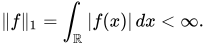 If f {\\displaystyle f}  is Lebesgue integrable then the Fourier transform, given by **[Eq.1](https://en.wikipedia.org/wiki/Fourier_transform#math_Eq.1)**, is well-defined for all ξ ∈ R {\\displaystyle \\xi \\in \\mathbb {R} }  .[\[10\]](https://en.wikipedia.org/wiki/Fourier_transform#cite_note-FOOTNOTEStade2005298%E2%80%93299-14) Furthermore, f ^ ∈ L ∞ ∩ C 0 ( R ) {\\displaystyle {\\widehat {f}}\\in L^{\\infty }\\cap C\_{0}(\\mathbb {R} )}  is bounded, [uniformly continuous](https://en.wikipedia.org/wiki/Uniformly_continuous "Uniformly continuous") and (by the [Riemann–Lebesgue lemma](https://en.wikipedia.org/wiki/Riemann%E2%80%93Lebesgue_lemma "Riemann–Lebesgue lemma")) [vanishing at infinity](https://en.wikipedia.org/wiki/Vanish_at_infinity "Vanish at infinity"). Here C 0 ( R ) {\\displaystyle C\_{0}(\\mathbb {R} )}  denotes the space of continuous functions on R {\\displaystyle \\mathbb {R} }  that approach 0 as x approaches positive or negative infinity.
The space L 1 ( R ) {\\displaystyle L^{1}(\\mathbb {R} )}  is the space of measurable functions for which the norm ‖ f ‖ 1 {\\displaystyle \\\|f\\\|\_{1}}  is finite, modulo the [equivalence relation](https://en.wikipedia.org/wiki/Equivalence_class "Equivalence class") of equality [almost everywhere](https://en.wikipedia.org/wiki/Almost_everywhere "Almost everywhere"). The Fourier transform on L 1 ( R ) {\\displaystyle L^{1}(\\mathbb {R} )}  is [one-to-one](https://en.wikipedia.org/wiki/Bijection,_injection_and_surjection "Bijection, injection and surjection"). However, there is no easy characterization of the image, and thus no easy characterization of the inverse transform. In particular, **[Eq.2](https://en.wikipedia.org/wiki/Fourier_transform#math_Eq.2)** is no longer valid, as it was stated only under the hypothesis that f ( x ) {\\displaystyle f(x)}  was "sufficiently nice" (e.g., f ( x ) {\\displaystyle f(x)}  [decays with all derivatives](https://en.wikipedia.org/wiki/Schwartz_function "Schwartz function")).
While **[Eq.1](https://en.wikipedia.org/wiki/Fourier_transform#math_Eq.1)** defines the Fourier transform for (complex-valued) functions in L 1 ( R ) {\\displaystyle L^{1}(\\mathbb {R} )}  , it is not well-defined for other integrability classes, most importantly the space of [square-integrable functions](https://en.wikipedia.org/wiki/Square-integrable_function "Square-integrable function") L 2 ( R ) {\\displaystyle L^{2}(\\mathbb {R} )}  . For example, the function f ( x ) \= ( 1 \+ x 2 ) − 1 / 2 {\\displaystyle f(x)=(1+x^{2})^{-1/2}}  is in L 2 {\\displaystyle L^{2}}  but not L 1 {\\displaystyle L^{1}}  and therefore the Lebesgue integral **[Eq.1](https://en.wikipedia.org/wiki/Fourier_transform#math_Eq.1)** does not exist. However, the Fourier transform on the dense subspace L 1 ∩ L 2 ( R ) ⊂ L 2 ( R ) {\\displaystyle L^{1}\\cap L^{2}(\\mathbb {R} )\\subset L^{2}(\\mathbb {R} )}  admits a unique continuous extension to a [unitary operator](https://en.wikipedia.org/wiki/Unitary_operator "Unitary operator") on L 2 ( R ) {\\displaystyle L^{2}(\\mathbb {R} )}  . This extension is important in part because, unlike the case of L 1 {\\displaystyle L^{1}}  , the Fourier transform is an [automorphism](https://en.wikipedia.org/wiki/Automorphism "Automorphism") of the space L 2 ( R ) {\\displaystyle L^{2}(\\mathbb {R} )}  .
In such cases, the Fourier transform can be obtained explicitly by [regularizing](https://en.wikipedia.org/wiki/Regularization_\(mathematics\) "Regularization (mathematics)") the integral, and then passing to a limit. In practice, the integral is often regarded as an [improper integral](https://en.wikipedia.org/wiki/Improper_integral "Improper integral") instead of a proper Lebesgue integral, but sometimes for convergence one needs to use [weak limit](https://en.wikipedia.org/wiki/Weak_limit "Weak limit") or [principal value](https://en.wikipedia.org/wiki/Cauchy_principal_value "Cauchy principal value") instead of the (pointwise) limits implicit in an improper integral. [Titchmarsh (1986)](https://en.wikipedia.org/wiki/Fourier_transform#CITEREFTitchmarsh1986) and [Dym & McKean (1985)](https://en.wikipedia.org/wiki/Fourier_transform#CITEREFDymMcKean1985) each gives three rigorous ways of extending the Fourier transform to square integrable functions using this procedure. A general principle in working with the L 2 {\\displaystyle L^{2}}  Fourier transform is that Gaussians are dense in L 1 ∩ L 2 {\\displaystyle L^{1}\\cap L^{2}}  , and the various features of the Fourier transform, such as its unitarity, are easily inferred for Gaussians. Many of the properties of the Fourier transform can then be proven from two facts about Gaussians:[\[11\]](https://en.wikipedia.org/wiki/Fourier_transform#cite_note-FOOTNOTEHowe1980-15)
- that
e
−
π
x
2
{\\displaystyle e^{-\\pi x^{2}}}

is its own Fourier transform; and
- that the [Gaussian integral](https://en.wikipedia.org/wiki/Gaussian_integral "Gaussian integral")
∫
−
∞
∞
e
−
π
x
2
d
x
\=
1
{\\displaystyle \\textstyle \\int \_{-\\infty }^{\\infty }e^{-\\pi x^{2}}\\,dx=1}

.
A feature of the L 1 {\\displaystyle L^{1}}  Fourier transform is that it is a homomorphism of Banach algebras from L 1 {\\displaystyle L^{1}}  equipped with the convolution operation to the Banach algebra of continuous functions under the L ∞ {\\displaystyle L^{\\infty }}  (supremum) norm. The conventions chosen in this article are those of [harmonic analysis](https://en.wikipedia.org/wiki/Harmonic_analysis "Harmonic analysis"), and are characterized as the unique conventions such that the Fourier transform is both [unitary](https://en.wikipedia.org/wiki/Unitary_operator "Unitary operator") on L 2 {\\displaystyle L^{2}}  and an algebra homomorphism from 1 {\\displaystyle {1}}  to L ∞ {\\displaystyle L^{\\infty }}  , without renormalizing the Lebesgue measure.[\[12\]](https://en.wikipedia.org/wiki/Fourier_transform#cite_note-16)
## Background
\[[edit](https://en.wikipedia.org/w/index.php?title=Fourier_transform&action=edit§ion=4 "Edit section: Background")\]
### History
\[[edit](https://en.wikipedia.org/w/index.php?title=Fourier_transform&action=edit§ion=5 "Edit section: History")\]
Main articles: [Fourier analysis § History](https://en.wikipedia.org/wiki/Fourier_analysis#History "Fourier analysis"), and [Fourier series § History](https://en.wikipedia.org/wiki/Fourier_series#History "Fourier series")
In 1822, Fourier claimed (see *[Joseph Fourier § The Analytic Theory of Heat](https://en.wikipedia.org/wiki/Joseph_Fourier#The_Analytic_Theory_of_Heat "Joseph Fourier")*) that any function, whether continuous or discontinuous, can be expanded into a series of sines.[\[13\]](https://en.wikipedia.org/wiki/Fourier_transform#cite_note-17) That important work was corrected and expanded upon by others to provide the foundation for the various forms of the Fourier transform used since.
### Complex sinusoids
\[[edit](https://en.wikipedia.org/w/index.php?title=Fourier_transform&action=edit§ion=6 "Edit section: Complex sinusoids")\]
[](https://en.wikipedia.org/wiki/File:Sine_voltage.svg)
[](https://en.wikipedia.org/wiki/File:Phase_shift.svg)
The red [sinusoid](https://en.wikipedia.org/wiki/Sine_wave "Sine wave") can be described by peak amplitude (1), peak-to-peak (2), [RMS](https://en.wikipedia.org/wiki/Root_mean_square "Root mean square") (3), and [wavelength](https://en.wikipedia.org/wiki/Wavelength "Wavelength") (4). The red and blue sinusoids have a phase difference of θ.
In general, the coefficients f ^ ( ξ ) {\\displaystyle {\\widehat {f}}(\\xi )}  are complex numbers, which have two equivalent forms (see *[Euler's formula](https://en.wikipedia.org/wiki/Euler%27s_formula "Euler's formula")*): f ^ ( ξ ) \= A e i θ ⏟ polar coordinate form \= A cos ( θ ) \+ i A sin ( θ ) ⏟ rectangular coordinate form . {\\displaystyle {\\widehat {f}}(\\xi )=\\underbrace {Ae^{i\\theta }} \_{\\text{polar coordinate form}}=\\underbrace {A\\cos(\\theta )+iA\\sin(\\theta )} \_{\\text{rectangular coordinate form}}.} 
The product with e i 2 π ξ x {\\displaystyle e^{i2\\pi \\xi x}}  (**[Eq.2](https://en.wikipedia.org/wiki/Fourier_transform#math_Eq.2)**) has these forms: f ^ ( ξ ) ⋅ e i 2 π ξ x \= A e i θ ⋅ e i 2 π ξ x \= A e i ( 2 π ξ x \+ θ ) ⏟ polar coordinate form \= A cos ( 2 π ξ x \+ θ ) \+ i A sin ( 2 π ξ x \+ θ ) ⏟ rectangular coordinate form , {\\displaystyle {\\begin{aligned}{\\widehat {f}}(\\xi )\\cdot e^{i2\\pi \\xi x}&=Ae^{i\\theta }\\cdot e^{i2\\pi \\xi x}\\\\\[6pt\]&=\\underbrace {Ae^{i(2\\pi \\xi x+\\theta )}} \_{\\text{polar coordinate form}}\\\\\[6pt\]&=\\underbrace {A\\cos(2\\pi \\xi x+\\theta )+iA\\sin(2\\pi \\xi x+\\theta )} \_{\\text{rectangular coordinate form}},\\end{aligned}}} ![{\\displaystyle {\\begin{aligned}{\\widehat {f}}(\\xi )\\cdot e^{i2\\pi \\xi x}&=Ae^{i\\theta }\\cdot e^{i2\\pi \\xi x}\\\\\[6pt\]&=\\underbrace {Ae^{i(2\\pi \\xi x+\\theta )}} \_{\\text{polar coordinate form}}\\\\\[6pt\]&=\\underbrace {A\\cos(2\\pi \\xi x+\\theta )+iA\\sin(2\\pi \\xi x+\\theta )} \_{\\text{rectangular coordinate form}},\\end{aligned}}}](https://wikimedia.org/api/rest_v1/media/math/render/svg/dd771490061144304fd143e19371f666a26937ba) which conveys both [amplitude](https://en.wikipedia.org/wiki/Amplitude "Amplitude") and [phase](https://en.wikipedia.org/wiki/Phase_offset "Phase offset") of frequency ξ {\\displaystyle \\xi }  . Likewise, the intuitive interpretation of **[Eq.1](https://en.wikipedia.org/wiki/Fourier_transform#math_Eq.1)** is that multiplying f ( x ) {\\displaystyle f(x)}  by e − i 2 π ξ x {\\displaystyle e^{-i2\\pi \\xi x}}  has the effect of subtracting ξ {\\displaystyle \\xi }  from every frequency component of function f ( x ) {\\displaystyle f(x)}  .[\[note 5\]](https://en.wikipedia.org/wiki/Fourier_transform#cite_note-18) Only the component that was at frequency ξ {\\displaystyle \\xi }  can produce a non-zero value of the infinite integral, because (at least formally) all the other shifted components are oscillatory and integrate to zero (see *[§ Example](https://en.wikipedia.org/wiki/Fourier_transform#Example)*).
It is noteworthy how easily the product was simplified using the polar form, and how easily the rectangular form was deduced by an application of Euler's formula.
### Negative frequency
\[[edit](https://en.wikipedia.org/w/index.php?title=Fourier_transform&action=edit§ion=7 "Edit section: Negative frequency")\]
See also: [Negative frequency § Simplifying the Fourier transform](https://en.wikipedia.org/wiki/Negative_frequency#Simplifying_the_Fourier_transform "Negative frequency")
Euler's formula introduces the possibility of negative ξ {\\displaystyle \\xi }  . **[Eq.1](https://en.wikipedia.org/wiki/Fourier_transform#math_Eq.1)** is defined ∀ ξ ∈ R {\\displaystyle \\forall \\xi \\in \\mathbb {R} }  . Only certain complex-valued f ( x ) {\\displaystyle f(x)}  have transforms f ^ \= 0 , ∀ ξ \< 0 {\\displaystyle {\\widehat {f}}=0,\\ \\forall \\ \\xi \<0} 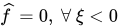 . (See *[Analytic signal](https://en.wikipedia.org/wiki/Analytic_signal "Analytic signal")*; a simple example is e i 2 π ξ 0 x ( ξ 0 \> 0 ) {\\displaystyle e^{i2\\pi \\xi \_{0}x}\\ (\\xi \_{0}\>0)}  .) But negative frequency is necessary to characterize all other complex-valued f ( x ) {\\displaystyle f(x)}  , found in [signal processing](https://en.wikipedia.org/wiki/Signal_processing "Signal processing"), [partial differential equations](https://en.wikipedia.org/wiki/Partial_differential_equations "Partial differential equations"), [radar](https://en.wikipedia.org/wiki/Radar "Radar"), [nonlinear optics](https://en.wikipedia.org/wiki/Nonlinear_optics "Nonlinear optics"), [quantum mechanics](https://en.wikipedia.org/wiki/Quantum_mechanics "Quantum mechanics"), and others.
For a real-valued f ( x ) {\\displaystyle f(x)}  , **[Eq.1](https://en.wikipedia.org/wiki/Fourier_transform#math_Eq.1)** has the symmetry property f ^ ( − ξ ) \= f ^ ∗ ( ξ ) {\\displaystyle {\\widehat {f}}(-\\xi )={\\widehat {f}}^{\*}(\\xi )} 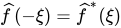 (see *[§ Conjugation](https://en.wikipedia.org/wiki/Fourier_transform#Conjugation)* below). This redundancy enables **[Eq.2](https://en.wikipedia.org/wiki/Fourier_transform#math_Eq.2)** to distinguish f ( x ) \= cos ( 2 π ξ 0 x ) {\\displaystyle f(x)=\\cos(2\\pi \\xi \_{0}x)}  from e i 2 π ξ 0 x {\\displaystyle e^{i2\\pi \\xi \_{0}x}}  . But it cannot determine the actual sign of ξ 0 {\\displaystyle \\xi \_{0}}  , because cos ( 2 π ξ 0 x ) {\\displaystyle \\cos(2\\pi \\xi \_{0}x)}  and cos ( 2 π ( − ξ 0 ) x ) {\\displaystyle \\cos(2\\pi (-\\xi \_{0})x)} 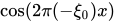 are indistinguishable on just the real numbers line.
### Fourier transform for periodic functions
\[[edit](https://en.wikipedia.org/w/index.php?title=Fourier_transform&action=edit§ion=8 "Edit section: Fourier transform for periodic functions")\]
The Fourier transform of a periodic function cannot be defined using the integral formula directly. In order for integral in **[Eq.1](https://en.wikipedia.org/wiki/Fourier_transform#math_Eq.1)** to be defined the function must be [absolutely integrable](https://en.wikipedia.org/wiki/Absolutely_integrable_function "Absolutely integrable function"). Instead it is common to use [Fourier series](https://en.wikipedia.org/wiki/Fourier_series "Fourier series"). It is possible to extend the definition to include periodic functions by viewing them as [tempered distributions](https://en.wikipedia.org/wiki/Distribution_\(mathematics\)#Tempered_distributions "Distribution (mathematics)").
This makes it possible to see a connection between the [Fourier series](https://en.wikipedia.org/wiki/Fourier_series "Fourier series") and the Fourier transform for periodic functions that have a [convergent Fourier series](https://en.wikipedia.org/wiki/Convergence_of_Fourier_series "Convergence of Fourier series"). If f ( x ) {\\displaystyle f(x)}  is a [periodic function](https://en.wikipedia.org/wiki/Periodic_function "Periodic function"), with period P {\\displaystyle P}  , that has a convergent Fourier series, then: f ^ ( ξ ) \= ∑ n \= − ∞ ∞ c n ⋅ δ ( ξ − n P ) , {\\displaystyle {\\widehat {f}}(\\xi )=\\sum \_{n=-\\infty }^{\\infty }c\_{n}\\cdot \\delta \\left(\\xi -{\\tfrac {n}{P}}\\right),} 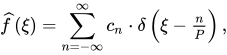 where c n {\\displaystyle c\_{n}}  are the Fourier series coefficients of f {\\displaystyle f}  , and δ {\\displaystyle \\delta }  is the [Dirac delta function](https://en.wikipedia.org/wiki/Dirac_delta_function "Dirac delta function"). In other words, the Fourier transform is a [Dirac comb](https://en.wikipedia.org/wiki/Dirac_comb "Dirac comb") function whose *teeth* are multiplied by the Fourier series coefficients.
### Sampling the Fourier transform
\[[edit](https://en.wikipedia.org/w/index.php?title=Fourier_transform&action=edit§ion=9 "Edit section: Sampling the Fourier transform")\]
For broader coverage of this topic, see [Poisson summation formula](https://en.wikipedia.org/wiki/Poisson_summation_formula "Poisson summation formula").
The Fourier transform of an [integrable](https://en.wikipedia.org/wiki/Absolutely_integrable_function "Absolutely integrable function") function f {\\displaystyle f}  can be sampled at regular intervals of arbitrary length 1 / P {\\displaystyle 1/P}  . These samples can be deduced from one cycle of a periodic function f P {\\displaystyle f\_{P}}  , which has [Fourier series](https://en.wikipedia.org/wiki/Fourier_series "Fourier series") coefficients proportional to those samples by the [Poisson summation formula](https://en.wikipedia.org/wiki/Poisson_summation_formula "Poisson summation formula"): f P ( x ) ≜ ∑ n \= − ∞ ∞ f ( x \+ n P ) \= 1 P ∑ k \= − ∞ ∞ f ^ ( k P ) e i 2 π k P x , ∀ k ∈ Z . {\\displaystyle f\_{P}(x)\\triangleq \\sum \_{n=-\\infty }^{\\infty }f(x+nP)={\\frac {1}{P}}\\sum \_{k=-\\infty }^{\\infty }{\\widehat {f}}\\left({\\tfrac {k}{P}}\\right)e^{i2\\pi {\\frac {k}{P}}x},\\quad \\forall k\\in \\mathbb {Z} .} 
The integrability of f {\\displaystyle f}  ensures the [periodic summation](https://en.wikipedia.org/wiki/Periodic_summation "Periodic summation") converges. Therefore, the samples f ^ ( k P ) {\\displaystyle {\\widehat {f}}({\\tfrac {k}{P}})}  can be determined by Fourier series analysis: f ^ ( k P ) \= ∫ P f P ( x ) ⋅ e − i 2 π k P x d x . {\\displaystyle {\\widehat {f}}\\left({\\tfrac {k}{P}}\\right)=\\int \_{P}f\_{P}(x)\\cdot e^{-i2\\pi {\\frac {k}{P}}x}\\,dx.} 
When f ( x ) {\\displaystyle f(x)}  has [compact support](https://en.wikipedia.org/wiki/Compact_support "Compact support"), f P ( x ) {\\displaystyle f\_{P}(x)}  has a finite number of terms within the interval of integration. When f ( x ) {\\displaystyle f(x)}  does not have compact support, numerical evaluation of f P ( x ) {\\displaystyle f\_{P}(x)}  requires an approximation, such as tapering f ( x ) {\\displaystyle f(x)}  or truncating the number of terms.
## Units
\[[edit](https://en.wikipedia.org/w/index.php?title=Fourier_transform&action=edit§ion=10 "Edit section: Units")\]
See also: [Spectral density § Units](https://en.wikipedia.org/wiki/Spectral_density#Units "Spectral density")
The frequency variable must have inverse units to the units of the original function's domain (typically named t {\\displaystyle t}  or x {\\displaystyle x}  ). For example, if t {\\displaystyle t}  is measured in seconds, ξ {\\displaystyle \\xi }  should be in cycles per second or [hertz](https://en.wikipedia.org/wiki/Hertz "Hertz"). If the scale of time is in units of 2 π {\\displaystyle 2\\pi }  seconds, then another Greek letter ω {\\displaystyle \\omega }  is typically used instead to represent [angular frequency](https://en.wikipedia.org/wiki/Angular_frequency "Angular frequency") (where ω \= 2 π ξ {\\displaystyle \\omega =2\\pi \\xi }  ) in units of [radians](https://en.wikipedia.org/wiki/Radian "Radian") per second. If using x {\\displaystyle x}  for units of length, then ξ {\\displaystyle \\xi }  must be in inverse length, e.g., [wavenumbers](https://en.wikipedia.org/wiki/Wavenumber "Wavenumber"). That is to say, there are two versions of the real line: one that is the [range](https://en.wikipedia.org/wiki/Range_of_a_function "Range of a function") of t {\\displaystyle t}  and measured in units of t {\\displaystyle t}  , and the other that is the range of ξ {\\displaystyle \\xi }  and measured in inverse units to the units of t {\\displaystyle t}  . These two distinct versions of the real line cannot be equated with each other. Therefore, the Fourier transform goes from one space of functions to a different space of functions: functions that have a different domain of definition.
In general, ξ {\\displaystyle \\xi }  must always be taken to be a [linear form](https://en.wikipedia.org/wiki/Linear_form "Linear form") on the space of its domain, which is to say that the second real line is the [dual space](https://en.wikipedia.org/wiki/Dual_space "Dual space") of the first real line. See the article *[Linear algebra](https://en.wikipedia.org/wiki/Linear_algebra "Linear algebra")* for a more formal explanation and for more details. This point of view becomes essential in generalizations of the Fourier transform to general [symmetry groups](https://en.wikipedia.org/wiki/Symmetry_group "Symmetry group"), including the case of Fourier series.
That there is no one preferred way (often, one says "no canonical way") to compare the two versions of the real line that are involved in the Fourier transform—fixing the units on one line does not force the scale of the units on the other line—is the reason for the plethora of rival conventions on the definition of the Fourier transform. The various definitions resulting from different choices of units differ by various constants.
In other conventions, the Fourier transform has i in the exponent instead of −*i*, and vice versa for the inversion formula. This convention is common in modern physics[\[14\]](https://en.wikipedia.org/wiki/Fourier_transform#cite_note-19) and is the default for [Wolfram Alpha](https://www.wolframalpha.com/), and does not mean that the frequency has become negative, since there is no canonical definition of positivity for frequency of a complex wave. It simply means that f ^ ( ξ ) {\\displaystyle {\\widehat {f}}(\\xi )}  is the amplitude of the wave e − i 2 π ξ x {\\displaystyle e^{-i2\\pi \\xi x}}  instead of the wave e i 2 π ξ x {\\displaystyle e^{i2\\pi \\xi x}}  (the former, with its minus sign, is often seen in the time dependence for [sinusoidal plane-wave solutions of the electromagnetic wave equation](https://en.wikipedia.org/wiki/Sinusoidal_plane-wave_solutions_of_the_electromagnetic_wave_equation "Sinusoidal plane-wave solutions of the electromagnetic wave equation"), or in the [time dependence for quantum wave functions](https://en.wikipedia.org/wiki/Wave_function#Time_dependence "Wave function")). Many of the identities involving the Fourier transform remain valid in those conventions, provided all terms that explicitly involve *i* have it replaced by −*i*. In [electrical engineering](https://en.wikipedia.org/wiki/Electrical_engineering "Electrical engineering") the letter *j* is typically used for the [imaginary unit](https://en.wikipedia.org/wiki/Imaginary_unit "Imaginary unit") instead of *i* because *i* is used for current.
When using [dimensionless units](https://en.wikipedia.org/wiki/Dimensionless_units "Dimensionless units"), the constant factors might not be written in the transform definition. For instance, in [probability theory](https://en.wikipedia.org/wiki/Probability_theory "Probability theory"), the characteristic function Φ of the probability density function f {\\displaystyle f}  of a random variable X {\\displaystyle X}  of continuous type is defined without a negative sign in the exponential, and since the units of x {\\displaystyle x}  are ignored, there is no 2 π {\\displaystyle 2\\pi }  either: φ ( λ ) \= ∫ − ∞ ∞ f ( x ) e i λ x d x . {\\displaystyle \\varphi (\\lambda )=\\int \_{-\\infty }^{\\infty }f(x)e^{i\\lambda x}\\,dx.} 
In probability theory and mathematical statistics, the use of the Fourier—Stieltjes transform is preferred, because many random variables are not of continuous type, and do not possess a density function, and one must treat not functions but [distributions](https://en.wikipedia.org/wiki/Distribution_\(mathematics\) "Distribution (mathematics)"), i.e., measures that possess "atoms".
From the higher point of view of [group characters](https://en.wikipedia.org/wiki/Character_theory "Character theory"), which is much more abstract, all these arbitrary choices disappear, as will be explained in the later section of this article, which treats the notion of the Fourier transform of a function on a [locally compact abelian group](https://en.wikipedia.org/wiki/Locally_compact_abelian_group "Locally compact abelian group").
## Properties
\[[edit](https://en.wikipedia.org/w/index.php?title=Fourier_transform&action=edit§ion=11 "Edit section: Properties")\]
Let f ( x ) {\\displaystyle f(x)}  and h ( x ) {\\displaystyle h(x)}  represent *integrable functions* [Lebesgue-measurable](https://en.wikipedia.org/wiki/Lebesgue-measurable "Lebesgue-measurable") on the real line satisfying: ∫ − ∞ ∞ \| f ( x ) \| d x \< ∞ . {\\displaystyle \\int \_{-\\infty }^{\\infty }\|f(x)\|\\,dx\<\\infty .} 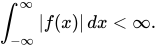 We denote the Fourier transforms of these functions as f ^ ( ξ ) {\\displaystyle {\\widehat {f}}(\\xi )}  and h ^ ( ξ ) {\\displaystyle {\\widehat {h}}(\\xi )}  respectively.
### Basic properties
\[[edit](https://en.wikipedia.org/w/index.php?title=Fourier_transform&action=edit§ion=12 "Edit section: Basic properties")\]
The Fourier transform has the following basic properties:[\[15\]](https://en.wikipedia.org/wiki/Fourier_transform#cite_note-Pinsky-2002-20)
#### Linearity
\[[edit](https://en.wikipedia.org/w/index.php?title=Fourier_transform&action=edit§ion=13 "Edit section: Linearity")\]
a f ( x ) \+ b h ( x ) ⟺ F a f ^ ( ξ ) \+ b h ^ ( ξ ) ; a , b ∈ C {\\displaystyle a\\ f(x)+b\\ h(x)\\ \\ {\\stackrel {\\mathcal {F}}{\\Longleftrightarrow }}\\ \\ a\\ {\\widehat {f}}(\\xi )+b\\ {\\widehat {h}}(\\xi );\\quad \\ a,b\\in \\mathbb {C} } 
#### Time shifting
\[[edit](https://en.wikipedia.org/w/index.php?title=Fourier_transform&action=edit§ion=14 "Edit section: Time shifting")\]
f ( x − x 0 ) ⟺ F e − i 2 π x 0 ξ f ^ ( ξ ) ; x 0 ∈ R {\\displaystyle f(x-x\_{0})\\ \\ {\\stackrel {\\mathcal {F}}{\\Longleftrightarrow }}\\ \\ e^{-i2\\pi x\_{0}\\xi }\\ {\\widehat {f}}(\\xi );\\quad \\ x\_{0}\\in \\mathbb {R} } 
#### Frequency shifting
\[[edit](https://en.wikipedia.org/w/index.php?title=Fourier_transform&action=edit§ion=15 "Edit section: Frequency shifting")\]
e i 2 π ξ 0 x f ( x ) ⟺ F f ^ ( ξ − ξ 0 ) ; ξ 0 ∈ R {\\displaystyle e^{i2\\pi \\xi \_{0}x}f(x)\\ \\ {\\stackrel {\\mathcal {F}}{\\Longleftrightarrow }}\\ \\ {\\widehat {f}}(\\xi -\\xi \_{0});\\quad \\ \\xi \_{0}\\in \\mathbb {R} } 
#### Time scaling
\[[edit](https://en.wikipedia.org/w/index.php?title=Fourier_transform&action=edit§ion=16 "Edit section: Time scaling")\]
f ( a x ) ⟺ F 1 \| a \| f ^ ( ξ a ) ; a ≠ 0 {\\displaystyle f(ax)\\ \\ {\\stackrel {\\mathcal {F}}{\\Longleftrightarrow }}\\ \\ {\\frac {1}{\|a\|}}{\\widehat {f}}\\left({\\frac {\\xi }{a}}\\right);\\quad \\ a\\neq 0}  The case a \= − 1 {\\displaystyle a=-1}  leads to the *time-reversal property*: f ( − x ) ⟺ F f ^ ( − ξ ) {\\displaystyle f(-x)\\ \\ {\\stackrel {\\mathcal {F}}{\\Longleftrightarrow }}\\ \\ {\\widehat {f}}(-\\xi )} 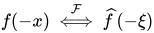
[](https://en.wikipedia.org/wiki/File:Fourier_unit_pulse.svg "The transform of an even-symmetric real-valued function '\"`UNIQ--postMath-0000008D-QINU`\"' is also an even-symmetric real-valued function ('\"`UNIQ--postMath-0000008E-QINU`\"'). The time-shift, '\"`UNIQ--postMath-0000008F-QINU`\"', creates an imaginary component, '\"`UNIQ--postMath-00000090-QINU`\"'. (See § Symmetry.)")
f
(
t
)
{\\displaystyle \\scriptstyle f(t)}

f
^
(
ω
)
{\\displaystyle \\scriptstyle {\\widehat {f}}(\\omega )}

g
(
t
)
{\\displaystyle \\scriptstyle g(t)}

g
^
(
ω
)
{\\displaystyle \\scriptstyle {\\widehat {g}}(\\omega )}

t
{\\displaystyle \\scriptstyle t}

ω
{\\displaystyle \\scriptstyle \\omega }

t
{\\displaystyle \\scriptstyle t}

ω
{\\displaystyle \\scriptstyle \\omega }

[](https://en.wikipedia.org/wiki/File:Fourier_unit_pulse.svg)
The transform of an even-symmetric real-valued function
f
(
t
)
\=
f
RE
{\\displaystyle f(t)=f\_{\_{\\text{RE}}}}

is also an even-symmetric real-valued function (
f
^
RE
{\\displaystyle {\\widehat {f}}\\!\_{\_{\\text{RE}}}}

). The time-shift,
g
(
t
)
\=
g
RE
\+
g
RO
{\\displaystyle g(t)=g\_{\_{\\text{RE}}}+g\_{\_{\\text{RO}}}}

, creates an imaginary component,
i
g
^
IO
{\\displaystyle i\\ {\\widehat {g\\ \\!}}\_{\_{\\text{IO}}}}

. (See *[§ Symmetry](https://en.wikipedia.org/wiki/Fourier_transform#Symmetry)*.)
#### Symmetry
\[[edit](https://en.wikipedia.org/w/index.php?title=Fourier_transform&action=edit§ion=17 "Edit section: Symmetry")\]
When the real and imaginary parts of a complex function are decomposed into their [even and odd parts](https://en.wikipedia.org/wiki/Even_and_odd_functions#Even%E2%80%93odd_decomposition "Even and odd functions"), there are four components, denoted below by the subscripts RE, RO, IE, and IO. And there is a one-to-one mapping between the four components of a complex time function and the four components of its complex frequency transform:[\[16\]](https://en.wikipedia.org/wiki/Fourier_transform#cite_note-FOOTNOTEProakisManolakis1996[httpsarchiveorgdetailsdigitalsignalpro00proapage291_291]-21)
T
i
m
e
d
o
m
a
i
n
f
\=
f
RE
\+
f
RO
\+
i
f
IE
\+
i
f
IO
⏟
⇕
F
⇕
F
⇕
F
⇕
F
⇕
F
F
r
e
q
u
e
n
c
y
d
o
m
a
i
n
f
^
\=
f
^
RE
\+
i
f
^
IO
⏞
\+
i
f
^
IE
\+
f
^
RO
{\\displaystyle {\\begin{array}{rlcccccccc}{\\mathsf {Time\\ domain}}\&f&=\&f\_{\_{\\text{RE}}}&+\&f\_{\_{\\text{RO}}}&+\&i\\ f\_{\_{\\text{IE}}}&+&\\underbrace {i\\ f\_{\_{\\text{IO}}}} \\\\&{\\Bigg \\Updownarrow }{\\mathcal {F}}&&{\\Bigg \\Updownarrow }{\\mathcal {F}}&&\\ \\ {\\Bigg \\Updownarrow }{\\mathcal {F}}&&\\ \\ {\\Bigg \\Updownarrow }{\\mathcal {F}}&&\\ \\ {\\Bigg \\Updownarrow }{\\mathcal {F}}\\\\{\\mathsf {Frequency\\ domain}}&{\\widehat {f}}&=&{\\widehat {f}}\\!\_{\_{\\text{RE}}}&+&\\overbrace {i\\ {\\widehat {f}}\\!\_{\_{\\text{IO}}}} &+\&i\\ {\\widehat {f}}\\!\_{\_{\\text{IE}}}&+&{\\widehat {f}}\\!\_{\_{\\text{RO}}}\\end{array}}}

From this, various relationships are apparent, for example:
- The transform of a real-valued function (
f
RE
\+
f
RO
{\\displaystyle f\_{\_{\\text{RE}}}+f\_{\_{\\text{RO}}}}

) is the *[conjugate symmetric](https://en.wikipedia.org/wiki/Even_and_odd_functions#Complex-valued_functions "Even and odd functions")* function
f
^
RE
\+
i
f
^
IO
{\\displaystyle {\\widehat {f}}\\!\_{\_{\\text{RE}}}+i\\ {\\widehat {f}}\\!\_{\_{\\text{IO}}}}

. Conversely, a *conjugate symmetric* transform implies a real-valued time-domain.
- The transform of an imaginary-valued function (
i
f
IE
\+
i
f
IO
{\\displaystyle i\\ f\_{\_{\\text{IE}}}+i\\ f\_{\_{\\text{IO}}}}

) is the *[conjugate antisymmetric](https://en.wikipedia.org/wiki/Even_and_odd_functions#Complex-valued_functions "Even and odd functions")* function
f
^
RO
\+
i
f
^
IE
{\\displaystyle {\\widehat {f}}\\!\_{\_{\\text{RO}}}+i\\ {\\widehat {f}}\\!\_{\_{\\text{IE}}}}

, and the converse is true.
- The transform of a *[conjugate symmetric](https://en.wikipedia.org/wiki/Even_and_odd_functions#Complex-valued_functions "Even and odd functions")* function
(
f
RE
\+
i
f
IO
)
{\\displaystyle (f\_{\_{\\text{RE}}}+i\\ f\_{\_{\\text{IO}}})}

is the real-valued function
f
^
RE
\+
f
^
RO
{\\displaystyle {\\widehat {f}}\\!\_{\_{\\text{RE}}}+{\\widehat {f}}\\!\_{\_{\\text{RO}}}}

, and the converse is true.
- The transform of a *[conjugate antisymmetric](https://en.wikipedia.org/wiki/Even_and_odd_functions#Complex-valued_functions "Even and odd functions")* function
(
f
RO
\+
i
f
IE
)
{\\displaystyle (f\_{\_{\\text{RO}}}+i\\ f\_{\_{\\text{IE}}})}

is the imaginary-valued function
i
f
^
IE
\+
i
f
^
IO
{\\displaystyle i\\ {\\widehat {f}}\\!\_{\_{\\text{IE}}}+i\\ {\\widehat {f}}\\!\_{\_{\\text{IO}}}}

, and the converse is true.
#### Conjugation
\[[edit](https://en.wikipedia.org/w/index.php?title=Fourier_transform&action=edit§ion=18 "Edit section: Conjugation")\]
( f ( x ) ) ∗ ⟺ F ( f ^ ( − ξ ) ) ∗ {\\displaystyle {\\bigl (}f(x){\\bigr )}^{\*}\\ \\ {\\stackrel {\\mathcal {F}}{\\Longleftrightarrow }}\\ \\ \\left({\\widehat {f}}(-\\xi )\\right)^{\*}} 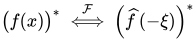 (Note: the ∗ {\\displaystyle \*}  denotes [complex conjugation](https://en.wikipedia.org/wiki/Complex_conjugate "Complex conjugate").)
In particular, if f {\\displaystyle f}  is *real*, then f ^ {\\displaystyle {\\widehat {f}}}  is [conjugate symmetric](https://en.wikipedia.org/wiki/Even_and_odd_functions#Complex-valued_functions "Even and odd functions") (a.k.a. [Hermitian function](https://en.wikipedia.org/wiki/Hermitian_function "Hermitian function")): f ^ ( − ξ ) \= ( f ^ ( ξ ) ) ∗ . {\\displaystyle {\\widehat {f}}(-\\xi )={\\bigl (}{\\widehat {f}}(\\xi ){\\bigr )}^{\*}.} 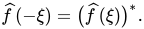
If f {\\displaystyle f}  is purely imaginary, then f ^ {\\displaystyle {\\widehat {f}}}  is [odd symmetric](https://en.wikipedia.org/wiki/Even_and_odd_functions#Complex-valued_functions "Even and odd functions"): f ^ ( − ξ ) \= − ( f ^ ( ξ ) ) ∗ . {\\displaystyle {\\widehat {f}}(-\\xi )=-({\\widehat {f}}(\\xi ))^{\*}.} 
#### Real and imaginary parts
\[[edit](https://en.wikipedia.org/w/index.php?title=Fourier_transform&action=edit§ion=19 "Edit section: Real and imaginary parts")\]
Re { f ( x ) } ⟺ F 1 2 ( f ^ ( ξ ) \+ ( f ^ ( − ξ ) ) ∗ ) {\\displaystyle \\operatorname {Re} \\{f(x)\\}\\ \\ {\\stackrel {\\mathcal {F}}{\\Longleftrightarrow }}\\ \\ {\\tfrac {1}{2}}\\left({\\widehat {f}}(\\xi )+{\\bigl (}{\\widehat {f}}(-\\xi ){\\bigr )}^{\*}\\right)}  Im { f ( x ) } ⟺ F 1 2 i ( f ^ ( ξ ) − ( f ^ ( − ξ ) ) ∗ ) {\\displaystyle \\operatorname {Im} \\{f(x)\\}\\ \\ {\\stackrel {\\mathcal {F}}{\\Longleftrightarrow }}\\ \\ {\\tfrac {1}{2i}}\\left({\\widehat {f}}(\\xi )-{\\bigl (}{\\widehat {f}}(-\\xi ){\\bigr )}^{\*}\\right)} 
#### Zero frequency component
\[[edit](https://en.wikipedia.org/w/index.php?title=Fourier_transform&action=edit§ion=20 "Edit section: Zero frequency component")\]
Substituting ξ \= 0 {\\displaystyle \\xi =0}  in the definition, we obtain: f ^ ( 0 ) \= ∫ − ∞ ∞ f ( x ) d x . {\\displaystyle {\\widehat {f}}(0)=\\int \_{-\\infty }^{\\infty }f(x)\\,dx.} 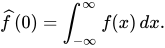
The integral of f {\\displaystyle f}  over its domain is known as the average value or [DC bias](https://en.wikipedia.org/wiki/DC_bias "DC bias") of the function.
### Uniform continuity and the Riemann–Lebesgue lemma
\[[edit](https://en.wikipedia.org/w/index.php?title=Fourier_transform&action=edit§ion=21 "Edit section: Uniform continuity and the Riemann–Lebesgue lemma")\]
[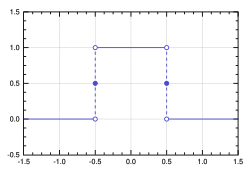](https://en.wikipedia.org/wiki/File:Rectangular_function.svg)
The [rectangular function](https://en.wikipedia.org/wiki/Rectangular_function "Rectangular function") is [Lebesgue integrable](https://en.wikipedia.org/wiki/Lebesgue_integrable "Lebesgue integrable").
[](https://en.wikipedia.org/wiki/File:Sinc_function_\(normalized\).svg)
The [sinc function](https://en.wikipedia.org/wiki/Sinc_function "Sinc function"), which is the Fourier transform of the rectangular function, is bounded and continuous, but not Lebesgue integrable.
The Fourier transform may be defined in some cases for non-integrable functions, but the Fourier transforms of integrable functions have several strong properties.
The Fourier transform f ^ {\\displaystyle {\\widehat {f}}}  of any integrable function f {\\displaystyle f}  is [uniformly continuous](https://en.wikipedia.org/wiki/Uniformly_continuous "Uniformly continuous") and[\[17\]](https://en.wikipedia.org/wiki/Fourier_transform#cite_note-FOOTNOTEKatznelson2004153-22)[\[18\]](https://en.wikipedia.org/wiki/Fourier_transform#cite_note-FOOTNOTESteinWeiss19712-23) ‖ f ^ ‖ ∞ ≤ ‖ f ‖ 1 {\\displaystyle \\left\\\|{\\widehat {f}}\\right\\\|\_{\\infty }\\leq \\left\\\|f\\right\\\|\_{1}} 
By the *[Riemann–Lebesgue lemma](https://en.wikipedia.org/wiki/Riemann%E2%80%93Lebesgue_lemma "Riemann–Lebesgue lemma")*,[\[19\]](https://en.wikipedia.org/wiki/Fourier_transform#cite_note-Stein-Weiss-1971-24) f ^ ( ξ ) → 0 as \| ξ \| → ∞ . {\\displaystyle {\\widehat {f}}(\\xi )\\to 0{\\text{ as }}\|\\xi \|\\to \\infty .} 
However, f ^ {\\displaystyle {\\widehat {f}}}  need not be integrable. For example, the Fourier transform of the [rectangular function](https://en.wikipedia.org/wiki/Rectangular_function "Rectangular function"), which is integrable, is the [sinc function](https://en.wikipedia.org/wiki/Sinc_function "Sinc function"), which is not [Lebesgue integrable](https://en.wikipedia.org/wiki/Lebesgue_integrable "Lebesgue integrable"), because its [improper integrals](https://en.wikipedia.org/wiki/Improper_integral "Improper integral") behave analogously to the [alternating harmonic series](https://en.wikipedia.org/wiki/Alternating_harmonic_series "Alternating harmonic series"), in converging to a sum without being [absolutely convergent](https://en.wikipedia.org/wiki/Absolutely_convergent "Absolutely convergent").
It is not generally possible to write the *inverse transform* as a [Lebesgue integral](https://en.wikipedia.org/wiki/Lebesgue_integral "Lebesgue integral"). However, when both f {\\displaystyle f}  and f ^ {\\displaystyle {\\widehat {f}}}  are integrable, the inverse equality f ( x ) \= ∫ − ∞ ∞ f ^ ( ξ ) e i 2 π x ξ d ξ {\\displaystyle f(x)=\\int \_{-\\infty }^{\\infty }{\\widehat {f}}(\\xi )e^{i2\\pi x\\xi }\\,d\\xi }  holds for almost every x. As a result, the Fourier transform is [injective](https://en.wikipedia.org/wiki/Injective "Injective") on [*L*1(**R**)](https://en.wikipedia.org/wiki/Lp_space "Lp space").
### Plancherel theorem and Parseval's theorem
\[[edit](https://en.wikipedia.org/w/index.php?title=Fourier_transform&action=edit§ion=22 "Edit section: Plancherel theorem and Parseval's theorem")\]
Main articles: [Plancherel theorem](https://en.wikipedia.org/wiki/Plancherel_theorem "Plancherel theorem") and [Parseval's theorem](https://en.wikipedia.org/wiki/Parseval%27s_theorem "Parseval's theorem")
Let f ( x ) {\\displaystyle f(x)}  and g ( x ) {\\displaystyle g(x)}  be integrable, and let f ^ {\\displaystyle {\\widehat {f}}}  and g ^ {\\displaystyle {\\widehat {g}}}  be their Fourier transforms. If f ( x ) {\\displaystyle f(x)}  and g ( x ) {\\displaystyle g(x)}  are also [square-integrable](https://en.wikipedia.org/wiki/Square-integrable "Square-integrable"), then the Parseval formula follows:[\[20\]](https://en.wikipedia.org/wiki/Fourier_transform#cite_note-25) ⟨ f , g ⟩ L 2 \= ∫ − ∞ ∞ f ( x ) g ( x ) ¯ d x \= ∫ − ∞ ∞ f ^ ( ξ ) g ^ ( ξ ) ¯ d ξ , {\\displaystyle \\langle f,g\\rangle \_{L^{2}}=\\int \_{-\\infty }^{\\infty }f(x){\\overline {g(x)}}\\,dx=\\int \_{-\\infty }^{\\infty }{\\widehat {f}}(\\xi ){\\overline {{\\widehat {g}}(\\xi )}}\\,d\\xi ,}  where the bar denotes [complex conjugation](https://en.wikipedia.org/wiki/Complex_conjugation "Complex conjugation").
The [Plancherel theorem](https://en.wikipedia.org/wiki/Plancherel_theorem "Plancherel theorem"), which follows from the above, states that[\[21\]](https://en.wikipedia.org/wiki/Fourier_transform#cite_note-26) ‖ f ‖ L 2 2 \= ∫ − ∞ ∞ \| f ( x ) \| 2 d x \= ∫ − ∞ ∞ \| f ^ ( ξ ) \| 2 d ξ . {\\displaystyle \\\|f\\\|\_{L^{2}}^{2}=\\int \_{-\\infty }^{\\infty }\\left\|f(x)\\right\|^{2}\\,dx=\\int \_{-\\infty }^{\\infty }\\left\|{\\widehat {f}}(\\xi )\\right\|^{2}\\,d\\xi .} 
Plancherel's theorem makes it possible to extend the Fourier transform, by a continuity argument, to a [unitary operator](https://en.wikipedia.org/wiki/Unitary_operator "Unitary operator") on L 2 ( R ) {\\displaystyle L^{2}(\\mathbb {R} )}  . On L 1 ( R ) ∩ L 2 ( R ) {\\displaystyle L^{1}(\\mathbb {R} )\\cap L^{2}(\\mathbb {R} )} 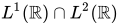 , this extension agrees with original Fourier transform defined on L 1 ( R ) {\\displaystyle L^{1}(\\mathbb {R} )}  , thus enlarging the domain of the Fourier transform to L 1 ( R ) \+ L 2 ( R ) {\\displaystyle L^{1}(\\mathbb {R} )+L^{2}(\\mathbb {R} )}  (and consequently to L p ( R ) {\\displaystyle L^{p}(\\mathbb {R} )}  for 1 ≤ p ≤ 2 {\\displaystyle 1\\leq p\\leq 2}  ). Plancherel's theorem has the interpretation in the sciences that the Fourier transform preserves the [energy](https://en.wikipedia.org/wiki/Energy "Energy") of the original quantity. The terminology of these formulas is not quite standardised. [Parseval's theorem](https://en.wikipedia.org/wiki/Parseval%27s_theorem "Parseval's theorem") was proved only for Fourier series, and was first proved by Lyapunov. But Parseval's formula makes sense for the Fourier transform as well, and so even though in the context of the Fourier transform it was proved by Plancherel, it is still often referred to as Parseval's formula, or Parseval's relation, or even Parseval's theorem.
See *[Pontryagin duality](https://en.wikipedia.org/wiki/Pontryagin_duality "Pontryagin duality")* for a general formulation of this concept in the context of locally compact abelian groups.
### Convolution theorem
\[[edit](https://en.wikipedia.org/w/index.php?title=Fourier_transform&action=edit§ion=23 "Edit section: Convolution theorem")\]
Main article: [Convolution theorem](https://en.wikipedia.org/wiki/Convolution_theorem "Convolution theorem")
The Fourier transform translates between [convolution](https://en.wikipedia.org/wiki/Convolution "Convolution") and multiplication of functions. If f ( x ) {\\displaystyle f(x)}  and g ( x ) {\\displaystyle g(x)}  are integrable functions with Fourier transforms f ^ {\\displaystyle {\\widehat {f}}}  and g ^ ( ξ ) {\\displaystyle {\\widehat {g}}(\\xi )}  respectively, then the Fourier transform of the convolution is given by the product of the Fourier transforms f ^ {\\displaystyle {\\widehat {f}}}  and g ^ {\\displaystyle {\\widehat {g}}}  (under other conventions for the definition of the Fourier transform a constant factor may appear).
This means that if: h ( x ) \= ( f ∗ g ) ( x ) \= ∫ − ∞ ∞ f ( y ) g ( x − y ) d y , {\\displaystyle h(x)=(f\*g)(x)=\\int \_{-\\infty }^{\\infty }f(y)g(x-y)\\,dy,}  where ∗ denotes the convolution operation, then: h ^ ( ξ ) \= f ^ ( ξ ) g ^ ( ξ ) . {\\displaystyle {\\widehat {h}}(\\xi )={\\widehat {f}}(\\xi )\\,{\\widehat {g}}(\\xi ).} 
In [linear time invariant (LTI) system theory](https://en.wikipedia.org/wiki/LTI_system_theory "LTI system theory"), it is common to interpret g ( x ) {\\displaystyle g(x)}  as the [impulse response](https://en.wikipedia.org/wiki/Impulse_response "Impulse response") of an LTI system with input f ( x ) {\\displaystyle f(x)}  and output h ( x ) {\\displaystyle h(x)}  , since substituting the [unit impulse](https://en.wikipedia.org/wiki/Dirac_delta_function "Dirac delta function") for f ( x ) {\\displaystyle f(x)}  yields h ( x ) \= g ( x ) {\\displaystyle h(x)=g(x)}  . In this case, g ^ ( ξ ) {\\displaystyle {\\widehat {g}}(\\xi )}  represents the [frequency response](https://en.wikipedia.org/wiki/Frequency_response "Frequency response") of the system.
Conversely, if f ( x ) {\\displaystyle f(x)}  can be decomposed as the product of two square integrable functions p ( x ) {\\displaystyle p(x)}  and q ( x ) {\\displaystyle q(x)}  , then the Fourier transform of f ( x ) {\\displaystyle f(x)}  is given by the convolution of the respective Fourier transforms p ^ ( ξ ) {\\displaystyle {\\widehat {p}}(\\xi )}  and q ^ ( ξ ) {\\displaystyle {\\widehat {q}}(\\xi )}  .
### Cross-correlation theorem
\[[edit](https://en.wikipedia.org/w/index.php?title=Fourier_transform&action=edit§ion=24 "Edit section: Cross-correlation theorem")\]
Main articles: [Cross-correlation](https://en.wikipedia.org/wiki/Cross-correlation "Cross-correlation") and [Wiener–Khinchin theorem](https://en.wikipedia.org/wiki/Wiener%E2%80%93Khinchin_theorem "Wiener–Khinchin theorem")
In an analogous manner, it can be shown that if h ( x ) {\\displaystyle h(x)}  is the [cross-correlation](https://en.wikipedia.org/wiki/Cross-correlation "Cross-correlation") of f ( x ) {\\displaystyle f(x)}  and g ( x ) {\\displaystyle g(x)}  : h ( x ) \= ( f ⋆ g ) ( x ) \= ∫ − ∞ ∞ f ( y ) ¯ g ( x \+ y ) d y {\\displaystyle h(x)=(f\\star g)(x)=\\int \_{-\\infty }^{\\infty }{\\overline {f(y)}}g(x+y)\\,dy}  then the Fourier transform of h ( x ) {\\displaystyle h(x)}  is: h ^ ( ξ ) \= f ^ ( ξ ) ¯ g ^ ( ξ ) . {\\displaystyle {\\widehat {h}}(\\xi )={\\overline {{\\widehat {f}}(\\xi )}}\\,{\\widehat {g}}(\\xi ).} 
As a special case, the [autocorrelation](https://en.wikipedia.org/wiki/Autocorrelation "Autocorrelation") of function f ( x ) {\\displaystyle f(x)}  is: h ( x ) \= ( f ⋆ f ) ( x ) \= ∫ − ∞ ∞ f ( y ) ¯ f ( x \+ y ) d y {\\displaystyle h(x)=(f\\star f)(x)=\\int \_{-\\infty }^{\\infty }{\\overline {f(y)}}f(x+y)\\,dy}  for which h ^ ( ξ ) \= f ^ ( ξ ) ¯ f ^ ( ξ ) \= \| f ^ ( ξ ) \| 2 . {\\displaystyle {\\widehat {h}}(\\xi )={\\overline {{\\widehat {f}}(\\xi )}}{\\widehat {f}}(\\xi )=\\left\|{\\widehat {f}}(\\xi )\\right\|^{2}.} 
### Differentiation
\[[edit](https://en.wikipedia.org/w/index.php?title=Fourier_transform&action=edit§ion=25 "Edit section: Differentiation")\]
Suppose *f*(*x*) is differentiable [almost everywhere](https://en.wikipedia.org/wiki/Almost_everywhere "Almost everywhere"), and both f {\\displaystyle f}  and its derivative f ′ {\\displaystyle f'}  are integrable (in L 1 ( R ) {\\displaystyle L^{1}(\\mathbb {R} )}  ). Then the Fourier transform of the derivative is given by f ′ ^ ( ξ ) \= F { d d x f ( x ) } \= i 2 π ξ f ^ ( ξ ) . {\\displaystyle {\\widehat {f'}}(\\xi )={\\mathcal {F}}\\left\\{{\\frac {d}{dx}}f(x)\\right\\}=i2\\pi \\xi {\\widehat {f}}(\\xi ).}  More generally, the Fourier transformation of the n {\\displaystyle n}  th derivative f ( n ) {\\displaystyle f^{(n)}}  is given by f ( n ) ^ ( ξ ) \= F { d n d x n f ( x ) } \= ( i 2 π ξ ) n f ^ ( ξ ) . {\\displaystyle {\\widehat {f^{(n)}}}(\\xi )={\\mathcal {F}}\\left\\{{\\frac {d^{n}}{dx^{n}}}f(x)\\right\\}=(i2\\pi \\xi )^{n}{\\widehat {f}}(\\xi ).} 
Analogously, F { d n d ξ n f ^ ( ξ ) } \= ( i 2 π x ) n f ( x ) {\\displaystyle {\\mathcal {F}}\\left\\{{\\frac {d^{n}}{d\\xi ^{n}}}{\\widehat {f}}(\\xi )\\right\\}=(i2\\pi x)^{n}f(x)}  , so F { x n f ( x ) } \= ( i 2 π ) n d n d ξ n f ^ ( ξ ) {\\displaystyle {\\mathcal {F}}\\left\\{x^{n}f(x)\\right\\}=\\left({\\frac {i}{2\\pi }}\\right)^{n}{\\frac {d^{n}}{d\\xi ^{n}}}{\\widehat {f}}(\\xi )}  .
By applying the Fourier transform and using these formulas, some [ordinary differential equations](https://en.wikipedia.org/wiki/Ordinary_differential_equation "Ordinary differential equation") can be transformed into algebraic equations, which are much easier to solve. These formulas also give rise to the [rule of thumb](https://en.wikipedia.org/wiki/Rule_of_thumb "Rule of thumb") " f ( x ) {\\displaystyle f(x)}  is smooth [if and only if](https://en.wikipedia.org/wiki/If_and_only_if "If and only if") f ^ ( ξ ) {\\displaystyle {\\widehat {f}}(\\xi )}  quickly falls to 0 {\\displaystyle 0}  for \| ξ \| → ∞ {\\displaystyle \\vert \\xi \\vert \\to \\infty }  ". By using the analogous rules for the inverse Fourier transform, one can also say " f ( x ) {\\displaystyle f(x)}  quickly falls to 0 {\\displaystyle 0}  for \| x \| → ∞ {\\displaystyle \\vert x\\vert \\to \\infty }  if and only if f ^ ( ξ ) {\\displaystyle {\\widehat {f}}(\\xi )}  is smooth."
### Eigenfunctions
\[[edit](https://en.wikipedia.org/w/index.php?title=Fourier_transform&action=edit§ion=26 "Edit section: Eigenfunctions")\]
See also: [Mehler kernel](https://en.wikipedia.org/wiki/Mehler_kernel "Mehler kernel") and [Hermite polynomials § Hermite functions as eigenfunctions of the Fourier transform](https://en.wikipedia.org/wiki/Hermite_polynomials#Hermite_functions_as_eigenfunctions_of_the_Fourier_transform "Hermite polynomials")
The Fourier transform is a linear transform that has [eigenfunctions](https://en.wikipedia.org/wiki/Eigenfunction "Eigenfunction") obeying F \[ ψ \] \= λ ψ {\\displaystyle {\\mathcal {F}}\[\\psi \]=\\lambda \\psi } ![{\\displaystyle {\\mathcal {F}}\[\\psi \]=\\lambda \\psi }](https://wikimedia.org/api/rest_v1/media/math/render/svg/c3a4cd4211bbf5aa625c684cdb37c196fb7da42f) , with λ ∈ C {\\displaystyle \\lambda \\in \\mathbb {C} }  .
A set of eigenfunctions is found by noting that the homogeneous differential equation \[ U ( 1 2 π d d x ) \+ U ( x ) \] ψ ( x ) \= 0 {\\displaystyle \\left\[U\\left({\\frac {1}{2\\pi }}{\\frac {d}{dx}}\\right)+U(x)\\right\]\\psi (x)=0} ![{\\displaystyle \\left\[U\\left({\\frac {1}{2\\pi }}{\\frac {d}{dx}}\\right)+U(x)\\right\]\\psi (x)=0}](https://wikimedia.org/api/rest_v1/media/math/render/svg/cbdeac78597b20e0cc63dafce13269df2332ca31) leads to eigenfunctions ψ ( x ) {\\displaystyle \\psi (x)}  of the Fourier transform F {\\displaystyle {\\mathcal {F}}}  as long as the form of the equation remains invariant under Fourier transform.[\[note 6\]](https://en.wikipedia.org/wiki/Fourier_transform#cite_note-27) In other words, every solution ψ ( x ) {\\displaystyle \\psi (x)}  and its Fourier transform ψ ^ ( ξ ) {\\displaystyle {\\widehat {\\psi }}(\\xi )}  obey the same equation. Assuming [uniqueness](https://en.wikipedia.org/wiki/Ordinary_differential_equation#Existence_and_uniqueness_of_solutions "Ordinary differential equation") of the solutions, every solution ψ ( x ) {\\displaystyle \\psi (x)}  must therefore be an eigenfunction of the Fourier transform. The form of the equation remains unchanged under Fourier transform if U ( x ) {\\displaystyle U(x)}  can be expanded in a power series in which for all terms the same factor of either one of ± 1 {\\displaystyle \\pm 1}  , ± i {\\displaystyle \\pm i}  arises from the factors i n {\\displaystyle i^{n}}  introduced by the [differentiation](https://en.wikipedia.org/wiki/Fourier_transform#Differentiation) rules upon Fourier transforming the homogeneous differential equation because this factor may then be cancelled. The simplest allowable U ( x ) \= x {\\displaystyle U(x)=x}  leads to the [standard normal distribution](https://en.wikipedia.org/wiki/Normal_distribution#Fourier_transform_and_characteristic_function "Normal distribution").[\[22\]](https://en.wikipedia.org/wiki/Fourier_transform#cite_note-28)
More generally, a set of eigenfunctions is also found by noting that the [differentiation](https://en.wikipedia.org/wiki/Fourier_transform#Differentiation) rules imply that the [ordinary differential equation](https://en.wikipedia.org/wiki/Ordinary_differential_equation "Ordinary differential equation") \[ W ( i 2 π d d x ) \+ W ( x ) \] ψ ( x ) \= C ψ ( x ) {\\displaystyle \\left\[W\\left({\\frac {i}{2\\pi }}{\\frac {d}{dx}}\\right)+W(x)\\right\]\\psi (x)=C\\psi (x)} ![{\\displaystyle \\left\[W\\left({\\frac {i}{2\\pi }}{\\frac {d}{dx}}\\right)+W(x)\\right\]\\psi (x)=C\\psi (x)}](https://wikimedia.org/api/rest_v1/media/math/render/svg/d064e51b07fbf1e010b2aacf43bf894c516e0c92) with C {\\displaystyle C}  constant and W ( x ) {\\displaystyle W(x)}  being a non-constant even function remains invariant in form when applying the Fourier transform F {\\displaystyle {\\mathcal {F}}}  to both sides of the equation. The simplest example is provided by W ( x ) \= x 2 {\\displaystyle W(x)=x^{2}}  , which is equivalent to considering the Schrödinger equation for the [quantum harmonic oscillator](https://en.wikipedia.org/wiki/Quantum_harmonic_oscillator#Natural_length_and_energy_scales "Quantum harmonic oscillator").[\[23\]](https://en.wikipedia.org/wiki/Fourier_transform#cite_note-29) The corresponding solutions provide an important choice of an orthonormal basis for [*L*2(**R**)](https://en.wikipedia.org/wiki/Square-integrable_function "Square-integrable function") and are given by the "physicist's" [Hermite functions](https://en.wikipedia.org/wiki/Hermite_polynomials#Hermite_functions_as_eigenfunctions_of_the_Fourier_transform "Hermite polynomials"). Equivalently one may use ψ n ( x ) \= 2 4 n \! e − π x 2 H e n ( 2 x π ) , {\\displaystyle \\psi \_{n}(x)={\\frac {\\sqrt\[{4}\]{2}}{\\sqrt {n!}}}e^{-\\pi x^{2}}\\mathrm {He} \_{n}\\left(2x{\\sqrt {\\pi }}\\right),} ![{\\displaystyle \\psi \_{n}(x)={\\frac {\\sqrt\[{4}\]{2}}{\\sqrt {n!}}}e^{-\\pi x^{2}}\\mathrm {He} \_{n}\\left(2x{\\sqrt {\\pi }}\\right),}](https://wikimedia.org/api/rest_v1/media/math/render/svg/a9121f54a3fdbb0eedecf2aef5a379bdfae414b7) where H e n ( x ) {\\displaystyle \\mathrm {He} \_{n}(x)}  are the "probabilist's" [Hermite polynomials](https://en.wikipedia.org/wiki/Hermite_polynomial "Hermite polynomial"), defined as H e n ( x ) \= ( − 1 ) n e 1 2 x 2 ( d d x ) n e − 1 2 x 2 . {\\displaystyle \\mathrm {He} \_{n}(x)=(-1)^{n}e^{{\\frac {1}{2}}x^{2}}\\left({\\frac {d}{dx}}\\right)^{n}e^{-{\\frac {1}{2}}x^{2}}.} 
Under this convention for the Fourier transform, we have that ψ ^ n ( ξ ) \= ( − i ) n ψ n ( ξ ) . {\\displaystyle {\\widehat {\\psi }}\_{n}(\\xi )=(-i)^{n}\\psi \_{n}(\\xi ).} 
In other words, the Hermite functions form a complete [orthonormal](https://en.wikipedia.org/wiki/Orthonormal "Orthonormal") system of [eigenfunctions](https://en.wikipedia.org/wiki/Eigenfunctions "Eigenfunctions") for the Fourier transform on L 2 ( R ) {\\displaystyle L^{2}(\\mathbb {R} )}  .[\[15\]](https://en.wikipedia.org/wiki/Fourier_transform#cite_note-Pinsky-2002-20)[\[24\]](https://en.wikipedia.org/wiki/Fourier_transform#cite_note-30) However, this choice of eigenfunctions is not unique. Because of F 4 \= i d {\\displaystyle {\\mathcal {F}}^{4}=\\mathrm {id} }  there are only four different [eigenvalues](https://en.wikipedia.org/wiki/Eigenvalue "Eigenvalue") of the Fourier transform (the fourth roots of unity ± 1 {\\displaystyle \\pm 1}  and ± i {\\displaystyle \\pm i}  ) and any linear combination of eigenfunctions with the same eigenvalue gives another eigenfunction.[\[25\]](https://en.wikipedia.org/wiki/Fourier_transform#cite_note-31) As a consequence of this, it is possible to decompose *L*2(**R**) as a direct sum of four spaces *H*0, *H*1, *H*2, and *H*3 where the Fourier transform acts on H*k* simply by multiplication by *i**k*.
Since the complete set of Hermite functions *ψn* provides a resolution of the identity they diagonalize the Fourier operator, i.e. the Fourier transform can be represented by such a sum of terms weighted by the above eigenvalues, and these sums can be explicitly summed: F \[ f \] ( ξ ) \= ∫ d x f ( x ) ∑ n ≥ 0 ( − i ) n ψ n ( x ) ψ n ( ξ ) . {\\displaystyle {\\mathcal {F}}\[f\](\\xi )=\\int dxf(x)\\sum \_{n\\geq 0}(-i)^{n}\\psi \_{n}(x)\\psi \_{n}(\\xi )~.} =\\int dxf(x)\\sum \_{n\\geq 0}(-i)^{n}\\psi \_{n}(x)\\psi \_{n}(\\xi )~.}](https://wikimedia.org/api/rest_v1/media/math/render/svg/5eada95a2763cb70e97d43afd2f1f557fd2f046b)
This approach to define the Fourier transform was first proposed by [Norbert Wiener](https://en.wikipedia.org/wiki/Norbert_Wiener "Norbert Wiener").[\[26\]](https://en.wikipedia.org/wiki/Fourier_transform#cite_note-Duoandikoetxea-2001-32) Among other properties, Hermite functions decrease exponentially fast in both frequency and time domains, and they are thus used to define a generalization of the Fourier transform, namely the [fractional Fourier transform](https://en.wikipedia.org/wiki/Fractional_Fourier_transform "Fractional Fourier transform") used in time–frequency analysis.[\[27\]](https://en.wikipedia.org/wiki/Fourier_transform#cite_note-Boashash-2003-33) In [physics](https://en.wikipedia.org/wiki/Physics "Physics"), this transform was introduced by [Edward Condon](https://en.wikipedia.org/wiki/Edward_Condon "Edward Condon").[\[28\]](https://en.wikipedia.org/wiki/Fourier_transform#cite_note-34) This [change of basis](https://en.wikipedia.org/wiki/Change_of_basis "Change of basis") becomes possible because the Fourier transform is a unitary transform when using the right [conventions](https://en.wikipedia.org/wiki/Fourier_transform#Other_conventions). Consequently, under the proper conditions it may be expected to result from a self-adjoint generator N {\\displaystyle N}  via[\[29\]](https://en.wikipedia.org/wiki/Fourier_transform#cite_note-35) F \[ ψ \] \= e − i t N ψ . {\\displaystyle {\\mathcal {F}}\[\\psi \]=e^{-itN}\\psi .} ![{\\displaystyle {\\mathcal {F}}\[\\psi \]=e^{-itN}\\psi .}](https://wikimedia.org/api/rest_v1/media/math/render/svg/271ffa7285358aed34c7ccbdadcc08d3da01dd90)
The operator N {\\displaystyle N}  is the [number operator](https://en.wikipedia.org/wiki/Quantum_harmonic_oscillator#Ladder_operator_method "Quantum harmonic oscillator") of the quantum harmonic oscillator written as[\[30\]](https://en.wikipedia.org/wiki/Fourier_transform#cite_note-auto-36)[\[31\]](https://en.wikipedia.org/wiki/Fourier_transform#cite_note-37) N ≡ 1 2 ( x − ∂ ∂ x ) ( x \+ ∂ ∂ x ) \= 1 2 ( − ∂ 2 ∂ x 2 \+ x 2 − 1 ) . {\\displaystyle N\\equiv {\\frac {1}{2}}\\left(x-{\\frac {\\partial }{\\partial x}}\\right)\\left(x+{\\frac {\\partial }{\\partial x}}\\right)={\\frac {1}{2}}\\left(-{\\frac {\\partial ^{2}}{\\partial x^{2}}}+x^{2}-1\\right).} 
It can be interpreted as the [generator](https://en.wikipedia.org/wiki/Symmetry_in_quantum_mechanics "Symmetry in quantum mechanics") of [fractional Fourier transforms](https://en.wikipedia.org/wiki/Mehler_kernel#Fractional_Fourier_transform "Mehler kernel") for arbitrary values of t, and of the conventional continuous Fourier transform F {\\displaystyle {\\mathcal {F}}}  for the particular value t \= π / 2 {\\displaystyle t=\\pi /2}  , with the [Mehler kernel](https://en.wikipedia.org/wiki/Mehler_kernel#Physics_version "Mehler kernel") implementing the corresponding [active transform](https://en.wikipedia.org/wiki/Active_and_passive_transformation#In_abstract_vector_spaces "Active and passive transformation"). The eigenfunctions of N {\\displaystyle N}  are the [Hermite functions](https://en.wikipedia.org/wiki/Hermite_polynomials#Hermite_functions "Hermite polynomials") ψ n ( x ) {\\displaystyle \\psi \_{n}(x)}  , which are therefore also eigenfunctions of F {\\displaystyle {\\mathcal {F}}}  .
Upon extending the Fourier transform to [distributions](https://en.wikipedia.org/wiki/Distribution_\(mathematics\) "Distribution (mathematics)") the [Dirac comb](https://en.wikipedia.org/wiki/Dirac_comb#Fourier_transform "Dirac comb") is also an eigenfunction of the Fourier transform.
### Inversion and periodicity
\[[edit](https://en.wikipedia.org/w/index.php?title=Fourier_transform&action=edit§ion=27 "Edit section: Inversion and periodicity")\]
Further information: [Fourier inversion theorem](https://en.wikipedia.org/wiki/Fourier_inversion_theorem "Fourier inversion theorem") and [Fractional Fourier transform](https://en.wikipedia.org/wiki/Fractional_Fourier_transform "Fractional Fourier transform")
Under suitable conditions on the function f {\\displaystyle f}  , it can be recovered from its Fourier transform f ^ {\\displaystyle {\\widehat {f}}}  . Indeed, denoting the Fourier transform operator by F {\\displaystyle {\\mathcal {F}}}  , so F f := f ^ {\\displaystyle {\\mathcal {F}}f:={\\widehat {f}}}  , then for suitable functions, applying the Fourier transform twice simply flips the function: ( F 2 f ) ( x ) \= f ( − x ) {\\displaystyle \\left({\\mathcal {F}}^{2}f\\right)(x)=f(-x)}  , which can be interpreted as "reversing time". Since reversing time is two-periodic, applying this twice yields F 4 ( f ) \= f {\\displaystyle {\\mathcal {F}}^{4}(f)=f}  , so the Fourier transform operator is four-periodic, and similarly the inverse Fourier transform can be obtained by applying the Fourier transform three times: F 3 ( f ^ ) \= f {\\displaystyle {\\mathcal {F}}^{3}\\left({\\widehat {f}}\\right)=f}  . In particular the Fourier transform is invertible (under suitable conditions).
More precisely, defining the *parity operator* P {\\displaystyle {\\mathcal {P}}}  such that ( P f ) ( x ) \= f ( − x ) {\\displaystyle ({\\mathcal {P}}f)(x)=f(-x)}  , we have: F 0 \= i d , F 1 \= F , F 2 \= P , F 3 \= F − 1 \= P ∘ F \= F ∘ P , F 4 \= i d {\\displaystyle {\\begin{aligned}{\\mathcal {F}}^{0}&=\\mathrm {id} ,\\\\{\\mathcal {F}}^{1}&={\\mathcal {F}},\\\\{\\mathcal {F}}^{2}&={\\mathcal {P}},\\\\{\\mathcal {F}}^{3}&={\\mathcal {F}}^{-1}={\\mathcal {P}}\\circ {\\mathcal {F}}={\\mathcal {F}}\\circ {\\mathcal {P}},\\\\{\\mathcal {F}}^{4}&=\\mathrm {id} \\end{aligned}}} 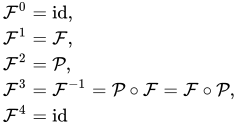 These equalities of operators require careful definition of the space of functions in question, defining equality of functions (equality at every point? equality [almost everywhere](https://en.wikipedia.org/wiki/Almost_everywhere "Almost everywhere")?) and defining equality of operators – that is, defining the topology on the function space and operator space in question. These are not true for all functions, but are true under various conditions, which are the content of the various forms of the [Fourier inversion theorem](https://en.wikipedia.org/wiki/Fourier_inversion_theorem "Fourier inversion theorem").
This fourfold periodicity of the Fourier transform is similar to a rotation of the plane by 90°, particularly as the two-fold iteration yields a reversal, and in fact this analogy can be made precise. While the Fourier transform can simply be interpreted as switching the time domain and the frequency domain, with the inverse Fourier transform switching them back, more geometrically it can be interpreted as a rotation by 90° in the [time–frequency domain](https://en.wikipedia.org/wiki/Time%E2%80%93frequency_domain "Time–frequency domain") (considering time as the x {\\displaystyle x}  \-axis and frequency as the y {\\displaystyle y}  \-axis), and the Fourier transform can be generalized to the [fractional Fourier transform](https://en.wikipedia.org/wiki/Fractional_Fourier_transform "Fractional Fourier transform"), which involves rotations by other angles. This can be further generalized to [linear canonical transformations](https://en.wikipedia.org/wiki/Linear_canonical_transformation "Linear canonical transformation"), which can be visualized as the action of the [special linear group](https://en.wikipedia.org/wiki/Special_linear_group "Special linear group") [SL2(**R**)](https://en.wikipedia.org/wiki/SL2\(R\) "SL2(R)") on the time–frequency plane, with the preserved symplectic form corresponding to the [uncertainty principle](https://en.wikipedia.org/wiki/Fourier_transform#Uncertainty_principle), below. This approach is particularly studied in [signal processing](https://en.wikipedia.org/wiki/Signal_processing "Signal processing"), under [time–frequency analysis](https://en.wikipedia.org/wiki/Time%E2%80%93frequency_analysis "Time–frequency analysis").
### Connection with the Heisenberg group
\[[edit](https://en.wikipedia.org/w/index.php?title=Fourier_transform&action=edit§ion=28 "Edit section: Connection with the Heisenberg group")\]
The [Heisenberg group](https://en.wikipedia.org/wiki/Heisenberg_group "Heisenberg group") is a certain [group](https://en.wikipedia.org/wiki/Group_\(mathematics\) "Group (mathematics)") of [unitary operators](https://en.wikipedia.org/wiki/Unitary_operator "Unitary operator") on the [Hilbert space](https://en.wikipedia.org/wiki/Hilbert_space "Hilbert space") *L*2(**R**) of square integrable complex valued functions f on the real line, generated by the translations (*Ty f*)(*x*) = *f* (*x* + *y*) and multiplication by *e**i*2π*ξx*, (*Mξ f*)(*x*) = *e**i*2π*ξx* *f* (*x*). These operators do not commute, as their (group) commutator is ( M ξ − 1 T y − 1 M ξ T y f ) ( x ) \= e i 2 π ξ y f ( x ) , {\\displaystyle \\left(M\_{\\xi }^{-1}T\_{y}^{-1}M\_{\\xi }T\_{y}f\\right)(x)=e^{i2\\pi \\xi y}f(x),}  which is multiplication by the constant (independent of x) *e**i*2π*ξy* ∈ *U*(1) (the [circle group](https://en.wikipedia.org/wiki/Circle_group "Circle group") of unit modulus complex numbers). As an abstract group, the Heisenberg group is the three-dimensional [Lie group](https://en.wikipedia.org/wiki/Lie_group "Lie group") of triples (*x*, *ξ*, *z*) ∈ **R**2 × *U*(1), with the group law ( x 1 , ξ 1 , t 1 ) ⋅ ( x 2 , ξ 2 , t 2 ) \= ( x 1 \+ x 2 , ξ 1 \+ ξ 2 , t 1 t 2 e − 2 i π x 1 ξ 2 ) . {\\displaystyle \\left(x\_{1},\\xi \_{1},t\_{1}\\right)\\cdot \\left(x\_{2},\\xi \_{2},t\_{2}\\right)=\\left(x\_{1}+x\_{2},\\xi \_{1}+\\xi \_{2},t\_{1}t\_{2}e^{-2i\\pi x\_{1}\\xi \_{2}}\\right).} 
Denote the Heisenberg group by *H*1. The above procedure describes not only the group structure, but also a standard [unitary representation](https://en.wikipedia.org/wiki/Unitary_representation "Unitary representation") of *H*1 on a Hilbert space, which we denote by *ρ* : *H*1 → *B*(*L*2(**R**)). Define the linear automorphism of **R**2 by J ( x ξ ) \= ( − ξ x ) {\\displaystyle J{\\begin{pmatrix}x\\\\\\xi \\end{pmatrix}}={\\begin{pmatrix}-\\xi \\\\x\\end{pmatrix}}} 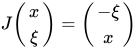 so that *J*2 = −*I*. This J can be extended to a unique automorphism of *H*1: j ( x , ξ , t ) \= ( − ξ , x , t e − i 2 π ξ x ) . {\\displaystyle j\\left(x,\\xi ,t\\right)=\\left(-\\xi ,x,te^{-i2\\pi \\xi x}\\right).} 
According to the [Stone–von Neumann theorem](https://en.wikipedia.org/wiki/Stone%E2%80%93von_Neumann_theorem "Stone–von Neumann theorem"), the unitary representations ρ and *ρ* ∘ *j* are unitarily equivalent, so there is a unique intertwiner *W* ∈ *U*(*L*2(**R**)) such that ρ ∘ j \= W ρ W ∗ . {\\displaystyle \\rho \\circ j=W\\rho W^{\*}.}  This operator W is the Fourier transform.
Many of the standard properties of the Fourier transform are immediate consequences of this more general framework.[\[32\]](https://en.wikipedia.org/wiki/Fourier_transform#cite_note-38) For example, the square of the Fourier transform, *W*2, is an intertwiner associated with *J*2 = −*I*, and so we have (*W*2*f*)(*x*) = *f* (−*x*) is the reflection of the original function f.
## Complex domain
\[[edit](https://en.wikipedia.org/w/index.php?title=Fourier_transform&action=edit§ion=29 "Edit section: Complex domain")\]
The [integral](https://en.wikipedia.org/wiki/Integral "Integral") for the Fourier transform f ^ ( ξ ) \= ∫ − ∞ ∞ e − i 2 π ξ t f ( t ) d t {\\displaystyle {\\widehat {f}}(\\xi )=\\int \_{-\\infty }^{\\infty }e^{-i2\\pi \\xi t}f(t)\\,dt}  can be studied for [complex](https://en.wikipedia.org/wiki/Complex_number "Complex number") values of its argument ξ. Depending on the properties of f, this might not converge off the real axis at all, or it might converge to a [complex](https://en.wikipedia.org/wiki/Complex_analysis "Complex analysis") [analytic function](https://en.wikipedia.org/wiki/Analytic_function "Analytic function") for all values of *ξ* = *σ* + *iτ*, or something in between.[\[33\]](https://en.wikipedia.org/wiki/Fourier_transform#cite_note-39)
The [Paley–Wiener theorem](https://en.wikipedia.org/wiki/Paley%E2%80%93Wiener_theorem "Paley–Wiener theorem") says that f is smooth (i.e., n\-times differentiable for all positive integers n) and compactly supported if and only if *f̂* (*σ* + *iτ*) is a [holomorphic function](https://en.wikipedia.org/wiki/Holomorphic_function "Holomorphic function") for which there exists a [constant](https://en.wikipedia.org/wiki/Constant_\(mathematics\) "Constant (mathematics)") *a* \> 0 such that for any [integer](https://en.wikipedia.org/wiki/Integer "Integer") *n* ≥ 0, \| ξ n f ^ ( ξ ) \| ≤ C e a \| τ \| {\\displaystyle \\left\\vert \\xi ^{n}{\\widehat {f}}(\\xi )\\right\\vert \\leq Ce^{a\\vert \\tau \\vert }}  for some constant C. (In this case, f is supported on \[−*a*, *a*\].) This can be expressed by saying that *f̂* is an [entire function](https://en.wikipedia.org/wiki/Entire_function "Entire function") that is [rapidly decreasing](https://en.wikipedia.org/wiki/Rapidly_decreasing "Rapidly decreasing") in σ (for fixed τ) and of exponential growth in τ (uniformly in σ).[\[34\]](https://en.wikipedia.org/wiki/Fourier_transform#cite_note-40)
(If f is not smooth, but only *L*2, the statement still holds provided *n* = 0.[\[35\]](https://en.wikipedia.org/wiki/Fourier_transform#cite_note-41)) The space of such functions of a [complex variable](https://en.wikipedia.org/wiki/Complex_analysis "Complex analysis") is called the Paley–Wiener space. This theorem has been generalised to semisimple [Lie groups](https://en.wikipedia.org/wiki/Lie_group "Lie group").[\[36\]](https://en.wikipedia.org/wiki/Fourier_transform#cite_note-42)
If f is supported on the half-line *t* ≥ 0, then f is said to be "causal" because the [impulse response function](https://en.wikipedia.org/wiki/Impulse_response_function "Impulse response function") of a physically realisable [filter](https://en.wikipedia.org/wiki/Filter_\(mathematics\) "Filter (mathematics)") must have this property, as no effect can precede its cause. [Paley](https://en.wikipedia.org/wiki/Raymond_Paley "Raymond Paley") and Wiener showed that then *f̂* extends to a [holomorphic function](https://en.wikipedia.org/wiki/Holomorphic_function "Holomorphic function") on the complex lower half-plane *τ* \< 0 that tends to zero as τ goes to infinity.[\[37\]](https://en.wikipedia.org/wiki/Fourier_transform#cite_note-43) The converse is false and it is not known how to characterise the Fourier transform of a causal function.[\[38\]](https://en.wikipedia.org/wiki/Fourier_transform#cite_note-44)
### Laplace transform
\[[edit](https://en.wikipedia.org/w/index.php?title=Fourier_transform&action=edit§ion=30 "Edit section: Laplace transform")\]
See also: [Laplace transform § Fourier transform](https://en.wikipedia.org/wiki/Laplace_transform#Fourier_transform "Laplace transform")
The Fourier transform *f̂*(*ξ*) is related to the [Laplace transform](https://en.wikipedia.org/wiki/Laplace_transform "Laplace transform") *F*(*s*), which is also used for the solution of [differential equations](https://en.wikipedia.org/wiki/Differential_equation "Differential equation") and the analysis of [filters](https://en.wikipedia.org/wiki/Filter_\(signal_processing\) "Filter (signal processing)").
It may happen that a function f for which the Fourier integral does not converge on the real axis at all, nevertheless has a complex Fourier transform defined in some region of the [complex plane](https://en.wikipedia.org/wiki/Complex_plane "Complex plane").
For example, if *f*(*t*) is of exponential growth, i.e., \| f ( t ) \| \< C e a \| t \| {\\displaystyle \\vert f(t)\\vert \<Ce^{a\\vert t\\vert }} 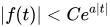 for some constants *C*, *a* ≥ 0, then[\[39\]](https://en.wikipedia.org/wiki/Fourier_transform#cite_note-Kolmogorov-Fomin-1999-45) f ^ ( i τ ) \= ∫ − ∞ ∞ e 2 π τ t f ( t ) d t , {\\displaystyle {\\widehat {f}}(i\\tau )=\\int \_{-\\infty }^{\\infty }e^{2\\pi \\tau t}f(t)\\,dt,}  convergent for all 2π*τ* \< −*a*, is the [two-sided Laplace transform](https://en.wikipedia.org/wiki/Two-sided_Laplace_transform "Two-sided Laplace transform") of f.
The more usual version ("one-sided") of the Laplace transform is F ( s ) \= ∫ 0 ∞ f ( t ) e − s t d t . {\\displaystyle F(s)=\\int \_{0}^{\\infty }f(t)e^{-st}\\,dt.} 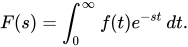
If f is also causal and analytic, then: f ^ ( i τ ) \= F ( − 2 π τ ) {\\displaystyle {\\widehat {f}}(i\\tau )=F(-2\\pi \\tau )}  . Thus, extending the Fourier transform to the complex domain means it includes the Laplace transform as a special case in the case of causal functions—but with the change of variable *s* = *i*2π*ξ*.
From another, perhaps more classical viewpoint, the Laplace transform by its form involves an additional exponential regulating term that lets it converge outside of the imaginary line where the Fourier transform is defined. As such it can converge for at most exponentially divergent series and integrals, whereas the original Fourier decomposition cannot, enabling analysis of systems with divergent or critical elements. Two particular examples from linear signal processing are the construction of allpass filter networks from critical comb and mitigating filters via exact pole-zero cancellation on the unit circle. Such designs are common in audio processing, where highly nonlinear [phase response](https://en.wikipedia.org/wiki/Phase_response "Phase response") is sought for, as in reverb.
Furthermore, when extended pulselike impulse responses are sought for signal processing work, the easiest way to produce them is to have one circuit that produces a divergent time response, and then to cancel its divergence through a delayed opposite and compensatory response. There, only the delay circuit in-between admits a classical Fourier description, which is critical. Both the circuits to the side are unstable, and do not admit a convergent Fourier decomposition. However, they do admit a Laplace domain description, with identical half-planes of convergence in the complex plane (or in the discrete case, the Z-plane), wherein their effects cancel.
In modern mathematics the Laplace transform is conventionally subsumed under the aegis Fourier methods. Both of them are subsumed by the far more general, and more abstract, idea of [harmonic analysis](https://en.wikipedia.org/wiki/Harmonic_analysis "Harmonic analysis").
### Inversion
\[[edit](https://en.wikipedia.org/w/index.php?title=Fourier_transform&action=edit§ion=31 "Edit section: Inversion")\]
Still with ξ \= σ \+ i τ {\\displaystyle \\xi =\\sigma +i\\tau }  , if f ^ {\\displaystyle {\\widehat {f}}}  is complex analytic for *a* ≤ *τ* ≤ *b*, then ∫ − ∞ ∞ f ^ ( σ \+ i a ) e i 2 π ξ t d σ \= ∫ − ∞ ∞ f ^ ( σ \+ i b ) e i 2 π ξ t d σ {\\displaystyle \\int \_{-\\infty }^{\\infty }{\\widehat {f}}(\\sigma +ia)e^{i2\\pi \\xi t}\\,d\\sigma =\\int \_{-\\infty }^{\\infty }{\\widehat {f}}(\\sigma +ib)e^{i2\\pi \\xi t}\\,d\\sigma }  by [Cauchy's integral theorem](https://en.wikipedia.org/wiki/Cauchy%27s_integral_theorem "Cauchy's integral theorem"). Therefore, the Fourier inversion formula can use integration along different lines, parallel to the real axis.[\[40\]](https://en.wikipedia.org/wiki/Fourier_transform#cite_note-46)
Theorem: If *f*(*t*) = 0 for *t* \< 0, and \|*f*(*t*)\| \< *Ce**a*\|*t*\| for some constants *C*, *a* \> 0, then f ( t ) \= ∫ − ∞ ∞ f ^ ( σ \+ i τ ) e i 2 π ξ t d σ , {\\displaystyle f(t)=\\int \_{-\\infty }^{\\infty }{\\widehat {f}}(\\sigma +i\\tau )e^{i2\\pi \\xi t}\\,d\\sigma ,}  for any *τ* \< −*a*/2π.
This theorem implies the [Mellin inversion formula](https://en.wikipedia.org/wiki/Inverse_Laplace_transform#Mellin's_inverse_formula "Inverse Laplace transform") for the Laplace transformation,[\[39\]](https://en.wikipedia.org/wiki/Fourier_transform#cite_note-Kolmogorov-Fomin-1999-45) f ( t ) \= 1 i 2 π ∫ b − i ∞ b \+ i ∞ F ( s ) e s t d s {\\displaystyle f(t)={\\frac {1}{i2\\pi }}\\int \_{b-i\\infty }^{b+i\\infty }F(s)e^{st}\\,ds} 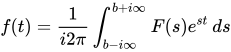 for any *b* \> *a*, where *F*(*s*) is the Laplace transform of *f*(*t*).
The hypotheses can be weakened, as in the results of Carleson and Hunt, to *f*(*t*) *e*−*at* being *L*1, provided that f be of bounded variation in a closed neighborhood of t (cf. [Dini test](https://en.wikipedia.org/wiki/Dini_test "Dini test")), the value of f at t be taken to be the [arithmetic mean](https://en.wikipedia.org/wiki/Arithmetic_mean "Arithmetic mean") of the left and right limits, and that the integrals be taken in the sense of Cauchy principal values.[\[41\]](https://en.wikipedia.org/wiki/Fourier_transform#cite_note-47)
*L*2 versions of these inversion formulas are also available.[\[42\]](https://en.wikipedia.org/wiki/Fourier_transform#cite_note-48)
## Fourier transform on Euclidean space
\[[edit](https://en.wikipedia.org/w/index.php?title=Fourier_transform&action=edit§ion=32 "Edit section: Fourier transform on Euclidean space")\]
The Fourier transform can be defined in any arbitrary number of dimensions n. As with the one-dimensional case, there are many conventions. For an integrable function *f*(**x**), this article takes the definition: f ^ ( ξ ) \= F ( f ) ( ξ ) \= ∫ R n f ( x ) e − i 2 π ξ ⋅ x d x {\\displaystyle {\\widehat {f}}({\\boldsymbol {\\xi }})={\\mathcal {F}}(f)({\\boldsymbol {\\xi }})=\\int \_{\\mathbb {R} ^{n}}f(\\mathbf {x} )e^{-i2\\pi {\\boldsymbol {\\xi }}\\cdot \\mathbf {x} }\\,d\\mathbf {x} }  where **x** and **ξ** are n\-dimensional [vectors](https://en.wikipedia.org/wiki/Vector_\(mathematics\) "Vector (mathematics)"), and **x** · **ξ** is the [dot product](https://en.wikipedia.org/wiki/Dot_product "Dot product") of the vectors. Alternatively, **ξ** can be viewed as belonging to the [dual vector space](https://en.wikipedia.org/wiki/Dual_space "Dual space") R n ⋆ {\\displaystyle \\mathbb {R} ^{n\\star }}  , in which case the dot product becomes the [contraction](https://en.wikipedia.org/wiki/Tensor_contraction "Tensor contraction") of **x** and **ξ**, usually written as ⟨**x**, **ξ**⟩.
All of the basic properties listed above hold for the n\-dimensional Fourier transform, as do Plancherel's and Parseval's theorem. When the function is integrable, the Fourier transform is still uniformly continuous and the [Riemann–Lebesgue lemma](https://en.wikipedia.org/wiki/Riemann%E2%80%93Lebesgue_lemma "Riemann–Lebesgue lemma") holds.[\[19\]](https://en.wikipedia.org/wiki/Fourier_transform#cite_note-Stein-Weiss-1971-24)
### Uncertainty principle
\[[edit](https://en.wikipedia.org/w/index.php?title=Fourier_transform&action=edit§ion=33 "Edit section: Uncertainty principle")\]
Further information: [Uncertainty principle](https://en.wikipedia.org/wiki/Uncertainty_principle "Uncertainty principle")
Generally speaking, the more concentrated *f*(*x*) is, the more spread out its Fourier transform *f̂*(*ξ*) must be. In particular, the scaling property of the Fourier transform may be seen as saying: if we squeeze a function in x, its Fourier transform stretches out in ξ. It is not possible to arbitrarily concentrate both a function and its Fourier transform.
The trade-off between the compaction of a function and its Fourier transform can be formalized in the form of an [uncertainty principle](https://en.wikipedia.org/wiki/Uncertainty_principle "Uncertainty principle") by viewing a function and its Fourier transform as [conjugate variables](https://en.wikipedia.org/wiki/Conjugate_variables "Conjugate variables") with respect to the [symplectic form](https://en.wikipedia.org/wiki/Symplectic_form "Symplectic form") on the [time–frequency domain](https://en.wikipedia.org/wiki/Time%E2%80%93frequency_representation "Time–frequency representation"): from the point of view of the [linear canonical transformation](https://en.wikipedia.org/wiki/Linear_canonical_transformation "Linear canonical transformation"), the Fourier transform is rotation by 90° in the time–frequency domain, and preserves the [symplectic form](https://en.wikipedia.org/wiki/Symplectic_vector_space "Symplectic vector space").
Suppose *f*(*x*) is an integrable and [square-integrable](https://en.wikipedia.org/wiki/Square-integrable "Square-integrable") function. [Without loss of generality](https://en.wikipedia.org/wiki/Without_loss_of_generality "Without loss of generality"), assume that *f*(*x*) is normalized: ∫ − ∞ ∞ \| f ( x ) \| 2 d x \= 1\. {\\displaystyle \\int \_{-\\infty }^{\\infty }\|f(x)\|^{2}\\,dx=1.} 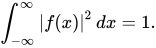
It follows from the [Plancherel theorem](https://en.wikipedia.org/wiki/Plancherel_theorem "Plancherel theorem") that *f̂*(*ξ*) is also normalized.
The spread around *x* = 0 may be measured by the *dispersion about zero* defined by[\[43\]](https://en.wikipedia.org/wiki/Fourier_transform#cite_note-49) D 0 ( f ) \= ∫ − ∞ ∞ x 2 \| f ( x ) \| 2 d x . {\\displaystyle D\_{0}(f)=\\int \_{-\\infty }^{\\infty }x^{2}\|f(x)\|^{2}\\,dx.} 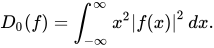
In probability terms, this is the [second moment](https://en.wikipedia.org/wiki/Moment_\(mathematics\) "Moment (mathematics)") of \|*f*(*x*)\|2 about zero.
The uncertainty principle states that, if *f*(*x*) is absolutely continuous and the functions *x*·*f*(*x*) and *f*′(*x*) are square integrable, then D 0 ( f ) D 0 ( f ^ ) ≥ 1 16 π 2 . {\\displaystyle D\_{0}(f)D\_{0}({\\widehat {f}})\\geq {\\frac {1}{16\\pi ^{2}}}.} 
The equality is attained only in the case f ( x ) \= C 1 e − π x 2 σ 2 ∴ f ^ ( ξ ) \= σ C 1 e − π σ 2 ξ 2 {\\displaystyle {\\begin{aligned}f(x)&=C\_{1}\\,e^{-\\pi {\\frac {x^{2}}{\\sigma ^{2}}}}\\\\\\therefore {\\widehat {f}}(\\xi )&=\\sigma C\_{1}\\,e^{-\\pi \\sigma ^{2}\\xi ^{2}}\\end{aligned}}}  where *σ* \> 0 is arbitrary and *C*1 = 4√2/√*σ* so that f is *L*2\-normalized. In other words, where f is a (normalized) [Gaussian function](https://en.wikipedia.org/wiki/Gaussian_function "Gaussian function") with variance *σ*2/2π, centered at zero, and its Fourier transform is a Gaussian function with variance *σ*−2/2π. Gaussian functions are examples of [Schwartz functions](https://en.wikipedia.org/wiki/Schwartz_function "Schwartz function") (see the discussion on tempered distributions below).
In fact, this inequality implies that: ( ∫ − ∞ ∞ ( x − x 0 ) 2 \| f ( x ) \| 2 d x ) ( ∫ − ∞ ∞ ( ξ − ξ 0 ) 2 \| f ^ ( ξ ) \| 2 d ξ ) ≥ 1 16 π 2 , ∀ x 0 , ξ 0 ∈ R . {\\displaystyle \\left(\\int \_{-\\infty }^{\\infty }(x-x\_{0})^{2}\|f(x)\|^{2}\\,dx\\right)\\left(\\int \_{-\\infty }^{\\infty }(\\xi -\\xi \_{0})^{2}\\left\|{\\widehat {f}}(\\xi )\\right\|^{2}\\,d\\xi \\right)\\geq {\\frac {1}{16\\pi ^{2}}},\\quad \\forall x\_{0},\\xi \_{0}\\in \\mathbb {R} .}  In [quantum mechanics](https://en.wikipedia.org/wiki/Quantum_mechanics "Quantum mechanics"), the [momentum](https://en.wikipedia.org/wiki/Momentum "Momentum") and position [wave functions](https://en.wikipedia.org/wiki/Wave_function "Wave function") are Fourier transform pairs, up to a factor of the [Planck constant](https://en.wikipedia.org/wiki/Planck_constant "Planck constant"). With this constant properly taken into account, the inequality above becomes the statement of the [Heisenberg uncertainty principle](https://en.wikipedia.org/wiki/Heisenberg_uncertainty_principle "Heisenberg uncertainty principle").[\[44\]](https://en.wikipedia.org/wiki/Fourier_transform#cite_note-50)
A stronger uncertainty principle is the [Hirschman uncertainty principle](https://en.wikipedia.org/wiki/Hirschman_uncertainty "Hirschman uncertainty"), which is expressed as: H ( \| f \| 2 ) \+ H ( \| f ^ \| 2 ) ≥ log ( e 2 ) {\\displaystyle H\\left(\\left\|f\\right\|^{2}\\right)+H\\left(\\left\|{\\widehat {f}}\\right\|^{2}\\right)\\geq \\log \\left({\\frac {e}{2}}\\right)}  where *H*(*p*) is the [differential entropy](https://en.wikipedia.org/wiki/Differential_entropy "Differential entropy") of the [probability density function](https://en.wikipedia.org/wiki/Probability_density_function "Probability density function") *p*(*x*): H ( p ) \= − ∫ − ∞ ∞ p ( x ) log ( p ( x ) ) d x {\\displaystyle H(p)=-\\int \_{-\\infty }^{\\infty }p(x)\\log {\\bigl (}p(x){\\bigr )}\\,dx}  where the logarithms may be in any base that is consistent. The equality is attained for a Gaussian, as in the previous case.
### Sine and cosine transforms
\[[edit](https://en.wikipedia.org/w/index.php?title=Fourier_transform&action=edit§ion=34 "Edit section: Sine and cosine transforms")\]
Main article: [Sine and cosine transforms](https://en.wikipedia.org/wiki/Sine_and_cosine_transforms "Sine and cosine transforms")
Fourier's original formulation of the transform did not use complex numbers, but rather sines and cosines. Statisticians and others still use this form. An absolutely integrable function f for which Fourier inversion holds can be expanded in terms of genuine frequencies (avoiding negative frequencies, which are sometimes considered hard to interpret physically[\[45\]](https://en.wikipedia.org/wiki/Fourier_transform#cite_note-51)) λ by f ( t ) \= ∫ 0 ∞ ( a ( λ ) cos ( 2 π λ t ) \+ b ( λ ) sin ( 2 π λ t ) ) d λ . {\\displaystyle f(t)=\\int \_{0}^{\\infty }{\\bigl (}a(\\lambda )\\cos(2\\pi \\lambda t)+b(\\lambda )\\sin(2\\pi \\lambda t){\\bigr )}\\,d\\lambda .} 
This is called an expansion as a [trigonometric integral](https://en.wikipedia.org/wiki/Trigonometric_integral "Trigonometric integral"), or a Fourier integral expansion. The coefficient functions a and b can be found by using variants of the Fourier cosine transform and the Fourier sine transform (the normalisations are, again, not standardised): a ( λ ) \= 2 ∫ − ∞ ∞ f ( t ) cos ( 2 π λ t ) d t {\\displaystyle a(\\lambda )=2\\int \_{-\\infty }^{\\infty }f(t)\\cos(2\\pi \\lambda t)\\,dt}  and b ( λ ) \= 2 ∫ − ∞ ∞ f ( t ) sin ( 2 π λ t ) d t . {\\displaystyle b(\\lambda )=2\\int \_{-\\infty }^{\\infty }f(t)\\sin(2\\pi \\lambda t)\\,dt.} 
Older literature refers to the two transform functions, the Fourier cosine transform, a, and the Fourier sine transform, b.
The function f can be recovered from the sine and cosine transform using f ( t ) \= 2 ∫ 0 ∞ ∫ − ∞ ∞ f ( τ ) cos ( 2 π λ ( τ − t ) ) d τ d λ . {\\displaystyle f(t)=2\\int \_{0}^{\\infty }\\int \_{-\\infty }^{\\infty }f(\\tau )\\cos {\\bigl (}2\\pi \\lambda (\\tau -t){\\bigr )}\\,d\\tau \\,d\\lambda .}  together with trigonometric identities. This is referred to as Fourier's integral formula.[\[39\]](https://en.wikipedia.org/wiki/Fourier_transform#cite_note-Kolmogorov-Fomin-1999-45)[\[46\]](https://en.wikipedia.org/wiki/Fourier_transform#cite_note-52)[\[47\]](https://en.wikipedia.org/wiki/Fourier_transform#cite_note-53)[\[48\]](https://en.wikipedia.org/wiki/Fourier_transform#cite_note-54)
### Spherical harmonics
\[[edit](https://en.wikipedia.org/w/index.php?title=Fourier_transform&action=edit§ion=35 "Edit section: Spherical harmonics")\]
Let the set of [homogeneous](https://en.wikipedia.org/wiki/Homogeneous_polynomial "Homogeneous polynomial") [harmonic](https://en.wikipedia.org/wiki/Harmonic_function "Harmonic function") [polynomials](https://en.wikipedia.org/wiki/Polynomial "Polynomial") of degree k on **R***n* be denoted by **A***k*. The set **A***k* consists of the [solid spherical harmonics](https://en.wikipedia.org/wiki/Solid_spherical_harmonics "Solid spherical harmonics") of degree k. The solid spherical harmonics play a similar role in higher dimensions to the Hermite polynomials in dimension one. Specifically, if *f*(*x*) = *e*−π\|*x*\|2*P*(*x*) for some *P*(*x*) in **A***k*, then f ^ ( ξ ) \= i − k f ( ξ ) {\\displaystyle {\\widehat {f}}(\\xi )=i^{-k}f(\\xi )}  . Let the set **H***k* be the closure in *L*2(**R***n*) of linear combinations of functions of the form *f*(\|*x*\|)*P*(*x*) where *P*(*x*) is in **A***k*. The space *L*2(**R***n*) is then a direct sum of the spaces **H***k* and the Fourier transform maps each space **H***k* to itself and it is possible to characterize the action of the Fourier transform on each space **H***k*.[\[19\]](https://en.wikipedia.org/wiki/Fourier_transform#cite_note-Stein-Weiss-1971-24)
Let *f*(*x*) = *f*0(\|*x*\|)*P*(*x*) (with *P*(*x*) in **A***k*), then f ^ ( ξ ) \= F 0 ( \| ξ \| ) P ( ξ ) {\\displaystyle {\\widehat {f}}(\\xi )=F\_{0}(\|\\xi \|)P(\\xi )}  where F 0 ( r ) \= 2 π i − k r − n \+ 2 k − 2 2 ∫ 0 ∞ f 0 ( s ) J n \+ 2 k − 2 2 ( 2 π r s ) s n \+ 2 k 2 d s . {\\displaystyle F\_{0}(r)=2\\pi i^{-k}r^{-{\\frac {n+2k-2}{2}}}\\int \_{0}^{\\infty }f\_{0}(s)J\_{\\frac {n+2k-2}{2}}(2\\pi rs)s^{\\frac {n+2k}{2}}\\,ds.} 
Here *J*(*n* + 2*k* − 2)/2 denotes the [Bessel function](https://en.wikipedia.org/wiki/Bessel_function "Bessel function") of the first kind with order *n* + 2*k* − 2/2. When *k* = 0 this gives a useful formula for the Fourier transform of a radial function.[\[49\]](https://en.wikipedia.org/wiki/Fourier_transform#cite_note-55) This is essentially the [Hankel transform](https://en.wikipedia.org/wiki/Hankel_transform "Hankel transform"). Moreover, there is a simple recursion relating the cases *n* + 2 and n[\[50\]](https://en.wikipedia.org/wiki/Fourier_transform#cite_note-56) allowing to compute, e.g., the three-dimensional Fourier transform of a radial function from the one-dimensional one.
### Restriction problems
\[[edit](https://en.wikipedia.org/w/index.php?title=Fourier_transform&action=edit§ion=36 "Edit section: Restriction problems")\]
See also: [Fourier extension operator](https://en.wikipedia.org/wiki/Fourier_extension_operator "Fourier extension operator")
In higher dimensions it becomes interesting to study *restriction problems* for the Fourier transform. The Fourier transform of an integrable function is continuous and the restriction of this function to any set is defined. But for a square-integrable function the Fourier transform could be a general *class* of square integrable functions. As such, the restriction of the Fourier transform of an *L*2(**R***n*) function cannot be defined on sets of measure 0. It is still an active area of study to understand restriction problems in *L**p* for 1 \< *p* \< 2. It is possible in some cases to define the restriction of a Fourier transform to a set S, provided S has non-zero curvature. The case when S is the unit sphere in **R***n* is of particular interest. In this case the Tomas–[Stein](https://en.wikipedia.org/wiki/Elias_Stein "Elias Stein") restriction theorem states that the restriction of the Fourier transform to the unit sphere in **R***n* is a bounded operator on *L**p* provided 1 ≤ *p* ≤ 2*n* + 2/*n* + 3.
One notable difference between the Fourier transform in 1 dimension versus higher dimensions concerns the partial sum operator. Consider an increasing collection of measurable sets *E**R* indexed by *R* ∈ (0, ∞): such as balls of radius R centered at the origin, or cubes of side 2*R*. For a given integrable function f, consider the function fR defined by: f R ( x ) \= ∫ E R f ^ ( ξ ) e i 2 π x ⋅ ξ d ξ , x ∈ R n . {\\displaystyle f\_{R}(x)=\\int \_{E\_{R}}{\\widehat {f}}(\\xi )e^{i2\\pi x\\cdot \\xi }\\,d\\xi ,\\quad x\\in \\mathbb {R} ^{n}.} 
Suppose in addition that *f* ∈ *L**p*(**R***n*). For *n* = 1 and 1 \< *p* \< ∞, if one takes *ER* = (−*R*, *R*), then fR converges to f in *L**p* as R tends to infinity, by the boundedness of the [Hilbert transform](https://en.wikipedia.org/wiki/Hilbert_transform "Hilbert transform"). Naively one may hope the same holds true for *n* \> 1. In the case that ER is taken to be a cube with side length R, then convergence still holds. Another natural candidate is the Euclidean ball *E**R* = {*ξ* : \|*ξ*\| \< *R*}. In order for this partial sum operator to converge, it is necessary that the [multiplier](https://en.wikipedia.org/wiki/Multiplier_\(Fourier_analysis\) "Multiplier (Fourier analysis)") for the unit ball be bounded in *L**p*(**R***n*). For *n* ≥ 2 it is a celebrated theorem of [Charles Fefferman](https://en.wikipedia.org/wiki/Charles_Fefferman "Charles Fefferman") that the multiplier for the unit ball is never bounded unless *p* = 2.[\[51\]](https://en.wikipedia.org/wiki/Fourier_transform#cite_note-57) In fact, when *p* ≠ 2, this shows that not only may fR fail to converge to f in *L**p*, but for some functions *f* ∈ *L**p*(**R***n*), fR is not even an element of *L**p*.
## Fourier transform on function spaces
\[[edit](https://en.wikipedia.org/w/index.php?title=Fourier_transform&action=edit§ion=37 "Edit section: Fourier transform on function spaces")\]
See also: [Riesz–Thorin theorem](https://en.wikipedia.org/wiki/Riesz%E2%80%93Thorin_theorem "Riesz–Thorin theorem")
The definition of the Fourier transform naturally extends from L 1 ( R ) {\\displaystyle L^{1}(\\mathbb {R} )}  to L 1 ( R n ) {\\displaystyle L^{1}(\\mathbb {R} ^{n})}  . That is, if f ∈ L 1 ( R n ) {\\displaystyle f\\in L^{1}(\\mathbb {R} ^{n})}  then the Fourier transform F : L 1 ( R n ) → L ∞ ( R n ) {\\displaystyle {\\mathcal {F}}:L^{1}(\\mathbb {R} ^{n})\\to L^{\\infty }(\\mathbb {R} ^{n})}  is given by f ( x ) ↦ f ^ ( ξ ) \= ∫ R n f ( x ) e − i 2 π ξ ⋅ x d x , ∀ ξ ∈ R n . {\\displaystyle f(x)\\mapsto {\\widehat {f}}(\\xi )=\\int \_{\\mathbb {R} ^{n}}f(x)e^{-i2\\pi \\xi \\cdot x}\\,dx,\\quad \\forall \\xi \\in \\mathbb {R} ^{n}.}  This operator is [bounded](https://en.wikipedia.org/wiki/Bounded_operator "Bounded operator") as sup ξ ∈ R n \| f ^ ( ξ ) \| ≤ ∫ R n \| f ( x ) \| d x , {\\displaystyle \\sup \_{\\xi \\in \\mathbb {R} ^{n}}\\left\\vert {\\widehat {f}}(\\xi )\\right\\vert \\leq \\int \_{\\mathbb {R} ^{n}}\\vert f(x)\\vert \\,dx,}  which shows that its [operator norm](https://en.wikipedia.org/wiki/Operator_norm "Operator norm") is bounded by 1. The [Riemann–Lebesgue lemma](https://en.wikipedia.org/wiki/Riemann%E2%80%93Lebesgue_lemma "Riemann–Lebesgue lemma") shows that if f ∈ L 1 ( R n ) {\\displaystyle f\\in L^{1}(\\mathbb {R} ^{n})}  then its Fourier transform actually belongs to the [space of continuous functions that vanish at infinity](https://en.wikipedia.org/wiki/Function_space#Functional_analysis "Function space"), i.e., f ^ ∈ C 0 ( R n ) ⊂ L ∞ ( R n ) {\\displaystyle {\\widehat {f}}\\in C\_{0}(\\mathbb {R} ^{n})\\subset L^{\\infty }(\\mathbb {R} ^{n})}  .[\[52\]](https://en.wikipedia.org/wiki/Fourier_transform#cite_note-FOOTNOTESteinWeiss19711%E2%80%932-58)[\[53\]](https://en.wikipedia.org/wiki/Fourier_transform#cite_note-FOOTNOTERudin1987182%E2%80%93183-59) Furthermore, the [image](https://en.wikipedia.org/wiki/Image_\(mathematics\) "Image (mathematics)") of L 1 {\\displaystyle L^{1}}  under F {\\displaystyle {\\mathcal {F}}}  is a strict subset of C 0 ( R n ) {\\displaystyle C\_{0}(\\mathbb {R} ^{n})}  .[\[54\]](https://en.wikipedia.org/wiki/Fourier_transform#cite_note-FOOTNOTEChandrasekharan19897%E2%80%938,_84-60)
Similarly to the case of one variable, the Fourier transform can be defined on L 2 ( R n ) {\\displaystyle L^{2}(\\mathbb {R} ^{n})}  . The Fourier transform in L 2 ( R n ) {\\displaystyle L^{2}(\\mathbb {R} ^{n})}  is no longer given by an ordinary Lebesgue integral, although it can be computed by an [improper integral](https://en.wikipedia.org/wiki/Improper_integral "Improper integral"), i.e., f ^ ( ξ ) \= lim R → ∞ ∫ \| x \| ≤ R f ( x ) e − i 2 π ξ ⋅ x d x {\\displaystyle {\\widehat {f}}(\\xi )=\\lim \_{R\\to \\infty }\\int \_{\|x\|\\leq R}f(x)e^{-i2\\pi \\xi \\cdot x}\\,dx}  where the limit is taken in the *L*2 sense.[\[note 7\]](https://en.wikipedia.org/wiki/Fourier_transform#cite_note-61)[\[55\]](https://en.wikipedia.org/wiki/Fourier_transform#cite_note-62)
Furthermore, F : L 2 ( R n ) → L 2 ( R n ) {\\displaystyle {\\mathcal {F}}:L^{2}(\\mathbb {R} ^{n})\\to L^{2}(\\mathbb {R} ^{n})}  is a [unitary operator](https://en.wikipedia.org/wiki/Unitary_operator "Unitary operator").[\[56\]](https://en.wikipedia.org/wiki/Fourier_transform#cite_note-FOOTNOTESteinWeiss1971Thm._2.3-63) For an operator to be unitary it is sufficient to show that it is bijective and preserves the inner product, so in this case these follow from the Fourier inversion theorem combined with the fact that for any *f*, *g* ∈ *L*2(**R***n*) we have ∫ R n f ( x ) F g ( x ) d x \= ∫ R n F f ( x ) g ( x ) d x . {\\displaystyle \\int \_{\\mathbb {R} ^{n}}f(x){\\mathcal {F}}g(x)\\,dx=\\int \_{\\mathbb {R} ^{n}}{\\mathcal {F}}f(x)g(x)\\,dx.} 
In particular, the image of *L*2(**R***n*) is itself under the Fourier transform.
### On other *L**p*
\[[edit](https://en.wikipedia.org/w/index.php?title=Fourier_transform&action=edit§ion=38 "Edit section: On other Lp")\]
For 1 \< p \< 2 {\\displaystyle 1\<p\<2}  , the Fourier transform can be defined on L p ( R ) {\\displaystyle L^{p}(\\mathbb {R} )}  by [Marcinkiewicz interpolation](https://en.wikipedia.org/wiki/Marcinkiewicz_interpolation "Marcinkiewicz interpolation"), which amounts to decomposing such functions into a fat tail part in *L*2 plus a fat body part in *L*1. In each of these spaces, the Fourier transform of a function in *L**p*(**R***n*) is in *L**q*(**R***n*), where *q* = *p*/*p* − 1 is the [Hölder conjugate](https://en.wikipedia.org/wiki/H%C3%B6lder_conjugate "Hölder conjugate") of p (by the [Hausdorff–Young inequality](https://en.wikipedia.org/wiki/Hausdorff%E2%80%93Young_inequality "Hausdorff–Young inequality")). However, except for *p* = 2, the image is not easily characterized. Further extensions become more technical. The Fourier transform of functions in *L**p* for the range 2 \< *p* \< ∞ requires the study of distributions.[\[57\]](https://en.wikipedia.org/wiki/Fourier_transform#cite_note-FOOTNOTEKatznelson2004-64) In fact, it can be shown that there are functions in *L**p* with *p* \> 2 so that the Fourier transform is not defined as a function.[\[19\]](https://en.wikipedia.org/wiki/Fourier_transform#cite_note-Stein-Weiss-1971-24)
### Tempered distributions
\[[edit](https://en.wikipedia.org/w/index.php?title=Fourier_transform&action=edit§ion=39 "Edit section: Tempered distributions")\]
Main article: [Distribution (mathematics) § Tempered distributions and Fourier transform](https://en.wikipedia.org/wiki/Distribution_\(mathematics\)#Tempered_distributions_and_Fourier_transform "Distribution (mathematics)")
See also: [Rigged Hilbert space](https://en.wikipedia.org/wiki/Rigged_Hilbert_space "Rigged Hilbert space")
One might consider enlarging the domain of the Fourier transform from L 1 \+ L 2 {\\displaystyle L^{1}+L^{2}}  by considering [generalized functions](https://en.wikipedia.org/wiki/Generalized_function "Generalized function"), or distributions. A distribution on R n {\\displaystyle \\mathbb {R} ^{n}}  is a continuous linear functional on the space C c ∞ ( R n ) {\\displaystyle C\_{c}^{\\infty }(\\mathbb {R} ^{n})}  of compactly supported smooth functions (i.e. [bump functions](https://en.wikipedia.org/wiki/Bump_function "Bump function")), equipped with a suitable topology. Since C c ∞ ( R n ) {\\displaystyle C\_{c}^{\\infty }(\\mathbb {R} ^{n})}  is dense in L 2 ( R n ) {\\displaystyle L^{2}(\\mathbb {R} ^{n})}  , the [Plancherel theorem](https://en.wikipedia.org/wiki/Plancherel_theorem "Plancherel theorem") allows one to extend the definition of the Fourier transform to general functions in L 2 ( R n ) {\\displaystyle L^{2}(\\mathbb {R} ^{n})}  by continuity arguments. The strategy is then to consider the action of the Fourier transform on C c ∞ ( R n ) {\\displaystyle C\_{c}^{\\infty }(\\mathbb {R} ^{n})}  and pass to distributions by duality. The obstruction to doing this is that the Fourier transform does not map C c ∞ ( R n ) {\\displaystyle C\_{c}^{\\infty }(\\mathbb {R} ^{n})}  to C c ∞ ( R n ) {\\displaystyle C\_{c}^{\\infty }(\\mathbb {R} ^{n})}  . In fact the Fourier transform of an element in C c ∞ ( R n ) {\\displaystyle C\_{c}^{\\infty }(\\mathbb {R} ^{n})}  can not vanish on an open set; see the above discussion on the uncertainty principle.[\[58\]](https://en.wikipedia.org/wiki/Fourier_transform#cite_note-FOOTNOTEMallat200945-65)[\[59\]](https://en.wikipedia.org/wiki/Fourier_transform#cite_note-FOOTNOTEStrichartz1994150-66)
The Fourier transform can also be defined for [tempered distributions](https://en.wikipedia.org/wiki/Tempered_distribution "Tempered distribution") S ′ ( R n ) {\\displaystyle {\\mathcal {S}}'(\\mathbb {R} ^{n})}  , dual to the space of [Schwartz functions](https://en.wikipedia.org/wiki/Schwartz_function "Schwartz function") S ( R n ) {\\displaystyle {\\mathcal {S}}(\\mathbb {R} ^{n})}  . A Schwartz function is a smooth function that decays at infinity, along with all of its derivatives, hence C c ∞ ( R n ) ⊂ S ( R n ) {\\displaystyle C\_{c}^{\\infty }(\\mathbb {R} ^{n})\\subset {\\mathcal {S}}(\\mathbb {R} ^{n})}  and: F : C c ∞ ( R n ) → S ( R n ) ∖ C c ∞ ( R n ) . {\\displaystyle {\\mathcal {F}}:C\_{c}^{\\infty }(\\mathbb {R} ^{n})\\rightarrow {\\mathcal {S}}(\\mathbb {R} ^{n})\\setminus C\_{c}^{\\infty }(\\mathbb {R} ^{n}).}  The Fourier transform is an [automorphism](https://en.wikipedia.org/wiki/Automorphism "Automorphism") of the Schwartz space and, by duality, also an automorphism of the space of tempered distributions.[\[19\]](https://en.wikipedia.org/wiki/Fourier_transform#cite_note-Stein-Weiss-1971-24)[\[60\]](https://en.wikipedia.org/wiki/Fourier_transform#cite_note-FOOTNOTEHunter2014-67) The tempered distributions include well-behaved functions of polynomial growth, distributions of compact support as well as all the integrable functions mentioned above.
For the definition of the Fourier transform of a tempered distribution, let f {\\displaystyle f}  and g {\\displaystyle g}  be integrable functions, and let f ^ {\\displaystyle {\\widehat {f}}}  and g ^ {\\displaystyle {\\widehat {g}}}  be their Fourier transforms respectively. Then the Fourier transform obeys the following multiplication formula,[\[19\]](https://en.wikipedia.org/wiki/Fourier_transform#cite_note-Stein-Weiss-1971-24) ∫ R n f ^ ( x ) g ( x ) d x \= ∫ R n f ( x ) g ^ ( x ) d x . {\\displaystyle \\int \_{\\mathbb {R} ^{n}}{\\widehat {f}}(x)g(x)\\,dx=\\int \_{\\mathbb {R} ^{n}}f(x){\\widehat {g}}(x)\\,dx.} 
Every integrable function f {\\displaystyle f}  defines (induces) a distribution T f {\\displaystyle T\_{f}}  by the relation T f ( φ ) \= ∫ R n f ( x ) φ ( x ) d x , ∀ φ ∈ S ( R n ) . {\\displaystyle T\_{f}(\\varphi )=\\int \_{\\mathbb {R} ^{n}}f(x)\\varphi (x)\\,dx,\\quad \\forall \\varphi \\in {\\mathcal {S}}(\\mathbb {R} ^{n}).}  So it makes sense to define the Fourier transform of a tempered distribution T f ∈ S ′ ( R ) {\\displaystyle T\_{f}\\in {\\mathcal {S}}'(\\mathbb {R} )}  by the duality: ⟨ T ^ f , φ ⟩ \= ⟨ T f , φ ^ ⟩ , ∀ φ ∈ S ( R n ) . {\\displaystyle \\langle {\\widehat {T}}\_{f},\\varphi \\rangle =\\langle T\_{f},{\\widehat {\\varphi }}\\rangle ,\\quad \\forall \\varphi \\in {\\mathcal {S}}(\\mathbb {R} ^{n}).}  Extending this to all tempered distributions T {\\displaystyle T}  gives the general definition of the Fourier transform.
Distributions can be differentiated and the above-mentioned compatibility of the Fourier transform with differentiation and convolution remains true for tempered distributions.
## Generalizations
\[[edit](https://en.wikipedia.org/w/index.php?title=Fourier_transform&action=edit§ion=40 "Edit section: Generalizations")\]
### Fourier–Stieltjes transform on measurable spaces
\[[edit](https://en.wikipedia.org/w/index.php?title=Fourier_transform&action=edit§ion=41 "Edit section: Fourier–Stieltjes transform on measurable spaces")\]
See also: [Bochner–Minlos theorem](https://en.wikipedia.org/wiki/Bochner%E2%80%93Minlos_theorem "Bochner–Minlos theorem"), [Riesz–Markov–Kakutani representation theorem](https://en.wikipedia.org/wiki/Riesz%E2%80%93Markov%E2%80%93Kakutani_representation_theorem "Riesz–Markov–Kakutani representation theorem"), and [Fourier series § Fourier-Stieltjes series](https://en.wikipedia.org/wiki/Fourier_series#Fourier-Stieltjes_series "Fourier series")
The Fourier transform of a [finite](https://en.wikipedia.org/wiki/Finite_measure "Finite measure") [Borel measure](https://en.wikipedia.org/wiki/Borel_measure "Borel measure") μ on **R***n*, given by the bounded, uniformly continuous function:[\[61\]](https://en.wikipedia.org/wiki/Fourier_transform#cite_note-FOOTNOTEPinsky2002256-68)[\[62\]](https://en.wikipedia.org/wiki/Fourier_transform#cite_note-FOOTNOTERudin199115-69) μ ^ ( ξ ) \= ∫ R n e − i 2 π x ⋅ ξ d μ , {\\displaystyle {\\widehat {\\mu }}(\\xi )=\\int \_{\\mathbb {R} ^{n}}e^{-i2\\pi x\\cdot \\xi }\\,d\\mu ,}  is called the *Fourier–Stieltjes transform* due to its connection with the [Riemann-Stieltjes integral](https://en.wikipedia.org/wiki/Riemann%E2%80%93Stieltjes_integral#Application_to_functional_analysis "Riemann–Stieltjes integral") representation of [(Radon) measures](https://en.wikipedia.org/wiki/Radon_measure "Radon measure").[\[63\]](https://en.wikipedia.org/wiki/Fourier_transform#cite_note-FOOTNOTEEdwards198253,_67,_72%E2%80%9373-70) If μ {\\displaystyle \\mu }  is the [probability distribution](https://en.wikipedia.org/wiki/Probability_distribution "Probability distribution") of a [random variable](https://en.wikipedia.org/wiki/Random_variable "Random variable") X {\\displaystyle X}  then its Fourier–Stieltjes transform is, by definition, a [characteristic function](https://en.wikipedia.org/wiki/Characteristic_function_\(probability_theory\) "Characteristic function (probability theory)").[\[64\]](https://en.wikipedia.org/wiki/Fourier_transform#cite_note-71) If, in addition, the probability distribution has a [probability density function](https://en.wikipedia.org/wiki/Probability_density_function "Probability density function"), this definition is subject to the usual Fourier transform.[\[65\]](https://en.wikipedia.org/wiki/Fourier_transform#cite_note-FOOTNOTEBillingsley1995345-72) Stated more generally, when μ {\\displaystyle \\mu }  is [absolutely continuous](https://en.wikipedia.org/wiki/Absolute_continuity#Absolute_continuity_of_measures "Absolute continuity") with respect to the Lebesgue measure, i.e., d μ \= f ( x ) d x , {\\displaystyle d\\mu =f(x)\\,dx,}  then μ ^ ( ξ ) \= f ^ ( ξ ) , {\\displaystyle {\\widehat {\\mu }}(\\xi )={\\widehat {f}}(\\xi ),}  and the Fourier-Stieltjes transform reduces to the usual definition of the Fourier transform. That is, the notable difference with the Fourier transform of integrable functions is that the Fourier-Stieltjes transform need not vanish at infinity, i.e., the [Riemann–Lebesgue lemma](https://en.wikipedia.org/wiki/Riemann%E2%80%93Lebesgue_lemma "Riemann–Lebesgue lemma") fails for measures.[\[66\]](https://en.wikipedia.org/wiki/Fourier_transform#cite_note-FOOTNOTEKatznelson200440,_155,_164-73)
[Bochner's theorem](https://en.wikipedia.org/wiki/Bochner%27s_theorem "Bochner's theorem") characterizes which functions may arise as the Fourier–Stieltjes transform of a positive measure on the circle.
One example of a finite Borel measure that is not a function is the [Dirac measure](https://en.wikipedia.org/wiki/Dirac_measure "Dirac measure").[\[67\]](https://en.wikipedia.org/wiki/Fourier_transform#cite_note-FOOTNOTEEdwards198253-74) Its Fourier transform is a constant function (whose value depends on the form of the Fourier transform used).
### Locally compact abelian groups
\[[edit](https://en.wikipedia.org/w/index.php?title=Fourier_transform&action=edit§ion=42 "Edit section: Locally compact abelian groups")\]
Main article: [Pontryagin duality](https://en.wikipedia.org/wiki/Pontryagin_duality "Pontryagin duality")
The Fourier transform may be generalized to any [locally compact abelian group](https://en.wikipedia.org/wiki/Locally_compact_abelian_group "Locally compact abelian group"), i.e., an [abelian group](https://en.wikipedia.org/wiki/Abelian_group "Abelian group") that is also a [locally compact Hausdorff space](https://en.wikipedia.org/wiki/Locally_compact_Hausdorff_space "Locally compact Hausdorff space") such that the group operation is continuous. If G is a locally compact abelian group, it has a translation invariant measure μ, called [Haar measure](https://en.wikipedia.org/wiki/Haar_measure "Haar measure"). For a locally compact abelian group G, the set of irreducible, i.e. one-dimensional, unitary representations are called its [characters](https://en.wikipedia.org/wiki/Character_group "Character group"). With its natural group structure and the topology of uniform convergence on compact sets (that is, the topology induced by the [compact-open topology](https://en.wikipedia.org/wiki/Compact-open_topology "Compact-open topology") on the space of all continuous functions from G {\\displaystyle G}  to the [circle group](https://en.wikipedia.org/wiki/Circle_group "Circle group")), the set of characters Ĝ is itself a locally compact abelian group, called the *Pontryagin dual* of G. For a function f in *L*1(*G*), its Fourier transform is defined by[\[57\]](https://en.wikipedia.org/wiki/Fourier_transform#cite_note-FOOTNOTEKatznelson2004-64) f ^ ( ξ ) \= ∫ G ξ ( x ) ¯ f ( x ) d μ for any ξ ∈ G ^ . {\\displaystyle {\\widehat {f}}(\\xi )=\\int \_{G}{\\overline {\\xi (x)}}f(x)\\,d\\mu \\quad {\\text{for any }}\\xi \\in {\\widehat {G}}.} 
The Riemann–Lebesgue lemma holds in this case; *f̂*(*ξ*) is a function vanishing at infinity on Ĝ.
The Fourier transform on T = R/Z is an example; here T is a locally compact abelian group, and the Haar measure μ on T can be thought of as the Lebesgue measure on \[0,1). Consider a representation of T on the complex plane C thought of as a 1-dimensional complex vector space. There is a group of such representations (which are irreducible since C is 1-dim) { e k : T → G L 1 ( C ) \= C ∗ ∣ k ∈ Z } {\\displaystyle \\{e\_{k}:T\\rightarrow GL\_{1}(C)=C^{\*}\\mid k\\in Z\\}}  where e k ( x ) \= e i 2 π k x {\\displaystyle e\_{k}(x)=e^{i2\\pi kx}} 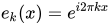 for x ∈ T {\\displaystyle x\\in T}  .
The character of such representation, that is the trace of e k ( x ) {\\displaystyle e\_{k}(x)}  (thought of as a one-by-one matrix) for each x ∈ T {\\displaystyle x\\in T}  and k ∈ Z {\\displaystyle k\\in Z}  , is e i 2 π k x {\\displaystyle e^{i2\\pi kx}}  itself. Now, in the case of representations of finite groups, the character table of a group G consists of rows of vectors such that each row is the character of one irreducible representation of G, and these vectors form an orthonormal basis of the space of class (meaning conjugation-invariant) functions that map from G to C by Schur's lemma. The group T is no longer finite but still compact, and it preserves the orthonormality of the character table. Each row of the table is the function e k ( x ) {\\displaystyle e\_{k}(x)}  of x ∈ T {\\displaystyle x\\in T}  , and the inner product between two class functions (all functions being class functions since T is abelian) f , g ∈ L 2 ( T , d μ ) {\\displaystyle f,g\\in L^{2}(T,d\\mu )}  is defined as ⟨ f , g ⟩ \= 1 \| T \| ∫ \[ 0 , 1 ) f ( y ) g ¯ ( y ) d μ ( y ) {\\textstyle \\langle f,g\\rangle ={\\frac {1}{\|T\|}}\\int \_{\[0,1)}f(y){\\overline {g}}(y)d\\mu (y)}  with the normalizing factor \| T \| \= 1 {\\displaystyle \\vert T\\vert =1}  . The sequence { e k ∣ k ∈ Z } {\\displaystyle \\{e\_{k}\\mid k\\in Z\\}}  is an orthonormal basis of the space of class functions L 2 ( T , d μ ) {\\displaystyle L^{2}(T,d\\mu )}  .
For any representation V of a finite group G, χ v {\\displaystyle \\chi \_{v}}  can be expressed as the span ∑ i ⟨ χ v , χ v i ⟩ χ v i {\\textstyle \\sum \_{i}\\left\\langle \\chi \_{v},\\chi \_{v\_{i}}\\right\\rangle \\chi \_{v\_{i}}}  (V i {\\displaystyle V\_{i}}  are the irreducible representations of G), such that ⟨ χ v , χ v i ⟩ \= 1 \| G \| ∑ g ∈ G χ v ( g ) χ ¯ v i ( g ) {\\displaystyle \\textstyle \\left\\langle \\chi \_{v},\\chi \_{v\_{i}}\\right\\rangle ={\\frac {1}{\\vert G\\vert }}\\sum \_{g\\in G}\\chi \_{v}(g){\\overline {\\chi }}\_{v\_{i}}(g)}  . Similarly for G \= T {\\displaystyle G=T}  and f ∈ L 2 ( T , d μ ) {\\displaystyle f\\in L^{2}(T,d\\mu )} 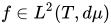 , f ( x ) \= ∑ k ∈ Z f ^ ( k ) e k {\\displaystyle \\textstyle f(x)=\\sum \_{k\\in Z}{\\widehat {f}}(k)e\_{k}}  . The Pontriagin dual T ^ {\\displaystyle {\\widehat {T}}}  is { e k } ( k ∈ Z ) {\\displaystyle \\{e\_{k}\\}(k\\in Z)}  and for f ∈ L 2 ( T , d μ ) {\\displaystyle f\\in L^{2}(T,d\\mu )}  , f ^ ( k ) \= 1 \| T \| ∫ \[ 0 , 1 ) f ( y ) e − i 2 π k y d y {\\textstyle {\\widehat {f}}(k)={\\frac {1}{\|T\|}}\\int \_{\[0,1)}f(y)e^{-i2\\pi ky}dy}  is its Fourier transform for e k ∈ T ^ {\\displaystyle e\_{k}\\in {\\widehat {T}}}  .
### Gelfand transform
\[[edit](https://en.wikipedia.org/w/index.php?title=Fourier_transform&action=edit§ion=43 "Edit section: Gelfand transform")\]
Main article: [Gelfand representation](https://en.wikipedia.org/wiki/Gelfand_representation "Gelfand representation")
The Fourier transform is also a special case of the [Gelfand transform](https://en.wikipedia.org/wiki/Gelfand_transform "Gelfand transform"). In this particular context, it is closely related to the Pontryagin duality map defined above.
Given an abelian [locally compact](https://en.wikipedia.org/wiki/Locally_compact_space "Locally compact space") [Hausdorff](https://en.wikipedia.org/wiki/Hausdorff_space "Hausdorff space") [topological group](https://en.wikipedia.org/wiki/Topological_group "Topological group") G, as before we consider the space *L*1(*G*), defined using a Haar measure. With convolution as multiplication, *L*1(*G*) is an abelian [Banach algebra](https://en.wikipedia.org/wiki/Banach_algebra "Banach algebra"). It also has an [involution](https://en.wikipedia.org/wiki/Involution_\(mathematics\) "Involution (mathematics)") \* given by f ∗ ( g ) \= f ( g − 1 ) ¯ . {\\displaystyle f^{\*}(g)={\\overline {f\\left(g^{-1}\\right)}}.} 
Taking the completion with respect to the largest possible *C*\*\-norm gives its enveloping *C*\*\-algebra, called the group *C*\*\-algebra *C*\*(*G*) of G. (Any *C*\*\-norm on *L*1(*G*) is bounded by the *L*1 norm, therefore their supremum exists.)
Given any abelian *C*\*\-algebra A, the Gelfand transform gives an isomorphism between A and *C*0(*A*^), where *A*^ is the multiplicative linear functionals, i.e. one-dimensional representations, on A with the weak-\* topology. The map is simply given by a ↦ ( φ ↦ φ ( a ) ) . {\\displaystyle a\\mapsto {\\bigl (}\\varphi \\mapsto \\varphi (a){\\bigr )}.}  It turns out that the multiplicative linear functionals of *C*\*(*G*), after suitable identification, are exactly the characters of G, and the Gelfand transform, when restricted to the dense subset *L*1(*G*), is the Fourier–Pontryagin transform.
### Compact non-abelian groups
\[[edit](https://en.wikipedia.org/w/index.php?title=Fourier_transform&action=edit§ion=44 "Edit section: Compact non-abelian groups")\]
The Fourier transform can also be defined for functions on a non-abelian group, provided that the group is [compact](https://en.wikipedia.org/wiki/Compact_space "Compact space"). Removing the assumption that the underlying group is abelian, irreducible unitary representations need not always be one-dimensional. This means the Fourier transform on a non-abelian group takes values as Hilbert space operators.[\[68\]](https://en.wikipedia.org/wiki/Fourier_transform#cite_note-75) The Fourier transform on compact groups is a major tool in [representation theory](https://en.wikipedia.org/wiki/Representation_theory "Representation theory")[\[69\]](https://en.wikipedia.org/wiki/Fourier_transform#cite_note-76) and [non-commutative harmonic analysis](https://en.wikipedia.org/wiki/Non-commutative_harmonic_analysis "Non-commutative harmonic analysis").
Let G be a compact [Hausdorff](https://en.wikipedia.org/wiki/Hausdorff_space "Hausdorff space") [topological group](https://en.wikipedia.org/wiki/Topological_group "Topological group"). Let Σ denote the collection of all isomorphism classes of finite-dimensional irreducible [unitary representations](https://en.wikipedia.org/wiki/Unitary_representation "Unitary representation"), along with a definite choice of representation *U*(*σ*) on the [Hilbert space](https://en.wikipedia.org/wiki/Hilbert_space "Hilbert space") *Hσ* of finite dimension *dσ* for each *σ* ∈ Σ. If μ is a finite [Borel measure](https://en.wikipedia.org/wiki/Borel_measure "Borel measure") on G, then the Fourier–Stieltjes transform of μ is the operator on *Hσ* defined by ⟨ μ ^ ξ , η ⟩ H σ \= ∫ G ⟨ U ¯ g ( σ ) ξ , η ⟩ d μ ( g ) {\\displaystyle \\left\\langle {\\widehat {\\mu }}\\xi ,\\eta \\right\\rangle \_{H\_{\\sigma }}=\\int \_{G}\\left\\langle {\\overline {U}}\_{g}^{(\\sigma )}\\xi ,\\eta \\right\\rangle \\,d\\mu (g)}  where *U*(*σ*) is the complex-conjugate representation of *U*(*σ*) acting on *Hσ*. If μ is [absolutely continuous](https://en.wikipedia.org/wiki/Absolutely_continuous "Absolutely continuous") with respect to the [left-invariant probability measure](https://en.wikipedia.org/wiki/Haar_measure "Haar measure") λ on G, [represented](https://en.wikipedia.org/wiki/Radon%E2%80%93Nikodym_theorem "Radon–Nikodym theorem") as d μ \= f d λ {\\displaystyle d\\mu =f\\,d\\lambda }  for some *f* ∈ [*L*1(*λ*)](https://en.wikipedia.org/wiki/Lp_space "Lp space"), one identifies the Fourier transform of f with the Fourier–Stieltjes transform of μ.
The mapping μ ↦ μ ^ {\\displaystyle \\mu \\mapsto {\\widehat {\\mu }}}  defines an isomorphism between the [Banach space](https://en.wikipedia.org/wiki/Banach_space "Banach space") *M*(*G*) of finite Borel measures (see *[Rca space](https://en.wikipedia.org/wiki/Rca_space "Rca space")*) and a closed subspace of the Banach space **C**∞(Σ) consisting of all sequences *E* = (*Eσ*) indexed by Σ of (bounded) linear operators *Eσ* : *Hσ* → *Hσ* for which the norm ‖ E ‖ \= sup σ ∈ Σ ‖ E σ ‖ {\\displaystyle \\\|E\\\|=\\sup \_{\\sigma \\in \\Sigma }\\left\\\|E\_{\\sigma }\\right\\\|} 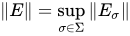 is finite. The "[convolution theorem](https://en.wikipedia.org/wiki/Convolution_theorem "Convolution theorem")" asserts that, furthermore, this isomorphism of Banach spaces is in fact an isometric isomorphism of [C\*-algebras](https://en.wikipedia.org/wiki/C*-algebra "C*-algebra") into a subspace of **C**∞(Σ). Multiplication on *M*(*G*) is given by [convolution](https://en.wikipedia.org/wiki/Convolution "Convolution") of measures and the involution \* defined by f ∗ ( g ) \= f ( g − 1 ) ¯ , {\\displaystyle f^{\*}(g)={\\overline {f\\left(g^{-1}\\right)}},} 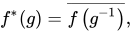 and **C**∞(Σ) has a natural *C*\*\-algebra structure as Hilbert space operators.
The [Peter–Weyl theorem](https://en.wikipedia.org/wiki/Peter%E2%80%93Weyl_theorem "Peter–Weyl theorem") holds, and a version of the Fourier inversion formula ([Plancherel's theorem](https://en.wikipedia.org/wiki/Plancherel%27s_theorem "Plancherel's theorem")) follows: if *f* ∈ *L*2(*G*), then f ( g ) \= ∑ σ ∈ Σ d σ tr ( f ^ ( σ ) U g ( σ ) ) {\\displaystyle f(g)=\\sum \_{\\sigma \\in \\Sigma }d\_{\\sigma }\\operatorname {tr} \\left({\\widehat {f}}(\\sigma )U\_{g}^{(\\sigma )}\\right)}  where the summation is understood as convergent in the *L*2 sense.
The generalization of the Fourier transform to the noncommutative situation has also in part contributed to the development of [noncommutative geometry](https://en.wikipedia.org/wiki/Noncommutative_geometry "Noncommutative geometry").\[*[citation needed](https://en.wikipedia.org/wiki/Wikipedia:Citation_needed "Wikipedia:Citation needed")*\] In this context, a categorical generalization of the Fourier transform to noncommutative groups is [Tannaka–Krein duality](https://en.wikipedia.org/wiki/Tannaka%E2%80%93Krein_duality "Tannaka–Krein duality"), which replaces the group of characters with the category of representations. However, this loses the connection with harmonic functions.
## Alternatives
\[[edit](https://en.wikipedia.org/w/index.php?title=Fourier_transform&action=edit§ion=45 "Edit section: Alternatives")\]
In [signal processing](https://en.wikipedia.org/wiki/Signal_processing "Signal processing") terms, a function (of time) is a representation of a signal with perfect *time resolution*, but no frequency information, while the Fourier transform has perfect *frequency resolution*, but no time information: the magnitude of the Fourier transform at a point is how much frequency content there is, but location is only given by phase (argument of the Fourier transform at a point), and [standing waves](https://en.wikipedia.org/wiki/Standing_wave "Standing wave") are not localized in time – a sine wave continues out to infinity, without decaying. This limits the usefulness of the Fourier transform for analyzing signals that are localized in time, notably [transients](https://en.wikipedia.org/wiki/Transient_\(acoustics\) "Transient (acoustics)"), or any signal of finite extent.
As alternatives to the Fourier transform, in [time–frequency analysis](https://en.wikipedia.org/wiki/Time%E2%80%93frequency_analysis "Time–frequency analysis"), one uses time–frequency transforms or time–frequency distributions to represent signals in a form that has some time information and some frequency information – by the uncertainty principle, there is a trade-off between these. These can be generalizations of the Fourier transform, such as the [short-time Fourier transform](https://en.wikipedia.org/wiki/Short-time_Fourier_transform "Short-time Fourier transform"), [fractional Fourier transform](https://en.wikipedia.org/wiki/Fractional_Fourier_transform "Fractional Fourier transform"), synchrosqueezing Fourier transform,[\[70\]](https://en.wikipedia.org/wiki/Fourier_transform#cite_note-FOOTNOTECorreiaJustoAng%C3%A9lico2024-77) or other functions to represent signals, as in [wavelet transforms](https://en.wikipedia.org/wiki/Wavelet_transform "Wavelet transform") and [chirplet transforms](https://en.wikipedia.org/wiki/Chirplet_transform "Chirplet transform"), with the wavelet analog of the (continuous) Fourier transform being the [continuous wavelet transform](https://en.wikipedia.org/wiki/Continuous_wavelet_transform "Continuous wavelet transform").[\[27\]](https://en.wikipedia.org/wiki/Fourier_transform#cite_note-Boashash-2003-33)
## Example
\[[edit](https://en.wikipedia.org/w/index.php?title=Fourier_transform&action=edit§ion=46 "Edit section: Example")\]
The following figures provide a visual illustration of how the Fourier transform's integral measures whether a frequency is present in a particular function. The first image depicts the function f ( t ) \= cos ( 2 π 3 t ) e − π t 2 {\\displaystyle f(t)=\\cos(2\\pi \\ 3t)\\ e^{-\\pi t^{2}}}  , which is a 3 [Hz](https://en.wikipedia.org/wiki/Hertz "Hertz") cosine wave (the first term) shaped by a [Gaussian](https://en.wikipedia.org/wiki/Gaussian_function "Gaussian function") [envelope function](https://en.wikipedia.org/wiki/Envelope_\(waves\) "Envelope (waves)") (the second term) that smoothly turns the wave on and off. The next 2 images show the product f ( t ) e − i 2 π 3 t {\\displaystyle f(t)e^{-i2\\pi 3t}}  , which must be integrated to calculate the Fourier transform at +3 Hz. The real part of the integrand has a non-negative average value, because the alternating signs of f ( t ) {\\displaystyle f(t)}  and Re ( e − i 2 π 3 t ) {\\displaystyle \\operatorname {Re} (e^{-i2\\pi 3t})}  oscillate at the same rate and in phase, whereas f ( t ) {\\displaystyle f(t)}  and Im ( e − i 2 π 3 t ) {\\displaystyle \\operatorname {Im} (e^{-i2\\pi 3t})}  oscillate at the same rate but with orthogonal phase. The absolute value of the Fourier transform at +3 Hz is 0.5, which is relatively large. When added to the Fourier transform at -3 Hz (which is identical because we started with a real signal), we find that the amplitude of the 3 Hz frequency component is 1.
[](https://en.wikipedia.org/wiki/File:Onfreq.png)
Original function, which has a strong 3 Hz component. Real and imaginary parts of the integrand of its Fourier transform at +3 Hz.
However, when you try to measure a frequency that is not present, both the real and imaginary component of the integral vary rapidly between positive and negative values. For instance, the red curve is looking for 5 Hz. The absolute value of its integral is nearly zero, indicating that almost no 5 Hz component was in the signal. The general situation is usually more complicated than this, but heuristically this is how the Fourier transform measures how much of an individual frequency is present in a function f ( t ) {\\displaystyle f(t)}  .
- [](https://en.wikipedia.org/wiki/File:Offfreq_i2p.svg "Real and imaginary parts of the integrand for its Fourier transform at +5 Hz.")
Real and imaginary parts of the integrand for its Fourier transform at +5 Hz.
- [](https://en.wikipedia.org/wiki/File:Fourier_transform_of_oscillating_function.svg "Magnitude of its Fourier transform, with +3 and +5 Hz labeled.")
Magnitude of its Fourier transform, with +3 and +5 Hz labeled.
To re-enforce an earlier point, the reason for the response at ξ \= − 3 {\\displaystyle \\xi =-3}  Hz is because cos ( 2 π 3 t ) {\\displaystyle \\cos(2\\pi 3t)}  and cos ( 2 π ( − 3 ) t ) {\\displaystyle \\cos(2\\pi (-3)t)} 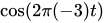 are indistinguishable. The transform of e i 2 π 3 t ⋅ e − π t 2 {\\displaystyle e^{i2\\pi 3t}\\cdot e^{-\\pi t^{2}}}  would have just one response, whose amplitude is the integral of the smooth envelope: e − π t 2 {\\displaystyle e^{-\\pi t^{2}}}  , whereas Re ( f ( t ) ⋅ e − i 2 π 3 t ) {\\displaystyle \\operatorname {Re} (f(t)\\cdot e^{-i2\\pi 3t})}  is e − π t 2 ( 1 \+ cos ( 2 π 6 t ) ) / 2 {\\displaystyle e^{-\\pi t^{2}}(1+\\cos(2\\pi 6t))/2}  .
## Applications
\[[edit](https://en.wikipedia.org/w/index.php?title=Fourier_transform&action=edit§ion=47 "Edit section: Applications")\]
See also: [Spectral density § Applications](https://en.wikipedia.org/wiki/Spectral_density#Applications "Spectral density")
[](https://en.wikipedia.org/wiki/File:Commutative_diagram_illustrating_problem_solving_via_the_Fourier_transform.svg)
Some problems, such as certain differential equations, become easier to solve when the Fourier transform is applied. In that case the solution to the original problem is recovered using the inverse Fourier transform.
Linear operations performed in one domain (time or frequency) have corresponding operations in the other domain, which are sometimes easier to perform. The operation of [differentiation](https://en.wikipedia.org/wiki/Derivative "Derivative") in the time domain corresponds to multiplication by the frequency,[\[note 8\]](https://en.wikipedia.org/wiki/Fourier_transform#cite_note-78) so some [differential equations](https://en.wikipedia.org/wiki/Differential_equation "Differential equation") are easier to analyze in the frequency domain. Also, [convolution](https://en.wikipedia.org/wiki/Convolution "Convolution") in the time domain corresponds to ordinary multiplication in the frequency domain (see *[Convolution theorem](https://en.wikipedia.org/wiki/Convolution_theorem "Convolution theorem")*). After performing the desired operations, transformation of the result can be made back to the time domain. [Harmonic analysis](https://en.wikipedia.org/wiki/Harmonic_analysis "Harmonic analysis") is the systematic study of the relationship between the frequency and time domains, including the kinds of functions or operations that are "simpler" in one or the other, and has deep connections to many areas of modern mathematics.
### Analysis of differential equations
\[[edit](https://en.wikipedia.org/w/index.php?title=Fourier_transform&action=edit§ion=48 "Edit section: Analysis of differential equations")\]
Perhaps the most important use of the Fourier transformation is to solve [partial differential equations](https://en.wikipedia.org/wiki/Partial_differential_equation "Partial differential equation"). Many of the equations of the mathematical physics of the nineteenth century can be treated this way. Fourier studied the heat equation, which in one dimension and in dimensionless units is ∂ 2 y ( x , t ) ∂ 2 x \= ∂ y ( x , t ) ∂ t . {\\displaystyle {\\frac {\\partial ^{2}y(x,t)}{\\partial ^{2}x}}={\\frac {\\partial y(x,t)}{\\partial t}}.} 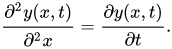 The example we will give, a slightly more difficult one, is the wave equation in one dimension, ∂ 2 y ( x , t ) ∂ 2 x \= ∂ 2 y ( x , t ) ∂ 2 t . {\\displaystyle {\\frac {\\partial ^{2}y(x,t)}{\\partial ^{2}x}}={\\frac {\\partial ^{2}y(x,t)}{\\partial ^{2}t}}.} 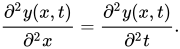
As usual, the problem is not to find a solution: there are infinitely many. The problem is that of the so-called "boundary problem": find a solution that satisfies the 'boundary conditions' y ( x , 0 ) \= f ( x ) , ∂ y ( x , 0 ) ∂ t \= g ( x ) . {\\displaystyle y(x,0)=f(x),\\qquad {\\frac {\\partial y(x,0)}{\\partial t}}=g(x).} 
Here, f and g are given functions. For the heat equation, only one boundary condition can be required (usually the first one). But for the wave equation, there are still infinitely many solutions y that satisfy the first boundary condition. But when one imposes both conditions, there is only one possible solution.
It is easier to find the Fourier transform ŷ of the solution than to find the solution directly. This is because the Fourier transformation takes differentiation into multiplication by the Fourier-dual variable, and so a partial differential equation applied to the original function is transformed into multiplication by polynomial functions of the dual variables applied to the transformed function. After ŷ is determined, we can apply the inverse Fourier transformation to find y.
Fourier's method is as follows. First, note that any function of the forms cos ( 2 π ξ ( x ± t ) ) or sin ( 2 π ξ ( x ± t ) ) {\\displaystyle \\cos {\\bigl (}2\\pi \\xi (x\\pm t){\\bigr )}{\\text{ or }}\\sin {\\bigl (}2\\pi \\xi (x\\pm t){\\bigr )}}  satisfies the wave equation. These are called the elementary solutions.
Second, note that therefore any integral y ( x , t ) \= ∫ 0 ∞ d ξ \[ a \+ ( ξ ) cos ( 2 π ξ ( x \+ t ) ) \+ a − ( ξ ) cos ( 2 π ξ ( x − t ) ) \+ b \+ ( ξ ) sin ( 2 π ξ ( x \+ t ) ) \+ b − ( ξ ) sin ( 2 π ξ ( x − t ) ) \] {\\displaystyle {\\begin{aligned}y(x,t)=\\int \_{0}^{\\infty }d\\xi {\\Bigl \[}\&a\_{+}(\\xi )\\cos {\\bigl (}2\\pi \\xi (x+t){\\bigr )}+a\_{-}(\\xi )\\cos {\\bigl (}2\\pi \\xi (x-t){\\bigr )}+{}\\\\\&b\_{+}(\\xi )\\sin {\\bigl (}2\\pi \\xi (x+t){\\bigr )}+b\_{-}(\\xi )\\sin \\left(2\\pi \\xi (x-t)\\right){\\Bigr \]}\\end{aligned}}} ![{\\displaystyle {\\begin{aligned}y(x,t)=\\int \_{0}^{\\infty }d\\xi {\\Bigl \[}\&a\_{+}(\\xi )\\cos {\\bigl (}2\\pi \\xi (x+t){\\bigr )}+a\_{-}(\\xi )\\cos {\\bigl (}2\\pi \\xi (x-t){\\bigr )}+{}\\\\\&b\_{+}(\\xi )\\sin {\\bigl (}2\\pi \\xi (x+t){\\bigr )}+b\_{-}(\\xi )\\sin \\left(2\\pi \\xi (x-t)\\right){\\Bigr \]}\\end{aligned}}}](https://wikimedia.org/api/rest_v1/media/math/render/svg/a65c9bf34f6bc5abac0d29243bda58f8c3310c2d) satisfies the wave equation for arbitrary *a*\+, *a*−, *b*\+, *b*−. This integral may be interpreted as a continuous linear combination of solutions for the linear equation.
Now this resembles the formula for the Fourier synthesis of a function. In fact, this is the real inverse Fourier transform of *a*± and *b*± in the variable x.
The third step is to examine how to find the specific unknown coefficient functions *a*± and *b*± that will lead to y satisfying the boundary conditions. We are interested in the values of these solutions at *t* = 0. So we will set *t* = 0. Assuming that the conditions needed for Fourier inversion are satisfied, we can then find the Fourier sine and cosine transforms (in the variable x) of both sides and obtain 2 ∫ − ∞ ∞ y ( x , 0 ) cos ( 2 π ξ x ) d x \= a \+ \+ a − {\\displaystyle 2\\int \_{-\\infty }^{\\infty }y(x,0)\\cos(2\\pi \\xi x)\\,dx=a\_{+}+a\_{-}}  and 2 ∫ − ∞ ∞ y ( x , 0 ) sin ( 2 π ξ x ) d x \= b \+ \+ b − . {\\displaystyle 2\\int \_{-\\infty }^{\\infty }y(x,0)\\sin(2\\pi \\xi x)\\,dx=b\_{+}+b\_{-}.} 
Similarly, taking the derivative of y with respect to t and then applying the Fourier sine and cosine transformations yields 2 ∫ − ∞ ∞ ∂ y ( u , 0 ) ∂ t sin ( 2 π ξ x ) d x \= ( 2 π ξ ) ( − a \+ \+ a − ) {\\displaystyle 2\\int \_{-\\infty }^{\\infty }{\\frac {\\partial y(u,0)}{\\partial t}}\\sin(2\\pi \\xi x)\\,dx=(2\\pi \\xi )\\left(-a\_{+}+a\_{-}\\right)}  and 2 ∫ − ∞ ∞ ∂ y ( u , 0 ) ∂ t cos ( 2 π ξ x ) d x \= ( 2 π ξ ) ( b \+ − b − ) . {\\displaystyle 2\\int \_{-\\infty }^{\\infty }{\\frac {\\partial y(u,0)}{\\partial t}}\\cos(2\\pi \\xi x)\\,dx=(2\\pi \\xi )\\left(b\_{+}-b\_{-}\\right).} 
These are four linear equations for the four unknowns *a*± and *b*±, in terms of the Fourier sine and cosine transforms of the boundary conditions, which are easily solved by elementary algebra, provided that these transforms can be found.
In summary, we chose a set of elementary solutions, parametrized by ξ, of which the general solution would be a (continuous) linear combination in the form of an integral over the parameter ξ. But this integral was in the form of a Fourier integral. The next step was to express the boundary conditions in terms of these integrals, and set them equal to the given functions f and g. But these expressions also took the form of a Fourier integral because of the properties of the Fourier transform of a derivative. The last step was to exploit Fourier inversion by applying the Fourier transformation to both sides, thus obtaining expressions for the coefficient functions *a*± and *b*± in terms of the given boundary conditions f and g.
From a higher point of view, Fourier's procedure can be reformulated more conceptually. Since there are two variables, we will use the Fourier transformation in both x and t rather than operate as Fourier did, who only transformed in the spatial variables. Note that ŷ must be considered in the sense of a distribution since *y*(*x*, *t*) is not going to be *L*1: as a wave, it will persist through time and thus is not a transient phenomenon. But it will be bounded and so its Fourier transform can be defined as a distribution. The operational properties of the Fourier transformation that are relevant to this equation are that it takes differentiation in x to multiplication by *i*2π*ξ* and differentiation with respect to t to multiplication by *i*2π*f* where f is the frequency. Then the wave equation becomes an algebraic equation in ŷ: ξ 2 y ^ ( ξ , f ) \= f 2 y ^ ( ξ , f ) . {\\displaystyle \\xi ^{2}{\\widehat {y}}(\\xi ,f)=f^{2}{\\widehat {y}}(\\xi ,f).}  This is equivalent to requiring *ŷ*(*ξ*, *f*) = 0 unless *ξ* = ±*f*. Right away, this explains why the choice of elementary solutions we made earlier worked so well: obviously *ŷ* = *δ*(*ξ* ± *f*) will be solutions. Applying Fourier inversion to these delta functions, we obtain the elementary solutions we picked earlier. But from the higher point of view, one does not pick elementary solutions, but rather considers the space of all distributions that are supported on the (degenerate) conic *ξ*2 − *f*2 = 0.
We may as well consider the distributions supported on the conic that are given by distributions of one variable on the line *ξ* = *f* plus distributions on the line *ξ* = −*f* as follows: if Φ is any test function, ∬ y ^ φ ( ξ , f ) d ξ d f \= ∫ s \+ φ ( ξ , ξ ) d ξ \+ ∫ s − φ ( ξ , − ξ ) d ξ , {\\displaystyle \\iint {\\widehat {y}}\\varphi (\\xi ,f)\\,d\\xi \\,df=\\int s\_{+}\\varphi (\\xi ,\\xi )\\,d\\xi +\\int s\_{-}\\varphi (\\xi ,-\\xi )\\,d\\xi ,}  where *s*\+, and *s*−, are distributions of one variable.
Then Fourier inversion gives, for the boundary conditions, something very similar to what we had more concretely above (put *Φ*(*ξ*, *f*) = *e**i*2π(*xξ*\+*tf*), which is clearly of polynomial growth): y ( x , 0 ) \= ∫ { s \+ ( ξ ) \+ s − ( ξ ) } e i 2 π ξ x \+ 0 d ξ {\\displaystyle y(x,0)=\\int {\\bigl \\{}s\_{+}(\\xi )+s\_{-}(\\xi ){\\bigr \\}}e^{i2\\pi \\xi x+0}\\,d\\xi }  and ∂ y ( x , 0 ) ∂ t \= ∫ { s \+ ( ξ ) − s − ( ξ ) } i 2 π ξ e i 2 π ξ x \+ 0 d ξ . {\\displaystyle {\\frac {\\partial y(x,0)}{\\partial t}}=\\int {\\bigl \\{}s\_{+}(\\xi )-s\_{-}(\\xi ){\\bigr \\}}i2\\pi \\xi e^{i2\\pi \\xi x+0}\\,d\\xi .} 
Now, as before, applying the one-variable Fourier transformation in the variable x to these functions of x yields two equations in the two unknown distributions *s*± (which can be taken to be ordinary functions if the boundary conditions are *L*1 or *L*2).
From a calculational point of view, the drawback of course is that one must first calculate the Fourier transforms of the boundary conditions, then assemble the solution from these, and then calculate an inverse Fourier transform. Closed form formulas are rare, except when there is some geometric symmetry that can be exploited, and the numerical calculations are difficult because of the oscillatory nature of the integrals, which makes convergence slow and hard to estimate. For practical calculations, other methods are often used.
#### Nonlinear Fourier transform
\[[edit](https://en.wikipedia.org/w/index.php?title=Fourier_transform&action=edit§ion=49 "Edit section: Nonlinear Fourier transform")\]
Main article: [Inverse scattering transform](https://en.wikipedia.org/wiki/Inverse_scattering_transform "Inverse scattering transform")
The twentieth century has seen application of these methods to all linear partial differential equations with polynomial coefficients as well as an extension to certain classes of [nonlinear partial differential equations](https://en.wikipedia.org/wiki/Nonlinear_partial_differential_equation "Nonlinear partial differential equation"). Specifically, nonlinear evolution equations (i.e. those equations that describe how a particular quantity evolves in time from a specified initial state) that can be associated with linear eigenvalue problems whose eigenvalues are integrals of the nonlinear equations.[\[71\]](https://en.wikipedia.org/wiki/Fourier_transform#cite_note-FOOTNOTEAblowitzKaupNewellSegur1974249%E2%80%93315-79)[\[72\]](https://en.wikipedia.org/wiki/Fourier_transform#cite_note-FOOTNOTELax1968467%E2%80%93490-80) As it may be considered an extension of Fourier analysis to nonlinear problems, the solution method is called the **nonlinear Fourier transform** (or **[inverse scattering transform](https://en.wikipedia.org/wiki/Inverse_scattering_transform "Inverse scattering transform")**) method.[\[73\]](https://en.wikipedia.org/wiki/Fourier_transform#cite_note-FOOTNOTEYousefiKschischang20144312%E2%80%934328-81)
### Fourier-transform spectroscopy
\[[edit](https://en.wikipedia.org/w/index.php?title=Fourier_transform&action=edit§ion=50 "Edit section: Fourier-transform spectroscopy")\]
Main article: [Fourier-transform spectroscopy](https://en.wikipedia.org/wiki/Fourier-transform_spectroscopy "Fourier-transform spectroscopy")
The Fourier transform is also used in [nuclear magnetic resonance](https://en.wikipedia.org/wiki/Nuclear_magnetic_resonance "Nuclear magnetic resonance") (NMR) and in other kinds of [spectroscopy](https://en.wikipedia.org/wiki/Spectroscopy "Spectroscopy"), e.g. infrared ([FTIR](https://en.wikipedia.org/wiki/Fourier-transform_infrared_spectroscopy "Fourier-transform infrared spectroscopy")). In NMR an exponentially shaped free induction decay (FID) signal is acquired in the time domain and Fourier-transformed to a Lorentzian line-shape in the frequency domain. The Fourier transform is also used in [magnetic resonance imaging](https://en.wikipedia.org/wiki/Magnetic_resonance_imaging "Magnetic resonance imaging") (MRI) and [mass spectrometry](https://en.wikipedia.org/wiki/Mass_spectrometry "Mass spectrometry").
### Quantum mechanics
\[[edit](https://en.wikipedia.org/w/index.php?title=Fourier_transform&action=edit§ion=51 "Edit section: Quantum mechanics")\]
The Fourier transform is useful in [quantum mechanics](https://en.wikipedia.org/wiki/Quantum_mechanics "Quantum mechanics") in at least two different ways. To begin with, the basic conceptual structure of quantum mechanics postulates the existence of pairs of [complementary variables](https://en.wikipedia.org/wiki/Complementary_variables "Complementary variables"), connected by the [Heisenberg uncertainty principle](https://en.wikipedia.org/wiki/Heisenberg_uncertainty_principle "Heisenberg uncertainty principle"). For example, in one dimension, the spatial variable q of, say, a particle, can only be measured by the quantum mechanical "[position operator](https://en.wikipedia.org/wiki/Position_operator "Position operator")" at the cost of losing information about the momentum p of the particle. Therefore, the physical state of the particle can either be described by a function, called "the wave function", of q or by a function of p but not by a function of both variables. The variable p is called the conjugate variable to q.
In classical mechanics, the physical state of a particle (existing in one dimension, for simplicity of exposition) would be given by assigning definite values to both p and q simultaneously. Thus, the set of all possible physical states is the two-dimensional real vector space with a p\-axis and a q\-axis called the [phase space](https://en.wikipedia.org/wiki/Phase_space "Phase space"). In contrast, quantum mechanics chooses a polarisation of this space in the sense that it picks a subspace of one-half the dimension, for example, the q\-axis alone, but instead of considering only points, takes the set of all complex-valued "wave functions" on this axis. Nevertheless, choosing the p\-axis is an equally valid polarisation, yielding a different representation of the set of possible physical states of the particle. Both representations of the wavefunction are related by a Fourier transform, such that φ ( p ) \= ∫ d q ψ ( q ) e − i p q / h , {\\displaystyle \\varphi (p)=\\int dq\\,\\psi (q)e^{-ipq/h},}  or, equivalently, ψ ( q ) \= ∫ d p φ ( p ) e i p q / h . {\\displaystyle \\psi (q)=\\int dp\\,\\varphi (p)e^{ipq/h}.} 
Physically realisable states are *L*2, and so by the [Plancherel theorem](https://en.wikipedia.org/wiki/Plancherel_theorem "Plancherel theorem"), their Fourier transforms are also *L*2. (Note that since q is in units of distance and p is in units of momentum, the presence of the Planck constant in the exponent makes the exponent [dimensionless](https://en.wikipedia.org/wiki/Nondimensionalization "Nondimensionalization"), as it should be.)
Therefore, the Fourier transform can be used to pass from one way of representing the state of the particle, by a wave function of position, to another way of representing the state of the particle: by a wave function of momentum. Infinitely many different polarisations are possible, and all are equally valid. Being able to transform states from one representation to another by the Fourier transform is not only convenient but also the underlying reason of the Heisenberg [uncertainty principle](https://en.wikipedia.org/wiki/Fourier_transform#Uncertainty_principle).
The other use of the Fourier transform in both quantum mechanics and [quantum field theory](https://en.wikipedia.org/wiki/Quantum_field_theory "Quantum field theory") is to solve the applicable wave equation. In non-relativistic quantum mechanics, the [Schrödinger equation](https://en.wikipedia.org/wiki/Schr%C3%B6dinger_equation "Schrödinger equation") for a time-varying wave function in one-dimension, not subject to external forces, is − ∂ 2 ∂ x 2 ψ ( x , t ) \= i h 2 π ∂ ∂ t ψ ( x , t ) . {\\displaystyle -{\\frac {\\partial ^{2}}{\\partial x^{2}}}\\psi (x,t)=i{\\frac {h}{2\\pi }}{\\frac {\\partial }{\\partial t}}\\psi (x,t).} 
This is the same as the heat equation except for the presence of the imaginary unit i. Fourier methods can be used to solve this equation.
In the presence of a potential, given by the potential energy function *V*(*x*), the equation becomes − ∂ 2 ∂ x 2 ψ ( x , t ) \+ V ( x ) ψ ( x , t ) \= i h 2 π ∂ ∂ t ψ ( x , t ) . {\\displaystyle -{\\frac {\\partial ^{2}}{\\partial x^{2}}}\\psi (x,t)+V(x)\\psi (x,t)=i{\\frac {h}{2\\pi }}{\\frac {\\partial }{\\partial t}}\\psi (x,t).} 
The "elementary solutions", as we referred to them above, are the so-called "stationary states" of the particle, and Fourier's algorithm, as described above, can still be used to solve the boundary value problem of the future evolution of ψ given its values for *t* = 0. Neither of these approaches is of much practical use in quantum mechanics. Boundary value problems and the time-evolution of the wave function is not of much practical interest: it is the stationary states that are most important.
In relativistic quantum mechanics, the Schrödinger equation becomes a wave equation as was usual in classical physics, except that complex-valued waves are considered. A simple example, in the absence of interactions with other particles or fields, is the free one-dimensional Klein–Gordon–Schrödinger–Fock equation, this time in dimensionless units, ( ∂ 2 ∂ x 2 \+ 1 ) ψ ( x , t ) \= ∂ 2 ∂ t 2 ψ ( x , t ) . {\\displaystyle \\left({\\frac {\\partial ^{2}}{\\partial x^{2}}}+1\\right)\\psi (x,t)={\\frac {\\partial ^{2}}{\\partial t^{2}}}\\psi (x,t).} 
This is, from the mathematical point of view, the same as the wave equation of classical physics solved above (but with a complex-valued wave, which makes no difference in the methods). This is of great use in quantum field theory: each separate Fourier component of a wave can be treated as a separate harmonic oscillator and then quantized, a procedure known as "second quantization". Fourier methods have been adapted to also deal with non-trivial interactions.
Finally, the [number operator](https://en.wikipedia.org/wiki/Quantum_harmonic_oscillator#Ladder_operator_method "Quantum harmonic oscillator") of the [quantum harmonic oscillator](https://en.wikipedia.org/wiki/Quantum_harmonic_oscillator "Quantum harmonic oscillator") can be interpreted, for example via the [Mehler kernel](https://en.wikipedia.org/wiki/Mehler_kernel#Physics_version "Mehler kernel"), as the [generator](https://en.wikipedia.org/wiki/Symmetry_in_quantum_mechanics "Symmetry in quantum mechanics") of the [Fourier transform](https://en.wikipedia.org/wiki/Fourier_transform#Eigenfunctions) F {\\displaystyle {\\mathcal {F}}}  .[\[30\]](https://en.wikipedia.org/wiki/Fourier_transform#cite_note-auto-36)
### Signal processing
\[[edit](https://en.wikipedia.org/w/index.php?title=Fourier_transform&action=edit§ion=52 "Edit section: Signal processing")\]
The Fourier transform is used for the spectral analysis of time-series. The subject of statistical signal processing does not, however, usually apply the Fourier transformation to the signal itself. Even if a real signal is indeed transient, it has been found in practice advisable to model a signal by a function (or, alternatively, a stochastic process) that is stationary in the sense that its characteristic properties are constant over all time. The Fourier transform of such a function does not exist in the usual sense, and it has been found more useful for the analysis of signals to instead take the Fourier transform of its autocorrelation function.
The autocorrelation function R of a function f is defined by R f ( τ ) \= lim T → ∞ 1 2 T ∫ − T T f ( t ) f ( t \+ τ ) d t . {\\displaystyle R\_{f}(\\tau )=\\lim \_{T\\rightarrow \\infty }{\\frac {1}{2T}}\\int \_{-T}^{T}f(t)f(t+\\tau )\\,dt.} 
This function is a function of the time-lag τ elapsing between the values of f to be correlated.
For most functions f that occur in practice, R is a bounded even function of the time-lag τ and for typical noisy signals it turns out to be uniformly continuous with a maximum at *τ* = 0.
The autocorrelation function, more properly called the autocovariance function unless it is normalized in some appropriate fashion, measures the strength of the correlation between the values of f separated by a time lag. This is a way of searching for the correlation of f with its own past. It is useful even for other statistical tasks besides the analysis of signals. For example, if *f*(*t*) represents the temperature at time t, one expects a strong correlation with the temperature at a time lag of 24 hours.
It possesses a Fourier transform, P f ( ξ ) \= ∫ − ∞ ∞ R f ( τ ) e − i 2 π ξ τ d τ . {\\displaystyle P\_{f}(\\xi )=\\int \_{-\\infty }^{\\infty }R\_{f}(\\tau )e^{-i2\\pi \\xi \\tau }\\,d\\tau .} 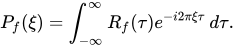
This Fourier transform is called the [power spectral density](https://en.wikipedia.org/wiki/Spectral_density#Power_spectral_density "Spectral density") function of f. (Unless all periodic components are first filtered out from f, this integral will diverge, but it is easy to filter out such periodicities.)
The power spectrum, as indicated by this density function P, measures the amount of variance contributed to the data by the frequency ξ. In electrical signals, the variance is proportional to the average power (energy per unit time), and so the power spectrum describes how much the different frequencies contribute to the average power of the signal. This process is called the spectral analysis of time-series and is analogous to the usual analysis of variance of data that is not a time-series ([ANOVA](https://en.wikipedia.org/wiki/ANOVA "ANOVA")).
Knowledge of which frequencies are "important" in this sense is crucial for the proper design of filters and for the proper evaluation of measuring apparatuses. It can also be useful for the scientific analysis of the phenomena responsible for producing the data.
The power spectrum of a signal can also be approximately measured directly by measuring the average power that remains in a signal after all the frequencies outside a narrow band have been filtered out.
Spectral analysis is carried out for visual signals as well. The power spectrum ignores all phase relations, which is good enough for many purposes, but for video signals other types of spectral analysis must also be employed, still using the Fourier transform as a tool.
## Other notations
\[[edit](https://en.wikipedia.org/w/index.php?title=Fourier_transform&action=edit§ion=53 "Edit section: Other notations")\]
Other common notations for f ^ ( ξ ) {\\displaystyle {\\widehat {f}}(\\xi )}  include: f ~ ( ξ ) , F ( ξ ) , F ( f ) ( ξ ) , ( F f ) ( ξ ) , F ( f ) , F { f } , F ( f ( t ) ) , F { f ( t ) } . {\\displaystyle {\\tilde {f}}(\\xi ),\\ F(\\xi ),\\ {\\mathcal {F}}\\left(f\\right)(\\xi ),\\ \\left({\\mathcal {F}}f\\right)(\\xi ),\\ {\\mathcal {F}}(f),\\ {\\mathcal {F}}\\{f\\},\\ {\\mathcal {F}}{\\bigl (}f(t){\\bigr )},\\ {\\mathcal {F}}{\\bigl \\{}f(t){\\bigr \\}}.} 
In the sciences and engineering it is also common to make substitutions like these: ξ → f , x → t , f → x , f ^ → X . {\\displaystyle \\xi \\rightarrow f,\\quad x\\rightarrow t,\\quad f\\rightarrow x,\\quad {\\widehat {f}}\\rightarrow X.} 
So the transform pair f ( x ) ⟺ F f ^ ( ξ ) {\\displaystyle f(x)\\ {\\stackrel {\\mathcal {F}}{\\Longleftrightarrow }}\\ {\\widehat {f}}(\\xi )}  can become x ( t ) ⟺ F X ( f ) {\\displaystyle x(t)\\ {\\stackrel {\\mathcal {F}}{\\Longleftrightarrow }}\\ X(f)} 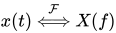
A disadvantage of the capital letter notation is when expressing a transform such as f ^ ⋅ g {\\displaystyle {\\widehat {f}}\\cdot g}  or f ^ ′ {\\displaystyle {\\widehat {f}}'}  , which become the more awkward F { f ⋅ g } {\\displaystyle {\\mathcal {F}}\\{f\\cdot g\\}}  and F { f ′ } {\\displaystyle {\\mathcal {F}}\\{f'\\}}  .
In some contexts such as particle physics, the same symbol f {\\displaystyle f}  may be used for both for a function as well as it Fourier transform, with the two only distinguished by their [argument](https://en.wikipedia.org/wiki/Argument_of_a_function "Argument of a function") I.e. f ( k 1 \+ k 2 ) {\\displaystyle f(k\_{1}+k\_{2})}  would refer to the Fourier transform because of the momentum argument, while f ( x 0 \+ π r → ) {\\displaystyle f(x\_{0}+\\pi {\\vec {r}})}  would refer to the original function because of the positional argument. Although tildes may be used as in f ~ {\\displaystyle {\\tilde {f}}}  to indicate Fourier transforms, tildes may also be used to indicate a modification of a quantity with a more [Lorentz invariant](https://en.wikipedia.org/wiki/Lorentz_invariant "Lorentz invariant") form, such as d k ~ \= d k ( 2 π ) 3 2 ω {\\displaystyle {\\tilde {dk}}={\\frac {dk}{(2\\pi )^{3}2\\omega }}} 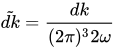 , so care must be taken. Similarly, f ^ {\\displaystyle {\\widehat {f}}}  often denotes the [Hilbert transform](https://en.wikipedia.org/wiki/Hilbert_transform "Hilbert transform") of f {\\displaystyle f}  .
The interpretation of the complex function *f̂*(*ξ*) may be aided by expressing it in [polar coordinate](https://en.wikipedia.org/wiki/Polar_coordinate "Polar coordinate") form f ^ ( ξ ) \= A ( ξ ) e i φ ( ξ ) {\\displaystyle {\\widehat {f}}(\\xi )=A(\\xi )e^{i\\varphi (\\xi )}}  in terms of the two real functions *A*(*ξ*) and *φ*(*ξ*) where: A ( ξ ) \= \| f ^ ( ξ ) \| , {\\displaystyle A(\\xi )=\\left\|{\\widehat {f}}(\\xi )\\right\|,}  is the [amplitude](https://en.wikipedia.org/wiki/Amplitude "Amplitude") and φ ( ξ ) \= arg ( f ^ ( ξ ) ) , {\\displaystyle \\varphi (\\xi )=\\arg \\left({\\widehat {f}}(\\xi )\\right),}  is the [phase](https://en.wikipedia.org/wiki/Phase_\(waves\) "Phase (waves)") (see *[Arg](https://en.wikipedia.org/wiki/Arg_\(mathematics\) "Arg (mathematics)")*).
Then the inverse transform can be written: f ( x ) \= ∫ − ∞ ∞ A ( ξ ) e i ( 2 π ξ x \+ φ ( ξ ) ) d ξ , {\\displaystyle f(x)=\\int \_{-\\infty }^{\\infty }A(\\xi )\\ e^{i{\\bigl (}2\\pi \\xi x+\\varphi (\\xi ){\\bigr )}}\\,d\\xi ,}  which is a recombination of all the frequency components of *f*(*x*). Each component is a complex [sinusoid](https://en.wikipedia.org/wiki/Sinusoid "Sinusoid") of the form *e*2π*ixξ* whose amplitude is *A*(*ξ*) and whose initial [phase angle](https://en.wikipedia.org/wiki/Phase_\(waves\) "Phase (waves)") (at *x* = 0) is *φ*(*ξ*).
The Fourier transform may be thought of as a mapping on function spaces. This mapping is here denoted F and F(*f*) is used to denote the Fourier transform of the function f. This mapping is linear, which means that F can also be seen as a linear transformation on the function space and implies that the standard notation in linear algebra of applying a linear transformation to a vector (here the function *f*) can be used to write F *f* instead of F(*f*). Since the result of applying the Fourier transform is again a function, we can be interested in the value of this function evaluated at the value ξ for its variable, and this is denoted either as F *f*(*ξ*) or as (F *f*)(*ξ*). Notice that in the former case, it is implicitly understood that F is applied first to f and then the resulting function is evaluated at ξ, not the other way around.
In mathematics and various applied sciences, it is often necessary to distinguish between a function f and the value of f when its variable equals x, denoted *f*(*x*). This means that a notation like F(*f*(*x*)) formally can be interpreted as the Fourier transform of the values of f at x. Despite this flaw, the previous notation appears frequently, often when a particular function or a function of a particular variable is to be transformed. For example, F ( rect ( x ) ) \= sinc ( ξ ) {\\displaystyle {\\mathcal {F}}{\\bigl (}\\operatorname {rect} (x){\\bigr )}=\\operatorname {sinc} (\\xi )}  is sometimes used to express that the Fourier transform of a [rectangular function](https://en.wikipedia.org/wiki/Rectangular_function "Rectangular function") is a [sinc function](https://en.wikipedia.org/wiki/Sinc_function "Sinc function"), or F ( f ( x \+ x 0 ) ) \= F ( f ( x ) ) e i 2 π x 0 ξ {\\displaystyle {\\mathcal {F}}{\\bigl (}f(x+x\_{0}){\\bigr )}={\\mathcal {F}}{\\bigl (}f(x){\\bigr )}\\,e^{i2\\pi x\_{0}\\xi }}  is used to express the shift property of the Fourier transform.
Notice, that the last example is only correct under the assumption that the transformed function is a function of x, not of *x*0.
As discussed above, the [characteristic function](https://en.wikipedia.org/wiki/Characteristic_function_\(probability_theory\) "Characteristic function (probability theory)") of a random variable is the same as the [Fourier–Stieltjes transform](https://en.wikipedia.org/wiki/Fourier_transform#Fourier%E2%80%93Stieltjes_transform) of its distribution measure, but in this context it is typical to take a different convention for the constants. Typically characteristic function is defined E ( e i t ⋅ X ) \= ∫ e i t ⋅ x d μ X ( x ) . {\\displaystyle E\\left(e^{it\\cdot X}\\right)=\\int e^{it\\cdot x}\\,d\\mu \_{X}(x).} 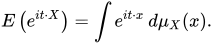
As in the case of the "non-unitary angular frequency" convention above, the factor of 2π appears in neither the normalizing constant nor the exponent. Unlike any of the conventions appearing above, this convention takes the opposite sign in the exponent.
## Computation methods
\[[edit](https://en.wikipedia.org/w/index.php?title=Fourier_transform&action=edit§ion=54 "Edit section: Computation methods")\]
The appropriate computation method largely depends how the original mathematical function is represented and the desired form of the output function. In this section we consider both functions of a continuous variable, f ( x ) {\\displaystyle f(x)}  , and functions of a discrete variable (i.e. ordered pairs of x {\\displaystyle x}  and f {\\displaystyle f}  values). For discrete-valued x {\\displaystyle x}  , the transform integral becomes a summation of sinusoids, which is still a continuous function of frequency ( ξ {\\displaystyle \\xi }  or ω {\\displaystyle \\omega }  ). When the sinusoids are harmonically related (i.e. when the x {\\displaystyle x} \-values are spaced at integer multiples of an interval), the transform is called [discrete-time Fourier transform](https://en.wikipedia.org/wiki/Discrete-time_Fourier_transform "Discrete-time Fourier transform") (DTFT).
### Discrete Fourier transforms and fast Fourier transforms
\[[edit](https://en.wikipedia.org/w/index.php?title=Fourier_transform&action=edit§ion=55 "Edit section: Discrete Fourier transforms and fast Fourier transforms")\]
Sampling the DTFT at equally-spaced values of frequency is the most common modern method of computation. Efficient procedures, depending on the frequency resolution needed, are described at [Discrete-time Fourier transform § Sampling the DTFT](https://en.wikipedia.org/wiki/Discrete-time_Fourier_transform#Sampling_the_DTFT "Discrete-time Fourier transform"). The [discrete Fourier transform](https://en.wikipedia.org/wiki/Discrete_Fourier_transform "Discrete Fourier transform") (DFT), used there, is usually computed by a [fast Fourier transform](https://en.wikipedia.org/wiki/Fast_Fourier_transform "Fast Fourier transform") (FFT) algorithm.
### Symbolic integration of closed-form functions
\[[edit](https://en.wikipedia.org/w/index.php?title=Fourier_transform&action=edit§ion=56 "Edit section: Symbolic integration of closed-form functions")\]
Tables of [closed-form](https://en.wikipedia.org/wiki/Closed-form_expression "Closed-form expression") Fourier transforms, such as [§ Square-integrable functions, one-dimensional](https://en.wikipedia.org/wiki/Fourier_transform#Square-integrable_functions,_one-dimensional) and [§ Table of discrete-time Fourier transforms](https://en.wikipedia.org/wiki/Discrete-time_Fourier_transform#Table_of_discrete-time_Fourier_transforms "Discrete-time Fourier transform"), are created by mathematically evaluating the Fourier analysis integral (or summation) into another closed-form function of frequency ( ξ {\\displaystyle \\xi }  or ω {\\displaystyle \\omega }  ).[\[74\]](https://en.wikipedia.org/wiki/Fourier_transform#cite_note-Zwillinger-2014-82) When mathematically possible, this provides a transform for a continuum of frequency values.
Many computer algebra systems such as [Matlab](https://en.wikipedia.org/wiki/Matlab "Matlab") and [Mathematica](https://en.wikipedia.org/wiki/Mathematica "Mathematica") that are capable of [symbolic integration](https://en.wikipedia.org/wiki/Symbolic_integration "Symbolic integration") are capable of computing Fourier transforms symbolically.[\[note 9\]](https://en.wikipedia.org/wiki/Fourier_transform#cite_note-83) <https://en.wikipedia.org/wiki/Help:Edit_summary>
### Numerical integration of closed-form continuous functions
\[[edit](https://en.wikipedia.org/w/index.php?title=Fourier_transform&action=edit§ion=57 "Edit section: Numerical integration of closed-form continuous functions")\]
Discrete sampling of the Fourier transform can also be done by [numerical integration](https://en.wikipedia.org/wiki/Numerical_integration "Numerical integration") of the definition at each value of frequency for which transform is desired.[\[75\]](https://en.wikipedia.org/wiki/Fourier_transform#cite_note-84)[\[76\]](https://en.wikipedia.org/wiki/Fourier_transform#cite_note-85)[\[77\]](https://en.wikipedia.org/wiki/Fourier_transform#cite_note-86) The numerical integration approach works on a much broader class of functions than the analytic approach.
### Numerical integration of a series of ordered pairs
\[[edit](https://en.wikipedia.org/w/index.php?title=Fourier_transform&action=edit§ion=58 "Edit section: Numerical integration of a series of ordered pairs")\]
If the input function is a series of ordered pairs, numerical integration reduces to just a summation over the set of data pairs.[\[78\]](https://en.wikipedia.org/wiki/Fourier_transform#cite_note-87) The DTFT is a common subcase of this more general situation.
## Tables of important Fourier transforms
\[[edit](https://en.wikipedia.org/w/index.php?title=Fourier_transform&action=edit§ion=59 "Edit section: Tables of important Fourier transforms")\]
The following tables record some closed-form Fourier transforms. For functions *f*(*x*) and *g*(*x*) denote their Fourier transforms by *f̂* and *ĝ*. Only the three most common conventions are included. It may be useful to notice that entry 105 gives a relationship between the Fourier transform of a function and the original function, which can be seen as relating the Fourier transform and its inverse.
### Functional relationships, one-dimensional
\[[edit](https://en.wikipedia.org/w/index.php?title=Fourier_transform&action=edit§ion=60 "Edit section: Functional relationships, one-dimensional")\]
The Fourier transforms in this table may be found in [Erdélyi (1954)](https://en.wikipedia.org/wiki/Fourier_transform#CITEREFErd%C3%A9lyi1954) or [Kammler (2000](https://en.wikipedia.org/wiki/Fourier_transform#CITEREFKammler2000), appendix).
| | Function | Fourier transform unitary, ordinary frequency | Fourier transform unitary, angular frequency | Fourier transform non-unitary, angular frequency | Remarks |
|---|---|---|---|---|---|
| | f ( x ) {\\displaystyle f(x)}  | | | | |
### Square-integrable functions, one-dimensional
\[[edit](https://en.wikipedia.org/w/index.php?title=Fourier_transform&action=edit§ion=61 "Edit section: Square-integrable functions, one-dimensional")\]
The Fourier transforms in this table may be found in [Campbell & Foster (1948)](https://en.wikipedia.org/wiki/Fourier_transform#CITEREFCampbellFoster1948), [Erdélyi (1954)](https://en.wikipedia.org/wiki/Fourier_transform#CITEREFErd%C3%A9lyi1954), or [Kammler (2000](https://en.wikipedia.org/wiki/Fourier_transform#CITEREFKammler2000), appendix).
| | Function | Fourier transform unitary, ordinary frequency | Fourier transform unitary, angular frequency | Fourier transform non-unitary, angular frequency | Remarks |
|---|---|---|---|---|---|
| | f ( x ) {\\displaystyle f(x)}  | | | | |
### Distributions, one-dimensional
\[[edit](https://en.wikipedia.org/w/index.php?title=Fourier_transform&action=edit§ion=62 "Edit section: Distributions, one-dimensional")\]
The Fourier transforms in this table may be found in [Erdélyi (1954)](https://en.wikipedia.org/wiki/Fourier_transform#CITEREFErd%C3%A9lyi1954) or [Kammler (2000](https://en.wikipedia.org/wiki/Fourier_transform#CITEREFKammler2000), appendix).
| | Function | Fourier transform unitary, ordinary frequency | Fourier transform unitary, angular frequency | Fourier transform non-unitary, angular frequency | Remarks |
|---|---|---|---|---|---|
| | f ( x ) {\\displaystyle f(x)}  | | | | |
### Two-dimensional functions
\[[edit](https://en.wikipedia.org/w/index.php?title=Fourier_transform&action=edit§ion=63 "Edit section: Two-dimensional functions")\]
| | Function | Fourier transform unitary, ordinary frequency | Fourier transform unitary, angular frequency | Fourier transform non-unitary, angular frequency | Remarks |
|---|---|---|---|---|---|
| 400 | f ( x , y ) {\\displaystyle f(x,y)}  | | | | |
### Formulas for general *n*\-dimensional functions
\[[edit](https://en.wikipedia.org/w/index.php?title=Fourier_transform&action=edit§ion=64 "Edit section: Formulas for general n-dimensional functions")\]
| | Function | Fourier transform unitary, ordinary frequency | Fourier transform unitary, angular frequency | Fourier transform non-unitary, angular frequency | Remarks |
|---|---|---|---|---|---|
| 500 | f ( x ) {\\displaystyle f(\\mathbf {x} )}  | | | | |
## See also
\[[edit](https://en.wikipedia.org/w/index.php?title=Fourier_transform&action=edit§ion=65 "Edit section: See also")\]
- [Analog signal processing](https://en.wikipedia.org/wiki/Analog_signal_processing "Analog signal processing") – Signal processing conducted on analog signals
- [Beevers–Lipson strip](https://en.wikipedia.org/wiki/Beevers%E2%80%93Lipson_strip "Beevers–Lipson strip") – Mathematical tool in crystallography
- [Constant-Q transform](https://en.wikipedia.org/wiki/Constant-Q_transform "Constant-Q transform") – Short-time Fourier transform with variable resolution
- [DFT matrix](https://en.wikipedia.org/wiki/DFT_matrix "DFT matrix") – Discrete fourier transform expressed as a matrix
- [Discrete Fourier transform](https://en.wikipedia.org/wiki/Discrete_Fourier_transform "Discrete Fourier transform") – Function in discrete mathematics
- [Fast Fourier transform](https://en.wikipedia.org/wiki/Fast_Fourier_transform "Fast Fourier transform") – Discrete Fourier transform algorithm
- [Fourier integral operator](https://en.wikipedia.org/wiki/Fourier_integral_operator "Fourier integral operator") – Class of differential and integral operators
- [Fourier inversion theorem](https://en.wikipedia.org/wiki/Fourier_inversion_theorem "Fourier inversion theorem") – Mathematical theorem about functions
- [Fourier multiplier](https://en.wikipedia.org/wiki/Fourier_multiplier "Fourier multiplier") – Type of operator in Fourier analysisPages displaying short descriptions of redirect targets
- [Fourier series](https://en.wikipedia.org/wiki/Fourier_series "Fourier series") – Decomposition of periodic functions
- [Fourier sine transform](https://en.wikipedia.org/wiki/Fourier_sine_transform "Fourier sine transform") – Variant Fourier transformsPages displaying short descriptions of redirect targets
- [Fourier–Deligne transform](https://en.wikipedia.org/wiki/Fourier%E2%80%93Deligne_transform "Fourier–Deligne transform")
- [Fourier–Mukai transform](https://en.wikipedia.org/wiki/Fourier%E2%80%93Mukai_transform "Fourier–Mukai transform")
- [Fractional Fourier transform](https://en.wikipedia.org/wiki/Fractional_Fourier_transform "Fractional Fourier transform") – Mathematical operation
- [Indirect Fourier transform](https://en.wikipedia.org/wiki/Indirect_Fourier_transform "Indirect Fourier transform")
- [Integral transform](https://en.wikipedia.org/wiki/Integral_transform "Integral transform") – Mapping involving integration between function spaces
- [Hankel transform](https://en.wikipedia.org/wiki/Hankel_transform "Hankel transform") – Mathematical operation
- [Hartley transform](https://en.wikipedia.org/wiki/Hartley_transform "Hartley transform") – Integral transform closely related to the Fourier transform
- [Laplace transform](https://en.wikipedia.org/wiki/Laplace_transform "Laplace transform") – Integral transform useful in probability theory, physics, and engineering
- [Least-squares spectral analysis](https://en.wikipedia.org/wiki/Least-squares_spectral_analysis "Least-squares spectral analysis") – Periodicity computation method
- [Linear canonical transform](https://en.wikipedia.org/wiki/Linear_canonical_transform "Linear canonical transform")
- [List of Fourier-related transforms](https://en.wikipedia.org/wiki/List_of_Fourier-related_transforms "List of Fourier-related transforms")
- [Mellin transform](https://en.wikipedia.org/wiki/Mellin_transform "Mellin transform") – Mathematical operation
- [Multidimensional transform](https://en.wikipedia.org/wiki/Multidimensional_transform "Multidimensional transform") – Mathematical analysis of frequency content of signals
- [NGC 4622](https://en.wikipedia.org/wiki/NGC_4622 "NGC 4622") – Especially the image NGC 4622 Fourier transform *m* = 2.
- [Nonlocal operator](https://en.wikipedia.org/wiki/Nonlocal_operator "Nonlocal operator") – Class of operator mapping
- [Quadratic Fourier transform](https://en.wikipedia.org/wiki/Quadratic_Fourier_transform "Quadratic Fourier transform")
- [Quantum Fourier transform](https://en.wikipedia.org/wiki/Quantum_Fourier_transform "Quantum Fourier transform") – Change of basis applied in quantum computing
- [Short-time Fourier transform](https://en.wikipedia.org/wiki/Short-time_Fourier_transform "Short-time Fourier transform") – Fourier-related transform for signals that change over time
- [Spectral density](https://en.wikipedia.org/wiki/Spectral_density "Spectral density") – Relative importance of certain frequencies in a composite signal
- [Spectral density estimation](https://en.wikipedia.org/wiki/Spectral_density_estimation "Spectral density estimation") – Signal processing technique
- [Symbolic integration](https://en.wikipedia.org/wiki/Symbolic_integration "Symbolic integration") – Computation of an antiderivatives
- [Time stretch dispersive Fourier transform](https://en.wikipedia.org/wiki/Time_stretch_dispersive_Fourier_transform "Time stretch dispersive Fourier transform")
- [Transform (mathematics)](https://en.wikipedia.org/wiki/Transform_\(mathematics\) "Transform (mathematics)") – Function that applies a set to itselfPages displaying short descriptions of redirect targets
## Notes
\[[edit](https://en.wikipedia.org/w/index.php?title=Fourier_transform&action=edit§ion=66 "Edit section: Notes")\]
1. **[^](https://en.wikipedia.org/wiki/Fourier_transform#cite_ref-1)** Sentence structure is often sufficient to distinguish the intended meaning: for example, "Apply the Fourier transform to \[an input\]" refers to the operation, whereas "The Fourier transform of \[an input\]" refers to its output.
2. **[^](https://en.wikipedia.org/wiki/Fourier_transform#cite_ref-2)** Depending on the application a [Lebesgue integral](https://en.wikipedia.org/wiki/Lebesgue_integral "Lebesgue integral"), [distributional](https://en.wikipedia.org/wiki/Distribution_\(mathematics\) "Distribution (mathematics)"), or other approach may be most appropriate.
3. **[^](https://en.wikipedia.org/wiki/Fourier_transform#cite_ref-3)** [Vretblad (2000)](https://en.wikipedia.org/wiki/Fourier_transform#CITEREFVretblad2000) provides solid justification for these formal procedures without going too deeply into [functional analysis](https://en.wikipedia.org/wiki/Functional_analysis "Functional analysis") or the [theory of distributions](https://en.wikipedia.org/wiki/Distribution_\(mathematics\) "Distribution (mathematics)").
4. **[^](https://en.wikipedia.org/wiki/Fourier_transform#cite_ref-4)** In [relativistic quantum mechanics](https://en.wikipedia.org/wiki/Relativistic_quantum_mechanics "Relativistic quantum mechanics") one encounters vector-valued Fourier transforms of multi-component wave functions. In [quantum field theory](https://en.wikipedia.org/wiki/Quantum_field_theory "Quantum field theory"), operator-valued Fourier transforms of operator-valued functions of spacetime are in frequent use, see for example [Greiner & Reinhardt (1996)](https://en.wikipedia.org/wiki/Fourier_transform#CITEREFGreinerReinhardt1996).
5. **[^](https://en.wikipedia.org/wiki/Fourier_transform#cite_ref-18)**
A possible source of confusion is the [frequency-shifting property](https://en.wikipedia.org/wiki/Fourier_transform#Frequency_shifting); i.e. the transform of function
f
(
x
)
e
−
i
2
π
ξ
0
x
{\\displaystyle f(x)e^{-i2\\pi \\xi \_{0}x}}

is
f
^
(
ξ
\+
ξ
0
)
{\\displaystyle {\\widehat {f}}(\\xi +\\xi \_{0})}

. The value of this function at
ξ
\=
0
{\\displaystyle \\xi =0}

is
f
^
(
ξ
0
)
{\\displaystyle {\\widehat {f}}(\\xi \_{0})}

, meaning that a frequency
ξ
0
{\\displaystyle \\xi \_{0}}

has been shifted to zero (also see *[Negative frequency § Simplifying the Fourier transform](https://en.wikipedia.org/wiki/Negative_frequency#Simplifying_the_Fourier_transform "Negative frequency")*).
6. **[^](https://en.wikipedia.org/wiki/Fourier_transform#cite_ref-27)**
The operator
U
(
1
2
π
d
d
x
)
{\\textstyle U\\left({\\frac {1}{2\\pi }}{\\frac {d}{dx}}\\right)}

is defined by replacing
x
{\\displaystyle x}

by
1
2
π
d
d
x
{\\textstyle {\\frac {1}{2\\pi }}{\\frac {d}{dx}}}

in the [Taylor expansion](https://en.wikipedia.org/wiki/Taylor_series "Taylor series") of
U
(
x
)
{\\displaystyle U(x)}

.
7. **[^](https://en.wikipedia.org/wiki/Fourier_transform#cite_ref-61)** More generally, one can take a sequence of functions that are in the intersection of *L*1 and *L*2 and that converges to f in the *L*2\-norm, and define the Fourier transform of f as the *L*2 -limit of the Fourier transforms of these functions.
8. **[^](https://en.wikipedia.org/wiki/Fourier_transform#cite_ref-78)** Up to an imaginary constant factor whose magnitude depends on what Fourier transform convention is used.
9. **[^](https://en.wikipedia.org/wiki/Fourier_transform#cite_ref-83)** For example, to compute the Fourier transform of cos(6π*t*) *e*−π*t*2 one might enter the command `integrate cos(6*pi*t) exp(−pi*t^2) exp(-i*2*pi*f*t) from -inf to inf` into [Wolfram Alpha](https://en.wikipedia.org/wiki/Wolfram_Alpha "Wolfram Alpha"). The direct command `fourier transform of cos(6*pi*t) exp(−pi*t^2)` would also work for Wolfram Alpha, although the options for the convention (see *[§ Other conventions](https://en.wikipedia.org/wiki/Fourier_transform#Other_conventions)*) must be changed away from the default option, which is actually equivalent to `integrate cos(6*pi*t) exp(−pi*t^2) exp(i*omega*t) /sqrt(2*pi) from -inf to inf`.
10. **[^](https://en.wikipedia.org/wiki/Fourier_transform#cite_ref-92)**
In [Gelfand & Shilov 1964](https://en.wikipedia.org/wiki/Fourier_transform#CITEREFGelfandShilov1964), p. 363, with the non-unitary conventions of this table, the transform of
\|
x
\|
λ
{\\displaystyle \|\\mathbf {x} \|^{\\lambda }}

is given to be
2
λ
\+
n
π
1
2
n
Γ
(
λ
\+
n
2
)
/
Γ
(
−
λ
2
)
\|
ω
\|
−
λ
−
n
{\\displaystyle \\textstyle 2^{\\lambda +n}\\pi ^{{\\tfrac {1}{2}}n}{\\Gamma ({\\frac {\\lambda +n}{2}})}/{\\Gamma (-{\\frac {\\lambda }{2}})}\\vert {\\boldsymbol {\\omega }}\\vert ^{-\\lambda -n}}

from which this follows, with
λ
\=
−
α
{\\displaystyle \\lambda =-\\alpha }

.
## Citations
\[[edit](https://en.wikipedia.org/w/index.php?title=Fourier_transform&action=edit§ion=67 "Edit section: Citations")\]
1. **[^](https://en.wikipedia.org/wiki/Fourier_transform#cite_ref-FOOTNOTEPinsky200291_5-0)** [Pinsky 2002](https://en.wikipedia.org/wiki/Fourier_transform#CITEREFPinsky2002), p. 91
2. **[^](https://en.wikipedia.org/wiki/Fourier_transform#cite_ref-FOOTNOTELiebLoss2001123%E2%80%93125_6-0)** [Lieb & Loss 2001](https://en.wikipedia.org/wiki/Fourier_transform#CITEREFLiebLoss2001), pp. 123–125
3. **[^](https://en.wikipedia.org/wiki/Fourier_transform#cite_ref-FOOTNOTEGelfandShilov1968128_7-0)** [Gelfand & Shilov 1968](https://en.wikipedia.org/wiki/Fourier_transform#CITEREFGelfandShilov1968), p. 128
4. **[^](https://en.wikipedia.org/wiki/Fourier_transform#cite_ref-8)** [Fourier 1822](https://en.wikipedia.org/wiki/Fourier_transform#CITEREFFourier1822), p. 525
5. **[^](https://en.wikipedia.org/wiki/Fourier_transform#cite_ref-9)** [Fourier 1878](https://en.wikipedia.org/wiki/Fourier_transform#CITEREFFourier1878), p. 408
6. **[^](https://en.wikipedia.org/wiki/Fourier_transform#cite_ref-10)** [Jordan 1883](https://en.wikipedia.org/wiki/Fourier_transform#CITEREFJordan1883) proves on pp. 216–226 the [Fourier integral theorem](https://en.wikipedia.org/wiki/Fourier_inversion_theorem#Fourier_integral_theorem "Fourier inversion theorem") before studying Fourier series.
7. **[^](https://en.wikipedia.org/wiki/Fourier_transform#cite_ref-11)** [Titchmarsh 1986](https://en.wikipedia.org/wiki/Fourier_transform#CITEREFTitchmarsh1986), p. 1
8. **[^](https://en.wikipedia.org/wiki/Fourier_transform#cite_ref-12)** [Rahman 2011](https://en.wikipedia.org/wiki/Fourier_transform#CITEREFRahman2011), p. 10
9. **[^](https://en.wikipedia.org/wiki/Fourier_transform#cite_ref-13)** [Oppenheim, Schafer & Buck 1999](https://en.wikipedia.org/wiki/Fourier_transform#CITEREFOppenheimSchaferBuck1999), p. 58
10. **[^](https://en.wikipedia.org/wiki/Fourier_transform#cite_ref-FOOTNOTEStade2005298%E2%80%93299_14-0)** [Stade 2005](https://en.wikipedia.org/wiki/Fourier_transform#CITEREFStade2005), pp. 298–299
11. **[^](https://en.wikipedia.org/wiki/Fourier_transform#cite_ref-FOOTNOTEHowe1980_15-0)** [Howe 1980](https://en.wikipedia.org/wiki/Fourier_transform#CITEREFHowe1980)
12. **[^](https://en.wikipedia.org/wiki/Fourier_transform#cite_ref-16)** [Folland 1989](https://en.wikipedia.org/wiki/Fourier_transform#CITEREFFolland1989)
13. **[^](https://en.wikipedia.org/wiki/Fourier_transform#cite_ref-17)** [Fourier 1822](https://en.wikipedia.org/wiki/Fourier_transform#CITEREFFourier1822)
14. **[^](https://en.wikipedia.org/wiki/Fourier_transform#cite_ref-19)** [Arfken 1985](https://en.wikipedia.org/wiki/Fourier_transform#CITEREFArfken1985)
15. ^ [***a***](https://en.wikipedia.org/wiki/Fourier_transform#cite_ref-Pinsky-2002_20-0) [***b***](https://en.wikipedia.org/wiki/Fourier_transform#cite_ref-Pinsky-2002_20-1) [Pinsky 2002](https://en.wikipedia.org/wiki/Fourier_transform#CITEREFPinsky2002)
16. **[^](https://en.wikipedia.org/wiki/Fourier_transform#cite_ref-FOOTNOTEProakisManolakis1996[httpsarchiveorgdetailsdigitalsignalpro00proapage291_291]_21-0)** [Proakis & Manolakis 1996](https://en.wikipedia.org/wiki/Fourier_transform#CITEREFProakisManolakis1996), p. [291](https://archive.org/details/digitalsignalpro00proa/page/291)
17. **[^](https://en.wikipedia.org/wiki/Fourier_transform#cite_ref-FOOTNOTEKatznelson2004153_22-0)** [Katznelson 2004](https://en.wikipedia.org/wiki/Fourier_transform#CITEREFKatznelson2004), p. 153
18. **[^](https://en.wikipedia.org/wiki/Fourier_transform#cite_ref-FOOTNOTESteinWeiss19712_23-0)** [Stein & Weiss 1971](https://en.wikipedia.org/wiki/Fourier_transform#CITEREFSteinWeiss1971), p. 2
19. ^ [***a***](https://en.wikipedia.org/wiki/Fourier_transform#cite_ref-Stein-Weiss-1971_24-0) [***b***](https://en.wikipedia.org/wiki/Fourier_transform#cite_ref-Stein-Weiss-1971_24-1) [***c***](https://en.wikipedia.org/wiki/Fourier_transform#cite_ref-Stein-Weiss-1971_24-2) [***d***](https://en.wikipedia.org/wiki/Fourier_transform#cite_ref-Stein-Weiss-1971_24-3) [***e***](https://en.wikipedia.org/wiki/Fourier_transform#cite_ref-Stein-Weiss-1971_24-4) [***f***](https://en.wikipedia.org/wiki/Fourier_transform#cite_ref-Stein-Weiss-1971_24-5) [Stein & Weiss 1971](https://en.wikipedia.org/wiki/Fourier_transform#CITEREFSteinWeiss1971)
20. **[^](https://en.wikipedia.org/wiki/Fourier_transform#cite_ref-25)** [Rudin 1987](https://en.wikipedia.org/wiki/Fourier_transform#CITEREFRudin1987), p. 187
21. **[^](https://en.wikipedia.org/wiki/Fourier_transform#cite_ref-26)** [Rudin 1987](https://en.wikipedia.org/wiki/Fourier_transform#CITEREFRudin1987), p. 186
22. **[^](https://en.wikipedia.org/wiki/Fourier_transform#cite_ref-28)** [Folland 1992](https://en.wikipedia.org/wiki/Fourier_transform#CITEREFFolland1992), p. 216
23. **[^](https://en.wikipedia.org/wiki/Fourier_transform#cite_ref-29)** [Wolf 1979](https://en.wikipedia.org/wiki/Fourier_transform#CITEREFWolf1979), p. 307ff
24. **[^](https://en.wikipedia.org/wiki/Fourier_transform#cite_ref-30)** [Folland 1989](https://en.wikipedia.org/wiki/Fourier_transform#CITEREFFolland1989), p. 53
25. **[^](https://en.wikipedia.org/wiki/Fourier_transform#cite_ref-31)** [Celeghini, Gadella & del Olmo 2021](https://en.wikipedia.org/wiki/Fourier_transform#CITEREFCeleghiniGadelladel_Olmo2021)
26. **[^](https://en.wikipedia.org/wiki/Fourier_transform#cite_ref-Duoandikoetxea-2001_32-0)** [Duoandikoetxea 2001](https://en.wikipedia.org/wiki/Fourier_transform#CITEREFDuoandikoetxea2001)
27. ^ [***a***](https://en.wikipedia.org/wiki/Fourier_transform#cite_ref-Boashash-2003_33-0) [***b***](https://en.wikipedia.org/wiki/Fourier_transform#cite_ref-Boashash-2003_33-1) [Boashash 2003](https://en.wikipedia.org/wiki/Fourier_transform#CITEREFBoashash2003)
28. **[^](https://en.wikipedia.org/wiki/Fourier_transform#cite_ref-34)** [Condon 1937](https://en.wikipedia.org/wiki/Fourier_transform#CITEREFCondon1937)
29. **[^](https://en.wikipedia.org/wiki/Fourier_transform#cite_ref-35)** [Wolf 1979](https://en.wikipedia.org/wiki/Fourier_transform#CITEREFWolf1979), p. 320
30. ^ [***a***](https://en.wikipedia.org/wiki/Fourier_transform#cite_ref-auto_36-0) [***b***](https://en.wikipedia.org/wiki/Fourier_transform#cite_ref-auto_36-1) [Wolf 1979](https://en.wikipedia.org/wiki/Fourier_transform#CITEREFWolf1979), p. 312
31. **[^](https://en.wikipedia.org/wiki/Fourier_transform#cite_ref-37)** [Folland 1989](https://en.wikipedia.org/wiki/Fourier_transform#CITEREFFolland1989), p. 52
32. **[^](https://en.wikipedia.org/wiki/Fourier_transform#cite_ref-38)** [Howe 1980](https://en.wikipedia.org/wiki/Fourier_transform#CITEREFHowe1980)
33. **[^](https://en.wikipedia.org/wiki/Fourier_transform#cite_ref-39)** [Paley & Wiener 1934](https://en.wikipedia.org/wiki/Fourier_transform#CITEREFPaleyWiener1934)
34. **[^](https://en.wikipedia.org/wiki/Fourier_transform#cite_ref-40)** [Gelfand & Vilenkin 1964](https://en.wikipedia.org/wiki/Fourier_transform#CITEREFGelfandVilenkin1964)
35. **[^](https://en.wikipedia.org/wiki/Fourier_transform#cite_ref-41)** [Kirillov & Gvishiani 1982](https://en.wikipedia.org/wiki/Fourier_transform#CITEREFKirillovGvishiani1982)
36. **[^](https://en.wikipedia.org/wiki/Fourier_transform#cite_ref-42)** [Clozel & Delorme 1985](https://en.wikipedia.org/wiki/Fourier_transform#CITEREFClozelDelorme1985), pp. 331–333
37. **[^](https://en.wikipedia.org/wiki/Fourier_transform#cite_ref-43)** [de Groot & Mazur 1984](https://en.wikipedia.org/wiki/Fourier_transform#CITEREFde_GrootMazur1984), p. 146
38. **[^](https://en.wikipedia.org/wiki/Fourier_transform#cite_ref-44)** [Champeney 1987](https://en.wikipedia.org/wiki/Fourier_transform#CITEREFChampeney1987), p. 80
39. ^ [***a***](https://en.wikipedia.org/wiki/Fourier_transform#cite_ref-Kolmogorov-Fomin-1999_45-0) [***b***](https://en.wikipedia.org/wiki/Fourier_transform#cite_ref-Kolmogorov-Fomin-1999_45-1) [***c***](https://en.wikipedia.org/wiki/Fourier_transform#cite_ref-Kolmogorov-Fomin-1999_45-2) [Kolmogorov & Fomin 1999](https://en.wikipedia.org/wiki/Fourier_transform#CITEREFKolmogorovFomin1999)
40. **[^](https://en.wikipedia.org/wiki/Fourier_transform#cite_ref-46)** [Wiener 1949](https://en.wikipedia.org/wiki/Fourier_transform#CITEREFWiener1949)
41. **[^](https://en.wikipedia.org/wiki/Fourier_transform#cite_ref-47)** [Champeney 1987](https://en.wikipedia.org/wiki/Fourier_transform#CITEREFChampeney1987), p. 63
42. **[^](https://en.wikipedia.org/wiki/Fourier_transform#cite_ref-48)** [Widder & Wiener 1938](https://en.wikipedia.org/wiki/Fourier_transform#CITEREFWidderWiener1938), p. 537
43. **[^](https://en.wikipedia.org/wiki/Fourier_transform#cite_ref-49)** [Pinsky 2002](https://en.wikipedia.org/wiki/Fourier_transform#CITEREFPinsky2002), chpt. 2.4.3 The Uncertainty Principle
44. **[^](https://en.wikipedia.org/wiki/Fourier_transform#cite_ref-50)** [Stein & Shakarchi 2003](https://en.wikipedia.org/wiki/Fourier_transform#CITEREFSteinShakarchi2003), chpt. 5.4 The Heisenberg uncertainty principle
45. **[^](https://en.wikipedia.org/wiki/Fourier_transform#cite_ref-51)** [Chatfield 2004](https://en.wikipedia.org/wiki/Fourier_transform#CITEREFChatfield2004), p. 113
46. **[^](https://en.wikipedia.org/wiki/Fourier_transform#cite_ref-52)** [Fourier 1822](https://en.wikipedia.org/wiki/Fourier_transform#CITEREFFourier1822), p. 441
47. **[^](https://en.wikipedia.org/wiki/Fourier_transform#cite_ref-53)** [Poincaré 1895](https://en.wikipedia.org/wiki/Fourier_transform#CITEREFPoincar%C3%A91895), p. 102
48. **[^](https://en.wikipedia.org/wiki/Fourier_transform#cite_ref-54)** [Whittaker & Watson 1927](https://en.wikipedia.org/wiki/Fourier_transform#CITEREFWhittakerWatson1927), p. 188
49. **[^](https://en.wikipedia.org/wiki/Fourier_transform#cite_ref-55)** [Grafakos 2004](https://en.wikipedia.org/wiki/Fourier_transform#CITEREFGrafakos2004)
50. **[^](https://en.wikipedia.org/wiki/Fourier_transform#cite_ref-56)** [Grafakos & Teschl 2013](https://en.wikipedia.org/wiki/Fourier_transform#CITEREFGrafakosTeschl2013)
51. **[^](https://en.wikipedia.org/wiki/Fourier_transform#cite_ref-57)** [Duoandikoetxea 2001](https://en.wikipedia.org/wiki/Fourier_transform#CITEREFDuoandikoetxea2001), Thm. 8.3
52. **[^](https://en.wikipedia.org/wiki/Fourier_transform#cite_ref-FOOTNOTESteinWeiss19711%E2%80%932_58-0)** [Stein & Weiss 1971](https://en.wikipedia.org/wiki/Fourier_transform#CITEREFSteinWeiss1971), pp. 1–2
53. **[^](https://en.wikipedia.org/wiki/Fourier_transform#cite_ref-FOOTNOTERudin1987182%E2%80%93183_59-0)** [Rudin 1987](https://en.wikipedia.org/wiki/Fourier_transform#CITEREFRudin1987), pp. 182–183
54. **[^](https://en.wikipedia.org/wiki/Fourier_transform#cite_ref-FOOTNOTEChandrasekharan19897%E2%80%938,_84_60-0)** [Chandrasekharan 1989](https://en.wikipedia.org/wiki/Fourier_transform#CITEREFChandrasekharan1989), pp. 7–8, 84
55. **[^](https://en.wikipedia.org/wiki/Fourier_transform#cite_ref-62)**
["Applied Fourier Analysis and Elements of Modern Signal Processing Lecture 3"](https://web.archive.org/web/20201003042302/https://statweb.stanford.edu/~candes/teaching/math262/Lectures/Lecture03.pdf) (PDF). January 12, 2016. Archived from [the original](https://statweb.stanford.edu/~candes/teaching/math262/Lectures/Lecture03.pdf) (PDF) on 2020-10-03. Retrieved 2019-10-11.
56. **[^](https://en.wikipedia.org/wiki/Fourier_transform#cite_ref-FOOTNOTESteinWeiss1971Thm._2.3_63-0)** [Stein & Weiss 1971](https://en.wikipedia.org/wiki/Fourier_transform#CITEREFSteinWeiss1971), Thm. 2.3
57. ^ [***a***](https://en.wikipedia.org/wiki/Fourier_transform#cite_ref-FOOTNOTEKatznelson2004_64-0) [***b***](https://en.wikipedia.org/wiki/Fourier_transform#cite_ref-FOOTNOTEKatznelson2004_64-1) [Katznelson 2004](https://en.wikipedia.org/wiki/Fourier_transform#CITEREFKatznelson2004)
58. **[^](https://en.wikipedia.org/wiki/Fourier_transform#cite_ref-FOOTNOTEMallat200945_65-0)** [Mallat 2009](https://en.wikipedia.org/wiki/Fourier_transform#CITEREFMallat2009), p. 45
59. **[^](https://en.wikipedia.org/wiki/Fourier_transform#cite_ref-FOOTNOTEStrichartz1994150_66-0)** [Strichartz 1994](https://en.wikipedia.org/wiki/Fourier_transform#CITEREFStrichartz1994), p. 150
60. **[^](https://en.wikipedia.org/wiki/Fourier_transform#cite_ref-FOOTNOTEHunter2014_67-0)** [Hunter 2014](https://en.wikipedia.org/wiki/Fourier_transform#CITEREFHunter2014)
61. **[^](https://en.wikipedia.org/wiki/Fourier_transform#cite_ref-FOOTNOTEPinsky2002256_68-0)** [Pinsky 2002](https://en.wikipedia.org/wiki/Fourier_transform#CITEREFPinsky2002), p. 256
62. **[^](https://en.wikipedia.org/wiki/Fourier_transform#cite_ref-FOOTNOTERudin199115_69-0)** [Rudin 1991](https://en.wikipedia.org/wiki/Fourier_transform#CITEREFRudin1991), p. 15
63. **[^](https://en.wikipedia.org/wiki/Fourier_transform#cite_ref-FOOTNOTEEdwards198253,_67,_72%E2%80%9373_70-0)** [Edwards 1982](https://en.wikipedia.org/wiki/Fourier_transform#CITEREFEdwards1982), pp. 53, 67, 72–73
64. **[^](https://en.wikipedia.org/wiki/Fourier_transform#cite_ref-71)**
[Katznelson 2004](https://en.wikipedia.org/wiki/Fourier_transform#CITEREFKatznelson2004), p. 173
The typical conventions in probability theory take *e**iξx* instead of *e*−*i*2π*ξx*.
65. **[^](https://en.wikipedia.org/wiki/Fourier_transform#cite_ref-FOOTNOTEBillingsley1995345_72-0)** [Billingsley 1995](https://en.wikipedia.org/wiki/Fourier_transform#CITEREFBillingsley1995), p. 345
66. **[^](https://en.wikipedia.org/wiki/Fourier_transform#cite_ref-FOOTNOTEKatznelson200440,_155,_164_73-0)** [Katznelson 2004](https://en.wikipedia.org/wiki/Fourier_transform#CITEREFKatznelson2004), pp. 40, 155, 164
67. **[^](https://en.wikipedia.org/wiki/Fourier_transform#cite_ref-FOOTNOTEEdwards198253_74-0)** [Edwards 1982](https://en.wikipedia.org/wiki/Fourier_transform#CITEREFEdwards1982), p. 53
68. **[^](https://en.wikipedia.org/wiki/Fourier_transform#cite_ref-75)** [Hewitt & Ross 1970](https://en.wikipedia.org/wiki/Fourier_transform#CITEREFHewittRoss1970), Chapter 8
69. **[^](https://en.wikipedia.org/wiki/Fourier_transform#cite_ref-76)** [Knapp 2001](https://en.wikipedia.org/wiki/Fourier_transform#CITEREFKnapp2001)
70. **[^](https://en.wikipedia.org/wiki/Fourier_transform#cite_ref-FOOTNOTECorreiaJustoAng%C3%A9lico2024_77-0)** [Correia, Justo & Angélico 2024](https://en.wikipedia.org/wiki/Fourier_transform#CITEREFCorreiaJustoAng%C3%A9lico2024)
71. **[^](https://en.wikipedia.org/wiki/Fourier_transform#cite_ref-FOOTNOTEAblowitzKaupNewellSegur1974249%E2%80%93315_79-0)** [Ablowitz et al. 1974](https://en.wikipedia.org/wiki/Fourier_transform#CITEREFAblowitzKaupNewellSegur1974), pp. 249–315
72. **[^](https://en.wikipedia.org/wiki/Fourier_transform#cite_ref-FOOTNOTELax1968467%E2%80%93490_80-0)** [Lax 1968](https://en.wikipedia.org/wiki/Fourier_transform#CITEREFLax1968), pp. 467–490
73. **[^](https://en.wikipedia.org/wiki/Fourier_transform#cite_ref-FOOTNOTEYousefiKschischang20144312%E2%80%934328_81-0)** [Yousefi & Kschischang 2014](https://en.wikipedia.org/wiki/Fourier_transform#CITEREFYousefiKschischang2014), pp. 4312–4328
74. **[^](https://en.wikipedia.org/wiki/Fourier_transform#cite_ref-Zwillinger-2014_82-0)** [Gradshteyn et al. 2015](https://en.wikipedia.org/wiki/Fourier_transform#CITEREFGradshteynRyzhikGeronimusTseytlin2015)
75. **[^](https://en.wikipedia.org/wiki/Fourier_transform#cite_ref-84)** [Press et al. 1992](https://en.wikipedia.org/wiki/Fourier_transform#CITEREFPressFlanneryTeukolskyVetterling1992)
76. **[^](https://en.wikipedia.org/wiki/Fourier_transform#cite_ref-85)** [Bailey & Swarztrauber 1994](https://en.wikipedia.org/wiki/Fourier_transform#CITEREFBaileySwarztrauber1994)
77. **[^](https://en.wikipedia.org/wiki/Fourier_transform#cite_ref-86)** [Lado 1971](https://en.wikipedia.org/wiki/Fourier_transform#CITEREFLado1971)
78. **[^](https://en.wikipedia.org/wiki/Fourier_transform#cite_ref-87)** [Simonen & Olkkonen 1985](https://en.wikipedia.org/wiki/Fourier_transform#CITEREFSimonenOlkkonen1985)
79. **[^](https://en.wikipedia.org/wiki/Fourier_transform#cite_ref-88)**
["The Integration Property of the Fourier Transform"](https://www.thefouriertransform.com/transform/integration.php). *The Fourier Transform .com*. 2015 \[2010\]. [Archived](https://web.archive.org/web/20220126171340/https://www.thefouriertransform.com/transform/integration.php) from the original on 2022-01-26. Retrieved 2023-08-20.
80. **[^](https://en.wikipedia.org/wiki/Fourier_transform#cite_ref-89)** [Stein & Weiss 1971](https://en.wikipedia.org/wiki/Fourier_transform#CITEREFSteinWeiss1971), Thm. IV.3.3
81. **[^](https://en.wikipedia.org/wiki/Fourier_transform#cite_ref-90)** [Easton 2010](https://en.wikipedia.org/wiki/Fourier_transform#CITEREFEaston2010)
82. **[^](https://en.wikipedia.org/wiki/Fourier_transform#cite_ref-91)** [Stein & Weiss 1971](https://en.wikipedia.org/wiki/Fourier_transform#CITEREFSteinWeiss1971), Thm. 4.15
83. **[^](https://en.wikipedia.org/wiki/Fourier_transform#cite_ref-93)** [Stein & Weiss 1971](https://en.wikipedia.org/wiki/Fourier_transform#CITEREFSteinWeiss1971), p. 6
## References
\[[edit](https://en.wikipedia.org/w/index.php?title=Fourier_transform&action=edit§ion=68 "Edit section: References")\]
- Ablowitz, Mark J.; Kaup, David J.; Newell, Alan C.; Segur, Harvey (1974). ["The Inverse Scattering Transform‐Fourier Analysis for Nonlinear Problems"](https://onlinelibrary.wiley.com/doi/10.1002/sapm1974534249). *Studies in Applied Mathematics*. **53** (4): 249–315\. [doi](https://en.wikipedia.org/wiki/Doi_\(identifier\) "Doi (identifier)"):[10\.1002/sapm1974534249](https://doi.org/10.1002%2Fsapm1974534249). [ISSN](https://en.wikipedia.org/wiki/ISSN_\(identifier\) "ISSN (identifier)") [0022-2526](https://search.worldcat.org/issn/0022-2526). Retrieved 2025-09-21.
- Arfken, George (1985), *Mathematical Methods for Physicists* (3rd ed.), Academic Press, [ISBN](https://en.wikipedia.org/wiki/ISBN_\(identifier\) "ISBN (identifier)")
[978-0-12-059820-5](https://en.wikipedia.org/wiki/Special:BookSources/978-0-12-059820-5 "Special:BookSources/978-0-12-059820-5")
- Bailey, David H.; Swarztrauber, Paul N. (1994), ["A fast method for the numerical evaluation of continuous Fourier and Laplace transforms"](https://web.archive.org/web/20080720002714/http://crd.lbl.gov/~dhbailey/dhbpapers/fourint.pdf) (PDF), *[SIAM Journal on Scientific Computing](https://en.wikipedia.org/wiki/SIAM_Journal_on_Scientific_Computing "SIAM Journal on Scientific Computing")*, **15** (5): 1105–1110, [Bibcode](https://en.wikipedia.org/wiki/Bibcode_\(identifier\) "Bibcode (identifier)"):[1994SJSC...15.1105B](https://ui.adsabs.harvard.edu/abs/1994SJSC...15.1105B), [CiteSeerX](https://en.wikipedia.org/wiki/CiteSeerX_\(identifier\) "CiteSeerX (identifier)") [10\.1.1.127.1534](https://citeseerx.ist.psu.edu/viewdoc/summary?doi=10.1.1.127.1534), [doi](https://en.wikipedia.org/wiki/Doi_\(identifier\) "Doi (identifier)"):[10\.1137/0915067](https://doi.org/10.1137%2F0915067), archived from [the original](http://crd.lbl.gov/~dhbailey/dhbpapers/fourint.pdf) (PDF) on 2008-07-20, retrieved 2017-11-01
- Billingsley, Patrick (1995), *Probability and measure*, New York, NY: Wiley, [ISBN](https://en.wikipedia.org/wiki/ISBN_\(identifier\) "ISBN (identifier)")
[978-0-471-00710-4](https://en.wikipedia.org/wiki/Special:BookSources/978-0-471-00710-4 "Special:BookSources/978-0-471-00710-4")
- Boashash, B., ed. (2003), *Time–Frequency Signal Analysis and Processing: A Comprehensive Reference*, Oxford: Elsevier Science, [ISBN](https://en.wikipedia.org/wiki/ISBN_\(identifier\) "ISBN (identifier)")
[978-0-08-044335-5](https://en.wikipedia.org/wiki/Special:BookSources/978-0-08-044335-5 "Special:BookSources/978-0-08-044335-5")
- [Bochner, S.](https://en.wikipedia.org/wiki/Salomon_Bochner "Salomon Bochner"); [Chandrasekharan, K.](https://en.wikipedia.org/wiki/K._S._Chandrasekharan "K. S. Chandrasekharan") (1949), *Fourier Transforms*, [Princeton University Press](https://en.wikipedia.org/wiki/Princeton_University_Press "Princeton University Press")
- Bracewell, R. N. (2000), *The Fourier Transform and Its Applications* (3rd ed.), Boston: McGraw-Hill, [ISBN](https://en.wikipedia.org/wiki/ISBN_\(identifier\) "ISBN (identifier)")
[978-0-07-116043-8](https://en.wikipedia.org/wiki/Special:BookSources/978-0-07-116043-8 "Special:BookSources/978-0-07-116043-8")
- Campbell, George; Foster, Ronald (1948), *Fourier Integrals for Practical Applications*, New York: D. Van Nostrand Company, Inc.
- Celeghini, Enrico; Gadella, Manuel; del Olmo, Mariano A. (2021), "Hermite Functions and Fourier Series", *Symmetry*, **13** (5): 853, [arXiv](https://en.wikipedia.org/wiki/ArXiv_\(identifier\) "ArXiv (identifier)"):[2007\.10406](https://arxiv.org/abs/2007.10406), [Bibcode](https://en.wikipedia.org/wiki/Bibcode_\(identifier\) "Bibcode (identifier)"):[2021Symm...13..853C](https://ui.adsabs.harvard.edu/abs/2021Symm...13..853C), [doi](https://en.wikipedia.org/wiki/Doi_\(identifier\) "Doi (identifier)"):[10\.3390/sym13050853](https://doi.org/10.3390%2Fsym13050853)
- Champeney, D.C. (1987), *A Handbook of Fourier Theorems*, [Cambridge University Press](https://en.wikipedia.org/wiki/Cambridge_University_Press "Cambridge University Press"), [Bibcode](https://en.wikipedia.org/wiki/Bibcode_\(identifier\) "Bibcode (identifier)"):[1987hft..book.....C](https://ui.adsabs.harvard.edu/abs/1987hft..book.....C)
- Chandrasekharan, Komaravolu (1989), [*Classical Fourier Transforms*](http://link.springer.com/10.1007/978-3-642-74029-9), Berlin, Heidelberg: Springer Berlin Heidelberg, [doi](https://en.wikipedia.org/wiki/Doi_\(identifier\) "Doi (identifier)"):[10\.1007/978-3-642-74029-9](https://doi.org/10.1007%2F978-3-642-74029-9), [ISBN](https://en.wikipedia.org/wiki/ISBN_\(identifier\) "ISBN (identifier)")
[978-3-540-50248-7](https://en.wikipedia.org/wiki/Special:BookSources/978-3-540-50248-7 "Special:BookSources/978-3-540-50248-7")
- Chatfield, Chris (2004), [*The Analysis of Time Series: An Introduction*](https://books.google.com/books?id=qKzyAbdaDFAC&q=%22Fourier+transform%22), Texts in Statistical Science (6th ed.), London: Chapman & Hall/CRC, [ISBN](https://en.wikipedia.org/wiki/ISBN_\(identifier\) "ISBN (identifier)")
[978-0-203-49168-3](https://en.wikipedia.org/wiki/Special:BookSources/978-0-203-49168-3 "Special:BookSources/978-0-203-49168-3")
- Clozel, Laurent; Delorme, Patrice (1985), "Sur le théorème de Paley-Wiener invariant pour les groupes de Lie réductifs réels", *Comptes Rendus de l'Académie des Sciences, Série I*, **300**: 331–333
- [Condon, E. U.](https://en.wikipedia.org/wiki/Edward_Condon "Edward Condon") (1937), "Immersion of the Fourier transform in a continuous group of functional transformations", *[Proc. Natl. Acad. Sci.](https://en.wikipedia.org/wiki/PNAS "PNAS")*, **23** (3): 158–164, [Bibcode](https://en.wikipedia.org/wiki/Bibcode_\(identifier\) "Bibcode (identifier)"):[1937PNAS...23..158C](https://ui.adsabs.harvard.edu/abs/1937PNAS...23..158C), [doi](https://en.wikipedia.org/wiki/Doi_\(identifier\) "Doi (identifier)"):[10\.1073/pnas.23.3.158](https://doi.org/10.1073%2Fpnas.23.3.158), [PMC](https://en.wikipedia.org/wiki/PMC_\(identifier\) "PMC (identifier)") [1076889](https://www.ncbi.nlm.nih.gov/pmc/articles/PMC1076889), [PMID](https://en.wikipedia.org/wiki/PMID_\(identifier\) "PMID (identifier)") [16588141](https://pubmed.ncbi.nlm.nih.gov/16588141)
- Correia, L. B.; Justo, J. F.; Angélico, B. A. (2024). "Polynomial Adaptive Synchrosqueezing Fourier Transform: A method to optimize multiresolution". *Digital Signal Processing*. **150** 104526. [Bibcode](https://en.wikipedia.org/wiki/Bibcode_\(identifier\) "Bibcode (identifier)"):[2024DSPRJ.15004526C](https://ui.adsabs.harvard.edu/abs/2024DSPRJ.15004526C). [doi](https://en.wikipedia.org/wiki/Doi_\(identifier\) "Doi (identifier)"):[10\.1016/j.dsp.2024.104526](https://doi.org/10.1016%2Fj.dsp.2024.104526).
- de Groot, Sybren R.; Mazur, Peter (1984), *Non-Equilibrium Thermodynamics* (2nd ed.), New York: [Dover](https://en.wikipedia.org/wiki/Dover_Publications "Dover Publications")
- Duoandikoetxea, Javier (2001), *Fourier Analysis*, [American Mathematical Society](https://en.wikipedia.org/wiki/American_Mathematical_Society "American Mathematical Society"), [ISBN](https://en.wikipedia.org/wiki/ISBN_\(identifier\) "ISBN (identifier)")
[978-0-8218-2172-5](https://en.wikipedia.org/wiki/Special:BookSources/978-0-8218-2172-5 "Special:BookSources/978-0-8218-2172-5")
- [Dym, H.](https://en.wikipedia.org/wiki/Harry_Dym "Harry Dym"); McKean, H. (1985), *Fourier Series and Integrals*, [Academic Press](https://en.wikipedia.org/wiki/Academic_Press "Academic Press"), [ISBN](https://en.wikipedia.org/wiki/ISBN_\(identifier\) "ISBN (identifier)")
[978-0-12-226451-1](https://en.wikipedia.org/wiki/Special:BookSources/978-0-12-226451-1 "Special:BookSources/978-0-12-226451-1")
- Easton, Roger L. Jr. (2010), [*Fourier Methods in Imaging*](https://books.google.com/books?id=wCoDDQAAQBAJ), John Wiley & Sons, [ISBN](https://en.wikipedia.org/wiki/ISBN_\(identifier\) "ISBN (identifier)")
[978-0-470-68983-7](https://en.wikipedia.org/wiki/Special:BookSources/978-0-470-68983-7 "Special:BookSources/978-0-470-68983-7")
, retrieved 26 May 2020
- Edwards, R. E. (1979). *Fourier Series*. Graduate Texts in Mathematics. Vol. 64. New York, NY: Springer New York. [doi](https://en.wikipedia.org/wiki/Doi_\(identifier\) "Doi (identifier)"):[10\.1007/978-1-4612-6208-4](https://doi.org/10.1007%2F978-1-4612-6208-4). [ISBN](https://en.wikipedia.org/wiki/ISBN_\(identifier\) "ISBN (identifier)")
[978-1-4612-6210-7](https://en.wikipedia.org/wiki/Special:BookSources/978-1-4612-6210-7 "Special:BookSources/978-1-4612-6210-7")
.
- Edwards, R. E. (1982). *Fourier Series*. Graduate Texts in Mathematics. Vol. 85. New York, NY: Springer New York. [doi](https://en.wikipedia.org/wiki/Doi_\(identifier\) "Doi (identifier)"):[10\.1007/978-1-4613-8156-3](https://doi.org/10.1007%2F978-1-4613-8156-3). [ISBN](https://en.wikipedia.org/wiki/ISBN_\(identifier\) "ISBN (identifier)")
[978-1-4613-8158-7](https://en.wikipedia.org/wiki/Special:BookSources/978-1-4613-8158-7 "Special:BookSources/978-1-4613-8158-7")
.
- Erdélyi, Arthur, ed. (1954), *Tables of Integral Transforms*, vol. 1, McGraw-Hill
- [Feller, William](https://en.wikipedia.org/wiki/William_Feller "William Feller") (1971), *An Introduction to Probability Theory and Its Applications*, vol. II (2nd ed.), New York: [Wiley](https://en.wikipedia.org/wiki/John_Wiley_%26_Sons "John Wiley & Sons"), [MR](https://en.wikipedia.org/wiki/MR_\(identifier\) "MR (identifier)") [0270403](https://mathscinet.ams.org/mathscinet-getitem?mr=0270403)
- Folland, Gerald (1989), *Harmonic analysis in phase space*, [Princeton University Press](https://en.wikipedia.org/wiki/Princeton_University_Press "Princeton University Press")
- Folland, Gerald (1992), *Fourier analysis and its applications*, [Wadsworth & Brooks/Cole](https://en.wikipedia.org/wiki/Wadsworth_%26_Brooks/Cole "Wadsworth & Brooks/Cole")
- [Fourier, J.B. Joseph](https://en.wikipedia.org/wiki/Joseph_Fourier "Joseph Fourier") (1822), [*Théorie analytique de la chaleur*](https://books.google.com/books?id=TDQJAAAAIAAJ&q=%22c%27est-%C3%A0-dire+qu%27on+a+l%27%C3%A9quation%22&pg=PA525) (in French), Paris: Firmin Didot, père et fils, [OCLC](https://en.wikipedia.org/wiki/OCLC_\(identifier\) "OCLC (identifier)") [2688081](https://search.worldcat.org/oclc/2688081)
- [Fourier, J.B. Joseph](https://en.wikipedia.org/wiki/Joseph_Fourier "Joseph Fourier") (1878) \[1822\], ["The Analytical Theory of Heat"](https://books.google.com/books?id=-N8EAAAAYAAJ&q=%22that+is+to+say%2C+that+we+have+the+equation%22&pg=PA408), *Nature*, **18** (451), translated by Alexander Freeman, The University Press: 192, [Bibcode](https://en.wikipedia.org/wiki/Bibcode_\(identifier\) "Bibcode (identifier)"):[1878Natur..18Q.192.](https://ui.adsabs.harvard.edu/abs/1878Natur..18Q.192.), [doi](https://en.wikipedia.org/wiki/Doi_\(identifier\) "Doi (identifier)"):[10\.1038/018192a0](https://doi.org/10.1038%2F018192a0)
(translated from French)
- [Gradshteyn, Izrail Solomonovich](https://en.wikipedia.org/wiki/Izrail_Solomonovich_Gradshteyn "Izrail Solomonovich Gradshteyn"); [Ryzhik, Iosif Moiseevich](https://en.wikipedia.org/wiki/Iosif_Moiseevich_Ryzhik "Iosif Moiseevich Ryzhik"); [Geronimus, Yuri Veniaminovich](https://en.wikipedia.org/wiki/Yuri_Veniaminovich_Geronimus "Yuri Veniaminovich Geronimus"); [Tseytlin, Michail Yulyevich](https://en.wikipedia.org/wiki/Michail_Yulyevich_Tseytlin "Michail Yulyevich Tseytlin"); Jeffrey, Alan (2015), Zwillinger, Daniel; [Moll, Victor Hugo](https://en.wikipedia.org/wiki/Victor_Hugo_Moll "Victor Hugo Moll") (eds.), [*Table of Integrals, Series, and Products*](https://en.wikipedia.org/wiki/Gradshteyn_and_Ryzhik "Gradshteyn and Ryzhik"), translated by Scripta Technica, Inc. (8th ed.), [Academic Press](https://en.wikipedia.org/wiki/Academic_Press "Academic Press"), [ISBN](https://en.wikipedia.org/wiki/ISBN_\(identifier\) "ISBN (identifier)")
[978-0-12-384933-5](https://en.wikipedia.org/wiki/Special:BookSources/978-0-12-384933-5 "Special:BookSources/978-0-12-384933-5")
- Grafakos, Loukas (2004), *Classical and Modern Fourier Analysis*, Prentice-Hall, [ISBN](https://en.wikipedia.org/wiki/ISBN_\(identifier\) "ISBN (identifier)")
[978-0-13-035399-3](https://en.wikipedia.org/wiki/Special:BookSources/978-0-13-035399-3 "Special:BookSources/978-0-13-035399-3")
- Grafakos, Loukas; [Teschl, Gerald](https://en.wikipedia.org/wiki/Gerald_Teschl "Gerald Teschl") (2013), "On Fourier transforms of radial functions and distributions", *J. Fourier Anal. Appl.*, **19** (1): 167–179, [arXiv](https://en.wikipedia.org/wiki/ArXiv_\(identifier\) "ArXiv (identifier)"):[1112\.5469](https://arxiv.org/abs/1112.5469), [Bibcode](https://en.wikipedia.org/wiki/Bibcode_\(identifier\) "Bibcode (identifier)"):[2013JFAA...19..167G](https://ui.adsabs.harvard.edu/abs/2013JFAA...19..167G), [doi](https://en.wikipedia.org/wiki/Doi_\(identifier\) "Doi (identifier)"):[10\.1007/s00041-012-9242-5](https://doi.org/10.1007%2Fs00041-012-9242-5), [S2CID](https://en.wikipedia.org/wiki/S2CID_\(identifier\) "S2CID (identifier)") [1280745](https://api.semanticscholar.org/CorpusID:1280745)
- Greiner, W.; Reinhardt, J. (1996), [*Field Quantization*](https://archive.org/details/fieldquantizatio0000grei), [Springer](https://en.wikipedia.org/wiki/Springer-Verlag "Springer-Verlag"), [ISBN](https://en.wikipedia.org/wiki/ISBN_\(identifier\) "ISBN (identifier)")
[978-3-540-59179-5](https://en.wikipedia.org/wiki/Special:BookSources/978-3-540-59179-5 "Special:BookSources/978-3-540-59179-5")
- [Gelfand, I.M.](https://en.wikipedia.org/wiki/Israel_Gelfand "Israel Gelfand"); [Shilov, G.E.](https://en.wikipedia.org/wiki/Naum_Ya._Vilenkin "Naum Ya. Vilenkin") (1964), *Generalized Functions*, vol. 1, New York: [Academic Press](https://en.wikipedia.org/wiki/Academic_Press "Academic Press")
(translated from Russian)
- [Gelfand, I.M.](https://en.wikipedia.org/wiki/Israel_Gelfand "Israel Gelfand"); [Shilov, G.E.](https://en.wikipedia.org/wiki/Naum_Ya._Vilenkin "Naum Ya. Vilenkin") (1968), *Generalized Functions*, vol. 2, New York: [Academic Press](https://en.wikipedia.org/wiki/Academic_Press "Academic Press")
(translated from Russian)
- [Gelfand, I.M.](https://en.wikipedia.org/wiki/Israel_Gelfand "Israel Gelfand"); [Vilenkin, N.Y.](https://en.wikipedia.org/wiki/Naum_Ya._Vilenkin "Naum Ya. Vilenkin") (1964), *Generalized Functions*, vol. 4, New York: [Academic Press](https://en.wikipedia.org/wiki/Academic_Press "Academic Press")
(translated from Russian)
- Hewitt, Edwin; Ross, Kenneth A. (1970), *Abstract harmonic analysis: Structure and analysis for compact groups. Analysis on locally compact Abelian groups*, Die Grundlehren der mathematischen Wissenschaften, Band 152, vol. II, [Springer](https://en.wikipedia.org/wiki/Springer-Verlag "Springer-Verlag"), [MR](https://en.wikipedia.org/wiki/MR_\(identifier\) "MR (identifier)") [0262773](https://mathscinet.ams.org/mathscinet-getitem?mr=0262773)
- [Hörmander, L.](https://en.wikipedia.org/wiki/Lars_H%C3%B6rmander "Lars Hörmander") (1976), *Linear Partial Differential Operators*, vol. 1, [Springer](https://en.wikipedia.org/wiki/Springer-Verlag "Springer-Verlag"), [ISBN](https://en.wikipedia.org/wiki/ISBN_\(identifier\) "ISBN (identifier)")
[978-3-540-00662-6](https://en.wikipedia.org/wiki/Special:BookSources/978-3-540-00662-6 "Special:BookSources/978-3-540-00662-6")
- Howe, Roger (1980), "On the role of the Heisenberg group in harmonic analysis", *[Bulletin of the American Mathematical Society](https://en.wikipedia.org/wiki/Bulletin_of_the_American_Mathematical_Society "Bulletin of the American Mathematical Society")*, **3** (2): 821–844, [doi](https://en.wikipedia.org/wiki/Doi_\(identifier\) "Doi (identifier)"):[10\.1090/S0273-0979-1980-14825-9](https://doi.org/10.1090%2FS0273-0979-1980-14825-9), [MR](https://en.wikipedia.org/wiki/MR_\(identifier\) "MR (identifier)") [0578375](https://mathscinet.ams.org/mathscinet-getitem?mr=0578375)
- Hunter, J.K. (2014), ["Appendix: The Fourier transform"](https://www.math.ucdavis.edu/~hunter/pdes/pdes.html), *Lecture Notes on PDEs*, retrieved January 12, 2025
- James, J.F. (2011), *A Student's Guide to Fourier Transforms* (3rd ed.), [Cambridge University Press](https://en.wikipedia.org/wiki/Cambridge_University_Press "Cambridge University Press"), [Bibcode](https://en.wikipedia.org/wiki/Bibcode_\(identifier\) "Bibcode (identifier)"):[2011sgft.book.....J](https://ui.adsabs.harvard.edu/abs/2011sgft.book.....J), [ISBN](https://en.wikipedia.org/wiki/ISBN_\(identifier\) "ISBN (identifier)")
[978-0-521-17683-5](https://en.wikipedia.org/wiki/Special:BookSources/978-0-521-17683-5 "Special:BookSources/978-0-521-17683-5")
- [Jordan, Camille](https://en.wikipedia.org/wiki/Camille_Jordan "Camille Jordan") (1883), *Cours d'Analyse de l'École Polytechnique*, vol. II, Calcul Intégral: Intégrales définies et indéfinies (2nd ed.), Paris
`{{citation}}`: CS1 maint: location missing publisher ([link](https://en.wikipedia.org/wiki/Category:CS1_maint:_location_missing_publisher "Category:CS1 maint: location missing publisher"))
- Kaiser, Gerald (1994), ["A Friendly Guide to Wavelets"](https://books.google.com/books?id=rfRnrhJwoloC&q=%22becomes+the+Fourier+%28integral%29+transform%22&pg=PA29), *Physics Today*, **48** (7): 57–58, [Bibcode](https://en.wikipedia.org/wiki/Bibcode_\(identifier\) "Bibcode (identifier)"):[1995PhT....48g..57K](https://ui.adsabs.harvard.edu/abs/1995PhT....48g..57K), [doi](https://en.wikipedia.org/wiki/Doi_\(identifier\) "Doi (identifier)"):[10\.1063/1.2808105](https://doi.org/10.1063%2F1.2808105), [ISBN](https://en.wikipedia.org/wiki/ISBN_\(identifier\) "ISBN (identifier)")
[978-0-8176-3711-8](https://en.wikipedia.org/wiki/Special:BookSources/978-0-8176-3711-8 "Special:BookSources/978-0-8176-3711-8")
`{{citation}}`: CS1 maint: work parameter with ISBN ([link](https://en.wikipedia.org/wiki/Category:CS1_maint:_work_parameter_with_ISBN "Category:CS1 maint: work parameter with ISBN"))
- Kammler, David (2000), *A First Course in Fourier Analysis*, Prentice Hall, [ISBN](https://en.wikipedia.org/wiki/ISBN_\(identifier\) "ISBN (identifier)")
[978-0-13-578782-3](https://en.wikipedia.org/wiki/Special:BookSources/978-0-13-578782-3 "Special:BookSources/978-0-13-578782-3")
- Katznelson, Yitzhak (2004), [*An Introduction to Harmonic Analysis*](https://www.cambridge.org/core/product/identifier/9781139165372/type/book), Cambridge University Press, [doi](https://en.wikipedia.org/wiki/Doi_\(identifier\) "Doi (identifier)"):[10\.1017/cbo9781139165372](https://doi.org/10.1017%2Fcbo9781139165372), [ISBN](https://en.wikipedia.org/wiki/ISBN_\(identifier\) "ISBN (identifier)")
[978-0-521-83829-0](https://en.wikipedia.org/wiki/Special:BookSources/978-0-521-83829-0 "Special:BookSources/978-0-521-83829-0")
- Khare, Kedar; Butola, Mansi; Rajora, Sunaina (2023), "Chapter 2.3 Fourier Transform as a Limiting Case of Fourier Series", *Fourier Optics and Computational Imaging* (2nd ed.), Springer, [doi](https://en.wikipedia.org/wiki/Doi_\(identifier\) "Doi (identifier)"):[10\.1007/978-3-031-18353-9](https://doi.org/10.1007%2F978-3-031-18353-9), [ISBN](https://en.wikipedia.org/wiki/ISBN_\(identifier\) "ISBN (identifier)")
[978-3-031-18353-9](https://en.wikipedia.org/wiki/Special:BookSources/978-3-031-18353-9 "Special:BookSources/978-3-031-18353-9")
, [S2CID](https://en.wikipedia.org/wiki/S2CID_\(identifier\) "S2CID (identifier)") [255676773](https://api.semanticscholar.org/CorpusID:255676773)
- [Kirillov, Alexandre](https://en.wikipedia.org/wiki/Alexandre_Kirillov "Alexandre Kirillov"); Gvishiani, Alexei D. (1982) \[1979\], *Theorems and Problems in Functional Analysis*, [Springer](https://en.wikipedia.org/wiki/Springer-Verlag "Springer-Verlag")
(translated from Russian)
- Knapp, Anthony W. (2001), [*Representation Theory of Semisimple Groups: An Overview Based on Examples*](https://books.google.com/books?id=QCcW1h835pwC), [Princeton University Press](https://en.wikipedia.org/wiki/Princeton_University_Press "Princeton University Press"), [ISBN](https://en.wikipedia.org/wiki/ISBN_\(identifier\) "ISBN (identifier)")
[978-0-691-09089-4](https://en.wikipedia.org/wiki/Special:BookSources/978-0-691-09089-4 "Special:BookSources/978-0-691-09089-4")
- [Kolmogorov, Andrey Nikolaevich](https://en.wikipedia.org/wiki/Andrey_Kolmogorov "Andrey Kolmogorov"); [Fomin, Sergei Vasilyevich](https://en.wikipedia.org/wiki/Sergei_Fomin "Sergei Fomin") (1999) \[1957\], [*Elements of the Theory of Functions and Functional Analysis*](http://store.doverpublications.com/0486406830.html), [Dover](https://en.wikipedia.org/wiki/Dover_Publications "Dover Publications")
(translated from Russian)
- Lado, F. (1971), ["Numerical Fourier transforms in one, two, and three dimensions for liquid state calculations"](https://www.lib.ncsu.edu/resolver/1840.2/2465), *[Journal of Computational Physics](https://en.wikipedia.org/wiki/Journal_of_Computational_Physics "Journal of Computational Physics")*, **8** (3): 417–433, [Bibcode](https://en.wikipedia.org/wiki/Bibcode_\(identifier\) "Bibcode (identifier)"):[1971JCoPh...8..417L](https://ui.adsabs.harvard.edu/abs/1971JCoPh...8..417L), [doi](https://en.wikipedia.org/wiki/Doi_\(identifier\) "Doi (identifier)"):[10\.1016/0021-9991(71)90021-0](https://doi.org/10.1016%2F0021-9991%2871%2990021-0)
- Lax, Peter D. (1968). ["Integrals of nonlinear equations of evolution and solitary waves"](https://www.osti.gov/biblio/4522657). *Communications on Pure and Applied Mathematics*. **21** (5): 467–490\. [doi](https://en.wikipedia.org/wiki/Doi_\(identifier\) "Doi (identifier)"):[10\.1002/cpa.3160210503](https://doi.org/10.1002%2Fcpa.3160210503). [ISSN](https://en.wikipedia.org/wiki/ISSN_\(identifier\) "ISSN (identifier)") [0010-3640](https://search.worldcat.org/issn/0010-3640). Retrieved 2025-09-21.
- [Mallat, Stéphane](https://en.wikipedia.org/wiki/Stephane_Mallat "Stephane Mallat") (2009), *A wavelet tour of signal processing: the sparse way*, Amsterdam Boston: Elsevier/Academic Press, [doi](https://en.wikipedia.org/wiki/Doi_\(identifier\) "Doi (identifier)"):[10\.1016/B978-0-12-374370-1.X0001-8](https://doi.org/10.1016%2FB978-0-12-374370-1.X0001-8), [ISBN](https://en.wikipedia.org/wiki/ISBN_\(identifier\) "ISBN (identifier)")
[978-0-12-374370-1](https://en.wikipedia.org/wiki/Special:BookSources/978-0-12-374370-1 "Special:BookSources/978-0-12-374370-1")
- Lieb, Elliott H.; Loss, Michael (2001). *Analysis*. Providence (R. I.): American Mathematical Soc. [ISBN](https://en.wikipedia.org/wiki/ISBN_\(identifier\) "ISBN (identifier)")
[0-8218-2783-9](https://en.wikipedia.org/wiki/Special:BookSources/0-8218-2783-9 "Special:BookSources/0-8218-2783-9")
.
- Müller, Meinard (2015), [*The Fourier Transform in a Nutshell.*](https://web.archive.org/web/20160408083515/https://www.audiolabs-erlangen.de/content/05-fau/professor/00-mueller/04-bookFMP/2015_Mueller_FundamentalsMusicProcessing_Springer_Section2-1_SamplePages.pdf) (PDF), [Springer](https://en.wikipedia.org/wiki/Springer-Verlag "Springer-Verlag"), [doi](https://en.wikipedia.org/wiki/Doi_\(identifier\) "Doi (identifier)"):[10\.1007/978-3-319-21945-5](https://doi.org/10.1007%2F978-3-319-21945-5), [ISBN](https://en.wikipedia.org/wiki/ISBN_\(identifier\) "ISBN (identifier)")
[978-3-319-21944-8](https://en.wikipedia.org/wiki/Special:BookSources/978-3-319-21944-8 "Special:BookSources/978-3-319-21944-8")
, [S2CID](https://en.wikipedia.org/wiki/S2CID_\(identifier\) "S2CID (identifier)") [8691186](https://api.semanticscholar.org/CorpusID:8691186), archived from [the original](https://www.audiolabs-erlangen.de/content/05-fau/professor/00-mueller/04-bookFMP/2015_Mueller_FundamentalsMusicProcessing_Springer_Section2-1_SamplePages.pdf) (PDF) on 2016-04-08, retrieved 2016-03-28
; also available at [Fundamentals of Music Processing](http://www.music-processing.de/), Section 2.1, pages 40–56
- [Oppenheim, Alan V.](https://en.wikipedia.org/wiki/Alan_V._Oppenheim "Alan V. Oppenheim"); [Schafer, Ronald W.](https://en.wikipedia.org/wiki/Ronald_W._Schafer "Ronald W. Schafer"); Buck, John R. (1999), [*Discrete-time signal processing*](https://archive.org/details/discretetimesign00alan) (2nd ed.), Upper Saddle River, N.J.: Prentice Hall, [ISBN](https://en.wikipedia.org/wiki/ISBN_\(identifier\) "ISBN (identifier)")
[0-13-754920-2](https://en.wikipedia.org/wiki/Special:BookSources/0-13-754920-2 "Special:BookSources/0-13-754920-2")
- [Paley, R.E.A.C.](https://en.wikipedia.org/wiki/Raymond_Paley "Raymond Paley"); [Wiener, Norbert](https://en.wikipedia.org/wiki/Norbert_Wiener "Norbert Wiener") (1934), *Fourier Transforms in the Complex Domain*, American Mathematical Society Colloquium Publications, Providence, Rhode Island: [American Mathematical Society](https://en.wikipedia.org/wiki/American_Mathematical_Society "American Mathematical Society")
- Pinsky, Mark (2002), [*Introduction to Fourier Analysis and Wavelets*](https://books.google.com/books?id=PyISCgAAQBAJ&q=%22The+Fourier+transform+of+the+measure%22&pg=PA256), Brooks/Cole, [ISBN](https://en.wikipedia.org/wiki/ISBN_\(identifier\) "ISBN (identifier)")
[978-0-534-37660-4](https://en.wikipedia.org/wiki/Special:BookSources/978-0-534-37660-4 "Special:BookSources/978-0-534-37660-4")
- [Poincaré, Henri](https://en.wikipedia.org/wiki/Henri_Poincar%C3%A9 "Henri Poincaré") (1895), [*Théorie analytique de la propagation de la chaleur*](https://gallica.bnf.fr/ark:/12148/bpt6k5500702f), Paris: Carré
- Polyanin, A. D.; Manzhirov, A. V. (1998), *Handbook of Integral Equations*, Boca Raton: [CRC Press](https://en.wikipedia.org/wiki/CRC_Press "CRC Press"), [ISBN](https://en.wikipedia.org/wiki/ISBN_\(identifier\) "ISBN (identifier)")
[978-0-8493-2876-3](https://en.wikipedia.org/wiki/Special:BookSources/978-0-8493-2876-3 "Special:BookSources/978-0-8493-2876-3")
- Press, William H.; Flannery, Brian P.; Teukolsky, Saul A.; Vetterling, William T. (1992), *Numerical Recipes in C: The Art of Scientific Computing, Second Edition* (2nd ed.), [Cambridge University Press](https://en.wikipedia.org/wiki/Cambridge_University_Press "Cambridge University Press")
- Proakis, John G.; [Manolakis, Dimitri G.](https://en.wikipedia.org/wiki/Dimitris_Manolakis "Dimitris Manolakis") (1996). [*Digital Signal Processing: Principles, Algorithms and Applications*](https://archive.org/details/digitalsignalpro00proa) (3rd ed.). New Jersey: Prentice-Hall International. [Bibcode](https://en.wikipedia.org/wiki/Bibcode_\(identifier\) "Bibcode (identifier)"):[1996dspp.book.....P](https://ui.adsabs.harvard.edu/abs/1996dspp.book.....P). [ISBN](https://en.wikipedia.org/wiki/ISBN_\(identifier\) "ISBN (identifier)")
[978-0-13-373762-2](https://en.wikipedia.org/wiki/Special:BookSources/978-0-13-373762-2 "Special:BookSources/978-0-13-373762-2")
. sAcfAQAAIAAJ.
- Rahman, Matiur (2011), [*Applications of Fourier Transforms to Generalized Functions*](https://books.google.com/books?id=k_rdcKaUdr4C&pg=PA10), WIT Press, [ISBN](https://en.wikipedia.org/wiki/ISBN_\(identifier\) "ISBN (identifier)")
[978-1-84564-564-9](https://en.wikipedia.org/wiki/Special:BookSources/978-1-84564-564-9 "Special:BookSources/978-1-84564-564-9")
- Rudin, Walter (1991), *Fourier Analysis on Groups*, New York, NY: John Wiley & Sons, [ISBN](https://en.wikipedia.org/wiki/ISBN_\(identifier\) "ISBN (identifier)")
[978-0-471-52364-2](https://en.wikipedia.org/wiki/Special:BookSources/978-0-471-52364-2 "Special:BookSources/978-0-471-52364-2")
- Rudin, Walter (1987), *Real and Complex Analysis* (3rd ed.), Singapore: McGraw Hill, [ISBN](https://en.wikipedia.org/wiki/ISBN_\(identifier\) "ISBN (identifier)")
[978-0-07-100276-9](https://en.wikipedia.org/wiki/Special:BookSources/978-0-07-100276-9 "Special:BookSources/978-0-07-100276-9")
- Simonen, P.; Olkkonen, H. (1985), "Fast method for computing the Fourier integral transform via Simpson's numerical integration", *Journal of Biomedical Engineering*, **7** (4): 337–340, [doi](https://en.wikipedia.org/wiki/Doi_\(identifier\) "Doi (identifier)"):[10\.1016/0141-5425(85)90067-6](https://doi.org/10.1016%2F0141-5425%2885%2990067-6), [PMID](https://en.wikipedia.org/wiki/PMID_\(identifier\) "PMID (identifier)") [4057997](https://pubmed.ncbi.nlm.nih.gov/4057997)
- Smith, Julius O. ["Mathematics of the Discrete Fourier Transform (DFT), with Audio Applications --- Second Edition"](https://ccrma.stanford.edu/~jos/mdft/Positive_Negative_Frequencies.html). *ccrma.stanford.edu*. Retrieved 2022-12-29. "We may think of a real sinusoid as being the sum of a positive-frequency and a negative-frequency complex sinusoid."
- Stade, Eric (2005). *Fourier Analysis*. Wiley. [doi](https://en.wikipedia.org/wiki/Doi_\(identifier\) "Doi (identifier)"):[10\.1002/9781118165508](https://doi.org/10.1002%2F9781118165508). [ISBN](https://en.wikipedia.org/wiki/ISBN_\(identifier\) "ISBN (identifier)")
[978-0-471-66984-5](https://en.wikipedia.org/wiki/Special:BookSources/978-0-471-66984-5 "Special:BookSources/978-0-471-66984-5")
.
- Stein, Elias; Shakarchi, Rami (2003), [*Fourier Analysis: An introduction*](https://books.google.com/books?id=FAOc24bTfGkC&q=%22The+mathematical+thrust+of+the+principle%22&pg=PA158), [Princeton University Press](https://en.wikipedia.org/wiki/Princeton_University_Press "Princeton University Press"), [ISBN](https://en.wikipedia.org/wiki/ISBN_\(identifier\) "ISBN (identifier)")
[978-0-691-11384-5](https://en.wikipedia.org/wiki/Special:BookSources/978-0-691-11384-5 "Special:BookSources/978-0-691-11384-5")
- [Stein, Elias](https://en.wikipedia.org/wiki/Elias_Stein "Elias Stein"); [Weiss, Guido](https://en.wikipedia.org/wiki/Guido_Weiss "Guido Weiss") (1971), [*Introduction to Fourier Analysis on Euclidean Spaces*](https://books.google.com/books?id=YUCV678MNAIC&q=editions:xbArf-TFDSEC), Princeton, N.J.: [Princeton University Press](https://en.wikipedia.org/wiki/Princeton_University_Press "Princeton University Press"), [ISBN](https://en.wikipedia.org/wiki/ISBN_\(identifier\) "ISBN (identifier)")
[978-0-691-08078-9](https://en.wikipedia.org/wiki/Special:BookSources/978-0-691-08078-9 "Special:BookSources/978-0-691-08078-9")
- [Strichartz, Robert S.](https://en.wikipedia.org/wiki/Robert_Strichartz "Robert Strichartz") (1994), *A guide to distribution theory and Fourier transforms*, Boca Raton: CRC Press, [ISBN](https://en.wikipedia.org/wiki/ISBN_\(identifier\) "ISBN (identifier)")
[0-8493-8273-4](https://en.wikipedia.org/wiki/Special:BookSources/0-8493-8273-4 "Special:BookSources/0-8493-8273-4")
- Taneja, H.C. (2008), ["Chapter 18: Fourier integrals and Fourier transforms"](https://books.google.com/books?id=X-RFRHxMzvYC&q=%22The+Fourier+integral+can+be+regarded+as+an+extension+of+the+concept+of+Fourier+series%22&pg=PA192), *Advanced Engineering Mathematics*, vol. 2, New Delhi, India: I. K. International Pvt Ltd, [ISBN](https://en.wikipedia.org/wiki/ISBN_\(identifier\) "ISBN (identifier)")
[978-81-89866-56-3](https://en.wikipedia.org/wiki/Special:BookSources/978-81-89866-56-3 "Special:BookSources/978-81-89866-56-3")
- [Titchmarsh, E.](https://en.wikipedia.org/wiki/Edward_Charles_Titchmarsh "Edward Charles Titchmarsh") (1986) \[1948\], *Introduction to the theory of Fourier integrals* (2nd ed.), Oxford University: [Clarendon Press](https://en.wikipedia.org/wiki/Clarendon_Press "Clarendon Press"), [ISBN](https://en.wikipedia.org/wiki/ISBN_\(identifier\) "ISBN (identifier)")
[978-0-8284-0324-5](https://en.wikipedia.org/wiki/Special:BookSources/978-0-8284-0324-5 "Special:BookSources/978-0-8284-0324-5")
- Vretblad, Anders (2000), *Fourier Analysis and its Applications*, [Graduate Texts in Mathematics](https://en.wikipedia.org/wiki/Graduate_Texts_in_Mathematics "Graduate Texts in Mathematics"), vol. 223, New York: [Springer](https://en.wikipedia.org/wiki/Springer-Verlag "Springer-Verlag"), [ISBN](https://en.wikipedia.org/wiki/ISBN_\(identifier\) "ISBN (identifier)")
[978-0-387-00836-3](https://en.wikipedia.org/wiki/Special:BookSources/978-0-387-00836-3 "Special:BookSources/978-0-387-00836-3")
- [Whittaker, E. T.](https://en.wikipedia.org/wiki/E._T._Whittaker "E. T. Whittaker"); [Watson, G. N.](https://en.wikipedia.org/wiki/G._N._Watson "G. N. Watson") (1927), [*A Course of Modern Analysis*](https://en.wikipedia.org/wiki/A_Course_of_Modern_Analysis "A Course of Modern Analysis") (4th ed.), [Cambridge University Press](https://en.wikipedia.org/wiki/Cambridge_University_Press "Cambridge University Press")
- Widder, David Vernon; [Wiener, Norbert](https://en.wikipedia.org/wiki/Norbert_Wiener "Norbert Wiener") (August 1938), ["Remarks on the Classical Inversion Formula for the Laplace Integral"](https://projecteuclid.org/euclid.bams/1183500627), *Bulletin of the American Mathematical Society*, **44** (8): 573–575, [doi](https://en.wikipedia.org/wiki/Doi_\(identifier\) "Doi (identifier)"):[10\.1090/s0002-9904-1938-06812-7](https://doi.org/10.1090%2Fs0002-9904-1938-06812-7)
- [Wiener, Norbert](https://en.wikipedia.org/wiki/Norbert_Wiener "Norbert Wiener") (1949). [*Extrapolation, Interpolation, and Smoothing of Stationary Time Series: With Engineering Applications*](https://direct.mit.edu/books/oa-monograph/4361/Extrapolation-Interpolation-and-Smoothing-of). [MIT Press](https://en.wikipedia.org/wiki/MIT_Press "MIT Press"). [ISBN](https://en.wikipedia.org/wiki/ISBN_\(identifier\) "ISBN (identifier)")
[978-0-262-25719-0](https://en.wikipedia.org/wiki/Special:BookSources/978-0-262-25719-0 "Special:BookSources/978-0-262-25719-0")
.
`{{cite book}}`: ISBN / Date incompatibility ([help](https://en.wikipedia.org/wiki/Help:CS1_errors#invalid_isbn_date "Help:CS1 errors"))
- Wilson, R. G. (1995), *Fourier Series and Optical Transform Techniques in Contemporary Optics*, New York: [Wiley](https://en.wikipedia.org/wiki/John_Wiley_%26_Sons "John Wiley & Sons"), [ISBN](https://en.wikipedia.org/wiki/ISBN_\(identifier\) "ISBN (identifier)")
[978-0-471-30357-2](https://en.wikipedia.org/wiki/Special:BookSources/978-0-471-30357-2 "Special:BookSources/978-0-471-30357-2")
- Wolf, Kurt B. (1979), [*Integral Transforms in Science and Engineering*](https://www.fis.unam.mx/~bwolf/integraleng.html), [Springer](https://en.wikipedia.org/wiki/Springer-Verlag "Springer-Verlag"), [doi](https://en.wikipedia.org/wiki/Doi_\(identifier\) "Doi (identifier)"):[10\.1007/978-1-4757-0872-1](https://doi.org/10.1007%2F978-1-4757-0872-1), [ISBN](https://en.wikipedia.org/wiki/ISBN_\(identifier\) "ISBN (identifier)")
[978-1-4757-0874-5](https://en.wikipedia.org/wiki/Special:BookSources/978-1-4757-0874-5 "Special:BookSources/978-1-4757-0874-5")
- [Yosida, K.](https://en.wikipedia.org/wiki/K%C5%8Dsaku_Yosida "Kōsaku Yosida") (1968), *Functional Analysis*, [Springer](https://en.wikipedia.org/wiki/Springer-Verlag "Springer-Verlag"), [ISBN](https://en.wikipedia.org/wiki/ISBN_\(identifier\) "ISBN (identifier)")
[978-3-540-58654-8](https://en.wikipedia.org/wiki/Special:BookSources/978-3-540-58654-8 "Special:BookSources/978-3-540-58654-8")
- Yousefi, Mansoor I; Kschischang, Frank R (2014). ["Information Transmission Using the Nonlinear Fourier Transform, Part I: Mathematical Tools"](http://arxiv.org/pdf/1202.3653). *IEEE Transactions on Information Theory*. **60** (7): 4312–4328\. [arXiv](https://en.wikipedia.org/wiki/ArXiv_\(identifier\) "ArXiv (identifier)"):[1202\.3653](https://arxiv.org/abs/1202.3653). [doi](https://en.wikipedia.org/wiki/Doi_\(identifier\) "Doi (identifier)"):[10\.1109/TIT.2014.2321143](https://doi.org/10.1109%2FTIT.2014.2321143). [ISSN](https://en.wikipedia.org/wiki/ISSN_\(identifier\) "ISSN (identifier)") [0018-9448](https://search.worldcat.org/issn/0018-9448). Retrieved 2025-09-21.
## External links
\[[edit](https://en.wikipedia.org/w/index.php?title=Fourier_transform&action=edit§ion=69 "Edit section: External links")\]
- [](https://en.wikipedia.org/wiki/File:Commons-logo.svg) Media related to [Fourier transformation](https://commons.wikimedia.org/wiki/Category:Fourier_transformation "commons:Category:Fourier transformation") at Wikimedia Commons
- [Encyclopedia of Mathematics](https://www.encyclopediaofmath.org/index.php/Fourier_transform)
- [Weisstein, Eric W.](https://en.wikipedia.org/wiki/Eric_W._Weisstein "Eric W. Weisstein") ["Fourier Transform"](https://mathworld.wolfram.com/FourierTransform.html). *[MathWorld](https://en.wikipedia.org/wiki/MathWorld "MathWorld")*.
- [Fourier Transform in Crystallography](https://www.xtal.iqf.csic.es/Cristalografia/parte_05-en.html)
| [Authority control databases](https://en.wikipedia.org/wiki/Help:Authority_control "Help:Authority control") [](https://www.wikidata.org/wiki/Q6520159#identifiers "Edit this at Wikidata") | |
|---|---|
| International | [GND](https://d-nb.info/gnd/4798599-9) |
| National | [United States](https://id.loc.gov/authorities/sh85051094) [France](https://catalogue.bnf.fr/ark:/12148/cb119793260) [BnF data](https://data.bnf.fr/ark:/12148/cb119793260) [Japan](https://id.ndl.go.jp/auth/ndlna/00562090) [Czech Republic](https://aleph.nkp.cz/F/?func=find-c&local_base=aut&ccl_term=ica=ph117565&CON_LNG=ENG) [Israel](https://www.nli.org.il/en/authorities/987007548250405171) |
| Other | [Yale LUX](https://lux.collections.yale.edu/view/concept/cd5ed4d5-80b4-49c6-8df2-e630a65e6d73) |

Retrieved from "<https://en.wikipedia.org/w/index.php?title=Fourier_transform&oldid=1345194377>"
[Categories](https://en.wikipedia.org/wiki/Help:Category "Help:Category"):
- [Fourier analysis](https://en.wikipedia.org/wiki/Category:Fourier_analysis "Category:Fourier analysis")
- [Integral transforms](https://en.wikipedia.org/wiki/Category:Integral_transforms "Category:Integral transforms")
- [Unitary operators](https://en.wikipedia.org/wiki/Category:Unitary_operators "Category:Unitary operators")
- [Joseph Fourier](https://en.wikipedia.org/wiki/Category:Joseph_Fourier "Category:Joseph Fourier")
- [Mathematical physics](https://en.wikipedia.org/wiki/Category:Mathematical_physics "Category:Mathematical physics")
Hidden categories:
- [Articles with short description](https://en.wikipedia.org/wiki/Category:Articles_with_short_description "Category:Articles with short description")
- [Short description matches Wikidata](https://en.wikipedia.org/wiki/Category:Short_description_matches_Wikidata "Category:Short description matches Wikidata")
- [Pages using multiple image with auto scaled images](https://en.wikipedia.org/wiki/Category:Pages_using_multiple_image_with_auto_scaled_images "Category:Pages using multiple image with auto scaled images")
- [All articles with unsourced statements](https://en.wikipedia.org/wiki/Category:All_articles_with_unsourced_statements "Category:All articles with unsourced statements")
- [Articles with unsourced statements from May 2009](https://en.wikipedia.org/wiki/Category:Articles_with_unsourced_statements_from_May_2009 "Category:Articles with unsourced statements from May 2009")
- [Pages displaying short descriptions of redirect targets via Module:Annotated link](https://en.wikipedia.org/wiki/Category:Pages_displaying_short_descriptions_of_redirect_targets_via_Module:Annotated_link "Category:Pages displaying short descriptions of redirect targets via Module:Annotated link")
- [CS1 French-language sources (fr)](https://en.wikipedia.org/wiki/Category:CS1_French-language_sources_\(fr\) "Category:CS1 French-language sources (fr)")
- [CS1 maint: location missing publisher](https://en.wikipedia.org/wiki/Category:CS1_maint:_location_missing_publisher "Category:CS1 maint: location missing publisher")
- [CS1: long volume value](https://en.wikipedia.org/wiki/Category:CS1:_long_volume_value "Category:CS1: long volume value")
- [CS1 maint: work parameter with ISBN](https://en.wikipedia.org/wiki/Category:CS1_maint:_work_parameter_with_ISBN "Category:CS1 maint: work parameter with ISBN")
- [CS1 errors: ISBN date](https://en.wikipedia.org/wiki/Category:CS1_errors:_ISBN_date "Category:CS1 errors: ISBN date")
- [Commons category link from Wikidata](https://en.wikipedia.org/wiki/Category:Commons_category_link_from_Wikidata "Category:Commons category link from Wikidata")
- This page was last edited on 24 March 2026, at 20:48 (UTC).
- Text is available under the [Creative Commons Attribution-ShareAlike 4.0 License](https://en.wikipedia.org/wiki/Wikipedia:Text_of_the_Creative_Commons_Attribution-ShareAlike_4.0_International_License "Wikipedia:Text of the Creative Commons Attribution-ShareAlike 4.0 International License"); additional terms may apply. By using this site, you agree to the [Terms of Use](https://foundation.wikimedia.org/wiki/Special:MyLanguage/Policy:Terms_of_Use "foundation:Special:MyLanguage/Policy:Terms of Use") and [Privacy Policy](https://foundation.wikimedia.org/wiki/Special:MyLanguage/Policy:Privacy_policy "foundation:Special:MyLanguage/Policy:Privacy policy"). Wikipedia® is a registered trademark of the [Wikimedia Foundation, Inc.](https://wikimediafoundation.org/), a non-profit organization.
- [Privacy policy](https://foundation.wikimedia.org/wiki/Special:MyLanguage/Policy:Privacy_policy)
- [About Wikipedia](https://en.wikipedia.org/wiki/Wikipedia:About)
- [Disclaimers](https://en.wikipedia.org/wiki/Wikipedia:General_disclaimer)
- [Contact Wikipedia](https://en.wikipedia.org/wiki/Wikipedia:Contact_us)
- [Legal & safety contacts](https://foundation.wikimedia.org/wiki/Special:MyLanguage/Legal:Wikimedia_Foundation_Legal_and_Safety_Contact_Information)
- [Code of Conduct](https://foundation.wikimedia.org/wiki/Special:MyLanguage/Policy:Universal_Code_of_Conduct)
- [Developers](https://developer.wikimedia.org/)
- [Statistics](https://stats.wikimedia.org/#/en.wikipedia.org)
- [Cookie statement](https://foundation.wikimedia.org/wiki/Special:MyLanguage/Policy:Cookie_statement)
- [Mobile view](https://en.wikipedia.org/w/index.php?title=Fourier_transform&mobileaction=toggle_view_mobile)
- [](https://www.wikimedia.org/)
- [](https://www.mediawiki.org/)
Search
Toggle the table of contents
Fourier transform
65 languages
[Add topic](https://en.wikipedia.org/wiki/Fourier_transform) |
| Readable Markdown | [](https://en.wikipedia.org/wiki/File:CQT-piano-chord.png)
The Fourier transform applied to the waveform of a [C major](https://en.wikipedia.org/wiki/C_major "C major") [piano](https://en.wikipedia.org/wiki/Piano "Piano") [chord](https://en.wikipedia.org/wiki/Chord_\(music\) "Chord (music)") (with logarithmic horizontal (frequency) axis). The first three peaks on the left correspond to the [fundamental frequencies](https://en.wikipedia.org/wiki/Fundamental_frequency "Fundamental frequency") of the chord (C, E, G). The remaining smaller peaks are higher-frequency [overtones](https://en.wikipedia.org/wiki/Overtone "Overtone") of the fundamental pitches.
In [mathematics](https://en.wikipedia.org/wiki/Mathematics "Mathematics"), the **Fourier transform** (**FT**) is an [integral transform](https://en.wikipedia.org/wiki/Integral_transform "Integral transform") that takes a [function](https://en.wikipedia.org/wiki/Function_\(mathematics\) "Function (mathematics)") as input and outputs another function that describes the extent to which various [frequencies](https://en.wikipedia.org/wiki/Frequency "Frequency") are present in the original function. The output of the transform is a [complex valued function](https://en.wikipedia.org/wiki/Complex_function "Complex function") of frequency. The term *Fourier transform* refers to both the [mathematical operation](https://en.wikipedia.org/wiki/Operation_\(mathematics\) "Operation (mathematics)") and to this complex-valued function. When a distinction needs to be made, the output of the operation is sometimes called the [frequency domain](https://en.wikipedia.org/wiki/Frequency_domain "Frequency domain") representation of the original function.[\[note 1\]](https://en.wikipedia.org/wiki/Fourier_transform#cite_note-1) The Fourier transform is analogous to decomposing the [sound](https://en.wikipedia.org/wiki/Sound "Sound") of a musical [chord](https://en.wikipedia.org/wiki/Chord_\(music\) "Chord (music)") into the [intensities](https://en.wikipedia.org/wiki/Sound_intensity "Sound intensity") of its constituent [pitches](https://en.wikipedia.org/wiki/Pitch_\(music\) "Pitch (music)").
[](https://en.wikipedia.org/wiki/File:Fourier_transform_time_and_frequency_domains_\(small\).gif)
The Fourier transform relates the time domain, in red, with a function in the domain of the frequency, in blue. The component frequencies, extended for the whole frequency spectrum, are shown as peaks in the domain of the frequency.
Functions that are localized in the time domain have Fourier transforms that are spread out across the frequency domain and vice versa, a phenomenon known as the [uncertainty principle](https://en.wikipedia.org/wiki/Fourier_transform#Uncertainty_principle). The [critical](https://en.wikipedia.org/wiki/Critical_point_\(mathematics\) "Critical point (mathematics)") case for this principle is the [Gaussian function](https://en.wikipedia.org/wiki/Gaussian_function "Gaussian function"), of substantial importance in [probability theory](https://en.wikipedia.org/wiki/Probability_theory "Probability theory") and [statistics](https://en.wikipedia.org/wiki/Statistics "Statistics") as well as in the study of physical phenomena exhibiting [normal distribution](https://en.wikipedia.org/wiki/Normal_distribution "Normal distribution") (e.g., [diffusion](https://en.wikipedia.org/wiki/Diffusion "Diffusion")). The Fourier transform of a Gaussian function is another Gaussian function. [Joseph Fourier](https://en.wikipedia.org/wiki/Joseph_Fourier "Joseph Fourier") introduced [sine and cosine transforms](https://en.wikipedia.org/wiki/Sine_and_cosine_transforms "Sine and cosine transforms") (which [correspond to the imaginary and real components](https://en.wikipedia.org/wiki/Sine_and_cosine_transforms#Relation_with_complex_exponentials "Sine and cosine transforms") of the modern Fourier transform) in his study of [heat transfer](https://en.wikipedia.org/wiki/Heat_transfer "Heat transfer"), where Gaussian functions appear as solutions of the [heat equation](https://en.wikipedia.org/wiki/Heat_equation "Heat equation").
The Fourier transform can be formally defined as an [improper](https://en.wikipedia.org/wiki/Improper_integral "Improper integral") [Riemann integral](https://en.wikipedia.org/wiki/Riemann_integral "Riemann integral"), making it an integral transform, although this definition is not suitable for many applications requiring a more sophisticated integration theory.[\[note 2\]](https://en.wikipedia.org/wiki/Fourier_transform#cite_note-2) For example, many relatively simple applications use the [Dirac delta function](https://en.wikipedia.org/wiki/Dirac_delta_function "Dirac delta function"), which can be treated formally as if it were a function, but the justification requires a mathematically more sophisticated viewpoint.[\[note 3\]](https://en.wikipedia.org/wiki/Fourier_transform#cite_note-3)
The Fourier transform can also be generalized to functions of several variables on [Euclidean space](https://en.wikipedia.org/wiki/Euclidean_space "Euclidean space"), sending a function of 3-dimensional "position space" to a function of 3-dimensional momentum (or a function of space and time to a function of [4-momentum](https://en.wikipedia.org/wiki/4-momentum "4-momentum")). This idea makes the spatial Fourier transform very natural in the study of waves, as well as in [quantum mechanics](https://en.wikipedia.org/wiki/Quantum_mechanics "Quantum mechanics"), where it is important to be able to represent wave solutions as functions of either position or momentum and sometimes both. In general, functions to which Fourier methods are applicable are complex-valued, and possibly [vector-valued](https://en.wikipedia.org/wiki/Vector-valued_function "Vector-valued function").[\[note 4\]](https://en.wikipedia.org/wiki/Fourier_transform#cite_note-4) Still further generalization is possible to functions on [groups](https://en.wikipedia.org/wiki/Group_\(mathematics\) "Group (mathematics)"), which, besides the original Fourier transform on [**R**](https://en.wikipedia.org/wiki/Real_number#Arithmetic "Real number") or **R***n*, notably includes the [discrete-time Fourier transform](https://en.wikipedia.org/wiki/Discrete-time_Fourier_transform "Discrete-time Fourier transform") (DTFT, group = [**Z**](https://en.wikipedia.org/wiki/Integers "Integers")), the [discrete Fourier transform](https://en.wikipedia.org/wiki/Discrete_Fourier_transform "Discrete Fourier transform") (DFT, group = [**Z** mod *N*](https://en.wikipedia.org/wiki/Cyclic_group "Cyclic group")) and the [Fourier series](https://en.wikipedia.org/wiki/Fourier_series "Fourier series") or circular Fourier transform (group = [*S*1](https://en.wikipedia.org/wiki/Circle_group "Circle group"), the unit circle ≈ closed finite interval with endpoints identified). The latter is routinely employed to handle [periodic functions](https://en.wikipedia.org/wiki/Periodic_function "Periodic function"). The [fast Fourier transform](https://en.wikipedia.org/wiki/Fast_Fourier_transform "Fast Fourier transform") (FFT) is an algorithm for computing the DFT.
The Fourier transform of a complex-valued function  on the real line, is the complex valued function , defined by the integral[\[1\]](https://en.wikipedia.org/wiki/Fourier_transform#cite_note-FOOTNOTEPinsky200291-5)
Fourier transform
| |
|---|
|  |
In this case  is (Lebesgue) integrable over the whole real line, i.e., the above integral converges to a continuous function  at all  (decaying to zero as ).
However, the Fourier transform can also be defined for (generalized) functions for which the [Lebesgue integral](https://en.wikipedia.org/wiki/Lebesgue_integral "Lebesgue integral") **[Eq.1](https://en.wikipedia.org/wiki/Fourier_transform#math_Eq.1)** does not make sense.[\[2\]](https://en.wikipedia.org/wiki/Fourier_transform#cite_note-FOOTNOTELiebLoss2001123%E2%80%93125-6) Interpreting the integral [suitably](https://en.wikipedia.org/wiki/Weak_topology "Weak topology") (e.g. as an [improper integral](https://en.wikipedia.org/wiki/Improper_integral "Improper integral") for [locally integrable](https://en.wikipedia.org/wiki/Locally_integrable "Locally integrable") functions) extends the Fourier transform to functions that are not necessarily integrable over the whole real line. More generally, the Fourier transform also applies to [generalized functions](https://en.wikipedia.org/wiki/Generalized_function "Generalized function") like the [Dirac delta](https://en.wikipedia.org/wiki/Dirac_delta "Dirac delta") (and all other [tempered distributions](https://en.wikipedia.org/wiki/Tempered_distributions "Tempered distributions")), in which case it is defined by duality rather than an integral.[\[3\]](https://en.wikipedia.org/wiki/Fourier_transform#cite_note-FOOTNOTEGelfandShilov1968128-7)
First introduced in [Fourier's](https://en.wikipedia.org/wiki/Joseph_Fourier "Joseph Fourier") *Analytical Theory of Heat*.,[\[4\]](https://en.wikipedia.org/wiki/Fourier_transform#cite_note-8)[\[5\]](https://en.wikipedia.org/wiki/Fourier_transform#cite_note-9)[\[6\]](https://en.wikipedia.org/wiki/Fourier_transform#cite_note-10)[\[7\]](https://en.wikipedia.org/wiki/Fourier_transform#cite_note-11) the corresponding inversion formula for "[sufficiently nice](https://en.wikipedia.org/wiki/Fourier_inversion_theorem#Conditions_on_the_function "Fourier inversion theorem")" functions is given by the [Fourier inversion theorem](https://en.wikipedia.org/wiki/Fourier_inversion_theorem "Fourier inversion theorem"), i.e.,
Inverse transform
| |
|---|
|  |
The functions  and  are referred to as a **Fourier transform pair**.[\[8\]](https://en.wikipedia.org/wiki/Fourier_transform#cite_note-12) A common notation for designating transform pairs is:[\[9\]](https://en.wikipedia.org/wiki/Fourier_transform#cite_note-13)  For example, the Fourier transform of the delta function is the constant function : 
### Angular frequency (*ω*)
\[[edit](https://en.wikipedia.org/w/index.php?title=Fourier_transform&action=edit§ion=2 "Edit section: Angular frequency (ω)")\]
When the independent variable () represents *time* (often denoted by ), the transform variable () represents [frequency](https://en.wikipedia.org/wiki/Frequency "Frequency") (often denoted by ). For example, if time has the unit [second](https://en.wikipedia.org/wiki/Second "Second"), then frequency has the unit [hertz](https://en.wikipedia.org/wiki/Hertz "Hertz"). The transform variable can also be written in terms of [angular frequency](https://en.wikipedia.org/wiki/Angular_frequency "Angular frequency"), , with the unit [radian](https://en.wikipedia.org/wiki/Radian "Radian") per second.
The substitution  into **[Eq.1](https://en.wikipedia.org/wiki/Fourier_transform#math_Eq.1)** produces this convention, where function  is relabeled :  Unlike the **[Eq.1](https://en.wikipedia.org/wiki/Fourier_transform#math_Eq.1)** definition, the Fourier transform is no longer a [unitary transformation](https://en.wikipedia.org/wiki/Unitary_transformation "Unitary transformation"), and there is less symmetry between the formulas for the transform and its inverse. Those properties are restored by splitting the  factor evenly between the transform and its inverse, which leads to another convention:  Variations of all three conventions can be created by conjugating the complex-exponential [kernel](https://en.wikipedia.org/wiki/Integral_kernel "Integral kernel") of both the forward and the reverse transform. The signs must be opposites.
| | | |
|---|---|---|
| ordinary frequency ξ (Hz) | unitary |  |
| | | |
|---|---|---|
| ordinary frequency ξ (Hz) | unitary |  |
### Lebesgue integrable functions
\[[edit](https://en.wikipedia.org/w/index.php?title=Fourier_transform&action=edit§ion=3 "Edit section: Lebesgue integrable functions")\]
A [measurable function](https://en.wikipedia.org/wiki/Measurable_function "Measurable function")  is called (Lebesgue) integrable if the [Lebesgue integral](https://en.wikipedia.org/wiki/Lebesgue_integral "Lebesgue integral") of its [absolute value](https://en.wikipedia.org/wiki/Absolute_value "Absolute value") is finite:  If  is Lebesgue integrable then the Fourier transform, given by **[Eq.1](https://en.wikipedia.org/wiki/Fourier_transform#math_Eq.1)**, is well-defined for all .[\[10\]](https://en.wikipedia.org/wiki/Fourier_transform#cite_note-FOOTNOTEStade2005298%E2%80%93299-14) Furthermore,  is bounded, [uniformly continuous](https://en.wikipedia.org/wiki/Uniformly_continuous "Uniformly continuous") and (by the [Riemann–Lebesgue lemma](https://en.wikipedia.org/wiki/Riemann%E2%80%93Lebesgue_lemma "Riemann–Lebesgue lemma")) [vanishing at infinity](https://en.wikipedia.org/wiki/Vanish_at_infinity "Vanish at infinity"). Here  denotes the space of continuous functions on  that approach 0 as x approaches positive or negative infinity.
The space  is the space of measurable functions for which the norm  is finite, modulo the [equivalence relation](https://en.wikipedia.org/wiki/Equivalence_class "Equivalence class") of equality [almost everywhere](https://en.wikipedia.org/wiki/Almost_everywhere "Almost everywhere"). The Fourier transform on  is [one-to-one](https://en.wikipedia.org/wiki/Bijection,_injection_and_surjection "Bijection, injection and surjection"). However, there is no easy characterization of the image, and thus no easy characterization of the inverse transform. In particular, **[Eq.2](https://en.wikipedia.org/wiki/Fourier_transform#math_Eq.2)** is no longer valid, as it was stated only under the hypothesis that  was "sufficiently nice" (e.g.,  [decays with all derivatives](https://en.wikipedia.org/wiki/Schwartz_function "Schwartz function")).
While **[Eq.1](https://en.wikipedia.org/wiki/Fourier_transform#math_Eq.1)** defines the Fourier transform for (complex-valued) functions in , it is not well-defined for other integrability classes, most importantly the space of [square-integrable functions](https://en.wikipedia.org/wiki/Square-integrable_function "Square-integrable function") . For example, the function  is in  but not  and therefore the Lebesgue integral **[Eq.1](https://en.wikipedia.org/wiki/Fourier_transform#math_Eq.1)** does not exist. However, the Fourier transform on the dense subspace  admits a unique continuous extension to a [unitary operator](https://en.wikipedia.org/wiki/Unitary_operator "Unitary operator") on . This extension is important in part because, unlike the case of , the Fourier transform is an [automorphism](https://en.wikipedia.org/wiki/Automorphism "Automorphism") of the space .
In such cases, the Fourier transform can be obtained explicitly by [regularizing](https://en.wikipedia.org/wiki/Regularization_\(mathematics\) "Regularization (mathematics)") the integral, and then passing to a limit. In practice, the integral is often regarded as an [improper integral](https://en.wikipedia.org/wiki/Improper_integral "Improper integral") instead of a proper Lebesgue integral, but sometimes for convergence one needs to use [weak limit](https://en.wikipedia.org/wiki/Weak_limit "Weak limit") or [principal value](https://en.wikipedia.org/wiki/Cauchy_principal_value "Cauchy principal value") instead of the (pointwise) limits implicit in an improper integral. [Titchmarsh (1986)](https://en.wikipedia.org/wiki/Fourier_transform#CITEREFTitchmarsh1986) and [Dym & McKean (1985)](https://en.wikipedia.org/wiki/Fourier_transform#CITEREFDymMcKean1985) each gives three rigorous ways of extending the Fourier transform to square integrable functions using this procedure. A general principle in working with the  Fourier transform is that Gaussians are dense in , and the various features of the Fourier transform, such as its unitarity, are easily inferred for Gaussians. Many of the properties of the Fourier transform can then be proven from two facts about Gaussians:[\[11\]](https://en.wikipedia.org/wiki/Fourier_transform#cite_note-FOOTNOTEHowe1980-15)
A feature of the  Fourier transform is that it is a homomorphism of Banach algebras from  equipped with the convolution operation to the Banach algebra of continuous functions under the  (supremum) norm. The conventions chosen in this article are those of [harmonic analysis](https://en.wikipedia.org/wiki/Harmonic_analysis "Harmonic analysis"), and are characterized as the unique conventions such that the Fourier transform is both [unitary](https://en.wikipedia.org/wiki/Unitary_operator "Unitary operator") on  and an algebra homomorphism from  to , without renormalizing the Lebesgue measure.[\[12\]](https://en.wikipedia.org/wiki/Fourier_transform#cite_note-16)
In 1822, Fourier claimed (see *[Joseph Fourier § The Analytic Theory of Heat](https://en.wikipedia.org/wiki/Joseph_Fourier#The_Analytic_Theory_of_Heat "Joseph Fourier")*) that any function, whether continuous or discontinuous, can be expanded into a series of sines.[\[13\]](https://en.wikipedia.org/wiki/Fourier_transform#cite_note-17) That important work was corrected and expanded upon by others to provide the foundation for the various forms of the Fourier transform used since.
[](https://en.wikipedia.org/wiki/File:Sine_voltage.svg)
[](https://en.wikipedia.org/wiki/File:Phase_shift.svg)
The red [sinusoid](https://en.wikipedia.org/wiki/Sine_wave "Sine wave") can be described by peak amplitude (1), peak-to-peak (2), [RMS](https://en.wikipedia.org/wiki/Root_mean_square "Root mean square") (3), and [wavelength](https://en.wikipedia.org/wiki/Wavelength "Wavelength") (4). The red and blue sinusoids have a phase difference of θ.
In general, the coefficients  are complex numbers, which have two equivalent forms (see *[Euler's formula](https://en.wikipedia.org/wiki/Euler%27s_formula "Euler's formula")*): 
The product with  (**[Eq.2](https://en.wikipedia.org/wiki/Fourier_transform#math_Eq.2)**) has these forms: ![{\\displaystyle {\\begin{aligned}{\\widehat {f}}(\\xi )\\cdot e^{i2\\pi \\xi x}&=Ae^{i\\theta }\\cdot e^{i2\\pi \\xi x}\\\\\[6pt\]&=\\underbrace {Ae^{i(2\\pi \\xi x+\\theta )}} \_{\\text{polar coordinate form}}\\\\\[6pt\]&=\\underbrace {A\\cos(2\\pi \\xi x+\\theta )+iA\\sin(2\\pi \\xi x+\\theta )} \_{\\text{rectangular coordinate form}},\\end{aligned}}}](https://wikimedia.org/api/rest_v1/media/math/render/svg/dd771490061144304fd143e19371f666a26937ba) which conveys both [amplitude](https://en.wikipedia.org/wiki/Amplitude "Amplitude") and [phase](https://en.wikipedia.org/wiki/Phase_offset "Phase offset") of frequency . Likewise, the intuitive interpretation of **[Eq.1](https://en.wikipedia.org/wiki/Fourier_transform#math_Eq.1)** is that multiplying  by  has the effect of subtracting  from every frequency component of function .[\[note 5\]](https://en.wikipedia.org/wiki/Fourier_transform#cite_note-18) Only the component that was at frequency  can produce a non-zero value of the infinite integral, because (at least formally) all the other shifted components are oscillatory and integrate to zero (see *[§ Example](https://en.wikipedia.org/wiki/Fourier_transform#Example)*).
It is noteworthy how easily the product was simplified using the polar form, and how easily the rectangular form was deduced by an application of Euler's formula.
Euler's formula introduces the possibility of negative . **[Eq.1](https://en.wikipedia.org/wiki/Fourier_transform#math_Eq.1)** is defined . Only certain complex-valued  have transforms . (See *[Analytic signal](https://en.wikipedia.org/wiki/Analytic_signal "Analytic signal")*; a simple example is .) But negative frequency is necessary to characterize all other complex-valued , found in [signal processing](https://en.wikipedia.org/wiki/Signal_processing "Signal processing"), [partial differential equations](https://en.wikipedia.org/wiki/Partial_differential_equations "Partial differential equations"), [radar](https://en.wikipedia.org/wiki/Radar "Radar"), [nonlinear optics](https://en.wikipedia.org/wiki/Nonlinear_optics "Nonlinear optics"), [quantum mechanics](https://en.wikipedia.org/wiki/Quantum_mechanics "Quantum mechanics"), and others.
For a real-valued , **[Eq.1](https://en.wikipedia.org/wiki/Fourier_transform#math_Eq.1)** has the symmetry property  (see *[§ Conjugation](https://en.wikipedia.org/wiki/Fourier_transform#Conjugation)* below). This redundancy enables **[Eq.2](https://en.wikipedia.org/wiki/Fourier_transform#math_Eq.2)** to distinguish  from . But it cannot determine the actual sign of , because  and  are indistinguishable on just the real numbers line.
### Fourier transform for periodic functions
\[[edit](https://en.wikipedia.org/w/index.php?title=Fourier_transform&action=edit§ion=8 "Edit section: Fourier transform for periodic functions")\]
The Fourier transform of a periodic function cannot be defined using the integral formula directly. In order for integral in **[Eq.1](https://en.wikipedia.org/wiki/Fourier_transform#math_Eq.1)** to be defined the function must be [absolutely integrable](https://en.wikipedia.org/wiki/Absolutely_integrable_function "Absolutely integrable function"). Instead it is common to use [Fourier series](https://en.wikipedia.org/wiki/Fourier_series "Fourier series"). It is possible to extend the definition to include periodic functions by viewing them as [tempered distributions](https://en.wikipedia.org/wiki/Distribution_\(mathematics\)#Tempered_distributions "Distribution (mathematics)").
This makes it possible to see a connection between the [Fourier series](https://en.wikipedia.org/wiki/Fourier_series "Fourier series") and the Fourier transform for periodic functions that have a [convergent Fourier series](https://en.wikipedia.org/wiki/Convergence_of_Fourier_series "Convergence of Fourier series"). If  is a [periodic function](https://en.wikipedia.org/wiki/Periodic_function "Periodic function"), with period , that has a convergent Fourier series, then:  where  are the Fourier series coefficients of , and  is the [Dirac delta function](https://en.wikipedia.org/wiki/Dirac_delta_function "Dirac delta function"). In other words, the Fourier transform is a [Dirac comb](https://en.wikipedia.org/wiki/Dirac_comb "Dirac comb") function whose *teeth* are multiplied by the Fourier series coefficients.
### Sampling the Fourier transform
\[[edit](https://en.wikipedia.org/w/index.php?title=Fourier_transform&action=edit§ion=9 "Edit section: Sampling the Fourier transform")\]
The Fourier transform of an [integrable](https://en.wikipedia.org/wiki/Absolutely_integrable_function "Absolutely integrable function") function  can be sampled at regular intervals of arbitrary length . These samples can be deduced from one cycle of a periodic function , which has [Fourier series](https://en.wikipedia.org/wiki/Fourier_series "Fourier series") coefficients proportional to those samples by the [Poisson summation formula](https://en.wikipedia.org/wiki/Poisson_summation_formula "Poisson summation formula"): 
The integrability of  ensures the [periodic summation](https://en.wikipedia.org/wiki/Periodic_summation "Periodic summation") converges. Therefore, the samples  can be determined by Fourier series analysis: 
When  has [compact support](https://en.wikipedia.org/wiki/Compact_support "Compact support"),  has a finite number of terms within the interval of integration. When  does not have compact support, numerical evaluation of  requires an approximation, such as tapering  or truncating the number of terms.
The frequency variable must have inverse units to the units of the original function's domain (typically named  or ). For example, if  is measured in seconds,  should be in cycles per second or [hertz](https://en.wikipedia.org/wiki/Hertz "Hertz"). If the scale of time is in units of  seconds, then another Greek letter  is typically used instead to represent [angular frequency](https://en.wikipedia.org/wiki/Angular_frequency "Angular frequency") (where ) in units of [radians](https://en.wikipedia.org/wiki/Radian "Radian") per second. If using  for units of length, then  must be in inverse length, e.g., [wavenumbers](https://en.wikipedia.org/wiki/Wavenumber "Wavenumber"). That is to say, there are two versions of the real line: one that is the [range](https://en.wikipedia.org/wiki/Range_of_a_function "Range of a function") of  and measured in units of , and the other that is the range of  and measured in inverse units to the units of . These two distinct versions of the real line cannot be equated with each other. Therefore, the Fourier transform goes from one space of functions to a different space of functions: functions that have a different domain of definition.
In general,  must always be taken to be a [linear form](https://en.wikipedia.org/wiki/Linear_form "Linear form") on the space of its domain, which is to say that the second real line is the [dual space](https://en.wikipedia.org/wiki/Dual_space "Dual space") of the first real line. See the article *[Linear algebra](https://en.wikipedia.org/wiki/Linear_algebra "Linear algebra")* for a more formal explanation and for more details. This point of view becomes essential in generalizations of the Fourier transform to general [symmetry groups](https://en.wikipedia.org/wiki/Symmetry_group "Symmetry group"), including the case of Fourier series.
That there is no one preferred way (often, one says "no canonical way") to compare the two versions of the real line that are involved in the Fourier transform—fixing the units on one line does not force the scale of the units on the other line—is the reason for the plethora of rival conventions on the definition of the Fourier transform. The various definitions resulting from different choices of units differ by various constants.
In other conventions, the Fourier transform has i in the exponent instead of −*i*, and vice versa for the inversion formula. This convention is common in modern physics[\[14\]](https://en.wikipedia.org/wiki/Fourier_transform#cite_note-19) and is the default for [Wolfram Alpha](https://www.wolframalpha.com/), and does not mean that the frequency has become negative, since there is no canonical definition of positivity for frequency of a complex wave. It simply means that  is the amplitude of the wave  instead of the wave  (the former, with its minus sign, is often seen in the time dependence for [sinusoidal plane-wave solutions of the electromagnetic wave equation](https://en.wikipedia.org/wiki/Sinusoidal_plane-wave_solutions_of_the_electromagnetic_wave_equation "Sinusoidal plane-wave solutions of the electromagnetic wave equation"), or in the [time dependence for quantum wave functions](https://en.wikipedia.org/wiki/Wave_function#Time_dependence "Wave function")). Many of the identities involving the Fourier transform remain valid in those conventions, provided all terms that explicitly involve *i* have it replaced by −*i*. In [electrical engineering](https://en.wikipedia.org/wiki/Electrical_engineering "Electrical engineering") the letter *j* is typically used for the [imaginary unit](https://en.wikipedia.org/wiki/Imaginary_unit "Imaginary unit") instead of *i* because *i* is used for current.
When using [dimensionless units](https://en.wikipedia.org/wiki/Dimensionless_units "Dimensionless units"), the constant factors might not be written in the transform definition. For instance, in [probability theory](https://en.wikipedia.org/wiki/Probability_theory "Probability theory"), the characteristic function Φ of the probability density function  of a random variable  of continuous type is defined without a negative sign in the exponential, and since the units of  are ignored, there is no  either: 
In probability theory and mathematical statistics, the use of the Fourier—Stieltjes transform is preferred, because many random variables are not of continuous type, and do not possess a density function, and one must treat not functions but [distributions](https://en.wikipedia.org/wiki/Distribution_\(mathematics\) "Distribution (mathematics)"), i.e., measures that possess "atoms".
From the higher point of view of [group characters](https://en.wikipedia.org/wiki/Character_theory "Character theory"), which is much more abstract, all these arbitrary choices disappear, as will be explained in the later section of this article, which treats the notion of the Fourier transform of a function on a [locally compact abelian group](https://en.wikipedia.org/wiki/Locally_compact_abelian_group "Locally compact abelian group").
Let  and  represent *integrable functions* [Lebesgue-measurable](https://en.wikipedia.org/wiki/Lebesgue-measurable "Lebesgue-measurable") on the real line satisfying:  We denote the Fourier transforms of these functions as  and  respectively.
The Fourier transform has the following basic properties:[\[15\]](https://en.wikipedia.org/wiki/Fourier_transform#cite_note-Pinsky-2002-20)



 The case  leads to the *time-reversal property*: 
[](https://en.wikipedia.org/wiki/File:Fourier_unit_pulse.svg "The transform of an even-symmetric real-valued function '\"`UNIQ--postMath-0000008D-QINU`\"' is also an even-symmetric real-valued function ('\"`UNIQ--postMath-0000008E-QINU`\"'). The time-shift, '\"`UNIQ--postMath-0000008F-QINU`\"', creates an imaginary component, '\"`UNIQ--postMath-00000090-QINU`\"'. (See § Symmetry.)")


The transform of an even-symmetric real-valued function  is also an even-symmetric real-valued function (). The time-shift, , creates an imaginary component, . (See *[§ Symmetry](https://en.wikipedia.org/wiki/Fourier_transform#Symmetry)*.)
When the real and imaginary parts of a complex function are decomposed into their [even and odd parts](https://en.wikipedia.org/wiki/Even_and_odd_functions#Even%E2%80%93odd_decomposition "Even and odd functions"), there are four components, denoted below by the subscripts RE, RO, IE, and IO. And there is a one-to-one mapping between the four components of a complex time function and the four components of its complex frequency transform:[\[16\]](https://en.wikipedia.org/wiki/Fourier_transform#cite_note-FOOTNOTEProakisManolakis1996[httpsarchiveorgdetailsdigitalsignalpro00proapage291_291]-21)

From this, various relationships are apparent, for example:
 (Note: the  denotes [complex conjugation](https://en.wikipedia.org/wiki/Complex_conjugate "Complex conjugate").)
In particular, if  is *real*, then  is [conjugate symmetric](https://en.wikipedia.org/wiki/Even_and_odd_functions#Complex-valued_functions "Even and odd functions") (a.k.a. [Hermitian function](https://en.wikipedia.org/wiki/Hermitian_function "Hermitian function")): 
If  is purely imaginary, then  is [odd symmetric](https://en.wikipedia.org/wiki/Even_and_odd_functions#Complex-valued_functions "Even and odd functions"): 
#### Real and imaginary parts
\[[edit](https://en.wikipedia.org/w/index.php?title=Fourier_transform&action=edit§ion=19 "Edit section: Real and imaginary parts")\]
 
#### Zero frequency component
\[[edit](https://en.wikipedia.org/w/index.php?title=Fourier_transform&action=edit§ion=20 "Edit section: Zero frequency component")\]
Substituting  in the definition, we obtain: 
The integral of  over its domain is known as the average value or [DC bias](https://en.wikipedia.org/wiki/DC_bias "DC bias") of the function.
### Uniform continuity and the Riemann–Lebesgue lemma
\[[edit](https://en.wikipedia.org/w/index.php?title=Fourier_transform&action=edit§ion=21 "Edit section: Uniform continuity and the Riemann–Lebesgue lemma")\]
[](https://en.wikipedia.org/wiki/File:Rectangular_function.svg)
The [rectangular function](https://en.wikipedia.org/wiki/Rectangular_function "Rectangular function") is [Lebesgue integrable](https://en.wikipedia.org/wiki/Lebesgue_integrable "Lebesgue integrable").
[](https://en.wikipedia.org/wiki/File:Sinc_function_\(normalized\).svg)
The [sinc function](https://en.wikipedia.org/wiki/Sinc_function "Sinc function"), which is the Fourier transform of the rectangular function, is bounded and continuous, but not Lebesgue integrable.
The Fourier transform may be defined in some cases for non-integrable functions, but the Fourier transforms of integrable functions have several strong properties.
The Fourier transform  of any integrable function  is [uniformly continuous](https://en.wikipedia.org/wiki/Uniformly_continuous "Uniformly continuous") and[\[17\]](https://en.wikipedia.org/wiki/Fourier_transform#cite_note-FOOTNOTEKatznelson2004153-22)[\[18\]](https://en.wikipedia.org/wiki/Fourier_transform#cite_note-FOOTNOTESteinWeiss19712-23) 
By the *[Riemann–Lebesgue lemma](https://en.wikipedia.org/wiki/Riemann%E2%80%93Lebesgue_lemma "Riemann–Lebesgue lemma")*,[\[19\]](https://en.wikipedia.org/wiki/Fourier_transform#cite_note-Stein-Weiss-1971-24) 
However,  need not be integrable. For example, the Fourier transform of the [rectangular function](https://en.wikipedia.org/wiki/Rectangular_function "Rectangular function"), which is integrable, is the [sinc function](https://en.wikipedia.org/wiki/Sinc_function "Sinc function"), which is not [Lebesgue integrable](https://en.wikipedia.org/wiki/Lebesgue_integrable "Lebesgue integrable"), because its [improper integrals](https://en.wikipedia.org/wiki/Improper_integral "Improper integral") behave analogously to the [alternating harmonic series](https://en.wikipedia.org/wiki/Alternating_harmonic_series "Alternating harmonic series"), in converging to a sum without being [absolutely convergent](https://en.wikipedia.org/wiki/Absolutely_convergent "Absolutely convergent").
It is not generally possible to write the *inverse transform* as a [Lebesgue integral](https://en.wikipedia.org/wiki/Lebesgue_integral "Lebesgue integral"). However, when both  and  are integrable, the inverse equality  holds for almost every x. As a result, the Fourier transform is [injective](https://en.wikipedia.org/wiki/Injective "Injective") on [*L*1(**R**)](https://en.wikipedia.org/wiki/Lp_space "Lp space").
### Plancherel theorem and Parseval's theorem
\[[edit](https://en.wikipedia.org/w/index.php?title=Fourier_transform&action=edit§ion=22 "Edit section: Plancherel theorem and Parseval's theorem")\]
Let  and  be integrable, and let  and  be their Fourier transforms. If  and  are also [square-integrable](https://en.wikipedia.org/wiki/Square-integrable "Square-integrable"), then the Parseval formula follows:[\[20\]](https://en.wikipedia.org/wiki/Fourier_transform#cite_note-25)  where the bar denotes [complex conjugation](https://en.wikipedia.org/wiki/Complex_conjugation "Complex conjugation").
The [Plancherel theorem](https://en.wikipedia.org/wiki/Plancherel_theorem "Plancherel theorem"), which follows from the above, states that[\[21\]](https://en.wikipedia.org/wiki/Fourier_transform#cite_note-26) 
Plancherel's theorem makes it possible to extend the Fourier transform, by a continuity argument, to a [unitary operator](https://en.wikipedia.org/wiki/Unitary_operator "Unitary operator") on . On , this extension agrees with original Fourier transform defined on , thus enlarging the domain of the Fourier transform to  (and consequently to  for ). Plancherel's theorem has the interpretation in the sciences that the Fourier transform preserves the [energy](https://en.wikipedia.org/wiki/Energy "Energy") of the original quantity. The terminology of these formulas is not quite standardised. [Parseval's theorem](https://en.wikipedia.org/wiki/Parseval%27s_theorem "Parseval's theorem") was proved only for Fourier series, and was first proved by Lyapunov. But Parseval's formula makes sense for the Fourier transform as well, and so even though in the context of the Fourier transform it was proved by Plancherel, it is still often referred to as Parseval's formula, or Parseval's relation, or even Parseval's theorem.
See *[Pontryagin duality](https://en.wikipedia.org/wiki/Pontryagin_duality "Pontryagin duality")* for a general formulation of this concept in the context of locally compact abelian groups.
### Convolution theorem
\[[edit](https://en.wikipedia.org/w/index.php?title=Fourier_transform&action=edit§ion=23 "Edit section: Convolution theorem")\]
The Fourier transform translates between [convolution](https://en.wikipedia.org/wiki/Convolution "Convolution") and multiplication of functions. If  and  are integrable functions with Fourier transforms  and  respectively, then the Fourier transform of the convolution is given by the product of the Fourier transforms  and  (under other conventions for the definition of the Fourier transform a constant factor may appear).
This means that if:  where ∗ denotes the convolution operation, then: 
In [linear time invariant (LTI) system theory](https://en.wikipedia.org/wiki/LTI_system_theory "LTI system theory"), it is common to interpret  as the [impulse response](https://en.wikipedia.org/wiki/Impulse_response "Impulse response") of an LTI system with input  and output , since substituting the [unit impulse](https://en.wikipedia.org/wiki/Dirac_delta_function "Dirac delta function") for  yields . In this case,  represents the [frequency response](https://en.wikipedia.org/wiki/Frequency_response "Frequency response") of the system.
Conversely, if  can be decomposed as the product of two square integrable functions  and , then the Fourier transform of  is given by the convolution of the respective Fourier transforms  and .
### Cross-correlation theorem
\[[edit](https://en.wikipedia.org/w/index.php?title=Fourier_transform&action=edit§ion=24 "Edit section: Cross-correlation theorem")\]
In an analogous manner, it can be shown that if  is the [cross-correlation](https://en.wikipedia.org/wiki/Cross-correlation "Cross-correlation") of  and :  then the Fourier transform of  is: 
As a special case, the [autocorrelation](https://en.wikipedia.org/wiki/Autocorrelation "Autocorrelation") of function  is:  for which 
Suppose *f*(*x*) is differentiable [almost everywhere](https://en.wikipedia.org/wiki/Almost_everywhere "Almost everywhere"), and both  and its derivative  are integrable (in ). Then the Fourier transform of the derivative is given by  More generally, the Fourier transformation of the th derivative  is given by 
Analogously, , so .
By applying the Fourier transform and using these formulas, some [ordinary differential equations](https://en.wikipedia.org/wiki/Ordinary_differential_equation "Ordinary differential equation") can be transformed into algebraic equations, which are much easier to solve. These formulas also give rise to the [rule of thumb](https://en.wikipedia.org/wiki/Rule_of_thumb "Rule of thumb") " is smooth [if and only if](https://en.wikipedia.org/wiki/If_and_only_if "If and only if")  quickly falls to  for ". By using the analogous rules for the inverse Fourier transform, one can also say " quickly falls to  for  if and only if  is smooth."
The Fourier transform is a linear transform that has [eigenfunctions](https://en.wikipedia.org/wiki/Eigenfunction "Eigenfunction") obeying ![{\\displaystyle {\\mathcal {F}}\[\\psi \]=\\lambda \\psi }](https://wikimedia.org/api/rest_v1/media/math/render/svg/c3a4cd4211bbf5aa625c684cdb37c196fb7da42f), with .
A set of eigenfunctions is found by noting that the homogeneous differential equation ![{\\displaystyle \\left\[U\\left({\\frac {1}{2\\pi }}{\\frac {d}{dx}}\\right)+U(x)\\right\]\\psi (x)=0}](https://wikimedia.org/api/rest_v1/media/math/render/svg/cbdeac78597b20e0cc63dafce13269df2332ca31) leads to eigenfunctions  of the Fourier transform  as long as the form of the equation remains invariant under Fourier transform.[\[note 6\]](https://en.wikipedia.org/wiki/Fourier_transform#cite_note-27) In other words, every solution  and its Fourier transform  obey the same equation. Assuming [uniqueness](https://en.wikipedia.org/wiki/Ordinary_differential_equation#Existence_and_uniqueness_of_solutions "Ordinary differential equation") of the solutions, every solution  must therefore be an eigenfunction of the Fourier transform. The form of the equation remains unchanged under Fourier transform if  can be expanded in a power series in which for all terms the same factor of either one of ,  arises from the factors  introduced by the [differentiation](https://en.wikipedia.org/wiki/Fourier_transform#Differentiation) rules upon Fourier transforming the homogeneous differential equation because this factor may then be cancelled. The simplest allowable  leads to the [standard normal distribution](https://en.wikipedia.org/wiki/Normal_distribution#Fourier_transform_and_characteristic_function "Normal distribution").[\[22\]](https://en.wikipedia.org/wiki/Fourier_transform#cite_note-28)
More generally, a set of eigenfunctions is also found by noting that the [differentiation](https://en.wikipedia.org/wiki/Fourier_transform#Differentiation) rules imply that the [ordinary differential equation](https://en.wikipedia.org/wiki/Ordinary_differential_equation "Ordinary differential equation") ![{\\displaystyle \\left\[W\\left({\\frac {i}{2\\pi }}{\\frac {d}{dx}}\\right)+W(x)\\right\]\\psi (x)=C\\psi (x)}](https://wikimedia.org/api/rest_v1/media/math/render/svg/d064e51b07fbf1e010b2aacf43bf894c516e0c92) with  constant and  being a non-constant even function remains invariant in form when applying the Fourier transform  to both sides of the equation. The simplest example is provided by , which is equivalent to considering the Schrödinger equation for the [quantum harmonic oscillator](https://en.wikipedia.org/wiki/Quantum_harmonic_oscillator#Natural_length_and_energy_scales "Quantum harmonic oscillator").[\[23\]](https://en.wikipedia.org/wiki/Fourier_transform#cite_note-29) The corresponding solutions provide an important choice of an orthonormal basis for [*L*2(**R**)](https://en.wikipedia.org/wiki/Square-integrable_function "Square-integrable function") and are given by the "physicist's" [Hermite functions](https://en.wikipedia.org/wiki/Hermite_polynomials#Hermite_functions_as_eigenfunctions_of_the_Fourier_transform "Hermite polynomials"). Equivalently one may use ![{\\displaystyle \\psi \_{n}(x)={\\frac {\\sqrt\[{4}\]{2}}{\\sqrt {n!}}}e^{-\\pi x^{2}}\\mathrm {He} \_{n}\\left(2x{\\sqrt {\\pi }}\\right),}](https://wikimedia.org/api/rest_v1/media/math/render/svg/a9121f54a3fdbb0eedecf2aef5a379bdfae414b7) where  are the "probabilist's" [Hermite polynomials](https://en.wikipedia.org/wiki/Hermite_polynomial "Hermite polynomial"), defined as 
Under this convention for the Fourier transform, we have that 
In other words, the Hermite functions form a complete [orthonormal](https://en.wikipedia.org/wiki/Orthonormal "Orthonormal") system of [eigenfunctions](https://en.wikipedia.org/wiki/Eigenfunctions "Eigenfunctions") for the Fourier transform on .[\[15\]](https://en.wikipedia.org/wiki/Fourier_transform#cite_note-Pinsky-2002-20)[\[24\]](https://en.wikipedia.org/wiki/Fourier_transform#cite_note-30) However, this choice of eigenfunctions is not unique. Because of  there are only four different [eigenvalues](https://en.wikipedia.org/wiki/Eigenvalue "Eigenvalue") of the Fourier transform (the fourth roots of unity  and ) and any linear combination of eigenfunctions with the same eigenvalue gives another eigenfunction.[\[25\]](https://en.wikipedia.org/wiki/Fourier_transform#cite_note-31) As a consequence of this, it is possible to decompose *L*2(**R**) as a direct sum of four spaces *H*0, *H*1, *H*2, and *H*3 where the Fourier transform acts on H*k* simply by multiplication by *i**k*.
Since the complete set of Hermite functions *ψn* provides a resolution of the identity they diagonalize the Fourier operator, i.e. the Fourier transform can be represented by such a sum of terms weighted by the above eigenvalues, and these sums can be explicitly summed: =\\int dxf(x)\\sum \_{n\\geq 0}(-i)^{n}\\psi \_{n}(x)\\psi \_{n}(\\xi )~.}](https://wikimedia.org/api/rest_v1/media/math/render/svg/5eada95a2763cb70e97d43afd2f1f557fd2f046b)
This approach to define the Fourier transform was first proposed by [Norbert Wiener](https://en.wikipedia.org/wiki/Norbert_Wiener "Norbert Wiener").[\[26\]](https://en.wikipedia.org/wiki/Fourier_transform#cite_note-Duoandikoetxea-2001-32) Among other properties, Hermite functions decrease exponentially fast in both frequency and time domains, and they are thus used to define a generalization of the Fourier transform, namely the [fractional Fourier transform](https://en.wikipedia.org/wiki/Fractional_Fourier_transform "Fractional Fourier transform") used in time–frequency analysis.[\[27\]](https://en.wikipedia.org/wiki/Fourier_transform#cite_note-Boashash-2003-33) In [physics](https://en.wikipedia.org/wiki/Physics "Physics"), this transform was introduced by [Edward Condon](https://en.wikipedia.org/wiki/Edward_Condon "Edward Condon").[\[28\]](https://en.wikipedia.org/wiki/Fourier_transform#cite_note-34) This [change of basis](https://en.wikipedia.org/wiki/Change_of_basis "Change of basis") becomes possible because the Fourier transform is a unitary transform when using the right [conventions](https://en.wikipedia.org/wiki/Fourier_transform#Other_conventions). Consequently, under the proper conditions it may be expected to result from a self-adjoint generator  via[\[29\]](https://en.wikipedia.org/wiki/Fourier_transform#cite_note-35) ![{\\displaystyle {\\mathcal {F}}\[\\psi \]=e^{-itN}\\psi .}](https://wikimedia.org/api/rest_v1/media/math/render/svg/271ffa7285358aed34c7ccbdadcc08d3da01dd90)
The operator  is the [number operator](https://en.wikipedia.org/wiki/Quantum_harmonic_oscillator#Ladder_operator_method "Quantum harmonic oscillator") of the quantum harmonic oscillator written as[\[30\]](https://en.wikipedia.org/wiki/Fourier_transform#cite_note-auto-36)[\[31\]](https://en.wikipedia.org/wiki/Fourier_transform#cite_note-37) 
It can be interpreted as the [generator](https://en.wikipedia.org/wiki/Symmetry_in_quantum_mechanics "Symmetry in quantum mechanics") of [fractional Fourier transforms](https://en.wikipedia.org/wiki/Mehler_kernel#Fractional_Fourier_transform "Mehler kernel") for arbitrary values of t, and of the conventional continuous Fourier transform  for the particular value , with the [Mehler kernel](https://en.wikipedia.org/wiki/Mehler_kernel#Physics_version "Mehler kernel") implementing the corresponding [active transform](https://en.wikipedia.org/wiki/Active_and_passive_transformation#In_abstract_vector_spaces "Active and passive transformation"). The eigenfunctions of  are the [Hermite functions](https://en.wikipedia.org/wiki/Hermite_polynomials#Hermite_functions "Hermite polynomials") , which are therefore also eigenfunctions of .
Upon extending the Fourier transform to [distributions](https://en.wikipedia.org/wiki/Distribution_\(mathematics\) "Distribution (mathematics)") the [Dirac comb](https://en.wikipedia.org/wiki/Dirac_comb#Fourier_transform "Dirac comb") is also an eigenfunction of the Fourier transform.
### Inversion and periodicity
\[[edit](https://en.wikipedia.org/w/index.php?title=Fourier_transform&action=edit§ion=27 "Edit section: Inversion and periodicity")\]
Under suitable conditions on the function , it can be recovered from its Fourier transform . Indeed, denoting the Fourier transform operator by , so , then for suitable functions, applying the Fourier transform twice simply flips the function: , which can be interpreted as "reversing time". Since reversing time is two-periodic, applying this twice yields , so the Fourier transform operator is four-periodic, and similarly the inverse Fourier transform can be obtained by applying the Fourier transform three times: . In particular the Fourier transform is invertible (under suitable conditions).
More precisely, defining the *parity operator*  such that , we have:  These equalities of operators require careful definition of the space of functions in question, defining equality of functions (equality at every point? equality [almost everywhere](https://en.wikipedia.org/wiki/Almost_everywhere "Almost everywhere")?) and defining equality of operators – that is, defining the topology on the function space and operator space in question. These are not true for all functions, but are true under various conditions, which are the content of the various forms of the [Fourier inversion theorem](https://en.wikipedia.org/wiki/Fourier_inversion_theorem "Fourier inversion theorem").
This fourfold periodicity of the Fourier transform is similar to a rotation of the plane by 90°, particularly as the two-fold iteration yields a reversal, and in fact this analogy can be made precise. While the Fourier transform can simply be interpreted as switching the time domain and the frequency domain, with the inverse Fourier transform switching them back, more geometrically it can be interpreted as a rotation by 90° in the [time–frequency domain](https://en.wikipedia.org/wiki/Time%E2%80%93frequency_domain "Time–frequency domain") (considering time as the \-axis and frequency as the \-axis), and the Fourier transform can be generalized to the [fractional Fourier transform](https://en.wikipedia.org/wiki/Fractional_Fourier_transform "Fractional Fourier transform"), which involves rotations by other angles. This can be further generalized to [linear canonical transformations](https://en.wikipedia.org/wiki/Linear_canonical_transformation "Linear canonical transformation"), which can be visualized as the action of the [special linear group](https://en.wikipedia.org/wiki/Special_linear_group "Special linear group") [SL2(**R**)](https://en.wikipedia.org/wiki/SL2\(R\) "SL2(R)") on the time–frequency plane, with the preserved symplectic form corresponding to the [uncertainty principle](https://en.wikipedia.org/wiki/Fourier_transform#Uncertainty_principle), below. This approach is particularly studied in [signal processing](https://en.wikipedia.org/wiki/Signal_processing "Signal processing"), under [time–frequency analysis](https://en.wikipedia.org/wiki/Time%E2%80%93frequency_analysis "Time–frequency analysis").
### Connection with the Heisenberg group
\[[edit](https://en.wikipedia.org/w/index.php?title=Fourier_transform&action=edit§ion=28 "Edit section: Connection with the Heisenberg group")\]
The [Heisenberg group](https://en.wikipedia.org/wiki/Heisenberg_group "Heisenberg group") is a certain [group](https://en.wikipedia.org/wiki/Group_\(mathematics\) "Group (mathematics)") of [unitary operators](https://en.wikipedia.org/wiki/Unitary_operator "Unitary operator") on the [Hilbert space](https://en.wikipedia.org/wiki/Hilbert_space "Hilbert space") *L*2(**R**) of square integrable complex valued functions f on the real line, generated by the translations (*Ty f*)(*x*) = *f* (*x* + *y*) and multiplication by *e**i*2π*ξx*, (*Mξ f*)(*x*) = *e**i*2π*ξx* *f* (*x*). These operators do not commute, as their (group) commutator is  which is multiplication by the constant (independent of x) *e**i*2π*ξy* ∈ *U*(1) (the [circle group](https://en.wikipedia.org/wiki/Circle_group "Circle group") of unit modulus complex numbers). As an abstract group, the Heisenberg group is the three-dimensional [Lie group](https://en.wikipedia.org/wiki/Lie_group "Lie group") of triples (*x*, *ξ*, *z*) ∈ **R**2 × *U*(1), with the group law 
Denote the Heisenberg group by *H*1. The above procedure describes not only the group structure, but also a standard [unitary representation](https://en.wikipedia.org/wiki/Unitary_representation "Unitary representation") of *H*1 on a Hilbert space, which we denote by *ρ* : *H*1 → *B*(*L*2(**R**)). Define the linear automorphism of **R**2 by  so that *J*2 = −*I*. This J can be extended to a unique automorphism of *H*1: 
According to the [Stone–von Neumann theorem](https://en.wikipedia.org/wiki/Stone%E2%80%93von_Neumann_theorem "Stone–von Neumann theorem"), the unitary representations ρ and *ρ* ∘ *j* are unitarily equivalent, so there is a unique intertwiner *W* ∈ *U*(*L*2(**R**)) such that  This operator W is the Fourier transform.
Many of the standard properties of the Fourier transform are immediate consequences of this more general framework.[\[32\]](https://en.wikipedia.org/wiki/Fourier_transform#cite_note-38) For example, the square of the Fourier transform, *W*2, is an intertwiner associated with *J*2 = −*I*, and so we have (*W*2*f*)(*x*) = *f* (−*x*) is the reflection of the original function f.
The [integral](https://en.wikipedia.org/wiki/Integral "Integral") for the Fourier transform  can be studied for [complex](https://en.wikipedia.org/wiki/Complex_number "Complex number") values of its argument ξ. Depending on the properties of f, this might not converge off the real axis at all, or it might converge to a [complex](https://en.wikipedia.org/wiki/Complex_analysis "Complex analysis") [analytic function](https://en.wikipedia.org/wiki/Analytic_function "Analytic function") for all values of *ξ* = *σ* + *iτ*, or something in between.[\[33\]](https://en.wikipedia.org/wiki/Fourier_transform#cite_note-39)
The [Paley–Wiener theorem](https://en.wikipedia.org/wiki/Paley%E2%80%93Wiener_theorem "Paley–Wiener theorem") says that f is smooth (i.e., n\-times differentiable for all positive integers n) and compactly supported if and only if *f̂* (*σ* + *iτ*) is a [holomorphic function](https://en.wikipedia.org/wiki/Holomorphic_function "Holomorphic function") for which there exists a [constant](https://en.wikipedia.org/wiki/Constant_\(mathematics\) "Constant (mathematics)") *a* \> 0 such that for any [integer](https://en.wikipedia.org/wiki/Integer "Integer") *n* ≥ 0,  for some constant C. (In this case, f is supported on \[−*a*, *a*\].) This can be expressed by saying that *f̂* is an [entire function](https://en.wikipedia.org/wiki/Entire_function "Entire function") that is [rapidly decreasing](https://en.wikipedia.org/wiki/Rapidly_decreasing "Rapidly decreasing") in σ (for fixed τ) and of exponential growth in τ (uniformly in σ).[\[34\]](https://en.wikipedia.org/wiki/Fourier_transform#cite_note-40)
(If f is not smooth, but only *L*2, the statement still holds provided *n* = 0.[\[35\]](https://en.wikipedia.org/wiki/Fourier_transform#cite_note-41)) The space of such functions of a [complex variable](https://en.wikipedia.org/wiki/Complex_analysis "Complex analysis") is called the Paley–Wiener space. This theorem has been generalised to semisimple [Lie groups](https://en.wikipedia.org/wiki/Lie_group "Lie group").[\[36\]](https://en.wikipedia.org/wiki/Fourier_transform#cite_note-42)
If f is supported on the half-line *t* ≥ 0, then f is said to be "causal" because the [impulse response function](https://en.wikipedia.org/wiki/Impulse_response_function "Impulse response function") of a physically realisable [filter](https://en.wikipedia.org/wiki/Filter_\(mathematics\) "Filter (mathematics)") must have this property, as no effect can precede its cause. [Paley](https://en.wikipedia.org/wiki/Raymond_Paley "Raymond Paley") and Wiener showed that then *f̂* extends to a [holomorphic function](https://en.wikipedia.org/wiki/Holomorphic_function "Holomorphic function") on the complex lower half-plane *τ* \< 0 that tends to zero as τ goes to infinity.[\[37\]](https://en.wikipedia.org/wiki/Fourier_transform#cite_note-43) The converse is false and it is not known how to characterise the Fourier transform of a causal function.[\[38\]](https://en.wikipedia.org/wiki/Fourier_transform#cite_note-44)
The Fourier transform *f̂*(*ξ*) is related to the [Laplace transform](https://en.wikipedia.org/wiki/Laplace_transform "Laplace transform") *F*(*s*), which is also used for the solution of [differential equations](https://en.wikipedia.org/wiki/Differential_equation "Differential equation") and the analysis of [filters](https://en.wikipedia.org/wiki/Filter_\(signal_processing\) "Filter (signal processing)").
It may happen that a function f for which the Fourier integral does not converge on the real axis at all, nevertheless has a complex Fourier transform defined in some region of the [complex plane](https://en.wikipedia.org/wiki/Complex_plane "Complex plane").
For example, if *f*(*t*) is of exponential growth, i.e.,  for some constants *C*, *a* ≥ 0, then[\[39\]](https://en.wikipedia.org/wiki/Fourier_transform#cite_note-Kolmogorov-Fomin-1999-45)  convergent for all 2π*τ* \< −*a*, is the [two-sided Laplace transform](https://en.wikipedia.org/wiki/Two-sided_Laplace_transform "Two-sided Laplace transform") of f.
The more usual version ("one-sided") of the Laplace transform is 
If f is also causal and analytic, then: . Thus, extending the Fourier transform to the complex domain means it includes the Laplace transform as a special case in the case of causal functions—but with the change of variable *s* = *i*2π*ξ*.
From another, perhaps more classical viewpoint, the Laplace transform by its form involves an additional exponential regulating term that lets it converge outside of the imaginary line where the Fourier transform is defined. As such it can converge for at most exponentially divergent series and integrals, whereas the original Fourier decomposition cannot, enabling analysis of systems with divergent or critical elements. Two particular examples from linear signal processing are the construction of allpass filter networks from critical comb and mitigating filters via exact pole-zero cancellation on the unit circle. Such designs are common in audio processing, where highly nonlinear [phase response](https://en.wikipedia.org/wiki/Phase_response "Phase response") is sought for, as in reverb.
Furthermore, when extended pulselike impulse responses are sought for signal processing work, the easiest way to produce them is to have one circuit that produces a divergent time response, and then to cancel its divergence through a delayed opposite and compensatory response. There, only the delay circuit in-between admits a classical Fourier description, which is critical. Both the circuits to the side are unstable, and do not admit a convergent Fourier decomposition. However, they do admit a Laplace domain description, with identical half-planes of convergence in the complex plane (or in the discrete case, the Z-plane), wherein their effects cancel.
In modern mathematics the Laplace transform is conventionally subsumed under the aegis Fourier methods. Both of them are subsumed by the far more general, and more abstract, idea of [harmonic analysis](https://en.wikipedia.org/wiki/Harmonic_analysis "Harmonic analysis").
Still with , if  is complex analytic for *a* ≤ *τ* ≤ *b*, then  by [Cauchy's integral theorem](https://en.wikipedia.org/wiki/Cauchy%27s_integral_theorem "Cauchy's integral theorem"). Therefore, the Fourier inversion formula can use integration along different lines, parallel to the real axis.[\[40\]](https://en.wikipedia.org/wiki/Fourier_transform#cite_note-46)
Theorem: If *f*(*t*) = 0 for *t* \< 0, and \|*f*(*t*)\| \< *Ce**a*\|*t*\| for some constants *C*, *a* \> 0, then  for any *τ* \< −*a*/2π.
This theorem implies the [Mellin inversion formula](https://en.wikipedia.org/wiki/Inverse_Laplace_transform#Mellin's_inverse_formula "Inverse Laplace transform") for the Laplace transformation,[\[39\]](https://en.wikipedia.org/wiki/Fourier_transform#cite_note-Kolmogorov-Fomin-1999-45)  for any *b* \> *a*, where *F*(*s*) is the Laplace transform of *f*(*t*).
The hypotheses can be weakened, as in the results of Carleson and Hunt, to *f*(*t*) *e*−*at* being *L*1, provided that f be of bounded variation in a closed neighborhood of t (cf. [Dini test](https://en.wikipedia.org/wiki/Dini_test "Dini test")), the value of f at t be taken to be the [arithmetic mean](https://en.wikipedia.org/wiki/Arithmetic_mean "Arithmetic mean") of the left and right limits, and that the integrals be taken in the sense of Cauchy principal values.[\[41\]](https://en.wikipedia.org/wiki/Fourier_transform#cite_note-47)
*L*2 versions of these inversion formulas are also available.[\[42\]](https://en.wikipedia.org/wiki/Fourier_transform#cite_note-48)
## Fourier transform on Euclidean space
\[[edit](https://en.wikipedia.org/w/index.php?title=Fourier_transform&action=edit§ion=32 "Edit section: Fourier transform on Euclidean space")\]
The Fourier transform can be defined in any arbitrary number of dimensions n. As with the one-dimensional case, there are many conventions. For an integrable function *f*(**x**), this article takes the definition:  where **x** and **ξ** are n\-dimensional [vectors](https://en.wikipedia.org/wiki/Vector_\(mathematics\) "Vector (mathematics)"), and **x** · **ξ** is the [dot product](https://en.wikipedia.org/wiki/Dot_product "Dot product") of the vectors. Alternatively, **ξ** can be viewed as belonging to the [dual vector space](https://en.wikipedia.org/wiki/Dual_space "Dual space") , in which case the dot product becomes the [contraction](https://en.wikipedia.org/wiki/Tensor_contraction "Tensor contraction") of **x** and **ξ**, usually written as ⟨**x**, **ξ**⟩.
All of the basic properties listed above hold for the n\-dimensional Fourier transform, as do Plancherel's and Parseval's theorem. When the function is integrable, the Fourier transform is still uniformly continuous and the [Riemann–Lebesgue lemma](https://en.wikipedia.org/wiki/Riemann%E2%80%93Lebesgue_lemma "Riemann–Lebesgue lemma") holds.[\[19\]](https://en.wikipedia.org/wiki/Fourier_transform#cite_note-Stein-Weiss-1971-24)
### Uncertainty principle
\[[edit](https://en.wikipedia.org/w/index.php?title=Fourier_transform&action=edit§ion=33 "Edit section: Uncertainty principle")\]
Generally speaking, the more concentrated *f*(*x*) is, the more spread out its Fourier transform *f̂*(*ξ*) must be. In particular, the scaling property of the Fourier transform may be seen as saying: if we squeeze a function in x, its Fourier transform stretches out in ξ. It is not possible to arbitrarily concentrate both a function and its Fourier transform.
The trade-off between the compaction of a function and its Fourier transform can be formalized in the form of an [uncertainty principle](https://en.wikipedia.org/wiki/Uncertainty_principle "Uncertainty principle") by viewing a function and its Fourier transform as [conjugate variables](https://en.wikipedia.org/wiki/Conjugate_variables "Conjugate variables") with respect to the [symplectic form](https://en.wikipedia.org/wiki/Symplectic_form "Symplectic form") on the [time–frequency domain](https://en.wikipedia.org/wiki/Time%E2%80%93frequency_representation "Time–frequency representation"): from the point of view of the [linear canonical transformation](https://en.wikipedia.org/wiki/Linear_canonical_transformation "Linear canonical transformation"), the Fourier transform is rotation by 90° in the time–frequency domain, and preserves the [symplectic form](https://en.wikipedia.org/wiki/Symplectic_vector_space "Symplectic vector space").
Suppose *f*(*x*) is an integrable and [square-integrable](https://en.wikipedia.org/wiki/Square-integrable "Square-integrable") function. [Without loss of generality](https://en.wikipedia.org/wiki/Without_loss_of_generality "Without loss of generality"), assume that *f*(*x*) is normalized: 
It follows from the [Plancherel theorem](https://en.wikipedia.org/wiki/Plancherel_theorem "Plancherel theorem") that *f̂*(*ξ*) is also normalized.
The spread around *x* = 0 may be measured by the *dispersion about zero* defined by[\[43\]](https://en.wikipedia.org/wiki/Fourier_transform#cite_note-49) 
In probability terms, this is the [second moment](https://en.wikipedia.org/wiki/Moment_\(mathematics\) "Moment (mathematics)") of \|*f*(*x*)\|2 about zero.
The uncertainty principle states that, if *f*(*x*) is absolutely continuous and the functions *x*·*f*(*x*) and *f*′(*x*) are square integrable, then 
The equality is attained only in the case  where *σ* \> 0 is arbitrary and *C*1 = 4√2/√*σ* so that f is *L*2\-normalized. In other words, where f is a (normalized) [Gaussian function](https://en.wikipedia.org/wiki/Gaussian_function "Gaussian function") with variance *σ*2/2π, centered at zero, and its Fourier transform is a Gaussian function with variance *σ*−2/2π. Gaussian functions are examples of [Schwartz functions](https://en.wikipedia.org/wiki/Schwartz_function "Schwartz function") (see the discussion on tempered distributions below).
In fact, this inequality implies that:  In [quantum mechanics](https://en.wikipedia.org/wiki/Quantum_mechanics "Quantum mechanics"), the [momentum](https://en.wikipedia.org/wiki/Momentum "Momentum") and position [wave functions](https://en.wikipedia.org/wiki/Wave_function "Wave function") are Fourier transform pairs, up to a factor of the [Planck constant](https://en.wikipedia.org/wiki/Planck_constant "Planck constant"). With this constant properly taken into account, the inequality above becomes the statement of the [Heisenberg uncertainty principle](https://en.wikipedia.org/wiki/Heisenberg_uncertainty_principle "Heisenberg uncertainty principle").[\[44\]](https://en.wikipedia.org/wiki/Fourier_transform#cite_note-50)
A stronger uncertainty principle is the [Hirschman uncertainty principle](https://en.wikipedia.org/wiki/Hirschman_uncertainty "Hirschman uncertainty"), which is expressed as:  where *H*(*p*) is the [differential entropy](https://en.wikipedia.org/wiki/Differential_entropy "Differential entropy") of the [probability density function](https://en.wikipedia.org/wiki/Probability_density_function "Probability density function") *p*(*x*):  where the logarithms may be in any base that is consistent. The equality is attained for a Gaussian, as in the previous case.
### Sine and cosine transforms
\[[edit](https://en.wikipedia.org/w/index.php?title=Fourier_transform&action=edit§ion=34 "Edit section: Sine and cosine transforms")\]
Fourier's original formulation of the transform did not use complex numbers, but rather sines and cosines. Statisticians and others still use this form. An absolutely integrable function f for which Fourier inversion holds can be expanded in terms of genuine frequencies (avoiding negative frequencies, which are sometimes considered hard to interpret physically[\[45\]](https://en.wikipedia.org/wiki/Fourier_transform#cite_note-51)) λ by 
This is called an expansion as a [trigonometric integral](https://en.wikipedia.org/wiki/Trigonometric_integral "Trigonometric integral"), or a Fourier integral expansion. The coefficient functions a and b can be found by using variants of the Fourier cosine transform and the Fourier sine transform (the normalisations are, again, not standardised):  and 
Older literature refers to the two transform functions, the Fourier cosine transform, a, and the Fourier sine transform, b.
The function f can be recovered from the sine and cosine transform using  together with trigonometric identities. This is referred to as Fourier's integral formula.[\[39\]](https://en.wikipedia.org/wiki/Fourier_transform#cite_note-Kolmogorov-Fomin-1999-45)[\[46\]](https://en.wikipedia.org/wiki/Fourier_transform#cite_note-52)[\[47\]](https://en.wikipedia.org/wiki/Fourier_transform#cite_note-53)[\[48\]](https://en.wikipedia.org/wiki/Fourier_transform#cite_note-54)
### Spherical harmonics
\[[edit](https://en.wikipedia.org/w/index.php?title=Fourier_transform&action=edit§ion=35 "Edit section: Spherical harmonics")\]
Let the set of [homogeneous](https://en.wikipedia.org/wiki/Homogeneous_polynomial "Homogeneous polynomial") [harmonic](https://en.wikipedia.org/wiki/Harmonic_function "Harmonic function") [polynomials](https://en.wikipedia.org/wiki/Polynomial "Polynomial") of degree k on **R***n* be denoted by **A***k*. The set **A***k* consists of the [solid spherical harmonics](https://en.wikipedia.org/wiki/Solid_spherical_harmonics "Solid spherical harmonics") of degree k. The solid spherical harmonics play a similar role in higher dimensions to the Hermite polynomials in dimension one. Specifically, if *f*(*x*) = *e*−π\|*x*\|2*P*(*x*) for some *P*(*x*) in **A***k*, then . Let the set **H***k* be the closure in *L*2(**R***n*) of linear combinations of functions of the form *f*(\|*x*\|)*P*(*x*) where *P*(*x*) is in **A***k*. The space *L*2(**R***n*) is then a direct sum of the spaces **H***k* and the Fourier transform maps each space **H***k* to itself and it is possible to characterize the action of the Fourier transform on each space **H***k*.[\[19\]](https://en.wikipedia.org/wiki/Fourier_transform#cite_note-Stein-Weiss-1971-24)
Let *f*(*x*) = *f*0(\|*x*\|)*P*(*x*) (with *P*(*x*) in **A***k*), then  where 
Here *J*(*n* + 2*k* − 2)/2 denotes the [Bessel function](https://en.wikipedia.org/wiki/Bessel_function "Bessel function") of the first kind with order *n* + 2*k* − 2/2. When *k* = 0 this gives a useful formula for the Fourier transform of a radial function.[\[49\]](https://en.wikipedia.org/wiki/Fourier_transform#cite_note-55) This is essentially the [Hankel transform](https://en.wikipedia.org/wiki/Hankel_transform "Hankel transform"). Moreover, there is a simple recursion relating the cases *n* + 2 and n[\[50\]](https://en.wikipedia.org/wiki/Fourier_transform#cite_note-56) allowing to compute, e.g., the three-dimensional Fourier transform of a radial function from the one-dimensional one.
### Restriction problems
\[[edit](https://en.wikipedia.org/w/index.php?title=Fourier_transform&action=edit§ion=36 "Edit section: Restriction problems")\]
In higher dimensions it becomes interesting to study *restriction problems* for the Fourier transform. The Fourier transform of an integrable function is continuous and the restriction of this function to any set is defined. But for a square-integrable function the Fourier transform could be a general *class* of square integrable functions. As such, the restriction of the Fourier transform of an *L*2(**R***n*) function cannot be defined on sets of measure 0. It is still an active area of study to understand restriction problems in *L**p* for 1 \< *p* \< 2. It is possible in some cases to define the restriction of a Fourier transform to a set S, provided S has non-zero curvature. The case when S is the unit sphere in **R***n* is of particular interest. In this case the Tomas–[Stein](https://en.wikipedia.org/wiki/Elias_Stein "Elias Stein") restriction theorem states that the restriction of the Fourier transform to the unit sphere in **R***n* is a bounded operator on *L**p* provided 1 ≤ *p* ≤ 2*n* + 2/*n* + 3.
One notable difference between the Fourier transform in 1 dimension versus higher dimensions concerns the partial sum operator. Consider an increasing collection of measurable sets *E**R* indexed by *R* ∈ (0, ∞): such as balls of radius R centered at the origin, or cubes of side 2*R*. For a given integrable function f, consider the function fR defined by: 
Suppose in addition that *f* ∈ *L**p*(**R***n*). For *n* = 1 and 1 \< *p* \< ∞, if one takes *ER* = (−*R*, *R*), then fR converges to f in *L**p* as R tends to infinity, by the boundedness of the [Hilbert transform](https://en.wikipedia.org/wiki/Hilbert_transform "Hilbert transform"). Naively one may hope the same holds true for *n* \> 1. In the case that ER is taken to be a cube with side length R, then convergence still holds. Another natural candidate is the Euclidean ball *E**R* = {*ξ* : \|*ξ*\| \< *R*}. In order for this partial sum operator to converge, it is necessary that the [multiplier](https://en.wikipedia.org/wiki/Multiplier_\(Fourier_analysis\) "Multiplier (Fourier analysis)") for the unit ball be bounded in *L**p*(**R***n*). For *n* ≥ 2 it is a celebrated theorem of [Charles Fefferman](https://en.wikipedia.org/wiki/Charles_Fefferman "Charles Fefferman") that the multiplier for the unit ball is never bounded unless *p* = 2.[\[51\]](https://en.wikipedia.org/wiki/Fourier_transform#cite_note-57) In fact, when *p* ≠ 2, this shows that not only may fR fail to converge to f in *L**p*, but for some functions *f* ∈ *L**p*(**R***n*), fR is not even an element of *L**p*.
## Fourier transform on function spaces
\[[edit](https://en.wikipedia.org/w/index.php?title=Fourier_transform&action=edit§ion=37 "Edit section: Fourier transform on function spaces")\]
The definition of the Fourier transform naturally extends from  to . That is, if  then the Fourier transform  is given by  This operator is [bounded](https://en.wikipedia.org/wiki/Bounded_operator "Bounded operator") as  which shows that its [operator norm](https://en.wikipedia.org/wiki/Operator_norm "Operator norm") is bounded by 1. The [Riemann–Lebesgue lemma](https://en.wikipedia.org/wiki/Riemann%E2%80%93Lebesgue_lemma "Riemann–Lebesgue lemma") shows that if  then its Fourier transform actually belongs to the [space of continuous functions that vanish at infinity](https://en.wikipedia.org/wiki/Function_space#Functional_analysis "Function space"), i.e., .[\[52\]](https://en.wikipedia.org/wiki/Fourier_transform#cite_note-FOOTNOTESteinWeiss19711%E2%80%932-58)[\[53\]](https://en.wikipedia.org/wiki/Fourier_transform#cite_note-FOOTNOTERudin1987182%E2%80%93183-59) Furthermore, the [image](https://en.wikipedia.org/wiki/Image_\(mathematics\) "Image (mathematics)") of  under  is a strict subset of .[\[54\]](https://en.wikipedia.org/wiki/Fourier_transform#cite_note-FOOTNOTEChandrasekharan19897%E2%80%938,_84-60)
Similarly to the case of one variable, the Fourier transform can be defined on . The Fourier transform in  is no longer given by an ordinary Lebesgue integral, although it can be computed by an [improper integral](https://en.wikipedia.org/wiki/Improper_integral "Improper integral"), i.e.,  where the limit is taken in the *L*2 sense.[\[note 7\]](https://en.wikipedia.org/wiki/Fourier_transform#cite_note-61)[\[55\]](https://en.wikipedia.org/wiki/Fourier_transform#cite_note-62)
Furthermore,  is a [unitary operator](https://en.wikipedia.org/wiki/Unitary_operator "Unitary operator").[\[56\]](https://en.wikipedia.org/wiki/Fourier_transform#cite_note-FOOTNOTESteinWeiss1971Thm._2.3-63) For an operator to be unitary it is sufficient to show that it is bijective and preserves the inner product, so in this case these follow from the Fourier inversion theorem combined with the fact that for any *f*, *g* ∈ *L*2(**R***n*) we have 
In particular, the image of *L*2(**R***n*) is itself under the Fourier transform.
For , the Fourier transform can be defined on  by [Marcinkiewicz interpolation](https://en.wikipedia.org/wiki/Marcinkiewicz_interpolation "Marcinkiewicz interpolation"), which amounts to decomposing such functions into a fat tail part in *L*2 plus a fat body part in *L*1. In each of these spaces, the Fourier transform of a function in *L**p*(**R***n*) is in *L**q*(**R***n*), where *q* = *p*/*p* − 1 is the [Hölder conjugate](https://en.wikipedia.org/wiki/H%C3%B6lder_conjugate "Hölder conjugate") of p (by the [Hausdorff–Young inequality](https://en.wikipedia.org/wiki/Hausdorff%E2%80%93Young_inequality "Hausdorff–Young inequality")). However, except for *p* = 2, the image is not easily characterized. Further extensions become more technical. The Fourier transform of functions in *L**p* for the range 2 \< *p* \< ∞ requires the study of distributions.[\[57\]](https://en.wikipedia.org/wiki/Fourier_transform#cite_note-FOOTNOTEKatznelson2004-64) In fact, it can be shown that there are functions in *L**p* with *p* \> 2 so that the Fourier transform is not defined as a function.[\[19\]](https://en.wikipedia.org/wiki/Fourier_transform#cite_note-Stein-Weiss-1971-24)
### Tempered distributions
\[[edit](https://en.wikipedia.org/w/index.php?title=Fourier_transform&action=edit§ion=39 "Edit section: Tempered distributions")\]
One might consider enlarging the domain of the Fourier transform from  by considering [generalized functions](https://en.wikipedia.org/wiki/Generalized_function "Generalized function"), or distributions. A distribution on  is a continuous linear functional on the space  of compactly supported smooth functions (i.e. [bump functions](https://en.wikipedia.org/wiki/Bump_function "Bump function")), equipped with a suitable topology. Since  is dense in , the [Plancherel theorem](https://en.wikipedia.org/wiki/Plancherel_theorem "Plancherel theorem") allows one to extend the definition of the Fourier transform to general functions in  by continuity arguments. The strategy is then to consider the action of the Fourier transform on  and pass to distributions by duality. The obstruction to doing this is that the Fourier transform does not map  to . In fact the Fourier transform of an element in  can not vanish on an open set; see the above discussion on the uncertainty principle.[\[58\]](https://en.wikipedia.org/wiki/Fourier_transform#cite_note-FOOTNOTEMallat200945-65)[\[59\]](https://en.wikipedia.org/wiki/Fourier_transform#cite_note-FOOTNOTEStrichartz1994150-66)
The Fourier transform can also be defined for [tempered distributions](https://en.wikipedia.org/wiki/Tempered_distribution "Tempered distribution") , dual to the space of [Schwartz functions](https://en.wikipedia.org/wiki/Schwartz_function "Schwartz function") . A Schwartz function is a smooth function that decays at infinity, along with all of its derivatives, hence  and:  The Fourier transform is an [automorphism](https://en.wikipedia.org/wiki/Automorphism "Automorphism") of the Schwartz space and, by duality, also an automorphism of the space of tempered distributions.[\[19\]](https://en.wikipedia.org/wiki/Fourier_transform#cite_note-Stein-Weiss-1971-24)[\[60\]](https://en.wikipedia.org/wiki/Fourier_transform#cite_note-FOOTNOTEHunter2014-67) The tempered distributions include well-behaved functions of polynomial growth, distributions of compact support as well as all the integrable functions mentioned above.
For the definition of the Fourier transform of a tempered distribution, let  and  be integrable functions, and let  and  be their Fourier transforms respectively. Then the Fourier transform obeys the following multiplication formula,[\[19\]](https://en.wikipedia.org/wiki/Fourier_transform#cite_note-Stein-Weiss-1971-24) 
Every integrable function  defines (induces) a distribution  by the relation  So it makes sense to define the Fourier transform of a tempered distribution  by the duality:  Extending this to all tempered distributions  gives the general definition of the Fourier transform.
Distributions can be differentiated and the above-mentioned compatibility of the Fourier transform with differentiation and convolution remains true for tempered distributions.
### Fourier–Stieltjes transform on measurable spaces
\[[edit](https://en.wikipedia.org/w/index.php?title=Fourier_transform&action=edit§ion=41 "Edit section: Fourier–Stieltjes transform on measurable spaces")\]
The Fourier transform of a [finite](https://en.wikipedia.org/wiki/Finite_measure "Finite measure") [Borel measure](https://en.wikipedia.org/wiki/Borel_measure "Borel measure") μ on **R***n*, given by the bounded, uniformly continuous function:[\[61\]](https://en.wikipedia.org/wiki/Fourier_transform#cite_note-FOOTNOTEPinsky2002256-68)[\[62\]](https://en.wikipedia.org/wiki/Fourier_transform#cite_note-FOOTNOTERudin199115-69)  is called the *Fourier–Stieltjes transform* due to its connection with the [Riemann-Stieltjes integral](https://en.wikipedia.org/wiki/Riemann%E2%80%93Stieltjes_integral#Application_to_functional_analysis "Riemann–Stieltjes integral") representation of [(Radon) measures](https://en.wikipedia.org/wiki/Radon_measure "Radon measure").[\[63\]](https://en.wikipedia.org/wiki/Fourier_transform#cite_note-FOOTNOTEEdwards198253,_67,_72%E2%80%9373-70) If  is the [probability distribution](https://en.wikipedia.org/wiki/Probability_distribution "Probability distribution") of a [random variable](https://en.wikipedia.org/wiki/Random_variable "Random variable")  then its Fourier–Stieltjes transform is, by definition, a [characteristic function](https://en.wikipedia.org/wiki/Characteristic_function_\(probability_theory\) "Characteristic function (probability theory)").[\[64\]](https://en.wikipedia.org/wiki/Fourier_transform#cite_note-71) If, in addition, the probability distribution has a [probability density function](https://en.wikipedia.org/wiki/Probability_density_function "Probability density function"), this definition is subject to the usual Fourier transform.[\[65\]](https://en.wikipedia.org/wiki/Fourier_transform#cite_note-FOOTNOTEBillingsley1995345-72) Stated more generally, when  is [absolutely continuous](https://en.wikipedia.org/wiki/Absolute_continuity#Absolute_continuity_of_measures "Absolute continuity") with respect to the Lebesgue measure, i.e.,  then  and the Fourier-Stieltjes transform reduces to the usual definition of the Fourier transform. That is, the notable difference with the Fourier transform of integrable functions is that the Fourier-Stieltjes transform need not vanish at infinity, i.e., the [Riemann–Lebesgue lemma](https://en.wikipedia.org/wiki/Riemann%E2%80%93Lebesgue_lemma "Riemann–Lebesgue lemma") fails for measures.[\[66\]](https://en.wikipedia.org/wiki/Fourier_transform#cite_note-FOOTNOTEKatznelson200440,_155,_164-73)
[Bochner's theorem](https://en.wikipedia.org/wiki/Bochner%27s_theorem "Bochner's theorem") characterizes which functions may arise as the Fourier–Stieltjes transform of a positive measure on the circle.
One example of a finite Borel measure that is not a function is the [Dirac measure](https://en.wikipedia.org/wiki/Dirac_measure "Dirac measure").[\[67\]](https://en.wikipedia.org/wiki/Fourier_transform#cite_note-FOOTNOTEEdwards198253-74) Its Fourier transform is a constant function (whose value depends on the form of the Fourier transform used).
### Locally compact abelian groups
\[[edit](https://en.wikipedia.org/w/index.php?title=Fourier_transform&action=edit§ion=42 "Edit section: Locally compact abelian groups")\]
The Fourier transform may be generalized to any [locally compact abelian group](https://en.wikipedia.org/wiki/Locally_compact_abelian_group "Locally compact abelian group"), i.e., an [abelian group](https://en.wikipedia.org/wiki/Abelian_group "Abelian group") that is also a [locally compact Hausdorff space](https://en.wikipedia.org/wiki/Locally_compact_Hausdorff_space "Locally compact Hausdorff space") such that the group operation is continuous. If G is a locally compact abelian group, it has a translation invariant measure μ, called [Haar measure](https://en.wikipedia.org/wiki/Haar_measure "Haar measure"). For a locally compact abelian group G, the set of irreducible, i.e. one-dimensional, unitary representations are called its [characters](https://en.wikipedia.org/wiki/Character_group "Character group"). With its natural group structure and the topology of uniform convergence on compact sets (that is, the topology induced by the [compact-open topology](https://en.wikipedia.org/wiki/Compact-open_topology "Compact-open topology") on the space of all continuous functions from  to the [circle group](https://en.wikipedia.org/wiki/Circle_group "Circle group")), the set of characters Ĝ is itself a locally compact abelian group, called the *Pontryagin dual* of G. For a function f in *L*1(*G*), its Fourier transform is defined by[\[57\]](https://en.wikipedia.org/wiki/Fourier_transform#cite_note-FOOTNOTEKatznelson2004-64) 
The Riemann–Lebesgue lemma holds in this case; *f̂*(*ξ*) is a function vanishing at infinity on Ĝ.
The Fourier transform on T = R/Z is an example; here T is a locally compact abelian group, and the Haar measure μ on T can be thought of as the Lebesgue measure on \[0,1). Consider a representation of T on the complex plane C thought of as a 1-dimensional complex vector space. There is a group of such representations (which are irreducible since C is 1-dim)  where  for .
The character of such representation, that is the trace of  (thought of as a one-by-one matrix) for each  and , is  itself. Now, in the case of representations of finite groups, the character table of a group G consists of rows of vectors such that each row is the character of one irreducible representation of G, and these vectors form an orthonormal basis of the space of class (meaning conjugation-invariant) functions that map from G to C by Schur's lemma. The group T is no longer finite but still compact, and it preserves the orthonormality of the character table. Each row of the table is the function  of , and the inner product between two class functions (all functions being class functions since T is abelian)  is defined as  with the normalizing factor . The sequence  is an orthonormal basis of the space of class functions .
For any representation V of a finite group G,  can be expressed as the span  ( are the irreducible representations of G), such that . Similarly for  and , . The Pontriagin dual  is  and for ,  is its Fourier transform for .
The Fourier transform is also a special case of the [Gelfand transform](https://en.wikipedia.org/wiki/Gelfand_transform "Gelfand transform"). In this particular context, it is closely related to the Pontryagin duality map defined above.
Given an abelian [locally compact](https://en.wikipedia.org/wiki/Locally_compact_space "Locally compact space") [Hausdorff](https://en.wikipedia.org/wiki/Hausdorff_space "Hausdorff space") [topological group](https://en.wikipedia.org/wiki/Topological_group "Topological group") G, as before we consider the space *L*1(*G*), defined using a Haar measure. With convolution as multiplication, *L*1(*G*) is an abelian [Banach algebra](https://en.wikipedia.org/wiki/Banach_algebra "Banach algebra"). It also has an [involution](https://en.wikipedia.org/wiki/Involution_\(mathematics\) "Involution (mathematics)") \* given by 
Taking the completion with respect to the largest possible *C*\*\-norm gives its enveloping *C*\*\-algebra, called the group *C*\*\-algebra *C*\*(*G*) of G. (Any *C*\*\-norm on *L*1(*G*) is bounded by the *L*1 norm, therefore their supremum exists.)
Given any abelian *C*\*\-algebra A, the Gelfand transform gives an isomorphism between A and *C*0(*A*^), where *A*^ is the multiplicative linear functionals, i.e. one-dimensional representations, on A with the weak-\* topology. The map is simply given by  It turns out that the multiplicative linear functionals of *C*\*(*G*), after suitable identification, are exactly the characters of G, and the Gelfand transform, when restricted to the dense subset *L*1(*G*), is the Fourier–Pontryagin transform.
### Compact non-abelian groups
\[[edit](https://en.wikipedia.org/w/index.php?title=Fourier_transform&action=edit§ion=44 "Edit section: Compact non-abelian groups")\]
The Fourier transform can also be defined for functions on a non-abelian group, provided that the group is [compact](https://en.wikipedia.org/wiki/Compact_space "Compact space"). Removing the assumption that the underlying group is abelian, irreducible unitary representations need not always be one-dimensional. This means the Fourier transform on a non-abelian group takes values as Hilbert space operators.[\[68\]](https://en.wikipedia.org/wiki/Fourier_transform#cite_note-75) The Fourier transform on compact groups is a major tool in [representation theory](https://en.wikipedia.org/wiki/Representation_theory "Representation theory")[\[69\]](https://en.wikipedia.org/wiki/Fourier_transform#cite_note-76) and [non-commutative harmonic analysis](https://en.wikipedia.org/wiki/Non-commutative_harmonic_analysis "Non-commutative harmonic analysis").
Let G be a compact [Hausdorff](https://en.wikipedia.org/wiki/Hausdorff_space "Hausdorff space") [topological group](https://en.wikipedia.org/wiki/Topological_group "Topological group"). Let Σ denote the collection of all isomorphism classes of finite-dimensional irreducible [unitary representations](https://en.wikipedia.org/wiki/Unitary_representation "Unitary representation"), along with a definite choice of representation *U*(*σ*) on the [Hilbert space](https://en.wikipedia.org/wiki/Hilbert_space "Hilbert space") *Hσ* of finite dimension *dσ* for each *σ* ∈ Σ. If μ is a finite [Borel measure](https://en.wikipedia.org/wiki/Borel_measure "Borel measure") on G, then the Fourier–Stieltjes transform of μ is the operator on *Hσ* defined by  where *U*(*σ*) is the complex-conjugate representation of *U*(*σ*) acting on *Hσ*. If μ is [absolutely continuous](https://en.wikipedia.org/wiki/Absolutely_continuous "Absolutely continuous") with respect to the [left-invariant probability measure](https://en.wikipedia.org/wiki/Haar_measure "Haar measure") λ on G, [represented](https://en.wikipedia.org/wiki/Radon%E2%80%93Nikodym_theorem "Radon–Nikodym theorem") as  for some *f* ∈ [*L*1(*λ*)](https://en.wikipedia.org/wiki/Lp_space "Lp space"), one identifies the Fourier transform of f with the Fourier–Stieltjes transform of μ.
The mapping  defines an isomorphism between the [Banach space](https://en.wikipedia.org/wiki/Banach_space "Banach space") *M*(*G*) of finite Borel measures (see *[Rca space](https://en.wikipedia.org/wiki/Rca_space "Rca space")*) and a closed subspace of the Banach space **C**∞(Σ) consisting of all sequences *E* = (*Eσ*) indexed by Σ of (bounded) linear operators *Eσ* : *Hσ* → *Hσ* for which the norm  is finite. The "[convolution theorem](https://en.wikipedia.org/wiki/Convolution_theorem "Convolution theorem")" asserts that, furthermore, this isomorphism of Banach spaces is in fact an isometric isomorphism of [C\*-algebras](https://en.wikipedia.org/wiki/C*-algebra "C*-algebra") into a subspace of **C**∞(Σ). Multiplication on *M*(*G*) is given by [convolution](https://en.wikipedia.org/wiki/Convolution "Convolution") of measures and the involution \* defined by  and **C**∞(Σ) has a natural *C*\*\-algebra structure as Hilbert space operators.
The [Peter–Weyl theorem](https://en.wikipedia.org/wiki/Peter%E2%80%93Weyl_theorem "Peter–Weyl theorem") holds, and a version of the Fourier inversion formula ([Plancherel's theorem](https://en.wikipedia.org/wiki/Plancherel%27s_theorem "Plancherel's theorem")) follows: if *f* ∈ *L*2(*G*), then  where the summation is understood as convergent in the *L*2 sense.
The generalization of the Fourier transform to the noncommutative situation has also in part contributed to the development of [noncommutative geometry](https://en.wikipedia.org/wiki/Noncommutative_geometry "Noncommutative geometry").\[*[citation needed](https://en.wikipedia.org/wiki/Wikipedia:Citation_needed "Wikipedia:Citation needed")*\] In this context, a categorical generalization of the Fourier transform to noncommutative groups is [Tannaka–Krein duality](https://en.wikipedia.org/wiki/Tannaka%E2%80%93Krein_duality "Tannaka–Krein duality"), which replaces the group of characters with the category of representations. However, this loses the connection with harmonic functions.
In [signal processing](https://en.wikipedia.org/wiki/Signal_processing "Signal processing") terms, a function (of time) is a representation of a signal with perfect *time resolution*, but no frequency information, while the Fourier transform has perfect *frequency resolution*, but no time information: the magnitude of the Fourier transform at a point is how much frequency content there is, but location is only given by phase (argument of the Fourier transform at a point), and [standing waves](https://en.wikipedia.org/wiki/Standing_wave "Standing wave") are not localized in time – a sine wave continues out to infinity, without decaying. This limits the usefulness of the Fourier transform for analyzing signals that are localized in time, notably [transients](https://en.wikipedia.org/wiki/Transient_\(acoustics\) "Transient (acoustics)"), or any signal of finite extent.
As alternatives to the Fourier transform, in [time–frequency analysis](https://en.wikipedia.org/wiki/Time%E2%80%93frequency_analysis "Time–frequency analysis"), one uses time–frequency transforms or time–frequency distributions to represent signals in a form that has some time information and some frequency information – by the uncertainty principle, there is a trade-off between these. These can be generalizations of the Fourier transform, such as the [short-time Fourier transform](https://en.wikipedia.org/wiki/Short-time_Fourier_transform "Short-time Fourier transform"), [fractional Fourier transform](https://en.wikipedia.org/wiki/Fractional_Fourier_transform "Fractional Fourier transform"), synchrosqueezing Fourier transform,[\[70\]](https://en.wikipedia.org/wiki/Fourier_transform#cite_note-FOOTNOTECorreiaJustoAng%C3%A9lico2024-77) or other functions to represent signals, as in [wavelet transforms](https://en.wikipedia.org/wiki/Wavelet_transform "Wavelet transform") and [chirplet transforms](https://en.wikipedia.org/wiki/Chirplet_transform "Chirplet transform"), with the wavelet analog of the (continuous) Fourier transform being the [continuous wavelet transform](https://en.wikipedia.org/wiki/Continuous_wavelet_transform "Continuous wavelet transform").[\[27\]](https://en.wikipedia.org/wiki/Fourier_transform#cite_note-Boashash-2003-33)
The following figures provide a visual illustration of how the Fourier transform's integral measures whether a frequency is present in a particular function. The first image depicts the function , which is a 3 [Hz](https://en.wikipedia.org/wiki/Hertz "Hertz") cosine wave (the first term) shaped by a [Gaussian](https://en.wikipedia.org/wiki/Gaussian_function "Gaussian function") [envelope function](https://en.wikipedia.org/wiki/Envelope_\(waves\) "Envelope (waves)") (the second term) that smoothly turns the wave on and off. The next 2 images show the product , which must be integrated to calculate the Fourier transform at +3 Hz. The real part of the integrand has a non-negative average value, because the alternating signs of  and  oscillate at the same rate and in phase, whereas  and  oscillate at the same rate but with orthogonal phase. The absolute value of the Fourier transform at +3 Hz is 0.5, which is relatively large. When added to the Fourier transform at -3 Hz (which is identical because we started with a real signal), we find that the amplitude of the 3 Hz frequency component is 1.
[](https://en.wikipedia.org/wiki/File:Onfreq.png)
Original function, which has a strong 3 Hz component. Real and imaginary parts of the integrand of its Fourier transform at +3 Hz.
However, when you try to measure a frequency that is not present, both the real and imaginary component of the integral vary rapidly between positive and negative values. For instance, the red curve is looking for 5 Hz. The absolute value of its integral is nearly zero, indicating that almost no 5 Hz component was in the signal. The general situation is usually more complicated than this, but heuristically this is how the Fourier transform measures how much of an individual frequency is present in a function .
- [](https://en.wikipedia.org/wiki/File:Offfreq_i2p.svg "Real and imaginary parts of the integrand for its Fourier transform at +5 Hz.")
Real and imaginary parts of the integrand for its Fourier transform at +5 Hz.
- [](https://en.wikipedia.org/wiki/File:Fourier_transform_of_oscillating_function.svg "Magnitude of its Fourier transform, with +3 and +5 Hz labeled.")
Magnitude of its Fourier transform, with +3 and +5 Hz labeled.
To re-enforce an earlier point, the reason for the response at  Hz is because  and  are indistinguishable. The transform of  would have just one response, whose amplitude is the integral of the smooth envelope: , whereas  is .
[](https://en.wikipedia.org/wiki/File:Commutative_diagram_illustrating_problem_solving_via_the_Fourier_transform.svg)
Some problems, such as certain differential equations, become easier to solve when the Fourier transform is applied. In that case the solution to the original problem is recovered using the inverse Fourier transform.
Linear operations performed in one domain (time or frequency) have corresponding operations in the other domain, which are sometimes easier to perform. The operation of [differentiation](https://en.wikipedia.org/wiki/Derivative "Derivative") in the time domain corresponds to multiplication by the frequency,[\[note 8\]](https://en.wikipedia.org/wiki/Fourier_transform#cite_note-78) so some [differential equations](https://en.wikipedia.org/wiki/Differential_equation "Differential equation") are easier to analyze in the frequency domain. Also, [convolution](https://en.wikipedia.org/wiki/Convolution "Convolution") in the time domain corresponds to ordinary multiplication in the frequency domain (see *[Convolution theorem](https://en.wikipedia.org/wiki/Convolution_theorem "Convolution theorem")*). After performing the desired operations, transformation of the result can be made back to the time domain. [Harmonic analysis](https://en.wikipedia.org/wiki/Harmonic_analysis "Harmonic analysis") is the systematic study of the relationship between the frequency and time domains, including the kinds of functions or operations that are "simpler" in one or the other, and has deep connections to many areas of modern mathematics.
### Analysis of differential equations
\[[edit](https://en.wikipedia.org/w/index.php?title=Fourier_transform&action=edit§ion=48 "Edit section: Analysis of differential equations")\]
Perhaps the most important use of the Fourier transformation is to solve [partial differential equations](https://en.wikipedia.org/wiki/Partial_differential_equation "Partial differential equation"). Many of the equations of the mathematical physics of the nineteenth century can be treated this way. Fourier studied the heat equation, which in one dimension and in dimensionless units is  The example we will give, a slightly more difficult one, is the wave equation in one dimension, 
As usual, the problem is not to find a solution: there are infinitely many. The problem is that of the so-called "boundary problem": find a solution that satisfies the 'boundary conditions' 
Here, f and g are given functions. For the heat equation, only one boundary condition can be required (usually the first one). But for the wave equation, there are still infinitely many solutions y that satisfy the first boundary condition. But when one imposes both conditions, there is only one possible solution.
It is easier to find the Fourier transform ŷ of the solution than to find the solution directly. This is because the Fourier transformation takes differentiation into multiplication by the Fourier-dual variable, and so a partial differential equation applied to the original function is transformed into multiplication by polynomial functions of the dual variables applied to the transformed function. After ŷ is determined, we can apply the inverse Fourier transformation to find y.
Fourier's method is as follows. First, note that any function of the forms  satisfies the wave equation. These are called the elementary solutions.
Second, note that therefore any integral ![{\\displaystyle {\\begin{aligned}y(x,t)=\\int \_{0}^{\\infty }d\\xi {\\Bigl \[}\&a\_{+}(\\xi )\\cos {\\bigl (}2\\pi \\xi (x+t){\\bigr )}+a\_{-}(\\xi )\\cos {\\bigl (}2\\pi \\xi (x-t){\\bigr )}+{}\\\\\&b\_{+}(\\xi )\\sin {\\bigl (}2\\pi \\xi (x+t){\\bigr )}+b\_{-}(\\xi )\\sin \\left(2\\pi \\xi (x-t)\\right){\\Bigr \]}\\end{aligned}}}](https://wikimedia.org/api/rest_v1/media/math/render/svg/a65c9bf34f6bc5abac0d29243bda58f8c3310c2d) satisfies the wave equation for arbitrary *a*\+, *a*−, *b*\+, *b*−. This integral may be interpreted as a continuous linear combination of solutions for the linear equation.
Now this resembles the formula for the Fourier synthesis of a function. In fact, this is the real inverse Fourier transform of *a*± and *b*± in the variable x.
The third step is to examine how to find the specific unknown coefficient functions *a*± and *b*± that will lead to y satisfying the boundary conditions. We are interested in the values of these solutions at *t* = 0. So we will set *t* = 0. Assuming that the conditions needed for Fourier inversion are satisfied, we can then find the Fourier sine and cosine transforms (in the variable x) of both sides and obtain  and 
Similarly, taking the derivative of y with respect to t and then applying the Fourier sine and cosine transformations yields  and 
These are four linear equations for the four unknowns *a*± and *b*±, in terms of the Fourier sine and cosine transforms of the boundary conditions, which are easily solved by elementary algebra, provided that these transforms can be found.
In summary, we chose a set of elementary solutions, parametrized by ξ, of which the general solution would be a (continuous) linear combination in the form of an integral over the parameter ξ. But this integral was in the form of a Fourier integral. The next step was to express the boundary conditions in terms of these integrals, and set them equal to the given functions f and g. But these expressions also took the form of a Fourier integral because of the properties of the Fourier transform of a derivative. The last step was to exploit Fourier inversion by applying the Fourier transformation to both sides, thus obtaining expressions for the coefficient functions *a*± and *b*± in terms of the given boundary conditions f and g.
From a higher point of view, Fourier's procedure can be reformulated more conceptually. Since there are two variables, we will use the Fourier transformation in both x and t rather than operate as Fourier did, who only transformed in the spatial variables. Note that ŷ must be considered in the sense of a distribution since *y*(*x*, *t*) is not going to be *L*1: as a wave, it will persist through time and thus is not a transient phenomenon. But it will be bounded and so its Fourier transform can be defined as a distribution. The operational properties of the Fourier transformation that are relevant to this equation are that it takes differentiation in x to multiplication by *i*2π*ξ* and differentiation with respect to t to multiplication by *i*2π*f* where f is the frequency. Then the wave equation becomes an algebraic equation in ŷ:  This is equivalent to requiring *ŷ*(*ξ*, *f*) = 0 unless *ξ* = ±*f*. Right away, this explains why the choice of elementary solutions we made earlier worked so well: obviously *ŷ* = *δ*(*ξ* ± *f*) will be solutions. Applying Fourier inversion to these delta functions, we obtain the elementary solutions we picked earlier. But from the higher point of view, one does not pick elementary solutions, but rather considers the space of all distributions that are supported on the (degenerate) conic *ξ*2 − *f*2 = 0.
We may as well consider the distributions supported on the conic that are given by distributions of one variable on the line *ξ* = *f* plus distributions on the line *ξ* = −*f* as follows: if Φ is any test function,  where *s*\+, and *s*−, are distributions of one variable.
Then Fourier inversion gives, for the boundary conditions, something very similar to what we had more concretely above (put *Φ*(*ξ*, *f*) = *e**i*2π(*xξ*\+*tf*), which is clearly of polynomial growth):  and 
Now, as before, applying the one-variable Fourier transformation in the variable x to these functions of x yields two equations in the two unknown distributions *s*± (which can be taken to be ordinary functions if the boundary conditions are *L*1 or *L*2).
From a calculational point of view, the drawback of course is that one must first calculate the Fourier transforms of the boundary conditions, then assemble the solution from these, and then calculate an inverse Fourier transform. Closed form formulas are rare, except when there is some geometric symmetry that can be exploited, and the numerical calculations are difficult because of the oscillatory nature of the integrals, which makes convergence slow and hard to estimate. For practical calculations, other methods are often used.
#### Nonlinear Fourier transform
\[[edit](https://en.wikipedia.org/w/index.php?title=Fourier_transform&action=edit§ion=49 "Edit section: Nonlinear Fourier transform")\]
The twentieth century has seen application of these methods to all linear partial differential equations with polynomial coefficients as well as an extension to certain classes of [nonlinear partial differential equations](https://en.wikipedia.org/wiki/Nonlinear_partial_differential_equation "Nonlinear partial differential equation"). Specifically, nonlinear evolution equations (i.e. those equations that describe how a particular quantity evolves in time from a specified initial state) that can be associated with linear eigenvalue problems whose eigenvalues are integrals of the nonlinear equations.[\[71\]](https://en.wikipedia.org/wiki/Fourier_transform#cite_note-FOOTNOTEAblowitzKaupNewellSegur1974249%E2%80%93315-79)[\[72\]](https://en.wikipedia.org/wiki/Fourier_transform#cite_note-FOOTNOTELax1968467%E2%80%93490-80) As it may be considered an extension of Fourier analysis to nonlinear problems, the solution method is called the **nonlinear Fourier transform** (or **[inverse scattering transform](https://en.wikipedia.org/wiki/Inverse_scattering_transform "Inverse scattering transform")**) method.[\[73\]](https://en.wikipedia.org/wiki/Fourier_transform#cite_note-FOOTNOTEYousefiKschischang20144312%E2%80%934328-81)
### Fourier-transform spectroscopy
\[[edit](https://en.wikipedia.org/w/index.php?title=Fourier_transform&action=edit§ion=50 "Edit section: Fourier-transform spectroscopy")\]
The Fourier transform is also used in [nuclear magnetic resonance](https://en.wikipedia.org/wiki/Nuclear_magnetic_resonance "Nuclear magnetic resonance") (NMR) and in other kinds of [spectroscopy](https://en.wikipedia.org/wiki/Spectroscopy "Spectroscopy"), e.g. infrared ([FTIR](https://en.wikipedia.org/wiki/Fourier-transform_infrared_spectroscopy "Fourier-transform infrared spectroscopy")). In NMR an exponentially shaped free induction decay (FID) signal is acquired in the time domain and Fourier-transformed to a Lorentzian line-shape in the frequency domain. The Fourier transform is also used in [magnetic resonance imaging](https://en.wikipedia.org/wiki/Magnetic_resonance_imaging "Magnetic resonance imaging") (MRI) and [mass spectrometry](https://en.wikipedia.org/wiki/Mass_spectrometry "Mass spectrometry").
The Fourier transform is useful in [quantum mechanics](https://en.wikipedia.org/wiki/Quantum_mechanics "Quantum mechanics") in at least two different ways. To begin with, the basic conceptual structure of quantum mechanics postulates the existence of pairs of [complementary variables](https://en.wikipedia.org/wiki/Complementary_variables "Complementary variables"), connected by the [Heisenberg uncertainty principle](https://en.wikipedia.org/wiki/Heisenberg_uncertainty_principle "Heisenberg uncertainty principle"). For example, in one dimension, the spatial variable q of, say, a particle, can only be measured by the quantum mechanical "[position operator](https://en.wikipedia.org/wiki/Position_operator "Position operator")" at the cost of losing information about the momentum p of the particle. Therefore, the physical state of the particle can either be described by a function, called "the wave function", of q or by a function of p but not by a function of both variables. The variable p is called the conjugate variable to q.
In classical mechanics, the physical state of a particle (existing in one dimension, for simplicity of exposition) would be given by assigning definite values to both p and q simultaneously. Thus, the set of all possible physical states is the two-dimensional real vector space with a p\-axis and a q\-axis called the [phase space](https://en.wikipedia.org/wiki/Phase_space "Phase space"). In contrast, quantum mechanics chooses a polarisation of this space in the sense that it picks a subspace of one-half the dimension, for example, the q\-axis alone, but instead of considering only points, takes the set of all complex-valued "wave functions" on this axis. Nevertheless, choosing the p\-axis is an equally valid polarisation, yielding a different representation of the set of possible physical states of the particle. Both representations of the wavefunction are related by a Fourier transform, such that  or, equivalently, 
Physically realisable states are *L*2, and so by the [Plancherel theorem](https://en.wikipedia.org/wiki/Plancherel_theorem "Plancherel theorem"), their Fourier transforms are also *L*2. (Note that since q is in units of distance and p is in units of momentum, the presence of the Planck constant in the exponent makes the exponent [dimensionless](https://en.wikipedia.org/wiki/Nondimensionalization "Nondimensionalization"), as it should be.)
Therefore, the Fourier transform can be used to pass from one way of representing the state of the particle, by a wave function of position, to another way of representing the state of the particle: by a wave function of momentum. Infinitely many different polarisations are possible, and all are equally valid. Being able to transform states from one representation to another by the Fourier transform is not only convenient but also the underlying reason of the Heisenberg [uncertainty principle](https://en.wikipedia.org/wiki/Fourier_transform#Uncertainty_principle).
The other use of the Fourier transform in both quantum mechanics and [quantum field theory](https://en.wikipedia.org/wiki/Quantum_field_theory "Quantum field theory") is to solve the applicable wave equation. In non-relativistic quantum mechanics, the [Schrödinger equation](https://en.wikipedia.org/wiki/Schr%C3%B6dinger_equation "Schrödinger equation") for a time-varying wave function in one-dimension, not subject to external forces, is 
This is the same as the heat equation except for the presence of the imaginary unit i. Fourier methods can be used to solve this equation.
In the presence of a potential, given by the potential energy function *V*(*x*), the equation becomes 
The "elementary solutions", as we referred to them above, are the so-called "stationary states" of the particle, and Fourier's algorithm, as described above, can still be used to solve the boundary value problem of the future evolution of ψ given its values for *t* = 0. Neither of these approaches is of much practical use in quantum mechanics. Boundary value problems and the time-evolution of the wave function is not of much practical interest: it is the stationary states that are most important.
In relativistic quantum mechanics, the Schrödinger equation becomes a wave equation as was usual in classical physics, except that complex-valued waves are considered. A simple example, in the absence of interactions with other particles or fields, is the free one-dimensional Klein–Gordon–Schrödinger–Fock equation, this time in dimensionless units, 
This is, from the mathematical point of view, the same as the wave equation of classical physics solved above (but with a complex-valued wave, which makes no difference in the methods). This is of great use in quantum field theory: each separate Fourier component of a wave can be treated as a separate harmonic oscillator and then quantized, a procedure known as "second quantization". Fourier methods have been adapted to also deal with non-trivial interactions.
Finally, the [number operator](https://en.wikipedia.org/wiki/Quantum_harmonic_oscillator#Ladder_operator_method "Quantum harmonic oscillator") of the [quantum harmonic oscillator](https://en.wikipedia.org/wiki/Quantum_harmonic_oscillator "Quantum harmonic oscillator") can be interpreted, for example via the [Mehler kernel](https://en.wikipedia.org/wiki/Mehler_kernel#Physics_version "Mehler kernel"), as the [generator](https://en.wikipedia.org/wiki/Symmetry_in_quantum_mechanics "Symmetry in quantum mechanics") of the [Fourier transform](https://en.wikipedia.org/wiki/Fourier_transform#Eigenfunctions) .[\[30\]](https://en.wikipedia.org/wiki/Fourier_transform#cite_note-auto-36)
The Fourier transform is used for the spectral analysis of time-series. The subject of statistical signal processing does not, however, usually apply the Fourier transformation to the signal itself. Even if a real signal is indeed transient, it has been found in practice advisable to model a signal by a function (or, alternatively, a stochastic process) that is stationary in the sense that its characteristic properties are constant over all time. The Fourier transform of such a function does not exist in the usual sense, and it has been found more useful for the analysis of signals to instead take the Fourier transform of its autocorrelation function.
The autocorrelation function R of a function f is defined by 
This function is a function of the time-lag τ elapsing between the values of f to be correlated.
For most functions f that occur in practice, R is a bounded even function of the time-lag τ and for typical noisy signals it turns out to be uniformly continuous with a maximum at *τ* = 0.
The autocorrelation function, more properly called the autocovariance function unless it is normalized in some appropriate fashion, measures the strength of the correlation between the values of f separated by a time lag. This is a way of searching for the correlation of f with its own past. It is useful even for other statistical tasks besides the analysis of signals. For example, if *f*(*t*) represents the temperature at time t, one expects a strong correlation with the temperature at a time lag of 24 hours.
It possesses a Fourier transform, 
This Fourier transform is called the [power spectral density](https://en.wikipedia.org/wiki/Spectral_density#Power_spectral_density "Spectral density") function of f. (Unless all periodic components are first filtered out from f, this integral will diverge, but it is easy to filter out such periodicities.)
The power spectrum, as indicated by this density function P, measures the amount of variance contributed to the data by the frequency ξ. In electrical signals, the variance is proportional to the average power (energy per unit time), and so the power spectrum describes how much the different frequencies contribute to the average power of the signal. This process is called the spectral analysis of time-series and is analogous to the usual analysis of variance of data that is not a time-series ([ANOVA](https://en.wikipedia.org/wiki/ANOVA "ANOVA")).
Knowledge of which frequencies are "important" in this sense is crucial for the proper design of filters and for the proper evaluation of measuring apparatuses. It can also be useful for the scientific analysis of the phenomena responsible for producing the data.
The power spectrum of a signal can also be approximately measured directly by measuring the average power that remains in a signal after all the frequencies outside a narrow band have been filtered out.
Spectral analysis is carried out for visual signals as well. The power spectrum ignores all phase relations, which is good enough for many purposes, but for video signals other types of spectral analysis must also be employed, still using the Fourier transform as a tool.
Other common notations for  include: 
In the sciences and engineering it is also common to make substitutions like these: 
So the transform pair  can become 
A disadvantage of the capital letter notation is when expressing a transform such as  or , which become the more awkward  and .
In some contexts such as particle physics, the same symbol  may be used for both for a function as well as it Fourier transform, with the two only distinguished by their [argument](https://en.wikipedia.org/wiki/Argument_of_a_function "Argument of a function") I.e.  would refer to the Fourier transform because of the momentum argument, while  would refer to the original function because of the positional argument. Although tildes may be used as in  to indicate Fourier transforms, tildes may also be used to indicate a modification of a quantity with a more [Lorentz invariant](https://en.wikipedia.org/wiki/Lorentz_invariant "Lorentz invariant") form, such as , so care must be taken. Similarly,  often denotes the [Hilbert transform](https://en.wikipedia.org/wiki/Hilbert_transform "Hilbert transform") of .
The interpretation of the complex function *f̂*(*ξ*) may be aided by expressing it in [polar coordinate](https://en.wikipedia.org/wiki/Polar_coordinate "Polar coordinate") form  in terms of the two real functions *A*(*ξ*) and *φ*(*ξ*) where:  is the [amplitude](https://en.wikipedia.org/wiki/Amplitude "Amplitude") and  is the [phase](https://en.wikipedia.org/wiki/Phase_\(waves\) "Phase (waves)") (see *[Arg](https://en.wikipedia.org/wiki/Arg_\(mathematics\) "Arg (mathematics)")*).
Then the inverse transform can be written:  which is a recombination of all the frequency components of *f*(*x*). Each component is a complex [sinusoid](https://en.wikipedia.org/wiki/Sinusoid "Sinusoid") of the form *e*2π*ixξ* whose amplitude is *A*(*ξ*) and whose initial [phase angle](https://en.wikipedia.org/wiki/Phase_\(waves\) "Phase (waves)") (at *x* = 0) is *φ*(*ξ*).
The Fourier transform may be thought of as a mapping on function spaces. This mapping is here denoted F and F(*f*) is used to denote the Fourier transform of the function f. This mapping is linear, which means that F can also be seen as a linear transformation on the function space and implies that the standard notation in linear algebra of applying a linear transformation to a vector (here the function *f*) can be used to write F *f* instead of F(*f*). Since the result of applying the Fourier transform is again a function, we can be interested in the value of this function evaluated at the value ξ for its variable, and this is denoted either as F *f*(*ξ*) or as (F *f*)(*ξ*). Notice that in the former case, it is implicitly understood that F is applied first to f and then the resulting function is evaluated at ξ, not the other way around.
In mathematics and various applied sciences, it is often necessary to distinguish between a function f and the value of f when its variable equals x, denoted *f*(*x*). This means that a notation like F(*f*(*x*)) formally can be interpreted as the Fourier transform of the values of f at x. Despite this flaw, the previous notation appears frequently, often when a particular function or a function of a particular variable is to be transformed. For example,  is sometimes used to express that the Fourier transform of a [rectangular function](https://en.wikipedia.org/wiki/Rectangular_function "Rectangular function") is a [sinc function](https://en.wikipedia.org/wiki/Sinc_function "Sinc function"), or  is used to express the shift property of the Fourier transform.
Notice, that the last example is only correct under the assumption that the transformed function is a function of x, not of *x*0.
As discussed above, the [characteristic function](https://en.wikipedia.org/wiki/Characteristic_function_\(probability_theory\) "Characteristic function (probability theory)") of a random variable is the same as the [Fourier–Stieltjes transform](https://en.wikipedia.org/wiki/Fourier_transform#Fourier%E2%80%93Stieltjes_transform) of its distribution measure, but in this context it is typical to take a different convention for the constants. Typically characteristic function is defined 
As in the case of the "non-unitary angular frequency" convention above, the factor of 2π appears in neither the normalizing constant nor the exponent. Unlike any of the conventions appearing above, this convention takes the opposite sign in the exponent.
## Computation methods
\[[edit](https://en.wikipedia.org/w/index.php?title=Fourier_transform&action=edit§ion=54 "Edit section: Computation methods")\]
The appropriate computation method largely depends how the original mathematical function is represented and the desired form of the output function. In this section we consider both functions of a continuous variable, , and functions of a discrete variable (i.e. ordered pairs of  and  values). For discrete-valued , the transform integral becomes a summation of sinusoids, which is still a continuous function of frequency ( or ). When the sinusoids are harmonically related (i.e. when the \-values are spaced at integer multiples of an interval), the transform is called [discrete-time Fourier transform](https://en.wikipedia.org/wiki/Discrete-time_Fourier_transform "Discrete-time Fourier transform") (DTFT).
### Discrete Fourier transforms and fast Fourier transforms
\[[edit](https://en.wikipedia.org/w/index.php?title=Fourier_transform&action=edit§ion=55 "Edit section: Discrete Fourier transforms and fast Fourier transforms")\]
Sampling the DTFT at equally-spaced values of frequency is the most common modern method of computation. Efficient procedures, depending on the frequency resolution needed, are described at [Discrete-time Fourier transform § Sampling the DTFT](https://en.wikipedia.org/wiki/Discrete-time_Fourier_transform#Sampling_the_DTFT "Discrete-time Fourier transform"). The [discrete Fourier transform](https://en.wikipedia.org/wiki/Discrete_Fourier_transform "Discrete Fourier transform") (DFT), used there, is usually computed by a [fast Fourier transform](https://en.wikipedia.org/wiki/Fast_Fourier_transform "Fast Fourier transform") (FFT) algorithm.
### Symbolic integration of closed-form functions
\[[edit](https://en.wikipedia.org/w/index.php?title=Fourier_transform&action=edit§ion=56 "Edit section: Symbolic integration of closed-form functions")\]
Tables of [closed-form](https://en.wikipedia.org/wiki/Closed-form_expression "Closed-form expression") Fourier transforms, such as [§ Square-integrable functions, one-dimensional](https://en.wikipedia.org/wiki/Fourier_transform#Square-integrable_functions,_one-dimensional) and [§ Table of discrete-time Fourier transforms](https://en.wikipedia.org/wiki/Discrete-time_Fourier_transform#Table_of_discrete-time_Fourier_transforms "Discrete-time Fourier transform"), are created by mathematically evaluating the Fourier analysis integral (or summation) into another closed-form function of frequency ( or ).[\[74\]](https://en.wikipedia.org/wiki/Fourier_transform#cite_note-Zwillinger-2014-82) When mathematically possible, this provides a transform for a continuum of frequency values.
Many computer algebra systems such as [Matlab](https://en.wikipedia.org/wiki/Matlab "Matlab") and [Mathematica](https://en.wikipedia.org/wiki/Mathematica "Mathematica") that are capable of [symbolic integration](https://en.wikipedia.org/wiki/Symbolic_integration "Symbolic integration") are capable of computing Fourier transforms symbolically.[\[note 9\]](https://en.wikipedia.org/wiki/Fourier_transform#cite_note-83) <https://en.wikipedia.org/wiki/Help:Edit_summary>
### Numerical integration of closed-form continuous functions
\[[edit](https://en.wikipedia.org/w/index.php?title=Fourier_transform&action=edit§ion=57 "Edit section: Numerical integration of closed-form continuous functions")\]
Discrete sampling of the Fourier transform can also be done by [numerical integration](https://en.wikipedia.org/wiki/Numerical_integration "Numerical integration") of the definition at each value of frequency for which transform is desired.[\[75\]](https://en.wikipedia.org/wiki/Fourier_transform#cite_note-84)[\[76\]](https://en.wikipedia.org/wiki/Fourier_transform#cite_note-85)[\[77\]](https://en.wikipedia.org/wiki/Fourier_transform#cite_note-86) The numerical integration approach works on a much broader class of functions than the analytic approach.
### Numerical integration of a series of ordered pairs
\[[edit](https://en.wikipedia.org/w/index.php?title=Fourier_transform&action=edit§ion=58 "Edit section: Numerical integration of a series of ordered pairs")\]
If the input function is a series of ordered pairs, numerical integration reduces to just a summation over the set of data pairs.[\[78\]](https://en.wikipedia.org/wiki/Fourier_transform#cite_note-87) The DTFT is a common subcase of this more general situation.
## Tables of important Fourier transforms
\[[edit](https://en.wikipedia.org/w/index.php?title=Fourier_transform&action=edit§ion=59 "Edit section: Tables of important Fourier transforms")\]
The following tables record some closed-form Fourier transforms. For functions *f*(*x*) and *g*(*x*) denote their Fourier transforms by *f̂* and *ĝ*. Only the three most common conventions are included. It may be useful to notice that entry 105 gives a relationship between the Fourier transform of a function and the original function, which can be seen as relating the Fourier transform and its inverse.
### Functional relationships, one-dimensional
\[[edit](https://en.wikipedia.org/w/index.php?title=Fourier_transform&action=edit§ion=60 "Edit section: Functional relationships, one-dimensional")\]
The Fourier transforms in this table may be found in [Erdélyi (1954)](https://en.wikipedia.org/wiki/Fourier_transform#CITEREFErd%C3%A9lyi1954) or [Kammler (2000](https://en.wikipedia.org/wiki/Fourier_transform#CITEREFKammler2000), appendix).
| | Function | Fourier transform unitary, ordinary frequency | Fourier transform unitary, angular frequency | Fourier transform non-unitary, angular frequency | Remarks |
|---|---|---|---|---|---|
| |  | | | | |
### Square-integrable functions, one-dimensional
\[[edit](https://en.wikipedia.org/w/index.php?title=Fourier_transform&action=edit§ion=61 "Edit section: Square-integrable functions, one-dimensional")\]
The Fourier transforms in this table may be found in [Campbell & Foster (1948)](https://en.wikipedia.org/wiki/Fourier_transform#CITEREFCampbellFoster1948), [Erdélyi (1954)](https://en.wikipedia.org/wiki/Fourier_transform#CITEREFErd%C3%A9lyi1954), or [Kammler (2000](https://en.wikipedia.org/wiki/Fourier_transform#CITEREFKammler2000), appendix).
| | Function | Fourier transform unitary, ordinary frequency | Fourier transform unitary, angular frequency | Fourier transform non-unitary, angular frequency | Remarks |
|---|---|---|---|---|---|
| |  | | | | |
### Distributions, one-dimensional
\[[edit](https://en.wikipedia.org/w/index.php?title=Fourier_transform&action=edit§ion=62 "Edit section: Distributions, one-dimensional")\]
The Fourier transforms in this table may be found in [Erdélyi (1954)](https://en.wikipedia.org/wiki/Fourier_transform#CITEREFErd%C3%A9lyi1954) or [Kammler (2000](https://en.wikipedia.org/wiki/Fourier_transform#CITEREFKammler2000), appendix).
| | Function | Fourier transform unitary, ordinary frequency | Fourier transform unitary, angular frequency | Fourier transform non-unitary, angular frequency | Remarks |
|---|---|---|---|---|---|
| |  | | | | |
### Two-dimensional functions
\[[edit](https://en.wikipedia.org/w/index.php?title=Fourier_transform&action=edit§ion=63 "Edit section: Two-dimensional functions")\]
| | Function | Fourier transform unitary, ordinary frequency | Fourier transform unitary, angular frequency | Fourier transform non-unitary, angular frequency | Remarks |
|---|---|---|---|---|---|
| 400 |  | | | | |
### Formulas for general *n*\-dimensional functions
\[[edit](https://en.wikipedia.org/w/index.php?title=Fourier_transform&action=edit§ion=64 "Edit section: Formulas for general n-dimensional functions")\]
| | Function | Fourier transform unitary, ordinary frequency | Fourier transform unitary, angular frequency | Fourier transform non-unitary, angular frequency | Remarks |
|---|---|---|---|---|---|
| 500 |  | | | | |
- [Analog signal processing](https://en.wikipedia.org/wiki/Analog_signal_processing "Analog signal processing") – Signal processing conducted on analog signals
- [Beevers–Lipson strip](https://en.wikipedia.org/wiki/Beevers%E2%80%93Lipson_strip "Beevers–Lipson strip") – Mathematical tool in crystallography
- [Constant-Q transform](https://en.wikipedia.org/wiki/Constant-Q_transform "Constant-Q transform") – Short-time Fourier transform with variable resolution
- [DFT matrix](https://en.wikipedia.org/wiki/DFT_matrix "DFT matrix") – Discrete fourier transform expressed as a matrix
- [Discrete Fourier transform](https://en.wikipedia.org/wiki/Discrete_Fourier_transform "Discrete Fourier transform") – Function in discrete mathematics
- [Fast Fourier transform](https://en.wikipedia.org/wiki/Fast_Fourier_transform "Fast Fourier transform") – Discrete Fourier transform algorithm
- [Fourier integral operator](https://en.wikipedia.org/wiki/Fourier_integral_operator "Fourier integral operator") – Class of differential and integral operators
- [Fourier inversion theorem](https://en.wikipedia.org/wiki/Fourier_inversion_theorem "Fourier inversion theorem") – Mathematical theorem about functions
- [Fourier multiplier](https://en.wikipedia.org/wiki/Fourier_multiplier "Fourier multiplier") – Type of operator in Fourier analysis
- [Fourier series](https://en.wikipedia.org/wiki/Fourier_series "Fourier series") – Decomposition of periodic functions
- [Fourier sine transform](https://en.wikipedia.org/wiki/Fourier_sine_transform "Fourier sine transform") – Variant Fourier transforms
- [Fourier–Deligne transform](https://en.wikipedia.org/wiki/Fourier%E2%80%93Deligne_transform "Fourier–Deligne transform")
- [Fourier–Mukai transform](https://en.wikipedia.org/wiki/Fourier%E2%80%93Mukai_transform "Fourier–Mukai transform")
- [Fractional Fourier transform](https://en.wikipedia.org/wiki/Fractional_Fourier_transform "Fractional Fourier transform") – Mathematical operation
- [Indirect Fourier transform](https://en.wikipedia.org/wiki/Indirect_Fourier_transform "Indirect Fourier transform")
- [Integral transform](https://en.wikipedia.org/wiki/Integral_transform "Integral transform") – Mapping involving integration between function spaces
- [Hankel transform](https://en.wikipedia.org/wiki/Hankel_transform "Hankel transform") – Mathematical operation
- [Hartley transform](https://en.wikipedia.org/wiki/Hartley_transform "Hartley transform") – Integral transform closely related to the Fourier transform
- [Laplace transform](https://en.wikipedia.org/wiki/Laplace_transform "Laplace transform") – Integral transform useful in probability theory, physics, and engineering
- [Least-squares spectral analysis](https://en.wikipedia.org/wiki/Least-squares_spectral_analysis "Least-squares spectral analysis") – Periodicity computation method
- [Linear canonical transform](https://en.wikipedia.org/wiki/Linear_canonical_transform "Linear canonical transform")
- [List of Fourier-related transforms](https://en.wikipedia.org/wiki/List_of_Fourier-related_transforms "List of Fourier-related transforms")
- [Mellin transform](https://en.wikipedia.org/wiki/Mellin_transform "Mellin transform") – Mathematical operation
- [Multidimensional transform](https://en.wikipedia.org/wiki/Multidimensional_transform "Multidimensional transform") – Mathematical analysis of frequency content of signals
- [NGC 4622](https://en.wikipedia.org/wiki/NGC_4622 "NGC 4622") – Especially the image NGC 4622 Fourier transform *m* = 2.
- [Nonlocal operator](https://en.wikipedia.org/wiki/Nonlocal_operator "Nonlocal operator") – Class of operator mapping
- [Quadratic Fourier transform](https://en.wikipedia.org/wiki/Quadratic_Fourier_transform "Quadratic Fourier transform")
- [Quantum Fourier transform](https://en.wikipedia.org/wiki/Quantum_Fourier_transform "Quantum Fourier transform") – Change of basis applied in quantum computing
- [Short-time Fourier transform](https://en.wikipedia.org/wiki/Short-time_Fourier_transform "Short-time Fourier transform") – Fourier-related transform for signals that change over time
- [Spectral density](https://en.wikipedia.org/wiki/Spectral_density "Spectral density") – Relative importance of certain frequencies in a composite signal
- [Spectral density estimation](https://en.wikipedia.org/wiki/Spectral_density_estimation "Spectral density estimation") – Signal processing technique
- [Symbolic integration](https://en.wikipedia.org/wiki/Symbolic_integration "Symbolic integration") – Computation of an antiderivatives
- [Time stretch dispersive Fourier transform](https://en.wikipedia.org/wiki/Time_stretch_dispersive_Fourier_transform "Time stretch dispersive Fourier transform")
- [Transform (mathematics)](https://en.wikipedia.org/wiki/Transform_\(mathematics\) "Transform (mathematics)") – Function that applies a set to itself
1. **[^](https://en.wikipedia.org/wiki/Fourier_transform#cite_ref-1)** Sentence structure is often sufficient to distinguish the intended meaning: for example, "Apply the Fourier transform to \[an input\]" refers to the operation, whereas "The Fourier transform of \[an input\]" refers to its output.
2. **[^](https://en.wikipedia.org/wiki/Fourier_transform#cite_ref-2)** Depending on the application a [Lebesgue integral](https://en.wikipedia.org/wiki/Lebesgue_integral "Lebesgue integral"), [distributional](https://en.wikipedia.org/wiki/Distribution_\(mathematics\) "Distribution (mathematics)"), or other approach may be most appropriate.
3. **[^](https://en.wikipedia.org/wiki/Fourier_transform#cite_ref-3)** [Vretblad (2000)](https://en.wikipedia.org/wiki/Fourier_transform#CITEREFVretblad2000) provides solid justification for these formal procedures without going too deeply into [functional analysis](https://en.wikipedia.org/wiki/Functional_analysis "Functional analysis") or the [theory of distributions](https://en.wikipedia.org/wiki/Distribution_\(mathematics\) "Distribution (mathematics)").
4. **[^](https://en.wikipedia.org/wiki/Fourier_transform#cite_ref-4)** In [relativistic quantum mechanics](https://en.wikipedia.org/wiki/Relativistic_quantum_mechanics "Relativistic quantum mechanics") one encounters vector-valued Fourier transforms of multi-component wave functions. In [quantum field theory](https://en.wikipedia.org/wiki/Quantum_field_theory "Quantum field theory"), operator-valued Fourier transforms of operator-valued functions of spacetime are in frequent use, see for example [Greiner & Reinhardt (1996)](https://en.wikipedia.org/wiki/Fourier_transform#CITEREFGreinerReinhardt1996).
5. **[^](https://en.wikipedia.org/wiki/Fourier_transform#cite_ref-18)** A possible source of confusion is the [frequency-shifting property](https://en.wikipedia.org/wiki/Fourier_transform#Frequency_shifting); i.e. the transform of function  is . The value of this function at  is , meaning that a frequency  has been shifted to zero (also see *[Negative frequency § Simplifying the Fourier transform](https://en.wikipedia.org/wiki/Negative_frequency#Simplifying_the_Fourier_transform "Negative frequency")*).
6. **[^](https://en.wikipedia.org/wiki/Fourier_transform#cite_ref-27)** The operator  is defined by replacing  by  in the [Taylor expansion](https://en.wikipedia.org/wiki/Taylor_series "Taylor series") of .
7. **[^](https://en.wikipedia.org/wiki/Fourier_transform#cite_ref-61)** More generally, one can take a sequence of functions that are in the intersection of *L*1 and *L*2 and that converges to f in the *L*2\-norm, and define the Fourier transform of f as the *L*2 -limit of the Fourier transforms of these functions.
8. **[^](https://en.wikipedia.org/wiki/Fourier_transform#cite_ref-78)** Up to an imaginary constant factor whose magnitude depends on what Fourier transform convention is used.
9. **[^](https://en.wikipedia.org/wiki/Fourier_transform#cite_ref-83)** For example, to compute the Fourier transform of cos(6π*t*) *e*−π*t*2 one might enter the command `integrate cos(6*pi*t) exp(−pi*t^2) exp(-i*2*pi*f*t) from -inf to inf` into [Wolfram Alpha](https://en.wikipedia.org/wiki/Wolfram_Alpha "Wolfram Alpha"). The direct command `fourier transform of cos(6*pi*t) exp(−pi*t^2)` would also work for Wolfram Alpha, although the options for the convention (see *[§ Other conventions](https://en.wikipedia.org/wiki/Fourier_transform#Other_conventions)*) must be changed away from the default option, which is actually equivalent to `integrate cos(6*pi*t) exp(−pi*t^2) exp(i*omega*t) /sqrt(2*pi) from -inf to inf`.
10. **[^](https://en.wikipedia.org/wiki/Fourier_transform#cite_ref-92)** In [Gelfand & Shilov 1964](https://en.wikipedia.org/wiki/Fourier_transform#CITEREFGelfandShilov1964), p. 363, with the non-unitary conventions of this table, the transform of  is given to be  from which this follows, with .
1. **[^](https://en.wikipedia.org/wiki/Fourier_transform#cite_ref-FOOTNOTEPinsky200291_5-0)** [Pinsky 2002](https://en.wikipedia.org/wiki/Fourier_transform#CITEREFPinsky2002), p. 91
2. **[^](https://en.wikipedia.org/wiki/Fourier_transform#cite_ref-FOOTNOTELiebLoss2001123%E2%80%93125_6-0)** [Lieb & Loss 2001](https://en.wikipedia.org/wiki/Fourier_transform#CITEREFLiebLoss2001), pp. 123–125
3. **[^](https://en.wikipedia.org/wiki/Fourier_transform#cite_ref-FOOTNOTEGelfandShilov1968128_7-0)** [Gelfand & Shilov 1968](https://en.wikipedia.org/wiki/Fourier_transform#CITEREFGelfandShilov1968), p. 128
4. **[^](https://en.wikipedia.org/wiki/Fourier_transform#cite_ref-8)** [Fourier 1822](https://en.wikipedia.org/wiki/Fourier_transform#CITEREFFourier1822), p. 525
5. **[^](https://en.wikipedia.org/wiki/Fourier_transform#cite_ref-9)** [Fourier 1878](https://en.wikipedia.org/wiki/Fourier_transform#CITEREFFourier1878), p. 408
6. **[^](https://en.wikipedia.org/wiki/Fourier_transform#cite_ref-10)** [Jordan 1883](https://en.wikipedia.org/wiki/Fourier_transform#CITEREFJordan1883) proves on pp. 216–226 the [Fourier integral theorem](https://en.wikipedia.org/wiki/Fourier_inversion_theorem#Fourier_integral_theorem "Fourier inversion theorem") before studying Fourier series.
7. **[^](https://en.wikipedia.org/wiki/Fourier_transform#cite_ref-11)** [Titchmarsh 1986](https://en.wikipedia.org/wiki/Fourier_transform#CITEREFTitchmarsh1986), p. 1
8. **[^](https://en.wikipedia.org/wiki/Fourier_transform#cite_ref-12)** [Rahman 2011](https://en.wikipedia.org/wiki/Fourier_transform#CITEREFRahman2011), p. 10
9. **[^](https://en.wikipedia.org/wiki/Fourier_transform#cite_ref-13)** [Oppenheim, Schafer & Buck 1999](https://en.wikipedia.org/wiki/Fourier_transform#CITEREFOppenheimSchaferBuck1999), p. 58
10. **[^](https://en.wikipedia.org/wiki/Fourier_transform#cite_ref-FOOTNOTEStade2005298%E2%80%93299_14-0)** [Stade 2005](https://en.wikipedia.org/wiki/Fourier_transform#CITEREFStade2005), pp. 298–299
11. **[^](https://en.wikipedia.org/wiki/Fourier_transform#cite_ref-FOOTNOTEHowe1980_15-0)** [Howe 1980](https://en.wikipedia.org/wiki/Fourier_transform#CITEREFHowe1980)
12. **[^](https://en.wikipedia.org/wiki/Fourier_transform#cite_ref-16)** [Folland 1989](https://en.wikipedia.org/wiki/Fourier_transform#CITEREFFolland1989)
13. **[^](https://en.wikipedia.org/wiki/Fourier_transform#cite_ref-17)** [Fourier 1822](https://en.wikipedia.org/wiki/Fourier_transform#CITEREFFourier1822)
14. **[^](https://en.wikipedia.org/wiki/Fourier_transform#cite_ref-19)** [Arfken 1985](https://en.wikipedia.org/wiki/Fourier_transform#CITEREFArfken1985)
15. ^ [***a***](https://en.wikipedia.org/wiki/Fourier_transform#cite_ref-Pinsky-2002_20-0) [***b***](https://en.wikipedia.org/wiki/Fourier_transform#cite_ref-Pinsky-2002_20-1) [Pinsky 2002](https://en.wikipedia.org/wiki/Fourier_transform#CITEREFPinsky2002)
16. **[^](https://en.wikipedia.org/wiki/Fourier_transform#cite_ref-FOOTNOTEProakisManolakis1996[httpsarchiveorgdetailsdigitalsignalpro00proapage291_291]_21-0)** [Proakis & Manolakis 1996](https://en.wikipedia.org/wiki/Fourier_transform#CITEREFProakisManolakis1996), p. [291](https://archive.org/details/digitalsignalpro00proa/page/291)
17. **[^](https://en.wikipedia.org/wiki/Fourier_transform#cite_ref-FOOTNOTEKatznelson2004153_22-0)** [Katznelson 2004](https://en.wikipedia.org/wiki/Fourier_transform#CITEREFKatznelson2004), p. 153
18. **[^](https://en.wikipedia.org/wiki/Fourier_transform#cite_ref-FOOTNOTESteinWeiss19712_23-0)** [Stein & Weiss 1971](https://en.wikipedia.org/wiki/Fourier_transform#CITEREFSteinWeiss1971), p. 2
19. ^ [***a***](https://en.wikipedia.org/wiki/Fourier_transform#cite_ref-Stein-Weiss-1971_24-0) [***b***](https://en.wikipedia.org/wiki/Fourier_transform#cite_ref-Stein-Weiss-1971_24-1) [***c***](https://en.wikipedia.org/wiki/Fourier_transform#cite_ref-Stein-Weiss-1971_24-2) [***d***](https://en.wikipedia.org/wiki/Fourier_transform#cite_ref-Stein-Weiss-1971_24-3) [***e***](https://en.wikipedia.org/wiki/Fourier_transform#cite_ref-Stein-Weiss-1971_24-4) [***f***](https://en.wikipedia.org/wiki/Fourier_transform#cite_ref-Stein-Weiss-1971_24-5) [Stein & Weiss 1971](https://en.wikipedia.org/wiki/Fourier_transform#CITEREFSteinWeiss1971)
20. **[^](https://en.wikipedia.org/wiki/Fourier_transform#cite_ref-25)** [Rudin 1987](https://en.wikipedia.org/wiki/Fourier_transform#CITEREFRudin1987), p. 187
21. **[^](https://en.wikipedia.org/wiki/Fourier_transform#cite_ref-26)** [Rudin 1987](https://en.wikipedia.org/wiki/Fourier_transform#CITEREFRudin1987), p. 186
22. **[^](https://en.wikipedia.org/wiki/Fourier_transform#cite_ref-28)** [Folland 1992](https://en.wikipedia.org/wiki/Fourier_transform#CITEREFFolland1992), p. 216
23. **[^](https://en.wikipedia.org/wiki/Fourier_transform#cite_ref-29)** [Wolf 1979](https://en.wikipedia.org/wiki/Fourier_transform#CITEREFWolf1979), p. 307ff
24. **[^](https://en.wikipedia.org/wiki/Fourier_transform#cite_ref-30)** [Folland 1989](https://en.wikipedia.org/wiki/Fourier_transform#CITEREFFolland1989), p. 53
25. **[^](https://en.wikipedia.org/wiki/Fourier_transform#cite_ref-31)** [Celeghini, Gadella & del Olmo 2021](https://en.wikipedia.org/wiki/Fourier_transform#CITEREFCeleghiniGadelladel_Olmo2021)
26. **[^](https://en.wikipedia.org/wiki/Fourier_transform#cite_ref-Duoandikoetxea-2001_32-0)** [Duoandikoetxea 2001](https://en.wikipedia.org/wiki/Fourier_transform#CITEREFDuoandikoetxea2001)
27. ^ [***a***](https://en.wikipedia.org/wiki/Fourier_transform#cite_ref-Boashash-2003_33-0) [***b***](https://en.wikipedia.org/wiki/Fourier_transform#cite_ref-Boashash-2003_33-1) [Boashash 2003](https://en.wikipedia.org/wiki/Fourier_transform#CITEREFBoashash2003)
28. **[^](https://en.wikipedia.org/wiki/Fourier_transform#cite_ref-34)** [Condon 1937](https://en.wikipedia.org/wiki/Fourier_transform#CITEREFCondon1937)
29. **[^](https://en.wikipedia.org/wiki/Fourier_transform#cite_ref-35)** [Wolf 1979](https://en.wikipedia.org/wiki/Fourier_transform#CITEREFWolf1979), p. 320
30. ^ [***a***](https://en.wikipedia.org/wiki/Fourier_transform#cite_ref-auto_36-0) [***b***](https://en.wikipedia.org/wiki/Fourier_transform#cite_ref-auto_36-1) [Wolf 1979](https://en.wikipedia.org/wiki/Fourier_transform#CITEREFWolf1979), p. 312
31. **[^](https://en.wikipedia.org/wiki/Fourier_transform#cite_ref-37)** [Folland 1989](https://en.wikipedia.org/wiki/Fourier_transform#CITEREFFolland1989), p. 52
32. **[^](https://en.wikipedia.org/wiki/Fourier_transform#cite_ref-38)** [Howe 1980](https://en.wikipedia.org/wiki/Fourier_transform#CITEREFHowe1980)
33. **[^](https://en.wikipedia.org/wiki/Fourier_transform#cite_ref-39)** [Paley & Wiener 1934](https://en.wikipedia.org/wiki/Fourier_transform#CITEREFPaleyWiener1934)
34. **[^](https://en.wikipedia.org/wiki/Fourier_transform#cite_ref-40)** [Gelfand & Vilenkin 1964](https://en.wikipedia.org/wiki/Fourier_transform#CITEREFGelfandVilenkin1964)
35. **[^](https://en.wikipedia.org/wiki/Fourier_transform#cite_ref-41)** [Kirillov & Gvishiani 1982](https://en.wikipedia.org/wiki/Fourier_transform#CITEREFKirillovGvishiani1982)
36. **[^](https://en.wikipedia.org/wiki/Fourier_transform#cite_ref-42)** [Clozel & Delorme 1985](https://en.wikipedia.org/wiki/Fourier_transform#CITEREFClozelDelorme1985), pp. 331–333
37. **[^](https://en.wikipedia.org/wiki/Fourier_transform#cite_ref-43)** [de Groot & Mazur 1984](https://en.wikipedia.org/wiki/Fourier_transform#CITEREFde_GrootMazur1984), p. 146
38. **[^](https://en.wikipedia.org/wiki/Fourier_transform#cite_ref-44)** [Champeney 1987](https://en.wikipedia.org/wiki/Fourier_transform#CITEREFChampeney1987), p. 80
39. ^ [***a***](https://en.wikipedia.org/wiki/Fourier_transform#cite_ref-Kolmogorov-Fomin-1999_45-0) [***b***](https://en.wikipedia.org/wiki/Fourier_transform#cite_ref-Kolmogorov-Fomin-1999_45-1) [***c***](https://en.wikipedia.org/wiki/Fourier_transform#cite_ref-Kolmogorov-Fomin-1999_45-2) [Kolmogorov & Fomin 1999](https://en.wikipedia.org/wiki/Fourier_transform#CITEREFKolmogorovFomin1999)
40. **[^](https://en.wikipedia.org/wiki/Fourier_transform#cite_ref-46)** [Wiener 1949](https://en.wikipedia.org/wiki/Fourier_transform#CITEREFWiener1949)
41. **[^](https://en.wikipedia.org/wiki/Fourier_transform#cite_ref-47)** [Champeney 1987](https://en.wikipedia.org/wiki/Fourier_transform#CITEREFChampeney1987), p. 63
42. **[^](https://en.wikipedia.org/wiki/Fourier_transform#cite_ref-48)** [Widder & Wiener 1938](https://en.wikipedia.org/wiki/Fourier_transform#CITEREFWidderWiener1938), p. 537
43. **[^](https://en.wikipedia.org/wiki/Fourier_transform#cite_ref-49)** [Pinsky 2002](https://en.wikipedia.org/wiki/Fourier_transform#CITEREFPinsky2002), chpt. 2.4.3 The Uncertainty Principle
44. **[^](https://en.wikipedia.org/wiki/Fourier_transform#cite_ref-50)** [Stein & Shakarchi 2003](https://en.wikipedia.org/wiki/Fourier_transform#CITEREFSteinShakarchi2003), chpt. 5.4 The Heisenberg uncertainty principle
45. **[^](https://en.wikipedia.org/wiki/Fourier_transform#cite_ref-51)** [Chatfield 2004](https://en.wikipedia.org/wiki/Fourier_transform#CITEREFChatfield2004), p. 113
46. **[^](https://en.wikipedia.org/wiki/Fourier_transform#cite_ref-52)** [Fourier 1822](https://en.wikipedia.org/wiki/Fourier_transform#CITEREFFourier1822), p. 441
47. **[^](https://en.wikipedia.org/wiki/Fourier_transform#cite_ref-53)** [Poincaré 1895](https://en.wikipedia.org/wiki/Fourier_transform#CITEREFPoincar%C3%A91895), p. 102
48. **[^](https://en.wikipedia.org/wiki/Fourier_transform#cite_ref-54)** [Whittaker & Watson 1927](https://en.wikipedia.org/wiki/Fourier_transform#CITEREFWhittakerWatson1927), p. 188
49. **[^](https://en.wikipedia.org/wiki/Fourier_transform#cite_ref-55)** [Grafakos 2004](https://en.wikipedia.org/wiki/Fourier_transform#CITEREFGrafakos2004)
50. **[^](https://en.wikipedia.org/wiki/Fourier_transform#cite_ref-56)** [Grafakos & Teschl 2013](https://en.wikipedia.org/wiki/Fourier_transform#CITEREFGrafakosTeschl2013)
51. **[^](https://en.wikipedia.org/wiki/Fourier_transform#cite_ref-57)** [Duoandikoetxea 2001](https://en.wikipedia.org/wiki/Fourier_transform#CITEREFDuoandikoetxea2001), Thm. 8.3
52. **[^](https://en.wikipedia.org/wiki/Fourier_transform#cite_ref-FOOTNOTESteinWeiss19711%E2%80%932_58-0)** [Stein & Weiss 1971](https://en.wikipedia.org/wiki/Fourier_transform#CITEREFSteinWeiss1971), pp. 1–2
53. **[^](https://en.wikipedia.org/wiki/Fourier_transform#cite_ref-FOOTNOTERudin1987182%E2%80%93183_59-0)** [Rudin 1987](https://en.wikipedia.org/wiki/Fourier_transform#CITEREFRudin1987), pp. 182–183
54. **[^](https://en.wikipedia.org/wiki/Fourier_transform#cite_ref-FOOTNOTEChandrasekharan19897%E2%80%938,_84_60-0)** [Chandrasekharan 1989](https://en.wikipedia.org/wiki/Fourier_transform#CITEREFChandrasekharan1989), pp. 7–8, 84
55. **[^](https://en.wikipedia.org/wiki/Fourier_transform#cite_ref-62)**
["Applied Fourier Analysis and Elements of Modern Signal Processing Lecture 3"](https://web.archive.org/web/20201003042302/https://statweb.stanford.edu/~candes/teaching/math262/Lectures/Lecture03.pdf) (PDF). January 12, 2016. Archived from [the original](https://statweb.stanford.edu/~candes/teaching/math262/Lectures/Lecture03.pdf) (PDF) on 2020-10-03. Retrieved 2019-10-11.
56. **[^](https://en.wikipedia.org/wiki/Fourier_transform#cite_ref-FOOTNOTESteinWeiss1971Thm._2.3_63-0)** [Stein & Weiss 1971](https://en.wikipedia.org/wiki/Fourier_transform#CITEREFSteinWeiss1971), Thm. 2.3
57. ^ [***a***](https://en.wikipedia.org/wiki/Fourier_transform#cite_ref-FOOTNOTEKatznelson2004_64-0) [***b***](https://en.wikipedia.org/wiki/Fourier_transform#cite_ref-FOOTNOTEKatznelson2004_64-1) [Katznelson 2004](https://en.wikipedia.org/wiki/Fourier_transform#CITEREFKatznelson2004)
58. **[^](https://en.wikipedia.org/wiki/Fourier_transform#cite_ref-FOOTNOTEMallat200945_65-0)** [Mallat 2009](https://en.wikipedia.org/wiki/Fourier_transform#CITEREFMallat2009), p. 45
59. **[^](https://en.wikipedia.org/wiki/Fourier_transform#cite_ref-FOOTNOTEStrichartz1994150_66-0)** [Strichartz 1994](https://en.wikipedia.org/wiki/Fourier_transform#CITEREFStrichartz1994), p. 150
60. **[^](https://en.wikipedia.org/wiki/Fourier_transform#cite_ref-FOOTNOTEHunter2014_67-0)** [Hunter 2014](https://en.wikipedia.org/wiki/Fourier_transform#CITEREFHunter2014)
61. **[^](https://en.wikipedia.org/wiki/Fourier_transform#cite_ref-FOOTNOTEPinsky2002256_68-0)** [Pinsky 2002](https://en.wikipedia.org/wiki/Fourier_transform#CITEREFPinsky2002), p. 256
62. **[^](https://en.wikipedia.org/wiki/Fourier_transform#cite_ref-FOOTNOTERudin199115_69-0)** [Rudin 1991](https://en.wikipedia.org/wiki/Fourier_transform#CITEREFRudin1991), p. 15
63. **[^](https://en.wikipedia.org/wiki/Fourier_transform#cite_ref-FOOTNOTEEdwards198253,_67,_72%E2%80%9373_70-0)** [Edwards 1982](https://en.wikipedia.org/wiki/Fourier_transform#CITEREFEdwards1982), pp. 53, 67, 72–73
64. **[^](https://en.wikipedia.org/wiki/Fourier_transform#cite_ref-71)** [Katznelson 2004](https://en.wikipedia.org/wiki/Fourier_transform#CITEREFKatznelson2004), p. 173 The typical conventions in probability theory take *e**iξx* instead of *e*−*i*2π*ξx*.
65. **[^](https://en.wikipedia.org/wiki/Fourier_transform#cite_ref-FOOTNOTEBillingsley1995345_72-0)** [Billingsley 1995](https://en.wikipedia.org/wiki/Fourier_transform#CITEREFBillingsley1995), p. 345
66. **[^](https://en.wikipedia.org/wiki/Fourier_transform#cite_ref-FOOTNOTEKatznelson200440,_155,_164_73-0)** [Katznelson 2004](https://en.wikipedia.org/wiki/Fourier_transform#CITEREFKatznelson2004), pp. 40, 155, 164
67. **[^](https://en.wikipedia.org/wiki/Fourier_transform#cite_ref-FOOTNOTEEdwards198253_74-0)** [Edwards 1982](https://en.wikipedia.org/wiki/Fourier_transform#CITEREFEdwards1982), p. 53
68. **[^](https://en.wikipedia.org/wiki/Fourier_transform#cite_ref-75)** [Hewitt & Ross 1970](https://en.wikipedia.org/wiki/Fourier_transform#CITEREFHewittRoss1970), Chapter 8
69. **[^](https://en.wikipedia.org/wiki/Fourier_transform#cite_ref-76)** [Knapp 2001](https://en.wikipedia.org/wiki/Fourier_transform#CITEREFKnapp2001)
70. **[^](https://en.wikipedia.org/wiki/Fourier_transform#cite_ref-FOOTNOTECorreiaJustoAng%C3%A9lico2024_77-0)** [Correia, Justo & Angélico 2024](https://en.wikipedia.org/wiki/Fourier_transform#CITEREFCorreiaJustoAng%C3%A9lico2024)
71. **[^](https://en.wikipedia.org/wiki/Fourier_transform#cite_ref-FOOTNOTEAblowitzKaupNewellSegur1974249%E2%80%93315_79-0)** [Ablowitz et al. 1974](https://en.wikipedia.org/wiki/Fourier_transform#CITEREFAblowitzKaupNewellSegur1974), pp. 249–315
72. **[^](https://en.wikipedia.org/wiki/Fourier_transform#cite_ref-FOOTNOTELax1968467%E2%80%93490_80-0)** [Lax 1968](https://en.wikipedia.org/wiki/Fourier_transform#CITEREFLax1968), pp. 467–490
73. **[^](https://en.wikipedia.org/wiki/Fourier_transform#cite_ref-FOOTNOTEYousefiKschischang20144312%E2%80%934328_81-0)** [Yousefi & Kschischang 2014](https://en.wikipedia.org/wiki/Fourier_transform#CITEREFYousefiKschischang2014), pp. 4312–4328
74. **[^](https://en.wikipedia.org/wiki/Fourier_transform#cite_ref-Zwillinger-2014_82-0)** [Gradshteyn et al. 2015](https://en.wikipedia.org/wiki/Fourier_transform#CITEREFGradshteynRyzhikGeronimusTseytlin2015)
75. **[^](https://en.wikipedia.org/wiki/Fourier_transform#cite_ref-84)** [Press et al. 1992](https://en.wikipedia.org/wiki/Fourier_transform#CITEREFPressFlanneryTeukolskyVetterling1992)
76. **[^](https://en.wikipedia.org/wiki/Fourier_transform#cite_ref-85)** [Bailey & Swarztrauber 1994](https://en.wikipedia.org/wiki/Fourier_transform#CITEREFBaileySwarztrauber1994)
77. **[^](https://en.wikipedia.org/wiki/Fourier_transform#cite_ref-86)** [Lado 1971](https://en.wikipedia.org/wiki/Fourier_transform#CITEREFLado1971)
78. **[^](https://en.wikipedia.org/wiki/Fourier_transform#cite_ref-87)** [Simonen & Olkkonen 1985](https://en.wikipedia.org/wiki/Fourier_transform#CITEREFSimonenOlkkonen1985)
79. **[^](https://en.wikipedia.org/wiki/Fourier_transform#cite_ref-88)**
["The Integration Property of the Fourier Transform"](https://www.thefouriertransform.com/transform/integration.php). *The Fourier Transform .com*. 2015 \[2010\]. [Archived](https://web.archive.org/web/20220126171340/https://www.thefouriertransform.com/transform/integration.php) from the original on 2022-01-26. Retrieved 2023-08-20.
80. **[^](https://en.wikipedia.org/wiki/Fourier_transform#cite_ref-89)** [Stein & Weiss 1971](https://en.wikipedia.org/wiki/Fourier_transform#CITEREFSteinWeiss1971), Thm. IV.3.3
81. **[^](https://en.wikipedia.org/wiki/Fourier_transform#cite_ref-90)** [Easton 2010](https://en.wikipedia.org/wiki/Fourier_transform#CITEREFEaston2010)
82. **[^](https://en.wikipedia.org/wiki/Fourier_transform#cite_ref-91)** [Stein & Weiss 1971](https://en.wikipedia.org/wiki/Fourier_transform#CITEREFSteinWeiss1971), Thm. 4.15
83. **[^](https://en.wikipedia.org/wiki/Fourier_transform#cite_ref-93)** [Stein & Weiss 1971](https://en.wikipedia.org/wiki/Fourier_transform#CITEREFSteinWeiss1971), p. 6
- Ablowitz, Mark J.; Kaup, David J.; Newell, Alan C.; Segur, Harvey (1974). ["The Inverse Scattering Transform‐Fourier Analysis for Nonlinear Problems"](https://onlinelibrary.wiley.com/doi/10.1002/sapm1974534249). *Studies in Applied Mathematics*. **53** (4): 249–315\. [doi](https://en.wikipedia.org/wiki/Doi_\(identifier\) "Doi (identifier)"):[10\.1002/sapm1974534249](https://doi.org/10.1002%2Fsapm1974534249). [ISSN](https://en.wikipedia.org/wiki/ISSN_\(identifier\) "ISSN (identifier)") [0022-2526](https://search.worldcat.org/issn/0022-2526). Retrieved 2025-09-21.
- Arfken, George (1985), *Mathematical Methods for Physicists* (3rd ed.), Academic Press, [ISBN](https://en.wikipedia.org/wiki/ISBN_\(identifier\) "ISBN (identifier)")
[978-0-12-059820-5](https://en.wikipedia.org/wiki/Special:BookSources/978-0-12-059820-5 "Special:BookSources/978-0-12-059820-5")
- Bailey, David H.; Swarztrauber, Paul N. (1994), ["A fast method for the numerical evaluation of continuous Fourier and Laplace transforms"](https://web.archive.org/web/20080720002714/http://crd.lbl.gov/~dhbailey/dhbpapers/fourint.pdf) (PDF), *[SIAM Journal on Scientific Computing](https://en.wikipedia.org/wiki/SIAM_Journal_on_Scientific_Computing "SIAM Journal on Scientific Computing")*, **15** (5): 1105–1110, [Bibcode](https://en.wikipedia.org/wiki/Bibcode_\(identifier\) "Bibcode (identifier)"):[1994SJSC...15.1105B](https://ui.adsabs.harvard.edu/abs/1994SJSC...15.1105B), [CiteSeerX](https://en.wikipedia.org/wiki/CiteSeerX_\(identifier\) "CiteSeerX (identifier)") [10\.1.1.127.1534](https://citeseerx.ist.psu.edu/viewdoc/summary?doi=10.1.1.127.1534), [doi](https://en.wikipedia.org/wiki/Doi_\(identifier\) "Doi (identifier)"):[10\.1137/0915067](https://doi.org/10.1137%2F0915067), archived from [the original](http://crd.lbl.gov/~dhbailey/dhbpapers/fourint.pdf) (PDF) on 2008-07-20, retrieved 2017-11-01
- Billingsley, Patrick (1995), *Probability and measure*, New York, NY: Wiley, [ISBN](https://en.wikipedia.org/wiki/ISBN_\(identifier\) "ISBN (identifier)")
[978-0-471-00710-4](https://en.wikipedia.org/wiki/Special:BookSources/978-0-471-00710-4 "Special:BookSources/978-0-471-00710-4")
- Boashash, B., ed. (2003), *Time–Frequency Signal Analysis and Processing: A Comprehensive Reference*, Oxford: Elsevier Science, [ISBN](https://en.wikipedia.org/wiki/ISBN_\(identifier\) "ISBN (identifier)")
[978-0-08-044335-5](https://en.wikipedia.org/wiki/Special:BookSources/978-0-08-044335-5 "Special:BookSources/978-0-08-044335-5")
- [Bochner, S.](https://en.wikipedia.org/wiki/Salomon_Bochner "Salomon Bochner"); [Chandrasekharan, K.](https://en.wikipedia.org/wiki/K._S._Chandrasekharan "K. S. Chandrasekharan") (1949), *Fourier Transforms*, [Princeton University Press](https://en.wikipedia.org/wiki/Princeton_University_Press "Princeton University Press")
- Bracewell, R. N. (2000), *The Fourier Transform and Its Applications* (3rd ed.), Boston: McGraw-Hill, [ISBN](https://en.wikipedia.org/wiki/ISBN_\(identifier\) "ISBN (identifier)")
[978-0-07-116043-8](https://en.wikipedia.org/wiki/Special:BookSources/978-0-07-116043-8 "Special:BookSources/978-0-07-116043-8")
- Campbell, George; Foster, Ronald (1948), *Fourier Integrals for Practical Applications*, New York: D. Van Nostrand Company, Inc.
- Celeghini, Enrico; Gadella, Manuel; del Olmo, Mariano A. (2021), "Hermite Functions and Fourier Series", *Symmetry*, **13** (5): 853, [arXiv](https://en.wikipedia.org/wiki/ArXiv_\(identifier\) "ArXiv (identifier)"):[2007\.10406](https://arxiv.org/abs/2007.10406), [Bibcode](https://en.wikipedia.org/wiki/Bibcode_\(identifier\) "Bibcode (identifier)"):[2021Symm...13..853C](https://ui.adsabs.harvard.edu/abs/2021Symm...13..853C), [doi](https://en.wikipedia.org/wiki/Doi_\(identifier\) "Doi (identifier)"):[10\.3390/sym13050853](https://doi.org/10.3390%2Fsym13050853)
- Champeney, D.C. (1987), *A Handbook of Fourier Theorems*, [Cambridge University Press](https://en.wikipedia.org/wiki/Cambridge_University_Press "Cambridge University Press"), [Bibcode](https://en.wikipedia.org/wiki/Bibcode_\(identifier\) "Bibcode (identifier)"):[1987hft..book.....C](https://ui.adsabs.harvard.edu/abs/1987hft..book.....C)
- Chandrasekharan, Komaravolu (1989), [*Classical Fourier Transforms*](http://link.springer.com/10.1007/978-3-642-74029-9), Berlin, Heidelberg: Springer Berlin Heidelberg, [doi](https://en.wikipedia.org/wiki/Doi_\(identifier\) "Doi (identifier)"):[10\.1007/978-3-642-74029-9](https://doi.org/10.1007%2F978-3-642-74029-9), [ISBN](https://en.wikipedia.org/wiki/ISBN_\(identifier\) "ISBN (identifier)")
[978-3-540-50248-7](https://en.wikipedia.org/wiki/Special:BookSources/978-3-540-50248-7 "Special:BookSources/978-3-540-50248-7")
- Chatfield, Chris (2004), [*The Analysis of Time Series: An Introduction*](https://books.google.com/books?id=qKzyAbdaDFAC&q=%22Fourier+transform%22), Texts in Statistical Science (6th ed.), London: Chapman & Hall/CRC, [ISBN](https://en.wikipedia.org/wiki/ISBN_\(identifier\) "ISBN (identifier)")
[978-0-203-49168-3](https://en.wikipedia.org/wiki/Special:BookSources/978-0-203-49168-3 "Special:BookSources/978-0-203-49168-3")
- Clozel, Laurent; Delorme, Patrice (1985), "Sur le théorème de Paley-Wiener invariant pour les groupes de Lie réductifs réels", *Comptes Rendus de l'Académie des Sciences, Série I*, **300**: 331–333
- [Condon, E. U.](https://en.wikipedia.org/wiki/Edward_Condon "Edward Condon") (1937), "Immersion of the Fourier transform in a continuous group of functional transformations", *[Proc. Natl. Acad. Sci.](https://en.wikipedia.org/wiki/PNAS "PNAS")*, **23** (3): 158–164, [Bibcode](https://en.wikipedia.org/wiki/Bibcode_\(identifier\) "Bibcode (identifier)"):[1937PNAS...23..158C](https://ui.adsabs.harvard.edu/abs/1937PNAS...23..158C), [doi](https://en.wikipedia.org/wiki/Doi_\(identifier\) "Doi (identifier)"):[10\.1073/pnas.23.3.158](https://doi.org/10.1073%2Fpnas.23.3.158), [PMC](https://en.wikipedia.org/wiki/PMC_\(identifier\) "PMC (identifier)") [1076889](https://www.ncbi.nlm.nih.gov/pmc/articles/PMC1076889), [PMID](https://en.wikipedia.org/wiki/PMID_\(identifier\) "PMID (identifier)") [16588141](https://pubmed.ncbi.nlm.nih.gov/16588141)
- Correia, L. B.; Justo, J. F.; Angélico, B. A. (2024). "Polynomial Adaptive Synchrosqueezing Fourier Transform: A method to optimize multiresolution". *Digital Signal Processing*. **150** 104526. [Bibcode](https://en.wikipedia.org/wiki/Bibcode_\(identifier\) "Bibcode (identifier)"):[2024DSPRJ.15004526C](https://ui.adsabs.harvard.edu/abs/2024DSPRJ.15004526C). [doi](https://en.wikipedia.org/wiki/Doi_\(identifier\) "Doi (identifier)"):[10\.1016/j.dsp.2024.104526](https://doi.org/10.1016%2Fj.dsp.2024.104526).
- de Groot, Sybren R.; Mazur, Peter (1984), *Non-Equilibrium Thermodynamics* (2nd ed.), New York: [Dover](https://en.wikipedia.org/wiki/Dover_Publications "Dover Publications")
- Duoandikoetxea, Javier (2001), *Fourier Analysis*, [American Mathematical Society](https://en.wikipedia.org/wiki/American_Mathematical_Society "American Mathematical Society"), [ISBN](https://en.wikipedia.org/wiki/ISBN_\(identifier\) "ISBN (identifier)")
[978-0-8218-2172-5](https://en.wikipedia.org/wiki/Special:BookSources/978-0-8218-2172-5 "Special:BookSources/978-0-8218-2172-5")
- [Dym, H.](https://en.wikipedia.org/wiki/Harry_Dym "Harry Dym"); McKean, H. (1985), *Fourier Series and Integrals*, [Academic Press](https://en.wikipedia.org/wiki/Academic_Press "Academic Press"), [ISBN](https://en.wikipedia.org/wiki/ISBN_\(identifier\) "ISBN (identifier)")
[978-0-12-226451-1](https://en.wikipedia.org/wiki/Special:BookSources/978-0-12-226451-1 "Special:BookSources/978-0-12-226451-1")
- Easton, Roger L. Jr. (2010), [*Fourier Methods in Imaging*](https://books.google.com/books?id=wCoDDQAAQBAJ), John Wiley & Sons, [ISBN](https://en.wikipedia.org/wiki/ISBN_\(identifier\) "ISBN (identifier)")
[978-0-470-68983-7](https://en.wikipedia.org/wiki/Special:BookSources/978-0-470-68983-7 "Special:BookSources/978-0-470-68983-7")
, retrieved 26 May 2020
- Edwards, R. E. (1979). *Fourier Series*. Graduate Texts in Mathematics. Vol. 64. New York, NY: Springer New York. [doi](https://en.wikipedia.org/wiki/Doi_\(identifier\) "Doi (identifier)"):[10\.1007/978-1-4612-6208-4](https://doi.org/10.1007%2F978-1-4612-6208-4). [ISBN](https://en.wikipedia.org/wiki/ISBN_\(identifier\) "ISBN (identifier)")
[978-1-4612-6210-7](https://en.wikipedia.org/wiki/Special:BookSources/978-1-4612-6210-7 "Special:BookSources/978-1-4612-6210-7")
.
- Edwards, R. E. (1982). *Fourier Series*. Graduate Texts in Mathematics. Vol. 85. New York, NY: Springer New York. [doi](https://en.wikipedia.org/wiki/Doi_\(identifier\) "Doi (identifier)"):[10\.1007/978-1-4613-8156-3](https://doi.org/10.1007%2F978-1-4613-8156-3). [ISBN](https://en.wikipedia.org/wiki/ISBN_\(identifier\) "ISBN (identifier)")
[978-1-4613-8158-7](https://en.wikipedia.org/wiki/Special:BookSources/978-1-4613-8158-7 "Special:BookSources/978-1-4613-8158-7")
.
- Erdélyi, Arthur, ed. (1954), *Tables of Integral Transforms*, vol. 1, McGraw-Hill
- [Feller, William](https://en.wikipedia.org/wiki/William_Feller "William Feller") (1971), *An Introduction to Probability Theory and Its Applications*, vol. II (2nd ed.), New York: [Wiley](https://en.wikipedia.org/wiki/John_Wiley_%26_Sons "John Wiley & Sons"), [MR](https://en.wikipedia.org/wiki/MR_\(identifier\) "MR (identifier)") [0270403](https://mathscinet.ams.org/mathscinet-getitem?mr=0270403)
- Folland, Gerald (1989), *Harmonic analysis in phase space*, [Princeton University Press](https://en.wikipedia.org/wiki/Princeton_University_Press "Princeton University Press")
- Folland, Gerald (1992), *Fourier analysis and its applications*, [Wadsworth & Brooks/Cole](https://en.wikipedia.org/wiki/Wadsworth_%26_Brooks/Cole "Wadsworth & Brooks/Cole")
- [Fourier, J.B. Joseph](https://en.wikipedia.org/wiki/Joseph_Fourier "Joseph Fourier") (1822), [*Théorie analytique de la chaleur*](https://books.google.com/books?id=TDQJAAAAIAAJ&q=%22c%27est-%C3%A0-dire+qu%27on+a+l%27%C3%A9quation%22&pg=PA525) (in French), Paris: Firmin Didot, père et fils, [OCLC](https://en.wikipedia.org/wiki/OCLC_\(identifier\) "OCLC (identifier)") [2688081](https://search.worldcat.org/oclc/2688081)
- [Fourier, J.B. Joseph](https://en.wikipedia.org/wiki/Joseph_Fourier "Joseph Fourier") (1878) \[1822\], ["The Analytical Theory of Heat"](https://books.google.com/books?id=-N8EAAAAYAAJ&q=%22that+is+to+say%2C+that+we+have+the+equation%22&pg=PA408), *Nature*, **18** (451), translated by Alexander Freeman, The University Press: 192, [Bibcode](https://en.wikipedia.org/wiki/Bibcode_\(identifier\) "Bibcode (identifier)"):[1878Natur..18Q.192.](https://ui.adsabs.harvard.edu/abs/1878Natur..18Q.192.), [doi](https://en.wikipedia.org/wiki/Doi_\(identifier\) "Doi (identifier)"):[10\.1038/018192a0](https://doi.org/10.1038%2F018192a0)
(translated from French)
- [Gradshteyn, Izrail Solomonovich](https://en.wikipedia.org/wiki/Izrail_Solomonovich_Gradshteyn "Izrail Solomonovich Gradshteyn"); [Ryzhik, Iosif Moiseevich](https://en.wikipedia.org/wiki/Iosif_Moiseevich_Ryzhik "Iosif Moiseevich Ryzhik"); [Geronimus, Yuri Veniaminovich](https://en.wikipedia.org/wiki/Yuri_Veniaminovich_Geronimus "Yuri Veniaminovich Geronimus"); [Tseytlin, Michail Yulyevich](https://en.wikipedia.org/wiki/Michail_Yulyevich_Tseytlin "Michail Yulyevich Tseytlin"); Jeffrey, Alan (2015), Zwillinger, Daniel; [Moll, Victor Hugo](https://en.wikipedia.org/wiki/Victor_Hugo_Moll "Victor Hugo Moll") (eds.), [*Table of Integrals, Series, and Products*](https://en.wikipedia.org/wiki/Gradshteyn_and_Ryzhik "Gradshteyn and Ryzhik"), translated by Scripta Technica, Inc. (8th ed.), [Academic Press](https://en.wikipedia.org/wiki/Academic_Press "Academic Press"), [ISBN](https://en.wikipedia.org/wiki/ISBN_\(identifier\) "ISBN (identifier)")
[978-0-12-384933-5](https://en.wikipedia.org/wiki/Special:BookSources/978-0-12-384933-5 "Special:BookSources/978-0-12-384933-5")
- Grafakos, Loukas (2004), *Classical and Modern Fourier Analysis*, Prentice-Hall, [ISBN](https://en.wikipedia.org/wiki/ISBN_\(identifier\) "ISBN (identifier)")
[978-0-13-035399-3](https://en.wikipedia.org/wiki/Special:BookSources/978-0-13-035399-3 "Special:BookSources/978-0-13-035399-3")
- Grafakos, Loukas; [Teschl, Gerald](https://en.wikipedia.org/wiki/Gerald_Teschl "Gerald Teschl") (2013), "On Fourier transforms of radial functions and distributions", *J. Fourier Anal. Appl.*, **19** (1): 167–179, [arXiv](https://en.wikipedia.org/wiki/ArXiv_\(identifier\) "ArXiv (identifier)"):[1112\.5469](https://arxiv.org/abs/1112.5469), [Bibcode](https://en.wikipedia.org/wiki/Bibcode_\(identifier\) "Bibcode (identifier)"):[2013JFAA...19..167G](https://ui.adsabs.harvard.edu/abs/2013JFAA...19..167G), [doi](https://en.wikipedia.org/wiki/Doi_\(identifier\) "Doi (identifier)"):[10\.1007/s00041-012-9242-5](https://doi.org/10.1007%2Fs00041-012-9242-5), [S2CID](https://en.wikipedia.org/wiki/S2CID_\(identifier\) "S2CID (identifier)") [1280745](https://api.semanticscholar.org/CorpusID:1280745)
- Greiner, W.; Reinhardt, J. (1996), [*Field Quantization*](https://archive.org/details/fieldquantizatio0000grei), [Springer](https://en.wikipedia.org/wiki/Springer-Verlag "Springer-Verlag"), [ISBN](https://en.wikipedia.org/wiki/ISBN_\(identifier\) "ISBN (identifier)")
[978-3-540-59179-5](https://en.wikipedia.org/wiki/Special:BookSources/978-3-540-59179-5 "Special:BookSources/978-3-540-59179-5")
- [Gelfand, I.M.](https://en.wikipedia.org/wiki/Israel_Gelfand "Israel Gelfand"); [Shilov, G.E.](https://en.wikipedia.org/wiki/Naum_Ya._Vilenkin "Naum Ya. Vilenkin") (1964), *Generalized Functions*, vol. 1, New York: [Academic Press](https://en.wikipedia.org/wiki/Academic_Press "Academic Press")
(translated from Russian)
- [Gelfand, I.M.](https://en.wikipedia.org/wiki/Israel_Gelfand "Israel Gelfand"); [Shilov, G.E.](https://en.wikipedia.org/wiki/Naum_Ya._Vilenkin "Naum Ya. Vilenkin") (1968), *Generalized Functions*, vol. 2, New York: [Academic Press](https://en.wikipedia.org/wiki/Academic_Press "Academic Press")
(translated from Russian)
- [Gelfand, I.M.](https://en.wikipedia.org/wiki/Israel_Gelfand "Israel Gelfand"); [Vilenkin, N.Y.](https://en.wikipedia.org/wiki/Naum_Ya._Vilenkin "Naum Ya. Vilenkin") (1964), *Generalized Functions*, vol. 4, New York: [Academic Press](https://en.wikipedia.org/wiki/Academic_Press "Academic Press")
(translated from Russian)
- Hewitt, Edwin; Ross, Kenneth A. (1970), *Abstract harmonic analysis: Structure and analysis for compact groups. Analysis on locally compact Abelian groups*, Die Grundlehren der mathematischen Wissenschaften, Band 152, vol. II, [Springer](https://en.wikipedia.org/wiki/Springer-Verlag "Springer-Verlag"), [MR](https://en.wikipedia.org/wiki/MR_\(identifier\) "MR (identifier)") [0262773](https://mathscinet.ams.org/mathscinet-getitem?mr=0262773)
- [Hörmander, L.](https://en.wikipedia.org/wiki/Lars_H%C3%B6rmander "Lars Hörmander") (1976), *Linear Partial Differential Operators*, vol. 1, [Springer](https://en.wikipedia.org/wiki/Springer-Verlag "Springer-Verlag"), [ISBN](https://en.wikipedia.org/wiki/ISBN_\(identifier\) "ISBN (identifier)")
[978-3-540-00662-6](https://en.wikipedia.org/wiki/Special:BookSources/978-3-540-00662-6 "Special:BookSources/978-3-540-00662-6")
- Howe, Roger (1980), "On the role of the Heisenberg group in harmonic analysis", *[Bulletin of the American Mathematical Society](https://en.wikipedia.org/wiki/Bulletin_of_the_American_Mathematical_Society "Bulletin of the American Mathematical Society")*, **3** (2): 821–844, [doi](https://en.wikipedia.org/wiki/Doi_\(identifier\) "Doi (identifier)"):[10\.1090/S0273-0979-1980-14825-9](https://doi.org/10.1090%2FS0273-0979-1980-14825-9), [MR](https://en.wikipedia.org/wiki/MR_\(identifier\) "MR (identifier)") [0578375](https://mathscinet.ams.org/mathscinet-getitem?mr=0578375)
- Hunter, J.K. (2014), ["Appendix: The Fourier transform"](https://www.math.ucdavis.edu/~hunter/pdes/pdes.html), *Lecture Notes on PDEs*, retrieved January 12, 2025
- James, J.F. (2011), *A Student's Guide to Fourier Transforms* (3rd ed.), [Cambridge University Press](https://en.wikipedia.org/wiki/Cambridge_University_Press "Cambridge University Press"), [Bibcode](https://en.wikipedia.org/wiki/Bibcode_\(identifier\) "Bibcode (identifier)"):[2011sgft.book.....J](https://ui.adsabs.harvard.edu/abs/2011sgft.book.....J), [ISBN](https://en.wikipedia.org/wiki/ISBN_\(identifier\) "ISBN (identifier)")
[978-0-521-17683-5](https://en.wikipedia.org/wiki/Special:BookSources/978-0-521-17683-5 "Special:BookSources/978-0-521-17683-5")
- [Jordan, Camille](https://en.wikipedia.org/wiki/Camille_Jordan "Camille Jordan") (1883), *Cours d'Analyse de l'École Polytechnique*, vol. II, Calcul Intégral: Intégrales définies et indéfinies (2nd ed.), Paris
`{{citation}}`: CS1 maint: location missing publisher ([link](https://en.wikipedia.org/wiki/Category:CS1_maint:_location_missing_publisher "Category:CS1 maint: location missing publisher"))
- Kaiser, Gerald (1994), ["A Friendly Guide to Wavelets"](https://books.google.com/books?id=rfRnrhJwoloC&q=%22becomes+the+Fourier+%28integral%29+transform%22&pg=PA29), *Physics Today*, **48** (7): 57–58, [Bibcode](https://en.wikipedia.org/wiki/Bibcode_\(identifier\) "Bibcode (identifier)"):[1995PhT....48g..57K](https://ui.adsabs.harvard.edu/abs/1995PhT....48g..57K), [doi](https://en.wikipedia.org/wiki/Doi_\(identifier\) "Doi (identifier)"):[10\.1063/1.2808105](https://doi.org/10.1063%2F1.2808105), [ISBN](https://en.wikipedia.org/wiki/ISBN_\(identifier\) "ISBN (identifier)")
[978-0-8176-3711-8](https://en.wikipedia.org/wiki/Special:BookSources/978-0-8176-3711-8 "Special:BookSources/978-0-8176-3711-8")
`{{citation}}`: CS1 maint: work parameter with ISBN ([link](https://en.wikipedia.org/wiki/Category:CS1_maint:_work_parameter_with_ISBN "Category:CS1 maint: work parameter with ISBN"))
- Kammler, David (2000), *A First Course in Fourier Analysis*, Prentice Hall, [ISBN](https://en.wikipedia.org/wiki/ISBN_\(identifier\) "ISBN (identifier)")
[978-0-13-578782-3](https://en.wikipedia.org/wiki/Special:BookSources/978-0-13-578782-3 "Special:BookSources/978-0-13-578782-3")
- Katznelson, Yitzhak (2004), [*An Introduction to Harmonic Analysis*](https://www.cambridge.org/core/product/identifier/9781139165372/type/book), Cambridge University Press, [doi](https://en.wikipedia.org/wiki/Doi_\(identifier\) "Doi (identifier)"):[10\.1017/cbo9781139165372](https://doi.org/10.1017%2Fcbo9781139165372), [ISBN](https://en.wikipedia.org/wiki/ISBN_\(identifier\) "ISBN (identifier)")
[978-0-521-83829-0](https://en.wikipedia.org/wiki/Special:BookSources/978-0-521-83829-0 "Special:BookSources/978-0-521-83829-0")
- Khare, Kedar; Butola, Mansi; Rajora, Sunaina (2023), "Chapter 2.3 Fourier Transform as a Limiting Case of Fourier Series", *Fourier Optics and Computational Imaging* (2nd ed.), Springer, [doi](https://en.wikipedia.org/wiki/Doi_\(identifier\) "Doi (identifier)"):[10\.1007/978-3-031-18353-9](https://doi.org/10.1007%2F978-3-031-18353-9), [ISBN](https://en.wikipedia.org/wiki/ISBN_\(identifier\) "ISBN (identifier)")
[978-3-031-18353-9](https://en.wikipedia.org/wiki/Special:BookSources/978-3-031-18353-9 "Special:BookSources/978-3-031-18353-9")
, [S2CID](https://en.wikipedia.org/wiki/S2CID_\(identifier\) "S2CID (identifier)") [255676773](https://api.semanticscholar.org/CorpusID:255676773)
- [Kirillov, Alexandre](https://en.wikipedia.org/wiki/Alexandre_Kirillov "Alexandre Kirillov"); Gvishiani, Alexei D. (1982) \[1979\], *Theorems and Problems in Functional Analysis*, [Springer](https://en.wikipedia.org/wiki/Springer-Verlag "Springer-Verlag")
(translated from Russian)
- Knapp, Anthony W. (2001), [*Representation Theory of Semisimple Groups: An Overview Based on Examples*](https://books.google.com/books?id=QCcW1h835pwC), [Princeton University Press](https://en.wikipedia.org/wiki/Princeton_University_Press "Princeton University Press"), [ISBN](https://en.wikipedia.org/wiki/ISBN_\(identifier\) "ISBN (identifier)")
[978-0-691-09089-4](https://en.wikipedia.org/wiki/Special:BookSources/978-0-691-09089-4 "Special:BookSources/978-0-691-09089-4")
- [Kolmogorov, Andrey Nikolaevich](https://en.wikipedia.org/wiki/Andrey_Kolmogorov "Andrey Kolmogorov"); [Fomin, Sergei Vasilyevich](https://en.wikipedia.org/wiki/Sergei_Fomin "Sergei Fomin") (1999) \[1957\], [*Elements of the Theory of Functions and Functional Analysis*](http://store.doverpublications.com/0486406830.html), [Dover](https://en.wikipedia.org/wiki/Dover_Publications "Dover Publications")
(translated from Russian)
- Lado, F. (1971), ["Numerical Fourier transforms in one, two, and three dimensions for liquid state calculations"](https://www.lib.ncsu.edu/resolver/1840.2/2465), *[Journal of Computational Physics](https://en.wikipedia.org/wiki/Journal_of_Computational_Physics "Journal of Computational Physics")*, **8** (3): 417–433, [Bibcode](https://en.wikipedia.org/wiki/Bibcode_\(identifier\) "Bibcode (identifier)"):[1971JCoPh...8..417L](https://ui.adsabs.harvard.edu/abs/1971JCoPh...8..417L), [doi](https://en.wikipedia.org/wiki/Doi_\(identifier\) "Doi (identifier)"):[10\.1016/0021-9991(71)90021-0](https://doi.org/10.1016%2F0021-9991%2871%2990021-0)
- Lax, Peter D. (1968). ["Integrals of nonlinear equations of evolution and solitary waves"](https://www.osti.gov/biblio/4522657). *Communications on Pure and Applied Mathematics*. **21** (5): 467–490\. [doi](https://en.wikipedia.org/wiki/Doi_\(identifier\) "Doi (identifier)"):[10\.1002/cpa.3160210503](https://doi.org/10.1002%2Fcpa.3160210503). [ISSN](https://en.wikipedia.org/wiki/ISSN_\(identifier\) "ISSN (identifier)") [0010-3640](https://search.worldcat.org/issn/0010-3640). Retrieved 2025-09-21.
- [Mallat, Stéphane](https://en.wikipedia.org/wiki/Stephane_Mallat "Stephane Mallat") (2009), *A wavelet tour of signal processing: the sparse way*, Amsterdam Boston: Elsevier/Academic Press, [doi](https://en.wikipedia.org/wiki/Doi_\(identifier\) "Doi (identifier)"):[10\.1016/B978-0-12-374370-1.X0001-8](https://doi.org/10.1016%2FB978-0-12-374370-1.X0001-8), [ISBN](https://en.wikipedia.org/wiki/ISBN_\(identifier\) "ISBN (identifier)")
[978-0-12-374370-1](https://en.wikipedia.org/wiki/Special:BookSources/978-0-12-374370-1 "Special:BookSources/978-0-12-374370-1")
- Lieb, Elliott H.; Loss, Michael (2001). *Analysis*. Providence (R. I.): American Mathematical Soc. [ISBN](https://en.wikipedia.org/wiki/ISBN_\(identifier\) "ISBN (identifier)")
[0-8218-2783-9](https://en.wikipedia.org/wiki/Special:BookSources/0-8218-2783-9 "Special:BookSources/0-8218-2783-9")
.
- Müller, Meinard (2015), [*The Fourier Transform in a Nutshell.*](https://web.archive.org/web/20160408083515/https://www.audiolabs-erlangen.de/content/05-fau/professor/00-mueller/04-bookFMP/2015_Mueller_FundamentalsMusicProcessing_Springer_Section2-1_SamplePages.pdf) (PDF), [Springer](https://en.wikipedia.org/wiki/Springer-Verlag "Springer-Verlag"), [doi](https://en.wikipedia.org/wiki/Doi_\(identifier\) "Doi (identifier)"):[10\.1007/978-3-319-21945-5](https://doi.org/10.1007%2F978-3-319-21945-5), [ISBN](https://en.wikipedia.org/wiki/ISBN_\(identifier\) "ISBN (identifier)")
[978-3-319-21944-8](https://en.wikipedia.org/wiki/Special:BookSources/978-3-319-21944-8 "Special:BookSources/978-3-319-21944-8")
, [S2CID](https://en.wikipedia.org/wiki/S2CID_\(identifier\) "S2CID (identifier)") [8691186](https://api.semanticscholar.org/CorpusID:8691186), archived from [the original](https://www.audiolabs-erlangen.de/content/05-fau/professor/00-mueller/04-bookFMP/2015_Mueller_FundamentalsMusicProcessing_Springer_Section2-1_SamplePages.pdf) (PDF) on 2016-04-08, retrieved 2016-03-28
; also available at [Fundamentals of Music Processing](http://www.music-processing.de/), Section 2.1, pages 40–56
- [Oppenheim, Alan V.](https://en.wikipedia.org/wiki/Alan_V._Oppenheim "Alan V. Oppenheim"); [Schafer, Ronald W.](https://en.wikipedia.org/wiki/Ronald_W._Schafer "Ronald W. Schafer"); Buck, John R. (1999), [*Discrete-time signal processing*](https://archive.org/details/discretetimesign00alan) (2nd ed.), Upper Saddle River, N.J.: Prentice Hall, [ISBN](https://en.wikipedia.org/wiki/ISBN_\(identifier\) "ISBN (identifier)")
[0-13-754920-2](https://en.wikipedia.org/wiki/Special:BookSources/0-13-754920-2 "Special:BookSources/0-13-754920-2")
- [Paley, R.E.A.C.](https://en.wikipedia.org/wiki/Raymond_Paley "Raymond Paley"); [Wiener, Norbert](https://en.wikipedia.org/wiki/Norbert_Wiener "Norbert Wiener") (1934), *Fourier Transforms in the Complex Domain*, American Mathematical Society Colloquium Publications, Providence, Rhode Island: [American Mathematical Society](https://en.wikipedia.org/wiki/American_Mathematical_Society "American Mathematical Society")
- Pinsky, Mark (2002), [*Introduction to Fourier Analysis and Wavelets*](https://books.google.com/books?id=PyISCgAAQBAJ&q=%22The+Fourier+transform+of+the+measure%22&pg=PA256), Brooks/Cole, [ISBN](https://en.wikipedia.org/wiki/ISBN_\(identifier\) "ISBN (identifier)")
[978-0-534-37660-4](https://en.wikipedia.org/wiki/Special:BookSources/978-0-534-37660-4 "Special:BookSources/978-0-534-37660-4")
- [Poincaré, Henri](https://en.wikipedia.org/wiki/Henri_Poincar%C3%A9 "Henri Poincaré") (1895), [*Théorie analytique de la propagation de la chaleur*](https://gallica.bnf.fr/ark:/12148/bpt6k5500702f), Paris: Carré
- Polyanin, A. D.; Manzhirov, A. V. (1998), *Handbook of Integral Equations*, Boca Raton: [CRC Press](https://en.wikipedia.org/wiki/CRC_Press "CRC Press"), [ISBN](https://en.wikipedia.org/wiki/ISBN_\(identifier\) "ISBN (identifier)")
[978-0-8493-2876-3](https://en.wikipedia.org/wiki/Special:BookSources/978-0-8493-2876-3 "Special:BookSources/978-0-8493-2876-3")
- Press, William H.; Flannery, Brian P.; Teukolsky, Saul A.; Vetterling, William T. (1992), *Numerical Recipes in C: The Art of Scientific Computing, Second Edition* (2nd ed.), [Cambridge University Press](https://en.wikipedia.org/wiki/Cambridge_University_Press "Cambridge University Press")
- Proakis, John G.; [Manolakis, Dimitri G.](https://en.wikipedia.org/wiki/Dimitris_Manolakis "Dimitris Manolakis") (1996). [*Digital Signal Processing: Principles, Algorithms and Applications*](https://archive.org/details/digitalsignalpro00proa) (3rd ed.). New Jersey: Prentice-Hall International. [Bibcode](https://en.wikipedia.org/wiki/Bibcode_\(identifier\) "Bibcode (identifier)"):[1996dspp.book.....P](https://ui.adsabs.harvard.edu/abs/1996dspp.book.....P). [ISBN](https://en.wikipedia.org/wiki/ISBN_\(identifier\) "ISBN (identifier)")
[978-0-13-373762-2](https://en.wikipedia.org/wiki/Special:BookSources/978-0-13-373762-2 "Special:BookSources/978-0-13-373762-2")
. sAcfAQAAIAAJ.
- Rahman, Matiur (2011), [*Applications of Fourier Transforms to Generalized Functions*](https://books.google.com/books?id=k_rdcKaUdr4C&pg=PA10), WIT Press, [ISBN](https://en.wikipedia.org/wiki/ISBN_\(identifier\) "ISBN (identifier)")
[978-1-84564-564-9](https://en.wikipedia.org/wiki/Special:BookSources/978-1-84564-564-9 "Special:BookSources/978-1-84564-564-9")
- Rudin, Walter (1991), *Fourier Analysis on Groups*, New York, NY: John Wiley & Sons, [ISBN](https://en.wikipedia.org/wiki/ISBN_\(identifier\) "ISBN (identifier)")
[978-0-471-52364-2](https://en.wikipedia.org/wiki/Special:BookSources/978-0-471-52364-2 "Special:BookSources/978-0-471-52364-2")
- Rudin, Walter (1987), *Real and Complex Analysis* (3rd ed.), Singapore: McGraw Hill, [ISBN](https://en.wikipedia.org/wiki/ISBN_\(identifier\) "ISBN (identifier)")
[978-0-07-100276-9](https://en.wikipedia.org/wiki/Special:BookSources/978-0-07-100276-9 "Special:BookSources/978-0-07-100276-9")
- Simonen, P.; Olkkonen, H. (1985), "Fast method for computing the Fourier integral transform via Simpson's numerical integration", *Journal of Biomedical Engineering*, **7** (4): 337–340, [doi](https://en.wikipedia.org/wiki/Doi_\(identifier\) "Doi (identifier)"):[10\.1016/0141-5425(85)90067-6](https://doi.org/10.1016%2F0141-5425%2885%2990067-6), [PMID](https://en.wikipedia.org/wiki/PMID_\(identifier\) "PMID (identifier)") [4057997](https://pubmed.ncbi.nlm.nih.gov/4057997)
- Smith, Julius O. ["Mathematics of the Discrete Fourier Transform (DFT), with Audio Applications --- Second Edition"](https://ccrma.stanford.edu/~jos/mdft/Positive_Negative_Frequencies.html). *ccrma.stanford.edu*. Retrieved 2022-12-29. "We may think of a real sinusoid as being the sum of a positive-frequency and a negative-frequency complex sinusoid."
- Stade, Eric (2005). *Fourier Analysis*. Wiley. [doi](https://en.wikipedia.org/wiki/Doi_\(identifier\) "Doi (identifier)"):[10\.1002/9781118165508](https://doi.org/10.1002%2F9781118165508). [ISBN](https://en.wikipedia.org/wiki/ISBN_\(identifier\) "ISBN (identifier)")
[978-0-471-66984-5](https://en.wikipedia.org/wiki/Special:BookSources/978-0-471-66984-5 "Special:BookSources/978-0-471-66984-5")
.
- Stein, Elias; Shakarchi, Rami (2003), [*Fourier Analysis: An introduction*](https://books.google.com/books?id=FAOc24bTfGkC&q=%22The+mathematical+thrust+of+the+principle%22&pg=PA158), [Princeton University Press](https://en.wikipedia.org/wiki/Princeton_University_Press "Princeton University Press"), [ISBN](https://en.wikipedia.org/wiki/ISBN_\(identifier\) "ISBN (identifier)")
[978-0-691-11384-5](https://en.wikipedia.org/wiki/Special:BookSources/978-0-691-11384-5 "Special:BookSources/978-0-691-11384-5")
- [Stein, Elias](https://en.wikipedia.org/wiki/Elias_Stein "Elias Stein"); [Weiss, Guido](https://en.wikipedia.org/wiki/Guido_Weiss "Guido Weiss") (1971), [*Introduction to Fourier Analysis on Euclidean Spaces*](https://books.google.com/books?id=YUCV678MNAIC&q=editions:xbArf-TFDSEC), Princeton, N.J.: [Princeton University Press](https://en.wikipedia.org/wiki/Princeton_University_Press "Princeton University Press"), [ISBN](https://en.wikipedia.org/wiki/ISBN_\(identifier\) "ISBN (identifier)")
[978-0-691-08078-9](https://en.wikipedia.org/wiki/Special:BookSources/978-0-691-08078-9 "Special:BookSources/978-0-691-08078-9")
- [Strichartz, Robert S.](https://en.wikipedia.org/wiki/Robert_Strichartz "Robert Strichartz") (1994), *A guide to distribution theory and Fourier transforms*, Boca Raton: CRC Press, [ISBN](https://en.wikipedia.org/wiki/ISBN_\(identifier\) "ISBN (identifier)")
[0-8493-8273-4](https://en.wikipedia.org/wiki/Special:BookSources/0-8493-8273-4 "Special:BookSources/0-8493-8273-4")
- Taneja, H.C. (2008), ["Chapter 18: Fourier integrals and Fourier transforms"](https://books.google.com/books?id=X-RFRHxMzvYC&q=%22The+Fourier+integral+can+be+regarded+as+an+extension+of+the+concept+of+Fourier+series%22&pg=PA192), *Advanced Engineering Mathematics*, vol. 2, New Delhi, India: I. K. International Pvt Ltd, [ISBN](https://en.wikipedia.org/wiki/ISBN_\(identifier\) "ISBN (identifier)")
[978-81-89866-56-3](https://en.wikipedia.org/wiki/Special:BookSources/978-81-89866-56-3 "Special:BookSources/978-81-89866-56-3")
- [Titchmarsh, E.](https://en.wikipedia.org/wiki/Edward_Charles_Titchmarsh "Edward Charles Titchmarsh") (1986) \[1948\], *Introduction to the theory of Fourier integrals* (2nd ed.), Oxford University: [Clarendon Press](https://en.wikipedia.org/wiki/Clarendon_Press "Clarendon Press"), [ISBN](https://en.wikipedia.org/wiki/ISBN_\(identifier\) "ISBN (identifier)")
[978-0-8284-0324-5](https://en.wikipedia.org/wiki/Special:BookSources/978-0-8284-0324-5 "Special:BookSources/978-0-8284-0324-5")
- Vretblad, Anders (2000), *Fourier Analysis and its Applications*, [Graduate Texts in Mathematics](https://en.wikipedia.org/wiki/Graduate_Texts_in_Mathematics "Graduate Texts in Mathematics"), vol. 223, New York: [Springer](https://en.wikipedia.org/wiki/Springer-Verlag "Springer-Verlag"), [ISBN](https://en.wikipedia.org/wiki/ISBN_\(identifier\) "ISBN (identifier)")
[978-0-387-00836-3](https://en.wikipedia.org/wiki/Special:BookSources/978-0-387-00836-3 "Special:BookSources/978-0-387-00836-3")
- [Whittaker, E. T.](https://en.wikipedia.org/wiki/E._T._Whittaker "E. T. Whittaker"); [Watson, G. N.](https://en.wikipedia.org/wiki/G._N._Watson "G. N. Watson") (1927), [*A Course of Modern Analysis*](https://en.wikipedia.org/wiki/A_Course_of_Modern_Analysis "A Course of Modern Analysis") (4th ed.), [Cambridge University Press](https://en.wikipedia.org/wiki/Cambridge_University_Press "Cambridge University Press")
- Widder, David Vernon; [Wiener, Norbert](https://en.wikipedia.org/wiki/Norbert_Wiener "Norbert Wiener") (August 1938), ["Remarks on the Classical Inversion Formula for the Laplace Integral"](https://projecteuclid.org/euclid.bams/1183500627), *Bulletin of the American Mathematical Society*, **44** (8): 573–575, [doi](https://en.wikipedia.org/wiki/Doi_\(identifier\) "Doi (identifier)"):[10\.1090/s0002-9904-1938-06812-7](https://doi.org/10.1090%2Fs0002-9904-1938-06812-7)
- [Wiener, Norbert](https://en.wikipedia.org/wiki/Norbert_Wiener "Norbert Wiener") (1949). [*Extrapolation, Interpolation, and Smoothing of Stationary Time Series: With Engineering Applications*](https://direct.mit.edu/books/oa-monograph/4361/Extrapolation-Interpolation-and-Smoothing-of). [MIT Press](https://en.wikipedia.org/wiki/MIT_Press "MIT Press"). [ISBN](https://en.wikipedia.org/wiki/ISBN_\(identifier\) "ISBN (identifier)")
[978-0-262-25719-0](https://en.wikipedia.org/wiki/Special:BookSources/978-0-262-25719-0 "Special:BookSources/978-0-262-25719-0")
.
- Wilson, R. G. (1995), *Fourier Series and Optical Transform Techniques in Contemporary Optics*, New York: [Wiley](https://en.wikipedia.org/wiki/John_Wiley_%26_Sons "John Wiley & Sons"), [ISBN](https://en.wikipedia.org/wiki/ISBN_\(identifier\) "ISBN (identifier)")
[978-0-471-30357-2](https://en.wikipedia.org/wiki/Special:BookSources/978-0-471-30357-2 "Special:BookSources/978-0-471-30357-2")
- Wolf, Kurt B. (1979), [*Integral Transforms in Science and Engineering*](https://www.fis.unam.mx/~bwolf/integraleng.html), [Springer](https://en.wikipedia.org/wiki/Springer-Verlag "Springer-Verlag"), [doi](https://en.wikipedia.org/wiki/Doi_\(identifier\) "Doi (identifier)"):[10\.1007/978-1-4757-0872-1](https://doi.org/10.1007%2F978-1-4757-0872-1), [ISBN](https://en.wikipedia.org/wiki/ISBN_\(identifier\) "ISBN (identifier)")
[978-1-4757-0874-5](https://en.wikipedia.org/wiki/Special:BookSources/978-1-4757-0874-5 "Special:BookSources/978-1-4757-0874-5")
- [Yosida, K.](https://en.wikipedia.org/wiki/K%C5%8Dsaku_Yosida "Kōsaku Yosida") (1968), *Functional Analysis*, [Springer](https://en.wikipedia.org/wiki/Springer-Verlag "Springer-Verlag"), [ISBN](https://en.wikipedia.org/wiki/ISBN_\(identifier\) "ISBN (identifier)")
[978-3-540-58654-8](https://en.wikipedia.org/wiki/Special:BookSources/978-3-540-58654-8 "Special:BookSources/978-3-540-58654-8")
- Yousefi, Mansoor I; Kschischang, Frank R (2014). ["Information Transmission Using the Nonlinear Fourier Transform, Part I: Mathematical Tools"](http://arxiv.org/pdf/1202.3653). *IEEE Transactions on Information Theory*. **60** (7): 4312–4328\. [arXiv](https://en.wikipedia.org/wiki/ArXiv_\(identifier\) "ArXiv (identifier)"):[1202\.3653](https://arxiv.org/abs/1202.3653). [doi](https://en.wikipedia.org/wiki/Doi_\(identifier\) "Doi (identifier)"):[10\.1109/TIT.2014.2321143](https://doi.org/10.1109%2FTIT.2014.2321143). [ISSN](https://en.wikipedia.org/wiki/ISSN_\(identifier\) "ISSN (identifier)") [0018-9448](https://search.worldcat.org/issn/0018-9448). Retrieved 2025-09-21.
- [](https://en.wikipedia.org/wiki/File:Commons-logo.svg) Media related to [Fourier transformation](https://commons.wikimedia.org/wiki/Category:Fourier_transformation "commons:Category:Fourier transformation") at Wikimedia Commons
- [Encyclopedia of Mathematics](https://www.encyclopediaofmath.org/index.php/Fourier_transform)
- [Weisstein, Eric W.](https://en.wikipedia.org/wiki/Eric_W._Weisstein "Eric W. Weisstein") ["Fourier Transform"](https://mathworld.wolfram.com/FourierTransform.html). *[MathWorld](https://en.wikipedia.org/wiki/MathWorld "MathWorld")*.
- [Fourier Transform in Crystallography](https://www.xtal.iqf.csic.es/Cristalografia/parte_05-en.html) |
| Shard | 152 (laksa) |
| Root Hash | 17790707453426894952 |
| Unparsed URL | org,wikipedia!en,/wiki/Fourier_transform s443 |