ℹ️ Skipped - page is already crawled
| Filter | Status | Condition | Details |
|---|---|---|---|
| HTTP status | PASS | download_http_code = 200 | HTTP 200 |
| Age cutoff | PASS | download_stamp > now() - 6 MONTH | 0.3 months ago (distributed domain, exempt) |
| History drop | PASS | isNull(history_drop_reason) | No drop reason |
| Spam/ban | PASS | fh_dont_index != 1 AND ml_spam_score = 0 | ml_spam_score=0 |
| Canonical | PASS | meta_canonical IS NULL OR = '' OR = src_unparsed | Not set |
| Property | Value |
|---|---|
| URL | https://en.wikipedia.org/wiki/Fermi_paradox |
| Last Crawled | 2026-03-31 13:02:37 (7 days ago) |
| First Indexed | 2013-08-08 17:37:16 (12 years ago) |
| HTTP Status Code | 200 |
| Meta Title | Fermi paradox - Wikipedia |
| Meta Description | null |
| Meta Canonical | null |
| Boilerpipe Text | This article is about the absence of clear evidence of extraterrestrial life. For a type of estimation problem, see
Fermi problem
.
Enrico Fermi (Los Alamos 1945)
The
Fermi paradox
is the discrepancy between the lack of conclusive evidence of advanced
extraterrestrial life
and the apparently high likelihood of its existence.
[
1
]
[
2
]
[
3
]
The paradox is named after physicist
Enrico Fermi
, who informally posed the question—remembered by
Emil Konopinski
as "But where is everybody?"—during a 1950 conversation at
Los Alamos
with colleagues Konopinski,
Edward Teller
, and
Herbert York
. The paradox first appeared in print in a 1963 paper by
Carl Sagan
and the paradox has since been fully characterized by scientists. Early formulations of the paradox have also been identified in writings by
Bernard Le Bovier de Fontenelle
(1686) and
Jules Verne
(1865), and by Soviet rocket scientist
Konstantin Tsiolkovsky
(1933).
There have been many attempts to resolve the Fermi paradox,
[
4
]
[
5
]
such as suggesting that
intelligent extraterrestrial beings are extremely rare
, that the lifetime of such civilizations is short, or that they exist but (for various reasons) humans see no evidence.
Some of the facts and hypotheses that together serve to highlight the apparent contradiction:
There are billions of stars in the
Milky Way
similar to the
Sun
.
[
6
]
[
7
]
With high probability, some of these stars have Earth-like planets orbiting in the
habitable zone
.
[
8
]
Many of these stars, and hence their planets, are much older than the Sun.
[
9
]
[
10
]
If Earth-like planets are typical, some may have developed
intelligent
life long ago.
Some of these
civilizations
may have developed
interstellar travel
, a step that humans are investigating.
[
11
]
Even at the slow pace of envisioned interstellar travel, the Milky Way galaxy could be completely traversed in a few million years.
[
12
]
Since many of the Sun-like stars are billions of years older than the Sun, the Earth should have already been visited by extraterrestrial civilizations, or at least their probes.
[
13
]
However, there is no convincing evidence that this has happened.
[
12
]
Los Alamos conversation
[
edit
]
Enrico Fermi
was a
Nobel Prize
-winning physicist who predicted the existence of
neutrinos
and helped create the
first artificial nuclear reactor
, an early feat of the
Manhattan Project
.
[
14
]
He was known to pose simple but seemingly unanswerable questions—termed "
Fermi questions
"—to his colleagues and students, like "How many atoms of Caesar's last breath do you inhale with each lungful of air?"
[
15
]
In 1950,
[
note 1
]
Fermi visited
Los Alamos National Laboratory
in
New Mexico
and, while walking to the
Fuller Lodge
for lunch, conversed with fellow physicists
Emil Konopinski
,
Edward Teller
, and
Herbert York
about reports of
flying saucers
and the feasibility of
faster-than-light travel
.
[
18
]
When the conversation shifted to unrelated topics at the lodge, Fermi blurted a question variously recalled as: "Where is everybody?" (Teller), "Don't you ever wonder where everybody is?" (York), or "But where is everybody?" (Konopinski).
[
19
]
According to Teller, "The result of his question was general laughter because of the strange fact that, in spite of Fermi's question coming out of the blue, everybody around the table seemed to understand at once that he was talking about extraterrestrial life."
[
20
]
According to York, Fermi "followed up with a series of calculations on the probability of earthlike planets, the probability of life given an earth, the probability of humans given life, the likely rise and duration of high technology, and so on. He concluded on the basis of such calculations that we ought to have been visited long ago and many times over."
[
21
]
However, Teller recalled that Fermi did not elaborate on his question beyond "perhaps a statement that the distances to the next location of living beings may be very great and that, indeed, as far as our galaxy is concerned, we are living somewhere in the
sticks
, far removed from the metropolitan area of the galactic center."
[
20
]
[
note 2
]
Russian rocket scientist
Konstantin Tsiolkovsky
Fermi was not the first to note the paradox. In his 1686 book
Conversations on the Plurality of Worlds
,
Bernard Le Bovier de Fontenelle
—later the secretary of the
French Academy of Sciences
—constructs a dialogue in which Fontenelle's claims of "intelligent beings exist in other worlds,
for instance the Moon
" are refuted by a character who notes that "If this were the case, the Moon's inhabitants would already have come to us before now."
[
24
]
This may have inspired a similar discussion in
Jules Verne
's 1865 novel
Around the Moon
, which has also been identified as an early conceptualization of the Fermi paradox.
[
25
]
Another early formulation Fermi paradox was presented and dissected in the 1930s writings of Russian rocket scientist
Konstantin Tsiolkovsky
.
[
26
]
Although his rocketry work was embraced by the
materialist
Soviets
, his philosophical writings were suppressed and unknown for most of the 20th century.
[
27
]
Tsiolkovsky noted that critics refute the existence of advanced extraterrestrial life as such civilizations would have visited humanity or left some detectable evidence.
[
28
]
He posed a solution to the paradox: humanity is quarantined by aliens to protect its independent cultural development, which resembles the
zoo hypothesis
proposed by John Ball.
[
29
]
Carl Sagan
, seen here beside a
Viking lander
mockup, first mentioned the paradox in print.
The Fermi question first appeared in print in a footnote of a 1963 paper by
Carl Sagan
.
[
30
]
Two years later,
Stephen Dole
noted the dilemma at a symposium—"If there are so many advanced forms of life around, where is everybody?"—but did not attribute it to Fermi.
[
31
]
A chapter of
Intelligent Life in the Universe
, co-authored by Sagan and
Iosif Shklovsky
, was headlined with the Fermi-attributed "Where are they?"
[
31
]
The Fermi question also appeared in
NASA
's 1970
Project Cyclops
report, a 1973 book by Sagan, and a 1975 article in
JBIS Interstellar Studies
by
David Viewing
that first described it as a paradox.
[
32
]
[
31
]
Later that year,
Michael Hart
published a detailed examination of the paradox in the
Quarterly Journal of the Royal Astronomical Society
.
[
28
]
Hart, who concluded that "we are the first civilization in our Galaxy", proposed four broad categories of solutions to the paradox: those that are physical (a space travel limitation), sociological (aliens choose not to visit Earth), temporal (aliens have not had time to travel to Earth), or that extraterrestrials have already visited.
[
28
]
[
33
]
His paper sparked significant interest in the paradox among academics and even politicians, with a discussion held in the
House of Lords
.
[
34
]
A seminal response—"Extraterrestrial intelligent beings do not exist"—was written by Frank Tipler, who argued that, if an advanced extraterrestrial civilization existed, their
self-replicating spacecraft
should have already been detected in the
Solar System
.
[
35
]
The term "Fermi paradox" was coined in a 1977 article by David Stephenson and was widely adopted.
[
30
]
The popularization of the Fermi paradox damaged
SETI
efforts, and Senator
William Proxmire
cited Tipler when he spurred the termination of the federally funded NASA SETI program in 1981.
[
33
]
According to
Robert Gray
, the paradox may contribute to a "
de facto
prohibition on government support for research in a branch of astrobiology".
[
30
]
Fermi did not publish anything regarding the paradox, with Sagan once suggesting the quote to be apocryphal.
[
33
]
[
28
]
[
note 3
]
Scientists like
Robert Gray
have criticized its attribution to Fermi, and alternative terms like the "Hart–Tipler argument" or "Tsiolkovsky–Fermi–Viewing–Hart paradox" have been proposed.
[
37
]
[
38
]
According to Gray, the current understanding of the paradox misinterprets Fermi's question and subsequent discussion, which was challenging the feasibility of interstellar travel rather than the existence of advanced extraterrestrial life.
[
39
]
Enrico Fermi
(1901–1954)
The Fermi
paradox
is a conflict between the argument that
scale
and
probability
seem to favor intelligent life being common in the universe, and the total lack of
evidence
of intelligent life having ever arisen anywhere other than on Earth.
The first aspect of the Fermi paradox is a function of the scale or the large numbers involved: there are an estimated 200–400 billion stars in the Milky Way
[
40
]
(2–4 ×
10
11
) and 70 sextillion (7×10
22
) in the
observable universe
.
[
41
]
Even if intelligent life occurs on only a minuscule percentage of planets around these stars, there might still be a great number of
extant
civilizations, and if the percentage were high enough it would produce a significant number of extant civilizations in the Milky Way. This assumes the
mediocrity principle
, by which Earth is a typical
planet
.
The second aspect of the Fermi paradox is the argument of probability: given intelligent life's ability to overcome scarcity, and its tendency to colonize new
habitats
, it seems possible that at least some civilizations would be technologically advanced, seek out new resources in space, and colonize their
star system
and, subsequently, surrounding star systems. Since there is no evidence on Earth, or elsewhere in the known universe, of other intelligent life after 13.8 billion years of the universe's history, there is a conflict requiring a resolution. Some examples of possible resolutions are that intelligent life is rarer than is thought, that assumptions about the general development or behavior of intelligent species are flawed, or, more radically, that the scientific understanding of the nature of the universe is quite incomplete.
The Fermi paradox can be asked in two ways.
[
note 4
]
The first is, "Why are no aliens or their artifacts found on Earth, or in the
Solar System
?". If
interstellar travel
is possible, even the "slow" kind nearly within the reach of Earth technology, then it would only take from 5 million to 50 million years to colonize the galaxy.
[
42
]
This is relatively brief on a
geological scale
, let alone a
cosmological one
. Since there are many stars older than the Sun, and since intelligent life might have evolved earlier elsewhere, the question then becomes why the galaxy has not been colonized already. Even if colonization is impractical or undesirable to all alien civilizations, large-scale exploration of the galaxy could be possible by
probes
. These might leave detectable artifacts in the Solar System, such as old probes or evidence of mining activity, but none of these have been observed.
The second form of the question is "Why are there no signs of intelligence elsewhere in the universe?". This version does not assume interstellar travel, but includes other galaxies as well. For distant galaxies, travel times may well explain the lack of alien visits to Earth, but a sufficiently advanced civilization could potentially be observable over a significant fraction of the
size of the observable universe
.
[
43
]
Even if such civilizations are rare, the scale argument indicates they should exist somewhere at some point during the history of the universe, and since they could be detected from far away over a considerable period of time, many more potential sites for their origin are within range of human observation. It is unknown whether the paradox is stronger for the Milky Way galaxy or for the universe as a whole.
[
44
]
The theories and principles in the
Drake equation
are closely related to the Fermi paradox.
[
45
]
The equation was formulated by
Frank Drake
in 1961 in an attempt to find a systematic means to evaluate the numerous probabilities involved in the existence of alien life. The equation is
where
is the number of technologically advanced civilizations in the Milky Way galaxy, and
is asserted to be the product of
The fundamental problem is that the last four terms (
,
,
, and
) are entirely unknown, rendering statistical estimates impossible.
[
46
]
The Drake equation has been used by both optimists and pessimists, with wildly differing results. The first scientific meeting on the
search for extraterrestrial intelligence
(SETI), which had 10 attendees including Frank Drake and Carl Sagan, speculated that the number of civilizations was roughly between 1,000 and 100,000,000 civilizations in the Milky Way galaxy.
[
47
]
Conversely,
Frank Tipler
and
John D. Barrow
used pessimistic numbers and speculated that the average number of civilizations in a galaxy is much less than one.
[
48
]
Almost all arguments involving the Drake equation suffer from the
overconfidence effect
, a common error of probabilistic reasoning about low-probability events, by guessing specific numbers for likelihoods of events whose mechanism is not understood, such as the likelihood of
abiogenesis
on an Earth-like planet, with estimates varying over many hundreds of
orders of magnitude
. An analysis that takes into account some of the uncertainty associated with this lack of understanding has been carried out by
Anders Sandberg
,
Eric Drexler
and
Toby Ord
.
[
46
]
They suggest that there is "a substantial
ex ante
probability of there being no other intelligent life in our observable universe".
Dennis Danielson and Christopher Graney have argued that optimistic interpretations of the Drake Equation are an artefact of history rather than of science. They show that, in the 17th and 18th centuries, the presumption that planets suitable to organic life are abundant became established in the absence of scientific evidence to support it, or even despite the scientific evidence then available against it. The presumption endured into the present day despite evidence for planetary and stellar diversity that has accumulated since the late 19th century. Thus, in their view, what is seen as the Fermi Paradox is simply science overcoming a historical presumption that never adequately recognized the importance of discoveries about, for example, the nature of planets or the origin of life.
[
49
]
[
50
]
The Great Filter, a concept introduced by
Robin Hanson
in 1996, represents whatever natural phenomena that would make it unlikely for life to evolve from inanimate matter to an
advanced civilization
.
[
51
]
[
3
]
The most commonly agreed-upon low probability event is abiogenesis: a gradual process of increasing complexity of the first self-replicating molecules by a randomly occurring chemical process. Other proposed great filters are the emergence of
eukaryotic cells
[
note 5
]
or of
meiosis
or some of the steps involved in the evolution of a brain-like organ capable of complex logical deductions.
[
52
]
Astrobiologists
Dirk Schulze-Makuch
and William Bains, reviewing the history of life on Earth, including
convergent evolution
, concluded that transitions such as
oxygenic photosynthesis
, the
eukaryotic cell
,
multicellularity
, and
tool
-using
intelligence
are likely to occur on any Earth-like planet given enough time. They argue that the Great Filter may be abiogenesis, the rise of technological human-level intelligence, or an inability to settle other worlds because of self-destruction or a lack of resources.
[
53
]
Paleobiologist
Olev Vinn
has suggested that the great filter may have universal biological roots related to evolutionary animal behavior.
[
54
]
In 2021, the concepts of quiet, loud, and grabby aliens were introduced by Hanson
et al
.
The proposed "loud" aliens
expand rapidly
in a highly detectable way throughout the universe and endure, while "quiet" aliens are hard or impossible to detect and eventually disappear. "Grabby" aliens prevent the emergence of other civilizations in their
sphere of influence
, which expands at a rate near the speed of light. The authors argue that if loud civilizations are rare, as they appear to be, then quiet civilizations are also rare. The paper suggests that humanity's existing stage of technological development is relatively early in the potential timeline of intelligent life in the universe, as loud aliens would otherwise be observable by astronomers.
[
55
]
[
56
]
Earlier in 2013,
Anders Sandberg
and
Stuart Armstrong
examined the potential for intelligent life to spread
intergalactically
throughout the universe and the implications for the Fermi Paradox. Their study suggests that with sufficient energy, intelligent civilizations could potentially colonize the entire Milky Way galaxy within a few million years, and spread to nearby galaxies in a timespan that is cosmologically brief. They conclude that intergalactic colonization appears possible with the resources of a single
planetary system
and that intergalactic colonization is of comparable difficulty to interstellar colonization, and therefore the Fermi paradox is much sharper than commonly thought.
[
57
]
Critics such as
David Kipping
have contended that the "Grabby Aliens" model is reliant on unproven assumptions, lacking enough scientific rigor to be empirically falsifiable, and suggested other explanations for the proposed earliness of humans such as planets in
M-dwarf
systems being uninhabitable. Robin Hanson has responded to these criticisms.
[
58
]
Anthropic reasoning and the question of
why we happen to find ourselves as humans
creates a number of potential problems for astrobiology.
Walter Barta
argues that Hanson's grabby aliens model creates an anthropic dilemma. According to Hanson's model, most observers in our
reference class
should be grabby aliens themselves. This leads to the question of why we do not find ourselves as grabby aliens, but rather as a species confined to a single planet.
[
59
]
There are two parts of the Fermi paradox that rely on empirical evidence—that there are many potentially
habitable planets
, and that humans see no evidence of life. The first point, that many suitable planets exist, was an assumption in Fermi's time, but is since supported by the discovery that
exoplanets
are common. Existing models predict billions of habitable worlds in the Milky Way.
[
60
]
The second part of the paradox, that humans see no evidence of extraterrestrial life, is also an active field of scientific research. This includes both efforts to find any indication of life,
[
61
]
and efforts specifically directed to finding intelligent life. These searches have been made since 1960, and several are ongoing.
[
note 6
]
Although astronomers do not usually search for extraterrestrials, they have observed phenomena that they could not immediately explain without positing an intelligent civilization as the source. For example,
pulsars
, when
first discovered
in 1967, were called
little green men
(LGM) because of the precise repetition of their pulses.
[
62
]
In all cases, explanations with no need for intelligent life have been found for such observations,
[
note 7
]
but the possibility of discovery remains.
[
63
]
Proposed examples include
asteroid mining
that would change the appearance of debris disks around stars,
[
64
]
or spectral lines from
nuclear waste
disposal in stars.
[
65
]
Electromagnetic emissions
[
edit
]
Radio telescopes
are often used by SETI projects.
Radio technology and the ability to construct a
radio telescope
are presumed to be a natural advance for technological species,
[
66
]
theoretically creating effects that might be detected over interstellar distances. The careful searching for non-natural radio emissions from space may lead to the detection of alien civilizations. Sensitive alien observers of the Solar System, for example, would note unusually intense
radio waves
for a
G2 star
due to Earth's television and telecommunication broadcasts. In the absence of an apparent natural cause, alien observers might infer the existence of a terrestrial civilization. Such signals could be either "accidental" by-products of a civilization, or deliberate attempts to communicate, such as the
Arecibo message
. It is unclear whether "leakage", as opposed to a deliberate beacon, could be detected by an extraterrestrial civilization. The most sensitive radio telescopes on Earth, as of 2019
, would not be able to detect non-directional radio signals (such as
broadband
) even at a fraction of a
light-year
away,
[
67
]
but other civilizations could hypothetically have much better equipment.
[
68
]
[
69
]
A number of astronomers and observatories have attempted and are attempting to detect such evidence, mostly through SETI organizations such as the
SETI Institute
and
Breakthrough Listen
. Several decades of SETI analysis have not revealed any unusually bright or meaningfully repetitive radio emissions.
[
70
]
Direct planetary observation
[
edit
]
A composite picture of Earth at night, created using data from the
Defense Meteorological Satellite Program
(DMSP) Operational Linescan System (OLS). Large-scale artificial lighting produced by human civilization is detectable from space.
Exoplanet detection and classification is a very active sub-discipline in astronomy; the first candidate
terrestrial planet
discovered within a star's
habitable zone
was found in 2007.
[
71
]
New
refinements in exoplanet detection methods
, and use of existing methods from space (such as the
Kepler
and
TESS
missions) have detected and characterized Earth-size planets, and determined whether they are within the habitable zones of their stars. Such observational refinements have allowed better estimates of how common these potentially habitable worlds are, typically in the range of 0.5-1.0 potentially habitable planets per star.
[
72
]
[
73
]
[
74
]
[
75
]
[
76
]
[
77
]
[
78
]
Conjectures about interstellar probes
[
edit
]
The
Hart–Tipler conjecture
is a form of
contraposition
which states that because no interstellar probes have been detected, there likely is no other intelligent life in the universe, as such life should be expected to eventually create and launch such probes.
[
79
]
[
80
]
Self-replicating probes could exhaustively explore a galaxy the size of the Milky Way in as little as a million years.
[
12
]
If even a single civilization in the Milky Way attempted this, such probes could spread throughout the entire galaxy. Another speculation for contact with an alien probe—one that would be trying to find human beings—is an alien
Bracewell probe
. Such a hypothetical device would be an autonomous space probe whose purpose is to seek out and communicate with alien civilizations (as opposed to von Neumann probes, which are usually described as purely exploratory). These were proposed as an alternative to carrying a slow
speed-of-light
dialogue between vastly distant neighbors. Rather than contending with the long delays a radio dialogue would suffer, a probe housing an
artificial intelligence
would seek out an alien civilization to carry on a close-range communication with the discovered civilization. The findings of such a probe would still have to be transmitted to the home civilization at light speed, but an information-gathering dialogue could be conducted in real time.
[
81
]
Direct exploration of the Solar System has yielded no evidence indicating a visit by aliens or their probes. Detailed exploration of areas of the Solar System where resources would be plentiful may yet produce evidence of alien exploration,
[
82
]
[
83
]
though the entirety of the Solar System is relatively vast and difficult to investigate. Attempts to signal, attract, or activate hypothetical Bracewell probes in Earth's vicinity have not succeeded.
[
84
]
Searches for stellar-scale artifacts
[
edit
]
A variant of the speculative
Dyson sphere
. Such large-scale artifacts would drastically alter the spectrum of a star.
In 1959,
Freeman Dyson
observed that every developing human civilization constantly increases its energy consumption, and he conjectured that a civilization might try to harness a large part of the energy produced by a star. He proposed a hypothetical "Dyson sphere" as a means: a shell or cloud of objects enclosing a star to absorb and utilize as much
radiant energy
as possible. Such a feat of
astroengineering
would drastically alter the observed
spectrum
of the star involved, changing it at least partly from the normal
emission lines
of a natural
stellar atmosphere
to those of
black-body radiation
, probably with a peak in the
infrared
. Dyson speculated that advanced alien civilizations might be detected by examining the spectra of stars and searching for such an altered spectrum.
[
85
]
[
86
]
[
87
]
There have been attempts to find evidence of Dyson spheres that would alter the spectra of their core stars.
[
88
]
Direct observation of thousands of galaxies has shown no explicit evidence of artificial construction or modifications.
[
86
]
[
87
]
[
89
]
[
90
]
In October 2015, there was speculation that a dimming of light from star
KIC 8462852
, observed by the
Kepler space telescope
, could have been a result of such a Dyson sphere under construction.
[
91
]
[
92
]
However, in 2018, further observations determined that the amount of dimming varied by the frequency of the light, pointing to dust, rather than an opaque object such as a Dyson sphere, as the cause of the dimming.
[
93
]
[
94
]
Hypothetical explanations for the paradox
[
edit
]
Rarity of intelligent life
[
edit
]
Those who think that intelligent
extraterrestrial life
is (nearly) impossible argue that the conditions needed for the evolution of life—or at least the
evolution of biological complexity
—are rare or even unique to Earth. Under this assumption, called the
rare Earth hypothesis
, a rejection of the
mediocrity principle
, complex multicellular life is regarded as exceedingly unusual.
[
95
]
The rare Earth hypothesis argues that the evolution of biological complexity requires a host of fortuitous circumstances, such as a
galactic habitable zone
, a star and planet(s) having the requisite conditions, such as enough of a
continuous habitable zone
, the advantage of a giant guardian like Jupiter and a large
moon
, conditions needed to ensure the planet has a
magnetosphere
and
plate tectonics
,
[
96
]
the chemistry of the
lithosphere
,
atmosphere
, and oceans, the role of "evolutionary pumps" such as massive
glaciation
and rare
bolide
impacts. Perhaps most importantly, advanced life needs whatever it was that led to the transition of (some)
prokaryotic cells
to
eukaryotic cells
,
sexual reproduction
and the
Cambrian explosion
.
In his book
Wonderful Life
(1989), Stephen Jay Gould suggested that if the "tape of life" were rewound to the time of the Cambrian explosion, and one or two tweaks made, human beings probably never would have evolved. Other thinkers such as Fontana, Buss, and Kauffman have written about the self-organizing properties of life.
[
97
]
On the other hand, maybe the filter is further back in time: recently, astrophysicist Matt O'Dowd has identified the eukaryogenesis as a reasonable candidate for such a filter in the past
[
98
]
given the increasing difficulties in finding new useful proteins for prokaryotes
[
99
]
.
It is possible that even if complex life is common, intelligence (and consequently civilizations) is not.
[
52
]
While there are remote sensing techniques that could perhaps detect life-bearing planets without relying on the signs of technology,
[
100
]
[
101
]
none of them have the ability to determine if any detected life is intelligent. This is sometimes referred to as the "algae vs. alumnae" problem.
[
102
]
Charles Lineweaver states that when considering any extreme trait in an animal, intermediate stages do not necessarily produce "inevitable" outcomes. For example, large brains are no more "inevitable", or convergent, than are the long noses of animals such as
aardvarks
and elephants. As he points out, "dolphins have had ~20
million years to build a radio telescope and have not done so".
[
52
]
In addition, Rebecca Boyle points out that of all the species that have evolved in the history of life on the planet Earth, only one—human beings and only in the beginning stages—has ever become space-faring.
[
103
]
Given that the expected
lifespan of the universe
is at least one trillion years and the
age of the universe
is around 14 billion years, it is possible that humans have emerged at or near the earliest possible opportunity for intelligent life to evolve.
Avi Loeb
, an astrophysicist and cosmologist, has suggested that Earth may be a very early example of a life-bearing planet and that life-bearing planets may be more likely trillions of years from now. He has put forward the view that the Universe has only recently reached a state in which life is possible and this is the reason humanity has not detected extraterrestrial life. The
firstborn hypothesis
posits that humans are the first, or one of the first, intelligent species to evolve. Therefore, many intelligent species may eventually exist, but few, if any, currently do. Moreover, it is possible that said species, even if they already exist, are developing more slowly, or have more limited resources on their home world, meaning that they may take longer than humans have to achieve spaceflight.
Periodic extinction by natural events
[
edit
]
An
asteroid impact
may trigger an
extinction event
.
New life might commonly die out due to runaway heating or cooling on their fledgling planets.
[
104
]
On Earth, there have been numerous major
extinction events
that destroyed the majority of complex species alive at the time; the
extinction of the non-avian dinosaurs
is the best known example. These are thought to have been caused by events such as impact from a large asteroid, massive volcanic eruptions, or astronomical events such as
gamma-ray bursts
.
[
105
]
It may be the case that such extinction events are common throughout the universe and periodically destroy intelligent life, or at least its civilizations, before the species is able to develop the technology to communicate with other intelligent species.
[
106
]
However, the chances of extinction by natural events may be very low on the scale of a civilization's lifetime. Based on an analysis of impact craters on Earth and the Moon, the average interval between impacts large enough to cause global consequences (like the
Chicxulub impact
) is estimated to be around 100 million years.
[
107
]
Evolutionary explanations
[
edit
]
It is the nature of intelligent life to destroy itself
[
edit
]
A 23-kiloton tower shot called
BADGER
, fired as part of the
Operation Upshot–Knothole
nuclear test series
This is the argument that technological civilizations may usually or invariably destroy themselves before or shortly after developing radio or spaceflight technology. The astrophysicist
Sebastian von Hoerner
stated that the progress of science and technology on
Earth
was driven by two factors—the struggle for domination and the desire for an easy life. The former potentially leads to complete destruction, while the latter may lead to biological or mental degeneration.
[
108
]
Possible means of annihilation via major global issues, where global interconnectedness actually makes humanity more vulnerable than resilient,
[
109
]
are many,
[
110
]
including war, accidental environmental contamination or damage, the development of
biotechnology
,
[
111
]
synthetic life
like
mirror life
,
[
112
]
resource depletion
,
climate change
,
[
113
]
or
artificial intelligence
. This general theme is explored both in fiction and in scientific hypotheses.
[
114
]
In 1966, Sagan and
Shklovskii
speculated that technological civilizations will either tend to destroy themselves within a century of developing interstellar communicative capability or master their self-destructive tendencies and survive for billion-year timescales.
[
115
]
Self-annihilation may also be viewed in terms of
thermodynamics
: insofar as life is an ordered
system
that can sustain itself against the
tendency to disorder
, Stephen Hawking's "external transmission" or interstellar communicative phase, where
knowledge production
and
knowledge management
is more important than transmission of information via
evolution
, may be the point at which the system becomes unstable and self-destructs.
[
116
]
[
117
]
Here, Hawking emphasizes self-design of the
human genome
(
transhumanism
) or enhancement via machines (e.g.,
brain–computer interface
) to enhance
human intelligence
and reduce
aggression
, without which he implies human civilization may be too stupid collectively to survive an increasingly unstable system. For instance, the development of technologies during the "external transmission" phase, such as
weaponization
of
artificial general intelligence
or
antimatter
, may not be met by concomitant increases in human ability to manage its own inventions. Consequently, disorder increases in the system:
global governance
may become increasingly destabilized, worsening humanity's ability to manage the possible means of annihilation listed above, resulting in global
societal collapse
.
A less theoretical example might be the resource-depletion issue on Polynesian islands, of which Easter Island is only the best known. David Brin points out that during the expansion phase from 1500 BC to 800 AD there were cycles of overpopulation followed by what might be called periodic cullings of adult males through war or ritual. He writes, "There are many stories of islands whose men were almost wiped out—sometimes by internal strife, and sometimes by invading males from other islands."
[
118
]
Using extinct civilizations such as
Easter Island
as models, a study conducted in 2018 by
Adam Frank
et al.
posited that
climate change
induced by "energy intensive" civilizations may prevent sustainability within such civilizations, thus explaining the paradoxical lack of evidence for intelligent extraterrestrial life. Based on
dynamical systems theory
, the study examined how technological civilizations (exo-civilizations) consume resources and the
feedback effects
this consumption has on their planets and its
carrying capacity
. According to Adam Frank "[t]he point is to recognize that driving climate change may be something generic. The laws of physics demand that any young population, building an energy-intensive civilization like ours, is going to have feedback on its planet. Seeing climate change in this cosmic context may give us better insight into what's happening to us now and how to deal with it."
[
119
]
Generalizing the
Anthropocene
, their model produces four different outcomes:
Possible trajectories of anthropogenic climate change in a model by Frank
et al
., 2018
Die-off: A scenario where the population grows quickly, surpassing the planet's carrying capacity, which leads to a peak followed by a
rapid decline
. The population eventually stabilizes at a much lower equilibrium level, allowing the planet to partially recover.
Sustainability
: A scenario where civilizations successfully transition from high-impact resources (like fossil fuels) to sustainable ones (like solar energy) before significant environmental degradation occurs. This allows the civilization and planet to reach a stable equilibrium, avoiding catastrophic effects.
Collapse
Without Resource Change: In this trajectory, the population and environmental degradation increase rapidly. The civilization does not switch to sustainable resources in time, leading to a total collapse where a
tipping point
is crossed and the population drops.
Collapse With Resource Change: Similar to the previous scenario, but in this case, the civilization attempts to transition to sustainable resources. However, the change comes too late, and the environmental damage is irreversible, still leading to the civilization's collapse.
[
120
]
[
121
]
Only one intelligent species can exist in a given region of space
[
edit
]
Another hypothesis is that an intelligent species beyond a certain point of technological capability will destroy other intelligent species as they appear, perhaps by using
self-replicating probes
. Science fiction writer
Fred Saberhagen
has explored this idea in his
Berserker
series, as has physicist
Gregory Benford
[
122
]
and also, science fiction writer
Greg Bear
in his
The Forge of God
novel,
[
123
]
and later
Liu Cixin
in his
The Three-Body Problem
series.
A species might undertake such extermination out of expansionist motives, greed, paranoia, or aggression. In 1981, cosmologist
Edward Harrison
argued that such behavior would be an act of prudence: an intelligent species that has overcome its own self-destructive tendencies might view any other species bent on galactic expansion as a threat.
[
124
]
It has also been suggested that a successful alien species would be a
superpredator
, as are humans.
[
125
]
[
126
]
Another possibility invokes the "
tragedy of the commons
" and the
anthropic principle
: the first lifeform to achieve interstellar travel will necessarily (even if unintentionally) prevent competitors from arising, and humans simply happen to be first.
[
127
]
[
128
]
Civilizations only broadcast detectable signals for a brief period of time
[
edit
]
It may be that alien civilizations are detectable through their radio emissions for only a short time, reducing the likelihood of spotting them. The usual assumption is that civilizations outgrow radio through technological advancement.
[
129
]
However, there could be other leakage such as that from microwaves used to transmit power from solar satellites to ground receivers.
[
130
]
Regarding the first point, in a 2006
Sky & Telescope
article,
Seth Shostak
wrote, "Moreover, radio leakage from a planet is only likely to get weaker as a civilization advances and its communications technology gets better. Earth itself is increasingly switching from broadcasts to leakage-free cables and fiber optics, and from primitive but obvious carrier-wave broadcasts to subtler, hard-to-recognize spread-spectrum transmissions."
[
131
]
More hypothetically, advanced alien civilizations may evolve beyond broadcasting at all in the electromagnetic spectrum and communicate by technologies not developed or used by mankind.
[
132
]
Some scientists have hypothesized that advanced civilizations may send
neutrino
signals.
[
133
]
If such signals exist, they could be detectable by
neutrino detectors
that are as of 2009
under construction for other goals.
[
134
]
Alien life may be too incomprehensible
[
edit
]
Microwave window as seen by a ground-based system. From NASA report SP-419: SETI – the Search for Extraterrestrial Intelligence
Another possibility is that human theoreticians have underestimated how much alien life might differ from that on Earth. Aliens may be psychologically unwilling to attempt to communicate with human beings. Perhaps human mathematics is
parochial
to Earth and not shared by other life,
[
135
]
though others argue this can only apply to abstract math since the math associated with physics must be similar (in results, if not in methods).
[
136
]
In his 2009 book, SETI scientist
Seth Shostak
wrote, "Our experiments [such as plans to use drilling rigs on Mars] are still looking for the type of extraterrestrial that would have appealed to
Percival Lowell
[astronomer who believed he had observed canals on Mars]."
[
137
]
Physiology might also be a communication barrier.
Carl Sagan
speculated that an alien species might have a thought process orders of magnitude slower (or faster) than that of humans.
[
138
]
A message broadcast by that species might seem like random background noise to humans, and therefore go undetected.
Paul Davies
stated that 500 years ago the very idea of a computer doing work merely by manipulating internal data may not have been viewed as a technology at all. He writes, "Might there be a still
higher
level
[...] If so, this 'third level' would never be manifest through observations made at the informational level, still less the matter level. There is no vocabulary to describe the third level, but that doesn't mean it is non-existent, and we need to be open to the possibility that alien technology may operate at the third level, or maybe the fourth, fifth
[...] levels."
[
139
]
Arthur C. Clarke
hypothesized that "our technology must still be laughably primitive; we may well be like jungle savages listening for the throbbing of tom-toms, while the ether around them carries more words per second than they could utter in a lifetime".
[
140
]
Another thought is that technological civilizations invariably experience a
technological singularity
and attain a post-biological character.
[
141
]
Sociological explanations
[
edit
]
Expansionism is not the cosmic norm
[
edit
]
In response to Tipler's idea of self-replicating probes, Stephen Jay Gould wrote, "I must confess that I simply don't know how to react to such arguments. I have enough trouble predicting the plans and reactions of the people closest to me. I am usually baffled by the thoughts and accomplishments of humans in different cultures. I'll be damned if I can state with certainty what some extraterrestrial source of intelligence might do."
[
142
]
[
143
]
Alien species may have only settled part of the galaxy
[
edit
]
According to a study by Frank
et al.
, advanced civilizations may not colonize everything in the galaxy due to their potential adoption of steady states of expansion. This hypothesis suggests that civilizations might reach a stable pattern of expansion where they neither collapse nor aggressively spread throughout the galaxy.
[
144
]
A February 2019 article in
Popular Science
states, "Sweeping across the Milky Way and establishing a unified galactic empire might be inevitable for a monolithic super-civilization, but most cultures are neither monolithic nor super—at least if our experience is any guide."
[
145
]
Astrophysicist Adam Frank, along with co-authors such as astronomer Jason Wright, ran a variety of simulations in which they varied such factors as settlement lifespans, fractions of suitable planets, and recharge times between launches. They found many of their simulations seemingly resulted in a "third category" in which the Milky Way remains partially settled indefinitely.
[
145
]
The abstract to their 2019 paper states, "These results break the link between
Hart's famous 'Fact A'
(no interstellar visitors on Earth now) and the conclusion that humans must, therefore, be the only technological civilization in the galaxy. Explicitly, our solutions admit situations where our current circumstances are consistent with an otherwise settled, steady-state galaxy."
[
144
]
An alternative scenario is that long-lived civilizations may only choose to colonize stars during closest approach. As low mass
K-
and
M-type dwarfs
are by far the most common types of
main sequence stars
in the Milky Way, they are more likely to pass close to existing civilizations. These stars have longer life spans, which may be preferred by such a civilization. Interstellar travel capability of 0.3 light years is theoretically sufficient to colonize all M-dwarfs in the galaxy within 2 billion years. If the travel capability is increased to 2 light years, then all K-dwarfs can be colonized in the same time frame.
[
146
]
Alien species may isolate themselves in virtual worlds
[
edit
]
Avi Loeb
suggests that one possible explanation for the Fermi paradox is
virtual reality
technology. Individuals of extraterrestrial civilizations may prefer to spend time in
virtual worlds
or
metaverses
that have different physical law constraints as opposed to focusing on colonizing planets.
[
147
]
Nick Bostrom suggests that some advanced beings may divest themselves entirely of physical form, create massive artificial virtual environments, transfer themselves into these environments through
mind uploading
, and exist totally within virtual worlds, ignoring the external physical universe.
[
148
]
It may be that intelligent alien life develops an "increasing disinterest" in their outside world.
[
149
]
[
page needed
]
Possibly any sufficiently advanced society will develop highly engaging media and entertainment well before the capacity for advanced space travel, with the rate of appeal of these social contrivances being destined, because of their inherent reduced complexity, to overtake any desire for complex, expensive endeavors such as space exploration and communication. Once any sufficiently advanced civilization becomes able to master its environment, and most of its physical needs are met through technology, various "social and entertainment technologies", including virtual reality, are postulated to become the primary drivers and motivations of that civilization.
[
150
]
Artificial intelligence may not be aggressively expansionist
[
edit
]
While
artificial intelligence
supplanting its creators could only deepen the Fermi paradox, such as through enabling the colonizing of the galaxy through
self-replicating probes
, it is also possible that after replacing its creators, artificial intelligence either doesn't expand or endure for a variety of reasons.
[
151
]
Michael A. Garrett
has suggested that biological civilizations may universally underestimate the speed that AI systems progress, and not react to it in time, thus making it a possible great filter. He also argues that this could make the longevity of advanced technological civilizations less than 200 years, thus explaining the great silence observed by SETI.
[
152
]
Economic explanations
[
edit
]
Lack of resources needed to physically spread throughout the galaxy
[
edit
]
The ability of an alien culture to colonize other star systems is based on the idea that interstellar travel is technologically feasible. While the existing understanding of physics rules out the possibility of
faster-than-light
travel, it appears that there are no major theoretical barriers to the construction of "slow" interstellar ships, even though the engineering required is considerably beyond existing human capabilities. This idea underlies the concept of the Von Neumann probe and the Bracewell probe as a potential evidence of extraterrestrial intelligence.
It is possible, however, that scientific knowledge cannot properly gauge the feasibility and costs of such interstellar colonization. Theoretical barriers may not yet be understood, and the resources needed may be so great as to make it unlikely that any civilization could afford to attempt it. Even if interstellar travel and colonization are possible, they may be difficult, leading to a more gradual pace of colonization based on
percolation
.
[
153
]
[
154
]
Colonization efforts may not occur as an unstoppable hyper-aggressive rush, but rather as an uneven tendency to "percolate" outwards, within an eventual slowing and termination of the effort given the enormous costs involved and the expectation that colonies will inevitably develop a culture and civilization of their own. Colonization may thus occur in "clusters", with large areas remaining uncolonized at any one time, and planets only restarting the colonization process when their populations begin to outstrip their world's carrying capacity.
[
153
]
[
154
]
Information is cheaper to transmit than matter is to transfer
[
edit
]
If a
human-capability machine intelligence
is possible, and if it is possible to transfer such constructs over vast distances and rebuild them on a remote machine, then it might not make strong economic sense to travel the galaxy by spaceflight. Louis K. Scheffer calculates the cost of radio transmission of information across space to be cheaper than spaceflight by a factor of 10
8
–10
17
. For a machine civilization, the costs of interstellar travel are therefore enormous compared to the more efficient option of sending computational signals across space to already established sites. After the first civilization has physically explored or colonized the galaxy, as well as sent such machines for easy exploration, then any subsequent civilizations, after having contacted the first, may find it cheaper, faster, and easier to explore the galaxy through intelligent mind transfers to the machines built by the first civilization. However, since a star system needs only one such remote machine, and the communication is most likely highly directed, transmitted at high-frequencies, and at a minimal power to be economical, such signals would be hard to detect from Earth.
[
155
]
By contrast, in
economics
the counter-intuitive
Jevons paradox
implies that higher
productivity
results in higher
demand
. In other words, increased economic efficiency results in increased economic growth. For example, increased renewable energy has the risk of not directly resulting in declining fossil fuel use, but rather additional economic growth as fossil fuels instead are directed to alternative uses. Thus, technological innovation makes human civilization more capable of higher levels of
consumption
, as opposed to its existing consumption being achieved more efficiently at a stable level.
[
156
]
Other species' home planets cannot support industrial economies
[
edit
]
Amedeo Balbi and Adam Frank propose the concept of an "
oxygen
bottleneck" for the emergence of the industrial production necessary for spaceflight. The "oxygen bottleneck" refers to the critical level of atmospheric oxygen necessary for
fire
and
combustion
. Earth's
atmospheric
oxygen concentration is about 21%, but has been much lower in the past and may also be on many exoplanets. The authors argue that while the threshold of oxygen required for the existence of complex life and
ecosystems
is relatively low, industrial processes which are necessary precursors to spaceflight, particularly
metal smelting
and many forms of
electricity generation
, require higher oxygen concentrations of at least some 18%. A planet with oxygen sufficient to support intelligent life but not to develop advanced metallurgy would be technologically gated by its extremely limited industrial capabilities at a level likely incapable of supporting spaceflight. Thus, the presence of high levels of oxygen in a planet's atmosphere is not only a potential biosignature but also a critical factor in the emergence of detectable technological civilizations.
[
157
]
Another hypothesis in this category is the "waterworlds hypothesis". According to author and scientist
David Brin
: "it turns out that our Earth skates the very inner edge of our sun's continuously habitable—or '
Goldilocks
'—zone. And Earth may be anomalous. It may be that because we are so close to our sun, we have an anomalously oxygen-rich atmosphere, and we have anomalously little ocean for a
water world
. In other words, 32 percent continental mass may be high among water worlds..."
[
158
]
Brin continues, "In which case, the evolution of creatures like us, with hands and fire and all that sort of thing, may be rare in the galaxy. In which case, when we do build starships and head out there, perhaps we'll find lots and lots of life worlds, but they're all like Polynesia. We'll find lots and lots of intelligent lifeforms out there, but they're all dolphins, whales, squids, who could never build their own starships. What a perfect universe for us to be in, because nobody would be able to boss us around, and we'd get to be the voyagers, the
Star Trek
people, the starship builders, the policemen, and so on."
[
158
]
Intelligent alien species have not developed advanced technologies
[
edit
]
Le Moustier
Neanderthals
(
Charles R. Knight
, 1920)
It may be that while alien species with intelligence exist, they are primitive or have not reached the level of technological advancement necessary to communicate. Along with non-intelligent life, such civilizations would also be very difficult to detect from Earth.
[
102
]
A trip using conventional rockets would take hundreds of thousands of years to reach the nearest stars.
[
159
]
To skeptics, the fact that over the history of life on the Earth, only one species has developed a civilization to the point of being capable of
spaceflight
, and this only in the early stages, lends credence to the idea that technologically advanced civilizations are rare in the universe.
[
160
]
Developing practical spaceflight technology is very difficult or expensive
[
edit
]
The rapid increase of scientific and technological progress seen in the 18th to 20th centuries (the
Industrial Revolution
), compared to earlier eras, led to the common assumption that such progress will continue at exponential rates as time goes by, eventually leading to the progress level required for space exploration. The "universal limit to technological development" (ULTD) hypothesis proposes that there is a limit to the potential growth of a civilization, and that this limit may be placed well below the point required for space exploration. Such limits may be based on the enormous strain spaceflight may put on a planet's resources, physical limitations (such as
faster-than-light
travel being impossible), and even limitations based on the species' own biology.
[
161
]
Humans are not listening properly
[
edit
]
There are some assumptions that underlie the
SETI
programs that may cause searchers to miss signals that exist. Extraterrestrials might, for example, transmit signals that have a very high or low data rate, or employ unconventional (in human terms)
frequencies
, which would make them hard to distinguish from background noise. Signals might be sent from non-
main sequence
star systems that humans search with lower priority; our programs assume that most alien life will be orbiting
Sun-like stars
.
[
162
]
Radio signals cannot be straightforwardly detected at interstellar distances
[
edit
]
The greatest challenge is the sheer size of the radio search needed to look for signals (effectively spanning the entire observable universe), the limited amount of resources committed to SETI, and the sensitivity of modern instruments. SETI estimates, for instance, that with a radio telescope as sensitive as the
Arecibo Observatory
, Earth's television and radio broadcasts would only be detectable at distances up to 0.3 light-years, less than 1/10 the distance to the nearest star. A signal is much easier to detect if it consists of a deliberate, powerful transmission directed at Earth. Such signals could be detected at ranges of hundreds to tens of thousands of light-years distance.
[
163
]
However, this means that detectors must be listening to an appropriate range of frequencies, and be in that region of space to which the beam is being sent. Many SETI searches assume that extraterrestrial civilizations will be broadcasting a deliberate signal, like the Arecibo message, in order to be found. Moreover, as human communication technology has advanced, humans have reduced the use of broadband radio transmissions in favor of more efficient and higher-bandwidth methods such as
satellite communication
and
fibre optics
. It may be that alien civilizations, having, as we have, largely moved past high-power radio broadcasting, producing very few, if any, detectable transmissions.
Thus, to detect alien civilizations through their radio emissions, Earth observers need very sensitive instruments, and moreover must hope that:
1) Aliens have developed radio technology, and,
2) Aliens use radio as a primary means of communication, and,
3) For reasons unknown, their transmitters are orders of magnitude more powerful than ours, or they are deliberately broadcasting high-power radio signals towards Earth as part of their own efforts to contact other civilizations, and,
4) We are listening at the right frequency, at the right time, and,
5) We recognize their transmission as an attempt at communication.
Humans have not listened for long enough
[
edit
]
Humanity's ability to detect intelligent extraterrestrial life has existed for only a very brief period—from 1937 onwards, if the invention of the
radio telescope
is taken as the dividing line—and
Homo sapiens
is a geologically recent species. The whole period of modern human existence to date is a very brief period on a cosmological scale, and radio transmissions have only been propagated since 1895. Thus, it remains possible that human beings have neither existed long enough nor made themselves sufficiently detectable to be found by extraterrestrial intelligence.
[
164
]
Intelligent life may be too far away
[
edit
]
NASA
's conception of the
Terrestrial Planet Finder
It may be that non-colonizing technologically capable alien civilizations exist, but that they are simply too far apart for meaningful two-way communication.
[
165
]
Sebastian von Hoerner estimated the average duration of civilization at 6,500 years and the average distance between civilizations in the Milky Way at 1,000 light years.
[
108
]
If two civilizations are separated by several thousand light-years, it is possible that one or both cultures may become extinct before meaningful dialogue can be established. Human searches may be able to detect their existence, but communication will remain impossible because of distance. It has been suggested that this problem might be ameliorated somewhat if contact and communication is made through a
Bracewell probe
. In this case at least one partner in the exchange may obtain meaningful information. Alternatively, a civilization may simply broadcast its knowledge, and leave it to the receiver to make what they may of it. This is similar to the transmission of information from ancient civilizations to the present,
[
166
]
and humanity has undertaken similar activities like the
Arecibo message
, which could transfer information about Earth's intelligent species, even if it never yields a response or does not yield a response in time for humanity to receive it. It is possible that observational signatures of self-destroyed civilizations could be detected, depending on the destruction scenario and the timing of human observation relative to it.
[
167
]
A related speculation by Sagan and Newman suggests that if other civilizations exist, and are transmitting and exploring, their signals and probes simply have not arrived yet, i.e. that Humans are a relatively early civilization.
[
168
]
However, critics have noted that this is unlikely, since it requires that humanity's advancement has occurred at a very special point in time, while the Milky Way is in transition from empty to full. This is a tiny fraction of the lifespan of a galaxy under ordinary assumptions, so the likelihood that humanity is in the midst of this transition is considered low in the paradox.
[
169
]
In 2021, Hanson et al. reconsidered this likelihood and concluded it is indeed plausible when assuming that many civilizations are "grabby", i.e. displace other civilizations. Under this assumption there is a
selection effect
of the sort that provided we exist and are not (yet) destroyed by grabby aliens, we are very unlikely to observe aliens. Specifically, grabby aliens imply a typical civilizational expansion rate at nearly the speed of light because otherwise many other civilizations would be visible. The transition time between detection of an alien
technosignature
and extinction would be vanishingly short in cosmological timeframes, making it likely we are before that time period.
[
55
]
Some SETI skeptics may also believe that humanity is at a very special point of time—specifically, a transitional period from no space-faring societies to one space-faring society, namely that of human beings.
[
169
]
Planetary scientist Alan Stern put forward the idea that there could be a number of worlds with subsurface oceans (such as Jupiter's
Europa
or Saturn's
Enceladus
). The surface would provide a large degree of protection from such things as cometary impacts and nearby supernovae, as well as creating a situation in which a much broader range of orbital configurations are capable of supporting life. Life, and potentially intelligence and civilization, could evolve below the surface of such a planet, but be very hard to detect, insofar as it is generally only possible to observe the surface of planets from space. Stern states, "If they have technology, and let's say they're broadcasting, or they have city lights or whatever—we can't see it in any part of the spectrum, except maybe very-low-frequency [radio]."
[
170
]
[
171
]
Moreover, such a civilization may have great difficulty getting to space, insofar as even getting to the surface of their world could present a considerable engineering challenge involving tunneling through many kilometres of ice. This may severely hamper their ability to communicate with us.
Advanced civilizations may limit their search for life to technological signatures
[
edit
]
If life is abundant in the universe but the cost of space travel is high, an advanced civilization may choose to focus its search not on signs of life in general, but on those of other advanced civilizations, and specifically on
radio
signals. Since humanity has
only recently
began to use radio communication, its signals may have yet to arrive to other inhabited planets, and if they have,
probes
from those planets may have yet to arrive on Earth.
[
172
]
Willingness to communicate
[
edit
]
Everyone is listening but no one is transmitting
[
edit
]
Alien civilizations might be technically capable of contacting Earth, but could be only listening instead of transmitting.
[
173
]
If all or most civilizations act in the same way, the galaxy could be full of civilizations eager for contact, but everyone is listening and no one is transmitting. This is the so-called
SETI
Paradox
.
[
174
]
The only civilization known, humanity, does not
explicitly transmit
, except for a few small efforts.
[
173
]
Alien governments are choosing not to respond
[
edit
]
Even these limited efforts, and certainly any attempt to expand them, are controversial.
[
175
]
It is not even clear humanity would respond to a detected signal—the official policy within the SETI community
[
176
]
is that "[no] response to a signal or other evidence of extraterrestrial intelligence should be sent until appropriate international consultations have taken place". However, given the possible impact of any reply,
[
177
]
it may be very difficult to obtain any consensus on whether to reply, and if so, who would speak and what they would say. It is therefore quite possible that an alien civilization led by cautious decision-makers might conclude that not responding is the soundest option. Moreover, as the only observed civilization does not have a
planetary central government
capable of making a binding decision about a response, alien civilizations, themselves divided into various political units without a central decision-making authority, may be aware of our existence and technically capable of responding, but cannot agree on whether and/or how to do so.
Communication is dangerous
[
edit
]
An alien civilization might feel it is too dangerous to communicate, either for humanity or for them. It is argued that when very different civilizations have met on Earth, the results have often been disastrous for one side or the other, and the same may well apply to interstellar contact.
[
178
]
Even contact at a safe distance could lead to infection by computer code
[
179
]
or even ideas themselves.
[
180
]
Perhaps prudent civilizations actively hide not only from Earth but from everyone, out of
fear of other civilizations
.
[
181
]
Perhaps the Fermi paradox itself, however aliens may conceive of it, is the reason for any civilization to avoid contact with other civilizations, even if no other obstacles existed. From any one civilization's point of view, it would be unlikely for them to be the first ones to make first contact. According to this reasoning, it is likely that previous civilizations faced fatal problems upon first contact and doing so should be avoided. So perhaps every civilization keeps quiet because of the possibility that there is a real reason for others to do so.
[
182
]
In 1987, science fiction author
Greg Bear
explored this concept in his novel
The Forge of God
.
[
183
]
In
The Forge of God
, humanity is likened to a baby crying in a hostile forest: "There once was an infant lost in the woods, crying its heart out, wondering why no one answered, drawing down the wolves." One of the characters explains, "We've been sitting in our tree chirping like foolish birds for over a century now, wondering why no other birds answered. The galactic skies are full of hawks, that's why. Planetisms that don't know enough to keep quiet, get eaten."
[
184
]
In
Liu Cixin
's 2008 novel
The Dark Forest
, the author proposes a literary explanation for the Fermi paradox in which countless alien civilizations exist, but are both silent and paranoid, destroying any nascent lifeforms loud enough to make themselves known.
[
185
]
This is because any other intelligent life may represent a future threat. As a result, Liu's fictional universe contains a plethora of quiet civilizations which do not reveal themselves, as in a "dark forest"...filled with "armed hunter(s) stalking through the trees like a ghost".
[
186
]
[
187
]
[
188
]
This idea has come to be known as the
dark forest hypothesis
.
[
189
]
[
190
]
[
191
]
Earth is deliberately being avoided
[
edit
]
The
zoo hypothesis
states that intelligent extraterrestrial life exists and does not contact life on Earth to allow for its natural evolution and development as a sort of cosmic
closed nature reserve
.
[
192
]
A variation on the zoo hypothesis is the laboratory hypothesis, where humanity has been or is being subject to experiments,
[
192
]
[
4
]
with Earth or the Solar System effectively serving as a laboratory. The zoo hypothesis may break down under the
uniformity of motive
flaw: all it takes is a single culture or civilization (or even a faction or rogue actor within one) to decide to act contrary to the interplanetary consensus, and the probability of such a violation of hegemony increases with the number of civilizations,
[
42
]
[
193
]
tending not towards a galactic league with a single policy towards Earth, but towards multiple competing factions.
[
194
]
However, if
artificial superintelligences
are paramount in galactic politics, and such intelligences tend towards consolidation behind a central authority, then this would at least partially address the uniformity of motive flaw by dissuading rogue behavior.
[
195
]
Analysis of the inter-arrival times between civilizations in the galaxy based on common astrobiological assumptions suggests that the initial civilization would have a commanding lead over the later arrivals, inasmuch as it has had time to assert control over resources, and settle the best planets (assuming similar biological needs to competitors). As such, it may have established what has been termed the
zoo hypothesis
through force or as a galactic or universal norm and the resultant "paradox" by a cultural
founder effect
with or without the continued activity of the founder.
[
196
]
Some colonization scenarios predict spherical expansion across star systems, with continued expansion coming from the systems just previously settled. It has been suggested that this would cause a strong
selection
process among colonists, favoring cultural, biological, or political
adaptation
to living aboard spacecraft or space habitats for long periods of time; as a result, they may only settle a very limited number of the highest-quality planets, or simply stay aboard their ships and forgo planets entirely.
[
197
]
This may result in a lack of interest in colonization, instead focusing on planets only as a destructible source of
non-renewable resources
. Alternatively, they may have an ethic of protection for "nursery worlds", and protect them without intervening.
[
197
]
Moreover, having developed spaceborne habitation sufficient to support their needs, they may obtain resources through
asteroid mining
and mostly ignore terrestrial worlds insofar as they require a much greater expenditure of
fuel and resources to make it
to land on for mining compared to smaller objects.
It is possible that a civilization advanced enough to travel between
planetary systems
could be actively visiting or observing Earth while remaining undetected or unrecognized.
[
198
]
Following this logic, and building on arguments that other proposed solutions to the Fermi paradox may be implausible,
Ian Crawford
and
Dirk Schulze-Makuch
[
199
]
have argued that technological civilisations are either very rare in the Galaxy or are deliberately hiding from us.
Earth is deliberately being isolated
[
edit
]
A related idea to the zoo hypothesis is that, beyond a certain distance, the perceived universe is a
simulated reality
. The planetarium hypothesis
[
200
]
speculates that beings may have created this simulation so that the universe appears to be empty of other life.
Conspiracy theories: alien life is already here, unacknowledged and/or deliberately concealed
[
edit
]
A significant fraction of the population believes that at least some UFOs (Unidentified Flying Objects) are spacecraft piloted by aliens.
[
201
]
[
202
]
While most of these are unrecognized or mistaken interpretations of mundane phenomena, some occurrences remain puzzling even after investigation. The scientific consensus is that although they may be unexplained, they do not rise to the level of convincing evidence.
[
203
]
Similarly, it is theoretically possible that SETI groups are not reporting positive detections, or governments have been blocking signals or suppressing publication. This response might be attributed to security or economic interests from the potential use of advanced extraterrestrial technology. It has been suggested that the detection of an extraterrestrial radio signal or technology could well be the most highly secret information that exists.
[
204
]
Claims that this has already happened are common in the popular press,
[
205
]
[
206
]
but the scientists involved report the opposite experience—the press becomes informed and interested in a potential detection even before a signal can be confirmed.
[
207
]
Regarding the idea that aliens are in secret contact with governments, David Brin writes, "Aversion to an idea, simply because of its long association with crackpots, gives crackpots altogether too much influence."
[
208
]
Aestivation hypothesis
– Hypothesized solution to the Fermi paradox
Anthropic principle
– Hypothesis about sapient life and the universe
Astrobiology
– Science concerned with life in the universe
Calculating God
– 2000 novel by Robert J. Sawyer
Fermi problem
– Estimation problem in physics or engineering education
Interstellar travel
– Hypothetical travel between stars or planetary systems
Panspermia
– Hypothesis on the interstellar spreading of primordial life
Quiet and loud aliens
– Concept in astrobiology
Rare Earth hypothesis
– Hypothesis that complex extraterrestrial life is improbable and extremely rare
Stephen Webb (scientist)
– Physicist/Author –
Where Are All The Aliens?
The Martians (scientists)
– Group of prominent Hungarian scientists
Wow! signal
– 1977 narrowband radio signal from SETI
^
As the exact date of the conversation had been forgotten, Konopinski and Jones were able to date the conversation to 1950 due to a contemporary
New Yorker
cartoon that had been raised during the conversation. The drawing by
Alan Dunn
depicts
little green men
stealing trash cans in
New York City
, humorously merging two unexplained phenomena at the time of publication.
[
16
]
[
17
]
^
According to
Francis Crick
, physicist
Leo Szilard
at one point jokingly remarked to Fermi that, "They are among us, but they call themselves Hungarians." This "first" solution to the paradox was a reference to the moniker "
The Martians
" given to the Hungarian scientists.
[
22
]
[
23
]
^
Despite Fermi's death from cancer in 1954,
[
32
]
Eric Jones at Los Alamos was able to confirm and reconstruct Fermi's original conversation through letters to the three surviving physicist conversants in 1984.
[
36
]
^
See Hart for an example of "no aliens are here", and Webb for an example of the more general "We see no signs of intelligence anywhere".
^
Eukaryotes also include plants, animals, fungi, and algae.
^
See, for example, the
SETI Institute
,
The Harvard SETI Home Page
Archived
August 16, 2010, at the
Wayback Machine
, or
The Search for Extra Terrestrial Intelligence at Berkeley
Archived
April 6, 2019, at the
Wayback Machine
^
Pulsars are attributed to neutron stars, and Seyfert galaxies to an end-on view of the accretion onto the black holes.
^
Woodward, Avlin (September 21, 2019).
"A winner of this year's Nobel prize in physics is convinced we'll detect alien life in 100 years. Here are 13 reasons why we haven't made contact yet"
.
Insider Inc
. Retrieved
September 21,
2019
.
^
Krauthammer, Charles (December 29, 2011).
"Are We Alone in the Universe?"
.
The Washington Post
.
Archived
from the original on December 10, 2014
. Retrieved
January 6,
2015
.
^
a
b
Overbye, Dennis
(August 3, 2015).
"The Flip Side of Optimism About Life on Other Planets"
.
The New York Times
.
Archived
from the original on September 19, 2019
. Retrieved
October 29,
2015
.
^
a
b
If the Universe Is Teeming with Aliens ... WHERE IS EVERYBODY?: Seventy-Five Solutions to the Fermi Paradox and the Problem of Extraterrestrial Life, Second Edition
, Stephen Webb, foreword by Martin Rees, Heidelberg, New York, Dordrecht, London: Springer International Publishing, 2002, 2015.
^
Urban, Tim (June 17, 2014).
"The Fermi Paradox"
.
Huffington Post
.
Archived
from the original on April 2, 2017
. Retrieved
January 6,
2015
.
^
"Star (astronomy)"
.
Encyclopædia Britannica
.
Archived
from the original on March 1, 2016
. Retrieved
February 4,
2016
.
"With regard to mass, size, and intrinsic brightness, the Sun is a typical star." Technically, the sun is near the middle of the main sequence of the
Hertzsprung–Russell diagram
. This sequence contains 80–90% of the stars of the galaxy.
[1]
Archived
July 16, 2011, at the
Wayback Machine
^
Grevesse, N.; Noels, A.; Sauval, A. J. (1996). "Standard abundances".
ASP Conference Series
. Vol. 99. p. 117.
Bibcode
:
1996ASPC...99..117G
.
The Sun is a normal star, though dispersion exists.
^
Buchhave, Lars A.; Latham, David W.; Johansen, Anders; et al. (2012). "An abundance of small exoplanets around stars with a wide range of metallicities".
Nature
.
486
(7403):
375–
377.
Bibcode
:
2012Natur.486..375B
.
doi
:
10.1038/nature11121
.
ISSN
0028-0836
.
PMID
22722196
.
S2CID
4427321
.
^
Schilling, G. (June 13, 2012).
"ScienceShot: Alien Earths Have Been Around for a While"
.
Science
.
Archived
from the original on August 9, 2015
. Retrieved
January 6,
2015
.
^
Aguirre, V. Silva; G. R. Davies; S. Basu; J. Christensen-Dalsgaard; O. Creevey; T. S. Metcalfe; T. R. Bedding; et al. (2015).
"Ages and fundamental properties of Kepler exoplanet host stars from asteroseismology"
.
Monthly Notices of the Royal Astronomical Society
.
452
(2):
2127–
2148.
arXiv
:
1504.07992
.
Bibcode
:
2015MNRAS.452.2127S
.
doi
:
10.1093/mnras/stv1388
.
S2CID
85440256
.
Accepted for publication in MNRAS. See Figure 15 in particular.
^
"Voyager Interstellar Mission"
. NASA. March 14, 2024
. Retrieved
November 16,
2024
.
^
a
b
c
Hart, Michael H. (1975). "Explanation for the Absence of Extraterrestrials on Earth".
Quarterly Journal of the Royal Astronomical Society
.
16
:
128–
135.
Bibcode
:
1975QJRAS..16..128H
.
^
Chris Impe (2011).
The Living Cosmos: Our Search for Life in the Universe
. Cambridge University Press. p. 282.
ISBN
978-0-521-84780-3
.
^
Webb 2002
, pp. 10–13.
^
Webb 2002
, p. 12.
^
Jones 1985
, pp. 1–2.
^
Webb 2002
, pp. 21–22.
^
Jones 1985
, pp. 1–3.
^
Jones 1985
, pp. 2–3.
^
a
b
Jones 1985
, p. 3.
^
Webb 2002
, pp. 3, 10.
^
Marx 1996
, pp. 225–226.
^
Webb 2002
, p. 6.
^
Prantzos 2013
, p. 249.
^
Smith 2021
.
^
Finney, Finney & Lytkin 2000
, pp. 745–747.
^
Finney, Finney & Lytkin 2000
, p. 745.
^
a
b
c
d
Webb 2002
, p. 27.
^
Finney, Finney & Lytkin 2000
, p. 747.
^
a
b
c
Gray 2015
, p. 196.
^
a
b
c
Martin 2018
, p. 201.
^
a
b
Webb 2002
, p. 13.
^
a
b
c
Gray 2015
, p. 195.
^
Webb 2002
, pp. 27–28.
^
Webb 2002
, p. 28.
^
Martin 2018
, p. 200.
^
Gray 2015
, p. 197.
^
Webb 2002
, pp. 26.
^
Gray 2015
, pp. 196–197.
^
Cain, Fraser (June 3, 2013).
"How Many Stars are There in the Universe?"
.
Universe Today
.
Archived
from the original on August 4, 2019
. Retrieved
May 25,
2016
.
^
Craig, Andrew (July 22, 2003).
"Astronomers count the stars"
.
BBC News
.
Archived
from the original on April 18, 2018
. Retrieved
April 8,
2010
.
^
a
b
Crawford, I.A.,
"Where are They? Maybe we are alone in the galaxy after all"
Archived
December 1, 2011, at the
Wayback Machine
,
Scientific American
, July 2000, 38–43, (2000).
^
Shklovskii, Iosif
;
Sagan, Carl
(1966).
Intelligent Life in the Universe
. San Francisco: Holden–Day.
ISBN
978-1-892803-02-3
.
^
J. Richard Gott, III. "Chapter 19: Cosmological SETI Frequency Standards". In Zuckerman, Ben; Hart, Michael (eds.).
Extraterrestrials; Where Are They?
. p. 180.
^
Gowdy, Robert H., VCU Department of Physics
SETI: Search for ExtraTerrestrial Intelligence. The Interstellar Distance Problem
Archived
December 26, 2018, at the
Wayback Machine
, 2008
^
a
b
Sandberg, Anders; Drexler, Eric; Ord, Toby (June 6, 2018). "Dissolving the Fermi Paradox".
arXiv
:
1806.02404
[
physics.pop-ph
].
^
Drake, F.; Sobel, D. (1992).
Is Anyone Out There? The Scientific Search for Extraterrestrial Intelligence
. Delta. pp.
55–
62.
ISBN
978-0-385-31122-9
.
^
Barrow, John D.
;
Tipler, Frank J.
(1986).
The Anthropic Cosmological Principle
(1st ed.).
Oxford University Press
. p. 588.
ISBN
978-0-19-282147-8
.
LCCN
87028148
.
^
Graney, Christopher; Danielson, Dennis (March 2026). "Lord Kelvin and Space Seeds".
Sky & Telescope
:
28–
33.
^
Danielson, Dennis; Graney, Christopher (2026).
A Universe of Earths: Our Planet and Other Worlds, from Copernicus to NASA
. Oxford University Press. pp.
118–
133,
143–
144.
ISBN
9780197803516
.
^
Hanson, Robin
(1998).
"The Great Filter – Are We Almost Past It?"
. Archived from
the original
on May 7, 2010.
^
a
b
c
Paleontological Tests: Human Intelligence is Not a Convergent Feature of Evolution.
Archived
December 20, 2019, at the
Wayback Machine
, Charles Lineweaver, Australian National University, Canberra, published in
From Fossils to Astrobiology
, edited by J. Seckbach and M. Walsh, Springer, 2009.
^
Schulze-Makuch, Dirk; Bains, William (2017).
The Cosmic Zoo: Complex Life on Many Worlds
. Springer. pp.
201–
206.
ISBN
978-3-319-62045-9
.
^
Vinn, O. (2024).
"Potential incompatibility of inherited behavior patterns with civilization: Implications for Fermi paradox"
.
Science Progress
.
107
(3) 00368504241272491:
1–
6.
doi
:
10.1177/00368504241272491
.
PMC
11307330
.
PMID
39105260
.
^
a
b
Hanson, Robin; Martin, Daniel; McCarter, Calvin; Paulson, Jonathan (November 30, 2021).
"If Loud Aliens Explain Human Earliness, Quiet Aliens Are Also Rare"
.
The Astrophysical Journal
.
922
(2): 182.
arXiv
:
2102.01522
.
Bibcode
:
2021ApJ...922..182H
.
doi
:
10.3847/1538-4357/ac2369
.
ISSN
0004-637X
.
^
"Grabby Aliens – a simple model by Robin Hanson"
.
grabbyaliens.com
. Retrieved
June 29,
2024
.
^
Armstrong, Stuart; Sandberg, Anders (August 1, 2013).
"Eternity in six hours: Intergalactic spreading of intelligent life and sharpening the Fermi paradox"
.
Acta Astronautica
.
89
:
1–
13.
Bibcode
:
2013AcAau..89....1A
.
doi
:
10.1016/j.actaastro.2013.04.002
.
ISSN
0094-5765
.
^
Hanson, Robin.
"Kipping on Grabby Aliens"
.
www.overcomingbias.com
. Retrieved
August 11,
2025
.
^
Barta, Walter (2024).
"The Grabby Alien Observer Paradox: An Anthropic Dilemma regarding the Grabby Alien Hypothesis"
.
^
Behroozi, Peter; Peeples, Molly S. (December 1, 2015).
"On The History and Future of Cosmic Planet Formation"
.
MNRAS
.
454
(2):
1811–
1817.
arXiv
:
1508.01202
.
Bibcode
:
2015MNRAS.454.1811B
.
doi
:
10.1093/mnras/stv1817
.
S2CID
35542825
.
^
Sohan Jheeta (2013). "Final frontiers: the hunt for life elsewhere in the Universe".
Astrophys Space Sci
.
348
(1):
1–
10.
Bibcode
:
2013Ap&SS.348....1J
.
doi
:
10.1007/s10509-013-1536-9
.
S2CID
122750031
.
^
Wade, Nicholas (1975).
"Discovery of pulsars: a graduate student's story"
.
Science
.
189
(4200):
358–
364.
Bibcode
:
1975Sci...189..358W
.
doi
:
10.1126/science.189.4200.358
.
PMID
17840812
.
Archived
from the original on September 24, 2015
. Retrieved
July 21,
2015
.
^
"NASA/CP2007-214567: Workshop Report on the Future of Intelligence in the Cosmos"
(PDF)
. NASA. Archived from
the original
(PDF)
on August 11, 2014.
^
Duncan Forgan, Martin Elvis; Elvis (March 28, 2011). "Extrasolar Asteroid Mining as Forensic Evidence for Extraterrestrial Intelligence".
International Journal of Astrobiology
.
10
(4):
307–
313.
arXiv
:
1103.5369
.
Bibcode
:
2011IJAsB..10..307F
.
doi
:
10.1017/S1473550411000127
.
S2CID
119111392
.
^
Whitmire, Daniel P.; David P. Wright. (1980). "Nuclear waste spectrum as evidence of technological extraterrestrial civilizations".
Icarus
.
42
(1):
149–
156.
Bibcode
:
1980Icar...42..149W
.
doi
:
10.1016/0019-1035(80)90253-5
.
^
Mullen, Leslie (2002).
"Alien Intelligence Depends on Time Needed to Grow Brains"
.
Astrobiology Magazine
. Space.com. Archived from
the original
on February 12, 2003
. Retrieved
April 21,
2006
.
^
Haqq-Misra, Jacob; et al. (February 2013). "The benefits and harm of transmitting into space".
Space Policy
.
29
(1):
40–
48.
arXiv
:
1207.5540
.
Bibcode
:
2013SpPol..29...40H
.
doi
:
10.1016/j.spacepol.2012.11.006
.
See table 1.
^
Scheffer, L. (2004).
"Aliens can watch 'I Love Lucy'
"
(PDF)
.
Contact in Context
.
2
(1)
. Retrieved
February 2,
2024
.
^
von Konsky, Brian (October 23, 2000).
"Radio Leakage: Is anybody listening?"
.
^
Participants, NASA (2018). "NASA and the Search for Technosignatures: A Report from the NASA Technosignatures Workshop".
arXiv
:
1812.08681
[
astro-ph.IM
].
^
Udry, Stéphane; Bonfils, Xavier; Delfosse, Xavier; Forveille, Thierry; Mayor, Michel; Perrier, Christian; Bouchy, François; Lovis, Christophe; Pepe, Francesco; Queloz, Didier; Bertaux, Jean-Loup (2007).
"The HARPS search for southern extra-solar planets XI. Super-Earths (5 and 8
M
🜨
) in a 3-planet system"
(PDF)
.
Astronomy & Astrophysics
.
469
(3):
L43–
L47.
arXiv
:
0704.3841
.
Bibcode
:
2007A&A...469L..43U
.
doi
:
10.1051/0004-6361:20077612
.
S2CID
119144195
. Archived from
the original
(PDF)
on October 8, 2010.
^
Bryson, Steve; Kunimoto, Michelle; Kopparapu, Ravi K.; et al. (2021).
"The Occurrence of Rocky Habitable-zone Planets around Solar-like Stars from Kepler Data"
.
The Astronomical Journal
.
161
(1): 36.
doi
:
10.3847/1538-3881/abc418
.
^
Hsu, Danley C.; Ford, Eric B.; Ragozzine, Darin; Ashby, Keir (2020).
"Occurrence Rates of Planets Orbiting M Stars: Applying ABC to Kepler DR25, Gaia DR2, and 2MASS Data"
.
The Astronomical Journal
.
160
(4): 156.
doi
:
10.3847/1538-3881/abae5c
.
^
Lineweaver, Charles H.; Chopra, Aditya (2025). "Other Earths, Gaian bottlenecks and Darwinized Gaias".
Philosophical Transactions of the Royal Society B
.
380
(1931) 20240438.
doi
:
10.1098/rstb.2024.0438
.
^
Petigura, Erik A.; Howard, Andrew W.; Marcy, Geoffrey W. (2013).
"Prevalence of Earth-size planets orbiting Sun-like stars"
.
Proceedings of the National Academy of Sciences
.
110
(48):
19273–
19278.
doi
:
10.1073/pnas.1319909110
.
^
Tuomi, Mikko; Jones, Hugh R. A.; Barnes, John R.; Anglada-Escudé, Guillem; Jenkins, James S. (2014).
"Bayesian search for low-mass planets around nearby M dwarfs – estimates for occurrence rate based on global detectability statistics"
.
Monthly Notices of the Royal Astronomical Society
.
441
(2):
1545–
1569.
doi
:
10.1093/mnras/stu358
.
^
van der Tak, Floris (2024). "Likelihood and appearance of life beyond the Earth: An astronomical perspective".
arXiv
:
2405.05115
[
astro-ph.GA
].
^
Zink, Jon K.; Hansen, Bradley M. S. (2019).
"Accounting for multiplicity in calculating eta Earth"
.
Monthly Notices of the Royal Astronomical Society
.
487
(1):
246–
252.
doi
:
10.1093/mnras/stz1246
.
^
Gray 2015
.
^
Dick, Steven J. (2020).
"Bringing Culture to Cosmos: Cultural Evolution, the Postbiological Universe, and SETI"
.
Space, Time, and Aliens: Collected Works on Cosmos and Culture
. Springer International Publishing. pp.
171–
190.
doi
:
10.1007/978-3-030-41614-0_12
.
ISBN
978-3-030-41613-3
.
S2CID
219414685
. Retrieved
October 18,
2022
.
^
Bracewell, R. N. (1960). "Communications from Superior Galactic Communities".
Nature
.
186
(4726):
670–
671.
Bibcode
:
1960Natur.186..670B
.
doi
:
10.1038/186670a0
.
S2CID
4222557
.
^
Papagiannis, M. D. (1978). "Are We all Alone, or could They be in the Asteroid Belt?".
Quarterly Journal of the Royal Astronomical Society
.
19
:
277–
281.
Bibcode
:
1978QJRAS..19..277P
.
^
Robert A. Freitas Jr. (November 1983).
"Extraterrestrial Intelligence in the Solar System: Resolving the Fermi Paradox"
.
Journal of the British Interplanetary Society
. Vol. 36. pp.
496–
500.
Bibcode
:
1983JBIS...36..496F
.
Archived
from the original on December 8, 2004
. Retrieved
November 12,
2004
.
^
Freitas, Robert A Jr; Valdes, F (1985). "The search for extraterrestrial artifacts (SETA)".
Acta Astronautica
.
12
(12):
1027–
1034.
Bibcode
:
1985AcAau..12.1027F
.
CiteSeerX
10.1.1.118.4668
.
doi
:
10.1016/0094-5765(85)90031-1
.
^
Dyson, Freeman J.
(1960).
"Search for Artificial Stellar Sources of Infra-Red Radiation"
.
Science
.
131
(3414):
1667–
1668.
Bibcode
:
1960Sci...131.1667D
.
doi
:
10.1126/science.131.3414.1667
.
PMID
17780673
.
S2CID
3195432
.
Archived
from the original on July 14, 2019
. Retrieved
August 19,
2010
.
^
a
b
Wright, J. T.; Mullan, B.; Sigurðsson, S.; Povich, M. S. (2014). "The Ĝ Infrared Search for Extraterrestrial Civilizations with Large Energy Supplies. I. Background and Justification".
The Astrophysical Journal
.
792
(1): 26.
arXiv
:
1408.1133
.
Bibcode
:
2014ApJ...792...26W
.
doi
:
10.1088/0004-637X/792/1/26
.
S2CID
119221206
.
^
a
b
Wright, J. T.; Griffith, R.; Sigurðsson, S.; Povich, M. S.; Mullan, B. (2014). "The Ĝ Infrared Search for Extraterrestrial Civilizations with Large Energy Supplies. II. Framework, Strategy, and First Result".
The Astrophysical Journal
.
792
(1): 27.
arXiv
:
1408.1134
.
Bibcode
:
2014ApJ...792...27W
.
doi
:
10.1088/0004-637X/792/1/27
.
S2CID
16322536
.
^
"Fermilab Dyson Sphere search program"
. Fermi National Accelerator Laboratory. Archived from
the original
on March 6, 2006
. Retrieved
February 10,
2008
.
^
Wright, J. T.; Mullan, B; Sigurdsson, S; Povich, M. S (2014). "The Ĝ Infrared Search for Extraterrestrial Civilizations with Large Energy Supplies. III. The Reddest Extended Sources in WISE".
The Astrophysical Journal Supplement Series
.
217
(2): 25.
arXiv
:
1504.03418
.
Bibcode
:
2015ApJS..217...25G
.
doi
:
10.1088/0067-0049/217/2/25
.
S2CID
118463557
.
^
"Alien Supercivilizations Absent from 100,000 Nearby Galaxies"
.
Scientific American
. April 17, 2015.
Archived
from the original on June 22, 2015
. Retrieved
June 29,
2015
.
^
Wright, Jason T.; Cartier, Kimberly M. S.; Zhao, Ming; Jontof-Hutter, Daniel; Ford, Eric B. (2015).
"The Ĝ Search for Extraterrestrial Civilizations with Large Energy Supplies. IV. The Signatures and Information Content of Transiting Megastructures"
.
The Astrophysical Journal
.
816
(1): 17.
arXiv
:
1510.04606
.
Bibcode
:
2016ApJ...816...17W
.
doi
:
10.3847/0004-637X/816/1/17
.
S2CID
119282226
.
^
Andersen, Ross (October 13, 2015).
"The Most Mysterious Star in Our Galaxy"
.
The Atlantic
.
Archived
from the original on July 20, 2017
. Retrieved
October 13,
2015
.
^
Boyajian, Tabetha S.; et al. (2018).
"The First Post-Kepler Brightness Dips of KIC 8462852"
.
The Astrophysical Journal
.
853
(1). L8.
arXiv
:
1801.00732
.
Bibcode
:
2018ApJ...853L...8B
.
doi
:
10.3847/2041-8213/aaa405
.
S2CID
215751718
.
^
Overbye, Dennis (January 10, 2018).
"Magnetic Secrets of Mysterious Radio Bursts in a Faraway Galaxy"
.
The New York Times
.
Archived
from the original on January 11, 2018
. Retrieved
April 2,
2019
.
^
Ward, Peter D.
;
Brownlee, Donald
(2000).
Rare Earth: Why Complex Life is Uncommon in the Universe
(1st ed.). Springer. p. 368.
ISBN
978-0-387-98701-9
.
^
Stern, Robert J.; Gerya, Taras V. (April 12, 2024).
"The importance of continents, oceans and plate tectonics for the evolution of complex life: implications for finding extraterrestrial civilizations"
.
Scientific Reports
.
14
(1): 8552.
Bibcode
:
2024NatSR..14.8552S
.
doi
:
10.1038/s41598-024-54700-x
.
ISSN
2045-2322
.
PMC
11015018
.
PMID
38609425
.
^
The Nature of Nature: Examining the Role of Naturalism in Science
, editors Bruce Gordon and William Dembski,
Ch. 20 "The Chain of Accidents and the Rule of Law: The Role of Contingency and Necessity in Evolution"
by Michael Shemer, published by Intercollegiate Studies Institute, 2010.
^
Is There A Simple Solution To The Fermi Paradox?
.
^
Muro, Enrique M.; Ballesteros, Fernando J.; Luque, Bartolo; Bascompte, Jordi (2025).
"The emergence of eukaryotes as an evolutionary algorithmic phase transition"
.
PNAS
.
122
(13) e2422968122.
Bibcode
:
2025PNAS..12222968M
.
doi
:
10.1073/pnas.2422968122
.
PMC
12002324
.
PMID
40146859
.
^
Steven V. W. Beckwith (2008). "Detecting Life-bearing Extrasolar Planets with Space Telescopes".
The Astrophysical Journal
.
684
(2):
1404–
1415.
arXiv
:
0710.1444
.
Bibcode
:
2008ApJ...684.1404B
.
doi
:
10.1086/590466
.
S2CID
15148438
.
^
Sparks, W.B.; Hough, J.; Germer, T.A.; Chen, F.; DasSarma, S.; DasSarma, P.; Robb, F.T.; Manset, N.; Kolokolova, L.; Reid, N.; et al. (2009).
"Detection of circular polarization in light scattered from photosynthetic microbes"
(PDF)
.
Proceedings of the National Academy of Sciences
.
106
(
14–
16):
1771–
1779.
doi
:
10.1016/j.jqsrt.2009.02.028
.
hdl
:
2299/5925
.
Archived
(PDF)
from the original on September 24, 2015.
^
a
b
Tarter, Jill (2006). "What is SETI?".
Annals of the New York Academy of Sciences
.
950
(1):
269–
275.
Bibcode
:
2001NYASA.950..269T
.
doi
:
10.1111/j.1749-6632.2001.tb02144.x
.
PMID
11797755
.
S2CID
27203660
.
^
"Galaxy Simulations Offer a New Solution to the Fermi Paradox"
, Quanta Magazine "Abstraction Blog," Rebecca Boyle, March 7, 2019. "The sun has been around the center of the Milky Way 50 times," said Jonathan Carroll-Nellenback, astronomer at the University of Rochester.
^
"The Aliens Are Silent Because They Are Extinct"
.
Australian National University
. January 21, 2016.
Archived
from the original on May 23, 2016
. Retrieved
January 22,
2016
.
^
Melott AL, Lieberman BS, Laird CM, Martin LD, Medvedev MV, Thomas BC, Cannizzo JK, Gehrels N, Jackman CH (2004).
"Did a gamma-ray burst initiate the late Ordovician mass extinction?"
(PDF)
.
International Journal of Astrobiology
.
3
(1):
55–
61.
arXiv
:
astro-ph/0309415
.
Bibcode
:
2004IJAsB...3...55M
.
doi
:
10.1017/S1473550404001910
.
hdl
:
1808/9204
.
S2CID
13124815
.
Archived
(PDF)
from the original on July 25, 2011
. Retrieved
August 20,
2010
.
^
Nick Bostrom; Milan M. Ćirković. "12.5: The Fermi Paradox and Mass Extinctions".
Global catastrophic risks
.
^
Mazrouei, Sara; Ghent, Rebecca R.; Bottke, William F.; Parker, Alex H.; Gernon, Thomas M. (January 18, 2019). "Earth and Moon impact flux increased at the end of the Paleozoic".
Science
.
363
(6424):
253–
257.
Bibcode
:
2019Sci...363..253M
.
doi
:
10.1126/science.aar4058
.
ISSN
0036-8075
.
PMID
30655437
.
^
a
b
von Hoerner, Sebastian (December 8, 1961). "The Search for Signals from Other Civilizations".
Science
.
134
(3493):
1839–
1843.
Bibcode
:
1961Sci...134.1839V
.
doi
:
10.1126/science.134.3493.1839
.
ISSN
0036-8075
.
PMID
17831111
.
^
Hite, Kristen A.; Seitz, John L. (2020).
Global Issues: an introduction
. Wiley-Blackwell.
ISBN
978-1-119-53850-9
.
OCLC
1127917585
.
^
Webb, Stephen (2015).
If the Universe Is Teeming with Aliens... Where Is Everybody? Seventy five Solutions to the Fermi Paradox and the Problem of Extraterrestrial Life
(2nd ed.). Copernicus Books.
ISBN
978-3-319-13235-8
.
Archived
from the original on September 3, 2015
. Retrieved
July 21,
2015
.
Chapters 36–39.
^
Sotos, John G. (January 15, 2019). "Biotechnology and the lifetime of technical civilizations".
International Journal of Astrobiology
.
18
(5):
445–
454.
arXiv
:
1709.01149
.
Bibcode
:
2019IJAsB..18..445S
.
doi
:
10.1017/s1473550418000447
.
ISSN
1473-5504
.
S2CID
119090767
.
^
Bohannon, John (November 29, 2010).
"Mirror-image cells could transform science – or kill us all"
.
Wired
.
Archived
from the original on May 13, 2019
. Retrieved
March 16,
2019
.
^
Frank, Adam (January 17, 2015).
"Is a Climate Disaster Inevitable?"
.
The New York Times
.
Archived
from the original on March 24, 2017
. Retrieved
March 1,
2017
.
^
Bostrom, Nick
.
"Existential Risks Analyzing Human Extinction Scenarios and Related Hazards"
.
Archived
from the original on April 27, 2011
. Retrieved
October 4,
2009
.
^
Sagan, Carl.
"Cosmic Search Vol. 1 No. 2"
.
Cosmic Search Magazine
.
Archived
from the original on August 18, 2006
. Retrieved
July 21,
2015
.
^
Hawking, Stephen.
"Life in the Universe"
.
Public Lectures
. University of Cambridge. Archived from
the original
on April 21, 2006
. Retrieved
May 11,
2006
.
^
Yudkowsky, Eliezer (2008). "Artificial Intelligence as a Positive and Negative Factor in Global Risk". In Bostrom, Nick; Ćirković, Milan M. (eds.).
Global catastrophic risks
. New York: Oxford University Press. pp.
308–
345.
ISBN
978-0-19-960650-4
.
OCLC
993268361
.
^
"The Great Silence: the Controversy . . . " (15-page paper),
Quarterly J. Royal Astron. Soc.,
David Brin, 1983,
page 301 second-to-last paragraph
Archived
May 3, 2020, at the
Wayback Machine
. Brin cites,
The Prehistory of Polynesia
, edited by J. Jennings, Harvard University Press, 1979. See also
Interstellar Migration and the Human Experience
, edited by Ben Finney and Eric M. Jones, Ch. 13 "Life (With All Its Problems) in Space" by Alfred W. Crosby, University of California Press, 1985.
^
Williams, Matt (June 11, 2018).
"Does Climate Change Explain Why We Don't See Any Aliens Out There?"
.
Universe Today
. Retrieved
June 28,
2024
.
^
Billings, Lee (June 13, 2018).
"Alien Anthropocene: How Would Other Worlds Battle Climate Change?"
.
Scientific American
. Vol. 28, no. 3s. Springer Nature.
Archived
from the original on July 1, 2019
. Retrieved
August 14,
2019
.
^
Frank, A.; Carroll-Nellenback, Jonathan; Alberti, M.; Kleidon, A. (May 1, 2018).
"The Anthropocene Generalized: Evolution of Exo-Civilizations and Their Planetary Feedback"
.
Astrobiology
.
18
(5):
503–
518.
Bibcode
:
2018AsBio..18..503F
.
doi
:
10.1089/ast.2017.1671
.
ISSN
1531-1074
.
PMID
29791236
.
^
"The Great Silence: the Controversy . . . " (15-page paper),
Quarterly J. Royal Astron. Soc.,
David Brin, 1983,
page 296 bottom third
Archived
February 4, 2020, at the
Wayback Machine
.
^
"Self-Reproducing Machines from Another Planet : THE FORGE OF GOD by Greg Bear (Tor Books: $17.95; 448 pp.)"
.
Los Angeles Times
. September 20, 1987. Archived from
the original
on August 16, 2022.
^
Soter, Steven (2005).
"SETI and the Cosmic Quarantine Hypothesis"
.
Astrobiology Magazine
. Space.com. Archived from the original on September 29, 2007
. Retrieved
May 3,
2006
.
^
Archer, Michael (1989). "Slime Monsters Will Be Human Too".
Aust. Nat. Hist
.
22
:
546–
547.
^
Webb 2002
, p. 112.
^
Berezin, Alexander (March 27, 2018). "
'First in, last out' solution to the Fermi Paradox".
arXiv
:
1803.08425v2
[
physics.pop-ph
].
^
Dockrill, Peter (June 2, 2019).
"A Physicist Has Proposed a Pretty Depressing Explanation For Why We Never See Aliens"
.
ScienceAlert
.
Archived
from the original on June 2, 2019
. Retrieved
June 2,
2019
.
^
Marko Horvat (2007). "Calculating the probability of detecting radio signals from alien civilizations".
International Journal of Astrobiology
.
5
(2):
143–
149.
arXiv
:
0707.0011
.
Bibcode
:
2006IJAsB...5..143H
.
doi
:
10.1017/S1473550406003004
.
S2CID
54608993
.
"There is a specific time interval during which an alien civilization uses radio communications. Before this interval, radio is beyond the civilization's technical reach, and after this interval radio will be considered obsolete."
^
Stephenson, D. G. (1984). "Solar Power Satellites as Interstellar Beacons".
Quarterly Journal of the Royal Astronomical Society
.
25
(1): 80.
Bibcode
:
1984QJRAS..25...80S
.
^
The Future of SETI
Archived
May 24, 2019, at the
Wayback Machine
,
Sky & Telescope
, Seth Shostak, July 19, 2006. This article also discusses strategy for optical SETI.
^
Scharf, Caleb
(August 10, 2022).
"We Might Already Speak the Same Language As ET"
.
Nautilus Quarterly
. Retrieved
August 11,
2022
.
^
"Cosmic Search Vol. 1 No. 3"
. Bigear.org. September 21, 2004.
Archived
from the original on October 27, 2010
. Retrieved
July 3,
2010
.
^
Learned, J; Pakvasa, S; Zee, A (2009). "Galactic neutrino communication".
Physics Letters B
.
671
(1):
15–
19.
arXiv
:
0805.2429
.
Bibcode
:
2009PhLB..671...15L
.
doi
:
10.1016/j.physletb.2008.11.057
.
S2CID
118453255
.
^
Schombert, James.
"Fermi's paradox (i.e. Where are they?)"
Archived
November 7, 2011, at the
Wayback Machine
Cosmology Lectures
, University of Oregon.
^
Hamming, RW (1998). "Mathematics on a distant planet".
The American Mathematical Monthly
.
105
(7):
640–
650.
doi
:
10.2307/2589247
.
JSTOR
2589247
.
^
Confessions of an Alien Hunter: A Scientist's Search for Extraterrestrial Intelligence
, Seth Shostak (Senior Astronomer, SETI Institute), Ch. 7 "Beyond Gray and Hairless," p. 264, published by National Geographic, 2009.
^
Carl Sagan.
Contact
.
Chapter 3, p. 49.
^
The Eerie Silence: Renewing Our Search for Alien Intelligenc
e
, Paul Davies (Beyond Center for Fundamental Concepts in Science, Arizona State University), Boston, New York: Houghton Mifflin Harcourt, 2010, pp. 144–145.
^
Living Philosophies The Reflections of Some Eminent Men and Women of Our Time
. Doubleday. 1990. p. 50.
^
Istvan, Zoltan
(March 16, 2016).
"Why Haven't We Met Aliens Yet? Because They've Evolved into AI"
.
Motherboard
.
Vice Media
. Retrieved
December 30,
2017
.
{{
cite news
}}
: CS1 maint: deprecated archival service (
link
)
^
Beyond "Fermi's Paradox" II: Questioning the Hart-Tipler Conjecture
Archived
March 22, 2019, at the
Wayback Machine
(middle of page),
Universe Today
, April 8, 2015.
^
If the Universe Is Teeming...
, Stephen Webb,
p. 28
.
^
a
b
Carrol-Nellenback, Jonathan; Frank, Adam; Wright, Jason; Scharf, Caleb (2019).
"The Fermi Paradox and the Aurora Effect: Exo-civilization Settlement, Expansion, and Steady States"
.
The Astronomical Journal
.
158
(3) (published August 20, 2019): 117.
arXiv
:
1902.04450
.
Bibcode
:
2019AJ....158..117C
.
doi
:
10.3847/1538-3881/ab31a3
.
S2CID
119185080
.
^
a
b
Wood, Charlie (February 22, 2019).
"Where are all the aliens? Struggling and hustling, just like us"
.
Popular Science
.
Archived
from the original on February 22, 2019.
^
Haqq-Misra, Jacob; Fauchez, Thomas J. (December 2022).
"Galactic Settlement of Low-mass Stars as a Resolution to the Fermi Paradox"
.
The Astronomical Journal
.
164
(6): 247.
arXiv
:
2210.10656
.
Bibcode
:
2022AJ....164..247H
.
doi
:
10.3847/1538-3881/ac9afd
.
S2CID
252992620
. 247.
^
Loeb, Avi (January 5, 2022).
"Virtual realities may solve Fermi's paradox about extraterrestrials"
.
The Hill
. Retrieved
June 30,
2024
.
^
Bostrom, Nick (April 22, 2008).
"Where Are They?"
.
MIT Technology Review
. Retrieved
October 5,
2020
.
^
Webb 2002
.
^
Webb, Stephen (2015).
If the Universe Is Teeming with Aliens... Where Is Everybody? Seventy five Solutions to the Fermi Paradox and the Problem of Extraterrestrial Life
(2nd ed.). Copernicus Books.
ISBN
978-3-319-13235-8
.
Archived
from the original on September 3, 2015
. Retrieved
July 21,
2015
.
Chapter 15: "They Stay at Home and Surf the Web"
^
Williams, Matt (November 28, 2023).
"Why Don't We See Robotic Civilizations Rapidly Expanding Across the Universe?"
.
Universe Today
. Retrieved
June 30,
2024
.
^
Garrett, Michael A. (June 1, 2024).
"Is artificial intelligence the great filter that makes advanced technical civilisations rare in the universe?"
.
Acta Astronautica
.
219
:
731–
735.
arXiv
:
2405.00042
.
Bibcode
:
2024AcAau.219..731G
.
doi
:
10.1016/j.actaastro.2024.03.052
.
ISSN
0094-5765
.
^
a
b
Landis, Geoffrey
(1998).
"The Fermi Paradox: An Approach Based on Percolation Theory"
.
Journal of the British Interplanetary Society
.
51
(5):
163–
166.
Bibcode
:
1998JBIS...51..163L
.
Archived
from the original on September 27, 2006
. Retrieved
June 6,
2004
.
^
a
b
Galera, E.; Galanti, G. R.; Kinouchi, O. (2018). "Invasion Percolation Solves Fermi Paradox but Challenges SETI Projects".
International Journal of Astrobiology
.
*
(4):
316–
322.
doi
:
10.1017/S1473550418000101
.
S2CID
126238563
.
^
Scheffer, L.K. (1994). "Machine Intelligence, the Cost of Interstellar Travel and Fermi's Paradox".
Quarterly Journal of the Royal Astronomical Society
.
35
: 157.
Bibcode
:
1994QJRAS..35..157S
.
^
Fix, Blair (May 18, 2024).
"A Tour of the Jevons Paradox: How Energy Efficiency Backfires"
.
Economics from the Top Down
. Retrieved
June 29,
2024
.
^
Balbi, Amedeo; Frank, Adam (December 28, 2023).
"The oxygen bottleneck for technospheres"
.
Nature Astronomy
.
8
(1):
39–
43.
arXiv
:
2308.01160
.
doi
:
10.1038/s41550-023-02112-8
.
ISSN
2397-3366
.
^
a
b
"Why David Brin Hates Yoda, Loves Radical Transparency"
.
Wired
. August 8, 2012.
Archived
from the original on April 6, 2019.
^
Loeb, Abraham (January 8, 2018).
"Are Alien Civilizations Technologically Advanced?"
.
Scientific American
.
Archived
from the original on January 12, 2018
. Retrieved
January 11,
2018
.
^
Johnson, George (August 18, 2014).
"The Intelligent-Life Lottery"
.
The New York Times
.
Archived
from the original on March 24, 2017
. Retrieved
March 1,
2017
.
^
Conor Feehly (October 9, 2024).
"Why haven't we found intelligent alien civilizations? There may be a 'universal limit to technological development'
"
. Space.com
. Retrieved
October 21,
2024
.
^
Turnbull, Margaret C.; Tarter, Jill C. (2003).
"Target Selection for SETI. I. A Catalog of Nearby Habitable Stellar Systems"
(PDF)
.
The Astrophysical Journal Supplement Series
.
145
(1):
181–
198.
arXiv
:
astro-ph/0210675
.
Bibcode
:
2003ApJS..145..181T
.
doi
:
10.1086/345779
.
S2CID
14734094
.
Archived
(PDF)
from the original on June 14, 2010
. Retrieved
August 19,
2010
.
^
The Staff at the National Astronomy and Ionosphere Center (December 1975). "The Arecibo message of November, 1974".
Icarus
.
26
(4):
462–
466.
Bibcode
:
1975Icar...26..462.
.
doi
:
10.1016/0019-1035(75)90116-5
.
"A radio telescope in M13 operating at the transmission frequency, and pointed toward the Sun at the time the message arrives at the receiving site will observe a flux density from the message which will exceed the flux density of the Sun itself by a factor of roughly 10
7
. Indeed, at that unique time, the Sun will appear to the receptors to be by far the brightest star of the Milky Way."
^
Seth D. Baum; Jacob D. Haqq-Misra; Shawn D. Domagal-Goldman (2011).
"Would contact with extraterrestrials benefit or harm humanity? A scenario analysis"
(PDF)
.
Acta Astronautica
.
68
(11):
2114–
2129.
arXiv
:
1104.4462
.
Bibcode
:
2011AcAau..68.2114B
.
CiteSeerX
10.1.1.592.1341
.
doi
:
10.1016/j.actaastro.2010.10.012
.
S2CID
16889489
.
Archived
(PDF)
from the original on July 21, 2018
. Retrieved
August 1,
2018
.
"If ETI search for us just as we search for them, i.e. by scanning the sky at radio and optical wavelengths [...] the radiation that has been unintentionally leaking and intentionally transmitted from Earth may have already alerted any nearby ETI to our presence and may eventually alert more distant ETI. Once ETI become alerted to our presence, it will take at least as many years for us to realize that they know."
^
Webb 2002
, pp. 62–71.
^
Vakoch, Douglas (November 15, 2001).
"Decoding E.T.: Ancient Tongues Point Way To Learning Alien Languages"
. SETI Institute. Archived from
the original
on May 23, 2009
. Retrieved
August 19,
2010
.
^
Adam Stevens; Duncan Forgan; Jack O'Malley James (2015). "Observational Signatures of Self–Destructive Civilisations".
International Journal of Astrobiology
.
15
(4):
333–
344.
arXiv
:
1507.08530
.
doi
:
10.1017/S1473550415000397
.
S2CID
118428874
.
^
Newman, W.T.; Sagan, C. (1981). "Galactic civilizations: Population. dynamics and interstellar diffusion".
Icarus
.
46
(3):
293–
327.
Bibcode
:
1981Icar...46..293N
.
doi
:
10.1016/0019-1035(81)90135-4
.
hdl
:
2060/19790011801
.
^
a
b
"The Great Silence: the Controversy . . " (15-page paper),
Quart. Journ. Royal Astronomical Soc.,
David Brin, 1983,
page 287, sixth paragraph, "Equilibrium is another concept which weaves through the new SETI debate ... "
Archived
April 11, 2019, at the
Wayback Machine
, as well as
page 298, third paragraph, "Newman & Sagan (
4
) have suggested that population pressure is not ... "
Archived
April 11, 2019, at the
Wayback Machine
.
^
Wall, Mike (October 26, 2017).
"Where Are All the Intelligent Aliens? Maybe They're Trapped in Buried Oceans"
.
Space.com
.
^
An Answer to Fermi's Paradox In the Prevalence of Ocean Worlds
Archived
December 21, 2019, at the
Wayback Machine
, S. Alan Stern, American Astronomical Society, Division for Planetary Sciences Meeting Abstracts #49, October 2017. "... We suggest another—namely that the great majority of worlds with biology and civilizations are interior water ocean worlds (WOWs)..."
^
Wandel, Amri (December 1, 2022).
"The Fermi Paradox Revisited: Technosignatures and the Contact Era"
.
The Astrophysical Journal
.
941
(2): 184.
arXiv
:
2211.16505
.
Bibcode
:
2022ApJ...941..184W
.
doi
:
10.3847/1538-4357/ac9e00
.
ISSN
0004-637X
.
S2CID
254096277
.
^
a
b
Webb, Stephen (2015).
If the Universe Is Teeming with Aliens ... WHERE IS EVERYBODY?: Fifty Solutions to the Fermi Paradox and the Problem of Extraterrestrial Life
. Springer.
ISBN
978-0-387-95501-8
. Retrieved
June 21,
2015
.
^
Alexander Zaitsev (2006). "The SETI paradox".
arXiv
:
physics/0611283
.
^
The Associated Press (February 13, 2015).
"Should We Call the Cosmos Seeking ET? Or Is That Risky?"
.
The New York Times
. Archived from
the original
on September 6, 2015
. Retrieved
March 1,
2017
.
^
"Protocols for an ETI Signal Detection: Concerning Activities Following the Detection of Extraterrestrial Intelligence"
. SETI Institute. Archived from
the original
on July 18, 2015
. Retrieved
July 12,
2015
.
^
Michaud, M. (2003). "Ten decisions that could shake the world".
Space Policy
.
19
(2):
131–
950.
Bibcode
:
2003SpPol..19..131M
.
doi
:
10.1016/S0265-9646(03)00019-5
.
^
Gutting, Gary (October 5, 2011).
"Will the Aliens Be Nice? Don't Bet On It"
.
The New York Times
.
Archived
from the original on October 1, 2019
. Retrieved
May 29,
2020
.
^
Carrigan, Richard A. (2006). "Do potential SETI signals need to be decontaminated?".
Acta Astronautica
.
58
(2):
112–
117.
Bibcode
:
2006AcAau..58..112C
.
doi
:
10.1016/j.actaastro.2005.05.004
.
^
Marsden, P. (1998).
"Memetics and social contagion: Two sides of the same coin"
.
Journal of Memetics-Evolutionary Models of Information Transmission
.
2
(2):
171–
185.
Archived
from the original on October 12, 2011
. Retrieved
October 20,
2011
.
^
A. Vakoch, Douglas (April 3, 2017).
"Hawking's fear of an alien invasion may explain the Fermi Paradox"
.
Theology and Science
.
15
(2):
134–
138.
doi
:
10.1080/14746700.2017.1299380
.
S2CID
219627161
. Retrieved
October 18,
2022
.
^
Brin, Glen David
(August 1983).
"The Great Silence - The Controversy Concerning Extraterrestrial Intelligent Life"
.
Quarterly Journal of the Royal Astronomical Society
.
24
(3):
283–
309.
Bibcode
:
1983QJRAS..24..283B
.
^
Cramer, John (1987).
"Self-Reproducing Machines From Another Planet: THE FORGE OF GOD by Greg Bear"
.
Los Angeles Times
.
^
"the_dark_forest"
.
warwick.ac.uk
. Retrieved
March 25,
2024
.
^
Kun Kun (June 4, 2012).
"But Some of Us Are Looking at the Stars"
.
ChinaFile
. Translated by Lucy Johnston
. Retrieved
October 18,
2022
.
^
Liu, Cixim (2015).
The Dark Forest
. Three-Body Problem #2. Translated by Ken Liu (First ed.). New York: Tor Books. p. 484.
ISBN
978-0-7653-7708-1
.
^
Hsu, Jeremy (October 31, 2015).
"China's 'Dark Forest' Answer to 'Star Wars' Optimism"
.
Discover Magazine
.
^
Evans, Jon (January 20, 2019).
"Technology's dark forest"
.
TechCrunch
.
^
Williams, Matt (January 7, 2021).
"Beyond 'Fermi's Paradox' XVI: What Is the 'Dark Forest' Hypothesis?"
.
Universe Today
. Retrieved
October 18,
2022
.
^
Paradis, Justine (February 18, 2022).
"Outside/In[box]: What is the Dark Forest Theory?"
.
New Hampshire Public Radio
. Retrieved
October 18,
2022
.
^
Kevra, Derek; Lue, Maurielle; et al. (October 11, 2022).
"Dark Forest theory: should we try to contact aliens?"
.
FOX 2 Detroit
. Retrieved
October 18,
2022
.
^
a
b
Ball, J (1973). "The zoo hypothesis".
Icarus
.
19
(3):
347–
349.
Bibcode
:
1973Icar...19..347B
.
doi
:
10.1016/0019-1035(73)90111-5
.
^
Forgan, Duncan H. (June 8, 2011). "Spatio-temporal constraints on the zoo hypothesis, and the breakdown of total hegemony".
International Journal of Astrobiology
.
10
(4):
341–
347.
arXiv
:
1105.2497
.
Bibcode
:
2011IJAsB..10..341F
.
doi
:
10.1017/s147355041100019x
.
ISSN
1473-5504
.
S2CID
118431252
.
^
Forgan, Duncan H. (November 28, 2016). "The Galactic Club or Galactic Cliques? Exploring the limits of interstellar hegemony and the Zoo Hypothesis".
International Journal of Astrobiology
.
16
(4):
349–
354.
arXiv
:
1608.08770
.
doi
:
10.1017/s1473550416000392
.
hdl
:
10023/10869
.
ISSN
1473-5504
.
S2CID
59041278
.
^
Visscher, Alex De (2020).
"Artificial versus biological intelligence in the Cosmos: clues from a stochastic analysis of the Drake equation"
.
International Journal of Astrobiology
.
19
(5):
353–
359.
arXiv
:
2001.11644
.
Bibcode
:
2020IJAsB..19..353D
.
doi
:
10.1017/S1473550420000129
.
ISSN
1473-5504
.
S2CID
211003646
.
^
Hair, Thomas W. (February 25, 2011). "Temporal dispersion of the emergence of intelligence: an inter-arrival time analysis".
International Journal of Astrobiology
.
10
(2):
131–
135.
Bibcode
:
2011IJAsB..10..131H
.
doi
:
10.1017/S1473550411000024
.
S2CID
53681377
.
^
a
b
"The Great Silence: the Controversy Concerning Extraterrestrial Intelligent Life" (15-page paper),
Quarterly J. Royal Astron. Soc.,
David Brin, 1983,
p. 300 " ... abandonment of planet-dwelling ... "
Archived
April 6, 2019, at the
Wayback Machine
.
^
Tough, Allen (1986).
"What Role Will Extraterrestrials Play in Humanity's Future?"
(PDF)
.
Journal of the British Interplanetary Society
.
39
(11):
492–
498.
Bibcode
:
1986JBIS...39..491T
.
Archived
(PDF)
from the original on June 30, 2015
. Retrieved
June 27,
2015
.
^
Crawford, Ian; Schulze-Makuch, Dirk (2024).
"Is the apparent absence of extraterrestrial technological civilisations down to the zoo hypothesis or nothing?"
.
Nature Astronomy
.
8
(1):
44–
49.
Bibcode
:
2024NatAs...8...44C
.
doi
:
10.1038/s41550-023-02134-2
.
^
Baxter, Stephen (2001). "The Planetarium Hypothesis: A Resolution of the Fermi Paradox".
Journal of the British Interplanetary Society
.
54
(5/6):
210–
216.
Bibcode
:
2001JBIS...54..210B
.
^
Ray Villard (August 10, 2012).
"Why Do People Believe in UFOs?"
. Discovery News.
Archived
from the original on March 28, 2016
. Retrieved
March 18,
2016
.
^
Paul Speigel (October 18, 2012).
"More Believe in Space Aliens Than in God According To U.K. Survey"
.
Huffington Post
.
Archived
from the original on April 9, 2017
. Retrieved
April 8,
2017
.
^
Shermer, Michael (2011). "UFOs, UAPs and CRAPs".
Scientific American
.
304
(4): 90.
Bibcode
:
2011SciAm.304d..90S
.
doi
:
10.1038/scientificamerican0411-90
.
PMID
21495489
.
^
A. Tough (1990). "A critical examination of factors that might encourage secrecy".
Acta Astronautica
.
21
(2):
97–
102.
Bibcode
:
1990AcAau..21...97T
.
doi
:
10.1016/0094-5765(90)90134-7
.
^
Ashlee Vance
(July 31, 2006).
"SETI urged to fess up over alien signals"
.
The Register
.
Archived
from the original on April 2, 2007
. Retrieved
August 10,
2017
.
^
Speigel, Lee (December 6, 2011).
"UFO Hunters Keep Pressing White House For Answers Through 'We The People' Petitions"
.
The Huffington Post
.
Archived
from the original on April 15, 2013
. Retrieved
April 16,
2013
.
^
G. Seth Shostak (2009).
Confessions of an Alien Hunter: A Scientist's Search for Extraterrestrial Intelligence
. National Geographic. p.
17
.
ISBN
978-1-4262-0392-3
.
^
"The Great Silence: the Controversy . . " (15-page paper),
Quarterly J. Royal Astron. Soc.,
David Brin, 1983,
p. 299 bottom
Archived
April 11, 2019, at the
Wayback Machine
.
Webb, Stephen (2002).
If the Universe Is Teeming with Aliens... Where Is Everybody?
. Springer.
ISBN
978-0-387-95501-8
.
Jones, Eric M. (1985).
"Where is everybody?": An Account of Fermi's Question
(PDF)
(Report). Los Alamaos National Laboratory.
Gray, Robert H. (2015). "The Fermi Paradox Is Neither Fermi's Nor a Paradox".
Astrobiology
.
15
(3):
195–
199.
arXiv
:
1605.09187
.
Bibcode
:
2015AsBio..15..195G
.
doi
:
10.1089/ast.2014.1247
.
PMID
25719510
.
Martin, Anthony R. (2018). "The Origin of the "Fermi Paradox"
".
Journal of the British Interplanetary Society
.
71
(6):
200–
206.
Bibcode
:
2018JBIS...71..200M
.
Smith, Graeme H. (2021).
"Jules Verne's Formulation of the Fermi Question"
.
Research Notes of the American Astronomical Society
.
5
(252): 252.
Bibcode
:
2021RNAAS...5..252S
.
doi
:
10.3847/2515-5172/ac3428
.
Marx, George (1996). "The Myth of the Martians and the Golden Age of Hungarian Science".
Science and Education
.
5
(3):
225–
234.
Bibcode
:
1996Sc&Ed...5..225M
.
doi
:
10.1007/bf00414313
.
Finney, B; Finney, L.; Lytkin, V. (2000). "Tsiolkovsky and Extraterrestrial Intelligence".
Acta Astronautica
.
46
(10):
745–
749.
Bibcode
:
2000AcAau..46..745F
.
doi
:
10.1016/S0094-5765(00)00042-4
.
Prantzos, Nikos (2013). "A joint analysis of the Drake equation and the Fermi paradox".
International Journal of Astrobiology
.
12
(3):
246–
253.
arXiv
:
1301.6411
.
Bibcode
:
2013IJAsB..12..246P
.
doi
:
10.1017/s1473550413000037
.
Boyle, Rebecca; et al. (
Quanta Magazine
) (March 10, 2019).
"Moving Stars Might Speed the Spread of Alien Life"
.
The Atlantic
.
Ćirković, Milan
(July 31, 2018).
"Our Attitude Toward Aliens Proves We Still Think We're Special"
.
Nautilus Quarterly
.
Ćirković, Milan M.
(2018).
The Great Silence: Science and Philosophy of Fermi's Paradox
.
Oxford University Press
.
ISBN
978-0-19-255286-0
.
Crowe, Michael J.
(2008).
The extraterrestrial life debate, antiquity to 1915: a source book
. Notre Dame, Ind:
University of Notre Dame
.
ISBN
978-0-268-02368-3
.
Forgan, Duncan (2019).
Solving Fermi's paradox
. Cambridge; New York:
Cambridge University Press
.
ISBN
978-1-107-16365-2
.
Michaud, Michael (2006).
Contact with Alien Civilizations: Our Hopes and Fears about Encountering Extraterrestrials
.
Copernicus Publications
.
ISBN
978-0-387-28598-6
.
Zuckerman, Ben
;
Hart, Michael H.
, eds. (1995).
Extraterrestrials--where are they?
(2nd ed.). Cambridge; New York:
Cambridge University Press
.
ISBN
978-0-521-44335-7
.
These audio files were created from a revision of this article dated 29 May 2008
, and do not reflect subsequent edits.
Kestenbaum, David.
"Three people grapple with the question, 'Are we alone?
'
"
,
This American Life
radio show, hosted by Ira Glass. This episode's first 22 minutes discusses the Fermi Paradox. See also the show's
May 19, 2017 transcript
.
Overcome the Great Silence
. Translated by
Leonidovich Zaitsev, Aleksandr
(Translation of the documentary ed.).
The Fermi Paradox – Where Are All The Aliens? (2015), Kurzgesagt – In a Nutshell
Webb, Stephen (video; 13:09): "Where Are All the Aliens?"
(
TED talk – 2018
) (
transcript
)
Webb, Stephen (video; 13:18): "Where Are All the Aliens?"
on
YouTube
(
TED Talk – 2018
) |
| Markdown | [Jump to content](https://en.wikipedia.org/wiki/Fermi_paradox#bodyContent)
Main menu
Main menu
move to sidebar
hide
Navigation
- [Main page](https://en.wikipedia.org/wiki/Main_Page "Visit the main page [z]")
- [Contents](https://en.wikipedia.org/wiki/Wikipedia:Contents "Guides to browsing Wikipedia")
- [Current events](https://en.wikipedia.org/wiki/Portal:Current_events "Articles related to current events")
- [Random article](https://en.wikipedia.org/wiki/Special:Random "Visit a randomly selected article [x]")
- [About Wikipedia](https://en.wikipedia.org/wiki/Wikipedia:About "Learn about Wikipedia and how it works")
- [Contact us](https://en.wikipedia.org/wiki/Wikipedia:Contact_us "How to contact Wikipedia")
Contribute
- [Help](https://en.wikipedia.org/wiki/Help:Contents "Guidance on how to use and edit Wikipedia")
- [Learn to edit](https://en.wikipedia.org/wiki/Help:Introduction "Learn how to edit Wikipedia")
- [Community portal](https://en.wikipedia.org/wiki/Wikipedia:Community_portal "The hub for editors")
- [Recent changes](https://en.wikipedia.org/wiki/Special:RecentChanges "A list of recent changes to Wikipedia [r]")
- [Upload file](https://en.wikipedia.org/wiki/Wikipedia:File_upload_wizard "Add images or other media for use on Wikipedia")
- [Special pages](https://en.wikipedia.org/wiki/Special:SpecialPages "A list of all special pages [q]")
[  ](https://en.wikipedia.org/wiki/Main_Page)
[Search](https://en.wikipedia.org/wiki/Special:Search "Search Wikipedia [f]")
Appearance
- [Donate](https://donate.wikimedia.org/?wmf_source=donate&wmf_medium=sidebar&wmf_campaign=en.wikipedia.org&uselang=en)
- [Create account](https://en.wikipedia.org/w/index.php?title=Special:CreateAccount&returnto=Fermi+paradox "You are encouraged to create an account and log in; however, it is not mandatory")
- [Log in](https://en.wikipedia.org/w/index.php?title=Special:UserLogin&returnto=Fermi+paradox "You're encouraged to log in; however, it's not mandatory. [o]")
Personal tools
- [Donate](https://donate.wikimedia.org/?wmf_source=donate&wmf_medium=sidebar&wmf_campaign=en.wikipedia.org&uselang=en)
- [Create account](https://en.wikipedia.org/w/index.php?title=Special:CreateAccount&returnto=Fermi+paradox "You are encouraged to create an account and log in; however, it is not mandatory")
- [Log in](https://en.wikipedia.org/w/index.php?title=Special:UserLogin&returnto=Fermi+paradox "You're encouraged to log in; however, it's not mandatory. [o]")
## Contents
move to sidebar
hide
- [(Top)](https://en.wikipedia.org/wiki/Fermi_paradox)
- [1 Chain of reasoning](https://en.wikipedia.org/wiki/Fermi_paradox#Chain_of_reasoning)
- [2 History](https://en.wikipedia.org/wiki/Fermi_paradox#History)
Toggle History subsection
- [2\.1 Los Alamos conversation](https://en.wikipedia.org/wiki/Fermi_paradox#Los_Alamos_conversation)
- [2\.2 Predecessors](https://en.wikipedia.org/wiki/Fermi_paradox#Predecessors)
- [2\.3 Popularization](https://en.wikipedia.org/wiki/Fermi_paradox#Popularization)
- [2\.4 Criticism](https://en.wikipedia.org/wiki/Fermi_paradox#Criticism)
- [3 Basis](https://en.wikipedia.org/wiki/Fermi_paradox#Basis)
Toggle Basis subsection
- [3\.1 Drake equation](https://en.wikipedia.org/wiki/Fermi_paradox#Drake_equation)
- [3\.2 Great Filter](https://en.wikipedia.org/wiki/Fermi_paradox#Great_Filter)
- [3\.3 Grabby Aliens](https://en.wikipedia.org/wiki/Fermi_paradox#Grabby_Aliens)
- [3\.4 Anthropics](https://en.wikipedia.org/wiki/Fermi_paradox#Anthropics)
- [4 Empirical evidence](https://en.wikipedia.org/wiki/Fermi_paradox#Empirical_evidence)
Toggle Empirical evidence subsection
- [4\.1 Electromagnetic emissions](https://en.wikipedia.org/wiki/Fermi_paradox#Electromagnetic_emissions)
- [4\.2 Direct planetary observation](https://en.wikipedia.org/wiki/Fermi_paradox#Direct_planetary_observation)
- [4\.3 Conjectures about interstellar probes](https://en.wikipedia.org/wiki/Fermi_paradox#Conjectures_about_interstellar_probes)
- [4\.4 Searches for stellar-scale artifacts](https://en.wikipedia.org/wiki/Fermi_paradox#Searches_for_stellar-scale_artifacts)
- [5 Hypothetical explanations for the paradox](https://en.wikipedia.org/wiki/Fermi_paradox#Hypothetical_explanations_for_the_paradox)
Toggle Hypothetical explanations for the paradox subsection
- [5\.1 Rarity of intelligent life](https://en.wikipedia.org/wiki/Fermi_paradox#Rarity_of_intelligent_life)
- [5\.1.1 Extraterrestrial life is rare or non-existent](https://en.wikipedia.org/wiki/Fermi_paradox#Extraterrestrial_life_is_rare_or_non-existent)
- [5\.1.2 Extraterrestrial intelligence is rare or non-existent](https://en.wikipedia.org/wiki/Fermi_paradox#Extraterrestrial_intelligence_is_rare_or_non-existent)
- [5\.1.3 Extraterrestrial intelligence is relatively new](https://en.wikipedia.org/wiki/Fermi_paradox#Extraterrestrial_intelligence_is_relatively_new)
- [5\.1.4 Periodic extinction by natural events](https://en.wikipedia.org/wiki/Fermi_paradox#Periodic_extinction_by_natural_events)
- [5\.2 Evolutionary explanations](https://en.wikipedia.org/wiki/Fermi_paradox#Evolutionary_explanations)
- [5\.2.1 It is the nature of intelligent life to destroy itself](https://en.wikipedia.org/wiki/Fermi_paradox#It_is_the_nature_of_intelligent_life_to_destroy_itself)
- [5\.2.2 Only one intelligent species can exist in a given region of space](https://en.wikipedia.org/wiki/Fermi_paradox#Only_one_intelligent_species_can_exist_in_a_given_region_of_space)
- [5\.2.3 Civilizations only broadcast detectable signals for a brief period of time](https://en.wikipedia.org/wiki/Fermi_paradox#Civilizations_only_broadcast_detectable_signals_for_a_brief_period_of_time)
- [5\.2.4 Alien life may be too incomprehensible](https://en.wikipedia.org/wiki/Fermi_paradox#Alien_life_may_be_too_incomprehensible)
- [5\.3 Sociological explanations](https://en.wikipedia.org/wiki/Fermi_paradox#Sociological_explanations)
- [5\.3.1 Expansionism is not the cosmic norm](https://en.wikipedia.org/wiki/Fermi_paradox#Expansionism_is_not_the_cosmic_norm)
- [5\.3.2 Alien species may have only settled part of the galaxy](https://en.wikipedia.org/wiki/Fermi_paradox#Alien_species_may_have_only_settled_part_of_the_galaxy)
- [5\.3.3 Alien species may isolate themselves in virtual worlds](https://en.wikipedia.org/wiki/Fermi_paradox#Alien_species_may_isolate_themselves_in_virtual_worlds)
- [5\.3.4 Artificial intelligence may not be aggressively expansionist](https://en.wikipedia.org/wiki/Fermi_paradox#Artificial_intelligence_may_not_be_aggressively_expansionist)
- [5\.4 Economic explanations](https://en.wikipedia.org/wiki/Fermi_paradox#Economic_explanations)
- [5\.4.1 Lack of resources needed to physically spread throughout the galaxy](https://en.wikipedia.org/wiki/Fermi_paradox#Lack_of_resources_needed_to_physically_spread_throughout_the_galaxy)
- [5\.4.2 Information is cheaper to transmit than matter is to transfer](https://en.wikipedia.org/wiki/Fermi_paradox#Information_is_cheaper_to_transmit_than_matter_is_to_transfer)
- [5\.4.3 Other species' home planets cannot support industrial economies](https://en.wikipedia.org/wiki/Fermi_paradox#Other_species'_home_planets_cannot_support_industrial_economies)
- [5\.4.4 Intelligent alien species have not developed advanced technologies](https://en.wikipedia.org/wiki/Fermi_paradox#Intelligent_alien_species_have_not_developed_advanced_technologies)
- [5\.4.5 Developing practical spaceflight technology is very difficult or expensive](https://en.wikipedia.org/wiki/Fermi_paradox#Developing_practical_spaceflight_technology_is_very_difficult_or_expensive)
- [5\.5 Discovering extraterrestrial life is very difficult](https://en.wikipedia.org/wiki/Fermi_paradox#Discovering_extraterrestrial_life_is_very_difficult)
- [5\.5.1 Humans are not listening properly](https://en.wikipedia.org/wiki/Fermi_paradox#Humans_are_not_listening_properly)
- [5\.5.1.1 Radio signals cannot be straightforwardly detected at interstellar distances](https://en.wikipedia.org/wiki/Fermi_paradox#Radio_signals_cannot_be_straightforwardly_detected_at_interstellar_distances)
- [5\.5.2 Humans have not listened for long enough](https://en.wikipedia.org/wiki/Fermi_paradox#Humans_have_not_listened_for_long_enough)
- [5\.5.3 Intelligent life may be too far away](https://en.wikipedia.org/wiki/Fermi_paradox#Intelligent_life_may_be_too_far_away)
- [5\.5.4 Intelligent life exists buried below the surfaces of ice planets](https://en.wikipedia.org/wiki/Fermi_paradox#Intelligent_life_exists_buried_below_the_surfaces_of_ice_planets)
- [5\.5.5 Advanced civilizations may limit their search for life to technological signatures](https://en.wikipedia.org/wiki/Fermi_paradox#Advanced_civilizations_may_limit_their_search_for_life_to_technological_signatures)
- [5\.6 Willingness to communicate](https://en.wikipedia.org/wiki/Fermi_paradox#Willingness_to_communicate)
- [5\.6.1 Everyone is listening but no one is transmitting](https://en.wikipedia.org/wiki/Fermi_paradox#Everyone_is_listening_but_no_one_is_transmitting)
- [5\.6.2 Alien governments are choosing not to respond](https://en.wikipedia.org/wiki/Fermi_paradox#Alien_governments_are_choosing_not_to_respond)
- [5\.6.3 Communication is dangerous](https://en.wikipedia.org/wiki/Fermi_paradox#Communication_is_dangerous)
- [5\.6.4 Earth is deliberately being avoided](https://en.wikipedia.org/wiki/Fermi_paradox#Earth_is_deliberately_being_avoided)
- [5\.6.5 Earth is deliberately being isolated](https://en.wikipedia.org/wiki/Fermi_paradox#Earth_is_deliberately_being_isolated)
- [5\.7 Conspiracy theories: alien life is already here, unacknowledged and/or deliberately concealed](https://en.wikipedia.org/wiki/Fermi_paradox#Conspiracy_theories:_alien_life_is_already_here,_unacknowledged_and/or_deliberately_concealed)
- [6 See also](https://en.wikipedia.org/wiki/Fermi_paradox#See_also)
- [7 Notes](https://en.wikipedia.org/wiki/Fermi_paradox#Notes)
- [8 References](https://en.wikipedia.org/wiki/Fermi_paradox#References)
Toggle References subsection
- [8\.1 Works cited](https://en.wikipedia.org/wiki/Fermi_paradox#Works_cited)
- [8\.1.1 Books and reports](https://en.wikipedia.org/wiki/Fermi_paradox#Books_and_reports)
- [8\.1.2 Journal articles](https://en.wikipedia.org/wiki/Fermi_paradox#Journal_articles)
- [9 Further reading](https://en.wikipedia.org/wiki/Fermi_paradox#Further_reading)
- [10 External links](https://en.wikipedia.org/wiki/Fermi_paradox#External_links)
Toggle the table of contents
# Fermi paradox
69 languages
- [Afrikaans](https://af.wikipedia.org/wiki/Fermi-paradoks "Fermi-paradoks – Afrikaans")
- [Aragonés](https://an.wikipedia.org/wiki/Paradoxa_de_Fermi "Paradoxa de Fermi – Aragonese")
- [العربية](https://ar.wikipedia.org/wiki/%D9%85%D9%81%D8%A7%D8%B1%D9%82%D8%A9_%D9%81%D9%8A%D8%B1%D9%85%D9%8A "مفارقة فيرمي – Arabic")
- [Azərbaycanca](https://az.wikipedia.org/wiki/Fermi_paradoksu "Fermi paradoksu – Azerbaijani")
- [Башҡортса](https://ba.wikipedia.org/wiki/%D0%A4%D0%B5%D1%80%D0%BC%D0%B8_%D0%BF%D0%B0%D1%80%D0%B0%D0%B4%D0%BE%D0%BA%D1%81%D1%8B "Ферми парадоксы – Bashkir")
- [Беларуская (тарашкевіца)](https://be-tarask.wikipedia.org/wiki/%D0%9F%D0%B0%D1%80%D0%B0%D0%B4%D0%BE%D0%BA%D1%81_%D0%A4%D1%8D%D1%80%D0%BC%D1%96 "Парадокс Фэрмі – Belarusian (Taraškievica orthography)")
- [Беларуская](https://be.wikipedia.org/wiki/%D0%9F%D0%B0%D1%80%D0%B0%D0%B4%D0%BE%D0%BA%D1%81_%D0%A4%D0%B5%D1%80%D0%BC%D1%96 "Парадокс Фермі – Belarusian")
- [Български](https://bg.wikipedia.org/wiki/%D0%9F%D0%B0%D1%80%D0%B0%D0%B4%D0%BE%D0%BA%D1%81_%D0%BD%D0%B0_%D0%A4%D0%B5%D1%80%D0%BC%D0%B8 "Парадокс на Ферми – Bulgarian")
- [বাংলা](https://bn.wikipedia.org/wiki/%E0%A6%AB%E0%A6%BE%E0%A6%B0%E0%A7%8D%E0%A6%AE%E0%A6%BF_%E0%A6%95%E0%A7%82%E0%A6%9F%E0%A6%BE%E0%A6%AD%E0%A6%BE%E0%A6%B8 "ফার্মি কূটাভাস – Bangla")
- [Català](https://ca.wikipedia.org/wiki/Paradoxa_de_Fermi "Paradoxa de Fermi – Catalan")
- [Čeština](https://cs.wikipedia.org/wiki/Fermiho_paradox "Fermiho paradox – Czech")
- [Dansk](https://da.wikipedia.org/wiki/Fermis_paradoks "Fermis paradoks – Danish")
- [Deutsch](https://de.wikipedia.org/wiki/Fermi-Paradoxon "Fermi-Paradoxon – German")
- [Ελληνικά](https://el.wikipedia.org/wiki/%CE%A0%CE%B1%CF%81%CE%AC%CE%B4%CE%BF%CE%BE%CE%BF_%CF%84%CE%BF%CF%85_%CE%A6%CE%AD%CF%81%CE%BC%CE%B9 "Παράδοξο του Φέρμι – Greek")
- [Esperanto](https://eo.wikipedia.org/wiki/Fermi-paradokso "Fermi-paradokso – Esperanto")
- [Español](https://es.wikipedia.org/wiki/Paradoja_de_Fermi "Paradoja de Fermi – Spanish")
- [Eesti](https://et.wikipedia.org/wiki/Fermi_paradoks "Fermi paradoks – Estonian")
- [Euskara](https://eu.wikipedia.org/wiki/Fermiren_paradoxa "Fermiren paradoxa – Basque")
- [فارسی](https://fa.wikipedia.org/wiki/%D9%BE%D8%A7%D8%B1%D8%A7%D8%AF%D9%88%DA%A9%D8%B3_%D9%81%D8%B1%D9%85%DB%8C "پارادوکس فرمی – Persian")
- [Suomi](https://fi.wikipedia.org/wiki/Fermin_paradoksi "Fermin paradoksi – Finnish")
- [Français](https://fr.wikipedia.org/wiki/Paradoxe_de_Fermi "Paradoxe de Fermi – French")
- [Gaeilge](https://ga.wikipedia.org/wiki/Paradacsa_Fermi "Paradacsa Fermi – Irish")
- [Galego](https://gl.wikipedia.org/wiki/Paradoxo_de_Fermi "Paradoxo de Fermi – Galician")
- [Hausa](https://ha.wikipedia.org/wiki/Paradonin_Femi "Paradonin Femi – Hausa")
- [עברית](https://he.wikipedia.org/wiki/%D7%A4%D7%A8%D7%93%D7%95%D7%A7%D7%A1_%D7%A4%D7%A8%D7%9E%D7%99 "פרדוקס פרמי – Hebrew")
- [Hrvatski](https://hr.wikipedia.org/wiki/Fermijev_paradoks "Fermijev paradoks – Croatian")
- [Magyar](https://hu.wikipedia.org/wiki/Fermi-paradoxon "Fermi-paradoxon – Hungarian")
- [Հայերեն](https://hy.wikipedia.org/wiki/%D5%96%D5%A5%D6%80%D5%B4%D5%AB%D5%AB_%D5%BA%D5%A1%D6%80%D5%A1%D5%A4%D5%B8%D6%84%D5%BD "Ֆերմիի պարադոքս – Armenian")
- [Bahasa Indonesia](https://id.wikipedia.org/wiki/Paradoks_Fermi "Paradoks Fermi – Indonesian")
- [Igbo](https://ig.wikipedia.org/wiki/Ihe_mgbagwoju_anya_nke_Fermi "Ihe mgbagwoju anya nke Fermi – Igbo")
- [Italiano](https://it.wikipedia.org/wiki/Paradosso_di_Fermi "Paradosso di Fermi – Italian")
- [日本語](https://ja.wikipedia.org/wiki/%E3%83%95%E3%82%A7%E3%83%AB%E3%83%9F%E3%81%AE%E3%83%91%E3%83%A9%E3%83%89%E3%83%83%E3%82%AF%E3%82%B9 "フェルミのパラドックス – Japanese")
- [ქართული](https://ka.wikipedia.org/wiki/%E1%83%A4%E1%83%94%E1%83%A0%E1%83%9B%E1%83%98%E1%83%A1_%E1%83%9E%E1%83%90%E1%83%A0%E1%83%90%E1%83%93%E1%83%9D%E1%83%A5%E1%83%A1%E1%83%98 "ფერმის პარადოქსი – Georgian")
- [한국어](https://ko.wikipedia.org/wiki/%ED%8E%98%EB%A5%B4%EB%AF%B8_%EC%97%AD%EC%84%A4 "페르미 역설 – Korean")
- [Latina](https://la.wikipedia.org/wiki/Paradoxum_Fermianum "Paradoxum Fermianum – Latin")
- [Lingua Franca Nova](https://lfn.wikipedia.org/wiki/Paradox_de_Fermi "Paradox de Fermi – Lingua Franca Nova")
- [Lietuvių](https://lt.wikipedia.org/wiki/Fermi_paradoksas "Fermi paradoksas – Lithuanian")
- [Latviešu](https://lv.wikipedia.org/wiki/Fermi_paradokss "Fermi paradokss – Latvian")
- [Македонски](https://mk.wikipedia.org/wiki/%D0%A4%D0%B5%D1%80%D0%BC%D0%B8%D0%B5%D0%B2_%D0%BF%D0%B0%D1%80%D0%B0%D0%B4%D0%BE%D0%BA%D1%81 "Фермиев парадокс – Macedonian")
- [Nederlands](https://nl.wikipedia.org/wiki/Fermiparadox "Fermiparadox – Dutch")
- [Norsk nynorsk](https://nn.wikipedia.org/wiki/Fermi-paradokset "Fermi-paradokset – Norwegian Nynorsk")
- [Norsk bokmål](https://no.wikipedia.org/wiki/Fermis_paradoks "Fermis paradoks – Norwegian Bokmål")
- [Occitan](https://oc.wikipedia.org/wiki/Parad%C3%B2xa_de_Fermi "Paradòxa de Fermi – Occitan")
- [Naijá](https://pcm.wikipedia.org/wiki/Femi_Paradox "Femi Paradox – Nigerian Pidgin")
- [Polski](https://pl.wikipedia.org/wiki/Paradoks_Fermiego "Paradoks Fermiego – Polish")
- [پنجابی](https://pnb.wikipedia.org/wiki/%D9%81%D8%B1%D9%85%DB%8C%D8%B2_%D9%BE%DB%8C%D8%B1%D8%A7%DA%88%D9%88%DA%A9%D8%B3 "فرمیز پیراڈوکس – Western Punjabi")
- [پښتو](https://ps.wikipedia.org/wiki/%D9%81%DB%90%D8%B1%D9%85%D9%8A_%D9%BE%D8%A7%D8%B1%D8%A7%DA%89%D9%88%DA%A9%D8%B3 "فېرمي پاراډوکس – Pashto")
- [Português](https://pt.wikipedia.org/wiki/Paradoxo_de_Fermi "Paradoxo de Fermi – Portuguese")
- [Română](https://ro.wikipedia.org/wiki/Paradoxul_lui_Fermi "Paradoxul lui Fermi – Romanian")
- [Русский](https://ru.wikipedia.org/wiki/%D0%9F%D0%B0%D1%80%D0%B0%D0%B4%D0%BE%D0%BA%D1%81_%D0%A4%D0%B5%D1%80%D0%BC%D0%B8 "Парадокс Ферми – Russian")
- [Srpskohrvatski / српскохрватски](https://sh.wikipedia.org/wiki/Fermijev_paradoks "Fermijev paradoks – Serbo-Croatian")
- [සිංහල](https://si.wikipedia.org/wiki/%E0%B7%86%E0%B6%BB%E0%B7%8A%E0%B6%B8%E0%B7%92_%E0%B7%80%E0%B7%92%E0%B6%BB%E0%B7%94%E0%B6%AF%E0%B7%8A%E0%B6%B0%E0%B7%8F%E0%B6%B7%E0%B7%8F%E0%B7%83%E0%B6%BA "ෆර්මි විරුද්ධාභාසය – Sinhala")
- [Simple English](https://simple.wikipedia.org/wiki/Fermi_paradox "Fermi paradox – Simple English")
- [Slovenčina](https://sk.wikipedia.org/wiki/Fermiho_paradox "Fermiho paradox – Slovak")
- [Slovenščina](https://sl.wikipedia.org/wiki/Fermijev_paradoks "Fermijev paradoks – Slovenian")
- [Shqip](https://sq.wikipedia.org/wiki/Paradox_fermi "Paradox fermi – Albanian")
- [Српски / srpski](https://sr.wikipedia.org/wiki/%D0%A4%D0%B5%D1%80%D0%BC%D0%B8%D1%98%D0%B5%D0%B2_%D0%BF%D0%B0%D1%80%D0%B0%D0%B4%D0%BE%D0%BA%D1%81 "Фермијев парадокс – Serbian")
- [Svenska](https://sv.wikipedia.org/wiki/Fermis_paradox "Fermis paradox – Swedish")
- [ไทย](https://th.wikipedia.org/wiki/%E0%B8%9B%E0%B8%8F%E0%B8%B4%E0%B8%97%E0%B8%A3%E0%B8%A3%E0%B8%A8%E0%B8%99%E0%B9%8C%E0%B8%82%E0%B8%AD%E0%B8%87%E0%B9%81%E0%B8%9F%E0%B8%A3%E0%B9%8C%E0%B8%A1%E0%B8%B5 "ปฏิทรรศน์ของแฟร์มี – Thai")
- [Tagalog](https://tl.wikipedia.org/wiki/Kabalintunaang_Fermi "Kabalintunaang Fermi – Tagalog")
- [Türkçe](https://tr.wikipedia.org/wiki/Fermi_paradoksu "Fermi paradoksu – Turkish")
- [Українська](https://uk.wikipedia.org/wiki/%D0%9F%D0%B0%D1%80%D0%B0%D0%B4%D0%BE%D0%BA%D1%81_%D0%A4%D0%B5%D1%80%D0%BC%D1%96 "Парадокс Фермі – Ukrainian")
- [اردو](https://ur.wikipedia.org/wiki/%D9%81%D8%B1%D9%85%DB%8C%D8%B2_%D9%BE%DB%8C%D8%B1%D8%A7%DA%88%D9%88%DA%A9%D8%B3 "فرمیز پیراڈوکس – Urdu")
- [Oʻzbekcha / ўзбекча](https://uz.wikipedia.org/wiki/Fermi_paradoksi "Fermi paradoksi – Uzbek")
- [Tiếng Việt](https://vi.wikipedia.org/wiki/Ngh%E1%BB%8Bch_l%C3%BD_Fermi "Nghịch lý Fermi – Vietnamese")
- [吴语](https://wuu.wikipedia.org/wiki/%E8%B4%B9%E7%B1%B3%E6%82%96%E8%AE%BA "费米悖论 – Wu")
- [閩南語 / Bân-lâm-gí](https://zh-min-nan.wikipedia.org/wiki/Fermi_pu%CC%8Dt-l%C5%ABn "Fermi pu̍t-lūn – Minnan")
- [粵語](https://zh-yue.wikipedia.org/wiki/%E8%B2%BB%E7%B1%B3%E6%82%96%E8%AB%96 "費米悖論 – Cantonese")
- [中文](https://zh.wikipedia.org/wiki/%E8%B4%B9%E7%B1%B3%E6%82%96%E8%AE%BA "费米悖论 – Chinese")
[Edit links](https://www.wikidata.org/wiki/Special:EntityPage/Q33580#sitelinks-wikipedia "Edit interlanguage links")
- [Article](https://en.wikipedia.org/wiki/Fermi_paradox "View the content page [c]")
- [Talk](https://en.wikipedia.org/wiki/Talk:Fermi_paradox "Discuss improvements to the content page [t]")
English
- [Read](https://en.wikipedia.org/wiki/Fermi_paradox)
- [Edit](https://en.wikipedia.org/w/index.php?title=Fermi_paradox&action=edit "Edit this page [e]")
- [View history](https://en.wikipedia.org/w/index.php?title=Fermi_paradox&action=history "Past revisions of this page [h]")
Tools
Tools
move to sidebar
hide
Actions
- [Read](https://en.wikipedia.org/wiki/Fermi_paradox)
- [Edit](https://en.wikipedia.org/w/index.php?title=Fermi_paradox&action=edit "Edit this page [e]")
- [View history](https://en.wikipedia.org/w/index.php?title=Fermi_paradox&action=history)
General
- [What links here](https://en.wikipedia.org/wiki/Special:WhatLinksHere/Fermi_paradox "List of all English Wikipedia pages containing links to this page [j]")
- [Related changes](https://en.wikipedia.org/wiki/Special:RecentChangesLinked/Fermi_paradox "Recent changes in pages linked from this page [k]")
- [Upload file](https://en.wikipedia.org/wiki/Wikipedia:File_Upload_Wizard "Upload files [u]")
- [Permanent link](https://en.wikipedia.org/w/index.php?title=Fermi_paradox&oldid=1343939126 "Permanent link to this revision of this page")
- [Page information](https://en.wikipedia.org/w/index.php?title=Fermi_paradox&action=info "More information about this page")
- [Cite this page](https://en.wikipedia.org/w/index.php?title=Special:CiteThisPage&page=Fermi_paradox&id=1343939126&wpFormIdentifier=titleform "Information on how to cite this page")
- [Get shortened URL](https://en.wikipedia.org/w/index.php?title=Special:UrlShortener&url=https%3A%2F%2Fen.wikipedia.org%2Fwiki%2FFermi_paradox)
Print/export
- [Download as PDF](https://en.wikipedia.org/w/index.php?title=Special:DownloadAsPdf&page=Fermi_paradox&action=show-download-screen "Download this page as a PDF file")
- [Printable version](https://en.wikipedia.org/w/index.php?title=Fermi_paradox&printable=yes "Printable version of this page [p]")
In other projects
- [Wikimedia Commons](https://commons.wikimedia.org/wiki/Category:Fermi_paradox)
- [Wikidata item](https://www.wikidata.org/wiki/Special:EntityPage/Q33580 "Structured data on this page hosted by Wikidata [g]")
Appearance
move to sidebar
hide
**Checked**
[](https://en.wikipedia.org/wiki/Wikipedia:Protection_policy#pending "All edits by unregistered and new users are subject to review prior to becoming visible to unregistered users")
[](https://en.wikipedia.org/wiki/File:Fermi_paradox_1.ogg "Listen to this article")
From Wikipedia, the free encyclopedia
## Page version status
This is an accepted version of this page
This is the [latest accepted revision](https://en.wikipedia.org/wiki/Wikipedia:Pending_changes "Wikipedia:Pending changes"), [reviewed](https://en.wikipedia.org/w/index.php?title=Special:Log&type=review&page=Fermi_paradox) on *17 March 2026*.
Discrepancy of the lack of evidence for alien life despite its apparent likelihood
This article is about the absence of clear evidence of extraterrestrial life. For a type of estimation problem, see [Fermi problem](https://en.wikipedia.org/wiki/Fermi_problem "Fermi problem").
[](https://en.wikipedia.org/wiki/File:Enrico_Fermi_Los_Alamos.png)
Enrico Fermi (Los Alamos 1945)
The **Fermi paradox** is the discrepancy between the lack of conclusive evidence of advanced [extraterrestrial life](https://en.wikipedia.org/wiki/Extraterrestrial_life "Extraterrestrial life") and the apparently high likelihood of its existence.[\[1\]](https://en.wikipedia.org/wiki/Fermi_paradox#cite_note-1)[\[2\]](https://en.wikipedia.org/wiki/Fermi_paradox#cite_note-2)[\[3\]](https://en.wikipedia.org/wiki/Fermi_paradox#cite_note-Overbye-2015-3)
The paradox is named after physicist [Enrico Fermi](https://en.wikipedia.org/wiki/Enrico_Fermi "Enrico Fermi"), who informally posed the question—remembered by [Emil Konopinski](https://en.wikipedia.org/wiki/Emil_Konopinski "Emil Konopinski") as "But where is everybody?"—during a 1950 conversation at [Los Alamos](https://en.wikipedia.org/wiki/Los_Alamos_National_Laboratory "Los Alamos National Laboratory") with colleagues Konopinski, [Edward Teller](https://en.wikipedia.org/wiki/Edward_Teller "Edward Teller"), and [Herbert York](https://en.wikipedia.org/wiki/Herbert_York "Herbert York"). The paradox first appeared in print in a 1963 paper by [Carl Sagan](https://en.wikipedia.org/wiki/Carl_Sagan "Carl Sagan") and the paradox has since been fully characterized by scientists. Early formulations of the paradox have also been identified in writings by [Bernard Le Bovier de Fontenelle](https://en.wikipedia.org/wiki/Bernard_Le_Bovier_de_Fontenelle "Bernard Le Bovier de Fontenelle") (1686) and [Jules Verne](https://en.wikipedia.org/wiki/Jules_Verne "Jules Verne") (1865), and by Soviet rocket scientist [Konstantin Tsiolkovsky](https://en.wikipedia.org/wiki/Konstantin_Tsiolkovsky#Philosophical_work "Konstantin Tsiolkovsky") (1933).
There have been many attempts to resolve the Fermi paradox,[\[4\]](https://en.wikipedia.org/wiki/Fermi_paradox#cite_note-Webb-2002-4)[\[5\]](https://en.wikipedia.org/wiki/Fermi_paradox#cite_note-5) such as suggesting that [intelligent extraterrestrial beings are extremely rare](https://en.wikipedia.org/wiki/Rare_Earth_hypothesis "Rare Earth hypothesis"), that the lifetime of such civilizations is short, or that they exist but (for various reasons) humans see no evidence.
## Chain of reasoning
\[[edit](https://en.wikipedia.org/w/index.php?title=Fermi_paradox&action=edit§ion=1 "Edit section: Chain of reasoning")\]
Some of the facts and hypotheses that together serve to highlight the apparent contradiction:
- There are billions of stars in the [Milky Way](https://en.wikipedia.org/wiki/Milky_Way "Milky Way") similar to the [Sun](https://en.wikipedia.org/wiki/Sun "Sun").[\[6\]](https://en.wikipedia.org/wiki/Fermi_paradox#cite_note-6)[\[7\]](https://en.wikipedia.org/wiki/Fermi_paradox#cite_note-7)
- With high probability, some of these stars have Earth-like planets orbiting in the [habitable zone](https://en.wikipedia.org/wiki/Habitable_zone "Habitable zone").[\[8\]](https://en.wikipedia.org/wiki/Fermi_paradox#cite_note-8)
- Many of these stars, and hence their planets, are much older than the Sun.[\[9\]](https://en.wikipedia.org/wiki/Fermi_paradox#cite_note-9)[\[10\]](https://en.wikipedia.org/wiki/Fermi_paradox#cite_note-10) If Earth-like planets are typical, some may have developed [intelligent](https://en.wikipedia.org/wiki/Human_intelligence "Human intelligence") life long ago.
- Some of these [civilizations](https://en.wikipedia.org/wiki/Civilization "Civilization") may have developed [interstellar travel](https://en.wikipedia.org/wiki/Interstellar_travel "Interstellar travel"), a step that humans are investigating.[\[11\]](https://en.wikipedia.org/wiki/Fermi_paradox#cite_note-11)
- Even at the slow pace of envisioned interstellar travel, the Milky Way galaxy could be completely traversed in a few million years.[\[12\]](https://en.wikipedia.org/wiki/Fermi_paradox#cite_note-Hart-1975-12)
- Since many of the Sun-like stars are billions of years older than the Sun, the Earth should have already been visited by extraterrestrial civilizations, or at least their probes.[\[13\]](https://en.wikipedia.org/wiki/Fermi_paradox#cite_note-13)
- However, there is no convincing evidence that this has happened.[\[12\]](https://en.wikipedia.org/wiki/Fermi_paradox#cite_note-Hart-1975-12)
## History
\[[edit](https://en.wikipedia.org/w/index.php?title=Fermi_paradox&action=edit§ion=2 "Edit section: History")\]
### Los Alamos conversation
\[[edit](https://en.wikipedia.org/w/index.php?title=Fermi_paradox&action=edit§ion=3 "Edit section: Los Alamos conversation")\]
[](https://en.wikipedia.org/wiki/File:Emil_J._Konopinski_Los_Alamos_identity_badge_photo.jpg)
[](https://en.wikipedia.org/wiki/File:Teller-edward.jpg)
[](https://en.wikipedia.org/wiki/File:Herbert_York.jpg)
[Enrico Fermi](https://en.wikipedia.org/wiki/Enrico_Fermi "Enrico Fermi") posed the paradox to fellow physicists [Emil Konopinski](https://en.wikipedia.org/wiki/Emil_Konopinski "Emil Konopinski") (left), [Edward Teller](https://en.wikipedia.org/wiki/Edward_Teller "Edward Teller") (middle), and [Herbert York](https://en.wikipedia.org/wiki/Herbert_York "Herbert York") (right) at [Los Alamos](https://en.wikipedia.org/wiki/Los_Alamos_National_Laboratory "Los Alamos National Laboratory") in 1950.
[Enrico Fermi](https://en.wikipedia.org/wiki/Enrico_Fermi "Enrico Fermi") was a [Nobel Prize](https://en.wikipedia.org/wiki/Nobel_Prize_in_Physics "Nobel Prize in Physics")\-winning physicist who predicted the existence of [neutrinos](https://en.wikipedia.org/wiki/Neutrinos "Neutrinos") and helped create the [first artificial nuclear reactor](https://en.wikipedia.org/wiki/Chicago_Pile-1 "Chicago Pile-1"), an early feat of the [Manhattan Project](https://en.wikipedia.org/wiki/Manhattan_Project "Manhattan Project").[\[14\]](https://en.wikipedia.org/wiki/Fermi_paradox#cite_note-FOOTNOTEWebb200210%E2%80%9313-14) He was known to pose simple but seemingly unanswerable questions—termed "[Fermi questions](https://en.wikipedia.org/wiki/Fermi_problem "Fermi problem")"—to his colleagues and students, like "How many atoms of Caesar's last breath do you inhale with each lungful of air?"[\[15\]](https://en.wikipedia.org/wiki/Fermi_paradox#cite_note-FOOTNOTEWebb200212-15)
In 1950,[\[note 1\]](https://en.wikipedia.org/wiki/Fermi_paradox#cite_note-18) Fermi visited [Los Alamos National Laboratory](https://en.wikipedia.org/wiki/Los_Alamos_National_Laboratory "Los Alamos National Laboratory") in [New Mexico](https://en.wikipedia.org/wiki/New_Mexico "New Mexico") and, while walking to the [Fuller Lodge](https://en.wikipedia.org/wiki/Los_Alamos_Ranch_School "Los Alamos Ranch School") for lunch, conversed with fellow physicists [Emil Konopinski](https://en.wikipedia.org/wiki/Emil_Konopinski "Emil Konopinski"), [Edward Teller](https://en.wikipedia.org/wiki/Edward_Teller "Edward Teller"), and [Herbert York](https://en.wikipedia.org/wiki/Herbert_York "Herbert York") about reports of [flying saucers](https://en.wikipedia.org/wiki/Flying_saucers "Flying saucers") and the feasibility of [faster-than-light travel](https://en.wikipedia.org/wiki/Faster-than-light "Faster-than-light").[\[18\]](https://en.wikipedia.org/wiki/Fermi_paradox#cite_note-FOOTNOTEJones19851%E2%80%933-19) When the conversation shifted to unrelated topics at the lodge, Fermi blurted a question variously recalled as: "Where is everybody?" (Teller), "Don't you ever wonder where everybody is?" (York), or "But where is everybody?" (Konopinski).[\[19\]](https://en.wikipedia.org/wiki/Fermi_paradox#cite_note-FOOTNOTEJones19852%E2%80%933-20) According to Teller, "The result of his question was general laughter because of the strange fact that, in spite of Fermi's question coming out of the blue, everybody around the table seemed to understand at once that he was talking about extraterrestrial life."[\[20\]](https://en.wikipedia.org/wiki/Fermi_paradox#cite_note-FOOTNOTEJones19853-21)
According to York, Fermi "followed up with a series of calculations on the probability of earthlike planets, the probability of life given an earth, the probability of humans given life, the likely rise and duration of high technology, and so on. He concluded on the basis of such calculations that we ought to have been visited long ago and many times over."[\[21\]](https://en.wikipedia.org/wiki/Fermi_paradox#cite_note-FOOTNOTEWebb20023,_10-22) However, Teller recalled that Fermi did not elaborate on his question beyond "perhaps a statement that the distances to the next location of living beings may be very great and that, indeed, as far as our galaxy is concerned, we are living somewhere in the [sticks](https://en.wikipedia.org/wiki/Boondocks "Boondocks"), far removed from the metropolitan area of the galactic center."[\[20\]](https://en.wikipedia.org/wiki/Fermi_paradox#cite_note-FOOTNOTEJones19853-21)[\[note 2\]](https://en.wikipedia.org/wiki/Fermi_paradox#cite_note-25)
### Predecessors
\[[edit](https://en.wikipedia.org/w/index.php?title=Fermi_paradox&action=edit§ion=4 "Edit section: Predecessors")\]
[](https://en.wikipedia.org/wiki/File:Konstantin_Tsiolkovsky_is_viewing_letters_he_recieved.jpg)
Russian rocket scientist [Konstantin Tsiolkovsky](https://en.wikipedia.org/wiki/Konstantin_Tsiolkovsky "Konstantin Tsiolkovsky")
Fermi was not the first to note the paradox. In his 1686 book *[Conversations on the Plurality of Worlds](https://en.wikipedia.org/wiki/Conversations_on_the_Plurality_of_Worlds "Conversations on the Plurality of Worlds")*, [Bernard Le Bovier de Fontenelle](https://en.wikipedia.org/wiki/Bernard_Le_Bovier_de_Fontenelle "Bernard Le Bovier de Fontenelle")—later the secretary of the [French Academy of Sciences](https://en.wikipedia.org/wiki/French_Academy_of_Sciences "French Academy of Sciences")—constructs a dialogue in which Fontenelle's claims of "intelligent beings exist in other worlds, [for instance the Moon](https://en.wikipedia.org/wiki/Planetary_habitability_in_the_Solar_System#The_Moon "Planetary habitability in the Solar System")" are refuted by a character who notes that "If this were the case, the Moon's inhabitants would already have come to us before now."[\[24\]](https://en.wikipedia.org/wiki/Fermi_paradox#cite_note-FOOTNOTEPrantzos2013249-26) This may have inspired a similar discussion in [Jules Verne](https://en.wikipedia.org/wiki/Jules_Verne "Jules Verne")'s 1865 novel *[Around the Moon](https://en.wikipedia.org/wiki/Around_the_Moon "Around the Moon")*, which has also been identified as an early conceptualization of the Fermi paradox.[\[25\]](https://en.wikipedia.org/wiki/Fermi_paradox#cite_note-FOOTNOTESmith2021-27)
Another early formulation Fermi paradox was presented and dissected in the 1930s writings of Russian rocket scientist [Konstantin Tsiolkovsky](https://en.wikipedia.org/wiki/Konstantin_Tsiolkovsky "Konstantin Tsiolkovsky").[\[26\]](https://en.wikipedia.org/wiki/Fermi_paradox#cite_note-FOOTNOTEFinneyFinneyLytkin2000745%E2%80%93747-28) Although his rocketry work was embraced by the [materialist](https://en.wikipedia.org/wiki/Dialectical_materialism "Dialectical materialism") [Soviets](https://en.wikipedia.org/wiki/Soviet_Union "Soviet Union"), his philosophical writings were suppressed and unknown for most of the 20th century.[\[27\]](https://en.wikipedia.org/wiki/Fermi_paradox#cite_note-FOOTNOTEFinneyFinneyLytkin2000745-29) Tsiolkovsky noted that critics refute the existence of advanced extraterrestrial life as such civilizations would have visited humanity or left some detectable evidence.[\[28\]](https://en.wikipedia.org/wiki/Fermi_paradox#cite_note-FOOTNOTEWebb200227-30) He posed a solution to the paradox: humanity is quarantined by aliens to protect its independent cultural development, which resembles the [zoo hypothesis](https://en.wikipedia.org/wiki/Zoo_hypothesis "Zoo hypothesis") proposed by John Ball.[\[29\]](https://en.wikipedia.org/wiki/Fermi_paradox#cite_note-FOOTNOTEFinneyFinneyLytkin2000747-31)
### Popularization
\[[edit](https://en.wikipedia.org/w/index.php?title=Fermi_paradox&action=edit§ion=5 "Edit section: Popularization")\]
[](https://en.wikipedia.org/wiki/File:Sagan_large.jpg)
[Carl Sagan](https://en.wikipedia.org/wiki/Carl_Sagan "Carl Sagan"), seen here beside a [Viking lander](https://en.wikipedia.org/wiki/Viking_lander "Viking lander") mockup, first mentioned the paradox in print.
The Fermi question first appeared in print in a footnote of a 1963 paper by [Carl Sagan](https://en.wikipedia.org/wiki/Carl_Sagan "Carl Sagan").[\[30\]](https://en.wikipedia.org/wiki/Fermi_paradox#cite_note-FOOTNOTEGray2015196-32) Two years later, [Stephen Dole](https://en.wikipedia.org/wiki/Stephen_Dole "Stephen Dole") noted the dilemma at a symposium—"If there are so many advanced forms of life around, where is everybody?"—but did not attribute it to Fermi.[\[31\]](https://en.wikipedia.org/wiki/Fermi_paradox#cite_note-FOOTNOTEMartin2018201-33) A chapter of *Intelligent Life in the Universe*, co-authored by Sagan and [Iosif Shklovsky](https://en.wikipedia.org/wiki/Iosif_Shklovsky "Iosif Shklovsky"), was headlined with the Fermi-attributed "Where are they?"[\[31\]](https://en.wikipedia.org/wiki/Fermi_paradox#cite_note-FOOTNOTEMartin2018201-33) The Fermi question also appeared in [NASA](https://en.wikipedia.org/wiki/NASA "NASA")'s 1970 [Project Cyclops](https://en.wikipedia.org/wiki/Project_Cyclops "Project Cyclops") report, a 1973 book by Sagan, and a 1975 article in *[JBIS Interstellar Studies](https://en.wikipedia.org/wiki/Journal_of_the_British_Interplanetary_Society "Journal of the British Interplanetary Society")* by [David Viewing](https://en.wikipedia.org/w/index.php?title=David_Viewing&action=edit&redlink=1 "David Viewing (page does not exist)") that first described it as a paradox.[\[32\]](https://en.wikipedia.org/wiki/Fermi_paradox#cite_note-FOOTNOTEWebb200213-34)[\[31\]](https://en.wikipedia.org/wiki/Fermi_paradox#cite_note-FOOTNOTEMartin2018201-33)
Later that year, [Michael Hart](https://en.wikipedia.org/wiki/Michael_H._Hart "Michael H. Hart") published a detailed examination of the paradox in the *[Quarterly Journal of the Royal Astronomical Society](https://en.wikipedia.org/wiki/Quarterly_Journal_of_the_Royal_Astronomical_Society "Quarterly Journal of the Royal Astronomical Society")*.[\[28\]](https://en.wikipedia.org/wiki/Fermi_paradox#cite_note-FOOTNOTEWebb200227-30) Hart, who concluded that "we are the first civilization in our Galaxy", proposed four broad categories of solutions to the paradox: those that are physical (a space travel limitation), sociological (aliens choose not to visit Earth), temporal (aliens have not had time to travel to Earth), or that extraterrestrials have already visited.[\[28\]](https://en.wikipedia.org/wiki/Fermi_paradox#cite_note-FOOTNOTEWebb200227-30)[\[33\]](https://en.wikipedia.org/wiki/Fermi_paradox#cite_note-FOOTNOTEGray2015195-35) His paper sparked significant interest in the paradox among academics and even politicians, with a discussion held in the [House of Lords](https://en.wikipedia.org/wiki/House_of_Lords "House of Lords").[\[34\]](https://en.wikipedia.org/wiki/Fermi_paradox#cite_note-FOOTNOTEWebb200227%E2%80%9328-36) A seminal response—"Extraterrestrial intelligent beings do not exist"—was written by Frank Tipler, who argued that, if an advanced extraterrestrial civilization existed, their [self-replicating spacecraft](https://en.wikipedia.org/wiki/Self-replicating_spacecraft "Self-replicating spacecraft") should have already been detected in the [Solar System](https://en.wikipedia.org/wiki/Solar_System "Solar System").[\[35\]](https://en.wikipedia.org/wiki/Fermi_paradox#cite_note-FOOTNOTEWebb200228-37) The term "Fermi paradox" was coined in a 1977 article by David Stephenson and was widely adopted.[\[30\]](https://en.wikipedia.org/wiki/Fermi_paradox#cite_note-FOOTNOTEGray2015196-32)
The popularization of the Fermi paradox damaged [SETI](https://en.wikipedia.org/wiki/Search_for_extraterrestrial_intelligence "Search for extraterrestrial intelligence") efforts, and Senator [William Proxmire](https://en.wikipedia.org/wiki/William_Proxmire "William Proxmire") cited Tipler when he spurred the termination of the federally funded NASA SETI program in 1981.[\[33\]](https://en.wikipedia.org/wiki/Fermi_paradox#cite_note-FOOTNOTEGray2015195-35) According to [Robert Gray](https://en.wikipedia.org/wiki/Robert_H._Gray "Robert H. Gray"), the paradox may contribute to a "*[de facto](https://en.wikipedia.org/wiki/De_facto "De facto")* prohibition on government support for research in a branch of astrobiology".[\[30\]](https://en.wikipedia.org/wiki/Fermi_paradox#cite_note-FOOTNOTEGray2015196-32)
### Criticism
\[[edit](https://en.wikipedia.org/w/index.php?title=Fermi_paradox&action=edit§ion=6 "Edit section: Criticism")\]
Fermi did not publish anything regarding the paradox, with Sagan once suggesting the quote to be apocryphal.[\[33\]](https://en.wikipedia.org/wiki/Fermi_paradox#cite_note-FOOTNOTEGray2015195-35)[\[28\]](https://en.wikipedia.org/wiki/Fermi_paradox#cite_note-FOOTNOTEWebb200227-30)[\[note 3\]](https://en.wikipedia.org/wiki/Fermi_paradox#cite_note-39) Scientists like [Robert Gray](https://en.wikipedia.org/wiki/Robert_H._Gray "Robert H. Gray") have criticized its attribution to Fermi, and alternative terms like the "Hart–Tipler argument" or "Tsiolkovsky–Fermi–Viewing–Hart paradox" have been proposed.[\[37\]](https://en.wikipedia.org/wiki/Fermi_paradox#cite_note-FOOTNOTEGray2015197-40)[\[38\]](https://en.wikipedia.org/wiki/Fermi_paradox#cite_note-FOOTNOTEWebb200226-41) According to Gray, the current understanding of the paradox misinterprets Fermi's question and subsequent discussion, which was challenging the feasibility of interstellar travel rather than the existence of advanced extraterrestrial life.[\[39\]](https://en.wikipedia.org/wiki/Fermi_paradox#cite_note-FOOTNOTEGray2015196%E2%80%93197-42)
## Basis
\[[edit](https://en.wikipedia.org/w/index.php?title=Fermi_paradox&action=edit§ion=7 "Edit section: Basis")\]
[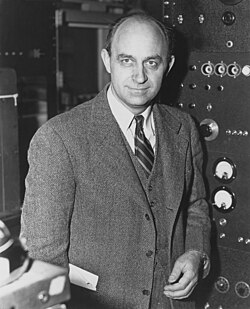](https://en.wikipedia.org/wiki/File:Enrico_Fermi_1943-49.jpg)
[Enrico Fermi](https://en.wikipedia.org/wiki/Enrico_Fermi "Enrico Fermi") (1901–1954)
The Fermi [paradox](https://en.wikipedia.org/wiki/Paradox "Paradox") is a conflict between the argument that [scale](https://en.wikipedia.org/wiki/Scale_\(spatial\) "Scale (spatial)") and [probability](https://en.wikipedia.org/wiki/Probability "Probability") seem to favor intelligent life being common in the universe, and the total lack of [evidence](https://en.wikipedia.org/wiki/Evidence "Evidence") of intelligent life having ever arisen anywhere other than on Earth.
The first aspect of the Fermi paradox is a function of the scale or the large numbers involved: there are an estimated 200–400 billion stars in the Milky Way[\[40\]](https://en.wikipedia.org/wiki/Fermi_paradox#cite_note-43) (2–4 × [1011](https://en.wikipedia.org/wiki/Orders_of_magnitude "Orders of magnitude")) and 70 sextillion (7×10²²) in the [observable universe](https://en.wikipedia.org/wiki/Observable_universe "Observable universe").[\[41\]](https://en.wikipedia.org/wiki/Fermi_paradox#cite_note-44) Even if intelligent life occurs on only a minuscule percentage of planets around these stars, there might still be a great number of [extant](https://en.wiktionary.org/wiki/extant#English "wikt:extant") civilizations, and if the percentage were high enough it would produce a significant number of extant civilizations in the Milky Way. This assumes the [mediocrity principle](https://en.wikipedia.org/wiki/Mediocrity_principle "Mediocrity principle"), by which Earth is a typical [planet](https://en.wikipedia.org/wiki/Planet "Planet").
The second aspect of the Fermi paradox is the argument of probability: given intelligent life's ability to overcome scarcity, and its tendency to colonize new [habitats](https://en.wikipedia.org/wiki/Habitat_\(ecology\) "Habitat (ecology)"), it seems possible that at least some civilizations would be technologically advanced, seek out new resources in space, and colonize their [star system](https://en.wikipedia.org/wiki/Star_system "Star system") and, subsequently, surrounding star systems. Since there is no evidence on Earth, or elsewhere in the known universe, of other intelligent life after 13.8 billion years of the universe's history, there is a conflict requiring a resolution. Some examples of possible resolutions are that intelligent life is rarer than is thought, that assumptions about the general development or behavior of intelligent species are flawed, or, more radically, that the scientific understanding of the nature of the universe is quite incomplete.
The Fermi paradox can be asked in two ways.[\[note 4\]](https://en.wikipedia.org/wiki/Fermi_paradox#cite_note-45) The first is, "Why are no aliens or their artifacts found on Earth, or in the [Solar System](https://en.wikipedia.org/wiki/Solar_System "Solar System")?". If [interstellar travel](https://en.wikipedia.org/wiki/Interstellar_travel "Interstellar travel") is possible, even the "slow" kind nearly within the reach of Earth technology, then it would only take from 5 million to 50 million years to colonize the galaxy.[\[42\]](https://en.wikipedia.org/wiki/Fermi_paradox#cite_note-Crawford-2000-46) This is relatively brief on a [geological scale](https://en.wikipedia.org/wiki/Geological_time "Geological time"), let alone a [cosmological one](https://en.wikipedia.org/wiki/Timeline_of_the_Big_Bang "Timeline of the Big Bang"). Since there are many stars older than the Sun, and since intelligent life might have evolved earlier elsewhere, the question then becomes why the galaxy has not been colonized already. Even if colonization is impractical or undesirable to all alien civilizations, large-scale exploration of the galaxy could be possible by [probes](https://en.wikipedia.org/wiki/Fermi_paradox#Conjectures_about_interstellar_probes). These might leave detectable artifacts in the Solar System, such as old probes or evidence of mining activity, but none of these have been observed.
The second form of the question is "Why are there no signs of intelligence elsewhere in the universe?". This version does not assume interstellar travel, but includes other galaxies as well. For distant galaxies, travel times may well explain the lack of alien visits to Earth, but a sufficiently advanced civilization could potentially be observable over a significant fraction of the [size of the observable universe](https://en.wikipedia.org/wiki/Observable_universe#Size "Observable universe").[\[43\]](https://en.wikipedia.org/wiki/Fermi_paradox#cite_note-47) Even if such civilizations are rare, the scale argument indicates they should exist somewhere at some point during the history of the universe, and since they could be detected from far away over a considerable period of time, many more potential sites for their origin are within range of human observation. It is unknown whether the paradox is stronger for the Milky Way galaxy or for the universe as a whole.[\[44\]](https://en.wikipedia.org/wiki/Fermi_paradox#cite_note-48)
### Drake equation
\[[edit](https://en.wikipedia.org/w/index.php?title=Fermi_paradox&action=edit§ion=8 "Edit section: Drake equation")\]
Main article: [Drake equation](https://en.wikipedia.org/wiki/Drake_equation "Drake equation")
The theories and principles in the [Drake equation](https://en.wikipedia.org/wiki/Drake_equation "Drake equation") are closely related to the Fermi paradox.[\[45\]](https://en.wikipedia.org/wiki/Fermi_paradox#cite_note-49) The equation was formulated by [Frank Drake](https://en.wikipedia.org/wiki/Frank_Drake "Frank Drake") in 1961 in an attempt to find a systematic means to evaluate the numerous probabilities involved in the existence of alien life. The equation is
N
\=
R
∗
⋅
f
p
⋅
n
e
⋅
f
l
⋅
f
i
⋅
f
c
⋅
L
,
{\\displaystyle N=R\_{\*}\\cdot f\_{\\mathrm {p} }\\cdot n\_{\\mathrm {e} }\\cdot f\_{\\mathrm {l} }\\cdot f\_{\\mathrm {i} }\\cdot f\_{\\mathrm {c} }\\cdot L,}

where N {\\displaystyle N}  is the number of technologically advanced civilizations in the Milky Way galaxy, and N {\\displaystyle N}  is asserted to be the product of
- R
∗
{\\displaystyle R\_{\*}}

, the rate of formation of stars in the galaxy;
- f
p
{\\displaystyle f\_{p}}

, the fraction of those stars with planetary systems;
- n
e
{\\displaystyle n\_{e}}

, the number of planets, per solar system, with an environment suitable for organic life;
- f
l
{\\displaystyle f\_{l}}

, the fraction of those suitable planets whereon organic life appears;
- f
i
{\\displaystyle f\_{i}}

, the fraction of life-bearing planets whereon *intelligent* life appears;
- f
c
{\\displaystyle f\_{c}}

, the fraction of civilizations that reach the technological level whereby detectable signals may be dispatched; and
- L
{\\displaystyle L}

, the length of time that those civilizations dispatch their signals.
The fundamental problem is that the last four terms (f l {\\displaystyle f\_{l}} , f i {\\displaystyle f\_{i}} , f c {\\displaystyle f\_{c}} , and L {\\displaystyle L} ) are entirely unknown, rendering statistical estimates impossible.[\[46\]](https://en.wikipedia.org/wiki/Fermi_paradox#cite_note-Sandberg-2018-50)
The Drake equation has been used by both optimists and pessimists, with wildly differing results. The first scientific meeting on the [search for extraterrestrial intelligence](https://en.wikipedia.org/wiki/Search_for_extraterrestrial_intelligence "Search for extraterrestrial intelligence") (SETI), which had 10 attendees including Frank Drake and Carl Sagan, speculated that the number of civilizations was roughly between 1,000 and 100,000,000 civilizations in the Milky Way galaxy.[\[47\]](https://en.wikipedia.org/wiki/Fermi_paradox#cite_note-51) Conversely, [Frank Tipler](https://en.wikipedia.org/wiki/Frank_J._Tipler "Frank J. Tipler") and [John D. Barrow](https://en.wikipedia.org/wiki/John_D._Barrow "John D. Barrow") used pessimistic numbers and speculated that the average number of civilizations in a galaxy is much less than one.[\[48\]](https://en.wikipedia.org/wiki/Fermi_paradox#cite_note-52)
Almost all arguments involving the Drake equation suffer from the [overconfidence effect](https://en.wikipedia.org/wiki/Overconfidence_effect "Overconfidence effect"), a common error of probabilistic reasoning about low-probability events, by guessing specific numbers for likelihoods of events whose mechanism is not understood, such as the likelihood of [abiogenesis](https://en.wikipedia.org/wiki/Abiogenesis "Abiogenesis") on an Earth-like planet, with estimates varying over many hundreds of [orders of magnitude](https://en.wikipedia.org/wiki/Order_of_magnitude "Order of magnitude"). An analysis that takes into account some of the uncertainty associated with this lack of understanding has been carried out by [Anders Sandberg](https://en.wikipedia.org/wiki/Anders_Sandberg "Anders Sandberg"), [Eric Drexler](https://en.wikipedia.org/wiki/Eric_Drexler "Eric Drexler") and [Toby Ord](https://en.wikipedia.org/wiki/Toby_Ord "Toby Ord").[\[46\]](https://en.wikipedia.org/wiki/Fermi_paradox#cite_note-Sandberg-2018-50) They suggest that there is "a substantial *[ex ante](https://en.wikipedia.org/wiki/Ex_ante "Ex ante")* probability of there being no other intelligent life in our observable universe".
Dennis Danielson and Christopher Graney have argued that optimistic interpretations of the Drake Equation are an artefact of history rather than of science. They show that, in the 17th and 18th centuries, the presumption that planets suitable to organic life are abundant became established in the absence of scientific evidence to support it, or even despite the scientific evidence then available against it. The presumption endured into the present day despite evidence for planetary and stellar diversity that has accumulated since the late 19th century. Thus, in their view, what is seen as the Fermi Paradox is simply science overcoming a historical presumption that never adequately recognized the importance of discoveries about, for example, the nature of planets or the origin of life.[\[49\]](https://en.wikipedia.org/wiki/Fermi_paradox#cite_note-53)[\[50\]](https://en.wikipedia.org/wiki/Fermi_paradox#cite_note-54)
### Great Filter
\[[edit](https://en.wikipedia.org/w/index.php?title=Fermi_paradox&action=edit§ion=9 "Edit section: Great Filter")\]
Main article: [Great Filter](https://en.wikipedia.org/wiki/Great_Filter "Great Filter")
The Great Filter, a concept introduced by [Robin Hanson](https://en.wikipedia.org/wiki/Robin_Hanson "Robin Hanson") in 1996, represents whatever natural phenomena that would make it unlikely for life to evolve from inanimate matter to an [advanced civilization](https://en.wikipedia.org/wiki/Kardashev_scale "Kardashev scale").[\[51\]](https://en.wikipedia.org/wiki/Fermi_paradox#cite_note-55)[\[3\]](https://en.wikipedia.org/wiki/Fermi_paradox#cite_note-Overbye-2015-3) The most commonly agreed-upon low probability event is abiogenesis: a gradual process of increasing complexity of the first self-replicating molecules by a randomly occurring chemical process. Other proposed great filters are the emergence of [eukaryotic cells](https://en.wikipedia.org/wiki/Eukaryotes "Eukaryotes")[\[note 5\]](https://en.wikipedia.org/wiki/Fermi_paradox#cite_note-56) or of [meiosis](https://en.wikipedia.org/wiki/Meiosis "Meiosis") or some of the steps involved in the evolution of a brain-like organ capable of complex logical deductions.[\[52\]](https://en.wikipedia.org/wiki/Fermi_paradox#cite_note-Lineweaver-2019-57)
Astrobiologists [Dirk Schulze-Makuch](https://en.wikipedia.org/wiki/Dirk_Schulze-Makuch "Dirk Schulze-Makuch") and William Bains, reviewing the history of life on Earth, including [convergent evolution](https://en.wikipedia.org/wiki/Convergent_evolution "Convergent evolution"), concluded that transitions such as [oxygenic photosynthesis](https://en.wikipedia.org/wiki/Oxygenic_photosynthesis "Oxygenic photosynthesis"), the [eukaryotic cell](https://en.wikipedia.org/wiki/Eukaryote "Eukaryote"), [multicellularity](https://en.wikipedia.org/wiki/Multicellularity "Multicellularity"), and [tool](https://en.wikipedia.org/wiki/Tool "Tool")\-using [intelligence](https://en.wikipedia.org/wiki/Intelligence "Intelligence") are likely to occur on any Earth-like planet given enough time. They argue that the Great Filter may be abiogenesis, the rise of technological human-level intelligence, or an inability to settle other worlds because of self-destruction or a lack of resources.[\[53\]](https://en.wikipedia.org/wiki/Fermi_paradox#cite_note-58) Paleobiologist [Olev Vinn](https://en.wikipedia.org/wiki/Olev_Vinn "Olev Vinn") has suggested that the great filter may have universal biological roots related to evolutionary animal behavior.[\[54\]](https://en.wikipedia.org/wiki/Fermi_paradox#cite_note-59)
### Grabby Aliens
\[[edit](https://en.wikipedia.org/w/index.php?title=Fermi_paradox&action=edit§ion=10 "Edit section: Grabby Aliens")\]
Main article: [Quiet and loud aliens](https://en.wikipedia.org/wiki/Quiet_and_loud_aliens "Quiet and loud aliens")
In 2021, the concepts of quiet, loud, and grabby aliens were introduced by Hanson *[et al](https://en.wikipedia.org/wiki/Et_al "Et al").* The proposed "loud" aliens [expand rapidly](https://en.wikipedia.org/wiki/Space_colonization "Space colonization") in a highly detectable way throughout the universe and endure, while "quiet" aliens are hard or impossible to detect and eventually disappear. "Grabby" aliens prevent the emergence of other civilizations in their [sphere of influence](https://en.wikipedia.org/wiki/Sphere_of_influence "Sphere of influence"), which expands at a rate near the speed of light. The authors argue that if loud civilizations are rare, as they appear to be, then quiet civilizations are also rare. The paper suggests that humanity's existing stage of technological development is relatively early in the potential timeline of intelligent life in the universe, as loud aliens would otherwise be observable by astronomers.[\[55\]](https://en.wikipedia.org/wiki/Fermi_paradox#cite_note-Hanson-2021-60)[\[56\]](https://en.wikipedia.org/wiki/Fermi_paradox#cite_note-61)
Earlier in 2013, [Anders Sandberg](https://en.wikipedia.org/wiki/Anders_Sandberg "Anders Sandberg") and [Stuart Armstrong](https://en.wikipedia.org/wiki/Stuart_Armstrong_\(scientist\) "Stuart Armstrong (scientist)") examined the potential for intelligent life to spread [intergalactically](https://en.wikipedia.org/wiki/Intergalactic_travel "Intergalactic travel") throughout the universe and the implications for the Fermi Paradox. Their study suggests that with sufficient energy, intelligent civilizations could potentially colonize the entire Milky Way galaxy within a few million years, and spread to nearby galaxies in a timespan that is cosmologically brief. They conclude that intergalactic colonization appears possible with the resources of a single [planetary system](https://en.wikipedia.org/wiki/Planetary_system "Planetary system") and that intergalactic colonization is of comparable difficulty to interstellar colonization, and therefore the Fermi paradox is much sharper than commonly thought.[\[57\]](https://en.wikipedia.org/wiki/Fermi_paradox#cite_note-62)
Critics such as [David Kipping](https://en.wikipedia.org/wiki/David_Kipping "David Kipping") have contended that the "Grabby Aliens" model is reliant on unproven assumptions, lacking enough scientific rigor to be empirically falsifiable, and suggested other explanations for the proposed earliness of humans such as planets in [M-dwarf](https://en.wikipedia.org/wiki/Red_dwarf "Red dwarf") systems being uninhabitable. Robin Hanson has responded to these criticisms.[\[58\]](https://en.wikipedia.org/wiki/Fermi_paradox#cite_note-63)
### Anthropics
\[[edit](https://en.wikipedia.org/w/index.php?title=Fermi_paradox&action=edit§ion=11 "Edit section: Anthropics")\]
Anthropic reasoning and the question of [why we happen to find ourselves as humans](https://en.wikipedia.org/wiki/Vertiginous_question "Vertiginous question") creates a number of potential problems for astrobiology. [Walter Barta](https://en.wikipedia.org/w/index.php?title=Walter_Barta&action=edit&redlink=1 "Walter Barta (page does not exist)") argues that Hanson's grabby aliens model creates an anthropic dilemma. According to Hanson's model, most observers in our [reference class](https://en.wikipedia.org/wiki/Reference_class_problem "Reference class problem") should be grabby aliens themselves. This leads to the question of why we do not find ourselves as grabby aliens, but rather as a species confined to a single planet.[\[59\]](https://en.wikipedia.org/wiki/Fermi_paradox#cite_note-64)
## Empirical evidence
\[[edit](https://en.wikipedia.org/w/index.php?title=Fermi_paradox&action=edit§ion=12 "Edit section: Empirical evidence")\]
Main articles: [Search for extraterrestrial intelligence](https://en.wikipedia.org/wiki/Search_for_extraterrestrial_intelligence "Search for extraterrestrial intelligence") and [Technosignature](https://en.wikipedia.org/wiki/Technosignature "Technosignature")
There are two parts of the Fermi paradox that rely on empirical evidence—that there are many potentially [habitable planets](https://en.wikipedia.org/wiki/Planetary_habitability "Planetary habitability"), and that humans see no evidence of life. The first point, that many suitable planets exist, was an assumption in Fermi's time, but is since supported by the discovery that [exoplanets](https://en.wikipedia.org/wiki/Exoplanet "Exoplanet") are common. Existing models predict billions of habitable worlds in the Milky Way.[\[60\]](https://en.wikipedia.org/wiki/Fermi_paradox#cite_note-65)
The second part of the paradox, that humans see no evidence of extraterrestrial life, is also an active field of scientific research. This includes both efforts to find any indication of life,[\[61\]](https://en.wikipedia.org/wiki/Fermi_paradox#cite_note-66) and efforts specifically directed to finding intelligent life. These searches have been made since 1960, and several are ongoing.[\[note 6\]](https://en.wikipedia.org/wiki/Fermi_paradox#cite_note-67)
Although astronomers do not usually search for extraterrestrials, they have observed phenomena that they could not immediately explain without positing an intelligent civilization as the source. For example, [pulsars](https://en.wikipedia.org/wiki/Pulsar "Pulsar"), when [first discovered](https://en.wikipedia.org/wiki/PSR_B1919%2B21 "PSR B1919+21") in 1967, were called [little green men](https://en.wikipedia.org/wiki/Little_green_men "Little green men") (LGM) because of the precise repetition of their pulses.[\[62\]](https://en.wikipedia.org/wiki/Fermi_paradox#cite_note-68) In all cases, explanations with no need for intelligent life have been found for such observations,[\[note 7\]](https://en.wikipedia.org/wiki/Fermi_paradox#cite_note-69) but the possibility of discovery remains.[\[63\]](https://en.wikipedia.org/wiki/Fermi_paradox#cite_note-70) Proposed examples include [asteroid mining](https://en.wikipedia.org/wiki/Asteroid_mining "Asteroid mining") that would change the appearance of debris disks around stars,[\[64\]](https://en.wikipedia.org/wiki/Fermi_paradox#cite_note-71) or spectral lines from [nuclear waste](https://en.wikipedia.org/wiki/Nuclear_waste "Nuclear waste") disposal in stars.[\[65\]](https://en.wikipedia.org/wiki/Fermi_paradox#cite_note-72)
### Electromagnetic emissions
\[[edit](https://en.wikipedia.org/w/index.php?title=Fermi_paradox&action=edit§ion=13 "Edit section: Electromagnetic emissions")\]
Further information: [Project Phoenix (SETI)](https://en.wikipedia.org/wiki/Project_Phoenix_\(SETI\) "Project Phoenix (SETI)"), [SERENDIP](https://en.wikipedia.org/wiki/SERENDIP "SERENDIP"), and [Allen Telescope Array](https://en.wikipedia.org/wiki/Allen_Telescope_Array "Allen Telescope Array")
[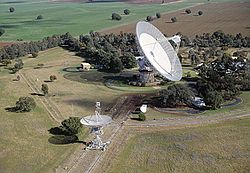](https://en.wikipedia.org/wiki/File:Parkes.arp.750pix.jpg)
[Radio telescopes](https://en.wikipedia.org/wiki/Radio_telescope "Radio telescope") are often used by SETI projects.
Radio technology and the ability to construct a [radio telescope](https://en.wikipedia.org/wiki/Radio_telescope "Radio telescope") are presumed to be a natural advance for technological species,[\[66\]](https://en.wikipedia.org/wiki/Fermi_paradox#cite_note-73) theoretically creating effects that might be detected over interstellar distances. The careful searching for non-natural radio emissions from space may lead to the detection of alien civilizations. Sensitive alien observers of the Solar System, for example, would note unusually intense [radio waves](https://en.wikipedia.org/wiki/Radio_wave "Radio wave") for a [G2 star](https://en.wikipedia.org/wiki/Star#Classification "Star") due to Earth's television and telecommunication broadcasts. In the absence of an apparent natural cause, alien observers might infer the existence of a terrestrial civilization. Such signals could be either "accidental" by-products of a civilization, or deliberate attempts to communicate, such as the [Arecibo message](https://en.wikipedia.org/wiki/Arecibo_message "Arecibo message"). It is unclear whether "leakage", as opposed to a deliberate beacon, could be detected by an extraterrestrial civilization. The most sensitive radio telescopes on Earth, as of 2019[\[update\]](https://en.wikipedia.org/w/index.php?title=Fermi_paradox&action=edit), would not be able to detect non-directional radio signals (such as [broadband](https://en.wikipedia.org/wiki/Broadband "Broadband")) even at a fraction of a [light-year](https://en.wikipedia.org/wiki/Light-year "Light-year") away,[\[67\]](https://en.wikipedia.org/wiki/Fermi_paradox#cite_note-74) but other civilizations could hypothetically have much better equipment.[\[68\]](https://en.wikipedia.org/wiki/Fermi_paradox#cite_note-75)[\[69\]](https://en.wikipedia.org/wiki/Fermi_paradox#cite_note-76)
A number of astronomers and observatories have attempted and are attempting to detect such evidence, mostly through SETI organizations such as the [SETI Institute](https://en.wikipedia.org/wiki/SETI_Institute "SETI Institute") and [Breakthrough Listen](https://en.wikipedia.org/wiki/Breakthrough_Listen "Breakthrough Listen"). Several decades of SETI analysis have not revealed any unusually bright or meaningfully repetitive radio emissions.[\[70\]](https://en.wikipedia.org/wiki/Fermi_paradox#cite_note-77)
### Direct planetary observation
\[[edit](https://en.wikipedia.org/w/index.php?title=Fermi_paradox&action=edit§ion=14 "Edit section: Direct planetary observation")\]
[](https://en.wikipedia.org/wiki/File:Earth%27s_City_Lights_by_DMSP,_1994-1995_\(large\).jpg)
A composite picture of Earth at night, created using data from the [Defense Meteorological Satellite Program](https://en.wikipedia.org/wiki/Defense_Meteorological_Satellite_Program "Defense Meteorological Satellite Program") (DMSP) Operational Linescan System (OLS). Large-scale artificial lighting produced by human civilization is detectable from space.
Exoplanet detection and classification is a very active sub-discipline in astronomy; the first candidate [terrestrial planet](https://en.wikipedia.org/wiki/Terrestrial_planet "Terrestrial planet") discovered within a star's [habitable zone](https://en.wikipedia.org/wiki/Habitable_zone "Habitable zone") was found in 2007.[\[71\]](https://en.wikipedia.org/wiki/Fermi_paradox#cite_note-78) New [refinements in exoplanet detection methods](https://en.wikipedia.org/wiki/Methods_of_detecting_extrasolar_planets#Other_possible_methods "Methods of detecting extrasolar planets"), and use of existing methods from space (such as the [Kepler](https://en.wikipedia.org/wiki/Kepler_space_telescope "Kepler space telescope") and [TESS](https://en.wikipedia.org/wiki/Transiting_Exoplanet_Survey_Satellite "Transiting Exoplanet Survey Satellite") missions) have detected and characterized Earth-size planets, and determined whether they are within the habitable zones of their stars. Such observational refinements have allowed better estimates of how common these potentially habitable worlds are, typically in the range of 0.5-1.0 potentially habitable planets per star. [\[72\]](https://en.wikipedia.org/wiki/Fermi_paradox#cite_note-79) [\[73\]](https://en.wikipedia.org/wiki/Fermi_paradox#cite_note-80) [\[74\]](https://en.wikipedia.org/wiki/Fermi_paradox#cite_note-81) [\[75\]](https://en.wikipedia.org/wiki/Fermi_paradox#cite_note-82) [\[76\]](https://en.wikipedia.org/wiki/Fermi_paradox#cite_note-83) [\[77\]](https://en.wikipedia.org/wiki/Fermi_paradox#cite_note-84) [\[78\]](https://en.wikipedia.org/wiki/Fermi_paradox#cite_note-85)
### Conjectures about interstellar probes
\[[edit](https://en.wikipedia.org/w/index.php?title=Fermi_paradox&action=edit§ion=15 "Edit section: Conjectures about interstellar probes")\]
Further information: [Hart–Tipler conjecture](https://en.wikipedia.org/wiki/Hart%E2%80%93Tipler_conjecture "Hart–Tipler conjecture"), [Von Neumann probe](https://en.wikipedia.org/wiki/Von_Neumann_probe "Von Neumann probe"), and [Bracewell probe](https://en.wikipedia.org/wiki/Bracewell_probe "Bracewell probe")
The [Hart–Tipler conjecture](https://en.wikipedia.org/wiki/Hart%E2%80%93Tipler_conjecture "Hart–Tipler conjecture") is a form of [contraposition](https://en.wikipedia.org/wiki/Contraposition "Contraposition") which states that because no interstellar probes have been detected, there likely is no other intelligent life in the universe, as such life should be expected to eventually create and launch such probes.[\[79\]](https://en.wikipedia.org/wiki/Fermi_paradox#cite_note-FOOTNOTEGray2015-86)[\[80\]](https://en.wikipedia.org/wiki/Fermi_paradox#cite_note-87) Self-replicating probes could exhaustively explore a galaxy the size of the Milky Way in as little as a million years.[\[12\]](https://en.wikipedia.org/wiki/Fermi_paradox#cite_note-Hart-1975-12) If even a single civilization in the Milky Way attempted this, such probes could spread throughout the entire galaxy. Another speculation for contact with an alien probe—one that would be trying to find human beings—is an alien [Bracewell probe](https://en.wikipedia.org/wiki/Bracewell_probe "Bracewell probe"). Such a hypothetical device would be an autonomous space probe whose purpose is to seek out and communicate with alien civilizations (as opposed to von Neumann probes, which are usually described as purely exploratory). These were proposed as an alternative to carrying a slow [speed-of-light](https://en.wikipedia.org/wiki/Speed-of-light "Speed-of-light") dialogue between vastly distant neighbors. Rather than contending with the long delays a radio dialogue would suffer, a probe housing an [artificial intelligence](https://en.wikipedia.org/wiki/Artificial_intelligence "Artificial intelligence") would seek out an alien civilization to carry on a close-range communication with the discovered civilization. The findings of such a probe would still have to be transmitted to the home civilization at light speed, but an information-gathering dialogue could be conducted in real time.[\[81\]](https://en.wikipedia.org/wiki/Fermi_paradox#cite_note-88)
Direct exploration of the Solar System has yielded no evidence indicating a visit by aliens or their probes. Detailed exploration of areas of the Solar System where resources would be plentiful may yet produce evidence of alien exploration,[\[82\]](https://en.wikipedia.org/wiki/Fermi_paradox#cite_note-89)[\[83\]](https://en.wikipedia.org/wiki/Fermi_paradox#cite_note-90) though the entirety of the Solar System is relatively vast and difficult to investigate. Attempts to signal, attract, or activate hypothetical Bracewell probes in Earth's vicinity have not succeeded.[\[84\]](https://en.wikipedia.org/wiki/Fermi_paradox#cite_note-91)
### Searches for stellar-scale artifacts
\[[edit](https://en.wikipedia.org/w/index.php?title=Fermi_paradox&action=edit§ion=16 "Edit section: Searches for stellar-scale artifacts")\]
Further information: [Dyson sphere](https://en.wikipedia.org/wiki/Dyson_sphere "Dyson sphere"), [Stellar engine](https://en.wikipedia.org/wiki/Stellar_engine "Stellar engine"), and [Kardashev scale](https://en.wikipedia.org/wiki/Kardashev_scale "Kardashev scale")
[](https://en.wikipedia.org/wiki/File:Dyson_Sphere_Diagram-en.svg)
A variant of the speculative [Dyson sphere](https://en.wikipedia.org/wiki/Dyson_sphere "Dyson sphere"). Such large-scale artifacts would drastically alter the spectrum of a star.
In 1959, [Freeman Dyson](https://en.wikipedia.org/wiki/Freeman_Dyson "Freeman Dyson") observed that every developing human civilization constantly increases its energy consumption, and he conjectured that a civilization might try to harness a large part of the energy produced by a star. He proposed a hypothetical "Dyson sphere" as a means: a shell or cloud of objects enclosing a star to absorb and utilize as much [radiant energy](https://en.wikipedia.org/wiki/Radiant_energy "Radiant energy") as possible. Such a feat of [astroengineering](https://en.wikipedia.org/wiki/Astroengineering "Astroengineering") would drastically alter the observed [spectrum](https://en.wikipedia.org/wiki/Spectroscopy "Spectroscopy") of the star involved, changing it at least partly from the normal [emission lines](https://en.wikipedia.org/wiki/Emission_lines "Emission lines") of a natural [stellar atmosphere](https://en.wikipedia.org/wiki/Stellar_atmosphere "Stellar atmosphere") to those of [black-body radiation](https://en.wikipedia.org/wiki/Black-body_radiation "Black-body radiation"), probably with a peak in the [infrared](https://en.wikipedia.org/wiki/Infrared "Infrared"). Dyson speculated that advanced alien civilizations might be detected by examining the spectra of stars and searching for such an altered spectrum.[\[85\]](https://en.wikipedia.org/wiki/Fermi_paradox#cite_note-92)[\[86\]](https://en.wikipedia.org/wiki/Fermi_paradox#cite_note-Wright-2014a-93)[\[87\]](https://en.wikipedia.org/wiki/Fermi_paradox#cite_note-Wright-2014b-94)
There have been attempts to find evidence of Dyson spheres that would alter the spectra of their core stars.[\[88\]](https://en.wikipedia.org/wiki/Fermi_paradox#cite_note-95) Direct observation of thousands of galaxies has shown no explicit evidence of artificial construction or modifications.[\[86\]](https://en.wikipedia.org/wiki/Fermi_paradox#cite_note-Wright-2014a-93)[\[87\]](https://en.wikipedia.org/wiki/Fermi_paradox#cite_note-Wright-2014b-94)[\[89\]](https://en.wikipedia.org/wiki/Fermi_paradox#cite_note-96)[\[90\]](https://en.wikipedia.org/wiki/Fermi_paradox#cite_note-97) In October 2015, there was speculation that a dimming of light from star [KIC 8462852](https://en.wikipedia.org/wiki/KIC_8462852 "KIC 8462852"), observed by the [Kepler space telescope](https://en.wikipedia.org/wiki/Kepler_space_telescope "Kepler space telescope"), could have been a result of such a Dyson sphere under construction.[\[91\]](https://en.wikipedia.org/wiki/Fermi_paradox#cite_note-98)[\[92\]](https://en.wikipedia.org/wiki/Fermi_paradox#cite_note-99) However, in 2018, further observations determined that the amount of dimming varied by the frequency of the light, pointing to dust, rather than an opaque object such as a Dyson sphere, as the cause of the dimming.[\[93\]](https://en.wikipedia.org/wiki/Fermi_paradox#cite_note-100)[\[94\]](https://en.wikipedia.org/wiki/Fermi_paradox#cite_note-101)
## Hypothetical explanations for the paradox
\[[edit](https://en.wikipedia.org/w/index.php?title=Fermi_paradox&action=edit§ion=17 "Edit section: Hypothetical explanations for the paradox")\]
### Rarity of intelligent life
\[[edit](https://en.wikipedia.org/w/index.php?title=Fermi_paradox&action=edit§ion=18 "Edit section: Rarity of intelligent life")\]
#### Extraterrestrial life is rare or non-existent
\[[edit](https://en.wikipedia.org/w/index.php?title=Fermi_paradox&action=edit§ion=19 "Edit section: Extraterrestrial life is rare or non-existent")\]
Main articles: [Rare Earth hypothesis](https://en.wikipedia.org/wiki/Rare_Earth_hypothesis "Rare Earth hypothesis") and [Firstborn hypothesis](https://en.wikipedia.org/wiki/Firstborn_hypothesis "Firstborn hypothesis")
Those who think that intelligent [extraterrestrial life](https://en.wikipedia.org/wiki/Extraterrestrial_life "Extraterrestrial life") is (nearly) impossible argue that the conditions needed for the evolution of life—or at least the [evolution of biological complexity](https://en.wikipedia.org/wiki/Evolution_of_biological_complexity "Evolution of biological complexity")—are rare or even unique to Earth. Under this assumption, called the [rare Earth hypothesis](https://en.wikipedia.org/wiki/Rare_Earth_hypothesis "Rare Earth hypothesis"), a rejection of the [mediocrity principle](https://en.wikipedia.org/wiki/Mediocrity_principle "Mediocrity principle"), complex multicellular life is regarded as exceedingly unusual.[\[95\]](https://en.wikipedia.org/wiki/Fermi_paradox#cite_note-102)
The rare Earth hypothesis argues that the evolution of biological complexity requires a host of fortuitous circumstances, such as a [galactic habitable zone](https://en.wikipedia.org/wiki/Galactic_habitable_zone "Galactic habitable zone"), a star and planet(s) having the requisite conditions, such as enough of a [continuous habitable zone](https://en.wikipedia.org/wiki/Circumstellar_habitable_zone "Circumstellar habitable zone"), the advantage of a giant guardian like Jupiter and a large [moon](https://en.wikipedia.org/wiki/Natural_satellite "Natural satellite"), conditions needed to ensure the planet has a [magnetosphere](https://en.wikipedia.org/wiki/Magnetosphere "Magnetosphere") and [plate tectonics](https://en.wikipedia.org/wiki/Plate_tectonics "Plate tectonics"),[\[96\]](https://en.wikipedia.org/wiki/Fermi_paradox#cite_note-103) the chemistry of the [lithosphere](https://en.wikipedia.org/wiki/Lithosphere "Lithosphere"), [atmosphere](https://en.wikipedia.org/wiki/Atmosphere "Atmosphere"), and oceans, the role of "evolutionary pumps" such as massive [glaciation](https://en.wikipedia.org/wiki/Glaciation "Glaciation") and rare [bolide](https://en.wikipedia.org/wiki/Meteoroid#Bolide "Meteoroid") impacts. Perhaps most importantly, advanced life needs whatever it was that led to the transition of (some) [prokaryotic cells](https://en.wikipedia.org/wiki/Prokaryote "Prokaryote") to [eukaryotic cells](https://en.wikipedia.org/wiki/Eukaryote "Eukaryote"), [sexual reproduction](https://en.wikipedia.org/wiki/Sexual_reproduction "Sexual reproduction") and the [Cambrian explosion](https://en.wikipedia.org/wiki/Cambrian_explosion "Cambrian explosion").
In his book *[Wonderful Life](https://en.wikipedia.org/wiki/Wonderful_Life_\(book\) "Wonderful Life (book)")* (1989), Stephen Jay Gould suggested that if the "tape of life" were rewound to the time of the Cambrian explosion, and one or two tweaks made, human beings probably never would have evolved. Other thinkers such as Fontana, Buss, and Kauffman have written about the self-organizing properties of life.[\[97\]](https://en.wikipedia.org/wiki/Fermi_paradox#cite_note-104) On the other hand, maybe the filter is further back in time: recently, astrophysicist Matt O'Dowd has identified the eukaryogenesis as a reasonable candidate for such a filter in the past [\[98\]](https://en.wikipedia.org/wiki/Fermi_paradox#cite_note-105) given the increasing difficulties in finding new useful proteins for prokaryotes[\[99\]](https://en.wikipedia.org/wiki/Fermi_paradox#cite_note-Muro_et_al._2025-106).
#### Extraterrestrial intelligence is rare or non-existent
\[[edit](https://en.wikipedia.org/w/index.php?title=Fermi_paradox&action=edit§ion=20 "Edit section: Extraterrestrial intelligence is rare or non-existent")\]
It is possible that even if complex life is common, intelligence (and consequently civilizations) is not.[\[52\]](https://en.wikipedia.org/wiki/Fermi_paradox#cite_note-Lineweaver-2019-57) While there are remote sensing techniques that could perhaps detect life-bearing planets without relying on the signs of technology,[\[100\]](https://en.wikipedia.org/wiki/Fermi_paradox#cite_note-107)[\[101\]](https://en.wikipedia.org/wiki/Fermi_paradox#cite_note-108) none of them have the ability to determine if any detected life is intelligent. This is sometimes referred to as the "algae vs. alumnae" problem.[\[102\]](https://en.wikipedia.org/wiki/Fermi_paradox#cite_note-Tarter-2006-109)
Charles Lineweaver states that when considering any extreme trait in an animal, intermediate stages do not necessarily produce "inevitable" outcomes. For example, large brains are no more "inevitable", or convergent, than are the long noses of animals such as [aardvarks](https://en.wikipedia.org/wiki/Aardvark "Aardvark") and elephants. As he points out, "dolphins have had ~20 million years to build a radio telescope and have not done so".[\[52\]](https://en.wikipedia.org/wiki/Fermi_paradox#cite_note-Lineweaver-2019-57) In addition, Rebecca Boyle points out that of all the species that have evolved in the history of life on the planet Earth, only one—human beings and only in the beginning stages—has ever become space-faring.[\[103\]](https://en.wikipedia.org/wiki/Fermi_paradox#cite_note-110)
#### Extraterrestrial intelligence is relatively new
\[[edit](https://en.wikipedia.org/w/index.php?title=Fermi_paradox&action=edit§ion=21 "Edit section: Extraterrestrial intelligence is relatively new")\]
Main article: [Firstborn hypothesis](https://en.wikipedia.org/wiki/Firstborn_hypothesis "Firstborn hypothesis")
Given that the expected [lifespan of the universe](https://en.wikipedia.org/wiki/Lifespan_of_the_universe "Lifespan of the universe") is at least one trillion years and the [age of the universe](https://en.wikipedia.org/wiki/Age_of_the_universe "Age of the universe") is around 14 billion years, it is possible that humans have emerged at or near the earliest possible opportunity for intelligent life to evolve. [Avi Loeb](https://en.wikipedia.org/wiki/Avi_Loeb "Avi Loeb"), an astrophysicist and cosmologist, has suggested that Earth may be a very early example of a life-bearing planet and that life-bearing planets may be more likely trillions of years from now. He has put forward the view that the Universe has only recently reached a state in which life is possible and this is the reason humanity has not detected extraterrestrial life. The [firstborn hypothesis](https://en.wikipedia.org/wiki/Firstborn_hypothesis "Firstborn hypothesis") posits that humans are the first, or one of the first, intelligent species to evolve. Therefore, many intelligent species may eventually exist, but few, if any, currently do. Moreover, it is possible that said species, even if they already exist, are developing more slowly, or have more limited resources on their home world, meaning that they may take longer than humans have to achieve spaceflight.
#### Periodic extinction by natural events
\[[edit](https://en.wikipedia.org/w/index.php?title=Fermi_paradox&action=edit§ion=22 "Edit section: Periodic extinction by natural events")\]
See also: [Global catastrophic risk](https://en.wikipedia.org/wiki/Global_catastrophic_risk "Global catastrophic risk") and [Neocatastrophism](https://en.wikipedia.org/wiki/Neocatastrophism "Neocatastrophism")
[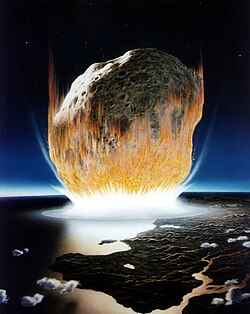](https://en.wikipedia.org/wiki/File:Coast_Impact.jpg)
An [asteroid impact](https://en.wikipedia.org/wiki/Asteroid_impact "Asteroid impact") may trigger an [extinction event](https://en.wikipedia.org/wiki/Extinction_event "Extinction event").
New life might commonly die out due to runaway heating or cooling on their fledgling planets.[\[104\]](https://en.wikipedia.org/wiki/Fermi_paradox#cite_note-111) On Earth, there have been numerous major [extinction events](https://en.wikipedia.org/wiki/Extinction_event "Extinction event") that destroyed the majority of complex species alive at the time; the [extinction of the non-avian dinosaurs](https://en.wikipedia.org/wiki/K-T_extinction "K-T extinction") is the best known example. These are thought to have been caused by events such as impact from a large asteroid, massive volcanic eruptions, or astronomical events such as [gamma-ray bursts](https://en.wikipedia.org/wiki/Gamma-ray_burst "Gamma-ray burst").[\[105\]](https://en.wikipedia.org/wiki/Fermi_paradox#cite_note-112) It may be the case that such extinction events are common throughout the universe and periodically destroy intelligent life, or at least its civilizations, before the species is able to develop the technology to communicate with other intelligent species.[\[106\]](https://en.wikipedia.org/wiki/Fermi_paradox#cite_note-113)
However, the chances of extinction by natural events may be very low on the scale of a civilization's lifetime. Based on an analysis of impact craters on Earth and the Moon, the average interval between impacts large enough to cause global consequences (like the [Chicxulub impact](https://en.wikipedia.org/wiki/Chicxulub_crater "Chicxulub crater")) is estimated to be around 100 million years.[\[107\]](https://en.wikipedia.org/wiki/Fermi_paradox#cite_note-114)
### Evolutionary explanations
\[[edit](https://en.wikipedia.org/w/index.php?title=Fermi_paradox&action=edit§ion=23 "Edit section: Evolutionary explanations")\]
#### It is the nature of intelligent life to destroy itself
\[[edit](https://en.wikipedia.org/w/index.php?title=Fermi_paradox&action=edit§ion=24 "Edit section: It is the nature of intelligent life to destroy itself")\]
See also: [Technological utopianism § Criticisms](https://en.wikipedia.org/wiki/Technological_utopianism#Criticisms "Technological utopianism")
[](https://en.wikipedia.org/wiki/File:Operation_Upshot-Knothole_-_Badger_001.jpg)
A 23-kiloton tower shot called [BADGER](https://en.wikipedia.org/wiki/BADGER "BADGER"), fired as part of the [Operation Upshot–Knothole](https://en.wikipedia.org/wiki/Operation_Upshot%E2%80%93Knothole "Operation Upshot–Knothole") [nuclear test series](https://en.wikipedia.org/wiki/Nuclear_testing "Nuclear testing")
This is the argument that technological civilizations may usually or invariably destroy themselves before or shortly after developing radio or spaceflight technology. The astrophysicist [Sebastian von Hoerner](https://en.wikipedia.org/wiki/Sebastian_von_Hoerner "Sebastian von Hoerner") stated that the progress of science and technology on [Earth](https://en.wikipedia.org/wiki/Earth "Earth") was driven by two factors—the struggle for domination and the desire for an easy life. The former potentially leads to complete destruction, while the latter may lead to biological or mental degeneration.[\[108\]](https://en.wikipedia.org/wiki/Fermi_paradox#cite_note-von_Hoerner-1961-115) Possible means of annihilation via major global issues, where global interconnectedness actually makes humanity more vulnerable than resilient,[\[109\]](https://en.wikipedia.org/wiki/Fermi_paradox#cite_note-116) are many,[\[110\]](https://en.wikipedia.org/wiki/Fermi_paradox#cite_note-117) including war, accidental environmental contamination or damage, the development of [biotechnology](https://en.wikipedia.org/wiki/Biotechnology_risk "Biotechnology risk"),[\[111\]](https://en.wikipedia.org/wiki/Fermi_paradox#cite_note-118) [synthetic life](https://en.wikipedia.org/wiki/Synthetic_life "Synthetic life") like [mirror life](https://en.wikipedia.org/wiki/Mirror_life "Mirror life"),[\[112\]](https://en.wikipedia.org/wiki/Fermi_paradox#cite_note-119) [resource depletion](https://en.wikipedia.org/wiki/Resource_depletion "Resource depletion"), [climate change](https://en.wikipedia.org/wiki/Global_warming "Global warming"),[\[113\]](https://en.wikipedia.org/wiki/Fermi_paradox#cite_note-120) or [artificial intelligence](https://en.wikipedia.org/wiki/Existential_risk_from_artificial_general_intelligence "Existential risk from artificial general intelligence"). This general theme is explored both in fiction and in scientific hypotheses.[\[114\]](https://en.wikipedia.org/wiki/Fermi_paradox#cite_note-121)
In 1966, Sagan and [Shklovskii](https://en.wikipedia.org/wiki/Iosif_Shklovsky "Iosif Shklovsky") speculated that technological civilizations will either tend to destroy themselves within a century of developing interstellar communicative capability or master their self-destructive tendencies and survive for billion-year timescales.[\[115\]](https://en.wikipedia.org/wiki/Fermi_paradox#cite_note-122) Self-annihilation may also be viewed in terms of [thermodynamics](https://en.wikipedia.org/wiki/Thermodynamics "Thermodynamics"): insofar as life is an ordered [system](https://en.wikipedia.org/wiki/System "System") that can sustain itself against the [tendency to disorder](https://en.wikipedia.org/wiki/Entropy "Entropy"), Stephen Hawking's "external transmission" or interstellar communicative phase, where [knowledge production](https://en.wikipedia.org/wiki/Knowledge_economy "Knowledge economy") and [knowledge management](https://en.wikipedia.org/wiki/Knowledge_management "Knowledge management") is more important than transmission of information via [evolution](https://en.wikipedia.org/wiki/Evolution "Evolution"), may be the point at which the system becomes unstable and self-destructs.[\[116\]](https://en.wikipedia.org/wiki/Fermi_paradox#cite_note-123)[\[117\]](https://en.wikipedia.org/wiki/Fermi_paradox#cite_note-124) Here, Hawking emphasizes self-design of the [human genome](https://en.wikipedia.org/wiki/Human_genome "Human genome") ([transhumanism](https://en.wikipedia.org/wiki/Transhumanism "Transhumanism")) or enhancement via machines (e.g., [brain–computer interface](https://en.wikipedia.org/wiki/Brain%E2%80%93computer_interface "Brain–computer interface")) to enhance [human intelligence](https://en.wikipedia.org/wiki/Human_intelligence "Human intelligence") and reduce [aggression](https://en.wikipedia.org/wiki/Aggression "Aggression"), without which he implies human civilization may be too stupid collectively to survive an increasingly unstable system. For instance, the development of technologies during the "external transmission" phase, such as [weaponization](https://en.wikipedia.org/wiki/Weaponization "Weaponization") of [artificial general intelligence](https://en.wikipedia.org/wiki/Artificial_general_intelligence "Artificial general intelligence") or [antimatter](https://en.wikipedia.org/wiki/Antimatter "Antimatter"), may not be met by concomitant increases in human ability to manage its own inventions. Consequently, disorder increases in the system: [global governance](https://en.wikipedia.org/wiki/Global_governance "Global governance") may become increasingly destabilized, worsening humanity's ability to manage the possible means of annihilation listed above, resulting in global [societal collapse](https://en.wikipedia.org/wiki/Societal_collapse "Societal collapse").
A less theoretical example might be the resource-depletion issue on Polynesian islands, of which Easter Island is only the best known. David Brin points out that during the expansion phase from 1500 BC to 800 AD there were cycles of overpopulation followed by what might be called periodic cullings of adult males through war or ritual. He writes, "There are many stories of islands whose men were almost wiped out—sometimes by internal strife, and sometimes by invading males from other islands."[\[118\]](https://en.wikipedia.org/wiki/Fermi_paradox#cite_note-125)
Using extinct civilizations such as [Easter Island](https://en.wikipedia.org/wiki/Easter_Island "Easter Island") as models, a study conducted in 2018 by [Adam Frank](https://en.wikipedia.org/wiki/Adam_Frank "Adam Frank") *et al.* posited that [climate change](https://en.wikipedia.org/wiki/Climate_change "Climate change") induced by "energy intensive" civilizations may prevent sustainability within such civilizations, thus explaining the paradoxical lack of evidence for intelligent extraterrestrial life. Based on [dynamical systems theory](https://en.wikipedia.org/wiki/Dynamical_systems_theory "Dynamical systems theory"), the study examined how technological civilizations (exo-civilizations) consume resources and the [feedback effects](https://en.wikipedia.org/wiki/Feedback "Feedback") this consumption has on their planets and its [carrying capacity](https://en.wikipedia.org/wiki/Carrying_capacity "Carrying capacity"). According to Adam Frank "\[t\]he point is to recognize that driving climate change may be something generic. The laws of physics demand that any young population, building an energy-intensive civilization like ours, is going to have feedback on its planet. Seeing climate change in this cosmic context may give us better insight into what's happening to us now and how to deal with it."[\[119\]](https://en.wikipedia.org/wiki/Fermi_paradox#cite_note-126) Generalizing the [Anthropocene](https://en.wikipedia.org/wiki/Anthropocene "Anthropocene"), their model produces four different outcomes:
[](https://en.wikipedia.org/wiki/File:Frank_climate_model,_2018.svg)
Possible trajectories of anthropogenic climate change in a model by Frank *et al*., 2018
- Die-off: A scenario where the population grows quickly, surpassing the planet's carrying capacity, which leads to a peak followed by a [rapid decline](https://en.wikipedia.org/wiki/Population_decline "Population decline"). The population eventually stabilizes at a much lower equilibrium level, allowing the planet to partially recover.
- [Sustainability](https://en.wikipedia.org/wiki/Sustainability "Sustainability"): A scenario where civilizations successfully transition from high-impact resources (like fossil fuels) to sustainable ones (like solar energy) before significant environmental degradation occurs. This allows the civilization and planet to reach a stable equilibrium, avoiding catastrophic effects.
- [Collapse](https://en.wikipedia.org/wiki/Societal_collapse "Societal collapse") Without Resource Change: In this trajectory, the population and environmental degradation increase rapidly. The civilization does not switch to sustainable resources in time, leading to a total collapse where a [tipping point](https://en.wikipedia.org/wiki/Tipping_points_in_the_climate_system "Tipping points in the climate system") is crossed and the population drops.
- Collapse With Resource Change: Similar to the previous scenario, but in this case, the civilization attempts to transition to sustainable resources. However, the change comes too late, and the environmental damage is irreversible, still leading to the civilization's collapse.[\[120\]](https://en.wikipedia.org/wiki/Fermi_paradox#cite_note-127)[\[121\]](https://en.wikipedia.org/wiki/Fermi_paradox#cite_note-128)
#### Only one intelligent species can exist in a given region of space
\[[edit](https://en.wikipedia.org/w/index.php?title=Fermi_paradox&action=edit§ion=25 "Edit section: Only one intelligent species can exist in a given region of space")\]
See also: [Berserker hypothesis](https://en.wikipedia.org/wiki/Berserker_hypothesis "Berserker hypothesis"), [Dark forest hypothesis](https://en.wikipedia.org/wiki/Dark_forest_hypothesis "Dark forest hypothesis"), [Technological singularity](https://en.wikipedia.org/wiki/Technological_singularity "Technological singularity"), and [Von Neumann probe](https://en.wikipedia.org/wiki/Von_Neumann_probe "Von Neumann probe")
Another hypothesis is that an intelligent species beyond a certain point of technological capability will destroy other intelligent species as they appear, perhaps by using [self-replicating probes](https://en.wikipedia.org/wiki/Self-replicating_spacecraft "Self-replicating spacecraft"). Science fiction writer [Fred Saberhagen](https://en.wikipedia.org/wiki/Fred_Saberhagen "Fred Saberhagen") has explored this idea in his *[Berserker](https://en.wikipedia.org/wiki/Berserker_\(novel_series\) "Berserker (novel series)")* series, as has physicist [Gregory Benford](https://en.wikipedia.org/wiki/Gregory_Benford "Gregory Benford")[\[122\]](https://en.wikipedia.org/wiki/Fermi_paradox#cite_note-129) and also, science fiction writer [Greg Bear](https://en.wikipedia.org/wiki/Greg_Bear "Greg Bear") in his *[The Forge of God](https://en.wikipedia.org/wiki/The_Forge_of_God "The Forge of God")* novel,[\[123\]](https://en.wikipedia.org/wiki/Fermi_paradox#cite_note-130) and later [Liu Cixin](https://en.wikipedia.org/wiki/Liu_Cixin "Liu Cixin") in his *[The Three-Body Problem](https://en.wikipedia.org/wiki/The_Three-Body_Problem_\(novel\) "The Three-Body Problem (novel)")* series.
A species might undertake such extermination out of expansionist motives, greed, paranoia, or aggression. In 1981, cosmologist [Edward Harrison](https://en.wikipedia.org/wiki/Edward_Robert_Harrison "Edward Robert Harrison") argued that such behavior would be an act of prudence: an intelligent species that has overcome its own self-destructive tendencies might view any other species bent on galactic expansion as a threat.[\[124\]](https://en.wikipedia.org/wiki/Fermi_paradox#cite_note-131) It has also been suggested that a successful alien species would be a [superpredator](https://en.wikipedia.org/wiki/Apex_predator "Apex predator"), as are humans.[\[125\]](https://en.wikipedia.org/wiki/Fermi_paradox#cite_note-132)[\[126\]](https://en.wikipedia.org/wiki/Fermi_paradox#cite_note-FOOTNOTEWebb2002112-133) Another possibility invokes the "[tragedy of the commons](https://en.wikipedia.org/wiki/Tragedy_of_the_commons "Tragedy of the commons")" and the [anthropic principle](https://en.wikipedia.org/wiki/Anthropic_principle "Anthropic principle"): the first lifeform to achieve interstellar travel will necessarily (even if unintentionally) prevent competitors from arising, and humans simply happen to be first.[\[127\]](https://en.wikipedia.org/wiki/Fermi_paradox#cite_note-134)[\[128\]](https://en.wikipedia.org/wiki/Fermi_paradox#cite_note-135)
#### Civilizations only broadcast detectable signals for a brief period of time
\[[edit](https://en.wikipedia.org/w/index.php?title=Fermi_paradox&action=edit§ion=26 "Edit section: Civilizations only broadcast detectable signals for a brief period of time")\]
It may be that alien civilizations are detectable through their radio emissions for only a short time, reducing the likelihood of spotting them. The usual assumption is that civilizations outgrow radio through technological advancement.[\[129\]](https://en.wikipedia.org/wiki/Fermi_paradox#cite_note-136) However, there could be other leakage such as that from microwaves used to transmit power from solar satellites to ground receivers.[\[130\]](https://en.wikipedia.org/wiki/Fermi_paradox#cite_note-137) Regarding the first point, in a 2006 *[Sky & Telescope](https://en.wikipedia.org/wiki/Sky_%26_Telescope "Sky & Telescope")* article, [Seth Shostak](https://en.wikipedia.org/wiki/Seth_Shostak "Seth Shostak") wrote, "Moreover, radio leakage from a planet is only likely to get weaker as a civilization advances and its communications technology gets better. Earth itself is increasingly switching from broadcasts to leakage-free cables and fiber optics, and from primitive but obvious carrier-wave broadcasts to subtler, hard-to-recognize spread-spectrum transmissions."[\[131\]](https://en.wikipedia.org/wiki/Fermi_paradox#cite_note-138)
More hypothetically, advanced alien civilizations may evolve beyond broadcasting at all in the electromagnetic spectrum and communicate by technologies not developed or used by mankind.[\[132\]](https://en.wikipedia.org/wiki/Fermi_paradox#cite_note-139) Some scientists have hypothesized that advanced civilizations may send [neutrino](https://en.wikipedia.org/wiki/Neutrino "Neutrino") signals.[\[133\]](https://en.wikipedia.org/wiki/Fermi_paradox#cite_note-140) If such signals exist, they could be detectable by [neutrino detectors](https://en.wikipedia.org/wiki/Neutrino_detector "Neutrino detector") that are as of 2009[\[update\]](https://en.wikipedia.org/w/index.php?title=Fermi_paradox&action=edit) under construction for other goals.[\[134\]](https://en.wikipedia.org/wiki/Fermi_paradox#cite_note-141)
#### Alien life may be too incomprehensible
\[[edit](https://en.wikipedia.org/w/index.php?title=Fermi_paradox&action=edit§ion=27 "Edit section: Alien life may be too incomprehensible")\]
[](https://en.wikipedia.org/wiki/File:TerrestrialMicrowaveWindow.jpg)
Microwave window as seen by a ground-based system. From NASA report SP-419: SETI – the Search for Extraterrestrial Intelligence
Another possibility is that human theoreticians have underestimated how much alien life might differ from that on Earth. Aliens may be psychologically unwilling to attempt to communicate with human beings. Perhaps human mathematics is [parochial](https://en.wikipedia.org/wiki/Parochialism "Parochialism") to Earth and not shared by other life,[\[135\]](https://en.wikipedia.org/wiki/Fermi_paradox#cite_note-142) though others argue this can only apply to abstract math since the math associated with physics must be similar (in results, if not in methods).[\[136\]](https://en.wikipedia.org/wiki/Fermi_paradox#cite_note-143)
In his 2009 book, SETI scientist [Seth Shostak](https://en.wikipedia.org/wiki/Seth_Shostak "Seth Shostak") wrote, "Our experiments \[such as plans to use drilling rigs on Mars\] are still looking for the type of extraterrestrial that would have appealed to [Percival Lowell](https://en.wikipedia.org/wiki/Percival_Lowell "Percival Lowell") \[astronomer who believed he had observed canals on Mars\]."[\[137\]](https://en.wikipedia.org/wiki/Fermi_paradox#cite_note-144)
Physiology might also be a communication barrier. [Carl Sagan](https://en.wikipedia.org/wiki/Carl_Sagan "Carl Sagan") speculated that an alien species might have a thought process orders of magnitude slower (or faster) than that of humans.[\[138\]](https://en.wikipedia.org/wiki/Fermi_paradox#cite_note-145) A message broadcast by that species might seem like random background noise to humans, and therefore go undetected.
[Paul Davies](https://en.wikipedia.org/wiki/Paul_Davies "Paul Davies") stated that 500 years ago the very idea of a computer doing work merely by manipulating internal data may not have been viewed as a technology at all. He writes, "Might there be a still *higher* level \[...\] If so, this 'third level' would never be manifest through observations made at the informational level, still less the matter level. There is no vocabulary to describe the third level, but that doesn't mean it is non-existent, and we need to be open to the possibility that alien technology may operate at the third level, or maybe the fourth, fifth \[...\] levels."[\[139\]](https://en.wikipedia.org/wiki/Fermi_paradox#cite_note-146)
[Arthur C. Clarke](https://en.wikipedia.org/wiki/Arthur_C._Clarke "Arthur C. Clarke") hypothesized that "our technology must still be laughably primitive; we may well be like jungle savages listening for the throbbing of tom-toms, while the ether around them carries more words per second than they could utter in a lifetime".[\[140\]](https://en.wikipedia.org/wiki/Fermi_paradox#cite_note-147) Another thought is that technological civilizations invariably experience a [technological singularity](https://en.wikipedia.org/wiki/Technological_singularity "Technological singularity") and attain a post-biological character.[\[141\]](https://en.wikipedia.org/wiki/Fermi_paradox#cite_note-148)
### Sociological explanations
\[[edit](https://en.wikipedia.org/w/index.php?title=Fermi_paradox&action=edit§ion=28 "Edit section: Sociological explanations")\]
#### Expansionism is not the cosmic norm
\[[edit](https://en.wikipedia.org/w/index.php?title=Fermi_paradox&action=edit§ion=29 "Edit section: Expansionism is not the cosmic norm")\]
In response to Tipler's idea of self-replicating probes, Stephen Jay Gould wrote, "I must confess that I simply don't know how to react to such arguments. I have enough trouble predicting the plans and reactions of the people closest to me. I am usually baffled by the thoughts and accomplishments of humans in different cultures. I'll be damned if I can state with certainty what some extraterrestrial source of intelligence might do."[\[142\]](https://en.wikipedia.org/wiki/Fermi_paradox#cite_note-149)[\[143\]](https://en.wikipedia.org/wiki/Fermi_paradox#cite_note-150)
#### Alien species may have only settled part of the galaxy
\[[edit](https://en.wikipedia.org/w/index.php?title=Fermi_paradox&action=edit§ion=30 "Edit section: Alien species may have only settled part of the galaxy")\]
According to a study by Frank *et al.*, advanced civilizations may not colonize everything in the galaxy due to their potential adoption of steady states of expansion. This hypothesis suggests that civilizations might reach a stable pattern of expansion where they neither collapse nor aggressively spread throughout the galaxy.[\[144\]](https://en.wikipedia.org/wiki/Fermi_paradox#cite_note-Carrol-Nellenback-2019-151) A February 2019 article in *Popular Science* states, "Sweeping across the Milky Way and establishing a unified galactic empire might be inevitable for a monolithic super-civilization, but most cultures are neither monolithic nor super—at least if our experience is any guide."[\[145\]](https://en.wikipedia.org/wiki/Fermi_paradox#cite_note-Wood-2019-152) Astrophysicist Adam Frank, along with co-authors such as astronomer Jason Wright, ran a variety of simulations in which they varied such factors as settlement lifespans, fractions of suitable planets, and recharge times between launches. They found many of their simulations seemingly resulted in a "third category" in which the Milky Way remains partially settled indefinitely.[\[145\]](https://en.wikipedia.org/wiki/Fermi_paradox#cite_note-Wood-2019-152) The abstract to their 2019 paper states, "These results break the link between [Hart's famous 'Fact A'](https://en.wikipedia.org/wiki/Hart%E2%80%93Tipler_conjecture "Hart–Tipler conjecture") (no interstellar visitors on Earth now) and the conclusion that humans must, therefore, be the only technological civilization in the galaxy. Explicitly, our solutions admit situations where our current circumstances are consistent with an otherwise settled, steady-state galaxy."[\[144\]](https://en.wikipedia.org/wiki/Fermi_paradox#cite_note-Carrol-Nellenback-2019-151)
An alternative scenario is that long-lived civilizations may only choose to colonize stars during closest approach. As low mass [K-](https://en.wikipedia.org/wiki/K-type_main-sequence_star "K-type main-sequence star") and [M-type dwarfs](https://en.wikipedia.org/wiki/M-type_main-sequence_star "M-type main-sequence star") are by far the most common types of [main sequence stars](https://en.wikipedia.org/wiki/Main_sequence_stars "Main sequence stars") in the Milky Way, they are more likely to pass close to existing civilizations. These stars have longer life spans, which may be preferred by such a civilization. Interstellar travel capability of 0.3 light years is theoretically sufficient to colonize all M-dwarfs in the galaxy within 2 billion years. If the travel capability is increased to 2 light years, then all K-dwarfs can be colonized in the same time frame.[\[146\]](https://en.wikipedia.org/wiki/Fermi_paradox#cite_note-153)
#### Alien species may isolate themselves in virtual worlds
\[[edit](https://en.wikipedia.org/w/index.php?title=Fermi_paradox&action=edit§ion=31 "Edit section: Alien species may isolate themselves in virtual worlds")\]
[Avi Loeb](https://en.wikipedia.org/wiki/Avi_Loeb "Avi Loeb") suggests that one possible explanation for the Fermi paradox is [virtual reality](https://en.wikipedia.org/wiki/Virtual_reality "Virtual reality") technology. Individuals of extraterrestrial civilizations may prefer to spend time in [virtual worlds](https://en.wikipedia.org/wiki/Virtual_world "Virtual world") or [metaverses](https://en.wikipedia.org/wiki/Metaverse "Metaverse") that have different physical law constraints as opposed to focusing on colonizing planets.[\[147\]](https://en.wikipedia.org/wiki/Fermi_paradox#cite_note-154) Nick Bostrom suggests that some advanced beings may divest themselves entirely of physical form, create massive artificial virtual environments, transfer themselves into these environments through [mind uploading](https://en.wikipedia.org/wiki/Mind_uploading "Mind uploading"), and exist totally within virtual worlds, ignoring the external physical universe.[\[148\]](https://en.wikipedia.org/wiki/Fermi_paradox#cite_note-155)
It may be that intelligent alien life develops an "increasing disinterest" in their outside world.[\[149\]](https://en.wikipedia.org/wiki/Fermi_paradox#cite_note-FOOTNOTEWebb2002-156)\[*[page needed](https://en.wikipedia.org/wiki/Wikipedia:Citing_sources "Wikipedia:Citing sources")*\] Possibly any sufficiently advanced society will develop highly engaging media and entertainment well before the capacity for advanced space travel, with the rate of appeal of these social contrivances being destined, because of their inherent reduced complexity, to overtake any desire for complex, expensive endeavors such as space exploration and communication. Once any sufficiently advanced civilization becomes able to master its environment, and most of its physical needs are met through technology, various "social and entertainment technologies", including virtual reality, are postulated to become the primary drivers and motivations of that civilization.[\[150\]](https://en.wikipedia.org/wiki/Fermi_paradox#cite_note-157)
#### Artificial intelligence may not be aggressively expansionist
\[[edit](https://en.wikipedia.org/w/index.php?title=Fermi_paradox&action=edit§ion=32 "Edit section: Artificial intelligence may not be aggressively expansionist")\]
See also: [Existential risk from artificial general intelligence](https://en.wikipedia.org/wiki/Existential_risk_from_artificial_general_intelligence "Existential risk from artificial general intelligence")
While [artificial intelligence](https://en.wikipedia.org/wiki/Artificial_intelligence "Artificial intelligence") supplanting its creators could only deepen the Fermi paradox, such as through enabling the colonizing of the galaxy through [self-replicating probes](https://en.wikipedia.org/wiki/Self-replicating_spacecraft "Self-replicating spacecraft"), it is also possible that after replacing its creators, artificial intelligence either doesn't expand or endure for a variety of reasons.[\[151\]](https://en.wikipedia.org/wiki/Fermi_paradox#cite_note-158) [Michael A. Garrett](https://en.wikipedia.org/wiki/Michael_Garrett_\(astronomer\) "Michael Garrett (astronomer)") has suggested that biological civilizations may universally underestimate the speed that AI systems progress, and not react to it in time, thus making it a possible great filter. He also argues that this could make the longevity of advanced technological civilizations less than 200 years, thus explaining the great silence observed by SETI.[\[152\]](https://en.wikipedia.org/wiki/Fermi_paradox#cite_note-159)
### Economic explanations
\[[edit](https://en.wikipedia.org/w/index.php?title=Fermi_paradox&action=edit§ion=33 "Edit section: Economic explanations")\]
#### Lack of resources needed to physically spread throughout the galaxy
\[[edit](https://en.wikipedia.org/w/index.php?title=Fermi_paradox&action=edit§ion=34 "Edit section: Lack of resources needed to physically spread throughout the galaxy")\]
See also: [Project Daedalus](https://en.wikipedia.org/wiki/Project_Daedalus "Project Daedalus"), [Project Orion (nuclear propulsion)](https://en.wikipedia.org/wiki/Project_Orion_\(nuclear_propulsion\) "Project Orion (nuclear propulsion)"), and [Project Longshot](https://en.wikipedia.org/wiki/Project_Longshot "Project Longshot")
The ability of an alien culture to colonize other star systems is based on the idea that interstellar travel is technologically feasible. While the existing understanding of physics rules out the possibility of [faster-than-light](https://en.wikipedia.org/wiki/Faster-than-light "Faster-than-light") travel, it appears that there are no major theoretical barriers to the construction of "slow" interstellar ships, even though the engineering required is considerably beyond existing human capabilities. This idea underlies the concept of the Von Neumann probe and the Bracewell probe as a potential evidence of extraterrestrial intelligence.
It is possible, however, that scientific knowledge cannot properly gauge the feasibility and costs of such interstellar colonization. Theoretical barriers may not yet be understood, and the resources needed may be so great as to make it unlikely that any civilization could afford to attempt it. Even if interstellar travel and colonization are possible, they may be difficult, leading to a more gradual pace of colonization based on [percolation](https://en.wikipedia.org/wiki/Percolation_theory "Percolation theory").[\[153\]](https://en.wikipedia.org/wiki/Fermi_paradox#cite_note-Landis,_Geoffrey-1998-160)[\[154\]](https://en.wikipedia.org/wiki/Fermi_paradox#cite_note-Galera-2018-161)
Colonization efforts may not occur as an unstoppable hyper-aggressive rush, but rather as an uneven tendency to "percolate" outwards, within an eventual slowing and termination of the effort given the enormous costs involved and the expectation that colonies will inevitably develop a culture and civilization of their own. Colonization may thus occur in "clusters", with large areas remaining uncolonized at any one time, and planets only restarting the colonization process when their populations begin to outstrip their world's carrying capacity.[\[153\]](https://en.wikipedia.org/wiki/Fermi_paradox#cite_note-Landis,_Geoffrey-1998-160)[\[154\]](https://en.wikipedia.org/wiki/Fermi_paradox#cite_note-Galera-2018-161)
#### Information is cheaper to transmit than matter is to transfer
\[[edit](https://en.wikipedia.org/w/index.php?title=Fermi_paradox&action=edit§ion=35 "Edit section: Information is cheaper to transmit than matter is to transfer")\]
If a [human-capability machine intelligence](https://en.wikipedia.org/wiki/Artificial_general_intelligence "Artificial general intelligence") is possible, and if it is possible to transfer such constructs over vast distances and rebuild them on a remote machine, then it might not make strong economic sense to travel the galaxy by spaceflight. Louis K. Scheffer calculates the cost of radio transmission of information across space to be cheaper than spaceflight by a factor of 108–1017. For a machine civilization, the costs of interstellar travel are therefore enormous compared to the more efficient option of sending computational signals across space to already established sites. After the first civilization has physically explored or colonized the galaxy, as well as sent such machines for easy exploration, then any subsequent civilizations, after having contacted the first, may find it cheaper, faster, and easier to explore the galaxy through intelligent mind transfers to the machines built by the first civilization. However, since a star system needs only one such remote machine, and the communication is most likely highly directed, transmitted at high-frequencies, and at a minimal power to be economical, such signals would be hard to detect from Earth.[\[155\]](https://en.wikipedia.org/wiki/Fermi_paradox#cite_note-162)
By contrast, in [economics](https://en.wikipedia.org/wiki/Economics "Economics") the counter-intuitive [Jevons paradox](https://en.wikipedia.org/wiki/Jevons_paradox "Jevons paradox") implies that higher [productivity](https://en.wikipedia.org/wiki/Productivity "Productivity") results in higher [demand](https://en.wikipedia.org/wiki/Demand "Demand"). In other words, increased economic efficiency results in increased economic growth. For example, increased renewable energy has the risk of not directly resulting in declining fossil fuel use, but rather additional economic growth as fossil fuels instead are directed to alternative uses. Thus, technological innovation makes human civilization more capable of higher levels of [consumption](https://en.wikipedia.org/wiki/Consumption_\(economics\) "Consumption (economics)"), as opposed to its existing consumption being achieved more efficiently at a stable level.[\[156\]](https://en.wikipedia.org/wiki/Fermi_paradox#cite_note-163)
#### Other species' home planets cannot support industrial economies
\[[edit](https://en.wikipedia.org/w/index.php?title=Fermi_paradox&action=edit§ion=36 "Edit section: Other species' home planets cannot support industrial economies")\]
Amedeo Balbi and Adam Frank propose the concept of an "[oxygen](https://en.wikipedia.org/wiki/Oxygen "Oxygen") bottleneck" for the emergence of the industrial production necessary for spaceflight. The "oxygen bottleneck" refers to the critical level of atmospheric oxygen necessary for [fire](https://en.wikipedia.org/wiki/Fire "Fire") and [combustion](https://en.wikipedia.org/wiki/Combustion "Combustion"). Earth's [atmospheric](https://en.wikipedia.org/wiki/Atmosphere_of_Earth "Atmosphere of Earth") oxygen concentration is about 21%, but has been much lower in the past and may also be on many exoplanets. The authors argue that while the threshold of oxygen required for the existence of complex life and [ecosystems](https://en.wikipedia.org/wiki/Ecosystem "Ecosystem") is relatively low, industrial processes which are necessary precursors to spaceflight, particularly [metal smelting](https://en.wikipedia.org/wiki/Smelting "Smelting") and many forms of [electricity generation](https://en.wikipedia.org/wiki/Electricity_generation "Electricity generation"), require higher oxygen concentrations of at least some 18%. A planet with oxygen sufficient to support intelligent life but not to develop advanced metallurgy would be technologically gated by its extremely limited industrial capabilities at a level likely incapable of supporting spaceflight. Thus, the presence of high levels of oxygen in a planet's atmosphere is not only a potential biosignature but also a critical factor in the emergence of detectable technological civilizations.[\[157\]](https://en.wikipedia.org/wiki/Fermi_paradox#cite_note-164)
Another hypothesis in this category is the "waterworlds hypothesis". According to author and scientist [David Brin](https://en.wikipedia.org/wiki/David_Brin "David Brin"): "it turns out that our Earth skates the very inner edge of our sun's continuously habitable—or '[Goldilocks](https://en.wikipedia.org/wiki/Habitable_zone "Habitable zone")'—zone. And Earth may be anomalous. It may be that because we are so close to our sun, we have an anomalously oxygen-rich atmosphere, and we have anomalously little ocean for a [water world](https://en.wikipedia.org/wiki/Ocean_world "Ocean world"). In other words, 32 percent continental mass may be high among water worlds..."[\[158\]](https://en.wikipedia.org/wiki/Fermi_paradox#cite_note-Wired-2012-165) Brin continues, "In which case, the evolution of creatures like us, with hands and fire and all that sort of thing, may be rare in the galaxy. In which case, when we do build starships and head out there, perhaps we'll find lots and lots of life worlds, but they're all like Polynesia. We'll find lots and lots of intelligent lifeforms out there, but they're all dolphins, whales, squids, who could never build their own starships. What a perfect universe for us to be in, because nobody would be able to boss us around, and we'd get to be the voyagers, the *Star Trek* people, the starship builders, the policemen, and so on."[\[158\]](https://en.wikipedia.org/wiki/Fermi_paradox#cite_note-Wired-2012-165)
#### Intelligent alien species have not developed advanced technologies
\[[edit](https://en.wikipedia.org/w/index.php?title=Fermi_paradox&action=edit§ion=37 "Edit section: Intelligent alien species have not developed advanced technologies")\]
[](https://en.wikipedia.org/wiki/File:Neanderthal_Flintworkers_\(Knight,_1920\).jpg)
*[Le Moustier](https://en.wikipedia.org/wiki/Le_Moustier "Le Moustier")* [Neanderthals](https://en.wikipedia.org/wiki/Neanderthal "Neanderthal") ([Charles R. Knight](https://en.wikipedia.org/wiki/Charles_R._Knight "Charles R. Knight"), 1920)
It may be that while alien species with intelligence exist, they are primitive or have not reached the level of technological advancement necessary to communicate. Along with non-intelligent life, such civilizations would also be very difficult to detect from Earth.[\[102\]](https://en.wikipedia.org/wiki/Fermi_paradox#cite_note-Tarter-2006-109) A trip using conventional rockets would take hundreds of thousands of years to reach the nearest stars.[\[159\]](https://en.wikipedia.org/wiki/Fermi_paradox#cite_note-Loeb-2018-166)
To skeptics, the fact that over the history of life on the Earth, only one species has developed a civilization to the point of being capable of [spaceflight](https://en.wikipedia.org/wiki/Spaceflight "Spaceflight"), and this only in the early stages, lends credence to the idea that technologically advanced civilizations are rare in the universe.[\[160\]](https://en.wikipedia.org/wiki/Fermi_paradox#cite_note-Johnson-2014-167)
#### Developing practical spaceflight technology is very difficult or expensive
\[[edit](https://en.wikipedia.org/w/index.php?title=Fermi_paradox&action=edit§ion=38 "Edit section: Developing practical spaceflight technology is very difficult or expensive")\]
The rapid increase of scientific and technological progress seen in the 18th to 20th centuries (the [Industrial Revolution](https://en.wikipedia.org/wiki/Industrial_Revolution "Industrial Revolution")), compared to earlier eras, led to the common assumption that such progress will continue at exponential rates as time goes by, eventually leading to the progress level required for space exploration. The "universal limit to technological development" (ULTD) hypothesis proposes that there is a limit to the potential growth of a civilization, and that this limit may be placed well below the point required for space exploration. Such limits may be based on the enormous strain spaceflight may put on a planet's resources, physical limitations (such as [faster-than-light](https://en.wikipedia.org/wiki/Faster-than-light "Faster-than-light") travel being impossible), and even limitations based on the species' own biology.[\[161\]](https://en.wikipedia.org/wiki/Fermi_paradox#cite_note-168)
### Discovering extraterrestrial life is very difficult
\[[edit](https://en.wikipedia.org/w/index.php?title=Fermi_paradox&action=edit§ion=39 "Edit section: Discovering extraterrestrial life is very difficult")\]
#### Humans are not listening properly
\[[edit](https://en.wikipedia.org/w/index.php?title=Fermi_paradox&action=edit§ion=40 "Edit section: Humans are not listening properly")\]
There are some assumptions that underlie the [SETI](https://en.wikipedia.org/wiki/SETI "SETI") programs that may cause searchers to miss signals that exist. Extraterrestrials might, for example, transmit signals that have a very high or low data rate, or employ unconventional (in human terms) [frequencies](https://en.wikipedia.org/wiki/Frequency "Frequency"), which would make them hard to distinguish from background noise. Signals might be sent from non-[main sequence](https://en.wikipedia.org/wiki/Main_sequence "Main sequence") star systems that humans search with lower priority; our programs assume that most alien life will be orbiting [Sun-like stars](https://en.wikipedia.org/wiki/Solar_twins "Solar twins").[\[162\]](https://en.wikipedia.org/wiki/Fermi_paradox#cite_note-169)
##### Radio signals cannot be straightforwardly detected at interstellar distances
\[[edit](https://en.wikipedia.org/w/index.php?title=Fermi_paradox&action=edit§ion=41 "Edit section: Radio signals cannot be straightforwardly detected at interstellar distances")\]
The greatest challenge is the sheer size of the radio search needed to look for signals (effectively spanning the entire observable universe), the limited amount of resources committed to SETI, and the sensitivity of modern instruments. SETI estimates, for instance, that with a radio telescope as sensitive as the [Arecibo Observatory](https://en.wikipedia.org/wiki/Arecibo_Observatory "Arecibo Observatory"), Earth's television and radio broadcasts would only be detectable at distances up to 0.3 light-years, less than 1/10 the distance to the nearest star. A signal is much easier to detect if it consists of a deliberate, powerful transmission directed at Earth. Such signals could be detected at ranges of hundreds to tens of thousands of light-years distance.[\[163\]](https://en.wikipedia.org/wiki/Fermi_paradox#cite_note-170) However, this means that detectors must be listening to an appropriate range of frequencies, and be in that region of space to which the beam is being sent. Many SETI searches assume that extraterrestrial civilizations will be broadcasting a deliberate signal, like the Arecibo message, in order to be found. Moreover, as human communication technology has advanced, humans have reduced the use of broadband radio transmissions in favor of more efficient and higher-bandwidth methods such as [satellite communication](https://en.wikipedia.org/wiki/Communications_satellite "Communications satellite") and [fibre optics](https://en.wikipedia.org/wiki/Fiber-optic_cable "Fiber-optic cable"). It may be that alien civilizations, having, as we have, largely moved past high-power radio broadcasting, producing very few, if any, detectable transmissions.
Thus, to detect alien civilizations through their radio emissions, Earth observers need very sensitive instruments, and moreover must hope that:
1\) Aliens have developed radio technology, and,
2\) Aliens use radio as a primary means of communication, and,
3\) For reasons unknown, their transmitters are orders of magnitude more powerful than ours, or they are deliberately broadcasting high-power radio signals towards Earth as part of their own efforts to contact other civilizations, and,
4\) We are listening at the right frequency, at the right time, and,
5\) We recognize their transmission as an attempt at communication.
#### Humans have not listened for long enough
\[[edit](https://en.wikipedia.org/w/index.php?title=Fermi_paradox&action=edit§ion=42 "Edit section: Humans have not listened for long enough")\]
Humanity's ability to detect intelligent extraterrestrial life has existed for only a very brief period—from 1937 onwards, if the invention of the [radio telescope](https://en.wikipedia.org/wiki/Radio_telescope "Radio telescope") is taken as the dividing line—and *[Homo sapiens](https://en.wikipedia.org/wiki/Homo_sapiens "Homo sapiens")* is a geologically recent species. The whole period of modern human existence to date is a very brief period on a cosmological scale, and radio transmissions have only been propagated since 1895. Thus, it remains possible that human beings have neither existed long enough nor made themselves sufficiently detectable to be found by extraterrestrial intelligence.[\[164\]](https://en.wikipedia.org/wiki/Fermi_paradox#cite_note-171)
#### Intelligent life may be too far away
\[[edit](https://en.wikipedia.org/w/index.php?title=Fermi_paradox&action=edit§ion=43 "Edit section: Intelligent life may be too far away")\]
[](https://en.wikipedia.org/wiki/File:Terrestrial_Planet_Finder_PIA04499.jpg)
[NASA](https://en.wikipedia.org/wiki/NASA "NASA")'s conception of the [Terrestrial Planet Finder](https://en.wikipedia.org/wiki/Terrestrial_Planet_Finder "Terrestrial Planet Finder")
It may be that non-colonizing technologically capable alien civilizations exist, but that they are simply too far apart for meaningful two-way communication.[\[165\]](https://en.wikipedia.org/wiki/Fermi_paradox#cite_note-FOOTNOTEWebb200262%E2%80%9371-172) Sebastian von Hoerner estimated the average duration of civilization at 6,500 years and the average distance between civilizations in the Milky Way at 1,000 light years.[\[108\]](https://en.wikipedia.org/wiki/Fermi_paradox#cite_note-von_Hoerner-1961-115) If two civilizations are separated by several thousand light-years, it is possible that one or both cultures may become extinct before meaningful dialogue can be established. Human searches may be able to detect their existence, but communication will remain impossible because of distance. It has been suggested that this problem might be ameliorated somewhat if contact and communication is made through a [Bracewell probe](https://en.wikipedia.org/wiki/Bracewell_probe "Bracewell probe"). In this case at least one partner in the exchange may obtain meaningful information. Alternatively, a civilization may simply broadcast its knowledge, and leave it to the receiver to make what they may of it. This is similar to the transmission of information from ancient civilizations to the present,[\[166\]](https://en.wikipedia.org/wiki/Fermi_paradox#cite_note-173) and humanity has undertaken similar activities like the [Arecibo message](https://en.wikipedia.org/wiki/Arecibo_message "Arecibo message"), which could transfer information about Earth's intelligent species, even if it never yields a response or does not yield a response in time for humanity to receive it. It is possible that observational signatures of self-destroyed civilizations could be detected, depending on the destruction scenario and the timing of human observation relative to it.[\[167\]](https://en.wikipedia.org/wiki/Fermi_paradox#cite_note-174)
A related speculation by Sagan and Newman suggests that if other civilizations exist, and are transmitting and exploring, their signals and probes simply have not arrived yet, i.e. that Humans are a relatively early civilization.[\[168\]](https://en.wikipedia.org/wiki/Fermi_paradox#cite_note-175) However, critics have noted that this is unlikely, since it requires that humanity's advancement has occurred at a very special point in time, while the Milky Way is in transition from empty to full. This is a tiny fraction of the lifespan of a galaxy under ordinary assumptions, so the likelihood that humanity is in the midst of this transition is considered low in the paradox.[\[169\]](https://en.wikipedia.org/wiki/Fermi_paradox#cite_note-Brin-1983-2-176) In 2021, Hanson et al. reconsidered this likelihood and concluded it is indeed plausible when assuming that many civilizations are "grabby", i.e. displace other civilizations. Under this assumption there is a [selection effect](https://en.wikipedia.org/wiki/Anthropic_principle "Anthropic principle") of the sort that provided we exist and are not (yet) destroyed by grabby aliens, we are very unlikely to observe aliens. Specifically, grabby aliens imply a typical civilizational expansion rate at nearly the speed of light because otherwise many other civilizations would be visible. The transition time between detection of an alien [technosignature](https://en.wikipedia.org/wiki/Technosignature "Technosignature") and extinction would be vanishingly short in cosmological timeframes, making it likely we are before that time period.[\[55\]](https://en.wikipedia.org/wiki/Fermi_paradox#cite_note-Hanson-2021-60)
Some SETI skeptics may also believe that humanity is at a very special point of time—specifically, a transitional period from no space-faring societies to one space-faring society, namely that of human beings.[\[169\]](https://en.wikipedia.org/wiki/Fermi_paradox#cite_note-Brin-1983-2-176)
#### Intelligent life exists buried below the surfaces of [ice planets](https://en.wikipedia.org/wiki/Ice_planet "Ice planet")
\[[edit](https://en.wikipedia.org/w/index.php?title=Fermi_paradox&action=edit§ion=44 "Edit section: Intelligent life exists buried below the surfaces of ice planets")\]
Planetary scientist Alan Stern put forward the idea that there could be a number of worlds with subsurface oceans (such as Jupiter's [Europa](https://en.wikipedia.org/wiki/Europa_\(moon\) "Europa (moon)") or Saturn's [Enceladus](https://en.wikipedia.org/wiki/Enceladus "Enceladus")). The surface would provide a large degree of protection from such things as cometary impacts and nearby supernovae, as well as creating a situation in which a much broader range of orbital configurations are capable of supporting life. Life, and potentially intelligence and civilization, could evolve below the surface of such a planet, but be very hard to detect, insofar as it is generally only possible to observe the surface of planets from space. Stern states, "If they have technology, and let's say they're broadcasting, or they have city lights or whatever—we can't see it in any part of the spectrum, except maybe very-low-frequency \[radio\]."[\[170\]](https://en.wikipedia.org/wiki/Fermi_paradox#cite_note-177)[\[171\]](https://en.wikipedia.org/wiki/Fermi_paradox#cite_note-178) Moreover, such a civilization may have great difficulty getting to space, insofar as even getting to the surface of their world could present a considerable engineering challenge involving tunneling through many kilometres of ice. This may severely hamper their ability to communicate with us.
#### Advanced civilizations may limit their search for life to technological signatures
\[[edit](https://en.wikipedia.org/w/index.php?title=Fermi_paradox&action=edit§ion=45 "Edit section: Advanced civilizations may limit their search for life to technological signatures")\]
If life is abundant in the universe but the cost of space travel is high, an advanced civilization may choose to focus its search not on signs of life in general, but on those of other advanced civilizations, and specifically on [radio](https://en.wikipedia.org/wiki/Radio "Radio") signals. Since humanity has [only recently](https://en.wikipedia.org/wiki/History_of_radio "History of radio") began to use radio communication, its signals may have yet to arrive to other inhabited planets, and if they have, [probes](https://en.wikipedia.org/wiki/Space_probe "Space probe") from those planets may have yet to arrive on Earth.[\[172\]](https://en.wikipedia.org/wiki/Fermi_paradox#cite_note-179)
### Willingness to communicate
\[[edit](https://en.wikipedia.org/w/index.php?title=Fermi_paradox&action=edit§ion=46 "Edit section: Willingness to communicate")\]
#### Everyone is listening but no one is transmitting
\[[edit](https://en.wikipedia.org/w/index.php?title=Fermi_paradox&action=edit§ion=47 "Edit section: Everyone is listening but no one is transmitting")\]
Alien civilizations might be technically capable of contacting Earth, but could be only listening instead of transmitting.[\[173\]](https://en.wikipedia.org/wiki/Fermi_paradox#cite_note-Webb-2015-180) If all or most civilizations act in the same way, the galaxy could be full of civilizations eager for contact, but everyone is listening and no one is transmitting. This is the so-called *[SETI](https://en.wikipedia.org/wiki/SETI "SETI") Paradox*.[\[174\]](https://en.wikipedia.org/wiki/Fermi_paradox#cite_note-181) The only civilization known, humanity, does not [explicitly transmit](https://en.wikipedia.org/wiki/Active_SETI "Active SETI"), except for a few small efforts.[\[173\]](https://en.wikipedia.org/wiki/Fermi_paradox#cite_note-Webb-2015-180)
#### Alien governments are choosing not to respond
\[[edit](https://en.wikipedia.org/w/index.php?title=Fermi_paradox&action=edit§ion=48 "Edit section: Alien governments are choosing not to respond")\]
Even these limited efforts, and certainly any attempt to expand them, are controversial.[\[175\]](https://en.wikipedia.org/wiki/Fermi_paradox#cite_note-182) It is not even clear humanity would respond to a detected signal—the official policy within the SETI community[\[176\]](https://en.wikipedia.org/wiki/Fermi_paradox#cite_note-183) is that "\[no\] response to a signal or other evidence of extraterrestrial intelligence should be sent until appropriate international consultations have taken place". However, given the possible impact of any reply,[\[177\]](https://en.wikipedia.org/wiki/Fermi_paradox#cite_note-184) it may be very difficult to obtain any consensus on whether to reply, and if so, who would speak and what they would say. It is therefore quite possible that an alien civilization led by cautious decision-makers might conclude that not responding is the soundest option. Moreover, as the only observed civilization does not have a [planetary central government](https://en.wikipedia.org/wiki/World_government "World government") capable of making a binding decision about a response, alien civilizations, themselves divided into various political units without a central decision-making authority, may be aware of our existence and technically capable of responding, but cannot agree on whether and/or how to do so.
#### Communication is dangerous
\[[edit](https://en.wikipedia.org/w/index.php?title=Fermi_paradox&action=edit§ion=49 "Edit section: Communication is dangerous")\]
See also: [Dark forest hypothesis](https://en.wikipedia.org/wiki/Dark_forest_hypothesis "Dark forest hypothesis")
An alien civilization might feel it is too dangerous to communicate, either for humanity or for them. It is argued that when very different civilizations have met on Earth, the results have often been disastrous for one side or the other, and the same may well apply to interstellar contact.[\[178\]](https://en.wikipedia.org/wiki/Fermi_paradox#cite_note-185) Even contact at a safe distance could lead to infection by computer code[\[179\]](https://en.wikipedia.org/wiki/Fermi_paradox#cite_note-186) or even ideas themselves.[\[180\]](https://en.wikipedia.org/wiki/Fermi_paradox#cite_note-187) Perhaps prudent civilizations actively hide not only from Earth but from everyone, out of [fear of other civilizations](https://en.wikipedia.org/wiki/Fermi_paradox#It_is_the_nature_of_intelligent_life_to_destroy_itself).[\[181\]](https://en.wikipedia.org/wiki/Fermi_paradox#cite_note-188)
Perhaps the Fermi paradox itself, however aliens may conceive of it, is the reason for any civilization to avoid contact with other civilizations, even if no other obstacles existed. From any one civilization's point of view, it would be unlikely for them to be the first ones to make first contact. According to this reasoning, it is likely that previous civilizations faced fatal problems upon first contact and doing so should be avoided. So perhaps every civilization keeps quiet because of the possibility that there is a real reason for others to do so.[\[182\]](https://en.wikipedia.org/wiki/Fermi_paradox#cite_note-189)
In 1987, science fiction author [Greg Bear](https://en.wikipedia.org/wiki/Greg_Bear "Greg Bear") explored this concept in his novel *[The Forge of God](https://en.wikipedia.org/wiki/The_Forge_of_God "The Forge of God")*.[\[183\]](https://en.wikipedia.org/wiki/Fermi_paradox#cite_note-190) In *The Forge of God*, humanity is likened to a baby crying in a hostile forest: "There once was an infant lost in the woods, crying its heart out, wondering why no one answered, drawing down the wolves." One of the characters explains, "We've been sitting in our tree chirping like foolish birds for over a century now, wondering why no other birds answered. The galactic skies are full of hawks, that's why. Planetisms that don't know enough to keep quiet, get eaten."[\[184\]](https://en.wikipedia.org/wiki/Fermi_paradox#cite_note-191)
In [Liu Cixin](https://en.wikipedia.org/wiki/Liu_Cixin "Liu Cixin")'s 2008 novel *[The Dark Forest](https://en.wikipedia.org/wiki/The_Dark_Forest "The Dark Forest")*, the author proposes a literary explanation for the Fermi paradox in which countless alien civilizations exist, but are both silent and paranoid, destroying any nascent lifeforms loud enough to make themselves known.[\[185\]](https://en.wikipedia.org/wiki/Fermi_paradox#cite_note-192) This is because any other intelligent life may represent a future threat. As a result, Liu's fictional universe contains a plethora of quiet civilizations which do not reveal themselves, as in a "dark forest"...filled with "armed hunter(s) stalking through the trees like a ghost".[\[186\]](https://en.wikipedia.org/wiki/Fermi_paradox#cite_note-193)[\[187\]](https://en.wikipedia.org/wiki/Fermi_paradox#cite_note-194)[\[188\]](https://en.wikipedia.org/wiki/Fermi_paradox#cite_note-195) This idea has come to be known as the [dark forest hypothesis](https://en.wikipedia.org/wiki/Dark_forest_hypothesis "Dark forest hypothesis").[\[189\]](https://en.wikipedia.org/wiki/Fermi_paradox#cite_note-196)[\[190\]](https://en.wikipedia.org/wiki/Fermi_paradox#cite_note-197)[\[191\]](https://en.wikipedia.org/wiki/Fermi_paradox#cite_note-198)
#### Earth is deliberately being avoided
\[[edit](https://en.wikipedia.org/w/index.php?title=Fermi_paradox&action=edit§ion=50 "Edit section: Earth is deliberately being avoided")\]
Main article: [Zoo hypothesis](https://en.wikipedia.org/wiki/Zoo_hypothesis "Zoo hypothesis")
The [zoo hypothesis](https://en.wikipedia.org/wiki/Zoo_hypothesis "Zoo hypothesis") states that intelligent extraterrestrial life exists and does not contact life on Earth to allow for its natural evolution and development as a sort of cosmic [closed nature reserve](https://en.wikipedia.org/wiki/Zapovednik "Zapovednik").[\[192\]](https://en.wikipedia.org/wiki/Fermi_paradox#cite_note-Ball-1973-199) A variation on the zoo hypothesis is the laboratory hypothesis, where humanity has been or is being subject to experiments,[\[192\]](https://en.wikipedia.org/wiki/Fermi_paradox#cite_note-Ball-1973-199)[\[4\]](https://en.wikipedia.org/wiki/Fermi_paradox#cite_note-Webb-2002-4) with Earth or the Solar System effectively serving as a laboratory. The zoo hypothesis may break down under the [uniformity of motive](https://en.wikipedia.org/wiki/Uniformity_of_motive "Uniformity of motive") flaw: all it takes is a single culture or civilization (or even a faction or rogue actor within one) to decide to act contrary to the interplanetary consensus, and the probability of such a violation of hegemony increases with the number of civilizations,[\[42\]](https://en.wikipedia.org/wiki/Fermi_paradox#cite_note-Crawford-2000-46)[\[193\]](https://en.wikipedia.org/wiki/Fermi_paradox#cite_note-200) tending not towards a galactic league with a single policy towards Earth, but towards multiple competing factions.[\[194\]](https://en.wikipedia.org/wiki/Fermi_paradox#cite_note-201) However, if [artificial superintelligences](https://en.wikipedia.org/wiki/Artificial_superintelligence "Artificial superintelligence") are paramount in galactic politics, and such intelligences tend towards consolidation behind a central authority, then this would at least partially address the uniformity of motive flaw by dissuading rogue behavior.[\[195\]](https://en.wikipedia.org/wiki/Fermi_paradox#cite_note-202)
Analysis of the inter-arrival times between civilizations in the galaxy based on common astrobiological assumptions suggests that the initial civilization would have a commanding lead over the later arrivals, inasmuch as it has had time to assert control over resources, and settle the best planets (assuming similar biological needs to competitors). As such, it may have established what has been termed the *zoo hypothesis* through force or as a galactic or universal norm and the resultant "paradox" by a cultural [founder effect](https://en.wikipedia.org/wiki/Founder_effect "Founder effect") with or without the continued activity of the founder.[\[196\]](https://en.wikipedia.org/wiki/Fermi_paradox#cite_note-203) Some colonization scenarios predict spherical expansion across star systems, with continued expansion coming from the systems just previously settled. It has been suggested that this would cause a strong [selection](https://en.wikipedia.org/wiki/Natural_selection "Natural selection") process among colonists, favoring cultural, biological, or political [adaptation](https://en.wikipedia.org/wiki/Adaptation "Adaptation") to living aboard spacecraft or space habitats for long periods of time; as a result, they may only settle a very limited number of the highest-quality planets, or simply stay aboard their ships and forgo planets entirely.[\[197\]](https://en.wikipedia.org/wiki/Fermi_paradox#cite_note-Brin-2019-204) This may result in a lack of interest in colonization, instead focusing on planets only as a destructible source of [non-renewable resources](https://en.wikipedia.org/wiki/Non-renewable_resource "Non-renewable resource"). Alternatively, they may have an ethic of protection for "nursery worlds", and protect them without intervening.[\[197\]](https://en.wikipedia.org/wiki/Fermi_paradox#cite_note-Brin-2019-204) Moreover, having developed spaceborne habitation sufficient to support their needs, they may obtain resources through [asteroid mining](https://en.wikipedia.org/wiki/Asteroid_mining "Asteroid mining") and mostly ignore terrestrial worlds insofar as they require a much greater expenditure of [fuel and resources to make it](https://en.wikipedia.org/wiki/Delta-v "Delta-v") to land on for mining compared to smaller objects.
It is possible that a civilization advanced enough to travel between [planetary systems](https://en.wikipedia.org/wiki/Planetary_system "Planetary system") could be actively visiting or observing Earth while remaining undetected or unrecognized.[\[198\]](https://en.wikipedia.org/wiki/Fermi_paradox#cite_note-205) Following this logic, and building on arguments that other proposed solutions to the Fermi paradox may be implausible, [Ian Crawford](https://en.wikipedia.org/wiki/Ian_Crawford_\(astrobiologist\) "Ian Crawford (astrobiologist)") and [Dirk Schulze-Makuch](https://en.wikipedia.org/wiki/Dirk_Schulze-Makuch "Dirk Schulze-Makuch")[\[199\]](https://en.wikipedia.org/wiki/Fermi_paradox#cite_note-206) have argued that technological civilisations are either very rare in the Galaxy or are deliberately hiding from us.
#### Earth is deliberately being isolated
\[[edit](https://en.wikipedia.org/w/index.php?title=Fermi_paradox&action=edit§ion=51 "Edit section: Earth is deliberately being isolated")\]
Main article: [Planetarium hypothesis](https://en.wikipedia.org/wiki/Planetarium_hypothesis "Planetarium hypothesis")
A related idea to the zoo hypothesis is that, beyond a certain distance, the perceived universe is a [simulated reality](https://en.wikipedia.org/wiki/Simulated_reality "Simulated reality"). The planetarium hypothesis[\[200\]](https://en.wikipedia.org/wiki/Fermi_paradox#cite_note-207) speculates that beings may have created this simulation so that the universe appears to be empty of other life.
### Conspiracy theories: alien life is already here, unacknowledged and/or deliberately concealed
\[[edit](https://en.wikipedia.org/w/index.php?title=Fermi_paradox&action=edit§ion=52 "Edit section: Conspiracy theories: alien life is already here, unacknowledged and/or deliberately concealed")\]
Main article: [Extraterrestrial UFO hypothesis](https://en.wikipedia.org/wiki/Extraterrestrial_UFO_hypothesis "Extraterrestrial UFO hypothesis")
Further information: [UFO conspiracy theories](https://en.wikipedia.org/wiki/UFO_conspiracy_theories "UFO conspiracy theories")
A significant fraction of the population believes that at least some UFOs (Unidentified Flying Objects) are spacecraft piloted by aliens.[\[201\]](https://en.wikipedia.org/wiki/Fermi_paradox#cite_note-208)[\[202\]](https://en.wikipedia.org/wiki/Fermi_paradox#cite_note-209) While most of these are unrecognized or mistaken interpretations of mundane phenomena, some occurrences remain puzzling even after investigation. The scientific consensus is that although they may be unexplained, they do not rise to the level of convincing evidence.[\[203\]](https://en.wikipedia.org/wiki/Fermi_paradox#cite_note-210)
Similarly, it is theoretically possible that SETI groups are not reporting positive detections, or governments have been blocking signals or suppressing publication. This response might be attributed to security or economic interests from the potential use of advanced extraterrestrial technology. It has been suggested that the detection of an extraterrestrial radio signal or technology could well be the most highly secret information that exists.[\[204\]](https://en.wikipedia.org/wiki/Fermi_paradox#cite_note-211) Claims that this has already happened are common in the popular press,[\[205\]](https://en.wikipedia.org/wiki/Fermi_paradox#cite_note-212)[\[206\]](https://en.wikipedia.org/wiki/Fermi_paradox#cite_note-213) but the scientists involved report the opposite experience—the press becomes informed and interested in a potential detection even before a signal can be confirmed.[\[207\]](https://en.wikipedia.org/wiki/Fermi_paradox#cite_note-214)
Regarding the idea that aliens are in secret contact with governments, David Brin writes, "Aversion to an idea, simply because of its long association with crackpots, gives crackpots altogether too much influence."[\[208\]](https://en.wikipedia.org/wiki/Fermi_paradox#cite_note-215)
## See also
\[[edit](https://en.wikipedia.org/w/index.php?title=Fermi_paradox&action=edit§ion=53 "Edit section: See also")\]
- [Astronomy portal](https://en.wikipedia.org/wiki/Portal:Astronomy "Portal:Astronomy")
- [](https://en.wikipedia.org/wiki/File:He1523a.jpg)[Stars portal](https://en.wikipedia.org/wiki/Portal:Stars "Portal:Stars")
- [Spaceflight portal](https://en.wikipedia.org/wiki/Portal:Spaceflight "Portal:Spaceflight")
- [Solar System portal](https://en.wikipedia.org/wiki/Portal:Solar_System "Portal:Solar System")
- [](https://en.wikipedia.org/wiki/File:Nuvola_apps_kalzium.svg)[Science portal](https://en.wikipedia.org/wiki/Portal:Science "Portal:Science")
- [Aestivation hypothesis](https://en.wikipedia.org/wiki/Aestivation_hypothesis "Aestivation hypothesis") – Hypothesized solution to the Fermi paradox
- [Anthropic principle](https://en.wikipedia.org/wiki/Anthropic_principle "Anthropic principle") – Hypothesis about sapient life and the universe
- [Astrobiology](https://en.wikipedia.org/wiki/Astrobiology "Astrobiology") – Science concerned with life in the universe
- *[Calculating God](https://en.wikipedia.org/wiki/Calculating_God "Calculating God")* – 2000 novel by Robert J. Sawyer
- [Fermi problem](https://en.wikipedia.org/wiki/Fermi_problem "Fermi problem") – Estimation problem in physics or engineering education
- [Interstellar travel](https://en.wikipedia.org/wiki/Interstellar_travel "Interstellar travel") – Hypothetical travel between stars or planetary systems
- [Panspermia](https://en.wikipedia.org/wiki/Panspermia "Panspermia") – Hypothesis on the interstellar spreading of primordial life
- [Quiet and loud aliens](https://en.wikipedia.org/wiki/Quiet_and_loud_aliens "Quiet and loud aliens") – Concept in astrobiology
- [Rare Earth hypothesis](https://en.wikipedia.org/wiki/Rare_Earth_hypothesis "Rare Earth hypothesis") – Hypothesis that complex extraterrestrial life is improbable and extremely rare
- [Stephen Webb (scientist)](https://en.wikipedia.org/wiki/Stephen_Webb_\(scientist\) "Stephen Webb (scientist)") – Physicist/Author – *Where Are All The Aliens?*
- [The Martians (scientists)](https://en.wikipedia.org/wiki/The_Martians_\(scientists\) "The Martians (scientists)") – Group of prominent Hungarian scientists
- [Wow! signal](https://en.wikipedia.org/wiki/Wow!_signal "Wow! signal") – 1977 narrowband radio signal from SETI
## Notes
\[[edit](https://en.wikipedia.org/w/index.php?title=Fermi_paradox&action=edit§ion=54 "Edit section: Notes")\]
1. **[^](https://en.wikipedia.org/wiki/Fermi_paradox#cite_ref-18)** As the exact date of the conversation had been forgotten, Konopinski and Jones were able to date the conversation to 1950 due to a contemporary *New Yorker* cartoon that had been raised during the conversation. The drawing by [Alan Dunn](https://en.wikipedia.org/wiki/Alan_Dunn_\(cartoonist\) "Alan Dunn (cartoonist)") depicts [little green men](https://en.wikipedia.org/wiki/Little_green_men "Little green men") stealing trash cans in [New York City](https://en.wikipedia.org/wiki/New_York_City "New York City"), humorously merging two unexplained phenomena at the time of publication.[\[16\]](https://en.wikipedia.org/wiki/Fermi_paradox#cite_note-FOOTNOTEJones19851%E2%80%932-16)[\[17\]](https://en.wikipedia.org/wiki/Fermi_paradox#cite_note-FOOTNOTEWebb200221%E2%80%9322-17)
2. **[^](https://en.wikipedia.org/wiki/Fermi_paradox#cite_ref-25)** According to [Francis Crick](https://en.wikipedia.org/wiki/Francis_Crick "Francis Crick"), physicist [Leo Szilard](https://en.wikipedia.org/wiki/Leo_Szilard "Leo Szilard") at one point jokingly remarked to Fermi that, "They are among us, but they call themselves Hungarians." This "first" solution to the paradox was a reference to the moniker "[The Martians](https://en.wikipedia.org/wiki/The_Martians_\(scientists\) "The Martians (scientists)")" given to the Hungarian scientists.[\[22\]](https://en.wikipedia.org/wiki/Fermi_paradox#cite_note-FOOTNOTEMarx1996225%E2%80%93226-23)[\[23\]](https://en.wikipedia.org/wiki/Fermi_paradox#cite_note-FOOTNOTEWebb20026-24)
3. **[^](https://en.wikipedia.org/wiki/Fermi_paradox#cite_ref-39)** Despite Fermi's death from cancer in 1954,[\[32\]](https://en.wikipedia.org/wiki/Fermi_paradox#cite_note-FOOTNOTEWebb200213-34) Eric Jones at Los Alamos was able to confirm and reconstruct Fermi's original conversation through letters to the three surviving physicist conversants in 1984.[\[36\]](https://en.wikipedia.org/wiki/Fermi_paradox#cite_note-FOOTNOTEMartin2018200-38)
4. **[^](https://en.wikipedia.org/wiki/Fermi_paradox#cite_ref-45)** See Hart for an example of "no aliens are here", and Webb for an example of the more general "We see no signs of intelligence anywhere".
5. **[^](https://en.wikipedia.org/wiki/Fermi_paradox#cite_ref-56)** Eukaryotes also include plants, animals, fungi, and algae.
6. **[^](https://en.wikipedia.org/wiki/Fermi_paradox#cite_ref-67)** See, for example, the [SETI Institute](https://en.wikipedia.org/wiki/SETI_Institute "SETI Institute"), [The Harvard SETI Home Page](http://seti.harvard.edu/seti/) [Archived](https://web.archive.org/web/20100816170426/http://seti.harvard.edu/seti/) August 16, 2010, at the [Wayback Machine](https://en.wikipedia.org/wiki/Wayback_Machine "Wayback Machine"), or [The Search for Extra Terrestrial Intelligence at Berkeley](http://seti.berkeley.edu/) [Archived](https://web.archive.org/web/20190406232538/http://seti.berkeley.edu/) April 6, 2019, at the [Wayback Machine](https://en.wikipedia.org/wiki/Wayback_Machine "Wayback Machine")
7. **[^](https://en.wikipedia.org/wiki/Fermi_paradox#cite_ref-69)** Pulsars are attributed to neutron stars, and Seyfert galaxies to an end-on view of the accretion onto the black holes.
## References
\[[edit](https://en.wikipedia.org/w/index.php?title=Fermi_paradox&action=edit§ion=55 "Edit section: References")\]
1. **[^](https://en.wikipedia.org/wiki/Fermi_paradox#cite_ref-1)**
Woodward, Avlin (September 21, 2019). ["A winner of this year's Nobel prize in physics is convinced we'll detect alien life in 100 years. Here are 13 reasons why we haven't made contact yet"](https://www.insider.com/why-no-contact-with-aliens-2019-9). *[Insider Inc](https://en.wikipedia.org/wiki/Insider_Inc "Insider Inc")*. Retrieved September 21, 2019.
2. **[^](https://en.wikipedia.org/wiki/Fermi_paradox#cite_ref-2)**
Krauthammer, Charles (December 29, 2011). ["Are We Alone in the Universe?"](https://www.washingtonpost.com/opinions/are-we-alone-in-the-universe/2011/12/29/gIQA2wSOPP_story.html). *[The Washington Post](https://en.wikipedia.org/wiki/The_Washington_Post "The Washington Post")*. [Archived](https://web.archive.org/web/20141210160035/http://www.washingtonpost.com/opinions/are-we-alone-in-the-universe/2011/12/29/gIQA2wSOPP_story.html) from the original on December 10, 2014. Retrieved January 6, 2015.
3. ^ [***a***](https://en.wikipedia.org/wiki/Fermi_paradox#cite_ref-Overbye-2015_3-0) [***b***](https://en.wikipedia.org/wiki/Fermi_paradox#cite_ref-Overbye-2015_3-1)
[Overbye, Dennis](https://en.wikipedia.org/wiki/Dennis_Overbye "Dennis Overbye") (August 3, 2015). ["The Flip Side of Optimism About Life on Other Planets"](https://www.nytimes.com/2015/08/04/science/space/the-flip-side-of-optimism-about-life-on-other-planets.html). *[The New York Times](https://en.wikipedia.org/wiki/The_New_York_Times "The New York Times")*. [Archived](https://web.archive.org/web/20190919003259/https://www.nytimes.com/2015/08/04/science/space/the-flip-side-of-optimism-about-life-on-other-planets.html) from the original on September 19, 2019. Retrieved October 29, 2015.
4. ^ [***a***](https://en.wikipedia.org/wiki/Fermi_paradox#cite_ref-Webb-2002_4-0) [***b***](https://en.wikipedia.org/wiki/Fermi_paradox#cite_ref-Webb-2002_4-1) [*If the Universe Is Teeming with Aliens ... WHERE IS EVERYBODY?: Seventy-Five Solutions to the Fermi Paradox and the Problem of Extraterrestrial Life, Second Edition*](https://books.google.com/books?id=Y111CQAAQBAJ&pg=PP11), Stephen Webb, foreword by Martin Rees, Heidelberg, New York, Dordrecht, London: Springer International Publishing, 2002, 2015.
5. **[^](https://en.wikipedia.org/wiki/Fermi_paradox#cite_ref-5)**
Urban, Tim (June 17, 2014). ["The Fermi Paradox"](http://www.huffingtonpost.com/wait-but-why/the-fermi-paradox_b_5489415.html). *Huffington Post*. [Archived](https://web.archive.org/web/20170402042005/http://www.huffingtonpost.com/wait-but-why/the-fermi-paradox_b_5489415.html) from the original on April 2, 2017. Retrieved January 6, 2015.
6. **[^](https://en.wikipedia.org/wiki/Fermi_paradox#cite_ref-6)**
["Star (astronomy)"](https://www.britannica.com/topic/star-astronomy). *Encyclopædia Britannica*. [Archived](https://web.archive.org/web/20160301055912/https://www.britannica.com/topic/star-astronomy) from the original on March 1, 2016. Retrieved February 4, 2016.
"With regard to mass, size, and intrinsic brightness, the Sun is a typical star." Technically, the sun is near the middle of the main sequence of the [Hertzsprung–Russell diagram](https://en.wikipedia.org/wiki/Hertzsprung%E2%80%93Russell_diagram "Hertzsprung–Russell diagram"). This sequence contains 80–90% of the stars of the galaxy. [\[1\]](http://astro.unl.edu/naap/hr/hr_background3.html) [Archived](https://web.archive.org/web/20110716170751/http://astro.unl.edu/naap/hr/hr_background3.html) July 16, 2011, at the [Wayback Machine](https://en.wikipedia.org/wiki/Wayback_Machine "Wayback Machine")
7. **[^](https://en.wikipedia.org/wiki/Fermi_paradox#cite_ref-7)**
Grevesse, N.; Noels, A.; Sauval, A. J. (1996). "Standard abundances". *ASP Conference Series*. Vol. 99. p. 117. [Bibcode](https://en.wikipedia.org/wiki/Bibcode_\(identifier\) "Bibcode (identifier)"):[1996ASPC...99..117G](https://ui.adsabs.harvard.edu/abs/1996ASPC...99..117G). "The Sun is a normal star, though dispersion exists."
8. **[^](https://en.wikipedia.org/wiki/Fermi_paradox#cite_ref-8)**
Buchhave, Lars A.; Latham, David W.; Johansen, Anders; et al. (2012). "An abundance of small exoplanets around stars with a wide range of metallicities". *[Nature](https://en.wikipedia.org/wiki/Nature_\(journal\) "Nature (journal)")*. **486** (7403): 375–377\. [Bibcode](https://en.wikipedia.org/wiki/Bibcode_\(identifier\) "Bibcode (identifier)"):[2012Natur.486..375B](https://ui.adsabs.harvard.edu/abs/2012Natur.486..375B). [doi](https://en.wikipedia.org/wiki/Doi_\(identifier\) "Doi (identifier)"):[10\.1038/nature11121](https://doi.org/10.1038%2Fnature11121). [ISSN](https://en.wikipedia.org/wiki/ISSN_\(identifier\) "ISSN (identifier)") [0028-0836](https://search.worldcat.org/issn/0028-0836). [PMID](https://en.wikipedia.org/wiki/PMID_\(identifier\) "PMID (identifier)") [22722196](https://pubmed.ncbi.nlm.nih.gov/22722196). [S2CID](https://en.wikipedia.org/wiki/S2CID_\(identifier\) "S2CID (identifier)") [4427321](https://api.semanticscholar.org/CorpusID:4427321).
9. **[^](https://en.wikipedia.org/wiki/Fermi_paradox#cite_ref-9)**
Schilling, G. (June 13, 2012). ["ScienceShot: Alien Earths Have Been Around for a While"](https://www.science.org/content/article/scienceshot-alien-earths-have-been-around-while). *[Science](https://en.wikipedia.org/wiki/Science_\(journal\) "Science (journal)")*. [Archived](https://web.archive.org/web/20150809002119/http://news.sciencemag.org/2012/06/scienceshot-alien-earths-have-been-around-while) from the original on August 9, 2015. Retrieved January 6, 2015.
10. **[^](https://en.wikipedia.org/wiki/Fermi_paradox#cite_ref-10)**
Aguirre, V. Silva; G. R. Davies; S. Basu; J. Christensen-Dalsgaard; O. Creevey; T. S. Metcalfe; T. R. Bedding; et al. (2015). ["Ages and fundamental properties of Kepler exoplanet host stars from asteroseismology"](https://doi.org/10.1093%2Fmnras%2Fstv1388). *Monthly Notices of the Royal Astronomical Society*. **452** (2): 2127–2148\. [arXiv](https://en.wikipedia.org/wiki/ArXiv_\(identifier\) "ArXiv (identifier)"):[1504\.07992](https://arxiv.org/abs/1504.07992). [Bibcode](https://en.wikipedia.org/wiki/Bibcode_\(identifier\) "Bibcode (identifier)"):[2015MNRAS.452.2127S](https://ui.adsabs.harvard.edu/abs/2015MNRAS.452.2127S). [doi](https://en.wikipedia.org/wiki/Doi_\(identifier\) "Doi (identifier)"):[10\.1093/mnras/stv1388](https://doi.org/10.1093%2Fmnras%2Fstv1388). [S2CID](https://en.wikipedia.org/wiki/S2CID_\(identifier\) "S2CID (identifier)") [85440256](https://api.semanticscholar.org/CorpusID:85440256).
Accepted for publication in MNRAS. See Figure 15 in particular.
11. **[^](https://en.wikipedia.org/wiki/Fermi_paradox#cite_ref-11)**
["Voyager Interstellar Mission"](https://science.nasa.gov/mission/voyager/interstellar-mission). NASA. March 14, 2024. Retrieved November 16, 2024.
12. ^ [***a***](https://en.wikipedia.org/wiki/Fermi_paradox#cite_ref-Hart-1975_12-0) [***b***](https://en.wikipedia.org/wiki/Fermi_paradox#cite_ref-Hart-1975_12-1) [***c***](https://en.wikipedia.org/wiki/Fermi_paradox#cite_ref-Hart-1975_12-2)
Hart, Michael H. (1975). "Explanation for the Absence of Extraterrestrials on Earth". *[Quarterly Journal of the Royal Astronomical Society](https://en.wikipedia.org/wiki/Quarterly_Journal_of_the_Royal_Astronomical_Society "Quarterly Journal of the Royal Astronomical Society")*. **16**: 128–135\. [Bibcode](https://en.wikipedia.org/wiki/Bibcode_\(identifier\) "Bibcode (identifier)"):[1975QJRAS..16..128H](https://ui.adsabs.harvard.edu/abs/1975QJRAS..16..128H).
13. **[^](https://en.wikipedia.org/wiki/Fermi_paradox#cite_ref-13)**
Chris Impe (2011). *The Living Cosmos: Our Search for Life in the Universe*. Cambridge University Press. p. 282. [ISBN](https://en.wikipedia.org/wiki/ISBN_\(identifier\) "ISBN (identifier)")
[978-0-521-84780-3](https://en.wikipedia.org/wiki/Special:BookSources/978-0-521-84780-3 "Special:BookSources/978-0-521-84780-3")
.
14. **[^](https://en.wikipedia.org/wiki/Fermi_paradox#cite_ref-FOOTNOTEWebb200210%E2%80%9313_14-0)** [Webb 2002](https://en.wikipedia.org/wiki/Fermi_paradox#CITEREFWebb2002), pp. 10–13.
15. **[^](https://en.wikipedia.org/wiki/Fermi_paradox#cite_ref-FOOTNOTEWebb200212_15-0)** [Webb 2002](https://en.wikipedia.org/wiki/Fermi_paradox#CITEREFWebb2002), p. 12.
16. **[^](https://en.wikipedia.org/wiki/Fermi_paradox#cite_ref-FOOTNOTEJones19851%E2%80%932_16-0)** [Jones 1985](https://en.wikipedia.org/wiki/Fermi_paradox#CITEREFJones1985), pp. 1–2.
17. **[^](https://en.wikipedia.org/wiki/Fermi_paradox#cite_ref-FOOTNOTEWebb200221%E2%80%9322_17-0)** [Webb 2002](https://en.wikipedia.org/wiki/Fermi_paradox#CITEREFWebb2002), pp. 21–22.
18. **[^](https://en.wikipedia.org/wiki/Fermi_paradox#cite_ref-FOOTNOTEJones19851%E2%80%933_19-0)** [Jones 1985](https://en.wikipedia.org/wiki/Fermi_paradox#CITEREFJones1985), pp. 1–3.
19. **[^](https://en.wikipedia.org/wiki/Fermi_paradox#cite_ref-FOOTNOTEJones19852%E2%80%933_20-0)** [Jones 1985](https://en.wikipedia.org/wiki/Fermi_paradox#CITEREFJones1985), pp. 2–3.
20. ^ [***a***](https://en.wikipedia.org/wiki/Fermi_paradox#cite_ref-FOOTNOTEJones19853_21-0) [***b***](https://en.wikipedia.org/wiki/Fermi_paradox#cite_ref-FOOTNOTEJones19853_21-1) [Jones 1985](https://en.wikipedia.org/wiki/Fermi_paradox#CITEREFJones1985), p. 3.
21. **[^](https://en.wikipedia.org/wiki/Fermi_paradox#cite_ref-FOOTNOTEWebb20023,_10_22-0)** [Webb 2002](https://en.wikipedia.org/wiki/Fermi_paradox#CITEREFWebb2002), pp. 3, 10.
22. **[^](https://en.wikipedia.org/wiki/Fermi_paradox#cite_ref-FOOTNOTEMarx1996225%E2%80%93226_23-0)** [Marx 1996](https://en.wikipedia.org/wiki/Fermi_paradox#CITEREFMarx1996), pp. 225–226.
23. **[^](https://en.wikipedia.org/wiki/Fermi_paradox#cite_ref-FOOTNOTEWebb20026_24-0)** [Webb 2002](https://en.wikipedia.org/wiki/Fermi_paradox#CITEREFWebb2002), p. 6.
24. **[^](https://en.wikipedia.org/wiki/Fermi_paradox#cite_ref-FOOTNOTEPrantzos2013249_26-0)** [Prantzos 2013](https://en.wikipedia.org/wiki/Fermi_paradox#CITEREFPrantzos2013), p. 249.
25. **[^](https://en.wikipedia.org/wiki/Fermi_paradox#cite_ref-FOOTNOTESmith2021_27-0)** [Smith 2021](https://en.wikipedia.org/wiki/Fermi_paradox#CITEREFSmith2021).
26. **[^](https://en.wikipedia.org/wiki/Fermi_paradox#cite_ref-FOOTNOTEFinneyFinneyLytkin2000745%E2%80%93747_28-0)** [Finney, Finney & Lytkin 2000](https://en.wikipedia.org/wiki/Fermi_paradox#CITEREFFinneyFinneyLytkin2000), pp. 745–747.
27. **[^](https://en.wikipedia.org/wiki/Fermi_paradox#cite_ref-FOOTNOTEFinneyFinneyLytkin2000745_29-0)** [Finney, Finney & Lytkin 2000](https://en.wikipedia.org/wiki/Fermi_paradox#CITEREFFinneyFinneyLytkin2000), p. 745.
28. ^ [***a***](https://en.wikipedia.org/wiki/Fermi_paradox#cite_ref-FOOTNOTEWebb200227_30-0) [***b***](https://en.wikipedia.org/wiki/Fermi_paradox#cite_ref-FOOTNOTEWebb200227_30-1) [***c***](https://en.wikipedia.org/wiki/Fermi_paradox#cite_ref-FOOTNOTEWebb200227_30-2) [***d***](https://en.wikipedia.org/wiki/Fermi_paradox#cite_ref-FOOTNOTEWebb200227_30-3) [Webb 2002](https://en.wikipedia.org/wiki/Fermi_paradox#CITEREFWebb2002), p. 27.
29. **[^](https://en.wikipedia.org/wiki/Fermi_paradox#cite_ref-FOOTNOTEFinneyFinneyLytkin2000747_31-0)** [Finney, Finney & Lytkin 2000](https://en.wikipedia.org/wiki/Fermi_paradox#CITEREFFinneyFinneyLytkin2000), p. 747.
30. ^ [***a***](https://en.wikipedia.org/wiki/Fermi_paradox#cite_ref-FOOTNOTEGray2015196_32-0) [***b***](https://en.wikipedia.org/wiki/Fermi_paradox#cite_ref-FOOTNOTEGray2015196_32-1) [***c***](https://en.wikipedia.org/wiki/Fermi_paradox#cite_ref-FOOTNOTEGray2015196_32-2) [Gray 2015](https://en.wikipedia.org/wiki/Fermi_paradox#CITEREFGray2015), p. 196.
31. ^ [***a***](https://en.wikipedia.org/wiki/Fermi_paradox#cite_ref-FOOTNOTEMartin2018201_33-0) [***b***](https://en.wikipedia.org/wiki/Fermi_paradox#cite_ref-FOOTNOTEMartin2018201_33-1) [***c***](https://en.wikipedia.org/wiki/Fermi_paradox#cite_ref-FOOTNOTEMartin2018201_33-2) [Martin 2018](https://en.wikipedia.org/wiki/Fermi_paradox#CITEREFMartin2018), p. 201.
32. ^ [***a***](https://en.wikipedia.org/wiki/Fermi_paradox#cite_ref-FOOTNOTEWebb200213_34-0) [***b***](https://en.wikipedia.org/wiki/Fermi_paradox#cite_ref-FOOTNOTEWebb200213_34-1) [Webb 2002](https://en.wikipedia.org/wiki/Fermi_paradox#CITEREFWebb2002), p. 13.
33. ^ [***a***](https://en.wikipedia.org/wiki/Fermi_paradox#cite_ref-FOOTNOTEGray2015195_35-0) [***b***](https://en.wikipedia.org/wiki/Fermi_paradox#cite_ref-FOOTNOTEGray2015195_35-1) [***c***](https://en.wikipedia.org/wiki/Fermi_paradox#cite_ref-FOOTNOTEGray2015195_35-2) [Gray 2015](https://en.wikipedia.org/wiki/Fermi_paradox#CITEREFGray2015), p. 195.
34. **[^](https://en.wikipedia.org/wiki/Fermi_paradox#cite_ref-FOOTNOTEWebb200227%E2%80%9328_36-0)** [Webb 2002](https://en.wikipedia.org/wiki/Fermi_paradox#CITEREFWebb2002), pp. 27–28.
35. **[^](https://en.wikipedia.org/wiki/Fermi_paradox#cite_ref-FOOTNOTEWebb200228_37-0)** [Webb 2002](https://en.wikipedia.org/wiki/Fermi_paradox#CITEREFWebb2002), p. 28.
36. **[^](https://en.wikipedia.org/wiki/Fermi_paradox#cite_ref-FOOTNOTEMartin2018200_38-0)** [Martin 2018](https://en.wikipedia.org/wiki/Fermi_paradox#CITEREFMartin2018), p. 200.
37. **[^](https://en.wikipedia.org/wiki/Fermi_paradox#cite_ref-FOOTNOTEGray2015197_40-0)** [Gray 2015](https://en.wikipedia.org/wiki/Fermi_paradox#CITEREFGray2015), p. 197.
38. **[^](https://en.wikipedia.org/wiki/Fermi_paradox#cite_ref-FOOTNOTEWebb200226_41-0)** [Webb 2002](https://en.wikipedia.org/wiki/Fermi_paradox#CITEREFWebb2002), pp. 26.
39. **[^](https://en.wikipedia.org/wiki/Fermi_paradox#cite_ref-FOOTNOTEGray2015196%E2%80%93197_42-0)** [Gray 2015](https://en.wikipedia.org/wiki/Fermi_paradox#CITEREFGray2015), pp. 196–197.
40. **[^](https://en.wikipedia.org/wiki/Fermi_paradox#cite_ref-43)**
Cain, Fraser (June 3, 2013). ["How Many Stars are There in the Universe?"](https://www.universetoday.com/102630/how-many-stars-are-there-in-the-universe/). *Universe Today*. [Archived](https://web.archive.org/web/20190804214958/https://www.universetoday.com/102630/how-many-stars-are-there-in-the-universe/) from the original on August 4, 2019. Retrieved May 25, 2016.
41. **[^](https://en.wikipedia.org/wiki/Fermi_paradox#cite_ref-44)**
Craig, Andrew (July 22, 2003). ["Astronomers count the stars"](http://news.bbc.co.uk/1/hi/sci/tech/3085885.stm). *BBC News*. [Archived](https://web.archive.org/web/20180418172602/http://news.bbc.co.uk/1/hi/sci/tech/3085885.stm) from the original on April 18, 2018. Retrieved April 8, 2010.
42. ^ [***a***](https://en.wikipedia.org/wiki/Fermi_paradox#cite_ref-Crawford-2000_46-0) [***b***](https://en.wikipedia.org/wiki/Fermi_paradox#cite_ref-Crawford-2000_46-1) Crawford, I.A., ["Where are They? Maybe we are alone in the galaxy after all"](https://www.scientificamerican.com/issue/sa/2000/07-01/) [Archived](https://web.archive.org/web/20111201003944/http://www.scientificamerican.com/article.cfm?id=where-are-they) December 1, 2011, at the [Wayback Machine](https://en.wikipedia.org/wiki/Wayback_Machine "Wayback Machine"), *Scientific American*, July 2000, 38–43, (2000).
43. **[^](https://en.wikipedia.org/wiki/Fermi_paradox#cite_ref-47)**
[Shklovskii, Iosif](https://en.wikipedia.org/wiki/Iosif_Shklovsky "Iosif Shklovsky"); [Sagan, Carl](https://en.wikipedia.org/wiki/Carl_Sagan "Carl Sagan") (1966). [*Intelligent Life in the Universe*](https://archive.org/details/intelligentlifei00shkl). San Francisco: Holden–Day. [ISBN](https://en.wikipedia.org/wiki/ISBN_\(identifier\) "ISBN (identifier)")
[978-1-892803-02-3](https://en.wikipedia.org/wiki/Special:BookSources/978-1-892803-02-3 "Special:BookSources/978-1-892803-02-3")
.
44. **[^](https://en.wikipedia.org/wiki/Fermi_paradox#cite_ref-48)**
J. Richard Gott, III. "Chapter 19: Cosmological SETI Frequency Standards". In Zuckerman, Ben; Hart, Michael (eds.). *Extraterrestrials; Where Are They?*. p. 180.
45. **[^](https://en.wikipedia.org/wiki/Fermi_paradox#cite_ref-49)** Gowdy, Robert H., VCU Department of Physics [SETI: Search for ExtraTerrestrial Intelligence. The Interstellar Distance Problem](http://www.courses.vcu.edu/PHY-rhg/astron/html/mod/019/s5.html) [Archived](https://web.archive.org/web/20181226013330/https://courses.vcu.edu/PHY-rhg/astron/html/mod/019/s5.html) December 26, 2018, at the [Wayback Machine](https://en.wikipedia.org/wiki/Wayback_Machine "Wayback Machine"), 2008
46. ^ [***a***](https://en.wikipedia.org/wiki/Fermi_paradox#cite_ref-Sandberg-2018_50-0) [***b***](https://en.wikipedia.org/wiki/Fermi_paradox#cite_ref-Sandberg-2018_50-1)
Sandberg, Anders; Drexler, Eric; Ord, Toby (June 6, 2018). "Dissolving the Fermi Paradox". [arXiv](https://en.wikipedia.org/wiki/ArXiv_\(identifier\) "ArXiv (identifier)"):[1806\.02404](https://arxiv.org/abs/1806.02404) \[[physics.pop-ph](https://arxiv.org/archive/physics.pop-ph)\].
47. **[^](https://en.wikipedia.org/wiki/Fermi_paradox#cite_ref-51)**
Drake, F.; Sobel, D. (1992). *Is Anyone Out There? The Scientific Search for Extraterrestrial Intelligence*. Delta. pp. 55–62\. [ISBN](https://en.wikipedia.org/wiki/ISBN_\(identifier\) "ISBN (identifier)")
[978-0-385-31122-9](https://en.wikipedia.org/wiki/Special:BookSources/978-0-385-31122-9 "Special:BookSources/978-0-385-31122-9")
.
48. **[^](https://en.wikipedia.org/wiki/Fermi_paradox#cite_ref-52)**
[Barrow, John D.](https://en.wikipedia.org/wiki/John_D._Barrow "John D. Barrow"); [Tipler, Frank J.](https://en.wikipedia.org/wiki/Frank_J._Tipler "Frank J. Tipler") (1986). *[The Anthropic Cosmological Principle](https://en.wikipedia.org/wiki/The_Anthropic_Cosmological_Principle "The Anthropic Cosmological Principle")* (1st ed.). [Oxford University Press](https://en.wikipedia.org/wiki/Oxford_University_Press "Oxford University Press"). p. 588. [ISBN](https://en.wikipedia.org/wiki/ISBN_\(identifier\) "ISBN (identifier)")
[978-0-19-282147-8](https://en.wikipedia.org/wiki/Special:BookSources/978-0-19-282147-8 "Special:BookSources/978-0-19-282147-8")
. [LCCN](https://en.wikipedia.org/wiki/LCCN_\(identifier\) "LCCN (identifier)") [87028148](https://lccn.loc.gov/87028148).
49. **[^](https://en.wikipedia.org/wiki/Fermi_paradox#cite_ref-53)**
Graney, Christopher; Danielson, Dennis (March 2026). "Lord Kelvin and Space Seeds". *Sky & Telescope*: 28–33\.
50. **[^](https://en.wikipedia.org/wiki/Fermi_paradox#cite_ref-54)**
Danielson, Dennis; Graney, Christopher (2026). *A Universe of Earths: Our Planet and Other Worlds, from Copernicus to NASA*. Oxford University Press. pp. 118–133, 143–144\. [ISBN](https://en.wikipedia.org/wiki/ISBN_\(identifier\) "ISBN (identifier)")
[9780197803516](https://en.wikipedia.org/wiki/Special:BookSources/9780197803516 "Special:BookSources/9780197803516")
.
51. **[^](https://en.wikipedia.org/wiki/Fermi_paradox#cite_ref-55)**
[Hanson, Robin](https://en.wikipedia.org/wiki/Robin_Hanson "Robin Hanson") (1998). ["The Great Filter – Are We Almost Past It?"](https://web.archive.org/web/20100507074729/http://hanson.gmu.edu/greatfilter.html). Archived from [the original](http://hanson.gmu.edu/greatfilter.html) on May 7, 2010.
52. ^ [***a***](https://en.wikipedia.org/wiki/Fermi_paradox#cite_ref-Lineweaver-2019_57-0) [***b***](https://en.wikipedia.org/wiki/Fermi_paradox#cite_ref-Lineweaver-2019_57-1) [***c***](https://en.wikipedia.org/wiki/Fermi_paradox#cite_ref-Lineweaver-2019_57-2) [Paleontological Tests: Human Intelligence is Not a Convergent Feature of Evolution.](https://arxiv.org/abs/0711.1751) [Archived](https://web.archive.org/web/20191220142600/https://arxiv.org/abs/0711.1751) December 20, 2019, at the [Wayback Machine](https://en.wikipedia.org/wiki/Wayback_Machine "Wayback Machine"), Charles Lineweaver, Australian National University, Canberra, published in *From Fossils to Astrobiology*, edited by J. Seckbach and M. Walsh, Springer, 2009.
53. **[^](https://en.wikipedia.org/wiki/Fermi_paradox#cite_ref-58)**
Schulze-Makuch, Dirk; Bains, William (2017). [*The Cosmic Zoo: Complex Life on Many Worlds*](https://books.google.com/books?id=m7E_DwAAQBAJ). Springer. pp. 201–206\. [ISBN](https://en.wikipedia.org/wiki/ISBN_\(identifier\) "ISBN (identifier)")
[978-3-319-62045-9](https://en.wikipedia.org/wiki/Special:BookSources/978-3-319-62045-9 "Special:BookSources/978-3-319-62045-9")
.
54. **[^](https://en.wikipedia.org/wiki/Fermi_paradox#cite_ref-59)**
Vinn, O. (2024). ["Potential incompatibility of inherited behavior patterns with civilization: Implications for Fermi paradox"](https://www.ncbi.nlm.nih.gov/pmc/articles/PMC11307330). *Science Progress*. **107** (3) 00368504241272491: 1–6\. [doi](https://en.wikipedia.org/wiki/Doi_\(identifier\) "Doi (identifier)"):[10\.1177/00368504241272491](https://doi.org/10.1177%2F00368504241272491). [PMC](https://en.wikipedia.org/wiki/PMC_\(identifier\) "PMC (identifier)") [11307330](https://www.ncbi.nlm.nih.gov/pmc/articles/PMC11307330). [PMID](https://en.wikipedia.org/wiki/PMID_\(identifier\) "PMID (identifier)") [39105260](https://pubmed.ncbi.nlm.nih.gov/39105260).
55. ^ [***a***](https://en.wikipedia.org/wiki/Fermi_paradox#cite_ref-Hanson-2021_60-0) [***b***](https://en.wikipedia.org/wiki/Fermi_paradox#cite_ref-Hanson-2021_60-1)
Hanson, Robin; Martin, Daniel; McCarter, Calvin; Paulson, Jonathan (November 30, 2021). ["If Loud Aliens Explain Human Earliness, Quiet Aliens Are Also Rare"](https://doi.org/10.3847%2F1538-4357%2Fac2369). *The Astrophysical Journal*. **922** (2): 182. [arXiv](https://en.wikipedia.org/wiki/ArXiv_\(identifier\) "ArXiv (identifier)"):[2102\.01522](https://arxiv.org/abs/2102.01522). [Bibcode](https://en.wikipedia.org/wiki/Bibcode_\(identifier\) "Bibcode (identifier)"):[2021ApJ...922..182H](https://ui.adsabs.harvard.edu/abs/2021ApJ...922..182H). [doi](https://en.wikipedia.org/wiki/Doi_\(identifier\) "Doi (identifier)"):[10\.3847/1538-4357/ac2369](https://doi.org/10.3847%2F1538-4357%2Fac2369). [ISSN](https://en.wikipedia.org/wiki/ISSN_\(identifier\) "ISSN (identifier)") [0004-637X](https://search.worldcat.org/issn/0004-637X).
56. **[^](https://en.wikipedia.org/wiki/Fermi_paradox#cite_ref-61)**
["Grabby Aliens – a simple model by Robin Hanson"](https://grabbyaliens.com/). *grabbyaliens.com*. Retrieved June 29, 2024.
57. **[^](https://en.wikipedia.org/wiki/Fermi_paradox#cite_ref-62)**
Armstrong, Stuart; Sandberg, Anders (August 1, 2013). ["Eternity in six hours: Intergalactic spreading of intelligent life and sharpening the Fermi paradox"](https://www.sciencedirect.com/science/article/pii/S0094576513001148). *Acta Astronautica*. **89**: 1–13\. [Bibcode](https://en.wikipedia.org/wiki/Bibcode_\(identifier\) "Bibcode (identifier)"):[2013AcAau..89....1A](https://ui.adsabs.harvard.edu/abs/2013AcAau..89....1A). [doi](https://en.wikipedia.org/wiki/Doi_\(identifier\) "Doi (identifier)"):[10\.1016/j.actaastro.2013.04.002](https://doi.org/10.1016%2Fj.actaastro.2013.04.002). [ISSN](https://en.wikipedia.org/wiki/ISSN_\(identifier\) "ISSN (identifier)") [0094-5765](https://search.worldcat.org/issn/0094-5765).
58. **[^](https://en.wikipedia.org/wiki/Fermi_paradox#cite_ref-63)**
Hanson, Robin. ["Kipping on Grabby Aliens"](https://www.overcomingbias.com/p/kipping-on-grabby-aliens). *www.overcomingbias.com*. Retrieved August 11, 2025.
59. **[^](https://en.wikipedia.org/wiki/Fermi_paradox#cite_ref-64)**
Barta, Walter (2024). ["The Grabby Alien Observer Paradox: An Anthropic Dilemma regarding the Grabby Alien Hypothesis"](https://philarchive.org/rec/BARTGA-19).
60. **[^](https://en.wikipedia.org/wiki/Fermi_paradox#cite_ref-65)**
Behroozi, Peter; Peeples, Molly S. (December 1, 2015). ["On The History and Future of Cosmic Planet Formation"](https://doi.org/10.1093%2Fmnras%2Fstv1817). *MNRAS*. **454** (2): 1811–1817\. [arXiv](https://en.wikipedia.org/wiki/ArXiv_\(identifier\) "ArXiv (identifier)"):[1508\.01202](https://arxiv.org/abs/1508.01202). [Bibcode](https://en.wikipedia.org/wiki/Bibcode_\(identifier\) "Bibcode (identifier)"):[2015MNRAS.454.1811B](https://ui.adsabs.harvard.edu/abs/2015MNRAS.454.1811B). [doi](https://en.wikipedia.org/wiki/Doi_\(identifier\) "Doi (identifier)"):[10\.1093/mnras/stv1817](https://doi.org/10.1093%2Fmnras%2Fstv1817). [S2CID](https://en.wikipedia.org/wiki/S2CID_\(identifier\) "S2CID (identifier)") [35542825](https://api.semanticscholar.org/CorpusID:35542825).
61. **[^](https://en.wikipedia.org/wiki/Fermi_paradox#cite_ref-66)**
Sohan Jheeta (2013). "Final frontiers: the hunt for life elsewhere in the Universe". *Astrophys Space Sci*. **348** (1): 1–10\. [Bibcode](https://en.wikipedia.org/wiki/Bibcode_\(identifier\) "Bibcode (identifier)"):[2013Ap\&SS.348....1J](https://ui.adsabs.harvard.edu/abs/2013Ap&SS.348....1J). [doi](https://en.wikipedia.org/wiki/Doi_\(identifier\) "Doi (identifier)"):[10\.1007/s10509-013-1536-9](https://doi.org/10.1007%2Fs10509-013-1536-9). [S2CID](https://en.wikipedia.org/wiki/S2CID_\(identifier\) "S2CID (identifier)") [122750031](https://api.semanticscholar.org/CorpusID:122750031).
62. **[^](https://en.wikipedia.org/wiki/Fermi_paradox#cite_ref-68)**
Wade, Nicholas (1975). ["Discovery of pulsars: a graduate student's story"](https://www.science.org/doi/abs/10.1126/science.189.4200.358). *Science*. **189** (4200): 358–364\. [Bibcode](https://en.wikipedia.org/wiki/Bibcode_\(identifier\) "Bibcode (identifier)"):[1975Sci...189..358W](https://ui.adsabs.harvard.edu/abs/1975Sci...189..358W). [doi](https://en.wikipedia.org/wiki/Doi_\(identifier\) "Doi (identifier)"):[10\.1126/science.189.4200.358](https://doi.org/10.1126%2Fscience.189.4200.358). [PMID](https://en.wikipedia.org/wiki/PMID_\(identifier\) "PMID (identifier)") [17840812](https://pubmed.ncbi.nlm.nih.gov/17840812). [Archived](https://web.archive.org/web/20150924142852/http://www.sciencemag.org/content/189/4200/358.short) from the original on September 24, 2015. Retrieved July 21, 2015.
63. **[^](https://en.wikipedia.org/wiki/Fermi_paradox#cite_ref-70)**
["NASA/CP2007-214567: Workshop Report on the Future of Intelligence in the Cosmos"](https://web.archive.org/web/20140811194232/http://event.arc.nasa.gov/main/home/reports/CP2007-214567_Langhoff.pdf) (PDF). NASA. Archived from [the original](https://event.arc.nasa.gov/main/home/reports/CP2007-214567_Langhoff.pdf) (PDF) on August 11, 2014.
64. **[^](https://en.wikipedia.org/wiki/Fermi_paradox#cite_ref-71)**
Duncan Forgan, Martin Elvis; Elvis (March 28, 2011). "Extrasolar Asteroid Mining as Forensic Evidence for Extraterrestrial Intelligence". *International Journal of Astrobiology*. **10** (4): 307–313\. [arXiv](https://en.wikipedia.org/wiki/ArXiv_\(identifier\) "ArXiv (identifier)"):[1103\.5369](https://arxiv.org/abs/1103.5369). [Bibcode](https://en.wikipedia.org/wiki/Bibcode_\(identifier\) "Bibcode (identifier)"):[2011IJAsB..10..307F](https://ui.adsabs.harvard.edu/abs/2011IJAsB..10..307F). [doi](https://en.wikipedia.org/wiki/Doi_\(identifier\) "Doi (identifier)"):[10\.1017/S1473550411000127](https://doi.org/10.1017%2FS1473550411000127). [S2CID](https://en.wikipedia.org/wiki/S2CID_\(identifier\) "S2CID (identifier)") [119111392](https://api.semanticscholar.org/CorpusID:119111392).
65. **[^](https://en.wikipedia.org/wiki/Fermi_paradox#cite_ref-72)**
Whitmire, Daniel P.; David P. Wright. (1980). "Nuclear waste spectrum as evidence of technological extraterrestrial civilizations". *Icarus*. **42** (1): 149–156\. [Bibcode](https://en.wikipedia.org/wiki/Bibcode_\(identifier\) "Bibcode (identifier)"):[1980Icar...42..149W](https://ui.adsabs.harvard.edu/abs/1980Icar...42..149W). [doi](https://en.wikipedia.org/wiki/Doi_\(identifier\) "Doi (identifier)"):[10\.1016/0019-1035(80)90253-5](https://doi.org/10.1016%2F0019-1035%2880%2990253-5).
66. **[^](https://en.wikipedia.org/wiki/Fermi_paradox#cite_ref-73)**
Mullen, Leslie (2002). ["Alien Intelligence Depends on Time Needed to Grow Brains"](https://web.archive.org/web/20030212141854/http://www.space.com/scienceastronomy/alien_intelligence_021202.html). *Astrobiology Magazine*. Space.com. Archived from [the original](http://www.space.com/scienceastronomy/alien_intelligence_021202.html) on February 12, 2003. Retrieved April 21, 2006.
67. **[^](https://en.wikipedia.org/wiki/Fermi_paradox#cite_ref-74)**
Haqq-Misra, Jacob; et al. (February 2013). "The benefits and harm of transmitting into space". *Space Policy*. **29** (1): 40–48\. [arXiv](https://en.wikipedia.org/wiki/ArXiv_\(identifier\) "ArXiv (identifier)"):[1207\.5540](https://arxiv.org/abs/1207.5540). [Bibcode](https://en.wikipedia.org/wiki/Bibcode_\(identifier\) "Bibcode (identifier)"):[2013SpPol..29...40H](https://ui.adsabs.harvard.edu/abs/2013SpPol..29...40H). [doi](https://en.wikipedia.org/wiki/Doi_\(identifier\) "Doi (identifier)"):[10\.1016/j.spacepol.2012.11.006](https://doi.org/10.1016%2Fj.spacepol.2012.11.006).
See table 1.
68. **[^](https://en.wikipedia.org/wiki/Fermi_paradox#cite_ref-75)**
Scheffer, L. (2004). ["Aliens can watch 'I Love Lucy'"](https://lscheffer.com/tv.pdf) (PDF). *Contact in Context*. **2** (1). Retrieved February 2, 2024.
69. **[^](https://en.wikipedia.org/wiki/Fermi_paradox#cite_ref-76)**
von Konsky, Brian (October 23, 2000). ["Radio Leakage: Is anybody listening?"](https://www.researchgate.net/publication/242237960).
70. **[^](https://en.wikipedia.org/wiki/Fermi_paradox#cite_ref-77)**
Participants, NASA (2018). "NASA and the Search for Technosignatures: A Report from the NASA Technosignatures Workshop". [arXiv](https://en.wikipedia.org/wiki/ArXiv_\(identifier\) "ArXiv (identifier)"):[1812\.08681](https://arxiv.org/abs/1812.08681) \[[astro-ph.IM](https://arxiv.org/archive/astro-ph.IM)\].
71. **[^](https://en.wikipedia.org/wiki/Fermi_paradox#cite_ref-78)**
Udry, Stéphane; Bonfils, Xavier; Delfosse, Xavier; Forveille, Thierry; Mayor, Michel; Perrier, Christian; Bouchy, François; Lovis, Christophe; Pepe, Francesco; Queloz, Didier; Bertaux, Jean-Loup (2007).
["The HARPS search for southern extra-solar planets XI. Super-Earths (5 and 8 M🜨) in a 3-planet system"](https://web.archive.org/web/20101008120426/http://exoplanet.eu/papers/udry_terre_HARPS-1.pdf)
(PDF). *Astronomy & Astrophysics*. **469** (3): L43–L47. [arXiv](https://en.wikipedia.org/wiki/ArXiv_\(identifier\) "ArXiv (identifier)"):[0704\.3841](https://arxiv.org/abs/0704.3841). [Bibcode](https://en.wikipedia.org/wiki/Bibcode_\(identifier\) "Bibcode (identifier)"):[2007A\&A...469L..43U](https://ui.adsabs.harvard.edu/abs/2007A&A...469L..43U). [doi](https://en.wikipedia.org/wiki/Doi_\(identifier\) "Doi (identifier)"):[10\.1051/0004-6361:20077612](https://doi.org/10.1051%2F0004-6361%3A20077612). [S2CID](https://en.wikipedia.org/wiki/S2CID_\(identifier\) "S2CID (identifier)") [119144195](https://api.semanticscholar.org/CorpusID:119144195). Archived from [the original](http://exoplanet.eu/papers/udry_terre_HARPS-1.pdf) (PDF) on October 8, 2010.
72. **[^](https://en.wikipedia.org/wiki/Fermi_paradox#cite_ref-79)**
Bryson, Steve; Kunimoto, Michelle; Kopparapu, Ravi K.; et al. (2021). ["The Occurrence of Rocky Habitable-zone Planets around Solar-like Stars from Kepler Data"](https://doi.org/10.3847%2F1538-3881%2Fabc418). *[The Astronomical Journal](https://en.wikipedia.org/wiki/The_Astronomical_Journal "The Astronomical Journal")*. **161** (1): 36. [doi](https://en.wikipedia.org/wiki/Doi_\(identifier\) "Doi (identifier)"):[10\.3847/1538-3881/abc418](https://doi.org/10.3847%2F1538-3881%2Fabc418).
73. **[^](https://en.wikipedia.org/wiki/Fermi_paradox#cite_ref-80)**
Hsu, Danley C.; Ford, Eric B.; Ragozzine, Darin; Ashby, Keir (2020). ["Occurrence Rates of Planets Orbiting M Stars: Applying ABC to Kepler DR25, Gaia DR2, and 2MASS Data"](https://doi.org/10.3847%2F1538-3881%2Fabae5c). *[The Astronomical Journal](https://en.wikipedia.org/wiki/The_Astronomical_Journal "The Astronomical Journal")*. **160** (4): 156. [doi](https://en.wikipedia.org/wiki/Doi_\(identifier\) "Doi (identifier)"):[10\.3847/1538-3881/abae5c](https://doi.org/10.3847%2F1538-3881%2Fabae5c).
74. **[^](https://en.wikipedia.org/wiki/Fermi_paradox#cite_ref-81)**
Lineweaver, Charles H.; Chopra, Aditya (2025). "Other Earths, Gaian bottlenecks and Darwinized Gaias". *[Philosophical Transactions of the Royal Society B](https://en.wikipedia.org/wiki/Philosophical_Transactions_of_the_Royal_Society_B "Philosophical Transactions of the Royal Society B")*. **380** (1931) 20240438. [doi](https://en.wikipedia.org/wiki/Doi_\(identifier\) "Doi (identifier)"):[10\.1098/rstb.2024.0438](https://doi.org/10.1098%2Frstb.2024.0438).
75. **[^](https://en.wikipedia.org/wiki/Fermi_paradox#cite_ref-82)**
Petigura, Erik A.; Howard, Andrew W.; Marcy, Geoffrey W. (2013). ["Prevalence of Earth-size planets orbiting Sun-like stars"](https://doi.org/10.1073%2Fpnas.1319909110). *[Proceedings of the National Academy of Sciences](https://en.wikipedia.org/wiki/Proceedings_of_the_National_Academy_of_Sciences "Proceedings of the National Academy of Sciences")*. **110** (48): 19273–19278\. [doi](https://en.wikipedia.org/wiki/Doi_\(identifier\) "Doi (identifier)"):[10\.1073/pnas.1319909110](https://doi.org/10.1073%2Fpnas.1319909110).
76. **[^](https://en.wikipedia.org/wiki/Fermi_paradox#cite_ref-83)**
Tuomi, Mikko; Jones, Hugh R. A.; Barnes, John R.; Anglada-Escudé, Guillem; Jenkins, James S. (2014). ["Bayesian search for low-mass planets around nearby M dwarfs – estimates for occurrence rate based on global detectability statistics"](https://doi.org/10.1093%2Fmnras%2Fstu358). *[Monthly Notices of the Royal Astronomical Society](https://en.wikipedia.org/wiki/Monthly_Notices_of_the_Royal_Astronomical_Society "Monthly Notices of the Royal Astronomical Society")*. **441** (2): 1545–1569\. [doi](https://en.wikipedia.org/wiki/Doi_\(identifier\) "Doi (identifier)"):[10\.1093/mnras/stu358](https://doi.org/10.1093%2Fmnras%2Fstu358).
77. **[^](https://en.wikipedia.org/wiki/Fermi_paradox#cite_ref-84)**
van der Tak, Floris (2024). "Likelihood and appearance of life beyond the Earth: An astronomical perspective". [arXiv](https://en.wikipedia.org/wiki/ArXiv_\(identifier\) "ArXiv (identifier)"):[2405\.05115](https://arxiv.org/abs/2405.05115) \[[astro-ph.GA](https://arxiv.org/archive/astro-ph.GA)\].
78. **[^](https://en.wikipedia.org/wiki/Fermi_paradox#cite_ref-85)**
Zink, Jon K.; Hansen, Bradley M. S. (2019). ["Accounting for multiplicity in calculating eta Earth"](https://doi.org/10.1093%2Fmnras%2Fstz1246). *[Monthly Notices of the Royal Astronomical Society](https://en.wikipedia.org/wiki/Monthly_Notices_of_the_Royal_Astronomical_Society "Monthly Notices of the Royal Astronomical Society")*. **487** (1): 246–252\. [doi](https://en.wikipedia.org/wiki/Doi_\(identifier\) "Doi (identifier)"):[10\.1093/mnras/stz1246](https://doi.org/10.1093%2Fmnras%2Fstz1246).
79. **[^](https://en.wikipedia.org/wiki/Fermi_paradox#cite_ref-FOOTNOTEGray2015_86-0)** [Gray 2015](https://en.wikipedia.org/wiki/Fermi_paradox#CITEREFGray2015).
80. **[^](https://en.wikipedia.org/wiki/Fermi_paradox#cite_ref-87)**
Dick, Steven J. (2020). ["Bringing Culture to Cosmos: Cultural Evolution, the Postbiological Universe, and SETI"](https://link.springer.com/chapter/10.1007/978-3-030-41614-0_12). *Space, Time, and Aliens: Collected Works on Cosmos and Culture*. Springer International Publishing. pp. 171–190\. [doi](https://en.wikipedia.org/wiki/Doi_\(identifier\) "Doi (identifier)"):[10\.1007/978-3-030-41614-0\_12](https://doi.org/10.1007%2F978-3-030-41614-0_12). [ISBN](https://en.wikipedia.org/wiki/ISBN_\(identifier\) "ISBN (identifier)")
[978-3-030-41613-3](https://en.wikipedia.org/wiki/Special:BookSources/978-3-030-41613-3 "Special:BookSources/978-3-030-41613-3")
. [S2CID](https://en.wikipedia.org/wiki/S2CID_\(identifier\) "S2CID (identifier)") [219414685](https://api.semanticscholar.org/CorpusID:219414685). Retrieved October 18, 2022.
81. **[^](https://en.wikipedia.org/wiki/Fermi_paradox#cite_ref-88)**
Bracewell, R. N. (1960). "Communications from Superior Galactic Communities". *Nature*. **186** (4726): 670–671\. [Bibcode](https://en.wikipedia.org/wiki/Bibcode_\(identifier\) "Bibcode (identifier)"):[1960Natur.186..670B](https://ui.adsabs.harvard.edu/abs/1960Natur.186..670B). [doi](https://en.wikipedia.org/wiki/Doi_\(identifier\) "Doi (identifier)"):[10\.1038/186670a0](https://doi.org/10.1038%2F186670a0). [S2CID](https://en.wikipedia.org/wiki/S2CID_\(identifier\) "S2CID (identifier)") [4222557](https://api.semanticscholar.org/CorpusID:4222557).
82. **[^](https://en.wikipedia.org/wiki/Fermi_paradox#cite_ref-89)**
Papagiannis, M. D. (1978). "Are We all Alone, or could They be in the Asteroid Belt?". *[Quarterly Journal of the Royal Astronomical Society](https://en.wikipedia.org/wiki/Quarterly_Journal_of_the_Royal_Astronomical_Society "Quarterly Journal of the Royal Astronomical Society")*. **19**: 277–281\. [Bibcode](https://en.wikipedia.org/wiki/Bibcode_\(identifier\) "Bibcode (identifier)"):[1978QJRAS..19..277P](https://ui.adsabs.harvard.edu/abs/1978QJRAS..19..277P).
83. **[^](https://en.wikipedia.org/wiki/Fermi_paradox#cite_ref-90)**
Robert A. Freitas Jr. (November 1983). ["Extraterrestrial Intelligence in the Solar System: Resolving the Fermi Paradox"](http://www.rfreitas.com/Astro/ResolvingFermi1983.htm). *[Journal of the British Interplanetary Society](https://en.wikipedia.org/wiki/Journal_of_the_British_Interplanetary_Society "Journal of the British Interplanetary Society")*. Vol. 36. pp. 496–500\. [Bibcode](https://en.wikipedia.org/wiki/Bibcode_\(identifier\) "Bibcode (identifier)"):[1983JBIS...36..496F](https://ui.adsabs.harvard.edu/abs/1983JBIS...36..496F). [Archived](https://web.archive.org/web/20041208080419/http://www.rfreitas.com/Astro/ResolvingFermi1983.htm) from the original on December 8, 2004. Retrieved November 12, 2004.
84. **[^](https://en.wikipedia.org/wiki/Fermi_paradox#cite_ref-91)**
Freitas, Robert A Jr; Valdes, F (1985). "The search for extraterrestrial artifacts (SETA)". *Acta Astronautica*. **12** (12): 1027–1034\. [Bibcode](https://en.wikipedia.org/wiki/Bibcode_\(identifier\) "Bibcode (identifier)"):[1985AcAau..12.1027F](https://ui.adsabs.harvard.edu/abs/1985AcAau..12.1027F). [CiteSeerX](https://en.wikipedia.org/wiki/CiteSeerX_\(identifier\) "CiteSeerX (identifier)") [10\.1.1.118.4668](https://citeseerx.ist.psu.edu/viewdoc/summary?doi=10.1.1.118.4668). [doi](https://en.wikipedia.org/wiki/Doi_\(identifier\) "Doi (identifier)"):[10\.1016/0094-5765(85)90031-1](https://doi.org/10.1016%2F0094-5765%2885%2990031-1).
85. **[^](https://en.wikipedia.org/wiki/Fermi_paradox#cite_ref-92)**
[Dyson, Freeman J.](https://en.wikipedia.org/wiki/Freeman_Dyson "Freeman Dyson") (1960). ["Search for Artificial Stellar Sources of Infra-Red Radiation"](http://www.islandone.org/LEOBiblio/SETI1.HTM). *[Science](https://en.wikipedia.org/wiki/Science_\(journal\) "Science (journal)")*. **131** (3414): 1667–1668\. [Bibcode](https://en.wikipedia.org/wiki/Bibcode_\(identifier\) "Bibcode (identifier)"):[1960Sci...131.1667D](https://ui.adsabs.harvard.edu/abs/1960Sci...131.1667D). [doi](https://en.wikipedia.org/wiki/Doi_\(identifier\) "Doi (identifier)"):[10\.1126/science.131.3414.1667](https://doi.org/10.1126%2Fscience.131.3414.1667). [PMID](https://en.wikipedia.org/wiki/PMID_\(identifier\) "PMID (identifier)") [17780673](https://pubmed.ncbi.nlm.nih.gov/17780673). [S2CID](https://en.wikipedia.org/wiki/S2CID_\(identifier\) "S2CID (identifier)") [3195432](https://api.semanticscholar.org/CorpusID:3195432). [Archived](https://web.archive.org/web/20190714215002/http://www.islandone.org/LEOBiblio/SETI1.HTM) from the original on July 14, 2019. Retrieved August 19, 2010.
86. ^ [***a***](https://en.wikipedia.org/wiki/Fermi_paradox#cite_ref-Wright-2014a_93-0) [***b***](https://en.wikipedia.org/wiki/Fermi_paradox#cite_ref-Wright-2014a_93-1)
Wright, J. T.; Mullan, B.; Sigurðsson, S.; Povich, M. S. (2014). "The Ĝ Infrared Search for Extraterrestrial Civilizations with Large Energy Supplies. I. Background and Justification". *The Astrophysical Journal*. **792** (1): 26. [arXiv](https://en.wikipedia.org/wiki/ArXiv_\(identifier\) "ArXiv (identifier)"):[1408\.1133](https://arxiv.org/abs/1408.1133). [Bibcode](https://en.wikipedia.org/wiki/Bibcode_\(identifier\) "Bibcode (identifier)"):[2014ApJ...792...26W](https://ui.adsabs.harvard.edu/abs/2014ApJ...792...26W). [doi](https://en.wikipedia.org/wiki/Doi_\(identifier\) "Doi (identifier)"):[10\.1088/0004-637X/792/1/26](https://doi.org/10.1088%2F0004-637X%2F792%2F1%2F26). [S2CID](https://en.wikipedia.org/wiki/S2CID_\(identifier\) "S2CID (identifier)") [119221206](https://api.semanticscholar.org/CorpusID:119221206).
87. ^ [***a***](https://en.wikipedia.org/wiki/Fermi_paradox#cite_ref-Wright-2014b_94-0) [***b***](https://en.wikipedia.org/wiki/Fermi_paradox#cite_ref-Wright-2014b_94-1)
Wright, J. T.; Griffith, R.; Sigurðsson, S.; Povich, M. S.; Mullan, B. (2014). "The Ĝ Infrared Search for Extraterrestrial Civilizations with Large Energy Supplies. II. Framework, Strategy, and First Result". *The Astrophysical Journal*. **792** (1): 27. [arXiv](https://en.wikipedia.org/wiki/ArXiv_\(identifier\) "ArXiv (identifier)"):[1408\.1134](https://arxiv.org/abs/1408.1134). [Bibcode](https://en.wikipedia.org/wiki/Bibcode_\(identifier\) "Bibcode (identifier)"):[2014ApJ...792...27W](https://ui.adsabs.harvard.edu/abs/2014ApJ...792...27W). [doi](https://en.wikipedia.org/wiki/Doi_\(identifier\) "Doi (identifier)"):[10\.1088/0004-637X/792/1/27](https://doi.org/10.1088%2F0004-637X%2F792%2F1%2F27). [S2CID](https://en.wikipedia.org/wiki/S2CID_\(identifier\) "S2CID (identifier)") [16322536](https://api.semanticscholar.org/CorpusID:16322536).
88. **[^](https://en.wikipedia.org/wiki/Fermi_paradox#cite_ref-95)**
["Fermilab Dyson Sphere search program"](https://web.archive.org/web/20060306222359/http://home.fnal.gov/~carrigan/Infrared_Astronomy/Fermilab_search.htm). Fermi National Accelerator Laboratory. Archived from [the original](http://home.fnal.gov/~carrigan/infrared_astronomy/Fermilab_search.htm) on March 6, 2006. Retrieved February 10, 2008.
89. **[^](https://en.wikipedia.org/wiki/Fermi_paradox#cite_ref-96)**
Wright, J. T.; Mullan, B; Sigurdsson, S; Povich, M. S (2014). "The Ĝ Infrared Search for Extraterrestrial Civilizations with Large Energy Supplies. III. The Reddest Extended Sources in WISE". *The Astrophysical Journal Supplement Series*. **217** (2): 25. [arXiv](https://en.wikipedia.org/wiki/ArXiv_\(identifier\) "ArXiv (identifier)"):[1504\.03418](https://arxiv.org/abs/1504.03418). [Bibcode](https://en.wikipedia.org/wiki/Bibcode_\(identifier\) "Bibcode (identifier)"):[2015ApJS..217...25G](https://ui.adsabs.harvard.edu/abs/2015ApJS..217...25G). [doi](https://en.wikipedia.org/wiki/Doi_\(identifier\) "Doi (identifier)"):[10\.1088/0067-0049/217/2/25](https://doi.org/10.1088%2F0067-0049%2F217%2F2%2F25). [S2CID](https://en.wikipedia.org/wiki/S2CID_\(identifier\) "S2CID (identifier)") [118463557](https://api.semanticscholar.org/CorpusID:118463557).
90. **[^](https://en.wikipedia.org/wiki/Fermi_paradox#cite_ref-97)**
["Alien Supercivilizations Absent from 100,000 Nearby Galaxies"](http://www.scientificamerican.com/article/alien-supercivilizations-absent-from-100-000-nearby-galaxies/). *Scientific American*. April 17, 2015. [Archived](https://web.archive.org/web/20150622003330/http://www.scientificamerican.com/article/alien-supercivilizations-absent-from-100-000-nearby-galaxies/) from the original on June 22, 2015. Retrieved June 29, 2015.
91. **[^](https://en.wikipedia.org/wiki/Fermi_paradox#cite_ref-98)**
Wright, Jason T.; Cartier, Kimberly M. S.; Zhao, Ming; Jontof-Hutter, Daniel; Ford, Eric B. (2015). ["The Ĝ Search for Extraterrestrial Civilizations with Large Energy Supplies. IV. The Signatures and Information Content of Transiting Megastructures"](https://doi.org/10.3847%2F0004-637X%2F816%2F1%2F17). *The Astrophysical Journal*. **816** (1): 17. [arXiv](https://en.wikipedia.org/wiki/ArXiv_\(identifier\) "ArXiv (identifier)"):[1510\.04606](https://arxiv.org/abs/1510.04606). [Bibcode](https://en.wikipedia.org/wiki/Bibcode_\(identifier\) "Bibcode (identifier)"):[2016ApJ...816...17W](https://ui.adsabs.harvard.edu/abs/2016ApJ...816...17W). [doi](https://en.wikipedia.org/wiki/Doi_\(identifier\) "Doi (identifier)"):[10\.3847/0004-637X/816/1/17](https://doi.org/10.3847%2F0004-637X%2F816%2F1%2F17). [S2CID](https://en.wikipedia.org/wiki/S2CID_\(identifier\) "S2CID (identifier)") [119282226](https://api.semanticscholar.org/CorpusID:119282226).
92. **[^](https://en.wikipedia.org/wiki/Fermi_paradox#cite_ref-99)**
Andersen, Ross (October 13, 2015). ["The Most Mysterious Star in Our Galaxy"](https://www.theatlantic.com/science/archive/2015/10/the-most-interesting-star-in-our-galaxy/410023/). *[The Atlantic](https://en.wikipedia.org/wiki/The_Atlantic "The Atlantic")*. [Archived](https://web.archive.org/web/20170720013427/https://www.theatlantic.com/science/archive/2015/10/the-most-interesting-star-in-our-galaxy/410023/) from the original on July 20, 2017. Retrieved October 13, 2015.
93. **[^](https://en.wikipedia.org/wiki/Fermi_paradox#cite_ref-100)**
Boyajian, Tabetha S.; et al. (2018). ["The First Post-Kepler Brightness Dips of KIC 8462852"](https://doi.org/10.3847%2F2041-8213%2Faaa405). *The Astrophysical Journal*. **853** (1). L8. [arXiv](https://en.wikipedia.org/wiki/ArXiv_\(identifier\) "ArXiv (identifier)"):[1801\.00732](https://arxiv.org/abs/1801.00732). [Bibcode](https://en.wikipedia.org/wiki/Bibcode_\(identifier\) "Bibcode (identifier)"):[2018ApJ...853L...8B](https://ui.adsabs.harvard.edu/abs/2018ApJ...853L...8B). [doi](https://en.wikipedia.org/wiki/Doi_\(identifier\) "Doi (identifier)"):[10\.3847/2041-8213/aaa405](https://doi.org/10.3847%2F2041-8213%2Faaa405). [S2CID](https://en.wikipedia.org/wiki/S2CID_\(identifier\) "S2CID (identifier)") [215751718](https://api.semanticscholar.org/CorpusID:215751718).
94. **[^](https://en.wikipedia.org/wiki/Fermi_paradox#cite_ref-101)**
Overbye, Dennis (January 10, 2018). ["Magnetic Secrets of Mysterious Radio Bursts in a Faraway Galaxy"](https://www.nytimes.com/2018/01/10/science/neutron-star-fast-radio-bursts.html). *The New York Times*. [Archived](https://web.archive.org/web/20180111001837/https://www.nytimes.com/2018/01/10/science/neutron-star-fast-radio-bursts.html) from the original on January 11, 2018. Retrieved April 2, 2019.
95. **[^](https://en.wikipedia.org/wiki/Fermi_paradox#cite_ref-102)**
[Ward, Peter D.](https://en.wikipedia.org/wiki/Peter_Ward_\(paleontologist\) "Peter Ward (paleontologist)"); [Brownlee, Donald](https://en.wikipedia.org/wiki/Donald_Brownlee "Donald Brownlee") (2000). *Rare Earth: Why Complex Life is Uncommon in the Universe* (1st ed.). Springer. p. 368. [ISBN](https://en.wikipedia.org/wiki/ISBN_\(identifier\) "ISBN (identifier)")
[978-0-387-98701-9](https://en.wikipedia.org/wiki/Special:BookSources/978-0-387-98701-9 "Special:BookSources/978-0-387-98701-9")
.
96. **[^](https://en.wikipedia.org/wiki/Fermi_paradox#cite_ref-103)**
Stern, Robert J.; Gerya, Taras V. (April 12, 2024). ["The importance of continents, oceans and plate tectonics for the evolution of complex life: implications for finding extraterrestrial civilizations"](https://www.ncbi.nlm.nih.gov/pmc/articles/PMC11015018). *Scientific Reports*. **14** (1): 8552. [Bibcode](https://en.wikipedia.org/wiki/Bibcode_\(identifier\) "Bibcode (identifier)"):[2024NatSR..14.8552S](https://ui.adsabs.harvard.edu/abs/2024NatSR..14.8552S). [doi](https://en.wikipedia.org/wiki/Doi_\(identifier\) "Doi (identifier)"):[10\.1038/s41598-024-54700-x](https://doi.org/10.1038%2Fs41598-024-54700-x). [ISSN](https://en.wikipedia.org/wiki/ISSN_\(identifier\) "ISSN (identifier)") [2045-2322](https://search.worldcat.org/issn/2045-2322). [PMC](https://en.wikipedia.org/wiki/PMC_\(identifier\) "PMC (identifier)") [11015018](https://www.ncbi.nlm.nih.gov/pmc/articles/PMC11015018). [PMID](https://en.wikipedia.org/wiki/PMID_\(identifier\) "PMID (identifier)") [38609425](https://pubmed.ncbi.nlm.nih.gov/38609425).
97. **[^](https://en.wikipedia.org/wiki/Fermi_paradox#cite_ref-104)** *The Nature of Nature: Examining the Role of Naturalism in Science*, editors Bruce Gordon and William Dembski, [Ch. 20 "The Chain of Accidents and the Rule of Law: The Role of Contingency and Necessity in Evolution"](https://books.google.com/books?id=pe5nAwAAQBAJ&pg=PT491) by Michael Shemer, published by Intercollegiate Studies Institute, 2010.
98. **[^](https://en.wikipedia.org/wiki/Fermi_paradox#cite_ref-105)**
[*Is There A Simple Solution To The Fermi Paradox?*](https://www.youtube.com/watch?v=abvzkSJEhKk).
99. **[^](https://en.wikipedia.org/wiki/Fermi_paradox#cite_ref-Muro_et_al._2025_106-0)**
Muro, Enrique M.; Ballesteros, Fernando J.; Luque, Bartolo; Bascompte, Jordi (2025). ["The emergence of eukaryotes as an evolutionary algorithmic phase transition"](https://www.ncbi.nlm.nih.gov/pmc/articles/PMC12002324). *PNAS*. **122** (13) e2422968122. [Bibcode](https://en.wikipedia.org/wiki/Bibcode_\(identifier\) "Bibcode (identifier)"):[2025PNAS..12222968M](https://ui.adsabs.harvard.edu/abs/2025PNAS..12222968M). [doi](https://en.wikipedia.org/wiki/Doi_\(identifier\) "Doi (identifier)"):[10\.1073/pnas.2422968122](https://doi.org/10.1073%2Fpnas.2422968122). [PMC](https://en.wikipedia.org/wiki/PMC_\(identifier\) "PMC (identifier)") [12002324](https://www.ncbi.nlm.nih.gov/pmc/articles/PMC12002324). [PMID](https://en.wikipedia.org/wiki/PMID_\(identifier\) "PMID (identifier)") [40146859](https://pubmed.ncbi.nlm.nih.gov/40146859).
100. **[^](https://en.wikipedia.org/wiki/Fermi_paradox#cite_ref-107)**
Steven V. W. Beckwith (2008). "Detecting Life-bearing Extrasolar Planets with Space Telescopes". *The Astrophysical Journal*. **684** (2): 1404–1415\. [arXiv](https://en.wikipedia.org/wiki/ArXiv_\(identifier\) "ArXiv (identifier)"):[0710\.1444](https://arxiv.org/abs/0710.1444). [Bibcode](https://en.wikipedia.org/wiki/Bibcode_\(identifier\) "Bibcode (identifier)"):[2008ApJ...684.1404B](https://ui.adsabs.harvard.edu/abs/2008ApJ...684.1404B). [doi](https://en.wikipedia.org/wiki/Doi_\(identifier\) "Doi (identifier)"):[10\.1086/590466](https://doi.org/10.1086%2F590466). [S2CID](https://en.wikipedia.org/wiki/S2CID_\(identifier\) "S2CID (identifier)") [15148438](https://api.semanticscholar.org/CorpusID:15148438).
101. **[^](https://en.wikipedia.org/wiki/Fermi_paradox#cite_ref-108)**
Sparks, W.B.; Hough, J.; Germer, T.A.; Chen, F.; DasSarma, S.; DasSarma, P.; Robb, F.T.; Manset, N.; Kolokolova, L.; Reid, N.; et al. (2009). ["Detection of circular polarization in light scattered from photosynthetic microbes"](http://www.pnas.org/content/early/2009/04/28/0810215106.full.pdf) (PDF). *Proceedings of the National Academy of Sciences*. **106** (14–16\): 1771–1779\. [doi](https://en.wikipedia.org/wiki/Doi_\(identifier\) "Doi (identifier)"):[10\.1016/j.jqsrt.2009.02.028](https://doi.org/10.1016%2Fj.jqsrt.2009.02.028). [hdl](https://en.wikipedia.org/wiki/Hdl_\(identifier\) "Hdl (identifier)"):[2299/5925](https://hdl.handle.net/2299%2F5925). [Archived](https://web.archive.org/web/20150924175633/http://www.pnas.org/content/early/2009/04/28/0810215106.full.pdf) (PDF) from the original on September 24, 2015.
102. ^ [***a***](https://en.wikipedia.org/wiki/Fermi_paradox#cite_ref-Tarter-2006_109-0) [***b***](https://en.wikipedia.org/wiki/Fermi_paradox#cite_ref-Tarter-2006_109-1)
Tarter, Jill (2006). "What is SETI?". *Annals of the New York Academy of Sciences*. **950** (1): 269–275\. [Bibcode](https://en.wikipedia.org/wiki/Bibcode_\(identifier\) "Bibcode (identifier)"):[2001NYASA.950..269T](https://ui.adsabs.harvard.edu/abs/2001NYASA.950..269T). [doi](https://en.wikipedia.org/wiki/Doi_\(identifier\) "Doi (identifier)"):[10\.1111/j.1749-6632.2001.tb02144.x](https://doi.org/10.1111%2Fj.1749-6632.2001.tb02144.x). [PMID](https://en.wikipedia.org/wiki/PMID_\(identifier\) "PMID (identifier)") [11797755](https://pubmed.ncbi.nlm.nih.gov/11797755). [S2CID](https://en.wikipedia.org/wiki/S2CID_\(identifier\) "S2CID (identifier)") [27203660](https://api.semanticscholar.org/CorpusID:27203660).
103. **[^](https://en.wikipedia.org/wiki/Fermi_paradox#cite_ref-110)** ["Galaxy Simulations Offer a New Solution to the Fermi Paradox"](https://www.quantamagazine.org/galaxy-simulations-offer-a-new-solution-to-the-fermi-paradox-20190307/), Quanta Magazine "Abstraction Blog," Rebecca Boyle, March 7, 2019. "The sun has been around the center of the Milky Way 50 times," said Jonathan Carroll-Nellenback, astronomer at the University of Rochester.
104. **[^](https://en.wikipedia.org/wiki/Fermi_paradox#cite_ref-111)**
["The Aliens Are Silent Because They Are Extinct"](http://astrobiology.com/2016/01/the-aliens-are-silent-because-they-are-extinct.html). *Australian National University*. January 21, 2016. [Archived](http://arquivo.pt/wayback/20160523051724/http://astrobiology.com/2016/01/the-aliens-are-silent-because-they-are-extinct.html) from the original on May 23, 2016. Retrieved January 22, 2016.
105. **[^](https://en.wikipedia.org/wiki/Fermi_paradox#cite_ref-112)**
Melott AL, Lieberman BS, Laird CM, Martin LD, Medvedev MV, Thomas BC, Cannizzo JK, Gehrels N, Jackman CH (2004). ["Did a gamma-ray burst initiate the late Ordovician mass extinction?"](https://acdb-ext.gsfc.nasa.gov/People/Jackman/Melott_2004.pdf) (PDF). *International Journal of Astrobiology*. **3** (1): 55–61\. [arXiv](https://en.wikipedia.org/wiki/ArXiv_\(identifier\) "ArXiv (identifier)"):[astro-ph/0309415](https://arxiv.org/abs/astro-ph/0309415). [Bibcode](https://en.wikipedia.org/wiki/Bibcode_\(identifier\) "Bibcode (identifier)"):[2004IJAsB...3...55M](https://ui.adsabs.harvard.edu/abs/2004IJAsB...3...55M). [doi](https://en.wikipedia.org/wiki/Doi_\(identifier\) "Doi (identifier)"):[10\.1017/S1473550404001910](https://doi.org/10.1017%2FS1473550404001910). [hdl](https://en.wikipedia.org/wiki/Hdl_\(identifier\) "Hdl (identifier)"):[1808/9204](https://hdl.handle.net/1808%2F9204). [S2CID](https://en.wikipedia.org/wiki/S2CID_\(identifier\) "S2CID (identifier)") [13124815](https://api.semanticscholar.org/CorpusID:13124815). [Archived](https://web.archive.org/web/20110725132522/http://acdb-ext.gsfc.nasa.gov/People/Jackman/Melott_2004.pdf) (PDF) from the original on July 25, 2011. Retrieved August 20, 2010.
106. **[^](https://en.wikipedia.org/wiki/Fermi_paradox#cite_ref-113)**
Nick Bostrom; Milan M. Ćirković. "12.5: The Fermi Paradox and Mass Extinctions". *Global catastrophic risks*.
107. **[^](https://en.wikipedia.org/wiki/Fermi_paradox#cite_ref-114)**
Mazrouei, Sara; Ghent, Rebecca R.; Bottke, William F.; Parker, Alex H.; Gernon, Thomas M. (January 18, 2019). "Earth and Moon impact flux increased at the end of the Paleozoic". *Science*. **363** (6424): 253–257\. [Bibcode](https://en.wikipedia.org/wiki/Bibcode_\(identifier\) "Bibcode (identifier)"):[2019Sci...363..253M](https://ui.adsabs.harvard.edu/abs/2019Sci...363..253M). [doi](https://en.wikipedia.org/wiki/Doi_\(identifier\) "Doi (identifier)"):[10\.1126/science.aar4058](https://doi.org/10.1126%2Fscience.aar4058). [ISSN](https://en.wikipedia.org/wiki/ISSN_\(identifier\) "ISSN (identifier)") [0036-8075](https://search.worldcat.org/issn/0036-8075). [PMID](https://en.wikipedia.org/wiki/PMID_\(identifier\) "PMID (identifier)") [30655437](https://pubmed.ncbi.nlm.nih.gov/30655437).
108. ^ [***a***](https://en.wikipedia.org/wiki/Fermi_paradox#cite_ref-von_Hoerner-1961_115-0) [***b***](https://en.wikipedia.org/wiki/Fermi_paradox#cite_ref-von_Hoerner-1961_115-1)
von Hoerner, Sebastian (December 8, 1961). "The Search for Signals from Other Civilizations". *[Science](https://en.wikipedia.org/wiki/Science_\(journal\) "Science (journal)")*. **134** (3493): 1839–1843\. [Bibcode](https://en.wikipedia.org/wiki/Bibcode_\(identifier\) "Bibcode (identifier)"):[1961Sci...134.1839V](https://ui.adsabs.harvard.edu/abs/1961Sci...134.1839V). [doi](https://en.wikipedia.org/wiki/Doi_\(identifier\) "Doi (identifier)"):[10\.1126/science.134.3493.1839](https://doi.org/10.1126%2Fscience.134.3493.1839). [ISSN](https://en.wikipedia.org/wiki/ISSN_\(identifier\) "ISSN (identifier)") [0036-8075](https://search.worldcat.org/issn/0036-8075). [PMID](https://en.wikipedia.org/wiki/PMID_\(identifier\) "PMID (identifier)") [17831111](https://pubmed.ncbi.nlm.nih.gov/17831111).
109. **[^](https://en.wikipedia.org/wiki/Fermi_paradox#cite_ref-116)**
Hite, Kristen A.; Seitz, John L. (2020). *Global Issues: an introduction*. Wiley-Blackwell. [ISBN](https://en.wikipedia.org/wiki/ISBN_\(identifier\) "ISBN (identifier)")
[978-1-119-53850-9](https://en.wikipedia.org/wiki/Special:BookSources/978-1-119-53850-9 "Special:BookSources/978-1-119-53850-9")
. [OCLC](https://en.wikipedia.org/wiki/OCLC_\(identifier\) "OCLC (identifier)") [1127917585](https://search.worldcat.org/oclc/1127917585).
110. **[^](https://en.wikipedia.org/wiki/Fermi_paradox#cite_ref-117)**
Webb, Stephen (2015). [*If the Universe Is Teeming with Aliens... Where Is Everybody? Seventy five Solutions to the Fermi Paradox and the Problem of Extraterrestrial Life*](https://books.google.com/books?id=QWKyrQEACAAJ) (2nd ed.). Copernicus Books. [ISBN](https://en.wikipedia.org/wiki/ISBN_\(identifier\) "ISBN (identifier)")
[978-3-319-13235-8](https://en.wikipedia.org/wiki/Special:BookSources/978-3-319-13235-8 "Special:BookSources/978-3-319-13235-8")
. [Archived](https://web.archive.org/web/20150903224843/https://books.google.com/books?id=QWKyrQEACAAJ) from the original on September 3, 2015. Retrieved July 21, 2015.
Chapters 36–39.
111. **[^](https://en.wikipedia.org/wiki/Fermi_paradox#cite_ref-118)**
Sotos, John G. (January 15, 2019). "Biotechnology and the lifetime of technical civilizations". *International Journal of Astrobiology*. **18** (5): 445–454\. [arXiv](https://en.wikipedia.org/wiki/ArXiv_\(identifier\) "ArXiv (identifier)"):[1709\.01149](https://arxiv.org/abs/1709.01149). [Bibcode](https://en.wikipedia.org/wiki/Bibcode_\(identifier\) "Bibcode (identifier)"):[2019IJAsB..18..445S](https://ui.adsabs.harvard.edu/abs/2019IJAsB..18..445S). [doi](https://en.wikipedia.org/wiki/Doi_\(identifier\) "Doi (identifier)"):[10\.1017/s1473550418000447](https://doi.org/10.1017%2Fs1473550418000447). [ISSN](https://en.wikipedia.org/wiki/ISSN_\(identifier\) "ISSN (identifier)") [1473-5504](https://search.worldcat.org/issn/1473-5504). [S2CID](https://en.wikipedia.org/wiki/S2CID_\(identifier\) "S2CID (identifier)") [119090767](https://api.semanticscholar.org/CorpusID:119090767).
112. **[^](https://en.wikipedia.org/wiki/Fermi_paradox#cite_ref-119)**
Bohannon, John (November 29, 2010). ["Mirror-image cells could transform science – or kill us all"](https://www.wired.com/2010/11/ff_mirrorlife/). *Wired*. [Archived](https://web.archive.org/web/20190513045312/https://www.wired.com/2010/11/ff_mirrorlife/) from the original on May 13, 2019. Retrieved March 16, 2019.
113. **[^](https://en.wikipedia.org/wiki/Fermi_paradox#cite_ref-120)**
Frank, Adam (January 17, 2015). ["Is a Climate Disaster Inevitable?"](https://www.nytimes.com/2015/01/18/opinion/sunday/is-a-climate-disaster-inevitable.html). *The New York Times*. [Archived](https://web.archive.org/web/20170324212811/https://www.nytimes.com/2015/01/18/opinion/sunday/is-a-climate-disaster-inevitable.html) from the original on March 24, 2017. Retrieved March 1, 2017.
114. **[^](https://en.wikipedia.org/wiki/Fermi_paradox#cite_ref-121)**
[Bostrom, Nick](https://en.wikipedia.org/wiki/Nick_Bostrom "Nick Bostrom"). ["Existential Risks Analyzing Human Extinction Scenarios and Related Hazards"](http://www.nickbostrom.com/existential/risks.html). [Archived](https://web.archive.org/web/20110427030852/http://www.nickbostrom.com/existential/risks.html) from the original on April 27, 2011. Retrieved October 4, 2009.
115. **[^](https://en.wikipedia.org/wiki/Fermi_paradox#cite_ref-122)**
Sagan, Carl. ["Cosmic Search Vol. 1 No. 2"](http://www.bigear.org/vol1no2/sagan.htm). *Cosmic Search Magazine*. [Archived](https://web.archive.org/web/20060818144558/http://www.bigear.org/vol1no2/sagan.htm) from the original on August 18, 2006. Retrieved July 21, 2015.
116. **[^](https://en.wikipedia.org/wiki/Fermi_paradox#cite_ref-123)**
Hawking, Stephen. ["Life in the Universe"](https://web.archive.org/web/20060421051343/http://www.hawking.org.uk/lectures/life.html). *Public Lectures*. University of Cambridge. Archived from [the original](http://www.hawking.org.uk/lectures/life.html) on April 21, 2006. Retrieved May 11, 2006.
117. **[^](https://en.wikipedia.org/wiki/Fermi_paradox#cite_ref-124)**
Yudkowsky, Eliezer (2008). "Artificial Intelligence as a Positive and Negative Factor in Global Risk". In Bostrom, Nick; Ćirković, Milan M. (eds.). *Global catastrophic risks*. New York: Oxford University Press. pp. 308–345\. [ISBN](https://en.wikipedia.org/wiki/ISBN_\(identifier\) "ISBN (identifier)")
[978-0-19-960650-4](https://en.wikipedia.org/wiki/Special:BookSources/978-0-19-960650-4 "Special:BookSources/978-0-19-960650-4")
. [OCLC](https://en.wikipedia.org/wiki/OCLC_\(identifier\) "OCLC (identifier)") [993268361](https://search.worldcat.org/oclc/993268361).
118. **[^](https://en.wikipedia.org/wiki/Fermi_paradox#cite_ref-125)** "The Great Silence: the Controversy . . . " (15-page paper), *Quarterly J. Royal Astron. Soc.,* David Brin, 1983, [page 301 second-to-last paragraph](http://articles.adsabs.harvard.edu//full/1983QJRAS..24..283B/0000301.000.html) [Archived](https://web.archive.org/web/20200503142635/http://articles.adsabs.harvard.edu//full/1983QJRAS..24..283B/0000301.000.html) May 3, 2020, at the [Wayback Machine](https://en.wikipedia.org/wiki/Wayback_Machine "Wayback Machine"). Brin cites, *The Prehistory of Polynesia*, edited by J. Jennings, Harvard University Press, 1979. See also *Interstellar Migration and the Human Experience*, edited by Ben Finney and Eric M. Jones, Ch. 13 "Life (With All Its Problems) in Space" by Alfred W. Crosby, University of California Press, 1985.
119. **[^](https://en.wikipedia.org/wiki/Fermi_paradox#cite_ref-126)**
Williams, Matt (June 11, 2018). ["Does Climate Change Explain Why We Don't See Any Aliens Out There?"](https://www.universetoday.com/139438/does-climate-change-explain-why-we-dont-see-any-aliens-out-there/). *Universe Today*. Retrieved June 28, 2024.
120. **[^](https://en.wikipedia.org/wiki/Fermi_paradox#cite_ref-127)**
Billings, Lee (June 13, 2018). ["Alien Anthropocene: How Would Other Worlds Battle Climate Change?"](https://www.scientificamerican.com/article/alien-anthropocene-how-would-other-worlds-battle-climate-change/). *Scientific American*. Vol. 28, no. 3s. Springer Nature. [Archived](https://web.archive.org/web/20190701233738/https://www.scientificamerican.com/article/alien-anthropocene-how-would-other-worlds-battle-climate-change/) from the original on July 1, 2019. Retrieved August 14, 2019.
121. **[^](https://en.wikipedia.org/wiki/Fermi_paradox#cite_ref-128)**
Frank, A.; Carroll-Nellenback, Jonathan; Alberti, M.; Kleidon, A. (May 1, 2018). ["The Anthropocene Generalized: Evolution of Exo-Civilizations and Their Planetary Feedback"](http://www.liebertpub.com/doi/10.1089/ast.2017.1671). *Astrobiology*. **18** (5): 503–518\. [Bibcode](https://en.wikipedia.org/wiki/Bibcode_\(identifier\) "Bibcode (identifier)"):[2018AsBio..18..503F](https://ui.adsabs.harvard.edu/abs/2018AsBio..18..503F). [doi](https://en.wikipedia.org/wiki/Doi_\(identifier\) "Doi (identifier)"):[10\.1089/ast.2017.1671](https://doi.org/10.1089%2Fast.2017.1671). [ISSN](https://en.wikipedia.org/wiki/ISSN_\(identifier\) "ISSN (identifier)") [1531-1074](https://search.worldcat.org/issn/1531-1074). [PMID](https://en.wikipedia.org/wiki/PMID_\(identifier\) "PMID (identifier)") [29791236](https://pubmed.ncbi.nlm.nih.gov/29791236).
122. **[^](https://en.wikipedia.org/wiki/Fermi_paradox#cite_ref-129)** "The Great Silence: the Controversy . . . " (15-page paper), *Quarterly J. Royal Astron. Soc.,* David Brin, 1983, [page 296 bottom third](http://adsbit.harvard.edu//full/1983QJRAS..24..283B/0000296.000.html) [Archived](https://web.archive.org/web/20200204194035/http://adsbit.harvard.edu//full/1983QJRAS..24..283B/0000296.000.html) February 4, 2020, at the [Wayback Machine](https://en.wikipedia.org/wiki/Wayback_Machine "Wayback Machine").
123. **[^](https://en.wikipedia.org/wiki/Fermi_paradox#cite_ref-130)**
["Self-Reproducing Machines from Another Planet : THE FORGE OF GOD by Greg Bear (Tor Books: \$17.95; 448 pp.)"](https://web.archive.org/web/20220816233413/https://www.latimes.com/archives/la-xpm-1987-09-20-bk-8862-story.html). *[Los Angeles Times](https://en.wikipedia.org/wiki/Los_Angeles_Times "Los Angeles Times")*. September 20, 1987. Archived from [the original](https://www.latimes.com/archives/la-xpm-1987-09-20-bk-8862-story.html) on August 16, 2022.
124. **[^](https://en.wikipedia.org/wiki/Fermi_paradox#cite_ref-131)**
Soter, Steven (2005). ["SETI and the Cosmic Quarantine Hypothesis"](https://web.archive.org/web/20070929092545/http://www.astrobio.net/news/modules.php?op=modload&name=News&file=article&sid=1745). *Astrobiology Magazine*. Space.com. Archived from the original on September 29, 2007. Retrieved May 3, 2006.
125. **[^](https://en.wikipedia.org/wiki/Fermi_paradox#cite_ref-132)**
Archer, Michael (1989). "Slime Monsters Will Be Human Too". *Aust. Nat. Hist*. **22**: 546–547\.
126. **[^](https://en.wikipedia.org/wiki/Fermi_paradox#cite_ref-FOOTNOTEWebb2002112_133-0)** [Webb 2002](https://en.wikipedia.org/wiki/Fermi_paradox#CITEREFWebb2002), p. 112.
127. **[^](https://en.wikipedia.org/wiki/Fermi_paradox#cite_ref-134)**
Berezin, Alexander (March 27, 2018). "'First in, last out' solution to the Fermi Paradox". [arXiv](https://en.wikipedia.org/wiki/ArXiv_\(identifier\) "ArXiv (identifier)"):[1803\.08425v2](https://arxiv.org/abs/1803.08425v2) \[[physics.pop-ph](https://arxiv.org/archive/physics.pop-ph)\].
128. **[^](https://en.wikipedia.org/wiki/Fermi_paradox#cite_ref-135)**
Dockrill, Peter (June 2, 2019). ["A Physicist Has Proposed a Pretty Depressing Explanation For Why We Never See Aliens"](https://www.sciencealert.com/a-physicist-has-proposed-a-pretty-depressing-explanation-for-why-we-never-see-aliens). *ScienceAlert*. [Archived](https://web.archive.org/web/20190602213542/https://www.sciencealert.com/a-physicist-has-proposed-a-pretty-depressing-explanation-for-why-we-never-see-aliens) from the original on June 2, 2019. Retrieved June 2, 2019.
129. **[^](https://en.wikipedia.org/wiki/Fermi_paradox#cite_ref-136)**
Marko Horvat (2007). "Calculating the probability of detecting radio signals from alien civilizations". *International Journal of Astrobiology*. **5** (2): 143–149\. [arXiv](https://en.wikipedia.org/wiki/ArXiv_\(identifier\) "ArXiv (identifier)"):[0707\.0011](https://arxiv.org/abs/0707.0011). [Bibcode](https://en.wikipedia.org/wiki/Bibcode_\(identifier\) "Bibcode (identifier)"):[2006IJAsB...5..143H](https://ui.adsabs.harvard.edu/abs/2006IJAsB...5..143H). [doi](https://en.wikipedia.org/wiki/Doi_\(identifier\) "Doi (identifier)"):[10\.1017/S1473550406003004](https://doi.org/10.1017%2FS1473550406003004). [S2CID](https://en.wikipedia.org/wiki/S2CID_\(identifier\) "S2CID (identifier)") [54608993](https://api.semanticscholar.org/CorpusID:54608993).
"There is a specific time interval during which an alien civilization uses radio communications. Before this interval, radio is beyond the civilization's technical reach, and after this interval radio will be considered obsolete."
130. **[^](https://en.wikipedia.org/wiki/Fermi_paradox#cite_ref-137)**
Stephenson, D. G. (1984). "Solar Power Satellites as Interstellar Beacons". *[Quarterly Journal of the Royal Astronomical Society](https://en.wikipedia.org/wiki/Quarterly_Journal_of_the_Royal_Astronomical_Society "Quarterly Journal of the Royal Astronomical Society")*. **25** (1): 80. [Bibcode](https://en.wikipedia.org/wiki/Bibcode_\(identifier\) "Bibcode (identifier)"):[1984QJRAS..25...80S](https://ui.adsabs.harvard.edu/abs/1984QJRAS..25...80S).
131. **[^](https://en.wikipedia.org/wiki/Fermi_paradox#cite_ref-138)** [The Future of SETI](https://www.skyandtelescope.com/astronomy-news/the-future-of-seti/) [Archived](https://web.archive.org/web/20190524193142/https://www.skyandtelescope.com/astronomy-news/the-future-of-seti/) May 24, 2019, at the [Wayback Machine](https://en.wikipedia.org/wiki/Wayback_Machine "Wayback Machine"), *Sky & Telescope*, Seth Shostak, July 19, 2006. This article also discusses strategy for optical SETI.
132. **[^](https://en.wikipedia.org/wiki/Fermi_paradox#cite_ref-139)**
[Scharf, Caleb](https://en.wikipedia.org/wiki/Caleb_Scharf "Caleb Scharf") (August 10, 2022). ["We Might Already Speak the Same Language As ET"](https://nautil.us/we-might-already-speak-the-same-language-as-et-22841/). *[Nautilus Quarterly](https://en.wikipedia.org/wiki/Nautilus_Quarterly "Nautilus Quarterly")*. Retrieved August 11, 2022.
133. **[^](https://en.wikipedia.org/wiki/Fermi_paradox#cite_ref-140)**
["Cosmic Search Vol. 1 No. 3"](http://www.bigear.org/vol1no3/neutrino.htm). Bigear.org. September 21, 2004. [Archived](https://web.archive.org/web/20101027210854/http://bigear.org/vol1no3/neutrino.htm) from the original on October 27, 2010. Retrieved July 3, 2010.
134. **[^](https://en.wikipedia.org/wiki/Fermi_paradox#cite_ref-141)**
Learned, J; Pakvasa, S; Zee, A (2009). "Galactic neutrino communication". *Physics Letters B*. **671** (1): 15–19\. [arXiv](https://en.wikipedia.org/wiki/ArXiv_\(identifier\) "ArXiv (identifier)"):[0805\.2429](https://arxiv.org/abs/0805.2429). [Bibcode](https://en.wikipedia.org/wiki/Bibcode_\(identifier\) "Bibcode (identifier)"):[2009PhLB..671...15L](https://ui.adsabs.harvard.edu/abs/2009PhLB..671...15L). [doi](https://en.wikipedia.org/wiki/Doi_\(identifier\) "Doi (identifier)"):[10\.1016/j.physletb.2008.11.057](https://doi.org/10.1016%2Fj.physletb.2008.11.057). [S2CID](https://en.wikipedia.org/wiki/S2CID_\(identifier\) "S2CID (identifier)") [118453255](https://api.semanticscholar.org/CorpusID:118453255).
135. **[^](https://en.wikipedia.org/wiki/Fermi_paradox#cite_ref-142)** Schombert, James. ["Fermi's paradox (i.e. Where are they?)"](http://abyss.uoregon.edu/~js/cosmo/lectures/lec28.html) [Archived](https://web.archive.org/web/20111107220554/http://abyss.uoregon.edu/~js/cosmo/lectures/lec28.html) November 7, 2011, at the [Wayback Machine](https://en.wikipedia.org/wiki/Wayback_Machine "Wayback Machine") *Cosmology Lectures*, University of Oregon.
136. **[^](https://en.wikipedia.org/wiki/Fermi_paradox#cite_ref-143)**
Hamming, RW (1998). "Mathematics on a distant planet". *The American Mathematical Monthly*. **105** (7): 640–650\. [doi](https://en.wikipedia.org/wiki/Doi_\(identifier\) "Doi (identifier)"):[10\.2307/2589247](https://doi.org/10.2307%2F2589247). [JSTOR](https://en.wikipedia.org/wiki/JSTOR_\(identifier\) "JSTOR (identifier)") [2589247](https://www.jstor.org/stable/2589247).
137. **[^](https://en.wikipedia.org/wiki/Fermi_paradox#cite_ref-144)** [Confessions of an Alien Hunter: A Scientist's Search for Extraterrestrial Intelligence](https://books.google.com/books?id=jFcJHatXiWIC&dq=%22Our+experiments+are+still+looking+for+the+type+of+extraterrestrial+that+would+have+appealed+to+Percival+Lowell%22&pg=PT212), Seth Shostak (Senior Astronomer, SETI Institute), Ch. 7 "Beyond Gray and Hairless," p. 264, published by National Geographic, 2009.
138. **[^](https://en.wikipedia.org/wiki/Fermi_paradox#cite_ref-145)**
Carl Sagan. *Contact*.
Chapter 3, p. 49.
139. **[^](https://en.wikipedia.org/wiki/Fermi_paradox#cite_ref-146)** [*The Eerie Silence: Renewing Our Search for Alien Intelligenc*e](https://archive.org/details/eeriesilencerene00davi/page/145), Paul Davies (Beyond Center for Fundamental Concepts in Science, Arizona State University), Boston, New York: Houghton Mifflin Harcourt, 2010, pp. 144–145.
140. **[^](https://en.wikipedia.org/wiki/Fermi_paradox#cite_ref-147)**
*Living Philosophies The Reflections of Some Eminent Men and Women of Our Time*. Doubleday. 1990. p. 50.
141. **[^](https://en.wikipedia.org/wiki/Fermi_paradox#cite_ref-148)**
[Istvan, Zoltan](https://en.wikipedia.org/wiki/Zoltan_Istvan "Zoltan Istvan") (March 16, 2016). ["Why Haven't We Met Aliens Yet? Because They've Evolved into AI"](https://www.vice.com/en/article/why-havent-we-met-aliens-yet-because-theyve-evolved-into-ai/). *Motherboard*. [Vice Media](https://en.wikipedia.org/wiki/Vice_Media "Vice Media"). Retrieved December 30, 2017.
`{{cite news}}`: CS1 maint: deprecated archival service ([link](https://en.wikipedia.org/wiki/Category:CS1_maint:_deprecated_archival_service "Category:CS1 maint: deprecated archival service"))
142. **[^](https://en.wikipedia.org/wiki/Fermi_paradox#cite_ref-149)** [Beyond "Fermi's Paradox" II: Questioning the Hart-Tipler Conjecture](https://www.universetoday.com/tag/carl-sagan/) [Archived](https://web.archive.org/web/20190322205106/https://www.universetoday.com/tag/carl-sagan/) March 22, 2019, at the [Wayback Machine](https://en.wikipedia.org/wiki/Wayback_Machine "Wayback Machine") (middle of page), *Universe Today*, April 8, 2015.
143. **[^](https://en.wikipedia.org/wiki/Fermi_paradox#cite_ref-150)** *If the Universe Is Teeming...*, Stephen Webb, [p. 28](https://books.google.com/books?id=Y111CQAAQBAJ&pg=PA28).
144. ^ [***a***](https://en.wikipedia.org/wiki/Fermi_paradox#cite_ref-Carrol-Nellenback-2019_151-0) [***b***](https://en.wikipedia.org/wiki/Fermi_paradox#cite_ref-Carrol-Nellenback-2019_151-1)
Carrol-Nellenback, Jonathan; Frank, Adam; Wright, Jason; Scharf, Caleb (2019). ["The Fermi Paradox and the Aurora Effect: Exo-civilization Settlement, Expansion, and Steady States"](https://doi.org/10.3847%2F1538-3881%2Fab31a3). *The Astronomical Journal*. **158** (3) (published August 20, 2019): 117. [arXiv](https://en.wikipedia.org/wiki/ArXiv_\(identifier\) "ArXiv (identifier)"):[1902\.04450](https://arxiv.org/abs/1902.04450). [Bibcode](https://en.wikipedia.org/wiki/Bibcode_\(identifier\) "Bibcode (identifier)"):[2019AJ....158..117C](https://ui.adsabs.harvard.edu/abs/2019AJ....158..117C). [doi](https://en.wikipedia.org/wiki/Doi_\(identifier\) "Doi (identifier)"):[10\.3847/1538-3881/ab31a3](https://doi.org/10.3847%2F1538-3881%2Fab31a3). [S2CID](https://en.wikipedia.org/wiki/S2CID_\(identifier\) "S2CID (identifier)") [119185080](https://api.semanticscholar.org/CorpusID:119185080).
145. ^ [***a***](https://en.wikipedia.org/wiki/Fermi_paradox#cite_ref-Wood-2019_152-0) [***b***](https://en.wikipedia.org/wiki/Fermi_paradox#cite_ref-Wood-2019_152-1)
Wood, Charlie (February 22, 2019). ["Where are all the aliens? Struggling and hustling, just like us"](https://www.popsci.com/where-are-aliens-new-model). *Popular Science*. [Archived](https://web.archive.org/web/20190222214111/https://www.popsci.com/where-are-aliens-new-model) from the original on February 22, 2019.
146. **[^](https://en.wikipedia.org/wiki/Fermi_paradox#cite_ref-153)**
Haqq-Misra, Jacob; Fauchez, Thomas J. (December 2022). ["Galactic Settlement of Low-mass Stars as a Resolution to the Fermi Paradox"](https://doi.org/10.3847%2F1538-3881%2Fac9afd). *The Astronomical Journal*. **164** (6): 247. [arXiv](https://en.wikipedia.org/wiki/ArXiv_\(identifier\) "ArXiv (identifier)"):[2210\.10656](https://arxiv.org/abs/2210.10656). [Bibcode](https://en.wikipedia.org/wiki/Bibcode_\(identifier\) "Bibcode (identifier)"):[2022AJ....164..247H](https://ui.adsabs.harvard.edu/abs/2022AJ....164..247H). [doi](https://en.wikipedia.org/wiki/Doi_\(identifier\) "Doi (identifier)"):[10\.3847/1538-3881/ac9afd](https://doi.org/10.3847%2F1538-3881%2Fac9afd). [S2CID](https://en.wikipedia.org/wiki/S2CID_\(identifier\) "S2CID (identifier)") [252992620](https://api.semanticscholar.org/CorpusID:252992620). 247.
147. **[^](https://en.wikipedia.org/wiki/Fermi_paradox#cite_ref-154)**
Loeb, Avi (January 5, 2022). ["Virtual realities may solve Fermi's paradox about extraterrestrials"](https://thehill.com/opinion/technology/588445-virtual-realities-may-solve-fermis-paradox-about-extraterrestrials/). *The Hill*. Retrieved June 30, 2024.
148. **[^](https://en.wikipedia.org/wiki/Fermi_paradox#cite_ref-155)**
Bostrom, Nick (April 22, 2008). ["Where Are They?"](https://www.technologyreview.com/2008/04/22/220999/where-are-they/). *MIT Technology Review*. Retrieved October 5, 2020.
149. **[^](https://en.wikipedia.org/wiki/Fermi_paradox#cite_ref-FOOTNOTEWebb2002_156-0)** [Webb 2002](https://en.wikipedia.org/wiki/Fermi_paradox#CITEREFWebb2002).
150. **[^](https://en.wikipedia.org/wiki/Fermi_paradox#cite_ref-157)**
Webb, Stephen (2015). [*If the Universe Is Teeming with Aliens... Where Is Everybody? Seventy five Solutions to the Fermi Paradox and the Problem of Extraterrestrial Life*](https://books.google.com/books?id=QWKyrQEACAAJ) (2nd ed.). Copernicus Books. [ISBN](https://en.wikipedia.org/wiki/ISBN_\(identifier\) "ISBN (identifier)")
[978-3-319-13235-8](https://en.wikipedia.org/wiki/Special:BookSources/978-3-319-13235-8 "Special:BookSources/978-3-319-13235-8")
. [Archived](https://web.archive.org/web/20150903224843/https://books.google.com/books?id=QWKyrQEACAAJ) from the original on September 3, 2015. Retrieved July 21, 2015.
Chapter 15: "They Stay at Home and Surf the Web"
151. **[^](https://en.wikipedia.org/wiki/Fermi_paradox#cite_ref-158)**
Williams, Matt (November 28, 2023). ["Why Don't We See Robotic Civilizations Rapidly Expanding Across the Universe?"](https://www.universetoday.com/164349/why-dont-we-see-robotic-civilizations-rapidly-expanding-across-the-universe/). *Universe Today*. Retrieved June 30, 2024.
152. **[^](https://en.wikipedia.org/wiki/Fermi_paradox#cite_ref-159)**
Garrett, Michael A. (June 1, 2024). ["Is artificial intelligence the great filter that makes advanced technical civilisations rare in the universe?"](https://www.sciencedirect.com/science/article/pii/S0094576524001772). *Acta Astronautica*. **219**: 731–735\. [arXiv](https://en.wikipedia.org/wiki/ArXiv_\(identifier\) "ArXiv (identifier)"):[2405\.00042](https://arxiv.org/abs/2405.00042). [Bibcode](https://en.wikipedia.org/wiki/Bibcode_\(identifier\) "Bibcode (identifier)"):[2024AcAau.219..731G](https://ui.adsabs.harvard.edu/abs/2024AcAau.219..731G). [doi](https://en.wikipedia.org/wiki/Doi_\(identifier\) "Doi (identifier)"):[10\.1016/j.actaastro.2024.03.052](https://doi.org/10.1016%2Fj.actaastro.2024.03.052). [ISSN](https://en.wikipedia.org/wiki/ISSN_\(identifier\) "ISSN (identifier)") [0094-5765](https://search.worldcat.org/issn/0094-5765).
153. ^ [***a***](https://en.wikipedia.org/wiki/Fermi_paradox#cite_ref-Landis,_Geoffrey-1998_160-0) [***b***](https://en.wikipedia.org/wiki/Fermi_paradox#cite_ref-Landis,_Geoffrey-1998_160-1)
[Landis, Geoffrey](https://en.wikipedia.org/wiki/Geoffrey_A._Landis "Geoffrey A. Landis") (1998). ["The Fermi Paradox: An Approach Based on Percolation Theory"](http://www.sff.net/people/Geoffrey.Landis/percolation.htp). *Journal of the British Interplanetary Society*. **51** (5): 163–166\. [Bibcode](https://en.wikipedia.org/wiki/Bibcode_\(identifier\) "Bibcode (identifier)"):[1998JBIS...51..163L](https://ui.adsabs.harvard.edu/abs/1998JBIS...51..163L). [Archived](https://web.archive.org/web/20060927154115/http://www.sff.net/people/Geoffrey.Landis/percolation.htp) from the original on September 27, 2006. Retrieved June 6, 2004.
154. ^ [***a***](https://en.wikipedia.org/wiki/Fermi_paradox#cite_ref-Galera-2018_161-0) [***b***](https://en.wikipedia.org/wiki/Fermi_paradox#cite_ref-Galera-2018_161-1)
Galera, E.; Galanti, G. R.; Kinouchi, O. (2018). "Invasion Percolation Solves Fermi Paradox but Challenges SETI Projects". *International Journal of Astrobiology*. **\*** (4): 316–322\. [doi](https://en.wikipedia.org/wiki/Doi_\(identifier\) "Doi (identifier)"):[10\.1017/S1473550418000101](https://doi.org/10.1017%2FS1473550418000101). [S2CID](https://en.wikipedia.org/wiki/S2CID_\(identifier\) "S2CID (identifier)") [126238563](https://api.semanticscholar.org/CorpusID:126238563).
155. **[^](https://en.wikipedia.org/wiki/Fermi_paradox#cite_ref-162)**
Scheffer, L.K. (1994). "Machine Intelligence, the Cost of Interstellar Travel and Fermi's Paradox". *[Quarterly Journal of the Royal Astronomical Society](https://en.wikipedia.org/wiki/Quarterly_Journal_of_the_Royal_Astronomical_Society "Quarterly Journal of the Royal Astronomical Society")*. **35**: 157. [Bibcode](https://en.wikipedia.org/wiki/Bibcode_\(identifier\) "Bibcode (identifier)"):[1994QJRAS..35..157S](https://ui.adsabs.harvard.edu/abs/1994QJRAS..35..157S).
156. **[^](https://en.wikipedia.org/wiki/Fermi_paradox#cite_ref-163)**
Fix, Blair (May 18, 2024). ["A Tour of the Jevons Paradox: How Energy Efficiency Backfires"](https://economicsfromthetopdown.com/2024/05/18/a-tour-of-the-jevons-paradox-how-energy-efficiency-backfires/). *Economics from the Top Down*. Retrieved June 29, 2024.
157. **[^](https://en.wikipedia.org/wiki/Fermi_paradox#cite_ref-164)**
Balbi, Amedeo; Frank, Adam (December 28, 2023). ["The oxygen bottleneck for technospheres"](https://www.nature.com/articles/s41550-023-02112-8). *Nature Astronomy*. **8** (1): 39–43\. [arXiv](https://en.wikipedia.org/wiki/ArXiv_\(identifier\) "ArXiv (identifier)"):[2308\.01160](https://arxiv.org/abs/2308.01160). [doi](https://en.wikipedia.org/wiki/Doi_\(identifier\) "Doi (identifier)"):[10\.1038/s41550-023-02112-8](https://doi.org/10.1038%2Fs41550-023-02112-8). [ISSN](https://en.wikipedia.org/wiki/ISSN_\(identifier\) "ISSN (identifier)") [2397-3366](https://search.worldcat.org/issn/2397-3366).
158. ^ [***a***](https://en.wikipedia.org/wiki/Fermi_paradox#cite_ref-Wired-2012_165-0) [***b***](https://en.wikipedia.org/wiki/Fermi_paradox#cite_ref-Wired-2012_165-1)
["Why David Brin Hates Yoda, Loves Radical Transparency"](https://www.wired.com/2012/08/geeks-guide-david-brin/). *Wired*. August 8, 2012. [Archived](https://web.archive.org/web/20190406204416/https://www.wired.com/2012/08/geeks-guide-david-brin/) from the original on April 6, 2019.
159. **[^](https://en.wikipedia.org/wiki/Fermi_paradox#cite_ref-Loeb-2018_166-0)**
Loeb, Abraham (January 8, 2018). ["Are Alien Civilizations Technologically Advanced?"](https://blogs.scientificamerican.com/observations/are-alien-civilizations-technologically-advanced/). *Scientific American*. [Archived](https://web.archive.org/web/20180112100817/https://blogs.scientificamerican.com/observations/are-alien-civilizations-technologically-advanced/) from the original on January 12, 2018. Retrieved January 11, 2018.
160. **[^](https://en.wikipedia.org/wiki/Fermi_paradox#cite_ref-Johnson-2014_167-0)**
Johnson, George (August 18, 2014). ["The Intelligent-Life Lottery"](https://www.nytimes.com/2014/08/19/science/in-search-for-intelligent-life-consider-the-lottery.html). *The New York Times*. [Archived](https://web.archive.org/web/20170324212404/https://www.nytimes.com/2014/08/19/science/in-search-for-intelligent-life-consider-the-lottery.html) from the original on March 24, 2017. Retrieved March 1, 2017.
161. **[^](https://en.wikipedia.org/wiki/Fermi_paradox#cite_ref-168)**
Conor Feehly (October 9, 2024). ["Why haven't we found intelligent alien civilizations? There may be a 'universal limit to technological development'"](https://www.space.com/lack-of-intelligent-aliens-universal-technological-development-limit). Space.com. Retrieved October 21, 2024.
162. **[^](https://en.wikipedia.org/wiki/Fermi_paradox#cite_ref-169)**
Turnbull, Margaret C.; Tarter, Jill C. (2003). ["Target Selection for SETI. I. A Catalog of Nearby Habitable Stellar Systems"](http://www.projectrho.com/HabCat.pdf) (PDF). *The Astrophysical Journal Supplement Series*. **145** (1): 181–198\. [arXiv](https://en.wikipedia.org/wiki/ArXiv_\(identifier\) "ArXiv (identifier)"):[astro-ph/0210675](https://arxiv.org/abs/astro-ph/0210675). [Bibcode](https://en.wikipedia.org/wiki/Bibcode_\(identifier\) "Bibcode (identifier)"):[2003ApJS..145..181T](https://ui.adsabs.harvard.edu/abs/2003ApJS..145..181T). [doi](https://en.wikipedia.org/wiki/Doi_\(identifier\) "Doi (identifier)"):[10\.1086/345779](https://doi.org/10.1086%2F345779). [S2CID](https://en.wikipedia.org/wiki/S2CID_\(identifier\) "S2CID (identifier)") [14734094](https://api.semanticscholar.org/CorpusID:14734094). [Archived](https://web.archive.org/web/20100614030445/http://www.projectrho.com/HabCat.pdf) (PDF) from the original on June 14, 2010. Retrieved August 19, 2010.
163. **[^](https://en.wikipedia.org/wiki/Fermi_paradox#cite_ref-170)**
The Staff at the National Astronomy and Ionosphere Center (December 1975). "The Arecibo message of November, 1974". *Icarus*. **26** (4): 462–466\. [Bibcode](https://en.wikipedia.org/wiki/Bibcode_\(identifier\) "Bibcode (identifier)"):[1975Icar...26..462.](https://ui.adsabs.harvard.edu/abs/1975Icar...26..462.). [doi](https://en.wikipedia.org/wiki/Doi_\(identifier\) "Doi (identifier)"):[10\.1016/0019-1035(75)90116-5](https://doi.org/10.1016%2F0019-1035%2875%2990116-5).
"A radio telescope in M13 operating at the transmission frequency, and pointed toward the Sun at the time the message arrives at the receiving site will observe a flux density from the message which will exceed the flux density of the Sun itself by a factor of roughly 107. Indeed, at that unique time, the Sun will appear to the receptors to be by far the brightest star of the Milky Way."
164. **[^](https://en.wikipedia.org/wiki/Fermi_paradox#cite_ref-171)**
Seth D. Baum; Jacob D. Haqq-Misra; Shawn D. Domagal-Goldman (2011). ["Would contact with extraterrestrials benefit or harm humanity? A scenario analysis"](http://sethbaum.com/ac/2011_ET-Scenarios.pdf) (PDF). *Acta Astronautica*. **68** (11): 2114–2129\. [arXiv](https://en.wikipedia.org/wiki/ArXiv_\(identifier\) "ArXiv (identifier)"):[1104\.4462](https://arxiv.org/abs/1104.4462). [Bibcode](https://en.wikipedia.org/wiki/Bibcode_\(identifier\) "Bibcode (identifier)"):[2011AcAau..68.2114B](https://ui.adsabs.harvard.edu/abs/2011AcAau..68.2114B). [CiteSeerX](https://en.wikipedia.org/wiki/CiteSeerX_\(identifier\) "CiteSeerX (identifier)") [10\.1.1.592.1341](https://citeseerx.ist.psu.edu/viewdoc/summary?doi=10.1.1.592.1341). [doi](https://en.wikipedia.org/wiki/Doi_\(identifier\) "Doi (identifier)"):[10\.1016/j.actaastro.2010.10.012](https://doi.org/10.1016%2Fj.actaastro.2010.10.012). [S2CID](https://en.wikipedia.org/wiki/S2CID_\(identifier\) "S2CID (identifier)") [16889489](https://api.semanticscholar.org/CorpusID:16889489). [Archived](https://web.archive.org/web/20180721225331/http://sethbaum.com/ac/2011_ET-Scenarios.pdf) (PDF) from the original on July 21, 2018. Retrieved August 1, 2018.
"If ETI search for us just as we search for them, i.e. by scanning the sky at radio and optical wavelengths \[...\] the radiation that has been unintentionally leaking and intentionally transmitted from Earth may have already alerted any nearby ETI to our presence and may eventually alert more distant ETI. Once ETI become alerted to our presence, it will take at least as many years for us to realize that they know."
165. **[^](https://en.wikipedia.org/wiki/Fermi_paradox#cite_ref-FOOTNOTEWebb200262%E2%80%9371_172-0)** [Webb 2002](https://en.wikipedia.org/wiki/Fermi_paradox#CITEREFWebb2002), pp. 62–71.
166. **[^](https://en.wikipedia.org/wiki/Fermi_paradox#cite_ref-173)**
Vakoch, Douglas (November 15, 2001). ["Decoding E.T.: Ancient Tongues Point Way To Learning Alien Languages"](https://web.archive.org/web/20090523030456/https://www.space.com/searchforlife/seti_decode_011115.html). SETI Institute. Archived from [the original](https://www.space.com/searchforlife/seti_decode_011115.html) on May 23, 2009. Retrieved August 19, 2010.
167. **[^](https://en.wikipedia.org/wiki/Fermi_paradox#cite_ref-174)**
Adam Stevens; Duncan Forgan; Jack O'Malley James (2015). "Observational Signatures of Self–Destructive Civilisations". *International Journal of Astrobiology*. **15** (4): 333–344\. [arXiv](https://en.wikipedia.org/wiki/ArXiv_\(identifier\) "ArXiv (identifier)"):[1507\.08530](https://arxiv.org/abs/1507.08530). [doi](https://en.wikipedia.org/wiki/Doi_\(identifier\) "Doi (identifier)"):[10\.1017/S1473550415000397](https://doi.org/10.1017%2FS1473550415000397). [S2CID](https://en.wikipedia.org/wiki/S2CID_\(identifier\) "S2CID (identifier)") [118428874](https://api.semanticscholar.org/CorpusID:118428874).
168. **[^](https://en.wikipedia.org/wiki/Fermi_paradox#cite_ref-175)**
Newman, W.T.; Sagan, C. (1981). "Galactic civilizations: Population. dynamics and interstellar diffusion". *Icarus*. **46** (3): 293–327\. [Bibcode](https://en.wikipedia.org/wiki/Bibcode_\(identifier\) "Bibcode (identifier)"):[1981Icar...46..293N](https://ui.adsabs.harvard.edu/abs/1981Icar...46..293N). [doi](https://en.wikipedia.org/wiki/Doi_\(identifier\) "Doi (identifier)"):[10\.1016/0019-1035(81)90135-4](https://doi.org/10.1016%2F0019-1035%2881%2990135-4). [hdl](https://en.wikipedia.org/wiki/Hdl_\(identifier\) "Hdl (identifier)"):[2060/19790011801](https://hdl.handle.net/2060%2F19790011801).
169. ^ [***a***](https://en.wikipedia.org/wiki/Fermi_paradox#cite_ref-Brin-1983-2_176-0) [***b***](https://en.wikipedia.org/wiki/Fermi_paradox#cite_ref-Brin-1983-2_176-1) "The Great Silence: the Controversy . . " (15-page paper), *Quart. Journ. Royal Astronomical Soc.,* David Brin, 1983, [page 287, sixth paragraph, "Equilibrium is another concept which weaves through the new SETI debate ... "](http://adsbit.harvard.edu//full/1983QJRAS..24..283B/0000287.000.html) [Archived](https://web.archive.org/web/20190411223152/http://adsbit.harvard.edu//full/1983QJRAS..24..283B/0000287.000.html) April 11, 2019, at the [Wayback Machine](https://en.wikipedia.org/wiki/Wayback_Machine "Wayback Machine"), as well as [page 298, third paragraph, "Newman & Sagan (**4**) have suggested that population pressure is not ... "](http://adsbit.harvard.edu//full/1983QJRAS..24..283B/0000298.000.html) [Archived](https://web.archive.org/web/20190411223717/http://adsbit.harvard.edu//full/1983QJRAS..24..283B/0000298.000.html) April 11, 2019, at the [Wayback Machine](https://en.wikipedia.org/wiki/Wayback_Machine "Wayback Machine").
170. **[^](https://en.wikipedia.org/wiki/Fermi_paradox#cite_ref-177)**
Wall, Mike (October 26, 2017). ["Where Are All the Intelligent Aliens? Maybe They're Trapped in Buried Oceans"](https://www.space.com/38577-fermi-paradox-alien-life-buried-oceans.html). *Space.com*.
171. **[^](https://en.wikipedia.org/wiki/Fermi_paradox#cite_ref-178)** [An Answer to Fermi's Paradox In the Prevalence of Ocean Worlds](https://ui.adsabs.harvard.edu/abs/2017DPS....4920203S/abstract) [Archived](https://web.archive.org/web/20191221201926/https://ui.adsabs.harvard.edu/abs/2017DPS....4920203S/abstract) December 21, 2019, at the [Wayback Machine](https://en.wikipedia.org/wiki/Wayback_Machine "Wayback Machine"), S. Alan Stern, American Astronomical Society, Division for Planetary Sciences Meeting Abstracts \#49, October 2017. "... We suggest another—namely that the great majority of worlds with biology and civilizations are interior water ocean worlds (WOWs)..."
172. **[^](https://en.wikipedia.org/wiki/Fermi_paradox#cite_ref-179)**
Wandel, Amri (December 1, 2022). ["The Fermi Paradox Revisited: Technosignatures and the Contact Era"](https://doi.org/10.3847%2F1538-4357%2Fac9e00). *The Astrophysical Journal*. **941** (2): 184. [arXiv](https://en.wikipedia.org/wiki/ArXiv_\(identifier\) "ArXiv (identifier)"):[2211\.16505](https://arxiv.org/abs/2211.16505). [Bibcode](https://en.wikipedia.org/wiki/Bibcode_\(identifier\) "Bibcode (identifier)"):[2022ApJ...941..184W](https://ui.adsabs.harvard.edu/abs/2022ApJ...941..184W). [doi](https://en.wikipedia.org/wiki/Doi_\(identifier\) "Doi (identifier)"):[10\.3847/1538-4357/ac9e00](https://doi.org/10.3847%2F1538-4357%2Fac9e00). [ISSN](https://en.wikipedia.org/wiki/ISSN_\(identifier\) "ISSN (identifier)") [0004-637X](https://search.worldcat.org/issn/0004-637X). [S2CID](https://en.wikipedia.org/wiki/S2CID_\(identifier\) "S2CID (identifier)") [254096277](https://api.semanticscholar.org/CorpusID:254096277).
173. ^ [***a***](https://en.wikipedia.org/wiki/Fermi_paradox#cite_ref-Webb-2015_180-0) [***b***](https://en.wikipedia.org/wiki/Fermi_paradox#cite_ref-Webb-2015_180-1)
Webb, Stephen (2015). [*If the Universe Is Teeming with Aliens ... WHERE IS EVERYBODY?: Fifty Solutions to the Fermi Paradox and the Problem of Extraterrestrial Life*](https://books.google.com/books?id=Y111CQAAQBAJ&q=fermi+paradox+everybody+listening+nobody+sending&pg=PA148). Springer. [ISBN](https://en.wikipedia.org/wiki/ISBN_\(identifier\) "ISBN (identifier)")
[978-0-387-95501-8](https://en.wikipedia.org/wiki/Special:BookSources/978-0-387-95501-8 "Special:BookSources/978-0-387-95501-8")
. Retrieved June 21, 2015.
174. **[^](https://en.wikipedia.org/wiki/Fermi_paradox#cite_ref-181)**
Alexander Zaitsev (2006). "The SETI paradox". [arXiv](https://en.wikipedia.org/wiki/ArXiv_\(identifier\) "ArXiv (identifier)"):[physics/0611283](https://arxiv.org/abs/physics/0611283).
175. **[^](https://en.wikipedia.org/wiki/Fermi_paradox#cite_ref-182)**
The Associated Press (February 13, 2015). ["Should We Call the Cosmos Seeking ET? Or Is That Risky?"](https://web.archive.org/web/20150906144552/http://www.nytimes.com/aponline/2015/02/13/science/ap-us-sci-calling-the-cosmos.html). *The New York Times*. Archived from [the original](https://www.nytimes.com/aponline/2015/02/13/science/ap-us-sci-calling-the-cosmos.html) on September 6, 2015. Retrieved March 1, 2017.
176. **[^](https://en.wikipedia.org/wiki/Fermi_paradox#cite_ref-183)**
["Protocols for an ETI Signal Detection: Concerning Activities Following the Detection of Extraterrestrial Intelligence"](https://web.archive.org/web/20150718122415/http://www.seti.org/post-detection.html). SETI Institute. Archived from [the original](http://www.seti.org/post-detection.html) on July 18, 2015. Retrieved July 12, 2015.
177. **[^](https://en.wikipedia.org/wiki/Fermi_paradox#cite_ref-184)**
Michaud, M. (2003). "Ten decisions that could shake the world". *Space Policy*. **19** (2): 131–950\. [Bibcode](https://en.wikipedia.org/wiki/Bibcode_\(identifier\) "Bibcode (identifier)"):[2003SpPol..19..131M](https://ui.adsabs.harvard.edu/abs/2003SpPol..19..131M). [doi](https://en.wikipedia.org/wiki/Doi_\(identifier\) "Doi (identifier)"):[10\.1016/S0265-9646(03)00019-5](https://doi.org/10.1016%2FS0265-9646%2803%2900019-5).
178. **[^](https://en.wikipedia.org/wiki/Fermi_paradox#cite_ref-185)**
Gutting, Gary (October 5, 2011). ["Will the Aliens Be Nice? Don't Bet On It"](https://opinionator.blogs.nytimes.com/2011/10/05/will-the-aliens-be-nice-dont-bet-on-it/). *[The New York Times](https://en.wikipedia.org/wiki/The_New_York_Times "The New York Times")*. [Archived](https://web.archive.org/web/20191001065131/https://opinionator.blogs.nytimes.com/2011/10/05/will-the-aliens-be-nice-dont-bet-on-it/) from the original on October 1, 2019. Retrieved May 29, 2020.
179. **[^](https://en.wikipedia.org/wiki/Fermi_paradox#cite_ref-186)**
Carrigan, Richard A. (2006). "Do potential SETI signals need to be decontaminated?". *Acta Astronautica*. **58** (2): 112–117\. [Bibcode](https://en.wikipedia.org/wiki/Bibcode_\(identifier\) "Bibcode (identifier)"):[2006AcAau..58..112C](https://ui.adsabs.harvard.edu/abs/2006AcAau..58..112C). [doi](https://en.wikipedia.org/wiki/Doi_\(identifier\) "Doi (identifier)"):[10\.1016/j.actaastro.2005.05.004](https://doi.org/10.1016%2Fj.actaastro.2005.05.004).
180. **[^](https://en.wikipedia.org/wiki/Fermi_paradox#cite_ref-187)**
Marsden, P. (1998). ["Memetics and social contagion: Two sides of the same coin"](http://cfpm.org/jom-emit/1998/vol2/marsden_p.html). *Journal of Memetics-Evolutionary Models of Information Transmission*. **2** (2): 171–185\. [Archived](https://web.archive.org/web/20111012004902/http://cfpm.org/jom-emit/1998/vol2/marsden_p.html) from the original on October 12, 2011. Retrieved October 20, 2011.
181. **[^](https://en.wikipedia.org/wiki/Fermi_paradox#cite_ref-188)**
A. Vakoch, Douglas (April 3, 2017). ["Hawking's fear of an alien invasion may explain the Fermi Paradox"](https://www.tandfonline.com/doi/pdf/10.1080/14746700.2017.1299380). *Theology and Science*. **15** (2): 134–138\. [doi](https://en.wikipedia.org/wiki/Doi_\(identifier\) "Doi (identifier)"):[10\.1080/14746700.2017.1299380](https://doi.org/10.1080%2F14746700.2017.1299380). [S2CID](https://en.wikipedia.org/wiki/S2CID_\(identifier\) "S2CID (identifier)") [219627161](https://api.semanticscholar.org/CorpusID:219627161). Retrieved October 18, 2022.
182. **[^](https://en.wikipedia.org/wiki/Fermi_paradox#cite_ref-189)**
[Brin, Glen David](https://en.wikipedia.org/wiki/David_Brin "David Brin") (August 1983). ["The Great Silence - The Controversy Concerning Extraterrestrial Intelligent Life"](https://ui.adsabs.harvard.edu/abs/1983QJRAS..24..283B/abstract). *Quarterly Journal of the Royal Astronomical Society*. **24** (3): 283–309\. [Bibcode](https://en.wikipedia.org/wiki/Bibcode_\(identifier\) "Bibcode (identifier)"):[1983QJRAS..24..283B](https://ui.adsabs.harvard.edu/abs/1983QJRAS..24..283B).
183. **[^](https://en.wikipedia.org/wiki/Fermi_paradox#cite_ref-190)**
Cramer, John (1987). ["Self-Reproducing Machines From Another Planet: THE FORGE OF GOD by Greg Bear"](https://www.latimes.com/archives/la-xpm-1987-09-20-bk-8862-story.html). *Los Angeles Times*.
184. **[^](https://en.wikipedia.org/wiki/Fermi_paradox#cite_ref-191)**
["the\_dark\_forest"](https://warwick.ac.uk/fac/sci/physics/research/astro/people/stanway/sciencefiction/cosmicstories/the_dark_forest/). *warwick.ac.uk*. Retrieved March 25, 2024.
185. **[^](https://en.wikipedia.org/wiki/Fermi_paradox#cite_ref-192)**
Kun Kun (June 4, 2012). ["But Some of Us Are Looking at the Stars"](https://www.chinafile.com/reporting-opinion/culture/some-us-are-looking-stars). *ChinaFile*. Translated by Lucy Johnston. Retrieved October 18, 2022.
186. **[^](https://en.wikipedia.org/wiki/Fermi_paradox#cite_ref-193)**
Liu, Cixim (2015). *The Dark Forest*. Three-Body Problem \#2. Translated by Ken Liu (First ed.). New York: Tor Books. p. 484. [ISBN](https://en.wikipedia.org/wiki/ISBN_\(identifier\) "ISBN (identifier)")
[978-0-7653-7708-1](https://en.wikipedia.org/wiki/Special:BookSources/978-0-7653-7708-1 "Special:BookSources/978-0-7653-7708-1")
.
187. **[^](https://en.wikipedia.org/wiki/Fermi_paradox#cite_ref-194)**
Hsu, Jeremy (October 31, 2015). ["China's 'Dark Forest' Answer to 'Star Wars' Optimism"](https://www.discovermagazine.com/the-sciences/chinas-dark-forest-answer-to-star-wars-optimism). *Discover Magazine*.
188. **[^](https://en.wikipedia.org/wiki/Fermi_paradox#cite_ref-195)**
Evans, Jon (January 20, 2019). ["Technology's dark forest"](https://techcrunch.com/2019/01/20/technologys-dark-forest/). *TechCrunch*.
189. **[^](https://en.wikipedia.org/wiki/Fermi_paradox#cite_ref-196)**
Williams, Matt (January 7, 2021). ["Beyond 'Fermi's Paradox' XVI: What Is the 'Dark Forest' Hypothesis?"](https://www.universetoday.com/149410/beyond-fermis-paradox-xvi-what-is-the-dark-forest-hypothesis/). *Universe Today*. Retrieved October 18, 2022.
190. **[^](https://en.wikipedia.org/wiki/Fermi_paradox#cite_ref-197)**
Paradis, Justine (February 18, 2022). ["Outside/In\[box\]: What is the Dark Forest Theory?"](https://www.nhpr.org/environment/2022-02-18/what-is-the-dark-forest-theory-outside-in). *New Hampshire Public Radio*. Retrieved October 18, 2022.
191. **[^](https://en.wikipedia.org/wiki/Fermi_paradox#cite_ref-198)**
Kevra, Derek; Lue, Maurielle; et al. (October 11, 2022). ["Dark Forest theory: should we try to contact aliens?"](https://www.fox2detroit.com/news/dark-forest-theory-should-we-try-to-contact-aliens). *FOX 2 Detroit*. Retrieved October 18, 2022.
192. ^ [***a***](https://en.wikipedia.org/wiki/Fermi_paradox#cite_ref-Ball-1973_199-0) [***b***](https://en.wikipedia.org/wiki/Fermi_paradox#cite_ref-Ball-1973_199-1)
Ball, J (1973). "The zoo hypothesis". *Icarus*. **19** (3): 347–349\. [Bibcode](https://en.wikipedia.org/wiki/Bibcode_\(identifier\) "Bibcode (identifier)"):[1973Icar...19..347B](https://ui.adsabs.harvard.edu/abs/1973Icar...19..347B). [doi](https://en.wikipedia.org/wiki/Doi_\(identifier\) "Doi (identifier)"):[10\.1016/0019-1035(73)90111-5](https://doi.org/10.1016%2F0019-1035%2873%2990111-5).
193. **[^](https://en.wikipedia.org/wiki/Fermi_paradox#cite_ref-200)**
Forgan, Duncan H. (June 8, 2011). "Spatio-temporal constraints on the zoo hypothesis, and the breakdown of total hegemony". *International Journal of Astrobiology*. **10** (4): 341–347\. [arXiv](https://en.wikipedia.org/wiki/ArXiv_\(identifier\) "ArXiv (identifier)"):[1105\.2497](https://arxiv.org/abs/1105.2497). [Bibcode](https://en.wikipedia.org/wiki/Bibcode_\(identifier\) "Bibcode (identifier)"):[2011IJAsB..10..341F](https://ui.adsabs.harvard.edu/abs/2011IJAsB..10..341F). [doi](https://en.wikipedia.org/wiki/Doi_\(identifier\) "Doi (identifier)"):[10\.1017/s147355041100019x](https://doi.org/10.1017%2Fs147355041100019x). [ISSN](https://en.wikipedia.org/wiki/ISSN_\(identifier\) "ISSN (identifier)") [1473-5504](https://search.worldcat.org/issn/1473-5504). [S2CID](https://en.wikipedia.org/wiki/S2CID_\(identifier\) "S2CID (identifier)") [118431252](https://api.semanticscholar.org/CorpusID:118431252).
194. **[^](https://en.wikipedia.org/wiki/Fermi_paradox#cite_ref-201)**
Forgan, Duncan H. (November 28, 2016). "The Galactic Club or Galactic Cliques? Exploring the limits of interstellar hegemony and the Zoo Hypothesis". *International Journal of Astrobiology*. **16** (4): 349–354\. [arXiv](https://en.wikipedia.org/wiki/ArXiv_\(identifier\) "ArXiv (identifier)"):[1608\.08770](https://arxiv.org/abs/1608.08770). [doi](https://en.wikipedia.org/wiki/Doi_\(identifier\) "Doi (identifier)"):[10\.1017/s1473550416000392](https://doi.org/10.1017%2Fs1473550416000392). [hdl](https://en.wikipedia.org/wiki/Hdl_\(identifier\) "Hdl (identifier)"):[10023/10869](https://hdl.handle.net/10023%2F10869). [ISSN](https://en.wikipedia.org/wiki/ISSN_\(identifier\) "ISSN (identifier)") [1473-5504](https://search.worldcat.org/issn/1473-5504). [S2CID](https://en.wikipedia.org/wiki/S2CID_\(identifier\) "S2CID (identifier)") [59041278](https://api.semanticscholar.org/CorpusID:59041278).
195. **[^](https://en.wikipedia.org/wiki/Fermi_paradox#cite_ref-202)**
Visscher, Alex De (2020). ["Artificial versus biological intelligence in the Cosmos: clues from a stochastic analysis of the Drake equation"](https://www.cambridge.org/core/journals/international-journal-of-astrobiology/article/abs/artificial-versus-biological-intelligence-in-the-cosmos-clues-from-a-stochastic-analysis-of-the-drake-equation/7BC4932CD94887E338B2DA55488DE8C6). *International Journal of Astrobiology*. **19** (5): 353–359\. [arXiv](https://en.wikipedia.org/wiki/ArXiv_\(identifier\) "ArXiv (identifier)"):[2001\.11644](https://arxiv.org/abs/2001.11644). [Bibcode](https://en.wikipedia.org/wiki/Bibcode_\(identifier\) "Bibcode (identifier)"):[2020IJAsB..19..353D](https://ui.adsabs.harvard.edu/abs/2020IJAsB..19..353D). [doi](https://en.wikipedia.org/wiki/Doi_\(identifier\) "Doi (identifier)"):[10\.1017/S1473550420000129](https://doi.org/10.1017%2FS1473550420000129). [ISSN](https://en.wikipedia.org/wiki/ISSN_\(identifier\) "ISSN (identifier)") [1473-5504](https://search.worldcat.org/issn/1473-5504). [S2CID](https://en.wikipedia.org/wiki/S2CID_\(identifier\) "S2CID (identifier)") [211003646](https://api.semanticscholar.org/CorpusID:211003646).
196. **[^](https://en.wikipedia.org/wiki/Fermi_paradox#cite_ref-203)**
Hair, Thomas W. (February 25, 2011). "Temporal dispersion of the emergence of intelligence: an inter-arrival time analysis". *International Journal of Astrobiology*. **10** (2): 131–135\. [Bibcode](https://en.wikipedia.org/wiki/Bibcode_\(identifier\) "Bibcode (identifier)"):[2011IJAsB..10..131H](https://ui.adsabs.harvard.edu/abs/2011IJAsB..10..131H). [doi](https://en.wikipedia.org/wiki/Doi_\(identifier\) "Doi (identifier)"):[10\.1017/S1473550411000024](https://doi.org/10.1017%2FS1473550411000024). [S2CID](https://en.wikipedia.org/wiki/S2CID_\(identifier\) "S2CID (identifier)") [53681377](https://api.semanticscholar.org/CorpusID:53681377).
197. ^ [***a***](https://en.wikipedia.org/wiki/Fermi_paradox#cite_ref-Brin-2019_204-0) [***b***](https://en.wikipedia.org/wiki/Fermi_paradox#cite_ref-Brin-2019_204-1) "The Great Silence: the Controversy Concerning Extraterrestrial Intelligent Life" (15-page paper), *Quarterly J. Royal Astron. Soc.,* David Brin, 1983, [p. 300 " ... abandonment of planet-dwelling ... "](http://adsbit.harvard.edu//full/1983QJRAS..24..283B/0000300.000.html) [Archived](https://web.archive.org/web/20190406165950/http://adsbit.harvard.edu//full/1983QJRAS..24..283B/0000300.000.html) April 6, 2019, at the [Wayback Machine](https://en.wikipedia.org/wiki/Wayback_Machine "Wayback Machine").
198. **[^](https://en.wikipedia.org/wiki/Fermi_paradox#cite_ref-205)**
Tough, Allen (1986). ["What Role Will Extraterrestrials Play in Humanity's Future?"](http://ww.w.ieti.org/articles/future.pdf) (PDF). *Journal of the British Interplanetary Society*. **39** (11): 492–498\. [Bibcode](https://en.wikipedia.org/wiki/Bibcode_\(identifier\) "Bibcode (identifier)"):[1986JBIS...39..491T](https://ui.adsabs.harvard.edu/abs/1986JBIS...39..491T). [Archived](https://web.archive.org/web/20150630051853/http://ww.w.ieti.org/articles/future.pdf) (PDF) from the original on June 30, 2015. Retrieved June 27, 2015.
199. **[^](https://en.wikipedia.org/wiki/Fermi_paradox#cite_ref-206)**
Crawford, Ian; Schulze-Makuch, Dirk (2024). ["Is the apparent absence of extraterrestrial technological civilisations down to the zoo hypothesis or nothing?"](https://www.nature.com/articles/s41550-023-02134-2). *Nature Astronomy*. **8** (1): 44–49\. [Bibcode](https://en.wikipedia.org/wiki/Bibcode_\(identifier\) "Bibcode (identifier)"):[2024NatAs...8...44C](https://ui.adsabs.harvard.edu/abs/2024NatAs...8...44C). [doi](https://en.wikipedia.org/wiki/Doi_\(identifier\) "Doi (identifier)"):[10\.1038/s41550-023-02134-2](https://doi.org/10.1038%2Fs41550-023-02134-2).
200. **[^](https://en.wikipedia.org/wiki/Fermi_paradox#cite_ref-207)**
Baxter, Stephen (2001). "The Planetarium Hypothesis: A Resolution of the Fermi Paradox". *Journal of the British Interplanetary Society*. **54** (5/6): 210–216\. [Bibcode](https://en.wikipedia.org/wiki/Bibcode_\(identifier\) "Bibcode (identifier)"):[2001JBIS...54..210B](https://ui.adsabs.harvard.edu/abs/2001JBIS...54..210B).
201. **[^](https://en.wikipedia.org/wiki/Fermi_paradox#cite_ref-208)**
Ray Villard (August 10, 2012). ["Why Do People Believe in UFOs?"](http://news.discovery.com/space/why-do-people-believe-in-ufos-120810.htm). Discovery News. [Archived](https://web.archive.org/web/20160328235420/http://news.discovery.com/space/why-do-people-believe-in-ufos-120810.htm) from the original on March 28, 2016. Retrieved March 18, 2016.
202. **[^](https://en.wikipedia.org/wiki/Fermi_paradox#cite_ref-209)**
Paul Speigel (October 18, 2012). ["More Believe in Space Aliens Than in God According To U.K. Survey"](http://www.huffingtonpost.com/2012/10/15/alien-believers-outnumber-god_n_1968259.html). *Huffington Post*. [Archived](https://web.archive.org/web/20170409112145/http://www.huffingtonpost.com/2012/10/15/alien-believers-outnumber-god_n_1968259.html) from the original on April 9, 2017. Retrieved April 8, 2017.
203. **[^](https://en.wikipedia.org/wiki/Fermi_paradox#cite_ref-210)**
Shermer, Michael (2011). "UFOs, UAPs and CRAPs". *Scientific American*. **304** (4): 90. [Bibcode](https://en.wikipedia.org/wiki/Bibcode_\(identifier\) "Bibcode (identifier)"):[2011SciAm.304d..90S](https://ui.adsabs.harvard.edu/abs/2011SciAm.304d..90S). [doi](https://en.wikipedia.org/wiki/Doi_\(identifier\) "Doi (identifier)"):[10\.1038/scientificamerican0411-90](https://doi.org/10.1038%2Fscientificamerican0411-90). [PMID](https://en.wikipedia.org/wiki/PMID_\(identifier\) "PMID (identifier)") [21495489](https://pubmed.ncbi.nlm.nih.gov/21495489).
204. **[^](https://en.wikipedia.org/wiki/Fermi_paradox#cite_ref-211)**
A. Tough (1990). "A critical examination of factors that might encourage secrecy". *Acta Astronautica*. **21** (2): 97–102\. [Bibcode](https://en.wikipedia.org/wiki/Bibcode_\(identifier\) "Bibcode (identifier)"):[1990AcAau..21...97T](https://ui.adsabs.harvard.edu/abs/1990AcAau..21...97T). [doi](https://en.wikipedia.org/wiki/Doi_\(identifier\) "Doi (identifier)"):[10\.1016/0094-5765(90)90134-7](https://doi.org/10.1016%2F0094-5765%2890%2990134-7).
205. **[^](https://en.wikipedia.org/wiki/Fermi_paradox#cite_ref-212)**
[Ashlee Vance](https://en.wikipedia.org/wiki/Ashlee_Vance "Ashlee Vance") (July 31, 2006). ["SETI urged to fess up over alien signals"](https://www.theregister.co.uk/2006/07/31/signals_seti/). *The Register*. [Archived](https://web.archive.org/web/20070402080142/https://www.theregister.co.uk/2006/07/31/signals_seti/) from the original on April 2, 2007. Retrieved August 10, 2017.
206. **[^](https://en.wikipedia.org/wiki/Fermi_paradox#cite_ref-213)**
Speigel, Lee (December 6, 2011). ["UFO Hunters Keep Pressing White House For Answers Through 'We The People' Petitions"](http://www.huffingtonpost.com/2011/12/06/new-round-of-ufo-white-house-fight_n_1125873.html). *The Huffington Post*. [Archived](https://web.archive.org/web/20130415232659/http://www.huffingtonpost.com/2011/12/06/new-round-of-ufo-white-house-fight_n_1125873.html) from the original on April 15, 2013. Retrieved April 16, 2013.
207. **[^](https://en.wikipedia.org/wiki/Fermi_paradox#cite_ref-214)**
G. Seth Shostak (2009). [*Confessions of an Alien Hunter: A Scientist's Search for Extraterrestrial Intelligence*](https://archive.org/details/confessionsofali00shos/page/17). National Geographic. p. [17](https://archive.org/details/confessionsofali00shos/page/17). [ISBN](https://en.wikipedia.org/wiki/ISBN_\(identifier\) "ISBN (identifier)")
[978-1-4262-0392-3](https://en.wikipedia.org/wiki/Special:BookSources/978-1-4262-0392-3 "Special:BookSources/978-1-4262-0392-3")
.
208. **[^](https://en.wikipedia.org/wiki/Fermi_paradox#cite_ref-215)** "The Great Silence: the Controversy . . " (15-page paper), *Quarterly J. Royal Astron. Soc.,* David Brin, 1983, [p. 299 bottom](http://adsbit.harvard.edu//full/1983QJRAS..24..283B/0000299.000.html) [Archived](https://web.archive.org/web/20190411223152/http://adsbit.harvard.edu//full/1983QJRAS..24..283B/0000299.000.html) April 11, 2019, at the [Wayback Machine](https://en.wikipedia.org/wiki/Wayback_Machine "Wayback Machine").
### Works cited
\[[edit](https://en.wikipedia.org/w/index.php?title=Fermi_paradox&action=edit§ion=56 "Edit section: Works cited")\]
#### Books and reports
\[[edit](https://en.wikipedia.org/w/index.php?title=Fermi_paradox&action=edit§ion=57 "Edit section: Books and reports")\]
- Webb, Stephen (2002). *If the Universe Is Teeming with Aliens... Where Is Everybody?*. Springer. [ISBN](https://en.wikipedia.org/wiki/ISBN_\(identifier\) "ISBN (identifier)")
[978-0-387-95501-8](https://en.wikipedia.org/wiki/Special:BookSources/978-0-387-95501-8 "Special:BookSources/978-0-387-95501-8")
.
- Jones, Eric M. (1985). ["Where is everybody?": An Account of Fermi's Question](https://sgp.fas.org/othergov/doe/lanl/la-10311-ms.pdf) (PDF) (Report). Los Alamaos National Laboratory.
#### Journal articles
\[[edit](https://en.wikipedia.org/w/index.php?title=Fermi_paradox&action=edit§ion=58 "Edit section: Journal articles")\]
- Gray, Robert H. (2015). "The Fermi Paradox Is Neither Fermi's Nor a Paradox". *Astrobiology*. **15** (3): 195–199\. [arXiv](https://en.wikipedia.org/wiki/ArXiv_\(identifier\) "ArXiv (identifier)"):[1605\.09187](https://arxiv.org/abs/1605.09187). [Bibcode](https://en.wikipedia.org/wiki/Bibcode_\(identifier\) "Bibcode (identifier)"):[2015AsBio..15..195G](https://ui.adsabs.harvard.edu/abs/2015AsBio..15..195G). [doi](https://en.wikipedia.org/wiki/Doi_\(identifier\) "Doi (identifier)"):[10\.1089/ast.2014.1247](https://doi.org/10.1089%2Fast.2014.1247). [PMID](https://en.wikipedia.org/wiki/PMID_\(identifier\) "PMID (identifier)") [25719510](https://pubmed.ncbi.nlm.nih.gov/25719510).
- Martin, Anthony R. (2018). "The Origin of the "Fermi Paradox"". *Journal of the British Interplanetary Society*. **71** (6): 200–206\. [Bibcode](https://en.wikipedia.org/wiki/Bibcode_\(identifier\) "Bibcode (identifier)"):[2018JBIS...71..200M](https://ui.adsabs.harvard.edu/abs/2018JBIS...71..200M).
- Smith, Graeme H. (2021). ["Jules Verne's Formulation of the Fermi Question"](https://doi.org/10.3847%2F2515-5172%2Fac3428). *Research Notes of the American Astronomical Society*. **5** (252): 252. [Bibcode](https://en.wikipedia.org/wiki/Bibcode_\(identifier\) "Bibcode (identifier)"):[2021RNAAS...5..252S](https://ui.adsabs.harvard.edu/abs/2021RNAAS...5..252S). [doi](https://en.wikipedia.org/wiki/Doi_\(identifier\) "Doi (identifier)"):[10\.3847/2515-5172/ac3428](https://doi.org/10.3847%2F2515-5172%2Fac3428).
- Marx, George (1996). "The Myth of the Martians and the Golden Age of Hungarian Science". *Science and Education*. **5** (3): 225–234\. [Bibcode](https://en.wikipedia.org/wiki/Bibcode_\(identifier\) "Bibcode (identifier)"):[1996Sc\&Ed...5..225M](https://ui.adsabs.harvard.edu/abs/1996Sc&Ed...5..225M). [doi](https://en.wikipedia.org/wiki/Doi_\(identifier\) "Doi (identifier)"):[10\.1007/bf00414313](https://doi.org/10.1007%2Fbf00414313).
- Finney, B; Finney, L.; Lytkin, V. (2000). "Tsiolkovsky and Extraterrestrial Intelligence". *Acta Astronautica*. **46** (10): 745–749\. [Bibcode](https://en.wikipedia.org/wiki/Bibcode_\(identifier\) "Bibcode (identifier)"):[2000AcAau..46..745F](https://ui.adsabs.harvard.edu/abs/2000AcAau..46..745F). [doi](https://en.wikipedia.org/wiki/Doi_\(identifier\) "Doi (identifier)"):[10\.1016/S0094-5765(00)00042-4](https://doi.org/10.1016%2FS0094-5765%2800%2900042-4).
- Prantzos, Nikos (2013). "A joint analysis of the Drake equation and the Fermi paradox". *International Journal of Astrobiology*. **12** (3): 246–253\. [arXiv](https://en.wikipedia.org/wiki/ArXiv_\(identifier\) "ArXiv (identifier)"):[1301\.6411](https://arxiv.org/abs/1301.6411). [Bibcode](https://en.wikipedia.org/wiki/Bibcode_\(identifier\) "Bibcode (identifier)"):[2013IJAsB..12..246P](https://ui.adsabs.harvard.edu/abs/2013IJAsB..12..246P). [doi](https://en.wikipedia.org/wiki/Doi_\(identifier\) "Doi (identifier)"):[10\.1017/s1473550413000037](https://doi.org/10.1017%2Fs1473550413000037).
## Further reading
\[[edit](https://en.wikipedia.org/w/index.php?title=Fermi_paradox&action=edit§ion=59 "Edit section: Further reading")\]
[Library resources](https://en.wikipedia.org/wiki/Wikipedia:The_Wikipedia_Library "Wikipedia:The Wikipedia Library") about
**Fermi paradox**
***
- [Online books](https://ftl.toolforge.org/cgi-bin/ftl?st=wp&su=Fermi+paradox&library=OLBP)
- [Resources in your library](https://ftl.toolforge.org/cgi-bin/ftl?st=wp&su=Fermi+paradox)
- [Resources in other libraries](https://ftl.toolforge.org/cgi-bin/ftl?st=wp&su=Fermi+paradox&library=0CHOOSE0)
- Boyle, Rebecca; et al. ([Quanta Magazine](https://en.wikipedia.org/wiki/Quanta_Magazine "Quanta Magazine")) (March 10, 2019). ["Moving Stars Might Speed the Spread of Alien Life"](https://www.theatlantic.com/science/archive/2019/03/star-movement-fermi-paradox-alien-intelligence/584518/). *[The Atlantic](https://en.wikipedia.org/wiki/The_Atlantic "The Atlantic")*.
- [Ćirković, Milan](https://en.wikipedia.org/wiki/Milan_M._%C4%86irkovi%C4%87 "Milan M. Ćirković") (July 31, 2018). ["Our Attitude Toward Aliens Proves We Still Think We're Special"](https://nautil.us/our-attitude-toward-aliens-proves-we-still-think-were-special-237159/). *[Nautilus Quarterly](https://en.wikipedia.org/wiki/Nautilus_Quarterly "Nautilus Quarterly")*.
- [Ćirković, Milan M.](https://en.wikipedia.org/wiki/Milan_M._%C4%86irkovi%C4%87 "Milan M. Ćirković") (2018). [*The Great Silence: Science and Philosophy of Fermi's Paradox*](https://books.google.com/books?id=FYFZDwAAQBAJ). [Oxford University Press](https://en.wikipedia.org/wiki/Oxford_University_Press "Oxford University Press"). [ISBN](https://en.wikipedia.org/wiki/ISBN_\(identifier\) "ISBN (identifier)")
[978-0-19-255286-0](https://en.wikipedia.org/wiki/Special:BookSources/978-0-19-255286-0 "Special:BookSources/978-0-19-255286-0")
.
- [Crowe, Michael J.](https://en.wikipedia.org/wiki/Michael_J._Crowe "Michael J. Crowe") (2008). *The extraterrestrial life debate, antiquity to 1915: a source book*. Notre Dame, Ind: [University of Notre Dame](https://en.wikipedia.org/wiki/University_of_Notre_Dame "University of Notre Dame"). [ISBN](https://en.wikipedia.org/wiki/ISBN_\(identifier\) "ISBN (identifier)")
[978-0-268-02368-3](https://en.wikipedia.org/wiki/Special:BookSources/978-0-268-02368-3 "Special:BookSources/978-0-268-02368-3")
.
- Forgan, Duncan (2019). [*Solving Fermi's paradox*](https://books.google.com/books?id=Gm2MDwAAQBAJ). Cambridge; New York: [Cambridge University Press](https://en.wikipedia.org/wiki/Cambridge_University_Press "Cambridge University Press"). [ISBN](https://en.wikipedia.org/wiki/ISBN_\(identifier\) "ISBN (identifier)")
[978-1-107-16365-2](https://en.wikipedia.org/wiki/Special:BookSources/978-1-107-16365-2 "Special:BookSources/978-1-107-16365-2")
.
- Michaud, Michael (2006). [*Contact with Alien Civilizations: Our Hopes and Fears about Encountering Extraterrestrials*](https://archive.org/details/contactwithalien0000mich). [Copernicus Publications](https://en.wikipedia.org/wiki/Copernicus_Publications "Copernicus Publications"). [ISBN](https://en.wikipedia.org/wiki/ISBN_\(identifier\) "ISBN (identifier)")
[978-0-387-28598-6](https://en.wikipedia.org/wiki/Special:BookSources/978-0-387-28598-6 "Special:BookSources/978-0-387-28598-6")
.
- [Zuckerman, Ben](https://en.wikipedia.org/wiki/Ben_Zuckerman "Ben Zuckerman"); [Hart, Michael H.](https://en.wikipedia.org/wiki/Michael_H._Hart "Michael H. Hart"), eds. (1995). [*Extraterrestrials--where are they?*](https://books.google.com/books?id=2uwzAAAAIAAJ) (2nd ed.). Cambridge; New York: [Cambridge University Press](https://en.wikipedia.org/wiki/Cambridge_University_Press "Cambridge University Press"). [ISBN](https://en.wikipedia.org/wiki/ISBN_\(identifier\) "ISBN (identifier)")
[978-0-521-44335-7](https://en.wikipedia.org/wiki/Special:BookSources/978-0-521-44335-7 "Special:BookSources/978-0-521-44335-7")
.
## External links
\[[edit](https://en.wikipedia.org/w/index.php?title=Fermi_paradox&action=edit§ion=60 "Edit section: External links")\]
Listen to this article
(3 parts, 1 hour and 2 minutes)

These audio files were created from a revision of this article dated 29 May 2008 (2008-05-29), and do not reflect subsequent edits.
([Audio help](https://en.wikipedia.org/wiki/Wikipedia:Media_help "Wikipedia:Media help") · [More spoken articles](https://en.wikipedia.org/wiki/Wikipedia:Spoken_articles "Wikipedia:Spoken articles"))
- Kestenbaum, David. ["Three people grapple with the question, 'Are we alone?'"](https://www.thisamericanlife.org/617/fermis-paradox), *This American Life* radio show, hosted by Ira Glass. This episode's first 22 minutes discusses the Fermi Paradox. See also the show's [May 19, 2017 transcript](https://www.thisamericanlife.org/617/transcript).
- [*Overcome the Great Silence*](https://www.setileague.org/press/silence.htm). Translated by [Leonidovich Zaitsev, Aleksandr](https://en.wikipedia.org/wiki/Aleksandr_Leonidovich_Zaitsev "Aleksandr Leonidovich Zaitsev") (Translation of the documentary ed.).
- [The Fermi Paradox – Where Are All The Aliens? (2015), Kurzgesagt – In a Nutshell](https://www.youtube.com/watch?v=sNhhvQGsMEc)
- [Webb, Stephen (video; 13:09): "Where Are All the Aliens?"](https://www.ted.com/talks/stephen_webb_where_are_all_the_aliens) ([TED talk – 2018](https://en.wikipedia.org/wiki/TED_\(conference\) "TED (conference)")) ([transcript](https://www.ted.com/talks/stephen_webb_where_are_all_the_aliens/transcript))
- [Webb, Stephen (video; 13:18): "Where Are All the Aliens?"](https://www.youtube.com/watch?v=qaIghx4QRN4) on [YouTube](https://en.wikipedia.org/wiki/YouTube_video_\(identifier\) "YouTube video (identifier)") ([TED Talk – 2018](https://en.wikipedia.org/wiki/TED_\(conference\) "TED (conference)"))
| [Authority control databases](https://en.wikipedia.org/wiki/Help:Authority_control "Help:Authority control") [](https://www.wikidata.org/wiki/Q33580#identifiers "Edit this at Wikidata") | |
|---|---|
| International | [FAST](https://id.worldcat.org/fast/923002) |
| National | [United States](https://id.loc.gov/authorities/sh2002004655) [Israel](https://www.nli.org.il/en/authorities/987007539733005171) |
| Other | [Yale LUX](https://lux.collections.yale.edu/view/concept/36866965-93aa-447b-ae64-8f8a2168afde) |
| [v](https://en.wikipedia.org/wiki/Template:Astrobiology "Template:Astrobiology") [t](https://en.wikipedia.org/wiki/Template_talk:Astrobiology "Template talk:Astrobiology") [e](https://en.wikipedia.org/wiki/Special:EditPage/Template:Astrobiology "Special:EditPage/Template:Astrobiology")[Astrobiology](https://en.wikipedia.org/wiki/Astrobiology "Astrobiology") | |
|---|---|
| Disciplines | [Astrochemistry](https://en.wikipedia.org/wiki/Astrochemistry "Astrochemistry") [Astrophysics](https://en.wikipedia.org/wiki/Astrophysics "Astrophysics") [Atmospheric sciences](https://en.wikipedia.org/wiki/Atmospheric_sciences "Atmospheric sciences") [Bioastronautics](https://en.wikipedia.org/wiki/Bioastronautics "Bioastronautics") [Biochemistry](https://en.wikipedia.org/wiki/Biochemistry "Biochemistry") [Evolutionary biology](https://en.wikipedia.org/wiki/Evolutionary_biology "Evolutionary biology") [Exoplanetology](https://en.wikipedia.org/wiki/Exoplanetology "Exoplanetology") [Geomicrobiology](https://en.wikipedia.org/wiki/Geomicrobiology "Geomicrobiology") [Microbiology](https://en.wikipedia.org/wiki/Microbiology "Microbiology") [Paleontology](https://en.wikipedia.org/wiki/Paleontology "Paleontology") [Planetary oceanography](https://en.wikipedia.org/wiki/Planetary_oceanography "Planetary oceanography") [Planetary science](https://en.wikipedia.org/wiki/Planetary_science "Planetary science") |
| Main topics | [Abiogenesis](https://en.wikipedia.org/wiki/Abiogenesis "Abiogenesis") [Allan Hills 84001](https://en.wikipedia.org/wiki/Allan_Hills_84001 "Allan Hills 84001") [Biomolecule](https://en.wikipedia.org/wiki/Biomolecule "Biomolecule") [Biosignature](https://en.wikipedia.org/wiki/Biosignature "Biosignature") [Drake equation](https://en.wikipedia.org/wiki/Drake_equation "Drake equation") [Earliest known life forms](https://en.wikipedia.org/wiki/Earliest_known_life_forms "Earliest known life forms") [Earth analog](https://en.wikipedia.org/wiki/Earth_analog "Earth analog") [Extraterrestrial life](https://en.wikipedia.org/wiki/Extraterrestrial_life "Extraterrestrial life") [Extraterrestrial sample curation](https://en.wikipedia.org/wiki/Extraterrestrial_sample_curation "Extraterrestrial sample curation") [Extremophiles](https://en.wikipedia.org/wiki/Extremophile "Extremophile") [Hypothetical types of biochemistry](https://en.wikipedia.org/wiki/Hypothetical_types_of_biochemistry "Hypothetical types of biochemistry") [List of microorganisms tested in outer space](https://en.wikipedia.org/wiki/List_of_microorganisms_tested_in_outer_space "List of microorganisms tested in outer space") [Ocean planet](https://en.wikipedia.org/wiki/Ocean_planet "Ocean planet") [Panspermia](https://en.wikipedia.org/wiki/Panspermia "Panspermia") [Planetary protection](https://en.wikipedia.org/wiki/Planetary_protection "Planetary protection") [Search for extraterrestrial intelligence (SETI)](https://en.wikipedia.org/wiki/Search_for_extraterrestrial_intelligence "Search for extraterrestrial intelligence") [Yamato meteorite](https://en.wikipedia.org/wiki/Yamato_000593 "Yamato 000593") |
| [Planetary habitability](https://en.wikipedia.org/wiki/Planetary_habitability "Planetary habitability") ([list](https://en.wikipedia.org/wiki/List_of_potentially_habitable_exoplanets "List of potentially habitable exoplanets")) | |
| | |
| [In Solar System](https://en.wikipedia.org/wiki/Planetary_habitability_in_the_Solar_System "Planetary habitability in the Solar System") [Earth analog](https://en.wikipedia.org/wiki/Earth_analog "Earth analog") [Extraterrestrial liquid water](https://en.wikipedia.org/wiki/Extraterrestrial_liquid_water "Extraterrestrial liquid water") [Of natural satellites](https://en.wikipedia.org/wiki/Habitability_of_natural_satellites "Habitability of natural satellites") [Superhabitable](https://en.wikipedia.org/wiki/Superhabitable_planet "Superhabitable planet") [Tholins](https://en.wikipedia.org/wiki/Tholin "Tholin") | |
| Proximity | [To red dwarfs](https://en.wikipedia.org/wiki/Habitability_of_red_dwarf_systems "Habitability of red dwarf systems") [To orange dwarfs](https://en.wikipedia.org/wiki/Habitability_of_K-type_main-sequence_star_systems "Habitability of K-type main-sequence star systems") [To yellow dwarfs](https://en.wikipedia.org/wiki/Habitability_of_G-type_main-sequence_star_systems "Habitability of G-type main-sequence star systems") [To F-type stars](https://en.wikipedia.org/wiki/Habitability_of_F-type_main-sequence_star_systems "Habitability of F-type main-sequence star systems") [To binary stars](https://en.wikipedia.org/wiki/Habitability_of_binary_star_systems "Habitability of binary star systems") [To neutron stars](https://en.wikipedia.org/wiki/Habitability_of_neutron_star_systems "Habitability of neutron star systems") |
| Zones | [Galactic](https://en.wikipedia.org/wiki/Galactic_habitable_zone "Galactic habitable zone") [Circumstellar](https://en.wikipedia.org/wiki/Circumstellar_habitable_zone "Circumstellar habitable zone") [Complex life](https://en.wikipedia.org/wiki/Habitable_zone_for_complex_life "Habitable zone for complex life") |
| Space missions | |
| | |
| Earth orbit | [BIO](https://en.wikipedia.org/wiki/Space_Flyer_Unit#Experimentation_data "Space Flyer Unit") [BIOCORE](https://en.wikipedia.org/wiki/Apollo_17#Biological_cosmic_ray_experiment "Apollo 17") [Biolab](https://en.wikipedia.org/wiki/Biolab "Biolab") [Bion](https://en.wikipedia.org/wiki/Bion_\(satellite\) "Bion (satellite)") [BIOPAN](https://en.wikipedia.org/wiki/BIOPAN "BIOPAN") [Biosatellite program](https://en.wikipedia.org/wiki/Biosatellite_program "Biosatellite program") [E-MIST](https://en.wikipedia.org/wiki/Exposing_Microorganisms_in_the_Stratosphere "Exposing Microorganisms in the Stratosphere") [ERA](https://en.wikipedia.org/wiki/Exobiology_Radiation_Assembly "Exobiology Radiation Assembly") [Eu:CROPIS](https://en.wikipedia.org/wiki/EuCROPIS "EuCROPIS") [EXOSTACK](https://en.wikipedia.org/wiki/Long_Duration_Exposure_Facility#EXOSTACK "Long Duration Exposure Facility") [EXPOSE](https://en.wikipedia.org/wiki/EXPOSE "EXPOSE") [Lunar Micro Ecosystem](https://en.wikipedia.org/wiki/Chang%27e_4#Lunar_lander "Chang'e 4") [O/OREOS](https://en.wikipedia.org/wiki/O/OREOS "O/OREOS") [OREOcube](https://en.wikipedia.org/wiki/OREOcube "OREOcube") [Tanpopo](https://en.wikipedia.org/wiki/Tanpopo_\(mission\) "Tanpopo (mission)") [VEGGIE](https://en.wikipedia.org/wiki/Vegetable_Production_System "Vegetable Production System") |
| Mars | [Beagle 2](https://en.wikipedia.org/wiki/Beagle_2 "Beagle 2") [Fobos-Grunt](https://en.wikipedia.org/wiki/Fobos-Grunt "Fobos-Grunt") [Mars Science Laboratory](https://en.wikipedia.org/wiki/Mars_Science_Laboratory "Mars Science Laboratory") [*Curiosity* rover](https://en.wikipedia.org/wiki/Curiosity_\(rover\) "Curiosity (rover)") [Mars 2020](https://en.wikipedia.org/wiki/Mars_2020 "Mars 2020") [*Perseverance* rover](https://en.wikipedia.org/wiki/Perseverance_\(rover\) "Perseverance (rover)") *[Phoenix](https://en.wikipedia.org/wiki/Phoenix_\(spacecraft\) "Phoenix (spacecraft)")* [Tianwen-1](https://en.wikipedia.org/wiki/Tianwen-1 "Tianwen-1") [*Zhurong* rover](https://en.wikipedia.org/wiki/Zhurong_\(rover\) "Zhurong (rover)") [Trace Gas Orbiter](https://en.wikipedia.org/wiki/Trace_Gas_Orbiter "Trace Gas Orbiter") [Viking](https://en.wikipedia.org/wiki/Viking_lander_biological_experiments "Viking lander biological experiments") |
| Comets, asteroids | *[Hayabusa2](https://en.wikipedia.org/wiki/Hayabusa2 "Hayabusa2")* [OSIRIS-REx](https://en.wikipedia.org/wiki/OSIRIS-REx "OSIRIS-REx") *[Rosetta](https://en.wikipedia.org/wiki/Rosetta_\(spacecraft\) "Rosetta (spacecraft)")* |
| Heliocentric | [BioSentinel](https://en.wikipedia.org/wiki/BioSentinel "BioSentinel") |
| Europa | [Europa Clipper](https://en.wikipedia.org/wiki/Europa_Clipper "Europa Clipper") [Jupiter Icy Moons Explorer](https://en.wikipedia.org/wiki/Jupiter_Icy_Moons_Explorer "Jupiter Icy Moons Explorer") (JUICE) |
| Planned | *[Dragonfly](https://en.wikipedia.org/wiki/Dragonfly_\(Titan_space_probe\) "Dragonfly (Titan space probe)")* [ExoMars](https://en.wikipedia.org/wiki/ExoMars "ExoMars") *[Rosalind Franklin](https://en.wikipedia.org/wiki/Rosalind_Franklin_\(rover\) "Rosalind Franklin (rover)")* rover |
| Proposed | [Enceladus Orbilander](https://en.wikipedia.org/wiki/Enceladus_Orbilander "Enceladus Orbilander") [L4](https://en.wikipedia.org/wiki/L4_\(spacecraft\) "L4 (spacecraft)") [Breakthrough Enceladus](https://en.wikipedia.org/wiki/Breakthrough_Enceladus_mission "Breakthrough Enceladus mission") [BRUIE](https://en.wikipedia.org/wiki/BRUIE "BRUIE") [CAESAR](https://en.wikipedia.org/wiki/CAESAR_\(spacecraft\) "CAESAR (spacecraft)") [Enceladus Explorer](https://en.wikipedia.org/wiki/Enceladus_Explorer "Enceladus Explorer") [Enceladus Life Finder](https://en.wikipedia.org/wiki/Enceladus_Life_Finder "Enceladus Life Finder") [Enceladus Life Signatures and Habitability](https://en.wikipedia.org/wiki/Enceladus_Life_Signatures_and_Habitability "Enceladus Life Signatures and Habitability") [Europa Lander](https://en.wikipedia.org/wiki/Europa_Lander_\(NASA\) "Europa Lander (NASA)") [ExoLance](https://en.wikipedia.org/wiki/ExoLance "ExoLance") [Explorer of Enceladus and Titan](https://en.wikipedia.org/wiki/Explorer_of_Enceladus_and_Titan "Explorer of Enceladus and Titan") [Icebreaker Life](https://en.wikipedia.org/wiki/Icebreaker_Life "Icebreaker Life") [Journey to Enceladus and Titan](https://en.wikipedia.org/wiki/Journey_to_Enceladus_and_Titan "Journey to Enceladus and Titan") [Laplace-P](https://en.wikipedia.org/wiki/Laplace-P "Laplace-P") [Life Investigation For Enceladus](https://en.wikipedia.org/wiki/Life_Investigation_For_Enceladus "Life Investigation For Enceladus") [Mars sample return](https://en.wikipedia.org/wiki/Mars_sample_return_mission "Mars sample return mission") [Oceanus](https://en.wikipedia.org/wiki/Oceanus_\(Titan_orbiter\) "Oceanus (Titan orbiter)") [THEO](https://en.wikipedia.org/wiki/THEO "THEO") [Trident](https://en.wikipedia.org/wiki/Trident_\(spacecraft\) "Trident (spacecraft)") |
| Cancelled, undeveloped | [Astrobiology Field Laboratory](https://en.wikipedia.org/wiki/Astrobiology_Field_Laboratory "Astrobiology Field Laboratory") [Beagle 3](https://en.wikipedia.org/wiki/Beagle_3 "Beagle 3") [Biological Oxidant and Life Detection](https://en.wikipedia.org/wiki/Biological_Oxidant_and_Life_Detection "Biological Oxidant and Life Detection") [Kazachok](https://en.wikipedia.org/wiki/Kazachok "Kazachok") [Living Interplanetary Flight Experiment](https://en.wikipedia.org/wiki/Living_Interplanetary_Flight_Experiment "Living Interplanetary Flight Experiment") [Mars Astrobiology Explorer-Cacher](https://en.wikipedia.org/wiki/Mars_Astrobiology_Explorer-Cacher "Mars Astrobiology Explorer-Cacher") [MELOS](https://en.wikipedia.org/wiki/MELOS "MELOS") [Northern Light](https://en.wikipedia.org/wiki/Northern_Light_\(spacecraft\) "Northern Light (spacecraft)") [Red Dragon](https://en.wikipedia.org/wiki/SpaceX_Red_Dragon "SpaceX Red Dragon") [Terrestrial Planet Finder](https://en.wikipedia.org/wiki/Terrestrial_Planet_Finder "Terrestrial Planet Finder") |
| Institutions and programs | [Astrobiology Society of Britain](https://en.wikipedia.org/wiki/Astrobiology_Society_of_Britain "Astrobiology Society of Britain") [Astrobiology Science and Technology for Exploring Planets](https://en.wikipedia.org/wiki/Astrobiology_Science_and_Technology_for_Exploring_Planets "Astrobiology Science and Technology for Exploring Planets") [Breakthrough Initiatives](https://en.wikipedia.org/wiki/Breakthrough_Initiatives "Breakthrough Initiatives") [Breakthrough Listen](https://en.wikipedia.org/wiki/Breakthrough_Listen "Breakthrough Listen") [Breakthrough Message](https://en.wikipedia.org/wiki/Breakthrough_Message "Breakthrough Message") [Breakthrough Starshot](https://en.wikipedia.org/wiki/Breakthrough_Starshot "Breakthrough Starshot") [Carl Sagan Institute](https://en.wikipedia.org/wiki/Carl_Sagan_Institute "Carl Sagan Institute") [Center for Life Detection Science](https://en.wikipedia.org/wiki/Center_for_Life_Detection_Science "Center for Life Detection Science") [European Astrobiology Network Association](https://en.wikipedia.org/wiki/European_Astrobiology_Network_Association "European Astrobiology Network Association") [NASA Astrobiology Institute](https://en.wikipedia.org/wiki/NASA_Astrobiology_Institute "NASA Astrobiology Institute") [Nexus for Exoplanet System Science](https://en.wikipedia.org/wiki/Nexus_for_Exoplanet_System_Science "Nexus for Exoplanet System Science") [Ocean Worlds Exploration Program](https://en.wikipedia.org/wiki/Ocean_Worlds_Exploration_Program "Ocean Worlds Exploration Program") [Spanish Astrobiology Center](https://en.wikipedia.org/wiki/Spanish_Astrobiology_Center "Spanish Astrobiology Center") |
| [](https://en.wikipedia.org/wiki/File:Commons-logo.svg "Commons page") **[Commons](https://commons.wikimedia.org/wiki/Category:Astrobiology "commons:Category:Astrobiology")**  **[Category](https://en.wikipedia.org/wiki/Category:Astrobiology "Category:Astrobiology")** | |
| [v](https://en.wikipedia.org/wiki/Template:Extraterrestrial_life "Template:Extraterrestrial life") [t](https://en.wikipedia.org/wiki/Template_talk:Extraterrestrial_life "Template talk:Extraterrestrial life") [e](https://en.wikipedia.org/wiki/Special:EditPage/Template:Extraterrestrial_life "Special:EditPage/Template:Extraterrestrial life")[Extraterrestrial life](https://en.wikipedia.org/wiki/Extraterrestrial_life "Extraterrestrial life") | |
|---|---|
| Events, objects | [Shergotty meteorite](https://en.wikipedia.org/wiki/Shergotty_meteorite "Shergotty meteorite") (1865) [Nakhla meteorite](https://en.wikipedia.org/wiki/Nakhla_meteorite "Nakhla meteorite") (1911) [Murchison meteorite](https://en.wikipedia.org/wiki/Murchison_meteorite "Murchison meteorite") (1969) [Viking lander biological experiments](https://en.wikipedia.org/wiki/Viking_lander_biological_experiments "Viking lander biological experiments") (1976) [Allan Hills 77005](https://en.wikipedia.org/wiki/Allan_Hills_77005 "Allan Hills 77005") (1977) [Allan Hills 84001](https://en.wikipedia.org/wiki/Allan_Hills_84001 "Allan Hills 84001") (1984) [Yamato 000593](https://en.wikipedia.org/wiki/Yamato_000593 "Yamato 000593") (2000) [CI1 fossils](https://en.wikipedia.org/wiki/CI1_fossils "CI1 fossils") (2011) |
| Signals of interest | |
| | |
| Misidentified | [CP 1919](https://en.wikipedia.org/wiki/PSR_B1919%2B21 "PSR B1919+21") (pulsar) [CTA-102](https://en.wikipedia.org/wiki/CTA-102 "CTA-102") (quasar) |
| Stars | [KIC 8462852](https://en.wikipedia.org/wiki/Tabby%27s_Star "Tabby's Star") (unusual light fluctuations) [EPIC 204278916](https://en.wikipedia.org/wiki/EPIC_204278916 "EPIC 204278916") (unusual light fluctuations) [VVV-WIT-07](https://en.wikipedia.org/wiki/VVV-WIT-07 "VVV-WIT-07") (unusual light fluctuations) [HD 164595 signal](https://en.wikipedia.org/wiki/HD_164595 "HD 164595") (unknown origin) |
| Other | [SHGb02+14a](https://en.wikipedia.org/wiki/SHGb02%2B14a "SHGb02+14a") (radio source) [Wow! signal](https://en.wikipedia.org/wiki/Wow!_signal "Wow! signal") (inconclusive) [Fast radio burst](https://en.wikipedia.org/wiki/Fast_radio_burst "Fast radio burst") (unknown origin) [BLC1](https://en.wikipedia.org/wiki/BLC1 "BLC1") (radio signal) |
| Life in the universe | [Earliest known life forms](https://en.wikipedia.org/wiki/Earliest_known_life_forms "Earliest known life forms") [Life on Venus](https://en.wikipedia.org/wiki/Life_on_Venus "Life on Venus") [Life on Mars](https://en.wikipedia.org/wiki/Life_on_Mars "Life on Mars") [Life on Titan](https://en.wikipedia.org/wiki/Life_on_Titan "Life on Titan") |
| [Planetary habitability](https://en.wikipedia.org/wiki/Planetary_habitability "Planetary habitability") ([list](https://en.wikipedia.org/wiki/List_of_potentially_habitable_exoplanets "List of potentially habitable exoplanets")) | |
| | |
| [In Solar System](https://en.wikipedia.org/wiki/Planetary_habitability_in_the_Solar_System "Planetary habitability in the Solar System") [Earth analog](https://en.wikipedia.org/wiki/Earth_analog "Earth analog") [Extraterrestrial liquid water](https://en.wikipedia.org/wiki/Extraterrestrial_liquid_water "Extraterrestrial liquid water") [Of natural satellites](https://en.wikipedia.org/wiki/Habitability_of_natural_satellites "Habitability of natural satellites") [Superhabitable](https://en.wikipedia.org/wiki/Superhabitable_planet "Superhabitable planet") [Tholins](https://en.wikipedia.org/wiki/Tholin "Tholin") | |
| Proximity | [To red dwarfs](https://en.wikipedia.org/wiki/Habitability_of_red_dwarf_systems "Habitability of red dwarf systems") [To orange dwarfs](https://en.wikipedia.org/wiki/Habitability_of_K-type_main-sequence_star_systems "Habitability of K-type main-sequence star systems") [To yellow dwarfs](https://en.wikipedia.org/wiki/Habitability_of_G-type_main-sequence_star_systems "Habitability of G-type main-sequence star systems") [To F-type stars](https://en.wikipedia.org/wiki/Habitability_of_F-type_main-sequence_star_systems "Habitability of F-type main-sequence star systems") [To binary stars](https://en.wikipedia.org/wiki/Habitability_of_binary_star_systems "Habitability of binary star systems") [To neutron stars](https://en.wikipedia.org/wiki/Habitability_of_neutron_star_systems "Habitability of neutron star systems") |
| Zones | [Galactic](https://en.wikipedia.org/wiki/Galactic_habitable_zone "Galactic habitable zone") [Circumstellar](https://en.wikipedia.org/wiki/Circumstellar_habitable_zone "Circumstellar habitable zone") [Complex life](https://en.wikipedia.org/wiki/Habitable_zone_for_complex_life "Habitable zone for complex life") |
| [Space missions](https://en.wikipedia.org/wiki/Astrobiology#Missions "Astrobiology") | [Beagle 2](https://en.wikipedia.org/wiki/Beagle_2 "Beagle 2") [Biological Oxidant and Life Detection](https://en.wikipedia.org/wiki/Biological_Oxidant_and_Life_Detection "Biological Oxidant and Life Detection") [BioSentinel](https://en.wikipedia.org/wiki/BioSentinel "BioSentinel") [*Curiosity* rover](https://en.wikipedia.org/wiki/Curiosity_\(rover\) "Curiosity (rover)") *[Darwin](https://en.wikipedia.org/wiki/Darwin_\(spacecraft\) "Darwin (spacecraft)")* *[Dragonfly](https://en.wikipedia.org/wiki/Dragonfly_\(Titan_space_probe\) "Dragonfly (Titan space probe)")* [Enceladus Explorer](https://en.wikipedia.org/wiki/Enceladus_Explorer "Enceladus Explorer") [Enceladus Life Finder](https://en.wikipedia.org/wiki/Enceladus_Life_Finder "Enceladus Life Finder") *[Europa Clipper](https://en.wikipedia.org/wiki/Europa_Clipper "Europa Clipper")* [ExoMars](https://en.wikipedia.org/wiki/ExoMars "ExoMars") [*Rosalind Franklin* rover](https://en.wikipedia.org/wiki/Rosalind_Franklin_\(rover\) "Rosalind Franklin (rover)") [ExoLance](https://en.wikipedia.org/wiki/ExoLance "ExoLance") [EXPOSE](https://en.wikipedia.org/wiki/EXPOSE "EXPOSE") [Foton-M3](https://en.wikipedia.org/wiki/Foton-M "Foton-M") [Icebreaker Life](https://en.wikipedia.org/wiki/Icebreaker_Life "Icebreaker Life") [Journey to Enceladus and Titan](https://en.wikipedia.org/wiki/Journey_to_Enceladus_and_Titan "Journey to Enceladus and Titan") [Laplace-P](https://en.wikipedia.org/wiki/Laplace-P "Laplace-P") [Life Investigation For Enceladus](https://en.wikipedia.org/wiki/Life_Investigation_For_Enceladus "Life Investigation For Enceladus") [Living Interplanetary Flight Experiment](https://en.wikipedia.org/wiki/Living_Interplanetary_Flight_Experiment "Living Interplanetary Flight Experiment") [Mars Geyser Hopper](https://en.wikipedia.org/wiki/Mars_Geyser_Hopper "Mars Geyser Hopper") [Mars sample-return mission](https://en.wikipedia.org/wiki/Mars_sample-return_mission "Mars sample-return mission") [Mars 2020](https://en.wikipedia.org/wiki/Mars_2020 "Mars 2020") [Northern Light](https://en.wikipedia.org/wiki/Northern_Light_\(spacecraft\) "Northern Light (spacecraft)") [*Opportunity* rover](https://en.wikipedia.org/wiki/Opportunity_\(rover\) "Opportunity (rover)") [*Perseverance* rover](https://en.wikipedia.org/wiki/Perseverance_\(rover\) "Perseverance (rover)") [SpaceX Red Dragon](https://en.wikipedia.org/wiki/SpaceX_Red_Dragon "SpaceX Red Dragon") [*Spirit* rover](https://en.wikipedia.org/wiki/Spirit_\(rover\) "Spirit (rover)") [Tanpopo](https://en.wikipedia.org/wiki/Tanpopo_mission "Tanpopo mission") [Titan Mare Explorer](https://en.wikipedia.org/wiki/Titan_Mare_Explorer "Titan Mare Explorer") [Venus In Situ Explorer](https://en.wikipedia.org/wiki/Venus_In_Situ_Explorer "Venus In Situ Explorer") *[Viking 1](https://en.wikipedia.org/wiki/Viking_1 "Viking 1")* *[Viking 2](https://en.wikipedia.org/wiki/Viking_2 "Viking 2")* |
| [Interstellar communication](https://en.wikipedia.org/wiki/Interstellar_communication "Interstellar communication") | [Active SETI](https://en.wikipedia.org/wiki/Active_SETI "Active SETI") [Allen Telescope Array](https://en.wikipedia.org/wiki/Allen_Telescope_Array "Allen Telescope Array") [Arecibo message](https://en.wikipedia.org/wiki/Arecibo_message "Arecibo message") [Arecibo Observatory](https://en.wikipedia.org/wiki/Arecibo_Observatory "Arecibo Observatory") [Berkeley SETI Research Center](https://en.wikipedia.org/wiki/Berkeley_SETI_Research_Center "Berkeley SETI Research Center") [Bracewell probe](https://en.wikipedia.org/wiki/Bracewell_probe "Bracewell probe") [Breakthrough Initiatives](https://en.wikipedia.org/wiki/Breakthrough_Initiatives "Breakthrough Initiatives") [Breakthrough Listen](https://en.wikipedia.org/wiki/Breakthrough_Listen "Breakthrough Listen") [Breakthrough Message](https://en.wikipedia.org/wiki/Breakthrough_Message "Breakthrough Message") [Communication with extraterrestrial intelligence](https://en.wikipedia.org/wiki/Communication_with_extraterrestrial_intelligence "Communication with extraterrestrial intelligence") [Gauss's Pythagorean right triangle proposal](https://en.wikipedia.org/wiki/Gauss%27s_Pythagorean_right_triangle_proposal "Gauss's Pythagorean right triangle proposal") [Astrolinguistics](https://en.wikipedia.org/wiki/Astrolinguistics "Astrolinguistics") [Lincos language](https://en.wikipedia.org/wiki/Lincos_language "Lincos language") [NIROSETI](https://en.wikipedia.org/wiki/NIROSETI "NIROSETI") [Pioneer plaque](https://en.wikipedia.org/wiki/Pioneer_plaque "Pioneer plaque") [Project Cyclops](https://en.wikipedia.org/wiki/Project_Cyclops "Project Cyclops") [Project Ozma](https://en.wikipedia.org/wiki/Project_Ozma "Project Ozma") [Project Phoenix](https://en.wikipedia.org/wiki/Project_Phoenix_\(SETI\) "Project Phoenix (SETI)") [SERENDIP](https://en.wikipedia.org/wiki/SERENDIP "SERENDIP") [Search for extraterrestrial intelligence](https://en.wikipedia.org/wiki/Search_for_extraterrestrial_intelligence "Search for extraterrestrial intelligence") [SETI@home](https://en.wikipedia.org/wiki/SETI@home "SETI@home") [setiQuest](https://en.wikipedia.org/wiki/SetiQuest "SetiQuest") [Voyager Golden Record](https://en.wikipedia.org/wiki/Voyager_Golden_Record "Voyager Golden Record") [Water hole](https://en.wikipedia.org/wiki/Water_hole_\(radio\) "Water hole (radio)") [Xenolinguistics](https://en.wikipedia.org/wiki/Alien_language "Alien language") |
| Hypotheses | [Cosmic pluralism](https://en.wikipedia.org/wiki/Cosmic_pluralism "Cosmic pluralism") [Directed panspermia](https://en.wikipedia.org/wiki/Directed_panspermia "Directed panspermia") [Drake equation](https://en.wikipedia.org/wiki/Drake_equation "Drake equation") [Extraterrestrial hypothesis](https://en.wikipedia.org/wiki/Extraterrestrial_hypothesis "Extraterrestrial hypothesis") [Extraterrestrial intelligence](https://en.wikipedia.org/wiki/Extraterrestrial_intelligence "Extraterrestrial intelligence") [Fermi paradox]() [Hypothetical types of biochemistry](https://en.wikipedia.org/wiki/Hypothetical_types_of_biochemistry "Hypothetical types of biochemistry") [Interplanetary contamination](https://en.wikipedia.org/wiki/Interplanetary_contamination "Interplanetary contamination") [Kardashev scale](https://en.wikipedia.org/wiki/Kardashev_scale "Kardashev scale") [Mediocrity principle](https://en.wikipedia.org/wiki/Mediocrity_principle "Mediocrity principle") [Non-planetary abiogenesis](https://en.wikipedia.org/wiki/Non-planetary_abiogenesis "Non-planetary abiogenesis") [Panspermia](https://en.wikipedia.org/wiki/Panspermia "Panspermia") |
| [Fermi paradox]() solutions | [Aestivation hypothesis](https://en.wikipedia.org/wiki/Aestivation_hypothesis "Aestivation hypothesis") [Berserker hypothesis](https://en.wikipedia.org/wiki/Berserker_hypothesis "Berserker hypothesis") [Dark forest hypothesis](https://en.wikipedia.org/wiki/Dark_forest_hypothesis "Dark forest hypothesis") [Firstborn hypothesis](https://en.wikipedia.org/wiki/Firstborn_hypothesis "Firstborn hypothesis") [Great Filter](https://en.wikipedia.org/wiki/Great_Filter "Great Filter") [Hart–Tipler conjecture](https://en.wikipedia.org/wiki/Hart%E2%80%93Tipler_conjecture "Hart–Tipler conjecture") [Neocatastrophism](https://en.wikipedia.org/wiki/Neocatastrophism "Neocatastrophism") [Planetarium hypothesis](https://en.wikipedia.org/wiki/Planetarium_hypothesis "Planetarium hypothesis") [Rare Earth hypothesis](https://en.wikipedia.org/wiki/Rare_Earth_hypothesis "Rare Earth hypothesis") [Zoo hypothesis](https://en.wikipedia.org/wiki/Zoo_hypothesis "Zoo hypothesis") ([Uniformity of motive](https://en.wikipedia.org/wiki/Uniformity_of_motive "Uniformity of motive")) |
| [Related topics](https://en.wikipedia.org/wiki/Outline_of_extraterrestrial_life "Outline of extraterrestrial life") | [Ancient astronauts](https://en.wikipedia.org/wiki/Ancient_astronauts "Ancient astronauts") [Astrobiology](https://en.wikipedia.org/wiki/Astrobiology "Astrobiology") [Astroecology](https://en.wikipedia.org/wiki/Astroecology "Astroecology") [Biosignature](https://en.wikipedia.org/wiki/Biosignature "Biosignature") [Brookings Report](https://en.wikipedia.org/wiki/Brookings_Report "Brookings Report") [Definition of life](https://en.wikipedia.org/wiki/Definition_of_life "Definition of life") [Exotheology](https://en.wikipedia.org/wiki/Exotheology "Exotheology") [Extraterrestrials in fiction](https://en.wikipedia.org/wiki/Extraterrestrials_in_fiction "Extraterrestrials in fiction") [Extremophile](https://en.wikipedia.org/wiki/Extremophile "Extremophile") [Hemolithin](https://en.wikipedia.org/wiki/Hemolithin "Hemolithin") [History of the extraterrestrial life debate](https://en.wikipedia.org/wiki/History_of_the_extraterrestrial_life_debate "History of the extraterrestrial life debate") [List of alleged extraterrestrial beings](https://en.wikipedia.org/wiki/List_of_alleged_extraterrestrial_beings "List of alleged extraterrestrial beings") [Nexus for Exoplanet System Science](https://en.wikipedia.org/wiki/Nexus_for_Exoplanet_System_Science "Nexus for Exoplanet System Science") [Noogenesis](https://en.wikipedia.org/wiki/Noosphere "Noosphere") [Planetary protection](https://en.wikipedia.org/wiki/Planetary_protection "Planetary protection") [Potential cultural impact of extraterrestrial contact](https://en.wikipedia.org/wiki/Potential_cultural_impact_of_extraterrestrial_contact "Potential cultural impact of extraterrestrial contact") [Post-detection policy](https://en.wikipedia.org/wiki/Post-detection_policy "Post-detection policy") [San Marino Scale](https://en.wikipedia.org/wiki/San_Marino_Scale "San Marino Scale") [Technosignature](https://en.wikipedia.org/wiki/Technosignature "Technosignature") [UFO religion](https://en.wikipedia.org/wiki/UFO_religion "UFO religion") [Xenoarchaeology](https://en.wikipedia.org/wiki/Xenoarchaeology "Xenoarchaeology") |
| [v](https://en.wikipedia.org/wiki/Template:Interstellar_messages "Template:Interstellar messages") [t](https://en.wikipedia.org/wiki/Template_talk:Interstellar_messages "Template talk:Interstellar messages") [e](https://en.wikipedia.org/wiki/Special:EditPage/Template:Interstellar_messages "Special:EditPage/Template:Interstellar messages")[Interstellar communications](https://en.wikipedia.org/wiki/Interstellar_communication "Interstellar communication") | |
|---|---|
| Programs | [Active SETI](https://en.wikipedia.org/wiki/Active_SETI "Active SETI") [Breakthrough Initiatives](https://en.wikipedia.org/wiki/Breakthrough_Initiatives "Breakthrough Initiatives") [Breakthrough Listen](https://en.wikipedia.org/wiki/Breakthrough_Listen "Breakthrough Listen") [Breakthrough Message](https://en.wikipedia.org/wiki/Breakthrough_Message "Breakthrough Message") [Communication with extraterrestrial intelligence](https://en.wikipedia.org/wiki/Communication_with_extraterrestrial_intelligence "Communication with extraterrestrial intelligence") [Search for extraterrestrial intelligence](https://en.wikipedia.org/wiki/Search_for_extraterrestrial_intelligence "Search for extraterrestrial intelligence") |
| Messages | [List of interstellar radio messages](https://en.wikipedia.org/wiki/List_of_interstellar_radio_messages "List of interstellar radio messages") [A Message from Earth](https://en.wikipedia.org/wiki/A_Message_from_Earth "A Message from Earth") [Across the Universe](https://en.wikipedia.org/wiki/Across_the_Universe_\(message\) "Across the Universe (message)") [Arecibo message](https://en.wikipedia.org/wiki/Arecibo_message "Arecibo message") [Bracewell probe](https://en.wikipedia.org/wiki/Bracewell_probe "Bracewell probe") [Cosmic Call](https://en.wikipedia.org/wiki/Cosmic_Call "Cosmic Call") [CosmicOS](https://en.wikipedia.org/wiki/CosmicOS "CosmicOS") [Hello from Earth](https://en.wikipedia.org/wiki/Hello_from_Earth "Hello from Earth") [Pioneer plaque](https://en.wikipedia.org/wiki/Pioneer_plaque "Pioneer plaque") [Poetica Vaginal](https://en.wikipedia.org/wiki/Poetica_Vaginal "Poetica Vaginal") [Teen Age Message](https://en.wikipedia.org/wiki/Teen_Age_Message "Teen Age Message") [Voyager Golden Record](https://en.wikipedia.org/wiki/Voyager_Golden_Record "Voyager Golden Record") |
| People | [Frank Drake](https://en.wikipedia.org/wiki/Frank_Drake "Frank Drake") [Ann Druyan](https://en.wikipedia.org/wiki/Ann_Druyan "Ann Druyan") [Hans Freudenthal](https://en.wikipedia.org/wiki/Hans_Freudenthal "Hans Freudenthal") [Sebastian von Hoerner](https://en.wikipedia.org/wiki/Sebastian_von_Hoerner "Sebastian von Hoerner") [Nikolai Kardashev](https://en.wikipedia.org/wiki/Nikolai_Kardashev "Nikolai Kardashev") [Jon Lomberg](https://en.wikipedia.org/wiki/Jon_Lomberg "Jon Lomberg") [Carl Sagan](https://en.wikipedia.org/wiki/Carl_Sagan "Carl Sagan") [Linda Salzman Sagan](https://en.wikipedia.org/wiki/Linda_Salzman_Sagan "Linda Salzman Sagan") [Iosif Shklovsky](https://en.wikipedia.org/wiki/Iosif_Shklovsky "Iosif Shklovsky") [Aleksandr Zaitsev](https://en.wikipedia.org/wiki/Aleksandr_Leonidovich_Zaitsev "Aleksandr Leonidovich Zaitsev") |
| Other | [Alien language](https://en.wikipedia.org/wiki/Alien_language "Alien language") *[Archaeology, Anthropology, and Interstellar Communication](https://en.wikipedia.org/wiki/Archaeology,_Anthropology,_and_Interstellar_Communication "Archaeology, Anthropology, and Interstellar Communication")* [Astrobiology](https://en.wikipedia.org/wiki/Astrobiology "Astrobiology") [Astrolinguistics](https://en.wikipedia.org/wiki/Astrolinguistics "Astrolinguistics") [Drake equation](https://en.wikipedia.org/wiki/Drake_equation "Drake equation") [Extraterrestrial life](https://en.wikipedia.org/wiki/Extraterrestrial_life "Extraterrestrial life") [Lincos](https://en.wikipedia.org/wiki/Lincos_language "Lincos language") [Fermi paradox]() [Prix Guzman](https://en.wikipedia.org/wiki/Prix_Guzman "Prix Guzman") [San Marino Scale](https://en.wikipedia.org/wiki/San_Marino_Scale "San Marino Scale") |
| ** [Category](https://en.wikipedia.org/wiki/Category:Interstellar_messages "Category:Interstellar messages")** **[](https://en.wikipedia.org/wiki/File:Symbol_portal_class.svg "Portal") [Space Portal](https://en.wikipedia.org/wiki/Portal:Space "Portal:Space")** | |
**Fermi paradox** at Wikipedia's [sister projects](https://en.wikipedia.org/wiki/Wikipedia:Wikimedia_sister_projects "Wikipedia:Wikimedia sister projects"):
- [](https://en.wikipedia.org/wiki/File:Commons-logo.svg)**[Media](https://commons.wikimedia.org/wiki/Category:Fermi_paradox "c:Category:Fermi paradox")** from Commons
- **[Data](https://www.wikidata.org/wiki/Q33580 "d:Q33580")** from Wikidata

Retrieved from "<https://en.wikipedia.org/w/index.php?title=Fermi_paradox&oldid=1343939126>"
[Categories](https://en.wikipedia.org/wiki/Help:Category "Help:Category"):
- [Fermi paradox](https://en.wikipedia.org/wiki/Category:Fermi_paradox "Category:Fermi paradox")
- [Astrobiology](https://en.wikipedia.org/wiki/Category:Astrobiology "Category:Astrobiology")
- [Enrico Fermi](https://en.wikipedia.org/wiki/Category:Enrico_Fermi "Category:Enrico Fermi")
- [Eponymous paradoxes](https://en.wikipedia.org/wiki/Category:Eponymous_paradoxes "Category:Eponymous paradoxes")
- [Interstellar messages](https://en.wikipedia.org/wiki/Category:Interstellar_messages "Category:Interstellar messages")
- [Search for extraterrestrial intelligence](https://en.wikipedia.org/wiki/Category:Search_for_extraterrestrial_intelligence "Category:Search for extraterrestrial intelligence")
- [Unsolved problems in astronomy](https://en.wikipedia.org/wiki/Category:Unsolved_problems_in_astronomy "Category:Unsolved problems in astronomy")
Hidden categories:
- [Webarchive template wayback links](https://en.wikipedia.org/wiki/Category:Webarchive_template_wayback_links "Category:Webarchive template wayback links")
- [CS1: unfit URL](https://en.wikipedia.org/wiki/Category:CS1:_unfit_URL "Category:CS1: unfit URL")
- [CS1 maint: deprecated archival service](https://en.wikipedia.org/wiki/Category:CS1_maint:_deprecated_archival_service "Category:CS1 maint: deprecated archival service")
- [Articles with short description](https://en.wikipedia.org/wiki/Category:Articles_with_short_description "Category:Articles with short description")
- [Short description is different from Wikidata](https://en.wikipedia.org/wiki/Category:Short_description_is_different_from_Wikidata "Category:Short description is different from Wikidata")
- [Wikipedia pending changes protected pages](https://en.wikipedia.org/wiki/Category:Wikipedia_pending_changes_protected_pages "Category:Wikipedia pending changes protected pages")
- [Use mdy dates from July 2019](https://en.wikipedia.org/wiki/Category:Use_mdy_dates_from_July_2019 "Category:Use mdy dates from July 2019")
- [Pages using multiple image with auto scaled images](https://en.wikipedia.org/wiki/Category:Pages_using_multiple_image_with_auto_scaled_images "Category:Pages using multiple image with auto scaled images")
- [Articles containing potentially dated statements from 2019](https://en.wikipedia.org/wiki/Category:Articles_containing_potentially_dated_statements_from_2019 "Category:Articles containing potentially dated statements from 2019")
- [All articles containing potentially dated statements](https://en.wikipedia.org/wiki/Category:All_articles_containing_potentially_dated_statements "Category:All articles containing potentially dated statements")
- [Articles containing potentially dated statements from 2009](https://en.wikipedia.org/wiki/Category:Articles_containing_potentially_dated_statements_from_2009 "Category:Articles containing potentially dated statements from 2009")
- [Wikipedia articles needing page number citations from June 2025](https://en.wikipedia.org/wiki/Category:Wikipedia_articles_needing_page_number_citations_from_June_2025 "Category:Wikipedia articles needing page number citations from June 2025")
- [Articles with hAudio microformats](https://en.wikipedia.org/wiki/Category:Articles_with_hAudio_microformats "Category:Articles with hAudio microformats")
- [Spoken articles](https://en.wikipedia.org/wiki/Category:Spoken_articles "Category:Spoken articles")
- This page was last edited on 17 March 2026, at 08:46 (UTC).
- Text is available under the [Creative Commons Attribution-ShareAlike 4.0 License](https://en.wikipedia.org/wiki/Wikipedia:Text_of_the_Creative_Commons_Attribution-ShareAlike_4.0_International_License "Wikipedia:Text of the Creative Commons Attribution-ShareAlike 4.0 International License"); additional terms may apply. By using this site, you agree to the [Terms of Use](https://foundation.wikimedia.org/wiki/Special:MyLanguage/Policy:Terms_of_Use "foundation:Special:MyLanguage/Policy:Terms of Use") and [Privacy Policy](https://foundation.wikimedia.org/wiki/Special:MyLanguage/Policy:Privacy_policy "foundation:Special:MyLanguage/Policy:Privacy policy"). Wikipedia® is a registered trademark of the [Wikimedia Foundation, Inc.](https://wikimediafoundation.org/), a non-profit organization.
- [Privacy policy](https://foundation.wikimedia.org/wiki/Special:MyLanguage/Policy:Privacy_policy)
- [About Wikipedia](https://en.wikipedia.org/wiki/Wikipedia:About)
- [Disclaimers](https://en.wikipedia.org/wiki/Wikipedia:General_disclaimer)
- [Contact Wikipedia](https://en.wikipedia.org/wiki/Wikipedia:Contact_us)
- [Legal & safety contacts](https://foundation.wikimedia.org/wiki/Special:MyLanguage/Legal:Wikimedia_Foundation_Legal_and_Safety_Contact_Information)
- [Code of Conduct](https://foundation.wikimedia.org/wiki/Special:MyLanguage/Policy:Universal_Code_of_Conduct)
- [Developers](https://developer.wikimedia.org/)
- [Statistics](https://stats.wikimedia.org/#/en.wikipedia.org)
- [Cookie statement](https://foundation.wikimedia.org/wiki/Special:MyLanguage/Policy:Cookie_statement)
- [Mobile view](https://en.wikipedia.org/w/index.php?title=Fermi_paradox&mobileaction=toggle_view_mobile)
- [](https://www.wikimedia.org/)
- [](https://www.mediawiki.org/)
Search
Toggle the table of contents
Fermi paradox
69 languages
[Add topic](https://en.wikipedia.org/wiki/Fermi_paradox) |
| Readable Markdown | This article is about the absence of clear evidence of extraterrestrial life. For a type of estimation problem, see [Fermi problem](https://en.wikipedia.org/wiki/Fermi_problem "Fermi problem").
[](https://en.wikipedia.org/wiki/File:Enrico_Fermi_Los_Alamos.png)
Enrico Fermi (Los Alamos 1945)
The **Fermi paradox** is the discrepancy between the lack of conclusive evidence of advanced [extraterrestrial life](https://en.wikipedia.org/wiki/Extraterrestrial_life "Extraterrestrial life") and the apparently high likelihood of its existence.[\[1\]](https://en.wikipedia.org/wiki/Fermi_paradox#cite_note-1)[\[2\]](https://en.wikipedia.org/wiki/Fermi_paradox#cite_note-2)[\[3\]](https://en.wikipedia.org/wiki/Fermi_paradox#cite_note-Overbye-2015-3)
The paradox is named after physicist [Enrico Fermi](https://en.wikipedia.org/wiki/Enrico_Fermi "Enrico Fermi"), who informally posed the question—remembered by [Emil Konopinski](https://en.wikipedia.org/wiki/Emil_Konopinski "Emil Konopinski") as "But where is everybody?"—during a 1950 conversation at [Los Alamos](https://en.wikipedia.org/wiki/Los_Alamos_National_Laboratory "Los Alamos National Laboratory") with colleagues Konopinski, [Edward Teller](https://en.wikipedia.org/wiki/Edward_Teller "Edward Teller"), and [Herbert York](https://en.wikipedia.org/wiki/Herbert_York "Herbert York"). The paradox first appeared in print in a 1963 paper by [Carl Sagan](https://en.wikipedia.org/wiki/Carl_Sagan "Carl Sagan") and the paradox has since been fully characterized by scientists. Early formulations of the paradox have also been identified in writings by [Bernard Le Bovier de Fontenelle](https://en.wikipedia.org/wiki/Bernard_Le_Bovier_de_Fontenelle "Bernard Le Bovier de Fontenelle") (1686) and [Jules Verne](https://en.wikipedia.org/wiki/Jules_Verne "Jules Verne") (1865), and by Soviet rocket scientist [Konstantin Tsiolkovsky](https://en.wikipedia.org/wiki/Konstantin_Tsiolkovsky#Philosophical_work "Konstantin Tsiolkovsky") (1933).
There have been many attempts to resolve the Fermi paradox,[\[4\]](https://en.wikipedia.org/wiki/Fermi_paradox#cite_note-Webb-2002-4)[\[5\]](https://en.wikipedia.org/wiki/Fermi_paradox#cite_note-5) such as suggesting that [intelligent extraterrestrial beings are extremely rare](https://en.wikipedia.org/wiki/Rare_Earth_hypothesis "Rare Earth hypothesis"), that the lifetime of such civilizations is short, or that they exist but (for various reasons) humans see no evidence.
Some of the facts and hypotheses that together serve to highlight the apparent contradiction:
- There are billions of stars in the [Milky Way](https://en.wikipedia.org/wiki/Milky_Way "Milky Way") similar to the [Sun](https://en.wikipedia.org/wiki/Sun "Sun").[\[6\]](https://en.wikipedia.org/wiki/Fermi_paradox#cite_note-6)[\[7\]](https://en.wikipedia.org/wiki/Fermi_paradox#cite_note-7)
- With high probability, some of these stars have Earth-like planets orbiting in the [habitable zone](https://en.wikipedia.org/wiki/Habitable_zone "Habitable zone").[\[8\]](https://en.wikipedia.org/wiki/Fermi_paradox#cite_note-8)
- Many of these stars, and hence their planets, are much older than the Sun.[\[9\]](https://en.wikipedia.org/wiki/Fermi_paradox#cite_note-9)[\[10\]](https://en.wikipedia.org/wiki/Fermi_paradox#cite_note-10) If Earth-like planets are typical, some may have developed [intelligent](https://en.wikipedia.org/wiki/Human_intelligence "Human intelligence") life long ago.
- Some of these [civilizations](https://en.wikipedia.org/wiki/Civilization "Civilization") may have developed [interstellar travel](https://en.wikipedia.org/wiki/Interstellar_travel "Interstellar travel"), a step that humans are investigating.[\[11\]](https://en.wikipedia.org/wiki/Fermi_paradox#cite_note-11)
- Even at the slow pace of envisioned interstellar travel, the Milky Way galaxy could be completely traversed in a few million years.[\[12\]](https://en.wikipedia.org/wiki/Fermi_paradox#cite_note-Hart-1975-12)
- Since many of the Sun-like stars are billions of years older than the Sun, the Earth should have already been visited by extraterrestrial civilizations, or at least their probes.[\[13\]](https://en.wikipedia.org/wiki/Fermi_paradox#cite_note-13)
- However, there is no convincing evidence that this has happened.[\[12\]](https://en.wikipedia.org/wiki/Fermi_paradox#cite_note-Hart-1975-12)
### Los Alamos conversation
\[[edit](https://en.wikipedia.org/w/index.php?title=Fermi_paradox&action=edit§ion=3 "Edit section: Los Alamos conversation")\]
[](https://en.wikipedia.org/wiki/File:Emil_J._Konopinski_Los_Alamos_identity_badge_photo.jpg)
[](https://en.wikipedia.org/wiki/File:Teller-edward.jpg)
[](https://en.wikipedia.org/wiki/File:Herbert_York.jpg)
[Enrico Fermi](https://en.wikipedia.org/wiki/Enrico_Fermi "Enrico Fermi") was a [Nobel Prize](https://en.wikipedia.org/wiki/Nobel_Prize_in_Physics "Nobel Prize in Physics")\-winning physicist who predicted the existence of [neutrinos](https://en.wikipedia.org/wiki/Neutrinos "Neutrinos") and helped create the [first artificial nuclear reactor](https://en.wikipedia.org/wiki/Chicago_Pile-1 "Chicago Pile-1"), an early feat of the [Manhattan Project](https://en.wikipedia.org/wiki/Manhattan_Project "Manhattan Project").[\[14\]](https://en.wikipedia.org/wiki/Fermi_paradox#cite_note-FOOTNOTEWebb200210%E2%80%9313-14) He was known to pose simple but seemingly unanswerable questions—termed "[Fermi questions](https://en.wikipedia.org/wiki/Fermi_problem "Fermi problem")"—to his colleagues and students, like "How many atoms of Caesar's last breath do you inhale with each lungful of air?"[\[15\]](https://en.wikipedia.org/wiki/Fermi_paradox#cite_note-FOOTNOTEWebb200212-15)
In 1950,[\[note 1\]](https://en.wikipedia.org/wiki/Fermi_paradox#cite_note-18) Fermi visited [Los Alamos National Laboratory](https://en.wikipedia.org/wiki/Los_Alamos_National_Laboratory "Los Alamos National Laboratory") in [New Mexico](https://en.wikipedia.org/wiki/New_Mexico "New Mexico") and, while walking to the [Fuller Lodge](https://en.wikipedia.org/wiki/Los_Alamos_Ranch_School "Los Alamos Ranch School") for lunch, conversed with fellow physicists [Emil Konopinski](https://en.wikipedia.org/wiki/Emil_Konopinski "Emil Konopinski"), [Edward Teller](https://en.wikipedia.org/wiki/Edward_Teller "Edward Teller"), and [Herbert York](https://en.wikipedia.org/wiki/Herbert_York "Herbert York") about reports of [flying saucers](https://en.wikipedia.org/wiki/Flying_saucers "Flying saucers") and the feasibility of [faster-than-light travel](https://en.wikipedia.org/wiki/Faster-than-light "Faster-than-light").[\[18\]](https://en.wikipedia.org/wiki/Fermi_paradox#cite_note-FOOTNOTEJones19851%E2%80%933-19) When the conversation shifted to unrelated topics at the lodge, Fermi blurted a question variously recalled as: "Where is everybody?" (Teller), "Don't you ever wonder where everybody is?" (York), or "But where is everybody?" (Konopinski).[\[19\]](https://en.wikipedia.org/wiki/Fermi_paradox#cite_note-FOOTNOTEJones19852%E2%80%933-20) According to Teller, "The result of his question was general laughter because of the strange fact that, in spite of Fermi's question coming out of the blue, everybody around the table seemed to understand at once that he was talking about extraterrestrial life."[\[20\]](https://en.wikipedia.org/wiki/Fermi_paradox#cite_note-FOOTNOTEJones19853-21)
According to York, Fermi "followed up with a series of calculations on the probability of earthlike planets, the probability of life given an earth, the probability of humans given life, the likely rise and duration of high technology, and so on. He concluded on the basis of such calculations that we ought to have been visited long ago and many times over."[\[21\]](https://en.wikipedia.org/wiki/Fermi_paradox#cite_note-FOOTNOTEWebb20023,_10-22) However, Teller recalled that Fermi did not elaborate on his question beyond "perhaps a statement that the distances to the next location of living beings may be very great and that, indeed, as far as our galaxy is concerned, we are living somewhere in the [sticks](https://en.wikipedia.org/wiki/Boondocks "Boondocks"), far removed from the metropolitan area of the galactic center."[\[20\]](https://en.wikipedia.org/wiki/Fermi_paradox#cite_note-FOOTNOTEJones19853-21)[\[note 2\]](https://en.wikipedia.org/wiki/Fermi_paradox#cite_note-25)
[](https://en.wikipedia.org/wiki/File:Konstantin_Tsiolkovsky_is_viewing_letters_he_recieved.jpg)
Russian rocket scientist [Konstantin Tsiolkovsky](https://en.wikipedia.org/wiki/Konstantin_Tsiolkovsky "Konstantin Tsiolkovsky")
Fermi was not the first to note the paradox. In his 1686 book *[Conversations on the Plurality of Worlds](https://en.wikipedia.org/wiki/Conversations_on_the_Plurality_of_Worlds "Conversations on the Plurality of Worlds")*, [Bernard Le Bovier de Fontenelle](https://en.wikipedia.org/wiki/Bernard_Le_Bovier_de_Fontenelle "Bernard Le Bovier de Fontenelle")—later the secretary of the [French Academy of Sciences](https://en.wikipedia.org/wiki/French_Academy_of_Sciences "French Academy of Sciences")—constructs a dialogue in which Fontenelle's claims of "intelligent beings exist in other worlds, [for instance the Moon](https://en.wikipedia.org/wiki/Planetary_habitability_in_the_Solar_System#The_Moon "Planetary habitability in the Solar System")" are refuted by a character who notes that "If this were the case, the Moon's inhabitants would already have come to us before now."[\[24\]](https://en.wikipedia.org/wiki/Fermi_paradox#cite_note-FOOTNOTEPrantzos2013249-26) This may have inspired a similar discussion in [Jules Verne](https://en.wikipedia.org/wiki/Jules_Verne "Jules Verne")'s 1865 novel *[Around the Moon](https://en.wikipedia.org/wiki/Around_the_Moon "Around the Moon")*, which has also been identified as an early conceptualization of the Fermi paradox.[\[25\]](https://en.wikipedia.org/wiki/Fermi_paradox#cite_note-FOOTNOTESmith2021-27)
Another early formulation Fermi paradox was presented and dissected in the 1930s writings of Russian rocket scientist [Konstantin Tsiolkovsky](https://en.wikipedia.org/wiki/Konstantin_Tsiolkovsky "Konstantin Tsiolkovsky").[\[26\]](https://en.wikipedia.org/wiki/Fermi_paradox#cite_note-FOOTNOTEFinneyFinneyLytkin2000745%E2%80%93747-28) Although his rocketry work was embraced by the [materialist](https://en.wikipedia.org/wiki/Dialectical_materialism "Dialectical materialism") [Soviets](https://en.wikipedia.org/wiki/Soviet_Union "Soviet Union"), his philosophical writings were suppressed and unknown for most of the 20th century.[\[27\]](https://en.wikipedia.org/wiki/Fermi_paradox#cite_note-FOOTNOTEFinneyFinneyLytkin2000745-29) Tsiolkovsky noted that critics refute the existence of advanced extraterrestrial life as such civilizations would have visited humanity or left some detectable evidence.[\[28\]](https://en.wikipedia.org/wiki/Fermi_paradox#cite_note-FOOTNOTEWebb200227-30) He posed a solution to the paradox: humanity is quarantined by aliens to protect its independent cultural development, which resembles the [zoo hypothesis](https://en.wikipedia.org/wiki/Zoo_hypothesis "Zoo hypothesis") proposed by John Ball.[\[29\]](https://en.wikipedia.org/wiki/Fermi_paradox#cite_note-FOOTNOTEFinneyFinneyLytkin2000747-31)
[](https://en.wikipedia.org/wiki/File:Sagan_large.jpg)
[Carl Sagan](https://en.wikipedia.org/wiki/Carl_Sagan "Carl Sagan"), seen here beside a [Viking lander](https://en.wikipedia.org/wiki/Viking_lander "Viking lander") mockup, first mentioned the paradox in print.
The Fermi question first appeared in print in a footnote of a 1963 paper by [Carl Sagan](https://en.wikipedia.org/wiki/Carl_Sagan "Carl Sagan").[\[30\]](https://en.wikipedia.org/wiki/Fermi_paradox#cite_note-FOOTNOTEGray2015196-32) Two years later, [Stephen Dole](https://en.wikipedia.org/wiki/Stephen_Dole "Stephen Dole") noted the dilemma at a symposium—"If there are so many advanced forms of life around, where is everybody?"—but did not attribute it to Fermi.[\[31\]](https://en.wikipedia.org/wiki/Fermi_paradox#cite_note-FOOTNOTEMartin2018201-33) A chapter of *Intelligent Life in the Universe*, co-authored by Sagan and [Iosif Shklovsky](https://en.wikipedia.org/wiki/Iosif_Shklovsky "Iosif Shklovsky"), was headlined with the Fermi-attributed "Where are they?"[\[31\]](https://en.wikipedia.org/wiki/Fermi_paradox#cite_note-FOOTNOTEMartin2018201-33) The Fermi question also appeared in [NASA](https://en.wikipedia.org/wiki/NASA "NASA")'s 1970 [Project Cyclops](https://en.wikipedia.org/wiki/Project_Cyclops "Project Cyclops") report, a 1973 book by Sagan, and a 1975 article in *[JBIS Interstellar Studies](https://en.wikipedia.org/wiki/Journal_of_the_British_Interplanetary_Society "Journal of the British Interplanetary Society")* by [David Viewing](https://en.wikipedia.org/w/index.php?title=David_Viewing&action=edit&redlink=1 "David Viewing (page does not exist)") that first described it as a paradox.[\[32\]](https://en.wikipedia.org/wiki/Fermi_paradox#cite_note-FOOTNOTEWebb200213-34)[\[31\]](https://en.wikipedia.org/wiki/Fermi_paradox#cite_note-FOOTNOTEMartin2018201-33)
Later that year, [Michael Hart](https://en.wikipedia.org/wiki/Michael_H._Hart "Michael H. Hart") published a detailed examination of the paradox in the *[Quarterly Journal of the Royal Astronomical Society](https://en.wikipedia.org/wiki/Quarterly_Journal_of_the_Royal_Astronomical_Society "Quarterly Journal of the Royal Astronomical Society")*.[\[28\]](https://en.wikipedia.org/wiki/Fermi_paradox#cite_note-FOOTNOTEWebb200227-30) Hart, who concluded that "we are the first civilization in our Galaxy", proposed four broad categories of solutions to the paradox: those that are physical (a space travel limitation), sociological (aliens choose not to visit Earth), temporal (aliens have not had time to travel to Earth), or that extraterrestrials have already visited.[\[28\]](https://en.wikipedia.org/wiki/Fermi_paradox#cite_note-FOOTNOTEWebb200227-30)[\[33\]](https://en.wikipedia.org/wiki/Fermi_paradox#cite_note-FOOTNOTEGray2015195-35) His paper sparked significant interest in the paradox among academics and even politicians, with a discussion held in the [House of Lords](https://en.wikipedia.org/wiki/House_of_Lords "House of Lords").[\[34\]](https://en.wikipedia.org/wiki/Fermi_paradox#cite_note-FOOTNOTEWebb200227%E2%80%9328-36) A seminal response—"Extraterrestrial intelligent beings do not exist"—was written by Frank Tipler, who argued that, if an advanced extraterrestrial civilization existed, their [self-replicating spacecraft](https://en.wikipedia.org/wiki/Self-replicating_spacecraft "Self-replicating spacecraft") should have already been detected in the [Solar System](https://en.wikipedia.org/wiki/Solar_System "Solar System").[\[35\]](https://en.wikipedia.org/wiki/Fermi_paradox#cite_note-FOOTNOTEWebb200228-37) The term "Fermi paradox" was coined in a 1977 article by David Stephenson and was widely adopted.[\[30\]](https://en.wikipedia.org/wiki/Fermi_paradox#cite_note-FOOTNOTEGray2015196-32)
The popularization of the Fermi paradox damaged [SETI](https://en.wikipedia.org/wiki/Search_for_extraterrestrial_intelligence "Search for extraterrestrial intelligence") efforts, and Senator [William Proxmire](https://en.wikipedia.org/wiki/William_Proxmire "William Proxmire") cited Tipler when he spurred the termination of the federally funded NASA SETI program in 1981.[\[33\]](https://en.wikipedia.org/wiki/Fermi_paradox#cite_note-FOOTNOTEGray2015195-35) According to [Robert Gray](https://en.wikipedia.org/wiki/Robert_H._Gray "Robert H. Gray"), the paradox may contribute to a "*[de facto](https://en.wikipedia.org/wiki/De_facto "De facto")* prohibition on government support for research in a branch of astrobiology".[\[30\]](https://en.wikipedia.org/wiki/Fermi_paradox#cite_note-FOOTNOTEGray2015196-32)
Fermi did not publish anything regarding the paradox, with Sagan once suggesting the quote to be apocryphal.[\[33\]](https://en.wikipedia.org/wiki/Fermi_paradox#cite_note-FOOTNOTEGray2015195-35)[\[28\]](https://en.wikipedia.org/wiki/Fermi_paradox#cite_note-FOOTNOTEWebb200227-30)[\[note 3\]](https://en.wikipedia.org/wiki/Fermi_paradox#cite_note-39) Scientists like [Robert Gray](https://en.wikipedia.org/wiki/Robert_H._Gray "Robert H. Gray") have criticized its attribution to Fermi, and alternative terms like the "Hart–Tipler argument" or "Tsiolkovsky–Fermi–Viewing–Hart paradox" have been proposed.[\[37\]](https://en.wikipedia.org/wiki/Fermi_paradox#cite_note-FOOTNOTEGray2015197-40)[\[38\]](https://en.wikipedia.org/wiki/Fermi_paradox#cite_note-FOOTNOTEWebb200226-41) According to Gray, the current understanding of the paradox misinterprets Fermi's question and subsequent discussion, which was challenging the feasibility of interstellar travel rather than the existence of advanced extraterrestrial life.[\[39\]](https://en.wikipedia.org/wiki/Fermi_paradox#cite_note-FOOTNOTEGray2015196%E2%80%93197-42)
[](https://en.wikipedia.org/wiki/File:Enrico_Fermi_1943-49.jpg)
[Enrico Fermi](https://en.wikipedia.org/wiki/Enrico_Fermi "Enrico Fermi") (1901–1954)
The Fermi [paradox](https://en.wikipedia.org/wiki/Paradox "Paradox") is a conflict between the argument that [scale](https://en.wikipedia.org/wiki/Scale_\(spatial\) "Scale (spatial)") and [probability](https://en.wikipedia.org/wiki/Probability "Probability") seem to favor intelligent life being common in the universe, and the total lack of [evidence](https://en.wikipedia.org/wiki/Evidence "Evidence") of intelligent life having ever arisen anywhere other than on Earth.
The first aspect of the Fermi paradox is a function of the scale or the large numbers involved: there are an estimated 200–400 billion stars in the Milky Way[\[40\]](https://en.wikipedia.org/wiki/Fermi_paradox#cite_note-43) (2–4 × [1011](https://en.wikipedia.org/wiki/Orders_of_magnitude "Orders of magnitude")) and 70 sextillion (7×10²²) in the [observable universe](https://en.wikipedia.org/wiki/Observable_universe "Observable universe").[\[41\]](https://en.wikipedia.org/wiki/Fermi_paradox#cite_note-44) Even if intelligent life occurs on only a minuscule percentage of planets around these stars, there might still be a great number of [extant](https://en.wiktionary.org/wiki/extant#English "wikt:extant") civilizations, and if the percentage were high enough it would produce a significant number of extant civilizations in the Milky Way. This assumes the [mediocrity principle](https://en.wikipedia.org/wiki/Mediocrity_principle "Mediocrity principle"), by which Earth is a typical [planet](https://en.wikipedia.org/wiki/Planet "Planet").
The second aspect of the Fermi paradox is the argument of probability: given intelligent life's ability to overcome scarcity, and its tendency to colonize new [habitats](https://en.wikipedia.org/wiki/Habitat_\(ecology\) "Habitat (ecology)"), it seems possible that at least some civilizations would be technologically advanced, seek out new resources in space, and colonize their [star system](https://en.wikipedia.org/wiki/Star_system "Star system") and, subsequently, surrounding star systems. Since there is no evidence on Earth, or elsewhere in the known universe, of other intelligent life after 13.8 billion years of the universe's history, there is a conflict requiring a resolution. Some examples of possible resolutions are that intelligent life is rarer than is thought, that assumptions about the general development or behavior of intelligent species are flawed, or, more radically, that the scientific understanding of the nature of the universe is quite incomplete.
The Fermi paradox can be asked in two ways.[\[note 4\]](https://en.wikipedia.org/wiki/Fermi_paradox#cite_note-45) The first is, "Why are no aliens or their artifacts found on Earth, or in the [Solar System](https://en.wikipedia.org/wiki/Solar_System "Solar System")?". If [interstellar travel](https://en.wikipedia.org/wiki/Interstellar_travel "Interstellar travel") is possible, even the "slow" kind nearly within the reach of Earth technology, then it would only take from 5 million to 50 million years to colonize the galaxy.[\[42\]](https://en.wikipedia.org/wiki/Fermi_paradox#cite_note-Crawford-2000-46) This is relatively brief on a [geological scale](https://en.wikipedia.org/wiki/Geological_time "Geological time"), let alone a [cosmological one](https://en.wikipedia.org/wiki/Timeline_of_the_Big_Bang "Timeline of the Big Bang"). Since there are many stars older than the Sun, and since intelligent life might have evolved earlier elsewhere, the question then becomes why the galaxy has not been colonized already. Even if colonization is impractical or undesirable to all alien civilizations, large-scale exploration of the galaxy could be possible by [probes](https://en.wikipedia.org/wiki/Fermi_paradox#Conjectures_about_interstellar_probes). These might leave detectable artifacts in the Solar System, such as old probes or evidence of mining activity, but none of these have been observed.
The second form of the question is "Why are there no signs of intelligence elsewhere in the universe?". This version does not assume interstellar travel, but includes other galaxies as well. For distant galaxies, travel times may well explain the lack of alien visits to Earth, but a sufficiently advanced civilization could potentially be observable over a significant fraction of the [size of the observable universe](https://en.wikipedia.org/wiki/Observable_universe#Size "Observable universe").[\[43\]](https://en.wikipedia.org/wiki/Fermi_paradox#cite_note-47) Even if such civilizations are rare, the scale argument indicates they should exist somewhere at some point during the history of the universe, and since they could be detected from far away over a considerable period of time, many more potential sites for their origin are within range of human observation. It is unknown whether the paradox is stronger for the Milky Way galaxy or for the universe as a whole.[\[44\]](https://en.wikipedia.org/wiki/Fermi_paradox#cite_note-48)
The theories and principles in the [Drake equation](https://en.wikipedia.org/wiki/Drake_equation "Drake equation") are closely related to the Fermi paradox.[\[45\]](https://en.wikipedia.org/wiki/Fermi_paradox#cite_note-49) The equation was formulated by [Frank Drake](https://en.wikipedia.org/wiki/Frank_Drake "Frank Drake") in 1961 in an attempt to find a systematic means to evaluate the numerous probabilities involved in the existence of alien life. The equation is

where  is the number of technologically advanced civilizations in the Milky Way galaxy, and  is asserted to be the product of
The fundamental problem is that the last four terms (, , , and ) are entirely unknown, rendering statistical estimates impossible.[\[46\]](https://en.wikipedia.org/wiki/Fermi_paradox#cite_note-Sandberg-2018-50)
The Drake equation has been used by both optimists and pessimists, with wildly differing results. The first scientific meeting on the [search for extraterrestrial intelligence](https://en.wikipedia.org/wiki/Search_for_extraterrestrial_intelligence "Search for extraterrestrial intelligence") (SETI), which had 10 attendees including Frank Drake and Carl Sagan, speculated that the number of civilizations was roughly between 1,000 and 100,000,000 civilizations in the Milky Way galaxy.[\[47\]](https://en.wikipedia.org/wiki/Fermi_paradox#cite_note-51) Conversely, [Frank Tipler](https://en.wikipedia.org/wiki/Frank_J._Tipler "Frank J. Tipler") and [John D. Barrow](https://en.wikipedia.org/wiki/John_D._Barrow "John D. Barrow") used pessimistic numbers and speculated that the average number of civilizations in a galaxy is much less than one.[\[48\]](https://en.wikipedia.org/wiki/Fermi_paradox#cite_note-52)
Almost all arguments involving the Drake equation suffer from the [overconfidence effect](https://en.wikipedia.org/wiki/Overconfidence_effect "Overconfidence effect"), a common error of probabilistic reasoning about low-probability events, by guessing specific numbers for likelihoods of events whose mechanism is not understood, such as the likelihood of [abiogenesis](https://en.wikipedia.org/wiki/Abiogenesis "Abiogenesis") on an Earth-like planet, with estimates varying over many hundreds of [orders of magnitude](https://en.wikipedia.org/wiki/Order_of_magnitude "Order of magnitude"). An analysis that takes into account some of the uncertainty associated with this lack of understanding has been carried out by [Anders Sandberg](https://en.wikipedia.org/wiki/Anders_Sandberg "Anders Sandberg"), [Eric Drexler](https://en.wikipedia.org/wiki/Eric_Drexler "Eric Drexler") and [Toby Ord](https://en.wikipedia.org/wiki/Toby_Ord "Toby Ord").[\[46\]](https://en.wikipedia.org/wiki/Fermi_paradox#cite_note-Sandberg-2018-50) They suggest that there is "a substantial *[ex ante](https://en.wikipedia.org/wiki/Ex_ante "Ex ante")* probability of there being no other intelligent life in our observable universe".
Dennis Danielson and Christopher Graney have argued that optimistic interpretations of the Drake Equation are an artefact of history rather than of science. They show that, in the 17th and 18th centuries, the presumption that planets suitable to organic life are abundant became established in the absence of scientific evidence to support it, or even despite the scientific evidence then available against it. The presumption endured into the present day despite evidence for planetary and stellar diversity that has accumulated since the late 19th century. Thus, in their view, what is seen as the Fermi Paradox is simply science overcoming a historical presumption that never adequately recognized the importance of discoveries about, for example, the nature of planets or the origin of life.[\[49\]](https://en.wikipedia.org/wiki/Fermi_paradox#cite_note-53)[\[50\]](https://en.wikipedia.org/wiki/Fermi_paradox#cite_note-54)
The Great Filter, a concept introduced by [Robin Hanson](https://en.wikipedia.org/wiki/Robin_Hanson "Robin Hanson") in 1996, represents whatever natural phenomena that would make it unlikely for life to evolve from inanimate matter to an [advanced civilization](https://en.wikipedia.org/wiki/Kardashev_scale "Kardashev scale").[\[51\]](https://en.wikipedia.org/wiki/Fermi_paradox#cite_note-55)[\[3\]](https://en.wikipedia.org/wiki/Fermi_paradox#cite_note-Overbye-2015-3) The most commonly agreed-upon low probability event is abiogenesis: a gradual process of increasing complexity of the first self-replicating molecules by a randomly occurring chemical process. Other proposed great filters are the emergence of [eukaryotic cells](https://en.wikipedia.org/wiki/Eukaryotes "Eukaryotes")[\[note 5\]](https://en.wikipedia.org/wiki/Fermi_paradox#cite_note-56) or of [meiosis](https://en.wikipedia.org/wiki/Meiosis "Meiosis") or some of the steps involved in the evolution of a brain-like organ capable of complex logical deductions.[\[52\]](https://en.wikipedia.org/wiki/Fermi_paradox#cite_note-Lineweaver-2019-57)
Astrobiologists [Dirk Schulze-Makuch](https://en.wikipedia.org/wiki/Dirk_Schulze-Makuch "Dirk Schulze-Makuch") and William Bains, reviewing the history of life on Earth, including [convergent evolution](https://en.wikipedia.org/wiki/Convergent_evolution "Convergent evolution"), concluded that transitions such as [oxygenic photosynthesis](https://en.wikipedia.org/wiki/Oxygenic_photosynthesis "Oxygenic photosynthesis"), the [eukaryotic cell](https://en.wikipedia.org/wiki/Eukaryote "Eukaryote"), [multicellularity](https://en.wikipedia.org/wiki/Multicellularity "Multicellularity"), and [tool](https://en.wikipedia.org/wiki/Tool "Tool")\-using [intelligence](https://en.wikipedia.org/wiki/Intelligence "Intelligence") are likely to occur on any Earth-like planet given enough time. They argue that the Great Filter may be abiogenesis, the rise of technological human-level intelligence, or an inability to settle other worlds because of self-destruction or a lack of resources.[\[53\]](https://en.wikipedia.org/wiki/Fermi_paradox#cite_note-58) Paleobiologist [Olev Vinn](https://en.wikipedia.org/wiki/Olev_Vinn "Olev Vinn") has suggested that the great filter may have universal biological roots related to evolutionary animal behavior.[\[54\]](https://en.wikipedia.org/wiki/Fermi_paradox#cite_note-59)
In 2021, the concepts of quiet, loud, and grabby aliens were introduced by Hanson *[et al](https://en.wikipedia.org/wiki/Et_al "Et al").* The proposed "loud" aliens [expand rapidly](https://en.wikipedia.org/wiki/Space_colonization "Space colonization") in a highly detectable way throughout the universe and endure, while "quiet" aliens are hard or impossible to detect and eventually disappear. "Grabby" aliens prevent the emergence of other civilizations in their [sphere of influence](https://en.wikipedia.org/wiki/Sphere_of_influence "Sphere of influence"), which expands at a rate near the speed of light. The authors argue that if loud civilizations are rare, as they appear to be, then quiet civilizations are also rare. The paper suggests that humanity's existing stage of technological development is relatively early in the potential timeline of intelligent life in the universe, as loud aliens would otherwise be observable by astronomers.[\[55\]](https://en.wikipedia.org/wiki/Fermi_paradox#cite_note-Hanson-2021-60)[\[56\]](https://en.wikipedia.org/wiki/Fermi_paradox#cite_note-61)
Earlier in 2013, [Anders Sandberg](https://en.wikipedia.org/wiki/Anders_Sandberg "Anders Sandberg") and [Stuart Armstrong](https://en.wikipedia.org/wiki/Stuart_Armstrong_\(scientist\) "Stuart Armstrong (scientist)") examined the potential for intelligent life to spread [intergalactically](https://en.wikipedia.org/wiki/Intergalactic_travel "Intergalactic travel") throughout the universe and the implications for the Fermi Paradox. Their study suggests that with sufficient energy, intelligent civilizations could potentially colonize the entire Milky Way galaxy within a few million years, and spread to nearby galaxies in a timespan that is cosmologically brief. They conclude that intergalactic colonization appears possible with the resources of a single [planetary system](https://en.wikipedia.org/wiki/Planetary_system "Planetary system") and that intergalactic colonization is of comparable difficulty to interstellar colonization, and therefore the Fermi paradox is much sharper than commonly thought.[\[57\]](https://en.wikipedia.org/wiki/Fermi_paradox#cite_note-62)
Critics such as [David Kipping](https://en.wikipedia.org/wiki/David_Kipping "David Kipping") have contended that the "Grabby Aliens" model is reliant on unproven assumptions, lacking enough scientific rigor to be empirically falsifiable, and suggested other explanations for the proposed earliness of humans such as planets in [M-dwarf](https://en.wikipedia.org/wiki/Red_dwarf "Red dwarf") systems being uninhabitable. Robin Hanson has responded to these criticisms.[\[58\]](https://en.wikipedia.org/wiki/Fermi_paradox#cite_note-63)
Anthropic reasoning and the question of [why we happen to find ourselves as humans](https://en.wikipedia.org/wiki/Vertiginous_question "Vertiginous question") creates a number of potential problems for astrobiology. [Walter Barta](https://en.wikipedia.org/w/index.php?title=Walter_Barta&action=edit&redlink=1 "Walter Barta (page does not exist)") argues that Hanson's grabby aliens model creates an anthropic dilemma. According to Hanson's model, most observers in our [reference class](https://en.wikipedia.org/wiki/Reference_class_problem "Reference class problem") should be grabby aliens themselves. This leads to the question of why we do not find ourselves as grabby aliens, but rather as a species confined to a single planet.[\[59\]](https://en.wikipedia.org/wiki/Fermi_paradox#cite_note-64)
There are two parts of the Fermi paradox that rely on empirical evidence—that there are many potentially [habitable planets](https://en.wikipedia.org/wiki/Planetary_habitability "Planetary habitability"), and that humans see no evidence of life. The first point, that many suitable planets exist, was an assumption in Fermi's time, but is since supported by the discovery that [exoplanets](https://en.wikipedia.org/wiki/Exoplanet "Exoplanet") are common. Existing models predict billions of habitable worlds in the Milky Way.[\[60\]](https://en.wikipedia.org/wiki/Fermi_paradox#cite_note-65)
The second part of the paradox, that humans see no evidence of extraterrestrial life, is also an active field of scientific research. This includes both efforts to find any indication of life,[\[61\]](https://en.wikipedia.org/wiki/Fermi_paradox#cite_note-66) and efforts specifically directed to finding intelligent life. These searches have been made since 1960, and several are ongoing.[\[note 6\]](https://en.wikipedia.org/wiki/Fermi_paradox#cite_note-67)
Although astronomers do not usually search for extraterrestrials, they have observed phenomena that they could not immediately explain without positing an intelligent civilization as the source. For example, [pulsars](https://en.wikipedia.org/wiki/Pulsar "Pulsar"), when [first discovered](https://en.wikipedia.org/wiki/PSR_B1919%2B21 "PSR B1919+21") in 1967, were called [little green men](https://en.wikipedia.org/wiki/Little_green_men "Little green men") (LGM) because of the precise repetition of their pulses.[\[62\]](https://en.wikipedia.org/wiki/Fermi_paradox#cite_note-68) In all cases, explanations with no need for intelligent life have been found for such observations,[\[note 7\]](https://en.wikipedia.org/wiki/Fermi_paradox#cite_note-69) but the possibility of discovery remains.[\[63\]](https://en.wikipedia.org/wiki/Fermi_paradox#cite_note-70) Proposed examples include [asteroid mining](https://en.wikipedia.org/wiki/Asteroid_mining "Asteroid mining") that would change the appearance of debris disks around stars,[\[64\]](https://en.wikipedia.org/wiki/Fermi_paradox#cite_note-71) or spectral lines from [nuclear waste](https://en.wikipedia.org/wiki/Nuclear_waste "Nuclear waste") disposal in stars.[\[65\]](https://en.wikipedia.org/wiki/Fermi_paradox#cite_note-72)
### Electromagnetic emissions
\[[edit](https://en.wikipedia.org/w/index.php?title=Fermi_paradox&action=edit§ion=13 "Edit section: Electromagnetic emissions")\]
[](https://en.wikipedia.org/wiki/File:Parkes.arp.750pix.jpg)
[Radio telescopes](https://en.wikipedia.org/wiki/Radio_telescope "Radio telescope") are often used by SETI projects.
Radio technology and the ability to construct a [radio telescope](https://en.wikipedia.org/wiki/Radio_telescope "Radio telescope") are presumed to be a natural advance for technological species,[\[66\]](https://en.wikipedia.org/wiki/Fermi_paradox#cite_note-73) theoretically creating effects that might be detected over interstellar distances. The careful searching for non-natural radio emissions from space may lead to the detection of alien civilizations. Sensitive alien observers of the Solar System, for example, would note unusually intense [radio waves](https://en.wikipedia.org/wiki/Radio_wave "Radio wave") for a [G2 star](https://en.wikipedia.org/wiki/Star#Classification "Star") due to Earth's television and telecommunication broadcasts. In the absence of an apparent natural cause, alien observers might infer the existence of a terrestrial civilization. Such signals could be either "accidental" by-products of a civilization, or deliberate attempts to communicate, such as the [Arecibo message](https://en.wikipedia.org/wiki/Arecibo_message "Arecibo message"). It is unclear whether "leakage", as opposed to a deliberate beacon, could be detected by an extraterrestrial civilization. The most sensitive radio telescopes on Earth, as of 2019, would not be able to detect non-directional radio signals (such as [broadband](https://en.wikipedia.org/wiki/Broadband "Broadband")) even at a fraction of a [light-year](https://en.wikipedia.org/wiki/Light-year "Light-year") away,[\[67\]](https://en.wikipedia.org/wiki/Fermi_paradox#cite_note-74) but other civilizations could hypothetically have much better equipment.[\[68\]](https://en.wikipedia.org/wiki/Fermi_paradox#cite_note-75)[\[69\]](https://en.wikipedia.org/wiki/Fermi_paradox#cite_note-76)
A number of astronomers and observatories have attempted and are attempting to detect such evidence, mostly through SETI organizations such as the [SETI Institute](https://en.wikipedia.org/wiki/SETI_Institute "SETI Institute") and [Breakthrough Listen](https://en.wikipedia.org/wiki/Breakthrough_Listen "Breakthrough Listen"). Several decades of SETI analysis have not revealed any unusually bright or meaningfully repetitive radio emissions.[\[70\]](https://en.wikipedia.org/wiki/Fermi_paradox#cite_note-77)
### Direct planetary observation
\[[edit](https://en.wikipedia.org/w/index.php?title=Fermi_paradox&action=edit§ion=14 "Edit section: Direct planetary observation")\]
[](https://en.wikipedia.org/wiki/File:Earth%27s_City_Lights_by_DMSP,_1994-1995_\(large\).jpg)
A composite picture of Earth at night, created using data from the [Defense Meteorological Satellite Program](https://en.wikipedia.org/wiki/Defense_Meteorological_Satellite_Program "Defense Meteorological Satellite Program") (DMSP) Operational Linescan System (OLS). Large-scale artificial lighting produced by human civilization is detectable from space.
Exoplanet detection and classification is a very active sub-discipline in astronomy; the first candidate [terrestrial planet](https://en.wikipedia.org/wiki/Terrestrial_planet "Terrestrial planet") discovered within a star's [habitable zone](https://en.wikipedia.org/wiki/Habitable_zone "Habitable zone") was found in 2007.[\[71\]](https://en.wikipedia.org/wiki/Fermi_paradox#cite_note-78) New [refinements in exoplanet detection methods](https://en.wikipedia.org/wiki/Methods_of_detecting_extrasolar_planets#Other_possible_methods "Methods of detecting extrasolar planets"), and use of existing methods from space (such as the [Kepler](https://en.wikipedia.org/wiki/Kepler_space_telescope "Kepler space telescope") and [TESS](https://en.wikipedia.org/wiki/Transiting_Exoplanet_Survey_Satellite "Transiting Exoplanet Survey Satellite") missions) have detected and characterized Earth-size planets, and determined whether they are within the habitable zones of their stars. Such observational refinements have allowed better estimates of how common these potentially habitable worlds are, typically in the range of 0.5-1.0 potentially habitable planets per star. [\[72\]](https://en.wikipedia.org/wiki/Fermi_paradox#cite_note-79) [\[73\]](https://en.wikipedia.org/wiki/Fermi_paradox#cite_note-80) [\[74\]](https://en.wikipedia.org/wiki/Fermi_paradox#cite_note-81) [\[75\]](https://en.wikipedia.org/wiki/Fermi_paradox#cite_note-82) [\[76\]](https://en.wikipedia.org/wiki/Fermi_paradox#cite_note-83) [\[77\]](https://en.wikipedia.org/wiki/Fermi_paradox#cite_note-84) [\[78\]](https://en.wikipedia.org/wiki/Fermi_paradox#cite_note-85)
### Conjectures about interstellar probes
\[[edit](https://en.wikipedia.org/w/index.php?title=Fermi_paradox&action=edit§ion=15 "Edit section: Conjectures about interstellar probes")\]
The [Hart–Tipler conjecture](https://en.wikipedia.org/wiki/Hart%E2%80%93Tipler_conjecture "Hart–Tipler conjecture") is a form of [contraposition](https://en.wikipedia.org/wiki/Contraposition "Contraposition") which states that because no interstellar probes have been detected, there likely is no other intelligent life in the universe, as such life should be expected to eventually create and launch such probes.[\[79\]](https://en.wikipedia.org/wiki/Fermi_paradox#cite_note-FOOTNOTEGray2015-86)[\[80\]](https://en.wikipedia.org/wiki/Fermi_paradox#cite_note-87) Self-replicating probes could exhaustively explore a galaxy the size of the Milky Way in as little as a million years.[\[12\]](https://en.wikipedia.org/wiki/Fermi_paradox#cite_note-Hart-1975-12) If even a single civilization in the Milky Way attempted this, such probes could spread throughout the entire galaxy. Another speculation for contact with an alien probe—one that would be trying to find human beings—is an alien [Bracewell probe](https://en.wikipedia.org/wiki/Bracewell_probe "Bracewell probe"). Such a hypothetical device would be an autonomous space probe whose purpose is to seek out and communicate with alien civilizations (as opposed to von Neumann probes, which are usually described as purely exploratory). These were proposed as an alternative to carrying a slow [speed-of-light](https://en.wikipedia.org/wiki/Speed-of-light "Speed-of-light") dialogue between vastly distant neighbors. Rather than contending with the long delays a radio dialogue would suffer, a probe housing an [artificial intelligence](https://en.wikipedia.org/wiki/Artificial_intelligence "Artificial intelligence") would seek out an alien civilization to carry on a close-range communication with the discovered civilization. The findings of such a probe would still have to be transmitted to the home civilization at light speed, but an information-gathering dialogue could be conducted in real time.[\[81\]](https://en.wikipedia.org/wiki/Fermi_paradox#cite_note-88)
Direct exploration of the Solar System has yielded no evidence indicating a visit by aliens or their probes. Detailed exploration of areas of the Solar System where resources would be plentiful may yet produce evidence of alien exploration,[\[82\]](https://en.wikipedia.org/wiki/Fermi_paradox#cite_note-89)[\[83\]](https://en.wikipedia.org/wiki/Fermi_paradox#cite_note-90) though the entirety of the Solar System is relatively vast and difficult to investigate. Attempts to signal, attract, or activate hypothetical Bracewell probes in Earth's vicinity have not succeeded.[\[84\]](https://en.wikipedia.org/wiki/Fermi_paradox#cite_note-91)
### Searches for stellar-scale artifacts
\[[edit](https://en.wikipedia.org/w/index.php?title=Fermi_paradox&action=edit§ion=16 "Edit section: Searches for stellar-scale artifacts")\]
[](https://en.wikipedia.org/wiki/File:Dyson_Sphere_Diagram-en.svg)
A variant of the speculative [Dyson sphere](https://en.wikipedia.org/wiki/Dyson_sphere "Dyson sphere"). Such large-scale artifacts would drastically alter the spectrum of a star.
In 1959, [Freeman Dyson](https://en.wikipedia.org/wiki/Freeman_Dyson "Freeman Dyson") observed that every developing human civilization constantly increases its energy consumption, and he conjectured that a civilization might try to harness a large part of the energy produced by a star. He proposed a hypothetical "Dyson sphere" as a means: a shell or cloud of objects enclosing a star to absorb and utilize as much [radiant energy](https://en.wikipedia.org/wiki/Radiant_energy "Radiant energy") as possible. Such a feat of [astroengineering](https://en.wikipedia.org/wiki/Astroengineering "Astroengineering") would drastically alter the observed [spectrum](https://en.wikipedia.org/wiki/Spectroscopy "Spectroscopy") of the star involved, changing it at least partly from the normal [emission lines](https://en.wikipedia.org/wiki/Emission_lines "Emission lines") of a natural [stellar atmosphere](https://en.wikipedia.org/wiki/Stellar_atmosphere "Stellar atmosphere") to those of [black-body radiation](https://en.wikipedia.org/wiki/Black-body_radiation "Black-body radiation"), probably with a peak in the [infrared](https://en.wikipedia.org/wiki/Infrared "Infrared"). Dyson speculated that advanced alien civilizations might be detected by examining the spectra of stars and searching for such an altered spectrum.[\[85\]](https://en.wikipedia.org/wiki/Fermi_paradox#cite_note-92)[\[86\]](https://en.wikipedia.org/wiki/Fermi_paradox#cite_note-Wright-2014a-93)[\[87\]](https://en.wikipedia.org/wiki/Fermi_paradox#cite_note-Wright-2014b-94)
There have been attempts to find evidence of Dyson spheres that would alter the spectra of their core stars.[\[88\]](https://en.wikipedia.org/wiki/Fermi_paradox#cite_note-95) Direct observation of thousands of galaxies has shown no explicit evidence of artificial construction or modifications.[\[86\]](https://en.wikipedia.org/wiki/Fermi_paradox#cite_note-Wright-2014a-93)[\[87\]](https://en.wikipedia.org/wiki/Fermi_paradox#cite_note-Wright-2014b-94)[\[89\]](https://en.wikipedia.org/wiki/Fermi_paradox#cite_note-96)[\[90\]](https://en.wikipedia.org/wiki/Fermi_paradox#cite_note-97) In October 2015, there was speculation that a dimming of light from star [KIC 8462852](https://en.wikipedia.org/wiki/KIC_8462852 "KIC 8462852"), observed by the [Kepler space telescope](https://en.wikipedia.org/wiki/Kepler_space_telescope "Kepler space telescope"), could have been a result of such a Dyson sphere under construction.[\[91\]](https://en.wikipedia.org/wiki/Fermi_paradox#cite_note-98)[\[92\]](https://en.wikipedia.org/wiki/Fermi_paradox#cite_note-99) However, in 2018, further observations determined that the amount of dimming varied by the frequency of the light, pointing to dust, rather than an opaque object such as a Dyson sphere, as the cause of the dimming.[\[93\]](https://en.wikipedia.org/wiki/Fermi_paradox#cite_note-100)[\[94\]](https://en.wikipedia.org/wiki/Fermi_paradox#cite_note-101)
## Hypothetical explanations for the paradox
\[[edit](https://en.wikipedia.org/w/index.php?title=Fermi_paradox&action=edit§ion=17 "Edit section: Hypothetical explanations for the paradox")\]
### Rarity of intelligent life
\[[edit](https://en.wikipedia.org/w/index.php?title=Fermi_paradox&action=edit§ion=18 "Edit section: Rarity of intelligent life")\]
Those who think that intelligent [extraterrestrial life](https://en.wikipedia.org/wiki/Extraterrestrial_life "Extraterrestrial life") is (nearly) impossible argue that the conditions needed for the evolution of life—or at least the [evolution of biological complexity](https://en.wikipedia.org/wiki/Evolution_of_biological_complexity "Evolution of biological complexity")—are rare or even unique to Earth. Under this assumption, called the [rare Earth hypothesis](https://en.wikipedia.org/wiki/Rare_Earth_hypothesis "Rare Earth hypothesis"), a rejection of the [mediocrity principle](https://en.wikipedia.org/wiki/Mediocrity_principle "Mediocrity principle"), complex multicellular life is regarded as exceedingly unusual.[\[95\]](https://en.wikipedia.org/wiki/Fermi_paradox#cite_note-102)
The rare Earth hypothesis argues that the evolution of biological complexity requires a host of fortuitous circumstances, such as a [galactic habitable zone](https://en.wikipedia.org/wiki/Galactic_habitable_zone "Galactic habitable zone"), a star and planet(s) having the requisite conditions, such as enough of a [continuous habitable zone](https://en.wikipedia.org/wiki/Circumstellar_habitable_zone "Circumstellar habitable zone"), the advantage of a giant guardian like Jupiter and a large [moon](https://en.wikipedia.org/wiki/Natural_satellite "Natural satellite"), conditions needed to ensure the planet has a [magnetosphere](https://en.wikipedia.org/wiki/Magnetosphere "Magnetosphere") and [plate tectonics](https://en.wikipedia.org/wiki/Plate_tectonics "Plate tectonics"),[\[96\]](https://en.wikipedia.org/wiki/Fermi_paradox#cite_note-103) the chemistry of the [lithosphere](https://en.wikipedia.org/wiki/Lithosphere "Lithosphere"), [atmosphere](https://en.wikipedia.org/wiki/Atmosphere "Atmosphere"), and oceans, the role of "evolutionary pumps" such as massive [glaciation](https://en.wikipedia.org/wiki/Glaciation "Glaciation") and rare [bolide](https://en.wikipedia.org/wiki/Meteoroid#Bolide "Meteoroid") impacts. Perhaps most importantly, advanced life needs whatever it was that led to the transition of (some) [prokaryotic cells](https://en.wikipedia.org/wiki/Prokaryote "Prokaryote") to [eukaryotic cells](https://en.wikipedia.org/wiki/Eukaryote "Eukaryote"), [sexual reproduction](https://en.wikipedia.org/wiki/Sexual_reproduction "Sexual reproduction") and the [Cambrian explosion](https://en.wikipedia.org/wiki/Cambrian_explosion "Cambrian explosion").
In his book *[Wonderful Life](https://en.wikipedia.org/wiki/Wonderful_Life_\(book\) "Wonderful Life (book)")* (1989), Stephen Jay Gould suggested that if the "tape of life" were rewound to the time of the Cambrian explosion, and one or two tweaks made, human beings probably never would have evolved. Other thinkers such as Fontana, Buss, and Kauffman have written about the self-organizing properties of life.[\[97\]](https://en.wikipedia.org/wiki/Fermi_paradox#cite_note-104) On the other hand, maybe the filter is further back in time: recently, astrophysicist Matt O'Dowd has identified the eukaryogenesis as a reasonable candidate for such a filter in the past [\[98\]](https://en.wikipedia.org/wiki/Fermi_paradox#cite_note-105) given the increasing difficulties in finding new useful proteins for prokaryotes[\[99\]](https://en.wikipedia.org/wiki/Fermi_paradox#cite_note-Muro_et_al._2025-106).
It is possible that even if complex life is common, intelligence (and consequently civilizations) is not.[\[52\]](https://en.wikipedia.org/wiki/Fermi_paradox#cite_note-Lineweaver-2019-57) While there are remote sensing techniques that could perhaps detect life-bearing planets without relying on the signs of technology,[\[100\]](https://en.wikipedia.org/wiki/Fermi_paradox#cite_note-107)[\[101\]](https://en.wikipedia.org/wiki/Fermi_paradox#cite_note-108) none of them have the ability to determine if any detected life is intelligent. This is sometimes referred to as the "algae vs. alumnae" problem.[\[102\]](https://en.wikipedia.org/wiki/Fermi_paradox#cite_note-Tarter-2006-109)
Charles Lineweaver states that when considering any extreme trait in an animal, intermediate stages do not necessarily produce "inevitable" outcomes. For example, large brains are no more "inevitable", or convergent, than are the long noses of animals such as [aardvarks](https://en.wikipedia.org/wiki/Aardvark "Aardvark") and elephants. As he points out, "dolphins have had ~20 million years to build a radio telescope and have not done so".[\[52\]](https://en.wikipedia.org/wiki/Fermi_paradox#cite_note-Lineweaver-2019-57) In addition, Rebecca Boyle points out that of all the species that have evolved in the history of life on the planet Earth, only one—human beings and only in the beginning stages—has ever become space-faring.[\[103\]](https://en.wikipedia.org/wiki/Fermi_paradox#cite_note-110)
Given that the expected [lifespan of the universe](https://en.wikipedia.org/wiki/Lifespan_of_the_universe "Lifespan of the universe") is at least one trillion years and the [age of the universe](https://en.wikipedia.org/wiki/Age_of_the_universe "Age of the universe") is around 14 billion years, it is possible that humans have emerged at or near the earliest possible opportunity for intelligent life to evolve. [Avi Loeb](https://en.wikipedia.org/wiki/Avi_Loeb "Avi Loeb"), an astrophysicist and cosmologist, has suggested that Earth may be a very early example of a life-bearing planet and that life-bearing planets may be more likely trillions of years from now. He has put forward the view that the Universe has only recently reached a state in which life is possible and this is the reason humanity has not detected extraterrestrial life. The [firstborn hypothesis](https://en.wikipedia.org/wiki/Firstborn_hypothesis "Firstborn hypothesis") posits that humans are the first, or one of the first, intelligent species to evolve. Therefore, many intelligent species may eventually exist, but few, if any, currently do. Moreover, it is possible that said species, even if they already exist, are developing more slowly, or have more limited resources on their home world, meaning that they may take longer than humans have to achieve spaceflight.
#### Periodic extinction by natural events
\[[edit](https://en.wikipedia.org/w/index.php?title=Fermi_paradox&action=edit§ion=22 "Edit section: Periodic extinction by natural events")\]
[](https://en.wikipedia.org/wiki/File:Coast_Impact.jpg)
An [asteroid impact](https://en.wikipedia.org/wiki/Asteroid_impact "Asteroid impact") may trigger an [extinction event](https://en.wikipedia.org/wiki/Extinction_event "Extinction event").
New life might commonly die out due to runaway heating or cooling on their fledgling planets.[\[104\]](https://en.wikipedia.org/wiki/Fermi_paradox#cite_note-111) On Earth, there have been numerous major [extinction events](https://en.wikipedia.org/wiki/Extinction_event "Extinction event") that destroyed the majority of complex species alive at the time; the [extinction of the non-avian dinosaurs](https://en.wikipedia.org/wiki/K-T_extinction "K-T extinction") is the best known example. These are thought to have been caused by events such as impact from a large asteroid, massive volcanic eruptions, or astronomical events such as [gamma-ray bursts](https://en.wikipedia.org/wiki/Gamma-ray_burst "Gamma-ray burst").[\[105\]](https://en.wikipedia.org/wiki/Fermi_paradox#cite_note-112) It may be the case that such extinction events are common throughout the universe and periodically destroy intelligent life, or at least its civilizations, before the species is able to develop the technology to communicate with other intelligent species.[\[106\]](https://en.wikipedia.org/wiki/Fermi_paradox#cite_note-113)
However, the chances of extinction by natural events may be very low on the scale of a civilization's lifetime. Based on an analysis of impact craters on Earth and the Moon, the average interval between impacts large enough to cause global consequences (like the [Chicxulub impact](https://en.wikipedia.org/wiki/Chicxulub_crater "Chicxulub crater")) is estimated to be around 100 million years.[\[107\]](https://en.wikipedia.org/wiki/Fermi_paradox#cite_note-114)
### Evolutionary explanations
\[[edit](https://en.wikipedia.org/w/index.php?title=Fermi_paradox&action=edit§ion=23 "Edit section: Evolutionary explanations")\]
#### It is the nature of intelligent life to destroy itself
\[[edit](https://en.wikipedia.org/w/index.php?title=Fermi_paradox&action=edit§ion=24 "Edit section: It is the nature of intelligent life to destroy itself")\]
[](https://en.wikipedia.org/wiki/File:Operation_Upshot-Knothole_-_Badger_001.jpg)
A 23-kiloton tower shot called [BADGER](https://en.wikipedia.org/wiki/BADGER "BADGER"), fired as part of the [Operation Upshot–Knothole](https://en.wikipedia.org/wiki/Operation_Upshot%E2%80%93Knothole "Operation Upshot–Knothole") [nuclear test series](https://en.wikipedia.org/wiki/Nuclear_testing "Nuclear testing")
This is the argument that technological civilizations may usually or invariably destroy themselves before or shortly after developing radio or spaceflight technology. The astrophysicist [Sebastian von Hoerner](https://en.wikipedia.org/wiki/Sebastian_von_Hoerner "Sebastian von Hoerner") stated that the progress of science and technology on [Earth](https://en.wikipedia.org/wiki/Earth "Earth") was driven by two factors—the struggle for domination and the desire for an easy life. The former potentially leads to complete destruction, while the latter may lead to biological or mental degeneration.[\[108\]](https://en.wikipedia.org/wiki/Fermi_paradox#cite_note-von_Hoerner-1961-115) Possible means of annihilation via major global issues, where global interconnectedness actually makes humanity more vulnerable than resilient,[\[109\]](https://en.wikipedia.org/wiki/Fermi_paradox#cite_note-116) are many,[\[110\]](https://en.wikipedia.org/wiki/Fermi_paradox#cite_note-117) including war, accidental environmental contamination or damage, the development of [biotechnology](https://en.wikipedia.org/wiki/Biotechnology_risk "Biotechnology risk"),[\[111\]](https://en.wikipedia.org/wiki/Fermi_paradox#cite_note-118) [synthetic life](https://en.wikipedia.org/wiki/Synthetic_life "Synthetic life") like [mirror life](https://en.wikipedia.org/wiki/Mirror_life "Mirror life"),[\[112\]](https://en.wikipedia.org/wiki/Fermi_paradox#cite_note-119) [resource depletion](https://en.wikipedia.org/wiki/Resource_depletion "Resource depletion"), [climate change](https://en.wikipedia.org/wiki/Global_warming "Global warming"),[\[113\]](https://en.wikipedia.org/wiki/Fermi_paradox#cite_note-120) or [artificial intelligence](https://en.wikipedia.org/wiki/Existential_risk_from_artificial_general_intelligence "Existential risk from artificial general intelligence"). This general theme is explored both in fiction and in scientific hypotheses.[\[114\]](https://en.wikipedia.org/wiki/Fermi_paradox#cite_note-121)
In 1966, Sagan and [Shklovskii](https://en.wikipedia.org/wiki/Iosif_Shklovsky "Iosif Shklovsky") speculated that technological civilizations will either tend to destroy themselves within a century of developing interstellar communicative capability or master their self-destructive tendencies and survive for billion-year timescales.[\[115\]](https://en.wikipedia.org/wiki/Fermi_paradox#cite_note-122) Self-annihilation may also be viewed in terms of [thermodynamics](https://en.wikipedia.org/wiki/Thermodynamics "Thermodynamics"): insofar as life is an ordered [system](https://en.wikipedia.org/wiki/System "System") that can sustain itself against the [tendency to disorder](https://en.wikipedia.org/wiki/Entropy "Entropy"), Stephen Hawking's "external transmission" or interstellar communicative phase, where [knowledge production](https://en.wikipedia.org/wiki/Knowledge_economy "Knowledge economy") and [knowledge management](https://en.wikipedia.org/wiki/Knowledge_management "Knowledge management") is more important than transmission of information via [evolution](https://en.wikipedia.org/wiki/Evolution "Evolution"), may be the point at which the system becomes unstable and self-destructs.[\[116\]](https://en.wikipedia.org/wiki/Fermi_paradox#cite_note-123)[\[117\]](https://en.wikipedia.org/wiki/Fermi_paradox#cite_note-124) Here, Hawking emphasizes self-design of the [human genome](https://en.wikipedia.org/wiki/Human_genome "Human genome") ([transhumanism](https://en.wikipedia.org/wiki/Transhumanism "Transhumanism")) or enhancement via machines (e.g., [brain–computer interface](https://en.wikipedia.org/wiki/Brain%E2%80%93computer_interface "Brain–computer interface")) to enhance [human intelligence](https://en.wikipedia.org/wiki/Human_intelligence "Human intelligence") and reduce [aggression](https://en.wikipedia.org/wiki/Aggression "Aggression"), without which he implies human civilization may be too stupid collectively to survive an increasingly unstable system. For instance, the development of technologies during the "external transmission" phase, such as [weaponization](https://en.wikipedia.org/wiki/Weaponization "Weaponization") of [artificial general intelligence](https://en.wikipedia.org/wiki/Artificial_general_intelligence "Artificial general intelligence") or [antimatter](https://en.wikipedia.org/wiki/Antimatter "Antimatter"), may not be met by concomitant increases in human ability to manage its own inventions. Consequently, disorder increases in the system: [global governance](https://en.wikipedia.org/wiki/Global_governance "Global governance") may become increasingly destabilized, worsening humanity's ability to manage the possible means of annihilation listed above, resulting in global [societal collapse](https://en.wikipedia.org/wiki/Societal_collapse "Societal collapse").
A less theoretical example might be the resource-depletion issue on Polynesian islands, of which Easter Island is only the best known. David Brin points out that during the expansion phase from 1500 BC to 800 AD there were cycles of overpopulation followed by what might be called periodic cullings of adult males through war or ritual. He writes, "There are many stories of islands whose men were almost wiped out—sometimes by internal strife, and sometimes by invading males from other islands."[\[118\]](https://en.wikipedia.org/wiki/Fermi_paradox#cite_note-125)
Using extinct civilizations such as [Easter Island](https://en.wikipedia.org/wiki/Easter_Island "Easter Island") as models, a study conducted in 2018 by [Adam Frank](https://en.wikipedia.org/wiki/Adam_Frank "Adam Frank") *et al.* posited that [climate change](https://en.wikipedia.org/wiki/Climate_change "Climate change") induced by "energy intensive" civilizations may prevent sustainability within such civilizations, thus explaining the paradoxical lack of evidence for intelligent extraterrestrial life. Based on [dynamical systems theory](https://en.wikipedia.org/wiki/Dynamical_systems_theory "Dynamical systems theory"), the study examined how technological civilizations (exo-civilizations) consume resources and the [feedback effects](https://en.wikipedia.org/wiki/Feedback "Feedback") this consumption has on their planets and its [carrying capacity](https://en.wikipedia.org/wiki/Carrying_capacity "Carrying capacity"). According to Adam Frank "\[t\]he point is to recognize that driving climate change may be something generic. The laws of physics demand that any young population, building an energy-intensive civilization like ours, is going to have feedback on its planet. Seeing climate change in this cosmic context may give us better insight into what's happening to us now and how to deal with it."[\[119\]](https://en.wikipedia.org/wiki/Fermi_paradox#cite_note-126) Generalizing the [Anthropocene](https://en.wikipedia.org/wiki/Anthropocene "Anthropocene"), their model produces four different outcomes:
[](https://en.wikipedia.org/wiki/File:Frank_climate_model,_2018.svg)
Possible trajectories of anthropogenic climate change in a model by Frank *et al*., 2018
- Die-off: A scenario where the population grows quickly, surpassing the planet's carrying capacity, which leads to a peak followed by a [rapid decline](https://en.wikipedia.org/wiki/Population_decline "Population decline"). The population eventually stabilizes at a much lower equilibrium level, allowing the planet to partially recover.
- [Sustainability](https://en.wikipedia.org/wiki/Sustainability "Sustainability"): A scenario where civilizations successfully transition from high-impact resources (like fossil fuels) to sustainable ones (like solar energy) before significant environmental degradation occurs. This allows the civilization and planet to reach a stable equilibrium, avoiding catastrophic effects.
- [Collapse](https://en.wikipedia.org/wiki/Societal_collapse "Societal collapse") Without Resource Change: In this trajectory, the population and environmental degradation increase rapidly. The civilization does not switch to sustainable resources in time, leading to a total collapse where a [tipping point](https://en.wikipedia.org/wiki/Tipping_points_in_the_climate_system "Tipping points in the climate system") is crossed and the population drops.
- Collapse With Resource Change: Similar to the previous scenario, but in this case, the civilization attempts to transition to sustainable resources. However, the change comes too late, and the environmental damage is irreversible, still leading to the civilization's collapse.[\[120\]](https://en.wikipedia.org/wiki/Fermi_paradox#cite_note-127)[\[121\]](https://en.wikipedia.org/wiki/Fermi_paradox#cite_note-128)
#### Only one intelligent species can exist in a given region of space
\[[edit](https://en.wikipedia.org/w/index.php?title=Fermi_paradox&action=edit§ion=25 "Edit section: Only one intelligent species can exist in a given region of space")\]
Another hypothesis is that an intelligent species beyond a certain point of technological capability will destroy other intelligent species as they appear, perhaps by using [self-replicating probes](https://en.wikipedia.org/wiki/Self-replicating_spacecraft "Self-replicating spacecraft"). Science fiction writer [Fred Saberhagen](https://en.wikipedia.org/wiki/Fred_Saberhagen "Fred Saberhagen") has explored this idea in his *[Berserker](https://en.wikipedia.org/wiki/Berserker_\(novel_series\) "Berserker (novel series)")* series, as has physicist [Gregory Benford](https://en.wikipedia.org/wiki/Gregory_Benford "Gregory Benford")[\[122\]](https://en.wikipedia.org/wiki/Fermi_paradox#cite_note-129) and also, science fiction writer [Greg Bear](https://en.wikipedia.org/wiki/Greg_Bear "Greg Bear") in his *[The Forge of God](https://en.wikipedia.org/wiki/The_Forge_of_God "The Forge of God")* novel,[\[123\]](https://en.wikipedia.org/wiki/Fermi_paradox#cite_note-130) and later [Liu Cixin](https://en.wikipedia.org/wiki/Liu_Cixin "Liu Cixin") in his *[The Three-Body Problem](https://en.wikipedia.org/wiki/The_Three-Body_Problem_\(novel\) "The Three-Body Problem (novel)")* series.
A species might undertake such extermination out of expansionist motives, greed, paranoia, or aggression. In 1981, cosmologist [Edward Harrison](https://en.wikipedia.org/wiki/Edward_Robert_Harrison "Edward Robert Harrison") argued that such behavior would be an act of prudence: an intelligent species that has overcome its own self-destructive tendencies might view any other species bent on galactic expansion as a threat.[\[124\]](https://en.wikipedia.org/wiki/Fermi_paradox#cite_note-131) It has also been suggested that a successful alien species would be a [superpredator](https://en.wikipedia.org/wiki/Apex_predator "Apex predator"), as are humans.[\[125\]](https://en.wikipedia.org/wiki/Fermi_paradox#cite_note-132)[\[126\]](https://en.wikipedia.org/wiki/Fermi_paradox#cite_note-FOOTNOTEWebb2002112-133) Another possibility invokes the "[tragedy of the commons](https://en.wikipedia.org/wiki/Tragedy_of_the_commons "Tragedy of the commons")" and the [anthropic principle](https://en.wikipedia.org/wiki/Anthropic_principle "Anthropic principle"): the first lifeform to achieve interstellar travel will necessarily (even if unintentionally) prevent competitors from arising, and humans simply happen to be first.[\[127\]](https://en.wikipedia.org/wiki/Fermi_paradox#cite_note-134)[\[128\]](https://en.wikipedia.org/wiki/Fermi_paradox#cite_note-135)
#### Civilizations only broadcast detectable signals for a brief period of time
\[[edit](https://en.wikipedia.org/w/index.php?title=Fermi_paradox&action=edit§ion=26 "Edit section: Civilizations only broadcast detectable signals for a brief period of time")\]
It may be that alien civilizations are detectable through their radio emissions for only a short time, reducing the likelihood of spotting them. The usual assumption is that civilizations outgrow radio through technological advancement.[\[129\]](https://en.wikipedia.org/wiki/Fermi_paradox#cite_note-136) However, there could be other leakage such as that from microwaves used to transmit power from solar satellites to ground receivers.[\[130\]](https://en.wikipedia.org/wiki/Fermi_paradox#cite_note-137) Regarding the first point, in a 2006 *[Sky & Telescope](https://en.wikipedia.org/wiki/Sky_%26_Telescope "Sky & Telescope")* article, [Seth Shostak](https://en.wikipedia.org/wiki/Seth_Shostak "Seth Shostak") wrote, "Moreover, radio leakage from a planet is only likely to get weaker as a civilization advances and its communications technology gets better. Earth itself is increasingly switching from broadcasts to leakage-free cables and fiber optics, and from primitive but obvious carrier-wave broadcasts to subtler, hard-to-recognize spread-spectrum transmissions."[\[131\]](https://en.wikipedia.org/wiki/Fermi_paradox#cite_note-138)
More hypothetically, advanced alien civilizations may evolve beyond broadcasting at all in the electromagnetic spectrum and communicate by technologies not developed or used by mankind.[\[132\]](https://en.wikipedia.org/wiki/Fermi_paradox#cite_note-139) Some scientists have hypothesized that advanced civilizations may send [neutrino](https://en.wikipedia.org/wiki/Neutrino "Neutrino") signals.[\[133\]](https://en.wikipedia.org/wiki/Fermi_paradox#cite_note-140) If such signals exist, they could be detectable by [neutrino detectors](https://en.wikipedia.org/wiki/Neutrino_detector "Neutrino detector") that are as of 2009 under construction for other goals.[\[134\]](https://en.wikipedia.org/wiki/Fermi_paradox#cite_note-141)
#### Alien life may be too incomprehensible
\[[edit](https://en.wikipedia.org/w/index.php?title=Fermi_paradox&action=edit§ion=27 "Edit section: Alien life may be too incomprehensible")\]
[](https://en.wikipedia.org/wiki/File:TerrestrialMicrowaveWindow.jpg)
Microwave window as seen by a ground-based system. From NASA report SP-419: SETI – the Search for Extraterrestrial Intelligence
Another possibility is that human theoreticians have underestimated how much alien life might differ from that on Earth. Aliens may be psychologically unwilling to attempt to communicate with human beings. Perhaps human mathematics is [parochial](https://en.wikipedia.org/wiki/Parochialism "Parochialism") to Earth and not shared by other life,[\[135\]](https://en.wikipedia.org/wiki/Fermi_paradox#cite_note-142) though others argue this can only apply to abstract math since the math associated with physics must be similar (in results, if not in methods).[\[136\]](https://en.wikipedia.org/wiki/Fermi_paradox#cite_note-143)
In his 2009 book, SETI scientist [Seth Shostak](https://en.wikipedia.org/wiki/Seth_Shostak "Seth Shostak") wrote, "Our experiments \[such as plans to use drilling rigs on Mars\] are still looking for the type of extraterrestrial that would have appealed to [Percival Lowell](https://en.wikipedia.org/wiki/Percival_Lowell "Percival Lowell") \[astronomer who believed he had observed canals on Mars\]."[\[137\]](https://en.wikipedia.org/wiki/Fermi_paradox#cite_note-144)
Physiology might also be a communication barrier. [Carl Sagan](https://en.wikipedia.org/wiki/Carl_Sagan "Carl Sagan") speculated that an alien species might have a thought process orders of magnitude slower (or faster) than that of humans.[\[138\]](https://en.wikipedia.org/wiki/Fermi_paradox#cite_note-145) A message broadcast by that species might seem like random background noise to humans, and therefore go undetected.
[Paul Davies](https://en.wikipedia.org/wiki/Paul_Davies "Paul Davies") stated that 500 years ago the very idea of a computer doing work merely by manipulating internal data may not have been viewed as a technology at all. He writes, "Might there be a still *higher* level \[...\] If so, this 'third level' would never be manifest through observations made at the informational level, still less the matter level. There is no vocabulary to describe the third level, but that doesn't mean it is non-existent, and we need to be open to the possibility that alien technology may operate at the third level, or maybe the fourth, fifth \[...\] levels."[\[139\]](https://en.wikipedia.org/wiki/Fermi_paradox#cite_note-146)
[Arthur C. Clarke](https://en.wikipedia.org/wiki/Arthur_C._Clarke "Arthur C. Clarke") hypothesized that "our technology must still be laughably primitive; we may well be like jungle savages listening for the throbbing of tom-toms, while the ether around them carries more words per second than they could utter in a lifetime".[\[140\]](https://en.wikipedia.org/wiki/Fermi_paradox#cite_note-147) Another thought is that technological civilizations invariably experience a [technological singularity](https://en.wikipedia.org/wiki/Technological_singularity "Technological singularity") and attain a post-biological character.[\[141\]](https://en.wikipedia.org/wiki/Fermi_paradox#cite_note-148)
### Sociological explanations
\[[edit](https://en.wikipedia.org/w/index.php?title=Fermi_paradox&action=edit§ion=28 "Edit section: Sociological explanations")\]
#### Expansionism is not the cosmic norm
\[[edit](https://en.wikipedia.org/w/index.php?title=Fermi_paradox&action=edit§ion=29 "Edit section: Expansionism is not the cosmic norm")\]
In response to Tipler's idea of self-replicating probes, Stephen Jay Gould wrote, "I must confess that I simply don't know how to react to such arguments. I have enough trouble predicting the plans and reactions of the people closest to me. I am usually baffled by the thoughts and accomplishments of humans in different cultures. I'll be damned if I can state with certainty what some extraterrestrial source of intelligence might do."[\[142\]](https://en.wikipedia.org/wiki/Fermi_paradox#cite_note-149)[\[143\]](https://en.wikipedia.org/wiki/Fermi_paradox#cite_note-150)
#### Alien species may have only settled part of the galaxy
\[[edit](https://en.wikipedia.org/w/index.php?title=Fermi_paradox&action=edit§ion=30 "Edit section: Alien species may have only settled part of the galaxy")\]
According to a study by Frank *et al.*, advanced civilizations may not colonize everything in the galaxy due to their potential adoption of steady states of expansion. This hypothesis suggests that civilizations might reach a stable pattern of expansion where they neither collapse nor aggressively spread throughout the galaxy.[\[144\]](https://en.wikipedia.org/wiki/Fermi_paradox#cite_note-Carrol-Nellenback-2019-151) A February 2019 article in *Popular Science* states, "Sweeping across the Milky Way and establishing a unified galactic empire might be inevitable for a monolithic super-civilization, but most cultures are neither monolithic nor super—at least if our experience is any guide."[\[145\]](https://en.wikipedia.org/wiki/Fermi_paradox#cite_note-Wood-2019-152) Astrophysicist Adam Frank, along with co-authors such as astronomer Jason Wright, ran a variety of simulations in which they varied such factors as settlement lifespans, fractions of suitable planets, and recharge times between launches. They found many of their simulations seemingly resulted in a "third category" in which the Milky Way remains partially settled indefinitely.[\[145\]](https://en.wikipedia.org/wiki/Fermi_paradox#cite_note-Wood-2019-152) The abstract to their 2019 paper states, "These results break the link between [Hart's famous 'Fact A'](https://en.wikipedia.org/wiki/Hart%E2%80%93Tipler_conjecture "Hart–Tipler conjecture") (no interstellar visitors on Earth now) and the conclusion that humans must, therefore, be the only technological civilization in the galaxy. Explicitly, our solutions admit situations where our current circumstances are consistent with an otherwise settled, steady-state galaxy."[\[144\]](https://en.wikipedia.org/wiki/Fermi_paradox#cite_note-Carrol-Nellenback-2019-151)
An alternative scenario is that long-lived civilizations may only choose to colonize stars during closest approach. As low mass [K-](https://en.wikipedia.org/wiki/K-type_main-sequence_star "K-type main-sequence star") and [M-type dwarfs](https://en.wikipedia.org/wiki/M-type_main-sequence_star "M-type main-sequence star") are by far the most common types of [main sequence stars](https://en.wikipedia.org/wiki/Main_sequence_stars "Main sequence stars") in the Milky Way, they are more likely to pass close to existing civilizations. These stars have longer life spans, which may be preferred by such a civilization. Interstellar travel capability of 0.3 light years is theoretically sufficient to colonize all M-dwarfs in the galaxy within 2 billion years. If the travel capability is increased to 2 light years, then all K-dwarfs can be colonized in the same time frame.[\[146\]](https://en.wikipedia.org/wiki/Fermi_paradox#cite_note-153)
#### Alien species may isolate themselves in virtual worlds
\[[edit](https://en.wikipedia.org/w/index.php?title=Fermi_paradox&action=edit§ion=31 "Edit section: Alien species may isolate themselves in virtual worlds")\]
[Avi Loeb](https://en.wikipedia.org/wiki/Avi_Loeb "Avi Loeb") suggests that one possible explanation for the Fermi paradox is [virtual reality](https://en.wikipedia.org/wiki/Virtual_reality "Virtual reality") technology. Individuals of extraterrestrial civilizations may prefer to spend time in [virtual worlds](https://en.wikipedia.org/wiki/Virtual_world "Virtual world") or [metaverses](https://en.wikipedia.org/wiki/Metaverse "Metaverse") that have different physical law constraints as opposed to focusing on colonizing planets.[\[147\]](https://en.wikipedia.org/wiki/Fermi_paradox#cite_note-154) Nick Bostrom suggests that some advanced beings may divest themselves entirely of physical form, create massive artificial virtual environments, transfer themselves into these environments through [mind uploading](https://en.wikipedia.org/wiki/Mind_uploading "Mind uploading"), and exist totally within virtual worlds, ignoring the external physical universe.[\[148\]](https://en.wikipedia.org/wiki/Fermi_paradox#cite_note-155)
It may be that intelligent alien life develops an "increasing disinterest" in their outside world.[\[149\]](https://en.wikipedia.org/wiki/Fermi_paradox#cite_note-FOOTNOTEWebb2002-156)\[*[page needed](https://en.wikipedia.org/wiki/Wikipedia:Citing_sources "Wikipedia:Citing sources")*\] Possibly any sufficiently advanced society will develop highly engaging media and entertainment well before the capacity for advanced space travel, with the rate of appeal of these social contrivances being destined, because of their inherent reduced complexity, to overtake any desire for complex, expensive endeavors such as space exploration and communication. Once any sufficiently advanced civilization becomes able to master its environment, and most of its physical needs are met through technology, various "social and entertainment technologies", including virtual reality, are postulated to become the primary drivers and motivations of that civilization.[\[150\]](https://en.wikipedia.org/wiki/Fermi_paradox#cite_note-157)
#### Artificial intelligence may not be aggressively expansionist
\[[edit](https://en.wikipedia.org/w/index.php?title=Fermi_paradox&action=edit§ion=32 "Edit section: Artificial intelligence may not be aggressively expansionist")\]
While [artificial intelligence](https://en.wikipedia.org/wiki/Artificial_intelligence "Artificial intelligence") supplanting its creators could only deepen the Fermi paradox, such as through enabling the colonizing of the galaxy through [self-replicating probes](https://en.wikipedia.org/wiki/Self-replicating_spacecraft "Self-replicating spacecraft"), it is also possible that after replacing its creators, artificial intelligence either doesn't expand or endure for a variety of reasons.[\[151\]](https://en.wikipedia.org/wiki/Fermi_paradox#cite_note-158) [Michael A. Garrett](https://en.wikipedia.org/wiki/Michael_Garrett_\(astronomer\) "Michael Garrett (astronomer)") has suggested that biological civilizations may universally underestimate the speed that AI systems progress, and not react to it in time, thus making it a possible great filter. He also argues that this could make the longevity of advanced technological civilizations less than 200 years, thus explaining the great silence observed by SETI.[\[152\]](https://en.wikipedia.org/wiki/Fermi_paradox#cite_note-159)
### Economic explanations
\[[edit](https://en.wikipedia.org/w/index.php?title=Fermi_paradox&action=edit§ion=33 "Edit section: Economic explanations")\]
#### Lack of resources needed to physically spread throughout the galaxy
\[[edit](https://en.wikipedia.org/w/index.php?title=Fermi_paradox&action=edit§ion=34 "Edit section: Lack of resources needed to physically spread throughout the galaxy")\]
The ability of an alien culture to colonize other star systems is based on the idea that interstellar travel is technologically feasible. While the existing understanding of physics rules out the possibility of [faster-than-light](https://en.wikipedia.org/wiki/Faster-than-light "Faster-than-light") travel, it appears that there are no major theoretical barriers to the construction of "slow" interstellar ships, even though the engineering required is considerably beyond existing human capabilities. This idea underlies the concept of the Von Neumann probe and the Bracewell probe as a potential evidence of extraterrestrial intelligence.
It is possible, however, that scientific knowledge cannot properly gauge the feasibility and costs of such interstellar colonization. Theoretical barriers may not yet be understood, and the resources needed may be so great as to make it unlikely that any civilization could afford to attempt it. Even if interstellar travel and colonization are possible, they may be difficult, leading to a more gradual pace of colonization based on [percolation](https://en.wikipedia.org/wiki/Percolation_theory "Percolation theory").[\[153\]](https://en.wikipedia.org/wiki/Fermi_paradox#cite_note-Landis,_Geoffrey-1998-160)[\[154\]](https://en.wikipedia.org/wiki/Fermi_paradox#cite_note-Galera-2018-161)
Colonization efforts may not occur as an unstoppable hyper-aggressive rush, but rather as an uneven tendency to "percolate" outwards, within an eventual slowing and termination of the effort given the enormous costs involved and the expectation that colonies will inevitably develop a culture and civilization of their own. Colonization may thus occur in "clusters", with large areas remaining uncolonized at any one time, and planets only restarting the colonization process when their populations begin to outstrip their world's carrying capacity.[\[153\]](https://en.wikipedia.org/wiki/Fermi_paradox#cite_note-Landis,_Geoffrey-1998-160)[\[154\]](https://en.wikipedia.org/wiki/Fermi_paradox#cite_note-Galera-2018-161)
#### Information is cheaper to transmit than matter is to transfer
\[[edit](https://en.wikipedia.org/w/index.php?title=Fermi_paradox&action=edit§ion=35 "Edit section: Information is cheaper to transmit than matter is to transfer")\]
If a [human-capability machine intelligence](https://en.wikipedia.org/wiki/Artificial_general_intelligence "Artificial general intelligence") is possible, and if it is possible to transfer such constructs over vast distances and rebuild them on a remote machine, then it might not make strong economic sense to travel the galaxy by spaceflight. Louis K. Scheffer calculates the cost of radio transmission of information across space to be cheaper than spaceflight by a factor of 108–1017. For a machine civilization, the costs of interstellar travel are therefore enormous compared to the more efficient option of sending computational signals across space to already established sites. After the first civilization has physically explored or colonized the galaxy, as well as sent such machines for easy exploration, then any subsequent civilizations, after having contacted the first, may find it cheaper, faster, and easier to explore the galaxy through intelligent mind transfers to the machines built by the first civilization. However, since a star system needs only one such remote machine, and the communication is most likely highly directed, transmitted at high-frequencies, and at a minimal power to be economical, such signals would be hard to detect from Earth.[\[155\]](https://en.wikipedia.org/wiki/Fermi_paradox#cite_note-162)
By contrast, in [economics](https://en.wikipedia.org/wiki/Economics "Economics") the counter-intuitive [Jevons paradox](https://en.wikipedia.org/wiki/Jevons_paradox "Jevons paradox") implies that higher [productivity](https://en.wikipedia.org/wiki/Productivity "Productivity") results in higher [demand](https://en.wikipedia.org/wiki/Demand "Demand"). In other words, increased economic efficiency results in increased economic growth. For example, increased renewable energy has the risk of not directly resulting in declining fossil fuel use, but rather additional economic growth as fossil fuels instead are directed to alternative uses. Thus, technological innovation makes human civilization more capable of higher levels of [consumption](https://en.wikipedia.org/wiki/Consumption_\(economics\) "Consumption (economics)"), as opposed to its existing consumption being achieved more efficiently at a stable level.[\[156\]](https://en.wikipedia.org/wiki/Fermi_paradox#cite_note-163)
#### Other species' home planets cannot support industrial economies
\[[edit](https://en.wikipedia.org/w/index.php?title=Fermi_paradox&action=edit§ion=36 "Edit section: Other species' home planets cannot support industrial economies")\]
Amedeo Balbi and Adam Frank propose the concept of an "[oxygen](https://en.wikipedia.org/wiki/Oxygen "Oxygen") bottleneck" for the emergence of the industrial production necessary for spaceflight. The "oxygen bottleneck" refers to the critical level of atmospheric oxygen necessary for [fire](https://en.wikipedia.org/wiki/Fire "Fire") and [combustion](https://en.wikipedia.org/wiki/Combustion "Combustion"). Earth's [atmospheric](https://en.wikipedia.org/wiki/Atmosphere_of_Earth "Atmosphere of Earth") oxygen concentration is about 21%, but has been much lower in the past and may also be on many exoplanets. The authors argue that while the threshold of oxygen required for the existence of complex life and [ecosystems](https://en.wikipedia.org/wiki/Ecosystem "Ecosystem") is relatively low, industrial processes which are necessary precursors to spaceflight, particularly [metal smelting](https://en.wikipedia.org/wiki/Smelting "Smelting") and many forms of [electricity generation](https://en.wikipedia.org/wiki/Electricity_generation "Electricity generation"), require higher oxygen concentrations of at least some 18%. A planet with oxygen sufficient to support intelligent life but not to develop advanced metallurgy would be technologically gated by its extremely limited industrial capabilities at a level likely incapable of supporting spaceflight. Thus, the presence of high levels of oxygen in a planet's atmosphere is not only a potential biosignature but also a critical factor in the emergence of detectable technological civilizations.[\[157\]](https://en.wikipedia.org/wiki/Fermi_paradox#cite_note-164)
Another hypothesis in this category is the "waterworlds hypothesis". According to author and scientist [David Brin](https://en.wikipedia.org/wiki/David_Brin "David Brin"): "it turns out that our Earth skates the very inner edge of our sun's continuously habitable—or '[Goldilocks](https://en.wikipedia.org/wiki/Habitable_zone "Habitable zone")'—zone. And Earth may be anomalous. It may be that because we are so close to our sun, we have an anomalously oxygen-rich atmosphere, and we have anomalously little ocean for a [water world](https://en.wikipedia.org/wiki/Ocean_world "Ocean world"). In other words, 32 percent continental mass may be high among water worlds..."[\[158\]](https://en.wikipedia.org/wiki/Fermi_paradox#cite_note-Wired-2012-165) Brin continues, "In which case, the evolution of creatures like us, with hands and fire and all that sort of thing, may be rare in the galaxy. In which case, when we do build starships and head out there, perhaps we'll find lots and lots of life worlds, but they're all like Polynesia. We'll find lots and lots of intelligent lifeforms out there, but they're all dolphins, whales, squids, who could never build their own starships. What a perfect universe for us to be in, because nobody would be able to boss us around, and we'd get to be the voyagers, the *Star Trek* people, the starship builders, the policemen, and so on."[\[158\]](https://en.wikipedia.org/wiki/Fermi_paradox#cite_note-Wired-2012-165)
#### Intelligent alien species have not developed advanced technologies
\[[edit](https://en.wikipedia.org/w/index.php?title=Fermi_paradox&action=edit§ion=37 "Edit section: Intelligent alien species have not developed advanced technologies")\]
[](https://en.wikipedia.org/wiki/File:Neanderthal_Flintworkers_\(Knight,_1920\).jpg)
*[Le Moustier](https://en.wikipedia.org/wiki/Le_Moustier "Le Moustier")* [Neanderthals](https://en.wikipedia.org/wiki/Neanderthal "Neanderthal") ([Charles R. Knight](https://en.wikipedia.org/wiki/Charles_R._Knight "Charles R. Knight"), 1920)
It may be that while alien species with intelligence exist, they are primitive or have not reached the level of technological advancement necessary to communicate. Along with non-intelligent life, such civilizations would also be very difficult to detect from Earth.[\[102\]](https://en.wikipedia.org/wiki/Fermi_paradox#cite_note-Tarter-2006-109) A trip using conventional rockets would take hundreds of thousands of years to reach the nearest stars.[\[159\]](https://en.wikipedia.org/wiki/Fermi_paradox#cite_note-Loeb-2018-166)
To skeptics, the fact that over the history of life on the Earth, only one species has developed a civilization to the point of being capable of [spaceflight](https://en.wikipedia.org/wiki/Spaceflight "Spaceflight"), and this only in the early stages, lends credence to the idea that technologically advanced civilizations are rare in the universe.[\[160\]](https://en.wikipedia.org/wiki/Fermi_paradox#cite_note-Johnson-2014-167)
#### Developing practical spaceflight technology is very difficult or expensive
\[[edit](https://en.wikipedia.org/w/index.php?title=Fermi_paradox&action=edit§ion=38 "Edit section: Developing practical spaceflight technology is very difficult or expensive")\]
The rapid increase of scientific and technological progress seen in the 18th to 20th centuries (the [Industrial Revolution](https://en.wikipedia.org/wiki/Industrial_Revolution "Industrial Revolution")), compared to earlier eras, led to the common assumption that such progress will continue at exponential rates as time goes by, eventually leading to the progress level required for space exploration. The "universal limit to technological development" (ULTD) hypothesis proposes that there is a limit to the potential growth of a civilization, and that this limit may be placed well below the point required for space exploration. Such limits may be based on the enormous strain spaceflight may put on a planet's resources, physical limitations (such as [faster-than-light](https://en.wikipedia.org/wiki/Faster-than-light "Faster-than-light") travel being impossible), and even limitations based on the species' own biology.[\[161\]](https://en.wikipedia.org/wiki/Fermi_paradox#cite_note-168)
#### Humans are not listening properly
\[[edit](https://en.wikipedia.org/w/index.php?title=Fermi_paradox&action=edit§ion=40 "Edit section: Humans are not listening properly")\]
There are some assumptions that underlie the [SETI](https://en.wikipedia.org/wiki/SETI "SETI") programs that may cause searchers to miss signals that exist. Extraterrestrials might, for example, transmit signals that have a very high or low data rate, or employ unconventional (in human terms) [frequencies](https://en.wikipedia.org/wiki/Frequency "Frequency"), which would make them hard to distinguish from background noise. Signals might be sent from non-[main sequence](https://en.wikipedia.org/wiki/Main_sequence "Main sequence") star systems that humans search with lower priority; our programs assume that most alien life will be orbiting [Sun-like stars](https://en.wikipedia.org/wiki/Solar_twins "Solar twins").[\[162\]](https://en.wikipedia.org/wiki/Fermi_paradox#cite_note-169)
##### Radio signals cannot be straightforwardly detected at interstellar distances
\[[edit](https://en.wikipedia.org/w/index.php?title=Fermi_paradox&action=edit§ion=41 "Edit section: Radio signals cannot be straightforwardly detected at interstellar distances")\]
The greatest challenge is the sheer size of the radio search needed to look for signals (effectively spanning the entire observable universe), the limited amount of resources committed to SETI, and the sensitivity of modern instruments. SETI estimates, for instance, that with a radio telescope as sensitive as the [Arecibo Observatory](https://en.wikipedia.org/wiki/Arecibo_Observatory "Arecibo Observatory"), Earth's television and radio broadcasts would only be detectable at distances up to 0.3 light-years, less than 1/10 the distance to the nearest star. A signal is much easier to detect if it consists of a deliberate, powerful transmission directed at Earth. Such signals could be detected at ranges of hundreds to tens of thousands of light-years distance.[\[163\]](https://en.wikipedia.org/wiki/Fermi_paradox#cite_note-170) However, this means that detectors must be listening to an appropriate range of frequencies, and be in that region of space to which the beam is being sent. Many SETI searches assume that extraterrestrial civilizations will be broadcasting a deliberate signal, like the Arecibo message, in order to be found. Moreover, as human communication technology has advanced, humans have reduced the use of broadband radio transmissions in favor of more efficient and higher-bandwidth methods such as [satellite communication](https://en.wikipedia.org/wiki/Communications_satellite "Communications satellite") and [fibre optics](https://en.wikipedia.org/wiki/Fiber-optic_cable "Fiber-optic cable"). It may be that alien civilizations, having, as we have, largely moved past high-power radio broadcasting, producing very few, if any, detectable transmissions.
Thus, to detect alien civilizations through their radio emissions, Earth observers need very sensitive instruments, and moreover must hope that:
1\) Aliens have developed radio technology, and,
2\) Aliens use radio as a primary means of communication, and,
3\) For reasons unknown, their transmitters are orders of magnitude more powerful than ours, or they are deliberately broadcasting high-power radio signals towards Earth as part of their own efforts to contact other civilizations, and,
4\) We are listening at the right frequency, at the right time, and,
5\) We recognize their transmission as an attempt at communication.
#### Humans have not listened for long enough
\[[edit](https://en.wikipedia.org/w/index.php?title=Fermi_paradox&action=edit§ion=42 "Edit section: Humans have not listened for long enough")\]
Humanity's ability to detect intelligent extraterrestrial life has existed for only a very brief period—from 1937 onwards, if the invention of the [radio telescope](https://en.wikipedia.org/wiki/Radio_telescope "Radio telescope") is taken as the dividing line—and *[Homo sapiens](https://en.wikipedia.org/wiki/Homo_sapiens "Homo sapiens")* is a geologically recent species. The whole period of modern human existence to date is a very brief period on a cosmological scale, and radio transmissions have only been propagated since 1895. Thus, it remains possible that human beings have neither existed long enough nor made themselves sufficiently detectable to be found by extraterrestrial intelligence.[\[164\]](https://en.wikipedia.org/wiki/Fermi_paradox#cite_note-171)
#### Intelligent life may be too far away
\[[edit](https://en.wikipedia.org/w/index.php?title=Fermi_paradox&action=edit§ion=43 "Edit section: Intelligent life may be too far away")\]
[](https://en.wikipedia.org/wiki/File:Terrestrial_Planet_Finder_PIA04499.jpg)
[NASA](https://en.wikipedia.org/wiki/NASA "NASA")'s conception of the [Terrestrial Planet Finder](https://en.wikipedia.org/wiki/Terrestrial_Planet_Finder "Terrestrial Planet Finder")
It may be that non-colonizing technologically capable alien civilizations exist, but that they are simply too far apart for meaningful two-way communication.[\[165\]](https://en.wikipedia.org/wiki/Fermi_paradox#cite_note-FOOTNOTEWebb200262%E2%80%9371-172) Sebastian von Hoerner estimated the average duration of civilization at 6,500 years and the average distance between civilizations in the Milky Way at 1,000 light years.[\[108\]](https://en.wikipedia.org/wiki/Fermi_paradox#cite_note-von_Hoerner-1961-115) If two civilizations are separated by several thousand light-years, it is possible that one or both cultures may become extinct before meaningful dialogue can be established. Human searches may be able to detect their existence, but communication will remain impossible because of distance. It has been suggested that this problem might be ameliorated somewhat if contact and communication is made through a [Bracewell probe](https://en.wikipedia.org/wiki/Bracewell_probe "Bracewell probe"). In this case at least one partner in the exchange may obtain meaningful information. Alternatively, a civilization may simply broadcast its knowledge, and leave it to the receiver to make what they may of it. This is similar to the transmission of information from ancient civilizations to the present,[\[166\]](https://en.wikipedia.org/wiki/Fermi_paradox#cite_note-173) and humanity has undertaken similar activities like the [Arecibo message](https://en.wikipedia.org/wiki/Arecibo_message "Arecibo message"), which could transfer information about Earth's intelligent species, even if it never yields a response or does not yield a response in time for humanity to receive it. It is possible that observational signatures of self-destroyed civilizations could be detected, depending on the destruction scenario and the timing of human observation relative to it.[\[167\]](https://en.wikipedia.org/wiki/Fermi_paradox#cite_note-174)
A related speculation by Sagan and Newman suggests that if other civilizations exist, and are transmitting and exploring, their signals and probes simply have not arrived yet, i.e. that Humans are a relatively early civilization.[\[168\]](https://en.wikipedia.org/wiki/Fermi_paradox#cite_note-175) However, critics have noted that this is unlikely, since it requires that humanity's advancement has occurred at a very special point in time, while the Milky Way is in transition from empty to full. This is a tiny fraction of the lifespan of a galaxy under ordinary assumptions, so the likelihood that humanity is in the midst of this transition is considered low in the paradox.[\[169\]](https://en.wikipedia.org/wiki/Fermi_paradox#cite_note-Brin-1983-2-176) In 2021, Hanson et al. reconsidered this likelihood and concluded it is indeed plausible when assuming that many civilizations are "grabby", i.e. displace other civilizations. Under this assumption there is a [selection effect](https://en.wikipedia.org/wiki/Anthropic_principle "Anthropic principle") of the sort that provided we exist and are not (yet) destroyed by grabby aliens, we are very unlikely to observe aliens. Specifically, grabby aliens imply a typical civilizational expansion rate at nearly the speed of light because otherwise many other civilizations would be visible. The transition time between detection of an alien [technosignature](https://en.wikipedia.org/wiki/Technosignature "Technosignature") and extinction would be vanishingly short in cosmological timeframes, making it likely we are before that time period.[\[55\]](https://en.wikipedia.org/wiki/Fermi_paradox#cite_note-Hanson-2021-60)
Some SETI skeptics may also believe that humanity is at a very special point of time—specifically, a transitional period from no space-faring societies to one space-faring society, namely that of human beings.[\[169\]](https://en.wikipedia.org/wiki/Fermi_paradox#cite_note-Brin-1983-2-176)
Planetary scientist Alan Stern put forward the idea that there could be a number of worlds with subsurface oceans (such as Jupiter's [Europa](https://en.wikipedia.org/wiki/Europa_\(moon\) "Europa (moon)") or Saturn's [Enceladus](https://en.wikipedia.org/wiki/Enceladus "Enceladus")). The surface would provide a large degree of protection from such things as cometary impacts and nearby supernovae, as well as creating a situation in which a much broader range of orbital configurations are capable of supporting life. Life, and potentially intelligence and civilization, could evolve below the surface of such a planet, but be very hard to detect, insofar as it is generally only possible to observe the surface of planets from space. Stern states, "If they have technology, and let's say they're broadcasting, or they have city lights or whatever—we can't see it in any part of the spectrum, except maybe very-low-frequency \[radio\]."[\[170\]](https://en.wikipedia.org/wiki/Fermi_paradox#cite_note-177)[\[171\]](https://en.wikipedia.org/wiki/Fermi_paradox#cite_note-178) Moreover, such a civilization may have great difficulty getting to space, insofar as even getting to the surface of their world could present a considerable engineering challenge involving tunneling through many kilometres of ice. This may severely hamper their ability to communicate with us.
#### Advanced civilizations may limit their search for life to technological signatures
\[[edit](https://en.wikipedia.org/w/index.php?title=Fermi_paradox&action=edit§ion=45 "Edit section: Advanced civilizations may limit their search for life to technological signatures")\]
If life is abundant in the universe but the cost of space travel is high, an advanced civilization may choose to focus its search not on signs of life in general, but on those of other advanced civilizations, and specifically on [radio](https://en.wikipedia.org/wiki/Radio "Radio") signals. Since humanity has [only recently](https://en.wikipedia.org/wiki/History_of_radio "History of radio") began to use radio communication, its signals may have yet to arrive to other inhabited planets, and if they have, [probes](https://en.wikipedia.org/wiki/Space_probe "Space probe") from those planets may have yet to arrive on Earth.[\[172\]](https://en.wikipedia.org/wiki/Fermi_paradox#cite_note-179)
### Willingness to communicate
\[[edit](https://en.wikipedia.org/w/index.php?title=Fermi_paradox&action=edit§ion=46 "Edit section: Willingness to communicate")\]
#### Everyone is listening but no one is transmitting
\[[edit](https://en.wikipedia.org/w/index.php?title=Fermi_paradox&action=edit§ion=47 "Edit section: Everyone is listening but no one is transmitting")\]
Alien civilizations might be technically capable of contacting Earth, but could be only listening instead of transmitting.[\[173\]](https://en.wikipedia.org/wiki/Fermi_paradox#cite_note-Webb-2015-180) If all or most civilizations act in the same way, the galaxy could be full of civilizations eager for contact, but everyone is listening and no one is transmitting. This is the so-called *[SETI](https://en.wikipedia.org/wiki/SETI "SETI") Paradox*.[\[174\]](https://en.wikipedia.org/wiki/Fermi_paradox#cite_note-181) The only civilization known, humanity, does not [explicitly transmit](https://en.wikipedia.org/wiki/Active_SETI "Active SETI"), except for a few small efforts.[\[173\]](https://en.wikipedia.org/wiki/Fermi_paradox#cite_note-Webb-2015-180)
#### Alien governments are choosing not to respond
\[[edit](https://en.wikipedia.org/w/index.php?title=Fermi_paradox&action=edit§ion=48 "Edit section: Alien governments are choosing not to respond")\]
Even these limited efforts, and certainly any attempt to expand them, are controversial.[\[175\]](https://en.wikipedia.org/wiki/Fermi_paradox#cite_note-182) It is not even clear humanity would respond to a detected signal—the official policy within the SETI community[\[176\]](https://en.wikipedia.org/wiki/Fermi_paradox#cite_note-183) is that "\[no\] response to a signal or other evidence of extraterrestrial intelligence should be sent until appropriate international consultations have taken place". However, given the possible impact of any reply,[\[177\]](https://en.wikipedia.org/wiki/Fermi_paradox#cite_note-184) it may be very difficult to obtain any consensus on whether to reply, and if so, who would speak and what they would say. It is therefore quite possible that an alien civilization led by cautious decision-makers might conclude that not responding is the soundest option. Moreover, as the only observed civilization does not have a [planetary central government](https://en.wikipedia.org/wiki/World_government "World government") capable of making a binding decision about a response, alien civilizations, themselves divided into various political units without a central decision-making authority, may be aware of our existence and technically capable of responding, but cannot agree on whether and/or how to do so.
#### Communication is dangerous
\[[edit](https://en.wikipedia.org/w/index.php?title=Fermi_paradox&action=edit§ion=49 "Edit section: Communication is dangerous")\]
An alien civilization might feel it is too dangerous to communicate, either for humanity or for them. It is argued that when very different civilizations have met on Earth, the results have often been disastrous for one side or the other, and the same may well apply to interstellar contact.[\[178\]](https://en.wikipedia.org/wiki/Fermi_paradox#cite_note-185) Even contact at a safe distance could lead to infection by computer code[\[179\]](https://en.wikipedia.org/wiki/Fermi_paradox#cite_note-186) or even ideas themselves.[\[180\]](https://en.wikipedia.org/wiki/Fermi_paradox#cite_note-187) Perhaps prudent civilizations actively hide not only from Earth but from everyone, out of [fear of other civilizations](https://en.wikipedia.org/wiki/Fermi_paradox#It_is_the_nature_of_intelligent_life_to_destroy_itself).[\[181\]](https://en.wikipedia.org/wiki/Fermi_paradox#cite_note-188)
Perhaps the Fermi paradox itself, however aliens may conceive of it, is the reason for any civilization to avoid contact with other civilizations, even if no other obstacles existed. From any one civilization's point of view, it would be unlikely for them to be the first ones to make first contact. According to this reasoning, it is likely that previous civilizations faced fatal problems upon first contact and doing so should be avoided. So perhaps every civilization keeps quiet because of the possibility that there is a real reason for others to do so.[\[182\]](https://en.wikipedia.org/wiki/Fermi_paradox#cite_note-189)
In 1987, science fiction author [Greg Bear](https://en.wikipedia.org/wiki/Greg_Bear "Greg Bear") explored this concept in his novel *[The Forge of God](https://en.wikipedia.org/wiki/The_Forge_of_God "The Forge of God")*.[\[183\]](https://en.wikipedia.org/wiki/Fermi_paradox#cite_note-190) In *The Forge of God*, humanity is likened to a baby crying in a hostile forest: "There once was an infant lost in the woods, crying its heart out, wondering why no one answered, drawing down the wolves." One of the characters explains, "We've been sitting in our tree chirping like foolish birds for over a century now, wondering why no other birds answered. The galactic skies are full of hawks, that's why. Planetisms that don't know enough to keep quiet, get eaten."[\[184\]](https://en.wikipedia.org/wiki/Fermi_paradox#cite_note-191)
In [Liu Cixin](https://en.wikipedia.org/wiki/Liu_Cixin "Liu Cixin")'s 2008 novel *[The Dark Forest](https://en.wikipedia.org/wiki/The_Dark_Forest "The Dark Forest")*, the author proposes a literary explanation for the Fermi paradox in which countless alien civilizations exist, but are both silent and paranoid, destroying any nascent lifeforms loud enough to make themselves known.[\[185\]](https://en.wikipedia.org/wiki/Fermi_paradox#cite_note-192) This is because any other intelligent life may represent a future threat. As a result, Liu's fictional universe contains a plethora of quiet civilizations which do not reveal themselves, as in a "dark forest"...filled with "armed hunter(s) stalking through the trees like a ghost".[\[186\]](https://en.wikipedia.org/wiki/Fermi_paradox#cite_note-193)[\[187\]](https://en.wikipedia.org/wiki/Fermi_paradox#cite_note-194)[\[188\]](https://en.wikipedia.org/wiki/Fermi_paradox#cite_note-195) This idea has come to be known as the [dark forest hypothesis](https://en.wikipedia.org/wiki/Dark_forest_hypothesis "Dark forest hypothesis").[\[189\]](https://en.wikipedia.org/wiki/Fermi_paradox#cite_note-196)[\[190\]](https://en.wikipedia.org/wiki/Fermi_paradox#cite_note-197)[\[191\]](https://en.wikipedia.org/wiki/Fermi_paradox#cite_note-198)
#### Earth is deliberately being avoided
\[[edit](https://en.wikipedia.org/w/index.php?title=Fermi_paradox&action=edit§ion=50 "Edit section: Earth is deliberately being avoided")\]
The [zoo hypothesis](https://en.wikipedia.org/wiki/Zoo_hypothesis "Zoo hypothesis") states that intelligent extraterrestrial life exists and does not contact life on Earth to allow for its natural evolution and development as a sort of cosmic [closed nature reserve](https://en.wikipedia.org/wiki/Zapovednik "Zapovednik").[\[192\]](https://en.wikipedia.org/wiki/Fermi_paradox#cite_note-Ball-1973-199) A variation on the zoo hypothesis is the laboratory hypothesis, where humanity has been or is being subject to experiments,[\[192\]](https://en.wikipedia.org/wiki/Fermi_paradox#cite_note-Ball-1973-199)[\[4\]](https://en.wikipedia.org/wiki/Fermi_paradox#cite_note-Webb-2002-4) with Earth or the Solar System effectively serving as a laboratory. The zoo hypothesis may break down under the [uniformity of motive](https://en.wikipedia.org/wiki/Uniformity_of_motive "Uniformity of motive") flaw: all it takes is a single culture or civilization (or even a faction or rogue actor within one) to decide to act contrary to the interplanetary consensus, and the probability of such a violation of hegemony increases with the number of civilizations,[\[42\]](https://en.wikipedia.org/wiki/Fermi_paradox#cite_note-Crawford-2000-46)[\[193\]](https://en.wikipedia.org/wiki/Fermi_paradox#cite_note-200) tending not towards a galactic league with a single policy towards Earth, but towards multiple competing factions.[\[194\]](https://en.wikipedia.org/wiki/Fermi_paradox#cite_note-201) However, if [artificial superintelligences](https://en.wikipedia.org/wiki/Artificial_superintelligence "Artificial superintelligence") are paramount in galactic politics, and such intelligences tend towards consolidation behind a central authority, then this would at least partially address the uniformity of motive flaw by dissuading rogue behavior.[\[195\]](https://en.wikipedia.org/wiki/Fermi_paradox#cite_note-202)
Analysis of the inter-arrival times between civilizations in the galaxy based on common astrobiological assumptions suggests that the initial civilization would have a commanding lead over the later arrivals, inasmuch as it has had time to assert control over resources, and settle the best planets (assuming similar biological needs to competitors). As such, it may have established what has been termed the *zoo hypothesis* through force or as a galactic or universal norm and the resultant "paradox" by a cultural [founder effect](https://en.wikipedia.org/wiki/Founder_effect "Founder effect") with or without the continued activity of the founder.[\[196\]](https://en.wikipedia.org/wiki/Fermi_paradox#cite_note-203) Some colonization scenarios predict spherical expansion across star systems, with continued expansion coming from the systems just previously settled. It has been suggested that this would cause a strong [selection](https://en.wikipedia.org/wiki/Natural_selection "Natural selection") process among colonists, favoring cultural, biological, or political [adaptation](https://en.wikipedia.org/wiki/Adaptation "Adaptation") to living aboard spacecraft or space habitats for long periods of time; as a result, they may only settle a very limited number of the highest-quality planets, or simply stay aboard their ships and forgo planets entirely.[\[197\]](https://en.wikipedia.org/wiki/Fermi_paradox#cite_note-Brin-2019-204) This may result in a lack of interest in colonization, instead focusing on planets only as a destructible source of [non-renewable resources](https://en.wikipedia.org/wiki/Non-renewable_resource "Non-renewable resource"). Alternatively, they may have an ethic of protection for "nursery worlds", and protect them without intervening.[\[197\]](https://en.wikipedia.org/wiki/Fermi_paradox#cite_note-Brin-2019-204) Moreover, having developed spaceborne habitation sufficient to support their needs, they may obtain resources through [asteroid mining](https://en.wikipedia.org/wiki/Asteroid_mining "Asteroid mining") and mostly ignore terrestrial worlds insofar as they require a much greater expenditure of [fuel and resources to make it](https://en.wikipedia.org/wiki/Delta-v "Delta-v") to land on for mining compared to smaller objects.
It is possible that a civilization advanced enough to travel between [planetary systems](https://en.wikipedia.org/wiki/Planetary_system "Planetary system") could be actively visiting or observing Earth while remaining undetected or unrecognized.[\[198\]](https://en.wikipedia.org/wiki/Fermi_paradox#cite_note-205) Following this logic, and building on arguments that other proposed solutions to the Fermi paradox may be implausible, [Ian Crawford](https://en.wikipedia.org/wiki/Ian_Crawford_\(astrobiologist\) "Ian Crawford (astrobiologist)") and [Dirk Schulze-Makuch](https://en.wikipedia.org/wiki/Dirk_Schulze-Makuch "Dirk Schulze-Makuch")[\[199\]](https://en.wikipedia.org/wiki/Fermi_paradox#cite_note-206) have argued that technological civilisations are either very rare in the Galaxy or are deliberately hiding from us.
#### Earth is deliberately being isolated
\[[edit](https://en.wikipedia.org/w/index.php?title=Fermi_paradox&action=edit§ion=51 "Edit section: Earth is deliberately being isolated")\]
A related idea to the zoo hypothesis is that, beyond a certain distance, the perceived universe is a [simulated reality](https://en.wikipedia.org/wiki/Simulated_reality "Simulated reality"). The planetarium hypothesis[\[200\]](https://en.wikipedia.org/wiki/Fermi_paradox#cite_note-207) speculates that beings may have created this simulation so that the universe appears to be empty of other life.
### Conspiracy theories: alien life is already here, unacknowledged and/or deliberately concealed
\[[edit](https://en.wikipedia.org/w/index.php?title=Fermi_paradox&action=edit§ion=52 "Edit section: Conspiracy theories: alien life is already here, unacknowledged and/or deliberately concealed")\]
A significant fraction of the population believes that at least some UFOs (Unidentified Flying Objects) are spacecraft piloted by aliens.[\[201\]](https://en.wikipedia.org/wiki/Fermi_paradox#cite_note-208)[\[202\]](https://en.wikipedia.org/wiki/Fermi_paradox#cite_note-209) While most of these are unrecognized or mistaken interpretations of mundane phenomena, some occurrences remain puzzling even after investigation. The scientific consensus is that although they may be unexplained, they do not rise to the level of convincing evidence.[\[203\]](https://en.wikipedia.org/wiki/Fermi_paradox#cite_note-210)
Similarly, it is theoretically possible that SETI groups are not reporting positive detections, or governments have been blocking signals or suppressing publication. This response might be attributed to security or economic interests from the potential use of advanced extraterrestrial technology. It has been suggested that the detection of an extraterrestrial radio signal or technology could well be the most highly secret information that exists.[\[204\]](https://en.wikipedia.org/wiki/Fermi_paradox#cite_note-211) Claims that this has already happened are common in the popular press,[\[205\]](https://en.wikipedia.org/wiki/Fermi_paradox#cite_note-212)[\[206\]](https://en.wikipedia.org/wiki/Fermi_paradox#cite_note-213) but the scientists involved report the opposite experience—the press becomes informed and interested in a potential detection even before a signal can be confirmed.[\[207\]](https://en.wikipedia.org/wiki/Fermi_paradox#cite_note-214)
Regarding the idea that aliens are in secret contact with governments, David Brin writes, "Aversion to an idea, simply because of its long association with crackpots, gives crackpots altogether too much influence."[\[208\]](https://en.wikipedia.org/wiki/Fermi_paradox#cite_note-215)
- [Aestivation hypothesis](https://en.wikipedia.org/wiki/Aestivation_hypothesis "Aestivation hypothesis") – Hypothesized solution to the Fermi paradox
- [Anthropic principle](https://en.wikipedia.org/wiki/Anthropic_principle "Anthropic principle") – Hypothesis about sapient life and the universe
- [Astrobiology](https://en.wikipedia.org/wiki/Astrobiology "Astrobiology") – Science concerned with life in the universe
- *[Calculating God](https://en.wikipedia.org/wiki/Calculating_God "Calculating God")* – 2000 novel by Robert J. Sawyer
- [Fermi problem](https://en.wikipedia.org/wiki/Fermi_problem "Fermi problem") – Estimation problem in physics or engineering education
- [Interstellar travel](https://en.wikipedia.org/wiki/Interstellar_travel "Interstellar travel") – Hypothetical travel between stars or planetary systems
- [Panspermia](https://en.wikipedia.org/wiki/Panspermia "Panspermia") – Hypothesis on the interstellar spreading of primordial life
- [Quiet and loud aliens](https://en.wikipedia.org/wiki/Quiet_and_loud_aliens "Quiet and loud aliens") – Concept in astrobiology
- [Rare Earth hypothesis](https://en.wikipedia.org/wiki/Rare_Earth_hypothesis "Rare Earth hypothesis") – Hypothesis that complex extraterrestrial life is improbable and extremely rare
- [Stephen Webb (scientist)](https://en.wikipedia.org/wiki/Stephen_Webb_\(scientist\) "Stephen Webb (scientist)") – Physicist/Author – *Where Are All The Aliens?*
- [The Martians (scientists)](https://en.wikipedia.org/wiki/The_Martians_\(scientists\) "The Martians (scientists)") – Group of prominent Hungarian scientists
- [Wow! signal](https://en.wikipedia.org/wiki/Wow!_signal "Wow! signal") – 1977 narrowband radio signal from SETI
1. **[^](https://en.wikipedia.org/wiki/Fermi_paradox#cite_ref-18)** As the exact date of the conversation had been forgotten, Konopinski and Jones were able to date the conversation to 1950 due to a contemporary *New Yorker* cartoon that had been raised during the conversation. The drawing by [Alan Dunn](https://en.wikipedia.org/wiki/Alan_Dunn_\(cartoonist\) "Alan Dunn (cartoonist)") depicts [little green men](https://en.wikipedia.org/wiki/Little_green_men "Little green men") stealing trash cans in [New York City](https://en.wikipedia.org/wiki/New_York_City "New York City"), humorously merging two unexplained phenomena at the time of publication.[\[16\]](https://en.wikipedia.org/wiki/Fermi_paradox#cite_note-FOOTNOTEJones19851%E2%80%932-16)[\[17\]](https://en.wikipedia.org/wiki/Fermi_paradox#cite_note-FOOTNOTEWebb200221%E2%80%9322-17)
2. **[^](https://en.wikipedia.org/wiki/Fermi_paradox#cite_ref-25)** According to [Francis Crick](https://en.wikipedia.org/wiki/Francis_Crick "Francis Crick"), physicist [Leo Szilard](https://en.wikipedia.org/wiki/Leo_Szilard "Leo Szilard") at one point jokingly remarked to Fermi that, "They are among us, but they call themselves Hungarians." This "first" solution to the paradox was a reference to the moniker "[The Martians](https://en.wikipedia.org/wiki/The_Martians_\(scientists\) "The Martians (scientists)")" given to the Hungarian scientists.[\[22\]](https://en.wikipedia.org/wiki/Fermi_paradox#cite_note-FOOTNOTEMarx1996225%E2%80%93226-23)[\[23\]](https://en.wikipedia.org/wiki/Fermi_paradox#cite_note-FOOTNOTEWebb20026-24)
3. **[^](https://en.wikipedia.org/wiki/Fermi_paradox#cite_ref-39)** Despite Fermi's death from cancer in 1954,[\[32\]](https://en.wikipedia.org/wiki/Fermi_paradox#cite_note-FOOTNOTEWebb200213-34) Eric Jones at Los Alamos was able to confirm and reconstruct Fermi's original conversation through letters to the three surviving physicist conversants in 1984.[\[36\]](https://en.wikipedia.org/wiki/Fermi_paradox#cite_note-FOOTNOTEMartin2018200-38)
4. **[^](https://en.wikipedia.org/wiki/Fermi_paradox#cite_ref-45)** See Hart for an example of "no aliens are here", and Webb for an example of the more general "We see no signs of intelligence anywhere".
5. **[^](https://en.wikipedia.org/wiki/Fermi_paradox#cite_ref-56)** Eukaryotes also include plants, animals, fungi, and algae.
6. **[^](https://en.wikipedia.org/wiki/Fermi_paradox#cite_ref-67)** See, for example, the [SETI Institute](https://en.wikipedia.org/wiki/SETI_Institute "SETI Institute"), [The Harvard SETI Home Page](http://seti.harvard.edu/seti/) [Archived](https://web.archive.org/web/20100816170426/http://seti.harvard.edu/seti/) August 16, 2010, at the [Wayback Machine](https://en.wikipedia.org/wiki/Wayback_Machine "Wayback Machine"), or [The Search for Extra Terrestrial Intelligence at Berkeley](http://seti.berkeley.edu/) [Archived](https://web.archive.org/web/20190406232538/http://seti.berkeley.edu/) April 6, 2019, at the [Wayback Machine](https://en.wikipedia.org/wiki/Wayback_Machine "Wayback Machine")
7. **[^](https://en.wikipedia.org/wiki/Fermi_paradox#cite_ref-69)** Pulsars are attributed to neutron stars, and Seyfert galaxies to an end-on view of the accretion onto the black holes.
1. **[^](https://en.wikipedia.org/wiki/Fermi_paradox#cite_ref-1)**
Woodward, Avlin (September 21, 2019). ["A winner of this year's Nobel prize in physics is convinced we'll detect alien life in 100 years. Here are 13 reasons why we haven't made contact yet"](https://www.insider.com/why-no-contact-with-aliens-2019-9). *[Insider Inc](https://en.wikipedia.org/wiki/Insider_Inc "Insider Inc")*. Retrieved September 21, 2019.
2. **[^](https://en.wikipedia.org/wiki/Fermi_paradox#cite_ref-2)**
Krauthammer, Charles (December 29, 2011). ["Are We Alone in the Universe?"](https://www.washingtonpost.com/opinions/are-we-alone-in-the-universe/2011/12/29/gIQA2wSOPP_story.html). *[The Washington Post](https://en.wikipedia.org/wiki/The_Washington_Post "The Washington Post")*. [Archived](https://web.archive.org/web/20141210160035/http://www.washingtonpost.com/opinions/are-we-alone-in-the-universe/2011/12/29/gIQA2wSOPP_story.html) from the original on December 10, 2014. Retrieved January 6, 2015.
3. ^ [***a***](https://en.wikipedia.org/wiki/Fermi_paradox#cite_ref-Overbye-2015_3-0) [***b***](https://en.wikipedia.org/wiki/Fermi_paradox#cite_ref-Overbye-2015_3-1)
[Overbye, Dennis](https://en.wikipedia.org/wiki/Dennis_Overbye "Dennis Overbye") (August 3, 2015). ["The Flip Side of Optimism About Life on Other Planets"](https://www.nytimes.com/2015/08/04/science/space/the-flip-side-of-optimism-about-life-on-other-planets.html). *[The New York Times](https://en.wikipedia.org/wiki/The_New_York_Times "The New York Times")*. [Archived](https://web.archive.org/web/20190919003259/https://www.nytimes.com/2015/08/04/science/space/the-flip-side-of-optimism-about-life-on-other-planets.html) from the original on September 19, 2019. Retrieved October 29, 2015.
4. ^ [***a***](https://en.wikipedia.org/wiki/Fermi_paradox#cite_ref-Webb-2002_4-0) [***b***](https://en.wikipedia.org/wiki/Fermi_paradox#cite_ref-Webb-2002_4-1) [*If the Universe Is Teeming with Aliens ... WHERE IS EVERYBODY?: Seventy-Five Solutions to the Fermi Paradox and the Problem of Extraterrestrial Life, Second Edition*](https://books.google.com/books?id=Y111CQAAQBAJ&pg=PP11), Stephen Webb, foreword by Martin Rees, Heidelberg, New York, Dordrecht, London: Springer International Publishing, 2002, 2015.
5. **[^](https://en.wikipedia.org/wiki/Fermi_paradox#cite_ref-5)**
Urban, Tim (June 17, 2014). ["The Fermi Paradox"](http://www.huffingtonpost.com/wait-but-why/the-fermi-paradox_b_5489415.html). *Huffington Post*. [Archived](https://web.archive.org/web/20170402042005/http://www.huffingtonpost.com/wait-but-why/the-fermi-paradox_b_5489415.html) from the original on April 2, 2017. Retrieved January 6, 2015.
6. **[^](https://en.wikipedia.org/wiki/Fermi_paradox#cite_ref-6)**
["Star (astronomy)"](https://www.britannica.com/topic/star-astronomy). *Encyclopædia Britannica*. [Archived](https://web.archive.org/web/20160301055912/https://www.britannica.com/topic/star-astronomy) from the original on March 1, 2016. Retrieved February 4, 2016.
"With regard to mass, size, and intrinsic brightness, the Sun is a typical star." Technically, the sun is near the middle of the main sequence of the [Hertzsprung–Russell diagram](https://en.wikipedia.org/wiki/Hertzsprung%E2%80%93Russell_diagram "Hertzsprung–Russell diagram"). This sequence contains 80–90% of the stars of the galaxy. [\[1\]](http://astro.unl.edu/naap/hr/hr_background3.html) [Archived](https://web.archive.org/web/20110716170751/http://astro.unl.edu/naap/hr/hr_background3.html) July 16, 2011, at the [Wayback Machine](https://en.wikipedia.org/wiki/Wayback_Machine "Wayback Machine")
7. **[^](https://en.wikipedia.org/wiki/Fermi_paradox#cite_ref-7)**
Grevesse, N.; Noels, A.; Sauval, A. J. (1996). "Standard abundances". *ASP Conference Series*. Vol. 99. p. 117. [Bibcode](https://en.wikipedia.org/wiki/Bibcode_\(identifier\) "Bibcode (identifier)"):[1996ASPC...99..117G](https://ui.adsabs.harvard.edu/abs/1996ASPC...99..117G). "The Sun is a normal star, though dispersion exists."
8. **[^](https://en.wikipedia.org/wiki/Fermi_paradox#cite_ref-8)**
Buchhave, Lars A.; Latham, David W.; Johansen, Anders; et al. (2012). "An abundance of small exoplanets around stars with a wide range of metallicities". *[Nature](https://en.wikipedia.org/wiki/Nature_\(journal\) "Nature (journal)")*. **486** (7403): 375–377\. [Bibcode](https://en.wikipedia.org/wiki/Bibcode_\(identifier\) "Bibcode (identifier)"):[2012Natur.486..375B](https://ui.adsabs.harvard.edu/abs/2012Natur.486..375B). [doi](https://en.wikipedia.org/wiki/Doi_\(identifier\) "Doi (identifier)"):[10\.1038/nature11121](https://doi.org/10.1038%2Fnature11121). [ISSN](https://en.wikipedia.org/wiki/ISSN_\(identifier\) "ISSN (identifier)") [0028-0836](https://search.worldcat.org/issn/0028-0836). [PMID](https://en.wikipedia.org/wiki/PMID_\(identifier\) "PMID (identifier)") [22722196](https://pubmed.ncbi.nlm.nih.gov/22722196). [S2CID](https://en.wikipedia.org/wiki/S2CID_\(identifier\) "S2CID (identifier)") [4427321](https://api.semanticscholar.org/CorpusID:4427321).
9. **[^](https://en.wikipedia.org/wiki/Fermi_paradox#cite_ref-9)**
Schilling, G. (June 13, 2012). ["ScienceShot: Alien Earths Have Been Around for a While"](https://www.science.org/content/article/scienceshot-alien-earths-have-been-around-while). *[Science](https://en.wikipedia.org/wiki/Science_\(journal\) "Science (journal)")*. [Archived](https://web.archive.org/web/20150809002119/http://news.sciencemag.org/2012/06/scienceshot-alien-earths-have-been-around-while) from the original on August 9, 2015. Retrieved January 6, 2015.
10. **[^](https://en.wikipedia.org/wiki/Fermi_paradox#cite_ref-10)**
Aguirre, V. Silva; G. R. Davies; S. Basu; J. Christensen-Dalsgaard; O. Creevey; T. S. Metcalfe; T. R. Bedding; et al. (2015). ["Ages and fundamental properties of Kepler exoplanet host stars from asteroseismology"](https://doi.org/10.1093%2Fmnras%2Fstv1388). *Monthly Notices of the Royal Astronomical Society*. **452** (2): 2127–2148\. [arXiv](https://en.wikipedia.org/wiki/ArXiv_\(identifier\) "ArXiv (identifier)"):[1504\.07992](https://arxiv.org/abs/1504.07992). [Bibcode](https://en.wikipedia.org/wiki/Bibcode_\(identifier\) "Bibcode (identifier)"):[2015MNRAS.452.2127S](https://ui.adsabs.harvard.edu/abs/2015MNRAS.452.2127S). [doi](https://en.wikipedia.org/wiki/Doi_\(identifier\) "Doi (identifier)"):[10\.1093/mnras/stv1388](https://doi.org/10.1093%2Fmnras%2Fstv1388). [S2CID](https://en.wikipedia.org/wiki/S2CID_\(identifier\) "S2CID (identifier)") [85440256](https://api.semanticscholar.org/CorpusID:85440256).
Accepted for publication in MNRAS. See Figure 15 in particular.
11. **[^](https://en.wikipedia.org/wiki/Fermi_paradox#cite_ref-11)**
["Voyager Interstellar Mission"](https://science.nasa.gov/mission/voyager/interstellar-mission). NASA. March 14, 2024. Retrieved November 16, 2024.
12. ^ [***a***](https://en.wikipedia.org/wiki/Fermi_paradox#cite_ref-Hart-1975_12-0) [***b***](https://en.wikipedia.org/wiki/Fermi_paradox#cite_ref-Hart-1975_12-1) [***c***](https://en.wikipedia.org/wiki/Fermi_paradox#cite_ref-Hart-1975_12-2)
Hart, Michael H. (1975). "Explanation for the Absence of Extraterrestrials on Earth". *[Quarterly Journal of the Royal Astronomical Society](https://en.wikipedia.org/wiki/Quarterly_Journal_of_the_Royal_Astronomical_Society "Quarterly Journal of the Royal Astronomical Society")*. **16**: 128–135\. [Bibcode](https://en.wikipedia.org/wiki/Bibcode_\(identifier\) "Bibcode (identifier)"):[1975QJRAS..16..128H](https://ui.adsabs.harvard.edu/abs/1975QJRAS..16..128H).
13. **[^](https://en.wikipedia.org/wiki/Fermi_paradox#cite_ref-13)**
Chris Impe (2011). *The Living Cosmos: Our Search for Life in the Universe*. Cambridge University Press. p. 282. [ISBN](https://en.wikipedia.org/wiki/ISBN_\(identifier\) "ISBN (identifier)")
[978-0-521-84780-3](https://en.wikipedia.org/wiki/Special:BookSources/978-0-521-84780-3 "Special:BookSources/978-0-521-84780-3")
.
14. **[^](https://en.wikipedia.org/wiki/Fermi_paradox#cite_ref-FOOTNOTEWebb200210%E2%80%9313_14-0)** [Webb 2002](https://en.wikipedia.org/wiki/Fermi_paradox#CITEREFWebb2002), pp. 10–13.
15. **[^](https://en.wikipedia.org/wiki/Fermi_paradox#cite_ref-FOOTNOTEWebb200212_15-0)** [Webb 2002](https://en.wikipedia.org/wiki/Fermi_paradox#CITEREFWebb2002), p. 12.
16. **[^](https://en.wikipedia.org/wiki/Fermi_paradox#cite_ref-FOOTNOTEJones19851%E2%80%932_16-0)** [Jones 1985](https://en.wikipedia.org/wiki/Fermi_paradox#CITEREFJones1985), pp. 1–2.
17. **[^](https://en.wikipedia.org/wiki/Fermi_paradox#cite_ref-FOOTNOTEWebb200221%E2%80%9322_17-0)** [Webb 2002](https://en.wikipedia.org/wiki/Fermi_paradox#CITEREFWebb2002), pp. 21–22.
18. **[^](https://en.wikipedia.org/wiki/Fermi_paradox#cite_ref-FOOTNOTEJones19851%E2%80%933_19-0)** [Jones 1985](https://en.wikipedia.org/wiki/Fermi_paradox#CITEREFJones1985), pp. 1–3.
19. **[^](https://en.wikipedia.org/wiki/Fermi_paradox#cite_ref-FOOTNOTEJones19852%E2%80%933_20-0)** [Jones 1985](https://en.wikipedia.org/wiki/Fermi_paradox#CITEREFJones1985), pp. 2–3.
20. ^ [***a***](https://en.wikipedia.org/wiki/Fermi_paradox#cite_ref-FOOTNOTEJones19853_21-0) [***b***](https://en.wikipedia.org/wiki/Fermi_paradox#cite_ref-FOOTNOTEJones19853_21-1) [Jones 1985](https://en.wikipedia.org/wiki/Fermi_paradox#CITEREFJones1985), p. 3.
21. **[^](https://en.wikipedia.org/wiki/Fermi_paradox#cite_ref-FOOTNOTEWebb20023,_10_22-0)** [Webb 2002](https://en.wikipedia.org/wiki/Fermi_paradox#CITEREFWebb2002), pp. 3, 10.
22. **[^](https://en.wikipedia.org/wiki/Fermi_paradox#cite_ref-FOOTNOTEMarx1996225%E2%80%93226_23-0)** [Marx 1996](https://en.wikipedia.org/wiki/Fermi_paradox#CITEREFMarx1996), pp. 225–226.
23. **[^](https://en.wikipedia.org/wiki/Fermi_paradox#cite_ref-FOOTNOTEWebb20026_24-0)** [Webb 2002](https://en.wikipedia.org/wiki/Fermi_paradox#CITEREFWebb2002), p. 6.
24. **[^](https://en.wikipedia.org/wiki/Fermi_paradox#cite_ref-FOOTNOTEPrantzos2013249_26-0)** [Prantzos 2013](https://en.wikipedia.org/wiki/Fermi_paradox#CITEREFPrantzos2013), p. 249.
25. **[^](https://en.wikipedia.org/wiki/Fermi_paradox#cite_ref-FOOTNOTESmith2021_27-0)** [Smith 2021](https://en.wikipedia.org/wiki/Fermi_paradox#CITEREFSmith2021).
26. **[^](https://en.wikipedia.org/wiki/Fermi_paradox#cite_ref-FOOTNOTEFinneyFinneyLytkin2000745%E2%80%93747_28-0)** [Finney, Finney & Lytkin 2000](https://en.wikipedia.org/wiki/Fermi_paradox#CITEREFFinneyFinneyLytkin2000), pp. 745–747.
27. **[^](https://en.wikipedia.org/wiki/Fermi_paradox#cite_ref-FOOTNOTEFinneyFinneyLytkin2000745_29-0)** [Finney, Finney & Lytkin 2000](https://en.wikipedia.org/wiki/Fermi_paradox#CITEREFFinneyFinneyLytkin2000), p. 745.
28. ^ [***a***](https://en.wikipedia.org/wiki/Fermi_paradox#cite_ref-FOOTNOTEWebb200227_30-0) [***b***](https://en.wikipedia.org/wiki/Fermi_paradox#cite_ref-FOOTNOTEWebb200227_30-1) [***c***](https://en.wikipedia.org/wiki/Fermi_paradox#cite_ref-FOOTNOTEWebb200227_30-2) [***d***](https://en.wikipedia.org/wiki/Fermi_paradox#cite_ref-FOOTNOTEWebb200227_30-3) [Webb 2002](https://en.wikipedia.org/wiki/Fermi_paradox#CITEREFWebb2002), p. 27.
29. **[^](https://en.wikipedia.org/wiki/Fermi_paradox#cite_ref-FOOTNOTEFinneyFinneyLytkin2000747_31-0)** [Finney, Finney & Lytkin 2000](https://en.wikipedia.org/wiki/Fermi_paradox#CITEREFFinneyFinneyLytkin2000), p. 747.
30. ^ [***a***](https://en.wikipedia.org/wiki/Fermi_paradox#cite_ref-FOOTNOTEGray2015196_32-0) [***b***](https://en.wikipedia.org/wiki/Fermi_paradox#cite_ref-FOOTNOTEGray2015196_32-1) [***c***](https://en.wikipedia.org/wiki/Fermi_paradox#cite_ref-FOOTNOTEGray2015196_32-2) [Gray 2015](https://en.wikipedia.org/wiki/Fermi_paradox#CITEREFGray2015), p. 196.
31. ^ [***a***](https://en.wikipedia.org/wiki/Fermi_paradox#cite_ref-FOOTNOTEMartin2018201_33-0) [***b***](https://en.wikipedia.org/wiki/Fermi_paradox#cite_ref-FOOTNOTEMartin2018201_33-1) [***c***](https://en.wikipedia.org/wiki/Fermi_paradox#cite_ref-FOOTNOTEMartin2018201_33-2) [Martin 2018](https://en.wikipedia.org/wiki/Fermi_paradox#CITEREFMartin2018), p. 201.
32. ^ [***a***](https://en.wikipedia.org/wiki/Fermi_paradox#cite_ref-FOOTNOTEWebb200213_34-0) [***b***](https://en.wikipedia.org/wiki/Fermi_paradox#cite_ref-FOOTNOTEWebb200213_34-1) [Webb 2002](https://en.wikipedia.org/wiki/Fermi_paradox#CITEREFWebb2002), p. 13.
33. ^ [***a***](https://en.wikipedia.org/wiki/Fermi_paradox#cite_ref-FOOTNOTEGray2015195_35-0) [***b***](https://en.wikipedia.org/wiki/Fermi_paradox#cite_ref-FOOTNOTEGray2015195_35-1) [***c***](https://en.wikipedia.org/wiki/Fermi_paradox#cite_ref-FOOTNOTEGray2015195_35-2) [Gray 2015](https://en.wikipedia.org/wiki/Fermi_paradox#CITEREFGray2015), p. 195.
34. **[^](https://en.wikipedia.org/wiki/Fermi_paradox#cite_ref-FOOTNOTEWebb200227%E2%80%9328_36-0)** [Webb 2002](https://en.wikipedia.org/wiki/Fermi_paradox#CITEREFWebb2002), pp. 27–28.
35. **[^](https://en.wikipedia.org/wiki/Fermi_paradox#cite_ref-FOOTNOTEWebb200228_37-0)** [Webb 2002](https://en.wikipedia.org/wiki/Fermi_paradox#CITEREFWebb2002), p. 28.
36. **[^](https://en.wikipedia.org/wiki/Fermi_paradox#cite_ref-FOOTNOTEMartin2018200_38-0)** [Martin 2018](https://en.wikipedia.org/wiki/Fermi_paradox#CITEREFMartin2018), p. 200.
37. **[^](https://en.wikipedia.org/wiki/Fermi_paradox#cite_ref-FOOTNOTEGray2015197_40-0)** [Gray 2015](https://en.wikipedia.org/wiki/Fermi_paradox#CITEREFGray2015), p. 197.
38. **[^](https://en.wikipedia.org/wiki/Fermi_paradox#cite_ref-FOOTNOTEWebb200226_41-0)** [Webb 2002](https://en.wikipedia.org/wiki/Fermi_paradox#CITEREFWebb2002), pp. 26.
39. **[^](https://en.wikipedia.org/wiki/Fermi_paradox#cite_ref-FOOTNOTEGray2015196%E2%80%93197_42-0)** [Gray 2015](https://en.wikipedia.org/wiki/Fermi_paradox#CITEREFGray2015), pp. 196–197.
40. **[^](https://en.wikipedia.org/wiki/Fermi_paradox#cite_ref-43)**
Cain, Fraser (June 3, 2013). ["How Many Stars are There in the Universe?"](https://www.universetoday.com/102630/how-many-stars-are-there-in-the-universe/). *Universe Today*. [Archived](https://web.archive.org/web/20190804214958/https://www.universetoday.com/102630/how-many-stars-are-there-in-the-universe/) from the original on August 4, 2019. Retrieved May 25, 2016.
41. **[^](https://en.wikipedia.org/wiki/Fermi_paradox#cite_ref-44)**
Craig, Andrew (July 22, 2003). ["Astronomers count the stars"](http://news.bbc.co.uk/1/hi/sci/tech/3085885.stm). *BBC News*. [Archived](https://web.archive.org/web/20180418172602/http://news.bbc.co.uk/1/hi/sci/tech/3085885.stm) from the original on April 18, 2018. Retrieved April 8, 2010.
42. ^ [***a***](https://en.wikipedia.org/wiki/Fermi_paradox#cite_ref-Crawford-2000_46-0) [***b***](https://en.wikipedia.org/wiki/Fermi_paradox#cite_ref-Crawford-2000_46-1) Crawford, I.A., ["Where are They? Maybe we are alone in the galaxy after all"](https://www.scientificamerican.com/issue/sa/2000/07-01/) [Archived](https://web.archive.org/web/20111201003944/http://www.scientificamerican.com/article.cfm?id=where-are-they) December 1, 2011, at the [Wayback Machine](https://en.wikipedia.org/wiki/Wayback_Machine "Wayback Machine"), *Scientific American*, July 2000, 38–43, (2000).
43. **[^](https://en.wikipedia.org/wiki/Fermi_paradox#cite_ref-47)**
[Shklovskii, Iosif](https://en.wikipedia.org/wiki/Iosif_Shklovsky "Iosif Shklovsky"); [Sagan, Carl](https://en.wikipedia.org/wiki/Carl_Sagan "Carl Sagan") (1966). [*Intelligent Life in the Universe*](https://archive.org/details/intelligentlifei00shkl). San Francisco: Holden–Day. [ISBN](https://en.wikipedia.org/wiki/ISBN_\(identifier\) "ISBN (identifier)")
[978-1-892803-02-3](https://en.wikipedia.org/wiki/Special:BookSources/978-1-892803-02-3 "Special:BookSources/978-1-892803-02-3")
.
44. **[^](https://en.wikipedia.org/wiki/Fermi_paradox#cite_ref-48)**
J. Richard Gott, III. "Chapter 19: Cosmological SETI Frequency Standards". In Zuckerman, Ben; Hart, Michael (eds.). *Extraterrestrials; Where Are They?*. p. 180.
45. **[^](https://en.wikipedia.org/wiki/Fermi_paradox#cite_ref-49)** Gowdy, Robert H., VCU Department of Physics [SETI: Search for ExtraTerrestrial Intelligence. The Interstellar Distance Problem](http://www.courses.vcu.edu/PHY-rhg/astron/html/mod/019/s5.html) [Archived](https://web.archive.org/web/20181226013330/https://courses.vcu.edu/PHY-rhg/astron/html/mod/019/s5.html) December 26, 2018, at the [Wayback Machine](https://en.wikipedia.org/wiki/Wayback_Machine "Wayback Machine"), 2008
46. ^ [***a***](https://en.wikipedia.org/wiki/Fermi_paradox#cite_ref-Sandberg-2018_50-0) [***b***](https://en.wikipedia.org/wiki/Fermi_paradox#cite_ref-Sandberg-2018_50-1)
Sandberg, Anders; Drexler, Eric; Ord, Toby (June 6, 2018). "Dissolving the Fermi Paradox". [arXiv](https://en.wikipedia.org/wiki/ArXiv_\(identifier\) "ArXiv (identifier)"):[1806\.02404](https://arxiv.org/abs/1806.02404) \[[physics.pop-ph](https://arxiv.org/archive/physics.pop-ph)\].
47. **[^](https://en.wikipedia.org/wiki/Fermi_paradox#cite_ref-51)**
Drake, F.; Sobel, D. (1992). *Is Anyone Out There? The Scientific Search for Extraterrestrial Intelligence*. Delta. pp. 55–62\. [ISBN](https://en.wikipedia.org/wiki/ISBN_\(identifier\) "ISBN (identifier)")
[978-0-385-31122-9](https://en.wikipedia.org/wiki/Special:BookSources/978-0-385-31122-9 "Special:BookSources/978-0-385-31122-9")
.
48. **[^](https://en.wikipedia.org/wiki/Fermi_paradox#cite_ref-52)**
[Barrow, John D.](https://en.wikipedia.org/wiki/John_D._Barrow "John D. Barrow"); [Tipler, Frank J.](https://en.wikipedia.org/wiki/Frank_J._Tipler "Frank J. Tipler") (1986). *[The Anthropic Cosmological Principle](https://en.wikipedia.org/wiki/The_Anthropic_Cosmological_Principle "The Anthropic Cosmological Principle")* (1st ed.). [Oxford University Press](https://en.wikipedia.org/wiki/Oxford_University_Press "Oxford University Press"). p. 588. [ISBN](https://en.wikipedia.org/wiki/ISBN_\(identifier\) "ISBN (identifier)")
[978-0-19-282147-8](https://en.wikipedia.org/wiki/Special:BookSources/978-0-19-282147-8 "Special:BookSources/978-0-19-282147-8")
. [LCCN](https://en.wikipedia.org/wiki/LCCN_\(identifier\) "LCCN (identifier)") [87028148](https://lccn.loc.gov/87028148).
49. **[^](https://en.wikipedia.org/wiki/Fermi_paradox#cite_ref-53)**
Graney, Christopher; Danielson, Dennis (March 2026). "Lord Kelvin and Space Seeds". *Sky & Telescope*: 28–33\.
50. **[^](https://en.wikipedia.org/wiki/Fermi_paradox#cite_ref-54)**
Danielson, Dennis; Graney, Christopher (2026). *A Universe of Earths: Our Planet and Other Worlds, from Copernicus to NASA*. Oxford University Press. pp. 118–133, 143–144\. [ISBN](https://en.wikipedia.org/wiki/ISBN_\(identifier\) "ISBN (identifier)")
[9780197803516](https://en.wikipedia.org/wiki/Special:BookSources/9780197803516 "Special:BookSources/9780197803516")
.
51. **[^](https://en.wikipedia.org/wiki/Fermi_paradox#cite_ref-55)**
[Hanson, Robin](https://en.wikipedia.org/wiki/Robin_Hanson "Robin Hanson") (1998). ["The Great Filter – Are We Almost Past It?"](https://web.archive.org/web/20100507074729/http://hanson.gmu.edu/greatfilter.html). Archived from [the original](http://hanson.gmu.edu/greatfilter.html) on May 7, 2010.
52. ^ [***a***](https://en.wikipedia.org/wiki/Fermi_paradox#cite_ref-Lineweaver-2019_57-0) [***b***](https://en.wikipedia.org/wiki/Fermi_paradox#cite_ref-Lineweaver-2019_57-1) [***c***](https://en.wikipedia.org/wiki/Fermi_paradox#cite_ref-Lineweaver-2019_57-2) [Paleontological Tests: Human Intelligence is Not a Convergent Feature of Evolution.](https://arxiv.org/abs/0711.1751) [Archived](https://web.archive.org/web/20191220142600/https://arxiv.org/abs/0711.1751) December 20, 2019, at the [Wayback Machine](https://en.wikipedia.org/wiki/Wayback_Machine "Wayback Machine"), Charles Lineweaver, Australian National University, Canberra, published in *From Fossils to Astrobiology*, edited by J. Seckbach and M. Walsh, Springer, 2009.
53. **[^](https://en.wikipedia.org/wiki/Fermi_paradox#cite_ref-58)**
Schulze-Makuch, Dirk; Bains, William (2017). [*The Cosmic Zoo: Complex Life on Many Worlds*](https://books.google.com/books?id=m7E_DwAAQBAJ). Springer. pp. 201–206\. [ISBN](https://en.wikipedia.org/wiki/ISBN_\(identifier\) "ISBN (identifier)")
[978-3-319-62045-9](https://en.wikipedia.org/wiki/Special:BookSources/978-3-319-62045-9 "Special:BookSources/978-3-319-62045-9")
.
54. **[^](https://en.wikipedia.org/wiki/Fermi_paradox#cite_ref-59)**
Vinn, O. (2024). ["Potential incompatibility of inherited behavior patterns with civilization: Implications for Fermi paradox"](https://www.ncbi.nlm.nih.gov/pmc/articles/PMC11307330). *Science Progress*. **107** (3) 00368504241272491: 1–6\. [doi](https://en.wikipedia.org/wiki/Doi_\(identifier\) "Doi (identifier)"):[10\.1177/00368504241272491](https://doi.org/10.1177%2F00368504241272491). [PMC](https://en.wikipedia.org/wiki/PMC_\(identifier\) "PMC (identifier)") [11307330](https://www.ncbi.nlm.nih.gov/pmc/articles/PMC11307330). [PMID](https://en.wikipedia.org/wiki/PMID_\(identifier\) "PMID (identifier)") [39105260](https://pubmed.ncbi.nlm.nih.gov/39105260).
55. ^ [***a***](https://en.wikipedia.org/wiki/Fermi_paradox#cite_ref-Hanson-2021_60-0) [***b***](https://en.wikipedia.org/wiki/Fermi_paradox#cite_ref-Hanson-2021_60-1)
Hanson, Robin; Martin, Daniel; McCarter, Calvin; Paulson, Jonathan (November 30, 2021). ["If Loud Aliens Explain Human Earliness, Quiet Aliens Are Also Rare"](https://doi.org/10.3847%2F1538-4357%2Fac2369). *The Astrophysical Journal*. **922** (2): 182. [arXiv](https://en.wikipedia.org/wiki/ArXiv_\(identifier\) "ArXiv (identifier)"):[2102\.01522](https://arxiv.org/abs/2102.01522). [Bibcode](https://en.wikipedia.org/wiki/Bibcode_\(identifier\) "Bibcode (identifier)"):[2021ApJ...922..182H](https://ui.adsabs.harvard.edu/abs/2021ApJ...922..182H). [doi](https://en.wikipedia.org/wiki/Doi_\(identifier\) "Doi (identifier)"):[10\.3847/1538-4357/ac2369](https://doi.org/10.3847%2F1538-4357%2Fac2369). [ISSN](https://en.wikipedia.org/wiki/ISSN_\(identifier\) "ISSN (identifier)") [0004-637X](https://search.worldcat.org/issn/0004-637X).
56. **[^](https://en.wikipedia.org/wiki/Fermi_paradox#cite_ref-61)**
["Grabby Aliens – a simple model by Robin Hanson"](https://grabbyaliens.com/). *grabbyaliens.com*. Retrieved June 29, 2024.
57. **[^](https://en.wikipedia.org/wiki/Fermi_paradox#cite_ref-62)**
Armstrong, Stuart; Sandberg, Anders (August 1, 2013). ["Eternity in six hours: Intergalactic spreading of intelligent life and sharpening the Fermi paradox"](https://www.sciencedirect.com/science/article/pii/S0094576513001148). *Acta Astronautica*. **89**: 1–13\. [Bibcode](https://en.wikipedia.org/wiki/Bibcode_\(identifier\) "Bibcode (identifier)"):[2013AcAau..89....1A](https://ui.adsabs.harvard.edu/abs/2013AcAau..89....1A). [doi](https://en.wikipedia.org/wiki/Doi_\(identifier\) "Doi (identifier)"):[10\.1016/j.actaastro.2013.04.002](https://doi.org/10.1016%2Fj.actaastro.2013.04.002). [ISSN](https://en.wikipedia.org/wiki/ISSN_\(identifier\) "ISSN (identifier)") [0094-5765](https://search.worldcat.org/issn/0094-5765).
58. **[^](https://en.wikipedia.org/wiki/Fermi_paradox#cite_ref-63)**
Hanson, Robin. ["Kipping on Grabby Aliens"](https://www.overcomingbias.com/p/kipping-on-grabby-aliens). *www.overcomingbias.com*. Retrieved August 11, 2025.
59. **[^](https://en.wikipedia.org/wiki/Fermi_paradox#cite_ref-64)**
Barta, Walter (2024). ["The Grabby Alien Observer Paradox: An Anthropic Dilemma regarding the Grabby Alien Hypothesis"](https://philarchive.org/rec/BARTGA-19).
60. **[^](https://en.wikipedia.org/wiki/Fermi_paradox#cite_ref-65)**
Behroozi, Peter; Peeples, Molly S. (December 1, 2015). ["On The History and Future of Cosmic Planet Formation"](https://doi.org/10.1093%2Fmnras%2Fstv1817). *MNRAS*. **454** (2): 1811–1817\. [arXiv](https://en.wikipedia.org/wiki/ArXiv_\(identifier\) "ArXiv (identifier)"):[1508\.01202](https://arxiv.org/abs/1508.01202). [Bibcode](https://en.wikipedia.org/wiki/Bibcode_\(identifier\) "Bibcode (identifier)"):[2015MNRAS.454.1811B](https://ui.adsabs.harvard.edu/abs/2015MNRAS.454.1811B). [doi](https://en.wikipedia.org/wiki/Doi_\(identifier\) "Doi (identifier)"):[10\.1093/mnras/stv1817](https://doi.org/10.1093%2Fmnras%2Fstv1817). [S2CID](https://en.wikipedia.org/wiki/S2CID_\(identifier\) "S2CID (identifier)") [35542825](https://api.semanticscholar.org/CorpusID:35542825).
61. **[^](https://en.wikipedia.org/wiki/Fermi_paradox#cite_ref-66)**
Sohan Jheeta (2013). "Final frontiers: the hunt for life elsewhere in the Universe". *Astrophys Space Sci*. **348** (1): 1–10\. [Bibcode](https://en.wikipedia.org/wiki/Bibcode_\(identifier\) "Bibcode (identifier)"):[2013Ap\&SS.348....1J](https://ui.adsabs.harvard.edu/abs/2013Ap&SS.348....1J). [doi](https://en.wikipedia.org/wiki/Doi_\(identifier\) "Doi (identifier)"):[10\.1007/s10509-013-1536-9](https://doi.org/10.1007%2Fs10509-013-1536-9). [S2CID](https://en.wikipedia.org/wiki/S2CID_\(identifier\) "S2CID (identifier)") [122750031](https://api.semanticscholar.org/CorpusID:122750031).
62. **[^](https://en.wikipedia.org/wiki/Fermi_paradox#cite_ref-68)**
Wade, Nicholas (1975). ["Discovery of pulsars: a graduate student's story"](https://www.science.org/doi/abs/10.1126/science.189.4200.358). *Science*. **189** (4200): 358–364\. [Bibcode](https://en.wikipedia.org/wiki/Bibcode_\(identifier\) "Bibcode (identifier)"):[1975Sci...189..358W](https://ui.adsabs.harvard.edu/abs/1975Sci...189..358W). [doi](https://en.wikipedia.org/wiki/Doi_\(identifier\) "Doi (identifier)"):[10\.1126/science.189.4200.358](https://doi.org/10.1126%2Fscience.189.4200.358). [PMID](https://en.wikipedia.org/wiki/PMID_\(identifier\) "PMID (identifier)") [17840812](https://pubmed.ncbi.nlm.nih.gov/17840812). [Archived](https://web.archive.org/web/20150924142852/http://www.sciencemag.org/content/189/4200/358.short) from the original on September 24, 2015. Retrieved July 21, 2015.
63. **[^](https://en.wikipedia.org/wiki/Fermi_paradox#cite_ref-70)**
["NASA/CP2007-214567: Workshop Report on the Future of Intelligence in the Cosmos"](https://web.archive.org/web/20140811194232/http://event.arc.nasa.gov/main/home/reports/CP2007-214567_Langhoff.pdf) (PDF). NASA. Archived from [the original](https://event.arc.nasa.gov/main/home/reports/CP2007-214567_Langhoff.pdf) (PDF) on August 11, 2014.
64. **[^](https://en.wikipedia.org/wiki/Fermi_paradox#cite_ref-71)**
Duncan Forgan, Martin Elvis; Elvis (March 28, 2011). "Extrasolar Asteroid Mining as Forensic Evidence for Extraterrestrial Intelligence". *International Journal of Astrobiology*. **10** (4): 307–313\. [arXiv](https://en.wikipedia.org/wiki/ArXiv_\(identifier\) "ArXiv (identifier)"):[1103\.5369](https://arxiv.org/abs/1103.5369). [Bibcode](https://en.wikipedia.org/wiki/Bibcode_\(identifier\) "Bibcode (identifier)"):[2011IJAsB..10..307F](https://ui.adsabs.harvard.edu/abs/2011IJAsB..10..307F). [doi](https://en.wikipedia.org/wiki/Doi_\(identifier\) "Doi (identifier)"):[10\.1017/S1473550411000127](https://doi.org/10.1017%2FS1473550411000127). [S2CID](https://en.wikipedia.org/wiki/S2CID_\(identifier\) "S2CID (identifier)") [119111392](https://api.semanticscholar.org/CorpusID:119111392).
65. **[^](https://en.wikipedia.org/wiki/Fermi_paradox#cite_ref-72)**
Whitmire, Daniel P.; David P. Wright. (1980). "Nuclear waste spectrum as evidence of technological extraterrestrial civilizations". *Icarus*. **42** (1): 149–156\. [Bibcode](https://en.wikipedia.org/wiki/Bibcode_\(identifier\) "Bibcode (identifier)"):[1980Icar...42..149W](https://ui.adsabs.harvard.edu/abs/1980Icar...42..149W). [doi](https://en.wikipedia.org/wiki/Doi_\(identifier\) "Doi (identifier)"):[10\.1016/0019-1035(80)90253-5](https://doi.org/10.1016%2F0019-1035%2880%2990253-5).
66. **[^](https://en.wikipedia.org/wiki/Fermi_paradox#cite_ref-73)**
Mullen, Leslie (2002). ["Alien Intelligence Depends on Time Needed to Grow Brains"](https://web.archive.org/web/20030212141854/http://www.space.com/scienceastronomy/alien_intelligence_021202.html). *Astrobiology Magazine*. Space.com. Archived from [the original](http://www.space.com/scienceastronomy/alien_intelligence_021202.html) on February 12, 2003. Retrieved April 21, 2006.
67. **[^](https://en.wikipedia.org/wiki/Fermi_paradox#cite_ref-74)**
Haqq-Misra, Jacob; et al. (February 2013). "The benefits and harm of transmitting into space". *Space Policy*. **29** (1): 40–48\. [arXiv](https://en.wikipedia.org/wiki/ArXiv_\(identifier\) "ArXiv (identifier)"):[1207\.5540](https://arxiv.org/abs/1207.5540). [Bibcode](https://en.wikipedia.org/wiki/Bibcode_\(identifier\) "Bibcode (identifier)"):[2013SpPol..29...40H](https://ui.adsabs.harvard.edu/abs/2013SpPol..29...40H). [doi](https://en.wikipedia.org/wiki/Doi_\(identifier\) "Doi (identifier)"):[10\.1016/j.spacepol.2012.11.006](https://doi.org/10.1016%2Fj.spacepol.2012.11.006).
See table 1.
68. **[^](https://en.wikipedia.org/wiki/Fermi_paradox#cite_ref-75)**
Scheffer, L. (2004). ["Aliens can watch 'I Love Lucy'"](https://lscheffer.com/tv.pdf) (PDF). *Contact in Context*. **2** (1). Retrieved February 2, 2024.
69. **[^](https://en.wikipedia.org/wiki/Fermi_paradox#cite_ref-76)**
von Konsky, Brian (October 23, 2000). ["Radio Leakage: Is anybody listening?"](https://www.researchgate.net/publication/242237960).
70. **[^](https://en.wikipedia.org/wiki/Fermi_paradox#cite_ref-77)**
Participants, NASA (2018). "NASA and the Search for Technosignatures: A Report from the NASA Technosignatures Workshop". [arXiv](https://en.wikipedia.org/wiki/ArXiv_\(identifier\) "ArXiv (identifier)"):[1812\.08681](https://arxiv.org/abs/1812.08681) \[[astro-ph.IM](https://arxiv.org/archive/astro-ph.IM)\].
71. **[^](https://en.wikipedia.org/wiki/Fermi_paradox#cite_ref-78)**
Udry, Stéphane; Bonfils, Xavier; Delfosse, Xavier; Forveille, Thierry; Mayor, Michel; Perrier, Christian; Bouchy, François; Lovis, Christophe; Pepe, Francesco; Queloz, Didier; Bertaux, Jean-Loup (2007).
["The HARPS search for southern extra-solar planets XI. Super-Earths (5 and 8 M🜨) in a 3-planet system"](https://web.archive.org/web/20101008120426/http://exoplanet.eu/papers/udry_terre_HARPS-1.pdf)
(PDF). *Astronomy & Astrophysics*. **469** (3): L43–L47. [arXiv](https://en.wikipedia.org/wiki/ArXiv_\(identifier\) "ArXiv (identifier)"):[0704\.3841](https://arxiv.org/abs/0704.3841). [Bibcode](https://en.wikipedia.org/wiki/Bibcode_\(identifier\) "Bibcode (identifier)"):[2007A\&A...469L..43U](https://ui.adsabs.harvard.edu/abs/2007A&A...469L..43U). [doi](https://en.wikipedia.org/wiki/Doi_\(identifier\) "Doi (identifier)"):[10\.1051/0004-6361:20077612](https://doi.org/10.1051%2F0004-6361%3A20077612). [S2CID](https://en.wikipedia.org/wiki/S2CID_\(identifier\) "S2CID (identifier)") [119144195](https://api.semanticscholar.org/CorpusID:119144195). Archived from [the original](http://exoplanet.eu/papers/udry_terre_HARPS-1.pdf) (PDF) on October 8, 2010.
72. **[^](https://en.wikipedia.org/wiki/Fermi_paradox#cite_ref-79)**
Bryson, Steve; Kunimoto, Michelle; Kopparapu, Ravi K.; et al. (2021). ["The Occurrence of Rocky Habitable-zone Planets around Solar-like Stars from Kepler Data"](https://doi.org/10.3847%2F1538-3881%2Fabc418). *[The Astronomical Journal](https://en.wikipedia.org/wiki/The_Astronomical_Journal "The Astronomical Journal")*. **161** (1): 36. [doi](https://en.wikipedia.org/wiki/Doi_\(identifier\) "Doi (identifier)"):[10\.3847/1538-3881/abc418](https://doi.org/10.3847%2F1538-3881%2Fabc418).
73. **[^](https://en.wikipedia.org/wiki/Fermi_paradox#cite_ref-80)**
Hsu, Danley C.; Ford, Eric B.; Ragozzine, Darin; Ashby, Keir (2020). ["Occurrence Rates of Planets Orbiting M Stars: Applying ABC to Kepler DR25, Gaia DR2, and 2MASS Data"](https://doi.org/10.3847%2F1538-3881%2Fabae5c). *[The Astronomical Journal](https://en.wikipedia.org/wiki/The_Astronomical_Journal "The Astronomical Journal")*. **160** (4): 156. [doi](https://en.wikipedia.org/wiki/Doi_\(identifier\) "Doi (identifier)"):[10\.3847/1538-3881/abae5c](https://doi.org/10.3847%2F1538-3881%2Fabae5c).
74. **[^](https://en.wikipedia.org/wiki/Fermi_paradox#cite_ref-81)**
Lineweaver, Charles H.; Chopra, Aditya (2025). "Other Earths, Gaian bottlenecks and Darwinized Gaias". *[Philosophical Transactions of the Royal Society B](https://en.wikipedia.org/wiki/Philosophical_Transactions_of_the_Royal_Society_B "Philosophical Transactions of the Royal Society B")*. **380** (1931) 20240438. [doi](https://en.wikipedia.org/wiki/Doi_\(identifier\) "Doi (identifier)"):[10\.1098/rstb.2024.0438](https://doi.org/10.1098%2Frstb.2024.0438).
75. **[^](https://en.wikipedia.org/wiki/Fermi_paradox#cite_ref-82)**
Petigura, Erik A.; Howard, Andrew W.; Marcy, Geoffrey W. (2013). ["Prevalence of Earth-size planets orbiting Sun-like stars"](https://doi.org/10.1073%2Fpnas.1319909110). *[Proceedings of the National Academy of Sciences](https://en.wikipedia.org/wiki/Proceedings_of_the_National_Academy_of_Sciences "Proceedings of the National Academy of Sciences")*. **110** (48): 19273–19278\. [doi](https://en.wikipedia.org/wiki/Doi_\(identifier\) "Doi (identifier)"):[10\.1073/pnas.1319909110](https://doi.org/10.1073%2Fpnas.1319909110).
76. **[^](https://en.wikipedia.org/wiki/Fermi_paradox#cite_ref-83)**
Tuomi, Mikko; Jones, Hugh R. A.; Barnes, John R.; Anglada-Escudé, Guillem; Jenkins, James S. (2014). ["Bayesian search for low-mass planets around nearby M dwarfs – estimates for occurrence rate based on global detectability statistics"](https://doi.org/10.1093%2Fmnras%2Fstu358). *[Monthly Notices of the Royal Astronomical Society](https://en.wikipedia.org/wiki/Monthly_Notices_of_the_Royal_Astronomical_Society "Monthly Notices of the Royal Astronomical Society")*. **441** (2): 1545–1569\. [doi](https://en.wikipedia.org/wiki/Doi_\(identifier\) "Doi (identifier)"):[10\.1093/mnras/stu358](https://doi.org/10.1093%2Fmnras%2Fstu358).
77. **[^](https://en.wikipedia.org/wiki/Fermi_paradox#cite_ref-84)**
van der Tak, Floris (2024). "Likelihood and appearance of life beyond the Earth: An astronomical perspective". [arXiv](https://en.wikipedia.org/wiki/ArXiv_\(identifier\) "ArXiv (identifier)"):[2405\.05115](https://arxiv.org/abs/2405.05115) \[[astro-ph.GA](https://arxiv.org/archive/astro-ph.GA)\].
78. **[^](https://en.wikipedia.org/wiki/Fermi_paradox#cite_ref-85)**
Zink, Jon K.; Hansen, Bradley M. S. (2019). ["Accounting for multiplicity in calculating eta Earth"](https://doi.org/10.1093%2Fmnras%2Fstz1246). *[Monthly Notices of the Royal Astronomical Society](https://en.wikipedia.org/wiki/Monthly_Notices_of_the_Royal_Astronomical_Society "Monthly Notices of the Royal Astronomical Society")*. **487** (1): 246–252\. [doi](https://en.wikipedia.org/wiki/Doi_\(identifier\) "Doi (identifier)"):[10\.1093/mnras/stz1246](https://doi.org/10.1093%2Fmnras%2Fstz1246).
79. **[^](https://en.wikipedia.org/wiki/Fermi_paradox#cite_ref-FOOTNOTEGray2015_86-0)** [Gray 2015](https://en.wikipedia.org/wiki/Fermi_paradox#CITEREFGray2015).
80. **[^](https://en.wikipedia.org/wiki/Fermi_paradox#cite_ref-87)**
Dick, Steven J. (2020). ["Bringing Culture to Cosmos: Cultural Evolution, the Postbiological Universe, and SETI"](https://link.springer.com/chapter/10.1007/978-3-030-41614-0_12). *Space, Time, and Aliens: Collected Works on Cosmos and Culture*. Springer International Publishing. pp. 171–190\. [doi](https://en.wikipedia.org/wiki/Doi_\(identifier\) "Doi (identifier)"):[10\.1007/978-3-030-41614-0\_12](https://doi.org/10.1007%2F978-3-030-41614-0_12). [ISBN](https://en.wikipedia.org/wiki/ISBN_\(identifier\) "ISBN (identifier)")
[978-3-030-41613-3](https://en.wikipedia.org/wiki/Special:BookSources/978-3-030-41613-3 "Special:BookSources/978-3-030-41613-3")
. [S2CID](https://en.wikipedia.org/wiki/S2CID_\(identifier\) "S2CID (identifier)") [219414685](https://api.semanticscholar.org/CorpusID:219414685). Retrieved October 18, 2022.
81. **[^](https://en.wikipedia.org/wiki/Fermi_paradox#cite_ref-88)**
Bracewell, R. N. (1960). "Communications from Superior Galactic Communities". *Nature*. **186** (4726): 670–671\. [Bibcode](https://en.wikipedia.org/wiki/Bibcode_\(identifier\) "Bibcode (identifier)"):[1960Natur.186..670B](https://ui.adsabs.harvard.edu/abs/1960Natur.186..670B). [doi](https://en.wikipedia.org/wiki/Doi_\(identifier\) "Doi (identifier)"):[10\.1038/186670a0](https://doi.org/10.1038%2F186670a0). [S2CID](https://en.wikipedia.org/wiki/S2CID_\(identifier\) "S2CID (identifier)") [4222557](https://api.semanticscholar.org/CorpusID:4222557).
82. **[^](https://en.wikipedia.org/wiki/Fermi_paradox#cite_ref-89)**
Papagiannis, M. D. (1978). "Are We all Alone, or could They be in the Asteroid Belt?". *[Quarterly Journal of the Royal Astronomical Society](https://en.wikipedia.org/wiki/Quarterly_Journal_of_the_Royal_Astronomical_Society "Quarterly Journal of the Royal Astronomical Society")*. **19**: 277–281\. [Bibcode](https://en.wikipedia.org/wiki/Bibcode_\(identifier\) "Bibcode (identifier)"):[1978QJRAS..19..277P](https://ui.adsabs.harvard.edu/abs/1978QJRAS..19..277P).
83. **[^](https://en.wikipedia.org/wiki/Fermi_paradox#cite_ref-90)**
Robert A. Freitas Jr. (November 1983). ["Extraterrestrial Intelligence in the Solar System: Resolving the Fermi Paradox"](http://www.rfreitas.com/Astro/ResolvingFermi1983.htm). *[Journal of the British Interplanetary Society](https://en.wikipedia.org/wiki/Journal_of_the_British_Interplanetary_Society "Journal of the British Interplanetary Society")*. Vol. 36. pp. 496–500\. [Bibcode](https://en.wikipedia.org/wiki/Bibcode_\(identifier\) "Bibcode (identifier)"):[1983JBIS...36..496F](https://ui.adsabs.harvard.edu/abs/1983JBIS...36..496F). [Archived](https://web.archive.org/web/20041208080419/http://www.rfreitas.com/Astro/ResolvingFermi1983.htm) from the original on December 8, 2004. Retrieved November 12, 2004.
84. **[^](https://en.wikipedia.org/wiki/Fermi_paradox#cite_ref-91)**
Freitas, Robert A Jr; Valdes, F (1985). "The search for extraterrestrial artifacts (SETA)". *Acta Astronautica*. **12** (12): 1027–1034\. [Bibcode](https://en.wikipedia.org/wiki/Bibcode_\(identifier\) "Bibcode (identifier)"):[1985AcAau..12.1027F](https://ui.adsabs.harvard.edu/abs/1985AcAau..12.1027F). [CiteSeerX](https://en.wikipedia.org/wiki/CiteSeerX_\(identifier\) "CiteSeerX (identifier)") [10\.1.1.118.4668](https://citeseerx.ist.psu.edu/viewdoc/summary?doi=10.1.1.118.4668). [doi](https://en.wikipedia.org/wiki/Doi_\(identifier\) "Doi (identifier)"):[10\.1016/0094-5765(85)90031-1](https://doi.org/10.1016%2F0094-5765%2885%2990031-1).
85. **[^](https://en.wikipedia.org/wiki/Fermi_paradox#cite_ref-92)**
[Dyson, Freeman J.](https://en.wikipedia.org/wiki/Freeman_Dyson "Freeman Dyson") (1960). ["Search for Artificial Stellar Sources of Infra-Red Radiation"](http://www.islandone.org/LEOBiblio/SETI1.HTM). *[Science](https://en.wikipedia.org/wiki/Science_\(journal\) "Science (journal)")*. **131** (3414): 1667–1668\. [Bibcode](https://en.wikipedia.org/wiki/Bibcode_\(identifier\) "Bibcode (identifier)"):[1960Sci...131.1667D](https://ui.adsabs.harvard.edu/abs/1960Sci...131.1667D). [doi](https://en.wikipedia.org/wiki/Doi_\(identifier\) "Doi (identifier)"):[10\.1126/science.131.3414.1667](https://doi.org/10.1126%2Fscience.131.3414.1667). [PMID](https://en.wikipedia.org/wiki/PMID_\(identifier\) "PMID (identifier)") [17780673](https://pubmed.ncbi.nlm.nih.gov/17780673). [S2CID](https://en.wikipedia.org/wiki/S2CID_\(identifier\) "S2CID (identifier)") [3195432](https://api.semanticscholar.org/CorpusID:3195432). [Archived](https://web.archive.org/web/20190714215002/http://www.islandone.org/LEOBiblio/SETI1.HTM) from the original on July 14, 2019. Retrieved August 19, 2010.
86. ^ [***a***](https://en.wikipedia.org/wiki/Fermi_paradox#cite_ref-Wright-2014a_93-0) [***b***](https://en.wikipedia.org/wiki/Fermi_paradox#cite_ref-Wright-2014a_93-1)
Wright, J. T.; Mullan, B.; Sigurðsson, S.; Povich, M. S. (2014). "The Ĝ Infrared Search for Extraterrestrial Civilizations with Large Energy Supplies. I. Background and Justification". *The Astrophysical Journal*. **792** (1): 26. [arXiv](https://en.wikipedia.org/wiki/ArXiv_\(identifier\) "ArXiv (identifier)"):[1408\.1133](https://arxiv.org/abs/1408.1133). [Bibcode](https://en.wikipedia.org/wiki/Bibcode_\(identifier\) "Bibcode (identifier)"):[2014ApJ...792...26W](https://ui.adsabs.harvard.edu/abs/2014ApJ...792...26W). [doi](https://en.wikipedia.org/wiki/Doi_\(identifier\) "Doi (identifier)"):[10\.1088/0004-637X/792/1/26](https://doi.org/10.1088%2F0004-637X%2F792%2F1%2F26). [S2CID](https://en.wikipedia.org/wiki/S2CID_\(identifier\) "S2CID (identifier)") [119221206](https://api.semanticscholar.org/CorpusID:119221206).
87. ^ [***a***](https://en.wikipedia.org/wiki/Fermi_paradox#cite_ref-Wright-2014b_94-0) [***b***](https://en.wikipedia.org/wiki/Fermi_paradox#cite_ref-Wright-2014b_94-1)
Wright, J. T.; Griffith, R.; Sigurðsson, S.; Povich, M. S.; Mullan, B. (2014). "The Ĝ Infrared Search for Extraterrestrial Civilizations with Large Energy Supplies. II. Framework, Strategy, and First Result". *The Astrophysical Journal*. **792** (1): 27. [arXiv](https://en.wikipedia.org/wiki/ArXiv_\(identifier\) "ArXiv (identifier)"):[1408\.1134](https://arxiv.org/abs/1408.1134). [Bibcode](https://en.wikipedia.org/wiki/Bibcode_\(identifier\) "Bibcode (identifier)"):[2014ApJ...792...27W](https://ui.adsabs.harvard.edu/abs/2014ApJ...792...27W). [doi](https://en.wikipedia.org/wiki/Doi_\(identifier\) "Doi (identifier)"):[10\.1088/0004-637X/792/1/27](https://doi.org/10.1088%2F0004-637X%2F792%2F1%2F27). [S2CID](https://en.wikipedia.org/wiki/S2CID_\(identifier\) "S2CID (identifier)") [16322536](https://api.semanticscholar.org/CorpusID:16322536).
88. **[^](https://en.wikipedia.org/wiki/Fermi_paradox#cite_ref-95)**
["Fermilab Dyson Sphere search program"](https://web.archive.org/web/20060306222359/http://home.fnal.gov/~carrigan/Infrared_Astronomy/Fermilab_search.htm). Fermi National Accelerator Laboratory. Archived from [the original](http://home.fnal.gov/~carrigan/infrared_astronomy/Fermilab_search.htm) on March 6, 2006. Retrieved February 10, 2008.
89. **[^](https://en.wikipedia.org/wiki/Fermi_paradox#cite_ref-96)**
Wright, J. T.; Mullan, B; Sigurdsson, S; Povich, M. S (2014). "The Ĝ Infrared Search for Extraterrestrial Civilizations with Large Energy Supplies. III. The Reddest Extended Sources in WISE". *The Astrophysical Journal Supplement Series*. **217** (2): 25. [arXiv](https://en.wikipedia.org/wiki/ArXiv_\(identifier\) "ArXiv (identifier)"):[1504\.03418](https://arxiv.org/abs/1504.03418). [Bibcode](https://en.wikipedia.org/wiki/Bibcode_\(identifier\) "Bibcode (identifier)"):[2015ApJS..217...25G](https://ui.adsabs.harvard.edu/abs/2015ApJS..217...25G). [doi](https://en.wikipedia.org/wiki/Doi_\(identifier\) "Doi (identifier)"):[10\.1088/0067-0049/217/2/25](https://doi.org/10.1088%2F0067-0049%2F217%2F2%2F25). [S2CID](https://en.wikipedia.org/wiki/S2CID_\(identifier\) "S2CID (identifier)") [118463557](https://api.semanticscholar.org/CorpusID:118463557).
90. **[^](https://en.wikipedia.org/wiki/Fermi_paradox#cite_ref-97)**
["Alien Supercivilizations Absent from 100,000 Nearby Galaxies"](http://www.scientificamerican.com/article/alien-supercivilizations-absent-from-100-000-nearby-galaxies/). *Scientific American*. April 17, 2015. [Archived](https://web.archive.org/web/20150622003330/http://www.scientificamerican.com/article/alien-supercivilizations-absent-from-100-000-nearby-galaxies/) from the original on June 22, 2015. Retrieved June 29, 2015.
91. **[^](https://en.wikipedia.org/wiki/Fermi_paradox#cite_ref-98)**
Wright, Jason T.; Cartier, Kimberly M. S.; Zhao, Ming; Jontof-Hutter, Daniel; Ford, Eric B. (2015). ["The Ĝ Search for Extraterrestrial Civilizations with Large Energy Supplies. IV. The Signatures and Information Content of Transiting Megastructures"](https://doi.org/10.3847%2F0004-637X%2F816%2F1%2F17). *The Astrophysical Journal*. **816** (1): 17. [arXiv](https://en.wikipedia.org/wiki/ArXiv_\(identifier\) "ArXiv (identifier)"):[1510\.04606](https://arxiv.org/abs/1510.04606). [Bibcode](https://en.wikipedia.org/wiki/Bibcode_\(identifier\) "Bibcode (identifier)"):[2016ApJ...816...17W](https://ui.adsabs.harvard.edu/abs/2016ApJ...816...17W). [doi](https://en.wikipedia.org/wiki/Doi_\(identifier\) "Doi (identifier)"):[10\.3847/0004-637X/816/1/17](https://doi.org/10.3847%2F0004-637X%2F816%2F1%2F17). [S2CID](https://en.wikipedia.org/wiki/S2CID_\(identifier\) "S2CID (identifier)") [119282226](https://api.semanticscholar.org/CorpusID:119282226).
92. **[^](https://en.wikipedia.org/wiki/Fermi_paradox#cite_ref-99)**
Andersen, Ross (October 13, 2015). ["The Most Mysterious Star in Our Galaxy"](https://www.theatlantic.com/science/archive/2015/10/the-most-interesting-star-in-our-galaxy/410023/). *[The Atlantic](https://en.wikipedia.org/wiki/The_Atlantic "The Atlantic")*. [Archived](https://web.archive.org/web/20170720013427/https://www.theatlantic.com/science/archive/2015/10/the-most-interesting-star-in-our-galaxy/410023/) from the original on July 20, 2017. Retrieved October 13, 2015.
93. **[^](https://en.wikipedia.org/wiki/Fermi_paradox#cite_ref-100)**
Boyajian, Tabetha S.; et al. (2018). ["The First Post-Kepler Brightness Dips of KIC 8462852"](https://doi.org/10.3847%2F2041-8213%2Faaa405). *The Astrophysical Journal*. **853** (1). L8. [arXiv](https://en.wikipedia.org/wiki/ArXiv_\(identifier\) "ArXiv (identifier)"):[1801\.00732](https://arxiv.org/abs/1801.00732). [Bibcode](https://en.wikipedia.org/wiki/Bibcode_\(identifier\) "Bibcode (identifier)"):[2018ApJ...853L...8B](https://ui.adsabs.harvard.edu/abs/2018ApJ...853L...8B). [doi](https://en.wikipedia.org/wiki/Doi_\(identifier\) "Doi (identifier)"):[10\.3847/2041-8213/aaa405](https://doi.org/10.3847%2F2041-8213%2Faaa405). [S2CID](https://en.wikipedia.org/wiki/S2CID_\(identifier\) "S2CID (identifier)") [215751718](https://api.semanticscholar.org/CorpusID:215751718).
94. **[^](https://en.wikipedia.org/wiki/Fermi_paradox#cite_ref-101)**
Overbye, Dennis (January 10, 2018). ["Magnetic Secrets of Mysterious Radio Bursts in a Faraway Galaxy"](https://www.nytimes.com/2018/01/10/science/neutron-star-fast-radio-bursts.html). *The New York Times*. [Archived](https://web.archive.org/web/20180111001837/https://www.nytimes.com/2018/01/10/science/neutron-star-fast-radio-bursts.html) from the original on January 11, 2018. Retrieved April 2, 2019.
95. **[^](https://en.wikipedia.org/wiki/Fermi_paradox#cite_ref-102)**
[Ward, Peter D.](https://en.wikipedia.org/wiki/Peter_Ward_\(paleontologist\) "Peter Ward (paleontologist)"); [Brownlee, Donald](https://en.wikipedia.org/wiki/Donald_Brownlee "Donald Brownlee") (2000). *Rare Earth: Why Complex Life is Uncommon in the Universe* (1st ed.). Springer. p. 368. [ISBN](https://en.wikipedia.org/wiki/ISBN_\(identifier\) "ISBN (identifier)")
[978-0-387-98701-9](https://en.wikipedia.org/wiki/Special:BookSources/978-0-387-98701-9 "Special:BookSources/978-0-387-98701-9")
.
96. **[^](https://en.wikipedia.org/wiki/Fermi_paradox#cite_ref-103)**
Stern, Robert J.; Gerya, Taras V. (April 12, 2024). ["The importance of continents, oceans and plate tectonics for the evolution of complex life: implications for finding extraterrestrial civilizations"](https://www.ncbi.nlm.nih.gov/pmc/articles/PMC11015018). *Scientific Reports*. **14** (1): 8552. [Bibcode](https://en.wikipedia.org/wiki/Bibcode_\(identifier\) "Bibcode (identifier)"):[2024NatSR..14.8552S](https://ui.adsabs.harvard.edu/abs/2024NatSR..14.8552S). [doi](https://en.wikipedia.org/wiki/Doi_\(identifier\) "Doi (identifier)"):[10\.1038/s41598-024-54700-x](https://doi.org/10.1038%2Fs41598-024-54700-x). [ISSN](https://en.wikipedia.org/wiki/ISSN_\(identifier\) "ISSN (identifier)") [2045-2322](https://search.worldcat.org/issn/2045-2322). [PMC](https://en.wikipedia.org/wiki/PMC_\(identifier\) "PMC (identifier)") [11015018](https://www.ncbi.nlm.nih.gov/pmc/articles/PMC11015018). [PMID](https://en.wikipedia.org/wiki/PMID_\(identifier\) "PMID (identifier)") [38609425](https://pubmed.ncbi.nlm.nih.gov/38609425).
97. **[^](https://en.wikipedia.org/wiki/Fermi_paradox#cite_ref-104)** *The Nature of Nature: Examining the Role of Naturalism in Science*, editors Bruce Gordon and William Dembski, [Ch. 20 "The Chain of Accidents and the Rule of Law: The Role of Contingency and Necessity in Evolution"](https://books.google.com/books?id=pe5nAwAAQBAJ&pg=PT491) by Michael Shemer, published by Intercollegiate Studies Institute, 2010.
98. **[^](https://en.wikipedia.org/wiki/Fermi_paradox#cite_ref-105)**
[*Is There A Simple Solution To The Fermi Paradox?*](https://www.youtube.com/watch?v=abvzkSJEhKk).
99. **[^](https://en.wikipedia.org/wiki/Fermi_paradox#cite_ref-Muro_et_al._2025_106-0)**
Muro, Enrique M.; Ballesteros, Fernando J.; Luque, Bartolo; Bascompte, Jordi (2025). ["The emergence of eukaryotes as an evolutionary algorithmic phase transition"](https://www.ncbi.nlm.nih.gov/pmc/articles/PMC12002324). *PNAS*. **122** (13) e2422968122. [Bibcode](https://en.wikipedia.org/wiki/Bibcode_\(identifier\) "Bibcode (identifier)"):[2025PNAS..12222968M](https://ui.adsabs.harvard.edu/abs/2025PNAS..12222968M). [doi](https://en.wikipedia.org/wiki/Doi_\(identifier\) "Doi (identifier)"):[10\.1073/pnas.2422968122](https://doi.org/10.1073%2Fpnas.2422968122). [PMC](https://en.wikipedia.org/wiki/PMC_\(identifier\) "PMC (identifier)") [12002324](https://www.ncbi.nlm.nih.gov/pmc/articles/PMC12002324). [PMID](https://en.wikipedia.org/wiki/PMID_\(identifier\) "PMID (identifier)") [40146859](https://pubmed.ncbi.nlm.nih.gov/40146859).
100. **[^](https://en.wikipedia.org/wiki/Fermi_paradox#cite_ref-107)**
Steven V. W. Beckwith (2008). "Detecting Life-bearing Extrasolar Planets with Space Telescopes". *The Astrophysical Journal*. **684** (2): 1404–1415\. [arXiv](https://en.wikipedia.org/wiki/ArXiv_\(identifier\) "ArXiv (identifier)"):[0710\.1444](https://arxiv.org/abs/0710.1444). [Bibcode](https://en.wikipedia.org/wiki/Bibcode_\(identifier\) "Bibcode (identifier)"):[2008ApJ...684.1404B](https://ui.adsabs.harvard.edu/abs/2008ApJ...684.1404B). [doi](https://en.wikipedia.org/wiki/Doi_\(identifier\) "Doi (identifier)"):[10\.1086/590466](https://doi.org/10.1086%2F590466). [S2CID](https://en.wikipedia.org/wiki/S2CID_\(identifier\) "S2CID (identifier)") [15148438](https://api.semanticscholar.org/CorpusID:15148438).
101. **[^](https://en.wikipedia.org/wiki/Fermi_paradox#cite_ref-108)**
Sparks, W.B.; Hough, J.; Germer, T.A.; Chen, F.; DasSarma, S.; DasSarma, P.; Robb, F.T.; Manset, N.; Kolokolova, L.; Reid, N.; et al. (2009). ["Detection of circular polarization in light scattered from photosynthetic microbes"](http://www.pnas.org/content/early/2009/04/28/0810215106.full.pdf) (PDF). *Proceedings of the National Academy of Sciences*. **106** (14–16\): 1771–1779\. [doi](https://en.wikipedia.org/wiki/Doi_\(identifier\) "Doi (identifier)"):[10\.1016/j.jqsrt.2009.02.028](https://doi.org/10.1016%2Fj.jqsrt.2009.02.028). [hdl](https://en.wikipedia.org/wiki/Hdl_\(identifier\) "Hdl (identifier)"):[2299/5925](https://hdl.handle.net/2299%2F5925). [Archived](https://web.archive.org/web/20150924175633/http://www.pnas.org/content/early/2009/04/28/0810215106.full.pdf) (PDF) from the original on September 24, 2015.
102. ^ [***a***](https://en.wikipedia.org/wiki/Fermi_paradox#cite_ref-Tarter-2006_109-0) [***b***](https://en.wikipedia.org/wiki/Fermi_paradox#cite_ref-Tarter-2006_109-1)
Tarter, Jill (2006). "What is SETI?". *Annals of the New York Academy of Sciences*. **950** (1): 269–275\. [Bibcode](https://en.wikipedia.org/wiki/Bibcode_\(identifier\) "Bibcode (identifier)"):[2001NYASA.950..269T](https://ui.adsabs.harvard.edu/abs/2001NYASA.950..269T). [doi](https://en.wikipedia.org/wiki/Doi_\(identifier\) "Doi (identifier)"):[10\.1111/j.1749-6632.2001.tb02144.x](https://doi.org/10.1111%2Fj.1749-6632.2001.tb02144.x). [PMID](https://en.wikipedia.org/wiki/PMID_\(identifier\) "PMID (identifier)") [11797755](https://pubmed.ncbi.nlm.nih.gov/11797755). [S2CID](https://en.wikipedia.org/wiki/S2CID_\(identifier\) "S2CID (identifier)") [27203660](https://api.semanticscholar.org/CorpusID:27203660).
103. **[^](https://en.wikipedia.org/wiki/Fermi_paradox#cite_ref-110)** ["Galaxy Simulations Offer a New Solution to the Fermi Paradox"](https://www.quantamagazine.org/galaxy-simulations-offer-a-new-solution-to-the-fermi-paradox-20190307/), Quanta Magazine "Abstraction Blog," Rebecca Boyle, March 7, 2019. "The sun has been around the center of the Milky Way 50 times," said Jonathan Carroll-Nellenback, astronomer at the University of Rochester.
104. **[^](https://en.wikipedia.org/wiki/Fermi_paradox#cite_ref-111)**
["The Aliens Are Silent Because They Are Extinct"](http://astrobiology.com/2016/01/the-aliens-are-silent-because-they-are-extinct.html). *Australian National University*. January 21, 2016. [Archived](http://arquivo.pt/wayback/20160523051724/http://astrobiology.com/2016/01/the-aliens-are-silent-because-they-are-extinct.html) from the original on May 23, 2016. Retrieved January 22, 2016.
105. **[^](https://en.wikipedia.org/wiki/Fermi_paradox#cite_ref-112)**
Melott AL, Lieberman BS, Laird CM, Martin LD, Medvedev MV, Thomas BC, Cannizzo JK, Gehrels N, Jackman CH (2004). ["Did a gamma-ray burst initiate the late Ordovician mass extinction?"](https://acdb-ext.gsfc.nasa.gov/People/Jackman/Melott_2004.pdf) (PDF). *International Journal of Astrobiology*. **3** (1): 55–61\. [arXiv](https://en.wikipedia.org/wiki/ArXiv_\(identifier\) "ArXiv (identifier)"):[astro-ph/0309415](https://arxiv.org/abs/astro-ph/0309415). [Bibcode](https://en.wikipedia.org/wiki/Bibcode_\(identifier\) "Bibcode (identifier)"):[2004IJAsB...3...55M](https://ui.adsabs.harvard.edu/abs/2004IJAsB...3...55M). [doi](https://en.wikipedia.org/wiki/Doi_\(identifier\) "Doi (identifier)"):[10\.1017/S1473550404001910](https://doi.org/10.1017%2FS1473550404001910). [hdl](https://en.wikipedia.org/wiki/Hdl_\(identifier\) "Hdl (identifier)"):[1808/9204](https://hdl.handle.net/1808%2F9204). [S2CID](https://en.wikipedia.org/wiki/S2CID_\(identifier\) "S2CID (identifier)") [13124815](https://api.semanticscholar.org/CorpusID:13124815). [Archived](https://web.archive.org/web/20110725132522/http://acdb-ext.gsfc.nasa.gov/People/Jackman/Melott_2004.pdf) (PDF) from the original on July 25, 2011. Retrieved August 20, 2010.
106. **[^](https://en.wikipedia.org/wiki/Fermi_paradox#cite_ref-113)**
Nick Bostrom; Milan M. Ćirković. "12.5: The Fermi Paradox and Mass Extinctions". *Global catastrophic risks*.
107. **[^](https://en.wikipedia.org/wiki/Fermi_paradox#cite_ref-114)**
Mazrouei, Sara; Ghent, Rebecca R.; Bottke, William F.; Parker, Alex H.; Gernon, Thomas M. (January 18, 2019). "Earth and Moon impact flux increased at the end of the Paleozoic". *Science*. **363** (6424): 253–257\. [Bibcode](https://en.wikipedia.org/wiki/Bibcode_\(identifier\) "Bibcode (identifier)"):[2019Sci...363..253M](https://ui.adsabs.harvard.edu/abs/2019Sci...363..253M). [doi](https://en.wikipedia.org/wiki/Doi_\(identifier\) "Doi (identifier)"):[10\.1126/science.aar4058](https://doi.org/10.1126%2Fscience.aar4058). [ISSN](https://en.wikipedia.org/wiki/ISSN_\(identifier\) "ISSN (identifier)") [0036-8075](https://search.worldcat.org/issn/0036-8075). [PMID](https://en.wikipedia.org/wiki/PMID_\(identifier\) "PMID (identifier)") [30655437](https://pubmed.ncbi.nlm.nih.gov/30655437).
108. ^ [***a***](https://en.wikipedia.org/wiki/Fermi_paradox#cite_ref-von_Hoerner-1961_115-0) [***b***](https://en.wikipedia.org/wiki/Fermi_paradox#cite_ref-von_Hoerner-1961_115-1)
von Hoerner, Sebastian (December 8, 1961). "The Search for Signals from Other Civilizations". *[Science](https://en.wikipedia.org/wiki/Science_\(journal\) "Science (journal)")*. **134** (3493): 1839–1843\. [Bibcode](https://en.wikipedia.org/wiki/Bibcode_\(identifier\) "Bibcode (identifier)"):[1961Sci...134.1839V](https://ui.adsabs.harvard.edu/abs/1961Sci...134.1839V). [doi](https://en.wikipedia.org/wiki/Doi_\(identifier\) "Doi (identifier)"):[10\.1126/science.134.3493.1839](https://doi.org/10.1126%2Fscience.134.3493.1839). [ISSN](https://en.wikipedia.org/wiki/ISSN_\(identifier\) "ISSN (identifier)") [0036-8075](https://search.worldcat.org/issn/0036-8075). [PMID](https://en.wikipedia.org/wiki/PMID_\(identifier\) "PMID (identifier)") [17831111](https://pubmed.ncbi.nlm.nih.gov/17831111).
109. **[^](https://en.wikipedia.org/wiki/Fermi_paradox#cite_ref-116)**
Hite, Kristen A.; Seitz, John L. (2020). *Global Issues: an introduction*. Wiley-Blackwell. [ISBN](https://en.wikipedia.org/wiki/ISBN_\(identifier\) "ISBN (identifier)")
[978-1-119-53850-9](https://en.wikipedia.org/wiki/Special:BookSources/978-1-119-53850-9 "Special:BookSources/978-1-119-53850-9")
. [OCLC](https://en.wikipedia.org/wiki/OCLC_\(identifier\) "OCLC (identifier)") [1127917585](https://search.worldcat.org/oclc/1127917585).
110. **[^](https://en.wikipedia.org/wiki/Fermi_paradox#cite_ref-117)**
Webb, Stephen (2015). [*If the Universe Is Teeming with Aliens... Where Is Everybody? Seventy five Solutions to the Fermi Paradox and the Problem of Extraterrestrial Life*](https://books.google.com/books?id=QWKyrQEACAAJ) (2nd ed.). Copernicus Books. [ISBN](https://en.wikipedia.org/wiki/ISBN_\(identifier\) "ISBN (identifier)")
[978-3-319-13235-8](https://en.wikipedia.org/wiki/Special:BookSources/978-3-319-13235-8 "Special:BookSources/978-3-319-13235-8")
. [Archived](https://web.archive.org/web/20150903224843/https://books.google.com/books?id=QWKyrQEACAAJ) from the original on September 3, 2015. Retrieved July 21, 2015.
Chapters 36–39.
111. **[^](https://en.wikipedia.org/wiki/Fermi_paradox#cite_ref-118)**
Sotos, John G. (January 15, 2019). "Biotechnology and the lifetime of technical civilizations". *International Journal of Astrobiology*. **18** (5): 445–454\. [arXiv](https://en.wikipedia.org/wiki/ArXiv_\(identifier\) "ArXiv (identifier)"):[1709\.01149](https://arxiv.org/abs/1709.01149). [Bibcode](https://en.wikipedia.org/wiki/Bibcode_\(identifier\) "Bibcode (identifier)"):[2019IJAsB..18..445S](https://ui.adsabs.harvard.edu/abs/2019IJAsB..18..445S). [doi](https://en.wikipedia.org/wiki/Doi_\(identifier\) "Doi (identifier)"):[10\.1017/s1473550418000447](https://doi.org/10.1017%2Fs1473550418000447). [ISSN](https://en.wikipedia.org/wiki/ISSN_\(identifier\) "ISSN (identifier)") [1473-5504](https://search.worldcat.org/issn/1473-5504). [S2CID](https://en.wikipedia.org/wiki/S2CID_\(identifier\) "S2CID (identifier)") [119090767](https://api.semanticscholar.org/CorpusID:119090767).
112. **[^](https://en.wikipedia.org/wiki/Fermi_paradox#cite_ref-119)**
Bohannon, John (November 29, 2010). ["Mirror-image cells could transform science – or kill us all"](https://www.wired.com/2010/11/ff_mirrorlife/). *Wired*. [Archived](https://web.archive.org/web/20190513045312/https://www.wired.com/2010/11/ff_mirrorlife/) from the original on May 13, 2019. Retrieved March 16, 2019.
113. **[^](https://en.wikipedia.org/wiki/Fermi_paradox#cite_ref-120)**
Frank, Adam (January 17, 2015). ["Is a Climate Disaster Inevitable?"](https://www.nytimes.com/2015/01/18/opinion/sunday/is-a-climate-disaster-inevitable.html). *The New York Times*. [Archived](https://web.archive.org/web/20170324212811/https://www.nytimes.com/2015/01/18/opinion/sunday/is-a-climate-disaster-inevitable.html) from the original on March 24, 2017. Retrieved March 1, 2017.
114. **[^](https://en.wikipedia.org/wiki/Fermi_paradox#cite_ref-121)**
[Bostrom, Nick](https://en.wikipedia.org/wiki/Nick_Bostrom "Nick Bostrom"). ["Existential Risks Analyzing Human Extinction Scenarios and Related Hazards"](http://www.nickbostrom.com/existential/risks.html). [Archived](https://web.archive.org/web/20110427030852/http://www.nickbostrom.com/existential/risks.html) from the original on April 27, 2011. Retrieved October 4, 2009.
115. **[^](https://en.wikipedia.org/wiki/Fermi_paradox#cite_ref-122)**
Sagan, Carl. ["Cosmic Search Vol. 1 No. 2"](http://www.bigear.org/vol1no2/sagan.htm). *Cosmic Search Magazine*. [Archived](https://web.archive.org/web/20060818144558/http://www.bigear.org/vol1no2/sagan.htm) from the original on August 18, 2006. Retrieved July 21, 2015.
116. **[^](https://en.wikipedia.org/wiki/Fermi_paradox#cite_ref-123)**
Hawking, Stephen. ["Life in the Universe"](https://web.archive.org/web/20060421051343/http://www.hawking.org.uk/lectures/life.html). *Public Lectures*. University of Cambridge. Archived from [the original](http://www.hawking.org.uk/lectures/life.html) on April 21, 2006. Retrieved May 11, 2006.
117. **[^](https://en.wikipedia.org/wiki/Fermi_paradox#cite_ref-124)**
Yudkowsky, Eliezer (2008). "Artificial Intelligence as a Positive and Negative Factor in Global Risk". In Bostrom, Nick; Ćirković, Milan M. (eds.). *Global catastrophic risks*. New York: Oxford University Press. pp. 308–345\. [ISBN](https://en.wikipedia.org/wiki/ISBN_\(identifier\) "ISBN (identifier)")
[978-0-19-960650-4](https://en.wikipedia.org/wiki/Special:BookSources/978-0-19-960650-4 "Special:BookSources/978-0-19-960650-4")
. [OCLC](https://en.wikipedia.org/wiki/OCLC_\(identifier\) "OCLC (identifier)") [993268361](https://search.worldcat.org/oclc/993268361).
118. **[^](https://en.wikipedia.org/wiki/Fermi_paradox#cite_ref-125)** "The Great Silence: the Controversy . . . " (15-page paper), *Quarterly J. Royal Astron. Soc.,* David Brin, 1983, [page 301 second-to-last paragraph](http://articles.adsabs.harvard.edu//full/1983QJRAS..24..283B/0000301.000.html) [Archived](https://web.archive.org/web/20200503142635/http://articles.adsabs.harvard.edu//full/1983QJRAS..24..283B/0000301.000.html) May 3, 2020, at the [Wayback Machine](https://en.wikipedia.org/wiki/Wayback_Machine "Wayback Machine"). Brin cites, *The Prehistory of Polynesia*, edited by J. Jennings, Harvard University Press, 1979. See also *Interstellar Migration and the Human Experience*, edited by Ben Finney and Eric M. Jones, Ch. 13 "Life (With All Its Problems) in Space" by Alfred W. Crosby, University of California Press, 1985.
119. **[^](https://en.wikipedia.org/wiki/Fermi_paradox#cite_ref-126)**
Williams, Matt (June 11, 2018). ["Does Climate Change Explain Why We Don't See Any Aliens Out There?"](https://www.universetoday.com/139438/does-climate-change-explain-why-we-dont-see-any-aliens-out-there/). *Universe Today*. Retrieved June 28, 2024.
120. **[^](https://en.wikipedia.org/wiki/Fermi_paradox#cite_ref-127)**
Billings, Lee (June 13, 2018). ["Alien Anthropocene: How Would Other Worlds Battle Climate Change?"](https://www.scientificamerican.com/article/alien-anthropocene-how-would-other-worlds-battle-climate-change/). *Scientific American*. Vol. 28, no. 3s. Springer Nature. [Archived](https://web.archive.org/web/20190701233738/https://www.scientificamerican.com/article/alien-anthropocene-how-would-other-worlds-battle-climate-change/) from the original on July 1, 2019. Retrieved August 14, 2019.
121. **[^](https://en.wikipedia.org/wiki/Fermi_paradox#cite_ref-128)**
Frank, A.; Carroll-Nellenback, Jonathan; Alberti, M.; Kleidon, A. (May 1, 2018). ["The Anthropocene Generalized: Evolution of Exo-Civilizations and Their Planetary Feedback"](http://www.liebertpub.com/doi/10.1089/ast.2017.1671). *Astrobiology*. **18** (5): 503–518\. [Bibcode](https://en.wikipedia.org/wiki/Bibcode_\(identifier\) "Bibcode (identifier)"):[2018AsBio..18..503F](https://ui.adsabs.harvard.edu/abs/2018AsBio..18..503F). [doi](https://en.wikipedia.org/wiki/Doi_\(identifier\) "Doi (identifier)"):[10\.1089/ast.2017.1671](https://doi.org/10.1089%2Fast.2017.1671). [ISSN](https://en.wikipedia.org/wiki/ISSN_\(identifier\) "ISSN (identifier)") [1531-1074](https://search.worldcat.org/issn/1531-1074). [PMID](https://en.wikipedia.org/wiki/PMID_\(identifier\) "PMID (identifier)") [29791236](https://pubmed.ncbi.nlm.nih.gov/29791236).
122. **[^](https://en.wikipedia.org/wiki/Fermi_paradox#cite_ref-129)** "The Great Silence: the Controversy . . . " (15-page paper), *Quarterly J. Royal Astron. Soc.,* David Brin, 1983, [page 296 bottom third](http://adsbit.harvard.edu//full/1983QJRAS..24..283B/0000296.000.html) [Archived](https://web.archive.org/web/20200204194035/http://adsbit.harvard.edu//full/1983QJRAS..24..283B/0000296.000.html) February 4, 2020, at the [Wayback Machine](https://en.wikipedia.org/wiki/Wayback_Machine "Wayback Machine").
123. **[^](https://en.wikipedia.org/wiki/Fermi_paradox#cite_ref-130)**
["Self-Reproducing Machines from Another Planet : THE FORGE OF GOD by Greg Bear (Tor Books: \$17.95; 448 pp.)"](https://web.archive.org/web/20220816233413/https://www.latimes.com/archives/la-xpm-1987-09-20-bk-8862-story.html). *[Los Angeles Times](https://en.wikipedia.org/wiki/Los_Angeles_Times "Los Angeles Times")*. September 20, 1987. Archived from [the original](https://www.latimes.com/archives/la-xpm-1987-09-20-bk-8862-story.html) on August 16, 2022.
124. **[^](https://en.wikipedia.org/wiki/Fermi_paradox#cite_ref-131)**
Soter, Steven (2005). ["SETI and the Cosmic Quarantine Hypothesis"](https://web.archive.org/web/20070929092545/http://www.astrobio.net/news/modules.php?op=modload&name=News&file=article&sid=1745). *Astrobiology Magazine*. Space.com. Archived from the original on September 29, 2007. Retrieved May 3, 2006.
125. **[^](https://en.wikipedia.org/wiki/Fermi_paradox#cite_ref-132)**
Archer, Michael (1989). "Slime Monsters Will Be Human Too". *Aust. Nat. Hist*. **22**: 546–547\.
126. **[^](https://en.wikipedia.org/wiki/Fermi_paradox#cite_ref-FOOTNOTEWebb2002112_133-0)** [Webb 2002](https://en.wikipedia.org/wiki/Fermi_paradox#CITEREFWebb2002), p. 112.
127. **[^](https://en.wikipedia.org/wiki/Fermi_paradox#cite_ref-134)**
Berezin, Alexander (March 27, 2018). "'First in, last out' solution to the Fermi Paradox". [arXiv](https://en.wikipedia.org/wiki/ArXiv_\(identifier\) "ArXiv (identifier)"):[1803\.08425v2](https://arxiv.org/abs/1803.08425v2) \[[physics.pop-ph](https://arxiv.org/archive/physics.pop-ph)\].
128. **[^](https://en.wikipedia.org/wiki/Fermi_paradox#cite_ref-135)**
Dockrill, Peter (June 2, 2019). ["A Physicist Has Proposed a Pretty Depressing Explanation For Why We Never See Aliens"](https://www.sciencealert.com/a-physicist-has-proposed-a-pretty-depressing-explanation-for-why-we-never-see-aliens). *ScienceAlert*. [Archived](https://web.archive.org/web/20190602213542/https://www.sciencealert.com/a-physicist-has-proposed-a-pretty-depressing-explanation-for-why-we-never-see-aliens) from the original on June 2, 2019. Retrieved June 2, 2019.
129. **[^](https://en.wikipedia.org/wiki/Fermi_paradox#cite_ref-136)**
Marko Horvat (2007). "Calculating the probability of detecting radio signals from alien civilizations". *International Journal of Astrobiology*. **5** (2): 143–149\. [arXiv](https://en.wikipedia.org/wiki/ArXiv_\(identifier\) "ArXiv (identifier)"):[0707\.0011](https://arxiv.org/abs/0707.0011). [Bibcode](https://en.wikipedia.org/wiki/Bibcode_\(identifier\) "Bibcode (identifier)"):[2006IJAsB...5..143H](https://ui.adsabs.harvard.edu/abs/2006IJAsB...5..143H). [doi](https://en.wikipedia.org/wiki/Doi_\(identifier\) "Doi (identifier)"):[10\.1017/S1473550406003004](https://doi.org/10.1017%2FS1473550406003004). [S2CID](https://en.wikipedia.org/wiki/S2CID_\(identifier\) "S2CID (identifier)") [54608993](https://api.semanticscholar.org/CorpusID:54608993).
"There is a specific time interval during which an alien civilization uses radio communications. Before this interval, radio is beyond the civilization's technical reach, and after this interval radio will be considered obsolete."
130. **[^](https://en.wikipedia.org/wiki/Fermi_paradox#cite_ref-137)**
Stephenson, D. G. (1984). "Solar Power Satellites as Interstellar Beacons". *[Quarterly Journal of the Royal Astronomical Society](https://en.wikipedia.org/wiki/Quarterly_Journal_of_the_Royal_Astronomical_Society "Quarterly Journal of the Royal Astronomical Society")*. **25** (1): 80. [Bibcode](https://en.wikipedia.org/wiki/Bibcode_\(identifier\) "Bibcode (identifier)"):[1984QJRAS..25...80S](https://ui.adsabs.harvard.edu/abs/1984QJRAS..25...80S).
131. **[^](https://en.wikipedia.org/wiki/Fermi_paradox#cite_ref-138)** [The Future of SETI](https://www.skyandtelescope.com/astronomy-news/the-future-of-seti/) [Archived](https://web.archive.org/web/20190524193142/https://www.skyandtelescope.com/astronomy-news/the-future-of-seti/) May 24, 2019, at the [Wayback Machine](https://en.wikipedia.org/wiki/Wayback_Machine "Wayback Machine"), *Sky & Telescope*, Seth Shostak, July 19, 2006. This article also discusses strategy for optical SETI.
132. **[^](https://en.wikipedia.org/wiki/Fermi_paradox#cite_ref-139)**
[Scharf, Caleb](https://en.wikipedia.org/wiki/Caleb_Scharf "Caleb Scharf") (August 10, 2022). ["We Might Already Speak the Same Language As ET"](https://nautil.us/we-might-already-speak-the-same-language-as-et-22841/). *[Nautilus Quarterly](https://en.wikipedia.org/wiki/Nautilus_Quarterly "Nautilus Quarterly")*. Retrieved August 11, 2022.
133. **[^](https://en.wikipedia.org/wiki/Fermi_paradox#cite_ref-140)**
["Cosmic Search Vol. 1 No. 3"](http://www.bigear.org/vol1no3/neutrino.htm). Bigear.org. September 21, 2004. [Archived](https://web.archive.org/web/20101027210854/http://bigear.org/vol1no3/neutrino.htm) from the original on October 27, 2010. Retrieved July 3, 2010.
134. **[^](https://en.wikipedia.org/wiki/Fermi_paradox#cite_ref-141)**
Learned, J; Pakvasa, S; Zee, A (2009). "Galactic neutrino communication". *Physics Letters B*. **671** (1): 15–19\. [arXiv](https://en.wikipedia.org/wiki/ArXiv_\(identifier\) "ArXiv (identifier)"):[0805\.2429](https://arxiv.org/abs/0805.2429). [Bibcode](https://en.wikipedia.org/wiki/Bibcode_\(identifier\) "Bibcode (identifier)"):[2009PhLB..671...15L](https://ui.adsabs.harvard.edu/abs/2009PhLB..671...15L). [doi](https://en.wikipedia.org/wiki/Doi_\(identifier\) "Doi (identifier)"):[10\.1016/j.physletb.2008.11.057](https://doi.org/10.1016%2Fj.physletb.2008.11.057). [S2CID](https://en.wikipedia.org/wiki/S2CID_\(identifier\) "S2CID (identifier)") [118453255](https://api.semanticscholar.org/CorpusID:118453255).
135. **[^](https://en.wikipedia.org/wiki/Fermi_paradox#cite_ref-142)** Schombert, James. ["Fermi's paradox (i.e. Where are they?)"](http://abyss.uoregon.edu/~js/cosmo/lectures/lec28.html) [Archived](https://web.archive.org/web/20111107220554/http://abyss.uoregon.edu/~js/cosmo/lectures/lec28.html) November 7, 2011, at the [Wayback Machine](https://en.wikipedia.org/wiki/Wayback_Machine "Wayback Machine") *Cosmology Lectures*, University of Oregon.
136. **[^](https://en.wikipedia.org/wiki/Fermi_paradox#cite_ref-143)**
Hamming, RW (1998). "Mathematics on a distant planet". *The American Mathematical Monthly*. **105** (7): 640–650\. [doi](https://en.wikipedia.org/wiki/Doi_\(identifier\) "Doi (identifier)"):[10\.2307/2589247](https://doi.org/10.2307%2F2589247). [JSTOR](https://en.wikipedia.org/wiki/JSTOR_\(identifier\) "JSTOR (identifier)") [2589247](https://www.jstor.org/stable/2589247).
137. **[^](https://en.wikipedia.org/wiki/Fermi_paradox#cite_ref-144)** [Confessions of an Alien Hunter: A Scientist's Search for Extraterrestrial Intelligence](https://books.google.com/books?id=jFcJHatXiWIC&dq=%22Our+experiments+are+still+looking+for+the+type+of+extraterrestrial+that+would+have+appealed+to+Percival+Lowell%22&pg=PT212), Seth Shostak (Senior Astronomer, SETI Institute), Ch. 7 "Beyond Gray and Hairless," p. 264, published by National Geographic, 2009.
138. **[^](https://en.wikipedia.org/wiki/Fermi_paradox#cite_ref-145)**
Carl Sagan. *Contact*.
Chapter 3, p. 49.
139. **[^](https://en.wikipedia.org/wiki/Fermi_paradox#cite_ref-146)** [*The Eerie Silence: Renewing Our Search for Alien Intelligenc*e](https://archive.org/details/eeriesilencerene00davi/page/145), Paul Davies (Beyond Center for Fundamental Concepts in Science, Arizona State University), Boston, New York: Houghton Mifflin Harcourt, 2010, pp. 144–145.
140. **[^](https://en.wikipedia.org/wiki/Fermi_paradox#cite_ref-147)**
*Living Philosophies The Reflections of Some Eminent Men and Women of Our Time*. Doubleday. 1990. p. 50.
141. **[^](https://en.wikipedia.org/wiki/Fermi_paradox#cite_ref-148)**
[Istvan, Zoltan](https://en.wikipedia.org/wiki/Zoltan_Istvan "Zoltan Istvan") (March 16, 2016). ["Why Haven't We Met Aliens Yet? Because They've Evolved into AI"](https://www.vice.com/en/article/why-havent-we-met-aliens-yet-because-theyve-evolved-into-ai/). *Motherboard*. [Vice Media](https://en.wikipedia.org/wiki/Vice_Media "Vice Media"). Retrieved December 30, 2017.
`{{cite news}}`: CS1 maint: deprecated archival service ([link](https://en.wikipedia.org/wiki/Category:CS1_maint:_deprecated_archival_service "Category:CS1 maint: deprecated archival service"))
142. **[^](https://en.wikipedia.org/wiki/Fermi_paradox#cite_ref-149)** [Beyond "Fermi's Paradox" II: Questioning the Hart-Tipler Conjecture](https://www.universetoday.com/tag/carl-sagan/) [Archived](https://web.archive.org/web/20190322205106/https://www.universetoday.com/tag/carl-sagan/) March 22, 2019, at the [Wayback Machine](https://en.wikipedia.org/wiki/Wayback_Machine "Wayback Machine") (middle of page), *Universe Today*, April 8, 2015.
143. **[^](https://en.wikipedia.org/wiki/Fermi_paradox#cite_ref-150)** *If the Universe Is Teeming...*, Stephen Webb, [p. 28](https://books.google.com/books?id=Y111CQAAQBAJ&pg=PA28).
144. ^ [***a***](https://en.wikipedia.org/wiki/Fermi_paradox#cite_ref-Carrol-Nellenback-2019_151-0) [***b***](https://en.wikipedia.org/wiki/Fermi_paradox#cite_ref-Carrol-Nellenback-2019_151-1)
Carrol-Nellenback, Jonathan; Frank, Adam; Wright, Jason; Scharf, Caleb (2019). ["The Fermi Paradox and the Aurora Effect: Exo-civilization Settlement, Expansion, and Steady States"](https://doi.org/10.3847%2F1538-3881%2Fab31a3). *The Astronomical Journal*. **158** (3) (published August 20, 2019): 117. [arXiv](https://en.wikipedia.org/wiki/ArXiv_\(identifier\) "ArXiv (identifier)"):[1902\.04450](https://arxiv.org/abs/1902.04450). [Bibcode](https://en.wikipedia.org/wiki/Bibcode_\(identifier\) "Bibcode (identifier)"):[2019AJ....158..117C](https://ui.adsabs.harvard.edu/abs/2019AJ....158..117C). [doi](https://en.wikipedia.org/wiki/Doi_\(identifier\) "Doi (identifier)"):[10\.3847/1538-3881/ab31a3](https://doi.org/10.3847%2F1538-3881%2Fab31a3). [S2CID](https://en.wikipedia.org/wiki/S2CID_\(identifier\) "S2CID (identifier)") [119185080](https://api.semanticscholar.org/CorpusID:119185080).
145. ^ [***a***](https://en.wikipedia.org/wiki/Fermi_paradox#cite_ref-Wood-2019_152-0) [***b***](https://en.wikipedia.org/wiki/Fermi_paradox#cite_ref-Wood-2019_152-1)
Wood, Charlie (February 22, 2019). ["Where are all the aliens? Struggling and hustling, just like us"](https://www.popsci.com/where-are-aliens-new-model). *Popular Science*. [Archived](https://web.archive.org/web/20190222214111/https://www.popsci.com/where-are-aliens-new-model) from the original on February 22, 2019.
146. **[^](https://en.wikipedia.org/wiki/Fermi_paradox#cite_ref-153)**
Haqq-Misra, Jacob; Fauchez, Thomas J. (December 2022). ["Galactic Settlement of Low-mass Stars as a Resolution to the Fermi Paradox"](https://doi.org/10.3847%2F1538-3881%2Fac9afd). *The Astronomical Journal*. **164** (6): 247. [arXiv](https://en.wikipedia.org/wiki/ArXiv_\(identifier\) "ArXiv (identifier)"):[2210\.10656](https://arxiv.org/abs/2210.10656). [Bibcode](https://en.wikipedia.org/wiki/Bibcode_\(identifier\) "Bibcode (identifier)"):[2022AJ....164..247H](https://ui.adsabs.harvard.edu/abs/2022AJ....164..247H). [doi](https://en.wikipedia.org/wiki/Doi_\(identifier\) "Doi (identifier)"):[10\.3847/1538-3881/ac9afd](https://doi.org/10.3847%2F1538-3881%2Fac9afd). [S2CID](https://en.wikipedia.org/wiki/S2CID_\(identifier\) "S2CID (identifier)") [252992620](https://api.semanticscholar.org/CorpusID:252992620). 247.
147. **[^](https://en.wikipedia.org/wiki/Fermi_paradox#cite_ref-154)**
Loeb, Avi (January 5, 2022). ["Virtual realities may solve Fermi's paradox about extraterrestrials"](https://thehill.com/opinion/technology/588445-virtual-realities-may-solve-fermis-paradox-about-extraterrestrials/). *The Hill*. Retrieved June 30, 2024.
148. **[^](https://en.wikipedia.org/wiki/Fermi_paradox#cite_ref-155)**
Bostrom, Nick (April 22, 2008). ["Where Are They?"](https://www.technologyreview.com/2008/04/22/220999/where-are-they/). *MIT Technology Review*. Retrieved October 5, 2020.
149. **[^](https://en.wikipedia.org/wiki/Fermi_paradox#cite_ref-FOOTNOTEWebb2002_156-0)** [Webb 2002](https://en.wikipedia.org/wiki/Fermi_paradox#CITEREFWebb2002).
150. **[^](https://en.wikipedia.org/wiki/Fermi_paradox#cite_ref-157)**
Webb, Stephen (2015). [*If the Universe Is Teeming with Aliens... Where Is Everybody? Seventy five Solutions to the Fermi Paradox and the Problem of Extraterrestrial Life*](https://books.google.com/books?id=QWKyrQEACAAJ) (2nd ed.). Copernicus Books. [ISBN](https://en.wikipedia.org/wiki/ISBN_\(identifier\) "ISBN (identifier)")
[978-3-319-13235-8](https://en.wikipedia.org/wiki/Special:BookSources/978-3-319-13235-8 "Special:BookSources/978-3-319-13235-8")
. [Archived](https://web.archive.org/web/20150903224843/https://books.google.com/books?id=QWKyrQEACAAJ) from the original on September 3, 2015. Retrieved July 21, 2015.
Chapter 15: "They Stay at Home and Surf the Web"
151. **[^](https://en.wikipedia.org/wiki/Fermi_paradox#cite_ref-158)**
Williams, Matt (November 28, 2023). ["Why Don't We See Robotic Civilizations Rapidly Expanding Across the Universe?"](https://www.universetoday.com/164349/why-dont-we-see-robotic-civilizations-rapidly-expanding-across-the-universe/). *Universe Today*. Retrieved June 30, 2024.
152. **[^](https://en.wikipedia.org/wiki/Fermi_paradox#cite_ref-159)**
Garrett, Michael A. (June 1, 2024). ["Is artificial intelligence the great filter that makes advanced technical civilisations rare in the universe?"](https://www.sciencedirect.com/science/article/pii/S0094576524001772). *Acta Astronautica*. **219**: 731–735\. [arXiv](https://en.wikipedia.org/wiki/ArXiv_\(identifier\) "ArXiv (identifier)"):[2405\.00042](https://arxiv.org/abs/2405.00042). [Bibcode](https://en.wikipedia.org/wiki/Bibcode_\(identifier\) "Bibcode (identifier)"):[2024AcAau.219..731G](https://ui.adsabs.harvard.edu/abs/2024AcAau.219..731G). [doi](https://en.wikipedia.org/wiki/Doi_\(identifier\) "Doi (identifier)"):[10\.1016/j.actaastro.2024.03.052](https://doi.org/10.1016%2Fj.actaastro.2024.03.052). [ISSN](https://en.wikipedia.org/wiki/ISSN_\(identifier\) "ISSN (identifier)") [0094-5765](https://search.worldcat.org/issn/0094-5765).
153. ^ [***a***](https://en.wikipedia.org/wiki/Fermi_paradox#cite_ref-Landis,_Geoffrey-1998_160-0) [***b***](https://en.wikipedia.org/wiki/Fermi_paradox#cite_ref-Landis,_Geoffrey-1998_160-1)
[Landis, Geoffrey](https://en.wikipedia.org/wiki/Geoffrey_A._Landis "Geoffrey A. Landis") (1998). ["The Fermi Paradox: An Approach Based on Percolation Theory"](http://www.sff.net/people/Geoffrey.Landis/percolation.htp). *Journal of the British Interplanetary Society*. **51** (5): 163–166\. [Bibcode](https://en.wikipedia.org/wiki/Bibcode_\(identifier\) "Bibcode (identifier)"):[1998JBIS...51..163L](https://ui.adsabs.harvard.edu/abs/1998JBIS...51..163L). [Archived](https://web.archive.org/web/20060927154115/http://www.sff.net/people/Geoffrey.Landis/percolation.htp) from the original on September 27, 2006. Retrieved June 6, 2004.
154. ^ [***a***](https://en.wikipedia.org/wiki/Fermi_paradox#cite_ref-Galera-2018_161-0) [***b***](https://en.wikipedia.org/wiki/Fermi_paradox#cite_ref-Galera-2018_161-1)
Galera, E.; Galanti, G. R.; Kinouchi, O. (2018). "Invasion Percolation Solves Fermi Paradox but Challenges SETI Projects". *International Journal of Astrobiology*. **\*** (4): 316–322\. [doi](https://en.wikipedia.org/wiki/Doi_\(identifier\) "Doi (identifier)"):[10\.1017/S1473550418000101](https://doi.org/10.1017%2FS1473550418000101). [S2CID](https://en.wikipedia.org/wiki/S2CID_\(identifier\) "S2CID (identifier)") [126238563](https://api.semanticscholar.org/CorpusID:126238563).
155. **[^](https://en.wikipedia.org/wiki/Fermi_paradox#cite_ref-162)**
Scheffer, L.K. (1994). "Machine Intelligence, the Cost of Interstellar Travel and Fermi's Paradox". *[Quarterly Journal of the Royal Astronomical Society](https://en.wikipedia.org/wiki/Quarterly_Journal_of_the_Royal_Astronomical_Society "Quarterly Journal of the Royal Astronomical Society")*. **35**: 157. [Bibcode](https://en.wikipedia.org/wiki/Bibcode_\(identifier\) "Bibcode (identifier)"):[1994QJRAS..35..157S](https://ui.adsabs.harvard.edu/abs/1994QJRAS..35..157S).
156. **[^](https://en.wikipedia.org/wiki/Fermi_paradox#cite_ref-163)**
Fix, Blair (May 18, 2024). ["A Tour of the Jevons Paradox: How Energy Efficiency Backfires"](https://economicsfromthetopdown.com/2024/05/18/a-tour-of-the-jevons-paradox-how-energy-efficiency-backfires/). *Economics from the Top Down*. Retrieved June 29, 2024.
157. **[^](https://en.wikipedia.org/wiki/Fermi_paradox#cite_ref-164)**
Balbi, Amedeo; Frank, Adam (December 28, 2023). ["The oxygen bottleneck for technospheres"](https://www.nature.com/articles/s41550-023-02112-8). *Nature Astronomy*. **8** (1): 39–43\. [arXiv](https://en.wikipedia.org/wiki/ArXiv_\(identifier\) "ArXiv (identifier)"):[2308\.01160](https://arxiv.org/abs/2308.01160). [doi](https://en.wikipedia.org/wiki/Doi_\(identifier\) "Doi (identifier)"):[10\.1038/s41550-023-02112-8](https://doi.org/10.1038%2Fs41550-023-02112-8). [ISSN](https://en.wikipedia.org/wiki/ISSN_\(identifier\) "ISSN (identifier)") [2397-3366](https://search.worldcat.org/issn/2397-3366).
158. ^ [***a***](https://en.wikipedia.org/wiki/Fermi_paradox#cite_ref-Wired-2012_165-0) [***b***](https://en.wikipedia.org/wiki/Fermi_paradox#cite_ref-Wired-2012_165-1)
["Why David Brin Hates Yoda, Loves Radical Transparency"](https://www.wired.com/2012/08/geeks-guide-david-brin/). *Wired*. August 8, 2012. [Archived](https://web.archive.org/web/20190406204416/https://www.wired.com/2012/08/geeks-guide-david-brin/) from the original on April 6, 2019.
159. **[^](https://en.wikipedia.org/wiki/Fermi_paradox#cite_ref-Loeb-2018_166-0)**
Loeb, Abraham (January 8, 2018). ["Are Alien Civilizations Technologically Advanced?"](https://blogs.scientificamerican.com/observations/are-alien-civilizations-technologically-advanced/). *Scientific American*. [Archived](https://web.archive.org/web/20180112100817/https://blogs.scientificamerican.com/observations/are-alien-civilizations-technologically-advanced/) from the original on January 12, 2018. Retrieved January 11, 2018.
160. **[^](https://en.wikipedia.org/wiki/Fermi_paradox#cite_ref-Johnson-2014_167-0)**
Johnson, George (August 18, 2014). ["The Intelligent-Life Lottery"](https://www.nytimes.com/2014/08/19/science/in-search-for-intelligent-life-consider-the-lottery.html). *The New York Times*. [Archived](https://web.archive.org/web/20170324212404/https://www.nytimes.com/2014/08/19/science/in-search-for-intelligent-life-consider-the-lottery.html) from the original on March 24, 2017. Retrieved March 1, 2017.
161. **[^](https://en.wikipedia.org/wiki/Fermi_paradox#cite_ref-168)**
Conor Feehly (October 9, 2024). ["Why haven't we found intelligent alien civilizations? There may be a 'universal limit to technological development'"](https://www.space.com/lack-of-intelligent-aliens-universal-technological-development-limit). Space.com. Retrieved October 21, 2024.
162. **[^](https://en.wikipedia.org/wiki/Fermi_paradox#cite_ref-169)**
Turnbull, Margaret C.; Tarter, Jill C. (2003). ["Target Selection for SETI. I. A Catalog of Nearby Habitable Stellar Systems"](http://www.projectrho.com/HabCat.pdf) (PDF). *The Astrophysical Journal Supplement Series*. **145** (1): 181–198\. [arXiv](https://en.wikipedia.org/wiki/ArXiv_\(identifier\) "ArXiv (identifier)"):[astro-ph/0210675](https://arxiv.org/abs/astro-ph/0210675). [Bibcode](https://en.wikipedia.org/wiki/Bibcode_\(identifier\) "Bibcode (identifier)"):[2003ApJS..145..181T](https://ui.adsabs.harvard.edu/abs/2003ApJS..145..181T). [doi](https://en.wikipedia.org/wiki/Doi_\(identifier\) "Doi (identifier)"):[10\.1086/345779](https://doi.org/10.1086%2F345779). [S2CID](https://en.wikipedia.org/wiki/S2CID_\(identifier\) "S2CID (identifier)") [14734094](https://api.semanticscholar.org/CorpusID:14734094). [Archived](https://web.archive.org/web/20100614030445/http://www.projectrho.com/HabCat.pdf) (PDF) from the original on June 14, 2010. Retrieved August 19, 2010.
163. **[^](https://en.wikipedia.org/wiki/Fermi_paradox#cite_ref-170)**
The Staff at the National Astronomy and Ionosphere Center (December 1975). "The Arecibo message of November, 1974". *Icarus*. **26** (4): 462–466\. [Bibcode](https://en.wikipedia.org/wiki/Bibcode_\(identifier\) "Bibcode (identifier)"):[1975Icar...26..462.](https://ui.adsabs.harvard.edu/abs/1975Icar...26..462.). [doi](https://en.wikipedia.org/wiki/Doi_\(identifier\) "Doi (identifier)"):[10\.1016/0019-1035(75)90116-5](https://doi.org/10.1016%2F0019-1035%2875%2990116-5).
"A radio telescope in M13 operating at the transmission frequency, and pointed toward the Sun at the time the message arrives at the receiving site will observe a flux density from the message which will exceed the flux density of the Sun itself by a factor of roughly 107. Indeed, at that unique time, the Sun will appear to the receptors to be by far the brightest star of the Milky Way."
164. **[^](https://en.wikipedia.org/wiki/Fermi_paradox#cite_ref-171)**
Seth D. Baum; Jacob D. Haqq-Misra; Shawn D. Domagal-Goldman (2011). ["Would contact with extraterrestrials benefit or harm humanity? A scenario analysis"](http://sethbaum.com/ac/2011_ET-Scenarios.pdf) (PDF). *Acta Astronautica*. **68** (11): 2114–2129\. [arXiv](https://en.wikipedia.org/wiki/ArXiv_\(identifier\) "ArXiv (identifier)"):[1104\.4462](https://arxiv.org/abs/1104.4462). [Bibcode](https://en.wikipedia.org/wiki/Bibcode_\(identifier\) "Bibcode (identifier)"):[2011AcAau..68.2114B](https://ui.adsabs.harvard.edu/abs/2011AcAau..68.2114B). [CiteSeerX](https://en.wikipedia.org/wiki/CiteSeerX_\(identifier\) "CiteSeerX (identifier)") [10\.1.1.592.1341](https://citeseerx.ist.psu.edu/viewdoc/summary?doi=10.1.1.592.1341). [doi](https://en.wikipedia.org/wiki/Doi_\(identifier\) "Doi (identifier)"):[10\.1016/j.actaastro.2010.10.012](https://doi.org/10.1016%2Fj.actaastro.2010.10.012). [S2CID](https://en.wikipedia.org/wiki/S2CID_\(identifier\) "S2CID (identifier)") [16889489](https://api.semanticscholar.org/CorpusID:16889489). [Archived](https://web.archive.org/web/20180721225331/http://sethbaum.com/ac/2011_ET-Scenarios.pdf) (PDF) from the original on July 21, 2018. Retrieved August 1, 2018.
"If ETI search for us just as we search for them, i.e. by scanning the sky at radio and optical wavelengths \[...\] the radiation that has been unintentionally leaking and intentionally transmitted from Earth may have already alerted any nearby ETI to our presence and may eventually alert more distant ETI. Once ETI become alerted to our presence, it will take at least as many years for us to realize that they know."
165. **[^](https://en.wikipedia.org/wiki/Fermi_paradox#cite_ref-FOOTNOTEWebb200262%E2%80%9371_172-0)** [Webb 2002](https://en.wikipedia.org/wiki/Fermi_paradox#CITEREFWebb2002), pp. 62–71.
166. **[^](https://en.wikipedia.org/wiki/Fermi_paradox#cite_ref-173)**
Vakoch, Douglas (November 15, 2001). ["Decoding E.T.: Ancient Tongues Point Way To Learning Alien Languages"](https://web.archive.org/web/20090523030456/https://www.space.com/searchforlife/seti_decode_011115.html). SETI Institute. Archived from [the original](https://www.space.com/searchforlife/seti_decode_011115.html) on May 23, 2009. Retrieved August 19, 2010.
167. **[^](https://en.wikipedia.org/wiki/Fermi_paradox#cite_ref-174)**
Adam Stevens; Duncan Forgan; Jack O'Malley James (2015). "Observational Signatures of Self–Destructive Civilisations". *International Journal of Astrobiology*. **15** (4): 333–344\. [arXiv](https://en.wikipedia.org/wiki/ArXiv_\(identifier\) "ArXiv (identifier)"):[1507\.08530](https://arxiv.org/abs/1507.08530). [doi](https://en.wikipedia.org/wiki/Doi_\(identifier\) "Doi (identifier)"):[10\.1017/S1473550415000397](https://doi.org/10.1017%2FS1473550415000397). [S2CID](https://en.wikipedia.org/wiki/S2CID_\(identifier\) "S2CID (identifier)") [118428874](https://api.semanticscholar.org/CorpusID:118428874).
168. **[^](https://en.wikipedia.org/wiki/Fermi_paradox#cite_ref-175)**
Newman, W.T.; Sagan, C. (1981). "Galactic civilizations: Population. dynamics and interstellar diffusion". *Icarus*. **46** (3): 293–327\. [Bibcode](https://en.wikipedia.org/wiki/Bibcode_\(identifier\) "Bibcode (identifier)"):[1981Icar...46..293N](https://ui.adsabs.harvard.edu/abs/1981Icar...46..293N). [doi](https://en.wikipedia.org/wiki/Doi_\(identifier\) "Doi (identifier)"):[10\.1016/0019-1035(81)90135-4](https://doi.org/10.1016%2F0019-1035%2881%2990135-4). [hdl](https://en.wikipedia.org/wiki/Hdl_\(identifier\) "Hdl (identifier)"):[2060/19790011801](https://hdl.handle.net/2060%2F19790011801).
169. ^ [***a***](https://en.wikipedia.org/wiki/Fermi_paradox#cite_ref-Brin-1983-2_176-0) [***b***](https://en.wikipedia.org/wiki/Fermi_paradox#cite_ref-Brin-1983-2_176-1) "The Great Silence: the Controversy . . " (15-page paper), *Quart. Journ. Royal Astronomical Soc.,* David Brin, 1983, [page 287, sixth paragraph, "Equilibrium is another concept which weaves through the new SETI debate ... "](http://adsbit.harvard.edu//full/1983QJRAS..24..283B/0000287.000.html) [Archived](https://web.archive.org/web/20190411223152/http://adsbit.harvard.edu//full/1983QJRAS..24..283B/0000287.000.html) April 11, 2019, at the [Wayback Machine](https://en.wikipedia.org/wiki/Wayback_Machine "Wayback Machine"), as well as [page 298, third paragraph, "Newman & Sagan (**4**) have suggested that population pressure is not ... "](http://adsbit.harvard.edu//full/1983QJRAS..24..283B/0000298.000.html) [Archived](https://web.archive.org/web/20190411223717/http://adsbit.harvard.edu//full/1983QJRAS..24..283B/0000298.000.html) April 11, 2019, at the [Wayback Machine](https://en.wikipedia.org/wiki/Wayback_Machine "Wayback Machine").
170. **[^](https://en.wikipedia.org/wiki/Fermi_paradox#cite_ref-177)**
Wall, Mike (October 26, 2017). ["Where Are All the Intelligent Aliens? Maybe They're Trapped in Buried Oceans"](https://www.space.com/38577-fermi-paradox-alien-life-buried-oceans.html). *Space.com*.
171. **[^](https://en.wikipedia.org/wiki/Fermi_paradox#cite_ref-178)** [An Answer to Fermi's Paradox In the Prevalence of Ocean Worlds](https://ui.adsabs.harvard.edu/abs/2017DPS....4920203S/abstract) [Archived](https://web.archive.org/web/20191221201926/https://ui.adsabs.harvard.edu/abs/2017DPS....4920203S/abstract) December 21, 2019, at the [Wayback Machine](https://en.wikipedia.org/wiki/Wayback_Machine "Wayback Machine"), S. Alan Stern, American Astronomical Society, Division for Planetary Sciences Meeting Abstracts \#49, October 2017. "... We suggest another—namely that the great majority of worlds with biology and civilizations are interior water ocean worlds (WOWs)..."
172. **[^](https://en.wikipedia.org/wiki/Fermi_paradox#cite_ref-179)**
Wandel, Amri (December 1, 2022). ["The Fermi Paradox Revisited: Technosignatures and the Contact Era"](https://doi.org/10.3847%2F1538-4357%2Fac9e00). *The Astrophysical Journal*. **941** (2): 184. [arXiv](https://en.wikipedia.org/wiki/ArXiv_\(identifier\) "ArXiv (identifier)"):[2211\.16505](https://arxiv.org/abs/2211.16505). [Bibcode](https://en.wikipedia.org/wiki/Bibcode_\(identifier\) "Bibcode (identifier)"):[2022ApJ...941..184W](https://ui.adsabs.harvard.edu/abs/2022ApJ...941..184W). [doi](https://en.wikipedia.org/wiki/Doi_\(identifier\) "Doi (identifier)"):[10\.3847/1538-4357/ac9e00](https://doi.org/10.3847%2F1538-4357%2Fac9e00). [ISSN](https://en.wikipedia.org/wiki/ISSN_\(identifier\) "ISSN (identifier)") [0004-637X](https://search.worldcat.org/issn/0004-637X). [S2CID](https://en.wikipedia.org/wiki/S2CID_\(identifier\) "S2CID (identifier)") [254096277](https://api.semanticscholar.org/CorpusID:254096277).
173. ^ [***a***](https://en.wikipedia.org/wiki/Fermi_paradox#cite_ref-Webb-2015_180-0) [***b***](https://en.wikipedia.org/wiki/Fermi_paradox#cite_ref-Webb-2015_180-1)
Webb, Stephen (2015). [*If the Universe Is Teeming with Aliens ... WHERE IS EVERYBODY?: Fifty Solutions to the Fermi Paradox and the Problem of Extraterrestrial Life*](https://books.google.com/books?id=Y111CQAAQBAJ&q=fermi+paradox+everybody+listening+nobody+sending&pg=PA148). Springer. [ISBN](https://en.wikipedia.org/wiki/ISBN_\(identifier\) "ISBN (identifier)")
[978-0-387-95501-8](https://en.wikipedia.org/wiki/Special:BookSources/978-0-387-95501-8 "Special:BookSources/978-0-387-95501-8")
. Retrieved June 21, 2015.
174. **[^](https://en.wikipedia.org/wiki/Fermi_paradox#cite_ref-181)**
Alexander Zaitsev (2006). "The SETI paradox". [arXiv](https://en.wikipedia.org/wiki/ArXiv_\(identifier\) "ArXiv (identifier)"):[physics/0611283](https://arxiv.org/abs/physics/0611283).
175. **[^](https://en.wikipedia.org/wiki/Fermi_paradox#cite_ref-182)**
The Associated Press (February 13, 2015). ["Should We Call the Cosmos Seeking ET? Or Is That Risky?"](https://web.archive.org/web/20150906144552/http://www.nytimes.com/aponline/2015/02/13/science/ap-us-sci-calling-the-cosmos.html). *The New York Times*. Archived from [the original](https://www.nytimes.com/aponline/2015/02/13/science/ap-us-sci-calling-the-cosmos.html) on September 6, 2015. Retrieved March 1, 2017.
176. **[^](https://en.wikipedia.org/wiki/Fermi_paradox#cite_ref-183)**
["Protocols for an ETI Signal Detection: Concerning Activities Following the Detection of Extraterrestrial Intelligence"](https://web.archive.org/web/20150718122415/http://www.seti.org/post-detection.html). SETI Institute. Archived from [the original](http://www.seti.org/post-detection.html) on July 18, 2015. Retrieved July 12, 2015.
177. **[^](https://en.wikipedia.org/wiki/Fermi_paradox#cite_ref-184)**
Michaud, M. (2003). "Ten decisions that could shake the world". *Space Policy*. **19** (2): 131–950\. [Bibcode](https://en.wikipedia.org/wiki/Bibcode_\(identifier\) "Bibcode (identifier)"):[2003SpPol..19..131M](https://ui.adsabs.harvard.edu/abs/2003SpPol..19..131M). [doi](https://en.wikipedia.org/wiki/Doi_\(identifier\) "Doi (identifier)"):[10\.1016/S0265-9646(03)00019-5](https://doi.org/10.1016%2FS0265-9646%2803%2900019-5).
178. **[^](https://en.wikipedia.org/wiki/Fermi_paradox#cite_ref-185)**
Gutting, Gary (October 5, 2011). ["Will the Aliens Be Nice? Don't Bet On It"](https://opinionator.blogs.nytimes.com/2011/10/05/will-the-aliens-be-nice-dont-bet-on-it/). *[The New York Times](https://en.wikipedia.org/wiki/The_New_York_Times "The New York Times")*. [Archived](https://web.archive.org/web/20191001065131/https://opinionator.blogs.nytimes.com/2011/10/05/will-the-aliens-be-nice-dont-bet-on-it/) from the original on October 1, 2019. Retrieved May 29, 2020.
179. **[^](https://en.wikipedia.org/wiki/Fermi_paradox#cite_ref-186)**
Carrigan, Richard A. (2006). "Do potential SETI signals need to be decontaminated?". *Acta Astronautica*. **58** (2): 112–117\. [Bibcode](https://en.wikipedia.org/wiki/Bibcode_\(identifier\) "Bibcode (identifier)"):[2006AcAau..58..112C](https://ui.adsabs.harvard.edu/abs/2006AcAau..58..112C). [doi](https://en.wikipedia.org/wiki/Doi_\(identifier\) "Doi (identifier)"):[10\.1016/j.actaastro.2005.05.004](https://doi.org/10.1016%2Fj.actaastro.2005.05.004).
180. **[^](https://en.wikipedia.org/wiki/Fermi_paradox#cite_ref-187)**
Marsden, P. (1998). ["Memetics and social contagion: Two sides of the same coin"](http://cfpm.org/jom-emit/1998/vol2/marsden_p.html). *Journal of Memetics-Evolutionary Models of Information Transmission*. **2** (2): 171–185\. [Archived](https://web.archive.org/web/20111012004902/http://cfpm.org/jom-emit/1998/vol2/marsden_p.html) from the original on October 12, 2011. Retrieved October 20, 2011.
181. **[^](https://en.wikipedia.org/wiki/Fermi_paradox#cite_ref-188)**
A. Vakoch, Douglas (April 3, 2017). ["Hawking's fear of an alien invasion may explain the Fermi Paradox"](https://www.tandfonline.com/doi/pdf/10.1080/14746700.2017.1299380). *Theology and Science*. **15** (2): 134–138\. [doi](https://en.wikipedia.org/wiki/Doi_\(identifier\) "Doi (identifier)"):[10\.1080/14746700.2017.1299380](https://doi.org/10.1080%2F14746700.2017.1299380). [S2CID](https://en.wikipedia.org/wiki/S2CID_\(identifier\) "S2CID (identifier)") [219627161](https://api.semanticscholar.org/CorpusID:219627161). Retrieved October 18, 2022.
182. **[^](https://en.wikipedia.org/wiki/Fermi_paradox#cite_ref-189)**
[Brin, Glen David](https://en.wikipedia.org/wiki/David_Brin "David Brin") (August 1983). ["The Great Silence - The Controversy Concerning Extraterrestrial Intelligent Life"](https://ui.adsabs.harvard.edu/abs/1983QJRAS..24..283B/abstract). *Quarterly Journal of the Royal Astronomical Society*. **24** (3): 283–309\. [Bibcode](https://en.wikipedia.org/wiki/Bibcode_\(identifier\) "Bibcode (identifier)"):[1983QJRAS..24..283B](https://ui.adsabs.harvard.edu/abs/1983QJRAS..24..283B).
183. **[^](https://en.wikipedia.org/wiki/Fermi_paradox#cite_ref-190)**
Cramer, John (1987). ["Self-Reproducing Machines From Another Planet: THE FORGE OF GOD by Greg Bear"](https://www.latimes.com/archives/la-xpm-1987-09-20-bk-8862-story.html). *Los Angeles Times*.
184. **[^](https://en.wikipedia.org/wiki/Fermi_paradox#cite_ref-191)**
["the\_dark\_forest"](https://warwick.ac.uk/fac/sci/physics/research/astro/people/stanway/sciencefiction/cosmicstories/the_dark_forest/). *warwick.ac.uk*. Retrieved March 25, 2024.
185. **[^](https://en.wikipedia.org/wiki/Fermi_paradox#cite_ref-192)**
Kun Kun (June 4, 2012). ["But Some of Us Are Looking at the Stars"](https://www.chinafile.com/reporting-opinion/culture/some-us-are-looking-stars). *ChinaFile*. Translated by Lucy Johnston. Retrieved October 18, 2022.
186. **[^](https://en.wikipedia.org/wiki/Fermi_paradox#cite_ref-193)**
Liu, Cixim (2015). *The Dark Forest*. Three-Body Problem \#2. Translated by Ken Liu (First ed.). New York: Tor Books. p. 484. [ISBN](https://en.wikipedia.org/wiki/ISBN_\(identifier\) "ISBN (identifier)")
[978-0-7653-7708-1](https://en.wikipedia.org/wiki/Special:BookSources/978-0-7653-7708-1 "Special:BookSources/978-0-7653-7708-1")
.
187. **[^](https://en.wikipedia.org/wiki/Fermi_paradox#cite_ref-194)**
Hsu, Jeremy (October 31, 2015). ["China's 'Dark Forest' Answer to 'Star Wars' Optimism"](https://www.discovermagazine.com/the-sciences/chinas-dark-forest-answer-to-star-wars-optimism). *Discover Magazine*.
188. **[^](https://en.wikipedia.org/wiki/Fermi_paradox#cite_ref-195)**
Evans, Jon (January 20, 2019). ["Technology's dark forest"](https://techcrunch.com/2019/01/20/technologys-dark-forest/). *TechCrunch*.
189. **[^](https://en.wikipedia.org/wiki/Fermi_paradox#cite_ref-196)**
Williams, Matt (January 7, 2021). ["Beyond 'Fermi's Paradox' XVI: What Is the 'Dark Forest' Hypothesis?"](https://www.universetoday.com/149410/beyond-fermis-paradox-xvi-what-is-the-dark-forest-hypothesis/). *Universe Today*. Retrieved October 18, 2022.
190. **[^](https://en.wikipedia.org/wiki/Fermi_paradox#cite_ref-197)**
Paradis, Justine (February 18, 2022). ["Outside/In\[box\]: What is the Dark Forest Theory?"](https://www.nhpr.org/environment/2022-02-18/what-is-the-dark-forest-theory-outside-in). *New Hampshire Public Radio*. Retrieved October 18, 2022.
191. **[^](https://en.wikipedia.org/wiki/Fermi_paradox#cite_ref-198)**
Kevra, Derek; Lue, Maurielle; et al. (October 11, 2022). ["Dark Forest theory: should we try to contact aliens?"](https://www.fox2detroit.com/news/dark-forest-theory-should-we-try-to-contact-aliens). *FOX 2 Detroit*. Retrieved October 18, 2022.
192. ^ [***a***](https://en.wikipedia.org/wiki/Fermi_paradox#cite_ref-Ball-1973_199-0) [***b***](https://en.wikipedia.org/wiki/Fermi_paradox#cite_ref-Ball-1973_199-1)
Ball, J (1973). "The zoo hypothesis". *Icarus*. **19** (3): 347–349\. [Bibcode](https://en.wikipedia.org/wiki/Bibcode_\(identifier\) "Bibcode (identifier)"):[1973Icar...19..347B](https://ui.adsabs.harvard.edu/abs/1973Icar...19..347B). [doi](https://en.wikipedia.org/wiki/Doi_\(identifier\) "Doi (identifier)"):[10\.1016/0019-1035(73)90111-5](https://doi.org/10.1016%2F0019-1035%2873%2990111-5).
193. **[^](https://en.wikipedia.org/wiki/Fermi_paradox#cite_ref-200)**
Forgan, Duncan H. (June 8, 2011). "Spatio-temporal constraints on the zoo hypothesis, and the breakdown of total hegemony". *International Journal of Astrobiology*. **10** (4): 341–347\. [arXiv](https://en.wikipedia.org/wiki/ArXiv_\(identifier\) "ArXiv (identifier)"):[1105\.2497](https://arxiv.org/abs/1105.2497). [Bibcode](https://en.wikipedia.org/wiki/Bibcode_\(identifier\) "Bibcode (identifier)"):[2011IJAsB..10..341F](https://ui.adsabs.harvard.edu/abs/2011IJAsB..10..341F). [doi](https://en.wikipedia.org/wiki/Doi_\(identifier\) "Doi (identifier)"):[10\.1017/s147355041100019x](https://doi.org/10.1017%2Fs147355041100019x). [ISSN](https://en.wikipedia.org/wiki/ISSN_\(identifier\) "ISSN (identifier)") [1473-5504](https://search.worldcat.org/issn/1473-5504). [S2CID](https://en.wikipedia.org/wiki/S2CID_\(identifier\) "S2CID (identifier)") [118431252](https://api.semanticscholar.org/CorpusID:118431252).
194. **[^](https://en.wikipedia.org/wiki/Fermi_paradox#cite_ref-201)**
Forgan, Duncan H. (November 28, 2016). "The Galactic Club or Galactic Cliques? Exploring the limits of interstellar hegemony and the Zoo Hypothesis". *International Journal of Astrobiology*. **16** (4): 349–354\. [arXiv](https://en.wikipedia.org/wiki/ArXiv_\(identifier\) "ArXiv (identifier)"):[1608\.08770](https://arxiv.org/abs/1608.08770). [doi](https://en.wikipedia.org/wiki/Doi_\(identifier\) "Doi (identifier)"):[10\.1017/s1473550416000392](https://doi.org/10.1017%2Fs1473550416000392). [hdl](https://en.wikipedia.org/wiki/Hdl_\(identifier\) "Hdl (identifier)"):[10023/10869](https://hdl.handle.net/10023%2F10869). [ISSN](https://en.wikipedia.org/wiki/ISSN_\(identifier\) "ISSN (identifier)") [1473-5504](https://search.worldcat.org/issn/1473-5504). [S2CID](https://en.wikipedia.org/wiki/S2CID_\(identifier\) "S2CID (identifier)") [59041278](https://api.semanticscholar.org/CorpusID:59041278).
195. **[^](https://en.wikipedia.org/wiki/Fermi_paradox#cite_ref-202)**
Visscher, Alex De (2020). ["Artificial versus biological intelligence in the Cosmos: clues from a stochastic analysis of the Drake equation"](https://www.cambridge.org/core/journals/international-journal-of-astrobiology/article/abs/artificial-versus-biological-intelligence-in-the-cosmos-clues-from-a-stochastic-analysis-of-the-drake-equation/7BC4932CD94887E338B2DA55488DE8C6). *International Journal of Astrobiology*. **19** (5): 353–359\. [arXiv](https://en.wikipedia.org/wiki/ArXiv_\(identifier\) "ArXiv (identifier)"):[2001\.11644](https://arxiv.org/abs/2001.11644). [Bibcode](https://en.wikipedia.org/wiki/Bibcode_\(identifier\) "Bibcode (identifier)"):[2020IJAsB..19..353D](https://ui.adsabs.harvard.edu/abs/2020IJAsB..19..353D). [doi](https://en.wikipedia.org/wiki/Doi_\(identifier\) "Doi (identifier)"):[10\.1017/S1473550420000129](https://doi.org/10.1017%2FS1473550420000129). [ISSN](https://en.wikipedia.org/wiki/ISSN_\(identifier\) "ISSN (identifier)") [1473-5504](https://search.worldcat.org/issn/1473-5504). [S2CID](https://en.wikipedia.org/wiki/S2CID_\(identifier\) "S2CID (identifier)") [211003646](https://api.semanticscholar.org/CorpusID:211003646).
196. **[^](https://en.wikipedia.org/wiki/Fermi_paradox#cite_ref-203)**
Hair, Thomas W. (February 25, 2011). "Temporal dispersion of the emergence of intelligence: an inter-arrival time analysis". *International Journal of Astrobiology*. **10** (2): 131–135\. [Bibcode](https://en.wikipedia.org/wiki/Bibcode_\(identifier\) "Bibcode (identifier)"):[2011IJAsB..10..131H](https://ui.adsabs.harvard.edu/abs/2011IJAsB..10..131H). [doi](https://en.wikipedia.org/wiki/Doi_\(identifier\) "Doi (identifier)"):[10\.1017/S1473550411000024](https://doi.org/10.1017%2FS1473550411000024). [S2CID](https://en.wikipedia.org/wiki/S2CID_\(identifier\) "S2CID (identifier)") [53681377](https://api.semanticscholar.org/CorpusID:53681377).
197. ^ [***a***](https://en.wikipedia.org/wiki/Fermi_paradox#cite_ref-Brin-2019_204-0) [***b***](https://en.wikipedia.org/wiki/Fermi_paradox#cite_ref-Brin-2019_204-1) "The Great Silence: the Controversy Concerning Extraterrestrial Intelligent Life" (15-page paper), *Quarterly J. Royal Astron. Soc.,* David Brin, 1983, [p. 300 " ... abandonment of planet-dwelling ... "](http://adsbit.harvard.edu//full/1983QJRAS..24..283B/0000300.000.html) [Archived](https://web.archive.org/web/20190406165950/http://adsbit.harvard.edu//full/1983QJRAS..24..283B/0000300.000.html) April 6, 2019, at the [Wayback Machine](https://en.wikipedia.org/wiki/Wayback_Machine "Wayback Machine").
198. **[^](https://en.wikipedia.org/wiki/Fermi_paradox#cite_ref-205)**
Tough, Allen (1986). ["What Role Will Extraterrestrials Play in Humanity's Future?"](http://ww.w.ieti.org/articles/future.pdf) (PDF). *Journal of the British Interplanetary Society*. **39** (11): 492–498\. [Bibcode](https://en.wikipedia.org/wiki/Bibcode_\(identifier\) "Bibcode (identifier)"):[1986JBIS...39..491T](https://ui.adsabs.harvard.edu/abs/1986JBIS...39..491T). [Archived](https://web.archive.org/web/20150630051853/http://ww.w.ieti.org/articles/future.pdf) (PDF) from the original on June 30, 2015. Retrieved June 27, 2015.
199. **[^](https://en.wikipedia.org/wiki/Fermi_paradox#cite_ref-206)**
Crawford, Ian; Schulze-Makuch, Dirk (2024). ["Is the apparent absence of extraterrestrial technological civilisations down to the zoo hypothesis or nothing?"](https://www.nature.com/articles/s41550-023-02134-2). *Nature Astronomy*. **8** (1): 44–49\. [Bibcode](https://en.wikipedia.org/wiki/Bibcode_\(identifier\) "Bibcode (identifier)"):[2024NatAs...8...44C](https://ui.adsabs.harvard.edu/abs/2024NatAs...8...44C). [doi](https://en.wikipedia.org/wiki/Doi_\(identifier\) "Doi (identifier)"):[10\.1038/s41550-023-02134-2](https://doi.org/10.1038%2Fs41550-023-02134-2).
200. **[^](https://en.wikipedia.org/wiki/Fermi_paradox#cite_ref-207)**
Baxter, Stephen (2001). "The Planetarium Hypothesis: A Resolution of the Fermi Paradox". *Journal of the British Interplanetary Society*. **54** (5/6): 210–216\. [Bibcode](https://en.wikipedia.org/wiki/Bibcode_\(identifier\) "Bibcode (identifier)"):[2001JBIS...54..210B](https://ui.adsabs.harvard.edu/abs/2001JBIS...54..210B).
201. **[^](https://en.wikipedia.org/wiki/Fermi_paradox#cite_ref-208)**
Ray Villard (August 10, 2012). ["Why Do People Believe in UFOs?"](http://news.discovery.com/space/why-do-people-believe-in-ufos-120810.htm). Discovery News. [Archived](https://web.archive.org/web/20160328235420/http://news.discovery.com/space/why-do-people-believe-in-ufos-120810.htm) from the original on March 28, 2016. Retrieved March 18, 2016.
202. **[^](https://en.wikipedia.org/wiki/Fermi_paradox#cite_ref-209)**
Paul Speigel (October 18, 2012). ["More Believe in Space Aliens Than in God According To U.K. Survey"](http://www.huffingtonpost.com/2012/10/15/alien-believers-outnumber-god_n_1968259.html). *Huffington Post*. [Archived](https://web.archive.org/web/20170409112145/http://www.huffingtonpost.com/2012/10/15/alien-believers-outnumber-god_n_1968259.html) from the original on April 9, 2017. Retrieved April 8, 2017.
203. **[^](https://en.wikipedia.org/wiki/Fermi_paradox#cite_ref-210)**
Shermer, Michael (2011). "UFOs, UAPs and CRAPs". *Scientific American*. **304** (4): 90. [Bibcode](https://en.wikipedia.org/wiki/Bibcode_\(identifier\) "Bibcode (identifier)"):[2011SciAm.304d..90S](https://ui.adsabs.harvard.edu/abs/2011SciAm.304d..90S). [doi](https://en.wikipedia.org/wiki/Doi_\(identifier\) "Doi (identifier)"):[10\.1038/scientificamerican0411-90](https://doi.org/10.1038%2Fscientificamerican0411-90). [PMID](https://en.wikipedia.org/wiki/PMID_\(identifier\) "PMID (identifier)") [21495489](https://pubmed.ncbi.nlm.nih.gov/21495489).
204. **[^](https://en.wikipedia.org/wiki/Fermi_paradox#cite_ref-211)**
A. Tough (1990). "A critical examination of factors that might encourage secrecy". *Acta Astronautica*. **21** (2): 97–102\. [Bibcode](https://en.wikipedia.org/wiki/Bibcode_\(identifier\) "Bibcode (identifier)"):[1990AcAau..21...97T](https://ui.adsabs.harvard.edu/abs/1990AcAau..21...97T). [doi](https://en.wikipedia.org/wiki/Doi_\(identifier\) "Doi (identifier)"):[10\.1016/0094-5765(90)90134-7](https://doi.org/10.1016%2F0094-5765%2890%2990134-7).
205. **[^](https://en.wikipedia.org/wiki/Fermi_paradox#cite_ref-212)**
[Ashlee Vance](https://en.wikipedia.org/wiki/Ashlee_Vance "Ashlee Vance") (July 31, 2006). ["SETI urged to fess up over alien signals"](https://www.theregister.co.uk/2006/07/31/signals_seti/). *The Register*. [Archived](https://web.archive.org/web/20070402080142/https://www.theregister.co.uk/2006/07/31/signals_seti/) from the original on April 2, 2007. Retrieved August 10, 2017.
206. **[^](https://en.wikipedia.org/wiki/Fermi_paradox#cite_ref-213)**
Speigel, Lee (December 6, 2011). ["UFO Hunters Keep Pressing White House For Answers Through 'We The People' Petitions"](http://www.huffingtonpost.com/2011/12/06/new-round-of-ufo-white-house-fight_n_1125873.html). *The Huffington Post*. [Archived](https://web.archive.org/web/20130415232659/http://www.huffingtonpost.com/2011/12/06/new-round-of-ufo-white-house-fight_n_1125873.html) from the original on April 15, 2013. Retrieved April 16, 2013.
207. **[^](https://en.wikipedia.org/wiki/Fermi_paradox#cite_ref-214)**
G. Seth Shostak (2009). [*Confessions of an Alien Hunter: A Scientist's Search for Extraterrestrial Intelligence*](https://archive.org/details/confessionsofali00shos/page/17). National Geographic. p. [17](https://archive.org/details/confessionsofali00shos/page/17). [ISBN](https://en.wikipedia.org/wiki/ISBN_\(identifier\) "ISBN (identifier)")
[978-1-4262-0392-3](https://en.wikipedia.org/wiki/Special:BookSources/978-1-4262-0392-3 "Special:BookSources/978-1-4262-0392-3")
.
208. **[^](https://en.wikipedia.org/wiki/Fermi_paradox#cite_ref-215)** "The Great Silence: the Controversy . . " (15-page paper), *Quarterly J. Royal Astron. Soc.,* David Brin, 1983, [p. 299 bottom](http://adsbit.harvard.edu//full/1983QJRAS..24..283B/0000299.000.html) [Archived](https://web.archive.org/web/20190411223152/http://adsbit.harvard.edu//full/1983QJRAS..24..283B/0000299.000.html) April 11, 2019, at the [Wayback Machine](https://en.wikipedia.org/wiki/Wayback_Machine "Wayback Machine").
- Webb, Stephen (2002). *If the Universe Is Teeming with Aliens... Where Is Everybody?*. Springer. [ISBN](https://en.wikipedia.org/wiki/ISBN_\(identifier\) "ISBN (identifier)")
[978-0-387-95501-8](https://en.wikipedia.org/wiki/Special:BookSources/978-0-387-95501-8 "Special:BookSources/978-0-387-95501-8")
.
- Jones, Eric M. (1985). ["Where is everybody?": An Account of Fermi's Question](https://sgp.fas.org/othergov/doe/lanl/la-10311-ms.pdf) (PDF) (Report). Los Alamaos National Laboratory.
- Gray, Robert H. (2015). "The Fermi Paradox Is Neither Fermi's Nor a Paradox". *Astrobiology*. **15** (3): 195–199\. [arXiv](https://en.wikipedia.org/wiki/ArXiv_\(identifier\) "ArXiv (identifier)"):[1605\.09187](https://arxiv.org/abs/1605.09187). [Bibcode](https://en.wikipedia.org/wiki/Bibcode_\(identifier\) "Bibcode (identifier)"):[2015AsBio..15..195G](https://ui.adsabs.harvard.edu/abs/2015AsBio..15..195G). [doi](https://en.wikipedia.org/wiki/Doi_\(identifier\) "Doi (identifier)"):[10\.1089/ast.2014.1247](https://doi.org/10.1089%2Fast.2014.1247). [PMID](https://en.wikipedia.org/wiki/PMID_\(identifier\) "PMID (identifier)") [25719510](https://pubmed.ncbi.nlm.nih.gov/25719510).
- Martin, Anthony R. (2018). "The Origin of the "Fermi Paradox"". *Journal of the British Interplanetary Society*. **71** (6): 200–206\. [Bibcode](https://en.wikipedia.org/wiki/Bibcode_\(identifier\) "Bibcode (identifier)"):[2018JBIS...71..200M](https://ui.adsabs.harvard.edu/abs/2018JBIS...71..200M).
- Smith, Graeme H. (2021). ["Jules Verne's Formulation of the Fermi Question"](https://doi.org/10.3847%2F2515-5172%2Fac3428). *Research Notes of the American Astronomical Society*. **5** (252): 252. [Bibcode](https://en.wikipedia.org/wiki/Bibcode_\(identifier\) "Bibcode (identifier)"):[2021RNAAS...5..252S](https://ui.adsabs.harvard.edu/abs/2021RNAAS...5..252S). [doi](https://en.wikipedia.org/wiki/Doi_\(identifier\) "Doi (identifier)"):[10\.3847/2515-5172/ac3428](https://doi.org/10.3847%2F2515-5172%2Fac3428).
- Marx, George (1996). "The Myth of the Martians and the Golden Age of Hungarian Science". *Science and Education*. **5** (3): 225–234\. [Bibcode](https://en.wikipedia.org/wiki/Bibcode_\(identifier\) "Bibcode (identifier)"):[1996Sc\&Ed...5..225M](https://ui.adsabs.harvard.edu/abs/1996Sc&Ed...5..225M). [doi](https://en.wikipedia.org/wiki/Doi_\(identifier\) "Doi (identifier)"):[10\.1007/bf00414313](https://doi.org/10.1007%2Fbf00414313).
- Finney, B; Finney, L.; Lytkin, V. (2000). "Tsiolkovsky and Extraterrestrial Intelligence". *Acta Astronautica*. **46** (10): 745–749\. [Bibcode](https://en.wikipedia.org/wiki/Bibcode_\(identifier\) "Bibcode (identifier)"):[2000AcAau..46..745F](https://ui.adsabs.harvard.edu/abs/2000AcAau..46..745F). [doi](https://en.wikipedia.org/wiki/Doi_\(identifier\) "Doi (identifier)"):[10\.1016/S0094-5765(00)00042-4](https://doi.org/10.1016%2FS0094-5765%2800%2900042-4).
- Prantzos, Nikos (2013). "A joint analysis of the Drake equation and the Fermi paradox". *International Journal of Astrobiology*. **12** (3): 246–253\. [arXiv](https://en.wikipedia.org/wiki/ArXiv_\(identifier\) "ArXiv (identifier)"):[1301\.6411](https://arxiv.org/abs/1301.6411). [Bibcode](https://en.wikipedia.org/wiki/Bibcode_\(identifier\) "Bibcode (identifier)"):[2013IJAsB..12..246P](https://ui.adsabs.harvard.edu/abs/2013IJAsB..12..246P). [doi](https://en.wikipedia.org/wiki/Doi_\(identifier\) "Doi (identifier)"):[10\.1017/s1473550413000037](https://doi.org/10.1017%2Fs1473550413000037).
- Boyle, Rebecca; et al. ([Quanta Magazine](https://en.wikipedia.org/wiki/Quanta_Magazine "Quanta Magazine")) (March 10, 2019). ["Moving Stars Might Speed the Spread of Alien Life"](https://www.theatlantic.com/science/archive/2019/03/star-movement-fermi-paradox-alien-intelligence/584518/). *[The Atlantic](https://en.wikipedia.org/wiki/The_Atlantic "The Atlantic")*.
- [Ćirković, Milan](https://en.wikipedia.org/wiki/Milan_M._%C4%86irkovi%C4%87 "Milan M. Ćirković") (July 31, 2018). ["Our Attitude Toward Aliens Proves We Still Think We're Special"](https://nautil.us/our-attitude-toward-aliens-proves-we-still-think-were-special-237159/). *[Nautilus Quarterly](https://en.wikipedia.org/wiki/Nautilus_Quarterly "Nautilus Quarterly")*.
- [Ćirković, Milan M.](https://en.wikipedia.org/wiki/Milan_M._%C4%86irkovi%C4%87 "Milan M. Ćirković") (2018). [*The Great Silence: Science and Philosophy of Fermi's Paradox*](https://books.google.com/books?id=FYFZDwAAQBAJ). [Oxford University Press](https://en.wikipedia.org/wiki/Oxford_University_Press "Oxford University Press"). [ISBN](https://en.wikipedia.org/wiki/ISBN_\(identifier\) "ISBN (identifier)")
[978-0-19-255286-0](https://en.wikipedia.org/wiki/Special:BookSources/978-0-19-255286-0 "Special:BookSources/978-0-19-255286-0")
.
- [Crowe, Michael J.](https://en.wikipedia.org/wiki/Michael_J._Crowe "Michael J. Crowe") (2008). *The extraterrestrial life debate, antiquity to 1915: a source book*. Notre Dame, Ind: [University of Notre Dame](https://en.wikipedia.org/wiki/University_of_Notre_Dame "University of Notre Dame"). [ISBN](https://en.wikipedia.org/wiki/ISBN_\(identifier\) "ISBN (identifier)")
[978-0-268-02368-3](https://en.wikipedia.org/wiki/Special:BookSources/978-0-268-02368-3 "Special:BookSources/978-0-268-02368-3")
.
- Forgan, Duncan (2019). [*Solving Fermi's paradox*](https://books.google.com/books?id=Gm2MDwAAQBAJ). Cambridge; New York: [Cambridge University Press](https://en.wikipedia.org/wiki/Cambridge_University_Press "Cambridge University Press"). [ISBN](https://en.wikipedia.org/wiki/ISBN_\(identifier\) "ISBN (identifier)")
[978-1-107-16365-2](https://en.wikipedia.org/wiki/Special:BookSources/978-1-107-16365-2 "Special:BookSources/978-1-107-16365-2")
.
- Michaud, Michael (2006). [*Contact with Alien Civilizations: Our Hopes and Fears about Encountering Extraterrestrials*](https://archive.org/details/contactwithalien0000mich). [Copernicus Publications](https://en.wikipedia.org/wiki/Copernicus_Publications "Copernicus Publications"). [ISBN](https://en.wikipedia.org/wiki/ISBN_\(identifier\) "ISBN (identifier)")
[978-0-387-28598-6](https://en.wikipedia.org/wiki/Special:BookSources/978-0-387-28598-6 "Special:BookSources/978-0-387-28598-6")
.
- [Zuckerman, Ben](https://en.wikipedia.org/wiki/Ben_Zuckerman "Ben Zuckerman"); [Hart, Michael H.](https://en.wikipedia.org/wiki/Michael_H._Hart "Michael H. Hart"), eds. (1995). [*Extraterrestrials--where are they?*](https://books.google.com/books?id=2uwzAAAAIAAJ) (2nd ed.). Cambridge; New York: [Cambridge University Press](https://en.wikipedia.org/wiki/Cambridge_University_Press "Cambridge University Press"). [ISBN](https://en.wikipedia.org/wiki/ISBN_\(identifier\) "ISBN (identifier)")
[978-0-521-44335-7](https://en.wikipedia.org/wiki/Special:BookSources/978-0-521-44335-7 "Special:BookSources/978-0-521-44335-7")
.

These audio files were created from a revision of this article dated 29 May 2008, and do not reflect subsequent edits.
- Kestenbaum, David. ["Three people grapple with the question, 'Are we alone?'"](https://www.thisamericanlife.org/617/fermis-paradox), *This American Life* radio show, hosted by Ira Glass. This episode's first 22 minutes discusses the Fermi Paradox. See also the show's [May 19, 2017 transcript](https://www.thisamericanlife.org/617/transcript).
- [*Overcome the Great Silence*](https://www.setileague.org/press/silence.htm). Translated by [Leonidovich Zaitsev, Aleksandr](https://en.wikipedia.org/wiki/Aleksandr_Leonidovich_Zaitsev "Aleksandr Leonidovich Zaitsev") (Translation of the documentary ed.).
- [The Fermi Paradox – Where Are All The Aliens? (2015), Kurzgesagt – In a Nutshell](https://www.youtube.com/watch?v=sNhhvQGsMEc)
- [Webb, Stephen (video; 13:09): "Where Are All the Aliens?"](https://www.ted.com/talks/stephen_webb_where_are_all_the_aliens) ([TED talk – 2018](https://en.wikipedia.org/wiki/TED_\(conference\) "TED (conference)")) ([transcript](https://www.ted.com/talks/stephen_webb_where_are_all_the_aliens/transcript))
- [Webb, Stephen (video; 13:18): "Where Are All the Aliens?"](https://www.youtube.com/watch?v=qaIghx4QRN4) on [YouTube](https://en.wikipedia.org/wiki/YouTube_video_\(identifier\) "YouTube video (identifier)") ([TED Talk – 2018](https://en.wikipedia.org/wiki/TED_\(conference\) "TED (conference)")) |
| Shard | 152 (laksa) |
| Root Hash | 17790707453426894952 |
| Unparsed URL | org,wikipedia!en,/wiki/Fermi_paradox s443 |