ℹ️ Skipped - page is already crawled
| Filter | Status | Condition | Details |
|---|---|---|---|
| HTTP status | PASS | download_http_code = 200 | HTTP 200 |
| Age cutoff | PASS | download_stamp > now() - 6 MONTH | 1 months ago (distributed domain, exempt) |
| History drop | PASS | isNull(history_drop_reason) | No drop reason |
| Spam/ban | PASS | fh_dont_index != 1 AND ml_spam_score = 0 | ml_spam_score=0 |
| Canonical | PASS | meta_canonical IS NULL OR = '' OR = src_unparsed | Not set |
| Property | Value |
|---|---|
| URL | https://en.wikipedia.org/wiki/Fatal_insomnia |
| Last Crawled | 2026-03-11 20:01:42 (1 month ago) |
| First Indexed | 2015-11-18 19:46:17 (10 years ago) |
| HTTP Status Code | 200 |
| Meta Title | Fatal insomnia - Wikipedia |
| Meta Description | null |
| Meta Canonical | null |
| Boilerpipe Text | From Wikipedia, the free encyclopedia
Fatal insomnia
Longitudinal comparison of 18F-FDG PET/MRI in brain in a patient with fatal insomnia, demonstrating normal brain parenchyma on MRI, but prominent hypometabolism of the thalamus
Specialty
Neurology
,
psychiatry
,
sleep medicine
,
neuropathology
Symptoms
Progressive insomnia, ataxia, double vision, weight loss, high blood pressure, excessive sweating
Complications
Permanent state of
hypnagogia
later in the illness
Usual onset
45–50 years old
[
1
]
Types
Fatal familial insomnia, sporadic fatal insomnia
[
2
]
Causes
Genetic mutation
, sporadic form (very rare)
Risk factors
Family history
Diagnostic method
Suspected based on symptoms, supported by
sleep study
,
PET scan
and
genetic testing
(if familial form is suspected)
[
3
]
Differential diagnosis
Alzheimer's disease
,
frontotemporal dementia
, other
transmissible spongiform encephalopathies
[
4
]
Prevention
None
Treatment
Supportive care
[
2
]
Medication
None
Prognosis
Invariably fatal
Frequency
70 families worldwide are known to carry the gene associated with the disease, 37 sporadic cases diagnosed (as of 20 September 2022)
Deaths
<1 per year
Fatal insomnia
is a
neurodegenerative
disease
that results in
trouble sleeping
as its hallmark symptom.
[
2
]
The majority of cases are familial (
fatal familial insomnia
[
FFI
]), stemming from a mutation in the
PRNP
gene, with the remainder of cases occurring
sporadically
(
sporadic fatal insomnia
[
sFI
]). The problems with sleeping typically start out gradually and worsen over time.
[
4
]
Eventually, the patient will succumb to total insomnia (
agrypnia excitata
), most often leading to other symptoms such as
speech problems
, coordination problems, and
dementia
.
[
5
]
It results in death within a few months to a few years, and there is no known
disease-modifying treatment
.
[
2
]
The disease has four stages:
[
6
]
Characterized by worsening
insomnia
, resulting in
panic attacks
,
paranoia
, and
phobias
. This stage lasts for about four months.
Hallucinations
and panic attacks become noticeable, continuing for about five months.
Complete inability to
sleep
followed by rapid loss of
weight
. This lasts for about three months.
Dementia
, during which the person becomes unresponsive or mute over the course of six months, is the final stage of the disease, after which death follows.
Clinically, Fatal insomnia manifests with a disordered sleep-wake cycle,
dysautonomia
, motor disturbances, and neuropsychiatric disorders.
Other symptoms include profuse sweating,
miosis
(pinpoint pupils), sudden entrance into
menopause
or
impotence
, neck stiffness, and
elevation of blood pressure
and heart rate. The sporadic form of the disease often presents with
double vision
. Prolonged constipation is common as well. As the disease progresses, the person becomes stuck in a state of pre-sleep limbo, or
hypnagogia
, which is the state just before sleep in healthy individuals. During these stages, people commonly and repeatedly move their limbs as if they were dreaming.
[
7
]
The age of onset is variable, ranging from 13 to 60 years, with an average of 50.
[
8
]
The disease can be detected prior to onset by genetic testing.
[
9
]
Death usually occurs between 6–36 months from onset. The presentation of the disease varies considerably from person to person, even among people within the same family; in the sporadic form, for example, sleep problems are not commonly reported, and early symptoms are
ataxia
, cognitive impairment, and double vision.
[
10
]
Idiogram
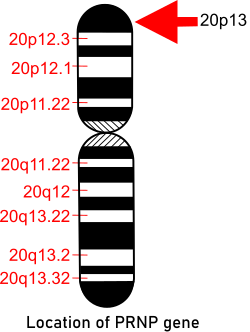
of chromosome 20 showing gene
PRP
location
Fatal familial insomnia is a rare hereditary
prion disease
that is associated with a mutation in
PRNP
. The gene, which provides instructions for making the
prion protein
PrP
C
, is located on the short arm of
chromosome 20
at position p13.
[
11
]
Individuals with FFI or familial
Creutzfeldt–Jakob disease
(fCJD) both carry a mutation at
codon
178 of the prion protein gene. FFI is also invariably linked to the presence of the
methionine
codon at position 129 of the mutant allele, whereas fCJD is linked to the presence of the
valine
codon at that position. The disease occurs when there is a change of
amino acid
at position 178 in which
asparagine
is found instead of the normal
aspartic acid
. This has to be accompanied with a methionine at position 129.
[
12
]
FFI is an autosomal dominant disease caused by a
missense GAC-to-AAC mutation
at codon 178 of the
PRNP
prion protein gene located on chromosome 20, along with the presence of the methionine polymorphism at position 129 of the mutant allele. Pathologically, FFI is characterized predominantly by
thalamic
degeneration—especially in the
medio-dorsal
and
anteroventral nuclei
.
[
13
]
Phenotypic variability
is a perplexing feature of FFI.
[
14
]
Prion diseases are caused by the accumulation of misfolded prion proteins in the brain. Generally, prion disorders are characterized by long incubation periods and short clinical duration, which means the abnormal prions may accumulate for many years without causing symptoms (long incubation period), but once symptoms begin the disorder rapidly worsens.
Given its striking clinical and neuropathologic similarities with fatal familial insomnia (FFI), a genetic prion disease linked to a point mutation at codon 178 (D178N) in the PRNP coupled with methionine at codon 129, the MM2T subtype is also known as sporadic FI (sFI). Transmission studies using susceptible transgenic mice have consistently demonstrated that the same prion strain is associated with both sFI and FFI. In contrast to what has been the rule for the most common neurodegenerative disorders, sFI is rarer than its genetic counterpart. Whereas the recognized patients with FFI are numerous and belong to >50 families worldwide, only about 30 cases of CJD MM2T and a few cases with mixed MM2T and MM2C features (MM2T+C) have been recorded to date.
In itself the presence of prions causes reduced glucose to be used by the
thalamus
and a mild hypo-metabolism of the
cingulate cortex
. The extent of this symptom varies between two variations of the disease: those presenting methionine
homozygotes
at codon 129 and methionine/valine
heterozygotes
, with some evidence that hypo-metabolism is more severe in the latter.
[
15
]
Given the relationship between the involvement of the thalamus in regulating sleep and alertness, a causal relationship can be drawn and is often mentioned as the cause of insomnia.
[
16
]
[
17
]
Diagnosis is based on symptoms and can be supported by a
sleep study
, a
PET scan
and
genetic testing
if the patient's family has a history of the disease. As with other prion diseases, the diagnosis can be confirmed only by a brain
autopsy
.
The
real-time quaking-induced conversion
(RT-QuIC), a highly sensitive
assay
that detects minute amounts of PrP
Sc
in the
cerebrospinal fluid
, has been reported to have a sensitivity of 50% in FFI and sFI.
[
18
]
[
19
]
However, this low sensitivity may change since the examination was based on a low number of cases, and the RT-QuIC technology is continuously evolving.
[
contradictory
]
A test that measures the
cerebral metabolic rate
of glucose by
positron emission tomography
(PET), referred to as [18F]-FDG-PET, has demonstrated severe
hypometabolism
of the thalamus bilaterally in FFI and sFI, also in the earliest stages of the disease. This hypometabolism then spreads, eventually impacting most cortical regions.
[
20
]
The complexity and cost of this test currently impedes its use in routine diagnosis.
Differential diagnosis
[
edit
]
Other diseases involving the
mammalian prion protein
are known.
[
21
]
Some are transmissible (
TSEs
, including FFI) such as
kuru
,
bovine spongiform encephalopathy
(BSE, also known as mad cow disease) in cattle and
chronic wasting disease
in American
deer
and
American elk
in some areas of the United States and Canada, as well as
Creutzfeldt–Jakob disease
(CJD).
Treatment involves
palliative care
.
[
2
]
There is conflicting evidence over the use of
sleeping pills
, including
barbiturates
, as a treatment for the disease.
[
22
]
[
23
]
Symptoms of fatal familial insomnia may be treated with medications.
[
contradictory
]
Clonazepam
may be prescribed to treat muscle spasms, and
eszopiclone
or
zolpidem
may be prescribed to help treat insomnia. However, these drugs do not work in the long term.
[
24
]
[
better source needed
]
Timeline of a fatal familial insomnia (FFI) patient
Like all prion diseases, FFI is invariably fatal.
[
23
]
[
2
]
Life expectancy ranges from seven months to six years,
[
2
]
with an average of 18 months.
[
23
]
Epidemiology and history
[
edit
]
Hypnogram comparing the sleep pattern of a healthy control with five FFI patients, who display decreased sleep efficiency and disrupted sleep cycles (W: wake; R: REM; N1-3: NREM sleep stages.)
Fatal insomnia was first described by Elio Lugaresi et al. in 1986.
In 1998, 40 families were known to carry the gene for FFI globally: eight German, five Italian, four American, two French, two Australian, two British, one Japanese and one Austrian.
[
25
]
In the
Basque Country
of Spain, 16 family cases of the 178N mutation were seen between 1993 and 2005 related to two families with a common ancestor in the 18th century.
[
26
]
In 2011, another family was added to the list when researchers found the first man in the Netherlands to be diagnosed with FFI. Whilst he had lived in the Netherlands for 19 years, he was of Egyptian descent.
[
27
]
Other prion diseases are similar to FFI and may be related but are missing the
D178N
gene mutation.
[
7
]
As of 20 September 2022
, 37 cases of sporadic fatal insomnia have been diagnosed.
[
3
]
Unlike in FFI, those with sFI do not have the
D178N
mutation in the
PRNP
gene; they all have a different mutation in the same gene causing
methionine
homozygosity
at
codon
129.
[
28
]
[
29
]
Nonetheless, the methionine presence in lieu of the valine (Val129) is what causes the sporadic form of disease. The targeting of this mutation has been suggested as a strategy for treatment, or possibly as a cure for the disease.
[
30
]
Silvano, 1983, Bologna, Italy
[
edit
]
In late 1983, Italian
neurologist
/sleep expert Dr. Ignazio Roiter received a patient at the
University of Bologna
hospital's sleep institute. The man, known only as Silvano, decided in a rare moment of consciousness to be recorded for future studies and to donate his brain for research in hopes of finding a cure for future victims.
[
31
]
In 1986, Lugaresi and colleagues first named and described in detail the clinical and histopathological features of fatal familial insomnia.
[
32
]
This report was primarily based on the aforementioned Silvano. Dr. Roiter referred the case to Prof. Elio Lugaresi, a well-known sleep expert, who, along with his colleagues, carried out advanced sleep analyses. As Silvano's condition quickly deteriorated, Lugaresi arranged for a postmortem neuropathological examination of the brain to be carried out by Dr. Gambetti, Lugaresi's former trainee. The collaboration of these two groups led to the 1986 publication.
[
27
]
At the time, a prion disease was not suspected due to a lack of prion-related histopathology and frozen brain tissue for advanced analysis. However, due to the devotion of Dr. Roiter and Silvano's family, more cases were obtained, resulting in the classification of FFI as a familial prion disease tied to the 178Asn genetic mutation.
[
33
]
Unnamed American patient, 2001
[
edit
]
In an article published in 2006, Schenkein and Montagna wrote of a 52-year-old American man who was able to exceed the average survival time by nearly one year with various strategies that included vitamin therapy and
meditation
, different stimulants and
hypnotics
and even complete
sensory deprivation
in an attempt to induce sleep at night and increase alertness during the day. He managed to write a book and drive hundreds of miles in this time, but nonetheless, over the course of his trials, the man succumbed to the classic four-stage progression of the illness.
[
31
]
Egyptian man, 2011, Netherlands
[
edit
]
In 2011, the first reported case in the Netherlands was of a 57-year-old man of Egyptian descent. The man came in with symptoms of double vision and progressive memory loss, and his family also noted he had recently become disoriented, paranoid and confused. Whilst he tended to fall asleep at random during daily activities, he experienced vivid dreams and random muscular jerks during normal slow-wave sleep. After four months of these symptoms, he began to have convulsions in his hands, trunk and lower limbs while awake. The person died at age 58, seven months after the onset of symptoms. An
autopsy
revealed mild
atrophy
of the
frontal cortex
and moderate atrophy of the
thalamus
. The latter is one of the most common signs of FFI.
[
27
]
Still with unclear benefit in humans, a number of treatments have had tentative success in slowing disease progression in animal models, including
pentosan polysulfate
,
mepacrine
, and
amphotericin B
.
[
3
]
As of 2016
, a study investigating
doxycycline
is being carried out.
[
3
]
[
34
]
In 2009, a mouse model was made for FFI. These mice expressed a humanized version of the PrP protein that also contains the
D178N
FFI mutation.
[
35
]
These mice appear to have progressively fewer and shorter periods of uninterrupted sleep, damage in the
thalamus
, and early deaths, similar to humans with FFI.
[
citation needed
]
The Prion Alliance was established by husband and wife duo Eric Minikel and
Sonia Vallabh
after Vallabh's mother was diagnosed with the fatal disease.
[
36
]
They conduct research at the
Broad Institute
to develop therapeutics for human prion diseases. Their hypothesis is that lowering PrP-levels may prevent the onset of FFI.
[
37
]
Other research interests involve identifying
biomarkers
to track the progression of prion disease in living people.
[
38
]
[
39
]
^
"Fatal Familial Insomnia"
.
NORD (National Organization for Rare Disorders)
. Retrieved
21 September
2022
.
^
a
b
c
d
e
f
g
"Fatal Insomnia – Neurologic Disorders"
.
Merck Manuals Professional Edition
. Retrieved
17 May
2019
.
^
a
b
c
d
"Fatal familial insomnia"
.
Genetic and Rare Diseases Information Center (GARD) – an NCATS Program
. Retrieved
17 May
2019
.
^
a
b
"Fatal Familial Insomnia"
.
NORD (National Organization for Rare Disorders)
. Retrieved
17 May
2019
.
^
"Fatal Insomnia".
Merck Manual
. Retrieved
4 May
2018
.
^
Turner R.
"Dying To Sleep: Fatal Familial Insomnia (FFI)"
.
www.world-of-lucid-dreaming.com
. Retrieved
22 March
2018
.
^
a
b
Cortelli P, Gambetti P, Montagna P, Lugaresi E (June 1999). "Fatal familial insomnia: clinical features and molecular genetics".
Journal of Sleep Research
.
8
(Suppl 1):
23–
29.
doi
:
10.1046/j.1365-2869.1999.00005.x
.
PMID
10389103
.
S2CID
24399165
.
^
"Episode 25: Fatal Insomnia"
.
Obscura: A True Crime Podcast
.
^
Max DT (May 2010).
"The Secrets of Sleep"
.
National Geographic
. Vol. 217, no. 5. p. 74.
^
"Fatal Insomnia - Neurologic Disorders"
.
^
"PRNP gene"
.
Genetics Home Reference
. Retrieved
22 March
2018
.
^
Khan Z, Sankari A, Bollu PC (2024).
"Fatal Familial Insomnia"
.
StatPearls
. StatPearls Publishing.
PMID
29489284
.
^
Xie K, Chen Y, Chu M, Cui Y, Chen Z, Zhang J, et al. (2022).
"Specific structuro-metabolic pattern of thalamic subnuclei in fatal familial insomnia: A PET/MRI imaging study"
.
NeuroImage. Clinical
.
34
103026.
doi
:
10.1016/j.nicl.2022.103026
.
PMC
9065920
.
PMID
35504222
.
^
Zhang J, Chu M, Tian Z, Xie K, Cui Y, Liu L, et al. (March 2022).
"Clinical profile of fatal familial insomnia: phenotypic variation in 129 polymorphisms and geographical regions"
.
Journal of Neurology, Neurosurgery, and Psychiatry
.
93
(3):
291–
297.
doi
:
10.1136/jnnp-2021-327247
.
PMC
8862016
.
PMID
34667102
.
^
Cortelli P, Perani D, Parchi P, Grassi F, Montagna P, De Martin M, et al. (July 1997). "Cerebral metabolism in fatal familial insomnia: relation to duration, neuropathology, and distribution of protease-resistant prion protein".
Neurology
.
49
(1):
126–
133.
doi
:
10.1212/wnl.49.1.126
.
PMID
9222180
.
^
Kostina A, Alama A, McGintya D, Alama N (2023). "Sleep homeostasis".
Encyclopedia of Sleep and Circadian Rhythms
. pp.
39–
47.
doi
:
10.1016/B978-0-12-822963-7.00243-7
.
ISBN
978-0-323-91094-1
.
^
Morton AJ (May 2013). "Circadian and sleep disorder in Huntington's disease".
Experimental Neurology
.
243
:
34–
44.
doi
:
10.1016/j.expneurol.2012.10.014
.
PMID
23099415
.
^
Cracco L, Appleby B, Gambetti P (2018). "Fatal familial insomnia and sporadic fatal insomnia".
Handbook of Clinical Neurology
.
153
:
271–
299.
doi
:
10.1016/B978-0-444-63945-5.00015-5
.
PMID
29887141
.
^
Mok T, Nihat A, Luk C, Sequeira D, Batchelor M, Mead S, et al. (4 March 2021).
"Bank vole prion protein extends the use of RT-QuIC assays to detect prions in a range of inherited prion diseases"
.
Scientific Reports
.
11
(1): 5231.
doi
:
10.1038/s41598-021-84527-9
.
PMC
7933407
.
^
Cortelli P, Perani D, Montagna P, Gallassi R, Tinuper P, Federica P, et al. (1 March 2006). "Pre-symptomatic diagnosis in fatal familial insomnia: serial neurophysiological and 18FDG-PET studies".
Brain
.
129
(3):
668–
675.
doi
:
10.1093/brain/awl003
.
PMID
16399807
.
^
Burchell JT, Panegyres PK (2016).
"Prion diseases: immunotargets and therapy"
.
ImmunoTargets and Therapy
.
5
:
57–
68.
doi
:
10.2147/ITT.S64795
.
PMC
4970640
.
PMID
27529062
.
^
Turner R.
"The man who never slept: Michael Corke"
.
World of Lucid Dreaming
. Retrieved
20 May
2011
.
^
a
b
c
Schenkein J, Montagna P (September 2006).
"Self management of fatal familial insomnia. Part 1: what is FFI?"
.
MedGenMed
.
8
(3): 65.
PMC
1781306
.
PMID
17406188
.
^
"Fatal familial insomnia: Everything you need to know"
.
MedicalNewsToday
. 14 April 2020
. Retrieved
27 February
2023
.
^
Montagna P, Gambetti P, Cortelli P, Lugaresi E (March 2003). "Familial and sporadic fatal insomnia".
The Lancet. Neurology
.
2
(3):
167–
176.
doi
:
10.1016/S1474-4422(03)00323-5
.
PMID
12849238
.
S2CID
20822956
.
^
Parchi P, Capellari S, Chin S, Schwarz HB, Schecter NP, Butts JD, et al. (June 1999).
"A subtype of sporadic prion disease mimicking fatal familial insomnia"
.
Neurology
.
52
(9):
1757–
1763.
doi
:
10.1016/S0304-4858(07)74572-9
.
PMID
10371520
.
^
a
b
c
Jansen C, Parchi P, Jelles B, Gouw AA, Beunders G, van Spaendonk RM, et al. (August 2011). "The first case of fatal familial insomnia (FFI) in the Netherlands: a patient from Egyptian descent with concurrent four repeat tau deposits".
Neuropathology and Applied Neurobiology
.
37
(5):
549–
553.
doi
:
10.1111/j.1365-2990.2010.01126.x
.
PMID
20874730
.
S2CID
30722366
.
^
Mehta LR, Huddleston BJ, Skalabrin EJ, Burns JB, Zou WQ, Gambetti P, et al. (July 2008).
"Sporadic fatal insomnia masquerading as a paraneoplastic cerebellar syndrome"
.
Archives of Neurology
.
65
(7):
971–
973.
doi
:
10.1001/archneur.65.7.971
.
PMID
18625868
.
^
Moody KM, Schonberger LB, Maddox RA, Zou WQ, Cracco L, Cali I (October 2011).
"Sporadic fatal insomnia in a young woman: a diagnostic challenge: case report"
. Case report.
BMC Neurology
.
11
136.
doi
:
10.1186/1471-2377-11-136
.
PMC
3214133
.
PMID
22040318
.
^
Tabaee Damavandi P, Dove MT, Pickersgill RW (September 2017).
"A review of drug therapy for sporadic fatal insomnia"
.
Prion
.
11
(5):
293–
299.
doi
:
10.1080/19336896.2017.1368937
.
PMC
5639864
.
PMID
28976233
.
^
a
b
Schenkein J, Montagna P (September 2006).
"Self-management of fatal familial insomnia. Part 2: case report"
.
MedGenMed
.
8
(3): 66.
PMC
1781276
.
PMID
17406189
.
^
Lugaresi E, Medori R, Montagna P, Baruzzi A, Cortelli P, Lugaresi A, et al. (16 October 1986). "Fatal familial insomnia and dysautonomia with selective degeneration of thalamic nuclei".
The New England Journal of Medicine
.
315
(16):
997–
1003.
doi
:
10.1056/NEJM198610163151605
.
ISSN
0028-4793
.
PMID
3762620
.
^
Medori R, Tritschler HJ, LeBlanc A, Villare F, Manetto V, Chen HY, et al. (13 February 1992).
"Fatal familial insomnia, a prion disease with a mutation at codon 178 of the prion protein gene"
.
The New England Journal of Medicine
.
326
(7):
444–
449.
doi
:
10.1056/NEJM199202133260704
.
ISSN
0028-4793
.
PMC
6151859
.
PMID
1346338
.
^
Forloni G, Tettamanti M, Lucca U, Albanese Y, Quaglio E, Chiesa R, et al. (21 May 2015).
"Preventive study in subjects at risk of fatal familial insomnia: Innovative approach to rare diseases"
.
Prion
.
9
(2):
75–
79.
doi
:
10.1080/19336896.2015.1027857
.
PMC
4601344
.
PMID
25996399
.
^
Jackson WS, Borkowski AW, Faas H, Steele AD, King OD, Watson N, et al. (August 2009).
"Spontaneous generation of prion infectivity in fatal familial insomnia knockin mice"
.
Neuron
.
63
(4):
438–
450.
doi
:
10.1016/j.neuron.2009.07.026
.
PMC
2775465
.
PMID
19709627
.
^
Clancy K (15 January 2019).
"One Couple's Tireless Crusade to Stop a Genetic Killer"
.
Wired
.
^
"Driving at Night in the Fog: Sonia Vallabh and Eric Minikel's Unique Path to a Cure for Prion Disease"
.
Massachusetts General Hospital
.
Archived
from the original on 22 March 2025
. Retrieved
24 May
2025
.
^
"Sonia Vallabh"
.
Broad Institute
. 20 August 2015
. Retrieved
21 January
2019
.
[
self-published source?
]
^
"Prion Alliance"
.
www.prionalliance.org
. Retrieved
21 January
2019
.
[
self-published source?
]
"AFIFF Fatal Familial Insomnia Families Association"
. Archived from
the original
on 21 October 2016
. Retrieved
26 January
2013
. |
| Markdown | [Jump to content](https://en.wikipedia.org/wiki/Fatal_insomnia#bodyContent)
Main menu
Main menu
move to sidebar
hide
Navigation
- [Main page](https://en.wikipedia.org/wiki/Main_Page "Visit the main page [z]")
- [Contents](https://en.wikipedia.org/wiki/Wikipedia:Contents "Guides to browsing Wikipedia")
- [Current events](https://en.wikipedia.org/wiki/Portal:Current_events "Articles related to current events")
- [Random article](https://en.wikipedia.org/wiki/Special:Random "Visit a randomly selected article [x]")
- [About Wikipedia](https://en.wikipedia.org/wiki/Wikipedia:About "Learn about Wikipedia and how it works")
- [Contact us](https://en.wikipedia.org/wiki/Wikipedia:Contact_us "How to contact Wikipedia")
Contribute
- [Help](https://en.wikipedia.org/wiki/Help:Contents "Guidance on how to use and edit Wikipedia")
- [Learn to edit](https://en.wikipedia.org/wiki/Help:Introduction "Learn how to edit Wikipedia")
- [Community portal](https://en.wikipedia.org/wiki/Wikipedia:Community_portal "The hub for editors")
- [Recent changes](https://en.wikipedia.org/wiki/Special:RecentChanges "A list of recent changes to Wikipedia [r]")
- [Upload file](https://en.wikipedia.org/wiki/Wikipedia:File_upload_wizard "Add images or other media for use on Wikipedia")
- [Special pages](https://en.wikipedia.org/wiki/Special:SpecialPages "A list of all special pages [q]")
[  ](https://en.wikipedia.org/wiki/Main_Page)
[Search](https://en.wikipedia.org/wiki/Special:Search "Search Wikipedia [f]")
Appearance
- [Donate](https://donate.wikimedia.org/?wmf_source=donate&wmf_medium=sidebar&wmf_campaign=en.wikipedia.org&uselang=en)
- [Create account](https://en.wikipedia.org/w/index.php?title=Special:CreateAccount&returnto=Fatal+insomnia "You are encouraged to create an account and log in; however, it is not mandatory")
- [Log in](https://en.wikipedia.org/w/index.php?title=Special:UserLogin&returnto=Fatal+insomnia "You're encouraged to log in; however, it's not mandatory. [o]")
Personal tools
- [Donate](https://donate.wikimedia.org/?wmf_source=donate&wmf_medium=sidebar&wmf_campaign=en.wikipedia.org&uselang=en)
- [Create account](https://en.wikipedia.org/w/index.php?title=Special:CreateAccount&returnto=Fatal+insomnia "You are encouraged to create an account and log in; however, it is not mandatory")
- [Log in](https://en.wikipedia.org/w/index.php?title=Special:UserLogin&returnto=Fatal+insomnia "You're encouraged to log in; however, it's not mandatory. [o]")
## Contents
move to sidebar
hide
- [(Top)](https://en.wikipedia.org/wiki/Fatal_insomnia)
- [1 Signs and symptoms](https://en.wikipedia.org/wiki/Fatal_insomnia#Signs_and_symptoms)
- [2 Cause](https://en.wikipedia.org/wiki/Fatal_insomnia#Cause)
- [3 Pathophysiology](https://en.wikipedia.org/wiki/Fatal_insomnia#Pathophysiology)
- [4 Diagnosis](https://en.wikipedia.org/wiki/Fatal_insomnia#Diagnosis)
Toggle Diagnosis subsection
- [4\.1 Differential diagnosis](https://en.wikipedia.org/wiki/Fatal_insomnia#Differential_diagnosis)
- [5 Treatments](https://en.wikipedia.org/wiki/Fatal_insomnia#Treatments)
- [6 Prognosis](https://en.wikipedia.org/wiki/Fatal_insomnia#Prognosis)
- [7 Epidemiology and history](https://en.wikipedia.org/wiki/Fatal_insomnia#Epidemiology_and_history)
Toggle Epidemiology and history subsection
- [7\.1 Silvano, 1983, Bologna, Italy](https://en.wikipedia.org/wiki/Fatal_insomnia#Silvano,_1983,_Bologna,_Italy)
- [7\.2 Unnamed American patient, 2001](https://en.wikipedia.org/wiki/Fatal_insomnia#Unnamed_American_patient,_2001)
- [7\.3 Egyptian man, 2011, Netherlands](https://en.wikipedia.org/wiki/Fatal_insomnia#Egyptian_man,_2011,_Netherlands)
- [8 Research](https://en.wikipedia.org/wiki/Fatal_insomnia#Research)
- [9 References](https://en.wikipedia.org/wiki/Fatal_insomnia#References)
- [10 External links](https://en.wikipedia.org/wiki/Fatal_insomnia#External_links)
Toggle the table of contents
# Fatal insomnia
34 languages
- [العربية](https://ar.wikipedia.org/wiki/%D8%A3%D8%B1%D9%82_%D9%85%D9%85%D9%8A%D8%AA "أرق مميت – Arabic")
- [Български](https://bg.wikipedia.org/wiki/%D0%A4%D0%B0%D1%82%D0%B0%D0%BB%D0%BD%D0%BE_%D0%B1%D0%B5%D0%B7%D1%81%D1%8A%D0%BD%D0%B8%D0%B5 "Фатално безсъние – Bulgarian")
- [Bosanski](https://bs.wikipedia.org/wiki/Fatalna_porodi%C4%8Dna_nesanica "Fatalna porodična nesanica – Bosnian")
- [Català](https://ca.wikipedia.org/wiki/Insomni_familiar_letal "Insomni familiar letal – Catalan")
- [Čeština](https://cs.wikipedia.org/wiki/Fat%C3%A1ln%C3%AD_famili%C3%A1rn%C3%AD_insomnie "Fatální familiární insomnie – Czech")
- [Dansk](https://da.wikipedia.org/wiki/D%C3%B8delig_s%C3%B8vnl%C3%B8shed "Dødelig søvnløshed – Danish")
- [Deutsch](https://de.wikipedia.org/wiki/T%C3%B6dliche_famili%C3%A4re_Schlaflosigkeit "Tödliche familiäre Schlaflosigkeit – German")
- [Ελληνικά](https://el.wikipedia.org/wiki/%CE%98%CE%B1%CE%BD%CE%AC%CF%83%CE%B9%CE%BC%CE%B7_%CE%B1%CF%8B%CF%80%CE%BD%CE%AF%CE%B1 "Θανάσιμη αϋπνία – Greek")
- [Español](https://es.wikipedia.org/wiki/Insomnio_familiar_letal "Insomnio familiar letal – Spanish")
- [Eesti](https://et.wikipedia.org/wiki/Fataalne_perekondlik_unetus "Fataalne perekondlik unetus – Estonian")
- [Euskara](https://eu.wikipedia.org/wiki/Familia-insomnio_hilgarri "Familia-insomnio hilgarri – Basque")
- [فارسی](https://fa.wikipedia.org/wiki/%D8%A8%DB%8C%E2%80%8C%D8%AE%D9%88%D8%A7%D8%A8%DB%8C_%D8%AE%D8%A7%D9%86%D9%88%D8%A7%D8%AF%DA%AF%DB%8C_%D9%85%D8%B1%DA%AF%E2%80%8C%D8%A2%D9%88%D8%B1 "بیخوابی خانوادگی مرگآور – Persian")
- [Suomi](https://fi.wikipedia.org/wiki/Fataali_familiaalinen_insomnia "Fataali familiaalinen insomnia – Finnish")
- [Français](https://fr.wikipedia.org/wiki/Insomnie_fatale_familiale "Insomnie fatale familiale – French")
- [Ghanaian Pidgin](https://gpe.wikipedia.org/wiki/Fatal_insomnia "Fatal insomnia – Ghanaian Pidgin")
- [עברית](https://he.wikipedia.org/wiki/%D7%97%D7%95%D7%A1%D7%A8_%D7%A9%D7%99%D7%A0%D7%94_%D7%AA%D7%95%D7%A8%D7%A9%D7%AA%D7%99_%D7%A7%D7%98%D7%9C%D7%A0%D7%99 "חוסר שינה תורשתי קטלני – Hebrew")
- [Հայերեն](https://hy.wikipedia.org/wiki/%D5%84%D5%A1%D5%B0%D5%A1%D6%81%D5%B8%D6%82_%D5%A1%D5%B6%D6%84%D5%B6%D5%B8%D6%82%D5%A9%D5%B5%D5%B8%D6%82%D5%B6 "Մահացու անքնություն – Armenian")
- [Bahasa Indonesia](https://id.wikipedia.org/wiki/Insomnia_fatal "Insomnia fatal – Indonesian")
- [Italiano](https://it.wikipedia.org/wiki/Insonnia_familiare_fatale "Insonnia familiare fatale – Italian")
- [日本語](https://ja.wikipedia.org/wiki/%E8%87%B4%E6%AD%BB%E6%80%A7%E5%AE%B6%E6%97%8F%E6%80%A7%E4%B8%8D%E7%9C%A0%E7%97%87 "致死性家族性不眠症 – Japanese")
- [한국어](https://ko.wikipedia.org/wiki/%EC%B9%98%EC%82%AC%EC%84%B1_%EB%B6%88%EB%A9%B4%EC%A6%9D "치사성 불면증 – Korean")
- [Nederlands](https://nl.wikipedia.org/wiki/Fatale_familiaire_insomnie "Fatale familiaire insomnie – Dutch")
- [Norsk bokmål](https://no.wikipedia.org/wiki/D%C3%B8delig_famili%C3%A6r_s%C3%B8vnl%C3%B8shet "Dødelig familiær søvnløshet – Norwegian Bokmål")
- [ଓଡ଼ିଆ](https://or.wikipedia.org/wiki/%E0%AC%98%E0%AC%BE%E0%AC%A4%E0%AC%95_%E0%AC%85%E0%AC%A8%E0%AC%BF%E0%AC%A6%E0%AD%8D%E0%AC%B0%E0%AC%BE "ଘାତକ ଅନିଦ୍ରା – Odia")
- [Polski](https://pl.wikipedia.org/wiki/%C5%9Amiertelna_bezsenno%C5%9B%C4%87_rodzinna "Śmiertelna bezsenność rodzinna – Polish")
- [Português](https://pt.wikipedia.org/wiki/Ins%C3%B4nia_fatal "Insônia fatal – Portuguese")
- [Русский](https://ru.wikipedia.org/wiki/%D0%A4%D0%B0%D1%82%D0%B0%D0%BB%D1%8C%D0%BD%D0%B0%D1%8F_%D1%81%D0%B5%D0%BC%D0%B5%D0%B9%D0%BD%D0%B0%D1%8F_%D0%B1%D0%B5%D1%81%D1%81%D0%BE%D0%BD%D0%BD%D0%B8%D1%86%D0%B0 "Фатальная семейная бессонница – Russian")
- [Simple English](https://simple.wikipedia.org/wiki/Fatal_insomnia "Fatal insomnia – Simple English")
- [Српски / srpski](https://sr.wikipedia.org/wiki/%D0%A4%D0%B0%D1%82%D0%B0%D0%BB%D0%BD%D0%B0_%D0%BF%D0%BE%D1%80%D0%BE%D0%B4%D0%B8%D1%87%D0%BD%D0%B0_%D0%BD%D0%B5%D1%81%D0%B0%D0%BD%D0%B8%D1%86%D0%B0 "Фатална породична несаница – Serbian")
- [Svenska](https://sv.wikipedia.org/wiki/Fatal_familj%C3%A4r_insomni "Fatal familjär insomni – Swedish")
- [ไทย](https://th.wikipedia.org/wiki/%E0%B9%82%E0%B8%A3%E0%B8%84%E0%B8%99%E0%B8%AD%E0%B8%99%E0%B9%84%E0%B8%A1%E0%B9%88%E0%B8%AB%E0%B8%A5%E0%B8%B1%E0%B8%9A%E0%B8%A1%E0%B8%A3%E0%B8%93%E0%B8%B0 "โรคนอนไม่หลับมรณะ – Thai")
- [Türkçe](https://tr.wikipedia.org/wiki/%C3%96l%C3%BCmc%C3%BCl_uykusuzluk "Ölümcül uykusuzluk – Turkish")
- [Українська](https://uk.wikipedia.org/wiki/%D0%A4%D0%B0%D1%82%D0%B0%D0%BB%D1%8C%D0%BD%D0%B5_%D1%81%D1%96%D0%BC%D0%B5%D0%B9%D0%BD%D0%B5_%D0%B1%D0%B5%D0%B7%D1%81%D0%BE%D0%BD%D0%BD%D1%8F "Фатальне сімейне безсоння – Ukrainian")
- [中文](https://zh.wikipedia.org/wiki/%E8%87%B4%E6%AD%BB%E6%80%A7%E5%AE%B6%E6%97%8F%E5%A4%B1%E7%9C%A0%E7%97%87 "致死性家族失眠症 – Chinese")
[Edit links](https://www.wikidata.org/wiki/Special:EntityPage/Q862872#sitelinks-wikipedia "Edit interlanguage links")
- [Article](https://en.wikipedia.org/wiki/Fatal_insomnia "View the content page [c]")
- [Talk](https://en.wikipedia.org/wiki/Talk:Fatal_insomnia "Discuss improvements to the content page [t]")
English
- [Read](https://en.wikipedia.org/wiki/Fatal_insomnia)
- [Edit](https://en.wikipedia.org/w/index.php?title=Fatal_insomnia&action=edit "Edit this page [e]")
- [View history](https://en.wikipedia.org/w/index.php?title=Fatal_insomnia&action=history "Past revisions of this page [h]")
Tools
Tools
move to sidebar
hide
Actions
- [Read](https://en.wikipedia.org/wiki/Fatal_insomnia)
- [Edit](https://en.wikipedia.org/w/index.php?title=Fatal_insomnia&action=edit "Edit this page [e]")
- [View history](https://en.wikipedia.org/w/index.php?title=Fatal_insomnia&action=history)
General
- [What links here](https://en.wikipedia.org/wiki/Special:WhatLinksHere/Fatal_insomnia "List of all English Wikipedia pages containing links to this page [j]")
- [Related changes](https://en.wikipedia.org/wiki/Special:RecentChangesLinked/Fatal_insomnia "Recent changes in pages linked from this page [k]")
- [Upload file](https://en.wikipedia.org/wiki/Wikipedia:File_Upload_Wizard "Upload files [u]")
- [Permanent link](https://en.wikipedia.org/w/index.php?title=Fatal_insomnia&oldid=1337735982 "Permanent link to this revision of this page")
- [Page information](https://en.wikipedia.org/w/index.php?title=Fatal_insomnia&action=info "More information about this page")
- [Cite this page](https://en.wikipedia.org/w/index.php?title=Special:CiteThisPage&page=Fatal_insomnia&id=1337735982&wpFormIdentifier=titleform "Information on how to cite this page")
- [Get shortened URL](https://en.wikipedia.org/w/index.php?title=Special:UrlShortener&url=https%3A%2F%2Fen.wikipedia.org%2Fwiki%2FFatal_insomnia)
Print/export
- [Download as PDF](https://en.wikipedia.org/w/index.php?title=Special:DownloadAsPdf&page=Fatal_insomnia&action=show-download-screen "Download this page as a PDF file")
- [Printable version](https://en.wikipedia.org/w/index.php?title=Fatal_insomnia&printable=yes "Printable version of this page [p]")
In other projects
- [Wikimedia Commons](https://commons.wikimedia.org/wiki/Category:Fatal_insomnia)
- [Wikidata item](https://www.wikidata.org/wiki/Special:EntityPage/Q862872 "Structured data on this page hosted by Wikidata [g]")
Appearance
move to sidebar
hide
From Wikipedia, the free encyclopedia
Prion disease of the human brain
Medical condition
| Fatal insomnia | |
|---|---|
| [](https://en.wikipedia.org/wiki/File:12883_2025_4315_Fig2_HTML.jpg) | |
| Longitudinal comparison of 18F-FDG PET/MRI in brain in a patient with fatal insomnia, demonstrating normal brain parenchyma on MRI, but prominent hypometabolism of the thalamus | |
| [Specialty](https://en.wikipedia.org/wiki/Medical_specialty "Medical specialty") | [Neurology](https://en.wikipedia.org/wiki/Neurology "Neurology"), [psychiatry](https://en.wikipedia.org/wiki/Psychiatry "Psychiatry"), [sleep medicine](https://en.wikipedia.org/wiki/Sleep_medicine "Sleep medicine"), [neuropathology](https://en.wikipedia.org/wiki/Neuropathology "Neuropathology") |
| [Symptoms](https://en.wikipedia.org/wiki/Signs_and_symptoms "Signs and symptoms") | Progressive insomnia, ataxia, double vision, weight loss, high blood pressure, excessive sweating |
| [Complications](https://en.wikipedia.org/wiki/Complication_\(medicine\) "Complication (medicine)") | Permanent state of [hypnagogia](https://en.wikipedia.org/wiki/Hypnagogia "Hypnagogia") later in the illness |
| Usual onset | 45–50 years old[\[1\]](https://en.wikipedia.org/wiki/Fatal_insomnia#cite_note-1) |
| Types | Fatal familial insomnia, sporadic fatal insomnia[\[2\]](https://en.wikipedia.org/wiki/Fatal_insomnia#cite_note-Mer2019Pro-2) |
| [Causes](https://en.wikipedia.org/wiki/Cause_\(medicine\) "Cause (medicine)") | [Genetic mutation](https://en.wikipedia.org/wiki/Genetic_mutation "Genetic mutation"), sporadic form (very rare) |
| [Risk factors](https://en.wikipedia.org/wiki/Risk_factor "Risk factor") | Family history |
| [Diagnostic method](https://en.wikipedia.org/wiki/Medical_diagnosis "Medical diagnosis") | Suspected based on symptoms, supported by [sleep study](https://en.wikipedia.org/wiki/Sleep_study "Sleep study"), [PET scan](https://en.wikipedia.org/wiki/PET_scan "PET scan") and [genetic testing](https://en.wikipedia.org/wiki/Genetic_testing "Genetic testing") (if familial form is suspected)[\[3\]](https://en.wikipedia.org/wiki/Fatal_insomnia#cite_note-GARD2019-3) |
| [Differential diagnosis](https://en.wikipedia.org/wiki/Differential_diagnosis "Differential diagnosis") | [Alzheimer's disease](https://en.wikipedia.org/wiki/Alzheimer%27s_disease "Alzheimer's disease"), [frontotemporal dementia](https://en.wikipedia.org/wiki/Frontotemporal_dementia "Frontotemporal dementia"), other [transmissible spongiform encephalopathies](https://en.wikipedia.org/wiki/Transmissible_spongiform_encephalopathy "Transmissible spongiform encephalopathy")[\[4\]](https://en.wikipedia.org/wiki/Fatal_insomnia#cite_note-NORD2019-4) |
| Prevention | None |
| Treatment | [Supportive care](https://en.wikipedia.org/wiki/Supportive_care "Supportive care")[\[2\]](https://en.wikipedia.org/wiki/Fatal_insomnia#cite_note-Mer2019Pro-2) |
| [Medication](https://en.wikipedia.org/wiki/Medication "Medication") | None |
| [Prognosis](https://en.wikipedia.org/wiki/Prognosis "Prognosis") | Invariably fatal |
| Frequency | 70 families worldwide are known to carry the gene associated with the disease, 37 sporadic cases diagnosed (as of 20 September 2022) |
| Deaths | \<1 per year |
**Fatal insomnia** is a [neurodegenerative](https://en.wikipedia.org/wiki/Neurodegenerative_disease "Neurodegenerative disease") [disease](https://en.wikipedia.org/wiki/Prion_disease "Prion disease") that results in [trouble sleeping](https://en.wikipedia.org/wiki/Insomnia "Insomnia") as its hallmark symptom.[\[2\]](https://en.wikipedia.org/wiki/Fatal_insomnia#cite_note-Mer2019Pro-2) The majority of cases are familial (**fatal familial insomnia** \[**FFI**\]), stemming from a mutation in the *[PRNP](https://en.wikipedia.org/wiki/PRNP "PRNP")* gene, with the remainder of cases occurring [sporadically](https://en.wikipedia.org/wiki/Sporadic_disease "Sporadic disease") (**sporadic fatal insomnia** \[**sFI**\]). The problems with sleeping typically start out gradually and worsen over time.[\[4\]](https://en.wikipedia.org/wiki/Fatal_insomnia#cite_note-NORD2019-4) Eventually, the patient will succumb to total insomnia (*agrypnia excitata*), most often leading to other symptoms such as [speech problems](https://en.wikipedia.org/wiki/Aphasia "Aphasia"), coordination problems, and [dementia](https://en.wikipedia.org/wiki/Dementia "Dementia").[\[5\]](https://en.wikipedia.org/wiki/Fatal_insomnia#cite_note-5) It results in death within a few months to a few years, and there is no known [disease-modifying treatment](https://en.wikipedia.org/wiki/Disease-modifying_treatment "Disease-modifying treatment").[\[2\]](https://en.wikipedia.org/wiki/Fatal_insomnia#cite_note-Mer2019Pro-2)
## Signs and symptoms
\[[edit](https://en.wikipedia.org/w/index.php?title=Fatal_insomnia&action=edit§ion=1 "Edit section: Signs and symptoms")\]
The disease has four stages:[\[6\]](https://en.wikipedia.org/wiki/Fatal_insomnia#cite_note-6)
1. Characterized by worsening [insomnia](https://en.wikipedia.org/wiki/Insomnia "Insomnia"), resulting in [panic attacks](https://en.wikipedia.org/wiki/Panic_attack "Panic attack"), [paranoia](https://en.wikipedia.org/wiki/Paranoia "Paranoia"), and [phobias](https://en.wikipedia.org/wiki/Phobia "Phobia"). This stage lasts for about four months.
2. [Hallucinations](https://en.wikipedia.org/wiki/Hallucination "Hallucination") and panic attacks become noticeable, continuing for about five months.
3. Complete inability to [sleep](https://en.wikipedia.org/wiki/Sleep "Sleep") followed by rapid loss of [weight](https://en.wikipedia.org/wiki/Weight "Weight"). This lasts for about three months.
4. [Dementia](https://en.wikipedia.org/wiki/Dementia "Dementia"), during which the person becomes unresponsive or mute over the course of six months, is the final stage of the disease, after which death follows.
Clinically, Fatal insomnia manifests with a disordered sleep-wake cycle, [dysautonomia](https://en.wikipedia.org/wiki/Dysautonomia "Dysautonomia"), motor disturbances, and neuropsychiatric disorders.
Other symptoms include profuse sweating, [miosis](https://en.wikipedia.org/wiki/Miosis "Miosis") (pinpoint pupils), sudden entrance into [menopause](https://en.wikipedia.org/wiki/Menopause "Menopause") or [impotence](https://en.wikipedia.org/wiki/Impotence "Impotence"), neck stiffness, and [elevation of blood pressure](https://en.wikipedia.org/wiki/High_blood_pressure "High blood pressure") and heart rate. The sporadic form of the disease often presents with [double vision](https://en.wikipedia.org/wiki/Diplopia "Diplopia"). Prolonged constipation is common as well. As the disease progresses, the person becomes stuck in a state of pre-sleep limbo, or [hypnagogia](https://en.wikipedia.org/wiki/Hypnagogia "Hypnagogia"), which is the state just before sleep in healthy individuals. During these stages, people commonly and repeatedly move their limbs as if they were dreaming.[\[7\]](https://en.wikipedia.org/wiki/Fatal_insomnia#cite_note-Cortelli_et_al.-7)
The age of onset is variable, ranging from 13 to 60 years, with an average of 50.[\[8\]](https://en.wikipedia.org/wiki/Fatal_insomnia#cite_note-8) The disease can be detected prior to onset by genetic testing.[\[9\]](https://en.wikipedia.org/wiki/Fatal_insomnia#cite_note-9) Death usually occurs between 6–36 months from onset. The presentation of the disease varies considerably from person to person, even among people within the same family; in the sporadic form, for example, sleep problems are not commonly reported, and early symptoms are [ataxia](https://en.wikipedia.org/wiki/Ataxia "Ataxia"), cognitive impairment, and double vision.[\[10\]](https://en.wikipedia.org/wiki/Fatal_insomnia#cite_note-10)
## Cause
\[[edit](https://en.wikipedia.org/w/index.php?title=Fatal_insomnia&action=edit§ion=2 "Edit section: Cause")\]
| | |
|---|---|
|  | This section **may be too technical for most readers to understand**. Please [help improve it](https://en.wikipedia.org/w/index.php?title=Fatal_insomnia&action=edit) to [make it understandable to non-experts](https://en.wikipedia.org/wiki/Wikipedia:Make_technical_articles_understandable "Wikipedia:Make technical articles understandable"), without removing the technical details. *(September 2023)* *([Learn how and when to remove this message](https://en.wikipedia.org/wiki/Help:Maintenance_template_removal "Help:Maintenance template removal"))* |
[](https://en.wikipedia.org/wiki/File:Location_of_PRNP-gene_in_chromosome_20.svg)
[Idiogram](https://en.wikipedia.org/wiki/Idiogram "Idiogram") of chromosome 20 showing gene *PRP* location
Fatal familial insomnia is a rare hereditary [prion disease](https://en.wikipedia.org/wiki/Prion_disease "Prion disease") that is associated with a mutation in *PRNP*. The gene, which provides instructions for making the [prion protein](https://en.wikipedia.org/wiki/Prion_protein "Prion protein") PrPC, is located on the short arm of [chromosome 20](https://en.wikipedia.org/wiki/Chromosome_20 "Chromosome 20") at position p13.[\[11\]](https://en.wikipedia.org/wiki/Fatal_insomnia#cite_note-11) Individuals with FFI or familial [Creutzfeldt–Jakob disease](https://en.wikipedia.org/wiki/Creutzfeldt%E2%80%93Jakob_disease "Creutzfeldt–Jakob disease") (fCJD) both carry a mutation at [codon](https://en.wikipedia.org/wiki/Codon "Codon") 178 of the prion protein gene. FFI is also invariably linked to the presence of the [methionine](https://en.wikipedia.org/wiki/Methionine "Methionine") codon at position 129 of the mutant allele, whereas fCJD is linked to the presence of the [valine](https://en.wikipedia.org/wiki/Valine "Valine") codon at that position. The disease occurs when there is a change of [amino acid](https://en.wikipedia.org/wiki/Amino_acid "Amino acid") at position 178 in which [asparagine](https://en.wikipedia.org/wiki/Asparagine "Asparagine") is found instead of the normal [aspartic acid](https://en.wikipedia.org/wiki/Aspartic_acid "Aspartic acid"). This has to be accompanied with a methionine at position 129.[\[12\]](https://en.wikipedia.org/wiki/Fatal_insomnia#cite_note-12)
FFI is an autosomal dominant disease caused by a [missense GAC-to-AAC mutation](https://en.wikipedia.org/wiki/Missense_mutation "Missense mutation") at codon 178 of the *PRNP* prion protein gene located on chromosome 20, along with the presence of the methionine polymorphism at position 129 of the mutant allele. Pathologically, FFI is characterized predominantly by [thalamic](https://en.wikipedia.org/wiki/Thalamus "Thalamus") degeneration—especially in the [medio-dorsal](https://en.wikipedia.org/wiki/Medial_dorsal_nucleus "Medial dorsal nucleus") and [anteroventral nuclei](https://en.wikipedia.org/wiki/Anteroventral_periventricular_nucleus "Anteroventral periventricular nucleus").[\[13\]](https://en.wikipedia.org/wiki/Fatal_insomnia#cite_note-13) [Phenotypic variability](https://en.wikipedia.org/wiki/Phenotypic_heterogeneity "Phenotypic heterogeneity") is a perplexing feature of FFI.[\[14\]](https://en.wikipedia.org/wiki/Fatal_insomnia#cite_note-14)
Prion diseases are caused by the accumulation of misfolded prion proteins in the brain. Generally, prion disorders are characterized by long incubation periods and short clinical duration, which means the abnormal prions may accumulate for many years without causing symptoms (long incubation period), but once symptoms begin the disorder rapidly worsens.
## Pathophysiology
\[[edit](https://en.wikipedia.org/w/index.php?title=Fatal_insomnia&action=edit§ion=3 "Edit section: Pathophysiology")\]
Given its striking clinical and neuropathologic similarities with fatal familial insomnia (FFI), a genetic prion disease linked to a point mutation at codon 178 (D178N) in the PRNP coupled with methionine at codon 129, the MM2T subtype is also known as sporadic FI (sFI). Transmission studies using susceptible transgenic mice have consistently demonstrated that the same prion strain is associated with both sFI and FFI. In contrast to what has been the rule for the most common neurodegenerative disorders, sFI is rarer than its genetic counterpart. Whereas the recognized patients with FFI are numerous and belong to \>50 families worldwide, only about 30 cases of CJD MM2T and a few cases with mixed MM2T and MM2C features (MM2T+C) have been recorded to date.
In itself the presence of prions causes reduced glucose to be used by the [thalamus](https://en.wikipedia.org/wiki/Thalamus "Thalamus") and a mild hypo-metabolism of the [cingulate cortex](https://en.wikipedia.org/wiki/Cingulate_cortex "Cingulate cortex"). The extent of this symptom varies between two variations of the disease: those presenting methionine [homozygotes](https://en.wikipedia.org/wiki/Homozygote "Homozygote") at codon 129 and methionine/valine [heterozygotes](https://en.wikipedia.org/wiki/Heterozygote "Heterozygote"), with some evidence that hypo-metabolism is more severe in the latter.[\[15\]](https://en.wikipedia.org/wiki/Fatal_insomnia#cite_note-15) Given the relationship between the involvement of the thalamus in regulating sleep and alertness, a causal relationship can be drawn and is often mentioned as the cause of insomnia.[\[16\]](https://en.wikipedia.org/wiki/Fatal_insomnia#cite_note-16)[\[17\]](https://en.wikipedia.org/wiki/Fatal_insomnia#cite_note-17)
## Diagnosis
\[[edit](https://en.wikipedia.org/w/index.php?title=Fatal_insomnia&action=edit§ion=4 "Edit section: Diagnosis")\]
| | |
|---|---|
|  | This section **may be too technical for most readers to understand**. Please [help improve it](https://en.wikipedia.org/w/index.php?title=Fatal_insomnia&action=edit) to [make it understandable to non-experts](https://en.wikipedia.org/wiki/Wikipedia:Make_technical_articles_understandable "Wikipedia:Make technical articles understandable"), without removing the technical details. *(June 2024)* *([Learn how and when to remove this message](https://en.wikipedia.org/wiki/Help:Maintenance_template_removal "Help:Maintenance template removal"))* |
Diagnosis is based on symptoms and can be supported by a [sleep study](https://en.wikipedia.org/wiki/Sleep_study "Sleep study"), a [PET scan](https://en.wikipedia.org/wiki/PET_scan "PET scan") and [genetic testing](https://en.wikipedia.org/wiki/Genetic_testing "Genetic testing") if the patient's family has a history of the disease. As with other prion diseases, the diagnosis can be confirmed only by a brain [autopsy](https://en.wikipedia.org/wiki/Autopsy "Autopsy").
The [real-time quaking-induced conversion](https://en.wikipedia.org/wiki/Real-time_quaking-induced_conversion "Real-time quaking-induced conversion") (RT-QuIC), a highly sensitive [assay](https://en.wikipedia.org/wiki/Assay "Assay") that detects minute amounts of PrPSc in the [cerebrospinal fluid](https://en.wikipedia.org/wiki/Cerebrospinal_fluid "Cerebrospinal fluid"), has been reported to have a sensitivity of 50% in FFI and sFI.[\[18\]](https://en.wikipedia.org/wiki/Fatal_insomnia#cite_note-18)[\[19\]](https://en.wikipedia.org/wiki/Fatal_insomnia#cite_note-19) However, this low sensitivity may change since the examination was based on a low number of cases, and the RT-QuIC technology is continuously evolving.\[*[contradictory](https://en.wikipedia.org/wiki/Category:All_self-contradictory_articles "Category:All self-contradictory articles")*\]
A test that measures the [cerebral metabolic rate](https://en.wikipedia.org/w/index.php?title=Cerebral_metabolic_rate&action=edit&redlink=1 "Cerebral metabolic rate (page does not exist)") of glucose by [positron emission tomography](https://en.wikipedia.org/wiki/Positron_emission_tomography "Positron emission tomography") (PET), referred to as \[18F\]-FDG-PET, has demonstrated severe [hypometabolism](https://en.wikipedia.org/w/index.php?title=Hypometabolism&action=edit&redlink=1 "Hypometabolism (page does not exist)") of the thalamus bilaterally in FFI and sFI, also in the earliest stages of the disease. This hypometabolism then spreads, eventually impacting most cortical regions.[\[20\]](https://en.wikipedia.org/wiki/Fatal_insomnia#cite_note-20) The complexity and cost of this test currently impedes its use in routine diagnosis.
### Differential diagnosis
\[[edit](https://en.wikipedia.org/w/index.php?title=Fatal_insomnia&action=edit§ion=5 "Edit section: Differential diagnosis")\]
Other diseases involving the [mammalian prion protein](https://en.wikipedia.org/wiki/PRNP "PRNP") are known.[\[21\]](https://en.wikipedia.org/wiki/Fatal_insomnia#cite_note-PanegyresBurchell2016-21) Some are transmissible ([TSEs](https://en.wikipedia.org/wiki/Transmissible_spongiform_encephalopathy "Transmissible spongiform encephalopathy"), including FFI) such as [kuru](https://en.wikipedia.org/wiki/Kuru_\(disease\) "Kuru (disease)"), [bovine spongiform encephalopathy](https://en.wikipedia.org/wiki/Bovine_spongiform_encephalopathy "Bovine spongiform encephalopathy") (BSE, also known as mad cow disease) in cattle and [chronic wasting disease](https://en.wikipedia.org/wiki/Chronic_wasting_disease "Chronic wasting disease") in American [deer](https://en.wikipedia.org/wiki/Deer "Deer") and [American elk](https://en.wikipedia.org/wiki/Elk "Elk") in some areas of the United States and Canada, as well as [Creutzfeldt–Jakob disease](https://en.wikipedia.org/wiki/Creutzfeldt%E2%80%93Jakob_disease "Creutzfeldt–Jakob disease") (CJD).
## Treatments
\[[edit](https://en.wikipedia.org/w/index.php?title=Fatal_insomnia&action=edit§ion=6 "Edit section: Treatments")\]
Treatment involves [palliative care](https://en.wikipedia.org/wiki/Palliative_care "Palliative care").[\[2\]](https://en.wikipedia.org/wiki/Fatal_insomnia#cite_note-Mer2019Pro-2) There is conflicting evidence over the use of [sleeping pills](https://en.wikipedia.org/wiki/Sleeping_pill "Sleeping pill"), including [barbiturates](https://en.wikipedia.org/wiki/Barbiturate "Barbiturate"), as a treatment for the disease.[\[22\]](https://en.wikipedia.org/wiki/Fatal_insomnia#cite_note-22)[\[23\]](https://en.wikipedia.org/wiki/Fatal_insomnia#cite_note-Schenkein06-23) Symptoms of fatal familial insomnia may be treated with medications.\[*[contradictory](https://en.wikipedia.org/wiki/Category:All_self-contradictory_articles "Category:All self-contradictory articles")*\]
[Clonazepam](https://en.wikipedia.org/wiki/Clonazepam "Clonazepam") may be prescribed to treat muscle spasms, and [eszopiclone](https://en.wikipedia.org/wiki/Eszopiclone "Eszopiclone") or [zolpidem](https://en.wikipedia.org/wiki/Zolpidem "Zolpidem") may be prescribed to help treat insomnia. However, these drugs do not work in the long term.[\[24\]](https://en.wikipedia.org/wiki/Fatal_insomnia#cite_note-24)\[*[better source needed](https://en.wikipedia.org/wiki/Wikipedia:Verifiability#Questionable_sources "Wikipedia:Verifiability")*\]
## Prognosis
\[[edit](https://en.wikipedia.org/w/index.php?title=Fatal_insomnia&action=edit§ion=7 "Edit section: Prognosis")\]
[](https://en.wikipedia.org/wiki/File:FFI_timeline.svg)
Timeline of a fatal familial insomnia (FFI) patient
Like all prion diseases, FFI is invariably fatal.[\[23\]](https://en.wikipedia.org/wiki/Fatal_insomnia#cite_note-Schenkein06-23)[\[2\]](https://en.wikipedia.org/wiki/Fatal_insomnia#cite_note-Mer2019Pro-2) Life expectancy ranges from seven months to six years,[\[2\]](https://en.wikipedia.org/wiki/Fatal_insomnia#cite_note-Mer2019Pro-2) with an average of 18 months.[\[23\]](https://en.wikipedia.org/wiki/Fatal_insomnia#cite_note-Schenkein06-23)
## Epidemiology and history
\[[edit](https://en.wikipedia.org/w/index.php?title=Fatal_insomnia&action=edit§ion=8 "Edit section: Epidemiology and history")\]
[](https://en.wikipedia.org/wiki/File:FFI_Diagrams.svg)
Hypnogram comparing the sleep pattern of a healthy control with five FFI patients, who display decreased sleep efficiency and disrupted sleep cycles (W: wake; R: REM; N1-3: NREM sleep stages.)
Fatal insomnia was first described by Elio Lugaresi et al. in 1986.
In 1998, 40 families were known to carry the gene for FFI globally: eight German, five Italian, four American, two French, two Australian, two British, one Japanese and one Austrian.[\[25\]](https://en.wikipedia.org/wiki/Fatal_insomnia#cite_note-25) In the [Basque Country](https://en.wikipedia.org/wiki/Basque_Country_\(autonomous_community\) "Basque Country (autonomous community)") of Spain, 16 family cases of the 178N mutation were seen between 1993 and 2005 related to two families with a common ancestor in the 18th century.[\[26\]](https://en.wikipedia.org/wiki/Fatal_insomnia#cite_note-26) In 2011, another family was added to the list when researchers found the first man in the Netherlands to be diagnosed with FFI. Whilst he had lived in the Netherlands for 19 years, he was of Egyptian descent.[\[27\]](https://en.wikipedia.org/wiki/Fatal_insomnia#cite_note-Jansen_et_al.-27) Other prion diseases are similar to FFI and may be related but are missing the *D178N* gene mutation.[\[7\]](https://en.wikipedia.org/wiki/Fatal_insomnia#cite_note-Cortelli_et_al.-7)
As of 20 September 2022[\[update\]](https://en.wikipedia.org/w/index.php?title=Fatal_insomnia&action=edit), 37 cases of sporadic fatal insomnia have been diagnosed.[\[3\]](https://en.wikipedia.org/wiki/Fatal_insomnia#cite_note-GARD2019-3) Unlike in FFI, those with sFI do not have the *D178N* mutation in the *PRNP* gene; they all have a different mutation in the same gene causing [methionine](https://en.wikipedia.org/wiki/Methionine "Methionine") [homozygosity](https://en.wikipedia.org/wiki/Homozygosity "Homozygosity") at [codon](https://en.wikipedia.org/wiki/Codon "Codon") 129.[\[28\]](https://en.wikipedia.org/wiki/Fatal_insomnia#cite_note-28)[\[29\]](https://en.wikipedia.org/wiki/Fatal_insomnia#cite_note-29) Nonetheless, the methionine presence in lieu of the valine (Val129) is what causes the sporadic form of disease. The targeting of this mutation has been suggested as a strategy for treatment, or possibly as a cure for the disease.[\[30\]](https://en.wikipedia.org/wiki/Fatal_insomnia#cite_note-30)
### Silvano, 1983, Bologna, Italy
\[[edit](https://en.wikipedia.org/w/index.php?title=Fatal_insomnia&action=edit§ion=9 "Edit section: Silvano, 1983, Bologna, Italy")\]
In late 1983, Italian [neurologist](https://en.wikipedia.org/wiki/Neurologist "Neurologist")/sleep expert Dr. Ignazio Roiter received a patient at the [University of Bologna](https://en.wikipedia.org/wiki/University_of_Bologna "University of Bologna") hospital's sleep institute. The man, known only as Silvano, decided in a rare moment of consciousness to be recorded for future studies and to donate his brain for research in hopes of finding a cure for future victims.[\[31\]](https://en.wikipedia.org/wiki/Fatal_insomnia#cite_note-pmid17406189-31)
In 1986, Lugaresi and colleagues first named and described in detail the clinical and histopathological features of fatal familial insomnia.[\[32\]](https://en.wikipedia.org/wiki/Fatal_insomnia#cite_note-32) This report was primarily based on the aforementioned Silvano. Dr. Roiter referred the case to Prof. Elio Lugaresi, a well-known sleep expert, who, along with his colleagues, carried out advanced sleep analyses. As Silvano's condition quickly deteriorated, Lugaresi arranged for a postmortem neuropathological examination of the brain to be carried out by Dr. Gambetti, Lugaresi's former trainee. The collaboration of these two groups led to the 1986 publication.[\[27\]](https://en.wikipedia.org/wiki/Fatal_insomnia#cite_note-Jansen_et_al.-27) At the time, a prion disease was not suspected due to a lack of prion-related histopathology and frozen brain tissue for advanced analysis. However, due to the devotion of Dr. Roiter and Silvano's family, more cases were obtained, resulting in the classification of FFI as a familial prion disease tied to the 178Asn genetic mutation.[\[33\]](https://en.wikipedia.org/wiki/Fatal_insomnia#cite_note-33)
### Unnamed American patient, 2001
\[[edit](https://en.wikipedia.org/w/index.php?title=Fatal_insomnia&action=edit§ion=10 "Edit section: Unnamed American patient, 2001")\]
In an article published in 2006, Schenkein and Montagna wrote of a 52-year-old American man who was able to exceed the average survival time by nearly one year with various strategies that included vitamin therapy and [meditation](https://en.wikipedia.org/wiki/Meditation "Meditation"), different stimulants and [hypnotics](https://en.wikipedia.org/wiki/Hypnotics "Hypnotics") and even complete [sensory deprivation](https://en.wikipedia.org/wiki/Sensory_deprivation "Sensory deprivation") in an attempt to induce sleep at night and increase alertness during the day. He managed to write a book and drive hundreds of miles in this time, but nonetheless, over the course of his trials, the man succumbed to the classic four-stage progression of the illness.[\[31\]](https://en.wikipedia.org/wiki/Fatal_insomnia#cite_note-pmid17406189-31)
### Egyptian man, 2011, Netherlands
\[[edit](https://en.wikipedia.org/w/index.php?title=Fatal_insomnia&action=edit§ion=11 "Edit section: Egyptian man, 2011, Netherlands")\]
In 2011, the first reported case in the Netherlands was of a 57-year-old man of Egyptian descent. The man came in with symptoms of double vision and progressive memory loss, and his family also noted he had recently become disoriented, paranoid and confused. Whilst he tended to fall asleep at random during daily activities, he experienced vivid dreams and random muscular jerks during normal slow-wave sleep. After four months of these symptoms, he began to have convulsions in his hands, trunk and lower limbs while awake. The person died at age 58, seven months after the onset of symptoms. An [autopsy](https://en.wikipedia.org/wiki/Autopsy "Autopsy") revealed mild [atrophy](https://en.wikipedia.org/wiki/Atrophy "Atrophy") of the [frontal cortex](https://en.wikipedia.org/wiki/Frontal_cortex "Frontal cortex") and moderate atrophy of the [thalamus](https://en.wikipedia.org/wiki/Thalamus "Thalamus"). The latter is one of the most common signs of FFI.[\[27\]](https://en.wikipedia.org/wiki/Fatal_insomnia#cite_note-Jansen_et_al.-27)
## Research
\[[edit](https://en.wikipedia.org/w/index.php?title=Fatal_insomnia&action=edit§ion=12 "Edit section: Research")\]
Still with unclear benefit in humans, a number of treatments have had tentative success in slowing disease progression in animal models, including [pentosan polysulfate](https://en.wikipedia.org/wiki/Pentosan_polysulfate "Pentosan polysulfate"), [mepacrine](https://en.wikipedia.org/wiki/Mepacrine "Mepacrine"), and [amphotericin B](https://en.wikipedia.org/wiki/Amphotericin_B "Amphotericin B").[\[3\]](https://en.wikipedia.org/wiki/Fatal_insomnia#cite_note-GARD2019-3) As of 2016[\[update\]](https://en.wikipedia.org/w/index.php?title=Fatal_insomnia&action=edit), a study investigating [doxycycline](https://en.wikipedia.org/wiki/Doxycycline "Doxycycline") is being carried out.[\[3\]](https://en.wikipedia.org/wiki/Fatal_insomnia#cite_note-GARD2019-3)[\[34\]](https://en.wikipedia.org/wiki/Fatal_insomnia#cite_note-34)
In 2009, a mouse model was made for FFI. These mice expressed a humanized version of the PrP protein that also contains the *D178N* FFI mutation.[\[35\]](https://en.wikipedia.org/wiki/Fatal_insomnia#cite_note-35) These mice appear to have progressively fewer and shorter periods of uninterrupted sleep, damage in the [thalamus](https://en.wikipedia.org/wiki/Thalamus "Thalamus"), and early deaths, similar to humans with FFI.\[*[citation needed](https://en.wikipedia.org/wiki/Wikipedia:Citation_needed "Wikipedia:Citation needed")*\]
The Prion Alliance was established by husband and wife duo Eric Minikel and [Sonia Vallabh](https://en.wikipedia.org/wiki/Sonia_M._Vallabh "Sonia M. Vallabh") after Vallabh's mother was diagnosed with the fatal disease.[\[36\]](https://en.wikipedia.org/wiki/Fatal_insomnia#cite_note-36) They conduct research at the [Broad Institute](https://en.wikipedia.org/wiki/Broad_Institute "Broad Institute") to develop therapeutics for human prion diseases. Their hypothesis is that lowering PrP-levels may prevent the onset of FFI.[\[37\]](https://en.wikipedia.org/wiki/Fatal_insomnia#cite_note-37) Other research interests involve identifying [biomarkers](https://en.wikipedia.org/wiki/Biomarker "Biomarker") to track the progression of prion disease in living people.[\[38\]](https://en.wikipedia.org/wiki/Fatal_insomnia#cite_note-38)[\[39\]](https://en.wikipedia.org/wiki/Fatal_insomnia#cite_note-39)
## References
\[[edit](https://en.wikipedia.org/w/index.php?title=Fatal_insomnia&action=edit§ion=13 "Edit section: References")\]
1. **[^](https://en.wikipedia.org/wiki/Fatal_insomnia#cite_ref-1)**
["Fatal Familial Insomnia"](https://rarediseases.org/rare-diseases/fatal-familial-insomnia/). *NORD (National Organization for Rare Disorders)*. Retrieved 21 September 2022.
2. ^ [***a***](https://en.wikipedia.org/wiki/Fatal_insomnia#cite_ref-Mer2019Pro_2-0) [***b***](https://en.wikipedia.org/wiki/Fatal_insomnia#cite_ref-Mer2019Pro_2-1) [***c***](https://en.wikipedia.org/wiki/Fatal_insomnia#cite_ref-Mer2019Pro_2-2) [***d***](https://en.wikipedia.org/wiki/Fatal_insomnia#cite_ref-Mer2019Pro_2-3) [***e***](https://en.wikipedia.org/wiki/Fatal_insomnia#cite_ref-Mer2019Pro_2-4) [***f***](https://en.wikipedia.org/wiki/Fatal_insomnia#cite_ref-Mer2019Pro_2-5) [***g***](https://en.wikipedia.org/wiki/Fatal_insomnia#cite_ref-Mer2019Pro_2-6)
["Fatal Insomnia – Neurologic Disorders"](https://www.merckmanuals.com/en-ca/professional/neurologic-disorders/prion-diseases/fatal-insomnia). *Merck Manuals Professional Edition*. Retrieved 17 May 2019.
3. ^ [***a***](https://en.wikipedia.org/wiki/Fatal_insomnia#cite_ref-GARD2019_3-0) [***b***](https://en.wikipedia.org/wiki/Fatal_insomnia#cite_ref-GARD2019_3-1) [***c***](https://en.wikipedia.org/wiki/Fatal_insomnia#cite_ref-GARD2019_3-2) [***d***](https://en.wikipedia.org/wiki/Fatal_insomnia#cite_ref-GARD2019_3-3)
["Fatal familial insomnia"](https://rarediseases.info.nih.gov/diseases/6429/fatal-familial-insomnia). *Genetic and Rare Diseases Information Center (GARD) – an NCATS Program*. Retrieved 17 May 2019.
4. ^ [***a***](https://en.wikipedia.org/wiki/Fatal_insomnia#cite_ref-NORD2019_4-0) [***b***](https://en.wikipedia.org/wiki/Fatal_insomnia#cite_ref-NORD2019_4-1)
["Fatal Familial Insomnia"](https://rarediseases.org/rare-diseases/fatal-familial-insomnia/). *NORD (National Organization for Rare Disorders)*. Retrieved 17 May 2019.
5. **[^](https://en.wikipedia.org/wiki/Fatal_insomnia#cite_ref-5)**
"Fatal Insomnia". [*Merck Manual*](https://www.merckmanuals.com/home/brain,-spinal-cord,-and-nerve-disorders/prion-diseases/fatal-insomnia). Retrieved 4 May 2018.
6. **[^](https://en.wikipedia.org/wiki/Fatal_insomnia#cite_ref-6)**
Turner R. ["Dying To Sleep: Fatal Familial Insomnia (FFI)"](http://www.world-of-lucid-dreaming.com/fatal-familial-insomnia.html). *www.world-of-lucid-dreaming.com*. Retrieved 22 March 2018.
7. ^ [***a***](https://en.wikipedia.org/wiki/Fatal_insomnia#cite_ref-Cortelli_et_al._7-0) [***b***](https://en.wikipedia.org/wiki/Fatal_insomnia#cite_ref-Cortelli_et_al._7-1)
Cortelli P, Gambetti P, Montagna P, Lugaresi E (June 1999). "Fatal familial insomnia: clinical features and molecular genetics". *Journal of Sleep Research*. **8** (Suppl 1): 23–29\. [doi](https://en.wikipedia.org/wiki/Doi_\(identifier\) "Doi (identifier)"):[10\.1046/j.1365-2869.1999.00005.x](https://doi.org/10.1046%2Fj.1365-2869.1999.00005.x). [PMID](https://en.wikipedia.org/wiki/PMID_\(identifier\) "PMID (identifier)") [10389103](https://pubmed.ncbi.nlm.nih.gov/10389103). [S2CID](https://en.wikipedia.org/wiki/S2CID_\(identifier\) "S2CID (identifier)") [24399165](https://api.semanticscholar.org/CorpusID:24399165).
8. **[^](https://en.wikipedia.org/wiki/Fatal_insomnia#cite_ref-8)**
["Episode 25: Fatal Insomnia"](https://www.obscuracrimepodcast.com/podcast/2018/10/10/episode-25-fatal-insomnia). *Obscura: A True Crime Podcast*.
9. **[^](https://en.wikipedia.org/wiki/Fatal_insomnia#cite_ref-9)**
Max DT (May 2010). ["The Secrets of Sleep"](https://www.nationalgeographic.com/magazine/article/sleep). *National Geographic*. Vol. 217, no. 5. p. 74.
10. **[^](https://en.wikipedia.org/wiki/Fatal_insomnia#cite_ref-10)**
["Fatal Insomnia - Neurologic Disorders"](https://www.merckmanuals.com/en-ca/professional/neurologic-disorders/prion-diseases/fatal-insomnia).
11. **[^](https://en.wikipedia.org/wiki/Fatal_insomnia#cite_ref-11)**
["PRNP gene"](https://medlineplus.gov/genetics/gene/prnp/). *Genetics Home Reference*. Retrieved 22 March 2018.
12. **[^](https://en.wikipedia.org/wiki/Fatal_insomnia#cite_ref-12)**
Khan Z, Sankari A, Bollu PC (2024). ["Fatal Familial Insomnia"](https://www.ncbi.nlm.nih.gov/books/NBK482208/). *StatPearls*. StatPearls Publishing. [PMID](https://en.wikipedia.org/wiki/PMID_\(identifier\) "PMID (identifier)") [29489284](https://pubmed.ncbi.nlm.nih.gov/29489284).
13. **[^](https://en.wikipedia.org/wiki/Fatal_insomnia#cite_ref-13)**
Xie K, Chen Y, Chu M, Cui Y, Chen Z, Zhang J, et al. (2022). ["Specific structuro-metabolic pattern of thalamic subnuclei in fatal familial insomnia: A PET/MRI imaging study"](https://www.ncbi.nlm.nih.gov/pmc/articles/PMC9065920). *NeuroImage. Clinical*. **34** 103026. [doi](https://en.wikipedia.org/wiki/Doi_\(identifier\) "Doi (identifier)"):[10\.1016/j.nicl.2022.103026](https://doi.org/10.1016%2Fj.nicl.2022.103026). [PMC](https://en.wikipedia.org/wiki/PMC_\(identifier\) "PMC (identifier)") [9065920](https://www.ncbi.nlm.nih.gov/pmc/articles/PMC9065920). [PMID](https://en.wikipedia.org/wiki/PMID_\(identifier\) "PMID (identifier)") [35504222](https://pubmed.ncbi.nlm.nih.gov/35504222).
14. **[^](https://en.wikipedia.org/wiki/Fatal_insomnia#cite_ref-14)**
Zhang J, Chu M, Tian Z, Xie K, Cui Y, Liu L, et al. (March 2022). ["Clinical profile of fatal familial insomnia: phenotypic variation in 129 polymorphisms and geographical regions"](https://www.ncbi.nlm.nih.gov/pmc/articles/PMC8862016). *Journal of Neurology, Neurosurgery, and Psychiatry*. **93** (3): 291–297\. [doi](https://en.wikipedia.org/wiki/Doi_\(identifier\) "Doi (identifier)"):[10\.1136/jnnp-2021-327247](https://doi.org/10.1136%2Fjnnp-2021-327247). [PMC](https://en.wikipedia.org/wiki/PMC_\(identifier\) "PMC (identifier)") [8862016](https://www.ncbi.nlm.nih.gov/pmc/articles/PMC8862016). [PMID](https://en.wikipedia.org/wiki/PMID_\(identifier\) "PMID (identifier)") [34667102](https://pubmed.ncbi.nlm.nih.gov/34667102).
15. **[^](https://en.wikipedia.org/wiki/Fatal_insomnia#cite_ref-15)**
Cortelli P, Perani D, Parchi P, Grassi F, Montagna P, De Martin M, et al. (July 1997). "Cerebral metabolism in fatal familial insomnia: relation to duration, neuropathology, and distribution of protease-resistant prion protein". *Neurology*. **49** (1): 126–133\. [doi](https://en.wikipedia.org/wiki/Doi_\(identifier\) "Doi (identifier)"):[10\.1212/wnl.49.1.126](https://doi.org/10.1212%2Fwnl.49.1.126). [PMID](https://en.wikipedia.org/wiki/PMID_\(identifier\) "PMID (identifier)") [9222180](https://pubmed.ncbi.nlm.nih.gov/9222180).
16. **[^](https://en.wikipedia.org/wiki/Fatal_insomnia#cite_ref-16)**
Kostina A, Alama A, McGintya D, Alama N (2023). "Sleep homeostasis". *Encyclopedia of Sleep and Circadian Rhythms*. pp. 39–47\. [doi](https://en.wikipedia.org/wiki/Doi_\(identifier\) "Doi (identifier)"):[10\.1016/B978-0-12-822963-7.00243-7](https://doi.org/10.1016%2FB978-0-12-822963-7.00243-7). [ISBN](https://en.wikipedia.org/wiki/ISBN_\(identifier\) "ISBN (identifier)")
[978-0-323-91094-1](https://en.wikipedia.org/wiki/Special:BookSources/978-0-323-91094-1 "Special:BookSources/978-0-323-91094-1")
.
17. **[^](https://en.wikipedia.org/wiki/Fatal_insomnia#cite_ref-17)**
Morton AJ (May 2013). "Circadian and sleep disorder in Huntington's disease". *Experimental Neurology*. **243**: 34–44\. [doi](https://en.wikipedia.org/wiki/Doi_\(identifier\) "Doi (identifier)"):[10\.1016/j.expneurol.2012.10.014](https://doi.org/10.1016%2Fj.expneurol.2012.10.014). [PMID](https://en.wikipedia.org/wiki/PMID_\(identifier\) "PMID (identifier)") [23099415](https://pubmed.ncbi.nlm.nih.gov/23099415).
18. **[^](https://en.wikipedia.org/wiki/Fatal_insomnia#cite_ref-18)**
Cracco L, Appleby B, Gambetti P (2018). "Fatal familial insomnia and sporadic fatal insomnia". *Handbook of Clinical Neurology*. **153**: 271–299\. [doi](https://en.wikipedia.org/wiki/Doi_\(identifier\) "Doi (identifier)"):[10\.1016/B978-0-444-63945-5.00015-5](https://doi.org/10.1016%2FB978-0-444-63945-5.00015-5). [PMID](https://en.wikipedia.org/wiki/PMID_\(identifier\) "PMID (identifier)") [29887141](https://pubmed.ncbi.nlm.nih.gov/29887141).
19. **[^](https://en.wikipedia.org/wiki/Fatal_insomnia#cite_ref-19)**
Mok T, Nihat A, Luk C, Sequeira D, Batchelor M, Mead S, et al. (4 March 2021). ["Bank vole prion protein extends the use of RT-QuIC assays to detect prions in a range of inherited prion diseases"](https://www.ncbi.nlm.nih.gov/pmc/articles/PMC7933407). *Scientific Reports*. **11** (1): 5231. [doi](https://en.wikipedia.org/wiki/Doi_\(identifier\) "Doi (identifier)"):[10\.1038/s41598-021-84527-9](https://doi.org/10.1038%2Fs41598-021-84527-9). [PMC](https://en.wikipedia.org/wiki/PMC_\(identifier\) "PMC (identifier)") [7933407](https://www.ncbi.nlm.nih.gov/pmc/articles/PMC7933407).
20. **[^](https://en.wikipedia.org/wiki/Fatal_insomnia#cite_ref-20)**
Cortelli P, Perani D, Montagna P, Gallassi R, Tinuper P, Federica P, et al. (1 March 2006). "Pre-symptomatic diagnosis in fatal familial insomnia: serial neurophysiological and 18FDG-PET studies". *Brain*. **129** (3): 668–675\. [doi](https://en.wikipedia.org/wiki/Doi_\(identifier\) "Doi (identifier)"):[10\.1093/brain/awl003](https://doi.org/10.1093%2Fbrain%2Fawl003). [PMID](https://en.wikipedia.org/wiki/PMID_\(identifier\) "PMID (identifier)") [16399807](https://pubmed.ncbi.nlm.nih.gov/16399807).
21. **[^](https://en.wikipedia.org/wiki/Fatal_insomnia#cite_ref-PanegyresBurchell2016_21-0)**
Burchell JT, Panegyres PK (2016). ["Prion diseases: immunotargets and therapy"](https://www.ncbi.nlm.nih.gov/pmc/articles/PMC4970640). *ImmunoTargets and Therapy*. **5**: 57–68\. [doi](https://en.wikipedia.org/wiki/Doi_\(identifier\) "Doi (identifier)"):[10\.2147/ITT.S64795](https://doi.org/10.2147%2FITT.S64795). [PMC](https://en.wikipedia.org/wiki/PMC_\(identifier\) "PMC (identifier)") [4970640](https://www.ncbi.nlm.nih.gov/pmc/articles/PMC4970640). [PMID](https://en.wikipedia.org/wiki/PMID_\(identifier\) "PMID (identifier)") [27529062](https://pubmed.ncbi.nlm.nih.gov/27529062).
22. **[^](https://en.wikipedia.org/wiki/Fatal_insomnia#cite_ref-22)**
Turner R. ["The man who never slept: Michael Corke"](http://www.world-of-lucid-dreaming.com/the-man-who-never-slept.html). *World of Lucid Dreaming*. Retrieved 20 May 2011.
23. ^ [***a***](https://en.wikipedia.org/wiki/Fatal_insomnia#cite_ref-Schenkein06_23-0) [***b***](https://en.wikipedia.org/wiki/Fatal_insomnia#cite_ref-Schenkein06_23-1) [***c***](https://en.wikipedia.org/wiki/Fatal_insomnia#cite_ref-Schenkein06_23-2)
Schenkein J, Montagna P (September 2006). ["Self management of fatal familial insomnia. Part 1: what is FFI?"](https://www.ncbi.nlm.nih.gov/pmc/articles/PMC1781306). *MedGenMed*. **8** (3): 65. [PMC](https://en.wikipedia.org/wiki/PMC_\(identifier\) "PMC (identifier)") [1781306](https://www.ncbi.nlm.nih.gov/pmc/articles/PMC1781306). [PMID](https://en.wikipedia.org/wiki/PMID_\(identifier\) "PMID (identifier)") [17406188](https://pubmed.ncbi.nlm.nih.gov/17406188).
24. **[^](https://en.wikipedia.org/wiki/Fatal_insomnia#cite_ref-24)**
["Fatal familial insomnia: Everything you need to know"](https://www.medicalnewstoday.com/articles/fatal-familial-insomnia). *MedicalNewsToday*. 14 April 2020. Retrieved 27 February 2023.
25. **[^](https://en.wikipedia.org/wiki/Fatal_insomnia#cite_ref-25)**
Montagna P, Gambetti P, Cortelli P, Lugaresi E (March 2003). "Familial and sporadic fatal insomnia". *The Lancet. Neurology*. **2** (3): 167–176\. [doi](https://en.wikipedia.org/wiki/Doi_\(identifier\) "Doi (identifier)"):[10\.1016/S1474-4422(03)00323-5](https://doi.org/10.1016%2FS1474-4422%2803%2900323-5). [PMID](https://en.wikipedia.org/wiki/PMID_\(identifier\) "PMID (identifier)") [12849238](https://pubmed.ncbi.nlm.nih.gov/12849238). [S2CID](https://en.wikipedia.org/wiki/S2CID_\(identifier\) "S2CID (identifier)") [20822956](https://api.semanticscholar.org/CorpusID:20822956).
26. **[^](https://en.wikipedia.org/wiki/Fatal_insomnia#cite_ref-26)**
Parchi P, Capellari S, Chin S, Schwarz HB, Schecter NP, Butts JD, et al. (June 1999). ["A subtype of sporadic prion disease mimicking fatal familial insomnia"](https://doi.org/10.1016%2FS0304-4858%2807%2974572-9). *Neurology*. **52** (9): 1757–1763\. [doi](https://en.wikipedia.org/wiki/Doi_\(identifier\) "Doi (identifier)"):[10\.1016/S0304-4858(07)74572-9](https://doi.org/10.1016%2FS0304-4858%2807%2974572-9). [PMID](https://en.wikipedia.org/wiki/PMID_\(identifier\) "PMID (identifier)") [10371520](https://pubmed.ncbi.nlm.nih.gov/10371520).
27. ^ [***a***](https://en.wikipedia.org/wiki/Fatal_insomnia#cite_ref-Jansen_et_al._27-0) [***b***](https://en.wikipedia.org/wiki/Fatal_insomnia#cite_ref-Jansen_et_al._27-1) [***c***](https://en.wikipedia.org/wiki/Fatal_insomnia#cite_ref-Jansen_et_al._27-2)
Jansen C, Parchi P, Jelles B, Gouw AA, Beunders G, van Spaendonk RM, et al. (August 2011). "The first case of fatal familial insomnia (FFI) in the Netherlands: a patient from Egyptian descent with concurrent four repeat tau deposits". *Neuropathology and Applied Neurobiology*. **37** (5): 549–553\. [doi](https://en.wikipedia.org/wiki/Doi_\(identifier\) "Doi (identifier)"):[10\.1111/j.1365-2990.2010.01126.x](https://doi.org/10.1111%2Fj.1365-2990.2010.01126.x). [PMID](https://en.wikipedia.org/wiki/PMID_\(identifier\) "PMID (identifier)") [20874730](https://pubmed.ncbi.nlm.nih.gov/20874730). [S2CID](https://en.wikipedia.org/wiki/S2CID_\(identifier\) "S2CID (identifier)") [30722366](https://api.semanticscholar.org/CorpusID:30722366).
28. **[^](https://en.wikipedia.org/wiki/Fatal_insomnia#cite_ref-28)**
Mehta LR, Huddleston BJ, Skalabrin EJ, Burns JB, Zou WQ, Gambetti P, et al. (July 2008). ["Sporadic fatal insomnia masquerading as a paraneoplastic cerebellar syndrome"](https://doi.org/10.1001%2Farchneur.65.7.971). *Archives of Neurology*. **65** (7): 971–973\. [doi](https://en.wikipedia.org/wiki/Doi_\(identifier\) "Doi (identifier)"):[10\.1001/archneur.65.7.971](https://doi.org/10.1001%2Farchneur.65.7.971). [PMID](https://en.wikipedia.org/wiki/PMID_\(identifier\) "PMID (identifier)") [18625868](https://pubmed.ncbi.nlm.nih.gov/18625868).
29. **[^](https://en.wikipedia.org/wiki/Fatal_insomnia#cite_ref-29)**
Moody KM, Schonberger LB, Maddox RA, Zou WQ, Cracco L, Cali I (October 2011). ["Sporadic fatal insomnia in a young woman: a diagnostic challenge: case report"](https://www.ncbi.nlm.nih.gov/pmc/articles/PMC3214133). Case report. *BMC Neurology*. **11** 136. [doi](https://en.wikipedia.org/wiki/Doi_\(identifier\) "Doi (identifier)"):[10\.1186/1471-2377-11-136](https://doi.org/10.1186%2F1471-2377-11-136). [PMC](https://en.wikipedia.org/wiki/PMC_\(identifier\) "PMC (identifier)") [3214133](https://www.ncbi.nlm.nih.gov/pmc/articles/PMC3214133). [PMID](https://en.wikipedia.org/wiki/PMID_\(identifier\) "PMID (identifier)") [22040318](https://pubmed.ncbi.nlm.nih.gov/22040318).
30. **[^](https://en.wikipedia.org/wiki/Fatal_insomnia#cite_ref-30)**
Tabaee Damavandi P, Dove MT, Pickersgill RW (September 2017). ["A review of drug therapy for sporadic fatal insomnia"](https://www.ncbi.nlm.nih.gov/pmc/articles/PMC5639864). *Prion*. **11** (5): 293–299\. [doi](https://en.wikipedia.org/wiki/Doi_\(identifier\) "Doi (identifier)"):[10\.1080/19336896.2017.1368937](https://doi.org/10.1080%2F19336896.2017.1368937). [PMC](https://en.wikipedia.org/wiki/PMC_\(identifier\) "PMC (identifier)") [5639864](https://www.ncbi.nlm.nih.gov/pmc/articles/PMC5639864). [PMID](https://en.wikipedia.org/wiki/PMID_\(identifier\) "PMID (identifier)") [28976233](https://pubmed.ncbi.nlm.nih.gov/28976233).
31. ^ [***a***](https://en.wikipedia.org/wiki/Fatal_insomnia#cite_ref-pmid17406189_31-0) [***b***](https://en.wikipedia.org/wiki/Fatal_insomnia#cite_ref-pmid17406189_31-1)
Schenkein J, Montagna P (September 2006). ["Self-management of fatal familial insomnia. Part 2: case report"](https://www.ncbi.nlm.nih.gov/pmc/articles/PMC1781276). *MedGenMed*. **8** (3): 66. [PMC](https://en.wikipedia.org/wiki/PMC_\(identifier\) "PMC (identifier)") [1781276](https://www.ncbi.nlm.nih.gov/pmc/articles/PMC1781276). [PMID](https://en.wikipedia.org/wiki/PMID_\(identifier\) "PMID (identifier)") [17406189](https://pubmed.ncbi.nlm.nih.gov/17406189).
32. **[^](https://en.wikipedia.org/wiki/Fatal_insomnia#cite_ref-32)**
Lugaresi E, Medori R, Montagna P, Baruzzi A, Cortelli P, Lugaresi A, et al. (16 October 1986). "Fatal familial insomnia and dysautonomia with selective degeneration of thalamic nuclei". *The New England Journal of Medicine*. **315** (16): 997–1003\. [doi](https://en.wikipedia.org/wiki/Doi_\(identifier\) "Doi (identifier)"):[10\.1056/NEJM198610163151605](https://doi.org/10.1056%2FNEJM198610163151605). [ISSN](https://en.wikipedia.org/wiki/ISSN_\(identifier\) "ISSN (identifier)") [0028-4793](https://search.worldcat.org/issn/0028-4793). [PMID](https://en.wikipedia.org/wiki/PMID_\(identifier\) "PMID (identifier)") [3762620](https://pubmed.ncbi.nlm.nih.gov/3762620).
33. **[^](https://en.wikipedia.org/wiki/Fatal_insomnia#cite_ref-33)**
Medori R, Tritschler HJ, LeBlanc A, Villare F, Manetto V, Chen HY, et al. (13 February 1992). ["Fatal familial insomnia, a prion disease with a mutation at codon 178 of the prion protein gene"](https://www.ncbi.nlm.nih.gov/pmc/articles/PMC6151859). *The New England Journal of Medicine*. **326** (7): 444–449\. [doi](https://en.wikipedia.org/wiki/Doi_\(identifier\) "Doi (identifier)"):[10\.1056/NEJM199202133260704](https://doi.org/10.1056%2FNEJM199202133260704). [ISSN](https://en.wikipedia.org/wiki/ISSN_\(identifier\) "ISSN (identifier)") [0028-4793](https://search.worldcat.org/issn/0028-4793). [PMC](https://en.wikipedia.org/wiki/PMC_\(identifier\) "PMC (identifier)") [6151859](https://www.ncbi.nlm.nih.gov/pmc/articles/PMC6151859). [PMID](https://en.wikipedia.org/wiki/PMID_\(identifier\) "PMID (identifier)") [1346338](https://pubmed.ncbi.nlm.nih.gov/1346338).
34. **[^](https://en.wikipedia.org/wiki/Fatal_insomnia#cite_ref-34)**
Forloni G, Tettamanti M, Lucca U, Albanese Y, Quaglio E, Chiesa R, et al. (21 May 2015). ["Preventive study in subjects at risk of fatal familial insomnia: Innovative approach to rare diseases"](https://www.ncbi.nlm.nih.gov/pmc/articles/PMC4601344). *Prion*. **9** (2): 75–79\. [doi](https://en.wikipedia.org/wiki/Doi_\(identifier\) "Doi (identifier)"):[10\.1080/19336896.2015.1027857](https://doi.org/10.1080%2F19336896.2015.1027857). [PMC](https://en.wikipedia.org/wiki/PMC_\(identifier\) "PMC (identifier)") [4601344](https://www.ncbi.nlm.nih.gov/pmc/articles/PMC4601344). [PMID](https://en.wikipedia.org/wiki/PMID_\(identifier\) "PMID (identifier)") [25996399](https://pubmed.ncbi.nlm.nih.gov/25996399).
35. **[^](https://en.wikipedia.org/wiki/Fatal_insomnia#cite_ref-35)**
Jackson WS, Borkowski AW, Faas H, Steele AD, King OD, Watson N, et al. (August 2009). ["Spontaneous generation of prion infectivity in fatal familial insomnia knockin mice"](https://www.ncbi.nlm.nih.gov/pmc/articles/PMC2775465). *Neuron*. **63** (4): 438–450\. [doi](https://en.wikipedia.org/wiki/Doi_\(identifier\) "Doi (identifier)"):[10\.1016/j.neuron.2009.07.026](https://doi.org/10.1016%2Fj.neuron.2009.07.026). [PMC](https://en.wikipedia.org/wiki/PMC_\(identifier\) "PMC (identifier)") [2775465](https://www.ncbi.nlm.nih.gov/pmc/articles/PMC2775465). [PMID](https://en.wikipedia.org/wiki/PMID_\(identifier\) "PMID (identifier)") [19709627](https://pubmed.ncbi.nlm.nih.gov/19709627).
36. **[^](https://en.wikipedia.org/wiki/Fatal_insomnia#cite_ref-36)**
Clancy K (15 January 2019). ["One Couple's Tireless Crusade to Stop a Genetic Killer"](https://www.wired.com/story/sleep-no-more-crusade-genetic-killer/). *Wired*.
37. **[^](https://en.wikipedia.org/wiki/Fatal_insomnia#cite_ref-37)**
["Driving at Night in the Fog: Sonia Vallabh and Eric Minikel's Unique Path to a Cure for Prion Disease"](https://www.massgeneral.org/neurology/news/vallabh-minikel-path-to-cure-for-prion-disease). *Massachusetts General Hospital*. [Archived](https://web.archive.org/web/20250322144435/https://www.massgeneral.org/neurology/news/vallabh-minikel-path-to-cure-for-prion-disease) from the original on 22 March 2025. Retrieved 24 May 2025.
38. **[^](https://en.wikipedia.org/wiki/Fatal_insomnia#cite_ref-38)**
["Sonia Vallabh"](https://www.broadinstitute.org/bios/sonia-vallabh). *Broad Institute*. 20 August 2015. Retrieved 21 January 2019.
\[*[self-published source?](https://en.wikipedia.org/wiki/Wikipedia:Verifiability#Self-published_sources "Wikipedia:Verifiability")*\]
39. **[^](https://en.wikipedia.org/wiki/Fatal_insomnia#cite_ref-39)**
["Prion Alliance"](http://www.prionalliance.org/). *www.prionalliance.org*. Retrieved 21 January 2019.
\[*[self-published source?](https://en.wikipedia.org/wiki/Wikipedia:Verifiability#Self-published_sources "Wikipedia:Verifiability")*\]
## External links
\[[edit](https://en.wikipedia.org/w/index.php?title=Fatal_insomnia&action=edit§ion=14 "Edit section: External links")\]
[](https://en.wikipedia.org/wiki/File:Commons-logo.svg)
Wikimedia Commons has media related to [Fatal insomnia](https://commons.wikimedia.org/wiki/Category:Fatal_insomnia "commons:Category:Fatal insomnia").
- ["AFIFF Fatal Familial Insomnia Families Association"](https://web.archive.org/web/20161021083654/http://www.afiff.net/). Archived from [the original](http://www.afiff.net/) on 21 October 2016. Retrieved 26 January 2013.
| | |
|---|---|
| Classification | [D](https://www.wikidata.org/wiki/Q862872 "d:Q862872") **[ICD](https://en.wikipedia.org/wiki/International_Statistical_Classification_of_Diseases_and_Related_Health_Problems "International Statistical Classification of Diseases and Related Health Problems")\-[11](https://en.wikipedia.org/wiki/ICD-11 "ICD-11")**: [8E02.2](https://icd.who.int/browse/latest-release/mms/en#669154658) **[ICD](https://en.wikipedia.org/wiki/International_Statistical_Classification_of_Diseases_and_Related_Health_Problems "International Statistical Classification of Diseases and Related Health Problems")\-[10-CM](https://en.wikipedia.org/wiki/ICD-10-CM "ICD-10-CM")**: [A81.83](https://icd10cmtool.cdc.gov/?fy=FY2026&query=A81.83) **[ICD](https://en.wikipedia.org/wiki/International_Statistical_Classification_of_Diseases_and_Related_Health_Problems "International Statistical Classification of Diseases and Related Health Problems")\-[9-CM](https://en.wikipedia.org/wiki/List_of_ICD-9_codes "List of ICD-9 codes")**: [046\.72](http://www.icd9data.com/getICD9Code.ashx?icd9=046.72) **[OMIM](https://en.wikipedia.org/wiki/Online_Mendelian_Inheritance_in_Man "Online Mendelian Inheritance in Man")**: [600072](https://omim.org/entry/600072) **[MeSH](https://en.wikipedia.org/wiki/Medical_Subject_Headings "Medical Subject Headings")**: [D034062](https://meshb.nlm.nih.gov/record/ui?ui=D034062) **[DiseasesDB](https://en.wikipedia.org/wiki/Diseases_Database "Diseases Database")**: [32177](http://www.diseasesdatabase.com/ddb32177.htm) **[SNOMED CT](https://en.wikipedia.org/wiki/SNOMED_CT "SNOMED CT")**: [83157008](https://browser.ihtsdotools.org/?perspective=full&conceptId1=83157008&languages=en) |
| [v](https://en.wikipedia.org/wiki/Template:Prion_diseases "Template:Prion diseases") [t](https://en.wikipedia.org/wiki/Template_talk:Prion_diseases "Template talk:Prion diseases") [e](https://en.wikipedia.org/wiki/Special:EditPage/Template:Prion_diseases "Special:EditPage/Template:Prion diseases")[Prion diseases](https://en.wikipedia.org/wiki/Prion "Prion") and [transmissible spongiform encephalopathy](https://en.wikipedia.org/wiki/Transmissible_spongiform_encephalopathy "Transmissible spongiform encephalopathy") | |
|---|---|
| Prion diseases in humans | |
| | |
| inherited/[PRNP](https://en.wikipedia.org/wiki/PRNP "PRNP"): | [fCJD](https://en.wikipedia.org/wiki/Creutzfeldt%E2%80%93Jakob_disease "Creutzfeldt–Jakob disease") [Gerstmann–Sträussler–Scheinker syndrome](https://en.wikipedia.org/wiki/Gerstmann%E2%80%93Str%C3%A4ussler%E2%80%93Scheinker_syndrome "Gerstmann–Sträussler–Scheinker syndrome") [Fatal familial insomnia]() [PrP systemic amyloidosis](https://en.wikipedia.org/wiki/PrP_systemic_amyloidosis "PrP systemic amyloidosis") [Huntington's disease-like 1](https://en.wikipedia.org/wiki/Huntington%27s_disease-like_syndrome "Huntington's disease-like syndrome") [Familial Alzheimer-like prion disease](https://en.wikipedia.org/wiki/Familial_Alzheimer-like_prion_disease "Familial Alzheimer-like prion disease") |
| sporadic: | [sCJD](https://en.wikipedia.org/wiki/Creutzfeldt%E2%80%93Jakob_disease "Creutzfeldt–Jakob disease") [Sporadic fatal insomnia]() [Variably protease-sensitive prionopathy](https://en.wikipedia.org/wiki/Variably_protease-sensitive_prionopathy "Variably protease-sensitive prionopathy") |
| acquired/ transmissible: | [iCJD](https://en.wikipedia.org/wiki/Creutzfeldt%E2%80%93Jakob_disease "Creutzfeldt–Jakob disease") [vCJD](https://en.wikipedia.org/wiki/Variant_Creutzfeldt%E2%80%93Jakob_disease "Variant Creutzfeldt–Jakob disease") [Kuru](https://en.wikipedia.org/wiki/Kuru_\(disease\) "Kuru (disease)") |
| Prion diseases in other animals | [Bovine spongiform encephalopathy](https://en.wikipedia.org/wiki/Bovine_spongiform_encephalopathy "Bovine spongiform encephalopathy") [Camel spongiform encephalopathy](https://en.wikipedia.org/wiki/Camel_spongiform_encephalopathy "Camel spongiform encephalopathy") [Scrapie](https://en.wikipedia.org/wiki/Scrapie "Scrapie") [Chronic wasting disease](https://en.wikipedia.org/wiki/Chronic_wasting_disease "Chronic wasting disease") [Transmissible mink encephalopathy](https://en.wikipedia.org/wiki/Transmissible_mink_encephalopathy "Transmissible mink encephalopathy") [Feline spongiform encephalopathy](https://en.wikipedia.org/wiki/Feline_spongiform_encephalopathy "Feline spongiform encephalopathy") [Exotic ungulate encephalopathy](https://en.wikipedia.org/wiki/Exotic_ungulate_encephalopathy "Exotic ungulate encephalopathy") |
| | |
|---|---|
| [Authority control databases](https://en.wikipedia.org/wiki/Help:Authority_control "Help:Authority control"): National [](https://www.wikidata.org/wiki/Q862872#identifiers "Edit this at Wikidata") | [France](https://catalogue.bnf.fr/ark:/12148/cb13549188z) [BnF data](https://data.bnf.fr/ark:/12148/cb13549188z) |

Retrieved from "<https://en.wikipedia.org/w/index.php?title=Fatal_insomnia&oldid=1337735982>"
[Categories](https://en.wikipedia.org/wiki/Help:Category "Help:Category"):
- [Neurodegenerative disorders](https://en.wikipedia.org/wiki/Category:Neurodegenerative_disorders "Category:Neurodegenerative disorders")
- [Transmissible spongiform encephalopathies](https://en.wikipedia.org/wiki/Category:Transmissible_spongiform_encephalopathies "Category:Transmissible spongiform encephalopathies")
- [Unsolved problems in neuroscience](https://en.wikipedia.org/wiki/Category:Unsolved_problems_in_neuroscience "Category:Unsolved problems in neuroscience")
- [Sleep disorders](https://en.wikipedia.org/wiki/Category:Sleep_disorders "Category:Sleep disorders")
- [Rare diseases](https://en.wikipedia.org/wiki/Category:Rare_diseases "Category:Rare diseases")
- [Sleeplessness and sleep deprivation](https://en.wikipedia.org/wiki/Category:Sleeplessness_and_sleep_deprivation "Category:Sleeplessness and sleep deprivation")
Hidden categories:
- [All articles with self-published sources](https://en.wikipedia.org/wiki/Category:All_articles_with_self-published_sources "Category:All articles with self-published sources")
- [Articles with self-published sources from June 2024](https://en.wikipedia.org/wiki/Category:Articles_with_self-published_sources_from_June_2024 "Category:Articles with self-published sources from June 2024")
- [Articles with short description](https://en.wikipedia.org/wiki/Category:Articles_with_short_description "Category:Articles with short description")
- [Short description matches Wikidata](https://en.wikipedia.org/wiki/Category:Short_description_matches_Wikidata "Category:Short description matches Wikidata")
- [Use dmy dates from June 2018](https://en.wikipedia.org/wiki/Category:Use_dmy_dates_from_June_2018 "Category:Use dmy dates from June 2018")
- [Short description is different from Wikidata](https://en.wikipedia.org/wiki/Category:Short_description_is_different_from_Wikidata "Category:Short description is different from Wikidata")
- [Wikipedia articles that are too technical from September 2023](https://en.wikipedia.org/wiki/Category:Wikipedia_articles_that_are_too_technical_from_September_2023 "Category:Wikipedia articles that are too technical from September 2023")
- [All articles that are too technical](https://en.wikipedia.org/wiki/Category:All_articles_that_are_too_technical "Category:All articles that are too technical")
- [Wikipedia articles that are too technical from June 2024](https://en.wikipedia.org/wiki/Category:Wikipedia_articles_that_are_too_technical_from_June_2024 "Category:Wikipedia articles that are too technical from June 2024")
- [All self-contradictory articles](https://en.wikipedia.org/wiki/Category:All_self-contradictory_articles "Category:All self-contradictory articles")
- [Self-contradictory articles from November 2025](https://en.wikipedia.org/wiki/Category:Self-contradictory_articles_from_November_2025 "Category:Self-contradictory articles from November 2025")
- [Self-contradictory articles from July 2024](https://en.wikipedia.org/wiki/Category:Self-contradictory_articles_from_July_2024 "Category:Self-contradictory articles from July 2024")
- [All articles lacking reliable references](https://en.wikipedia.org/wiki/Category:All_articles_lacking_reliable_references "Category:All articles lacking reliable references")
- [Articles lacking reliable references from July 2024](https://en.wikipedia.org/wiki/Category:Articles_lacking_reliable_references_from_July_2024 "Category:Articles lacking reliable references from July 2024")
- [Articles containing potentially dated statements from September 2022](https://en.wikipedia.org/wiki/Category:Articles_containing_potentially_dated_statements_from_September_2022 "Category:Articles containing potentially dated statements from September 2022")
- [All articles containing potentially dated statements](https://en.wikipedia.org/wiki/Category:All_articles_containing_potentially_dated_statements "Category:All articles containing potentially dated statements")
- [Articles containing potentially dated statements from 2016](https://en.wikipedia.org/wiki/Category:Articles_containing_potentially_dated_statements_from_2016 "Category:Articles containing potentially dated statements from 2016")
- [All articles with unsourced statements](https://en.wikipedia.org/wiki/Category:All_articles_with_unsourced_statements "Category:All articles with unsourced statements")
- [Articles with unsourced statements from June 2022](https://en.wikipedia.org/wiki/Category:Articles_with_unsourced_statements_from_June_2022 "Category:Articles with unsourced statements from June 2022")
- [Commons category link from Wikidata](https://en.wikipedia.org/wiki/Category:Commons_category_link_from_Wikidata "Category:Commons category link from Wikidata")
- This page was last edited on 11 February 2026, at 04:37 (UTC).
- Text is available under the [Creative Commons Attribution-ShareAlike 4.0 License](https://en.wikipedia.org/wiki/Wikipedia:Text_of_the_Creative_Commons_Attribution-ShareAlike_4.0_International_License "Wikipedia:Text of the Creative Commons Attribution-ShareAlike 4.0 International License"); additional terms may apply. By using this site, you agree to the [Terms of Use](https://foundation.wikimedia.org/wiki/Special:MyLanguage/Policy:Terms_of_Use "foundation:Special:MyLanguage/Policy:Terms of Use") and [Privacy Policy](https://foundation.wikimedia.org/wiki/Special:MyLanguage/Policy:Privacy_policy "foundation:Special:MyLanguage/Policy:Privacy policy"). Wikipedia® is a registered trademark of the [Wikimedia Foundation, Inc.](https://wikimediafoundation.org/), a non-profit organization.
- [Privacy policy](https://foundation.wikimedia.org/wiki/Special:MyLanguage/Policy:Privacy_policy)
- [About Wikipedia](https://en.wikipedia.org/wiki/Wikipedia:About)
- [Disclaimers](https://en.wikipedia.org/wiki/Wikipedia:General_disclaimer)
- [Contact Wikipedia](https://en.wikipedia.org/wiki/Wikipedia:Contact_us)
- [Legal & safety contacts](https://foundation.wikimedia.org/wiki/Special:MyLanguage/Legal:Wikimedia_Foundation_Legal_and_Safety_Contact_Information)
- [Code of Conduct](https://foundation.wikimedia.org/wiki/Special:MyLanguage/Policy:Universal_Code_of_Conduct)
- [Developers](https://developer.wikimedia.org/)
- [Statistics](https://stats.wikimedia.org/#/en.wikipedia.org)
- [Cookie statement](https://foundation.wikimedia.org/wiki/Special:MyLanguage/Policy:Cookie_statement)
- [Mobile view](https://en.wikipedia.org/w/index.php?title=Fatal_insomnia&mobileaction=toggle_view_mobile)
- [](https://www.wikimedia.org/)
- [](https://www.mediawiki.org/)
Search
Toggle the table of contents
Fatal insomnia
34 languages
[Add topic](https://en.wikipedia.org/wiki/Fatal_insomnia) |
| Readable Markdown | From Wikipedia, the free encyclopedia
| Fatal insomnia | |
|---|---|
| [](https://en.wikipedia.org/wiki/File:12883_2025_4315_Fig2_HTML.jpg) | |
| Longitudinal comparison of 18F-FDG PET/MRI in brain in a patient with fatal insomnia, demonstrating normal brain parenchyma on MRI, but prominent hypometabolism of the thalamus | |
| [Specialty](https://en.wikipedia.org/wiki/Medical_specialty "Medical specialty") | [Neurology](https://en.wikipedia.org/wiki/Neurology "Neurology"), [psychiatry](https://en.wikipedia.org/wiki/Psychiatry "Psychiatry"), [sleep medicine](https://en.wikipedia.org/wiki/Sleep_medicine "Sleep medicine"), [neuropathology](https://en.wikipedia.org/wiki/Neuropathology "Neuropathology") |
| [Symptoms](https://en.wikipedia.org/wiki/Signs_and_symptoms "Signs and symptoms") | Progressive insomnia, ataxia, double vision, weight loss, high blood pressure, excessive sweating |
| [Complications](https://en.wikipedia.org/wiki/Complication_\(medicine\) "Complication (medicine)") | Permanent state of [hypnagogia](https://en.wikipedia.org/wiki/Hypnagogia "Hypnagogia") later in the illness |
| Usual onset | 45–50 years old[\[1\]](https://en.wikipedia.org/wiki/Fatal_insomnia#cite_note-1) |
| Types | Fatal familial insomnia, sporadic fatal insomnia[\[2\]](https://en.wikipedia.org/wiki/Fatal_insomnia#cite_note-Mer2019Pro-2) |
| [Causes](https://en.wikipedia.org/wiki/Cause_\(medicine\) "Cause (medicine)") | [Genetic mutation](https://en.wikipedia.org/wiki/Genetic_mutation "Genetic mutation"), sporadic form (very rare) |
| [Risk factors](https://en.wikipedia.org/wiki/Risk_factor "Risk factor") | Family history |
| [Diagnostic method](https://en.wikipedia.org/wiki/Medical_diagnosis "Medical diagnosis") | Suspected based on symptoms, supported by [sleep study](https://en.wikipedia.org/wiki/Sleep_study "Sleep study"), [PET scan](https://en.wikipedia.org/wiki/PET_scan "PET scan") and [genetic testing](https://en.wikipedia.org/wiki/Genetic_testing "Genetic testing") (if familial form is suspected)[\[3\]](https://en.wikipedia.org/wiki/Fatal_insomnia#cite_note-GARD2019-3) |
| [Differential diagnosis](https://en.wikipedia.org/wiki/Differential_diagnosis "Differential diagnosis") | [Alzheimer's disease](https://en.wikipedia.org/wiki/Alzheimer%27s_disease "Alzheimer's disease"), [frontotemporal dementia](https://en.wikipedia.org/wiki/Frontotemporal_dementia "Frontotemporal dementia"), other [transmissible spongiform encephalopathies](https://en.wikipedia.org/wiki/Transmissible_spongiform_encephalopathy "Transmissible spongiform encephalopathy")[\[4\]](https://en.wikipedia.org/wiki/Fatal_insomnia#cite_note-NORD2019-4) |
| Prevention | None |
| Treatment | [Supportive care](https://en.wikipedia.org/wiki/Supportive_care "Supportive care")[\[2\]](https://en.wikipedia.org/wiki/Fatal_insomnia#cite_note-Mer2019Pro-2) |
| [Medication](https://en.wikipedia.org/wiki/Medication "Medication") | None |
| [Prognosis](https://en.wikipedia.org/wiki/Prognosis "Prognosis") | Invariably fatal |
| Frequency | 70 families worldwide are known to carry the gene associated with the disease, 37 sporadic cases diagnosed (as of 20 September 2022) |
| Deaths | \<1 per year |
**Fatal insomnia** is a [neurodegenerative](https://en.wikipedia.org/wiki/Neurodegenerative_disease "Neurodegenerative disease") [disease](https://en.wikipedia.org/wiki/Prion_disease "Prion disease") that results in [trouble sleeping](https://en.wikipedia.org/wiki/Insomnia "Insomnia") as its hallmark symptom.[\[2\]](https://en.wikipedia.org/wiki/Fatal_insomnia#cite_note-Mer2019Pro-2) The majority of cases are familial (**fatal familial insomnia** \[**FFI**\]), stemming from a mutation in the *[PRNP](https://en.wikipedia.org/wiki/PRNP "PRNP")* gene, with the remainder of cases occurring [sporadically](https://en.wikipedia.org/wiki/Sporadic_disease "Sporadic disease") (**sporadic fatal insomnia** \[**sFI**\]). The problems with sleeping typically start out gradually and worsen over time.[\[4\]](https://en.wikipedia.org/wiki/Fatal_insomnia#cite_note-NORD2019-4) Eventually, the patient will succumb to total insomnia (*agrypnia excitata*), most often leading to other symptoms such as [speech problems](https://en.wikipedia.org/wiki/Aphasia "Aphasia"), coordination problems, and [dementia](https://en.wikipedia.org/wiki/Dementia "Dementia").[\[5\]](https://en.wikipedia.org/wiki/Fatal_insomnia#cite_note-5) It results in death within a few months to a few years, and there is no known [disease-modifying treatment](https://en.wikipedia.org/wiki/Disease-modifying_treatment "Disease-modifying treatment").[\[2\]](https://en.wikipedia.org/wiki/Fatal_insomnia#cite_note-Mer2019Pro-2)
The disease has four stages:[\[6\]](https://en.wikipedia.org/wiki/Fatal_insomnia#cite_note-6)
1. Characterized by worsening [insomnia](https://en.wikipedia.org/wiki/Insomnia "Insomnia"), resulting in [panic attacks](https://en.wikipedia.org/wiki/Panic_attack "Panic attack"), [paranoia](https://en.wikipedia.org/wiki/Paranoia "Paranoia"), and [phobias](https://en.wikipedia.org/wiki/Phobia "Phobia"). This stage lasts for about four months.
2. [Hallucinations](https://en.wikipedia.org/wiki/Hallucination "Hallucination") and panic attacks become noticeable, continuing for about five months.
3. Complete inability to [sleep](https://en.wikipedia.org/wiki/Sleep "Sleep") followed by rapid loss of [weight](https://en.wikipedia.org/wiki/Weight "Weight"). This lasts for about three months.
4. [Dementia](https://en.wikipedia.org/wiki/Dementia "Dementia"), during which the person becomes unresponsive or mute over the course of six months, is the final stage of the disease, after which death follows.
Clinically, Fatal insomnia manifests with a disordered sleep-wake cycle, [dysautonomia](https://en.wikipedia.org/wiki/Dysautonomia "Dysautonomia"), motor disturbances, and neuropsychiatric disorders.
Other symptoms include profuse sweating, [miosis](https://en.wikipedia.org/wiki/Miosis "Miosis") (pinpoint pupils), sudden entrance into [menopause](https://en.wikipedia.org/wiki/Menopause "Menopause") or [impotence](https://en.wikipedia.org/wiki/Impotence "Impotence"), neck stiffness, and [elevation of blood pressure](https://en.wikipedia.org/wiki/High_blood_pressure "High blood pressure") and heart rate. The sporadic form of the disease often presents with [double vision](https://en.wikipedia.org/wiki/Diplopia "Diplopia"). Prolonged constipation is common as well. As the disease progresses, the person becomes stuck in a state of pre-sleep limbo, or [hypnagogia](https://en.wikipedia.org/wiki/Hypnagogia "Hypnagogia"), which is the state just before sleep in healthy individuals. During these stages, people commonly and repeatedly move their limbs as if they were dreaming.[\[7\]](https://en.wikipedia.org/wiki/Fatal_insomnia#cite_note-Cortelli_et_al.-7)
The age of onset is variable, ranging from 13 to 60 years, with an average of 50.[\[8\]](https://en.wikipedia.org/wiki/Fatal_insomnia#cite_note-8) The disease can be detected prior to onset by genetic testing.[\[9\]](https://en.wikipedia.org/wiki/Fatal_insomnia#cite_note-9) Death usually occurs between 6–36 months from onset. The presentation of the disease varies considerably from person to person, even among people within the same family; in the sporadic form, for example, sleep problems are not commonly reported, and early symptoms are [ataxia](https://en.wikipedia.org/wiki/Ataxia "Ataxia"), cognitive impairment, and double vision.[\[10\]](https://en.wikipedia.org/wiki/Fatal_insomnia#cite_note-10)
[](https://en.wikipedia.org/wiki/File:Location_of_PRNP-gene_in_chromosome_20.svg)
[Idiogram](https://en.wikipedia.org/wiki/Idiogram "Idiogram") of chromosome 20 showing gene *PRP* location
Fatal familial insomnia is a rare hereditary [prion disease](https://en.wikipedia.org/wiki/Prion_disease "Prion disease") that is associated with a mutation in *PRNP*. The gene, which provides instructions for making the [prion protein](https://en.wikipedia.org/wiki/Prion_protein "Prion protein") PrPC, is located on the short arm of [chromosome 20](https://en.wikipedia.org/wiki/Chromosome_20 "Chromosome 20") at position p13.[\[11\]](https://en.wikipedia.org/wiki/Fatal_insomnia#cite_note-11) Individuals with FFI or familial [Creutzfeldt–Jakob disease](https://en.wikipedia.org/wiki/Creutzfeldt%E2%80%93Jakob_disease "Creutzfeldt–Jakob disease") (fCJD) both carry a mutation at [codon](https://en.wikipedia.org/wiki/Codon "Codon") 178 of the prion protein gene. FFI is also invariably linked to the presence of the [methionine](https://en.wikipedia.org/wiki/Methionine "Methionine") codon at position 129 of the mutant allele, whereas fCJD is linked to the presence of the [valine](https://en.wikipedia.org/wiki/Valine "Valine") codon at that position. The disease occurs when there is a change of [amino acid](https://en.wikipedia.org/wiki/Amino_acid "Amino acid") at position 178 in which [asparagine](https://en.wikipedia.org/wiki/Asparagine "Asparagine") is found instead of the normal [aspartic acid](https://en.wikipedia.org/wiki/Aspartic_acid "Aspartic acid"). This has to be accompanied with a methionine at position 129.[\[12\]](https://en.wikipedia.org/wiki/Fatal_insomnia#cite_note-12)
FFI is an autosomal dominant disease caused by a [missense GAC-to-AAC mutation](https://en.wikipedia.org/wiki/Missense_mutation "Missense mutation") at codon 178 of the *PRNP* prion protein gene located on chromosome 20, along with the presence of the methionine polymorphism at position 129 of the mutant allele. Pathologically, FFI is characterized predominantly by [thalamic](https://en.wikipedia.org/wiki/Thalamus "Thalamus") degeneration—especially in the [medio-dorsal](https://en.wikipedia.org/wiki/Medial_dorsal_nucleus "Medial dorsal nucleus") and [anteroventral nuclei](https://en.wikipedia.org/wiki/Anteroventral_periventricular_nucleus "Anteroventral periventricular nucleus").[\[13\]](https://en.wikipedia.org/wiki/Fatal_insomnia#cite_note-13) [Phenotypic variability](https://en.wikipedia.org/wiki/Phenotypic_heterogeneity "Phenotypic heterogeneity") is a perplexing feature of FFI.[\[14\]](https://en.wikipedia.org/wiki/Fatal_insomnia#cite_note-14)
Prion diseases are caused by the accumulation of misfolded prion proteins in the brain. Generally, prion disorders are characterized by long incubation periods and short clinical duration, which means the abnormal prions may accumulate for many years without causing symptoms (long incubation period), but once symptoms begin the disorder rapidly worsens.
Given its striking clinical and neuropathologic similarities with fatal familial insomnia (FFI), a genetic prion disease linked to a point mutation at codon 178 (D178N) in the PRNP coupled with methionine at codon 129, the MM2T subtype is also known as sporadic FI (sFI). Transmission studies using susceptible transgenic mice have consistently demonstrated that the same prion strain is associated with both sFI and FFI. In contrast to what has been the rule for the most common neurodegenerative disorders, sFI is rarer than its genetic counterpart. Whereas the recognized patients with FFI are numerous and belong to \>50 families worldwide, only about 30 cases of CJD MM2T and a few cases with mixed MM2T and MM2C features (MM2T+C) have been recorded to date.
In itself the presence of prions causes reduced glucose to be used by the [thalamus](https://en.wikipedia.org/wiki/Thalamus "Thalamus") and a mild hypo-metabolism of the [cingulate cortex](https://en.wikipedia.org/wiki/Cingulate_cortex "Cingulate cortex"). The extent of this symptom varies between two variations of the disease: those presenting methionine [homozygotes](https://en.wikipedia.org/wiki/Homozygote "Homozygote") at codon 129 and methionine/valine [heterozygotes](https://en.wikipedia.org/wiki/Heterozygote "Heterozygote"), with some evidence that hypo-metabolism is more severe in the latter.[\[15\]](https://en.wikipedia.org/wiki/Fatal_insomnia#cite_note-15) Given the relationship between the involvement of the thalamus in regulating sleep and alertness, a causal relationship can be drawn and is often mentioned as the cause of insomnia.[\[16\]](https://en.wikipedia.org/wiki/Fatal_insomnia#cite_note-16)[\[17\]](https://en.wikipedia.org/wiki/Fatal_insomnia#cite_note-17)
Diagnosis is based on symptoms and can be supported by a [sleep study](https://en.wikipedia.org/wiki/Sleep_study "Sleep study"), a [PET scan](https://en.wikipedia.org/wiki/PET_scan "PET scan") and [genetic testing](https://en.wikipedia.org/wiki/Genetic_testing "Genetic testing") if the patient's family has a history of the disease. As with other prion diseases, the diagnosis can be confirmed only by a brain [autopsy](https://en.wikipedia.org/wiki/Autopsy "Autopsy").
The [real-time quaking-induced conversion](https://en.wikipedia.org/wiki/Real-time_quaking-induced_conversion "Real-time quaking-induced conversion") (RT-QuIC), a highly sensitive [assay](https://en.wikipedia.org/wiki/Assay "Assay") that detects minute amounts of PrPSc in the [cerebrospinal fluid](https://en.wikipedia.org/wiki/Cerebrospinal_fluid "Cerebrospinal fluid"), has been reported to have a sensitivity of 50% in FFI and sFI.[\[18\]](https://en.wikipedia.org/wiki/Fatal_insomnia#cite_note-18)[\[19\]](https://en.wikipedia.org/wiki/Fatal_insomnia#cite_note-19) However, this low sensitivity may change since the examination was based on a low number of cases, and the RT-QuIC technology is continuously evolving.\[*[contradictory](https://en.wikipedia.org/wiki/Category:All_self-contradictory_articles "Category:All self-contradictory articles")*\]
A test that measures the [cerebral metabolic rate](https://en.wikipedia.org/w/index.php?title=Cerebral_metabolic_rate&action=edit&redlink=1 "Cerebral metabolic rate (page does not exist)") of glucose by [positron emission tomography](https://en.wikipedia.org/wiki/Positron_emission_tomography "Positron emission tomography") (PET), referred to as \[18F\]-FDG-PET, has demonstrated severe [hypometabolism](https://en.wikipedia.org/w/index.php?title=Hypometabolism&action=edit&redlink=1 "Hypometabolism (page does not exist)") of the thalamus bilaterally in FFI and sFI, also in the earliest stages of the disease. This hypometabolism then spreads, eventually impacting most cortical regions.[\[20\]](https://en.wikipedia.org/wiki/Fatal_insomnia#cite_note-20) The complexity and cost of this test currently impedes its use in routine diagnosis.
### Differential diagnosis
\[[edit](https://en.wikipedia.org/w/index.php?title=Fatal_insomnia&action=edit§ion=5 "Edit section: Differential diagnosis")\]
Other diseases involving the [mammalian prion protein](https://en.wikipedia.org/wiki/PRNP "PRNP") are known.[\[21\]](https://en.wikipedia.org/wiki/Fatal_insomnia#cite_note-PanegyresBurchell2016-21) Some are transmissible ([TSEs](https://en.wikipedia.org/wiki/Transmissible_spongiform_encephalopathy "Transmissible spongiform encephalopathy"), including FFI) such as [kuru](https://en.wikipedia.org/wiki/Kuru_\(disease\) "Kuru (disease)"), [bovine spongiform encephalopathy](https://en.wikipedia.org/wiki/Bovine_spongiform_encephalopathy "Bovine spongiform encephalopathy") (BSE, also known as mad cow disease) in cattle and [chronic wasting disease](https://en.wikipedia.org/wiki/Chronic_wasting_disease "Chronic wasting disease") in American [deer](https://en.wikipedia.org/wiki/Deer "Deer") and [American elk](https://en.wikipedia.org/wiki/Elk "Elk") in some areas of the United States and Canada, as well as [Creutzfeldt–Jakob disease](https://en.wikipedia.org/wiki/Creutzfeldt%E2%80%93Jakob_disease "Creutzfeldt–Jakob disease") (CJD).
Treatment involves [palliative care](https://en.wikipedia.org/wiki/Palliative_care "Palliative care").[\[2\]](https://en.wikipedia.org/wiki/Fatal_insomnia#cite_note-Mer2019Pro-2) There is conflicting evidence over the use of [sleeping pills](https://en.wikipedia.org/wiki/Sleeping_pill "Sleeping pill"), including [barbiturates](https://en.wikipedia.org/wiki/Barbiturate "Barbiturate"), as a treatment for the disease.[\[22\]](https://en.wikipedia.org/wiki/Fatal_insomnia#cite_note-22)[\[23\]](https://en.wikipedia.org/wiki/Fatal_insomnia#cite_note-Schenkein06-23) Symptoms of fatal familial insomnia may be treated with medications.\[*[contradictory](https://en.wikipedia.org/wiki/Category:All_self-contradictory_articles "Category:All self-contradictory articles")*\]
[Clonazepam](https://en.wikipedia.org/wiki/Clonazepam "Clonazepam") may be prescribed to treat muscle spasms, and [eszopiclone](https://en.wikipedia.org/wiki/Eszopiclone "Eszopiclone") or [zolpidem](https://en.wikipedia.org/wiki/Zolpidem "Zolpidem") may be prescribed to help treat insomnia. However, these drugs do not work in the long term.[\[24\]](https://en.wikipedia.org/wiki/Fatal_insomnia#cite_note-24)\[*[better source needed](https://en.wikipedia.org/wiki/Wikipedia:Verifiability#Questionable_sources "Wikipedia:Verifiability")*\]
[](https://en.wikipedia.org/wiki/File:FFI_timeline.svg)
Timeline of a fatal familial insomnia (FFI) patient
Like all prion diseases, FFI is invariably fatal.[\[23\]](https://en.wikipedia.org/wiki/Fatal_insomnia#cite_note-Schenkein06-23)[\[2\]](https://en.wikipedia.org/wiki/Fatal_insomnia#cite_note-Mer2019Pro-2) Life expectancy ranges from seven months to six years,[\[2\]](https://en.wikipedia.org/wiki/Fatal_insomnia#cite_note-Mer2019Pro-2) with an average of 18 months.[\[23\]](https://en.wikipedia.org/wiki/Fatal_insomnia#cite_note-Schenkein06-23)
## Epidemiology and history
\[[edit](https://en.wikipedia.org/w/index.php?title=Fatal_insomnia&action=edit§ion=8 "Edit section: Epidemiology and history")\]
[](https://en.wikipedia.org/wiki/File:FFI_Diagrams.svg)
Hypnogram comparing the sleep pattern of a healthy control with five FFI patients, who display decreased sleep efficiency and disrupted sleep cycles (W: wake; R: REM; N1-3: NREM sleep stages.)
Fatal insomnia was first described by Elio Lugaresi et al. in 1986.
In 1998, 40 families were known to carry the gene for FFI globally: eight German, five Italian, four American, two French, two Australian, two British, one Japanese and one Austrian.[\[25\]](https://en.wikipedia.org/wiki/Fatal_insomnia#cite_note-25) In the [Basque Country](https://en.wikipedia.org/wiki/Basque_Country_\(autonomous_community\) "Basque Country (autonomous community)") of Spain, 16 family cases of the 178N mutation were seen between 1993 and 2005 related to two families with a common ancestor in the 18th century.[\[26\]](https://en.wikipedia.org/wiki/Fatal_insomnia#cite_note-26) In 2011, another family was added to the list when researchers found the first man in the Netherlands to be diagnosed with FFI. Whilst he had lived in the Netherlands for 19 years, he was of Egyptian descent.[\[27\]](https://en.wikipedia.org/wiki/Fatal_insomnia#cite_note-Jansen_et_al.-27) Other prion diseases are similar to FFI and may be related but are missing the *D178N* gene mutation.[\[7\]](https://en.wikipedia.org/wiki/Fatal_insomnia#cite_note-Cortelli_et_al.-7)
As of 20 September 2022, 37 cases of sporadic fatal insomnia have been diagnosed.[\[3\]](https://en.wikipedia.org/wiki/Fatal_insomnia#cite_note-GARD2019-3) Unlike in FFI, those with sFI do not have the *D178N* mutation in the *PRNP* gene; they all have a different mutation in the same gene causing [methionine](https://en.wikipedia.org/wiki/Methionine "Methionine") [homozygosity](https://en.wikipedia.org/wiki/Homozygosity "Homozygosity") at [codon](https://en.wikipedia.org/wiki/Codon "Codon") 129.[\[28\]](https://en.wikipedia.org/wiki/Fatal_insomnia#cite_note-28)[\[29\]](https://en.wikipedia.org/wiki/Fatal_insomnia#cite_note-29) Nonetheless, the methionine presence in lieu of the valine (Val129) is what causes the sporadic form of disease. The targeting of this mutation has been suggested as a strategy for treatment, or possibly as a cure for the disease.[\[30\]](https://en.wikipedia.org/wiki/Fatal_insomnia#cite_note-30)
### Silvano, 1983, Bologna, Italy
\[[edit](https://en.wikipedia.org/w/index.php?title=Fatal_insomnia&action=edit§ion=9 "Edit section: Silvano, 1983, Bologna, Italy")\]
In late 1983, Italian [neurologist](https://en.wikipedia.org/wiki/Neurologist "Neurologist")/sleep expert Dr. Ignazio Roiter received a patient at the [University of Bologna](https://en.wikipedia.org/wiki/University_of_Bologna "University of Bologna") hospital's sleep institute. The man, known only as Silvano, decided in a rare moment of consciousness to be recorded for future studies and to donate his brain for research in hopes of finding a cure for future victims.[\[31\]](https://en.wikipedia.org/wiki/Fatal_insomnia#cite_note-pmid17406189-31)
In 1986, Lugaresi and colleagues first named and described in detail the clinical and histopathological features of fatal familial insomnia.[\[32\]](https://en.wikipedia.org/wiki/Fatal_insomnia#cite_note-32) This report was primarily based on the aforementioned Silvano. Dr. Roiter referred the case to Prof. Elio Lugaresi, a well-known sleep expert, who, along with his colleagues, carried out advanced sleep analyses. As Silvano's condition quickly deteriorated, Lugaresi arranged for a postmortem neuropathological examination of the brain to be carried out by Dr. Gambetti, Lugaresi's former trainee. The collaboration of these two groups led to the 1986 publication.[\[27\]](https://en.wikipedia.org/wiki/Fatal_insomnia#cite_note-Jansen_et_al.-27) At the time, a prion disease was not suspected due to a lack of prion-related histopathology and frozen brain tissue for advanced analysis. However, due to the devotion of Dr. Roiter and Silvano's family, more cases were obtained, resulting in the classification of FFI as a familial prion disease tied to the 178Asn genetic mutation.[\[33\]](https://en.wikipedia.org/wiki/Fatal_insomnia#cite_note-33)
### Unnamed American patient, 2001
\[[edit](https://en.wikipedia.org/w/index.php?title=Fatal_insomnia&action=edit§ion=10 "Edit section: Unnamed American patient, 2001")\]
In an article published in 2006, Schenkein and Montagna wrote of a 52-year-old American man who was able to exceed the average survival time by nearly one year with various strategies that included vitamin therapy and [meditation](https://en.wikipedia.org/wiki/Meditation "Meditation"), different stimulants and [hypnotics](https://en.wikipedia.org/wiki/Hypnotics "Hypnotics") and even complete [sensory deprivation](https://en.wikipedia.org/wiki/Sensory_deprivation "Sensory deprivation") in an attempt to induce sleep at night and increase alertness during the day. He managed to write a book and drive hundreds of miles in this time, but nonetheless, over the course of his trials, the man succumbed to the classic four-stage progression of the illness.[\[31\]](https://en.wikipedia.org/wiki/Fatal_insomnia#cite_note-pmid17406189-31)
### Egyptian man, 2011, Netherlands
\[[edit](https://en.wikipedia.org/w/index.php?title=Fatal_insomnia&action=edit§ion=11 "Edit section: Egyptian man, 2011, Netherlands")\]
In 2011, the first reported case in the Netherlands was of a 57-year-old man of Egyptian descent. The man came in with symptoms of double vision and progressive memory loss, and his family also noted he had recently become disoriented, paranoid and confused. Whilst he tended to fall asleep at random during daily activities, he experienced vivid dreams and random muscular jerks during normal slow-wave sleep. After four months of these symptoms, he began to have convulsions in his hands, trunk and lower limbs while awake. The person died at age 58, seven months after the onset of symptoms. An [autopsy](https://en.wikipedia.org/wiki/Autopsy "Autopsy") revealed mild [atrophy](https://en.wikipedia.org/wiki/Atrophy "Atrophy") of the [frontal cortex](https://en.wikipedia.org/wiki/Frontal_cortex "Frontal cortex") and moderate atrophy of the [thalamus](https://en.wikipedia.org/wiki/Thalamus "Thalamus"). The latter is one of the most common signs of FFI.[\[27\]](https://en.wikipedia.org/wiki/Fatal_insomnia#cite_note-Jansen_et_al.-27)
Still with unclear benefit in humans, a number of treatments have had tentative success in slowing disease progression in animal models, including [pentosan polysulfate](https://en.wikipedia.org/wiki/Pentosan_polysulfate "Pentosan polysulfate"), [mepacrine](https://en.wikipedia.org/wiki/Mepacrine "Mepacrine"), and [amphotericin B](https://en.wikipedia.org/wiki/Amphotericin_B "Amphotericin B").[\[3\]](https://en.wikipedia.org/wiki/Fatal_insomnia#cite_note-GARD2019-3) As of 2016, a study investigating [doxycycline](https://en.wikipedia.org/wiki/Doxycycline "Doxycycline") is being carried out.[\[3\]](https://en.wikipedia.org/wiki/Fatal_insomnia#cite_note-GARD2019-3)[\[34\]](https://en.wikipedia.org/wiki/Fatal_insomnia#cite_note-34)
In 2009, a mouse model was made for FFI. These mice expressed a humanized version of the PrP protein that also contains the *D178N* FFI mutation.[\[35\]](https://en.wikipedia.org/wiki/Fatal_insomnia#cite_note-35) These mice appear to have progressively fewer and shorter periods of uninterrupted sleep, damage in the [thalamus](https://en.wikipedia.org/wiki/Thalamus "Thalamus"), and early deaths, similar to humans with FFI.\[*[citation needed](https://en.wikipedia.org/wiki/Wikipedia:Citation_needed "Wikipedia:Citation needed")*\]
The Prion Alliance was established by husband and wife duo Eric Minikel and [Sonia Vallabh](https://en.wikipedia.org/wiki/Sonia_M._Vallabh "Sonia M. Vallabh") after Vallabh's mother was diagnosed with the fatal disease.[\[36\]](https://en.wikipedia.org/wiki/Fatal_insomnia#cite_note-36) They conduct research at the [Broad Institute](https://en.wikipedia.org/wiki/Broad_Institute "Broad Institute") to develop therapeutics for human prion diseases. Their hypothesis is that lowering PrP-levels may prevent the onset of FFI.[\[37\]](https://en.wikipedia.org/wiki/Fatal_insomnia#cite_note-37) Other research interests involve identifying [biomarkers](https://en.wikipedia.org/wiki/Biomarker "Biomarker") to track the progression of prion disease in living people.[\[38\]](https://en.wikipedia.org/wiki/Fatal_insomnia#cite_note-38)[\[39\]](https://en.wikipedia.org/wiki/Fatal_insomnia#cite_note-39)
1. **[^](https://en.wikipedia.org/wiki/Fatal_insomnia#cite_ref-1)**
["Fatal Familial Insomnia"](https://rarediseases.org/rare-diseases/fatal-familial-insomnia/). *NORD (National Organization for Rare Disorders)*. Retrieved 21 September 2022.
2. ^ [***a***](https://en.wikipedia.org/wiki/Fatal_insomnia#cite_ref-Mer2019Pro_2-0) [***b***](https://en.wikipedia.org/wiki/Fatal_insomnia#cite_ref-Mer2019Pro_2-1) [***c***](https://en.wikipedia.org/wiki/Fatal_insomnia#cite_ref-Mer2019Pro_2-2) [***d***](https://en.wikipedia.org/wiki/Fatal_insomnia#cite_ref-Mer2019Pro_2-3) [***e***](https://en.wikipedia.org/wiki/Fatal_insomnia#cite_ref-Mer2019Pro_2-4) [***f***](https://en.wikipedia.org/wiki/Fatal_insomnia#cite_ref-Mer2019Pro_2-5) [***g***](https://en.wikipedia.org/wiki/Fatal_insomnia#cite_ref-Mer2019Pro_2-6)
["Fatal Insomnia – Neurologic Disorders"](https://www.merckmanuals.com/en-ca/professional/neurologic-disorders/prion-diseases/fatal-insomnia). *Merck Manuals Professional Edition*. Retrieved 17 May 2019.
3. ^ [***a***](https://en.wikipedia.org/wiki/Fatal_insomnia#cite_ref-GARD2019_3-0) [***b***](https://en.wikipedia.org/wiki/Fatal_insomnia#cite_ref-GARD2019_3-1) [***c***](https://en.wikipedia.org/wiki/Fatal_insomnia#cite_ref-GARD2019_3-2) [***d***](https://en.wikipedia.org/wiki/Fatal_insomnia#cite_ref-GARD2019_3-3)
["Fatal familial insomnia"](https://rarediseases.info.nih.gov/diseases/6429/fatal-familial-insomnia). *Genetic and Rare Diseases Information Center (GARD) – an NCATS Program*. Retrieved 17 May 2019.
4. ^ [***a***](https://en.wikipedia.org/wiki/Fatal_insomnia#cite_ref-NORD2019_4-0) [***b***](https://en.wikipedia.org/wiki/Fatal_insomnia#cite_ref-NORD2019_4-1)
["Fatal Familial Insomnia"](https://rarediseases.org/rare-diseases/fatal-familial-insomnia/). *NORD (National Organization for Rare Disorders)*. Retrieved 17 May 2019.
5. **[^](https://en.wikipedia.org/wiki/Fatal_insomnia#cite_ref-5)**
"Fatal Insomnia". [*Merck Manual*](https://www.merckmanuals.com/home/brain,-spinal-cord,-and-nerve-disorders/prion-diseases/fatal-insomnia). Retrieved 4 May 2018.
6. **[^](https://en.wikipedia.org/wiki/Fatal_insomnia#cite_ref-6)**
Turner R. ["Dying To Sleep: Fatal Familial Insomnia (FFI)"](http://www.world-of-lucid-dreaming.com/fatal-familial-insomnia.html). *www.world-of-lucid-dreaming.com*. Retrieved 22 March 2018.
7. ^ [***a***](https://en.wikipedia.org/wiki/Fatal_insomnia#cite_ref-Cortelli_et_al._7-0) [***b***](https://en.wikipedia.org/wiki/Fatal_insomnia#cite_ref-Cortelli_et_al._7-1)
Cortelli P, Gambetti P, Montagna P, Lugaresi E (June 1999). "Fatal familial insomnia: clinical features and molecular genetics". *Journal of Sleep Research*. **8** (Suppl 1): 23–29\. [doi](https://en.wikipedia.org/wiki/Doi_\(identifier\) "Doi (identifier)"):[10\.1046/j.1365-2869.1999.00005.x](https://doi.org/10.1046%2Fj.1365-2869.1999.00005.x). [PMID](https://en.wikipedia.org/wiki/PMID_\(identifier\) "PMID (identifier)") [10389103](https://pubmed.ncbi.nlm.nih.gov/10389103). [S2CID](https://en.wikipedia.org/wiki/S2CID_\(identifier\) "S2CID (identifier)") [24399165](https://api.semanticscholar.org/CorpusID:24399165).
8. **[^](https://en.wikipedia.org/wiki/Fatal_insomnia#cite_ref-8)**
["Episode 25: Fatal Insomnia"](https://www.obscuracrimepodcast.com/podcast/2018/10/10/episode-25-fatal-insomnia). *Obscura: A True Crime Podcast*.
9. **[^](https://en.wikipedia.org/wiki/Fatal_insomnia#cite_ref-9)**
Max DT (May 2010). ["The Secrets of Sleep"](https://www.nationalgeographic.com/magazine/article/sleep). *National Geographic*. Vol. 217, no. 5. p. 74.
10. **[^](https://en.wikipedia.org/wiki/Fatal_insomnia#cite_ref-10)**
["Fatal Insomnia - Neurologic Disorders"](https://www.merckmanuals.com/en-ca/professional/neurologic-disorders/prion-diseases/fatal-insomnia).
11. **[^](https://en.wikipedia.org/wiki/Fatal_insomnia#cite_ref-11)**
["PRNP gene"](https://medlineplus.gov/genetics/gene/prnp/). *Genetics Home Reference*. Retrieved 22 March 2018.
12. **[^](https://en.wikipedia.org/wiki/Fatal_insomnia#cite_ref-12)**
Khan Z, Sankari A, Bollu PC (2024). ["Fatal Familial Insomnia"](https://www.ncbi.nlm.nih.gov/books/NBK482208/). *StatPearls*. StatPearls Publishing. [PMID](https://en.wikipedia.org/wiki/PMID_\(identifier\) "PMID (identifier)") [29489284](https://pubmed.ncbi.nlm.nih.gov/29489284).
13. **[^](https://en.wikipedia.org/wiki/Fatal_insomnia#cite_ref-13)**
Xie K, Chen Y, Chu M, Cui Y, Chen Z, Zhang J, et al. (2022). ["Specific structuro-metabolic pattern of thalamic subnuclei in fatal familial insomnia: A PET/MRI imaging study"](https://www.ncbi.nlm.nih.gov/pmc/articles/PMC9065920). *NeuroImage. Clinical*. **34** 103026. [doi](https://en.wikipedia.org/wiki/Doi_\(identifier\) "Doi (identifier)"):[10\.1016/j.nicl.2022.103026](https://doi.org/10.1016%2Fj.nicl.2022.103026). [PMC](https://en.wikipedia.org/wiki/PMC_\(identifier\) "PMC (identifier)") [9065920](https://www.ncbi.nlm.nih.gov/pmc/articles/PMC9065920). [PMID](https://en.wikipedia.org/wiki/PMID_\(identifier\) "PMID (identifier)") [35504222](https://pubmed.ncbi.nlm.nih.gov/35504222).
14. **[^](https://en.wikipedia.org/wiki/Fatal_insomnia#cite_ref-14)**
Zhang J, Chu M, Tian Z, Xie K, Cui Y, Liu L, et al. (March 2022). ["Clinical profile of fatal familial insomnia: phenotypic variation in 129 polymorphisms and geographical regions"](https://www.ncbi.nlm.nih.gov/pmc/articles/PMC8862016). *Journal of Neurology, Neurosurgery, and Psychiatry*. **93** (3): 291–297\. [doi](https://en.wikipedia.org/wiki/Doi_\(identifier\) "Doi (identifier)"):[10\.1136/jnnp-2021-327247](https://doi.org/10.1136%2Fjnnp-2021-327247). [PMC](https://en.wikipedia.org/wiki/PMC_\(identifier\) "PMC (identifier)") [8862016](https://www.ncbi.nlm.nih.gov/pmc/articles/PMC8862016). [PMID](https://en.wikipedia.org/wiki/PMID_\(identifier\) "PMID (identifier)") [34667102](https://pubmed.ncbi.nlm.nih.gov/34667102).
15. **[^](https://en.wikipedia.org/wiki/Fatal_insomnia#cite_ref-15)**
Cortelli P, Perani D, Parchi P, Grassi F, Montagna P, De Martin M, et al. (July 1997). "Cerebral metabolism in fatal familial insomnia: relation to duration, neuropathology, and distribution of protease-resistant prion protein". *Neurology*. **49** (1): 126–133\. [doi](https://en.wikipedia.org/wiki/Doi_\(identifier\) "Doi (identifier)"):[10\.1212/wnl.49.1.126](https://doi.org/10.1212%2Fwnl.49.1.126). [PMID](https://en.wikipedia.org/wiki/PMID_\(identifier\) "PMID (identifier)") [9222180](https://pubmed.ncbi.nlm.nih.gov/9222180).
16. **[^](https://en.wikipedia.org/wiki/Fatal_insomnia#cite_ref-16)**
Kostina A, Alama A, McGintya D, Alama N (2023). "Sleep homeostasis". *Encyclopedia of Sleep and Circadian Rhythms*. pp. 39–47\. [doi](https://en.wikipedia.org/wiki/Doi_\(identifier\) "Doi (identifier)"):[10\.1016/B978-0-12-822963-7.00243-7](https://doi.org/10.1016%2FB978-0-12-822963-7.00243-7). [ISBN](https://en.wikipedia.org/wiki/ISBN_\(identifier\) "ISBN (identifier)")
[978-0-323-91094-1](https://en.wikipedia.org/wiki/Special:BookSources/978-0-323-91094-1 "Special:BookSources/978-0-323-91094-1")
.
17. **[^](https://en.wikipedia.org/wiki/Fatal_insomnia#cite_ref-17)**
Morton AJ (May 2013). "Circadian and sleep disorder in Huntington's disease". *Experimental Neurology*. **243**: 34–44\. [doi](https://en.wikipedia.org/wiki/Doi_\(identifier\) "Doi (identifier)"):[10\.1016/j.expneurol.2012.10.014](https://doi.org/10.1016%2Fj.expneurol.2012.10.014). [PMID](https://en.wikipedia.org/wiki/PMID_\(identifier\) "PMID (identifier)") [23099415](https://pubmed.ncbi.nlm.nih.gov/23099415).
18. **[^](https://en.wikipedia.org/wiki/Fatal_insomnia#cite_ref-18)**
Cracco L, Appleby B, Gambetti P (2018). "Fatal familial insomnia and sporadic fatal insomnia". *Handbook of Clinical Neurology*. **153**: 271–299\. [doi](https://en.wikipedia.org/wiki/Doi_\(identifier\) "Doi (identifier)"):[10\.1016/B978-0-444-63945-5.00015-5](https://doi.org/10.1016%2FB978-0-444-63945-5.00015-5). [PMID](https://en.wikipedia.org/wiki/PMID_\(identifier\) "PMID (identifier)") [29887141](https://pubmed.ncbi.nlm.nih.gov/29887141).
19. **[^](https://en.wikipedia.org/wiki/Fatal_insomnia#cite_ref-19)**
Mok T, Nihat A, Luk C, Sequeira D, Batchelor M, Mead S, et al. (4 March 2021). ["Bank vole prion protein extends the use of RT-QuIC assays to detect prions in a range of inherited prion diseases"](https://www.ncbi.nlm.nih.gov/pmc/articles/PMC7933407). *Scientific Reports*. **11** (1): 5231. [doi](https://en.wikipedia.org/wiki/Doi_\(identifier\) "Doi (identifier)"):[10\.1038/s41598-021-84527-9](https://doi.org/10.1038%2Fs41598-021-84527-9). [PMC](https://en.wikipedia.org/wiki/PMC_\(identifier\) "PMC (identifier)") [7933407](https://www.ncbi.nlm.nih.gov/pmc/articles/PMC7933407).
20. **[^](https://en.wikipedia.org/wiki/Fatal_insomnia#cite_ref-20)**
Cortelli P, Perani D, Montagna P, Gallassi R, Tinuper P, Federica P, et al. (1 March 2006). "Pre-symptomatic diagnosis in fatal familial insomnia: serial neurophysiological and 18FDG-PET studies". *Brain*. **129** (3): 668–675\. [doi](https://en.wikipedia.org/wiki/Doi_\(identifier\) "Doi (identifier)"):[10\.1093/brain/awl003](https://doi.org/10.1093%2Fbrain%2Fawl003). [PMID](https://en.wikipedia.org/wiki/PMID_\(identifier\) "PMID (identifier)") [16399807](https://pubmed.ncbi.nlm.nih.gov/16399807).
21. **[^](https://en.wikipedia.org/wiki/Fatal_insomnia#cite_ref-PanegyresBurchell2016_21-0)**
Burchell JT, Panegyres PK (2016). ["Prion diseases: immunotargets and therapy"](https://www.ncbi.nlm.nih.gov/pmc/articles/PMC4970640). *ImmunoTargets and Therapy*. **5**: 57–68\. [doi](https://en.wikipedia.org/wiki/Doi_\(identifier\) "Doi (identifier)"):[10\.2147/ITT.S64795](https://doi.org/10.2147%2FITT.S64795). [PMC](https://en.wikipedia.org/wiki/PMC_\(identifier\) "PMC (identifier)") [4970640](https://www.ncbi.nlm.nih.gov/pmc/articles/PMC4970640). [PMID](https://en.wikipedia.org/wiki/PMID_\(identifier\) "PMID (identifier)") [27529062](https://pubmed.ncbi.nlm.nih.gov/27529062).
22. **[^](https://en.wikipedia.org/wiki/Fatal_insomnia#cite_ref-22)**
Turner R. ["The man who never slept: Michael Corke"](http://www.world-of-lucid-dreaming.com/the-man-who-never-slept.html). *World of Lucid Dreaming*. Retrieved 20 May 2011.
23. ^ [***a***](https://en.wikipedia.org/wiki/Fatal_insomnia#cite_ref-Schenkein06_23-0) [***b***](https://en.wikipedia.org/wiki/Fatal_insomnia#cite_ref-Schenkein06_23-1) [***c***](https://en.wikipedia.org/wiki/Fatal_insomnia#cite_ref-Schenkein06_23-2)
Schenkein J, Montagna P (September 2006). ["Self management of fatal familial insomnia. Part 1: what is FFI?"](https://www.ncbi.nlm.nih.gov/pmc/articles/PMC1781306). *MedGenMed*. **8** (3): 65. [PMC](https://en.wikipedia.org/wiki/PMC_\(identifier\) "PMC (identifier)") [1781306](https://www.ncbi.nlm.nih.gov/pmc/articles/PMC1781306). [PMID](https://en.wikipedia.org/wiki/PMID_\(identifier\) "PMID (identifier)") [17406188](https://pubmed.ncbi.nlm.nih.gov/17406188).
24. **[^](https://en.wikipedia.org/wiki/Fatal_insomnia#cite_ref-24)**
["Fatal familial insomnia: Everything you need to know"](https://www.medicalnewstoday.com/articles/fatal-familial-insomnia). *MedicalNewsToday*. 14 April 2020. Retrieved 27 February 2023.
25. **[^](https://en.wikipedia.org/wiki/Fatal_insomnia#cite_ref-25)**
Montagna P, Gambetti P, Cortelli P, Lugaresi E (March 2003). "Familial and sporadic fatal insomnia". *The Lancet. Neurology*. **2** (3): 167–176\. [doi](https://en.wikipedia.org/wiki/Doi_\(identifier\) "Doi (identifier)"):[10\.1016/S1474-4422(03)00323-5](https://doi.org/10.1016%2FS1474-4422%2803%2900323-5). [PMID](https://en.wikipedia.org/wiki/PMID_\(identifier\) "PMID (identifier)") [12849238](https://pubmed.ncbi.nlm.nih.gov/12849238). [S2CID](https://en.wikipedia.org/wiki/S2CID_\(identifier\) "S2CID (identifier)") [20822956](https://api.semanticscholar.org/CorpusID:20822956).
26. **[^](https://en.wikipedia.org/wiki/Fatal_insomnia#cite_ref-26)**
Parchi P, Capellari S, Chin S, Schwarz HB, Schecter NP, Butts JD, et al. (June 1999). ["A subtype of sporadic prion disease mimicking fatal familial insomnia"](https://doi.org/10.1016%2FS0304-4858%2807%2974572-9). *Neurology*. **52** (9): 1757–1763\. [doi](https://en.wikipedia.org/wiki/Doi_\(identifier\) "Doi (identifier)"):[10\.1016/S0304-4858(07)74572-9](https://doi.org/10.1016%2FS0304-4858%2807%2974572-9). [PMID](https://en.wikipedia.org/wiki/PMID_\(identifier\) "PMID (identifier)") [10371520](https://pubmed.ncbi.nlm.nih.gov/10371520).
27. ^ [***a***](https://en.wikipedia.org/wiki/Fatal_insomnia#cite_ref-Jansen_et_al._27-0) [***b***](https://en.wikipedia.org/wiki/Fatal_insomnia#cite_ref-Jansen_et_al._27-1) [***c***](https://en.wikipedia.org/wiki/Fatal_insomnia#cite_ref-Jansen_et_al._27-2)
Jansen C, Parchi P, Jelles B, Gouw AA, Beunders G, van Spaendonk RM, et al. (August 2011). "The first case of fatal familial insomnia (FFI) in the Netherlands: a patient from Egyptian descent with concurrent four repeat tau deposits". *Neuropathology and Applied Neurobiology*. **37** (5): 549–553\. [doi](https://en.wikipedia.org/wiki/Doi_\(identifier\) "Doi (identifier)"):[10\.1111/j.1365-2990.2010.01126.x](https://doi.org/10.1111%2Fj.1365-2990.2010.01126.x). [PMID](https://en.wikipedia.org/wiki/PMID_\(identifier\) "PMID (identifier)") [20874730](https://pubmed.ncbi.nlm.nih.gov/20874730). [S2CID](https://en.wikipedia.org/wiki/S2CID_\(identifier\) "S2CID (identifier)") [30722366](https://api.semanticscholar.org/CorpusID:30722366).
28. **[^](https://en.wikipedia.org/wiki/Fatal_insomnia#cite_ref-28)**
Mehta LR, Huddleston BJ, Skalabrin EJ, Burns JB, Zou WQ, Gambetti P, et al. (July 2008). ["Sporadic fatal insomnia masquerading as a paraneoplastic cerebellar syndrome"](https://doi.org/10.1001%2Farchneur.65.7.971). *Archives of Neurology*. **65** (7): 971–973\. [doi](https://en.wikipedia.org/wiki/Doi_\(identifier\) "Doi (identifier)"):[10\.1001/archneur.65.7.971](https://doi.org/10.1001%2Farchneur.65.7.971). [PMID](https://en.wikipedia.org/wiki/PMID_\(identifier\) "PMID (identifier)") [18625868](https://pubmed.ncbi.nlm.nih.gov/18625868).
29. **[^](https://en.wikipedia.org/wiki/Fatal_insomnia#cite_ref-29)**
Moody KM, Schonberger LB, Maddox RA, Zou WQ, Cracco L, Cali I (October 2011). ["Sporadic fatal insomnia in a young woman: a diagnostic challenge: case report"](https://www.ncbi.nlm.nih.gov/pmc/articles/PMC3214133). Case report. *BMC Neurology*. **11** 136. [doi](https://en.wikipedia.org/wiki/Doi_\(identifier\) "Doi (identifier)"):[10\.1186/1471-2377-11-136](https://doi.org/10.1186%2F1471-2377-11-136). [PMC](https://en.wikipedia.org/wiki/PMC_\(identifier\) "PMC (identifier)") [3214133](https://www.ncbi.nlm.nih.gov/pmc/articles/PMC3214133). [PMID](https://en.wikipedia.org/wiki/PMID_\(identifier\) "PMID (identifier)") [22040318](https://pubmed.ncbi.nlm.nih.gov/22040318).
30. **[^](https://en.wikipedia.org/wiki/Fatal_insomnia#cite_ref-30)**
Tabaee Damavandi P, Dove MT, Pickersgill RW (September 2017). ["A review of drug therapy for sporadic fatal insomnia"](https://www.ncbi.nlm.nih.gov/pmc/articles/PMC5639864). *Prion*. **11** (5): 293–299\. [doi](https://en.wikipedia.org/wiki/Doi_\(identifier\) "Doi (identifier)"):[10\.1080/19336896.2017.1368937](https://doi.org/10.1080%2F19336896.2017.1368937). [PMC](https://en.wikipedia.org/wiki/PMC_\(identifier\) "PMC (identifier)") [5639864](https://www.ncbi.nlm.nih.gov/pmc/articles/PMC5639864). [PMID](https://en.wikipedia.org/wiki/PMID_\(identifier\) "PMID (identifier)") [28976233](https://pubmed.ncbi.nlm.nih.gov/28976233).
31. ^ [***a***](https://en.wikipedia.org/wiki/Fatal_insomnia#cite_ref-pmid17406189_31-0) [***b***](https://en.wikipedia.org/wiki/Fatal_insomnia#cite_ref-pmid17406189_31-1)
Schenkein J, Montagna P (September 2006). ["Self-management of fatal familial insomnia. Part 2: case report"](https://www.ncbi.nlm.nih.gov/pmc/articles/PMC1781276). *MedGenMed*. **8** (3): 66. [PMC](https://en.wikipedia.org/wiki/PMC_\(identifier\) "PMC (identifier)") [1781276](https://www.ncbi.nlm.nih.gov/pmc/articles/PMC1781276). [PMID](https://en.wikipedia.org/wiki/PMID_\(identifier\) "PMID (identifier)") [17406189](https://pubmed.ncbi.nlm.nih.gov/17406189).
32. **[^](https://en.wikipedia.org/wiki/Fatal_insomnia#cite_ref-32)**
Lugaresi E, Medori R, Montagna P, Baruzzi A, Cortelli P, Lugaresi A, et al. (16 October 1986). "Fatal familial insomnia and dysautonomia with selective degeneration of thalamic nuclei". *The New England Journal of Medicine*. **315** (16): 997–1003\. [doi](https://en.wikipedia.org/wiki/Doi_\(identifier\) "Doi (identifier)"):[10\.1056/NEJM198610163151605](https://doi.org/10.1056%2FNEJM198610163151605). [ISSN](https://en.wikipedia.org/wiki/ISSN_\(identifier\) "ISSN (identifier)") [0028-4793](https://search.worldcat.org/issn/0028-4793). [PMID](https://en.wikipedia.org/wiki/PMID_\(identifier\) "PMID (identifier)") [3762620](https://pubmed.ncbi.nlm.nih.gov/3762620).
33. **[^](https://en.wikipedia.org/wiki/Fatal_insomnia#cite_ref-33)**
Medori R, Tritschler HJ, LeBlanc A, Villare F, Manetto V, Chen HY, et al. (13 February 1992). ["Fatal familial insomnia, a prion disease with a mutation at codon 178 of the prion protein gene"](https://www.ncbi.nlm.nih.gov/pmc/articles/PMC6151859). *The New England Journal of Medicine*. **326** (7): 444–449\. [doi](https://en.wikipedia.org/wiki/Doi_\(identifier\) "Doi (identifier)"):[10\.1056/NEJM199202133260704](https://doi.org/10.1056%2FNEJM199202133260704). [ISSN](https://en.wikipedia.org/wiki/ISSN_\(identifier\) "ISSN (identifier)") [0028-4793](https://search.worldcat.org/issn/0028-4793). [PMC](https://en.wikipedia.org/wiki/PMC_\(identifier\) "PMC (identifier)") [6151859](https://www.ncbi.nlm.nih.gov/pmc/articles/PMC6151859). [PMID](https://en.wikipedia.org/wiki/PMID_\(identifier\) "PMID (identifier)") [1346338](https://pubmed.ncbi.nlm.nih.gov/1346338).
34. **[^](https://en.wikipedia.org/wiki/Fatal_insomnia#cite_ref-34)**
Forloni G, Tettamanti M, Lucca U, Albanese Y, Quaglio E, Chiesa R, et al. (21 May 2015). ["Preventive study in subjects at risk of fatal familial insomnia: Innovative approach to rare diseases"](https://www.ncbi.nlm.nih.gov/pmc/articles/PMC4601344). *Prion*. **9** (2): 75–79\. [doi](https://en.wikipedia.org/wiki/Doi_\(identifier\) "Doi (identifier)"):[10\.1080/19336896.2015.1027857](https://doi.org/10.1080%2F19336896.2015.1027857). [PMC](https://en.wikipedia.org/wiki/PMC_\(identifier\) "PMC (identifier)") [4601344](https://www.ncbi.nlm.nih.gov/pmc/articles/PMC4601344). [PMID](https://en.wikipedia.org/wiki/PMID_\(identifier\) "PMID (identifier)") [25996399](https://pubmed.ncbi.nlm.nih.gov/25996399).
35. **[^](https://en.wikipedia.org/wiki/Fatal_insomnia#cite_ref-35)**
Jackson WS, Borkowski AW, Faas H, Steele AD, King OD, Watson N, et al. (August 2009). ["Spontaneous generation of prion infectivity in fatal familial insomnia knockin mice"](https://www.ncbi.nlm.nih.gov/pmc/articles/PMC2775465). *Neuron*. **63** (4): 438–450\. [doi](https://en.wikipedia.org/wiki/Doi_\(identifier\) "Doi (identifier)"):[10\.1016/j.neuron.2009.07.026](https://doi.org/10.1016%2Fj.neuron.2009.07.026). [PMC](https://en.wikipedia.org/wiki/PMC_\(identifier\) "PMC (identifier)") [2775465](https://www.ncbi.nlm.nih.gov/pmc/articles/PMC2775465). [PMID](https://en.wikipedia.org/wiki/PMID_\(identifier\) "PMID (identifier)") [19709627](https://pubmed.ncbi.nlm.nih.gov/19709627).
36. **[^](https://en.wikipedia.org/wiki/Fatal_insomnia#cite_ref-36)**
Clancy K (15 January 2019). ["One Couple's Tireless Crusade to Stop a Genetic Killer"](https://www.wired.com/story/sleep-no-more-crusade-genetic-killer/). *Wired*.
37. **[^](https://en.wikipedia.org/wiki/Fatal_insomnia#cite_ref-37)**
["Driving at Night in the Fog: Sonia Vallabh and Eric Minikel's Unique Path to a Cure for Prion Disease"](https://www.massgeneral.org/neurology/news/vallabh-minikel-path-to-cure-for-prion-disease). *Massachusetts General Hospital*. [Archived](https://web.archive.org/web/20250322144435/https://www.massgeneral.org/neurology/news/vallabh-minikel-path-to-cure-for-prion-disease) from the original on 22 March 2025. Retrieved 24 May 2025.
38. **[^](https://en.wikipedia.org/wiki/Fatal_insomnia#cite_ref-38)**
["Sonia Vallabh"](https://www.broadinstitute.org/bios/sonia-vallabh). *Broad Institute*. 20 August 2015. Retrieved 21 January 2019.
\[*[self-published source?](https://en.wikipedia.org/wiki/Wikipedia:Verifiability#Self-published_sources "Wikipedia:Verifiability")*\]
39. **[^](https://en.wikipedia.org/wiki/Fatal_insomnia#cite_ref-39)**
["Prion Alliance"](http://www.prionalliance.org/). *www.prionalliance.org*. Retrieved 21 January 2019.
\[*[self-published source?](https://en.wikipedia.org/wiki/Wikipedia:Verifiability#Self-published_sources "Wikipedia:Verifiability")*\]
- ["AFIFF Fatal Familial Insomnia Families Association"](https://web.archive.org/web/20161021083654/http://www.afiff.net/). Archived from [the original](http://www.afiff.net/) on 21 October 2016. Retrieved 26 January 2013. |
| Shard | 152 (laksa) |
| Root Hash | 17790707453426894952 |
| Unparsed URL | org,wikipedia!en,/wiki/Fatal_insomnia s443 |