ℹ️ Skipped - page is already crawled
| Filter | Status | Condition | Details |
|---|---|---|---|
| HTTP status | PASS | download_http_code = 200 | HTTP 200 |
| Age cutoff | PASS | download_stamp > now() - 6 MONTH | 0.6 months ago (distributed domain, exempt) |
| History drop | PASS | isNull(history_drop_reason) | No drop reason |
| Spam/ban | PASS | fh_dont_index != 1 AND ml_spam_score = 0 | ml_spam_score=0 |
| Canonical | PASS | meta_canonical IS NULL OR = '' OR = src_unparsed | Not set |
| Property | Value | |||||||||
|---|---|---|---|---|---|---|---|---|---|---|
| URL | https://en.wikipedia.org/wiki/Euler%27s_identity | |||||||||
| Last Crawled | 2026-04-05 22:14:46 (19 days ago) | |||||||||
| First Indexed | 2013-08-09 04:20:59 (12 years ago) | |||||||||
| HTTP Status Code | 200 | |||||||||
| Content | ||||||||||
| Meta Title | Euler's identity - Wikipedia | |||||||||
| Meta Description | null | |||||||||
| Meta Canonical | null | |||||||||
| Boilerpipe Text | From Wikipedia, the free encyclopedia
In
mathematics
,
Euler's identity
[
note 1
]
(also known as
Euler's equation
) is the
equality
where
Euler's identity is named after the Swiss mathematician
Leonhard Euler
. It is a special case of
Euler's formula
when evaluated for
. Euler's identity is considered an exemplar of
mathematical beauty
, as it shows a profound connection between the most fundamental numbers in mathematics.
Mathematical beauty
[
edit
]
Euler's identity is often cited as an example of deep
mathematical beauty
.
[
3
]
Three of the basic
arithmetic
operations occur exactly once each:
addition
,
multiplication
, and
exponentiation
. The identity also links five fundamental
mathematical constants
:
[
4
]
The
number
0
, the
additive identity
The
number
1
, the
multiplicative identity
The
number
π
(
π = 3.14159...
), the fundamental
circle
constant
The
number
e
(
e
= 2.71828...
), also known as Euler's number, which occurs widely in
mathematical analysis
The
number
i
, the
imaginary unit
such that
i
2
= −1
The equation is often given in the form of an expression set equal to zero, which is common practice in several areas of mathematics.
Stanford University
mathematics professor
Keith Devlin
has said, "like a Shakespearean
sonnet
that captures the very essence of love, or a painting that brings out the beauty of the human form that is far more than just skin deep, Euler's equation reaches down into the very depths of existence".
[
5
]
Paul Nahin
, a professor emeritus at the
University of New Hampshire
who wrote a book dedicated to
Euler's formula
and its applications in
Fourier analysis
, said Euler's identity is "of exquisite beauty".
[
6
]
Mathematics writer
Constance Reid
has said that Euler's identity is "the most famous formula in all mathematics".
[
7
]
Benjamin Peirce
, a 19th-century American philosopher, mathematician, and professor at
Harvard University
, after proving Euler's identity during a lecture, said that it "is absolutely paradoxical; we cannot understand it, and we don't know what it means, but we have proved it, and therefore we know it must be the truth".
[
8
]
A 1990 poll of readers by
The Mathematical Intelligencer
named Euler's identity the "most beautiful theorem in mathematics".
[
9
]
In a 2004 poll of readers by
Physics World
, Euler's identity tied with
Maxwell's equations
(of
electromagnetism
) as the "greatest equation ever".
[
10
]
At least three books in
popular mathematics
have been published about Euler's identity:
Dr. Euler's Fabulous Formula: Cures Many Mathematical Ills
, by
Paul Nahin
(2011)
[
11
]
A Most Elegant Equation: Euler's formula and the beauty of mathematics
, by David Stipp (2017)
[
12
]
Euler's Pioneering Equation: The most beautiful theorem in mathematics
, by
Robin Wilson
(2018)
[
13
]
Imaginary exponents
[
edit
]
In this animation
N
takes various increasing values from 1 to 100. The computation of
(1 +
iπ
/
N
)
N
is displayed as the combined effect of
N
repeated multiplications in the
complex plane
, with the final point being the actual value of
(1 +
iπ
/
N
)
N
. It can be seen that as
N
gets larger
(1 +
iπ
/
N
)
N
approaches a limit of −1.
Euler's identity asserts that
is equal to −1. The expression
is a special case of the expression
, where
z
is any
complex number
. In general,
is defined for complex
z
by extending one of the
definitions of the exponential function
from real exponents to complex exponents. For example, one common definition is:
Euler's identity therefore states that the limit, as
n
approaches infinity, of
is equal to −1. This limit is illustrated in the animation to the right.
Euler's formula for a general angle
Euler's identity is a
special case
of
Euler's formula
, which states that for any
real number
x
,
where the inputs of the
trigonometric functions
sine and cosine are given in
radians
.
In particular, when
x
=
π
,
Since
and
it follows that
which yields Euler's identity:
Geometric interpretation
[
edit
]
Any complex number
can be represented by the point
on the
complex plane
. This point can also be represented in
polar coordinates
as
,
where
r
is the absolute value of
z
(distance from the origin), and
is the argument of
z
(angle counterclockwise from the positive
x
-axis). By the definitions of sine and cosine, this point has cartesian coordinates of
,
implying that
.
According to Euler's formula, this is equivalent to saying
.
Euler's identity says that
.
Since
is
for
r
= 1 and
,
this can be interpreted as a fact about the number −1 on the complex plane: its distance from the origin is 1, and its angle from the positive
x
-axis is
radians.
Additionally, when any complex number
z
is
multiplied
by
,
it has the effect of rotating
counterclockwise by an angle of
on the complex plane. Since multiplication by −1 reflects a point across the origin, Euler's identity can be interpreted as saying that rotating any point
radians around the origin has the same effect as reflecting the point across the origin. Similarly, setting
equal to
yields the related equation
,
which can be interpreted as saying that rotating any point by one
turn
around the origin returns it to its original position.
Euler's identity is also a special case of the more general identity that the
n
th
roots of unity
, for
n
> 1
, add up to 0:
Euler's identity is the case where
n
= 2
.
A similar identity also applies to
quaternion exponential
: let
{
i
,
j
,
k
}
be the basis
quaternions
; then,
More generally, let
q
be a quaternion with a zero real part and a norm equal to 1; that is,
with
Then one has
The same formula applies to
octonions
, with a zero real part and a norm equal to 1. These formulas are a direct generalization of Euler's identity, since
and
are the only complex numbers with a zero real part and a norm (absolute value) equal to 1.
Euler's identity is a direct result of
Euler's formula
, first published in his monumental 1748 work of mathematical analysis,
Introductio in analysin infinitorum
,
[
14
]
but it is questionable whether the particular concept of linking five fundamental constants in a compact form can be attributed to Euler himself, as he may never have expressed it.
[
15
]
Robin Wilson
writes:
[
16
]
We've seen how [Euler's identity] can easily be deduced from results of
Johann Bernoulli
and
Roger Cotes
, but that neither of them seem to have done so. Even Euler does not seem to have written it down explicitly—and certainly it doesn't appear in any of his publications—though he must surely have realized that it follows immediately from his identity [i.e.
Euler's formula
],
e
ix
= cos
x
+
i
sin
x
. Moreover, it seems to be unknown who first stated the result explicitly
De Moivre's formula
Exponential function
Gelfond's constant
^
The term "Euler's identity" (or "Euler identity") is also used elsewhere to refer to other concepts, including the related general formula
e
ix
= cos
x
+
i
sin
x
,
[
1
]
and the
Euler product formula
.
[
2
]
See also
List of topics named after Leonhard Euler
.
^
Dunham, 1999,
p. xxiv
.
^
Stepanov, S. A. (2001) [1994].
"Euler identity"
.
Encyclopedia of Mathematics
.
EMS Press
.
^
Gallagher, James (13 February 2014).
"Mathematics: Why the brain sees maths as beauty"
.
BBC News
. Retrieved
26 December
2017
.
^
Paulos, 1992, p. 117.
^
Nahin, 2006,
p. 1
.
^
Nahin, 2006, p. xxxii.
^
Reid, chapter
e
.
^
Maor,
p. 160
, and Kasner & Newman,
p. 103–104
.
^
Wells, 1990.
^
Crease, 2004.
^
Nahin, Paul (2011).
Dr. Euler's fabulous formula: cures many mathematical ills
. Princeton University Press.
ISBN
978-0-691-11822-2
.
^
Stipp, David (2017).
A Most Elegant Equation: Euler's Formula and the Beauty of Mathematics
(First ed.). Basic Books.
ISBN
978-0-465-09377-9
.
^
Wilson, Robin (2018).
Euler's pioneering equation: the most beautiful theorem in mathematics
. Oxford: Oxford University Press.
ISBN
978-0-19-879493-6
.
^
Conway & Guy, p.
254–255
.
^
Sandifer, p. 4.
^
Wilson, p. 151-152.
Conway, John H.
, and
Guy, Richard K.
(1996),
The Book of Numbers
, Springer
ISBN
978-0-387-97993-9
Crease, Robert P.
(10 May 2004), "
The greatest equations ever
",
Physics World
[registration required]
Dunham, William
(1999),
Euler: The Master of Us All
,
Mathematical Association of America
ISBN
978-0-88385-328-3
Euler, Leonhard
,
Complete work.
Leonhardi Euleri opera omnia. 1, Opera mathematica. Volumen VIII, Leonhardi Euleri introductio in analysin infinitorum. Tomus primus
, Leipzig: B. G. Teubneri
Kasner, E.
, and
Newman, J.
(1940),
Mathematics and the Imagination
,
Simon & Schuster
Maor, Eli
(1998),
e
: The Story of a number
,
Princeton University Press
ISBN
0-691-05854-7
Nahin, Paul J. (2006),
Dr. Euler's Fabulous Formula: Cures Many Mathematical Ills
,
Princeton University Press
ISBN
978-0-691-11822-2
Paulos, John Allen
(1992),
Beyond Numeracy: An Uncommon Dictionary of Mathematics
,
Penguin Books
ISBN
0-14-014574-5
Reid, Constance (various editions),
From Zero to Infinity
,
Mathematical Association of America
Sandifer, C. Edward (2007),
Euler's Greatest Hits
,
Mathematical Association of America
ISBN
978-0-88385-563-8
Stipp, David (2017).
A Most Elegant Equation: Euler's formula and the beauty of mathematics
.
Basic Books
.
Wells, David
(1990). "Are these the most beautiful?".
The Mathematical Intelligencer
.
12
(3):
37–
41.
doi
:
10.1007/BF03024015
.
S2CID
121503263
.
Wilson, Robin
(2018).
Euler's Pioneering Equation: The most beautiful theorem in mathematics
.
Oxford University Press
.
ISBN
978-0-192-51406-6
.
Zeki, S.
; Romaya, J. P.; Benincasa, D. M. T.;
Atiyah, M. F.
(2014). "The experience of mathematical beauty and its neural correlates".
Frontiers in Human Neuroscience
.
8
: 68.
doi
:
10.3389/fnhum.2014.00068
.
PMC
3923150
.
PMID
24592230
.
Intuitive understanding of Euler's formula | |||||||||
| Markdown | [Jump to content](https://en.wikipedia.org/wiki/Euler%27s_identity#bodyContent)
Main menu
Main menu
move to sidebar
hide
Navigation
- [Main page](https://en.wikipedia.org/wiki/Main_Page "Visit the main page [z]")
- [Contents](https://en.wikipedia.org/wiki/Wikipedia:Contents "Guides to browsing Wikipedia")
- [Current events](https://en.wikipedia.org/wiki/Portal:Current_events "Articles related to current events")
- [Random article](https://en.wikipedia.org/wiki/Special:Random "Visit a randomly selected article [x]")
- [About Wikipedia](https://en.wikipedia.org/wiki/Wikipedia:About "Learn about Wikipedia and how it works")
- [Contact us](https://en.wikipedia.org/wiki/Wikipedia:Contact_us "How to contact Wikipedia")
Contribute
- [Help](https://en.wikipedia.org/wiki/Help:Contents "Guidance on how to use and edit Wikipedia")
- [Learn to edit](https://en.wikipedia.org/wiki/Help:Introduction "Learn how to edit Wikipedia")
- [Community portal](https://en.wikipedia.org/wiki/Wikipedia:Community_portal "The hub for editors")
- [Recent changes](https://en.wikipedia.org/wiki/Special:RecentChanges "A list of recent changes to Wikipedia [r]")
- [Upload file](https://en.wikipedia.org/wiki/Wikipedia:File_upload_wizard "Add images or other media for use on Wikipedia")
- [Special pages](https://en.wikipedia.org/wiki/Special:SpecialPages "A list of all special pages [q]")
[  ](https://en.wikipedia.org/wiki/Main_Page)
[Search](https://en.wikipedia.org/wiki/Special:Search "Search Wikipedia [f]")
Appearance
- [Donate](https://donate.wikimedia.org/?wmf_source=donate&wmf_medium=sidebar&wmf_campaign=en.wikipedia.org&uselang=en)
- [Create account](https://en.wikipedia.org/w/index.php?title=Special:CreateAccount&returnto=Euler%27s+identity "You are encouraged to create an account and log in; however, it is not mandatory")
- [Log in](https://en.wikipedia.org/w/index.php?title=Special:UserLogin&returnto=Euler%27s+identity "You're encouraged to log in; however, it's not mandatory. [o]")
Personal tools
- [Donate](https://donate.wikimedia.org/?wmf_source=donate&wmf_medium=sidebar&wmf_campaign=en.wikipedia.org&uselang=en)
- [Create account](https://en.wikipedia.org/w/index.php?title=Special:CreateAccount&returnto=Euler%27s+identity "You are encouraged to create an account and log in; however, it is not mandatory")
- [Log in](https://en.wikipedia.org/w/index.php?title=Special:UserLogin&returnto=Euler%27s+identity "You're encouraged to log in; however, it's not mandatory. [o]")
## Contents
move to sidebar
hide
- [(Top)](https://en.wikipedia.org/wiki/Euler%27s_identity)
- [1 Mathematical beauty](https://en.wikipedia.org/wiki/Euler%27s_identity#Mathematical_beauty)
- [2 Explanations](https://en.wikipedia.org/wiki/Euler%27s_identity#Explanations)
Toggle Explanations subsection
- [2\.1 Imaginary exponents](https://en.wikipedia.org/wiki/Euler%27s_identity#Imaginary_exponents)
- [2\.2 Geometric interpretation](https://en.wikipedia.org/wiki/Euler%27s_identity#Geometric_interpretation)
- [3 Generalizations](https://en.wikipedia.org/wiki/Euler%27s_identity#Generalizations)
- [4 History](https://en.wikipedia.org/wiki/Euler%27s_identity#History)
- [5 See also](https://en.wikipedia.org/wiki/Euler%27s_identity#See_also)
- [6 Notes](https://en.wikipedia.org/wiki/Euler%27s_identity#Notes)
- [7 References](https://en.wikipedia.org/wiki/Euler%27s_identity#References)
Toggle References subsection
- [7\.1 Sources](https://en.wikipedia.org/wiki/Euler%27s_identity#Sources)
- [8 External links](https://en.wikipedia.org/wiki/Euler%27s_identity#External_links)
Toggle the table of contents
# Euler's identity
54 languages
- [العربية](https://ar.wikipedia.org/wiki/%D9%85%D8%AA%D8%B7%D8%A7%D8%A8%D9%82%D8%A9_%D8%A3%D9%88%D9%8A%D9%84%D8%B1 "متطابقة أويلر – Arabic")
- [Asturianu](https://ast.wikipedia.org/wiki/Identid%C3%A1_d%27Euler "Identidá d'Euler – Asturian")
- [Башҡортса](https://ba.wikipedia.org/wiki/%D0%AD%D0%B9%D0%BB%D0%B5%D1%80_%D1%82%D0%BE%D0%B6%D0%B4%D0%B5%D1%81%D1%82%D0%B2%D0%BE%D2%BB%D1%8B_\(%D0%BA%D0%BE%D0%BC%D0%BF%D0%BB%D0%B5%D0%BA%D1%81%D0%BB%D1%8B_%D0%B0%D0%BD%D0%B0%D0%BB%D0%B8%D0%B7\) "Эйлер тождествоһы (комплекслы анализ) – Bashkir")
- [Български](https://bg.wikipedia.org/wiki/%D0%A0%D0%B0%D0%B2%D0%B5%D0%BD%D1%81%D1%82%D0%B2%D0%BE_%D0%BD%D0%B0_%D0%9E%D0%B9%D0%BB%D0%B5%D1%80 "Равенство на Ойлер – Bulgarian")
- [বাংলা](https://bn.wikipedia.org/wiki/%E0%A6%85%E0%A6%AF%E0%A6%BC%E0%A6%B2%E0%A6%BE%E0%A6%B0%E0%A7%87%E0%A6%B0_%E0%A6%85%E0%A6%AD%E0%A7%87%E0%A6%A6 "অয়লারের অভেদ – Bangla")
- [Català](https://ca.wikipedia.org/wiki/Identitat_d%27Euler "Identitat d'Euler – Catalan")
- [کوردی](https://ckb.wikipedia.org/wiki/%DA%BE%D8%A7%D9%88%D8%A6%DB%95%D9%86%D8%AC%D8%A7%D9%85%DB%8C_%D8%A6%DB%86%DB%8C%D9%84%DB%95%D8%B1 "ھاوئەنجامی ئۆیلەر – Central Kurdish")
- [Čeština](https://cs.wikipedia.org/wiki/Eulerova_rovnost "Eulerova rovnost – Czech")
- [Чӑвашла](https://cv.wikipedia.org/wiki/%D0%AD%D0%B9%D0%BB%D0%B5%D1%80_%C3%A7%D0%B0%D0%B2%D0%B0%D1%85%D0%BB%C4%83%D1%85%C4%95_\(%D0%BA%D0%BE%D0%BC%D0%BF%D0%BB%D0%B5%D0%BA%D1%81%D0%BB%C4%83_%D0%B0%D0%BD%D0%B0%D0%BB%D0%B8%D0%B7\) "Эйлер çавахлăхĕ (комплекслă анализ) – Chuvash")
- [Deutsch](https://de.wikipedia.org/wiki/Eulersche_Formel#Eulersche_Identit.C3.A4t "Eulersche Formel – German")
- [Ελληνικά](https://el.wikipedia.org/wiki/%CE%A4%CE%B1%CF%85%CF%84%CF%8C%CF%84%CE%B7%CF%84%CE%B1_%CF%84%CE%BF%CF%85_%CE%8C%CE%B9%CE%BB%CE%B5%CF%81 "Ταυτότητα του Όιλερ – Greek")
- [Esperanto](https://eo.wikipedia.org/wiki/E%C5%ADlera_idento "Eŭlera idento – Esperanto")
- [Español](https://es.wikipedia.org/wiki/Identidad_de_Euler "Identidad de Euler – Spanish")
- [Euskara](https://eu.wikipedia.org/wiki/Eulerren_identitatea "Eulerren identitatea – Basque")
- [فارسی](https://fa.wikipedia.org/wiki/%D8%A7%D8%AA%D8%AD%D8%A7%D8%AF_%D8%A7%D9%88%DB%8C%D9%84%D8%B1 "اتحاد اویلر – Persian")
- [Suomi](https://fi.wikipedia.org/wiki/Eulerin_identiteetti "Eulerin identiteetti – Finnish")
- [Français](https://fr.wikipedia.org/wiki/Identit%C3%A9_d%27Euler "Identité d'Euler – French")
- [Arpetan](https://frp.wikipedia.org/wiki/Identit%C3%A2t_d%27Euler "Identitât d'Euler – Arpitan")
- [Nordfriisk](https://frr.wikipedia.org/wiki/Euler_sin_identiteet "Euler sin identiteet – Northern Frisian")
- [Gaeilge](https://ga.wikipedia.org/wiki/C%C3%A9annacht_Euler "Céannacht Euler – Irish")
- [Galego](https://gl.wikipedia.org/wiki/Identidade_de_Euler "Identidade de Euler – Galician")
- [עברית](https://he.wikipedia.org/wiki/%D7%96%D7%94%D7%95%D7%AA_%D7%90%D7%95%D7%99%D7%9C%D7%A8 "זהות אוילר – Hebrew")
- [हिन्दी](https://hi.wikipedia.org/wiki/%E0%A4%86%E0%A4%AF%E0%A4%B2%E0%A4%B0_%E0%A4%B8%E0%A4%B0%E0%A5%8D%E0%A4%B5%E0%A4%B8%E0%A4%AE%E0%A4%BF%E0%A4%95%E0%A4%BE "आयलर सर्वसमिका – Hindi")
- [Hrvatski](https://hr.wikipedia.org/wiki/Eulerov_identitet "Eulerov identitet – Croatian")
- [Magyar](https://hu.wikipedia.org/wiki/Euler-%C3%B6sszef%C3%BCgg%C3%A9s "Euler-összefüggés – Hungarian")
- [Հայերեն](https://hy.wikipedia.org/wiki/%D4%B7%D5%B5%D5%AC%D5%A5%D6%80%D5%AB_%D5%B6%D5%B8%D6%82%D5%B5%D5%B6%D5%B8%D6%82%D5%A9%D5%B5%D5%B8%D6%82%D5%B6 "Էյլերի նույնություն – Armenian")
- [Bahasa Indonesia](https://id.wikipedia.org/wiki/Identitas_Euler "Identitas Euler – Indonesian")
- [Italiano](https://it.wikipedia.org/wiki/Identit%C3%A0_di_Eulero "Identità di Eulero – Italian")
- [日本語](https://ja.wikipedia.org/wiki/%E3%82%AA%E3%82%A4%E3%83%A9%E3%83%BC%E3%81%AE%E7%AD%89%E5%BC%8F "オイラーの等式 – Japanese")
- [한국어](https://ko.wikipedia.org/wiki/%EC%98%A4%EC%9D%BC%EB%9F%AC_%ED%95%AD%EB%93%B1%EC%8B%9D "오일러 항등식 – Korean")
- [Latina](https://la.wikipedia.org/wiki/Euleri_identitas "Euleri identitas – Latin")
- [Lombard](https://lmo.wikipedia.org/wiki/Identit%C3%A0_de_Euler "Identità de Euler – Lombard")
- [Bahasa Melayu](https://ms.wikipedia.org/wiki/Identiti_Euler "Identiti Euler – Malay")
- [Nederlands](https://nl.wikipedia.org/wiki/Identiteit_van_Euler "Identiteit van Euler – Dutch")
- [Norsk bokmål](https://no.wikipedia.org/wiki/Eulers_likhet "Eulers likhet – Norwegian Bokmål")
- [Occitan](https://oc.wikipedia.org/wiki/Identitat_d%27Euler "Identitat d'Euler – Occitan")
- [Polski](https://pl.wikipedia.org/wiki/Wz%C3%B3r_Eulera#To%C5%BCsamo%C5%9B%C4%87_Eulera "Wzór Eulera – Polish")
- [Piemontèis](https://pms.wikipedia.org/wiki/Identit%C3%A0_d%27Euler "Identità d'Euler – Piedmontese")
- [Português](https://pt.wikipedia.org/wiki/Identidade_de_Euler "Identidade de Euler – Portuguese")
- [Русский](https://ru.wikipedia.org/wiki/%D0%A2%D0%BE%D0%B6%D0%B4%D0%B5%D1%81%D1%82%D0%B2%D0%BE_%D0%AD%D0%B9%D0%BB%D0%B5%D1%80%D0%B0_\(%D0%BA%D0%BE%D0%BC%D0%BF%D0%BB%D0%B5%D0%BA%D1%81%D0%BD%D1%8B%D0%B9_%D0%B0%D0%BD%D0%B0%D0%BB%D0%B8%D0%B7\) "Тождество Эйлера (комплексный анализ) – Russian")
- [Simple English](https://simple.wikipedia.org/wiki/Euler%27s_identity "Euler's identity – Simple English")
- [Slovenščina](https://sl.wikipedia.org/wiki/Eulerjeva_ena%C4%8Dba "Eulerjeva enačba – Slovenian")
- [Српски / srpski](https://sr.wikipedia.org/wiki/%D0%9E%D1%98%D0%BB%D0%B5%D1%80%D0%BE%D0%B2_%D0%B8%D0%B4%D0%B5%D0%BD%D1%82%D0%B8%D1%82%D0%B5%D1%82 "Ојлеров идентитет – Serbian")
- [Svenska](https://sv.wikipedia.org/wiki/Eulers_identitet "Eulers identitet – Swedish")
- [தமிழ்](https://ta.wikipedia.org/wiki/%E0%AE%86%E0%AE%AF%E0%AF%8D%E0%AE%B2%E0%AE%B0%E0%AE%BF%E0%AE%A9%E0%AF%8D_%E0%AE%AE%E0%AF%81%E0%AE%B1%E0%AF%8D%E0%AE%B1%E0%AF%8A%E0%AE%B0%E0%AF%81%E0%AE%AE%E0%AF%88 "ஆய்லரின் முற்றொருமை – Tamil")
- [ไทย](https://th.wikipedia.org/wiki/%E0%B9%80%E0%B8%AD%E0%B8%81%E0%B8%A5%E0%B8%B1%E0%B8%81%E0%B8%A9%E0%B8%93%E0%B9%8C%E0%B8%82%E0%B8%AD%E0%B8%87%E0%B8%AD%E0%B9%87%E0%B8%AD%E0%B8%A2%E0%B9%80%E0%B8%A5%E0%B8%AD%E0%B8%A3%E0%B9%8C "เอกลักษณ์ของอ็อยเลอร์ – Thai")
- [Türkçe](https://tr.wikipedia.org/wiki/Euler_%C3%B6zde%C5%9Fli%C4%9Fi "Euler özdeşliği – Turkish")
- [Татарча / tatarça](https://tt.wikipedia.org/wiki/%D0%AD%D0%B9%D0%BB%D0%B5%D1%80_%D0%B1%D0%B5%D1%80%D0%B4%D3%99%D0%B9%D0%BB%D0%B5%D0%B3%D0%B5 "Эйлер бердәйлеге – Tatar")
- [Українська](https://uk.wikipedia.org/wiki/%D0%A2%D0%BE%D1%82%D0%BE%D0%B6%D0%BD%D1%96%D1%81%D1%82%D1%8C_%D0%95%D0%B9%D0%BB%D0%B5%D1%80%D0%B0 "Тотожність Ейлера – Ukrainian")
- [Tiếng Việt](https://vi.wikipedia.org/wiki/%C4%90%E1%BB%93ng_nh%E1%BA%A5t_th%E1%BB%A9c_Euler "Đồng nhất thức Euler – Vietnamese")
- [吴语](https://wuu.wikipedia.org/wiki/%E6%AC%A7%E6%8B%89%E6%81%92%E7%AD%89%E5%BC%8F "欧拉恒等式 – Wu")
- [ייִדיש](https://yi.wikipedia.org/wiki/%D7%90%D7%95%D7%99%D7%9C%D7%A2%D7%A8-%D7%90%D7%99%D7%93%D7%A2%D7%A0%D7%98%D7%99%D7%98%D7%A2%D7%98 "אוילער-אידענטיטעט – Yiddish")
- [粵語](https://zh-yue.wikipedia.org/wiki/%E6%AD%90%E6%8B%89%E6%81%86%E7%AD%89%E5%BC%8F "歐拉恆等式 – Cantonese")
- [中文](https://zh.wikipedia.org/wiki/%E6%AD%90%E6%8B%89%E6%81%86%E7%AD%89%E5%BC%8F "歐拉恆等式 – Chinese")
[Edit links](https://www.wikidata.org/wiki/Special:EntityPage/Q204819#sitelinks-wikipedia "Edit interlanguage links")
- [Article](https://en.wikipedia.org/wiki/Euler%27s_identity "View the content page [c]")
- [Talk](https://en.wikipedia.org/wiki/Talk:Euler%27s_identity "Discuss improvements to the content page [t]")
English
- [Read](https://en.wikipedia.org/wiki/Euler%27s_identity)
- [Edit](https://en.wikipedia.org/w/index.php?title=Euler%27s_identity&action=edit "Edit this page [e]")
- [View history](https://en.wikipedia.org/w/index.php?title=Euler%27s_identity&action=history "Past revisions of this page [h]")
Tools
Tools
move to sidebar
hide
Actions
- [Read](https://en.wikipedia.org/wiki/Euler%27s_identity)
- [Edit](https://en.wikipedia.org/w/index.php?title=Euler%27s_identity&action=edit "Edit this page [e]")
- [View history](https://en.wikipedia.org/w/index.php?title=Euler%27s_identity&action=history)
General
- [What links here](https://en.wikipedia.org/wiki/Special:WhatLinksHere/Euler%27s_identity "List of all English Wikipedia pages containing links to this page [j]")
- [Related changes](https://en.wikipedia.org/wiki/Special:RecentChangesLinked/Euler%27s_identity "Recent changes in pages linked from this page [k]")
- [Upload file](https://en.wikipedia.org/wiki/Wikipedia:File_Upload_Wizard "Upload files [u]")
- [Permanent link](https://en.wikipedia.org/w/index.php?title=Euler%27s_identity&oldid=1341920695 "Permanent link to this revision of this page")
- [Page information](https://en.wikipedia.org/w/index.php?title=Euler%27s_identity&action=info "More information about this page")
- [Cite this page](https://en.wikipedia.org/w/index.php?title=Special:CiteThisPage&page=Euler%27s_identity&id=1341920695&wpFormIdentifier=titleform "Information on how to cite this page")
- [Get shortened URL](https://en.wikipedia.org/w/index.php?title=Special:UrlShortener&url=https%3A%2F%2Fen.wikipedia.org%2Fwiki%2FEuler%2527s_identity)
Print/export
- [Download as PDF](https://en.wikipedia.org/w/index.php?title=Special:DownloadAsPdf&page=Euler%27s_identity&action=show-download-screen "Download this page as a PDF file")
- [Printable version](https://en.wikipedia.org/w/index.php?title=Euler%27s_identity&printable=yes "Printable version of this page [p]")
In other projects
- [Wikimedia Commons](https://commons.wikimedia.org/wiki/Category:Euler%27s_formula)
- [Wikiquote](https://en.wikiquote.org/wiki/Euler%27s_identity)
- [Wikidata item](https://www.wikidata.org/wiki/Special:EntityPage/Q204819 "Structured data on this page hosted by Wikidata [g]")
Appearance
move to sidebar
hide
From Wikipedia, the free encyclopedia
Mathematical equation linking e, i and π
For other uses, see [List of topics named after Leonhard Euler § Identities](https://en.wikipedia.org/wiki/List_of_topics_named_after_Leonhard_Euler#Identities "List of topics named after Leonhard Euler").
| |
|---|
| Part of [a series of articles](https://en.wikipedia.org/wiki/Category:E_\(mathematical_constant\) "Category:E (mathematical constant)") on the |
| mathematical constant [e](https://en.wikipedia.org/wiki/E_\(mathematical_constant\) "E (mathematical constant)") |
| [](https://en.wikipedia.org/wiki/File:Euler%27s_formula.svg) |
| Properties |
| [Natural logarithm](https://en.wikipedia.org/wiki/Natural_logarithm "Natural logarithm") [Exponential function](https://en.wikipedia.org/wiki/Exponential_function "Exponential function") |
| Applications |
| [Compound interest](https://en.wikipedia.org/wiki/Compound_interest "Compound interest") [Euler's formula](https://en.wikipedia.org/wiki/Euler%27s_formula "Euler's formula") [Euler's identity]() [Half-lifes](https://en.wikipedia.org/wiki/Half-life "Half-life") Exponential [growth](https://en.wikipedia.org/wiki/Exponential_growth "Exponential growth") and [decay](https://en.wikipedia.org/wiki/Exponential_decay "Exponential decay") [Probability theory](https://en.wikipedia.org/wiki/Probability_theory "Probability theory") [Bernoulli trial](https://en.wikipedia.org/wiki/Bernoulli_trial "Bernoulli trial") [Derangement](https://en.wikipedia.org/wiki/Derangement "Derangement") [Probability density function](https://en.wikipedia.org/wiki/Probability_density_function "Probability density function") |
| Defining e |
| [proof that e is irrational](https://en.wikipedia.org/wiki/Proof_that_e_is_irrational "Proof that e is irrational") [representations of e](https://en.wikipedia.org/wiki/List_of_representations_of_e "List of representations of e") [Lindemann–Weierstrass theorem](https://en.wikipedia.org/wiki/Lindemann%E2%80%93Weierstrass_theorem "Lindemann–Weierstrass theorem") |
| People |
| [Jakob Bernoulli](https://en.wikipedia.org/wiki/Jakob_Bernoulli "Jakob Bernoulli") [John Napier](https://en.wikipedia.org/wiki/John_Napier "John Napier") [Leonhard Euler](https://en.wikipedia.org/wiki/Leonhard_Euler "Leonhard Euler") |
| Related topics |
| [Schanuel's conjecture](https://en.wikipedia.org/wiki/Schanuel%27s_conjecture "Schanuel's conjecture") |
| [v](https://en.wikipedia.org/wiki/Template:E_\(mathematical_constant\) "Template:E (mathematical constant)") [t](https://en.wikipedia.org/wiki/Template_talk:E_\(mathematical_constant\) "Template talk:E (mathematical constant)") [e](https://en.wikipedia.org/wiki/Special:EditPage/Template:E_\(mathematical_constant\) "Special:EditPage/Template:E (mathematical constant)") |
In [mathematics](https://en.wikipedia.org/wiki/Mathematics "Mathematics"), **Euler's identity**[\[note 1\]](https://en.wikipedia.org/wiki/Euler%27s_identity#cite_note-3) (also known as **Euler's equation**) is the [equality](https://en.wikipedia.org/wiki/Equality_\(mathematics\) "Equality (mathematics)") e i π \+ 1 \= 0 {\\displaystyle e^{i\\pi }+1=0}  where
- e
{\\displaystyle e}

is [Euler's number](https://en.wikipedia.org/wiki/E_\(mathematical_constant\) "E (mathematical constant)"), the base of [natural logarithms](https://en.wikipedia.org/wiki/Natural_logarithm "Natural logarithm"),
- i
{\\displaystyle i}

is the [imaginary unit](https://en.wikipedia.org/wiki/Imaginary_unit "Imaginary unit"), which by definition satisfies
i
2
\=
−
1
{\\displaystyle i^{2}=-1}

, and
- π
{\\displaystyle \\pi }

is [pi](https://en.wikipedia.org/wiki/Pi "Pi"), the ratio of the [circumference](https://en.wikipedia.org/wiki/Circumference "Circumference") of a circle to its [diameter](https://en.wikipedia.org/wiki/Diameter "Diameter").
Euler's identity is named after the Swiss mathematician [Leonhard Euler](https://en.wikipedia.org/wiki/Leonhard_Euler "Leonhard Euler"). It is a special case of [Euler's formula](https://en.wikipedia.org/wiki/Euler%27s_formula "Euler's formula") e i x \= cos x \+ i sin x {\\displaystyle e^{ix}=\\cos x+i\\sin x}  when evaluated for x \= π {\\displaystyle x=\\pi } . Euler's identity is considered an exemplar of [mathematical beauty](https://en.wikipedia.org/wiki/Mathematical_beauty "Mathematical beauty"), as it shows a profound connection between the most fundamental numbers in mathematics.
## Mathematical beauty
\[[edit](https://en.wikipedia.org/w/index.php?title=Euler%27s_identity&action=edit§ion=1 "Edit section: Mathematical beauty")\]
Euler's identity is often cited as an example of deep [mathematical beauty](https://en.wikipedia.org/wiki/Mathematical_beauty "Mathematical beauty").[\[3\]](https://en.wikipedia.org/wiki/Euler%27s_identity#cite_note-Gallagher2014-4) Three of the basic [arithmetic](https://en.wikipedia.org/wiki/Arithmetic "Arithmetic") operations occur exactly once each: [addition](https://en.wikipedia.org/wiki/Addition "Addition"), [multiplication](https://en.wikipedia.org/wiki/Multiplication "Multiplication"), and [exponentiation](https://en.wikipedia.org/wiki/Exponentiation "Exponentiation"). The identity also links five fundamental [mathematical constants](https://en.wikipedia.org/wiki/Mathematical_constant "Mathematical constant"):[\[4\]](https://en.wikipedia.org/wiki/Euler%27s_identity#cite_note-5)
- The [number 0](https://en.wikipedia.org/wiki/0 "0"), the [additive identity](https://en.wikipedia.org/wiki/Additive_identity "Additive identity")
- The [number 1](https://en.wikipedia.org/wiki/1 "1"), the [multiplicative identity](https://en.wikipedia.org/wiki/Multiplicative_identity "Multiplicative identity")
- The [number π](https://en.wikipedia.org/wiki/Pi "Pi") (π = 3.14159...), the fundamental [circle](https://en.wikipedia.org/wiki/Circle "Circle") constant
- The [number e](https://en.wikipedia.org/wiki/E_\(mathematical_constant\) "E (mathematical constant)") (*e* = 2.71828...), also known as Euler's number, which occurs widely in [mathematical analysis](https://en.wikipedia.org/wiki/Mathematical_analysis "Mathematical analysis")
- The [number i](https://en.wikipedia.org/wiki/Imaginary_unit "Imaginary unit"), the [imaginary unit](https://en.wikipedia.org/wiki/Imaginary_unit "Imaginary unit") such that *i*2 = −1
The equation is often given in the form of an expression set equal to zero, which is common practice in several areas of mathematics.
[Stanford University](https://en.wikipedia.org/wiki/Stanford_University "Stanford University") mathematics professor [Keith Devlin](https://en.wikipedia.org/wiki/Keith_Devlin "Keith Devlin") has said, "like a Shakespearean [sonnet](https://en.wikipedia.org/wiki/Sonnet "Sonnet") that captures the very essence of love, or a painting that brings out the beauty of the human form that is far more than just skin deep, Euler's equation reaches down into the very depths of existence".[\[5\]](https://en.wikipedia.org/wiki/Euler%27s_identity#cite_note-6) [Paul Nahin](https://en.wikipedia.org/wiki/Paul_Nahin "Paul Nahin"), a professor emeritus at the [University of New Hampshire](https://en.wikipedia.org/wiki/University_of_New_Hampshire "University of New Hampshire") who wrote a book dedicated to [Euler's formula](https://en.wikipedia.org/wiki/Euler%27s_formula "Euler's formula") and its applications in [Fourier analysis](https://en.wikipedia.org/wiki/Fourier_analysis "Fourier analysis"), said Euler's identity is "of exquisite beauty".[\[6\]](https://en.wikipedia.org/wiki/Euler%27s_identity#cite_note-7)
Mathematics writer [Constance Reid](https://en.wikipedia.org/wiki/Constance_Reid "Constance Reid") has said that Euler's identity is "the most famous formula in all mathematics".[\[7\]](https://en.wikipedia.org/wiki/Euler%27s_identity#cite_note-8) [Benjamin Peirce](https://en.wikipedia.org/wiki/Benjamin_Peirce "Benjamin Peirce"), a 19th-century American philosopher, mathematician, and professor at [Harvard University](https://en.wikipedia.org/wiki/Harvard_University "Harvard University"), after proving Euler's identity during a lecture, said that it "is absolutely paradoxical; we cannot understand it, and we don't know what it means, but we have proved it, and therefore we know it must be the truth".[\[8\]](https://en.wikipedia.org/wiki/Euler%27s_identity#cite_note-9)
A 1990 poll of readers by *[The Mathematical Intelligencer](https://en.wikipedia.org/wiki/The_Mathematical_Intelligencer "The Mathematical Intelligencer")* named Euler's identity the "most beautiful theorem in mathematics".[\[9\]](https://en.wikipedia.org/wiki/Euler%27s_identity#cite_note-10) In a 2004 poll of readers by *[Physics World](https://en.wikipedia.org/wiki/Physics_World "Physics World")*, Euler's identity tied with [Maxwell's equations](https://en.wikipedia.org/wiki/Maxwell%27s_equations "Maxwell's equations") (of [electromagnetism](https://en.wikipedia.org/wiki/Electromagnetism "Electromagnetism")) as the "greatest equation ever".[\[10\]](https://en.wikipedia.org/wiki/Euler%27s_identity#cite_note-11)
At least three books in [popular mathematics](https://en.wikipedia.org/wiki/Popular_mathematics "Popular mathematics") have been published about Euler's identity:
- *Dr. Euler's Fabulous Formula: Cures Many Mathematical Ills*, by [Paul Nahin](https://en.wikipedia.org/wiki/Paul_Nahin "Paul Nahin") (2011)[\[11\]](https://en.wikipedia.org/wiki/Euler%27s_identity#cite_note-12)
- *A Most Elegant Equation: Euler's formula and the beauty of mathematics*, by David Stipp (2017)[\[12\]](https://en.wikipedia.org/wiki/Euler%27s_identity#cite_note-13)
- *Euler's Pioneering Equation: The most beautiful theorem in mathematics*, by [Robin Wilson](https://en.wikipedia.org/wiki/Robin_Wilson_\(mathematician\) "Robin Wilson (mathematician)") (2018)[\[13\]](https://en.wikipedia.org/wiki/Euler%27s_identity#cite_note-14)
## Explanations
\[[edit](https://en.wikipedia.org/w/index.php?title=Euler%27s_identity&action=edit§ion=2 "Edit section: Explanations")\]
### Imaginary exponents
\[[edit](https://en.wikipedia.org/w/index.php?title=Euler%27s_identity&action=edit§ion=3 "Edit section: Imaginary exponents")\]
Main article: [Euler's formula](https://en.wikipedia.org/wiki/Euler%27s_formula "Euler's formula")
See also: [Complex exponents with a positive real base](https://en.wikipedia.org/wiki/Exponentiation#Complex_exponents_with_a_positive_real_base "Exponentiation")
[](https://en.wikipedia.org/wiki/File:ExpIPi.gif)
In this animation N takes various increasing values from 1 to 100. The computation of (1 + *iπ*/*N*)*N* is displayed as the combined effect of N repeated multiplications in the [complex plane](https://en.wikipedia.org/wiki/Complex_plane "Complex plane"), with the final point being the actual value of
(1 +
*iπ*/*N*)*N*
. It can be seen that as N gets larger
(1 +
*iπ*/*N*)*N*
approaches a limit of −1.
Euler's identity asserts that e i π {\\displaystyle e^{i\\pi }}  is equal to −1. The expression e i π {\\displaystyle e^{i\\pi }}  is a special case of the expression e z {\\displaystyle e^{z}} , where *z* is any [complex number](https://en.wikipedia.org/wiki/Complex_number "Complex number"). In general, e z {\\displaystyle e^{z}}  is defined for complex *z* by extending one of the [definitions of the exponential function](https://en.wikipedia.org/wiki/Characterizations_of_the_exponential_function "Characterizations of the exponential function") from real exponents to complex exponents. For example, one common definition is:
e z \= lim n → ∞ ( 1 \+ z n ) n . {\\displaystyle e^{z}=\\lim \_{n\\to \\infty }\\left(1+{\\frac {z}{n}}\\right)^{n}.} 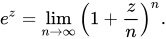
Euler's identity therefore states that the limit, as *n* approaches infinity, of ( 1 \+ i π n ) n {\\displaystyle (1+{\\tfrac {i\\pi }{n}})^{n}}  is equal to −1. This limit is illustrated in the animation to the right.
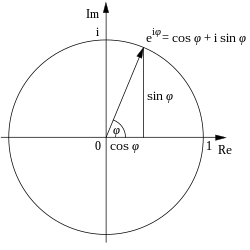
[](https://en.wikipedia.org/wiki/File:Euler%27s_formula.svg)
Euler's formula for a general angle
Euler's identity is a [special case](https://en.wikipedia.org/wiki/Special_case "Special case") of [Euler's formula](https://en.wikipedia.org/wiki/Euler%27s_formula "Euler's formula"), which states that for any [real number](https://en.wikipedia.org/wiki/Real_number "Real number") *x*,
e i x \= cos x \+ i sin x {\\displaystyle e^{ix}=\\cos x+i\\sin x} 
where the inputs of the [trigonometric functions](https://en.wikipedia.org/wiki/Trigonometry "Trigonometry") sine and cosine are given in [radians](https://en.wikipedia.org/wiki/Radian "Radian").
In particular, when *x* = *π*,
e i π \= cos π \+ i sin π . {\\displaystyle e^{i\\pi }=\\cos \\pi +i\\sin \\pi .} 
Since
cos π \= − 1 {\\displaystyle \\cos \\pi =-1} 
and
sin π \= 0 , {\\displaystyle \\sin \\pi =0,} 
it follows that
e i π \= − 1 \+ 0 i , {\\displaystyle e^{i\\pi }=-1+0i,} 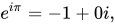
which yields Euler's identity:
e i π \+ 1 \= 0\. {\\displaystyle e^{i\\pi }+1=0.} 
### Geometric interpretation
\[[edit](https://en.wikipedia.org/w/index.php?title=Euler%27s_identity&action=edit§ion=4 "Edit section: Geometric interpretation")\]
Any complex number z \= x \+ i y {\\displaystyle z=x+iy}  can be represented by the point ( x , y ) {\\displaystyle (x,y)}  on the [complex plane](https://en.wikipedia.org/wiki/Complex_plane "Complex plane"). This point can also be represented in [polar coordinates](https://en.wikipedia.org/wiki/Complex_number#Polar_complex_plane "Complex number") as ( r , θ ) {\\displaystyle (r,\\theta )}  , where r is the absolute value of z (distance from the origin), and θ {\\displaystyle \\theta }  is the argument of z (angle counterclockwise from the positive *x*\-axis). By the definitions of sine and cosine, this point has cartesian coordinates of ( r cos θ , r sin θ ) {\\displaystyle (r\\cos \\theta ,r\\sin \\theta )}  , implying that z \= r ( cos θ \+ i sin θ ) {\\displaystyle z=r(\\cos \\theta +i\\sin \\theta )}  . According to Euler's formula, this is equivalent to saying z \= r e i θ {\\displaystyle z=re^{i\\theta }}  .
Euler's identity says that − 1 \= e i π {\\displaystyle -1=e^{i\\pi }}  . Since e i π {\\displaystyle e^{i\\pi }}  is r e i θ {\\displaystyle re^{i\\theta }}  for r = 1 and θ \= π {\\displaystyle \\theta =\\pi }  , this can be interpreted as a fact about the number −1 on the complex plane: its distance from the origin is 1, and its angle from the positive *x*\-axis is π {\\displaystyle \\pi }  radians.
Additionally, when any complex number z is [multiplied](https://en.wikipedia.org/wiki/Complex_number#Multiplication_and_division_in_polar_form "Complex number") by e i θ {\\displaystyle e^{i\\theta }}  , it has the effect of rotating z {\\displaystyle z}  counterclockwise by an angle of θ {\\displaystyle \\theta }  on the complex plane. Since multiplication by −1 reflects a point across the origin, Euler's identity can be interpreted as saying that rotating any point π {\\displaystyle \\pi }  radians around the origin has the same effect as reflecting the point across the origin. Similarly, setting θ {\\displaystyle \\theta }  equal to 2 π {\\displaystyle 2\\pi }  yields the related equation e 2 π i \= 1 {\\displaystyle e^{2\\pi i}=1}  , which can be interpreted as saying that rotating any point by one [turn](https://en.wikipedia.org/wiki/Turn_\(angle\) "Turn (angle)") around the origin returns it to its original position.
## Generalizations
\[[edit](https://en.wikipedia.org/w/index.php?title=Euler%27s_identity&action=edit§ion=5 "Edit section: Generalizations")\]
Euler's identity is also a special case of the more general identity that the nth [roots of unity](https://en.wikipedia.org/wiki/Roots_of_unity "Roots of unity"), for *n* \> 1, add up to 0:
∑ k \= 0 n − 1 e 2 π i k n \= 0\. {\\displaystyle \\sum \_{k=0}^{n-1}e^{2\\pi i{\\frac {k}{n}}}=0.} 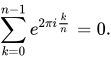
Euler's identity is the case where *n* = 2.
A similar identity also applies to [quaternion exponential](https://en.wikipedia.org/wiki/Quaternion#Exponential,_logarithm,_and_power_functions "Quaternion"): let {*i*, *j*, *k*} be the basis [quaternions](https://en.wikipedia.org/wiki/Quaternion "Quaternion"); then, e 1 3 ( i ± j ± k ) π \+ 1 \= 0\. {\\displaystyle e^{{\\frac {1}{\\sqrt {3}}}(i\\pm j\\pm k)\\pi }+1=0.} 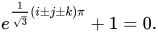
More generally, let q be a quaternion with a zero real part and a norm equal to 1; that is, q \= a i \+ b j \+ c k , {\\displaystyle q=ai+bj+ck,}  with a 2 \+ b 2 \+ c 2 \= 1\. {\\displaystyle a^{2}+b^{2}+c^{2}=1.}  Then one has e q π \+ 1 \= 0\. {\\displaystyle e^{q\\pi }+1=0.} 
The same formula applies to [octonions](https://en.wikipedia.org/wiki/Octonion "Octonion"), with a zero real part and a norm equal to 1. These formulas are a direct generalization of Euler's identity, since i {\\displaystyle i}  and − i {\\displaystyle -i}  are the only complex numbers with a zero real part and a norm (absolute value) equal to 1.
## History
\[[edit](https://en.wikipedia.org/w/index.php?title=Euler%27s_identity&action=edit§ion=6 "Edit section: History")\]
Euler's identity is a direct result of [Euler's formula](https://en.wikipedia.org/wiki/Euler%27s_formula "Euler's formula"), first published in his monumental 1748 work of mathematical analysis, *[Introductio in analysin infinitorum](https://en.wikipedia.org/wiki/Introductio_in_analysin_infinitorum "Introductio in analysin infinitorum")*,[\[14\]](https://en.wikipedia.org/wiki/Euler%27s_identity#cite_note-15) but it is questionable whether the particular concept of linking five fundamental constants in a compact form can be attributed to Euler himself, as he may never have expressed it.[\[15\]](https://en.wikipedia.org/wiki/Euler%27s_identity#cite_note-Sandifer2007-16)
[Robin Wilson](https://en.wikipedia.org/wiki/Robin_Wilson_\(mathematician\) "Robin Wilson (mathematician)") writes:[\[16\]](https://en.wikipedia.org/wiki/Euler%27s_identity#cite_note-17)
> We've seen how \[Euler's identity\] can easily be deduced from results of [Johann Bernoulli](https://en.wikipedia.org/wiki/Johann_Bernoulli "Johann Bernoulli") and [Roger Cotes](https://en.wikipedia.org/wiki/Roger_Cotes "Roger Cotes"), but that neither of them seem to have done so. Even Euler does not seem to have written it down explicitly—and certainly it doesn't appear in any of his publications—though he must surely have realized that it follows immediately from his identity \[i.e. [Euler's formula](https://en.wikipedia.org/wiki/Euler%27s_formula "Euler's formula")\], *eix* = cos *x* + *i* sin *x*. Moreover, it seems to be unknown who first stated the result explicitly
## See also
\[[edit](https://en.wikipedia.org/w/index.php?title=Euler%27s_identity&action=edit§ion=7 "Edit section: See also")\]
- [](https://en.wikipedia.org/wiki/File:Nuvola_apps_edu_mathematics_blue-p.svg)[Mathematics portal](https://en.wikipedia.org/wiki/Portal:Mathematics "Portal:Mathematics")
- [De Moivre's formula](https://en.wikipedia.org/wiki/De_Moivre%27s_formula "De Moivre's formula")
- [Exponential function](https://en.wikipedia.org/wiki/Exponential_function "Exponential function")
- [Gelfond's constant](https://en.wikipedia.org/wiki/Gelfond%27s_constant "Gelfond's constant")
## Notes
\[[edit](https://en.wikipedia.org/w/index.php?title=Euler%27s_identity&action=edit§ion=8 "Edit section: Notes")\]
1. **[^](https://en.wikipedia.org/wiki/Euler%27s_identity#cite_ref-3)** The term "Euler's identity" (or "Euler identity") is also used elsewhere to refer to other concepts, including the related general formula *e**ix* = cos *x* + *i* sin *x*,[\[1\]](https://en.wikipedia.org/wiki/Euler%27s_identity#cite_note-1) and the [Euler product formula](https://en.wikipedia.org/wiki/Riemann_zeta_function#Euler's_product_formula "Riemann zeta function").[\[2\]](https://en.wikipedia.org/wiki/Euler%27s_identity#cite_note-EOM-2) See also [List of topics named after Leonhard Euler](https://en.wikipedia.org/wiki/List_of_topics_named_after_Leonhard_Euler "List of topics named after Leonhard Euler").
## References
\[[edit](https://en.wikipedia.org/w/index.php?title=Euler%27s_identity&action=edit§ion=9 "Edit section: References")\]
1. **[^](https://en.wikipedia.org/wiki/Euler%27s_identity#cite_ref-1)** Dunham, 1999, [p. xxiv](https://books.google.com/books?id=uKOVNvGOkhQC&pg=PR24).
2. **[^](https://en.wikipedia.org/wiki/Euler%27s_identity#cite_ref-EOM_2-0)**
Stepanov, S. A. (2001) \[1994\]. ["Euler identity"](https://www.encyclopediaofmath.org/index.php?title=Euler_identity&oldid=33574). *[Encyclopedia of Mathematics](https://en.wikipedia.org/wiki/Encyclopedia_of_Mathematics "Encyclopedia of Mathematics")*. [EMS Press](https://en.wikipedia.org/wiki/European_Mathematical_Society "European Mathematical Society").
3. **[^](https://en.wikipedia.org/wiki/Euler%27s_identity#cite_ref-Gallagher2014_4-0)**
Gallagher, James (13 February 2014). ["Mathematics: Why the brain sees maths as beauty"](https://www.bbc.co.uk/news/science-environment-26151062). *[BBC News](https://en.wikipedia.org/wiki/BBC_News "BBC News")*. Retrieved 26 December 2017.
4. **[^](https://en.wikipedia.org/wiki/Euler%27s_identity#cite_ref-5)** Paulos, 1992, p. 117.
5. **[^](https://en.wikipedia.org/wiki/Euler%27s_identity#cite_ref-6)** Nahin, 2006, [p. 1](https://books.google.com/books?id=GvSg5HQ7WPcC&pg=PA1).
6. **[^](https://en.wikipedia.org/wiki/Euler%27s_identity#cite_ref-7)** Nahin, 2006, p. xxxii.
7. **[^](https://en.wikipedia.org/wiki/Euler%27s_identity#cite_ref-8)** Reid, chapter *e*.
8. **[^](https://en.wikipedia.org/wiki/Euler%27s_identity#cite_ref-9)** Maor, [p. 160](https://books.google.com/books?id=eIsyLD_bDKkC&pg=PA160), and Kasner & Newman, [p. 103–104](https://books.google.com/books?id=Ad8hAx-6m9oC&pg=PA103).
9. **[^](https://en.wikipedia.org/wiki/Euler%27s_identity#cite_ref-10)** Wells, 1990.
10. **[^](https://en.wikipedia.org/wiki/Euler%27s_identity#cite_ref-11)** Crease, 2004.
11. **[^](https://en.wikipedia.org/wiki/Euler%27s_identity#cite_ref-12)**
Nahin, Paul (2011). *Dr. Euler's fabulous formula: cures many mathematical ills*. Princeton University Press. [ISBN](https://en.wikipedia.org/wiki/ISBN_\(identifier\) "ISBN (identifier)")
[978-0-691-11822-2](https://en.wikipedia.org/wiki/Special:BookSources/978-0-691-11822-2 "Special:BookSources/978-0-691-11822-2")
.
12. **[^](https://en.wikipedia.org/wiki/Euler%27s_identity#cite_ref-13)**
Stipp, David (2017). *A Most Elegant Equation: Euler's Formula and the Beauty of Mathematics* (First ed.). Basic Books. [ISBN](https://en.wikipedia.org/wiki/ISBN_\(identifier\) "ISBN (identifier)")
[978-0-465-09377-9](https://en.wikipedia.org/wiki/Special:BookSources/978-0-465-09377-9 "Special:BookSources/978-0-465-09377-9")
.
13. **[^](https://en.wikipedia.org/wiki/Euler%27s_identity#cite_ref-14)**
Wilson, Robin (2018). *Euler's pioneering equation: the most beautiful theorem in mathematics*. Oxford: Oxford University Press. [ISBN](https://en.wikipedia.org/wiki/ISBN_\(identifier\) "ISBN (identifier)")
[978-0-19-879493-6](https://en.wikipedia.org/wiki/Special:BookSources/978-0-19-879493-6 "Special:BookSources/978-0-19-879493-6")
.
14. **[^](https://en.wikipedia.org/wiki/Euler%27s_identity#cite_ref-15)** Conway & Guy, p. [254–255](https://books.google.com/books?id=0--3rcO7dMYC&pg=PA254).
15. **[^](https://en.wikipedia.org/wiki/Euler%27s_identity#cite_ref-Sandifer2007_16-0)** Sandifer, p. 4.
16. **[^](https://en.wikipedia.org/wiki/Euler%27s_identity#cite_ref-17)** Wilson, p. 151-152.
### Sources
\[[edit](https://en.wikipedia.org/w/index.php?title=Euler%27s_identity&action=edit§ion=10 "Edit section: Sources")\]
- [Conway, John H.](https://en.wikipedia.org/wiki/John_Horton_Conway "John Horton Conway"), and [Guy, Richard K.](https://en.wikipedia.org/wiki/Richard_K._Guy "Richard K. Guy") (1996), *[The Book of Numbers](https://en.wikipedia.org/wiki/The_Book_of_Numbers_\(math_book\) "The Book of Numbers (math book)")*, Springer
[ISBN](https://en.wikipedia.org/wiki/ISBN_\(identifier\) "ISBN (identifier)")
[978-0-387-97993-9](https://en.wikipedia.org/wiki/Special:BookSources/978-0-387-97993-9 "Special:BookSources/978-0-387-97993-9")
- [Crease, Robert P.](https://en.wikipedia.org/wiki/Robert_P._Crease "Robert P. Crease") (10 May 2004), "[The greatest equations ever](http://physicsworld.com/cws/article/print/2004/may/10/the-greatest-equations-ever)", *[Physics World](https://en.wikipedia.org/wiki/Physics_World "Physics World")* \[registration required\]
- [Dunham, William](https://en.wikipedia.org/wiki/William_Dunham_\(mathematician\) "William Dunham (mathematician)") (1999), *Euler: The Master of Us All*, [Mathematical Association of America](https://en.wikipedia.org/wiki/Mathematical_Association_of_America "Mathematical Association of America")
[ISBN](https://en.wikipedia.org/wiki/ISBN_\(identifier\) "ISBN (identifier)")
[978-0-88385-328-3](https://en.wikipedia.org/wiki/Special:BookSources/978-0-88385-328-3 "Special:BookSources/978-0-88385-328-3")
- [Euler, Leonhard](https://en.wikipedia.org/wiki/Euler,_Leonhard "Euler, Leonhard"), *Complete work.* *[Leonhardi Euleri opera omnia. 1, Opera mathematica. Volumen VIII, Leonhardi Euleri introductio in analysin infinitorum. Tomus primus](http://gallica.bnf.fr/ark:/12148/bpt6k69587.image.r=%22has+celeberrimas+formulas%22.f169.langEN)*, Leipzig: B. G. Teubneri
- [Kasner, E.](https://en.wikipedia.org/wiki/Edward_Kasner "Edward Kasner"), and [Newman, J.](https://en.wikipedia.org/wiki/James_R._Newman "James R. Newman") (1940), *[Mathematics and the Imagination](https://en.wikipedia.org/wiki/Mathematics_and_the_Imagination "Mathematics and the Imagination")*, [Simon & Schuster](https://en.wikipedia.org/wiki/Simon_%26_Schuster "Simon & Schuster")
- [Maor, Eli](https://en.wikipedia.org/wiki/Eli_Maor "Eli Maor") (1998), *e: The Story of a number*, [Princeton University Press](https://en.wikipedia.org/wiki/Princeton_University_Press "Princeton University Press")
[ISBN](https://en.wikipedia.org/wiki/ISBN_\(identifier\) "ISBN (identifier)")
[0-691-05854-7](https://en.wikipedia.org/wiki/Special:BookSources/0-691-05854-7 "Special:BookSources/0-691-05854-7")
- Nahin, Paul J. (2006), *Dr. Euler's Fabulous Formula: Cures Many Mathematical Ills*, [Princeton University Press](https://en.wikipedia.org/wiki/Princeton_University_Press "Princeton University Press")
[ISBN](https://en.wikipedia.org/wiki/ISBN_\(identifier\) "ISBN (identifier)")
[978-0-691-11822-2](https://en.wikipedia.org/wiki/Special:BookSources/978-0-691-11822-2 "Special:BookSources/978-0-691-11822-2")
- [Paulos, John Allen](https://en.wikipedia.org/wiki/John_Allen_Paulos "John Allen Paulos") (1992), *Beyond Numeracy: An Uncommon Dictionary of Mathematics*, [Penguin Books](https://en.wikipedia.org/wiki/Penguin_Books "Penguin Books")
[ISBN](https://en.wikipedia.org/wiki/ISBN_\(identifier\) "ISBN (identifier)")
[0-14-014574-5](https://en.wikipedia.org/wiki/Special:BookSources/0-14-014574-5 "Special:BookSources/0-14-014574-5")
- Reid, Constance (various editions), *[From Zero to Infinity](https://en.wikipedia.org/wiki/From_Zero_to_Infinity "From Zero to Infinity")*, [Mathematical Association of America](https://en.wikipedia.org/wiki/Mathematical_Association_of_America "Mathematical Association of America")
- Sandifer, C. Edward (2007), *[Euler's Greatest Hits](https://books.google.com/books?id=sohHs7ExOsYC&pg=PA4)*, [Mathematical Association of America](https://en.wikipedia.org/wiki/Mathematical_Association_of_America "Mathematical Association of America")
[ISBN](https://en.wikipedia.org/wiki/ISBN_\(identifier\) "ISBN (identifier)")
[978-0-88385-563-8](https://en.wikipedia.org/wiki/Special:BookSources/978-0-88385-563-8 "Special:BookSources/978-0-88385-563-8")
- Stipp, David (2017). *A Most Elegant Equation: Euler's formula and the beauty of mathematics*. [Basic Books](https://en.wikipedia.org/wiki/Basic_Books "Basic Books").
- [Wells, David](https://en.wikipedia.org/w/index.php?title=David_G._Wells&action=edit&redlink=1 "David G. Wells (page does not exist)") (1990). "Are these the most beautiful?". *[The Mathematical Intelligencer](https://en.wikipedia.org/wiki/The_Mathematical_Intelligencer "The Mathematical Intelligencer")*. **12** (3): 37–41\. [doi](https://en.wikipedia.org/wiki/Doi_\(identifier\) "Doi (identifier)"):[10\.1007/BF03024015](https://doi.org/10.1007%2FBF03024015). [S2CID](https://en.wikipedia.org/wiki/S2CID_\(identifier\) "S2CID (identifier)") [121503263](https://api.semanticscholar.org/CorpusID:121503263).
- [Wilson, Robin](https://en.wikipedia.org/wiki/Robin_Wilson_\(mathematician\) "Robin Wilson (mathematician)") (2018). *Euler's Pioneering Equation: The most beautiful theorem in mathematics*. [Oxford University Press](https://en.wikipedia.org/wiki/Oxford_University_Press "Oxford University Press"). [ISBN](https://en.wikipedia.org/wiki/ISBN_\(identifier\) "ISBN (identifier)")
[978-0-192-51406-6](https://en.wikipedia.org/wiki/Special:BookSources/978-0-192-51406-6 "Special:BookSources/978-0-192-51406-6")
.
- [Zeki, S.](https://en.wikipedia.org/wiki/Semir_Zeki "Semir Zeki"); Romaya, J. P.; Benincasa, D. M. T.; [Atiyah, M. F.](https://en.wikipedia.org/wiki/Michael_Atiyah "Michael Atiyah") (2014). "The experience of mathematical beauty and its neural correlates". *Frontiers in Human Neuroscience*. **8**: 68. [doi](https://en.wikipedia.org/wiki/Doi_\(identifier\) "Doi (identifier)"):[10\.3389/fnhum.2014.00068](https://doi.org/10.3389%2Ffnhum.2014.00068). [PMC](https://en.wikipedia.org/wiki/PMC_\(identifier\) "PMC (identifier)") [3923150](https://www.ncbi.nlm.nih.gov/pmc/articles/PMC3923150). [PMID](https://en.wikipedia.org/wiki/PMID_\(identifier\) "PMID (identifier)") [24592230](https://pubmed.ncbi.nlm.nih.gov/24592230).
## External links
\[[edit](https://en.wikipedia.org/w/index.php?title=Euler%27s_identity&action=edit§ion=11 "Edit section: External links")\]

Wikiquote has quotations related to ***[Euler's identity](https://en.wikiquote.org/wiki/Euler%27s_identity "q:Euler's identity")***.
- [Intuitive understanding of Euler's formula](http://betterexplained.com/articles/intuitive-understanding-of-eulers-formula/)
| [v](https://en.wikipedia.org/wiki/Template:Leonhard_Euler "Template:Leonhard Euler") [t](https://en.wikipedia.org/wiki/Template_talk:Leonhard_Euler "Template talk:Leonhard Euler") [e](https://en.wikipedia.org/wiki/Special:EditPage/Template:Leonhard_Euler "Special:EditPage/Template:Leonhard Euler")[Leonhard Euler](https://en.wikipedia.org/wiki/Leonhard_Euler "Leonhard Euler") |
|---|
| [Euler–Lagrange equation](https://en.wikipedia.org/wiki/Euler%E2%80%93Lagrange_equation "Euler–Lagrange equation") [Euler–Lotka equation](https://en.wikipedia.org/wiki/Euler%E2%80%93Lotka_equation "Euler–Lotka equation") [Euler–Maclaurin formula](https://en.wikipedia.org/wiki/Euler%E2%80%93Maclaurin_formula "Euler–Maclaurin formula") [Euler–Maruyama method](https://en.wikipedia.org/wiki/Euler%E2%80%93Maruyama_method "Euler–Maruyama method") [Euler–Mascheroni constant](https://en.wikipedia.org/wiki/Euler%E2%80%93Mascheroni_constant "Euler–Mascheroni constant") [Euler–Poisson–Darboux equation](https://en.wikipedia.org/wiki/Euler%E2%80%93Poisson%E2%80%93Darboux_equation "Euler–Poisson–Darboux equation") [Euler–Rodrigues formula](https://en.wikipedia.org/wiki/Euler%E2%80%93Rodrigues_formula "Euler–Rodrigues formula") [Euler–Tricomi equation](https://en.wikipedia.org/wiki/Euler%E2%80%93Tricomi_equation "Euler–Tricomi equation") [Euler's continued fraction formula](https://en.wikipedia.org/wiki/Euler%27s_continued_fraction_formula "Euler's continued fraction formula") [Euler's critical load](https://en.wikipedia.org/wiki/Euler%27s_critical_load "Euler's critical load") [Euler's formula](https://en.wikipedia.org/wiki/Euler%27s_formula "Euler's formula") [Euler's four-square identity](https://en.wikipedia.org/wiki/Euler%27s_four-square_identity "Euler's four-square identity") [Euler's identity]() [Euler's pump and turbine equation](https://en.wikipedia.org/wiki/Euler%27s_pump_and_turbine_equation "Euler's pump and turbine equation") [Euler's rotation theorem](https://en.wikipedia.org/wiki/Euler%27s_rotation_theorem "Euler's rotation theorem") [Euler's sum of powers conjecture](https://en.wikipedia.org/wiki/Euler%27s_sum_of_powers_conjecture "Euler's sum of powers conjecture") [Euler's theorem](https://en.wikipedia.org/wiki/Euler%27s_theorem "Euler's theorem") [Euler equations (fluid dynamics)](https://en.wikipedia.org/wiki/Euler_equations_\(fluid_dynamics\) "Euler equations (fluid dynamics)") [Euler function](https://en.wikipedia.org/wiki/Euler_function "Euler function") [Euler method](https://en.wikipedia.org/wiki/Euler_method "Euler method") [Euler numbers](https://en.wikipedia.org/wiki/Euler_numbers "Euler numbers") [Euler number (physics)](https://en.wikipedia.org/wiki/Euler_number_\(physics\) "Euler number (physics)") [Euler–Bernoulli beam theory](https://en.wikipedia.org/wiki/Euler%E2%80%93Bernoulli_beam_theory "Euler–Bernoulli beam theory") [Namesakes](https://en.wikipedia.org/wiki/List_of_things_named_after_Leonhard_Euler "List of things named after Leonhard Euler") |
|  **[Category](https://en.wikipedia.org/wiki/Category:Leonhard_Euler "Category:Leonhard Euler")** |

Retrieved from "[https://en.wikipedia.org/w/index.php?title=Euler%27s\_identity\&oldid=1341920695](https://en.wikipedia.org/w/index.php?title=Euler%27s_identity&oldid=1341920695)"
[Categories](https://en.wikipedia.org/wiki/Help:Category "Help:Category"):
- [Exponentials](https://en.wikipedia.org/wiki/Category:Exponentials "Category:Exponentials")
- [Mathematical identities](https://en.wikipedia.org/wiki/Category:Mathematical_identities "Category:Mathematical identities")
- [E (mathematical constant)](https://en.wikipedia.org/wiki/Category:E_\(mathematical_constant\) "Category:E (mathematical constant)")
- [Theorems in complex analysis](https://en.wikipedia.org/wiki/Category:Theorems_in_complex_analysis "Category:Theorems in complex analysis")
- [Leonhard Euler](https://en.wikipedia.org/wiki/Category:Leonhard_Euler "Category:Leonhard Euler")
Hidden categories:
- [Articles with short description](https://en.wikipedia.org/wiki/Category:Articles_with_short_description "Category:Articles with short description")
- [Short description is different from Wikidata](https://en.wikipedia.org/wiki/Category:Short_description_is_different_from_Wikidata "Category:Short description is different from Wikidata")
- This page was last edited on 5 March 2026, at 22:43 (UTC).
- Text is available under the [Creative Commons Attribution-ShareAlike 4.0 License](https://en.wikipedia.org/wiki/Wikipedia:Text_of_the_Creative_Commons_Attribution-ShareAlike_4.0_International_License "Wikipedia:Text of the Creative Commons Attribution-ShareAlike 4.0 International License"); additional terms may apply. By using this site, you agree to the [Terms of Use](https://foundation.wikimedia.org/wiki/Special:MyLanguage/Policy:Terms_of_Use "foundation:Special:MyLanguage/Policy:Terms of Use") and [Privacy Policy](https://foundation.wikimedia.org/wiki/Special:MyLanguage/Policy:Privacy_policy "foundation:Special:MyLanguage/Policy:Privacy policy"). Wikipedia® is a registered trademark of the [Wikimedia Foundation, Inc.](https://wikimediafoundation.org/), a non-profit organization.
- [Privacy policy](https://foundation.wikimedia.org/wiki/Special:MyLanguage/Policy:Privacy_policy)
- [About Wikipedia](https://en.wikipedia.org/wiki/Wikipedia:About)
- [Disclaimers](https://en.wikipedia.org/wiki/Wikipedia:General_disclaimer)
- [Contact Wikipedia](https://en.wikipedia.org/wiki/Wikipedia:Contact_us)
- [Legal & safety contacts](https://foundation.wikimedia.org/wiki/Special:MyLanguage/Legal:Wikimedia_Foundation_Legal_and_Safety_Contact_Information)
- [Code of Conduct](https://foundation.wikimedia.org/wiki/Special:MyLanguage/Policy:Universal_Code_of_Conduct)
- [Developers](https://developer.wikimedia.org/)
- [Statistics](https://stats.wikimedia.org/#/en.wikipedia.org)
- [Cookie statement](https://foundation.wikimedia.org/wiki/Special:MyLanguage/Policy:Cookie_statement)
- [Mobile view](https://en.wikipedia.org/w/index.php?title=Euler%27s_identity&mobileaction=toggle_view_mobile)
- [](https://www.wikimedia.org/)
- [](https://www.mediawiki.org/)
Search
Toggle the table of contents
Euler's identity
54 languages
[Add topic](https://en.wikipedia.org/wiki/Euler%27s_identity) | |||||||||
| Readable Markdown | From Wikipedia, the free encyclopedia
In [mathematics](https://en.wikipedia.org/wiki/Mathematics "Mathematics"), **Euler's identity**[\[note 1\]](https://en.wikipedia.org/wiki/Euler%27s_identity#cite_note-3) (also known as **Euler's equation**) is the [equality](https://en.wikipedia.org/wiki/Equality_\(mathematics\) "Equality (mathematics)")  where
Euler's identity is named after the Swiss mathematician [Leonhard Euler](https://en.wikipedia.org/wiki/Leonhard_Euler "Leonhard Euler"). It is a special case of [Euler's formula](https://en.wikipedia.org/wiki/Euler%27s_formula "Euler's formula")  when evaluated for . Euler's identity is considered an exemplar of [mathematical beauty](https://en.wikipedia.org/wiki/Mathematical_beauty "Mathematical beauty"), as it shows a profound connection between the most fundamental numbers in mathematics.
## Mathematical beauty
\[[edit](https://en.wikipedia.org/w/index.php?title=Euler%27s_identity&action=edit§ion=1 "Edit section: Mathematical beauty")\]
Euler's identity is often cited as an example of deep [mathematical beauty](https://en.wikipedia.org/wiki/Mathematical_beauty "Mathematical beauty").[\[3\]](https://en.wikipedia.org/wiki/Euler%27s_identity#cite_note-Gallagher2014-4) Three of the basic [arithmetic](https://en.wikipedia.org/wiki/Arithmetic "Arithmetic") operations occur exactly once each: [addition](https://en.wikipedia.org/wiki/Addition "Addition"), [multiplication](https://en.wikipedia.org/wiki/Multiplication "Multiplication"), and [exponentiation](https://en.wikipedia.org/wiki/Exponentiation "Exponentiation"). The identity also links five fundamental [mathematical constants](https://en.wikipedia.org/wiki/Mathematical_constant "Mathematical constant"):[\[4\]](https://en.wikipedia.org/wiki/Euler%27s_identity#cite_note-5)
- The [number 0](https://en.wikipedia.org/wiki/0 "0"), the [additive identity](https://en.wikipedia.org/wiki/Additive_identity "Additive identity")
- The [number 1](https://en.wikipedia.org/wiki/1 "1"), the [multiplicative identity](https://en.wikipedia.org/wiki/Multiplicative_identity "Multiplicative identity")
- The [number π](https://en.wikipedia.org/wiki/Pi "Pi") (π = 3.14159...), the fundamental [circle](https://en.wikipedia.org/wiki/Circle "Circle") constant
- The [number e](https://en.wikipedia.org/wiki/E_\(mathematical_constant\) "E (mathematical constant)") (*e* = 2.71828...), also known as Euler's number, which occurs widely in [mathematical analysis](https://en.wikipedia.org/wiki/Mathematical_analysis "Mathematical analysis")
- The [number i](https://en.wikipedia.org/wiki/Imaginary_unit "Imaginary unit"), the [imaginary unit](https://en.wikipedia.org/wiki/Imaginary_unit "Imaginary unit") such that *i*2 = −1
The equation is often given in the form of an expression set equal to zero, which is common practice in several areas of mathematics.
[Stanford University](https://en.wikipedia.org/wiki/Stanford_University "Stanford University") mathematics professor [Keith Devlin](https://en.wikipedia.org/wiki/Keith_Devlin "Keith Devlin") has said, "like a Shakespearean [sonnet](https://en.wikipedia.org/wiki/Sonnet "Sonnet") that captures the very essence of love, or a painting that brings out the beauty of the human form that is far more than just skin deep, Euler's equation reaches down into the very depths of existence".[\[5\]](https://en.wikipedia.org/wiki/Euler%27s_identity#cite_note-6) [Paul Nahin](https://en.wikipedia.org/wiki/Paul_Nahin "Paul Nahin"), a professor emeritus at the [University of New Hampshire](https://en.wikipedia.org/wiki/University_of_New_Hampshire "University of New Hampshire") who wrote a book dedicated to [Euler's formula](https://en.wikipedia.org/wiki/Euler%27s_formula "Euler's formula") and its applications in [Fourier analysis](https://en.wikipedia.org/wiki/Fourier_analysis "Fourier analysis"), said Euler's identity is "of exquisite beauty".[\[6\]](https://en.wikipedia.org/wiki/Euler%27s_identity#cite_note-7)
Mathematics writer [Constance Reid](https://en.wikipedia.org/wiki/Constance_Reid "Constance Reid") has said that Euler's identity is "the most famous formula in all mathematics".[\[7\]](https://en.wikipedia.org/wiki/Euler%27s_identity#cite_note-8) [Benjamin Peirce](https://en.wikipedia.org/wiki/Benjamin_Peirce "Benjamin Peirce"), a 19th-century American philosopher, mathematician, and professor at [Harvard University](https://en.wikipedia.org/wiki/Harvard_University "Harvard University"), after proving Euler's identity during a lecture, said that it "is absolutely paradoxical; we cannot understand it, and we don't know what it means, but we have proved it, and therefore we know it must be the truth".[\[8\]](https://en.wikipedia.org/wiki/Euler%27s_identity#cite_note-9)
A 1990 poll of readers by *[The Mathematical Intelligencer](https://en.wikipedia.org/wiki/The_Mathematical_Intelligencer "The Mathematical Intelligencer")* named Euler's identity the "most beautiful theorem in mathematics".[\[9\]](https://en.wikipedia.org/wiki/Euler%27s_identity#cite_note-10) In a 2004 poll of readers by *[Physics World](https://en.wikipedia.org/wiki/Physics_World "Physics World")*, Euler's identity tied with [Maxwell's equations](https://en.wikipedia.org/wiki/Maxwell%27s_equations "Maxwell's equations") (of [electromagnetism](https://en.wikipedia.org/wiki/Electromagnetism "Electromagnetism")) as the "greatest equation ever".[\[10\]](https://en.wikipedia.org/wiki/Euler%27s_identity#cite_note-11)
At least three books in [popular mathematics](https://en.wikipedia.org/wiki/Popular_mathematics "Popular mathematics") have been published about Euler's identity:
- *Dr. Euler's Fabulous Formula: Cures Many Mathematical Ills*, by [Paul Nahin](https://en.wikipedia.org/wiki/Paul_Nahin "Paul Nahin") (2011)[\[11\]](https://en.wikipedia.org/wiki/Euler%27s_identity#cite_note-12)
- *A Most Elegant Equation: Euler's formula and the beauty of mathematics*, by David Stipp (2017)[\[12\]](https://en.wikipedia.org/wiki/Euler%27s_identity#cite_note-13)
- *Euler's Pioneering Equation: The most beautiful theorem in mathematics*, by [Robin Wilson](https://en.wikipedia.org/wiki/Robin_Wilson_\(mathematician\) "Robin Wilson (mathematician)") (2018)[\[13\]](https://en.wikipedia.org/wiki/Euler%27s_identity#cite_note-14)
### Imaginary exponents
\[[edit](https://en.wikipedia.org/w/index.php?title=Euler%27s_identity&action=edit§ion=3 "Edit section: Imaginary exponents")\]
[](https://en.wikipedia.org/wiki/File:ExpIPi.gif)
In this animation N takes various increasing values from 1 to 100. The computation of (1 + *iπ*/*N*)*N* is displayed as the combined effect of N repeated multiplications in the [complex plane](https://en.wikipedia.org/wiki/Complex_plane "Complex plane"), with the final point being the actual value of (1 + *iπ*/*N*)*N*. It can be seen that as N gets larger (1 + *iπ*/*N*)*N* approaches a limit of −1.
Euler's identity asserts that  is equal to −1. The expression  is a special case of the expression , where *z* is any [complex number](https://en.wikipedia.org/wiki/Complex_number "Complex number"). In general,  is defined for complex *z* by extending one of the [definitions of the exponential function](https://en.wikipedia.org/wiki/Characterizations_of_the_exponential_function "Characterizations of the exponential function") from real exponents to complex exponents. For example, one common definition is:

Euler's identity therefore states that the limit, as *n* approaches infinity, of  is equal to −1. This limit is illustrated in the animation to the right.
[](https://en.wikipedia.org/wiki/File:Euler%27s_formula.svg)
Euler's formula for a general angle
Euler's identity is a [special case](https://en.wikipedia.org/wiki/Special_case "Special case") of [Euler's formula](https://en.wikipedia.org/wiki/Euler%27s_formula "Euler's formula"), which states that for any [real number](https://en.wikipedia.org/wiki/Real_number "Real number") *x*,

where the inputs of the [trigonometric functions](https://en.wikipedia.org/wiki/Trigonometry "Trigonometry") sine and cosine are given in [radians](https://en.wikipedia.org/wiki/Radian "Radian").
In particular, when *x* = *π*,

Since

and

it follows that

which yields Euler's identity:

### Geometric interpretation
\[[edit](https://en.wikipedia.org/w/index.php?title=Euler%27s_identity&action=edit§ion=4 "Edit section: Geometric interpretation")\]
Any complex number  can be represented by the point  on the [complex plane](https://en.wikipedia.org/wiki/Complex_plane "Complex plane"). This point can also be represented in [polar coordinates](https://en.wikipedia.org/wiki/Complex_number#Polar_complex_plane "Complex number") as , where r is the absolute value of z (distance from the origin), and  is the argument of z (angle counterclockwise from the positive *x*\-axis). By the definitions of sine and cosine, this point has cartesian coordinates of , implying that . According to Euler's formula, this is equivalent to saying .
Euler's identity says that . Since  is  for r = 1 and , this can be interpreted as a fact about the number −1 on the complex plane: its distance from the origin is 1, and its angle from the positive *x*\-axis is  radians.
Additionally, when any complex number z is [multiplied](https://en.wikipedia.org/wiki/Complex_number#Multiplication_and_division_in_polar_form "Complex number") by , it has the effect of rotating  counterclockwise by an angle of  on the complex plane. Since multiplication by −1 reflects a point across the origin, Euler's identity can be interpreted as saying that rotating any point  radians around the origin has the same effect as reflecting the point across the origin. Similarly, setting  equal to  yields the related equation , which can be interpreted as saying that rotating any point by one [turn](https://en.wikipedia.org/wiki/Turn_\(angle\) "Turn (angle)") around the origin returns it to its original position.
Euler's identity is also a special case of the more general identity that the nth [roots of unity](https://en.wikipedia.org/wiki/Roots_of_unity "Roots of unity"), for *n* \> 1, add up to 0:

Euler's identity is the case where *n* = 2.
A similar identity also applies to [quaternion exponential](https://en.wikipedia.org/wiki/Quaternion#Exponential,_logarithm,_and_power_functions "Quaternion"): let {*i*, *j*, *k*} be the basis [quaternions](https://en.wikipedia.org/wiki/Quaternion "Quaternion"); then, 
More generally, let q be a quaternion with a zero real part and a norm equal to 1; that is,  with  Then one has 
The same formula applies to [octonions](https://en.wikipedia.org/wiki/Octonion "Octonion"), with a zero real part and a norm equal to 1. These formulas are a direct generalization of Euler's identity, since  and  are the only complex numbers with a zero real part and a norm (absolute value) equal to 1.
Euler's identity is a direct result of [Euler's formula](https://en.wikipedia.org/wiki/Euler%27s_formula "Euler's formula"), first published in his monumental 1748 work of mathematical analysis, *[Introductio in analysin infinitorum](https://en.wikipedia.org/wiki/Introductio_in_analysin_infinitorum "Introductio in analysin infinitorum")*,[\[14\]](https://en.wikipedia.org/wiki/Euler%27s_identity#cite_note-15) but it is questionable whether the particular concept of linking five fundamental constants in a compact form can be attributed to Euler himself, as he may never have expressed it.[\[15\]](https://en.wikipedia.org/wiki/Euler%27s_identity#cite_note-Sandifer2007-16)
[Robin Wilson](https://en.wikipedia.org/wiki/Robin_Wilson_\(mathematician\) "Robin Wilson (mathematician)") writes:[\[16\]](https://en.wikipedia.org/wiki/Euler%27s_identity#cite_note-17)
> We've seen how \[Euler's identity\] can easily be deduced from results of [Johann Bernoulli](https://en.wikipedia.org/wiki/Johann_Bernoulli "Johann Bernoulli") and [Roger Cotes](https://en.wikipedia.org/wiki/Roger_Cotes "Roger Cotes"), but that neither of them seem to have done so. Even Euler does not seem to have written it down explicitly—and certainly it doesn't appear in any of his publications—though he must surely have realized that it follows immediately from his identity \[i.e. [Euler's formula](https://en.wikipedia.org/wiki/Euler%27s_formula "Euler's formula")\], *eix* = cos *x* + *i* sin *x*. Moreover, it seems to be unknown who first stated the result explicitly
- [De Moivre's formula](https://en.wikipedia.org/wiki/De_Moivre%27s_formula "De Moivre's formula")
- [Exponential function](https://en.wikipedia.org/wiki/Exponential_function "Exponential function")
- [Gelfond's constant](https://en.wikipedia.org/wiki/Gelfond%27s_constant "Gelfond's constant")
1. **[^](https://en.wikipedia.org/wiki/Euler%27s_identity#cite_ref-3)** The term "Euler's identity" (or "Euler identity") is also used elsewhere to refer to other concepts, including the related general formula *e**ix* = cos *x* + *i* sin *x*,[\[1\]](https://en.wikipedia.org/wiki/Euler%27s_identity#cite_note-1) and the [Euler product formula](https://en.wikipedia.org/wiki/Riemann_zeta_function#Euler's_product_formula "Riemann zeta function").[\[2\]](https://en.wikipedia.org/wiki/Euler%27s_identity#cite_note-EOM-2) See also [List of topics named after Leonhard Euler](https://en.wikipedia.org/wiki/List_of_topics_named_after_Leonhard_Euler "List of topics named after Leonhard Euler").
1. **[^](https://en.wikipedia.org/wiki/Euler%27s_identity#cite_ref-1)** Dunham, 1999, [p. xxiv](https://books.google.com/books?id=uKOVNvGOkhQC&pg=PR24).
2. **[^](https://en.wikipedia.org/wiki/Euler%27s_identity#cite_ref-EOM_2-0)**
Stepanov, S. A. (2001) \[1994\]. ["Euler identity"](https://www.encyclopediaofmath.org/index.php?title=Euler_identity&oldid=33574). *[Encyclopedia of Mathematics](https://en.wikipedia.org/wiki/Encyclopedia_of_Mathematics "Encyclopedia of Mathematics")*. [EMS Press](https://en.wikipedia.org/wiki/European_Mathematical_Society "European Mathematical Society").
3. **[^](https://en.wikipedia.org/wiki/Euler%27s_identity#cite_ref-Gallagher2014_4-0)**
Gallagher, James (13 February 2014). ["Mathematics: Why the brain sees maths as beauty"](https://www.bbc.co.uk/news/science-environment-26151062). *[BBC News](https://en.wikipedia.org/wiki/BBC_News "BBC News")*. Retrieved 26 December 2017.
4. **[^](https://en.wikipedia.org/wiki/Euler%27s_identity#cite_ref-5)** Paulos, 1992, p. 117.
5. **[^](https://en.wikipedia.org/wiki/Euler%27s_identity#cite_ref-6)** Nahin, 2006, [p. 1](https://books.google.com/books?id=GvSg5HQ7WPcC&pg=PA1).
6. **[^](https://en.wikipedia.org/wiki/Euler%27s_identity#cite_ref-7)** Nahin, 2006, p. xxxii.
7. **[^](https://en.wikipedia.org/wiki/Euler%27s_identity#cite_ref-8)** Reid, chapter *e*.
8. **[^](https://en.wikipedia.org/wiki/Euler%27s_identity#cite_ref-9)** Maor, [p. 160](https://books.google.com/books?id=eIsyLD_bDKkC&pg=PA160), and Kasner & Newman, [p. 103–104](https://books.google.com/books?id=Ad8hAx-6m9oC&pg=PA103).
9. **[^](https://en.wikipedia.org/wiki/Euler%27s_identity#cite_ref-10)** Wells, 1990.
10. **[^](https://en.wikipedia.org/wiki/Euler%27s_identity#cite_ref-11)** Crease, 2004.
11. **[^](https://en.wikipedia.org/wiki/Euler%27s_identity#cite_ref-12)**
Nahin, Paul (2011). *Dr. Euler's fabulous formula: cures many mathematical ills*. Princeton University Press. [ISBN](https://en.wikipedia.org/wiki/ISBN_\(identifier\) "ISBN (identifier)")
[978-0-691-11822-2](https://en.wikipedia.org/wiki/Special:BookSources/978-0-691-11822-2 "Special:BookSources/978-0-691-11822-2")
.
12. **[^](https://en.wikipedia.org/wiki/Euler%27s_identity#cite_ref-13)**
Stipp, David (2017). *A Most Elegant Equation: Euler's Formula and the Beauty of Mathematics* (First ed.). Basic Books. [ISBN](https://en.wikipedia.org/wiki/ISBN_\(identifier\) "ISBN (identifier)")
[978-0-465-09377-9](https://en.wikipedia.org/wiki/Special:BookSources/978-0-465-09377-9 "Special:BookSources/978-0-465-09377-9")
.
13. **[^](https://en.wikipedia.org/wiki/Euler%27s_identity#cite_ref-14)**
Wilson, Robin (2018). *Euler's pioneering equation: the most beautiful theorem in mathematics*. Oxford: Oxford University Press. [ISBN](https://en.wikipedia.org/wiki/ISBN_\(identifier\) "ISBN (identifier)")
[978-0-19-879493-6](https://en.wikipedia.org/wiki/Special:BookSources/978-0-19-879493-6 "Special:BookSources/978-0-19-879493-6")
.
14. **[^](https://en.wikipedia.org/wiki/Euler%27s_identity#cite_ref-15)** Conway & Guy, p. [254–255](https://books.google.com/books?id=0--3rcO7dMYC&pg=PA254).
15. **[^](https://en.wikipedia.org/wiki/Euler%27s_identity#cite_ref-Sandifer2007_16-0)** Sandifer, p. 4.
16. **[^](https://en.wikipedia.org/wiki/Euler%27s_identity#cite_ref-17)** Wilson, p. 151-152.
- [Conway, John H.](https://en.wikipedia.org/wiki/John_Horton_Conway "John Horton Conway"), and [Guy, Richard K.](https://en.wikipedia.org/wiki/Richard_K._Guy "Richard K. Guy") (1996), *[The Book of Numbers](https://en.wikipedia.org/wiki/The_Book_of_Numbers_\(math_book\) "The Book of Numbers (math book)")*, Springer [ISBN](https://en.wikipedia.org/wiki/ISBN_\(identifier\) "ISBN (identifier)")
[978-0-387-97993-9](https://en.wikipedia.org/wiki/Special:BookSources/978-0-387-97993-9 "Special:BookSources/978-0-387-97993-9")
- [Crease, Robert P.](https://en.wikipedia.org/wiki/Robert_P._Crease "Robert P. Crease") (10 May 2004), "[The greatest equations ever](http://physicsworld.com/cws/article/print/2004/may/10/the-greatest-equations-ever)", *[Physics World](https://en.wikipedia.org/wiki/Physics_World "Physics World")* \[registration required\]
- [Dunham, William](https://en.wikipedia.org/wiki/William_Dunham_\(mathematician\) "William Dunham (mathematician)") (1999), *Euler: The Master of Us All*, [Mathematical Association of America](https://en.wikipedia.org/wiki/Mathematical_Association_of_America "Mathematical Association of America") [ISBN](https://en.wikipedia.org/wiki/ISBN_\(identifier\) "ISBN (identifier)")
[978-0-88385-328-3](https://en.wikipedia.org/wiki/Special:BookSources/978-0-88385-328-3 "Special:BookSources/978-0-88385-328-3")
- [Euler, Leonhard](https://en.wikipedia.org/wiki/Euler,_Leonhard "Euler, Leonhard"), *Complete work.* *[Leonhardi Euleri opera omnia. 1, Opera mathematica. Volumen VIII, Leonhardi Euleri introductio in analysin infinitorum. Tomus primus](http://gallica.bnf.fr/ark:/12148/bpt6k69587.image.r=%22has+celeberrimas+formulas%22.f169.langEN)*, Leipzig: B. G. Teubneri
- [Kasner, E.](https://en.wikipedia.org/wiki/Edward_Kasner "Edward Kasner"), and [Newman, J.](https://en.wikipedia.org/wiki/James_R._Newman "James R. Newman") (1940), *[Mathematics and the Imagination](https://en.wikipedia.org/wiki/Mathematics_and_the_Imagination "Mathematics and the Imagination")*, [Simon & Schuster](https://en.wikipedia.org/wiki/Simon_%26_Schuster "Simon & Schuster")
- [Maor, Eli](https://en.wikipedia.org/wiki/Eli_Maor "Eli Maor") (1998), *e: The Story of a number*, [Princeton University Press](https://en.wikipedia.org/wiki/Princeton_University_Press "Princeton University Press") [ISBN](https://en.wikipedia.org/wiki/ISBN_\(identifier\) "ISBN (identifier)")
[0-691-05854-7](https://en.wikipedia.org/wiki/Special:BookSources/0-691-05854-7 "Special:BookSources/0-691-05854-7")
- Nahin, Paul J. (2006), *Dr. Euler's Fabulous Formula: Cures Many Mathematical Ills*, [Princeton University Press](https://en.wikipedia.org/wiki/Princeton_University_Press "Princeton University Press") [ISBN](https://en.wikipedia.org/wiki/ISBN_\(identifier\) "ISBN (identifier)")
[978-0-691-11822-2](https://en.wikipedia.org/wiki/Special:BookSources/978-0-691-11822-2 "Special:BookSources/978-0-691-11822-2")
- [Paulos, John Allen](https://en.wikipedia.org/wiki/John_Allen_Paulos "John Allen Paulos") (1992), *Beyond Numeracy: An Uncommon Dictionary of Mathematics*, [Penguin Books](https://en.wikipedia.org/wiki/Penguin_Books "Penguin Books") [ISBN](https://en.wikipedia.org/wiki/ISBN_\(identifier\) "ISBN (identifier)")
[0-14-014574-5](https://en.wikipedia.org/wiki/Special:BookSources/0-14-014574-5 "Special:BookSources/0-14-014574-5")
- Reid, Constance (various editions), *[From Zero to Infinity](https://en.wikipedia.org/wiki/From_Zero_to_Infinity "From Zero to Infinity")*, [Mathematical Association of America](https://en.wikipedia.org/wiki/Mathematical_Association_of_America "Mathematical Association of America")
- Sandifer, C. Edward (2007), *[Euler's Greatest Hits](https://books.google.com/books?id=sohHs7ExOsYC&pg=PA4)*, [Mathematical Association of America](https://en.wikipedia.org/wiki/Mathematical_Association_of_America "Mathematical Association of America") [ISBN](https://en.wikipedia.org/wiki/ISBN_\(identifier\) "ISBN (identifier)")
[978-0-88385-563-8](https://en.wikipedia.org/wiki/Special:BookSources/978-0-88385-563-8 "Special:BookSources/978-0-88385-563-8")
- Stipp, David (2017). *A Most Elegant Equation: Euler's formula and the beauty of mathematics*. [Basic Books](https://en.wikipedia.org/wiki/Basic_Books "Basic Books").
- [Wells, David](https://en.wikipedia.org/w/index.php?title=David_G._Wells&action=edit&redlink=1 "David G. Wells (page does not exist)") (1990). "Are these the most beautiful?". *[The Mathematical Intelligencer](https://en.wikipedia.org/wiki/The_Mathematical_Intelligencer "The Mathematical Intelligencer")*. **12** (3): 37–41\. [doi](https://en.wikipedia.org/wiki/Doi_\(identifier\) "Doi (identifier)"):[10\.1007/BF03024015](https://doi.org/10.1007%2FBF03024015). [S2CID](https://en.wikipedia.org/wiki/S2CID_\(identifier\) "S2CID (identifier)") [121503263](https://api.semanticscholar.org/CorpusID:121503263).
- [Wilson, Robin](https://en.wikipedia.org/wiki/Robin_Wilson_\(mathematician\) "Robin Wilson (mathematician)") (2018). *Euler's Pioneering Equation: The most beautiful theorem in mathematics*. [Oxford University Press](https://en.wikipedia.org/wiki/Oxford_University_Press "Oxford University Press"). [ISBN](https://en.wikipedia.org/wiki/ISBN_\(identifier\) "ISBN (identifier)")
[978-0-192-51406-6](https://en.wikipedia.org/wiki/Special:BookSources/978-0-192-51406-6 "Special:BookSources/978-0-192-51406-6")
.
- [Zeki, S.](https://en.wikipedia.org/wiki/Semir_Zeki "Semir Zeki"); Romaya, J. P.; Benincasa, D. M. T.; [Atiyah, M. F.](https://en.wikipedia.org/wiki/Michael_Atiyah "Michael Atiyah") (2014). "The experience of mathematical beauty and its neural correlates". *Frontiers in Human Neuroscience*. **8**: 68. [doi](https://en.wikipedia.org/wiki/Doi_\(identifier\) "Doi (identifier)"):[10\.3389/fnhum.2014.00068](https://doi.org/10.3389%2Ffnhum.2014.00068). [PMC](https://en.wikipedia.org/wiki/PMC_\(identifier\) "PMC (identifier)") [3923150](https://www.ncbi.nlm.nih.gov/pmc/articles/PMC3923150). [PMID](https://en.wikipedia.org/wiki/PMID_\(identifier\) "PMID (identifier)") [24592230](https://pubmed.ncbi.nlm.nih.gov/24592230).
- [Intuitive understanding of Euler's formula](http://betterexplained.com/articles/intuitive-understanding-of-eulers-formula/) | |||||||||
| ML Classification | ||||||||||
| ML Categories |
Raw JSON{
"/Science": 909,
"/Science/Mathematics": 908,
"/Science/Mathematics/Other": 862
} | |||||||||
| ML Page Types |
Raw JSON{
"/Article": 999,
"/Article/Wiki": 821
} | |||||||||
| ML Intent Types |
Raw JSON{
"Informational": 999
} | |||||||||
| Content Metadata | ||||||||||
| Language | en | |||||||||
| Author | null | |||||||||
| Publish Time | not set | |||||||||
| Original Publish Time | 2013-08-09 04:20:59 (12 years ago) | |||||||||
| Republished | No | |||||||||
| Word Count (Total) | 2,707 | |||||||||
| Word Count (Content) | 1,703 | |||||||||
| Links | ||||||||||
| External Links | 50 | |||||||||
| Internal Links | 255 | |||||||||
| Technical SEO | ||||||||||
| Meta Nofollow | No | |||||||||
| Meta Noarchive | No | |||||||||
| JS Rendered | No | |||||||||
| Redirect Target | null | |||||||||
| Performance | ||||||||||
| Download Time (ms) | 48 | |||||||||
| TTFB (ms) | 33 | |||||||||
| Download Size (bytes) | 35,977 | |||||||||
| Shard | 152 (laksa) | |||||||||
| Root Hash | 17790707453426894952 | |||||||||
| Unparsed URL | org,wikipedia!en,/wiki/Euler%27s_identity s443 | |||||||||