ℹ️ Skipped - page is already crawled
| Filter | Status | Condition | Details |
|---|---|---|---|
| HTTP status | PASS | download_http_code = 200 | HTTP 200 |
| Age cutoff | PASS | download_stamp > now() - 6 MONTH | 0.2 months ago (distributed domain, exempt) |
| History drop | PASS | isNull(history_drop_reason) | No drop reason |
| Spam/ban | PASS | fh_dont_index != 1 AND ml_spam_score = 0 | ml_spam_score=0 |
| Canonical | PASS | meta_canonical IS NULL OR = '' OR = src_unparsed | Not set |
| Property | Value |
|---|---|
| URL | https://en.wikipedia.org/wiki/Council_of_Europe |
| Last Crawled | 2026-04-03 00:36:50 (5 days ago) |
| First Indexed | 2013-08-08 18:48:10 (12 years ago) |
| HTTP Status Code | 200 |
| Meta Title | Council of Europe - Wikipedia |
| Meta Description | null |
| Meta Canonical | null |
| Boilerpipe Text | Council of Europe
Conseil de l'Europe
Flag
Logo
Current and former members of the Council of Europe
Green – current members
Light green – former members
Headquarters
Palace of Europe
, Strasbourg, France
Official languages
English
,
French
[
1
]
Type
Regional
intergovernmental organisation
Membership
46 member states
[
2
]
Albania
Andorra
Armenia
Austria
Azerbaijan
Belgium
Bosnia and Herzegovina
Bulgaria
Croatia
Cyprus
Czech Republic
Denmark
Estonia
Finland
France
Georgia
Germany
Greece
Hungary
Iceland
Ireland
Italy
Latvia
Liechtenstein
Lithuania
Luxembourg
Malta
Moldova
Monaco
Montenegro
Netherlands
North Macedonia
Norway
Poland
Portugal
Romania
San Marino
Serbia
Slovakia
Slovenia
Spain
Sweden
Switzerland
Turkey
Ukraine
United Kingdom
5 Council observers
[
2
]
Canada
Holy See
Japan
Mexico
United States
3 Assembly observers
Canada
Israel
Mexico
Leaders
•
Secretary General
Alain Berset
• Deputy Secretary General
Bjørn Berge
• President of the
Parliamentary Assembly
Theodoros Roussopoulos
• President of the
Committee of Ministers
Mihai Popșoi
• President of the
Congress of Local and Regional Authorities
Marc Cools
[
fr
]
Legislature
Parliamentary Assembly
Establishment
•
Treaty of London
5 May 1949
; 76 years ago
Website
coe.int
The
Council of Europe
(
CoE
;
French
:
Conseil de l'Europe
,
CdE
) is an
international organisation
that aims to uphold
human rights
,
democracy
and the
rule of law
in
Europe
.
[
3
]
Founded in 1949, it is Europe's oldest intergovernmental organisation, representing 46 European
[
b
]
member states
[
2
]
that have a combined population of approximately 745 million as of 2026
.
[
2
]
[
failed verification
]
The council is an official
United Nations observer
.
[
4
]
It operates with an annual ordinary budget of 656 million
euros
.
[
5
]
The organisation is distinct from the
European Union
(EU), although people sometimes confuse the two organisations – partly because the EU has adopted the original
European flag
, designed for the Council of Europe in 1955,
[
6
]
as well as the
European anthem
.
[
7
]
No country has ever joined the EU without first belonging to the Council of Europe.
[
8
]
Nevertheless, to see these interstate institutions of post-war Europe as clearly separate is 'profoundly misleading'.
[
9
]
They each benefit from a 'strategic interdependence'
[
10
]
that owes less to formal intergovernmental agreements than to the complex legal entrepreneurship of a network of transnationally-mobilised legal professionals.
Unlike the EU, the Council of Europe cannot make binding laws; however, the council has produced a number of international treaties, including the
Convention for the Protection of Human Rights and Fundamental Freedoms (European Convention on Human Rights, ECHR) of 1950.
Provisions from the convention are incorporated in domestic law in many participating countries.
[
11
]
The best-known body of the Council of Europe is the
European Court of Human Rights
, which rules on alleged violations of the ECHR.
[
12
]
The council's two statutory bodies are the
Committee of Ministers
, which comprises the
foreign ministers
of each member state, and the
Parliamentary Assembly of the Council of Europe
(PACE), which is composed of members of the national parliaments of each member state.
[
13
]
The
Commissioner for Human Rights
is an institution within the Council of Europe, mandated to promote awareness of and respect for human rights within the member states. The
secretary general
presides over the secretariat of the organisation. Other major CoE bodies include the
European Directorate for the Quality of Medicines & HealthCare
(EDQM)
[
14
]
and the
European Audiovisual Observatory
.
The headquarters of the Council of Europe, as well as the European Court of Human Rights, are situated in
Strasbourg
, France. The Council uses
English
and
French
as its two
official languages
. The Committee of Ministers, the PACE, and the
Congress of the Council of Europe
also use
German
and
Italian
for some of their work.
[
15
]
The 1949
Statute of the Council of Europe
established the organization, initially among
Western European
states. Portugal and Spain joined in 1976 and 1977 via the
Portuguese
and
Spanish transitions to democracies
. Following the
revolutions of 1989
and
dissolution of the Soviet Union
, all post-
Warsaw Pact
and
post-Yugoslav states
countries joined (except the
partially recognized
Kosovo
), as well as all European
post-Soviet states
except
Belarus
.
Russia
became the first country expelled from the Council, following its
2022 invasion of Ukraine
.
Current
Member states of the Council of Europe
. In addition, the European Convention on Human Rights (ECHR) applies in
Kosovo
as a result of domestic incorporation of the ECHR.
[
16
]
Plaque commemorating the first session of the Council of Europe Assembly at
Strasbourg University
In a speech in 1929, French Foreign Minister
Aristide Briand
floated the idea of an organisation which would gather European nations together in a "federal union" to resolve common problems.
[
17
]
The United Kingdom's wartime Prime Minister
Winston Churchill
first publicly suggested the creation of a "Council of Europe" in a BBC radio broadcast on 21 March 1943,
[
18
]
while the Second World War was still raging. In his own words,
[
19
]
he tried to "peer through the mists of the future to the end of the war", and think about how to rebuild and maintain peace on a shattered continent. Given that Europe had been at the origin of two world wars, the creation of such a body would be, he suggested, "a stupendous business". He returned to the idea during a well-known speech at the
University of Zurich
on 19 September 1946,
[
20
]
[
21
]
throwing the full weight of his considerable post-war prestige behind it.
Additionally, there were also many other statesmen and politicians across the continent, many of them members of the
European Movement
, who were quietly working towards the creation of the council. Some regarded it as a guarantee that the horrors of war – or the human rights violations of the Nazi regime – could never again be visited on the continent, others came to see it as a "club of democracies", built around a set of common values that could stand as a bulwark against totalitarian states belonging to the
Eastern Bloc
. Others again saw it as a nascent "United States of Europe", the resonant phrase that Churchill had reached for at Zurich in 1946.
Session of the Council of Europe's Parliamentary Assembly in the former
House of Europe
in Strasbourg in 1967.
Willy Brandt
,
German Minister for Foreign Affairs
, is speaking.
The future structure of the Council of Europe was discussed at the
Congress of Europe
, which brought together several hundred leading politicians, government representatives and members of civil society in
The Hague
, Netherlands, in 1948.
[
22
]
Responding to the conclusions of the Congress of Europe, the Consultative Council of the
Treaty of Brussels
convened a Committee for the Study of European Unity, which met eight times from November 1948 to January 1949 to draw up the blueprint of a new broad-based European organisation.
[
23
]
There were two competing schools of thought: some favoured a classical international organisation with representatives of governments, while others preferred a political forum with parliamentarians. Both approaches were finally combined through the creation of a Committee of Ministers (in which governments were represented) and a Consultative Assembly (in which parliaments were represented), the two main bodies mentioned in the Statute of the Council of Europe. This dual intergovernmental and inter-parliamentary structure was later copied for the
European Communities
,
NATO
and
OSCE
.
[
24
]
The Council of Europe was signed into existence on 5 May 1949 by the
Treaty of London
, the organisation's founding Statute which set out the three basic values that should guide its work: democracy, human rights and the rule of law.
[
25
]
It was signed in London on that day by ten states:
Belgium
,
Denmark
,
France
,
Ireland
,
Italy
,
Luxembourg
, the
Netherlands
,
Norway
,
Sweden
and the
United Kingdom
, though
Turkey
and
Greece
joined three months later. On 10 August 1949, 100 members of the council's Consultative Assembly, parliamentarians drawn from the twelve member nations, met in Strasbourg for its first plenary session, held over 18 sittings and lasting nearly a month. They debated how to reconcile and reconstruct a continent still reeling from war, yet already facing a new East–West divide, launched the radical concept of a trans-national court to protect the basic human rights of every citizen, and took the first steps in a process that would eventually lead to the creation of an offshoot organisation, the
European Union
.
[
26
]
In August 1949,
Paul-Henri Spaak
resigned as Belgium's foreign minister in order to be elected as the first president of the assembly. Behind the scenes, he too had been quietly working towards the creation of the council, and played a key role in steering its early work. However, in December 1951, after nearly three years in the role, Spaak resigned in disappointment after the Assembly rejected proposals for a "European political authority".
[
27
]
Convinced that the Council of Europe was never going to be in a position to achieve his long-term goal of a unified Europe,
[
28
]
he soon tried again in a new and more promising format, based this time on economic integration, becoming one of the founders of the
European Union
.
[
29
]
There was huge enthusiasm for the Council of Europe in its early years, as its pioneers set about drafting what was to become the
European Convention on Human Rights
, a charter of individual rights which – it was hoped – no member government could ever again violate. They drew, in part, on the tenets of the
Universal Declaration of Human Rights
, signed only a few months earlier in Paris. But crucially, where the Universal Declaration was essentially aspirational, the European Convention from the beginning featured an enforcement mechanism – an international Court – which was to adjudicate on alleged violations of its articles and to hold governments to account, a dramatic leap forward for international justice. Today, this is the
European Court of Human Rights
, whose rulings are binding on 46 European nations, the most far-reaching system of international justice anywhere in the world.
One of the council's first acts was to welcome
West Germany
into its fold on 2 May 1951,
[
30
]
setting a pattern of post-war reconciliation that was to become a hallmark of the council, and beginning a long process of "enlargement" which was to see the organisation grow from its original ten founding member states to the 46 nations that make up the Council of Europe today.
[
31
]
Iceland had already joined in 1950, followed in 1956 by Austria, Cyprus in 1961, Switzerland in 1963 and Malta in 1965.
Historic speeches at the Council of Europe
[
edit
]
Winston Churchill
's inaugural speech of the Council of Europe in The Hague
In 2018, an archive of all speeches made to the PACE by heads of state or government since the Council of Europe's creation in 1949 appeared online, the fruit of a two-year project entitled "Voices of Europe".
[
32
]
At the time of its launch,
[
33
]
the archive comprised 263 speeches delivered over a 70-year period by some 216 presidents, prime ministers, monarchs and religious leaders from 45 countries – though it continues to expand, as new speeches are added every few months.
Some very early speeches by individuals considered to be "founding figures" of the European institutions, even if they were not heads of state or government at the time, are also included (such as Sir
Winston Churchill
or
Robert Schuman
). Addresses by eight monarchs appear in the list (such as King
Juan Carlos I of Spain
, King
Albert II of Belgium
and Grand Duke
Henri of Luxembourg
) as well as the speeches given by religious figures (such as
Pope John Paul II
, and
Pope Francis
) and several leaders from countries in the Middle East and North Africa (such as
Shimon Peres
,
Yasser Arafat
,
Hosni Mubarak
,
Léopold Sédar Senghor
or King
Hussein of Jordan
).
The full text of the speeches is given in both English and French, regardless of the original language used. The archive is searchable by country, by name, and chronologically.
[
34
]
Aims and achievement
[
edit
]
Article 1(a) of the Statute states that "The aim of the Council of Europe is to achieve a greater unity between its members for the purpose of safeguarding and realising the ideals and principles which are their common heritage and facilitating their economic and social progress."
[
35
]
Membership is open to all European states who seek harmony, cooperation, good governance and human rights, accepting the principle of the rule of law and are able and willing to guarantee democracy, fundamental human rights and freedoms.
Whereas the member states of the European Union transfer part of their national legislative and executive powers to the
European Commission
and the
European Parliament
, Council of Europe member states maintain their sovereignty but commit themselves through conventions/treaties (
international law
) and co-operate on the basis of common values and common political decisions. Those conventions and decisions are developed by the member states working together at the Council of Europe. Both organisations function as concentric circles around the common foundations for European cooperation and harmony, with the Council of Europe being the geographically wider circle. The European Union could be seen as the smaller circle with a much higher level of integration through the transfer of powers from the national to the EU level. "The Council of Europe and the European Union: different roles, shared values."
[
36
]
Council of Europe conventions/treaties are also open for signature to non-member states, thus facilitating equal co-operation with countries outside Europe.
The Council of Europe's most famous achievement is the
European Convention on Human Rights
, which was adopted in 1950 following a report by the PACE, and followed on from the United Nations '
Universal Declaration of Human Rights
' (UDHR).
[
37
]
The Convention created the
European Court of Human Rights
in Strasbourg. The Court supervises compliance with the European Convention on Human Rights and thus functions as the highest European court. It is to this court that Europeans can bring cases if they believe that a member country has violated their fundamental rights and freedoms.
The various activities and achievements of the Council of Europe can be found in detail on its official website. The Council of Europe works in the following areas:
Protection of the
rule of law
and fostering legal co-operation through some 200 conventions and other treaties,
[
38
]
including such leading instruments as the
Budapest Convention on Cybercrime
, the
Convention on the Prevention of Terrorism
, Conventions against Corruption and Organised Crime,
[
39
]
[
40
]
[
41
]
the
Convention on Action against Trafficking in Human Beings
, and the
Convention on Human Rights and Biomedicine
.
[
38
]
CODEXTER
, designed to co-ordinate counter-terrorism measures
The European Commission for the Efficiency of Justice (CEPEJ)
Protection of
human rights
, notably through:
the
European Convention on Human Rights
the
European Committee for the Prevention of Torture
the
European Commission against Racism and Intolerance
the
Convention on Action against Trafficking in Human Beings
[
42
]
the
Convention for the protection of individuals with regard to automatic processing of personal data
the
Convention on the Protection of Children against Sexual Exploitation and Sexual Abuse
[
38
]
This has also included work in the sport area advocating for safe sport
[
43
]
and developing safe sport policy self-assessment tools for national sport organisations
[
44
]
[
45
]
The
Convention on preventing and combating violence against women and domestic violence
.
[
46
]
social rights under the
European Social Charter
European Charter of Local Self-Government
guaranteeing the political, administrative and financial independence of
local authorities
.
linguistic rights under the
European Charter for Regional or Minority Languages
minority rights under the
Framework Convention for the Protection of National Minorities
Media freedom
under Article 10 of the European Convention on Human Rights and the
European Convention on Transfrontier Television
Protection of
democracy
through parliamentary scrutiny and
election monitoring
by its Parliamentary Assembly as well as assistance in democratic reforms, in particular by the
Venice Commission
.
Promotion of cultural cooperation and diversity under the Council of Europe's
Cultural Convention
of 1954 and several conventions on the protection of cultural heritage as well as through its Centre for Modern Languages in
Graz
, Austria, and its
North-South Centre
in
Lisbon
, Portugal.
Promotion of the right to education under Article 2 of the first Protocol to the
European Convention on Human Rights
and several conventions on the recognition of university studies and diplomas (see also
Bologna Process
and
Lisbon Recognition Convention
).
Promotion of fair sport through the
Anti-Doping Convention
[
47
]
Promotion of European youth exchanges and cooperation through European Youth Centres in
Strasbourg
and
Budapest
, Hungary.
Promotion of the quality of medicines throughout Europe by the
European Directorate for the Quality of Medicines
and its
European Pharmacopoeia
.
Support for intercultural integration through the Intercultural Cities (ICC) programme. This programme offers information and advice for local authorities on the integration of minorities and the prevention of discrimination.
[
48
]
The institutions of the Council of Europe are:
The
Secretary General
, who is elected for a term of five years by the PACE and heads the Secretariat of the Council of Europe. On 25 June 2024,
Alain Berset
was elected Secretary General of the Council of Europe, and assumed his role on 18 September 2024 succeeding
Marija Pejčinović Burić
.
[
49
]
The
Committee of Ministers
, comprising the Ministers of Foreign Affairs of all 46 member states who are represented by their
Permanent Representatives and Ambassadors
accredited to the Council of Europe.
[
50
]
Committee of Ministers' presidencies are held in alphabetical order for six months following the English alphabet:
Iceland
11/2022-05/2023,
Latvia
05/2023-11/2023, the
Liechtenstein
11/2023-05/2024,
Lithuania
05/2024-11/2024,
Luxembourg
11/2024-05/2025,
Malta
05/2025-11/2025,
Moldova
11/2025-05/2026, and so on.
[
51
]
Council's
Parliamentary Assembly
hemicycle
The
Parliamentary Assembly of the Council of Europe
(PACE), which comprises national parliamentarians from all member states.
[
52
]
Adopting resolutions and recommendations to governments, the Assembly holds a dialogue with its governmental counterpart, the
Committee of Ministers
, and is often regarded as the "motor" of the organisation. The national parliamentary delegations to the Assembly must reflect the political spectrum of their national parliament, i.e. comprise government and opposition parties. The Assembly appoints members as rapporteurs with the mandate to prepare parliamentary reports on specific subjects. The British MP
Sir David Maxwell-Fyfe
was rapporteur for the drafting of the
European Convention on Human Rights
.
[
53
]
Dick Marty
's reports on secret
CIA
detentions and rendition flights in Europe became quite famous in 2006 and 2007. Other Assembly reports were instrumental in, for example, the abolition of the death penalty in Europe, highlighting the political and human rights situation in
Chechnya
, identifying who was responsible for disappeared persons in
Belarus
, chronicling threats to freedom of expression in the media and many other subjects.
[
54
]
The
Congress of Local and Regional Authorities
, which was created in 1994 and comprises political representatives from local and regional authorities in all member states. The most influential instruments of the Council of Europe in this field are the
European Charter of Local Self-Government
of 1985 and the European Outline Convention on Transfrontier Co-operation between Territorial Communities or Authorities of 1980.
[
55
]
[
56
]
The
European Court of Human Rights
, created under the
European Convention on Human Rights
of 1950, is composed of a judge from each member state elected for a single, non-renewable term of nine years by the PACE and is headed by the elected president of the court.
[
57
]
The current president of the court is Guido Raimondi from Italy. Under the recent Protocol No. 14 to the
European Convention on Human Rights
, the Court's case processing was reformed and streamlined. Ratification of Protocol No. 14 was delayed by Russia for a number of years, but won support to be passed in January 2010.
[
58
]
The
Commissioner for Human Rights
is elected by the PACE for a non-renewable term of six years since the creation of this position in 1999. Since April 2024, this position has been held by
Michael O'Flaherty
from Ireland.
[
59
]
The Conference of INGOs.
[
60
]
NGOs can participate in the
INGOs Conference of the Council of Europe
. Since the [Resolution (2003)8] adopted by the Committee of Ministers on 19 November 2003, they are given a "participatory status".
[
61
]
The Joint Council on Youth of the Council of Europe.
[
62
]
The European Steering Committee (CDEJ) on Youth and the
Advisory Council on Youth
(CCJ) of the Council of Europe form together the Joint Council on Youth (CMJ). The CDEJ brings together representatives of ministries or bodies responsible for youth matters from the 50 States Parties to the European Cultural Convention. The CDEJ fosters cooperation between governments in the youth sector and provides a framework for comparing national youth policies, exchanging best practices and drafting standard-setting texts.
[
63
]
The Advisory Council on Youth comprises 30 representatives of non-governmental youth organisations and networks. It provides opinions and input from youth NGOs on all youth sector activities and ensures that young people are involved in the council's other activities.
[
64
]
Information Offices of the Council of Europe in many member states.
European Directorate for the Quality of Medicines
The CoE system also includes a number of semi-autonomous structures known as "
Partial Agreements
", some of which are also open to non-member states:
The
Council of Europe Development Bank
in Paris
The
European Directorate for the Quality of Medicines
with its
European Pharmacopoeia
The
European Audiovisual Observatory
The European Support Fund
Eurimages
for the co-production and distribution of films.
[
65
]
The Enlarged Partial Agreement on Cultural Routes, which awards the certification "
Cultural Route of the Council of Europe
" to transnational networks promoting European heritage and intercultural dialogue (Luxembourg)
The
Pompidou Group
– Cooperation Group to Combat Drug Abuse and Illicit Trafficking in Drugs.
[
66
]
The European Commission for Democracy through Law, better known as the
Venice Commission
The
Group of States Against Corruption
(GRECO)
The European and Mediterranean
Major Hazards Agreement (EUR-OPA)
which is a platform for cooperation between European and Southern Mediterranean countries in the field of major natural and technological disasters.
[
67
]
The Enlarged Partial Agreement on Sport, which is open to accession by states and sports associations.
[
68
]
The
North-South Centre
of the Council of Europe in
Lisbon
(Portugal)
The
European Centre for Modern Languages
is in
Graz
(Austria)
The
Register of Damage for Ukraine
, a register for Ukrainians to seek compensation for damages from the
Russian invasion of Ukraine
.
Occasionally the Council of Europe organises summits of the heads of state and government of its member states. Four summits have been held to date with the fourth concluding on 17 May 2023.
[
69
]
[
70
]
[
71
]
Overview of Council of Europe summits
Date
Host country
Host city
8–9 October 1993
Austria
Vienna
10–11 October 1997
France
Strasbourg
16–17 May 2005
Poland
Warsaw
16–17 May 2023
Iceland
Reykjavík
Headquarters and buildings
[
edit
]
Aerial shot of the
Palace of Europe
in Strasbourg
Council of Europe's Agora building
The seat of the Council of Europe is in
Strasbourg
, France. First meetings were held in Strasbourg's
University
Palace in 1949,
[
72
]
but the Council of Europe soon moved into its own buildings. The Council of Europe's eight main buildings are situated in the
Quartier européen
, an area in the northeast of Strasbourg spread over the three districts of Le Wacken, La Robertsau and Quartier de l'Orangerie, where are also located the four buildings of the
seat of the European Parliament in Strasbourg
, the
Arte
headquarters and the seat of the
International Institute of Human Rights
.
[
73
]
Building in the area started in 1949 with the predecessor of the
Palais de l'Europe
, the House of Europe (demolished in 1977), and came to a provisional end in 2007 with the opening of the New General Office Building, later named "Agora", in 2008.
[
74
]
The
Palais de l'Europe
(
Palace of Europe
) and the
Art Nouveau
Villa Schutzenberger (seat of the
European Audiovisual Observatory
) are in the Orangerie district, and the
European Court of Human Rights
, the EDQM and the Agora Building are in the Robertsau district. The Agora building has been voted "best international business centre real estate project of 2007" on 13 March 2008, at the MIPIM 2008.
[
75
]
The European Youth Centre is located in the Wacken district.
Besides its headquarters in Strasbourg, the Council of Europe is also present in other cities and countries. The Council of Europe Development Bank has its seat in Paris, the
North-South Centre
of the Council of Europe is established in
Lisbon
, Portugal, and the Centre for Modern Languages is in
Graz
, Austria. There are
European Youth Centres
in
Budapest
, Hungary, and in Strasbourg. The European Wergeland Centre, a new Resource Centre on education for intercultural dialogue, human rights and democratic citizenship, operated in cooperation with the Norwegian Government, opened in
Oslo
, Norway, in February 2009.
[
76
]
The Council of Europe has external offices all over the European continent and beyond. There are four 'Programme Offices', namely in Ankara, Podgorica, Skopje, and Venice. There are also 'Council of Europe Offices' in Baku, Belgrade, Chisinau, Kyiv, Paris, Pristina, Sarajevo, Tbilisi, Tirana, and
Yerevan
. Bucharest has a Council of Europe Office on Cybercrime. There are also Council of Europe Offices in non-European capital cities like Rabat and Tunis.
[
77
]
Additionally, there are 4 "Council of Europe Liaison Offices", this includes:
Council of Europe Liaison Office in Brussels: The office is in charge of liaison with the European Union
Council of Europe Office in Geneva: Permanent Delegation of the Council of Europe to the United Nations Office and other international organisations in Geneva
Council of Europe Office in Vienna: The office is in charge of liaison with the
OSCE
, United Nations Office, and other international organisations in Vienna
Council of Europe Office in Warsaw: The office is in charge of liaison with other international organisations and institutions in Warsaw, in particular, the Office for Democratic Institutions and Human Rights (OSCE/ODIHR)
[
77
]
Member states, observers, partners
[
edit
]
There are two main criteria for membership: geographic (Article 4 of the Council of Europe Statute specifies that membership is open to any "European" State) and political (Article 3 of the Statute states applying for membership must accept
democratic
values—"Every member of the Council of Europe must accept the principles of the rule of law and the enjoyment by all persons within its jurisdiction of human rights and fundamental freedoms, and collaborate sincerely and effectively in the realisation of the aim of the Council as specified in Chapter I").
[
78
]
[
79
]
Since "Europe" is not defined in international law, the definition of "Europe" has been a question that has recurred during the CoE's history.
Turkey
was admitted in 1950, although it is a
transcontinental state
that lies mostly in Asia, with a smaller portion in Europe.
[
79
]
In 1994, the PACE adopted Recommendation 1247, which said that admission to the CoE should be "in principle open only to states whose national territory lies wholly or partly in Europe"; later, however, the Assembly extended eligibility to apply and be admitted to
Armenia
,
Azerbaijan
and
Georgia
.
[
79
]
Member states and observers
[
edit
]
Postage stamp marks Albania as a member of the Council of Europe 1995
The Council of Europe was founded on 5 May 1949 by
Belgium
,
Denmark
,
France
,
Ireland
,
Italy
,
Luxembourg
,
Netherlands
,
Norway
,
Sweden
and the
United Kingdom
.
[
80
]
Greece
and
Turkey
joined three months later.
[
81
]
[
82
]
[
83
]
[
84
]
Iceland
,
[
85
]
[
86
]
West Germany
and
Saar Protectorate
joined the Council of Europe as associate members in 1950. West Germany became a full member in 1951, and the Saar withdrew its application after it joined West Germany following the
1955 Saar Statute referendum
.
[
87
]
[
88
]
Joining later were
Austria
(1956),
Cyprus
(1961),
Switzerland
(1963),
Malta
(1965) and
Portugal
(1976).
[
79
]
Spain
joined in 1977, two years after the death of its dictator
Francisco Franco
and the
Spanish transition to democracy
.
[
89
]
Next to join were
Liechtenstein
(1978),
San Marino
(1988) and
Finland
(1989).
[
79
]
After the fall of Communism with the
Revolutions of 1989
and the
collapse of the Soviet Union
, the following countries in Europe joined:
Hungary
(1990),
Poland
(1991),
Bulgaria
(1992),
Estonia
(1993),
Lithuania
(1993),
Slovenia
(1993), the
Czech Republic
(1993),
Slovakia
(1993),
Romania
(1993),
Andorra
(1994),
Latvia
(1995),
Moldova
(1995),
Albania
(1995),
Ukraine
(1995), the
former Yugoslav Republic of Macedonia
(1995) (later renamed
North Macedonia
),
Russia
(1996, expelled 2022),
Croatia
(1996),
Georgia
(1999),
Armenia
(2001),
Azerbaijan
(2001),
Bosnia and Herzegovina
(2002),
Serbia and Montenegro
(later
Serbia
) (2003),
Monaco
(2004) and
Montenegro
(2007).
[
79
]
After Russia's expulsion in 2022, the Council has 46 member states.
[
2
]
Although most Council members are predominantly Christian in heritage, there are four Muslim-majority member states: Bosnia and Herzegovina,
[
90
]
Turkey, Albania and Azerbaijan.
[
79
]
The CoE has granted some countries a status that allows them to participate in CoE activities without being full members. There are three types of nonmember status:
associate member
,
special guest
and
observer
.
[
79
]
Associate member status was created for former Axis states which had not yet regained their sovereignty since their defeat in the Second World War; as such, it is no longer used, although there have been proposals to reactivate it to permit enhanced participation by the current observer states.
[
79
]
"Special guest" status was used as a transitional status for
post-Soviet countries
that wished to join the council after the
fall of the Berlin Wall
and is no longer commonly used.
[
79
]
"Observer" status is for non-European nations who accept democracy, rule of law, and human rights, and wish to participate in Council initiatives.
[
79
]
The
United States
became an observer state in 1995.
[
91
]
Currently,
Canada
, the
Holy See
,
Japan
,
Mexico
and the
United States
are observer states, while
Israel
is an observer to the PACE.
[
2
]
Additionally
Kosovo
is a member of the
Council of Europe Development Bank
and a
member
of the Council of Europe's
Venice Commission
.
[
92
]
The
Assembly of Kosovo
was invited to take part in the work of the
Parliamentary Assembly of the Council of Europe
and its committees as an observer in 2016.
[
93
]
[
94
]
Two representatives of local government in Kosovo participate in the work of the
Congress of Local and Regional Authorities
as observers.
[
95
]
Withdrawal, suspension, and expulsion
[
edit
]
The
Statute of the Council of Europe
provides for the voluntary suspension, involuntary suspension, and exclusion of members.
[
96
]
Article 8 of the Statute provides that any member who has "seriously violated" Article 3 may be suspended from its rights of representation, and that the Committee of Ministers may request that such a member withdraws from the Council under Article 7. (The Statute does not define the "serious violation" phrase.
[
96
]
Under Article 8 of the Statute, if a member state fails to withdraw upon request, the Committee may terminate its membership, in consultation with the PACE.
[
96
]
The Council suspended Greece in 1967, after a
military coup d'état
, and the
Greek junta
withdrew from the CoE.
[
96
]
Greece was readmitted to the council in 1974.
[
97
]
Suspension and exclusion of Russia
[
edit
]
Russia
became a member of the Council of Europe in 1996. In 2014, after Russia
annexed Crimea from Ukraine
and
supported separatists in eastern Ukraine
, the Council stripped Russia of its voting rights in the PACE.
[
98
]
In response, Russia began to boycott the Assembly in 2016, and beginning from 2017 ceased paying its annual membership dues of 32.6 million euros (US$37.1 million) to the Council
[
98
]
[
99
]
placing the institution under financial strain.
[
100
]
Russia stated that its suspension by the council was unfair, and demanded the restoration of its voting rights.
[
101
]
Russia had threatened to withdraw from the Council unless its voting rights were restored in time for the election of a new secretary general.
[
98
]
European Council secretary-general
Thorbjørn Jagland
organised a special committee to find a compromise with Russia in early 2018, a move that was criticised by some as giving in to alleged Russian pressure by Council members and academic observers, especially if voting sanctions were lifted.
[
100
]
[
101
]
[
102
]
In June 2019, an approximately two-thirds majority of the Council voted (on a 118–62 vote, with 10 abstentions) to restore Russia's voting rights in the council.
[
98
]
[
103
]
Opponents of lifting the suspension included Ukraine and other
post-Soviet countries
, such as the
Baltic states
, who argued that readmission amounted to normalising Russia's malign activity.
[
98
]
Supporters of restoring Russia's council rights included France and Germany,
[
104
]
which argued that a Russian withdrawal from the council would be harmful because it would deprive Russian citizens of their ability to initiate cases in the
European Court of Human Rights
.
[
98
]
On 3 March 2022, after
Russia launched a full-scale military invasion of Ukraine
, the council suspended Russia for violations of the council's statute and the
European Convention on Human Rights
(ECHR). The suspension blocked Russia from participation in the council's ministerial council, the PACE, and the
Council of the Baltic Sea States
, but still left Russia obligated to follow the ECHR.
[
104
]
[
105
]
[
106
]
On 15 March 2022, hours before the vote to expel the country, Russia initiated a voluntary withdrawal procedure from the council. The Russian delegation planned to deliver its formal withdrawal on 31 December 2022, and announced its intent to
denounce
the ECHR. However, on the same day, the council's Committee of Ministers decided Russia's membership in the council would be terminated immediately, and determined that Russia had been removed from the Council under its exclusion mechanism rather than through the withdrawal mechanism.
[
107
]
After being excluded from the Council of Europe, Russia's former president and prime minister
Dmitry Medvedev
endorsed restoring the
death penalty in Russia
.
[
108
]
[
109
]
Conventions: European Treaty Series
[
edit
]
The Council of Europe works mainly through international treaties, usually called conventions in its system. By drafting conventions or international treaties, common legal standards are set for its member states. The conventions are collected in the
European Treaty Series
.
Several conventions have also been opened for signature to non-member states. Important examples are the
Budapest Convention on Cybercrime
(signed for example, by Canada, Japan, South Africa and the United States), the
Lisbon Recognition Convention
on the recognition of study periods and degrees (signed for example, by Australia, Belarus, Canada, the
Holy See
, Israel, Kazakhstan, Kyrgyzstan, New Zealand and the United States), the Anti-
doping
Convention (signed, for example, by Australia, Belarus, Canada and Tunisia) and the
Convention on the Conservation of European Wildlife and Natural Habitats
(signed for example, by Burkina Faso, Morocco, Tunisia and Senegal as well as the
European Community
). Non-member states also participate in several partial agreements, such as the
Venice Commission
, the
Group of States Against Corruption
(GRECO), the
European Pharmacopoeia
Commission and the
North-South Centre
.
[
110
]
Invitations to sign and ratify relevant conventions of the Council of Europe on a case-by-case basis are sent to three groups of non-member entities:
[
111
]
Non-European states: Algeria, Argentina, Australia, Bahamas, Bolivia, Brazil, Burkina Faso, Chile, China, Colombia, Costa Rica, Dominican Republic, Ecuador, El Salvador, Honduras, Kyrgyzstan, Lebanon, Malaysia, Mauritius, Morocco, New Zealand, Panama, Peru, Philippines, Senegal, South Africa, South Korea, Syria, Tajikistan, Tonga, Trinidad and Tobago, Tunisia, Uruguay, Venezuela and the observers Canada, Israel, Japan, Mexico, United States.
European states: Belarus, Kazakhstan, Kosovo, Russia and the observer Holy See.
The European Community and later the
European Union
after its
legal personality
was established by the ratification of the EU's
Lisbon Treaty
.
A clickable
Euler diagram
showing the relationships between various European
regional organizations
v
t
e
The Council of Europe is not to be confused with the
Council of the European Union
(the "Council of Ministers") or the
European Council
, which belong to the
European Union
, an entirely separate body from the Council of Europe,
[
112
]
although they have shared the same European flag and anthem since the 1980s since they both work for
European integration
.
[
113
]
Cooperation between the
European Union
and the Council of Europe was reinforced in the mid-2000s, notably on culture and education as well as on the international enforcement of justice and Human Rights.
[
114
]
The European Union is expected to accede to the
European Convention on Human Rights
(the convention). There are also concerns about consistency in case law – the
European Court of Justice
(the EU's court in
Luxembourg
) is treating the convention as part of the legal system of all
EU member states
in order to prevent conflict between its judgements and those of the
European Court of Human Rights
(the court in
Strasbourg
interpreting the convention). Protocol No. 14 of the convention is designed to allow the EU to accede to it and the EU
Treaty of Lisbon
contains a protocol binding the EU to join. The EU would thus be subject to its human rights law and external monitoring as its member states currently are.
[
115
]
[
116
]
Schools of Political Studies
[
edit
]
The Council of Europe
Schools of Political Studies
were established to train future generations of political, economic, social and cultural leaders in countries in transition. With the participation of national and international experts, they run annual series of seminars and conferences on topics such as European integration, democracy, human rights, the rule of law and globalisation. The first School of Political Studies was created in Moscow in 1992. By 2020, 20 other schools had been set up along the same lines, forming an association;
[
117
]
a network covering the whole of Eastern and South-Eastern Europe and the Caucasus, as well as some countries in the Southern Mediterranean region. The schools are part of the Education Department, which is part of the Directorate of Democratic Participation within the Directorate General of Democracy ("DGII") of the Council of Europe.
[
118
]
Cooperation between the CoE and the
UN
started with the agreement signed by the Secretariats of these institutions on 15 December 1951. On 17 October 1989, the
General Assembly of the United Nations
approved a resolution on granting observer status to the Council of Europe which was proposed by several member states of the CoE.
[
119
]
Currently, the Council of Europe holds
observer status
with the
United Nations
and is regularly represented in the
UN General Assembly
. It has organised the regional UN conferences against racism and on women. It co-operates with the United Nations at many levels, in particular in the areas of human rights, minorities, migration and counter-terrorism. In November 2016, the UN General Assembly adopted by consensus Resolution (A/Res/71/17) on Cooperation between the United Nations and the Council of Europe whereby it acknowledged the contribution of the Council of Europe to the protection and strengthening of human rights and fundamental freedoms, democracy and the rule of law, welcomed the ongoing co-operation in a variety of fields.
Non-governmental organisations
[
edit
]
Non-governmental organisations
(NGOs) can participate in the
INGOs Conference of the Council of Europe
and become observers to inter-governmental committees of experts. The Council of Europe drafted the
European Convention on the Recognition of the Legal Personality of International Non-Governmental Organisations
in 1986, which sets the legal basis for the existence and work of NGOs in Europe. Article 11 of the
European Convention on Human Rights
protects the right to freedom of association, which is also a fundamental norm for NGOs. The rules for
consultative status
for INGOs appended to the resolution (93)38 "On relation between the Council of Europe and
non-governmental organisations
", adopted by the Committee of Ministers on 18 October 1993 at the 500th meeting of the Ministers' Deputies. On 19 November 2003, the Committee of Ministers changed the consultative status into a participatory status, "considering that it is indispensable that the rules governing the relations between the Council of Europe and NGOs evolve to reflect the active participation of international non-governmental organisations (INGOs) in the Organisation's policy and work programme".
[
120
]
On 30 May 2018, the Council of Europe signed a
memorandum of understanding
with the European
football
confederation
UEFA
.
[
121
]
The Council of Europe also signed an agreement with FIFA in which the two agreed to strengthen future cooperation in areas of common interests. The deal which included cooperation between member states in the sport of football and safety and security at football matches was finalised in October 2018.
[
122
]
Role of CSOs within the Council of Europe
[
edit
]
The Council of Europe is one of the leading international organisations dedicated to the promotion of human rights, democracy, and the rule of law across the European continent. Civil society organisations (CSOs) are integral to the Council's work, functioning as partners and expert contributors in shaping policies and supporting the protection of fundamental rights.
The Council of Europe actively encourages civil society engagement, particularly through the participation of international non-governmental organisations (INGOs) in its various platforms and bodies.
CSOs contribute to a broad range of Council initiatives related to human rights protection, democratic consolidation, and legal reforms. Their expertise and field-level knowledge enrich the policy-making process and help ensure that rights-based approaches are grounded in practical realities.
CSOs may take part in conferences, sessions, and working groups organised by the Council. They are often invited to submit reports, policy proposals, and findings from their own research. The Council places particular emphasis on involving CSOs in thematic dialogues that advance democratic institutions and safeguard civil liberties.
[
123
]
Participatory status for international NGOs
[
edit
]
International CSOs (INGOs) may apply for
participatory status
, a designation that allows them to engage more actively in the Council's policy work. With this status, INGOs can present professional positions, contribute to working documents, and operate as partners in decision-making processes.
To qualify for participatory status, organisations must meet specific criteria established by the Council, including demonstrable international scope and proven experience in areas such as human rights or democratic governance. Once granted, participatory status enables CSOs to attend various Council meetings and express their views on relevant issues.
Further information on the criteria and application procedure is available at:
https://www.coe.int/en/web/ingo/participatory-status
The Conference of INGOs
[
edit
]
CSOs may also engage through the
Conference of International Non-Governmental organisations
(
INGOs
) of the Council of Europe, which serves as the primary platform for civil society participation in CoE initiatives. The Conference allows organisations to voice their positions, build coalitions, and influence decision-making processes.
Through thematic discussions, the Conference addresses critical issues such as human rights, social justice, democratic governance, and institutional transparency. It provides an avenue for INGOs to collaborate and contribute meaningfully to the Council's agenda.
For participation guidelines and detailed information, see:
https://www.coe.int/en/web/ingo
Privileges and immunities
[
edit
]
The General Agreement on Privileges and Immunities of the Council of Europe grants the organisation certain privileges and immunities.
[
124
]
The working conditions of staff are governed by the council's staff regulations, which are public.
[
125
]
Salaries and emoluments paid by the Council of Europe to its officials are tax-exempt on the basis of Article 18 of the General Agreement on Privileges and Immunities of the Council of Europe.
[
124
]
The Council of Europe created, and has since 1955 used as its official symbol, the
European Flag
with 12 golden stars arranged in a circle on a blue background.
Its musical anthem since 1972, the "
European anthem
", is based on the "
Ode to Joy
" theme from
Ludwig van Beethoven
's
ninth symphony
.
On 5 May 1964, the 15th anniversary of its founding, the Council of Europe established 5 May as
Europe Day
.
[
126
]
The wide private and public use of the European Flag is encouraged to symbolise a European dimension. To avoid confusion with the
European Union
which subsequently adopted the same flag in the 1980s, as well as other European institutions, the Council of Europe often uses a modified version with a lower-case "e" surrounding the stars which are referred to as the "Council of Europe Logo".
[
126
]
[
127
]
Criticism and controversies
[
edit
]
Both Human Rights Watch and the European Stability Initiative have called on the Council of Europe to undertake concrete actions to show that it is willing and able to return to its "original mission to protect and ensure human rights",
[
128
]
despite launching political and economic activities that could generate redundancies with other international organisations (including the
European Union
and
OCSE
).
[
129
]
[
130
]
[
131
]
In October 2022, a new and different Pan-European meeting of 44 states was held, as the "inaugural summit of the
European Political Community
", a new forum largely organised by French President
Emmanuel Macron
. The Council of Europe, sidelined, reportedly was "perplexed" with this development, with a spokesperson stating "In the field of human rights, democracy and the rule of law, such a pan-European community already exists: it is the Council of Europe."
[
132
]
A feature of the new forum is that
Russia
and
Belarus
are deliberately excluded,
[
132
]
which was not seen as explaining the need for a different entity, given that at the time, Russia was no longer a member of the Council of Europe and Belarus only participated partially, as a non-member.
[
citation needed
]
"Caviar diplomacy" scandal
[
edit
]
After Azerbaijan joined the CoE in 2001, both the Council and its Parliamentary Assembly were criticised for having a weak response to election rigging and
human rights violations in Azerbaijan
.
[
133
]
The
Human Rights Watch
criticised the Council of Europe in 2014 for allowing Azerbaijan to assume the six-month rotating chairmanship of the council's Committee of Ministers, writing that the Azeri government's repression of human rights defenders, dissidents, and journalists "shows sheer contempt for its commitments to the Council of Europe".
[
134
]
An internal inquiry was set up in 2017 amid allegations of bribery by Azerbaijan government officials and criticism of "
caviar diplomacy
" at the council.
[
135
]
[
136
]
A 219-page report was issued in 2018 after a ten-month investigation.
[
133
]
It concluded that several members of the Parliamentary Assembly broke CoE ethical rules and were "strongly suspected" of corruption; it strongly criticised former Parliamentary Assembly president
Pedro Agramunt
and suggested that he had engaged in "corruptive activities" before his resignation under pressure in 2017.
[
133
]
The inquiry also named Italian member
Luca Volontè
as a suspect in "activities of a corruptive nature".
[
133
]
Volontè was investigated by Italian police and accused by Italian prosecutors in 2017 of receiving over 2.39 million euros in bribes in exchange for working for Azerbaijan in the parliamentary assembly, and that in 2013 he played a key role in orchestrating the defeat of a highly critical report on the abuse of political prisoners in Azerbaijan.
[
135
]
[
136
]
[
137
]
In 2021, Volontè was convicted of accepting bribes from Azerbaijani officials to water down critiques of the nation's human rights record, and he was sentenced by a court in
Milan
to four years in prison.
[
138
]
CAHDI
Council of Europe–European Union relations
Common European Framework of Reference for Languages
Conference of Specialised Ministers
Council of Europe Archives
The Europe Prize
European Anti-fraud Office
European Political Community
Film Award of the Council of Europe
Human rights in Europe
Moneyval
International organisations in Europe
, and co-ordinated organisations
List of Council of Europe treaties
List of linguistic rights in European constitutions
North–South Centre
of the Council of Europe
^
a
b
c
Transcontinental country straddling both Europe and Asia.
^
Depending on varying geographic definitions, some member states or portions thereof may be considered transcontinental or Eurasian (
Armenia
,
Azerbaijan
,
[
a
]
Cyprus
,
Georgia
[
a
]
and
Turkey
[
a
]
), or belonging to the
Americas
(
Dutch Caribbean
,
French Guiana
, and
Greenland
),
Oceania
(
French Polynesia
), and
Africa
(
Canary Islands
,
Ceuta
,
Mayotte
,
Melilla
, and
Réunion
)
^
"Did you know?"
. Retrieved
1 November
2022
.
English and French are the official languages of the Council of Europe.
^
a
b
c
d
e
f
46 "Member States"
, Council of Europe.
^
"Profile: The Council of Europe"
.
BBC News
.
Archived
from the original on 27 October 2022.
^
"Intergovernmental Organizations"
.
United Nations
. Archived from
the original
on 2 December 2018.
^
Budget
. Council of Europe. Retrieved 21 January 2026.
^
"The European flag – The Council of Europe in brief"
.
The Council of Europe
.
Archived
from the original on 20 December 2022
. Retrieved
30 December
2022
.
^
"The European anthem – The Council of Europe in brief"
.
The Council of Europe
.
Archived
from the original on 4 November 2022
. Retrieved
30 December
2022
.
^
"Do not get confused – The Council of Europe in brief"
.
The Council of Europe
. Retrieved
30 December
2022
.
^
Cohen, Antonin (2013). "Competing elites and the emergence of a European field of power".
Transnational Power Elites: The New Professionals of Governance, Law and Security
.
^
Scheeck, Laurent (2011). "Diplomatic Intrusions, Dialogues, and Fragile Equilibria: The European Court as a Constitutional Actor of the European Union".
The European Court of Human Rights Between Law and Politics
.
^
Spano, Robert (19 May 2018).
"The Future of the European Court of Human Rights—Subsidiarity, Process-Based Review and the Rule of Law"
.
Human Rights Law Review
.
18
(3). Oxford University Press:
473–
494.
doi
:
10.1093/hrlr/ngy015
.
^
"The European Court of Human Rights – Council of Europe Office in Georgia – publi.coe.int"
.
Council of Europe Office in Georgia
. Retrieved
12 February
2023
.
^
"Structure – The Council of Europe in brief – publi.coe.int"
.
The Council of Europe in brief
. Retrieved
12 February
2023
.
^
"European Directorate for the Quality of Medicines and Healthcare – European Directorate for the Quality of Medicines & HealthCare – EDQM"
.
European Directorate for the Quality of Medicines & HealthCare
. Retrieved
12 February
2023
.
^
"Headquarters and offices – The Council of Europe in brief – publi.coe.int"
.
The Council of Europe in brief
. Retrieved
12 February
2023
.
^
Istrefi, Kushtrim (2018).
"Kosovo's Quest for Council of Europe Membership"
.
Review of Central and East European Law
.
43
(3):
255–
273.
doi
:
10.1163/15730352-04303002
.
ISSN
1573-0352
.
^
"Lumni | Enseignement – Discours d'Aristide Briand devant la SDN du 7 septembre 1929"
[Lumni | Teaching – Speech by Aristide Briand to the SDN on September 7, 1929]. Fresques.ina.fr
. Retrieved
24 September
2020
.
^
Pixelstorm (21 March 1943).
"National Address"
.
International Churchill Society
.
^
"Post-War Councils on World Problems: A FOUR YEAR PLAN FOR ENGLAND by WINSTON CHURCHILL, Prime Minister of Great Britain, broadcast from London over BBC, March 21, 1943"
.
^
"Winston Churchill and the Council of Europe"
.
Council of Europe: Archiving and Documentary Resources
. Council of Europe. 6 April 2009
. Retrieved
18 November
2013
.
, including audio extracts
^
"European Navigator (ENA)"
. Archived from
the original
on 7 June 2011
. Retrieved
4 April
2011
.
Including full transcript
^
"History – Language policy – publi.coe.int"
.
Language policy
. Retrieved
12 February
2023
.
^
Robertson, A. H. (1954).
"The Council of Europe, 1949–1953: II"
.
The International and Comparative Law Quarterly
.
3
(3):
404–
420.
doi
:
10.1093/iclqaj/3.3.404
.
ISSN
0020-5893
.
JSTOR
755483
.
^
NATO.
"Relations with the OSCE"
.
NATO
. Retrieved
12 February
2023
.
^
"About the Council of Europe"
.
training.itcilo.org
. Retrieved
12 February
2023
.
^
"Parliamentary Assembly – No Hate Speech Youth Campaign – publi.coe.int"
.
No Hate Speech Youth Campaign
. Retrieved
12 February
2023
.
^
Spaak (11 December 1951).
"Speeches made to the Parliamentary Assembly (1949–2018)"
. Assembly.coe.int
. Retrieved
24 September
2020
.
^
Sandro Guerrieri, "From the Hague Congress to the Council of Europe: hopes, achievements and disappointments in the parliamentary way to European integration (1948–51)."
Parliaments, Estates and Representation
34#2 (2014): 216–227.
^
"European Commission: Paul–Henri Spaak: a European visionary and talented persuader"
(PDF)
.
Archived
(PDF)
from the original on 24 September 2016.
^
"Accession of Germany to the Council of Europe (Strasbourg, 2 May 1951) – CVCE Website"
. Cvce.eu. 2 May 1951
. Retrieved
24 September
2020
.
^
The Council of Europe in brief (5 May 1949).
"Our member States"
. Coe.int
. Retrieved
24 September
2020
.
^
"Voices of Europe"
. Council of Europe Parliamentary Assembly
. Retrieved
23 August
2025
.
^
"All speeches by heads of state and government to PACE since 1949 online"
. Assembly.coe.int
. Retrieved
24 September
2020
.
^
"Discours prononcés devant l'Assemblée parlementaire (1949–2018) – par pays"
[Speeches delivered to the Parliamentary Assembly (1949–2018) – by country]. Assembly.coe.int
. Retrieved
24 September
2020
.
^
"Statute of the Council of Europe"
.
conventions.coe.int
. Archived from
the original
on 7 January 2019
. Retrieved
19 December
2014
.
^
"The Council of Europe and the European Union"
.
The Council of Europe
.
Archived
from the original on 19 January 2024.
^
"Universal Declaration of Human Rights"
.
United Nations
.
Archived
from the original on 30 December 2020.
^
a
b
c
"Full list"
.
The Council of Europe Treaty Office
. Retrieved
22 June
2022
.
^
"Full list (Details of Treaty No.173)"
.
The Council of Europe Treaty Office
. Retrieved
22 June
2022
.
^
"Details of Treaty No.198: Council of Europe Convention on Laundering, Search, Seizure and Confiscation of the Proceeds from Crime and on the Financing of Terrorism"
.
Treaty Office
. Council of Europe.
Archived
from the original on 27 December 2020.
^
"Details of Treaty No.174: Civil Law Convention on Corruption"
.
Treaty Office
. Council of Europe. Archived from
the original
on 5 January 2021.
^
"Council of Europe Convention on Action against Trafficking in Human Beings and its Explanatory Report"
(PDF)
. Council of Europe. 16 May 2005. Archived from
the original
(PDF)
on 28 May 2008.
^
Moustakas, Louis; and Petry, Karen (3 July 2023).
"Safeguarding in sport and policy advocacy: the role of the council of Europe"
.
International Journal of Sport Policy and Politics
.
15
(3):
457–
472.
doi
:
10.1080/19406940.2023.2201300
.
ISSN
1940-6940
.
^
Moustakas, Louis; Kalina, Lisa; Petry, Karen (1 March 2023).
"The Development and Validation of a Child Safeguarding in Sport Self-assessment Tool for the Council of Europe"
.
International Journal on Child Maltreatment: Research, Policy and Practice
.
6
(1):
109–
118.
doi
:
10.1007/s42448-022-00131-y
.
ISSN
2524-5244
.
^
"Self-assessment tool"
.
Council of Europe
.
^
"Details of Treaty No.210: Council of Europe Convention on preventing and combating violence against women and domestic violence"
.
Treaty Office
. Council of Europe.
^
"Details of Treaty No.135: Anti-Doping Convention"
.
Treaty Office
. Council of Europe. Archived from
the original
on 3 April 2015
. Retrieved
21 May
2008
.
^
"2019 ICC Brochure"
.
Council of Europe
. 2019
. Retrieved
25 March
2021
.
^
"Alain Berset elected Secretary General of Council of Europe"
.
www.admin.ch
. Retrieved
25 June
2024
.
^
Lobey, Sophie (April 2005).
"History, Role, and Activities of the Council of Europe: Facts, Figures and Information Sources"
.
GlobaLex
. Retrieved
12 February
2023
.
^
"Chairmanship"
.
Committee of Ministers
.
Archived
from the original on 13 December 2017
. Retrieved
13 December
2017
.
^
"How it works"
.
PACE
. Archived from
the original
on 19 September 2018
. Retrieved
19 September
2018
.
^
"The establishment of the European Convention for the Protection of Human Rights – The first organisations and cooperative ventures in post-war Europe"
.
CVCE
. Retrieved
12 February
2023
.
^
"Alleged secret detentions and unlawful inter-state transfers of detainees involving Council of Europe member states"
.
PACE
. 12 June 2006
. Retrieved
12 February
2023
.
^
"A European Assembly of local and regional elected representatives"
.
Congress of Local and Regional Authorities
. Council of Europe
. Retrieved
13 December
2017
.
^
"Origins and history"
.
Congress of Local and Regional Authorities
. Council of Europe
. Retrieved
13 December
2017
.
^
"European Court of Human Rights"
.
International Justice Resource Center
. 10 July 2014
. Retrieved
12 February
2023
.
^
"Full list (Chart of signatures and ratifications of Treaty 194)"
.
Treaty Office
. Retrieved
19 September
2018
.
^
"Commissioner for Human Rights – Biography"
.
Council of Europe
. Strasbourg, France
. Retrieved
6 April
2019
.
^
"Home"
. Coe.int
. Retrieved
24 September
2020
.
^
"A word from the President on the occasion of the 40th anniversary of the Conference of INGOs of the Council of Europe"
.
rm.coe.int
. Archived from
the original
on 13 December 2017.
^
"About us"
. Coe.int. 14 February 2011
. Retrieved
24 September
2020
.
^
"European Steering Committee for Youth – Youth – publi.coe.int"
.
Youth
. Retrieved
12 February
2023
.
^
"About us – Youth – publi.coe.int"
.
Youth
. Retrieved
12 February
2023
.
^
s.r.o, Appio Digital.
"Eurimages – co-production, distribution and exhibition support | DOKweb"
.
dokweb.net
. Retrieved
12 February
2023
.
^
"Home – Pompidou Group – publi.coe.int"
.
Pompidou Group
. Retrieved
12 February
2023
.
^
"European and Mediterranean Major Hazards Agreement – European and Mediterranean Major Hazards Agreement – publi.coe.int"
.
European and Mediterranean Major Hazards Agreement
. Retrieved
12 February
2023
.
^
"Enlarged Partial Agreement on Sport"
. Council of Europe.
^
"Council of Europe summit in Iceland seeks to hold Russia to account for waging war in Ukraine"
.
ABC News
. 16 May 2023
. Retrieved
17 May
2023
.
^
"Summits of Heads of State and Government of the Council of Europe – Committee of Ministers – www.coe.int"
.
^
"Fourth Council of Europe summit – Portal – www.coe.int"
.
^
Robertson, A. H. (1954).
"The Council of Europe, 1949–1953: I"
.
The International and Comparative Law Quarterly
.
3
(2):
235–
255.
doi
:
10.1093/iclqaj/3.2.235
.
ISSN
0020-5893
.
JSTOR
755535
.
^
McManus, David (17 September 2008).
"New General Building of Council of Europe"
.
e-architect
. Retrieved
12 February
2023
.
^
"Inauguration of the Agora Building"
(PDF)
(Press release) (in French). Council of Europe. 30 January 2008. Archived from
the original
(PDF)
on 28 May 2008.
^
"2008 List of MIPIM winners"
.
[
permanent dead link
]
^
"European Wergeland Centre"
. Archived from
the original
on 18 April 2009.
^
a
b
"List of external offices"
.
Office of the Directorate General of Programmes
. Retrieved
21 October
2022
.
^
"Statute of the Council of Europe, London, 5.V.1949"
. Council of Europe.
^
a
b
c
d
e
f
g
h
i
j
k
Benoît-Rohmer, Florence
; Klebes, Heinrich (June 2005).
"Council of Europe law: Towards a pan-European legal area"
(PDF)
. Council of Europe.
Archived
(PDF)
from the original on 10 October 2022.
^
"Statute of the Council of Europe is signed in London"
. Council of Europe
. Retrieved
23 June
2019
.
On 5 May 1949, at St James's Palace, London, the Foreign Ministers of Belgium, Denmark, France, Ireland, Italy, Luxembourg, the Netherlands, Norway, Sweden and the United Kingdom signed the Treaty establishing the Council of Europe.
^
"Turkey joins"
. Council of Europe
. Retrieved
23 June
2019
.
^
"Turkey – Member state"
. Council of Europe
. Retrieved
23 June
2019
.
^
"Turkey"
. Council of Europe
. Retrieved
23 June
2019
.
and
Greece
^
"Greece – Member state"
. Council of Europe
. Retrieved
23 June
2019
.
Greece and Turkey became the 11th and 12th member State of the Council of Europe on 9 August 1949.
^
"Iceland joins"
. Council of Europe
. Retrieved
23 June
2019
.
.
^
"Iceland – Member state"
. Council of Europe
. Retrieved
23 June
2019
.
Iceland became the 13th member State of the Council of Europe on 7 March 1950.
^
"13 July 1950: Federal Republic of Germany joins the Council of Europe"
. Council of Europe.
^
Lansing Warren (3 May 1951),
"Council of Europe Raises Bonn To the Status of a Full Member"
,
The New York Times
.
^
Carlos Lopez (2010),
"Franco's Spain and the Council of Europe"
,
Archived
11 March 2021 at the
Wayback Machine
,
Centre virtuel de la connaissance sur l'Europe
.
^
"Census of population, households and dwellings in Bosnia and Herzegovina, 2013: Final results"
(PDF)
. Agency for Statistics of Bosnia and Herzegovina. June 2016. Archived from
the original
(PDF)
on 24 December 2017
. Retrieved
1 July
2016
.
^
"United States // Observer"
, Council of Europe.
^
"Venice Commission :: Council of Europe"
.
^
"Assembly of Kosovo*"
.
PACE
.
Archived
from the original on 11 October 2022
. Retrieved
16 October
2022
.
^
"The situation in Kosovo* and the role of the Council of Europe"
.
PACE website
. 2016.
Archived
from the original on 14 October 2022
. Retrieved
16 October
2022
.
^
"DELEGACIONI I ASOCIACIONIT TË KOMUNAVE PO PËRFAQËSON KOSOVËN NË PUNIMET e KONGRESIT TË KËSHILLIT TË EVROPËS – Asociacioni i Komunave të Kosovës"
.
^
a
b
c
d
Kanstantsin Dzehtsiarou & Donal K. Coffey,
Suspension and expulsion of members of the Council of Europe: difficult decisions in troubled times
,
International & Comparative Law Quarterly
, Vol. 68, Issue 2 (2019).
^
Vasilopoulou, Sofia. (2018)
The party politics of Euroscepticism in times of crisis: The case of Greece
.
Politics
, 38. DOI: 10.1177/0263395718770599.
^
a
b
c
d
e
f
Steven Erlanger,
Council of Europe Restores Russia's Voting Rights
,
New York Times
(25 June 2019).
^
Russia cancels payment to Council of Europe after claiming its delegates are being persecuted over Crimea
,
The Independent
. 30 June 2017
^
a
b
"Russia withholds payments to the Council of Europe"
.
Deutsche Welle
. Retrieved
19 September
2018
.
^
a
b
Buckley, Neil (26 November 2017).
"Russia tests Council of Europe in push to regain vote"
.
Financial Times
.
Archived
from the original on 10 December 2022.
^
"A Classic Dilemma: Russia's Threat to Withdraw from the Council of Europe"
.
Heinrich Böll Stiftung European Union
. Retrieved
19 September
2018
.
^
Weise, Zia (17 May 2019).
"Council of Europe restores Russia's voting rights"
.
POLITICO
. Retrieved
18 May
2019
.
^
a
b
Steven Erlanger,
The Council of Europe suspends Russia for its attack on Ukraine.
,
New York Times
(3 March 2022).
^
Pooja Mehta,
Russia withdraws from Council of Europe
,
JURIST
(12 March 2022).
^
"Council of Europe suspends Russia's rights of representation"
.
COE
. 25 February 2022
. Retrieved
25 February
2022
.
^
"The Russian Federation is excluded from the Council of Europe"
(Press release). Council of Europe. 16 March 2022.
^
"Russia Quits Europe's Rule of Law Body, Sparking Questions Over Death Penalty"
.
The Moscow Times
. 10 March 2022
. Retrieved
14 March
2022
.
^
Nilsen, Thomas (26 February 2022).
"Dmitry Medvedev vows to reintroduce death penalty"
.
The Independent Barents Observer
. Retrieved
14 March
2022
.
^
"Full list – Treaty Office – publi.coe.int"
.
Treaty Office
. Retrieved
12 February
2023
.
^
"CoE Conventions"
. Conventions.coe.int. 31 December 1998. Archived from
the original
on 7 August 2011
. Retrieved
11 February
2012
.
^
"Council of the European Union"
.
European Union
.
Archived
from the original on 25 June 2013
. Retrieved
26 October
2022
.
^
"The Council of Europe and the European Union – Portal – publi.coe.int"
.
Portal
. Retrieved
12 February
2023
.
^
"The Council of Europe and the European Union sign an agreement to foster mutual cooperation"
. Council of Europe. 23 May 2007
. Retrieved
5 August
2008
.
^
Juncker, Jean-Claude
(2006).
"Council of Europe – European Union: "A sole ambition for the European continent"
"
(PDF)
. Council of Europe.
Archived
(PDF)
from the original on 10 October 2022
. Retrieved
5 August
2008
.
^
"Draft treaty modifying the treaty on the European Union and the treaty establishing the European community"
(PDF)
.
Open Europe
. 24 July 2007. Archived from
the original
(PDF)
on 8 August 2007
. Retrieved
5 August
2008
.
^
"Home"
. Schoolsofpoliticalstudies.eu
. Retrieved
24 September
2020
.
^
"Schools of Political Studies"
. Coe.int
. Retrieved
24 September
2020
.
^
"The Council of Europe's Relations with the United Nations"
.
The Council of Europe
. Retrieved
25 August
2017
.
^
"COUNCIL OF EUROPE COMMITTEE OF MINISTERS Resolution Res(2003)8 Participatory status for international non-governmental organisations with the Council of Europe (Adopted by the Committee of Ministers on 19 November 2003 at the 861st meeting of the Ministers' Deputies)"
.
wcd.coe.int
. Retrieved
22 June
2022
.
^
"UEFA and the Council of Europe sign Memorandum of Understanding"
. UEFA. 30 May 2018
. Retrieved
2 June
2018
.
^
"Council of Europe and FIFA ink landmark deal on cooperation in shared areas"
.
TASS
(in Russian)
. Retrieved
3 December
2018
.
^
"Council of Europe's co-operation sector and NGOs – Civil Society Portal"
.
^
a
b
General Agreement on Privileges and Immunities of the Council of Europe
Archived
22 April 2001 at the
Wayback Machine
, Council of Europe
^
Resolutions on the Council of Europe Staff Regulations
, Council of Europe
^
a
b
"Flag, anthem and logo: the Council of Europe's symbols"
. Council of Europe. Archived from
the original
on 31 July 2008
. Retrieved
5 August
2008
.
^
"Logo of the Council of Europe"
. Council of Europe. Archived from
the original
on 2 January 2011
. Retrieved
5 August
2008
.
^
European Stability Initiative.
"What the 2014 Havel Prize says about the Council of Europe – and what should happen now"
. No. 29 September 2014. ESI web. Archived from
the original
on 1 October 2014
. Retrieved
29 September
2014
.
^
"What is the Council of Europe?"
.
BBC News
. 5 February 2015
. Retrieved
24 September
2020
.
^
Morgan, Sam (26 April 2017).
"The Brief: Council of Europe in hunt for relevance"
. Euractiv.com
. Retrieved
24 September
2020
.
^
"Azerbaijan and the Council of Europe"
.
The Economist
. 23 March 2013. Archived from the original on 6 October 2014
. Retrieved
26 October
2022
.
^
a
b
Lorne Cook; Karel Janicek; Sylvie Corbet (6 October 2022).
"Europe holds 44-leader summit, leaves Russia in the cold"
.
Associated Press
. Retrieved
6 October
2022
.
^
a
b
c
d
"Council of Europe members suspected of corruption, inquiry reveals"
.
The Guardian
. 22 April 2018
. Retrieved
24 September
2020
.
^
Human Rights Watch (29 September 2014).
"Azerbaijan: Government Repression Tarnishes Chairmanship Council of Europe's Leadership Should Take Action"
. Retrieved
29 September
2014
.
^
a
b
Jennifer Rankin,
Council of Europe urged to investigate Azerbaijan bribery allegations
,
The Guardian
, 1 February 2017.
^
a
b
Matthew Valencia (19 June 2020).
"Heaping on the Caviar Diplomacy"
.
The Economist
. Archived from the original on 26 September 2020
. Retrieved
24 September
2020
.
^
Gabanelli, Milena.
"Il Consiglio d'Europa e il caso Azerbaijan tra regali e milioni"
[The Council of Europe and the Azerbaijan case between gifts and millions].
Corriere della Sera
(in Italian)
. Retrieved
30 January
2017
.
^
Zdravko Ljubas,
Italian Court Sentences Former Council of Europe MP for Bribery
,
Organized Crime and Corruption Reporting Project
(14 January 2021).
Dedman, Martin (2006).
The Origins and Development of the European Union 1945–1995
. Routledge.
doi
:
10.4324/9780203131817
.
ISBN
9780203131817
.
Dinan, Desmond.
Europe Recast: A History of European Union
(2nd ed. 2004).
excerpt
Archived
21 October 2016 at the
Wayback Machine
; the excerpt covers the historiography
Gillingham, John.
Coal, Steel, and the Rebirth of Europe, 1945–1955: The Germans and French from Ruhr Conflict to Economic Community
(Cambridge UP, 2004).
Guerrieri, Sandro (2014). "From the Hague Congress to the Council of Europe: Hopes, achievements and disappointments in the parliamentary way to European integration (1948–51)".
Parliaments, Estates and Representation
.
34
(2):
216–
227.
doi
:
10.1080/02606755.2014.952133
.
S2CID
142610321
.
Kopf, Susanne.
Debating the European Union Transnationally: Wikipedians' Construction of the EU on a Wikipedia Talk Page (2001–2015)
. (PhD dissertation Lancaster University, 2018)
online
.
Moravcsik, Andrew.
The Choice for Europe: Social Purpose and State Power from Messina to Maastricht
(Cornell UP, 1998).
ISBN
9780801435096
.
OCLC
925023272
.
Stone, Dan.
Goodbye to All That?: The Story of Europe Since 1945
(Oxford UP, 2014).
Urwin, Derek W. (2014).
The Community of Europe
. Routledge.
doi
:
10.4324/9781315843650
.
ISBN
9781315843650
.
Official website |
| Markdown | [Jump to content](https://en.wikipedia.org/wiki/Council_of_Europe#bodyContent)
Main menu
Main menu
move to sidebar
hide
Navigation
- [Main page](https://en.wikipedia.org/wiki/Main_Page "Visit the main page [z]")
- [Contents](https://en.wikipedia.org/wiki/Wikipedia:Contents "Guides to browsing Wikipedia")
- [Current events](https://en.wikipedia.org/wiki/Portal:Current_events "Articles related to current events")
- [Random article](https://en.wikipedia.org/wiki/Special:Random "Visit a randomly selected article [x]")
- [About Wikipedia](https://en.wikipedia.org/wiki/Wikipedia:About "Learn about Wikipedia and how it works")
- [Contact us](https://en.wikipedia.org/wiki/Wikipedia:Contact_us "How to contact Wikipedia")
Contribute
- [Help](https://en.wikipedia.org/wiki/Help:Contents "Guidance on how to use and edit Wikipedia")
- [Learn to edit](https://en.wikipedia.org/wiki/Help:Introduction "Learn how to edit Wikipedia")
- [Community portal](https://en.wikipedia.org/wiki/Wikipedia:Community_portal "The hub for editors")
- [Recent changes](https://en.wikipedia.org/wiki/Special:RecentChanges "A list of recent changes to Wikipedia [r]")
- [Upload file](https://en.wikipedia.org/wiki/Wikipedia:File_upload_wizard "Add images or other media for use on Wikipedia")
- [Special pages](https://en.wikipedia.org/wiki/Special:SpecialPages "A list of all special pages [q]")
[  ](https://en.wikipedia.org/wiki/Main_Page)
[Search](https://en.wikipedia.org/wiki/Special:Search "Search Wikipedia [f]")
Appearance
- [Donate](https://donate.wikimedia.org/?wmf_source=donate&wmf_medium=sidebar&wmf_campaign=en.wikipedia.org&uselang=en)
- [Create account](https://en.wikipedia.org/w/index.php?title=Special:CreateAccount&returnto=Council+of+Europe "You are encouraged to create an account and log in; however, it is not mandatory")
- [Log in](https://en.wikipedia.org/w/index.php?title=Special:UserLogin&returnto=Council+of+Europe "You're encouraged to log in; however, it's not mandatory. [o]")
Personal tools
- [Donate](https://donate.wikimedia.org/?wmf_source=donate&wmf_medium=sidebar&wmf_campaign=en.wikipedia.org&uselang=en)
- [Create account](https://en.wikipedia.org/w/index.php?title=Special:CreateAccount&returnto=Council+of+Europe "You are encouraged to create an account and log in; however, it is not mandatory")
- [Log in](https://en.wikipedia.org/w/index.php?title=Special:UserLogin&returnto=Council+of+Europe "You're encouraged to log in; however, it's not mandatory. [o]")
## Contents
move to sidebar
hide
- [(Top)](https://en.wikipedia.org/wiki/Council_of_Europe)
- [1 History](https://en.wikipedia.org/wiki/Council_of_Europe#History)
Toggle History subsection
- [1\.1 Founding](https://en.wikipedia.org/wiki/Council_of_Europe#Founding)
- [1\.2 Early years](https://en.wikipedia.org/wiki/Council_of_Europe#Early_years)
- [1\.3 Historic speeches at the Council of Europe](https://en.wikipedia.org/wiki/Council_of_Europe#Historic_speeches_at_the_Council_of_Europe)
- [2 Aims and achievement](https://en.wikipedia.org/wiki/Council_of_Europe#Aims_and_achievement)
- [3 Institutions](https://en.wikipedia.org/wiki/Council_of_Europe#Institutions)
Toggle Institutions subsection
- [3\.1 Partial Agreements](https://en.wikipedia.org/wiki/Council_of_Europe#Partial_Agreements)
- [3\.2 Summits](https://en.wikipedia.org/wiki/Council_of_Europe#Summits)
- [3\.3 Headquarters and buildings](https://en.wikipedia.org/wiki/Council_of_Europe#Headquarters_and_buildings)
- [4 Member states, observers, partners](https://en.wikipedia.org/wiki/Council_of_Europe#Member_states,_observers,_partners)
Toggle Member states, observers, partners subsection
- [4\.1 Eligibility](https://en.wikipedia.org/wiki/Council_of_Europe#Eligibility)
- [4\.2 Member states and observers](https://en.wikipedia.org/wiki/Council_of_Europe#Member_states_and_observers)
- [4\.3 Withdrawal, suspension, and expulsion](https://en.wikipedia.org/wiki/Council_of_Europe#Withdrawal,_suspension,_and_expulsion)
- [4\.3.1 Suspension and exclusion of Russia](https://en.wikipedia.org/wiki/Council_of_Europe#Suspension_and_exclusion_of_Russia)
- [5 Co-operation](https://en.wikipedia.org/wiki/Council_of_Europe#Co-operation)
Toggle Co-operation subsection
- [5\.1 Conventions: European Treaty Series](https://en.wikipedia.org/wiki/Council_of_Europe#Conventions:_European_Treaty_Series)
- [5\.2 Non-member states](https://en.wikipedia.org/wiki/Council_of_Europe#Non-member_states)
- [5\.3 European Union](https://en.wikipedia.org/wiki/Council_of_Europe#European_Union)
- [5\.4 Schools of Political Studies](https://en.wikipedia.org/wiki/Council_of_Europe#Schools_of_Political_Studies)
- [5\.5 United Nations](https://en.wikipedia.org/wiki/Council_of_Europe#United_Nations)
- [5\.6 Non-governmental organisations](https://en.wikipedia.org/wiki/Council_of_Europe#Non-governmental_organisations)
- [5\.7 Others](https://en.wikipedia.org/wiki/Council_of_Europe#Others)
- [6 Role of CSOs within the Council of Europe](https://en.wikipedia.org/wiki/Council_of_Europe#Role_of_CSOs_within_the_Council_of_Europe)
Toggle Role of CSOs within the Council of Europe subsection
- [6\.1 Participatory status for international NGOs](https://en.wikipedia.org/wiki/Council_of_Europe#Participatory_status_for_international_NGOs)
- [6\.2 The Conference of INGOs](https://en.wikipedia.org/wiki/Council_of_Europe#The_Conference_of_INGOs)
- [7 Characteristics](https://en.wikipedia.org/wiki/Council_of_Europe#Characteristics)
Toggle Characteristics subsection
- [7\.1 Privileges and immunities](https://en.wikipedia.org/wiki/Council_of_Europe#Privileges_and_immunities)
- [7\.2 Symbol and anthem](https://en.wikipedia.org/wiki/Council_of_Europe#Symbol_and_anthem)
- [8 Criticism and controversies](https://en.wikipedia.org/wiki/Council_of_Europe#Criticism_and_controversies)
Toggle Criticism and controversies subsection
- [8\.1 "Caviar diplomacy" scandal](https://en.wikipedia.org/wiki/Council_of_Europe#"Caviar_diplomacy"_scandal)
- [9 See also](https://en.wikipedia.org/wiki/Council_of_Europe#See_also)
- [10 Notes](https://en.wikipedia.org/wiki/Council_of_Europe#Notes)
Toggle Notes subsection
- [10\.1 Footnotes](https://en.wikipedia.org/wiki/Council_of_Europe#Footnotes)
- [10\.2 References](https://en.wikipedia.org/wiki/Council_of_Europe#References)
- [11 Further reading](https://en.wikipedia.org/wiki/Council_of_Europe#Further_reading)
- [12 External links](https://en.wikipedia.org/wiki/Council_of_Europe#External_links)
Toggle the table of contents
# Council of Europe
114 languages
- [Afrikaans](https://af.wikipedia.org/wiki/Raad_van_Europa "Raad van Europa – Afrikaans")
- [Alemannisch](https://als.wikipedia.org/wiki/Europarat "Europarat – Alemannic")
- [العربية](https://ar.wikipedia.org/wiki/%D9%85%D8%AC%D9%84%D8%B3_%D8%A3%D9%88%D8%B1%D9%88%D8%A8%D8%A7 "مجلس أوروبا – Arabic")
- [الدارجة](https://ary.wikipedia.org/wiki/%D9%84%D9%85%D8%AC%D9%84%D8%B3_%D8%AF%D9%8A%D8%A7%D9%84_%D8%A4%D8%B1%D9%88%D9%BE%D8%A7 "لمجلس ديال ؤروپا – Moroccan Arabic")
- [مصرى](https://arz.wikipedia.org/wiki/%D9%85%D8%AC%D9%84%D8%B3_%D8%A7%D9%88%D8%B1%D9%88%D8%A8%D8%A7 "مجلس اوروبا – Egyptian Arabic")
- [Asturianu](https://ast.wikipedia.org/wiki/Conseyu_d%27Europa "Conseyu d'Europa – Asturian")
- [Azərbaycanca](https://az.wikipedia.org/wiki/Avropa_%C5%9Euras%C4%B1 "Avropa Şurası – Azerbaijani")
- [Беларуская (тарашкевіца)](https://be-tarask.wikipedia.org/wiki/%D0%A0%D0%B0%D0%B4%D0%B0_%D0%AD%D1%9E%D1%80%D0%BE%D0%BF%D1%8B "Рада Эўропы – Belarusian (Taraškievica orthography)")
- [Беларуская](https://be.wikipedia.org/wiki/%D0%A1%D0%B0%D0%B2%D0%B5%D1%82_%D0%95%D1%9E%D1%80%D0%BE%D0%BF%D1%8B "Савет Еўропы – Belarusian")
- [Български](https://bg.wikipedia.org/wiki/%D0%A1%D1%8A%D0%B2%D0%B5%D1%82_%D0%BD%D0%B0_%D0%95%D0%B2%D1%80%D0%BE%D0%BF%D0%B0 "Съвет на Европа – Bulgarian")
- [বাংলা](https://bn.wikipedia.org/wiki/%E0%A6%95%E0%A6%BE%E0%A6%89%E0%A6%A8%E0%A7%8D%E0%A6%B8%E0%A6%BF%E0%A6%B2_%E0%A6%85%E0%A6%AB_%E0%A6%87%E0%A6%89%E0%A6%B0%E0%A7%8B%E0%A6%AA "কাউন্সিল অফ ইউরোপ – Bangla")
- [Brezhoneg](https://br.wikipedia.org/wiki/Kuzul_Europa "Kuzul Europa – Breton")
- [Bosanski](https://bs.wikipedia.org/wiki/Vije%C4%87e_Evrope "Vijeće Evrope – Bosnian")
- [Català](https://ca.wikipedia.org/wiki/Consell_d%27Europa "Consell d'Europa – Catalan")
- [Нохчийн](https://ce.wikipedia.org/wiki/%D0%95%D0%B2%D1%80%D0%BE%D0%BF%D0%B8%D0%BD_%D0%BA%D1%85%D0%B5%D1%82%D0%B0%D1%88%D0%BE "Европин кхеташо – Chechen")
- [کوردی](https://ckb.wikipedia.org/wiki/%D8%A6%DB%95%D9%86%D8%AC%D9%88%D9%85%DB%95%D9%86%DB%8C_%D8%A6%DB%95%D9%88%D8%B1%D9%88%D9%88%D9%BE%D8%A7 "ئەنجومەنی ئەورووپا – Central Kurdish")
- [Qırımtatarca](https://crh.wikipedia.org/wiki/Avropa_%C5%9Euras%C4%B1 "Avropa Şurası – Crimean Tatar")
- [Čeština](https://cs.wikipedia.org/wiki/Rada_Evropy "Rada Evropy – Czech")
- [Cymraeg](https://cy.wikipedia.org/wiki/Cyngor_Ewrop "Cyngor Ewrop – Welsh")
- [Dansk](https://da.wikipedia.org/wiki/Europar%C3%A5det "Europarådet – Danish")
- [Deutsch](https://de.wikipedia.org/wiki/Europarat "Europarat – German")
- [Dolnoserbski](https://dsb.wikipedia.org/wiki/Europska_rada "Europska rada – Lower Sorbian")
- [Ελληνικά](https://el.wikipedia.org/wiki/%CE%A3%CF%85%CE%BC%CE%B2%CE%BF%CF%8D%CE%BB%CE%B9%CE%BF_%CF%84%CE%B7%CF%82_%CE%95%CF%85%CF%81%CF%8E%CF%80%CE%B7%CF%82 "Συμβούλιο της Ευρώπης – Greek")
- [Esperanto](https://eo.wikipedia.org/wiki/Konsilio_de_E%C5%ADropo "Konsilio de Eŭropo – Esperanto")
- [Español](https://es.wikipedia.org/wiki/Consejo_de_Europa "Consejo de Europa – Spanish")
- [Eesti](https://et.wikipedia.org/wiki/Euroopa_N%C3%B5ukogu "Euroopa Nõukogu – Estonian")
- [Euskara](https://eu.wikipedia.org/wiki/Europako_Kontseilua "Europako Kontseilua – Basque")
- [فارسی](https://fa.wikipedia.org/wiki/%D8%B4%D9%88%D8%B1%D8%A7%DB%8C_%D8%A7%D8%B1%D9%88%D9%BE%D8%A7 "شورای اروپا – Persian")
- [Suomi](https://fi.wikipedia.org/wiki/Euroopan_neuvosto "Euroopan neuvosto – Finnish")
- [Võro](https://fiu-vro.wikipedia.org/wiki/%C3%95uruupa_N%C3%B5vvokogo "Õuruupa Nõvvokogo – Võro")
- [Føroyskt](https://fo.wikipedia.org/wiki/Evropar%C3%A1%C3%B0i%C3%B0 "Evroparáðið – Faroese")
- [Français](https://fr.wikipedia.org/wiki/Conseil_de_l%27Europe "Conseil de l'Europe – French")
- [Arpetan](https://frp.wikipedia.org/wiki/Cons%C3%A8ly_de_l%E2%80%99Eropa "Consèly de l’Eropa – Arpitan")
- [Nordfriisk](https://frr.wikipedia.org/wiki/Euroopariad "Euroopariad – Northern Frisian")
- [Frysk](https://fy.wikipedia.org/wiki/Rie_fan_Jeropa "Rie fan Jeropa – Western Frisian")
- [Gaeilge](https://ga.wikipedia.org/wiki/Comhairle_na_hEorpa "Comhairle na hEorpa – Irish")
- [Galego](https://gl.wikipedia.org/wiki/Consello_de_Europa "Consello de Europa – Galician")
- [Gaelg](https://gv.wikipedia.org/wiki/Coonseil_yn_Oarpey "Coonseil yn Oarpey – Manx")
- [עברית](https://he.wikipedia.org/wiki/%D7%9E%D7%95%D7%A2%D7%A6%D7%AA_%D7%90%D7%99%D7%A8%D7%95%D7%A4%D7%94 "מועצת אירופה – Hebrew")
- [हिन्दी](https://hi.wikipedia.org/wiki/%E0%A4%AF%E0%A5%82%E0%A4%B0%E0%A5%8B%E0%A4%AA_%E0%A4%95%E0%A5%80_%E0%A4%AA%E0%A4%B0%E0%A4%BF%E0%A4%B7%E0%A4%A6%E0%A5%8D "यूरोप की परिषद् – Hindi")
- [Hrvatski](https://hr.wikipedia.org/wiki/Vije%C4%87e_Europe "Vijeće Europe – Croatian")
- [Hornjoserbsce](https://hsb.wikipedia.org/wiki/Europska_rada "Europska rada – Upper Sorbian")
- [Kreyòl ayisyen](https://ht.wikipedia.org/wiki/Konsey_Ew%C3%B2p "Konsey Ewòp – Haitian Creole")
- [Magyar](https://hu.wikipedia.org/wiki/Eur%C3%B3pa_Tan%C3%A1cs "Európa Tanács – Hungarian")
- [Հայերեն](https://hy.wikipedia.org/wiki/%D4%B5%D5%BE%D6%80%D5%B8%D5%BA%D5%A1%D5%B5%D5%AB_%D5%AD%D5%B8%D6%80%D5%B0%D5%B8%D6%82%D6%80%D5%A4 "Եվրոպայի խորհուրդ – Armenian")
- [Արեւմտահայերէն](https://hyw.wikipedia.org/wiki/%D4%B5%D6%82%D6%80%D5%B8%D5%BA%D5%A1%D5%AF%D5%A1%D5%B6_%D4%BD%D5%B8%D6%80%D5%B0%D5%B8%D6%82%D6%80%D5%A4 "Եւրոպական Խորհուրդ – Western Armenian")
- [Interlingua](https://ia.wikipedia.org/wiki/Consilio_de_Europa "Consilio de Europa – Interlingua")
- [Bahasa Indonesia](https://id.wikipedia.org/wiki/Majelis_Eropa "Majelis Eropa – Indonesian")
- [Interlingue](https://ie.wikipedia.org/wiki/Consilie_de_Europa "Consilie de Europa – Interlingue")
- [Ido](https://io.wikipedia.org/wiki/Konsilantaro_di_Europa "Konsilantaro di Europa – Ido")
- [Íslenska](https://is.wikipedia.org/wiki/Evr%C3%B3pur%C3%A1%C3%B0i%C3%B0 "Evrópuráðið – Icelandic")
- [Italiano](https://it.wikipedia.org/wiki/Consiglio_d%27Europa "Consiglio d'Europa – Italian")
- [日本語](https://ja.wikipedia.org/wiki/%E6%AC%A7%E5%B7%9E%E8%A9%95%E8%AD%B0%E4%BC%9A "欧州評議会 – Japanese")
- [Jawa](https://jv.wikipedia.org/wiki/Pasamuan_ing_%C3%89ropah "Pasamuan ing Éropah – Javanese")
- [ქართული](https://ka.wikipedia.org/wiki/%E1%83%94%E1%83%95%E1%83%A0%E1%83%9D%E1%83%9E%E1%83%98%E1%83%A1_%E1%83%A1%E1%83%90%E1%83%91%E1%83%AD%E1%83%9D "ევროპის საბჭო – Georgian")
- [Taqbaylit](https://kab.wikipedia.org/wiki/Asqamu_n_Turuft "Asqamu n Turuft – Kabyle")
- [Kabɩyɛ](https://kbp.wikipedia.org/wiki/Eer%C9%94p%CA%8B_t%C9%9Bt%CA%8B_taa_kediza%C9%A3_s%C9%94sa%C9%A3 "Eerɔpʋ tɛtʋ taa kedizaɣ sɔsaɣ – Kabiye")
- [Қазақша](https://kk.wikipedia.org/wiki/%D0%95%D1%83%D1%80%D0%BE%D0%BF%D0%B0_%D0%BA%D0%B5%D2%A3%D0%B5%D1%81%D1%96 "Еуропа кеңесі – Kazakh")
- [한국어](https://ko.wikipedia.org/wiki/%EC%9C%A0%EB%9F%BD_%ED%8F%89%EC%9D%98%ED%9A%8C "유럽 평의회 – Korean")
- [Къарачай-малкъар](https://krc.wikipedia.org/wiki/%D0%95%D0%B2%D1%80%D0%BE%D0%BF%D0%B0%D0%BD%D1%8B_%D0%9A%D0%B5%D0%BD%D0%B3%D0%B5%D1%88%D0%B8 "Европаны Кенгеши – Karachay-Balkar")
- [Kurdî](https://ku.wikipedia.org/wiki/Konseya_Ewropay%C3%AA "Konseya Ewropayê – Kurdish")
- [Кыргызча](https://ky.wikipedia.org/wiki/%D0%95%D0%B2%D1%80%D0%BE%D0%BF%D0%B0_%D0%BA%D0%B5%D2%A3%D0%B5%D1%88%D0%B8 "Европа кеңеши – Kyrgyz")
- [Latina](https://la.wikipedia.org/wiki/Consilium_Europae "Consilium Europae – Latin")
- [Ladino](https://lad.wikipedia.org/wiki/Konsejo_de_Evropa "Konsejo de Evropa – Ladino")
- [Lëtzebuergesch](https://lb.wikipedia.org/wiki/Europarot "Europarot – Luxembourgish")
- [Limburgs](https://li.wikipedia.org/wiki/Raod_van_Europa "Raod van Europa – Limburgish")
- [Ladin](https://lld.wikipedia.org/wiki/Cuns%C3%ABi_de_l%27Europa "Cunsëi de l'Europa – Ladin")
- [Lietuvių](https://lt.wikipedia.org/wiki/Europos_Taryba "Europos Taryba – Lithuanian")
- [Latviešu](https://lv.wikipedia.org/wiki/Eiropas_Padome "Eiropas Padome – Latvian")
- [Македонски](https://mk.wikipedia.org/wiki/%D0%A1%D0%BE%D0%B2%D0%B5%D1%82_%D0%BD%D0%B0_%D0%95%D0%B2%D1%80%D0%BE%D0%BF%D0%B0 "Совет на Европа – Macedonian")
- [Монгол](https://mn.wikipedia.org/wiki/%D0%95%D0%B2%D1%80%D0%BE%D0%BF%D1%8B%D0%BD_%D0%97%D3%A9%D0%B2%D0%BB%D3%A9%D0%BB "Европын Зөвлөл – Mongolian")
- [मराठी](https://mr.wikipedia.org/wiki/%E0%A4%AF%E0%A5%81%E0%A4%B0%E0%A5%8B%E0%A4%AA%E0%A4%BE%E0%A4%9A%E0%A5%80_%E0%A4%AA%E0%A4%B0%E0%A4%BF%E0%A4%B7%E0%A4%A6 "युरोपाची परिषद – Marathi")
- [Кырык мары](https://mrj.wikipedia.org/wiki/%D0%95%D0%B2%D1%80%D0%BE%D0%BF%D1%8B%D0%BD_%D0%A1%D0%BE%D0%B3%D0%BE%D0%BD%D1%8C%D0%B6%D1%8B "Европын Согоньжы – Western Mari")
- [Bahasa Melayu](https://ms.wikipedia.org/wiki/Majlis_Eropah "Majlis Eropah – Malay")
- [Mirandés](https://mwl.wikipedia.org/wiki/Cunseilho_de_la_Ouropa "Cunseilho de la Ouropa – Mirandese")
- [مازِرونی](https://mzn.wikipedia.org/wiki/%D8%A7%D8%B1%D9%88%D9%BE%D8%A7_%D8%B4%D9%88%D8%B1%D8%A7 "اروپا شورا – Mazanderani")
- [नेपाली](https://ne.wikipedia.org/wiki/%E0%A4%AF%E0%A5%81%E0%A4%B0%E0%A5%8B%E0%A4%AA_%E0%A4%AA%E0%A4%B0%E0%A4%BF%E0%A4%B7%E0%A4%A6%E0%A5%8D "युरोप परिषद् – Nepali")
- [Nederlands](https://nl.wikipedia.org/wiki/Raad_van_Europa "Raad van Europa – Dutch")
- [Norsk nynorsk](https://nn.wikipedia.org/wiki/Europar%C3%A5det "Europarådet – Norwegian Nynorsk")
- [Norsk bokmål](https://no.wikipedia.org/wiki/Europar%C3%A5det "Europarådet – Norwegian Bokmål")
- [Occitan](https://oc.wikipedia.org/wiki/Conselh_d%27Eur%C3%B2pa "Conselh d'Euròpa – Occitan")
- [ਪੰਜਾਬੀ](https://pa.wikipedia.org/wiki/%E0%A8%AF%E0%A9%82%E0%A8%B0%E0%A8%AA_%E0%A8%A6%E0%A9%80_%E0%A8%AA%E0%A9%8D%E0%A8%B0%E0%A9%80%E0%A8%B8%E0%A8%BC%E0%A8%A6 "ਯੂਰਪ ਦੀ ਪ੍ਰੀਸ਼ਦ – Punjabi")
- [Polski](https://pl.wikipedia.org/wiki/Rada_Europy "Rada Europy – Polish")
- [پښتو](https://ps.wikipedia.org/wiki/%D8%A7%D8%B1%D9%88%D9%BE%D8%A7%D9%8A%D9%8A_%D8%B4%D9%88%D8%B1%D8%A7_\(CoE\) "اروپايي شورا (CoE) – Pashto")
- [Português](https://pt.wikipedia.org/wiki/Conselho_da_Europa "Conselho da Europa – Portuguese")
- [Rumantsch](https://rm.wikipedia.org/wiki/Cussegl_da_l%27Europa "Cussegl da l'Europa – Romansh")
- [Română](https://ro.wikipedia.org/wiki/Consiliul_Europei "Consiliul Europei – Romanian")
- [Русский](https://ru.wikipedia.org/wiki/%D0%A1%D0%BE%D0%B2%D0%B5%D1%82_%D0%95%D0%B2%D1%80%D0%BE%D0%BF%D1%8B "Совет Европы – Russian")
- [Sardu](https://sc.wikipedia.org/wiki/Cuss%C3%ACgiu_de_Europa "Cussìgiu de Europa – Sardinian")
- [Davvisámegiella](https://se.wikipedia.org/wiki/Eurohp%C3%A1r%C3%A1%C4%91%C4%91i "Eurohpáráđđi – Northern Sami")
- [Srpskohrvatski / српскохрватски](https://sh.wikipedia.org/wiki/Vije%C4%87e_Evrope "Vijeće Evrope – Serbo-Croatian")
- [Simple English](https://simple.wikipedia.org/wiki/Council_of_Europe "Council of Europe – Simple English")
- [Slovenčina](https://sk.wikipedia.org/wiki/Rada_Eur%C3%B3py "Rada Európy – Slovak")
- [Slovenščina](https://sl.wikipedia.org/wiki/Svet_Evrope "Svet Evrope – Slovenian")
- [Soomaaliga](https://so.wikipedia.org/wiki/Golaha_Yurub "Golaha Yurub – Somali")
- [Shqip](https://sq.wikipedia.org/wiki/K%C3%ABshilli_i_Evrop%C3%ABs "Këshilli i Evropës – Albanian")
- [Српски / srpski](https://sr.wikipedia.org/wiki/%D0%A1%D0%B0%D0%B2%D0%B5%D1%82_%D0%95%D0%B2%D1%80%D0%BE%D0%BF%D0%B5 "Савет Европе – Serbian")
- [Svenska](https://sv.wikipedia.org/wiki/Europar%C3%A5det "Europarådet – Swedish")
- [Тоҷикӣ](https://tg.wikipedia.org/wiki/%D0%A8%D3%AF%D1%80%D0%BE%D0%B8_%D0%90%D0%B2%D1%80%D1%83%D0%BF%D0%BE "Шӯрои Аврупо – Tajik")
- [ไทย](https://th.wikipedia.org/wiki/%E0%B8%AA%E0%B8%A0%E0%B8%B2%E0%B8%A2%E0%B8%B8%E0%B9%82%E0%B8%A3%E0%B8%9B "สภายุโรป – Thai")
- [Tagalog](https://tl.wikipedia.org/wiki/Konseho_ng_Europa "Konseho ng Europa – Tagalog")
- [Türkçe](https://tr.wikipedia.org/wiki/Avrupa_Konseyi "Avrupa Konseyi – Turkish")
- [Татарча / tatarça](https://tt.wikipedia.org/wiki/%D0%95%D0%B2%D1%80%D0%BE%D0%BF%D0%B0_%D0%A8%D1%83%D1%80%D0%B0%D1%81%D1%8B "Европа Шурасы – Tatar")
- [Українська](https://uk.wikipedia.org/wiki/%D0%A0%D0%B0%D0%B4%D0%B0_%D0%84%D0%B2%D1%80%D0%BE%D0%BF%D0%B8 "Рада Європи – Ukrainian")
- [اردو](https://ur.wikipedia.org/wiki/%DB%8C%D9%88%D8%B1%D9%BE_%DA%A9%DB%8C_%DA%A9%D9%88%D9%86%D8%B3%D9%84 "یورپ کی کونسل – Urdu")
- [Oʻzbekcha / ўзбекча](https://uz.wikipedia.org/wiki/Yevropa_Kengashi "Yevropa Kengashi – Uzbek")
- [Vèneto](https://vec.wikipedia.org/wiki/Consejo_d%27Eoropa "Consejo d'Eoropa – Venetian")
- [Tiếng Việt](https://vi.wikipedia.org/wiki/%E1%BB%A6y_h%E1%BB%99i_ch%C3%A2u_%C3%82u "Ủy hội châu Âu – Vietnamese")
- [吴语](https://wuu.wikipedia.org/wiki/%E6%AC%A7%E6%B4%B2%E5%A7%94%E5%91%98%E4%BC%9A "欧洲委员会 – Wu")
- [მარგალური](https://xmf.wikipedia.org/wiki/%E1%83%94%E1%83%95%E1%83%A0%E1%83%9D%E1%83%9E%E1%83%90%E1%83%A8_%E1%83%A1%E1%83%AE%E1%83%A3%E1%83%9C%E1%83%A3 "ევროპაშ სხუნუ – Mingrelian")
- [Yorùbá](https://yo.wikipedia.org/wiki/Council_of_Europe "Council of Europe – Yoruba")
- [閩南語 / Bân-lâm-gí](https://zh-min-nan.wikipedia.org/wiki/Au-chiu_Ph%C3%AAng-g%C4%AB-ho%C4%93 "Au-chiu Phêng-gī-hoē – Minnan")
- [粵語](https://zh-yue.wikipedia.org/wiki/%E6%AD%90%E6%B4%B2%E8%A9%95%E8%AD%B0%E6%9C%83 "歐洲評議會 – Cantonese")
- [中文](https://zh.wikipedia.org/wiki/%E6%AC%A7%E6%B4%B2%E5%A7%94%E5%91%98%E4%BC%9A "欧洲委员会 – Chinese")
[Edit links](https://www.wikidata.org/wiki/Special:EntityPage/Q8908#sitelinks-wikipedia "Edit interlanguage links")
- [Article](https://en.wikipedia.org/wiki/Council_of_Europe "View the content page [c]")
- [Talk](https://en.wikipedia.org/wiki/Talk:Council_of_Europe "Discuss improvements to the content page [t]")
English
- [Read](https://en.wikipedia.org/wiki/Council_of_Europe)
- [Edit](https://en.wikipedia.org/w/index.php?title=Council_of_Europe&action=edit "Edit this page [e]")
- [View history](https://en.wikipedia.org/w/index.php?title=Council_of_Europe&action=history "Past revisions of this page [h]")
Tools
Tools
move to sidebar
hide
Actions
- [Read](https://en.wikipedia.org/wiki/Council_of_Europe)
- [Edit](https://en.wikipedia.org/w/index.php?title=Council_of_Europe&action=edit "Edit this page [e]")
- [View history](https://en.wikipedia.org/w/index.php?title=Council_of_Europe&action=history)
General
- [What links here](https://en.wikipedia.org/wiki/Special:WhatLinksHere/Council_of_Europe "List of all English Wikipedia pages containing links to this page [j]")
- [Related changes](https://en.wikipedia.org/wiki/Special:RecentChangesLinked/Council_of_Europe "Recent changes in pages linked from this page [k]")
- [Upload file](https://en.wikipedia.org/wiki/Wikipedia:File_Upload_Wizard "Upload files [u]")
- [Permanent link](https://en.wikipedia.org/w/index.php?title=Council_of_Europe&oldid=1344582265 "Permanent link to this revision of this page")
- [Page information](https://en.wikipedia.org/w/index.php?title=Council_of_Europe&action=info "More information about this page")
- [Cite this page](https://en.wikipedia.org/w/index.php?title=Special:CiteThisPage&page=Council_of_Europe&id=1344582265&wpFormIdentifier=titleform "Information on how to cite this page")
- [Get shortened URL](https://en.wikipedia.org/w/index.php?title=Special:UrlShortener&url=https%3A%2F%2Fen.wikipedia.org%2Fwiki%2FCouncil_of_Europe)
Print/export
- [Download as PDF](https://en.wikipedia.org/w/index.php?title=Special:DownloadAsPdf&page=Council_of_Europe&action=show-download-screen "Download this page as a PDF file")
- [Printable version](https://en.wikipedia.org/w/index.php?title=Council_of_Europe&printable=yes "Printable version of this page [p]")
In other projects
- [Wikimedia Commons](https://commons.wikimedia.org/wiki/Category:Council_of_Europe)
- [Wikinews](https://en.wikinews.org/wiki/Category:Council_of_Europe)
- [Wikisource](https://en.wikisource.org/wiki/Portal:Council_of_Europe)
- [Wikidata item](https://www.wikidata.org/wiki/Special:EntityPage/Q8908 "Structured data on this page hosted by Wikidata [g]")
Appearance
move to sidebar
hide
From Wikipedia, the free encyclopedia
International organisation
Not to be confused with [European Council](https://en.wikipedia.org/wiki/European_Council "European Council"), the [Council of the European Union](https://en.wikipedia.org/wiki/Council_of_the_European_Union "Council of the European Union") or the [European Political Community](https://en.wikipedia.org/wiki/European_Political_Community "European Political Community").
| Council of Europe*Conseil de l'Europe* | |
|---|---|
| [](https://en.wikipedia.org/wiki/File:Flag_of_Europe.svg "Flag of CoE") [Flag](https://en.wikipedia.org/wiki/Flag_of_Europe "Flag of Europe") [](https://en.wikipedia.org/wiki/File:Council_of_Europe_logo_\(2013_revised_version\).svg "Logo of CoE") Logo | |
| [](https://en.wikipedia.org/wiki/File:Map_of_the_Council_of_Europe_with_former_members_\(orthographic_projection\).svg "Current and former members of the Council of Europe Green – current members Light green – former members")Current and former members of the Council of Europe Green – current members Light green – former members | |
| Headquarters | [Palace of Europe](https://en.wikipedia.org/wiki/Palace_of_Europe "Palace of Europe"), Strasbourg, France |
| Official languages | [English](https://en.wikipedia.org/wiki/English_language "English language"), [French](https://en.wikipedia.org/wiki/French_language "French language")[\[1\]](https://en.wikipedia.org/wiki/Council_of_Europe#cite_note-1) |
| Type | [Regional](https://en.wikipedia.org/wiki/Regional_organization "Regional organization") [intergovernmental organisation](https://en.wikipedia.org/wiki/Intergovernmental_organisation "Intergovernmental organisation") |
| Membership | [46 member states](https://en.wikipedia.org/wiki/Member_states_of_the_Council_of_Europe "Member states of the Council of Europe")[\[2\]](https://en.wikipedia.org/wiki/Council_of_Europe#cite_note-MemberStates-2)  [Albania](https://en.wikipedia.org/wiki/Albania "Albania")  [Andorra](https://en.wikipedia.org/wiki/Andorra "Andorra")  [Armenia](https://en.wikipedia.org/wiki/Armenia "Armenia")  [Austria](https://en.wikipedia.org/wiki/Austria "Austria")  [Azerbaijan](https://en.wikipedia.org/wiki/Azerbaijan "Azerbaijan")  [Belgium](https://en.wikipedia.org/wiki/Belgium "Belgium")  [Bosnia and Herzegovina](https://en.wikipedia.org/wiki/Bosnia_and_Herzegovina "Bosnia and Herzegovina")  [Bulgaria](https://en.wikipedia.org/wiki/Bulgaria "Bulgaria")  [Croatia](https://en.wikipedia.org/wiki/Croatia "Croatia")  [Cyprus](https://en.wikipedia.org/wiki/Cyprus "Cyprus")  [Czech Republic](https://en.wikipedia.org/wiki/Czech_Republic "Czech Republic")  [Denmark](https://en.wikipedia.org/wiki/Denmark "Denmark")  [Estonia](https://en.wikipedia.org/wiki/Estonia "Estonia")  [Finland](https://en.wikipedia.org/wiki/Finland "Finland")  [France](https://en.wikipedia.org/wiki/France "France")  [Georgia](https://en.wikipedia.org/wiki/Georgia_\(country\) "Georgia (country)")  [Germany](https://en.wikipedia.org/wiki/Germany "Germany")  [Greece](https://en.wikipedia.org/wiki/Greece "Greece")  [Hungary](https://en.wikipedia.org/wiki/Hungary "Hungary")  [Iceland](https://en.wikipedia.org/wiki/Iceland "Iceland")  [Ireland](https://en.wikipedia.org/wiki/Republic_of_Ireland "Republic of Ireland")  [Italy](https://en.wikipedia.org/wiki/Italy "Italy")  [Latvia](https://en.wikipedia.org/wiki/Latvia "Latvia")  [Liechtenstein](https://en.wikipedia.org/wiki/Liechtenstein "Liechtenstein")  [Lithuania](https://en.wikipedia.org/wiki/Lithuania "Lithuania")  [Luxembourg](https://en.wikipedia.org/wiki/Luxembourg "Luxembourg")  [Malta](https://en.wikipedia.org/wiki/Malta "Malta")  [Moldova](https://en.wikipedia.org/wiki/Moldova "Moldova")  [Monaco](https://en.wikipedia.org/wiki/Monaco "Monaco")  [Montenegro](https://en.wikipedia.org/wiki/Montenegro "Montenegro")  [Netherlands](https://en.wikipedia.org/wiki/Netherlands "Netherlands")  [North Macedonia](https://en.wikipedia.org/wiki/North_Macedonia "North Macedonia")  [Norway](https://en.wikipedia.org/wiki/Norway "Norway")  [Poland](https://en.wikipedia.org/wiki/Poland "Poland")  [Portugal](https://en.wikipedia.org/wiki/Portugal "Portugal")  [Romania](https://en.wikipedia.org/wiki/Romania "Romania")  [San Marino](https://en.wikipedia.org/wiki/San_Marino "San Marino")  [Serbia](https://en.wikipedia.org/wiki/Serbia "Serbia")  [Slovakia](https://en.wikipedia.org/wiki/Slovakia "Slovakia")  [Slovenia](https://en.wikipedia.org/wiki/Slovenia "Slovenia")  [Spain](https://en.wikipedia.org/wiki/Spain "Spain")  [Sweden](https://en.wikipedia.org/wiki/Sweden "Sweden")  [Switzerland](https://en.wikipedia.org/wiki/Switzerland "Switzerland")  [Turkey](https://en.wikipedia.org/wiki/Turkey "Turkey")  [Ukraine](https://en.wikipedia.org/wiki/Ukraine "Ukraine")  [United Kingdom](https://en.wikipedia.org/wiki/United_Kingdom "United Kingdom") 5 Council observers[\[2\]](https://en.wikipedia.org/wiki/Council_of_Europe#cite_note-MemberStates-2)  [Canada](https://en.wikipedia.org/wiki/Canada "Canada")  [Holy See](https://en.wikipedia.org/wiki/Holy_See "Holy See")  [Japan](https://en.wikipedia.org/wiki/Japan "Japan")  [Mexico](https://en.wikipedia.org/wiki/Mexico "Mexico")  [United States](https://en.wikipedia.org/wiki/United_States "United States") 3 Assembly observers  [Canada](https://en.wikipedia.org/wiki/Canada "Canada")  [Israel](https://en.wikipedia.org/wiki/Israel "Israel")  [Mexico](https://en.wikipedia.org/wiki/Mexico "Mexico") |
| Leaders | |
| • [Secretary General](https://en.wikipedia.org/wiki/Secretary_General_of_the_Council_of_Europe "Secretary General of the Council of Europe") | [Alain Berset](https://en.wikipedia.org/wiki/Alain_Berset "Alain Berset") |
| • Deputy Secretary General | [Bjørn Berge](https://en.wikipedia.org/w/index.php?title=Bj%C3%B8rn_Berge_\(politician\)&action=edit&redlink=1 "Bjørn Berge (politician) (page does not exist)") |
| • President of the [Parliamentary Assembly](https://en.wikipedia.org/wiki/Parliamentary_Assembly_of_the_Council_of_Europe "Parliamentary Assembly of the Council of Europe") | [Theodoros Roussopoulos](https://en.wikipedia.org/wiki/Theodoros_Roussopoulos "Theodoros Roussopoulos") |
| • President of the [Committee of Ministers](https://en.wikipedia.org/wiki/Committee_of_Ministers_of_the_Council_of_Europe "Committee of Ministers of the Council of Europe") | [Mihai Popșoi](https://en.wikipedia.org/wiki/Mihai_Pop%C8%99oi "Mihai Popșoi") |
| • President of the [Congress of Local and Regional Authorities](https://en.wikipedia.org/wiki/Congress_of_Local_and_Regional_Authorities "Congress of Local and Regional Authorities") | [Marc Cools](https://en.wikipedia.org/w/index.php?title=Marc_Cools&action=edit&redlink=1 "Marc Cools (page does not exist)") \[[fr](https://fr.wikipedia.org/wiki/Marc_Cools "fr:Marc Cools")\] |
| Legislature | [Parliamentary Assembly](https://en.wikipedia.org/wiki/Parliamentary_Assembly_of_the_Council_of_Europe "Parliamentary Assembly of the Council of Europe") |
| Establishment | |
| • [Treaty of London](https://en.wikipedia.org/wiki/Statute_of_the_Council_of_Europe "Statute of the Council of Europe") | 5 May 1949; 76 years ago (1949-05-05) |
| **Website** [coe.int](https://www.coe.int/) | |
The **Council of Europe** (**CoE**; [French](https://en.wikipedia.org/wiki/French_language "French language"): *Conseil de l'Europe*, **CdE**) is an [international organisation](https://en.wikipedia.org/wiki/International_organisation "International organisation") that aims to uphold [human rights](https://en.wikipedia.org/wiki/Human_rights "Human rights"), [democracy](https://en.wikipedia.org/wiki/Democracy "Democracy") and the [rule of law](https://en.wikipedia.org/wiki/Law_in_Europe "Law in Europe") in [Europe](https://en.wikipedia.org/wiki/Europe "Europe").[\[3\]](https://en.wikipedia.org/wiki/Council_of_Europe#cite_note-3) Founded in 1949, it is Europe's oldest intergovernmental organisation, representing 46 European[\[b\]](https://en.wikipedia.org/wiki/Council_of_Europe#cite_note-5) member states[\[2\]](https://en.wikipedia.org/wiki/Council_of_Europe#cite_note-MemberStates-2) that have a combined population of approximately 745 million as of 2026[\[update\]](https://en.wikipedia.org/w/index.php?title=Council_of_Europe&action=edit).[\[2\]](https://en.wikipedia.org/wiki/Council_of_Europe#cite_note-MemberStates-2)\[*[failed verification](https://en.wikipedia.org/wiki/Wikipedia:Verifiability "Wikipedia:Verifiability")*\] The council is an official [United Nations observer](https://en.wikipedia.org/wiki/United_Nations_General_Assembly_observers "United Nations General Assembly observers").[\[4\]](https://en.wikipedia.org/wiki/Council_of_Europe#cite_note-6) It operates with an annual ordinary budget of 656 million [euros](https://en.wikipedia.org/wiki/Euro "Euro").[\[5\]](https://en.wikipedia.org/wiki/Council_of_Europe#cite_note-7)
The organisation is distinct from the [European Union](https://en.wikipedia.org/wiki/European_Union "European Union") (EU), although people sometimes confuse the two organisations – partly because the EU has adopted the original [European flag](https://en.wikipedia.org/wiki/Flag_of_Europe "Flag of Europe"), designed for the Council of Europe in 1955,[\[6\]](https://en.wikipedia.org/wiki/Council_of_Europe#cite_note-8) as well as the [European anthem](https://en.wikipedia.org/wiki/Anthem_of_Europe "Anthem of Europe").[\[7\]](https://en.wikipedia.org/wiki/Council_of_Europe#cite_note-9) No country has ever joined the EU without first belonging to the Council of Europe.[\[8\]](https://en.wikipedia.org/wiki/Council_of_Europe#cite_note-10) Nevertheless, to see these interstate institutions of post-war Europe as clearly separate is 'profoundly misleading'.[\[9\]](https://en.wikipedia.org/wiki/Council_of_Europe#cite_note-11) They each benefit from a 'strategic interdependence'[\[10\]](https://en.wikipedia.org/wiki/Council_of_Europe#cite_note-12) that owes less to formal intergovernmental agreements than to the complex legal entrepreneurship of a network of transnationally-mobilised legal professionals.
Unlike the EU, the Council of Europe cannot make binding laws; however, the council has produced a number of international treaties, including the [Convention for the Protection of Human Rights and Fundamental Freedoms (European Convention on Human Rights, ECHR) of 1950.](https://en.wikipedia.org/wiki/European_Convention_on_Human_Rights "European Convention on Human Rights") Provisions from the convention are incorporated in domestic law in many participating countries.[\[11\]](https://en.wikipedia.org/wiki/Council_of_Europe#cite_note-13) The best-known body of the Council of Europe is the [European Court of Human Rights](https://en.wikipedia.org/wiki/European_Court_of_Human_Rights "European Court of Human Rights"), which rules on alleged violations of the ECHR.[\[12\]](https://en.wikipedia.org/wiki/Council_of_Europe#cite_note-14)
The council's two statutory bodies are the [Committee of Ministers](https://en.wikipedia.org/wiki/Committee_of_Ministers "Committee of Ministers"), which comprises the [foreign ministers](https://en.wikipedia.org/wiki/Foreign_minister "Foreign minister") of each member state, and the [Parliamentary Assembly of the Council of Europe](https://en.wikipedia.org/wiki/Parliamentary_Assembly_of_the_Council_of_Europe "Parliamentary Assembly of the Council of Europe") (PACE), which is composed of members of the national parliaments of each member state.[\[13\]](https://en.wikipedia.org/wiki/Council_of_Europe#cite_note-15) The [Commissioner for Human Rights](https://en.wikipedia.org/wiki/Commissioner_for_Human_Rights "Commissioner for Human Rights") is an institution within the Council of Europe, mandated to promote awareness of and respect for human rights within the member states. The [secretary general](https://en.wikipedia.org/wiki/Secretary_General_of_the_Council_of_Europe "Secretary General of the Council of Europe") presides over the secretariat of the organisation. Other major CoE bodies include the [European Directorate for the Quality of Medicines & HealthCare](https://en.wikipedia.org/wiki/European_Directorate_for_the_Quality_of_Medicines "European Directorate for the Quality of Medicines") (EDQM)[\[14\]](https://en.wikipedia.org/wiki/Council_of_Europe#cite_note-16) and the [European Audiovisual Observatory](https://en.wikipedia.org/wiki/European_Audiovisual_Observatory "European Audiovisual Observatory").
The headquarters of the Council of Europe, as well as the European Court of Human Rights, are situated in [Strasbourg](https://en.wikipedia.org/wiki/Strasbourg "Strasbourg"), France. The Council uses [English](https://en.wikipedia.org/wiki/English_language "English language") and [French](https://en.wikipedia.org/wiki/French_language "French language") as its two [official languages](https://en.wikipedia.org/wiki/Official_language "Official language"). The Committee of Ministers, the PACE, and the [Congress of the Council of Europe](https://en.wikipedia.org/wiki/Congress_of_the_Council_of_Europe "Congress of the Council of Europe") also use [German](https://en.wikipedia.org/wiki/German_language "German language") and [Italian](https://en.wikipedia.org/wiki/Italian_language "Italian language") for some of their work.[\[15\]](https://en.wikipedia.org/wiki/Council_of_Europe#cite_note-17)
The 1949 [Statute of the Council of Europe](https://en.wikipedia.org/wiki/Statute_of_the_Council_of_Europe "Statute of the Council of Europe") established the organization, initially among [Western European](https://en.wikipedia.org/wiki/Western_Europe "Western Europe") states. Portugal and Spain joined in 1976 and 1977 via the [Portuguese](https://en.wikipedia.org/wiki/Portuguese_transition_to_democracy "Portuguese transition to democracy") and [Spanish transitions to democracies](https://en.wikipedia.org/wiki/Spanish_transition_to_democracy "Spanish transition to democracy"). Following the [revolutions of 1989](https://en.wikipedia.org/wiki/Revolutions_of_1989 "Revolutions of 1989") and [dissolution of the Soviet Union](https://en.wikipedia.org/wiki/Dissolution_of_the_Soviet_Union "Dissolution of the Soviet Union"), all post-[Warsaw Pact](https://en.wikipedia.org/wiki/Warsaw_Pact "Warsaw Pact") and [post-Yugoslav states](https://en.wikipedia.org/wiki/Post-Yugoslav_states "Post-Yugoslav states") countries joined (except the [partially recognized](https://en.wikipedia.org/wiki/International_recognition_of_Kosovo "International recognition of Kosovo") [Kosovo](https://en.wikipedia.org/wiki/Kosovo "Kosovo")), as well as all European [post-Soviet states](https://en.wikipedia.org/wiki/Post-Soviet_states "Post-Soviet states") except [Belarus](https://en.wikipedia.org/wiki/Belarus "Belarus"). [Russia](https://en.wikipedia.org/wiki/Russia "Russia") became the first country expelled from the Council, following its [2022 invasion of Ukraine](https://en.wikipedia.org/wiki/2022_Russian_invasion_of_Ukraine "2022 Russian invasion of Ukraine").
[](https://en.wikipedia.org/wiki/File:CoE_members_2024.png)
Current [Member states of the Council of Europe](https://en.wikipedia.org/wiki/Member_states_of_the_Council_of_Europe "Member states of the Council of Europe"). In addition, the European Convention on Human Rights (ECHR) applies in [Kosovo](https://en.wikipedia.org/wiki/Kosovo "Kosovo") as a result of domestic incorporation of the ECHR.[\[16\]](https://en.wikipedia.org/wiki/Council_of_Europe#cite_note-18)
## History
\[[edit](https://en.wikipedia.org/w/index.php?title=Council_of_Europe&action=edit§ion=1 "Edit section: History")\]
[](https://en.wikipedia.org/wiki/File:Palais_Universitaire_de_Strasbourg-10_ao%C3%BBt_1949.jpg)
Plaque commemorating the first session of the Council of Europe Assembly at [Strasbourg University](https://en.wikipedia.org/wiki/Palais_Universitaire,_Strasbourg "Palais Universitaire, Strasbourg")
### Founding
\[[edit](https://en.wikipedia.org/w/index.php?title=Council_of_Europe&action=edit§ion=2 "Edit section: Founding")\]
In a speech in 1929, French Foreign Minister [Aristide Briand](https://en.wikipedia.org/wiki/Aristide_Briand "Aristide Briand") floated the idea of an organisation which would gather European nations together in a "federal union" to resolve common problems.[\[17\]](https://en.wikipedia.org/wiki/Council_of_Europe#cite_note-19) The United Kingdom's wartime Prime Minister [Winston Churchill](https://en.wikipedia.org/wiki/Winston_Churchill "Winston Churchill") first publicly suggested the creation of a "Council of Europe" in a BBC radio broadcast on 21 March 1943,[\[18\]](https://en.wikipedia.org/wiki/Council_of_Europe#cite_note-20) while the Second World War was still raging. In his own words,[\[19\]](https://en.wikipedia.org/wiki/Council_of_Europe#cite_note-21) he tried to "peer through the mists of the future to the end of the war", and think about how to rebuild and maintain peace on a shattered continent. Given that Europe had been at the origin of two world wars, the creation of such a body would be, he suggested, "a stupendous business". He returned to the idea during a well-known speech at the [University of Zurich](https://en.wikipedia.org/wiki/University_of_Zurich "University of Zurich") on 19 September 1946,[\[20\]](https://en.wikipedia.org/wiki/Council_of_Europe#cite_note-COE_Churchill-22)[\[21\]](https://en.wikipedia.org/wiki/Council_of_Europe#cite_note-ENA_Churchill-23) throwing the full weight of his considerable post-war prestige behind it.
Additionally, there were also many other statesmen and politicians across the continent, many of them members of the [European Movement](https://en.wikipedia.org/wiki/European_Movement_International "European Movement International"), who were quietly working towards the creation of the council. Some regarded it as a guarantee that the horrors of war – or the human rights violations of the Nazi regime – could never again be visited on the continent, others came to see it as a "club of democracies", built around a set of common values that could stand as a bulwark against totalitarian states belonging to the [Eastern Bloc](https://en.wikipedia.org/wiki/Eastern_Bloc "Eastern Bloc"). Others again saw it as a nascent "United States of Europe", the resonant phrase that Churchill had reached for at Zurich in 1946.
[](https://en.wikipedia.org/wiki/File:Bundesarchiv_B_145_Bild-F023908-0002,_Stra%C3%9Fburg,_Tagung_des_Europarates.jpg)
Session of the Council of Europe's Parliamentary Assembly in the former [House of Europe](https://en.wikipedia.org/wiki/Palace_of_Europe "Palace of Europe") in Strasbourg in 1967. [Willy Brandt](https://en.wikipedia.org/wiki/Willy_Brandt "Willy Brandt"), [German Minister for Foreign Affairs](https://en.wikipedia.org/wiki/Minister_for_Foreign_Affairs_\(Germany\) "Minister for Foreign Affairs (Germany)"), is speaking.
The future structure of the Council of Europe was discussed at the [Congress of Europe](https://en.wikipedia.org/wiki/Congress_of_Europe "Congress of Europe"), which brought together several hundred leading politicians, government representatives and members of civil society in [The Hague](https://en.wikipedia.org/wiki/The_Hague "The Hague"), Netherlands, in 1948.[\[22\]](https://en.wikipedia.org/wiki/Council_of_Europe#cite_note-:2-24) Responding to the conclusions of the Congress of Europe, the Consultative Council of the [Treaty of Brussels](https://en.wikipedia.org/wiki/Treaty_of_Brussels "Treaty of Brussels") convened a Committee for the Study of European Unity, which met eight times from November 1948 to January 1949 to draw up the blueprint of a new broad-based European organisation.[\[23\]](https://en.wikipedia.org/wiki/Council_of_Europe#cite_note-25)
There were two competing schools of thought: some favoured a classical international organisation with representatives of governments, while others preferred a political forum with parliamentarians. Both approaches were finally combined through the creation of a Committee of Ministers (in which governments were represented) and a Consultative Assembly (in which parliaments were represented), the two main bodies mentioned in the Statute of the Council of Europe. This dual intergovernmental and inter-parliamentary structure was later copied for the [European Communities](https://en.wikipedia.org/wiki/European_Communities "European Communities"), [NATO](https://en.wikipedia.org/wiki/NATO "NATO") and [OSCE](https://en.wikipedia.org/wiki/OSCE "OSCE").[\[24\]](https://en.wikipedia.org/wiki/Council_of_Europe#cite_note-26)
The Council of Europe was signed into existence on 5 May 1949 by the [Treaty of London](https://en.wikipedia.org/wiki/Treaty_of_London_\(1949\) "Treaty of London (1949)"), the organisation's founding Statute which set out the three basic values that should guide its work: democracy, human rights and the rule of law.[\[25\]](https://en.wikipedia.org/wiki/Council_of_Europe#cite_note-27) It was signed in London on that day by ten states: [Belgium](https://en.wikipedia.org/wiki/Belgium "Belgium"), [Denmark](https://en.wikipedia.org/wiki/Denmark "Denmark"), [France](https://en.wikipedia.org/wiki/France "France"), [Ireland](https://en.wikipedia.org/wiki/Republic_of_Ireland "Republic of Ireland"), [Italy](https://en.wikipedia.org/wiki/Italy "Italy"), [Luxembourg](https://en.wikipedia.org/wiki/Luxembourg "Luxembourg"), the [Netherlands](https://en.wikipedia.org/wiki/Netherlands "Netherlands"), [Norway](https://en.wikipedia.org/wiki/Norway "Norway"), [Sweden](https://en.wikipedia.org/wiki/Sweden "Sweden") and the [United Kingdom](https://en.wikipedia.org/wiki/United_Kingdom "United Kingdom"), though [Turkey](https://en.wikipedia.org/wiki/Turkey "Turkey") and [Greece](https://en.wikipedia.org/wiki/Greece "Greece") joined three months later. On 10 August 1949, 100 members of the council's Consultative Assembly, parliamentarians drawn from the twelve member nations, met in Strasbourg for its first plenary session, held over 18 sittings and lasting nearly a month. They debated how to reconcile and reconstruct a continent still reeling from war, yet already facing a new East–West divide, launched the radical concept of a trans-national court to protect the basic human rights of every citizen, and took the first steps in a process that would eventually lead to the creation of an offshoot organisation, the [European Union](https://en.wikipedia.org/wiki/European_Union "European Union").[\[26\]](https://en.wikipedia.org/wiki/Council_of_Europe#cite_note-28)
In August 1949, [Paul-Henri Spaak](https://en.wikipedia.org/wiki/Paul-Henri_Spaak "Paul-Henri Spaak") resigned as Belgium's foreign minister in order to be elected as the first president of the assembly. Behind the scenes, he too had been quietly working towards the creation of the council, and played a key role in steering its early work. However, in December 1951, after nearly three years in the role, Spaak resigned in disappointment after the Assembly rejected proposals for a "European political authority".[\[27\]](https://en.wikipedia.org/wiki/Council_of_Europe#cite_note-29) Convinced that the Council of Europe was never going to be in a position to achieve his long-term goal of a unified Europe,[\[28\]](https://en.wikipedia.org/wiki/Council_of_Europe#cite_note-30) he soon tried again in a new and more promising format, based this time on economic integration, becoming one of the founders of the [European Union](https://en.wikipedia.org/wiki/European_Union "European Union").[\[29\]](https://en.wikipedia.org/wiki/Council_of_Europe#cite_note-31)
### Early years
\[[edit](https://en.wikipedia.org/w/index.php?title=Council_of_Europe&action=edit§ion=3 "Edit section: Early years")\]
There was huge enthusiasm for the Council of Europe in its early years, as its pioneers set about drafting what was to become the [European Convention on Human Rights](https://en.wikipedia.org/wiki/European_Convention_on_Human_Rights "European Convention on Human Rights"), a charter of individual rights which – it was hoped – no member government could ever again violate. They drew, in part, on the tenets of the [Universal Declaration of Human Rights](https://en.wikipedia.org/wiki/Universal_Declaration_of_Human_Rights "Universal Declaration of Human Rights"), signed only a few months earlier in Paris. But crucially, where the Universal Declaration was essentially aspirational, the European Convention from the beginning featured an enforcement mechanism – an international Court – which was to adjudicate on alleged violations of its articles and to hold governments to account, a dramatic leap forward for international justice. Today, this is the [European Court of Human Rights](https://en.wikipedia.org/wiki/European_Court_of_Human_Rights "European Court of Human Rights"), whose rulings are binding on 46 European nations, the most far-reaching system of international justice anywhere in the world.
One of the council's first acts was to welcome [West Germany](https://en.wikipedia.org/wiki/West_Germany "West Germany") into its fold on 2 May 1951,[\[30\]](https://en.wikipedia.org/wiki/Council_of_Europe#cite_note-32) setting a pattern of post-war reconciliation that was to become a hallmark of the council, and beginning a long process of "enlargement" which was to see the organisation grow from its original ten founding member states to the 46 nations that make up the Council of Europe today.[\[31\]](https://en.wikipedia.org/wiki/Council_of_Europe#cite_note-33) Iceland had already joined in 1950, followed in 1956 by Austria, Cyprus in 1961, Switzerland in 1963 and Malta in 1965.
### Historic speeches at the Council of Europe
\[[edit](https://en.wikipedia.org/w/index.php?title=Council_of_Europe&action=edit§ion=4 "Edit section: Historic speeches at the Council of Europe")\]
[](https://en.wikipedia.org/wiki/File:Churchill_Tha_Hague_1948.jpg)
[Winston Churchill](https://en.wikipedia.org/wiki/Winston_Churchill "Winston Churchill")'s inaugural speech of the Council of Europe in The Hague
In 2018, an archive of all speeches made to the PACE by heads of state or government since the Council of Europe's creation in 1949 appeared online, the fruit of a two-year project entitled "Voices of Europe".[\[32\]](https://en.wikipedia.org/wiki/Council_of_Europe#cite_note-34) At the time of its launch,[\[33\]](https://en.wikipedia.org/wiki/Council_of_Europe#cite_note-35) the archive comprised 263 speeches delivered over a 70-year period by some 216 presidents, prime ministers, monarchs and religious leaders from 45 countries – though it continues to expand, as new speeches are added every few months.
Some very early speeches by individuals considered to be "founding figures" of the European institutions, even if they were not heads of state or government at the time, are also included (such as Sir [Winston Churchill](https://en.wikipedia.org/wiki/Winston_Churchill "Winston Churchill") or [Robert Schuman](https://en.wikipedia.org/wiki/Robert_Schuman "Robert Schuman")). Addresses by eight monarchs appear in the list (such as King [Juan Carlos I of Spain](https://en.wikipedia.org/wiki/Juan_Carlos_I_of_Spain "Juan Carlos I of Spain"), King [Albert II of Belgium](https://en.wikipedia.org/wiki/Albert_II_of_Belgium "Albert II of Belgium") and Grand Duke [Henri of Luxembourg](https://en.wikipedia.org/wiki/Henri,_Grand_Duke_of_Luxembourg "Henri, Grand Duke of Luxembourg")) as well as the speeches given by religious figures (such as [Pope John Paul II](https://en.wikipedia.org/wiki/Pope_John_Paul_II "Pope John Paul II"), and [Pope Francis](https://en.wikipedia.org/wiki/Pope_Francis "Pope Francis")) and several leaders from countries in the Middle East and North Africa (such as [Shimon Peres](https://en.wikipedia.org/wiki/Shimon_Peres "Shimon Peres"), [Yasser Arafat](https://en.wikipedia.org/wiki/Yasser_Arafat "Yasser Arafat"), [Hosni Mubarak](https://en.wikipedia.org/wiki/Hosni_Mubarak "Hosni Mubarak"), [Léopold Sédar Senghor](https://en.wikipedia.org/wiki/L%C3%A9opold_S%C3%A9dar_Senghor "Léopold Sédar Senghor") or King [Hussein of Jordan](https://en.wikipedia.org/wiki/Hussein_of_Jordan "Hussein of Jordan")).
The full text of the speeches is given in both English and French, regardless of the original language used. The archive is searchable by country, by name, and chronologically.[\[34\]](https://en.wikipedia.org/wiki/Council_of_Europe#cite_note-36)
## Aims and achievement
\[[edit](https://en.wikipedia.org/w/index.php?title=Council_of_Europe&action=edit§ion=5 "Edit section: Aims and achievement")\]
Article 1(a) of the Statute states that "The aim of the Council of Europe is to achieve a greater unity between its members for the purpose of safeguarding and realising the ideals and principles which are their common heritage and facilitating their economic and social progress."[\[35\]](https://en.wikipedia.org/wiki/Council_of_Europe#cite_note-37) Membership is open to all European states who seek harmony, cooperation, good governance and human rights, accepting the principle of the rule of law and are able and willing to guarantee democracy, fundamental human rights and freedoms.
Whereas the member states of the European Union transfer part of their national legislative and executive powers to the [European Commission](https://en.wikipedia.org/wiki/European_Commission "European Commission") and the [European Parliament](https://en.wikipedia.org/wiki/European_Parliament "European Parliament"), Council of Europe member states maintain their sovereignty but commit themselves through conventions/treaties ([international law](https://en.wikipedia.org/wiki/International_law "International law")) and co-operate on the basis of common values and common political decisions. Those conventions and decisions are developed by the member states working together at the Council of Europe. Both organisations function as concentric circles around the common foundations for European cooperation and harmony, with the Council of Europe being the geographically wider circle. The European Union could be seen as the smaller circle with a much higher level of integration through the transfer of powers from the national to the EU level. "The Council of Europe and the European Union: different roles, shared values."[\[36\]](https://en.wikipedia.org/wiki/Council_of_Europe#cite_note-38) Council of Europe conventions/treaties are also open for signature to non-member states, thus facilitating equal co-operation with countries outside Europe.
The Council of Europe's most famous achievement is the [European Convention on Human Rights](https://en.wikipedia.org/wiki/European_Convention_on_Human_Rights "European Convention on Human Rights"), which was adopted in 1950 following a report by the PACE, and followed on from the United Nations '[Universal Declaration of Human Rights](https://en.wikipedia.org/wiki/Universal_Declaration_of_Human_Rights "Universal Declaration of Human Rights")' (UDHR).[\[37\]](https://en.wikipedia.org/wiki/Council_of_Europe#cite_note-39) The Convention created the [European Court of Human Rights](https://en.wikipedia.org/wiki/European_Court_of_Human_Rights "European Court of Human Rights") in Strasbourg. The Court supervises compliance with the European Convention on Human Rights and thus functions as the highest European court. It is to this court that Europeans can bring cases if they believe that a member country has violated their fundamental rights and freedoms.
The various activities and achievements of the Council of Europe can be found in detail on its official website. The Council of Europe works in the following areas:
- Protection of the [rule of law](https://en.wikipedia.org/wiki/Rule_of_law "Rule of law") and fostering legal co-operation through some 200 conventions and other treaties,[\[38\]](https://en.wikipedia.org/wiki/Council_of_Europe#cite_note-auto-40) including such leading instruments as the [Budapest Convention on Cybercrime](https://en.wikipedia.org/wiki/Budapest_Convention_on_Cybercrime "Budapest Convention on Cybercrime"), the [Convention on the Prevention of Terrorism](https://en.wikipedia.org/wiki/Council_of_Europe_Convention_on_the_Prevention_of_Terrorism "Council of Europe Convention on the Prevention of Terrorism"), Conventions against Corruption and Organised Crime,[\[39\]](https://en.wikipedia.org/wiki/Council_of_Europe#cite_note-41)[\[40\]](https://en.wikipedia.org/wiki/Council_of_Europe#cite_note-42)[\[41\]](https://en.wikipedia.org/wiki/Council_of_Europe#cite_note-43) the [Convention on Action against Trafficking in Human Beings](https://en.wikipedia.org/wiki/Convention_on_Action_against_Trafficking_in_Human_Beings "Convention on Action against Trafficking in Human Beings"), and the [Convention on Human Rights and Biomedicine](https://en.wikipedia.org/wiki/Convention_for_the_Protection_of_Human_Rights_and_Dignity_of_the_Human_Being_with_regard_to_the_Application_of_Biology_and_Medicine "Convention for the Protection of Human Rights and Dignity of the Human Being with regard to the Application of Biology and Medicine").[\[38\]](https://en.wikipedia.org/wiki/Council_of_Europe#cite_note-auto-40)
- [CODEXTER](https://en.wikipedia.org/wiki/CODEXTER "CODEXTER"), designed to co-ordinate counter-terrorism measures
- [The European Commission for the Efficiency of Justice (CEPEJ)](https://en.wikipedia.org/wiki/The_European_Commission_for_the_Efficiency_of_Justice_\(CEPEJ\) "The European Commission for the Efficiency of Justice (CEPEJ)")
- Protection of [human rights](https://en.wikipedia.org/wiki/Human_rights "Human rights"), notably through:
- the [European Convention on Human Rights](https://en.wikipedia.org/wiki/European_Convention_on_Human_Rights "European Convention on Human Rights")
- the [European Committee for the Prevention of Torture](https://en.wikipedia.org/wiki/European_Committee_for_the_Prevention_of_Torture "European Committee for the Prevention of Torture")
- the [European Commission against Racism and Intolerance](https://en.wikipedia.org/wiki/European_Commission_against_Racism_and_Intolerance "European Commission against Racism and Intolerance")
- the [Convention on Action against Trafficking in Human Beings](https://en.wikipedia.org/wiki/Convention_on_Action_against_Trafficking_in_Human_Beings "Convention on Action against Trafficking in Human Beings")[\[42\]](https://en.wikipedia.org/wiki/Council_of_Europe#cite_note-44)
- the [Convention for the protection of individuals with regard to automatic processing of personal data](https://en.wikipedia.org/wiki/Convention_for_the_protection_of_individuals_with_regard_to_automatic_processing_of_personal_data "Convention for the protection of individuals with regard to automatic processing of personal data")
- the [Convention on the Protection of Children against Sexual Exploitation and Sexual Abuse](https://en.wikipedia.org/wiki/Convention_on_the_Protection_of_Children_against_Sexual_Exploitation_and_Sexual_Abuse "Convention on the Protection of Children against Sexual Exploitation and Sexual Abuse")[\[38\]](https://en.wikipedia.org/wiki/Council_of_Europe#cite_note-auto-40)
- This has also included work in the sport area advocating for safe sport[\[43\]](https://en.wikipedia.org/wiki/Council_of_Europe#cite_note-45) and developing safe sport policy self-assessment tools for national sport organisations[\[44\]](https://en.wikipedia.org/wiki/Council_of_Europe#cite_note-46)[\[45\]](https://en.wikipedia.org/wiki/Council_of_Europe#cite_note-47)
- The [Convention on preventing and combating violence against women and domestic violence](https://en.wikipedia.org/wiki/Convention_on_preventing_and_combating_violence_against_women_and_domestic_violence "Convention on preventing and combating violence against women and domestic violence").[\[46\]](https://en.wikipedia.org/wiki/Council_of_Europe#cite_note-48)
- social rights under the [European Social Charter](https://en.wikipedia.org/wiki/European_Social_Charter "European Social Charter")
- [European Charter of Local Self-Government](https://en.wikipedia.org/wiki/European_Charter_of_Local_Self-Government "European Charter of Local Self-Government") guaranteeing the political, administrative and financial independence of [local authorities](https://en.wikipedia.org/wiki/Local_government "Local government").
- linguistic rights under the [European Charter for Regional or Minority Languages](https://en.wikipedia.org/wiki/European_Charter_for_Regional_or_Minority_Languages "European Charter for Regional or Minority Languages")
- minority rights under the [Framework Convention for the Protection of National Minorities](https://en.wikipedia.org/wiki/Framework_Convention_for_the_Protection_of_National_Minorities "Framework Convention for the Protection of National Minorities")
- [Media freedom](https://en.wikipedia.org/wiki/Freedom_of_the_press "Freedom of the press") under Article 10 of the European Convention on Human Rights and the [European Convention on Transfrontier Television](https://en.wikipedia.org/w/index.php?title=European_Convention_on_Transfrontier_Television&action=edit&redlink=1 "European Convention on Transfrontier Television (page does not exist)")
- Protection of [democracy](https://en.wikipedia.org/wiki/Democracy "Democracy") through parliamentary scrutiny and [election monitoring](https://en.wikipedia.org/wiki/Election_monitoring "Election monitoring") by its Parliamentary Assembly as well as assistance in democratic reforms, in particular by the [Venice Commission](https://en.wikipedia.org/wiki/Venice_Commission "Venice Commission").
- Promotion of cultural cooperation and diversity under the Council of Europe's [Cultural Convention](https://en.wikipedia.org/wiki/European_Cultural_Convention "European Cultural Convention") of 1954 and several conventions on the protection of cultural heritage as well as through its Centre for Modern Languages in [Graz](https://en.wikipedia.org/wiki/Graz "Graz"), Austria, and its [North-South Centre](https://en.wikipedia.org/wiki/North-South_Centre "North-South Centre") in [Lisbon](https://en.wikipedia.org/wiki/Lisbon "Lisbon"), Portugal.
- Promotion of the right to education under Article 2 of the first Protocol to the [European Convention on Human Rights](https://en.wikipedia.org/wiki/European_Convention_on_Human_Rights "European Convention on Human Rights") and several conventions on the recognition of university studies and diplomas (see also [Bologna Process](https://en.wikipedia.org/wiki/Bologna_Process "Bologna Process") and [Lisbon Recognition Convention](https://en.wikipedia.org/wiki/Lisbon_Recognition_Convention "Lisbon Recognition Convention")).
- Promotion of fair sport through the [Anti-Doping Convention](https://en.wikipedia.org/wiki/World_Anti-Doping_Agency#Council_of_Europe_Anti-Doping_Convention "World Anti-Doping Agency")[\[47\]](https://en.wikipedia.org/wiki/Council_of_Europe#cite_note-49)
- Promotion of European youth exchanges and cooperation through European Youth Centres in [Strasbourg](https://en.wikipedia.org/wiki/Strasbourg "Strasbourg") and [Budapest](https://en.wikipedia.org/wiki/Budapest "Budapest"), Hungary.
- Promotion of the quality of medicines throughout Europe by the [European Directorate for the Quality of Medicines](https://en.wikipedia.org/wiki/European_Directorate_for_the_Quality_of_Medicines "European Directorate for the Quality of Medicines") and its [European Pharmacopoeia](https://en.wikipedia.org/wiki/European_Pharmacopoeia "European Pharmacopoeia").
- Support for intercultural integration through the Intercultural Cities (ICC) programme. This programme offers information and advice for local authorities on the integration of minorities and the prevention of discrimination.[\[48\]](https://en.wikipedia.org/wiki/Council_of_Europe#cite_note-50)
## Institutions
\[[edit](https://en.wikipedia.org/w/index.php?title=Council_of_Europe&action=edit§ion=6 "Edit section: Institutions")\]
| [Politics of the Council of Europe](https://en.wikipedia.org/wiki/Politics_of_the_Council_of_Europe "Politics of the Council of Europe") |
|---|
| [](https://en.wikipedia.org/wiki/File:Logo_of_the_Council_of_Europe_\(no_lettering\).svg) |
| [Executive](https://en.wikipedia.org/wiki/Executive_\(government\) "Executive (government)") [Secretary General](https://en.wikipedia.org/wiki/Secretary_General_of_the_Council_of_Europe "Secretary General of the Council of Europe") [Alain Berset](https://en.wikipedia.org/wiki/Alain_Berset "Alain Berset") [Committee of Ministers](https://en.wikipedia.org/wiki/Committee_of_Ministers_of_the_Council_of_Europe "Committee of Ministers of the Council of Europe") President: [Ian Borg](https://en.wikipedia.org/wiki/Ian_Borg "Ian Borg") |
| [Legislature](https://en.wikipedia.org/wiki/Legislature "Legislature") [Parliamentary Assembly](https://en.wikipedia.org/wiki/Parliamentary_Assembly_of_the_Council_of_Europe "Parliamentary Assembly of the Council of Europe") President: [Theodoros Roussopoulos](https://en.wikipedia.org/wiki/Theodoros_Roussopoulos "Theodoros Roussopoulos") [European Congress](https://en.wikipedia.org/wiki/Congress_of_the_Council_of_Europe "Congress of the Council of Europe") President: [Leendert Verbeek](https://en.wikipedia.org/w/index.php?title=Leendert_Verbeek&action=edit&redlink=1 "Leendert Verbeek (page does not exist)") |
| [Judiciary](https://en.wikipedia.org/wiki/Judiciary "Judiciary") [European Court of Human Rights](https://en.wikipedia.org/wiki/European_Court_of_Human_Rights "European Court of Human Rights") President: [Robert Spano](https://en.wikipedia.org/wiki/R%C3%B3bert_Ragnar_Span%C3%B3 "Róbert Ragnar Spanó") [Commissioner for Human Rights](https://en.wikipedia.org/wiki/Commissioner_for_Human_Rights "Commissioner for Human Rights") [Dunja Mijatović](https://en.wikipedia.org/wiki/Dunja_Mijatovi%C4%87 "Dunja Mijatović") [European Commission for the Efficiency of Justice](https://en.wikipedia.org/wiki/European_Commission_for_the_Efficiency_of_Justice "European Commission for the Efficiency of Justice") [European Commission against Racism and Intolerance](https://en.wikipedia.org/wiki/European_Commission_against_Racism_and_Intolerance "European Commission against Racism and Intolerance") |
| [Law](https://en.wikipedia.org/wiki/Law "Law") [Convention on Human Rights](https://en.wikipedia.org/wiki/European_Convention_on_Human_Rights "European Convention on Human Rights") [Convention on Cybercrime](https://en.wikipedia.org/wiki/Budapest_Convention_on_Cybercrime "Budapest Convention on Cybercrime") [Convention on the Prevention of Terrorism](https://en.wikipedia.org/wiki/Council_of_Europe_Convention_on_the_Prevention_of_Terrorism "Council of Europe Convention on the Prevention of Terrorism") [Convention on Action against Trafficking in Human Beings](https://en.wikipedia.org/wiki/Council_of_Europe_Convention_on_Action_against_Trafficking_in_Human_Beings "Council of Europe Convention on Action against Trafficking in Human Beings") [Oviedo Convention](https://en.wikipedia.org/wiki/Convention_for_the_Protection_of_Human_Rights_and_Dignity_of_the_Human_Being_with_regard_to_the_Application_of_Biology_and_Medicine "Convention for the Protection of Human Rights and Dignity of the Human Being with regard to the Application of Biology and Medicine") [Council of Europe Convention on the Protection of Children against Sexual Exploitation and Sexual Abuse](https://en.wikipedia.org/wiki/Council_of_Europe_Convention_on_the_Protection_of_Children_against_Sexual_Exploitation_and_Sexual_Abuse "Council of Europe Convention on the Protection of Children against Sexual Exploitation and Sexual Abuse") [Istanbul Convention](https://en.wikipedia.org/wiki/Convention_on_preventing_and_combating_violence_against_women_and_domestic_violence "Convention on preventing and combating violence against women and domestic violence") |
| [Members](https://en.wikipedia.org/wiki/Member_states_of_the_Council_of_Europe "Member states of the Council of Europe")  [Albania](https://en.wikipedia.org/wiki/Albania "Albania")  [Andorra](https://en.wikipedia.org/wiki/Andorra "Andorra")  [Armenia](https://en.wikipedia.org/wiki/Armenia "Armenia")  [Austria](https://en.wikipedia.org/wiki/Austria "Austria")  [Azerbaijan](https://en.wikipedia.org/wiki/Azerbaijan "Azerbaijan")  [Belgium](https://en.wikipedia.org/wiki/Belgium "Belgium")  [Bosnia and Herzegovina](https://en.wikipedia.org/wiki/Bosnia_and_Herzegovina "Bosnia and Herzegovina")  [Bulgaria](https://en.wikipedia.org/wiki/Bulgaria "Bulgaria")  [Croatia](https://en.wikipedia.org/wiki/Croatia "Croatia")  [Cyprus](https://en.wikipedia.org/wiki/Cyprus "Cyprus")  [Czech Republic](https://en.wikipedia.org/wiki/Czech_Republic "Czech Republic")  [Denmark](https://en.wikipedia.org/wiki/Denmark "Denmark")  [Estonia](https://en.wikipedia.org/wiki/Estonia "Estonia")  [Finland](https://en.wikipedia.org/wiki/Finland "Finland")  [France](https://en.wikipedia.org/wiki/France "France")  [Georgia (country)](https://en.wikipedia.org/wiki/Georgia_\(country\) "Georgia (country)")  [Germany](https://en.wikipedia.org/wiki/Germany "Germany")  [Greece](https://en.wikipedia.org/wiki/Greece "Greece")  [Hungary](https://en.wikipedia.org/wiki/Hungary "Hungary")  [Iceland](https://en.wikipedia.org/wiki/Iceland "Iceland")  [Ireland](https://en.wikipedia.org/wiki/Republic_of_Ireland "Republic of Ireland")  [Italy](https://en.wikipedia.org/wiki/Italy "Italy")  [Kosovo](https://en.wikipedia.org/wiki/Kosovo "Kosovo")  [Latvia](https://en.wikipedia.org/wiki/Latvia "Latvia")  [Liechtenstein](https://en.wikipedia.org/wiki/Liechtenstein "Liechtenstein")  [Lithuania](https://en.wikipedia.org/wiki/Lithuania "Lithuania")  [Luxembourg](https://en.wikipedia.org/wiki/Luxembourg "Luxembourg")  [Malta](https://en.wikipedia.org/wiki/Malta "Malta")  [Moldova](https://en.wikipedia.org/wiki/Moldova "Moldova")  [Monaco](https://en.wikipedia.org/wiki/Monaco "Monaco")  [Montenegro](https://en.wikipedia.org/wiki/Montenegro "Montenegro")  [Netherlands](https://en.wikipedia.org/wiki/Netherlands "Netherlands")  [North Macedonia](https://en.wikipedia.org/wiki/North_Macedonia "North Macedonia")  [Norway](https://en.wikipedia.org/wiki/Norway "Norway")  [Poland](https://en.wikipedia.org/wiki/Poland "Poland")  [Portugal](https://en.wikipedia.org/wiki/Portugal "Portugal")  [Romania](https://en.wikipedia.org/wiki/Romania "Romania")  [San Marino](https://en.wikipedia.org/wiki/San_Marino "San Marino")  [Serbia](https://en.wikipedia.org/wiki/Serbia "Serbia")  [Slovakia](https://en.wikipedia.org/wiki/Slovakia "Slovakia")  [Slovenia](https://en.wikipedia.org/wiki/Slovenia "Slovenia")  [Spain](https://en.wikipedia.org/wiki/Spain "Spain")  [Sweden](https://en.wikipedia.org/wiki/Sweden "Sweden")  [Switzerland](https://en.wikipedia.org/wiki/Switzerland "Switzerland")  [Turkey](https://en.wikipedia.org/wiki/Turkey "Turkey")  [Ukraine](https://en.wikipedia.org/wiki/Ukraine "Ukraine")  [United Kingdom](https://en.wikipedia.org/wiki/United_Kingdom "United Kingdom") |
|  [Europe portal](https://en.wikipedia.org/wiki/Portal:Europe "Portal:Europe") [Other countries](https://en.wikipedia.org/wiki/Outline_of_political_science#Politics_by_region "Outline of political science") |
| [v](https://en.wikipedia.org/wiki/Template:Politics_of_the_Council_of_Europe "Template:Politics of the Council of Europe") [t](https://en.wikipedia.org/wiki/Template_talk:Politics_of_the_Council_of_Europe "Template talk:Politics of the Council of Europe") [e](https://en.wikipedia.org/wiki/Special:EditPage/Template:Politics_of_the_Council_of_Europe "Special:EditPage/Template:Politics of the Council of Europe") |
The institutions of the Council of Europe are:
- The [Secretary General](https://en.wikipedia.org/wiki/Secretary_General_of_the_Council_of_Europe "Secretary General of the Council of Europe"), who is elected for a term of five years by the PACE and heads the Secretariat of the Council of Europe. On 25 June 2024, [Alain Berset](https://en.wikipedia.org/wiki/Alain_Berset "Alain Berset") was elected Secretary General of the Council of Europe, and assumed his role on 18 September 2024 succeeding [Marija Pejčinović Burić](https://en.wikipedia.org/wiki/Marija_Pej%C4%8Dinovi%C4%87_Buri%C4%87 "Marija Pejčinović Burić").[\[49\]](https://en.wikipedia.org/wiki/Council_of_Europe#cite_note-51)
- The [Committee of Ministers](https://en.wikipedia.org/wiki/Council_of_Europe_Committee_of_Ministers "Council of Europe Committee of Ministers"), comprising the Ministers of Foreign Affairs of all 46 member states who are represented by their [Permanent Representatives and Ambassadors](https://en.wikipedia.org/wiki/Ministers_Deputies "Ministers Deputies") accredited to the Council of Europe.[\[50\]](https://en.wikipedia.org/wiki/Council_of_Europe#cite_note-52) Committee of Ministers' presidencies are held in alphabetical order for six months following the English alphabet: [Iceland](https://en.wikipedia.org/wiki/Iceland "Iceland") 11/2022-05/2023, [Latvia](https://en.wikipedia.org/wiki/Latvia "Latvia") 05/2023-11/2023, the [Liechtenstein](https://en.wikipedia.org/wiki/Liechtenstein "Liechtenstein") 11/2023-05/2024, [Lithuania](https://en.wikipedia.org/wiki/Lithuania "Lithuania") 05/2024-11/2024, [Luxembourg](https://en.wikipedia.org/wiki/Luxembourg "Luxembourg") 11/2024-05/2025, [Malta](https://en.wikipedia.org/wiki/Malta "Malta") 05/2025-11/2025, [Moldova](https://en.wikipedia.org/wiki/Moldova "Moldova") 11/2025-05/2026, and so on.[\[51\]](https://en.wikipedia.org/wiki/Council_of_Europe#cite_note-53)
[](https://en.wikipedia.org/wiki/File:Plenary_chamber_of_the_Council_of_Europe%27s_Palace_of_Europe_2014_01.JPG)
Council's [Parliamentary Assembly](https://en.wikipedia.org/wiki/Parliamentary_Assembly_of_the_Council_of_Europe "Parliamentary Assembly of the Council of Europe") hemicycle
- The [Parliamentary Assembly of the Council of Europe](https://en.wikipedia.org/wiki/Parliamentary_Assembly_of_the_Council_of_Europe "Parliamentary Assembly of the Council of Europe") (PACE), which comprises national parliamentarians from all member states.[\[52\]](https://en.wikipedia.org/wiki/Council_of_Europe#cite_note-54) Adopting resolutions and recommendations to governments, the Assembly holds a dialogue with its governmental counterpart, the [Committee of Ministers](https://en.wikipedia.org/wiki/Committee_of_Ministers_of_the_Council_of_Europe "Committee of Ministers of the Council of Europe"), and is often regarded as the "motor" of the organisation. The national parliamentary delegations to the Assembly must reflect the political spectrum of their national parliament, i.e. comprise government and opposition parties. The Assembly appoints members as rapporteurs with the mandate to prepare parliamentary reports on specific subjects. The British MP [Sir David Maxwell-Fyfe](https://en.wikipedia.org/wiki/Sir_David_Maxwell-Fyfe "Sir David Maxwell-Fyfe") was rapporteur for the drafting of the [European Convention on Human Rights](https://en.wikipedia.org/wiki/European_Convention_on_Human_Rights "European Convention on Human Rights").[\[53\]](https://en.wikipedia.org/wiki/Council_of_Europe#cite_note-55) [Dick Marty](https://en.wikipedia.org/wiki/Dick_Marty "Dick Marty")'s reports on secret [CIA](https://en.wikipedia.org/wiki/CIA "CIA") detentions and rendition flights in Europe became quite famous in 2006 and 2007. Other Assembly reports were instrumental in, for example, the abolition of the death penalty in Europe, highlighting the political and human rights situation in [Chechnya](https://en.wikipedia.org/wiki/Chechnya "Chechnya"), identifying who was responsible for disappeared persons in [Belarus](https://en.wikipedia.org/wiki/Belarus "Belarus"), chronicling threats to freedom of expression in the media and many other subjects.[\[54\]](https://en.wikipedia.org/wiki/Council_of_Europe#cite_note-56)
- The [Congress of Local and Regional Authorities](https://en.wikipedia.org/wiki/Congress_of_Local_and_Regional_Authorities "Congress of Local and Regional Authorities"), which was created in 1994 and comprises political representatives from local and regional authorities in all member states. The most influential instruments of the Council of Europe in this field are the [European Charter of Local Self-Government](https://en.wikipedia.org/wiki/European_Charter_of_Local_Self-Government "European Charter of Local Self-Government") of 1985 and the European Outline Convention on Transfrontier Co-operation between Territorial Communities or Authorities of 1980.[\[55\]](https://en.wikipedia.org/wiki/Council_of_Europe#cite_note-57)[\[56\]](https://en.wikipedia.org/wiki/Council_of_Europe#cite_note-58)
- The [European Court of Human Rights](https://en.wikipedia.org/wiki/European_Court_of_Human_Rights "European Court of Human Rights"), created under the [European Convention on Human Rights](https://en.wikipedia.org/wiki/European_Convention_on_Human_Rights "European Convention on Human Rights") of 1950, is composed of a judge from each member state elected for a single, non-renewable term of nine years by the PACE and is headed by the elected president of the court.[\[57\]](https://en.wikipedia.org/wiki/Council_of_Europe#cite_note-59) The current president of the court is Guido Raimondi from Italy. Under the recent Protocol No. 14 to the [European Convention on Human Rights](https://en.wikipedia.org/wiki/European_Convention_on_Human_Rights "European Convention on Human Rights"), the Court's case processing was reformed and streamlined. Ratification of Protocol No. 14 was delayed by Russia for a number of years, but won support to be passed in January 2010.[\[58\]](https://en.wikipedia.org/wiki/Council_of_Europe#cite_note-60)
- The [Commissioner for Human Rights](https://en.wikipedia.org/wiki/Commissioner_for_Human_Rights "Commissioner for Human Rights") is elected by the PACE for a non-renewable term of six years since the creation of this position in 1999. Since April 2024, this position has been held by [Michael O'Flaherty](https://en.wikipedia.org/wiki/Michael_O%27Flaherty "Michael O'Flaherty") from Ireland.[\[59\]](https://en.wikipedia.org/wiki/Council_of_Europe#cite_note-61)
- The Conference of INGOs.[\[60\]](https://en.wikipedia.org/wiki/Council_of_Europe#cite_note-62) NGOs can participate in the [INGOs Conference of the Council of Europe](https://en.wikipedia.org/wiki/INGOs_Conference_of_the_Council_of_Europe "INGOs Conference of the Council of Europe"). Since the \[Resolution (2003)8\] adopted by the Committee of Ministers on 19 November 2003, they are given a "participatory status".[\[61\]](https://en.wikipedia.org/wiki/Council_of_Europe#cite_note-63)
- The Joint Council on Youth of the Council of Europe.[\[62\]](https://en.wikipedia.org/wiki/Council_of_Europe#cite_note-64) The European Steering Committee (CDEJ) on Youth and the [Advisory Council on Youth](https://en.wikipedia.org/wiki/Advisory_Council_on_Youth "Advisory Council on Youth") (CCJ) of the Council of Europe form together the Joint Council on Youth (CMJ). The CDEJ brings together representatives of ministries or bodies responsible for youth matters from the 50 States Parties to the European Cultural Convention. The CDEJ fosters cooperation between governments in the youth sector and provides a framework for comparing national youth policies, exchanging best practices and drafting standard-setting texts.[\[63\]](https://en.wikipedia.org/wiki/Council_of_Europe#cite_note-65) The Advisory Council on Youth comprises 30 representatives of non-governmental youth organisations and networks. It provides opinions and input from youth NGOs on all youth sector activities and ensures that young people are involved in the council's other activities.[\[64\]](https://en.wikipedia.org/wiki/Council_of_Europe#cite_note-66)
- Information Offices of the Council of Europe in many member states.
[](https://en.wikipedia.org/wiki/File:EU-FR-AL-67@Strasbourg-Pharmacop%C3%A9e_europ%C3%A9enne_01.jpg)
[European Directorate for the Quality of Medicines](https://en.wikipedia.org/wiki/European_Directorate_for_the_Quality_of_Medicines "European Directorate for the Quality of Medicines")
### Partial Agreements
\[[edit](https://en.wikipedia.org/w/index.php?title=Council_of_Europe&action=edit§ion=7 "Edit section: Partial Agreements")\]
The CoE system also includes a number of semi-autonomous structures known as "[Partial Agreements](https://en.wikipedia.org/wiki/Partial_Agreement "Partial Agreement")", some of which are also open to non-member states:
- The [Council of Europe Development Bank](https://en.wikipedia.org/wiki/Council_of_Europe_Development_Bank "Council of Europe Development Bank") in Paris
- The [European Directorate for the Quality of Medicines](https://en.wikipedia.org/wiki/European_Directorate_for_the_Quality_of_Medicines "European Directorate for the Quality of Medicines") with its [European Pharmacopoeia](https://en.wikipedia.org/wiki/European_Pharmacopoeia "European Pharmacopoeia")
- The [European Audiovisual Observatory](https://en.wikipedia.org/wiki/European_Audiovisual_Observatory "European Audiovisual Observatory")
- The European Support Fund *[Eurimages](https://en.wikipedia.org/wiki/Eurimages "Eurimages")* for the co-production and distribution of films.[\[65\]](https://en.wikipedia.org/wiki/Council_of_Europe#cite_note-67)
- The Enlarged Partial Agreement on Cultural Routes, which awards the certification "[Cultural Route of the Council of Europe](https://en.wikipedia.org/wiki/Cultural_Route_of_the_Council_of_Europe "Cultural Route of the Council of Europe")" to transnational networks promoting European heritage and intercultural dialogue (Luxembourg)
- The [Pompidou Group](https://en.wikipedia.org/wiki/Pompidou_Group "Pompidou Group") – Cooperation Group to Combat Drug Abuse and Illicit Trafficking in Drugs.[\[66\]](https://en.wikipedia.org/wiki/Council_of_Europe#cite_note-68)
- The European Commission for Democracy through Law, better known as the [Venice Commission](https://en.wikipedia.org/wiki/Venice_Commission "Venice Commission")
- The [Group of States Against Corruption](https://en.wikipedia.org/wiki/Group_of_States_Against_Corruption "Group of States Against Corruption") (GRECO)
- The European and Mediterranean [Major Hazards Agreement (EUR-OPA)](https://en.wikipedia.org/wiki/EUR-OPA_Major_Hazards_Agreement "EUR-OPA Major Hazards Agreement") which is a platform for cooperation between European and Southern Mediterranean countries in the field of major natural and technological disasters.[\[67\]](https://en.wikipedia.org/wiki/Council_of_Europe#cite_note-69)
- The Enlarged Partial Agreement on Sport, which is open to accession by states and sports associations.[\[68\]](https://en.wikipedia.org/wiki/Council_of_Europe#cite_note-70)
- The [North-South Centre](https://en.wikipedia.org/wiki/North-South_Centre "North-South Centre") of the Council of Europe in [Lisbon](https://en.wikipedia.org/wiki/Lisbon "Lisbon") (Portugal)
- The [European Centre for Modern Languages](https://en.wikipedia.org/wiki/European_Centre_for_Modern_Languages "European Centre for Modern Languages") is in [Graz](https://en.wikipedia.org/wiki/Graz "Graz") (Austria)
- The [Register of Damage for Ukraine](https://en.wikipedia.org/wiki/Register_of_Damage_for_Ukraine "Register of Damage for Ukraine"), a register for Ukrainians to seek compensation for damages from the [Russian invasion of Ukraine](https://en.wikipedia.org/wiki/Russian_invasion_of_Ukraine "Russian invasion of Ukraine").
### Summits
\[[edit](https://en.wikipedia.org/w/index.php?title=Council_of_Europe&action=edit§ion=8 "Edit section: Summits")\]
Occasionally the Council of Europe organises summits of the heads of state and government of its member states. Four summits have been held to date with the fourth concluding on 17 May 2023.[\[69\]](https://en.wikipedia.org/wiki/Council_of_Europe#cite_note-abc20230516-71)[\[70\]](https://en.wikipedia.org/wiki/Council_of_Europe#cite_note-72)[\[71\]](https://en.wikipedia.org/wiki/Council_of_Europe#cite_note-73)
| Date | Host country | Host city |
|---|---|---|
| 8–9 October 1993 |  [Austria](https://en.wikipedia.org/wiki/Austria "Austria") | [Vienna](https://en.wikipedia.org/wiki/Vienna "Vienna") |
| 10–11 October 1997 |  [France](https://en.wikipedia.org/wiki/France "France") | [Strasbourg](https://en.wikipedia.org/wiki/Strasbourg "Strasbourg") |
| 16–17 May 2005 |  [Poland](https://en.wikipedia.org/wiki/Poland "Poland") | [Warsaw](https://en.wikipedia.org/wiki/Warsaw "Warsaw") |
| 16–17 May 2023 |  [Iceland](https://en.wikipedia.org/wiki/Iceland "Iceland") | [Reykjavík](https://en.wikipedia.org/wiki/Reykjav%C3%ADk "Reykjavík") |
### Headquarters and buildings
\[[edit](https://en.wikipedia.org/w/index.php?title=Council_of_Europe&action=edit§ion=9 "Edit section: Headquarters and buildings")\]
See also: [European Institutions in Strasbourg](https://en.wikipedia.org/wiki/European_Institutions_in_Strasbourg "European Institutions in Strasbourg")
[](https://en.wikipedia.org/wiki/File:Council_of_Europe_Palais_de_l%27Europe_aerial_view.JPG)
Aerial shot of the [Palace of Europe](https://en.wikipedia.org/wiki/Palace_of_Europe "Palace of Europe") in Strasbourg
[](https://en.wikipedia.org/wiki/File:Council_of_Europe_Agora_building_in_Strasbourg.JPG)
Council of Europe's Agora building
The seat of the Council of Europe is in [Strasbourg](https://en.wikipedia.org/wiki/Strasbourg "Strasbourg"), France. First meetings were held in Strasbourg's [University](https://en.wikipedia.org/wiki/University_of_Strasbourg "University of Strasbourg") Palace in 1949,[\[72\]](https://en.wikipedia.org/wiki/Council_of_Europe#cite_note-74) but the Council of Europe soon moved into its own buildings. The Council of Europe's eight main buildings are situated in the *Quartier européen*, an area in the northeast of Strasbourg spread over the three districts of Le Wacken, La Robertsau and Quartier de l'Orangerie, where are also located the four buildings of the [seat of the European Parliament in Strasbourg](https://en.wikipedia.org/wiki/Seat_of_the_European_Parliament_in_Strasbourg "Seat of the European Parliament in Strasbourg"), the [Arte](https://en.wikipedia.org/wiki/Arte "Arte") headquarters and the seat of the [International Institute of Human Rights](https://en.wikipedia.org/wiki/International_Institute_of_Human_Rights "International Institute of Human Rights").[\[73\]](https://en.wikipedia.org/wiki/Council_of_Europe#cite_note-75)
Building in the area started in 1949 with the predecessor of the *Palais de l'Europe*, the House of Europe (demolished in 1977), and came to a provisional end in 2007 with the opening of the New General Office Building, later named "Agora", in 2008.[\[74\]](https://en.wikipedia.org/wiki/Council_of_Europe#cite_note-76) The *Palais de l'Europe* ([Palace of Europe](https://en.wikipedia.org/wiki/Palace_of_Europe "Palace of Europe")) and the [Art Nouveau](https://en.wikipedia.org/wiki/Art_Nouveau "Art Nouveau") Villa Schutzenberger (seat of the [European Audiovisual Observatory](https://en.wikipedia.org/wiki/European_Audiovisual_Observatory "European Audiovisual Observatory")) are in the Orangerie district, and the [European Court of Human Rights](https://en.wikipedia.org/wiki/European_Court_of_Human_Rights "European Court of Human Rights"), the EDQM and the Agora Building are in the Robertsau district. The Agora building has been voted "best international business centre real estate project of 2007" on 13 March 2008, at the MIPIM 2008.[\[75\]](https://en.wikipedia.org/wiki/Council_of_Europe#cite_note-77) The European Youth Centre is located in the Wacken district.
Besides its headquarters in Strasbourg, the Council of Europe is also present in other cities and countries. The Council of Europe Development Bank has its seat in Paris, the [North-South Centre](https://en.wikipedia.org/wiki/North-South_Centre "North-South Centre") of the Council of Europe is established in [Lisbon](https://en.wikipedia.org/wiki/Lisbon "Lisbon"), Portugal, and the Centre for Modern Languages is in [Graz](https://en.wikipedia.org/wiki/Graz "Graz"), Austria. There are [European Youth Centres](https://en.wikipedia.org/wiki/European_Youth_Centres "European Youth Centres") in [Budapest](https://en.wikipedia.org/wiki/Budapest "Budapest"), Hungary, and in Strasbourg. The European Wergeland Centre, a new Resource Centre on education for intercultural dialogue, human rights and democratic citizenship, operated in cooperation with the Norwegian Government, opened in [Oslo](https://en.wikipedia.org/wiki/Oslo "Oslo"), Norway, in February 2009.[\[76\]](https://en.wikipedia.org/wiki/Council_of_Europe#cite_note-78)
The Council of Europe has external offices all over the European continent and beyond. There are four 'Programme Offices', namely in Ankara, Podgorica, Skopje, and Venice. There are also 'Council of Europe Offices' in Baku, Belgrade, Chisinau, Kyiv, Paris, Pristina, Sarajevo, Tbilisi, Tirana, and [Yerevan](https://en.wikipedia.org/wiki/Council_of_Europe_Office_\(Armenia\) "Council of Europe Office (Armenia)"). Bucharest has a Council of Europe Office on Cybercrime. There are also Council of Europe Offices in non-European capital cities like Rabat and Tunis.[\[77\]](https://en.wikipedia.org/wiki/Council_of_Europe#cite_note-auto1-79)
Additionally, there are 4 "Council of Europe Liaison Offices", this includes:
- Council of Europe Liaison Office in Brussels: The office is in charge of liaison with the European Union
- Council of Europe Office in Geneva: Permanent Delegation of the Council of Europe to the United Nations Office and other international organisations in Geneva
- Council of Europe Office in Vienna: The office is in charge of liaison with the [OSCE](https://en.wikipedia.org/wiki/OSCE "OSCE"), United Nations Office, and other international organisations in Vienna
- Council of Europe Office in Warsaw: The office is in charge of liaison with other international organisations and institutions in Warsaw, in particular, the Office for Democratic Institutions and Human Rights (OSCE/ODIHR)[\[77\]](https://en.wikipedia.org/wiki/Council_of_Europe#cite_note-auto1-79)
## Member states, observers, partners
\[[edit](https://en.wikipedia.org/w/index.php?title=Council_of_Europe&action=edit§ion=10 "Edit section: Member states, observers, partners")\]
Main article: [Member states of the Council of Europe](https://en.wikipedia.org/wiki/Member_states_of_the_Council_of_Europe "Member states of the Council of Europe")
### Eligibility
\[[edit](https://en.wikipedia.org/w/index.php?title=Council_of_Europe&action=edit§ion=11 "Edit section: Eligibility")\]
There are two main criteria for membership: geographic (Article 4 of the Council of Europe Statute specifies that membership is open to any "European" State) and political (Article 3 of the Statute states applying for membership must accept [democratic](https://en.wikipedia.org/wiki/Democracy "Democracy") values—"Every member of the Council of Europe must accept the principles of the rule of law and the enjoyment by all persons within its jurisdiction of human rights and fundamental freedoms, and collaborate sincerely and effectively in the realisation of the aim of the Council as specified in Chapter I").[\[78\]](https://en.wikipedia.org/wiki/Council_of_Europe#cite_note-80)[\[79\]](https://en.wikipedia.org/wiki/Council_of_Europe#cite_note-Klebes-81)
Since "Europe" is not defined in international law, the definition of "Europe" has been a question that has recurred during the CoE's history. [Turkey](https://en.wikipedia.org/wiki/Turkey "Turkey") was admitted in 1950, although it is a [transcontinental state](https://en.wikipedia.org/wiki/Transcontinental_state "Transcontinental state") that lies mostly in Asia, with a smaller portion in Europe.[\[79\]](https://en.wikipedia.org/wiki/Council_of_Europe#cite_note-Klebes-81) In 1994, the PACE adopted Recommendation 1247, which said that admission to the CoE should be "in principle open only to states whose national territory lies wholly or partly in Europe"; later, however, the Assembly extended eligibility to apply and be admitted to [Armenia](https://en.wikipedia.org/wiki/Armenia "Armenia"), [Azerbaijan](https://en.wikipedia.org/wiki/Azerbaijan "Azerbaijan") and [Georgia](https://en.wikipedia.org/wiki/Georgia_\(country\) "Georgia (country)").[\[79\]](https://en.wikipedia.org/wiki/Council_of_Europe#cite_note-Klebes-81)
### Member states and observers
\[[edit](https://en.wikipedia.org/w/index.php?title=Council_of_Europe&action=edit§ion=12 "Edit section: Member states and observers")\]
[](https://en.wikipedia.org/wiki/File:Albanian_CoE_stamp.jpg)
Postage stamp marks Albania as a member of the Council of Europe 1995
The Council of Europe was founded on 5 May 1949 by [Belgium](https://en.wikipedia.org/wiki/Belgium "Belgium"), [Denmark](https://en.wikipedia.org/wiki/Denmark "Denmark"), [France](https://en.wikipedia.org/wiki/France "France"), [Ireland](https://en.wikipedia.org/wiki/Republic_of_Ireland "Republic of Ireland"), [Italy](https://en.wikipedia.org/wiki/Italy "Italy"), [Luxembourg](https://en.wikipedia.org/wiki/Luxembourg "Luxembourg"), [Netherlands](https://en.wikipedia.org/wiki/Netherlands "Netherlands"), [Norway](https://en.wikipedia.org/wiki/Norway "Norway"), [Sweden](https://en.wikipedia.org/wiki/Sweden "Sweden") and the [United Kingdom](https://en.wikipedia.org/wiki/United_Kingdom "United Kingdom").[\[80\]](https://en.wikipedia.org/wiki/Council_of_Europe#cite_note-82) [Greece](https://en.wikipedia.org/wiki/Greece "Greece") and [Turkey](https://en.wikipedia.org/wiki/Turkey "Turkey") joined three months later.[\[81\]](https://en.wikipedia.org/wiki/Council_of_Europe#cite_note-83)[\[82\]](https://en.wikipedia.org/wiki/Council_of_Europe#cite_note-84)[\[83\]](https://en.wikipedia.org/wiki/Council_of_Europe#cite_note-85)[\[84\]](https://en.wikipedia.org/wiki/Council_of_Europe#cite_note-86) [Iceland](https://en.wikipedia.org/wiki/Iceland "Iceland"),[\[85\]](https://en.wikipedia.org/wiki/Council_of_Europe#cite_note-87)[\[86\]](https://en.wikipedia.org/wiki/Council_of_Europe#cite_note-88) [West Germany](https://en.wikipedia.org/wiki/West_Germany "West Germany") and [Saar Protectorate](https://en.wikipedia.org/wiki/Saar_Protectorate "Saar Protectorate") joined the Council of Europe as associate members in 1950. West Germany became a full member in 1951, and the Saar withdrew its application after it joined West Germany following the [1955 Saar Statute referendum](https://en.wikipedia.org/wiki/1955_Saar_Statute_referendum "1955 Saar Statute referendum").[\[87\]](https://en.wikipedia.org/wiki/Council_of_Europe#cite_note-89)[\[88\]](https://en.wikipedia.org/wiki/Council_of_Europe#cite_note-90) Joining later were [Austria](https://en.wikipedia.org/wiki/Austria "Austria") (1956), [Cyprus](https://en.wikipedia.org/wiki/Cyprus "Cyprus") (1961), [Switzerland](https://en.wikipedia.org/wiki/Switzerland "Switzerland") (1963), [Malta](https://en.wikipedia.org/wiki/Malta "Malta") (1965) and [Portugal](https://en.wikipedia.org/wiki/Portugal "Portugal") (1976).[\[79\]](https://en.wikipedia.org/wiki/Council_of_Europe#cite_note-Klebes-81) [Spain](https://en.wikipedia.org/wiki/Spain "Spain") joined in 1977, two years after the death of its dictator [Francisco Franco](https://en.wikipedia.org/wiki/Francisco_Franco "Francisco Franco") and the [Spanish transition to democracy](https://en.wikipedia.org/wiki/Spanish_transition_to_democracy "Spanish transition to democracy").[\[89\]](https://en.wikipedia.org/wiki/Council_of_Europe#cite_note-91) Next to join were [Liechtenstein](https://en.wikipedia.org/wiki/Liechtenstein "Liechtenstein") (1978), [San Marino](https://en.wikipedia.org/wiki/San_Marino "San Marino") (1988) and [Finland](https://en.wikipedia.org/wiki/Finland "Finland") (1989).[\[79\]](https://en.wikipedia.org/wiki/Council_of_Europe#cite_note-Klebes-81) After the fall of Communism with the [Revolutions of 1989](https://en.wikipedia.org/wiki/Revolutions_of_1989 "Revolutions of 1989") and the [collapse of the Soviet Union](https://en.wikipedia.org/wiki/Collapse_of_the_Soviet_Union "Collapse of the Soviet Union"), the following countries in Europe joined: [Hungary](https://en.wikipedia.org/wiki/Hungary "Hungary") (1990), [Poland](https://en.wikipedia.org/wiki/Poland "Poland") (1991), [Bulgaria](https://en.wikipedia.org/wiki/Bulgaria "Bulgaria") (1992), [Estonia](https://en.wikipedia.org/wiki/Estonia "Estonia") (1993), [Lithuania](https://en.wikipedia.org/wiki/Lithuania "Lithuania") (1993), [Slovenia](https://en.wikipedia.org/wiki/Slovenia "Slovenia") (1993), the [Czech Republic](https://en.wikipedia.org/wiki/Czech_Republic "Czech Republic") (1993), [Slovakia](https://en.wikipedia.org/wiki/Slovakia "Slovakia") (1993), [Romania](https://en.wikipedia.org/wiki/Romania "Romania") (1993), [Andorra](https://en.wikipedia.org/wiki/Andorra "Andorra") (1994), [Latvia](https://en.wikipedia.org/wiki/Latvia "Latvia") (1995), [Moldova](https://en.wikipedia.org/wiki/Moldova "Moldova") (1995), [Albania](https://en.wikipedia.org/wiki/Albania "Albania") (1995), [Ukraine](https://en.wikipedia.org/wiki/Ukraine "Ukraine") (1995), the [former Yugoslav Republic of Macedonia](https://en.wikipedia.org/wiki/Former_Yugoslav_Republic_of_Macedonia "Former Yugoslav Republic of Macedonia") (1995) (later renamed [North Macedonia](https://en.wikipedia.org/wiki/North_Macedonia "North Macedonia")), [Russia](https://en.wikipedia.org/wiki/Russia "Russia") (1996, expelled 2022), [Croatia](https://en.wikipedia.org/wiki/Croatia "Croatia") (1996), [Georgia](https://en.wikipedia.org/wiki/Georgia_\(country\) "Georgia (country)") (1999), [Armenia](https://en.wikipedia.org/wiki/Armenia "Armenia") (2001), [Azerbaijan](https://en.wikipedia.org/wiki/Azerbaijan "Azerbaijan") (2001), [Bosnia and Herzegovina](https://en.wikipedia.org/wiki/Bosnia_and_Herzegovina "Bosnia and Herzegovina") (2002), [Serbia and Montenegro](https://en.wikipedia.org/wiki/Serbia_and_Montenegro "Serbia and Montenegro") (later [Serbia](https://en.wikipedia.org/wiki/Serbia "Serbia")) (2003), [Monaco](https://en.wikipedia.org/wiki/Monaco "Monaco") (2004) and [Montenegro](https://en.wikipedia.org/wiki/Montenegro "Montenegro") (2007).[\[79\]](https://en.wikipedia.org/wiki/Council_of_Europe#cite_note-Klebes-81) After Russia's expulsion in 2022, the Council has 46 member states.[\[2\]](https://en.wikipedia.org/wiki/Council_of_Europe#cite_note-MemberStates-2)
Although most Council members are predominantly Christian in heritage, there are four Muslim-majority member states: Bosnia and Herzegovina,[\[90\]](https://en.wikipedia.org/wiki/Council_of_Europe#cite_note-Popis2013-92) Turkey, Albania and Azerbaijan.[\[79\]](https://en.wikipedia.org/wiki/Council_of_Europe#cite_note-Klebes-81)
The CoE has granted some countries a status that allows them to participate in CoE activities without being full members. There are three types of nonmember status: *associate member*, *special guest* and *observer*.[\[79\]](https://en.wikipedia.org/wiki/Council_of_Europe#cite_note-Klebes-81) Associate member status was created for former Axis states which had not yet regained their sovereignty since their defeat in the Second World War; as such, it is no longer used, although there have been proposals to reactivate it to permit enhanced participation by the current observer states.[\[79\]](https://en.wikipedia.org/wiki/Council_of_Europe#cite_note-Klebes-81) "Special guest" status was used as a transitional status for [post-Soviet countries](https://en.wikipedia.org/wiki/Post-Soviet_countries "Post-Soviet countries") that wished to join the council after the [fall of the Berlin Wall](https://en.wikipedia.org/wiki/Fall_of_the_Berlin_Wall "Fall of the Berlin Wall") and is no longer commonly used.[\[79\]](https://en.wikipedia.org/wiki/Council_of_Europe#cite_note-Klebes-81) "Observer" status is for non-European nations who accept democracy, rule of law, and human rights, and wish to participate in Council initiatives.[\[79\]](https://en.wikipedia.org/wiki/Council_of_Europe#cite_note-Klebes-81) The [United States](https://en.wikipedia.org/wiki/United_States "United States") became an observer state in 1995.[\[91\]](https://en.wikipedia.org/wiki/Council_of_Europe#cite_note-93) Currently, [Canada](https://en.wikipedia.org/wiki/Canada "Canada"), the [Holy See](https://en.wikipedia.org/wiki/Holy_See "Holy See"), [Japan](https://en.wikipedia.org/wiki/Japan "Japan"), [Mexico](https://en.wikipedia.org/wiki/Mexico "Mexico") and the [United States](https://en.wikipedia.org/wiki/United_States "United States") are observer states, while [Israel](https://en.wikipedia.org/wiki/Israel "Israel") is an observer to the PACE.[\[2\]](https://en.wikipedia.org/wiki/Council_of_Europe#cite_note-MemberStates-2) Additionally [Kosovo](https://en.wikipedia.org/wiki/Kosovo "Kosovo") is a member of the [Council of Europe Development Bank](https://en.wikipedia.org/wiki/Council_of_Europe_Development_Bank "Council of Europe Development Bank") and a [member](https://en.wikipedia.org/wiki/Member_states_of_the_Venice_Commission "Member states of the Venice Commission") of the Council of Europe's [Venice Commission](https://en.wikipedia.org/wiki/Venice_Commission "Venice Commission").[\[92\]](https://en.wikipedia.org/wiki/Council_of_Europe#cite_note-94) The [Assembly of Kosovo](https://en.wikipedia.org/wiki/Assembly_of_Kosovo "Assembly of Kosovo") was invited to take part in the work of the [Parliamentary Assembly of the Council of Europe](https://en.wikipedia.org/wiki/Parliamentary_Assembly_of_the_Council_of_Europe "Parliamentary Assembly of the Council of Europe") and its committees as an observer in 2016.[\[93\]](https://en.wikipedia.org/wiki/Council_of_Europe#cite_note-95)[\[94\]](https://en.wikipedia.org/wiki/Council_of_Europe#cite_note-96) Two representatives of local government in Kosovo participate in the work of the [Congress of Local and Regional Authorities](https://en.wikipedia.org/wiki/Congress_of_Local_and_Regional_Authorities "Congress of Local and Regional Authorities") as observers.[\[95\]](https://en.wikipedia.org/wiki/Council_of_Europe#cite_note-97)
### Withdrawal, suspension, and expulsion
\[[edit](https://en.wikipedia.org/w/index.php?title=Council_of_Europe&action=edit§ion=13 "Edit section: Withdrawal, suspension, and expulsion")\]
Further information: [Withdrawal from the Council of Europe](https://en.wikipedia.org/wiki/Withdrawal_from_the_Council_of_Europe "Withdrawal from the Council of Europe")
The [Statute of the Council of Europe](https://en.wikipedia.org/wiki/Statute_of_the_Council_of_Europe "Statute of the Council of Europe") provides for the voluntary suspension, involuntary suspension, and exclusion of members.[\[96\]](https://en.wikipedia.org/wiki/Council_of_Europe#cite_note-DzehtsiarouCoffey-98) Article 8 of the Statute provides that any member who has "seriously violated" Article 3 may be suspended from its rights of representation, and that the Committee of Ministers may request that such a member withdraws from the Council under Article 7. (The Statute does not define the "serious violation" phrase.[\[96\]](https://en.wikipedia.org/wiki/Council_of_Europe#cite_note-DzehtsiarouCoffey-98) Under Article 8 of the Statute, if a member state fails to withdraw upon request, the Committee may terminate its membership, in consultation with the PACE.[\[96\]](https://en.wikipedia.org/wiki/Council_of_Europe#cite_note-DzehtsiarouCoffey-98)
The Council suspended Greece in 1967, after a [military coup d'état](https://en.wikipedia.org/wiki/Greek_junta "Greek junta"), and the [Greek junta](https://en.wikipedia.org/wiki/Greek_junta "Greek junta") withdrew from the CoE.[\[96\]](https://en.wikipedia.org/wiki/Council_of_Europe#cite_note-DzehtsiarouCoffey-98) Greece was readmitted to the council in 1974.[\[97\]](https://en.wikipedia.org/wiki/Council_of_Europe#cite_note-99)
#### Suspension and exclusion of Russia
\[[edit](https://en.wikipedia.org/w/index.php?title=Council_of_Europe&action=edit§ion=14 "Edit section: Suspension and exclusion of Russia")\]
Main article: [Russia in the Council of Europe](https://en.wikipedia.org/wiki/Russia_in_the_Council_of_Europe "Russia in the Council of Europe")
[Russia](https://en.wikipedia.org/wiki/Russia "Russia") became a member of the Council of Europe in 1996. In 2014, after Russia [annexed Crimea from Ukraine](https://en.wikipedia.org/wiki/2014_Russian_annexation_of_Crimea "2014 Russian annexation of Crimea") and [supported separatists in eastern Ukraine](https://en.wikipedia.org/wiki/Russian_separatist_forces_in_Donbas "Russian separatist forces in Donbas"), the Council stripped Russia of its voting rights in the PACE.[\[98\]](https://en.wikipedia.org/wiki/Council_of_Europe#cite_note-Erlanger-100) In response, Russia began to boycott the Assembly in 2016, and beginning from 2017 ceased paying its annual membership dues of 32.6 million euros (US\$37.1 million) to the Council[\[98\]](https://en.wikipedia.org/wiki/Council_of_Europe#cite_note-Erlanger-100)[\[99\]](https://en.wikipedia.org/wiki/Council_of_Europe#cite_note-101) placing the institution under financial strain.[\[100\]](https://en.wikipedia.org/wiki/Council_of_Europe#cite_note-:0-102)
Russia stated that its suspension by the council was unfair, and demanded the restoration of its voting rights.[\[101\]](https://en.wikipedia.org/wiki/Council_of_Europe#cite_note-:1-103) Russia had threatened to withdraw from the Council unless its voting rights were restored in time for the election of a new secretary general.[\[98\]](https://en.wikipedia.org/wiki/Council_of_Europe#cite_note-Erlanger-100) European Council secretary-general [Thorbjørn Jagland](https://en.wikipedia.org/wiki/Thorbj%C3%B8rn_Jagland "Thorbjørn Jagland") organised a special committee to find a compromise with Russia in early 2018, a move that was criticised by some as giving in to alleged Russian pressure by Council members and academic observers, especially if voting sanctions were lifted.[\[100\]](https://en.wikipedia.org/wiki/Council_of_Europe#cite_note-:0-102)[\[101\]](https://en.wikipedia.org/wiki/Council_of_Europe#cite_note-:1-103)[\[102\]](https://en.wikipedia.org/wiki/Council_of_Europe#cite_note-104) In June 2019, an approximately two-thirds majority of the Council voted (on a 118–62 vote, with 10 abstentions) to restore Russia's voting rights in the council.[\[98\]](https://en.wikipedia.org/wiki/Council_of_Europe#cite_note-Erlanger-100)[\[103\]](https://en.wikipedia.org/wiki/Council_of_Europe#cite_note-105) Opponents of lifting the suspension included Ukraine and other [post-Soviet countries](https://en.wikipedia.org/wiki/Post-Soviet_countries "Post-Soviet countries"), such as the [Baltic states](https://en.wikipedia.org/wiki/Baltic_state "Baltic state"), who argued that readmission amounted to normalising Russia's malign activity.[\[98\]](https://en.wikipedia.org/wiki/Council_of_Europe#cite_note-Erlanger-100) Supporters of restoring Russia's council rights included France and Germany,[\[104\]](https://en.wikipedia.org/wiki/Council_of_Europe#cite_note-Suspends2022-106) which argued that a Russian withdrawal from the council would be harmful because it would deprive Russian citizens of their ability to initiate cases in the [European Court of Human Rights](https://en.wikipedia.org/wiki/European_Court_of_Human_Rights "European Court of Human Rights").[\[98\]](https://en.wikipedia.org/wiki/Council_of_Europe#cite_note-Erlanger-100)
On 3 March 2022, after [Russia launched a full-scale military invasion of Ukraine](https://en.wikipedia.org/wiki/Russian_invasion_of_Ukraine "Russian invasion of Ukraine"), the council suspended Russia for violations of the council's statute and the [European Convention on Human Rights](https://en.wikipedia.org/wiki/European_Convention_on_Human_Rights "European Convention on Human Rights") (ECHR). The suspension blocked Russia from participation in the council's ministerial council, the PACE, and the [Council of the Baltic Sea States](https://en.wikipedia.org/wiki/Council_of_the_Baltic_Sea_States "Council of the Baltic Sea States"), but still left Russia obligated to follow the ECHR.[\[104\]](https://en.wikipedia.org/wiki/Council_of_Europe#cite_note-Suspends2022-106)[\[105\]](https://en.wikipedia.org/wiki/Council_of_Europe#cite_note-Mehta-107)[\[106\]](https://en.wikipedia.org/wiki/Council_of_Europe#cite_note-108) On 15 March 2022, hours before the vote to expel the country, Russia initiated a voluntary withdrawal procedure from the council. The Russian delegation planned to deliver its formal withdrawal on 31 December 2022, and announced its intent to [denounce](https://en.wikipedia.org/wiki/Denunciation_\(international_law\) "Denunciation (international law)") the ECHR. However, on the same day, the council's Committee of Ministers decided Russia's membership in the council would be terminated immediately, and determined that Russia had been removed from the Council under its exclusion mechanism rather than through the withdrawal mechanism.[\[107\]](https://en.wikipedia.org/wiki/Council_of_Europe#cite_note-CoE_Expulsion_RU-109) After being excluded from the Council of Europe, Russia's former president and prime minister [Dmitry Medvedev](https://en.wikipedia.org/wiki/Dmitry_Medvedev "Dmitry Medvedev") endorsed restoring the [death penalty in Russia](https://en.wikipedia.org/wiki/Capital_punishment_in_Russia "Capital punishment in Russia").[\[108\]](https://en.wikipedia.org/wiki/Council_of_Europe#cite_note-110)[\[109\]](https://en.wikipedia.org/wiki/Council_of_Europe#cite_note-111)
## Co-operation
\[[edit](https://en.wikipedia.org/w/index.php?title=Council_of_Europe&action=edit§ion=15 "Edit section: Co-operation")\]
### Conventions: European Treaty Series
\[[edit](https://en.wikipedia.org/w/index.php?title=Council_of_Europe&action=edit§ion=16 "Edit section: Conventions: European Treaty Series")\]
Main article: [List of Council of Europe treaties](https://en.wikipedia.org/wiki/List_of_Council_of_Europe_treaties "List of Council of Europe treaties")
The Council of Europe works mainly through international treaties, usually called conventions in its system. By drafting conventions or international treaties, common legal standards are set for its member states. The conventions are collected in the [European Treaty Series](https://en.wikipedia.org/wiki/List_of_Council_of_Europe_treaties "List of Council of Europe treaties").
### Non-member states
\[[edit](https://en.wikipedia.org/w/index.php?title=Council_of_Europe&action=edit§ion=17 "Edit section: Non-member states")\]
Several conventions have also been opened for signature to non-member states. Important examples are the [Budapest Convention on Cybercrime](https://en.wikipedia.org/wiki/Budapest_Convention_on_Cybercrime "Budapest Convention on Cybercrime") (signed for example, by Canada, Japan, South Africa and the United States), the [Lisbon Recognition Convention](https://en.wikipedia.org/wiki/Lisbon_Recognition_Convention "Lisbon Recognition Convention") on the recognition of study periods and degrees (signed for example, by Australia, Belarus, Canada, the [Holy See](https://en.wikipedia.org/wiki/Holy_See "Holy See"), Israel, Kazakhstan, Kyrgyzstan, New Zealand and the United States), the Anti-[doping](https://en.wikipedia.org/wiki/Doping_\(sport\) "Doping (sport)") Convention (signed, for example, by Australia, Belarus, Canada and Tunisia) and the [Convention on the Conservation of European Wildlife and Natural Habitats](https://en.wikipedia.org/wiki/Convention_on_the_Conservation_of_European_Wildlife_and_Natural_Habitats "Convention on the Conservation of European Wildlife and Natural Habitats") (signed for example, by Burkina Faso, Morocco, Tunisia and Senegal as well as the [European Community](https://en.wikipedia.org/wiki/European_Community "European Community")). Non-member states also participate in several partial agreements, such as the [Venice Commission](https://en.wikipedia.org/wiki/Venice_Commission "Venice Commission"), the [Group of States Against Corruption](https://en.wikipedia.org/wiki/Group_of_States_Against_Corruption "Group of States Against Corruption") (GRECO), the [European Pharmacopoeia](https://en.wikipedia.org/wiki/European_Pharmacopoeia "European Pharmacopoeia") Commission and the [North-South Centre](https://en.wikipedia.org/wiki/North-South_Centre "North-South Centre").[\[110\]](https://en.wikipedia.org/wiki/Council_of_Europe#cite_note-112)
Invitations to sign and ratify relevant conventions of the Council of Europe on a case-by-case basis are sent to three groups of non-member entities:[\[111\]](https://en.wikipedia.org/wiki/Council_of_Europe#cite_note-113)
- Non-European states: Algeria, Argentina, Australia, Bahamas, Bolivia, Brazil, Burkina Faso, Chile, China, Colombia, Costa Rica, Dominican Republic, Ecuador, El Salvador, Honduras, Kyrgyzstan, Lebanon, Malaysia, Mauritius, Morocco, New Zealand, Panama, Peru, Philippines, Senegal, South Africa, South Korea, Syria, Tajikistan, Tonga, Trinidad and Tobago, Tunisia, Uruguay, Venezuela and the observers Canada, Israel, Japan, Mexico, United States.
- European states: Belarus, Kazakhstan, Kosovo, Russia and the observer Holy See.
- The European Community and later the [European Union](https://en.wikipedia.org/wiki/European_Union "European Union") after its [legal personality](https://en.wikipedia.org/wiki/Legal_personality "Legal personality") was established by the ratification of the EU's [Lisbon Treaty](https://en.wikipedia.org/wiki/Lisbon_Treaty "Lisbon Treaty").
### European Union
\[[edit](https://en.wikipedia.org/w/index.php?title=Council_of_Europe&action=edit§ion=18 "Edit section: European Union")\]
Main article: [Council of Europe–European Union relations](https://en.wikipedia.org/wiki/Council_of_Europe%E2%80%93European_Union_relations "Council of Europe–European Union relations")
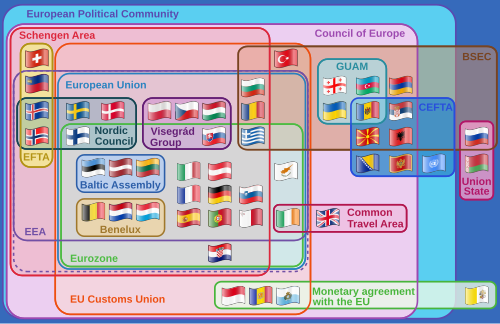
A clickable [Euler diagram](https://en.wikipedia.org/wiki/Euler_diagram "Euler diagram") showing the relationships between various European [regional organizations](https://en.wikipedia.org/wiki/Regional_organization "Regional organization")
- [v](https://en.wikipedia.org/wiki/Template:Supranational_European_Bodies "Template:Supranational European Bodies")
- [t](https://en.wikipedia.org/wiki/Template_talk:Supranational_European_Bodies "Template talk:Supranational European Bodies")
- [e](https://en.wikipedia.org/wiki/Special:EditPage/Template:Supranational_European_Bodies "Special:EditPage/Template:Supranational European Bodies")
The Council of Europe is not to be confused with the [Council of the European Union](https://en.wikipedia.org/wiki/Council_of_the_European_Union "Council of the European Union") (the "Council of Ministers") or the [European Council](https://en.wikipedia.org/wiki/European_Council "European Council"), which belong to the [European Union](https://en.wikipedia.org/wiki/European_Union "European Union"), an entirely separate body from the Council of Europe,[\[112\]](https://en.wikipedia.org/wiki/Council_of_Europe#cite_note-COE_not_EU-114) although they have shared the same European flag and anthem since the 1980s since they both work for [European integration](https://en.wikipedia.org/wiki/European_integration "European integration").[\[113\]](https://en.wikipedia.org/wiki/Council_of_Europe#cite_note-115)
Cooperation between the [European Union](https://en.wikipedia.org/wiki/European_Union "European Union") and the Council of Europe was reinforced in the mid-2000s, notably on culture and education as well as on the international enforcement of justice and Human Rights.[\[114\]](https://en.wikipedia.org/wiki/Council_of_Europe#cite_note-116)
The European Union is expected to accede to the [European Convention on Human Rights](https://en.wikipedia.org/wiki/European_Convention_on_Human_Rights "European Convention on Human Rights") (the convention). There are also concerns about consistency in case law – the [European Court of Justice](https://en.wikipedia.org/wiki/European_Court_of_Justice "European Court of Justice") (the EU's court in [Luxembourg](https://en.wikipedia.org/wiki/Luxembourg "Luxembourg")) is treating the convention as part of the legal system of all [EU member states](https://en.wikipedia.org/wiki/Member_state_of_the_European_Union "Member state of the European Union") in order to prevent conflict between its judgements and those of the [European Court of Human Rights](https://en.wikipedia.org/wiki/European_Court_of_Human_Rights "European Court of Human Rights") (the court in [Strasbourg](https://en.wikipedia.org/wiki/Strasbourg "Strasbourg") interpreting the convention). Protocol No. 14 of the convention is designed to allow the EU to accede to it and the EU [Treaty of Lisbon](https://en.wikipedia.org/wiki/Treaty_of_Lisbon "Treaty of Lisbon") contains a protocol binding the EU to join. The EU would thus be subject to its human rights law and external monitoring as its member states currently are.[\[115\]](https://en.wikipedia.org/wiki/Council_of_Europe#cite_note-Juncker_Council-117)[\[116\]](https://en.wikipedia.org/wiki/Council_of_Europe#cite_note-Reform_Draft-118)
### Schools of Political Studies
\[[edit](https://en.wikipedia.org/w/index.php?title=Council_of_Europe&action=edit§ion=19 "Edit section: Schools of Political Studies")\]
The Council of Europe *Schools of Political Studies* were established to train future generations of political, economic, social and cultural leaders in countries in transition. With the participation of national and international experts, they run annual series of seminars and conferences on topics such as European integration, democracy, human rights, the rule of law and globalisation. The first School of Political Studies was created in Moscow in 1992. By 2020, 20 other schools had been set up along the same lines, forming an association;[\[117\]](https://en.wikipedia.org/wiki/Council_of_Europe#cite_note-119) a network covering the whole of Eastern and South-Eastern Europe and the Caucasus, as well as some countries in the Southern Mediterranean region. The schools are part of the Education Department, which is part of the Directorate of Democratic Participation within the Directorate General of Democracy ("DGII") of the Council of Europe.[\[118\]](https://en.wikipedia.org/wiki/Council_of_Europe#cite_note-120)
### United Nations
\[[edit](https://en.wikipedia.org/w/index.php?title=Council_of_Europe&action=edit§ion=20 "Edit section: United Nations")\]
Cooperation between the CoE and the [UN](https://en.wikipedia.org/wiki/UN "UN") started with the agreement signed by the Secretariats of these institutions on 15 December 1951. On 17 October 1989, the [General Assembly of the United Nations](https://en.wikipedia.org/wiki/United_Nations_General_Assembly "United Nations General Assembly") approved a resolution on granting observer status to the Council of Europe which was proposed by several member states of the CoE.[\[119\]](https://en.wikipedia.org/wiki/Council_of_Europe#cite_note-121) Currently, the Council of Europe holds [observer status](https://en.wikipedia.org/wiki/United_Nations_General_Assembly_observers "United Nations General Assembly observers") with the [United Nations](https://en.wikipedia.org/wiki/United_Nations "United Nations") and is regularly represented in the [UN General Assembly](https://en.wikipedia.org/wiki/UN_General_Assembly "UN General Assembly"). It has organised the regional UN conferences against racism and on women. It co-operates with the United Nations at many levels, in particular in the areas of human rights, minorities, migration and counter-terrorism. In November 2016, the UN General Assembly adopted by consensus Resolution (A/Res/71/17) on Cooperation between the United Nations and the Council of Europe whereby it acknowledged the contribution of the Council of Europe to the protection and strengthening of human rights and fundamental freedoms, democracy and the rule of law, welcomed the ongoing co-operation in a variety of fields.
### Non-governmental organisations
\[[edit](https://en.wikipedia.org/w/index.php?title=Council_of_Europe&action=edit§ion=21 "Edit section: Non-governmental organisations")\]
[Non-governmental organisations](https://en.wikipedia.org/wiki/Non-governmental_organisations "Non-governmental organisations") (NGOs) can participate in the [INGOs Conference of the Council of Europe](https://en.wikipedia.org/wiki/INGOs_Conference_of_the_Council_of_Europe "INGOs Conference of the Council of Europe") and become observers to inter-governmental committees of experts. The Council of Europe drafted the [European Convention on the Recognition of the Legal Personality of International Non-Governmental Organisations](https://en.wikipedia.org/wiki/European_Convention_on_the_Recognition_of_the_Legal_Personality_of_International_Non-Governmental_Organisations "European Convention on the Recognition of the Legal Personality of International Non-Governmental Organisations") in 1986, which sets the legal basis for the existence and work of NGOs in Europe. Article 11 of the [European Convention on Human Rights](https://en.wikipedia.org/wiki/European_Convention_on_Human_Rights "European Convention on Human Rights") protects the right to freedom of association, which is also a fundamental norm for NGOs. The rules for [consultative status](https://en.wikipedia.org/wiki/Consultative_status "Consultative status") for INGOs appended to the resolution (93)38 "On relation between the Council of Europe and [non-governmental organisations](https://en.wikipedia.org/wiki/International_nongovernmental_organizations "International nongovernmental organizations")", adopted by the Committee of Ministers on 18 October 1993 at the 500th meeting of the Ministers' Deputies. On 19 November 2003, the Committee of Ministers changed the consultative status into a participatory status, "considering that it is indispensable that the rules governing the relations between the Council of Europe and NGOs evolve to reflect the active participation of international non-governmental organisations (INGOs) in the Organisation's policy and work programme".[\[120\]](https://en.wikipedia.org/wiki/Council_of_Europe#cite_note-122)
### Others
\[[edit](https://en.wikipedia.org/w/index.php?title=Council_of_Europe&action=edit§ion=22 "Edit section: Others")\]
On 30 May 2018, the Council of Europe signed a [memorandum of understanding](https://en.wikipedia.org/wiki/Memorandum_of_understanding "Memorandum of understanding") with the European [football](https://en.wikipedia.org/wiki/Association_football "Association football") confederation [UEFA](https://en.wikipedia.org/wiki/UEFA "UEFA").[\[121\]](https://en.wikipedia.org/wiki/Council_of_Europe#cite_note-123)
The Council of Europe also signed an agreement with FIFA in which the two agreed to strengthen future cooperation in areas of common interests. The deal which included cooperation between member states in the sport of football and safety and security at football matches was finalised in October 2018.[\[122\]](https://en.wikipedia.org/wiki/Council_of_Europe#cite_note-124)
## Role of CSOs within the Council of Europe
\[[edit](https://en.wikipedia.org/w/index.php?title=Council_of_Europe&action=edit§ion=23 "Edit section: Role of CSOs within the Council of Europe")\]
The Council of Europe is one of the leading international organisations dedicated to the promotion of human rights, democracy, and the rule of law across the European continent. Civil society organisations (CSOs) are integral to the Council's work, functioning as partners and expert contributors in shaping policies and supporting the protection of fundamental rights.
The Council of Europe actively encourages civil society engagement, particularly through the participation of international non-governmental organisations (INGOs) in its various platforms and bodies.
CSOs contribute to a broad range of Council initiatives related to human rights protection, democratic consolidation, and legal reforms. Their expertise and field-level knowledge enrich the policy-making process and help ensure that rights-based approaches are grounded in practical realities.
CSOs may take part in conferences, sessions, and working groups organised by the Council. They are often invited to submit reports, policy proposals, and findings from their own research. The Council places particular emphasis on involving CSOs in thematic dialogues that advance democratic institutions and safeguard civil liberties.[\[123\]](https://en.wikipedia.org/wiki/Council_of_Europe#cite_note-125)
### Participatory status for international NGOs
\[[edit](https://en.wikipedia.org/w/index.php?title=Council_of_Europe&action=edit§ion=24 "Edit section: Participatory status for international NGOs")\]
International CSOs (INGOs) may apply for **participatory status**, a designation that allows them to engage more actively in the Council's policy work. With this status, INGOs can present professional positions, contribute to working documents, and operate as partners in decision-making processes.
To qualify for participatory status, organisations must meet specific criteria established by the Council, including demonstrable international scope and proven experience in areas such as human rights or democratic governance. Once granted, participatory status enables CSOs to attend various Council meetings and express their views on relevant issues.
Further information on the criteria and application procedure is available at: <https://www.coe.int/en/web/ingo/participatory-status>
### The Conference of INGOs
\[[edit](https://en.wikipedia.org/w/index.php?title=Council_of_Europe&action=edit§ion=25 "Edit section: The Conference of INGOs")\]
CSOs may also engage through the **Conference of International Non-Governmental organisations** (**INGOs**) of the Council of Europe, which serves as the primary platform for civil society participation in CoE initiatives. The Conference allows organisations to voice their positions, build coalitions, and influence decision-making processes.
Through thematic discussions, the Conference addresses critical issues such as human rights, social justice, democratic governance, and institutional transparency. It provides an avenue for INGOs to collaborate and contribute meaningfully to the Council's agenda.
For participation guidelines and detailed information, see: <https://www.coe.int/en/web/ingo>
## Characteristics
\[[edit](https://en.wikipedia.org/w/index.php?title=Council_of_Europe&action=edit§ion=26 "Edit section: Characteristics")\]
### Privileges and immunities
\[[edit](https://en.wikipedia.org/w/index.php?title=Council_of_Europe&action=edit§ion=27 "Edit section: Privileges and immunities")\]
The General Agreement on Privileges and Immunities of the Council of Europe grants the organisation certain privileges and immunities.[\[124\]](https://en.wikipedia.org/wiki/Council_of_Europe#cite_note-priv-immu-EC-126)
The working conditions of staff are governed by the council's staff regulations, which are public.[\[125\]](https://en.wikipedia.org/wiki/Council_of_Europe#cite_note-127) Salaries and emoluments paid by the Council of Europe to its officials are tax-exempt on the basis of Article 18 of the General Agreement on Privileges and Immunities of the Council of Europe.[\[124\]](https://en.wikipedia.org/wiki/Council_of_Europe#cite_note-priv-immu-EC-126)
### Symbol and anthem
\[[edit](https://en.wikipedia.org/w/index.php?title=Council_of_Europe&action=edit§ion=28 "Edit section: Symbol and anthem")\]
Main articles: [Symbols of Europe](https://en.wikipedia.org/wiki/Symbols_of_Europe "Symbols of Europe") and [Flag of Europe](https://en.wikipedia.org/wiki/Flag_of_Europe "Flag of Europe")
The Council of Europe created, and has since 1955 used as its official symbol, the [European Flag](https://en.wikipedia.org/wiki/Flag_of_Europe "Flag of Europe") with 12 golden stars arranged in a circle on a blue background.
Its musical anthem since 1972, the "[European anthem](https://en.wikipedia.org/wiki/Anthem_of_Europe "Anthem of Europe")", is based on the "[Ode to Joy](https://en.wikipedia.org/wiki/Ode_to_Joy "Ode to Joy")" theme from [Ludwig van Beethoven](https://en.wikipedia.org/wiki/Ludwig_van_Beethoven "Ludwig van Beethoven")'s [ninth symphony](https://en.wikipedia.org/wiki/Symphony_No._9_\(Beethoven\) "Symphony No. 9 (Beethoven)").
On 5 May 1964, the 15th anniversary of its founding, the Council of Europe established 5 May as [Europe Day](https://en.wikipedia.org/wiki/Europe_Day "Europe Day").[\[126\]](https://en.wikipedia.org/wiki/Council_of_Europe#cite_note-symbols-128)
The wide private and public use of the European Flag is encouraged to symbolise a European dimension. To avoid confusion with the [European Union](https://en.wikipedia.org/wiki/European_Union "European Union") which subsequently adopted the same flag in the 1980s, as well as other European institutions, the Council of Europe often uses a modified version with a lower-case "e" surrounding the stars which are referred to as the "Council of Europe Logo".[\[126\]](https://en.wikipedia.org/wiki/Council_of_Europe#cite_note-symbols-128)[\[127\]](https://en.wikipedia.org/wiki/Council_of_Europe#cite_note-129)
## Criticism and controversies
\[[edit](https://en.wikipedia.org/w/index.php?title=Council_of_Europe&action=edit§ion=29 "Edit section: Criticism and controversies")\]
Both Human Rights Watch and the European Stability Initiative have called on the Council of Europe to undertake concrete actions to show that it is willing and able to return to its "original mission to protect and ensure human rights",[\[128\]](https://en.wikipedia.org/wiki/Council_of_Europe#cite_note-ESI_HavelPrize-130) despite launching political and economic activities that could generate redundancies with other international organisations (including the [European Union](https://en.wikipedia.org/wiki/European_Union "European Union") and [OCSE](https://en.wikipedia.org/wiki/OCSE "OCSE")).[\[129\]](https://en.wikipedia.org/wiki/Council_of_Europe#cite_note-131)[\[130\]](https://en.wikipedia.org/wiki/Council_of_Europe#cite_note-euractiv1-132)[\[131\]](https://en.wikipedia.org/wiki/Council_of_Europe#cite_note-133)
In October 2022, a new and different Pan-European meeting of 44 states was held, as the "inaugural summit of the [European Political Community](https://en.wikipedia.org/wiki/European_Political_Community "European Political Community")", a new forum largely organised by French President [Emmanuel Macron](https://en.wikipedia.org/wiki/Emmanuel_Macron "Emmanuel Macron"). The Council of Europe, sidelined, reportedly was "perplexed" with this development, with a spokesperson stating "In the field of human rights, democracy and the rule of law, such a pan-European community already exists: it is the Council of Europe."[\[132\]](https://en.wikipedia.org/wiki/Council_of_Europe#cite_note-CookJanicekCorbet-134) A feature of the new forum is that [Russia](https://en.wikipedia.org/wiki/Russia "Russia") and [Belarus](https://en.wikipedia.org/wiki/Belarus "Belarus") are deliberately excluded,[\[132\]](https://en.wikipedia.org/wiki/Council_of_Europe#cite_note-CookJanicekCorbet-134) which was not seen as explaining the need for a different entity, given that at the time, Russia was no longer a member of the Council of Europe and Belarus only participated partially, as a non-member.\[*[citation needed](https://en.wikipedia.org/wiki/Wikipedia:Citation_needed "Wikipedia:Citation needed")*\]
### "Caviar diplomacy" scandal
\[[edit](https://en.wikipedia.org/w/index.php?title=Council_of_Europe&action=edit§ion=30 "Edit section: \"Caviar diplomacy\" scandal")\]
See also: [Azerbaijani laundromat](https://en.wikipedia.org/wiki/Azerbaijani_laundromat "Azerbaijani laundromat")
After Azerbaijan joined the CoE in 2001, both the Council and its Parliamentary Assembly were criticised for having a weak response to election rigging and [human rights violations in Azerbaijan](https://en.wikipedia.org/wiki/Human_rights_in_Azerbaijan "Human rights in Azerbaijan").[\[133\]](https://en.wikipedia.org/wiki/Council_of_Europe#cite_note-PACEGuard-135) The [Human Rights Watch](https://en.wikipedia.org/wiki/Human_Rights_Watch "Human Rights Watch") criticised the Council of Europe in 2014 for allowing Azerbaijan to assume the six-month rotating chairmanship of the council's Committee of Ministers, writing that the Azeri government's repression of human rights defenders, dissidents, and journalists "shows sheer contempt for its commitments to the Council of Europe".[\[134\]](https://en.wikipedia.org/wiki/Council_of_Europe#cite_note-HRW_Criticism-136) An internal inquiry was set up in 2017 amid allegations of bribery by Azerbaijan government officials and criticism of "[caviar diplomacy](https://en.wikipedia.org/wiki/Caviar_diplomacy "Caviar diplomacy")" at the council.[\[135\]](https://en.wikipedia.org/wiki/Council_of_Europe#cite_note-Rankin-137)[\[136\]](https://en.wikipedia.org/wiki/Council_of_Europe#cite_note-Valencia-138) A 219-page report was issued in 2018 after a ten-month investigation.[\[133\]](https://en.wikipedia.org/wiki/Council_of_Europe#cite_note-PACEGuard-135) It concluded that several members of the Parliamentary Assembly broke CoE ethical rules and were "strongly suspected" of corruption; it strongly criticised former Parliamentary Assembly president [Pedro Agramunt](https://en.wikipedia.org/wiki/Pedro_Agramunt "Pedro Agramunt") and suggested that he had engaged in "corruptive activities" before his resignation under pressure in 2017.[\[133\]](https://en.wikipedia.org/wiki/Council_of_Europe#cite_note-PACEGuard-135) The inquiry also named Italian member [Luca Volontè](https://en.wikipedia.org/wiki/Luca_Volont%C3%A8 "Luca Volontè") as a suspect in "activities of a corruptive nature".[\[133\]](https://en.wikipedia.org/wiki/Council_of_Europe#cite_note-PACEGuard-135) Volontè was investigated by Italian police and accused by Italian prosecutors in 2017 of receiving over 2.39 million euros in bribes in exchange for working for Azerbaijan in the parliamentary assembly, and that in 2013 he played a key role in orchestrating the defeat of a highly critical report on the abuse of political prisoners in Azerbaijan.[\[135\]](https://en.wikipedia.org/wiki/Council_of_Europe#cite_note-Rankin-137)[\[136\]](https://en.wikipedia.org/wiki/Council_of_Europe#cite_note-Valencia-138)[\[137\]](https://en.wikipedia.org/wiki/Council_of_Europe#cite_note-139) In 2021, Volontè was convicted of accepting bribes from Azerbaijani officials to water down critiques of the nation's human rights record, and he was sentenced by a court in [Milan](https://en.wikipedia.org/wiki/Milan "Milan") to four years in prison.[\[138\]](https://en.wikipedia.org/wiki/Council_of_Europe#cite_note-140)
## See also
\[[edit](https://en.wikipedia.org/w/index.php?title=Council_of_Europe&action=edit§ion=31 "Edit section: See also")\]
- [Europe portal](https://en.wikipedia.org/wiki/Portal:Europe "Portal:Europe")
- [](https://en.wikipedia.org/wiki/File:A_coloured_voting_box.svg)[Politics portal](https://en.wikipedia.org/wiki/Portal:Politics "Portal:Politics")
- [CAHDI](https://en.wikipedia.org/wiki/CAHDI "CAHDI")
- [Council of Europe–European Union relations](https://en.wikipedia.org/wiki/Council_of_Europe%E2%80%93European_Union_relations "Council of Europe–European Union relations")
- [Common European Framework of Reference for Languages](https://en.wikipedia.org/wiki/Common_European_Framework_of_Reference_for_Languages "Common European Framework of Reference for Languages")
- [Conference of Specialised Ministers](https://en.wikipedia.org/wiki/Conference_of_Specialised_Ministers "Conference of Specialised Ministers")
- [Council of Europe Archives](https://en.wikipedia.org/wiki/Council_of_Europe_Archives "Council of Europe Archives")
- [The Europe Prize](https://en.wikipedia.org/wiki/The_Europe_Prize "The Europe Prize")
- [European Anti-fraud Office](https://en.wikipedia.org/wiki/European_Anti-fraud_Office "European Anti-fraud Office")
- [European Political Community](https://en.wikipedia.org/wiki/European_Political_Community "European Political Community")
- [Film Award of the Council of Europe](https://en.wikipedia.org/wiki/Film_Award_of_the_Council_of_Europe "Film Award of the Council of Europe")
- [Human rights in Europe](https://en.wikipedia.org/wiki/Human_rights_in_Europe "Human rights in Europe")
- [Moneyval](https://en.wikipedia.org/wiki/Moneyval "Moneyval")
- [International organisations in Europe](https://en.wikipedia.org/wiki/International_organisations_in_Europe "International organisations in Europe"), and co-ordinated organisations
- [List of Council of Europe treaties](https://en.wikipedia.org/wiki/List_of_Council_of_Europe_treaties "List of Council of Europe treaties")
- [List of linguistic rights in European constitutions](https://en.wikipedia.org/wiki/List_of_linguistic_rights_in_European_constitutions "List of linguistic rights in European constitutions")
- [North–South Centre](https://en.wikipedia.org/wiki/North%E2%80%93South_Centre "North–South Centre") of the Council of Europe
## Notes
\[[edit](https://en.wikipedia.org/w/index.php?title=Council_of_Europe&action=edit§ion=32 "Edit section: Notes")\]
### Footnotes
\[[edit](https://en.wikipedia.org/w/index.php?title=Council_of_Europe&action=edit§ion=33 "Edit section: Footnotes")\]
1. ^ [***a***](https://en.wikipedia.org/wiki/Council_of_Europe#cite_ref-transcontinental_4-0) [***b***](https://en.wikipedia.org/wiki/Council_of_Europe#cite_ref-transcontinental_4-1) [***c***](https://en.wikipedia.org/wiki/Council_of_Europe#cite_ref-transcontinental_4-2) Transcontinental country straddling both Europe and Asia.
2. **[^](https://en.wikipedia.org/wiki/Council_of_Europe#cite_ref-5)** Depending on varying geographic definitions, some member states or portions thereof may be considered transcontinental or Eurasian ([Armenia](https://en.wikipedia.org/wiki/Armenia "Armenia"), [Azerbaijan](https://en.wikipedia.org/wiki/Azerbaijan "Azerbaijan"),[\[a\]](https://en.wikipedia.org/wiki/Council_of_Europe#cite_note-transcontinental-4) [Cyprus](https://en.wikipedia.org/wiki/Cyprus "Cyprus"), [Georgia](https://en.wikipedia.org/wiki/Georgia_\(country\) "Georgia (country)")[\[a\]](https://en.wikipedia.org/wiki/Council_of_Europe#cite_note-transcontinental-4) and [Turkey](https://en.wikipedia.org/wiki/Turkey "Turkey")[\[a\]](https://en.wikipedia.org/wiki/Council_of_Europe#cite_note-transcontinental-4)), or belonging to the [Americas](https://en.wikipedia.org/wiki/Americas "Americas") ([Dutch Caribbean](https://en.wikipedia.org/wiki/Dutch_Caribbean "Dutch Caribbean"), [French Guiana](https://en.wikipedia.org/wiki/French_Guiana "French Guiana"), and [Greenland](https://en.wikipedia.org/wiki/Greenland "Greenland")), [Oceania](https://en.wikipedia.org/wiki/Oceania "Oceania") ([French Polynesia](https://en.wikipedia.org/wiki/French_Polynesia "French Polynesia")), and [Africa](https://en.wikipedia.org/wiki/Africa "Africa") ([Canary Islands](https://en.wikipedia.org/wiki/Canary_Islands "Canary Islands"), [Ceuta](https://en.wikipedia.org/wiki/Ceuta "Ceuta"), [Mayotte](https://en.wikipedia.org/wiki/Mayotte "Mayotte"), [Melilla](https://en.wikipedia.org/wiki/Melilla "Melilla"), and [Réunion](https://en.wikipedia.org/wiki/R%C3%A9union "Réunion"))
### References
\[[edit](https://en.wikipedia.org/w/index.php?title=Council_of_Europe&action=edit§ion=34 "Edit section: References")\]
1. **[^](https://en.wikipedia.org/wiki/Council_of_Europe#cite_ref-1)**
["Did you know?"](https://www.coe.int/en/web/about-us/did-you-know). Retrieved 1 November 2022. "English and French are the official languages of the Council of Europe."
2. ^ [***a***](https://en.wikipedia.org/wiki/Council_of_Europe#cite_ref-MemberStates_2-0) [***b***](https://en.wikipedia.org/wiki/Council_of_Europe#cite_ref-MemberStates_2-1) [***c***](https://en.wikipedia.org/wiki/Council_of_Europe#cite_ref-MemberStates_2-2) [***d***](https://en.wikipedia.org/wiki/Council_of_Europe#cite_ref-MemberStates_2-3) [***e***](https://en.wikipedia.org/wiki/Council_of_Europe#cite_ref-MemberStates_2-4) [***f***](https://en.wikipedia.org/wiki/Council_of_Europe#cite_ref-MemberStates_2-5) [46 "Member States"](https://www.coe.int/en/web/portal/46-members-states), Council of Europe.
3. **[^](https://en.wikipedia.org/wiki/Council_of_Europe#cite_ref-3)**
["Profile: The Council of Europe"](https://news.bbc.co.uk/2/hi/europe/country_profiles/4816408.stm). *BBC News*. [Archived](https://web.archive.org/web/20221027082754/http://news.bbc.co.uk/2/hi/europe/country_profiles/4816408.stm) from the original on 27 October 2022.
4. **[^](https://en.wikipedia.org/wiki/Council_of_Europe#cite_ref-6)**
["Intergovernmental Organizations"](https://web.archive.org/web/20181202024809/https://www.un.org/en/sections/member-states/intergovernmental-organizations/index.html). *United Nations*. Archived from [the original](https://www.un.org/en/sections/member-states/intergovernmental-organizations/index.html) on 2 December 2018.
5. **[^](https://en.wikipedia.org/wiki/Council_of_Europe#cite_ref-7)** [Budget](https://www.coe.int/en/web/about-us/budget). Council of Europe. Retrieved 21 January 2026.
6. **[^](https://en.wikipedia.org/wiki/Council_of_Europe#cite_ref-8)**
["The European flag – The Council of Europe in brief"](https://www.coe.int/en/web/about-us/the-european-flag). *The Council of Europe*. [Archived](https://web.archive.org/web/20221220132009/https://www.coe.int/en/web/about-us/the-european-flag) from the original on 20 December 2022. Retrieved 30 December 2022.
7. **[^](https://en.wikipedia.org/wiki/Council_of_Europe#cite_ref-9)**
["The European anthem – The Council of Europe in brief"](https://www.coe.int/en/web/about-us/the-european-anthem). *The Council of Europe*. [Archived](https://web.archive.org/web/20221104005120/https://www.coe.int/en/web/about-us/the-european-anthem) from the original on 4 November 2022. Retrieved 30 December 2022.
8. **[^](https://en.wikipedia.org/wiki/Council_of_Europe#cite_ref-10)**
["Do not get confused – The Council of Europe in brief"](https://www.coe.int/en/web/about-us/do-not-get-confused). *The Council of Europe*. Retrieved 30 December 2022.
9. **[^](https://en.wikipedia.org/wiki/Council_of_Europe#cite_ref-11)**
Cohen, Antonin (2013). "Competing elites and the emergence of a European field of power". *Transnational Power Elites: The New Professionals of Governance, Law and Security*.
10. **[^](https://en.wikipedia.org/wiki/Council_of_Europe#cite_ref-12)**
Scheeck, Laurent (2011). "Diplomatic Intrusions, Dialogues, and Fragile Equilibria: The European Court as a Constitutional Actor of the European Union". *The European Court of Human Rights Between Law and Politics*.
11. **[^](https://en.wikipedia.org/wiki/Council_of_Europe#cite_ref-13)**
Spano, Robert (19 May 2018). ["The Future of the European Court of Human Rights—Subsidiarity, Process-Based Review and the Rule of Law"](https://academic.oup.com/hrlr/article/18/3/473/4999870). *Human Rights Law Review*. **18** (3). Oxford University Press: 473–494\. [doi](https://en.wikipedia.org/wiki/Doi_\(identifier\) "Doi (identifier)"):[10\.1093/hrlr/ngy015](https://doi.org/10.1093%2Fhrlr%2Fngy015).
12. **[^](https://en.wikipedia.org/wiki/Council_of_Europe#cite_ref-14)**
["The European Court of Human Rights – Council of Europe Office in Georgia – publi.coe.int"](https://www.coe.int/en/web/tbilisi/europeancourtofhumanrights). *Council of Europe Office in Georgia*. Retrieved 12 February 2023.
13. **[^](https://en.wikipedia.org/wiki/Council_of_Europe#cite_ref-15)**
["Structure – The Council of Europe in brief – publi.coe.int"](https://www.coe.int/en/web/about-us/structure). *The Council of Europe in brief*. Retrieved 12 February 2023.
14. **[^](https://en.wikipedia.org/wiki/Council_of_Europe#cite_ref-16)**
["European Directorate for the Quality of Medicines and Healthcare – European Directorate for the Quality of Medicines & HealthCare – EDQM"](https://www.edqm.eu/en/). *European Directorate for the Quality of Medicines & HealthCare*. Retrieved 12 February 2023.
15. **[^](https://en.wikipedia.org/wiki/Council_of_Europe#cite_ref-17)**
["Headquarters and offices – The Council of Europe in brief – publi.coe.int"](https://www.coe.int/en/web/about-us/headquarters-and-offices). *The Council of Europe in brief*. Retrieved 12 February 2023.
16. **[^](https://en.wikipedia.org/wiki/Council_of_Europe#cite_ref-18)**
Istrefi, Kushtrim (2018). ["Kosovo's Quest for Council of Europe Membership"](https://doi.org/10.1163%2F15730352-04303002). *Review of Central and East European Law*. **43** (3): 255–273\. [doi](https://en.wikipedia.org/wiki/Doi_\(identifier\) "Doi (identifier)"):[10\.1163/15730352-04303002](https://doi.org/10.1163%2F15730352-04303002). [ISSN](https://en.wikipedia.org/wiki/ISSN_\(identifier\) "ISSN (identifier)") [1573-0352](https://search.worldcat.org/issn/1573-0352).
17. **[^](https://en.wikipedia.org/wiki/Council_of_Europe#cite_ref-19)**
["Lumni \| Enseignement – Discours d'Aristide Briand devant la SDN du 7 septembre 1929"](https://fresques.ina.fr/jalons/fiche-media/InaEdu02042/discours-d-aristide-briand-devant-la-sdn-du-7-septembre-1929-audio.html) \[Lumni \| Teaching – Speech by Aristide Briand to the SDN on September 7, 1929\]. Fresques.ina.fr. Retrieved 24 September 2020.
18. **[^](https://en.wikipedia.org/wiki/Council_of_Europe#cite_ref-20)**
Pixelstorm (21 March 1943). ["National Address"](https://winstonchurchill.org/resources/speeches/1941-1945-war-leader/national-address/). *International Churchill Society*.
19. **[^](https://en.wikipedia.org/wiki/Council_of_Europe#cite_ref-21)**
["Post-War Councils on World Problems: A FOUR YEAR PLAN FOR ENGLAND by WINSTON CHURCHILL, Prime Minister of Great Britain, broadcast from London over BBC, March 21, 1943"](http://www.ibiblio.org/pha/policy/1943/1943-03-21a.html).
20. **[^](https://en.wikipedia.org/wiki/Council_of_Europe#cite_ref-COE_Churchill_22-0)**
["Winston Churchill and the Council of Europe"](http://www.coe.int/t/dgal/dit/ilcd/Archives/Selection/Churchill/Default_en.asp). *Council of Europe: Archiving and Documentary Resources*. Council of Europe. 6 April 2009. Retrieved 18 November 2013.
, including audio extracts
21. **[^](https://en.wikipedia.org/wiki/Council_of_Europe#cite_ref-ENA_Churchill_23-0)**
["European Navigator (ENA)"](https://web.archive.org/web/20110607160506/http://www.ena.lu/the_zurich_speech-020100043.html). Archived from [the original](http://www.ena.lu/the_zurich_speech-020100043.html) on 7 June 2011. Retrieved 4 April 2011.
Including full transcript
22. **[^](https://en.wikipedia.org/wiki/Council_of_Europe#cite_ref-:2_24-0)**
["History – Language policy – publi.coe.int"](https://www.coe.int/en/web/language-policy/history). *Language policy*. Retrieved 12 February 2023.
23. **[^](https://en.wikipedia.org/wiki/Council_of_Europe#cite_ref-25)**
Robertson, A. H. (1954). ["The Council of Europe, 1949–1953: II"](https://www.jstor.org/stable/755483). *The International and Comparative Law Quarterly*. **3** (3): 404–420\. [doi](https://en.wikipedia.org/wiki/Doi_\(identifier\) "Doi (identifier)"):[10\.1093/iclqaj/3.3.404](https://doi.org/10.1093%2Ficlqaj%2F3.3.404). [ISSN](https://en.wikipedia.org/wiki/ISSN_\(identifier\) "ISSN (identifier)") [0020-5893](https://search.worldcat.org/issn/0020-5893). [JSTOR](https://en.wikipedia.org/wiki/JSTOR_\(identifier\) "JSTOR (identifier)") [755483](https://www.jstor.org/stable/755483).
24. **[^](https://en.wikipedia.org/wiki/Council_of_Europe#cite_ref-26)**
NATO. ["Relations with the OSCE"](https://www.nato.int/cps/en/natohq/topics_49911.htm). *NATO*. Retrieved 12 February 2023.
25. **[^](https://en.wikipedia.org/wiki/Council_of_Europe#cite_ref-27)**
["About the Council of Europe"](https://training.itcilo.org/actrav_cdrom1/english/global/law/coeint.htm). *training.itcilo.org*. Retrieved 12 February 2023.
26. **[^](https://en.wikipedia.org/wiki/Council_of_Europe#cite_ref-28)**
["Parliamentary Assembly – No Hate Speech Youth Campaign – publi.coe.int"](https://www.coe.int/en/web/no-hate-campaign/parliamentary-assembly1). *No Hate Speech Youth Campaign*. Retrieved 12 February 2023.
27. **[^](https://en.wikipedia.org/wiki/Council_of_Europe#cite_ref-29)**
Spaak (11 December 1951). ["Speeches made to the Parliamentary Assembly (1949–2018)"](http://www.assembly.coe.int/nw/xml/Speeches/Speech-XML2HTML-EN.asp?SpeechID=271). Assembly.coe.int. Retrieved 24 September 2020.
28. **[^](https://en.wikipedia.org/wiki/Council_of_Europe#cite_ref-30)** Sandro Guerrieri, "From the Hague Congress to the Council of Europe: hopes, achievements and disappointments in the parliamentary way to European integration (1948–51)." *Parliaments, Estates and Representation* 34\#2 (2014): 216–227.
29. **[^](https://en.wikipedia.org/wiki/Council_of_Europe#cite_ref-31)**
["European Commission: Paul–Henri Spaak: a European visionary and talented persuader"](https://europa.eu/european-union/sites/europaeu/files/docs/body/paul-henri_spaak_en.pdf) (PDF). [Archived](https://web.archive.org/web/20160924214047/https://europa.eu/european-union/sites/europaeu/files/docs/body/paul-henri_spaak_en.pdf) (PDF) from the original on 24 September 2016.
30. **[^](https://en.wikipedia.org/wiki/Council_of_Europe#cite_ref-32)**
["Accession of Germany to the Council of Europe (Strasbourg, 2 May 1951) – CVCE Website"](https://www.cvce.eu/en/obj/accession_of_germany_to_the_council_of_europe_strasbourg_2_may_1951-en-24be5b53-aefd-4ac1-a21c-c8e514bd1a9f.html). Cvce.eu. 2 May 1951. Retrieved 24 September 2020.
31. **[^](https://en.wikipedia.org/wiki/Council_of_Europe#cite_ref-33)**
The Council of Europe in brief (5 May 1949). ["Our member States"](https://www.coe.int/en/web/about-us/our-member-states). Coe.int. Retrieved 24 September 2020.
32. **[^](https://en.wikipedia.org/wiki/Council_of_Europe#cite_ref-34)**
["Voices of Europe"](https://pace.coe.int/en/voices). Council of Europe Parliamentary Assembly. Retrieved 23 August 2025.
33. **[^](https://en.wikipedia.org/wiki/Council_of_Europe#cite_ref-35)**
["All speeches by heads of state and government to PACE since 1949 online"](http://assembly.coe.int/nw/xml/News/News-View-en.asp?newsid=7112&lang=2). Assembly.coe.int. Retrieved 24 September 2020.
34. **[^](https://en.wikipedia.org/wiki/Council_of_Europe#cite_ref-36)**
["Discours prononcés devant l'Assemblée parlementaire (1949–2018) – par pays"](http://www.assembly.coe.int/nw/xml/Speeches/Speech-By-Country-FR.asp) \[Speeches delivered to the Parliamentary Assembly (1949–2018) – by country\]. Assembly.coe.int. Retrieved 24 September 2020.
35. **[^](https://en.wikipedia.org/wiki/Council_of_Europe#cite_ref-37)**
["Statute of the Council of Europe"](https://web.archive.org/web/20190107082603/https://www.coe.int/en/web/conventions/full-list/-/conventions/treaty/001). *conventions.coe.int*. Archived from [the original](http://conventions.coe.int/Treaty/en/Treaties/Html/001.htm) on 7 January 2019. Retrieved 19 December 2014.
36. **[^](https://en.wikipedia.org/wiki/Council_of_Europe#cite_ref-38)**
["The Council of Europe and the European Union"](http://www.coe.int/en/web/portal/european-union). *The Council of Europe*. [Archived](https://web.archive.org/web/20240119094000/https://www.coe.int/en/web/portal/european-union) from the original on 19 January 2024.
37. **[^](https://en.wikipedia.org/wiki/Council_of_Europe#cite_ref-39)**
["Universal Declaration of Human Rights"](https://www.un.org/en/universal-declaration-human-rights/). *United Nations*. [Archived](https://web.archive.org/web/20201230060556/https://www.un.org/en/universal-declaration-human-rights/) from the original on 30 December 2020.
38. ^ [***a***](https://en.wikipedia.org/wiki/Council_of_Europe#cite_ref-auto_40-0) [***b***](https://en.wikipedia.org/wiki/Council_of_Europe#cite_ref-auto_40-1) [***c***](https://en.wikipedia.org/wiki/Council_of_Europe#cite_ref-auto_40-2)
["Full list"](https://www.coe.int/en/web/conventions/full-list). *The Council of Europe Treaty Office*. Retrieved 22 June 2022.
39. **[^](https://en.wikipedia.org/wiki/Council_of_Europe#cite_ref-41)**
["Full list (Details of Treaty No.173)"](http://www.coe.int/en/web/conventions/full-list/-/conventions/treaty/173). *The Council of Europe Treaty Office*. Retrieved 22 June 2022.
40. **[^](https://en.wikipedia.org/wiki/Council_of_Europe#cite_ref-42)**
["Details of Treaty No.198: Council of Europe Convention on Laundering, Search, Seizure and Confiscation of the Proceeds from Crime and on the Financing of Terrorism"](http://www.coe.int/en/web/conventions/full-list/-/conventions/treaty/198). *Treaty Office*. Council of Europe. [Archived](https://web.archive.org/web/20201227194322/https://www.coe.int/en/web/conventions/full-list/-/conventions/treaty/198) from the original on 27 December 2020.
41. **[^](https://en.wikipedia.org/wiki/Council_of_Europe#cite_ref-43)**
["Details of Treaty No.174: Civil Law Convention on Corruption"](https://web.archive.org/web/20210105072336/https://www.coe.int/en/web/conventions/search-on-treaties/-/conventions/treaty/174). *Treaty Office*. Council of Europe. Archived from [the original](http://www.coe.int/en/web/conventions/search-on-treaties/-/conventions/treaty/174) on 5 January 2021.
42. **[^](https://en.wikipedia.org/wiki/Council_of_Europe#cite_ref-44)**
["Council of Europe Convention on Action against Trafficking in Human Beings and its Explanatory Report"](https://web.archive.org/web/20080528112349/http://www.coe.int/t/dg2/trafficking/campaign/Source/PDF_Conv_197_Trafficking_E.pdf) (PDF). Council of Europe. 16 May 2005. Archived from [the original](http://www.coe.int/t/dg2/trafficking/campaign/Source/PDF_Conv_197_Trafficking_E.pdf) (PDF) on 28 May 2008.
43. **[^](https://en.wikipedia.org/wiki/Council_of_Europe#cite_ref-45)**
Moustakas, Louis; and Petry, Karen (3 July 2023). ["Safeguarding in sport and policy advocacy: the role of the council of Europe"](https://doi.org/10.1080/19406940.2023.2201300). *International Journal of Sport Policy and Politics*. **15** (3): 457–472\. [doi](https://en.wikipedia.org/wiki/Doi_\(identifier\) "Doi (identifier)"):[10\.1080/19406940.2023.2201300](https://doi.org/10.1080%2F19406940.2023.2201300). [ISSN](https://en.wikipedia.org/wiki/ISSN_\(identifier\) "ISSN (identifier)") [1940-6940](https://search.worldcat.org/issn/1940-6940).
44. **[^](https://en.wikipedia.org/wiki/Council_of_Europe#cite_ref-46)**
Moustakas, Louis; Kalina, Lisa; Petry, Karen (1 March 2023). ["The Development and Validation of a Child Safeguarding in Sport Self-assessment Tool for the Council of Europe"](https://doi.org/10.1007%2Fs42448-022-00131-y). *International Journal on Child Maltreatment: Research, Policy and Practice*. **6** (1): 109–118\. [doi](https://en.wikipedia.org/wiki/Doi_\(identifier\) "Doi (identifier)"):[10\.1007/s42448-022-00131-y](https://doi.org/10.1007%2Fs42448-022-00131-y). [ISSN](https://en.wikipedia.org/wiki/ISSN_\(identifier\) "ISSN (identifier)") [2524-5244](https://search.worldcat.org/issn/2524-5244).
45. **[^](https://en.wikipedia.org/wiki/Council_of_Europe#cite_ref-47)**
["Self-assessment tool"](https://www.coe.int/en/web/sport/self-assessment-tool). *Council of Europe*.
46. **[^](https://en.wikipedia.org/wiki/Council_of_Europe#cite_ref-48)**
["Details of Treaty No.210: Council of Europe Convention on preventing and combating violence against women and domestic violence"](http://www.coe.int/en/web/conventions/full-list/-/conventions/treaty/210). *Treaty Office*. Council of Europe.
47. **[^](https://en.wikipedia.org/wiki/Council_of_Europe#cite_ref-49)**
["Details of Treaty No.135: Anti-Doping Convention"](https://web.archive.org/web/20150403085250/http://conventions.coe.int/Treaty/Commun/QueVoulezVous.asp?NT=135&CM=7&DF=5/21/2008&CL=ENG). *Treaty Office*. Council of Europe. Archived from [the original](http://conventions.coe.int/Treaty/Commun/QueVoulezVous.asp?NT=135&CM=7&DF=5/21/2008&CL=ENG) on 3 April 2015. Retrieved 21 May 2008.
48. **[^](https://en.wikipedia.org/wiki/Council_of_Europe#cite_ref-50)**
["2019 ICC Brochure"](https://rm.coe.int/brochure-2019-on-the-intercultural-cities-programme/1680488e90). *Council of Europe*. 2019. Retrieved 25 March 2021.
49. **[^](https://en.wikipedia.org/wiki/Council_of_Europe#cite_ref-51)**
["Alain Berset elected Secretary General of Council of Europe"](https://www.admin.ch/gov/en/start/documentation/media-releases.msg-id-101607.html). *www.admin.ch*. Retrieved 25 June 2024.
50. **[^](https://en.wikipedia.org/wiki/Council_of_Europe#cite_ref-52)**
Lobey, Sophie (April 2005). ["History, Role, and Activities of the Council of Europe: Facts, Figures and Information Sources"](https://www.nyulawglobal.org/globalex/Council_of_Europe.html). *GlobaLex*. Retrieved 12 February 2023.
51. **[^](https://en.wikipedia.org/wiki/Council_of_Europe#cite_ref-53)**
["Chairmanship"](https://www.coe.int/en/web/cm/cm-chairmanship). *Committee of Ministers*. [Archived](https://web.archive.org/web/20171213201014/https://www.coe.int/en/web/cm/cm-chairmanship) from the original on 13 December 2017. Retrieved 13 December 2017.
52. **[^](https://en.wikipedia.org/wiki/Council_of_Europe#cite_ref-54)**
["How it works"](https://web.archive.org/web/20180919171921/http://website-pace.net/en_GB/web/apce/how-it-works). *PACE*. Archived from [the original](http://website-pace.net/en_GB/web/apce/how-it-works) on 19 September 2018. Retrieved 19 September 2018.
53. **[^](https://en.wikipedia.org/wiki/Council_of_Europe#cite_ref-55)**
["The establishment of the European Convention for the Protection of Human Rights – The first organisations and cooperative ventures in post-war Europe"](https://www.cvce.eu/en/education/unit-content/-/unit/026961fe-0d57-4314-a40a-a4ac066a1801/e5143a50-1a43-4a26-8ffd-7a5aaa12ecf7). *CVCE*. Retrieved 12 February 2023.
54. **[^](https://en.wikipedia.org/wiki/Council_of_Europe#cite_ref-56)**
["Alleged secret detentions and unlawful inter-state transfers of detainees involving Council of Europe member states"](https://assembly.coe.int/nw/xml/XRef/Xref-XML2HTML-en.asp?fileid=11527&lang=en). *PACE*. 12 June 2006. Retrieved 12 February 2023.
55. **[^](https://en.wikipedia.org/wiki/Council_of_Europe#cite_ref-57)**
["A European Assembly of local and regional elected representatives"](https://www.coe.int/en/web/congress/overview). *Congress of Local and Regional Authorities*. Council of Europe. Retrieved 13 December 2017.
56. **[^](https://en.wikipedia.org/wiki/Council_of_Europe#cite_ref-58)**
["Origins and history"](https://www.coe.int/en/web/congress/origins-and-history). *Congress of Local and Regional Authorities*. Council of Europe. Retrieved 13 December 2017.
57. **[^](https://en.wikipedia.org/wiki/Council_of_Europe#cite_ref-59)**
["European Court of Human Rights"](https://ijrcenter.org/european-court-of-human-rights/). *International Justice Resource Center*. 10 July 2014. Retrieved 12 February 2023.
58. **[^](https://en.wikipedia.org/wiki/Council_of_Europe#cite_ref-60)**
["Full list (Chart of signatures and ratifications of Treaty 194)"](https://www.coe.int/en/web/conventions/full-list/-/conventions/treaty/194/signatures). *Treaty Office*. Retrieved 19 September 2018.
59. **[^](https://en.wikipedia.org/wiki/Council_of_Europe#cite_ref-61)**
["Commissioner for Human Rights – Biography"](https://www.coe.int/en/web/commissioner/the-commissioner/michael-o-flaherty). *Council of Europe*. Strasbourg, France. Retrieved 6 April 2019.
60. **[^](https://en.wikipedia.org/wiki/Council_of_Europe#cite_ref-62)**
["Home"](http://www.coe.int/T/NGO/default_en.asp). Coe.int. Retrieved 24 September 2020.
61. **[^](https://en.wikipedia.org/wiki/Council_of_Europe#cite_ref-63)**
["A word from the President on the occasion of the 40th anniversary of the Conference of INGOs of the Council of Europe"](https://web.archive.org/web/20171213204412/https://rm.coe.int/16806ecbd2). *rm.coe.int*. Archived from [the original](https://rm.coe.int/16806ecbd2) on 13 December 2017.
62. **[^](https://en.wikipedia.org/wiki/Council_of_Europe#cite_ref-64)**
["About us"](https://www.coe.int/en/web/youth/about-us). Coe.int. 14 February 2011. Retrieved 24 September 2020.
63. **[^](https://en.wikipedia.org/wiki/Council_of_Europe#cite_ref-65)**
["European Steering Committee for Youth – Youth – publi.coe.int"](https://www.coe.int/en/web/youth/cdej). *Youth*. Retrieved 12 February 2023.
64. **[^](https://en.wikipedia.org/wiki/Council_of_Europe#cite_ref-66)**
["About us – Youth – publi.coe.int"](https://www.coe.int/en/web/youth/about-us). *Youth*. Retrieved 12 February 2023.
65. **[^](https://en.wikipedia.org/wiki/Council_of_Europe#cite_ref-67)**
s.r.o, Appio Digital. ["Eurimages – co-production, distribution and exhibition support \| DOKweb"](https://dokweb.net/database/organizations/about/5b527769-c340-448a-ba00-6cd460fb41a6/eurimages-co-production-distribution-and-exhibition-support). *dokweb.net*. Retrieved 12 February 2023.
66. **[^](https://en.wikipedia.org/wiki/Council_of_Europe#cite_ref-68)**
["Home – Pompidou Group – publi.coe.int"](https://www.coe.int/en/web/pompidou). *Pompidou Group*. Retrieved 12 February 2023.
67. **[^](https://en.wikipedia.org/wiki/Council_of_Europe#cite_ref-69)**
["European and Mediterranean Major Hazards Agreement – European and Mediterranean Major Hazards Agreement – publi.coe.int"](https://www.coe.int/en/web/europarisks). *European and Mediterranean Major Hazards Agreement*. Retrieved 12 February 2023.
68. **[^](https://en.wikipedia.org/wiki/Council_of_Europe#cite_ref-70)**
["Enlarged Partial Agreement on Sport"](http://www.coe.int/t/DG4/EPAS/default_en.asp). Council of Europe.
69. **[^](https://en.wikipedia.org/wiki/Council_of_Europe#cite_ref-abc20230516_71-0)**
["Council of Europe summit in Iceland seeks to hold Russia to account for waging war in Ukraine"](https://abcnews.go.com/Business/wireStory/council-europe-summit-iceland-seeks-hold-russia-account-99365310). *[ABC News](https://en.wikipedia.org/wiki/ABC_News_\(United_States\) "ABC News (United States)")*. 16 May 2023. Retrieved 17 May 2023.
70. **[^](https://en.wikipedia.org/wiki/Council_of_Europe#cite_ref-72)**
["Summits of Heads of State and Government of the Council of Europe – Committee of Ministers – www.coe.int"](https://www.coe.int/en/web/cm/summits).
71. **[^](https://en.wikipedia.org/wiki/Council_of_Europe#cite_ref-73)**
["Fourth Council of Europe summit – Portal – www.coe.int"](https://www.coe.int/en/web/portal/fourth-council-of-europe-summit).
72. **[^](https://en.wikipedia.org/wiki/Council_of_Europe#cite_ref-74)**
Robertson, A. H. (1954). ["The Council of Europe, 1949–1953: I"](https://www.jstor.org/stable/755535). *The International and Comparative Law Quarterly*. **3** (2): 235–255\. [doi](https://en.wikipedia.org/wiki/Doi_\(identifier\) "Doi (identifier)"):[10\.1093/iclqaj/3.2.235](https://doi.org/10.1093%2Ficlqaj%2F3.2.235). [ISSN](https://en.wikipedia.org/wiki/ISSN_\(identifier\) "ISSN (identifier)") [0020-5893](https://search.worldcat.org/issn/0020-5893). [JSTOR](https://en.wikipedia.org/wiki/JSTOR_\(identifier\) "JSTOR (identifier)") [755535](https://www.jstor.org/stable/755535).
73. **[^](https://en.wikipedia.org/wiki/Council_of_Europe#cite_ref-75)**
McManus, David (17 September 2008). ["New General Building of Council of Europe"](https://www.e-architect.com/france/nbgen-strasbourg). *e-architect*. Retrieved 12 February 2023.
74. **[^](https://en.wikipedia.org/wiki/Council_of_Europe#cite_ref-76)**
["Inauguration of the Agora Building"](https://web.archive.org/web/20080528112354/http://www.coe.int/t/DC/Press/Source/PressFile_%20AGORA_fr.pdf) (PDF) (Press release) (in French). Council of Europe. 30 January 2008. Archived from [the original](http://www.coe.int/t/DC/Press/Source/PressFile_%20AGORA_fr.pdf) (PDF) on 28 May 2008.
75. **[^](https://en.wikipedia.org/wiki/Council_of_Europe#cite_ref-77)**
["2008 List of MIPIM winners"](http://www.mipim.com/App/homepage.cfm?appname=100517&moduleid=288&campaignid=11888&iUserCampaignID=43827991).
\[*[permanent dead link](https://en.wikipedia.org/wiki/Wikipedia:Link_rot "Wikipedia:Link rot")*\]
76. **[^](https://en.wikipedia.org/wiki/Council_of_Europe#cite_ref-78)**
["European Wergeland Centre"](https://web.archive.org/web/20090418213025/http://www.theewc.org/about-the-ewc.html). Archived from [the original](http://www.theewc.org/about-the-ewc.html) on 18 April 2009.
77. ^ [***a***](https://en.wikipedia.org/wiki/Council_of_Europe#cite_ref-auto1_79-0) [***b***](https://en.wikipedia.org/wiki/Council_of_Europe#cite_ref-auto1_79-1)
["List of external offices"](https://www.coe.int/en/web/programmes/external-offices). *Office of the Directorate General of Programmes*. Retrieved 21 October 2022.
78. **[^](https://en.wikipedia.org/wiki/Council_of_Europe#cite_ref-80)**
["Statute of the Council of Europe, London, 5.V.1949"](https://rm.coe.int/1680935bd0). Council of Europe.
79. ^ [***a***](https://en.wikipedia.org/wiki/Council_of_Europe#cite_ref-Klebes_81-0) [***b***](https://en.wikipedia.org/wiki/Council_of_Europe#cite_ref-Klebes_81-1) [***c***](https://en.wikipedia.org/wiki/Council_of_Europe#cite_ref-Klebes_81-2) [***d***](https://en.wikipedia.org/wiki/Council_of_Europe#cite_ref-Klebes_81-3) [***e***](https://en.wikipedia.org/wiki/Council_of_Europe#cite_ref-Klebes_81-4) [***f***](https://en.wikipedia.org/wiki/Council_of_Europe#cite_ref-Klebes_81-5) [***g***](https://en.wikipedia.org/wiki/Council_of_Europe#cite_ref-Klebes_81-6) [***h***](https://en.wikipedia.org/wiki/Council_of_Europe#cite_ref-Klebes_81-7) [***i***](https://en.wikipedia.org/wiki/Council_of_Europe#cite_ref-Klebes_81-8) [***j***](https://en.wikipedia.org/wiki/Council_of_Europe#cite_ref-Klebes_81-9) [***k***](https://en.wikipedia.org/wiki/Council_of_Europe#cite_ref-Klebes_81-10)
[Benoît-Rohmer, Florence](https://en.wikipedia.org/wiki/Florence_Beno%C3%AEt-Rohmer "Florence Benoît-Rohmer"); Klebes, Heinrich (June 2005). ["Council of Europe law: Towards a pan-European legal area"](https://www.supremecourt.ge/files/upload-file/pdf/coelaweng.pdf) (PDF). Council of Europe. [Archived](https://ghostarchive.org/archive/20221010/https://www.supremecourt.ge/files/upload-file/pdf/coelaweng.pdf) (PDF) from the original on 10 October 2022.
80. **[^](https://en.wikipedia.org/wiki/Council_of_Europe#cite_ref-82)**
["Statute of the Council of Europe is signed in London"](https://70.coe.int/1949-statute-of-the-council-of-europe-is-signed-in-london-en.html). Council of Europe. Retrieved 23 June 2019. "On 5 May 1949, at St James's Palace, London, the Foreign Ministers of Belgium, Denmark, France, Ireland, Italy, Luxembourg, the Netherlands, Norway, Sweden and the United Kingdom signed the Treaty establishing the Council of Europe."
81. **[^](https://en.wikipedia.org/wiki/Council_of_Europe#cite_ref-83)**
["Turkey joins"](https://70.coe.int/-/1950-turkey-joins). Council of Europe. Retrieved 23 June 2019.
82. **[^](https://en.wikipedia.org/wiki/Council_of_Europe#cite_ref-84)**
["Turkey – Member state"](https://www.coe.int/en/web/portal/turkey). Council of Europe. Retrieved 23 June 2019.
83. **[^](https://en.wikipedia.org/wiki/Council_of_Europe#cite_ref-85)**
["Turkey"](https://70.coe.int/-/1949-greece-joins). Council of Europe. Retrieved 23 June 2019.
and [Greece](https://en.wikipedia.org/wiki/Greece "Greece")
84. **[^](https://en.wikipedia.org/wiki/Council_of_Europe#cite_ref-86)**
["Greece – Member state"](https://www.coe.int/en/web/portal/greece). Council of Europe. Retrieved 23 June 2019. "Greece and Turkey became the 11th and 12th member State of the Council of Europe on 9 August 1949."
85. **[^](https://en.wikipedia.org/wiki/Council_of_Europe#cite_ref-87)**
["Iceland joins"](https://70.coe.int/-/1950-iceland-joins). Council of Europe. Retrieved 23 June 2019.
.
86. **[^](https://en.wikipedia.org/wiki/Council_of_Europe#cite_ref-88)**
["Iceland – Member state"](https://www.coe.int/en/web/portal/iceland). Council of Europe. Retrieved 23 June 2019. "Iceland became the 13th member State of the Council of Europe on 7 March 1950."
87. **[^](https://en.wikipedia.org/wiki/Council_of_Europe#cite_ref-89)**
["13 July 1950: Federal Republic of Germany joins the Council of Europe"](https://70.coe.int/1950-federal-republic-of-germany-joins-the-council-of-europe-en.html). Council of Europe.
88. **[^](https://en.wikipedia.org/wiki/Council_of_Europe#cite_ref-90)** Lansing Warren (3 May 1951), ["Council of Europe Raises Bonn To the Status of a Full Member"](https://www.nytimes.com/1951/05/03/archives/council-of-europe-raises-bonn-to-the-status-of-a-full-member-bonn.html), *The New York Times*.
89. **[^](https://en.wikipedia.org/wiki/Council_of_Europe#cite_ref-91)** Carlos Lopez (2010), ["Franco's Spain and the Council of Europe"](https://www.cvce.eu/content/publication/2010/4/28/67511746-0b1f-47e6-8762-03a336d23bd0/publishable_en.pdf), [Archived](https://web.archive.org/web/20210311164338/https://www.cvce.eu/content/publication/2010/4/28/67511746-0b1f-47e6-8762-03a336d23bd0/publishable_en.pdf) 11 March 2021 at the [Wayback Machine](https://en.wikipedia.org/wiki/Wayback_Machine "Wayback Machine"), [Centre virtuel de la connaissance sur l'Europe](https://en.wikipedia.org/wiki/Centre_virtuel_de_la_connaissance_sur_l%27Europe "Centre virtuel de la connaissance sur l'Europe").
90. **[^](https://en.wikipedia.org/wiki/Council_of_Europe#cite_ref-Popis2013_92-0)**
["Census of population, households and dwellings in Bosnia and Herzegovina, 2013: Final results"](https://web.archive.org/web/20171224103940/http://www.popis2013.ba/popis2013/doc/Popis2013prvoIzdanje.pdf) (PDF). Agency for Statistics of Bosnia and Herzegovina. June 2016. Archived from [the original](http://www.popis2013.ba/popis2013/doc/Popis2013prvoIzdanje.pdf) (PDF) on 24 December 2017. Retrieved 1 July 2016.
91. **[^](https://en.wikipedia.org/wiki/Council_of_Europe#cite_ref-93)** ["United States // Observer"](https://www.coe.int/en/web/portal/united-states), Council of Europe.
92. **[^](https://en.wikipedia.org/wiki/Council_of_Europe#cite_ref-94)**
["Venice Commission :: Council of Europe"](https://www.venice.coe.int/webforms/events/?country=243).
93. **[^](https://en.wikipedia.org/wiki/Council_of_Europe#cite_ref-95)**
["Assembly of Kosovo\*"](https://pace.coe.int/en/aplist/countries/65/assembly-of-kosovo-). *PACE*. [Archived](https://web.archive.org/web/20221011210114/https://pace.coe.int/en/aplist/countries/65/assembly-of-kosovo-) from the original on 11 October 2022. Retrieved 16 October 2022.
94. **[^](https://en.wikipedia.org/wiki/Council_of_Europe#cite_ref-96)**
["The situation in Kosovo\* and the role of the Council of Europe"](http://assembly.coe.int/nw/xml/XRef/Xref-XML2HTML-en.asp?fileid=22499&lang=en). *PACE website*. 2016. [Archived](https://web.archive.org/web/20221014130615/http://assembly.coe.int/nw/xml/XRef/Xref-XML2HTML-en.asp?fileid=22499&lang=en) from the original on 14 October 2022. Retrieved 16 October 2022.
95. **[^](https://en.wikipedia.org/wiki/Council_of_Europe#cite_ref-97)**
["DELEGACIONI I ASOCIACIONIT TË KOMUNAVE PO PËRFAQËSON KOSOVËN NË PUNIMET e KONGRESIT TË KËSHILLIT TË EVROPËS – Asociacioni i Komunave të Kosovës"](https://komunat-ks.net/archives/5132?lang=sq).
96. ^ [***a***](https://en.wikipedia.org/wiki/Council_of_Europe#cite_ref-DzehtsiarouCoffey_98-0) [***b***](https://en.wikipedia.org/wiki/Council_of_Europe#cite_ref-DzehtsiarouCoffey_98-1) [***c***](https://en.wikipedia.org/wiki/Council_of_Europe#cite_ref-DzehtsiarouCoffey_98-2) [***d***](https://en.wikipedia.org/wiki/Council_of_Europe#cite_ref-DzehtsiarouCoffey_98-3) Kanstantsin Dzehtsiarou & Donal K. Coffey, [Suspension and expulsion of members of the Council of Europe: difficult decisions in troubled times](https://www.cambridge.org/core/journals/international-and-comparative-law-quarterly/article/suspension-and-expulsion-of-members-of-the-council-of-europe-difficult-decisions-in-troubled-times/0CA9AC93A5722D91BECC4391D93B654E), *International & Comparative Law Quarterly*, Vol. 68, Issue 2 (2019).
97. **[^](https://en.wikipedia.org/wiki/Council_of_Europe#cite_ref-99)** Vasilopoulou, Sofia. (2018) [The party politics of Euroscepticism in times of crisis: The case of Greece](https://journals.openedition.org/cdlm/7858). *Politics*, 38. DOI: 10.1177/0263395718770599.
98. ^ [***a***](https://en.wikipedia.org/wiki/Council_of_Europe#cite_ref-Erlanger_100-0) [***b***](https://en.wikipedia.org/wiki/Council_of_Europe#cite_ref-Erlanger_100-1) [***c***](https://en.wikipedia.org/wiki/Council_of_Europe#cite_ref-Erlanger_100-2) [***d***](https://en.wikipedia.org/wiki/Council_of_Europe#cite_ref-Erlanger_100-3) [***e***](https://en.wikipedia.org/wiki/Council_of_Europe#cite_ref-Erlanger_100-4) [***f***](https://en.wikipedia.org/wiki/Council_of_Europe#cite_ref-Erlanger_100-5) Steven Erlanger, [Council of Europe Restores Russia's Voting Rights](https://www.nytimes.com/2019/06/25/world/europe/council-of-europe-russia-crimea.html), *New York Times* (25 June 2019).
99. **[^](https://en.wikipedia.org/wiki/Council_of_Europe#cite_ref-101)** [Russia cancels payment to Council of Europe after claiming its delegates are being persecuted over Crimea](https://www.independent.co.uk/news/world/europe/russia-cancels-council-of-europe-payment-members-persecuted-a7816951.html), *The Independent*. 30 June 2017
100. ^ [***a***](https://en.wikipedia.org/wiki/Council_of_Europe#cite_ref-:0_102-0) [***b***](https://en.wikipedia.org/wiki/Council_of_Europe#cite_ref-:0_102-1)
["Russia withholds payments to the Council of Europe"](https://www.dw.com/en/russia-withholds-payments-to-the-council-of-europe/a-42792673). *Deutsche Welle*. Retrieved 19 September 2018.
101. ^ [***a***](https://en.wikipedia.org/wiki/Council_of_Europe#cite_ref-:1_103-0) [***b***](https://en.wikipedia.org/wiki/Council_of_Europe#cite_ref-:1_103-1)
Buckley, Neil (26 November 2017). ["Russia tests Council of Europe in push to regain vote"](https://www.ft.com/content/3cccaf92-d12c-11e7-b781-794ce08b24dc). *Financial Times*. [Archived](https://ghostarchive.org/archive/20221210/https://www.ft.com/content/3cccaf92-d12c-11e7-b781-794ce08b24dc) from the original on 10 December 2022.
102. **[^](https://en.wikipedia.org/wiki/Council_of_Europe#cite_ref-104)**
["A Classic Dilemma: Russia's Threat to Withdraw from the Council of Europe"](https://eu.boell.org/en/2018/02/21/classic-dilemma-russias-threat-withdraw-council-europe). *Heinrich Böll Stiftung European Union*. Retrieved 19 September 2018.
103. **[^](https://en.wikipedia.org/wiki/Council_of_Europe#cite_ref-105)**
Weise, Zia (17 May 2019). ["Council of Europe restores Russia's voting rights"](https://www.politico.eu/article/council-of-europe-restores-russias-voting-rights/). *POLITICO*. Retrieved 18 May 2019.
104. ^ [***a***](https://en.wikipedia.org/wiki/Council_of_Europe#cite_ref-Suspends2022_106-0) [***b***](https://en.wikipedia.org/wiki/Council_of_Europe#cite_ref-Suspends2022_106-1) Steven Erlanger, [The Council of Europe suspends Russia for its attack on Ukraine.](https://www.nytimes.com/2022/03/03/world/europe/council-of-europe-russia-suspension.html), *New York Times* (3 March 2022).
105. **[^](https://en.wikipedia.org/wiki/Council_of_Europe#cite_ref-Mehta_107-0)** Pooja Mehta, [Russia withdraws from Council of Europe](https://www.jurist.org/news/2022/03/russia-withdraws-from-council-of-europe/), *JURIST* (12 March 2022).
106. **[^](https://en.wikipedia.org/wiki/Council_of_Europe#cite_ref-108)**
["Council of Europe suspends Russia's rights of representation"](https://www.coe.int/en/web/portal/-/council-of-europe-suspends-russia-s-rights-of-representation). *COE*. 25 February 2022. Retrieved 25 February 2022.
107. **[^](https://en.wikipedia.org/wiki/Council_of_Europe#cite_ref-CoE_Expulsion_RU_109-0)**
["The Russian Federation is excluded from the Council of Europe"](https://www.coe.int/en/web/portal/-/the-russian-federation-is-excluded-from-the-council-of-europe) (Press release). Council of Europe. 16 March 2022.
108. **[^](https://en.wikipedia.org/wiki/Council_of_Europe#cite_ref-110)**
["Russia Quits Europe's Rule of Law Body, Sparking Questions Over Death Penalty"](https://www.themoscowtimes.com/2022/03/10/russia-quits-europes-rule-of-law-body-sparking-questions-over-death-penalty-a76854). *[The Moscow Times](https://en.wikipedia.org/wiki/The_Moscow_Times "The Moscow Times")*. 10 March 2022. Retrieved 14 March 2022.
109. **[^](https://en.wikipedia.org/wiki/Council_of_Europe#cite_ref-111)**
Nilsen, Thomas (26 February 2022). ["Dmitry Medvedev vows to reintroduce death penalty"](https://thebarentsobserver.com/en/security/2022/02/dmitry-medvedev-calls-russia-reintroduce-death-penalty). *The Independent Barents Observer*. Retrieved 14 March 2022.
110. **[^](https://en.wikipedia.org/wiki/Council_of_Europe#cite_ref-112)**
["Full list – Treaty Office – publi.coe.int"](https://www.coe.int/en/web/conventions/full-list). *Treaty Office*. Retrieved 12 February 2023.
111. **[^](https://en.wikipedia.org/wiki/Council_of_Europe#cite_ref-113)**
["CoE Conventions"](https://web.archive.org/web/20110807043957/http://conventions.coe.int/Treaty/Commun/ChercheNonMembres.asp?CM=14&CL=ENG). Conventions.coe.int. 31 December 1998. Archived from [the original](http://conventions.coe.int/Treaty/Commun/ChercheNonMembres.asp?CM=14&CL=ENG) on 7 August 2011. Retrieved 11 February 2012.
112. **[^](https://en.wikipedia.org/wiki/Council_of_Europe#cite_ref-COE_not_EU_114-0)**
["Council of the European Union"](http://europa.eu/about-eu/institutions-bodies/council-eu/index_en.htm). [European Union](https://en.wikipedia.org/wiki/European_Union "European Union"). [Archived](https://web.archive.org/web/20130625020618/http://europa.eu/about-eu/institutions-bodies/council-eu/index_en.htm) from the original on 25 June 2013. Retrieved 26 October 2022.
113. **[^](https://en.wikipedia.org/wiki/Council_of_Europe#cite_ref-115)**
["The Council of Europe and the European Union – Portal – publi.coe.int"](https://www.coe.int/en/web/portal/european-union). *Portal*. Retrieved 12 February 2023.
114. **[^](https://en.wikipedia.org/wiki/Council_of_Europe#cite_ref-116)**
["The Council of Europe and the European Union sign an agreement to foster mutual cooperation"](https://wcd.coe.int/ViewDoc.jsp?Ref=PR331\(2007\)&Language=lanEnglish&Ver=original&BackColorInternet=F5CA75&BackColorIntranet=F5CA75&BackColorLogged=A9BACE&ShowBanner=no&Target=_self). Council of Europe. 23 May 2007. Retrieved 5 August 2008.
115. **[^](https://en.wikipedia.org/wiki/Council_of_Europe#cite_ref-Juncker_Council_117-0)**
[Juncker, Jean-Claude](https://en.wikipedia.org/wiki/Jean-Claude_Juncker "Jean-Claude Juncker") (2006). ["Council of Europe – European Union: "A sole ambition for the European continent""](http://assembly.coe.int/Sessions/2006/speeches/20060411_report_JCJuncker_EN.pdf) (PDF). Council of Europe. [Archived](https://ghostarchive.org/archive/20221010/http://assembly.coe.int/Sessions/2006/speeches/20060411_report_JCJuncker_EN.pdf) (PDF) from the original on 10 October 2022. Retrieved 5 August 2008.
116. **[^](https://en.wikipedia.org/wiki/Council_of_Europe#cite_ref-Reform_Draft_118-0)**
["Draft treaty modifying the treaty on the European Union and the treaty establishing the European community"](https://web.archive.org/web/20070808073053/http://www.openeurope.org.uk/research/translation.pdf) (PDF). [Open Europe](https://en.wikipedia.org/wiki/Open_Europe "Open Europe"). 24 July 2007. Archived from [the original](http://www.openeurope.org.uk/research/translation.pdf) (PDF) on 8 August 2007. Retrieved 5 August 2008.
117. **[^](https://en.wikipedia.org/wiki/Council_of_Europe#cite_ref-119)**
["Home"](https://www.schoolsofpoliticalstudies.eu/index.php/en/). Schoolsofpoliticalstudies.eu. Retrieved 24 September 2020.
118. **[^](https://en.wikipedia.org/wiki/Council_of_Europe#cite_ref-120)**
["Schools of Political Studies"](https://www.coe.int/en/web/schools-political-studies). Coe.int. Retrieved 24 September 2020.
119. **[^](https://en.wikipedia.org/wiki/Council_of_Europe#cite_ref-121)**
["The Council of Europe's Relations with the United Nations"](http://www.coe.int/en/web/der/united-nations). *The Council of Europe*. Retrieved 25 August 2017.
120. **[^](https://en.wikipedia.org/wiki/Council_of_Europe#cite_ref-122)**
["COUNCIL OF EUROPE COMMITTEE OF MINISTERS Resolution Res(2003)8 Participatory status for international non-governmental organisations with the Council of Europe (Adopted by the Committee of Ministers on 19 November 2003 at the 861st meeting of the Ministers' Deputies)"](https://wcd.coe.int/ViewDoc.jsp?Ref=Res%282003%298&Language=lanEnglish&Ver=original&Site=CM&BackColorInternet=C3C3C3&BackColorIntranet=EDB021&BackColorLogged=F5D383). *wcd.coe.int*. Retrieved 22 June 2022.
121. **[^](https://en.wikipedia.org/wiki/Council_of_Europe#cite_ref-123)**
["UEFA and the Council of Europe sign Memorandum of Understanding"](https://www.uefa.com/news-media/news/0245-0e98dbc7231c-a5fdcb0780d5-1000--uefa-and-the-council-of-europe-sign-memorandum-of-understa/). UEFA. 30 May 2018. Retrieved 2 June 2018.
122. **[^](https://en.wikipedia.org/wiki/Council_of_Europe#cite_ref-124)**
["Council of Europe and FIFA ink landmark deal on cooperation in shared areas"](http://tass.com/sport/1024752). *TASS* (in Russian). Retrieved 3 December 2018.
123. **[^](https://en.wikipedia.org/wiki/Council_of_Europe#cite_ref-125)**
["Council of Europe's co-operation sector and NGOs – Civil Society Portal"](http://www.coe.int/).
124. ^ [***a***](https://en.wikipedia.org/wiki/Council_of_Europe#cite_ref-priv-immu-EC_126-0) [***b***](https://en.wikipedia.org/wiki/Council_of_Europe#cite_ref-priv-immu-EC_126-1) [General Agreement on Privileges and Immunities of the Council of Europe](http://conventions.coe.int/Treaty/en/Treaties/Html/002.htm) [Archived](https://web.archive.org/web/20010422020845/http://conventions.coe.int/treaty/en/Treaties/Html/002.htm) 22 April 2001 at the [Wayback Machine](https://en.wikipedia.org/wiki/Wayback_Machine "Wayback Machine"), Council of Europe
125. **[^](https://en.wikipedia.org/wiki/Council_of_Europe#cite_ref-127)** [Resolutions on the Council of Europe Staff Regulations](http://www.coe.int/t/administrativetribunal/WCD/staff_en.asp), Council of Europe
126. ^ [***a***](https://en.wikipedia.org/wiki/Council_of_Europe#cite_ref-symbols_128-0) [***b***](https://en.wikipedia.org/wiki/Council_of_Europe#cite_ref-symbols_128-1)
["Flag, anthem and logo: the Council of Europe's symbols"](https://web.archive.org/web/20080731041722/http://www.coe.int/T/E/Com/About_Coe/emblems/emblemes.asp). Council of Europe. Archived from [the original](http://www.coe.int/T/E/Com/About_Coe/emblems/emblemes.asp) on 31 July 2008. Retrieved 5 August 2008.
127. **[^](https://en.wikipedia.org/wiki/Council_of_Europe#cite_ref-129)**
["Logo of the Council of Europe"](https://web.archive.org/web/20110102024938/http://www.coe.int/02/Logo/Pictures/LogoCoE/LogoCoe.jpg). Council of Europe. Archived from [the original](http://www.coe.int/02/Logo/Pictures/LogoCoE/LogoCoe.jpg) on 2 January 2011. Retrieved 5 August 2008.
128. **[^](https://en.wikipedia.org/wiki/Council_of_Europe#cite_ref-ESI_HavelPrize_130-0)**
European Stability Initiative. ["What the 2014 Havel Prize says about the Council of Europe – and what should happen now"](https://web.archive.org/web/20141001072918/http://www.esiweb.org/rumeliobserver/2014/09/29/what-the-2014-havel-prize-says-about-the-council-of-europe-and-what-should-happen-now/). No. 29 September 2014. ESI web. Archived from [the original](http://www.esiweb.org/rumeliobserver/2014/09/29/what-the-2014-havel-prize-says-about-the-council-of-europe-and-what-should-happen-now/) on 1 October 2014. Retrieved 29 September 2014.
129. **[^](https://en.wikipedia.org/wiki/Council_of_Europe#cite_ref-131)**
["What is the Council of Europe?"](https://www.bbc.com/news/world-europe-17741526). *BBC News*. 5 February 2015. Retrieved 24 September 2020.
130. **[^](https://en.wikipedia.org/wiki/Council_of_Europe#cite_ref-euractiv1_132-0)**
Morgan, Sam (26 April 2017). ["The Brief: Council of Europe in hunt for relevance"](https://www.euractiv.com/section/all/news/the-brief-council-of-europe-in-hunt-for-relevance/). Euractiv.com. Retrieved 24 September 2020.
131. **[^](https://en.wikipedia.org/wiki/Council_of_Europe#cite_ref-133)**
["Azerbaijan and the Council of Europe"](https://web.archive.org/web/20141006134510/https://www.economist.com/blogs/charlemagne/2013/03/azerbaijan). *[The Economist](https://en.wikipedia.org/wiki/The_Economist "The Economist")*. 23 March 2013. Archived from the original on 6 October 2014. Retrieved 26 October 2022.
132. ^ [***a***](https://en.wikipedia.org/wiki/Council_of_Europe#cite_ref-CookJanicekCorbet_134-0) [***b***](https://en.wikipedia.org/wiki/Council_of_Europe#cite_ref-CookJanicekCorbet_134-1)
Lorne Cook; Karel Janicek; Sylvie Corbet (6 October 2022). ["Europe holds 44-leader summit, leaves Russia in the cold"](https://apnews.com/article/russia-ukraine-business-turkey-prague-middle-east-508b968f182e5da7cf721f9928f2a937). [Associated Press](https://en.wikipedia.org/wiki/Associated_Press "Associated Press"). Retrieved 6 October 2022.
133. ^ [***a***](https://en.wikipedia.org/wiki/Council_of_Europe#cite_ref-PACEGuard_135-0) [***b***](https://en.wikipedia.org/wiki/Council_of_Europe#cite_ref-PACEGuard_135-1) [***c***](https://en.wikipedia.org/wiki/Council_of_Europe#cite_ref-PACEGuard_135-2) [***d***](https://en.wikipedia.org/wiki/Council_of_Europe#cite_ref-PACEGuard_135-3)
["Council of Europe members suspected of corruption, inquiry reveals"](https://www.theguardian.com/law/2018/apr/22/council-of-europe-members-suspected-of-corruption-inquiry-reveals). *The Guardian*. 22 April 2018. Retrieved 24 September 2020.
134. **[^](https://en.wikipedia.org/wiki/Council_of_Europe#cite_ref-HRW_Criticism_136-0)**
Human Rights Watch (29 September 2014). ["Azerbaijan: Government Repression Tarnishes Chairmanship Council of Europe's Leadership Should Take Action"](https://www.hrw.org/news/2014/09/29/azerbaijan-government-repression-tarnishes-chairmanship). Retrieved 29 September 2014.
135. ^ [***a***](https://en.wikipedia.org/wiki/Council_of_Europe#cite_ref-Rankin_137-0) [***b***](https://en.wikipedia.org/wiki/Council_of_Europe#cite_ref-Rankin_137-1) Jennifer Rankin, [Council of Europe urged to investigate Azerbaijan bribery allegations](https://www.theguardian.com/law/2017/feb/01/council-of-europe-urged-investigate-azerbaijan-bribery-allegations), *The Guardian*, 1 February 2017.
136. ^ [***a***](https://en.wikipedia.org/wiki/Council_of_Europe#cite_ref-Valencia_138-0) [***b***](https://en.wikipedia.org/wiki/Council_of_Europe#cite_ref-Valencia_138-1)
Matthew Valencia (19 June 2020). ["Heaping on the Caviar Diplomacy"](https://web.archive.org/web/20200926025428/https://www.economist.com/1843/2016/08/31/caviar-diplomacy-in-azerbaijan). *[The Economist](https://en.wikipedia.org/wiki/The_Economist "The Economist")*. Archived from the original on 26 September 2020. Retrieved 24 September 2020.
137. **[^](https://en.wikipedia.org/wiki/Council_of_Europe#cite_ref-139)**
Gabanelli, Milena. ["Il Consiglio d'Europa e il caso Azerbaijan tra regali e milioni"](http://www.corriere.it/cronache/17_gennaio_30/consiglio-d-europa-caso-azerbaijan-regali-milioni-2cbc0b5e-e66b-11e6-84c1-08780d9999f1.shtml?refresh_ce-cp) \[The Council of Europe and the Azerbaijan case between gifts and millions\]. *Corriere della Sera* (in Italian). Retrieved 30 January 2017.
138. **[^](https://en.wikipedia.org/wiki/Council_of_Europe#cite_ref-140)** Zdravko Ljubas, [Italian Court Sentences Former Council of Europe MP for Bribery](https://www.occrp.org/en/daily/13628-italian-court-sentences-former-council-of-europe-mp-for-bribery), [Organized Crime and Corruption Reporting Project](https://en.wikipedia.org/wiki/Organized_Crime_and_Corruption_Reporting_Project "Organized Crime and Corruption Reporting Project") (14 January 2021).
## Further reading
\[[edit](https://en.wikipedia.org/w/index.php?title=Council_of_Europe&action=edit§ion=35 "Edit section: Further reading")\]
- Dedman, Martin (2006). *The Origins and Development of the European Union 1945–1995*. Routledge. [doi](https://en.wikipedia.org/wiki/Doi_\(identifier\) "Doi (identifier)"):[10\.4324/9780203131817](https://doi.org/10.4324%2F9780203131817). [ISBN](https://en.wikipedia.org/wiki/ISBN_\(identifier\) "ISBN (identifier)")
[9780203131817](https://en.wikipedia.org/wiki/Special:BookSources/9780203131817 "Special:BookSources/9780203131817")
.
- Dinan, Desmond. *Europe Recast: A History of European Union* (2nd ed. 2004). [excerpt](https://www.rienner.com/uploads/53aae65db9769.pdf) [Archived](https://web.archive.org/web/20161021131211/https://www.rienner.com/uploads/53aae65db9769.pdf) 21 October 2016 at the [Wayback Machine](https://en.wikipedia.org/wiki/Wayback_Machine "Wayback Machine"); the excerpt covers the historiography
- Gillingham, John. *Coal, Steel, and the Rebirth of Europe, 1945–1955: The Germans and French from Ruhr Conflict to Economic Community* (Cambridge UP, 2004).
- Guerrieri, Sandro (2014). "From the Hague Congress to the Council of Europe: Hopes, achievements and disappointments in the parliamentary way to European integration (1948–51)". *Parliaments, Estates and Representation*. **34** (2): 216–227\. [doi](https://en.wikipedia.org/wiki/Doi_\(identifier\) "Doi (identifier)"):[10\.1080/02606755.2014.952133](https://doi.org/10.1080%2F02606755.2014.952133). [S2CID](https://en.wikipedia.org/wiki/S2CID_\(identifier\) "S2CID (identifier)") [142610321](https://api.semanticscholar.org/CorpusID:142610321).
- Kopf, Susanne. *Debating the European Union Transnationally: Wikipedians' Construction of the EU on a Wikipedia Talk Page (2001–2015)*. (PhD dissertation Lancaster University, 2018)[online](https://web.archive.org/web/20190516115656/http://eprints.lancs.ac.uk/126749/1/2018kopfphd.pdf).
- Moravcsik, Andrew. *The Choice for Europe: Social Purpose and State Power from Messina to Maastricht* (Cornell UP, 1998).
[ISBN](https://en.wikipedia.org/wiki/ISBN_\(identifier\) "ISBN (identifier)")
[9780801435096](https://en.wikipedia.org/wiki/Special:BookSources/9780801435096 "Special:BookSources/9780801435096")
.
[OCLC](https://en.wikipedia.org/wiki/OCLC_\(identifier\) "OCLC (identifier)") [925023272](https://www.worldcat.org/oclc/925023272).
- Stone, Dan. *Goodbye to All That?: The Story of Europe Since 1945* (Oxford UP, 2014).
- Urwin, Derek W. (2014). *The Community of Europe*. Routledge. [doi](https://en.wikipedia.org/wiki/Doi_\(identifier\) "Doi (identifier)"):[10\.4324/9781315843650](https://doi.org/10.4324%2F9781315843650). [ISBN](https://en.wikipedia.org/wiki/ISBN_\(identifier\) "ISBN (identifier)")
[9781315843650](https://en.wikipedia.org/wiki/Special:BookSources/9781315843650 "Special:BookSources/9781315843650")
.
## External links
\[[edit](https://en.wikipedia.org/w/index.php?title=Council_of_Europe&action=edit§ion=36 "Edit section: External links")\]
- [Official website](https://www.coe.int/)
| [v](https://en.wikipedia.org/wiki/Template:Council_of_Europe "Template:Council of Europe") [t](https://en.wikipedia.org/wiki/Template_talk:Council_of_Europe "Template talk:Council of Europe") [e](https://en.wikipedia.org/wiki/Special:EditPage/Template:Council_of_Europe "Special:EditPage/Template:Council of Europe")[Council of Europe]() | |
|---|---|
| Institutions | [Secretary General](https://en.wikipedia.org/wiki/Secretary_General_of_the_Council_of_Europe "Secretary General of the Council of Europe") [Committee of Ministers](https://en.wikipedia.org/wiki/Committee_of_Ministers_of_the_Council_of_Europe "Committee of Ministers of the Council of Europe") [Parliamentary Assembly](https://en.wikipedia.org/wiki/Parliamentary_Assembly_of_the_Council_of_Europe "Parliamentary Assembly of the Council of Europe") [Congress](https://en.wikipedia.org/wiki/Congress_of_the_Council_of_Europe "Congress of the Council of Europe") [Court of Human Rights](https://en.wikipedia.org/wiki/European_Court_of_Human_Rights "European Court of Human Rights") [Commissioner for Human Rights](https://en.wikipedia.org/wiki/Commissioner_for_Human_Rights "Commissioner for Human Rights") [Commission for the Efficiency of Justice](https://en.wikipedia.org/wiki/European_Commission_for_the_Efficiency_of_Justice "European Commission for the Efficiency of Justice") [Commission against Racism and Intolerance](https://en.wikipedia.org/wiki/European_Commission_against_Racism_and_Intolerance "European Commission against Racism and Intolerance") [Venice Commission](https://en.wikipedia.org/wiki/Venice_Commission "Venice Commission") [Pompidou Group](https://en.wikipedia.org/wiki/Pompidou_Group "Pompidou Group") |
| [Members](https://en.wikipedia.org/wiki/Member_states_of_the_Council_of_Europe "Member states of the Council of Europe") | [Albania](https://en.wikipedia.org/wiki/Albania "Albania") [Andorra](https://en.wikipedia.org/wiki/Andorra "Andorra") [Armenia](https://en.wikipedia.org/wiki/Armenia_in_the_Council_of_Europe "Armenia in the Council of Europe") [Austria](https://en.wikipedia.org/wiki/Austria "Austria") [Azerbaijan](https://en.wikipedia.org/wiki/Azerbaijan_in_the_Council_of_Europe "Azerbaijan in the Council of Europe") [Belgium](https://en.wikipedia.org/wiki/Belgium "Belgium") [Bosnia and Herzegovina](https://en.wikipedia.org/wiki/Bosnia_and_Herzegovina "Bosnia and Herzegovina") [Bulgaria](https://en.wikipedia.org/wiki/Bulgaria "Bulgaria") [Croatia](https://en.wikipedia.org/wiki/Croatia "Croatia") [Cyprus](https://en.wikipedia.org/wiki/Cyprus "Cyprus") [Czech Republic](https://en.wikipedia.org/wiki/Czech_Republic "Czech Republic") [Denmark](https://en.wikipedia.org/wiki/Denmark "Denmark") [Estonia](https://en.wikipedia.org/wiki/Estonia "Estonia") [Finland](https://en.wikipedia.org/wiki/Finland "Finland") [France](https://en.wikipedia.org/wiki/France "France") [Georgia](https://en.wikipedia.org/wiki/Georgia_\(country\) "Georgia (country)") [Germany](https://en.wikipedia.org/wiki/Germany "Germany") [Greece](https://en.wikipedia.org/wiki/Greece_in_the_Council_of_Europe "Greece in the Council of Europe") [Hungary](https://en.wikipedia.org/wiki/Hungary "Hungary") [Iceland](https://en.wikipedia.org/wiki/Iceland "Iceland") [Ireland](https://en.wikipedia.org/wiki/Republic_of_Ireland "Republic of Ireland") [Italy](https://en.wikipedia.org/wiki/Italy "Italy") [Latvia](https://en.wikipedia.org/wiki/Latvia "Latvia") [Liechtenstein](https://en.wikipedia.org/wiki/Liechtenstein "Liechtenstein") [Lithuania](https://en.wikipedia.org/wiki/Lithuania "Lithuania") [Luxembourg](https://en.wikipedia.org/wiki/Luxembourg "Luxembourg") [Malta](https://en.wikipedia.org/wiki/Malta "Malta") [Moldova](https://en.wikipedia.org/wiki/Moldova "Moldova") [Monaco](https://en.wikipedia.org/wiki/Monaco "Monaco") [Montenegro](https://en.wikipedia.org/wiki/Montenegro "Montenegro") [Netherlands](https://en.wikipedia.org/wiki/Netherlands "Netherlands") [North Macedonia](https://en.wikipedia.org/wiki/North_Macedonia "North Macedonia") [Norway](https://en.wikipedia.org/wiki/Norway "Norway") [Poland](https://en.wikipedia.org/wiki/Poland "Poland") [Portugal](https://en.wikipedia.org/wiki/Portugal "Portugal") [Romania](https://en.wikipedia.org/wiki/Romania "Romania") [San Marino](https://en.wikipedia.org/wiki/San_Marino "San Marino") [Serbia](https://en.wikipedia.org/wiki/Serbia "Serbia") [Slovakia](https://en.wikipedia.org/wiki/Slovakia "Slovakia") [Slovenia](https://en.wikipedia.org/wiki/Slovenia "Slovenia") [Spain](https://en.wikipedia.org/wiki/Spain "Spain") [Sweden](https://en.wikipedia.org/wiki/Sweden "Sweden") [Switzerland](https://en.wikipedia.org/wiki/Switzerland "Switzerland") [Turkey](https://en.wikipedia.org/wiki/Turkey "Turkey") [Ukraine](https://en.wikipedia.org/wiki/Ukraine "Ukraine") [United Kingdom](https://en.wikipedia.org/wiki/United_Kingdom "United Kingdom") |
| Observers | [Canada](https://en.wikipedia.org/wiki/Canada "Canada") [Holy See](https://en.wikipedia.org/wiki/Holy_See "Holy See") [Israel](https://en.wikipedia.org/wiki/Israel "Israel") [Japan](https://en.wikipedia.org/wiki/Japan "Japan") [Mexico](https://en.wikipedia.org/wiki/Mexico "Mexico") [United States](https://en.wikipedia.org/wiki/United_States "United States") [Kosovo](https://en.wikipedia.org/wiki/Kosovo "Kosovo") [EU relations](https://en.wikipedia.org/wiki/Council_of_Europe%E2%80%93European_Union_relations "Council of Europe–European Union relations") |
| Former members | [Czechoslovakia (1991–1992)](https://en.wikipedia.org/wiki/Czechoslovakia "Czechoslovakia") [Russia (1996–2022)](https://en.wikipedia.org/wiki/Russia "Russia") [relations](https://en.wikipedia.org/wiki/Russia_in_the_Council_of_Europe "Russia in the Council of Europe") [Saar (assoc. 1950–1956)](https://en.wikipedia.org/wiki/Saar_Protectorate "Saar Protectorate") [Serbia and Montenegro (2003–2006)](https://en.wikipedia.org/wiki/Serbia_and_Montenegro "Serbia and Montenegro") |
| Links to related articles | |
|---|---|
| [v](https://en.wikipedia.org/wiki/Template:Europe_topics "Template:Europe topics") [t](https://en.wikipedia.org/wiki/Template_talk:Europe_topics "Template talk:Europe topics") [e](https://en.wikipedia.org/wiki/Special:EditPage/Template:Europe_topics "Special:EditPage/Template:Europe topics")[Europe](https://en.wikipedia.org/wiki/Europe "Europe") [articles](https://en.wikipedia.org/wiki/Outline_of_Europe "Outline of Europe") | |
| [History](https://en.wikipedia.org/wiki/History_of_Europe "History of Europe") | |
| | |
| Chronology | [Bibliography of European history](https://en.wikipedia.org/wiki/Bibliography_of_European_history "Bibliography of European history") [Prehistory](https://en.wikipedia.org/wiki/Prehistoric_Europe "Prehistoric Europe") [Classical antiquity](https://en.wikipedia.org/wiki/Classical_antiquity "Classical antiquity") [Late antiquity](https://en.wikipedia.org/wiki/Late_antiquity "Late antiquity") [Middle Ages](https://en.wikipedia.org/wiki/Middle_Ages "Middle Ages") [Early modernity](https://en.wikipedia.org/wiki/Early_modern_Europe "Early modern Europe") [World War I](https://en.wikipedia.org/wiki/World_War_I "World War I") [World War II](https://en.wikipedia.org/wiki/World_War_II "World War II") [Pax Europaea](https://en.wikipedia.org/wiki/Pax_Europaea "Pax Europaea") [Crisis situations and unrest since 2000](https://en.wikipedia.org/wiki/Crisis_situations_and_unrest_in_Europe_since_2000 "Crisis situations and unrest in Europe since 2000") [COVID-19 pandemic](https://en.wikipedia.org/wiki/COVID-19_pandemic_in_Europe "COVID-19 pandemic in Europe") [Russo-Ukrainian war (2022–present)](https://en.wikipedia.org/wiki/Russo-Ukrainian_war_\(2022%E2%80%93present\) "Russo-Ukrainian war (2022–present)") |
| By topic | [Military](https://en.wikipedia.org/wiki/Military_history_of_Europe "Military history of Europe") [Sovereignty](https://en.wikipedia.org/wiki/List_of_sovereign_states_by_date_of_formation#Europe "List of sovereign states by date of formation") [predecessor states](https://en.wikipedia.org/wiki/List_of_predecessors_of_sovereign_states_in_Europe "List of predecessors of sovereign states in Europe") |
| [Geography](https://en.wikipedia.org/wiki/Geography_of_Europe "Geography of Europe") | |
| | |
| [Areas and populations](https://en.wikipedia.org/wiki/Area_and_population_of_European_countries "Area and population of European countries") [Countries by area](https://en.wikipedia.org/wiki/List_of_European_countries_by_area "List of European countries by area") [European microstates](https://en.wikipedia.org/wiki/European_microstates "European microstates") [Largest metropolitan areas](https://en.wikipedia.org/wiki/List_of_metropolitan_areas_in_Europe "List of metropolitan areas in Europe") [Cities](https://en.wikipedia.org/wiki/Lists_of_cities_in_Europe "Lists of cities in Europe") [Climate](https://en.wikipedia.org/wiki/Climate_of_Europe "Climate of Europe") [Climate change](https://en.wikipedia.org/wiki/Climate_change_in_Europe "Climate change in Europe") [Extreme points](https://en.wikipedia.org/wiki/Extreme_points_of_Europe "Extreme points of Europe") [Geology](https://en.wikipedia.org/wiki/Geology_of_Europe "Geology of Europe") [Islands](https://en.wikipedia.org/wiki/List_of_islands_of_Europe "List of islands of Europe") [Lakes](https://en.wikipedia.org/wiki/List_of_lakes#Europe "List of lakes") [Mountains](https://en.wikipedia.org/wiki/List_of_mountain_ranges#Europe "List of mountain ranges") [Regions](https://en.wikipedia.org/wiki/Regions_of_Europe "Regions of Europe") [Rivers](https://en.wikipedia.org/wiki/List_of_rivers_of_Europe "List of rivers of Europe") [Sovereign states and dependent territories](https://en.wikipedia.org/wiki/List_of_sovereign_states_and_dependent_territories_in_Europe "List of sovereign states and dependent territories in Europe") [by population](https://en.wikipedia.org/wiki/Demographics_of_Europe#Population_by_country "Demographics of Europe") [Villages](https://en.wikipedia.org/wiki/List_of_villages_in_Europe "List of villages in Europe") | |
| [Politics](https://en.wikipedia.org/wiki/Politics_of_Europe "Politics of Europe") | |
| | |
| | |
| [Eurosphere](https://en.wikipedia.org/wiki/Eurosphere "Eurosphere") [International organisations](https://en.wikipedia.org/wiki/List_of_European_countries_by_membership_in_international_organisations "List of European countries by membership in international organisations") [Integration](https://en.wikipedia.org/wiki/European_integration "European integration") [Law](https://en.wikipedia.org/wiki/Law_in_Europe "Law in Europe") [Post-Soviet Europe](https://en.wikipedia.org/wiki/Post-Soviet_states "Post-Soviet states") [Transatlantic relations](https://en.wikipedia.org/wiki/Transatlantic_relations "Transatlantic relations") | |
| Intergovernmental | [Commonwealth of Independent States (CIS)](https://en.wikipedia.org/wiki/Commonwealth_of_Independent_States "Commonwealth of Independent States") [Council of Europe (CoE)]() [Collective Security Treaty Organisation (CSTO)](https://en.wikipedia.org/wiki/Collective_Security_Treaty_Organization "Collective Security Treaty Organization") [Eurasian Economic Union (EAEU)](https://en.wikipedia.org/wiki/Eurasian_Economic_Union "Eurasian Economic Union") [European Political Community (EPC)](https://en.wikipedia.org/wiki/European_Political_Community "European Political Community") [GUAM Organization](https://en.wikipedia.org/wiki/GUAM_Organization_for_Democracy_and_Economic_Development "GUAM Organization for Democracy and Economic Development") [Open Balkan](https://en.wikipedia.org/wiki/Open_Balkan "Open Balkan") [North Atlantic Treaty Organisation (NATO)](https://en.wikipedia.org/wiki/NATO "NATO") [Organization for Security and Co-operation in Europe (OSCE)](https://en.wikipedia.org/wiki/Organization_for_Security_and_Co-operation_in_Europe "Organization for Security and Co-operation in Europe") [statistics](https://en.wikipedia.org/wiki/Organization_for_Security_and_Co-operation_in_Europe_statistics "Organization for Security and Co-operation in Europe statistics") [Organization of the Black Sea Economic Cooperation](https://en.wikipedia.org/wiki/Organization_of_the_Black_Sea_Economic_Cooperation "Organization of the Black Sea Economic Cooperation") |
| [European Union](https://en.wikipedia.org/wiki/European_Union "European Union") | [Economy](https://en.wikipedia.org/wiki/Economy_of_the_European_Union "Economy of the European Union") [relations](https://en.wikipedia.org/wiki/Third-country_economic_relationships_with_the_European_Union "Third-country economic relationships with the European Union") [free trade agreements](https://en.wikipedia.org/wiki/Free_trade_agreements_of_the_European_Union "Free trade agreements of the European Union") [Education](https://en.wikipedia.org/wiki/Educational_policies_and_initiatives_of_the_European_Union "Educational policies and initiatives of the European Union") [European Economic Area (EEA)](https://en.wikipedia.org/wiki/European_Economic_Area "European Economic Area") [European Neighbourhood Policy (ENP)](https://en.wikipedia.org/wiki/European_Neighbourhood_Policy "European Neighbourhood Policy") [Eastern Partnership](https://en.wikipedia.org/wiki/Eastern_Partnership "Eastern Partnership") [Euronest Parliamentary Assembly](https://en.wikipedia.org/wiki/Euronest_Parliamentary_Assembly "Euronest Parliamentary Assembly") [European Union Customs Union (EUCU)](https://en.wikipedia.org/wiki/European_Union_Customs_Union "European Union Customs Union") [Eurozone](https://en.wikipedia.org/wiki/Eurozone "Eurozone") [Foreign relations](https://en.wikipedia.org/wiki/Foreign_relations_of_the_European_Union "Foreign relations of the European Union") [Members](https://en.wikipedia.org/wiki/Member_state_of_the_European_Union "Member state of the European Union") [enlargement](https://en.wikipedia.org/wiki/Potential_enlargement_of_the_European_Union "Potential enlargement of the European Union") [Politics](https://en.wikipedia.org/wiki/Politics_of_the_European_Union "Politics of the European Union") [Schengen Area](https://en.wikipedia.org/wiki/Schengen_Area "Schengen Area") [Visa policy](https://en.wikipedia.org/wiki/Visa_policy_of_the_Schengen_Area "Visa policy of the Schengen Area") [Statistics](https://en.wikipedia.org/wiki/European_Union_statistics "European Union statistics") |
| [Economy](https://en.wikipedia.org/wiki/Economy_of_Europe "Economy of Europe") | |
| | |
| | |
| [History](https://en.wikipedia.org/wiki/Economic_history_of_Europe_\(1000_AD%E2%80%93present\) "Economic history of Europe (1000 AD–present)") [Financial (and social) rankings](https://en.wikipedia.org/wiki/Financial_and_social_rankings_of_sovereign_states_in_Europe "Financial and social rankings of sovereign states in Europe") [Free trade areas](https://en.wikipedia.org/wiki/Free_trade_areas_in_Europe "Free trade areas in Europe") [Energy](https://en.wikipedia.org/wiki/Energy_in_Europe "Energy in Europe") [Telecommunications](https://en.wikipedia.org/wiki/Telecommunications_in_the_European_Union "Telecommunications in the European Union") [Transport](https://en.wikipedia.org/wiki/Transport_in_Europe "Transport in Europe") [Rail](https://en.wikipedia.org/wiki/Rail_transport_in_Europe "Rail transport in Europe") [Road](https://en.wikipedia.org/wiki/International_E-road_network "International E-road network") | |
| Intergovernmental | [Central European Free Trade Agreement (CEFTA)](https://en.wikipedia.org/wiki/Central_European_Free_Trade_Agreement "Central European Free Trade Agreement") [Eurasian Customs Union (EACU)](https://en.wikipedia.org/wiki/Customs_Union_of_the_Eurasian_Economic_Union "Customs Union of the Eurasian Economic Union") [Eurasian Economic Community (EAEC)](https://en.wikipedia.org/wiki/Eurasian_Economic_Community "Eurasian Economic Community") [European Free Trade Association (EFTA)](https://en.wikipedia.org/wiki/European_Free_Trade_Association "European Free Trade Association") |
| Sovereign states by | [Average wage](https://en.wikipedia.org/wiki/List_of_European_countries_by_average_wage "List of European countries by average wage") [Budget revenues](https://en.wikipedia.org/wiki/List_of_sovereign_states_in_Europe_by_budget_revenues "List of sovereign states in Europe by budget revenues") [per capita](https://en.wikipedia.org/wiki/List_of_sovereign_states_in_Europe_by_budget_revenues_per_capita "List of sovereign states in Europe by budget revenues per capita") [GDP (nominal)](https://en.wikipedia.org/wiki/List_of_sovereign_states_in_Europe_by_GDP_\(nominal\) "List of sovereign states in Europe by GDP (nominal)") [per capita](https://en.wikipedia.org/wiki/List_of_sovereign_states_in_Europe_by_GDP_\(nominal\)_per_capita "List of sovereign states in Europe by GDP (nominal) per capita") [GDP (PPP)](https://en.wikipedia.org/wiki/List_of_sovereign_states_in_Europe_by_GDP_\(PPP\) "List of sovereign states in Europe by GDP (PPP)") [per capita](https://en.wikipedia.org/wiki/List_of_sovereign_states_in_Europe_by_GDP_\(PPP\)_per_capita "List of sovereign states in Europe by GDP (PPP) per capita") [GNI (nominal) per capita](https://en.wikipedia.org/wiki/List_of_sovereign_states_in_Europe_by_GNI_\(nominal\)_per_capita "List of sovereign states in Europe by GNI (nominal) per capita") [GNI (PPP) per capita](https://en.wikipedia.org/wiki/List_of_sovereign_states_in_Europe_by_GNI_\(PPP\)_per_capita "List of sovereign states in Europe by GNI (PPP) per capita") [HDI](https://en.wikipedia.org/wiki/List_of_sovereign_states_in_Europe_by_Human_Development_Index "List of sovereign states in Europe by Human Development Index") [Internet users (%)](https://en.wikipedia.org/wiki/List_of_European_countries_by_number_of_Internet_users "List of European countries by number of Internet users") [Minimum wage](https://en.wikipedia.org/wiki/List_of_European_countries_by_minimum_wage "List of European countries by minimum wage") [Press Freedom Index](https://en.wikipedia.org/wiki/List_of_sovereign_states_in_Europe_by_Press_Freedom_Index "List of sovereign states in Europe by Press Freedom Index") [Unemployment rate (%)](https://en.wikipedia.org/wiki/List_of_sovereign_states_in_Europe_by_unemployment_rate "List of sovereign states in Europe by unemployment rate") [Health expense per capita](https://en.wikipedia.org/wiki/European_countries_by_health_expense_per_person "European countries by health expense per person") [Military spending (%)](https://en.wikipedia.org/wiki/European_countries_by_military_expenditure_as_a_percentage_of_government_expenditure "European countries by military expenditure as a percentage of government expenditure") [Urban population (%)](https://en.wikipedia.org/wiki/European_countries_by_percentage_of_urban_population "European countries by percentage of urban population") [Electricity use per capita](https://en.wikipedia.org/wiki/European_countries_by_electricity_consumption_per_person "European countries by electricity consumption per person") |
| [Society](https://en.wikipedia.org/wiki/Category:Society_of_Europe "Category:Society of Europe") | |
| | |
| [Ages of consent](https://en.wikipedia.org/wiki/Ages_of_consent_in_Europe "Ages of consent in Europe") [Etiquette](https://en.wikipedia.org/wiki/Etiquette_in_Europe "Etiquette in Europe") [Social (and financial) rankings](https://en.wikipedia.org/wiki/Financial_and_social_rankings_of_sovereign_states_in_Europe "Financial and social rankings of sovereign states in Europe") [Languages](https://en.wikipedia.org/wiki/Languages_of_Europe "Languages of Europe") [endangered](https://en.wikipedia.org/wiki/List_of_endangered_languages_in_Europe "List of endangered languages in Europe") [Tattooing](https://en.wikipedia.org/wiki/Legal_status_of_tattooing_in_European_countries "Legal status of tattooing in European countries") [Universities](https://en.wikipedia.org/wiki/History_of_European_universities "History of European universities") [Bologna Process](https://en.wikipedia.org/wiki/Bologna_Process "Bologna Process") [Erasmus](https://en.wikipedia.org/wiki/Erasmus_Programme "Erasmus Programme") | |
| [Culture](https://en.wikipedia.org/wiki/Culture_of_Europe "Culture of Europe") | [Art](https://en.wikipedia.org/wiki/Art_of_Europe "Art of Europe") [painting](https://en.wikipedia.org/wiki/Western_painting "Western painting") [sculpture](https://en.wikipedia.org/wiki/Sculpture#Europe "Sculpture") [Architecture](https://en.wikipedia.org/wiki/History_of_architecture#Europe "History of architecture") [Capital of Culture](https://en.wikipedia.org/wiki/European_Capital_of_Culture "European Capital of Culture") [Cinema](https://en.wikipedia.org/wiki/Cinema_of_Europe "Cinema of Europe") [film festivals](https://en.wikipedia.org/wiki/List_of_film_festivals_in_Europe "List of film festivals in Europe") [Classical music](https://en.wikipedia.org/wiki/Classical_music "Classical music") [Cuisine](https://en.wikipedia.org/wiki/European_cuisine "European cuisine") [Dance](https://en.wikipedia.org/wiki/European_dances "European dances") [Folklore](https://en.wikipedia.org/wiki/European_folklore "European folklore") [Literature](https://en.wikipedia.org/wiki/Western_literature "Western literature") [Philosophy](https://en.wikipedia.org/wiki/Continental_philosophy "Continental philosophy") [Religion](https://en.wikipedia.org/wiki/Religion_in_Europe "Religion in Europe") [Christianity](https://en.wikipedia.org/wiki/Christianity_in_Europe "Christianity in Europe") [Islam](https://en.wikipedia.org/wiki/Islam_in_Europe "Islam in Europe") [Judaism](https://en.wikipedia.org/wiki/History_of_the_Jews_in_Europe "History of the Jews in Europe") [Sport](https://en.wikipedia.org/wiki/Sport_in_Europe "Sport in Europe") [Symbols](https://en.wikipedia.org/wiki/Symbols_of_Europe "Symbols of Europe") ([Armorial](https://en.wikipedia.org/wiki/Armorial_of_Europe "Armorial of Europe"), [Flags](https://en.wikipedia.org/wiki/Flags_of_Europe "Flags of Europe")) |
| [Demographics](https://en.wikipedia.org/wiki/Demographics_of_Europe "Demographics of Europe") | [Ageing](https://en.wikipedia.org/wiki/Ageing_of_Europe "Ageing of Europe") [Childhood population (%)](https://en.wikipedia.org/wiki/European_countries_by_percent_of_population_aged_0-14 "European countries by percent of population aged 0-14") [Ethnic groups](https://en.wikipedia.org/wiki/Ethnic_groups_in_Europe "Ethnic groups in Europe") [genetic history](https://en.wikipedia.org/wiki/Genetic_history_of_Europe "Genetic history of Europe") [Immigration](https://en.wikipedia.org/wiki/Immigration_to_Europe "Immigration to Europe") [Life expectancy](https://en.wikipedia.org/wiki/List_of_European_countries_by_life_expectancy "List of European countries by life expectancy") [by region](https://en.wikipedia.org/wiki/List_of_European_regions_by_life_expectancy "List of European regions by life expectancy") [Retirement](https://en.wikipedia.org/wiki/Retirement_in_Europe "Retirement in Europe") |
| [Outline](https://en.wikipedia.org/wiki/Outline_of_Europe "Outline of Europe") [Index](https://en.wikipedia.org/wiki/Outline_of_Europe "Outline of Europe") [Category](https://en.wikipedia.org/wiki/Category:Europe "Category:Europe") [Portal](https://en.wikipedia.org/wiki/Portal:Europe "Portal:Europe") [Maps](https://en.wikipedia.org/wiki/Maps_of_present-day_countries_and_dependencies "Maps of present-day countries and dependencies") | |
| [v](https://en.wikipedia.org/wiki/Template:Regional_organizations "Template:Regional organizations") [t](https://en.wikipedia.org/wiki/Template_talk:Regional_organizations "Template talk:Regional organizations") [e](https://en.wikipedia.org/wiki/Special:EditPage/Template:Regional_organizations "Special:EditPage/Template:Regional organizations")[Regional organizations](https://en.wikipedia.org/wiki/Regional_organization "Regional organization") | |
| Bodies | [African Union](https://en.wikipedia.org/wiki/African_Union "African Union") [Alliance of Sahel States](https://en.wikipedia.org/wiki/Alliance_of_Sahel_States "Alliance of Sahel States") [Amazon Cooperation Treaty Organization](https://en.wikipedia.org/wiki/Amazon_Cooperation_Treaty_Organization "Amazon Cooperation Treaty Organization") [Arab League](https://en.wikipedia.org/wiki/Arab_League "Arab League") [Arctic Council](https://en.wikipedia.org/wiki/Arctic_Council "Arctic Council") [Association of Southeast Asian Nations (ASEAN)](https://en.wikipedia.org/wiki/ASEAN "ASEAN") [Asia Cooperation Dialogue](https://en.wikipedia.org/wiki/Asia_Cooperation_Dialogue "Asia Cooperation Dialogue") [Asia Council](https://en.wikipedia.org/wiki/Asia_Council "Asia Council") [Asia-Europe Foundation](https://en.wikipedia.org/wiki/Asia-Europe_Foundation "Asia-Europe Foundation") [Asia-Pacific Economic Cooperation](https://en.wikipedia.org/wiki/Asia-Pacific_Economic_Cooperation "Asia-Pacific Economic Cooperation") [Assembly of European Regions](https://en.wikipedia.org/wiki/Assembly_of_European_Regions "Assembly of European Regions") [Association of Caribbean States](https://en.wikipedia.org/wiki/Association_of_Caribbean_States "Association of Caribbean States") [AUKUS](https://en.wikipedia.org/wiki/AUKUS "AUKUS") [Baltic Assembly](https://en.wikipedia.org/wiki/Baltic_Assembly "Baltic Assembly") [Bay of Bengal Initiative for Multi-Sectoral Technical and Economic Cooperation](https://en.wikipedia.org/wiki/Bay_of_Bengal_Initiative_for_Multi-Sectoral_Technical_and_Economic_Cooperation "Bay of Bengal Initiative for Multi-Sectoral Technical and Economic Cooperation") [Bolivarian Alliance for the Peoples of Our America – Peoples' Trade Treaty](https://en.wikipedia.org/wiki/ALBA "ALBA") [Benelux](https://en.wikipedia.org/wiki/Benelux "Benelux") [British–Irish Council](https://en.wikipedia.org/wiki/British%E2%80%93Irish_Council "British–Irish Council") [Bucharest Nine](https://en.wikipedia.org/wiki/Bucharest_Nine "Bucharest Nine") [Caribbean Community (CARICOM)](https://en.wikipedia.org/wiki/Caribbean_Community "Caribbean Community") [Central American Integration System](https://en.wikipedia.org/wiki/Central_American_Integration_System "Central American Integration System") [Central European Defence Cooperation](https://en.wikipedia.org/wiki/Central_European_Defence_Cooperation "Central European Defence Cooperation") [Central European Free Trade Agreement](https://en.wikipedia.org/wiki/Central_European_Free_Trade_Agreement "Central European Free Trade Agreement") [Central European Initiative](https://en.wikipedia.org/wiki/Central_European_Initiative "Central European Initiative") [Collective Security Treaty Organization](https://en.wikipedia.org/wiki/Collective_Security_Treaty_Organization "Collective Security Treaty Organization") [Commonwealth of Independent States](https://en.wikipedia.org/wiki/Commonwealth_of_Independent_States "Commonwealth of Independent States") [Commonwealth of Nations](https://en.wikipedia.org/wiki/Commonwealth_of_Nations "Commonwealth of Nations") [Community for Democracy and Rights of Nations](https://en.wikipedia.org/wiki/Community_for_Democracy_and_Rights_of_Nations "Community for Democracy and Rights of Nations") [Community of Democratic Choice](https://en.wikipedia.org/wiki/Community_of_Democratic_Choice "Community of Democratic Choice") [Community of Latin American and Caribbean States](https://en.wikipedia.org/wiki/Community_of_Latin_American_and_Caribbean_States "Community of Latin American and Caribbean States") [Comprehensive and Progressive Agreement for Trans-Pacific Partnership](https://en.wikipedia.org/wiki/Comprehensive_and_Progressive_Agreement_for_Trans-Pacific_Partnership "Comprehensive and Progressive Agreement for Trans-Pacific Partnership") [Conference of European Regions with Legislative Power](https://en.wikipedia.org/wiki/Conference_of_European_Regions_with_Legislative_Power "Conference of European Regions with Legislative Power") [Council of the Baltic Sea States](https://en.wikipedia.org/wiki/Council_of_the_Baltic_Sea_States "Council of the Baltic Sea States") [Council of Europe]() [Craiova Group](https://en.wikipedia.org/wiki/Craiova_Group "Craiova Group") [East African Community](https://en.wikipedia.org/wiki/East_African_Community "East African Community") [Eastern Partnership](https://en.wikipedia.org/wiki/Eastern_Partnership "Eastern Partnership") [Economic Community of West African States](https://en.wikipedia.org/wiki/Economic_Community_of_West_African_States "Economic Community of West African States") [Economic Cooperation Organization](https://en.wikipedia.org/wiki/Economic_Cooperation_Organization "Economic Cooperation Organization") [Eurasian Economic Union](https://en.wikipedia.org/wiki/Eurasian_Economic_Union "Eurasian Economic Union") [European Free Trade Association](https://en.wikipedia.org/wiki/European_Free_Trade_Association "European Free Trade Association") [European Political Community](https://en.wikipedia.org/wiki/European_Political_Community "European Political Community") [European Union](https://en.wikipedia.org/wiki/European_Union "European Union") [Forum for the Progress and Integration of South America](https://en.wikipedia.org/wiki/Forum_for_the_Progress_and_Integration_of_South_America "Forum for the Progress and Integration of South America") [GUAM Organization for Democracy and Economic Development](https://en.wikipedia.org/wiki/GUAM_Organization_for_Democracy_and_Economic_Development "GUAM Organization for Democracy and Economic Development") [Gulf Cooperation Council](https://en.wikipedia.org/wiki/Gulf_Cooperation_Council "Gulf Cooperation Council") [Indian Ocean Rim Association](https://en.wikipedia.org/wiki/Indian_Ocean_Rim_Association "Indian Ocean Rim Association") [International Conference on the Great Lakes Region](https://en.wikipedia.org/wiki/International_Conference_on_the_Great_Lakes_Region "International Conference on the Great Lakes Region") [Liptako–Gourma Authority](https://en.wikipedia.org/wiki/Liptako%E2%80%93Gourma_Authority "Liptako–Gourma Authority") [Latin American Economic System](https://en.wikipedia.org/wiki/Latin_American_Economic_System "Latin American Economic System") [Latin American Integration Association](https://en.wikipedia.org/wiki/Latin_American_Integration_Association "Latin American Integration Association") [Latin American Parliament](https://en.wikipedia.org/wiki/Latin_American_Parliament "Latin American Parliament") [Lublin Triangle](https://en.wikipedia.org/wiki/Lublin_Triangle "Lublin Triangle") [Melanesian Spearhead Group](https://en.wikipedia.org/wiki/Melanesian_Spearhead_Group "Melanesian Spearhead Group") [Mercosur](https://en.wikipedia.org/wiki/Mercosur "Mercosur") [New Hanseatic League](https://en.wikipedia.org/wiki/New_Hanseatic_League "New Hanseatic League") [Nordic-Baltic Eight](https://en.wikipedia.org/wiki/Nordic-Baltic_Eight "Nordic-Baltic Eight") [Nordic Council](https://en.wikipedia.org/wiki/Nordic_Council "Nordic Council") [Nordic Defence Cooperation](https://en.wikipedia.org/wiki/Nordic_Defence_Cooperation "Nordic Defence Cooperation") [North Atlantic Treaty Organization (NATO)](https://en.wikipedia.org/wiki/NATO "NATO") [Open Balkan](https://en.wikipedia.org/wiki/Open_Balkan "Open Balkan") [Organisation of Eastern Caribbean States](https://en.wikipedia.org/wiki/Organisation_of_Eastern_Caribbean_States "Organisation of Eastern Caribbean States") [Organization for Security and Co-operation in Europe](https://en.wikipedia.org/wiki/Organization_for_Security_and_Co-operation_in_Europe "Organization for Security and Co-operation in Europe") [Organization of American States](https://en.wikipedia.org/wiki/Organization_of_American_States "Organization of American States") [Organization of Ibero-American States](https://en.wikipedia.org/wiki/Organization_of_Ibero-American_States "Organization of Ibero-American States") [Organization of the Black Sea Economic Cooperation](https://en.wikipedia.org/wiki/Organization_of_the_Black_Sea_Economic_Cooperation "Organization of the Black Sea Economic Cooperation") [Pacific Alliance](https://en.wikipedia.org/wiki/Pacific_Alliance "Pacific Alliance") [Pacific Islands Forum](https://en.wikipedia.org/wiki/Pacific_Islands_Forum "Pacific Islands Forum") [Paneuropean Union](https://en.wikipedia.org/wiki/Paneuropean_Union "Paneuropean Union") [Polynesian Leaders Group](https://en.wikipedia.org/wiki/Polynesian_Leaders_Group "Polynesian Leaders Group") [Regional Comprehensive Economic Partnership](https://en.wikipedia.org/wiki/Regional_Comprehensive_Economic_Partnership "Regional Comprehensive Economic Partnership") [Regional Cooperation Council](https://en.wikipedia.org/wiki/Regional_Cooperation_Council "Regional Cooperation Council") [Shanghai Cooperation Organisation](https://en.wikipedia.org/wiki/Shanghai_Cooperation_Organisation "Shanghai Cooperation Organisation") [Shield of the Americas](https://en.wikipedia.org/wiki/Shield_of_the_Americas "Shield of the Americas") [South Asian Association for Regional Cooperation](https://en.wikipedia.org/wiki/South_Asian_Association_for_Regional_Cooperation "South Asian Association for Regional Cooperation") [South Atlantic Peace and Cooperation Zone](https://en.wikipedia.org/wiki/South_Atlantic_Peace_and_Cooperation_Zone "South Atlantic Peace and Cooperation Zone") [South-East European Cooperation Process](https://en.wikipedia.org/wiki/South-East_European_Cooperation_Process "South-East European Cooperation Process") [Southeast European Cooperative Initiative](https://en.wikipedia.org/wiki/Southeast_European_Cooperative_Initiative "Southeast European Cooperative Initiative") [Southern African Development Community](https://en.wikipedia.org/wiki/Southern_African_Development_Community "Southern African Development Community") [TAKM](https://en.wikipedia.org/wiki/TAKM "TAKM") [Three Seas Initiative](https://en.wikipedia.org/wiki/Three_Seas_Initiative "Three Seas Initiative") [Trilateral Cooperation Secretariat](https://en.wikipedia.org/wiki/Trilateral_Cooperation_Secretariat "Trilateral Cooperation Secretariat") [Organization of Turkic States](https://en.wikipedia.org/wiki/Organization_of_Turkic_States "Organization of Turkic States") [Union of South American Nations](https://en.wikipedia.org/wiki/Union_of_South_American_Nations "Union of South American Nations") [Visegrád Group](https://en.wikipedia.org/wiki/Visegr%C3%A1d_Group "Visegrád Group") [West African Economic and Monetary Union](https://en.wikipedia.org/wiki/West_African_Economic_and_Monetary_Union "West African Economic and Monetary Union") [West Nordic Council](https://en.wikipedia.org/wiki/West_Nordic_Council "West Nordic Council") [Western Balkans Quad](https://en.wikipedia.org/wiki/Western_Balkans_Quad "Western Balkans Quad") |
| Topics | [Regional integration](https://en.wikipedia.org/wiki/Regional_integration "Regional integration") [Regional organizations by population](https://en.wikipedia.org/wiki/List_of_regional_organizations_by_population "List of regional organizations by population") [Regionalism (international relations)](https://en.wikipedia.org/wiki/Regionalism_\(international_relations\) "Regionalism (international relations)") |
| [v](https://en.wikipedia.org/wiki/Template:International_power "Template:International power") [t](https://en.wikipedia.org/wiki/Template_talk:International_power "Template talk:International power") [e](https://en.wikipedia.org/wiki/Special:EditPage/Template:International_power "Special:EditPage/Template:International power")[Power in international relations](https://en.wikipedia.org/wiki/Power_\(international_relations\) "Power (international relations)") | |
| | |
| [Types](https://en.wikipedia.org/wiki/Power_\(social_and_political\) "Power (social and political)") | [Climate](https://en.wikipedia.org/wiki/United_Nations_Framework_Convention_on_Climate_Change "United Nations Framework Convention on Climate Change") [Economic](https://en.wikipedia.org/wiki/Economic_power "Economic power") [Energy](https://en.wikipedia.org/wiki/Energy_superpower "Energy superpower") [Food](https://en.wikipedia.org/wiki/Food_power "Food power") [Hard](https://en.wikipedia.org/wiki/Hard_power "Hard power") [Maritime](https://en.wikipedia.org/wiki/Maritime_power "Maritime power") [National](https://en.wikipedia.org/wiki/National_power "National power") [Politics](https://en.wikipedia.org/wiki/Power_politics "Power politics") *[Realpolitik](https://en.wikipedia.org/wiki/Realpolitik "Realpolitik")* [Sharp](https://en.wikipedia.org/wiki/Sharp_power "Sharp power") [Smart](https://en.wikipedia.org/wiki/Smart_power "Smart power") [Soft](https://en.wikipedia.org/wiki/Soft_power "Soft power") |
| Status | [Small](https://en.wikipedia.org/wiki/Small_power "Small power") [Middle](https://en.wikipedia.org/wiki/Middle_power "Middle power") [Regional](https://en.wikipedia.org/wiki/Regional_power "Regional power") [Emerging](https://en.wikipedia.org/wiki/Emerging_power "Emerging power") [Great](https://en.wikipedia.org/wiki/Great_power "Great power") ([Least Great](https://en.wikipedia.org/wiki/Least_of_the_Great_Powers "Least of the Great Powers")) [Super](https://en.wikipedia.org/wiki/Superpower "Superpower") ([Potential](https://en.wikipedia.org/wiki/Potential_superpower "Potential superpower")) |
| [Geopolitics](https://en.wikipedia.org/wiki/Geopolitics "Geopolitics") | [African](https://en.wikipedia.org/wiki/African_Century "African Century") [American](https://en.wikipedia.org/wiki/American_Century "American Century") ([Pax](https://en.wikipedia.org/wiki/Pax_Americana "Pax Americana")) [Asian](https://en.wikipedia.org/wiki/Asian_Century "Asian Century") [Chinese](https://en.wikipedia.org/wiki/Chinese_Century "Chinese Century") [Indian](https://en.wikipedia.org/wiki/Indian_Century "Indian Century") [Pacific](https://en.wikipedia.org/wiki/Pacific_Century "Pacific Century") |
| History | [List of ancient great powers](https://en.wikipedia.org/wiki/List_of_ancient_great_powers "List of ancient great powers") [List of medieval great powers](https://en.wikipedia.org/wiki/List_of_medieval_great_powers "List of medieval great powers") [List of modern great powers](https://en.wikipedia.org/wiki/List_of_modern_great_powers "List of modern great powers") [International relations (1814–1919)](https://en.wikipedia.org/wiki/International_relations_\(1814%E2%80%931919\) "International relations (1814–1919)") |
| Theory | [American decline](https://en.wikipedia.org/wiki/American_decline "American decline") [Balance of power](https://en.wikipedia.org/wiki/Balance_of_power_\(international_relations\) "Balance of power (international relations)") [European](https://en.wikipedia.org/wiki/European_balance_of_power "European balance of power") [Deterrence theory](https://en.wikipedia.org/wiki/Deterrence_theory "Deterrence theory") [Hegemonic stability theory](https://en.wikipedia.org/wiki/Hegemonic_stability_theory "Hegemonic stability theory") [Internationalism](https://en.wikipedia.org/wiki/Internationalism_\(politics\) "Internationalism (politics)") [Multilateralism](https://en.wikipedia.org/wiki/Multilateralism "Multilateralism") [Philosophy of power](https://en.wikipedia.org/wiki/Power_\(social_and_political\) "Power (social and political)") [Polarity](https://en.wikipedia.org/wiki/Polarity_\(international_relations\) "Polarity (international relations)") [Power projection](https://en.wikipedia.org/wiki/Power_projection "Power projection") [Power transition theory](https://en.wikipedia.org/wiki/Power_transition_theory "Power transition theory") [Second Superpower](https://en.wikipedia.org/wiki/Second_Superpower "Second Superpower") [Sphere of influence](https://en.wikipedia.org/wiki/Sphere_of_influence "Sphere of influence") [Superpower collapse](https://en.wikipedia.org/wiki/Superpower_collapse "Superpower collapse") [Superpower disengagement](https://en.wikipedia.org/wiki/Superpower_disengagement "Superpower disengagement") |
| Studies | [Composite Index of National Capability](https://en.wikipedia.org/wiki/Composite_Index_of_National_Capability "Composite Index of National Capability") [Comprehensive National Power](https://en.wikipedia.org/wiki/Comprehensive_National_Power "Comprehensive National Power") |
| [Organizations and groups](https://en.wikipedia.org/wiki/Regional_organization "Regional organization") by region | |
| | |
| Africa | [African Union](https://en.wikipedia.org/wiki/African_Union "African Union") [Union for the Mediterranean](https://en.wikipedia.org/wiki/Union_for_the_Mediterranean "Union for the Mediterranean") |
| Africa–Asia | [Arab League](https://en.wikipedia.org/wiki/Arab_League "Arab League") [Cooperation Council for the Arab States of the Gulf (GCC)](https://en.wikipedia.org/wiki/Gulf_Cooperation_Council "Gulf Cooperation Council") [Organisation of Islamic Cooperation (OIC)](https://en.wikipedia.org/wiki/Organisation_of_Islamic_Cooperation "Organisation of Islamic Cooperation") |
| Americas | [Association of Caribbean States (ACS)](https://en.wikipedia.org/wiki/Association_of_Caribbean_States "Association of Caribbean States") [Caribbean Community (CARICOM)](https://en.wikipedia.org/wiki/Caribbean_Community "Caribbean Community") [Central American Integration System (SICA)](https://en.wikipedia.org/wiki/Central_American_Integration_System "Central American Integration System") [Community of Latin American and Caribbean States (CELAC)](https://en.wikipedia.org/wiki/Community_of_Latin_American_and_Caribbean_States "Community of Latin American and Caribbean States") [Mercosur](https://en.wikipedia.org/wiki/Mercosur "Mercosur") [North Atlantic Treaty Organization (NATO)](https://en.wikipedia.org/wiki/NATO "NATO") [Organization of American States (OAS)](https://en.wikipedia.org/wiki/Organization_of_American_States "Organization of American States") [Union of South American Nations (UNASUR)](https://en.wikipedia.org/wiki/Union_of_South_American_Nations "Union of South American Nations") |
| Asia | [Asia Cooperation Dialogue (ACD)](https://en.wikipedia.org/wiki/Asia_Cooperation_Dialogue "Asia Cooperation Dialogue") [Asia-Pacific Economic Cooperation (APEC)](https://en.wikipedia.org/wiki/Asia-Pacific_Economic_Cooperation "Asia-Pacific Economic Cooperation") [Association of Southeast Asian Nations (ASEAN)](https://en.wikipedia.org/wiki/ASEAN "ASEAN") [Bay of Bengal Initiative for Multi-Sectoral Technical and Economic Cooperation (BIMSTEC)](https://en.wikipedia.org/wiki/Bay_of_Bengal_Initiative_for_Multi-Sectoral_Technical_and_Economic_Cooperation "Bay of Bengal Initiative for Multi-Sectoral Technical and Economic Cooperation") [Conference on Interaction and Confidence-Building Measures in Asia (CICA)](https://en.wikipedia.org/wiki/Conference_on_Interaction_and_Confidence-Building_Measures_in_Asia "Conference on Interaction and Confidence-Building Measures in Asia") [Economic Cooperation Organization (ECO)](https://en.wikipedia.org/wiki/Economic_Cooperation_Organization "Economic Cooperation Organization") [South Asian Association for Regional Cooperation (SAARC)](https://en.wikipedia.org/wiki/South_Asian_Association_for_Regional_Cooperation "South Asian Association for Regional Cooperation") [Shanghai Cooperation Organisation (SCO)](https://en.wikipedia.org/wiki/Shanghai_Cooperation_Organisation "Shanghai Cooperation Organisation") [Trilateral Cooperation Secretariat (TCS)](https://en.wikipedia.org/wiki/Trilateral_Cooperation_Secretariat "Trilateral Cooperation Secretariat") |
| Europe | [Organization of the Black Sea Economic Cooperation](https://en.wikipedia.org/wiki/Organization_of_the_Black_Sea_Economic_Cooperation "Organization of the Black Sea Economic Cooperation") [Council of Europe (CoE)]() [European Political Community (EPC)](https://en.wikipedia.org/wiki/European_Political_Community "European Political Community") [European Union (EU)](https://en.wikipedia.org/wiki/European_Union "European Union") [Nordic Council](https://en.wikipedia.org/wiki/Nordic_Council "Nordic Council") [Visegrád Group (V4)](https://en.wikipedia.org/wiki/Visegr%C3%A1d_Group "Visegrád Group") |
| Eurasia | [Commonwealth of Independent States (CIS)](https://en.wikipedia.org/wiki/Commonwealth_of_Independent_States "Commonwealth of Independent States") [Community for Democracy and Rights of Nations](https://en.wikipedia.org/wiki/Community_for_Democracy_and_Rights_of_Nations "Community for Democracy and Rights of Nations") [Collective Security Treaty Organization (CSTO)](https://en.wikipedia.org/wiki/Collective_Security_Treaty_Organization "Collective Security Treaty Organization") [Economic Cooperation Organization (ECO)](https://en.wikipedia.org/wiki/Economic_Cooperation_Organization "Economic Cooperation Organization") [Eurasian Economic Union (EaEU)](https://en.wikipedia.org/wiki/Eurasian_Economic_Union "Eurasian Economic Union") [Organization of Turkic States](https://en.wikipedia.org/wiki/Organization_of_Turkic_States "Organization of Turkic States") |
| North America–Europe | [Arctic Council](https://en.wikipedia.org/wiki/Arctic_Council "Arctic Council") [North Atlantic Treaty Organization (NATO)](https://en.wikipedia.org/wiki/NATO "NATO") |
| Africa–Asia–Europe | [Union for the Mediterranean](https://en.wikipedia.org/wiki/Union_for_the_Mediterranean "Union for the Mediterranean") |
| Africa–South America | [South Atlantic Peace and Cooperation Zone](https://en.wikipedia.org/wiki/South_Atlantic_Peace_and_Cooperation_Zone "South Atlantic Peace and Cooperation Zone") |
| Oceania–Pacific | [Asia-Pacific Economic Cooperation (APEC)](https://en.wikipedia.org/wiki/Asia-Pacific_Economic_Cooperation "Asia-Pacific Economic Cooperation") [Australia–New Zealand–United States Security Treaty (ANZUS)](https://en.wikipedia.org/wiki/ANZUS "ANZUS") [Melanesian Spearhead Group (MSG)](https://en.wikipedia.org/wiki/Melanesian_Spearhead_Group "Melanesian Spearhead Group") [Pacific Islands Forum (PIF)](https://en.wikipedia.org/wiki/Pacific_Islands_Forum "Pacific Islands Forum") [Polynesian Leaders Group (PLG)](https://en.wikipedia.org/wiki/Polynesian_Leaders_Group "Polynesian Leaders Group") |
| Non–regional | [Brazil–Russia–India–China–South Africa (BRICS)](https://en.wikipedia.org/wiki/BRICS "BRICS") [Commonwealth of Nations](https://en.wikipedia.org/wiki/Commonwealth_of_Nations "Commonwealth of Nations") [Community of Portuguese Language Countries (CPLP)](https://en.wikipedia.org/wiki/Community_of_Portuguese_Language_Countries "Community of Portuguese Language Countries") [E9](https://en.wikipedia.org/wiki/E9_\(countries\) "E9 (countries)") [G4](https://en.wikipedia.org/wiki/G4_nations "G4 nations") [G7](https://en.wikipedia.org/wiki/G7 "G7") [G8](https://en.wikipedia.org/wiki/Group_of_Eight "Group of Eight") [G8+5](https://en.wikipedia.org/wiki/G8%2B5 "G8+5") [G20](https://en.wikipedia.org/wiki/G20 "G20") [G24](https://en.wikipedia.org/wiki/Group_of_24 "Group of 24") [G77](https://en.wikipedia.org/wiki/Group_of_77 "Group of 77") [India–Brazil–South Africa Dialogue Forum (IBSA)](https://en.wikipedia.org/wiki/IBSA_Dialogue_Forum "IBSA Dialogue Forum") [Non-Aligned Movement (NAM)](https://en.wikipedia.org/wiki/Non-Aligned_Movement "Non-Aligned Movement") [Organisation for Economic Co-operation and Development (OECD)](https://en.wikipedia.org/wiki/OECD "OECD") [Organisation internationale de la Francophonie (OIF)](https://en.wikipedia.org/wiki/Organisation_internationale_de_la_Francophonie "Organisation internationale de la Francophonie") [Uniting for Consensus (UfC)](https://en.wikipedia.org/wiki/Uniting_for_Consensus "Uniting for Consensus") |
| Global | [United Nations (UN)](https://en.wikipedia.org/wiki/United_Nations "United Nations") |
**Council of Europe** at Wikipedia's [sister projects](https://en.wikipedia.org/wiki/Wikipedia:Wikimedia_sister_projects "Wikipedia:Wikimedia sister projects"):
- [](https://en.wikipedia.org/wiki/File:Commons-logo.svg)[**Media**](https://commons.wikimedia.org/wiki/Category:Council_of_Europe "c:Category:Council of Europe") from Commons
- [](https://en.wikipedia.org/wiki/File:Wikinews-logo.svg)[**News**](https://en.wikinews.org/wiki/Category:Council_of_Europe "n:Category:Council of Europe") from Wikinews
- [](https://en.wikipedia.org/wiki/File:Wikisource-logo.svg)[**Texts**](https://en.wikisource.org/wiki/Category:Council_of_Europe "s:Category:Council of Europe") from Wikisource
- [**Data**](https://www.wikidata.org/wiki/Q8908 "d:Q8908") from Wikidata
| [Authority control databases](https://en.wikipedia.org/wiki/Help:Authority_control "Help:Authority control") [](https://www.wikidata.org/wiki/Q8908#identifiers "Edit this at Wikidata") | |
|---|---|
| International | [ISNI](https://isni.org/isni/0000000121880156) [VIAF](https://viaf.org/viaf/153107650) [GND](https://d-nb.info/gnd/36821-0) |
| National | [United States](https://id.loc.gov/authorities/n78095594) [France](https://catalogue.bnf.fr/ark:/12148/cb11868456k) [BnF data](https://data.bnf.fr/ark:/12148/cb11868456k) [Japan](https://id.ndl.go.jp/auth/ndlna/00297321) [Czech Republic](https://aleph.nkp.cz/F/?func=find-c&local_base=aut&ccl_term=ica=kn20010711370&CON_LNG=ENG) [Spain](https://datos.bne.es/resource/XX91048) [Vatican](https://wikidata-externalid-url.toolforge.org/?p=8034&url_prefix=https://opac.vatlib.it/auth/detail/&id=494/32298) [Israel](https://www.nli.org.il/en/authorities/987007260168905171) [Finland](https://urn.fi/URN:NBN:fi:au:finaf:000007372) |
| Academics | [CiNii](https://ci.nii.ac.jp/author/DA00505991?l=en) |
| People | [Trove](https://trove.nla.gov.au/people/804314) |
| Other | [IdRef](https://www.idref.fr/027230783) [Historical Dictionary of Switzerland](https://hls-dhs-dss.ch/fr/articles/026470) [SNAC](https://snaccooperative.org/ark:/99166/w6kh5nm3) [Yale LUX](https://lux.collections.yale.edu/view/group/8d5d889f-c1f1-48d0-996f-c9d6011fcc90) |

Retrieved from "<https://en.wikipedia.org/w/index.php?title=Council_of_Europe&oldid=1344582265>"
[Categories](https://en.wikipedia.org/wiki/Help:Category "Help:Category"):
- [Council of Europe](https://en.wikipedia.org/wiki/Category:Council_of_Europe "Category:Council of Europe")
- [1949 establishments in England](https://en.wikipedia.org/wiki/Category:1949_establishments_in_England "Category:1949 establishments in England")
- [Councils](https://en.wikipedia.org/wiki/Category:Councils "Category:Councils")
- [International organizations based in Europe](https://en.wikipedia.org/wiki/Category:International_organizations_based_in_Europe "Category:International organizations based in Europe")
- [International organisations based in France](https://en.wikipedia.org/wiki/Category:International_organisations_based_in_France "Category:International organisations based in France")
- [Organisations based in Strasbourg](https://en.wikipedia.org/wiki/Category:Organisations_based_in_Strasbourg "Category:Organisations based in Strasbourg")
- [Organizations established in 1949](https://en.wikipedia.org/wiki/Category:Organizations_established_in_1949 "Category:Organizations established in 1949")
- [Politics of Europe](https://en.wikipedia.org/wiki/Category:Politics_of_Europe "Category:Politics of Europe")
- [United Nations General Assembly observers](https://en.wikipedia.org/wiki/Category:United_Nations_General_Assembly_observers "Category:United Nations General Assembly observers")
Hidden categories:
- [CS1 French-language sources (fr)](https://en.wikipedia.org/wiki/Category:CS1_French-language_sources_\(fr\) "Category:CS1 French-language sources (fr)")
- [All articles with dead external links](https://en.wikipedia.org/wiki/Category:All_articles_with_dead_external_links "Category:All articles with dead external links")
- [Articles with dead external links from December 2023](https://en.wikipedia.org/wiki/Category:Articles_with_dead_external_links_from_December_2023 "Category:Articles with dead external links from December 2023")
- [Articles with permanently dead external links](https://en.wikipedia.org/wiki/Category:Articles_with_permanently_dead_external_links "Category:Articles with permanently dead external links")
- [Webarchive template wayback links](https://en.wikipedia.org/wiki/Category:Webarchive_template_wayback_links "Category:Webarchive template wayback links")
- [CS1 Russian-language sources (ru)](https://en.wikipedia.org/wiki/Category:CS1_Russian-language_sources_\(ru\) "Category:CS1 Russian-language sources (ru)")
- [CS1: unfit URL](https://en.wikipedia.org/wiki/Category:CS1:_unfit_URL "Category:CS1: unfit URL")
- [CS1 Italian-language sources (it)](https://en.wikipedia.org/wiki/Category:CS1_Italian-language_sources_\(it\) "Category:CS1 Italian-language sources (it)")
- [Articles with short description](https://en.wikipedia.org/wiki/Category:Articles_with_short_description "Category:Articles with short description")
- [Short description is different from Wikidata](https://en.wikipedia.org/wiki/Category:Short_description_is_different_from_Wikidata "Category:Short description is different from Wikidata")
- [Use British English from February 2014](https://en.wikipedia.org/wiki/Category:Use_British_English_from_February_2014 "Category:Use British English from February 2014")
- [All Wikipedia articles written in British English](https://en.wikipedia.org/wiki/Category:All_Wikipedia_articles_written_in_British_English "Category:All Wikipedia articles written in British English")
- [Use dmy dates from August 2021](https://en.wikipedia.org/wiki/Category:Use_dmy_dates_from_August_2021 "Category:Use dmy dates from August 2021")
- [Articles containing French-language text](https://en.wikipedia.org/wiki/Category:Articles_containing_French-language_text "Category:Articles containing French-language text")
- [Pages using infobox country or infobox former country with the symbol caption or type parameters](https://en.wikipedia.org/wiki/Category:Pages_using_infobox_country_or_infobox_former_country_with_the_symbol_caption_or_type_parameters "Category:Pages using infobox country or infobox former country with the symbol caption or type parameters")
- [Articles containing potentially dated statements from 2026](https://en.wikipedia.org/wiki/Category:Articles_containing_potentially_dated_statements_from_2026 "Category:Articles containing potentially dated statements from 2026")
- [All articles containing potentially dated statements](https://en.wikipedia.org/wiki/Category:All_articles_containing_potentially_dated_statements "Category:All articles containing potentially dated statements")
- [All articles with failed verification](https://en.wikipedia.org/wiki/Category:All_articles_with_failed_verification "Category:All articles with failed verification")
- [Articles with failed verification from January 2026](https://en.wikipedia.org/wiki/Category:Articles_with_failed_verification_from_January_2026 "Category:Articles with failed verification from January 2026")
- [All articles with unsourced statements](https://en.wikipedia.org/wiki/Category:All_articles_with_unsourced_statements "Category:All articles with unsourced statements")
- [Articles with unsourced statements from May 2023](https://en.wikipedia.org/wiki/Category:Articles_with_unsourced_statements_from_May_2023 "Category:Articles with unsourced statements from May 2023")
- [Pages using Sister project links with wikidata namespace mismatch](https://en.wikipedia.org/wiki/Category:Pages_using_Sister_project_links_with_wikidata_namespace_mismatch "Category:Pages using Sister project links with wikidata namespace mismatch")
- [Pages using Sister project links with hidden wikidata](https://en.wikipedia.org/wiki/Category:Pages_using_Sister_project_links_with_hidden_wikidata "Category:Pages using Sister project links with hidden wikidata")
- This page was last edited on 21 March 2026, at 09:38 (UTC).
- Text is available under the [Creative Commons Attribution-ShareAlike 4.0 License](https://en.wikipedia.org/wiki/Wikipedia:Text_of_the_Creative_Commons_Attribution-ShareAlike_4.0_International_License "Wikipedia:Text of the Creative Commons Attribution-ShareAlike 4.0 International License"); additional terms may apply. By using this site, you agree to the [Terms of Use](https://foundation.wikimedia.org/wiki/Special:MyLanguage/Policy:Terms_of_Use "foundation:Special:MyLanguage/Policy:Terms of Use") and [Privacy Policy](https://foundation.wikimedia.org/wiki/Special:MyLanguage/Policy:Privacy_policy "foundation:Special:MyLanguage/Policy:Privacy policy"). Wikipedia® is a registered trademark of the [Wikimedia Foundation, Inc.](https://wikimediafoundation.org/), a non-profit organization.
- [Privacy policy](https://foundation.wikimedia.org/wiki/Special:MyLanguage/Policy:Privacy_policy)
- [About Wikipedia](https://en.wikipedia.org/wiki/Wikipedia:About)
- [Disclaimers](https://en.wikipedia.org/wiki/Wikipedia:General_disclaimer)
- [Contact Wikipedia](https://en.wikipedia.org/wiki/Wikipedia:Contact_us)
- [Legal & safety contacts](https://foundation.wikimedia.org/wiki/Special:MyLanguage/Legal:Wikimedia_Foundation_Legal_and_Safety_Contact_Information)
- [Code of Conduct](https://foundation.wikimedia.org/wiki/Special:MyLanguage/Policy:Universal_Code_of_Conduct)
- [Developers](https://developer.wikimedia.org/)
- [Statistics](https://stats.wikimedia.org/#/en.wikipedia.org)
- [Cookie statement](https://foundation.wikimedia.org/wiki/Special:MyLanguage/Policy:Cookie_statement)
- [Mobile view](https://en.wikipedia.org/w/index.php?title=Council_of_Europe&mobileaction=toggle_view_mobile)
- [](https://www.wikimedia.org/)
- [](https://www.mediawiki.org/)
Search
Toggle the table of contents
Council of Europe
114 languages
[Add topic](https://en.wikipedia.org/wiki/Council_of_Europe) |
| Readable Markdown | | Council of Europe*Conseil de l'Europe* | |
|---|---|
| [](https://en.wikipedia.org/wiki/File:Flag_of_Europe.svg "Flag of CoE") [Flag](https://en.wikipedia.org/wiki/Flag_of_Europe "Flag of Europe") [](https://en.wikipedia.org/wiki/File:Council_of_Europe_logo_\(2013_revised_version\).svg "Logo of CoE") Logo | |
| [](https://en.wikipedia.org/wiki/File:Map_of_the_Council_of_Europe_with_former_members_\(orthographic_projection\).svg "Current and former members of the Council of Europe Green – current members Light green – former members")Current and former members of the Council of Europe Green – current members Light green – former members | |
| Headquarters | [Palace of Europe](https://en.wikipedia.org/wiki/Palace_of_Europe "Palace of Europe"), Strasbourg, France |
| Official languages | [English](https://en.wikipedia.org/wiki/English_language "English language"), [French](https://en.wikipedia.org/wiki/French_language "French language")[\[1\]](https://en.wikipedia.org/wiki/Council_of_Europe#cite_note-1) |
| Type | [Regional](https://en.wikipedia.org/wiki/Regional_organization "Regional organization") [intergovernmental organisation](https://en.wikipedia.org/wiki/Intergovernmental_organisation "Intergovernmental organisation") |
| Membership | [46 member states](https://en.wikipedia.org/wiki/Member_states_of_the_Council_of_Europe "Member states of the Council of Europe")[\[2\]](https://en.wikipedia.org/wiki/Council_of_Europe#cite_note-MemberStates-2)  [Albania](https://en.wikipedia.org/wiki/Albania "Albania")  [Andorra](https://en.wikipedia.org/wiki/Andorra "Andorra")  [Armenia](https://en.wikipedia.org/wiki/Armenia "Armenia")  [Austria](https://en.wikipedia.org/wiki/Austria "Austria")  [Azerbaijan](https://en.wikipedia.org/wiki/Azerbaijan "Azerbaijan")  [Belgium](https://en.wikipedia.org/wiki/Belgium "Belgium")  [Bosnia and Herzegovina](https://en.wikipedia.org/wiki/Bosnia_and_Herzegovina "Bosnia and Herzegovina")  [Bulgaria](https://en.wikipedia.org/wiki/Bulgaria "Bulgaria")  [Croatia](https://en.wikipedia.org/wiki/Croatia "Croatia")  [Cyprus](https://en.wikipedia.org/wiki/Cyprus "Cyprus")  [Czech Republic](https://en.wikipedia.org/wiki/Czech_Republic "Czech Republic")  [Denmark](https://en.wikipedia.org/wiki/Denmark "Denmark")  [Estonia](https://en.wikipedia.org/wiki/Estonia "Estonia")  [Finland](https://en.wikipedia.org/wiki/Finland "Finland")  [France](https://en.wikipedia.org/wiki/France "France")  [Georgia](https://en.wikipedia.org/wiki/Georgia_\(country\) "Georgia (country)")  [Germany](https://en.wikipedia.org/wiki/Germany "Germany")  [Greece](https://en.wikipedia.org/wiki/Greece "Greece")  [Hungary](https://en.wikipedia.org/wiki/Hungary "Hungary")  [Iceland](https://en.wikipedia.org/wiki/Iceland "Iceland")  [Ireland](https://en.wikipedia.org/wiki/Republic_of_Ireland "Republic of Ireland")  [Italy](https://en.wikipedia.org/wiki/Italy "Italy")  [Latvia](https://en.wikipedia.org/wiki/Latvia "Latvia")  [Liechtenstein](https://en.wikipedia.org/wiki/Liechtenstein "Liechtenstein")  [Lithuania](https://en.wikipedia.org/wiki/Lithuania "Lithuania")  [Luxembourg](https://en.wikipedia.org/wiki/Luxembourg "Luxembourg")  [Malta](https://en.wikipedia.org/wiki/Malta "Malta")  [Moldova](https://en.wikipedia.org/wiki/Moldova "Moldova")  [Monaco](https://en.wikipedia.org/wiki/Monaco "Monaco")  [Montenegro](https://en.wikipedia.org/wiki/Montenegro "Montenegro")  [Netherlands](https://en.wikipedia.org/wiki/Netherlands "Netherlands")  [North Macedonia](https://en.wikipedia.org/wiki/North_Macedonia "North Macedonia")  [Norway](https://en.wikipedia.org/wiki/Norway "Norway")  [Poland](https://en.wikipedia.org/wiki/Poland "Poland")  [Portugal](https://en.wikipedia.org/wiki/Portugal "Portugal")  [Romania](https://en.wikipedia.org/wiki/Romania "Romania")  [San Marino](https://en.wikipedia.org/wiki/San_Marino "San Marino")  [Serbia](https://en.wikipedia.org/wiki/Serbia "Serbia")  [Slovakia](https://en.wikipedia.org/wiki/Slovakia "Slovakia")  [Slovenia](https://en.wikipedia.org/wiki/Slovenia "Slovenia")  [Spain](https://en.wikipedia.org/wiki/Spain "Spain")  [Sweden](https://en.wikipedia.org/wiki/Sweden "Sweden")  [Switzerland](https://en.wikipedia.org/wiki/Switzerland "Switzerland")  [Turkey](https://en.wikipedia.org/wiki/Turkey "Turkey")  [Ukraine](https://en.wikipedia.org/wiki/Ukraine "Ukraine")  [United Kingdom](https://en.wikipedia.org/wiki/United_Kingdom "United Kingdom") 5 Council observers[\[2\]](https://en.wikipedia.org/wiki/Council_of_Europe#cite_note-MemberStates-2)  [Canada](https://en.wikipedia.org/wiki/Canada "Canada")  [Holy See](https://en.wikipedia.org/wiki/Holy_See "Holy See")  [Japan](https://en.wikipedia.org/wiki/Japan "Japan")  [Mexico](https://en.wikipedia.org/wiki/Mexico "Mexico")  [United States](https://en.wikipedia.org/wiki/United_States "United States") 3 Assembly observers  [Canada](https://en.wikipedia.org/wiki/Canada "Canada")  [Israel](https://en.wikipedia.org/wiki/Israel "Israel")  [Mexico](https://en.wikipedia.org/wiki/Mexico "Mexico") |
| Leaders | |
| • [Secretary General](https://en.wikipedia.org/wiki/Secretary_General_of_the_Council_of_Europe "Secretary General of the Council of Europe") | [Alain Berset](https://en.wikipedia.org/wiki/Alain_Berset "Alain Berset") |
| • Deputy Secretary General | [Bjørn Berge](https://en.wikipedia.org/w/index.php?title=Bj%C3%B8rn_Berge_\(politician\)&action=edit&redlink=1 "Bjørn Berge (politician) (page does not exist)") |
| • President of the [Parliamentary Assembly](https://en.wikipedia.org/wiki/Parliamentary_Assembly_of_the_Council_of_Europe "Parliamentary Assembly of the Council of Europe") | [Theodoros Roussopoulos](https://en.wikipedia.org/wiki/Theodoros_Roussopoulos "Theodoros Roussopoulos") |
| • President of the [Committee of Ministers](https://en.wikipedia.org/wiki/Committee_of_Ministers_of_the_Council_of_Europe "Committee of Ministers of the Council of Europe") | [Mihai Popșoi](https://en.wikipedia.org/wiki/Mihai_Pop%C8%99oi "Mihai Popșoi") |
| • President of the [Congress of Local and Regional Authorities](https://en.wikipedia.org/wiki/Congress_of_Local_and_Regional_Authorities "Congress of Local and Regional Authorities") | [Marc Cools](https://en.wikipedia.org/w/index.php?title=Marc_Cools&action=edit&redlink=1 "Marc Cools (page does not exist)") \[[fr](https://fr.wikipedia.org/wiki/Marc_Cools "fr:Marc Cools")\] |
| Legislature | [Parliamentary Assembly](https://en.wikipedia.org/wiki/Parliamentary_Assembly_of_the_Council_of_Europe "Parliamentary Assembly of the Council of Europe") |
| Establishment | |
| • [Treaty of London](https://en.wikipedia.org/wiki/Statute_of_the_Council_of_Europe "Statute of the Council of Europe") | 5 May 1949; 76 years ago |
| **Website** [coe.int](https://www.coe.int/) | |
The **Council of Europe** (**CoE**; [French](https://en.wikipedia.org/wiki/French_language "French language"): *Conseil de l'Europe*, **CdE**) is an [international organisation](https://en.wikipedia.org/wiki/International_organisation "International organisation") that aims to uphold [human rights](https://en.wikipedia.org/wiki/Human_rights "Human rights"), [democracy](https://en.wikipedia.org/wiki/Democracy "Democracy") and the [rule of law](https://en.wikipedia.org/wiki/Law_in_Europe "Law in Europe") in [Europe](https://en.wikipedia.org/wiki/Europe "Europe").[\[3\]](https://en.wikipedia.org/wiki/Council_of_Europe#cite_note-3) Founded in 1949, it is Europe's oldest intergovernmental organisation, representing 46 European[\[b\]](https://en.wikipedia.org/wiki/Council_of_Europe#cite_note-5) member states[\[2\]](https://en.wikipedia.org/wiki/Council_of_Europe#cite_note-MemberStates-2) that have a combined population of approximately 745 million as of 2026.[\[2\]](https://en.wikipedia.org/wiki/Council_of_Europe#cite_note-MemberStates-2)\[*[failed verification](https://en.wikipedia.org/wiki/Wikipedia:Verifiability "Wikipedia:Verifiability")*\] The council is an official [United Nations observer](https://en.wikipedia.org/wiki/United_Nations_General_Assembly_observers "United Nations General Assembly observers").[\[4\]](https://en.wikipedia.org/wiki/Council_of_Europe#cite_note-6) It operates with an annual ordinary budget of 656 million [euros](https://en.wikipedia.org/wiki/Euro "Euro").[\[5\]](https://en.wikipedia.org/wiki/Council_of_Europe#cite_note-7)
The organisation is distinct from the [European Union](https://en.wikipedia.org/wiki/European_Union "European Union") (EU), although people sometimes confuse the two organisations – partly because the EU has adopted the original [European flag](https://en.wikipedia.org/wiki/Flag_of_Europe "Flag of Europe"), designed for the Council of Europe in 1955,[\[6\]](https://en.wikipedia.org/wiki/Council_of_Europe#cite_note-8) as well as the [European anthem](https://en.wikipedia.org/wiki/Anthem_of_Europe "Anthem of Europe").[\[7\]](https://en.wikipedia.org/wiki/Council_of_Europe#cite_note-9) No country has ever joined the EU without first belonging to the Council of Europe.[\[8\]](https://en.wikipedia.org/wiki/Council_of_Europe#cite_note-10) Nevertheless, to see these interstate institutions of post-war Europe as clearly separate is 'profoundly misleading'.[\[9\]](https://en.wikipedia.org/wiki/Council_of_Europe#cite_note-11) They each benefit from a 'strategic interdependence'[\[10\]](https://en.wikipedia.org/wiki/Council_of_Europe#cite_note-12) that owes less to formal intergovernmental agreements than to the complex legal entrepreneurship of a network of transnationally-mobilised legal professionals.
Unlike the EU, the Council of Europe cannot make binding laws; however, the council has produced a number of international treaties, including the [Convention for the Protection of Human Rights and Fundamental Freedoms (European Convention on Human Rights, ECHR) of 1950.](https://en.wikipedia.org/wiki/European_Convention_on_Human_Rights "European Convention on Human Rights") Provisions from the convention are incorporated in domestic law in many participating countries.[\[11\]](https://en.wikipedia.org/wiki/Council_of_Europe#cite_note-13) The best-known body of the Council of Europe is the [European Court of Human Rights](https://en.wikipedia.org/wiki/European_Court_of_Human_Rights "European Court of Human Rights"), which rules on alleged violations of the ECHR.[\[12\]](https://en.wikipedia.org/wiki/Council_of_Europe#cite_note-14)
The council's two statutory bodies are the [Committee of Ministers](https://en.wikipedia.org/wiki/Committee_of_Ministers "Committee of Ministers"), which comprises the [foreign ministers](https://en.wikipedia.org/wiki/Foreign_minister "Foreign minister") of each member state, and the [Parliamentary Assembly of the Council of Europe](https://en.wikipedia.org/wiki/Parliamentary_Assembly_of_the_Council_of_Europe "Parliamentary Assembly of the Council of Europe") (PACE), which is composed of members of the national parliaments of each member state.[\[13\]](https://en.wikipedia.org/wiki/Council_of_Europe#cite_note-15) The [Commissioner for Human Rights](https://en.wikipedia.org/wiki/Commissioner_for_Human_Rights "Commissioner for Human Rights") is an institution within the Council of Europe, mandated to promote awareness of and respect for human rights within the member states. The [secretary general](https://en.wikipedia.org/wiki/Secretary_General_of_the_Council_of_Europe "Secretary General of the Council of Europe") presides over the secretariat of the organisation. Other major CoE bodies include the [European Directorate for the Quality of Medicines & HealthCare](https://en.wikipedia.org/wiki/European_Directorate_for_the_Quality_of_Medicines "European Directorate for the Quality of Medicines") (EDQM)[\[14\]](https://en.wikipedia.org/wiki/Council_of_Europe#cite_note-16) and the [European Audiovisual Observatory](https://en.wikipedia.org/wiki/European_Audiovisual_Observatory "European Audiovisual Observatory").
The headquarters of the Council of Europe, as well as the European Court of Human Rights, are situated in [Strasbourg](https://en.wikipedia.org/wiki/Strasbourg "Strasbourg"), France. The Council uses [English](https://en.wikipedia.org/wiki/English_language "English language") and [French](https://en.wikipedia.org/wiki/French_language "French language") as its two [official languages](https://en.wikipedia.org/wiki/Official_language "Official language"). The Committee of Ministers, the PACE, and the [Congress of the Council of Europe](https://en.wikipedia.org/wiki/Congress_of_the_Council_of_Europe "Congress of the Council of Europe") also use [German](https://en.wikipedia.org/wiki/German_language "German language") and [Italian](https://en.wikipedia.org/wiki/Italian_language "Italian language") for some of their work.[\[15\]](https://en.wikipedia.org/wiki/Council_of_Europe#cite_note-17)
The 1949 [Statute of the Council of Europe](https://en.wikipedia.org/wiki/Statute_of_the_Council_of_Europe "Statute of the Council of Europe") established the organization, initially among [Western European](https://en.wikipedia.org/wiki/Western_Europe "Western Europe") states. Portugal and Spain joined in 1976 and 1977 via the [Portuguese](https://en.wikipedia.org/wiki/Portuguese_transition_to_democracy "Portuguese transition to democracy") and [Spanish transitions to democracies](https://en.wikipedia.org/wiki/Spanish_transition_to_democracy "Spanish transition to democracy"). Following the [revolutions of 1989](https://en.wikipedia.org/wiki/Revolutions_of_1989 "Revolutions of 1989") and [dissolution of the Soviet Union](https://en.wikipedia.org/wiki/Dissolution_of_the_Soviet_Union "Dissolution of the Soviet Union"), all post-[Warsaw Pact](https://en.wikipedia.org/wiki/Warsaw_Pact "Warsaw Pact") and [post-Yugoslav states](https://en.wikipedia.org/wiki/Post-Yugoslav_states "Post-Yugoslav states") countries joined (except the [partially recognized](https://en.wikipedia.org/wiki/International_recognition_of_Kosovo "International recognition of Kosovo") [Kosovo](https://en.wikipedia.org/wiki/Kosovo "Kosovo")), as well as all European [post-Soviet states](https://en.wikipedia.org/wiki/Post-Soviet_states "Post-Soviet states") except [Belarus](https://en.wikipedia.org/wiki/Belarus "Belarus"). [Russia](https://en.wikipedia.org/wiki/Russia "Russia") became the first country expelled from the Council, following its [2022 invasion of Ukraine](https://en.wikipedia.org/wiki/2022_Russian_invasion_of_Ukraine "2022 Russian invasion of Ukraine").
[](https://en.wikipedia.org/wiki/File:CoE_members_2024.png)
Current [Member states of the Council of Europe](https://en.wikipedia.org/wiki/Member_states_of_the_Council_of_Europe "Member states of the Council of Europe"). In addition, the European Convention on Human Rights (ECHR) applies in [Kosovo](https://en.wikipedia.org/wiki/Kosovo "Kosovo") as a result of domestic incorporation of the ECHR.[\[16\]](https://en.wikipedia.org/wiki/Council_of_Europe#cite_note-18)
[](https://en.wikipedia.org/wiki/File:Palais_Universitaire_de_Strasbourg-10_ao%C3%BBt_1949.jpg)
Plaque commemorating the first session of the Council of Europe Assembly at [Strasbourg University](https://en.wikipedia.org/wiki/Palais_Universitaire,_Strasbourg "Palais Universitaire, Strasbourg")
In a speech in 1929, French Foreign Minister [Aristide Briand](https://en.wikipedia.org/wiki/Aristide_Briand "Aristide Briand") floated the idea of an organisation which would gather European nations together in a "federal union" to resolve common problems.[\[17\]](https://en.wikipedia.org/wiki/Council_of_Europe#cite_note-19) The United Kingdom's wartime Prime Minister [Winston Churchill](https://en.wikipedia.org/wiki/Winston_Churchill "Winston Churchill") first publicly suggested the creation of a "Council of Europe" in a BBC radio broadcast on 21 March 1943,[\[18\]](https://en.wikipedia.org/wiki/Council_of_Europe#cite_note-20) while the Second World War was still raging. In his own words,[\[19\]](https://en.wikipedia.org/wiki/Council_of_Europe#cite_note-21) he tried to "peer through the mists of the future to the end of the war", and think about how to rebuild and maintain peace on a shattered continent. Given that Europe had been at the origin of two world wars, the creation of such a body would be, he suggested, "a stupendous business". He returned to the idea during a well-known speech at the [University of Zurich](https://en.wikipedia.org/wiki/University_of_Zurich "University of Zurich") on 19 September 1946,[\[20\]](https://en.wikipedia.org/wiki/Council_of_Europe#cite_note-COE_Churchill-22)[\[21\]](https://en.wikipedia.org/wiki/Council_of_Europe#cite_note-ENA_Churchill-23) throwing the full weight of his considerable post-war prestige behind it.
Additionally, there were also many other statesmen and politicians across the continent, many of them members of the [European Movement](https://en.wikipedia.org/wiki/European_Movement_International "European Movement International"), who were quietly working towards the creation of the council. Some regarded it as a guarantee that the horrors of war – or the human rights violations of the Nazi regime – could never again be visited on the continent, others came to see it as a "club of democracies", built around a set of common values that could stand as a bulwark against totalitarian states belonging to the [Eastern Bloc](https://en.wikipedia.org/wiki/Eastern_Bloc "Eastern Bloc"). Others again saw it as a nascent "United States of Europe", the resonant phrase that Churchill had reached for at Zurich in 1946.
[](https://en.wikipedia.org/wiki/File:Bundesarchiv_B_145_Bild-F023908-0002,_Stra%C3%9Fburg,_Tagung_des_Europarates.jpg)
Session of the Council of Europe's Parliamentary Assembly in the former [House of Europe](https://en.wikipedia.org/wiki/Palace_of_Europe "Palace of Europe") in Strasbourg in 1967. [Willy Brandt](https://en.wikipedia.org/wiki/Willy_Brandt "Willy Brandt"), [German Minister for Foreign Affairs](https://en.wikipedia.org/wiki/Minister_for_Foreign_Affairs_\(Germany\) "Minister for Foreign Affairs (Germany)"), is speaking.
The future structure of the Council of Europe was discussed at the [Congress of Europe](https://en.wikipedia.org/wiki/Congress_of_Europe "Congress of Europe"), which brought together several hundred leading politicians, government representatives and members of civil society in [The Hague](https://en.wikipedia.org/wiki/The_Hague "The Hague"), Netherlands, in 1948.[\[22\]](https://en.wikipedia.org/wiki/Council_of_Europe#cite_note-:2-24) Responding to the conclusions of the Congress of Europe, the Consultative Council of the [Treaty of Brussels](https://en.wikipedia.org/wiki/Treaty_of_Brussels "Treaty of Brussels") convened a Committee for the Study of European Unity, which met eight times from November 1948 to January 1949 to draw up the blueprint of a new broad-based European organisation.[\[23\]](https://en.wikipedia.org/wiki/Council_of_Europe#cite_note-25)
There were two competing schools of thought: some favoured a classical international organisation with representatives of governments, while others preferred a political forum with parliamentarians. Both approaches were finally combined through the creation of a Committee of Ministers (in which governments were represented) and a Consultative Assembly (in which parliaments were represented), the two main bodies mentioned in the Statute of the Council of Europe. This dual intergovernmental and inter-parliamentary structure was later copied for the [European Communities](https://en.wikipedia.org/wiki/European_Communities "European Communities"), [NATO](https://en.wikipedia.org/wiki/NATO "NATO") and [OSCE](https://en.wikipedia.org/wiki/OSCE "OSCE").[\[24\]](https://en.wikipedia.org/wiki/Council_of_Europe#cite_note-26)
The Council of Europe was signed into existence on 5 May 1949 by the [Treaty of London](https://en.wikipedia.org/wiki/Treaty_of_London_\(1949\) "Treaty of London (1949)"), the organisation's founding Statute which set out the three basic values that should guide its work: democracy, human rights and the rule of law.[\[25\]](https://en.wikipedia.org/wiki/Council_of_Europe#cite_note-27) It was signed in London on that day by ten states: [Belgium](https://en.wikipedia.org/wiki/Belgium "Belgium"), [Denmark](https://en.wikipedia.org/wiki/Denmark "Denmark"), [France](https://en.wikipedia.org/wiki/France "France"), [Ireland](https://en.wikipedia.org/wiki/Republic_of_Ireland "Republic of Ireland"), [Italy](https://en.wikipedia.org/wiki/Italy "Italy"), [Luxembourg](https://en.wikipedia.org/wiki/Luxembourg "Luxembourg"), the [Netherlands](https://en.wikipedia.org/wiki/Netherlands "Netherlands"), [Norway](https://en.wikipedia.org/wiki/Norway "Norway"), [Sweden](https://en.wikipedia.org/wiki/Sweden "Sweden") and the [United Kingdom](https://en.wikipedia.org/wiki/United_Kingdom "United Kingdom"), though [Turkey](https://en.wikipedia.org/wiki/Turkey "Turkey") and [Greece](https://en.wikipedia.org/wiki/Greece "Greece") joined three months later. On 10 August 1949, 100 members of the council's Consultative Assembly, parliamentarians drawn from the twelve member nations, met in Strasbourg for its first plenary session, held over 18 sittings and lasting nearly a month. They debated how to reconcile and reconstruct a continent still reeling from war, yet already facing a new East–West divide, launched the radical concept of a trans-national court to protect the basic human rights of every citizen, and took the first steps in a process that would eventually lead to the creation of an offshoot organisation, the [European Union](https://en.wikipedia.org/wiki/European_Union "European Union").[\[26\]](https://en.wikipedia.org/wiki/Council_of_Europe#cite_note-28)
In August 1949, [Paul-Henri Spaak](https://en.wikipedia.org/wiki/Paul-Henri_Spaak "Paul-Henri Spaak") resigned as Belgium's foreign minister in order to be elected as the first president of the assembly. Behind the scenes, he too had been quietly working towards the creation of the council, and played a key role in steering its early work. However, in December 1951, after nearly three years in the role, Spaak resigned in disappointment after the Assembly rejected proposals for a "European political authority".[\[27\]](https://en.wikipedia.org/wiki/Council_of_Europe#cite_note-29) Convinced that the Council of Europe was never going to be in a position to achieve his long-term goal of a unified Europe,[\[28\]](https://en.wikipedia.org/wiki/Council_of_Europe#cite_note-30) he soon tried again in a new and more promising format, based this time on economic integration, becoming one of the founders of the [European Union](https://en.wikipedia.org/wiki/European_Union "European Union").[\[29\]](https://en.wikipedia.org/wiki/Council_of_Europe#cite_note-31)
There was huge enthusiasm for the Council of Europe in its early years, as its pioneers set about drafting what was to become the [European Convention on Human Rights](https://en.wikipedia.org/wiki/European_Convention_on_Human_Rights "European Convention on Human Rights"), a charter of individual rights which – it was hoped – no member government could ever again violate. They drew, in part, on the tenets of the [Universal Declaration of Human Rights](https://en.wikipedia.org/wiki/Universal_Declaration_of_Human_Rights "Universal Declaration of Human Rights"), signed only a few months earlier in Paris. But crucially, where the Universal Declaration was essentially aspirational, the European Convention from the beginning featured an enforcement mechanism – an international Court – which was to adjudicate on alleged violations of its articles and to hold governments to account, a dramatic leap forward for international justice. Today, this is the [European Court of Human Rights](https://en.wikipedia.org/wiki/European_Court_of_Human_Rights "European Court of Human Rights"), whose rulings are binding on 46 European nations, the most far-reaching system of international justice anywhere in the world.
One of the council's first acts was to welcome [West Germany](https://en.wikipedia.org/wiki/West_Germany "West Germany") into its fold on 2 May 1951,[\[30\]](https://en.wikipedia.org/wiki/Council_of_Europe#cite_note-32) setting a pattern of post-war reconciliation that was to become a hallmark of the council, and beginning a long process of "enlargement" which was to see the organisation grow from its original ten founding member states to the 46 nations that make up the Council of Europe today.[\[31\]](https://en.wikipedia.org/wiki/Council_of_Europe#cite_note-33) Iceland had already joined in 1950, followed in 1956 by Austria, Cyprus in 1961, Switzerland in 1963 and Malta in 1965.
### Historic speeches at the Council of Europe
\[[edit](https://en.wikipedia.org/w/index.php?title=Council_of_Europe&action=edit§ion=4 "Edit section: Historic speeches at the Council of Europe")\]
[](https://en.wikipedia.org/wiki/File:Churchill_Tha_Hague_1948.jpg)
[Winston Churchill](https://en.wikipedia.org/wiki/Winston_Churchill "Winston Churchill")'s inaugural speech of the Council of Europe in The Hague
In 2018, an archive of all speeches made to the PACE by heads of state or government since the Council of Europe's creation in 1949 appeared online, the fruit of a two-year project entitled "Voices of Europe".[\[32\]](https://en.wikipedia.org/wiki/Council_of_Europe#cite_note-34) At the time of its launch,[\[33\]](https://en.wikipedia.org/wiki/Council_of_Europe#cite_note-35) the archive comprised 263 speeches delivered over a 70-year period by some 216 presidents, prime ministers, monarchs and religious leaders from 45 countries – though it continues to expand, as new speeches are added every few months.
Some very early speeches by individuals considered to be "founding figures" of the European institutions, even if they were not heads of state or government at the time, are also included (such as Sir [Winston Churchill](https://en.wikipedia.org/wiki/Winston_Churchill "Winston Churchill") or [Robert Schuman](https://en.wikipedia.org/wiki/Robert_Schuman "Robert Schuman")). Addresses by eight monarchs appear in the list (such as King [Juan Carlos I of Spain](https://en.wikipedia.org/wiki/Juan_Carlos_I_of_Spain "Juan Carlos I of Spain"), King [Albert II of Belgium](https://en.wikipedia.org/wiki/Albert_II_of_Belgium "Albert II of Belgium") and Grand Duke [Henri of Luxembourg](https://en.wikipedia.org/wiki/Henri,_Grand_Duke_of_Luxembourg "Henri, Grand Duke of Luxembourg")) as well as the speeches given by religious figures (such as [Pope John Paul II](https://en.wikipedia.org/wiki/Pope_John_Paul_II "Pope John Paul II"), and [Pope Francis](https://en.wikipedia.org/wiki/Pope_Francis "Pope Francis")) and several leaders from countries in the Middle East and North Africa (such as [Shimon Peres](https://en.wikipedia.org/wiki/Shimon_Peres "Shimon Peres"), [Yasser Arafat](https://en.wikipedia.org/wiki/Yasser_Arafat "Yasser Arafat"), [Hosni Mubarak](https://en.wikipedia.org/wiki/Hosni_Mubarak "Hosni Mubarak"), [Léopold Sédar Senghor](https://en.wikipedia.org/wiki/L%C3%A9opold_S%C3%A9dar_Senghor "Léopold Sédar Senghor") or King [Hussein of Jordan](https://en.wikipedia.org/wiki/Hussein_of_Jordan "Hussein of Jordan")).
The full text of the speeches is given in both English and French, regardless of the original language used. The archive is searchable by country, by name, and chronologically.[\[34\]](https://en.wikipedia.org/wiki/Council_of_Europe#cite_note-36)
## Aims and achievement
\[[edit](https://en.wikipedia.org/w/index.php?title=Council_of_Europe&action=edit§ion=5 "Edit section: Aims and achievement")\]
Article 1(a) of the Statute states that "The aim of the Council of Europe is to achieve a greater unity between its members for the purpose of safeguarding and realising the ideals and principles which are their common heritage and facilitating their economic and social progress."[\[35\]](https://en.wikipedia.org/wiki/Council_of_Europe#cite_note-37) Membership is open to all European states who seek harmony, cooperation, good governance and human rights, accepting the principle of the rule of law and are able and willing to guarantee democracy, fundamental human rights and freedoms.
Whereas the member states of the European Union transfer part of their national legislative and executive powers to the [European Commission](https://en.wikipedia.org/wiki/European_Commission "European Commission") and the [European Parliament](https://en.wikipedia.org/wiki/European_Parliament "European Parliament"), Council of Europe member states maintain their sovereignty but commit themselves through conventions/treaties ([international law](https://en.wikipedia.org/wiki/International_law "International law")) and co-operate on the basis of common values and common political decisions. Those conventions and decisions are developed by the member states working together at the Council of Europe. Both organisations function as concentric circles around the common foundations for European cooperation and harmony, with the Council of Europe being the geographically wider circle. The European Union could be seen as the smaller circle with a much higher level of integration through the transfer of powers from the national to the EU level. "The Council of Europe and the European Union: different roles, shared values."[\[36\]](https://en.wikipedia.org/wiki/Council_of_Europe#cite_note-38) Council of Europe conventions/treaties are also open for signature to non-member states, thus facilitating equal co-operation with countries outside Europe.
The Council of Europe's most famous achievement is the [European Convention on Human Rights](https://en.wikipedia.org/wiki/European_Convention_on_Human_Rights "European Convention on Human Rights"), which was adopted in 1950 following a report by the PACE, and followed on from the United Nations '[Universal Declaration of Human Rights](https://en.wikipedia.org/wiki/Universal_Declaration_of_Human_Rights "Universal Declaration of Human Rights")' (UDHR).[\[37\]](https://en.wikipedia.org/wiki/Council_of_Europe#cite_note-39) The Convention created the [European Court of Human Rights](https://en.wikipedia.org/wiki/European_Court_of_Human_Rights "European Court of Human Rights") in Strasbourg. The Court supervises compliance with the European Convention on Human Rights and thus functions as the highest European court. It is to this court that Europeans can bring cases if they believe that a member country has violated their fundamental rights and freedoms.
The various activities and achievements of the Council of Europe can be found in detail on its official website. The Council of Europe works in the following areas:
- Protection of the [rule of law](https://en.wikipedia.org/wiki/Rule_of_law "Rule of law") and fostering legal co-operation through some 200 conventions and other treaties,[\[38\]](https://en.wikipedia.org/wiki/Council_of_Europe#cite_note-auto-40) including such leading instruments as the [Budapest Convention on Cybercrime](https://en.wikipedia.org/wiki/Budapest_Convention_on_Cybercrime "Budapest Convention on Cybercrime"), the [Convention on the Prevention of Terrorism](https://en.wikipedia.org/wiki/Council_of_Europe_Convention_on_the_Prevention_of_Terrorism "Council of Europe Convention on the Prevention of Terrorism"), Conventions against Corruption and Organised Crime,[\[39\]](https://en.wikipedia.org/wiki/Council_of_Europe#cite_note-41)[\[40\]](https://en.wikipedia.org/wiki/Council_of_Europe#cite_note-42)[\[41\]](https://en.wikipedia.org/wiki/Council_of_Europe#cite_note-43) the [Convention on Action against Trafficking in Human Beings](https://en.wikipedia.org/wiki/Convention_on_Action_against_Trafficking_in_Human_Beings "Convention on Action against Trafficking in Human Beings"), and the [Convention on Human Rights and Biomedicine](https://en.wikipedia.org/wiki/Convention_for_the_Protection_of_Human_Rights_and_Dignity_of_the_Human_Being_with_regard_to_the_Application_of_Biology_and_Medicine "Convention for the Protection of Human Rights and Dignity of the Human Being with regard to the Application of Biology and Medicine").[\[38\]](https://en.wikipedia.org/wiki/Council_of_Europe#cite_note-auto-40)
- [CODEXTER](https://en.wikipedia.org/wiki/CODEXTER "CODEXTER"), designed to co-ordinate counter-terrorism measures
- [The European Commission for the Efficiency of Justice (CEPEJ)](https://en.wikipedia.org/wiki/The_European_Commission_for_the_Efficiency_of_Justice_\(CEPEJ\) "The European Commission for the Efficiency of Justice (CEPEJ)")
- Protection of [human rights](https://en.wikipedia.org/wiki/Human_rights "Human rights"), notably through:
- the [European Convention on Human Rights](https://en.wikipedia.org/wiki/European_Convention_on_Human_Rights "European Convention on Human Rights")
- the [European Committee for the Prevention of Torture](https://en.wikipedia.org/wiki/European_Committee_for_the_Prevention_of_Torture "European Committee for the Prevention of Torture")
- the [European Commission against Racism and Intolerance](https://en.wikipedia.org/wiki/European_Commission_against_Racism_and_Intolerance "European Commission against Racism and Intolerance")
- the [Convention on Action against Trafficking in Human Beings](https://en.wikipedia.org/wiki/Convention_on_Action_against_Trafficking_in_Human_Beings "Convention on Action against Trafficking in Human Beings")[\[42\]](https://en.wikipedia.org/wiki/Council_of_Europe#cite_note-44)
- the [Convention for the protection of individuals with regard to automatic processing of personal data](https://en.wikipedia.org/wiki/Convention_for_the_protection_of_individuals_with_regard_to_automatic_processing_of_personal_data "Convention for the protection of individuals with regard to automatic processing of personal data")
- the [Convention on the Protection of Children against Sexual Exploitation and Sexual Abuse](https://en.wikipedia.org/wiki/Convention_on_the_Protection_of_Children_against_Sexual_Exploitation_and_Sexual_Abuse "Convention on the Protection of Children against Sexual Exploitation and Sexual Abuse")[\[38\]](https://en.wikipedia.org/wiki/Council_of_Europe#cite_note-auto-40)
- This has also included work in the sport area advocating for safe sport[\[43\]](https://en.wikipedia.org/wiki/Council_of_Europe#cite_note-45) and developing safe sport policy self-assessment tools for national sport organisations[\[44\]](https://en.wikipedia.org/wiki/Council_of_Europe#cite_note-46)[\[45\]](https://en.wikipedia.org/wiki/Council_of_Europe#cite_note-47)
- The [Convention on preventing and combating violence against women and domestic violence](https://en.wikipedia.org/wiki/Convention_on_preventing_and_combating_violence_against_women_and_domestic_violence "Convention on preventing and combating violence against women and domestic violence").[\[46\]](https://en.wikipedia.org/wiki/Council_of_Europe#cite_note-48)
- social rights under the [European Social Charter](https://en.wikipedia.org/wiki/European_Social_Charter "European Social Charter")
- [European Charter of Local Self-Government](https://en.wikipedia.org/wiki/European_Charter_of_Local_Self-Government "European Charter of Local Self-Government") guaranteeing the political, administrative and financial independence of [local authorities](https://en.wikipedia.org/wiki/Local_government "Local government").
- linguistic rights under the [European Charter for Regional or Minority Languages](https://en.wikipedia.org/wiki/European_Charter_for_Regional_or_Minority_Languages "European Charter for Regional or Minority Languages")
- minority rights under the [Framework Convention for the Protection of National Minorities](https://en.wikipedia.org/wiki/Framework_Convention_for_the_Protection_of_National_Minorities "Framework Convention for the Protection of National Minorities")
- [Media freedom](https://en.wikipedia.org/wiki/Freedom_of_the_press "Freedom of the press") under Article 10 of the European Convention on Human Rights and the [European Convention on Transfrontier Television](https://en.wikipedia.org/w/index.php?title=European_Convention_on_Transfrontier_Television&action=edit&redlink=1 "European Convention on Transfrontier Television (page does not exist)")
- Protection of [democracy](https://en.wikipedia.org/wiki/Democracy "Democracy") through parliamentary scrutiny and [election monitoring](https://en.wikipedia.org/wiki/Election_monitoring "Election monitoring") by its Parliamentary Assembly as well as assistance in democratic reforms, in particular by the [Venice Commission](https://en.wikipedia.org/wiki/Venice_Commission "Venice Commission").
- Promotion of cultural cooperation and diversity under the Council of Europe's [Cultural Convention](https://en.wikipedia.org/wiki/European_Cultural_Convention "European Cultural Convention") of 1954 and several conventions on the protection of cultural heritage as well as through its Centre for Modern Languages in [Graz](https://en.wikipedia.org/wiki/Graz "Graz"), Austria, and its [North-South Centre](https://en.wikipedia.org/wiki/North-South_Centre "North-South Centre") in [Lisbon](https://en.wikipedia.org/wiki/Lisbon "Lisbon"), Portugal.
- Promotion of the right to education under Article 2 of the first Protocol to the [European Convention on Human Rights](https://en.wikipedia.org/wiki/European_Convention_on_Human_Rights "European Convention on Human Rights") and several conventions on the recognition of university studies and diplomas (see also [Bologna Process](https://en.wikipedia.org/wiki/Bologna_Process "Bologna Process") and [Lisbon Recognition Convention](https://en.wikipedia.org/wiki/Lisbon_Recognition_Convention "Lisbon Recognition Convention")).
- Promotion of fair sport through the [Anti-Doping Convention](https://en.wikipedia.org/wiki/World_Anti-Doping_Agency#Council_of_Europe_Anti-Doping_Convention "World Anti-Doping Agency")[\[47\]](https://en.wikipedia.org/wiki/Council_of_Europe#cite_note-49)
- Promotion of European youth exchanges and cooperation through European Youth Centres in [Strasbourg](https://en.wikipedia.org/wiki/Strasbourg "Strasbourg") and [Budapest](https://en.wikipedia.org/wiki/Budapest "Budapest"), Hungary.
- Promotion of the quality of medicines throughout Europe by the [European Directorate for the Quality of Medicines](https://en.wikipedia.org/wiki/European_Directorate_for_the_Quality_of_Medicines "European Directorate for the Quality of Medicines") and its [European Pharmacopoeia](https://en.wikipedia.org/wiki/European_Pharmacopoeia "European Pharmacopoeia").
- Support for intercultural integration through the Intercultural Cities (ICC) programme. This programme offers information and advice for local authorities on the integration of minorities and the prevention of discrimination.[\[48\]](https://en.wikipedia.org/wiki/Council_of_Europe#cite_note-50)
The institutions of the Council of Europe are:
- The [Secretary General](https://en.wikipedia.org/wiki/Secretary_General_of_the_Council_of_Europe "Secretary General of the Council of Europe"), who is elected for a term of five years by the PACE and heads the Secretariat of the Council of Europe. On 25 June 2024, [Alain Berset](https://en.wikipedia.org/wiki/Alain_Berset "Alain Berset") was elected Secretary General of the Council of Europe, and assumed his role on 18 September 2024 succeeding [Marija Pejčinović Burić](https://en.wikipedia.org/wiki/Marija_Pej%C4%8Dinovi%C4%87_Buri%C4%87 "Marija Pejčinović Burić").[\[49\]](https://en.wikipedia.org/wiki/Council_of_Europe#cite_note-51)
- The [Committee of Ministers](https://en.wikipedia.org/wiki/Council_of_Europe_Committee_of_Ministers "Council of Europe Committee of Ministers"), comprising the Ministers of Foreign Affairs of all 46 member states who are represented by their [Permanent Representatives and Ambassadors](https://en.wikipedia.org/wiki/Ministers_Deputies "Ministers Deputies") accredited to the Council of Europe.[\[50\]](https://en.wikipedia.org/wiki/Council_of_Europe#cite_note-52) Committee of Ministers' presidencies are held in alphabetical order for six months following the English alphabet: [Iceland](https://en.wikipedia.org/wiki/Iceland "Iceland") 11/2022-05/2023, [Latvia](https://en.wikipedia.org/wiki/Latvia "Latvia") 05/2023-11/2023, the [Liechtenstein](https://en.wikipedia.org/wiki/Liechtenstein "Liechtenstein") 11/2023-05/2024, [Lithuania](https://en.wikipedia.org/wiki/Lithuania "Lithuania") 05/2024-11/2024, [Luxembourg](https://en.wikipedia.org/wiki/Luxembourg "Luxembourg") 11/2024-05/2025, [Malta](https://en.wikipedia.org/wiki/Malta "Malta") 05/2025-11/2025, [Moldova](https://en.wikipedia.org/wiki/Moldova "Moldova") 11/2025-05/2026, and so on.[\[51\]](https://en.wikipedia.org/wiki/Council_of_Europe#cite_note-53)
[](https://en.wikipedia.org/wiki/File:Plenary_chamber_of_the_Council_of_Europe%27s_Palace_of_Europe_2014_01.JPG)
Council's [Parliamentary Assembly](https://en.wikipedia.org/wiki/Parliamentary_Assembly_of_the_Council_of_Europe "Parliamentary Assembly of the Council of Europe") hemicycle
- The [Parliamentary Assembly of the Council of Europe](https://en.wikipedia.org/wiki/Parliamentary_Assembly_of_the_Council_of_Europe "Parliamentary Assembly of the Council of Europe") (PACE), which comprises national parliamentarians from all member states.[\[52\]](https://en.wikipedia.org/wiki/Council_of_Europe#cite_note-54) Adopting resolutions and recommendations to governments, the Assembly holds a dialogue with its governmental counterpart, the [Committee of Ministers](https://en.wikipedia.org/wiki/Committee_of_Ministers_of_the_Council_of_Europe "Committee of Ministers of the Council of Europe"), and is often regarded as the "motor" of the organisation. The national parliamentary delegations to the Assembly must reflect the political spectrum of their national parliament, i.e. comprise government and opposition parties. The Assembly appoints members as rapporteurs with the mandate to prepare parliamentary reports on specific subjects. The British MP [Sir David Maxwell-Fyfe](https://en.wikipedia.org/wiki/Sir_David_Maxwell-Fyfe "Sir David Maxwell-Fyfe") was rapporteur for the drafting of the [European Convention on Human Rights](https://en.wikipedia.org/wiki/European_Convention_on_Human_Rights "European Convention on Human Rights").[\[53\]](https://en.wikipedia.org/wiki/Council_of_Europe#cite_note-55) [Dick Marty](https://en.wikipedia.org/wiki/Dick_Marty "Dick Marty")'s reports on secret [CIA](https://en.wikipedia.org/wiki/CIA "CIA") detentions and rendition flights in Europe became quite famous in 2006 and 2007. Other Assembly reports were instrumental in, for example, the abolition of the death penalty in Europe, highlighting the political and human rights situation in [Chechnya](https://en.wikipedia.org/wiki/Chechnya "Chechnya"), identifying who was responsible for disappeared persons in [Belarus](https://en.wikipedia.org/wiki/Belarus "Belarus"), chronicling threats to freedom of expression in the media and many other subjects.[\[54\]](https://en.wikipedia.org/wiki/Council_of_Europe#cite_note-56)
- The [Congress of Local and Regional Authorities](https://en.wikipedia.org/wiki/Congress_of_Local_and_Regional_Authorities "Congress of Local and Regional Authorities"), which was created in 1994 and comprises political representatives from local and regional authorities in all member states. The most influential instruments of the Council of Europe in this field are the [European Charter of Local Self-Government](https://en.wikipedia.org/wiki/European_Charter_of_Local_Self-Government "European Charter of Local Self-Government") of 1985 and the European Outline Convention on Transfrontier Co-operation between Territorial Communities or Authorities of 1980.[\[55\]](https://en.wikipedia.org/wiki/Council_of_Europe#cite_note-57)[\[56\]](https://en.wikipedia.org/wiki/Council_of_Europe#cite_note-58)
- The [European Court of Human Rights](https://en.wikipedia.org/wiki/European_Court_of_Human_Rights "European Court of Human Rights"), created under the [European Convention on Human Rights](https://en.wikipedia.org/wiki/European_Convention_on_Human_Rights "European Convention on Human Rights") of 1950, is composed of a judge from each member state elected for a single, non-renewable term of nine years by the PACE and is headed by the elected president of the court.[\[57\]](https://en.wikipedia.org/wiki/Council_of_Europe#cite_note-59) The current president of the court is Guido Raimondi from Italy. Under the recent Protocol No. 14 to the [European Convention on Human Rights](https://en.wikipedia.org/wiki/European_Convention_on_Human_Rights "European Convention on Human Rights"), the Court's case processing was reformed and streamlined. Ratification of Protocol No. 14 was delayed by Russia for a number of years, but won support to be passed in January 2010.[\[58\]](https://en.wikipedia.org/wiki/Council_of_Europe#cite_note-60)
- The [Commissioner for Human Rights](https://en.wikipedia.org/wiki/Commissioner_for_Human_Rights "Commissioner for Human Rights") is elected by the PACE for a non-renewable term of six years since the creation of this position in 1999. Since April 2024, this position has been held by [Michael O'Flaherty](https://en.wikipedia.org/wiki/Michael_O%27Flaherty "Michael O'Flaherty") from Ireland.[\[59\]](https://en.wikipedia.org/wiki/Council_of_Europe#cite_note-61)
- The Conference of INGOs.[\[60\]](https://en.wikipedia.org/wiki/Council_of_Europe#cite_note-62) NGOs can participate in the [INGOs Conference of the Council of Europe](https://en.wikipedia.org/wiki/INGOs_Conference_of_the_Council_of_Europe "INGOs Conference of the Council of Europe"). Since the \[Resolution (2003)8\] adopted by the Committee of Ministers on 19 November 2003, they are given a "participatory status".[\[61\]](https://en.wikipedia.org/wiki/Council_of_Europe#cite_note-63)
- The Joint Council on Youth of the Council of Europe.[\[62\]](https://en.wikipedia.org/wiki/Council_of_Europe#cite_note-64) The European Steering Committee (CDEJ) on Youth and the [Advisory Council on Youth](https://en.wikipedia.org/wiki/Advisory_Council_on_Youth "Advisory Council on Youth") (CCJ) of the Council of Europe form together the Joint Council on Youth (CMJ). The CDEJ brings together representatives of ministries or bodies responsible for youth matters from the 50 States Parties to the European Cultural Convention. The CDEJ fosters cooperation between governments in the youth sector and provides a framework for comparing national youth policies, exchanging best practices and drafting standard-setting texts.[\[63\]](https://en.wikipedia.org/wiki/Council_of_Europe#cite_note-65) The Advisory Council on Youth comprises 30 representatives of non-governmental youth organisations and networks. It provides opinions and input from youth NGOs on all youth sector activities and ensures that young people are involved in the council's other activities.[\[64\]](https://en.wikipedia.org/wiki/Council_of_Europe#cite_note-66)
- Information Offices of the Council of Europe in many member states.
[](https://en.wikipedia.org/wiki/File:EU-FR-AL-67@Strasbourg-Pharmacop%C3%A9e_europ%C3%A9enne_01.jpg)
[European Directorate for the Quality of Medicines](https://en.wikipedia.org/wiki/European_Directorate_for_the_Quality_of_Medicines "European Directorate for the Quality of Medicines")
The CoE system also includes a number of semi-autonomous structures known as "[Partial Agreements](https://en.wikipedia.org/wiki/Partial_Agreement "Partial Agreement")", some of which are also open to non-member states:
- The [Council of Europe Development Bank](https://en.wikipedia.org/wiki/Council_of_Europe_Development_Bank "Council of Europe Development Bank") in Paris
- The [European Directorate for the Quality of Medicines](https://en.wikipedia.org/wiki/European_Directorate_for_the_Quality_of_Medicines "European Directorate for the Quality of Medicines") with its [European Pharmacopoeia](https://en.wikipedia.org/wiki/European_Pharmacopoeia "European Pharmacopoeia")
- The [European Audiovisual Observatory](https://en.wikipedia.org/wiki/European_Audiovisual_Observatory "European Audiovisual Observatory")
- The European Support Fund *[Eurimages](https://en.wikipedia.org/wiki/Eurimages "Eurimages")* for the co-production and distribution of films.[\[65\]](https://en.wikipedia.org/wiki/Council_of_Europe#cite_note-67)
- The Enlarged Partial Agreement on Cultural Routes, which awards the certification "[Cultural Route of the Council of Europe](https://en.wikipedia.org/wiki/Cultural_Route_of_the_Council_of_Europe "Cultural Route of the Council of Europe")" to transnational networks promoting European heritage and intercultural dialogue (Luxembourg)
- The [Pompidou Group](https://en.wikipedia.org/wiki/Pompidou_Group "Pompidou Group") – Cooperation Group to Combat Drug Abuse and Illicit Trafficking in Drugs.[\[66\]](https://en.wikipedia.org/wiki/Council_of_Europe#cite_note-68)
- The European Commission for Democracy through Law, better known as the [Venice Commission](https://en.wikipedia.org/wiki/Venice_Commission "Venice Commission")
- The [Group of States Against Corruption](https://en.wikipedia.org/wiki/Group_of_States_Against_Corruption "Group of States Against Corruption") (GRECO)
- The European and Mediterranean [Major Hazards Agreement (EUR-OPA)](https://en.wikipedia.org/wiki/EUR-OPA_Major_Hazards_Agreement "EUR-OPA Major Hazards Agreement") which is a platform for cooperation between European and Southern Mediterranean countries in the field of major natural and technological disasters.[\[67\]](https://en.wikipedia.org/wiki/Council_of_Europe#cite_note-69)
- The Enlarged Partial Agreement on Sport, which is open to accession by states and sports associations.[\[68\]](https://en.wikipedia.org/wiki/Council_of_Europe#cite_note-70)
- The [North-South Centre](https://en.wikipedia.org/wiki/North-South_Centre "North-South Centre") of the Council of Europe in [Lisbon](https://en.wikipedia.org/wiki/Lisbon "Lisbon") (Portugal)
- The [European Centre for Modern Languages](https://en.wikipedia.org/wiki/European_Centre_for_Modern_Languages "European Centre for Modern Languages") is in [Graz](https://en.wikipedia.org/wiki/Graz "Graz") (Austria)
- The [Register of Damage for Ukraine](https://en.wikipedia.org/wiki/Register_of_Damage_for_Ukraine "Register of Damage for Ukraine"), a register for Ukrainians to seek compensation for damages from the [Russian invasion of Ukraine](https://en.wikipedia.org/wiki/Russian_invasion_of_Ukraine "Russian invasion of Ukraine").
Occasionally the Council of Europe organises summits of the heads of state and government of its member states. Four summits have been held to date with the fourth concluding on 17 May 2023.[\[69\]](https://en.wikipedia.org/wiki/Council_of_Europe#cite_note-abc20230516-71)[\[70\]](https://en.wikipedia.org/wiki/Council_of_Europe#cite_note-72)[\[71\]](https://en.wikipedia.org/wiki/Council_of_Europe#cite_note-73)
| Date | Host country | Host city |
|---|---|---|
| 8–9 October 1993 |  [Austria](https://en.wikipedia.org/wiki/Austria "Austria") | [Vienna](https://en.wikipedia.org/wiki/Vienna "Vienna") |
| 10–11 October 1997 |  [France](https://en.wikipedia.org/wiki/France "France") | [Strasbourg](https://en.wikipedia.org/wiki/Strasbourg "Strasbourg") |
| 16–17 May 2005 |  [Poland](https://en.wikipedia.org/wiki/Poland "Poland") | [Warsaw](https://en.wikipedia.org/wiki/Warsaw "Warsaw") |
| 16–17 May 2023 |  [Iceland](https://en.wikipedia.org/wiki/Iceland "Iceland") | [Reykjavík](https://en.wikipedia.org/wiki/Reykjav%C3%ADk "Reykjavík") |
### Headquarters and buildings
\[[edit](https://en.wikipedia.org/w/index.php?title=Council_of_Europe&action=edit§ion=9 "Edit section: Headquarters and buildings")\]
[](https://en.wikipedia.org/wiki/File:Council_of_Europe_Palais_de_l%27Europe_aerial_view.JPG)
Aerial shot of the [Palace of Europe](https://en.wikipedia.org/wiki/Palace_of_Europe "Palace of Europe") in Strasbourg
[](https://en.wikipedia.org/wiki/File:Council_of_Europe_Agora_building_in_Strasbourg.JPG)
Council of Europe's Agora building
The seat of the Council of Europe is in [Strasbourg](https://en.wikipedia.org/wiki/Strasbourg "Strasbourg"), France. First meetings were held in Strasbourg's [University](https://en.wikipedia.org/wiki/University_of_Strasbourg "University of Strasbourg") Palace in 1949,[\[72\]](https://en.wikipedia.org/wiki/Council_of_Europe#cite_note-74) but the Council of Europe soon moved into its own buildings. The Council of Europe's eight main buildings are situated in the *Quartier européen*, an area in the northeast of Strasbourg spread over the three districts of Le Wacken, La Robertsau and Quartier de l'Orangerie, where are also located the four buildings of the [seat of the European Parliament in Strasbourg](https://en.wikipedia.org/wiki/Seat_of_the_European_Parliament_in_Strasbourg "Seat of the European Parliament in Strasbourg"), the [Arte](https://en.wikipedia.org/wiki/Arte "Arte") headquarters and the seat of the [International Institute of Human Rights](https://en.wikipedia.org/wiki/International_Institute_of_Human_Rights "International Institute of Human Rights").[\[73\]](https://en.wikipedia.org/wiki/Council_of_Europe#cite_note-75)
Building in the area started in 1949 with the predecessor of the *Palais de l'Europe*, the House of Europe (demolished in 1977), and came to a provisional end in 2007 with the opening of the New General Office Building, later named "Agora", in 2008.[\[74\]](https://en.wikipedia.org/wiki/Council_of_Europe#cite_note-76) The *Palais de l'Europe* ([Palace of Europe](https://en.wikipedia.org/wiki/Palace_of_Europe "Palace of Europe")) and the [Art Nouveau](https://en.wikipedia.org/wiki/Art_Nouveau "Art Nouveau") Villa Schutzenberger (seat of the [European Audiovisual Observatory](https://en.wikipedia.org/wiki/European_Audiovisual_Observatory "European Audiovisual Observatory")) are in the Orangerie district, and the [European Court of Human Rights](https://en.wikipedia.org/wiki/European_Court_of_Human_Rights "European Court of Human Rights"), the EDQM and the Agora Building are in the Robertsau district. The Agora building has been voted "best international business centre real estate project of 2007" on 13 March 2008, at the MIPIM 2008.[\[75\]](https://en.wikipedia.org/wiki/Council_of_Europe#cite_note-77) The European Youth Centre is located in the Wacken district.
Besides its headquarters in Strasbourg, the Council of Europe is also present in other cities and countries. The Council of Europe Development Bank has its seat in Paris, the [North-South Centre](https://en.wikipedia.org/wiki/North-South_Centre "North-South Centre") of the Council of Europe is established in [Lisbon](https://en.wikipedia.org/wiki/Lisbon "Lisbon"), Portugal, and the Centre for Modern Languages is in [Graz](https://en.wikipedia.org/wiki/Graz "Graz"), Austria. There are [European Youth Centres](https://en.wikipedia.org/wiki/European_Youth_Centres "European Youth Centres") in [Budapest](https://en.wikipedia.org/wiki/Budapest "Budapest"), Hungary, and in Strasbourg. The European Wergeland Centre, a new Resource Centre on education for intercultural dialogue, human rights and democratic citizenship, operated in cooperation with the Norwegian Government, opened in [Oslo](https://en.wikipedia.org/wiki/Oslo "Oslo"), Norway, in February 2009.[\[76\]](https://en.wikipedia.org/wiki/Council_of_Europe#cite_note-78)
The Council of Europe has external offices all over the European continent and beyond. There are four 'Programme Offices', namely in Ankara, Podgorica, Skopje, and Venice. There are also 'Council of Europe Offices' in Baku, Belgrade, Chisinau, Kyiv, Paris, Pristina, Sarajevo, Tbilisi, Tirana, and [Yerevan](https://en.wikipedia.org/wiki/Council_of_Europe_Office_\(Armenia\) "Council of Europe Office (Armenia)"). Bucharest has a Council of Europe Office on Cybercrime. There are also Council of Europe Offices in non-European capital cities like Rabat and Tunis.[\[77\]](https://en.wikipedia.org/wiki/Council_of_Europe#cite_note-auto1-79)
Additionally, there are 4 "Council of Europe Liaison Offices", this includes:
- Council of Europe Liaison Office in Brussels: The office is in charge of liaison with the European Union
- Council of Europe Office in Geneva: Permanent Delegation of the Council of Europe to the United Nations Office and other international organisations in Geneva
- Council of Europe Office in Vienna: The office is in charge of liaison with the [OSCE](https://en.wikipedia.org/wiki/OSCE "OSCE"), United Nations Office, and other international organisations in Vienna
- Council of Europe Office in Warsaw: The office is in charge of liaison with other international organisations and institutions in Warsaw, in particular, the Office for Democratic Institutions and Human Rights (OSCE/ODIHR)[\[77\]](https://en.wikipedia.org/wiki/Council_of_Europe#cite_note-auto1-79)
## Member states, observers, partners
\[[edit](https://en.wikipedia.org/w/index.php?title=Council_of_Europe&action=edit§ion=10 "Edit section: Member states, observers, partners")\]
There are two main criteria for membership: geographic (Article 4 of the Council of Europe Statute specifies that membership is open to any "European" State) and political (Article 3 of the Statute states applying for membership must accept [democratic](https://en.wikipedia.org/wiki/Democracy "Democracy") values—"Every member of the Council of Europe must accept the principles of the rule of law and the enjoyment by all persons within its jurisdiction of human rights and fundamental freedoms, and collaborate sincerely and effectively in the realisation of the aim of the Council as specified in Chapter I").[\[78\]](https://en.wikipedia.org/wiki/Council_of_Europe#cite_note-80)[\[79\]](https://en.wikipedia.org/wiki/Council_of_Europe#cite_note-Klebes-81)
Since "Europe" is not defined in international law, the definition of "Europe" has been a question that has recurred during the CoE's history. [Turkey](https://en.wikipedia.org/wiki/Turkey "Turkey") was admitted in 1950, although it is a [transcontinental state](https://en.wikipedia.org/wiki/Transcontinental_state "Transcontinental state") that lies mostly in Asia, with a smaller portion in Europe.[\[79\]](https://en.wikipedia.org/wiki/Council_of_Europe#cite_note-Klebes-81) In 1994, the PACE adopted Recommendation 1247, which said that admission to the CoE should be "in principle open only to states whose national territory lies wholly or partly in Europe"; later, however, the Assembly extended eligibility to apply and be admitted to [Armenia](https://en.wikipedia.org/wiki/Armenia "Armenia"), [Azerbaijan](https://en.wikipedia.org/wiki/Azerbaijan "Azerbaijan") and [Georgia](https://en.wikipedia.org/wiki/Georgia_\(country\) "Georgia (country)").[\[79\]](https://en.wikipedia.org/wiki/Council_of_Europe#cite_note-Klebes-81)
### Member states and observers
\[[edit](https://en.wikipedia.org/w/index.php?title=Council_of_Europe&action=edit§ion=12 "Edit section: Member states and observers")\]
[](https://en.wikipedia.org/wiki/File:Albanian_CoE_stamp.jpg)
Postage stamp marks Albania as a member of the Council of Europe 1995
The Council of Europe was founded on 5 May 1949 by [Belgium](https://en.wikipedia.org/wiki/Belgium "Belgium"), [Denmark](https://en.wikipedia.org/wiki/Denmark "Denmark"), [France](https://en.wikipedia.org/wiki/France "France"), [Ireland](https://en.wikipedia.org/wiki/Republic_of_Ireland "Republic of Ireland"), [Italy](https://en.wikipedia.org/wiki/Italy "Italy"), [Luxembourg](https://en.wikipedia.org/wiki/Luxembourg "Luxembourg"), [Netherlands](https://en.wikipedia.org/wiki/Netherlands "Netherlands"), [Norway](https://en.wikipedia.org/wiki/Norway "Norway"), [Sweden](https://en.wikipedia.org/wiki/Sweden "Sweden") and the [United Kingdom](https://en.wikipedia.org/wiki/United_Kingdom "United Kingdom").[\[80\]](https://en.wikipedia.org/wiki/Council_of_Europe#cite_note-82) [Greece](https://en.wikipedia.org/wiki/Greece "Greece") and [Turkey](https://en.wikipedia.org/wiki/Turkey "Turkey") joined three months later.[\[81\]](https://en.wikipedia.org/wiki/Council_of_Europe#cite_note-83)[\[82\]](https://en.wikipedia.org/wiki/Council_of_Europe#cite_note-84)[\[83\]](https://en.wikipedia.org/wiki/Council_of_Europe#cite_note-85)[\[84\]](https://en.wikipedia.org/wiki/Council_of_Europe#cite_note-86) [Iceland](https://en.wikipedia.org/wiki/Iceland "Iceland"),[\[85\]](https://en.wikipedia.org/wiki/Council_of_Europe#cite_note-87)[\[86\]](https://en.wikipedia.org/wiki/Council_of_Europe#cite_note-88) [West Germany](https://en.wikipedia.org/wiki/West_Germany "West Germany") and [Saar Protectorate](https://en.wikipedia.org/wiki/Saar_Protectorate "Saar Protectorate") joined the Council of Europe as associate members in 1950. West Germany became a full member in 1951, and the Saar withdrew its application after it joined West Germany following the [1955 Saar Statute referendum](https://en.wikipedia.org/wiki/1955_Saar_Statute_referendum "1955 Saar Statute referendum").[\[87\]](https://en.wikipedia.org/wiki/Council_of_Europe#cite_note-89)[\[88\]](https://en.wikipedia.org/wiki/Council_of_Europe#cite_note-90) Joining later were [Austria](https://en.wikipedia.org/wiki/Austria "Austria") (1956), [Cyprus](https://en.wikipedia.org/wiki/Cyprus "Cyprus") (1961), [Switzerland](https://en.wikipedia.org/wiki/Switzerland "Switzerland") (1963), [Malta](https://en.wikipedia.org/wiki/Malta "Malta") (1965) and [Portugal](https://en.wikipedia.org/wiki/Portugal "Portugal") (1976).[\[79\]](https://en.wikipedia.org/wiki/Council_of_Europe#cite_note-Klebes-81) [Spain](https://en.wikipedia.org/wiki/Spain "Spain") joined in 1977, two years after the death of its dictator [Francisco Franco](https://en.wikipedia.org/wiki/Francisco_Franco "Francisco Franco") and the [Spanish transition to democracy](https://en.wikipedia.org/wiki/Spanish_transition_to_democracy "Spanish transition to democracy").[\[89\]](https://en.wikipedia.org/wiki/Council_of_Europe#cite_note-91) Next to join were [Liechtenstein](https://en.wikipedia.org/wiki/Liechtenstein "Liechtenstein") (1978), [San Marino](https://en.wikipedia.org/wiki/San_Marino "San Marino") (1988) and [Finland](https://en.wikipedia.org/wiki/Finland "Finland") (1989).[\[79\]](https://en.wikipedia.org/wiki/Council_of_Europe#cite_note-Klebes-81) After the fall of Communism with the [Revolutions of 1989](https://en.wikipedia.org/wiki/Revolutions_of_1989 "Revolutions of 1989") and the [collapse of the Soviet Union](https://en.wikipedia.org/wiki/Collapse_of_the_Soviet_Union "Collapse of the Soviet Union"), the following countries in Europe joined: [Hungary](https://en.wikipedia.org/wiki/Hungary "Hungary") (1990), [Poland](https://en.wikipedia.org/wiki/Poland "Poland") (1991), [Bulgaria](https://en.wikipedia.org/wiki/Bulgaria "Bulgaria") (1992), [Estonia](https://en.wikipedia.org/wiki/Estonia "Estonia") (1993), [Lithuania](https://en.wikipedia.org/wiki/Lithuania "Lithuania") (1993), [Slovenia](https://en.wikipedia.org/wiki/Slovenia "Slovenia") (1993), the [Czech Republic](https://en.wikipedia.org/wiki/Czech_Republic "Czech Republic") (1993), [Slovakia](https://en.wikipedia.org/wiki/Slovakia "Slovakia") (1993), [Romania](https://en.wikipedia.org/wiki/Romania "Romania") (1993), [Andorra](https://en.wikipedia.org/wiki/Andorra "Andorra") (1994), [Latvia](https://en.wikipedia.org/wiki/Latvia "Latvia") (1995), [Moldova](https://en.wikipedia.org/wiki/Moldova "Moldova") (1995), [Albania](https://en.wikipedia.org/wiki/Albania "Albania") (1995), [Ukraine](https://en.wikipedia.org/wiki/Ukraine "Ukraine") (1995), the [former Yugoslav Republic of Macedonia](https://en.wikipedia.org/wiki/Former_Yugoslav_Republic_of_Macedonia "Former Yugoslav Republic of Macedonia") (1995) (later renamed [North Macedonia](https://en.wikipedia.org/wiki/North_Macedonia "North Macedonia")), [Russia](https://en.wikipedia.org/wiki/Russia "Russia") (1996, expelled 2022), [Croatia](https://en.wikipedia.org/wiki/Croatia "Croatia") (1996), [Georgia](https://en.wikipedia.org/wiki/Georgia_\(country\) "Georgia (country)") (1999), [Armenia](https://en.wikipedia.org/wiki/Armenia "Armenia") (2001), [Azerbaijan](https://en.wikipedia.org/wiki/Azerbaijan "Azerbaijan") (2001), [Bosnia and Herzegovina](https://en.wikipedia.org/wiki/Bosnia_and_Herzegovina "Bosnia and Herzegovina") (2002), [Serbia and Montenegro](https://en.wikipedia.org/wiki/Serbia_and_Montenegro "Serbia and Montenegro") (later [Serbia](https://en.wikipedia.org/wiki/Serbia "Serbia")) (2003), [Monaco](https://en.wikipedia.org/wiki/Monaco "Monaco") (2004) and [Montenegro](https://en.wikipedia.org/wiki/Montenegro "Montenegro") (2007).[\[79\]](https://en.wikipedia.org/wiki/Council_of_Europe#cite_note-Klebes-81) After Russia's expulsion in 2022, the Council has 46 member states.[\[2\]](https://en.wikipedia.org/wiki/Council_of_Europe#cite_note-MemberStates-2)
Although most Council members are predominantly Christian in heritage, there are four Muslim-majority member states: Bosnia and Herzegovina,[\[90\]](https://en.wikipedia.org/wiki/Council_of_Europe#cite_note-Popis2013-92) Turkey, Albania and Azerbaijan.[\[79\]](https://en.wikipedia.org/wiki/Council_of_Europe#cite_note-Klebes-81)
The CoE has granted some countries a status that allows them to participate in CoE activities without being full members. There are three types of nonmember status: *associate member*, *special guest* and *observer*.[\[79\]](https://en.wikipedia.org/wiki/Council_of_Europe#cite_note-Klebes-81) Associate member status was created for former Axis states which had not yet regained their sovereignty since their defeat in the Second World War; as such, it is no longer used, although there have been proposals to reactivate it to permit enhanced participation by the current observer states.[\[79\]](https://en.wikipedia.org/wiki/Council_of_Europe#cite_note-Klebes-81) "Special guest" status was used as a transitional status for [post-Soviet countries](https://en.wikipedia.org/wiki/Post-Soviet_countries "Post-Soviet countries") that wished to join the council after the [fall of the Berlin Wall](https://en.wikipedia.org/wiki/Fall_of_the_Berlin_Wall "Fall of the Berlin Wall") and is no longer commonly used.[\[79\]](https://en.wikipedia.org/wiki/Council_of_Europe#cite_note-Klebes-81) "Observer" status is for non-European nations who accept democracy, rule of law, and human rights, and wish to participate in Council initiatives.[\[79\]](https://en.wikipedia.org/wiki/Council_of_Europe#cite_note-Klebes-81) The [United States](https://en.wikipedia.org/wiki/United_States "United States") became an observer state in 1995.[\[91\]](https://en.wikipedia.org/wiki/Council_of_Europe#cite_note-93) Currently, [Canada](https://en.wikipedia.org/wiki/Canada "Canada"), the [Holy See](https://en.wikipedia.org/wiki/Holy_See "Holy See"), [Japan](https://en.wikipedia.org/wiki/Japan "Japan"), [Mexico](https://en.wikipedia.org/wiki/Mexico "Mexico") and the [United States](https://en.wikipedia.org/wiki/United_States "United States") are observer states, while [Israel](https://en.wikipedia.org/wiki/Israel "Israel") is an observer to the PACE.[\[2\]](https://en.wikipedia.org/wiki/Council_of_Europe#cite_note-MemberStates-2) Additionally [Kosovo](https://en.wikipedia.org/wiki/Kosovo "Kosovo") is a member of the [Council of Europe Development Bank](https://en.wikipedia.org/wiki/Council_of_Europe_Development_Bank "Council of Europe Development Bank") and a [member](https://en.wikipedia.org/wiki/Member_states_of_the_Venice_Commission "Member states of the Venice Commission") of the Council of Europe's [Venice Commission](https://en.wikipedia.org/wiki/Venice_Commission "Venice Commission").[\[92\]](https://en.wikipedia.org/wiki/Council_of_Europe#cite_note-94) The [Assembly of Kosovo](https://en.wikipedia.org/wiki/Assembly_of_Kosovo "Assembly of Kosovo") was invited to take part in the work of the [Parliamentary Assembly of the Council of Europe](https://en.wikipedia.org/wiki/Parliamentary_Assembly_of_the_Council_of_Europe "Parliamentary Assembly of the Council of Europe") and its committees as an observer in 2016.[\[93\]](https://en.wikipedia.org/wiki/Council_of_Europe#cite_note-95)[\[94\]](https://en.wikipedia.org/wiki/Council_of_Europe#cite_note-96) Two representatives of local government in Kosovo participate in the work of the [Congress of Local and Regional Authorities](https://en.wikipedia.org/wiki/Congress_of_Local_and_Regional_Authorities "Congress of Local and Regional Authorities") as observers.[\[95\]](https://en.wikipedia.org/wiki/Council_of_Europe#cite_note-97)
### Withdrawal, suspension, and expulsion
\[[edit](https://en.wikipedia.org/w/index.php?title=Council_of_Europe&action=edit§ion=13 "Edit section: Withdrawal, suspension, and expulsion")\]
The [Statute of the Council of Europe](https://en.wikipedia.org/wiki/Statute_of_the_Council_of_Europe "Statute of the Council of Europe") provides for the voluntary suspension, involuntary suspension, and exclusion of members.[\[96\]](https://en.wikipedia.org/wiki/Council_of_Europe#cite_note-DzehtsiarouCoffey-98) Article 8 of the Statute provides that any member who has "seriously violated" Article 3 may be suspended from its rights of representation, and that the Committee of Ministers may request that such a member withdraws from the Council under Article 7. (The Statute does not define the "serious violation" phrase.[\[96\]](https://en.wikipedia.org/wiki/Council_of_Europe#cite_note-DzehtsiarouCoffey-98) Under Article 8 of the Statute, if a member state fails to withdraw upon request, the Committee may terminate its membership, in consultation with the PACE.[\[96\]](https://en.wikipedia.org/wiki/Council_of_Europe#cite_note-DzehtsiarouCoffey-98)
The Council suspended Greece in 1967, after a [military coup d'état](https://en.wikipedia.org/wiki/Greek_junta "Greek junta"), and the [Greek junta](https://en.wikipedia.org/wiki/Greek_junta "Greek junta") withdrew from the CoE.[\[96\]](https://en.wikipedia.org/wiki/Council_of_Europe#cite_note-DzehtsiarouCoffey-98) Greece was readmitted to the council in 1974.[\[97\]](https://en.wikipedia.org/wiki/Council_of_Europe#cite_note-99)
#### Suspension and exclusion of Russia
\[[edit](https://en.wikipedia.org/w/index.php?title=Council_of_Europe&action=edit§ion=14 "Edit section: Suspension and exclusion of Russia")\]
[Russia](https://en.wikipedia.org/wiki/Russia "Russia") became a member of the Council of Europe in 1996. In 2014, after Russia [annexed Crimea from Ukraine](https://en.wikipedia.org/wiki/2014_Russian_annexation_of_Crimea "2014 Russian annexation of Crimea") and [supported separatists in eastern Ukraine](https://en.wikipedia.org/wiki/Russian_separatist_forces_in_Donbas "Russian separatist forces in Donbas"), the Council stripped Russia of its voting rights in the PACE.[\[98\]](https://en.wikipedia.org/wiki/Council_of_Europe#cite_note-Erlanger-100) In response, Russia began to boycott the Assembly in 2016, and beginning from 2017 ceased paying its annual membership dues of 32.6 million euros (US\$37.1 million) to the Council[\[98\]](https://en.wikipedia.org/wiki/Council_of_Europe#cite_note-Erlanger-100)[\[99\]](https://en.wikipedia.org/wiki/Council_of_Europe#cite_note-101) placing the institution under financial strain.[\[100\]](https://en.wikipedia.org/wiki/Council_of_Europe#cite_note-:0-102)
Russia stated that its suspension by the council was unfair, and demanded the restoration of its voting rights.[\[101\]](https://en.wikipedia.org/wiki/Council_of_Europe#cite_note-:1-103) Russia had threatened to withdraw from the Council unless its voting rights were restored in time for the election of a new secretary general.[\[98\]](https://en.wikipedia.org/wiki/Council_of_Europe#cite_note-Erlanger-100) European Council secretary-general [Thorbjørn Jagland](https://en.wikipedia.org/wiki/Thorbj%C3%B8rn_Jagland "Thorbjørn Jagland") organised a special committee to find a compromise with Russia in early 2018, a move that was criticised by some as giving in to alleged Russian pressure by Council members and academic observers, especially if voting sanctions were lifted.[\[100\]](https://en.wikipedia.org/wiki/Council_of_Europe#cite_note-:0-102)[\[101\]](https://en.wikipedia.org/wiki/Council_of_Europe#cite_note-:1-103)[\[102\]](https://en.wikipedia.org/wiki/Council_of_Europe#cite_note-104) In June 2019, an approximately two-thirds majority of the Council voted (on a 118–62 vote, with 10 abstentions) to restore Russia's voting rights in the council.[\[98\]](https://en.wikipedia.org/wiki/Council_of_Europe#cite_note-Erlanger-100)[\[103\]](https://en.wikipedia.org/wiki/Council_of_Europe#cite_note-105) Opponents of lifting the suspension included Ukraine and other [post-Soviet countries](https://en.wikipedia.org/wiki/Post-Soviet_countries "Post-Soviet countries"), such as the [Baltic states](https://en.wikipedia.org/wiki/Baltic_state "Baltic state"), who argued that readmission amounted to normalising Russia's malign activity.[\[98\]](https://en.wikipedia.org/wiki/Council_of_Europe#cite_note-Erlanger-100) Supporters of restoring Russia's council rights included France and Germany,[\[104\]](https://en.wikipedia.org/wiki/Council_of_Europe#cite_note-Suspends2022-106) which argued that a Russian withdrawal from the council would be harmful because it would deprive Russian citizens of their ability to initiate cases in the [European Court of Human Rights](https://en.wikipedia.org/wiki/European_Court_of_Human_Rights "European Court of Human Rights").[\[98\]](https://en.wikipedia.org/wiki/Council_of_Europe#cite_note-Erlanger-100)
On 3 March 2022, after [Russia launched a full-scale military invasion of Ukraine](https://en.wikipedia.org/wiki/Russian_invasion_of_Ukraine "Russian invasion of Ukraine"), the council suspended Russia for violations of the council's statute and the [European Convention on Human Rights](https://en.wikipedia.org/wiki/European_Convention_on_Human_Rights "European Convention on Human Rights") (ECHR). The suspension blocked Russia from participation in the council's ministerial council, the PACE, and the [Council of the Baltic Sea States](https://en.wikipedia.org/wiki/Council_of_the_Baltic_Sea_States "Council of the Baltic Sea States"), but still left Russia obligated to follow the ECHR.[\[104\]](https://en.wikipedia.org/wiki/Council_of_Europe#cite_note-Suspends2022-106)[\[105\]](https://en.wikipedia.org/wiki/Council_of_Europe#cite_note-Mehta-107)[\[106\]](https://en.wikipedia.org/wiki/Council_of_Europe#cite_note-108) On 15 March 2022, hours before the vote to expel the country, Russia initiated a voluntary withdrawal procedure from the council. The Russian delegation planned to deliver its formal withdrawal on 31 December 2022, and announced its intent to [denounce](https://en.wikipedia.org/wiki/Denunciation_\(international_law\) "Denunciation (international law)") the ECHR. However, on the same day, the council's Committee of Ministers decided Russia's membership in the council would be terminated immediately, and determined that Russia had been removed from the Council under its exclusion mechanism rather than through the withdrawal mechanism.[\[107\]](https://en.wikipedia.org/wiki/Council_of_Europe#cite_note-CoE_Expulsion_RU-109) After being excluded from the Council of Europe, Russia's former president and prime minister [Dmitry Medvedev](https://en.wikipedia.org/wiki/Dmitry_Medvedev "Dmitry Medvedev") endorsed restoring the [death penalty in Russia](https://en.wikipedia.org/wiki/Capital_punishment_in_Russia "Capital punishment in Russia").[\[108\]](https://en.wikipedia.org/wiki/Council_of_Europe#cite_note-110)[\[109\]](https://en.wikipedia.org/wiki/Council_of_Europe#cite_note-111)
### Conventions: European Treaty Series
\[[edit](https://en.wikipedia.org/w/index.php?title=Council_of_Europe&action=edit§ion=16 "Edit section: Conventions: European Treaty Series")\]
The Council of Europe works mainly through international treaties, usually called conventions in its system. By drafting conventions or international treaties, common legal standards are set for its member states. The conventions are collected in the [European Treaty Series](https://en.wikipedia.org/wiki/List_of_Council_of_Europe_treaties "List of Council of Europe treaties").
Several conventions have also been opened for signature to non-member states. Important examples are the [Budapest Convention on Cybercrime](https://en.wikipedia.org/wiki/Budapest_Convention_on_Cybercrime "Budapest Convention on Cybercrime") (signed for example, by Canada, Japan, South Africa and the United States), the [Lisbon Recognition Convention](https://en.wikipedia.org/wiki/Lisbon_Recognition_Convention "Lisbon Recognition Convention") on the recognition of study periods and degrees (signed for example, by Australia, Belarus, Canada, the [Holy See](https://en.wikipedia.org/wiki/Holy_See "Holy See"), Israel, Kazakhstan, Kyrgyzstan, New Zealand and the United States), the Anti-[doping](https://en.wikipedia.org/wiki/Doping_\(sport\) "Doping (sport)") Convention (signed, for example, by Australia, Belarus, Canada and Tunisia) and the [Convention on the Conservation of European Wildlife and Natural Habitats](https://en.wikipedia.org/wiki/Convention_on_the_Conservation_of_European_Wildlife_and_Natural_Habitats "Convention on the Conservation of European Wildlife and Natural Habitats") (signed for example, by Burkina Faso, Morocco, Tunisia and Senegal as well as the [European Community](https://en.wikipedia.org/wiki/European_Community "European Community")). Non-member states also participate in several partial agreements, such as the [Venice Commission](https://en.wikipedia.org/wiki/Venice_Commission "Venice Commission"), the [Group of States Against Corruption](https://en.wikipedia.org/wiki/Group_of_States_Against_Corruption "Group of States Against Corruption") (GRECO), the [European Pharmacopoeia](https://en.wikipedia.org/wiki/European_Pharmacopoeia "European Pharmacopoeia") Commission and the [North-South Centre](https://en.wikipedia.org/wiki/North-South_Centre "North-South Centre").[\[110\]](https://en.wikipedia.org/wiki/Council_of_Europe#cite_note-112)
Invitations to sign and ratify relevant conventions of the Council of Europe on a case-by-case basis are sent to three groups of non-member entities:[\[111\]](https://en.wikipedia.org/wiki/Council_of_Europe#cite_note-113)
- Non-European states: Algeria, Argentina, Australia, Bahamas, Bolivia, Brazil, Burkina Faso, Chile, China, Colombia, Costa Rica, Dominican Republic, Ecuador, El Salvador, Honduras, Kyrgyzstan, Lebanon, Malaysia, Mauritius, Morocco, New Zealand, Panama, Peru, Philippines, Senegal, South Africa, South Korea, Syria, Tajikistan, Tonga, Trinidad and Tobago, Tunisia, Uruguay, Venezuela and the observers Canada, Israel, Japan, Mexico, United States.
- European states: Belarus, Kazakhstan, Kosovo, Russia and the observer Holy See.
- The European Community and later the [European Union](https://en.wikipedia.org/wiki/European_Union "European Union") after its [legal personality](https://en.wikipedia.org/wiki/Legal_personality "Legal personality") was established by the ratification of the EU's [Lisbon Treaty](https://en.wikipedia.org/wiki/Lisbon_Treaty "Lisbon Treaty").

A clickable [Euler diagram](https://en.wikipedia.org/wiki/Euler_diagram "Euler diagram") showing the relationships between various European [regional organizations](https://en.wikipedia.org/wiki/Regional_organization "Regional organization")
- [v](https://en.wikipedia.org/wiki/Template:Supranational_European_Bodies "Template:Supranational European Bodies")
- [t](https://en.wikipedia.org/wiki/Template_talk:Supranational_European_Bodies "Template talk:Supranational European Bodies")
- [e](https://en.wikipedia.org/wiki/Special:EditPage/Template:Supranational_European_Bodies "Special:EditPage/Template:Supranational European Bodies")
The Council of Europe is not to be confused with the [Council of the European Union](https://en.wikipedia.org/wiki/Council_of_the_European_Union "Council of the European Union") (the "Council of Ministers") or the [European Council](https://en.wikipedia.org/wiki/European_Council "European Council"), which belong to the [European Union](https://en.wikipedia.org/wiki/European_Union "European Union"), an entirely separate body from the Council of Europe,[\[112\]](https://en.wikipedia.org/wiki/Council_of_Europe#cite_note-COE_not_EU-114) although they have shared the same European flag and anthem since the 1980s since they both work for [European integration](https://en.wikipedia.org/wiki/European_integration "European integration").[\[113\]](https://en.wikipedia.org/wiki/Council_of_Europe#cite_note-115)
Cooperation between the [European Union](https://en.wikipedia.org/wiki/European_Union "European Union") and the Council of Europe was reinforced in the mid-2000s, notably on culture and education as well as on the international enforcement of justice and Human Rights.[\[114\]](https://en.wikipedia.org/wiki/Council_of_Europe#cite_note-116)
The European Union is expected to accede to the [European Convention on Human Rights](https://en.wikipedia.org/wiki/European_Convention_on_Human_Rights "European Convention on Human Rights") (the convention). There are also concerns about consistency in case law – the [European Court of Justice](https://en.wikipedia.org/wiki/European_Court_of_Justice "European Court of Justice") (the EU's court in [Luxembourg](https://en.wikipedia.org/wiki/Luxembourg "Luxembourg")) is treating the convention as part of the legal system of all [EU member states](https://en.wikipedia.org/wiki/Member_state_of_the_European_Union "Member state of the European Union") in order to prevent conflict between its judgements and those of the [European Court of Human Rights](https://en.wikipedia.org/wiki/European_Court_of_Human_Rights "European Court of Human Rights") (the court in [Strasbourg](https://en.wikipedia.org/wiki/Strasbourg "Strasbourg") interpreting the convention). Protocol No. 14 of the convention is designed to allow the EU to accede to it and the EU [Treaty of Lisbon](https://en.wikipedia.org/wiki/Treaty_of_Lisbon "Treaty of Lisbon") contains a protocol binding the EU to join. The EU would thus be subject to its human rights law and external monitoring as its member states currently are.[\[115\]](https://en.wikipedia.org/wiki/Council_of_Europe#cite_note-Juncker_Council-117)[\[116\]](https://en.wikipedia.org/wiki/Council_of_Europe#cite_note-Reform_Draft-118)
### Schools of Political Studies
\[[edit](https://en.wikipedia.org/w/index.php?title=Council_of_Europe&action=edit§ion=19 "Edit section: Schools of Political Studies")\]
The Council of Europe *Schools of Political Studies* were established to train future generations of political, economic, social and cultural leaders in countries in transition. With the participation of national and international experts, they run annual series of seminars and conferences on topics such as European integration, democracy, human rights, the rule of law and globalisation. The first School of Political Studies was created in Moscow in 1992. By 2020, 20 other schools had been set up along the same lines, forming an association;[\[117\]](https://en.wikipedia.org/wiki/Council_of_Europe#cite_note-119) a network covering the whole of Eastern and South-Eastern Europe and the Caucasus, as well as some countries in the Southern Mediterranean region. The schools are part of the Education Department, which is part of the Directorate of Democratic Participation within the Directorate General of Democracy ("DGII") of the Council of Europe.[\[118\]](https://en.wikipedia.org/wiki/Council_of_Europe#cite_note-120)
Cooperation between the CoE and the [UN](https://en.wikipedia.org/wiki/UN "UN") started with the agreement signed by the Secretariats of these institutions on 15 December 1951. On 17 October 1989, the [General Assembly of the United Nations](https://en.wikipedia.org/wiki/United_Nations_General_Assembly "United Nations General Assembly") approved a resolution on granting observer status to the Council of Europe which was proposed by several member states of the CoE.[\[119\]](https://en.wikipedia.org/wiki/Council_of_Europe#cite_note-121) Currently, the Council of Europe holds [observer status](https://en.wikipedia.org/wiki/United_Nations_General_Assembly_observers "United Nations General Assembly observers") with the [United Nations](https://en.wikipedia.org/wiki/United_Nations "United Nations") and is regularly represented in the [UN General Assembly](https://en.wikipedia.org/wiki/UN_General_Assembly "UN General Assembly"). It has organised the regional UN conferences against racism and on women. It co-operates with the United Nations at many levels, in particular in the areas of human rights, minorities, migration and counter-terrorism. In November 2016, the UN General Assembly adopted by consensus Resolution (A/Res/71/17) on Cooperation between the United Nations and the Council of Europe whereby it acknowledged the contribution of the Council of Europe to the protection and strengthening of human rights and fundamental freedoms, democracy and the rule of law, welcomed the ongoing co-operation in a variety of fields.
### Non-governmental organisations
\[[edit](https://en.wikipedia.org/w/index.php?title=Council_of_Europe&action=edit§ion=21 "Edit section: Non-governmental organisations")\]
[Non-governmental organisations](https://en.wikipedia.org/wiki/Non-governmental_organisations "Non-governmental organisations") (NGOs) can participate in the [INGOs Conference of the Council of Europe](https://en.wikipedia.org/wiki/INGOs_Conference_of_the_Council_of_Europe "INGOs Conference of the Council of Europe") and become observers to inter-governmental committees of experts. The Council of Europe drafted the [European Convention on the Recognition of the Legal Personality of International Non-Governmental Organisations](https://en.wikipedia.org/wiki/European_Convention_on_the_Recognition_of_the_Legal_Personality_of_International_Non-Governmental_Organisations "European Convention on the Recognition of the Legal Personality of International Non-Governmental Organisations") in 1986, which sets the legal basis for the existence and work of NGOs in Europe. Article 11 of the [European Convention on Human Rights](https://en.wikipedia.org/wiki/European_Convention_on_Human_Rights "European Convention on Human Rights") protects the right to freedom of association, which is also a fundamental norm for NGOs. The rules for [consultative status](https://en.wikipedia.org/wiki/Consultative_status "Consultative status") for INGOs appended to the resolution (93)38 "On relation between the Council of Europe and [non-governmental organisations](https://en.wikipedia.org/wiki/International_nongovernmental_organizations "International nongovernmental organizations")", adopted by the Committee of Ministers on 18 October 1993 at the 500th meeting of the Ministers' Deputies. On 19 November 2003, the Committee of Ministers changed the consultative status into a participatory status, "considering that it is indispensable that the rules governing the relations between the Council of Europe and NGOs evolve to reflect the active participation of international non-governmental organisations (INGOs) in the Organisation's policy and work programme".[\[120\]](https://en.wikipedia.org/wiki/Council_of_Europe#cite_note-122)
On 30 May 2018, the Council of Europe signed a [memorandum of understanding](https://en.wikipedia.org/wiki/Memorandum_of_understanding "Memorandum of understanding") with the European [football](https://en.wikipedia.org/wiki/Association_football "Association football") confederation [UEFA](https://en.wikipedia.org/wiki/UEFA "UEFA").[\[121\]](https://en.wikipedia.org/wiki/Council_of_Europe#cite_note-123)
The Council of Europe also signed an agreement with FIFA in which the two agreed to strengthen future cooperation in areas of common interests. The deal which included cooperation between member states in the sport of football and safety and security at football matches was finalised in October 2018.[\[122\]](https://en.wikipedia.org/wiki/Council_of_Europe#cite_note-124)
## Role of CSOs within the Council of Europe
\[[edit](https://en.wikipedia.org/w/index.php?title=Council_of_Europe&action=edit§ion=23 "Edit section: Role of CSOs within the Council of Europe")\]
The Council of Europe is one of the leading international organisations dedicated to the promotion of human rights, democracy, and the rule of law across the European continent. Civil society organisations (CSOs) are integral to the Council's work, functioning as partners and expert contributors in shaping policies and supporting the protection of fundamental rights.
The Council of Europe actively encourages civil society engagement, particularly through the participation of international non-governmental organisations (INGOs) in its various platforms and bodies.
CSOs contribute to a broad range of Council initiatives related to human rights protection, democratic consolidation, and legal reforms. Their expertise and field-level knowledge enrich the policy-making process and help ensure that rights-based approaches are grounded in practical realities.
CSOs may take part in conferences, sessions, and working groups organised by the Council. They are often invited to submit reports, policy proposals, and findings from their own research. The Council places particular emphasis on involving CSOs in thematic dialogues that advance democratic institutions and safeguard civil liberties.[\[123\]](https://en.wikipedia.org/wiki/Council_of_Europe#cite_note-125)
### Participatory status for international NGOs
\[[edit](https://en.wikipedia.org/w/index.php?title=Council_of_Europe&action=edit§ion=24 "Edit section: Participatory status for international NGOs")\]
International CSOs (INGOs) may apply for **participatory status**, a designation that allows them to engage more actively in the Council's policy work. With this status, INGOs can present professional positions, contribute to working documents, and operate as partners in decision-making processes.
To qualify for participatory status, organisations must meet specific criteria established by the Council, including demonstrable international scope and proven experience in areas such as human rights or democratic governance. Once granted, participatory status enables CSOs to attend various Council meetings and express their views on relevant issues.
Further information on the criteria and application procedure is available at: <https://www.coe.int/en/web/ingo/participatory-status>
### The Conference of INGOs
\[[edit](https://en.wikipedia.org/w/index.php?title=Council_of_Europe&action=edit§ion=25 "Edit section: The Conference of INGOs")\]
CSOs may also engage through the **Conference of International Non-Governmental organisations** (**INGOs**) of the Council of Europe, which serves as the primary platform for civil society participation in CoE initiatives. The Conference allows organisations to voice their positions, build coalitions, and influence decision-making processes.
Through thematic discussions, the Conference addresses critical issues such as human rights, social justice, democratic governance, and institutional transparency. It provides an avenue for INGOs to collaborate and contribute meaningfully to the Council's agenda.
For participation guidelines and detailed information, see: <https://www.coe.int/en/web/ingo>
### Privileges and immunities
\[[edit](https://en.wikipedia.org/w/index.php?title=Council_of_Europe&action=edit§ion=27 "Edit section: Privileges and immunities")\]
The General Agreement on Privileges and Immunities of the Council of Europe grants the organisation certain privileges and immunities.[\[124\]](https://en.wikipedia.org/wiki/Council_of_Europe#cite_note-priv-immu-EC-126)
The working conditions of staff are governed by the council's staff regulations, which are public.[\[125\]](https://en.wikipedia.org/wiki/Council_of_Europe#cite_note-127) Salaries and emoluments paid by the Council of Europe to its officials are tax-exempt on the basis of Article 18 of the General Agreement on Privileges and Immunities of the Council of Europe.[\[124\]](https://en.wikipedia.org/wiki/Council_of_Europe#cite_note-priv-immu-EC-126)
The Council of Europe created, and has since 1955 used as its official symbol, the [European Flag](https://en.wikipedia.org/wiki/Flag_of_Europe "Flag of Europe") with 12 golden stars arranged in a circle on a blue background.
Its musical anthem since 1972, the "[European anthem](https://en.wikipedia.org/wiki/Anthem_of_Europe "Anthem of Europe")", is based on the "[Ode to Joy](https://en.wikipedia.org/wiki/Ode_to_Joy "Ode to Joy")" theme from [Ludwig van Beethoven](https://en.wikipedia.org/wiki/Ludwig_van_Beethoven "Ludwig van Beethoven")'s [ninth symphony](https://en.wikipedia.org/wiki/Symphony_No._9_\(Beethoven\) "Symphony No. 9 (Beethoven)").
On 5 May 1964, the 15th anniversary of its founding, the Council of Europe established 5 May as [Europe Day](https://en.wikipedia.org/wiki/Europe_Day "Europe Day").[\[126\]](https://en.wikipedia.org/wiki/Council_of_Europe#cite_note-symbols-128)
The wide private and public use of the European Flag is encouraged to symbolise a European dimension. To avoid confusion with the [European Union](https://en.wikipedia.org/wiki/European_Union "European Union") which subsequently adopted the same flag in the 1980s, as well as other European institutions, the Council of Europe often uses a modified version with a lower-case "e" surrounding the stars which are referred to as the "Council of Europe Logo".[\[126\]](https://en.wikipedia.org/wiki/Council_of_Europe#cite_note-symbols-128)[\[127\]](https://en.wikipedia.org/wiki/Council_of_Europe#cite_note-129)
## Criticism and controversies
\[[edit](https://en.wikipedia.org/w/index.php?title=Council_of_Europe&action=edit§ion=29 "Edit section: Criticism and controversies")\]
Both Human Rights Watch and the European Stability Initiative have called on the Council of Europe to undertake concrete actions to show that it is willing and able to return to its "original mission to protect and ensure human rights",[\[128\]](https://en.wikipedia.org/wiki/Council_of_Europe#cite_note-ESI_HavelPrize-130) despite launching political and economic activities that could generate redundancies with other international organisations (including the [European Union](https://en.wikipedia.org/wiki/European_Union "European Union") and [OCSE](https://en.wikipedia.org/wiki/OCSE "OCSE")).[\[129\]](https://en.wikipedia.org/wiki/Council_of_Europe#cite_note-131)[\[130\]](https://en.wikipedia.org/wiki/Council_of_Europe#cite_note-euractiv1-132)[\[131\]](https://en.wikipedia.org/wiki/Council_of_Europe#cite_note-133)
In October 2022, a new and different Pan-European meeting of 44 states was held, as the "inaugural summit of the [European Political Community](https://en.wikipedia.org/wiki/European_Political_Community "European Political Community")", a new forum largely organised by French President [Emmanuel Macron](https://en.wikipedia.org/wiki/Emmanuel_Macron "Emmanuel Macron"). The Council of Europe, sidelined, reportedly was "perplexed" with this development, with a spokesperson stating "In the field of human rights, democracy and the rule of law, such a pan-European community already exists: it is the Council of Europe."[\[132\]](https://en.wikipedia.org/wiki/Council_of_Europe#cite_note-CookJanicekCorbet-134) A feature of the new forum is that [Russia](https://en.wikipedia.org/wiki/Russia "Russia") and [Belarus](https://en.wikipedia.org/wiki/Belarus "Belarus") are deliberately excluded,[\[132\]](https://en.wikipedia.org/wiki/Council_of_Europe#cite_note-CookJanicekCorbet-134) which was not seen as explaining the need for a different entity, given that at the time, Russia was no longer a member of the Council of Europe and Belarus only participated partially, as a non-member.\[*[citation needed](https://en.wikipedia.org/wiki/Wikipedia:Citation_needed "Wikipedia:Citation needed")*\]
### "Caviar diplomacy" scandal
\[[edit](https://en.wikipedia.org/w/index.php?title=Council_of_Europe&action=edit§ion=30 "Edit section: \"Caviar diplomacy\" scandal")\]
After Azerbaijan joined the CoE in 2001, both the Council and its Parliamentary Assembly were criticised for having a weak response to election rigging and [human rights violations in Azerbaijan](https://en.wikipedia.org/wiki/Human_rights_in_Azerbaijan "Human rights in Azerbaijan").[\[133\]](https://en.wikipedia.org/wiki/Council_of_Europe#cite_note-PACEGuard-135) The [Human Rights Watch](https://en.wikipedia.org/wiki/Human_Rights_Watch "Human Rights Watch") criticised the Council of Europe in 2014 for allowing Azerbaijan to assume the six-month rotating chairmanship of the council's Committee of Ministers, writing that the Azeri government's repression of human rights defenders, dissidents, and journalists "shows sheer contempt for its commitments to the Council of Europe".[\[134\]](https://en.wikipedia.org/wiki/Council_of_Europe#cite_note-HRW_Criticism-136) An internal inquiry was set up in 2017 amid allegations of bribery by Azerbaijan government officials and criticism of "[caviar diplomacy](https://en.wikipedia.org/wiki/Caviar_diplomacy "Caviar diplomacy")" at the council.[\[135\]](https://en.wikipedia.org/wiki/Council_of_Europe#cite_note-Rankin-137)[\[136\]](https://en.wikipedia.org/wiki/Council_of_Europe#cite_note-Valencia-138) A 219-page report was issued in 2018 after a ten-month investigation.[\[133\]](https://en.wikipedia.org/wiki/Council_of_Europe#cite_note-PACEGuard-135) It concluded that several members of the Parliamentary Assembly broke CoE ethical rules and were "strongly suspected" of corruption; it strongly criticised former Parliamentary Assembly president [Pedro Agramunt](https://en.wikipedia.org/wiki/Pedro_Agramunt "Pedro Agramunt") and suggested that he had engaged in "corruptive activities" before his resignation under pressure in 2017.[\[133\]](https://en.wikipedia.org/wiki/Council_of_Europe#cite_note-PACEGuard-135) The inquiry also named Italian member [Luca Volontè](https://en.wikipedia.org/wiki/Luca_Volont%C3%A8 "Luca Volontè") as a suspect in "activities of a corruptive nature".[\[133\]](https://en.wikipedia.org/wiki/Council_of_Europe#cite_note-PACEGuard-135) Volontè was investigated by Italian police and accused by Italian prosecutors in 2017 of receiving over 2.39 million euros in bribes in exchange for working for Azerbaijan in the parliamentary assembly, and that in 2013 he played a key role in orchestrating the defeat of a highly critical report on the abuse of political prisoners in Azerbaijan.[\[135\]](https://en.wikipedia.org/wiki/Council_of_Europe#cite_note-Rankin-137)[\[136\]](https://en.wikipedia.org/wiki/Council_of_Europe#cite_note-Valencia-138)[\[137\]](https://en.wikipedia.org/wiki/Council_of_Europe#cite_note-139) In 2021, Volontè was convicted of accepting bribes from Azerbaijani officials to water down critiques of the nation's human rights record, and he was sentenced by a court in [Milan](https://en.wikipedia.org/wiki/Milan "Milan") to four years in prison.[\[138\]](https://en.wikipedia.org/wiki/Council_of_Europe#cite_note-140)
- [CAHDI](https://en.wikipedia.org/wiki/CAHDI "CAHDI")
- [Council of Europe–European Union relations](https://en.wikipedia.org/wiki/Council_of_Europe%E2%80%93European_Union_relations "Council of Europe–European Union relations")
- [Common European Framework of Reference for Languages](https://en.wikipedia.org/wiki/Common_European_Framework_of_Reference_for_Languages "Common European Framework of Reference for Languages")
- [Conference of Specialised Ministers](https://en.wikipedia.org/wiki/Conference_of_Specialised_Ministers "Conference of Specialised Ministers")
- [Council of Europe Archives](https://en.wikipedia.org/wiki/Council_of_Europe_Archives "Council of Europe Archives")
- [The Europe Prize](https://en.wikipedia.org/wiki/The_Europe_Prize "The Europe Prize")
- [European Anti-fraud Office](https://en.wikipedia.org/wiki/European_Anti-fraud_Office "European Anti-fraud Office")
- [European Political Community](https://en.wikipedia.org/wiki/European_Political_Community "European Political Community")
- [Film Award of the Council of Europe](https://en.wikipedia.org/wiki/Film_Award_of_the_Council_of_Europe "Film Award of the Council of Europe")
- [Human rights in Europe](https://en.wikipedia.org/wiki/Human_rights_in_Europe "Human rights in Europe")
- [Moneyval](https://en.wikipedia.org/wiki/Moneyval "Moneyval")
- [International organisations in Europe](https://en.wikipedia.org/wiki/International_organisations_in_Europe "International organisations in Europe"), and co-ordinated organisations
- [List of Council of Europe treaties](https://en.wikipedia.org/wiki/List_of_Council_of_Europe_treaties "List of Council of Europe treaties")
- [List of linguistic rights in European constitutions](https://en.wikipedia.org/wiki/List_of_linguistic_rights_in_European_constitutions "List of linguistic rights in European constitutions")
- [North–South Centre](https://en.wikipedia.org/wiki/North%E2%80%93South_Centre "North–South Centre") of the Council of Europe
1. ^ [***a***](https://en.wikipedia.org/wiki/Council_of_Europe#cite_ref-transcontinental_4-0) [***b***](https://en.wikipedia.org/wiki/Council_of_Europe#cite_ref-transcontinental_4-1) [***c***](https://en.wikipedia.org/wiki/Council_of_Europe#cite_ref-transcontinental_4-2) Transcontinental country straddling both Europe and Asia.
2. **[^](https://en.wikipedia.org/wiki/Council_of_Europe#cite_ref-5)** Depending on varying geographic definitions, some member states or portions thereof may be considered transcontinental or Eurasian ([Armenia](https://en.wikipedia.org/wiki/Armenia "Armenia"), [Azerbaijan](https://en.wikipedia.org/wiki/Azerbaijan "Azerbaijan"),[\[a\]](https://en.wikipedia.org/wiki/Council_of_Europe#cite_note-transcontinental-4) [Cyprus](https://en.wikipedia.org/wiki/Cyprus "Cyprus"), [Georgia](https://en.wikipedia.org/wiki/Georgia_\(country\) "Georgia (country)")[\[a\]](https://en.wikipedia.org/wiki/Council_of_Europe#cite_note-transcontinental-4) and [Turkey](https://en.wikipedia.org/wiki/Turkey "Turkey")[\[a\]](https://en.wikipedia.org/wiki/Council_of_Europe#cite_note-transcontinental-4)), or belonging to the [Americas](https://en.wikipedia.org/wiki/Americas "Americas") ([Dutch Caribbean](https://en.wikipedia.org/wiki/Dutch_Caribbean "Dutch Caribbean"), [French Guiana](https://en.wikipedia.org/wiki/French_Guiana "French Guiana"), and [Greenland](https://en.wikipedia.org/wiki/Greenland "Greenland")), [Oceania](https://en.wikipedia.org/wiki/Oceania "Oceania") ([French Polynesia](https://en.wikipedia.org/wiki/French_Polynesia "French Polynesia")), and [Africa](https://en.wikipedia.org/wiki/Africa "Africa") ([Canary Islands](https://en.wikipedia.org/wiki/Canary_Islands "Canary Islands"), [Ceuta](https://en.wikipedia.org/wiki/Ceuta "Ceuta"), [Mayotte](https://en.wikipedia.org/wiki/Mayotte "Mayotte"), [Melilla](https://en.wikipedia.org/wiki/Melilla "Melilla"), and [Réunion](https://en.wikipedia.org/wiki/R%C3%A9union "Réunion"))
1. **[^](https://en.wikipedia.org/wiki/Council_of_Europe#cite_ref-1)**
["Did you know?"](https://www.coe.int/en/web/about-us/did-you-know). Retrieved 1 November 2022. "English and French are the official languages of the Council of Europe."
2. ^ [***a***](https://en.wikipedia.org/wiki/Council_of_Europe#cite_ref-MemberStates_2-0) [***b***](https://en.wikipedia.org/wiki/Council_of_Europe#cite_ref-MemberStates_2-1) [***c***](https://en.wikipedia.org/wiki/Council_of_Europe#cite_ref-MemberStates_2-2) [***d***](https://en.wikipedia.org/wiki/Council_of_Europe#cite_ref-MemberStates_2-3) [***e***](https://en.wikipedia.org/wiki/Council_of_Europe#cite_ref-MemberStates_2-4) [***f***](https://en.wikipedia.org/wiki/Council_of_Europe#cite_ref-MemberStates_2-5) [46 "Member States"](https://www.coe.int/en/web/portal/46-members-states), Council of Europe.
3. **[^](https://en.wikipedia.org/wiki/Council_of_Europe#cite_ref-3)**
["Profile: The Council of Europe"](https://news.bbc.co.uk/2/hi/europe/country_profiles/4816408.stm). *BBC News*. [Archived](https://web.archive.org/web/20221027082754/http://news.bbc.co.uk/2/hi/europe/country_profiles/4816408.stm) from the original on 27 October 2022.
4. **[^](https://en.wikipedia.org/wiki/Council_of_Europe#cite_ref-6)**
["Intergovernmental Organizations"](https://web.archive.org/web/20181202024809/https://www.un.org/en/sections/member-states/intergovernmental-organizations/index.html). *United Nations*. Archived from [the original](https://www.un.org/en/sections/member-states/intergovernmental-organizations/index.html) on 2 December 2018.
5. **[^](https://en.wikipedia.org/wiki/Council_of_Europe#cite_ref-7)** [Budget](https://www.coe.int/en/web/about-us/budget). Council of Europe. Retrieved 21 January 2026.
6. **[^](https://en.wikipedia.org/wiki/Council_of_Europe#cite_ref-8)**
["The European flag – The Council of Europe in brief"](https://www.coe.int/en/web/about-us/the-european-flag). *The Council of Europe*. [Archived](https://web.archive.org/web/20221220132009/https://www.coe.int/en/web/about-us/the-european-flag) from the original on 20 December 2022. Retrieved 30 December 2022.
7. **[^](https://en.wikipedia.org/wiki/Council_of_Europe#cite_ref-9)**
["The European anthem – The Council of Europe in brief"](https://www.coe.int/en/web/about-us/the-european-anthem). *The Council of Europe*. [Archived](https://web.archive.org/web/20221104005120/https://www.coe.int/en/web/about-us/the-european-anthem) from the original on 4 November 2022. Retrieved 30 December 2022.
8. **[^](https://en.wikipedia.org/wiki/Council_of_Europe#cite_ref-10)**
["Do not get confused – The Council of Europe in brief"](https://www.coe.int/en/web/about-us/do-not-get-confused). *The Council of Europe*. Retrieved 30 December 2022.
9. **[^](https://en.wikipedia.org/wiki/Council_of_Europe#cite_ref-11)**
Cohen, Antonin (2013). "Competing elites and the emergence of a European field of power". *Transnational Power Elites: The New Professionals of Governance, Law and Security*.
10. **[^](https://en.wikipedia.org/wiki/Council_of_Europe#cite_ref-12)**
Scheeck, Laurent (2011). "Diplomatic Intrusions, Dialogues, and Fragile Equilibria: The European Court as a Constitutional Actor of the European Union". *The European Court of Human Rights Between Law and Politics*.
11. **[^](https://en.wikipedia.org/wiki/Council_of_Europe#cite_ref-13)**
Spano, Robert (19 May 2018). ["The Future of the European Court of Human Rights—Subsidiarity, Process-Based Review and the Rule of Law"](https://academic.oup.com/hrlr/article/18/3/473/4999870). *Human Rights Law Review*. **18** (3). Oxford University Press: 473–494\. [doi](https://en.wikipedia.org/wiki/Doi_\(identifier\) "Doi (identifier)"):[10\.1093/hrlr/ngy015](https://doi.org/10.1093%2Fhrlr%2Fngy015).
12. **[^](https://en.wikipedia.org/wiki/Council_of_Europe#cite_ref-14)**
["The European Court of Human Rights – Council of Europe Office in Georgia – publi.coe.int"](https://www.coe.int/en/web/tbilisi/europeancourtofhumanrights). *Council of Europe Office in Georgia*. Retrieved 12 February 2023.
13. **[^](https://en.wikipedia.org/wiki/Council_of_Europe#cite_ref-15)**
["Structure – The Council of Europe in brief – publi.coe.int"](https://www.coe.int/en/web/about-us/structure). *The Council of Europe in brief*. Retrieved 12 February 2023.
14. **[^](https://en.wikipedia.org/wiki/Council_of_Europe#cite_ref-16)**
["European Directorate for the Quality of Medicines and Healthcare – European Directorate for the Quality of Medicines & HealthCare – EDQM"](https://www.edqm.eu/en/). *European Directorate for the Quality of Medicines & HealthCare*. Retrieved 12 February 2023.
15. **[^](https://en.wikipedia.org/wiki/Council_of_Europe#cite_ref-17)**
["Headquarters and offices – The Council of Europe in brief – publi.coe.int"](https://www.coe.int/en/web/about-us/headquarters-and-offices). *The Council of Europe in brief*. Retrieved 12 February 2023.
16. **[^](https://en.wikipedia.org/wiki/Council_of_Europe#cite_ref-18)**
Istrefi, Kushtrim (2018). ["Kosovo's Quest for Council of Europe Membership"](https://doi.org/10.1163%2F15730352-04303002). *Review of Central and East European Law*. **43** (3): 255–273\. [doi](https://en.wikipedia.org/wiki/Doi_\(identifier\) "Doi (identifier)"):[10\.1163/15730352-04303002](https://doi.org/10.1163%2F15730352-04303002). [ISSN](https://en.wikipedia.org/wiki/ISSN_\(identifier\) "ISSN (identifier)") [1573-0352](https://search.worldcat.org/issn/1573-0352).
17. **[^](https://en.wikipedia.org/wiki/Council_of_Europe#cite_ref-19)**
["Lumni \| Enseignement – Discours d'Aristide Briand devant la SDN du 7 septembre 1929"](https://fresques.ina.fr/jalons/fiche-media/InaEdu02042/discours-d-aristide-briand-devant-la-sdn-du-7-septembre-1929-audio.html) \[Lumni \| Teaching – Speech by Aristide Briand to the SDN on September 7, 1929\]. Fresques.ina.fr. Retrieved 24 September 2020.
18. **[^](https://en.wikipedia.org/wiki/Council_of_Europe#cite_ref-20)**
Pixelstorm (21 March 1943). ["National Address"](https://winstonchurchill.org/resources/speeches/1941-1945-war-leader/national-address/). *International Churchill Society*.
19. **[^](https://en.wikipedia.org/wiki/Council_of_Europe#cite_ref-21)**
["Post-War Councils on World Problems: A FOUR YEAR PLAN FOR ENGLAND by WINSTON CHURCHILL, Prime Minister of Great Britain, broadcast from London over BBC, March 21, 1943"](http://www.ibiblio.org/pha/policy/1943/1943-03-21a.html).
20. **[^](https://en.wikipedia.org/wiki/Council_of_Europe#cite_ref-COE_Churchill_22-0)**
["Winston Churchill and the Council of Europe"](http://www.coe.int/t/dgal/dit/ilcd/Archives/Selection/Churchill/Default_en.asp). *Council of Europe: Archiving and Documentary Resources*. Council of Europe. 6 April 2009. Retrieved 18 November 2013.
, including audio extracts
21. **[^](https://en.wikipedia.org/wiki/Council_of_Europe#cite_ref-ENA_Churchill_23-0)**
["European Navigator (ENA)"](https://web.archive.org/web/20110607160506/http://www.ena.lu/the_zurich_speech-020100043.html). Archived from [the original](http://www.ena.lu/the_zurich_speech-020100043.html) on 7 June 2011. Retrieved 4 April 2011.
Including full transcript
22. **[^](https://en.wikipedia.org/wiki/Council_of_Europe#cite_ref-:2_24-0)**
["History – Language policy – publi.coe.int"](https://www.coe.int/en/web/language-policy/history). *Language policy*. Retrieved 12 February 2023.
23. **[^](https://en.wikipedia.org/wiki/Council_of_Europe#cite_ref-25)**
Robertson, A. H. (1954). ["The Council of Europe, 1949–1953: II"](https://www.jstor.org/stable/755483). *The International and Comparative Law Quarterly*. **3** (3): 404–420\. [doi](https://en.wikipedia.org/wiki/Doi_\(identifier\) "Doi (identifier)"):[10\.1093/iclqaj/3.3.404](https://doi.org/10.1093%2Ficlqaj%2F3.3.404). [ISSN](https://en.wikipedia.org/wiki/ISSN_\(identifier\) "ISSN (identifier)") [0020-5893](https://search.worldcat.org/issn/0020-5893). [JSTOR](https://en.wikipedia.org/wiki/JSTOR_\(identifier\) "JSTOR (identifier)") [755483](https://www.jstor.org/stable/755483).
24. **[^](https://en.wikipedia.org/wiki/Council_of_Europe#cite_ref-26)**
NATO. ["Relations with the OSCE"](https://www.nato.int/cps/en/natohq/topics_49911.htm). *NATO*. Retrieved 12 February 2023.
25. **[^](https://en.wikipedia.org/wiki/Council_of_Europe#cite_ref-27)**
["About the Council of Europe"](https://training.itcilo.org/actrav_cdrom1/english/global/law/coeint.htm). *training.itcilo.org*. Retrieved 12 February 2023.
26. **[^](https://en.wikipedia.org/wiki/Council_of_Europe#cite_ref-28)**
["Parliamentary Assembly – No Hate Speech Youth Campaign – publi.coe.int"](https://www.coe.int/en/web/no-hate-campaign/parliamentary-assembly1). *No Hate Speech Youth Campaign*. Retrieved 12 February 2023.
27. **[^](https://en.wikipedia.org/wiki/Council_of_Europe#cite_ref-29)**
Spaak (11 December 1951). ["Speeches made to the Parliamentary Assembly (1949–2018)"](http://www.assembly.coe.int/nw/xml/Speeches/Speech-XML2HTML-EN.asp?SpeechID=271). Assembly.coe.int. Retrieved 24 September 2020.
28. **[^](https://en.wikipedia.org/wiki/Council_of_Europe#cite_ref-30)** Sandro Guerrieri, "From the Hague Congress to the Council of Europe: hopes, achievements and disappointments in the parliamentary way to European integration (1948–51)." *Parliaments, Estates and Representation* 34\#2 (2014): 216–227.
29. **[^](https://en.wikipedia.org/wiki/Council_of_Europe#cite_ref-31)**
["European Commission: Paul–Henri Spaak: a European visionary and talented persuader"](https://europa.eu/european-union/sites/europaeu/files/docs/body/paul-henri_spaak_en.pdf) (PDF). [Archived](https://web.archive.org/web/20160924214047/https://europa.eu/european-union/sites/europaeu/files/docs/body/paul-henri_spaak_en.pdf) (PDF) from the original on 24 September 2016.
30. **[^](https://en.wikipedia.org/wiki/Council_of_Europe#cite_ref-32)**
["Accession of Germany to the Council of Europe (Strasbourg, 2 May 1951) – CVCE Website"](https://www.cvce.eu/en/obj/accession_of_germany_to_the_council_of_europe_strasbourg_2_may_1951-en-24be5b53-aefd-4ac1-a21c-c8e514bd1a9f.html). Cvce.eu. 2 May 1951. Retrieved 24 September 2020.
31. **[^](https://en.wikipedia.org/wiki/Council_of_Europe#cite_ref-33)**
The Council of Europe in brief (5 May 1949). ["Our member States"](https://www.coe.int/en/web/about-us/our-member-states). Coe.int. Retrieved 24 September 2020.
32. **[^](https://en.wikipedia.org/wiki/Council_of_Europe#cite_ref-34)**
["Voices of Europe"](https://pace.coe.int/en/voices). Council of Europe Parliamentary Assembly. Retrieved 23 August 2025.
33. **[^](https://en.wikipedia.org/wiki/Council_of_Europe#cite_ref-35)**
["All speeches by heads of state and government to PACE since 1949 online"](http://assembly.coe.int/nw/xml/News/News-View-en.asp?newsid=7112&lang=2). Assembly.coe.int. Retrieved 24 September 2020.
34. **[^](https://en.wikipedia.org/wiki/Council_of_Europe#cite_ref-36)**
["Discours prononcés devant l'Assemblée parlementaire (1949–2018) – par pays"](http://www.assembly.coe.int/nw/xml/Speeches/Speech-By-Country-FR.asp) \[Speeches delivered to the Parliamentary Assembly (1949–2018) – by country\]. Assembly.coe.int. Retrieved 24 September 2020.
35. **[^](https://en.wikipedia.org/wiki/Council_of_Europe#cite_ref-37)**
["Statute of the Council of Europe"](https://web.archive.org/web/20190107082603/https://www.coe.int/en/web/conventions/full-list/-/conventions/treaty/001). *conventions.coe.int*. Archived from [the original](http://conventions.coe.int/Treaty/en/Treaties/Html/001.htm) on 7 January 2019. Retrieved 19 December 2014.
36. **[^](https://en.wikipedia.org/wiki/Council_of_Europe#cite_ref-38)**
["The Council of Europe and the European Union"](http://www.coe.int/en/web/portal/european-union). *The Council of Europe*. [Archived](https://web.archive.org/web/20240119094000/https://www.coe.int/en/web/portal/european-union) from the original on 19 January 2024.
37. **[^](https://en.wikipedia.org/wiki/Council_of_Europe#cite_ref-39)**
["Universal Declaration of Human Rights"](https://www.un.org/en/universal-declaration-human-rights/). *United Nations*. [Archived](https://web.archive.org/web/20201230060556/https://www.un.org/en/universal-declaration-human-rights/) from the original on 30 December 2020.
38. ^ [***a***](https://en.wikipedia.org/wiki/Council_of_Europe#cite_ref-auto_40-0) [***b***](https://en.wikipedia.org/wiki/Council_of_Europe#cite_ref-auto_40-1) [***c***](https://en.wikipedia.org/wiki/Council_of_Europe#cite_ref-auto_40-2)
["Full list"](https://www.coe.int/en/web/conventions/full-list). *The Council of Europe Treaty Office*. Retrieved 22 June 2022.
39. **[^](https://en.wikipedia.org/wiki/Council_of_Europe#cite_ref-41)**
["Full list (Details of Treaty No.173)"](http://www.coe.int/en/web/conventions/full-list/-/conventions/treaty/173). *The Council of Europe Treaty Office*. Retrieved 22 June 2022.
40. **[^](https://en.wikipedia.org/wiki/Council_of_Europe#cite_ref-42)**
["Details of Treaty No.198: Council of Europe Convention on Laundering, Search, Seizure and Confiscation of the Proceeds from Crime and on the Financing of Terrorism"](http://www.coe.int/en/web/conventions/full-list/-/conventions/treaty/198). *Treaty Office*. Council of Europe. [Archived](https://web.archive.org/web/20201227194322/https://www.coe.int/en/web/conventions/full-list/-/conventions/treaty/198) from the original on 27 December 2020.
41. **[^](https://en.wikipedia.org/wiki/Council_of_Europe#cite_ref-43)**
["Details of Treaty No.174: Civil Law Convention on Corruption"](https://web.archive.org/web/20210105072336/https://www.coe.int/en/web/conventions/search-on-treaties/-/conventions/treaty/174). *Treaty Office*. Council of Europe. Archived from [the original](http://www.coe.int/en/web/conventions/search-on-treaties/-/conventions/treaty/174) on 5 January 2021.
42. **[^](https://en.wikipedia.org/wiki/Council_of_Europe#cite_ref-44)**
["Council of Europe Convention on Action against Trafficking in Human Beings and its Explanatory Report"](https://web.archive.org/web/20080528112349/http://www.coe.int/t/dg2/trafficking/campaign/Source/PDF_Conv_197_Trafficking_E.pdf) (PDF). Council of Europe. 16 May 2005. Archived from [the original](http://www.coe.int/t/dg2/trafficking/campaign/Source/PDF_Conv_197_Trafficking_E.pdf) (PDF) on 28 May 2008.
43. **[^](https://en.wikipedia.org/wiki/Council_of_Europe#cite_ref-45)**
Moustakas, Louis; and Petry, Karen (3 July 2023). ["Safeguarding in sport and policy advocacy: the role of the council of Europe"](https://doi.org/10.1080/19406940.2023.2201300). *International Journal of Sport Policy and Politics*. **15** (3): 457–472\. [doi](https://en.wikipedia.org/wiki/Doi_\(identifier\) "Doi (identifier)"):[10\.1080/19406940.2023.2201300](https://doi.org/10.1080%2F19406940.2023.2201300). [ISSN](https://en.wikipedia.org/wiki/ISSN_\(identifier\) "ISSN (identifier)") [1940-6940](https://search.worldcat.org/issn/1940-6940).
44. **[^](https://en.wikipedia.org/wiki/Council_of_Europe#cite_ref-46)**
Moustakas, Louis; Kalina, Lisa; Petry, Karen (1 March 2023). ["The Development and Validation of a Child Safeguarding in Sport Self-assessment Tool for the Council of Europe"](https://doi.org/10.1007%2Fs42448-022-00131-y). *International Journal on Child Maltreatment: Research, Policy and Practice*. **6** (1): 109–118\. [doi](https://en.wikipedia.org/wiki/Doi_\(identifier\) "Doi (identifier)"):[10\.1007/s42448-022-00131-y](https://doi.org/10.1007%2Fs42448-022-00131-y). [ISSN](https://en.wikipedia.org/wiki/ISSN_\(identifier\) "ISSN (identifier)") [2524-5244](https://search.worldcat.org/issn/2524-5244).
45. **[^](https://en.wikipedia.org/wiki/Council_of_Europe#cite_ref-47)**
["Self-assessment tool"](https://www.coe.int/en/web/sport/self-assessment-tool). *Council of Europe*.
46. **[^](https://en.wikipedia.org/wiki/Council_of_Europe#cite_ref-48)**
["Details of Treaty No.210: Council of Europe Convention on preventing and combating violence against women and domestic violence"](http://www.coe.int/en/web/conventions/full-list/-/conventions/treaty/210). *Treaty Office*. Council of Europe.
47. **[^](https://en.wikipedia.org/wiki/Council_of_Europe#cite_ref-49)**
["Details of Treaty No.135: Anti-Doping Convention"](https://web.archive.org/web/20150403085250/http://conventions.coe.int/Treaty/Commun/QueVoulezVous.asp?NT=135&CM=7&DF=5/21/2008&CL=ENG). *Treaty Office*. Council of Europe. Archived from [the original](http://conventions.coe.int/Treaty/Commun/QueVoulezVous.asp?NT=135&CM=7&DF=5/21/2008&CL=ENG) on 3 April 2015. Retrieved 21 May 2008.
48. **[^](https://en.wikipedia.org/wiki/Council_of_Europe#cite_ref-50)**
["2019 ICC Brochure"](https://rm.coe.int/brochure-2019-on-the-intercultural-cities-programme/1680488e90). *Council of Europe*. 2019. Retrieved 25 March 2021.
49. **[^](https://en.wikipedia.org/wiki/Council_of_Europe#cite_ref-51)**
["Alain Berset elected Secretary General of Council of Europe"](https://www.admin.ch/gov/en/start/documentation/media-releases.msg-id-101607.html). *www.admin.ch*. Retrieved 25 June 2024.
50. **[^](https://en.wikipedia.org/wiki/Council_of_Europe#cite_ref-52)**
Lobey, Sophie (April 2005). ["History, Role, and Activities of the Council of Europe: Facts, Figures and Information Sources"](https://www.nyulawglobal.org/globalex/Council_of_Europe.html). *GlobaLex*. Retrieved 12 February 2023.
51. **[^](https://en.wikipedia.org/wiki/Council_of_Europe#cite_ref-53)**
["Chairmanship"](https://www.coe.int/en/web/cm/cm-chairmanship). *Committee of Ministers*. [Archived](https://web.archive.org/web/20171213201014/https://www.coe.int/en/web/cm/cm-chairmanship) from the original on 13 December 2017. Retrieved 13 December 2017.
52. **[^](https://en.wikipedia.org/wiki/Council_of_Europe#cite_ref-54)**
["How it works"](https://web.archive.org/web/20180919171921/http://website-pace.net/en_GB/web/apce/how-it-works). *PACE*. Archived from [the original](http://website-pace.net/en_GB/web/apce/how-it-works) on 19 September 2018. Retrieved 19 September 2018.
53. **[^](https://en.wikipedia.org/wiki/Council_of_Europe#cite_ref-55)**
["The establishment of the European Convention for the Protection of Human Rights – The first organisations and cooperative ventures in post-war Europe"](https://www.cvce.eu/en/education/unit-content/-/unit/026961fe-0d57-4314-a40a-a4ac066a1801/e5143a50-1a43-4a26-8ffd-7a5aaa12ecf7). *CVCE*. Retrieved 12 February 2023.
54. **[^](https://en.wikipedia.org/wiki/Council_of_Europe#cite_ref-56)**
["Alleged secret detentions and unlawful inter-state transfers of detainees involving Council of Europe member states"](https://assembly.coe.int/nw/xml/XRef/Xref-XML2HTML-en.asp?fileid=11527&lang=en). *PACE*. 12 June 2006. Retrieved 12 February 2023.
55. **[^](https://en.wikipedia.org/wiki/Council_of_Europe#cite_ref-57)**
["A European Assembly of local and regional elected representatives"](https://www.coe.int/en/web/congress/overview). *Congress of Local and Regional Authorities*. Council of Europe. Retrieved 13 December 2017.
56. **[^](https://en.wikipedia.org/wiki/Council_of_Europe#cite_ref-58)**
["Origins and history"](https://www.coe.int/en/web/congress/origins-and-history). *Congress of Local and Regional Authorities*. Council of Europe. Retrieved 13 December 2017.
57. **[^](https://en.wikipedia.org/wiki/Council_of_Europe#cite_ref-59)**
["European Court of Human Rights"](https://ijrcenter.org/european-court-of-human-rights/). *International Justice Resource Center*. 10 July 2014. Retrieved 12 February 2023.
58. **[^](https://en.wikipedia.org/wiki/Council_of_Europe#cite_ref-60)**
["Full list (Chart of signatures and ratifications of Treaty 194)"](https://www.coe.int/en/web/conventions/full-list/-/conventions/treaty/194/signatures). *Treaty Office*. Retrieved 19 September 2018.
59. **[^](https://en.wikipedia.org/wiki/Council_of_Europe#cite_ref-61)**
["Commissioner for Human Rights – Biography"](https://www.coe.int/en/web/commissioner/the-commissioner/michael-o-flaherty). *Council of Europe*. Strasbourg, France. Retrieved 6 April 2019.
60. **[^](https://en.wikipedia.org/wiki/Council_of_Europe#cite_ref-62)**
["Home"](http://www.coe.int/T/NGO/default_en.asp). Coe.int. Retrieved 24 September 2020.
61. **[^](https://en.wikipedia.org/wiki/Council_of_Europe#cite_ref-63)**
["A word from the President on the occasion of the 40th anniversary of the Conference of INGOs of the Council of Europe"](https://web.archive.org/web/20171213204412/https://rm.coe.int/16806ecbd2). *rm.coe.int*. Archived from [the original](https://rm.coe.int/16806ecbd2) on 13 December 2017.
62. **[^](https://en.wikipedia.org/wiki/Council_of_Europe#cite_ref-64)**
["About us"](https://www.coe.int/en/web/youth/about-us). Coe.int. 14 February 2011. Retrieved 24 September 2020.
63. **[^](https://en.wikipedia.org/wiki/Council_of_Europe#cite_ref-65)**
["European Steering Committee for Youth – Youth – publi.coe.int"](https://www.coe.int/en/web/youth/cdej). *Youth*. Retrieved 12 February 2023.
64. **[^](https://en.wikipedia.org/wiki/Council_of_Europe#cite_ref-66)**
["About us – Youth – publi.coe.int"](https://www.coe.int/en/web/youth/about-us). *Youth*. Retrieved 12 February 2023.
65. **[^](https://en.wikipedia.org/wiki/Council_of_Europe#cite_ref-67)**
s.r.o, Appio Digital. ["Eurimages – co-production, distribution and exhibition support \| DOKweb"](https://dokweb.net/database/organizations/about/5b527769-c340-448a-ba00-6cd460fb41a6/eurimages-co-production-distribution-and-exhibition-support). *dokweb.net*. Retrieved 12 February 2023.
66. **[^](https://en.wikipedia.org/wiki/Council_of_Europe#cite_ref-68)**
["Home – Pompidou Group – publi.coe.int"](https://www.coe.int/en/web/pompidou). *Pompidou Group*. Retrieved 12 February 2023.
67. **[^](https://en.wikipedia.org/wiki/Council_of_Europe#cite_ref-69)**
["European and Mediterranean Major Hazards Agreement – European and Mediterranean Major Hazards Agreement – publi.coe.int"](https://www.coe.int/en/web/europarisks). *European and Mediterranean Major Hazards Agreement*. Retrieved 12 February 2023.
68. **[^](https://en.wikipedia.org/wiki/Council_of_Europe#cite_ref-70)**
["Enlarged Partial Agreement on Sport"](http://www.coe.int/t/DG4/EPAS/default_en.asp). Council of Europe.
69. **[^](https://en.wikipedia.org/wiki/Council_of_Europe#cite_ref-abc20230516_71-0)**
["Council of Europe summit in Iceland seeks to hold Russia to account for waging war in Ukraine"](https://abcnews.go.com/Business/wireStory/council-europe-summit-iceland-seeks-hold-russia-account-99365310). *[ABC News](https://en.wikipedia.org/wiki/ABC_News_\(United_States\) "ABC News (United States)")*. 16 May 2023. Retrieved 17 May 2023.
70. **[^](https://en.wikipedia.org/wiki/Council_of_Europe#cite_ref-72)**
["Summits of Heads of State and Government of the Council of Europe – Committee of Ministers – www.coe.int"](https://www.coe.int/en/web/cm/summits).
71. **[^](https://en.wikipedia.org/wiki/Council_of_Europe#cite_ref-73)**
["Fourth Council of Europe summit – Portal – www.coe.int"](https://www.coe.int/en/web/portal/fourth-council-of-europe-summit).
72. **[^](https://en.wikipedia.org/wiki/Council_of_Europe#cite_ref-74)**
Robertson, A. H. (1954). ["The Council of Europe, 1949–1953: I"](https://www.jstor.org/stable/755535). *The International and Comparative Law Quarterly*. **3** (2): 235–255\. [doi](https://en.wikipedia.org/wiki/Doi_\(identifier\) "Doi (identifier)"):[10\.1093/iclqaj/3.2.235](https://doi.org/10.1093%2Ficlqaj%2F3.2.235). [ISSN](https://en.wikipedia.org/wiki/ISSN_\(identifier\) "ISSN (identifier)") [0020-5893](https://search.worldcat.org/issn/0020-5893). [JSTOR](https://en.wikipedia.org/wiki/JSTOR_\(identifier\) "JSTOR (identifier)") [755535](https://www.jstor.org/stable/755535).
73. **[^](https://en.wikipedia.org/wiki/Council_of_Europe#cite_ref-75)**
McManus, David (17 September 2008). ["New General Building of Council of Europe"](https://www.e-architect.com/france/nbgen-strasbourg). *e-architect*. Retrieved 12 February 2023.
74. **[^](https://en.wikipedia.org/wiki/Council_of_Europe#cite_ref-76)**
["Inauguration of the Agora Building"](https://web.archive.org/web/20080528112354/http://www.coe.int/t/DC/Press/Source/PressFile_%20AGORA_fr.pdf) (PDF) (Press release) (in French). Council of Europe. 30 January 2008. Archived from [the original](http://www.coe.int/t/DC/Press/Source/PressFile_%20AGORA_fr.pdf) (PDF) on 28 May 2008.
75. **[^](https://en.wikipedia.org/wiki/Council_of_Europe#cite_ref-77)**
["2008 List of MIPIM winners"](http://www.mipim.com/App/homepage.cfm?appname=100517&moduleid=288&campaignid=11888&iUserCampaignID=43827991).
\[*[permanent dead link](https://en.wikipedia.org/wiki/Wikipedia:Link_rot "Wikipedia:Link rot")*\]
76. **[^](https://en.wikipedia.org/wiki/Council_of_Europe#cite_ref-78)**
["European Wergeland Centre"](https://web.archive.org/web/20090418213025/http://www.theewc.org/about-the-ewc.html). Archived from [the original](http://www.theewc.org/about-the-ewc.html) on 18 April 2009.
77. ^ [***a***](https://en.wikipedia.org/wiki/Council_of_Europe#cite_ref-auto1_79-0) [***b***](https://en.wikipedia.org/wiki/Council_of_Europe#cite_ref-auto1_79-1)
["List of external offices"](https://www.coe.int/en/web/programmes/external-offices). *Office of the Directorate General of Programmes*. Retrieved 21 October 2022.
78. **[^](https://en.wikipedia.org/wiki/Council_of_Europe#cite_ref-80)**
["Statute of the Council of Europe, London, 5.V.1949"](https://rm.coe.int/1680935bd0). Council of Europe.
79. ^ [***a***](https://en.wikipedia.org/wiki/Council_of_Europe#cite_ref-Klebes_81-0) [***b***](https://en.wikipedia.org/wiki/Council_of_Europe#cite_ref-Klebes_81-1) [***c***](https://en.wikipedia.org/wiki/Council_of_Europe#cite_ref-Klebes_81-2) [***d***](https://en.wikipedia.org/wiki/Council_of_Europe#cite_ref-Klebes_81-3) [***e***](https://en.wikipedia.org/wiki/Council_of_Europe#cite_ref-Klebes_81-4) [***f***](https://en.wikipedia.org/wiki/Council_of_Europe#cite_ref-Klebes_81-5) [***g***](https://en.wikipedia.org/wiki/Council_of_Europe#cite_ref-Klebes_81-6) [***h***](https://en.wikipedia.org/wiki/Council_of_Europe#cite_ref-Klebes_81-7) [***i***](https://en.wikipedia.org/wiki/Council_of_Europe#cite_ref-Klebes_81-8) [***j***](https://en.wikipedia.org/wiki/Council_of_Europe#cite_ref-Klebes_81-9) [***k***](https://en.wikipedia.org/wiki/Council_of_Europe#cite_ref-Klebes_81-10)
[Benoît-Rohmer, Florence](https://en.wikipedia.org/wiki/Florence_Beno%C3%AEt-Rohmer "Florence Benoît-Rohmer"); Klebes, Heinrich (June 2005). ["Council of Europe law: Towards a pan-European legal area"](https://www.supremecourt.ge/files/upload-file/pdf/coelaweng.pdf) (PDF). Council of Europe. [Archived](https://ghostarchive.org/archive/20221010/https://www.supremecourt.ge/files/upload-file/pdf/coelaweng.pdf) (PDF) from the original on 10 October 2022.
80. **[^](https://en.wikipedia.org/wiki/Council_of_Europe#cite_ref-82)**
["Statute of the Council of Europe is signed in London"](https://70.coe.int/1949-statute-of-the-council-of-europe-is-signed-in-london-en.html). Council of Europe. Retrieved 23 June 2019. "On 5 May 1949, at St James's Palace, London, the Foreign Ministers of Belgium, Denmark, France, Ireland, Italy, Luxembourg, the Netherlands, Norway, Sweden and the United Kingdom signed the Treaty establishing the Council of Europe."
81. **[^](https://en.wikipedia.org/wiki/Council_of_Europe#cite_ref-83)**
["Turkey joins"](https://70.coe.int/-/1950-turkey-joins). Council of Europe. Retrieved 23 June 2019.
82. **[^](https://en.wikipedia.org/wiki/Council_of_Europe#cite_ref-84)**
["Turkey – Member state"](https://www.coe.int/en/web/portal/turkey). Council of Europe. Retrieved 23 June 2019.
83. **[^](https://en.wikipedia.org/wiki/Council_of_Europe#cite_ref-85)**
["Turkey"](https://70.coe.int/-/1949-greece-joins). Council of Europe. Retrieved 23 June 2019.
and [Greece](https://en.wikipedia.org/wiki/Greece "Greece")
84. **[^](https://en.wikipedia.org/wiki/Council_of_Europe#cite_ref-86)**
["Greece – Member state"](https://www.coe.int/en/web/portal/greece). Council of Europe. Retrieved 23 June 2019. "Greece and Turkey became the 11th and 12th member State of the Council of Europe on 9 August 1949."
85. **[^](https://en.wikipedia.org/wiki/Council_of_Europe#cite_ref-87)**
["Iceland joins"](https://70.coe.int/-/1950-iceland-joins). Council of Europe. Retrieved 23 June 2019.
.
86. **[^](https://en.wikipedia.org/wiki/Council_of_Europe#cite_ref-88)**
["Iceland – Member state"](https://www.coe.int/en/web/portal/iceland). Council of Europe. Retrieved 23 June 2019. "Iceland became the 13th member State of the Council of Europe on 7 March 1950."
87. **[^](https://en.wikipedia.org/wiki/Council_of_Europe#cite_ref-89)**
["13 July 1950: Federal Republic of Germany joins the Council of Europe"](https://70.coe.int/1950-federal-republic-of-germany-joins-the-council-of-europe-en.html). Council of Europe.
88. **[^](https://en.wikipedia.org/wiki/Council_of_Europe#cite_ref-90)** Lansing Warren (3 May 1951), ["Council of Europe Raises Bonn To the Status of a Full Member"](https://www.nytimes.com/1951/05/03/archives/council-of-europe-raises-bonn-to-the-status-of-a-full-member-bonn.html), *The New York Times*.
89. **[^](https://en.wikipedia.org/wiki/Council_of_Europe#cite_ref-91)** Carlos Lopez (2010), ["Franco's Spain and the Council of Europe"](https://www.cvce.eu/content/publication/2010/4/28/67511746-0b1f-47e6-8762-03a336d23bd0/publishable_en.pdf), [Archived](https://web.archive.org/web/20210311164338/https://www.cvce.eu/content/publication/2010/4/28/67511746-0b1f-47e6-8762-03a336d23bd0/publishable_en.pdf) 11 March 2021 at the [Wayback Machine](https://en.wikipedia.org/wiki/Wayback_Machine "Wayback Machine"), [Centre virtuel de la connaissance sur l'Europe](https://en.wikipedia.org/wiki/Centre_virtuel_de_la_connaissance_sur_l%27Europe "Centre virtuel de la connaissance sur l'Europe").
90. **[^](https://en.wikipedia.org/wiki/Council_of_Europe#cite_ref-Popis2013_92-0)**
["Census of population, households and dwellings in Bosnia and Herzegovina, 2013: Final results"](https://web.archive.org/web/20171224103940/http://www.popis2013.ba/popis2013/doc/Popis2013prvoIzdanje.pdf) (PDF). Agency for Statistics of Bosnia and Herzegovina. June 2016. Archived from [the original](http://www.popis2013.ba/popis2013/doc/Popis2013prvoIzdanje.pdf) (PDF) on 24 December 2017. Retrieved 1 July 2016.
91. **[^](https://en.wikipedia.org/wiki/Council_of_Europe#cite_ref-93)** ["United States // Observer"](https://www.coe.int/en/web/portal/united-states), Council of Europe.
92. **[^](https://en.wikipedia.org/wiki/Council_of_Europe#cite_ref-94)**
["Venice Commission :: Council of Europe"](https://www.venice.coe.int/webforms/events/?country=243).
93. **[^](https://en.wikipedia.org/wiki/Council_of_Europe#cite_ref-95)**
["Assembly of Kosovo\*"](https://pace.coe.int/en/aplist/countries/65/assembly-of-kosovo-). *PACE*. [Archived](https://web.archive.org/web/20221011210114/https://pace.coe.int/en/aplist/countries/65/assembly-of-kosovo-) from the original on 11 October 2022. Retrieved 16 October 2022.
94. **[^](https://en.wikipedia.org/wiki/Council_of_Europe#cite_ref-96)**
["The situation in Kosovo\* and the role of the Council of Europe"](http://assembly.coe.int/nw/xml/XRef/Xref-XML2HTML-en.asp?fileid=22499&lang=en). *PACE website*. 2016. [Archived](https://web.archive.org/web/20221014130615/http://assembly.coe.int/nw/xml/XRef/Xref-XML2HTML-en.asp?fileid=22499&lang=en) from the original on 14 October 2022. Retrieved 16 October 2022.
95. **[^](https://en.wikipedia.org/wiki/Council_of_Europe#cite_ref-97)**
["DELEGACIONI I ASOCIACIONIT TË KOMUNAVE PO PËRFAQËSON KOSOVËN NË PUNIMET e KONGRESIT TË KËSHILLIT TË EVROPËS – Asociacioni i Komunave të Kosovës"](https://komunat-ks.net/archives/5132?lang=sq).
96. ^ [***a***](https://en.wikipedia.org/wiki/Council_of_Europe#cite_ref-DzehtsiarouCoffey_98-0) [***b***](https://en.wikipedia.org/wiki/Council_of_Europe#cite_ref-DzehtsiarouCoffey_98-1) [***c***](https://en.wikipedia.org/wiki/Council_of_Europe#cite_ref-DzehtsiarouCoffey_98-2) [***d***](https://en.wikipedia.org/wiki/Council_of_Europe#cite_ref-DzehtsiarouCoffey_98-3) Kanstantsin Dzehtsiarou & Donal K. Coffey, [Suspension and expulsion of members of the Council of Europe: difficult decisions in troubled times](https://www.cambridge.org/core/journals/international-and-comparative-law-quarterly/article/suspension-and-expulsion-of-members-of-the-council-of-europe-difficult-decisions-in-troubled-times/0CA9AC93A5722D91BECC4391D93B654E), *International & Comparative Law Quarterly*, Vol. 68, Issue 2 (2019).
97. **[^](https://en.wikipedia.org/wiki/Council_of_Europe#cite_ref-99)** Vasilopoulou, Sofia. (2018) [The party politics of Euroscepticism in times of crisis: The case of Greece](https://journals.openedition.org/cdlm/7858). *Politics*, 38. DOI: 10.1177/0263395718770599.
98. ^ [***a***](https://en.wikipedia.org/wiki/Council_of_Europe#cite_ref-Erlanger_100-0) [***b***](https://en.wikipedia.org/wiki/Council_of_Europe#cite_ref-Erlanger_100-1) [***c***](https://en.wikipedia.org/wiki/Council_of_Europe#cite_ref-Erlanger_100-2) [***d***](https://en.wikipedia.org/wiki/Council_of_Europe#cite_ref-Erlanger_100-3) [***e***](https://en.wikipedia.org/wiki/Council_of_Europe#cite_ref-Erlanger_100-4) [***f***](https://en.wikipedia.org/wiki/Council_of_Europe#cite_ref-Erlanger_100-5) Steven Erlanger, [Council of Europe Restores Russia's Voting Rights](https://www.nytimes.com/2019/06/25/world/europe/council-of-europe-russia-crimea.html), *New York Times* (25 June 2019).
99. **[^](https://en.wikipedia.org/wiki/Council_of_Europe#cite_ref-101)** [Russia cancels payment to Council of Europe after claiming its delegates are being persecuted over Crimea](https://www.independent.co.uk/news/world/europe/russia-cancels-council-of-europe-payment-members-persecuted-a7816951.html), *The Independent*. 30 June 2017
100. ^ [***a***](https://en.wikipedia.org/wiki/Council_of_Europe#cite_ref-:0_102-0) [***b***](https://en.wikipedia.org/wiki/Council_of_Europe#cite_ref-:0_102-1)
["Russia withholds payments to the Council of Europe"](https://www.dw.com/en/russia-withholds-payments-to-the-council-of-europe/a-42792673). *Deutsche Welle*. Retrieved 19 September 2018.
101. ^ [***a***](https://en.wikipedia.org/wiki/Council_of_Europe#cite_ref-:1_103-0) [***b***](https://en.wikipedia.org/wiki/Council_of_Europe#cite_ref-:1_103-1)
Buckley, Neil (26 November 2017). ["Russia tests Council of Europe in push to regain vote"](https://www.ft.com/content/3cccaf92-d12c-11e7-b781-794ce08b24dc). *Financial Times*. [Archived](https://ghostarchive.org/archive/20221210/https://www.ft.com/content/3cccaf92-d12c-11e7-b781-794ce08b24dc) from the original on 10 December 2022.
102. **[^](https://en.wikipedia.org/wiki/Council_of_Europe#cite_ref-104)**
["A Classic Dilemma: Russia's Threat to Withdraw from the Council of Europe"](https://eu.boell.org/en/2018/02/21/classic-dilemma-russias-threat-withdraw-council-europe). *Heinrich Böll Stiftung European Union*. Retrieved 19 September 2018.
103. **[^](https://en.wikipedia.org/wiki/Council_of_Europe#cite_ref-105)**
Weise, Zia (17 May 2019). ["Council of Europe restores Russia's voting rights"](https://www.politico.eu/article/council-of-europe-restores-russias-voting-rights/). *POLITICO*. Retrieved 18 May 2019.
104. ^ [***a***](https://en.wikipedia.org/wiki/Council_of_Europe#cite_ref-Suspends2022_106-0) [***b***](https://en.wikipedia.org/wiki/Council_of_Europe#cite_ref-Suspends2022_106-1) Steven Erlanger, [The Council of Europe suspends Russia for its attack on Ukraine.](https://www.nytimes.com/2022/03/03/world/europe/council-of-europe-russia-suspension.html), *New York Times* (3 March 2022).
105. **[^](https://en.wikipedia.org/wiki/Council_of_Europe#cite_ref-Mehta_107-0)** Pooja Mehta, [Russia withdraws from Council of Europe](https://www.jurist.org/news/2022/03/russia-withdraws-from-council-of-europe/), *JURIST* (12 March 2022).
106. **[^](https://en.wikipedia.org/wiki/Council_of_Europe#cite_ref-108)**
["Council of Europe suspends Russia's rights of representation"](https://www.coe.int/en/web/portal/-/council-of-europe-suspends-russia-s-rights-of-representation). *COE*. 25 February 2022. Retrieved 25 February 2022.
107. **[^](https://en.wikipedia.org/wiki/Council_of_Europe#cite_ref-CoE_Expulsion_RU_109-0)**
["The Russian Federation is excluded from the Council of Europe"](https://www.coe.int/en/web/portal/-/the-russian-federation-is-excluded-from-the-council-of-europe) (Press release). Council of Europe. 16 March 2022.
108. **[^](https://en.wikipedia.org/wiki/Council_of_Europe#cite_ref-110)**
["Russia Quits Europe's Rule of Law Body, Sparking Questions Over Death Penalty"](https://www.themoscowtimes.com/2022/03/10/russia-quits-europes-rule-of-law-body-sparking-questions-over-death-penalty-a76854). *[The Moscow Times](https://en.wikipedia.org/wiki/The_Moscow_Times "The Moscow Times")*. 10 March 2022. Retrieved 14 March 2022.
109. **[^](https://en.wikipedia.org/wiki/Council_of_Europe#cite_ref-111)**
Nilsen, Thomas (26 February 2022). ["Dmitry Medvedev vows to reintroduce death penalty"](https://thebarentsobserver.com/en/security/2022/02/dmitry-medvedev-calls-russia-reintroduce-death-penalty). *The Independent Barents Observer*. Retrieved 14 March 2022.
110. **[^](https://en.wikipedia.org/wiki/Council_of_Europe#cite_ref-112)**
["Full list – Treaty Office – publi.coe.int"](https://www.coe.int/en/web/conventions/full-list). *Treaty Office*. Retrieved 12 February 2023.
111. **[^](https://en.wikipedia.org/wiki/Council_of_Europe#cite_ref-113)**
["CoE Conventions"](https://web.archive.org/web/20110807043957/http://conventions.coe.int/Treaty/Commun/ChercheNonMembres.asp?CM=14&CL=ENG). Conventions.coe.int. 31 December 1998. Archived from [the original](http://conventions.coe.int/Treaty/Commun/ChercheNonMembres.asp?CM=14&CL=ENG) on 7 August 2011. Retrieved 11 February 2012.
112. **[^](https://en.wikipedia.org/wiki/Council_of_Europe#cite_ref-COE_not_EU_114-0)**
["Council of the European Union"](http://europa.eu/about-eu/institutions-bodies/council-eu/index_en.htm). [European Union](https://en.wikipedia.org/wiki/European_Union "European Union"). [Archived](https://web.archive.org/web/20130625020618/http://europa.eu/about-eu/institutions-bodies/council-eu/index_en.htm) from the original on 25 June 2013. Retrieved 26 October 2022.
113. **[^](https://en.wikipedia.org/wiki/Council_of_Europe#cite_ref-115)**
["The Council of Europe and the European Union – Portal – publi.coe.int"](https://www.coe.int/en/web/portal/european-union). *Portal*. Retrieved 12 February 2023.
114. **[^](https://en.wikipedia.org/wiki/Council_of_Europe#cite_ref-116)**
["The Council of Europe and the European Union sign an agreement to foster mutual cooperation"](https://wcd.coe.int/ViewDoc.jsp?Ref=PR331\(2007\)&Language=lanEnglish&Ver=original&BackColorInternet=F5CA75&BackColorIntranet=F5CA75&BackColorLogged=A9BACE&ShowBanner=no&Target=_self). Council of Europe. 23 May 2007. Retrieved 5 August 2008.
115. **[^](https://en.wikipedia.org/wiki/Council_of_Europe#cite_ref-Juncker_Council_117-0)**
[Juncker, Jean-Claude](https://en.wikipedia.org/wiki/Jean-Claude_Juncker "Jean-Claude Juncker") (2006). ["Council of Europe – European Union: "A sole ambition for the European continent""](http://assembly.coe.int/Sessions/2006/speeches/20060411_report_JCJuncker_EN.pdf) (PDF). Council of Europe. [Archived](https://ghostarchive.org/archive/20221010/http://assembly.coe.int/Sessions/2006/speeches/20060411_report_JCJuncker_EN.pdf) (PDF) from the original on 10 October 2022. Retrieved 5 August 2008.
116. **[^](https://en.wikipedia.org/wiki/Council_of_Europe#cite_ref-Reform_Draft_118-0)**
["Draft treaty modifying the treaty on the European Union and the treaty establishing the European community"](https://web.archive.org/web/20070808073053/http://www.openeurope.org.uk/research/translation.pdf) (PDF). [Open Europe](https://en.wikipedia.org/wiki/Open_Europe "Open Europe"). 24 July 2007. Archived from [the original](http://www.openeurope.org.uk/research/translation.pdf) (PDF) on 8 August 2007. Retrieved 5 August 2008.
117. **[^](https://en.wikipedia.org/wiki/Council_of_Europe#cite_ref-119)**
["Home"](https://www.schoolsofpoliticalstudies.eu/index.php/en/). Schoolsofpoliticalstudies.eu. Retrieved 24 September 2020.
118. **[^](https://en.wikipedia.org/wiki/Council_of_Europe#cite_ref-120)**
["Schools of Political Studies"](https://www.coe.int/en/web/schools-political-studies). Coe.int. Retrieved 24 September 2020.
119. **[^](https://en.wikipedia.org/wiki/Council_of_Europe#cite_ref-121)**
["The Council of Europe's Relations with the United Nations"](http://www.coe.int/en/web/der/united-nations). *The Council of Europe*. Retrieved 25 August 2017.
120. **[^](https://en.wikipedia.org/wiki/Council_of_Europe#cite_ref-122)**
["COUNCIL OF EUROPE COMMITTEE OF MINISTERS Resolution Res(2003)8 Participatory status for international non-governmental organisations with the Council of Europe (Adopted by the Committee of Ministers on 19 November 2003 at the 861st meeting of the Ministers' Deputies)"](https://wcd.coe.int/ViewDoc.jsp?Ref=Res%282003%298&Language=lanEnglish&Ver=original&Site=CM&BackColorInternet=C3C3C3&BackColorIntranet=EDB021&BackColorLogged=F5D383). *wcd.coe.int*. Retrieved 22 June 2022.
121. **[^](https://en.wikipedia.org/wiki/Council_of_Europe#cite_ref-123)**
["UEFA and the Council of Europe sign Memorandum of Understanding"](https://www.uefa.com/news-media/news/0245-0e98dbc7231c-a5fdcb0780d5-1000--uefa-and-the-council-of-europe-sign-memorandum-of-understa/). UEFA. 30 May 2018. Retrieved 2 June 2018.
122. **[^](https://en.wikipedia.org/wiki/Council_of_Europe#cite_ref-124)**
["Council of Europe and FIFA ink landmark deal on cooperation in shared areas"](http://tass.com/sport/1024752). *TASS* (in Russian). Retrieved 3 December 2018.
123. **[^](https://en.wikipedia.org/wiki/Council_of_Europe#cite_ref-125)**
["Council of Europe's co-operation sector and NGOs – Civil Society Portal"](http://www.coe.int/).
124. ^ [***a***](https://en.wikipedia.org/wiki/Council_of_Europe#cite_ref-priv-immu-EC_126-0) [***b***](https://en.wikipedia.org/wiki/Council_of_Europe#cite_ref-priv-immu-EC_126-1) [General Agreement on Privileges and Immunities of the Council of Europe](http://conventions.coe.int/Treaty/en/Treaties/Html/002.htm) [Archived](https://web.archive.org/web/20010422020845/http://conventions.coe.int/treaty/en/Treaties/Html/002.htm) 22 April 2001 at the [Wayback Machine](https://en.wikipedia.org/wiki/Wayback_Machine "Wayback Machine"), Council of Europe
125. **[^](https://en.wikipedia.org/wiki/Council_of_Europe#cite_ref-127)** [Resolutions on the Council of Europe Staff Regulations](http://www.coe.int/t/administrativetribunal/WCD/staff_en.asp), Council of Europe
126. ^ [***a***](https://en.wikipedia.org/wiki/Council_of_Europe#cite_ref-symbols_128-0) [***b***](https://en.wikipedia.org/wiki/Council_of_Europe#cite_ref-symbols_128-1)
["Flag, anthem and logo: the Council of Europe's symbols"](https://web.archive.org/web/20080731041722/http://www.coe.int/T/E/Com/About_Coe/emblems/emblemes.asp). Council of Europe. Archived from [the original](http://www.coe.int/T/E/Com/About_Coe/emblems/emblemes.asp) on 31 July 2008. Retrieved 5 August 2008.
127. **[^](https://en.wikipedia.org/wiki/Council_of_Europe#cite_ref-129)**
["Logo of the Council of Europe"](https://web.archive.org/web/20110102024938/http://www.coe.int/02/Logo/Pictures/LogoCoE/LogoCoe.jpg). Council of Europe. Archived from [the original](http://www.coe.int/02/Logo/Pictures/LogoCoE/LogoCoe.jpg) on 2 January 2011. Retrieved 5 August 2008.
128. **[^](https://en.wikipedia.org/wiki/Council_of_Europe#cite_ref-ESI_HavelPrize_130-0)**
European Stability Initiative. ["What the 2014 Havel Prize says about the Council of Europe – and what should happen now"](https://web.archive.org/web/20141001072918/http://www.esiweb.org/rumeliobserver/2014/09/29/what-the-2014-havel-prize-says-about-the-council-of-europe-and-what-should-happen-now/). No. 29 September 2014. ESI web. Archived from [the original](http://www.esiweb.org/rumeliobserver/2014/09/29/what-the-2014-havel-prize-says-about-the-council-of-europe-and-what-should-happen-now/) on 1 October 2014. Retrieved 29 September 2014.
129. **[^](https://en.wikipedia.org/wiki/Council_of_Europe#cite_ref-131)**
["What is the Council of Europe?"](https://www.bbc.com/news/world-europe-17741526). *BBC News*. 5 February 2015. Retrieved 24 September 2020.
130. **[^](https://en.wikipedia.org/wiki/Council_of_Europe#cite_ref-euractiv1_132-0)**
Morgan, Sam (26 April 2017). ["The Brief: Council of Europe in hunt for relevance"](https://www.euractiv.com/section/all/news/the-brief-council-of-europe-in-hunt-for-relevance/). Euractiv.com. Retrieved 24 September 2020.
131. **[^](https://en.wikipedia.org/wiki/Council_of_Europe#cite_ref-133)**
["Azerbaijan and the Council of Europe"](https://web.archive.org/web/20141006134510/https://www.economist.com/blogs/charlemagne/2013/03/azerbaijan). *[The Economist](https://en.wikipedia.org/wiki/The_Economist "The Economist")*. 23 March 2013. Archived from the original on 6 October 2014. Retrieved 26 October 2022.
132. ^ [***a***](https://en.wikipedia.org/wiki/Council_of_Europe#cite_ref-CookJanicekCorbet_134-0) [***b***](https://en.wikipedia.org/wiki/Council_of_Europe#cite_ref-CookJanicekCorbet_134-1)
Lorne Cook; Karel Janicek; Sylvie Corbet (6 October 2022). ["Europe holds 44-leader summit, leaves Russia in the cold"](https://apnews.com/article/russia-ukraine-business-turkey-prague-middle-east-508b968f182e5da7cf721f9928f2a937). [Associated Press](https://en.wikipedia.org/wiki/Associated_Press "Associated Press"). Retrieved 6 October 2022.
133. ^ [***a***](https://en.wikipedia.org/wiki/Council_of_Europe#cite_ref-PACEGuard_135-0) [***b***](https://en.wikipedia.org/wiki/Council_of_Europe#cite_ref-PACEGuard_135-1) [***c***](https://en.wikipedia.org/wiki/Council_of_Europe#cite_ref-PACEGuard_135-2) [***d***](https://en.wikipedia.org/wiki/Council_of_Europe#cite_ref-PACEGuard_135-3)
["Council of Europe members suspected of corruption, inquiry reveals"](https://www.theguardian.com/law/2018/apr/22/council-of-europe-members-suspected-of-corruption-inquiry-reveals). *The Guardian*. 22 April 2018. Retrieved 24 September 2020.
134. **[^](https://en.wikipedia.org/wiki/Council_of_Europe#cite_ref-HRW_Criticism_136-0)**
Human Rights Watch (29 September 2014). ["Azerbaijan: Government Repression Tarnishes Chairmanship Council of Europe's Leadership Should Take Action"](https://www.hrw.org/news/2014/09/29/azerbaijan-government-repression-tarnishes-chairmanship). Retrieved 29 September 2014.
135. ^ [***a***](https://en.wikipedia.org/wiki/Council_of_Europe#cite_ref-Rankin_137-0) [***b***](https://en.wikipedia.org/wiki/Council_of_Europe#cite_ref-Rankin_137-1) Jennifer Rankin, [Council of Europe urged to investigate Azerbaijan bribery allegations](https://www.theguardian.com/law/2017/feb/01/council-of-europe-urged-investigate-azerbaijan-bribery-allegations), *The Guardian*, 1 February 2017.
136. ^ [***a***](https://en.wikipedia.org/wiki/Council_of_Europe#cite_ref-Valencia_138-0) [***b***](https://en.wikipedia.org/wiki/Council_of_Europe#cite_ref-Valencia_138-1)
Matthew Valencia (19 June 2020). ["Heaping on the Caviar Diplomacy"](https://web.archive.org/web/20200926025428/https://www.economist.com/1843/2016/08/31/caviar-diplomacy-in-azerbaijan). *[The Economist](https://en.wikipedia.org/wiki/The_Economist "The Economist")*. Archived from the original on 26 September 2020. Retrieved 24 September 2020.
137. **[^](https://en.wikipedia.org/wiki/Council_of_Europe#cite_ref-139)**
Gabanelli, Milena. ["Il Consiglio d'Europa e il caso Azerbaijan tra regali e milioni"](http://www.corriere.it/cronache/17_gennaio_30/consiglio-d-europa-caso-azerbaijan-regali-milioni-2cbc0b5e-e66b-11e6-84c1-08780d9999f1.shtml?refresh_ce-cp) \[The Council of Europe and the Azerbaijan case between gifts and millions\]. *Corriere della Sera* (in Italian). Retrieved 30 January 2017.
138. **[^](https://en.wikipedia.org/wiki/Council_of_Europe#cite_ref-140)** Zdravko Ljubas, [Italian Court Sentences Former Council of Europe MP for Bribery](https://www.occrp.org/en/daily/13628-italian-court-sentences-former-council-of-europe-mp-for-bribery), [Organized Crime and Corruption Reporting Project](https://en.wikipedia.org/wiki/Organized_Crime_and_Corruption_Reporting_Project "Organized Crime and Corruption Reporting Project") (14 January 2021).
- Dedman, Martin (2006). *The Origins and Development of the European Union 1945–1995*. Routledge. [doi](https://en.wikipedia.org/wiki/Doi_\(identifier\) "Doi (identifier)"):[10\.4324/9780203131817](https://doi.org/10.4324%2F9780203131817). [ISBN](https://en.wikipedia.org/wiki/ISBN_\(identifier\) "ISBN (identifier)")
[9780203131817](https://en.wikipedia.org/wiki/Special:BookSources/9780203131817 "Special:BookSources/9780203131817")
.
- Dinan, Desmond. *Europe Recast: A History of European Union* (2nd ed. 2004). [excerpt](https://www.rienner.com/uploads/53aae65db9769.pdf) [Archived](https://web.archive.org/web/20161021131211/https://www.rienner.com/uploads/53aae65db9769.pdf) 21 October 2016 at the [Wayback Machine](https://en.wikipedia.org/wiki/Wayback_Machine "Wayback Machine"); the excerpt covers the historiography
- Gillingham, John. *Coal, Steel, and the Rebirth of Europe, 1945–1955: The Germans and French from Ruhr Conflict to Economic Community* (Cambridge UP, 2004).
- Guerrieri, Sandro (2014). "From the Hague Congress to the Council of Europe: Hopes, achievements and disappointments in the parliamentary way to European integration (1948–51)". *Parliaments, Estates and Representation*. **34** (2): 216–227\. [doi](https://en.wikipedia.org/wiki/Doi_\(identifier\) "Doi (identifier)"):[10\.1080/02606755.2014.952133](https://doi.org/10.1080%2F02606755.2014.952133). [S2CID](https://en.wikipedia.org/wiki/S2CID_\(identifier\) "S2CID (identifier)") [142610321](https://api.semanticscholar.org/CorpusID:142610321).
- Kopf, Susanne. *Debating the European Union Transnationally: Wikipedians' Construction of the EU on a Wikipedia Talk Page (2001–2015)*. (PhD dissertation Lancaster University, 2018)[online](https://web.archive.org/web/20190516115656/http://eprints.lancs.ac.uk/126749/1/2018kopfphd.pdf).
- Moravcsik, Andrew. *The Choice for Europe: Social Purpose and State Power from Messina to Maastricht* (Cornell UP, 1998). [ISBN](https://en.wikipedia.org/wiki/ISBN_\(identifier\) "ISBN (identifier)")
[9780801435096](https://en.wikipedia.org/wiki/Special:BookSources/9780801435096 "Special:BookSources/9780801435096")
. [OCLC](https://en.wikipedia.org/wiki/OCLC_\(identifier\) "OCLC (identifier)") [925023272](https://www.worldcat.org/oclc/925023272).
- Stone, Dan. *Goodbye to All That?: The Story of Europe Since 1945* (Oxford UP, 2014).
- Urwin, Derek W. (2014). *The Community of Europe*. Routledge. [doi](https://en.wikipedia.org/wiki/Doi_\(identifier\) "Doi (identifier)"):[10\.4324/9781315843650](https://doi.org/10.4324%2F9781315843650). [ISBN](https://en.wikipedia.org/wiki/ISBN_\(identifier\) "ISBN (identifier)")
[9781315843650](https://en.wikipedia.org/wiki/Special:BookSources/9781315843650 "Special:BookSources/9781315843650")
.
- [Official website](https://www.coe.int/) |
| Shard | 152 (laksa) |
| Root Hash | 17790707453426894952 |
| Unparsed URL | org,wikipedia!en,/wiki/Council_of_Europe s443 |