ℹ️ Skipped - page is already crawled
| Filter | Status | Condition | Details |
|---|---|---|---|
| HTTP status | PASS | download_http_code = 200 | HTTP 200 |
| Age cutoff | PASS | download_stamp > now() - 6 MONTH | 0.1 months ago (distributed domain, exempt) |
| History drop | PASS | isNull(history_drop_reason) | No drop reason |
| Spam/ban | PASS | fh_dont_index != 1 AND ml_spam_score = 0 | ml_spam_score=0 |
| Canonical | PASS | meta_canonical IS NULL OR = '' OR = src_unparsed | Not set |
| Property | Value |
|---|---|
| URL | https://en.wikipedia.org/wiki/Complex_number |
| Last Crawled | 2026-04-03 13:33:56 (4 days ago) |
| First Indexed | 2013-08-08 18:26:47 (12 years ago) |
| HTTP Status Code | 200 |
| Meta Title | Complex number - Wikipedia |
| Meta Description | null |
| Meta Canonical | null |
| Boilerpipe Text | A complex number
z
can be visually represented as a pair of numbers
(
a
,
b
)
forming a
position vector
(blue) or a point (red) on a diagram called an Argand diagram, representing the complex plane.
Re
is the real axis,
Im
is the imaginary axis, and
i
is the "imaginary unit", that satisfies
i
2
= −1
.
In mathematics, a
complex number
is an element of a
number system
that extends the
real numbers
with a specific element denoted
i
, called the
imaginary unit
and satisfying the equation
; because no real number satisfies the above equation,
i
was called an
imaginary number
by
René Descartes
. Every complex number can be expressed in the form
, where
a
and
b
are real numbers,
a
is called the
real part
, and
b
is called the
imaginary part
. The set of complex numbers is denoted by either of the symbols
or
C
. Despite the historical nomenclature, "imaginary" complex numbers have a mathematical existence as firm as that of the real numbers, and they are fundamental tools in the scientific description of the natural world.
[
1
]
[
2
]
Complex numbers allow solutions to all
polynomial equations
, even those that have no solutions in real numbers. More precisely, the
fundamental theorem of algebra
asserts that every non-constant polynomial equation with real or complex coefficients has a solution which is a complex number. For example, the equation
has no real solution, because the square of a real number cannot be negative, but has the two nonreal complex solutions
and
.
Addition, subtraction and multiplication of complex numbers are defined, taking advantage of the rule
, along with the
associative
,
commutative
, and
distributive laws
. Every nonzero complex number has a
multiplicative inverse
, allowing division by complex numbers other than zero. This makes the complex numbers a
field
with the real numbers as a subfield. Because of these properties,
, and which form is written depends upon convention and style considerations.
The complex numbers also form a
real vector space
of
dimension two
, with
as a
standard basis
. This standard basis makes the complex numbers a
Cartesian plane
, called the complex plane. This allows a geometric interpretation of the complex numbers and their operations, and conversely some geometric objects and operations can be expressed in terms of complex numbers. For example, the real numbers form the
real line
, which is pictured as the horizontal axis of the complex plane, while real multiples of
are the vertical axis. A complex number can also be defined by its geometric
polar coordinates
: the radius is called the
absolute value
of the complex number, while the angle from the positive real axis is called the argument of the complex number. The complex numbers of absolute value one form the
unit circle
. Adding a fixed complex number to all complex numbers defines a
translation
in the complex plane, and multiplying by a fixed complex number is a
similarity
centered at the origin (dilating by the absolute value, and rotating by the argument). The operation of
complex conjugation
is the
reflection symmetry
with respect to the real axis.
The complex numbers form a rich structure that is simultaneously an
algebraically closed field
, a
commutative algebra
over the reals, and a
Euclidean vector space
of dimension two.
Definition and basic operations
[
edit
]
Various complex numbers depicted in the complex plane.
A complex number is an expression of the form
a
+
bi
, where
a
and
b
are real numbers, and
i
is an abstract symbol, the so-called imaginary unit, whose meaning will be explained further below. For example,
2 + 3
i
is a complex number.
[
3
]
For a complex number
a
+
bi
, the real number
a
is called its
real part
, and the real number
b
(not the complex number
bi
) is its
imaginary part
.
[
4
]
[
5
]
The real part of a complex number
z
is denoted
Re(
z
)
,
, or
; the imaginary part is
Im(
z
)
,
, or
: for example,
,
.
A complex number
z
can be identified with the
ordered pair
of real numbers
, which may be interpreted as coordinates of a point in a Euclidean plane with standard coordinates, which is then called the
complex plane
or
Argand diagram
.
[
6
]
[
7
]
[
a
]
The horizontal axis is generally used to display the real part, with increasing values to the right, and the imaginary part marks the vertical axis, with increasing values upwards.
A real number
a
can be regarded as a complex number
a
+ 0
i
, whose imaginary part is 0. A purely imaginary number
bi
is a complex number
0 +
bi
, whose real part is zero. It is common to write
a
+ 0
i
=
a
,
0 +
bi
=
bi
, and
a
+ (−
b
)
i
=
a
−
bi
; for example,
3 + (−4)
i
= 3 − 4
i
.
The
set
of all complex numbers is denoted by
(
blackboard bold
) or
C
(
upright bold
).
In some disciplines such as electromagnetism and electrical engineering,
j
is used instead of
i
, as
i
frequently represents electric current,
[
8
]
[
9
]
and complex numbers are written as
a
+
bj
or
a
+
jb
.
Addition and subtraction
[
edit
]
Addition of two complex numbers can be done geometrically by constructing a parallelogram.
Two complex numbers
and
are
added
by separately adding their real and imaginary parts. That is to say:
Similarly,
subtraction
can be performed as
The addition can be geometrically visualized as follows: the sum of two complex numbers
a
and
b
, interpreted as points in the complex plane, is the point obtained by building a
parallelogram
from the three vertices
O
, and the points of the arrows labeled
a
and
b
(provided that they are not on a line). Equivalently, calling these points
A
,
B
, respectively and the fourth point of the parallelogram
X
the
triangles
OAB
and
XBA
are
congruent
.
Multiplication of complex numbers
2−
i
and
3+4
i
visualized with vectors
The product of two complex numbers is computed as follows:
For example,
In particular, this includes as a special case the fundamental formula
This formula distinguishes the complex number
i
from any real number, since the square of any (negative or positive) real number is always a non-negative real number.
With this definition of multiplication and addition, familiar rules for the arithmetic of rational or real numbers continue to hold for complex numbers. More precisely, the
distributive property
, the
commutative properties
(of addition and multiplication) hold. Therefore, the complex numbers form an algebraic structure known as a
field
, the same way as the rational or real numbers do.
[
10
]
Complex conjugate, absolute value, argument and division
[
edit
]
Geometric representation of
z
and its conjugate
z
in the complex plane.
The
complex conjugate
of the complex number
z
=
x
+
yi
is defined as
[
11
]
It is also denoted by some authors by
. Geometrically,
z
is the
"reflection"
of
z
about the real axis. Conjugating twice gives the original complex number:
A complex number is real if and only if it equals its own conjugate. The
unary operation
of taking the complex conjugate of a complex number cannot be expressed by applying only the basic operations of addition, subtraction, multiplication and division.
Argument
φ
and modulus
r
locate a point in the complex plane.
For any complex number
z
=
x
+
yi
, the product
is a
non-negative real
number. This allows to define the
absolute value
(or
modulus
or
magnitude
) of
z
to be the square root
[
12
]
By
Pythagoras' theorem
,
is the distance from the origin to the point representing the complex number
z
in the complex plane. In particular, the
circle of radius one
around the origin consists precisely of the numbers
z
such that
. If
is a real number, then
: its absolute value as a complex number and as a real number are equal.
Using the conjugate, the
reciprocal
of a nonzero complex number
can be computed to be
More generally, the division of an arbitrary complex number
by a non-zero complex number
equals
This process is sometimes called "
rationalization
" of the denominator (although the denominator in the final expression may be an irrational real number), because it resembles the method to remove roots from simple expressions in a denominator.
[
13
]
[
14
]
The
argument
of
z
(sometimes called the "phase"
φ
)
[
7
]
is the angle of the
radius
Oz
with the positive real axis, and is written as
arg
z
, expressed in
radians
in this article. The angle is defined only up to adding integer multiples of
, since a rotation by
(or 360°) around the origin leaves all points in the complex plane unchanged. One possible choice to uniquely specify the argument is to require it to be within the interval
, which is referred to as the
principal value
.
[
15
]
The argument can be computed from the rectangular form
x + yi
by means of the
arctan
(inverse tangent) function.
[
16
]
"Polar form" redirects here. For the higher-dimensional analogue, see
Polar decomposition
.
Multiplication of
2 +
i
(blue triangle) and
3 +
i
(red triangle). The red triangle is rotated to match the vertex of the blue one (the adding of both angles in the terms
φ
1
+
φ
2
in the equation) and stretched by the length of the
hypotenuse
of the blue triangle (the multiplication of both radiuses, as per term
r
1
r
2
in the equation).
For any complex number
z
, with absolute value
and argument
, the equation
holds. This identity is referred to as the polar form of
z
. It is sometimes abbreviated as
.
In electronics, one represents a
phasor
with amplitude
r
and phase
φ
in
angle notation
:
[
17
]
If two complex numbers are given in polar form, i.e.,
z
1
=
r
1
(cos
φ
1
+
i
sin
φ
1
)
and
z
2
=
r
2
(cos
φ
2
+
i
sin
φ
2
)
, the product and division can be computed as
(These are a consequence of the
trigonometric identities
for the sine and cosine function.)
In other words, the absolute values are
multiplied
and the arguments are
added
to yield the polar form of the product. The picture at the right illustrates the multiplication of
Because the real and imaginary part of
5 + 5
i
are equal, the argument of that number is 45 degrees, or
π
/4
(in
radian
). On the other hand, it is also the sum of the angles at the origin of the red and blue triangles are
arctan
(1/3) and arctan(1/2), respectively. Thus, the formula
holds. As the
arctan
function can be approximated highly efficiently, formulas like this – known as
Machin-like formulas
– are used for high-precision approximations of
π
:
[
18
]
The
n
-th power of a complex number can be computed using
de Moivre's formula
, which is obtained by repeatedly applying the above formula for the product:
For example, the first few powers of the imaginary unit
i
are
.
Geometric representation of the 2nd to 6th roots of a complex number
z
, in polar form
re
iφ
where
r
= |
z
|
and
φ
= arg
z
. If
z
is real,
φ
= 0
or
π
. Principal roots are shown in black.
The
n
n
th roots
of a complex number
z
are given by
for
0 ≤
k
≤
n
− 1
. (Here
is the usual (positive)
n
th root of the positive real number
r
.) Because sine and cosine are periodic, other integer values of
k
do not give other values. For any
, there are, in particular
n
distinct complex
n
-th roots. For example, there are 4 fourth roots of 1, namely
In general there is
no
natural way of distinguishing one particular complex
n
th root of a complex number. (This is in contrast to the roots of a positive real number
x
, which has a unique positive real
n
-th root, which is therefore commonly referred to as
the
n
-th root of
x
.) One refers to this situation by saying that the
n
th root is a
n
-valued function
of
z
.
Fundamental theorem of algebra
[
edit
]
The
fundamental theorem of algebra
, of
Carl Friedrich Gauss
and
Jean le Rond d'Alembert
, states that for any complex numbers (called
coefficients
)
a
0
, ...,
a
n
, the equation
has at least one complex solution
z
, provided that at least one of the higher coefficients
a
1
, ...,
a
n
is nonzero.
[
19
]
This property does not hold for the
field of rational numbers
(the polynomial
x
2
− 2
does not have a rational root, because
√2
is not a rational number) nor the real numbers
(the polynomial
x
2
+ 4
does not have a real root, because the square of
x
is positive for any real number
x
).
Because of this fact,
is called an
algebraically closed field
. It is a cornerstone of various applications of complex numbers, as is detailed further below.
There are various proofs of this theorem, by either analytic methods such as
Liouville's theorem
, or
topological
ones such as the
winding number
, or a proof combining
Galois theory
and the fact that any real polynomial of
odd
degree has at least one real root.
The field of complex numbers is defined as the (unique) algebraic
extension field
of the real numbers later in
#Abstract algebraic definitions
.
The solution in
radicals
(without
trigonometric functions
) of a general
cubic equation
, when all three of its roots are real numbers, contains the square roots of
negative numbers
, a situation that cannot be rectified by factoring aided by the
rational root test
, if the cubic is
irreducible
; this is the so-called
casus irreducibilis
("irreducible case"). This conundrum led Italian mathematician
Gerolamo Cardano
to conceive of complex numbers in around 1545 in his
Ars Magna
,
[
20
]
though his understanding was rudimentary; moreover, he later described complex numbers as being "as subtle as they are useless".
[
21
]
Cardano did use imaginary numbers, but described using them as "mental torture".
[
22
]
This was prior to the use of the graphical complex plane. Cardano and other Italian mathematicians, notably
Scipione del Ferro
, in the 1500s created an algorithm for solving cubic equations which generally had one real solution and two solutions containing an imaginary number. Because they ignored the answers with the imaginary numbers, Cardano found them useless.
[
23
]
Work on the problem of general polynomials ultimately led to the fundamental theorem of algebra, which shows that with complex numbers, a solution exists to every
polynomial equation
of degree one or higher. Complex numbers thus form an
algebraically closed field
, where any polynomial equation has a
root
.
Many mathematicians contributed to the development of complex numbers. The rules for addition, subtraction, multiplication, and root extraction of complex numbers were developed by the Italian mathematician
Rafael Bombelli
.
[
24
]
A more abstract formalism for the complex numbers was further developed by the Irish mathematician
William Rowan Hamilton
, who extended this abstraction to the theory of
quaternions
.
[
25
]
The earliest fleeting reference to
square roots
of
negative numbers
can perhaps be said to occur in the work of the Greek mathematician
Hero of Alexandria
in the 1st century
AD
, where in his
Stereometrica
he considered, apparently in error, the volume of an impossible
frustum
of a
pyramid
to arrive at the term
in his calculations, which today would simplify to
.
[
b
]
Negative quantities were not conceived of in
Hellenistic mathematics
and Hero merely replaced the negative value by its positive
[
27
]
The impetus to study complex numbers as a topic in itself first arose in the 16th century when
algebraic solutions
for the roots of
cubic
and
quartic
polynomials
were discovered by Italian mathematicians (
Niccolò Fontana Tartaglia
and
Gerolamo Cardano
). It was soon realized (but proved much later)
[
28
]
that these formulas, even if one were interested only in real solutions, sometimes required the manipulation of square roots of negative numbers. In fact, it was proved later that the use of complex numbers
is unavoidable
when all three roots are real and distinct.
[
c
]
However, the general formula can still be used in this case, with some care to deal with the ambiguity resulting from the existence of three cubic roots for nonzero complex numbers. Rafael Bombelli was the first to address explicitly these seemingly paradoxical solutions of cubic equations and developed the rules for complex arithmetic, trying to resolve these issues.
The term "imaginary" for these quantities was coined by
René Descartes
in 1637, who was at pains to stress their unreal nature:
[
29
]
... sometimes only imaginary, that is one can imagine as many as I said in each equation, but sometimes there exists no quantity that matches that which we imagine.
[
... quelquefois seulement imaginaires c'est-à-dire que l'on peut toujours en imaginer autant que j'ai dit en chaque équation, mais qu'il n'y a quelquefois aucune quantité qui corresponde à celle qu'on imagine.
]
A further source of confusion was that the equation
seemed to be capriciously inconsistent with the algebraic identity
, which is valid for non-negative real numbers
a
and
b
, and which was also used in complex number calculations with one of
a
,
b
positive and the other negative. The incorrect use of this identity in the case when both
a
and
b
are negative, and the related identity
, even bedeviled
Leonhard Euler
. This difficulty eventually led to the convention of using the special symbol
i
in place of
to guard against this mistake.
[
30
]
[
31
]
Even so, Euler considered it natural to introduce students to complex numbers much earlier than we do today. In his elementary algebra text book,
Elements of Algebra
, he introduces these numbers almost at once and then uses them in a natural way throughout.
In the 18th century complex numbers gained wider use, as it was noticed that formal manipulation of complex expressions could be used to simplify calculations involving trigonometric functions. For instance, in 1730
Abraham de Moivre
noted that the identities relating trigonometric functions of an integer multiple of an angle to powers of trigonometric functions of that angle could be re-expressed by the following
de Moivre's formula
:
Euler's formula relates the complex exponential function of an imaginary argument, which can be thought of as describing
uniform circular motion
in the complex plane, to the cosine and sine functions, geometrically its projections onto the real and imaginary axes, respectively.
In 1748, Euler went further and obtained
Euler's formula
of
complex analysis
:
[
32
]
by formally manipulating complex
power series
and observed that this formula could be used to reduce any trigonometric identity to much simpler exponential identities.
The idea of a complex number as a point in the complex plane was first described by
Danish
–
Norwegian
mathematician
Caspar Wessel
in 1799,
[
33
]
although it had been anticipated as early as 1685 in
Wallis's
A Treatise of Algebra
.
[
34
]
Wessel's memoir appeared in the Proceedings of the
Copenhagen Academy
but went largely unnoticed. In 1806
Jean-Robert Argand
independently issued a pamphlet on complex numbers and provided a rigorous proof of the
fundamental theorem of algebra
.
[
35
]
Carl Friedrich Gauss
had earlier published an essentially
topological
proof of the theorem in 1797 but expressed his doubts at the time about "the true metaphysics of the square root of −1".
[
36
]
It was not until 1831 that he overcame these doubts and published his treatise on complex numbers as points in the plane,
[
37
]
largely establishing modern notation and terminology:
[
38
]
If one formerly contemplated this subject from a false point of view and therefore found a mysterious darkness, this is in large part attributable to clumsy terminology. Had one not called +1, −1,
positive, negative, or imaginary (or even impossible) units, but instead, say, direct, inverse, or lateral units, then there could scarcely have been talk of such darkness.
In the beginning of the 19th century, other mathematicians discovered independently the geometrical representation of the complex numbers: Buée,
[
39
]
[
40
]
Mourey
,
[
41
]
Warren
,
[
42
]
[
43
]
[
44
]
Français
and his brother,
Bellavitis
.
[
45
]
[
46
]
The English mathematician
G.H. Hardy
remarked that Gauss was the first mathematician to use complex numbers in "a really confident and scientific way" although mathematicians such as Norwegian
Niels Henrik Abel
and
Carl Gustav Jacob Jacobi
were necessarily using them routinely before Gauss published his 1831 treatise.
[
47
]
Augustin-Louis Cauchy
and
Bernhard Riemann
together brought the fundamental ideas of
complex analysis
to a high state of completion, commencing around 1825 in Cauchy's case.
The common terms used in the theory are chiefly due to the founders. Argand called
cos
φ
+
i
sin
φ
the
direction factor
, and
the
modulus
;
[
d
]
[
48
]
Cauchy (1821) called
cos
φ
+
i
sin
φ
the
reduced form
(l'expression réduite)
[
49
]
and apparently introduced the term
argument
; Gauss used
i
for
,
[
e
]
introduced the term
complex number
for
a
+
bi
,
[
f
]
and called
a
2
+
b
2
the
norm
.
[
g
]
The expression
direction coefficient
, often used for
cos
φ
+
i
sin
φ
, is due to Hankel (1867),
[
53
]
and
absolute value,
for
modulus,
is due to Weierstrass.
Later classical writers on the general theory include
Richard Dedekind
,
Otto Hölder
,
Felix Klein
,
Henri Poincaré
,
Hermann Schwarz
,
Karl Weierstrass
and many others. Important work (including a systematization) in complex multivariate calculus has been started at beginning of the 20th century. Important results have been achieved by
Wilhelm Wirtinger
in 1927.
Abstract algebraic definitions
[
edit
]
While the above low-level definitions, including the addition and multiplication, accurately describe the complex numbers, there are other, equivalent approaches that reveal the abstract algebraic structure of the complex numbers more immediately.
One formal definition of the set of all complex numbers is obtained by taking an extension field
of
such that the equation
has a solution in
, calling an arbitrarily chosen solution in
of
by the letter
, and defining the set of all complex numbers as the subfield
.
[
54
]
Any two such fields are isomorphic; more generally, any non-trivial finite extension field of the reals is isomorphic to the complex field.
Construction as a quotient field
[
edit
]
One approach to
is via
polynomials
, i.e., expressions of the form
where the
coefficients
a
0
, ...,
a
n
are real numbers. The set of all such polynomials is denoted by
. Since sums and products of polynomials are again polynomials, this set
forms a
commutative ring
, called the
polynomial ring
(over the reals). To every such polynomial
p
, one may assign the complex number
, i.e., the value obtained by setting
. This defines a function
This function is
surjective
since every complex number can be obtained in such a way: the evaluation of a
linear polynomial
at
is
. However, the evaluation of polynomial
at
i
is 0, since
This polynomial is
irreducible
, i.e., cannot be written as a product of two linear polynomials. Basic facts of
abstract algebra
then imply that the
kernel
of the above map is an
ideal
generated by this polynomial, and that the quotient by this ideal is a field, and that there is an
isomorphism
between the quotient ring and
. Some authors take this as the definition of
.
[
55
]
This definition expresses
as a
quadratic algebra
.
Accepting that
is algebraically closed, because it is an
algebraic extension
of
in this approach,
is therefore the
algebraic closure
of
Matrix representation of complex numbers
[
edit
]
Complex numbers
a
+
bi
can also be represented by
2 × 2
matrices
that have the form
Here the entries
a
and
b
are real numbers. As the sum and product of two such matrices is again of this form, these matrices form a
subring
of the ring of
2 × 2
matrices.
A simple computation shows that the map
is a
ring isomorphism
from the field of complex numbers to the ring of these matrices, proving that these matrices form a field. This isomorphism associates the square of the absolute value of a complex number with the
determinant
of the corresponding matrix, and the conjugate of a complex number with the
transpose
of the matrix.
The
polar form
representation of complex numbers explicitly gives these matrices as scaled
rotation matrices
.
In particular, the case of
r
= 1
, which is
, gives (unscaled) rotation matrices.
The study of functions of a complex variable is known as
complex analysis
and has enormous practical use in
applied mathematics
as well as in other branches of mathematics. Often, the most natural proofs for statements in
real analysis
or even
number theory
employ techniques from complex analysis (see
prime number theorem
for an example).
A
domain coloring
graph of the function
(
z
2
− 1)(
z
− 2 −
i
)
2
/
z
2
+ 2 + 2
i
. Darker spots mark moduli near zero, brighter spots are farther away from the origin. The color encodes the argument. The function has zeros for
±1, (2 +
i
)
and
poles
at
Unlike real functions, which are commonly represented as two-dimensional graphs,
complex functions
have four-dimensional graphs and may usefully be illustrated by color-coding a
three-dimensional graph
to suggest four dimensions, or by animating the complex function's dynamic transformation of the complex plane.
Illustration of the behavior of the sequence
for three different values of
z
(all having the same argument): for
the sequence converges to 0 (inner spiral), while it diverges for
(outer spiral).
The notions of
convergent series
and
continuous functions
in (real) analysis have natural analogs in complex analysis. A sequence of complex numbers is said to
converge
if and only if its real and imaginary parts do. This is equivalent to the
(ε, δ)-definition of limits
, where the absolute value of real numbers is replaced by the one of complex numbers. From a more abstract point of view,
, endowed with the
metric
is a complete
metric space
, which notably includes the
triangle inequality
for any two complex numbers
z
1
and
z
2
.
Complex exponential
[
edit
]
Illustration of the complex exponential function mapping the complex plane,
w
= exp (
z
). The left plane shows a square mesh with mesh size 1, with the three complex numbers 0, 1, and
i
highlighted. The two rectangles (in magenta and green) are mapped to circular segments, while the lines parallel to the
x
-axis are mapped to rays emanating from, but not containing the origin. Lines parallel to the
y
-axis are mapped to circles.
Like in real analysis, this notion of convergence is used to construct a number of
elementary functions
: the
exponential function
exp
z
, also written
e
z
, is defined as the
infinite series
, which can be shown to
converge
for any
z
:
For example,
is
Euler's number
.
Euler's formula
states:
for any real number
φ
. This formula is a quick consequence of general basic facts about convergent power series and the definitions of the involved functions as power series. As a special case, this includes
Euler's identity
The exponential function maps complex numbers
z
differing by a multiple of
to the same complex number
w
.
For any positive real number
t
, there is a unique real number
x
such that
. This leads to the definition of the
natural logarithm
as the
inverse
of the exponential function. The situation is different for complex numbers, since
by the functional equation and Euler's identity.
For example,
e
iπ
=
e
3
iπ
= −1
, so both
iπ
and
3
iπ
are possible values for the complex logarithm of
−1
.
In general, given any non-zero complex number
w
, any number
z
solving the equation
is called a
complex logarithm
of
w
, denoted
. It can be shown that these numbers satisfy
where
is the
argument
defined
above
, and
the (real)
natural logarithm
. As arg is a
multivalued function
, unique only up to a multiple of
2
π
, log is also multivalued. The
principal value
of log is often taken by restricting the imaginary part to the
interval
(−
π
,
π
]
. This leads to the complex logarithm being a
bijective
function taking values in the strip
(that is denoted
in the above illustration)
If
is not a non-positive real number (a positive or a non-real number), the resulting
principal value
of the complex logarithm is obtained with
−
π
<
φ
<
π
. It is an
analytic function
outside the negative real numbers, but it cannot be prolongated to a function that is continuous at any negative real number
, where the principal value is
ln
z
= ln(−
z
) +
iπ
.
[
h
]
Complex
exponentiation
z
ω
is defined as
and is multi-valued, except when
ω
is an integer. For
ω
= 1 /
n
, for some natural number
n
, this recovers the non-uniqueness of
n
th roots mentioned above. If
z
> 0
is real (and
ω
an arbitrary complex number), one has a preferred choice of
, the real logarithm, which can be used to define a preferred exponential function.
Complex numbers, unlike real numbers, do not in general satisfy the unmodified power and logarithm identities, particularly when naïvely treated as single-valued functions; see
failure of power and logarithm identities
. For example, they do not satisfy
Both sides of the equation are multivalued by the definition of complex exponentiation given here, and the values on the left are a subset of those on the right.
Complex sine and cosine
[
edit
]
The series defining the real trigonometric functions
sin
and
cos
, as well as the
hyperbolic functions
sinh
and
cosh
, also carry over to complex arguments without change. For the other trigonometric and hyperbolic functions, such as
tan
, things are slightly more complicated, as the defining series do not converge for all complex values. Therefore, one must define them either in terms of sine, cosine and exponential, or, equivalently, by using the method of
analytic continuation
.
The value of a trigonometric or hyperbolic function of a complex number can be expressed in terms of those functions evaluated on real numbers, via angle-addition formulas. For
z
=
x
+
iy
,
Where these expressions are not well defined, because a trigonometric or hyperbolic function evaluates to infinity or there is division by zero, they are nonetheless correct as
limits
.
Holomorphic functions
[
edit
]
Color wheel graph of the function
sin(1/
z
)
that is holomorphic except at
z
= 0, which is an essential singularity of this function. White parts inside refer to numbers having large absolute values.
A function
→
is called
holomorphic
or
complex differentiable
at a point
if the limit
exists (in which case it is denoted by
). This mimics the definition for real differentiable functions, except that all quantities are complex numbers. Loosely speaking, the freedom of approaching
in different directions imposes a much stronger condition than being (real) differentiable. For example, the function
is differentiable as a function
, but is
not
complex differentiable.
A real differentiable function is complex differentiable
if and only if
it satisfies the
Cauchy–Riemann equations
, which are sometimes abbreviated as
Complex analysis shows some features not apparent in real analysis. For example, the
identity theorem
asserts that two holomorphic functions
f
and
g
agree if they agree on an arbitrarily small
open subset
of
.
Meromorphic functions
, functions that can locally be written as
f
(
z
)/(
z
−
z
0
)
n
with a holomorphic function
f
, still share some of the features of holomorphic functions. Other functions have
essential singularities
, such as
sin(1/
z
)
at
z
= 0
.
Complex numbers have applications in many scientific areas, including
signal processing
,
control theory
,
electromagnetism
,
fluid dynamics
,
quantum mechanics
,
cartography
, and
vibration analysis
. Some of these applications are described below.
Complex conjugation is also employed in
inversive geometry
, a branch of geometry studying reflections more general than ones about a line. In the
network analysis of electrical circuits
, the complex conjugate is used in finding the equivalent impedance when the
maximum power transfer theorem
is looked for.
Three
non-collinear
points
in the plane determine the
shape
of the triangle
. Locating the points in the complex plane, this shape of a triangle may be expressed by complex arithmetic as
The shape
of a triangle will remain the same, when the complex plane is transformed by translation or dilation (by an
affine transformation
), corresponding to the intuitive notion of shape, and describing
similarity
. Thus each triangle
is in a
similarity class
of triangles with the same shape.
[
56
]
The Mandelbrot set with the real and imaginary axes labeled.
The
Mandelbrot set
is a popular example of a fractal formed on the complex plane. It is defined by plotting every location
where iterating the sequence
does not
diverge
when
iterated
infinitely. Similarly,
Julia sets
have the same rules, except where
remains constant.
Every triangle has a unique
Steiner inellipse
– an
ellipse
inside the triangle and tangent to the midpoints of the three sides of the triangle. The
foci
of a triangle's Steiner inellipse can be found as follows, according to
Marden's theorem
:
[
57
]
[
58
]
Denote the triangle's vertices in the complex plane as
a
=
x
A
+
y
A
i
,
b
=
x
B
+
y
B
i
, and
c
=
x
C
+
y
C
i
. Write the
cubic equation
, take its derivative, and equate the (quadratic) derivative to zero. Marden's theorem says that the solutions of this equation are the complex numbers denoting the locations of the two foci of the Steiner inellipse.
Algebraic number theory
[
edit
]
Construction of a regular pentagon
using straightedge and compass
.
As mentioned above, any nonconstant polynomial equation (in complex coefficients) has a solution in
.
A fortiori
, the same is true if the equation has rational coefficients. The roots of such equations are called
algebraic numbers
– they are a principal object of study in
algebraic number theory
. Compared to
, the algebraic closure of
, which also contains all algebraic numbers,
has the advantage of being easily understandable in geometric terms. In this way, algebraic methods can be used to study geometric questions and vice versa. With algebraic methods, more specifically applying the machinery of
field theory
to the
number field
containing
roots of unity
, it can be shown that it is not possible to construct a regular
nonagon
using only compass and straightedge
– a purely geometric problem.
Another example is the
Gaussian integers
; that is, numbers of the form
x
+
iy
, where
x
and
y
are integers, which can be used to classify
sums of squares
.
Analytic number theory
[
edit
]
Analytic number theory studies numbers, often integers or rationals, by taking advantage of the fact that they can be regarded as complex numbers, in which analytic methods can be used. This is done by encoding number-theoretic information in complex-valued functions. For example, the
Riemann zeta function
ζ(
s
)
is related to the distribution of
prime numbers
.
In applied fields, complex numbers are often used to compute certain real-valued
improper integrals
, by means of complex-valued functions. Several methods exist to do this; see
methods of contour integration
.
In
differential equations
, it is common to first find all complex roots
r
of the
characteristic equation
of a
linear differential equation
or equation system and then attempt to solve the system in terms of base functions of the form
f
(
t
) =
e
rt
. Likewise, in
difference equations
, the complex roots
r
of the characteristic equation of the difference equation system are used, to attempt to solve the system in terms of base functions of the form
f
(
t
) =
r
t
.
Since
is algebraically closed, any non-empty complex
square matrix
has at least one (complex)
eigenvalue
. By comparison, real matrices do not always have real eigenvalues, for example
rotation matrices
(for rotations of the plane for angles other than 0° or 180°) leave no direction fixed, and therefore do not have any
real
eigenvalue. The existence of (complex) eigenvalues, and the ensuing existence of
eigendecomposition
is a useful tool for computing matrix powers and
matrix exponentials
.
Complex numbers often generalize concepts originally conceived in the real numbers. For example, the
conjugate transpose
generalizes the
transpose
,
hermitian matrices
generalize
symmetric matrices
, and
unitary matrices
generalize
orthogonal matrices
.
In applied mathematics
[
edit
]
In
control theory
, systems are often transformed from the
time domain
to the complex
frequency domain
using the
Laplace transform
. The system's
zeros and poles
are then analyzed in the
complex plane
. The
root locus
,
Nyquist plot
, and
Nichols plot
techniques all make use of the complex plane.
In the root locus method, it is important whether zeros and poles are in the left or right half planes, that is, have real part greater than or less than zero. If a linear, time-invariant (LTI) system has poles that are
in the right half plane, it will be
unstable
,
all in the left half plane, it will be
stable
,
on the imaginary axis, it will have
marginal stability
.
If a system has zeros in the right half plane, it is a
nonminimum phase
system.
Complex numbers are used in
signal analysis
and other fields for a convenient description for periodically varying signals. For given real functions representing actual physical quantities, often in terms of sines and cosines, corresponding complex functions are considered of which the real parts are the original quantities. For a
sine wave
of a given
frequency
, the absolute value
|
z
|
of the corresponding
z
is the
amplitude
and the
argument
arg
z
is the
phase
.
If
Fourier analysis
is employed to write a given real-valued signal as a sum of periodic functions, these periodic functions are often written as complex-valued functions of the form
and
where ω represents the
angular frequency
and the complex number
A
encodes the phase and amplitude as explained above.
This use is also extended into
digital signal processing
and
digital image processing
, which use digital versions of Fourier analysis (and
wavelet
analysis) to transmit,
compress
, restore, and otherwise process
digital
audio
signals, still images, and
video
signals.
Another example, relevant to the two side bands of
amplitude modulation
of AM radio, is:
Electromagnetism and electrical engineering
[
edit
]
In
electrical engineering
, the
Fourier transform
is used to analyze varying
electric currents
and
voltages
. The treatment of
resistors
,
capacitors
, and
inductors
can then be unified by introducing imaginary, frequency-dependent resistances for the latter two and combining all three in a single complex number called the
impedance
. This approach is called
phasor
calculus.
In electrical engineering, the imaginary unit is denoted by
j
, to avoid confusion with
I
, which is generally in use to denote electric current, or, more particularly,
i
, which is generally in use to denote instantaneous electric current.
Because the voltage in an AC circuit is oscillating, it can be represented as
To obtain the measurable quantity, the real part is taken:
The complex-valued signal
V
(
t
)
is called the
analytic
representation of the real-valued, measurable signal
v
(
t
)
.
[
59
]
In
fluid dynamics
, complex functions are used to describe
potential flow in two dimensions
.
The complex number field is intrinsic to the
mathematical formulations of quantum mechanics
, where complex
Hilbert spaces
provide the context for one such formulation that is convenient and perhaps most standard. The original foundation formulas of quantum mechanics – the
Schrödinger equation
and Heisenberg's
matrix mechanics
– make use of complex numbers.
In
special relativity
and
general relativity
, some formulas for the metric on
spacetime
become simpler if one takes the time component of the spacetime continuum to be imaginary. (This approach is no longer standard in classical relativity, but is
used in an essential way
in
quantum field theory
.) Complex numbers are essential to
spinors
, which are a generalization of the
tensors
used in relativity.
Algebraic characterization
[
edit
]
The field
has the following three properties:
It can be shown that any field having these properties is
isomorphic
(as a field) to
For example, the
algebraic closure
of the field
of the
p
-adic number
also satisfies these three properties, so these two fields are isomorphic (as fields, but not as topological fields).
[
60
]
Also,
is isomorphic to the field of complex
Puiseux series
. However, specifying an isomorphism requires the
axiom of choice
. Another consequence of this algebraic characterization is that
contains many proper subfields that are isomorphic to
.
Characterization as a topological field
[
edit
]
The preceding characterization of
describes only the algebraic aspects of
That is to say, the properties of
nearness
and
continuity
, which matter in areas such as
analysis
and
topology
, are not dealt with. The following description of
as a
topological field
(that is, a field that is equipped with a
topology
, which allows the notion of convergence) does take into account the topological properties.
contains a subset
P
(namely the set of positive real numbers) of nonzero elements satisfying the following three conditions:
P
is closed under addition, multiplication and taking inverses.
If
x
and
y
are distinct elements of
P
, then either
x
−
y
or
y
−
x
is in
P
.
If
S
is any nonempty subset of
P
, then
S
+
P
=
x
+
P
for some
x
in
Moreover,
has a nontrivial
involutive
automorphism
x
↦
x
*
(namely the complex conjugation), such that
x x
*
is in
P
for any nonzero
x
in
Any field
F
with these properties can be endowed with a topology by taking the sets
B
(
x
,
p
) = {
y
|
p
− (
y
−
x
)(
y
−
x
)* ∈
P
}
as a
base
, where
x
ranges over the field and
p
ranges over
P
. With this topology
F
is isomorphic as a
topological
field to
The only
connected
locally compact
topological fields
are
and
This gives another characterization of
as a topological field, because
can be distinguished from
because the nonzero complex numbers are
connected
, while the nonzero real numbers are not.
[
61
]
Other number systems
[
edit
]
Number systems
rational numbers
real numbers
complex numbers
quaternions
octonions
sedenions
complete
No
Yes
Yes
Yes
Yes
Yes
dimension
as an
-vector space
[does not apply]
1
2
4
8
16
ordered
Yes
Yes
No
No
No
No
multiplication commutative
(
)
Yes
Yes
Yes
No
No
No
multiplication associative
(
)
Yes
Yes
Yes
Yes
No
No
normed division algebra
(over
)
[does not apply]
Yes
Yes
Yes
Yes
No
The process of extending the field
of reals to
is an instance of the
Cayley–Dickson construction
. Applying this construction iteratively to
then yields the
quaternions
, the
octonions
,
[
62
]
the
sedenions
, and the
trigintaduonions
. This construction turns out to diminish the structural properties of the involved number systems.
Unlike the reals,
is not an
ordered field
, that is to say, it is not possible to define a relation
z
1
<
z
2
that is compatible with the addition and multiplication. In fact, in any ordered field, the square of any element is necessarily positive, so
i
2
= −1
precludes the existence of an
ordering
on
[
63
]
Passing from
to the quaternions
loses commutativity, while the octonions (additionally to not being commutative) fail to be associative. The reals, complex numbers, quaternions and octonions are all
normed division algebras
over
. By
Hurwitz's theorem
they are the only ones; the
sedenions
, the next step in the Cayley–Dickson construction, fail to have this structure.
The Cayley–Dickson construction is closely related to the
regular representation
of
thought of as an
-
algebra
(an
-vector space with a multiplication), with respect to the basis
(1,
i
)
. This means the following: the
-linear map
for some fixed complex number
w
can be represented by a
2 × 2
matrix (once a basis has been chosen). With respect to the basis
(1,
i
)
, this matrix is
that is, the one mentioned in the section on matrix representation of complex numbers above. While this is a
linear representation
of
in the 2 × 2 real matrices, it is not the only one. Any matrix
has the property that its square is the negative of the identity matrix:
J
2
= −
I
. Then
is also isomorphic to the field
and gives an alternative complex structure on
This is generalized by the notion of a
linear complex structure
.
Hypercomplex numbers
also generalize
and
For example, this notion contains the
split-complex numbers
, which are elements of the ring
(as opposed to
for complex numbers). In this ring, the equation
a
2
= 1
has four solutions.
The field
is the completion of
the field of
rational numbers
, with respect to the usual
absolute value
metric
. Other choices of
metrics
on
lead to the fields
of
p
-adic numbers
(for any
prime number
p
), which are thereby analogous to
. There are no other nontrivial ways of completing
than
and
by
Ostrowski's theorem
. The algebraic closures
of
still carry a norm, but (unlike
) are not complete with respect to it. The completion
of
turns out to be algebraically closed. By analogy, the field is called
p
-adic complex numbers.
The fields
and their finite field extensions, including
are called
local fields
.
Analytic continuation
Circular motion using complex numbers
Complex-base system
Complex coordinate space
Complex geometry
Geometry of numbers
Dual-complex number
Eisenstein integer
Geometric algebra
(which includes the complex plane as the 2-dimensional
spinor
subspace
)
Unit complex number
Set inclusions
between the
natural numbers
(
), the
integers
(
), the
rational numbers
(
), the
real numbers
(
), and the
complex numbers
(
).
^
Solomentsev 2001
: "The plane
whose points are identified with the elements of
is called the complex plane ... The complete geometric interpretation of complex numbers and operations on them appeared first in the work of C. Wessel (1799). The geometric representation of complex numbers, sometimes called the 'Argand diagram', came into use after the publication in 1806 and 1814 of papers by J.R. Argand, who rediscovered, largely independently, the findings of Wessel".
^
In the literature the imaginary unit often precedes the radical sign, even when preceded itself by an integer.
[
26
]
^
It has been proved that imaginary numbers necessarily appear in the cubic formula when the equation has three real, different roots by Pierre Laurent Wantzel in 1843, Vincenzo Mollame in 1890, Otto Hölder in 1891, and Adolf Kneser in 1892. Paolo Ruffini also provided an incomplete proof in 1799.——S. Confalonieri (2015)
[
28
]
^
Argand 1814
, p. 204 defines the modulus of a complex number but he doesn't name it:
"Dans ce qui suit, les accens, indifféremment placés, seront employés pour indiquer la grandeur absolue des quantités qu'ils affectent; ainsi, si
,
et
étant réels, on devra entendre que
ou
."
[In what follows, accent marks, wherever they're placed, will be used to indicate the absolute size of the quantities to which they're assigned; thus if
,
and
being real, one should understand that
or
.]
Argand 1814
, p. 208 defines and names the
module
and the
direction factor
of a complex number:
"...
pourrait être appelé le
module
de
, et représenterait la
grandeur absolue
de la ligne
, tandis que l'autre facteur, dont le module est l'unité, en représenterait la direction."
[...
could be called the
module
of
and would represent the
absolute size
of the line
(Argand represented complex numbers as vectors.) whereas the other factor [namely,
], whose module is unity [1], would represent its direction.]
^
Gauss writes:
[
50
]
"Quemadmodum scilicet arithmetica sublimior in quaestionibus hactenus pertractatis inter solos numeros integros reales versatur, ita theoremata circa residua biquadratica tunc tantum in summa simplicitate ac genuina venustate resplendent, quando campus arithmeticae ad quantitates
imaginarias
extenditur, ita ut absque restrictione ipsius obiectum constituant numeri formae
a + bi
, denotantibus
i
, pro more quantitatem imaginariam
, atque
a, b
indefinite omnes numeros reales integros inter -
et +
."
[Of course just as the higher arithmetic has been investigated so far in problems only among real integer numbers, so theorems regarding biquadratic residues then shine in greatest simplicity and genuine beauty, when the field of arithmetic is extended to
imaginary
quantities, so that, without restrictions on it, numbers of the form
a + bi
—
i
denoting by convention the imaginary quantity
, and the variables
a, b
[denoting] all real integer numbers between
and
— constitute an object.]
^
Gauss:
[
51
]
"Tales numeros vocabimus numeros integros complexos, ita quidem, ut reales complexis non opponantur, sed tamquam species sub his contineri censeantur."
[We will call such numbers [namely, numbers of the form
a + bi
] "complex integer numbers", so that real [numbers] are regarded not as the opposite of complex [numbers] but [as] a type [of number that] is, so to speak, contained within them.]
^
Gauss:
[
52
]
"Productum numeri complexi per numerum ipsi conjunctum utriusque
normam
vocamus. Pro norma itaque numeri realis, ipsius quadratum habendum est."
[We call a "norm" the product of a complex number [for example,
a + ib
] with its conjugate [
a - ib
]. Therefore the square of a real number should be regarded as its norm.]
^
However for another inverse function of the complex exponential function (and not the above defined principal value), the branch cut could be taken at any other
ray
thru the origin.
^
For an extensive account of the history of "imaginary" numbers, from initial skepticism to ultimate acceptance, see
Bourbaki, Nicolas
(1998). "Foundations of Mathematics § Logic: Set theory".
Elements of the History of Mathematics
. Springer. pp.
18–
24.
^
"Complex numbers, as much as reals, and perhaps even more, find a unity with nature that is truly remarkable. It is as though Nature herself is as impressed by the scope and consistency of the complex-number system as we are ourselves, and has entrusted to these numbers the precise operations of her world at its minutest scales.",
Penrose 2005
, pp.72–73.
^
Axler, Sheldon (2010).
College algebra
. Wiley. p.
262
.
ISBN
9780470470770
.
^
Spiegel, M.R.; Lipschutz, S.; Schiller, J.J.; Spellman, D. (14 April 2009).
Complex Variables
. Schaum's Outline Series (2nd ed.). McGraw Hill.
ISBN
978-0-07-161569-3
.
^
Aufmann, Barker & Nation 2007
, p. 66, Chapter P
^
Pedoe, Dan
(1988).
Geometry: A comprehensive course
. Dover.
ISBN
978-0-486-65812-4
.
^
a
b
Weisstein, Eric W.
"Complex Number"
.
mathworld.wolfram.com
. Retrieved
12 August
2020
.
^
Campbell, George Ashley
(April 1911).
"Cisoidal oscillations"
(PDF)
.
Proceedings of the American Institute of Electrical Engineers
.
XXX
(
1–
6).
American Institute of Electrical Engineers
: 789–824 [Fig. 13 on p. 810].
Bibcode
:
1911PAIEE..30d.789C
.
doi
:
10.1109/PAIEE.1911.6659711
.
S2CID
51647814
. Retrieved
24 June
2023
. p. 789:
The use of
i
(or Greek
ı
) for the imaginary symbol is nearly universal in mathematical work, which is a very strong reason for retaining it in the applications of mathematics in electrical engineering. Aside, however, from the matter of established conventions and facility of reference to mathematical literature, the substitution of the symbol
j
is objectionable because of the vector terminology with which it has become associated in engineering literature, and also because of the confusion resulting from the divided practice of engineering writers, some using
j
for +
i
and others using
j
for −
i
.
^
Brown, James Ward; Churchill, Ruel V. (1996).
Complex variables and applications
(6 ed.). New York, USA:
McGraw-Hill
. p. 2.
ISBN
978-0-07-912147-9
. p. 2:
In electrical engineering, the letter
j
is used instead of
i
.
^
Apostol 1981
, pp. 15–16.
^
Apostol 1981
, pp. 15–16
^
Apostol 1981
, p. 18.
^
William Ford (2014).
Numerical Linear Algebra with Applications: Using MATLAB and Octave
(reprinted ed.). Academic Press. p. 570.
ISBN
978-0-12-394784-0
.
Extract of page 570
^
Dennis Zill; Jacqueline Dewar (2011).
Precalculus with Calculus Previews: Expanded Volume
(revised ed.). Jones & Bartlett Learning. p. 37.
ISBN
978-0-7637-6631-3
.
Extract of page 37
^
Other authors, including
Ebbinghaus et al. 1991
, §6.1, chose the argument to be in the interval
.
^
Kasana, H.S. (2005).
"Chapter 1"
.
Complex Variables: Theory And Applications
(2nd ed.). PHI Learning Pvt. Ltd. p. 14.
ISBN
978-81-203-2641-5
.
^
Nilsson, James William; Riedel, Susan A. (2008).
"Chapter 9"
.
Electric circuits
(8th ed.). Prentice Hall. p. 338.
ISBN
978-0-13-198925-2
.
^
Lloyd James Peter Kilford (2015).
Modular Forms: A Classical And Computational Introduction
(2nd ed.). World Scientific Publishing Company. p. 112.
ISBN
978-1-78326-547-3
.
Extract of page 112
^
Bourbaki 1998
, §VIII.1
^
Kline, Morris.
A history of mathematical thought, volume 1
. p. 253.
^
Jurij., Kovič.
Tristan Needham, Visual Complex Analysis, Oxford University Press Inc., New York, 1998, 592 strani
.
OCLC
1080410598
.
^
O'Connor and Robertson (2016), "Girolamo Cardano."
^
Nahin, Paul J. An Imaginary Tale: The Story of √−1. Princeton: Princeton University Press, 1998.
^
Katz, Victor J. (2004). "9.1.4".
A History of Mathematics, Brief Version
.
Addison-Wesley
.
ISBN
978-0-321-16193-2
.
^
Hamilton, Wm. (1844).
"On a new species of imaginary quantities connected with a theory of quaternions"
.
Proceedings of the Royal Irish Academy
.
2
:
424–
434.
^
Cynthia Y. Young (2017).
Trigonometry
(4th ed.). John Wiley & Sons. p. 406.
ISBN
978-1-119-44520-3
.
Extract of page 406
^
Nahin, Paul J. (2007).
An Imaginary Tale: The Story of √−1
.
Princeton University Press
.
ISBN
978-0-691-12798-9
.
Archived
from the original on 12 October 2012
. Retrieved
20 April
2011
.
^
a
b
Confalonieri, Sara (2015).
The Unattainable Attempt to Avoid the Casus Irreducibilis for Cubic Equations: Gerolamo Cardano's De Regula Aliza
. Springer. pp. 15–16 (note 26).
ISBN
978-3658092757
.
^
Descartes, René
(1954) [1637].
La Géométrie | The Geometry of René Descartes with a facsimile of the first edition
.
Dover Publications
.
ISBN
978-0-486-60068-0
. Retrieved
20 April
2011
.
^
Joseph Mazur (2016).
Enlightening Symbols: A Short History of Mathematical Notation and Its Hidden Powers
(reprinted ed.). Princeton University Press. p. 138.
ISBN
978-0-691-17337-5
.
Extract of page 138
^
Bryan Bunch (2012).
Mathematical Fallacies and Paradoxes
(reprinted, revised ed.). Courier Corporation. p. 32.
ISBN
978-0-486-13793-3
.
Extract of page 32
^
Euler, Leonhard (1748).
Introductio in Analysin Infinitorum
[
Introduction to the Analysis of the Infinite
] (in Latin). Vol. 1. Lucerne, Switzerland: Marc Michel Bosquet & Co. p. 104.
^
Wessel, Caspar (1799).
"Om Directionens analytiske Betegning, et Forsog, anvendt fornemmelig til plane og sphæriske Polygoners Oplosning"
[On the analytic representation of direction, an effort applied in particular to the determination of plane and spherical polygons].
Nye Samling af det Kongelige Danske Videnskabernes Selskabs Skrifter [New Collection of the Writings of the Royal Danish Science Society]
(in Danish).
5
:
469–
518.
^
Wallis, John (1685).
A Treatise of Algebra, Both Historical and Practical ...
London, England: printed by John Playford, for Richard Davis. pp.
264–
273.
^
Argand (1806).
Essai sur une manière de représenter les quantités imaginaires dans les constructions géométriques
[
Essay on a way to represent complex quantities by geometric constructions
] (in French). Paris, France: Madame Veuve Blanc.
^
Gauss, Carl Friedrich (1799)
"Demonstratio nova theorematis omnem functionem algebraicam rationalem integram unius variabilis in factores reales primi vel secundi gradus resolvi posse."
[New proof of the theorem that any rational integral algebraic function of a single variable can be resolved into real factors of the first or second degree.] Ph.D. thesis, University of Helmstedt, (Germany). (in Latin)
^
Ewald, William B. (1996).
From Kant to Hilbert: A Source Book in the Foundations of Mathematics
. Vol. 1. Oxford University Press. p. 313.
ISBN
9780198505358
. Retrieved
18 March
2020
.
^
Gauss 1831
.
^
"Adrien Quentin Buée (1745–1845): MacTutor"
.
^
Buée (1806).
"Mémoire sur les quantités imaginaires"
[Memoir on imaginary quantities].
Philosophical Transactions of the Royal Society of London
(in French).
96
:
23–
88.
doi
:
10.1098/rstl.1806.0003
.
S2CID
110394048
.
^
Mourey, C.V. (1861).
La vraies théore des quantités négatives et des quantités prétendues imaginaires
[
The true theory of negative quantities and of alleged imaginary quantities
] (in French). Paris, France: Mallet-Bachelier.
1861 reprint of 1828 original.
^
Warren, John (1828).
A Treatise on the Geometrical Representation of the Square Roots of Negative Quantities
. Cambridge, England: Cambridge University Press.
^
Warren, John (1829).
"Consideration of the objections raised against the geometrical representation of the square roots of negative quantities"
.
Philosophical Transactions of the Royal Society of London
.
119
:
241–
254.
doi
:
10.1098/rstl.1829.0022
.
S2CID
186211638
.
^
Warren, John (1829).
"On the geometrical representation of the powers of quantities, whose indices involve the square roots of negative numbers"
.
Philosophical Transactions of the Royal Society of London
.
119
:
339–
359.
doi
:
10.1098/rstl.1829.0031
.
S2CID
125699726
.
^
Français, J.F. (1813).
"Nouveaux principes de géométrie de position, et interprétation géométrique des symboles imaginaires"
[New principles of the geometry of position, and geometric interpretation of complex [number] symbols].
Annales des mathématiques pures et appliquées
(in French).
4
:
61–
71.
^
Caparrini, Sandro (2000).
"On the Common Origin of Some of the Works on the Geometrical Interpretation of Complex Numbers"
. In Kim Williams (ed.).
Two Cultures
. Birkhäuser. p. 139.
ISBN
978-3-7643-7186-9
.
^
Hardy, G.H.; Wright, E.M. (2000) [1938].
An Introduction to the Theory of Numbers
.
OUP Oxford
. p. 189 (fourth edition).
ISBN
978-0-19-921986-5
.
^
Jeff Miller (21 September 1999).
"MODULUS"
.
Earliest Known Uses of Some of the Words of Mathematics (M)
. Archived from the original on 3 October 1999.
^
Cauchy, Augustin-Louis (1821).
Cours d'analyse de l'École royale polytechnique
(in French). Vol. 1. Paris, France: L'Imprimerie Royale. p. 183.
^
Gauss 1831
, p. 96
^
Gauss 1831
, p. 96
^
Gauss 1831
, p. 98
^
Hankel, Hermann (1867).
Vorlesungen über die complexen Zahlen und ihre Functionen
[
Lectures About the Complex Numbers and Their Functions
] (in German). Vol. 1. Leipzig, [Germany]: Leopold Voss. p. 71.
From p. 71:
"Wir werden den Factor (
cos
φ + i
sin
φ) haüfig den
Richtungscoefficienten
nennen."
(We will often call the factor (cos φ + i sin φ) the "coefficient of direction".)
^
Ahlfors, Lars V. (1979).
Complex Analysis: An Introduction to the Theory of Analytic Functions of One Complex Variable
(3rd ed.). McGraw-Hill. pp.
4–
6.
ISBN
978-0-070-00657-7
.
{{
cite book
}}
: CS1 maint: date and year (
link
)
^
Bourbaki 1998
, §VIII.1
^
Lester, J.A. (1994). "Triangles I: Shapes".
Aequationes Mathematicae
.
52
:
30–
54.
doi
:
10.1007/BF01818325
.
S2CID
121095307
.
^
Kalman, Dan (2008a).
"An Elementary Proof of Marden's Theorem"
.
American Mathematical Monthly
.
115
(4):
330–
38.
doi
:
10.1080/00029890.2008.11920532
.
ISSN
0002-9890
.
S2CID
13222698
.
Archived
from the original on 8 March 2012
. Retrieved
1 January
2012
.
^
Kalman, Dan (2008b).
"The Most Marvelous Theorem in Mathematics"
.
Journal of Online Mathematics and Its Applications
.
Archived
from the original on 8 February 2012
. Retrieved
1 January
2012
.
^
Grant, I.S.; Phillips, W.R. (2008).
Electromagnetism
(2 ed.). Manchester Physics Series.
ISBN
978-0-471-92712-9
.
^
Marker, David (1996).
"Introduction to the Model Theory of Fields"
. In Marker, D.; Messmer, M.; Pillay, A. (eds.).
Model theory of fields
. Lecture Notes in Logic. Vol. 5. Berlin: Springer-Verlag. pp.
1–
37.
ISBN
978-3-540-60741-0
.
MR
1477154
.
^
Bourbaki 1998
, §VIII.4.
^
McCrimmon, Kevin
(2004).
A Taste of Jordan Algebras
. Universitext. Springer. p. 64.
ISBN
0-387-95447-3
.
MR
2014924
^
Apostol 1981
, p. 25.
Ahlfors, Lars
(1979).
Complex analysis
(3rd ed.). McGraw-Hill.
ISBN
978-0-07-000657-7
.
Andreescu, Titu; Andrica, Dorin (2014),
Complex Numbers from A to ... Z
(Second ed.), New York: Springer,
doi
:
10.1007/978-0-8176-8415-0
,
ISBN
978-0-8176-8414-3
Apostol, Tom
(1981).
Mathematical analysis
. Addison-Wesley.
Aufmann, Richard N.; Barker, Vernon C.; Nation, Richard D. (2007).
College Algebra and Trigonometry
(6 ed.). Cengage Learning.
ISBN
978-0-618-82515-8
.
Conway, John B. (1986).
Functions of One Complex Variable I
. Springer.
ISBN
978-0-387-90328-6
.
Derbyshire, John
(2006).
Unknown Quantity: A real and imaginary history of algebra
. Joseph Henry Press.
ISBN
978-0-309-09657-7
.
Joshi, Kapil D. (1989).
Foundations of Discrete Mathematics
. New York:
John Wiley & Sons
.
ISBN
978-0-470-21152-6
.
Needham, Tristan (1997).
Visual Complex Analysis
. Clarendon Press.
ISBN
978-0-19-853447-1
.
Pedoe, Dan
(1988).
Geometry: A comprehensive course
. Dover.
ISBN
978-0-486-65812-4
.
Penrose, Roger
(2005).
The Road to Reality: A complete guide to the laws of the universe
. Alfred A. Knopf.
ISBN
978-0-679-45443-4
.
Press, W.H.; Teukolsky, S.A.; Vetterling, W.T.; Flannery, B.P. (2007).
"Section 5.5 Complex Arithmetic"
.
Numerical Recipes: The art of scientific computing
(3rd ed.). New York: Cambridge University Press.
ISBN
978-0-521-88068-8
. Archived from
the original
on 13 March 2020
. Retrieved
9 August
2011
.
Solomentsev, E.D. (2001) [1994],
"Complex number"
,
Encyclopedia of Mathematics
,
EMS Press
Historical references
[
edit
]
Argand (1814).
"Reflexions sur la nouvelle théorie des imaginaires, suives d'une application à la demonstration d'un theorème d'analise"
[Reflections on the new theory of complex numbers, followed by an application to the proof of a theorem of analysis].
Annales de mathématiques pures et appliquées
(in French).
5
:
197–
209.
Bourbaki, Nicolas
(1998). "Foundations of mathematics § logic: set theory".
Elements of the history of mathematics
. Springer.
Burton, David M. (1995).
The History of Mathematics
(3rd ed.). New York:
McGraw-Hill
.
ISBN
978-0-07-009465-9
.
Gauss, C. F.
(1831).
"Theoria residuorum biquadraticorum. Commentatio secunda"
[Theory of biquadratic residues. Second memoir.].
Commentationes Societatis Regiae Scientiarum Gottingensis Recentiores
(in Latin).
7
:
89–
148.
Katz, Victor J. (2004).
A History of Mathematics, Brief Version
.
Addison-Wesley
.
ISBN
978-0-321-16193-2
.
Nahin, Paul J. (1998).
An Imaginary Tale: The Story of
. Princeton University Press.
ISBN
978-0-691-02795-1
.
— A gentle introduction to the history of complex numbers and the beginnings of complex analysis.
Ebbinghaus, H. D.; Hermes, H.; Hirzebruch, F.; Koecher, M.; Mainzer, K.; Neukirch, J.; Prestel, A.; Remmert, R. (1991).
Numbers
(hardcover ed.). Springer.
ISBN
978-0-387-97497-2
.
— An advanced perspective on the historical development of the concept of number. |
| Markdown | [Jump to content](https://en.wikipedia.org/wiki/Complex_number#bodyContent)
Main menu
Main menu
move to sidebar
hide
Navigation
- [Main page](https://en.wikipedia.org/wiki/Main_Page "Visit the main page [z]")
- [Contents](https://en.wikipedia.org/wiki/Wikipedia:Contents "Guides to browsing Wikipedia")
- [Current events](https://en.wikipedia.org/wiki/Portal:Current_events "Articles related to current events")
- [Random article](https://en.wikipedia.org/wiki/Special:Random "Visit a randomly selected article [x]")
- [About Wikipedia](https://en.wikipedia.org/wiki/Wikipedia:About "Learn about Wikipedia and how it works")
- [Contact us](https://en.wikipedia.org/wiki/Wikipedia:Contact_us "How to contact Wikipedia")
Contribute
- [Help](https://en.wikipedia.org/wiki/Help:Contents "Guidance on how to use and edit Wikipedia")
- [Learn to edit](https://en.wikipedia.org/wiki/Help:Introduction "Learn how to edit Wikipedia")
- [Community portal](https://en.wikipedia.org/wiki/Wikipedia:Community_portal "The hub for editors")
- [Recent changes](https://en.wikipedia.org/wiki/Special:RecentChanges "A list of recent changes to Wikipedia [r]")
- [Upload file](https://en.wikipedia.org/wiki/Wikipedia:File_upload_wizard "Add images or other media for use on Wikipedia")
- [Special pages](https://en.wikipedia.org/wiki/Special:SpecialPages "A list of all special pages [q]")
[  ](https://en.wikipedia.org/wiki/Main_Page)
[Search](https://en.wikipedia.org/wiki/Special:Search "Search Wikipedia [f]")
Appearance
- [Donate](https://donate.wikimedia.org/?wmf_source=donate&wmf_medium=sidebar&wmf_campaign=en.wikipedia.org&uselang=en)
- [Create account](https://en.wikipedia.org/w/index.php?title=Special:CreateAccount&returnto=Complex+number "You are encouraged to create an account and log in; however, it is not mandatory")
- [Log in](https://en.wikipedia.org/w/index.php?title=Special:UserLogin&returnto=Complex+number "You're encouraged to log in; however, it's not mandatory. [o]")
Personal tools
- [Donate](https://donate.wikimedia.org/?wmf_source=donate&wmf_medium=sidebar&wmf_campaign=en.wikipedia.org&uselang=en)
- [Create account](https://en.wikipedia.org/w/index.php?title=Special:CreateAccount&returnto=Complex+number "You are encouraged to create an account and log in; however, it is not mandatory")
- [Log in](https://en.wikipedia.org/w/index.php?title=Special:UserLogin&returnto=Complex+number "You're encouraged to log in; however, it's not mandatory. [o]")
## Contents
move to sidebar
hide
- [(Top)](https://en.wikipedia.org/wiki/Complex_number)
- [1 Definition and basic operations](https://en.wikipedia.org/wiki/Complex_number#Definition_and_basic_operations)
Toggle Definition and basic operations subsection
- [1\.1 Addition and subtraction](https://en.wikipedia.org/wiki/Complex_number#Addition_and_subtraction)
- [1\.2 Multiplication](https://en.wikipedia.org/wiki/Complex_number#Multiplication)
- [1\.3 Complex conjugate, absolute value, argument and division](https://en.wikipedia.org/wiki/Complex_number#Complex_conjugate,_absolute_value,_argument_and_division)
- [1\.4 Polar form](https://en.wikipedia.org/wiki/Complex_number#Polar_form)
- [1\.5 Powers and roots](https://en.wikipedia.org/wiki/Complex_number#Powers_and_roots)
- [1\.6 Fundamental theorem of algebra](https://en.wikipedia.org/wiki/Complex_number#Fundamental_theorem_of_algebra)
- [2 History](https://en.wikipedia.org/wiki/Complex_number#History)
- [3 Abstract algebraic definitions](https://en.wikipedia.org/wiki/Complex_number#Abstract_algebraic_definitions)
Toggle Abstract algebraic definitions subsection
- [3\.1 Construction as a quotient field](https://en.wikipedia.org/wiki/Complex_number#Construction_as_a_quotient_field)
- [3\.2 Matrix representation of complex numbers](https://en.wikipedia.org/wiki/Complex_number#Matrix_representation_of_complex_numbers)
- [4 Complex analysis](https://en.wikipedia.org/wiki/Complex_number#Complex_analysis)
Toggle Complex analysis subsection
- [4\.1 Convergence](https://en.wikipedia.org/wiki/Complex_number#Convergence)
- [4\.2 Complex exponential](https://en.wikipedia.org/wiki/Complex_number#Complex_exponential)
- [4\.3 Complex logarithm](https://en.wikipedia.org/wiki/Complex_number#Complex_logarithm)
- [4\.4 Complex sine and cosine](https://en.wikipedia.org/wiki/Complex_number#Complex_sine_and_cosine)
- [4\.5 Holomorphic functions](https://en.wikipedia.org/wiki/Complex_number#Holomorphic_functions)
- [5 Applications](https://en.wikipedia.org/wiki/Complex_number#Applications)
Toggle Applications subsection
- [5\.1 Geometry](https://en.wikipedia.org/wiki/Complex_number#Geometry)
- [5\.1.1 Shapes](https://en.wikipedia.org/wiki/Complex_number#Shapes)
- [5\.1.2 Fractal geometry](https://en.wikipedia.org/wiki/Complex_number#Fractal_geometry)
- [5\.1.3 Triangles](https://en.wikipedia.org/wiki/Complex_number#Triangles)
- [5\.2 Algebraic number theory](https://en.wikipedia.org/wiki/Complex_number#Algebraic_number_theory)
- [5\.3 Analytic number theory](https://en.wikipedia.org/wiki/Complex_number#Analytic_number_theory)
- [5\.4 Improper integrals](https://en.wikipedia.org/wiki/Complex_number#Improper_integrals)
- [5\.5 Dynamic equations](https://en.wikipedia.org/wiki/Complex_number#Dynamic_equations)
- [5\.6 Linear algebra](https://en.wikipedia.org/wiki/Complex_number#Linear_algebra)
- [5\.7 In applied mathematics](https://en.wikipedia.org/wiki/Complex_number#In_applied_mathematics)
- [5\.7.1 Control theory](https://en.wikipedia.org/wiki/Complex_number#Control_theory)
- [5\.7.2 Signal analysis](https://en.wikipedia.org/wiki/Complex_number#Signal_analysis)
- [5\.8 In physics](https://en.wikipedia.org/wiki/Complex_number#In_physics)
- [5\.8.1 Electromagnetism and electrical engineering](https://en.wikipedia.org/wiki/Complex_number#Electromagnetism_and_electrical_engineering)
- [5\.8.2 Fluid dynamics](https://en.wikipedia.org/wiki/Complex_number#Fluid_dynamics)
- [5\.8.3 Quantum mechanics](https://en.wikipedia.org/wiki/Complex_number#Quantum_mechanics)
- [5\.8.4 Relativity](https://en.wikipedia.org/wiki/Complex_number#Relativity)
- [6 Characterizations, generalizations and related notions](https://en.wikipedia.org/wiki/Complex_number#Characterizations,_generalizations_and_related_notions)
Toggle Characterizations, generalizations and related notions subsection
- [6\.1 Algebraic characterization](https://en.wikipedia.org/wiki/Complex_number#Algebraic_characterization)
- [6\.2 Characterization as a topological field](https://en.wikipedia.org/wiki/Complex_number#Characterization_as_a_topological_field)
- [6\.3 Other number systems](https://en.wikipedia.org/wiki/Complex_number#Other_number_systems)
- [7 See also](https://en.wikipedia.org/wiki/Complex_number#See_also)
- [8 Notes](https://en.wikipedia.org/wiki/Complex_number#Notes)
- [9 References](https://en.wikipedia.org/wiki/Complex_number#References)
Toggle References subsection
- [9\.1 Historical references](https://en.wikipedia.org/wiki/Complex_number#Historical_references)
Toggle the table of contents
# Complex number
137 languages
- [Afrikaans](https://af.wikipedia.org/wiki/Komplekse_getal "Komplekse getal – Afrikaans")
- [Alemannisch](https://als.wikipedia.org/wiki/Komplexe_Zahl "Komplexe Zahl – Alemannic")
- [አማርኛ](https://am.wikipedia.org/wiki/%E1%8B%A8%E1%8A%A0%E1%89%85%E1%8C%A3%E1%8C%AB_%E1%89%81%E1%8C%A5%E1%88%AD "የአቅጣጫ ቁጥር – Amharic")
- [Aragonés](https://an.wikipedia.org/wiki/Numero_complexo "Numero complexo – Aragonese")
- [अंगिका](https://anp.wikipedia.org/wiki/%E0%A4%B8%E0%A4%AE%E0%A4%BF%E0%A4%B6%E0%A5%8D%E0%A4%B0_%E0%A4%B8%E0%A4%82%E0%A4%96%E0%A5%8D%E0%A4%AF%E0%A4%BE "समिश्र संख्या – Angika")
- [العربية](https://ar.wikipedia.org/wiki/%D8%B9%D8%AF%D8%AF_%D9%85%D8%B1%D9%83%D8%A8 "عدد مركب – Arabic")
- [অসমীয়া](https://as.wikipedia.org/wiki/%E0%A6%9C%E0%A6%9F%E0%A6%BF%E0%A6%B2_%E0%A6%B8%E0%A6%82%E0%A6%96%E0%A7%8D%E0%A6%AF%E0%A6%BE "জটিল সংখ্যা – Assamese")
- [Asturianu](https://ast.wikipedia.org/wiki/N%C3%BAmberu_complexu "Númberu complexu – Asturian")
- [Azərbaycanca](https://az.wikipedia.org/wiki/Kompleks_%C9%99d%C9%99dl%C9%99r "Kompleks ədədlər – Azerbaijani")
- [تۆرکجه](https://azb.wikipedia.org/wiki/%DA%A9%D9%88%D9%85%D9%BE%D9%84%DA%A9%D8%B3_%D8%B3%D8%A7%DB%8C%DB%8C%D9%84%D8%A7%D8%B1 "کومپلکس ساییلار – South Azerbaijani")
- [Башҡортса](https://ba.wikipedia.org/wiki/%D0%9A%D0%BE%D0%BC%D0%BF%D0%BB%D0%B5%D0%BA%D1%81%D0%BB%D1%8B_%D2%BB%D0%B0%D0%BD "Комплекслы һан – Bashkir")
- [Žemaitėška](https://bat-smg.wikipedia.org/wiki/Kuompleks%C4%97nis_skaitlios "Kuompleksėnis skaitlios – Samogitian")
- [Беларуская (тарашкевіца)](https://be-tarask.wikipedia.org/wiki/%D0%9A%D0%B0%D0%BC%D0%BF%D0%BB%D0%B5%D0%BA%D1%81%D0%BD%D1%8B_%D0%BB%D1%96%D0%BA "Камплексны лік – Belarusian (Taraškievica orthography)")
- [Беларуская](https://be.wikipedia.org/wiki/%D0%9A%D0%B0%D0%BC%D0%BF%D0%BB%D0%B5%D0%BA%D1%81%D0%BD%D1%8B_%D0%BB%D1%96%D0%BA "Камплексны лік – Belarusian")
- [Български](https://bg.wikipedia.org/wiki/%D0%9A%D0%BE%D0%BC%D0%BF%D0%BB%D0%B5%D0%BA%D1%81%D0%BD%D0%BE_%D1%87%D0%B8%D1%81%D0%BB%D0%BE "Комплексно число – Bulgarian")
- [বাংলা](https://bn.wikipedia.org/wiki/%E0%A6%9C%E0%A6%9F%E0%A6%BF%E0%A6%B2_%E0%A6%B8%E0%A6%82%E0%A6%96%E0%A7%8D%E0%A6%AF%E0%A6%BE "জটিল সংখ্যা – Bangla")
- [Bosanski](https://bs.wikipedia.org/wiki/Kompleksan_broj "Kompleksan broj – Bosnian")
- [Буряад](https://bxr.wikipedia.org/wiki/%D0%9A%D0%BE%D0%BC%D0%BF%D0%BB%D0%B5%D0%BA%D1%81_%D1%82%D0%BE%D0%BE "Комплекс тоо – Russia Buriat")
- [Català](https://ca.wikipedia.org/wiki/Nombre_complex "Nombre complex – Catalan")
- [کوردی](https://ckb.wikipedia.org/wiki/%DA%98%D9%85%D8%A7%D8%B1%DB%95%DB%8C_%D8%A6%D8%A7%D9%88%DB%8E%D8%AA%DB%95 "ژمارەی ئاوێتە – Central Kurdish")
- [Čeština](https://cs.wikipedia.org/wiki/Komplexn%C3%AD_%C4%8D%C3%ADslo "Komplexní číslo – Czech")
- [Чӑвашла](https://cv.wikipedia.org/wiki/%D0%9A%D0%BE%D0%BC%D0%BF%D0%BB%D0%B5%D0%BA%D1%81%D0%BB%C4%83_%D1%85%D0%B8%D1%81%D0%B5%D0%BF "Комплекслă хисеп – Chuvash")
- [Cymraeg](https://cy.wikipedia.org/wiki/Rhif_cymhlyg "Rhif cymhlyg – Welsh")
- [Dansk](https://da.wikipedia.org/wiki/Komplekse_tal "Komplekse tal – Danish")
- [Deutsch](https://de.wikipedia.org/wiki/Komplexe_Zahl "Komplexe Zahl – German")
- [Zazaki](https://diq.wikipedia.org/wiki/Amaro_kompleks "Amaro kompleks – Dimli")
- [Ελληνικά](https://el.wikipedia.org/wiki/%CE%9C%CE%B9%CE%B3%CE%B1%CE%B4%CE%B9%CE%BA%CF%8C%CF%82_%CE%B1%CF%81%CE%B9%CE%B8%CE%BC%CF%8C%CF%82 "Μιγαδικός αριθμός – Greek")
- [Emiliàn e rumagnòl](https://eml.wikipedia.org/wiki/N%C3%B3mmer_cumpl%C3%AAs "Nómmer cumplês – Emiliano-Romagnolo")
- [Esperanto](https://eo.wikipedia.org/wiki/Kompleksa_nombro "Kompleksa nombro – Esperanto")
- [Español](https://es.wikipedia.org/wiki/N%C3%BAmero_complejo "Número complejo – Spanish")
- [Eesti](https://et.wikipedia.org/wiki/Kompleksarv "Kompleksarv – Estonian")
- [Euskara](https://eu.wikipedia.org/wiki/Zenbaki_konplexu "Zenbaki konplexu – Basque")
- [فارسی](https://fa.wikipedia.org/wiki/%D8%B9%D8%AF%D8%AF_%D9%85%D8%AE%D8%AA%D9%84%D8%B7 "عدد مختلط – Persian")
- [Suomi](https://fi.wikipedia.org/wiki/Kompleksiluku "Kompleksiluku – Finnish")
- [Võro](https://fiu-vro.wikipedia.org/wiki/Kompleksarv "Kompleksarv – Võro")
- [Føroyskt](https://fo.wikipedia.org/wiki/Komplekst_tal "Komplekst tal – Faroese")
- [Français](https://fr.wikipedia.org/wiki/Nombre_complexe "Nombre complexe – French")
- [Nordfriisk](https://frr.wikipedia.org/wiki/Kompleks_taal "Kompleks taal – Northern Frisian")
- [Frysk](https://fy.wikipedia.org/wiki/Kompleks_getal "Kompleks getal – Western Frisian")
- [Gaeilge](https://ga.wikipedia.org/wiki/Uimhir_choimpl%C3%A9ascach "Uimhir choimpléascach – Irish")
- [贛語](https://gan.wikipedia.org/wiki/%E8%A4%87%E6%95%B8 "複數 – Gan")
- [Kriyòl gwiyannen](https://gcr.wikipedia.org/wiki/Nonm_kompleks "Nonm kompleks – Guianan Creole")
- [Galego](https://gl.wikipedia.org/wiki/N%C3%BAmero_complexo "Número complexo – Galician")
- [Avañe'ẽ](https://gn.wikipedia.org/wiki/Papapy_rypy%27%C5%A9 "Papapy rypy'ũ – Guarani")
- [ગુજરાતી](https://gu.wikipedia.org/wiki/%E0%AA%B8%E0%AA%82%E0%AA%95%E0%AA%B0_%E0%AA%B8%E0%AA%82%E0%AA%96%E0%AB%8D%E0%AA%AF%E0%AA%BE%E0%AA%93 "સંકર સંખ્યાઓ – Gujarati")
- [עברית](https://he.wikipedia.org/wiki/%D7%9E%D7%A1%D7%A4%D7%A8_%D7%9E%D7%A8%D7%95%D7%9B%D7%91 "מספר מרוכב – Hebrew")
- [हिन्दी](https://hi.wikipedia.org/wiki/%E0%A4%B8%E0%A4%AE%E0%A4%BF%E0%A4%B6%E0%A5%8D%E0%A4%B0_%E0%A4%B8%E0%A4%82%E0%A4%96%E0%A5%8D%E0%A4%AF%E0%A4%BE "समिश्र संख्या – Hindi")
- [Fiji Hindi](https://hif.wikipedia.org/wiki/Jatil_ginti "Jatil ginti – Fiji Hindi")
- [Hrvatski](https://hr.wikipedia.org/wiki/Kompleksni_broj "Kompleksni broj – Croatian")
- [Kreyòl ayisyen](https://ht.wikipedia.org/wiki/Nonm_konpl%C3%A8ks "Nonm konplèks – Haitian Creole")
- [Magyar](https://hu.wikipedia.org/wiki/Komplex_sz%C3%A1mok "Komplex számok – Hungarian")
- [Հայերեն](https://hy.wikipedia.org/wiki/%D4%BF%D5%B8%D5%B4%D5%BA%D5%AC%D5%A5%D6%84%D5%BD_%D5%A9%D5%AB%D5%BE "Կոմպլեքս թիվ – Armenian")
- [Interlingua](https://ia.wikipedia.org/wiki/Numero_complexe "Numero complexe – Interlingua")
- [Jaku Iban](https://iba.wikipedia.org/wiki/Lumur_kompleks "Lumur kompleks – Iban")
- [Bahasa Indonesia](https://id.wikipedia.org/wiki/Bilangan_kompleks "Bilangan kompleks – Indonesian")
- [Ido](https://io.wikipedia.org/wiki/Komplexa_nombro "Komplexa nombro – Ido")
- [Íslenska](https://is.wikipedia.org/wiki/Tvinnt%C3%B6lur "Tvinntölur – Icelandic")
- [Italiano](https://it.wikipedia.org/wiki/Numero_complesso "Numero complesso – Italian")
- [日本語](https://ja.wikipedia.org/wiki/%E8%A4%87%E7%B4%A0%E6%95%B0 "複素数 – Japanese")
- [Patois](https://jam.wikipedia.org/wiki/Komplex_nomba "Komplex nomba – Jamaican Creole English")
- [La .lojban.](https://jbo.wikipedia.org/wiki/relcimdyna%27u "relcimdyna'u – Lojban")
- [ქართული](https://ka.wikipedia.org/wiki/%E1%83%99%E1%83%9D%E1%83%9B%E1%83%9E%E1%83%9A%E1%83%94%E1%83%A5%E1%83%A1%E1%83%A3%E1%83%A0%E1%83%98_%E1%83%A0%E1%83%98%E1%83%AA%E1%83%AE%E1%83%95%E1%83%98 "კომპლექსური რიცხვი – Georgian")
- [Taqbaylit](https://kab.wikipedia.org/wiki/Am%E1%B8%8Dan_asemlal "Amḍan asemlal – Kabyle")
- [Kabɩyɛ](https://kbp.wikipedia.org/wiki/Nd%C9%A9_nd%C9%A9_%C3%B1%CA%8A%C5%8B "Ndɩ ndɩ ñʊŋ – Kabiye")
- [Қазақша](https://kk.wikipedia.org/wiki/%D0%9A%D0%B5%D1%88%D0%B5%D0%BD_%D1%81%D0%B0%D0%BD "Кешен сан – Kazakh")
- [ភាសាខ្មែរ](https://km.wikipedia.org/wiki/%E1%9E%85%E1%9F%86%E1%9E%93%E1%9E%BD%E1%9E%93%E1%9E%80%E1%9E%BB%E1%9F%86%E1%9E%95%E1%9F%92%E1%9E%9B%E1%9E%B7%E1%9E%85 "ចំនួនកុំផ្លិច – Khmer")
- [한국어](https://ko.wikipedia.org/wiki/%EB%B3%B5%EC%86%8C%EC%88%98 "복소수 – Korean")
- [Kernowek](https://kw.wikipedia.org/wiki/Niver_kompleth "Niver kompleth – Cornish")
- [Кыргызча](https://ky.wikipedia.org/wiki/%D0%9A%D0%BE%D0%BC%D0%BF%D0%BB%D0%B5%D0%BA%D1%81%D1%82%D2%AF%D2%AF_%D1%81%D0%B0%D0%BD "Комплекстүү сан – Kyrgyz")
- [Latina](https://la.wikipedia.org/wiki/Numerus_complexus "Numerus complexus – Latin")
- [Limburgs](https://li.wikipedia.org/wiki/Complex_getal "Complex getal – Limburgish")
- [Lombard](https://lmo.wikipedia.org/wiki/Numer_compless "Numer compless – Lombard")
- [ລາວ](https://lo.wikipedia.org/wiki/%E0%BA%88%E0%BA%B3%E0%BA%99%E0%BA%A7%E0%BA%99%E0%BA%AA%E0%BA%BB%E0%BA%99 "ຈຳນວນສົນ – Lao")
- [Lietuvių](https://lt.wikipedia.org/wiki/Kompleksinis_skai%C4%8Dius "Kompleksinis skaičius – Lithuanian")
- [Latviešu](https://lv.wikipedia.org/wiki/Komplekss_skaitlis "Komplekss skaitlis – Latvian")
- [Malagasy](https://mg.wikipedia.org/wiki/Isa_haro "Isa haro – Malagasy")
- [Македонски](https://mk.wikipedia.org/wiki/%D0%9A%D0%BE%D0%BC%D0%BF%D0%BB%D0%B5%D0%BA%D1%81%D0%B5%D0%BD_%D0%B1%D1%80%D0%BE%D1%98 "Комплексен број – Macedonian")
- [മലയാളം](https://ml.wikipedia.org/wiki/%E0%B4%AE%E0%B4%BF%E0%B4%B6%E0%B5%8D%E0%B4%B0%E0%B4%B8%E0%B4%82%E0%B4%96%E0%B5%8D%E0%B4%AF "മിശ്രസംഖ്യ – Malayalam")
- [Монгол](https://mn.wikipedia.org/wiki/%D0%9A%D0%BE%D0%BC%D0%BF%D0%BB%D0%B5%D0%BA%D1%81_%D1%82%D0%BE%D0%BE "Комплекс тоо – Mongolian")
- [मराठी](https://mr.wikipedia.org/wiki/%E0%A4%B8%E0%A4%82%E0%A4%AE%E0%A4%BF%E0%A4%B6%E0%A5%8D%E0%A4%B0_%E0%A4%B8%E0%A4%82%E0%A4%96%E0%A5%8D%E0%A4%AF%E0%A4%BE "संमिश्र संख्या – Marathi")
- [Bahasa Melayu](https://ms.wikipedia.org/wiki/Nombor_kompleks "Nombor kompleks – Malay")
- [မြန်မာဘာသာ](https://my.wikipedia.org/wiki/%E1%80%80%E1%80%BD%E1%80%94%E1%80%BA%E1%80%95%E1%80%9C%E1%80%80%E1%80%BA%E1%80%85%E1%80%BA%E1%80%80%E1%80%AD%E1%80%94%E1%80%BA%E1%80%B8 "ကွန်ပလက်စ်ကိန်း – Burmese")
- [Plattdüütsch](https://nds.wikipedia.org/wiki/Komplexe_Tall "Komplexe Tall – Low German")
- [नेपाल भाषा](https://new.wikipedia.org/wiki/%E0%A4%B2%E0%A5%8D%E0%A4%B5%E0%A4%BE%E0%A4%95%E0%A4%83%E0%A4%AC%E0%A5%81%E0%A4%95%E0%A4%83_%E0%A4%B2%E0%A5%8D%E0%A4%AF%E0%A4%BE%E0%A4%83 "ल्वाकःबुकः ल्याः – Newari")
- [Nederlands](https://nl.wikipedia.org/wiki/Complex_getal "Complex getal – Dutch")
- [Norsk nynorsk](https://nn.wikipedia.org/wiki/Komplekse_tal "Komplekse tal – Norwegian Nynorsk")
- [Norsk bokmål](https://no.wikipedia.org/wiki/Komplekst_tall "Komplekst tall – Norwegian Bokmål")
- [Occitan](https://oc.wikipedia.org/wiki/Nombre_compl%C3%A8xe "Nombre complèxe – Occitan")
- [Oromoo](https://om.wikipedia.org/wiki/Lakkoofsa_Xaxxamaa "Lakkoofsa Xaxxamaa – Oromo")
- [Ирон](https://os.wikipedia.org/wiki/%D0%9A%D0%BE%D0%BC%D0%BF%D0%BB%D0%B5%D0%BA%D1%81%D0%BE%D0%BD_%D0%BD%D1%8B%D0%BC%C3%A6%D1%86 "Комплексон нымæц – Ossetic")
- [ਪੰਜਾਬੀ](https://pa.wikipedia.org/wiki/%E0%A8%95%E0%A9%B0%E0%A8%AA%E0%A8%B2%E0%A9%88%E0%A8%95%E0%A8%B8_%E0%A8%A8%E0%A9%B0%E0%A8%AC%E0%A8%B0 "ਕੰਪਲੈਕਸ ਨੰਬਰ – Punjabi")
- [Polski](https://pl.wikipedia.org/wiki/Liczby_zespolone "Liczby zespolone – Polish")
- [Piemontèis](https://pms.wikipedia.org/wiki/N%C3%B9mer_compless "Nùmer compless – Piedmontese")
- [پنجابی](https://pnb.wikipedia.org/wiki/%DA%A9%D9%85%D9%BE%D9%84%DB%8C%DA%A9%D8%B3_%D9%86%D9%85%D8%A8%D8%B1 "کمپلیکس نمبر – Western Punjabi")
- [Português](https://pt.wikipedia.org/wiki/N%C3%BAmero_complexo "Número complexo – Portuguese")
- [ရခိုင်](https://rki.wikipedia.org/wiki/%E1%80%80%E1%80%BD%E1%80%94%E1%80%BA%E1%80%95%E1%80%9C%E1%80%80%E1%80%BA%E1%80%85%E1%80%BA%E1%80%80%E1%80%AD%E1%80%94%E1%80%BA%E1%80%B8 "ကွန်ပလက်စ်ကိန်း – Arakanese")
- [Română](https://ro.wikipedia.org/wiki/Num%C4%83r_complex "Număr complex – Romanian")
- [Русский](https://ru.wikipedia.org/wiki/%D0%9A%D0%BE%D0%BC%D0%BF%D0%BB%D0%B5%D0%BA%D1%81%D0%BD%D0%BE%D0%B5_%D1%87%D0%B8%D1%81%D0%BB%D0%BE "Комплексное число – Russian")
- [Русиньскый](https://rue.wikipedia.org/wiki/%D0%9A%D0%BE%D0%BC%D0%BF%D0%BB%D0%B5%D0%BA%D1%81%D0%BD%D0%B5_%D1%87%D1%96%D1%81%D0%BB%D0%BE "Комплексне чісло – Rusyn")
- [Саха тыла](https://sah.wikipedia.org/wiki/%D0%9A%D0%BE%D0%BC%D0%BF%D0%BB%D0%B5%D0%BA%D1%81_%D0%B0%D1%85%D1%81%D0%B0%D0%B0%D0%BD "Комплекс ахсаан – Yakut")
- [Sicilianu](https://scn.wikipedia.org/wiki/N%C3%B9mmuru_cumplessu "Nùmmuru cumplessu – Sicilian")
- [Scots](https://sco.wikipedia.org/wiki/Complex_nummer "Complex nummer – Scots")
- [سنڌي](https://sd.wikipedia.org/wiki/%D9%85%D9%86%D8%AC%D9%87%D9%8A%D9%84_%D8%B9%D8%AF%D8%AF "منجهيل عدد – Sindhi")
- [Srpskohrvatski / српскохрватски](https://sh.wikipedia.org/wiki/Kompleksan_broj "Kompleksan broj – Serbo-Croatian")
- [සිංහල](https://si.wikipedia.org/wiki/%E0%B7%83%E0%B6%82%E0%B6%9A%E0%B7%93%E0%B6%BB%E0%B7%8A%E0%B6%AB_%E0%B7%83%E0%B6%82%E0%B6%9B%E0%B7%8A%E2%80%8D%E0%B6%BA%E0%B7%8F "සංකීර්ණ සංඛ්යා – Sinhala")
- [Simple English](https://simple.wikipedia.org/wiki/Complex_number "Complex number – Simple English")
- [Slovenčina](https://sk.wikipedia.org/wiki/Komplexn%C3%A9_%C4%8D%C3%ADslo "Komplexné číslo – Slovak")
- [Slovenščina](https://sl.wikipedia.org/wiki/Kompleksno_%C5%A1tevilo "Kompleksno število – Slovenian")
- [Anarâškielâ](https://smn.wikipedia.org/wiki/Kompleksloho "Kompleksloho – Inari Sami")
- [Soomaaliga](https://so.wikipedia.org/wiki/Thiin_kakan "Thiin kakan – Somali")
- [Shqip](https://sq.wikipedia.org/wiki/Numri_kompleks "Numri kompleks – Albanian")
- [Српски / srpski](https://sr.wikipedia.org/wiki/%D0%9A%D0%BE%D0%BC%D0%BF%D0%BB%D0%B5%D0%BA%D1%81%D0%B0%D0%BD_%D0%B1%D1%80%D0%BE%D1%98 "Комплексан број – Serbian")
- [Svenska](https://sv.wikipedia.org/wiki/Komplexa_tal "Komplexa tal – Swedish")
- [Kiswahili](https://sw.wikipedia.org/wiki/Namba_changamano "Namba changamano – Swahili")
- [தமிழ்](https://ta.wikipedia.org/wiki/%E0%AE%9A%E0%AE%BF%E0%AE%95%E0%AF%8D%E0%AE%95%E0%AE%B2%E0%AF%86%E0%AE%A3%E0%AF%8D "சிக்கலெண் – Tamil")
- [తెలుగు](https://te.wikipedia.org/wiki/%E0%B0%B8%E0%B0%82%E0%B0%95%E0%B1%80%E0%B0%B0%E0%B1%8D%E0%B0%A3_%E0%B0%B8%E0%B0%82%E0%B0%96%E0%B1%8D%E0%B0%AF%E0%B0%B2%E0%B1%81 "సంకీర్ణ సంఖ్యలు – Telugu")
- [Тоҷикӣ](https://tg.wikipedia.org/wiki/%D0%90%D0%B4%D0%B0%D0%B4%D0%B8_%D0%BA%D0%BE%D0%BC%D0%BF%D0%BB%D0%B5%D0%BA%D1%81%D3%A3 "Адади комплексӣ – Tajik")
- [ไทย](https://th.wikipedia.org/wiki/%E0%B8%88%E0%B8%B3%E0%B8%99%E0%B8%A7%E0%B8%99%E0%B9%80%E0%B8%8A%E0%B8%B4%E0%B8%87%E0%B8%8B%E0%B9%89%E0%B8%AD%E0%B8%99 "จำนวนเชิงซ้อน – Thai")
- [Tagalog](https://tl.wikipedia.org/wiki/Komplikadong_bilang "Komplikadong bilang – Tagalog")
- [Toki pona](https://tok.wikipedia.org/wiki/nanpa_pi_nasin_tu "nanpa pi nasin tu – Toki Pona")
- [Türkçe](https://tr.wikipedia.org/wiki/Karma%C5%9F%C4%B1k_say%C4%B1 "Karmaşık sayı – Turkish")
- [Татарча / tatarça](https://tt.wikipedia.org/wiki/%D0%9A%D0%BE%D0%BC%D0%BF%D0%BB%D0%B5%D0%BA%D1%81_%D1%81%D0%B0%D0%BD "Комплекс сан – Tatar")
- [Українська](https://uk.wikipedia.org/wiki/%D0%9A%D0%BE%D0%BC%D0%BF%D0%BB%D0%B5%D0%BA%D1%81%D0%BD%D0%B5_%D1%87%D0%B8%D1%81%D0%BB%D0%BE "Комплексне число – Ukrainian")
- [اردو](https://ur.wikipedia.org/wiki/%D9%85%D8%AE%D9%84%D9%88%D8%B7_%D8%B9%D8%AF%D8%AF "مخلوط عدد – Urdu")
- [Oʻzbekcha / ўзбекча](https://uz.wikipedia.org/wiki/Kompleks_sonlar "Kompleks sonlar – Uzbek")
- [Vèneto](https://vec.wikipedia.org/wiki/Numaro_conpleso "Numaro conpleso – Venetian")
- [Tiếng Việt](https://vi.wikipedia.org/wiki/S%E1%BB%91_ph%E1%BB%A9c "Số phức – Vietnamese")
- [West-Vlams](https://vls.wikipedia.org/wiki/Complexe_getalln "Complexe getalln – West Flemish")
- [Winaray](https://war.wikipedia.org/wiki/Komplikado_nga_ihap "Komplikado nga ihap – Waray")
- [吴语](https://wuu.wikipedia.org/wiki/%E5%A4%8D%E6%95%B0%EF%BC%88%E6%95%B0%E5%AD%A6%EF%BC%89 "复数(数学) – Wu")
- [Хальмг](https://xal.wikipedia.org/wiki/%D0%9A%D0%BE%D0%BC%D0%BF%D0%BB%D0%B5%D0%BA%D1%81%D0%B8%D0%BD_%D1%82%D0%BE%D0%B9%D0%B3 "Комплексин тойг – Kalmyk")
- [ייִדיש](https://yi.wikipedia.org/wiki/%D7%A7%D7%90%D7%9E%D7%A4%D7%9C%D7%A2%D7%A7%D7%A1%D7%A2_%D7%A6%D7%90%D7%9C "קאמפלעקסע צאל – Yiddish")
- [Yorùbá](https://yo.wikipedia.org/wiki/N%E1%BB%8D%CC%81mb%C3%A0_t%C3%B3%E1%B9%A3%C3%B2ro "Nọ́mbà tóṣòro – Yoruba")
- [文言](https://zh-classical.wikipedia.org/wiki/%E8%A4%87%E6%95%B8 "複數 – Literary Chinese")
- [閩南語 / Bân-lâm-gí](https://zh-min-nan.wikipedia.org/wiki/Ho%CC%8Dk-cha%CC%8Dp-s%C3%B2%CD%98 "Ho̍k-cha̍p-sò͘ – Minnan")
- [粵語](https://zh-yue.wikipedia.org/wiki/%E8%A4%87%E6%95%B8 "複數 – Cantonese")
- [中文](https://zh.wikipedia.org/wiki/%E5%A4%8D%E6%95%B0_\(%E6%95%B0%E5%AD%A6\) "复数 (数学) – Chinese")
[Edit links](https://www.wikidata.org/wiki/Special:EntityPage/Q11567#sitelinks-wikipedia "Edit interlanguage links")
- [Article](https://en.wikipedia.org/wiki/Complex_number "View the content page [c]")
- [Talk](https://en.wikipedia.org/wiki/Talk:Complex_number "Discuss improvements to the content page [t]")
English
- [Read](https://en.wikipedia.org/wiki/Complex_number)
- [Edit](https://en.wikipedia.org/w/index.php?title=Complex_number&action=edit "Edit this page [e]")
- [View history](https://en.wikipedia.org/w/index.php?title=Complex_number&action=history "Past revisions of this page [h]")
Tools
Tools
move to sidebar
hide
Actions
- [Read](https://en.wikipedia.org/wiki/Complex_number)
- [Edit](https://en.wikipedia.org/w/index.php?title=Complex_number&action=edit "Edit this page [e]")
- [View history](https://en.wikipedia.org/w/index.php?title=Complex_number&action=history)
General
- [What links here](https://en.wikipedia.org/wiki/Special:WhatLinksHere/Complex_number "List of all English Wikipedia pages containing links to this page [j]")
- [Related changes](https://en.wikipedia.org/wiki/Special:RecentChangesLinked/Complex_number "Recent changes in pages linked from this page [k]")
- [Upload file](https://en.wikipedia.org/wiki/Wikipedia:File_Upload_Wizard "Upload files [u]")
- [Permanent link](https://en.wikipedia.org/w/index.php?title=Complex_number&oldid=1344932471 "Permanent link to this revision of this page")
- [Page information](https://en.wikipedia.org/w/index.php?title=Complex_number&action=info "More information about this page")
- [Cite this page](https://en.wikipedia.org/w/index.php?title=Special:CiteThisPage&page=Complex_number&id=1344932471&wpFormIdentifier=titleform "Information on how to cite this page")
- [Get shortened URL](https://en.wikipedia.org/w/index.php?title=Special:UrlShortener&url=https%3A%2F%2Fen.wikipedia.org%2Fwiki%2FComplex_number)
Print/export
- [Download as PDF](https://en.wikipedia.org/w/index.php?title=Special:DownloadAsPdf&page=Complex_number&action=show-download-screen "Download this page as a PDF file")
- [Printable version](https://en.wikipedia.org/w/index.php?title=Complex_number&printable=yes "Printable version of this page [p]")
In other projects
- [Wikimedia Commons](https://commons.wikimedia.org/wiki/Category:Complex_numbers)
- [Wikibooks](https://en.wikibooks.org/wiki/Algebra/Chapter_20)
- [Wikiversity](https://en.wikiversity.org/wiki/Complex_Numbers)
- [Wikidata item](https://www.wikidata.org/wiki/Special:EntityPage/Q11567 "Structured data on this page hosted by Wikidata [g]")
Appearance
move to sidebar
hide
From Wikipedia, the free encyclopedia
Number with a real and an imaginary part
[](https://en.wikipedia.org/wiki/File:A_plus_bi.svg)
A complex number *z* can be visually represented as a pair of numbers (*a*, *b*) forming a [position vector](https://en.wikipedia.org/wiki/Vector_\(geometric\) "Vector (geometric)") (blue) or a point (red) on a diagram called an Argand diagram, representing the complex plane. *Re* is the real axis, *Im* is the imaginary axis, and i is the "imaginary unit", that satisfies *i*2 = −1.
In mathematics, a **complex number** is an element of a [number system](https://en.wikipedia.org/wiki/Number_system "Number system") that extends the [real numbers](https://en.wikipedia.org/wiki/Real_number "Real number") with a specific element denoted i, called the [imaginary unit](https://en.wikipedia.org/wiki/Imaginary_unit "Imaginary unit") and satisfying the equation i 2 \= − 1 {\\displaystyle i^{2}=-1} ; because no real number satisfies the above equation, i was called an [imaginary number](https://en.wikipedia.org/wiki/Imaginary_number "Imaginary number") by [René Descartes](https://en.wikipedia.org/wiki/Ren%C3%A9_Descartes "René Descartes"). Every complex number can be expressed in the form a \+ b i {\\displaystyle a+bi} , where a and b are real numbers, a is called the **real part**, and b is called the **imaginary part**. The set of complex numbers is denoted by either of the symbols C {\\displaystyle \\mathbb {C} }  or **C**. Despite the historical nomenclature, "imaginary" complex numbers have a mathematical existence as firm as that of the real numbers, and they are fundamental tools in the scientific description of the natural world.[\[1\]](https://en.wikipedia.org/wiki/Complex_number#cite_note-1)[\[2\]](https://en.wikipedia.org/wiki/Complex_number#cite_note-2)
Complex numbers allow solutions to all [polynomial equations](https://en.wikipedia.org/wiki/Polynomial_equation "Polynomial equation"), even those that have no solutions in real numbers. More precisely, the [fundamental theorem of algebra](https://en.wikipedia.org/wiki/Fundamental_theorem_of_algebra "Fundamental theorem of algebra") asserts that every non-constant polynomial equation with real or complex coefficients has a solution which is a complex number. For example, the equation ( x \+ 1 ) 2 \= − 9 {\\displaystyle (x+1)^{2}=-9} 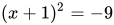 has no real solution, because the square of a real number cannot be negative, but has the two nonreal complex solutions x \= − 1 \+ 3 i {\\displaystyle x=-1+3i}  and x \= − 1 − 3 i {\\displaystyle x=-1-3i} .
Addition, subtraction and multiplication of complex numbers are defined, taking advantage of the rule i 2 \= − 1 {\\displaystyle i^{2}=-1} , along with the [associative](https://en.wikipedia.org/wiki/Associative_law "Associative law"), [commutative](https://en.wikipedia.org/wiki/Commutative_law "Commutative law"), and [distributive laws](https://en.wikipedia.org/wiki/Distributive_law "Distributive law"). Every nonzero complex number has a [multiplicative inverse](https://en.wikipedia.org/wiki/Multiplicative_inverse "Multiplicative inverse"), allowing division by complex numbers other than zero. This makes the complex numbers a [field](https://en.wikipedia.org/wiki/Field_\(mathematics\) "Field (mathematics)") with the real numbers as a subfield. Because of these properties, a \+ b i \= a \+ i b {\\displaystyle a+bi=a+ib}  , and which form is written depends upon convention and style considerations.
The complex numbers also form a [real vector space](https://en.wikipedia.org/wiki/Real_vector_space "Real vector space") of [dimension two](https://en.wikipedia.org/wiki/Two-dimensional_space "Two-dimensional space"), with { 1 , i } {\\displaystyle \\{1,i\\}}  as a [standard basis](https://en.wikipedia.org/wiki/Standard_basis "Standard basis"). This standard basis makes the complex numbers a [Cartesian plane](https://en.wikipedia.org/wiki/Cartesian_plane "Cartesian plane"), called the complex plane. This allows a geometric interpretation of the complex numbers and their operations, and conversely some geometric objects and operations can be expressed in terms of complex numbers. For example, the real numbers form the [real line](https://en.wikipedia.org/wiki/Real_line "Real line"), which is pictured as the horizontal axis of the complex plane, while real multiples of i {\\displaystyle i}  are the vertical axis. A complex number can also be defined by its geometric [polar coordinates](https://en.wikipedia.org/wiki/Polar_coordinate_system "Polar coordinate system"): the radius is called the [absolute value](https://en.wikipedia.org/wiki/Absolute_value "Absolute value") of the complex number, while the angle from the positive real axis is called the argument of the complex number. The complex numbers of absolute value one form the [unit circle](https://en.wikipedia.org/wiki/Unit_circle "Unit circle"). Adding a fixed complex number to all complex numbers defines a [translation](https://en.wikipedia.org/wiki/Translation_\(geometry\) "Translation (geometry)") in the complex plane, and multiplying by a fixed complex number is a [similarity](https://en.wikipedia.org/wiki/Similarity_\(geometry\) "Similarity (geometry)") centered at the origin (dilating by the absolute value, and rotating by the argument). The operation of [complex conjugation](https://en.wikipedia.org/wiki/Complex_conjugation "Complex conjugation") is the [reflection symmetry](https://en.wikipedia.org/wiki/Reflection_symmetry "Reflection symmetry") with respect to the real axis.
The complex numbers form a rich structure that is simultaneously an [algebraically closed field](https://en.wikipedia.org/wiki/Algebraically_closed_field "Algebraically closed field"), a [commutative algebra](https://en.wikipedia.org/wiki/Commutative_algebra_\(structure\) "Commutative algebra (structure)") over the reals, and a [Euclidean vector space](https://en.wikipedia.org/wiki/Euclidean_vector_space "Euclidean vector space") of dimension two.
## Definition and basic operations
\[[edit](https://en.wikipedia.org/w/index.php?title=Complex_number&action=edit§ion=1 "Edit section: Definition and basic operations")\]
[](https://en.wikipedia.org/wiki/File:Complex_numbers_intheplane.svg)
Various complex numbers depicted in the complex plane.
A complex number is an expression of the form *a* + *bi*, where a and b are real numbers, and *i* is an abstract symbol, the so-called imaginary unit, whose meaning will be explained further below. For example, 2 + 3*i* is a complex number.[\[3\]](https://en.wikipedia.org/wiki/Complex_number#cite_note-3)
For a complex number *a* + *bi*, the real number a is called its *real part*, and the real number b (not the complex number *bi*) is its *imaginary part*.[\[4\]](https://en.wikipedia.org/wiki/Complex_number#cite_note-4)[\[5\]](https://en.wikipedia.org/wiki/Complex_number#cite_note-5) The real part of a complex number z is denoted Re(*z*), R e ( z ) {\\displaystyle {\\mathcal {Re}}(z)} , or R ( z ) {\\displaystyle {\\mathfrak {R}}(z)} ; the imaginary part is Im(*z*), I m ( z ) {\\displaystyle {\\mathcal {Im}}(z)} , or I ( z ) {\\displaystyle {\\mathfrak {I}}(z)} : for example, Re ( 2 \+ 3 i ) \= 2 {\\textstyle \\operatorname {Re} (2+3i)=2} , Im ( 2 \+ 3 i ) \= 3 {\\displaystyle \\operatorname {Im} (2+3i)=3} .
A complex number z can be identified with the [ordered pair](https://en.wikipedia.org/wiki/Ordered_pair "Ordered pair") of real numbers ( ℜ ( z ) , ℑ ( z ) ) {\\displaystyle (\\Re (z),\\Im (z))} , which may be interpreted as coordinates of a point in a Euclidean plane with standard coordinates, which is then called the *[complex plane](https://en.wikipedia.org/wiki/Complex_plane "Complex plane")* or *[Argand diagram](https://en.wikipedia.org/wiki/Argand_diagram "Argand diagram").*[\[6\]](https://en.wikipedia.org/wiki/Complex_number#cite_note-6)[\[7\]](https://en.wikipedia.org/wiki/Complex_number#cite_note-:2-7)[\[a\]](https://en.wikipedia.org/wiki/Complex_number#cite_note-8) The horizontal axis is generally used to display the real part, with increasing values to the right, and the imaginary part marks the vertical axis, with increasing values upwards.
A real number a can be regarded as a complex number *a* + 0*i*, whose imaginary part is 0. A purely imaginary number *bi* is a complex number 0 + *bi*, whose real part is zero. It is common to write *a* + 0*i* = *a*, 0 + *bi* = *bi*, and *a* + (−*b*)*i* = *a* − *bi*; for example, 3 + (−4)*i* = 3 − 4*i*.
The [set](https://en.wikipedia.org/wiki/Set_\(mathematics\) "Set (mathematics)") of all complex numbers is denoted by C {\\displaystyle \\mathbb {C} }  ([blackboard bold](https://en.wikipedia.org/wiki/Blackboard_bold "Blackboard bold")) or **C** ([upright bold](https://en.wikipedia.org/wiki/Boldface "Boldface")).
In some disciplines such as electromagnetism and electrical engineering, j is used instead of i, as i frequently represents electric current,[\[8\]](https://en.wikipedia.org/wiki/Complex_number#cite_note-Campbell_1911-9)[\[9\]](https://en.wikipedia.org/wiki/Complex_number#cite_note-Brown-Churchill_1996-10) and complex numbers are written as *a* + *bj* or *a* + *jb*.
### Addition and subtraction
\[[edit](https://en.wikipedia.org/w/index.php?title=Complex_number&action=edit§ion=2 "Edit section: Addition and subtraction")\]
[](https://en.wikipedia.org/wiki/File:Vector_Addition.svg)
Addition of two complex numbers can be done geometrically by constructing a parallelogram.
Two complex numbers a \= x \+ y i {\\displaystyle a=x+yi}  and b \= u \+ v i {\\displaystyle b=u+vi}  are [added](https://en.wikipedia.org/wiki/Addition "Addition") by separately adding their real and imaginary parts. That is to say:
a \+ b \= ( x \+ y i ) \+ ( u \+ v i ) \= ( x \+ u ) \+ ( y \+ v ) i . {\\displaystyle a+b=(x+yi)+(u+vi)=(x+u)+(y+v)i.}  Similarly, [subtraction](https://en.wikipedia.org/wiki/Subtraction "Subtraction") can be performed as a − b \= ( x \+ y i ) − ( u \+ v i ) \= ( x − u ) \+ ( y − v ) i . {\\displaystyle a-b=(x+yi)-(u+vi)=(x-u)+(y-v)i.} 
The addition can be geometrically visualized as follows: the sum of two complex numbers a and b, interpreted as points in the complex plane, is the point obtained by building a [parallelogram](https://en.wikipedia.org/wiki/Parallelogram "Parallelogram") from the three vertices O, and the points of the arrows labeled a and b (provided that they are not on a line). Equivalently, calling these points A, B, respectively and the fourth point of the parallelogram X the [triangles](https://en.wikipedia.org/wiki/Triangle "Triangle") OAB and XBA are [congruent](https://en.wikipedia.org/wiki/Congruence_\(geometry\) "Congruence (geometry)").
### Multiplication
\[[edit](https://en.wikipedia.org/w/index.php?title=Complex_number&action=edit§ion=3 "Edit section: Multiplication")\]
[](https://en.wikipedia.org/wiki/File:Complex_number_multiplication_visualisation.svg)
Multiplication of complex numbers 2−*i* and 3+4*i* visualized with vectors
The product of two complex numbers is computed as follows:
(
a
\+
b
i
)
⋅
(
c
\+
d
i
)
\=
a
c
−
b
d
\+
(
a
d
\+
b
c
)
i
.
{\\displaystyle (a+bi)\\cdot (c+di)=ac-bd+(ad+bc)i.}

For example, ( 2 − i ) ( 3 \+ 4 i ) \= 2 ⋅ 3 − ( ( − 1 ) ⋅ 4 ) \+ ( 2 ⋅ 4 \+ ( − 1 ) ⋅ 3 ) i \= 10 \+ 5 i . {\\displaystyle (2-i)(3+4i)=2\\cdot 3-((-1)\\cdot 4)+(2\\cdot 4+(-1)\\cdot 3)i=10+5i.}  In particular, this includes as a special case the fundamental formula
i
2
\=
i
⋅
i
\=
−
1\.
{\\displaystyle i^{2}=i\\cdot i=-1.}

This formula distinguishes the complex number *i* from any real number, since the square of any (negative or positive) real number is always a non-negative real number.
With this definition of multiplication and addition, familiar rules for the arithmetic of rational or real numbers continue to hold for complex numbers. More precisely, the [distributive property](https://en.wikipedia.org/wiki/Distributive_property "Distributive property"), the [commutative properties](https://en.wikipedia.org/wiki/Commutative_property "Commutative property") (of addition and multiplication) hold. Therefore, the complex numbers form an algebraic structure known as a [*field*](https://en.wikipedia.org/wiki/Field_\(mathematics\) "Field (mathematics)"), the same way as the rational or real numbers do.[\[10\]](https://en.wikipedia.org/wiki/Complex_number#cite_note-FOOTNOTEApostol198115%E2%80%9316-11)
### Complex conjugate, absolute value, argument and division
\[[edit](https://en.wikipedia.org/w/index.php?title=Complex_number&action=edit§ion=4 "Edit section: Complex conjugate, absolute value, argument and division")\]
[](https://en.wikipedia.org/wiki/File:Complex_conjugate_picture.svg)
Geometric representation of z and its conjugate z in the complex plane.
The *[complex conjugate](https://en.wikipedia.org/wiki/Complex_conjugate "Complex conjugate")* of the complex number *z* = *x* + *yi* is defined as z ¯ \= x − y i . {\\displaystyle {\\overline {z}}=x-yi.} [\[11\]](https://en.wikipedia.org/wiki/Complex_number#cite_note-12) It is also denoted by some authors by z ∗ {\\displaystyle z^{\*}} . Geometrically, z is the ["reflection"](https://en.wikipedia.org/wiki/Reflection_symmetry "Reflection symmetry") of z about the real axis. Conjugating twice gives the original complex number: z ¯ ¯ \= z . {\\displaystyle {\\overline {\\overline {z}}}=z.}  A complex number is real if and only if it equals its own conjugate. The [unary operation](https://en.wikipedia.org/wiki/Unary_operation "Unary operation") of taking the complex conjugate of a complex number cannot be expressed by applying only the basic operations of addition, subtraction, multiplication and division.
[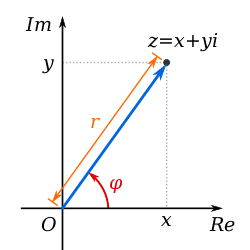](https://en.wikipedia.org/wiki/File:Complex_number_illustration_modarg.svg)
Argument φ and modulus r locate a point in the complex plane.
For any complex number *z* = *x* + *yi* , the product
z
⋅
z
¯
\=
(
x
\+
i
y
)
(
x
−
i
y
)
\=
x
2
\+
y
2
{\\displaystyle z\\cdot {\\overline {z}}=(x+iy)(x-iy)=x^{2}+y^{2}}

is a *non-negative real* number. This allows to define the *[absolute value](https://en.wikipedia.org/wiki/Absolute_value "Absolute value")* (or *modulus* or *magnitude*) of *z* to be the square root[\[12\]](https://en.wikipedia.org/wiki/Complex_number#cite_note-FOOTNOTEApostol198118-13) \| z \| \= x 2 \+ y 2 . {\\displaystyle \|z\|={\\sqrt {x^{2}+y^{2}}}.} 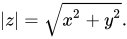 By [Pythagoras' theorem](https://en.wikipedia.org/wiki/Pythagoras%27_theorem "Pythagoras' theorem"), \| z \| {\\displaystyle \|z\|}  is the distance from the origin to the point representing the complex number *z* in the complex plane. In particular, the [circle of radius one](https://en.wikipedia.org/wiki/Unit_circle "Unit circle") around the origin consists precisely of the numbers *z* such that \| z \| \= 1 {\\displaystyle \|z\|=1} . If z \= x \= x \+ 0 i {\\displaystyle z=x=x+0i}  is a real number, then \| z \| \= \| x \| {\\displaystyle \|z\|=\|x\|} : its absolute value as a complex number and as a real number are equal.
Using the conjugate, the [reciprocal](https://en.wikipedia.org/wiki/Multiplicative_inverse "Multiplicative inverse") of a nonzero complex number z \= x \+ y i {\\displaystyle z=x+yi}  can be computed to be
1 z \= z ¯ z z ¯ \= z ¯ \| z \| 2 \= x − y i x 2 \+ y 2 \= x x 2 \+ y 2 − y x 2 \+ y 2 i . {\\displaystyle {\\frac {1}{z}}={\\frac {\\bar {z}}{z{\\bar {z}}}}={\\frac {\\bar {z}}{\|z\|^{2}}}={\\frac {x-yi}{x^{2}+y^{2}}}={\\frac {x}{x^{2}+y^{2}}}-{\\frac {y}{x^{2}+y^{2}}}i.}  More generally, the division of an arbitrary complex number w \= u \+ v i {\\displaystyle w=u+vi}  by a non-zero complex number z \= x \+ y i {\\displaystyle z=x+yi}  equals w z \= w z ¯ \| z \| 2 \= ( u \+ v i ) ( x − i y ) x 2 \+ y 2 \= u x \+ v y x 2 \+ y 2 \+ v x − u y x 2 \+ y 2 i . {\\displaystyle {\\frac {w}{z}}={\\frac {w{\\bar {z}}}{\|z\|^{2}}}={\\frac {(u+vi)(x-iy)}{x^{2}+y^{2}}}={\\frac {ux+vy}{x^{2}+y^{2}}}+{\\frac {vx-uy}{x^{2}+y^{2}}}i.}  This process is sometimes called "[rationalization](https://en.wikipedia.org/wiki/Rationalisation_\(mathematics\) "Rationalisation (mathematics)")" of the denominator (although the denominator in the final expression may be an irrational real number), because it resembles the method to remove roots from simple expressions in a denominator.[\[13\]](https://en.wikipedia.org/wiki/Complex_number#cite_note-14)[\[14\]](https://en.wikipedia.org/wiki/Complex_number#cite_note-15)
The *[argument](https://en.wikipedia.org/wiki/Argument_\(complex_analysis\) "Argument (complex analysis)")* of z (sometimes called the "phase" φ)[\[7\]](https://en.wikipedia.org/wiki/Complex_number#cite_note-:2-7) is the angle of the [radius](https://en.wikipedia.org/wiki/Radius "Radius") Oz with the positive real axis, and is written as arg *z*, expressed in [radians](https://en.wikipedia.org/wiki/Radian "Radian") in this article. The angle is defined only up to adding integer multiples of 2 π {\\displaystyle 2\\pi } , since a rotation by 2 π {\\displaystyle 2\\pi }  (or 360°) around the origin leaves all points in the complex plane unchanged. One possible choice to uniquely specify the argument is to require it to be within the interval ( − π , π \] {\\displaystyle (-\\pi ,\\pi \]} ![{\\displaystyle (-\\pi ,\\pi \]}](https://wikimedia.org/api/rest_v1/media/math/render/svg/7fbb1843079a9df3d3bbcce3249bb2599790de9c), which is referred to as the [principal value](https://en.wikipedia.org/wiki/Principal_value "Principal value").[\[15\]](https://en.wikipedia.org/wiki/Complex_number#cite_note-16) The argument can be computed from the rectangular form x + yi by means of the [arctan](https://en.wikipedia.org/wiki/Arctan "Arctan") (inverse tangent) function.[\[16\]](https://en.wikipedia.org/wiki/Complex_number#cite_note-17)
### Polar form
\[[edit](https://en.wikipedia.org/w/index.php?title=Complex_number&action=edit§ion=5 "Edit section: Polar form")\]
Main article: [Polar coordinate system](https://en.wikipedia.org/wiki/Polar_coordinate_system "Polar coordinate system")
"Polar form" redirects here. For the higher-dimensional analogue, see [Polar decomposition](https://en.wikipedia.org/wiki/Polar_decomposition "Polar decomposition").
[](https://en.wikipedia.org/wiki/File:Complex_multi.svg)
Multiplication of 2 + *i* (blue triangle) and 3 + *i* (red triangle). The red triangle is rotated to match the vertex of the blue one (the adding of both angles in the terms *φ*1\+*φ*2 in the equation) and stretched by the length of the [hypotenuse](https://en.wikipedia.org/wiki/Hypotenuse "Hypotenuse") of the blue triangle (the multiplication of both radiuses, as per term *r*1*r*2 in the equation).
For any complex number *z*, with absolute value r \= \| z \| {\\displaystyle r=\|z\|}  and argument φ {\\displaystyle \\varphi } , the equation
z
\=
r
(
cos
φ
\+
i
sin
φ
)
{\\displaystyle z=r(\\cos \\varphi +i\\sin \\varphi )}

holds. This identity is referred to as the polar form of *z*. It is sometimes abbreviated as z \= r c i s φ {\\textstyle z=r\\operatorname {\\mathrm {cis} } \\varphi } . In electronics, one represents a [phasor](https://en.wikipedia.org/wiki/Phasor_\(sine_waves\) "Phasor (sine waves)") with amplitude r and phase φ in [angle notation](https://en.wikipedia.org/wiki/Angle_notation "Angle notation"):[\[17\]](https://en.wikipedia.org/wiki/Complex_number#cite_note-18)z \= r ∠ φ . {\\displaystyle z=r\\angle \\varphi .} 
If two complex numbers are given in polar form, i.e., *z*1 = *r*1(cos *φ*1 + *i* sin *φ*1) and *z*2 = *r*2(cos *φ*2 + *i* sin *φ*2), the product and division can be computed as z 1 z 2 \= r 1 r 2 ( cos ( φ 1 \+ φ 2 ) \+ i sin ( φ 1 \+ φ 2 ) ) . {\\displaystyle z\_{1}z\_{2}=r\_{1}r\_{2}(\\cos(\\varphi \_{1}+\\varphi \_{2})+i\\sin(\\varphi \_{1}+\\varphi \_{2})).}  z 1 z 2 \= r 1 r 2 ( cos ( φ 1 − φ 2 ) \+ i sin ( φ 1 − φ 2 ) ) , if z 2 ≠ 0\. {\\displaystyle {\\frac {z\_{1}}{z\_{2}}}={\\frac {r\_{1}}{r\_{2}}}\\left(\\cos(\\varphi \_{1}-\\varphi \_{2})+i\\sin(\\varphi \_{1}-\\varphi \_{2})\\right),{\\text{if }}z\_{2}\\neq 0.}  (These are a consequence of the [trigonometric identities](https://en.wikipedia.org/wiki/Trigonometric_identities "Trigonometric identities") for the sine and cosine function.) In other words, the absolute values are *multiplied* and the arguments are *added* to yield the polar form of the product. The picture at the right illustrates the multiplication of ( 2 \+ i ) ( 3 \+ i ) \= 5 \+ 5 i . {\\displaystyle (2+i)(3+i)=5+5i.}  Because the real and imaginary part of 5 + 5*i* are equal, the argument of that number is 45 degrees, or *π*/4 (in [radian](https://en.wikipedia.org/wiki/Radian "Radian")). On the other hand, it is also the sum of the angles at the origin of the red and blue triangles are [arctan](https://en.wikipedia.org/wiki/Arctan "Arctan")(1/3) and arctan(1/2), respectively. Thus, the formula π 4 \= arctan ( 1 2 ) \+ arctan ( 1 3 ) {\\displaystyle {\\frac {\\pi }{4}}=\\arctan \\left({\\frac {1}{2}}\\right)+\\arctan \\left({\\frac {1}{3}}\\right)}  holds. As the [arctan](https://en.wikipedia.org/wiki/Arctan "Arctan") function can be approximated highly efficiently, formulas like this – known as [Machin-like formulas](https://en.wikipedia.org/wiki/Machin-like_formula "Machin-like formula") – are used for high-precision approximations of [π](https://en.wikipedia.org/wiki/Pi "Pi"):[\[18\]](https://en.wikipedia.org/wiki/Complex_number#cite_note-19) π 4 \= 4 arctan ( 1 5 ) − arctan ( 1 239 ) {\\displaystyle {\\frac {\\pi }{4}}=4\\arctan \\left({\\frac {1}{5}}\\right)-\\arctan \\left({\\frac {1}{239}}\\right)} 
### Powers and roots
\[[edit](https://en.wikipedia.org/w/index.php?title=Complex_number&action=edit§ion=6 "Edit section: Powers and roots")\]
See also: [Square roots of negative and complex numbers](https://en.wikipedia.org/wiki/Square_root#Square_roots_of_negative_and_complex_numbers "Square root")
The *n*\-th power of a complex number can be computed using [de Moivre's formula](https://en.wikipedia.org/wiki/De_Moivre%27s_formula "De Moivre's formula"), which is obtained by repeatedly applying the above formula for the product: z n \= z ⋅ ⋯ ⋅ z ⏟ n factors \= ( r ( cos φ \+ i sin φ ) ) n \= r n ( cos n φ \+ i sin n φ ) . {\\displaystyle z^{n}=\\underbrace {z\\cdot \\dots \\cdot z} \_{n{\\text{ factors}}}=(r(\\cos \\varphi +i\\sin \\varphi ))^{n}=r^{n}\\,(\\cos n\\varphi +i\\sin n\\varphi ).}  For example, the first few powers of the imaginary unit *i* are i , i 2 \= − 1 , i 3 \= − i , i 4 \= 1 , i 5 \= i , … {\\displaystyle i,i^{2}=-1,i^{3}=-i,i^{4}=1,i^{5}=i,\\dots } .
[](https://en.wikipedia.org/wiki/File:Visualisation_complex_number_roots.svg)
Geometric representation of the 2nd to 6th roots of a complex number z, in polar form *re**iφ* where *r* = \|*z* \| and *φ* = arg *z*. If z is real, *φ* = 0 or π. Principal roots are shown in black.
The n [nth roots](https://en.wikipedia.org/wiki/Nth_root "Nth root") of a complex number z are given by z 1 / n \= r n ( cos ( φ \+ 2 k π n ) \+ i sin ( φ \+ 2 k π n ) ) {\\displaystyle z^{1/n}={\\sqrt\[{n}\]{r}}\\left(\\cos \\left({\\frac {\\varphi +2k\\pi }{n}}\\right)+i\\sin \\left({\\frac {\\varphi +2k\\pi }{n}}\\right)\\right)} ![{\\displaystyle z^{1/n}={\\sqrt\[{n}\]{r}}\\left(\\cos \\left({\\frac {\\varphi +2k\\pi }{n}}\\right)+i\\sin \\left({\\frac {\\varphi +2k\\pi }{n}}\\right)\\right)}](https://wikimedia.org/api/rest_v1/media/math/render/svg/1cc1b3406644f788c1ac1799d6328118ee66516f) for 0 ≤ *k* ≤ *n* − 1. (Here r n {\\displaystyle {\\sqrt\[{n}\]{r}}} ![{\\displaystyle {\\sqrt\[{n}\]{r}}}](https://wikimedia.org/api/rest_v1/media/math/render/svg/10eb7386bd8efe4c5b5beafe05848fbd923e1413) is the usual (positive) nth root of the positive real number r.) Because sine and cosine are periodic, other integer values of k do not give other values. For any z ≠ 0 {\\displaystyle z\\neq 0} , there are, in particular *n* distinct complex *n*\-th roots. For example, there are 4 fourth roots of 1, namely
z
1
\=
1
,
z
2
\=
i
,
z
3
\=
−
1
,
z
4
\=
−
i
.
{\\displaystyle z\_{1}=1,z\_{2}=i,z\_{3}=-1,z\_{4}=-i.}

In general there is *no* natural way of distinguishing one particular complex nth root of a complex number. (This is in contrast to the roots of a positive real number *x*, which has a unique positive real *n*\-th root, which is therefore commonly referred to as *the* *n*\-th root of *x*.) One refers to this situation by saying that the nth root is a [n\-valued function](https://en.wikipedia.org/wiki/Multivalued_function "Multivalued function") of z.
### Fundamental theorem of algebra
\[[edit](https://en.wikipedia.org/w/index.php?title=Complex_number&action=edit§ion=7 "Edit section: Fundamental theorem of algebra")\]
The [fundamental theorem of algebra](https://en.wikipedia.org/wiki/Fundamental_theorem_of_algebra "Fundamental theorem of algebra"), of [Carl Friedrich Gauss](https://en.wikipedia.org/wiki/Carl_Friedrich_Gauss "Carl Friedrich Gauss") and [Jean le Rond d'Alembert](https://en.wikipedia.org/wiki/Jean_le_Rond_d%27Alembert "Jean le Rond d'Alembert"), states that for any complex numbers (called [coefficients](https://en.wikipedia.org/wiki/Coefficient "Coefficient")) *a*0, ..., *a**n*, the equation a n z n \+ ⋯ \+ a 1 z \+ a 0 \= 0 {\\displaystyle a\_{n}z^{n}+\\dotsb +a\_{1}z+a\_{0}=0}  has at least one complex solution *z*, provided that at least one of the higher coefficients *a*1, ..., *a**n* is nonzero.[\[19\]](https://en.wikipedia.org/wiki/Complex_number#cite_note-Bourbaki_1998_loc=%C2%A7VIII.1-20) This property does not hold for the [field of rational numbers](https://en.wikipedia.org/wiki/Rational_number "Rational number") Q {\\displaystyle \\mathbb {Q} }  (the polynomial *x*2 − 2 does not have a rational root, because √2 is not a rational number) nor the real numbers R {\\displaystyle \\mathbb {R} }  (the polynomial *x*2 + 4 does not have a real root, because the square of x is positive for any real number x).
Because of this fact, C {\\displaystyle \\mathbb {C} }  is called an [algebraically closed field](https://en.wikipedia.org/wiki/Algebraically_closed_field "Algebraically closed field"). It is a cornerstone of various applications of complex numbers, as is detailed further below. There are various proofs of this theorem, by either analytic methods such as [Liouville's theorem](https://en.wikipedia.org/wiki/Liouville%27s_theorem_\(complex_analysis\) "Liouville's theorem (complex analysis)"), or [topological](https://en.wikipedia.org/wiki/Topology "Topology") ones such as the [winding number](https://en.wikipedia.org/wiki/Winding_number "Winding number"), or a proof combining [Galois theory](https://en.wikipedia.org/wiki/Galois_theory "Galois theory") and the fact that any real polynomial of *odd* degree has at least one real root.
The field of complex numbers is defined as the (unique) algebraic [extension field](https://en.wikipedia.org/wiki/Extension_field "Extension field") of the real numbers later in [\#Abstract algebraic definitions](https://en.wikipedia.org/wiki/Complex_number#Abstract_algebraic_definitions).
## History
\[[edit](https://en.wikipedia.org/w/index.php?title=Complex_number&action=edit§ion=8 "Edit section: History")\]
See also: [Negative number § History](https://en.wikipedia.org/wiki/Negative_number#History "Negative number")
The solution in [radicals](https://en.wikipedia.org/wiki/Nth_root "Nth root") (without [trigonometric functions](https://en.wikipedia.org/wiki/Trigonometric_functions "Trigonometric functions")) of a general [cubic equation](https://en.wikipedia.org/wiki/Cubic_equation "Cubic equation"), when all three of its roots are real numbers, contains the square roots of [negative numbers](https://en.wikipedia.org/wiki/Negative_numbers "Negative numbers"), a situation that cannot be rectified by factoring aided by the [rational root test](https://en.wikipedia.org/wiki/Rational_root_test "Rational root test"), if the cubic is [irreducible](https://en.wikipedia.org/wiki/Irreducible_polynomial "Irreducible polynomial"); this is the so-called *[casus irreducibilis](https://en.wikipedia.org/wiki/Casus_irreducibilis "Casus irreducibilis")* ("irreducible case"). This conundrum led Italian mathematician [Gerolamo Cardano](https://en.wikipedia.org/wiki/Gerolamo_Cardano "Gerolamo Cardano") to conceive of complex numbers in around 1545 in his *[Ars Magna](https://en.wikipedia.org/wiki/Ars_Magna_\(Cardano_book\) "Ars Magna (Cardano book)")*,[\[20\]](https://en.wikipedia.org/wiki/Complex_number#cite_note-21) though his understanding was rudimentary; moreover, he later described complex numbers as being "as subtle as they are useless".[\[21\]](https://en.wikipedia.org/wiki/Complex_number#cite_note-22) Cardano did use imaginary numbers, but described using them as "mental torture".[\[22\]](https://en.wikipedia.org/wiki/Complex_number#cite_note-23) This was prior to the use of the graphical complex plane. Cardano and other Italian mathematicians, notably [Scipione del Ferro](https://en.wikipedia.org/wiki/Scipione_del_Ferro "Scipione del Ferro"), in the 1500s created an algorithm for solving cubic equations which generally had one real solution and two solutions containing an imaginary number. Because they ignored the answers with the imaginary numbers, Cardano found them useless.[\[23\]](https://en.wikipedia.org/wiki/Complex_number#cite_note-24)
Work on the problem of general polynomials ultimately led to the fundamental theorem of algebra, which shows that with complex numbers, a solution exists to every [polynomial equation](https://en.wikipedia.org/wiki/Polynomial_equation "Polynomial equation") of degree one or higher. Complex numbers thus form an [algebraically closed field](https://en.wikipedia.org/wiki/Algebraically_closed_field "Algebraically closed field"), where any polynomial equation has a [root](https://en.wikipedia.org/wiki/Root_of_a_function "Root of a function").
Many mathematicians contributed to the development of complex numbers. The rules for addition, subtraction, multiplication, and root extraction of complex numbers were developed by the Italian mathematician [Rafael Bombelli](https://en.wikipedia.org/wiki/Rafael_Bombelli "Rafael Bombelli").[\[24\]](https://en.wikipedia.org/wiki/Complex_number#cite_note-25) A more abstract formalism for the complex numbers was further developed by the Irish mathematician [William Rowan Hamilton](https://en.wikipedia.org/wiki/William_Rowan_Hamilton "William Rowan Hamilton"), who extended this abstraction to the theory of [quaternions](https://en.wikipedia.org/wiki/Quaternions "Quaternions").[\[25\]](https://en.wikipedia.org/wiki/Complex_number#cite_note-26)
The earliest fleeting reference to [square roots](https://en.wikipedia.org/wiki/Square_root "Square root") of [negative numbers](https://en.wikipedia.org/wiki/Negative_number "Negative number") can perhaps be said to occur in the work of the Greek mathematician [Hero of Alexandria](https://en.wikipedia.org/wiki/Hero_of_Alexandria "Hero of Alexandria") in the 1st century [AD](https://en.wikipedia.org/wiki/AD "AD"), where in his *[Stereometrica](https://en.wikipedia.org/wiki/Hero_of_Alexandria#Bibliography "Hero of Alexandria")* he considered, apparently in error, the volume of an impossible [frustum](https://en.wikipedia.org/wiki/Frustum "Frustum") of a [pyramid](https://en.wikipedia.org/wiki/Pyramid "Pyramid") to arrive at the term 81 − 144 {\\displaystyle {\\sqrt {81-144}}}  in his calculations, which today would simplify to − 63 \= 3 i 7 {\\displaystyle {\\sqrt {-63}}=3i{\\sqrt {7}}} 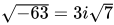.[\[b\]](https://en.wikipedia.org/wiki/Complex_number#cite_note-28) Negative quantities were not conceived of in [Hellenistic mathematics](https://en.wikipedia.org/wiki/Hellenistic_mathematics "Hellenistic mathematics") and Hero merely replaced the negative value by its positive 144 − 81 \= 3 7 . {\\displaystyle {\\sqrt {144-81}}=3{\\sqrt {7}}.} [\[27\]](https://en.wikipedia.org/wiki/Complex_number#cite_note-29)
The impetus to study complex numbers as a topic in itself first arose in the 16th century when [algebraic solutions](https://en.wikipedia.org/wiki/Algebraic_solution "Algebraic solution") for the roots of [cubic](https://en.wikipedia.org/wiki/Cubic_equation "Cubic equation") and [quartic](https://en.wikipedia.org/wiki/Quartic_equation "Quartic equation") [polynomials](https://en.wikipedia.org/wiki/Polynomial "Polynomial") were discovered by Italian mathematicians ([Niccolò Fontana Tartaglia](https://en.wikipedia.org/wiki/Niccol%C3%B2_Fontana_Tartaglia "Niccolò Fontana Tartaglia") and [Gerolamo Cardano](https://en.wikipedia.org/wiki/Gerolamo_Cardano "Gerolamo Cardano")). It was soon realized (but proved much later)[\[28\]](https://en.wikipedia.org/wiki/Complex_number#cite_note-Casus-30) that these formulas, even if one were interested only in real solutions, sometimes required the manipulation of square roots of negative numbers. In fact, it was proved later that the use of complex numbers [is unavoidable](https://en.wikipedia.org/wiki/Casus_irreducibilis "Casus irreducibilis") when all three roots are real and distinct.[\[c\]](https://en.wikipedia.org/wiki/Complex_number#cite_note-31) However, the general formula can still be used in this case, with some care to deal with the ambiguity resulting from the existence of three cubic roots for nonzero complex numbers. Rafael Bombelli was the first to address explicitly these seemingly paradoxical solutions of cubic equations and developed the rules for complex arithmetic, trying to resolve these issues.
The term "imaginary" for these quantities was coined by [René Descartes](https://en.wikipedia.org/wiki/Ren%C3%A9_Descartes "René Descartes") in 1637, who was at pains to stress their unreal nature:[\[29\]](https://en.wikipedia.org/wiki/Complex_number#cite_note-32)
> ... sometimes only imaginary, that is one can imagine as many as I said in each equation, but sometimes there exists no quantity that matches that which we imagine.
> \[*... quelquefois seulement imaginaires c'est-à-dire que l'on peut toujours en imaginer autant que j'ai dit en chaque équation, mais qu'il n'y a quelquefois aucune quantité qui corresponde à celle qu'on imagine.*\]
A further source of confusion was that the equation − 1 2 \= − 1 − 1 \= − 1 {\\displaystyle {\\sqrt {-1}}^{2}={\\sqrt {-1}}{\\sqrt {-1}}=-1}  seemed to be capriciously inconsistent with the algebraic identity a b \= a b {\\displaystyle {\\sqrt {a}}{\\sqrt {b}}={\\sqrt {ab}}} 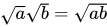, which is valid for non-negative real numbers a and b, and which was also used in complex number calculations with one of a, b positive and the other negative. The incorrect use of this identity in the case when both a and b are negative, and the related identity 1 a \= 1 a {\\textstyle {\\frac {1}{\\sqrt {a}}}={\\sqrt {\\frac {1}{a}}}} , even bedeviled [Leonhard Euler](https://en.wikipedia.org/wiki/Leonhard_Euler "Leonhard Euler"). This difficulty eventually led to the convention of using the special symbol *i* in place of − 1 {\\displaystyle {\\sqrt {-1}}}  to guard against this mistake.[\[30\]](https://en.wikipedia.org/wiki/Complex_number#cite_note-33)[\[31\]](https://en.wikipedia.org/wiki/Complex_number#cite_note-34) Even so, Euler considered it natural to introduce students to complex numbers much earlier than we do today. In his elementary algebra text book, *[Elements of Algebra](https://en.wikipedia.org/wiki/Elements_of_Algebra "Elements of Algebra")*, he introduces these numbers almost at once and then uses them in a natural way throughout.
In the 18th century complex numbers gained wider use, as it was noticed that formal manipulation of complex expressions could be used to simplify calculations involving trigonometric functions. For instance, in 1730 [Abraham de Moivre](https://en.wikipedia.org/wiki/Abraham_de_Moivre "Abraham de Moivre") noted that the identities relating trigonometric functions of an integer multiple of an angle to powers of trigonometric functions of that angle could be re-expressed by the following [de Moivre's formula](https://en.wikipedia.org/wiki/De_Moivre%27s_formula "De Moivre's formula"):
( cos θ \+ i sin θ ) n \= cos n θ \+ i sin n θ . {\\displaystyle (\\cos \\theta +i\\sin \\theta )^{n}=\\cos n\\theta +i\\sin n\\theta .} 
[](https://en.wikipedia.org/wiki/File:Circle_cos_sin.gif)
Euler's formula relates the complex exponential function of an imaginary argument, which can be thought of as describing [uniform circular motion](https://en.wikipedia.org/wiki/Uniform_circular_motion "Uniform circular motion") in the complex plane, to the cosine and sine functions, geometrically its projections onto the real and imaginary axes, respectively.
In 1748, Euler went further and obtained [Euler's formula](https://en.wikipedia.org/wiki/Euler%27s_formula "Euler's formula") of [complex analysis](https://en.wikipedia.org/wiki/Complex_analysis "Complex analysis"):[\[32\]](https://en.wikipedia.org/wiki/Complex_number#cite_note-35)
e i θ \= cos θ \+ i sin θ {\\displaystyle e^{i\\theta }=\\cos \\theta +i\\sin \\theta } 
by formally manipulating complex [power series](https://en.wikipedia.org/wiki/Power_series "Power series") and observed that this formula could be used to reduce any trigonometric identity to much simpler exponential identities.
The idea of a complex number as a point in the complex plane was first described by [Danish](https://en.wikipedia.org/wiki/Denmark "Denmark")–[Norwegian](https://en.wikipedia.org/wiki/Norway "Norway") [mathematician](https://en.wikipedia.org/wiki/Mathematician "Mathematician") [Caspar Wessel](https://en.wikipedia.org/wiki/Caspar_Wessel "Caspar Wessel") in 1799,[\[33\]](https://en.wikipedia.org/wiki/Complex_number#cite_note-36) although it had been anticipated as early as 1685 in [Wallis's](https://en.wikipedia.org/wiki/John_Wallis "John Wallis") *A Treatise of Algebra*.[\[34\]](https://en.wikipedia.org/wiki/Complex_number#cite_note-37)
Wessel's memoir appeared in the Proceedings of the [Copenhagen Academy](https://en.wikipedia.org/wiki/Copenhagen_Academy "Copenhagen Academy") but went largely unnoticed. In 1806 [Jean-Robert Argand](https://en.wikipedia.org/wiki/Jean-Robert_Argand "Jean-Robert Argand") independently issued a pamphlet on complex numbers and provided a rigorous proof of the [fundamental theorem of algebra](https://en.wikipedia.org/wiki/Fundamental_theorem_of_algebra#History "Fundamental theorem of algebra").[\[35\]](https://en.wikipedia.org/wiki/Complex_number#cite_note-38) [Carl Friedrich Gauss](https://en.wikipedia.org/wiki/Carl_Friedrich_Gauss "Carl Friedrich Gauss") had earlier published an essentially [topological](https://en.wikipedia.org/wiki/Topology "Topology") proof of the theorem in 1797 but expressed his doubts at the time about "the true metaphysics of the square root of −1".[\[36\]](https://en.wikipedia.org/wiki/Complex_number#cite_note-39) It was not until 1831 that he overcame these doubts and published his treatise on complex numbers as points in the plane,[\[37\]](https://en.wikipedia.org/wiki/Complex_number#cite_note-Ewald-40) largely establishing modern notation and terminology:[\[38\]](https://en.wikipedia.org/wiki/Complex_number#cite_note-FOOTNOTEGauss1831-41)
> If one formerly contemplated this subject from a false point of view and therefore found a mysterious darkness, this is in large part attributable to clumsy terminology. Had one not called +1, −1, − 1 {\\displaystyle {\\sqrt {-1}}}  positive, negative, or imaginary (or even impossible) units, but instead, say, direct, inverse, or lateral units, then there could scarcely have been talk of such darkness.
In the beginning of the 19th century, other mathematicians discovered independently the geometrical representation of the complex numbers: Buée,[\[39\]](https://en.wikipedia.org/wiki/Complex_number#cite_note-42)[\[40\]](https://en.wikipedia.org/wiki/Complex_number#cite_note-43) [Mourey](https://en.wikipedia.org/wiki/C._V._Mourey "C. V. Mourey"),[\[41\]](https://en.wikipedia.org/wiki/Complex_number#cite_note-44) [Warren](https://en.wikipedia.org/w/index.php?title=John_Warren_\(mathematician\)&action=edit&redlink=1 "John Warren (mathematician) (page does not exist)"),[\[42\]](https://en.wikipedia.org/wiki/Complex_number#cite_note-45)[\[43\]](https://en.wikipedia.org/wiki/Complex_number#cite_note-46)[\[44\]](https://en.wikipedia.org/wiki/Complex_number#cite_note-47) [Français](https://en.wikipedia.org/wiki/Jacques_Fr%C3%A9d%C3%A9ric_Fran%C3%A7ais "Jacques Frédéric Français") and his brother, [Bellavitis](https://en.wikipedia.org/wiki/Giusto_Bellavitis "Giusto Bellavitis").[\[45\]](https://en.wikipedia.org/wiki/Complex_number#cite_note-48)[\[46\]](https://en.wikipedia.org/wiki/Complex_number#cite_note-49)
The English mathematician [G.H. Hardy](https://en.wikipedia.org/wiki/G.H._Hardy "G.H. Hardy") remarked that Gauss was the first mathematician to use complex numbers in "a really confident and scientific way" although mathematicians such as Norwegian [Niels Henrik Abel](https://en.wikipedia.org/wiki/Niels_Henrik_Abel "Niels Henrik Abel") and [Carl Gustav Jacob Jacobi](https://en.wikipedia.org/wiki/Carl_Gustav_Jacob_Jacobi "Carl Gustav Jacob Jacobi") were necessarily using them routinely before Gauss published his 1831 treatise.[\[47\]](https://en.wikipedia.org/wiki/Complex_number#cite_note-50)
[Augustin-Louis Cauchy](https://en.wikipedia.org/wiki/Augustin-Louis_Cauchy "Augustin-Louis Cauchy") and [Bernhard Riemann](https://en.wikipedia.org/wiki/Bernhard_Riemann "Bernhard Riemann") together brought the fundamental ideas of [complex analysis](https://en.wikipedia.org/wiki/Complex_number#Complex_analysis) to a high state of completion, commencing around 1825 in Cauchy's case.
The common terms used in the theory are chiefly due to the founders. Argand called cos *φ* + *i* sin *φ* the *direction factor*, and r \= a 2 \+ b 2 {\\displaystyle r={\\sqrt {a^{2}+b^{2}}}} 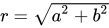 the *modulus*;[\[d\]](https://en.wikipedia.org/wiki/Complex_number#cite_note-51)[\[48\]](https://en.wikipedia.org/wiki/Complex_number#cite_note-52) Cauchy (1821) called cos *φ* + *i* sin *φ* the *reduced form* (l'expression réduite)[\[49\]](https://en.wikipedia.org/wiki/Complex_number#cite_note-53) and apparently introduced the term *argument*; Gauss used *i* for − 1 {\\displaystyle {\\sqrt {-1}}} ,[\[e\]](https://en.wikipedia.org/wiki/Complex_number#cite_note-55) introduced the term *complex number* for *a* + *bi*,[\[f\]](https://en.wikipedia.org/wiki/Complex_number#cite_note-57) and called *a*2 + *b*2 the *norm*.[\[g\]](https://en.wikipedia.org/wiki/Complex_number#cite_note-59) The expression *direction coefficient*, often used for cos *φ* + *i* sin *φ*, is due to Hankel (1867),[\[53\]](https://en.wikipedia.org/wiki/Complex_number#cite_note-60) and *absolute value,* for *modulus,* is due to Weierstrass.
Later classical writers on the general theory include [Richard Dedekind](https://en.wikipedia.org/wiki/Richard_Dedekind "Richard Dedekind"), [Otto Hölder](https://en.wikipedia.org/wiki/Otto_H%C3%B6lder "Otto Hölder"), [Felix Klein](https://en.wikipedia.org/wiki/Felix_Klein "Felix Klein"), [Henri Poincaré](https://en.wikipedia.org/wiki/Henri_Poincar%C3%A9 "Henri Poincaré"), [Hermann Schwarz](https://en.wikipedia.org/wiki/Hermann_Schwarz "Hermann Schwarz"), [Karl Weierstrass](https://en.wikipedia.org/wiki/Karl_Weierstrass "Karl Weierstrass") and many others. Important work (including a systematization) in complex multivariate calculus has been started at beginning of the 20th century. Important results have been achieved by [Wilhelm Wirtinger](https://en.wikipedia.org/wiki/Wilhelm_Wirtinger "Wilhelm Wirtinger") in 1927.
## Abstract algebraic definitions
\[[edit](https://en.wikipedia.org/w/index.php?title=Complex_number&action=edit§ion=9 "Edit section: Abstract algebraic definitions")\]
While the above low-level definitions, including the addition and multiplication, accurately describe the complex numbers, there are other, equivalent approaches that reveal the abstract algebraic structure of the complex numbers more immediately.
One formal definition of the set of all complex numbers is obtained by taking an extension field E {\\displaystyle E}  of R {\\displaystyle \\mathbb {R} }  such that the equation x 2 \+ 1 \= 0 {\\displaystyle x^{2}+1=0}  has a solution in E {\\displaystyle E} , calling an arbitrarily chosen solution in E {\\displaystyle E}  of x 2 \+ 1 \= 0 {\\displaystyle x^{2}+1=0}  by the letter i {\\displaystyle i} , and defining the set of all complex numbers as the subfield C \= { z ∈ E \| there exists x , y ∈ R such that z \= x \+ i y } {\\displaystyle \\mathbb {C} =\\{z\\in E\\vert {\\text{there exists }}x,y\\in \\mathbb {R} {\\text{ such that }}z=x+iy\\}} .[\[54\]](https://en.wikipedia.org/wiki/Complex_number#cite_note-61) Any two such fields are isomorphic; more generally, any non-trivial finite extension field of the reals is isomorphic to the complex field.
### Construction as a quotient field
\[[edit](https://en.wikipedia.org/w/index.php?title=Complex_number&action=edit§ion=10 "Edit section: Construction as a quotient field")\]
One approach to C {\\displaystyle \\mathbb {C} }  is via [polynomials](https://en.wikipedia.org/wiki/Polynomial "Polynomial"), i.e., expressions of the form p ( X ) \= a n X n \+ ⋯ \+ a 1 X \+ a 0 , {\\displaystyle p(X)=a\_{n}X^{n}+\\dotsb +a\_{1}X+a\_{0},}  where the [coefficients](https://en.wikipedia.org/wiki/Coefficient "Coefficient") *a*0, ..., *a**n* are real numbers. The set of all such polynomials is denoted by R \[ X \] {\\displaystyle \\mathbb {R} \[X\]} ![{\\displaystyle \\mathbb {R} \[X\]}](https://wikimedia.org/api/rest_v1/media/math/render/svg/16d740527b0b7f949b4bf9c9ce004134bb490b68). Since sums and products of polynomials are again polynomials, this set R \[ X \] {\\displaystyle \\mathbb {R} \[X\]} ![{\\displaystyle \\mathbb {R} \[X\]}](https://wikimedia.org/api/rest_v1/media/math/render/svg/16d740527b0b7f949b4bf9c9ce004134bb490b68) forms a [commutative ring](https://en.wikipedia.org/wiki/Commutative_ring "Commutative ring"), called the [polynomial ring](https://en.wikipedia.org/wiki/Polynomial_ring "Polynomial ring") (over the reals). To every such polynomial *p*, one may assign the complex number p ( i ) \= a n i n \+ ⋯ \+ a 1 i \+ a 0 {\\displaystyle p(i)=a\_{n}i^{n}+\\dotsb +a\_{1}i+a\_{0}} , i.e., the value obtained by setting X \= i {\\displaystyle X=i} . This defines a function
R
\[
X
\]
→
C
{\\displaystyle \\mathbb {R} \[X\]\\to \\mathbb {C} }
![{\\displaystyle \\mathbb {R} \[X\]\\to \\mathbb {C} }](https://wikimedia.org/api/rest_v1/media/math/render/svg/029b404ca14e700bc8fd42f11a126173d5c1a6cb)
This function is [surjective](https://en.wikipedia.org/wiki/Surjective "Surjective") since every complex number can be obtained in such a way: the evaluation of a [linear polynomial](https://en.wikipedia.org/wiki/Linear_polynomial "Linear polynomial") a \+ b X {\\displaystyle a+bX}  at X \= i {\\displaystyle X=i}  is a \+ b i {\\displaystyle a+bi} . However, the evaluation of polynomial X 2 \+ 1 {\\displaystyle X^{2}+1}  at *i* is 0, since i 2 \+ 1 \= 0\. {\\displaystyle i^{2}+1=0.}  This polynomial is [irreducible](https://en.wikipedia.org/wiki/Irreducible_polynomial "Irreducible polynomial"), i.e., cannot be written as a product of two linear polynomials. Basic facts of [abstract algebra](https://en.wikipedia.org/wiki/Abstract_algebra "Abstract algebra") then imply that the [kernel](https://en.wikipedia.org/wiki/Kernel_\(algebra\) "Kernel (algebra)") of the above map is an [ideal](https://en.wikipedia.org/wiki/Ideal_\(ring_theory\) "Ideal (ring theory)") generated by this polynomial, and that the quotient by this ideal is a field, and that there is an [isomorphism](https://en.wikipedia.org/wiki/Isomorphism "Isomorphism")
R
\[
X
\]
/
(
X
2
\+
1
)
→
≅
C
{\\displaystyle \\mathbb {R} \[X\]/(X^{2}+1){\\stackrel {\\cong }{\\to }}\\mathbb {C} }
![{\\displaystyle \\mathbb {R} \[X\]/(X^{2}+1){\\stackrel {\\cong }{\\to }}\\mathbb {C} }](https://wikimedia.org/api/rest_v1/media/math/render/svg/a397538266a79eecf6b7e746fb7791a3bcf532a2)
between the quotient ring and C {\\displaystyle \\mathbb {C} } . Some authors take this as the definition of C {\\displaystyle \\mathbb {C} } .[\[55\]](https://en.wikipedia.org/wiki/Complex_number#cite_note-62) This definition expresses C {\\displaystyle \\mathbb {C} }  as a [quadratic algebra](https://en.wikipedia.org/wiki/Quadratic_algebra "Quadratic algebra").
Accepting that C {\\displaystyle \\mathbb {C} }  is algebraically closed, because it is an [algebraic extension](https://en.wikipedia.org/wiki/Algebraic_extension "Algebraic extension") of R {\\displaystyle \\mathbb {R} }  in this approach, C {\\displaystyle \\mathbb {C} }  is therefore the [algebraic closure](https://en.wikipedia.org/wiki/Algebraic_closure "Algebraic closure") of R . {\\displaystyle \\mathbb {R} .} 
### Matrix representation of complex numbers
\[[edit](https://en.wikipedia.org/w/index.php?title=Complex_number&action=edit§ion=11 "Edit section: Matrix representation of complex numbers")\]
Complex numbers *a* + *bi* can also be represented by 2 × 2 [matrices](https://en.wikipedia.org/wiki/Matrix_\(mathematics\) "Matrix (mathematics)") that have the form ( a − b b a ) . {\\displaystyle {\\begin{pmatrix}a&-b\\\\b&\\;\\;a\\end{pmatrix}}.}  Here the entries a and b are real numbers. As the sum and product of two such matrices is again of this form, these matrices form a [subring](https://en.wikipedia.org/wiki/Subring "Subring") of the ring of 2 × 2 matrices.
A simple computation shows that the map a \+ i b ↦ ( a − b b a ) {\\displaystyle a+ib\\mapsto {\\begin{pmatrix}a&-b\\\\b&\\;\\;a\\end{pmatrix}}} 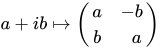 is a [ring isomorphism](https://en.wikipedia.org/wiki/Ring_isomorphism "Ring isomorphism") from the field of complex numbers to the ring of these matrices, proving that these matrices form a field. This isomorphism associates the square of the absolute value of a complex number with the [determinant](https://en.wikipedia.org/wiki/Determinant "Determinant") of the corresponding matrix, and the conjugate of a complex number with the [transpose](https://en.wikipedia.org/wiki/Transpose "Transpose") of the matrix.
The [polar form](https://en.wikipedia.org/wiki/Polar_form "Polar form") representation of complex numbers explicitly gives these matrices as scaled [rotation matrices](https://en.wikipedia.org/wiki/Rotation_matrix "Rotation matrix"). r ( cos θ \+ i sin θ ) ↦ ( r cos θ − r sin θ r sin θ r cos θ ) {\\displaystyle r(\\cos \\theta +i\\sin \\theta )\\mapsto {\\begin{pmatrix}r\\cos \\theta &-r\\sin \\theta \\\\r\\sin \\theta &\\;\\;r\\cos \\theta \\end{pmatrix}}}  In particular, the case of *r* = 1, which is \| a \+ i b \| \= a 2 \+ b 2 \= 1 {\\displaystyle \|a+ib\|={\\sqrt {a^{2}+b^{2}}}=1} , gives (unscaled) rotation matrices.
## Complex analysis
\[[edit](https://en.wikipedia.org/w/index.php?title=Complex_number&action=edit§ion=12 "Edit section: Complex analysis")\]
Main article: [Complex analysis](https://en.wikipedia.org/wiki/Complex_analysis "Complex analysis")
The study of functions of a complex variable is known as *[complex analysis](https://en.wikipedia.org/wiki/Complex_analysis "Complex analysis")* and has enormous practical use in [applied mathematics](https://en.wikipedia.org/wiki/Applied_mathematics "Applied mathematics") as well as in other branches of mathematics. Often, the most natural proofs for statements in [real analysis](https://en.wikipedia.org/wiki/Real_analysis "Real analysis") or even [number theory](https://en.wikipedia.org/wiki/Number_theory "Number theory") employ techniques from complex analysis (see [prime number theorem](https://en.wikipedia.org/wiki/Prime_number_theorem "Prime number theorem") for an example).
[](https://en.wikipedia.org/wiki/File:Complex-plot.png)
A [domain coloring](https://en.wikipedia.org/wiki/Domain_coloring "Domain coloring") graph of the function (*z*2 − 1)(*z* − 2 − *i*)2/*z*2 + 2 + 2*i*. Darker spots mark moduli near zero, brighter spots are farther away from the origin. The color encodes the argument. The function has zeros for ±1, (2 + *i*) and [poles](https://en.wikipedia.org/wiki/Pole_\(complex_analysis\) "Pole (complex analysis)") at
±
−
2
−
2
i
.
{\\displaystyle \\pm {\\sqrt {-2-2i}}.}

Unlike real functions, which are commonly represented as two-dimensional graphs, [complex functions](https://en.wikipedia.org/wiki/Complex_function "Complex function") have four-dimensional graphs and may usefully be illustrated by color-coding a [three-dimensional graph](https://en.wikipedia.org/wiki/Graph_of_a_function_of_two_variables "Graph of a function of two variables") to suggest four dimensions, or by animating the complex function's dynamic transformation of the complex plane.
### Convergence
\[[edit](https://en.wikipedia.org/w/index.php?title=Complex_number&action=edit§ion=13 "Edit section: Convergence")\]
[](https://en.wikipedia.org/wiki/File:ComplexPowers.svg)
Illustration of the behavior of the sequence
z
n
{\\displaystyle z^{n}}

for three different values of *z* (all having the same argument): for
\|
z
\|
\<
1
{\\displaystyle \|z\|\<1}

the sequence converges to 0 (inner spiral), while it diverges for
\|
z
\|
\>
1
{\\displaystyle \|z\|\>1}

(outer spiral).
The notions of [convergent series](https://en.wikipedia.org/wiki/Convergent_series "Convergent series") and [continuous functions](https://en.wikipedia.org/wiki/Continuous_function "Continuous function") in (real) analysis have natural analogs in complex analysis. A sequence of complex numbers is said to [converge](https://en.wikipedia.org/wiki/Convergent_sequence "Convergent sequence") if and only if its real and imaginary parts do. This is equivalent to the [(ε, δ)-definition of limits](https://en.wikipedia.org/wiki/\(%CE%B5,_%CE%B4\)-definition_of_limit "(ε, δ)-definition of limit"), where the absolute value of real numbers is replaced by the one of complex numbers. From a more abstract point of view, C {\\displaystyle \\mathbb {C} } , endowed with the [metric](https://en.wikipedia.org/wiki/Metric_\(mathematics\) "Metric (mathematics)") d ( z 1 , z 2 ) \= \| z 1 − z 2 \| {\\displaystyle \\operatorname {d} (z\_{1},z\_{2})=\|z\_{1}-z\_{2}\|}  is a complete [metric space](https://en.wikipedia.org/wiki/Metric_space "Metric space"), which notably includes the [triangle inequality](https://en.wikipedia.org/wiki/Triangle_inequality "Triangle inequality") \| z 1 \+ z 2 \| ≤ \| z 1 \| \+ \| z 2 \| {\\displaystyle \|z\_{1}+z\_{2}\|\\leq \|z\_{1}\|+\|z\_{2}\|}  for any two complex numbers *z*1 and *z*2.
### Complex exponential
\[[edit](https://en.wikipedia.org/w/index.php?title=Complex_number&action=edit§ion=14 "Edit section: Complex exponential")\]
[](https://en.wikipedia.org/wiki/File:ComplexExpMapping.svg)
Illustration of the complex exponential function mapping the complex plane, *w* = exp (*z*). The left plane shows a square mesh with mesh size 1, with the three complex numbers 0, 1, and *i* highlighted. The two rectangles (in magenta and green) are mapped to circular segments, while the lines parallel to the *x*\-axis are mapped to rays emanating from, but not containing the origin. Lines parallel to the *y*\-axis are mapped to circles.
Like in real analysis, this notion of convergence is used to construct a number of [elementary functions](https://en.wikipedia.org/wiki/Elementary_function "Elementary function"): the *[exponential function](https://en.wikipedia.org/wiki/Exponential_function "Exponential function")* exp *z*, also written *e**z*, is defined as the [infinite series](https://en.wikipedia.org/wiki/Infinite_series "Infinite series"), which can be shown to [converge](https://en.wikipedia.org/wiki/Radius_of_convergence "Radius of convergence") for any *z*: exp z := 1 \+ z \+ z 2 2 ⋅ 1 \+ z 3 3 ⋅ 2 ⋅ 1 \+ ⋯ \= ∑ n \= 0 ∞ z n n \! . {\\displaystyle \\exp z:=1+z+{\\frac {z^{2}}{2\\cdot 1}}+{\\frac {z^{3}}{3\\cdot 2\\cdot 1}}+\\cdots =\\sum \_{n=0}^{\\infty }{\\frac {z^{n}}{n!}}.}  For example, exp ( 1 ) {\\displaystyle \\exp(1)}  is [Euler's number](https://en.wikipedia.org/wiki/E_\(mathematical_constant\) "E (mathematical constant)") e ≈ 2\.718 {\\displaystyle e\\approx 2.718} . *[Euler's formula](https://en.wikipedia.org/wiki/Euler%27s_formula "Euler's formula")* states: exp ( i φ ) \= cos φ \+ i sin φ {\\displaystyle \\exp(i\\varphi )=\\cos \\varphi +i\\sin \\varphi }  for any real number φ. This formula is a quick consequence of general basic facts about convergent power series and the definitions of the involved functions as power series. As a special case, this includes [Euler's identity](https://en.wikipedia.org/wiki/Euler%27s_identity "Euler's identity") exp ( i π ) \= − 1\. {\\displaystyle \\exp(i\\pi )=-1.} 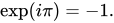
### Complex logarithm
\[[edit](https://en.wikipedia.org/w/index.php?title=Complex_number&action=edit§ion=15 "Edit section: Complex logarithm")\]
Main article: [Complex logarithm](https://en.wikipedia.org/wiki/Complex_logarithm "Complex logarithm")
[](https://en.wikipedia.org/wiki/File:ComplexExpStrips.svg)
The exponential function maps complex numbers *z* differing by a multiple of
2
π
i
{\\displaystyle 2\\pi i}

to the same complex number *w*.
For any positive real number *t*, there is a unique real number *x* such that exp ( x ) \= t {\\displaystyle \\exp(x)=t} . This leads to the definition of the [natural logarithm](https://en.wikipedia.org/wiki/Natural_logarithm "Natural logarithm") as the [inverse](https://en.wikipedia.org/wiki/Inverse_function "Inverse function") ln : R \+ → R ; x ↦ ln x {\\displaystyle \\ln \\colon \\mathbb {R} ^{+}\\to \\mathbb {R} ;x\\mapsto \\ln x}  of the exponential function. The situation is different for complex numbers, since
exp
(
z
\+
2
π
i
)
\=
exp
z
exp
(
2
π
i
)
\=
exp
z
{\\displaystyle \\exp(z+2\\pi i)=\\exp z\\exp(2\\pi i)=\\exp z}

by the functional equation and Euler's identity. For example, *e**iπ* = *e*3*iπ* = −1 , so both iπ and 3*iπ* are possible values for the complex logarithm of −1.
In general, given any non-zero complex number *w*, any number *z* solving the equation
exp
z
\=
w
{\\displaystyle \\exp z=w}

is called a [complex logarithm](https://en.wikipedia.org/wiki/Complex_logarithm "Complex logarithm") of w, denoted log w {\\displaystyle \\log w} . It can be shown that these numbers satisfy z \= log w \= ln \| w \| \+ i arg w , {\\displaystyle z=\\log w=\\ln \|w\|+i\\arg w,}  where arg {\\displaystyle \\arg }  is the [argument](https://en.wikipedia.org/wiki/Arg_\(mathematics\) "Arg (mathematics)") defined [above](https://en.wikipedia.org/wiki/Complex_number#Polar_form), and ln {\\displaystyle \\ln }  the (real) [natural logarithm](https://en.wikipedia.org/wiki/Natural_logarithm "Natural logarithm"). As arg is a [multivalued function](https://en.wikipedia.org/wiki/Multivalued_function "Multivalued function"), unique only up to a multiple of 2*π*, log is also multivalued. The [principal value](https://en.wikipedia.org/wiki/Principal_value "Principal value") of log is often taken by restricting the imaginary part to the [interval](https://en.wikipedia.org/wiki/Interval_\(mathematics\) "Interval (mathematics)") (−*π*, *π*\]. This leads to the complex logarithm being a [bijective](https://en.wikipedia.org/wiki/Bijective "Bijective") function taking values in the strip R \+ \+ i ( − π , π \] {\\displaystyle \\mathbb {R} ^{+}+\\;i\\,\\left(-\\pi ,\\pi \\right\]} ![{\\displaystyle \\mathbb {R} ^{+}+\\;i\\,\\left(-\\pi ,\\pi \\right\]}](https://wikimedia.org/api/rest_v1/media/math/render/svg/50d836fb007d819a1aab60ece11449d6d754192c) (that is denoted S 0 {\\displaystyle S\_{0}}  in the above illustration) ln : C × → R \+ \+ i ( − π , π \] . {\\displaystyle \\ln \\colon \\;\\mathbb {C} ^{\\times }\\;\\to \\;\\;\\;\\mathbb {R} ^{+}+\\;i\\,\\left(-\\pi ,\\pi \\right\].} ![{\\displaystyle \\ln \\colon \\;\\mathbb {C} ^{\\times }\\;\\to \\;\\;\\;\\mathbb {R} ^{+}+\\;i\\,\\left(-\\pi ,\\pi \\right\].}](https://wikimedia.org/api/rest_v1/media/math/render/svg/5a9195ba0433fd0b1768386d0e3b2c11fb5eb684)
If z ∈ C ∖ ( − R ≥ 0 ) {\\displaystyle z\\in \\mathbb {C} \\setminus \\left(-\\mathbb {R} \_{\\geq 0}\\right)}  is not a non-positive real number (a positive or a non-real number), the resulting [principal value](https://en.wikipedia.org/wiki/Principal_value "Principal value") of the complex logarithm is obtained with −*π* \< *φ* \< *π*. It is an [analytic function](https://en.wikipedia.org/wiki/Analytic_function "Analytic function") outside the negative real numbers, but it cannot be prolongated to a function that is continuous at any negative real number z ∈ − R \+ {\\displaystyle z\\in -\\mathbb {R} ^{+}} , where the principal value is ln *z* = ln(−*z*) + *iπ*.[\[h\]](https://en.wikipedia.org/wiki/Complex_number#cite_note-63)
Complex [exponentiation](https://en.wikipedia.org/wiki/Exponentiation "Exponentiation") *z**ω* is defined as z ω \= exp ( ω ln z ) , {\\displaystyle z^{\\omega }=\\exp(\\omega \\ln z),}  and is multi-valued, except when ω is an integer. For *ω* = 1 / *n*, for some natural number n, this recovers the non-uniqueness of nth roots mentioned above. If *z* \> 0 is real (and ω an arbitrary complex number), one has a preferred choice of ln x {\\displaystyle \\ln x} , the real logarithm, which can be used to define a preferred exponential function.
Complex numbers, unlike real numbers, do not in general satisfy the unmodified power and logarithm identities, particularly when naïvely treated as single-valued functions; see [failure of power and logarithm identities](https://en.wikipedia.org/wiki/Exponentiation#Failure_of_power_and_logarithm_identities "Exponentiation"). For example, they do not satisfy a b c \= ( a b ) c . {\\displaystyle a^{bc}=\\left(a^{b}\\right)^{c}.}  Both sides of the equation are multivalued by the definition of complex exponentiation given here, and the values on the left are a subset of those on the right.
### Complex sine and cosine
\[[edit](https://en.wikipedia.org/w/index.php?title=Complex_number&action=edit§ion=16 "Edit section: Complex sine and cosine")\]
The series defining the real trigonometric functions [sin](https://en.wikipedia.org/wiki/Sine "Sine") and [cos](https://en.wikipedia.org/wiki/Cosine "Cosine"), as well as the [hyperbolic functions](https://en.wikipedia.org/wiki/Hyperbolic_functions "Hyperbolic functions") sinh and cosh, also carry over to complex arguments without change. For the other trigonometric and hyperbolic functions, such as [tan](https://en.wikipedia.org/wiki/Tangent_\(function\) "Tangent (function)"), things are slightly more complicated, as the defining series do not converge for all complex values. Therefore, one must define them either in terms of sine, cosine and exponential, or, equivalently, by using the method of [analytic continuation](https://en.wikipedia.org/wiki/Analytic_continuation "Analytic continuation").
The value of a trigonometric or hyperbolic function of a complex number can be expressed in terms of those functions evaluated on real numbers, via angle-addition formulas. For *z* = *x* + *iy*,
sin z \= sin x cosh y \+ i cos x sinh y {\\displaystyle \\sin {z}=\\sin {x}\\cosh {y}+i\\cos {x}\\sinh {y}} 
cos z \= cos x cosh y − i sin x sinh y {\\displaystyle \\cos {z}=\\cos {x}\\cosh {y}-i\\sin {x}\\sinh {y}} 
tan z \= tan x \+ i tanh y 1 − i tan x tanh y {\\displaystyle \\tan {z}={\\frac {\\tan {x}+i\\tanh {y}}{1-i\\tan {x}\\tanh {y}}}} 
cot z \= − 1 \+ i cot x coth y cot x − i coth y {\\displaystyle \\cot {z}=-{\\frac {1+i\\cot {x}\\coth {y}}{\\cot {x}-i\\coth {y}}}} 
sinh z \= sinh x cos y \+ i cosh x sin y {\\displaystyle \\sinh {z}=\\sinh {x}\\cos {y}+i\\cosh {x}\\sin {y}} 
cosh z \= cosh x cos y \+ i sinh x sin y {\\displaystyle \\cosh {z}=\\cosh {x}\\cos {y}+i\\sinh {x}\\sin {y}} 
tanh z \= tanh x \+ i tan y 1 \+ i tanh x tan y {\\displaystyle \\tanh {z}={\\frac {\\tanh {x}+i\\tan {y}}{1+i\\tanh {x}\\tan {y}}}} 
coth z \= 1 − i coth x cot y coth x − i cot y {\\displaystyle \\coth {z}={\\frac {1-i\\coth {x}\\cot {y}}{\\coth {x}-i\\cot {y}}}} 
Where these expressions are not well defined, because a trigonometric or hyperbolic function evaluates to infinity or there is division by zero, they are nonetheless correct as [limits](https://en.wikipedia.org/wiki/Limit_\(mathematics\) "Limit (mathematics)").
### Holomorphic functions
\[[edit](https://en.wikipedia.org/w/index.php?title=Complex_number&action=edit§ion=17 "Edit section: Holomorphic functions")\]
[](https://en.wikipedia.org/wiki/File:Sin1z-cplot.svg)
Color wheel graph of the function sin(1/*z*) that is holomorphic except at *z* = 0, which is an essential singularity of this function. White parts inside refer to numbers having large absolute values.
A function f : C {\\displaystyle f:\\mathbb {C} }  → C {\\displaystyle \\mathbb {C} }  is called [holomorphic](https://en.wikipedia.org/wiki/Holomorphic_function "Holomorphic function") or *complex differentiable* at a point z 0 {\\displaystyle z\_{0}}  if the limit
lim
z
→
z
0
f
(
z
)
−
f
(
z
0
)
z
−
z
0
{\\displaystyle \\lim \_{z\\to z\_{0}}{f(z)-f(z\_{0}) \\over z-z\_{0}}}
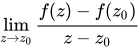
exists (in which case it is denoted by f ′ ( z 0 ) {\\displaystyle f'(z\_{0})} ). This mimics the definition for real differentiable functions, except that all quantities are complex numbers. Loosely speaking, the freedom of approaching z 0 {\\displaystyle z\_{0}}  in different directions imposes a much stronger condition than being (real) differentiable. For example, the function
f
(
z
)
\=
z
¯
{\\displaystyle f(z)={\\overline {z}}}

is differentiable as a function R 2 → R 2 {\\displaystyle \\mathbb {R} ^{2}\\to \\mathbb {R} ^{2}} , but is *not* complex differentiable. A real differentiable function is complex differentiable [if and only if](https://en.wikipedia.org/wiki/If_and_only_if "If and only if") it satisfies the [Cauchy–Riemann equations](https://en.wikipedia.org/wiki/Cauchy%E2%80%93Riemann_equations "Cauchy–Riemann equations"), which are sometimes abbreviated as
∂
f
∂
z
¯
\=
0\.
{\\displaystyle {\\frac {\\partial f}{\\partial {\\overline {z}}}}=0.}

Complex analysis shows some features not apparent in real analysis. For example, the [identity theorem](https://en.wikipedia.org/wiki/Identity_theorem "Identity theorem") asserts that two holomorphic functions f and g agree if they agree on an arbitrarily small [open subset](https://en.wikipedia.org/wiki/Open_subset "Open subset") of C {\\displaystyle \\mathbb {C} } . [Meromorphic functions](https://en.wikipedia.org/wiki/Meromorphic_function "Meromorphic function"), functions that can locally be written as *f*(*z*)/(*z* − *z*0)*n* with a holomorphic function f, still share some of the features of holomorphic functions. Other functions have [essential singularities](https://en.wikipedia.org/wiki/Essential_singularity "Essential singularity"), such as sin(1/*z*) at *z* = 0.
## Applications
\[[edit](https://en.wikipedia.org/w/index.php?title=Complex_number&action=edit§ion=18 "Edit section: Applications")\]
Complex numbers have applications in many scientific areas, including [signal processing](https://en.wikipedia.org/wiki/Signal_processing "Signal processing"), [control theory](https://en.wikipedia.org/wiki/Control_theory "Control theory"), [electromagnetism](https://en.wikipedia.org/wiki/Electromagnetism "Electromagnetism"), [fluid dynamics](https://en.wikipedia.org/wiki/Fluid_dynamics "Fluid dynamics"), [quantum mechanics](https://en.wikipedia.org/wiki/Quantum_mechanics "Quantum mechanics"), [cartography](https://en.wikipedia.org/wiki/Cartography "Cartography"), and [vibration analysis](https://en.wikipedia.org/wiki/Vibration#Vibration_analysis "Vibration"). Some of these applications are described below.
Complex conjugation is also employed in [inversive geometry](https://en.wikipedia.org/wiki/Inversive_geometry "Inversive geometry"), a branch of geometry studying reflections more general than ones about a line. In the [network analysis of electrical circuits](https://en.wikipedia.org/wiki/Network_analysis_\(electrical_circuits\) "Network analysis (electrical circuits)"), the complex conjugate is used in finding the equivalent impedance when the [maximum power transfer theorem](https://en.wikipedia.org/wiki/Maximum_power_transfer_theorem "Maximum power transfer theorem") is looked for.
### Geometry
\[[edit](https://en.wikipedia.org/w/index.php?title=Complex_number&action=edit§ion=19 "Edit section: Geometry")\]
#### Shapes
\[[edit](https://en.wikipedia.org/w/index.php?title=Complex_number&action=edit§ion=20 "Edit section: Shapes")\]
Three [non-collinear](https://en.wikipedia.org/wiki/Collinearity "Collinearity") points u , v , w {\\displaystyle u,v,w}  in the plane determine the [shape](https://en.wikipedia.org/wiki/Shape#Similarity_classes "Shape") of the triangle { u , v , w } {\\displaystyle \\{u,v,w\\}} . Locating the points in the complex plane, this shape of a triangle may be expressed by complex arithmetic as S ( u , v , w ) \= u − w u − v . {\\displaystyle S(u,v,w)={\\frac {u-w}{u-v}}.} 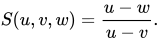 The shape S {\\displaystyle S}  of a triangle will remain the same, when the complex plane is transformed by translation or dilation (by an [affine transformation](https://en.wikipedia.org/wiki/Affine_transformation "Affine transformation")), corresponding to the intuitive notion of shape, and describing [similarity](https://en.wikipedia.org/wiki/Similarity_\(geometry\) "Similarity (geometry)"). Thus each triangle { u , v , w } {\\displaystyle \\{u,v,w\\}}  is in a [similarity class](https://en.wikipedia.org/wiki/Shape#Similarity_classes "Shape") of triangles with the same shape.[\[56\]](https://en.wikipedia.org/wiki/Complex_number#cite_note-64)
#### Fractal geometry
\[[edit](https://en.wikipedia.org/w/index.php?title=Complex_number&action=edit§ion=21 "Edit section: Fractal geometry")\]
[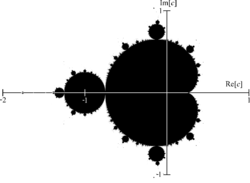](https://en.wikipedia.org/wiki/File:Mandelset_hires.png)
The Mandelbrot set with the real and imaginary axes labeled.
The [Mandelbrot set](https://en.wikipedia.org/wiki/Mandelbrot_set "Mandelbrot set") is a popular example of a fractal formed on the complex plane. It is defined by plotting every location c {\\displaystyle c}  where iterating the sequence f c ( z ) \= z 2 \+ c {\\displaystyle f\_{c}(z)=z^{2}+c} 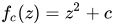 does not [diverge](https://en.wikipedia.org/wiki/Diverge_\(stability_theory\) "Diverge (stability theory)") when [iterated](https://en.wikipedia.org/wiki/Iteration "Iteration") infinitely. Similarly, [Julia sets](https://en.wikipedia.org/wiki/Julia_set "Julia set") have the same rules, except where c {\\displaystyle c}  remains constant.
#### Triangles
\[[edit](https://en.wikipedia.org/w/index.php?title=Complex_number&action=edit§ion=22 "Edit section: Triangles")\]
Every triangle has a unique [Steiner inellipse](https://en.wikipedia.org/wiki/Steiner_inellipse "Steiner inellipse") – an [ellipse](https://en.wikipedia.org/wiki/Ellipse "Ellipse") inside the triangle and tangent to the midpoints of the three sides of the triangle. The [foci](https://en.wikipedia.org/wiki/Focus_\(geometry\) "Focus (geometry)") of a triangle's Steiner inellipse can be found as follows, according to [Marden's theorem](https://en.wikipedia.org/wiki/Marden%27s_theorem "Marden's theorem"):[\[57\]](https://en.wikipedia.org/wiki/Complex_number#cite_note-65)[\[58\]](https://en.wikipedia.org/wiki/Complex_number#cite_note-66) Denote the triangle's vertices in the complex plane as *a* = *x**A* + *y**A**i*, *b* = *x**B* + *y**B**i*, and *c* = *x**C* + *y**C**i*. Write the [cubic equation](https://en.wikipedia.org/wiki/Cubic_equation "Cubic equation") ( x − a ) ( x − b ) ( x − c ) \= 0 {\\displaystyle (x-a)(x-b)(x-c)=0} , take its derivative, and equate the (quadratic) derivative to zero. Marden's theorem says that the solutions of this equation are the complex numbers denoting the locations of the two foci of the Steiner inellipse.
### Algebraic number theory
\[[edit](https://en.wikipedia.org/w/index.php?title=Complex_number&action=edit§ion=23 "Edit section: Algebraic number theory")\]
[](https://en.wikipedia.org/wiki/File:Pentagon_construct.gif)
Construction of a regular pentagon [using straightedge and compass](https://en.wikipedia.org/wiki/Compass_and_straightedge_constructions "Compass and straightedge constructions").
As mentioned above, any nonconstant polynomial equation (in complex coefficients) has a solution in C {\\displaystyle \\mathbb {C} } . *[A fortiori](https://en.wikipedia.org/wiki/Argumentum_a_fortiori "Argumentum a fortiori")*, the same is true if the equation has rational coefficients. The roots of such equations are called [algebraic numbers](https://en.wikipedia.org/wiki/Algebraic_number "Algebraic number") – they are a principal object of study in [algebraic number theory](https://en.wikipedia.org/wiki/Algebraic_number_theory "Algebraic number theory"). Compared to Q ¯ {\\displaystyle {\\overline {\\mathbb {Q} }}} , the algebraic closure of Q {\\displaystyle \\mathbb {Q} } , which also contains all algebraic numbers, C {\\displaystyle \\mathbb {C} }  has the advantage of being easily understandable in geometric terms. In this way, algebraic methods can be used to study geometric questions and vice versa. With algebraic methods, more specifically applying the machinery of [field theory](https://en.wikipedia.org/wiki/Field_theory_\(mathematics\) "Field theory (mathematics)") to the [number field](https://en.wikipedia.org/wiki/Number_field "Number field") containing [roots of unity](https://en.wikipedia.org/wiki/Root_of_unity "Root of unity"), it can be shown that it is not possible to construct a regular [nonagon](https://en.wikipedia.org/wiki/Nonagon "Nonagon") [using only compass and straightedge](https://en.wikipedia.org/wiki/Compass_and_straightedge_constructions "Compass and straightedge constructions") – a purely geometric problem.
Another example is the [Gaussian integers](https://en.wikipedia.org/wiki/Gaussian_integer "Gaussian integer"); that is, numbers of the form *x* + *iy*, where x and y are integers, which can be used to classify [sums of squares](https://en.wikipedia.org/wiki/Fermat%27s_theorem_on_sums_of_two_squares "Fermat's theorem on sums of two squares").
### Analytic number theory
\[[edit](https://en.wikipedia.org/w/index.php?title=Complex_number&action=edit§ion=24 "Edit section: Analytic number theory")\]
Main article: [Analytic number theory](https://en.wikipedia.org/wiki/Analytic_number_theory "Analytic number theory")
Analytic number theory studies numbers, often integers or rationals, by taking advantage of the fact that they can be regarded as complex numbers, in which analytic methods can be used. This is done by encoding number-theoretic information in complex-valued functions. For example, the [Riemann zeta function](https://en.wikipedia.org/wiki/Riemann_zeta_function "Riemann zeta function") ζ(*s*) is related to the distribution of [prime numbers](https://en.wikipedia.org/wiki/Prime_number "Prime number").
### Improper integrals
\[[edit](https://en.wikipedia.org/w/index.php?title=Complex_number&action=edit§ion=25 "Edit section: Improper integrals")\]
In applied fields, complex numbers are often used to compute certain real-valued [improper integrals](https://en.wikipedia.org/wiki/Improper_integral "Improper integral"), by means of complex-valued functions. Several methods exist to do this; see [methods of contour integration](https://en.wikipedia.org/wiki/Methods_of_contour_integration "Methods of contour integration").
### Dynamic equations
\[[edit](https://en.wikipedia.org/w/index.php?title=Complex_number&action=edit§ion=26 "Edit section: Dynamic equations")\]
In [differential equations](https://en.wikipedia.org/wiki/Differential_equation "Differential equation"), it is common to first find all complex roots r of the [characteristic equation](https://en.wikipedia.org/wiki/Linear_differential_equation#Homogeneous_equation_with_constant_coefficients "Linear differential equation") of a [linear differential equation](https://en.wikipedia.org/wiki/Linear_differential_equation "Linear differential equation") or equation system and then attempt to solve the system in terms of base functions of the form *f*(*t*) = *e**rt*. Likewise, in [difference equations](https://en.wikipedia.org/wiki/Difference_equations "Difference equations"), the complex roots r of the characteristic equation of the difference equation system are used, to attempt to solve the system in terms of base functions of the form *f*(*t*) = *r**t*.
### Linear algebra
\[[edit](https://en.wikipedia.org/w/index.php?title=Complex_number&action=edit§ion=27 "Edit section: Linear algebra")\]
Since C {\\displaystyle \\mathbb {C} }  is algebraically closed, any non-empty complex [square matrix](https://en.wikipedia.org/wiki/Square_matrix "Square matrix") has at least one (complex) [eigenvalue](https://en.wikipedia.org/wiki/Eigenvalue "Eigenvalue"). By comparison, real matrices do not always have real eigenvalues, for example [rotation matrices](https://en.wikipedia.org/wiki/Rotation_matrix "Rotation matrix") (for rotations of the plane for angles other than 0° or 180°) leave no direction fixed, and therefore do not have any *real* eigenvalue. The existence of (complex) eigenvalues, and the ensuing existence of [eigendecomposition](https://en.wikipedia.org/wiki/Eigendecomposition_of_a_matrix "Eigendecomposition of a matrix") is a useful tool for computing matrix powers and [matrix exponentials](https://en.wikipedia.org/wiki/Matrix_exponential "Matrix exponential").
Complex numbers often generalize concepts originally conceived in the real numbers. For example, the [conjugate transpose](https://en.wikipedia.org/wiki/Conjugate_transpose "Conjugate transpose") generalizes the [transpose](https://en.wikipedia.org/wiki/Transpose "Transpose"), [hermitian matrices](https://en.wikipedia.org/wiki/Hermitian_matrix "Hermitian matrix") generalize [symmetric matrices](https://en.wikipedia.org/wiki/Symmetric_matrix "Symmetric matrix"), and [unitary matrices](https://en.wikipedia.org/wiki/Unitary_matrix "Unitary matrix") generalize [orthogonal matrices](https://en.wikipedia.org/wiki/Orthogonal_matrix "Orthogonal matrix").
### In applied mathematics
\[[edit](https://en.wikipedia.org/w/index.php?title=Complex_number&action=edit§ion=28 "Edit section: In applied mathematics")\]
#### Control theory
\[[edit](https://en.wikipedia.org/w/index.php?title=Complex_number&action=edit§ion=29 "Edit section: Control theory")\]
See also: [Complex plane § Use in control theory](https://en.wikipedia.org/wiki/Complex_plane#Use_in_control_theory "Complex plane")
In [control theory](https://en.wikipedia.org/wiki/Control_theory "Control theory"), systems are often transformed from the [time domain](https://en.wikipedia.org/wiki/Time_domain "Time domain") to the complex [frequency domain](https://en.wikipedia.org/wiki/Frequency_domain "Frequency domain") using the [Laplace transform](https://en.wikipedia.org/wiki/Laplace_transform "Laplace transform"). The system's [zeros and poles](https://en.wikipedia.org/wiki/Zeros_and_poles "Zeros and poles") are then analyzed in the *complex plane*. The [root locus](https://en.wikipedia.org/wiki/Root_locus "Root locus"), [Nyquist plot](https://en.wikipedia.org/wiki/Nyquist_plot "Nyquist plot"), and [Nichols plot](https://en.wikipedia.org/wiki/Nichols_plot "Nichols plot") techniques all make use of the complex plane.
In the root locus method, it is important whether zeros and poles are in the left or right half planes, that is, have real part greater than or less than zero. If a linear, time-invariant (LTI) system has poles that are
- in the right half plane, it will be [unstable](https://en.wikipedia.org/wiki/Unstable "Unstable"),
- all in the left half plane, it will be [stable](https://en.wikipedia.org/wiki/BIBO_stability "BIBO stability"),
- on the imaginary axis, it will have [marginal stability](https://en.wikipedia.org/wiki/Marginal_stability "Marginal stability").
If a system has zeros in the right half plane, it is a [nonminimum phase](https://en.wikipedia.org/wiki/Nonminimum_phase "Nonminimum phase") system.
#### Signal analysis
\[[edit](https://en.wikipedia.org/w/index.php?title=Complex_number&action=edit§ion=30 "Edit section: Signal analysis")\]
Complex numbers are used in [signal analysis](https://en.wikipedia.org/wiki/Signal_analysis "Signal analysis") and other fields for a convenient description for periodically varying signals. For given real functions representing actual physical quantities, often in terms of sines and cosines, corresponding complex functions are considered of which the real parts are the original quantities. For a [sine wave](https://en.wikipedia.org/wiki/Sine_wave "Sine wave") of a given [frequency](https://en.wikipedia.org/wiki/Frequency "Frequency"), the absolute value \|*z*\| of the corresponding z is the [amplitude](https://en.wikipedia.org/wiki/Amplitude "Amplitude") and the [argument](https://en.wikipedia.org/wiki/Argument_\(complex_analysis\) "Argument (complex analysis)") arg *z* is the [phase](https://en.wikipedia.org/wiki/Phase_\(waves\) "Phase (waves)").
If [Fourier analysis](https://en.wikipedia.org/wiki/Fourier_analysis "Fourier analysis") is employed to write a given real-valued signal as a sum of periodic functions, these periodic functions are often written as complex-valued functions of the form
x ( t ) \= Re { X ( t ) } {\\displaystyle x(t)=\\operatorname {Re} \\{X(t)\\}} 
and
X ( t ) \= A e i ω t \= a e i ϕ e i ω t \= a e i ( ω t \+ ϕ ) {\\displaystyle X(t)=Ae^{i\\omega t}=ae^{i\\phi }e^{i\\omega t}=ae^{i(\\omega t+\\phi )}} 
where ω represents the [angular frequency](https://en.wikipedia.org/wiki/Angular_frequency "Angular frequency") and the complex number *A* encodes the phase and amplitude as explained above.
This use is also extended into [digital signal processing](https://en.wikipedia.org/wiki/Digital_signal_processing "Digital signal processing") and [digital image processing](https://en.wikipedia.org/wiki/Digital_image_processing "Digital image processing"), which use digital versions of Fourier analysis (and [wavelet](https://en.wikipedia.org/wiki/Wavelet "Wavelet") analysis) to transmit, [compress](https://en.wikipedia.org/wiki/Data_compression "Data compression"), restore, and otherwise process [digital](https://en.wikipedia.org/wiki/Digital_data "Digital data") [audio](https://en.wikipedia.org/wiki/Sound "Sound") signals, still images, and [video](https://en.wikipedia.org/wiki/Video "Video") signals.
Another example, relevant to the two side bands of [amplitude modulation](https://en.wikipedia.org/wiki/Amplitude_modulation "Amplitude modulation") of AM radio, is:
cos ( ( ω \+ α ) t ) \+ cos ( ( ω − α ) t ) \= Re ( e i ( ω \+ α ) t \+ e i ( ω − α ) t ) \= Re ( ( e i α t \+ e − i α t ) ⋅ e i ω t ) \= Re ( 2 cos ( α t ) ⋅ e i ω t ) \= 2 cos ( α t ) ⋅ Re ( e i ω t ) \= 2 cos ( α t ) ⋅ cos ( ω t ) . {\\displaystyle {\\begin{aligned}\\cos((\\omega +\\alpha )t)+\\cos \\left((\\omega -\\alpha )t\\right)&=\\operatorname {Re} \\left(e^{i(\\omega +\\alpha )t}+e^{i(\\omega -\\alpha )t}\\right)\\\\&=\\operatorname {Re} \\left(\\left(e^{i\\alpha t}+e^{-i\\alpha t}\\right)\\cdot e^{i\\omega t}\\right)\\\\&=\\operatorname {Re} \\left(2\\cos(\\alpha t)\\cdot e^{i\\omega t}\\right)\\\\&=2\\cos(\\alpha t)\\cdot \\operatorname {Re} \\left(e^{i\\omega t}\\right)\\\\&=2\\cos(\\alpha t)\\cdot \\cos \\left(\\omega t\\right).\\end{aligned}}} 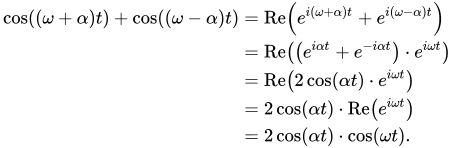
### In physics
\[[edit](https://en.wikipedia.org/w/index.php?title=Complex_number&action=edit§ion=31 "Edit section: In physics")\]
#### Electromagnetism and electrical engineering
\[[edit](https://en.wikipedia.org/w/index.php?title=Complex_number&action=edit§ion=32 "Edit section: Electromagnetism and electrical engineering")\]
Main article: [Alternating current](https://en.wikipedia.org/wiki/Alternating_current "Alternating current")
In [electrical engineering](https://en.wikipedia.org/wiki/Electrical_engineering "Electrical engineering"), the [Fourier transform](https://en.wikipedia.org/wiki/Fourier_transform "Fourier transform") is used to analyze varying [electric currents](https://en.wikipedia.org/wiki/Electric_current "Electric current") and [voltages](https://en.wikipedia.org/wiki/Voltage "Voltage"). The treatment of [resistors](https://en.wikipedia.org/wiki/Resistor "Resistor"), [capacitors](https://en.wikipedia.org/wiki/Capacitor "Capacitor"), and [inductors](https://en.wikipedia.org/wiki/Inductor "Inductor") can then be unified by introducing imaginary, frequency-dependent resistances for the latter two and combining all three in a single complex number called the [impedance](https://en.wikipedia.org/wiki/Electrical_impedance "Electrical impedance"). This approach is called [phasor](https://en.wikipedia.org/wiki/Phasor "Phasor") calculus.
In electrical engineering, the imaginary unit is denoted by j, to avoid confusion with I, which is generally in use to denote electric current, or, more particularly, i, which is generally in use to denote instantaneous electric current.
Because the voltage in an AC circuit is oscillating, it can be represented as
V ( t ) \= V 0 e j ω t \= V 0 ( cos ω t \+ j sin ω t ) , {\\displaystyle V(t)=V\_{0}e^{j\\omega t}=V\_{0}\\left(\\cos \\omega t+j\\sin \\omega t\\right),} 
To obtain the measurable quantity, the real part is taken:
v ( t ) \= Re ( V ) \= Re \[ V 0 e j ω t \] \= V 0 cos ω t . {\\displaystyle v(t)=\\operatorname {Re} (V)=\\operatorname {Re} \\left\[V\_{0}e^{j\\omega t}\\right\]=V\_{0}\\cos \\omega t.} ![{\\displaystyle v(t)=\\operatorname {Re} (V)=\\operatorname {Re} \\left\[V\_{0}e^{j\\omega t}\\right\]=V\_{0}\\cos \\omega t.}](https://wikimedia.org/api/rest_v1/media/math/render/svg/4b9078e78decc9fdf5d57a237bbf756b9cc438a0)
The complex-valued signal *V*(*t*) is called the [analytic](https://en.wikipedia.org/wiki/Analytic_signal "Analytic signal") representation of the real-valued, measurable signal *v*(*t*). [\[59\]](https://en.wikipedia.org/wiki/Complex_number#cite_note-67)
#### Fluid dynamics
\[[edit](https://en.wikipedia.org/w/index.php?title=Complex_number&action=edit§ion=33 "Edit section: Fluid dynamics")\]
In [fluid dynamics](https://en.wikipedia.org/wiki/Fluid_dynamics "Fluid dynamics"), complex functions are used to describe [potential flow in two dimensions](https://en.wikipedia.org/wiki/Potential_flow_in_two_dimensions "Potential flow in two dimensions").
#### Quantum mechanics
\[[edit](https://en.wikipedia.org/w/index.php?title=Complex_number&action=edit§ion=34 "Edit section: Quantum mechanics")\]
The complex number field is intrinsic to the [mathematical formulations of quantum mechanics](https://en.wikipedia.org/wiki/Mathematical_formulations_of_quantum_mechanics "Mathematical formulations of quantum mechanics"), where complex [Hilbert spaces](https://en.wikipedia.org/wiki/Hilbert_space "Hilbert space") provide the context for one such formulation that is convenient and perhaps most standard. The original foundation formulas of quantum mechanics – the [Schrödinger equation](https://en.wikipedia.org/wiki/Schr%C3%B6dinger_equation "Schrödinger equation") and Heisenberg's [matrix mechanics](https://en.wikipedia.org/wiki/Matrix_mechanics "Matrix mechanics") – make use of complex numbers.
#### Relativity
\[[edit](https://en.wikipedia.org/w/index.php?title=Complex_number&action=edit§ion=35 "Edit section: Relativity")\]
In [special relativity](https://en.wikipedia.org/wiki/Special_relativity "Special relativity") and [general relativity](https://en.wikipedia.org/wiki/General_relativity "General relativity"), some formulas for the metric on [spacetime](https://en.wikipedia.org/wiki/Spacetime "Spacetime") become simpler if one takes the time component of the spacetime continuum to be imaginary. (This approach is no longer standard in classical relativity, but is [used in an essential way](https://en.wikipedia.org/wiki/Wick_rotation "Wick rotation") in [quantum field theory](https://en.wikipedia.org/wiki/Quantum_field_theory "Quantum field theory").) Complex numbers are essential to [spinors](https://en.wikipedia.org/wiki/Spinor "Spinor"), which are a generalization of the [tensors](https://en.wikipedia.org/wiki/Tensor "Tensor") used in relativity.
## Characterizations, generalizations and related notions
\[[edit](https://en.wikipedia.org/w/index.php?title=Complex_number&action=edit§ion=36 "Edit section: Characterizations, generalizations and related notions")\]
### Algebraic characterization
\[[edit](https://en.wikipedia.org/w/index.php?title=Complex_number&action=edit§ion=37 "Edit section: Algebraic characterization")\]
The field C {\\displaystyle \\mathbb {C} }  has the following three properties:
- First, it has [characteristic](https://en.wikipedia.org/wiki/Characteristic_\(algebra\) "Characteristic (algebra)") 0. This means that 1 + 1 + ⋯ + 1 ≠ 0 for any number of summands (all of which equal one).
- Second, its [transcendence degree](https://en.wikipedia.org/wiki/Transcendence_degree "Transcendence degree") over
Q
{\\displaystyle \\mathbb {Q} }

, the [prime field](https://en.wikipedia.org/wiki/Prime_field "Prime field") of
C
,
{\\displaystyle \\mathbb {C} ,}

is the [cardinality of the continuum](https://en.wikipedia.org/wiki/Cardinality_of_the_continuum "Cardinality of the continuum").
- Third, it is [algebraically closed](https://en.wikipedia.org/wiki/Algebraically_closed "Algebraically closed") (see above).
It can be shown that any field having these properties is [isomorphic](https://en.wikipedia.org/wiki/Isomorphic "Isomorphic") (as a field) to C . {\\displaystyle \\mathbb {C} .}  For example, the [algebraic closure](https://en.wikipedia.org/wiki/Algebraic_closure "Algebraic closure") of the field Q p {\\displaystyle \\mathbb {Q} \_{p}}  of the [p\-adic number](https://en.wikipedia.org/wiki/P-adic_number "P-adic number") also satisfies these three properties, so these two fields are isomorphic (as fields, but not as topological fields).[\[60\]](https://en.wikipedia.org/wiki/Complex_number#cite_note-68) Also, C {\\displaystyle \\mathbb {C} }  is isomorphic to the field of complex [Puiseux series](https://en.wikipedia.org/wiki/Puiseux_series "Puiseux series"). However, specifying an isomorphism requires the [axiom of choice](https://en.wikipedia.org/wiki/Axiom_of_choice "Axiom of choice"). Another consequence of this algebraic characterization is that C {\\displaystyle \\mathbb {C} }  contains many proper subfields that are isomorphic to C {\\displaystyle \\mathbb {C} } .
### Characterization as a topological field
\[[edit](https://en.wikipedia.org/w/index.php?title=Complex_number&action=edit§ion=38 "Edit section: Characterization as a topological field")\]
The preceding characterization of C {\\displaystyle \\mathbb {C} }  describes only the algebraic aspects of C . {\\displaystyle \\mathbb {C} .}  That is to say, the properties of [nearness](https://en.wikipedia.org/wiki/Neighborhood_\(topology\) "Neighborhood (topology)") and [continuity](https://en.wikipedia.org/wiki/Continuity_\(topology\) "Continuity (topology)"), which matter in areas such as [analysis](https://en.wikipedia.org/wiki/Mathematical_analysis "Mathematical analysis") and [topology](https://en.wikipedia.org/wiki/Topology "Topology"), are not dealt with. The following description of C {\\displaystyle \\mathbb {C} }  as a [topological field](https://en.wikipedia.org/wiki/Topological_ring "Topological ring") (that is, a field that is equipped with a [topology](https://en.wikipedia.org/wiki/Topological_space "Topological space"), which allows the notion of convergence) does take into account the topological properties. C {\\displaystyle \\mathbb {C} }  contains a subset *P* (namely the set of positive real numbers) of nonzero elements satisfying the following three conditions:
- *P* is closed under addition, multiplication and taking inverses.
- If x and y are distinct elements of *P*, then either *x* − *y* or *y* − *x* is in *P*.
- If S is any nonempty subset of *P*, then *S* + *P* = *x* + *P* for some x in
C
.
{\\displaystyle \\mathbb {C} .}

Moreover, C {\\displaystyle \\mathbb {C} }  has a nontrivial [involutive](https://en.wikipedia.org/wiki/Involution_\(mathematics\) "Involution (mathematics)") [automorphism](https://en.wikipedia.org/wiki/Automorphism "Automorphism") *x* ↦ *x*\* (namely the complex conjugation), such that *x x*\* is in *P* for any nonzero x in C . {\\displaystyle \\mathbb {C} .} 
Any field F with these properties can be endowed with a topology by taking the sets *B*(*x*, *p*) = { *y* \| *p* − (*y* − *x*)(*y* − *x*)\* ∈ *P* } as a [base](https://en.wikipedia.org/wiki/Base_\(topology\) "Base (topology)"), where x ranges over the field and p ranges over *P*. With this topology F is isomorphic as a *topological* field to C . {\\displaystyle \\mathbb {C} .} 
The only [connected](https://en.wikipedia.org/wiki/Connected_space "Connected space") [locally compact](https://en.wikipedia.org/wiki/Locally_compact "Locally compact") [topological fields](https://en.wikipedia.org/wiki/Topological_ring "Topological ring") are R {\\displaystyle \\mathbb {R} }  and C . {\\displaystyle \\mathbb {C} .}  This gives another characterization of C {\\displaystyle \\mathbb {C} }  as a topological field, because C {\\displaystyle \\mathbb {C} }  can be distinguished from R {\\displaystyle \\mathbb {R} }  because the nonzero complex numbers are [connected](https://en.wikipedia.org/wiki/Connected_space "Connected space"), while the nonzero real numbers are not.[\[61\]](https://en.wikipedia.org/wiki/Complex_number#cite_note-FOOTNOTEBourbaki1998%C2%A7VIII.4-69)
### Other number systems
\[[edit](https://en.wikipedia.org/w/index.php?title=Complex_number&action=edit§ion=39 "Edit section: Other number systems")\]
Main articles: [Cayley–Dickson construction](https://en.wikipedia.org/wiki/Cayley%E2%80%93Dickson_construction "Cayley–Dickson construction"), [Quaternion](https://en.wikipedia.org/wiki/Quaternion "Quaternion"), and [Octonion](https://en.wikipedia.org/wiki/Octonion "Octonion")
| | rational numbers Q {\\displaystyle \\mathbb {Q} }  |
|---|---|
The process of extending the field R {\\displaystyle \\mathbb {R} }  of reals to C {\\displaystyle \\mathbb {C} }  is an instance of the *Cayley–Dickson construction*. Applying this construction iteratively to C {\\displaystyle \\mathbb {C} }  then yields the [quaternions](https://en.wikipedia.org/wiki/Quaternion "Quaternion"), the [octonions](https://en.wikipedia.org/wiki/Octonion "Octonion"),[\[62\]](https://en.wikipedia.org/wiki/Complex_number#cite_note-70) the [sedenions](https://en.wikipedia.org/wiki/Sedenion "Sedenion"), and the [trigintaduonions](https://en.wikipedia.org/wiki/Trigintaduonion "Trigintaduonion"). This construction turns out to diminish the structural properties of the involved number systems.
Unlike the reals, C {\\displaystyle \\mathbb {C} }  is not an [ordered field](https://en.wikipedia.org/wiki/Ordered_field "Ordered field"), that is to say, it is not possible to define a relation *z*1 \< *z*2 that is compatible with the addition and multiplication. In fact, in any ordered field, the square of any element is necessarily positive, so *i*2 = −1 precludes the existence of an [ordering](https://en.wikipedia.org/wiki/Total_order "Total order") on C . {\\displaystyle \\mathbb {C} .} [\[63\]](https://en.wikipedia.org/wiki/Complex_number#cite_note-FOOTNOTEApostol198125-71) Passing from C {\\displaystyle \\mathbb {C} }  to the quaternions H {\\displaystyle \\mathbb {H} }  loses commutativity, while the octonions (additionally to not being commutative) fail to be associative. The reals, complex numbers, quaternions and octonions are all [normed division algebras](https://en.wikipedia.org/wiki/Normed_division_algebra "Normed division algebra") over R {\\displaystyle \\mathbb {R} } . By [Hurwitz's theorem](https://en.wikipedia.org/wiki/Hurwitz%27s_theorem_\(normed_division_algebras\) "Hurwitz's theorem (normed division algebras)") they are the only ones; the [sedenions](https://en.wikipedia.org/wiki/Sedenion "Sedenion"), the next step in the Cayley–Dickson construction, fail to have this structure.
The Cayley–Dickson construction is closely related to the [regular representation](https://en.wikipedia.org/wiki/Regular_representation "Regular representation") of C , {\\displaystyle \\mathbb {C} ,}  thought of as an R {\\displaystyle \\mathbb {R} } \-[algebra](https://en.wikipedia.org/wiki/Algebra_\(ring_theory\) "Algebra (ring theory)") (an R {\\displaystyle \\mathbb {R} } \-vector space with a multiplication), with respect to the basis (1, *i*). This means the following: the R {\\displaystyle \\mathbb {R} } \-linear map C → C z ↦ w z {\\displaystyle {\\begin{aligned}\\mathbb {C} &\\rightarrow \\mathbb {C} \\\\z&\\mapsto wz\\end{aligned}}}  for some fixed complex number w can be represented by a 2 × 2 matrix (once a basis has been chosen). With respect to the basis (1, *i*), this matrix is ( Re ( w ) − Im ( w ) Im ( w ) Re ( w ) ) , {\\displaystyle {\\begin{pmatrix}\\operatorname {Re} (w)&-\\operatorname {Im} (w)\\\\\\operatorname {Im} (w)&\\operatorname {Re} (w)\\end{pmatrix}},} 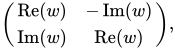 that is, the one mentioned in the section on matrix representation of complex numbers above. While this is a [linear representation](https://en.wikipedia.org/wiki/Linear_representation "Linear representation") of C {\\displaystyle \\mathbb {C} }  in the 2 × 2 real matrices, it is not the only one. Any matrix J \= ( p q r − p ) , p 2 \+ q r \+ 1 \= 0 {\\displaystyle J={\\begin{pmatrix}p\&q\\\\r&-p\\end{pmatrix}},\\quad p^{2}+qr+1=0}  has the property that its square is the negative of the identity matrix: *J*2 = −*I*. Then { z \= a I \+ b J : a , b ∈ R } {\\displaystyle \\{z=aI+bJ:a,b\\in \\mathbb {R} \\}}  is also isomorphic to the field C , {\\displaystyle \\mathbb {C} ,}  and gives an alternative complex structure on R 2 . {\\displaystyle \\mathbb {R} ^{2}.}  This is generalized by the notion of a [linear complex structure](https://en.wikipedia.org/wiki/Linear_complex_structure "Linear complex structure").
[Hypercomplex numbers](https://en.wikipedia.org/wiki/Hypercomplex_number "Hypercomplex number") also generalize R , {\\displaystyle \\mathbb {R} ,}  C , {\\displaystyle \\mathbb {C} ,}  H , {\\displaystyle \\mathbb {H} ,}  and O . {\\displaystyle \\mathbb {O} .}  For example, this notion contains the [split-complex numbers](https://en.wikipedia.org/wiki/Split-complex_number "Split-complex number"), which are elements of the ring R \[ x \] / ( x 2 − 1 ) {\\displaystyle \\mathbb {R} \[x\]/(x^{2}-1)} ![{\\displaystyle \\mathbb {R} \[x\]/(x^{2}-1)}](https://wikimedia.org/api/rest_v1/media/math/render/svg/29edbdd7a09968cb2fd42397bcab00406e77854c) (as opposed to R \[ x \] / ( x 2 \+ 1 ) {\\displaystyle \\mathbb {R} \[x\]/(x^{2}+1)} ![{\\displaystyle \\mathbb {R} \[x\]/(x^{2}+1)}](https://wikimedia.org/api/rest_v1/media/math/render/svg/9d0ade67281f83ef6b6b7f43bf783c081adb1fc3) for complex numbers). In this ring, the equation *a*2 = 1 has four solutions.
The field R {\\displaystyle \\mathbb {R} }  is the completion of Q , {\\displaystyle \\mathbb {Q} ,}  the field of [rational numbers](https://en.wikipedia.org/wiki/Rational_number "Rational number"), with respect to the usual [absolute value](https://en.wikipedia.org/wiki/Absolute_value "Absolute value") [metric](https://en.wikipedia.org/wiki/Metric_\(mathematics\) "Metric (mathematics)"). Other choices of [metrics](https://en.wikipedia.org/wiki/Metric_\(mathematics\) "Metric (mathematics)") on Q {\\displaystyle \\mathbb {Q} }  lead to the fields Q p {\\displaystyle \\mathbb {Q} \_{p}}  of [p\-adic numbers](https://en.wikipedia.org/wiki/P-adic_number "P-adic number") (for any [prime number](https://en.wikipedia.org/wiki/Prime_number "Prime number") p), which are thereby analogous to R {\\displaystyle \\mathbb {R} } . There are no other nontrivial ways of completing Q {\\displaystyle \\mathbb {Q} }  than R {\\displaystyle \\mathbb {R} }  and Q p , {\\displaystyle \\mathbb {Q} \_{p},}  by [Ostrowski's theorem](https://en.wikipedia.org/wiki/Ostrowski%27s_theorem "Ostrowski's theorem"). The algebraic closures Q p ¯ {\\displaystyle {\\overline {\\mathbb {Q} \_{p}}}}  of Q p {\\displaystyle \\mathbb {Q} \_{p}}  still carry a norm, but (unlike C {\\displaystyle \\mathbb {C} } ) are not complete with respect to it. The completion C p {\\displaystyle \\mathbb {C} \_{p}}  of Q p ¯ {\\displaystyle {\\overline {\\mathbb {Q} \_{p}}}}  turns out to be algebraically closed. By analogy, the field is called p\-adic complex numbers.
The fields R , {\\displaystyle \\mathbb {R} ,}  Q p , {\\displaystyle \\mathbb {Q} \_{p},}  and their finite field extensions, including C , {\\displaystyle \\mathbb {C} ,}  are called [local fields](https://en.wikipedia.org/wiki/Local_field "Local field").
## See also
\[[edit](https://en.wikipedia.org/w/index.php?title=Complex_number&action=edit§ion=40 "Edit section: See also")\]
[](https://en.wikipedia.org/wiki/File:Commons-logo.svg)
Wikimedia Commons has media related to [Complex numbers](https://commons.wikimedia.org/wiki/Category:Complex_numbers "commons:Category:Complex numbers").
[](https://en.wikipedia.org/wiki/File:Wikiversity_logo_2017.svg)
Wikiversity has learning resources about ***[Complex Numbers](https://en.wikiversity.org/wiki/Complex_Numbers "v:Complex Numbers")***
[](https://en.wikipedia.org/wiki/File:Wikibooks-logo.svg)
Wikibooks has a book on the topic of: ***[Calculus/Complex numbers](https://en.wikibooks.org/wiki/Calculus/Complex_numbers "wikibooks:Calculus/Complex numbers")***
[](https://en.wikipedia.org/wiki/File:Wikisource-logo.svg)
[Wikisource](https://en.wikipedia.org/wiki/Wikisource "Wikisource") has the text of the [1911 *Encyclopædia Britannica*](https://en.wikipedia.org/wiki/Encyclop%C3%A6dia_Britannica_Eleventh_Edition "Encyclopædia Britannica Eleventh Edition") article "[Number/Complex Numbers](https://en.wikisource.org/wiki/1911_Encyclop%C3%A6dia_Britannica/Number/Complex_Numbers "wikisource:1911 Encyclopædia Britannica/Number/Complex Numbers")".
- [Analytic continuation](https://en.wikipedia.org/wiki/Analytic_continuation "Analytic continuation")
- [Circular motion using complex numbers](https://en.wikipedia.org/wiki/Circular_motion#Using_complex_numbers "Circular motion")
- [Complex-base system](https://en.wikipedia.org/wiki/Complex-base_system "Complex-base system")
- [Complex coordinate space](https://en.wikipedia.org/wiki/Complex_coordinate_space "Complex coordinate space")
- [Complex geometry](https://en.wikipedia.org/wiki/Complex_geometry "Complex geometry")
- [Geometry of numbers](https://en.wikipedia.org/wiki/Geometry_of_numbers "Geometry of numbers")
- [Dual-complex number](https://en.wikipedia.org/wiki/Dual-complex_number "Dual-complex number")
- [Eisenstein integer](https://en.wikipedia.org/wiki/Eisenstein_integer "Eisenstein integer")
- [Geometric algebra](https://en.wikipedia.org/wiki/Geometric_algebra#Unit_pseudoscalars "Geometric algebra") (which includes the complex plane as the 2-dimensional [spinor](https://en.wikipedia.org/wiki/Spinor#Two_dimensions "Spinor") subspace
G
2
\+
{\\displaystyle {\\mathcal {G}}\_{2}^{+}}

)
- [Unit complex number](https://en.wikipedia.org/wiki/Unit_complex_number "Unit complex number")
[](https://en.wikipedia.org/wiki/File:Number-systems_\(NZQRC\).svg)
[Set inclusions](https://en.wikipedia.org/wiki/Set_inclusion "Set inclusion") between the [natural numbers](https://en.wikipedia.org/wiki/Natural_number "Natural number") (
N
{\\displaystyle \\mathbb {N} }

), the [integers](https://en.wikipedia.org/wiki/Integer "Integer") (
Z
{\\displaystyle \\mathbb {Z} }

), the [rational numbers](https://en.wikipedia.org/wiki/Rational_number "Rational number") (
Q
{\\displaystyle \\mathbb {Q} }

), the [real numbers](https://en.wikipedia.org/wiki/Real_number "Real number") (
R
{\\displaystyle \\mathbb {R} }

), and the [complex numbers]() (
C
{\\displaystyle \\mathbb {C} }

).
## Notes
\[[edit](https://en.wikipedia.org/w/index.php?title=Complex_number&action=edit§ion=41 "Edit section: Notes")\]
1. **[^](https://en.wikipedia.org/wiki/Complex_number#cite_ref-8)**
[Solomentsev 2001](https://en.wikipedia.org/wiki/Complex_number#CITEREFSolomentsev2001): "The plane
R
2
{\\displaystyle \\mathbb {R} ^{2}}

whose points are identified with the elements of
C
{\\displaystyle \\mathbb {C} }

is called the complex plane ... The complete geometric interpretation of complex numbers and operations on them appeared first in the work of C. Wessel (1799). The geometric representation of complex numbers, sometimes called the 'Argand diagram', came into use after the publication in 1806 and 1814 of papers by J.R. Argand, who rediscovered, largely independently, the findings of Wessel".
2. **[^](https://en.wikipedia.org/wiki/Complex_number#cite_ref-28)** In the literature the imaginary unit often precedes the radical sign, even when preceded itself by an integer.[\[26\]](https://en.wikipedia.org/wiki/Complex_number#cite_note-27)
3. **[^](https://en.wikipedia.org/wiki/Complex_number#cite_ref-31)** It has been proved that imaginary numbers necessarily appear in the cubic formula when the equation has three real, different roots by Pierre Laurent Wantzel in 1843, Vincenzo Mollame in 1890, Otto Hölder in 1891, and Adolf Kneser in 1892. Paolo Ruffini also provided an incomplete proof in 1799.——S. Confalonieri (2015)[\[28\]](https://en.wikipedia.org/wiki/Complex_number#cite_note-Casus-30)
4. **[^](https://en.wikipedia.org/wiki/Complex_number#cite_ref-51)**
[Argand 1814](https://en.wikipedia.org/wiki/Complex_number#CITEREFArgand1814), p. 204 defines the modulus of a complex number but he doesn't name it:
*"Dans ce qui suit, les accens, indifféremment placés, seront employés pour indiquer la grandeur absolue des quantités qu'ils affectent; ainsi, si a \= m \+ n − 1 {\\displaystyle a=m+n{\\sqrt {-1}}} , m {\\displaystyle m}  et n {\\displaystyle n}  étant réels, on devra entendre que a ′ {\\displaystyle a\_{'}}  ou a ′ \= m 2 \+ n 2 {\\displaystyle a'={\\sqrt {m^{2}+n^{2}}}} 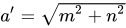."*
\[In what follows, accent marks, wherever they're placed, will be used to indicate the absolute size of the quantities to which they're assigned; thus if
a
\=
m
\+
n
−
1
{\\displaystyle a=m+n{\\sqrt {-1}}}

,
m
{\\displaystyle m}

and
n
{\\displaystyle n}

being real, one should understand that
a
′
{\\displaystyle a\_{'}}

or
a
′
\=
m
2
\+
n
2
{\\displaystyle a'={\\sqrt {m^{2}+n^{2}}}}

.\]
[Argand 1814](https://en.wikipedia.org/wiki/Complex_number#CITEREFArgand1814), p. 208 defines and names the *module* and the *direction factor* of a complex number: *"... a \= m 2 \+ n 2 {\\displaystyle a={\\sqrt {m^{2}+n^{2}}}} 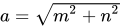 pourrait être appelé le* module *de a \+ b − 1 {\\displaystyle a+b{\\sqrt {-1}}} , et représenterait la* grandeur absolue *de la ligne a \+ b − 1 {\\displaystyle a+b{\\sqrt {-1}}} , tandis que l'autre facteur, dont le module est l'unité, en représenterait la direction."*
\[...
a
\=
m
2
\+
n
2
{\\displaystyle a={\\sqrt {m^{2}+n^{2}}}}

could be called the *module* of
a
\+
b
−
1
{\\displaystyle a+b{\\sqrt {-1}}}

and would represent the *absolute size* of the line
a
\+
b
−
1
,
{\\displaystyle a+b{\\sqrt {-1}}\\,,}

(Argand represented complex numbers as vectors.) whereas the other factor \[namely,
a
a
2
\+
b
2
\+
b
a
2
\+
b
2
−
1
{\\displaystyle {\\tfrac {a}{\\sqrt {a^{2}+b^{2}}}}+{\\tfrac {b}{\\sqrt {a^{2}+b^{2}}}}{\\sqrt {-1}}}
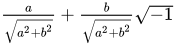
\], whose module is unity \[1\], would represent its direction.\]
5. **[^](https://en.wikipedia.org/wiki/Complex_number#cite_ref-55)**
Gauss writes:[\[50\]](https://en.wikipedia.org/wiki/Complex_number#cite_note-54) *"Quemadmodum scilicet arithmetica sublimior in quaestionibus hactenus pertractatis inter solos numeros integros reales versatur, ita theoremata circa residua biquadratica tunc tantum in summa simplicitate ac genuina venustate resplendent, quando campus arithmeticae ad quantitates* imaginarias *extenditur, ita ut absque restrictione ipsius obiectum constituant numeri formae* a + bi*, denotantibus* i*, pro more quantitatem imaginariam − 1 {\\displaystyle {\\sqrt {-1}}} , atque* a, b *indefinite omnes numeros reales integros inter -∞ {\\displaystyle \\infty }  et +∞ {\\displaystyle \\infty } ."* \[Of course just as the higher arithmetic has been investigated so far in problems only among real integer numbers, so theorems regarding biquadratic residues then shine in greatest simplicity and genuine beauty, when the field of arithmetic is extended to *imaginary* quantities, so that, without restrictions on it, numbers of the form *a + bi* — *i* denoting by convention the imaginary quantity
−
1
{\\displaystyle {\\sqrt {-1}}}

, and the variables *a, b* \[denoting\] all real integer numbers between
−
∞
{\\displaystyle -\\infty }

and
\+
∞
{\\displaystyle +\\infty }

— constitute an object.\]
6. **[^](https://en.wikipedia.org/wiki/Complex_number#cite_ref-57)** Gauss:[\[51\]](https://en.wikipedia.org/wiki/Complex_number#cite_note-56) *"Tales numeros vocabimus numeros integros complexos, ita quidem, ut reales complexis non opponantur, sed tamquam species sub his contineri censeantur."* \[We will call such numbers \[namely, numbers of the form *a + bi* \] "complex integer numbers", so that real \[numbers\] are regarded not as the opposite of complex \[numbers\] but \[as\] a type \[of number that\] is, so to speak, contained within them.\]
7. **[^](https://en.wikipedia.org/wiki/Complex_number#cite_ref-59)** Gauss:[\[52\]](https://en.wikipedia.org/wiki/Complex_number#cite_note-58) *"Productum numeri complexi per numerum ipsi conjunctum utriusque* normam *vocamus. Pro norma itaque numeri realis, ipsius quadratum habendum est."* \[We call a "norm" the product of a complex number \[for example, *a + ib* \] with its conjugate \[*a - ib* \]. Therefore the square of a real number should be regarded as its norm.\]
8. **[^](https://en.wikipedia.org/wiki/Complex_number#cite_ref-63)** However for another inverse function of the complex exponential function (and not the above defined principal value), the branch cut could be taken at any other [ray](https://en.wikipedia.org/wiki/Line_\(geometry\)#Ray "Line (geometry)") thru the origin.
## References
\[[edit](https://en.wikipedia.org/w/index.php?title=Complex_number&action=edit§ion=42 "Edit section: References")\]
1. **[^](https://en.wikipedia.org/wiki/Complex_number#cite_ref-1)**
For an extensive account of the history of "imaginary" numbers, from initial skepticism to ultimate acceptance, see
[Bourbaki, Nicolas](https://en.wikipedia.org/wiki/Nicolas_Bourbaki "Nicolas Bourbaki") (1998). "Foundations of Mathematics § Logic: Set theory". *Elements of the History of Mathematics*. Springer. pp. 18–24\.
2. **[^](https://en.wikipedia.org/wiki/Complex_number#cite_ref-2)** "Complex numbers, as much as reals, and perhaps even more, find a unity with nature that is truly remarkable. It is as though Nature herself is as impressed by the scope and consistency of the complex-number system as we are ourselves, and has entrusted to these numbers the precise operations of her world at its minutest scales.", [Penrose 2005](https://en.wikipedia.org/wiki/Complex_number#CITEREFPenrose2005), pp.72–73.
3. **[^](https://en.wikipedia.org/wiki/Complex_number#cite_ref-3)**
Axler, Sheldon (2010). [*College algebra*](https://archive.org/details/collegealgebrawi00axle). Wiley. p. [262](https://archive.org/details/collegealgebrawi00axle/page/n285). [ISBN](https://en.wikipedia.org/wiki/ISBN_\(identifier\) "ISBN (identifier)")
[9780470470770](https://en.wikipedia.org/wiki/Special:BookSources/9780470470770 "Special:BookSources/9780470470770")
.
4. **[^](https://en.wikipedia.org/wiki/Complex_number#cite_ref-4)**
Spiegel, M.R.; Lipschutz, S.; Schiller, J.J.; Spellman, D. (14 April 2009). *Complex Variables*. Schaum's Outline Series (2nd ed.). McGraw Hill. [ISBN](https://en.wikipedia.org/wiki/ISBN_\(identifier\) "ISBN (identifier)")
[978-0-07-161569-3](https://en.wikipedia.org/wiki/Special:BookSources/978-0-07-161569-3 "Special:BookSources/978-0-07-161569-3")
.
5. **[^](https://en.wikipedia.org/wiki/Complex_number#cite_ref-5)** [Aufmann, Barker & Nation 2007](https://en.wikipedia.org/wiki/Complex_number#CITEREFAufmannBarkerNation2007), p. 66, Chapter P
6. **[^](https://en.wikipedia.org/wiki/Complex_number#cite_ref-6)**
[Pedoe, Dan](https://en.wikipedia.org/wiki/Daniel_Pedoe "Daniel Pedoe") (1988). *Geometry: A comprehensive course*. Dover. [ISBN](https://en.wikipedia.org/wiki/ISBN_\(identifier\) "ISBN (identifier)")
[978-0-486-65812-4](https://en.wikipedia.org/wiki/Special:BookSources/978-0-486-65812-4 "Special:BookSources/978-0-486-65812-4")
.
7. ^ [***a***](https://en.wikipedia.org/wiki/Complex_number#cite_ref-:2_7-0) [***b***](https://en.wikipedia.org/wiki/Complex_number#cite_ref-:2_7-1)
Weisstein, Eric W. ["Complex Number"](https://mathworld.wolfram.com/ComplexNumber.html). *mathworld.wolfram.com*. Retrieved 12 August 2020.
8. **[^](https://en.wikipedia.org/wiki/Complex_number#cite_ref-Campbell_1911_9-0)**
[Campbell, George Ashley](https://en.wikipedia.org/wiki/George_Ashley_Campbell "George Ashley Campbell") (April 1911). ["Cisoidal oscillations"](https://ia800708.us.archive.org/view_archive.php?archive=/28/items/crossref-pre-1923-scholarly-works/10.1109%252Fpaiee.1910.6660428.zip&file=10.1109%252Fpaiee.1911.6659711.pdf) (PDF). *[Proceedings of the American Institute of Electrical Engineers](https://en.wikipedia.org/wiki/Proceedings_of_the_American_Institute_of_Electrical_Engineers "Proceedings of the American Institute of Electrical Engineers")*. **XXX** (1–6\). [American Institute of Electrical Engineers](https://en.wikipedia.org/wiki/American_Institute_of_Electrical_Engineers "American Institute of Electrical Engineers"): 789–824 \[Fig. 13 on p. 810\]. [Bibcode](https://en.wikipedia.org/wiki/Bibcode_\(identifier\) "Bibcode (identifier)"):[1911PAIEE..30d.789C](https://ui.adsabs.harvard.edu/abs/1911PAIEE..30d.789C). [doi](https://en.wikipedia.org/wiki/Doi_\(identifier\) "Doi (identifier)"):[10\.1109/PAIEE.1911.6659711](https://doi.org/10.1109%2FPAIEE.1911.6659711). [S2CID](https://en.wikipedia.org/wiki/S2CID_\(identifier\) "S2CID (identifier)") [51647814](https://api.semanticscholar.org/CorpusID:51647814). Retrieved 24 June 2023. p. 789: "The use of *i* (or Greek *ı*) for the imaginary symbol is nearly universal in mathematical work, which is a very strong reason for retaining it in the applications of mathematics in electrical engineering. Aside, however, from the matter of established conventions and facility of reference to mathematical literature, the substitution of the symbol *j* is objectionable because of the vector terminology with which it has become associated in engineering literature, and also because of the confusion resulting from the divided practice of engineering writers, some using *j* for +*i* and others using *j* for −*i*."
9. **[^](https://en.wikipedia.org/wiki/Complex_number#cite_ref-Brown-Churchill_1996_10-0)**
Brown, James Ward; Churchill, Ruel V. (1996). *Complex variables and applications* (6 ed.). New York, USA: [McGraw-Hill](https://en.wikipedia.org/wiki/McGraw-Hill "McGraw-Hill"). p. 2. [ISBN](https://en.wikipedia.org/wiki/ISBN_\(identifier\) "ISBN (identifier)")
[978-0-07-912147-9](https://en.wikipedia.org/wiki/Special:BookSources/978-0-07-912147-9 "Special:BookSources/978-0-07-912147-9")
. p. 2: "In electrical engineering, the letter *j* is used instead of *i*."
10. **[^](https://en.wikipedia.org/wiki/Complex_number#cite_ref-FOOTNOTEApostol198115%E2%80%9316_11-0)** [Apostol 1981](https://en.wikipedia.org/wiki/Complex_number#CITEREFApostol1981), pp. 15–16.
11. **[^](https://en.wikipedia.org/wiki/Complex_number#cite_ref-12)** [Apostol 1981](https://en.wikipedia.org/wiki/Complex_number#CITEREFApostol1981), pp. 15–16
12. **[^](https://en.wikipedia.org/wiki/Complex_number#cite_ref-FOOTNOTEApostol198118_13-0)** [Apostol 1981](https://en.wikipedia.org/wiki/Complex_number#CITEREFApostol1981), p. 18.
13. **[^](https://en.wikipedia.org/wiki/Complex_number#cite_ref-14)**
William Ford (2014). [*Numerical Linear Algebra with Applications: Using MATLAB and Octave*](https://books.google.com/books?id=OODs2mkOOqAC) (reprinted ed.). Academic Press. p. 570. [ISBN](https://en.wikipedia.org/wiki/ISBN_\(identifier\) "ISBN (identifier)")
[978-0-12-394784-0](https://en.wikipedia.org/wiki/Special:BookSources/978-0-12-394784-0 "Special:BookSources/978-0-12-394784-0")
.
[Extract of page 570](https://books.google.com/books?id=OODs2mkOOqAC&pg=PA570)
14. **[^](https://en.wikipedia.org/wiki/Complex_number#cite_ref-15)**
Dennis Zill; Jacqueline Dewar (2011). [*Precalculus with Calculus Previews: Expanded Volume*](https://books.google.com/books?id=TLgjLBeY55YC) (revised ed.). Jones & Bartlett Learning. p. 37. [ISBN](https://en.wikipedia.org/wiki/ISBN_\(identifier\) "ISBN (identifier)")
[978-0-7637-6631-3](https://en.wikipedia.org/wiki/Special:BookSources/978-0-7637-6631-3 "Special:BookSources/978-0-7637-6631-3")
.
[Extract of page 37](https://books.google.com/books?id=TLgjLBeY55YC&pg=PA37)
15. **[^](https://en.wikipedia.org/wiki/Complex_number#cite_ref-16)**
Other authors, including [Ebbinghaus et al. 1991](https://en.wikipedia.org/wiki/Complex_number#CITEREFEbbinghausHermesHirzebruchKoecher1991), §6.1, chose the argument to be in the interval
\[
0
,
2
π
)
{\\displaystyle \[0,2\\pi )}

.
16. **[^](https://en.wikipedia.org/wiki/Complex_number#cite_ref-17)**
Kasana, H.S. (2005). ["Chapter 1"](https://books.google.com/books?id=rFhiJqkrALIC&pg=PA14). *Complex Variables: Theory And Applications* (2nd ed.). PHI Learning Pvt. Ltd. p. 14. [ISBN](https://en.wikipedia.org/wiki/ISBN_\(identifier\) "ISBN (identifier)")
[978-81-203-2641-5](https://en.wikipedia.org/wiki/Special:BookSources/978-81-203-2641-5 "Special:BookSources/978-81-203-2641-5")
.
17. **[^](https://en.wikipedia.org/wiki/Complex_number#cite_ref-18)**
Nilsson, James William; Riedel, Susan A. (2008). ["Chapter 9"](https://books.google.com/books?id=sxmM8RFL99wC&pg=PA338). *Electric circuits* (8th ed.). Prentice Hall. p. 338. [ISBN](https://en.wikipedia.org/wiki/ISBN_\(identifier\) "ISBN (identifier)")
[978-0-13-198925-2](https://en.wikipedia.org/wiki/Special:BookSources/978-0-13-198925-2 "Special:BookSources/978-0-13-198925-2")
.
18. **[^](https://en.wikipedia.org/wiki/Complex_number#cite_ref-19)**
Lloyd James Peter Kilford (2015). [*Modular Forms: A Classical And Computational Introduction*](https://books.google.com/books?id=qDk8DQAAQBAJ) (2nd ed.). World Scientific Publishing Company. p. 112. [ISBN](https://en.wikipedia.org/wiki/ISBN_\(identifier\) "ISBN (identifier)")
[978-1-78326-547-3](https://en.wikipedia.org/wiki/Special:BookSources/978-1-78326-547-3 "Special:BookSources/978-1-78326-547-3")
.
[Extract of page 112](https://books.google.com/books?id=qDk8DQAAQBAJ&pg=PA112)
19. **[^](https://en.wikipedia.org/wiki/Complex_number#cite_ref-Bourbaki_1998_loc=%C2%A7VIII.1_20-0)** [Bourbaki 1998](https://en.wikipedia.org/wiki/Complex_number#CITEREFBourbaki1998), §VIII.1
20. **[^](https://en.wikipedia.org/wiki/Complex_number#cite_ref-21)**
Kline, Morris. *A history of mathematical thought, volume 1*. p. 253.
21. **[^](https://en.wikipedia.org/wiki/Complex_number#cite_ref-22)**
Jurij., Kovič. *Tristan Needham, Visual Complex Analysis, Oxford University Press Inc., New York, 1998, 592 strani*. [OCLC](https://en.wikipedia.org/wiki/OCLC_\(identifier\) "OCLC (identifier)") [1080410598](https://search.worldcat.org/oclc/1080410598).
22. **[^](https://en.wikipedia.org/wiki/Complex_number#cite_ref-23)** O'Connor and Robertson (2016), "Girolamo Cardano."
23. **[^](https://en.wikipedia.org/wiki/Complex_number#cite_ref-24)** Nahin, Paul J. An Imaginary Tale: The Story of √−1. Princeton: Princeton University Press, 1998.
24. **[^](https://en.wikipedia.org/wiki/Complex_number#cite_ref-25)**
Katz, Victor J. (2004). "9.1.4". *A History of Mathematics, Brief Version*. [Addison-Wesley](https://en.wikipedia.org/wiki/Addison-Wesley "Addison-Wesley"). [ISBN](https://en.wikipedia.org/wiki/ISBN_\(identifier\) "ISBN (identifier)")
[978-0-321-16193-2](https://en.wikipedia.org/wiki/Special:BookSources/978-0-321-16193-2 "Special:BookSources/978-0-321-16193-2")
.
25. **[^](https://en.wikipedia.org/wiki/Complex_number#cite_ref-26)**
Hamilton, Wm. (1844). ["On a new species of imaginary quantities connected with a theory of quaternions"](https://babel.hathitrust.org/cgi/pt?id=njp.32101040410779&view=1up&seq=454). *Proceedings of the Royal Irish Academy*. **2**: 424–434\.
26. **[^](https://en.wikipedia.org/wiki/Complex_number#cite_ref-27)**
Cynthia Y. Young (2017). [*Trigonometry*](https://books.google.com/books?id=476ZDwAAQBAJ) (4th ed.). John Wiley & Sons. p. 406. [ISBN](https://en.wikipedia.org/wiki/ISBN_\(identifier\) "ISBN (identifier)")
[978-1-119-44520-3](https://en.wikipedia.org/wiki/Special:BookSources/978-1-119-44520-3 "Special:BookSources/978-1-119-44520-3")
.
[Extract of page 406](https://books.google.com/books?id=476ZDwAAQBAJ&pg=PA406)
27. **[^](https://en.wikipedia.org/wiki/Complex_number#cite_ref-29)**
Nahin, Paul J. (2007). [*An Imaginary Tale: The Story of √−1*](http://mathforum.org/kb/thread.jspa?forumID=149&threadID=383188&messageID=1181284). [Princeton University Press](https://en.wikipedia.org/wiki/Princeton_University_Press "Princeton University Press"). [ISBN](https://en.wikipedia.org/wiki/ISBN_\(identifier\) "ISBN (identifier)")
[978-0-691-12798-9](https://en.wikipedia.org/wiki/Special:BookSources/978-0-691-12798-9 "Special:BookSources/978-0-691-12798-9")
. [Archived](https://web.archive.org/web/20121012090553/http://mathforum.org/kb/thread.jspa?forumID=149&threadID=383188&messageID=1181284) from the original on 12 October 2012. Retrieved 20 April 2011.
28. ^ [***a***](https://en.wikipedia.org/wiki/Complex_number#cite_ref-Casus_30-0) [***b***](https://en.wikipedia.org/wiki/Complex_number#cite_ref-Casus_30-1)
Confalonieri, Sara (2015). *The Unattainable Attempt to Avoid the Casus Irreducibilis for Cubic Equations: Gerolamo Cardano's De Regula Aliza*. Springer. pp. 15–16 (note 26). [ISBN](https://en.wikipedia.org/wiki/ISBN_\(identifier\) "ISBN (identifier)")
[978-3658092757](https://en.wikipedia.org/wiki/Special:BookSources/978-3658092757 "Special:BookSources/978-3658092757")
.
29. **[^](https://en.wikipedia.org/wiki/Complex_number#cite_ref-32)**
[Descartes, René](https://en.wikipedia.org/wiki/Ren%C3%A9_Descartes "René Descartes") (1954) \[1637\]. [*La Géométrie \| The Geometry of René Descartes with a facsimile of the first edition*](https://archive.org/details/geometryofrenede00rend). [Dover Publications](https://en.wikipedia.org/wiki/Dover_Publications "Dover Publications"). [ISBN](https://en.wikipedia.org/wiki/ISBN_\(identifier\) "ISBN (identifier)")
[978-0-486-60068-0](https://en.wikipedia.org/wiki/Special:BookSources/978-0-486-60068-0 "Special:BookSources/978-0-486-60068-0")
. Retrieved 20 April 2011.
`{{cite book}}`: ISBN / Date incompatibility ([help](https://en.wikipedia.org/wiki/Help:CS1_errors#invalid_isbn_date "Help:CS1 errors"))
30. **[^](https://en.wikipedia.org/wiki/Complex_number#cite_ref-33)**
Joseph Mazur (2016). [*Enlightening Symbols: A Short History of Mathematical Notation and Its Hidden Powers*](https://books.google.com/books?id=O3CYDwAAQBAJ) (reprinted ed.). Princeton University Press. p. 138. [ISBN](https://en.wikipedia.org/wiki/ISBN_\(identifier\) "ISBN (identifier)")
[978-0-691-17337-5](https://en.wikipedia.org/wiki/Special:BookSources/978-0-691-17337-5 "Special:BookSources/978-0-691-17337-5")
.
[Extract of page 138](https://books.google.com/books?id=O3CYDwAAQBAJ&pg=PA138)
31. **[^](https://en.wikipedia.org/wiki/Complex_number#cite_ref-34)**
Bryan Bunch (2012). [*Mathematical Fallacies and Paradoxes*](https://books.google.com/books?id=jUTCAgAAQBAJ) (reprinted, revised ed.). Courier Corporation. p. 32. [ISBN](https://en.wikipedia.org/wiki/ISBN_\(identifier\) "ISBN (identifier)")
[978-0-486-13793-3](https://en.wikipedia.org/wiki/Special:BookSources/978-0-486-13793-3 "Special:BookSources/978-0-486-13793-3")
.
[Extract of page 32](https://books.google.com/books?id=jUTCAgAAQBAJ&pg=PA32)
32. **[^](https://en.wikipedia.org/wiki/Complex_number#cite_ref-35)**
Euler, Leonhard (1748). [*Introductio in Analysin Infinitorum*](https://books.google.com/books?id=jQ1bAAAAQAAJ&pg=PA104) \[*Introduction to the Analysis of the Infinite*\] (in Latin). Vol. 1. Lucerne, Switzerland: Marc Michel Bosquet & Co. p. 104.
33. **[^](https://en.wikipedia.org/wiki/Complex_number#cite_ref-36)**
Wessel, Caspar (1799). ["Om Directionens analytiske Betegning, et Forsog, anvendt fornemmelig til plane og sphæriske Polygoners Oplosning"](https://babel.hathitrust.org/cgi/pt?id=ien.35556000979690&view=1up&seq=561) \[On the analytic representation of direction, an effort applied in particular to the determination of plane and spherical polygons\]. *Nye Samling af det Kongelige Danske Videnskabernes Selskabs Skrifter \[New Collection of the Writings of the Royal Danish Science Society\]* (in Danish). **5**: 469–518\.
34. **[^](https://en.wikipedia.org/wiki/Complex_number#cite_ref-37)**
Wallis, John (1685). [*A Treatise of Algebra, Both Historical and Practical ...*](https://echo.mpiwg-berlin.mpg.de/ECHOdocuView?url=/permanent/library/H3GRV5AU/pageimg&start=291&mode=imagepath&pn=291) London, England: printed by John Playford, for Richard Davis. pp. 264–273\.
35. **[^](https://en.wikipedia.org/wiki/Complex_number#cite_ref-38)**
Argand (1806). [*Essai sur une manière de représenter les quantités imaginaires dans les constructions géométriques*](http://www.bibnum.education.fr/mathematiques/geometrie/essai-sur-une-maniere-de-representer-des-quantites-imaginaires-dans-les-cons) \[*Essay on a way to represent complex quantities by geometric constructions*\] (in French). Paris, France: Madame Veuve Blanc.
36. **[^](https://en.wikipedia.org/wiki/Complex_number#cite_ref-39)** Gauss, Carl Friedrich (1799) [*"Demonstratio nova theorematis omnem functionem algebraicam rationalem integram unius variabilis in factores reales primi vel secundi gradus resolvi posse."*](https://books.google.com/books?id=g3VaAAAAcAAJ&pg=PP1) \[New proof of the theorem that any rational integral algebraic function of a single variable can be resolved into real factors of the first or second degree.\] Ph.D. thesis, University of Helmstedt, (Germany). (in Latin)
37. **[^](https://en.wikipedia.org/wiki/Complex_number#cite_ref-Ewald_40-0)**
Ewald, William B. (1996). [*From Kant to Hilbert: A Source Book in the Foundations of Mathematics*](https://books.google.com/books?id=rykSDAAAQBAJ&pg=PA313). Vol. 1. Oxford University Press. p. 313. [ISBN](https://en.wikipedia.org/wiki/ISBN_\(identifier\) "ISBN (identifier)")
[9780198505358](https://en.wikipedia.org/wiki/Special:BookSources/9780198505358 "Special:BookSources/9780198505358")
. Retrieved 18 March 2020.
38. **[^](https://en.wikipedia.org/wiki/Complex_number#cite_ref-FOOTNOTEGauss1831_41-0)** [Gauss 1831](https://en.wikipedia.org/wiki/Complex_number#CITEREFGauss1831).
39. **[^](https://en.wikipedia.org/wiki/Complex_number#cite_ref-42)**
["Adrien Quentin Buée (1745–1845): MacTutor"](https://mathshistory.st-andrews.ac.uk/Biographies/Buee/).
40. **[^](https://en.wikipedia.org/wiki/Complex_number#cite_ref-43)**
Buée (1806). ["Mémoire sur les quantités imaginaires"](https://royalsocietypublishing.org/doi/pdf/10.1098/rstl.1806.0003) \[Memoir on imaginary quantities\]. *Philosophical Transactions of the Royal Society of London* (in French). **96**: 23–88\. [doi](https://en.wikipedia.org/wiki/Doi_\(identifier\) "Doi (identifier)"):[10\.1098/rstl.1806.0003](https://doi.org/10.1098%2Frstl.1806.0003). [S2CID](https://en.wikipedia.org/wiki/S2CID_\(identifier\) "S2CID (identifier)") [110394048](https://api.semanticscholar.org/CorpusID:110394048).
41. **[^](https://en.wikipedia.org/wiki/Complex_number#cite_ref-44)**
Mourey, C.V. (1861). [*La vraies théore des quantités négatives et des quantités prétendues imaginaires*](https://archive.org/details/bub_gb_8YxKAAAAYAAJ) \[*The true theory of negative quantities and of alleged imaginary quantities*\] (in French). Paris, France: Mallet-Bachelier.
1861 reprint of 1828 original.
42. **[^](https://en.wikipedia.org/wiki/Complex_number#cite_ref-45)**
Warren, John (1828). [*A Treatise on the Geometrical Representation of the Square Roots of Negative Quantities*](https://archive.org/details/treatiseongeomet00warrrich). Cambridge, England: Cambridge University Press.
43. **[^](https://en.wikipedia.org/wiki/Complex_number#cite_ref-46)**
Warren, John (1829). ["Consideration of the objections raised against the geometrical representation of the square roots of negative quantities"](https://doi.org/10.1098%2Frstl.1829.0022). *Philosophical Transactions of the Royal Society of London*. **119**: 241–254\. [doi](https://en.wikipedia.org/wiki/Doi_\(identifier\) "Doi (identifier)"):[10\.1098/rstl.1829.0022](https://doi.org/10.1098%2Frstl.1829.0022). [S2CID](https://en.wikipedia.org/wiki/S2CID_\(identifier\) "S2CID (identifier)") [186211638](https://api.semanticscholar.org/CorpusID:186211638).
44. **[^](https://en.wikipedia.org/wiki/Complex_number#cite_ref-47)**
Warren, John (1829). ["On the geometrical representation of the powers of quantities, whose indices involve the square roots of negative numbers"](https://doi.org/10.1098%2Frstl.1829.0031). *Philosophical Transactions of the Royal Society of London*. **119**: 339–359\. [doi](https://en.wikipedia.org/wiki/Doi_\(identifier\) "Doi (identifier)"):[10\.1098/rstl.1829.0031](https://doi.org/10.1098%2Frstl.1829.0031). [S2CID](https://en.wikipedia.org/wiki/S2CID_\(identifier\) "S2CID (identifier)") [125699726](https://api.semanticscholar.org/CorpusID:125699726).
45. **[^](https://en.wikipedia.org/wiki/Complex_number#cite_ref-48)**
Français, J.F. (1813). ["Nouveaux principes de géométrie de position, et interprétation géométrique des symboles imaginaires"](https://babel.hathitrust.org/cgi/pt?id=uc1.$c126478&view=1up&seq=69) \[New principles of the geometry of position, and geometric interpretation of complex \[number\] symbols\]. *Annales des mathématiques pures et appliquées* (in French). **4**: 61–71\.
46. **[^](https://en.wikipedia.org/wiki/Complex_number#cite_ref-49)**
Caparrini, Sandro (2000). ["On the Common Origin of Some of the Works on the Geometrical Interpretation of Complex Numbers"](https://books.google.com/books?id=voFsJ1EhCnYC&pg=PA139). In Kim Williams (ed.). [*Two Cultures*](https://books.google.com/books?id=voFsJ1EhCnYC). Birkhäuser. p. 139. [ISBN](https://en.wikipedia.org/wiki/ISBN_\(identifier\) "ISBN (identifier)")
[978-3-7643-7186-9](https://en.wikipedia.org/wiki/Special:BookSources/978-3-7643-7186-9 "Special:BookSources/978-3-7643-7186-9")
.
47. **[^](https://en.wikipedia.org/wiki/Complex_number#cite_ref-50)**
Hardy, G.H.; Wright, E.M. (2000) \[1938\]. *An Introduction to the Theory of Numbers*. [OUP Oxford](https://en.wikipedia.org/wiki/Oxford_University_Press "Oxford University Press"). p. 189 (fourth edition). [ISBN](https://en.wikipedia.org/wiki/ISBN_\(identifier\) "ISBN (identifier)")
[978-0-19-921986-5](https://en.wikipedia.org/wiki/Special:BookSources/978-0-19-921986-5 "Special:BookSources/978-0-19-921986-5")
.
48. **[^](https://en.wikipedia.org/wiki/Complex_number#cite_ref-52)**
Jeff Miller (21 September 1999). ["MODULUS"](https://web.archive.org/web/19991003034827/http://members.aol.com/jeff570/m.html). *Earliest Known Uses of Some of the Words of Mathematics (M)*. Archived from the original on 3 October 1999.
49. **[^](https://en.wikipedia.org/wiki/Complex_number#cite_ref-53)**
Cauchy, Augustin-Louis (1821). [*Cours d'analyse de l'École royale polytechnique*](https://archive.org/details/coursdanalysede00caucgoog/page/n209/mode/2up) (in French). Vol. 1. Paris, France: L'Imprimerie Royale. p. 183.
50. **[^](https://en.wikipedia.org/wiki/Complex_number#cite_ref-54)** [Gauss 1831](https://en.wikipedia.org/wiki/Complex_number#CITEREFGauss1831), p. 96
51. **[^](https://en.wikipedia.org/wiki/Complex_number#cite_ref-56)** [Gauss 1831](https://en.wikipedia.org/wiki/Complex_number#CITEREFGauss1831), p. 96
52. **[^](https://en.wikipedia.org/wiki/Complex_number#cite_ref-58)** [Gauss 1831](https://en.wikipedia.org/wiki/Complex_number#CITEREFGauss1831), p. 98
53. **[^](https://en.wikipedia.org/wiki/Complex_number#cite_ref-60)**
Hankel, Hermann (1867). [*Vorlesungen über die complexen Zahlen und ihre Functionen*](https://books.google.com/books?id=754KAAAAYAAJ&pg=PA71) \[*Lectures About the Complex Numbers and Their Functions*\] (in German). Vol. 1. Leipzig, \[Germany\]: Leopold Voss. p. 71.
From p. 71: *"Wir werden den Factor (*cos *φ + i* sin *φ) haüfig den* Richtungscoefficienten *nennen."* (We will often call the factor (cos φ + i sin φ) the "coefficient of direction".)
54. **[^](https://en.wikipedia.org/wiki/Complex_number#cite_ref-61)**
Ahlfors, Lars V. (1979). *Complex Analysis: An Introduction to the Theory of Analytic Functions of One Complex Variable* (3rd ed.). McGraw-Hill. pp. 4–6\. [ISBN](https://en.wikipedia.org/wiki/ISBN_\(identifier\) "ISBN (identifier)")
[978-0-070-00657-7](https://en.wikipedia.org/wiki/Special:BookSources/978-0-070-00657-7 "Special:BookSources/978-0-070-00657-7")
.
`{{cite book}}`: CS1 maint: date and year ([link](https://en.wikipedia.org/wiki/Category:CS1_maint:_date_and_year "Category:CS1 maint: date and year"))
55. **[^](https://en.wikipedia.org/wiki/Complex_number#cite_ref-62)** [Bourbaki 1998](https://en.wikipedia.org/wiki/Complex_number#CITEREFBourbaki1998), §VIII.1
56. **[^](https://en.wikipedia.org/wiki/Complex_number#cite_ref-64)**
Lester, J.A. (1994). "Triangles I: Shapes". *[Aequationes Mathematicae](https://en.wikipedia.org/wiki/Aequationes_Mathematicae "Aequationes Mathematicae")*. **52**: 30–54\. [doi](https://en.wikipedia.org/wiki/Doi_\(identifier\) "Doi (identifier)"):[10\.1007/BF01818325](https://doi.org/10.1007%2FBF01818325). [S2CID](https://en.wikipedia.org/wiki/S2CID_\(identifier\) "S2CID (identifier)") [121095307](https://api.semanticscholar.org/CorpusID:121095307).
57. **[^](https://en.wikipedia.org/wiki/Complex_number#cite_ref-65)**
Kalman, Dan (2008a). ["An Elementary Proof of Marden's Theorem"](http://mathdl.maa.org/mathDL/22/?pa=content&sa=viewDocument&nodeId=3338&pf=1). *[American Mathematical Monthly](https://en.wikipedia.org/wiki/American_Mathematical_Monthly "American Mathematical Monthly")*. **115** (4): 330–38\. [doi](https://en.wikipedia.org/wiki/Doi_\(identifier\) "Doi (identifier)"):[10\.1080/00029890.2008.11920532](https://doi.org/10.1080%2F00029890.2008.11920532). [ISSN](https://en.wikipedia.org/wiki/ISSN_\(identifier\) "ISSN (identifier)") [0002-9890](https://search.worldcat.org/issn/0002-9890). [S2CID](https://en.wikipedia.org/wiki/S2CID_\(identifier\) "S2CID (identifier)") [13222698](https://api.semanticscholar.org/CorpusID:13222698). [Archived](https://web.archive.org/web/20120308104622/http://mathdl.maa.org/mathDL/22/?pa=content&sa=viewDocument&nodeId=3338&pf=1) from the original on 8 March 2012. Retrieved 1 January 2012.
58. **[^](https://en.wikipedia.org/wiki/Complex_number#cite_ref-66)**
Kalman, Dan (2008b). ["The Most Marvelous Theorem in Mathematics"](http://mathdl.maa.org/mathDL/4/?pa=content&sa=viewDocument&nodeId=1663). *[Journal of Online Mathematics and Its Applications](https://en.wikipedia.org/wiki/Journal_of_Online_Mathematics_and_Its_Applications "Journal of Online Mathematics and Its Applications")*. [Archived](https://web.archive.org/web/20120208014954/http://mathdl.maa.org/mathDL/4/?pa=content&sa=viewDocument&nodeId=1663) from the original on 8 February 2012. Retrieved 1 January 2012.
59. **[^](https://en.wikipedia.org/wiki/Complex_number#cite_ref-67)**
Grant, I.S.; Phillips, W.R. (2008). *Electromagnetism* (2 ed.). Manchester Physics Series. [ISBN](https://en.wikipedia.org/wiki/ISBN_\(identifier\) "ISBN (identifier)")
[978-0-471-92712-9](https://en.wikipedia.org/wiki/Special:BookSources/978-0-471-92712-9 "Special:BookSources/978-0-471-92712-9")
.
60. **[^](https://en.wikipedia.org/wiki/Complex_number#cite_ref-68)**
Marker, David (1996). ["Introduction to the Model Theory of Fields"](https://projecteuclid.org/euclid.lnl/1235423155). In Marker, D.; Messmer, M.; Pillay, A. (eds.). *Model theory of fields*. Lecture Notes in Logic. Vol. 5. Berlin: Springer-Verlag. pp. 1–37\. [ISBN](https://en.wikipedia.org/wiki/ISBN_\(identifier\) "ISBN (identifier)")
[978-3-540-60741-0](https://en.wikipedia.org/wiki/Special:BookSources/978-3-540-60741-0 "Special:BookSources/978-3-540-60741-0")
. [MR](https://en.wikipedia.org/wiki/MR_\(identifier\) "MR (identifier)") [1477154](https://mathscinet.ams.org/mathscinet-getitem?mr=1477154).
61. **[^](https://en.wikipedia.org/wiki/Complex_number#cite_ref-FOOTNOTEBourbaki1998%C2%A7VIII.4_69-0)** [Bourbaki 1998](https://en.wikipedia.org/wiki/Complex_number#CITEREFBourbaki1998), §VIII.4.
62. **[^](https://en.wikipedia.org/wiki/Complex_number#cite_ref-70)**
[McCrimmon, Kevin](https://en.wikipedia.org/wiki/Kevin_McCrimmon "Kevin McCrimmon") (2004). *A Taste of Jordan Algebras*. Universitext. Springer. p. 64. [ISBN](https://en.wikipedia.org/wiki/ISBN_\(identifier\) "ISBN (identifier)")
[0-387-95447-3](https://en.wikipedia.org/wiki/Special:BookSources/0-387-95447-3 "Special:BookSources/0-387-95447-3")
.
[MR](https://en.wikipedia.org/wiki/MR_\(identifier\) "MR (identifier)") [2014924](https://mathscinet.ams.org/mathscinet-getitem?mr=2014924)
63. **[^](https://en.wikipedia.org/wiki/Complex_number#cite_ref-FOOTNOTEApostol198125_71-0)** [Apostol 1981](https://en.wikipedia.org/wiki/Complex_number#CITEREFApostol1981), p. 25.
- [Ahlfors, Lars](https://en.wikipedia.org/wiki/Lars_Ahlfors "Lars Ahlfors") (1979). [*Complex analysis*](https://archive.org/details/lars-ahlfors-complex-analysis-third-edition-mcgraw-hill-science_engineering_math-1979/page/n1/mode/2up) (3rd ed.). McGraw-Hill. [ISBN](https://en.wikipedia.org/wiki/ISBN_\(identifier\) "ISBN (identifier)")
[978-0-07-000657-7](https://en.wikipedia.org/wiki/Special:BookSources/978-0-07-000657-7 "Special:BookSources/978-0-07-000657-7")
.
- Andreescu, Titu; Andrica, Dorin (2014), *Complex Numbers from A to ... Z* (Second ed.), New York: Springer, [doi](https://en.wikipedia.org/wiki/Doi_\(identifier\) "Doi (identifier)"):[10\.1007/978-0-8176-8415-0](https://doi.org/10.1007%2F978-0-8176-8415-0), [ISBN](https://en.wikipedia.org/wiki/ISBN_\(identifier\) "ISBN (identifier)")
[978-0-8176-8414-3](https://en.wikipedia.org/wiki/Special:BookSources/978-0-8176-8414-3 "Special:BookSources/978-0-8176-8414-3")
- [Apostol, Tom](https://en.wikipedia.org/wiki/Tom_Apostol "Tom Apostol") (1981). *Mathematical analysis*. Addison-Wesley.
- Aufmann, Richard N.; Barker, Vernon C.; Nation, Richard D. (2007). [*College Algebra and Trigonometry*](https://books.google.com/books?id=g5j-cT-vg_wC&pg=PA66) (6 ed.). Cengage Learning. [ISBN](https://en.wikipedia.org/wiki/ISBN_\(identifier\) "ISBN (identifier)")
[978-0-618-82515-8](https://en.wikipedia.org/wiki/Special:BookSources/978-0-618-82515-8 "Special:BookSources/978-0-618-82515-8")
.
- Conway, John B. (1986). *Functions of One Complex Variable I*. Springer. [ISBN](https://en.wikipedia.org/wiki/ISBN_\(identifier\) "ISBN (identifier)")
[978-0-387-90328-6](https://en.wikipedia.org/wiki/Special:BookSources/978-0-387-90328-6 "Special:BookSources/978-0-387-90328-6")
.
- [Derbyshire, John](https://en.wikipedia.org/wiki/John_Derbyshire "John Derbyshire") (2006). [*Unknown Quantity: A real and imaginary history of algebra*](https://archive.org/details/isbn_9780309096577). Joseph Henry Press. [ISBN](https://en.wikipedia.org/wiki/ISBN_\(identifier\) "ISBN (identifier)")
[978-0-309-09657-7](https://en.wikipedia.org/wiki/Special:BookSources/978-0-309-09657-7 "Special:BookSources/978-0-309-09657-7")
.
- Joshi, Kapil D. (1989). *Foundations of Discrete Mathematics*. New York: [John Wiley & Sons](https://en.wikipedia.org/wiki/John_Wiley_%26_Sons "John Wiley & Sons"). [ISBN](https://en.wikipedia.org/wiki/ISBN_\(identifier\) "ISBN (identifier)")
[978-0-470-21152-6](https://en.wikipedia.org/wiki/Special:BookSources/978-0-470-21152-6 "Special:BookSources/978-0-470-21152-6")
.
- Needham, Tristan (1997). *Visual Complex Analysis*. Clarendon Press. [ISBN](https://en.wikipedia.org/wiki/ISBN_\(identifier\) "ISBN (identifier)")
[978-0-19-853447-1](https://en.wikipedia.org/wiki/Special:BookSources/978-0-19-853447-1 "Special:BookSources/978-0-19-853447-1")
.
- [Pedoe, Dan](https://en.wikipedia.org/wiki/Daniel_Pedoe "Daniel Pedoe") (1988). *Geometry: A comprehensive course*. Dover. [ISBN](https://en.wikipedia.org/wiki/ISBN_\(identifier\) "ISBN (identifier)")
[978-0-486-65812-4](https://en.wikipedia.org/wiki/Special:BookSources/978-0-486-65812-4 "Special:BookSources/978-0-486-65812-4")
.
- [Penrose, Roger](https://en.wikipedia.org/wiki/Roger_Penrose "Roger Penrose") (2005). [*The Road to Reality: A complete guide to the laws of the universe*](https://archive.org/details/roadtorealitycom00penr_0). Alfred A. Knopf. [ISBN](https://en.wikipedia.org/wiki/ISBN_\(identifier\) "ISBN (identifier)")
[978-0-679-45443-4](https://en.wikipedia.org/wiki/Special:BookSources/978-0-679-45443-4 "Special:BookSources/978-0-679-45443-4")
.
- Press, W.H.; Teukolsky, S.A.; Vetterling, W.T.; Flannery, B.P. (2007). ["Section 5.5 Complex Arithmetic"](https://web.archive.org/web/20200313111530/http://apps.nrbook.com/empanel/index.html?pg=225). *Numerical Recipes: The art of scientific computing* (3rd ed.). New York: Cambridge University Press. [ISBN](https://en.wikipedia.org/wiki/ISBN_\(identifier\) "ISBN (identifier)")
[978-0-521-88068-8](https://en.wikipedia.org/wiki/Special:BookSources/978-0-521-88068-8 "Special:BookSources/978-0-521-88068-8")
. Archived from [the original](http://apps.nrbook.com/empanel/index.html?pg=225) on 13 March 2020. Retrieved 9 August 2011.
- Solomentsev, E.D. (2001) \[1994\], ["Complex number"](https://www.encyclopediaofmath.org/index.php?title=Complex_number), *[Encyclopedia of Mathematics](https://en.wikipedia.org/wiki/Encyclopedia_of_Mathematics "Encyclopedia of Mathematics")*, [EMS Press](https://en.wikipedia.org/wiki/European_Mathematical_Society "European Mathematical Society")
### Historical references
\[[edit](https://en.wikipedia.org/w/index.php?title=Complex_number&action=edit§ion=43 "Edit section: Historical references")\]
- Argand (1814). ["Reflexions sur la nouvelle théorie des imaginaires, suives d'une application à la demonstration d'un theorème d'analise"](https://babel.hathitrust.org/cgi/pt?id=uc1.$c126479&view=1up&seq=209) \[Reflections on the new theory of complex numbers, followed by an application to the proof of a theorem of analysis\]. *Annales de mathématiques pures et appliquées* (in French). **5**: 197–209\.
- [Bourbaki, Nicolas](https://en.wikipedia.org/wiki/Nicolas_Bourbaki "Nicolas Bourbaki") (1998). "Foundations of mathematics § logic: set theory". *Elements of the history of mathematics*. Springer.
- Burton, David M. (1995). *The History of Mathematics* (3rd ed.). New York: [McGraw-Hill](https://en.wikipedia.org/wiki/McGraw-Hill "McGraw-Hill"). [ISBN](https://en.wikipedia.org/wiki/ISBN_\(identifier\) "ISBN (identifier)")
[978-0-07-009465-9](https://en.wikipedia.org/wiki/Special:BookSources/978-0-07-009465-9 "Special:BookSources/978-0-07-009465-9")
.
- [Gauss, C. F.](https://en.wikipedia.org/wiki/Carl_Friedrich_Gauss "Carl Friedrich Gauss") (1831). ["Theoria residuorum biquadraticorum. Commentatio secunda"](https://babel.hathitrust.org/cgi/pt?id=mdp.39015073697180&view=1up&seq=283) \[Theory of biquadratic residues. Second memoir.\]. *Commentationes Societatis Regiae Scientiarum Gottingensis Recentiores* (in Latin). **7**: 89–148\.
- Katz, Victor J. (2004). *A History of Mathematics, Brief Version*. [Addison-Wesley](https://en.wikipedia.org/wiki/Addison-Wesley "Addison-Wesley"). [ISBN](https://en.wikipedia.org/wiki/ISBN_\(identifier\) "ISBN (identifier)")
[978-0-321-16193-2](https://en.wikipedia.org/wiki/Special:BookSources/978-0-321-16193-2 "Special:BookSources/978-0-321-16193-2")
.
- Nahin, Paul J. (1998). *An Imaginary Tale: The Story of − 1 {\\displaystyle \\scriptstyle {\\sqrt {-1}}} *. Princeton University Press. [ISBN](https://en.wikipedia.org/wiki/ISBN_\(identifier\) "ISBN (identifier)")
[978-0-691-02795-1](https://en.wikipedia.org/wiki/Special:BookSources/978-0-691-02795-1 "Special:BookSources/978-0-691-02795-1")
.
— A gentle introduction to the history of complex numbers and the beginnings of complex analysis.
- Ebbinghaus, H. D.; Hermes, H.; Hirzebruch, F.; Koecher, M.; Mainzer, K.; Neukirch, J.; Prestel, A.; Remmert, R. (1991). *Numbers* (hardcover ed.). Springer. [ISBN](https://en.wikipedia.org/wiki/ISBN_\(identifier\) "ISBN (identifier)")
[978-0-387-97497-2](https://en.wikipedia.org/wiki/Special:BookSources/978-0-387-97497-2 "Special:BookSources/978-0-387-97497-2")
.
— An advanced perspective on the historical development of the concept of number.
| [v](https://en.wikipedia.org/wiki/Template:Complex_numbers "Template:Complex numbers") [t](https://en.wikipedia.org/wiki/Template_talk:Complex_numbers "Template talk:Complex numbers") [e](https://en.wikipedia.org/wiki/Special:EditPage/Template:Complex_numbers "Special:EditPage/Template:Complex numbers")[Complex numbers]() |
|---|
| [Complex conjugate](https://en.wikipedia.org/wiki/Complex_conjugate "Complex conjugate") [Complex plane](https://en.wikipedia.org/wiki/Complex_plane "Complex plane") [Imaginary number](https://en.wikipedia.org/wiki/Imaginary_number "Imaginary number") [Real number](https://en.wikipedia.org/wiki/Real_number "Real number") [Unit complex number](https://en.wikipedia.org/wiki/Unit_complex_number "Unit complex number") |
| [v](https://en.wikipedia.org/wiki/Template:Number_systems "Template:Number systems") [t](https://en.wikipedia.org/wiki/Template_talk:Number_systems "Template talk:Number systems") [e](https://en.wikipedia.org/wiki/Special:EditPage/Template:Number_systems "Special:EditPage/Template:Number systems")[Number](https://en.wikipedia.org/wiki/Number "Number") systems | |
|---|---|
| Sets of [definable numbers](https://en.wikipedia.org/wiki/Definable_number "Definable number") | [Natural numbers](https://en.wikipedia.org/wiki/Natural_number "Natural number") ( N {\\displaystyle \\mathbb {N} }  ) [Integers](https://en.wikipedia.org/wiki/Integer "Integer") ( Z {\\displaystyle \\mathbb {Z} }  ) [Rational numbers](https://en.wikipedia.org/wiki/Rational_number "Rational number") ( Q {\\displaystyle \\mathbb {Q} }  ) [Constructible numbers](https://en.wikipedia.org/wiki/Constructible_number "Constructible number") [Algebraic numbers](https://en.wikipedia.org/wiki/Algebraic_number "Algebraic number") ( A {\\displaystyle \\mathbb {A} }  ) [Closed-form numbers](https://en.wikipedia.org/wiki/Closed-form_expression#Closed-form_number "Closed-form expression") [Periods](https://en.wikipedia.org/wiki/Period_\(algebraic_geometry\) "Period (algebraic geometry)") ( P {\\displaystyle {\\mathcal {P}}}  ) [Computable numbers](https://en.wikipedia.org/wiki/Computable_number "Computable number") [Arithmetical numbers](https://en.wikipedia.org/wiki/Definable_real_number#Definability_in_arithmetic "Definable real number") [Set-theoretically definable numbers](https://en.wikipedia.org/wiki/Definable_real_number#Definability_in_models_of_ZFC "Definable real number") [Gaussian integers](https://en.wikipedia.org/wiki/Gaussian_integer "Gaussian integer") [Gaussian rationals](https://en.wikipedia.org/wiki/Gaussian_rational "Gaussian rational") [Eisenstein integers](https://en.wikipedia.org/wiki/Eisenstein_integer "Eisenstein integer") |
| [Authority control databases](https://en.wikipedia.org/wiki/Help:Authority_control "Help:Authority control") [](https://www.wikidata.org/wiki/Q11567#identifiers "Edit this at Wikidata") | |
|---|---|
| International | [GND](https://d-nb.info/gnd/4128698-4) |
| National | [United States](https://id.loc.gov/authorities/sh85093211) [France](https://catalogue.bnf.fr/ark:/12148/cb11981946j) [BnF data](https://data.bnf.fr/ark:/12148/cb11981946j) [Japan](https://id.ndl.go.jp/auth/ndlna/00563643) [Czech Republic](https://aleph.nkp.cz/F/?func=find-c&local_base=aut&ccl_term=ica=ph121761&CON_LNG=ENG) [Latvia](https://kopkatalogs.lv/F?func=direct&local_base=lnc10&doc_number=000082623&P_CON_LNG=ENG) [Israel](https://www.nli.org.il/en/authorities/987007538749605171) |
| Other | [Yale LUX](https://lux.collections.yale.edu/view/concept/fc8389e4-8646-4c27-a7b7-37f46cb97ebc) |

Retrieved from "<https://en.wikipedia.org/w/index.php?title=Complex_number&oldid=1344932471>"
[Categories](https://en.wikipedia.org/wiki/Help:Category "Help:Category"):
- [Composition algebras](https://en.wikipedia.org/wiki/Category:Composition_algebras "Category:Composition algebras")
- [Complex numbers](https://en.wikipedia.org/wiki/Category:Complex_numbers "Category:Complex numbers")
- [Linear algebra](https://en.wikipedia.org/wiki/Category:Linear_algebra "Category:Linear algebra")
Hidden categories:
- [CS1 errors: ISBN date](https://en.wikipedia.org/wiki/Category:CS1_errors:_ISBN_date "Category:CS1 errors: ISBN date")
- [CS1 Latin-language sources (la)](https://en.wikipedia.org/wiki/Category:CS1_Latin-language_sources_\(la\) "Category:CS1 Latin-language sources (la)")
- [CS1 Danish-language sources (da)](https://en.wikipedia.org/wiki/Category:CS1_Danish-language_sources_\(da\) "Category:CS1 Danish-language sources (da)")
- [CS1 French-language sources (fr)](https://en.wikipedia.org/wiki/Category:CS1_French-language_sources_\(fr\) "Category:CS1 French-language sources (fr)")
- [CS1: unfit URL](https://en.wikipedia.org/wiki/Category:CS1:_unfit_URL "Category:CS1: unfit URL")
- [CS1 German-language sources (de)](https://en.wikipedia.org/wiki/Category:CS1_German-language_sources_\(de\) "Category:CS1 German-language sources (de)")
- [CS1 maint: date and year](https://en.wikipedia.org/wiki/Category:CS1_maint:_date_and_year "Category:CS1 maint: date and year")
- [Articles with short description](https://en.wikipedia.org/wiki/Category:Articles_with_short_description "Category:Articles with short description")
- [Short description is different from Wikidata](https://en.wikipedia.org/wiki/Category:Short_description_is_different_from_Wikidata "Category:Short description is different from Wikidata")
- [Wikipedia indefinitely move-protected pages](https://en.wikipedia.org/wiki/Category:Wikipedia_indefinitely_move-protected_pages "Category:Wikipedia indefinitely move-protected pages")
- [Use dmy dates from June 2020](https://en.wikipedia.org/wiki/Category:Use_dmy_dates_from_June_2020 "Category:Use dmy dates from June 2020")
- [Commons category link is on Wikidata](https://en.wikipedia.org/wiki/Category:Commons_category_link_is_on_Wikidata "Category:Commons category link is on Wikidata")
- [Pages that use a deprecated format of the math tags](https://en.wikipedia.org/wiki/Category:Pages_that_use_a_deprecated_format_of_the_math_tags "Category:Pages that use a deprecated format of the math tags")
- This page was last edited on 23 March 2026, at 10:38 (UTC).
- Text is available under the [Creative Commons Attribution-ShareAlike 4.0 License](https://en.wikipedia.org/wiki/Wikipedia:Text_of_the_Creative_Commons_Attribution-ShareAlike_4.0_International_License "Wikipedia:Text of the Creative Commons Attribution-ShareAlike 4.0 International License"); additional terms may apply. By using this site, you agree to the [Terms of Use](https://foundation.wikimedia.org/wiki/Special:MyLanguage/Policy:Terms_of_Use "foundation:Special:MyLanguage/Policy:Terms of Use") and [Privacy Policy](https://foundation.wikimedia.org/wiki/Special:MyLanguage/Policy:Privacy_policy "foundation:Special:MyLanguage/Policy:Privacy policy"). Wikipedia® is a registered trademark of the [Wikimedia Foundation, Inc.](https://wikimediafoundation.org/), a non-profit organization.
- [Privacy policy](https://foundation.wikimedia.org/wiki/Special:MyLanguage/Policy:Privacy_policy)
- [About Wikipedia](https://en.wikipedia.org/wiki/Wikipedia:About)
- [Disclaimers](https://en.wikipedia.org/wiki/Wikipedia:General_disclaimer)
- [Contact Wikipedia](https://en.wikipedia.org/wiki/Wikipedia:Contact_us)
- [Legal & safety contacts](https://foundation.wikimedia.org/wiki/Special:MyLanguage/Legal:Wikimedia_Foundation_Legal_and_Safety_Contact_Information)
- [Code of Conduct](https://foundation.wikimedia.org/wiki/Special:MyLanguage/Policy:Universal_Code_of_Conduct)
- [Developers](https://developer.wikimedia.org/)
- [Statistics](https://stats.wikimedia.org/#/en.wikipedia.org)
- [Cookie statement](https://foundation.wikimedia.org/wiki/Special:MyLanguage/Policy:Cookie_statement)
- [Mobile view](https://en.wikipedia.org/w/index.php?title=Complex_number&mobileaction=toggle_view_mobile)
- [](https://www.wikimedia.org/)
- [](https://www.mediawiki.org/)
Search
Toggle the table of contents
Complex number
137 languages
[Add topic](https://en.wikipedia.org/wiki/Complex_number) |
| Readable Markdown | [](https://en.wikipedia.org/wiki/File:A_plus_bi.svg)
A complex number *z* can be visually represented as a pair of numbers (*a*, *b*) forming a [position vector](https://en.wikipedia.org/wiki/Vector_\(geometric\) "Vector (geometric)") (blue) or a point (red) on a diagram called an Argand diagram, representing the complex plane. *Re* is the real axis, *Im* is the imaginary axis, and i is the "imaginary unit", that satisfies *i*2 = −1.
In mathematics, a **complex number** is an element of a [number system](https://en.wikipedia.org/wiki/Number_system "Number system") that extends the [real numbers](https://en.wikipedia.org/wiki/Real_number "Real number") with a specific element denoted i, called the [imaginary unit](https://en.wikipedia.org/wiki/Imaginary_unit "Imaginary unit") and satisfying the equation ; because no real number satisfies the above equation, i was called an [imaginary number](https://en.wikipedia.org/wiki/Imaginary_number "Imaginary number") by [René Descartes](https://en.wikipedia.org/wiki/Ren%C3%A9_Descartes "René Descartes"). Every complex number can be expressed in the form , where a and b are real numbers, a is called the **real part**, and b is called the **imaginary part**. The set of complex numbers is denoted by either of the symbols  or **C**. Despite the historical nomenclature, "imaginary" complex numbers have a mathematical existence as firm as that of the real numbers, and they are fundamental tools in the scientific description of the natural world.[\[1\]](https://en.wikipedia.org/wiki/Complex_number#cite_note-1)[\[2\]](https://en.wikipedia.org/wiki/Complex_number#cite_note-2)
Complex numbers allow solutions to all [polynomial equations](https://en.wikipedia.org/wiki/Polynomial_equation "Polynomial equation"), even those that have no solutions in real numbers. More precisely, the [fundamental theorem of algebra](https://en.wikipedia.org/wiki/Fundamental_theorem_of_algebra "Fundamental theorem of algebra") asserts that every non-constant polynomial equation with real or complex coefficients has a solution which is a complex number. For example, the equation  has no real solution, because the square of a real number cannot be negative, but has the two nonreal complex solutions  and .
Addition, subtraction and multiplication of complex numbers are defined, taking advantage of the rule , along with the [associative](https://en.wikipedia.org/wiki/Associative_law "Associative law"), [commutative](https://en.wikipedia.org/wiki/Commutative_law "Commutative law"), and [distributive laws](https://en.wikipedia.org/wiki/Distributive_law "Distributive law"). Every nonzero complex number has a [multiplicative inverse](https://en.wikipedia.org/wiki/Multiplicative_inverse "Multiplicative inverse"), allowing division by complex numbers other than zero. This makes the complex numbers a [field](https://en.wikipedia.org/wiki/Field_\(mathematics\) "Field (mathematics)") with the real numbers as a subfield. Because of these properties, , and which form is written depends upon convention and style considerations.
The complex numbers also form a [real vector space](https://en.wikipedia.org/wiki/Real_vector_space "Real vector space") of [dimension two](https://en.wikipedia.org/wiki/Two-dimensional_space "Two-dimensional space"), with  as a [standard basis](https://en.wikipedia.org/wiki/Standard_basis "Standard basis"). This standard basis makes the complex numbers a [Cartesian plane](https://en.wikipedia.org/wiki/Cartesian_plane "Cartesian plane"), called the complex plane. This allows a geometric interpretation of the complex numbers and their operations, and conversely some geometric objects and operations can be expressed in terms of complex numbers. For example, the real numbers form the [real line](https://en.wikipedia.org/wiki/Real_line "Real line"), which is pictured as the horizontal axis of the complex plane, while real multiples of  are the vertical axis. A complex number can also be defined by its geometric [polar coordinates](https://en.wikipedia.org/wiki/Polar_coordinate_system "Polar coordinate system"): the radius is called the [absolute value](https://en.wikipedia.org/wiki/Absolute_value "Absolute value") of the complex number, while the angle from the positive real axis is called the argument of the complex number. The complex numbers of absolute value one form the [unit circle](https://en.wikipedia.org/wiki/Unit_circle "Unit circle"). Adding a fixed complex number to all complex numbers defines a [translation](https://en.wikipedia.org/wiki/Translation_\(geometry\) "Translation (geometry)") in the complex plane, and multiplying by a fixed complex number is a [similarity](https://en.wikipedia.org/wiki/Similarity_\(geometry\) "Similarity (geometry)") centered at the origin (dilating by the absolute value, and rotating by the argument). The operation of [complex conjugation](https://en.wikipedia.org/wiki/Complex_conjugation "Complex conjugation") is the [reflection symmetry](https://en.wikipedia.org/wiki/Reflection_symmetry "Reflection symmetry") with respect to the real axis.
The complex numbers form a rich structure that is simultaneously an [algebraically closed field](https://en.wikipedia.org/wiki/Algebraically_closed_field "Algebraically closed field"), a [commutative algebra](https://en.wikipedia.org/wiki/Commutative_algebra_\(structure\) "Commutative algebra (structure)") over the reals, and a [Euclidean vector space](https://en.wikipedia.org/wiki/Euclidean_vector_space "Euclidean vector space") of dimension two.
## Definition and basic operations
\[[edit](https://en.wikipedia.org/w/index.php?title=Complex_number&action=edit§ion=1 "Edit section: Definition and basic operations")\]
[](https://en.wikipedia.org/wiki/File:Complex_numbers_intheplane.svg)
Various complex numbers depicted in the complex plane.
A complex number is an expression of the form *a* + *bi*, where a and b are real numbers, and *i* is an abstract symbol, the so-called imaginary unit, whose meaning will be explained further below. For example, 2 + 3*i* is a complex number.[\[3\]](https://en.wikipedia.org/wiki/Complex_number#cite_note-3)
For a complex number *a* + *bi*, the real number a is called its *real part*, and the real number b (not the complex number *bi*) is its *imaginary part*.[\[4\]](https://en.wikipedia.org/wiki/Complex_number#cite_note-4)[\[5\]](https://en.wikipedia.org/wiki/Complex_number#cite_note-5) The real part of a complex number z is denoted Re(*z*), , or ; the imaginary part is Im(*z*), , or : for example, , .
A complex number z can be identified with the [ordered pair](https://en.wikipedia.org/wiki/Ordered_pair "Ordered pair") of real numbers , which may be interpreted as coordinates of a point in a Euclidean plane with standard coordinates, which is then called the *[complex plane](https://en.wikipedia.org/wiki/Complex_plane "Complex plane")* or *[Argand diagram](https://en.wikipedia.org/wiki/Argand_diagram "Argand diagram").*[\[6\]](https://en.wikipedia.org/wiki/Complex_number#cite_note-6)[\[7\]](https://en.wikipedia.org/wiki/Complex_number#cite_note-:2-7)[\[a\]](https://en.wikipedia.org/wiki/Complex_number#cite_note-8) The horizontal axis is generally used to display the real part, with increasing values to the right, and the imaginary part marks the vertical axis, with increasing values upwards.
A real number a can be regarded as a complex number *a* + 0*i*, whose imaginary part is 0. A purely imaginary number *bi* is a complex number 0 + *bi*, whose real part is zero. It is common to write *a* + 0*i* = *a*, 0 + *bi* = *bi*, and *a* + (−*b*)*i* = *a* − *bi*; for example, 3 + (−4)*i* = 3 − 4*i*.
The [set](https://en.wikipedia.org/wiki/Set_\(mathematics\) "Set (mathematics)") of all complex numbers is denoted by  ([blackboard bold](https://en.wikipedia.org/wiki/Blackboard_bold "Blackboard bold")) or **C** ([upright bold](https://en.wikipedia.org/wiki/Boldface "Boldface")).
In some disciplines such as electromagnetism and electrical engineering, j is used instead of i, as i frequently represents electric current,[\[8\]](https://en.wikipedia.org/wiki/Complex_number#cite_note-Campbell_1911-9)[\[9\]](https://en.wikipedia.org/wiki/Complex_number#cite_note-Brown-Churchill_1996-10) and complex numbers are written as *a* + *bj* or *a* + *jb*.
### Addition and subtraction
\[[edit](https://en.wikipedia.org/w/index.php?title=Complex_number&action=edit§ion=2 "Edit section: Addition and subtraction")\]
[](https://en.wikipedia.org/wiki/File:Vector_Addition.svg)
Addition of two complex numbers can be done geometrically by constructing a parallelogram.
Two complex numbers  and  are [added](https://en.wikipedia.org/wiki/Addition "Addition") by separately adding their real and imaginary parts. That is to say:
 Similarly, [subtraction](https://en.wikipedia.org/wiki/Subtraction "Subtraction") can be performed as 
The addition can be geometrically visualized as follows: the sum of two complex numbers a and b, interpreted as points in the complex plane, is the point obtained by building a [parallelogram](https://en.wikipedia.org/wiki/Parallelogram "Parallelogram") from the three vertices O, and the points of the arrows labeled a and b (provided that they are not on a line). Equivalently, calling these points A, B, respectively and the fourth point of the parallelogram X the [triangles](https://en.wikipedia.org/wiki/Triangle "Triangle") OAB and XBA are [congruent](https://en.wikipedia.org/wiki/Congruence_\(geometry\) "Congruence (geometry)").
[](https://en.wikipedia.org/wiki/File:Complex_number_multiplication_visualisation.svg)
Multiplication of complex numbers 2−*i* and 3+4*i* visualized with vectors
The product of two complex numbers is computed as follows:

For example,  In particular, this includes as a special case the fundamental formula

This formula distinguishes the complex number *i* from any real number, since the square of any (negative or positive) real number is always a non-negative real number.
With this definition of multiplication and addition, familiar rules for the arithmetic of rational or real numbers continue to hold for complex numbers. More precisely, the [distributive property](https://en.wikipedia.org/wiki/Distributive_property "Distributive property"), the [commutative properties](https://en.wikipedia.org/wiki/Commutative_property "Commutative property") (of addition and multiplication) hold. Therefore, the complex numbers form an algebraic structure known as a [*field*](https://en.wikipedia.org/wiki/Field_\(mathematics\) "Field (mathematics)"), the same way as the rational or real numbers do.[\[10\]](https://en.wikipedia.org/wiki/Complex_number#cite_note-FOOTNOTEApostol198115%E2%80%9316-11)
### Complex conjugate, absolute value, argument and division
\[[edit](https://en.wikipedia.org/w/index.php?title=Complex_number&action=edit§ion=4 "Edit section: Complex conjugate, absolute value, argument and division")\]
[](https://en.wikipedia.org/wiki/File:Complex_conjugate_picture.svg)
Geometric representation of z and its conjugate z in the complex plane.
The *[complex conjugate](https://en.wikipedia.org/wiki/Complex_conjugate "Complex conjugate")* of the complex number *z* = *x* + *yi* is defined as [\[11\]](https://en.wikipedia.org/wiki/Complex_number#cite_note-12) It is also denoted by some authors by . Geometrically, z is the ["reflection"](https://en.wikipedia.org/wiki/Reflection_symmetry "Reflection symmetry") of z about the real axis. Conjugating twice gives the original complex number:  A complex number is real if and only if it equals its own conjugate. The [unary operation](https://en.wikipedia.org/wiki/Unary_operation "Unary operation") of taking the complex conjugate of a complex number cannot be expressed by applying only the basic operations of addition, subtraction, multiplication and division.
[](https://en.wikipedia.org/wiki/File:Complex_number_illustration_modarg.svg)
Argument φ and modulus r locate a point in the complex plane.
For any complex number *z* = *x* + *yi* , the product

is a *non-negative real* number. This allows to define the *[absolute value](https://en.wikipedia.org/wiki/Absolute_value "Absolute value")* (or *modulus* or *magnitude*) of *z* to be the square root[\[12\]](https://en.wikipedia.org/wiki/Complex_number#cite_note-FOOTNOTEApostol198118-13)  By [Pythagoras' theorem](https://en.wikipedia.org/wiki/Pythagoras%27_theorem "Pythagoras' theorem"),  is the distance from the origin to the point representing the complex number *z* in the complex plane. In particular, the [circle of radius one](https://en.wikipedia.org/wiki/Unit_circle "Unit circle") around the origin consists precisely of the numbers *z* such that . If  is a real number, then : its absolute value as a complex number and as a real number are equal.
Using the conjugate, the [reciprocal](https://en.wikipedia.org/wiki/Multiplicative_inverse "Multiplicative inverse") of a nonzero complex number  can be computed to be
 More generally, the division of an arbitrary complex number  by a non-zero complex number  equals  This process is sometimes called "[rationalization](https://en.wikipedia.org/wiki/Rationalisation_\(mathematics\) "Rationalisation (mathematics)")" of the denominator (although the denominator in the final expression may be an irrational real number), because it resembles the method to remove roots from simple expressions in a denominator.[\[13\]](https://en.wikipedia.org/wiki/Complex_number#cite_note-14)[\[14\]](https://en.wikipedia.org/wiki/Complex_number#cite_note-15)
The *[argument](https://en.wikipedia.org/wiki/Argument_\(complex_analysis\) "Argument (complex analysis)")* of z (sometimes called the "phase" φ)[\[7\]](https://en.wikipedia.org/wiki/Complex_number#cite_note-:2-7) is the angle of the [radius](https://en.wikipedia.org/wiki/Radius "Radius") Oz with the positive real axis, and is written as arg *z*, expressed in [radians](https://en.wikipedia.org/wiki/Radian "Radian") in this article. The angle is defined only up to adding integer multiples of , since a rotation by  (or 360°) around the origin leaves all points in the complex plane unchanged. One possible choice to uniquely specify the argument is to require it to be within the interval ![{\\displaystyle (-\\pi ,\\pi \]}](https://wikimedia.org/api/rest_v1/media/math/render/svg/7fbb1843079a9df3d3bbcce3249bb2599790de9c), which is referred to as the [principal value](https://en.wikipedia.org/wiki/Principal_value "Principal value").[\[15\]](https://en.wikipedia.org/wiki/Complex_number#cite_note-16) The argument can be computed from the rectangular form x + yi by means of the [arctan](https://en.wikipedia.org/wiki/Arctan "Arctan") (inverse tangent) function.[\[16\]](https://en.wikipedia.org/wiki/Complex_number#cite_note-17)
"Polar form" redirects here. For the higher-dimensional analogue, see [Polar decomposition](https://en.wikipedia.org/wiki/Polar_decomposition "Polar decomposition").
[](https://en.wikipedia.org/wiki/File:Complex_multi.svg)
Multiplication of 2 + *i* (blue triangle) and 3 + *i* (red triangle). The red triangle is rotated to match the vertex of the blue one (the adding of both angles in the terms *φ*1\+*φ*2 in the equation) and stretched by the length of the [hypotenuse](https://en.wikipedia.org/wiki/Hypotenuse "Hypotenuse") of the blue triangle (the multiplication of both radiuses, as per term *r*1*r*2 in the equation).
For any complex number *z*, with absolute value  and argument , the equation

holds. This identity is referred to as the polar form of *z*. It is sometimes abbreviated as . In electronics, one represents a [phasor](https://en.wikipedia.org/wiki/Phasor_\(sine_waves\) "Phasor (sine waves)") with amplitude r and phase φ in [angle notation](https://en.wikipedia.org/wiki/Angle_notation "Angle notation"):[\[17\]](https://en.wikipedia.org/wiki/Complex_number#cite_note-18)
If two complex numbers are given in polar form, i.e., *z*1 = *r*1(cos *φ*1 + *i* sin *φ*1) and *z*2 = *r*2(cos *φ*2 + *i* sin *φ*2), the product and division can be computed as   (These are a consequence of the [trigonometric identities](https://en.wikipedia.org/wiki/Trigonometric_identities "Trigonometric identities") for the sine and cosine function.) In other words, the absolute values are *multiplied* and the arguments are *added* to yield the polar form of the product. The picture at the right illustrates the multiplication of  Because the real and imaginary part of 5 + 5*i* are equal, the argument of that number is 45 degrees, or *π*/4 (in [radian](https://en.wikipedia.org/wiki/Radian "Radian")). On the other hand, it is also the sum of the angles at the origin of the red and blue triangles are [arctan](https://en.wikipedia.org/wiki/Arctan "Arctan")(1/3) and arctan(1/2), respectively. Thus, the formula  holds. As the [arctan](https://en.wikipedia.org/wiki/Arctan "Arctan") function can be approximated highly efficiently, formulas like this – known as [Machin-like formulas](https://en.wikipedia.org/wiki/Machin-like_formula "Machin-like formula") – are used for high-precision approximations of [π](https://en.wikipedia.org/wiki/Pi "Pi"):[\[18\]](https://en.wikipedia.org/wiki/Complex_number#cite_note-19) 
The *n*\-th power of a complex number can be computed using [de Moivre's formula](https://en.wikipedia.org/wiki/De_Moivre%27s_formula "De Moivre's formula"), which is obtained by repeatedly applying the above formula for the product:  For example, the first few powers of the imaginary unit *i* are .
[](https://en.wikipedia.org/wiki/File:Visualisation_complex_number_roots.svg) Geometric representation of the 2nd to 6th roots of a complex number z, in polar form *re**iφ* where *r* = \|*z* \| and *φ* = arg *z*. If z is real, *φ* = 0 or π. Principal roots are shown in black.
The n [nth roots](https://en.wikipedia.org/wiki/Nth_root "Nth root") of a complex number z are given by ![{\\displaystyle z^{1/n}={\\sqrt\[{n}\]{r}}\\left(\\cos \\left({\\frac {\\varphi +2k\\pi }{n}}\\right)+i\\sin \\left({\\frac {\\varphi +2k\\pi }{n}}\\right)\\right)}](https://wikimedia.org/api/rest_v1/media/math/render/svg/1cc1b3406644f788c1ac1799d6328118ee66516f) for 0 ≤ *k* ≤ *n* − 1. (Here ![{\\displaystyle {\\sqrt\[{n}\]{r}}}](https://wikimedia.org/api/rest_v1/media/math/render/svg/10eb7386bd8efe4c5b5beafe05848fbd923e1413) is the usual (positive) nth root of the positive real number r.) Because sine and cosine are periodic, other integer values of k do not give other values. For any , there are, in particular *n* distinct complex *n*\-th roots. For example, there are 4 fourth roots of 1, namely

In general there is *no* natural way of distinguishing one particular complex nth root of a complex number. (This is in contrast to the roots of a positive real number *x*, which has a unique positive real *n*\-th root, which is therefore commonly referred to as *the* *n*\-th root of *x*.) One refers to this situation by saying that the nth root is a [n\-valued function](https://en.wikipedia.org/wiki/Multivalued_function "Multivalued function") of z.
### Fundamental theorem of algebra
\[[edit](https://en.wikipedia.org/w/index.php?title=Complex_number&action=edit§ion=7 "Edit section: Fundamental theorem of algebra")\]
The [fundamental theorem of algebra](https://en.wikipedia.org/wiki/Fundamental_theorem_of_algebra "Fundamental theorem of algebra"), of [Carl Friedrich Gauss](https://en.wikipedia.org/wiki/Carl_Friedrich_Gauss "Carl Friedrich Gauss") and [Jean le Rond d'Alembert](https://en.wikipedia.org/wiki/Jean_le_Rond_d%27Alembert "Jean le Rond d'Alembert"), states that for any complex numbers (called [coefficients](https://en.wikipedia.org/wiki/Coefficient "Coefficient")) *a*0, ..., *a**n*, the equation  has at least one complex solution *z*, provided that at least one of the higher coefficients *a*1, ..., *a**n* is nonzero.[\[19\]](https://en.wikipedia.org/wiki/Complex_number#cite_note-Bourbaki_1998_loc=%C2%A7VIII.1-20) This property does not hold for the [field of rational numbers](https://en.wikipedia.org/wiki/Rational_number "Rational number")  (the polynomial *x*2 − 2 does not have a rational root, because √2 is not a rational number) nor the real numbers  (the polynomial *x*2 + 4 does not have a real root, because the square of x is positive for any real number x).
Because of this fact,  is called an [algebraically closed field](https://en.wikipedia.org/wiki/Algebraically_closed_field "Algebraically closed field"). It is a cornerstone of various applications of complex numbers, as is detailed further below. There are various proofs of this theorem, by either analytic methods such as [Liouville's theorem](https://en.wikipedia.org/wiki/Liouville%27s_theorem_\(complex_analysis\) "Liouville's theorem (complex analysis)"), or [topological](https://en.wikipedia.org/wiki/Topology "Topology") ones such as the [winding number](https://en.wikipedia.org/wiki/Winding_number "Winding number"), or a proof combining [Galois theory](https://en.wikipedia.org/wiki/Galois_theory "Galois theory") and the fact that any real polynomial of *odd* degree has at least one real root.
The field of complex numbers is defined as the (unique) algebraic [extension field](https://en.wikipedia.org/wiki/Extension_field "Extension field") of the real numbers later in [\#Abstract algebraic definitions](https://en.wikipedia.org/wiki/Complex_number#Abstract_algebraic_definitions).
The solution in [radicals](https://en.wikipedia.org/wiki/Nth_root "Nth root") (without [trigonometric functions](https://en.wikipedia.org/wiki/Trigonometric_functions "Trigonometric functions")) of a general [cubic equation](https://en.wikipedia.org/wiki/Cubic_equation "Cubic equation"), when all three of its roots are real numbers, contains the square roots of [negative numbers](https://en.wikipedia.org/wiki/Negative_numbers "Negative numbers"), a situation that cannot be rectified by factoring aided by the [rational root test](https://en.wikipedia.org/wiki/Rational_root_test "Rational root test"), if the cubic is [irreducible](https://en.wikipedia.org/wiki/Irreducible_polynomial "Irreducible polynomial"); this is the so-called *[casus irreducibilis](https://en.wikipedia.org/wiki/Casus_irreducibilis "Casus irreducibilis")* ("irreducible case"). This conundrum led Italian mathematician [Gerolamo Cardano](https://en.wikipedia.org/wiki/Gerolamo_Cardano "Gerolamo Cardano") to conceive of complex numbers in around 1545 in his *[Ars Magna](https://en.wikipedia.org/wiki/Ars_Magna_\(Cardano_book\) "Ars Magna (Cardano book)")*,[\[20\]](https://en.wikipedia.org/wiki/Complex_number#cite_note-21) though his understanding was rudimentary; moreover, he later described complex numbers as being "as subtle as they are useless".[\[21\]](https://en.wikipedia.org/wiki/Complex_number#cite_note-22) Cardano did use imaginary numbers, but described using them as "mental torture".[\[22\]](https://en.wikipedia.org/wiki/Complex_number#cite_note-23) This was prior to the use of the graphical complex plane. Cardano and other Italian mathematicians, notably [Scipione del Ferro](https://en.wikipedia.org/wiki/Scipione_del_Ferro "Scipione del Ferro"), in the 1500s created an algorithm for solving cubic equations which generally had one real solution and two solutions containing an imaginary number. Because they ignored the answers with the imaginary numbers, Cardano found them useless.[\[23\]](https://en.wikipedia.org/wiki/Complex_number#cite_note-24)
Work on the problem of general polynomials ultimately led to the fundamental theorem of algebra, which shows that with complex numbers, a solution exists to every [polynomial equation](https://en.wikipedia.org/wiki/Polynomial_equation "Polynomial equation") of degree one or higher. Complex numbers thus form an [algebraically closed field](https://en.wikipedia.org/wiki/Algebraically_closed_field "Algebraically closed field"), where any polynomial equation has a [root](https://en.wikipedia.org/wiki/Root_of_a_function "Root of a function").
Many mathematicians contributed to the development of complex numbers. The rules for addition, subtraction, multiplication, and root extraction of complex numbers were developed by the Italian mathematician [Rafael Bombelli](https://en.wikipedia.org/wiki/Rafael_Bombelli "Rafael Bombelli").[\[24\]](https://en.wikipedia.org/wiki/Complex_number#cite_note-25) A more abstract formalism for the complex numbers was further developed by the Irish mathematician [William Rowan Hamilton](https://en.wikipedia.org/wiki/William_Rowan_Hamilton "William Rowan Hamilton"), who extended this abstraction to the theory of [quaternions](https://en.wikipedia.org/wiki/Quaternions "Quaternions").[\[25\]](https://en.wikipedia.org/wiki/Complex_number#cite_note-26)
The earliest fleeting reference to [square roots](https://en.wikipedia.org/wiki/Square_root "Square root") of [negative numbers](https://en.wikipedia.org/wiki/Negative_number "Negative number") can perhaps be said to occur in the work of the Greek mathematician [Hero of Alexandria](https://en.wikipedia.org/wiki/Hero_of_Alexandria "Hero of Alexandria") in the 1st century [AD](https://en.wikipedia.org/wiki/AD "AD"), where in his *[Stereometrica](https://en.wikipedia.org/wiki/Hero_of_Alexandria#Bibliography "Hero of Alexandria")* he considered, apparently in error, the volume of an impossible [frustum](https://en.wikipedia.org/wiki/Frustum "Frustum") of a [pyramid](https://en.wikipedia.org/wiki/Pyramid "Pyramid") to arrive at the term  in his calculations, which today would simplify to .[\[b\]](https://en.wikipedia.org/wiki/Complex_number#cite_note-28) Negative quantities were not conceived of in [Hellenistic mathematics](https://en.wikipedia.org/wiki/Hellenistic_mathematics "Hellenistic mathematics") and Hero merely replaced the negative value by its positive [\[27\]](https://en.wikipedia.org/wiki/Complex_number#cite_note-29)
The impetus to study complex numbers as a topic in itself first arose in the 16th century when [algebraic solutions](https://en.wikipedia.org/wiki/Algebraic_solution "Algebraic solution") for the roots of [cubic](https://en.wikipedia.org/wiki/Cubic_equation "Cubic equation") and [quartic](https://en.wikipedia.org/wiki/Quartic_equation "Quartic equation") [polynomials](https://en.wikipedia.org/wiki/Polynomial "Polynomial") were discovered by Italian mathematicians ([Niccolò Fontana Tartaglia](https://en.wikipedia.org/wiki/Niccol%C3%B2_Fontana_Tartaglia "Niccolò Fontana Tartaglia") and [Gerolamo Cardano](https://en.wikipedia.org/wiki/Gerolamo_Cardano "Gerolamo Cardano")). It was soon realized (but proved much later)[\[28\]](https://en.wikipedia.org/wiki/Complex_number#cite_note-Casus-30) that these formulas, even if one were interested only in real solutions, sometimes required the manipulation of square roots of negative numbers. In fact, it was proved later that the use of complex numbers [is unavoidable](https://en.wikipedia.org/wiki/Casus_irreducibilis "Casus irreducibilis") when all three roots are real and distinct.[\[c\]](https://en.wikipedia.org/wiki/Complex_number#cite_note-31) However, the general formula can still be used in this case, with some care to deal with the ambiguity resulting from the existence of three cubic roots for nonzero complex numbers. Rafael Bombelli was the first to address explicitly these seemingly paradoxical solutions of cubic equations and developed the rules for complex arithmetic, trying to resolve these issues.
The term "imaginary" for these quantities was coined by [René Descartes](https://en.wikipedia.org/wiki/Ren%C3%A9_Descartes "René Descartes") in 1637, who was at pains to stress their unreal nature:[\[29\]](https://en.wikipedia.org/wiki/Complex_number#cite_note-32)
> ... sometimes only imaginary, that is one can imagine as many as I said in each equation, but sometimes there exists no quantity that matches that which we imagine.
> \[*... quelquefois seulement imaginaires c'est-à-dire que l'on peut toujours en imaginer autant que j'ai dit en chaque équation, mais qu'il n'y a quelquefois aucune quantité qui corresponde à celle qu'on imagine.*\]
A further source of confusion was that the equation  seemed to be capriciously inconsistent with the algebraic identity , which is valid for non-negative real numbers a and b, and which was also used in complex number calculations with one of a, b positive and the other negative. The incorrect use of this identity in the case when both a and b are negative, and the related identity , even bedeviled [Leonhard Euler](https://en.wikipedia.org/wiki/Leonhard_Euler "Leonhard Euler"). This difficulty eventually led to the convention of using the special symbol *i* in place of  to guard against this mistake.[\[30\]](https://en.wikipedia.org/wiki/Complex_number#cite_note-33)[\[31\]](https://en.wikipedia.org/wiki/Complex_number#cite_note-34) Even so, Euler considered it natural to introduce students to complex numbers much earlier than we do today. In his elementary algebra text book, *[Elements of Algebra](https://en.wikipedia.org/wiki/Elements_of_Algebra "Elements of Algebra")*, he introduces these numbers almost at once and then uses them in a natural way throughout.
In the 18th century complex numbers gained wider use, as it was noticed that formal manipulation of complex expressions could be used to simplify calculations involving trigonometric functions. For instance, in 1730 [Abraham de Moivre](https://en.wikipedia.org/wiki/Abraham_de_Moivre "Abraham de Moivre") noted that the identities relating trigonometric functions of an integer multiple of an angle to powers of trigonometric functions of that angle could be re-expressed by the following [de Moivre's formula](https://en.wikipedia.org/wiki/De_Moivre%27s_formula "De Moivre's formula"):

[](https://en.wikipedia.org/wiki/File:Circle_cos_sin.gif)
Euler's formula relates the complex exponential function of an imaginary argument, which can be thought of as describing [uniform circular motion](https://en.wikipedia.org/wiki/Uniform_circular_motion "Uniform circular motion") in the complex plane, to the cosine and sine functions, geometrically its projections onto the real and imaginary axes, respectively.
In 1748, Euler went further and obtained [Euler's formula](https://en.wikipedia.org/wiki/Euler%27s_formula "Euler's formula") of [complex analysis](https://en.wikipedia.org/wiki/Complex_analysis "Complex analysis"):[\[32\]](https://en.wikipedia.org/wiki/Complex_number#cite_note-35)

by formally manipulating complex [power series](https://en.wikipedia.org/wiki/Power_series "Power series") and observed that this formula could be used to reduce any trigonometric identity to much simpler exponential identities.
The idea of a complex number as a point in the complex plane was first described by [Danish](https://en.wikipedia.org/wiki/Denmark "Denmark")–[Norwegian](https://en.wikipedia.org/wiki/Norway "Norway") [mathematician](https://en.wikipedia.org/wiki/Mathematician "Mathematician") [Caspar Wessel](https://en.wikipedia.org/wiki/Caspar_Wessel "Caspar Wessel") in 1799,[\[33\]](https://en.wikipedia.org/wiki/Complex_number#cite_note-36) although it had been anticipated as early as 1685 in [Wallis's](https://en.wikipedia.org/wiki/John_Wallis "John Wallis") *A Treatise of Algebra*.[\[34\]](https://en.wikipedia.org/wiki/Complex_number#cite_note-37)
Wessel's memoir appeared in the Proceedings of the [Copenhagen Academy](https://en.wikipedia.org/wiki/Copenhagen_Academy "Copenhagen Academy") but went largely unnoticed. In 1806 [Jean-Robert Argand](https://en.wikipedia.org/wiki/Jean-Robert_Argand "Jean-Robert Argand") independently issued a pamphlet on complex numbers and provided a rigorous proof of the [fundamental theorem of algebra](https://en.wikipedia.org/wiki/Fundamental_theorem_of_algebra#History "Fundamental theorem of algebra").[\[35\]](https://en.wikipedia.org/wiki/Complex_number#cite_note-38) [Carl Friedrich Gauss](https://en.wikipedia.org/wiki/Carl_Friedrich_Gauss "Carl Friedrich Gauss") had earlier published an essentially [topological](https://en.wikipedia.org/wiki/Topology "Topology") proof of the theorem in 1797 but expressed his doubts at the time about "the true metaphysics of the square root of −1".[\[36\]](https://en.wikipedia.org/wiki/Complex_number#cite_note-39) It was not until 1831 that he overcame these doubts and published his treatise on complex numbers as points in the plane,[\[37\]](https://en.wikipedia.org/wiki/Complex_number#cite_note-Ewald-40) largely establishing modern notation and terminology:[\[38\]](https://en.wikipedia.org/wiki/Complex_number#cite_note-FOOTNOTEGauss1831-41)
> If one formerly contemplated this subject from a false point of view and therefore found a mysterious darkness, this is in large part attributable to clumsy terminology. Had one not called +1, −1,  positive, negative, or imaginary (or even impossible) units, but instead, say, direct, inverse, or lateral units, then there could scarcely have been talk of such darkness.
In the beginning of the 19th century, other mathematicians discovered independently the geometrical representation of the complex numbers: Buée,[\[39\]](https://en.wikipedia.org/wiki/Complex_number#cite_note-42)[\[40\]](https://en.wikipedia.org/wiki/Complex_number#cite_note-43) [Mourey](https://en.wikipedia.org/wiki/C._V._Mourey "C. V. Mourey"),[\[41\]](https://en.wikipedia.org/wiki/Complex_number#cite_note-44) [Warren](https://en.wikipedia.org/w/index.php?title=John_Warren_\(mathematician\)&action=edit&redlink=1 "John Warren (mathematician) (page does not exist)"),[\[42\]](https://en.wikipedia.org/wiki/Complex_number#cite_note-45)[\[43\]](https://en.wikipedia.org/wiki/Complex_number#cite_note-46)[\[44\]](https://en.wikipedia.org/wiki/Complex_number#cite_note-47) [Français](https://en.wikipedia.org/wiki/Jacques_Fr%C3%A9d%C3%A9ric_Fran%C3%A7ais "Jacques Frédéric Français") and his brother, [Bellavitis](https://en.wikipedia.org/wiki/Giusto_Bellavitis "Giusto Bellavitis").[\[45\]](https://en.wikipedia.org/wiki/Complex_number#cite_note-48)[\[46\]](https://en.wikipedia.org/wiki/Complex_number#cite_note-49)
The English mathematician [G.H. Hardy](https://en.wikipedia.org/wiki/G.H._Hardy "G.H. Hardy") remarked that Gauss was the first mathematician to use complex numbers in "a really confident and scientific way" although mathematicians such as Norwegian [Niels Henrik Abel](https://en.wikipedia.org/wiki/Niels_Henrik_Abel "Niels Henrik Abel") and [Carl Gustav Jacob Jacobi](https://en.wikipedia.org/wiki/Carl_Gustav_Jacob_Jacobi "Carl Gustav Jacob Jacobi") were necessarily using them routinely before Gauss published his 1831 treatise.[\[47\]](https://en.wikipedia.org/wiki/Complex_number#cite_note-50)
[Augustin-Louis Cauchy](https://en.wikipedia.org/wiki/Augustin-Louis_Cauchy "Augustin-Louis Cauchy") and [Bernhard Riemann](https://en.wikipedia.org/wiki/Bernhard_Riemann "Bernhard Riemann") together brought the fundamental ideas of [complex analysis](https://en.wikipedia.org/wiki/Complex_number#Complex_analysis) to a high state of completion, commencing around 1825 in Cauchy's case.
The common terms used in the theory are chiefly due to the founders. Argand called cos *φ* + *i* sin *φ* the *direction factor*, and  the *modulus*;[\[d\]](https://en.wikipedia.org/wiki/Complex_number#cite_note-51)[\[48\]](https://en.wikipedia.org/wiki/Complex_number#cite_note-52) Cauchy (1821) called cos *φ* + *i* sin *φ* the *reduced form* (l'expression réduite)[\[49\]](https://en.wikipedia.org/wiki/Complex_number#cite_note-53) and apparently introduced the term *argument*; Gauss used *i* for ,[\[e\]](https://en.wikipedia.org/wiki/Complex_number#cite_note-55) introduced the term *complex number* for *a* + *bi*,[\[f\]](https://en.wikipedia.org/wiki/Complex_number#cite_note-57) and called *a*2 + *b*2 the *norm*.[\[g\]](https://en.wikipedia.org/wiki/Complex_number#cite_note-59) The expression *direction coefficient*, often used for cos *φ* + *i* sin *φ*, is due to Hankel (1867),[\[53\]](https://en.wikipedia.org/wiki/Complex_number#cite_note-60) and *absolute value,* for *modulus,* is due to Weierstrass.
Later classical writers on the general theory include [Richard Dedekind](https://en.wikipedia.org/wiki/Richard_Dedekind "Richard Dedekind"), [Otto Hölder](https://en.wikipedia.org/wiki/Otto_H%C3%B6lder "Otto Hölder"), [Felix Klein](https://en.wikipedia.org/wiki/Felix_Klein "Felix Klein"), [Henri Poincaré](https://en.wikipedia.org/wiki/Henri_Poincar%C3%A9 "Henri Poincaré"), [Hermann Schwarz](https://en.wikipedia.org/wiki/Hermann_Schwarz "Hermann Schwarz"), [Karl Weierstrass](https://en.wikipedia.org/wiki/Karl_Weierstrass "Karl Weierstrass") and many others. Important work (including a systematization) in complex multivariate calculus has been started at beginning of the 20th century. Important results have been achieved by [Wilhelm Wirtinger](https://en.wikipedia.org/wiki/Wilhelm_Wirtinger "Wilhelm Wirtinger") in 1927.
## Abstract algebraic definitions
\[[edit](https://en.wikipedia.org/w/index.php?title=Complex_number&action=edit§ion=9 "Edit section: Abstract algebraic definitions")\]
While the above low-level definitions, including the addition and multiplication, accurately describe the complex numbers, there are other, equivalent approaches that reveal the abstract algebraic structure of the complex numbers more immediately.
One formal definition of the set of all complex numbers is obtained by taking an extension field  of  such that the equation  has a solution in , calling an arbitrarily chosen solution in  of  by the letter , and defining the set of all complex numbers as the subfield .[\[54\]](https://en.wikipedia.org/wiki/Complex_number#cite_note-61) Any two such fields are isomorphic; more generally, any non-trivial finite extension field of the reals is isomorphic to the complex field.
### Construction as a quotient field
\[[edit](https://en.wikipedia.org/w/index.php?title=Complex_number&action=edit§ion=10 "Edit section: Construction as a quotient field")\]
One approach to  is via [polynomials](https://en.wikipedia.org/wiki/Polynomial "Polynomial"), i.e., expressions of the form  where the [coefficients](https://en.wikipedia.org/wiki/Coefficient "Coefficient") *a*0, ..., *a**n* are real numbers. The set of all such polynomials is denoted by ![{\\displaystyle \\mathbb {R} \[X\]}](https://wikimedia.org/api/rest_v1/media/math/render/svg/16d740527b0b7f949b4bf9c9ce004134bb490b68). Since sums and products of polynomials are again polynomials, this set ![{\\displaystyle \\mathbb {R} \[X\]}](https://wikimedia.org/api/rest_v1/media/math/render/svg/16d740527b0b7f949b4bf9c9ce004134bb490b68) forms a [commutative ring](https://en.wikipedia.org/wiki/Commutative_ring "Commutative ring"), called the [polynomial ring](https://en.wikipedia.org/wiki/Polynomial_ring "Polynomial ring") (over the reals). To every such polynomial *p*, one may assign the complex number , i.e., the value obtained by setting . This defines a function
![{\\displaystyle \\mathbb {R} \[X\]\\to \\mathbb {C} }](https://wikimedia.org/api/rest_v1/media/math/render/svg/029b404ca14e700bc8fd42f11a126173d5c1a6cb)
This function is [surjective](https://en.wikipedia.org/wiki/Surjective "Surjective") since every complex number can be obtained in such a way: the evaluation of a [linear polynomial](https://en.wikipedia.org/wiki/Linear_polynomial "Linear polynomial")  at  is . However, the evaluation of polynomial  at *i* is 0, since  This polynomial is [irreducible](https://en.wikipedia.org/wiki/Irreducible_polynomial "Irreducible polynomial"), i.e., cannot be written as a product of two linear polynomials. Basic facts of [abstract algebra](https://en.wikipedia.org/wiki/Abstract_algebra "Abstract algebra") then imply that the [kernel](https://en.wikipedia.org/wiki/Kernel_\(algebra\) "Kernel (algebra)") of the above map is an [ideal](https://en.wikipedia.org/wiki/Ideal_\(ring_theory\) "Ideal (ring theory)") generated by this polynomial, and that the quotient by this ideal is a field, and that there is an [isomorphism](https://en.wikipedia.org/wiki/Isomorphism "Isomorphism")
![{\\displaystyle \\mathbb {R} \[X\]/(X^{2}+1){\\stackrel {\\cong }{\\to }}\\mathbb {C} }](https://wikimedia.org/api/rest_v1/media/math/render/svg/a397538266a79eecf6b7e746fb7791a3bcf532a2)
between the quotient ring and . Some authors take this as the definition of .[\[55\]](https://en.wikipedia.org/wiki/Complex_number#cite_note-62) This definition expresses  as a [quadratic algebra](https://en.wikipedia.org/wiki/Quadratic_algebra "Quadratic algebra").
Accepting that  is algebraically closed, because it is an [algebraic extension](https://en.wikipedia.org/wiki/Algebraic_extension "Algebraic extension") of  in this approach,  is therefore the [algebraic closure](https://en.wikipedia.org/wiki/Algebraic_closure "Algebraic closure") of 
### Matrix representation of complex numbers
\[[edit](https://en.wikipedia.org/w/index.php?title=Complex_number&action=edit§ion=11 "Edit section: Matrix representation of complex numbers")\]
Complex numbers *a* + *bi* can also be represented by 2 × 2 [matrices](https://en.wikipedia.org/wiki/Matrix_\(mathematics\) "Matrix (mathematics)") that have the form  Here the entries a and b are real numbers. As the sum and product of two such matrices is again of this form, these matrices form a [subring](https://en.wikipedia.org/wiki/Subring "Subring") of the ring of 2 × 2 matrices.
A simple computation shows that the map  is a [ring isomorphism](https://en.wikipedia.org/wiki/Ring_isomorphism "Ring isomorphism") from the field of complex numbers to the ring of these matrices, proving that these matrices form a field. This isomorphism associates the square of the absolute value of a complex number with the [determinant](https://en.wikipedia.org/wiki/Determinant "Determinant") of the corresponding matrix, and the conjugate of a complex number with the [transpose](https://en.wikipedia.org/wiki/Transpose "Transpose") of the matrix.
The [polar form](https://en.wikipedia.org/wiki/Polar_form "Polar form") representation of complex numbers explicitly gives these matrices as scaled [rotation matrices](https://en.wikipedia.org/wiki/Rotation_matrix "Rotation matrix").  In particular, the case of *r* = 1, which is , gives (unscaled) rotation matrices.
The study of functions of a complex variable is known as *[complex analysis](https://en.wikipedia.org/wiki/Complex_analysis "Complex analysis")* and has enormous practical use in [applied mathematics](https://en.wikipedia.org/wiki/Applied_mathematics "Applied mathematics") as well as in other branches of mathematics. Often, the most natural proofs for statements in [real analysis](https://en.wikipedia.org/wiki/Real_analysis "Real analysis") or even [number theory](https://en.wikipedia.org/wiki/Number_theory "Number theory") employ techniques from complex analysis (see [prime number theorem](https://en.wikipedia.org/wiki/Prime_number_theorem "Prime number theorem") for an example).
[](https://en.wikipedia.org/wiki/File:Complex-plot.png)
A [domain coloring](https://en.wikipedia.org/wiki/Domain_coloring "Domain coloring") graph of the function (*z*2 − 1)(*z* − 2 − *i*)2/*z*2 + 2 + 2*i*. Darker spots mark moduli near zero, brighter spots are farther away from the origin. The color encodes the argument. The function has zeros for ±1, (2 + *i*) and [poles](https://en.wikipedia.org/wiki/Pole_\(complex_analysis\) "Pole (complex analysis)") at 
Unlike real functions, which are commonly represented as two-dimensional graphs, [complex functions](https://en.wikipedia.org/wiki/Complex_function "Complex function") have four-dimensional graphs and may usefully be illustrated by color-coding a [three-dimensional graph](https://en.wikipedia.org/wiki/Graph_of_a_function_of_two_variables "Graph of a function of two variables") to suggest four dimensions, or by animating the complex function's dynamic transformation of the complex plane.
[](https://en.wikipedia.org/wiki/File:ComplexPowers.svg)
Illustration of the behavior of the sequence  for three different values of *z* (all having the same argument): for  the sequence converges to 0 (inner spiral), while it diverges for  (outer spiral).
The notions of [convergent series](https://en.wikipedia.org/wiki/Convergent_series "Convergent series") and [continuous functions](https://en.wikipedia.org/wiki/Continuous_function "Continuous function") in (real) analysis have natural analogs in complex analysis. A sequence of complex numbers is said to [converge](https://en.wikipedia.org/wiki/Convergent_sequence "Convergent sequence") if and only if its real and imaginary parts do. This is equivalent to the [(ε, δ)-definition of limits](https://en.wikipedia.org/wiki/\(%CE%B5,_%CE%B4\)-definition_of_limit "(ε, δ)-definition of limit"), where the absolute value of real numbers is replaced by the one of complex numbers. From a more abstract point of view, , endowed with the [metric](https://en.wikipedia.org/wiki/Metric_\(mathematics\) "Metric (mathematics)")  is a complete [metric space](https://en.wikipedia.org/wiki/Metric_space "Metric space"), which notably includes the [triangle inequality](https://en.wikipedia.org/wiki/Triangle_inequality "Triangle inequality")  for any two complex numbers *z*1 and *z*2.
### Complex exponential
\[[edit](https://en.wikipedia.org/w/index.php?title=Complex_number&action=edit§ion=14 "Edit section: Complex exponential")\]
[](https://en.wikipedia.org/wiki/File:ComplexExpMapping.svg)
Illustration of the complex exponential function mapping the complex plane, *w* = exp (*z*). The left plane shows a square mesh with mesh size 1, with the three complex numbers 0, 1, and *i* highlighted. The two rectangles (in magenta and green) are mapped to circular segments, while the lines parallel to the *x*\-axis are mapped to rays emanating from, but not containing the origin. Lines parallel to the *y*\-axis are mapped to circles.
Like in real analysis, this notion of convergence is used to construct a number of [elementary functions](https://en.wikipedia.org/wiki/Elementary_function "Elementary function"): the *[exponential function](https://en.wikipedia.org/wiki/Exponential_function "Exponential function")* exp *z*, also written *e**z*, is defined as the [infinite series](https://en.wikipedia.org/wiki/Infinite_series "Infinite series"), which can be shown to [converge](https://en.wikipedia.org/wiki/Radius_of_convergence "Radius of convergence") for any *z*:  For example,  is [Euler's number](https://en.wikipedia.org/wiki/E_\(mathematical_constant\) "E (mathematical constant)") . *[Euler's formula](https://en.wikipedia.org/wiki/Euler%27s_formula "Euler's formula")* states:  for any real number φ. This formula is a quick consequence of general basic facts about convergent power series and the definitions of the involved functions as power series. As a special case, this includes [Euler's identity](https://en.wikipedia.org/wiki/Euler%27s_identity "Euler's identity") 
[](https://en.wikipedia.org/wiki/File:ComplexExpStrips.svg)
The exponential function maps complex numbers *z* differing by a multiple of  to the same complex number *w*.
For any positive real number *t*, there is a unique real number *x* such that . This leads to the definition of the [natural logarithm](https://en.wikipedia.org/wiki/Natural_logarithm "Natural logarithm") as the [inverse](https://en.wikipedia.org/wiki/Inverse_function "Inverse function")  of the exponential function. The situation is different for complex numbers, since

by the functional equation and Euler's identity. For example, *e**iπ* = *e*3*iπ* = −1 , so both iπ and 3*iπ* are possible values for the complex logarithm of −1.
In general, given any non-zero complex number *w*, any number *z* solving the equation

is called a [complex logarithm](https://en.wikipedia.org/wiki/Complex_logarithm "Complex logarithm") of w, denoted . It can be shown that these numbers satisfy  where  is the [argument](https://en.wikipedia.org/wiki/Arg_\(mathematics\) "Arg (mathematics)") defined [above](https://en.wikipedia.org/wiki/Complex_number#Polar_form), and  the (real) [natural logarithm](https://en.wikipedia.org/wiki/Natural_logarithm "Natural logarithm"). As arg is a [multivalued function](https://en.wikipedia.org/wiki/Multivalued_function "Multivalued function"), unique only up to a multiple of 2*π*, log is also multivalued. The [principal value](https://en.wikipedia.org/wiki/Principal_value "Principal value") of log is often taken by restricting the imaginary part to the [interval](https://en.wikipedia.org/wiki/Interval_\(mathematics\) "Interval (mathematics)") (−*π*, *π*\]. This leads to the complex logarithm being a [bijective](https://en.wikipedia.org/wiki/Bijective "Bijective") function taking values in the strip ![{\\displaystyle \\mathbb {R} ^{+}+\\;i\\,\\left(-\\pi ,\\pi \\right\]}](https://wikimedia.org/api/rest_v1/media/math/render/svg/50d836fb007d819a1aab60ece11449d6d754192c) (that is denoted  in the above illustration) ![{\\displaystyle \\ln \\colon \\;\\mathbb {C} ^{\\times }\\;\\to \\;\\;\\;\\mathbb {R} ^{+}+\\;i\\,\\left(-\\pi ,\\pi \\right\].}](https://wikimedia.org/api/rest_v1/media/math/render/svg/5a9195ba0433fd0b1768386d0e3b2c11fb5eb684)
If  is not a non-positive real number (a positive or a non-real number), the resulting [principal value](https://en.wikipedia.org/wiki/Principal_value "Principal value") of the complex logarithm is obtained with −*π* \< *φ* \< *π*. It is an [analytic function](https://en.wikipedia.org/wiki/Analytic_function "Analytic function") outside the negative real numbers, but it cannot be prolongated to a function that is continuous at any negative real number , where the principal value is ln *z* = ln(−*z*) + *iπ*.[\[h\]](https://en.wikipedia.org/wiki/Complex_number#cite_note-63)
Complex [exponentiation](https://en.wikipedia.org/wiki/Exponentiation "Exponentiation") *z**ω* is defined as  and is multi-valued, except when ω is an integer. For *ω* = 1 / *n*, for some natural number n, this recovers the non-uniqueness of nth roots mentioned above. If *z* \> 0 is real (and ω an arbitrary complex number), one has a preferred choice of , the real logarithm, which can be used to define a preferred exponential function.
Complex numbers, unlike real numbers, do not in general satisfy the unmodified power and logarithm identities, particularly when naïvely treated as single-valued functions; see [failure of power and logarithm identities](https://en.wikipedia.org/wiki/Exponentiation#Failure_of_power_and_logarithm_identities "Exponentiation"). For example, they do not satisfy  Both sides of the equation are multivalued by the definition of complex exponentiation given here, and the values on the left are a subset of those on the right.
### Complex sine and cosine
\[[edit](https://en.wikipedia.org/w/index.php?title=Complex_number&action=edit§ion=16 "Edit section: Complex sine and cosine")\]
The series defining the real trigonometric functions [sin](https://en.wikipedia.org/wiki/Sine "Sine") and [cos](https://en.wikipedia.org/wiki/Cosine "Cosine"), as well as the [hyperbolic functions](https://en.wikipedia.org/wiki/Hyperbolic_functions "Hyperbolic functions") sinh and cosh, also carry over to complex arguments without change. For the other trigonometric and hyperbolic functions, such as [tan](https://en.wikipedia.org/wiki/Tangent_\(function\) "Tangent (function)"), things are slightly more complicated, as the defining series do not converge for all complex values. Therefore, one must define them either in terms of sine, cosine and exponential, or, equivalently, by using the method of [analytic continuation](https://en.wikipedia.org/wiki/Analytic_continuation "Analytic continuation").
The value of a trigonometric or hyperbolic function of a complex number can be expressed in terms of those functions evaluated on real numbers, via angle-addition formulas. For *z* = *x* + *iy*,


Where these expressions are not well defined, because a trigonometric or hyperbolic function evaluates to infinity or there is division by zero, they are nonetheless correct as [limits](https://en.wikipedia.org/wiki/Limit_\(mathematics\) "Limit (mathematics)").
### Holomorphic functions
\[[edit](https://en.wikipedia.org/w/index.php?title=Complex_number&action=edit§ion=17 "Edit section: Holomorphic functions")\]
[](https://en.wikipedia.org/wiki/File:Sin1z-cplot.svg)
Color wheel graph of the function sin(1/*z*) that is holomorphic except at *z* = 0, which is an essential singularity of this function. White parts inside refer to numbers having large absolute values.
A function  →  is called [holomorphic](https://en.wikipedia.org/wiki/Holomorphic_function "Holomorphic function") or *complex differentiable* at a point  if the limit

exists (in which case it is denoted by ). This mimics the definition for real differentiable functions, except that all quantities are complex numbers. Loosely speaking, the freedom of approaching  in different directions imposes a much stronger condition than being (real) differentiable. For example, the function

is differentiable as a function , but is *not* complex differentiable. A real differentiable function is complex differentiable [if and only if](https://en.wikipedia.org/wiki/If_and_only_if "If and only if") it satisfies the [Cauchy–Riemann equations](https://en.wikipedia.org/wiki/Cauchy%E2%80%93Riemann_equations "Cauchy–Riemann equations"), which are sometimes abbreviated as

Complex analysis shows some features not apparent in real analysis. For example, the [identity theorem](https://en.wikipedia.org/wiki/Identity_theorem "Identity theorem") asserts that two holomorphic functions f and g agree if they agree on an arbitrarily small [open subset](https://en.wikipedia.org/wiki/Open_subset "Open subset") of . [Meromorphic functions](https://en.wikipedia.org/wiki/Meromorphic_function "Meromorphic function"), functions that can locally be written as *f*(*z*)/(*z* − *z*0)*n* with a holomorphic function f, still share some of the features of holomorphic functions. Other functions have [essential singularities](https://en.wikipedia.org/wiki/Essential_singularity "Essential singularity"), such as sin(1/*z*) at *z* = 0.
Complex numbers have applications in many scientific areas, including [signal processing](https://en.wikipedia.org/wiki/Signal_processing "Signal processing"), [control theory](https://en.wikipedia.org/wiki/Control_theory "Control theory"), [electromagnetism](https://en.wikipedia.org/wiki/Electromagnetism "Electromagnetism"), [fluid dynamics](https://en.wikipedia.org/wiki/Fluid_dynamics "Fluid dynamics"), [quantum mechanics](https://en.wikipedia.org/wiki/Quantum_mechanics "Quantum mechanics"), [cartography](https://en.wikipedia.org/wiki/Cartography "Cartography"), and [vibration analysis](https://en.wikipedia.org/wiki/Vibration#Vibration_analysis "Vibration"). Some of these applications are described below.
Complex conjugation is also employed in [inversive geometry](https://en.wikipedia.org/wiki/Inversive_geometry "Inversive geometry"), a branch of geometry studying reflections more general than ones about a line. In the [network analysis of electrical circuits](https://en.wikipedia.org/wiki/Network_analysis_\(electrical_circuits\) "Network analysis (electrical circuits)"), the complex conjugate is used in finding the equivalent impedance when the [maximum power transfer theorem](https://en.wikipedia.org/wiki/Maximum_power_transfer_theorem "Maximum power transfer theorem") is looked for.
Three [non-collinear](https://en.wikipedia.org/wiki/Collinearity "Collinearity") points  in the plane determine the [shape](https://en.wikipedia.org/wiki/Shape#Similarity_classes "Shape") of the triangle . Locating the points in the complex plane, this shape of a triangle may be expressed by complex arithmetic as  The shape  of a triangle will remain the same, when the complex plane is transformed by translation or dilation (by an [affine transformation](https://en.wikipedia.org/wiki/Affine_transformation "Affine transformation")), corresponding to the intuitive notion of shape, and describing [similarity](https://en.wikipedia.org/wiki/Similarity_\(geometry\) "Similarity (geometry)"). Thus each triangle  is in a [similarity class](https://en.wikipedia.org/wiki/Shape#Similarity_classes "Shape") of triangles with the same shape.[\[56\]](https://en.wikipedia.org/wiki/Complex_number#cite_note-64)
[](https://en.wikipedia.org/wiki/File:Mandelset_hires.png)
The Mandelbrot set with the real and imaginary axes labeled.
The [Mandelbrot set](https://en.wikipedia.org/wiki/Mandelbrot_set "Mandelbrot set") is a popular example of a fractal formed on the complex plane. It is defined by plotting every location  where iterating the sequence  does not [diverge](https://en.wikipedia.org/wiki/Diverge_\(stability_theory\) "Diverge (stability theory)") when [iterated](https://en.wikipedia.org/wiki/Iteration "Iteration") infinitely. Similarly, [Julia sets](https://en.wikipedia.org/wiki/Julia_set "Julia set") have the same rules, except where  remains constant.
Every triangle has a unique [Steiner inellipse](https://en.wikipedia.org/wiki/Steiner_inellipse "Steiner inellipse") – an [ellipse](https://en.wikipedia.org/wiki/Ellipse "Ellipse") inside the triangle and tangent to the midpoints of the three sides of the triangle. The [foci](https://en.wikipedia.org/wiki/Focus_\(geometry\) "Focus (geometry)") of a triangle's Steiner inellipse can be found as follows, according to [Marden's theorem](https://en.wikipedia.org/wiki/Marden%27s_theorem "Marden's theorem"):[\[57\]](https://en.wikipedia.org/wiki/Complex_number#cite_note-65)[\[58\]](https://en.wikipedia.org/wiki/Complex_number#cite_note-66) Denote the triangle's vertices in the complex plane as *a* = *x**A* + *y**A**i*, *b* = *x**B* + *y**B**i*, and *c* = *x**C* + *y**C**i*. Write the [cubic equation](https://en.wikipedia.org/wiki/Cubic_equation "Cubic equation") , take its derivative, and equate the (quadratic) derivative to zero. Marden's theorem says that the solutions of this equation are the complex numbers denoting the locations of the two foci of the Steiner inellipse.
### Algebraic number theory
\[[edit](https://en.wikipedia.org/w/index.php?title=Complex_number&action=edit§ion=23 "Edit section: Algebraic number theory")\]
[](https://en.wikipedia.org/wiki/File:Pentagon_construct.gif)
Construction of a regular pentagon [using straightedge and compass](https://en.wikipedia.org/wiki/Compass_and_straightedge_constructions "Compass and straightedge constructions").
As mentioned above, any nonconstant polynomial equation (in complex coefficients) has a solution in . *[A fortiori](https://en.wikipedia.org/wiki/Argumentum_a_fortiori "Argumentum a fortiori")*, the same is true if the equation has rational coefficients. The roots of such equations are called [algebraic numbers](https://en.wikipedia.org/wiki/Algebraic_number "Algebraic number") – they are a principal object of study in [algebraic number theory](https://en.wikipedia.org/wiki/Algebraic_number_theory "Algebraic number theory"). Compared to , the algebraic closure of , which also contains all algebraic numbers,  has the advantage of being easily understandable in geometric terms. In this way, algebraic methods can be used to study geometric questions and vice versa. With algebraic methods, more specifically applying the machinery of [field theory](https://en.wikipedia.org/wiki/Field_theory_\(mathematics\) "Field theory (mathematics)") to the [number field](https://en.wikipedia.org/wiki/Number_field "Number field") containing [roots of unity](https://en.wikipedia.org/wiki/Root_of_unity "Root of unity"), it can be shown that it is not possible to construct a regular [nonagon](https://en.wikipedia.org/wiki/Nonagon "Nonagon") [using only compass and straightedge](https://en.wikipedia.org/wiki/Compass_and_straightedge_constructions "Compass and straightedge constructions") – a purely geometric problem.
Another example is the [Gaussian integers](https://en.wikipedia.org/wiki/Gaussian_integer "Gaussian integer"); that is, numbers of the form *x* + *iy*, where x and y are integers, which can be used to classify [sums of squares](https://en.wikipedia.org/wiki/Fermat%27s_theorem_on_sums_of_two_squares "Fermat's theorem on sums of two squares").
### Analytic number theory
\[[edit](https://en.wikipedia.org/w/index.php?title=Complex_number&action=edit§ion=24 "Edit section: Analytic number theory")\]
Analytic number theory studies numbers, often integers or rationals, by taking advantage of the fact that they can be regarded as complex numbers, in which analytic methods can be used. This is done by encoding number-theoretic information in complex-valued functions. For example, the [Riemann zeta function](https://en.wikipedia.org/wiki/Riemann_zeta_function "Riemann zeta function") ζ(*s*) is related to the distribution of [prime numbers](https://en.wikipedia.org/wiki/Prime_number "Prime number").
In applied fields, complex numbers are often used to compute certain real-valued [improper integrals](https://en.wikipedia.org/wiki/Improper_integral "Improper integral"), by means of complex-valued functions. Several methods exist to do this; see [methods of contour integration](https://en.wikipedia.org/wiki/Methods_of_contour_integration "Methods of contour integration").
In [differential equations](https://en.wikipedia.org/wiki/Differential_equation "Differential equation"), it is common to first find all complex roots r of the [characteristic equation](https://en.wikipedia.org/wiki/Linear_differential_equation#Homogeneous_equation_with_constant_coefficients "Linear differential equation") of a [linear differential equation](https://en.wikipedia.org/wiki/Linear_differential_equation "Linear differential equation") or equation system and then attempt to solve the system in terms of base functions of the form *f*(*t*) = *e**rt*. Likewise, in [difference equations](https://en.wikipedia.org/wiki/Difference_equations "Difference equations"), the complex roots r of the characteristic equation of the difference equation system are used, to attempt to solve the system in terms of base functions of the form *f*(*t*) = *r**t*.
Since  is algebraically closed, any non-empty complex [square matrix](https://en.wikipedia.org/wiki/Square_matrix "Square matrix") has at least one (complex) [eigenvalue](https://en.wikipedia.org/wiki/Eigenvalue "Eigenvalue"). By comparison, real matrices do not always have real eigenvalues, for example [rotation matrices](https://en.wikipedia.org/wiki/Rotation_matrix "Rotation matrix") (for rotations of the plane for angles other than 0° or 180°) leave no direction fixed, and therefore do not have any *real* eigenvalue. The existence of (complex) eigenvalues, and the ensuing existence of [eigendecomposition](https://en.wikipedia.org/wiki/Eigendecomposition_of_a_matrix "Eigendecomposition of a matrix") is a useful tool for computing matrix powers and [matrix exponentials](https://en.wikipedia.org/wiki/Matrix_exponential "Matrix exponential").
Complex numbers often generalize concepts originally conceived in the real numbers. For example, the [conjugate transpose](https://en.wikipedia.org/wiki/Conjugate_transpose "Conjugate transpose") generalizes the [transpose](https://en.wikipedia.org/wiki/Transpose "Transpose"), [hermitian matrices](https://en.wikipedia.org/wiki/Hermitian_matrix "Hermitian matrix") generalize [symmetric matrices](https://en.wikipedia.org/wiki/Symmetric_matrix "Symmetric matrix"), and [unitary matrices](https://en.wikipedia.org/wiki/Unitary_matrix "Unitary matrix") generalize [orthogonal matrices](https://en.wikipedia.org/wiki/Orthogonal_matrix "Orthogonal matrix").
### In applied mathematics
\[[edit](https://en.wikipedia.org/w/index.php?title=Complex_number&action=edit§ion=28 "Edit section: In applied mathematics")\]
In [control theory](https://en.wikipedia.org/wiki/Control_theory "Control theory"), systems are often transformed from the [time domain](https://en.wikipedia.org/wiki/Time_domain "Time domain") to the complex [frequency domain](https://en.wikipedia.org/wiki/Frequency_domain "Frequency domain") using the [Laplace transform](https://en.wikipedia.org/wiki/Laplace_transform "Laplace transform"). The system's [zeros and poles](https://en.wikipedia.org/wiki/Zeros_and_poles "Zeros and poles") are then analyzed in the *complex plane*. The [root locus](https://en.wikipedia.org/wiki/Root_locus "Root locus"), [Nyquist plot](https://en.wikipedia.org/wiki/Nyquist_plot "Nyquist plot"), and [Nichols plot](https://en.wikipedia.org/wiki/Nichols_plot "Nichols plot") techniques all make use of the complex plane.
In the root locus method, it is important whether zeros and poles are in the left or right half planes, that is, have real part greater than or less than zero. If a linear, time-invariant (LTI) system has poles that are
- in the right half plane, it will be [unstable](https://en.wikipedia.org/wiki/Unstable "Unstable"),
- all in the left half plane, it will be [stable](https://en.wikipedia.org/wiki/BIBO_stability "BIBO stability"),
- on the imaginary axis, it will have [marginal stability](https://en.wikipedia.org/wiki/Marginal_stability "Marginal stability").
If a system has zeros in the right half plane, it is a [nonminimum phase](https://en.wikipedia.org/wiki/Nonminimum_phase "Nonminimum phase") system.
Complex numbers are used in [signal analysis](https://en.wikipedia.org/wiki/Signal_analysis "Signal analysis") and other fields for a convenient description for periodically varying signals. For given real functions representing actual physical quantities, often in terms of sines and cosines, corresponding complex functions are considered of which the real parts are the original quantities. For a [sine wave](https://en.wikipedia.org/wiki/Sine_wave "Sine wave") of a given [frequency](https://en.wikipedia.org/wiki/Frequency "Frequency"), the absolute value \|*z*\| of the corresponding z is the [amplitude](https://en.wikipedia.org/wiki/Amplitude "Amplitude") and the [argument](https://en.wikipedia.org/wiki/Argument_\(complex_analysis\) "Argument (complex analysis)") arg *z* is the [phase](https://en.wikipedia.org/wiki/Phase_\(waves\) "Phase (waves)").
If [Fourier analysis](https://en.wikipedia.org/wiki/Fourier_analysis "Fourier analysis") is employed to write a given real-valued signal as a sum of periodic functions, these periodic functions are often written as complex-valued functions of the form

and

where ω represents the [angular frequency](https://en.wikipedia.org/wiki/Angular_frequency "Angular frequency") and the complex number *A* encodes the phase and amplitude as explained above.
This use is also extended into [digital signal processing](https://en.wikipedia.org/wiki/Digital_signal_processing "Digital signal processing") and [digital image processing](https://en.wikipedia.org/wiki/Digital_image_processing "Digital image processing"), which use digital versions of Fourier analysis (and [wavelet](https://en.wikipedia.org/wiki/Wavelet "Wavelet") analysis) to transmit, [compress](https://en.wikipedia.org/wiki/Data_compression "Data compression"), restore, and otherwise process [digital](https://en.wikipedia.org/wiki/Digital_data "Digital data") [audio](https://en.wikipedia.org/wiki/Sound "Sound") signals, still images, and [video](https://en.wikipedia.org/wiki/Video "Video") signals.
Another example, relevant to the two side bands of [amplitude modulation](https://en.wikipedia.org/wiki/Amplitude_modulation "Amplitude modulation") of AM radio, is:

#### Electromagnetism and electrical engineering
\[[edit](https://en.wikipedia.org/w/index.php?title=Complex_number&action=edit§ion=32 "Edit section: Electromagnetism and electrical engineering")\]
In [electrical engineering](https://en.wikipedia.org/wiki/Electrical_engineering "Electrical engineering"), the [Fourier transform](https://en.wikipedia.org/wiki/Fourier_transform "Fourier transform") is used to analyze varying [electric currents](https://en.wikipedia.org/wiki/Electric_current "Electric current") and [voltages](https://en.wikipedia.org/wiki/Voltage "Voltage"). The treatment of [resistors](https://en.wikipedia.org/wiki/Resistor "Resistor"), [capacitors](https://en.wikipedia.org/wiki/Capacitor "Capacitor"), and [inductors](https://en.wikipedia.org/wiki/Inductor "Inductor") can then be unified by introducing imaginary, frequency-dependent resistances for the latter two and combining all three in a single complex number called the [impedance](https://en.wikipedia.org/wiki/Electrical_impedance "Electrical impedance"). This approach is called [phasor](https://en.wikipedia.org/wiki/Phasor "Phasor") calculus.
In electrical engineering, the imaginary unit is denoted by j, to avoid confusion with I, which is generally in use to denote electric current, or, more particularly, i, which is generally in use to denote instantaneous electric current.
Because the voltage in an AC circuit is oscillating, it can be represented as

To obtain the measurable quantity, the real part is taken:
![{\\displaystyle v(t)=\\operatorname {Re} (V)=\\operatorname {Re} \\left\[V\_{0}e^{j\\omega t}\\right\]=V\_{0}\\cos \\omega t.}](https://wikimedia.org/api/rest_v1/media/math/render/svg/4b9078e78decc9fdf5d57a237bbf756b9cc438a0)
The complex-valued signal *V*(*t*) is called the [analytic](https://en.wikipedia.org/wiki/Analytic_signal "Analytic signal") representation of the real-valued, measurable signal *v*(*t*). [\[59\]](https://en.wikipedia.org/wiki/Complex_number#cite_note-67)
In [fluid dynamics](https://en.wikipedia.org/wiki/Fluid_dynamics "Fluid dynamics"), complex functions are used to describe [potential flow in two dimensions](https://en.wikipedia.org/wiki/Potential_flow_in_two_dimensions "Potential flow in two dimensions").
The complex number field is intrinsic to the [mathematical formulations of quantum mechanics](https://en.wikipedia.org/wiki/Mathematical_formulations_of_quantum_mechanics "Mathematical formulations of quantum mechanics"), where complex [Hilbert spaces](https://en.wikipedia.org/wiki/Hilbert_space "Hilbert space") provide the context for one such formulation that is convenient and perhaps most standard. The original foundation formulas of quantum mechanics – the [Schrödinger equation](https://en.wikipedia.org/wiki/Schr%C3%B6dinger_equation "Schrödinger equation") and Heisenberg's [matrix mechanics](https://en.wikipedia.org/wiki/Matrix_mechanics "Matrix mechanics") – make use of complex numbers.
In [special relativity](https://en.wikipedia.org/wiki/Special_relativity "Special relativity") and [general relativity](https://en.wikipedia.org/wiki/General_relativity "General relativity"), some formulas for the metric on [spacetime](https://en.wikipedia.org/wiki/Spacetime "Spacetime") become simpler if one takes the time component of the spacetime continuum to be imaginary. (This approach is no longer standard in classical relativity, but is [used in an essential way](https://en.wikipedia.org/wiki/Wick_rotation "Wick rotation") in [quantum field theory](https://en.wikipedia.org/wiki/Quantum_field_theory "Quantum field theory").) Complex numbers are essential to [spinors](https://en.wikipedia.org/wiki/Spinor "Spinor"), which are a generalization of the [tensors](https://en.wikipedia.org/wiki/Tensor "Tensor") used in relativity.
### Algebraic characterization
\[[edit](https://en.wikipedia.org/w/index.php?title=Complex_number&action=edit§ion=37 "Edit section: Algebraic characterization")\]
The field  has the following three properties:
It can be shown that any field having these properties is [isomorphic](https://en.wikipedia.org/wiki/Isomorphic "Isomorphic") (as a field) to  For example, the [algebraic closure](https://en.wikipedia.org/wiki/Algebraic_closure "Algebraic closure") of the field  of the [p\-adic number](https://en.wikipedia.org/wiki/P-adic_number "P-adic number") also satisfies these three properties, so these two fields are isomorphic (as fields, but not as topological fields).[\[60\]](https://en.wikipedia.org/wiki/Complex_number#cite_note-68) Also,  is isomorphic to the field of complex [Puiseux series](https://en.wikipedia.org/wiki/Puiseux_series "Puiseux series"). However, specifying an isomorphism requires the [axiom of choice](https://en.wikipedia.org/wiki/Axiom_of_choice "Axiom of choice"). Another consequence of this algebraic characterization is that  contains many proper subfields that are isomorphic to .
### Characterization as a topological field
\[[edit](https://en.wikipedia.org/w/index.php?title=Complex_number&action=edit§ion=38 "Edit section: Characterization as a topological field")\]
The preceding characterization of  describes only the algebraic aspects of  That is to say, the properties of [nearness](https://en.wikipedia.org/wiki/Neighborhood_\(topology\) "Neighborhood (topology)") and [continuity](https://en.wikipedia.org/wiki/Continuity_\(topology\) "Continuity (topology)"), which matter in areas such as [analysis](https://en.wikipedia.org/wiki/Mathematical_analysis "Mathematical analysis") and [topology](https://en.wikipedia.org/wiki/Topology "Topology"), are not dealt with. The following description of  as a [topological field](https://en.wikipedia.org/wiki/Topological_ring "Topological ring") (that is, a field that is equipped with a [topology](https://en.wikipedia.org/wiki/Topological_space "Topological space"), which allows the notion of convergence) does take into account the topological properties.  contains a subset *P* (namely the set of positive real numbers) of nonzero elements satisfying the following three conditions:
- *P* is closed under addition, multiplication and taking inverses.
- If x and y are distinct elements of *P*, then either *x* − *y* or *y* − *x* is in *P*.
- If S is any nonempty subset of *P*, then *S* + *P* = *x* + *P* for some x in 
Moreover,  has a nontrivial [involutive](https://en.wikipedia.org/wiki/Involution_\(mathematics\) "Involution (mathematics)") [automorphism](https://en.wikipedia.org/wiki/Automorphism "Automorphism") *x* ↦ *x*\* (namely the complex conjugation), such that *x x*\* is in *P* for any nonzero x in 
Any field F with these properties can be endowed with a topology by taking the sets *B*(*x*, *p*) = { *y* \| *p* − (*y* − *x*)(*y* − *x*)\* ∈ *P* } as a [base](https://en.wikipedia.org/wiki/Base_\(topology\) "Base (topology)"), where x ranges over the field and p ranges over *P*. With this topology F is isomorphic as a *topological* field to 
The only [connected](https://en.wikipedia.org/wiki/Connected_space "Connected space") [locally compact](https://en.wikipedia.org/wiki/Locally_compact "Locally compact") [topological fields](https://en.wikipedia.org/wiki/Topological_ring "Topological ring") are  and  This gives another characterization of  as a topological field, because  can be distinguished from  because the nonzero complex numbers are [connected](https://en.wikipedia.org/wiki/Connected_space "Connected space"), while the nonzero real numbers are not.[\[61\]](https://en.wikipedia.org/wiki/Complex_number#cite_note-FOOTNOTEBourbaki1998%C2%A7VIII.4-69)
### Other number systems
\[[edit](https://en.wikipedia.org/w/index.php?title=Complex_number&action=edit§ion=39 "Edit section: Other number systems")\]
| | rational numbers  |
|---|---|
The process of extending the field  of reals to  is an instance of the *Cayley–Dickson construction*. Applying this construction iteratively to  then yields the [quaternions](https://en.wikipedia.org/wiki/Quaternion "Quaternion"), the [octonions](https://en.wikipedia.org/wiki/Octonion "Octonion"),[\[62\]](https://en.wikipedia.org/wiki/Complex_number#cite_note-70) the [sedenions](https://en.wikipedia.org/wiki/Sedenion "Sedenion"), and the [trigintaduonions](https://en.wikipedia.org/wiki/Trigintaduonion "Trigintaduonion"). This construction turns out to diminish the structural properties of the involved number systems.
Unlike the reals,  is not an [ordered field](https://en.wikipedia.org/wiki/Ordered_field "Ordered field"), that is to say, it is not possible to define a relation *z*1 \< *z*2 that is compatible with the addition and multiplication. In fact, in any ordered field, the square of any element is necessarily positive, so *i*2 = −1 precludes the existence of an [ordering](https://en.wikipedia.org/wiki/Total_order "Total order") on [\[63\]](https://en.wikipedia.org/wiki/Complex_number#cite_note-FOOTNOTEApostol198125-71) Passing from  to the quaternions  loses commutativity, while the octonions (additionally to not being commutative) fail to be associative. The reals, complex numbers, quaternions and octonions are all [normed division algebras](https://en.wikipedia.org/wiki/Normed_division_algebra "Normed division algebra") over . By [Hurwitz's theorem](https://en.wikipedia.org/wiki/Hurwitz%27s_theorem_\(normed_division_algebras\) "Hurwitz's theorem (normed division algebras)") they are the only ones; the [sedenions](https://en.wikipedia.org/wiki/Sedenion "Sedenion"), the next step in the Cayley–Dickson construction, fail to have this structure.
The Cayley–Dickson construction is closely related to the [regular representation](https://en.wikipedia.org/wiki/Regular_representation "Regular representation") of  thought of as an \-[algebra](https://en.wikipedia.org/wiki/Algebra_\(ring_theory\) "Algebra (ring theory)") (an \-vector space with a multiplication), with respect to the basis (1, *i*). This means the following: the \-linear map  for some fixed complex number w can be represented by a 2 × 2 matrix (once a basis has been chosen). With respect to the basis (1, *i*), this matrix is  that is, the one mentioned in the section on matrix representation of complex numbers above. While this is a [linear representation](https://en.wikipedia.org/wiki/Linear_representation "Linear representation") of  in the 2 × 2 real matrices, it is not the only one. Any matrix  has the property that its square is the negative of the identity matrix: *J*2 = −*I*. Then  is also isomorphic to the field  and gives an alternative complex structure on  This is generalized by the notion of a [linear complex structure](https://en.wikipedia.org/wiki/Linear_complex_structure "Linear complex structure").
[Hypercomplex numbers](https://en.wikipedia.org/wiki/Hypercomplex_number "Hypercomplex number") also generalize    and  For example, this notion contains the [split-complex numbers](https://en.wikipedia.org/wiki/Split-complex_number "Split-complex number"), which are elements of the ring ![{\\displaystyle \\mathbb {R} \[x\]/(x^{2}-1)}](https://wikimedia.org/api/rest_v1/media/math/render/svg/29edbdd7a09968cb2fd42397bcab00406e77854c) (as opposed to ![{\\displaystyle \\mathbb {R} \[x\]/(x^{2}+1)}](https://wikimedia.org/api/rest_v1/media/math/render/svg/9d0ade67281f83ef6b6b7f43bf783c081adb1fc3) for complex numbers). In this ring, the equation *a*2 = 1 has four solutions.
The field  is the completion of  the field of [rational numbers](https://en.wikipedia.org/wiki/Rational_number "Rational number"), with respect to the usual [absolute value](https://en.wikipedia.org/wiki/Absolute_value "Absolute value") [metric](https://en.wikipedia.org/wiki/Metric_\(mathematics\) "Metric (mathematics)"). Other choices of [metrics](https://en.wikipedia.org/wiki/Metric_\(mathematics\) "Metric (mathematics)") on  lead to the fields  of [p\-adic numbers](https://en.wikipedia.org/wiki/P-adic_number "P-adic number") (for any [prime number](https://en.wikipedia.org/wiki/Prime_number "Prime number") p), which are thereby analogous to . There are no other nontrivial ways of completing  than  and  by [Ostrowski's theorem](https://en.wikipedia.org/wiki/Ostrowski%27s_theorem "Ostrowski's theorem"). The algebraic closures  of  still carry a norm, but (unlike ) are not complete with respect to it. The completion  of  turns out to be algebraically closed. By analogy, the field is called p\-adic complex numbers.
The fields   and their finite field extensions, including  are called [local fields](https://en.wikipedia.org/wiki/Local_field "Local field").
[](https://en.wikipedia.org/wiki/File:Wikisource-logo.svg)
- [Analytic continuation](https://en.wikipedia.org/wiki/Analytic_continuation "Analytic continuation")
- [Circular motion using complex numbers](https://en.wikipedia.org/wiki/Circular_motion#Using_complex_numbers "Circular motion")
- [Complex-base system](https://en.wikipedia.org/wiki/Complex-base_system "Complex-base system")
- [Complex coordinate space](https://en.wikipedia.org/wiki/Complex_coordinate_space "Complex coordinate space")
- [Complex geometry](https://en.wikipedia.org/wiki/Complex_geometry "Complex geometry")
- [Geometry of numbers](https://en.wikipedia.org/wiki/Geometry_of_numbers "Geometry of numbers")
- [Dual-complex number](https://en.wikipedia.org/wiki/Dual-complex_number "Dual-complex number")
- [Eisenstein integer](https://en.wikipedia.org/wiki/Eisenstein_integer "Eisenstein integer")
- [Geometric algebra](https://en.wikipedia.org/wiki/Geometric_algebra#Unit_pseudoscalars "Geometric algebra") (which includes the complex plane as the 2-dimensional [spinor](https://en.wikipedia.org/wiki/Spinor#Two_dimensions "Spinor") subspace )
- [Unit complex number](https://en.wikipedia.org/wiki/Unit_complex_number "Unit complex number")
[](https://en.wikipedia.org/wiki/File:Number-systems_\(NZQRC\).svg)
[Set inclusions](https://en.wikipedia.org/wiki/Set_inclusion "Set inclusion") between the [natural numbers](https://en.wikipedia.org/wiki/Natural_number "Natural number") (), the [integers](https://en.wikipedia.org/wiki/Integer "Integer") (), the [rational numbers](https://en.wikipedia.org/wiki/Rational_number "Rational number") (), the [real numbers](https://en.wikipedia.org/wiki/Real_number "Real number") (), and the [complex numbers]() ().
1. **[^](https://en.wikipedia.org/wiki/Complex_number#cite_ref-8)** [Solomentsev 2001](https://en.wikipedia.org/wiki/Complex_number#CITEREFSolomentsev2001): "The plane  whose points are identified with the elements of  is called the complex plane ... The complete geometric interpretation of complex numbers and operations on them appeared first in the work of C. Wessel (1799). The geometric representation of complex numbers, sometimes called the 'Argand diagram', came into use after the publication in 1806 and 1814 of papers by J.R. Argand, who rediscovered, largely independently, the findings of Wessel".
2. **[^](https://en.wikipedia.org/wiki/Complex_number#cite_ref-28)** In the literature the imaginary unit often precedes the radical sign, even when preceded itself by an integer.[\[26\]](https://en.wikipedia.org/wiki/Complex_number#cite_note-27)
3. **[^](https://en.wikipedia.org/wiki/Complex_number#cite_ref-31)** It has been proved that imaginary numbers necessarily appear in the cubic formula when the equation has three real, different roots by Pierre Laurent Wantzel in 1843, Vincenzo Mollame in 1890, Otto Hölder in 1891, and Adolf Kneser in 1892. Paolo Ruffini also provided an incomplete proof in 1799.——S. Confalonieri (2015)[\[28\]](https://en.wikipedia.org/wiki/Complex_number#cite_note-Casus-30)
4. **[^](https://en.wikipedia.org/wiki/Complex_number#cite_ref-51)** [Argand 1814](https://en.wikipedia.org/wiki/Complex_number#CITEREFArgand1814), p. 204 defines the modulus of a complex number but he doesn't name it:
*"Dans ce qui suit, les accens, indifféremment placés, seront employés pour indiquer la grandeur absolue des quantités qu'ils affectent; ainsi, si ,  et  étant réels, on devra entendre que  ou ."*
\[In what follows, accent marks, wherever they're placed, will be used to indicate the absolute size of the quantities to which they're assigned; thus if ,  and  being real, one should understand that  or .\]
[Argand 1814](https://en.wikipedia.org/wiki/Complex_number#CITEREFArgand1814), p. 208 defines and names the *module* and the *direction factor* of a complex number: *"...  pourrait être appelé le* module *de , et représenterait la* grandeur absolue *de la ligne , tandis que l'autre facteur, dont le module est l'unité, en représenterait la direction."*
\[...  could be called the *module* of  and would represent the *absolute size* of the line  (Argand represented complex numbers as vectors.) whereas the other factor \[namely, \], whose module is unity \[1\], would represent its direction.\]
5. **[^](https://en.wikipedia.org/wiki/Complex_number#cite_ref-55)** Gauss writes:[\[50\]](https://en.wikipedia.org/wiki/Complex_number#cite_note-54) *"Quemadmodum scilicet arithmetica sublimior in quaestionibus hactenus pertractatis inter solos numeros integros reales versatur, ita theoremata circa residua biquadratica tunc tantum in summa simplicitate ac genuina venustate resplendent, quando campus arithmeticae ad quantitates* imaginarias *extenditur, ita ut absque restrictione ipsius obiectum constituant numeri formae* a + bi*, denotantibus* i*, pro more quantitatem imaginariam , atque* a, b *indefinite omnes numeros reales integros inter - et +."* \[Of course just as the higher arithmetic has been investigated so far in problems only among real integer numbers, so theorems regarding biquadratic residues then shine in greatest simplicity and genuine beauty, when the field of arithmetic is extended to *imaginary* quantities, so that, without restrictions on it, numbers of the form *a + bi* — *i* denoting by convention the imaginary quantity , and the variables *a, b* \[denoting\] all real integer numbers between  and  — constitute an object.\]
6. **[^](https://en.wikipedia.org/wiki/Complex_number#cite_ref-57)** Gauss:[\[51\]](https://en.wikipedia.org/wiki/Complex_number#cite_note-56) *"Tales numeros vocabimus numeros integros complexos, ita quidem, ut reales complexis non opponantur, sed tamquam species sub his contineri censeantur."* \[We will call such numbers \[namely, numbers of the form *a + bi* \] "complex integer numbers", so that real \[numbers\] are regarded not as the opposite of complex \[numbers\] but \[as\] a type \[of number that\] is, so to speak, contained within them.\]
7. **[^](https://en.wikipedia.org/wiki/Complex_number#cite_ref-59)** Gauss:[\[52\]](https://en.wikipedia.org/wiki/Complex_number#cite_note-58) *"Productum numeri complexi per numerum ipsi conjunctum utriusque* normam *vocamus. Pro norma itaque numeri realis, ipsius quadratum habendum est."* \[We call a "norm" the product of a complex number \[for example, *a + ib* \] with its conjugate \[*a - ib* \]. Therefore the square of a real number should be regarded as its norm.\]
8. **[^](https://en.wikipedia.org/wiki/Complex_number#cite_ref-63)** However for another inverse function of the complex exponential function (and not the above defined principal value), the branch cut could be taken at any other [ray](https://en.wikipedia.org/wiki/Line_\(geometry\)#Ray "Line (geometry)") thru the origin.
1. **[^](https://en.wikipedia.org/wiki/Complex_number#cite_ref-1)**
For an extensive account of the history of "imaginary" numbers, from initial skepticism to ultimate acceptance, see
[Bourbaki, Nicolas](https://en.wikipedia.org/wiki/Nicolas_Bourbaki "Nicolas Bourbaki") (1998). "Foundations of Mathematics § Logic: Set theory". *Elements of the History of Mathematics*. Springer. pp. 18–24\.
2. **[^](https://en.wikipedia.org/wiki/Complex_number#cite_ref-2)** "Complex numbers, as much as reals, and perhaps even more, find a unity with nature that is truly remarkable. It is as though Nature herself is as impressed by the scope and consistency of the complex-number system as we are ourselves, and has entrusted to these numbers the precise operations of her world at its minutest scales.", [Penrose 2005](https://en.wikipedia.org/wiki/Complex_number#CITEREFPenrose2005), pp.72–73.
3. **[^](https://en.wikipedia.org/wiki/Complex_number#cite_ref-3)**
Axler, Sheldon (2010). [*College algebra*](https://archive.org/details/collegealgebrawi00axle). Wiley. p. [262](https://archive.org/details/collegealgebrawi00axle/page/n285). [ISBN](https://en.wikipedia.org/wiki/ISBN_\(identifier\) "ISBN (identifier)")
[9780470470770](https://en.wikipedia.org/wiki/Special:BookSources/9780470470770 "Special:BookSources/9780470470770")
.
4. **[^](https://en.wikipedia.org/wiki/Complex_number#cite_ref-4)**
Spiegel, M.R.; Lipschutz, S.; Schiller, J.J.; Spellman, D. (14 April 2009). *Complex Variables*. Schaum's Outline Series (2nd ed.). McGraw Hill. [ISBN](https://en.wikipedia.org/wiki/ISBN_\(identifier\) "ISBN (identifier)")
[978-0-07-161569-3](https://en.wikipedia.org/wiki/Special:BookSources/978-0-07-161569-3 "Special:BookSources/978-0-07-161569-3")
.
5. **[^](https://en.wikipedia.org/wiki/Complex_number#cite_ref-5)** [Aufmann, Barker & Nation 2007](https://en.wikipedia.org/wiki/Complex_number#CITEREFAufmannBarkerNation2007), p. 66, Chapter P
6. **[^](https://en.wikipedia.org/wiki/Complex_number#cite_ref-6)**
[Pedoe, Dan](https://en.wikipedia.org/wiki/Daniel_Pedoe "Daniel Pedoe") (1988). *Geometry: A comprehensive course*. Dover. [ISBN](https://en.wikipedia.org/wiki/ISBN_\(identifier\) "ISBN (identifier)")
[978-0-486-65812-4](https://en.wikipedia.org/wiki/Special:BookSources/978-0-486-65812-4 "Special:BookSources/978-0-486-65812-4")
.
7. ^ [***a***](https://en.wikipedia.org/wiki/Complex_number#cite_ref-:2_7-0) [***b***](https://en.wikipedia.org/wiki/Complex_number#cite_ref-:2_7-1)
Weisstein, Eric W. ["Complex Number"](https://mathworld.wolfram.com/ComplexNumber.html). *mathworld.wolfram.com*. Retrieved 12 August 2020.
8. **[^](https://en.wikipedia.org/wiki/Complex_number#cite_ref-Campbell_1911_9-0)**
[Campbell, George Ashley](https://en.wikipedia.org/wiki/George_Ashley_Campbell "George Ashley Campbell") (April 1911). ["Cisoidal oscillations"](https://ia800708.us.archive.org/view_archive.php?archive=/28/items/crossref-pre-1923-scholarly-works/10.1109%252Fpaiee.1910.6660428.zip&file=10.1109%252Fpaiee.1911.6659711.pdf) (PDF). *[Proceedings of the American Institute of Electrical Engineers](https://en.wikipedia.org/wiki/Proceedings_of_the_American_Institute_of_Electrical_Engineers "Proceedings of the American Institute of Electrical Engineers")*. **XXX** (1–6\). [American Institute of Electrical Engineers](https://en.wikipedia.org/wiki/American_Institute_of_Electrical_Engineers "American Institute of Electrical Engineers"): 789–824 \[Fig. 13 on p. 810\]. [Bibcode](https://en.wikipedia.org/wiki/Bibcode_\(identifier\) "Bibcode (identifier)"):[1911PAIEE..30d.789C](https://ui.adsabs.harvard.edu/abs/1911PAIEE..30d.789C). [doi](https://en.wikipedia.org/wiki/Doi_\(identifier\) "Doi (identifier)"):[10\.1109/PAIEE.1911.6659711](https://doi.org/10.1109%2FPAIEE.1911.6659711). [S2CID](https://en.wikipedia.org/wiki/S2CID_\(identifier\) "S2CID (identifier)") [51647814](https://api.semanticscholar.org/CorpusID:51647814). Retrieved 24 June 2023. p. 789: "The use of *i* (or Greek *ı*) for the imaginary symbol is nearly universal in mathematical work, which is a very strong reason for retaining it in the applications of mathematics in electrical engineering. Aside, however, from the matter of established conventions and facility of reference to mathematical literature, the substitution of the symbol *j* is objectionable because of the vector terminology with which it has become associated in engineering literature, and also because of the confusion resulting from the divided practice of engineering writers, some using *j* for +*i* and others using *j* for −*i*."
9. **[^](https://en.wikipedia.org/wiki/Complex_number#cite_ref-Brown-Churchill_1996_10-0)**
Brown, James Ward; Churchill, Ruel V. (1996). *Complex variables and applications* (6 ed.). New York, USA: [McGraw-Hill](https://en.wikipedia.org/wiki/McGraw-Hill "McGraw-Hill"). p. 2. [ISBN](https://en.wikipedia.org/wiki/ISBN_\(identifier\) "ISBN (identifier)")
[978-0-07-912147-9](https://en.wikipedia.org/wiki/Special:BookSources/978-0-07-912147-9 "Special:BookSources/978-0-07-912147-9")
. p. 2: "In electrical engineering, the letter *j* is used instead of *i*."
10. **[^](https://en.wikipedia.org/wiki/Complex_number#cite_ref-FOOTNOTEApostol198115%E2%80%9316_11-0)** [Apostol 1981](https://en.wikipedia.org/wiki/Complex_number#CITEREFApostol1981), pp. 15–16.
11. **[^](https://en.wikipedia.org/wiki/Complex_number#cite_ref-12)** [Apostol 1981](https://en.wikipedia.org/wiki/Complex_number#CITEREFApostol1981), pp. 15–16
12. **[^](https://en.wikipedia.org/wiki/Complex_number#cite_ref-FOOTNOTEApostol198118_13-0)** [Apostol 1981](https://en.wikipedia.org/wiki/Complex_number#CITEREFApostol1981), p. 18.
13. **[^](https://en.wikipedia.org/wiki/Complex_number#cite_ref-14)**
William Ford (2014). [*Numerical Linear Algebra with Applications: Using MATLAB and Octave*](https://books.google.com/books?id=OODs2mkOOqAC) (reprinted ed.). Academic Press. p. 570. [ISBN](https://en.wikipedia.org/wiki/ISBN_\(identifier\) "ISBN (identifier)")
[978-0-12-394784-0](https://en.wikipedia.org/wiki/Special:BookSources/978-0-12-394784-0 "Special:BookSources/978-0-12-394784-0")
.
[Extract of page 570](https://books.google.com/books?id=OODs2mkOOqAC&pg=PA570)
14. **[^](https://en.wikipedia.org/wiki/Complex_number#cite_ref-15)**
Dennis Zill; Jacqueline Dewar (2011). [*Precalculus with Calculus Previews: Expanded Volume*](https://books.google.com/books?id=TLgjLBeY55YC) (revised ed.). Jones & Bartlett Learning. p. 37. [ISBN](https://en.wikipedia.org/wiki/ISBN_\(identifier\) "ISBN (identifier)")
[978-0-7637-6631-3](https://en.wikipedia.org/wiki/Special:BookSources/978-0-7637-6631-3 "Special:BookSources/978-0-7637-6631-3")
.
[Extract of page 37](https://books.google.com/books?id=TLgjLBeY55YC&pg=PA37)
15. **[^](https://en.wikipedia.org/wiki/Complex_number#cite_ref-16)** Other authors, including [Ebbinghaus et al. 1991](https://en.wikipedia.org/wiki/Complex_number#CITEREFEbbinghausHermesHirzebruchKoecher1991), §6.1, chose the argument to be in the interval .
16. **[^](https://en.wikipedia.org/wiki/Complex_number#cite_ref-17)**
Kasana, H.S. (2005). ["Chapter 1"](https://books.google.com/books?id=rFhiJqkrALIC&pg=PA14). *Complex Variables: Theory And Applications* (2nd ed.). PHI Learning Pvt. Ltd. p. 14. [ISBN](https://en.wikipedia.org/wiki/ISBN_\(identifier\) "ISBN (identifier)")
[978-81-203-2641-5](https://en.wikipedia.org/wiki/Special:BookSources/978-81-203-2641-5 "Special:BookSources/978-81-203-2641-5")
.
17. **[^](https://en.wikipedia.org/wiki/Complex_number#cite_ref-18)**
Nilsson, James William; Riedel, Susan A. (2008). ["Chapter 9"](https://books.google.com/books?id=sxmM8RFL99wC&pg=PA338). *Electric circuits* (8th ed.). Prentice Hall. p. 338. [ISBN](https://en.wikipedia.org/wiki/ISBN_\(identifier\) "ISBN (identifier)")
[978-0-13-198925-2](https://en.wikipedia.org/wiki/Special:BookSources/978-0-13-198925-2 "Special:BookSources/978-0-13-198925-2")
.
18. **[^](https://en.wikipedia.org/wiki/Complex_number#cite_ref-19)**
Lloyd James Peter Kilford (2015). [*Modular Forms: A Classical And Computational Introduction*](https://books.google.com/books?id=qDk8DQAAQBAJ) (2nd ed.). World Scientific Publishing Company. p. 112. [ISBN](https://en.wikipedia.org/wiki/ISBN_\(identifier\) "ISBN (identifier)")
[978-1-78326-547-3](https://en.wikipedia.org/wiki/Special:BookSources/978-1-78326-547-3 "Special:BookSources/978-1-78326-547-3")
.
[Extract of page 112](https://books.google.com/books?id=qDk8DQAAQBAJ&pg=PA112)
19. **[^](https://en.wikipedia.org/wiki/Complex_number#cite_ref-Bourbaki_1998_loc=%C2%A7VIII.1_20-0)** [Bourbaki 1998](https://en.wikipedia.org/wiki/Complex_number#CITEREFBourbaki1998), §VIII.1
20. **[^](https://en.wikipedia.org/wiki/Complex_number#cite_ref-21)**
Kline, Morris. *A history of mathematical thought, volume 1*. p. 253.
21. **[^](https://en.wikipedia.org/wiki/Complex_number#cite_ref-22)**
Jurij., Kovič. *Tristan Needham, Visual Complex Analysis, Oxford University Press Inc., New York, 1998, 592 strani*. [OCLC](https://en.wikipedia.org/wiki/OCLC_\(identifier\) "OCLC (identifier)") [1080410598](https://search.worldcat.org/oclc/1080410598).
22. **[^](https://en.wikipedia.org/wiki/Complex_number#cite_ref-23)** O'Connor and Robertson (2016), "Girolamo Cardano."
23. **[^](https://en.wikipedia.org/wiki/Complex_number#cite_ref-24)** Nahin, Paul J. An Imaginary Tale: The Story of √−1. Princeton: Princeton University Press, 1998.
24. **[^](https://en.wikipedia.org/wiki/Complex_number#cite_ref-25)**
Katz, Victor J. (2004). "9.1.4". *A History of Mathematics, Brief Version*. [Addison-Wesley](https://en.wikipedia.org/wiki/Addison-Wesley "Addison-Wesley"). [ISBN](https://en.wikipedia.org/wiki/ISBN_\(identifier\) "ISBN (identifier)")
[978-0-321-16193-2](https://en.wikipedia.org/wiki/Special:BookSources/978-0-321-16193-2 "Special:BookSources/978-0-321-16193-2")
.
25. **[^](https://en.wikipedia.org/wiki/Complex_number#cite_ref-26)**
Hamilton, Wm. (1844). ["On a new species of imaginary quantities connected with a theory of quaternions"](https://babel.hathitrust.org/cgi/pt?id=njp.32101040410779&view=1up&seq=454). *Proceedings of the Royal Irish Academy*. **2**: 424–434\.
26. **[^](https://en.wikipedia.org/wiki/Complex_number#cite_ref-27)**
Cynthia Y. Young (2017). [*Trigonometry*](https://books.google.com/books?id=476ZDwAAQBAJ) (4th ed.). John Wiley & Sons. p. 406. [ISBN](https://en.wikipedia.org/wiki/ISBN_\(identifier\) "ISBN (identifier)")
[978-1-119-44520-3](https://en.wikipedia.org/wiki/Special:BookSources/978-1-119-44520-3 "Special:BookSources/978-1-119-44520-3")
.
[Extract of page 406](https://books.google.com/books?id=476ZDwAAQBAJ&pg=PA406)
27. **[^](https://en.wikipedia.org/wiki/Complex_number#cite_ref-29)**
Nahin, Paul J. (2007). [*An Imaginary Tale: The Story of √−1*](http://mathforum.org/kb/thread.jspa?forumID=149&threadID=383188&messageID=1181284). [Princeton University Press](https://en.wikipedia.org/wiki/Princeton_University_Press "Princeton University Press"). [ISBN](https://en.wikipedia.org/wiki/ISBN_\(identifier\) "ISBN (identifier)")
[978-0-691-12798-9](https://en.wikipedia.org/wiki/Special:BookSources/978-0-691-12798-9 "Special:BookSources/978-0-691-12798-9")
. [Archived](https://web.archive.org/web/20121012090553/http://mathforum.org/kb/thread.jspa?forumID=149&threadID=383188&messageID=1181284) from the original on 12 October 2012. Retrieved 20 April 2011.
28. ^ [***a***](https://en.wikipedia.org/wiki/Complex_number#cite_ref-Casus_30-0) [***b***](https://en.wikipedia.org/wiki/Complex_number#cite_ref-Casus_30-1)
Confalonieri, Sara (2015). *The Unattainable Attempt to Avoid the Casus Irreducibilis for Cubic Equations: Gerolamo Cardano's De Regula Aliza*. Springer. pp. 15–16 (note 26). [ISBN](https://en.wikipedia.org/wiki/ISBN_\(identifier\) "ISBN (identifier)")
[978-3658092757](https://en.wikipedia.org/wiki/Special:BookSources/978-3658092757 "Special:BookSources/978-3658092757")
.
29. **[^](https://en.wikipedia.org/wiki/Complex_number#cite_ref-32)**
[Descartes, René](https://en.wikipedia.org/wiki/Ren%C3%A9_Descartes "René Descartes") (1954) \[1637\]. [*La Géométrie \| The Geometry of René Descartes with a facsimile of the first edition*](https://archive.org/details/geometryofrenede00rend). [Dover Publications](https://en.wikipedia.org/wiki/Dover_Publications "Dover Publications"). [ISBN](https://en.wikipedia.org/wiki/ISBN_\(identifier\) "ISBN (identifier)")
[978-0-486-60068-0](https://en.wikipedia.org/wiki/Special:BookSources/978-0-486-60068-0 "Special:BookSources/978-0-486-60068-0")
. Retrieved 20 April 2011.
30. **[^](https://en.wikipedia.org/wiki/Complex_number#cite_ref-33)**
Joseph Mazur (2016). [*Enlightening Symbols: A Short History of Mathematical Notation and Its Hidden Powers*](https://books.google.com/books?id=O3CYDwAAQBAJ) (reprinted ed.). Princeton University Press. p. 138. [ISBN](https://en.wikipedia.org/wiki/ISBN_\(identifier\) "ISBN (identifier)")
[978-0-691-17337-5](https://en.wikipedia.org/wiki/Special:BookSources/978-0-691-17337-5 "Special:BookSources/978-0-691-17337-5")
.
[Extract of page 138](https://books.google.com/books?id=O3CYDwAAQBAJ&pg=PA138)
31. **[^](https://en.wikipedia.org/wiki/Complex_number#cite_ref-34)**
Bryan Bunch (2012). [*Mathematical Fallacies and Paradoxes*](https://books.google.com/books?id=jUTCAgAAQBAJ) (reprinted, revised ed.). Courier Corporation. p. 32. [ISBN](https://en.wikipedia.org/wiki/ISBN_\(identifier\) "ISBN (identifier)")
[978-0-486-13793-3](https://en.wikipedia.org/wiki/Special:BookSources/978-0-486-13793-3 "Special:BookSources/978-0-486-13793-3")
.
[Extract of page 32](https://books.google.com/books?id=jUTCAgAAQBAJ&pg=PA32)
32. **[^](https://en.wikipedia.org/wiki/Complex_number#cite_ref-35)**
Euler, Leonhard (1748). [*Introductio in Analysin Infinitorum*](https://books.google.com/books?id=jQ1bAAAAQAAJ&pg=PA104) \[*Introduction to the Analysis of the Infinite*\] (in Latin). Vol. 1. Lucerne, Switzerland: Marc Michel Bosquet & Co. p. 104.
33. **[^](https://en.wikipedia.org/wiki/Complex_number#cite_ref-36)**
Wessel, Caspar (1799). ["Om Directionens analytiske Betegning, et Forsog, anvendt fornemmelig til plane og sphæriske Polygoners Oplosning"](https://babel.hathitrust.org/cgi/pt?id=ien.35556000979690&view=1up&seq=561) \[On the analytic representation of direction, an effort applied in particular to the determination of plane and spherical polygons\]. *Nye Samling af det Kongelige Danske Videnskabernes Selskabs Skrifter \[New Collection of the Writings of the Royal Danish Science Society\]* (in Danish). **5**: 469–518\.
34. **[^](https://en.wikipedia.org/wiki/Complex_number#cite_ref-37)**
Wallis, John (1685). [*A Treatise of Algebra, Both Historical and Practical ...*](https://echo.mpiwg-berlin.mpg.de/ECHOdocuView?url=/permanent/library/H3GRV5AU/pageimg&start=291&mode=imagepath&pn=291) London, England: printed by John Playford, for Richard Davis. pp. 264–273\.
35. **[^](https://en.wikipedia.org/wiki/Complex_number#cite_ref-38)**
Argand (1806). [*Essai sur une manière de représenter les quantités imaginaires dans les constructions géométriques*](http://www.bibnum.education.fr/mathematiques/geometrie/essai-sur-une-maniere-de-representer-des-quantites-imaginaires-dans-les-cons) \[*Essay on a way to represent complex quantities by geometric constructions*\] (in French). Paris, France: Madame Veuve Blanc.
36. **[^](https://en.wikipedia.org/wiki/Complex_number#cite_ref-39)** Gauss, Carl Friedrich (1799) [*"Demonstratio nova theorematis omnem functionem algebraicam rationalem integram unius variabilis in factores reales primi vel secundi gradus resolvi posse."*](https://books.google.com/books?id=g3VaAAAAcAAJ&pg=PP1) \[New proof of the theorem that any rational integral algebraic function of a single variable can be resolved into real factors of the first or second degree.\] Ph.D. thesis, University of Helmstedt, (Germany). (in Latin)
37. **[^](https://en.wikipedia.org/wiki/Complex_number#cite_ref-Ewald_40-0)**
Ewald, William B. (1996). [*From Kant to Hilbert: A Source Book in the Foundations of Mathematics*](https://books.google.com/books?id=rykSDAAAQBAJ&pg=PA313). Vol. 1. Oxford University Press. p. 313. [ISBN](https://en.wikipedia.org/wiki/ISBN_\(identifier\) "ISBN (identifier)")
[9780198505358](https://en.wikipedia.org/wiki/Special:BookSources/9780198505358 "Special:BookSources/9780198505358")
. Retrieved 18 March 2020.
38. **[^](https://en.wikipedia.org/wiki/Complex_number#cite_ref-FOOTNOTEGauss1831_41-0)** [Gauss 1831](https://en.wikipedia.org/wiki/Complex_number#CITEREFGauss1831).
39. **[^](https://en.wikipedia.org/wiki/Complex_number#cite_ref-42)**
["Adrien Quentin Buée (1745–1845): MacTutor"](https://mathshistory.st-andrews.ac.uk/Biographies/Buee/).
40. **[^](https://en.wikipedia.org/wiki/Complex_number#cite_ref-43)**
Buée (1806). ["Mémoire sur les quantités imaginaires"](https://royalsocietypublishing.org/doi/pdf/10.1098/rstl.1806.0003) \[Memoir on imaginary quantities\]. *Philosophical Transactions of the Royal Society of London* (in French). **96**: 23–88\. [doi](https://en.wikipedia.org/wiki/Doi_\(identifier\) "Doi (identifier)"):[10\.1098/rstl.1806.0003](https://doi.org/10.1098%2Frstl.1806.0003). [S2CID](https://en.wikipedia.org/wiki/S2CID_\(identifier\) "S2CID (identifier)") [110394048](https://api.semanticscholar.org/CorpusID:110394048).
41. **[^](https://en.wikipedia.org/wiki/Complex_number#cite_ref-44)**
Mourey, C.V. (1861). [*La vraies théore des quantités négatives et des quantités prétendues imaginaires*](https://archive.org/details/bub_gb_8YxKAAAAYAAJ) \[*The true theory of negative quantities and of alleged imaginary quantities*\] (in French). Paris, France: Mallet-Bachelier.
1861 reprint of 1828 original.
42. **[^](https://en.wikipedia.org/wiki/Complex_number#cite_ref-45)**
Warren, John (1828). [*A Treatise on the Geometrical Representation of the Square Roots of Negative Quantities*](https://archive.org/details/treatiseongeomet00warrrich). Cambridge, England: Cambridge University Press.
43. **[^](https://en.wikipedia.org/wiki/Complex_number#cite_ref-46)**
Warren, John (1829). ["Consideration of the objections raised against the geometrical representation of the square roots of negative quantities"](https://doi.org/10.1098%2Frstl.1829.0022). *Philosophical Transactions of the Royal Society of London*. **119**: 241–254\. [doi](https://en.wikipedia.org/wiki/Doi_\(identifier\) "Doi (identifier)"):[10\.1098/rstl.1829.0022](https://doi.org/10.1098%2Frstl.1829.0022). [S2CID](https://en.wikipedia.org/wiki/S2CID_\(identifier\) "S2CID (identifier)") [186211638](https://api.semanticscholar.org/CorpusID:186211638).
44. **[^](https://en.wikipedia.org/wiki/Complex_number#cite_ref-47)**
Warren, John (1829). ["On the geometrical representation of the powers of quantities, whose indices involve the square roots of negative numbers"](https://doi.org/10.1098%2Frstl.1829.0031). *Philosophical Transactions of the Royal Society of London*. **119**: 339–359\. [doi](https://en.wikipedia.org/wiki/Doi_\(identifier\) "Doi (identifier)"):[10\.1098/rstl.1829.0031](https://doi.org/10.1098%2Frstl.1829.0031). [S2CID](https://en.wikipedia.org/wiki/S2CID_\(identifier\) "S2CID (identifier)") [125699726](https://api.semanticscholar.org/CorpusID:125699726).
45. **[^](https://en.wikipedia.org/wiki/Complex_number#cite_ref-48)**
Français, J.F. (1813). ["Nouveaux principes de géométrie de position, et interprétation géométrique des symboles imaginaires"](https://babel.hathitrust.org/cgi/pt?id=uc1.$c126478&view=1up&seq=69) \[New principles of the geometry of position, and geometric interpretation of complex \[number\] symbols\]. *Annales des mathématiques pures et appliquées* (in French). **4**: 61–71\.
46. **[^](https://en.wikipedia.org/wiki/Complex_number#cite_ref-49)**
Caparrini, Sandro (2000). ["On the Common Origin of Some of the Works on the Geometrical Interpretation of Complex Numbers"](https://books.google.com/books?id=voFsJ1EhCnYC&pg=PA139). In Kim Williams (ed.). [*Two Cultures*](https://books.google.com/books?id=voFsJ1EhCnYC). Birkhäuser. p. 139. [ISBN](https://en.wikipedia.org/wiki/ISBN_\(identifier\) "ISBN (identifier)")
[978-3-7643-7186-9](https://en.wikipedia.org/wiki/Special:BookSources/978-3-7643-7186-9 "Special:BookSources/978-3-7643-7186-9")
.
47. **[^](https://en.wikipedia.org/wiki/Complex_number#cite_ref-50)**
Hardy, G.H.; Wright, E.M. (2000) \[1938\]. *An Introduction to the Theory of Numbers*. [OUP Oxford](https://en.wikipedia.org/wiki/Oxford_University_Press "Oxford University Press"). p. 189 (fourth edition). [ISBN](https://en.wikipedia.org/wiki/ISBN_\(identifier\) "ISBN (identifier)")
[978-0-19-921986-5](https://en.wikipedia.org/wiki/Special:BookSources/978-0-19-921986-5 "Special:BookSources/978-0-19-921986-5")
.
48. **[^](https://en.wikipedia.org/wiki/Complex_number#cite_ref-52)**
Jeff Miller (21 September 1999). ["MODULUS"](https://web.archive.org/web/19991003034827/http://members.aol.com/jeff570/m.html). *Earliest Known Uses of Some of the Words of Mathematics (M)*. Archived from the original on 3 October 1999.
49. **[^](https://en.wikipedia.org/wiki/Complex_number#cite_ref-53)**
Cauchy, Augustin-Louis (1821). [*Cours d'analyse de l'École royale polytechnique*](https://archive.org/details/coursdanalysede00caucgoog/page/n209/mode/2up) (in French). Vol. 1. Paris, France: L'Imprimerie Royale. p. 183.
50. **[^](https://en.wikipedia.org/wiki/Complex_number#cite_ref-54)** [Gauss 1831](https://en.wikipedia.org/wiki/Complex_number#CITEREFGauss1831), p. 96
51. **[^](https://en.wikipedia.org/wiki/Complex_number#cite_ref-56)** [Gauss 1831](https://en.wikipedia.org/wiki/Complex_number#CITEREFGauss1831), p. 96
52. **[^](https://en.wikipedia.org/wiki/Complex_number#cite_ref-58)** [Gauss 1831](https://en.wikipedia.org/wiki/Complex_number#CITEREFGauss1831), p. 98
53. **[^](https://en.wikipedia.org/wiki/Complex_number#cite_ref-60)**
Hankel, Hermann (1867). [*Vorlesungen über die complexen Zahlen und ihre Functionen*](https://books.google.com/books?id=754KAAAAYAAJ&pg=PA71) \[*Lectures About the Complex Numbers and Their Functions*\] (in German). Vol. 1. Leipzig, \[Germany\]: Leopold Voss. p. 71.
From p. 71: *"Wir werden den Factor (*cos *φ + i* sin *φ) haüfig den* Richtungscoefficienten *nennen."* (We will often call the factor (cos φ + i sin φ) the "coefficient of direction".)
54. **[^](https://en.wikipedia.org/wiki/Complex_number#cite_ref-61)**
Ahlfors, Lars V. (1979). *Complex Analysis: An Introduction to the Theory of Analytic Functions of One Complex Variable* (3rd ed.). McGraw-Hill. pp. 4–6\. [ISBN](https://en.wikipedia.org/wiki/ISBN_\(identifier\) "ISBN (identifier)")
[978-0-070-00657-7](https://en.wikipedia.org/wiki/Special:BookSources/978-0-070-00657-7 "Special:BookSources/978-0-070-00657-7")
.
`{{cite book}}`: CS1 maint: date and year ([link](https://en.wikipedia.org/wiki/Category:CS1_maint:_date_and_year "Category:CS1 maint: date and year"))
55. **[^](https://en.wikipedia.org/wiki/Complex_number#cite_ref-62)** [Bourbaki 1998](https://en.wikipedia.org/wiki/Complex_number#CITEREFBourbaki1998), §VIII.1
56. **[^](https://en.wikipedia.org/wiki/Complex_number#cite_ref-64)**
Lester, J.A. (1994). "Triangles I: Shapes". *[Aequationes Mathematicae](https://en.wikipedia.org/wiki/Aequationes_Mathematicae "Aequationes Mathematicae")*. **52**: 30–54\. [doi](https://en.wikipedia.org/wiki/Doi_\(identifier\) "Doi (identifier)"):[10\.1007/BF01818325](https://doi.org/10.1007%2FBF01818325). [S2CID](https://en.wikipedia.org/wiki/S2CID_\(identifier\) "S2CID (identifier)") [121095307](https://api.semanticscholar.org/CorpusID:121095307).
57. **[^](https://en.wikipedia.org/wiki/Complex_number#cite_ref-65)**
Kalman, Dan (2008a). ["An Elementary Proof of Marden's Theorem"](http://mathdl.maa.org/mathDL/22/?pa=content&sa=viewDocument&nodeId=3338&pf=1). *[American Mathematical Monthly](https://en.wikipedia.org/wiki/American_Mathematical_Monthly "American Mathematical Monthly")*. **115** (4): 330–38\. [doi](https://en.wikipedia.org/wiki/Doi_\(identifier\) "Doi (identifier)"):[10\.1080/00029890.2008.11920532](https://doi.org/10.1080%2F00029890.2008.11920532). [ISSN](https://en.wikipedia.org/wiki/ISSN_\(identifier\) "ISSN (identifier)") [0002-9890](https://search.worldcat.org/issn/0002-9890). [S2CID](https://en.wikipedia.org/wiki/S2CID_\(identifier\) "S2CID (identifier)") [13222698](https://api.semanticscholar.org/CorpusID:13222698). [Archived](https://web.archive.org/web/20120308104622/http://mathdl.maa.org/mathDL/22/?pa=content&sa=viewDocument&nodeId=3338&pf=1) from the original on 8 March 2012. Retrieved 1 January 2012.
58. **[^](https://en.wikipedia.org/wiki/Complex_number#cite_ref-66)**
Kalman, Dan (2008b). ["The Most Marvelous Theorem in Mathematics"](http://mathdl.maa.org/mathDL/4/?pa=content&sa=viewDocument&nodeId=1663). *[Journal of Online Mathematics and Its Applications](https://en.wikipedia.org/wiki/Journal_of_Online_Mathematics_and_Its_Applications "Journal of Online Mathematics and Its Applications")*. [Archived](https://web.archive.org/web/20120208014954/http://mathdl.maa.org/mathDL/4/?pa=content&sa=viewDocument&nodeId=1663) from the original on 8 February 2012. Retrieved 1 January 2012.
59. **[^](https://en.wikipedia.org/wiki/Complex_number#cite_ref-67)**
Grant, I.S.; Phillips, W.R. (2008). *Electromagnetism* (2 ed.). Manchester Physics Series. [ISBN](https://en.wikipedia.org/wiki/ISBN_\(identifier\) "ISBN (identifier)")
[978-0-471-92712-9](https://en.wikipedia.org/wiki/Special:BookSources/978-0-471-92712-9 "Special:BookSources/978-0-471-92712-9")
.
60. **[^](https://en.wikipedia.org/wiki/Complex_number#cite_ref-68)**
Marker, David (1996). ["Introduction to the Model Theory of Fields"](https://projecteuclid.org/euclid.lnl/1235423155). In Marker, D.; Messmer, M.; Pillay, A. (eds.). *Model theory of fields*. Lecture Notes in Logic. Vol. 5. Berlin: Springer-Verlag. pp. 1–37\. [ISBN](https://en.wikipedia.org/wiki/ISBN_\(identifier\) "ISBN (identifier)")
[978-3-540-60741-0](https://en.wikipedia.org/wiki/Special:BookSources/978-3-540-60741-0 "Special:BookSources/978-3-540-60741-0")
. [MR](https://en.wikipedia.org/wiki/MR_\(identifier\) "MR (identifier)") [1477154](https://mathscinet.ams.org/mathscinet-getitem?mr=1477154).
61. **[^](https://en.wikipedia.org/wiki/Complex_number#cite_ref-FOOTNOTEBourbaki1998%C2%A7VIII.4_69-0)** [Bourbaki 1998](https://en.wikipedia.org/wiki/Complex_number#CITEREFBourbaki1998), §VIII.4.
62. **[^](https://en.wikipedia.org/wiki/Complex_number#cite_ref-70)**
[McCrimmon, Kevin](https://en.wikipedia.org/wiki/Kevin_McCrimmon "Kevin McCrimmon") (2004). *A Taste of Jordan Algebras*. Universitext. Springer. p. 64. [ISBN](https://en.wikipedia.org/wiki/ISBN_\(identifier\) "ISBN (identifier)")
[0-387-95447-3](https://en.wikipedia.org/wiki/Special:BookSources/0-387-95447-3 "Special:BookSources/0-387-95447-3")
.
[MR](https://en.wikipedia.org/wiki/MR_\(identifier\) "MR (identifier)") [2014924](https://mathscinet.ams.org/mathscinet-getitem?mr=2014924)
63. **[^](https://en.wikipedia.org/wiki/Complex_number#cite_ref-FOOTNOTEApostol198125_71-0)** [Apostol 1981](https://en.wikipedia.org/wiki/Complex_number#CITEREFApostol1981), p. 25.
- [Ahlfors, Lars](https://en.wikipedia.org/wiki/Lars_Ahlfors "Lars Ahlfors") (1979). [*Complex analysis*](https://archive.org/details/lars-ahlfors-complex-analysis-third-edition-mcgraw-hill-science_engineering_math-1979/page/n1/mode/2up) (3rd ed.). McGraw-Hill. [ISBN](https://en.wikipedia.org/wiki/ISBN_\(identifier\) "ISBN (identifier)")
[978-0-07-000657-7](https://en.wikipedia.org/wiki/Special:BookSources/978-0-07-000657-7 "Special:BookSources/978-0-07-000657-7")
.
- Andreescu, Titu; Andrica, Dorin (2014), *Complex Numbers from A to ... Z* (Second ed.), New York: Springer, [doi](https://en.wikipedia.org/wiki/Doi_\(identifier\) "Doi (identifier)"):[10\.1007/978-0-8176-8415-0](https://doi.org/10.1007%2F978-0-8176-8415-0), [ISBN](https://en.wikipedia.org/wiki/ISBN_\(identifier\) "ISBN (identifier)")
[978-0-8176-8414-3](https://en.wikipedia.org/wiki/Special:BookSources/978-0-8176-8414-3 "Special:BookSources/978-0-8176-8414-3")
- [Apostol, Tom](https://en.wikipedia.org/wiki/Tom_Apostol "Tom Apostol") (1981). *Mathematical analysis*. Addison-Wesley.
- Aufmann, Richard N.; Barker, Vernon C.; Nation, Richard D. (2007). [*College Algebra and Trigonometry*](https://books.google.com/books?id=g5j-cT-vg_wC&pg=PA66) (6 ed.). Cengage Learning. [ISBN](https://en.wikipedia.org/wiki/ISBN_\(identifier\) "ISBN (identifier)")
[978-0-618-82515-8](https://en.wikipedia.org/wiki/Special:BookSources/978-0-618-82515-8 "Special:BookSources/978-0-618-82515-8")
.
- Conway, John B. (1986). *Functions of One Complex Variable I*. Springer. [ISBN](https://en.wikipedia.org/wiki/ISBN_\(identifier\) "ISBN (identifier)")
[978-0-387-90328-6](https://en.wikipedia.org/wiki/Special:BookSources/978-0-387-90328-6 "Special:BookSources/978-0-387-90328-6")
.
- [Derbyshire, John](https://en.wikipedia.org/wiki/John_Derbyshire "John Derbyshire") (2006). [*Unknown Quantity: A real and imaginary history of algebra*](https://archive.org/details/isbn_9780309096577). Joseph Henry Press. [ISBN](https://en.wikipedia.org/wiki/ISBN_\(identifier\) "ISBN (identifier)")
[978-0-309-09657-7](https://en.wikipedia.org/wiki/Special:BookSources/978-0-309-09657-7 "Special:BookSources/978-0-309-09657-7")
.
- Joshi, Kapil D. (1989). *Foundations of Discrete Mathematics*. New York: [John Wiley & Sons](https://en.wikipedia.org/wiki/John_Wiley_%26_Sons "John Wiley & Sons"). [ISBN](https://en.wikipedia.org/wiki/ISBN_\(identifier\) "ISBN (identifier)")
[978-0-470-21152-6](https://en.wikipedia.org/wiki/Special:BookSources/978-0-470-21152-6 "Special:BookSources/978-0-470-21152-6")
.
- Needham, Tristan (1997). *Visual Complex Analysis*. Clarendon Press. [ISBN](https://en.wikipedia.org/wiki/ISBN_\(identifier\) "ISBN (identifier)")
[978-0-19-853447-1](https://en.wikipedia.org/wiki/Special:BookSources/978-0-19-853447-1 "Special:BookSources/978-0-19-853447-1")
.
- [Pedoe, Dan](https://en.wikipedia.org/wiki/Daniel_Pedoe "Daniel Pedoe") (1988). *Geometry: A comprehensive course*. Dover. [ISBN](https://en.wikipedia.org/wiki/ISBN_\(identifier\) "ISBN (identifier)")
[978-0-486-65812-4](https://en.wikipedia.org/wiki/Special:BookSources/978-0-486-65812-4 "Special:BookSources/978-0-486-65812-4")
.
- [Penrose, Roger](https://en.wikipedia.org/wiki/Roger_Penrose "Roger Penrose") (2005). [*The Road to Reality: A complete guide to the laws of the universe*](https://archive.org/details/roadtorealitycom00penr_0). Alfred A. Knopf. [ISBN](https://en.wikipedia.org/wiki/ISBN_\(identifier\) "ISBN (identifier)")
[978-0-679-45443-4](https://en.wikipedia.org/wiki/Special:BookSources/978-0-679-45443-4 "Special:BookSources/978-0-679-45443-4")
.
- Press, W.H.; Teukolsky, S.A.; Vetterling, W.T.; Flannery, B.P. (2007). ["Section 5.5 Complex Arithmetic"](https://web.archive.org/web/20200313111530/http://apps.nrbook.com/empanel/index.html?pg=225). *Numerical Recipes: The art of scientific computing* (3rd ed.). New York: Cambridge University Press. [ISBN](https://en.wikipedia.org/wiki/ISBN_\(identifier\) "ISBN (identifier)")
[978-0-521-88068-8](https://en.wikipedia.org/wiki/Special:BookSources/978-0-521-88068-8 "Special:BookSources/978-0-521-88068-8")
. Archived from [the original](http://apps.nrbook.com/empanel/index.html?pg=225) on 13 March 2020. Retrieved 9 August 2011.
- Solomentsev, E.D. (2001) \[1994\], ["Complex number"](https://www.encyclopediaofmath.org/index.php?title=Complex_number), *[Encyclopedia of Mathematics](https://en.wikipedia.org/wiki/Encyclopedia_of_Mathematics "Encyclopedia of Mathematics")*, [EMS Press](https://en.wikipedia.org/wiki/European_Mathematical_Society "European Mathematical Society")
### Historical references
\[[edit](https://en.wikipedia.org/w/index.php?title=Complex_number&action=edit§ion=43 "Edit section: Historical references")\]
- Argand (1814). ["Reflexions sur la nouvelle théorie des imaginaires, suives d'une application à la demonstration d'un theorème d'analise"](https://babel.hathitrust.org/cgi/pt?id=uc1.$c126479&view=1up&seq=209) \[Reflections on the new theory of complex numbers, followed by an application to the proof of a theorem of analysis\]. *Annales de mathématiques pures et appliquées* (in French). **5**: 197–209\.
- [Bourbaki, Nicolas](https://en.wikipedia.org/wiki/Nicolas_Bourbaki "Nicolas Bourbaki") (1998). "Foundations of mathematics § logic: set theory". *Elements of the history of mathematics*. Springer.
- Burton, David M. (1995). *The History of Mathematics* (3rd ed.). New York: [McGraw-Hill](https://en.wikipedia.org/wiki/McGraw-Hill "McGraw-Hill"). [ISBN](https://en.wikipedia.org/wiki/ISBN_\(identifier\) "ISBN (identifier)")
[978-0-07-009465-9](https://en.wikipedia.org/wiki/Special:BookSources/978-0-07-009465-9 "Special:BookSources/978-0-07-009465-9")
.
- [Gauss, C. F.](https://en.wikipedia.org/wiki/Carl_Friedrich_Gauss "Carl Friedrich Gauss") (1831). ["Theoria residuorum biquadraticorum. Commentatio secunda"](https://babel.hathitrust.org/cgi/pt?id=mdp.39015073697180&view=1up&seq=283) \[Theory of biquadratic residues. Second memoir.\]. *Commentationes Societatis Regiae Scientiarum Gottingensis Recentiores* (in Latin). **7**: 89–148\.
- Katz, Victor J. (2004). *A History of Mathematics, Brief Version*. [Addison-Wesley](https://en.wikipedia.org/wiki/Addison-Wesley "Addison-Wesley"). [ISBN](https://en.wikipedia.org/wiki/ISBN_\(identifier\) "ISBN (identifier)")
[978-0-321-16193-2](https://en.wikipedia.org/wiki/Special:BookSources/978-0-321-16193-2 "Special:BookSources/978-0-321-16193-2")
.
- Nahin, Paul J. (1998). *An Imaginary Tale: The Story of *. Princeton University Press. [ISBN](https://en.wikipedia.org/wiki/ISBN_\(identifier\) "ISBN (identifier)")
[978-0-691-02795-1](https://en.wikipedia.org/wiki/Special:BookSources/978-0-691-02795-1 "Special:BookSources/978-0-691-02795-1")
.
— A gentle introduction to the history of complex numbers and the beginnings of complex analysis.
- Ebbinghaus, H. D.; Hermes, H.; Hirzebruch, F.; Koecher, M.; Mainzer, K.; Neukirch, J.; Prestel, A.; Remmert, R. (1991). *Numbers* (hardcover ed.). Springer. [ISBN](https://en.wikipedia.org/wiki/ISBN_\(identifier\) "ISBN (identifier)")
[978-0-387-97497-2](https://en.wikipedia.org/wiki/Special:BookSources/978-0-387-97497-2 "Special:BookSources/978-0-387-97497-2")
.
— An advanced perspective on the historical development of the concept of number. |
| Shard | 152 (laksa) |
| Root Hash | 17790707453426894952 |
| Unparsed URL | org,wikipedia!en,/wiki/Complex_number s443 |