ℹ️ Skipped - page is already crawled
| Filter | Status | Condition | Details |
|---|---|---|---|
| HTTP status | PASS | download_http_code = 200 | HTTP 200 |
| Age cutoff | PASS | download_stamp > now() - 6 MONTH | 0.2 months ago (distributed domain, exempt) |
| History drop | PASS | isNull(history_drop_reason) | No drop reason |
| Spam/ban | PASS | fh_dont_index != 1 AND ml_spam_score = 0 | ml_spam_score=0 |
| Canonical | PASS | meta_canonical IS NULL OR = '' OR = src_unparsed | Not set |
| Property | Value |
|---|---|
| URL | https://en.wikipedia.org/wiki/Black_hole |
| Last Crawled | 2026-04-03 17:30:22 (5 days ago) |
| First Indexed | 2013-08-09 05:42:11 (12 years ago) |
| HTTP Status Code | 200 |
| Meta Title | Black hole - Wikipedia |
| Meta Description | null |
| Meta Canonical | null |
| Boilerpipe Text | A
black hole
is an
astronomical body
so
compact
that its gravity prevents anything, including light, from escaping.
Albert Einstein
's theory of
general relativity
, which describes gravitation as the
curvature of spacetime
, predicts that any sufficiently compact
mass
will form a black hole.
[
4
]
The
boundary
of no escape is called the
event horizon
. In general relativity, crossing a black hole's event horizon traps an object inside but produces no locally detectable change. General relativity also predicts that every black hole should have a central
singularity
, where the
curvature of spacetime
is infinite.
Objects whose
gravitational fields
are too strong for light to escape were first considered in the 18th century. In 1916, the first solution of general relativity that would characterise a black hole was found. By the late 1950s, this solution began to be interpreted physically as a region of space from which nothing can escape. Black holes were long considered a mathematical curiosity; it was not until the 1960s that theoretical work showed they were a generic prediction of general relativity. The first widely-accepted black hole was
Cygnus X-1
, identified by several researchers independently in 1971.
Black holes typically form when
very massive stars collapse
at the end of their
life cycle
. After a black hole has formed, it can grow by absorbing mass from its surroundings. Supermassive black holes of millions of
solar masses
may form by absorbing stars and merging with other black holes, or via
direct collapse
of
gas clouds
. There is consensus that
supermassive black holes
exist in the centres of most
galaxies
.
Quantum field theory in curved spacetime
predicts that event horizons emit
Hawking radiation
, with its rate of emission being inversely proportional to its mass. This causes the black hole to lose mass very slowly, provided it is not
accreting
matter. However, even the smallest class of black holes observed,
stellar black holes
, are gaining mass from the
cosmic microwave background
faster than they are losing mass via Hawking radiation.
The presence of a black hole can be inferred through its interaction with
matter
and
electromagnetic radiation
such as visible light. Matter falling toward a black hole can form an
accretion disk
of infalling plasma, heated by
friction
and emitting light. In extreme cases, this creates a
quasar
, some of the brightest objects in the universe. Merging black holes can be
detected
by the
gravitational waves
they emit. If stars are orbiting a black hole, their motions can be used to determine the black hole's mass and location. In this way, astronomers have identified numerous stellar black hole candidates in
binary systems
and established that the radio source known as
Sagittarius A*
, at the core of the
Milky Way
galaxy, contains a supermassive black hole of about 4.3
million
solar masses
.
History
The idea of a body so massive that even light could not escape was first proposed in the late 18th century by English astronomer and clergyman
John Michell
and independently by French scientist
Pierre-Simon Laplace
. Both scholars proposed very large stars in contrast to the modern concept of an extremely dense object.
[
5
]
Michell's idea, in a short part of a letter published in 1784,
[
6
]
calculated that a star with the same density but 500 times the radius of the sun would not let any emitted light escape; the surface
escape velocity
would exceed the
speed of light
.
[
7
]
: 122
Michell correctly hypothesized that such non-radiating bodies might be detectable through their gravitational effects on nearby visible bodies.
[
5
]
In 1796, while speculating on the origin of the Solar System in his book
Exposition du Système du Monde
, Laplace made a qualitative suggestion that a star could be invisible if it were sufficiently large.
Franz Xaver von Zach
asked Laplace for a mathematical analysis, which Laplace provided and published in von Zach's journal
Allgemeine Geographische Ephemeriden
[
de
]
.
[
5
]
General relativity
In 1905,
Albert Einstein
showed that the laws of
electromagnetism
are identical for observers travelling at different velocities relative to each other. The laws of
mechanics
had already been shown to be invariant in this way. However, the theory of gravitation was yet to be included.
[
8
]
: 19
In 1907, Einstein published a paper proposing his
equivalence principle
, the hypothesis that
inertial mass
and
gravitational mass
have a common cause. Using the principle, Einstein predicted the
redshift
and the
lensing
effect of gravity on light; his prediction of gravitational lensing was one-half of the value that the full theory of general relativity would predict.
[
8
]
: 19
By 1915, Einstein refined these ideas into his
general theory of relativity
, which explained how matter affects spacetime, which in turn affects the motion of other matter.
[
9
]
[
10
]
This formed the basis for black hole physics.
[
11
]
Singular solutions in general relativity
Only a few months after Einstein published the
field equations
describing general relativity, astrophysicist
Karl Schwarzschild
set out to apply the idea to stars. He assumed spherical symmetry with no spin and found a
solution
to Einstein's equations.
[
7
]
: 124
[
12
]
A few months after Schwarzschild,
Johannes Droste
, a student of
Hendrik Lorentz
, independently gave the same solution.
[
13
]
[
14
]
At a certain radius from the center of the mass, the Schwarzschild solution became
singular
, meaning that some of the terms in the Einstein equations became infinite. The nature of this radius, which later became known as the
Schwarzschild radius
, was not understood at the time.
[
15
]
Many physicists of the early 20th century were sceptical of the existence of black holes. In a 1926 popular science book,
Arthur Eddington
critiqued the idea of a star with mass compressed to its Schwarzschild radius as a flaw in the then-poorly-understood theory of general relativity.
[
16
]
[
7
]
:
134
In 1939, Einstein used his theory of general relativity in an attempt to prove that black holes were impossible.
[
17
]
[
18
]
His work relied on increasing pressure or increasing centrifugal force balancing the force of gravity so that the object would not collapse beyond its Schwarzschild radius. He missed the possibility that implosion would drive the system below this critical value.
[
7
]
: 135
Gravity vs degeneracy pressure
By the 1920s, astronomers had classified a number of
white dwarf stars
as too cool and dense to be explained by the gradual cooling of ordinary stars. In 1926,
Ralph Fowler
showed that these stars are not like
main-sequence stars
, where thermal pressure balances gravity. Instead, a type of
quantum-mechanical pressure
balances gravity at these temperatures and densities.
[
7
]
: 145
In 1931,
Subrahmanyan Chandrasekhar
studied the new
state of matter
that results from this balance, called
electron-degenerate matter
, discovering that it is stable below a certain
limiting mass
. By 1934 he showed that this explained the catalogue of white dwarf stars.
[
7
]
: 151
When Chandrasekhar announced his results, Eddington pointed out that stars above this limit would radiate until they were sufficiently dense to prevent light from exiting, a conclusion he considered absurd. Eddington and, later,
Lev Landau
argued that some yet unknown mechanism would stop the collapse.
[
19
]
In the 1930s,
Fritz Zwicky
and
Walter Baade
studied
stellar novae
, focusing on exceptionally bright ones they called
supernovae
. Zwicky promoted the idea that supernovae produced stars with the density of atomic nuclei—
neutron stars
—but this idea was largely ignored at the time.
[
7
]
: 171
In 1939, based on Chandrasekhar's reasoning,
J. Robert Oppenheimer
and
George Volkoff
predicted that neutron stars below a certain mass limit, later called the
Tolman–Oppenheimer–Volkoff limit
, would be stable due to
neutron degeneracy pressure
. Above that limit, they reasoned that either their model would not apply or that gravitational contraction would not stop.
[
20
]
:
380
John Archibald Wheeler
and two of his students resolved questions about the model behind the Tolman–Oppenheimer–Volkoff (TOV) limit. In 1965, Harrison and Wheeler developed the
equations of state
relating density to pressure for cold matter all the way through electron degeneracy and neutron degeneracy. Masami Wakano and Wheeler then used the equations to compute the equilibrium curve for stars, relating mass to circumference. They found no additional features that would invalidate the TOV limit. This meant that the only thing that could prevent black holes from forming was a dynamic process ejecting sufficient mass from a star as it cooled.
[
7
]
: 205
Birth of modern model
The modern concept of black holes was formulated by
Robert Oppenheimer
and his student
Hartland Snyder
in 1939.
[
17
]
[
21
]
: 80
In the paper,
[
22
]
Oppenheimer and Snyder solved Einstein's equations of general relativity for an idealised imploding star, in a model later called the
Oppenheimer–Snyder model
, then described the results from far outside the star. The implosion starts as one might expect: the star material rapidly collapses inward. However, as the density of the star increases,
gravitational time dilation
increases and the collapse, viewed from afar, seems to slow down further and further until the star reaches its Schwarzschild radius, where it appears frozen in time.
[
7
]
: 217
In 1958,
David Finkelstein
identified the Schwarzschild surface as an
event horizon
, calling it "a perfect unidirectional membrane: causal influences can cross it in only one direction". This means that events that occur inside the black hole cannot affect events that occur outside the black hole.
[
23
]
Finkelstein created a new
reference frame
to include the point of view of infalling observers.
[
21
]
: 103
Finkelstein's new frame of reference allowed events at the surface of an imploding star to be related to events far away. By 1962 the two points of view were reconciled, convincing many sceptics that implosion into a black hole made physical sense.
[
7
]
: 226
Golden age
The first simulated image of a black hole, created by
Jean-Pierre Luminet
in 1978 and featuring the characteristic shadow,
photon sphere
, and
lensed
accretion disk
. The disk is brighter on one side due to
Doppler beaming
.
[
24
]
[
25
]
The era from the mid-1960s to the mid-1970s was the "golden age of black hole research", when general relativity and black holes became mainstream subjects of research.
[
26
]
[
7
]
: 258
In this period, solutions to the equations of general relativity under various different physical constraints were discovered. In 1963,
Roy Kerr
found
the exact solution
for a
rotating black hole
.
[
27
]
Two years later,
Ezra Newman
found the
axisymmetric
solution for a black hole that is both rotating and
electrically charged
.
[
28
]
In 1967,
Werner Israel
found that the Schwarzschild solution was the only possible solution for a nonspinning, uncharged black hole, meaning that a Schwarzschild black hole would be defined by its
mass
alone.
[
29
]
Similar identities were later found for
Reissner-Nordstrom
and
Kerr
black holes, defined only by their mass and their charge or spin respectively.
[
30
]
[
31
]
Together, these findings became known as the
no-hair theorem
, which states that a stationary black hole is completely described by the three parameters of the
Kerr–Newman metric
: mass, angular momentum, and electric charge.
[
32
]
At first, it was suspected that the strange mathematical singularities found in each of the black hole solutions only appeared due to the assumption that a black hole would be perfectly
spherically symmetric
, and therefore the singularities would not appear in generic situations where black holes would not necessarily be symmetric. This view was held in particular by
Vladimir Belinski
,
Isaak Khalatnikov
, and
Evgeny Lifshitz
, who tried to prove that no singularities appear in generic solutions, although they would later reverse their positions.
[
33
]
However, in 1965,
Roger Penrose
proved that general relativity predicts that singularities appear in all black holes,
[
34
]
although this may not still hold when quantum mechanics is taken into account.
[
35
]
Astronomical observations also made great strides during this era. In 1967,
Antony Hewish
and
Jocelyn Bell Burnell
discovered
pulsars
[
36
]
[
37
]
and by 1969, these were shown to be rapidly rotating neutron stars.
[
38
]
Until that time, neutron stars, like black holes, were regarded as just theoretical curiosities, but the discovery of pulsars showed their physical relevance and spurred a further interest in all types of compact objects that might be formed by gravitational collapse.
[
39
]
Based on observations in
Greenwich
and
Toronto
in the early 1970s,
Cygnus X-1
, a galactic
X-ray
source discovered in 1964, became the first astronomical object commonly accepted to be a black hole.
[
40
]
[
41
]
Work by
James Bardeen
,
Jacob Bekenstein
, Carter, and Hawking in the early 1970s led to the formulation of
black hole thermodynamics
.
[
42
]
These laws describe the behaviour of a black hole in a manner analogous to the
laws of thermodynamics
. Under this analogy, the properties of mass,
surface area
, and
surface gravity
for a black hole are related to the thermodynamical concepts of energy,
entropy
, and
temperature
respectively. The analogy was completed
[
7
]
: 442
when Hawking, in 1974, showed that
quantum field theory
implies that black holes should radiate like a
black body
with a temperature proportional to the surface gravity of the black hole, predicting the effect now known as
Hawking radiation
.
[
43
]
Modern research and observation
The first detection of gravitational waves, imaged by LIGO observatories in
Hanford Site
, Washington and
Livingston, Louisiana
While Cygnus X-1, a
stellar-mass black hole
, was generally accepted by the scientific community as a black hole by the end of 1973,
[
40
]
it would be decades before a
supermassive black hole
would gain the same broad recognition. Although, as early as the 1960s, physicists such as
Donald Lynden-Bell
and
Martin Rees
had suggested that powerful
quasars
in the center of galaxies were powered by
accreting
supermassive black holes, little observational proof existed at the time.
[
44
]
[
45
]
However, the
Hubble Space Telescope
, launched in the 1990s, found that supermassive black holes were not only present in these
active galactic nuclei
, but that supermassive black holes in the center of galaxies were ubiquitous: almost every galaxy had a supermassive black hole at its center. The black holes in quiescent galaxies accrete matter more slowly or radiate less efficiently.
[
46
]
[
47
]
In 1999,
David Merritt
proposed the
M–sigma relation
, which related the
dispersion
of the
velocity
of matter in the center
bulge
of a galaxy to the mass of the supermassive black hole at its core.
[
48
]
Subsequent studies confirmed this correlation.
[
49
]
Around the same time, based on telescope observations of the velocities of stars at the center of the Milky Way galaxy, independent work groups led by
Andrea Ghez
and
Reinhard Genzel
concluded that the compact
radio source
in the center of the galaxy,
Sagittarius A*
, was likely a supermassive black hole.
[
50
]
[
51
]
In late 2015, the
LIGO Scientific Collaboration
and
Virgo Collaboration
made the
first direct detection
of
gravitational waves
, named GW150914, representing the first observation of a
black hole merger
.
[
52
]
At the time of the merger, the black holes were approximately 1.4 billion
light-years
away from Earth and had masses roughly 30 and 35 times that of the Sun.
[
53
]
: 6
In 2017,
Rainer Weiss
,
Kip Thorne
, and
Barry Barish
, who had spearheaded the project, were awarded the Nobel Prize in Physics for their work.
[
54
]
Since the initial discovery in 2015, hundreds more gravitational waves have been observed.
[
55
]
Image by the
Event Horizon Telescope
of the supermassive black hole in the center of
Messier 87
On 10 April 2019, the first direct image of a black hole and its vicinity was published, following observations made by the
Event Horizon Telescope
(EHT) in 2017 of the supermassive black hole in
Messier 87
's galactic centre.
[
56
]
In 2022, the Event Horizon Telescope collaboration released an image of the black hole in the center of the Milky Way galaxy, Sagittarius A*; the data had been collected in 2017.
[
57
]
In 2020, the
Nobel Prize in Physics
was awarded for work on black holes.
Andrea Ghez
and
Reinhard Genzel
shared one-half for their discovery that Sagittarius A* is a supermassive black hole.
[
58
]
Penrose received the other half for his work showing that the mathematics of general relativity requires the formation of black holes.
[
59
]
Cosmologists lamented that Hawking's extensive theoretical work on black holes would not be honoured since he had died in 2018.
[
60
]
Etymology
In December 1967, a student reportedly suggested the phrase
black hole
at a lecture by
John Wheeler
; Wheeler adopted the term for its brevity and "advertising value", and Wheeler's stature in the field ensured it quickly caught on,
[
21
]
[
61
]
leading some to credit Wheeler with coining the phrase.
[
62
]
However, the term was used by others around that time. Science writer Marcia Bartusiak traces the term
black hole
to physicist
Robert H. Dicke
, who in the early 1960s reportedly compared the phenomenon to the
Black Hole of Calcutta
, notorious as a prison where people entered but never left alive.
The term was used in print by
Life
and
Science News
magazines in 1963, and by science journalist Ann Ewing in her article
"
'Black Holes' in Space", dated 18 January 1964, which was a report on a meeting of the
American Association for the Advancement of Science
held in Cleveland, Ohio.
[
21
]
Definition
A black hole is generally defined as a region of spacetime from which no
information-carrying
signals or objects can escape.
[
63
]
However, verifying an object as a black hole by this definition would require waiting for an infinite time and at an infinite distance from the black hole to verify that indeed, nothing has escaped, and thus cannot be used to identify a physical black hole.
[
64
]
There are several other definitions that can be used to describe or identify a black hole, although they are not universally agreed upon by physicists. Among astrophysicists, a black hole is a
compact object
with a mass larger than four solar masses.
[
65
]
A black hole may also be defined as a reservoir of information
[
66
]
: 142
or a region where space is falling inwards faster than the speed of light.
[
67
]
[
68
]
Properties
The
no-hair theorem
postulates that, once it achieves a stable condition after formation, a black hole has only three independent physical properties: mass, electric charge, and angular momentum; the black hole is otherwise featureless. If the conjecture is true, any two black holes that share the same values for these properties, or parameters, are indistinguishable from one another. The degree to which the conjecture is true is currently an unsolved problem.
[
32
]
[
69
]
The simplest static black holes, called
Schwarzschild black holes
, have mass but neither electric charge nor angular momentum.
Non-rotating
charged black holes
are described by the
Reissner–Nordström metric
, while the
Kerr metric
describes a non-charged
rotating black hole
. The most general
stationary
black hole solution known is the
Kerr–Newman metric
, which describes a black hole with both charge and angular momentum.
[
70
]
Mass
Radii for shadow and photon sphere relative to the event horizon
The simplest static black holes have mass but neither electric charge nor angular momentum. Contrary to the popular notion of a black hole "sucking in everything" in its surroundings, from far away, the external gravitational field of a black hole is identical to that of any other body of the same mass.
[
71
]
While a black hole can theoretically have any positive mass, its charge and angular momentum are limited by its mass, with this limit being greater for more massive black holes. The net electric charge
and the total angular momentum
satisfy the inequality
for a black hole of mass
, where
is the
vacuum permittivity
constant,
is the
speed of light
and
is the
gravitational constant
. Black holes with the maximum possible combination of charge and spin satisfying this inequality are called
extremal black holes
. Solutions of Einstein's equations that violate this inequality exist, but they do not possess an event horizon. These are so-called
naked singularities
that can be observed from the outside.
[
72
]
Because these singularities make the universe inherently unpredictable, many physicists believe they could not exist.
[
73
]
The
weak cosmic censorship hypothesis
, proposed by Penrose, rules out the formation of such singularities, when they are created through the gravitational collapse of
realistic matter
. However, this theory has not yet been proven, and some physicists believe that naked singularities could exist.
[
74
]
It is also unknown whether black holes could even become extremal, forming naked singularities, since natural processes counteract increasing spin and charge when a black hole becomes near-extremal.
[
75
]
The total mass of a black hole can be estimated by analysing the motion of objects near the black hole, such as stars or gas.
[
47
]
Spin and angular momentum
All black holes spin, often fast—One stellar black hole,
GRS 1915+105
, has been estimated to spin at over 1,000 revolutions per second.
[
76
]
The Milky Way's central black hole Sagittarius A* rotates at about 90% of the maximum possible rate.
[
77
]
[
78
]
The spin rate can be inferred from measurements of atomic
spectral lines
in the X-ray range. As gas near the black hole plunges inward, high energy X-ray emission from electron-positron pairs illuminates the gas further out, appearing red-shifted due to relativistic effects. Depending on the spin of the black hole, this plunge happens at different radii from the hole, with different degrees of redshift. Astronomers can use the gap between the x-ray emission of the outer disk and the redshifted emission from plunging material to determine the spin of the black hole.
[
79
]
A newer way to estimate spin is based on the temperature of gases accreting onto the black hole. The method requires an independent measurement of the black hole mass and
inclination angle
of the accretion disk followed by computer modelling. Gravitational waves from coalescing binary black holes can also provide the spin of both progenitor black holes and the merged hole, but such events are rare.
[
79
]
A spinning black hole has
angular momentum
. The supermassive black hole in the center of the
Messier 87
(M87) galaxy appears to have an angular momentum very close to the maximum theoretical value.
[
80
]
[
81
]
By setting
equal to 0, the maximum spin of an uncharged black hole can be simplified to
[
82
]
allowing definition of a
dimensionless
spin magnitude such that
[
82
]
[
83
]
Charge
Most black holes are believed to have an approximately neutral charge. For example, Michal Zajaček, Arman Tursunov, Andreas Eckart, and Silke Britzen found the
electric charge
of Sagittarius A* to be at least ten orders of magnitude below the theoretical maximum.
[
84
]
A charged black hole
repels
other like charges just like any other charged object.
[
85
]
If a black hole were to become charged, particles with an opposite sign of charge would be pulled in by the extra
electromagnetic force
, while particles with the same sign of charge would be repelled, neutralising the black hole. This effect may not be as strong if the black hole is also spinning.
[
86
]
The presence of charge can reduce the diameter of the black hole's shadow by up to 38%.
[
84
]
[
87
]
The charge Q for a nonspinning black hole is bounded by
where G is the gravitational constant and M is the black hole's mass.
[
88
]
Classification
Black hole classifications
Class
Approx.
mass
Approx.
radius
Ultramassive black hole
10
9
–10
11
M
☉
>1,000
AU
Supermassive black hole
10
6
–10
9
M
☉
0.001–400
AU
Intermediate-mass black hole
[
89
]
10
2
–10
5
M
☉
10
3
km ≈
R
Earth
Stellar black hole
2–150
M
☉
30 km
Micro black hole
up to
M
Moon
up to 0.1 mm
Black holes are classified by the theory of their formation and by their mass (expressed in terms of
M
☉
, the mass of the Sun), but these criteria are intertwined.
Stellar black holes
are formed by stellar collapse. The minimum mass of a black hole formed by stellar gravitational collapse is governed by the maximum mass of a neutron star and is believed to be 2-4
M
☉
.
[
90
]
Hypothetical
primordial black holes
, believed to have formed soon after the
Big Bang
, could be far smaller, with masses as little as
10
−5
grams
at formation.
[
91
]
These very small black holes are sometimes called
micro black holes
.
[
92
]
[
93
]
Stellar black holes can have a wide range of masses. Estimates of their maximum mass at formation vary, but generally range from 10-100
M
☉
, with higher estimates for black holes progenated by
low-metallicity
stars.
[
94
]
Stellar black holes can gain mass via accretion of nearby matter, often from a companion object such as a star
[
95
]
[
96
]
or by merger with another black hole.
[
52
]
Black holes that are larger than stellar black holes but smaller than supermassive black holes are called
intermediate-mass black holes
, with approximately
10
2
-
10
5
M
☉
. These black holes seem to be rarer than their stellar and supermassive counterparts, with only a small number of candidates observed so far.
[
89
]
Physicists have speculated that such black holes may form from collisions in
globular
and
star
clusters or at the center of
low-mass galaxies
.
[
97
]
They may also form as the result of mergers of smaller black holes, with several LIGO observations finding merged black holes within 110–350
M
☉
.
[
98
]
[
99
]
The black holes with the largest masses are called
supermassive black holes
, with masses more than
10
6
M
☉
.
[
100
]
These black holes are believed to exist at the centers of almost every large galaxy, including the Milky Way.
[
46
]
[
47
]
Some scientists have proposed a subcategory of even larger black holes, called
ultramassive black holes
, with masses greater than
10
9
-
10
10
M
☉
.
[
101
]
[
102
]
Theoretical models predict that the accretion disc that feeds black holes will be unstable once a black hole reaches
50
×
10
9
–
100
×
10
9
M
☉
, setting a rough upper limit to black hole mass.
[
103
]
[
104
]
Structure
While black holes are conceptually invisible sinks of all matter and light, in astronomical settings, their enormous gravity alters the motion of surrounding objects and pulls nearby gas inwards at near-light speed, making the area around black holes the brightest objects in the universe.
[
105
]
External geometry
Relativistic jets
Relativistic jets from the supermassive black hole in
Centaurus A
extend
perpendicularly
from the galaxy.
Some black holes have relativistic jets—thin streams of
plasma
travelling away from the black hole at more than one-tenth of the speed of light.
[
106
]
A small fraction of the matter falling towards the black hole gets accelerated away along the hole rotation axis.
[
107
]
These jets can extend as far as millions of
light-years
from the black hole itself.
[
108
]
Black holes of any mass can have jets.
[
109
]
However, they are typically observed around spinning black holes with strongly-magnetized accretion disks.
[
110
]
[
111
]
Relativistic jets were more common in the
early universe
, when galaxies and their corresponding supermassive black holes were rapidly gaining mass.
[
110
]
[
112
]
All black holes with jets also have an accretion disk, but the jets are usually brighter than the disk.
[
106
]
[
113
]
Quasars
,
typically found in other galaxies, are believed to be supermassive black holes with jets;
microquasars
are believed to be stellar-mass objects with jets, typically observed in the Milky Way.
[
114
]
The mechanism of formation of jets is not yet known,
[
109
]
but several options have been proposed. One method proposed to fuel these jets is the
Blandford-Znajek process
, which suggests that the dragging of
magnetic field lines
by a black hole's rotation could launch jets of matter into space.
[
115
]
[
116
]
The
Penrose process
, which involves extraction of a black hole's
rotational energy
, has also been proposed as a potential mechanism of jet propulsion.
[
117
]
[
118
]
Accretion disk
Visualization of a black hole with an orange accretion disk. The parts of the disk circling over and under the hole are actually gravitationally lensed from the back side of the black hole.
[
119
]
[
120
]
Due to
conservation of angular momentum
, gas falling into the
gravitational well
created by a massive object will typically form a disk-like structure around the object.
[
121
]
: 242
As the disk's angular momentum is transferred outward due to internal processes, its matter falls farther inward, converting its gravitational energy into heat and releasing a large amount of x-rays.
[
122
]
[
123
]
The temperature of these disks can range from thousands to millions of
kelvins
, and temperatures differ throughout a single accretion disk.
[
124
]
[
125
]
Accretion disks can also emit in other parts of the
electromagnetic spectrum
, depending on the disk's
turbulence
and
magnetisation
and the black hole's mass and angular momentum.
[
126
]
Accretion disks can be defined as geometrically thin or geometrically thick. Geometrically thin disks are mostly confined to the black hole's equatorial plane and have a well-defined edge at the
innermost stable circular orbit
(ISCO), while geometrically thick disks are supported by internal pressure and temperature and can extend inside the ISCO. Disks with high rates of
electron scattering
and absorption, appearing bright and
opaque
, are called
optically thick
;
optically thin
disks are more
translucent
and produce fainter images when viewed from afar.
[
127
]
Accretion disks of black holes accreting beyond the
Eddington limit
are often referred to as
polish donuts
due to their thick,
toroidal
shape that resembles that of a
donut
.
[
128
]
[
129
]
Quasar accretion disks are expected to usually appear blue in colour.
[
130
]
The disk for a stellar black hole, on the other hand, would likely look orange, yellow, or red, with its inner regions being the brightest.
[
131
]
Theoretical research suggests that the hotter a disk is, the bluer it should be, although this is not always supported by observations of real astronomical objects.
[
132
]
Accretion disk colours may also be altered by the
Doppler effect
, with the part of the disk travelling towards an observer appearing bluer and brighter and the part of the disk travelling away from the observer appearing redder and dimmer.
[
133
]
[
134
]
Innermost stable circular orbit (ISCO)
Since particles in a black hole's accretion disk must orbit at or outside the ISCO, astronomers can observe the properties of accretion disks to determine black hole spins.
[
135
]
In
Newtonian gravity
,
test particles
can stably orbit at arbitrary distances from a central object. In general relativity, however, there exists a smallest possible radius for which a massive particle can orbit stably. Any infinitesimal inward
perturbations
to this orbit will lead to the particle
spiraling into
the black hole, and any outward perturbations will, depending on the energy, cause the particle to spiral in, move to a stable orbit further from the black hole, or escape to infinity. This orbit is called the
innermost stable circular orbit
, or ISCO.
[
136
]
[
137
]
The location of the ISCO depends on the spin of the black hole and the
spin
of the particle itself. In the case of a Schwarzschild black hole (spin zero) and a particle without spin, the location of the ISCO is:
where
is the radius of the ISCO,
is the Schwarzschild radius of the black hole,
is the gravitational constant, and
is the speed of light.
[
138
]
The radius of this orbit changes slightly based on particle spin.
[
139
]
[
140
]
For charged black holes, the ISCO moves inwards.
[
139
]
For spinning black holes, the ISCO is moved inwards for particles orbiting in the same direction that the black hole is spinning (
prograde
) and outwards for particles orbiting in the opposite direction (retrograde).
[
137
]
For example, the ISCO for a particle orbiting retrograde can be as far out as about
, while the ISCO for a particle orbiting prograde can be as close as at the event horizon itself.
[
137
]
[
141
]
Photon sphere and shadow
Video of a photon being captured by a Schwarzschild black hole
The
photon sphere
is a spherical boundary for which photons moving on tangents to that sphere are bent completely around the black hole, possibly orbiting multiple times.
[
142
]
For Schwarzschild black holes, the photon sphere has a radius 1.5 times the Schwarzschild radius.
[
143
]
[
144
]
When viewed from a great distance, the photon sphere creates an observable
black hole shadow
.
[
143
]
Since no light emerges from within the black hole, this shadow is the limit for possible observations.
[
145
]
: 152
The shadow of colliding black holes should have characteristic warped shapes, allowing scientists to detect black holes that are about to merge.
[
146
]
While light can still escape from the photon sphere, any light that crosses the photon sphere on an inbound trajectory will be captured by the black hole. Therefore, any light that reaches an outside observer from the photon sphere must have been emitted by objects between the photon sphere and the event horizon.
[
146
]
Light emitted towards the photon sphere may also curve around the black hole and return to the emitter.
[
147
]
For a rotating, uncharged black hole, the radius of the photon sphere depends on the spin parameter and whether the photon is orbiting prograde or retrograde.
[
138
]
For a photon orbiting prograde, the photon sphere will be 0.5-1.5 Schwarzschild radii from the center of the black hole, while for a photon orbiting retrograde, the photon sphere will be between 3-4 Schwarzschild radii from the center of the black hole. The exact locations of the photon spheres depend on the
magnitude
of the black hole's rotation.
[
148
]
For a charged, nonrotating black hole, there will only be one photon sphere, and the radius of the photon sphere will decrease for increasing black hole charge.
[
149
]
For non-
extremal
, charged, rotating black holes, there will always be two photon spheres, with the exact radii depending on the parameters of the black hole.
[
150
]
Ergosphere
The ergosphere is a region outside of the event horizon, where objects cannot remain in place.
[
151
]
Near a rotating black hole, spacetime rotates similar to a vortex. The rotating spacetime will drag any matter and light into rotation around the spinning black hole. This effect of general relativity, called
frame dragging
, gets stronger closer to the spinning mass. The region of spacetime in which it is impossible to stay still is called the ergosphere.
[
152
]
The ergosphere of a black hole is a volume bounded by the black hole's event horizon and the
ergosurface
, which coincides with the event horizon at the poles but bulges out from it around the equator.
[
151
]
Matter and radiation can escape from the ergosphere. Through the
Penrose process
, objects can emerge from the ergosphere with more energy than they entered with. The extra energy is taken from the rotational energy of the black hole, slowing down the rotation of the black hole.
[
153
]
: 268
A variation of the Penrose process in the presence of strong magnetic fields, the
Blandford–Znajek process
, is considered a likely mechanism for the enormous luminosity and relativistic jets of
quasars
and other
active galactic nuclei
.
[
115
]
[
154
]
Plunging region
The observable region of spacetime around a black hole closest to its event horizon is called the plunging region. In this area it is no longer possible for free falling matter to follow circular orbits or stop a final descent into the black hole. Instead, it will rapidly plunge toward the black hole at close to the speed of light, growing increasingly hot and producing a characteristic, detectable
thermal emission
.
[
155
]
[
156
]
However, light and radiation emitted from this region can still escape from the black hole's gravitational pull.
[
157
]
Radius
For a nonspinning, uncharged black hole, the radius of the event horizon, or Schwarzschild radius, is proportional to the mass,
M
, through
where
r
s
is the Schwarzschild radius,
G
is the
gravitational constant
,
c
is the
speed of light
, and
M
☉
is the
mass of the Sun
.
[
158
]
: 124
For a black hole of the same mass with nonzero spin or electric charge, the radius is smaller.
[
Note 1
]
As a black hole's charge and spin approach the maximum allowed value, the radius of the event horizon nears
half the radius of a nonspinning, uncharged black hole of the same mass.
[
159
]
Since the volume within the Schwarzschild radius increases with the cube of the radius, average density of a black hole inside its Schwarzschild radius is inversely proportional to the square of its mass: supermassive black holes are much less dense than stellar black holes. The average density of a 10
8
M
☉
black hole is comparable to that of water.
[
160
]
[
161
]
Event horizon
Far away from the black hole, a particle can move in any direction, as illustrated by the set of arrows. It is restricted only by the speed of light.
Closer to the black hole, spacetime starts to deform. There are more paths going towards the black hole than paths moving away.
[
Note 2
]
Inside of the event horizon, all paths bring the particle closer to the centre of the black hole. It is no longer possible for the particle to escape.
The defining feature of a black hole is the existence of an event horizon, a boundary in
spacetime
through which matter and light can pass only inward towards the center of the black hole. Nothing, not even light, can escape from inside the event horizon.
[
162
]
[
163
]
The event horizon is referred to as such because if an event occurs within the boundary, information from that event cannot reach or affect an outside observer, making it impossible to determine whether such an event occurred.
[
164
]
: 179
For non-rotating black holes, the geometry of the event horizon is precisely spherical, while for rotating black holes, the event horizon is
oblate
.
[
165
]
[
166
]
To a distant observer, a clock near a black hole would appear to tick more slowly than one further from the black hole.
[
167
]
: 217
[
168
]
This effect, known as
gravitational time dilation
, would also cause an object falling into a black hole to appear to slow as it approached the event horizon, never quite reaching the horizon from the perspective of an outside observer.
[
167
]
: 218
All processes on this object would appear to slow down, and any light emitted by the object to appear redder and dimmer, an effect known as
gravitational redshift
.
[
169
]
An object falling from half of a Schwarzschild radius above the event horizon would fade away until it could no longer be seen, disappearing from view within one hundredth of a second.
[
170
]
It would also appear to flatten onto the black hole, joining all other material that had ever fallen into the hole.
[
171
]
On the other hand, an observer falling into a black hole would not notice any of these effects as they cross the event horizon. Their own clocks appear to them to tick normally, and they cross the event horizon after a finite time without noting any singular behaviour. In
general relativity
, it is impossible to determine the location of the event horizon from local observations, due to Einstein's
equivalence principle
.
[
167
]
: 222
[
172
]
Internal geometry
Cauchy horizon
Black holes that are rotating and/or charged have an inner horizon, often called the Cauchy horizon, inside of the black hole.
[
173
]
The inner horizon is divided up into two segments: an ingoing section and an outgoing section.
[
174
]
At the ingoing section of the Cauchy horizon, radiation and matter that fall into the black hole would build up at the horizon, causing the curvature of spacetime to go to infinity. This would cause an observer falling in to experience tidal forces.
[
173
]
[
174
]
This phenomenon is often called
mass inflation
, since it is associated with a
parameter
dictating the black hole's internal mass
growing exponentially
,
[
173
]
[
175
]
and the buildup of tidal forces is called the mass-inflation singularity
[
176
]
[
174
]
or Cauchy horizon singularity.
[
177
]
[
178
]
Some physicists have argued that in realistic black holes, accretion and Hawking radiation would stop mass inflation from occurring.
[
179
]
[
180
]
At the outgoing section of the inner horizon, infalling radiation would
backscatter
off of the black hole's spacetime curvature and travel outward, building up at the outgoing Cauchy horizon. This would cause an infalling observer to experience a gravitational
shock wave
and tidal forces as the spacetime curvature at the horizon grew to infinity. This buildup of tidal forces is called the
shock singularity
.
[
175
]
[
174
]
Both of these singularities are
weak
, meaning that an object crossing them would only be deformed a finite amount by tidal forces, even though the spacetime curvature would still be infinite at the singularity. This is as opposed to a
strong singularity
, where an object hitting the singularity would be stretched and squeezed by an infinite amount.
[
176
]
[
175
]
They are also
null singularities
, meaning that a photon could travel
parallel
to them without ever being intercepted.
[
174
]
Singularity
Ignoring quantum effects, every black hole has a singularity inside, points where the curvature of spacetime becomes infinite, and
geodesics
terminate within a finite
proper time
.
[
167
]
: 205
[
181
]
For a non-rotating black hole, this region takes the shape of a single point; for a rotating black hole it is smeared out to form a
ring singularity
that lies in the plane of rotation.
[
167
]
: 264
In both cases, the singular region has zero volume. All of the mass of the black hole ends up in the singularity.
[
167
]
: 252
Since the singularity has nonzero mass in an infinitely small space, it can be thought of as having infinite
density
.
[
182
]
Chaotic oscillations of spacetime experienced by an object approaching a gravitational singularity
Observers falling into a Schwarzschild black hole (i.e., non-rotating and not charged) cannot avoid being carried into the singularity once they cross the event horizon.
[
183
]
[
184
]
As they fall further into the black hole, they will be torn apart by the growing
tidal forces
in a process sometimes referred to as
spaghettification
or the
noodle effect
. Eventually, they will reach the singularity and be crushed into an infinitely small point.
[
164
]
: 182
However, any perturbations, such as those caused by matter or radiation falling in, would cause space to
oscillate chaotically
near the singularity. Any matter falling in would experience intense tidal forces rapidly changing in direction, all while being compressed into an increasingly small volume.
[
185
]
[
168
]
: 231
Alternative forms of general relativity, including addition of some quantum effects, can lead to
regular
, or
nonsingular
, black holes without singularities.
[
186
]
[
187
]
For example, the
fuzzball
model, based on
string theory
, states that black holes are actually made up of
quantum microstates
and need not have a singularity or an event horizon.
[
188
]
[
189
]
The theory of
loop quantum gravity
proposes that the curvature and density at the center of a black hole is large, but not infinite.
[
190
]
Formation
Black holes are formed by
gravitational collapse
of massive stars, either by direct collapse or during a supernova explosion in a process called
fallback
.
[
191
]
Black holes can result from the merger of two
neutron stars
or a neutron star and a black hole.
[
192
]
Other more speculative mechanisms include
primordial black holes
created from density fluctuations in the early universe, the collapse of
dark stars
, a hypothetical object powered by annihilation of
dark matter
, or from hypothetical
self-interacting dark matter
.
[
193
]
Supernova
Gravitational collapse occurs when an object's internal
pressure
is insufficient to resist the object's own gravity. At the end of a star's life, it will run out of
hydrogen
to
fuse
, and will start fusing more and more massive elements, until it gets to
iron
. Since the fusion of elements heavier than iron would
require more energy than it would release
, nuclear fusion ceases. If the iron core of the star is too massive, the star will no longer be able to support itself and will undergo gravitational collapse.
[
194
]
[
195
]
The mass of a black hole formed via a supernova has a lower bound: if the progenitor star is too small, the collapse may be stopped by the
degeneracy pressure
of the star's constituents, allowing the condensation of matter into an exotic
denser state
. Degeneracy pressure occurs from the
Pauli exclusion principle
: particles will resist being in the same place as each other. Progenitor stars with masses less than about 8
M
☉
will become
white dwarfs
, where the degeneracy pressure of electrons balances gravity. For more massive progenitor stars, the force of gravity overcomes electron degeneracy pressure and the star compresses until
neutron degeneracy pressure
resists gravity, forming a
neutron star
. If the star is even more massive, neutron degeneracy pressure will not be able to resist the force of gravity and the star will collapse into a black hole.
[
196
]
[
167
]
: 5.8
While most of the energy released during gravitational collapse is emitted very quickly, an outside observer does not actually see the end of this process. Even though the collapse takes a finite amount of time from the
reference frame
of infalling matter, a distant observer would see the infalling material slow and halt just above the event horizon, due to gravitational time dilation. Light from the collapsing material takes longer and longer to reach the observer, with the delay growing to infinity as the emitting material reaches the event horizon. Thus the external observer never sees the formation of the event horizon; instead, the collapsing material seems to become dimmer and increasingly red-shifted, eventually fading away.
[
197
]
Other mechanisms
Observations of quasars from less than a billion years after the
Big Bang
[
198
]
[
199
]
has led to investigations of other ways to form black holes. The accretion process to build supermassive black holes has a limiting rate of mass accumulation and
a billion years is not enough time to reach quasar status.
One suggestion is
direct collapse
of nearly pure hydrogen gas (low metalicity) clouds characteristic of the young universe, forming a supermassive star which collapses into a black hole.
It has been suggested that seed black holes with typical masses of ~10
5
M
☉
could have formed in this way which then could grow to ~10
9
M
☉
. However, the very large amount of gas required for direct collapse is not typically stable against fragmentation which would form multiple stars. Thus another approach suggests massive star formation followed by collisions that seed massive black holes which ultimately merge to create a quasar.
[
200
]
: 85
A neutron star in a
common envelope
with a regular star can accrete sufficient material to collapse to a black hole or two neutron stars can merge. These avenues for the formation of black holes are considered relatively rare.
[
201
]
Primordial black holes and the Big Bang
In the current epoch of the universe, conditions needed to form black holes are rare and are mostly only found in stars. However, in the early universe, conditions may have allowed for black hole formations via other means. Fluctuations of spacetime soon after the Big Bang may have formed areas that were denser than their surroundings. Initially, these regions would not have been compact enough to form a black hole, but eventually, the curvature of spacetime in the regions become large enough to cause them to collapse into a black hole.
[
202
]
[
203
]
Different models for the early universe vary widely in their predictions of the scale of these fluctuations. Various models predict the creation of primordial black holes ranging from a
Planck mass
(~
2.2
×
10
−8
kg
) to hundreds of thousands of solar masses.
[
204
]
[
205
]
Primordial black holes with masses less than
10
12
kg
would have evaporated by now due to Hawking radiation.
[
91
]
Despite the early universe being extremely
dense
, it did not re-collapse into a black hole during the Big Bang, since the universe was expanding rapidly and did not have the gravitational differential necessary for black hole formation. Models for the gravitational collapse of objects of relatively constant size, such as
stars
, do not necessarily apply in the same way to rapidly expanding space such as the Big Bang.
[
206
]
High-energy collisions
In principle, black holes could be formed in
high-energy
particle collisions that achieve sufficient density, although no such events have been detected.
[
207
]
[
208
]
These hypothetical
micro black holes
, which could form from the collision of
cosmic rays
and Earth's atmosphere or in
particle accelerators
like the
Large Hadron Collider
, would not be able to aggregate additional mass.
[
209
]
Instead, they would
evaporate
in about 10
−25
seconds, posing no threat to the Earth.
[
210
]
Evolution
After a black hole forms, it may change through phenomena such as
mergers
,
accretion of matter
, and evaporation via
Hawking radiation
.
Merger
Simulation of two black holes colliding
Black holes can merge with other objects such as stars or
other black holes
. This is thought to have been important, especially in the early growth of supermassive black holes, which could have formed from the aggregation of many smaller objects.
[
211
]
The process has also been proposed as the origin of some intermediate-mass black holes.
[
212
]
[
213
]
Mergers of supermassive black holes may take a long time: As a binary of supermassive black holes approach each other, most nearby stars are
slingshotted
away, leaving little for the black holes to gravitationally interact with that would allow them to get closer to each other. This phenomenon has been called the
final parsec problem
, as the distance at which this happens is usually around one
parsec
.
[
214
]
[
215
]
Accretion of matter
The active galactic nucleus of galaxy
Centaurus A
in X-ray light, believed to be powered by a supermassive black hole (centre) and surrounded by x-ray binaries (blue dots)
When a black hole
accretes
matter, the gas in the inner accretion disk orbits at very high speeds because of its proximity to the black hole. The resulting
friction
heats the inner disk to temperatures at which it emits vast amounts of electromagnetic radiation (mainly
X-rays
) detectable by telescopes. By the time the matter of the disk reaches the
ISCO
, between 5.7% and 42% of its
mass will have been converted to energy
, depending on the black hole's spin. About 90% of this energy is released within 20 black hole radii.
[
216
]
In many cases, accretion disks are accompanied by
relativistic jets
that are emitted along the black hole's poles, which carry away much of the energy.
[
217
]
Many of the universe's most energetic phenomena have been attributed to the accretion of matter on black holes.
Active galactic nuclei
and
quasars
are powered by accretion onto supermassive black holes.
[
218
]
[
219
]
X-ray binaries
are generally accepted to be
binary
systems in which one of the two objects is a
compact object
accreting matter from its companion.
[
160
]
Ultraluminous X-ray sources
may be the accretion disks of intermediate-mass black holes.
[
220
]
At a certain rate of accretion, the outward radiation pressure will become as strong as the inward gravitational force, and the black hole should, in theory, be unable to accrete any faster. This limit is called the
Eddington limit
. Realistically, many black holes accrete beyond this rate due to their non-spherical geometry or instabilities in the accretion disk. Accretion beyond the limit is called
super-Eddington accretion
and may have been commonplace in the early universe.
[
221
]
[
222
]
Stars have been observed to get torn apart by tidal forces in the immediate vicinity of supermassive black holes in galaxy nuclei, in what is known as a
tidal disruption event
(TDE). Some of the material from the disrupted star forms an accretion disk around the black hole, which emits observable electromagnetic radiation.
[
223
]
[
224
]
Interaction with galaxies
The correlation between the masses of supermassive black holes in the centres of galaxies with the
velocity dispersion
and mass of stars in their
host bulges
suggests that the formation of galaxies and the formation of their central black holes are related. Black hole
winds
from rapid accretion, particularly when the galaxy itself is still accreting matter, can compress gas nearby, accelerating star formation. However, if the winds become too strong, the black hole may blow nearly all of the gas out of the galaxy, quenching star formation. Black hole jets may also energise nearby
cavities
of plasma and eject low-
entropy
gas from out of the galactic core, causing gas in galactic centers to be
hotter than expected
.
[
225
]
Evaporation
If Hawking's theory of black hole radiation is correct, then black holes are expected to shrink and evaporate over time as they lose mass by the emission of photons and other particles.
[
43
]
The temperature of this thermal spectrum (
Hawking temperature
) is proportional to the surface gravity of the black hole, which is inversely proportional to the mass. Hence, large black holes emit less radiation than small black holes.
[
167
]
: Ch. 9.6
[
226
]
A stellar black hole of 1
M
☉
has a Hawking temperature of 62
nanokelvins
.
[
227
]
This is far less than the 2.7 K temperature of the
cosmic microwave background
radiation. Stellar-mass or larger black holes receive more mass from the cosmic microwave background than they emit through Hawking radiation and thus will grow instead of shrinking.
[
228
]
To have a Hawking temperature larger than 2.7 K (and be able to evaporate), a black hole would need a mass less than the
Moon
. Such a black hole would have a diameter of less than a tenth of a millimetre.
[
229
]
The Hawking radiation for an astrophysical black hole is predicted to be very weak and would thus be exceedingly difficult to detect from Earth. A possible exception is the
microsecond
-long burst of
gamma rays
emitted in the last stage of the evaporation of primordial black holes. Searches for such flashes have proven unsuccessful and provide stringent limits on the possibility of existence of low mass primordial black holes, with modern research predicting that primordial black holes must make up less than a fraction of
10
−7
of the universe's total mass.
[
230
]
[
91
]
NASA's
Fermi Gamma-ray Space Telescope
, launched in 2008, has searched for these flashes, but has not yet found any.
[
231
]
[
232
]
Laws of mechanics and thermodynamics
A black hole's entropy
scales
with the surface area of its event horizon.
When based in general relativity, the constraints on a black hole's properties are called the
laws of black hole mechanics
. For a black hole that is not still forming or accreting matter, the zeroth law of black hole mechanics states the black hole's
surface gravity
is constant across the event horizon. The first law relates changes in the black hole's surface area, angular momentum, and charge to changes in its energy. The second law says the surface area of a black hole never decreases on its own. Finally, the third law says that the surface gravity of a black hole is never zero. These laws are mathematical analogues of the
laws of thermodynamics
. They are not equivalent, however, because, according to general relativity without quantum mechanics, a black hole can never emit radiation, and thus its temperature must always be zero.
[
233
]
: 11
[
234
]
Quantum mechanics predicts that a black hole will continuously emit thermal Hawking radiation, and therefore must always have a nonzero temperature. It also predicts that all black holes have
entropy
which scales with their surface area. When quantum mechanics is accounted for, the laws of black hole mechanics become equivalent to the classical laws of thermodynamics.
[
233
]
[
235
]
However, these conclusions are derived without a complete theory of quantum gravity, although many potential theories do predict black holes having entropy and temperature. Thus, the true quantum nature of black hole thermodynamics continues to be debated.
[
233
]
: 29
[
234
]
Observational evidence
Millions of black holes derived from stellar collapse are expected to exist in the Milky Way. Even a
dwarf galaxy
like
Draco
should have hundreds.
[
236
]
Only a few of these have been detected.
By nature, black holes do not themselves emit any electromagnetic radiation other than the hypothetical, typically extremely weak Hawking radiation, so astrophysicists searching for black holes must rely on indirect observations. The defining characteristic of a black hole is its event horizon. The horizon itself cannot be imaged,
[
237
]
so all other possible explanations for these indirect observations must be considered and eliminated before concluding that a black hole has been observed.
[
238
]
: 11
Direct interferometry
An
M87*
image with superimposed lines representing the magnitude and direction of polarisation
The M87* relativistic jet; inset is the black hole shadow
The
Event Horizon Telescope
(EHT) is a global system of radio telescopes capable of directly observing a black hole shadow.
[
56
]
The
angular resolution
of a telescope is based on its
aperture
and the wavelengths it is observing. Because the
angular diameters
of Sagittarius A* and Messier 87* in the sky are very small, a single telescope would need to be about the size of the Earth to clearly distinguish their horizons using radio wavelengths. By combining data from several different radio telescopes around the world, the Event Horizon Telescope creates an effective aperture the diameter size of the Earth. The EHT team used
imaging algorithms
to compute the most probable image from the data in its
observations of Sagittarius A* and M87*
.
[
239
]
[
1
]
Gravitational waves
Gravitational-wave interferometry
can be used to detect merging black holes and other compact objects. In this method, a laser beam is split, sent down two long arms of a tunnel, then reflected at the far end of the tunnels to reconverge at the intersection of the arms, precisely
cancelling each other
. However, when a gravitational wave passes, it warps spacetime, changing the relative lengths of the arms themselves. Since each laser beam is now travelling a slightly different distance, they do not cancel out and produce a recognisable signal. Analysis of the signal can give scientists information about what caused the gravitational waves. Since gravitational waves are very weak, gravitational-wave observatories such as
LIGO
must have arms several kilometres long and carefully control for
noise
from Earth to be able to detect these gravitational waves.
[
240
]
Since
the first measurements in 2016
, multiple gravitational waves from black holes have been detected and analysed.
[
105
]
Stars orbiting Sagittarius A*
Stars moving around Sagittarius A*, as seen in 2021
The
proper motions
of stars near the centre of the Milky Way provide strong observational evidence that these stars are orbiting a supermassive black hole.
[
241
]
Astronomers have tracked the motions of 90 stars orbiting an invisible object coincident with the radio source Sagittarius A*. One of the stars—called
S2
—completed a full orbit. By fitting the motions of stars to
Keplerian orbits
, the astronomers were able to infer that the invisible object assumed to be Sagittarius A* must have a mass of
4.3
×
10
6
M
☉
, with a radius of less than 0.002 light-years.
[
241
]
This upper limit radius is larger than the Schwarzschild radius for the estimated mass, so the combination does not prove Sagittarius A* is a black hole. Nevertheless, these observations strongly suggest that the central object is a supermassive black hole as there are no other plausible scenarios for confining so much invisible mass into such a small volume.
[
51
]
Additionally, luminosity data from this object implies it must possess an event horizon, a defining feature of black holes.
[
242
]
The Event Horizon Telescope image of Sagittarius A*, released in 2022, provided further confirmation that it is indeed a black hole.
[
57
]
Binaries
A
Chandra X-Ray Observatory
image of
Cygnus X-1
, which was the first strong black hole candidate discovered
X-ray binaries
are binary systems that emit a majority of their radiation in the
X-ray
part of the
electromagnetic spectrum
. These X-ray emissions result when a compact object accretes matter from an ordinary star.
[
243
]
The presence of an ordinary star in such a system provides an opportunity for studying the central object and to determine if it might be a black hole. By measuring the
orbital period
of the binary, the distance to the binary from Earth, and the mass of the companion star, scientists can estimate the mass of the compact object.
[
244
]
The
Tolman-Oppenheimer-Volkoff limit
(TOV limit) dictates the largest mass a nonrotating neutron star can be, and is estimated to be about two solar masses. While a rotating neutron star can be slightly more massive, if the compact object is much more massive than the TOV limit, it cannot be a neutron star and is generally expected to be a black hole.
[
160
]
[
245
]
The first strong candidate for a black hole,
Cygnus X-1
, was discovered in this way by
Charles Thomas Bolton
,
[
246
]
Louise Webster
, and
Paul Murdin
[
247
]
in 1972.
[
248
]
[
41
]
Observations of rotation broadening of the optical star reported in 1986 lead to a compact object mass estimate of 16 solar masses, with 7 solar masses as the lower bound.
[
160
]
In 2011, this estimate was updated to
14.1
±
1.0
M
☉
for the black hole and
19.2
±
1.9
M
☉
for the optical stellar companion.
[
249
]
X-ray binaries
can be categorised as either
low-mass
or
high-mass
; This classification is based on the mass of the companion star, not the compact object itself.
[
95
]
In a class of X-ray binaries called soft X-ray transients, the companion star is of relatively low mass, allowing for more accurate estimates of the black hole mass. These systems actively emit X-rays for only several months once every 10–50 years. During the period of low X-ray emission, called quiescence, the accretion disk is extremely faint, allowing detailed observation of the companion star.
[
160
]
Numerous black hole candidates have been measured by this method.
[
250
]
Black holes are also sometimes found in binaries with other compact objects, such as
white dwarfs
,
[
95
]
neutron stars,
[
251
]
[
252
]
and other black holes.
[
253
]
[
254
]
Galactic nuclei
The centre of nearly every galaxy contains a supermassive black hole.
[
255
]
The close observational correlation between the mass of this hole and the velocity dispersion of the host galaxy's
bulge
, known as the
M–sigma relation
, strongly suggests a connection between the formation of the black hole and that of the galaxy itself.
[
256
]
[
257
]
Active galactic nucleus
Detection of an unusually bright
X-ray
flare from Sagittarius A*, a black hole in the centre of the Milky Way galaxy on 5
January 2015
[
258
]
Astronomers use the term
active galaxy
to describe galaxies with unusual characteristics, such as unusual
spectral line
emission and very strong radio emission. Theoretical and observational studies have shown that the high levels of activity in the centers of these galaxies, regions called active galactic nuclei (AGN), may be explained by accretion onto supermassive black holes. These AGN consist of a central black hole that may be millions or billions of times more massive than the
Sun
, a disk of
interstellar gas
and dust called an accretion disk, and two
jets
perpendicular to the accretion disk.
[
259
]
Although supermassive black holes are expected to be found in most AGN, only some galaxies' nuclei have been more carefully studied in attempts to both identify and measure the actual masses of the central supermassive black hole candidates. Some of the most notable galaxies with supermassive black hole candidates include the
Andromeda Galaxy
,
Messier 32
,
Messier 87
, the
Sombrero Galaxy
, and the Milky Way itself.
[
260
]
[
261
]
Microlensing
The intense gravitational field of a foreground black hole acts like a powerful lens, distorting and brightening the image of a background star.
Another way black holes can be detected is through observation of effects caused by their strong gravitational field. One such effect is
gravitational lensing
: the deformation of spacetime around a massive object causes light rays to be deflected, making objects behind them appear distorted.
[
262
]
When the lensing object is a black hole, this effect can be strong enough to create multiple images of a star or other luminous source.
[
263
]
However, the distance between the lensed images may be too small for contemporary telescopes to
resolve
—this phenomenon is called
microlensing
.
[
264
]
Instead of seeing two images of a lensed star, astronomers see the star brighten slightly as the black hole moves towards the
line of sight
between the star and Earth and then return to its normal luminosity as the black hole moves away.
[
265
]
The first three candidate black holes detected in this way were found around the turn of the millennium.
[
266
]
[
267
]
In January 2022, astronomers reported the first confirmed detection of an
isolated
stellar black hole—a black hole with no binary partner—and its mass; The black hole was found via detection of microlensing by the
Hubble Space Telescope
.
[
268
]
[
269
]
Areas of investigation
Information loss paradox
Unsolved problem in physics
Is physical information lost in black holes?
According to the no-hair theorem, a black hole is defined by only three parameters: its mass, charge, and angular momentum. This seems to mean that all other information about the matter that went into forming the black hole is lost, as there is no way to determine anything about the black hole from outside other than those three parameters. When black holes were thought to persist forever, this information loss was not problematic, as the information can be thought of as existing inside the black hole. However, black holes slowly evaporate by emitting Hawking radiation. This radiation does not appear to carry any additional information about the matter that formed the black hole, meaning that this information is seemingly gone forever. This is called the
black hole information paradox
.
[
270
]
[
271
]
[
272
]
Theoretical studies analysing the paradox have led to both further paradoxes and new ideas about the intersection of quantum mechanics and general relativity. While there is no consensus on the resolution of the paradox, work on the problem is expected to be important for a theory of
quantum gravity
.
[
273
]
: 126
Supermassive black holes in the early universe
Two galaxies from the first billion years after the Big Bang. The galaxy on the left hosts a luminous quasar at its center.
Observations of faraway galaxies have found that ultraluminous quasars, powered by supermassive black holes, existed in the early universe as far as redshift
.
[
274
]
These black holes have been assumed to be the products of the gravitational collapse of large
population III stars
.
[
275
]
[
276
]
However, these stellar remnants were not massive enough to produce the quasars observed at early times without accreting beyond the Eddington limit, the theoretical maximum rate of black hole accretion.
[
277
]
[
278
]
Physicists have suggested a variety of different mechanisms by which these supermassive black holes may have formed. It has been proposed that smaller black holes may have also undergone mergers to produce the observed supermassive black holes.
[
279
]
[
280
]
It is also possible that they were seeded by
direct-collapse black holes
, in which a large cloud of hot gas avoids fragmentation that would lead to multiple stars, due to low angular momentum or heating from a nearby galaxy. Given the right circumstances, a single supermassive star forms and collapses directly into a black hole without undergoing typical
stellar evolution
.
[
281
]
[
282
]
Additionally, these supermassive black holes in the early universe may be high-mass primordial black holes, which could have accreted further matter in the centers of galaxies.
[
283
]
Finally, certain mechanisms allow black holes to grow faster than the theoretical Eddington limit, such as dense gas in the accretion disk limiting outward radiation pressure that prevents the black hole from accreting.
[
277
]
[
284
]
However, the formation of bipolar jets prevent super-Eddington rates.
[
222
]
Alternatives to black holes
While there is a strong case for supermassive black holes,
[
285
]
[
286
]
the dividing line between lighter black holes and neutron stars relies on theories of extremely dense matter. Direct observational tests are not available: objects observed to have mass higher than the predictions for neutron stars are assumed to be black holes. Recent evidence from gravitational wave events suggests modifications of these theories may be needed.
[
94
]
New exotic
phases of matter
could allow other kinds of massive objects.
[
160
]
Quark stars
would be made up of
quark matter
and supported by quark degeneracy pressure, a form of degeneracy pressure even stronger than neutron degeneracy pressure. This would halt gravitational collapse at a higher mass than for a neutron star.
[
287
]
[
288
]
Even stronger stars called
electroweak stars
would convert quarks in their cores into
leptons
, providing additional pressure to stop the star from collapsing.
[
289
]
[
290
]
If, as some extensions of the
Standard Model
posit,
quarks
and
leptons
are made up of the even-smaller fundamental particles called
preons
, a very compact star could be supported by preon degeneracy pressure.
[
291
]
While none of these hypothetical models can explain all of the observations of stellar black hole candidates, a
Q star
is the only alternative which could significantly exceed the mass limit for neutron stars and thus provide an alternative for supermassive black holes.
[
160
]
: 12
A few theoretical objects have been conjectured to match observations of astronomical black hole candidates identically or near-identically, but which function via a different mechanism.
[
292
]
A
dark energy star
would convert infalling matter into
vacuum energy
; This vacuum energy would be much larger than the vacuum energy of outside space, exerting outwards pressure and preventing a singularity from forming.
[
293
]
[
294
]
A
black star
would be gravitationally collapsing slowly enough that quantum effects would keep it just on the cusp of fully collapsing into a black hole.
[
295
]
A
gravastar
would consist of a very thin shell and a dark-energy interior providing outward pressure to stop the collapse into a black hole or formation of a singularity; It could even have another gravastar inside, called a 'nestar'.
[
296
]
In fiction
The black hole and accretion disk used in the movie
Interstellar
, without lens flare. Interstellar's visual effects team used relativity to visualize gravitational lensing around the black hole.
[
133
]
Lynn Gamwell
in her book
Conjuring the void: the art of black holes
used the black holes as example to explore how art and science interact. The book considers the application of art to create scientific visualizations and the impact of scientific ideas on art concepts like darkness.
[
297
]
Fictional treatments of black holes are also used as a mechanism for teaching science.
[
298
]
[
299
]
Black holes have been portrayed in science fiction in a variety of ways. Even before the advent of the term itself, objects with characteristics of black holes appeared in stories such as the 1928 novel
The Skylark of Space
with its "black Sun" and the "hole in space" in the 1935 short story
Starship Invincible
.
[
300
]
Fans of science fiction art typically want the fiction to closely follow the science.
[
298
]
In visual media such as the 2014 space epic
Interstellar
and the 2018 science fiction film
High Life
relativity was incorporate into the visualizations, leading to results similar to images derived from the
Event Horizon Telescope
, although both used some
artistic license
.
[
301
]
[
133
]
Authors and screenwriters have exploited the relativistic effects of black holes, particularly gravitational time dilation.
[
302
]
For example,
Interstellar
features a
black hole planet
with a time dilation factor of over 60,000:1,
[
168
]
: 163
while the 1977
Pohl
novel
Gateway
depicts a spaceship approaching but never crossing the event horizon of a black hole from the perspective of an outside observer due to time dilation effects.
[
303
]
Black holes have also been appropriated as wormholes or other methods of faster-than-light travel, such as in the 1974
Haldeman
novel
The Forever War
, where a network of black holes is used for interstellar travel.
[
302
]
[
299
]
Additionally, black holes can feature as hazards to spacefarers and planets: A black hole threatens a deep-space outpost in 1978 short story
The Black Hole Passes
, and a binary black hole dangerously alters the orbit of a planet in the 2018 Netflix reboot of
Lost in Space
.
[
299
]
Notes
^
The (outer) event horizon radius scales as:
^
The set of possible paths, or more accurately the future
light cone
containing all possible
world lines
(in this diagram the light cone is represented by the V-shaped region bounded by arrows representing light ray world lines), is tilted in this way in
Eddington–Finkelstein coordinates
(the diagram is a "cartoon" version of an Eddington–Finkelstein coordinate diagram), but in other coordinates the light cones are not tilted in this way, for example in
Schwarzschild coordinates
they narrow without tilting as one approaches the event horizon, and in
Kruskal–Szekeres coordinates
the light cones do not change shape or orientation at all.
[
136
]
: 848
References
^
a
b
The Event Horizon Telescope Collaboration; et al. (10 April 2019).
"First M87 Event Horizon Telescope Results. IV. Imaging the Central Supermassive Black Hole"
.
The Astrophysical Journal Letters
.
875
(1): L4.
arXiv
:
1906.11241
.
Bibcode
:
2019ApJ...875L...4E
.
doi
:
10.3847/2041-8213/ab0e85
.
ISSN
2041-8205
.
^
"Astronomers capture first image of a black hole"
.
new.nsf.gov
. 10 April 2019
. Retrieved
28 January
2025
.
^
Riazuelo, Alain
(2019). "Seeing relativity—I. Ray tracing in a Schwarzschild metric to explore the maximal analytic extension of the metric and making a proper rendering of the stars".
International Journal of Modern Physics D
.
28
(2): 1950042.
arXiv
:
1511.06025
.
Bibcode
:
2019IJMPD..2850042R
.
doi
:
10.1142/S0218271819500421
.
S2CID
54548877
.
^
Overbye, Dennis (8 June 2015).
"Black Hole Hunters"
.
The New York Times
.
ISSN
0362-4331
.
Archived
from the original on 9 June 2015
. Retrieved
28 March
2026
.
^
a
b
c
Montgomery, Colin; Orchiston, Wayne; Whittingham, Ian (2009) [Available online 18 April 2023].
"Michell, Laplace and the Origin of the Black Hole Concept"
(PDF)
.
Journal of Astronomical History and Heritage
(Research article).
12
(2):
90–
96.
Bibcode
:
2009JAHH...12...90M
.
doi
:
10.3724/SP.J.1440-2807.2009.02.01
.
S2CID
55890996
.
^
Michell, J.
(1784).
"On the Means of Discovering the Distance, Magnitude, &C. Of the Fixed Stars, In Consequence of the Diminution of the Velocity of Their Light, In Case Such a Diminution Should Be Found to Take Place in Any of Them, And Such Other Data Should Be Procured from Observations, As Would Be Farther Necessary for That Purpose"
.
Philosophical Transactions of the Royal Society
.
74
:
35–
57.
Bibcode
:
1784RSPT...74...35M
.
doi
:
10.1098/rstl.1784.0008
.
JSTOR
106576
.
^
a
b
c
d
e
f
g
h
i
j
k
l
Thorne, Kip S.
;
Hawking, Stephen
(1994). Agrawal, Milan (ed.).
Black Holes and Time Warps: Einstein's Outrageous Legacy
(1st ed.).
W. W. Norton & Company
.
ISBN
978-0-393-31276-8
. Retrieved
12 April
2019
.
^
a
b
Weinberg, Steven
(1972).
Gravitation and Cosmology
. John Wiley & Sons.
ISBN
978-0-471-92567-5
.
^
Einstein, Albert
(1915). "Feldgleichungen der Gravitation" [Field Equations of Gravitation].
Preussische Akademie der Wissenschaften, Sitzungsberichte
:
844–
847.
^
Janssen, Michel;
Renn, Jürgen
(2015).
"Arch and Scaffold: How Einstein Found His Field Equations"
.
Physics Today
(Feature article).
68
(11):
30–
36.
Bibcode
:
2015PhT....68k..30J
.
doi
:
10.1063/PT.3.2979
.
hdl
:
11858/00-001M-0000-002A-8ED7-1
.
^
Fraknoi, Andrew
;
Morrison, David
;
Wolff, Sidney C.
(2022). "24.5 Black Holes".
Astronomy 2e
(PDF)
(2e ed.).
OpenStax
. pp.
839–
846.
ISBN
978-1-951693-50-3
.
OCLC
1322188620
.
^
Schwarzschild, K.
(1916).
"Über das Gravitationsfeld eines Massenpunktes nach der Einsteinschen Theorie"
[On the gravitational field of a mass point according to Einstein's theory].
Sitzungsberichte der Königlich Preussischen Akademie der Wissenschaften
.
7
:
189–
196.
Bibcode
:
1916SPAW.......189S
– via Internet Archive.
Translation:
Antoci, S.; Loinger, A. (12 May 1999). "On the Gravitational Field of a Mass Point According to Einstein's Theory".
arXiv
:
physics/9905030
.
and
Schwarzschild, K.
(1916).
"Über das Gravitationsfeld einer Kugel aus inkompressibler Flüssigkeit nach der Einsteinschen Theorie"
.
Sitzungsberichte der Königlich Preussischen Akademie der Wissenschaften
.
18
:
424–
434.
Bibcode
:
1916skpa.conf..424S
.
Translation:
Antoci, S. (1999). "On the Gravitational Field of a Sphere of Incompressible Fluid According to Einstein's Theory".
arXiv
:
physics/9912033
.
^
Droste, J. (1917).
"The Field of a Single Centre in Einstein's Theory of Gravitation, And the Motion of a Particle in That Field"
(PDF)
. Physics.
Proceedings of the Section of Sciences
.
19
(1).
Koninklijke Akademie van Wetenschappen
:
197–
215.
Bibcode
:
1917KNAB...19..197D
.
Archived
(PDF)
from the original on 18 May 2013
. Retrieved
16 September
2012
.
^
Kox, A. J. (1992).
"General Relativity in the Netherlands: 1915–1920"
. In Eisenstaedt, Jean; Kox, A. J. (eds.).
Studies in the History of General Relativity
. Birkhäuser. p. 41.
ISBN
978-0-8176-3479-7
.
Archived
from the original on 10 August 2016
. Retrieved
23 February
2016
.
^
't Hooft, G.
(2009).
"Introduction to the Theory of Black Holes"
(PDF)
. Institute for Theoretical Physics / Spinoza Institute. pp.
47–
48.
Archived
(PDF)
from the original on 21 May 2009
. Retrieved
24 June
2010
.
^
Eddington, Arthur
(1926).
The Internal Constitution of the Stars
. Science. Vol. 52. Cambridge University Press. pp.
233–
40.
Bibcode
:
1920Sci....52..233E
.
doi
:
10.1126/science.52.1341.233
.
PMID
17747682
.
Archived
from the original on 11 August 2016.
ISBN
978-0-521-33708-3
^
a
b
Bernstein, Jeremy
(2007).
"The Reluctant Father of Black Holes"
.
Scientific American
. Vol. 17. pp.
4–
11.
doi
:
10.1038/scientificamerican0407-4sp
. Retrieved
3 August
2023
.
^
Einstein, Albert
(10 May 1939). "On a Stationary System With Spherical Symmetry Consisting of Many Gravitating Masses".
Annals of Mathematics
.
40
(4):
922–
936.
doi
:
10.2307/1968902
.
JSTOR
1968902
.
^
Detweiler, S.
(1981). "Resource Letter BH-1: Black Holes".
American Journal of Physics
(Paper).
49
(5):
394–
400.
Bibcode
:
1981AmJPh..49..394D
.
doi
:
10.1119/1.12686
.
^
Oppenheimer, J. R.
;
Volkoff, G. M.
(1939). "On Massive Neutron Cores".
Physical Review
.
55
(4):
374–
381.
Bibcode
:
1939PhRv...55..374O
.
doi
:
10.1103/PhysRev.55.374
.
^
a
b
c
d
Bartusiak, Marcia
(2015).
Black Hole: How an Idea Abandoned by Newtonians, Hated by Einstein, And Gambled On by Hawking Became Loved
.
Yale University Press
.
ISBN
978-0-300-21363-8
.
^
Oppenheimer, J.R.
;
Snyder, H.
(1939).
"On Continued Gravitational Contraction"
.
Physical Review
(Highlighted article).
56
(5):
455–
459.
Bibcode
:
1939PhRv...56..455O
.
doi
:
10.1103/PhysRev.56.455
.
^
Finkelstein, D.
(1958). "Past-Future Asymmetry of the Gravitational Field of a Point Particle".
Physical Review
(Article).
110
(4):
965–
967.
Bibcode
:
1958PhRv..110..965F
.
doi
:
10.1103/PhysRev.110.965
.
^
Luminet, J.-P. (May 1979).
"Image of a Spherical Black Hole with Thin Accretion Disk"
.
Astronomy and Astrophysics
.
75
:
228–
235.
Bibcode
:
1979A&A....75..228L
.
ISSN
0004-6361
.
^
French National Centre for Scientific Research (10 April 2019).
"First Ever Image of a Black Hole: A CNRS Researcher Had Simulated It as Early as 1979"
.
CNRS
. Retrieved
18 June
2025
.
^
Thorne K
(2003). "5. Warping spacetime". In Shellard ES,
Gibbons GW
, Rankin SJ (eds.).
The Future of Theoretical Physics and Cosmology: Celebrating Stephen Hawking's 60th Birthday
.
Cambridge University Press
. p. 74.
ISBN
0-521-82081-2
.
^
Kerr, R. P.
(2009). "Discovering the Kerr and Kerr-Schild metrics". In Wiltshire, D. L.; Visser, M.; Scott, S. M. (eds.).
The Kerr Spacetime
.
Cambridge University Press
.
arXiv
:
0706.1109
.
Bibcode
:
2007arXiv0706.1109K
.
ISBN
978-0-521-88512-6
.
^
Newman ET
, Couch E, et al. (1965). "Metric of a Rotating, Charged Mass".
Journal of Mathematical Physics
(Research article).
6
(6): 918.
Bibcode
:
1965JMP.....6..918N
.
doi
:
10.1063/1.1704351
.
^
Israel, W.
(1967). "Event Horizons in Static Vacuum Space-Times".
Physical Review
(Article).
164
(5): 1776.
Bibcode
:
1967PhRv..164.1776I
.
doi
:
10.1103/PhysRev.164.1776
.
^
Carter, B.
(1971). "Axisymmetric Black Hole Has Only Two Degrees of Freedom". Elementary Particles and Fields.
Physical Review Letters
(Letter).
26
(6): 331.
Bibcode
:
1971PhRvL..26..331C
.
doi
:
10.1103/PhysRevLett.26.331
.
^
Carter, B.
(1977). "The vacuum black hole uniqueness theorem and its conceivable generalisations".
Proceedings of the 1st Marcel Grossmann Meeting on General Relativity
. pp.
243–
254.
^
a
b
Chruściel PT, Costa JL, Heusler M (2012).
"Stationary Black Holes: Uniqueness and Beyond"
.
Living Reviews in Relativity
(Article).
15
(7) 7.
arXiv
:
1205.6112
.
Bibcode
:
2012LRR....15....7C
.
doi
:
10.12942/lrr-2012-7
.
PMC
5255892
.
PMID
28179837
.
^
Penrose, Roger
(1996). "Chandrasekhar, Black Holes, And Singularities".
Journal of Astrophysics and Astronomy
(Article).
17
(
3–
4):
213–
231.
Bibcode
:
1996JApA...17..213P
.
doi
:
10.1007/BF02702305
.
^
Penrose, R.
(1965). "Gravitational Collapse and Space-Time Singularities".
Physical Review Letters
.
14
(3): 57.
Bibcode
:
1965PhRvL..14...57P
.
doi
:
10.1103/PhysRevLett.14.57
.
S2CID
116755736
.
^
Ford, L. H.
(2003). "The Classical Singularity Theorems and Their Quantum Loopholes".
International Journal of Theoretical Physics
.
42
(6):
1219–
1227.
arXiv
:
gr-qc/0301045
.
Bibcode
:
2003gr.qc.....1045F
.
doi
:
10.1023/A:1025754515197
.
S2CID
14404560
.
^
Hewish, A.
;
Bell, S. J.
; et al. (1968). "Observation of a Rapidly Pulsating Radio Source".
Nature
.
217
(5130):
709–
713.
Bibcode
:
1968Natur.217..709H
.
doi
:
10.1038/217709a0
.
S2CID
4277613
.
^
Pilkington, J. D. H.;
Hewish, A.
; et al. (1968). "Observations of Some Further Pulsed Radio Sources".
Nature
.
218
(5137):
126–
129.
Bibcode
:
1968Natur.218..126P
.
doi
:
10.1038/218126a0
.
S2CID
4253103
.
^
Hewish, A.
(1970). "Pulsars".
Annual Review of Astronomy and Astrophysics
.
8
(1):
265–
296.
Bibcode
:
1970ARA&A...8..265H
.
doi
:
10.1146/annurev.aa.08.090170.001405
.
^
Boissoneault, Lorraine (28 February 2018).
"Fifty Years Ago, A Grad Student's Discovery Changed the Course of Astrophysics"
.
Smithsonian Magazine
. Retrieved
22 December
2023
.
^
a
b
Rolston, Bruce (10 November 1997).
"The First Black Hole"
. University of Toronto. Archived from
the original
on 7 March 2008
. Retrieved
11 March
2008
.
^
a
b
Shipman, H. L.; Yu, Z; Du, Y.W (1975), "The implausible history of triple star models for Cygnus X-1 Evidence for a black hole",
Astrophysical Letters
,
16
(1):
9–
12,
Bibcode
:
1975ApL....16....9S
,
doi
:
10.1016/S0304-8853(99)00384-4
^
Bardeen, J. M.
;
Carter, B.
;
Hawking, S. W.
(1973).
"The Four Laws of Black Hole Mechanics"
.
Communications in Mathematical Physics
.
31
(2):
161–
170.
Bibcode
:
1973CMaPh..31..161B
.
doi
:
10.1007/BF01645742
.
MR
0334798
.
S2CID
54690354
.
Zbl
1125.83309
.
Archived
from the original on 16 May 2020
. Retrieved
4 June
2021
.
^
a
b
Hawking, S. W.
(1974). "Black Hole Explosions?".
Nature
.
248
(5443):
30–
31.
Bibcode
:
1974Natur.248...30H
.
doi
:
10.1038/248030a0
.
S2CID
4290107
.
^
Lynden-Bell, D. (1969). "Galactic Nuclei as Collapsed Old Quasars".
Nature
.
223
(5207):
690–
694.
Bibcode
:
1969Natur.223..690L
.
doi
:
10.1038/223690a0
.
^
Rees, Martin J. (1984). "Black Hole Models for Active Galactic Nuclei".
Annual Review of Astronomy and Astrophysics
.
22
:
471–
506.
Bibcode
:
1984ARA&A..22..471R
.
doi
:
10.1146/annurev.aa.22.090184.002351
.
^
a
b
Ferrarese, Laura; Ford, Holland (2005). "Supermassive Black Holes in Galactic Nuclei: Past, Present and Future Research".
Space Science Reviews
.
116
(
3–
4):
523–
624.
arXiv
:
astro-ph/0411247
.
Bibcode
:
2005SSRv..116..523F
.
doi
:
10.1007/s11214-005-3947-6
.
^
a
b
c
Peterson, Bradley M. (2014). "Measuring the Masses of Supermassive Black Holes".
Space Science Reviews
.
183
(
1–
4):
253–
275.
Bibcode
:
2014SSRv..183..253P
.
doi
:
10.1007/s11214-013-9987-4
.
^
Merritt, David
(1999).
"Black holes and galaxy evolution"
. In Combes, F.; Mamon, G. A.; Charmandaris, V. (eds.).
Dynamics of Galaxies: from the Early Universe to the Present
. Vol. 197.
Astronomical Society of the Pacific
. pp.
221–232
.
arXiv
:
astro-ph/9910546
.
Bibcode
:
2000ASPC..197..221M
.
ISBN
978-1-58381-024-8
.
^
Tremaine, Scott; Gebhardt, Karl; et al. (2002). "The Slope of the Black Hole Mass Versus Velocity Dispersion Correlation".
The Astrophysical Journal
.
574
(2):
740–
753.
arXiv
:
astro-ph/0203468
.
Bibcode
:
2002ApJ...574..740T
.
doi
:
10.1086/341002
.
Ferrarese, Laura; Merritt, David (2000). "A Fundamental Relation Between Supermassive Black Holes and Their Host Galaxies".
The Astrophysical Journal
.
539
(1):
L9–
L12.
arXiv
:
astro-ph/0006053
.
Bibcode
:
2000ApJ...539L...9F
.
doi
:
10.1086/312838
.
Nelson, Charles H.; Green, Richard F.; et al. (2004). "The Relationship Between Black Hole Mass and Velocity Dispersion in Seyfert 1 Galaxies".
The Astrophysical Journal
.
615
(2):
652–
661.
arXiv
:
astro-ph/0407383
.
Bibcode
:
2004ApJ...615..652N
.
doi
:
10.1086/424657
.
^
Genzel, R.; Eckart, A.; et al. (1997).
"On the Nature of the Dark Mass in the Centre of the Milky Way"
.
Monthly Notices of the Royal Astronomical Society
.
291
:
219–
234.
doi
:
10.1093/mnras/291.1.219
.
^
a
b
Ghez, A. M.; Klein, B. L.; et al. (1998). "High Proper-Motion Stars in the Vicinity of Sagittarius A*: Evidence for a Supermassive Black Hole at the Center of Our Galaxy".
The Astrophysical Journal
.
509
(2):
678–
686.
arXiv
:
astro-ph/9807210
.
Bibcode
:
1998ApJ...509..678G
.
doi
:
10.1086/306528
.
S2CID
18243528
.
^
a
b
Abbott, B.P.; et al. (2016). "Observation of Gravitational Waves from a Binary Black Hole Merger".
Phys. Rev. Lett.
116
(6) 061102.
arXiv
:
1602.03837
.
Bibcode
:
2016PhRvL.116f1102A
.
doi
:
10.1103/PhysRevLett.116.061102
.
PMID
26918975
.
S2CID
124959784
.
^
The LIGO Scientific Collaboration and The Virgo Collaboration (2016). "An Improved Analysis of GW150914 Using a Fully Spin-Precessing Waveform Model".
Physical Review X
.
6
(4) 041014.
arXiv
:
1606.01210
.
Bibcode
:
2016PhRvX...6d1014A
.
doi
:
10.1103/PhysRevX.6.041014
.
S2CID
18217435
.
^
"The Nobel Prize in Physics 2017"
. Nobel Foundation.
^
Burtnyk, Kimberly (20 March 2025).
"LIGO-Virgo-KAGRA Announce the 200th Gravitational Wave Detection of O4!"
.
LIGO Caltech
. Retrieved
22 October
2025
.
^
a
b
Event Horizon Telescope, The
(2019).
"First M87 Event Horizon Telescope Results. I. The Shadow of the Supermassive Black Hole"
.
The Astrophysical Journal
.
875
(1): L1.
arXiv
:
1906.11238
.
Bibcode
:
2019ApJ...875L...1E
.
doi
:
10.3847/2041-8213/ab0ec7
.
S2CID
145906806
.
^
a
b
"Astronomers Reveal First Image of the Black Hole at the Heart of Our Galaxy"
.
Event Horizon Telescope
. 12 May 2022.
Archived
from the original on 26 September 2025
. Retrieved
2 December
2025
.
^
Poffenberger, Leah.
"2020 Nobel Prize in Physics"
.
American Physical Society
. Retrieved
20 October
2025
.
^
"The Nobel Prize in Physics 2020"
.
NobelPrize.org
.
Archived
from the original on 24 April 2021
. Retrieved
8 October
2020
.
^
Overbye, Dennis
; Taylor, Derrick Bryson (6 October 2020).
"Nobel Prize in Physics Awarded to 3 Scientists for Work on Black Holes"
.
The New York Times
. Retrieved
6 October
2020
.
^
"Pioneering Physicist John Wheeler Dies at 96"
.
Scientific American
.
Archived
from the original on 28 November 2016
. Retrieved
27 November
2016
.
^
Overbye, Dennis (14 April 2008).
"John A. Wheeler, Physicist Who Coined the Term 'Black Hole,' Is Dead at 96"
.
The New York Times
.
Archived
from the original on 22 November 2016
. Retrieved
27 November
2016
.
^
Frolov, Valeri P.; Zelnikov, Andrei (1 December 2011).
Introduction to Black Hole Physics
(1st ed.). Oxford University Press. p. 1.
ISBN
978-0-19-969229-3
.
^
Booth, Ivan (2005). "Black-hole boundaries".
Canadian Journal of Physics
.
83
(11):
1073–
1099.
arXiv
:
gr-qc/0508107
.
Bibcode
:
2005CaJPh..83.1073B
.
doi
:
10.1139/p05-063
.
^
Curiel, Erik (2019). "The many definitions of a black hole".
Nature Astronomy
.
3
:
27–
34.
arXiv
:
1808.01507
.
Bibcode
:
2019NatAs...3...27C
.
doi
:
10.1038/s41550-018-0602-1
.
^
Susskind, Leonard
(2008).
The black hole war: my battle with Stephen Hawking to make the world safe for quantum mechanics
(1st ed.). Little, Brown.
ISBN
978-0-316-01640-7
.
OCLC
181603165
.
^
Hamilton, Andrew J. S.; Lisle, Jason P. (1 June 2008).
"The river model of black holes"
.
American Journal of Physics
.
76
(6):
519–
532.
arXiv
:
gr-qc/0411060
.
Bibcode
:
2008AmJPh..76..519H
.
doi
:
10.1119/1.2830526
.
ISSN
0002-9505
.
^
Hamilton, Andrew.
"A Black Hole is a Waterfall of Space"
.
Inside Black Holes
.
Archived
from the original on 20 August 2025
. Retrieved
24 October
2025
.
^
Yang, Xilong; Tang, Meirong; Xu, Zhaoyi (2024).
"Exploring the Possibility of Testing the No-Hair Theorem with Minkowski-Deformed Regular Hairy Black Holes via Photon Rings"
.
The European Physical Journal C
.
84
(9) 977.
doi
:
10.1140/epjc/s10052-024-13343-y
.
^
Shapiro, S. L.;
Teukolsky, S. A.
(1983).
Black Holes, White Dwarfs, And Neutron Stars: The Physics of Compact Objects
. John Wiley and Sons. p. 357.
ISBN
978-0-471-87316-7
.
^
Seeds, Michael A.; Backman, Dana E. (2007).
Perspectives on Astronomy
. Cengage Learning. p. 167.
ISBN
978-0-495-11352-2
.
Archived
from the original on 10 August 2016.
^
Wald, R. M.
(1997). "Gravitational Collapse and Cosmic Censorship". In Iyer, B. R.; Bhawal, B. (eds.).
Black Holes, Gravitational Radiation and the Universe
. Springer. pp.
69–
86.
arXiv
:
gr-qc/9710068
.
doi
:
10.1007/978-94-017-0934-7
.
ISBN
978-94-017-0934-7
.
^
Berger, B. K.
(2002).
"Numerical Approaches to Spacetime Singularities"
.
Living Reviews in Relativity
.
5
(1) 1:
2002–
1.
arXiv
:
gr-qc/0201056
.
Bibcode
:
2002LRR.....5....1B
.
doi
:
10.12942/lrr-2002-1
.
PMC
5256073
.
PMID
28179859
.
^
Joshi, Pankaj S. (1 February 2009). "Naked Singularities".
Scientific American
. Vol. 300, no. 2. pp.
36–
43.
JSTOR
26001219
.
^
Ghosh, Rajes; Mishra, Akash K.; Sarkar, Sudipta (2021). "Overcharging Extremal Black Holes".
Physical Review D
.
104
(10) 104043.
arXiv
:
2106.10667
.
Bibcode
:
2021PhRvD.104j4043G
.
doi
:
10.1103/PhysRevD.104.104043
.
^
"Black Hole Basics"
.
NASA.gov
. 13 March 2024
. Retrieved
25 October
2025
.
^
Daly, Ruth A. (2019).
"Black Hole Spin and Accretion Disk Magnetic Field Strength Estimates for More Than 750 Active Galactic Nuclei and Multiple Galactic Black Holes"
.
The Astrophysical Journal
.
886
(1): 37.
arXiv
:
1905.11319
.
Bibcode
:
2019ApJ...886...37D
.
doi
:
10.3847/1538-4357/ab35e6
.
^
Daly, Ruth A.; Donahue, Megan; et al. (2024).
"New Black Hole Spin Values for Sagittarius A* Obtained with the Outflow Method"
.
Monthly Notices of the Royal Astronomical Society
.
527
:
428–
436.
doi
:
10.1093/mnras/stad3228
.
^
a
b
Reynolds, Christopher S. (January 2019).
"Observing Black Holes Spin"
.
Nature Astronomy
.
3
(1):
41–
47.
arXiv
:
1903.11704
.
Bibcode
:
2019NatAs...3...41R
.
doi
:
10.1038/s41550-018-0665-z
.
ISSN
2397-3366
.
S2CID
85543351
.
Archived
from the original on 18 November 2020
. Retrieved
21 August
2020
.
^
Tamburini, Fabrizio; Thidé, Bo; Della Valle, Massimo (2020).
"Measurement of the Spin of the M87 Black Hole from Its Observed Twisted Light"
.
Monthly Notices of the Royal Astronomical Society: Letters
.
492
:
L22–
L27.
arXiv
:
1904.07923
.
doi
:
10.1093/mnrasl/slz176
.
^
Bambi, Cosimo; Freese, Katherine; et al. (2019). "Testing the Rotational Nature of the Supermassive Object M87* from the Circularity and Size of Its First Image".
Physical Review D
.
100
(4) 044057.
arXiv
:
1904.12983
.
Bibcode
:
2019PhRvD.100d4057B
.
doi
:
10.1103/PhysRevD.100.044057
.
^
a
b
Abbott, B. P.; et al. (
LIGO Scientific Collaboration
and Virgo Collaboration) (1 June 2017). "GW170104: Observation of a 50-Solar-Mass Binary Black Hole Coalescence at Redshift 0.2".
Physical Review Letters
.
118
(22) 221101.
arXiv
:
1706.01812
.
Bibcode
:
2017PhRvL.118v1101A
.
doi
:
10.1103/PhysRevLett.118.221101
.
PMID
28621973
.
S2CID
206291714
.
^
Horbatsch, M.W; Burgess, C.P (2012). "Cosmic Black-Hole Hair Growth and Quasar OJ287".
Journal of Cosmology and Astroparticle Physics
(5): 010.
arXiv
:
1111.4009
.
Bibcode
:
2012JCAP...05..010H
.
doi
:
10.1088/1475-7516/2012/05/010
.
^
a
b
Zajaček, Michal; Tursunov, Arman; et al. (2018).
"On the Charge of the Galactic Centre Black Hole"
.
Monthly Notices of the Royal Astronomical Society
.
480
(4):
4408–
4423.
arXiv
:
1808.07327
.
doi
:
10.1093/mnras/sty2182
.
^
Xu, Hao; Ong, Yen Chin; Yung, Man-Hong (2020). "Cosmic Censorship and the Evolution of
-Dimensional Charged Evaporating Black Holes".
Physical Review D
.
101
(6) 064015.
arXiv
:
1911.11990
.
Bibcode
:
2020PhRvD.101f4015X
.
doi
:
10.1103/PhysRevD.101.064015
.
^
Gong, Yi; Cao, Zhoujian; et al. (2019).
"On Neutralization of Charged Black Holes"
.
Monthly Notices of the Royal Astronomical Society
.
488
(2):
2722–
2731.
arXiv
:
1907.05239
.
doi
:
10.1093/mnras/stz1904
.
^
Zakharov, A. F.; De Paolis, F.; et al. (2005). "Direct Measurements of Black Hole Charge with Future Astrometrical Missions".
Astronomy & Astrophysics
.
442
(3):
795–
799.
arXiv
:
astro-ph/0505286
.
Bibcode
:
2005A&A...442..795Z
.
doi
:
10.1051/0004-6361:20053432
.
^
Turimov, Bobur; Boboqambarova, Madina; et al. (2022). "Distinguishable Feature of Electric and Magnetic Charged Black Hole".
The European Physical Journal Plus
.
137
(2) 222.
doi
:
10.1140/epjp/s13360-022-02390-7
.
^
a
b
Coleman Miller, M.; Colbert, E. J. M. (2004). "Intermediate-Mass Black Holes".
International Journal of Modern Physics D
.
13
(1):
1–
64.
arXiv
:
astro-ph/0308402
.
Bibcode
:
2004IJMPD..13....1M
.
doi
:
10.1142/S0218271804004426
.
^
Cromartie, H. T.; Fonseca, E.; et al. (2019). "Relativistic Shapiro Delay Measurements of an Extremely Massive Millisecond Pulsar".
Nature Astronomy
.
4
:
72–
76.
arXiv
:
1904.06759
.
doi
:
10.1038/s41550-019-0880-2
.
Drischler, Christian; Han, Sophia; et al. (2021). "Limiting Masses and Radii of Neutron Stars and Their Implications".
Physical Review C
.
103
(4) 045808.
arXiv
:
2009.06441
.
Bibcode
:
2021PhRvC.103d5808D
.
doi
:
10.1103/PhysRevC.103.045808
.
Farr, Will M.; Sravan, Niharika; et al. (2011). "The Mass Distribution of Stellar-Mass Black Holes".
The Astrophysical Journal
.
741
(2): 103.
arXiv
:
1011.1459
.
Bibcode
:
2011ApJ...741..103F
.
doi
:
10.1088/0004-637X/741/2/103
.
^
a
b
c
Carr, Bernard; Kohri, Kazunori; et al. (2021). "Constraints on Primordial Black Holes".
Reports on Progress in Physics
.
84
(11).
arXiv
:
2002.12778
.
Bibcode
:
2021RPPh...84k6902C
.
doi
:
10.1088/1361-6633/ac1e31
.
PMID
34874316
.
^
Nakama, Tomohiro; Yokoyama, Jun'Ichi (2019). "Micro Black Holes Formed in the Early Universe and Their Cosmological Implications".
Physical Review D
.
99
(6) 061303.
arXiv
:
1811.05049
.
Bibcode
:
2019PhRvD..99f1303N
.
doi
:
10.1103/PhysRevD.99.061303
.
^
Scardigli, Fabio (2000). "Gravity Coupling from Micro-Black Holes".
Nuclear Physics B – Proceedings Supplements
.
88
(
1–
3):
291–
294.
arXiv
:
hep-th/9907150
.
Bibcode
:
2000NuPhS..88..291S
.
doi
:
10.1016/S0920-5632(00)00788-X
.
^
a
b
Vink, Jorick S.; Higgins, Erin R.; et al. (2021).
"Maximum Black Hole Mass Across Cosmic Time"
.
Monthly Notices of the Royal Astronomical Society
.
504
:
146–
154.
arXiv
:
2010.11730
.
doi
:
10.1093/mnras/stab842
.
^
a
b
c
Dunn, R. J. H.; Fender, R. P.; et al. (2010).
"A Global Spectral Study of Black Hole X-Ray Binaries"
.
Monthly Notices of the Royal Astronomical Society
.
403
(1):
61–
82.
arXiv
:
0912.0142
.
Bibcode
:
2010MNRAS.403...61D
.
doi
:
10.1111/j.1365-2966.2010.16114.x
.
^
Shao, Yong; Li, Xiang-Dong (2020).
"Population Synthesis of Black Hole X-Ray Binaries"
.
The Astrophysical Journal
.
898
(2): 143.
arXiv
:
2006.15961
.
Bibcode
:
2020ApJ...898..143S
.
doi
:
10.3847/1538-4357/aba118
.
^
Coleman Miller, M.; Hamilton, Douglas P. (2002).
"Production of Intermediate-Mass Black Holes in Globular Clusters"
.
Monthly Notices of the Royal Astronomical Society
.
330
(1):
232–
240.
arXiv
:
astro-ph/0106188
.
Bibcode
:
2002MNRAS.330..232C
.
doi
:
10.1046/j.1365-8711.2002.05112.x
.
Rizzuto, Francesco Paolo; Naab, Thorsten; et al. (2021).
"Intermediate Mass Black Hole Formation in Compact Young Massive Star Clusters"
.
Monthly Notices of the Royal Astronomical Society
.
501
(4):
5257–
5273.
arXiv
:
2008.09571
.
doi
:
10.1093/mnras/staa3634
.
Barai, Paramita; De Gouveia Dal Pino, Elisabete M. (2019).
"Intermediate-Mass Black Hole Growth and Feedback in Dwarf Galaxies at High Redshifts"
.
Monthly Notices of the Royal Astronomical Society
.
487
(4):
5549–
5563.
arXiv
:
1807.04768
.
doi
:
10.1093/mnras/stz1616
.
^
Ruiz-Rocha, Krystal; Yelikar, Anjali B.; et al. (2025).
"Properties of "Lite" Intermediate-Mass Black Hole Candidates in LIGO-Virgo's Third Observing Run"
.
The Astrophysical Journal Letters
.
985
(2): L37.
arXiv
:
2502.17681
.
Bibcode
:
2025ApJ...985L..37R
.
doi
:
10.3847/2041-8213/adc5f8
.
^
Abbott, R.; Abbott, T. D.; et al. (2022). "Search for Intermediate-Mass Black Hole Binaries in the Third Observing Run of Advanced LIGO and Advanced Virgo".
Astronomy & Astrophysics
.
659
: A84.
arXiv
:
2105.15120
.
Bibcode
:
2022A&A...659A..84A
.
doi
:
10.1051/0004-6361/202141452
.
^
Mezcua, Mar (2021). "Black Holes".
Encyclopedia of Astrobiology
. pp.
1–
8.
arXiv
:
2110.08629
.
doi
:
10.1007/978-3-642-27833-4_5510-1
.
ISBN
978-3-642-27833-4
.
^
Natarajan, Priyamvada; Treister, Ezequiel (2009).
"Is There an Upper Limit to Black Hole Masses?"
.
Monthly Notices of the Royal Astronomical Society
.
393
(3):
838–
845.
arXiv
:
0808.2813
.
Bibcode
:
2009MNRAS.393..838N
.
doi
:
10.1111/j.1365-2966.2008.13864.x
.
^
Dullo, Bililign T.; Gil De Paz, Armando; Knapen, Johan H. (2021).
"Ultramassive Black Holes in the Most Massive Galaxies: M
BH
–σ Versus M
BH
–R
b
"
.
The Astrophysical Journal
.
908
(2): 134.
arXiv
:
2012.04471
.
Bibcode
:
2021ApJ...908..134D
.
doi
:
10.3847/1538-4357/abceae
.
^
King, Andrew (February 2016).
"How big can a black hole grow?"
.
Monthly Notices of the Royal Astronomical Society: Letters
.
456
(1):
L109–
L112.
arXiv
:
1511.08502
.
Bibcode
:
2016MNRAS.456L.109K
.
doi
:
10.1093/mnrasl/slv186
.
S2CID
40147275
.
^
Clery, Daniel (21 December 2015).
"Limit to how big black holes can grow is astonishing"
.
sciencemag.org
. Retrieved
27 November
2018
.
^
a
b
Reynolds, Christopher S. (8 September 2021).
"Observational Constraints on Black Hole Spin"
.
Annual Review of Astronomy and Astrophysics
.
59
(1):
117–
154.
arXiv
:
2011.08948
.
Bibcode
:
2021ARA&A..59..117R
.
doi
:
10.1146/annurev-astro-112420-035022
.
ISSN
0066-4146
.
^
a
b
Mirabel, I. F.; Rodríguez, L. F. (1999). "Sources of Relativistic Jets in the Galaxy".
Annual Review of Astronomy and Astrophysics
.
37
:
409–
443.
arXiv
:
astro-ph/9902062
.
Bibcode
:
1999ARA&A..37..409M
.
doi
:
10.1146/annurev.astro.37.1.409
.
^
"Relativistic Jets"
.
NuSTAR
. Retrieved
9 November
2025
.
^
Bagchi, Joydeep; Vivek, M.; et al. (2014). "Megaparsec Relativistic Jets Launched from an Accreting Supermassive Black Hole in an Extreme Spiral Galaxy".
The Astrophysical Journal
.
788
(2): 174.
arXiv
:
1404.6889
.
Bibcode
:
2014ApJ...788..174B
.
doi
:
10.1088/0004-637X/788/2/174
.
^
a
b
Nemmen, R. S.; Georganopoulos, M.; et al. (2012). "A Universal Scaling for the Energetics of Relativistic Jets from Black Hole Systems".
Science
.
338
(6113):
1445–
1448.
arXiv
:
1212.3343
.
Bibcode
:
2012Sci...338.1445N
.
doi
:
10.1126/science.1227416
.
PMID
23239730
.
^
a
b
Blandford, Roger; Meier, David; Readhead, Anthony (2019). "Relativistic Jets from Active Galactic Nuclei".
Annual Review of Astronomy and Astrophysics
.
57
:
467–
509.
arXiv
:
1812.06025
.
Bibcode
:
2019ARA&A..57..467B
.
doi
:
10.1146/annurev-astro-081817-051948
.
^
Chen 陈, Yongyun 永云; Gu 顾, Qiusheng 秋生; et al. (2021).
"The Powers of Relativistic Jets Depend on the Spin of Accreting Supermassive Black Holes"
.
The Astrophysical Journal
.
913
(2): 93.
arXiv
:
2104.04242
.
Bibcode
:
2021ApJ...913...93C
.
doi
:
10.3847/1538-4357/abf4ff
.
^
Ghisellini, G.; Haardt, F.; et al. (2013).
"The Role of Relativistic Jets in the Heaviest and Most Active Supermassive Black Holes at High Redshift"
.
Monthly Notices of the Royal Astronomical Society
.
432
(4):
2818–
2823.
doi
:
10.1093/mnras/stt637
.
^
Ghisellini, G.; Tavecchio, F.; et al. (2014). "The Power of Relativistic Jets Is Larger Than the Luminosity of Their Accretion Disks".
Nature
.
515
(7527):
376–
378.
arXiv
:
1411.5368
.
Bibcode
:
2014Natur.515..376G
.
doi
:
10.1038/nature13856
.
PMID
25409827
.
^
Mirabel, I. F.; Rodríguez, L. F. (April 1998).
"Microquasars in Our Galaxy"
.
Nature
.
392
(6677):
673–
676.
Bibcode
:
1998Natur.392..673M
.
doi
:
10.1038/33603
.
ISSN
0028-0836
.
^
a
b
Lee, Hyun Kyu; Wijers, R.A.M.J.; Brown, G.E. (2000). "The Blandford–Znajek Process as a Central Engine for a Gamma-Ray Burst".
Physics Reports
.
325
(3):
83–
114.
arXiv
:
astro-ph/9906213
.
Bibcode
:
2000PhR...325...83L
.
doi
:
10.1016/S0370-1573(99)00084-8
.
^
Blandford, R. D.; Znajek, R. L. (1977).
"Electromagnetic Extraction of Energy from Kerr Black Holes"
.
Monthly Notices of the Royal Astronomical Society
.
179
(3): 433.
arXiv
:
astro-ph/0506302
.
Bibcode
:
1977MNRAS.179..433B
.
doi
:
10.1093/mnras/179.3.433
.
^
Penrose, R. (1969). "Gravitational Collapse: The Role of General Relativity".
Rivista del Nuovo Cimento
.
1
:
252–
276.
Bibcode
:
1969NCimR...1..252P
.
^
Narayan, Ramesh; McClintock, Jeffrey E.; Tchekhovskoy, Alexander (2014). "Energy Extraction from Spinning Black Holes Via Relativistic Jets".
General Relativity, Cosmology and Astrophysics
. pp.
523–
535.
arXiv
:
1303.3004
.
doi
:
10.1007/978-3-319-06349-2_25
.
ISBN
978-3-319-06348-5
.
^
"Black Hole Anatomy"
.
NASA Science
. 2 August 2022. Archived from
the original
on 24 April 2025
. Retrieved
13 October
2025
.
^
Cunha, Pedro; Eiró, Nelson; Herdeiro, Carlos; Lemos, José (16 March 2020).
"Lensing and Shadow of a Black Hole Surrounded by a Heavy Accretion Disk"
.
Journal of Cosmology and Astroparticle Physics
.
2020
(3): 035.
arXiv
:
1912.08833
.
Bibcode
:
2020JCAP...03..035C
.
doi
:
10.1088/1475-7516/2020/03/035
– via IOPscience.
^
Demtröder, Wolfgang (2024).
"Astrophysics"
.
Undergraduate Lecture Notes in Physics
.
doi
:
10.1007/978-3-031-22135-4
.
ISBN
978-3-031-22133-0
.
ISSN
2192-4791
.
^
Blaes, Omer (2014). "General Overview of Black Hole Accretion Theory".
Space Science Reviews
.
183
(
1–
4):
21–
41.
arXiv
:
1304.4879
.
Bibcode
:
2014SSRv..183...21B
.
doi
:
10.1007/s11214-013-9985-6
.
^
Page, Don N.; Thorne, Kip S. (1974). "Disk-Accretion Onto a Black Hole. Time-Averaged Structure of Accretion Disk".
The Astrophysical Journal
.
191
: 499.
Bibcode
:
1974ApJ...191..499P
.
doi
:
10.1086/152990
.
^
Lasota, Jean-Pierre (2016). "Black Hole Accretion Discs".
Astrophysics of Black Holes
. Astrophysics and Space Science Library. Vol. 440. pp.
1–
60.
arXiv
:
1505.02172
.
doi
:
10.1007/978-3-662-52859-4_1
.
ISBN
978-3-662-52857-0
.
^
Beloborodov, A. M. (1998).
"Super-Eddington Accretion Discs Around Kerr Black Holes"
.
Monthly Notices of the Royal Astronomical Society
.
297
(3):
739–
746.
arXiv
:
astro-ph/9802129
.
Bibcode
:
1998MNRAS.297..739B
.
doi
:
10.1046/j.1365-8711.1998.01530.x
.
^
Page, Don N.; Thorne, Kip S. (1974). "Disk-Accretion Onto a Black Hole. Time-Averaged Structure of Accretion Disk".
The Astrophysical Journal
.
191
: 499.
Bibcode
:
1974ApJ...191..499P
.
doi
:
10.1086/152990
.
Bisnovatyi-Kogan, Gennady (2019).
"Accretion into Black Hole, And Formation of Magnetically Arrested Accretion Disks"
.
Universe
.
5
(6): 146.
arXiv
:
1905.13731
.
Bibcode
:
2019Univ....5..146B
.
doi
:
10.3390/universe5060146
.
Zakharov, A. F.; Repin, S. V. (2002). "Model Radiation Spectrum for an Accretion Disk Near a Rotating Black Hole".
Astronomy Reports
.
46
(5):
360–
365.
Bibcode
:
2002ARep...46..360Z
.
doi
:
10.1134/1.1479423
.
^
Wang, Zi-Liang (2025). "Exploring the Role of Accretion Disk Geometry in Shaping Black Hole Shadows".
Physical Review D
.
112
(6) 064052.
arXiv
:
2506.21148
.
Bibcode
:
2025PhRvD.112f4052W
.
doi
:
10.1103/fhqj-wgcm
.
^
Gimeno-Soler, Sergio; Font, José A. (2017). "Magnetised Polish Doughnuts Revisited".
Astronomy & Astrophysics
.
607
: A68.
arXiv
:
1707.03867
.
Bibcode
:
2017A&A...607A..68G
.
doi
:
10.1051/0004-6361/201730935
.
^
Abramowicz, M.A. (2005). "Super-Eddington Black Hole Accretion".
Growing Black Holes: Accretion in a Cosmological Context
. ESO Astrophysics Symposia. pp.
257–
273.
doi
:
10.1007/11403913_49
.
ISBN
978-3-540-25275-7
.
^
Kishimoto, Makoto; Antonucci, Robert; et al. (2008). "The Characteristic Blue Spectra of Accretion Disks in Quasars as Uncovered in the Infrared".
Nature
.
454
(7203):
492–
494.
arXiv
:
0807.3703
.
Bibcode
:
2008Natur.454..492K
.
doi
:
10.1038/nature07114
.
PMID
18650919
.
^
Fukue, Jun; Yokoyama, Takushi (1988). "Color Photographs of an Accretion Disk Around a Black Hole".
Publications of the Astronomical Society of Japan
.
40
:
15–
24.
doi
:
10.1093/pasj/40.1.15
.
^
Bonning, E. W.; Cheng, L.; et al. (2007). "Accretion Disk Temperatures and Continuum Colors in QSOs".
The Astrophysical Journal
.
659
(1):
211–
217.
arXiv
:
astro-ph/0611263
.
Bibcode
:
2007ApJ...659..211B
.
doi
:
10.1086/510712
.
^
a
b
c
James, Oliver; Tunzelmann, Eugénie von; et al. (2015). "Gravitational Lensing by Spinning Black Holes in Astrophysics, And in the Movie
Interstellar
".
Classical and Quantum Gravity
.
32
(6).
arXiv
:
1502.03808
.
Bibcode
:
2015CQGra..32f5001J
.
doi
:
10.1088/0264-9381/32/6/065001
.
^
Guo, Sen; Huang, Yu-Xiang; et al. (2023).
"Unveiling the Unconventional Optical Signatures of Regular Black Holes Within Accretion Disk"
.
The European Physical Journal C
.
83
(11) 1059.
arXiv
:
2310.20523
.
Bibcode
:
2023EPJC...83.1059G
.
doi
:
10.1140/epjc/s10052-023-12208-0
.
^
McClintock, Jeffrey E.; Narayan, Ramesh; et al. (2011). "Measuring the Spins of Accreting Black Holes".
Classical and Quantum Gravity
.
28
(11).
arXiv
:
1101.0811
.
Bibcode
:
2011CQGra..28k4009M
.
doi
:
10.1088/0264-9381/28/11/114009
.
^
a
b
Misner, Charles
;
Thorne, Kip S.
;
Wheeler, John
(1973).
Gravitation
. W. H. Freeman and Company.
ISBN
978-0-7167-0344-0
.
^
a
b
c
Jefremov, Paul I.; Tsupko, Oleg Yu.; Bisnovatyi-Kogan, Gennady S. (2015). "Innermost Stable Circular Orbits of Spinning Test Particles in Schwarzschild and Kerr Space-Times".
Physical Review D
.
91
(12) 124030.
arXiv
:
1503.07060
.
Bibcode
:
2015PhRvD..91l4030J
.
doi
:
10.1103/PhysRevD.91.124030
.
^
a
b
Bardeen, James M.; Press, William H.; Teukolsky, Saul A. (1 December 1972). "Rotating Black Holes: Locally Nonrotating Frames, Energy Extraction, And Scalar Synchrotron Radiation".
The Astrophysical Journal
.
178
:
347–
370.
Bibcode
:
1972ApJ...178..347B
.
doi
:
10.1086/151796
.
^
a
b
Zhang, Yu-Peng; Wei, Shao-Wen; et al. (2018). "Innermost Stable Circular Orbit of Spinning Particle in Charged Spinning Black Hole Background".
Physical Review D
.
97
(8) 084056.
arXiv
:
1711.09361
.
Bibcode
:
2018PhRvD..97h4056Z
.
doi
:
10.1103/PhysRevD.97.084056
.
^
Tsupko, O. Yu.; Bisnovatyi-Kogan, G. S.; Jefremov, P. I. (2016). "Parameters of Innermost Stable Circular Orbits of Spinning Test Particles: Numerical and Analytical Calculations".
Gravitation and Cosmology
.
22
(2):
138–
147.
arXiv
:
1605.04189
.
Bibcode
:
2016GrCo...22..138T
.
doi
:
10.1134/S0202289316020158
.
^
Jefremov, Paul I.; Tsupko, Oleg Yu.; Bisnovatyi-Kogan, Gennady S. (2017). "Spin-induced changes in the parameters of ISCO in Kerr spacetime".
The Fourteenth Marcel Grossmann Meeting
. pp.
3715–
3721.
doi
:
10.1142/9789813226609_0486
.
ISBN
978-981-322-659-3
.
^
Vázquez, S.E.; Esteban, E.P. (7 December 2004).
"Strong-Field Gravitational Lensing by a Kerr Black Hole"
.
Il Nuovo Cimento B
.
119
(5):
489–
519.
arXiv
:
gr-qc/0308023
.
Bibcode
:
2004NCimB.119..489V
.
doi
:
10.1393/ncb/i2004-10121-y
.
^
a
b
Lü, H.; Lyu, Hong-Da (2020). "Schwarzschild Black Holes Have the Largest Size".
Physical Review D
.
101
(4) 044059.
arXiv
:
1911.02019
.
Bibcode
:
2020PhRvD.101d4059L
.
doi
:
10.1103/PhysRevD.101.044059
.
^
Qiao, Chen-Kai (2022). "Curvatures, Photon Spheres, And Black Hole Shadows".
Physical Review D
.
106
(8) 084060.
arXiv
:
2208.01771
.
Bibcode
:
2022PhRvD.106h4060Q
.
doi
:
10.1103/PhysRevD.106.084060
.
^
Horvath, Jorge Ernesto (2022).
"High-Energy Astrophysics"
.
Undergraduate Lecture Notes in Physics
.
doi
:
10.1007/978-3-030-92159-0
.
ISBN
978-3-030-92158-3
.
ISSN
2192-4791
.
^
a
b
Nitta, Daisuke; Chiba, Takeshi; Sugiyama, Naoshi (September 2011). "Shadows of Colliding Black Holes".
Physical Review D
.
84
(6) 063008.
arXiv
:
1106.2425
.
Bibcode
:
2011PhRvD..84f3008N
.
doi
:
10.1103/PhysRevD.84.063008
.
S2CID
119264596
.
^
Cramer, Claes R. (April 1997).
"Using the Uncharged Kerr Black Hole as a Gravitational Mirror"
.
General Relativity and Gravitation
.
29
(4):
445–
454.
arXiv
:
gr-qc/9510053
.
Bibcode
:
1997GReGr..29..445C
.
doi
:
10.1023/A:1018878515046
.
ISSN
0001-7701
.
^
Teo, Edward (2003).
"Spherical Photon Orbits Around a Kerr Black Hole"
.
General Relativity and Gravitation
.
35
(11):
1909–
1926.
Bibcode
:
2003GReGr..35.1909T
.
doi
:
10.1023/A:1026286607562
.
^
Heydarzade, Yaghoub; Vertogradov, Vitalii (2024).
"Dynamical Photon Spheres in Charged Black Holes and Naked Singularities"
.
The European Physical Journal C
.
84
(6) 582.
arXiv
:
2311.08930
.
Bibcode
:
2024EPJC...84..582H
.
doi
:
10.1140/epjc/s10052-024-12945-w
.
^
Chen, Ying-Xuan; Huang, Jia-Hui; Jiang, Haoxiang (2023). "Radii of Spherical Photon Orbits Around Kerr-Newman Black Holes".
Physical Review D
.
107
(4) 044066.
arXiv
:
2210.08509
.
Bibcode
:
2023PhRvD.107d4066C
.
doi
:
10.1103/PhysRevD.107.044066
.
^
a
b
Visser, Matt (2007). "The Kerr Spacetime: A Brief Introduction". page 35, Fig. 3.
arXiv
:
0706.0622
[
gr-qc
].
^
Reynolds, Christopher S. (2019). "Observing Black Holes Spin".
Nature Astronomy
.
3
:
41–
47.
arXiv
:
1903.11704
.
Bibcode
:
2019NatAs...3...41R
.
doi
:
10.1038/s41550-018-0665-z
.
^
Carroll, Sean M. (8 August 2019).
Spacetime and Geometry: An Introduction to General Relativity
(1 ed.). Cambridge University Press.
doi
:
10.1017/9781108770385
.
ISBN
978-1-108-48839-6
.
^
"Researchers Clarify Dynamics of Black Hole Rotational Energy"
.
Archived
from the original on 17 September 2018
. Retrieved
17 September
2018
.
^
Mummery, Andrew; Ingram, Adam; et al. (June 2024).
"Continuum Emission from Within the Plunging Region of Black Hole Discs"
.
Monthly Notices of the Royal Astronomical Society
.
531
(1):
366–
386.
arXiv
:
2405.09175
.
doi
:
10.1093/mnras/stae1160
.
^
Machida, Mami; Matsumoto, Ryoji (2003). "Global Three-Dimensional Magnetohydrodynamic Simulations of Black Hole Accretion Disks: X-Ray Flares in the Plunging Region".
The Astrophysical Journal
.
585
(1):
429–
442.
arXiv
:
astro-ph/0211240
.
Bibcode
:
2003ApJ...585..429M
.
doi
:
10.1086/346070
.
^
Prisco, Jacopo (17 May 2024).
"Study Proves Black Holes Have a 'Plunging Region,' Just as Einstein Predicted"
.
CNN
.
^
Wald, Robert M.
(1984).
General Relativity
. University of Chicago Press.
ISBN
978-0-226-87033-5
.
Archived
from the original on 11 August 2016
. Retrieved
23 February
2016
.
^
Saa, Alberto; Santarelli, Raphael (18 July 2011). "Destroying a Near-Extremal Kerr–Newman Black Hole".
Physical Review D
.
84
(2) 027501.
arXiv
:
1105.3950
.
Bibcode
:
2011PhRvD..84b7501S
.
doi
:
10.1103/PhysRevD.84.027501
.
S2CID
118487989
.
^
a
b
c
d
e
f
g
Celotti, A.; Miller, J. C.; Sciama, D. W. (1999).
"Astrophysical Evidence for the Existence of Black Holes"
(PDF)
.
Classical and Quantum Gravity
.
16
(12A):
A3–
A21.
arXiv
:
astro-ph/9912186
.
Bibcode
:
1999CQGra..16A...3C
.
doi
:
10.1088/0264-9381/16/12A/301
.
S2CID
17677758
. Archived from
the original
(PDF)
on 27 July 2018.
^
Reid, M. J.; Brunthaler, A. (2020).
"The Proper Motion of Sagittarius A*. III. The Case for a Supermassive Black Hole"
.
The Astrophysical Journal
.
892
(1): 39.
arXiv
:
2001.04386
.
Bibcode
:
2020ApJ...892...39R
.
doi
:
10.3847/1538-4357/ab76cd
.
^
Davies, Paul (1992).
The New Physics
(illustrated ed.). Cambridge University Press. p. 26.
ISBN
978-0-521-43831-5
.
Archived
from the original on 17 August 2021
. Retrieved
25 September
2020
.
Extract of page 26
Archived
15 August 2021 at the
Wayback Machine
^
Fleisch, Daniel; Kregenow, Julia (2013).
A Student's Guide to the Mathematics of Astronomy
(illustrated ed.). Cambridge University Press. p. 168.
ISBN
978-1-107-03494-5
.
Archived
from the original on 17 August 2021
. Retrieved
25 September
2020
.
Extract of page 168
Archived
17 August 2021 at the
Wayback Machine
^
a
b
Wheeler, J. Craig
(2007).
Cosmic Catastrophes
(2nd ed.). Cambridge University Press.
ISBN
978-0-521-85714-7
.
^
Smarr, L. (1973). "Surface Geometry of Charged Rotating Black Holes".
Physical Review D
.
7
(2):
289–
295.
Bibcode
:
1973PhRvD...7..289S
.
doi
:
10.1103/PhysRevD.7.289
.
^
Visser, M. (22 January 2009). "The Kerr spacetime: A brief introduction". In Wiltshire, D.L.; Visser, M.; Scott, S.M. (eds.).
Horizon Geometry for Kerr Black Holes with Synchronized Hair
. Vol. 97. Cambridge University Press.
arXiv
:
0706.0622
.
Bibcode
:
2018PhRvD..97l4012D
.
doi
:
10.1103/PhysRevD.97.124012
.
ISBN
978-0-521-88512-6
.
Archived
from the original on 20 May 2020
. Retrieved
12 January
2020
.
^
a
b
c
d
e
f
g
h
Carroll, Sean M.
(2003).
Spacetime and Geometry: An Introduction to General Relativity
. Addison-Wesley.
ISBN
978-0-8053-8732-2
.
, the lecture notes on which the book was based are available for free from Sean Carroll's
website
Archived
23 March 2017 at the
Wayback Machine
^
a
b
c
Thorne, Kip (7 November 2014).
The Science of Interstellar
. W. W. Norton & Company.
ISBN
978-0-393-35137-8
.
^
"Inside a Black Hole"
.
Knowing the universe and its secrets
. Archived from
the original
on 23 April 2009
. Retrieved
26 March
2009
.
^
"What Happens to You If You Fall into a Black Hole"
.
math.ucr.edu
.
John Baez
.
Archived
from the original on 13 February 2019
. Retrieved
11 March
2018
.
^
Susskind, Leonard
(1 April 1997).
"Black Holes and the Information Paradox"
.
Scientific American
. No. April 1997. p. 52-57.
JSTOR
24993702
. Retrieved
9 December
2025
.
^
Hamilton, A.
"Journey into a Schwarzschild black hole"
.
jila.colorado.edu
.
Archived
from the original on 3 September 2019
. Retrieved
28 June
2020
.
^
a
b
c
Poisson, Eric; Israel, Werner (1990). "Internal Structure of Black Holes".
Physical Review D
.
41
(6):
1796–
1809.
Bibcode
:
1990PhRvD..41.1796P
.
doi
:
10.1103/PhysRevD.41.1796
.
PMID
10012548
.
^
a
b
c
d
e
Scheel, M. A.; Thorne, K. S. (2014). "Geometrodynamics: The Nonlinear Dynamics of Curved Spacetime".
Physics-Uspekhi
.
57
(4):
342–
351.
arXiv
:
1706.09078
.
Bibcode
:
2014PhyU...57..342S
.
doi
:
10.3367/UFNe.0184.201404b.0367
.
^
a
b
c
Marolf, Donald; Ori, Amos (2012). "Outgoing Gravitational Shock Wave at the Inner Horizon: The Late-Time Limit of Black Hole Interiors".
Physical Review D
.
86
(12) 124026.
arXiv
:
1109.5139
.
Bibcode
:
2012PhRvD..86l4026M
.
doi
:
10.1103/PhysRevD.86.124026
.
^
a
b
Ori, Amos (1991). "Inner Structure of a Charged Black Hole: An Exact Mass-Inflation Solution".
Physical Review Letters
.
67
(7):
789–
792.
Bibcode
:
1991PhRvL..67..789O
.
doi
:
10.1103/PhysRevLett.67.789
.
PMID
10044989
.
^
Burko, Lior M. (1997). "Structure of the Black Hole's Cauchy-Horizon Singularity".
Physical Review Letters
.
79
(25):
4958–
4961.
arXiv
:
gr-qc/9710112
.
Bibcode
:
1997PhRvL..79.4958B
.
doi
:
10.1103/PhysRevLett.79.4958
.
^
Burko, Lior M.; Khanna, Gaurav; Zenginoǧlu, Anıl (2016). "Cauchy-Horizon Singularity Inside Perturbed Kerr Black Holes".
Physical Review D
.
93
(4) 041501.
arXiv
:
1601.05120
.
Bibcode
:
2016PhRvD..93d1501B
.
doi
:
10.1103/PhysRevD.93.041501
.
^
Hamilton, Andrew J. S. (2017). "Mass Inflation Followed by Belinskii-Khalatnikov-Lifshitz Collapse Inside Accreting, Rotating Black Holes".
Physical Review D
.
96
(8) 084041.
arXiv
:
1703.01921
.
Bibcode
:
2017PhRvD..96h4041H
.
doi
:
10.1103/PhysRevD.96.084041
.
^
Barceló, Carlos; Boyanov, Valentin; et al. (2022). "Classical Mass Inflation Versus Semiclassical Inner Horizon Inflation".
Physical Review D
.
106
(12) 124006.
arXiv
:
2203.13539
.
Bibcode
:
2022PhRvD.106l4006B
.
doi
:
10.1103/PhysRevD.106.124006
.
^
Hawking, S. W.; Penrose, R. (1970). "The Singularities of Gravitational Collapse and Cosmology".
Proceedings of the Royal Society of London. A. Mathematical and Physical Sciences
.
314
(1519):
529–
548.
Bibcode
:
1970RSPSA.314..529H
.
doi
:
10.1098/rspa.1970.0021
.
^
"Sizes of Black Holes? How Big Is a Black Hole?"
.
Sky & Telescope
. 22 July 2014.
Archived
from the original on 3 April 2019
. Retrieved
9 October
2018
.
^
Lewis, G. F.; Kwan, J. (2007).
"No Way Back: Maximizing Survival Time Below the Schwarzschild Event Horizon"
.
Publications of the Astronomical Society of Australia
.
24
(2):
46–
52.
arXiv
:
0705.1029
.
Bibcode
:
2007PASA...24...46L
.
doi
:
10.1071/AS07012
.
S2CID
17261076
.
^
Toporensky, Alexei; Popov, Sergei (2023).
"How to Delay Death and Look Further into the Future If You Fall into a Black Hole"
.
Resonance
.
28
(5):
737–
749.
doi
:
10.1007/s12045-023-1602-8
.
^
Belinskii, V.A.; Lifshitz, E.M.; Khalatnikov, I.M.; Agyei, A.K. (1992). "The oscillatory mode of approach to a singularity in homogeneous cosmological models with rotating axes".
Perspectives in Theoretical Physics
. pp.
677–
689.
doi
:
10.1016/B978-0-08-036364-6.50048-X
.
ISBN
978-0-08-036364-6
.
^
Lan, Chen; Yang, Hao; et al. (2023). "Regular Black Holes: A Short Topic Review".
International Journal of Theoretical Physics
.
62
(9) 202.
arXiv
:
2303.11696
.
Bibcode
:
2023IJTP...62..202L
.
doi
:
10.1007/s10773-023-05454-1
.
^
Olmo, Gonzalo; Rubiera-Garcia, Diego (2015).
"Nonsingular Black Holes in ƒ (R) Theories"
.
Universe
.
1
(2):
173–
185.
arXiv
:
1509.02430
.
Bibcode
:
2015Univ....1..173O
.
doi
:
10.3390/universe1020173
.
^
Mathur, Samir D. (2005). "The Fuzzball Proposal for Black Holes: An Elementary Review".
Fortschritte der Physik
.
53
(
7–
8): 793.
arXiv
:
hep-th/0502050
.
Bibcode
:
2005ForPh..53..793M
.
doi
:
10.1002/prop.200410203
.
S2CID
15083147
.
^
Avery, Steven G.; Chowdhury, Borun D.; Puhm, Andrea (2013). "Unitarity and Fuzzball Complementarity: "Alice Fuzzes but May Not Even Know It!"
".
Journal of High Energy Physics
(9) 12.
arXiv
:
1210.6996
.
Bibcode
:
2013JHEP...09..012A
.
doi
:
10.1007/JHEP09(2013)012
.
^
Bojowald, Martin (2020).
"Black-Hole Models in Loop Quantum Gravity"
.
Universe
.
6
(8): 125.
arXiv
:
2009.13565
.
Bibcode
:
2020Univ....6..125B
.
doi
:
10.3390/universe6080125
.
^
Woosley, S. E.; Heger, A.; Weaver, T. A. (7 November 2002).
"The Evolution and Explosion of Massive Stars"
.
Reviews of Modern Physics
.
74
(4):
1015–
1071.
Bibcode
:
2002RvMP...74.1015W
.
doi
:
10.1103/RevModPhys.74.1015
.
ISSN
0034-6861
.
^
Zappa, Francesco; Bernuzzi, Sebastiano; et al. (25 July 2019).
"Black-Hole Remnants from Black-Hole–Neutron-Star Mergers"
.
Physical Review Letters
.
123
(4) 041102.
arXiv
:
1903.11622
.
Bibcode
:
2019PhRvL.123d1102Z
.
doi
:
10.1103/PhysRevLett.123.041102
.
ISSN
0031-9007
.
PMID
31491270
.
^
Inayoshi, Kohei; Visbal, Eli; Haiman, Zoltán (18 August 2020).
"The Assembly of the First Massive Black Holes"
.
Annual Review of Astronomy and Astrophysics
.
58
:
27–
97.
arXiv
:
1911.05791
.
Bibcode
:
2020ARA&A..58...27I
.
doi
:
10.1146/annurev-astro-120419-014455
.
ISSN
0066-4146
.
^
Janka, H.; Langanke, K.; et al. (2007). "Theory of Core-Collapse Supernovae".
Physics Reports
.
442
(
1–
6):
38–
74.
arXiv
:
astro-ph/0612072
.
Bibcode
:
2007PhR...442...38J
.
doi
:
10.1016/j.physrep.2007.02.002
.
^
Fryer, Chris L.; Holz, Daniel E.; Hughes, Scott A. (2002). "Gravitational Wave Emission from Core Collapse of Massive Stars".
The Astrophysical Journal
.
565
(1):
430–
446.
arXiv
:
astro-ph/0106113
.
Bibcode
:
2002ApJ...565..430F
.
doi
:
10.1086/324034
.
^
Bennett, Jeffrey (2025). "Degeneracy Pressure in Stars and Stellar Corpses".
The Physics Teacher
.
63
(3):
212–
213.
Bibcode
:
2025PhTea..63c.212B
.
doi
:
10.1119/5.0260882
.
^
Penrose, R.
(2002).
"Gravitational Collapse: The Role of General Relativity"
(PDF)
.
General Relativity and Gravitation
.
34
(7): 1141.
Bibcode
:
2002GReGr..34.1141P
.
doi
:
10.1023/A:1016578408204
.
S2CID
117459073
. Archived from
the original
(PDF)
on 26 May 2013.
^
Bañados, Eduardo; Venemans, Bram P.; et al. (1 January 2018). "An 800-Million-Solar-Mass Black Hole in a Significantly Neutral Universe at a Redshift of 7.5".
Nature
.
553
(7689):
473–
476.
arXiv
:
1712.01860
.
Bibcode
:
2018Natur.553..473B
.
doi
:
10.1038/nature25180
.
PMID
29211709
.
S2CID
205263326
.
^
Boylan-Kolchin, Michael; Weisz, Daniel R. (2021).
"Uncertain Times: The Redshift–Time Relation from Cosmology and Stars"
.
Monthly Notices of the Royal Astronomical Society
.
505
(2):
2764–
2783.
doi
:
10.1093/mnras/stab1521
.
^
Klessen, Ralf S.; Glover, Simon C. O. (18 August 2023).
"The First Stars: Formation, Properties, And Impact"
.
Annual Review of Astronomy and Astrophysics
.
61
:
65–
130.
arXiv
:
2303.12500
.
Bibcode
:
2023ARA&A..61...65K
.
doi
:
10.1146/annurev-astro-071221-053453
.
ISSN
0066-4146
.
^
Fryer, Chris L.; Kalogera, Vassiliki (10 June 2001).
"Theoretical Black Hole Mass Distributions"
.
The Astrophysical Journal
.
554
(1):
548–
560.
Bibcode
:
2001ApJ...554..548F
.
doi
:
10.1086/321359
.
ISSN
0004-637X
.
^
Yoo, Chul-Moon (2022).
"The Basics of Primordial Black Hole Formation and Abundance Estimation"
.
Galaxies
.
10
(6): 112.
arXiv
:
2211.13512
.
Bibcode
:
2022Galax..10..112Y
.
doi
:
10.3390/galaxies10060112
.
^
Balzer, Ashley (7 May 2024).
"Primordial Black Holes"
.
NASA SVS
.
Archived
from the original on 27 August 2025
. Retrieved
23 November
2025
.
^
Carr, Bernard (26 November 2025).
Primordial Black Holes: Do They Exist and Are They Useful?
. 59th Yamada Conference on Inflating Horizon of Particle Astrophysics and Cosmology.
arXiv
:
astro-ph/0511743
.
^
Pacucci, Fabio; Ferrara, Andrea; et al. (2005).
"First Identification of Direct Collapse Black Hole Candidates in the Early Universe in CANDELS/GOODS-S"
.
Monthly Notices of the Royal Astronomical Society
.
459
(2). Universal Academy Press: astro–ph/0511743.
arXiv
:
astro-ph/0511743
.
Bibcode
:
2005astro.ph.11743C
.
doi
:
10.1093/mnras/stw725
.
ISBN
978-4-946443-94-7
.
^
Philip Gibbs.
"Is the Big Bang a Black Hole?"
.
John Baez
.
Archived
from the original on 31 December 2018
. Retrieved
16 March
2018
.
Sutter, Paul (21 June 2023).
"Why Didn't the Infant Universe Collapse into a Black Hole?"
.
Space.com
.
Archived
from the original on 25 March 2025
. Retrieved
24 November
2025
.
Musser, George (22 September 2003).
"According to the Big Bang Theory, All the Matter in the Universe Erupted from a Singularity. Why Didn't All This Matter—Cheek by Jowl as It Was—Immediately Collapse into a Black Hole?"
.
Scientific American
.
Archived
from the original on 26 April 2025
. Retrieved
24 November
2025
.
^
Kaloper, Nemanja; Terning, John (2007). "How Black Holes Form in High Energy Collisions".
General Relativity and Gravitation
.
39
(10):
1525–
1532.
arXiv
:
0705.0408
.
Bibcode
:
2007GReGr..39.1525K
.
doi
:
10.1007/s10714-007-0468-5
.
^
Giddings, S. B.; Thomas, S. (2002). "High Energy Colliders as Black Hole Factories: The End of Short Distance Physics".
Physical Review D
.
65
(5) 056010.
arXiv
:
hep-ph/0106219
.
Bibcode
:
2002PhRvD..65e6010G
.
doi
:
10.1103/PhysRevD.65.056010
.
S2CID
1203487
.
^
LHC Safety Assessment Group (2008).
"Review of the Safety of LHC Collisions"
(PDF)
.
Journal of Physics G: Nuclear Physics
.
35
(11) 115004.
arXiv
:
0806.3414
.
Bibcode
:
2008JPhG...35k5004E
.
doi
:
10.1088/0954-3899/35/11/115004
.
S2CID
53370175
.
Archived
(PDF)
from the original on 14 April 2010.
^
Peskin, M. E. (2008).
"The End of the World at the Large Hadron Collider?"
.
Physics
.
1
14.
Bibcode
:
2008PhyOJ...1...14P
.
doi
:
10.1103/Physics.1.14
.
^
Rees, M. J.;
Volonteri, M.
(2007). "Massive Black Holes: Formation and Evolution". In Karas, V.; Matt, G. (eds.).
Black Holes from Stars to Galaxies—Across the Range of Masses
. Proceedings of the International Astronomical Union. pp.
51–
58.
arXiv
:
astro-ph/0701512
.
Bibcode
:
2007IAUS..238...51R
.
doi
:
10.1017/S1743921307004681
.
ISBN
978-0-521-86347-6
.
S2CID
14844338
.
^
Zwart, S. F. P.; Baumgardt, H.; et al. (2004). "Formation of Massive Black Holes Through Runaway Collisions in Dense Young Star Clusters".
Nature
.
428
(6984):
724–
726.
arXiv
:
astro-ph/0402622
.
Bibcode
:
2004Natur.428..724P
.
doi
:
10.1038/nature02448
.
PMID
15085124
.
S2CID
4408378
.
^
O'Leary, R. M.; Rasio, F. A.; et al. (2006). "Binary Mergers and Growth of Black Holes in Dense Star Clusters".
The Astrophysical Journal
.
637
(2):
937–
951.
arXiv
:
astro-ph/0508224
.
Bibcode
:
2006ApJ...637..937O
.
doi
:
10.1086/498446
.
S2CID
1509957
.
^
Ryu, Taeho; Perna, Rosalba; et al. (2018).
"Interactions Between Multiple Supermassive Black Holes in Galactic Nuclei: A Solution to the Final Parsec Problem"
.
Monthly Notices of the Royal Astronomical Society
.
473
(3):
3410–
3433.
doi
:
10.1093/mnras/stx2524
.
^
Vasiliev, Eugene; Antonini, Fabio; Merritt, David (2014). "The Final-Parsec Problem in Nonspherical Galaxies Revisited".
The Astrophysical Journal
.
785
(2): 163.
arXiv
:
1311.1167
.
Bibcode
:
2014ApJ...785..163V
.
doi
:
10.1088/0004-637X/785/2/163
.
^
McClintock, J. E.; Remillard, R. A. (2006). "Black Hole Binaries". In Lewin, W.; van der Klis, M. (eds.).
Compact Stellar X-Ray Sources
. p. 157.
arXiv
:
astro-ph/0306213
.
Bibcode
:
2006csxs.book..157M
.
ISBN
978-0-521-82659-4
.
section 4.1.5.
^
Kuroda, Takami; Shibata, Masaru (2024).
"Numerical Relativity Simulations of Black Hole and Relativistic Jet Formation"
.
Monthly Notices of the Royal Astronomical Society: Letters
.
533
:
L107–
L112.
doi
:
10.1093/mnrasl/slae069
.
^
Saikia, D. J. (2022). "Jets in Radio Galaxies and Quasars: An Observational Perspective".
Journal of Astrophysics and Astronomy
.
43
(2) 97.
arXiv
:
2206.05803
.
doi
:
10.1007/s12036-022-09863-2
.
^
Czerny, Bożena; Cao, Shulei; et al. (2023). "Accretion Disks, Quasars and Cosmology: Meandering Towards Understanding".
Astrophysics and Space Science
.
368
(2) 8.
doi
:
10.1007/s10509-023-04165-7
.
^
Winter, L. M.; Mushotzky, R. F.; et al. (2006). "XMM-Newton Archival Study of the Ultraluminous X-Ray Population in Nearby Galaxies".
The Astrophysical Journal
.
649
(2):
730–
752.
arXiv
:
astro-ph/0512480
.
Bibcode
:
2006ApJ...649..730W
.
doi
:
10.1086/506579
.
S2CID
118445260
.
^
Brightman, M.; Bachetti, M.; et al. (2019). "Breaking the Limit: Super-Eddington Accretion Onto Black Holes and Neutron Stars".
Bulletin of the American Astronomical Society
.
51
(3): 352.
arXiv
:
1903.06844
.
Bibcode
:
2019BAAS...51c.352B
.
^
a
b
Regan, John A.; Downes, Turlough P.; et al. (2019).
"Super-Eddington Accretion and Feedback from the First Massive Seed Black Holes"
.
Monthly Notices of the Royal Astronomical Society
.
486
(3):
3892–
3906.
doi
:
10.1093/mnras/stz1045
.
^
Evans, Charles R.; Kochanek, Christopher S. (1989). "The Tidal Disruption of a Star by a Massive Black Hole".
The Astrophysical Journal
.
346
: L13.
Bibcode
:
1989ApJ...346L..13E
.
doi
:
10.1086/185567
.
^
Komossa, S. (2015). "Tidal Disruption of Stars by Supermassive Black Holes: Status of Observations".
Journal of High Energy Astrophysics
.
7
:
148–
157.
arXiv
:
1505.01093
.
Bibcode
:
2015JHEAp...7..148K
.
doi
:
10.1016/j.jheap.2015.04.006
.
^
Cattaneo, A.; Faber, S. M.; et al. (2009). "The Role of Black Holes in Galaxy Formation and Evolution".
Nature
.
460
(7252):
213–
219.
arXiv
:
0907.1608
.
doi
:
10.1038/nature08135
.
PMID
19587763
.
^
Ruiz, O.; Molina, U.; Viloria, P. (2019). "Thermodynamic Analysis of Kerr-Newman Black Holes".
Journal of Physics: Conference Series
.
1219
(1) 012016.
Bibcode
:
2019JPhCS1219a2016R
.
doi
:
10.1088/1742-6596/1219/1/012016
.
From this, an expression is established for the Hawking temperature of a Kerr-Newman black hole as a function of its mass 𝑀, angular moment 𝐽 and load 𝑄. As the black hole loses mass, its temperature increases inversely proportional.
^
Siegel, Ethan
(2017).
"Ask Ethan: Do Black Holes Grow Faster Than They Evaporate?"
.
Forbes ("Starts With A Bang" blog)
.
Archived
from the original on 22 November 2018
. Retrieved
17 March
2018
.
^
Sivaram, C. (2001). "Black Hole Hawking Radiation May Never Be Observed!".
General Relativity and Gravitation
.
33
(2):
175–
181.
Bibcode
:
2001GReGr..33..175S
.
doi
:
10.1023/A:1002753400430
.
S2CID
118913634
.
^
"Evaporating Black Holes?"
.
Einstein online
. Max Planck Institute for Gravitational Physics. 2010. Archived from
the original
on 22 July 2011
. Retrieved
12 December
2010
.
^
Fichtel, C. E.; Bertsch, D. L.; et al. (1994). "Search of the Energetic Gamma-Ray Experiment Telescope (EGRET) Data for High-Energy Gamma-Ray Microsecond Bursts".
Astrophysical Journal
.
434
(2):
557–
559.
Bibcode
:
1994ApJ...434..557F
.
doi
:
10.1086/174758
.
^
Naeye, R.
"Testing Fundamental Physics"
. NASA.
Archived
from the original on 31 August 2008
. Retrieved
16 September
2008
.
^
Federico, Kevin; Profumo, Stefano (2025). "Black Hole Explosions as Probes of New Physics".
Physical Review D
.
111
(6) 063006.
doi
:
10.1103/PhysRevD.111.063006
.
^
a
b
c
Wald, Robert M. (2001).
"The Thermodynamics of Black Holes"
.
Living Reviews in Relativity
.
4
(1) 6.
arXiv
:
gr-qc/9912119
.
Bibcode
:
2001LRR.....4....6W
.
doi
:
10.12942/lrr-2001-6
.
ISSN
1433-8351
.
PMC
5253844
.
PMID
28163633
.
^
a
b
Carlip, S. (2014). "Black Hole Thermodynamics".
International Journal of Modern Physics D
.
23
(11).
arXiv
:
1410.1486
.
doi
:
10.1142/S0218271814300237
.
^
Witten, Edward (2025). "Introduction to Black Hole Thermodynamics".
The European Physical Journal Plus
.
140
(5) 430.
doi
:
10.1140/epjp/s13360-025-06288-y
.
^
Elbert, Oliver D.; Bullock, James S.; Kaplinghat, Manoj (1 January 2018).
"Counting Black Holes: The Cosmic Stellar Remnant Population and Implications for LIGO"
.
Monthly Notices of the Royal Astronomical Society
.
473
(1):
1186–
1194.
arXiv
:
1703.02551
.
doi
:
10.1093/mnras/stx1959
.
ISSN
0035-8711
.
^
Abramowicz, M. A.; Kluźniak, W.; Lasota, J.-P. (December 2002).
"No Observational Proof of the Black-Hole Event-Horizon"
.
Astronomy & Astrophysics
.
396
(3):
L31–
L34.
arXiv
:
astro-ph/0207270
.
Bibcode
:
2002A&A...396L..31A
.
doi
:
10.1051/0004-6361:20021645
.
ISSN
0004-6361
.
^
Event Horizon Telescope Collaboration; et al. (May 2022).
"First Sagittarius A* Event Horizon Telescope Results. VI. Testing the Black Hole Metric"
.
The Astrophysical Journal Letters
.
930
(2): L17.
Bibcode
:
2022ApJ...930L..17E
.
doi
:
10.3847/2041-8213/ac6756
.
ISSN
2041-8205
.
^
Akiyama, Kazunori; Alberdi, Antxon; et al. (2019).
"First M87 Event Horizon Telescope Results. II. Array and Instrumentation"
.
The Astrophysical Journal Letters
.
875
: L2.
doi
:
10.3847/2041-8213/ab0c96
.
^
"FAQ"
.
LIGO Lab
.
Archived
from the original on 13 January 2026
. Retrieved
5 February
2026
.
^
a
b
Gillessen, S.; Eisenhauer, F.; et al. (2009). "Monitoring Stellar Orbits Around the Massive Black Hole in the Galactic Center".
The Astrophysical Journal
.
692
(2):
1075–
1109.
arXiv
:
0810.4674
.
Bibcode
:
2009ApJ...692.1075G
.
doi
:
10.1088/0004-637X/692/2/1075
.
S2CID
1431308
.
^
Broderick, Avery; Loeb, Abraham; Narayan, Ramesh (August 2009). "The Event Horizon of Sagittarius A*".
The Astrophysical Journal
.
701
(2):
1357–
1366.
arXiv
:
0903.1105
.
Bibcode
:
2009ApJ...701.1357B
.
doi
:
10.1088/0004-637X/701/2/1357
.
S2CID
12991878
.
^
Schatz, H.; Rehm, K.E. (2006). "X-Ray Binaries".
Nuclear Physics A
.
777
:
601–
622.
arXiv
:
astro-ph/0607624
.
Bibcode
:
2006NuPhA.777..601S
.
doi
:
10.1016/j.nuclphysa.2005.05.200
.
^
Quirrenbach, Andreas; Frink, Sabine; Tomsick, John (1 December 2004).
"Masses and Luminosities of X-Ray Binaries"
(PDF)
.
SIM PlanetQuest: Science with the Space Interferometry Mission
.
National Aeronautics and Space Administration
.
Bibcode
:
2002swsi.conf...33Q
.
^
Cho, Adrian (2018). "A Weight Limit Emerges for Neutron Stars".
Science
.
359
(6377):
724–
725.
Bibcode
:
2018Sci...359..724C
.
doi
:
10.1126/science.359.6377.724
.
PMID
29449468
.
^
Bolton, C. T. (1972), "Identification of Cygnus X-1 with HDE 226868",
Nature
(Letter),
235
(5336):
271–
273,
Bibcode
:
1972Natur.235..271B
,
doi
:
10.1038/235271b0
,
S2CID
4222070
^
Webster, B. Louise;
Murdin, Paul
(1972), "Cygnus X-1—a Spectroscopic Binary with a Heavy Companion?",
Nature
(Letter),
235
(5332):
37–
38,
Bibcode
:
1972Natur.235...37W
,
doi
:
10.1038/235037a0
,
S2CID
4195462
^
Rolston, B. (10 November 1997).
"The First Black Hole"
.
The bulletin
. University of Toronto. Archived from
the original
on 2 May 2008
. Retrieved
11 March
2008
.
^
Orosz, Jerome A.; McClintock, Jeffrey E.; et al. (9 November 2011). "The Mass of the Black Hole in Cygnus X-1".
The Astrophysical Journal
.
742
(2): 84.
arXiv
:
1106.3689
.
Bibcode
:
2011ApJ...742...84O
.
doi
:
10.1088/0004-637x/742/2/84
.
ISSN
0004-637X
.
^
Corral-Santana, J. M.; Casares, J.; et al. (1 March 2016).
"BlackCAT: A Catalogue of Stellar-Mass Black Holes in X-Ray Transients"
.
Astronomy & Astrophysics
.
587
: A61.
arXiv
:
1510.08869
.
Bibcode
:
2016A&A...587A..61C
.
doi
:
10.1051/0004-6361/201527130
.
ISSN
0004-6361
.
^
Broekgaarden, Floor S.; Berger, Edo (2021).
"Formation of the First Two Black Hole–Neutron Star Mergers (GW200115 and GW200105) from Isolated Binary Evolution"
.
The Astrophysical Journal Letters
.
920
(1): L13.
arXiv
:
2108.05763
.
Bibcode
:
2021ApJ...920L..13B
.
doi
:
10.3847/2041-8213/ac2832
.
^
Chattopadhyay, Debatri; Stevenson, Simon; et al. (2022).
"Modelling the Formation of the First Two Neutron Star–Black Hole Mergers, GW200105 and GW200115: Metallicity, Chirp Masses, And Merger Remnant Spins"
.
Monthly Notices of the Royal Astronomical Society
.
513
(4):
5780–
5789.
doi
:
10.1093/mnras/stac1283
.
^
Ziosi, B. M.; Mapelli, M.; et al. (2014).
"Dynamics of Stellar Black Holes in Young Star Clusters with Different Metallicities – II. Black Hole-Black Hole Binaries"
.
Monthly Notices of the Royal Astronomical Society
.
441
(4):
3703–
3717.
arXiv
:
1404.7147
.
doi
:
10.1093/mnras/stu824
.
^
"Sources and Types of Gravitational Waves"
.
LIGO Caltech
. Retrieved
26 October
2025
.
^
Cattaneo, A.; Faber, S. M.; et al. (July 2009).
"The Role of Black Holes in Galaxy Formation and Evolution"
.
Nature
.
460
(7252):
213–
219.
arXiv
:
0907.1608
.
Bibcode
:
2009Natur.460..213C
.
doi
:
10.1038/nature08135
.
ISSN
0028-0836
.
PMID
19587763
.
^
King, A. (2003). "Black Holes, Galaxy Formation, And the MBH-σ Relation".
The Astrophysical Journal Letters
.
596
(1):
27–
29.
arXiv
:
astro-ph/0308342
.
Bibcode
:
2003ApJ...596L..27K
.
doi
:
10.1086/379143
.
S2CID
9507887
.
^
Ferrarese, L.;
Merritt, D.
(2000). "A Fundamental Relation Between Supermassive Black Holes and Their Host Galaxies".
The Astrophysical Journal Letters
.
539
(1):
9–
12.
arXiv
:
astro-ph/0006053
.
Bibcode
:
2000ApJ...539L...9F
.
doi
:
10.1086/312838
.
S2CID
6508110
.
^
Chou, Felicia; Anderson, Janet; Watzke, Megan (5 January 2015).
"RELEASE 15-001—NASA's Chandra Detects Record-Breaking Outburst from Milky Way's Black Hole"
.
NASA
.
Archived
from the original on 6 January 2015
. Retrieved
6 January
2015
.
^
Krolik, J. H. (1999).
Active Galactic Nuclei
. Princeton University Press. Ch. 1.2.
ISBN
978-0-691-01151-6
.
Archived
from the original on 14 August 2021
. Retrieved
16 October
2020
.
Sparke, L. S.
; Gallagher, J. S. (2000).
Galaxies in the Universe: An Introduction
. Cambridge University Press. Ch. 9.1.
ISBN
978-0-521-59740-1
.
Archived
from the original on 22 March 2022
. Retrieved
16 October
2020
.
Marconi, A.; Risaliti, G.; et al. (2004).
"Local Supermassive Black Holes, Relics of Active Galactic Nuclei and the X-Ray Background"
.
Monthly Notices of the Royal Astronomical Society
.
351
(1):
169–
185.
arXiv
:
astro-ph/0311619
.
Bibcode
:
2004MNRAS.351..169M
.
doi
:
10.1111/j.1365-2966.2004.07765.x
.
^
Kormendy, J.; Richstone, D. (1995). "Inward Bound—The Search For Supermassive Black Holes In Galactic Nuclei".
Annual Review of Astronomy and Astrophysics
.
33
(1):
581–
624.
Bibcode
:
1995ARA&A..33..581K
.
doi
:
10.1146/annurev.aa.33.090195.003053
.
^
Melia, Fulvio; Falcke, Heino (2001). "The Supermassive Black Hole at the Galactic Center".
Annual Review of Astronomy and Astrophysics
.
39
:
309–
352.
arXiv
:
astro-ph/0106162
.
Bibcode
:
2001ARA&A..39..309M
.
doi
:
10.1146/annurev.astro.39.1.309
.
^
Wambsganss, Joachim (1998).
"Gravitational Lensing in Astronomy"
.
Living Reviews in Relativity
.
1
(1) 12.
arXiv
:
astro-ph/9812021
.
Bibcode
:
1998LRR.....1...12W
.
doi
:
10.12942/lrr-1998-12
.
PMC
5567250
.
PMID
28937183
.
^
Bozza, V.; Mancini, L. (2005). "Gravitational Lensing of Stars in the Central Arcsecond of Our Galaxy".
The Astrophysical Journal
.
627
(2):
790–
802.
arXiv
:
astro-ph/0503664
.
Bibcode
:
2005ApJ...627..790B
.
doi
:
10.1086/430664
.
^
Wambsganss, J. (2006). "Gravitational Microlensing".
Gravitational Lensing: Strong, Weak and Micro
. Saas-Fee Advanced Courses. Vol. 33. pp.
453–
540.
arXiv
:
astro-ph/0604278
.
doi
:
10.1007/978-3-540-30310-7_4
.
ISBN
978-3-540-30309-1
.
^
Mao, Shude (2012). "Astrophysical Applications of Gravitational Microlensing".
Research in Astronomy and Astrophysics
.
12
(8):
947–
972.
arXiv
:
1207.3720
.
Bibcode
:
2012RAA....12..947M
.
doi
:
10.1088/1674-4527/12/8/005
.
^
Bennett, D. P.; Becker, A. C.; et al. (1 November 2002).
"Gravitational Microlensing Events Due to Stellar-Mass Black Holes"
.
The Astrophysical Journal
.
579
(2):
639–
659.
arXiv
:
astro-ph/0109467
.
Bibcode
:
2002ApJ...579..639B
.
doi
:
10.1086/342225
.
ISSN
0004-637X
.
^
Mao, Shude; Smith, Martin C.; et al. (1 January 2002).
"Optical Gravitational Lensing Experiment OGLE-1999-BUL-32: The Longest Ever Microlensing Event – Evidence for a Stellar Mass Black Hole?"
.
Monthly Notices of the Royal Astronomical Society
.
329
(2):
349–
354.
arXiv
:
astro-ph/0108312
.
Bibcode
:
2002MNRAS.329..349M
.
doi
:
10.1046/j.1365-8711.2002.04986.x
.
ISSN
0035-8711
.
^
Sahu, K. C. (2022).
"An Isolated Stellar-Mass Black Hole Detected Through Astrometric Microlensing"
.
Astrophysical Journal
.
933
(1): 83.
arXiv
:
2201.13296
.
Bibcode
:
2022ApJ...933...83S
.
doi
:
10.3847/1538-4357/ac739e
.
S2CID
246430448
.
^
Lam, Casey Y.; Lu, Jessica R. (1 October 2023).
"A Reanalysis of the Isolated Black Hole Candidate OGLE-2011-BLG-0462/MOA-2011-BLG-191"
.
The Astrophysical Journal
.
955
(2): 116.
arXiv
:
2308.03302
.
Bibcode
:
2023ApJ...955..116L
.
doi
:
10.3847/1538-4357/aced4a
.
ISSN
0004-637X
.
^
Hawking, S. W.
"Does God Play Dice?"
.
www.hawking.org.uk
. Archived from
the original
on 11 January 2012
. Retrieved
14 March
2009
.
^
Anderson, Warren G. (1996).
"The Black Hole Information Loss Problem"
.
Usenet Physics FAQ
. Archived from
the original
on 22 January 2009
. Retrieved
24 March
2009
.
^
Preskill, J.
(21 October 1994).
Black Holes and Information: A Crisis in Quantum Physics
(PDF)
. Caltech Theory Seminar. Archived from
the original
(PDF)
on 18 May 2008
. Retrieved
17 May
2009
.
^
Raju, Suvrat (January 2022).
"Lessons from the Information Paradox"
.
Physics Reports
.
943
:
1–
80.
arXiv
:
2012.05770
.
Bibcode
:
2022PhR...943....1R
.
doi
:
10.1016/j.physrep.2021.10.001
.
^
Wang, Feige; Yang, Jinyi; et al. (2021).
"A Luminous Quasar at Redshift 7.642"
.
The Astrophysical Journal Letters
.
907
(1): L1.
arXiv
:
2101.03179
.
Bibcode
:
2021ApJ...907L...1W
.
doi
:
10.3847/2041-8213/abd8c6
.
^
Trenti, M.; Stiavelli, M. (2007). "Distribution of the Very First Population III Stars and Their Relation to Bright
z
≈ 6 Quasars".
The Astrophysical Journal
.
667
(1):
38–
48.
arXiv
:
0705.3843
.
Bibcode
:
2007ApJ...667...38T
.
doi
:
10.1086/520502
.
^
Singh, Jasbir; Monaco, Pierluigi; Tan, Jonathan C. (2023).
"The Formation of Supermassive Black Holes from Population III.1 Seeds. II. Evolution to the Local Universe"
.
Monthly Notices of the Royal Astronomical Society
.
525
:
969–
982.
doi
:
10.1093/mnras/stad2346
.
^
a
b
Smith, Aaron; Bromm, Volker (2019). "Supermassive Black Holes in the Early Universe".
Contemporary Physics
.
60
(2):
111–
126.
arXiv
:
1904.12890
.
Bibcode
:
2019ConPh..60..111S
.
doi
:
10.1080/00107514.2019.1615715
.
^
Jeon, Myoungwon; Pawlik, Andreas H.; et al. (2014).
"Radiative Feedback from High-Mass X-Ray Binaries on the Formation of the First Galaxies and Early Reionization"
.
Monthly Notices of the Royal Astronomical Society
.
440
(4):
3778–
3796.
doi
:
10.1093/mnras/stu444
.
^
Miralda-Escudé, Jaiyul Yoo Jordi; Miralda-Escudé, Jordi (2004). "Formation of the Black Holes in the Highest Redshift Quasars".
The Astrophysical Journal
.
614
(1):
L25–
L28.
arXiv
:
astro-ph/0406217
.
Bibcode
:
2004ApJ...614L..25Y
.
doi
:
10.1086/425416
.
^
Trakhtenbrot, Benny (2019). "What Do Observations Tell Us About the Highest-Redshift Supermassive Black Holes?".
Proceedings of the International Astronomical Union
.
15
:
261–
275.
arXiv
:
2002.00972
.
doi
:
10.1017/S1743921320003087
.
^
Mayer, Lucio; Bonoli, Silvia (2019). "The Route to Massive Black Hole Formation via Merger-Driven Direct Collapse: A Review".
Reports on Progress in Physics
.
82
(1): 016901.
arXiv
:
1803.06391
.
Bibcode
:
2019RPPh...82a6901M
.
doi
:
10.1088/1361-6633/aad6a5
.
PMID
30057369
.
^
Agarwal, Bhaskar; Dalla Vecchia, Claudio; et al. (2014).
"The First Billion Years Project: Birthplaces of Direct Collapse Black Holes"
.
Monthly Notices of the Royal Astronomical Society
.
443
:
648–
657.
doi
:
10.1093/mnras/stu1112
.
^
Shinohara, Takumi; He, Wanqiu; et al. (2023). "Supermassive Primordial Black Holes: A View from Clustering of Quasars at
".
Physical Review D
.
108
(6) 063510.
doi
:
10.1103/PhysRevD.108.063510
.
^
Mayer, Lucio (2019). "Super-Eddington accretion; flow regimes and conditions in high-z galaxies".
Formation of the First Black Holes
. pp.
195–
222.
arXiv
:
1807.06243
.
doi
:
10.1142/9789813227958_0011
.
ISBN
978-981-322-794-1
.
^
Maoz, Eyal (1998). "Dynamical Constraints on Alternatives to Supermassive Black Holes in Galactic Nuclei".
The Astrophysical Journal
.
494
(2):
L181–
L184.
arXiv
:
astro-ph/9710309
.
Bibcode
:
1998ApJ...494L.181M
.
doi
:
10.1086/311194
.
^
Miller, M. Coleman (2006).
"Constraints on Alternatives to Supermassive Black Holes"
.
Monthly Notices of the Royal Astronomical Society: Letters
.
367
(1):
L32–
L36.
arXiv
:
astro-ph/0512194
.
Bibcode
:
2006MNRAS.367L..32M
.
doi
:
10.1111/j.1745-3933.2006.00135.x
.
^
Kovacs, Z.; Cheng, K. S.; Harko, T. (2009).
"Can Stellar Mass Black Holes Be Quark Stars?"
.
Monthly Notices of the Royal Astronomical Society
.
400
(3):
1632–
1642.
arXiv
:
0908.2672
.
Bibcode
:
2009MNRAS.400.1632K
.
doi
:
10.1111/j.1365-2966.2009.15571.x
.
S2CID
18263809
.
^
Sotani, Hajime; Kohri, Kazunori; Harada, Tomohiro (2004). "Restricting Quark Matter Models by Gravitational Wave Observation".
Physical Review D
.
69
(8) 084008.
arXiv
:
gr-qc/0310079
.
Bibcode
:
2004PhRvD..69h4008S
.
doi
:
10.1103/PhysRevD.69.084008
.
^
Bonkowsky, Charles (5 January 2025).
"Between Neutron Stars and Black Holes"
.
Columbia Science Review
. Retrieved
6 December
2025
.
^
Dai, De-Chang; Lue, Arthur; et al. (2010). "Electroweak Stars: How Nature May Capitalize on the Standard Model's Ultimate Fuel".
Journal of Cosmology and Astroparticle Physics
(12): 004.
arXiv
:
0912.0520
.
Bibcode
:
2010JCAP...12..004D
.
doi
:
10.1088/1475-7516/2010/12/004
.
^
Hansson, J.; Sandin, F. (2005). "Preon Stars: A New Class of Cosmic Compact Objects".
Physics Letters B
.
616
(
1–
2):
1–
7.
arXiv
:
astro-ph/0410417
.
Bibcode
:
2005PhLB..616....1H
.
doi
:
10.1016/j.physletb.2005.04.034
.
S2CID
119063004
.
^
Murk, Sebastian (2023). "Nomen Non Est Omen: Why It Is Too Soon to Identify Ultra-Compact Objects as Black Holes".
International Journal of Modern Physics D
.
32
(14) 2342012:
2342012–
2342235.
arXiv
:
2210.03750
.
Bibcode
:
2023IJMPD..3242012M
.
doi
:
10.1142/S0218271823420129
.
S2CID
252781040
.
^
Bagheri Tudeshki, A.; Bordbar, G.H.; Eslam Panah, B. (2022). "Dark Energy Star in Gravity's Rainbow".
Physics Letters B
.
835
137523.
arXiv
:
2208.07063
.
Bibcode
:
2022PhLB..83537523B
.
doi
:
10.1016/j.physletb.2022.137523
.
^
Ball, Philip (31 March 2005). "Black Holes 'Do Not Exist'
".
Nature
.
doi
:
10.1038/news050328-8
.
^
Barceló, Carlos; Liberati, Stefano; et al. (2008). "Fate of Gravitational Collapse in Semiclassical Gravity".
Physical Review D
.
77
(4) 044032.
arXiv
:
0712.1130
.
Bibcode
:
2008PhRvD..77d4032B
.
doi
:
10.1103/PhysRevD.77.044032
.
^
Jampolski, Daniel; Rezzolla, Luciano (2024). "Nested Solutions of Gravitational Condensate Stars".
Classical and Quantum Gravity
.
41
(6).
arXiv
:
2310.13946
.
Bibcode
:
2024CQGra..41f5014J
.
doi
:
10.1088/1361-6382/ad2317
.
^
Gamwell, Lynn; Tyson, Neil deGrasse (2025).
Conjuring the void: the art of black holes
. Cambridge: The MIT Press.
ISBN
978-0-262-04996-2
.
^
a
b
Johnson, David Kyle (19 June 2019).
"Understanding Black Holes Through Science Fiction"
.
Sci Phi Journal
. Retrieved
20 December
2025
.
^
a
b
c
Fraknoi, Andrew
(January 2024).
"Science Fiction Stories with Good Astronomy & Physics: A Topical Index"
(PDF)
.
Astronomical Society of the Pacific
(7.3 ed.). pp.
3–
4.
Archived
(PDF)
from the original on 10 February 2024
. Retrieved
21 June
2024
.
^
Westfahl, Gary
(2021).
"Black Holes"
.
Science Fiction Literature Through History: An Encyclopedia
. ABC-CLIO. pp.
159–
162.
ISBN
978-1-4408-6617-3
.
^
Tayag, Yasmin (20 April 2019).
"How 'High Life' Created a Black Hole That Looks Just Like the Historic Photo"
.
Inverse
. Retrieved
31 March
2026
.
^
a
b
Stableford, Brian
(2006).
"Black Hole"
.
Science Fact and Science Fiction: An Encyclopedia
. Taylor & Francis. pp.
65–
67.
ISBN
978-0-415-97460-8
.
^
Langford, David
(2005).
"Black Holes"
. In
Westfahl, Gary
(ed.).
The Greenwood Encyclopedia of Science Fiction and Fantasy: Themes, Works, And Wonders
. Greenwood Publishing Group. pp.
89–
91.
ISBN
978-0-313-32951-7
.
External links
Stanford Encyclopedia of Philosophy
: "
Singularities and Black Holes
" by Erik Curiel and Peter Bokulich.
ESA
's
Black Hole Visualization
Archived
3 May 2019 at the
Wayback Machine
Fall Into A Black Hole
on Andrew Hamilton's website
Black Hole Parameters
Calculator
Black Hole News
from NASA
Videos
Black Hole Apocalypse
– documentary on
NOVA
Black Holes Playlist
on YouTube from
PBS Space Time
Computer Visualisation of a Signal Detected by LIGO
– artistic visualization of gravitational waves from merging black holes
Two Black Holes Merge Into One (Based Upon the Signal GW150914)
– realistic simulation of merging black holes
Plunge Into A Black Hole
– 360° NASA simulation and
explanation |
| Markdown | [Jump to content](https://en.wikipedia.org/wiki/Black_hole#bodyContent)
Main menu
Main menu
move to sidebar
hide
Navigation
- [Main page](https://en.wikipedia.org/wiki/Main_Page "Visit the main page [z]")
- [Contents](https://en.wikipedia.org/wiki/Wikipedia:Contents "Guides to browsing Wikipedia")
- [Current events](https://en.wikipedia.org/wiki/Portal:Current_events "Articles related to current events")
- [Random article](https://en.wikipedia.org/wiki/Special:Random "Visit a randomly selected article [x]")
- [About Wikipedia](https://en.wikipedia.org/wiki/Wikipedia:About "Learn about Wikipedia and how it works")
- [Contact us](https://en.wikipedia.org/wiki/Wikipedia:Contact_us "How to contact Wikipedia")
Contribute
- [Help](https://en.wikipedia.org/wiki/Help:Contents "Guidance on how to use and edit Wikipedia")
- [Learn to edit](https://en.wikipedia.org/wiki/Help:Introduction "Learn how to edit Wikipedia")
- [Community portal](https://en.wikipedia.org/wiki/Wikipedia:Community_portal "The hub for editors")
- [Recent changes](https://en.wikipedia.org/wiki/Special:RecentChanges "A list of recent changes to Wikipedia [r]")
- [Upload file](https://en.wikipedia.org/wiki/Wikipedia:File_upload_wizard "Add images or other media for use on Wikipedia")
- [Special pages](https://en.wikipedia.org/wiki/Special:SpecialPages "A list of all special pages [q]")
[  ](https://en.wikipedia.org/wiki/Main_Page)
[Search](https://en.wikipedia.org/wiki/Special:Search "Search Wikipedia [f]")
Appearance
- [Donate](https://donate.wikimedia.org/?wmf_source=donate&wmf_medium=sidebar&wmf_campaign=en.wikipedia.org&uselang=en)
- [Create account](https://en.wikipedia.org/w/index.php?title=Special:CreateAccount&returnto=Black+hole "You are encouraged to create an account and log in; however, it is not mandatory")
- [Log in](https://en.wikipedia.org/w/index.php?title=Special:UserLogin&returnto=Black+hole "You're encouraged to log in; however, it's not mandatory. [o]")
Personal tools
- [Donate](https://donate.wikimedia.org/?wmf_source=donate&wmf_medium=sidebar&wmf_campaign=en.wikipedia.org&uselang=en)
- [Create account](https://en.wikipedia.org/w/index.php?title=Special:CreateAccount&returnto=Black+hole "You are encouraged to create an account and log in; however, it is not mandatory")
- [Log in](https://en.wikipedia.org/w/index.php?title=Special:UserLogin&returnto=Black+hole "You're encouraged to log in; however, it's not mandatory. [o]")
## Contents
move to sidebar
hide
- [(Top)](https://en.wikipedia.org/wiki/Black_hole)
- [1 History](https://en.wikipedia.org/wiki/Black_hole#History)
Toggle History subsection
- [1\.1 General relativity](https://en.wikipedia.org/wiki/Black_hole#General_relativity)
- [1\.2 Singular solutions in general relativity](https://en.wikipedia.org/wiki/Black_hole#Singular_solutions_in_general_relativity)
- [1\.3 Gravity vs degeneracy pressure](https://en.wikipedia.org/wiki/Black_hole#Gravity_vs_degeneracy_pressure)
- [1\.4 Birth of modern model](https://en.wikipedia.org/wiki/Black_hole#Birth_of_modern_model)
- [1\.5 Golden age](https://en.wikipedia.org/wiki/Black_hole#Golden_age)
- [1\.6 Modern research and observation](https://en.wikipedia.org/wiki/Black_hole#Modern_research_and_observation)
- [1\.7 Etymology](https://en.wikipedia.org/wiki/Black_hole#Etymology)
- [2 Definition](https://en.wikipedia.org/wiki/Black_hole#Definition)
- [3 Properties](https://en.wikipedia.org/wiki/Black_hole#Properties)
Toggle Properties subsection
- [3\.1 Mass](https://en.wikipedia.org/wiki/Black_hole#Mass)
- [3\.2 Spin and angular momentum](https://en.wikipedia.org/wiki/Black_hole#Spin_and_angular_momentum)
- [3\.3 Charge](https://en.wikipedia.org/wiki/Black_hole#Charge)
- [4 Classification](https://en.wikipedia.org/wiki/Black_hole#Classification)
- [5 Structure](https://en.wikipedia.org/wiki/Black_hole#Structure)
Toggle Structure subsection
- [5\.1 External geometry](https://en.wikipedia.org/wiki/Black_hole#External_geometry)
- [5\.1.1 Relativistic jets](https://en.wikipedia.org/wiki/Black_hole#Relativistic_jets)
- [5\.1.2 Accretion disk](https://en.wikipedia.org/wiki/Black_hole#Accretion_disk)
- [5\.1.3 Innermost stable circular orbit (ISCO)](https://en.wikipedia.org/wiki/Black_hole#Innermost_stable_circular_orbit_\(ISCO\))
- [5\.1.4 Photon sphere and shadow](https://en.wikipedia.org/wiki/Black_hole#Photon_sphere_and_shadow)
- [5\.1.5 Ergosphere](https://en.wikipedia.org/wiki/Black_hole#Ergosphere)
- [5\.1.6 Plunging region](https://en.wikipedia.org/wiki/Black_hole#Plunging_region)
- [5\.2 Radius](https://en.wikipedia.org/wiki/Black_hole#Radius)
- [5\.3 Event horizon](https://en.wikipedia.org/wiki/Black_hole#Event_horizon)
- [5\.4 Internal geometry](https://en.wikipedia.org/wiki/Black_hole#Internal_geometry)
- [5\.4.1 Cauchy horizon](https://en.wikipedia.org/wiki/Black_hole#Cauchy_horizon)
- [5\.4.2 Singularity](https://en.wikipedia.org/wiki/Black_hole#Singularity)
- [6 Formation](https://en.wikipedia.org/wiki/Black_hole#Formation)
Toggle Formation subsection
- [6\.1 Supernova](https://en.wikipedia.org/wiki/Black_hole#Supernova)
- [6\.2 Other mechanisms](https://en.wikipedia.org/wiki/Black_hole#Other_mechanisms)
- [6\.3 Primordial black holes and the Big Bang](https://en.wikipedia.org/wiki/Black_hole#Primordial_black_holes_and_the_Big_Bang)
- [6\.4 High-energy collisions](https://en.wikipedia.org/wiki/Black_hole#High-energy_collisions)
- [7 Evolution](https://en.wikipedia.org/wiki/Black_hole#Evolution)
Toggle Evolution subsection
- [7\.1 Merger](https://en.wikipedia.org/wiki/Black_hole#Merger)
- [7\.2 Accretion of matter](https://en.wikipedia.org/wiki/Black_hole#Accretion_of_matter)
- [7\.3 Interaction with galaxies](https://en.wikipedia.org/wiki/Black_hole#Interaction_with_galaxies)
- [7\.4 Evaporation](https://en.wikipedia.org/wiki/Black_hole#Evaporation)
- [7\.5 Laws of mechanics and thermodynamics](https://en.wikipedia.org/wiki/Black_hole#Laws_of_mechanics_and_thermodynamics)
- [8 Observational evidence](https://en.wikipedia.org/wiki/Black_hole#Observational_evidence)
Toggle Observational evidence subsection
- [8\.1 Direct interferometry](https://en.wikipedia.org/wiki/Black_hole#Direct_interferometry)
- [8\.2 Gravitational waves](https://en.wikipedia.org/wiki/Black_hole#Gravitational_waves)
- [8\.3 Stars orbiting Sagittarius A\*](https://en.wikipedia.org/wiki/Black_hole#Stars_orbiting_Sagittarius_A*)
- [8\.4 Binaries](https://en.wikipedia.org/wiki/Black_hole#Binaries)
- [8\.5 Galactic nuclei](https://en.wikipedia.org/wiki/Black_hole#Galactic_nuclei)
- [8\.5.1 Active galactic nucleus](https://en.wikipedia.org/wiki/Black_hole#Active_galactic_nucleus)
- [8\.6 Microlensing](https://en.wikipedia.org/wiki/Black_hole#Microlensing)
- [9 Areas of investigation](https://en.wikipedia.org/wiki/Black_hole#Areas_of_investigation)
Toggle Areas of investigation subsection
- [9\.1 Information loss paradox](https://en.wikipedia.org/wiki/Black_hole#Information_loss_paradox)
- [9\.2 Supermassive black holes in the early universe](https://en.wikipedia.org/wiki/Black_hole#Supermassive_black_holes_in_the_early_universe)
- [9\.3 Alternatives to black holes](https://en.wikipedia.org/wiki/Black_hole#Alternatives_to_black_holes)
- [10 In fiction](https://en.wikipedia.org/wiki/Black_hole#In_fiction)
- [11 Notes](https://en.wikipedia.org/wiki/Black_hole#Notes)
- [12 References](https://en.wikipedia.org/wiki/Black_hole#References)
- [13 External links](https://en.wikipedia.org/wiki/Black_hole#External_links)
Toggle External links subsection
- [13\.1 Videos](https://en.wikipedia.org/wiki/Black_hole#Videos)
Toggle the table of contents
# Black hole
184 languages
- [Afrikaans](https://af.wikipedia.org/wiki/Swartkolk "Swartkolk – Afrikaans")
- [Alemannisch](https://als.wikipedia.org/wiki/Schwarzes_Loch "Schwarzes Loch – Alemannic")
- [Aragonés](https://an.wikipedia.org/wiki/Forato_negro "Forato negro – Aragonese")
- [अंगिका](https://anp.wikipedia.org/wiki/%E0%A4%95%E0%A5%83%E0%A4%B7%E0%A5%8D%E0%A4%A3_%E0%A4%B5%E0%A4%BF%E0%A4%B5%E0%A4%B0 "कृष्ण विवर – Angika")
- [العربية](https://ar.wikipedia.org/wiki/%D8%AB%D9%82%D8%A8_%D8%A3%D8%B3%D9%88%D8%AF "ثقب أسود – Arabic")
- [الدارجة](https://ary.wikipedia.org/wiki/%D9%85%D8%AD%D9%81%D8%B1_%D9%83%D8%AD%D9%84 "محفر كحل – Moroccan Arabic")
- [مصرى](https://arz.wikipedia.org/wiki/%D8%AB%D9%82%D8%A8_%D8%A3%D8%B3%D9%88%D8%AF "ثقب أسود – Egyptian Arabic")
- [অসমীয়া](https://as.wikipedia.org/wiki/%E0%A6%95%E0%A7%83%E0%A6%B7%E0%A7%8D%E0%A6%A3%E0%A6%97%E0%A6%B9%E0%A7%8D%E0%A6%AC%E0%A7%B0 "কৃষ্ণগহ্বৰ – Assamese")
- [Asturianu](https://ast.wikipedia.org/wiki/Furacu_negru "Furacu negru – Asturian")
- [Azərbaycanca](https://az.wikipedia.org/wiki/Qara_d%C9%99lik "Qara dəlik – Azerbaijani")
- [تۆرکجه](https://azb.wikipedia.org/wiki/%D9%82%D8%A7%D8%B1%D8%A7%D8%AF%D9%84%DB%8C%DA%A9 "قارادلیک – South Azerbaijani")
- [Башҡортса](https://ba.wikipedia.org/wiki/%D2%A0%D0%B0%D1%80%D0%B0_%D1%83%D0%BF%D2%A1%D1%8B%D0%BD "Ҡара упҡын – Bashkir")
- [Boarisch](https://bar.wikipedia.org/wiki/Schwoaz_Loch "Schwoaz Loch – Bavarian")
- [Žemaitėška](https://bat-smg.wikipedia.org/wiki/Jouduoj%C4%97_sk%C4%ABlie "Jouduojė skīlie – Samogitian")
- [Batak Toba](https://bbc.wikipedia.org/wiki/Lubang_birong_sipabalga "Lubang birong sipabalga – Batak Toba")
- [Bikol Central](https://bcl.wikipedia.org/wiki/Black_Hole "Black Hole – Central Bikol")
- [Беларуская (тарашкевіца)](https://be-tarask.wikipedia.org/wiki/%D0%A7%D0%BE%D1%80%D0%BD%D0%B0%D1%8F_%D0%B4%D0%B7%D1%96%D1%80%D0%BA%D0%B0 "Чорная дзірка – Belarusian (Taraškievica orthography)")
- [Беларуская](https://be.wikipedia.org/wiki/%D0%A7%D0%BE%D1%80%D0%BD%D0%B0%D1%8F_%D0%B4%D0%B7%D1%96%D1%80%D0%BA%D0%B0 "Чорная дзірка – Belarusian")
- [Betawi](https://bew.wikipedia.org/wiki/Lobang_item "Lobang item – Betawi")
- [Български](https://bg.wikipedia.org/wiki/%D0%A7%D0%B5%D1%80%D0%BD%D0%B0_%D0%B4%D1%83%D0%BF%D0%BA%D0%B0 "Черна дупка – Bulgarian")
- [भोजपुरी](https://bh.wikipedia.org/wiki/%E0%A4%AC%E0%A5%8D%E0%A4%B2%E0%A5%88%E0%A4%95_%E0%A4%B9%E0%A5%8B%E0%A4%B2 "ब्लैक होल – Bhojpuri")
- [Banjar](https://bjn.wikipedia.org/wiki/Luang_hirang "Luang hirang – Banjar")
- [বাংলা](https://bn.wikipedia.org/wiki/%E0%A6%95%E0%A7%83%E0%A6%B7%E0%A7%8D%E0%A6%A3%E0%A6%97%E0%A6%B9%E0%A7%8D%E0%A6%AC%E0%A6%B0 "কৃষ্ণগহ্বর – Bangla")
- [བོད་ཡིག](https://bo.wikipedia.org/wiki/%E0%BD%93%E0%BD%82%E0%BC%8B%E0%BD%81%E0%BD%B4%E0%BD%84%E0%BC%8B%E0%BC%8D "ནག་ཁུང་། – Tibetan")
- [Brezhoneg](https://br.wikipedia.org/wiki/Toull_du "Toull du – Breton")
- [Bosanski](https://bs.wikipedia.org/wiki/Crna_rupa "Crna rupa – Bosnian")
- [Batak Mandailing](https://btm.wikipedia.org/wiki/Lubang_Nalomlom "Lubang Nalomlom – Batak Mandailing")
- [Буряад](https://bxr.wikipedia.org/wiki/%D0%A5%D0%B0%D1%80%D0%B0_%D0%BD%D2%AF%D1%85%D1%8D%D0%BD "Хара нүхэн – Russia Buriat")
- [Català](https://ca.wikipedia.org/wiki/Forat_negre "Forat negre – Catalan")
- [Нохчийн](https://ce.wikipedia.org/wiki/%D3%80%D0%B0%D1%8C%D1%80%D0%B6%D0%B0_%D1%83%D0%BE%D1%80 "Ӏаьржа уор – Chechen")
- [کوردی](https://ckb.wikipedia.org/wiki/%DA%A9%D9%88%D9%86%DB%95%DA%95%DB%95%D8%B4 "کونەڕەش – Central Kurdish")
- [Corsu](https://co.wikipedia.org/wiki/Buccu_neru "Buccu neru – Corsican")
- [Čeština](https://cs.wikipedia.org/wiki/%C4%8Cern%C3%A1_d%C3%ADra "Černá díra – Czech")
- [Kaszëbsczi](https://csb.wikipedia.org/wiki/Cz%C3%B4rn%C3%B4_dzura "Czôrnô dzura – Kashubian")
- [Чӑвашла](https://cv.wikipedia.org/wiki/%D0%A5%D1%83%D1%80%D0%B0_%D1%85%C4%83%D0%B2%C4%83%D0%BB "Хура хăвăл – Chuvash")
- [Cymraeg](https://cy.wikipedia.org/wiki/Twll_du "Twll du – Welsh")
- [Dansk](https://da.wikipedia.org/wiki/Sort_hul "Sort hul – Danish")
- [Deutsch](https://de.wikipedia.org/wiki/Schwarzes_Loch "Schwarzes Loch – German")
- [Ελληνικά](https://el.wikipedia.org/wiki/%CE%9C%CE%B1%CF%8D%CF%81%CE%B7_%CF%84%CF%81%CF%8D%CF%80%CE%B1 "Μαύρη τρύπα – Greek")
- [Emiliàn e rumagnòl](https://eml.wikipedia.org/wiki/Bu%C5%9B_n%C3%A9gar "Buś négar – Emiliano-Romagnolo")
- [Esperanto](https://eo.wikipedia.org/wiki/Nigra_truo "Nigra truo – Esperanto")
- [Español](https://es.wikipedia.org/wiki/Agujero_negro "Agujero negro – Spanish")
- [Eesti](https://et.wikipedia.org/wiki/Must_auk "Must auk – Estonian")
- [Euskara](https://eu.wikipedia.org/wiki/Zulo_beltz "Zulo beltz – Basque")
- [فارسی](https://fa.wikipedia.org/wiki/%D8%B3%DB%8C%D8%A7%D9%87%E2%80%8C%DA%86%D8%A7%D9%84%D9%87 "سیاهچاله – Persian")
- [Suomi](https://fi.wikipedia.org/wiki/Musta_aukko "Musta aukko – Finnish")
- [Føroyskt](https://fo.wikipedia.org/wiki/Sv%C3%B8rt_hol "Svørt hol – Faroese")
- [Français](https://fr.wikipedia.org/wiki/Trou_noir "Trou noir – French")
- [Nordfriisk](https://frr.wikipedia.org/wiki/Suart_hool "Suart hool – Northern Frisian")
- [Frysk](https://fy.wikipedia.org/wiki/Swart_gat "Swart gat – Western Frisian")
- [Gaeilge](https://ga.wikipedia.org/wiki/D%C3%BApholl "Dúpholl – Irish")
- [Kriyòl gwiyannen](https://gcr.wikipedia.org/wiki/Trou_nw%C3%A8 "Trou nwè – Guianan Creole")
- [Gàidhlig](https://gd.wikipedia.org/wiki/Toll_dubh "Toll dubh – Scottish Gaelic")
- [Galego](https://gl.wikipedia.org/wiki/Burato_negro "Burato negro – Galician")
- [Avañe'ẽ](https://gn.wikipedia.org/wiki/Ku%C3%A1ra_h%C5%A9 "Kuára hũ – Guarani")
- [𐌲𐌿𐍄𐌹𐍃𐌺](https://got.wikipedia.org/wiki/%F0%90%8D%83%F0%90%8D%85%F0%90%8C%B0%F0%90%8D%82%F0%90%8D%84%F0%90%8C%B0_%F0%90%8C%B8%F0%90%8C%B0%F0%90%8C%B9%F0%90%8D%82%F0%90%8C%BA%F0%90%8D%89 "𐍃𐍅𐌰𐍂𐍄𐌰 𐌸𐌰𐌹𐍂𐌺𐍉 – Gothic")
- [ગુજરાતી](https://gu.wikipedia.org/wiki/%E0%AA%95%E0%AB%83%E0%AA%B7%E0%AB%8D%E0%AA%A3_%E0%AA%B5%E0%AA%BF%E0%AA%B5%E0%AA%B0 "કૃષ્ણ વિવર – Gujarati")
- [Gaelg](https://gv.wikipedia.org/wiki/Towl_doo "Towl doo – Manx")
- [Hausa](https://ha.wikipedia.org/wiki/Mutuwaren_Taurari "Mutuwaren Taurari – Hausa")
- [עברית](https://he.wikipedia.org/wiki/%D7%97%D7%95%D7%A8_%D7%A9%D7%97%D7%95%D7%A8 "חור שחור – Hebrew")
- [हिन्दी](https://hi.wikipedia.org/wiki/%E0%A4%95%E0%A5%83%E0%A4%B7%E0%A5%8D%E0%A4%A3_%E0%A4%B5%E0%A4%BF%E0%A4%B5%E0%A4%B0 "कृष्ण विवर – Hindi")
- [Fiji Hindi](https://hif.wikipedia.org/wiki/Karia_kund "Karia kund – Fiji Hindi")
- [Hrvatski](https://hr.wikipedia.org/wiki/Crna_rupa "Crna rupa – Croatian")
- [Hornjoserbsce](https://hsb.wikipedia.org/wiki/%C4%8Corna_d%C5%BA%C4%9Bra "Čorna dźěra – Upper Sorbian")
- [Kreyòl ayisyen](https://ht.wikipedia.org/wiki/Twou_nwa "Twou nwa – Haitian Creole")
- [Magyar](https://hu.wikipedia.org/wiki/Fekete_lyuk "Fekete lyuk – Hungarian")
- [Հայերեն](https://hy.wikipedia.org/wiki/%D5%8D%D6%87_%D5%AD%D5%B8%D5%BC%D5%B8%D5%B9 "Սև խոռոչ – Armenian")
- [Արեւմտահայերէն](https://hyw.wikipedia.org/wiki/%D5%8D%D5%A5%D6%82_%D5%AD%D5%B8%D5%BC%D5%B8%D5%B9 "Սեւ խոռոչ – Western Armenian")
- [Interlingua](https://ia.wikipedia.org/wiki/Foramine_nigre "Foramine nigre – Interlingua")
- [Jaku Iban](https://iba.wikipedia.org/wiki/Sawang_chelum "Sawang chelum – Iban")
- [Bahasa Indonesia](https://id.wikipedia.org/wiki/Lubang_hitam "Lubang hitam – Indonesian")
- [Interlingue](https://ie.wikipedia.org/wiki/Nigri_fore "Nigri fore – Interlingue")
- [Igbo](https://ig.wikipedia.org/wiki/Oghere_ojii "Oghere ojii – Igbo")
- [Iñupiatun](https://ik.wikipedia.org/wiki/Putu_Taaqtaaq "Putu Taaqtaaq – Inupiaq")
- [Ilokano](https://ilo.wikipedia.org/wiki/Nangisit_nga_abut "Nangisit nga abut – Iloko")
- [Ido](https://io.wikipedia.org/wiki/Nigra_truo "Nigra truo – Ido")
- [Íslenska](https://is.wikipedia.org/wiki/Svarthol "Svarthol – Icelandic")
- [Italiano](https://it.wikipedia.org/wiki/Buco_nero "Buco nero – Italian")
- [日本語](https://ja.wikipedia.org/wiki/%E3%83%96%E3%83%A9%E3%83%83%E3%82%AF%E3%83%9B%E3%83%BC%E3%83%AB "ブラックホール – Japanese")
- [Jawa](https://jv.wikipedia.org/wiki/Luwang_ireng "Luwang ireng – Javanese")
- [ქართული](https://ka.wikipedia.org/wiki/%E1%83%A8%E1%83%90%E1%83%95%E1%83%98_%E1%83%AE%E1%83%95%E1%83%A0%E1%83%94%E1%83%9A%E1%83%98 "შავი ხვრელი – Georgian")
- [Gĩkũyũ](https://ki.wikipedia.org/wiki/Mburuguto "Mburuguto – Kikuyu")
- [Қазақша](https://kk.wikipedia.org/wiki/%D2%9A%D0%B0%D1%80%D0%B0_%D2%9B%D2%B1%D1%80%D0%B4%D1%8B%D0%BC "Қара құрдым – Kazakh")
- [ಕನ್ನಡ](https://kn.wikipedia.org/wiki/%E0%B2%95%E0%B2%AA%E0%B3%8D%E0%B2%AA%E0%B3%81_%E0%B2%95%E0%B3%81%E0%B2%B3%E0%B2%BF "ಕಪ್ಪು ಕುಳಿ – Kannada")
- [Yerwa Kanuri](https://knc.wikipedia.org/wiki/Black_hole "Black hole – Central Kanuri")
- [한국어](https://ko.wikipedia.org/wiki/%EB%B8%94%EB%9E%99%ED%99%80 "블랙홀 – Korean")
- [Къарачай-малкъар](https://krc.wikipedia.org/wiki/%D0%9A%D1%8A%D0%B0%D1%80%D0%B0_%D1%82%D0%B5%D1%88%D0%B8%D0%BA "Къара тешик – Karachay-Balkar")
- [کٲشُر](https://ks.wikipedia.org/wiki/%DA%A9%D8%B1%D9%9B%DB%81%D9%8F%D9%86_%DA%86%D8%A7%DB%81 "کرٛہُن چاہ – Kashmiri")
- [Kurdî](https://ku.wikipedia.org/wiki/%C3%87ala_Re%C5%9F "Çala Reş – Kurdish")
- [Kernowek](https://kw.wikipedia.org/wiki/Toll_du "Toll du – Cornish")
- [Кыргызча](https://ky.wikipedia.org/wiki/%D0%9A%D0%B0%D1%80%D0%B0_%D0%BA%D3%A9%D2%A3%D0%B4%D3%A9%D0%B9 "Кара көңдөй – Kyrgyz")
- [Latina](https://la.wikipedia.org/wiki/Foramen_nigrum "Foramen nigrum – Latin")
- [Ladino](https://lad.wikipedia.org/wiki/Burako_preto "Burako preto – Ladino")
- [Lëtzebuergesch](https://lb.wikipedia.org/wiki/Schwaarzt_Lach "Schwaarzt Lach – Luxembourgish")
- [Лезги](https://lez.wikipedia.org/wiki/%D0%A7%D3%80%D1%83%D0%BB%D0%B0%D0%B2_%D1%82%D3%80%D0%B5%D0%BA%D0%B2%D0%B5%D0%BD "ЧӀулав тӀеквен – Lezghian")
- [Lingua Franca Nova](https://lfn.wikipedia.org/wiki/Buco_negra "Buco negra – Lingua Franca Nova")
- [Luganda](https://lg.wikipedia.org/wiki/Ekituli_ky%27Ekizikiza "Ekituli ky'Ekizikiza – Ganda")
- [Limburgs](https://li.wikipedia.org/wiki/Zwart_laok "Zwart laok – Limburgish")
- [Ladin](https://lld.wikipedia.org/wiki/B%C3%BCsc_fosch "Büsc fosch – Ladin")
- [Lombard](https://lmo.wikipedia.org/wiki/Bux_neger "Bux neger – Lombard")
- [ລາວ](https://lo.wikipedia.org/wiki/%E0%BA%82%E0%BA%B8%E0%BA%A1%E0%BA%94%E0%BA%B3 "ຂຸມດຳ – Lao")
- [Lietuvių](https://lt.wikipedia.org/wiki/Juodoji_bedugn%C4%97 "Juodoji bedugnė – Lithuanian")
- [Latviešu](https://lv.wikipedia.org/wiki/Melnais_caurums "Melnais caurums – Latvian")
- [Madhurâ](https://mad.wikipedia.org/wiki/Lob%C3%A2ng_%C3%A8tem "Lobâng ètem – Madurese")
- [Malagasy](https://mg.wikipedia.org/wiki/Lavaka_mainty "Lavaka mainty – Malagasy")
- [Minangkabau](https://min.wikipedia.org/wiki/Lubang_itam "Lubang itam – Minangkabau")
- [Македонски](https://mk.wikipedia.org/wiki/%D0%A6%D1%80%D0%BD%D0%B0_%D0%B4%D1%83%D0%BF%D0%BA%D0%B0 "Црна дупка – Macedonian")
- [മലയാളം](https://ml.wikipedia.org/wiki/%E0%B4%A4%E0%B4%AE%E0%B5%8B%E0%B4%A6%E0%B5%8D%E0%B4%B5%E0%B4%BE%E0%B4%B0%E0%B4%82 "തമോദ്വാരം – Malayalam")
- [Монгол](https://mn.wikipedia.org/wiki/%D0%A5%D0%B0%D1%80_%D0%BD%D2%AF%D1%85 "Хар нүх – Mongolian")
- [ဘာသာမန်](https://mnw.wikipedia.org/wiki/%E1%80%80%E1%80%90%E1%80%AD%E1%80%AF%E1%80%84%E1%80%BA%E1%80%9C%E1%80%99%E1%80%B9%E1%80%85%E1%80%B6%E1%80%80%E1%80%BA "ကတိုင်လမ္စံက် – Mon")
- [मराठी](https://mr.wikipedia.org/wiki/%E0%A4%95%E0%A5%83%E0%A4%B7%E0%A5%8D%E0%A4%A3%E0%A4%B5%E0%A4%BF%E0%A4%B5%E0%A4%B0 "कृष्णविवर – Marathi")
- [Bahasa Melayu](https://ms.wikipedia.org/wiki/Lohong_hitam "Lohong hitam – Malay")
- [Malti](https://mt.wikipedia.org/wiki/Toqba_sewda "Toqba sewda – Maltese")
- [မြန်မာဘာသာ](https://my.wikipedia.org/wiki/%E1%80%90%E1%80%BD%E1%80%84%E1%80%BA%E1%80%B8%E1%80%94%E1%80%80%E1%80%BA "တွင်းနက် – Burmese")
- [Plattdüütsch](https://nds.wikipedia.org/wiki/Swart_Lock "Swart Lock – Low German")
- [नेपाली](https://ne.wikipedia.org/wiki/%E0%A4%95%E0%A5%83%E0%A4%B7%E0%A5%8D%E0%A4%A3_%E0%A4%9B%E0%A4%BF%E0%A4%A6%E0%A5%8D%E0%A4%B0 "कृष्ण छिद्र – Nepali")
- [नेपाल भाषा](https://new.wikipedia.org/wiki/%E0%A4%AC%E0%A5%8D%E0%A4%B2%E0%A5%8D%E0%A4%AF%E0%A4%BE%E0%A4%95_%E0%A4%B9%E0%A5%8B%E0%A4%B2 "ब्ल्याक होल – Newari")
- [Nederlands](https://nl.wikipedia.org/wiki/Zwart_gat "Zwart gat – Dutch")
- [Norsk nynorsk](https://nn.wikipedia.org/wiki/Svart_h%C3%B2l "Svart hòl – Norwegian Nynorsk")
- [Norsk bokmål](https://no.wikipedia.org/wiki/Sort_hull "Sort hull – Norwegian Bokmål")
- [Novial](https://nov.wikipedia.org/wiki/Nigri_true "Nigri true – Novial")
- [Occitan](https://oc.wikipedia.org/wiki/Trauc_negre "Trauc negre – Occitan")
- [Livvinkarjala](https://olo.wikipedia.org/wiki/Mustu_loukko "Mustu loukko – Livvi-Karelian")
- [Oromoo](https://om.wikipedia.org/wiki/Holqa_gurraacha "Holqa gurraacha – Oromo")
- [ଓଡ଼ିଆ](https://or.wikipedia.org/wiki/%E0%AC%95%E0%AD%83%E0%AC%B7%E0%AD%8D%E0%AC%A3%E0%AC%97%E0%AC%B0%E0%AD%8D%E0%AC%A4%E0%AD%8D%E0%AC%A4 "କୃଷ୍ଣଗର୍ତ୍ତ – Odia")
- [ਪੰਜਾਬੀ](https://pa.wikipedia.org/wiki/%E0%A8%AC%E0%A8%B2%E0%A9%88%E0%A8%95_%E0%A8%B9%E0%A9%8B%E0%A8%B2 "ਬਲੈਕ ਹੋਲ – Punjabi")
- [Picard](https://pcd.wikipedia.org/wiki/No%C3%A9rt_treu "Noért treu – Picard")
- [Pälzisch](https://pfl.wikipedia.org/wiki/Schwarzes_Loch "Schwarzes Loch – Palatine German")
- [Polski](https://pl.wikipedia.org/wiki/Czarna_dziura "Czarna dziura – Polish")
- [Piemontèis](https://pms.wikipedia.org/wiki/P%C3%ABrtus_n%C3%A8ir "Përtus nèir – Piedmontese")
- [پنجابی](https://pnb.wikipedia.org/wiki/%D8%A8%D9%84%DB%8C%DA%A9_%DB%81%D9%88%D9%84 "بلیک ہول – Western Punjabi")
- [پښتو](https://ps.wikipedia.org/wiki/%D8%AA%D9%88%D8%B1_%D8%BA%D8%A7%D8%B1 "تور غار – Pashto")
- [Português](https://pt.wikipedia.org/wiki/Buraco_negro "Buraco negro – Portuguese")
- [Runa Simi](https://qu.wikipedia.org/wiki/Yana_huchk%27u "Yana huchk'u – Quechua")
- [ရခိုင်](https://rki.wikipedia.org/wiki/%E1%80%90%E1%80%BD%E1%80%84%E1%80%BA%E1%80%B8%E1%80%94%E1%80%80%E1%80%BA "တွင်းနက် – Arakanese")
- [Română](https://ro.wikipedia.org/wiki/Gaur%C4%83_neagr%C4%83 "Gaură neagră – Romanian")
- [Руски](https://rsk.wikipedia.org/wiki/%D0%A7%D0%B0%D1%80%D0%BD%D0%B0_%D0%B4%D0%B7%D0%B8%D1%80%D0%B0 "Чарна дзира – Pannonian Rusyn")
- [Русский](https://ru.wikipedia.org/wiki/%D0%A7%D1%91%D1%80%D0%BD%D0%B0%D1%8F_%D0%B4%D1%8B%D1%80%D0%B0 "Чёрная дыра – Russian")
- [Русиньскый](https://rue.wikipedia.org/wiki/%D0%A7%D0%BE%D1%80%D0%BD%D0%B0_%D0%B4%D1%97%D1%80%D0%B0 "Чорна дїра – Rusyn")
- [Саха тыла](https://sah.wikipedia.org/wiki/%D0%A5%D0%B0%D1%80%D0%B0_%D2%AF%D3%A9%D0%B4%D1%8D%D0%BD "Хара үөдэн – Yakut")
- [Sicilianu](https://scn.wikipedia.org/wiki/Pirtusu_n%C3%ACuru "Pirtusu nìuru – Sicilian")
- [Scots](https://sco.wikipedia.org/wiki/Black_hole "Black hole – Scots")
- [سنڌي](https://sd.wikipedia.org/wiki/%D8%A8%D9%84%D9%8A%DA%AA_%D9%87%D9%88%D9%84 "بليڪ هول – Sindhi")
- [Srpskohrvatski / српскохрватски](https://sh.wikipedia.org/wiki/Crna_rupa "Crna rupa – Serbo-Croatian")
- [Taclḥit](https://shi.wikipedia.org/wiki/Agbbay_asggan "Agbbay asggan – Tachelhit")
- [සිංහල](https://si.wikipedia.org/wiki/%E0%B6%9A%E0%B7%85%E0%B7%94_%E0%B6%9A%E0%B7%94%E0%B7%84%E0%B6%BB "කළු කුහර – Sinhala")
- [Simple English](https://simple.wikipedia.org/wiki/Black_hole "Black hole – Simple English")
- [Slovenčina](https://sk.wikipedia.org/wiki/%C4%8Cierna_diera "Čierna diera – Slovak")
- [Slovenščina](https://sl.wikipedia.org/wiki/%C4%8Crna_luknja "Črna luknja – Slovenian")
- [Shqip](https://sq.wikipedia.org/wiki/Vrima_e_zez%C3%AB "Vrima e zezë – Albanian")
- [Српски / srpski](https://sr.wikipedia.org/wiki/%D0%A6%D1%80%D0%BD%D0%B0_%D1%80%D1%83%D0%BF%D0%B0 "Црна рупа – Serbian")
- [Sunda](https://su.wikipedia.org/wiki/Liang_hideung "Liang hideung – Sundanese")
- [Svenska](https://sv.wikipedia.org/wiki/Svart_h%C3%A5l "Svart hål – Swedish")
- [Kiswahili](https://sw.wikipedia.org/wiki/Shimo_jeusi "Shimo jeusi – Swahili")
- [Ślůnski](https://szl.wikipedia.org/wiki/Cz%C5%8Frn%C5%8F_dziura "Czŏrnŏ dziura – Silesian")
- [தமிழ்](https://ta.wikipedia.org/wiki/%E0%AE%95%E0%AE%B0%E0%AF%81%E0%AE%A8%E0%AF%8D%E0%AE%A4%E0%AF%81%E0%AE%B3%E0%AF%88 "கருந்துளை – Tamil")
- [తెలుగు](https://te.wikipedia.org/wiki/%E0%B0%AC%E0%B1%8D%E0%B0%B2%E0%B0%BE%E0%B0%95%E0%B1%8D_%E0%B0%B9%E0%B1%8B%E0%B0%B2%E0%B1%8D "బ్లాక్ హోల్ – Telugu")
- [Тоҷикӣ](https://tg.wikipedia.org/wiki/%D0%A1%D0%B8%D1%91%D2%B3%D1%87%D0%BE%D0%BB%D0%B0 "Сиёҳчола – Tajik")
- [ไทย](https://th.wikipedia.org/wiki/%E0%B8%AB%E0%B8%A5%E0%B8%B8%E0%B8%A1%E0%B8%94%E0%B8%B3 "หลุมดำ – Thai")
- [Türkmençe](https://tk.wikipedia.org/wiki/Gara_girdap "Gara girdap – Turkmen")
- [Tagalog](https://tl.wikipedia.org/wiki/Itim_na_butas "Itim na butas – Tagalog")
- [Türkçe](https://tr.wikipedia.org/wiki/Kara_delik "Kara delik – Turkish")
- [Татарча / tatarça](https://tt.wikipedia.org/wiki/%D0%9A%D0%B0%D1%80%D0%B0_%D1%82%D0%B8%D1%88%D0%B5%D0%BA "Кара тишек – Tatar")
- [ChiTumbuka](https://tum.wikipedia.org/wiki/Chidolozi_chifipa "Chidolozi chifipa – Tumbuka")
- [Удмурт](https://udm.wikipedia.org/wiki/%D0%A1%D1%8C%D3%A7%D0%B4_%D0%BF%D0%B0%D1%81%D1%8C "Сьӧд пась – Udmurt")
- [ئۇيغۇرچە / Uyghurche](https://ug.wikipedia.org/wiki/%D9%82%D8%A7%D8%B1%D8%A7_%D8%A6%DB%86%DA%AD%D9%83%DB%88%D8%B1 "قارا ئۆڭكۈر – Uyghur")
- [Українська](https://uk.wikipedia.org/wiki/%D0%A7%D0%BE%D1%80%D0%BD%D0%B0_%D0%B4%D1%96%D1%80%D0%B0 "Чорна діра – Ukrainian")
- [اردو](https://ur.wikipedia.org/wiki/%D8%A8%D9%84%DB%8C%DA%A9_%DB%81%D9%88%D9%84 "بلیک ہول – Urdu")
- [Oʻzbekcha / ўзбекча](https://uz.wikipedia.org/wiki/Qora_tuynuk "Qora tuynuk – Uzbek")
- [Vèneto](https://vec.wikipedia.org/wiki/Buzo_nero "Buzo nero – Venetian")
- [Vepsän kel’](https://vep.wikipedia.org/wiki/Must_reig "Must reig – Veps")
- [Tiếng Việt](https://vi.wikipedia.org/wiki/L%E1%BB%97_%C4%91en "Lỗ đen – Vietnamese")
- [Walon](https://wa.wikipedia.org/wiki/Noer_tr%C3%B4_\(astronomeye\) "Noer trô (astronomeye) – Walloon")
- [Winaray](https://war.wikipedia.org/wiki/Itom_nga_luho "Itom nga luho – Waray")
- [吴语](https://wuu.wikipedia.org/wiki/%E9%BB%91%E6%B4%9E "黑洞 – Wu")
- [მარგალური](https://xmf.wikipedia.org/wiki/%E1%83%A3%E1%83%A9%E1%83%90_%E1%83%A0%E1%83%AE%E1%83%95%E1%83%98%E1%83%9A%E1%83%98 "უჩა რხვილი – Mingrelian")
- [ייִדיש](https://yi.wikipedia.org/wiki/%D7%A9%D7%95%D7%95%D7%90%D7%A8%D7%A6%D7%A2_%D7%9C%D7%90%D7%9A "שווארצע לאך – Yiddish")
- [Vahcuengh](https://za.wikipedia.org/wiki/Conghndaem "Conghndaem – Zhuang")
- [ⵜⴰⵎⴰⵣⵉⵖⵜ ⵜⴰⵏⴰⵡⴰⵢⵜ](https://zgh.wikipedia.org/wiki/%E2%B4%B0%E2%B4%B3%E2%B5%AF%E2%B4%B1%E2%B4%B1%E2%B4%B0%E2%B5%A2_%E2%B4%B0%E2%B4%B1%E2%B5%94%E2%B4%BD%E2%B4%B0%E2%B5%8F "ⴰⴳⵯⴱⴱⴰⵢ ⴰⴱⵔⴽⴰⵏ – Standard Moroccan Tamazight")
- [文言](https://zh-classical.wikipedia.org/wiki/%E9%BB%91%E6%B4%9E "黑洞 – Literary Chinese")
- [閩南語 / Bân-lâm-gí](https://zh-min-nan.wikipedia.org/wiki/O%CD%98-khang "O͘-khang – Minnan")
- [粵語](https://zh-yue.wikipedia.org/wiki/%E9%BB%91%E6%B4%9E "黑洞 – Cantonese")
- [中文](https://zh.wikipedia.org/wiki/%E9%BB%91%E6%B4%9E "黑洞 – Chinese")
- [IsiZulu](https://zu.wikipedia.org/wiki/IsiGwinqa "IsiGwinqa – Zulu")
[Edit links](https://www.wikidata.org/wiki/Special:EntityPage/Q589#sitelinks-wikipedia "Edit interlanguage links")
- [Article](https://en.wikipedia.org/wiki/Black_hole "View the content page [c]")
- [Talk](https://en.wikipedia.org/wiki/Talk:Black_hole "Discuss improvements to the content page [t]")
English
- [Read](https://en.wikipedia.org/wiki/Black_hole)
- [View source](https://en.wikipedia.org/w/index.php?title=Black_hole&action=edit "This page is protected.
You can view its source [e]")
- [View history](https://en.wikipedia.org/w/index.php?title=Black_hole&action=history "Past revisions of this page [h]")
Tools
Tools
move to sidebar
hide
Actions
- [Read](https://en.wikipedia.org/wiki/Black_hole)
- [View source](https://en.wikipedia.org/w/index.php?title=Black_hole&action=edit)
- [View history](https://en.wikipedia.org/w/index.php?title=Black_hole&action=history)
General
- [What links here](https://en.wikipedia.org/wiki/Special:WhatLinksHere/Black_hole "List of all English Wikipedia pages containing links to this page [j]")
- [Related changes](https://en.wikipedia.org/wiki/Special:RecentChangesLinked/Black_hole "Recent changes in pages linked from this page [k]")
- [Upload file](https://en.wikipedia.org/wiki/Wikipedia:File_Upload_Wizard "Upload files [u]")
- [Permanent link](https://en.wikipedia.org/w/index.php?title=Black_hole&oldid=1346631315 "Permanent link to this revision of this page")
- [Page information](https://en.wikipedia.org/w/index.php?title=Black_hole&action=info "More information about this page")
- [Cite this page](https://en.wikipedia.org/w/index.php?title=Special:CiteThisPage&page=Black_hole&id=1346631315&wpFormIdentifier=titleform "Information on how to cite this page")
- [Get shortened URL](https://en.wikipedia.org/w/index.php?title=Special:UrlShortener&url=https%3A%2F%2Fen.wikipedia.org%2Fwiki%2FBlack_hole)
Print/export
- [Download as PDF](https://en.wikipedia.org/w/index.php?title=Special:DownloadAsPdf&page=Black_hole&action=show-download-screen "Download this page as a PDF file")
- [Printable version](https://en.wikipedia.org/w/index.php?title=Black_hole&printable=yes "Printable version of this page [p]")
In other projects
- [Wikimedia Commons](https://commons.wikimedia.org/wiki/Black_hole)
- [Wikinews](https://en.wikinews.org/wiki/Category:Black_holes)
- [Wikiquote](https://en.wikiquote.org/wiki/Black_hole)
- [Wikiversity](https://en.wikiversity.org/wiki/Black_hole)
- [Wikidata item](https://www.wikidata.org/wiki/Special:EntityPage/Q589 "Structured data on this page hosted by Wikidata [g]")
Appearance
move to sidebar
hide
[](https://en.wikipedia.org/wiki/Wikipedia:Good_articles* "This is a good article. Click here for more information.")
[](https://en.wikipedia.org/wiki/Wikipedia:Protection_policy#semi "This article is semi-protected.")
From Wikipedia, the free encyclopedia
Compact astronomical body
For other uses, see [Black hole (disambiguation)](https://en.wikipedia.org/wiki/Black_hole_\(disambiguation\) "Black hole (disambiguation)").
[](https://en.wikipedia.org/wiki/File:Black_hole_-_Messier_87_crop_max_res.jpg)
An image of the core region of [Messier 87](https://en.wikipedia.org/wiki/Messier_87 "Messier 87"), a [supermassive black hole](https://en.wikipedia.org/wiki/Supermassive_black_hole "Supermassive black hole"), processed from a sparse array of [radio telescopes](https://en.wikipedia.org/wiki/Radio_telescopes "Radio telescopes") known as the [EHT](https://en.wikipedia.org/wiki/Event_Horizon_Telescope "Event Horizon Telescope") with colours indicating [brightness temperature](https://en.wikipedia.org/wiki/Brightness_temperature "Brightness temperature")[\[1\]](https://en.wikipedia.org/wiki/Black_hole#cite_note-eht19-1)[\[2\]](https://en.wikipedia.org/wiki/Black_hole#cite_note-2)
[](https://en.wikipedia.org/wiki/File:BH_LMC.png)
Simulated view of a [nonspinning, uncharged black hole](https://en.wikipedia.org/wiki/Schwarzschild_black_hole "Schwarzschild black hole") in front of the [Large Magellanic Cloud](https://en.wikipedia.org/wiki/Large_Magellanic_Cloud "Large Magellanic Cloud"). The [gravitational lensing](https://en.wikipedia.org/wiki/Gravitational_lensing "Gravitational lensing") effect produces two enlarged but distorted views of the Cloud. Across the top, the [Milky Way](https://en.wikipedia.org/wiki/Milky_Way "Milky Way") disk appears distorted into an arc.[\[3\]](https://en.wikipedia.org/wiki/Black_hole#cite_note-riazuelo-3)
A **black hole** is an [astronomical body](https://en.wikipedia.org/wiki/Astronomical_body "Astronomical body") so [compact](https://en.wikipedia.org/wiki/Compact_object "Compact object") that its gravity prevents anything, including light, from escaping. [Albert Einstein](https://en.wikipedia.org/wiki/Albert_Einstein "Albert Einstein")'s theory of [general relativity](https://en.wikipedia.org/wiki/General_relativity "General relativity"), which describes gravitation as the [curvature of spacetime](https://en.wikipedia.org/wiki/Curved_spacetime "Curved spacetime"), predicts that any sufficiently compact [mass](https://en.wikipedia.org/wiki/Mass "Mass") will form a black hole.[\[4\]](https://en.wikipedia.org/wiki/Black_hole#cite_note-NYT-20150608-4) The [boundary](https://en.wikipedia.org/wiki/Boundary_\(topology\) "Boundary (topology)") of no escape is called the [event horizon](https://en.wikipedia.org/wiki/Event_horizon "Event horizon"). In general relativity, crossing a black hole's event horizon traps an object inside but produces no locally detectable change. General relativity also predicts that every black hole should have a central [singularity](https://en.wikipedia.org/wiki/Gravitational_singularity "Gravitational singularity"), where the [curvature of spacetime](https://en.wikipedia.org/wiki/Curvature_of_spacetime "Curvature of spacetime") is infinite.
Objects whose [gravitational fields](https://en.wikipedia.org/wiki/Gravitational_field "Gravitational field") are too strong for light to escape were first considered in the 18th century. In 1916, the first solution of general relativity that would characterise a black hole was found. By the late 1950s, this solution began to be interpreted physically as a region of space from which nothing can escape. Black holes were long considered a mathematical curiosity; it was not until the 1960s that theoretical work showed they were a generic prediction of general relativity. The first widely-accepted black hole was [Cygnus X-1](https://en.wikipedia.org/wiki/Cygnus_X-1 "Cygnus X-1"), identified by several researchers independently in 1971.
Black holes typically form when [very massive stars collapse](https://en.wikipedia.org/wiki/Supernova "Supernova") at the end of their [life cycle](https://en.wikipedia.org/wiki/Stellar_evolution "Stellar evolution"). After a black hole has formed, it can grow by absorbing mass from its surroundings. Supermassive black holes of millions of [solar masses](https://en.wikipedia.org/wiki/Solar_mass "Solar mass") may form by absorbing stars and merging with other black holes, or via [direct collapse](https://en.wikipedia.org/wiki/Direct_collapse_black_hole "Direct collapse black hole") of [gas clouds](https://en.wikipedia.org/wiki/Gas_cloud "Gas cloud"). There is consensus that [supermassive black holes](https://en.wikipedia.org/wiki/Supermassive_black_hole "Supermassive black hole") exist in the centres of most [galaxies](https://en.wikipedia.org/wiki/Galaxies "Galaxies").
[Quantum field theory in curved spacetime](https://en.wikipedia.org/wiki/Quantum_field_theory_in_curved_spacetime "Quantum field theory in curved spacetime") predicts that event horizons emit [Hawking radiation](https://en.wikipedia.org/wiki/Hawking_radiation "Hawking radiation"), with its rate of emission being inversely proportional to its mass. This causes the black hole to lose mass very slowly, provided it is not [accreting](https://en.wikipedia.org/wiki/Accretion_\(astrophysics\) "Accretion (astrophysics)") matter. However, even the smallest class of black holes observed, [stellar black holes](https://en.wikipedia.org/wiki/Stellar_black_hole "Stellar black hole"), are gaining mass from the [cosmic microwave background](https://en.wikipedia.org/wiki/Cosmic_microwave_background "Cosmic microwave background") faster than they are losing mass via Hawking radiation.
The presence of a black hole can be inferred through its interaction with [matter](https://en.wikipedia.org/wiki/Matter "Matter") and [electromagnetic radiation](https://en.wikipedia.org/wiki/Electromagnetic_radiation "Electromagnetic radiation") such as visible light. Matter falling toward a black hole can form an [accretion disk](https://en.wikipedia.org/wiki/Accretion_disk "Accretion disk") of infalling plasma, heated by [friction](https://en.wikipedia.org/wiki/Friction "Friction") and emitting light. In extreme cases, this creates a [quasar](https://en.wikipedia.org/wiki/Quasar "Quasar"), some of the brightest objects in the universe. Merging black holes can be [detected](https://en.wikipedia.org/wiki/Interferometry "Interferometry") by the [gravitational waves](https://en.wikipedia.org/wiki/Gravitational_wave "Gravitational wave") they emit. If stars are orbiting a black hole, their motions can be used to determine the black hole's mass and location. In this way, astronomers have identified numerous stellar black hole candidates in [binary systems](https://en.wikipedia.org/wiki/Binary_star "Binary star") and established that the radio source known as [Sagittarius A\*](https://en.wikipedia.org/wiki/Sagittarius_A* "Sagittarius A*"), at the core of the [Milky Way](https://en.wikipedia.org/wiki/Milky_Way "Milky Way") galaxy, contains a supermassive black hole of about 4.3 million [solar masses](https://en.wikipedia.org/wiki/Solar_mass "Solar mass").
## History
Main article: [History of black hole physics](https://en.wikipedia.org/wiki/History_of_black_hole_physics "History of black hole physics")
The idea of a body so massive that even light could not escape was first proposed in the late 18th century by English astronomer and clergyman [John Michell](https://en.wikipedia.org/wiki/John_Michell "John Michell") and independently by French scientist [Pierre-Simon Laplace](https://en.wikipedia.org/wiki/Pierre-Simon_Laplace "Pierre-Simon Laplace"). Both scholars proposed very large stars in contrast to the modern concept of an extremely dense object.[\[5\]](https://en.wikipedia.org/wiki/Black_hole#cite_note-origin-5)
Michell's idea, in a short part of a letter published in 1784,[\[6\]](https://en.wikipedia.org/wiki/Black_hole#cite_note-6) calculated that a star with the same density but 500 times the radius of the sun would not let any emitted light escape; the surface [escape velocity](https://en.wikipedia.org/wiki/Escape_velocity "Escape velocity") would exceed the [speed of light](https://en.wikipedia.org/wiki/Speed_of_light "Speed of light").[\[7\]](https://en.wikipedia.org/wiki/Black_hole#cite_note-Throne-1994-7): 122 Michell correctly hypothesized that such non-radiating bodies might be detectable through their gravitational effects on nearby visible bodies.[\[5\]](https://en.wikipedia.org/wiki/Black_hole#cite_note-origin-5) In 1796, while speculating on the origin of the Solar System in his book *Exposition du Système du Monde*, Laplace made a qualitative suggestion that a star could be invisible if it were sufficiently large. [Franz Xaver von Zach](https://en.wikipedia.org/wiki/Franz_Xaver_von_Zach "Franz Xaver von Zach") asked Laplace for a mathematical analysis, which Laplace provided and published in von Zach's journal *[Allgemeine Geographische Ephemeriden](https://en.wikipedia.org/w/index.php?title=Allgemeine_Geographische_Ephemeriden&action=edit&redlink=1 "Allgemeine Geographische Ephemeriden (page does not exist)") \[[de](https://de.wikipedia.org/wiki/Allgemeine_Geographische_Ephemeriden "de:Allgemeine Geographische Ephemeriden")\]*.[\[5\]](https://en.wikipedia.org/wiki/Black_hole#cite_note-origin-5)
### General relativity
See also: [History of general relativity](https://en.wikipedia.org/wiki/History_of_general_relativity "History of general relativity")
| [General relativity](https://en.wikipedia.org/wiki/General_relativity "General relativity") |
|---|
| [](https://en.wikipedia.org/wiki/File:Spacetime_lattice_analogy_white.svg "Spacetime curvature schematic")G μ ν \+ Λ g μ ν \= κ T μ ν {\\displaystyle G\_{\\mu \\nu }+\\Lambda g\_{\\mu \\nu }={\\kappa }T\_{\\mu \\nu }}  |
| Equations |
| [Linearized gravity](https://en.wikipedia.org/wiki/Linearized_gravity "Linearized gravity") [Einstein field equations](https://en.wikipedia.org/wiki/Einstein_field_equations "Einstein field equations") [Friedmann](https://en.wikipedia.org/wiki/Friedmann_equations "Friedmann equations") [Geodesics](https://en.wikipedia.org/wiki/Geodesics_in_general_relativity "Geodesics in general relativity") [Mathisson–Papapetrou–Dixon](https://en.wikipedia.org/wiki/Mathisson%E2%80%93Papapetrou%E2%80%93Dixon_equations "Mathisson–Papapetrou–Dixon equations") [Hamilton–Jacobi–Einstein](https://en.wikipedia.org/wiki/Hamilton%E2%80%93Jacobi%E2%80%93Einstein_equation "Hamilton–Jacobi–Einstein equation") [Raychaudhuri](https://en.wikipedia.org/wiki/Raychaudhuri_equation "Raychaudhuri equation") |
| Formalisms |
| [ADM](https://en.wikipedia.org/wiki/ADM_formalism "ADM formalism") [NP](https://en.wikipedia.org/wiki/Newman%E2%80%93Penrose_formalism "Newman–Penrose formalism") [BSSN](https://en.wikipedia.org/wiki/BSSN_formalism "BSSN formalism") [Post-Newtonian](https://en.wikipedia.org/wiki/Parameterized_post-Newtonian_formalism "Parameterized post-Newtonian formalism") |
| Advanced theory |
| [Kaluza–Klein theory](https://en.wikipedia.org/wiki/Kaluza%E2%80%93Klein_theory "Kaluza–Klein theory") [Quantum gravity](https://en.wikipedia.org/wiki/Quantum_gravity "Quantum gravity") |
| [Solutions](https://en.wikipedia.org/wiki/Exact_solutions_in_general_relativity "Exact solutions in general relativity") [Schwarzschild](https://en.wikipedia.org/wiki/Schwarzschild_metric "Schwarzschild metric") ([interior](https://en.wikipedia.org/wiki/Interior_Schwarzschild_metric "Interior Schwarzschild metric")) [Reissner–Nordström](https://en.wikipedia.org/wiki/Reissner%E2%80%93Nordstr%C3%B6m_metric "Reissner–Nordström metric") [Einstein–Rosen waves](https://en.wikipedia.org/wiki/Einstein%E2%80%93Rosen_metric "Einstein–Rosen metric") [Wormhole](https://en.wikipedia.org/wiki/Wormhole "Wormhole") [Gödel](https://en.wikipedia.org/wiki/G%C3%B6del_metric "Gödel metric") [Kerr](https://en.wikipedia.org/wiki/Kerr_metric "Kerr metric") [Kerr–Newman](https://en.wikipedia.org/wiki/Kerr%E2%80%93Newman_metric "Kerr–Newman metric") [Kerr–Newman–de Sitter](https://en.wikipedia.org/wiki/Kerr%E2%80%93Newman%E2%80%93de%E2%80%93Sitter_metric "Kerr–Newman–de–Sitter metric") [Kasner](https://en.wikipedia.org/wiki/Kasner_metric "Kasner metric") [Kantowski-Sachs](https://en.wikipedia.org/wiki/Kantowski%E2%80%93Sachs_metric "Kantowski–Sachs metric") [Lemaître–Tolman](https://en.wikipedia.org/wiki/Lema%C3%AEtre%E2%80%93Tolman_metric "Lemaître–Tolman metric") [Wahlquist](https://en.wikipedia.org/wiki/Wahlquist_fluid "Wahlquist fluid") [Taub–NUT](https://en.wikipedia.org/wiki/Taub%E2%80%93NUT_space "Taub–NUT space") [Milne](https://en.wikipedia.org/wiki/Milne_model "Milne model") [Robertson–Walker](https://en.wikipedia.org/wiki/Friedmann%E2%80%93Lema%C3%AEtre%E2%80%93Robertson%E2%80%93Walker_metric "Friedmann–Lemaître–Robertson–Walker metric") [Oppenheimer–Snyder](https://en.wikipedia.org/wiki/Oppenheimer%E2%80%93Snyder_model "Oppenheimer–Snyder model") [pp-wave](https://en.wikipedia.org/wiki/Pp-wave_spacetime "Pp-wave spacetime") [van Stockum dust](https://en.wikipedia.org/wiki/Van_Stockum_dust "Van Stockum dust") [Hartle–Thorne](https://en.wikipedia.org/wiki/Hartle%E2%80%93Thorne_metric "Hartle–Thorne metric") [Vaidya](https://en.wikipedia.org/wiki/Vaidya_metric "Vaidya metric") [Peres](https://en.wikipedia.org/wiki/Peres_metric "Peres metric") [De Sitter-Schwarzschild](https://en.wikipedia.org/wiki/De_Sitter%E2%80%93Schwarzschild_metric "De Sitter–Schwarzschild metric") [McVittie](https://en.wikipedia.org/wiki/McVittie_metric "McVittie metric") [Weyl](https://en.wikipedia.org/wiki/Weyl_metrics "Weyl metrics") |
| Scientists [Einstein](https://en.wikipedia.org/wiki/Albert_Einstein "Albert Einstein") [Lorentz](https://en.wikipedia.org/wiki/Hendrik_Lorentz "Hendrik Lorentz") [Hilbert](https://en.wikipedia.org/wiki/David_Hilbert "David Hilbert") [Poincaré](https://en.wikipedia.org/wiki/Henri_Poincar%C3%A9 "Henri Poincaré") [Schwarzschild](https://en.wikipedia.org/wiki/Karl_Schwarzschild "Karl Schwarzschild") [de Sitter](https://en.wikipedia.org/wiki/Willem_de_Sitter "Willem de Sitter") [Reissner](https://en.wikipedia.org/wiki/Hans_Reissner "Hans Reissner") [Nordström](https://en.wikipedia.org/wiki/Gunnar_Nordstr%C3%B6m "Gunnar Nordström") [Weyl](https://en.wikipedia.org/wiki/Hermann_Weyl "Hermann Weyl") [Eddington](https://en.wikipedia.org/wiki/Arthur_Eddington "Arthur Eddington") [Friedmann](https://en.wikipedia.org/wiki/Alexander_Friedmann "Alexander Friedmann") [Milne](https://en.wikipedia.org/wiki/Edward_Arthur_Milne "Edward Arthur Milne") [Zwicky](https://en.wikipedia.org/wiki/Fritz_Zwicky "Fritz Zwicky") [Lemaître](https://en.wikipedia.org/wiki/Georges_Lema%C3%AEtre "Georges Lemaître") [Oppenheimer](https://en.wikipedia.org/wiki/J._Robert_Oppenheimer "J. Robert Oppenheimer") [Gödel](https://en.wikipedia.org/wiki/Kurt_G%C3%B6del "Kurt Gödel") [Wheeler](https://en.wikipedia.org/wiki/John_Archibald_Wheeler "John Archibald Wheeler") [Robertson](https://en.wikipedia.org/wiki/Howard_P._Robertson "Howard P. Robertson") [Bardeen](https://en.wikipedia.org/wiki/James_M._Bardeen "James M. Bardeen") [Walker](https://en.wikipedia.org/wiki/Arthur_Geoffrey_Walker "Arthur Geoffrey Walker") [Kerr](https://en.wikipedia.org/wiki/Roy_Kerr "Roy Kerr") [Chandrasekhar](https://en.wikipedia.org/wiki/Subrahmanyan_Chandrasekhar "Subrahmanyan Chandrasekhar") [Ehlers](https://en.wikipedia.org/wiki/J%C3%BCrgen_Ehlers "Jürgen Ehlers") [Penrose](https://en.wikipedia.org/wiki/Roger_Penrose "Roger Penrose") [Hawking](https://en.wikipedia.org/wiki/Stephen_Hawking "Stephen Hawking") [Raychaudhuri](https://en.wikipedia.org/wiki/Amal_Kumar_Raychaudhuri "Amal Kumar Raychaudhuri") [Taylor](https://en.wikipedia.org/wiki/Joseph_Hooton_Taylor_Jr. "Joseph Hooton Taylor Jr.") [Hulse](https://en.wikipedia.org/wiki/Russell_Alan_Hulse "Russell Alan Hulse") [van Stockum](https://en.wikipedia.org/wiki/Willem_Jacob_van_Stockum "Willem Jacob van Stockum") [Taub](https://en.wikipedia.org/wiki/Abraham_H._Taub "Abraham H. Taub") [Newman](https://en.wikipedia.org/wiki/Ezra_T._Newman "Ezra T. Newman") [Yau](https://en.wikipedia.org/wiki/Shing-Tung_Yau "Shing-Tung Yau") [Thorne](https://en.wikipedia.org/wiki/Kip_Thorne "Kip Thorne") [*others*](https://en.wikipedia.org/wiki/List_of_contributors_to_general_relativity "List of contributors to general relativity") |
| [](https://en.wikipedia.org/wiki/File:Stylised_atom_with_three_Bohr_model_orbits_and_stylised_nucleus.svg) [Physics portal](https://en.wikipedia.org/wiki/Portal:Physics "Portal:Physics")  [Category](https://en.wikipedia.org/wiki/Category:General_relativity "Category:General relativity") |
| [v](https://en.wikipedia.org/wiki/Template:General_relativity_sidebar "Template:General relativity sidebar") [t](https://en.wikipedia.org/wiki/Template_talk:General_relativity_sidebar "Template talk:General relativity sidebar") [e](https://en.wikipedia.org/wiki/Special:EditPage/Template:General_relativity_sidebar "Special:EditPage/Template:General relativity sidebar") |
In 1905, [Albert Einstein](https://en.wikipedia.org/wiki/Albert_Einstein "Albert Einstein") showed that the laws of [electromagnetism](https://en.wikipedia.org/wiki/Electromagnetism "Electromagnetism") are identical for observers travelling at different velocities relative to each other. The laws of [mechanics](https://en.wikipedia.org/wiki/Mechanics "Mechanics") had already been shown to be invariant in this way. However, the theory of gravitation was yet to be included.[\[8\]](https://en.wikipedia.org/wiki/Black_hole#cite_note-Weinberg-1972-8): 19
In 1907, Einstein published a paper proposing his [equivalence principle](https://en.wikipedia.org/wiki/Equivalence_principle "Equivalence principle"), the hypothesis that [inertial mass](https://en.wikipedia.org/wiki/Inertial_mass "Inertial mass") and [gravitational mass](https://en.wikipedia.org/wiki/Gravitational_mass "Gravitational mass") have a common cause. Using the principle, Einstein predicted the [redshift](https://en.wikipedia.org/wiki/Redshift "Redshift") and the [lensing](https://en.wikipedia.org/wiki/Gravitational_lensing "Gravitational lensing") effect of gravity on light; his prediction of gravitational lensing was one-half of the value that the full theory of general relativity would predict.[\[8\]](https://en.wikipedia.org/wiki/Black_hole#cite_note-Weinberg-1972-8): 19 By 1915, Einstein refined these ideas into his [general theory of relativity](https://en.wikipedia.org/wiki/General_theory_of_relativity "General theory of relativity"), which explained how matter affects spacetime, which in turn affects the motion of other matter.[\[9\]](https://en.wikipedia.org/wiki/Black_hole#cite_note-9)[\[10\]](https://en.wikipedia.org/wiki/Black_hole#cite_note-10) This formed the basis for black hole physics.[\[11\]](https://en.wikipedia.org/wiki/Black_hole#cite_note-11)
### Singular solutions in general relativity
Only a few months after Einstein published the [field equations](https://en.wikipedia.org/wiki/Einstein_field_equations "Einstein field equations") describing general relativity, astrophysicist [Karl Schwarzschild](https://en.wikipedia.org/wiki/Karl_Schwarzschild "Karl Schwarzschild") set out to apply the idea to stars. He assumed spherical symmetry with no spin and found a [solution](https://en.wikipedia.org/wiki/Schwarzschild_metric "Schwarzschild metric") to Einstein's equations.[\[7\]](https://en.wikipedia.org/wiki/Black_hole#cite_note-Throne-1994-7): 124 [\[12\]](https://en.wikipedia.org/wiki/Black_hole#cite_note-Schwarzschild1916-12) A few months after Schwarzschild, [Johannes Droste](https://en.wikipedia.org/wiki/Johannes_Droste "Johannes Droste"), a student of [Hendrik Lorentz](https://en.wikipedia.org/wiki/Hendrik_Lorentz "Hendrik Lorentz"), independently gave the same solution.[\[13\]](https://en.wikipedia.org/wiki/Black_hole#cite_note-13)[\[14\]](https://en.wikipedia.org/wiki/Black_hole#cite_note-14) At a certain radius from the center of the mass, the Schwarzschild solution became [singular](https://en.wikipedia.org/wiki/Singularity_\(mathematics\) "Singularity (mathematics)"), meaning that some of the terms in the Einstein equations became infinite. The nature of this radius, which later became known as the [Schwarzschild radius](https://en.wikipedia.org/wiki/Schwarzschild_radius "Schwarzschild radius"), was not understood at the time.[\[15\]](https://en.wikipedia.org/wiki/Black_hole#cite_note-HooftHist-15)
Many physicists of the early 20th century were sceptical of the existence of black holes. In a 1926 popular science book, [Arthur Eddington](https://en.wikipedia.org/wiki/Arthur_Eddington "Arthur Eddington") critiqued the idea of a star with mass compressed to its Schwarzschild radius as a flaw in the then-poorly-understood theory of general relativity.[\[16\]](https://en.wikipedia.org/wiki/Black_hole#cite_note-eddington1926-16)[\[7\]](https://en.wikipedia.org/wiki/Black_hole#cite_note-Throne-1994-7): 134 In 1939, Einstein used his theory of general relativity in an attempt to prove that black holes were impossible.[\[17\]](https://en.wikipedia.org/wiki/Black_hole#cite_note-Bernstein-2007-17)[\[18\]](https://en.wikipedia.org/wiki/Black_hole#cite_note-18) His work relied on increasing pressure or increasing centrifugal force balancing the force of gravity so that the object would not collapse beyond its Schwarzschild radius. He missed the possibility that implosion would drive the system below this critical value.[\[7\]](https://en.wikipedia.org/wiki/Black_hole#cite_note-Throne-1994-7): 135
### Gravity vs degeneracy pressure
By the 1920s, astronomers had classified a number of [white dwarf stars](https://en.wikipedia.org/wiki/White_dwarf_stars "White dwarf stars") as too cool and dense to be explained by the gradual cooling of ordinary stars. In 1926, [Ralph Fowler](https://en.wikipedia.org/wiki/Ralph_Fowler "Ralph Fowler") showed that these stars are not like [main-sequence stars](https://en.wikipedia.org/wiki/Main-sequence_star "Main-sequence star"), where thermal pressure balances gravity. Instead, a type of [quantum-mechanical pressure](https://en.wikipedia.org/wiki/Degeneracy_pressure "Degeneracy pressure") balances gravity at these temperatures and densities.[\[7\]](https://en.wikipedia.org/wiki/Black_hole#cite_note-Throne-1994-7): 145 In 1931, [Subrahmanyan Chandrasekhar](https://en.wikipedia.org/wiki/Subrahmanyan_Chandrasekhar "Subrahmanyan Chandrasekhar") studied the new [state of matter](https://en.wikipedia.org/wiki/State_of_matter "State of matter") that results from this balance, called [electron-degenerate matter](https://en.wikipedia.org/wiki/Electron-degenerate_matter "Electron-degenerate matter"), discovering that it is stable below a certain [limiting mass](https://en.wikipedia.org/wiki/Chandrasekhar_limit "Chandrasekhar limit"). By 1934 he showed that this explained the catalogue of white dwarf stars.[\[7\]](https://en.wikipedia.org/wiki/Black_hole#cite_note-Throne-1994-7): 151 When Chandrasekhar announced his results, Eddington pointed out that stars above this limit would radiate until they were sufficiently dense to prevent light from exiting, a conclusion he considered absurd. Eddington and, later, [Lev Landau](https://en.wikipedia.org/wiki/Lev_Landau "Lev Landau") argued that some yet unknown mechanism would stop the collapse.[\[19\]](https://en.wikipedia.org/wiki/Black_hole#cite_note-19)
In the 1930s, [Fritz Zwicky](https://en.wikipedia.org/wiki/Fritz_Zwicky "Fritz Zwicky") and [Walter Baade](https://en.wikipedia.org/wiki/Walter_Baade "Walter Baade") studied [stellar novae](https://en.wikipedia.org/wiki/Stellar_nova "Stellar nova"), focusing on exceptionally bright ones they called [supernovae](https://en.wikipedia.org/wiki/Supernova "Supernova"). Zwicky promoted the idea that supernovae produced stars with the density of atomic nuclei—[neutron stars](https://en.wikipedia.org/wiki/Neutron_stars "Neutron stars")—but this idea was largely ignored at the time.[\[7\]](https://en.wikipedia.org/wiki/Black_hole#cite_note-Throne-1994-7): 171 In 1939, based on Chandrasekhar's reasoning, [J. Robert Oppenheimer](https://en.wikipedia.org/wiki/J._Robert_Oppenheimer "J. Robert Oppenheimer") and [George Volkoff](https://en.wikipedia.org/wiki/George_Volkoff "George Volkoff") predicted that neutron stars below a certain mass limit, later called the [Tolman–Oppenheimer–Volkoff limit](https://en.wikipedia.org/wiki/Tolman%E2%80%93Oppenheimer%E2%80%93Volkoff_limit "Tolman–Oppenheimer–Volkoff limit"), would be stable due to [neutron degeneracy pressure](https://en.wikipedia.org/wiki/Neutron_degeneracy_pressure "Neutron degeneracy pressure"). Above that limit, they reasoned that either their model would not apply or that gravitational contraction would not stop.[\[20\]](https://en.wikipedia.org/wiki/Black_hole#cite_note-OV1939-20): 380
[John Archibald Wheeler](https://en.wikipedia.org/wiki/John_Archibald_Wheeler "John Archibald Wheeler") and two of his students resolved questions about the model behind the Tolman–Oppenheimer–Volkoff (TOV) limit. In 1965, Harrison and Wheeler developed the [equations of state](https://en.wikipedia.org/wiki/Equations_of_state "Equations of state") relating density to pressure for cold matter all the way through electron degeneracy and neutron degeneracy. Masami Wakano and Wheeler then used the equations to compute the equilibrium curve for stars, relating mass to circumference. They found no additional features that would invalidate the TOV limit. This meant that the only thing that could prevent black holes from forming was a dynamic process ejecting sufficient mass from a star as it cooled.[\[7\]](https://en.wikipedia.org/wiki/Black_hole#cite_note-Throne-1994-7): 205
### Birth of modern model
The modern concept of black holes was formulated by [Robert Oppenheimer](https://en.wikipedia.org/wiki/Robert_Oppenheimer "Robert Oppenheimer") and his student [Hartland Snyder](https://en.wikipedia.org/wiki/Hartland_Snyder "Hartland Snyder") in 1939.[\[17\]](https://en.wikipedia.org/wiki/Black_hole#cite_note-Bernstein-2007-17)[\[21\]](https://en.wikipedia.org/wiki/Black_hole#cite_note-Bartusiak-21): 80 In the paper,[\[22\]](https://en.wikipedia.org/wiki/Black_hole#cite_note-22) Oppenheimer and Snyder solved Einstein's equations of general relativity for an idealised imploding star, in a model later called the [Oppenheimer–Snyder model](https://en.wikipedia.org/wiki/Oppenheimer%E2%80%93Snyder_model "Oppenheimer–Snyder model"), then described the results from far outside the star. The implosion starts as one might expect: the star material rapidly collapses inward. However, as the density of the star increases, [gravitational time dilation](https://en.wikipedia.org/wiki/Gravitational_time_dilation "Gravitational time dilation") increases and the collapse, viewed from afar, seems to slow down further and further until the star reaches its Schwarzschild radius, where it appears frozen in time.[\[7\]](https://en.wikipedia.org/wiki/Black_hole#cite_note-Throne-1994-7): 217
In 1958, [David Finkelstein](https://en.wikipedia.org/wiki/David_Finkelstein "David Finkelstein") identified the Schwarzschild surface as an [event horizon](https://en.wikipedia.org/wiki/Event_horizon "Event horizon"), calling it "a perfect unidirectional membrane: causal influences can cross it in only one direction". This means that events that occur inside the black hole cannot affect events that occur outside the black hole.[\[23\]](https://en.wikipedia.org/wiki/Black_hole#cite_note-23) Finkelstein created a new [reference frame](https://en.wikipedia.org/wiki/Kruskal%E2%80%93Szekeres_coordinates "Kruskal–Szekeres coordinates") to include the point of view of infalling observers.[\[21\]](https://en.wikipedia.org/wiki/Black_hole#cite_note-Bartusiak-21): 103 Finkelstein's new frame of reference allowed events at the surface of an imploding star to be related to events far away. By 1962 the two points of view were reconciled, convincing many sceptics that implosion into a black hole made physical sense.[\[7\]](https://en.wikipedia.org/wiki/Black_hole#cite_note-Throne-1994-7): 226
### Golden age
[](https://en.wikipedia.org/wiki/File:BH-JPL-A%26A1979.jpg)
The first simulated image of a black hole, created by [Jean-Pierre Luminet](https://en.wikipedia.org/wiki/Jean-Pierre_Luminet "Jean-Pierre Luminet") in 1978 and featuring the characteristic shadow, [photon sphere](https://en.wikipedia.org/wiki/Photon_sphere "Photon sphere"), and [lensed](https://en.wikipedia.org/wiki/Gravitational_lensing "Gravitational lensing") [accretion disk](https://en.wikipedia.org/wiki/Accretion_disk "Accretion disk"). The disk is brighter on one side due to [Doppler beaming](https://en.wikipedia.org/wiki/Doppler_beaming "Doppler beaming").[\[24\]](https://en.wikipedia.org/wiki/Black_hole#cite_note-24)[\[25\]](https://en.wikipedia.org/wiki/Black_hole#cite_note-25)
The era from the mid-1960s to the mid-1970s was the "golden age of black hole research", when general relativity and black holes became mainstream subjects of research.[\[26\]](https://en.wikipedia.org/wiki/Black_hole#cite_note-26)[\[7\]](https://en.wikipedia.org/wiki/Black_hole#cite_note-Throne-1994-7): 258
In this period, solutions to the equations of general relativity under various different physical constraints were discovered. In 1963, [Roy Kerr](https://en.wikipedia.org/wiki/Roy_Kerr "Roy Kerr") found [the exact solution](https://en.wikipedia.org/wiki/Kerr_metric "Kerr metric") for a [rotating black hole](https://en.wikipedia.org/wiki/Rotating_black_hole "Rotating black hole").[\[27\]](https://en.wikipedia.org/wiki/Black_hole#cite_note-27) Two years later, [Ezra Newman](https://en.wikipedia.org/wiki/Ezra_T._Newman "Ezra T. Newman") found the [axisymmetric](https://en.wikipedia.org/wiki/Rotational_symmetry#Rotational_symmetry_with_respect_to_any_angle "Rotational symmetry") solution for a black hole that is both rotating and [electrically charged](https://en.wikipedia.org/wiki/Electrically_charged "Electrically charged").[\[28\]](https://en.wikipedia.org/wiki/Black_hole#cite_note-28)
In 1967, [Werner Israel](https://en.wikipedia.org/wiki/Werner_Israel "Werner Israel") found that the Schwarzschild solution was the only possible solution for a nonspinning, uncharged black hole, meaning that a Schwarzschild black hole would be defined by its [mass](https://en.wikipedia.org/wiki/Mass "Mass") alone.[\[29\]](https://en.wikipedia.org/wiki/Black_hole#cite_note-29) Similar identities were later found for [Reissner-Nordstrom](https://en.wikipedia.org/wiki/Reissner%E2%80%93Nordstr%C3%B6m_metric "Reissner–Nordström metric") and [Kerr](https://en.wikipedia.org/wiki/Kerr_metric "Kerr metric") black holes, defined only by their mass and their charge or spin respectively.[\[30\]](https://en.wikipedia.org/wiki/Black_hole#cite_note-30)[\[31\]](https://en.wikipedia.org/wiki/Black_hole#cite_note-31) Together, these findings became known as the [no-hair theorem](https://en.wikipedia.org/wiki/No-hair_theorem "No-hair theorem"), which states that a stationary black hole is completely described by the three parameters of the [Kerr–Newman metric](https://en.wikipedia.org/wiki/Kerr%E2%80%93Newman_metric "Kerr–Newman metric"): mass, angular momentum, and electric charge.[\[32\]](https://en.wikipedia.org/wiki/Black_hole#cite_note-HeuslerNoHair-32)
At first, it was suspected that the strange mathematical singularities found in each of the black hole solutions only appeared due to the assumption that a black hole would be perfectly [spherically symmetric](https://en.wikipedia.org/wiki/Rotational_symmetry#Rotational_symmetry_with_respect_to_any_angle "Rotational symmetry"), and therefore the singularities would not appear in generic situations where black holes would not necessarily be symmetric. This view was held in particular by [Vladimir Belinski](https://en.wikipedia.org/wiki/Vladimir_A._Belinsky "Vladimir A. Belinsky"), [Isaak Khalatnikov](https://en.wikipedia.org/wiki/Isaak_Markovich_Khalatnikov "Isaak Markovich Khalatnikov"), and [Evgeny Lifshitz](https://en.wikipedia.org/wiki/Evgeny_Lifshitz "Evgeny Lifshitz"), who tried to prove that no singularities appear in generic solutions, although they would later reverse their positions.[\[33\]](https://en.wikipedia.org/wiki/Black_hole#cite_note-33) However, in 1965, [Roger Penrose](https://en.wikipedia.org/wiki/Roger_Penrose "Roger Penrose") proved that general relativity predicts that singularities appear in all black holes,[\[34\]](https://en.wikipedia.org/wiki/Black_hole#cite_note-penrose1965-34) although this may not still hold when quantum mechanics is taken into account.[\[35\]](https://en.wikipedia.org/wiki/Black_hole#cite_note-35)
Astronomical observations also made great strides during this era. In 1967, [Antony Hewish](https://en.wikipedia.org/wiki/Antony_Hewish "Antony Hewish") and [Jocelyn Bell Burnell](https://en.wikipedia.org/wiki/Jocelyn_Bell_Burnell "Jocelyn Bell Burnell") discovered [pulsars](https://en.wikipedia.org/wiki/Pulsar "Pulsar")[\[36\]](https://en.wikipedia.org/wiki/Black_hole#cite_note-36)[\[37\]](https://en.wikipedia.org/wiki/Black_hole#cite_note-37) and by 1969, these were shown to be rapidly rotating neutron stars.[\[38\]](https://en.wikipedia.org/wiki/Black_hole#cite_note-araa8_265-38) Until that time, neutron stars, like black holes, were regarded as just theoretical curiosities, but the discovery of pulsars showed their physical relevance and spurred a further interest in all types of compact objects that might be formed by gravitational collapse.[\[39\]](https://en.wikipedia.org/wiki/Black_hole#cite_note-39) Based on observations in [Greenwich](https://en.wikipedia.org/wiki/Royal_Greenwich_Observatory "Royal Greenwich Observatory") and [Toronto](https://en.wikipedia.org/wiki/David_Dunlap_Observatory "David Dunlap Observatory") in the early 1970s, [Cygnus X-1](https://en.wikipedia.org/wiki/Cygnus_X-1 "Cygnus X-1"), a galactic [X-ray](https://en.wikipedia.org/wiki/X-ray "X-ray") source discovered in 1964, became the first astronomical object commonly accepted to be a black hole.[\[40\]](https://en.wikipedia.org/wiki/Black_hole#cite_note-rolston1997-40)[\[41\]](https://en.wikipedia.org/wiki/Black_hole#cite_note-Shipman1975-41)
Work by [James Bardeen](https://en.wikipedia.org/wiki/James_Bardeen "James Bardeen"), [Jacob Bekenstein](https://en.wikipedia.org/wiki/Jacob_Bekenstein "Jacob Bekenstein"), Carter, and Hawking in the early 1970s led to the formulation of [black hole thermodynamics](https://en.wikipedia.org/wiki/Black_hole_thermodynamics "Black hole thermodynamics").[\[42\]](https://en.wikipedia.org/wiki/Black_hole#cite_note-42) These laws describe the behaviour of a black hole in a manner analogous to the [laws of thermodynamics](https://en.wikipedia.org/wiki/Laws_of_thermodynamics "Laws of thermodynamics"). Under this analogy, the properties of mass, [surface area](https://en.wikipedia.org/wiki/Surface_area "Surface area"), and [surface gravity](https://en.wikipedia.org/wiki/Surface_gravity "Surface gravity") for a black hole are related to the thermodynamical concepts of energy, [entropy](https://en.wikipedia.org/wiki/Entropy "Entropy"), and [temperature](https://en.wikipedia.org/wiki/Temperature "Temperature") respectively. The analogy was completed[\[7\]](https://en.wikipedia.org/wiki/Black_hole#cite_note-Throne-1994-7): 442 when Hawking, in 1974, showed that [quantum field theory](https://en.wikipedia.org/wiki/Quantum_field_theory "Quantum field theory") implies that black holes should radiate like a [black body](https://en.wikipedia.org/wiki/Black_body "Black body") with a temperature proportional to the surface gravity of the black hole, predicting the effect now known as [Hawking radiation](https://en.wikipedia.org/wiki/Hawking_radiation "Hawking radiation").[\[43\]](https://en.wikipedia.org/wiki/Black_hole#cite_note-Hawking1974-43)
### Modern research and observation
[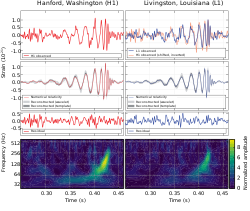](https://en.wikipedia.org/wiki/File:LIGO_measurement_of_gravitational_waves.svg)
The first detection of gravitational waves, imaged by LIGO observatories in [Hanford Site](https://en.wikipedia.org/wiki/Hanford_Site "Hanford Site"), Washington and [Livingston, Louisiana](https://en.wikipedia.org/wiki/Livingston,_Louisiana "Livingston, Louisiana")
While Cygnus X-1, a [stellar-mass black hole](https://en.wikipedia.org/wiki/Stellar-mass_black_hole "Stellar-mass black hole"), was generally accepted by the scientific community as a black hole by the end of 1973,[\[40\]](https://en.wikipedia.org/wiki/Black_hole#cite_note-rolston1997-40) it would be decades before a [supermassive black hole](https://en.wikipedia.org/wiki/Supermassive_black_hole "Supermassive black hole") would gain the same broad recognition. Although, as early as the 1960s, physicists such as [Donald Lynden-Bell](https://en.wikipedia.org/wiki/Donald_Lynden-Bell "Donald Lynden-Bell") and [Martin Rees](https://en.wikipedia.org/wiki/Martin_Rees "Martin Rees") had suggested that powerful [quasars](https://en.wikipedia.org/wiki/Quasars "Quasars") in the center of galaxies were powered by [accreting](https://en.wikipedia.org/wiki/Accretion_\(astrophysics\) "Accretion (astrophysics)") supermassive black holes, little observational proof existed at the time.[\[44\]](https://en.wikipedia.org/wiki/Black_hole#cite_note-44)[\[45\]](https://en.wikipedia.org/wiki/Black_hole#cite_note-45) However, the [Hubble Space Telescope](https://en.wikipedia.org/wiki/Hubble_Space_Telescope "Hubble Space Telescope"), launched in the 1990s, found that supermassive black holes were not only present in these [active galactic nuclei](https://en.wikipedia.org/wiki/Active_galactic_nuclei "Active galactic nuclei"), but that supermassive black holes in the center of galaxies were ubiquitous: almost every galaxy had a supermassive black hole at its center. The black holes in quiescent galaxies accrete matter more slowly or radiate less efficiently.[\[46\]](https://en.wikipedia.org/wiki/Black_hole#cite_note-ff05-46)[\[47\]](https://en.wikipedia.org/wiki/Black_hole#cite_note-peterson14-47)
In 1999, [David Merritt](https://en.wikipedia.org/wiki/David_Merritt "David Merritt") proposed the [M–sigma relation](https://en.wikipedia.org/wiki/M%E2%80%93sigma_relation "M–sigma relation"), which related the [dispersion](https://en.wikipedia.org/wiki/Dispersion_\(statistics\) "Dispersion (statistics)") of the [velocity](https://en.wikipedia.org/wiki/Velocity "Velocity") of matter in the center [bulge](https://en.wikipedia.org/wiki/Galactic_bulge "Galactic bulge") of a galaxy to the mass of the supermassive black hole at its core.[\[48\]](https://en.wikipedia.org/wiki/Black_hole#cite_note-48) Subsequent studies confirmed this correlation.[\[49\]](https://en.wikipedia.org/wiki/Black_hole#cite_note-49) Around the same time, based on telescope observations of the velocities of stars at the center of the Milky Way galaxy, independent work groups led by [Andrea Ghez](https://en.wikipedia.org/wiki/Andrea_Ghez "Andrea Ghez") and [Reinhard Genzel](https://en.wikipedia.org/wiki/Reinhard_Genzel "Reinhard Genzel") concluded that the compact [radio source](https://en.wikipedia.org/wiki/Astronomical_radio_source "Astronomical radio source") in the center of the galaxy, [Sagittarius A\*](https://en.wikipedia.org/wiki/Sagittarius_A* "Sagittarius A*"), was likely a supermassive black hole.[\[50\]](https://en.wikipedia.org/wiki/Black_hole#cite_note-50)[\[51\]](https://en.wikipedia.org/wiki/Black_hole#cite_note-Ghez1998-51)
In late 2015, the [LIGO Scientific Collaboration](https://en.wikipedia.org/wiki/LIGO_Scientific_Collaboration "LIGO Scientific Collaboration") and [Virgo Collaboration](https://en.wikipedia.org/wiki/Virgo_interferometer "Virgo interferometer") made the [first direct detection](https://en.wikipedia.org/wiki/First_observation_of_gravitational_waves "First observation of gravitational waves") of [gravitational waves](https://en.wikipedia.org/wiki/Gravitational_wave "Gravitational wave"), named GW150914, representing the first observation of a [black hole merger](https://en.wikipedia.org/wiki/Black_hole_merger "Black hole merger").[\[52\]](https://en.wikipedia.org/wiki/Black_hole#cite_note-PRL-20160211-52) At the time of the merger, the black holes were approximately 1.4 billion [light-years](https://en.wikipedia.org/wiki/Light-years "Light-years") away from Earth and had masses roughly 30 and 35 times that of the Sun.[\[53\]](https://en.wikipedia.org/wiki/Black_hole#cite_note-ligovirgo16-53): 6 In 2017, [Rainer Weiss](https://en.wikipedia.org/wiki/Rainer_Weiss "Rainer Weiss"), [Kip Thorne](https://en.wikipedia.org/wiki/Kip_Thorne "Kip Thorne"), and [Barry Barish](https://en.wikipedia.org/wiki/Barry_Barish "Barry Barish"), who had spearheaded the project, were awarded the Nobel Prize in Physics for their work.[\[54\]](https://en.wikipedia.org/wiki/Black_hole#cite_note-54) Since the initial discovery in 2015, hundreds more gravitational waves have been observed.[\[55\]](https://en.wikipedia.org/wiki/Black_hole#cite_note-55)
[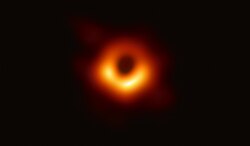](https://en.wikipedia.org/wiki/File:Black_hole_-_Messier_87.jpg)
Image by the [Event Horizon Telescope](https://en.wikipedia.org/wiki/Event_Horizon_Telescope "Event Horizon Telescope") of the supermassive black hole in the center of [Messier 87](https://en.wikipedia.org/wiki/Messier_87 "Messier 87")
On 10 April 2019, the first direct image of a black hole and its vicinity was published, following observations made by the [Event Horizon Telescope](https://en.wikipedia.org/wiki/Event_Horizon_Telescope "Event Horizon Telescope") (EHT) in 2017 of the supermassive black hole in [Messier 87](https://en.wikipedia.org/wiki/Messier_87 "Messier 87")'s galactic centre.[\[56\]](https://en.wikipedia.org/wiki/Black_hole#cite_note-APJL-20190410-56) In 2022, the Event Horizon Telescope collaboration released an image of the black hole in the center of the Milky Way galaxy, Sagittarius A\*; the data had been collected in 2017.[\[57\]](https://en.wikipedia.org/wiki/Black_hole#cite_note-eht-press-release-57)
In 2020, the [Nobel Prize in Physics](https://en.wikipedia.org/wiki/Nobel_Prize_in_Physics "Nobel Prize in Physics") was awarded for work on black holes. [Andrea Ghez](https://en.wikipedia.org/wiki/Andrea_Ghez "Andrea Ghez") and [Reinhard Genzel](https://en.wikipedia.org/wiki/Reinhard_Genzel "Reinhard Genzel") shared one-half for their discovery that Sagittarius A\* is a supermassive black hole.[\[58\]](https://en.wikipedia.org/wiki/Black_hole#cite_note-58) Penrose received the other half for his work showing that the mathematics of general relativity requires the formation of black holes.[\[59\]](https://en.wikipedia.org/wiki/Black_hole#cite_note-59) Cosmologists lamented that Hawking's extensive theoretical work on black holes would not be honoured since he had died in 2018.[\[60\]](https://en.wikipedia.org/wiki/Black_hole#cite_note-60)
### Etymology
In December 1967, a student reportedly suggested the phrase *black hole* at a lecture by [John Wheeler](https://en.wikipedia.org/wiki/John_Archibald_Wheeler "John Archibald Wheeler"); Wheeler adopted the term for its brevity and "advertising value", and Wheeler's stature in the field ensured it quickly caught on,[\[21\]](https://en.wikipedia.org/wiki/Black_hole#cite_note-Bartusiak-21)[\[61\]](https://en.wikipedia.org/wiki/Black_hole#cite_note-61) leading some to credit Wheeler with coining the phrase.[\[62\]](https://en.wikipedia.org/wiki/Black_hole#cite_note-62) However, the term was used by others around that time. Science writer Marcia Bartusiak traces the term *black hole* to physicist [Robert H. Dicke](https://en.wikipedia.org/wiki/Robert_H._Dicke "Robert H. Dicke"), who in the early 1960s reportedly compared the phenomenon to the [Black Hole of Calcutta](https://en.wikipedia.org/wiki/Black_Hole_of_Calcutta "Black Hole of Calcutta"), notorious as a prison where people entered but never left alive. The term was used in print by *[Life](https://en.wikipedia.org/wiki/Life_\(magazine\) "Life (magazine)")* and *[Science News](https://en.wikipedia.org/wiki/Science_News "Science News")* magazines in 1963, and by science journalist Ann Ewing in her article "'Black Holes' in Space", dated 18 January 1964, which was a report on a meeting of the [American Association for the Advancement of Science](https://en.wikipedia.org/wiki/American_Association_for_the_Advancement_of_Science "American Association for the Advancement of Science") held in Cleveland, Ohio.[\[21\]](https://en.wikipedia.org/wiki/Black_hole#cite_note-Bartusiak-21)
## Definition
A black hole is generally defined as a region of spacetime from which no [information-carrying](https://en.wikipedia.org/wiki/Randomness#In_the_physical_sciences "Randomness") signals or objects can escape.[\[63\]](https://en.wikipedia.org/wiki/Black_hole#cite_note-fz11-63) However, verifying an object as a black hole by this definition would require waiting for an infinite time and at an infinite distance from the black hole to verify that indeed, nothing has escaped, and thus cannot be used to identify a physical black hole.[\[64\]](https://en.wikipedia.org/wiki/Black_hole#cite_note-booth05-64) There are several other definitions that can be used to describe or identify a black hole, although they are not universally agreed upon by physicists. Among astrophysicists, a black hole is a [compact object](https://en.wikipedia.org/wiki/Compact_object "Compact object") with a mass larger than four solar masses.[\[65\]](https://en.wikipedia.org/wiki/Black_hole#cite_note-curiel19-65) A black hole may also be defined as a reservoir of information[\[66\]](https://en.wikipedia.org/wiki/Black_hole#cite_note-bhwar-66): 142 or a region where space is falling inwards faster than the speed of light.[\[67\]](https://en.wikipedia.org/wiki/Black_hole#cite_note-67)[\[68\]](https://en.wikipedia.org/wiki/Black_hole#cite_note-waterfall-68)
## Properties
The [no-hair theorem](https://en.wikipedia.org/wiki/No-hair_theorem "No-hair theorem") postulates that, once it achieves a stable condition after formation, a black hole has only three independent physical properties: mass, electric charge, and angular momentum; the black hole is otherwise featureless. If the conjecture is true, any two black holes that share the same values for these properties, or parameters, are indistinguishable from one another. The degree to which the conjecture is true is currently an unsolved problem.[\[32\]](https://en.wikipedia.org/wiki/Black_hole#cite_note-HeuslerNoHair-32)[\[69\]](https://en.wikipedia.org/wiki/Black_hole#cite_note-69)
The simplest static black holes, called *Schwarzschild black holes*, have mass but neither electric charge nor angular momentum. Non-rotating [charged black holes](https://en.wikipedia.org/wiki/Charged_black_hole "Charged black hole") are described by the [Reissner–Nordström metric](https://en.wikipedia.org/wiki/Reissner%E2%80%93Nordstr%C3%B6m_metric "Reissner–Nordström metric"), while the [Kerr metric](https://en.wikipedia.org/wiki/Kerr_metric "Kerr metric") describes a non-charged [rotating black hole](https://en.wikipedia.org/wiki/Rotating_black_hole "Rotating black hole"). The most general [stationary](https://en.wikipedia.org/wiki/Stationary_spacetime "Stationary spacetime") black hole solution known is the [Kerr–Newman metric](https://en.wikipedia.org/wiki/Kerr%E2%80%93Newman_metric "Kerr–Newman metric"), which describes a black hole with both charge and angular momentum.[\[70\]](https://en.wikipedia.org/wiki/Black_hole#cite_note-shapiro_teukolsky1983-70)
### Mass
Radii for shadow and photon sphere relative to the event horizon
The simplest static black holes have mass but neither electric charge nor angular momentum. Contrary to the popular notion of a black hole "sucking in everything" in its surroundings, from far away, the external gravitational field of a black hole is identical to that of any other body of the same mass.[\[71\]](https://en.wikipedia.org/wiki/Black_hole#cite_note-71)
While a black hole can theoretically have any positive mass, its charge and angular momentum are limited by its mass, with this limit being greater for more massive black holes. The net electric charge Q {\\displaystyle Q}  and the total angular momentum J {\\displaystyle J}  satisfy the inequality Q 2 4 π ϵ 0 \+ c 2 J 2 G M 2 ≤ G M 2 {\\displaystyle {\\frac {Q^{2}}{4\\pi \\epsilon \_{0}}}+{\\frac {c^{2}J^{2}}{GM^{2}}}\\leq GM^{2}} 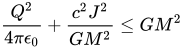 for a black hole of mass M {\\displaystyle M} , where ϵ 0 {\\displaystyle \\epsilon \_{0}}  is the [vacuum permittivity](https://en.wikipedia.org/wiki/Vacuum_permittivity "Vacuum permittivity") constant, c {\\displaystyle c}  is the [speed of light](https://en.wikipedia.org/wiki/Speed_of_light "Speed of light") and G {\\displaystyle G}  is the [gravitational constant](https://en.wikipedia.org/wiki/Gravitational_constant "Gravitational constant"). Black holes with the maximum possible combination of charge and spin satisfying this inequality are called [extremal black holes](https://en.wikipedia.org/wiki/Extremal_black_holes "Extremal black holes"). Solutions of Einstein's equations that violate this inequality exist, but they do not possess an event horizon. These are so-called [naked singularities](https://en.wikipedia.org/wiki/Naked_singularity "Naked singularity") that can be observed from the outside.[\[72\]](https://en.wikipedia.org/wiki/Black_hole#cite_note-wald_1997-72) Because these singularities make the universe inherently unpredictable, many physicists believe they could not exist.[\[73\]](https://en.wikipedia.org/wiki/Black_hole#cite_note-73) The [weak cosmic censorship hypothesis](https://en.wikipedia.org/wiki/Weak_cosmic_censorship_hypothesis "Weak cosmic censorship hypothesis"), proposed by Penrose, rules out the formation of such singularities, when they are created through the gravitational collapse of [realistic matter](https://en.wikipedia.org/wiki/Energy_conditions "Energy conditions"). However, this theory has not yet been proven, and some physicists believe that naked singularities could exist.[\[74\]](https://en.wikipedia.org/wiki/Black_hole#cite_note-joshi09-74) It is also unknown whether black holes could even become extremal, forming naked singularities, since natural processes counteract increasing spin and charge when a black hole becomes near-extremal.[\[75\]](https://en.wikipedia.org/wiki/Black_hole#cite_note-75)
The total mass of a black hole can be estimated by analysing the motion of objects near the black hole, such as stars or gas.[\[47\]](https://en.wikipedia.org/wiki/Black_hole#cite_note-peterson14-47)
### Spin and angular momentum
All black holes spin, often fast—One stellar black hole, [GRS 1915+105](https://en.wikipedia.org/wiki/GRS_1915%2B105 "GRS 1915+105"), has been estimated to spin at over 1,000 revolutions per second.[\[76\]](https://en.wikipedia.org/wiki/Black_hole#cite_note-76) The Milky Way's central black hole Sagittarius A\* rotates at about 90% of the maximum possible rate.[\[77\]](https://en.wikipedia.org/wiki/Black_hole#cite_note-daly19-77)[\[78\]](https://en.wikipedia.org/wiki/Black_hole#cite_note-78)
The spin rate can be inferred from measurements of atomic [spectral lines](https://en.wikipedia.org/wiki/Spectral_line "Spectral line") in the X-ray range. As gas near the black hole plunges inward, high energy X-ray emission from electron-positron pairs illuminates the gas further out, appearing red-shifted due to relativistic effects. Depending on the spin of the black hole, this plunge happens at different radii from the hole, with different degrees of redshift. Astronomers can use the gap between the x-ray emission of the outer disk and the redshifted emission from plunging material to determine the spin of the black hole.[\[79\]](https://en.wikipedia.org/wiki/Black_hole#cite_note-reynolds19-79)
A newer way to estimate spin is based on the temperature of gases accreting onto the black hole. The method requires an independent measurement of the black hole mass and [inclination angle](https://en.wikipedia.org/wiki/Orbital_inclination "Orbital inclination") of the accretion disk followed by computer modelling. Gravitational waves from coalescing binary black holes can also provide the spin of both progenitor black holes and the merged hole, but such events are rare.[\[79\]](https://en.wikipedia.org/wiki/Black_hole#cite_note-reynolds19-79)
A spinning black hole has [angular momentum](https://en.wikipedia.org/wiki/Angular_momentum "Angular momentum"). The supermassive black hole in the center of the [Messier 87](https://en.wikipedia.org/wiki/Messier_87 "Messier 87") (M87) galaxy appears to have an angular momentum very close to the maximum theoretical value.[\[80\]](https://en.wikipedia.org/wiki/Black_hole#cite_note-80)[\[81\]](https://en.wikipedia.org/wiki/Black_hole#cite_note-81) By setting Q {\\displaystyle Q}  equal to 0, the maximum spin of an uncharged black hole can be simplified to[\[82\]](https://en.wikipedia.org/wiki/Black_hole#cite_note-50SMBH-82) J ≤ G M 2 c , {\\displaystyle J\\leq {\\frac {GM^{2}}{c}},}  allowing definition of a [dimensionless](https://en.wikipedia.org/wiki/Dimensionless "Dimensionless") spin magnitude such that[\[82\]](https://en.wikipedia.org/wiki/Black_hole#cite_note-50SMBH-82)[\[83\]](https://en.wikipedia.org/wiki/Black_hole#cite_note-83) 0 ≤ c J G M 2 ≤ 1\. {\\displaystyle 0\\leq {\\frac {cJ}{GM^{2}}}\\leq 1.} 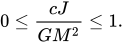
### Charge
Most black holes are believed to have an approximately neutral charge. For example, Michal Zajaček, Arman Tursunov, Andreas Eckart, and Silke Britzen found the [electric charge](https://en.wikipedia.org/wiki/Electric_charge "Electric charge") of Sagittarius A\* to be at least ten orders of magnitude below the theoretical maximum.[\[84\]](https://en.wikipedia.org/wiki/Black_hole#cite_note-zteb18-84) A charged black hole [repels](https://en.wikipedia.org/wiki/Coulomb%27s_law "Coulomb's law") other like charges just like any other charged object.[\[85\]](https://en.wikipedia.org/wiki/Black_hole#cite_note-85) If a black hole were to become charged, particles with an opposite sign of charge would be pulled in by the extra [electromagnetic force](https://en.wikipedia.org/wiki/Electromagnetism "Electromagnetism"), while particles with the same sign of charge would be repelled, neutralising the black hole. This effect may not be as strong if the black hole is also spinning.[\[86\]](https://en.wikipedia.org/wiki/Black_hole#cite_note-86) The presence of charge can reduce the diameter of the black hole's shadow by up to 38%.[\[84\]](https://en.wikipedia.org/wiki/Black_hole#cite_note-zteb18-84)[\[87\]](https://en.wikipedia.org/wiki/Black_hole#cite_note-87)
The charge Q for a nonspinning black hole is bounded by Q ≤ 4 π ϵ 0 G M , {\\displaystyle Q\\leq {\\sqrt {4\\pi \\epsilon \_{0}G}}M,}  where G is the gravitational constant and M is the black hole's mass.[\[88\]](https://en.wikipedia.org/wiki/Black_hole#cite_note-88)
## Classification
| Class | Approx. mass | Approx. radius |
|---|---|---|
| [Ultramassive black hole](https://en.wikipedia.org/wiki/Supermassive_black_hole#Ultramassive_black_holes "Supermassive black hole") | 109–1011 M☉ | \>1,000 [AU](https://en.wikipedia.org/wiki/Astronomical_unit "Astronomical unit") |
| [Supermassive black hole](https://en.wikipedia.org/wiki/Supermassive_black_hole "Supermassive black hole") | 106–109 M☉ | 0\.001–400 [AU](https://en.wikipedia.org/wiki/Astronomical_unit "Astronomical unit") |
| [Intermediate-mass black hole](https://en.wikipedia.org/wiki/Intermediate-mass_black_hole "Intermediate-mass black hole")[\[89\]](https://en.wikipedia.org/wiki/Black_hole#cite_note-mc04-89) | 102–105 M☉ | 103 km ≈ [*R*Earth](https://en.wikipedia.org/wiki/Earth_radius "Earth radius") |
| [Stellar black hole](https://en.wikipedia.org/wiki/Stellar_black_hole "Stellar black hole") | 2–150 M☉ | 30 km |
| [Micro black hole](https://en.wikipedia.org/wiki/Micro_black_hole "Micro black hole") | up to *M*[Moon](https://en.wikipedia.org/wiki/Moon "Moon") | up to 0.1 mm |
Black holes are classified by the theory of their formation and by their mass (expressed in terms of M☉, the mass of the Sun), but these criteria are intertwined. [Stellar black holes](https://en.wikipedia.org/wiki/Stellar_black_holes "Stellar black holes") are formed by stellar collapse. The minimum mass of a black hole formed by stellar gravitational collapse is governed by the maximum mass of a neutron star and is believed to be 2-4 M☉.[\[90\]](https://en.wikipedia.org/wiki/Black_hole#cite_note-90) Hypothetical [primordial black holes](https://en.wikipedia.org/wiki/Primordial_black_hole "Primordial black hole"), believed to have formed soon after the [Big Bang](https://en.wikipedia.org/wiki/Big_Bang "Big Bang"), could be far smaller, with masses as little as 10−5 grams at formation.[\[91\]](https://en.wikipedia.org/wiki/Black_hole#cite_note-Carr-91) These very small black holes are sometimes called [micro black holes](https://en.wikipedia.org/wiki/Micro_black_hole "Micro black hole").[\[92\]](https://en.wikipedia.org/wiki/Black_hole#cite_note-92)[\[93\]](https://en.wikipedia.org/wiki/Black_hole#cite_note-93)
Stellar black holes can have a wide range of masses. Estimates of their maximum mass at formation vary, but generally range from 10-100 M☉, with higher estimates for black holes progenated by [low-metallicity](https://en.wikipedia.org/wiki/Metallicity "Metallicity") stars.[\[94\]](https://en.wikipedia.org/wiki/Black_hole#cite_note-Vink-2021-94) Stellar black holes can gain mass via accretion of nearby matter, often from a companion object such as a star[\[95\]](https://en.wikipedia.org/wiki/Black_hole#cite_note-lph97-95)[\[96\]](https://en.wikipedia.org/wiki/Black_hole#cite_note-96) or by merger with another black hole.[\[52\]](https://en.wikipedia.org/wiki/Black_hole#cite_note-PRL-20160211-52)
Black holes that are larger than stellar black holes but smaller than supermassive black holes are called [intermediate-mass black holes](https://en.wikipedia.org/wiki/Intermediate-mass_black_hole "Intermediate-mass black hole"), with approximately 102\-105 M☉. These black holes seem to be rarer than their stellar and supermassive counterparts, with only a small number of candidates observed so far.[\[89\]](https://en.wikipedia.org/wiki/Black_hole#cite_note-mc04-89) Physicists have speculated that such black holes may form from collisions in [globular](https://en.wikipedia.org/wiki/Globular_cluster "Globular cluster") and [star](https://en.wikipedia.org/wiki/Star_cluster "Star cluster") clusters or at the center of [low-mass galaxies](https://en.wikipedia.org/wiki/Dwarf_galaxy "Dwarf galaxy").[\[97\]](https://en.wikipedia.org/wiki/Black_hole#cite_note-97) They may also form as the result of mergers of smaller black holes, with several LIGO observations finding merged black holes within 110–350 M☉.[\[98\]](https://en.wikipedia.org/wiki/Black_hole#cite_note-98)[\[99\]](https://en.wikipedia.org/wiki/Black_hole#cite_note-99)
The black holes with the largest masses are called [supermassive black holes](https://en.wikipedia.org/wiki/Supermassive_black_hole "Supermassive black hole"), with masses more than 106 M☉.[\[100\]](https://en.wikipedia.org/wiki/Black_hole#cite_note-100) These black holes are believed to exist at the centers of almost every large galaxy, including the Milky Way.[\[46\]](https://en.wikipedia.org/wiki/Black_hole#cite_note-ff05-46)[\[47\]](https://en.wikipedia.org/wiki/Black_hole#cite_note-peterson14-47) Some scientists have proposed a subcategory of even larger black holes, called [ultramassive black holes](https://en.wikipedia.org/wiki/Ultramassive_black_hole "Ultramassive black hole"), with masses greater than 109\-1010 M☉.[\[101\]](https://en.wikipedia.org/wiki/Black_hole#cite_note-101)[\[102\]](https://en.wikipedia.org/wiki/Black_hole#cite_note-102) Theoretical models predict that the accretion disc that feeds black holes will be unstable once a black hole reaches 50×109–100×109 M☉, setting a rough upper limit to black hole mass.[\[103\]](https://en.wikipedia.org/wiki/Black_hole#cite_note-103)[\[104\]](https://en.wikipedia.org/wiki/Black_hole#cite_note-104)
## Structure
While black holes are conceptually invisible sinks of all matter and light, in astronomical settings, their enormous gravity alters the motion of surrounding objects and pulls nearby gas inwards at near-light speed, making the area around black holes the brightest objects in the universe.[\[105\]](https://en.wikipedia.org/wiki/Black_hole#cite_note-reynolds21-105)
### External geometry
#### Relativistic jets
See also: [Astrophysical jet](https://en.wikipedia.org/wiki/Astrophysical_jet "Astrophysical jet")
[](https://en.wikipedia.org/wiki/File:Black_Hole_Outflows_From_Centaurus_A.jpg)
Relativistic jets from the supermassive black hole in [Centaurus A](https://en.wikipedia.org/wiki/Centaurus_A "Centaurus A") extend [perpendicularly](https://en.wikipedia.org/wiki/Perpendicular "Perpendicular") from the galaxy.
Some black holes have relativistic jets—thin streams of [plasma](https://en.wikipedia.org/wiki/Plasma_\(physics\) "Plasma (physics)") travelling away from the black hole at more than one-tenth of the speed of light.[\[106\]](https://en.wikipedia.org/wiki/Black_hole#cite_note-mr99-106) A small fraction of the matter falling towards the black hole gets accelerated away along the hole rotation axis.[\[107\]](https://en.wikipedia.org/wiki/Black_hole#cite_note-107) These jets can extend as far as millions of [light-years](https://en.wikipedia.org/wiki/Light-year "Light-year") from the black hole itself.[\[108\]](https://en.wikipedia.org/wiki/Black_hole#cite_note-108)
Black holes of any mass can have jets.[\[109\]](https://en.wikipedia.org/wiki/Black_hole#cite_note-nemmen12-109) However, they are typically observed around spinning black holes with strongly-magnetized accretion disks.[\[110\]](https://en.wikipedia.org/wiki/Black_hole#cite_note-bmr18-110)[\[111\]](https://en.wikipedia.org/wiki/Black_hole#cite_note-111) Relativistic jets were more common in the [early universe](https://en.wikipedia.org/wiki/Chronology_of_the_universe#Gravity_builds_cosmic_structure "Chronology of the universe"), when galaxies and their corresponding supermassive black holes were rapidly gaining mass.[\[110\]](https://en.wikipedia.org/wiki/Black_hole#cite_note-bmr18-110)[\[112\]](https://en.wikipedia.org/wiki/Black_hole#cite_note-112) All black holes with jets also have an accretion disk, but the jets are usually brighter than the disk.[\[106\]](https://en.wikipedia.org/wiki/Black_hole#cite_note-mr99-106)[\[113\]](https://en.wikipedia.org/wiki/Black_hole#cite_note-113) *[Quasars](https://en.wikipedia.org/wiki/Quasar "Quasar"),* typically found in other galaxies, are believed to be supermassive black holes with jets; *[microquasars](https://en.wikipedia.org/wiki/Microquasar "Microquasar")* are believed to be stellar-mass objects with jets, typically observed in the Milky Way.[\[114\]](https://en.wikipedia.org/wiki/Black_hole#cite_note-114)
The mechanism of formation of jets is not yet known,[\[109\]](https://en.wikipedia.org/wiki/Black_hole#cite_note-nemmen12-109) but several options have been proposed. One method proposed to fuel these jets is the [Blandford-Znajek process](https://en.wikipedia.org/wiki/Blandford-Znajek_process "Blandford-Znajek process"), which suggests that the dragging of [magnetic field lines](https://en.wikipedia.org/wiki/Magnetic_field_lines "Magnetic field lines") by a black hole's rotation could launch jets of matter into space.[\[115\]](https://en.wikipedia.org/wiki/Black_hole#cite_note-lwb00-115)[\[116\]](https://en.wikipedia.org/wiki/Black_hole#cite_note-116) The [Penrose process](https://en.wikipedia.org/wiki/Penrose_process "Penrose process"), which involves extraction of a black hole's [rotational energy](https://en.wikipedia.org/wiki/Rotational_energy "Rotational energy"), has also been proposed as a potential mechanism of jet propulsion.[\[117\]](https://en.wikipedia.org/wiki/Black_hole#cite_note-117)[\[118\]](https://en.wikipedia.org/wiki/Black_hole#cite_note-118)
#### Accretion disk
Main article: [Accretion disk](https://en.wikipedia.org/wiki/Accretion_disk "Accretion disk")
[](https://en.wikipedia.org/wiki/File:Black_Hole_Desktop_%26_Phone_Wallpapers_\(SVS14146_-_BH_accretion_disk_viz_desktop\).png)
Visualization of a black hole with an orange accretion disk. The parts of the disk circling over and under the hole are actually gravitationally lensed from the back side of the black hole.[\[119\]](https://en.wikipedia.org/wiki/Black_hole#cite_note-119)[\[120\]](https://en.wikipedia.org/wiki/Black_hole#cite_note-120)
Due to [conservation of angular momentum](https://en.wikipedia.org/wiki/Conservation_of_angular_momentum "Conservation of angular momentum"), gas falling into the [gravitational well](https://en.wikipedia.org/wiki/Gravitational_well "Gravitational well") created by a massive object will typically form a disk-like structure around the object.[\[121\]](https://en.wikipedia.org/wiki/Black_hole#cite_note-121): 242 As the disk's angular momentum is transferred outward due to internal processes, its matter falls farther inward, converting its gravitational energy into heat and releasing a large amount of x-rays.[\[122\]](https://en.wikipedia.org/wiki/Black_hole#cite_note-122)[\[123\]](https://en.wikipedia.org/wiki/Black_hole#cite_note-pt74-123) The temperature of these disks can range from thousands to millions of [kelvins](https://en.wikipedia.org/wiki/Kelvin "Kelvin"), and temperatures differ throughout a single accretion disk.[\[124\]](https://en.wikipedia.org/wiki/Black_hole#cite_note-124)[\[125\]](https://en.wikipedia.org/wiki/Black_hole#cite_note-125) Accretion disks can also emit in other parts of the [electromagnetic spectrum](https://en.wikipedia.org/wiki/Electromagnetic_spectrum "Electromagnetic spectrum"), depending on the disk's [turbulence](https://en.wikipedia.org/wiki/Turbulence "Turbulence") and [magnetisation](https://en.wikipedia.org/wiki/Magnetisation "Magnetisation") and the black hole's mass and angular momentum.[\[126\]](https://en.wikipedia.org/wiki/Black_hole#cite_note-126)
Accretion disks can be defined as geometrically thin or geometrically thick. Geometrically thin disks are mostly confined to the black hole's equatorial plane and have a well-defined edge at the [innermost stable circular orbit](https://en.wikipedia.org/wiki/Innermost_stable_circular_orbit "Innermost stable circular orbit") (ISCO), while geometrically thick disks are supported by internal pressure and temperature and can extend inside the ISCO. Disks with high rates of [electron scattering](https://en.wikipedia.org/wiki/Electron_scattering "Electron scattering") and absorption, appearing bright and [opaque](https://en.wikipedia.org/wiki/Opaque "Opaque"), are called *optically thick*; *optically thin* disks are more [translucent](https://en.wikipedia.org/wiki/Translucent "Translucent") and produce fainter images when viewed from afar.[\[127\]](https://en.wikipedia.org/wiki/Black_hole#cite_note-wang25-127) Accretion disks of black holes accreting beyond the [Eddington limit](https://en.wikipedia.org/wiki/Eddington_limit "Eddington limit") are often referred to as *polish donuts* due to their thick, [toroidal](https://en.wikipedia.org/wiki/Toroid "Toroid") shape that resembles that of a [donut](https://en.wikipedia.org/wiki/Donut "Donut").[\[128\]](https://en.wikipedia.org/wiki/Black_hole#cite_note-128)[\[129\]](https://en.wikipedia.org/wiki/Black_hole#cite_note-129)
Quasar accretion disks are expected to usually appear blue in colour.[\[130\]](https://en.wikipedia.org/wiki/Black_hole#cite_note-130) The disk for a stellar black hole, on the other hand, would likely look orange, yellow, or red, with its inner regions being the brightest.[\[131\]](https://en.wikipedia.org/wiki/Black_hole#cite_note-131) Theoretical research suggests that the hotter a disk is, the bluer it should be, although this is not always supported by observations of real astronomical objects.[\[132\]](https://en.wikipedia.org/wiki/Black_hole#cite_note-132) Accretion disk colours may also be altered by the [Doppler effect](https://en.wikipedia.org/wiki/Doppler_effect "Doppler effect"), with the part of the disk travelling towards an observer appearing bluer and brighter and the part of the disk travelling away from the observer appearing redder and dimmer.[\[133\]](https://en.wikipedia.org/wiki/Black_hole#cite_note-jtft15-133)[\[134\]](https://en.wikipedia.org/wiki/Black_hole#cite_note-134)
#### Innermost stable circular orbit (ISCO)
Main article: [Innermost stable circular orbit](https://en.wikipedia.org/wiki/Innermost_stable_circular_orbit "Innermost stable circular orbit")
[](https://en.wikipedia.org/wiki/File:How_to_Measure_the_Spin_of_a_Black_Hole.jpg)
Since particles in a black hole's accretion disk must orbit at or outside the ISCO, astronomers can observe the properties of accretion disks to determine black hole spins.[\[135\]](https://en.wikipedia.org/wiki/Black_hole#cite_note-135)
In [Newtonian gravity](https://en.wikipedia.org/wiki/Newton%27s_law_of_universal_gravitation "Newton's law of universal gravitation"), [test particles](https://en.wikipedia.org/wiki/Test_particle "Test particle") can stably orbit at arbitrary distances from a central object. In general relativity, however, there exists a smallest possible radius for which a massive particle can orbit stably. Any infinitesimal inward [perturbations](https://en.wikipedia.org/wiki/Perturbation_\(astronomy\) "Perturbation (astronomy)") to this orbit will lead to the particle [spiraling into](https://en.wikipedia.org/wiki/Orbital_decay "Orbital decay") the black hole, and any outward perturbations will, depending on the energy, cause the particle to spiral in, move to a stable orbit further from the black hole, or escape to infinity. This orbit is called the **innermost stable circular orbit**, or ISCO.[\[136\]](https://en.wikipedia.org/wiki/Black_hole#cite_note-Misner-1973-136)[\[137\]](https://en.wikipedia.org/wiki/Black_hole#cite_note-jtb15-137) The location of the ISCO depends on the spin of the black hole and the [spin](https://en.wikipedia.org/wiki/Spin_\(physics\) "Spin (physics)") of the particle itself. In the case of a Schwarzschild black hole (spin zero) and a particle without spin, the location of the ISCO is: r I S C O \= 3 r s \= 6 G M c 2 , {\\displaystyle r\_{\\rm {ISCO}}=3\\,r\_{\\text{s}}={\\frac {6\\,GM}{c^{2}}},}  where r I S C O {\\displaystyle r\_{\\rm {\_{ISCO}}}}  is the radius of the ISCO, r s {\\displaystyle r\_{\\text{s}}}  is the Schwarzschild radius of the black hole, G {\\displaystyle G}  is the gravitational constant, and c {\\displaystyle c}  is the speed of light.[\[138\]](https://en.wikipedia.org/wiki/Black_hole#cite_note-Bardeen1972-138) The radius of this orbit changes slightly based on particle spin.[\[139\]](https://en.wikipedia.org/wiki/Black_hole#cite_note-zwgsl18-139)[\[140\]](https://en.wikipedia.org/wiki/Black_hole#cite_note-140) For charged black holes, the ISCO moves inwards.[\[139\]](https://en.wikipedia.org/wiki/Black_hole#cite_note-zwgsl18-139) For spinning black holes, the ISCO is moved inwards for particles orbiting in the same direction that the black hole is spinning ([prograde](https://en.wikipedia.org/wiki/Retrograde_and_prograde_motion "Retrograde and prograde motion")) and outwards for particles orbiting in the opposite direction (retrograde).[\[137\]](https://en.wikipedia.org/wiki/Black_hole#cite_note-jtb15-137) For example, the ISCO for a particle orbiting retrograde can be as far out as about 4\.5 r s {\\displaystyle 4.5r\_{\\text{s}}} , while the ISCO for a particle orbiting prograde can be as close as at the event horizon itself.[\[137\]](https://en.wikipedia.org/wiki/Black_hole#cite_note-jtb15-137)[\[141\]](https://en.wikipedia.org/wiki/Black_hole#cite_note-141)
#### Photon sphere and shadow
Main article: [Photon sphere](https://en.wikipedia.org/wiki/Photon_sphere "Photon sphere")
Video of a photon being captured by a Schwarzschild black hole
The [photon sphere](https://en.wikipedia.org/wiki/Photon_sphere "Photon sphere") is a spherical boundary for which photons moving on tangents to that sphere are bent completely around the black hole, possibly orbiting multiple times.[\[142\]](https://en.wikipedia.org/wiki/Black_hole#cite_note-142) For Schwarzschild black holes, the photon sphere has a radius 1.5 times the Schwarzschild radius.[\[143\]](https://en.wikipedia.org/wiki/Black_hole#cite_note-ll19-143)[\[144\]](https://en.wikipedia.org/wiki/Black_hole#cite_note-qiao22-144) When viewed from a great distance, the photon sphere creates an observable **black hole shadow**.[\[143\]](https://en.wikipedia.org/wiki/Black_hole#cite_note-ll19-143) Since no light emerges from within the black hole, this shadow is the limit for possible observations.[\[145\]](https://en.wikipedia.org/wiki/Black_hole#cite_note-145): 152 The shadow of colliding black holes should have characteristic warped shapes, allowing scientists to detect black holes that are about to merge.[\[146\]](https://en.wikipedia.org/wiki/Black_hole#cite_note-prd84_6-146)
While light can still escape from the photon sphere, any light that crosses the photon sphere on an inbound trajectory will be captured by the black hole. Therefore, any light that reaches an outside observer from the photon sphere must have been emitted by objects between the photon sphere and the event horizon.[\[146\]](https://en.wikipedia.org/wiki/Black_hole#cite_note-prd84_6-146) Light emitted towards the photon sphere may also curve around the black hole and return to the emitter.[\[147\]](https://en.wikipedia.org/wiki/Black_hole#cite_note-147)
For a rotating, uncharged black hole, the radius of the photon sphere depends on the spin parameter and whether the photon is orbiting prograde or retrograde.[\[138\]](https://en.wikipedia.org/wiki/Black_hole#cite_note-Bardeen1972-138) For a photon orbiting prograde, the photon sphere will be 0.5-1.5 Schwarzschild radii from the center of the black hole, while for a photon orbiting retrograde, the photon sphere will be between 3-4 Schwarzschild radii from the center of the black hole. The exact locations of the photon spheres depend on the [magnitude](https://en.wikipedia.org/wiki/Magnitude_\(mathematics\)#numbers "Magnitude (mathematics)") of the black hole's rotation.[\[148\]](https://en.wikipedia.org/wiki/Black_hole#cite_note-148) For a charged, nonrotating black hole, there will only be one photon sphere, and the radius of the photon sphere will decrease for increasing black hole charge.[\[149\]](https://en.wikipedia.org/wiki/Black_hole#cite_note-149) For non-[extremal](https://en.wikipedia.org/wiki/Extremal_black_hole "Extremal black hole"), charged, rotating black holes, there will always be two photon spheres, with the exact radii depending on the parameters of the black hole.[\[150\]](https://en.wikipedia.org/wiki/Black_hole#cite_note-150)
#### Ergosphere
Main article: [Ergosphere](https://en.wikipedia.org/wiki/Ergosphere "Ergosphere")
[](https://en.wikipedia.org/wiki/File:Ergosphere_and_event_horizon_of_a_rotating_black_hole_\(no_animation\).gif)
The ergosphere is a region outside of the event horizon, where objects cannot remain in place.[\[151\]](https://en.wikipedia.org/wiki/Black_hole#cite_note-viss-151)
Near a rotating black hole, spacetime rotates similar to a vortex. The rotating spacetime will drag any matter and light into rotation around the spinning black hole. This effect of general relativity, called [frame dragging](https://en.wikipedia.org/wiki/Frame_dragging "Frame dragging"), gets stronger closer to the spinning mass. The region of spacetime in which it is impossible to stay still is called the ergosphere.[\[152\]](https://en.wikipedia.org/wiki/Black_hole#cite_note-reynolds18-152)
The ergosphere of a black hole is a volume bounded by the black hole's event horizon and the *ergosurface*, which coincides with the event horizon at the poles but bulges out from it around the equator.[\[151\]](https://en.wikipedia.org/wiki/Black_hole#cite_note-viss-151)
Matter and radiation can escape from the ergosphere. Through the [Penrose process](https://en.wikipedia.org/wiki/Penrose_process "Penrose process"), objects can emerge from the ergosphere with more energy than they entered with. The extra energy is taken from the rotational energy of the black hole, slowing down the rotation of the black hole.[\[153\]](https://en.wikipedia.org/wiki/Black_hole#cite_note-Carroll-2019-153): 268 A variation of the Penrose process in the presence of strong magnetic fields, the [Blandford–Znajek process](https://en.wikipedia.org/wiki/Blandford%E2%80%93Znajek_process "Blandford–Znajek process"), is considered a likely mechanism for the enormous luminosity and relativistic jets of [quasars](https://en.wikipedia.org/wiki/Quasars "Quasars") and other [active galactic nuclei](https://en.wikipedia.org/wiki/Active_galactic_nuclei "Active galactic nuclei").[\[115\]](https://en.wikipedia.org/wiki/Black_hole#cite_note-lwb00-115)[\[154\]](https://en.wikipedia.org/wiki/Black_hole#cite_note-154)
#### Plunging region
Main article: [Plunging region](https://en.wikipedia.org/wiki/Plunging_region "Plunging region")
The observable region of spacetime around a black hole closest to its event horizon is called the plunging region. In this area it is no longer possible for free falling matter to follow circular orbits or stop a final descent into the black hole. Instead, it will rapidly plunge toward the black hole at close to the speed of light, growing increasingly hot and producing a characteristic, detectable [thermal emission](https://en.wikipedia.org/wiki/Thermal_radiation "Thermal radiation").[\[155\]](https://en.wikipedia.org/wiki/Black_hole#cite_note-155)[\[156\]](https://en.wikipedia.org/wiki/Black_hole#cite_note-156) However, light and radiation emitted from this region can still escape from the black hole's gravitational pull.[\[157\]](https://en.wikipedia.org/wiki/Black_hole#cite_note-prisco-157)
### Radius
For a nonspinning, uncharged black hole, the radius of the event horizon, or Schwarzschild radius, is proportional to the mass, *M*, through r s \= 2 G M c 2 ≈ 2\.95 M M ⊙ k m , {\\displaystyle r\_{\\mathrm {s} }={\\frac {2GM}{c^{2}}}\\approx 2.95\\,{\\frac {M}{M\_{\\odot }}}~\\mathrm {km,} } 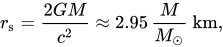 where *r*s is the Schwarzschild radius, *G* is the [gravitational constant](https://en.wikipedia.org/wiki/Gravitational_constant "Gravitational constant"), *c* is the [speed of light](https://en.wikipedia.org/wiki/Speed_of_light "Speed of light"), and M☉ is the [mass of the Sun](https://en.wikipedia.org/wiki/Solar_mass "Solar mass").[\[158\]](https://en.wikipedia.org/wiki/Black_hole#cite_note-158): 124 For a black hole of the same mass with nonzero spin or electric charge, the radius is smaller.[\[Note 1\]](https://en.wikipedia.org/wiki/Black_hole#cite_note-159) As a black hole's charge and spin approach the maximum allowed value, the radius of the event horizon nears r \+ \= G M c 2 , {\\displaystyle r\_{\\mathrm {+} }={\\frac {GM}{c^{2}}},}  half the radius of a nonspinning, uncharged black hole of the same mass.[\[159\]](https://en.wikipedia.org/wiki/Black_hole#cite_note-160)
Since the volume within the Schwarzschild radius increases with the cube of the radius, average density of a black hole inside its Schwarzschild radius is inversely proportional to the square of its mass: supermassive black holes are much less dense than stellar black holes. The average density of a 108 M☉ black hole is comparable to that of water.[\[160\]](https://en.wikipedia.org/wiki/Black_hole#cite_note-CMS1999-161)[\[161\]](https://en.wikipedia.org/wiki/Black_hole#cite_note-162)
### Event horizon
Main article: [Event horizon](https://en.wikipedia.org/wiki/Event_horizon "Event horizon")
[](https://en.wikipedia.org/wiki/File:BH-no-escape-1.svg)
Far away from the black hole, a particle can move in any direction, as illustrated by the set of arrows. It is restricted only by the speed of light.
[](https://en.wikipedia.org/wiki/File:BH-no-escape-2.svg)
Closer to the black hole, spacetime starts to deform. There are more paths going towards the black hole than paths moving away.[\[Note 2\]](https://en.wikipedia.org/wiki/Black_hole#cite_note-163)
[](https://en.wikipedia.org/wiki/File:BH-no-escape-3.svg)
Inside of the event horizon, all paths bring the particle closer to the centre of the black hole. It is no longer possible for the particle to escape.
The defining feature of a black hole is the existence of an event horizon, a boundary in [spacetime](https://en.wikipedia.org/wiki/Spacetime "Spacetime") through which matter and light can pass only inward towards the center of the black hole. Nothing, not even light, can escape from inside the event horizon.[\[162\]](https://en.wikipedia.org/wiki/Black_hole#cite_note-164)[\[163\]](https://en.wikipedia.org/wiki/Black_hole#cite_note-165) The event horizon is referred to as such because if an event occurs within the boundary, information from that event cannot reach or affect an outside observer, making it impossible to determine whether such an event occurred.[\[164\]](https://en.wikipedia.org/wiki/Black_hole#cite_note-JCWheeler-2007-166): 179 For non-rotating black holes, the geometry of the event horizon is precisely spherical, while for rotating black holes, the event horizon is [oblate](https://en.wikipedia.org/wiki/Oblate_spheroid "Oblate spheroid").[\[165\]](https://en.wikipedia.org/wiki/Black_hole#cite_note-Smarr1973-167)[\[166\]](https://en.wikipedia.org/wiki/Black_hole#cite_note-Wiltshire2009-168)
To a distant observer, a clock near a black hole would appear to tick more slowly than one further from the black hole.[\[167\]](https://en.wikipedia.org/wiki/Black_hole#cite_note-Carroll-2004-169): 217 [\[168\]](https://en.wikipedia.org/wiki/Black_hole#cite_note-scienceofinterstellar-170) This effect, known as [gravitational time dilation](https://en.wikipedia.org/wiki/Gravitational_time_dilation "Gravitational time dilation"), would also cause an object falling into a black hole to appear to slow as it approached the event horizon, never quite reaching the horizon from the perspective of an outside observer.[\[167\]](https://en.wikipedia.org/wiki/Black_hole#cite_note-Carroll-2004-169): 218 All processes on this object would appear to slow down, and any light emitted by the object to appear redder and dimmer, an effect known as [gravitational redshift](https://en.wikipedia.org/wiki/Gravitational_redshift "Gravitational redshift").[\[169\]](https://en.wikipedia.org/wiki/Black_hole#cite_note-171) An object falling from half of a Schwarzschild radius above the event horizon would fade away until it could no longer be seen, disappearing from view within one hundredth of a second.[\[170\]](https://en.wikipedia.org/wiki/Black_hole#cite_note-172) It would also appear to flatten onto the black hole, joining all other material that had ever fallen into the hole.[\[171\]](https://en.wikipedia.org/wiki/Black_hole#cite_note-173)
On the other hand, an observer falling into a black hole would not notice any of these effects as they cross the event horizon. Their own clocks appear to them to tick normally, and they cross the event horizon after a finite time without noting any singular behaviour. In [general relativity](https://en.wikipedia.org/wiki/General_relativity "General relativity"), it is impossible to determine the location of the event horizon from local observations, due to Einstein's [equivalence principle](https://en.wikipedia.org/wiki/Equivalence_principle "Equivalence principle").[\[167\]](https://en.wikipedia.org/wiki/Black_hole#cite_note-Carroll-2004-169): 222 [\[172\]](https://en.wikipedia.org/wiki/Black_hole#cite_note-HamiltonA-174)
### Internal geometry
#### Cauchy horizon
Main article: [Cauchy horizon](https://en.wikipedia.org/wiki/Cauchy_horizon "Cauchy horizon")
Black holes that are rotating and/or charged have an inner horizon, often called the Cauchy horizon, inside of the black hole.[\[173\]](https://en.wikipedia.org/wiki/Black_hole#cite_note-pi90-175) The inner horizon is divided up into two segments: an ingoing section and an outgoing section.[\[174\]](https://en.wikipedia.org/wiki/Black_hole#cite_note-st14-176)
At the ingoing section of the Cauchy horizon, radiation and matter that fall into the black hole would build up at the horizon, causing the curvature of spacetime to go to infinity. This would cause an observer falling in to experience tidal forces.[\[173\]](https://en.wikipedia.org/wiki/Black_hole#cite_note-pi90-175)[\[174\]](https://en.wikipedia.org/wiki/Black_hole#cite_note-st14-176) This phenomenon is often called [mass inflation](https://en.wikipedia.org/wiki/Mass_inflation "Mass inflation"), since it is associated with a [parameter](https://en.wikipedia.org/wiki/Parameter "Parameter") dictating the black hole's internal mass [growing exponentially](https://en.wikipedia.org/wiki/Exponential_growth "Exponential growth"),[\[173\]](https://en.wikipedia.org/wiki/Black_hole#cite_note-pi90-175)[\[175\]](https://en.wikipedia.org/wiki/Black_hole#cite_note-mo12-177) and the buildup of tidal forces is called the mass-inflation singularity[\[176\]](https://en.wikipedia.org/wiki/Black_hole#cite_note-ori91-178)[\[174\]](https://en.wikipedia.org/wiki/Black_hole#cite_note-st14-176) or Cauchy horizon singularity.[\[177\]](https://en.wikipedia.org/wiki/Black_hole#cite_note-179)[\[178\]](https://en.wikipedia.org/wiki/Black_hole#cite_note-180) Some physicists have argued that in realistic black holes, accretion and Hawking radiation would stop mass inflation from occurring.[\[179\]](https://en.wikipedia.org/wiki/Black_hole#cite_note-181)[\[180\]](https://en.wikipedia.org/wiki/Black_hole#cite_note-182)
At the outgoing section of the inner horizon, infalling radiation would [backscatter](https://en.wikipedia.org/wiki/Backscatter "Backscatter") off of the black hole's spacetime curvature and travel outward, building up at the outgoing Cauchy horizon. This would cause an infalling observer to experience a gravitational [shock wave](https://en.wikipedia.org/wiki/Shock_wave "Shock wave") and tidal forces as the spacetime curvature at the horizon grew to infinity. This buildup of tidal forces is called the [shock singularity](https://en.wikipedia.org/wiki/Shock_singularity "Shock singularity").[\[175\]](https://en.wikipedia.org/wiki/Black_hole#cite_note-mo12-177)[\[174\]](https://en.wikipedia.org/wiki/Black_hole#cite_note-st14-176)
Both of these singularities are [weak](https://en.wikipedia.org/wiki/Penrose-Hawking_singularity_theorems#Singularities "Penrose-Hawking singularity theorems"), meaning that an object crossing them would only be deformed a finite amount by tidal forces, even though the spacetime curvature would still be infinite at the singularity. This is as opposed to a [strong singularity](https://en.wikipedia.org/wiki/Penrose-Hawking_singularity_theorems#Singularities "Penrose-Hawking singularity theorems"), where an object hitting the singularity would be stretched and squeezed by an infinite amount.[\[176\]](https://en.wikipedia.org/wiki/Black_hole#cite_note-ori91-178)[\[175\]](https://en.wikipedia.org/wiki/Black_hole#cite_note-mo12-177) They are also [null singularities](https://en.wikipedia.org/wiki/Penrose-Hawking_singularity_theorems#Singularities "Penrose-Hawking singularity theorems"), meaning that a photon could travel [parallel](https://en.wikipedia.org/wiki/Parallel_\(geometry\) "Parallel (geometry)") to them without ever being intercepted.[\[174\]](https://en.wikipedia.org/wiki/Black_hole#cite_note-st14-176)
#### Singularity
Main article: [Gravitational singularity](https://en.wikipedia.org/wiki/Gravitational_singularity "Gravitational singularity")
Ignoring quantum effects, every black hole has a singularity inside, points where the curvature of spacetime becomes infinite, and [geodesics](https://en.wikipedia.org/wiki/Geodesic "Geodesic") terminate within a finite [proper time](https://en.wikipedia.org/wiki/Proper_time "Proper time").[\[167\]](https://en.wikipedia.org/wiki/Black_hole#cite_note-Carroll-2004-169): 205 [\[181\]](https://en.wikipedia.org/wiki/Black_hole#cite_note-hp70-183) For a non-rotating black hole, this region takes the shape of a single point; for a rotating black hole it is smeared out to form a [ring singularity](https://en.wikipedia.org/wiki/Ring_singularity "Ring singularity") that lies in the plane of rotation.[\[167\]](https://en.wikipedia.org/wiki/Black_hole#cite_note-Carroll-2004-169): 264 In both cases, the singular region has zero volume. All of the mass of the black hole ends up in the singularity.[\[167\]](https://en.wikipedia.org/wiki/Black_hole#cite_note-Carroll-2004-169): 252 Since the singularity has nonzero mass in an infinitely small space, it can be thought of as having infinite [density](https://en.wikipedia.org/wiki/Mass_density "Mass density").[\[182\]](https://en.wikipedia.org/wiki/Black_hole#cite_note-184)
Chaotic oscillations of spacetime experienced by an object approaching a gravitational singularity
Observers falling into a Schwarzschild black hole (i.e., non-rotating and not charged) cannot avoid being carried into the singularity once they cross the event horizon.[\[183\]](https://en.wikipedia.org/wiki/Black_hole#cite_note-185)[\[184\]](https://en.wikipedia.org/wiki/Black_hole#cite_note-186) As they fall further into the black hole, they will be torn apart by the growing [tidal forces](https://en.wikipedia.org/wiki/Tidal_force "Tidal force") in a process sometimes referred to as [spaghettification](https://en.wikipedia.org/wiki/Spaghettification "Spaghettification") or the *noodle effect*. Eventually, they will reach the singularity and be crushed into an infinitely small point.[\[164\]](https://en.wikipedia.org/wiki/Black_hole#cite_note-JCWheeler-2007-166): 182 However, any perturbations, such as those caused by matter or radiation falling in, would cause space to [oscillate chaotically](https://en.wikipedia.org/wiki/BKL_singularity "BKL singularity") near the singularity. Any matter falling in would experience intense tidal forces rapidly changing in direction, all while being compressed into an increasingly small volume.[\[185\]](https://en.wikipedia.org/wiki/Black_hole#cite_note-187)[\[168\]](https://en.wikipedia.org/wiki/Black_hole#cite_note-scienceofinterstellar-170): 231
Alternative forms of general relativity, including addition of some quantum effects, can lead to *regular*, or *nonsingular*, black holes without singularities.[\[186\]](https://en.wikipedia.org/wiki/Black_hole#cite_note-188)[\[187\]](https://en.wikipedia.org/wiki/Black_hole#cite_note-189) For example, the [fuzzball](https://en.wikipedia.org/wiki/Fuzzball_\(string_theory\) "Fuzzball (string theory)") model, based on [string theory](https://en.wikipedia.org/wiki/String_theory "String theory"), states that black holes are actually made up of [quantum microstates](https://en.wikipedia.org/wiki/Quantum_state "Quantum state") and need not have a singularity or an event horizon.[\[188\]](https://en.wikipedia.org/wiki/Black_hole#cite_note-190)[\[189\]](https://en.wikipedia.org/wiki/Black_hole#cite_note-191) The theory of [loop quantum gravity](https://en.wikipedia.org/wiki/Loop_quantum_gravity "Loop quantum gravity") proposes that the curvature and density at the center of a black hole is large, but not infinite.[\[190\]](https://en.wikipedia.org/wiki/Black_hole#cite_note-192)
## Formation
Black holes are formed by [gravitational collapse](https://en.wikipedia.org/wiki/Gravitational_collapse "Gravitational collapse") of massive stars, either by direct collapse or during a supernova explosion in a process called *fallback*.[\[191\]](https://en.wikipedia.org/wiki/Black_hole#cite_note-193) Black holes can result from the merger of two [neutron stars](https://en.wikipedia.org/wiki/Neutron_star "Neutron star") or a neutron star and a black hole.[\[192\]](https://en.wikipedia.org/wiki/Black_hole#cite_note-194) Other more speculative mechanisms include [primordial black holes](https://en.wikipedia.org/wiki/Primordial_black_hole "Primordial black hole") created from density fluctuations in the early universe, the collapse of [dark stars](https://en.wikipedia.org/wiki/Dark_star_\(Newtonian_mechanics\) "Dark star (Newtonian mechanics)"), a hypothetical object powered by annihilation of [dark matter](https://en.wikipedia.org/wiki/Dark_matter "Dark matter"), or from hypothetical [self-interacting dark matter](https://en.wikipedia.org/wiki/Self-interacting_dark_matter "Self-interacting dark matter").[\[193\]](https://en.wikipedia.org/wiki/Black_hole#cite_note-195)
### Supernova
Gravitational collapse occurs when an object's internal [pressure](https://en.wikipedia.org/wiki/Pressure "Pressure") is insufficient to resist the object's own gravity. At the end of a star's life, it will run out of [hydrogen](https://en.wikipedia.org/wiki/Hydrogen "Hydrogen") to [fuse](https://en.wikipedia.org/wiki/Nuclear_fusion "Nuclear fusion"), and will start fusing more and more massive elements, until it gets to [iron](https://en.wikipedia.org/wiki/Iron "Iron"). Since the fusion of elements heavier than iron would [require more energy than it would release](https://en.wikipedia.org/wiki/Endothermic_reaction "Endothermic reaction"), nuclear fusion ceases. If the iron core of the star is too massive, the star will no longer be able to support itself and will undergo gravitational collapse.[\[194\]](https://en.wikipedia.org/wiki/Black_hole#cite_note-196)[\[195\]](https://en.wikipedia.org/wiki/Black_hole#cite_note-197)
The mass of a black hole formed via a supernova has a lower bound: if the progenitor star is too small, the collapse may be stopped by the [degeneracy pressure](https://en.wikipedia.org/wiki/Degenerate_matter "Degenerate matter") of the star's constituents, allowing the condensation of matter into an exotic [denser state](https://en.wikipedia.org/wiki/Degenerate_matter "Degenerate matter"). Degeneracy pressure occurs from the [Pauli exclusion principle](https://en.wikipedia.org/wiki/Pauli_exclusion_principle "Pauli exclusion principle"): particles will resist being in the same place as each other. Progenitor stars with masses less than about 8 M☉ will become [white dwarfs](https://en.wikipedia.org/wiki/White_dwarf "White dwarf"), where the degeneracy pressure of electrons balances gravity. For more massive progenitor stars, the force of gravity overcomes electron degeneracy pressure and the star compresses until [neutron degeneracy pressure](https://en.wikipedia.org/wiki/Neutron_degeneracy_pressure "Neutron degeneracy pressure") resists gravity, forming a [neutron star](https://en.wikipedia.org/wiki/Neutron_star "Neutron star"). If the star is even more massive, neutron degeneracy pressure will not be able to resist the force of gravity and the star will collapse into a black hole.[\[196\]](https://en.wikipedia.org/wiki/Black_hole#cite_note-198)[\[167\]](https://en.wikipedia.org/wiki/Black_hole#cite_note-Carroll-2004-169): 5.8
While most of the energy released during gravitational collapse is emitted very quickly, an outside observer does not actually see the end of this process. Even though the collapse takes a finite amount of time from the [reference frame](https://en.wikipedia.org/wiki/Frame_of_reference "Frame of reference") of infalling matter, a distant observer would see the infalling material slow and halt just above the event horizon, due to gravitational time dilation. Light from the collapsing material takes longer and longer to reach the observer, with the delay growing to infinity as the emitting material reaches the event horizon. Thus the external observer never sees the formation of the event horizon; instead, the collapsing material seems to become dimmer and increasingly red-shifted, eventually fading away.[\[197\]](https://en.wikipedia.org/wiki/Black_hole#cite_note-199)
### Other mechanisms
Observations of quasars from less than a billion years after the [Big Bang](https://en.wikipedia.org/wiki/Big_Bang "Big Bang")[\[198\]](https://en.wikipedia.org/wiki/Black_hole#cite_note-200)[\[199\]](https://en.wikipedia.org/wiki/Black_hole#cite_note-201) has led to investigations of other ways to form black holes. The accretion process to build supermassive black holes has a limiting rate of mass accumulation and a billion years is not enough time to reach quasar status. One suggestion is [direct collapse](https://en.wikipedia.org/wiki/Direct_collapse_black_hole "Direct collapse black hole") of nearly pure hydrogen gas (low metalicity) clouds characteristic of the young universe, forming a supermassive star which collapses into a black hole. It has been suggested that seed black holes with typical masses of ~105 M☉ could have formed in this way which then could grow to ~109 M☉. However, the very large amount of gas required for direct collapse is not typically stable against fragmentation which would form multiple stars. Thus another approach suggests massive star formation followed by collisions that seed massive black holes which ultimately merge to create a quasar.[\[200\]](https://en.wikipedia.org/wiki/Black_hole#cite_note-202): 85
A neutron star in a [common envelope](https://en.wikipedia.org/wiki/Common_envelope "Common envelope") with a regular star can accrete sufficient material to collapse to a black hole or two neutron stars can merge. These avenues for the formation of black holes are considered relatively rare.[\[201\]](https://en.wikipedia.org/wiki/Black_hole#cite_note-203)
### Primordial black holes and the Big Bang
In the current epoch of the universe, conditions needed to form black holes are rare and are mostly only found in stars. However, in the early universe, conditions may have allowed for black hole formations via other means. Fluctuations of spacetime soon after the Big Bang may have formed areas that were denser than their surroundings. Initially, these regions would not have been compact enough to form a black hole, but eventually, the curvature of spacetime in the regions become large enough to cause them to collapse into a black hole.[\[202\]](https://en.wikipedia.org/wiki/Black_hole#cite_note-204)[\[203\]](https://en.wikipedia.org/wiki/Black_hole#cite_note-205) Different models for the early universe vary widely in their predictions of the scale of these fluctuations. Various models predict the creation of primordial black holes ranging from a [Planck mass](https://en.wikipedia.org/wiki/Planck_mass "Planck mass") (~2\.2×10−8 kg) to hundreds of thousands of solar masses.[\[204\]](https://en.wikipedia.org/wiki/Black_hole#cite_note-carr_primordial-206)[\[205\]](https://en.wikipedia.org/wiki/Black_hole#cite_note-207) Primordial black holes with masses less than 1012 kg would have evaporated by now due to Hawking radiation.[\[91\]](https://en.wikipedia.org/wiki/Black_hole#cite_note-Carr-91)
Despite the early universe being extremely [dense](https://en.wikipedia.org/wiki/Density "Density"), it did not re-collapse into a black hole during the Big Bang, since the universe was expanding rapidly and did not have the gravitational differential necessary for black hole formation. Models for the gravitational collapse of objects of relatively constant size, such as [stars](https://en.wikipedia.org/wiki/Star "Star"), do not necessarily apply in the same way to rapidly expanding space such as the Big Bang.[\[206\]](https://en.wikipedia.org/wiki/Black_hole#cite_note-208)
### High-energy collisions
In principle, black holes could be formed in [high-energy](https://en.wikipedia.org/wiki/High-energy_physics "High-energy physics") particle collisions that achieve sufficient density, although no such events have been detected.[\[207\]](https://en.wikipedia.org/wiki/Black_hole#cite_note-209)[\[208\]](https://en.wikipedia.org/wiki/Black_hole#cite_note-210) These hypothetical [micro black holes](https://en.wikipedia.org/wiki/Micro_black_hole "Micro black hole"), which could form from the collision of [cosmic rays](https://en.wikipedia.org/wiki/Cosmic_ray "Cosmic ray") and Earth's atmosphere or in [particle accelerators](https://en.wikipedia.org/wiki/Particle_accelerator "Particle accelerator") like the [Large Hadron Collider](https://en.wikipedia.org/wiki/Large_Hadron_Collider "Large Hadron Collider"), would not be able to aggregate additional mass.[\[209\]](https://en.wikipedia.org/wiki/Black_hole#cite_note-LHCsafety-211) Instead, they would [evaporate](https://en.wikipedia.org/wiki/Black_hole_evaporation "Black hole evaporation") in about 10−25 seconds, posing no threat to the Earth.[\[210\]](https://en.wikipedia.org/wiki/Black_hole#cite_note-212)
## Evolution
After a black hole forms, it may change through phenomena such as [mergers](https://en.wikipedia.org/wiki/Black_hole_merger "Black hole merger"), [accretion of matter](https://en.wikipedia.org/wiki/Accretion_\(astrophysics\) "Accretion (astrophysics)"), and evaporation via [Hawking radiation](https://en.wikipedia.org/wiki/Hawking_radiation "Hawking radiation").
### Merger
Simulation of two black holes colliding
Black holes can merge with other objects such as stars or [other black holes](https://en.wikipedia.org/wiki/Binary_black_hole "Binary black hole"). This is thought to have been important, especially in the early growth of supermassive black holes, which could have formed from the aggregation of many smaller objects.[\[211\]](https://en.wikipedia.org/wiki/Black_hole#cite_note-ReesVolonteri-213) The process has also been proposed as the origin of some intermediate-mass black holes.[\[212\]](https://en.wikipedia.org/wiki/Black_hole#cite_note-214)[\[213\]](https://en.wikipedia.org/wiki/Black_hole#cite_note-215) Mergers of supermassive black holes may take a long time: As a binary of supermassive black holes approach each other, most nearby stars are [slingshotted](https://en.wikipedia.org/wiki/Gravitational_slingshot "Gravitational slingshot") away, leaving little for the black holes to gravitationally interact with that would allow them to get closer to each other. This phenomenon has been called the [final parsec problem](https://en.wikipedia.org/wiki/Final_parsec_problem "Final parsec problem"), as the distance at which this happens is usually around one [parsec](https://en.wikipedia.org/wiki/Parsec "Parsec").[\[214\]](https://en.wikipedia.org/wiki/Black_hole#cite_note-216)[\[215\]](https://en.wikipedia.org/wiki/Black_hole#cite_note-217)
### Accretion of matter
See also: [Accretion disk](https://en.wikipedia.org/wiki/Accretion_disk "Accretion disk")
[](https://en.wikipedia.org/wiki/File:Centaurus_A-_A_Nearby_Elliptical_Galaxy_With_An_Active_Galactic_Nucleus_\(2001-0157blue_-_0157blue_xray\).tiff)
The active galactic nucleus of galaxy [Centaurus A](https://en.wikipedia.org/wiki/Centaurus_A "Centaurus A") in X-ray light, believed to be powered by a supermassive black hole (centre) and surrounded by x-ray binaries (blue dots)
When a black hole [accretes](https://en.wikipedia.org/wiki/Accretion_\(astrophysics\) "Accretion (astrophysics)") matter, the gas in the inner accretion disk orbits at very high speeds because of its proximity to the black hole. The resulting [friction](https://en.wikipedia.org/wiki/Friction "Friction") heats the inner disk to temperatures at which it emits vast amounts of electromagnetic radiation (mainly [X-rays](https://en.wikipedia.org/wiki/X-ray "X-ray")) detectable by telescopes. By the time the matter of the disk reaches the [ISCO](https://en.wikipedia.org/wiki/Innermost_stable_circular_orbit "Innermost stable circular orbit"), between 5.7% and 42% of its [mass will have been converted to energy](https://en.wikipedia.org/wiki/Mass-energy_equivalence "Mass-energy equivalence"), depending on the black hole's spin. About 90% of this energy is released within 20 black hole radii.[\[216\]](https://en.wikipedia.org/wiki/Black_hole#cite_note-McClintockRemillard2006-218) In many cases, accretion disks are accompanied by [relativistic jets](https://en.wikipedia.org/wiki/Relativistic_jets "Relativistic jets") that are emitted along the black hole's poles, which carry away much of the energy.[\[217\]](https://en.wikipedia.org/wiki/Black_hole#cite_note-219)
Many of the universe's most energetic phenomena have been attributed to the accretion of matter on black holes. [Active galactic nuclei](https://en.wikipedia.org/wiki/Active_galactic_nuclei "Active galactic nuclei") and [quasars](https://en.wikipedia.org/wiki/Quasar "Quasar") are powered by accretion onto supermassive black holes.[\[218\]](https://en.wikipedia.org/wiki/Black_hole#cite_note-220)[\[219\]](https://en.wikipedia.org/wiki/Black_hole#cite_note-221) [X-ray binaries](https://en.wikipedia.org/wiki/X-ray_binaries "X-ray binaries") are generally accepted to be [binary](https://en.wikipedia.org/wiki/Binary_star "Binary star") systems in which one of the two objects is a [compact object](https://en.wikipedia.org/wiki/Compact_object "Compact object") accreting matter from its companion.[\[160\]](https://en.wikipedia.org/wiki/Black_hole#cite_note-CMS1999-161) [Ultraluminous X-ray sources](https://en.wikipedia.org/wiki/Ultraluminous_X-ray_source "Ultraluminous X-ray source") may be the accretion disks of intermediate-mass black holes.[\[220\]](https://en.wikipedia.org/wiki/Black_hole#cite_note-222)
At a certain rate of accretion, the outward radiation pressure will become as strong as the inward gravitational force, and the black hole should, in theory, be unable to accrete any faster. This limit is called the [Eddington limit](https://en.wikipedia.org/wiki/Eddington_limit "Eddington limit"). Realistically, many black holes accrete beyond this rate due to their non-spherical geometry or instabilities in the accretion disk. Accretion beyond the limit is called [super-Eddington accretion](https://en.wikipedia.org/wiki/Super-Eddington_accretion "Super-Eddington accretion") and may have been commonplace in the early universe.[\[221\]](https://en.wikipedia.org/wiki/Black_hole#cite_note-223)[\[222\]](https://en.wikipedia.org/wiki/Black_hole#cite_note-Regan-224)
Stars have been observed to get torn apart by tidal forces in the immediate vicinity of supermassive black holes in galaxy nuclei, in what is known as a [tidal disruption event](https://en.wikipedia.org/wiki/Tidal_disruption_event "Tidal disruption event") (TDE). Some of the material from the disrupted star forms an accretion disk around the black hole, which emits observable electromagnetic radiation.[\[223\]](https://en.wikipedia.org/wiki/Black_hole#cite_note-225)[\[224\]](https://en.wikipedia.org/wiki/Black_hole#cite_note-226)
### Interaction with galaxies
The correlation between the masses of supermassive black holes in the centres of galaxies with the [velocity dispersion](https://en.wikipedia.org/wiki/M-sigma_relation "M-sigma relation") and mass of stars in their [host bulges](https://en.wikipedia.org/wiki/Galactic_bulge "Galactic bulge") suggests that the formation of galaxies and the formation of their central black holes are related. Black hole [winds](https://en.wikipedia.org/wiki/Cosmic_wind "Cosmic wind") from rapid accretion, particularly when the galaxy itself is still accreting matter, can compress gas nearby, accelerating star formation. However, if the winds become too strong, the black hole may blow nearly all of the gas out of the galaxy, quenching star formation. Black hole jets may also energise nearby [cavities](https://en.wikipedia.org/wiki/Stellar-wind_bubble "Stellar-wind bubble") of plasma and eject low-[entropy](https://en.wikipedia.org/wiki/Entropy "Entropy") gas from out of the galactic core, causing gas in galactic centers to be [hotter than expected](https://en.wikipedia.org/wiki/Cooling_flow#Cooling_flow_problem "Cooling flow").[\[225\]](https://en.wikipedia.org/wiki/Black_hole#cite_note-227)
### Evaporation
Main article: [Hawking radiation](https://en.wikipedia.org/wiki/Hawking_radiation "Hawking radiation")
If Hawking's theory of black hole radiation is correct, then black holes are expected to shrink and evaporate over time as they lose mass by the emission of photons and other particles.[\[43\]](https://en.wikipedia.org/wiki/Black_hole#cite_note-Hawking1974-43) The temperature of this thermal spectrum ([Hawking temperature](https://en.wikipedia.org/wiki/Hawking_temperature "Hawking temperature")) is proportional to the surface gravity of the black hole, which is inversely proportional to the mass. Hence, large black holes emit less radiation than small black holes.[\[167\]](https://en.wikipedia.org/wiki/Black_hole#cite_note-Carroll-2004-169): Ch. 9.6 [\[226\]](https://en.wikipedia.org/wiki/Black_hole#cite_note-228) A stellar black hole of 1 M☉ has a Hawking temperature of 62 [nanokelvins](https://en.wikipedia.org/wiki/Nanokelvin "Nanokelvin").[\[227\]](https://en.wikipedia.org/wiki/Black_hole#cite_note-229) This is far less than the 2.7 K temperature of the [cosmic microwave background](https://en.wikipedia.org/wiki/Cosmic_microwave_background "Cosmic microwave background") radiation. Stellar-mass or larger black holes receive more mass from the cosmic microwave background than they emit through Hawking radiation and thus will grow instead of shrinking.[\[228\]](https://en.wikipedia.org/wiki/Black_hole#cite_note-230) To have a Hawking temperature larger than 2.7 K (and be able to evaporate), a black hole would need a mass less than the [Moon](https://en.wikipedia.org/wiki/Moon "Moon"). Such a black hole would have a diameter of less than a tenth of a millimetre.[\[229\]](https://en.wikipedia.org/wiki/Black_hole#cite_note-231)
The Hawking radiation for an astrophysical black hole is predicted to be very weak and would thus be exceedingly difficult to detect from Earth. A possible exception is the [microsecond](https://en.wikipedia.org/wiki/Microsecond "Microsecond")\-long burst of [gamma rays](https://en.wikipedia.org/wiki/Gamma_ray "Gamma ray") emitted in the last stage of the evaporation of primordial black holes. Searches for such flashes have proven unsuccessful and provide stringent limits on the possibility of existence of low mass primordial black holes, with modern research predicting that primordial black holes must make up less than a fraction of 10−7 of the universe's total mass.[\[230\]](https://en.wikipedia.org/wiki/Black_hole#cite_note-232)[\[91\]](https://en.wikipedia.org/wiki/Black_hole#cite_note-Carr-91) NASA's [Fermi Gamma-ray Space Telescope](https://en.wikipedia.org/wiki/Fermi_Gamma-ray_Space_Telescope "Fermi Gamma-ray Space Telescope"), launched in 2008, has searched for these flashes, but has not yet found any.[\[231\]](https://en.wikipedia.org/wiki/Black_hole#cite_note-233)[\[232\]](https://en.wikipedia.org/wiki/Black_hole#cite_note-234)
### Laws of mechanics and thermodynamics
Main article: [Black hole thermodynamics](https://en.wikipedia.org/wiki/Black_hole_thermodynamics "Black hole thermodynamics")
[](https://en.wikipedia.org/wiki/File:Bekenstein-Hawking_entropy_of_a_black_hole.svg)
A black hole's entropy [scales](https://en.wikipedia.org/wiki/Direct_proportionality "Direct proportionality") with the surface area of its event horizon.
When based in general relativity, the constraints on a black hole's properties are called the [laws of black hole mechanics](https://en.wikipedia.org/wiki/Laws_of_black_hole_mechanics "Laws of black hole mechanics"). For a black hole that is not still forming or accreting matter, the zeroth law of black hole mechanics states the black hole's [surface gravity](https://en.wikipedia.org/wiki/Surface_gravity "Surface gravity") is constant across the event horizon. The first law relates changes in the black hole's surface area, angular momentum, and charge to changes in its energy. The second law says the surface area of a black hole never decreases on its own. Finally, the third law says that the surface gravity of a black hole is never zero. These laws are mathematical analogues of the [laws of thermodynamics](https://en.wikipedia.org/wiki/Laws_of_thermodynamics "Laws of thermodynamics"). They are not equivalent, however, because, according to general relativity without quantum mechanics, a black hole can never emit radiation, and thus its temperature must always be zero.[\[233\]](https://en.wikipedia.org/wiki/Black_hole#cite_note-WaldLiving-235): 11 [\[234\]](https://en.wikipedia.org/wiki/Black_hole#cite_note-carlip14-236)
Quantum mechanics predicts that a black hole will continuously emit thermal Hawking radiation, and therefore must always have a nonzero temperature. It also predicts that all black holes have [entropy](https://en.wikipedia.org/wiki/Entropy "Entropy") which scales with their surface area. When quantum mechanics is accounted for, the laws of black hole mechanics become equivalent to the classical laws of thermodynamics.[\[233\]](https://en.wikipedia.org/wiki/Black_hole#cite_note-WaldLiving-235)[\[235\]](https://en.wikipedia.org/wiki/Black_hole#cite_note-237) However, these conclusions are derived without a complete theory of quantum gravity, although many potential theories do predict black holes having entropy and temperature. Thus, the true quantum nature of black hole thermodynamics continues to be debated.[\[233\]](https://en.wikipedia.org/wiki/Black_hole#cite_note-WaldLiving-235): 29 [\[234\]](https://en.wikipedia.org/wiki/Black_hole#cite_note-carlip14-236)
## Observational evidence
Millions of black holes derived from stellar collapse are expected to exist in the Milky Way. Even a [dwarf galaxy](https://en.wikipedia.org/wiki/Dwarf_galaxy "Dwarf galaxy") like [Draco](https://en.wikipedia.org/wiki/Draco_\(dwarf_galaxy\) "Draco (dwarf galaxy)") should have hundreds.[\[236\]](https://en.wikipedia.org/wiki/Black_hole#cite_note-238) Only a few of these have been detected. By nature, black holes do not themselves emit any electromagnetic radiation other than the hypothetical, typically extremely weak Hawking radiation, so astrophysicists searching for black holes must rely on indirect observations. The defining characteristic of a black hole is its event horizon. The horizon itself cannot be imaged,[\[237\]](https://en.wikipedia.org/wiki/Black_hole#cite_note-239) so all other possible explanations for these indirect observations must be considered and eliminated before concluding that a black hole has been observed.[\[238\]](https://en.wikipedia.org/wiki/Black_hole#cite_note-240): 11
### Direct interferometry
[](https://en.wikipedia.org/wiki/File:A_view_of_the_M87_supermassive_black_hole_in_polarised_light.tif)
An [M87\*](https://en.wikipedia.org/wiki/M87* "M87*") image with superimposed lines representing the magnitude and direction of polarisation
[](https://en.wikipedia.org/wiki/File:A_view_of_the_jet_and_shadow_of_M87%E2%80%99s_black_hole_\(eso2305a\).jpg)
The M87\* relativistic jet; inset is the black hole shadow
The [Event Horizon Telescope](https://en.wikipedia.org/wiki/Event_Horizon_Telescope "Event Horizon Telescope") (EHT) is a global system of radio telescopes capable of directly observing a black hole shadow.[\[56\]](https://en.wikipedia.org/wiki/Black_hole#cite_note-APJL-20190410-56) The [angular resolution](https://en.wikipedia.org/wiki/Angular_resolution "Angular resolution") of a telescope is based on its [aperture](https://en.wikipedia.org/wiki/Aperture "Aperture") and the wavelengths it is observing. Because the [angular diameters](https://en.wikipedia.org/wiki/Angular_diameter "Angular diameter") of Sagittarius A\* and Messier 87\* in the sky are very small, a single telescope would need to be about the size of the Earth to clearly distinguish their horizons using radio wavelengths. By combining data from several different radio telescopes around the world, the Event Horizon Telescope creates an effective aperture the diameter size of the Earth. The EHT team used [imaging algorithms](https://en.wikipedia.org/wiki/CLEAN_\(algorithm\) "CLEAN (algorithm)") to compute the most probable image from the data in its [observations of Sagittarius A\* and M87\*](https://en.wikipedia.org/wiki/History_of_black_hole_physics#EHT "History of black hole physics").[\[239\]](https://en.wikipedia.org/wiki/Black_hole#cite_note-241)[\[1\]](https://en.wikipedia.org/wiki/Black_hole#cite_note-eht19-1)
### Gravitational waves
[Gravitational-wave interferometry](https://en.wikipedia.org/w/index.php?title=Gravitational-wave_interferometry&action=edit&redlink=1 "Gravitational-wave interferometry (page does not exist)") can be used to detect merging black holes and other compact objects. In this method, a laser beam is split, sent down two long arms of a tunnel, then reflected at the far end of the tunnels to reconverge at the intersection of the arms, precisely [cancelling each other](https://en.wikipedia.org/wiki/Destructive_interference "Destructive interference"). However, when a gravitational wave passes, it warps spacetime, changing the relative lengths of the arms themselves. Since each laser beam is now travelling a slightly different distance, they do not cancel out and produce a recognisable signal. Analysis of the signal can give scientists information about what caused the gravitational waves. Since gravitational waves are very weak, gravitational-wave observatories such as [LIGO](https://en.wikipedia.org/wiki/LIGO "LIGO") must have arms several kilometres long and carefully control for [noise](https://en.wikipedia.org/wiki/Seismic_noise "Seismic noise") from Earth to be able to detect these gravitational waves.[\[240\]](https://en.wikipedia.org/wiki/Black_hole#cite_note-242) Since [the first measurements in 2016](https://en.wikipedia.org/wiki/History_of_black_hole_physics#LIGO "History of black hole physics"), multiple gravitational waves from black holes have been detected and analysed.[\[105\]](https://en.wikipedia.org/wiki/Black_hole#cite_note-reynolds21-105)
### Stars orbiting Sagittarius A\*
Main article: [Sagittarius A\* cluster](https://en.wikipedia.org/wiki/Sagittarius_A*_cluster "Sagittarius A* cluster")
Stars moving around Sagittarius A\*, as seen in 2021
The [proper motions](https://en.wikipedia.org/wiki/Proper_motion "Proper motion") of stars near the centre of the Milky Way provide strong observational evidence that these stars are orbiting a supermassive black hole.[\[241\]](https://en.wikipedia.org/wiki/Black_hole#cite_note-Gillessen-243) Astronomers have tracked the motions of 90 stars orbiting an invisible object coincident with the radio source Sagittarius A\*. One of the stars—called [S2](https://en.wikipedia.org/wiki/S2_\(star\) "S2 (star)")—completed a full orbit. By fitting the motions of stars to [Keplerian orbits](https://en.wikipedia.org/wiki/Keplerian_orbit "Keplerian orbit"), the astronomers were able to infer that the invisible object assumed to be Sagittarius A\* must have a mass of 4\.3×106 M☉, with a radius of less than 0.002 light-years.[\[241\]](https://en.wikipedia.org/wiki/Black_hole#cite_note-Gillessen-243) This upper limit radius is larger than the Schwarzschild radius for the estimated mass, so the combination does not prove Sagittarius A\* is a black hole. Nevertheless, these observations strongly suggest that the central object is a supermassive black hole as there are no other plausible scenarios for confining so much invisible mass into such a small volume.[\[51\]](https://en.wikipedia.org/wiki/Black_hole#cite_note-Ghez1998-51) Additionally, luminosity data from this object implies it must possess an event horizon, a defining feature of black holes.[\[242\]](https://en.wikipedia.org/wiki/Black_hole#cite_note-244) The Event Horizon Telescope image of Sagittarius A\*, released in 2022, provided further confirmation that it is indeed a black hole.[\[57\]](https://en.wikipedia.org/wiki/Black_hole#cite_note-eht-press-release-57)
### Binaries
See also: [X-ray binary](https://en.wikipedia.org/wiki/X-ray_binary "X-ray binary")
[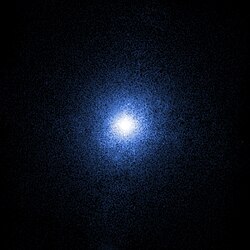](https://en.wikipedia.org/wiki/File:Chandra_image_of_Cygnus_X-1.jpg)
A [Chandra X-Ray Observatory](https://en.wikipedia.org/wiki/Chandra_X-Ray_Observatory "Chandra X-Ray Observatory") image of [Cygnus X-1](https://en.wikipedia.org/wiki/Cygnus_X-1 "Cygnus X-1"), which was the first strong black hole candidate discovered
[X-ray binaries](https://en.wikipedia.org/wiki/X-ray_binaries "X-ray binaries") are binary systems that emit a majority of their radiation in the [X-ray](https://en.wikipedia.org/wiki/X-ray "X-ray") part of the [electromagnetic spectrum](https://en.wikipedia.org/wiki/Electromagnetic_spectrum "Electromagnetic spectrum"). These X-ray emissions result when a compact object accretes matter from an ordinary star.[\[243\]](https://en.wikipedia.org/wiki/Black_hole#cite_note-245) The presence of an ordinary star in such a system provides an opportunity for studying the central object and to determine if it might be a black hole. By measuring the [orbital period](https://en.wikipedia.org/wiki/Orbital_period "Orbital period") of the binary, the distance to the binary from Earth, and the mass of the companion star, scientists can estimate the mass of the compact object.[\[244\]](https://en.wikipedia.org/wiki/Black_hole#cite_note-246) The [Tolman-Oppenheimer-Volkoff limit](https://en.wikipedia.org/wiki/Tolman-Oppenheimer-Volkoff_limit "Tolman-Oppenheimer-Volkoff limit") (TOV limit) dictates the largest mass a nonrotating neutron star can be, and is estimated to be about two solar masses. While a rotating neutron star can be slightly more massive, if the compact object is much more massive than the TOV limit, it cannot be a neutron star and is generally expected to be a black hole.[\[160\]](https://en.wikipedia.org/wiki/Black_hole#cite_note-CMS1999-161)[\[245\]](https://en.wikipedia.org/wiki/Black_hole#cite_note-247)
The first strong candidate for a black hole, [Cygnus X-1](https://en.wikipedia.org/wiki/Cygnus_X-1 "Cygnus X-1"), was discovered in this way by [Charles Thomas Bolton](https://en.wikipedia.org/wiki/Charles_Thomas_Bolton "Charles Thomas Bolton"),[\[246\]](https://en.wikipedia.org/wiki/Black_hole#cite_note-Bolton1972-248) [Louise Webster](https://en.wikipedia.org/wiki/Louise_Webster "Louise Webster"), and [Paul Murdin](https://en.wikipedia.org/wiki/Paul_Murdin "Paul Murdin")[\[247\]](https://en.wikipedia.org/wiki/Black_hole#cite_note-Webster1972-249) in 1972.[\[248\]](https://en.wikipedia.org/wiki/Black_hole#cite_note-250)[\[41\]](https://en.wikipedia.org/wiki/Black_hole#cite_note-Shipman1975-41) Observations of rotation broadening of the optical star reported in 1986 lead to a compact object mass estimate of 16 solar masses, with 7 solar masses as the lower bound.[\[160\]](https://en.wikipedia.org/wiki/Black_hole#cite_note-CMS1999-161) In 2011, this estimate was updated to 14\.1±1\.0 *M*☉ for the black hole and 19\.2±1\.9 *M*☉ for the optical stellar companion.[\[249\]](https://en.wikipedia.org/wiki/Black_hole#cite_note-251)
[X-ray binaries](https://en.wikipedia.org/wiki/X-ray_binaries "X-ray binaries") can be categorised as either *low-mass* or *high-mass*; This classification is based on the mass of the companion star, not the compact object itself.[\[95\]](https://en.wikipedia.org/wiki/Black_hole#cite_note-lph97-95) In a class of X-ray binaries called soft X-ray transients, the companion star is of relatively low mass, allowing for more accurate estimates of the black hole mass. These systems actively emit X-rays for only several months once every 10–50 years. During the period of low X-ray emission, called quiescence, the accretion disk is extremely faint, allowing detailed observation of the companion star.[\[160\]](https://en.wikipedia.org/wiki/Black_hole#cite_note-CMS1999-161) Numerous black hole candidates have been measured by this method.[\[250\]](https://en.wikipedia.org/wiki/Black_hole#cite_note-252) Black holes are also sometimes found in binaries with other compact objects, such as [white dwarfs](https://en.wikipedia.org/wiki/White_dwarf "White dwarf"),[\[95\]](https://en.wikipedia.org/wiki/Black_hole#cite_note-lph97-95) neutron stars,[\[251\]](https://en.wikipedia.org/wiki/Black_hole#cite_note-253)[\[252\]](https://en.wikipedia.org/wiki/Black_hole#cite_note-254) and other black holes.[\[253\]](https://en.wikipedia.org/wiki/Black_hole#cite_note-255)[\[254\]](https://en.wikipedia.org/wiki/Black_hole#cite_note-256)
### Galactic nuclei
The centre of nearly every galaxy contains a supermassive black hole.[\[255\]](https://en.wikipedia.org/wiki/Black_hole#cite_note-257) The close observational correlation between the mass of this hole and the velocity dispersion of the host galaxy's [bulge](https://en.wikipedia.org/wiki/Galactic_bulge "Galactic bulge"), known as the [M–sigma relation](https://en.wikipedia.org/wiki/M%E2%80%93sigma_relation "M–sigma relation"), strongly suggests a connection between the formation of the black hole and that of the galaxy itself.[\[256\]](https://en.wikipedia.org/wiki/Black_hole#cite_note-King-258)[\[257\]](https://en.wikipedia.org/wiki/Black_hole#cite_note-msigma2000-259)
#### Active galactic nucleus
See also: [Active galactic nucleus](https://en.wikipedia.org/wiki/Active_galactic_nucleus "Active galactic nucleus")
[](https://en.wikipedia.org/wiki/File:X-RayFlare-BlackHole-MilkyWay-20140105.jpg)
Detection of an unusually bright [X-ray](https://en.wikipedia.org/wiki/X-ray "X-ray") flare from Sagittarius A\*, a black hole in the centre of the Milky Way galaxy on 5 January 2015[\[258\]](https://en.wikipedia.org/wiki/Black_hole#cite_note-NASA-20150105-260)
Astronomers use the term *active galaxy* to describe galaxies with unusual characteristics, such as unusual [spectral line](https://en.wikipedia.org/wiki/Spectral_line "Spectral line") emission and very strong radio emission. Theoretical and observational studies have shown that the high levels of activity in the centers of these galaxies, regions called active galactic nuclei (AGN), may be explained by accretion onto supermassive black holes. These AGN consist of a central black hole that may be millions or billions of times more massive than the [Sun](https://en.wikipedia.org/wiki/Sun "Sun"), a disk of [interstellar gas](https://en.wikipedia.org/wiki/Interstellar_gas "Interstellar gas") and dust called an accretion disk, and two [jets](https://en.wikipedia.org/wiki/Relativistic_jet "Relativistic jet") perpendicular to the accretion disk.[\[259\]](https://en.wikipedia.org/wiki/Black_hole#cite_note-261)
Although supermassive black holes are expected to be found in most AGN, only some galaxies' nuclei have been more carefully studied in attempts to both identify and measure the actual masses of the central supermassive black hole candidates. Some of the most notable galaxies with supermassive black hole candidates include the [Andromeda Galaxy](https://en.wikipedia.org/wiki/Andromeda_Galaxy "Andromeda Galaxy"), [Messier 32](https://en.wikipedia.org/wiki/Messier_32 "Messier 32"), [Messier 87](https://en.wikipedia.org/wiki/Messier_87 "Messier 87"), the [Sombrero Galaxy](https://en.wikipedia.org/wiki/Sombrero_Galaxy "Sombrero Galaxy"), and the Milky Way itself.[\[260\]](https://en.wikipedia.org/wiki/Black_hole#cite_note-kormendyrichstone1995-262)[\[261\]](https://en.wikipedia.org/wiki/Black_hole#cite_note-263)
### Microlensing
[](https://en.wikipedia.org/wiki/File:Gravitational_microlensing_by_black_hole_-_cropped.jpg)
The intense gravitational field of a foreground black hole acts like a powerful lens, distorting and brightening the image of a background star.
Another way black holes can be detected is through observation of effects caused by their strong gravitational field. One such effect is [gravitational lensing](https://en.wikipedia.org/wiki/Gravitational_lensing "Gravitational lensing"): the deformation of spacetime around a massive object causes light rays to be deflected, making objects behind them appear distorted.[\[262\]](https://en.wikipedia.org/wiki/Black_hole#cite_note-264) When the lensing object is a black hole, this effect can be strong enough to create multiple images of a star or other luminous source.[\[263\]](https://en.wikipedia.org/wiki/Black_hole#cite_note-bm05-265) However, the distance between the lensed images may be too small for contemporary telescopes to [resolve](https://en.wikipedia.org/wiki/Angular_resolution "Angular resolution")—this phenomenon is called [microlensing](https://en.wikipedia.org/wiki/Microlensing "Microlensing").[\[264\]](https://en.wikipedia.org/wiki/Black_hole#cite_note-266) Instead of seeing two images of a lensed star, astronomers see the star brighten slightly as the black hole moves towards the [line of sight](https://en.wikipedia.org/wiki/Line_of_sight "Line of sight") between the star and Earth and then return to its normal luminosity as the black hole moves away.[\[265\]](https://en.wikipedia.org/wiki/Black_hole#cite_note-267) The first three candidate black holes detected in this way were found around the turn of the millennium.[\[266\]](https://en.wikipedia.org/wiki/Black_hole#cite_note-268)[\[267\]](https://en.wikipedia.org/wiki/Black_hole#cite_note-269) In January 2022, astronomers reported the first confirmed detection of an *isolated* stellar black hole—a black hole with no binary partner—and its mass; The black hole was found via detection of microlensing by the [Hubble Space Telescope](https://en.wikipedia.org/wiki/Hubble_Space_Telescope "Hubble Space Telescope").[\[268\]](https://en.wikipedia.org/wiki/Black_hole#cite_note-Sahu-270)[\[269\]](https://en.wikipedia.org/wiki/Black_hole#cite_note-271)
## Areas of investigation
### Information loss paradox
Main article: [Black hole information paradox](https://en.wikipedia.org/wiki/Black_hole_information_paradox "Black hole information paradox")
Unsolved problem in physics
Is physical information lost in black holes?
[More unsolved problems in physics](https://en.wikipedia.org/wiki/List_of_unsolved_problems_in_physics "List of unsolved problems in physics")
According to the no-hair theorem, a black hole is defined by only three parameters: its mass, charge, and angular momentum. This seems to mean that all other information about the matter that went into forming the black hole is lost, as there is no way to determine anything about the black hole from outside other than those three parameters. When black holes were thought to persist forever, this information loss was not problematic, as the information can be thought of as existing inside the black hole. However, black holes slowly evaporate by emitting Hawking radiation. This radiation does not appear to carry any additional information about the matter that formed the black hole, meaning that this information is seemingly gone forever. This is called the [black hole information paradox](https://en.wikipedia.org/wiki/Black_hole_information_paradox "Black hole information paradox").[\[270\]](https://en.wikipedia.org/wiki/Black_hole#cite_note-PlayDice000-272)[\[271\]](https://en.wikipedia.org/wiki/Black_hole#cite_note-math_ucr_edu-273)[\[272\]](https://en.wikipedia.org/wiki/Black_hole#cite_note-Preskill1994-274) Theoretical studies analysing the paradox have led to both further paradoxes and new ideas about the intersection of quantum mechanics and general relativity. While there is no consensus on the resolution of the paradox, work on the problem is expected to be important for a theory of [quantum gravity](https://en.wikipedia.org/wiki/Quantum_gravity "Quantum gravity").[\[273\]](https://en.wikipedia.org/wiki/Black_hole#cite_note-275): 126
### Supermassive black holes in the early universe
[](https://en.wikipedia.org/wiki/File:High-Redshift_Quasar_and_Companion_Galaxy_\(Illustration\)_\(2020-51-4755-Image\).png)
Two galaxies from the first billion years after the Big Bang. The galaxy on the left hosts a luminous quasar at its center.
Observations of faraway galaxies have found that ultraluminous quasars, powered by supermassive black holes, existed in the early universe as far as redshift z ≥ 7 {\\displaystyle z\\geq 7} .[\[274\]](https://en.wikipedia.org/wiki/Black_hole#cite_note-276) These black holes have been assumed to be the products of the gravitational collapse of large [population III stars](https://en.wikipedia.org/wiki/Population_III_star "Population III star").[\[275\]](https://en.wikipedia.org/wiki/Black_hole#cite_note-277)[\[276\]](https://en.wikipedia.org/wiki/Black_hole#cite_note-278) However, these stellar remnants were not massive enough to produce the quasars observed at early times without accreting beyond the Eddington limit, the theoretical maximum rate of black hole accretion.[\[277\]](https://en.wikipedia.org/wiki/Black_hole#cite_note-sb19-279)[\[278\]](https://en.wikipedia.org/wiki/Black_hole#cite_note-280)
Physicists have suggested a variety of different mechanisms by which these supermassive black holes may have formed. It has been proposed that smaller black holes may have also undergone mergers to produce the observed supermassive black holes.[\[279\]](https://en.wikipedia.org/wiki/Black_hole#cite_note-281)[\[280\]](https://en.wikipedia.org/wiki/Black_hole#cite_note-282) It is also possible that they were seeded by [direct-collapse black holes](https://en.wikipedia.org/wiki/Direct-collapse_black_hole "Direct-collapse black hole"), in which a large cloud of hot gas avoids fragmentation that would lead to multiple stars, due to low angular momentum or heating from a nearby galaxy. Given the right circumstances, a single supermassive star forms and collapses directly into a black hole without undergoing typical [stellar evolution](https://en.wikipedia.org/wiki/Stellar_evolution "Stellar evolution").[\[281\]](https://en.wikipedia.org/wiki/Black_hole#cite_note-283)[\[282\]](https://en.wikipedia.org/wiki/Black_hole#cite_note-284) Additionally, these supermassive black holes in the early universe may be high-mass primordial black holes, which could have accreted further matter in the centers of galaxies.[\[283\]](https://en.wikipedia.org/wiki/Black_hole#cite_note-285) Finally, certain mechanisms allow black holes to grow faster than the theoretical Eddington limit, such as dense gas in the accretion disk limiting outward radiation pressure that prevents the black hole from accreting.[\[277\]](https://en.wikipedia.org/wiki/Black_hole#cite_note-sb19-279)[\[284\]](https://en.wikipedia.org/wiki/Black_hole#cite_note-286) However, the formation of bipolar jets prevent super-Eddington rates.[\[222\]](https://en.wikipedia.org/wiki/Black_hole#cite_note-Regan-224)
### Alternatives to black holes
See also: [Exotic star](https://en.wikipedia.org/wiki/Exotic_star "Exotic star")
While there is a strong case for supermassive black holes,[\[285\]](https://en.wikipedia.org/wiki/Black_hole#cite_note-287)[\[286\]](https://en.wikipedia.org/wiki/Black_hole#cite_note-288) the dividing line between lighter black holes and neutron stars relies on theories of extremely dense matter. Direct observational tests are not available: objects observed to have mass higher than the predictions for neutron stars are assumed to be black holes. Recent evidence from gravitational wave events suggests modifications of these theories may be needed.[\[94\]](https://en.wikipedia.org/wiki/Black_hole#cite_note-Vink-2021-94) New exotic [phases of matter](https://en.wikipedia.org/wiki/Phase_\(matter\) "Phase (matter)") could allow other kinds of massive objects.[\[160\]](https://en.wikipedia.org/wiki/Black_hole#cite_note-CMS1999-161) [Quark stars](https://en.wikipedia.org/wiki/Quark_star "Quark star") would be made up of [quark matter](https://en.wikipedia.org/wiki/Quark_matter "Quark matter") and supported by quark degeneracy pressure, a form of degeneracy pressure even stronger than neutron degeneracy pressure. This would halt gravitational collapse at a higher mass than for a neutron star.[\[287\]](https://en.wikipedia.org/wiki/Black_hole#cite_note-289)[\[288\]](https://en.wikipedia.org/wiki/Black_hole#cite_note-290) Even stronger stars called [electroweak stars](https://en.wikipedia.org/wiki/Electroweak_star "Electroweak star") would convert quarks in their cores into [leptons](https://en.wikipedia.org/wiki/Lepton "Lepton"), providing additional pressure to stop the star from collapsing.[\[289\]](https://en.wikipedia.org/wiki/Black_hole#cite_note-bonkowsky25-291)[\[290\]](https://en.wikipedia.org/wiki/Black_hole#cite_note-292) If, as some extensions of the [Standard Model](https://en.wikipedia.org/wiki/Standard_Model "Standard Model") posit, [quarks](https://en.wikipedia.org/wiki/Quark "Quark") and [leptons](https://en.wikipedia.org/wiki/Lepton "Lepton") are made up of the even-smaller fundamental particles called [preons](https://en.wikipedia.org/wiki/Preon "Preon"), a very compact star could be supported by preon degeneracy pressure.[\[291\]](https://en.wikipedia.org/wiki/Black_hole#cite_note-293) While none of these hypothetical models can explain all of the observations of stellar black hole candidates, a [Q star](https://en.wikipedia.org/wiki/Q_star "Q star") is the only alternative which could significantly exceed the mass limit for neutron stars and thus provide an alternative for supermassive black holes.[\[160\]](https://en.wikipedia.org/wiki/Black_hole#cite_note-CMS1999-161): 12
A few theoretical objects have been conjectured to match observations of astronomical black hole candidates identically or near-identically, but which function via a different mechanism.[\[292\]](https://en.wikipedia.org/wiki/Black_hole#cite_note-Murk2023-294) A [dark energy star](https://en.wikipedia.org/wiki/Dark_energy_star "Dark energy star") would convert infalling matter into [vacuum energy](https://en.wikipedia.org/wiki/Vacuum_energy "Vacuum energy"); This vacuum energy would be much larger than the vacuum energy of outside space, exerting outwards pressure and preventing a singularity from forming.[\[293\]](https://en.wikipedia.org/wiki/Black_hole#cite_note-295)[\[294\]](https://en.wikipedia.org/wiki/Black_hole#cite_note-296) A [black star](https://en.wikipedia.org/wiki/Black_star_\(semiclassical_gravity\) "Black star (semiclassical gravity)") would be gravitationally collapsing slowly enough that quantum effects would keep it just on the cusp of fully collapsing into a black hole.[\[295\]](https://en.wikipedia.org/wiki/Black_hole#cite_note-297) A [gravastar](https://en.wikipedia.org/wiki/Gravastar "Gravastar") would consist of a very thin shell and a dark-energy interior providing outward pressure to stop the collapse into a black hole or formation of a singularity; It could even have another gravastar inside, called a 'nestar'.[\[296\]](https://en.wikipedia.org/wiki/Black_hole#cite_note-298)
## In fiction
Main article: [Black holes in fiction](https://en.wikipedia.org/wiki/Black_holes_in_fiction "Black holes in fiction")
[](https://en.wikipedia.org/wiki/File:Interstellar_black_hole_\(no_lens_flare\).jpg)
The black hole and accretion disk used in the movie *Interstellar*, without lens flare. Interstellar's visual effects team used relativity to visualize gravitational lensing around the black hole.[\[133\]](https://en.wikipedia.org/wiki/Black_hole#cite_note-jtft15-133)
[Lynn Gamwell](https://en.wikipedia.org/wiki/Lynn_Gamwell "Lynn Gamwell") in her book *Conjuring the void: the art of black holes* used the black holes as example to explore how art and science interact. The book considers the application of art to create scientific visualizations and the impact of scientific ideas on art concepts like darkness.[\[297\]](https://en.wikipedia.org/wiki/Black_hole#cite_note-299) Fictional treatments of black holes are also used as a mechanism for teaching science.[\[298\]](https://en.wikipedia.org/wiki/Black_hole#cite_note-kyle19-300)[\[299\]](https://en.wikipedia.org/wiki/Black_hole#cite_note-FraknoiBlackHoles-301)
Black holes have been portrayed in science fiction in a variety of ways. Even before the advent of the term itself, objects with characteristics of black holes appeared in stories such as the 1928 novel *[The Skylark of Space](https://en.wikipedia.org/wiki/The_Skylark_of_Space "The Skylark of Space")* with its "black Sun" and the "hole in space" in the 1935 short story *[Starship Invincible](https://en.wikipedia.org/w/index.php?title=Starship_Invincible&action=edit&redlink=1 "Starship Invincible (page does not exist)")*.[\[300\]](https://en.wikipedia.org/wiki/Black_hole#cite_note-WestfahlBlackHoles-302) Fans of science fiction art typically want the fiction to closely follow the science.[\[298\]](https://en.wikipedia.org/wiki/Black_hole#cite_note-kyle19-300) In visual media such as the 2014 space epic [Interstellar](https://en.wikipedia.org/wiki/Interstellar_\(film\) "Interstellar (film)") and the 2018 science fiction film [High Life](https://en.wikipedia.org/wiki/High_Life_\(film\) "High Life (film)") relativity was incorporate into the visualizations, leading to results similar to images derived from the [Event Horizon Telescope](https://en.wikipedia.org/wiki/Event_Horizon_Telescope "Event Horizon Telescope"), although both used some [artistic license](https://en.wikipedia.org/wiki/Artistic_license "Artistic license").[\[301\]](https://en.wikipedia.org/wiki/Black_hole#cite_note-303)[\[133\]](https://en.wikipedia.org/wiki/Black_hole#cite_note-jtft15-133)
Authors and screenwriters have exploited the relativistic effects of black holes, particularly gravitational time dilation.[\[302\]](https://en.wikipedia.org/wiki/Black_hole#cite_note-StablefordBlackHole-304) For example, *Interstellar* features a [black hole planet](https://en.wikipedia.org/wiki/Blanet "Blanet") with a time dilation factor of over 60,000:1,[\[168\]](https://en.wikipedia.org/wiki/Black_hole#cite_note-scienceofinterstellar-170): 163 while the 1977 [Pohl](https://en.wikipedia.org/wiki/Frederik_Pohl "Frederik Pohl") novel *[Gateway](https://en.wikipedia.org/wiki/Gateway_\(novel\) "Gateway (novel)")* depicts a spaceship approaching but never crossing the event horizon of a black hole from the perspective of an outside observer due to time dilation effects.[\[303\]](https://en.wikipedia.org/wiki/Black_hole#cite_note-GreenwoodBlackHoles-305) Black holes have also been appropriated as wormholes or other methods of faster-than-light travel, such as in the 1974 [Haldeman](https://en.wikipedia.org/wiki/Joe_Haldeman "Joe Haldeman") novel *[The Forever War](https://en.wikipedia.org/wiki/The_Forever_War "The Forever War")*, where a network of black holes is used for interstellar travel.[\[302\]](https://en.wikipedia.org/wiki/Black_hole#cite_note-StablefordBlackHole-304)[\[299\]](https://en.wikipedia.org/wiki/Black_hole#cite_note-FraknoiBlackHoles-301) Additionally, black holes can feature as hazards to spacefarers and planets: A black hole threatens a deep-space outpost in 1978 short story *[The Black Hole Passes](https://en.wikipedia.org/w/index.php?title=The_Black_Hole_Passes&action=edit&redlink=1 "The Black Hole Passes (page does not exist)")*, and a binary black hole dangerously alters the orbit of a planet in the 2018 Netflix reboot of *[Lost in Space](https://en.wikipedia.org/wiki/Lost_in_Space_\(2018\) "Lost in Space (2018)")*.[\[299\]](https://en.wikipedia.org/wiki/Black_hole#cite_note-FraknoiBlackHoles-301)
## Notes
1. **[^](https://en.wikipedia.org/wiki/Black_hole#cite_ref-159)**
The (outer) event horizon radius scales as:
M
\+
M
2
−
(
J
/
M
)
2
−
Q
2
.
{\\displaystyle M+{\\sqrt {M^{2}-{(J/M)}^{2}-Q^{2}}}.}

2. **[^](https://en.wikipedia.org/wiki/Black_hole#cite_ref-163)** The set of possible paths, or more accurately the future [light cone](https://en.wikipedia.org/wiki/Light_cone "Light cone") containing all possible [world lines](https://en.wikipedia.org/wiki/World_line "World line") (in this diagram the light cone is represented by the V-shaped region bounded by arrows representing light ray world lines), is tilted in this way in [Eddington–Finkelstein coordinates](https://en.wikipedia.org/wiki/Eddington%E2%80%93Finkelstein_coordinates "Eddington–Finkelstein coordinates") (the diagram is a "cartoon" version of an Eddington–Finkelstein coordinate diagram), but in other coordinates the light cones are not tilted in this way, for example in [Schwarzschild coordinates](https://en.wikipedia.org/wiki/Schwarzschild_coordinates "Schwarzschild coordinates") they narrow without tilting as one approaches the event horizon, and in [Kruskal–Szekeres coordinates](https://en.wikipedia.org/wiki/Kruskal%E2%80%93Szekeres_coordinates "Kruskal–Szekeres coordinates") the light cones do not change shape or orientation at all.[\[136\]](https://en.wikipedia.org/wiki/Black_hole#cite_note-Misner-1973-136): 848
## References
1. ^ [***a***](https://en.wikipedia.org/wiki/Black_hole#cite_ref-eht19_1-0) [***b***](https://en.wikipedia.org/wiki/Black_hole#cite_ref-eht19_1-1)
The Event Horizon Telescope Collaboration; et al. (10 April 2019). ["First M87 Event Horizon Telescope Results. IV. Imaging the Central Supermassive Black Hole"](https://doi.org/10.3847%2F2041-8213%2Fab0e85). *The Astrophysical Journal Letters*. **875** (1): L4. [arXiv](https://en.wikipedia.org/wiki/ArXiv_\(identifier\) "ArXiv (identifier)"):[1906\.11241](https://arxiv.org/abs/1906.11241). [Bibcode](https://en.wikipedia.org/wiki/Bibcode_\(identifier\) "Bibcode (identifier)"):[2019ApJ...875L...4E](https://ui.adsabs.harvard.edu/abs/2019ApJ...875L...4E). [doi](https://en.wikipedia.org/wiki/Doi_\(identifier\) "Doi (identifier)"):[10\.3847/2041-8213/ab0e85](https://doi.org/10.3847%2F2041-8213%2Fab0e85). [ISSN](https://en.wikipedia.org/wiki/ISSN_\(identifier\) "ISSN (identifier)") [2041-8205](https://search.worldcat.org/issn/2041-8205).
2. **[^](https://en.wikipedia.org/wiki/Black_hole#cite_ref-2)**
["Astronomers capture first image of a black hole"](https://new.nsf.gov/news/astronomers-capture-first-image-black-hole#image-caption-credit-block). *new.nsf.gov*. 10 April 2019. Retrieved 28 January 2025.
3. **[^](https://en.wikipedia.org/wiki/Black_hole#cite_ref-riazuelo_3-0)**
[Riazuelo, Alain](https://en.wikipedia.org/wiki/Alain_Riazuelo "Alain Riazuelo") (2019). "Seeing relativity—I. Ray tracing in a Schwarzschild metric to explore the maximal analytic extension of the metric and making a proper rendering of the stars". *International Journal of Modern Physics D*. **28** (2): 1950042. [arXiv](https://en.wikipedia.org/wiki/ArXiv_\(identifier\) "ArXiv (identifier)"):[1511\.06025](https://arxiv.org/abs/1511.06025). [Bibcode](https://en.wikipedia.org/wiki/Bibcode_\(identifier\) "Bibcode (identifier)"):[2019IJMPD..2850042R](https://ui.adsabs.harvard.edu/abs/2019IJMPD..2850042R). [doi](https://en.wikipedia.org/wiki/Doi_\(identifier\) "Doi (identifier)"):[10\.1142/S0218271819500421](https://doi.org/10.1142%2FS0218271819500421). [S2CID](https://en.wikipedia.org/wiki/S2CID_\(identifier\) "S2CID (identifier)") [54548877](https://api.semanticscholar.org/CorpusID:54548877).
4. **[^](https://en.wikipedia.org/wiki/Black_hole#cite_ref-NYT-20150608_4-0)**
Overbye, Dennis (8 June 2015). ["Black Hole Hunters"](https://www.nytimes.com/2015/06/09/science/black-hole-event-horizon-telescope.html). *[The New York Times](https://en.wikipedia.org/wiki/The_New_York_Times "The New York Times")*. [ISSN](https://en.wikipedia.org/wiki/ISSN_\(identifier\) "ISSN (identifier)") [0362-4331](https://search.worldcat.org/issn/0362-4331). [Archived](https://web.archive.org/web/20150609023631/http://www.nytimes.com/2015/06/09/science/black-hole-event-horizon-telescope.html) from the original on 9 June 2015. Retrieved 28 March 2026.
5. ^ [***a***](https://en.wikipedia.org/wiki/Black_hole#cite_ref-origin_5-0) [***b***](https://en.wikipedia.org/wiki/Black_hole#cite_ref-origin_5-1) [***c***](https://en.wikipedia.org/wiki/Black_hole#cite_ref-origin_5-2)
Montgomery, Colin; Orchiston, Wayne; Whittingham, Ian (2009) \[Available online 18 April 2023\]. ["Michell, Laplace and the Origin of the Black Hole Concept"](https://researchonline.jcu.edu.au/9892/1/Microsoft_Word_-_Paper__Black_Hole_Concept_Final_.pdf) (PDF). *[Journal of Astronomical History and Heritage](https://en.wikipedia.org/wiki/Journal_of_Astronomical_History_and_Heritage "Journal of Astronomical History and Heritage")* (Research article). **12** (2): 90–96\. [Bibcode](https://en.wikipedia.org/wiki/Bibcode_\(identifier\) "Bibcode (identifier)"):[2009JAHH...12...90M](https://ui.adsabs.harvard.edu/abs/2009JAHH...12...90M). [doi](https://en.wikipedia.org/wiki/Doi_\(identifier\) "Doi (identifier)"):[10\.3724/SP.J.1440-2807.2009.02.01](https://doi.org/10.3724%2FSP.J.1440-2807.2009.02.01). [S2CID](https://en.wikipedia.org/wiki/S2CID_\(identifier\) "S2CID (identifier)") [55890996](https://api.semanticscholar.org/CorpusID:55890996).
6. **[^](https://en.wikipedia.org/wiki/Black_hole#cite_ref-6)**
[Michell, J.](https://en.wikipedia.org/wiki/John_Michell "John Michell") (1784). ["On the Means of Discovering the Distance, Magnitude, \&C. Of the Fixed Stars, In Consequence of the Diminution of the Velocity of Their Light, In Case Such a Diminution Should Be Found to Take Place in Any of Them, And Such Other Data Should Be Procured from Observations, As Would Be Farther Necessary for That Purpose"](https://doi.org/10.1098%2Frstl.1784.0008). *[Philosophical Transactions of the Royal Society](https://en.wikipedia.org/wiki/Philosophical_Transactions_of_the_Royal_Society "Philosophical Transactions of the Royal Society")*. **74**: 35–57\. [Bibcode](https://en.wikipedia.org/wiki/Bibcode_\(identifier\) "Bibcode (identifier)"):[1784RSPT...74...35M](https://ui.adsabs.harvard.edu/abs/1784RSPT...74...35M). [doi](https://en.wikipedia.org/wiki/Doi_\(identifier\) "Doi (identifier)"):[10\.1098/rstl.1784.0008](https://doi.org/10.1098%2Frstl.1784.0008). [JSTOR](https://en.wikipedia.org/wiki/JSTOR_\(identifier\) "JSTOR (identifier)") [106576](https://www.jstor.org/stable/106576).
7. ^ [***a***](https://en.wikipedia.org/wiki/Black_hole#cite_ref-Throne-1994_7-0) [***b***](https://en.wikipedia.org/wiki/Black_hole#cite_ref-Throne-1994_7-1) [***c***](https://en.wikipedia.org/wiki/Black_hole#cite_ref-Throne-1994_7-2) [***d***](https://en.wikipedia.org/wiki/Black_hole#cite_ref-Throne-1994_7-3) [***e***](https://en.wikipedia.org/wiki/Black_hole#cite_ref-Throne-1994_7-4) [***f***](https://en.wikipedia.org/wiki/Black_hole#cite_ref-Throne-1994_7-5) [***g***](https://en.wikipedia.org/wiki/Black_hole#cite_ref-Throne-1994_7-6) [***h***](https://en.wikipedia.org/wiki/Black_hole#cite_ref-Throne-1994_7-7) [***i***](https://en.wikipedia.org/wiki/Black_hole#cite_ref-Throne-1994_7-8) [***j***](https://en.wikipedia.org/wiki/Black_hole#cite_ref-Throne-1994_7-9) [***k***](https://en.wikipedia.org/wiki/Black_hole#cite_ref-Throne-1994_7-10) [***l***](https://en.wikipedia.org/wiki/Black_hole#cite_ref-Throne-1994_7-11)
[Thorne, Kip S.](https://en.wikipedia.org/wiki/Kip_Thorne "Kip Thorne"); [Hawking, Stephen](https://en.wikipedia.org/wiki/Stephen_Hawking "Stephen Hawking") (1994). Agrawal, Milan (ed.). [*Black Holes and Time Warps: Einstein's Outrageous Legacy*](https://archive.org/details/blackholestimewa0000thor) (1st ed.). [W. W. Norton & Company](https://en.wikipedia.org/wiki/W._W._Norton_%26_Company "W. W. Norton & Company"). [ISBN](https://en.wikipedia.org/wiki/ISBN_\(identifier\) "ISBN (identifier)")
[978-0-393-31276-8](https://en.wikipedia.org/wiki/Special:BookSources/978-0-393-31276-8 "Special:BookSources/978-0-393-31276-8")
. Retrieved 12 April 2019.
8. ^ [***a***](https://en.wikipedia.org/wiki/Black_hole#cite_ref-Weinberg-1972_8-0) [***b***](https://en.wikipedia.org/wiki/Black_hole#cite_ref-Weinberg-1972_8-1)
[Weinberg, Steven](https://en.wikipedia.org/wiki/Steven_Weinberg "Steven Weinberg") (1972). [*Gravitation and Cosmology*](https://archive.org/details/gravitationcosmo00stev_0). John Wiley & Sons. [ISBN](https://en.wikipedia.org/wiki/ISBN_\(identifier\) "ISBN (identifier)")
[978-0-471-92567-5](https://en.wikipedia.org/wiki/Special:BookSources/978-0-471-92567-5 "Special:BookSources/978-0-471-92567-5")
.
9. **[^](https://en.wikipedia.org/wiki/Black_hole#cite_ref-9)**
[Einstein, Albert](https://en.wikipedia.org/wiki/Albert_Einstein "Albert Einstein") (1915). "Feldgleichungen der Gravitation" \[Field Equations of Gravitation\]. *Preussische Akademie der Wissenschaften, Sitzungsberichte*: 844–847\.
10. **[^](https://en.wikipedia.org/wiki/Black_hole#cite_ref-10)**
Janssen, Michel; [Renn, Jürgen](https://en.wikipedia.org/wiki/J%C3%BCrgen_Renn "Jürgen Renn") (2015). ["Arch and Scaffold: How Einstein Found His Field Equations"](https://doi.org/10.1063%2FPT.3.2979). *[Physics Today](https://en.wikipedia.org/wiki/Physics_Today "Physics Today")* (Feature article). **68** (11): 30–36\. [Bibcode](https://en.wikipedia.org/wiki/Bibcode_\(identifier\) "Bibcode (identifier)"):[2015PhT....68k..30J](https://ui.adsabs.harvard.edu/abs/2015PhT....68k..30J). [doi](https://en.wikipedia.org/wiki/Doi_\(identifier\) "Doi (identifier)"):[10\.1063/PT.3.2979](https://doi.org/10.1063%2FPT.3.2979). [hdl](https://en.wikipedia.org/wiki/Hdl_\(identifier\) "Hdl (identifier)"):[11858/00-001M-0000-002A-8ED7-1](https://hdl.handle.net/11858%2F00-001M-0000-002A-8ED7-1).
11. **[^](https://en.wikipedia.org/wiki/Black_hole#cite_ref-11)**
[Fraknoi, Andrew](https://en.wikipedia.org/wiki/Andrew_Fraknoi "Andrew Fraknoi"); [Morrison, David](https://en.wikipedia.org/wiki/David_Morrison_\(astrophysicist\) "David Morrison (astrophysicist)"); [Wolff, Sidney C.](https://en.wikipedia.org/wiki/Sidney_C._Wolff "Sidney C. Wolff") (2022). "24.5 Black Holes". [*Astronomy 2e*](https://assets.openstax.org/oscms-prodcms/media/documents/Astronomy2e-WEB.pdf) (PDF) (2e ed.). [OpenStax](https://en.wikipedia.org/wiki/OpenStax "OpenStax"). pp. 839–846\. [ISBN](https://en.wikipedia.org/wiki/ISBN_\(identifier\) "ISBN (identifier)")
[978-1-951693-50-3](https://en.wikipedia.org/wiki/Special:BookSources/978-1-951693-50-3 "Special:BookSources/978-1-951693-50-3")
. [OCLC](https://en.wikipedia.org/wiki/OCLC_\(identifier\) "OCLC (identifier)") [1322188620](https://search.worldcat.org/oclc/1322188620).
12. **[^](https://en.wikipedia.org/wiki/Black_hole#cite_ref-Schwarzschild1916_12-0)**
[Schwarzschild, K.](https://en.wikipedia.org/wiki/Karl_Schwarzschild "Karl Schwarzschild") (1916). ["Über das Gravitationsfeld eines Massenpunktes nach der Einsteinschen Theorie"](https://archive.org/stream/sitzungsberichte1916deutsch#page/188/mode/2up) \[On the gravitational field of a mass point according to Einstein's theory\]. *Sitzungsberichte der Königlich Preussischen Akademie der Wissenschaften*. **7**: 189–196\. [Bibcode](https://en.wikipedia.org/wiki/Bibcode_\(identifier\) "Bibcode (identifier)"):[1916SPAW.......189S](https://ui.adsabs.harvard.edu/abs/1916SPAW.......189S) – via Internet Archive.
- Translation:
Antoci, S.; Loinger, A. (12 May 1999). "On the Gravitational Field of a Mass Point According to Einstein's Theory". [arXiv](https://en.wikipedia.org/wiki/ArXiv_\(identifier\) "ArXiv (identifier)"):[physics/9905030](https://arxiv.org/abs/physics/9905030).
and
[Schwarzschild, K.](https://en.wikipedia.org/wiki/Karl_Schwarzschild "Karl Schwarzschild") (1916). ["Über das Gravitationsfeld einer Kugel aus inkompressibler Flüssigkeit nach der Einsteinschen Theorie"](https://archive.org/stream/sitzungsberichte1916deutsch#page/424/mode/2up). *Sitzungsberichte der Königlich Preussischen Akademie der Wissenschaften*. **18**: 424–434\. [Bibcode](https://en.wikipedia.org/wiki/Bibcode_\(identifier\) "Bibcode (identifier)"):[1916skpa.conf..424S](https://ui.adsabs.harvard.edu/abs/1916skpa.conf..424S).
- Translation:
Antoci, S. (1999). "On the Gravitational Field of a Sphere of Incompressible Fluid According to Einstein's Theory". [arXiv](https://en.wikipedia.org/wiki/ArXiv_\(identifier\) "ArXiv (identifier)"):[physics/9912033](https://arxiv.org/abs/physics/9912033).
13. **[^](https://en.wikipedia.org/wiki/Black_hole#cite_ref-13)**
Droste, J. (1917). ["The Field of a Single Centre in Einstein's Theory of Gravitation, And the Motion of a Particle in That Field"](http://www.dwc.knaw.nl/DL/publications/PU00012325.pdf) (PDF). Physics. *Proceedings of the Section of Sciences*. **19** (1). [Koninklijke Akademie van Wetenschappen](https://en.wikipedia.org/wiki/Koninklijke_Akademie_van_Wetenschappen "Koninklijke Akademie van Wetenschappen"): 197–215\. [Bibcode](https://en.wikipedia.org/wiki/Bibcode_\(identifier\) "Bibcode (identifier)"):[1917KNAB...19..197D](https://ui.adsabs.harvard.edu/abs/1917KNAB...19..197D). [Archived](https://web.archive.org/web/20130518034708/http://www.dwc.knaw.nl/DL/publications/PU00012325.pdf) (PDF) from the original on 18 May 2013. Retrieved 16 September 2012.
14. **[^](https://en.wikipedia.org/wiki/Black_hole#cite_ref-14)**
Kox, A. J. (1992). ["General Relativity in the Netherlands: 1915–1920"](https://books.google.com/books?id=vDHCF_3vIhUC&pg=PA41). In Eisenstaedt, Jean; Kox, A. J. (eds.). *Studies in the History of General Relativity*. Birkhäuser. p. 41. [ISBN](https://en.wikipedia.org/wiki/ISBN_\(identifier\) "ISBN (identifier)")
[978-0-8176-3479-7](https://en.wikipedia.org/wiki/Special:BookSources/978-0-8176-3479-7 "Special:BookSources/978-0-8176-3479-7")
. [Archived](https://web.archive.org/web/20160810215219/https://books.google.com/books?id=vDHCF_3vIhUC&pg=PA41) from the original on 10 August 2016. Retrieved 23 February 2016.
15. **[^](https://en.wikipedia.org/wiki/Black_hole#cite_ref-HooftHist_15-0)**
['t Hooft, G.](https://en.wikipedia.org/wiki/Gerard_%27t_Hooft "Gerard 't Hooft") (2009). ["Introduction to the Theory of Black Holes"](http://www.phys.uu.nl/~thooft/lectures/blackholes/BH_lecturenotes.pdf) (PDF). Institute for Theoretical Physics / Spinoza Institute. pp. 47–48\. [Archived](https://web.archive.org/web/20090521082736/http://www.phys.uu.nl/~thooft/lectures/blackholes/BH_lecturenotes.pdf) (PDF) from the original on 21 May 2009. Retrieved 24 June 2010.
16. **[^](https://en.wikipedia.org/wiki/Black_hole#cite_ref-eddington1926_16-0)**
[Eddington, Arthur](https://en.wikipedia.org/wiki/Arthur_Eddington "Arthur Eddington") (1926). [*The Internal Constitution of the Stars*](https://books.google.com/books?id=RjC9DpnWFbkC&pg=PA6). Science. Vol. 52. Cambridge University Press. pp. 233–40\. [Bibcode](https://en.wikipedia.org/wiki/Bibcode_\(identifier\) "Bibcode (identifier)"):[1920Sci....52..233E](https://ui.adsabs.harvard.edu/abs/1920Sci....52..233E). [doi](https://en.wikipedia.org/wiki/Doi_\(identifier\) "Doi (identifier)"):[10\.1126/science.52.1341.233](https://doi.org/10.1126%2Fscience.52.1341.233). [PMID](https://en.wikipedia.org/wiki/PMID_\(identifier\) "PMID (identifier)") [17747682](https://pubmed.ncbi.nlm.nih.gov/17747682). [Archived](https://web.archive.org/web/20160811034409/https://books.google.com/books?id=RjC9DpnWFbkC&lpg=PP1&pg=PA6) from the original on 11 August 2016.
[ISBN](https://en.wikipedia.org/wiki/ISBN_\(identifier\) "ISBN (identifier)")
[978-0-521-33708-3](https://en.wikipedia.org/wiki/Special:BookSources/978-0-521-33708-3 "Special:BookSources/978-0-521-33708-3")
17. ^ [***a***](https://en.wikipedia.org/wiki/Black_hole#cite_ref-Bernstein-2007_17-0) [***b***](https://en.wikipedia.org/wiki/Black_hole#cite_ref-Bernstein-2007_17-1)
[Bernstein, Jeremy](https://en.wikipedia.org/wiki/Jeremy_Bernstein "Jeremy Bernstein") (2007). ["The Reluctant Father of Black Holes"](https://www.scientificamerican.com/article/the-reluctant-father-of-black-holes-2007-04/). *[Scientific American](https://en.wikipedia.org/wiki/Scientific_American "Scientific American")*. Vol. 17. pp. 4–11\. [doi](https://en.wikipedia.org/wiki/Doi_\(identifier\) "Doi (identifier)"):[10\.1038/scientificamerican0407-4sp](https://doi.org/10.1038%2Fscientificamerican0407-4sp). Retrieved 3 August 2023.
18. **[^](https://en.wikipedia.org/wiki/Black_hole#cite_ref-18)**
[Einstein, Albert](https://en.wikipedia.org/wiki/Albert_Einstein "Albert Einstein") (10 May 1939). "On a Stationary System With Spherical Symmetry Consisting of Many Gravitating Masses". *[Annals of Mathematics](https://en.wikipedia.org/wiki/Annals_of_Mathematics "Annals of Mathematics")*. **40** (4): 922–936\. [doi](https://en.wikipedia.org/wiki/Doi_\(identifier\) "Doi (identifier)"):[10\.2307/1968902](https://doi.org/10.2307%2F1968902). [JSTOR](https://en.wikipedia.org/wiki/JSTOR_\(identifier\) "JSTOR (identifier)") [1968902](https://www.jstor.org/stable/1968902).
19. **[^](https://en.wikipedia.org/wiki/Black_hole#cite_ref-19)**
[Detweiler, S.](https://en.wikipedia.org/wiki/Steven_Detweiler "Steven Detweiler") (1981). "Resource Letter BH-1: Black Holes". *[American Journal of Physics](https://en.wikipedia.org/wiki/American_Journal_of_Physics "American Journal of Physics")* (Paper). **49** (5): 394–400\. [Bibcode](https://en.wikipedia.org/wiki/Bibcode_\(identifier\) "Bibcode (identifier)"):[1981AmJPh..49..394D](https://ui.adsabs.harvard.edu/abs/1981AmJPh..49..394D). [doi](https://en.wikipedia.org/wiki/Doi_\(identifier\) "Doi (identifier)"):[10\.1119/1.12686](https://doi.org/10.1119%2F1.12686).
20. **[^](https://en.wikipedia.org/wiki/Black_hole#cite_ref-OV1939_20-0)**
[Oppenheimer, J. R.](https://en.wikipedia.org/wiki/J._Robert_Oppenheimer "J. Robert Oppenheimer"); [Volkoff, G. M.](https://en.wikipedia.org/wiki/George_Volkoff "George Volkoff") (1939). "On Massive Neutron Cores". *[Physical Review](https://en.wikipedia.org/wiki/Physical_Review "Physical Review")*. **55** (4): 374–381\. [Bibcode](https://en.wikipedia.org/wiki/Bibcode_\(identifier\) "Bibcode (identifier)"):[1939PhRv...55..374O](https://ui.adsabs.harvard.edu/abs/1939PhRv...55..374O). [doi](https://en.wikipedia.org/wiki/Doi_\(identifier\) "Doi (identifier)"):[10\.1103/PhysRev.55.374](https://doi.org/10.1103%2FPhysRev.55.374).
21. ^ [***a***](https://en.wikipedia.org/wiki/Black_hole#cite_ref-Bartusiak_21-0) [***b***](https://en.wikipedia.org/wiki/Black_hole#cite_ref-Bartusiak_21-1) [***c***](https://en.wikipedia.org/wiki/Black_hole#cite_ref-Bartusiak_21-2) [***d***](https://en.wikipedia.org/wiki/Black_hole#cite_ref-Bartusiak_21-3)
[Bartusiak, Marcia](https://en.wikipedia.org/wiki/Marcia_Bartusiak "Marcia Bartusiak") (2015). *Black Hole: How an Idea Abandoned by Newtonians, Hated by Einstein, And Gambled On by Hawking Became Loved*. [Yale University Press](https://en.wikipedia.org/wiki/Yale_University_Press "Yale University Press"). [ISBN](https://en.wikipedia.org/wiki/ISBN_\(identifier\) "ISBN (identifier)")
[978-0-300-21363-8](https://en.wikipedia.org/wiki/Special:BookSources/978-0-300-21363-8 "Special:BookSources/978-0-300-21363-8")
.
22. **[^](https://en.wikipedia.org/wiki/Black_hole#cite_ref-22)**
[Oppenheimer, J.R.](https://en.wikipedia.org/wiki/J._Robert_Oppenheimer "J. Robert Oppenheimer"); [Snyder, H.](https://en.wikipedia.org/wiki/Hartland_Snyder "Hartland Snyder") (1939). ["On Continued Gravitational Contraction"](https://doi.org/10.1103%2FPhysRev.56.455). *[Physical Review](https://en.wikipedia.org/wiki/Physical_Review "Physical Review")* (Highlighted article). **56** (5): 455–459\. [Bibcode](https://en.wikipedia.org/wiki/Bibcode_\(identifier\) "Bibcode (identifier)"):[1939PhRv...56..455O](https://ui.adsabs.harvard.edu/abs/1939PhRv...56..455O). [doi](https://en.wikipedia.org/wiki/Doi_\(identifier\) "Doi (identifier)"):[10\.1103/PhysRev.56.455](https://doi.org/10.1103%2FPhysRev.56.455).
23. **[^](https://en.wikipedia.org/wiki/Black_hole#cite_ref-23)**
[Finkelstein, D.](https://en.wikipedia.org/wiki/David_Finkelstein "David Finkelstein") (1958). "Past-Future Asymmetry of the Gravitational Field of a Point Particle". *[Physical Review](https://en.wikipedia.org/wiki/Physical_Review "Physical Review")* (Article). **110** (4): 965–967\. [Bibcode](https://en.wikipedia.org/wiki/Bibcode_\(identifier\) "Bibcode (identifier)"):[1958PhRv..110..965F](https://ui.adsabs.harvard.edu/abs/1958PhRv..110..965F). [doi](https://en.wikipedia.org/wiki/Doi_\(identifier\) "Doi (identifier)"):[10\.1103/PhysRev.110.965](https://doi.org/10.1103%2FPhysRev.110.965).
24. **[^](https://en.wikipedia.org/wiki/Black_hole#cite_ref-24)**
Luminet, J.-P. (May 1979). ["Image of a Spherical Black Hole with Thin Accretion Disk"](https://ui.adsabs.harvard.edu/abs/1979A&A....75..228L/abstract). *Astronomy and Astrophysics*. **75**: 228–235\. [Bibcode](https://en.wikipedia.org/wiki/Bibcode_\(identifier\) "Bibcode (identifier)"):[1979A\&A....75..228L](https://ui.adsabs.harvard.edu/abs/1979A&A....75..228L). [ISSN](https://en.wikipedia.org/wiki/ISSN_\(identifier\) "ISSN (identifier)") [0004-6361](https://search.worldcat.org/issn/0004-6361).
25. **[^](https://en.wikipedia.org/wiki/Black_hole#cite_ref-25)**
French National Centre for Scientific Research (10 April 2019). ["First Ever Image of a Black Hole: A CNRS Researcher Had Simulated It as Early as 1979"](https://www.cnrs.fr/en/press/first-ever-image-black-hole-cnrs-researcher-had-simulated-it-early-1979). *CNRS*. Retrieved 18 June 2025.
26. **[^](https://en.wikipedia.org/wiki/Black_hole#cite_ref-26)**
[Thorne K](https://en.wikipedia.org/wiki/Kip_Thorne "Kip Thorne") (2003). "5. Warping spacetime". In Shellard ES, [Gibbons GW](https://en.wikipedia.org/wiki/Gary_Gibbons "Gary Gibbons"), Rankin SJ (eds.). [*The Future of Theoretical Physics and Cosmology: Celebrating Stephen Hawking's 60th Birthday*](https://books.google.com/books?id=yLy4b61rfPwC). [Cambridge University Press](https://en.wikipedia.org/wiki/Cambridge_University_Press "Cambridge University Press"). p. 74. [ISBN](https://en.wikipedia.org/wiki/ISBN_\(identifier\) "ISBN (identifier)")
[0-521-82081-2](https://en.wikipedia.org/wiki/Special:BookSources/0-521-82081-2 "Special:BookSources/0-521-82081-2")
.
27. **[^](https://en.wikipedia.org/wiki/Black_hole#cite_ref-27)**
[Kerr, R. P.](https://en.wikipedia.org/wiki/Roy_Kerr "Roy Kerr") (2009). "Discovering the Kerr and Kerr-Schild metrics". In Wiltshire, D. L.; Visser, M.; Scott, S. M. (eds.). *The Kerr Spacetime*. [Cambridge University Press](https://en.wikipedia.org/wiki/Cambridge_University_Press "Cambridge University Press"). [arXiv](https://en.wikipedia.org/wiki/ArXiv_\(identifier\) "ArXiv (identifier)"):[0706\.1109](https://arxiv.org/abs/0706.1109). [Bibcode](https://en.wikipedia.org/wiki/Bibcode_\(identifier\) "Bibcode (identifier)"):[2007arXiv0706.1109K](https://ui.adsabs.harvard.edu/abs/2007arXiv0706.1109K). [ISBN](https://en.wikipedia.org/wiki/ISBN_\(identifier\) "ISBN (identifier)")
[978-0-521-88512-6](https://en.wikipedia.org/wiki/Special:BookSources/978-0-521-88512-6 "Special:BookSources/978-0-521-88512-6")
.
28. **[^](https://en.wikipedia.org/wiki/Black_hole#cite_ref-28)**
[Newman ET](https://en.wikipedia.org/wiki/Ezra_T._Newman "Ezra T. Newman"), Couch E, et al. (1965). "Metric of a Rotating, Charged Mass". *[Journal of Mathematical Physics](https://en.wikipedia.org/wiki/Journal_of_Mathematical_Physics "Journal of Mathematical Physics")* (Research article). **6** (6): 918. [Bibcode](https://en.wikipedia.org/wiki/Bibcode_\(identifier\) "Bibcode (identifier)"):[1965JMP.....6..918N](https://ui.adsabs.harvard.edu/abs/1965JMP.....6..918N). [doi](https://en.wikipedia.org/wiki/Doi_\(identifier\) "Doi (identifier)"):[10\.1063/1.1704351](https://doi.org/10.1063%2F1.1704351).
29. **[^](https://en.wikipedia.org/wiki/Black_hole#cite_ref-29)**
[Israel, W.](https://en.wikipedia.org/wiki/Werner_Israel "Werner Israel") (1967). "Event Horizons in Static Vacuum Space-Times". *[Physical Review](https://en.wikipedia.org/wiki/Physical_Review "Physical Review")* (Article). **164** (5): 1776. [Bibcode](https://en.wikipedia.org/wiki/Bibcode_\(identifier\) "Bibcode (identifier)"):[1967PhRv..164.1776I](https://ui.adsabs.harvard.edu/abs/1967PhRv..164.1776I). [doi](https://en.wikipedia.org/wiki/Doi_\(identifier\) "Doi (identifier)"):[10\.1103/PhysRev.164.1776](https://doi.org/10.1103%2FPhysRev.164.1776).
30. **[^](https://en.wikipedia.org/wiki/Black_hole#cite_ref-30)**
[Carter, B.](https://en.wikipedia.org/wiki/Brandon_Carter "Brandon Carter") (1971). "Axisymmetric Black Hole Has Only Two Degrees of Freedom". Elementary Particles and Fields. *[Physical Review Letters](https://en.wikipedia.org/wiki/Physical_Review_Letters "Physical Review Letters")* (Letter). **26** (6): 331. [Bibcode](https://en.wikipedia.org/wiki/Bibcode_\(identifier\) "Bibcode (identifier)"):[1971PhRvL..26..331C](https://ui.adsabs.harvard.edu/abs/1971PhRvL..26..331C). [doi](https://en.wikipedia.org/wiki/Doi_\(identifier\) "Doi (identifier)"):[10\.1103/PhysRevLett.26.331](https://doi.org/10.1103%2FPhysRevLett.26.331).
31. **[^](https://en.wikipedia.org/wiki/Black_hole#cite_ref-31)**
[Carter, B.](https://en.wikipedia.org/wiki/Brandon_Carter "Brandon Carter") (1977). "The vacuum black hole uniqueness theorem and its conceivable generalisations". *Proceedings of the 1st Marcel Grossmann Meeting on General Relativity*. pp. 243–254\.
32. ^ [***a***](https://en.wikipedia.org/wiki/Black_hole#cite_ref-HeuslerNoHair_32-0) [***b***](https://en.wikipedia.org/wiki/Black_hole#cite_ref-HeuslerNoHair_32-1)
Chruściel PT, Costa JL, Heusler M (2012). ["Stationary Black Holes: Uniqueness and Beyond"](https://www.ncbi.nlm.nih.gov/pmc/articles/PMC5255892). *[Living Reviews in Relativity](https://en.wikipedia.org/wiki/Living_Reviews_in_Relativity "Living Reviews in Relativity")* (Article). **15** (7) 7. [arXiv](https://en.wikipedia.org/wiki/ArXiv_\(identifier\) "ArXiv (identifier)"):[1205\.6112](https://arxiv.org/abs/1205.6112). [Bibcode](https://en.wikipedia.org/wiki/Bibcode_\(identifier\) "Bibcode (identifier)"):[2012LRR....15....7C](https://ui.adsabs.harvard.edu/abs/2012LRR....15....7C). [doi](https://en.wikipedia.org/wiki/Doi_\(identifier\) "Doi (identifier)"):[10\.12942/lrr-2012-7](https://doi.org/10.12942%2Flrr-2012-7). [PMC](https://en.wikipedia.org/wiki/PMC_\(identifier\) "PMC (identifier)") [5255892](https://www.ncbi.nlm.nih.gov/pmc/articles/PMC5255892). [PMID](https://en.wikipedia.org/wiki/PMID_\(identifier\) "PMID (identifier)") [28179837](https://pubmed.ncbi.nlm.nih.gov/28179837).
33. **[^](https://en.wikipedia.org/wiki/Black_hole#cite_ref-33)**
[Penrose, Roger](https://en.wikipedia.org/wiki/Roger_Penrose "Roger Penrose") (1996). "Chandrasekhar, Black Holes, And Singularities". *[Journal of Astrophysics and Astronomy](https://en.wikipedia.org/wiki/Journal_of_Astrophysics_and_Astronomy "Journal of Astrophysics and Astronomy")* (Article). **17** (3–4\): 213–231\. [Bibcode](https://en.wikipedia.org/wiki/Bibcode_\(identifier\) "Bibcode (identifier)"):[1996JApA...17..213P](https://ui.adsabs.harvard.edu/abs/1996JApA...17..213P). [doi](https://en.wikipedia.org/wiki/Doi_\(identifier\) "Doi (identifier)"):[10\.1007/BF02702305](https://doi.org/10.1007%2FBF02702305).
34. **[^](https://en.wikipedia.org/wiki/Black_hole#cite_ref-penrose1965_34-0)**
[Penrose, R.](https://en.wikipedia.org/wiki/Roger_Penrose "Roger Penrose") (1965). "Gravitational Collapse and Space-Time Singularities". *[Physical Review Letters](https://en.wikipedia.org/wiki/Physical_Review_Letters "Physical Review Letters")*. **14** (3): 57. [Bibcode](https://en.wikipedia.org/wiki/Bibcode_\(identifier\) "Bibcode (identifier)"):[1965PhRvL..14...57P](https://ui.adsabs.harvard.edu/abs/1965PhRvL..14...57P). [doi](https://en.wikipedia.org/wiki/Doi_\(identifier\) "Doi (identifier)"):[10\.1103/PhysRevLett.14.57](https://doi.org/10.1103%2FPhysRevLett.14.57). [S2CID](https://en.wikipedia.org/wiki/S2CID_\(identifier\) "S2CID (identifier)") [116755736](https://api.semanticscholar.org/CorpusID:116755736).
35. **[^](https://en.wikipedia.org/wiki/Black_hole#cite_ref-35)**
[Ford, L. H.](https://en.wikipedia.org/wiki/Lawrence_Ford "Lawrence Ford") (2003). "The Classical Singularity Theorems and Their Quantum Loopholes". *[International Journal of Theoretical Physics](https://en.wikipedia.org/wiki/International_Journal_of_Theoretical_Physics "International Journal of Theoretical Physics")*. **42** (6): 1219–1227\. [arXiv](https://en.wikipedia.org/wiki/ArXiv_\(identifier\) "ArXiv (identifier)"):[gr-qc/0301045](https://arxiv.org/abs/gr-qc/0301045). [Bibcode](https://en.wikipedia.org/wiki/Bibcode_\(identifier\) "Bibcode (identifier)"):[2003gr.qc.....1045F](https://ui.adsabs.harvard.edu/abs/2003gr.qc.....1045F). [doi](https://en.wikipedia.org/wiki/Doi_\(identifier\) "Doi (identifier)"):[10\.1023/A:1025754515197](https://doi.org/10.1023%2FA%3A1025754515197). [S2CID](https://en.wikipedia.org/wiki/S2CID_\(identifier\) "S2CID (identifier)") [14404560](https://api.semanticscholar.org/CorpusID:14404560).
36. **[^](https://en.wikipedia.org/wiki/Black_hole#cite_ref-36)**
[Hewish, A.](https://en.wikipedia.org/wiki/Antony_Hewish "Antony Hewish"); [Bell, S. J.](https://en.wikipedia.org/wiki/Jocelyn_Bell_Burnell "Jocelyn Bell Burnell"); et al. (1968). "Observation of a Rapidly Pulsating Radio Source". *[Nature](https://en.wikipedia.org/wiki/Nature_\(journal\) "Nature (journal)")*. **217** (5130): 709–713\. [Bibcode](https://en.wikipedia.org/wiki/Bibcode_\(identifier\) "Bibcode (identifier)"):[1968Natur.217..709H](https://ui.adsabs.harvard.edu/abs/1968Natur.217..709H). [doi](https://en.wikipedia.org/wiki/Doi_\(identifier\) "Doi (identifier)"):[10\.1038/217709a0](https://doi.org/10.1038%2F217709a0). [S2CID](https://en.wikipedia.org/wiki/S2CID_\(identifier\) "S2CID (identifier)") [4277613](https://api.semanticscholar.org/CorpusID:4277613).
37. **[^](https://en.wikipedia.org/wiki/Black_hole#cite_ref-37)**
Pilkington, J. D. H.; [Hewish, A.](https://en.wikipedia.org/wiki/Antony_Hewish "Antony Hewish"); et al. (1968). "Observations of Some Further Pulsed Radio Sources". *[Nature](https://en.wikipedia.org/wiki/Nature_\(journal\) "Nature (journal)")*. **218** (5137): 126–129\. [Bibcode](https://en.wikipedia.org/wiki/Bibcode_\(identifier\) "Bibcode (identifier)"):[1968Natur.218..126P](https://ui.adsabs.harvard.edu/abs/1968Natur.218..126P). [doi](https://en.wikipedia.org/wiki/Doi_\(identifier\) "Doi (identifier)"):[10\.1038/218126a0](https://doi.org/10.1038%2F218126a0). [S2CID](https://en.wikipedia.org/wiki/S2CID_\(identifier\) "S2CID (identifier)") [4253103](https://api.semanticscholar.org/CorpusID:4253103).
38. **[^](https://en.wikipedia.org/wiki/Black_hole#cite_ref-araa8_265_38-0)**
[Hewish, A.](https://en.wikipedia.org/wiki/Antony_Hewish "Antony Hewish") (1970). "Pulsars". *[Annual Review of Astronomy and Astrophysics](https://en.wikipedia.org/wiki/Annual_Review_of_Astronomy_and_Astrophysics "Annual Review of Astronomy and Astrophysics")*. **8** (1): 265–296\. [Bibcode](https://en.wikipedia.org/wiki/Bibcode_\(identifier\) "Bibcode (identifier)"):[1970ARA\&A...8..265H](https://ui.adsabs.harvard.edu/abs/1970ARA&A...8..265H). [doi](https://en.wikipedia.org/wiki/Doi_\(identifier\) "Doi (identifier)"):[10\.1146/annurev.aa.08.090170.001405](https://doi.org/10.1146%2Fannurev.aa.08.090170.001405).
39. **[^](https://en.wikipedia.org/wiki/Black_hole#cite_ref-39)**
Boissoneault, Lorraine (28 February 2018). ["Fifty Years Ago, A Grad Student's Discovery Changed the Course of Astrophysics"](https://www.smithsonianmag.com/science-nature/Fifty-years-ago-grad-students-discovery-changed-course-astrophysics-180968288/). *Smithsonian Magazine*. Retrieved 22 December 2023.
40. ^ [***a***](https://en.wikipedia.org/wiki/Black_hole#cite_ref-rolston1997_40-0) [***b***](https://en.wikipedia.org/wiki/Black_hole#cite_ref-rolston1997_40-1)
Rolston, Bruce (10 November 1997). ["The First Black Hole"](https://web.archive.org/web/20080307181205/http://www.news.utoronto.ca/bin/bulletin/nov10_97/art4.htm). University of Toronto. Archived from [the original](http://news.utoronto.ca/bin/bulletin/nov10_97/art4.htm) on 7 March 2008. Retrieved 11 March 2008.
41. ^ [***a***](https://en.wikipedia.org/wiki/Black_hole#cite_ref-Shipman1975_41-0) [***b***](https://en.wikipedia.org/wiki/Black_hole#cite_ref-Shipman1975_41-1)
Shipman, H. L.; Yu, Z; Du, Y.W (1975), "The implausible history of triple star models for Cygnus X-1 Evidence for a black hole", *Astrophysical Letters*, **16** (1): 9–12, [Bibcode](https://en.wikipedia.org/wiki/Bibcode_\(identifier\) "Bibcode (identifier)"):[1975ApL....16....9S](https://ui.adsabs.harvard.edu/abs/1975ApL....16....9S), [doi](https://en.wikipedia.org/wiki/Doi_\(identifier\) "Doi (identifier)"):[10\.1016/S0304-8853(99)00384-4](https://doi.org/10.1016%2FS0304-8853%2899%2900384-4)
42. **[^](https://en.wikipedia.org/wiki/Black_hole#cite_ref-42)**
[Bardeen, J. M.](https://en.wikipedia.org/wiki/James_M._Bardeen "James M. Bardeen"); [Carter, B.](https://en.wikipedia.org/wiki/Brandon_Carter "Brandon Carter"); [Hawking, S. W.](https://en.wikipedia.org/wiki/Stephen_Hawking "Stephen Hawking") (1973). ["The Four Laws of Black Hole Mechanics"](http://projecteuclid.org/euclid.cmp/1103858973). *[Communications in Mathematical Physics](https://en.wikipedia.org/wiki/Communications_in_Mathematical_Physics "Communications in Mathematical Physics")*. **31** (2): 161–170\. [Bibcode](https://en.wikipedia.org/wiki/Bibcode_\(identifier\) "Bibcode (identifier)"):[1973CMaPh..31..161B](https://ui.adsabs.harvard.edu/abs/1973CMaPh..31..161B). [doi](https://en.wikipedia.org/wiki/Doi_\(identifier\) "Doi (identifier)"):[10\.1007/BF01645742](https://doi.org/10.1007%2FBF01645742). [MR](https://en.wikipedia.org/wiki/MR_\(identifier\) "MR (identifier)") [0334798](https://mathscinet.ams.org/mathscinet-getitem?mr=0334798). [S2CID](https://en.wikipedia.org/wiki/S2CID_\(identifier\) "S2CID (identifier)") [54690354](https://api.semanticscholar.org/CorpusID:54690354). [Zbl](https://en.wikipedia.org/wiki/Zbl_\(identifier\) "Zbl (identifier)") [1125\.83309](https://zbmath.org/?format=complete&q=an:1125.83309). [Archived](https://web.archive.org/web/20200516211604/https://projecteuclid.org/euclid.cmp/1103858973) from the original on 16 May 2020. Retrieved 4 June 2021.
43. ^ [***a***](https://en.wikipedia.org/wiki/Black_hole#cite_ref-Hawking1974_43-0) [***b***](https://en.wikipedia.org/wiki/Black_hole#cite_ref-Hawking1974_43-1)
[Hawking, S. W.](https://en.wikipedia.org/wiki/Stephen_Hawking "Stephen Hawking") (1974). "Black Hole Explosions?". *Nature*. **248** (5443): 30–31\. [Bibcode](https://en.wikipedia.org/wiki/Bibcode_\(identifier\) "Bibcode (identifier)"):[1974Natur.248...30H](https://ui.adsabs.harvard.edu/abs/1974Natur.248...30H). [doi](https://en.wikipedia.org/wiki/Doi_\(identifier\) "Doi (identifier)"):[10\.1038/248030a0](https://doi.org/10.1038%2F248030a0). [S2CID](https://en.wikipedia.org/wiki/S2CID_\(identifier\) "S2CID (identifier)") [4290107](https://api.semanticscholar.org/CorpusID:4290107).
44. **[^](https://en.wikipedia.org/wiki/Black_hole#cite_ref-44)**
Lynden-Bell, D. (1969). "Galactic Nuclei as Collapsed Old Quasars". *Nature*. **223** (5207): 690–694\. [Bibcode](https://en.wikipedia.org/wiki/Bibcode_\(identifier\) "Bibcode (identifier)"):[1969Natur.223..690L](https://ui.adsabs.harvard.edu/abs/1969Natur.223..690L). [doi](https://en.wikipedia.org/wiki/Doi_\(identifier\) "Doi (identifier)"):[10\.1038/223690a0](https://doi.org/10.1038%2F223690a0).
45. **[^](https://en.wikipedia.org/wiki/Black_hole#cite_ref-45)**
Rees, Martin J. (1984). "Black Hole Models for Active Galactic Nuclei". *Annual Review of Astronomy and Astrophysics*. **22**: 471–506\. [Bibcode](https://en.wikipedia.org/wiki/Bibcode_\(identifier\) "Bibcode (identifier)"):[1984ARA\&A..22..471R](https://ui.adsabs.harvard.edu/abs/1984ARA&A..22..471R). [doi](https://en.wikipedia.org/wiki/Doi_\(identifier\) "Doi (identifier)"):[10\.1146/annurev.aa.22.090184.002351](https://doi.org/10.1146%2Fannurev.aa.22.090184.002351).
46. ^ [***a***](https://en.wikipedia.org/wiki/Black_hole#cite_ref-ff05_46-0) [***b***](https://en.wikipedia.org/wiki/Black_hole#cite_ref-ff05_46-1)
Ferrarese, Laura; Ford, Holland (2005). "Supermassive Black Holes in Galactic Nuclei: Past, Present and Future Research". *Space Science Reviews*. **116** (3–4\): 523–624\. [arXiv](https://en.wikipedia.org/wiki/ArXiv_\(identifier\) "ArXiv (identifier)"):[astro-ph/0411247](https://arxiv.org/abs/astro-ph/0411247). [Bibcode](https://en.wikipedia.org/wiki/Bibcode_\(identifier\) "Bibcode (identifier)"):[2005SSRv..116..523F](https://ui.adsabs.harvard.edu/abs/2005SSRv..116..523F). [doi](https://en.wikipedia.org/wiki/Doi_\(identifier\) "Doi (identifier)"):[10\.1007/s11214-005-3947-6](https://doi.org/10.1007%2Fs11214-005-3947-6).
47. ^ [***a***](https://en.wikipedia.org/wiki/Black_hole#cite_ref-peterson14_47-0) [***b***](https://en.wikipedia.org/wiki/Black_hole#cite_ref-peterson14_47-1) [***c***](https://en.wikipedia.org/wiki/Black_hole#cite_ref-peterson14_47-2)
Peterson, Bradley M. (2014). "Measuring the Masses of Supermassive Black Holes". *Space Science Reviews*. **183** (1–4\): 253–275\. [Bibcode](https://en.wikipedia.org/wiki/Bibcode_\(identifier\) "Bibcode (identifier)"):[2014SSRv..183..253P](https://ui.adsabs.harvard.edu/abs/2014SSRv..183..253P). [doi](https://en.wikipedia.org/wiki/Doi_\(identifier\) "Doi (identifier)"):[10\.1007/s11214-013-9987-4](https://doi.org/10.1007%2Fs11214-013-9987-4).
48. **[^](https://en.wikipedia.org/wiki/Black_hole#cite_ref-48)**
[Merritt, David](https://en.wikipedia.org/wiki/David_Merritt "David Merritt") (1999). ["Black holes and galaxy evolution"](https://archive.org/details/xvthiapmeetingdy0197iapm/page/221). In Combes, F.; Mamon, G. A.; Charmandaris, V. (eds.). *Dynamics of Galaxies: from the Early Universe to the Present*. Vol. 197. [Astronomical Society of the Pacific](https://en.wikipedia.org/wiki/Astronomical_Society_of_the_Pacific "Astronomical Society of the Pacific"). pp. [221–232](https://archive.org/details/xvthiapmeetingdy0197iapm/page/221). [arXiv](https://en.wikipedia.org/wiki/ArXiv_\(identifier\) "ArXiv (identifier)"):[astro-ph/9910546](https://arxiv.org/abs/astro-ph/9910546). [Bibcode](https://en.wikipedia.org/wiki/Bibcode_\(identifier\) "Bibcode (identifier)"):[2000ASPC..197..221M](https://ui.adsabs.harvard.edu/abs/2000ASPC..197..221M). [ISBN](https://en.wikipedia.org/wiki/ISBN_\(identifier\) "ISBN (identifier)")
[978-1-58381-024-8](https://en.wikipedia.org/wiki/Special:BookSources/978-1-58381-024-8 "Special:BookSources/978-1-58381-024-8")
.
49. **[^](https://en.wikipedia.org/wiki/Black_hole#cite_ref-49)**
- Tremaine, Scott; Gebhardt, Karl; et al. (2002). "The Slope of the Black Hole Mass Versus Velocity Dispersion Correlation". *The Astrophysical Journal*. **574** (2): 740–753\. [arXiv](https://en.wikipedia.org/wiki/ArXiv_\(identifier\) "ArXiv (identifier)"):[astro-ph/0203468](https://arxiv.org/abs/astro-ph/0203468). [Bibcode](https://en.wikipedia.org/wiki/Bibcode_\(identifier\) "Bibcode (identifier)"):[2002ApJ...574..740T](https://ui.adsabs.harvard.edu/abs/2002ApJ...574..740T). [doi](https://en.wikipedia.org/wiki/Doi_\(identifier\) "Doi (identifier)"):[10\.1086/341002](https://doi.org/10.1086%2F341002).
- Ferrarese, Laura; Merritt, David (2000). "A Fundamental Relation Between Supermassive Black Holes and Their Host Galaxies". *The Astrophysical Journal*. **539** (1): L9–L12. [arXiv](https://en.wikipedia.org/wiki/ArXiv_\(identifier\) "ArXiv (identifier)"):[astro-ph/0006053](https://arxiv.org/abs/astro-ph/0006053). [Bibcode](https://en.wikipedia.org/wiki/Bibcode_\(identifier\) "Bibcode (identifier)"):[2000ApJ...539L...9F](https://ui.adsabs.harvard.edu/abs/2000ApJ...539L...9F). [doi](https://en.wikipedia.org/wiki/Doi_\(identifier\) "Doi (identifier)"):[10\.1086/312838](https://doi.org/10.1086%2F312838).
- Nelson, Charles H.; Green, Richard F.; et al. (2004). "The Relationship Between Black Hole Mass and Velocity Dispersion in Seyfert 1 Galaxies". *The Astrophysical Journal*. **615** (2): 652–661\. [arXiv](https://en.wikipedia.org/wiki/ArXiv_\(identifier\) "ArXiv (identifier)"):[astro-ph/0407383](https://arxiv.org/abs/astro-ph/0407383). [Bibcode](https://en.wikipedia.org/wiki/Bibcode_\(identifier\) "Bibcode (identifier)"):[2004ApJ...615..652N](https://ui.adsabs.harvard.edu/abs/2004ApJ...615..652N). [doi](https://en.wikipedia.org/wiki/Doi_\(identifier\) "Doi (identifier)"):[10\.1086/424657](https://doi.org/10.1086%2F424657).
50. **[^](https://en.wikipedia.org/wiki/Black_hole#cite_ref-50)**
Genzel, R.; Eckart, A.; et al. (1997). ["On the Nature of the Dark Mass in the Centre of the Milky Way"](https://doi.org/10.1093%2Fmnras%2F291.1.219). *Monthly Notices of the Royal Astronomical Society*. **291**: 219–234\. [doi](https://en.wikipedia.org/wiki/Doi_\(identifier\) "Doi (identifier)"):[10\.1093/mnras/291.1.219](https://doi.org/10.1093%2Fmnras%2F291.1.219).
51. ^ [***a***](https://en.wikipedia.org/wiki/Black_hole#cite_ref-Ghez1998_51-0) [***b***](https://en.wikipedia.org/wiki/Black_hole#cite_ref-Ghez1998_51-1)
Ghez, A. M.; Klein, B. L.; et al. (1998). "High Proper-Motion Stars in the Vicinity of Sagittarius A\*: Evidence for a Supermassive Black Hole at the Center of Our Galaxy". *The Astrophysical Journal*. **509** (2): 678–686\. [arXiv](https://en.wikipedia.org/wiki/ArXiv_\(identifier\) "ArXiv (identifier)"):[astro-ph/9807210](https://arxiv.org/abs/astro-ph/9807210). [Bibcode](https://en.wikipedia.org/wiki/Bibcode_\(identifier\) "Bibcode (identifier)"):[1998ApJ...509..678G](https://ui.adsabs.harvard.edu/abs/1998ApJ...509..678G). [doi](https://en.wikipedia.org/wiki/Doi_\(identifier\) "Doi (identifier)"):[10\.1086/306528](https://doi.org/10.1086%2F306528). [S2CID](https://en.wikipedia.org/wiki/S2CID_\(identifier\) "S2CID (identifier)") [18243528](https://api.semanticscholar.org/CorpusID:18243528).
52. ^ [***a***](https://en.wikipedia.org/wiki/Black_hole#cite_ref-PRL-20160211_52-0) [***b***](https://en.wikipedia.org/wiki/Black_hole#cite_ref-PRL-20160211_52-1)
Abbott, B.P.; et al. (2016). "Observation of Gravitational Waves from a Binary Black Hole Merger". *[Phys. Rev. Lett.](https://en.wikipedia.org/wiki/Phys._Rev._Lett. "Phys. Rev. Lett.")* **116** (6) 061102. [arXiv](https://en.wikipedia.org/wiki/ArXiv_\(identifier\) "ArXiv (identifier)"):[1602\.03837](https://arxiv.org/abs/1602.03837). [Bibcode](https://en.wikipedia.org/wiki/Bibcode_\(identifier\) "Bibcode (identifier)"):[2016PhRvL.116f1102A](https://ui.adsabs.harvard.edu/abs/2016PhRvL.116f1102A). [doi](https://en.wikipedia.org/wiki/Doi_\(identifier\) "Doi (identifier)"):[10\.1103/PhysRevLett.116.061102](https://doi.org/10.1103%2FPhysRevLett.116.061102). [PMID](https://en.wikipedia.org/wiki/PMID_\(identifier\) "PMID (identifier)") [26918975](https://pubmed.ncbi.nlm.nih.gov/26918975). [S2CID](https://en.wikipedia.org/wiki/S2CID_\(identifier\) "S2CID (identifier)") [124959784](https://api.semanticscholar.org/CorpusID:124959784).
53. **[^](https://en.wikipedia.org/wiki/Black_hole#cite_ref-ligovirgo16_53-0)**
The LIGO Scientific Collaboration and The Virgo Collaboration (2016). "An Improved Analysis of GW150914 Using a Fully Spin-Precessing Waveform Model". *Physical Review X*. **6** (4) 041014. [arXiv](https://en.wikipedia.org/wiki/ArXiv_\(identifier\) "ArXiv (identifier)"):[1606\.01210](https://arxiv.org/abs/1606.01210). [Bibcode](https://en.wikipedia.org/wiki/Bibcode_\(identifier\) "Bibcode (identifier)"):[2016PhRvX...6d1014A](https://ui.adsabs.harvard.edu/abs/2016PhRvX...6d1014A). [doi](https://en.wikipedia.org/wiki/Doi_\(identifier\) "Doi (identifier)"):[10\.1103/PhysRevX.6.041014](https://doi.org/10.1103%2FPhysRevX.6.041014). [S2CID](https://en.wikipedia.org/wiki/S2CID_\(identifier\) "S2CID (identifier)") [18217435](https://api.semanticscholar.org/CorpusID:18217435).
54. **[^](https://en.wikipedia.org/wiki/Black_hole#cite_ref-54)**
["The Nobel Prize in Physics 2017"](https://www.nobelprize.org/nobel_prizes/physics/laureates/2017/press.html). Nobel Foundation.
55. **[^](https://en.wikipedia.org/wiki/Black_hole#cite_ref-55)**
Burtnyk, Kimberly (20 March 2025). ["LIGO-Virgo-KAGRA Announce the 200th Gravitational Wave Detection of O4!"](https://www.ligo.caltech.edu/news/ligo20250320). *LIGO Caltech*. Retrieved 22 October 2025.
56. ^ [***a***](https://en.wikipedia.org/wiki/Black_hole#cite_ref-APJL-20190410_56-0) [***b***](https://en.wikipedia.org/wiki/Black_hole#cite_ref-APJL-20190410_56-1)
[Event Horizon Telescope, The](https://en.wikipedia.org/wiki/Event_Horizon_Telescope "Event Horizon Telescope") (2019). ["First M87 Event Horizon Telescope Results. I. The Shadow of the Supermassive Black Hole"](https://doi.org/10.3847%2F2041-8213%2Fab0ec7). *[The Astrophysical Journal](https://en.wikipedia.org/wiki/The_Astrophysical_Journal "The Astrophysical Journal")*. **875** (1): L1. [arXiv](https://en.wikipedia.org/wiki/ArXiv_\(identifier\) "ArXiv (identifier)"):[1906\.11238](https://arxiv.org/abs/1906.11238). [Bibcode](https://en.wikipedia.org/wiki/Bibcode_\(identifier\) "Bibcode (identifier)"):[2019ApJ...875L...1E](https://ui.adsabs.harvard.edu/abs/2019ApJ...875L...1E). [doi](https://en.wikipedia.org/wiki/Doi_\(identifier\) "Doi (identifier)"):[10\.3847/2041-8213/ab0ec7](https://doi.org/10.3847%2F2041-8213%2Fab0ec7). [S2CID](https://en.wikipedia.org/wiki/S2CID_\(identifier\) "S2CID (identifier)") [145906806](https://api.semanticscholar.org/CorpusID:145906806).
57. ^ [***a***](https://en.wikipedia.org/wiki/Black_hole#cite_ref-eht-press-release_57-0) [***b***](https://en.wikipedia.org/wiki/Black_hole#cite_ref-eht-press-release_57-1)
["Astronomers Reveal First Image of the Black Hole at the Heart of Our Galaxy"](https://eventhorizontelescope.org/blog/astronomers-reveal-first-image-black-hole-heart-our-galaxy). *[Event Horizon Telescope](https://en.wikipedia.org/wiki/Event_Horizon_Telescope "Event Horizon Telescope")*. 12 May 2022. [Archived](https://web.archive.org/web/20250926081853/https://eventhorizontelescope.org/blog/astronomers-reveal-first-image-black-hole-heart-our-galaxy) from the original on 26 September 2025. Retrieved 2 December 2025.
58. **[^](https://en.wikipedia.org/wiki/Black_hole#cite_ref-58)**
Poffenberger, Leah. ["2020 Nobel Prize in Physics"](https://www.aps.org/archives/publications/apsnews/202011/nobel-physics.cfm). *American Physical Society*. Retrieved 20 October 2025.
59. **[^](https://en.wikipedia.org/wiki/Black_hole#cite_ref-59)**
["The Nobel Prize in Physics 2020"](https://www.nobelprize.org/prizes/physics/2020/summary/). *NobelPrize.org*. [Archived](https://web.archive.org/web/20210424115309/https://www.nobelprize.org/prizes/physics/2020/summary/) from the original on 24 April 2021. Retrieved 8 October 2020.
60. **[^](https://en.wikipedia.org/wiki/Black_hole#cite_ref-60)**
[Overbye, Dennis](https://en.wikipedia.org/wiki/Dennis_Overbye "Dennis Overbye"); Taylor, Derrick Bryson (6 October 2020). ["Nobel Prize in Physics Awarded to 3 Scientists for Work on Black Holes"](https://www.nytimes.com/2020/10/06/science/nobel-prize-physics.html). *[The New York Times](https://en.wikipedia.org/wiki/The_New_York_Times "The New York Times")*. Retrieved 6 October 2020.
61. **[^](https://en.wikipedia.org/wiki/Black_hole#cite_ref-61)**
["Pioneering Physicist John Wheeler Dies at 96"](https://www.scientificamerican.com/article/pioneering-physicist-john-wheeler-dies/). *[Scientific American](https://en.wikipedia.org/wiki/Scientific_American "Scientific American")*. [Archived](https://web.archive.org/web/20161128050759/https://www.scientificamerican.com/article/pioneering-physicist-john-wheeler-dies/) from the original on 28 November 2016. Retrieved 27 November 2016.
62. **[^](https://en.wikipedia.org/wiki/Black_hole#cite_ref-62)**
Overbye, Dennis (14 April 2008). ["John A. Wheeler, Physicist Who Coined the Term 'Black Hole,' Is Dead at 96"](https://www.nytimes.com/2008/04/14/science/14wheeler.html). *[The New York Times](https://en.wikipedia.org/wiki/The_New_York_Times "The New York Times")*. [Archived](https://web.archive.org/web/20161122210005/http://www.nytimes.com/2008/04/14/science/14wheeler.html) from the original on 22 November 2016. Retrieved 27 November 2016.
63. **[^](https://en.wikipedia.org/wiki/Black_hole#cite_ref-fz11_63-0)**
Frolov, Valeri P.; Zelnikov, Andrei (1 December 2011). *Introduction to Black Hole Physics* (1st ed.). Oxford University Press. p. 1. [ISBN](https://en.wikipedia.org/wiki/ISBN_\(identifier\) "ISBN (identifier)")
[978-0-19-969229-3](https://en.wikipedia.org/wiki/Special:BookSources/978-0-19-969229-3 "Special:BookSources/978-0-19-969229-3")
.
64. **[^](https://en.wikipedia.org/wiki/Black_hole#cite_ref-booth05_64-0)**
Booth, Ivan (2005). "Black-hole boundaries". *Canadian Journal of Physics*. **83** (11): 1073–1099\. [arXiv](https://en.wikipedia.org/wiki/ArXiv_\(identifier\) "ArXiv (identifier)"):[gr-qc/0508107](https://arxiv.org/abs/gr-qc/0508107). [Bibcode](https://en.wikipedia.org/wiki/Bibcode_\(identifier\) "Bibcode (identifier)"):[2005CaJPh..83.1073B](https://ui.adsabs.harvard.edu/abs/2005CaJPh..83.1073B). [doi](https://en.wikipedia.org/wiki/Doi_\(identifier\) "Doi (identifier)"):[10\.1139/p05-063](https://doi.org/10.1139%2Fp05-063).
65. **[^](https://en.wikipedia.org/wiki/Black_hole#cite_ref-curiel19_65-0)**
Curiel, Erik (2019). "The many definitions of a black hole". *Nature Astronomy*. **3**: 27–34\. [arXiv](https://en.wikipedia.org/wiki/ArXiv_\(identifier\) "ArXiv (identifier)"):[1808\.01507](https://arxiv.org/abs/1808.01507). [Bibcode](https://en.wikipedia.org/wiki/Bibcode_\(identifier\) "Bibcode (identifier)"):[2019NatAs...3...27C](https://ui.adsabs.harvard.edu/abs/2019NatAs...3...27C). [doi](https://en.wikipedia.org/wiki/Doi_\(identifier\) "Doi (identifier)"):[10\.1038/s41550-018-0602-1](https://doi.org/10.1038%2Fs41550-018-0602-1).
66. **[^](https://en.wikipedia.org/wiki/Black_hole#cite_ref-bhwar_66-0)**
[Susskind, Leonard](https://en.wikipedia.org/wiki/Leonard_Susskind "Leonard Susskind") (2008). [*The black hole war: my battle with Stephen Hawking to make the world safe for quantum mechanics*](https://en.wikipedia.org/wiki/The_Black_Hole_War "The Black Hole War") (1st ed.). Little, Brown. [ISBN](https://en.wikipedia.org/wiki/ISBN_\(identifier\) "ISBN (identifier)")
[978-0-316-01640-7](https://en.wikipedia.org/wiki/Special:BookSources/978-0-316-01640-7 "Special:BookSources/978-0-316-01640-7")
. [OCLC](https://en.wikipedia.org/wiki/OCLC_\(identifier\) "OCLC (identifier)") [181603165](https://search.worldcat.org/oclc/181603165).
67. **[^](https://en.wikipedia.org/wiki/Black_hole#cite_ref-67)**
Hamilton, Andrew J. S.; Lisle, Jason P. (1 June 2008). ["The river model of black holes"](https://pubs.aip.org/ajp/article/76/6/519/237222/The-river-model-of-black-holes). *American Journal of Physics*. **76** (6): 519–532\. [arXiv](https://en.wikipedia.org/wiki/ArXiv_\(identifier\) "ArXiv (identifier)"):[gr-qc/0411060](https://arxiv.org/abs/gr-qc/0411060). [Bibcode](https://en.wikipedia.org/wiki/Bibcode_\(identifier\) "Bibcode (identifier)"):[2008AmJPh..76..519H](https://ui.adsabs.harvard.edu/abs/2008AmJPh..76..519H). [doi](https://en.wikipedia.org/wiki/Doi_\(identifier\) "Doi (identifier)"):[10\.1119/1.2830526](https://doi.org/10.1119%2F1.2830526). [ISSN](https://en.wikipedia.org/wiki/ISSN_\(identifier\) "ISSN (identifier)") [0002-9505](https://search.worldcat.org/issn/0002-9505).
68. **[^](https://en.wikipedia.org/wiki/Black_hole#cite_ref-waterfall_68-0)**
Hamilton, Andrew. ["A Black Hole is a Waterfall of Space"](https://jila.colorado.edu/~ajsh/insidebh/waterfall.html). *Inside Black Holes*. [Archived](https://web.archive.org/web/20250820063124/https://jila.colorado.edu/~ajsh/insidebh/waterfall.html) from the original on 20 August 2025. Retrieved 24 October 2025.
69. **[^](https://en.wikipedia.org/wiki/Black_hole#cite_ref-69)**
Yang, Xilong; Tang, Meirong; Xu, Zhaoyi (2024). ["Exploring the Possibility of Testing the No-Hair Theorem with Minkowski-Deformed Regular Hairy Black Holes via Photon Rings"](https://doi.org/10.1140%2Fepjc%2Fs10052-024-13343-y). *The European Physical Journal C*. **84** (9) 977. [doi](https://en.wikipedia.org/wiki/Doi_\(identifier\) "Doi (identifier)"):[10\.1140/epjc/s10052-024-13343-y](https://doi.org/10.1140%2Fepjc%2Fs10052-024-13343-y).
70. **[^](https://en.wikipedia.org/wiki/Black_hole#cite_ref-shapiro_teukolsky1983_70-0)**
Shapiro, S. L.; [Teukolsky, S. A.](https://en.wikipedia.org/wiki/Saul_Teukolsky "Saul Teukolsky") (1983). *Black Holes, White Dwarfs, And Neutron Stars: The Physics of Compact Objects*. John Wiley and Sons. p. 357. [ISBN](https://en.wikipedia.org/wiki/ISBN_\(identifier\) "ISBN (identifier)")
[978-0-471-87316-7](https://en.wikipedia.org/wiki/Special:BookSources/978-0-471-87316-7 "Special:BookSources/978-0-471-87316-7")
.
71. **[^](https://en.wikipedia.org/wiki/Black_hole#cite_ref-71)**
Seeds, Michael A.; Backman, Dana E. (2007). [*Perspectives on Astronomy*](https://books.google.com/books?id=CXom04KGIL8C&pg=PA167). Cengage Learning. p. 167. [ISBN](https://en.wikipedia.org/wiki/ISBN_\(identifier\) "ISBN (identifier)")
[978-0-495-11352-2](https://en.wikipedia.org/wiki/Special:BookSources/978-0-495-11352-2 "Special:BookSources/978-0-495-11352-2")
. [Archived](https://web.archive.org/web/20160810211808/https://books.google.com/books?id=CXom04KGIL8C&pg=PA167) from the original on 10 August 2016.
72. **[^](https://en.wikipedia.org/wiki/Black_hole#cite_ref-wald_1997_72-0)**
[Wald, R. M.](https://en.wikipedia.org/wiki/Robert_Wald "Robert Wald") (1997). "Gravitational Collapse and Cosmic Censorship". In Iyer, B. R.; Bhawal, B. (eds.). *Black Holes, Gravitational Radiation and the Universe*. Springer. pp. 69–86\. [arXiv](https://en.wikipedia.org/wiki/ArXiv_\(identifier\) "ArXiv (identifier)"):[gr-qc/9710068](https://arxiv.org/abs/gr-qc/9710068). [doi](https://en.wikipedia.org/wiki/Doi_\(identifier\) "Doi (identifier)"):[10\.1007/978-94-017-0934-7](https://doi.org/10.1007%2F978-94-017-0934-7). [ISBN](https://en.wikipedia.org/wiki/ISBN_\(identifier\) "ISBN (identifier)")
[978-94-017-0934-7](https://en.wikipedia.org/wiki/Special:BookSources/978-94-017-0934-7 "Special:BookSources/978-94-017-0934-7")
.
73. **[^](https://en.wikipedia.org/wiki/Black_hole#cite_ref-73)**
[Berger, B. K.](https://en.wikipedia.org/wiki/Beverly_Berger "Beverly Berger") (2002). ["Numerical Approaches to Spacetime Singularities"](https://www.ncbi.nlm.nih.gov/pmc/articles/PMC5256073). *Living Reviews in Relativity*. **5** (1) 1: 2002–1\. [arXiv](https://en.wikipedia.org/wiki/ArXiv_\(identifier\) "ArXiv (identifier)"):[gr-qc/0201056](https://arxiv.org/abs/gr-qc/0201056). [Bibcode](https://en.wikipedia.org/wiki/Bibcode_\(identifier\) "Bibcode (identifier)"):[2002LRR.....5....1B](https://ui.adsabs.harvard.edu/abs/2002LRR.....5....1B). [doi](https://en.wikipedia.org/wiki/Doi_\(identifier\) "Doi (identifier)"):[10\.12942/lrr-2002-1](https://doi.org/10.12942%2Flrr-2002-1). [PMC](https://en.wikipedia.org/wiki/PMC_\(identifier\) "PMC (identifier)") [5256073](https://www.ncbi.nlm.nih.gov/pmc/articles/PMC5256073). [PMID](https://en.wikipedia.org/wiki/PMID_\(identifier\) "PMID (identifier)") [28179859](https://pubmed.ncbi.nlm.nih.gov/28179859).
74. **[^](https://en.wikipedia.org/wiki/Black_hole#cite_ref-joshi09_74-0)**
Joshi, Pankaj S. (1 February 2009). "Naked Singularities". *[Scientific American](https://en.wikipedia.org/wiki/Scientific_American "Scientific American")*. Vol. 300, no. 2. pp. 36–43\. [JSTOR](https://en.wikipedia.org/wiki/JSTOR_\(identifier\) "JSTOR (identifier)") [26001219](https://www.jstor.org/stable/26001219).
75. **[^](https://en.wikipedia.org/wiki/Black_hole#cite_ref-75)**
Ghosh, Rajes; Mishra, Akash K.; Sarkar, Sudipta (2021). "Overcharging Extremal Black Holes". *Physical Review D*. **104** (10) 104043. [arXiv](https://en.wikipedia.org/wiki/ArXiv_\(identifier\) "ArXiv (identifier)"):[2106\.10667](https://arxiv.org/abs/2106.10667). [Bibcode](https://en.wikipedia.org/wiki/Bibcode_\(identifier\) "Bibcode (identifier)"):[2021PhRvD.104j4043G](https://ui.adsabs.harvard.edu/abs/2021PhRvD.104j4043G). [doi](https://en.wikipedia.org/wiki/Doi_\(identifier\) "Doi (identifier)"):[10\.1103/PhysRevD.104.104043](https://doi.org/10.1103%2FPhysRevD.104.104043).
76. **[^](https://en.wikipedia.org/wiki/Black_hole#cite_ref-76)**
["Black Hole Basics"](https://science.nasa.gov/universe/black-holes/). *NASA.gov*. 13 March 2024. Retrieved 25 October 2025.
77. **[^](https://en.wikipedia.org/wiki/Black_hole#cite_ref-daly19_77-0)**
Daly, Ruth A. (2019). ["Black Hole Spin and Accretion Disk Magnetic Field Strength Estimates for More Than 750 Active Galactic Nuclei and Multiple Galactic Black Holes"](https://doi.org/10.3847%2F1538-4357%2Fab35e6). *The Astrophysical Journal*. **886** (1): 37. [arXiv](https://en.wikipedia.org/wiki/ArXiv_\(identifier\) "ArXiv (identifier)"):[1905\.11319](https://arxiv.org/abs/1905.11319). [Bibcode](https://en.wikipedia.org/wiki/Bibcode_\(identifier\) "Bibcode (identifier)"):[2019ApJ...886...37D](https://ui.adsabs.harvard.edu/abs/2019ApJ...886...37D). [doi](https://en.wikipedia.org/wiki/Doi_\(identifier\) "Doi (identifier)"):[10\.3847/1538-4357/ab35e6](https://doi.org/10.3847%2F1538-4357%2Fab35e6).
78. **[^](https://en.wikipedia.org/wiki/Black_hole#cite_ref-78)**
Daly, Ruth A.; Donahue, Megan; et al. (2024). ["New Black Hole Spin Values for Sagittarius A\* Obtained with the Outflow Method"](https://doi.org/10.1093%2Fmnras%2Fstad3228). *Monthly Notices of the Royal Astronomical Society*. **527**: 428–436\. [doi](https://en.wikipedia.org/wiki/Doi_\(identifier\) "Doi (identifier)"):[10\.1093/mnras/stad3228](https://doi.org/10.1093%2Fmnras%2Fstad3228).
79. ^ [***a***](https://en.wikipedia.org/wiki/Black_hole#cite_ref-reynolds19_79-0) [***b***](https://en.wikipedia.org/wiki/Black_hole#cite_ref-reynolds19_79-1)
Reynolds, Christopher S. (January 2019). ["Observing Black Holes Spin"](https://www.nature.com/articles/s41550-018-0665-z). *Nature Astronomy*. **3** (1): 41–47\. [arXiv](https://en.wikipedia.org/wiki/ArXiv_\(identifier\) "ArXiv (identifier)"):[1903\.11704](https://arxiv.org/abs/1903.11704). [Bibcode](https://en.wikipedia.org/wiki/Bibcode_\(identifier\) "Bibcode (identifier)"):[2019NatAs...3...41R](https://ui.adsabs.harvard.edu/abs/2019NatAs...3...41R). [doi](https://en.wikipedia.org/wiki/Doi_\(identifier\) "Doi (identifier)"):[10\.1038/s41550-018-0665-z](https://doi.org/10.1038%2Fs41550-018-0665-z). [ISSN](https://en.wikipedia.org/wiki/ISSN_\(identifier\) "ISSN (identifier)") [2397-3366](https://search.worldcat.org/issn/2397-3366). [S2CID](https://en.wikipedia.org/wiki/S2CID_\(identifier\) "S2CID (identifier)") [85543351](https://api.semanticscholar.org/CorpusID:85543351). [Archived](https://web.archive.org/web/20201118092121/https://www.nature.com/articles/s41550-018-0665-z) from the original on 18 November 2020. Retrieved 21 August 2020.
80. **[^](https://en.wikipedia.org/wiki/Black_hole#cite_ref-80)**
Tamburini, Fabrizio; Thidé, Bo; Della Valle, Massimo (2020). ["Measurement of the Spin of the M87 Black Hole from Its Observed Twisted Light"](https://doi.org/10.1093%2Fmnrasl%2Fslz176). *Monthly Notices of the Royal Astronomical Society: Letters*. **492**: L22–L27. [arXiv](https://en.wikipedia.org/wiki/ArXiv_\(identifier\) "ArXiv (identifier)"):[1904\.07923](https://arxiv.org/abs/1904.07923). [doi](https://en.wikipedia.org/wiki/Doi_\(identifier\) "Doi (identifier)"):[10\.1093/mnrasl/slz176](https://doi.org/10.1093%2Fmnrasl%2Fslz176).
81. **[^](https://en.wikipedia.org/wiki/Black_hole#cite_ref-81)**
Bambi, Cosimo; Freese, Katherine; et al. (2019). "Testing the Rotational Nature of the Supermassive Object M87\* from the Circularity and Size of Its First Image". *Physical Review D*. **100** (4) 044057. [arXiv](https://en.wikipedia.org/wiki/ArXiv_\(identifier\) "ArXiv (identifier)"):[1904\.12983](https://arxiv.org/abs/1904.12983). [Bibcode](https://en.wikipedia.org/wiki/Bibcode_\(identifier\) "Bibcode (identifier)"):[2019PhRvD.100d4057B](https://ui.adsabs.harvard.edu/abs/2019PhRvD.100d4057B). [doi](https://en.wikipedia.org/wiki/Doi_\(identifier\) "Doi (identifier)"):[10\.1103/PhysRevD.100.044057](https://doi.org/10.1103%2FPhysRevD.100.044057).
82. ^ [***a***](https://en.wikipedia.org/wiki/Black_hole#cite_ref-50SMBH_82-0) [***b***](https://en.wikipedia.org/wiki/Black_hole#cite_ref-50SMBH_82-1)
Abbott, B. P.; et al. ([LIGO Scientific Collaboration](https://en.wikipedia.org/wiki/LIGO_Scientific_Collaboration "LIGO Scientific Collaboration") and Virgo Collaboration) (1 June 2017). "GW170104: Observation of a 50-Solar-Mass Binary Black Hole Coalescence at Redshift 0.2". *[Physical Review Letters](https://en.wikipedia.org/wiki/Physical_Review_Letters "Physical Review Letters")*. **118** (22) 221101. [arXiv](https://en.wikipedia.org/wiki/ArXiv_\(identifier\) "ArXiv (identifier)"):[1706\.01812](https://arxiv.org/abs/1706.01812). [Bibcode](https://en.wikipedia.org/wiki/Bibcode_\(identifier\) "Bibcode (identifier)"):[2017PhRvL.118v1101A](https://ui.adsabs.harvard.edu/abs/2017PhRvL.118v1101A). [doi](https://en.wikipedia.org/wiki/Doi_\(identifier\) "Doi (identifier)"):[10\.1103/PhysRevLett.118.221101](https://doi.org/10.1103%2FPhysRevLett.118.221101). [PMID](https://en.wikipedia.org/wiki/PMID_\(identifier\) "PMID (identifier)") [28621973](https://pubmed.ncbi.nlm.nih.gov/28621973). [S2CID](https://en.wikipedia.org/wiki/S2CID_\(identifier\) "S2CID (identifier)") [206291714](https://api.semanticscholar.org/CorpusID:206291714).
83. **[^](https://en.wikipedia.org/wiki/Black_hole#cite_ref-83)**
Horbatsch, M.W; Burgess, C.P (2012). "Cosmic Black-Hole Hair Growth and Quasar OJ287". *Journal of Cosmology and Astroparticle Physics* (5): 010. [arXiv](https://en.wikipedia.org/wiki/ArXiv_\(identifier\) "ArXiv (identifier)"):[1111\.4009](https://arxiv.org/abs/1111.4009). [Bibcode](https://en.wikipedia.org/wiki/Bibcode_\(identifier\) "Bibcode (identifier)"):[2012JCAP...05..010H](https://ui.adsabs.harvard.edu/abs/2012JCAP...05..010H). [doi](https://en.wikipedia.org/wiki/Doi_\(identifier\) "Doi (identifier)"):[10\.1088/1475-7516/2012/05/010](https://doi.org/10.1088%2F1475-7516%2F2012%2F05%2F010).
84. ^ [***a***](https://en.wikipedia.org/wiki/Black_hole#cite_ref-zteb18_84-0) [***b***](https://en.wikipedia.org/wiki/Black_hole#cite_ref-zteb18_84-1)
Zajaček, Michal; Tursunov, Arman; et al. (2018). ["On the Charge of the Galactic Centre Black Hole"](https://doi.org/10.1093%2Fmnras%2Fsty2182). *Monthly Notices of the Royal Astronomical Society*. **480** (4): 4408–4423\. [arXiv](https://en.wikipedia.org/wiki/ArXiv_\(identifier\) "ArXiv (identifier)"):[1808\.07327](https://arxiv.org/abs/1808.07327). [doi](https://en.wikipedia.org/wiki/Doi_\(identifier\) "Doi (identifier)"):[10\.1093/mnras/sty2182](https://doi.org/10.1093%2Fmnras%2Fsty2182).
85. **[^](https://en.wikipedia.org/wiki/Black_hole#cite_ref-85)**
Xu, Hao; Ong, Yen Chin; Yung, Man-Hong (2020). "Cosmic Censorship and the Evolution of
d
{\\displaystyle d}

\-Dimensional Charged Evaporating Black Holes". *Physical Review D*. **101** (6) 064015. [arXiv](https://en.wikipedia.org/wiki/ArXiv_\(identifier\) "ArXiv (identifier)"):[1911\.11990](https://arxiv.org/abs/1911.11990). [Bibcode](https://en.wikipedia.org/wiki/Bibcode_\(identifier\) "Bibcode (identifier)"):[2020PhRvD.101f4015X](https://ui.adsabs.harvard.edu/abs/2020PhRvD.101f4015X). [doi](https://en.wikipedia.org/wiki/Doi_\(identifier\) "Doi (identifier)"):[10\.1103/PhysRevD.101.064015](https://doi.org/10.1103%2FPhysRevD.101.064015).
86. **[^](https://en.wikipedia.org/wiki/Black_hole#cite_ref-86)**
Gong, Yi; Cao, Zhoujian; et al. (2019). ["On Neutralization of Charged Black Holes"](https://doi.org/10.1093%2Fmnras%2Fstz1904). *Monthly Notices of the Royal Astronomical Society*. **488** (2): 2722–2731\. [arXiv](https://en.wikipedia.org/wiki/ArXiv_\(identifier\) "ArXiv (identifier)"):[1907\.05239](https://arxiv.org/abs/1907.05239). [doi](https://en.wikipedia.org/wiki/Doi_\(identifier\) "Doi (identifier)"):[10\.1093/mnras/stz1904](https://doi.org/10.1093%2Fmnras%2Fstz1904).
87. **[^](https://en.wikipedia.org/wiki/Black_hole#cite_ref-87)**
Zakharov, A. F.; De Paolis, F.; et al. (2005). "Direct Measurements of Black Hole Charge with Future Astrometrical Missions". *Astronomy & Astrophysics*. **442** (3): 795–799\. [arXiv](https://en.wikipedia.org/wiki/ArXiv_\(identifier\) "ArXiv (identifier)"):[astro-ph/0505286](https://arxiv.org/abs/astro-ph/0505286). [Bibcode](https://en.wikipedia.org/wiki/Bibcode_\(identifier\) "Bibcode (identifier)"):[2005A\&A...442..795Z](https://ui.adsabs.harvard.edu/abs/2005A&A...442..795Z). [doi](https://en.wikipedia.org/wiki/Doi_\(identifier\) "Doi (identifier)"):[10\.1051/0004-6361:20053432](https://doi.org/10.1051%2F0004-6361%3A20053432).
88. **[^](https://en.wikipedia.org/wiki/Black_hole#cite_ref-88)**
Turimov, Bobur; Boboqambarova, Madina; et al. (2022). "Distinguishable Feature of Electric and Magnetic Charged Black Hole". *The European Physical Journal Plus*. **137** (2) 222. [doi](https://en.wikipedia.org/wiki/Doi_\(identifier\) "Doi (identifier)"):[10\.1140/epjp/s13360-022-02390-7](https://doi.org/10.1140%2Fepjp%2Fs13360-022-02390-7).
89. ^ [***a***](https://en.wikipedia.org/wiki/Black_hole#cite_ref-mc04_89-0) [***b***](https://en.wikipedia.org/wiki/Black_hole#cite_ref-mc04_89-1)
Coleman Miller, M.; Colbert, E. J. M. (2004). "Intermediate-Mass Black Holes". *International Journal of Modern Physics D*. **13** (1): 1–64\. [arXiv](https://en.wikipedia.org/wiki/ArXiv_\(identifier\) "ArXiv (identifier)"):[astro-ph/0308402](https://arxiv.org/abs/astro-ph/0308402). [Bibcode](https://en.wikipedia.org/wiki/Bibcode_\(identifier\) "Bibcode (identifier)"):[2004IJMPD..13....1M](https://ui.adsabs.harvard.edu/abs/2004IJMPD..13....1M). [doi](https://en.wikipedia.org/wiki/Doi_\(identifier\) "Doi (identifier)"):[10\.1142/S0218271804004426](https://doi.org/10.1142%2FS0218271804004426).
90. **[^](https://en.wikipedia.org/wiki/Black_hole#cite_ref-90)**
- Cromartie, H. T.; Fonseca, E.; et al. (2019). "Relativistic Shapiro Delay Measurements of an Extremely Massive Millisecond Pulsar". *Nature Astronomy*. **4**: 72–76\. [arXiv](https://en.wikipedia.org/wiki/ArXiv_\(identifier\) "ArXiv (identifier)"):[1904\.06759](https://arxiv.org/abs/1904.06759). [doi](https://en.wikipedia.org/wiki/Doi_\(identifier\) "Doi (identifier)"):[10\.1038/s41550-019-0880-2](https://doi.org/10.1038%2Fs41550-019-0880-2).
- Drischler, Christian; Han, Sophia; et al. (2021). "Limiting Masses and Radii of Neutron Stars and Their Implications". *Physical Review C*. **103** (4) 045808. [arXiv](https://en.wikipedia.org/wiki/ArXiv_\(identifier\) "ArXiv (identifier)"):[2009\.06441](https://arxiv.org/abs/2009.06441). [Bibcode](https://en.wikipedia.org/wiki/Bibcode_\(identifier\) "Bibcode (identifier)"):[2021PhRvC.103d5808D](https://ui.adsabs.harvard.edu/abs/2021PhRvC.103d5808D). [doi](https://en.wikipedia.org/wiki/Doi_\(identifier\) "Doi (identifier)"):[10\.1103/PhysRevC.103.045808](https://doi.org/10.1103%2FPhysRevC.103.045808).
- Farr, Will M.; Sravan, Niharika; et al. (2011). "The Mass Distribution of Stellar-Mass Black Holes". *The Astrophysical Journal*. **741** (2): 103. [arXiv](https://en.wikipedia.org/wiki/ArXiv_\(identifier\) "ArXiv (identifier)"):[1011\.1459](https://arxiv.org/abs/1011.1459). [Bibcode](https://en.wikipedia.org/wiki/Bibcode_\(identifier\) "Bibcode (identifier)"):[2011ApJ...741..103F](https://ui.adsabs.harvard.edu/abs/2011ApJ...741..103F). [doi](https://en.wikipedia.org/wiki/Doi_\(identifier\) "Doi (identifier)"):[10\.1088/0004-637X/741/2/103](https://doi.org/10.1088%2F0004-637X%2F741%2F2%2F103).
91. ^ [***a***](https://en.wikipedia.org/wiki/Black_hole#cite_ref-Carr_91-0) [***b***](https://en.wikipedia.org/wiki/Black_hole#cite_ref-Carr_91-1) [***c***](https://en.wikipedia.org/wiki/Black_hole#cite_ref-Carr_91-2)
Carr, Bernard; Kohri, Kazunori; et al. (2021). "Constraints on Primordial Black Holes". *Reports on Progress in Physics*. **84** (11). [arXiv](https://en.wikipedia.org/wiki/ArXiv_\(identifier\) "ArXiv (identifier)"):[2002\.12778](https://arxiv.org/abs/2002.12778). [Bibcode](https://en.wikipedia.org/wiki/Bibcode_\(identifier\) "Bibcode (identifier)"):[2021RPPh...84k6902C](https://ui.adsabs.harvard.edu/abs/2021RPPh...84k6902C). [doi](https://en.wikipedia.org/wiki/Doi_\(identifier\) "Doi (identifier)"):[10\.1088/1361-6633/ac1e31](https://doi.org/10.1088%2F1361-6633%2Fac1e31). [PMID](https://en.wikipedia.org/wiki/PMID_\(identifier\) "PMID (identifier)") [34874316](https://pubmed.ncbi.nlm.nih.gov/34874316).
92. **[^](https://en.wikipedia.org/wiki/Black_hole#cite_ref-92)**
Nakama, Tomohiro; Yokoyama, Jun'Ichi (2019). "Micro Black Holes Formed in the Early Universe and Their Cosmological Implications". *Physical Review D*. **99** (6) 061303. [arXiv](https://en.wikipedia.org/wiki/ArXiv_\(identifier\) "ArXiv (identifier)"):[1811\.05049](https://arxiv.org/abs/1811.05049). [Bibcode](https://en.wikipedia.org/wiki/Bibcode_\(identifier\) "Bibcode (identifier)"):[2019PhRvD..99f1303N](https://ui.adsabs.harvard.edu/abs/2019PhRvD..99f1303N). [doi](https://en.wikipedia.org/wiki/Doi_\(identifier\) "Doi (identifier)"):[10\.1103/PhysRevD.99.061303](https://doi.org/10.1103%2FPhysRevD.99.061303).
93. **[^](https://en.wikipedia.org/wiki/Black_hole#cite_ref-93)**
Scardigli, Fabio (2000). "Gravity Coupling from Micro-Black Holes". *Nuclear Physics B – Proceedings Supplements*. **88** (1–3\): 291–294\. [arXiv](https://en.wikipedia.org/wiki/ArXiv_\(identifier\) "ArXiv (identifier)"):[hep-th/9907150](https://arxiv.org/abs/hep-th/9907150). [Bibcode](https://en.wikipedia.org/wiki/Bibcode_\(identifier\) "Bibcode (identifier)"):[2000NuPhS..88..291S](https://ui.adsabs.harvard.edu/abs/2000NuPhS..88..291S). [doi](https://en.wikipedia.org/wiki/Doi_\(identifier\) "Doi (identifier)"):[10\.1016/S0920-5632(00)00788-X](https://doi.org/10.1016%2FS0920-5632%2800%2900788-X).
94. ^ [***a***](https://en.wikipedia.org/wiki/Black_hole#cite_ref-Vink-2021_94-0) [***b***](https://en.wikipedia.org/wiki/Black_hole#cite_ref-Vink-2021_94-1)
Vink, Jorick S.; Higgins, Erin R.; et al. (2021). ["Maximum Black Hole Mass Across Cosmic Time"](https://doi.org/10.1093%2Fmnras%2Fstab842). *Monthly Notices of the Royal Astronomical Society*. **504**: 146–154\. [arXiv](https://en.wikipedia.org/wiki/ArXiv_\(identifier\) "ArXiv (identifier)"):[2010\.11730](https://arxiv.org/abs/2010.11730). [doi](https://en.wikipedia.org/wiki/Doi_\(identifier\) "Doi (identifier)"):[10\.1093/mnras/stab842](https://doi.org/10.1093%2Fmnras%2Fstab842).
95. ^ [***a***](https://en.wikipedia.org/wiki/Black_hole#cite_ref-lph97_95-0) [***b***](https://en.wikipedia.org/wiki/Black_hole#cite_ref-lph97_95-1) [***c***](https://en.wikipedia.org/wiki/Black_hole#cite_ref-lph97_95-2)
Dunn, R. J. H.; Fender, R. P.; et al. (2010). ["A Global Spectral Study of Black Hole X-Ray Binaries"](https://doi.org/10.1111%2Fj.1365-2966.2010.16114.x). *Monthly Notices of the Royal Astronomical Society*. **403** (1): 61–82\. [arXiv](https://en.wikipedia.org/wiki/ArXiv_\(identifier\) "ArXiv (identifier)"):[0912\.0142](https://arxiv.org/abs/0912.0142). [Bibcode](https://en.wikipedia.org/wiki/Bibcode_\(identifier\) "Bibcode (identifier)"):[2010MNRAS.403...61D](https://ui.adsabs.harvard.edu/abs/2010MNRAS.403...61D). [doi](https://en.wikipedia.org/wiki/Doi_\(identifier\) "Doi (identifier)"):[10\.1111/j.1365-2966.2010.16114.x](https://doi.org/10.1111%2Fj.1365-2966.2010.16114.x).
96. **[^](https://en.wikipedia.org/wiki/Black_hole#cite_ref-96)**
Shao, Yong; Li, Xiang-Dong (2020). ["Population Synthesis of Black Hole X-Ray Binaries"](https://doi.org/10.3847%2F1538-4357%2Faba118). *The Astrophysical Journal*. **898** (2): 143. [arXiv](https://en.wikipedia.org/wiki/ArXiv_\(identifier\) "ArXiv (identifier)"):[2006\.15961](https://arxiv.org/abs/2006.15961). [Bibcode](https://en.wikipedia.org/wiki/Bibcode_\(identifier\) "Bibcode (identifier)"):[2020ApJ...898..143S](https://ui.adsabs.harvard.edu/abs/2020ApJ...898..143S). [doi](https://en.wikipedia.org/wiki/Doi_\(identifier\) "Doi (identifier)"):[10\.3847/1538-4357/aba118](https://doi.org/10.3847%2F1538-4357%2Faba118).
97. **[^](https://en.wikipedia.org/wiki/Black_hole#cite_ref-97)**
- Coleman Miller, M.; Hamilton, Douglas P. (2002). ["Production of Intermediate-Mass Black Holes in Globular Clusters"](https://doi.org/10.1046%2Fj.1365-8711.2002.05112.x). *Monthly Notices of the Royal Astronomical Society*. **330** (1): 232–240\. [arXiv](https://en.wikipedia.org/wiki/ArXiv_\(identifier\) "ArXiv (identifier)"):[astro-ph/0106188](https://arxiv.org/abs/astro-ph/0106188). [Bibcode](https://en.wikipedia.org/wiki/Bibcode_\(identifier\) "Bibcode (identifier)"):[2002MNRAS.330..232C](https://ui.adsabs.harvard.edu/abs/2002MNRAS.330..232C). [doi](https://en.wikipedia.org/wiki/Doi_\(identifier\) "Doi (identifier)"):[10\.1046/j.1365-8711.2002.05112.x](https://doi.org/10.1046%2Fj.1365-8711.2002.05112.x).
- Rizzuto, Francesco Paolo; Naab, Thorsten; et al. (2021). ["Intermediate Mass Black Hole Formation in Compact Young Massive Star Clusters"](https://doi.org/10.1093%2Fmnras%2Fstaa3634). *Monthly Notices of the Royal Astronomical Society*. **501** (4): 5257–5273\. [arXiv](https://en.wikipedia.org/wiki/ArXiv_\(identifier\) "ArXiv (identifier)"):[2008\.09571](https://arxiv.org/abs/2008.09571). [doi](https://en.wikipedia.org/wiki/Doi_\(identifier\) "Doi (identifier)"):[10\.1093/mnras/staa3634](https://doi.org/10.1093%2Fmnras%2Fstaa3634).
- Barai, Paramita; De Gouveia Dal Pino, Elisabete M. (2019). ["Intermediate-Mass Black Hole Growth and Feedback in Dwarf Galaxies at High Redshifts"](https://doi.org/10.1093%2Fmnras%2Fstz1616). *Monthly Notices of the Royal Astronomical Society*. **487** (4): 5549–5563\. [arXiv](https://en.wikipedia.org/wiki/ArXiv_\(identifier\) "ArXiv (identifier)"):[1807\.04768](https://arxiv.org/abs/1807.04768). [doi](https://en.wikipedia.org/wiki/Doi_\(identifier\) "Doi (identifier)"):[10\.1093/mnras/stz1616](https://doi.org/10.1093%2Fmnras%2Fstz1616).
98. **[^](https://en.wikipedia.org/wiki/Black_hole#cite_ref-98)**
Ruiz-Rocha, Krystal; Yelikar, Anjali B.; et al. (2025). ["Properties of "Lite" Intermediate-Mass Black Hole Candidates in LIGO-Virgo's Third Observing Run"](https://doi.org/10.3847%2F2041-8213%2Fadc5f8). *The Astrophysical Journal Letters*. **985** (2): L37. [arXiv](https://en.wikipedia.org/wiki/ArXiv_\(identifier\) "ArXiv (identifier)"):[2502\.17681](https://arxiv.org/abs/2502.17681). [Bibcode](https://en.wikipedia.org/wiki/Bibcode_\(identifier\) "Bibcode (identifier)"):[2025ApJ...985L..37R](https://ui.adsabs.harvard.edu/abs/2025ApJ...985L..37R). [doi](https://en.wikipedia.org/wiki/Doi_\(identifier\) "Doi (identifier)"):[10\.3847/2041-8213/adc5f8](https://doi.org/10.3847%2F2041-8213%2Fadc5f8).
99. **[^](https://en.wikipedia.org/wiki/Black_hole#cite_ref-99)**
Abbott, R.; Abbott, T. D.; et al. (2022). "Search for Intermediate-Mass Black Hole Binaries in the Third Observing Run of Advanced LIGO and Advanced Virgo". *Astronomy & Astrophysics*. **659**: A84. [arXiv](https://en.wikipedia.org/wiki/ArXiv_\(identifier\) "ArXiv (identifier)"):[2105\.15120](https://arxiv.org/abs/2105.15120). [Bibcode](https://en.wikipedia.org/wiki/Bibcode_\(identifier\) "Bibcode (identifier)"):[2022A\&A...659A..84A](https://ui.adsabs.harvard.edu/abs/2022A&A...659A..84A). [doi](https://en.wikipedia.org/wiki/Doi_\(identifier\) "Doi (identifier)"):[10\.1051/0004-6361/202141452](https://doi.org/10.1051%2F0004-6361%2F202141452).
100. **[^](https://en.wikipedia.org/wiki/Black_hole#cite_ref-100)**
Mezcua, Mar (2021). "Black Holes". *Encyclopedia of Astrobiology*. pp. 1–8\. [arXiv](https://en.wikipedia.org/wiki/ArXiv_\(identifier\) "ArXiv (identifier)"):[2110\.08629](https://arxiv.org/abs/2110.08629). [doi](https://en.wikipedia.org/wiki/Doi_\(identifier\) "Doi (identifier)"):[10\.1007/978-3-642-27833-4\_5510-1](https://doi.org/10.1007%2F978-3-642-27833-4_5510-1). [ISBN](https://en.wikipedia.org/wiki/ISBN_\(identifier\) "ISBN (identifier)")
[978-3-642-27833-4](https://en.wikipedia.org/wiki/Special:BookSources/978-3-642-27833-4 "Special:BookSources/978-3-642-27833-4")
.
101. **[^](https://en.wikipedia.org/wiki/Black_hole#cite_ref-101)**
Natarajan, Priyamvada; Treister, Ezequiel (2009). ["Is There an Upper Limit to Black Hole Masses?"](https://doi.org/10.1111%2Fj.1365-2966.2008.13864.x). *Monthly Notices of the Royal Astronomical Society*. **393** (3): 838–845\. [arXiv](https://en.wikipedia.org/wiki/ArXiv_\(identifier\) "ArXiv (identifier)"):[0808\.2813](https://arxiv.org/abs/0808.2813). [Bibcode](https://en.wikipedia.org/wiki/Bibcode_\(identifier\) "Bibcode (identifier)"):[2009MNRAS.393..838N](https://ui.adsabs.harvard.edu/abs/2009MNRAS.393..838N). [doi](https://en.wikipedia.org/wiki/Doi_\(identifier\) "Doi (identifier)"):[10\.1111/j.1365-2966.2008.13864.x](https://doi.org/10.1111%2Fj.1365-2966.2008.13864.x).
102. **[^](https://en.wikipedia.org/wiki/Black_hole#cite_ref-102)**
Dullo, Bililign T.; Gil De Paz, Armando; Knapen, Johan H. (2021). ["Ultramassive Black Holes in the Most Massive Galaxies: M BH–σ Versus M BH–R b"](https://doi.org/10.3847%2F1538-4357%2Fabceae). *The Astrophysical Journal*. **908** (2): 134. [arXiv](https://en.wikipedia.org/wiki/ArXiv_\(identifier\) "ArXiv (identifier)"):[2012\.04471](https://arxiv.org/abs/2012.04471). [Bibcode](https://en.wikipedia.org/wiki/Bibcode_\(identifier\) "Bibcode (identifier)"):[2021ApJ...908..134D](https://ui.adsabs.harvard.edu/abs/2021ApJ...908..134D). [doi](https://en.wikipedia.org/wiki/Doi_\(identifier\) "Doi (identifier)"):[10\.3847/1538-4357/abceae](https://doi.org/10.3847%2F1538-4357%2Fabceae).
103. **[^](https://en.wikipedia.org/wiki/Black_hole#cite_ref-103)**
King, Andrew (February 2016). ["How big can a black hole grow?"](https://doi.org/10.1093%2Fmnrasl%2Fslv186). *Monthly Notices of the Royal Astronomical Society: Letters*. **456** (1): L109–L112. [arXiv](https://en.wikipedia.org/wiki/ArXiv_\(identifier\) "ArXiv (identifier)"):[1511\.08502](https://arxiv.org/abs/1511.08502). [Bibcode](https://en.wikipedia.org/wiki/Bibcode_\(identifier\) "Bibcode (identifier)"):[2016MNRAS.456L.109K](https://ui.adsabs.harvard.edu/abs/2016MNRAS.456L.109K). [doi](https://en.wikipedia.org/wiki/Doi_\(identifier\) "Doi (identifier)"):[10\.1093/mnrasl/slv186](https://doi.org/10.1093%2Fmnrasl%2Fslv186). [S2CID](https://en.wikipedia.org/wiki/S2CID_\(identifier\) "S2CID (identifier)") [40147275](https://api.semanticscholar.org/CorpusID:40147275).
104. **[^](https://en.wikipedia.org/wiki/Black_hole#cite_ref-104)**
Clery, Daniel (21 December 2015). ["Limit to how big black holes can grow is astonishing"](https://www.science.org/content/article/limit-how-big-black-holes-can-grow-astonishing). *sciencemag.org*. Retrieved 27 November 2018.
105. ^ [***a***](https://en.wikipedia.org/wiki/Black_hole#cite_ref-reynolds21_105-0) [***b***](https://en.wikipedia.org/wiki/Black_hole#cite_ref-reynolds21_105-1)
Reynolds, Christopher S. (8 September 2021). ["Observational Constraints on Black Hole Spin"](https://www.annualreviews.org/doi/10.1146/annurev-astro-112420-035022). *Annual Review of Astronomy and Astrophysics*. **59** (1): 117–154\. [arXiv](https://en.wikipedia.org/wiki/ArXiv_\(identifier\) "ArXiv (identifier)"):[2011\.08948](https://arxiv.org/abs/2011.08948). [Bibcode](https://en.wikipedia.org/wiki/Bibcode_\(identifier\) "Bibcode (identifier)"):[2021ARA\&A..59..117R](https://ui.adsabs.harvard.edu/abs/2021ARA&A..59..117R). [doi](https://en.wikipedia.org/wiki/Doi_\(identifier\) "Doi (identifier)"):[10\.1146/annurev-astro-112420-035022](https://doi.org/10.1146%2Fannurev-astro-112420-035022). [ISSN](https://en.wikipedia.org/wiki/ISSN_\(identifier\) "ISSN (identifier)") [0066-4146](https://search.worldcat.org/issn/0066-4146).
106. ^ [***a***](https://en.wikipedia.org/wiki/Black_hole#cite_ref-mr99_106-0) [***b***](https://en.wikipedia.org/wiki/Black_hole#cite_ref-mr99_106-1)
Mirabel, I. F.; Rodríguez, L. F. (1999). "Sources of Relativistic Jets in the Galaxy". *Annual Review of Astronomy and Astrophysics*. **37**: 409–443\. [arXiv](https://en.wikipedia.org/wiki/ArXiv_\(identifier\) "ArXiv (identifier)"):[astro-ph/9902062](https://arxiv.org/abs/astro-ph/9902062). [Bibcode](https://en.wikipedia.org/wiki/Bibcode_\(identifier\) "Bibcode (identifier)"):[1999ARA\&A..37..409M](https://ui.adsabs.harvard.edu/abs/1999ARA&A..37..409M). [doi](https://en.wikipedia.org/wiki/Doi_\(identifier\) "Doi (identifier)"):[10\.1146/annurev.astro.37.1.409](https://doi.org/10.1146%2Fannurev.astro.37.1.409).
107. **[^](https://en.wikipedia.org/wiki/Black_hole#cite_ref-107)**
["Relativistic Jets"](https://nustar.caltech.edu/page/relativistic-jets). *NuSTAR*. Retrieved 9 November 2025.
108. **[^](https://en.wikipedia.org/wiki/Black_hole#cite_ref-108)**
Bagchi, Joydeep; Vivek, M.; et al. (2014). "Megaparsec Relativistic Jets Launched from an Accreting Supermassive Black Hole in an Extreme Spiral Galaxy". *The Astrophysical Journal*. **788** (2): 174. [arXiv](https://en.wikipedia.org/wiki/ArXiv_\(identifier\) "ArXiv (identifier)"):[1404\.6889](https://arxiv.org/abs/1404.6889). [Bibcode](https://en.wikipedia.org/wiki/Bibcode_\(identifier\) "Bibcode (identifier)"):[2014ApJ...788..174B](https://ui.adsabs.harvard.edu/abs/2014ApJ...788..174B). [doi](https://en.wikipedia.org/wiki/Doi_\(identifier\) "Doi (identifier)"):[10\.1088/0004-637X/788/2/174](https://doi.org/10.1088%2F0004-637X%2F788%2F2%2F174).
109. ^ [***a***](https://en.wikipedia.org/wiki/Black_hole#cite_ref-nemmen12_109-0) [***b***](https://en.wikipedia.org/wiki/Black_hole#cite_ref-nemmen12_109-1)
Nemmen, R. S.; Georganopoulos, M.; et al. (2012). "A Universal Scaling for the Energetics of Relativistic Jets from Black Hole Systems". *Science*. **338** (6113): 1445–1448\. [arXiv](https://en.wikipedia.org/wiki/ArXiv_\(identifier\) "ArXiv (identifier)"):[1212\.3343](https://arxiv.org/abs/1212.3343). [Bibcode](https://en.wikipedia.org/wiki/Bibcode_\(identifier\) "Bibcode (identifier)"):[2012Sci...338.1445N](https://ui.adsabs.harvard.edu/abs/2012Sci...338.1445N). [doi](https://en.wikipedia.org/wiki/Doi_\(identifier\) "Doi (identifier)"):[10\.1126/science.1227416](https://doi.org/10.1126%2Fscience.1227416). [PMID](https://en.wikipedia.org/wiki/PMID_\(identifier\) "PMID (identifier)") [23239730](https://pubmed.ncbi.nlm.nih.gov/23239730).
110. ^ [***a***](https://en.wikipedia.org/wiki/Black_hole#cite_ref-bmr18_110-0) [***b***](https://en.wikipedia.org/wiki/Black_hole#cite_ref-bmr18_110-1)
Blandford, Roger; Meier, David; Readhead, Anthony (2019). "Relativistic Jets from Active Galactic Nuclei". *Annual Review of Astronomy and Astrophysics*. **57**: 467–509\. [arXiv](https://en.wikipedia.org/wiki/ArXiv_\(identifier\) "ArXiv (identifier)"):[1812\.06025](https://arxiv.org/abs/1812.06025). [Bibcode](https://en.wikipedia.org/wiki/Bibcode_\(identifier\) "Bibcode (identifier)"):[2019ARA\&A..57..467B](https://ui.adsabs.harvard.edu/abs/2019ARA&A..57..467B). [doi](https://en.wikipedia.org/wiki/Doi_\(identifier\) "Doi (identifier)"):[10\.1146/annurev-astro-081817-051948](https://doi.org/10.1146%2Fannurev-astro-081817-051948).
111. **[^](https://en.wikipedia.org/wiki/Black_hole#cite_ref-111)**
Chen 陈, Yongyun 永云; Gu 顾, Qiusheng 秋生; et al. (2021). ["The Powers of Relativistic Jets Depend on the Spin of Accreting Supermassive Black Holes"](https://doi.org/10.3847%2F1538-4357%2Fabf4ff). *The Astrophysical Journal*. **913** (2): 93. [arXiv](https://en.wikipedia.org/wiki/ArXiv_\(identifier\) "ArXiv (identifier)"):[2104\.04242](https://arxiv.org/abs/2104.04242). [Bibcode](https://en.wikipedia.org/wiki/Bibcode_\(identifier\) "Bibcode (identifier)"):[2021ApJ...913...93C](https://ui.adsabs.harvard.edu/abs/2021ApJ...913...93C). [doi](https://en.wikipedia.org/wiki/Doi_\(identifier\) "Doi (identifier)"):[10\.3847/1538-4357/abf4ff](https://doi.org/10.3847%2F1538-4357%2Fabf4ff).
112. **[^](https://en.wikipedia.org/wiki/Black_hole#cite_ref-112)**
Ghisellini, G.; Haardt, F.; et al. (2013). ["The Role of Relativistic Jets in the Heaviest and Most Active Supermassive Black Holes at High Redshift"](https://doi.org/10.1093%2Fmnras%2Fstt637). *Monthly Notices of the Royal Astronomical Society*. **432** (4): 2818–2823\. [doi](https://en.wikipedia.org/wiki/Doi_\(identifier\) "Doi (identifier)"):[10\.1093/mnras/stt637](https://doi.org/10.1093%2Fmnras%2Fstt637).
113. **[^](https://en.wikipedia.org/wiki/Black_hole#cite_ref-113)**
Ghisellini, G.; Tavecchio, F.; et al. (2014). "The Power of Relativistic Jets Is Larger Than the Luminosity of Their Accretion Disks". *Nature*. **515** (7527): 376–378\. [arXiv](https://en.wikipedia.org/wiki/ArXiv_\(identifier\) "ArXiv (identifier)"):[1411\.5368](https://arxiv.org/abs/1411.5368). [Bibcode](https://en.wikipedia.org/wiki/Bibcode_\(identifier\) "Bibcode (identifier)"):[2014Natur.515..376G](https://ui.adsabs.harvard.edu/abs/2014Natur.515..376G). [doi](https://en.wikipedia.org/wiki/Doi_\(identifier\) "Doi (identifier)"):[10\.1038/nature13856](https://doi.org/10.1038%2Fnature13856). [PMID](https://en.wikipedia.org/wiki/PMID_\(identifier\) "PMID (identifier)") [25409827](https://pubmed.ncbi.nlm.nih.gov/25409827).
114. **[^](https://en.wikipedia.org/wiki/Black_hole#cite_ref-114)**
Mirabel, I. F.; Rodríguez, L. F. (April 1998). ["Microquasars in Our Galaxy"](https://www.nature.com/articles/33603). *Nature*. **392** (6677): 673–676\. [Bibcode](https://en.wikipedia.org/wiki/Bibcode_\(identifier\) "Bibcode (identifier)"):[1998Natur.392..673M](https://ui.adsabs.harvard.edu/abs/1998Natur.392..673M). [doi](https://en.wikipedia.org/wiki/Doi_\(identifier\) "Doi (identifier)"):[10\.1038/33603](https://doi.org/10.1038%2F33603). [ISSN](https://en.wikipedia.org/wiki/ISSN_\(identifier\) "ISSN (identifier)") [0028-0836](https://search.worldcat.org/issn/0028-0836).
115. ^ [***a***](https://en.wikipedia.org/wiki/Black_hole#cite_ref-lwb00_115-0) [***b***](https://en.wikipedia.org/wiki/Black_hole#cite_ref-lwb00_115-1)
Lee, Hyun Kyu; Wijers, R.A.M.J.; Brown, G.E. (2000). "The Blandford–Znajek Process as a Central Engine for a Gamma-Ray Burst". *Physics Reports*. **325** (3): 83–114\. [arXiv](https://en.wikipedia.org/wiki/ArXiv_\(identifier\) "ArXiv (identifier)"):[astro-ph/9906213](https://arxiv.org/abs/astro-ph/9906213). [Bibcode](https://en.wikipedia.org/wiki/Bibcode_\(identifier\) "Bibcode (identifier)"):[2000PhR...325...83L](https://ui.adsabs.harvard.edu/abs/2000PhR...325...83L). [doi](https://en.wikipedia.org/wiki/Doi_\(identifier\) "Doi (identifier)"):[10\.1016/S0370-1573(99)00084-8](https://doi.org/10.1016%2FS0370-1573%2899%2900084-8).
116. **[^](https://en.wikipedia.org/wiki/Black_hole#cite_ref-116)**
Blandford, R. D.; Znajek, R. L. (1977). ["Electromagnetic Extraction of Energy from Kerr Black Holes"](https://doi.org/10.1093%2Fmnras%2F179.3.433). *[Monthly Notices of the Royal Astronomical Society](https://en.wikipedia.org/wiki/Monthly_Notices_of_the_Royal_Astronomical_Society "Monthly Notices of the Royal Astronomical Society")*. **179** (3): 433. [arXiv](https://en.wikipedia.org/wiki/ArXiv_\(identifier\) "ArXiv (identifier)"):[astro-ph/0506302](https://arxiv.org/abs/astro-ph/0506302). [Bibcode](https://en.wikipedia.org/wiki/Bibcode_\(identifier\) "Bibcode (identifier)"):[1977MNRAS.179..433B](https://ui.adsabs.harvard.edu/abs/1977MNRAS.179..433B). [doi](https://en.wikipedia.org/wiki/Doi_\(identifier\) "Doi (identifier)"):[10\.1093/mnras/179.3.433](https://doi.org/10.1093%2Fmnras%2F179.3.433).
117. **[^](https://en.wikipedia.org/wiki/Black_hole#cite_ref-117)**
Penrose, R. (1969). "Gravitational Collapse: The Role of General Relativity". *[Rivista del Nuovo Cimento](https://en.wikipedia.org/wiki/Rivista_del_Nuovo_Cimento "Rivista del Nuovo Cimento")*. **1**: 252–276\. [Bibcode](https://en.wikipedia.org/wiki/Bibcode_\(identifier\) "Bibcode (identifier)"):[1969NCimR...1..252P](https://ui.adsabs.harvard.edu/abs/1969NCimR...1..252P).
118. **[^](https://en.wikipedia.org/wiki/Black_hole#cite_ref-118)**
Narayan, Ramesh; McClintock, Jeffrey E.; Tchekhovskoy, Alexander (2014). "Energy Extraction from Spinning Black Holes Via Relativistic Jets". *General Relativity, Cosmology and Astrophysics*. pp. 523–535\. [arXiv](https://en.wikipedia.org/wiki/ArXiv_\(identifier\) "ArXiv (identifier)"):[1303\.3004](https://arxiv.org/abs/1303.3004). [doi](https://en.wikipedia.org/wiki/Doi_\(identifier\) "Doi (identifier)"):[10\.1007/978-3-319-06349-2\_25](https://doi.org/10.1007%2F978-3-319-06349-2_25). [ISBN](https://en.wikipedia.org/wiki/ISBN_\(identifier\) "ISBN (identifier)")
[978-3-319-06348-5](https://en.wikipedia.org/wiki/Special:BookSources/978-3-319-06348-5 "Special:BookSources/978-3-319-06348-5")
.
119. **[^](https://en.wikipedia.org/wiki/Black_hole#cite_ref-119)**
["Black Hole Anatomy"](https://web.archive.org/web/20250424044622/https://science.nasa.gov/universe/black-holes/anatomy/). *NASA Science*. 2 August 2022. Archived from [the original](https://science.nasa.gov/universe/black-holes/anatomy/) on 24 April 2025. Retrieved 13 October 2025.
120. **[^](https://en.wikipedia.org/wiki/Black_hole#cite_ref-120)**
Cunha, Pedro; Eiró, Nelson; Herdeiro, Carlos; Lemos, José (16 March 2020). ["Lensing and Shadow of a Black Hole Surrounded by a Heavy Accretion Disk"](https://iopscience.iop.org/article/10.1088/1475-7516/2020/03/035). *Journal of Cosmology and Astroparticle Physics*. **2020** (3): 035. [arXiv](https://en.wikipedia.org/wiki/ArXiv_\(identifier\) "ArXiv (identifier)"):[1912\.08833](https://arxiv.org/abs/1912.08833). [Bibcode](https://en.wikipedia.org/wiki/Bibcode_\(identifier\) "Bibcode (identifier)"):[2020JCAP...03..035C](https://ui.adsabs.harvard.edu/abs/2020JCAP...03..035C). [doi](https://en.wikipedia.org/wiki/Doi_\(identifier\) "Doi (identifier)"):[10\.1088/1475-7516/2020/03/035](https://doi.org/10.1088%2F1475-7516%2F2020%2F03%2F035) – via IOPscience.
121. **[^](https://en.wikipedia.org/wiki/Black_hole#cite_ref-121)**
Demtröder, Wolfgang (2024). ["Astrophysics"](https://link.springer.com/book/10.1007/978-3-031-22135-4). *Undergraduate Lecture Notes in Physics*. [doi](https://en.wikipedia.org/wiki/Doi_\(identifier\) "Doi (identifier)"):[10\.1007/978-3-031-22135-4](https://doi.org/10.1007%2F978-3-031-22135-4). [ISBN](https://en.wikipedia.org/wiki/ISBN_\(identifier\) "ISBN (identifier)")
[978-3-031-22133-0](https://en.wikipedia.org/wiki/Special:BookSources/978-3-031-22133-0 "Special:BookSources/978-3-031-22133-0")
. [ISSN](https://en.wikipedia.org/wiki/ISSN_\(identifier\) "ISSN (identifier)") [2192-4791](https://search.worldcat.org/issn/2192-4791).
122. **[^](https://en.wikipedia.org/wiki/Black_hole#cite_ref-122)**
Blaes, Omer (2014). "General Overview of Black Hole Accretion Theory". *Space Science Reviews*. **183** (1–4\): 21–41\. [arXiv](https://en.wikipedia.org/wiki/ArXiv_\(identifier\) "ArXiv (identifier)"):[1304\.4879](https://arxiv.org/abs/1304.4879). [Bibcode](https://en.wikipedia.org/wiki/Bibcode_\(identifier\) "Bibcode (identifier)"):[2014SSRv..183...21B](https://ui.adsabs.harvard.edu/abs/2014SSRv..183...21B). [doi](https://en.wikipedia.org/wiki/Doi_\(identifier\) "Doi (identifier)"):[10\.1007/s11214-013-9985-6](https://doi.org/10.1007%2Fs11214-013-9985-6).
123. **[^](https://en.wikipedia.org/wiki/Black_hole#cite_ref-pt74_123-0)**
Page, Don N.; Thorne, Kip S. (1974). "Disk-Accretion Onto a Black Hole. Time-Averaged Structure of Accretion Disk". *The Astrophysical Journal*. **191**: 499. [Bibcode](https://en.wikipedia.org/wiki/Bibcode_\(identifier\) "Bibcode (identifier)"):[1974ApJ...191..499P](https://ui.adsabs.harvard.edu/abs/1974ApJ...191..499P). [doi](https://en.wikipedia.org/wiki/Doi_\(identifier\) "Doi (identifier)"):[10\.1086/152990](https://doi.org/10.1086%2F152990).
124. **[^](https://en.wikipedia.org/wiki/Black_hole#cite_ref-124)**
Lasota, Jean-Pierre (2016). "Black Hole Accretion Discs". *Astrophysics of Black Holes*. Astrophysics and Space Science Library. Vol. 440. pp. 1–60\. [arXiv](https://en.wikipedia.org/wiki/ArXiv_\(identifier\) "ArXiv (identifier)"):[1505\.02172](https://arxiv.org/abs/1505.02172). [doi](https://en.wikipedia.org/wiki/Doi_\(identifier\) "Doi (identifier)"):[10\.1007/978-3-662-52859-4\_1](https://doi.org/10.1007%2F978-3-662-52859-4_1). [ISBN](https://en.wikipedia.org/wiki/ISBN_\(identifier\) "ISBN (identifier)")
[978-3-662-52857-0](https://en.wikipedia.org/wiki/Special:BookSources/978-3-662-52857-0 "Special:BookSources/978-3-662-52857-0")
.
125. **[^](https://en.wikipedia.org/wiki/Black_hole#cite_ref-125)**
Beloborodov, A. M. (1998). ["Super-Eddington Accretion Discs Around Kerr Black Holes"](https://doi.org/10.1046%2Fj.1365-8711.1998.01530.x). *Monthly Notices of the Royal Astronomical Society*. **297** (3): 739–746\. [arXiv](https://en.wikipedia.org/wiki/ArXiv_\(identifier\) "ArXiv (identifier)"):[astro-ph/9802129](https://arxiv.org/abs/astro-ph/9802129). [Bibcode](https://en.wikipedia.org/wiki/Bibcode_\(identifier\) "Bibcode (identifier)"):[1998MNRAS.297..739B](https://ui.adsabs.harvard.edu/abs/1998MNRAS.297..739B). [doi](https://en.wikipedia.org/wiki/Doi_\(identifier\) "Doi (identifier)"):[10\.1046/j.1365-8711.1998.01530.x](https://doi.org/10.1046%2Fj.1365-8711.1998.01530.x).
126. **[^](https://en.wikipedia.org/wiki/Black_hole#cite_ref-126)**
- Page, Don N.; Thorne, Kip S. (1974). "Disk-Accretion Onto a Black Hole. Time-Averaged Structure of Accretion Disk". *The Astrophysical Journal*. **191**: 499. [Bibcode](https://en.wikipedia.org/wiki/Bibcode_\(identifier\) "Bibcode (identifier)"):[1974ApJ...191..499P](https://ui.adsabs.harvard.edu/abs/1974ApJ...191..499P). [doi](https://en.wikipedia.org/wiki/Doi_\(identifier\) "Doi (identifier)"):[10\.1086/152990](https://doi.org/10.1086%2F152990).
- Bisnovatyi-Kogan, Gennady (2019). ["Accretion into Black Hole, And Formation of Magnetically Arrested Accretion Disks"](https://doi.org/10.3390%2Funiverse5060146). *Universe*. **5** (6): 146. [arXiv](https://en.wikipedia.org/wiki/ArXiv_\(identifier\) "ArXiv (identifier)"):[1905\.13731](https://arxiv.org/abs/1905.13731). [Bibcode](https://en.wikipedia.org/wiki/Bibcode_\(identifier\) "Bibcode (identifier)"):[2019Univ....5..146B](https://ui.adsabs.harvard.edu/abs/2019Univ....5..146B). [doi](https://en.wikipedia.org/wiki/Doi_\(identifier\) "Doi (identifier)"):[10\.3390/universe5060146](https://doi.org/10.3390%2Funiverse5060146).
- Zakharov, A. F.; Repin, S. V. (2002). "Model Radiation Spectrum for an Accretion Disk Near a Rotating Black Hole". *Astronomy Reports*. **46** (5): 360–365\. [Bibcode](https://en.wikipedia.org/wiki/Bibcode_\(identifier\) "Bibcode (identifier)"):[2002ARep...46..360Z](https://ui.adsabs.harvard.edu/abs/2002ARep...46..360Z). [doi](https://en.wikipedia.org/wiki/Doi_\(identifier\) "Doi (identifier)"):[10\.1134/1.1479423](https://doi.org/10.1134%2F1.1479423).
127. **[^](https://en.wikipedia.org/wiki/Black_hole#cite_ref-wang25_127-0)**
Wang, Zi-Liang (2025). "Exploring the Role of Accretion Disk Geometry in Shaping Black Hole Shadows". *Physical Review D*. **112** (6) 064052. [arXiv](https://en.wikipedia.org/wiki/ArXiv_\(identifier\) "ArXiv (identifier)"):[2506\.21148](https://arxiv.org/abs/2506.21148). [Bibcode](https://en.wikipedia.org/wiki/Bibcode_\(identifier\) "Bibcode (identifier)"):[2025PhRvD.112f4052W](https://ui.adsabs.harvard.edu/abs/2025PhRvD.112f4052W). [doi](https://en.wikipedia.org/wiki/Doi_\(identifier\) "Doi (identifier)"):[10\.1103/fhqj-wgcm](https://doi.org/10.1103%2Ffhqj-wgcm).
128. **[^](https://en.wikipedia.org/wiki/Black_hole#cite_ref-128)**
Gimeno-Soler, Sergio; Font, José A. (2017). "Magnetised Polish Doughnuts Revisited". *Astronomy & Astrophysics*. **607**: A68. [arXiv](https://en.wikipedia.org/wiki/ArXiv_\(identifier\) "ArXiv (identifier)"):[1707\.03867](https://arxiv.org/abs/1707.03867). [Bibcode](https://en.wikipedia.org/wiki/Bibcode_\(identifier\) "Bibcode (identifier)"):[2017A\&A...607A..68G](https://ui.adsabs.harvard.edu/abs/2017A&A...607A..68G). [doi](https://en.wikipedia.org/wiki/Doi_\(identifier\) "Doi (identifier)"):[10\.1051/0004-6361/201730935](https://doi.org/10.1051%2F0004-6361%2F201730935).
129. **[^](https://en.wikipedia.org/wiki/Black_hole#cite_ref-129)**
Abramowicz, M.A. (2005). "Super-Eddington Black Hole Accretion". *Growing Black Holes: Accretion in a Cosmological Context*. ESO Astrophysics Symposia. pp. 257–273\. [doi](https://en.wikipedia.org/wiki/Doi_\(identifier\) "Doi (identifier)"):[10\.1007/11403913\_49](https://doi.org/10.1007%2F11403913_49). [ISBN](https://en.wikipedia.org/wiki/ISBN_\(identifier\) "ISBN (identifier)")
[978-3-540-25275-7](https://en.wikipedia.org/wiki/Special:BookSources/978-3-540-25275-7 "Special:BookSources/978-3-540-25275-7")
.
130. **[^](https://en.wikipedia.org/wiki/Black_hole#cite_ref-130)**
Kishimoto, Makoto; Antonucci, Robert; et al. (2008). "The Characteristic Blue Spectra of Accretion Disks in Quasars as Uncovered in the Infrared". *Nature*. **454** (7203): 492–494\. [arXiv](https://en.wikipedia.org/wiki/ArXiv_\(identifier\) "ArXiv (identifier)"):[0807\.3703](https://arxiv.org/abs/0807.3703). [Bibcode](https://en.wikipedia.org/wiki/Bibcode_\(identifier\) "Bibcode (identifier)"):[2008Natur.454..492K](https://ui.adsabs.harvard.edu/abs/2008Natur.454..492K). [doi](https://en.wikipedia.org/wiki/Doi_\(identifier\) "Doi (identifier)"):[10\.1038/nature07114](https://doi.org/10.1038%2Fnature07114). [PMID](https://en.wikipedia.org/wiki/PMID_\(identifier\) "PMID (identifier)") [18650919](https://pubmed.ncbi.nlm.nih.gov/18650919).
131. **[^](https://en.wikipedia.org/wiki/Black_hole#cite_ref-131)**
Fukue, Jun; Yokoyama, Takushi (1988). "Color Photographs of an Accretion Disk Around a Black Hole". *Publications of the Astronomical Society of Japan*. **40**: 15–24\. [doi](https://en.wikipedia.org/wiki/Doi_\(identifier\) "Doi (identifier)"):[10\.1093/pasj/40.1.15](https://doi.org/10.1093%2Fpasj%2F40.1.15).
132. **[^](https://en.wikipedia.org/wiki/Black_hole#cite_ref-132)**
Bonning, E. W.; Cheng, L.; et al. (2007). "Accretion Disk Temperatures and Continuum Colors in QSOs". *The Astrophysical Journal*. **659** (1): 211–217\. [arXiv](https://en.wikipedia.org/wiki/ArXiv_\(identifier\) "ArXiv (identifier)"):[astro-ph/0611263](https://arxiv.org/abs/astro-ph/0611263). [Bibcode](https://en.wikipedia.org/wiki/Bibcode_\(identifier\) "Bibcode (identifier)"):[2007ApJ...659..211B](https://ui.adsabs.harvard.edu/abs/2007ApJ...659..211B). [doi](https://en.wikipedia.org/wiki/Doi_\(identifier\) "Doi (identifier)"):[10\.1086/510712](https://doi.org/10.1086%2F510712).
133. ^ [***a***](https://en.wikipedia.org/wiki/Black_hole#cite_ref-jtft15_133-0) [***b***](https://en.wikipedia.org/wiki/Black_hole#cite_ref-jtft15_133-1) [***c***](https://en.wikipedia.org/wiki/Black_hole#cite_ref-jtft15_133-2)
James, Oliver; Tunzelmann, Eugénie von; et al. (2015). "Gravitational Lensing by Spinning Black Holes in Astrophysics, And in the Movie *Interstellar*". *Classical and Quantum Gravity*. **32** (6). [arXiv](https://en.wikipedia.org/wiki/ArXiv_\(identifier\) "ArXiv (identifier)"):[1502\.03808](https://arxiv.org/abs/1502.03808). [Bibcode](https://en.wikipedia.org/wiki/Bibcode_\(identifier\) "Bibcode (identifier)"):[2015CQGra..32f5001J](https://ui.adsabs.harvard.edu/abs/2015CQGra..32f5001J). [doi](https://en.wikipedia.org/wiki/Doi_\(identifier\) "Doi (identifier)"):[10\.1088/0264-9381/32/6/065001](https://doi.org/10.1088%2F0264-9381%2F32%2F6%2F065001).
134. **[^](https://en.wikipedia.org/wiki/Black_hole#cite_ref-134)**
Guo, Sen; Huang, Yu-Xiang; et al. (2023). ["Unveiling the Unconventional Optical Signatures of Regular Black Holes Within Accretion Disk"](https://doi.org/10.1140%2Fepjc%2Fs10052-023-12208-0). *The European Physical Journal C*. **83** (11) 1059. [arXiv](https://en.wikipedia.org/wiki/ArXiv_\(identifier\) "ArXiv (identifier)"):[2310\.20523](https://arxiv.org/abs/2310.20523). [Bibcode](https://en.wikipedia.org/wiki/Bibcode_\(identifier\) "Bibcode (identifier)"):[2023EPJC...83.1059G](https://ui.adsabs.harvard.edu/abs/2023EPJC...83.1059G). [doi](https://en.wikipedia.org/wiki/Doi_\(identifier\) "Doi (identifier)"):[10\.1140/epjc/s10052-023-12208-0](https://doi.org/10.1140%2Fepjc%2Fs10052-023-12208-0).
135. **[^](https://en.wikipedia.org/wiki/Black_hole#cite_ref-135)**
McClintock, Jeffrey E.; Narayan, Ramesh; et al. (2011). "Measuring the Spins of Accreting Black Holes". *Classical and Quantum Gravity*. **28** (11). [arXiv](https://en.wikipedia.org/wiki/ArXiv_\(identifier\) "ArXiv (identifier)"):[1101\.0811](https://arxiv.org/abs/1101.0811). [Bibcode](https://en.wikipedia.org/wiki/Bibcode_\(identifier\) "Bibcode (identifier)"):[2011CQGra..28k4009M](https://ui.adsabs.harvard.edu/abs/2011CQGra..28k4009M). [doi](https://en.wikipedia.org/wiki/Doi_\(identifier\) "Doi (identifier)"):[10\.1088/0264-9381/28/11/114009](https://doi.org/10.1088%2F0264-9381%2F28%2F11%2F114009).
136. ^ [***a***](https://en.wikipedia.org/wiki/Black_hole#cite_ref-Misner-1973_136-0) [***b***](https://en.wikipedia.org/wiki/Black_hole#cite_ref-Misner-1973_136-1)
[Misner, Charles](https://en.wikipedia.org/wiki/Charles_W._Misner "Charles W. Misner"); [Thorne, Kip S.](https://en.wikipedia.org/wiki/Kip_Thorne "Kip Thorne"); [Wheeler, John](https://en.wikipedia.org/wiki/John_Archibald_Wheeler "John Archibald Wheeler") (1973). *Gravitation*. W. H. Freeman and Company. [ISBN](https://en.wikipedia.org/wiki/ISBN_\(identifier\) "ISBN (identifier)")
[978-0-7167-0344-0](https://en.wikipedia.org/wiki/Special:BookSources/978-0-7167-0344-0 "Special:BookSources/978-0-7167-0344-0")
.
137. ^ [***a***](https://en.wikipedia.org/wiki/Black_hole#cite_ref-jtb15_137-0) [***b***](https://en.wikipedia.org/wiki/Black_hole#cite_ref-jtb15_137-1) [***c***](https://en.wikipedia.org/wiki/Black_hole#cite_ref-jtb15_137-2)
Jefremov, Paul I.; Tsupko, Oleg Yu.; Bisnovatyi-Kogan, Gennady S. (2015). "Innermost Stable Circular Orbits of Spinning Test Particles in Schwarzschild and Kerr Space-Times". *Physical Review D*. **91** (12) 124030. [arXiv](https://en.wikipedia.org/wiki/ArXiv_\(identifier\) "ArXiv (identifier)"):[1503\.07060](https://arxiv.org/abs/1503.07060). [Bibcode](https://en.wikipedia.org/wiki/Bibcode_\(identifier\) "Bibcode (identifier)"):[2015PhRvD..91l4030J](https://ui.adsabs.harvard.edu/abs/2015PhRvD..91l4030J). [doi](https://en.wikipedia.org/wiki/Doi_\(identifier\) "Doi (identifier)"):[10\.1103/PhysRevD.91.124030](https://doi.org/10.1103%2FPhysRevD.91.124030).
138. ^ [***a***](https://en.wikipedia.org/wiki/Black_hole#cite_ref-Bardeen1972_138-0) [***b***](https://en.wikipedia.org/wiki/Black_hole#cite_ref-Bardeen1972_138-1)
Bardeen, James M.; Press, William H.; Teukolsky, Saul A. (1 December 1972). "Rotating Black Holes: Locally Nonrotating Frames, Energy Extraction, And Scalar Synchrotron Radiation". *The Astrophysical Journal*. **178**: 347–370\. [Bibcode](https://en.wikipedia.org/wiki/Bibcode_\(identifier\) "Bibcode (identifier)"):[1972ApJ...178..347B](https://ui.adsabs.harvard.edu/abs/1972ApJ...178..347B). [doi](https://en.wikipedia.org/wiki/Doi_\(identifier\) "Doi (identifier)"):[10\.1086/151796](https://doi.org/10.1086%2F151796).
139. ^ [***a***](https://en.wikipedia.org/wiki/Black_hole#cite_ref-zwgsl18_139-0) [***b***](https://en.wikipedia.org/wiki/Black_hole#cite_ref-zwgsl18_139-1)
Zhang, Yu-Peng; Wei, Shao-Wen; et al. (2018). "Innermost Stable Circular Orbit of Spinning Particle in Charged Spinning Black Hole Background". *Physical Review D*. **97** (8) 084056. [arXiv](https://en.wikipedia.org/wiki/ArXiv_\(identifier\) "ArXiv (identifier)"):[1711\.09361](https://arxiv.org/abs/1711.09361). [Bibcode](https://en.wikipedia.org/wiki/Bibcode_\(identifier\) "Bibcode (identifier)"):[2018PhRvD..97h4056Z](https://ui.adsabs.harvard.edu/abs/2018PhRvD..97h4056Z). [doi](https://en.wikipedia.org/wiki/Doi_\(identifier\) "Doi (identifier)"):[10\.1103/PhysRevD.97.084056](https://doi.org/10.1103%2FPhysRevD.97.084056).
140. **[^](https://en.wikipedia.org/wiki/Black_hole#cite_ref-140)**
Tsupko, O. Yu.; Bisnovatyi-Kogan, G. S.; Jefremov, P. I. (2016). "Parameters of Innermost Stable Circular Orbits of Spinning Test Particles: Numerical and Analytical Calculations". *Gravitation and Cosmology*. **22** (2): 138–147\. [arXiv](https://en.wikipedia.org/wiki/ArXiv_\(identifier\) "ArXiv (identifier)"):[1605\.04189](https://arxiv.org/abs/1605.04189). [Bibcode](https://en.wikipedia.org/wiki/Bibcode_\(identifier\) "Bibcode (identifier)"):[2016GrCo...22..138T](https://ui.adsabs.harvard.edu/abs/2016GrCo...22..138T). [doi](https://en.wikipedia.org/wiki/Doi_\(identifier\) "Doi (identifier)"):[10\.1134/S0202289316020158](https://doi.org/10.1134%2FS0202289316020158).
141. **[^](https://en.wikipedia.org/wiki/Black_hole#cite_ref-141)**
Jefremov, Paul I.; Tsupko, Oleg Yu.; Bisnovatyi-Kogan, Gennady S. (2017). "Spin-induced changes in the parameters of ISCO in Kerr spacetime". *The Fourteenth Marcel Grossmann Meeting*. pp. 3715–3721\. [doi](https://en.wikipedia.org/wiki/Doi_\(identifier\) "Doi (identifier)"):[10\.1142/9789813226609\_0486](https://doi.org/10.1142%2F9789813226609_0486). [ISBN](https://en.wikipedia.org/wiki/ISBN_\(identifier\) "ISBN (identifier)")
[978-981-322-659-3](https://en.wikipedia.org/wiki/Special:BookSources/978-981-322-659-3 "Special:BookSources/978-981-322-659-3")
.
142. **[^](https://en.wikipedia.org/wiki/Black_hole#cite_ref-142)**
Vázquez, S.E.; Esteban, E.P. (7 December 2004). ["Strong-Field Gravitational Lensing by a Kerr Black Hole"](https://doi.org/10.1393/ncb/i2004-10121-y). *Il Nuovo Cimento B*. **119** (5): 489–519\. [arXiv](https://en.wikipedia.org/wiki/ArXiv_\(identifier\) "ArXiv (identifier)"):[gr-qc/0308023](https://arxiv.org/abs/gr-qc/0308023). [Bibcode](https://en.wikipedia.org/wiki/Bibcode_\(identifier\) "Bibcode (identifier)"):[2004NCimB.119..489V](https://ui.adsabs.harvard.edu/abs/2004NCimB.119..489V). [doi](https://en.wikipedia.org/wiki/Doi_\(identifier\) "Doi (identifier)"):[10\.1393/ncb/i2004-10121-y](https://doi.org/10.1393%2Fncb%2Fi2004-10121-y).
143. ^ [***a***](https://en.wikipedia.org/wiki/Black_hole#cite_ref-ll19_143-0) [***b***](https://en.wikipedia.org/wiki/Black_hole#cite_ref-ll19_143-1)
Lü, H.; Lyu, Hong-Da (2020). "Schwarzschild Black Holes Have the Largest Size". *Physical Review D*. **101** (4) 044059. [arXiv](https://en.wikipedia.org/wiki/ArXiv_\(identifier\) "ArXiv (identifier)"):[1911\.02019](https://arxiv.org/abs/1911.02019). [Bibcode](https://en.wikipedia.org/wiki/Bibcode_\(identifier\) "Bibcode (identifier)"):[2020PhRvD.101d4059L](https://ui.adsabs.harvard.edu/abs/2020PhRvD.101d4059L). [doi](https://en.wikipedia.org/wiki/Doi_\(identifier\) "Doi (identifier)"):[10\.1103/PhysRevD.101.044059](https://doi.org/10.1103%2FPhysRevD.101.044059).
144. **[^](https://en.wikipedia.org/wiki/Black_hole#cite_ref-qiao22_144-0)**
Qiao, Chen-Kai (2022). "Curvatures, Photon Spheres, And Black Hole Shadows". *Physical Review D*. **106** (8) 084060. [arXiv](https://en.wikipedia.org/wiki/ArXiv_\(identifier\) "ArXiv (identifier)"):[2208\.01771](https://arxiv.org/abs/2208.01771). [Bibcode](https://en.wikipedia.org/wiki/Bibcode_\(identifier\) "Bibcode (identifier)"):[2022PhRvD.106h4060Q](https://ui.adsabs.harvard.edu/abs/2022PhRvD.106h4060Q). [doi](https://en.wikipedia.org/wiki/Doi_\(identifier\) "Doi (identifier)"):[10\.1103/PhysRevD.106.084060](https://doi.org/10.1103%2FPhysRevD.106.084060).
145. **[^](https://en.wikipedia.org/wiki/Black_hole#cite_ref-145)**
Horvath, Jorge Ernesto (2022). ["High-Energy Astrophysics"](https://link.springer.com/book/10.1007/978-3-030-92159-0). *Undergraduate Lecture Notes in Physics*. [doi](https://en.wikipedia.org/wiki/Doi_\(identifier\) "Doi (identifier)"):[10\.1007/978-3-030-92159-0](https://doi.org/10.1007%2F978-3-030-92159-0). [ISBN](https://en.wikipedia.org/wiki/ISBN_\(identifier\) "ISBN (identifier)")
[978-3-030-92158-3](https://en.wikipedia.org/wiki/Special:BookSources/978-3-030-92158-3 "Special:BookSources/978-3-030-92158-3")
. [ISSN](https://en.wikipedia.org/wiki/ISSN_\(identifier\) "ISSN (identifier)") [2192-4791](https://search.worldcat.org/issn/2192-4791).
146. ^ [***a***](https://en.wikipedia.org/wiki/Black_hole#cite_ref-prd84_6_146-0) [***b***](https://en.wikipedia.org/wiki/Black_hole#cite_ref-prd84_6_146-1)
Nitta, Daisuke; Chiba, Takeshi; Sugiyama, Naoshi (September 2011). "Shadows of Colliding Black Holes". *Physical Review D*. **84** (6) 063008. [arXiv](https://en.wikipedia.org/wiki/ArXiv_\(identifier\) "ArXiv (identifier)"):[1106\.2425](https://arxiv.org/abs/1106.2425). [Bibcode](https://en.wikipedia.org/wiki/Bibcode_\(identifier\) "Bibcode (identifier)"):[2011PhRvD..84f3008N](https://ui.adsabs.harvard.edu/abs/2011PhRvD..84f3008N). [doi](https://en.wikipedia.org/wiki/Doi_\(identifier\) "Doi (identifier)"):[10\.1103/PhysRevD.84.063008](https://doi.org/10.1103%2FPhysRevD.84.063008). [S2CID](https://en.wikipedia.org/wiki/S2CID_\(identifier\) "S2CID (identifier)") [119264596](https://api.semanticscholar.org/CorpusID:119264596).
147. **[^](https://en.wikipedia.org/wiki/Black_hole#cite_ref-147)**
Cramer, Claes R. (April 1997). ["Using the Uncharged Kerr Black Hole as a Gravitational Mirror"](https://link.springer.com/10.1023/A:1018878515046). *General Relativity and Gravitation*. **29** (4): 445–454\. [arXiv](https://en.wikipedia.org/wiki/ArXiv_\(identifier\) "ArXiv (identifier)"):[gr-qc/9510053](https://arxiv.org/abs/gr-qc/9510053). [Bibcode](https://en.wikipedia.org/wiki/Bibcode_\(identifier\) "Bibcode (identifier)"):[1997GReGr..29..445C](https://ui.adsabs.harvard.edu/abs/1997GReGr..29..445C). [doi](https://en.wikipedia.org/wiki/Doi_\(identifier\) "Doi (identifier)"):[10\.1023/A:1018878515046](https://doi.org/10.1023%2FA%3A1018878515046). [ISSN](https://en.wikipedia.org/wiki/ISSN_\(identifier\) "ISSN (identifier)") [0001-7701](https://search.worldcat.org/issn/0001-7701).
148. **[^](https://en.wikipedia.org/wiki/Black_hole#cite_ref-148)**
Teo, Edward (2003). ["Spherical Photon Orbits Around a Kerr Black Hole"](http://scholarbank.nus.edu.sg/handle/10635/97985). *General Relativity and Gravitation*. **35** (11): 1909–1926\. [Bibcode](https://en.wikipedia.org/wiki/Bibcode_\(identifier\) "Bibcode (identifier)"):[2003GReGr..35.1909T](https://ui.adsabs.harvard.edu/abs/2003GReGr..35.1909T). [doi](https://en.wikipedia.org/wiki/Doi_\(identifier\) "Doi (identifier)"):[10\.1023/A:1026286607562](https://doi.org/10.1023%2FA%3A1026286607562).
149. **[^](https://en.wikipedia.org/wiki/Black_hole#cite_ref-149)**
Heydarzade, Yaghoub; Vertogradov, Vitalii (2024). ["Dynamical Photon Spheres in Charged Black Holes and Naked Singularities"](https://doi.org/10.1140%2Fepjc%2Fs10052-024-12945-w). *The European Physical Journal C*. **84** (6) 582. [arXiv](https://en.wikipedia.org/wiki/ArXiv_\(identifier\) "ArXiv (identifier)"):[2311\.08930](https://arxiv.org/abs/2311.08930). [Bibcode](https://en.wikipedia.org/wiki/Bibcode_\(identifier\) "Bibcode (identifier)"):[2024EPJC...84..582H](https://ui.adsabs.harvard.edu/abs/2024EPJC...84..582H). [doi](https://en.wikipedia.org/wiki/Doi_\(identifier\) "Doi (identifier)"):[10\.1140/epjc/s10052-024-12945-w](https://doi.org/10.1140%2Fepjc%2Fs10052-024-12945-w).
150. **[^](https://en.wikipedia.org/wiki/Black_hole#cite_ref-150)**
Chen, Ying-Xuan; Huang, Jia-Hui; Jiang, Haoxiang (2023). "Radii of Spherical Photon Orbits Around Kerr-Newman Black Holes". *Physical Review D*. **107** (4) 044066. [arXiv](https://en.wikipedia.org/wiki/ArXiv_\(identifier\) "ArXiv (identifier)"):[2210\.08509](https://arxiv.org/abs/2210.08509). [Bibcode](https://en.wikipedia.org/wiki/Bibcode_\(identifier\) "Bibcode (identifier)"):[2023PhRvD.107d4066C](https://ui.adsabs.harvard.edu/abs/2023PhRvD.107d4066C). [doi](https://en.wikipedia.org/wiki/Doi_\(identifier\) "Doi (identifier)"):[10\.1103/PhysRevD.107.044066](https://doi.org/10.1103%2FPhysRevD.107.044066).
151. ^ [***a***](https://en.wikipedia.org/wiki/Black_hole#cite_ref-viss_151-0) [***b***](https://en.wikipedia.org/wiki/Black_hole#cite_ref-viss_151-1)
Visser, Matt (2007). "The Kerr Spacetime: A Brief Introduction". page 35, Fig. 3. [arXiv](https://en.wikipedia.org/wiki/ArXiv_\(identifier\) "ArXiv (identifier)"):[0706\.0622](https://arxiv.org/abs/0706.0622) \[[gr-qc](https://arxiv.org/archive/gr-qc)\].
152. **[^](https://en.wikipedia.org/wiki/Black_hole#cite_ref-reynolds18_152-0)**
Reynolds, Christopher S. (2019). "Observing Black Holes Spin". *Nature Astronomy*. **3**: 41–47\. [arXiv](https://en.wikipedia.org/wiki/ArXiv_\(identifier\) "ArXiv (identifier)"):[1903\.11704](https://arxiv.org/abs/1903.11704). [Bibcode](https://en.wikipedia.org/wiki/Bibcode_\(identifier\) "Bibcode (identifier)"):[2019NatAs...3...41R](https://ui.adsabs.harvard.edu/abs/2019NatAs...3...41R). [doi](https://en.wikipedia.org/wiki/Doi_\(identifier\) "Doi (identifier)"):[10\.1038/s41550-018-0665-z](https://doi.org/10.1038%2Fs41550-018-0665-z).
153. **[^](https://en.wikipedia.org/wiki/Black_hole#cite_ref-Carroll-2019_153-0)**
Carroll, Sean M. (8 August 2019). [*Spacetime and Geometry: An Introduction to General Relativity*](https://www.cambridge.org/core/product/identifier/9781108770385/type/book) (1 ed.). Cambridge University Press. [doi](https://en.wikipedia.org/wiki/Doi_\(identifier\) "Doi (identifier)"):[10\.1017/9781108770385](https://doi.org/10.1017%2F9781108770385). [ISBN](https://en.wikipedia.org/wiki/ISBN_\(identifier\) "ISBN (identifier)")
[978-1-108-48839-6](https://en.wikipedia.org/wiki/Special:BookSources/978-1-108-48839-6 "Special:BookSources/978-1-108-48839-6")
.
154. **[^](https://en.wikipedia.org/wiki/Black_hole#cite_ref-154)**
["Researchers Clarify Dynamics of Black Hole Rotational Energy"](https://phys.org/news/2018-02-dynamics-black-hole-rotational-energy.html). [Archived](https://web.archive.org/web/20180917105330/https://phys.org/news/2018-02-dynamics-black-hole-rotational-energy.html) from the original on 17 September 2018. Retrieved 17 September 2018.
155. **[^](https://en.wikipedia.org/wiki/Black_hole#cite_ref-155)**
Mummery, Andrew; Ingram, Adam; et al. (June 2024). ["Continuum Emission from Within the Plunging Region of Black Hole Discs"](https://doi.org/10.1093%2Fmnras%2Fstae1160). *Monthly Notices of the Royal Astronomical Society*. **531** (1): 366–386\. [arXiv](https://en.wikipedia.org/wiki/ArXiv_\(identifier\) "ArXiv (identifier)"):[2405\.09175](https://arxiv.org/abs/2405.09175). [doi](https://en.wikipedia.org/wiki/Doi_\(identifier\) "Doi (identifier)"):[10\.1093/mnras/stae1160](https://doi.org/10.1093%2Fmnras%2Fstae1160).
156. **[^](https://en.wikipedia.org/wiki/Black_hole#cite_ref-156)**
Machida, Mami; Matsumoto, Ryoji (2003). "Global Three-Dimensional Magnetohydrodynamic Simulations of Black Hole Accretion Disks: X-Ray Flares in the Plunging Region". *The Astrophysical Journal*. **585** (1): 429–442\. [arXiv](https://en.wikipedia.org/wiki/ArXiv_\(identifier\) "ArXiv (identifier)"):[astro-ph/0211240](https://arxiv.org/abs/astro-ph/0211240). [Bibcode](https://en.wikipedia.org/wiki/Bibcode_\(identifier\) "Bibcode (identifier)"):[2003ApJ...585..429M](https://ui.adsabs.harvard.edu/abs/2003ApJ...585..429M). [doi](https://en.wikipedia.org/wiki/Doi_\(identifier\) "Doi (identifier)"):[10\.1086/346070](https://doi.org/10.1086%2F346070).
157. **[^](https://en.wikipedia.org/wiki/Black_hole#cite_ref-prisco_157-0)**
Prisco, Jacopo (17 May 2024). ["Study Proves Black Holes Have a 'Plunging Region,' Just as Einstein Predicted"](https://www.cnn.com/2024/05/17/world/black-holes-einstein-plunging-region-scn). *[CNN](https://en.wikipedia.org/wiki/CNN "CNN")*.
158. **[^](https://en.wikipedia.org/wiki/Black_hole#cite_ref-158)**
[Wald, Robert M.](https://en.wikipedia.org/wiki/Robert_Wald "Robert Wald") (1984). [*General Relativity*](https://books.google.com/books?id=9S-hzg6-moYC). University of Chicago Press. [ISBN](https://en.wikipedia.org/wiki/ISBN_\(identifier\) "ISBN (identifier)")
[978-0-226-87033-5](https://en.wikipedia.org/wiki/Special:BookSources/978-0-226-87033-5 "Special:BookSources/978-0-226-87033-5")
. [Archived](https://web.archive.org/web/20160811035125/https://books.google.com/books?id=9S-hzg6-moYC) from the original on 11 August 2016. Retrieved 23 February 2016.
159. **[^](https://en.wikipedia.org/wiki/Black_hole#cite_ref-160)**
Saa, Alberto; Santarelli, Raphael (18 July 2011). "Destroying a Near-Extremal Kerr–Newman Black Hole". *Physical Review D*. **84** (2) 027501. [arXiv](https://en.wikipedia.org/wiki/ArXiv_\(identifier\) "ArXiv (identifier)"):[1105\.3950](https://arxiv.org/abs/1105.3950). [Bibcode](https://en.wikipedia.org/wiki/Bibcode_\(identifier\) "Bibcode (identifier)"):[2011PhRvD..84b7501S](https://ui.adsabs.harvard.edu/abs/2011PhRvD..84b7501S). [doi](https://en.wikipedia.org/wiki/Doi_\(identifier\) "Doi (identifier)"):[10\.1103/PhysRevD.84.027501](https://doi.org/10.1103%2FPhysRevD.84.027501). [S2CID](https://en.wikipedia.org/wiki/S2CID_\(identifier\) "S2CID (identifier)") [118487989](https://api.semanticscholar.org/CorpusID:118487989).
160. ^ [***a***](https://en.wikipedia.org/wiki/Black_hole#cite_ref-CMS1999_161-0) [***b***](https://en.wikipedia.org/wiki/Black_hole#cite_ref-CMS1999_161-1) [***c***](https://en.wikipedia.org/wiki/Black_hole#cite_ref-CMS1999_161-2) [***d***](https://en.wikipedia.org/wiki/Black_hole#cite_ref-CMS1999_161-3) [***e***](https://en.wikipedia.org/wiki/Black_hole#cite_ref-CMS1999_161-4) [***f***](https://en.wikipedia.org/wiki/Black_hole#cite_ref-CMS1999_161-5) [***g***](https://en.wikipedia.org/wiki/Black_hole#cite_ref-CMS1999_161-6)
Celotti, A.; Miller, J. C.; Sciama, D. W. (1999). ["Astrophysical Evidence for the Existence of Black Holes"](https://web.archive.org/web/20180727052939/https://cds.cern.ch/record/411555/files/9912186.pdf) (PDF). *Classical and Quantum Gravity*. **16** (12A): A3–A21. [arXiv](https://en.wikipedia.org/wiki/ArXiv_\(identifier\) "ArXiv (identifier)"):[astro-ph/9912186](https://arxiv.org/abs/astro-ph/9912186). [Bibcode](https://en.wikipedia.org/wiki/Bibcode_\(identifier\) "Bibcode (identifier)"):[1999CQGra..16A...3C](https://ui.adsabs.harvard.edu/abs/1999CQGra..16A...3C). [doi](https://en.wikipedia.org/wiki/Doi_\(identifier\) "Doi (identifier)"):[10\.1088/0264-9381/16/12A/301](https://doi.org/10.1088%2F0264-9381%2F16%2F12A%2F301). [S2CID](https://en.wikipedia.org/wiki/S2CID_\(identifier\) "S2CID (identifier)") [17677758](https://api.semanticscholar.org/CorpusID:17677758). Archived from [the original](https://cds.cern.ch/record/411555/files/9912186.pdf) (PDF) on 27 July 2018.
161. **[^](https://en.wikipedia.org/wiki/Black_hole#cite_ref-162)**
Reid, M. J.; Brunthaler, A. (2020). ["The Proper Motion of Sagittarius A\*. III. The Case for a Supermassive Black Hole"](https://doi.org/10.3847%2F1538-4357%2Fab76cd). *The Astrophysical Journal*. **892** (1): 39. [arXiv](https://en.wikipedia.org/wiki/ArXiv_\(identifier\) "ArXiv (identifier)"):[2001\.04386](https://arxiv.org/abs/2001.04386). [Bibcode](https://en.wikipedia.org/wiki/Bibcode_\(identifier\) "Bibcode (identifier)"):[2020ApJ...892...39R](https://ui.adsabs.harvard.edu/abs/2020ApJ...892...39R). [doi](https://en.wikipedia.org/wiki/Doi_\(identifier\) "Doi (identifier)"):[10\.3847/1538-4357/ab76cd](https://doi.org/10.3847%2F1538-4357%2Fab76cd).
162. **[^](https://en.wikipedia.org/wiki/Black_hole#cite_ref-164)**
Davies, Paul (1992). [*The New Physics*](https://books.google.com/books?id=akb2FpZSGnMC) (illustrated ed.). Cambridge University Press. p. 26. [ISBN](https://en.wikipedia.org/wiki/ISBN_\(identifier\) "ISBN (identifier)")
[978-0-521-43831-5](https://en.wikipedia.org/wiki/Special:BookSources/978-0-521-43831-5 "Special:BookSources/978-0-521-43831-5")
. [Archived](https://web.archive.org/web/20210817161727/https://books.google.com/books?id=akb2FpZSGnMC) from the original on 17 August 2021. Retrieved 25 September 2020.
[Extract of page 26](https://books.google.com/books?id=akb2FpZSGnMC&pg=PA26) [Archived](https://web.archive.org/web/20210815222341/https://books.google.com/books?id=akb2FpZSGnMC&pg=PA26) 15 August 2021 at the [Wayback Machine](https://en.wikipedia.org/wiki/Wayback_Machine "Wayback Machine")
163. **[^](https://en.wikipedia.org/wiki/Black_hole#cite_ref-165)**
Fleisch, Daniel; Kregenow, Julia (2013). [*A Student's Guide to the Mathematics of Astronomy*](https://books.google.com/books?id=x4gaBQAAQBAJ) (illustrated ed.). Cambridge University Press. p. 168. [ISBN](https://en.wikipedia.org/wiki/ISBN_\(identifier\) "ISBN (identifier)")
[978-1-107-03494-5](https://en.wikipedia.org/wiki/Special:BookSources/978-1-107-03494-5 "Special:BookSources/978-1-107-03494-5")
. [Archived](https://web.archive.org/web/20210817045139/https://books.google.com/books?id=x4gaBQAAQBAJ) from the original on 17 August 2021. Retrieved 25 September 2020.
[Extract of page 168](https://books.google.com/books?id=x4gaBQAAQBAJ&pg=PA168) [Archived](https://web.archive.org/web/20210817113029/https://books.google.be/books?id=x4gaBQAAQBAJ&pg=PA168) 17 August 2021 at the [Wayback Machine](https://en.wikipedia.org/wiki/Wayback_Machine "Wayback Machine")
164. ^ [***a***](https://en.wikipedia.org/wiki/Black_hole#cite_ref-JCWheeler-2007_166-0) [***b***](https://en.wikipedia.org/wiki/Black_hole#cite_ref-JCWheeler-2007_166-1)
[Wheeler, J. Craig](https://en.wikipedia.org/wiki/J._Craig_Wheeler "J. Craig Wheeler") (2007). *Cosmic Catastrophes* (2nd ed.). Cambridge University Press. [ISBN](https://en.wikipedia.org/wiki/ISBN_\(identifier\) "ISBN (identifier)")
[978-0-521-85714-7](https://en.wikipedia.org/wiki/Special:BookSources/978-0-521-85714-7 "Special:BookSources/978-0-521-85714-7")
.
165. **[^](https://en.wikipedia.org/wiki/Black_hole#cite_ref-Smarr1973_167-0)**
Smarr, L. (1973). "Surface Geometry of Charged Rotating Black Holes". *Physical Review D*. **7** (2): 289–295\. [Bibcode](https://en.wikipedia.org/wiki/Bibcode_\(identifier\) "Bibcode (identifier)"):[1973PhRvD...7..289S](https://ui.adsabs.harvard.edu/abs/1973PhRvD...7..289S). [doi](https://en.wikipedia.org/wiki/Doi_\(identifier\) "Doi (identifier)"):[10\.1103/PhysRevD.7.289](https://doi.org/10.1103%2FPhysRevD.7.289).
166. **[^](https://en.wikipedia.org/wiki/Black_hole#cite_ref-Wiltshire2009_168-0)**
Visser, M. (22 January 2009). "The Kerr spacetime: A brief introduction". In Wiltshire, D.L.; Visser, M.; Scott, S.M. (eds.). [*Horizon Geometry for Kerr Black Holes with Synchronized Hair*](https://books.google.com/books?id=wymJBq_80Q0C). Vol. 97. Cambridge University Press. [arXiv](https://en.wikipedia.org/wiki/ArXiv_\(identifier\) "ArXiv (identifier)"):[0706\.0622](https://arxiv.org/abs/0706.0622). [Bibcode](https://en.wikipedia.org/wiki/Bibcode_\(identifier\) "Bibcode (identifier)"):[2018PhRvD..97l4012D](https://ui.adsabs.harvard.edu/abs/2018PhRvD..97l4012D). [doi](https://en.wikipedia.org/wiki/Doi_\(identifier\) "Doi (identifier)"):[10\.1103/PhysRevD.97.124012](https://doi.org/10.1103%2FPhysRevD.97.124012). [ISBN](https://en.wikipedia.org/wiki/ISBN_\(identifier\) "ISBN (identifier)")
[978-0-521-88512-6](https://en.wikipedia.org/wiki/Special:BookSources/978-0-521-88512-6 "Special:BookSources/978-0-521-88512-6")
. [Archived](https://web.archive.org/web/20200520134643/https://books.google.com/books?id=wymJBq_80Q0C) from the original on 20 May 2020. Retrieved 12 January 2020.
167. ^ [***a***](https://en.wikipedia.org/wiki/Black_hole#cite_ref-Carroll-2004_169-0) [***b***](https://en.wikipedia.org/wiki/Black_hole#cite_ref-Carroll-2004_169-1) [***c***](https://en.wikipedia.org/wiki/Black_hole#cite_ref-Carroll-2004_169-2) [***d***](https://en.wikipedia.org/wiki/Black_hole#cite_ref-Carroll-2004_169-3) [***e***](https://en.wikipedia.org/wiki/Black_hole#cite_ref-Carroll-2004_169-4) [***f***](https://en.wikipedia.org/wiki/Black_hole#cite_ref-Carroll-2004_169-5) [***g***](https://en.wikipedia.org/wiki/Black_hole#cite_ref-Carroll-2004_169-6) [***h***](https://en.wikipedia.org/wiki/Black_hole#cite_ref-Carroll-2004_169-7)
[Carroll, Sean M.](https://en.wikipedia.org/wiki/Sean_M._Carroll "Sean M. Carroll") (2003). [*Spacetime and Geometry: An Introduction to General Relativity*](https://en.wikipedia.org/wiki/Spacetime_and_Geometry "Spacetime and Geometry"). Addison-Wesley. [ISBN](https://en.wikipedia.org/wiki/ISBN_\(identifier\) "ISBN (identifier)")
[978-0-8053-8732-2](https://en.wikipedia.org/wiki/Special:BookSources/978-0-8053-8732-2 "Special:BookSources/978-0-8053-8732-2")
.
, the lecture notes on which the book was based are available for free from Sean Carroll's [website](https://www.preposterousuniverse.com/spacetimeandgeometry/) [Archived](https://web.archive.org/web/20170323013522/http://www.preposterousuniverse.com/spacetimeandgeometry/) 23 March 2017 at the [Wayback Machine](https://en.wikipedia.org/wiki/Wayback_Machine "Wayback Machine")
168. ^ [***a***](https://en.wikipedia.org/wiki/Black_hole#cite_ref-scienceofinterstellar_170-0) [***b***](https://en.wikipedia.org/wiki/Black_hole#cite_ref-scienceofinterstellar_170-1) [***c***](https://en.wikipedia.org/wiki/Black_hole#cite_ref-scienceofinterstellar_170-2)
Thorne, Kip (7 November 2014). *The Science of Interstellar*. W. W. Norton & Company. [ISBN](https://en.wikipedia.org/wiki/ISBN_\(identifier\) "ISBN (identifier)")
[978-0-393-35137-8](https://en.wikipedia.org/wiki/Special:BookSources/978-0-393-35137-8 "Special:BookSources/978-0-393-35137-8")
.
169. **[^](https://en.wikipedia.org/wiki/Black_hole#cite_ref-171)**
["Inside a Black Hole"](https://web.archive.org/web/20090423053437/http://nrumiano.free.fr/Estars/int_bh.html). *Knowing the universe and its secrets*. Archived from [the original](http://nrumiano.free.fr/Estars/int_bh.html) on 23 April 2009. Retrieved 26 March 2009.
170. **[^](https://en.wikipedia.org/wiki/Black_hole#cite_ref-172)**
["What Happens to You If You Fall into a Black Hole"](http://math.ucr.edu/home/baez/physics/Relativity/BlackHoles/fall_in.html). *math.ucr.edu*. [John Baez](https://en.wikipedia.org/wiki/John_Baez "John Baez"). [Archived](https://web.archive.org/web/20190213124648/http://math.ucr.edu/home/baez/physics/Relativity/BlackHoles/fall_in.html) from the original on 13 February 2019. Retrieved 11 March 2018.
171. **[^](https://en.wikipedia.org/wiki/Black_hole#cite_ref-173)**
[Susskind, Leonard](https://en.wikipedia.org/wiki/Leonard_Susskind "Leonard Susskind") (1 April 1997). ["Black Holes and the Information Paradox"](https://www.jstor.org/stable/24993702?seq=1). *Scientific American*. No. April 1997. p. 52-57. [JSTOR](https://en.wikipedia.org/wiki/JSTOR_\(identifier\) "JSTOR (identifier)") [24993702](https://www.jstor.org/stable/24993702). Retrieved 9 December 2025.
172. **[^](https://en.wikipedia.org/wiki/Black_hole#cite_ref-HamiltonA_174-0)**
Hamilton, A. ["Journey into a Schwarzschild black hole"](http://jila.colorado.edu/~ajsh/insidebh/schw.html). *jila.colorado.edu*. [Archived](https://web.archive.org/web/20190903235853/https://jila.colorado.edu/~ajsh/insidebh/schw.html) from the original on 3 September 2019. Retrieved 28 June 2020.
173. ^ [***a***](https://en.wikipedia.org/wiki/Black_hole#cite_ref-pi90_175-0) [***b***](https://en.wikipedia.org/wiki/Black_hole#cite_ref-pi90_175-1) [***c***](https://en.wikipedia.org/wiki/Black_hole#cite_ref-pi90_175-2)
Poisson, Eric; Israel, Werner (1990). "Internal Structure of Black Holes". *Physical Review D*. **41** (6): 1796–1809\. [Bibcode](https://en.wikipedia.org/wiki/Bibcode_\(identifier\) "Bibcode (identifier)"):[1990PhRvD..41.1796P](https://ui.adsabs.harvard.edu/abs/1990PhRvD..41.1796P). [doi](https://en.wikipedia.org/wiki/Doi_\(identifier\) "Doi (identifier)"):[10\.1103/PhysRevD.41.1796](https://doi.org/10.1103%2FPhysRevD.41.1796). [PMID](https://en.wikipedia.org/wiki/PMID_\(identifier\) "PMID (identifier)") [10012548](https://pubmed.ncbi.nlm.nih.gov/10012548).
174. ^ [***a***](https://en.wikipedia.org/wiki/Black_hole#cite_ref-st14_176-0) [***b***](https://en.wikipedia.org/wiki/Black_hole#cite_ref-st14_176-1) [***c***](https://en.wikipedia.org/wiki/Black_hole#cite_ref-st14_176-2) [***d***](https://en.wikipedia.org/wiki/Black_hole#cite_ref-st14_176-3) [***e***](https://en.wikipedia.org/wiki/Black_hole#cite_ref-st14_176-4)
Scheel, M. A.; Thorne, K. S. (2014). "Geometrodynamics: The Nonlinear Dynamics of Curved Spacetime". *Physics-Uspekhi*. **57** (4): 342–351\. [arXiv](https://en.wikipedia.org/wiki/ArXiv_\(identifier\) "ArXiv (identifier)"):[1706\.09078](https://arxiv.org/abs/1706.09078). [Bibcode](https://en.wikipedia.org/wiki/Bibcode_\(identifier\) "Bibcode (identifier)"):[2014PhyU...57..342S](https://ui.adsabs.harvard.edu/abs/2014PhyU...57..342S). [doi](https://en.wikipedia.org/wiki/Doi_\(identifier\) "Doi (identifier)"):[10\.3367/UFNe.0184.201404b.0367](https://doi.org/10.3367%2FUFNe.0184.201404b.0367).
175. ^ [***a***](https://en.wikipedia.org/wiki/Black_hole#cite_ref-mo12_177-0) [***b***](https://en.wikipedia.org/wiki/Black_hole#cite_ref-mo12_177-1) [***c***](https://en.wikipedia.org/wiki/Black_hole#cite_ref-mo12_177-2)
Marolf, Donald; Ori, Amos (2012). "Outgoing Gravitational Shock Wave at the Inner Horizon: The Late-Time Limit of Black Hole Interiors". *Physical Review D*. **86** (12) 124026. [arXiv](https://en.wikipedia.org/wiki/ArXiv_\(identifier\) "ArXiv (identifier)"):[1109\.5139](https://arxiv.org/abs/1109.5139). [Bibcode](https://en.wikipedia.org/wiki/Bibcode_\(identifier\) "Bibcode (identifier)"):[2012PhRvD..86l4026M](https://ui.adsabs.harvard.edu/abs/2012PhRvD..86l4026M). [doi](https://en.wikipedia.org/wiki/Doi_\(identifier\) "Doi (identifier)"):[10\.1103/PhysRevD.86.124026](https://doi.org/10.1103%2FPhysRevD.86.124026).
176. ^ [***a***](https://en.wikipedia.org/wiki/Black_hole#cite_ref-ori91_178-0) [***b***](https://en.wikipedia.org/wiki/Black_hole#cite_ref-ori91_178-1)
Ori, Amos (1991). "Inner Structure of a Charged Black Hole: An Exact Mass-Inflation Solution". *Physical Review Letters*. **67** (7): 789–792\. [Bibcode](https://en.wikipedia.org/wiki/Bibcode_\(identifier\) "Bibcode (identifier)"):[1991PhRvL..67..789O](https://ui.adsabs.harvard.edu/abs/1991PhRvL..67..789O). [doi](https://en.wikipedia.org/wiki/Doi_\(identifier\) "Doi (identifier)"):[10\.1103/PhysRevLett.67.789](https://doi.org/10.1103%2FPhysRevLett.67.789). [PMID](https://en.wikipedia.org/wiki/PMID_\(identifier\) "PMID (identifier)") [10044989](https://pubmed.ncbi.nlm.nih.gov/10044989).
177. **[^](https://en.wikipedia.org/wiki/Black_hole#cite_ref-179)**
Burko, Lior M. (1997). "Structure of the Black Hole's Cauchy-Horizon Singularity". *Physical Review Letters*. **79** (25): 4958–4961\. [arXiv](https://en.wikipedia.org/wiki/ArXiv_\(identifier\) "ArXiv (identifier)"):[gr-qc/9710112](https://arxiv.org/abs/gr-qc/9710112). [Bibcode](https://en.wikipedia.org/wiki/Bibcode_\(identifier\) "Bibcode (identifier)"):[1997PhRvL..79.4958B](https://ui.adsabs.harvard.edu/abs/1997PhRvL..79.4958B). [doi](https://en.wikipedia.org/wiki/Doi_\(identifier\) "Doi (identifier)"):[10\.1103/PhysRevLett.79.4958](https://doi.org/10.1103%2FPhysRevLett.79.4958).
178. **[^](https://en.wikipedia.org/wiki/Black_hole#cite_ref-180)**
Burko, Lior M.; Khanna, Gaurav; Zenginoǧlu, Anıl (2016). "Cauchy-Horizon Singularity Inside Perturbed Kerr Black Holes". *Physical Review D*. **93** (4) 041501. [arXiv](https://en.wikipedia.org/wiki/ArXiv_\(identifier\) "ArXiv (identifier)"):[1601\.05120](https://arxiv.org/abs/1601.05120). [Bibcode](https://en.wikipedia.org/wiki/Bibcode_\(identifier\) "Bibcode (identifier)"):[2016PhRvD..93d1501B](https://ui.adsabs.harvard.edu/abs/2016PhRvD..93d1501B). [doi](https://en.wikipedia.org/wiki/Doi_\(identifier\) "Doi (identifier)"):[10\.1103/PhysRevD.93.041501](https://doi.org/10.1103%2FPhysRevD.93.041501).
179. **[^](https://en.wikipedia.org/wiki/Black_hole#cite_ref-181)**
Hamilton, Andrew J. S. (2017). "Mass Inflation Followed by Belinskii-Khalatnikov-Lifshitz Collapse Inside Accreting, Rotating Black Holes". *Physical Review D*. **96** (8) 084041. [arXiv](https://en.wikipedia.org/wiki/ArXiv_\(identifier\) "ArXiv (identifier)"):[1703\.01921](https://arxiv.org/abs/1703.01921). [Bibcode](https://en.wikipedia.org/wiki/Bibcode_\(identifier\) "Bibcode (identifier)"):[2017PhRvD..96h4041H](https://ui.adsabs.harvard.edu/abs/2017PhRvD..96h4041H). [doi](https://en.wikipedia.org/wiki/Doi_\(identifier\) "Doi (identifier)"):[10\.1103/PhysRevD.96.084041](https://doi.org/10.1103%2FPhysRevD.96.084041).
180. **[^](https://en.wikipedia.org/wiki/Black_hole#cite_ref-182)**
Barceló, Carlos; Boyanov, Valentin; et al. (2022). "Classical Mass Inflation Versus Semiclassical Inner Horizon Inflation". *Physical Review D*. **106** (12) 124006. [arXiv](https://en.wikipedia.org/wiki/ArXiv_\(identifier\) "ArXiv (identifier)"):[2203\.13539](https://arxiv.org/abs/2203.13539). [Bibcode](https://en.wikipedia.org/wiki/Bibcode_\(identifier\) "Bibcode (identifier)"):[2022PhRvD.106l4006B](https://ui.adsabs.harvard.edu/abs/2022PhRvD.106l4006B). [doi](https://en.wikipedia.org/wiki/Doi_\(identifier\) "Doi (identifier)"):[10\.1103/PhysRevD.106.124006](https://doi.org/10.1103%2FPhysRevD.106.124006).
181. **[^](https://en.wikipedia.org/wiki/Black_hole#cite_ref-hp70_183-0)**
Hawking, S. W.; Penrose, R. (1970). "The Singularities of Gravitational Collapse and Cosmology". *Proceedings of the Royal Society of London. A. Mathematical and Physical Sciences*. **314** (1519): 529–548\. [Bibcode](https://en.wikipedia.org/wiki/Bibcode_\(identifier\) "Bibcode (identifier)"):[1970RSPSA.314..529H](https://ui.adsabs.harvard.edu/abs/1970RSPSA.314..529H). [doi](https://en.wikipedia.org/wiki/Doi_\(identifier\) "Doi (identifier)"):[10\.1098/rspa.1970.0021](https://doi.org/10.1098%2Frspa.1970.0021).
182. **[^](https://en.wikipedia.org/wiki/Black_hole#cite_ref-184)**
["Sizes of Black Holes? How Big Is a Black Hole?"](https://www.skyandtelescope.com/astronomy-resources/how-big-is-a-black-hole/). *[Sky & Telescope](https://en.wikipedia.org/wiki/Sky_%26_Telescope "Sky & Telescope")*. 22 July 2014. [Archived](https://web.archive.org/web/20190403035741/https://www.skyandtelescope.com/astronomy-resources/how-big-is-a-black-hole/) from the original on 3 April 2019. Retrieved 9 October 2018.
183. **[^](https://en.wikipedia.org/wiki/Black_hole#cite_ref-185)**
Lewis, G. F.; Kwan, J. (2007). ["No Way Back: Maximizing Survival Time Below the Schwarzschild Event Horizon"](https://www.cambridge.org/core/journals/publications-of-the-astronomical-society-of-australia/article/no-way-back-maximizing-survival-time-below-the-schwarzschild-event-horizon/2A1CCF5CB13E7BEFA6441B3038C635A3). *Publications of the Astronomical Society of Australia*. **24** (2): 46–52\. [arXiv](https://en.wikipedia.org/wiki/ArXiv_\(identifier\) "ArXiv (identifier)"):[0705\.1029](https://arxiv.org/abs/0705.1029). [Bibcode](https://en.wikipedia.org/wiki/Bibcode_\(identifier\) "Bibcode (identifier)"):[2007PASA...24...46L](https://ui.adsabs.harvard.edu/abs/2007PASA...24...46L). [doi](https://en.wikipedia.org/wiki/Doi_\(identifier\) "Doi (identifier)"):[10\.1071/AS07012](https://doi.org/10.1071%2FAS07012). [S2CID](https://en.wikipedia.org/wiki/S2CID_\(identifier\) "S2CID (identifier)") [17261076](https://api.semanticscholar.org/CorpusID:17261076).
184. **[^](https://en.wikipedia.org/wiki/Black_hole#cite_ref-186)**
Toporensky, Alexei; Popov, Sergei (2023). ["How to Delay Death and Look Further into the Future If You Fall into a Black Hole"](https://link.springer.com/article/10.1007/s12045-023-1602-8). *Resonance*. **28** (5): 737–749\. [doi](https://en.wikipedia.org/wiki/Doi_\(identifier\) "Doi (identifier)"):[10\.1007/s12045-023-1602-8](https://doi.org/10.1007%2Fs12045-023-1602-8).
185. **[^](https://en.wikipedia.org/wiki/Black_hole#cite_ref-187)**
Belinskii, V.A.; Lifshitz, E.M.; Khalatnikov, I.M.; Agyei, A.K. (1992). "The oscillatory mode of approach to a singularity in homogeneous cosmological models with rotating axes". *Perspectives in Theoretical Physics*. pp. 677–689\. [doi](https://en.wikipedia.org/wiki/Doi_\(identifier\) "Doi (identifier)"):[10\.1016/B978-0-08-036364-6.50048-X](https://doi.org/10.1016%2FB978-0-08-036364-6.50048-X). [ISBN](https://en.wikipedia.org/wiki/ISBN_\(identifier\) "ISBN (identifier)")
[978-0-08-036364-6](https://en.wikipedia.org/wiki/Special:BookSources/978-0-08-036364-6 "Special:BookSources/978-0-08-036364-6")
.
186. **[^](https://en.wikipedia.org/wiki/Black_hole#cite_ref-188)**
Lan, Chen; Yang, Hao; et al. (2023). "Regular Black Holes: A Short Topic Review". *International Journal of Theoretical Physics*. **62** (9) 202. [arXiv](https://en.wikipedia.org/wiki/ArXiv_\(identifier\) "ArXiv (identifier)"):[2303\.11696](https://arxiv.org/abs/2303.11696). [Bibcode](https://en.wikipedia.org/wiki/Bibcode_\(identifier\) "Bibcode (identifier)"):[2023IJTP...62..202L](https://ui.adsabs.harvard.edu/abs/2023IJTP...62..202L). [doi](https://en.wikipedia.org/wiki/Doi_\(identifier\) "Doi (identifier)"):[10\.1007/s10773-023-05454-1](https://doi.org/10.1007%2Fs10773-023-05454-1).
187. **[^](https://en.wikipedia.org/wiki/Black_hole#cite_ref-189)**
Olmo, Gonzalo; Rubiera-Garcia, Diego (2015). ["Nonsingular Black Holes in ƒ (R) Theories"](https://doi.org/10.3390%2Funiverse1020173). *Universe*. **1** (2): 173–185\. [arXiv](https://en.wikipedia.org/wiki/ArXiv_\(identifier\) "ArXiv (identifier)"):[1509\.02430](https://arxiv.org/abs/1509.02430). [Bibcode](https://en.wikipedia.org/wiki/Bibcode_\(identifier\) "Bibcode (identifier)"):[2015Univ....1..173O](https://ui.adsabs.harvard.edu/abs/2015Univ....1..173O). [doi](https://en.wikipedia.org/wiki/Doi_\(identifier\) "Doi (identifier)"):[10\.3390/universe1020173](https://doi.org/10.3390%2Funiverse1020173).
188. **[^](https://en.wikipedia.org/wiki/Black_hole#cite_ref-190)**
Mathur, Samir D. (2005). "The Fuzzball Proposal for Black Holes: An Elementary Review". *Fortschritte der Physik*. **53** (7–8\): 793. [arXiv](https://en.wikipedia.org/wiki/ArXiv_\(identifier\) "ArXiv (identifier)"):[hep-th/0502050](https://arxiv.org/abs/hep-th/0502050). [Bibcode](https://en.wikipedia.org/wiki/Bibcode_\(identifier\) "Bibcode (identifier)"):[2005ForPh..53..793M](https://ui.adsabs.harvard.edu/abs/2005ForPh..53..793M). [doi](https://en.wikipedia.org/wiki/Doi_\(identifier\) "Doi (identifier)"):[10\.1002/prop.200410203](https://doi.org/10.1002%2Fprop.200410203). [S2CID](https://en.wikipedia.org/wiki/S2CID_\(identifier\) "S2CID (identifier)") [15083147](https://api.semanticscholar.org/CorpusID:15083147).
189. **[^](https://en.wikipedia.org/wiki/Black_hole#cite_ref-191)**
Avery, Steven G.; Chowdhury, Borun D.; Puhm, Andrea (2013). "Unitarity and Fuzzball Complementarity: "Alice Fuzzes but May Not Even Know It!"". *Journal of High Energy Physics* (9) 12. [arXiv](https://en.wikipedia.org/wiki/ArXiv_\(identifier\) "ArXiv (identifier)"):[1210\.6996](https://arxiv.org/abs/1210.6996). [Bibcode](https://en.wikipedia.org/wiki/Bibcode_\(identifier\) "Bibcode (identifier)"):[2013JHEP...09..012A](https://ui.adsabs.harvard.edu/abs/2013JHEP...09..012A). [doi](https://en.wikipedia.org/wiki/Doi_\(identifier\) "Doi (identifier)"):[10\.1007/JHEP09(2013)012](https://doi.org/10.1007%2FJHEP09%282013%29012).
190. **[^](https://en.wikipedia.org/wiki/Black_hole#cite_ref-192)**
Bojowald, Martin (2020). ["Black-Hole Models in Loop Quantum Gravity"](https://doi.org/10.3390%2Funiverse6080125). *Universe*. **6** (8): 125. [arXiv](https://en.wikipedia.org/wiki/ArXiv_\(identifier\) "ArXiv (identifier)"):[2009\.13565](https://arxiv.org/abs/2009.13565). [Bibcode](https://en.wikipedia.org/wiki/Bibcode_\(identifier\) "Bibcode (identifier)"):[2020Univ....6..125B](https://ui.adsabs.harvard.edu/abs/2020Univ....6..125B). [doi](https://en.wikipedia.org/wiki/Doi_\(identifier\) "Doi (identifier)"):[10\.3390/universe6080125](https://doi.org/10.3390%2Funiverse6080125).
191. **[^](https://en.wikipedia.org/wiki/Black_hole#cite_ref-193)**
Woosley, S. E.; Heger, A.; Weaver, T. A. (7 November 2002). ["The Evolution and Explosion of Massive Stars"](https://link.aps.org/doi/10.1103/RevModPhys.74.1015). *Reviews of Modern Physics*. **74** (4): 1015–1071\. [Bibcode](https://en.wikipedia.org/wiki/Bibcode_\(identifier\) "Bibcode (identifier)"):[2002RvMP...74.1015W](https://ui.adsabs.harvard.edu/abs/2002RvMP...74.1015W). [doi](https://en.wikipedia.org/wiki/Doi_\(identifier\) "Doi (identifier)"):[10\.1103/RevModPhys.74.1015](https://doi.org/10.1103%2FRevModPhys.74.1015). [ISSN](https://en.wikipedia.org/wiki/ISSN_\(identifier\) "ISSN (identifier)") [0034-6861](https://search.worldcat.org/issn/0034-6861).
192. **[^](https://en.wikipedia.org/wiki/Black_hole#cite_ref-194)**
Zappa, Francesco; Bernuzzi, Sebastiano; et al. (25 July 2019). ["Black-Hole Remnants from Black-Hole–Neutron-Star Mergers"](https://link.aps.org/doi/10.1103/PhysRevLett.123.041102). *Physical Review Letters*. **123** (4) 041102. [arXiv](https://en.wikipedia.org/wiki/ArXiv_\(identifier\) "ArXiv (identifier)"):[1903\.11622](https://arxiv.org/abs/1903.11622). [Bibcode](https://en.wikipedia.org/wiki/Bibcode_\(identifier\) "Bibcode (identifier)"):[2019PhRvL.123d1102Z](https://ui.adsabs.harvard.edu/abs/2019PhRvL.123d1102Z). [doi](https://en.wikipedia.org/wiki/Doi_\(identifier\) "Doi (identifier)"):[10\.1103/PhysRevLett.123.041102](https://doi.org/10.1103%2FPhysRevLett.123.041102). [ISSN](https://en.wikipedia.org/wiki/ISSN_\(identifier\) "ISSN (identifier)") [0031-9007](https://search.worldcat.org/issn/0031-9007). [PMID](https://en.wikipedia.org/wiki/PMID_\(identifier\) "PMID (identifier)") [31491270](https://pubmed.ncbi.nlm.nih.gov/31491270).
193. **[^](https://en.wikipedia.org/wiki/Black_hole#cite_ref-195)**
Inayoshi, Kohei; Visbal, Eli; Haiman, Zoltán (18 August 2020). ["The Assembly of the First Massive Black Holes"](https://www.annualreviews.org/content/journals/10.1146/annurev-astro-120419-014455). *Annual Review of Astronomy and Astrophysics*. **58**: 27–97\. [arXiv](https://en.wikipedia.org/wiki/ArXiv_\(identifier\) "ArXiv (identifier)"):[1911\.05791](https://arxiv.org/abs/1911.05791). [Bibcode](https://en.wikipedia.org/wiki/Bibcode_\(identifier\) "Bibcode (identifier)"):[2020ARA\&A..58...27I](https://ui.adsabs.harvard.edu/abs/2020ARA&A..58...27I). [doi](https://en.wikipedia.org/wiki/Doi_\(identifier\) "Doi (identifier)"):[10\.1146/annurev-astro-120419-014455](https://doi.org/10.1146%2Fannurev-astro-120419-014455). [ISSN](https://en.wikipedia.org/wiki/ISSN_\(identifier\) "ISSN (identifier)") [0066-4146](https://search.worldcat.org/issn/0066-4146).
194. **[^](https://en.wikipedia.org/wiki/Black_hole#cite_ref-196)**
Janka, H.; Langanke, K.; et al. (2007). "Theory of Core-Collapse Supernovae". *Physics Reports*. **442** (1–6\): 38–74\. [arXiv](https://en.wikipedia.org/wiki/ArXiv_\(identifier\) "ArXiv (identifier)"):[astro-ph/0612072](https://arxiv.org/abs/astro-ph/0612072). [Bibcode](https://en.wikipedia.org/wiki/Bibcode_\(identifier\) "Bibcode (identifier)"):[2007PhR...442...38J](https://ui.adsabs.harvard.edu/abs/2007PhR...442...38J). [doi](https://en.wikipedia.org/wiki/Doi_\(identifier\) "Doi (identifier)"):[10\.1016/j.physrep.2007.02.002](https://doi.org/10.1016%2Fj.physrep.2007.02.002).
195. **[^](https://en.wikipedia.org/wiki/Black_hole#cite_ref-197)**
Fryer, Chris L.; Holz, Daniel E.; Hughes, Scott A. (2002). "Gravitational Wave Emission from Core Collapse of Massive Stars". *The Astrophysical Journal*. **565** (1): 430–446\. [arXiv](https://en.wikipedia.org/wiki/ArXiv_\(identifier\) "ArXiv (identifier)"):[astro-ph/0106113](https://arxiv.org/abs/astro-ph/0106113). [Bibcode](https://en.wikipedia.org/wiki/Bibcode_\(identifier\) "Bibcode (identifier)"):[2002ApJ...565..430F](https://ui.adsabs.harvard.edu/abs/2002ApJ...565..430F). [doi](https://en.wikipedia.org/wiki/Doi_\(identifier\) "Doi (identifier)"):[10\.1086/324034](https://doi.org/10.1086%2F324034).
196. **[^](https://en.wikipedia.org/wiki/Black_hole#cite_ref-198)**
Bennett, Jeffrey (2025). "Degeneracy Pressure in Stars and Stellar Corpses". *The Physics Teacher*. **63** (3): 212–213\. [Bibcode](https://en.wikipedia.org/wiki/Bibcode_\(identifier\) "Bibcode (identifier)"):[2025PhTea..63c.212B](https://ui.adsabs.harvard.edu/abs/2025PhTea..63c.212B). [doi](https://en.wikipedia.org/wiki/Doi_\(identifier\) "Doi (identifier)"):[10\.1119/5.0260882](https://doi.org/10.1119%2F5.0260882).
197. **[^](https://en.wikipedia.org/wiki/Black_hole#cite_ref-199)**
[Penrose, R.](https://en.wikipedia.org/wiki/Roger_Penrose "Roger Penrose") (2002). ["Gravitational Collapse: The Role of General Relativity"](https://web.archive.org/web/20130526224126/http://www.imamu.edu.sa/Scientific_selections/abstracts/Physics/Gravitational%20Collapse%20The%20Role%20of%20General.pdf) (PDF). *General Relativity and Gravitation*. **34** (7): 1141. [Bibcode](https://en.wikipedia.org/wiki/Bibcode_\(identifier\) "Bibcode (identifier)"):[2002GReGr..34.1141P](https://ui.adsabs.harvard.edu/abs/2002GReGr..34.1141P). [doi](https://en.wikipedia.org/wiki/Doi_\(identifier\) "Doi (identifier)"):[10\.1023/A:1016578408204](https://doi.org/10.1023%2FA%3A1016578408204). [S2CID](https://en.wikipedia.org/wiki/S2CID_\(identifier\) "S2CID (identifier)") [117459073](https://api.semanticscholar.org/CorpusID:117459073). Archived from [the original](http://www.imamu.edu.sa/Scientific_selections/abstracts/Physics/Gravitational%20Collapse%20The%20Role%20of%20General.pdf) (PDF) on 26 May 2013.
198. **[^](https://en.wikipedia.org/wiki/Black_hole#cite_ref-200)**
Bañados, Eduardo; Venemans, Bram P.; et al. (1 January 2018). "An 800-Million-Solar-Mass Black Hole in a Significantly Neutral Universe at a Redshift of 7.5". *Nature*. **553** (7689): 473–476\. [arXiv](https://en.wikipedia.org/wiki/ArXiv_\(identifier\) "ArXiv (identifier)"):[1712\.01860](https://arxiv.org/abs/1712.01860). [Bibcode](https://en.wikipedia.org/wiki/Bibcode_\(identifier\) "Bibcode (identifier)"):[2018Natur.553..473B](https://ui.adsabs.harvard.edu/abs/2018Natur.553..473B). [doi](https://en.wikipedia.org/wiki/Doi_\(identifier\) "Doi (identifier)"):[10\.1038/nature25180](https://doi.org/10.1038%2Fnature25180). [PMID](https://en.wikipedia.org/wiki/PMID_\(identifier\) "PMID (identifier)") [29211709](https://pubmed.ncbi.nlm.nih.gov/29211709). [S2CID](https://en.wikipedia.org/wiki/S2CID_\(identifier\) "S2CID (identifier)") [205263326](https://api.semanticscholar.org/CorpusID:205263326).
199. **[^](https://en.wikipedia.org/wiki/Black_hole#cite_ref-201)**
Boylan-Kolchin, Michael; Weisz, Daniel R. (2021). ["Uncertain Times: The Redshift–Time Relation from Cosmology and Stars"](https://doi.org/10.1093%2Fmnras%2Fstab1521). *Monthly Notices of the Royal Astronomical Society*. **505** (2): 2764–2783\. [doi](https://en.wikipedia.org/wiki/Doi_\(identifier\) "Doi (identifier)"):[10\.1093/mnras/stab1521](https://doi.org/10.1093%2Fmnras%2Fstab1521).
200. **[^](https://en.wikipedia.org/wiki/Black_hole#cite_ref-202)**
Klessen, Ralf S.; Glover, Simon C. O. (18 August 2023). ["The First Stars: Formation, Properties, And Impact"](https://www.annualreviews.org/content/journals/10.1146/annurev-astro-071221-053453). *Annual Review of Astronomy and Astrophysics*. **61**: 65–130\. [arXiv](https://en.wikipedia.org/wiki/ArXiv_\(identifier\) "ArXiv (identifier)"):[2303\.12500](https://arxiv.org/abs/2303.12500). [Bibcode](https://en.wikipedia.org/wiki/Bibcode_\(identifier\) "Bibcode (identifier)"):[2023ARA\&A..61...65K](https://ui.adsabs.harvard.edu/abs/2023ARA&A..61...65K). [doi](https://en.wikipedia.org/wiki/Doi_\(identifier\) "Doi (identifier)"):[10\.1146/annurev-astro-071221-053453](https://doi.org/10.1146%2Fannurev-astro-071221-053453). [ISSN](https://en.wikipedia.org/wiki/ISSN_\(identifier\) "ISSN (identifier)") [0066-4146](https://search.worldcat.org/issn/0066-4146).
201. **[^](https://en.wikipedia.org/wiki/Black_hole#cite_ref-203)**
Fryer, Chris L.; Kalogera, Vassiliki (10 June 2001). ["Theoretical Black Hole Mass Distributions"](https://iopscience.iop.org/article/10.1086/321359). *The Astrophysical Journal*. **554** (1): 548–560\. [Bibcode](https://en.wikipedia.org/wiki/Bibcode_\(identifier\) "Bibcode (identifier)"):[2001ApJ...554..548F](https://ui.adsabs.harvard.edu/abs/2001ApJ...554..548F). [doi](https://en.wikipedia.org/wiki/Doi_\(identifier\) "Doi (identifier)"):[10\.1086/321359](https://doi.org/10.1086%2F321359). [ISSN](https://en.wikipedia.org/wiki/ISSN_\(identifier\) "ISSN (identifier)") [0004-637X](https://search.worldcat.org/issn/0004-637X).
202. **[^](https://en.wikipedia.org/wiki/Black_hole#cite_ref-204)**
Yoo, Chul-Moon (2022). ["The Basics of Primordial Black Hole Formation and Abundance Estimation"](https://doi.org/10.3390%2Fgalaxies10060112). *Galaxies*. **10** (6): 112. [arXiv](https://en.wikipedia.org/wiki/ArXiv_\(identifier\) "ArXiv (identifier)"):[2211\.13512](https://arxiv.org/abs/2211.13512). [Bibcode](https://en.wikipedia.org/wiki/Bibcode_\(identifier\) "Bibcode (identifier)"):[2022Galax..10..112Y](https://ui.adsabs.harvard.edu/abs/2022Galax..10..112Y). [doi](https://en.wikipedia.org/wiki/Doi_\(identifier\) "Doi (identifier)"):[10\.3390/galaxies10060112](https://doi.org/10.3390%2Fgalaxies10060112).
203. **[^](https://en.wikipedia.org/wiki/Black_hole#cite_ref-205)**
Balzer, Ashley (7 May 2024). ["Primordial Black Holes"](https://svs.gsfc.nasa.gov/14524/). *NASA SVS*. [Archived](https://web.archive.org/web/20250827012141/https://svs.gsfc.nasa.gov/14524/) from the original on 27 August 2025. Retrieved 23 November 2025.
204. **[^](https://en.wikipedia.org/wiki/Black_hole#cite_ref-carr_primordial_206-0)**
Carr, Bernard (26 November 2025). *Primordial Black Holes: Do They Exist and Are They Useful?*. 59th Yamada Conference on Inflating Horizon of Particle Astrophysics and Cosmology. [arXiv](https://en.wikipedia.org/wiki/ArXiv_\(identifier\) "ArXiv (identifier)"):[astro-ph/0511743](https://arxiv.org/abs/astro-ph/0511743).
205. **[^](https://en.wikipedia.org/wiki/Black_hole#cite_ref-207)**
Pacucci, Fabio; Ferrara, Andrea; et al. (2005). ["First Identification of Direct Collapse Black Hole Candidates in the Early Universe in CANDELS/GOODS-S"](https://doi.org/10.1093%2Fmnras%2Fstw725). *Monthly Notices of the Royal Astronomical Society*. **459** (2). Universal Academy Press: astro–ph/0511743. [arXiv](https://en.wikipedia.org/wiki/ArXiv_\(identifier\) "ArXiv (identifier)"):[astro-ph/0511743](https://arxiv.org/abs/astro-ph/0511743). [Bibcode](https://en.wikipedia.org/wiki/Bibcode_\(identifier\) "Bibcode (identifier)"):[2005astro.ph.11743C](https://ui.adsabs.harvard.edu/abs/2005astro.ph.11743C). [doi](https://en.wikipedia.org/wiki/Doi_\(identifier\) "Doi (identifier)"):[10\.1093/mnras/stw725](https://doi.org/10.1093%2Fmnras%2Fstw725). [ISBN](https://en.wikipedia.org/wiki/ISBN_\(identifier\) "ISBN (identifier)")
[978-4-946443-94-7](https://en.wikipedia.org/wiki/Special:BookSources/978-4-946443-94-7 "Special:BookSources/978-4-946443-94-7")
.
206. **[^](https://en.wikipedia.org/wiki/Black_hole#cite_ref-208)**
- Philip Gibbs. ["Is the Big Bang a Black Hole?"](http://math.ucr.edu/home/baez/physics/Relativity/BlackHoles/universe.html). [John Baez](https://en.wikipedia.org/wiki/John_Baez "John Baez"). [Archived](https://web.archive.org/web/20181231021714/http://math.ucr.edu/home/baez/physics/Relativity/BlackHoles/universe.html) from the original on 31 December 2018. Retrieved 16 March 2018.
- Sutter, Paul (21 June 2023). ["Why Didn't the Infant Universe Collapse into a Black Hole?"](https://www.space.com/why-infant-universe-not-collapse-black-hole). *Space.com*. [Archived](https://web.archive.org/web/20250325152015/https://www.space.com/why-infant-universe-not-collapse-black-hole) from the original on 25 March 2025. Retrieved 24 November 2025.
- Musser, George (22 September 2003). ["According to the Big Bang Theory, All the Matter in the Universe Erupted from a Singularity. Why Didn't All This Matter—Cheek by Jowl as It Was—Immediately Collapse into a Black Hole?"](https://www.scientificamerican.com/article/according-to-the-big-bang/). *Scientific American*. [Archived](https://web.archive.org/web/20250426033551/https://www.scientificamerican.com/article/according-to-the-big-bang/) from the original on 26 April 2025. Retrieved 24 November 2025.
207. **[^](https://en.wikipedia.org/wiki/Black_hole#cite_ref-209)**
Kaloper, Nemanja; Terning, John (2007). "How Black Holes Form in High Energy Collisions". *General Relativity and Gravitation*. **39** (10): 1525–1532\. [arXiv](https://en.wikipedia.org/wiki/ArXiv_\(identifier\) "ArXiv (identifier)"):[0705\.0408](https://arxiv.org/abs/0705.0408). [Bibcode](https://en.wikipedia.org/wiki/Bibcode_\(identifier\) "Bibcode (identifier)"):[2007GReGr..39.1525K](https://ui.adsabs.harvard.edu/abs/2007GReGr..39.1525K). [doi](https://en.wikipedia.org/wiki/Doi_\(identifier\) "Doi (identifier)"):[10\.1007/s10714-007-0468-5](https://doi.org/10.1007%2Fs10714-007-0468-5).
208. **[^](https://en.wikipedia.org/wiki/Black_hole#cite_ref-210)**
Giddings, S. B.; Thomas, S. (2002). "High Energy Colliders as Black Hole Factories: The End of Short Distance Physics". *Physical Review D*. **65** (5) 056010. [arXiv](https://en.wikipedia.org/wiki/ArXiv_\(identifier\) "ArXiv (identifier)"):[hep-ph/0106219](https://arxiv.org/abs/hep-ph/0106219). [Bibcode](https://en.wikipedia.org/wiki/Bibcode_\(identifier\) "Bibcode (identifier)"):[2002PhRvD..65e6010G](https://ui.adsabs.harvard.edu/abs/2002PhRvD..65e6010G). [doi](https://en.wikipedia.org/wiki/Doi_\(identifier\) "Doi (identifier)"):[10\.1103/PhysRevD.65.056010](https://doi.org/10.1103%2FPhysRevD.65.056010). [S2CID](https://en.wikipedia.org/wiki/S2CID_\(identifier\) "S2CID (identifier)") [1203487](https://api.semanticscholar.org/CorpusID:1203487).
209. **[^](https://en.wikipedia.org/wiki/Black_hole#cite_ref-LHCsafety_211-0)**
LHC Safety Assessment Group (2008). ["Review of the Safety of LHC Collisions"](http://lsag.web.cern.ch/lsag/LSAG-Report.pdf) (PDF). *Journal of Physics G: Nuclear Physics*. **35** (11) 115004. [arXiv](https://en.wikipedia.org/wiki/ArXiv_\(identifier\) "ArXiv (identifier)"):[0806\.3414](https://arxiv.org/abs/0806.3414). [Bibcode](https://en.wikipedia.org/wiki/Bibcode_\(identifier\) "Bibcode (identifier)"):[2008JPhG...35k5004E](https://ui.adsabs.harvard.edu/abs/2008JPhG...35k5004E). [doi](https://en.wikipedia.org/wiki/Doi_\(identifier\) "Doi (identifier)"):[10\.1088/0954-3899/35/11/115004](https://doi.org/10.1088%2F0954-3899%2F35%2F11%2F115004). [S2CID](https://en.wikipedia.org/wiki/S2CID_\(identifier\) "S2CID (identifier)") [53370175](https://api.semanticscholar.org/CorpusID:53370175). [Archived](https://web.archive.org/web/20100414160742/http://lsag.web.cern.ch/lsag/LSAG-Report.pdf) (PDF) from the original on 14 April 2010.
210. **[^](https://en.wikipedia.org/wiki/Black_hole#cite_ref-212)**
Peskin, M. E. (2008). ["The End of the World at the Large Hadron Collider?"](https://doi.org/10.1103%2FPhysics.1.14). *Physics*. **1** 14. [Bibcode](https://en.wikipedia.org/wiki/Bibcode_\(identifier\) "Bibcode (identifier)"):[2008PhyOJ...1...14P](https://ui.adsabs.harvard.edu/abs/2008PhyOJ...1...14P). [doi](https://en.wikipedia.org/wiki/Doi_\(identifier\) "Doi (identifier)"):[10\.1103/Physics.1.14](https://doi.org/10.1103%2FPhysics.1.14).
211. **[^](https://en.wikipedia.org/wiki/Black_hole#cite_ref-ReesVolonteri_213-0)**
Rees, M. J.; [Volonteri, M.](https://en.wikipedia.org/wiki/Marta_Volonteri "Marta Volonteri") (2007). "Massive Black Holes: Formation and Evolution". In Karas, V.; Matt, G. (eds.). *Black Holes from Stars to Galaxies—Across the Range of Masses*. Proceedings of the International Astronomical Union. pp. 51–58\. [arXiv](https://en.wikipedia.org/wiki/ArXiv_\(identifier\) "ArXiv (identifier)"):[astro-ph/0701512](https://arxiv.org/abs/astro-ph/0701512). [Bibcode](https://en.wikipedia.org/wiki/Bibcode_\(identifier\) "Bibcode (identifier)"):[2007IAUS..238...51R](https://ui.adsabs.harvard.edu/abs/2007IAUS..238...51R). [doi](https://en.wikipedia.org/wiki/Doi_\(identifier\) "Doi (identifier)"):[10\.1017/S1743921307004681](https://doi.org/10.1017%2FS1743921307004681). [ISBN](https://en.wikipedia.org/wiki/ISBN_\(identifier\) "ISBN (identifier)")
[978-0-521-86347-6](https://en.wikipedia.org/wiki/Special:BookSources/978-0-521-86347-6 "Special:BookSources/978-0-521-86347-6")
. [S2CID](https://en.wikipedia.org/wiki/S2CID_\(identifier\) "S2CID (identifier)") [14844338](https://api.semanticscholar.org/CorpusID:14844338).
212. **[^](https://en.wikipedia.org/wiki/Black_hole#cite_ref-214)**
Zwart, S. F. P.; Baumgardt, H.; et al. (2004). "Formation of Massive Black Holes Through Runaway Collisions in Dense Young Star Clusters". *Nature*. **428** (6984): 724–726\. [arXiv](https://en.wikipedia.org/wiki/ArXiv_\(identifier\) "ArXiv (identifier)"):[astro-ph/0402622](https://arxiv.org/abs/astro-ph/0402622). [Bibcode](https://en.wikipedia.org/wiki/Bibcode_\(identifier\) "Bibcode (identifier)"):[2004Natur.428..724P](https://ui.adsabs.harvard.edu/abs/2004Natur.428..724P). [doi](https://en.wikipedia.org/wiki/Doi_\(identifier\) "Doi (identifier)"):[10\.1038/nature02448](https://doi.org/10.1038%2Fnature02448). [PMID](https://en.wikipedia.org/wiki/PMID_\(identifier\) "PMID (identifier)") [15085124](https://pubmed.ncbi.nlm.nih.gov/15085124). [S2CID](https://en.wikipedia.org/wiki/S2CID_\(identifier\) "S2CID (identifier)") [4408378](https://api.semanticscholar.org/CorpusID:4408378).
213. **[^](https://en.wikipedia.org/wiki/Black_hole#cite_ref-215)**
O'Leary, R. M.; Rasio, F. A.; et al. (2006). "Binary Mergers and Growth of Black Holes in Dense Star Clusters". *The Astrophysical Journal*. **637** (2): 937–951\. [arXiv](https://en.wikipedia.org/wiki/ArXiv_\(identifier\) "ArXiv (identifier)"):[astro-ph/0508224](https://arxiv.org/abs/astro-ph/0508224). [Bibcode](https://en.wikipedia.org/wiki/Bibcode_\(identifier\) "Bibcode (identifier)"):[2006ApJ...637..937O](https://ui.adsabs.harvard.edu/abs/2006ApJ...637..937O). [doi](https://en.wikipedia.org/wiki/Doi_\(identifier\) "Doi (identifier)"):[10\.1086/498446](https://doi.org/10.1086%2F498446). [S2CID](https://en.wikipedia.org/wiki/S2CID_\(identifier\) "S2CID (identifier)") [1509957](https://api.semanticscholar.org/CorpusID:1509957).
214. **[^](https://en.wikipedia.org/wiki/Black_hole#cite_ref-216)**
Ryu, Taeho; Perna, Rosalba; et al. (2018). ["Interactions Between Multiple Supermassive Black Holes in Galactic Nuclei: A Solution to the Final Parsec Problem"](https://doi.org/10.1093%2Fmnras%2Fstx2524). *Monthly Notices of the Royal Astronomical Society*. **473** (3): 3410–3433\. [doi](https://en.wikipedia.org/wiki/Doi_\(identifier\) "Doi (identifier)"):[10\.1093/mnras/stx2524](https://doi.org/10.1093%2Fmnras%2Fstx2524).
215. **[^](https://en.wikipedia.org/wiki/Black_hole#cite_ref-217)**
Vasiliev, Eugene; Antonini, Fabio; Merritt, David (2014). "The Final-Parsec Problem in Nonspherical Galaxies Revisited". *The Astrophysical Journal*. **785** (2): 163. [arXiv](https://en.wikipedia.org/wiki/ArXiv_\(identifier\) "ArXiv (identifier)"):[1311\.1167](https://arxiv.org/abs/1311.1167). [Bibcode](https://en.wikipedia.org/wiki/Bibcode_\(identifier\) "Bibcode (identifier)"):[2014ApJ...785..163V](https://ui.adsabs.harvard.edu/abs/2014ApJ...785..163V). [doi](https://en.wikipedia.org/wiki/Doi_\(identifier\) "Doi (identifier)"):[10\.1088/0004-637X/785/2/163](https://doi.org/10.1088%2F0004-637X%2F785%2F2%2F163).
216. **[^](https://en.wikipedia.org/wiki/Black_hole#cite_ref-McClintockRemillard2006_218-0)**
McClintock, J. E.; Remillard, R. A. (2006). "Black Hole Binaries". In Lewin, W.; van der Klis, M. (eds.). *Compact Stellar X-Ray Sources*. p. 157. [arXiv](https://en.wikipedia.org/wiki/ArXiv_\(identifier\) "ArXiv (identifier)"):[astro-ph/0306213](https://arxiv.org/abs/astro-ph/0306213). [Bibcode](https://en.wikipedia.org/wiki/Bibcode_\(identifier\) "Bibcode (identifier)"):[2006csxs.book..157M](https://ui.adsabs.harvard.edu/abs/2006csxs.book..157M). [ISBN](https://en.wikipedia.org/wiki/ISBN_\(identifier\) "ISBN (identifier)")
[978-0-521-82659-4](https://en.wikipedia.org/wiki/Special:BookSources/978-0-521-82659-4 "Special:BookSources/978-0-521-82659-4")
.
section 4.1.5.
217. **[^](https://en.wikipedia.org/wiki/Black_hole#cite_ref-219)**
Kuroda, Takami; Shibata, Masaru (2024). ["Numerical Relativity Simulations of Black Hole and Relativistic Jet Formation"](https://doi.org/10.1093%2Fmnrasl%2Fslae069). *Monthly Notices of the Royal Astronomical Society: Letters*. **533**: L107–L112. [doi](https://en.wikipedia.org/wiki/Doi_\(identifier\) "Doi (identifier)"):[10\.1093/mnrasl/slae069](https://doi.org/10.1093%2Fmnrasl%2Fslae069).
218. **[^](https://en.wikipedia.org/wiki/Black_hole#cite_ref-220)**
Saikia, D. J. (2022). "Jets in Radio Galaxies and Quasars: An Observational Perspective". *Journal of Astrophysics and Astronomy*. **43** (2) 97. [arXiv](https://en.wikipedia.org/wiki/ArXiv_\(identifier\) "ArXiv (identifier)"):[2206\.05803](https://arxiv.org/abs/2206.05803). [doi](https://en.wikipedia.org/wiki/Doi_\(identifier\) "Doi (identifier)"):[10\.1007/s12036-022-09863-2](https://doi.org/10.1007%2Fs12036-022-09863-2).
219. **[^](https://en.wikipedia.org/wiki/Black_hole#cite_ref-221)**
Czerny, Bożena; Cao, Shulei; et al. (2023). "Accretion Disks, Quasars and Cosmology: Meandering Towards Understanding". *Astrophysics and Space Science*. **368** (2) 8. [doi](https://en.wikipedia.org/wiki/Doi_\(identifier\) "Doi (identifier)"):[10\.1007/s10509-023-04165-7](https://doi.org/10.1007%2Fs10509-023-04165-7).
220. **[^](https://en.wikipedia.org/wiki/Black_hole#cite_ref-222)**
Winter, L. M.; Mushotzky, R. F.; et al. (2006). "XMM-Newton Archival Study of the Ultraluminous X-Ray Population in Nearby Galaxies". *The Astrophysical Journal*. **649** (2): 730–752\. [arXiv](https://en.wikipedia.org/wiki/ArXiv_\(identifier\) "ArXiv (identifier)"):[astro-ph/0512480](https://arxiv.org/abs/astro-ph/0512480). [Bibcode](https://en.wikipedia.org/wiki/Bibcode_\(identifier\) "Bibcode (identifier)"):[2006ApJ...649..730W](https://ui.adsabs.harvard.edu/abs/2006ApJ...649..730W). [doi](https://en.wikipedia.org/wiki/Doi_\(identifier\) "Doi (identifier)"):[10\.1086/506579](https://doi.org/10.1086%2F506579). [S2CID](https://en.wikipedia.org/wiki/S2CID_\(identifier\) "S2CID (identifier)") [118445260](https://api.semanticscholar.org/CorpusID:118445260).
221. **[^](https://en.wikipedia.org/wiki/Black_hole#cite_ref-223)**
Brightman, M.; Bachetti, M.; et al. (2019). "Breaking the Limit: Super-Eddington Accretion Onto Black Holes and Neutron Stars". *Bulletin of the American Astronomical Society*. **51** (3): 352. [arXiv](https://en.wikipedia.org/wiki/ArXiv_\(identifier\) "ArXiv (identifier)"):[1903\.06844](https://arxiv.org/abs/1903.06844). [Bibcode](https://en.wikipedia.org/wiki/Bibcode_\(identifier\) "Bibcode (identifier)"):[2019BAAS...51c.352B](https://ui.adsabs.harvard.edu/abs/2019BAAS...51c.352B).
222. ^ [***a***](https://en.wikipedia.org/wiki/Black_hole#cite_ref-Regan_224-0) [***b***](https://en.wikipedia.org/wiki/Black_hole#cite_ref-Regan_224-1)
Regan, John A.; Downes, Turlough P.; et al. (2019). ["Super-Eddington Accretion and Feedback from the First Massive Seed Black Holes"](https://doi.org/10.1093%2Fmnras%2Fstz1045). *Monthly Notices of the Royal Astronomical Society*. **486** (3): 3892–3906\. [doi](https://en.wikipedia.org/wiki/Doi_\(identifier\) "Doi (identifier)"):[10\.1093/mnras/stz1045](https://doi.org/10.1093%2Fmnras%2Fstz1045).
223. **[^](https://en.wikipedia.org/wiki/Black_hole#cite_ref-225)**
Evans, Charles R.; Kochanek, Christopher S. (1989). "The Tidal Disruption of a Star by a Massive Black Hole". *The Astrophysical Journal*. **346**: L13. [Bibcode](https://en.wikipedia.org/wiki/Bibcode_\(identifier\) "Bibcode (identifier)"):[1989ApJ...346L..13E](https://ui.adsabs.harvard.edu/abs/1989ApJ...346L..13E). [doi](https://en.wikipedia.org/wiki/Doi_\(identifier\) "Doi (identifier)"):[10\.1086/185567](https://doi.org/10.1086%2F185567).
224. **[^](https://en.wikipedia.org/wiki/Black_hole#cite_ref-226)**
Komossa, S. (2015). "Tidal Disruption of Stars by Supermassive Black Holes: Status of Observations". *Journal of High Energy Astrophysics*. **7**: 148–157\. [arXiv](https://en.wikipedia.org/wiki/ArXiv_\(identifier\) "ArXiv (identifier)"):[1505\.01093](https://arxiv.org/abs/1505.01093). [Bibcode](https://en.wikipedia.org/wiki/Bibcode_\(identifier\) "Bibcode (identifier)"):[2015JHEAp...7..148K](https://ui.adsabs.harvard.edu/abs/2015JHEAp...7..148K). [doi](https://en.wikipedia.org/wiki/Doi_\(identifier\) "Doi (identifier)"):[10\.1016/j.jheap.2015.04.006](https://doi.org/10.1016%2Fj.jheap.2015.04.006).
225. **[^](https://en.wikipedia.org/wiki/Black_hole#cite_ref-227)**
Cattaneo, A.; Faber, S. M.; et al. (2009). "The Role of Black Holes in Galaxy Formation and Evolution". *Nature*. **460** (7252): 213–219\. [arXiv](https://en.wikipedia.org/wiki/ArXiv_\(identifier\) "ArXiv (identifier)"):[0907\.1608](https://arxiv.org/abs/0907.1608). [doi](https://en.wikipedia.org/wiki/Doi_\(identifier\) "Doi (identifier)"):[10\.1038/nature08135](https://doi.org/10.1038%2Fnature08135). [PMID](https://en.wikipedia.org/wiki/PMID_\(identifier\) "PMID (identifier)") [19587763](https://pubmed.ncbi.nlm.nih.gov/19587763).
226. **[^](https://en.wikipedia.org/wiki/Black_hole#cite_ref-228)**
Ruiz, O.; Molina, U.; Viloria, P. (2019). "Thermodynamic Analysis of Kerr-Newman Black Holes". *Journal of Physics: Conference Series*. **1219** (1) 012016. [Bibcode](https://en.wikipedia.org/wiki/Bibcode_\(identifier\) "Bibcode (identifier)"):[2019JPhCS1219a2016R](https://ui.adsabs.harvard.edu/abs/2019JPhCS1219a2016R). [doi](https://en.wikipedia.org/wiki/Doi_\(identifier\) "Doi (identifier)"):[10\.1088/1742-6596/1219/1/012016](https://doi.org/10.1088%2F1742-6596%2F1219%2F1%2F012016). "From this, an expression is established for the Hawking temperature of a Kerr-Newman black hole as a function of its mass 𝑀, angular moment 𝐽 and load 𝑄. As the black hole loses mass, its temperature increases inversely proportional."
227. **[^](https://en.wikipedia.org/wiki/Black_hole#cite_ref-229)**
[Siegel, Ethan](https://en.wikipedia.org/wiki/Ethan_Siegel "Ethan Siegel") (2017). ["Ask Ethan: Do Black Holes Grow Faster Than They Evaporate?"](https://www.forbes.com/sites/startswithabang/2017/08/19/ask-ethan-do-black-holes-grow-faster-than-they-evaporate/). *Forbes ("Starts With A Bang" blog)*. [Archived](https://web.archive.org/web/20181122031830/https://www.forbes.com/sites/startswithabang/2017/08/19/ask-ethan-do-black-holes-grow-faster-than-they-evaporate/) from the original on 22 November 2018. Retrieved 17 March 2018.
228. **[^](https://en.wikipedia.org/wiki/Black_hole#cite_ref-230)**
Sivaram, C. (2001). "Black Hole Hawking Radiation May Never Be Observed!". *General Relativity and Gravitation*. **33** (2): 175–181\. [Bibcode](https://en.wikipedia.org/wiki/Bibcode_\(identifier\) "Bibcode (identifier)"):[2001GReGr..33..175S](https://ui.adsabs.harvard.edu/abs/2001GReGr..33..175S). [doi](https://en.wikipedia.org/wiki/Doi_\(identifier\) "Doi (identifier)"):[10\.1023/A:1002753400430](https://doi.org/10.1023%2FA%3A1002753400430). [S2CID](https://en.wikipedia.org/wiki/S2CID_\(identifier\) "S2CID (identifier)") [118913634](https://api.semanticscholar.org/CorpusID:118913634).
229. **[^](https://en.wikipedia.org/wiki/Black_hole#cite_ref-231)**
["Evaporating Black Holes?"](https://web.archive.org/web/20110722055345/http://www.einstein-online.info/elementary/quantum/evaporating_bh/?set_language=en). *Einstein online*. Max Planck Institute for Gravitational Physics. 2010. Archived from [the original](http://www.einstein-online.info/elementary/quantum/evaporating_bh/?set_language=en) on 22 July 2011. Retrieved 12 December 2010.
230. **[^](https://en.wikipedia.org/wiki/Black_hole#cite_ref-232)**
Fichtel, C. E.; Bertsch, D. L.; et al. (1994). "Search of the Energetic Gamma-Ray Experiment Telescope (EGRET) Data for High-Energy Gamma-Ray Microsecond Bursts". *Astrophysical Journal*. **434** (2): 557–559\. [Bibcode](https://en.wikipedia.org/wiki/Bibcode_\(identifier\) "Bibcode (identifier)"):[1994ApJ...434..557F](https://ui.adsabs.harvard.edu/abs/1994ApJ...434..557F). [doi](https://en.wikipedia.org/wiki/Doi_\(identifier\) "Doi (identifier)"):[10\.1086/174758](https://doi.org/10.1086%2F174758).
231. **[^](https://en.wikipedia.org/wiki/Black_hole#cite_ref-233)**
Naeye, R. ["Testing Fundamental Physics"](https://www.nasa.gov/mission_pages/GLAST/science/testing_fundamental_physics.html). NASA. [Archived](https://web.archive.org/web/20080831045232/http://www.nasa.gov/mission_pages/GLAST/science/testing_fundamental_physics.html) from the original on 31 August 2008. Retrieved 16 September 2008.
232. **[^](https://en.wikipedia.org/wiki/Black_hole#cite_ref-234)**
Federico, Kevin; Profumo, Stefano (2025). "Black Hole Explosions as Probes of New Physics". *Physical Review D*. **111** (6) 063006. [doi](https://en.wikipedia.org/wiki/Doi_\(identifier\) "Doi (identifier)"):[10\.1103/PhysRevD.111.063006](https://doi.org/10.1103%2FPhysRevD.111.063006).
233. ^ [***a***](https://en.wikipedia.org/wiki/Black_hole#cite_ref-WaldLiving_235-0) [***b***](https://en.wikipedia.org/wiki/Black_hole#cite_ref-WaldLiving_235-1) [***c***](https://en.wikipedia.org/wiki/Black_hole#cite_ref-WaldLiving_235-2)
Wald, Robert M. (2001). ["The Thermodynamics of Black Holes"](https://www.ncbi.nlm.nih.gov/pmc/articles/PMC5253844). *Living Reviews in Relativity*. **4** (1) 6. [arXiv](https://en.wikipedia.org/wiki/ArXiv_\(identifier\) "ArXiv (identifier)"):[gr-qc/9912119](https://arxiv.org/abs/gr-qc/9912119). [Bibcode](https://en.wikipedia.org/wiki/Bibcode_\(identifier\) "Bibcode (identifier)"):[2001LRR.....4....6W](https://ui.adsabs.harvard.edu/abs/2001LRR.....4....6W). [doi](https://en.wikipedia.org/wiki/Doi_\(identifier\) "Doi (identifier)"):[10\.12942/lrr-2001-6](https://doi.org/10.12942%2Flrr-2001-6). [ISSN](https://en.wikipedia.org/wiki/ISSN_\(identifier\) "ISSN (identifier)") [1433-8351](https://search.worldcat.org/issn/1433-8351). [PMC](https://en.wikipedia.org/wiki/PMC_\(identifier\) "PMC (identifier)") [5253844](https://www.ncbi.nlm.nih.gov/pmc/articles/PMC5253844). [PMID](https://en.wikipedia.org/wiki/PMID_\(identifier\) "PMID (identifier)") [28163633](https://pubmed.ncbi.nlm.nih.gov/28163633).
234. ^ [***a***](https://en.wikipedia.org/wiki/Black_hole#cite_ref-carlip14_236-0) [***b***](https://en.wikipedia.org/wiki/Black_hole#cite_ref-carlip14_236-1)
Carlip, S. (2014). "Black Hole Thermodynamics". *International Journal of Modern Physics D*. **23** (11). [arXiv](https://en.wikipedia.org/wiki/ArXiv_\(identifier\) "ArXiv (identifier)"):[1410\.1486](https://arxiv.org/abs/1410.1486). [doi](https://en.wikipedia.org/wiki/Doi_\(identifier\) "Doi (identifier)"):[10\.1142/S0218271814300237](https://doi.org/10.1142%2FS0218271814300237).
235. **[^](https://en.wikipedia.org/wiki/Black_hole#cite_ref-237)**
Witten, Edward (2025). "Introduction to Black Hole Thermodynamics". *The European Physical Journal Plus*. **140** (5) 430. [doi](https://en.wikipedia.org/wiki/Doi_\(identifier\) "Doi (identifier)"):[10\.1140/epjp/s13360-025-06288-y](https://doi.org/10.1140%2Fepjp%2Fs13360-025-06288-y).
236. **[^](https://en.wikipedia.org/wiki/Black_hole#cite_ref-238)**
Elbert, Oliver D.; Bullock, James S.; Kaplinghat, Manoj (1 January 2018). ["Counting Black Holes: The Cosmic Stellar Remnant Population and Implications for LIGO"](https://academic.oup.com/mnras/article/473/1/1186/4060726). *Monthly Notices of the Royal Astronomical Society*. **473** (1): 1186–1194\. [arXiv](https://en.wikipedia.org/wiki/ArXiv_\(identifier\) "ArXiv (identifier)"):[1703\.02551](https://arxiv.org/abs/1703.02551). [doi](https://en.wikipedia.org/wiki/Doi_\(identifier\) "Doi (identifier)"):[10\.1093/mnras/stx1959](https://doi.org/10.1093%2Fmnras%2Fstx1959). [ISSN](https://en.wikipedia.org/wiki/ISSN_\(identifier\) "ISSN (identifier)") [0035-8711](https://search.worldcat.org/issn/0035-8711).
237. **[^](https://en.wikipedia.org/wiki/Black_hole#cite_ref-239)**
Abramowicz, M. A.; Kluźniak, W.; Lasota, J.-P. (December 2002). ["No Observational Proof of the Black-Hole Event-Horizon"](http://www.aanda.org/10.1051/0004-6361:20021645). *Astronomy & Astrophysics*. **396** (3): L31–L34. [arXiv](https://en.wikipedia.org/wiki/ArXiv_\(identifier\) "ArXiv (identifier)"):[astro-ph/0207270](https://arxiv.org/abs/astro-ph/0207270). [Bibcode](https://en.wikipedia.org/wiki/Bibcode_\(identifier\) "Bibcode (identifier)"):[2002A\&A...396L..31A](https://ui.adsabs.harvard.edu/abs/2002A&A...396L..31A). [doi](https://en.wikipedia.org/wiki/Doi_\(identifier\) "Doi (identifier)"):[10\.1051/0004-6361:20021645](https://doi.org/10.1051%2F0004-6361%3A20021645). [ISSN](https://en.wikipedia.org/wiki/ISSN_\(identifier\) "ISSN (identifier)") [0004-6361](https://search.worldcat.org/issn/0004-6361).
238. **[^](https://en.wikipedia.org/wiki/Black_hole#cite_ref-240)**
Event Horizon Telescope Collaboration; et al. (May 2022). ["First Sagittarius A\* Event Horizon Telescope Results. VI. Testing the Black Hole Metric"](https://doi.org/10.3847%2F2041-8213%2Fac6756). *The Astrophysical Journal Letters*. **930** (2): L17. [Bibcode](https://en.wikipedia.org/wiki/Bibcode_\(identifier\) "Bibcode (identifier)"):[2022ApJ...930L..17E](https://ui.adsabs.harvard.edu/abs/2022ApJ...930L..17E). [doi](https://en.wikipedia.org/wiki/Doi_\(identifier\) "Doi (identifier)"):[10\.3847/2041-8213/ac6756](https://doi.org/10.3847%2F2041-8213%2Fac6756). [ISSN](https://en.wikipedia.org/wiki/ISSN_\(identifier\) "ISSN (identifier)") [2041-8205](https://search.worldcat.org/issn/2041-8205).
239. **[^](https://en.wikipedia.org/wiki/Black_hole#cite_ref-241)**
Akiyama, Kazunori; Alberdi, Antxon; et al. (2019). ["First M87 Event Horizon Telescope Results. II. Array and Instrumentation"](https://doi.org/10.3847%2F2041-8213%2Fab0c96). *The Astrophysical Journal Letters*. **875**: L2. [doi](https://en.wikipedia.org/wiki/Doi_\(identifier\) "Doi (identifier)"):[10\.3847/2041-8213/ab0c96](https://doi.org/10.3847%2F2041-8213%2Fab0c96).
240. **[^](https://en.wikipedia.org/wiki/Black_hole#cite_ref-242)**
["FAQ"](https://www.ligo.caltech.edu/page/faq). *LIGO Lab*. [Archived](https://web.archive.org/web/20260113010624/https://www.ligo.caltech.edu/page/faq) from the original on 13 January 2026. Retrieved 5 February 2026.
241. ^ [***a***](https://en.wikipedia.org/wiki/Black_hole#cite_ref-Gillessen_243-0) [***b***](https://en.wikipedia.org/wiki/Black_hole#cite_ref-Gillessen_243-1)
Gillessen, S.; Eisenhauer, F.; et al. (2009). "Monitoring Stellar Orbits Around the Massive Black Hole in the Galactic Center". *The Astrophysical Journal*. **692** (2): 1075–1109\. [arXiv](https://en.wikipedia.org/wiki/ArXiv_\(identifier\) "ArXiv (identifier)"):[0810\.4674](https://arxiv.org/abs/0810.4674). [Bibcode](https://en.wikipedia.org/wiki/Bibcode_\(identifier\) "Bibcode (identifier)"):[2009ApJ...692.1075G](https://ui.adsabs.harvard.edu/abs/2009ApJ...692.1075G). [doi](https://en.wikipedia.org/wiki/Doi_\(identifier\) "Doi (identifier)"):[10\.1088/0004-637X/692/2/1075](https://doi.org/10.1088%2F0004-637X%2F692%2F2%2F1075). [S2CID](https://en.wikipedia.org/wiki/S2CID_\(identifier\) "S2CID (identifier)") [1431308](https://api.semanticscholar.org/CorpusID:1431308).
242. **[^](https://en.wikipedia.org/wiki/Black_hole#cite_ref-244)**
Broderick, Avery; Loeb, Abraham; Narayan, Ramesh (August 2009). "The Event Horizon of Sagittarius A\*". *The Astrophysical Journal*. **701** (2): 1357–1366\. [arXiv](https://en.wikipedia.org/wiki/ArXiv_\(identifier\) "ArXiv (identifier)"):[0903\.1105](https://arxiv.org/abs/0903.1105). [Bibcode](https://en.wikipedia.org/wiki/Bibcode_\(identifier\) "Bibcode (identifier)"):[2009ApJ...701.1357B](https://ui.adsabs.harvard.edu/abs/2009ApJ...701.1357B). [doi](https://en.wikipedia.org/wiki/Doi_\(identifier\) "Doi (identifier)"):[10\.1088/0004-637X/701/2/1357](https://doi.org/10.1088%2F0004-637X%2F701%2F2%2F1357). [S2CID](https://en.wikipedia.org/wiki/S2CID_\(identifier\) "S2CID (identifier)") [12991878](https://api.semanticscholar.org/CorpusID:12991878).
243. **[^](https://en.wikipedia.org/wiki/Black_hole#cite_ref-245)**
Schatz, H.; Rehm, K.E. (2006). "X-Ray Binaries". *Nuclear Physics A*. **777**: 601–622\. [arXiv](https://en.wikipedia.org/wiki/ArXiv_\(identifier\) "ArXiv (identifier)"):[astro-ph/0607624](https://arxiv.org/abs/astro-ph/0607624). [Bibcode](https://en.wikipedia.org/wiki/Bibcode_\(identifier\) "Bibcode (identifier)"):[2006NuPhA.777..601S](https://ui.adsabs.harvard.edu/abs/2006NuPhA.777..601S). [doi](https://en.wikipedia.org/wiki/Doi_\(identifier\) "Doi (identifier)"):[10\.1016/j.nuclphysa.2005.05.200](https://doi.org/10.1016%2Fj.nuclphysa.2005.05.200).
244. **[^](https://en.wikipedia.org/wiki/Black_hole#cite_ref-246)**
Quirrenbach, Andreas; Frink, Sabine; Tomsick, John (1 December 2004). ["Masses and Luminosities of X-Ray Binaries"](https://ntrs.nasa.gov/api/citations/20050186757/downloads/20050186757.pdf) (PDF). *SIM PlanetQuest: Science with the Space Interferometry Mission*. [National Aeronautics and Space Administration](https://en.wikipedia.org/wiki/National_Aeronautics_and_Space_Administration "National Aeronautics and Space Administration"). [Bibcode](https://en.wikipedia.org/wiki/Bibcode_\(identifier\) "Bibcode (identifier)"):[2002swsi.conf...33Q](https://ui.adsabs.harvard.edu/abs/2002swsi.conf...33Q).
245. **[^](https://en.wikipedia.org/wiki/Black_hole#cite_ref-247)**
Cho, Adrian (2018). "A Weight Limit Emerges for Neutron Stars". *Science*. **359** (6377): 724–725\. [Bibcode](https://en.wikipedia.org/wiki/Bibcode_\(identifier\) "Bibcode (identifier)"):[2018Sci...359..724C](https://ui.adsabs.harvard.edu/abs/2018Sci...359..724C). [doi](https://en.wikipedia.org/wiki/Doi_\(identifier\) "Doi (identifier)"):[10\.1126/science.359.6377.724](https://doi.org/10.1126%2Fscience.359.6377.724). [PMID](https://en.wikipedia.org/wiki/PMID_\(identifier\) "PMID (identifier)") [29449468](https://pubmed.ncbi.nlm.nih.gov/29449468).
246. **[^](https://en.wikipedia.org/wiki/Black_hole#cite_ref-Bolton1972_248-0)**
Bolton, C. T. (1972), "Identification of Cygnus X-1 with HDE 226868", *[Nature](https://en.wikipedia.org/wiki/Nature_\(journal\) "Nature (journal)")* (Letter), **235** (5336): 271–273, [Bibcode](https://en.wikipedia.org/wiki/Bibcode_\(identifier\) "Bibcode (identifier)"):[1972Natur.235..271B](https://ui.adsabs.harvard.edu/abs/1972Natur.235..271B), [doi](https://en.wikipedia.org/wiki/Doi_\(identifier\) "Doi (identifier)"):[10\.1038/235271b0](https://doi.org/10.1038%2F235271b0), [S2CID](https://en.wikipedia.org/wiki/S2CID_\(identifier\) "S2CID (identifier)") [4222070](https://api.semanticscholar.org/CorpusID:4222070)
247. **[^](https://en.wikipedia.org/wiki/Black_hole#cite_ref-Webster1972_249-0)**
Webster, B. Louise; [Murdin, Paul](https://en.wikipedia.org/wiki/Paul_Murdin "Paul Murdin") (1972), "Cygnus X-1—a Spectroscopic Binary with a Heavy Companion?", *[Nature](https://en.wikipedia.org/wiki/Nature_\(journal\) "Nature (journal)")* (Letter), **235** (5332): 37–38, [Bibcode](https://en.wikipedia.org/wiki/Bibcode_\(identifier\) "Bibcode (identifier)"):[1972Natur.235...37W](https://ui.adsabs.harvard.edu/abs/1972Natur.235...37W), [doi](https://en.wikipedia.org/wiki/Doi_\(identifier\) "Doi (identifier)"):[10\.1038/235037a0](https://doi.org/10.1038%2F235037a0), [S2CID](https://en.wikipedia.org/wiki/S2CID_\(identifier\) "S2CID (identifier)") [4195462](https://api.semanticscholar.org/CorpusID:4195462)
248. **[^](https://en.wikipedia.org/wiki/Black_hole#cite_ref-250)**
Rolston, B. (10 November 1997). ["The First Black Hole"](https://web.archive.org/web/20080502230214/http://news.utoronto.ca/bin/bulletin/nov10_97/art4.htm). *The bulletin*. University of Toronto. Archived from [the original](http://news.utoronto.ca/bin/bulletin/nov10_97/art4.htm) on 2 May 2008. Retrieved 11 March 2008.
249. **[^](https://en.wikipedia.org/wiki/Black_hole#cite_ref-251)**
Orosz, Jerome A.; McClintock, Jeffrey E.; et al. (9 November 2011). "The Mass of the Black Hole in Cygnus X-1". *The Astrophysical Journal*. **742** (2): 84. [arXiv](https://en.wikipedia.org/wiki/ArXiv_\(identifier\) "ArXiv (identifier)"):[1106\.3689](https://arxiv.org/abs/1106.3689). [Bibcode](https://en.wikipedia.org/wiki/Bibcode_\(identifier\) "Bibcode (identifier)"):[2011ApJ...742...84O](https://ui.adsabs.harvard.edu/abs/2011ApJ...742...84O). [doi](https://en.wikipedia.org/wiki/Doi_\(identifier\) "Doi (identifier)"):[10\.1088/0004-637x/742/2/84](https://doi.org/10.1088%2F0004-637x%2F742%2F2%2F84). [ISSN](https://en.wikipedia.org/wiki/ISSN_\(identifier\) "ISSN (identifier)") [0004-637X](https://search.worldcat.org/issn/0004-637X).
250. **[^](https://en.wikipedia.org/wiki/Black_hole#cite_ref-252)**
Corral-Santana, J. M.; Casares, J.; et al. (1 March 2016). ["BlackCAT: A Catalogue of Stellar-Mass Black Holes in X-Ray Transients"](https://www.aanda.org/articles/aa/abs/2016/03/aa27130-15/aa27130-15.html). *Astronomy & Astrophysics*. **587**: A61. [arXiv](https://en.wikipedia.org/wiki/ArXiv_\(identifier\) "ArXiv (identifier)"):[1510\.08869](https://arxiv.org/abs/1510.08869). [Bibcode](https://en.wikipedia.org/wiki/Bibcode_\(identifier\) "Bibcode (identifier)"):[2016A\&A...587A..61C](https://ui.adsabs.harvard.edu/abs/2016A&A...587A..61C). [doi](https://en.wikipedia.org/wiki/Doi_\(identifier\) "Doi (identifier)"):[10\.1051/0004-6361/201527130](https://doi.org/10.1051%2F0004-6361%2F201527130). [ISSN](https://en.wikipedia.org/wiki/ISSN_\(identifier\) "ISSN (identifier)") [0004-6361](https://search.worldcat.org/issn/0004-6361).
251. **[^](https://en.wikipedia.org/wiki/Black_hole#cite_ref-253)**
Broekgaarden, Floor S.; Berger, Edo (2021). ["Formation of the First Two Black Hole–Neutron Star Mergers (GW200115 and GW200105) from Isolated Binary Evolution"](https://doi.org/10.3847%2F2041-8213%2Fac2832). *The Astrophysical Journal Letters*. **920** (1): L13. [arXiv](https://en.wikipedia.org/wiki/ArXiv_\(identifier\) "ArXiv (identifier)"):[2108\.05763](https://arxiv.org/abs/2108.05763). [Bibcode](https://en.wikipedia.org/wiki/Bibcode_\(identifier\) "Bibcode (identifier)"):[2021ApJ...920L..13B](https://ui.adsabs.harvard.edu/abs/2021ApJ...920L..13B). [doi](https://en.wikipedia.org/wiki/Doi_\(identifier\) "Doi (identifier)"):[10\.3847/2041-8213/ac2832](https://doi.org/10.3847%2F2041-8213%2Fac2832).
252. **[^](https://en.wikipedia.org/wiki/Black_hole#cite_ref-254)**
Chattopadhyay, Debatri; Stevenson, Simon; et al. (2022). ["Modelling the Formation of the First Two Neutron Star–Black Hole Mergers, GW200105 and GW200115: Metallicity, Chirp Masses, And Merger Remnant Spins"](https://doi.org/10.1093%2Fmnras%2Fstac1283). *Monthly Notices of the Royal Astronomical Society*. **513** (4): 5780–5789\. [doi](https://en.wikipedia.org/wiki/Doi_\(identifier\) "Doi (identifier)"):[10\.1093/mnras/stac1283](https://doi.org/10.1093%2Fmnras%2Fstac1283).
253. **[^](https://en.wikipedia.org/wiki/Black_hole#cite_ref-255)**
Ziosi, B. M.; Mapelli, M.; et al. (2014). ["Dynamics of Stellar Black Holes in Young Star Clusters with Different Metallicities – II. Black Hole-Black Hole Binaries"](https://doi.org/10.1093%2Fmnras%2Fstu824). *Monthly Notices of the Royal Astronomical Society*. **441** (4): 3703–3717\. [arXiv](https://en.wikipedia.org/wiki/ArXiv_\(identifier\) "ArXiv (identifier)"):[1404\.7147](https://arxiv.org/abs/1404.7147). [doi](https://en.wikipedia.org/wiki/Doi_\(identifier\) "Doi (identifier)"):[10\.1093/mnras/stu824](https://doi.org/10.1093%2Fmnras%2Fstu824).
254. **[^](https://en.wikipedia.org/wiki/Black_hole#cite_ref-256)**
["Sources and Types of Gravitational Waves"](https://www.ligo.caltech.edu/page/gw-sources). *LIGO Caltech*. Retrieved 26 October 2025.
255. **[^](https://en.wikipedia.org/wiki/Black_hole#cite_ref-257)**
Cattaneo, A.; Faber, S. M.; et al. (July 2009). ["The Role of Black Holes in Galaxy Formation and Evolution"](https://www.nature.com/articles/nature08135). *Nature*. **460** (7252): 213–219\. [arXiv](https://en.wikipedia.org/wiki/ArXiv_\(identifier\) "ArXiv (identifier)"):[0907\.1608](https://arxiv.org/abs/0907.1608). [Bibcode](https://en.wikipedia.org/wiki/Bibcode_\(identifier\) "Bibcode (identifier)"):[2009Natur.460..213C](https://ui.adsabs.harvard.edu/abs/2009Natur.460..213C). [doi](https://en.wikipedia.org/wiki/Doi_\(identifier\) "Doi (identifier)"):[10\.1038/nature08135](https://doi.org/10.1038%2Fnature08135). [ISSN](https://en.wikipedia.org/wiki/ISSN_\(identifier\) "ISSN (identifier)") [0028-0836](https://search.worldcat.org/issn/0028-0836). [PMID](https://en.wikipedia.org/wiki/PMID_\(identifier\) "PMID (identifier)") [19587763](https://pubmed.ncbi.nlm.nih.gov/19587763).
256. **[^](https://en.wikipedia.org/wiki/Black_hole#cite_ref-King_258-0)**
King, A. (2003). "Black Holes, Galaxy Formation, And the MBH-σ Relation". *The Astrophysical Journal Letters*. **596** (1): 27–29\. [arXiv](https://en.wikipedia.org/wiki/ArXiv_\(identifier\) "ArXiv (identifier)"):[astro-ph/0308342](https://arxiv.org/abs/astro-ph/0308342). [Bibcode](https://en.wikipedia.org/wiki/Bibcode_\(identifier\) "Bibcode (identifier)"):[2003ApJ...596L..27K](https://ui.adsabs.harvard.edu/abs/2003ApJ...596L..27K). [doi](https://en.wikipedia.org/wiki/Doi_\(identifier\) "Doi (identifier)"):[10\.1086/379143](https://doi.org/10.1086%2F379143). [S2CID](https://en.wikipedia.org/wiki/S2CID_\(identifier\) "S2CID (identifier)") [9507887](https://api.semanticscholar.org/CorpusID:9507887).
257. **[^](https://en.wikipedia.org/wiki/Black_hole#cite_ref-msigma2000_259-0)**
Ferrarese, L.; [Merritt, D.](https://en.wikipedia.org/wiki/David_Merritt "David Merritt") (2000). "A Fundamental Relation Between Supermassive Black Holes and Their Host Galaxies". *The Astrophysical Journal Letters*. **539** (1): 9–12\. [arXiv](https://en.wikipedia.org/wiki/ArXiv_\(identifier\) "ArXiv (identifier)"):[astro-ph/0006053](https://arxiv.org/abs/astro-ph/0006053). [Bibcode](https://en.wikipedia.org/wiki/Bibcode_\(identifier\) "Bibcode (identifier)"):[2000ApJ...539L...9F](https://ui.adsabs.harvard.edu/abs/2000ApJ...539L...9F). [doi](https://en.wikipedia.org/wiki/Doi_\(identifier\) "Doi (identifier)"):[10\.1086/312838](https://doi.org/10.1086%2F312838). [S2CID](https://en.wikipedia.org/wiki/S2CID_\(identifier\) "S2CID (identifier)") [6508110](https://api.semanticscholar.org/CorpusID:6508110).
258. **[^](https://en.wikipedia.org/wiki/Black_hole#cite_ref-NASA-20150105_260-0)**
Chou, Felicia; Anderson, Janet; Watzke, Megan (5 January 2015). ["RELEASE 15-001—NASA's Chandra Detects Record-Breaking Outburst from Milky Way's Black Hole"](https://www.nasa.gov/press/2015/january/nasa-s-chandra-detects-record-breaking-outburst-from-milky-way-s-black-hole/). *[NASA](https://en.wikipedia.org/wiki/NASA "NASA")*. [Archived](https://web.archive.org/web/20150106100532/http://www.nasa.gov/press/2015/january/nasa-s-chandra-detects-record-breaking-outburst-from-milky-way-s-black-hole/) from the original on 6 January 2015. Retrieved 6 January 2015.
259. **[^](https://en.wikipedia.org/wiki/Black_hole#cite_ref-261)**
- Krolik, J. H. (1999). [*Active Galactic Nuclei*](https://books.google.com/books?id=oRK8otMiWIgC&q=Active+Galactic+Nuclei). Princeton University Press. Ch. 1.2. [ISBN](https://en.wikipedia.org/wiki/ISBN_\(identifier\) "ISBN (identifier)")
[978-0-691-01151-6](https://en.wikipedia.org/wiki/Special:BookSources/978-0-691-01151-6 "Special:BookSources/978-0-691-01151-6")
. [Archived](https://web.archive.org/web/20210814220336/https://books.google.com/books?id=oRK8otMiWIgC&q=Active+Galactic+Nuclei) from the original on 14 August 2021. Retrieved 16 October 2020.
- [Sparke, L. S.](https://en.wikipedia.org/wiki/Linda_Sparke "Linda Sparke"); Gallagher, J. S. (2000). [*Galaxies in the Universe: An Introduction*](https://books.google.com/books?id=N8Hngab5liQC&q=Galaxies+in+the+Universe:+An+Introduction). Cambridge University Press. Ch. 9.1. [ISBN](https://en.wikipedia.org/wiki/ISBN_\(identifier\) "ISBN (identifier)")
[978-0-521-59740-1](https://en.wikipedia.org/wiki/Special:BookSources/978-0-521-59740-1 "Special:BookSources/978-0-521-59740-1")
. [Archived](https://web.archive.org/web/20220322141933/https://books.google.com/books?id=N8Hngab5liQC&q=Galaxies+in+the+Universe%3A+An+Introduction) from the original on 22 March 2022. Retrieved 16 October 2020.
- Marconi, A.; Risaliti, G.; et al. (2004). ["Local Supermassive Black Holes, Relics of Active Galactic Nuclei and the X-Ray Background"](https://doi.org/10.1111%2Fj.1365-2966.2004.07765.x). *Monthly Notices of the Royal Astronomical Society*. **351** (1): 169–185\. [arXiv](https://en.wikipedia.org/wiki/ArXiv_\(identifier\) "ArXiv (identifier)"):[astro-ph/0311619](https://arxiv.org/abs/astro-ph/0311619). [Bibcode](https://en.wikipedia.org/wiki/Bibcode_\(identifier\) "Bibcode (identifier)"):[2004MNRAS.351..169M](https://ui.adsabs.harvard.edu/abs/2004MNRAS.351..169M). [doi](https://en.wikipedia.org/wiki/Doi_\(identifier\) "Doi (identifier)"):[10\.1111/j.1365-2966.2004.07765.x](https://doi.org/10.1111%2Fj.1365-2966.2004.07765.x).
260. **[^](https://en.wikipedia.org/wiki/Black_hole#cite_ref-kormendyrichstone1995_262-0)**
Kormendy, J.; Richstone, D. (1995). "Inward Bound—The Search For Supermassive Black Holes In Galactic Nuclei". *Annual Review of Astronomy and Astrophysics*. **33** (1): 581–624\. [Bibcode](https://en.wikipedia.org/wiki/Bibcode_\(identifier\) "Bibcode (identifier)"):[1995ARA\&A..33..581K](https://ui.adsabs.harvard.edu/abs/1995ARA&A..33..581K). [doi](https://en.wikipedia.org/wiki/Doi_\(identifier\) "Doi (identifier)"):[10\.1146/annurev.aa.33.090195.003053](https://doi.org/10.1146%2Fannurev.aa.33.090195.003053).
261. **[^](https://en.wikipedia.org/wiki/Black_hole#cite_ref-263)**
Melia, Fulvio; Falcke, Heino (2001). "The Supermassive Black Hole at the Galactic Center". *Annual Review of Astronomy and Astrophysics*. **39**: 309–352\. [arXiv](https://en.wikipedia.org/wiki/ArXiv_\(identifier\) "ArXiv (identifier)"):[astro-ph/0106162](https://arxiv.org/abs/astro-ph/0106162). [Bibcode](https://en.wikipedia.org/wiki/Bibcode_\(identifier\) "Bibcode (identifier)"):[2001ARA\&A..39..309M](https://ui.adsabs.harvard.edu/abs/2001ARA&A..39..309M). [doi](https://en.wikipedia.org/wiki/Doi_\(identifier\) "Doi (identifier)"):[10\.1146/annurev.astro.39.1.309](https://doi.org/10.1146%2Fannurev.astro.39.1.309).
262. **[^](https://en.wikipedia.org/wiki/Black_hole#cite_ref-264)**
Wambsganss, Joachim (1998). ["Gravitational Lensing in Astronomy"](https://www.ncbi.nlm.nih.gov/pmc/articles/PMC5567250). *Living Reviews in Relativity*. **1** (1) 12. [arXiv](https://en.wikipedia.org/wiki/ArXiv_\(identifier\) "ArXiv (identifier)"):[astro-ph/9812021](https://arxiv.org/abs/astro-ph/9812021). [Bibcode](https://en.wikipedia.org/wiki/Bibcode_\(identifier\) "Bibcode (identifier)"):[1998LRR.....1...12W](https://ui.adsabs.harvard.edu/abs/1998LRR.....1...12W). [doi](https://en.wikipedia.org/wiki/Doi_\(identifier\) "Doi (identifier)"):[10\.12942/lrr-1998-12](https://doi.org/10.12942%2Flrr-1998-12). [PMC](https://en.wikipedia.org/wiki/PMC_\(identifier\) "PMC (identifier)") [5567250](https://www.ncbi.nlm.nih.gov/pmc/articles/PMC5567250). [PMID](https://en.wikipedia.org/wiki/PMID_\(identifier\) "PMID (identifier)") [28937183](https://pubmed.ncbi.nlm.nih.gov/28937183).
263. **[^](https://en.wikipedia.org/wiki/Black_hole#cite_ref-bm05_265-0)**
Bozza, V.; Mancini, L. (2005). "Gravitational Lensing of Stars in the Central Arcsecond of Our Galaxy". *The Astrophysical Journal*. **627** (2): 790–802\. [arXiv](https://en.wikipedia.org/wiki/ArXiv_\(identifier\) "ArXiv (identifier)"):[astro-ph/0503664](https://arxiv.org/abs/astro-ph/0503664). [Bibcode](https://en.wikipedia.org/wiki/Bibcode_\(identifier\) "Bibcode (identifier)"):[2005ApJ...627..790B](https://ui.adsabs.harvard.edu/abs/2005ApJ...627..790B). [doi](https://en.wikipedia.org/wiki/Doi_\(identifier\) "Doi (identifier)"):[10\.1086/430664](https://doi.org/10.1086%2F430664).
264. **[^](https://en.wikipedia.org/wiki/Black_hole#cite_ref-266)**
Wambsganss, J. (2006). "Gravitational Microlensing". *Gravitational Lensing: Strong, Weak and Micro*. Saas-Fee Advanced Courses. Vol. 33. pp. 453–540\. [arXiv](https://en.wikipedia.org/wiki/ArXiv_\(identifier\) "ArXiv (identifier)"):[astro-ph/0604278](https://arxiv.org/abs/astro-ph/0604278). [doi](https://en.wikipedia.org/wiki/Doi_\(identifier\) "Doi (identifier)"):[10\.1007/978-3-540-30310-7\_4](https://doi.org/10.1007%2F978-3-540-30310-7_4). [ISBN](https://en.wikipedia.org/wiki/ISBN_\(identifier\) "ISBN (identifier)")
[978-3-540-30309-1](https://en.wikipedia.org/wiki/Special:BookSources/978-3-540-30309-1 "Special:BookSources/978-3-540-30309-1")
.
265. **[^](https://en.wikipedia.org/wiki/Black_hole#cite_ref-267)**
Mao, Shude (2012). "Astrophysical Applications of Gravitational Microlensing". *Research in Astronomy and Astrophysics*. **12** (8): 947–972\. [arXiv](https://en.wikipedia.org/wiki/ArXiv_\(identifier\) "ArXiv (identifier)"):[1207\.3720](https://arxiv.org/abs/1207.3720). [Bibcode](https://en.wikipedia.org/wiki/Bibcode_\(identifier\) "Bibcode (identifier)"):[2012RAA....12..947M](https://ui.adsabs.harvard.edu/abs/2012RAA....12..947M). [doi](https://en.wikipedia.org/wiki/Doi_\(identifier\) "Doi (identifier)"):[10\.1088/1674-4527/12/8/005](https://doi.org/10.1088%2F1674-4527%2F12%2F8%2F005).
266. **[^](https://en.wikipedia.org/wiki/Black_hole#cite_ref-268)**
Bennett, D. P.; Becker, A. C.; et al. (1 November 2002). ["Gravitational Microlensing Events Due to Stellar-Mass Black Holes"](https://ui.adsabs.harvard.edu/abs/2002ApJ...579..639B/abstract). *The Astrophysical Journal*. **579** (2): 639–659\. [arXiv](https://en.wikipedia.org/wiki/ArXiv_\(identifier\) "ArXiv (identifier)"):[astro-ph/0109467](https://arxiv.org/abs/astro-ph/0109467). [Bibcode](https://en.wikipedia.org/wiki/Bibcode_\(identifier\) "Bibcode (identifier)"):[2002ApJ...579..639B](https://ui.adsabs.harvard.edu/abs/2002ApJ...579..639B). [doi](https://en.wikipedia.org/wiki/Doi_\(identifier\) "Doi (identifier)"):[10\.1086/342225](https://doi.org/10.1086%2F342225). [ISSN](https://en.wikipedia.org/wiki/ISSN_\(identifier\) "ISSN (identifier)") [0004-637X](https://search.worldcat.org/issn/0004-637X).
267. **[^](https://en.wikipedia.org/wiki/Black_hole#cite_ref-269)**
Mao, Shude; Smith, Martin C.; et al. (1 January 2002). ["Optical Gravitational Lensing Experiment OGLE-1999-BUL-32: The Longest Ever Microlensing Event – Evidence for a Stellar Mass Black Hole?"](https://doi.org/10.1046%2Fj.1365-8711.2002.04986.x). *Monthly Notices of the Royal Astronomical Society*. **329** (2): 349–354\. [arXiv](https://en.wikipedia.org/wiki/ArXiv_\(identifier\) "ArXiv (identifier)"):[astro-ph/0108312](https://arxiv.org/abs/astro-ph/0108312). [Bibcode](https://en.wikipedia.org/wiki/Bibcode_\(identifier\) "Bibcode (identifier)"):[2002MNRAS.329..349M](https://ui.adsabs.harvard.edu/abs/2002MNRAS.329..349M). [doi](https://en.wikipedia.org/wiki/Doi_\(identifier\) "Doi (identifier)"):[10\.1046/j.1365-8711.2002.04986.x](https://doi.org/10.1046%2Fj.1365-8711.2002.04986.x). [ISSN](https://en.wikipedia.org/wiki/ISSN_\(identifier\) "ISSN (identifier)") [0035-8711](https://search.worldcat.org/issn/0035-8711).
268. **[^](https://en.wikipedia.org/wiki/Black_hole#cite_ref-Sahu_270-0)**
Sahu, K. C. (2022). ["An Isolated Stellar-Mass Black Hole Detected Through Astrometric Microlensing"](https://doi.org/10.3847%2F1538-4357%2Fac739e). *Astrophysical Journal*. **933** (1): 83. [arXiv](https://en.wikipedia.org/wiki/ArXiv_\(identifier\) "ArXiv (identifier)"):[2201\.13296](https://arxiv.org/abs/2201.13296). [Bibcode](https://en.wikipedia.org/wiki/Bibcode_\(identifier\) "Bibcode (identifier)"):[2022ApJ...933...83S](https://ui.adsabs.harvard.edu/abs/2022ApJ...933...83S). [doi](https://en.wikipedia.org/wiki/Doi_\(identifier\) "Doi (identifier)"):[10\.3847/1538-4357/ac739e](https://doi.org/10.3847%2F1538-4357%2Fac739e). [S2CID](https://en.wikipedia.org/wiki/S2CID_\(identifier\) "S2CID (identifier)") [246430448](https://api.semanticscholar.org/CorpusID:246430448).
269. **[^](https://en.wikipedia.org/wiki/Black_hole#cite_ref-271)**
Lam, Casey Y.; Lu, Jessica R. (1 October 2023). ["A Reanalysis of the Isolated Black Hole Candidate OGLE-2011-BLG-0462/MOA-2011-BLG-191"](https://doi.org/10.3847%2F1538-4357%2Faced4a). *The Astrophysical Journal*. **955** (2): 116. [arXiv](https://en.wikipedia.org/wiki/ArXiv_\(identifier\) "ArXiv (identifier)"):[2308\.03302](https://arxiv.org/abs/2308.03302). [Bibcode](https://en.wikipedia.org/wiki/Bibcode_\(identifier\) "Bibcode (identifier)"):[2023ApJ...955..116L](https://ui.adsabs.harvard.edu/abs/2023ApJ...955..116L). [doi](https://en.wikipedia.org/wiki/Doi_\(identifier\) "Doi (identifier)"):[10\.3847/1538-4357/aced4a](https://doi.org/10.3847%2F1538-4357%2Faced4a). [ISSN](https://en.wikipedia.org/wiki/ISSN_\(identifier\) "ISSN (identifier)") [0004-637X](https://search.worldcat.org/issn/0004-637X).
270. **[^](https://en.wikipedia.org/wiki/Black_hole#cite_ref-PlayDice000_272-0)**
Hawking, S. W. ["Does God Play Dice?"](https://web.archive.org/web/20120111012413/http://www.hawking.org.uk/does-god-play-dice.html). *www.hawking.org.uk*. Archived from [the original](http://www.hawking.org.uk/does-god-play-dice.html) on 11 January 2012. Retrieved 14 March 2009.
271. **[^](https://en.wikipedia.org/wiki/Black_hole#cite_ref-math_ucr_edu_273-0)**
Anderson, Warren G. (1996). ["The Black Hole Information Loss Problem"](https://web.archive.org/web/20090122223839/http://math.ucr.edu/home/baez/physics/Relativity/BlackHoles/info_loss.html). *Usenet Physics FAQ*. Archived from [the original](http://math.ucr.edu/home/baez/physics/Relativity/BlackHoles/info_loss.html) on 22 January 2009. Retrieved 24 March 2009.
272. **[^](https://en.wikipedia.org/wiki/Black_hole#cite_ref-Preskill1994_274-0)**
[Preskill, J.](https://en.wikipedia.org/wiki/John_Preskill "John Preskill") (21 October 1994). [*Black Holes and Information: A Crisis in Quantum Physics*](https://web.archive.org/web/20080518054438/http://www.theory.caltech.edu/~preskill/talks/blackholes.pdf) (PDF). Caltech Theory Seminar. Archived from [the original](http://www.theory.caltech.edu/~preskill/talks/blackholes.pdf) (PDF) on 18 May 2008. Retrieved 17 May 2009.
273. **[^](https://en.wikipedia.org/wiki/Black_hole#cite_ref-275)**
Raju, Suvrat (January 2022). ["Lessons from the Information Paradox"](https://linkinghub.elsevier.com/retrieve/pii/S0370157321003720). *Physics Reports*. **943**: 1–80\. [arXiv](https://en.wikipedia.org/wiki/ArXiv_\(identifier\) "ArXiv (identifier)"):[2012\.05770](https://arxiv.org/abs/2012.05770). [Bibcode](https://en.wikipedia.org/wiki/Bibcode_\(identifier\) "Bibcode (identifier)"):[2022PhR...943....1R](https://ui.adsabs.harvard.edu/abs/2022PhR...943....1R). [doi](https://en.wikipedia.org/wiki/Doi_\(identifier\) "Doi (identifier)"):[10\.1016/j.physrep.2021.10.001](https://doi.org/10.1016%2Fj.physrep.2021.10.001).
274. **[^](https://en.wikipedia.org/wiki/Black_hole#cite_ref-276)**
Wang, Feige; Yang, Jinyi; et al. (2021). ["A Luminous Quasar at Redshift 7.642"](https://doi.org/10.3847%2F2041-8213%2Fabd8c6). *The Astrophysical Journal Letters*. **907** (1): L1. [arXiv](https://en.wikipedia.org/wiki/ArXiv_\(identifier\) "ArXiv (identifier)"):[2101\.03179](https://arxiv.org/abs/2101.03179). [Bibcode](https://en.wikipedia.org/wiki/Bibcode_\(identifier\) "Bibcode (identifier)"):[2021ApJ...907L...1W](https://ui.adsabs.harvard.edu/abs/2021ApJ...907L...1W). [doi](https://en.wikipedia.org/wiki/Doi_\(identifier\) "Doi (identifier)"):[10\.3847/2041-8213/abd8c6](https://doi.org/10.3847%2F2041-8213%2Fabd8c6).
275. **[^](https://en.wikipedia.org/wiki/Black_hole#cite_ref-277)**
Trenti, M.; Stiavelli, M. (2007). "Distribution of the Very First Population III Stars and Their Relation to Bright *z* ≈ 6 Quasars". *The Astrophysical Journal*. **667** (1): 38–48\. [arXiv](https://en.wikipedia.org/wiki/ArXiv_\(identifier\) "ArXiv (identifier)"):[0705\.3843](https://arxiv.org/abs/0705.3843). [Bibcode](https://en.wikipedia.org/wiki/Bibcode_\(identifier\) "Bibcode (identifier)"):[2007ApJ...667...38T](https://ui.adsabs.harvard.edu/abs/2007ApJ...667...38T). [doi](https://en.wikipedia.org/wiki/Doi_\(identifier\) "Doi (identifier)"):[10\.1086/520502](https://doi.org/10.1086%2F520502).
276. **[^](https://en.wikipedia.org/wiki/Black_hole#cite_ref-278)**
Singh, Jasbir; Monaco, Pierluigi; Tan, Jonathan C. (2023). ["The Formation of Supermassive Black Holes from Population III.1 Seeds. II. Evolution to the Local Universe"](https://doi.org/10.1093%2Fmnras%2Fstad2346). *Monthly Notices of the Royal Astronomical Society*. **525**: 969–982\. [doi](https://en.wikipedia.org/wiki/Doi_\(identifier\) "Doi (identifier)"):[10\.1093/mnras/stad2346](https://doi.org/10.1093%2Fmnras%2Fstad2346).
277. ^ [***a***](https://en.wikipedia.org/wiki/Black_hole#cite_ref-sb19_279-0) [***b***](https://en.wikipedia.org/wiki/Black_hole#cite_ref-sb19_279-1)
Smith, Aaron; Bromm, Volker (2019). "Supermassive Black Holes in the Early Universe". *Contemporary Physics*. **60** (2): 111–126\. [arXiv](https://en.wikipedia.org/wiki/ArXiv_\(identifier\) "ArXiv (identifier)"):[1904\.12890](https://arxiv.org/abs/1904.12890). [Bibcode](https://en.wikipedia.org/wiki/Bibcode_\(identifier\) "Bibcode (identifier)"):[2019ConPh..60..111S](https://ui.adsabs.harvard.edu/abs/2019ConPh..60..111S). [doi](https://en.wikipedia.org/wiki/Doi_\(identifier\) "Doi (identifier)"):[10\.1080/00107514.2019.1615715](https://doi.org/10.1080%2F00107514.2019.1615715).
278. **[^](https://en.wikipedia.org/wiki/Black_hole#cite_ref-280)**
Jeon, Myoungwon; Pawlik, Andreas H.; et al. (2014). ["Radiative Feedback from High-Mass X-Ray Binaries on the Formation of the First Galaxies and Early Reionization"](https://doi.org/10.1093%2Fmnras%2Fstu444). *Monthly Notices of the Royal Astronomical Society*. **440** (4): 3778–3796\. [doi](https://en.wikipedia.org/wiki/Doi_\(identifier\) "Doi (identifier)"):[10\.1093/mnras/stu444](https://doi.org/10.1093%2Fmnras%2Fstu444).
279. **[^](https://en.wikipedia.org/wiki/Black_hole#cite_ref-281)**
Miralda-Escudé, Jaiyul Yoo Jordi; Miralda-Escudé, Jordi (2004). "Formation of the Black Holes in the Highest Redshift Quasars". *The Astrophysical Journal*. **614** (1): L25–L28. [arXiv](https://en.wikipedia.org/wiki/ArXiv_\(identifier\) "ArXiv (identifier)"):[astro-ph/0406217](https://arxiv.org/abs/astro-ph/0406217). [Bibcode](https://en.wikipedia.org/wiki/Bibcode_\(identifier\) "Bibcode (identifier)"):[2004ApJ...614L..25Y](https://ui.adsabs.harvard.edu/abs/2004ApJ...614L..25Y). [doi](https://en.wikipedia.org/wiki/Doi_\(identifier\) "Doi (identifier)"):[10\.1086/425416](https://doi.org/10.1086%2F425416).
280. **[^](https://en.wikipedia.org/wiki/Black_hole#cite_ref-282)**
Trakhtenbrot, Benny (2019). "What Do Observations Tell Us About the Highest-Redshift Supermassive Black Holes?". *Proceedings of the International Astronomical Union*. **15**: 261–275\. [arXiv](https://en.wikipedia.org/wiki/ArXiv_\(identifier\) "ArXiv (identifier)"):[2002\.00972](https://arxiv.org/abs/2002.00972). [doi](https://en.wikipedia.org/wiki/Doi_\(identifier\) "Doi (identifier)"):[10\.1017/S1743921320003087](https://doi.org/10.1017%2FS1743921320003087).
281. **[^](https://en.wikipedia.org/wiki/Black_hole#cite_ref-283)**
Mayer, Lucio; Bonoli, Silvia (2019). "The Route to Massive Black Hole Formation via Merger-Driven Direct Collapse: A Review". *Reports on Progress in Physics*. **82** (1): 016901. [arXiv](https://en.wikipedia.org/wiki/ArXiv_\(identifier\) "ArXiv (identifier)"):[1803\.06391](https://arxiv.org/abs/1803.06391). [Bibcode](https://en.wikipedia.org/wiki/Bibcode_\(identifier\) "Bibcode (identifier)"):[2019RPPh...82a6901M](https://ui.adsabs.harvard.edu/abs/2019RPPh...82a6901M). [doi](https://en.wikipedia.org/wiki/Doi_\(identifier\) "Doi (identifier)"):[10\.1088/1361-6633/aad6a5](https://doi.org/10.1088%2F1361-6633%2Faad6a5). [PMID](https://en.wikipedia.org/wiki/PMID_\(identifier\) "PMID (identifier)") [30057369](https://pubmed.ncbi.nlm.nih.gov/30057369).
282. **[^](https://en.wikipedia.org/wiki/Black_hole#cite_ref-284)**
Agarwal, Bhaskar; Dalla Vecchia, Claudio; et al. (2014). ["The First Billion Years Project: Birthplaces of Direct Collapse Black Holes"](https://doi.org/10.1093%2Fmnras%2Fstu1112). *Monthly Notices of the Royal Astronomical Society*. **443**: 648–657\. [doi](https://en.wikipedia.org/wiki/Doi_\(identifier\) "Doi (identifier)"):[10\.1093/mnras/stu1112](https://doi.org/10.1093%2Fmnras%2Fstu1112).
283. **[^](https://en.wikipedia.org/wiki/Black_hole#cite_ref-285)**
Shinohara, Takumi; He, Wanqiu; et al. (2023). "Supermassive Primordial Black Holes: A View from Clustering of Quasars at
z
∼
6
{\\displaystyle z\\sim 6}

". *Physical Review D*. **108** (6) 063510. [doi](https://en.wikipedia.org/wiki/Doi_\(identifier\) "Doi (identifier)"):[10\.1103/PhysRevD.108.063510](https://doi.org/10.1103%2FPhysRevD.108.063510).
284. **[^](https://en.wikipedia.org/wiki/Black_hole#cite_ref-286)**
Mayer, Lucio (2019). "Super-Eddington accretion; flow regimes and conditions in high-z galaxies". *Formation of the First Black Holes*. pp. 195–222\. [arXiv](https://en.wikipedia.org/wiki/ArXiv_\(identifier\) "ArXiv (identifier)"):[1807\.06243](https://arxiv.org/abs/1807.06243). [doi](https://en.wikipedia.org/wiki/Doi_\(identifier\) "Doi (identifier)"):[10\.1142/9789813227958\_0011](https://doi.org/10.1142%2F9789813227958_0011). [ISBN](https://en.wikipedia.org/wiki/ISBN_\(identifier\) "ISBN (identifier)")
[978-981-322-794-1](https://en.wikipedia.org/wiki/Special:BookSources/978-981-322-794-1 "Special:BookSources/978-981-322-794-1")
.
285. **[^](https://en.wikipedia.org/wiki/Black_hole#cite_ref-287)**
Maoz, Eyal (1998). "Dynamical Constraints on Alternatives to Supermassive Black Holes in Galactic Nuclei". *The Astrophysical Journal*. **494** (2): L181–L184. [arXiv](https://en.wikipedia.org/wiki/ArXiv_\(identifier\) "ArXiv (identifier)"):[astro-ph/9710309](https://arxiv.org/abs/astro-ph/9710309). [Bibcode](https://en.wikipedia.org/wiki/Bibcode_\(identifier\) "Bibcode (identifier)"):[1998ApJ...494L.181M](https://ui.adsabs.harvard.edu/abs/1998ApJ...494L.181M). [doi](https://en.wikipedia.org/wiki/Doi_\(identifier\) "Doi (identifier)"):[10\.1086/311194](https://doi.org/10.1086%2F311194).
286. **[^](https://en.wikipedia.org/wiki/Black_hole#cite_ref-288)**
Miller, M. Coleman (2006). ["Constraints on Alternatives to Supermassive Black Holes"](https://doi.org/10.1111%2Fj.1745-3933.2006.00135.x). *Monthly Notices of the Royal Astronomical Society: Letters*. **367** (1): L32–L36. [arXiv](https://en.wikipedia.org/wiki/ArXiv_\(identifier\) "ArXiv (identifier)"):[astro-ph/0512194](https://arxiv.org/abs/astro-ph/0512194). [Bibcode](https://en.wikipedia.org/wiki/Bibcode_\(identifier\) "Bibcode (identifier)"):[2006MNRAS.367L..32M](https://ui.adsabs.harvard.edu/abs/2006MNRAS.367L..32M). [doi](https://en.wikipedia.org/wiki/Doi_\(identifier\) "Doi (identifier)"):[10\.1111/j.1745-3933.2006.00135.x](https://doi.org/10.1111%2Fj.1745-3933.2006.00135.x).
287. **[^](https://en.wikipedia.org/wiki/Black_hole#cite_ref-289)**
Kovacs, Z.; Cheng, K. S.; Harko, T. (2009). ["Can Stellar Mass Black Holes Be Quark Stars?"](https://doi.org/10.1111%2Fj.1365-2966.2009.15571.x). *[Monthly Notices of the Royal Astronomical Society](https://en.wikipedia.org/wiki/Monthly_Notices_of_the_Royal_Astronomical_Society "Monthly Notices of the Royal Astronomical Society")*. **400** (3): 1632–1642\. [arXiv](https://en.wikipedia.org/wiki/ArXiv_\(identifier\) "ArXiv (identifier)"):[0908\.2672](https://arxiv.org/abs/0908.2672). [Bibcode](https://en.wikipedia.org/wiki/Bibcode_\(identifier\) "Bibcode (identifier)"):[2009MNRAS.400.1632K](https://ui.adsabs.harvard.edu/abs/2009MNRAS.400.1632K). [doi](https://en.wikipedia.org/wiki/Doi_\(identifier\) "Doi (identifier)"):[10\.1111/j.1365-2966.2009.15571.x](https://doi.org/10.1111%2Fj.1365-2966.2009.15571.x). [S2CID](https://en.wikipedia.org/wiki/S2CID_\(identifier\) "S2CID (identifier)") [18263809](https://api.semanticscholar.org/CorpusID:18263809).
288. **[^](https://en.wikipedia.org/wiki/Black_hole#cite_ref-290)**
Sotani, Hajime; Kohri, Kazunori; Harada, Tomohiro (2004). "Restricting Quark Matter Models by Gravitational Wave Observation". *Physical Review D*. **69** (8) 084008. [arXiv](https://en.wikipedia.org/wiki/ArXiv_\(identifier\) "ArXiv (identifier)"):[gr-qc/0310079](https://arxiv.org/abs/gr-qc/0310079). [Bibcode](https://en.wikipedia.org/wiki/Bibcode_\(identifier\) "Bibcode (identifier)"):[2004PhRvD..69h4008S](https://ui.adsabs.harvard.edu/abs/2004PhRvD..69h4008S). [doi](https://en.wikipedia.org/wiki/Doi_\(identifier\) "Doi (identifier)"):[10\.1103/PhysRevD.69.084008](https://doi.org/10.1103%2FPhysRevD.69.084008).
289. **[^](https://en.wikipedia.org/wiki/Black_hole#cite_ref-bonkowsky25_291-0)**
Bonkowsky, Charles (5 January 2025). ["Between Neutron Stars and Black Holes"](https://www.thecolumbiasciencereview.com/online-articles/between-neutron-stars-and-black-holes). *Columbia Science Review*. Retrieved 6 December 2025.
290. **[^](https://en.wikipedia.org/wiki/Black_hole#cite_ref-292)**
Dai, De-Chang; Lue, Arthur; et al. (2010). "Electroweak Stars: How Nature May Capitalize on the Standard Model's Ultimate Fuel". *Journal of Cosmology and Astroparticle Physics* (12): 004. [arXiv](https://en.wikipedia.org/wiki/ArXiv_\(identifier\) "ArXiv (identifier)"):[0912\.0520](https://arxiv.org/abs/0912.0520). [Bibcode](https://en.wikipedia.org/wiki/Bibcode_\(identifier\) "Bibcode (identifier)"):[2010JCAP...12..004D](https://ui.adsabs.harvard.edu/abs/2010JCAP...12..004D). [doi](https://en.wikipedia.org/wiki/Doi_\(identifier\) "Doi (identifier)"):[10\.1088/1475-7516/2010/12/004](https://doi.org/10.1088%2F1475-7516%2F2010%2F12%2F004).
291. **[^](https://en.wikipedia.org/wiki/Black_hole#cite_ref-293)**
Hansson, J.; Sandin, F. (2005). "Preon Stars: A New Class of Cosmic Compact Objects". *Physics Letters B*. **616** (1–2\): 1–7\. [arXiv](https://en.wikipedia.org/wiki/ArXiv_\(identifier\) "ArXiv (identifier)"):[astro-ph/0410417](https://arxiv.org/abs/astro-ph/0410417). [Bibcode](https://en.wikipedia.org/wiki/Bibcode_\(identifier\) "Bibcode (identifier)"):[2005PhLB..616....1H](https://ui.adsabs.harvard.edu/abs/2005PhLB..616....1H). [doi](https://en.wikipedia.org/wiki/Doi_\(identifier\) "Doi (identifier)"):[10\.1016/j.physletb.2005.04.034](https://doi.org/10.1016%2Fj.physletb.2005.04.034). [S2CID](https://en.wikipedia.org/wiki/S2CID_\(identifier\) "S2CID (identifier)") [119063004](https://api.semanticscholar.org/CorpusID:119063004).
292. **[^](https://en.wikipedia.org/wiki/Black_hole#cite_ref-Murk2023_294-0)**
Murk, Sebastian (2023). "Nomen Non Est Omen: Why It Is Too Soon to Identify Ultra-Compact Objects as Black Holes". *International Journal of Modern Physics D*. **32** (14) 2342012: 2342012–2342235\. [arXiv](https://en.wikipedia.org/wiki/ArXiv_\(identifier\) "ArXiv (identifier)"):[2210\.03750](https://arxiv.org/abs/2210.03750). [Bibcode](https://en.wikipedia.org/wiki/Bibcode_\(identifier\) "Bibcode (identifier)"):[2023IJMPD..3242012M](https://ui.adsabs.harvard.edu/abs/2023IJMPD..3242012M). [doi](https://en.wikipedia.org/wiki/Doi_\(identifier\) "Doi (identifier)"):[10\.1142/S0218271823420129](https://doi.org/10.1142%2FS0218271823420129). [S2CID](https://en.wikipedia.org/wiki/S2CID_\(identifier\) "S2CID (identifier)") [252781040](https://api.semanticscholar.org/CorpusID:252781040).
293. **[^](https://en.wikipedia.org/wiki/Black_hole#cite_ref-295)**
Bagheri Tudeshki, A.; Bordbar, G.H.; Eslam Panah, B. (2022). "Dark Energy Star in Gravity's Rainbow". *Physics Letters B*. **835** 137523. [arXiv](https://en.wikipedia.org/wiki/ArXiv_\(identifier\) "ArXiv (identifier)"):[2208\.07063](https://arxiv.org/abs/2208.07063). [Bibcode](https://en.wikipedia.org/wiki/Bibcode_\(identifier\) "Bibcode (identifier)"):[2022PhLB..83537523B](https://ui.adsabs.harvard.edu/abs/2022PhLB..83537523B). [doi](https://en.wikipedia.org/wiki/Doi_\(identifier\) "Doi (identifier)"):[10\.1016/j.physletb.2022.137523](https://doi.org/10.1016%2Fj.physletb.2022.137523).
294. **[^](https://en.wikipedia.org/wiki/Black_hole#cite_ref-296)**
Ball, Philip (31 March 2005). "Black Holes 'Do Not Exist'". *Nature*. [doi](https://en.wikipedia.org/wiki/Doi_\(identifier\) "Doi (identifier)"):[10\.1038/news050328-8](https://doi.org/10.1038%2Fnews050328-8).
295. **[^](https://en.wikipedia.org/wiki/Black_hole#cite_ref-297)**
Barceló, Carlos; Liberati, Stefano; et al. (2008). "Fate of Gravitational Collapse in Semiclassical Gravity". *Physical Review D*. **77** (4) 044032. [arXiv](https://en.wikipedia.org/wiki/ArXiv_\(identifier\) "ArXiv (identifier)"):[0712\.1130](https://arxiv.org/abs/0712.1130). [Bibcode](https://en.wikipedia.org/wiki/Bibcode_\(identifier\) "Bibcode (identifier)"):[2008PhRvD..77d4032B](https://ui.adsabs.harvard.edu/abs/2008PhRvD..77d4032B). [doi](https://en.wikipedia.org/wiki/Doi_\(identifier\) "Doi (identifier)"):[10\.1103/PhysRevD.77.044032](https://doi.org/10.1103%2FPhysRevD.77.044032).
296. **[^](https://en.wikipedia.org/wiki/Black_hole#cite_ref-298)**
Jampolski, Daniel; Rezzolla, Luciano (2024). "Nested Solutions of Gravitational Condensate Stars". *Classical and Quantum Gravity*. **41** (6). [arXiv](https://en.wikipedia.org/wiki/ArXiv_\(identifier\) "ArXiv (identifier)"):[2310\.13946](https://arxiv.org/abs/2310.13946). [Bibcode](https://en.wikipedia.org/wiki/Bibcode_\(identifier\) "Bibcode (identifier)"):[2024CQGra..41f5014J](https://ui.adsabs.harvard.edu/abs/2024CQGra..41f5014J). [doi](https://en.wikipedia.org/wiki/Doi_\(identifier\) "Doi (identifier)"):[10\.1088/1361-6382/ad2317](https://doi.org/10.1088%2F1361-6382%2Fad2317).
297. **[^](https://en.wikipedia.org/wiki/Black_hole#cite_ref-299)**
Gamwell, Lynn; Tyson, Neil deGrasse (2025). *Conjuring the void: the art of black holes*. Cambridge: The MIT Press. [ISBN](https://en.wikipedia.org/wiki/ISBN_\(identifier\) "ISBN (identifier)")
[978-0-262-04996-2](https://en.wikipedia.org/wiki/Special:BookSources/978-0-262-04996-2 "Special:BookSources/978-0-262-04996-2")
.
298. ^ [***a***](https://en.wikipedia.org/wiki/Black_hole#cite_ref-kyle19_300-0) [***b***](https://en.wikipedia.org/wiki/Black_hole#cite_ref-kyle19_300-1)
Johnson, David Kyle (19 June 2019). ["Understanding Black Holes Through Science Fiction"](https://www.sciphijournal.org/index.php/2019/06/19/understanding-black-holes-through-science-fiction/). *Sci Phi Journal*. Retrieved 20 December 2025.
299. ^ [***a***](https://en.wikipedia.org/wiki/Black_hole#cite_ref-FraknoiBlackHoles_301-0) [***b***](https://en.wikipedia.org/wiki/Black_hole#cite_ref-FraknoiBlackHoles_301-1) [***c***](https://en.wikipedia.org/wiki/Black_hole#cite_ref-FraknoiBlackHoles_301-2)
[Fraknoi, Andrew](https://en.wikipedia.org/wiki/Andrew_Fraknoi "Andrew Fraknoi") (January 2024). ["Science Fiction Stories with Good Astronomy & Physics: A Topical Index"](https://astrosociety.org/file_download/inline/7b5edc23-7a89-46c1-a6b3-33a30ed4c876) (PDF). *[Astronomical Society of the Pacific](https://en.wikipedia.org/wiki/Astronomical_Society_of_the_Pacific "Astronomical Society of the Pacific")* (7.3 ed.). pp. 3–4\. [Archived](https://web.archive.org/web/20240210011957/https://astrosociety.org/file_download/inline/7b5edc23-7a89-46c1-a6b3-33a30ed4c876) (PDF) from the original on 10 February 2024. Retrieved 21 June 2024.
300. **[^](https://en.wikipedia.org/wiki/Black_hole#cite_ref-WestfahlBlackHoles_302-0)**
[Westfahl, Gary](https://en.wikipedia.org/wiki/Gary_Westfahl "Gary Westfahl") (2021). ["Black Holes"](https://books.google.com/books?id=WETPEAAAQBAJ&pg=PA159). *[Science Fiction Literature Through History: An Encyclopedia](https://en.wikipedia.org/wiki/Science_Fiction_Literature_Through_History:_An_Encyclopedia "Science Fiction Literature Through History: An Encyclopedia")*. ABC-CLIO. pp. 159–162\. [ISBN](https://en.wikipedia.org/wiki/ISBN_\(identifier\) "ISBN (identifier)")
[978-1-4408-6617-3](https://en.wikipedia.org/wiki/Special:BookSources/978-1-4408-6617-3 "Special:BookSources/978-1-4408-6617-3")
.
301. **[^](https://en.wikipedia.org/wiki/Black_hole#cite_ref-303)**
Tayag, Yasmin (20 April 2019). ["How 'High Life' Created a Black Hole That Looks Just Like the Historic Photo"](https://www.inverse.com/article/55087-high-life-claire-denis-aurelien-barrau-got-black-holes-right). *Inverse*. Retrieved 31 March 2026.
302. ^ [***a***](https://en.wikipedia.org/wiki/Black_hole#cite_ref-StablefordBlackHole_304-0) [***b***](https://en.wikipedia.org/wiki/Black_hole#cite_ref-StablefordBlackHole_304-1)
[Stableford, Brian](https://en.wikipedia.org/wiki/Brian_Stableford "Brian Stableford") (2006). ["Black Hole"](https://books.google.com/books?id=uefwmdROKTAC&pg=PA65). *[Science Fact and Science Fiction: An Encyclopedia](https://en.wikipedia.org/wiki/Science_Fact_and_Science_Fiction:_An_Encyclopedia "Science Fact and Science Fiction: An Encyclopedia")*. Taylor & Francis. pp. 65–67\. [ISBN](https://en.wikipedia.org/wiki/ISBN_\(identifier\) "ISBN (identifier)")
[978-0-415-97460-8](https://en.wikipedia.org/wiki/Special:BookSources/978-0-415-97460-8 "Special:BookSources/978-0-415-97460-8")
.
303. **[^](https://en.wikipedia.org/wiki/Black_hole#cite_ref-GreenwoodBlackHoles_305-0)**
[Langford, David](https://en.wikipedia.org/wiki/David_Langford "David Langford") (2005). ["Black Holes"](https://archive.org/details/greenwoodencyclo0000unse_k2b9/page/89/mode/2up). In [Westfahl, Gary](https://en.wikipedia.org/wiki/Gary_Westfahl "Gary Westfahl") (ed.). *[The Greenwood Encyclopedia of Science Fiction and Fantasy: Themes, Works, And Wonders](https://en.wikipedia.org/wiki/The_Greenwood_Encyclopedia_of_Science_Fiction_and_Fantasy:_Themes,_Works,_And_Wonders "The Greenwood Encyclopedia of Science Fiction and Fantasy: Themes, Works, And Wonders")*. Greenwood Publishing Group. pp. 89–91\. [ISBN](https://en.wikipedia.org/wiki/ISBN_\(identifier\) "ISBN (identifier)")
[978-0-313-32951-7](https://en.wikipedia.org/wiki/Special:BookSources/978-0-313-32951-7 "Special:BookSources/978-0-313-32951-7")
.
## External links
**Black hole** at Wikipedia's [sister projects](https://en.wikipedia.org/wiki/Wikipedia:Wikimedia_sister_projects "Wikipedia:Wikimedia sister projects")
- [](https://en.wikipedia.org/wiki/File:Wiktionary-logo-en-v2.svg)[Definitions](https://en.wiktionary.org/wiki/black_hole "wikt:black hole") from Wiktionary
- [](https://en.wikipedia.org/wiki/File:Commons-logo.svg)[Media](https://commons.wikimedia.org/wiki/Category:Black_holes "c:Category:Black holes") from Commons
- [](https://en.wikipedia.org/wiki/File:Wikinews-logo.svg)[News](https://en.wikinews.org/wiki/Category:Black_holes "n:Category:Black holes") from Wikinews
- [Quotations](https://en.wikiquote.org/wiki/Black_hole "q:Black hole") from Wikiquote
- [](https://en.wikipedia.org/wiki/File:Wikibooks-logo.svg)[Textbooks](https://en.wikibooks.org/wiki/General_Astronomy/Black_holes/Introduction "b:General Astronomy/Black holes/Introduction") from Wikibooks
- [](https://en.wikipedia.org/wiki/File:Wikiversity_logo_2017.svg)[Resources](https://en.wikiversity.org/wiki/Black_hole "v:Black hole") from Wikiversity
- [Data](https://www.wikidata.org/wiki/Q589 "d:Q589") from Wikidata
[](https://en.wikipedia.org/wiki/File:Scholia_logo.svg)
[Scholia](https://www.wikidata.org/wiki/Wikidata:Scholia "d:Wikidata:Scholia") has a profile for [**black hole (Q589)**](https://iw.toolforge.org/scholia/Q589 "toolforge:scholia/Q589").
- *[Stanford Encyclopedia of Philosophy](https://en.wikipedia.org/wiki/Stanford_Encyclopedia_of_Philosophy "Stanford Encyclopedia of Philosophy")*: "[Singularities and Black Holes](https://plato.stanford.edu/entries/spacetime-singularities/)" by Erik Curiel and Peter Bokulich.
- [ESA](https://en.wikipedia.org/wiki/ESA "ESA")'s [Black Hole Visualization](https://www.esa.int/gsp/ACT/phy/Projects/Blackholes/WebGL/) [Archived](https://web.archive.org/web/20190503070935/https://www.esa.int/gsp/ACT/phy/Projects/Blackholes/WebGL.html) 3 May 2019 at the [Wayback Machine](https://en.wikipedia.org/wiki/Wayback_Machine "Wayback Machine")
- [Fall Into A Black Hole](https://web.archive.org/web/19980118023013/http://casa.colorado.edu/~ajsh/schw.shtml) on Andrew Hamilton's website
- [Black Hole Parameters](https://space.geometrian.com/calcs/black-hole-params.php) Calculator
- [Black Hole News](https://science.nasa.gov/astrophysics/focus-areas/black-holes/stories/) from NASA
### Videos
- [*Black Hole Apocalypse*](https://www.pbs.org/video/black-hole-apocalypse-yj34qi/) – documentary on [NOVA](https://en.wikipedia.org/wiki/Nova_\(American_TV_program\) "Nova (American TV program)")
- [Black Holes Playlist](https://www.youtube.com/playlist?list=PLsPUh22kYmNBl4h0i4mI5zDflExXJMo_x) on YouTube from *[PBS Space Time](https://en.wikipedia.org/wiki/PBS_Space_Time "PBS Space Time")*
- [Computer Visualisation of a Signal Detected by LIGO](https://www.bbc.com/news/science-environment-35524440) – artistic visualization of gravitational waves from merging black holes
- [Two Black Holes Merge Into One (Based Upon the Signal GW150914)](https://www.youtube.com/watch?v=I_88S8DWbcU) – realistic simulation of merging black holes
- [Plunge Into A Black Hole](https://www.youtube.com/watch?v=crXGmeWFb9o) – 360° NASA simulation and [explanation](https://www.youtube.com/watch?v=chhcwk4-esM)
| [v](https://en.wikipedia.org/wiki/Template:Black_holes "Template:Black holes") [t](https://en.wikipedia.org/wiki/Template_talk:Black_holes "Template talk:Black holes") [e](https://en.wikipedia.org/wiki/Special:EditPage/Template:Black_holes "Special:EditPage/Template:Black holes")[Black holes]() | |
|---|---|
| [Outline](https://en.wikipedia.org/wiki/Outline_of_black_holes "Outline of black holes") | |
| Types | [BTZ black hole](https://en.wikipedia.org/wiki/BTZ_black_hole "BTZ black hole") [Schwarzschild](https://en.wikipedia.org/wiki/Schwarzschild_metric "Schwarzschild metric") [Rotating](https://en.wikipedia.org/wiki/Rotating_black_hole "Rotating black hole") [Charged](https://en.wikipedia.org/wiki/Charged_black_hole "Charged black hole") [Virtual](https://en.wikipedia.org/wiki/Virtual_black_hole "Virtual black hole") [Kugelblitz](https://en.wikipedia.org/wiki/Kugelblitz_\(astrophysics\) "Kugelblitz (astrophysics)") [Supermassive](https://en.wikipedia.org/wiki/Supermassive_black_hole "Supermassive black hole") [Primordial](https://en.wikipedia.org/wiki/Primordial_black_hole "Primordial black hole") [Direct collapse](https://en.wikipedia.org/wiki/Direct_collapse_black_hole "Direct collapse black hole") [Rogue](https://en.wikipedia.org/wiki/Rogue_black_hole "Rogue black hole") [Malament–Hogarth spacetime](https://en.wikipedia.org/wiki/Malament%E2%80%93Hogarth_spacetime "Malament–Hogarth spacetime") |
| Size | [Micro](https://en.wikipedia.org/wiki/Micro_black_hole "Micro black hole") [Extremal](https://en.wikipedia.org/wiki/Extremal_black_hole "Extremal black hole") [Electron](https://en.wikipedia.org/wiki/Black_hole_electron "Black hole electron") [Stellar](https://en.wikipedia.org/wiki/Stellar_black_hole "Stellar black hole") [Microquasar](https://en.wikipedia.org/wiki/Microquasar "Microquasar") [Intermediate-mass](https://en.wikipedia.org/wiki/Intermediate-mass_black_hole "Intermediate-mass black hole") [Supermassive](https://en.wikipedia.org/wiki/Supermassive_black_hole "Supermassive black hole") [Active galactic nucleus](https://en.wikipedia.org/wiki/Active_galactic_nucleus "Active galactic nucleus") [Quasar](https://en.wikipedia.org/wiki/Quasar "Quasar") [LQG](https://en.wikipedia.org/wiki/Large_quasar_group "Large quasar group") [Blazar](https://en.wikipedia.org/wiki/Blazar "Blazar") [BL Lac](https://en.wikipedia.org/wiki/BL_Lacertae_object "BL Lacertae object") [FSRQ](https://en.wikipedia.org/wiki/Flat-spectrum_radio_quasar "Flat-spectrum radio quasar") |
| Formation | [Stellar evolution](https://en.wikipedia.org/wiki/Stellar_evolution "Stellar evolution") [Gravitational collapse](https://en.wikipedia.org/wiki/Gravitational_collapse "Gravitational collapse") [Neutron star](https://en.wikipedia.org/wiki/Neutron_star "Neutron star") [Related links](https://en.wikipedia.org/wiki/Template:Neutron_star "Template:Neutron star") [Tolman–Oppenheimer–Volkoff limit](https://en.wikipedia.org/wiki/Tolman%E2%80%93Oppenheimer%E2%80%93Volkoff_limit "Tolman–Oppenheimer–Volkoff limit") [Oppenheimer–Snyder model](https://en.wikipedia.org/wiki/Oppenheimer%E2%80%93Snyder_model "Oppenheimer–Snyder model") [White dwarf](https://en.wikipedia.org/wiki/White_dwarf "White dwarf") [Related links](https://en.wikipedia.org/wiki/Template:White_dwarf "Template:White dwarf") [Supernova](https://en.wikipedia.org/wiki/Supernova "Supernova") [Micronova](https://en.wikipedia.org/wiki/Micronova "Micronova") [Hypernova](https://en.wikipedia.org/wiki/Superluminous_supernova "Superluminous supernova") [Related links](https://en.wikipedia.org/wiki/Template:Supernovae "Template:Supernovae") [Gamma-ray burst](https://en.wikipedia.org/wiki/Gamma-ray_burst "Gamma-ray burst") [Binary black hole](https://en.wikipedia.org/wiki/Binary_black_hole "Binary black hole") [Quark star](https://en.wikipedia.org/wiki/Quark_star "Quark star") [Supermassive star](https://en.wikipedia.org/wiki/Supermassive_star "Supermassive star") [Quasi-star](https://en.wikipedia.org/wiki/Quasi-star "Quasi-star") [Supermassive dark star](https://en.wikipedia.org/wiki/Dark_star_\(dark_matter\) "Dark star (dark matter)") [X-ray binary](https://en.wikipedia.org/wiki/X-ray_binary "X-ray binary") |
| Properties | [Astrophysical jet](https://en.wikipedia.org/wiki/Astrophysical_jet "Astrophysical jet") [Gravitational singularity](https://en.wikipedia.org/wiki/Gravitational_singularity "Gravitational singularity") [Ring singularity](https://en.wikipedia.org/wiki/Ring_singularity "Ring singularity") [BKL singularity](https://en.wikipedia.org/wiki/BKL_singularity "BKL singularity") [Shock singularity](https://en.wikipedia.org/wiki/Shock_singularity "Shock singularity") [Theorems](https://en.wikipedia.org/wiki/Penrose%E2%80%93Hawking_singularity_theorems "Penrose–Hawking singularity theorems") [Event horizon](https://en.wikipedia.org/wiki/Event_horizon "Event horizon") [Photon sphere](https://en.wikipedia.org/wiki/Photon_sphere "Photon sphere") [Innermost stable circular orbit](https://en.wikipedia.org/wiki/Innermost_stable_circular_orbit "Innermost stable circular orbit") [Ergosphere](https://en.wikipedia.org/wiki/Ergosphere "Ergosphere") [Penrose process](https://en.wikipedia.org/wiki/Penrose_process "Penrose process") [Blandford–Znajek process](https://en.wikipedia.org/wiki/Blandford%E2%80%93Znajek_process "Blandford–Znajek process") [Accretion disk](https://en.wikipedia.org/wiki/Accretion_disk "Accretion disk") [Hawking radiation](https://en.wikipedia.org/wiki/Hawking_radiation "Hawking radiation") [Gravitational lens](https://en.wikipedia.org/wiki/Gravitational_lens "Gravitational lens") [Microlens](https://en.wikipedia.org/wiki/Gravitational_microlensing "Gravitational microlensing") [Cauchy horizon](https://en.wikipedia.org/wiki/Cauchy_horizon "Cauchy horizon") [Mass inflation](https://en.wikipedia.org/wiki/Mass_inflation "Mass inflation") [Bondi accretion](https://en.wikipedia.org/wiki/Bondi_accretion "Bondi accretion") [M–sigma relation](https://en.wikipedia.org/wiki/M%E2%80%93sigma_relation "M–sigma relation") [Quasi-periodic oscillation](https://en.wikipedia.org/wiki/Quasi-periodic_oscillation "Quasi-periodic oscillation") [Thermodynamics](https://en.wikipedia.org/wiki/Black_hole_thermodynamics "Black hole thermodynamics") [Bekenstein bound](https://en.wikipedia.org/wiki/Bekenstein_bound "Bekenstein bound") [Bousso's holographic bound](https://en.wikipedia.org/wiki/Bousso%27s_holographic_bound "Bousso's holographic bound") [Immirzi parameter](https://en.wikipedia.org/wiki/Immirzi_parameter "Immirzi parameter") [Schwarzschild radius](https://en.wikipedia.org/wiki/Schwarzschild_radius "Schwarzschild radius") [Spaghettification](https://en.wikipedia.org/wiki/Spaghettification "Spaghettification") |
| Issues | [Information paradox](https://en.wikipedia.org/wiki/Black_hole_information_paradox "Black hole information paradox") [Complementarity](https://en.wikipedia.org/wiki/Black_hole_complementarity "Black hole complementarity") [Soft hair](https://en.wikipedia.org/wiki/Soft_hair_\(black_holes\) "Soft hair (black holes)") [Cosmic censorship](https://en.wikipedia.org/wiki/Cosmic_censorship_hypothesis "Cosmic censorship hypothesis") [ER = EPR](https://en.wikipedia.org/wiki/ER_%3D_EPR "ER = EPR") [Final parsec problem](https://en.wikipedia.org/wiki/Binary_black_hole#Final_parsec_problem "Binary black hole") [Firewall (physics)](https://en.wikipedia.org/wiki/Firewall_\(physics\) "Firewall (physics)") [Holographic principle](https://en.wikipedia.org/wiki/Holographic_principle "Holographic principle") [No-hair theorem](https://en.wikipedia.org/wiki/No-hair_theorem "No-hair theorem") |
| Metrics | [Schwarzschild](https://en.wikipedia.org/wiki/Schwarzschild_metric "Schwarzschild metric") ([Derivation](https://en.wikipedia.org/wiki/Derivation_of_the_Schwarzschild_solution "Derivation of the Schwarzschild solution")) [Kerr](https://en.wikipedia.org/wiki/Kerr_metric "Kerr metric") [Reissner–Nordström](https://en.wikipedia.org/wiki/Reissner%E2%80%93Nordstr%C3%B6m_metric "Reissner–Nordström metric") [Kerr–Newman](https://en.wikipedia.org/wiki/Kerr%E2%80%93Newman_metric "Kerr–Newman metric") [Hayward](https://en.wikipedia.org/wiki/Hayward_metric "Hayward metric") |
| Alternatives | [Nonsingular black hole models](https://en.wikipedia.org/wiki/Nonsingular_black_hole_models "Nonsingular black hole models") [Black star](https://en.wikipedia.org/wiki/Black_star_\(semiclassical_gravity\) "Black star (semiclassical gravity)") [Dark star](https://en.wikipedia.org/wiki/Dark_star_\(Newtonian_mechanics\) "Dark star (Newtonian mechanics)") [Dark-energy star](https://en.wikipedia.org/wiki/Dark-energy_star "Dark-energy star") [Gravastar](https://en.wikipedia.org/wiki/Gravastar "Gravastar") [Magnetospheric eternally collapsing object](https://en.wikipedia.org/wiki/Magnetospheric_eternally_collapsing_object "Magnetospheric eternally collapsing object") [Planck star](https://en.wikipedia.org/wiki/Planck_star "Planck star") [Q star](https://en.wikipedia.org/wiki/Q_star "Q star") [Fuzzball](https://en.wikipedia.org/wiki/Fuzzball_\(string_theory\) "Fuzzball (string theory)") [Geon](https://en.wikipedia.org/wiki/Geon_\(physics\) "Geon (physics)") |
| Analogs | [Optical black hole](https://en.wikipedia.org/wiki/Optical_black_hole "Optical black hole") [Sonic black hole](https://en.wikipedia.org/wiki/Sonic_black_hole "Sonic black hole") |
| [Lists](https://en.wikipedia.org/wiki/Lists_of_black_holes "Lists of black holes") | [Black holes](https://en.wikipedia.org/wiki/List_of_black_holes "List of black holes") [Most massive](https://en.wikipedia.org/wiki/List_of_most_massive_black_holes "List of most massive black holes") [Nearest](https://en.wikipedia.org/wiki/List_of_nearest_known_black_holes "List of nearest known black holes") [Quasars](https://en.wikipedia.org/wiki/List_of_quasars "List of quasars") [Microquasars](https://en.wikipedia.org/wiki/List_of_microquasars "List of microquasars") |
| Related | [Outline of black holes](https://en.wikipedia.org/wiki/Outline_of_black_holes "Outline of black holes") [Black Hole Initiative](https://en.wikipedia.org/wiki/Black_Hole_Initiative "Black Hole Initiative") [Black hole starship](https://en.wikipedia.org/wiki/Black_hole_starship "Black hole starship") [Black holes in fiction](https://en.wikipedia.org/wiki/Black_holes_in_fiction "Black holes in fiction") [Big Bang](https://en.wikipedia.org/wiki/Big_Bang "Big Bang") [Big Bounce](https://en.wikipedia.org/wiki/Big_Bounce "Big Bounce") [Compact star](https://en.wikipedia.org/wiki/Compact_star "Compact star") [Exotic star](https://en.wikipedia.org/wiki/Exotic_star "Exotic star") [Quark star](https://en.wikipedia.org/wiki/Quark_star "Quark star") [Preon star](https://en.wikipedia.org/wiki/Preon_star "Preon star") [Gravitational waves](https://en.wikipedia.org/wiki/Gravitational_waves "Gravitational waves") [Gamma-ray burst progenitors](https://en.wikipedia.org/wiki/Gamma-ray_burst_progenitors "Gamma-ray burst progenitors") [Gravity well](https://en.wikipedia.org/wiki/Gravity_well "Gravity well") [Hypercompact stellar system](https://en.wikipedia.org/wiki/Hypercompact_stellar_system "Hypercompact stellar system") [Membrane paradigm](https://en.wikipedia.org/wiki/Membrane_paradigm "Membrane paradigm") [Naked singularity](https://en.wikipedia.org/wiki/Naked_singularity "Naked singularity") [Population III star](https://en.wikipedia.org/wiki/Population_III_star "Population III star") [Supermassive star](https://en.wikipedia.org/wiki/Supermassive_star "Supermassive star") [Quasi-star](https://en.wikipedia.org/wiki/Quasi-star "Quasi-star") [Supermassive dark star](https://en.wikipedia.org/wiki/Dark_star_\(dark_matter\) "Dark star (dark matter)") [Rossi X-ray Timing Explorer](https://en.wikipedia.org/wiki/Rossi_X-ray_Timing_Explorer "Rossi X-ray Timing Explorer") [Superluminal motion](https://en.wikipedia.org/wiki/Superluminal_motion "Superluminal motion") [Timeline of black hole physics](https://en.wikipedia.org/wiki/Timeline_of_black_hole_physics "Timeline of black hole physics") [White hole](https://en.wikipedia.org/wiki/White_hole "White hole") [Wormhole](https://en.wikipedia.org/wiki/Wormhole "Wormhole") [Tidal disruption event](https://en.wikipedia.org/wiki/Tidal_disruption_event "Tidal disruption event") |
| Notable | |
| | |
| [1ES 1927+654](https://en.wikipedia.org/wiki/1ES_1927%2B654 "1ES 1927+654") [3C 273](https://en.wikipedia.org/wiki/3C_273 "3C 273") [A0620-00](https://en.wikipedia.org/wiki/A0620-00 "A0620-00") [AT2018hyz](https://en.wikipedia.org/wiki/AT2018hyz "AT2018hyz") [Centaurus A](https://en.wikipedia.org/wiki/Centaurus_A "Centaurus A") [Cygnus X-1](https://en.wikipedia.org/wiki/Cygnus_X-1 "Cygnus X-1") [Gaia BH1](https://en.wikipedia.org/wiki/Gaia_BH1 "Gaia BH1") [Hercules A](https://en.wikipedia.org/wiki/Hercules_A "Hercules A") [Markarian 501](https://en.wikipedia.org/wiki/Markarian_501 "Markarian 501") [MS 0735.6+7421](https://en.wikipedia.org/wiki/MS_0735.6%2B7421 "MS 0735.6+7421") [NeVe 1](https://en.wikipedia.org/wiki/NeVe_1 "NeVe 1") [OJ 287](https://en.wikipedia.org/wiki/OJ_287 "OJ 287") [Phoenix Cluster](https://en.wikipedia.org/wiki/Phoenix_Cluster "Phoenix Cluster") [PKS 1302-102](https://en.wikipedia.org/wiki/PKS_1302-102 "PKS 1302-102") [PSO J030947.49+271757.31](https://en.wikipedia.org/wiki/PSO_J030947.49%2B271757.31 "PSO J030947.49+271757.31") [Q0906+6930](https://en.wikipedia.org/wiki/Q0906%2B6930 "Q0906+6930") [Sagittarius A\*](https://en.wikipedia.org/wiki/Sagittarius_A* "Sagittarius A*") [SDSS J0849+1114](https://en.wikipedia.org/wiki/SDSS_J0849%2B1114 "SDSS J0849+1114") [Swift J1644+57](https://en.wikipedia.org/wiki/Swift_J1644%2B57 "Swift J1644+57") [TON 618](https://en.wikipedia.org/wiki/TON_618 "TON 618") [ULAS J1342+0928](https://en.wikipedia.org/wiki/ULAS_J1342%2B0928 "ULAS J1342+0928") [XTE J1118+480](https://en.wikipedia.org/wiki/XTE_J1118%2B480 "XTE J1118+480") [XTE J1650-500](https://en.wikipedia.org/wiki/XTE_J1650-500 "XTE J1650-500") | [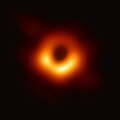](https://en.wikipedia.org/wiki/File:Black_hole_-_Messier_87_crop_max_res.jpg) |
|  [Category](https://en.wikipedia.org/wiki/Category:Black_holes "Category:Black holes") [](https://en.wikipedia.org/wiki/File:Commons-logo.svg "Commons page") [Commons](https://commons.wikimedia.org/wiki/Category:Black_holes "commons:Category:Black holes") | |
| [v](https://en.wikipedia.org/wiki/Template:Relativity "Template:Relativity") [t](https://en.wikipedia.org/wiki/Template_talk:Relativity "Template talk:Relativity") [e](https://en.wikipedia.org/wiki/Special:EditPage/Template:Relativity "Special:EditPage/Template:Relativity")[Relativity](https://en.wikipedia.org/wiki/Theory_of_relativity "Theory of relativity") | |
|---|---|
| [Special relativity](https://en.wikipedia.org/wiki/Special_relativity "Special relativity") | |
| | |
| Background | [Principle of relativity](https://en.wikipedia.org/wiki/Principle_of_relativity "Principle of relativity") ([Galilean relativity](https://en.wikipedia.org/wiki/Galilean_invariance "Galilean invariance") [Galilean transformation](https://en.wikipedia.org/wiki/Galilean_transformation "Galilean transformation")) [Special relativity](https://en.wikipedia.org/wiki/Special_relativity "Special relativity") [Doubly special relativity](https://en.wikipedia.org/wiki/Doubly_special_relativity "Doubly special relativity") |
| Fundamental concepts | [Frame of reference](https://en.wikipedia.org/wiki/Frame_of_reference "Frame of reference") [Speed of light](https://en.wikipedia.org/wiki/Speed_of_light "Speed of light") [Hyperbolic orthogonality](https://en.wikipedia.org/wiki/Hyperbolic_orthogonality "Hyperbolic orthogonality") [Rapidity](https://en.wikipedia.org/wiki/Rapidity "Rapidity") [Maxwell's equations](https://en.wikipedia.org/wiki/Maxwell%27s_equations "Maxwell's equations") [Proper length](https://en.wikipedia.org/wiki/Proper_length "Proper length") [Proper time](https://en.wikipedia.org/wiki/Proper_time "Proper time") [Proper acceleration](https://en.wikipedia.org/wiki/Proper_acceleration "Proper acceleration") [Relativistic mass](https://en.wikipedia.org/wiki/Mass_in_special_relativity "Mass in special relativity") |
| Formulation | [Lorentz transformation](https://en.wikipedia.org/wiki/Lorentz_transformation "Lorentz transformation") [Textbooks](https://en.wikipedia.org/wiki/List_of_textbooks_on_relativity "List of textbooks on relativity") |
| Phenomena | [Time dilation](https://en.wikipedia.org/wiki/Time_dilation "Time dilation") [Mass–energy equivalence (E=mc2)](https://en.wikipedia.org/wiki/Mass%E2%80%93energy_equivalence "Mass–energy equivalence") [Length contraction](https://en.wikipedia.org/wiki/Length_contraction "Length contraction") [Relativity of simultaneity](https://en.wikipedia.org/wiki/Relativity_of_simultaneity "Relativity of simultaneity") [Relativistic Doppler effect](https://en.wikipedia.org/wiki/Relativistic_Doppler_effect "Relativistic Doppler effect") [Thomas precession](https://en.wikipedia.org/wiki/Thomas_precession "Thomas precession") [Ladder paradox](https://en.wikipedia.org/wiki/Ladder_paradox "Ladder paradox") [Twin paradox](https://en.wikipedia.org/wiki/Twin_paradox "Twin paradox") [Terrell rotation](https://en.wikipedia.org/wiki/Terrell_rotation "Terrell rotation") |
| [Spacetime](https://en.wikipedia.org/wiki/Spacetime "Spacetime") | [Light cone](https://en.wikipedia.org/wiki/Light_cone "Light cone") [World line](https://en.wikipedia.org/wiki/World_line "World line") [Minkowski diagram](https://en.wikipedia.org/wiki/Minkowski_diagram "Minkowski diagram") [Biquaternions](https://en.wikipedia.org/wiki/Biquaternion "Biquaternion") [Minkowski space](https://en.wikipedia.org/wiki/Minkowski_space "Minkowski space") |
| [General relativity](https://en.wikipedia.org/wiki/General_relativity "General relativity") | |
| | |
| Background | [Introduction](https://en.wikipedia.org/wiki/Introduction_to_general_relativity "Introduction to general relativity") [Mathematical formulation](https://en.wikipedia.org/wiki/Mathematics_of_general_relativity "Mathematics of general relativity") |
| Fundamental concepts | [Equivalence principle](https://en.wikipedia.org/wiki/Equivalence_principle "Equivalence principle") [Riemannian geometry](https://en.wikipedia.org/wiki/Riemannian_geometry "Riemannian geometry") [Penrose diagram](https://en.wikipedia.org/wiki/Penrose_diagram "Penrose diagram") [Geodesics](https://en.wikipedia.org/wiki/Geodesics_in_general_relativity "Geodesics in general relativity") [Mach's principle](https://en.wikipedia.org/wiki/Mach%27s_principle "Mach's principle") |
| Formulation | [ADM formalism](https://en.wikipedia.org/wiki/ADM_formalism "ADM formalism") [BSSN formalism](https://en.wikipedia.org/wiki/BSSN_formalism "BSSN formalism") [Einstein field equations](https://en.wikipedia.org/wiki/Einstein_field_equations "Einstein field equations") [Linearized gravity](https://en.wikipedia.org/wiki/Linearized_gravity "Linearized gravity") [Post-Newtonian formalism](https://en.wikipedia.org/wiki/Parameterized_post-Newtonian_formalism "Parameterized post-Newtonian formalism") [Raychaudhuri equation](https://en.wikipedia.org/wiki/Raychaudhuri_equation "Raychaudhuri equation") [Hamilton–Jacobi–Einstein equation](https://en.wikipedia.org/wiki/Hamilton%E2%80%93Jacobi%E2%80%93Einstein_equation "Hamilton–Jacobi–Einstein equation") [Ernst equation](https://en.wikipedia.org/wiki/Ernst_equation "Ernst equation") |
| Phenomena | [Black hole]() [Event horizon](https://en.wikipedia.org/wiki/Event_horizon "Event horizon") [Singularity](https://en.wikipedia.org/wiki/Gravitational_singularity "Gravitational singularity") [Two-body problem](https://en.wikipedia.org/wiki/Two-body_problem_in_general_relativity "Two-body problem in general relativity") [Gravitational waves](https://en.wikipedia.org/wiki/Gravitational_wave "Gravitational wave"): [astronomy](https://en.wikipedia.org/wiki/Gravitational-wave_astronomy "Gravitational-wave astronomy") [detectors](https://en.wikipedia.org/wiki/Gravitational-wave_observatory "Gravitational-wave observatory") ([LIGO](https://en.wikipedia.org/wiki/LIGO "LIGO") and [collaboration](https://en.wikipedia.org/wiki/LIGO_Scientific_Collaboration "LIGO Scientific Collaboration") [Virgo](https://en.wikipedia.org/wiki/Virgo_interferometer "Virgo interferometer") [LISA Pathfinder](https://en.wikipedia.org/wiki/LISA_Pathfinder "LISA Pathfinder") [GEO](https://en.wikipedia.org/wiki/GEO600 "GEO600")) [Hulse–Taylor binary](https://en.wikipedia.org/wiki/Hulse%E2%80%93Taylor_binary "Hulse–Taylor binary") [Other tests](https://en.wikipedia.org/wiki/Tests_of_general_relativity "Tests of general relativity"): [precession](https://en.wikipedia.org/wiki/Apsidal_precession "Apsidal precession") of Mercury [lensing](https://en.wikipedia.org/wiki/Gravitational_lens "Gravitational lens") (together with [Einstein cross](https://en.wikipedia.org/wiki/Einstein_cross "Einstein cross") and [Einstein rings](https://en.wikipedia.org/wiki/Einstein_rings "Einstein rings")) [redshift](https://en.wikipedia.org/wiki/Gravitational_redshift "Gravitational redshift") [Shapiro delay](https://en.wikipedia.org/wiki/Shapiro_time_delay "Shapiro time delay") [frame-dragging](https://en.wikipedia.org/wiki/Frame-dragging "Frame-dragging") / [geodetic effect](https://en.wikipedia.org/wiki/Geodetic_effect "Geodetic effect") ([Lense–Thirring precession](https://en.wikipedia.org/wiki/Lense%E2%80%93Thirring_precession "Lense–Thirring precession")) [pulsar timing arrays](https://en.wikipedia.org/wiki/Pulsar_timing_array "Pulsar timing array") |
| Advanced theories | [Brans–Dicke theory](https://en.wikipedia.org/wiki/Brans%E2%80%93Dicke_theory "Brans–Dicke theory") [Kaluza–Klein](https://en.wikipedia.org/wiki/Kaluza%E2%80%93Klein_theory "Kaluza–Klein theory") [Quantum gravity](https://en.wikipedia.org/wiki/Quantum_gravity "Quantum gravity") |
| [Solutions](https://en.wikipedia.org/wiki/Exact_solutions_in_general_relativity "Exact solutions in general relativity") | Cosmological: [Friedmann–Lemaître–Robertson–Walker](https://en.wikipedia.org/wiki/Friedmann%E2%80%93Lema%C3%AEtre%E2%80%93Robertson%E2%80%93Walker_metric "Friedmann–Lemaître–Robertson–Walker metric") ([Friedmann equations](https://en.wikipedia.org/wiki/Friedmann_equations "Friedmann equations")) [Lemaître–Tolman](https://en.wikipedia.org/wiki/Lema%C3%AEtre%E2%80%93Tolman_metric "Lemaître–Tolman metric") [Kasner](https://en.wikipedia.org/wiki/Kasner_metric "Kasner metric") [BKL singularity](https://en.wikipedia.org/wiki/BKL_singularity "BKL singularity") [Gödel](https://en.wikipedia.org/wiki/G%C3%B6del_metric "Gödel metric") [Milne](https://en.wikipedia.org/wiki/Milne_model "Milne model") Spherical: [Schwarzschild](https://en.wikipedia.org/wiki/Schwarzschild_metric "Schwarzschild metric") ([interior](https://en.wikipedia.org/wiki/Interior_Schwarzschild_metric "Interior Schwarzschild metric") [Tolman–Oppenheimer–Volkoff equation](https://en.wikipedia.org/wiki/Tolman%E2%80%93Oppenheimer%E2%80%93Volkoff_equation "Tolman–Oppenheimer–Volkoff equation")) [Reissner–Nordström](https://en.wikipedia.org/wiki/Reissner%E2%80%93Nordstr%C3%B6m_metric "Reissner–Nordström metric") Axisymmetric: [Kerr](https://en.wikipedia.org/wiki/Kerr_metric "Kerr metric") ([Kerr–Newman](https://en.wikipedia.org/wiki/Kerr%E2%80%93Newman_metric "Kerr–Newman metric")) [Weyl−Lewis−Papapetrou](https://en.wikipedia.org/wiki/Weyl%E2%88%92Lewis%E2%88%92Papapetrou_coordinates "Weyl−Lewis−Papapetrou coordinates") [Taub–NUT](https://en.wikipedia.org/wiki/Taub%E2%80%93NUT_space "Taub–NUT space") [van Stockum dust](https://en.wikipedia.org/wiki/Van_Stockum_dust "Van Stockum dust") [discs](https://en.wikipedia.org/wiki/Relativistic_disk "Relativistic disk") Others: [pp-wave](https://en.wikipedia.org/wiki/Pp-wave_spacetime "Pp-wave spacetime") [Ozsváth–Schücking](https://en.wikipedia.org/wiki/Ozsv%C3%A1th%E2%80%93Sch%C3%BCcking_metric "Ozsváth–Schücking metric") [Alcubierre](https://en.wikipedia.org/wiki/Alcubierre_drive "Alcubierre drive") [Ellis](https://en.wikipedia.org/wiki/Ellis_wormhole "Ellis wormhole") In computational physics: [Numerical relativity](https://en.wikipedia.org/wiki/Numerical_relativity "Numerical relativity") |
| Scientists | [Poincaré](https://en.wikipedia.org/wiki/Henri_Poincar%C3%A9 "Henri Poincaré") [Lorentz](https://en.wikipedia.org/wiki/Hendrik_Lorentz "Hendrik Lorentz") [Einstein](https://en.wikipedia.org/wiki/Albert_Einstein "Albert Einstein") [Hilbert](https://en.wikipedia.org/wiki/David_Hilbert "David Hilbert") [Schwarzschild](https://en.wikipedia.org/wiki/Karl_Schwarzschild "Karl Schwarzschild") [de Sitter](https://en.wikipedia.org/wiki/Willem_de_Sitter "Willem de Sitter") [Weyl](https://en.wikipedia.org/wiki/Hermann_Weyl "Hermann Weyl") [Eddington](https://en.wikipedia.org/wiki/Arthur_Eddington "Arthur Eddington") [Friedmann](https://en.wikipedia.org/wiki/Alexander_Friedmann "Alexander Friedmann") [Lemaître](https://en.wikipedia.org/wiki/Georges_Lema%C3%AEtre "Georges Lemaître") [Milne](https://en.wikipedia.org/wiki/Edward_Arthur_Milne "Edward Arthur Milne") [Robertson](https://en.wikipedia.org/wiki/Howard_P._Robertson "Howard P. Robertson") [Chandrasekhar](https://en.wikipedia.org/wiki/Subrahmanyan_Chandrasekhar "Subrahmanyan Chandrasekhar") [Zwicky](https://en.wikipedia.org/wiki/Fritz_Zwicky "Fritz Zwicky") [Wheeler](https://en.wikipedia.org/wiki/John_Archibald_Wheeler "John Archibald Wheeler") [Choquet-Bruhat](https://en.wikipedia.org/wiki/Yvonne_Choquet-Bruhat "Yvonne Choquet-Bruhat") [Kerr](https://en.wikipedia.org/wiki/Roy_Kerr "Roy Kerr") [Zel'dovich](https://en.wikipedia.org/wiki/Yakov_Zeldovich "Yakov Zeldovich") [Novikov](https://en.wikipedia.org/wiki/Igor_Dmitriyevich_Novikov "Igor Dmitriyevich Novikov") [Ehlers](https://en.wikipedia.org/wiki/J%C3%BCrgen_Ehlers "Jürgen Ehlers") [Geroch](https://en.wikipedia.org/wiki/Robert_Geroch "Robert Geroch") [Penrose](https://en.wikipedia.org/wiki/Roger_Penrose "Roger Penrose") [Hawking](https://en.wikipedia.org/wiki/Stephen_Hawking "Stephen Hawking") [Taylor](https://en.wikipedia.org/wiki/Joseph_Hooton_Taylor_Jr. "Joseph Hooton Taylor Jr.") [Hulse](https://en.wikipedia.org/wiki/Russell_Alan_Hulse "Russell Alan Hulse") [Bondi](https://en.wikipedia.org/wiki/Hermann_Bondi "Hermann Bondi") [Misner](https://en.wikipedia.org/wiki/Charles_W._Misner "Charles W. Misner") [Yau](https://en.wikipedia.org/wiki/Shing-Tung_Yau "Shing-Tung Yau") [Thorne](https://en.wikipedia.org/wiki/Kip_Thorne "Kip Thorne") [Weiss](https://en.wikipedia.org/wiki/Rainer_Weiss "Rainer Weiss") [*others*](https://en.wikipedia.org/wiki/List_of_contributors_to_general_relativity "List of contributors to general relativity") |
|  [Category](https://en.wikipedia.org/wiki/Category:Theory_of_relativity "Category:Theory of relativity") | |
| [v](https://en.wikipedia.org/wiki/Template:String_theory_topics "Template:String theory topics") [t](https://en.wikipedia.org/wiki/Template_talk:String_theory_topics "Template talk:String theory topics") [e](https://en.wikipedia.org/wiki/Special:EditPage/Template:String_theory_topics "Special:EditPage/Template:String theory topics")[String theory](https://en.wikipedia.org/wiki/String_theory "String theory") | |
|---|---|
| Background | [Strings](https://en.wikipedia.org/wiki/String_\(physics\) "String (physics)") [Cosmic strings](https://en.wikipedia.org/wiki/Cosmic_string "Cosmic string") [History of string theory](https://en.wikipedia.org/wiki/History_of_string_theory "History of string theory") [First superstring revolution](https://en.wikipedia.org/wiki/First_superstring_revolution "First superstring revolution") [Second superstring revolution](https://en.wikipedia.org/wiki/Second_superstring_revolution "Second superstring revolution") [String theory landscape](https://en.wikipedia.org/wiki/String_theory_landscape "String theory landscape") |
| Theory | [Nambu–Goto action](https://en.wikipedia.org/wiki/Nambu%E2%80%93Goto_action "Nambu–Goto action") [Polyakov action](https://en.wikipedia.org/wiki/Polyakov_action "Polyakov action") [Bosonic string theory](https://en.wikipedia.org/wiki/Bosonic_string_theory "Bosonic string theory") [Superstring theory](https://en.wikipedia.org/wiki/Superstring_theory "Superstring theory") [Type I string](https://en.wikipedia.org/wiki/Type_I_string_theory "Type I string theory") [Type II string](https://en.wikipedia.org/wiki/Type_II_string_theory "Type II string theory") [Type IIA string](https://en.wikipedia.org/wiki/Type_II_string_theory "Type II string theory") [Type IIB string](https://en.wikipedia.org/wiki/Type_II_string_theory "Type II string theory") [Heterotic string](https://en.wikipedia.org/wiki/Heterotic_string_theory "Heterotic string theory") [N=2 superstring](https://en.wikipedia.org/wiki/N%3D2_superstring "N=2 superstring") [F-theory](https://en.wikipedia.org/wiki/F-theory "F-theory") [String field theory](https://en.wikipedia.org/wiki/String_field_theory "String field theory") [Matrix string theory](https://en.wikipedia.org/wiki/Matrix_string_theory "Matrix string theory") [Non-critical string theory](https://en.wikipedia.org/wiki/Non-critical_string_theory "Non-critical string theory") [Non-linear sigma model](https://en.wikipedia.org/wiki/Non-linear_sigma_model "Non-linear sigma model") [Tachyon condensation](https://en.wikipedia.org/wiki/Tachyon_condensation "Tachyon condensation") [RNS formalism](https://en.wikipedia.org/wiki/RNS_formalism "RNS formalism") [GS formalism](https://en.wikipedia.org/wiki/GS_formalism "GS formalism") |
| [String duality](https://en.wikipedia.org/wiki/String_duality "String duality") | [T-duality](https://en.wikipedia.org/wiki/T-duality "T-duality") [S-duality](https://en.wikipedia.org/wiki/S-duality "S-duality") [U-duality](https://en.wikipedia.org/wiki/U-duality "U-duality") [Montonen–Olive duality](https://en.wikipedia.org/wiki/Montonen%E2%80%93Olive_duality "Montonen–Olive duality") |
| Particles and fields | [Graviton](https://en.wikipedia.org/wiki/Graviton "Graviton") [Dilaton](https://en.wikipedia.org/wiki/Dilaton "Dilaton") [Tachyon](https://en.wikipedia.org/wiki/Tachyon "Tachyon") [Ramond–Ramond field](https://en.wikipedia.org/wiki/Ramond%E2%80%93Ramond_field "Ramond–Ramond field") [Kalb–Ramond field](https://en.wikipedia.org/wiki/Kalb%E2%80%93Ramond_field "Kalb–Ramond field") [Magnetic monopole](https://en.wikipedia.org/wiki/Magnetic_monopole "Magnetic monopole") [Dual graviton](https://en.wikipedia.org/wiki/Dual_graviton "Dual graviton") [Dual photon](https://en.wikipedia.org/wiki/Dual_photon "Dual photon") |
| [Branes](https://en.wikipedia.org/wiki/Brane "Brane") | [D-brane](https://en.wikipedia.org/wiki/D-brane "D-brane") [NS5-brane](https://en.wikipedia.org/wiki/NS5-brane "NS5-brane") [M2-brane](https://en.wikipedia.org/wiki/M2-brane "M2-brane") [M5-brane](https://en.wikipedia.org/wiki/M5-brane "M5-brane") [S-brane](https://en.wikipedia.org/wiki/S-brane "S-brane") [Black brane](https://en.wikipedia.org/wiki/Black_brane "Black brane") [Black holes]() [Black string](https://en.wikipedia.org/wiki/Black_string "Black string") [Brane cosmology](https://en.wikipedia.org/wiki/Brane_cosmology "Brane cosmology") [Quiver diagram](https://en.wikipedia.org/wiki/Quiver_diagram "Quiver diagram") [Hanany–Witten transition](https://en.wikipedia.org/wiki/Hanany%E2%80%93Witten_transition "Hanany–Witten transition") |
| [Conformal field theory](https://en.wikipedia.org/wiki/Conformal_field_theory "Conformal field theory") | [Virasoro algebra](https://en.wikipedia.org/wiki/Virasoro_algebra "Virasoro algebra") [Mirror symmetry](https://en.wikipedia.org/wiki/Mirror_symmetry_\(string_theory\) "Mirror symmetry (string theory)") [Conformal anomaly](https://en.wikipedia.org/wiki/Conformal_anomaly "Conformal anomaly") [Conformal algebra](https://en.wikipedia.org/wiki/Conformal_symmetry "Conformal symmetry") [Superconformal algebra](https://en.wikipedia.org/wiki/Superconformal_algebra "Superconformal algebra") [Vertex operator algebra](https://en.wikipedia.org/wiki/Vertex_operator_algebra "Vertex operator algebra") [Loop algebra](https://en.wikipedia.org/wiki/Loop_algebra "Loop algebra") [Kac–Moody algebra](https://en.wikipedia.org/wiki/Kac%E2%80%93Moody_algebra "Kac–Moody algebra") [Wess–Zumino–Witten model](https://en.wikipedia.org/wiki/Wess%E2%80%93Zumino%E2%80%93Witten_model "Wess–Zumino–Witten model") |
| [Gauge theory](https://en.wikipedia.org/wiki/Gauge_theory "Gauge theory") | [Anomalies](https://en.wikipedia.org/wiki/Anomaly_\(physics\) "Anomaly (physics)") [Instantons](https://en.wikipedia.org/wiki/Instanton "Instanton") [Chern–Simons form](https://en.wikipedia.org/wiki/Chern%E2%80%93Simons_form "Chern–Simons form") [Bogomol'nyi–Prasad–Sommerfield bound](https://en.wikipedia.org/wiki/Bogomol%27nyi%E2%80%93Prasad%E2%80%93Sommerfield_bound "Bogomol'nyi–Prasad–Sommerfield bound") [Exceptional Lie groups](https://en.wikipedia.org/wiki/Exceptional_Lie_group "Exceptional Lie group") ([G2](https://en.wikipedia.org/wiki/G2_\(mathematics\) "G2 (mathematics)"), [F4](https://en.wikipedia.org/wiki/F4_\(mathematics\) "F4 (mathematics)"), [E6](https://en.wikipedia.org/wiki/E6_\(mathematics\) "E6 (mathematics)"), [E7](https://en.wikipedia.org/wiki/E7_\(mathematics\) "E7 (mathematics)"), [E8](https://en.wikipedia.org/wiki/E8_\(mathematics\) "E8 (mathematics)")) [ADE classification](https://en.wikipedia.org/wiki/ADE_classification "ADE classification") [Dirac string](https://en.wikipedia.org/wiki/Dirac_string "Dirac string") [*p*\-form electrodynamics](https://en.wikipedia.org/wiki/P-form_electrodynamics "P-form electrodynamics") |
| Geometry | [Worldsheet](https://en.wikipedia.org/wiki/Worldsheet "Worldsheet") [Kaluza–Klein theory](https://en.wikipedia.org/wiki/Kaluza%E2%80%93Klein_theory "Kaluza–Klein theory") [Compactification](https://en.wikipedia.org/wiki/Compactification_\(physics\) "Compactification (physics)") [Why 10 dimensions](https://en.wikipedia.org/wiki/Why_10_dimensions "Why 10 dimensions")? [Kähler manifold](https://en.wikipedia.org/wiki/K%C3%A4hler_manifold "Kähler manifold") [Ricci-flat manifold](https://en.wikipedia.org/wiki/Ricci-flat_manifold "Ricci-flat manifold") [Calabi–Yau manifold](https://en.wikipedia.org/wiki/Calabi%E2%80%93Yau_manifold "Calabi–Yau manifold") [Hyperkähler manifold](https://en.wikipedia.org/wiki/Hyperk%C3%A4hler_manifold "Hyperkähler manifold") [K3 surface](https://en.wikipedia.org/wiki/K3_surface "K3 surface") [G2 manifold](https://en.wikipedia.org/wiki/G2_manifold "G2 manifold") [Spin(7)-manifold](https://en.wikipedia.org/wiki/Spin\(7\)-manifold "Spin(7)-manifold") [Generalized complex manifold](https://en.wikipedia.org/wiki/Generalized_complex_structure "Generalized complex structure") [Orbifold](https://en.wikipedia.org/wiki/Orbifold "Orbifold") [Conifold](https://en.wikipedia.org/wiki/Conifold "Conifold") [Orientifold](https://en.wikipedia.org/wiki/Orientifold "Orientifold") [Moduli space](https://en.wikipedia.org/wiki/Moduli_space "Moduli space") [Hořava–Witten theory](https://en.wikipedia.org/wiki/Ho%C5%99ava%E2%80%93Witten_theory "Hořava–Witten theory") [K-theory (physics)](https://en.wikipedia.org/wiki/K-theory_\(physics\) "K-theory (physics)") [Twisted K-theory](https://en.wikipedia.org/wiki/Twisted_K-theory "Twisted K-theory") |
| [Supersymmetry](https://en.wikipedia.org/wiki/Supersymmetry "Supersymmetry") | [Supergravity](https://en.wikipedia.org/wiki/Supergravity "Supergravity") [Eleven-dimensional supergravity](https://en.wikipedia.org/wiki/Eleven-dimensional_supergravity "Eleven-dimensional supergravity") [Type I supergravity](https://en.wikipedia.org/wiki/Type_I_supergravity "Type I supergravity") [Type IIA supergravity](https://en.wikipedia.org/wiki/Type_IIA_supergravity "Type IIA supergravity") [Type IIB supergravity](https://en.wikipedia.org/wiki/Type_IIB_supergravity "Type IIB supergravity") [Superspace](https://en.wikipedia.org/wiki/Superspace "Superspace") [Lie superalgebra](https://en.wikipedia.org/wiki/Lie_superalgebra "Lie superalgebra") [Lie supergroup](https://en.wikipedia.org/wiki/Lie_supergroup "Lie supergroup") |
| [Holography](https://en.wikipedia.org/wiki/Holography "Holography") | [Holographic principle](https://en.wikipedia.org/wiki/Holographic_principle "Holographic principle") [AdS/CFT correspondence](https://en.wikipedia.org/wiki/AdS/CFT_correspondence "AdS/CFT correspondence") |
| [M-theory](https://en.wikipedia.org/wiki/M-theory "M-theory") | [Matrix theory](https://en.wikipedia.org/wiki/Matrix_theory_\(physics\) "Matrix theory (physics)") [Introduction to M-theory](https://en.wikipedia.org/wiki/Introduction_to_M-theory "Introduction to M-theory") |
| String theorists | [Aganagić](https://en.wikipedia.org/wiki/Mina_Aganagi%C4%87 "Mina Aganagić") [Arkani-Hamed](https://en.wikipedia.org/wiki/Nima_Arkani-Hamed "Nima Arkani-Hamed") [Atiyah](https://en.wikipedia.org/wiki/Michael_Atiyah "Michael Atiyah") [Banks](https://en.wikipedia.org/wiki/Tom_Banks_\(physicist\) "Tom Banks (physicist)") [Berenstein](https://en.wikipedia.org/wiki/David_Berenstein "David Berenstein") [Bousso](https://en.wikipedia.org/wiki/Raphael_Bousso "Raphael Bousso") [Curtright](https://en.wikipedia.org/wiki/Thomas_Curtright "Thomas Curtright") [Dijkgraaf](https://en.wikipedia.org/wiki/Robbert_Dijkgraaf "Robbert Dijkgraaf") [Distler](https://en.wikipedia.org/wiki/Jacques_Distler "Jacques Distler") [Douglas](https://en.wikipedia.org/wiki/Michael_R._Douglas "Michael R. Douglas") [Duff](https://en.wikipedia.org/wiki/Michael_Duff_\(physicist\) "Michael Duff (physicist)") [Dvali](https://en.wikipedia.org/wiki/Gia_Dvali "Gia Dvali") [Ferrara](https://en.wikipedia.org/wiki/Sergio_Ferrara "Sergio Ferrara") [Fischler](https://en.wikipedia.org/wiki/Willy_Fischler "Willy Fischler") [Friedan](https://en.wikipedia.org/wiki/Daniel_Friedan "Daniel Friedan") [Gates](https://en.wikipedia.org/wiki/Sylvester_James_Gates "Sylvester James Gates") [Gliozzi](https://en.wikipedia.org/wiki/Ferdinando_Gliozzi "Ferdinando Gliozzi") [Gopakumar](https://en.wikipedia.org/wiki/Rajesh_Gopakumar "Rajesh Gopakumar") [Green](https://en.wikipedia.org/wiki/Michael_Green_\(physicist\) "Michael Green (physicist)") [Greene](https://en.wikipedia.org/wiki/Brian_Greene "Brian Greene") [Gross](https://en.wikipedia.org/wiki/David_Gross "David Gross") [Gubser](https://en.wikipedia.org/wiki/Steven_Gubser "Steven Gubser") [Gukov](https://en.wikipedia.org/wiki/Sergei_Gukov "Sergei Gukov") [Guth](https://en.wikipedia.org/wiki/Alan_Guth "Alan Guth") [Hanson](https://en.wikipedia.org/wiki/Andrew_J._Hanson "Andrew J. Hanson") [Harvey](https://en.wikipedia.org/wiki/Jeffrey_A._Harvey "Jeffrey A. Harvey") ['t Hooft](https://en.wikipedia.org/wiki/Gerard_%27t_Hooft "Gerard 't Hooft") [Hořava](https://en.wikipedia.org/wiki/Petr_Ho%C5%99ava_\(theorist\) "Petr Hořava (theorist)") [Gibbons](https://en.wikipedia.org/wiki/Gary_Gibbons "Gary Gibbons") [Kachru](https://en.wikipedia.org/wiki/Shamit_Kachru "Shamit Kachru") [Kaku](https://en.wikipedia.org/wiki/Michio_Kaku "Michio Kaku") [Kallosh](https://en.wikipedia.org/wiki/Renata_Kallosh "Renata Kallosh") [Kaluza](https://en.wikipedia.org/wiki/Theodor_Kaluza "Theodor Kaluza") [Kapustin](https://en.wikipedia.org/wiki/Anton_Kapustin "Anton Kapustin") [Klebanov](https://en.wikipedia.org/wiki/Igor_Klebanov "Igor Klebanov") [Knizhnik](https://en.wikipedia.org/wiki/Vadim_Knizhnik "Vadim Knizhnik") [Kontsevich](https://en.wikipedia.org/wiki/Maxim_Kontsevich "Maxim Kontsevich") [Klein](https://en.wikipedia.org/wiki/Oskar_Klein "Oskar Klein") [Linde](https://en.wikipedia.org/wiki/Andrei_Linde "Andrei Linde") [Maldacena](https://en.wikipedia.org/wiki/Juan_Mart%C3%ADn_Maldacena "Juan Martín Maldacena") [Mandelstam](https://en.wikipedia.org/wiki/Stanley_Mandelstam "Stanley Mandelstam") [Marolf](https://en.wikipedia.org/wiki/Donald_Marolf "Donald Marolf") [Martinec](https://en.wikipedia.org/wiki/Emil_Martinec "Emil Martinec") [Minwalla](https://en.wikipedia.org/wiki/Shiraz_Minwalla "Shiraz Minwalla") [Moore](https://en.wikipedia.org/wiki/Greg_Moore_\(physicist\) "Greg Moore (physicist)") [Motl](https://en.wikipedia.org/wiki/Lubo%C5%A1_Motl "Luboš Motl") [Mukhi](https://en.wikipedia.org/wiki/Sunil_Mukhi "Sunil Mukhi") [Myers](https://en.wikipedia.org/wiki/Robert_Myers_\(physicist\) "Robert Myers (physicist)") [Nanopoulos](https://en.wikipedia.org/wiki/Dimitri_Nanopoulos "Dimitri Nanopoulos") [Năstase](https://en.wikipedia.org/wiki/Hora%C8%9Biu_N%C4%83stase "Horațiu Năstase") [Nekrasov](https://en.wikipedia.org/wiki/Nikita_Nekrasov "Nikita Nekrasov") [Neveu](https://en.wikipedia.org/wiki/Andr%C3%A9_Neveu "André Neveu") [Nielsen](https://en.wikipedia.org/wiki/Holger_Bech_Nielsen "Holger Bech Nielsen") [van Nieuwenhuizen](https://en.wikipedia.org/wiki/Peter_van_Nieuwenhuizen "Peter van Nieuwenhuizen") [Novikov](https://en.wikipedia.org/wiki/Sergei_Novikov_\(mathematician\) "Sergei Novikov (mathematician)") [Olive](https://en.wikipedia.org/wiki/David_Olive "David Olive") [Ooguri](https://en.wikipedia.org/wiki/Hirosi_Ooguri "Hirosi Ooguri") [Ovrut](https://en.wikipedia.org/wiki/Burt_Ovrut "Burt Ovrut") [Polchinski](https://en.wikipedia.org/wiki/Joseph_Polchinski "Joseph Polchinski") [Polyakov](https://en.wikipedia.org/wiki/Alexander_Markovich_Polyakov "Alexander Markovich Polyakov") [Rajaraman](https://en.wikipedia.org/wiki/Arvind_Rajaraman "Arvind Rajaraman") [Ramond](https://en.wikipedia.org/wiki/Pierre_Ramond "Pierre Ramond") [Randall](https://en.wikipedia.org/wiki/Lisa_Randall "Lisa Randall") [Randjbar-Daemi](https://en.wikipedia.org/wiki/Seifallah_Randjbar-Daemi "Seifallah Randjbar-Daemi") [Roček](https://en.wikipedia.org/wiki/Martin_Ro%C4%8Dek "Martin Roček") [Rohm](https://en.wikipedia.org/wiki/Ryan_Rohm "Ryan Rohm") [Sagnotti](https://en.wikipedia.org/wiki/Augusto_Sagnotti "Augusto Sagnotti") [Scherk](https://en.wikipedia.org/wiki/Jo%C3%ABl_Scherk "Joël Scherk") [Schwarz](https://en.wikipedia.org/wiki/John_Henry_Schwarz "John Henry Schwarz") [Seiberg](https://en.wikipedia.org/wiki/Nathan_Seiberg "Nathan Seiberg") [Sen](https://en.wikipedia.org/wiki/Ashoke_Sen "Ashoke Sen") [Shenker](https://en.wikipedia.org/wiki/Stephen_Shenker "Stephen Shenker") [Siegel](https://en.wikipedia.org/wiki/Warren_Siegel "Warren Siegel") [Silverstein](https://en.wikipedia.org/wiki/Eva_Silverstein "Eva Silverstein") [Sơn](https://en.wikipedia.org/wiki/%C4%90%C3%A0m_Thanh_S%C6%A1n "Đàm Thanh Sơn") [Staudacher](https://en.wikipedia.org/wiki/Matthias_Staudacher "Matthias Staudacher") [Steinhardt](https://en.wikipedia.org/wiki/Paul_Steinhardt "Paul Steinhardt") [Strominger](https://en.wikipedia.org/wiki/Andrew_Strominger "Andrew Strominger") [Sundrum](https://en.wikipedia.org/wiki/Raman_Sundrum "Raman Sundrum") [Susskind](https://en.wikipedia.org/wiki/Leonard_Susskind "Leonard Susskind") [Townsend](https://en.wikipedia.org/wiki/Paul_Townsend "Paul Townsend") [Trivedi](https://en.wikipedia.org/wiki/Sandip_Trivedi "Sandip Trivedi") [Turok](https://en.wikipedia.org/wiki/Neil_Turok "Neil Turok") [Vafa](https://en.wikipedia.org/wiki/Cumrun_Vafa "Cumrun Vafa") [Veneziano](https://en.wikipedia.org/wiki/Gabriele_Veneziano "Gabriele Veneziano") [Verlinde](https://en.wikipedia.org/wiki/Erik_Verlinde "Erik Verlinde") [Verlinde](https://en.wikipedia.org/wiki/Herman_Verlinde "Herman Verlinde") [Wess](https://en.wikipedia.org/wiki/Julius_Wess "Julius Wess") [Witten](https://en.wikipedia.org/wiki/Edward_Witten "Edward Witten") [Yau](https://en.wikipedia.org/wiki/Shing-Tung_Yau "Shing-Tung Yau") [Yoneya](https://en.wikipedia.org/wiki/Tamiaki_Yoneya "Tamiaki Yoneya") [Zamolodchikov](https://en.wikipedia.org/wiki/Alexander_Zamolodchikov "Alexander Zamolodchikov") [Zamolodchikov](https://en.wikipedia.org/wiki/Alexei_Zamolodchikov "Alexei Zamolodchikov") [Zaslow](https://en.wikipedia.org/wiki/Eric_Zaslow "Eric Zaslow") [Zumino](https://en.wikipedia.org/wiki/Bruno_Zumino "Bruno Zumino") [Zwiebach](https://en.wikipedia.org/wiki/Barton_Zwiebach "Barton Zwiebach") |
| [Authority control databases](https://en.wikipedia.org/wiki/Help:Authority_control "Help:Authority control") [](https://www.wikidata.org/wiki/Q589#identifiers "Edit this at Wikidata") | |
|---|---|
| International | [GND](https://d-nb.info/gnd/4053793-6) [FAST](https://id.worldcat.org/fast/1744720) |
| National | [United States](https://id.loc.gov/authorities/sh85014574) [France](https://catalogue.bnf.fr/ark:/12148/cb11933630s) [BnF data](https://data.bnf.fr/ark:/12148/cb11933630s) [Japan](https://id.ndl.go.jp/auth/ndlna/00561056) [Czech Republic](https://aleph.nkp.cz/F/?func=find-c&local_base=aut&ccl_term=ica=ph128097&CON_LNG=ENG) [Spain](https://datos.bne.es/resource/XX528239) [Israel](https://www.nli.org.il/en/authorities/987007283120105171) |
| Other | [IdRef](https://www.idref.fr/027253430) [Yale LUX](https://lux.collections.yale.edu/view/concept/724d7e24-76b5-45ff-970d-0a884a84db5d) |

Retrieved from "<https://en.wikipedia.org/w/index.php?title=Black_hole&oldid=1346631315>"
[Categories](https://en.wikipedia.org/wiki/Help:Category "Help:Category"):
- [Black holes](https://en.wikipedia.org/wiki/Category:Black_holes "Category:Black holes")
- [Concepts in astronomy](https://en.wikipedia.org/wiki/Category:Concepts_in_astronomy "Category:Concepts in astronomy")
- [Galaxies](https://en.wikipedia.org/wiki/Category:Galaxies "Category:Galaxies")
- [Gravitational singularities](https://en.wikipedia.org/wiki/Category:Gravitational_singularities "Category:Gravitational singularities")
- [General relativity](https://en.wikipedia.org/wiki/Category:General_relativity "Category:General relativity")
Hidden categories:
- [Webarchive template wayback links](https://en.wikipedia.org/wiki/Category:Webarchive_template_wayback_links "Category:Webarchive template wayback links")
- [Articles with short description](https://en.wikipedia.org/wiki/Category:Articles_with_short_description "Category:Articles with short description")
- [Short description is different from Wikidata](https://en.wikipedia.org/wiki/Category:Short_description_is_different_from_Wikidata "Category:Short description is different from Wikidata")
- [Good articles](https://en.wikipedia.org/wiki/Category:Good_articles "Category:Good articles")
- [Wikipedia indefinitely semi-protected pages](https://en.wikipedia.org/wiki/Category:Wikipedia_indefinitely_semi-protected_pages "Category:Wikipedia indefinitely semi-protected pages")
- [Use British English from August 2024](https://en.wikipedia.org/wiki/Category:Use_British_English_from_August_2024 "Category:Use British English from August 2024")
- [All Wikipedia articles written in British English](https://en.wikipedia.org/wiki/Category:All_Wikipedia_articles_written_in_British_English "Category:All Wikipedia articles written in British English")
- [Use dmy dates from October 2025](https://en.wikipedia.org/wiki/Category:Use_dmy_dates_from_October_2025 "Category:Use dmy dates from October 2025")
- [Pages using multiple image with auto scaled images](https://en.wikipedia.org/wiki/Category:Pages_using_multiple_image_with_auto_scaled_images "Category:Pages using multiple image with auto scaled images")
- [Articles containing French-language text](https://en.wikipedia.org/wiki/Category:Articles_containing_French-language_text "Category:Articles containing French-language text")
- [Pages using sidebar with the child parameter](https://en.wikipedia.org/wiki/Category:Pages_using_sidebar_with_the_child_parameter "Category:Pages using sidebar with the child parameter")
- [Pages using Sister project links with wikidata namespace mismatch](https://en.wikipedia.org/wiki/Category:Pages_using_Sister_project_links_with_wikidata_namespace_mismatch "Category:Pages using Sister project links with wikidata namespace mismatch")
- [Pages using Sister project links with hidden wikidata](https://en.wikipedia.org/wiki/Category:Pages_using_Sister_project_links_with_hidden_wikidata "Category:Pages using Sister project links with hidden wikidata")
- [Articles containing video clips](https://en.wikipedia.org/wiki/Category:Articles_containing_video_clips "Category:Articles containing video clips")
- This page was last edited on 1 April 2026, at 23:43 (UTC).
- Text is available under the [Creative Commons Attribution-ShareAlike 4.0 License](https://en.wikipedia.org/wiki/Wikipedia:Text_of_the_Creative_Commons_Attribution-ShareAlike_4.0_International_License "Wikipedia:Text of the Creative Commons Attribution-ShareAlike 4.0 International License"); additional terms may apply. By using this site, you agree to the [Terms of Use](https://foundation.wikimedia.org/wiki/Special:MyLanguage/Policy:Terms_of_Use "foundation:Special:MyLanguage/Policy:Terms of Use") and [Privacy Policy](https://foundation.wikimedia.org/wiki/Special:MyLanguage/Policy:Privacy_policy "foundation:Special:MyLanguage/Policy:Privacy policy"). Wikipedia® is a registered trademark of the [Wikimedia Foundation, Inc.](https://wikimediafoundation.org/), a non-profit organization.
- [Privacy policy](https://foundation.wikimedia.org/wiki/Special:MyLanguage/Policy:Privacy_policy)
- [About Wikipedia](https://en.wikipedia.org/wiki/Wikipedia:About)
- [Disclaimers](https://en.wikipedia.org/wiki/Wikipedia:General_disclaimer)
- [Contact Wikipedia](https://en.wikipedia.org/wiki/Wikipedia:Contact_us)
- [Legal & safety contacts](https://foundation.wikimedia.org/wiki/Special:MyLanguage/Legal:Wikimedia_Foundation_Legal_and_Safety_Contact_Information)
- [Code of Conduct](https://foundation.wikimedia.org/wiki/Special:MyLanguage/Policy:Universal_Code_of_Conduct)
- [Developers](https://developer.wikimedia.org/)
- [Statistics](https://stats.wikimedia.org/#/en.wikipedia.org)
- [Cookie statement](https://foundation.wikimedia.org/wiki/Special:MyLanguage/Policy:Cookie_statement)
- [Mobile view](https://en.wikipedia.org/w/index.php?title=Black_hole&mobileaction=toggle_view_mobile)
- [](https://www.wikimedia.org/)
- [](https://www.mediawiki.org/)
Search
Toggle the table of contents
Black hole
184 languages
[Add topic](https://en.wikipedia.org/wiki/Black_hole) |
| Readable Markdown | A **black hole** is an [astronomical body](https://en.wikipedia.org/wiki/Astronomical_body "Astronomical body") so [compact](https://en.wikipedia.org/wiki/Compact_object "Compact object") that its gravity prevents anything, including light, from escaping. [Albert Einstein](https://en.wikipedia.org/wiki/Albert_Einstein "Albert Einstein")'s theory of [general relativity](https://en.wikipedia.org/wiki/General_relativity "General relativity"), which describes gravitation as the [curvature of spacetime](https://en.wikipedia.org/wiki/Curved_spacetime "Curved spacetime"), predicts that any sufficiently compact [mass](https://en.wikipedia.org/wiki/Mass "Mass") will form a black hole.[\[4\]](https://en.wikipedia.org/wiki/Black_hole#cite_note-NYT-20150608-4) The [boundary](https://en.wikipedia.org/wiki/Boundary_\(topology\) "Boundary (topology)") of no escape is called the [event horizon](https://en.wikipedia.org/wiki/Event_horizon "Event horizon"). In general relativity, crossing a black hole's event horizon traps an object inside but produces no locally detectable change. General relativity also predicts that every black hole should have a central [singularity](https://en.wikipedia.org/wiki/Gravitational_singularity "Gravitational singularity"), where the [curvature of spacetime](https://en.wikipedia.org/wiki/Curvature_of_spacetime "Curvature of spacetime") is infinite.
Objects whose [gravitational fields](https://en.wikipedia.org/wiki/Gravitational_field "Gravitational field") are too strong for light to escape were first considered in the 18th century. In 1916, the first solution of general relativity that would characterise a black hole was found. By the late 1950s, this solution began to be interpreted physically as a region of space from which nothing can escape. Black holes were long considered a mathematical curiosity; it was not until the 1960s that theoretical work showed they were a generic prediction of general relativity. The first widely-accepted black hole was [Cygnus X-1](https://en.wikipedia.org/wiki/Cygnus_X-1 "Cygnus X-1"), identified by several researchers independently in 1971.
Black holes typically form when [very massive stars collapse](https://en.wikipedia.org/wiki/Supernova "Supernova") at the end of their [life cycle](https://en.wikipedia.org/wiki/Stellar_evolution "Stellar evolution"). After a black hole has formed, it can grow by absorbing mass from its surroundings. Supermassive black holes of millions of [solar masses](https://en.wikipedia.org/wiki/Solar_mass "Solar mass") may form by absorbing stars and merging with other black holes, or via [direct collapse](https://en.wikipedia.org/wiki/Direct_collapse_black_hole "Direct collapse black hole") of [gas clouds](https://en.wikipedia.org/wiki/Gas_cloud "Gas cloud"). There is consensus that [supermassive black holes](https://en.wikipedia.org/wiki/Supermassive_black_hole "Supermassive black hole") exist in the centres of most [galaxies](https://en.wikipedia.org/wiki/Galaxies "Galaxies").
[Quantum field theory in curved spacetime](https://en.wikipedia.org/wiki/Quantum_field_theory_in_curved_spacetime "Quantum field theory in curved spacetime") predicts that event horizons emit [Hawking radiation](https://en.wikipedia.org/wiki/Hawking_radiation "Hawking radiation"), with its rate of emission being inversely proportional to its mass. This causes the black hole to lose mass very slowly, provided it is not [accreting](https://en.wikipedia.org/wiki/Accretion_\(astrophysics\) "Accretion (astrophysics)") matter. However, even the smallest class of black holes observed, [stellar black holes](https://en.wikipedia.org/wiki/Stellar_black_hole "Stellar black hole"), are gaining mass from the [cosmic microwave background](https://en.wikipedia.org/wiki/Cosmic_microwave_background "Cosmic microwave background") faster than they are losing mass via Hawking radiation.
The presence of a black hole can be inferred through its interaction with [matter](https://en.wikipedia.org/wiki/Matter "Matter") and [electromagnetic radiation](https://en.wikipedia.org/wiki/Electromagnetic_radiation "Electromagnetic radiation") such as visible light. Matter falling toward a black hole can form an [accretion disk](https://en.wikipedia.org/wiki/Accretion_disk "Accretion disk") of infalling plasma, heated by [friction](https://en.wikipedia.org/wiki/Friction "Friction") and emitting light. In extreme cases, this creates a [quasar](https://en.wikipedia.org/wiki/Quasar "Quasar"), some of the brightest objects in the universe. Merging black holes can be [detected](https://en.wikipedia.org/wiki/Interferometry "Interferometry") by the [gravitational waves](https://en.wikipedia.org/wiki/Gravitational_wave "Gravitational wave") they emit. If stars are orbiting a black hole, their motions can be used to determine the black hole's mass and location. In this way, astronomers have identified numerous stellar black hole candidates in [binary systems](https://en.wikipedia.org/wiki/Binary_star "Binary star") and established that the radio source known as [Sagittarius A\*](https://en.wikipedia.org/wiki/Sagittarius_A* "Sagittarius A*"), at the core of the [Milky Way](https://en.wikipedia.org/wiki/Milky_Way "Milky Way") galaxy, contains a supermassive black hole of about 4.3 million [solar masses](https://en.wikipedia.org/wiki/Solar_mass "Solar mass").
History
The idea of a body so massive that even light could not escape was first proposed in the late 18th century by English astronomer and clergyman [John Michell](https://en.wikipedia.org/wiki/John_Michell "John Michell") and independently by French scientist [Pierre-Simon Laplace](https://en.wikipedia.org/wiki/Pierre-Simon_Laplace "Pierre-Simon Laplace"). Both scholars proposed very large stars in contrast to the modern concept of an extremely dense object.[\[5\]](https://en.wikipedia.org/wiki/Black_hole#cite_note-origin-5)
Michell's idea, in a short part of a letter published in 1784,[\[6\]](https://en.wikipedia.org/wiki/Black_hole#cite_note-6) calculated that a star with the same density but 500 times the radius of the sun would not let any emitted light escape; the surface [escape velocity](https://en.wikipedia.org/wiki/Escape_velocity "Escape velocity") would exceed the [speed of light](https://en.wikipedia.org/wiki/Speed_of_light "Speed of light").[\[7\]](https://en.wikipedia.org/wiki/Black_hole#cite_note-Throne-1994-7): 122 Michell correctly hypothesized that such non-radiating bodies might be detectable through their gravitational effects on nearby visible bodies.[\[5\]](https://en.wikipedia.org/wiki/Black_hole#cite_note-origin-5) In 1796, while speculating on the origin of the Solar System in his book *Exposition du Système du Monde*, Laplace made a qualitative suggestion that a star could be invisible if it were sufficiently large. [Franz Xaver von Zach](https://en.wikipedia.org/wiki/Franz_Xaver_von_Zach "Franz Xaver von Zach") asked Laplace for a mathematical analysis, which Laplace provided and published in von Zach's journal *[Allgemeine Geographische Ephemeriden](https://en.wikipedia.org/w/index.php?title=Allgemeine_Geographische_Ephemeriden&action=edit&redlink=1 "Allgemeine Geographische Ephemeriden (page does not exist)") \[[de](https://de.wikipedia.org/wiki/Allgemeine_Geographische_Ephemeriden "de:Allgemeine Geographische Ephemeriden")\]*.[\[5\]](https://en.wikipedia.org/wiki/Black_hole#cite_note-origin-5)
General relativity
In 1905, [Albert Einstein](https://en.wikipedia.org/wiki/Albert_Einstein "Albert Einstein") showed that the laws of [electromagnetism](https://en.wikipedia.org/wiki/Electromagnetism "Electromagnetism") are identical for observers travelling at different velocities relative to each other. The laws of [mechanics](https://en.wikipedia.org/wiki/Mechanics "Mechanics") had already been shown to be invariant in this way. However, the theory of gravitation was yet to be included.[\[8\]](https://en.wikipedia.org/wiki/Black_hole#cite_note-Weinberg-1972-8): 19
In 1907, Einstein published a paper proposing his [equivalence principle](https://en.wikipedia.org/wiki/Equivalence_principle "Equivalence principle"), the hypothesis that [inertial mass](https://en.wikipedia.org/wiki/Inertial_mass "Inertial mass") and [gravitational mass](https://en.wikipedia.org/wiki/Gravitational_mass "Gravitational mass") have a common cause. Using the principle, Einstein predicted the [redshift](https://en.wikipedia.org/wiki/Redshift "Redshift") and the [lensing](https://en.wikipedia.org/wiki/Gravitational_lensing "Gravitational lensing") effect of gravity on light; his prediction of gravitational lensing was one-half of the value that the full theory of general relativity would predict.[\[8\]](https://en.wikipedia.org/wiki/Black_hole#cite_note-Weinberg-1972-8): 19 By 1915, Einstein refined these ideas into his [general theory of relativity](https://en.wikipedia.org/wiki/General_theory_of_relativity "General theory of relativity"), which explained how matter affects spacetime, which in turn affects the motion of other matter.[\[9\]](https://en.wikipedia.org/wiki/Black_hole#cite_note-9)[\[10\]](https://en.wikipedia.org/wiki/Black_hole#cite_note-10) This formed the basis for black hole physics.[\[11\]](https://en.wikipedia.org/wiki/Black_hole#cite_note-11)
Singular solutions in general relativity
Only a few months after Einstein published the [field equations](https://en.wikipedia.org/wiki/Einstein_field_equations "Einstein field equations") describing general relativity, astrophysicist [Karl Schwarzschild](https://en.wikipedia.org/wiki/Karl_Schwarzschild "Karl Schwarzschild") set out to apply the idea to stars. He assumed spherical symmetry with no spin and found a [solution](https://en.wikipedia.org/wiki/Schwarzschild_metric "Schwarzschild metric") to Einstein's equations.[\[7\]](https://en.wikipedia.org/wiki/Black_hole#cite_note-Throne-1994-7): 124 [\[12\]](https://en.wikipedia.org/wiki/Black_hole#cite_note-Schwarzschild1916-12) A few months after Schwarzschild, [Johannes Droste](https://en.wikipedia.org/wiki/Johannes_Droste "Johannes Droste"), a student of [Hendrik Lorentz](https://en.wikipedia.org/wiki/Hendrik_Lorentz "Hendrik Lorentz"), independently gave the same solution.[\[13\]](https://en.wikipedia.org/wiki/Black_hole#cite_note-13)[\[14\]](https://en.wikipedia.org/wiki/Black_hole#cite_note-14) At a certain radius from the center of the mass, the Schwarzschild solution became [singular](https://en.wikipedia.org/wiki/Singularity_\(mathematics\) "Singularity (mathematics)"), meaning that some of the terms in the Einstein equations became infinite. The nature of this radius, which later became known as the [Schwarzschild radius](https://en.wikipedia.org/wiki/Schwarzschild_radius "Schwarzschild radius"), was not understood at the time.[\[15\]](https://en.wikipedia.org/wiki/Black_hole#cite_note-HooftHist-15)
Many physicists of the early 20th century were sceptical of the existence of black holes. In a 1926 popular science book, [Arthur Eddington](https://en.wikipedia.org/wiki/Arthur_Eddington "Arthur Eddington") critiqued the idea of a star with mass compressed to its Schwarzschild radius as a flaw in the then-poorly-understood theory of general relativity.[\[16\]](https://en.wikipedia.org/wiki/Black_hole#cite_note-eddington1926-16)[\[7\]](https://en.wikipedia.org/wiki/Black_hole#cite_note-Throne-1994-7): 134 In 1939, Einstein used his theory of general relativity in an attempt to prove that black holes were impossible.[\[17\]](https://en.wikipedia.org/wiki/Black_hole#cite_note-Bernstein-2007-17)[\[18\]](https://en.wikipedia.org/wiki/Black_hole#cite_note-18) His work relied on increasing pressure or increasing centrifugal force balancing the force of gravity so that the object would not collapse beyond its Schwarzschild radius. He missed the possibility that implosion would drive the system below this critical value.[\[7\]](https://en.wikipedia.org/wiki/Black_hole#cite_note-Throne-1994-7): 135
Gravity vs degeneracy pressure
By the 1920s, astronomers had classified a number of [white dwarf stars](https://en.wikipedia.org/wiki/White_dwarf_stars "White dwarf stars") as too cool and dense to be explained by the gradual cooling of ordinary stars. In 1926, [Ralph Fowler](https://en.wikipedia.org/wiki/Ralph_Fowler "Ralph Fowler") showed that these stars are not like [main-sequence stars](https://en.wikipedia.org/wiki/Main-sequence_star "Main-sequence star"), where thermal pressure balances gravity. Instead, a type of [quantum-mechanical pressure](https://en.wikipedia.org/wiki/Degeneracy_pressure "Degeneracy pressure") balances gravity at these temperatures and densities.[\[7\]](https://en.wikipedia.org/wiki/Black_hole#cite_note-Throne-1994-7): 145 In 1931, [Subrahmanyan Chandrasekhar](https://en.wikipedia.org/wiki/Subrahmanyan_Chandrasekhar "Subrahmanyan Chandrasekhar") studied the new [state of matter](https://en.wikipedia.org/wiki/State_of_matter "State of matter") that results from this balance, called [electron-degenerate matter](https://en.wikipedia.org/wiki/Electron-degenerate_matter "Electron-degenerate matter"), discovering that it is stable below a certain [limiting mass](https://en.wikipedia.org/wiki/Chandrasekhar_limit "Chandrasekhar limit"). By 1934 he showed that this explained the catalogue of white dwarf stars.[\[7\]](https://en.wikipedia.org/wiki/Black_hole#cite_note-Throne-1994-7): 151 When Chandrasekhar announced his results, Eddington pointed out that stars above this limit would radiate until they were sufficiently dense to prevent light from exiting, a conclusion he considered absurd. Eddington and, later, [Lev Landau](https://en.wikipedia.org/wiki/Lev_Landau "Lev Landau") argued that some yet unknown mechanism would stop the collapse.[\[19\]](https://en.wikipedia.org/wiki/Black_hole#cite_note-19)
In the 1930s, [Fritz Zwicky](https://en.wikipedia.org/wiki/Fritz_Zwicky "Fritz Zwicky") and [Walter Baade](https://en.wikipedia.org/wiki/Walter_Baade "Walter Baade") studied [stellar novae](https://en.wikipedia.org/wiki/Stellar_nova "Stellar nova"), focusing on exceptionally bright ones they called [supernovae](https://en.wikipedia.org/wiki/Supernova "Supernova"). Zwicky promoted the idea that supernovae produced stars with the density of atomic nuclei—[neutron stars](https://en.wikipedia.org/wiki/Neutron_stars "Neutron stars")—but this idea was largely ignored at the time.[\[7\]](https://en.wikipedia.org/wiki/Black_hole#cite_note-Throne-1994-7): 171 In 1939, based on Chandrasekhar's reasoning, [J. Robert Oppenheimer](https://en.wikipedia.org/wiki/J._Robert_Oppenheimer "J. Robert Oppenheimer") and [George Volkoff](https://en.wikipedia.org/wiki/George_Volkoff "George Volkoff") predicted that neutron stars below a certain mass limit, later called the [Tolman–Oppenheimer–Volkoff limit](https://en.wikipedia.org/wiki/Tolman%E2%80%93Oppenheimer%E2%80%93Volkoff_limit "Tolman–Oppenheimer–Volkoff limit"), would be stable due to [neutron degeneracy pressure](https://en.wikipedia.org/wiki/Neutron_degeneracy_pressure "Neutron degeneracy pressure"). Above that limit, they reasoned that either their model would not apply or that gravitational contraction would not stop.[\[20\]](https://en.wikipedia.org/wiki/Black_hole#cite_note-OV1939-20): 380
[John Archibald Wheeler](https://en.wikipedia.org/wiki/John_Archibald_Wheeler "John Archibald Wheeler") and two of his students resolved questions about the model behind the Tolman–Oppenheimer–Volkoff (TOV) limit. In 1965, Harrison and Wheeler developed the [equations of state](https://en.wikipedia.org/wiki/Equations_of_state "Equations of state") relating density to pressure for cold matter all the way through electron degeneracy and neutron degeneracy. Masami Wakano and Wheeler then used the equations to compute the equilibrium curve for stars, relating mass to circumference. They found no additional features that would invalidate the TOV limit. This meant that the only thing that could prevent black holes from forming was a dynamic process ejecting sufficient mass from a star as it cooled.[\[7\]](https://en.wikipedia.org/wiki/Black_hole#cite_note-Throne-1994-7): 205
Birth of modern model
The modern concept of black holes was formulated by [Robert Oppenheimer](https://en.wikipedia.org/wiki/Robert_Oppenheimer "Robert Oppenheimer") and his student [Hartland Snyder](https://en.wikipedia.org/wiki/Hartland_Snyder "Hartland Snyder") in 1939.[\[17\]](https://en.wikipedia.org/wiki/Black_hole#cite_note-Bernstein-2007-17)[\[21\]](https://en.wikipedia.org/wiki/Black_hole#cite_note-Bartusiak-21): 80 In the paper,[\[22\]](https://en.wikipedia.org/wiki/Black_hole#cite_note-22) Oppenheimer and Snyder solved Einstein's equations of general relativity for an idealised imploding star, in a model later called the [Oppenheimer–Snyder model](https://en.wikipedia.org/wiki/Oppenheimer%E2%80%93Snyder_model "Oppenheimer–Snyder model"), then described the results from far outside the star. The implosion starts as one might expect: the star material rapidly collapses inward. However, as the density of the star increases, [gravitational time dilation](https://en.wikipedia.org/wiki/Gravitational_time_dilation "Gravitational time dilation") increases and the collapse, viewed from afar, seems to slow down further and further until the star reaches its Schwarzschild radius, where it appears frozen in time.[\[7\]](https://en.wikipedia.org/wiki/Black_hole#cite_note-Throne-1994-7): 217
In 1958, [David Finkelstein](https://en.wikipedia.org/wiki/David_Finkelstein "David Finkelstein") identified the Schwarzschild surface as an [event horizon](https://en.wikipedia.org/wiki/Event_horizon "Event horizon"), calling it "a perfect unidirectional membrane: causal influences can cross it in only one direction". This means that events that occur inside the black hole cannot affect events that occur outside the black hole.[\[23\]](https://en.wikipedia.org/wiki/Black_hole#cite_note-23) Finkelstein created a new [reference frame](https://en.wikipedia.org/wiki/Kruskal%E2%80%93Szekeres_coordinates "Kruskal–Szekeres coordinates") to include the point of view of infalling observers.[\[21\]](https://en.wikipedia.org/wiki/Black_hole#cite_note-Bartusiak-21): 103 Finkelstein's new frame of reference allowed events at the surface of an imploding star to be related to events far away. By 1962 the two points of view were reconciled, convincing many sceptics that implosion into a black hole made physical sense.[\[7\]](https://en.wikipedia.org/wiki/Black_hole#cite_note-Throne-1994-7): 226
Golden age
[](https://en.wikipedia.org/wiki/File:BH-JPL-A%26A1979.jpg)
The first simulated image of a black hole, created by [Jean-Pierre Luminet](https://en.wikipedia.org/wiki/Jean-Pierre_Luminet "Jean-Pierre Luminet") in 1978 and featuring the characteristic shadow, [photon sphere](https://en.wikipedia.org/wiki/Photon_sphere "Photon sphere"), and [lensed](https://en.wikipedia.org/wiki/Gravitational_lensing "Gravitational lensing") [accretion disk](https://en.wikipedia.org/wiki/Accretion_disk "Accretion disk"). The disk is brighter on one side due to [Doppler beaming](https://en.wikipedia.org/wiki/Doppler_beaming "Doppler beaming").[\[24\]](https://en.wikipedia.org/wiki/Black_hole#cite_note-24)[\[25\]](https://en.wikipedia.org/wiki/Black_hole#cite_note-25)
The era from the mid-1960s to the mid-1970s was the "golden age of black hole research", when general relativity and black holes became mainstream subjects of research.[\[26\]](https://en.wikipedia.org/wiki/Black_hole#cite_note-26)[\[7\]](https://en.wikipedia.org/wiki/Black_hole#cite_note-Throne-1994-7): 258
In this period, solutions to the equations of general relativity under various different physical constraints were discovered. In 1963, [Roy Kerr](https://en.wikipedia.org/wiki/Roy_Kerr "Roy Kerr") found [the exact solution](https://en.wikipedia.org/wiki/Kerr_metric "Kerr metric") for a [rotating black hole](https://en.wikipedia.org/wiki/Rotating_black_hole "Rotating black hole").[\[27\]](https://en.wikipedia.org/wiki/Black_hole#cite_note-27) Two years later, [Ezra Newman](https://en.wikipedia.org/wiki/Ezra_T._Newman "Ezra T. Newman") found the [axisymmetric](https://en.wikipedia.org/wiki/Rotational_symmetry#Rotational_symmetry_with_respect_to_any_angle "Rotational symmetry") solution for a black hole that is both rotating and [electrically charged](https://en.wikipedia.org/wiki/Electrically_charged "Electrically charged").[\[28\]](https://en.wikipedia.org/wiki/Black_hole#cite_note-28)
In 1967, [Werner Israel](https://en.wikipedia.org/wiki/Werner_Israel "Werner Israel") found that the Schwarzschild solution was the only possible solution for a nonspinning, uncharged black hole, meaning that a Schwarzschild black hole would be defined by its [mass](https://en.wikipedia.org/wiki/Mass "Mass") alone.[\[29\]](https://en.wikipedia.org/wiki/Black_hole#cite_note-29) Similar identities were later found for [Reissner-Nordstrom](https://en.wikipedia.org/wiki/Reissner%E2%80%93Nordstr%C3%B6m_metric "Reissner–Nordström metric") and [Kerr](https://en.wikipedia.org/wiki/Kerr_metric "Kerr metric") black holes, defined only by their mass and their charge or spin respectively.[\[30\]](https://en.wikipedia.org/wiki/Black_hole#cite_note-30)[\[31\]](https://en.wikipedia.org/wiki/Black_hole#cite_note-31) Together, these findings became known as the [no-hair theorem](https://en.wikipedia.org/wiki/No-hair_theorem "No-hair theorem"), which states that a stationary black hole is completely described by the three parameters of the [Kerr–Newman metric](https://en.wikipedia.org/wiki/Kerr%E2%80%93Newman_metric "Kerr–Newman metric"): mass, angular momentum, and electric charge.[\[32\]](https://en.wikipedia.org/wiki/Black_hole#cite_note-HeuslerNoHair-32)
At first, it was suspected that the strange mathematical singularities found in each of the black hole solutions only appeared due to the assumption that a black hole would be perfectly [spherically symmetric](https://en.wikipedia.org/wiki/Rotational_symmetry#Rotational_symmetry_with_respect_to_any_angle "Rotational symmetry"), and therefore the singularities would not appear in generic situations where black holes would not necessarily be symmetric. This view was held in particular by [Vladimir Belinski](https://en.wikipedia.org/wiki/Vladimir_A._Belinsky "Vladimir A. Belinsky"), [Isaak Khalatnikov](https://en.wikipedia.org/wiki/Isaak_Markovich_Khalatnikov "Isaak Markovich Khalatnikov"), and [Evgeny Lifshitz](https://en.wikipedia.org/wiki/Evgeny_Lifshitz "Evgeny Lifshitz"), who tried to prove that no singularities appear in generic solutions, although they would later reverse their positions.[\[33\]](https://en.wikipedia.org/wiki/Black_hole#cite_note-33) However, in 1965, [Roger Penrose](https://en.wikipedia.org/wiki/Roger_Penrose "Roger Penrose") proved that general relativity predicts that singularities appear in all black holes,[\[34\]](https://en.wikipedia.org/wiki/Black_hole#cite_note-penrose1965-34) although this may not still hold when quantum mechanics is taken into account.[\[35\]](https://en.wikipedia.org/wiki/Black_hole#cite_note-35)
Astronomical observations also made great strides during this era. In 1967, [Antony Hewish](https://en.wikipedia.org/wiki/Antony_Hewish "Antony Hewish") and [Jocelyn Bell Burnell](https://en.wikipedia.org/wiki/Jocelyn_Bell_Burnell "Jocelyn Bell Burnell") discovered [pulsars](https://en.wikipedia.org/wiki/Pulsar "Pulsar")[\[36\]](https://en.wikipedia.org/wiki/Black_hole#cite_note-36)[\[37\]](https://en.wikipedia.org/wiki/Black_hole#cite_note-37) and by 1969, these were shown to be rapidly rotating neutron stars.[\[38\]](https://en.wikipedia.org/wiki/Black_hole#cite_note-araa8_265-38) Until that time, neutron stars, like black holes, were regarded as just theoretical curiosities, but the discovery of pulsars showed their physical relevance and spurred a further interest in all types of compact objects that might be formed by gravitational collapse.[\[39\]](https://en.wikipedia.org/wiki/Black_hole#cite_note-39) Based on observations in [Greenwich](https://en.wikipedia.org/wiki/Royal_Greenwich_Observatory "Royal Greenwich Observatory") and [Toronto](https://en.wikipedia.org/wiki/David_Dunlap_Observatory "David Dunlap Observatory") in the early 1970s, [Cygnus X-1](https://en.wikipedia.org/wiki/Cygnus_X-1 "Cygnus X-1"), a galactic [X-ray](https://en.wikipedia.org/wiki/X-ray "X-ray") source discovered in 1964, became the first astronomical object commonly accepted to be a black hole.[\[40\]](https://en.wikipedia.org/wiki/Black_hole#cite_note-rolston1997-40)[\[41\]](https://en.wikipedia.org/wiki/Black_hole#cite_note-Shipman1975-41)
Work by [James Bardeen](https://en.wikipedia.org/wiki/James_Bardeen "James Bardeen"), [Jacob Bekenstein](https://en.wikipedia.org/wiki/Jacob_Bekenstein "Jacob Bekenstein"), Carter, and Hawking in the early 1970s led to the formulation of [black hole thermodynamics](https://en.wikipedia.org/wiki/Black_hole_thermodynamics "Black hole thermodynamics").[\[42\]](https://en.wikipedia.org/wiki/Black_hole#cite_note-42) These laws describe the behaviour of a black hole in a manner analogous to the [laws of thermodynamics](https://en.wikipedia.org/wiki/Laws_of_thermodynamics "Laws of thermodynamics"). Under this analogy, the properties of mass, [surface area](https://en.wikipedia.org/wiki/Surface_area "Surface area"), and [surface gravity](https://en.wikipedia.org/wiki/Surface_gravity "Surface gravity") for a black hole are related to the thermodynamical concepts of energy, [entropy](https://en.wikipedia.org/wiki/Entropy "Entropy"), and [temperature](https://en.wikipedia.org/wiki/Temperature "Temperature") respectively. The analogy was completed[\[7\]](https://en.wikipedia.org/wiki/Black_hole#cite_note-Throne-1994-7): 442 when Hawking, in 1974, showed that [quantum field theory](https://en.wikipedia.org/wiki/Quantum_field_theory "Quantum field theory") implies that black holes should radiate like a [black body](https://en.wikipedia.org/wiki/Black_body "Black body") with a temperature proportional to the surface gravity of the black hole, predicting the effect now known as [Hawking radiation](https://en.wikipedia.org/wiki/Hawking_radiation "Hawking radiation").[\[43\]](https://en.wikipedia.org/wiki/Black_hole#cite_note-Hawking1974-43)
Modern research and observation
[](https://en.wikipedia.org/wiki/File:LIGO_measurement_of_gravitational_waves.svg)
The first detection of gravitational waves, imaged by LIGO observatories in [Hanford Site](https://en.wikipedia.org/wiki/Hanford_Site "Hanford Site"), Washington and [Livingston, Louisiana](https://en.wikipedia.org/wiki/Livingston,_Louisiana "Livingston, Louisiana")
While Cygnus X-1, a [stellar-mass black hole](https://en.wikipedia.org/wiki/Stellar-mass_black_hole "Stellar-mass black hole"), was generally accepted by the scientific community as a black hole by the end of 1973,[\[40\]](https://en.wikipedia.org/wiki/Black_hole#cite_note-rolston1997-40) it would be decades before a [supermassive black hole](https://en.wikipedia.org/wiki/Supermassive_black_hole "Supermassive black hole") would gain the same broad recognition. Although, as early as the 1960s, physicists such as [Donald Lynden-Bell](https://en.wikipedia.org/wiki/Donald_Lynden-Bell "Donald Lynden-Bell") and [Martin Rees](https://en.wikipedia.org/wiki/Martin_Rees "Martin Rees") had suggested that powerful [quasars](https://en.wikipedia.org/wiki/Quasars "Quasars") in the center of galaxies were powered by [accreting](https://en.wikipedia.org/wiki/Accretion_\(astrophysics\) "Accretion (astrophysics)") supermassive black holes, little observational proof existed at the time.[\[44\]](https://en.wikipedia.org/wiki/Black_hole#cite_note-44)[\[45\]](https://en.wikipedia.org/wiki/Black_hole#cite_note-45) However, the [Hubble Space Telescope](https://en.wikipedia.org/wiki/Hubble_Space_Telescope "Hubble Space Telescope"), launched in the 1990s, found that supermassive black holes were not only present in these [active galactic nuclei](https://en.wikipedia.org/wiki/Active_galactic_nuclei "Active galactic nuclei"), but that supermassive black holes in the center of galaxies were ubiquitous: almost every galaxy had a supermassive black hole at its center. The black holes in quiescent galaxies accrete matter more slowly or radiate less efficiently.[\[46\]](https://en.wikipedia.org/wiki/Black_hole#cite_note-ff05-46)[\[47\]](https://en.wikipedia.org/wiki/Black_hole#cite_note-peterson14-47)
In 1999, [David Merritt](https://en.wikipedia.org/wiki/David_Merritt "David Merritt") proposed the [M–sigma relation](https://en.wikipedia.org/wiki/M%E2%80%93sigma_relation "M–sigma relation"), which related the [dispersion](https://en.wikipedia.org/wiki/Dispersion_\(statistics\) "Dispersion (statistics)") of the [velocity](https://en.wikipedia.org/wiki/Velocity "Velocity") of matter in the center [bulge](https://en.wikipedia.org/wiki/Galactic_bulge "Galactic bulge") of a galaxy to the mass of the supermassive black hole at its core.[\[48\]](https://en.wikipedia.org/wiki/Black_hole#cite_note-48) Subsequent studies confirmed this correlation.[\[49\]](https://en.wikipedia.org/wiki/Black_hole#cite_note-49) Around the same time, based on telescope observations of the velocities of stars at the center of the Milky Way galaxy, independent work groups led by [Andrea Ghez](https://en.wikipedia.org/wiki/Andrea_Ghez "Andrea Ghez") and [Reinhard Genzel](https://en.wikipedia.org/wiki/Reinhard_Genzel "Reinhard Genzel") concluded that the compact [radio source](https://en.wikipedia.org/wiki/Astronomical_radio_source "Astronomical radio source") in the center of the galaxy, [Sagittarius A\*](https://en.wikipedia.org/wiki/Sagittarius_A* "Sagittarius A*"), was likely a supermassive black hole.[\[50\]](https://en.wikipedia.org/wiki/Black_hole#cite_note-50)[\[51\]](https://en.wikipedia.org/wiki/Black_hole#cite_note-Ghez1998-51)
In late 2015, the [LIGO Scientific Collaboration](https://en.wikipedia.org/wiki/LIGO_Scientific_Collaboration "LIGO Scientific Collaboration") and [Virgo Collaboration](https://en.wikipedia.org/wiki/Virgo_interferometer "Virgo interferometer") made the [first direct detection](https://en.wikipedia.org/wiki/First_observation_of_gravitational_waves "First observation of gravitational waves") of [gravitational waves](https://en.wikipedia.org/wiki/Gravitational_wave "Gravitational wave"), named GW150914, representing the first observation of a [black hole merger](https://en.wikipedia.org/wiki/Black_hole_merger "Black hole merger").[\[52\]](https://en.wikipedia.org/wiki/Black_hole#cite_note-PRL-20160211-52) At the time of the merger, the black holes were approximately 1.4 billion [light-years](https://en.wikipedia.org/wiki/Light-years "Light-years") away from Earth and had masses roughly 30 and 35 times that of the Sun.[\[53\]](https://en.wikipedia.org/wiki/Black_hole#cite_note-ligovirgo16-53): 6 In 2017, [Rainer Weiss](https://en.wikipedia.org/wiki/Rainer_Weiss "Rainer Weiss"), [Kip Thorne](https://en.wikipedia.org/wiki/Kip_Thorne "Kip Thorne"), and [Barry Barish](https://en.wikipedia.org/wiki/Barry_Barish "Barry Barish"), who had spearheaded the project, were awarded the Nobel Prize in Physics for their work.[\[54\]](https://en.wikipedia.org/wiki/Black_hole#cite_note-54) Since the initial discovery in 2015, hundreds more gravitational waves have been observed.[\[55\]](https://en.wikipedia.org/wiki/Black_hole#cite_note-55)
[](https://en.wikipedia.org/wiki/File:Black_hole_-_Messier_87.jpg)
Image by the [Event Horizon Telescope](https://en.wikipedia.org/wiki/Event_Horizon_Telescope "Event Horizon Telescope") of the supermassive black hole in the center of [Messier 87](https://en.wikipedia.org/wiki/Messier_87 "Messier 87")
On 10 April 2019, the first direct image of a black hole and its vicinity was published, following observations made by the [Event Horizon Telescope](https://en.wikipedia.org/wiki/Event_Horizon_Telescope "Event Horizon Telescope") (EHT) in 2017 of the supermassive black hole in [Messier 87](https://en.wikipedia.org/wiki/Messier_87 "Messier 87")'s galactic centre.[\[56\]](https://en.wikipedia.org/wiki/Black_hole#cite_note-APJL-20190410-56) In 2022, the Event Horizon Telescope collaboration released an image of the black hole in the center of the Milky Way galaxy, Sagittarius A\*; the data had been collected in 2017.[\[57\]](https://en.wikipedia.org/wiki/Black_hole#cite_note-eht-press-release-57)
In 2020, the [Nobel Prize in Physics](https://en.wikipedia.org/wiki/Nobel_Prize_in_Physics "Nobel Prize in Physics") was awarded for work on black holes. [Andrea Ghez](https://en.wikipedia.org/wiki/Andrea_Ghez "Andrea Ghez") and [Reinhard Genzel](https://en.wikipedia.org/wiki/Reinhard_Genzel "Reinhard Genzel") shared one-half for their discovery that Sagittarius A\* is a supermassive black hole.[\[58\]](https://en.wikipedia.org/wiki/Black_hole#cite_note-58) Penrose received the other half for his work showing that the mathematics of general relativity requires the formation of black holes.[\[59\]](https://en.wikipedia.org/wiki/Black_hole#cite_note-59) Cosmologists lamented that Hawking's extensive theoretical work on black holes would not be honoured since he had died in 2018.[\[60\]](https://en.wikipedia.org/wiki/Black_hole#cite_note-60)
Etymology
In December 1967, a student reportedly suggested the phrase *black hole* at a lecture by [John Wheeler](https://en.wikipedia.org/wiki/John_Archibald_Wheeler "John Archibald Wheeler"); Wheeler adopted the term for its brevity and "advertising value", and Wheeler's stature in the field ensured it quickly caught on,[\[21\]](https://en.wikipedia.org/wiki/Black_hole#cite_note-Bartusiak-21)[\[61\]](https://en.wikipedia.org/wiki/Black_hole#cite_note-61) leading some to credit Wheeler with coining the phrase.[\[62\]](https://en.wikipedia.org/wiki/Black_hole#cite_note-62) However, the term was used by others around that time. Science writer Marcia Bartusiak traces the term *black hole* to physicist [Robert H. Dicke](https://en.wikipedia.org/wiki/Robert_H._Dicke "Robert H. Dicke"), who in the early 1960s reportedly compared the phenomenon to the [Black Hole of Calcutta](https://en.wikipedia.org/wiki/Black_Hole_of_Calcutta "Black Hole of Calcutta"), notorious as a prison where people entered but never left alive. The term was used in print by *[Life](https://en.wikipedia.org/wiki/Life_\(magazine\) "Life (magazine)")* and *[Science News](https://en.wikipedia.org/wiki/Science_News "Science News")* magazines in 1963, and by science journalist Ann Ewing in her article "'Black Holes' in Space", dated 18 January 1964, which was a report on a meeting of the [American Association for the Advancement of Science](https://en.wikipedia.org/wiki/American_Association_for_the_Advancement_of_Science "American Association for the Advancement of Science") held in Cleveland, Ohio.[\[21\]](https://en.wikipedia.org/wiki/Black_hole#cite_note-Bartusiak-21)
Definition
A black hole is generally defined as a region of spacetime from which no [information-carrying](https://en.wikipedia.org/wiki/Randomness#In_the_physical_sciences "Randomness") signals or objects can escape.[\[63\]](https://en.wikipedia.org/wiki/Black_hole#cite_note-fz11-63) However, verifying an object as a black hole by this definition would require waiting for an infinite time and at an infinite distance from the black hole to verify that indeed, nothing has escaped, and thus cannot be used to identify a physical black hole.[\[64\]](https://en.wikipedia.org/wiki/Black_hole#cite_note-booth05-64) There are several other definitions that can be used to describe or identify a black hole, although they are not universally agreed upon by physicists. Among astrophysicists, a black hole is a [compact object](https://en.wikipedia.org/wiki/Compact_object "Compact object") with a mass larger than four solar masses.[\[65\]](https://en.wikipedia.org/wiki/Black_hole#cite_note-curiel19-65) A black hole may also be defined as a reservoir of information[\[66\]](https://en.wikipedia.org/wiki/Black_hole#cite_note-bhwar-66): 142 or a region where space is falling inwards faster than the speed of light.[\[67\]](https://en.wikipedia.org/wiki/Black_hole#cite_note-67)[\[68\]](https://en.wikipedia.org/wiki/Black_hole#cite_note-waterfall-68)
Properties
The [no-hair theorem](https://en.wikipedia.org/wiki/No-hair_theorem "No-hair theorem") postulates that, once it achieves a stable condition after formation, a black hole has only three independent physical properties: mass, electric charge, and angular momentum; the black hole is otherwise featureless. If the conjecture is true, any two black holes that share the same values for these properties, or parameters, are indistinguishable from one another. The degree to which the conjecture is true is currently an unsolved problem.[\[32\]](https://en.wikipedia.org/wiki/Black_hole#cite_note-HeuslerNoHair-32)[\[69\]](https://en.wikipedia.org/wiki/Black_hole#cite_note-69)
The simplest static black holes, called *Schwarzschild black holes*, have mass but neither electric charge nor angular momentum. Non-rotating [charged black holes](https://en.wikipedia.org/wiki/Charged_black_hole "Charged black hole") are described by the [Reissner–Nordström metric](https://en.wikipedia.org/wiki/Reissner%E2%80%93Nordstr%C3%B6m_metric "Reissner–Nordström metric"), while the [Kerr metric](https://en.wikipedia.org/wiki/Kerr_metric "Kerr metric") describes a non-charged [rotating black hole](https://en.wikipedia.org/wiki/Rotating_black_hole "Rotating black hole"). The most general [stationary](https://en.wikipedia.org/wiki/Stationary_spacetime "Stationary spacetime") black hole solution known is the [Kerr–Newman metric](https://en.wikipedia.org/wiki/Kerr%E2%80%93Newman_metric "Kerr–Newman metric"), which describes a black hole with both charge and angular momentum.[\[70\]](https://en.wikipedia.org/wiki/Black_hole#cite_note-shapiro_teukolsky1983-70)
Mass
Radii for shadow and photon sphere relative to the event horizon
The simplest static black holes have mass but neither electric charge nor angular momentum. Contrary to the popular notion of a black hole "sucking in everything" in its surroundings, from far away, the external gravitational field of a black hole is identical to that of any other body of the same mass.[\[71\]](https://en.wikipedia.org/wiki/Black_hole#cite_note-71)
While a black hole can theoretically have any positive mass, its charge and angular momentum are limited by its mass, with this limit being greater for more massive black holes. The net electric charge  and the total angular momentum  satisfy the inequality  for a black hole of mass , where  is the [vacuum permittivity](https://en.wikipedia.org/wiki/Vacuum_permittivity "Vacuum permittivity") constant,  is the [speed of light](https://en.wikipedia.org/wiki/Speed_of_light "Speed of light") and  is the [gravitational constant](https://en.wikipedia.org/wiki/Gravitational_constant "Gravitational constant"). Black holes with the maximum possible combination of charge and spin satisfying this inequality are called [extremal black holes](https://en.wikipedia.org/wiki/Extremal_black_holes "Extremal black holes"). Solutions of Einstein's equations that violate this inequality exist, but they do not possess an event horizon. These are so-called [naked singularities](https://en.wikipedia.org/wiki/Naked_singularity "Naked singularity") that can be observed from the outside.[\[72\]](https://en.wikipedia.org/wiki/Black_hole#cite_note-wald_1997-72) Because these singularities make the universe inherently unpredictable, many physicists believe they could not exist.[\[73\]](https://en.wikipedia.org/wiki/Black_hole#cite_note-73) The [weak cosmic censorship hypothesis](https://en.wikipedia.org/wiki/Weak_cosmic_censorship_hypothesis "Weak cosmic censorship hypothesis"), proposed by Penrose, rules out the formation of such singularities, when they are created through the gravitational collapse of [realistic matter](https://en.wikipedia.org/wiki/Energy_conditions "Energy conditions"). However, this theory has not yet been proven, and some physicists believe that naked singularities could exist.[\[74\]](https://en.wikipedia.org/wiki/Black_hole#cite_note-joshi09-74) It is also unknown whether black holes could even become extremal, forming naked singularities, since natural processes counteract increasing spin and charge when a black hole becomes near-extremal.[\[75\]](https://en.wikipedia.org/wiki/Black_hole#cite_note-75)
The total mass of a black hole can be estimated by analysing the motion of objects near the black hole, such as stars or gas.[\[47\]](https://en.wikipedia.org/wiki/Black_hole#cite_note-peterson14-47)
Spin and angular momentum
All black holes spin, often fast—One stellar black hole, [GRS 1915+105](https://en.wikipedia.org/wiki/GRS_1915%2B105 "GRS 1915+105"), has been estimated to spin at over 1,000 revolutions per second.[\[76\]](https://en.wikipedia.org/wiki/Black_hole#cite_note-76) The Milky Way's central black hole Sagittarius A\* rotates at about 90% of the maximum possible rate.[\[77\]](https://en.wikipedia.org/wiki/Black_hole#cite_note-daly19-77)[\[78\]](https://en.wikipedia.org/wiki/Black_hole#cite_note-78)
The spin rate can be inferred from measurements of atomic [spectral lines](https://en.wikipedia.org/wiki/Spectral_line "Spectral line") in the X-ray range. As gas near the black hole plunges inward, high energy X-ray emission from electron-positron pairs illuminates the gas further out, appearing red-shifted due to relativistic effects. Depending on the spin of the black hole, this plunge happens at different radii from the hole, with different degrees of redshift. Astronomers can use the gap between the x-ray emission of the outer disk and the redshifted emission from plunging material to determine the spin of the black hole.[\[79\]](https://en.wikipedia.org/wiki/Black_hole#cite_note-reynolds19-79)
A newer way to estimate spin is based on the temperature of gases accreting onto the black hole. The method requires an independent measurement of the black hole mass and [inclination angle](https://en.wikipedia.org/wiki/Orbital_inclination "Orbital inclination") of the accretion disk followed by computer modelling. Gravitational waves from coalescing binary black holes can also provide the spin of both progenitor black holes and the merged hole, but such events are rare.[\[79\]](https://en.wikipedia.org/wiki/Black_hole#cite_note-reynolds19-79)
A spinning black hole has [angular momentum](https://en.wikipedia.org/wiki/Angular_momentum "Angular momentum"). The supermassive black hole in the center of the [Messier 87](https://en.wikipedia.org/wiki/Messier_87 "Messier 87") (M87) galaxy appears to have an angular momentum very close to the maximum theoretical value.[\[80\]](https://en.wikipedia.org/wiki/Black_hole#cite_note-80)[\[81\]](https://en.wikipedia.org/wiki/Black_hole#cite_note-81) By setting  equal to 0, the maximum spin of an uncharged black hole can be simplified to[\[82\]](https://en.wikipedia.org/wiki/Black_hole#cite_note-50SMBH-82)  allowing definition of a [dimensionless](https://en.wikipedia.org/wiki/Dimensionless "Dimensionless") spin magnitude such that[\[82\]](https://en.wikipedia.org/wiki/Black_hole#cite_note-50SMBH-82)[\[83\]](https://en.wikipedia.org/wiki/Black_hole#cite_note-83) 
Charge
Most black holes are believed to have an approximately neutral charge. For example, Michal Zajaček, Arman Tursunov, Andreas Eckart, and Silke Britzen found the [electric charge](https://en.wikipedia.org/wiki/Electric_charge "Electric charge") of Sagittarius A\* to be at least ten orders of magnitude below the theoretical maximum.[\[84\]](https://en.wikipedia.org/wiki/Black_hole#cite_note-zteb18-84) A charged black hole [repels](https://en.wikipedia.org/wiki/Coulomb%27s_law "Coulomb's law") other like charges just like any other charged object.[\[85\]](https://en.wikipedia.org/wiki/Black_hole#cite_note-85) If a black hole were to become charged, particles with an opposite sign of charge would be pulled in by the extra [electromagnetic force](https://en.wikipedia.org/wiki/Electromagnetism "Electromagnetism"), while particles with the same sign of charge would be repelled, neutralising the black hole. This effect may not be as strong if the black hole is also spinning.[\[86\]](https://en.wikipedia.org/wiki/Black_hole#cite_note-86) The presence of charge can reduce the diameter of the black hole's shadow by up to 38%.[\[84\]](https://en.wikipedia.org/wiki/Black_hole#cite_note-zteb18-84)[\[87\]](https://en.wikipedia.org/wiki/Black_hole#cite_note-87)
The charge Q for a nonspinning black hole is bounded by  where G is the gravitational constant and M is the black hole's mass.[\[88\]](https://en.wikipedia.org/wiki/Black_hole#cite_note-88)
Classification
| Class | Approx. mass | Approx. radius |
|---|---|---|
| [Ultramassive black hole](https://en.wikipedia.org/wiki/Supermassive_black_hole#Ultramassive_black_holes "Supermassive black hole") | 109–1011 M☉ | \>1,000 [AU](https://en.wikipedia.org/wiki/Astronomical_unit "Astronomical unit") |
| [Supermassive black hole](https://en.wikipedia.org/wiki/Supermassive_black_hole "Supermassive black hole") | 106–109 M☉ | 0\.001–400 [AU](https://en.wikipedia.org/wiki/Astronomical_unit "Astronomical unit") |
| [Intermediate-mass black hole](https://en.wikipedia.org/wiki/Intermediate-mass_black_hole "Intermediate-mass black hole")[\[89\]](https://en.wikipedia.org/wiki/Black_hole#cite_note-mc04-89) | 102–105 M☉ | 103 km ≈ [*R*Earth](https://en.wikipedia.org/wiki/Earth_radius "Earth radius") |
| [Stellar black hole](https://en.wikipedia.org/wiki/Stellar_black_hole "Stellar black hole") | 2–150 M☉ | 30 km |
| [Micro black hole](https://en.wikipedia.org/wiki/Micro_black_hole "Micro black hole") | up to *M*[Moon](https://en.wikipedia.org/wiki/Moon "Moon") | up to 0.1 mm |
Black holes are classified by the theory of their formation and by their mass (expressed in terms of M☉, the mass of the Sun), but these criteria are intertwined. [Stellar black holes](https://en.wikipedia.org/wiki/Stellar_black_holes "Stellar black holes") are formed by stellar collapse. The minimum mass of a black hole formed by stellar gravitational collapse is governed by the maximum mass of a neutron star and is believed to be 2-4 M☉.[\[90\]](https://en.wikipedia.org/wiki/Black_hole#cite_note-90) Hypothetical [primordial black holes](https://en.wikipedia.org/wiki/Primordial_black_hole "Primordial black hole"), believed to have formed soon after the [Big Bang](https://en.wikipedia.org/wiki/Big_Bang "Big Bang"), could be far smaller, with masses as little as 10−5 grams at formation.[\[91\]](https://en.wikipedia.org/wiki/Black_hole#cite_note-Carr-91) These very small black holes are sometimes called [micro black holes](https://en.wikipedia.org/wiki/Micro_black_hole "Micro black hole").[\[92\]](https://en.wikipedia.org/wiki/Black_hole#cite_note-92)[\[93\]](https://en.wikipedia.org/wiki/Black_hole#cite_note-93)
Stellar black holes can have a wide range of masses. Estimates of their maximum mass at formation vary, but generally range from 10-100 M☉, with higher estimates for black holes progenated by [low-metallicity](https://en.wikipedia.org/wiki/Metallicity "Metallicity") stars.[\[94\]](https://en.wikipedia.org/wiki/Black_hole#cite_note-Vink-2021-94) Stellar black holes can gain mass via accretion of nearby matter, often from a companion object such as a star[\[95\]](https://en.wikipedia.org/wiki/Black_hole#cite_note-lph97-95)[\[96\]](https://en.wikipedia.org/wiki/Black_hole#cite_note-96) or by merger with another black hole.[\[52\]](https://en.wikipedia.org/wiki/Black_hole#cite_note-PRL-20160211-52)
Black holes that are larger than stellar black holes but smaller than supermassive black holes are called [intermediate-mass black holes](https://en.wikipedia.org/wiki/Intermediate-mass_black_hole "Intermediate-mass black hole"), with approximately 102\-105 M☉. These black holes seem to be rarer than their stellar and supermassive counterparts, with only a small number of candidates observed so far.[\[89\]](https://en.wikipedia.org/wiki/Black_hole#cite_note-mc04-89) Physicists have speculated that such black holes may form from collisions in [globular](https://en.wikipedia.org/wiki/Globular_cluster "Globular cluster") and [star](https://en.wikipedia.org/wiki/Star_cluster "Star cluster") clusters or at the center of [low-mass galaxies](https://en.wikipedia.org/wiki/Dwarf_galaxy "Dwarf galaxy").[\[97\]](https://en.wikipedia.org/wiki/Black_hole#cite_note-97) They may also form as the result of mergers of smaller black holes, with several LIGO observations finding merged black holes within 110–350 M☉.[\[98\]](https://en.wikipedia.org/wiki/Black_hole#cite_note-98)[\[99\]](https://en.wikipedia.org/wiki/Black_hole#cite_note-99)
The black holes with the largest masses are called [supermassive black holes](https://en.wikipedia.org/wiki/Supermassive_black_hole "Supermassive black hole"), with masses more than 106 M☉.[\[100\]](https://en.wikipedia.org/wiki/Black_hole#cite_note-100) These black holes are believed to exist at the centers of almost every large galaxy, including the Milky Way.[\[46\]](https://en.wikipedia.org/wiki/Black_hole#cite_note-ff05-46)[\[47\]](https://en.wikipedia.org/wiki/Black_hole#cite_note-peterson14-47) Some scientists have proposed a subcategory of even larger black holes, called [ultramassive black holes](https://en.wikipedia.org/wiki/Ultramassive_black_hole "Ultramassive black hole"), with masses greater than 109\-1010 M☉.[\[101\]](https://en.wikipedia.org/wiki/Black_hole#cite_note-101)[\[102\]](https://en.wikipedia.org/wiki/Black_hole#cite_note-102) Theoretical models predict that the accretion disc that feeds black holes will be unstable once a black hole reaches 50×109–100×109 M☉, setting a rough upper limit to black hole mass.[\[103\]](https://en.wikipedia.org/wiki/Black_hole#cite_note-103)[\[104\]](https://en.wikipedia.org/wiki/Black_hole#cite_note-104)
Structure
While black holes are conceptually invisible sinks of all matter and light, in astronomical settings, their enormous gravity alters the motion of surrounding objects and pulls nearby gas inwards at near-light speed, making the area around black holes the brightest objects in the universe.[\[105\]](https://en.wikipedia.org/wiki/Black_hole#cite_note-reynolds21-105)
External geometry
Relativistic jets
[](https://en.wikipedia.org/wiki/File:Black_Hole_Outflows_From_Centaurus_A.jpg)
Relativistic jets from the supermassive black hole in [Centaurus A](https://en.wikipedia.org/wiki/Centaurus_A "Centaurus A") extend [perpendicularly](https://en.wikipedia.org/wiki/Perpendicular "Perpendicular") from the galaxy.
Some black holes have relativistic jets—thin streams of [plasma](https://en.wikipedia.org/wiki/Plasma_\(physics\) "Plasma (physics)") travelling away from the black hole at more than one-tenth of the speed of light.[\[106\]](https://en.wikipedia.org/wiki/Black_hole#cite_note-mr99-106) A small fraction of the matter falling towards the black hole gets accelerated away along the hole rotation axis.[\[107\]](https://en.wikipedia.org/wiki/Black_hole#cite_note-107) These jets can extend as far as millions of [light-years](https://en.wikipedia.org/wiki/Light-year "Light-year") from the black hole itself.[\[108\]](https://en.wikipedia.org/wiki/Black_hole#cite_note-108)
Black holes of any mass can have jets.[\[109\]](https://en.wikipedia.org/wiki/Black_hole#cite_note-nemmen12-109) However, they are typically observed around spinning black holes with strongly-magnetized accretion disks.[\[110\]](https://en.wikipedia.org/wiki/Black_hole#cite_note-bmr18-110)[\[111\]](https://en.wikipedia.org/wiki/Black_hole#cite_note-111) Relativistic jets were more common in the [early universe](https://en.wikipedia.org/wiki/Chronology_of_the_universe#Gravity_builds_cosmic_structure "Chronology of the universe"), when galaxies and their corresponding supermassive black holes were rapidly gaining mass.[\[110\]](https://en.wikipedia.org/wiki/Black_hole#cite_note-bmr18-110)[\[112\]](https://en.wikipedia.org/wiki/Black_hole#cite_note-112) All black holes with jets also have an accretion disk, but the jets are usually brighter than the disk.[\[106\]](https://en.wikipedia.org/wiki/Black_hole#cite_note-mr99-106)[\[113\]](https://en.wikipedia.org/wiki/Black_hole#cite_note-113) *[Quasars](https://en.wikipedia.org/wiki/Quasar "Quasar"),* typically found in other galaxies, are believed to be supermassive black holes with jets; *[microquasars](https://en.wikipedia.org/wiki/Microquasar "Microquasar")* are believed to be stellar-mass objects with jets, typically observed in the Milky Way.[\[114\]](https://en.wikipedia.org/wiki/Black_hole#cite_note-114)
The mechanism of formation of jets is not yet known,[\[109\]](https://en.wikipedia.org/wiki/Black_hole#cite_note-nemmen12-109) but several options have been proposed. One method proposed to fuel these jets is the [Blandford-Znajek process](https://en.wikipedia.org/wiki/Blandford-Znajek_process "Blandford-Znajek process"), which suggests that the dragging of [magnetic field lines](https://en.wikipedia.org/wiki/Magnetic_field_lines "Magnetic field lines") by a black hole's rotation could launch jets of matter into space.[\[115\]](https://en.wikipedia.org/wiki/Black_hole#cite_note-lwb00-115)[\[116\]](https://en.wikipedia.org/wiki/Black_hole#cite_note-116) The [Penrose process](https://en.wikipedia.org/wiki/Penrose_process "Penrose process"), which involves extraction of a black hole's [rotational energy](https://en.wikipedia.org/wiki/Rotational_energy "Rotational energy"), has also been proposed as a potential mechanism of jet propulsion.[\[117\]](https://en.wikipedia.org/wiki/Black_hole#cite_note-117)[\[118\]](https://en.wikipedia.org/wiki/Black_hole#cite_note-118)
Accretion disk
[](https://en.wikipedia.org/wiki/File:Black_Hole_Desktop_%26_Phone_Wallpapers_\(SVS14146_-_BH_accretion_disk_viz_desktop\).png)
Visualization of a black hole with an orange accretion disk. The parts of the disk circling over and under the hole are actually gravitationally lensed from the back side of the black hole.[\[119\]](https://en.wikipedia.org/wiki/Black_hole#cite_note-119)[\[120\]](https://en.wikipedia.org/wiki/Black_hole#cite_note-120)
Due to [conservation of angular momentum](https://en.wikipedia.org/wiki/Conservation_of_angular_momentum "Conservation of angular momentum"), gas falling into the [gravitational well](https://en.wikipedia.org/wiki/Gravitational_well "Gravitational well") created by a massive object will typically form a disk-like structure around the object.[\[121\]](https://en.wikipedia.org/wiki/Black_hole#cite_note-121): 242 As the disk's angular momentum is transferred outward due to internal processes, its matter falls farther inward, converting its gravitational energy into heat and releasing a large amount of x-rays.[\[122\]](https://en.wikipedia.org/wiki/Black_hole#cite_note-122)[\[123\]](https://en.wikipedia.org/wiki/Black_hole#cite_note-pt74-123) The temperature of these disks can range from thousands to millions of [kelvins](https://en.wikipedia.org/wiki/Kelvin "Kelvin"), and temperatures differ throughout a single accretion disk.[\[124\]](https://en.wikipedia.org/wiki/Black_hole#cite_note-124)[\[125\]](https://en.wikipedia.org/wiki/Black_hole#cite_note-125) Accretion disks can also emit in other parts of the [electromagnetic spectrum](https://en.wikipedia.org/wiki/Electromagnetic_spectrum "Electromagnetic spectrum"), depending on the disk's [turbulence](https://en.wikipedia.org/wiki/Turbulence "Turbulence") and [magnetisation](https://en.wikipedia.org/wiki/Magnetisation "Magnetisation") and the black hole's mass and angular momentum.[\[126\]](https://en.wikipedia.org/wiki/Black_hole#cite_note-126)
Accretion disks can be defined as geometrically thin or geometrically thick. Geometrically thin disks are mostly confined to the black hole's equatorial plane and have a well-defined edge at the [innermost stable circular orbit](https://en.wikipedia.org/wiki/Innermost_stable_circular_orbit "Innermost stable circular orbit") (ISCO), while geometrically thick disks are supported by internal pressure and temperature and can extend inside the ISCO. Disks with high rates of [electron scattering](https://en.wikipedia.org/wiki/Electron_scattering "Electron scattering") and absorption, appearing bright and [opaque](https://en.wikipedia.org/wiki/Opaque "Opaque"), are called *optically thick*; *optically thin* disks are more [translucent](https://en.wikipedia.org/wiki/Translucent "Translucent") and produce fainter images when viewed from afar.[\[127\]](https://en.wikipedia.org/wiki/Black_hole#cite_note-wang25-127) Accretion disks of black holes accreting beyond the [Eddington limit](https://en.wikipedia.org/wiki/Eddington_limit "Eddington limit") are often referred to as *polish donuts* due to their thick, [toroidal](https://en.wikipedia.org/wiki/Toroid "Toroid") shape that resembles that of a [donut](https://en.wikipedia.org/wiki/Donut "Donut").[\[128\]](https://en.wikipedia.org/wiki/Black_hole#cite_note-128)[\[129\]](https://en.wikipedia.org/wiki/Black_hole#cite_note-129)
Quasar accretion disks are expected to usually appear blue in colour.[\[130\]](https://en.wikipedia.org/wiki/Black_hole#cite_note-130) The disk for a stellar black hole, on the other hand, would likely look orange, yellow, or red, with its inner regions being the brightest.[\[131\]](https://en.wikipedia.org/wiki/Black_hole#cite_note-131) Theoretical research suggests that the hotter a disk is, the bluer it should be, although this is not always supported by observations of real astronomical objects.[\[132\]](https://en.wikipedia.org/wiki/Black_hole#cite_note-132) Accretion disk colours may also be altered by the [Doppler effect](https://en.wikipedia.org/wiki/Doppler_effect "Doppler effect"), with the part of the disk travelling towards an observer appearing bluer and brighter and the part of the disk travelling away from the observer appearing redder and dimmer.[\[133\]](https://en.wikipedia.org/wiki/Black_hole#cite_note-jtft15-133)[\[134\]](https://en.wikipedia.org/wiki/Black_hole#cite_note-134)
Innermost stable circular orbit (ISCO)
[](https://en.wikipedia.org/wiki/File:How_to_Measure_the_Spin_of_a_Black_Hole.jpg)
Since particles in a black hole's accretion disk must orbit at or outside the ISCO, astronomers can observe the properties of accretion disks to determine black hole spins.[\[135\]](https://en.wikipedia.org/wiki/Black_hole#cite_note-135)
In [Newtonian gravity](https://en.wikipedia.org/wiki/Newton%27s_law_of_universal_gravitation "Newton's law of universal gravitation"), [test particles](https://en.wikipedia.org/wiki/Test_particle "Test particle") can stably orbit at arbitrary distances from a central object. In general relativity, however, there exists a smallest possible radius for which a massive particle can orbit stably. Any infinitesimal inward [perturbations](https://en.wikipedia.org/wiki/Perturbation_\(astronomy\) "Perturbation (astronomy)") to this orbit will lead to the particle [spiraling into](https://en.wikipedia.org/wiki/Orbital_decay "Orbital decay") the black hole, and any outward perturbations will, depending on the energy, cause the particle to spiral in, move to a stable orbit further from the black hole, or escape to infinity. This orbit is called the **innermost stable circular orbit**, or ISCO.[\[136\]](https://en.wikipedia.org/wiki/Black_hole#cite_note-Misner-1973-136)[\[137\]](https://en.wikipedia.org/wiki/Black_hole#cite_note-jtb15-137) The location of the ISCO depends on the spin of the black hole and the [spin](https://en.wikipedia.org/wiki/Spin_\(physics\) "Spin (physics)") of the particle itself. In the case of a Schwarzschild black hole (spin zero) and a particle without spin, the location of the ISCO is:  where  is the radius of the ISCO,  is the Schwarzschild radius of the black hole,  is the gravitational constant, and  is the speed of light.[\[138\]](https://en.wikipedia.org/wiki/Black_hole#cite_note-Bardeen1972-138) The radius of this orbit changes slightly based on particle spin.[\[139\]](https://en.wikipedia.org/wiki/Black_hole#cite_note-zwgsl18-139)[\[140\]](https://en.wikipedia.org/wiki/Black_hole#cite_note-140) For charged black holes, the ISCO moves inwards.[\[139\]](https://en.wikipedia.org/wiki/Black_hole#cite_note-zwgsl18-139) For spinning black holes, the ISCO is moved inwards for particles orbiting in the same direction that the black hole is spinning ([prograde](https://en.wikipedia.org/wiki/Retrograde_and_prograde_motion "Retrograde and prograde motion")) and outwards for particles orbiting in the opposite direction (retrograde).[\[137\]](https://en.wikipedia.org/wiki/Black_hole#cite_note-jtb15-137) For example, the ISCO for a particle orbiting retrograde can be as far out as about , while the ISCO for a particle orbiting prograde can be as close as at the event horizon itself.[\[137\]](https://en.wikipedia.org/wiki/Black_hole#cite_note-jtb15-137)[\[141\]](https://en.wikipedia.org/wiki/Black_hole#cite_note-141)
Photon sphere and shadow
Video of a photon being captured by a Schwarzschild black hole
The [photon sphere](https://en.wikipedia.org/wiki/Photon_sphere "Photon sphere") is a spherical boundary for which photons moving on tangents to that sphere are bent completely around the black hole, possibly orbiting multiple times.[\[142\]](https://en.wikipedia.org/wiki/Black_hole#cite_note-142) For Schwarzschild black holes, the photon sphere has a radius 1.5 times the Schwarzschild radius.[\[143\]](https://en.wikipedia.org/wiki/Black_hole#cite_note-ll19-143)[\[144\]](https://en.wikipedia.org/wiki/Black_hole#cite_note-qiao22-144) When viewed from a great distance, the photon sphere creates an observable **black hole shadow**.[\[143\]](https://en.wikipedia.org/wiki/Black_hole#cite_note-ll19-143) Since no light emerges from within the black hole, this shadow is the limit for possible observations.[\[145\]](https://en.wikipedia.org/wiki/Black_hole#cite_note-145): 152 The shadow of colliding black holes should have characteristic warped shapes, allowing scientists to detect black holes that are about to merge.[\[146\]](https://en.wikipedia.org/wiki/Black_hole#cite_note-prd84_6-146)
While light can still escape from the photon sphere, any light that crosses the photon sphere on an inbound trajectory will be captured by the black hole. Therefore, any light that reaches an outside observer from the photon sphere must have been emitted by objects between the photon sphere and the event horizon.[\[146\]](https://en.wikipedia.org/wiki/Black_hole#cite_note-prd84_6-146) Light emitted towards the photon sphere may also curve around the black hole and return to the emitter.[\[147\]](https://en.wikipedia.org/wiki/Black_hole#cite_note-147)
For a rotating, uncharged black hole, the radius of the photon sphere depends on the spin parameter and whether the photon is orbiting prograde or retrograde.[\[138\]](https://en.wikipedia.org/wiki/Black_hole#cite_note-Bardeen1972-138) For a photon orbiting prograde, the photon sphere will be 0.5-1.5 Schwarzschild radii from the center of the black hole, while for a photon orbiting retrograde, the photon sphere will be between 3-4 Schwarzschild radii from the center of the black hole. The exact locations of the photon spheres depend on the [magnitude](https://en.wikipedia.org/wiki/Magnitude_\(mathematics\)#numbers "Magnitude (mathematics)") of the black hole's rotation.[\[148\]](https://en.wikipedia.org/wiki/Black_hole#cite_note-148) For a charged, nonrotating black hole, there will only be one photon sphere, and the radius of the photon sphere will decrease for increasing black hole charge.[\[149\]](https://en.wikipedia.org/wiki/Black_hole#cite_note-149) For non-[extremal](https://en.wikipedia.org/wiki/Extremal_black_hole "Extremal black hole"), charged, rotating black holes, there will always be two photon spheres, with the exact radii depending on the parameters of the black hole.[\[150\]](https://en.wikipedia.org/wiki/Black_hole#cite_note-150)
Ergosphere
[](https://en.wikipedia.org/wiki/File:Ergosphere_and_event_horizon_of_a_rotating_black_hole_\(no_animation\).gif)
The ergosphere is a region outside of the event horizon, where objects cannot remain in place.[\[151\]](https://en.wikipedia.org/wiki/Black_hole#cite_note-viss-151)
Near a rotating black hole, spacetime rotates similar to a vortex. The rotating spacetime will drag any matter and light into rotation around the spinning black hole. This effect of general relativity, called [frame dragging](https://en.wikipedia.org/wiki/Frame_dragging "Frame dragging"), gets stronger closer to the spinning mass. The region of spacetime in which it is impossible to stay still is called the ergosphere.[\[152\]](https://en.wikipedia.org/wiki/Black_hole#cite_note-reynolds18-152)
The ergosphere of a black hole is a volume bounded by the black hole's event horizon and the *ergosurface*, which coincides with the event horizon at the poles but bulges out from it around the equator.[\[151\]](https://en.wikipedia.org/wiki/Black_hole#cite_note-viss-151)
Matter and radiation can escape from the ergosphere. Through the [Penrose process](https://en.wikipedia.org/wiki/Penrose_process "Penrose process"), objects can emerge from the ergosphere with more energy than they entered with. The extra energy is taken from the rotational energy of the black hole, slowing down the rotation of the black hole.[\[153\]](https://en.wikipedia.org/wiki/Black_hole#cite_note-Carroll-2019-153): 268 A variation of the Penrose process in the presence of strong magnetic fields, the [Blandford–Znajek process](https://en.wikipedia.org/wiki/Blandford%E2%80%93Znajek_process "Blandford–Znajek process"), is considered a likely mechanism for the enormous luminosity and relativistic jets of [quasars](https://en.wikipedia.org/wiki/Quasars "Quasars") and other [active galactic nuclei](https://en.wikipedia.org/wiki/Active_galactic_nuclei "Active galactic nuclei").[\[115\]](https://en.wikipedia.org/wiki/Black_hole#cite_note-lwb00-115)[\[154\]](https://en.wikipedia.org/wiki/Black_hole#cite_note-154)
Plunging region
The observable region of spacetime around a black hole closest to its event horizon is called the plunging region. In this area it is no longer possible for free falling matter to follow circular orbits or stop a final descent into the black hole. Instead, it will rapidly plunge toward the black hole at close to the speed of light, growing increasingly hot and producing a characteristic, detectable [thermal emission](https://en.wikipedia.org/wiki/Thermal_radiation "Thermal radiation").[\[155\]](https://en.wikipedia.org/wiki/Black_hole#cite_note-155)[\[156\]](https://en.wikipedia.org/wiki/Black_hole#cite_note-156) However, light and radiation emitted from this region can still escape from the black hole's gravitational pull.[\[157\]](https://en.wikipedia.org/wiki/Black_hole#cite_note-prisco-157)
Radius
For a nonspinning, uncharged black hole, the radius of the event horizon, or Schwarzschild radius, is proportional to the mass, *M*, through  where *r*s is the Schwarzschild radius, *G* is the [gravitational constant](https://en.wikipedia.org/wiki/Gravitational_constant "Gravitational constant"), *c* is the [speed of light](https://en.wikipedia.org/wiki/Speed_of_light "Speed of light"), and M☉ is the [mass of the Sun](https://en.wikipedia.org/wiki/Solar_mass "Solar mass").[\[158\]](https://en.wikipedia.org/wiki/Black_hole#cite_note-158): 124 For a black hole of the same mass with nonzero spin or electric charge, the radius is smaller.[\[Note 1\]](https://en.wikipedia.org/wiki/Black_hole#cite_note-159) As a black hole's charge and spin approach the maximum allowed value, the radius of the event horizon nears  half the radius of a nonspinning, uncharged black hole of the same mass.[\[159\]](https://en.wikipedia.org/wiki/Black_hole#cite_note-160)
Since the volume within the Schwarzschild radius increases with the cube of the radius, average density of a black hole inside its Schwarzschild radius is inversely proportional to the square of its mass: supermassive black holes are much less dense than stellar black holes. The average density of a 108 M☉ black hole is comparable to that of water.[\[160\]](https://en.wikipedia.org/wiki/Black_hole#cite_note-CMS1999-161)[\[161\]](https://en.wikipedia.org/wiki/Black_hole#cite_note-162)
Event horizon
[](https://en.wikipedia.org/wiki/File:BH-no-escape-1.svg)
Far away from the black hole, a particle can move in any direction, as illustrated by the set of arrows. It is restricted only by the speed of light.
[](https://en.wikipedia.org/wiki/File:BH-no-escape-2.svg)
Closer to the black hole, spacetime starts to deform. There are more paths going towards the black hole than paths moving away.[\[Note 2\]](https://en.wikipedia.org/wiki/Black_hole#cite_note-163)
[](https://en.wikipedia.org/wiki/File:BH-no-escape-3.svg)
Inside of the event horizon, all paths bring the particle closer to the centre of the black hole. It is no longer possible for the particle to escape.
The defining feature of a black hole is the existence of an event horizon, a boundary in [spacetime](https://en.wikipedia.org/wiki/Spacetime "Spacetime") through which matter and light can pass only inward towards the center of the black hole. Nothing, not even light, can escape from inside the event horizon.[\[162\]](https://en.wikipedia.org/wiki/Black_hole#cite_note-164)[\[163\]](https://en.wikipedia.org/wiki/Black_hole#cite_note-165) The event horizon is referred to as such because if an event occurs within the boundary, information from that event cannot reach or affect an outside observer, making it impossible to determine whether such an event occurred.[\[164\]](https://en.wikipedia.org/wiki/Black_hole#cite_note-JCWheeler-2007-166): 179 For non-rotating black holes, the geometry of the event horizon is precisely spherical, while for rotating black holes, the event horizon is [oblate](https://en.wikipedia.org/wiki/Oblate_spheroid "Oblate spheroid").[\[165\]](https://en.wikipedia.org/wiki/Black_hole#cite_note-Smarr1973-167)[\[166\]](https://en.wikipedia.org/wiki/Black_hole#cite_note-Wiltshire2009-168)
To a distant observer, a clock near a black hole would appear to tick more slowly than one further from the black hole.[\[167\]](https://en.wikipedia.org/wiki/Black_hole#cite_note-Carroll-2004-169): 217 [\[168\]](https://en.wikipedia.org/wiki/Black_hole#cite_note-scienceofinterstellar-170) This effect, known as [gravitational time dilation](https://en.wikipedia.org/wiki/Gravitational_time_dilation "Gravitational time dilation"), would also cause an object falling into a black hole to appear to slow as it approached the event horizon, never quite reaching the horizon from the perspective of an outside observer.[\[167\]](https://en.wikipedia.org/wiki/Black_hole#cite_note-Carroll-2004-169): 218 All processes on this object would appear to slow down, and any light emitted by the object to appear redder and dimmer, an effect known as [gravitational redshift](https://en.wikipedia.org/wiki/Gravitational_redshift "Gravitational redshift").[\[169\]](https://en.wikipedia.org/wiki/Black_hole#cite_note-171) An object falling from half of a Schwarzschild radius above the event horizon would fade away until it could no longer be seen, disappearing from view within one hundredth of a second.[\[170\]](https://en.wikipedia.org/wiki/Black_hole#cite_note-172) It would also appear to flatten onto the black hole, joining all other material that had ever fallen into the hole.[\[171\]](https://en.wikipedia.org/wiki/Black_hole#cite_note-173)
On the other hand, an observer falling into a black hole would not notice any of these effects as they cross the event horizon. Their own clocks appear to them to tick normally, and they cross the event horizon after a finite time without noting any singular behaviour. In [general relativity](https://en.wikipedia.org/wiki/General_relativity "General relativity"), it is impossible to determine the location of the event horizon from local observations, due to Einstein's [equivalence principle](https://en.wikipedia.org/wiki/Equivalence_principle "Equivalence principle").[\[167\]](https://en.wikipedia.org/wiki/Black_hole#cite_note-Carroll-2004-169): 222 [\[172\]](https://en.wikipedia.org/wiki/Black_hole#cite_note-HamiltonA-174)
Internal geometry
Cauchy horizon
Black holes that are rotating and/or charged have an inner horizon, often called the Cauchy horizon, inside of the black hole.[\[173\]](https://en.wikipedia.org/wiki/Black_hole#cite_note-pi90-175) The inner horizon is divided up into two segments: an ingoing section and an outgoing section.[\[174\]](https://en.wikipedia.org/wiki/Black_hole#cite_note-st14-176)
At the ingoing section of the Cauchy horizon, radiation and matter that fall into the black hole would build up at the horizon, causing the curvature of spacetime to go to infinity. This would cause an observer falling in to experience tidal forces.[\[173\]](https://en.wikipedia.org/wiki/Black_hole#cite_note-pi90-175)[\[174\]](https://en.wikipedia.org/wiki/Black_hole#cite_note-st14-176) This phenomenon is often called [mass inflation](https://en.wikipedia.org/wiki/Mass_inflation "Mass inflation"), since it is associated with a [parameter](https://en.wikipedia.org/wiki/Parameter "Parameter") dictating the black hole's internal mass [growing exponentially](https://en.wikipedia.org/wiki/Exponential_growth "Exponential growth"),[\[173\]](https://en.wikipedia.org/wiki/Black_hole#cite_note-pi90-175)[\[175\]](https://en.wikipedia.org/wiki/Black_hole#cite_note-mo12-177) and the buildup of tidal forces is called the mass-inflation singularity[\[176\]](https://en.wikipedia.org/wiki/Black_hole#cite_note-ori91-178)[\[174\]](https://en.wikipedia.org/wiki/Black_hole#cite_note-st14-176) or Cauchy horizon singularity.[\[177\]](https://en.wikipedia.org/wiki/Black_hole#cite_note-179)[\[178\]](https://en.wikipedia.org/wiki/Black_hole#cite_note-180) Some physicists have argued that in realistic black holes, accretion and Hawking radiation would stop mass inflation from occurring.[\[179\]](https://en.wikipedia.org/wiki/Black_hole#cite_note-181)[\[180\]](https://en.wikipedia.org/wiki/Black_hole#cite_note-182)
At the outgoing section of the inner horizon, infalling radiation would [backscatter](https://en.wikipedia.org/wiki/Backscatter "Backscatter") off of the black hole's spacetime curvature and travel outward, building up at the outgoing Cauchy horizon. This would cause an infalling observer to experience a gravitational [shock wave](https://en.wikipedia.org/wiki/Shock_wave "Shock wave") and tidal forces as the spacetime curvature at the horizon grew to infinity. This buildup of tidal forces is called the [shock singularity](https://en.wikipedia.org/wiki/Shock_singularity "Shock singularity").[\[175\]](https://en.wikipedia.org/wiki/Black_hole#cite_note-mo12-177)[\[174\]](https://en.wikipedia.org/wiki/Black_hole#cite_note-st14-176)
Both of these singularities are [weak](https://en.wikipedia.org/wiki/Penrose-Hawking_singularity_theorems#Singularities "Penrose-Hawking singularity theorems"), meaning that an object crossing them would only be deformed a finite amount by tidal forces, even though the spacetime curvature would still be infinite at the singularity. This is as opposed to a [strong singularity](https://en.wikipedia.org/wiki/Penrose-Hawking_singularity_theorems#Singularities "Penrose-Hawking singularity theorems"), where an object hitting the singularity would be stretched and squeezed by an infinite amount.[\[176\]](https://en.wikipedia.org/wiki/Black_hole#cite_note-ori91-178)[\[175\]](https://en.wikipedia.org/wiki/Black_hole#cite_note-mo12-177) They are also [null singularities](https://en.wikipedia.org/wiki/Penrose-Hawking_singularity_theorems#Singularities "Penrose-Hawking singularity theorems"), meaning that a photon could travel [parallel](https://en.wikipedia.org/wiki/Parallel_\(geometry\) "Parallel (geometry)") to them without ever being intercepted.[\[174\]](https://en.wikipedia.org/wiki/Black_hole#cite_note-st14-176)
Singularity
Ignoring quantum effects, every black hole has a singularity inside, points where the curvature of spacetime becomes infinite, and [geodesics](https://en.wikipedia.org/wiki/Geodesic "Geodesic") terminate within a finite [proper time](https://en.wikipedia.org/wiki/Proper_time "Proper time").[\[167\]](https://en.wikipedia.org/wiki/Black_hole#cite_note-Carroll-2004-169): 205 [\[181\]](https://en.wikipedia.org/wiki/Black_hole#cite_note-hp70-183) For a non-rotating black hole, this region takes the shape of a single point; for a rotating black hole it is smeared out to form a [ring singularity](https://en.wikipedia.org/wiki/Ring_singularity "Ring singularity") that lies in the plane of rotation.[\[167\]](https://en.wikipedia.org/wiki/Black_hole#cite_note-Carroll-2004-169): 264 In both cases, the singular region has zero volume. All of the mass of the black hole ends up in the singularity.[\[167\]](https://en.wikipedia.org/wiki/Black_hole#cite_note-Carroll-2004-169): 252 Since the singularity has nonzero mass in an infinitely small space, it can be thought of as having infinite [density](https://en.wikipedia.org/wiki/Mass_density "Mass density").[\[182\]](https://en.wikipedia.org/wiki/Black_hole#cite_note-184)
Chaotic oscillations of spacetime experienced by an object approaching a gravitational singularity
Observers falling into a Schwarzschild black hole (i.e., non-rotating and not charged) cannot avoid being carried into the singularity once they cross the event horizon.[\[183\]](https://en.wikipedia.org/wiki/Black_hole#cite_note-185)[\[184\]](https://en.wikipedia.org/wiki/Black_hole#cite_note-186) As they fall further into the black hole, they will be torn apart by the growing [tidal forces](https://en.wikipedia.org/wiki/Tidal_force "Tidal force") in a process sometimes referred to as [spaghettification](https://en.wikipedia.org/wiki/Spaghettification "Spaghettification") or the *noodle effect*. Eventually, they will reach the singularity and be crushed into an infinitely small point.[\[164\]](https://en.wikipedia.org/wiki/Black_hole#cite_note-JCWheeler-2007-166): 182 However, any perturbations, such as those caused by matter or radiation falling in, would cause space to [oscillate chaotically](https://en.wikipedia.org/wiki/BKL_singularity "BKL singularity") near the singularity. Any matter falling in would experience intense tidal forces rapidly changing in direction, all while being compressed into an increasingly small volume.[\[185\]](https://en.wikipedia.org/wiki/Black_hole#cite_note-187)[\[168\]](https://en.wikipedia.org/wiki/Black_hole#cite_note-scienceofinterstellar-170): 231
Alternative forms of general relativity, including addition of some quantum effects, can lead to *regular*, or *nonsingular*, black holes without singularities.[\[186\]](https://en.wikipedia.org/wiki/Black_hole#cite_note-188)[\[187\]](https://en.wikipedia.org/wiki/Black_hole#cite_note-189) For example, the [fuzzball](https://en.wikipedia.org/wiki/Fuzzball_\(string_theory\) "Fuzzball (string theory)") model, based on [string theory](https://en.wikipedia.org/wiki/String_theory "String theory"), states that black holes are actually made up of [quantum microstates](https://en.wikipedia.org/wiki/Quantum_state "Quantum state") and need not have a singularity or an event horizon.[\[188\]](https://en.wikipedia.org/wiki/Black_hole#cite_note-190)[\[189\]](https://en.wikipedia.org/wiki/Black_hole#cite_note-191) The theory of [loop quantum gravity](https://en.wikipedia.org/wiki/Loop_quantum_gravity "Loop quantum gravity") proposes that the curvature and density at the center of a black hole is large, but not infinite.[\[190\]](https://en.wikipedia.org/wiki/Black_hole#cite_note-192)
Formation
Black holes are formed by [gravitational collapse](https://en.wikipedia.org/wiki/Gravitational_collapse "Gravitational collapse") of massive stars, either by direct collapse or during a supernova explosion in a process called *fallback*.[\[191\]](https://en.wikipedia.org/wiki/Black_hole#cite_note-193) Black holes can result from the merger of two [neutron stars](https://en.wikipedia.org/wiki/Neutron_star "Neutron star") or a neutron star and a black hole.[\[192\]](https://en.wikipedia.org/wiki/Black_hole#cite_note-194) Other more speculative mechanisms include [primordial black holes](https://en.wikipedia.org/wiki/Primordial_black_hole "Primordial black hole") created from density fluctuations in the early universe, the collapse of [dark stars](https://en.wikipedia.org/wiki/Dark_star_\(Newtonian_mechanics\) "Dark star (Newtonian mechanics)"), a hypothetical object powered by annihilation of [dark matter](https://en.wikipedia.org/wiki/Dark_matter "Dark matter"), or from hypothetical [self-interacting dark matter](https://en.wikipedia.org/wiki/Self-interacting_dark_matter "Self-interacting dark matter").[\[193\]](https://en.wikipedia.org/wiki/Black_hole#cite_note-195)
Supernova
Gravitational collapse occurs when an object's internal [pressure](https://en.wikipedia.org/wiki/Pressure "Pressure") is insufficient to resist the object's own gravity. At the end of a star's life, it will run out of [hydrogen](https://en.wikipedia.org/wiki/Hydrogen "Hydrogen") to [fuse](https://en.wikipedia.org/wiki/Nuclear_fusion "Nuclear fusion"), and will start fusing more and more massive elements, until it gets to [iron](https://en.wikipedia.org/wiki/Iron "Iron"). Since the fusion of elements heavier than iron would [require more energy than it would release](https://en.wikipedia.org/wiki/Endothermic_reaction "Endothermic reaction"), nuclear fusion ceases. If the iron core of the star is too massive, the star will no longer be able to support itself and will undergo gravitational collapse.[\[194\]](https://en.wikipedia.org/wiki/Black_hole#cite_note-196)[\[195\]](https://en.wikipedia.org/wiki/Black_hole#cite_note-197)
The mass of a black hole formed via a supernova has a lower bound: if the progenitor star is too small, the collapse may be stopped by the [degeneracy pressure](https://en.wikipedia.org/wiki/Degenerate_matter "Degenerate matter") of the star's constituents, allowing the condensation of matter into an exotic [denser state](https://en.wikipedia.org/wiki/Degenerate_matter "Degenerate matter"). Degeneracy pressure occurs from the [Pauli exclusion principle](https://en.wikipedia.org/wiki/Pauli_exclusion_principle "Pauli exclusion principle"): particles will resist being in the same place as each other. Progenitor stars with masses less than about 8 M☉ will become [white dwarfs](https://en.wikipedia.org/wiki/White_dwarf "White dwarf"), where the degeneracy pressure of electrons balances gravity. For more massive progenitor stars, the force of gravity overcomes electron degeneracy pressure and the star compresses until [neutron degeneracy pressure](https://en.wikipedia.org/wiki/Neutron_degeneracy_pressure "Neutron degeneracy pressure") resists gravity, forming a [neutron star](https://en.wikipedia.org/wiki/Neutron_star "Neutron star"). If the star is even more massive, neutron degeneracy pressure will not be able to resist the force of gravity and the star will collapse into a black hole.[\[196\]](https://en.wikipedia.org/wiki/Black_hole#cite_note-198)[\[167\]](https://en.wikipedia.org/wiki/Black_hole#cite_note-Carroll-2004-169): 5.8
While most of the energy released during gravitational collapse is emitted very quickly, an outside observer does not actually see the end of this process. Even though the collapse takes a finite amount of time from the [reference frame](https://en.wikipedia.org/wiki/Frame_of_reference "Frame of reference") of infalling matter, a distant observer would see the infalling material slow and halt just above the event horizon, due to gravitational time dilation. Light from the collapsing material takes longer and longer to reach the observer, with the delay growing to infinity as the emitting material reaches the event horizon. Thus the external observer never sees the formation of the event horizon; instead, the collapsing material seems to become dimmer and increasingly red-shifted, eventually fading away.[\[197\]](https://en.wikipedia.org/wiki/Black_hole#cite_note-199)
Other mechanisms
Observations of quasars from less than a billion years after the [Big Bang](https://en.wikipedia.org/wiki/Big_Bang "Big Bang")[\[198\]](https://en.wikipedia.org/wiki/Black_hole#cite_note-200)[\[199\]](https://en.wikipedia.org/wiki/Black_hole#cite_note-201) has led to investigations of other ways to form black holes. The accretion process to build supermassive black holes has a limiting rate of mass accumulation and a billion years is not enough time to reach quasar status. One suggestion is [direct collapse](https://en.wikipedia.org/wiki/Direct_collapse_black_hole "Direct collapse black hole") of nearly pure hydrogen gas (low metalicity) clouds characteristic of the young universe, forming a supermassive star which collapses into a black hole. It has been suggested that seed black holes with typical masses of ~105 M☉ could have formed in this way which then could grow to ~109 M☉. However, the very large amount of gas required for direct collapse is not typically stable against fragmentation which would form multiple stars. Thus another approach suggests massive star formation followed by collisions that seed massive black holes which ultimately merge to create a quasar.[\[200\]](https://en.wikipedia.org/wiki/Black_hole#cite_note-202): 85
A neutron star in a [common envelope](https://en.wikipedia.org/wiki/Common_envelope "Common envelope") with a regular star can accrete sufficient material to collapse to a black hole or two neutron stars can merge. These avenues for the formation of black holes are considered relatively rare.[\[201\]](https://en.wikipedia.org/wiki/Black_hole#cite_note-203)
Primordial black holes and the Big Bang
In the current epoch of the universe, conditions needed to form black holes are rare and are mostly only found in stars. However, in the early universe, conditions may have allowed for black hole formations via other means. Fluctuations of spacetime soon after the Big Bang may have formed areas that were denser than their surroundings. Initially, these regions would not have been compact enough to form a black hole, but eventually, the curvature of spacetime in the regions become large enough to cause them to collapse into a black hole.[\[202\]](https://en.wikipedia.org/wiki/Black_hole#cite_note-204)[\[203\]](https://en.wikipedia.org/wiki/Black_hole#cite_note-205) Different models for the early universe vary widely in their predictions of the scale of these fluctuations. Various models predict the creation of primordial black holes ranging from a [Planck mass](https://en.wikipedia.org/wiki/Planck_mass "Planck mass") (~2\.2×10−8 kg) to hundreds of thousands of solar masses.[\[204\]](https://en.wikipedia.org/wiki/Black_hole#cite_note-carr_primordial-206)[\[205\]](https://en.wikipedia.org/wiki/Black_hole#cite_note-207) Primordial black holes with masses less than 1012 kg would have evaporated by now due to Hawking radiation.[\[91\]](https://en.wikipedia.org/wiki/Black_hole#cite_note-Carr-91)
Despite the early universe being extremely [dense](https://en.wikipedia.org/wiki/Density "Density"), it did not re-collapse into a black hole during the Big Bang, since the universe was expanding rapidly and did not have the gravitational differential necessary for black hole formation. Models for the gravitational collapse of objects of relatively constant size, such as [stars](https://en.wikipedia.org/wiki/Star "Star"), do not necessarily apply in the same way to rapidly expanding space such as the Big Bang.[\[206\]](https://en.wikipedia.org/wiki/Black_hole#cite_note-208)
High-energy collisions
In principle, black holes could be formed in [high-energy](https://en.wikipedia.org/wiki/High-energy_physics "High-energy physics") particle collisions that achieve sufficient density, although no such events have been detected.[\[207\]](https://en.wikipedia.org/wiki/Black_hole#cite_note-209)[\[208\]](https://en.wikipedia.org/wiki/Black_hole#cite_note-210) These hypothetical [micro black holes](https://en.wikipedia.org/wiki/Micro_black_hole "Micro black hole"), which could form from the collision of [cosmic rays](https://en.wikipedia.org/wiki/Cosmic_ray "Cosmic ray") and Earth's atmosphere or in [particle accelerators](https://en.wikipedia.org/wiki/Particle_accelerator "Particle accelerator") like the [Large Hadron Collider](https://en.wikipedia.org/wiki/Large_Hadron_Collider "Large Hadron Collider"), would not be able to aggregate additional mass.[\[209\]](https://en.wikipedia.org/wiki/Black_hole#cite_note-LHCsafety-211) Instead, they would [evaporate](https://en.wikipedia.org/wiki/Black_hole_evaporation "Black hole evaporation") in about 10−25 seconds, posing no threat to the Earth.[\[210\]](https://en.wikipedia.org/wiki/Black_hole#cite_note-212)
Evolution
After a black hole forms, it may change through phenomena such as [mergers](https://en.wikipedia.org/wiki/Black_hole_merger "Black hole merger"), [accretion of matter](https://en.wikipedia.org/wiki/Accretion_\(astrophysics\) "Accretion (astrophysics)"), and evaporation via [Hawking radiation](https://en.wikipedia.org/wiki/Hawking_radiation "Hawking radiation").
Merger
Simulation of two black holes colliding
Black holes can merge with other objects such as stars or [other black holes](https://en.wikipedia.org/wiki/Binary_black_hole "Binary black hole"). This is thought to have been important, especially in the early growth of supermassive black holes, which could have formed from the aggregation of many smaller objects.[\[211\]](https://en.wikipedia.org/wiki/Black_hole#cite_note-ReesVolonteri-213) The process has also been proposed as the origin of some intermediate-mass black holes.[\[212\]](https://en.wikipedia.org/wiki/Black_hole#cite_note-214)[\[213\]](https://en.wikipedia.org/wiki/Black_hole#cite_note-215) Mergers of supermassive black holes may take a long time: As a binary of supermassive black holes approach each other, most nearby stars are [slingshotted](https://en.wikipedia.org/wiki/Gravitational_slingshot "Gravitational slingshot") away, leaving little for the black holes to gravitationally interact with that would allow them to get closer to each other. This phenomenon has been called the [final parsec problem](https://en.wikipedia.org/wiki/Final_parsec_problem "Final parsec problem"), as the distance at which this happens is usually around one [parsec](https://en.wikipedia.org/wiki/Parsec "Parsec").[\[214\]](https://en.wikipedia.org/wiki/Black_hole#cite_note-216)[\[215\]](https://en.wikipedia.org/wiki/Black_hole#cite_note-217)
Accretion of matter
[](https://en.wikipedia.org/wiki/File:Centaurus_A-_A_Nearby_Elliptical_Galaxy_With_An_Active_Galactic_Nucleus_\(2001-0157blue_-_0157blue_xray\).tiff)
The active galactic nucleus of galaxy [Centaurus A](https://en.wikipedia.org/wiki/Centaurus_A "Centaurus A") in X-ray light, believed to be powered by a supermassive black hole (centre) and surrounded by x-ray binaries (blue dots)
When a black hole [accretes](https://en.wikipedia.org/wiki/Accretion_\(astrophysics\) "Accretion (astrophysics)") matter, the gas in the inner accretion disk orbits at very high speeds because of its proximity to the black hole. The resulting [friction](https://en.wikipedia.org/wiki/Friction "Friction") heats the inner disk to temperatures at which it emits vast amounts of electromagnetic radiation (mainly [X-rays](https://en.wikipedia.org/wiki/X-ray "X-ray")) detectable by telescopes. By the time the matter of the disk reaches the [ISCO](https://en.wikipedia.org/wiki/Innermost_stable_circular_orbit "Innermost stable circular orbit"), between 5.7% and 42% of its [mass will have been converted to energy](https://en.wikipedia.org/wiki/Mass-energy_equivalence "Mass-energy equivalence"), depending on the black hole's spin. About 90% of this energy is released within 20 black hole radii.[\[216\]](https://en.wikipedia.org/wiki/Black_hole#cite_note-McClintockRemillard2006-218) In many cases, accretion disks are accompanied by [relativistic jets](https://en.wikipedia.org/wiki/Relativistic_jets "Relativistic jets") that are emitted along the black hole's poles, which carry away much of the energy.[\[217\]](https://en.wikipedia.org/wiki/Black_hole#cite_note-219)
Many of the universe's most energetic phenomena have been attributed to the accretion of matter on black holes. [Active galactic nuclei](https://en.wikipedia.org/wiki/Active_galactic_nuclei "Active galactic nuclei") and [quasars](https://en.wikipedia.org/wiki/Quasar "Quasar") are powered by accretion onto supermassive black holes.[\[218\]](https://en.wikipedia.org/wiki/Black_hole#cite_note-220)[\[219\]](https://en.wikipedia.org/wiki/Black_hole#cite_note-221) [X-ray binaries](https://en.wikipedia.org/wiki/X-ray_binaries "X-ray binaries") are generally accepted to be [binary](https://en.wikipedia.org/wiki/Binary_star "Binary star") systems in which one of the two objects is a [compact object](https://en.wikipedia.org/wiki/Compact_object "Compact object") accreting matter from its companion.[\[160\]](https://en.wikipedia.org/wiki/Black_hole#cite_note-CMS1999-161) [Ultraluminous X-ray sources](https://en.wikipedia.org/wiki/Ultraluminous_X-ray_source "Ultraluminous X-ray source") may be the accretion disks of intermediate-mass black holes.[\[220\]](https://en.wikipedia.org/wiki/Black_hole#cite_note-222)
At a certain rate of accretion, the outward radiation pressure will become as strong as the inward gravitational force, and the black hole should, in theory, be unable to accrete any faster. This limit is called the [Eddington limit](https://en.wikipedia.org/wiki/Eddington_limit "Eddington limit"). Realistically, many black holes accrete beyond this rate due to their non-spherical geometry or instabilities in the accretion disk. Accretion beyond the limit is called [super-Eddington accretion](https://en.wikipedia.org/wiki/Super-Eddington_accretion "Super-Eddington accretion") and may have been commonplace in the early universe.[\[221\]](https://en.wikipedia.org/wiki/Black_hole#cite_note-223)[\[222\]](https://en.wikipedia.org/wiki/Black_hole#cite_note-Regan-224)
Stars have been observed to get torn apart by tidal forces in the immediate vicinity of supermassive black holes in galaxy nuclei, in what is known as a [tidal disruption event](https://en.wikipedia.org/wiki/Tidal_disruption_event "Tidal disruption event") (TDE). Some of the material from the disrupted star forms an accretion disk around the black hole, which emits observable electromagnetic radiation.[\[223\]](https://en.wikipedia.org/wiki/Black_hole#cite_note-225)[\[224\]](https://en.wikipedia.org/wiki/Black_hole#cite_note-226)
Interaction with galaxies
The correlation between the masses of supermassive black holes in the centres of galaxies with the [velocity dispersion](https://en.wikipedia.org/wiki/M-sigma_relation "M-sigma relation") and mass of stars in their [host bulges](https://en.wikipedia.org/wiki/Galactic_bulge "Galactic bulge") suggests that the formation of galaxies and the formation of their central black holes are related. Black hole [winds](https://en.wikipedia.org/wiki/Cosmic_wind "Cosmic wind") from rapid accretion, particularly when the galaxy itself is still accreting matter, can compress gas nearby, accelerating star formation. However, if the winds become too strong, the black hole may blow nearly all of the gas out of the galaxy, quenching star formation. Black hole jets may also energise nearby [cavities](https://en.wikipedia.org/wiki/Stellar-wind_bubble "Stellar-wind bubble") of plasma and eject low-[entropy](https://en.wikipedia.org/wiki/Entropy "Entropy") gas from out of the galactic core, causing gas in galactic centers to be [hotter than expected](https://en.wikipedia.org/wiki/Cooling_flow#Cooling_flow_problem "Cooling flow").[\[225\]](https://en.wikipedia.org/wiki/Black_hole#cite_note-227)
Evaporation
If Hawking's theory of black hole radiation is correct, then black holes are expected to shrink and evaporate over time as they lose mass by the emission of photons and other particles.[\[43\]](https://en.wikipedia.org/wiki/Black_hole#cite_note-Hawking1974-43) The temperature of this thermal spectrum ([Hawking temperature](https://en.wikipedia.org/wiki/Hawking_temperature "Hawking temperature")) is proportional to the surface gravity of the black hole, which is inversely proportional to the mass. Hence, large black holes emit less radiation than small black holes.[\[167\]](https://en.wikipedia.org/wiki/Black_hole#cite_note-Carroll-2004-169): Ch. 9.6 [\[226\]](https://en.wikipedia.org/wiki/Black_hole#cite_note-228) A stellar black hole of 1 M☉ has a Hawking temperature of 62 [nanokelvins](https://en.wikipedia.org/wiki/Nanokelvin "Nanokelvin").[\[227\]](https://en.wikipedia.org/wiki/Black_hole#cite_note-229) This is far less than the 2.7 K temperature of the [cosmic microwave background](https://en.wikipedia.org/wiki/Cosmic_microwave_background "Cosmic microwave background") radiation. Stellar-mass or larger black holes receive more mass from the cosmic microwave background than they emit through Hawking radiation and thus will grow instead of shrinking.[\[228\]](https://en.wikipedia.org/wiki/Black_hole#cite_note-230) To have a Hawking temperature larger than 2.7 K (and be able to evaporate), a black hole would need a mass less than the [Moon](https://en.wikipedia.org/wiki/Moon "Moon"). Such a black hole would have a diameter of less than a tenth of a millimetre.[\[229\]](https://en.wikipedia.org/wiki/Black_hole#cite_note-231)
The Hawking radiation for an astrophysical black hole is predicted to be very weak and would thus be exceedingly difficult to detect from Earth. A possible exception is the [microsecond](https://en.wikipedia.org/wiki/Microsecond "Microsecond")\-long burst of [gamma rays](https://en.wikipedia.org/wiki/Gamma_ray "Gamma ray") emitted in the last stage of the evaporation of primordial black holes. Searches for such flashes have proven unsuccessful and provide stringent limits on the possibility of existence of low mass primordial black holes, with modern research predicting that primordial black holes must make up less than a fraction of 10−7 of the universe's total mass.[\[230\]](https://en.wikipedia.org/wiki/Black_hole#cite_note-232)[\[91\]](https://en.wikipedia.org/wiki/Black_hole#cite_note-Carr-91) NASA's [Fermi Gamma-ray Space Telescope](https://en.wikipedia.org/wiki/Fermi_Gamma-ray_Space_Telescope "Fermi Gamma-ray Space Telescope"), launched in 2008, has searched for these flashes, but has not yet found any.[\[231\]](https://en.wikipedia.org/wiki/Black_hole#cite_note-233)[\[232\]](https://en.wikipedia.org/wiki/Black_hole#cite_note-234)
Laws of mechanics and thermodynamics
[](https://en.wikipedia.org/wiki/File:Bekenstein-Hawking_entropy_of_a_black_hole.svg)
A black hole's entropy [scales](https://en.wikipedia.org/wiki/Direct_proportionality "Direct proportionality") with the surface area of its event horizon.
When based in general relativity, the constraints on a black hole's properties are called the [laws of black hole mechanics](https://en.wikipedia.org/wiki/Laws_of_black_hole_mechanics "Laws of black hole mechanics"). For a black hole that is not still forming or accreting matter, the zeroth law of black hole mechanics states the black hole's [surface gravity](https://en.wikipedia.org/wiki/Surface_gravity "Surface gravity") is constant across the event horizon. The first law relates changes in the black hole's surface area, angular momentum, and charge to changes in its energy. The second law says the surface area of a black hole never decreases on its own. Finally, the third law says that the surface gravity of a black hole is never zero. These laws are mathematical analogues of the [laws of thermodynamics](https://en.wikipedia.org/wiki/Laws_of_thermodynamics "Laws of thermodynamics"). They are not equivalent, however, because, according to general relativity without quantum mechanics, a black hole can never emit radiation, and thus its temperature must always be zero.[\[233\]](https://en.wikipedia.org/wiki/Black_hole#cite_note-WaldLiving-235): 11 [\[234\]](https://en.wikipedia.org/wiki/Black_hole#cite_note-carlip14-236)
Quantum mechanics predicts that a black hole will continuously emit thermal Hawking radiation, and therefore must always have a nonzero temperature. It also predicts that all black holes have [entropy](https://en.wikipedia.org/wiki/Entropy "Entropy") which scales with their surface area. When quantum mechanics is accounted for, the laws of black hole mechanics become equivalent to the classical laws of thermodynamics.[\[233\]](https://en.wikipedia.org/wiki/Black_hole#cite_note-WaldLiving-235)[\[235\]](https://en.wikipedia.org/wiki/Black_hole#cite_note-237) However, these conclusions are derived without a complete theory of quantum gravity, although many potential theories do predict black holes having entropy and temperature. Thus, the true quantum nature of black hole thermodynamics continues to be debated.[\[233\]](https://en.wikipedia.org/wiki/Black_hole#cite_note-WaldLiving-235): 29 [\[234\]](https://en.wikipedia.org/wiki/Black_hole#cite_note-carlip14-236)
Observational evidence
Millions of black holes derived from stellar collapse are expected to exist in the Milky Way. Even a [dwarf galaxy](https://en.wikipedia.org/wiki/Dwarf_galaxy "Dwarf galaxy") like [Draco](https://en.wikipedia.org/wiki/Draco_\(dwarf_galaxy\) "Draco (dwarf galaxy)") should have hundreds.[\[236\]](https://en.wikipedia.org/wiki/Black_hole#cite_note-238) Only a few of these have been detected. By nature, black holes do not themselves emit any electromagnetic radiation other than the hypothetical, typically extremely weak Hawking radiation, so astrophysicists searching for black holes must rely on indirect observations. The defining characteristic of a black hole is its event horizon. The horizon itself cannot be imaged,[\[237\]](https://en.wikipedia.org/wiki/Black_hole#cite_note-239) so all other possible explanations for these indirect observations must be considered and eliminated before concluding that a black hole has been observed.[\[238\]](https://en.wikipedia.org/wiki/Black_hole#cite_note-240): 11
Direct interferometry
[](https://en.wikipedia.org/wiki/File:A_view_of_the_M87_supermassive_black_hole_in_polarised_light.tif)
An [M87\*](https://en.wikipedia.org/wiki/M87* "M87*") image with superimposed lines representing the magnitude and direction of polarisation
[](https://en.wikipedia.org/wiki/File:A_view_of_the_jet_and_shadow_of_M87%E2%80%99s_black_hole_\(eso2305a\).jpg)
The M87\* relativistic jet; inset is the black hole shadow
The [Event Horizon Telescope](https://en.wikipedia.org/wiki/Event_Horizon_Telescope "Event Horizon Telescope") (EHT) is a global system of radio telescopes capable of directly observing a black hole shadow.[\[56\]](https://en.wikipedia.org/wiki/Black_hole#cite_note-APJL-20190410-56) The [angular resolution](https://en.wikipedia.org/wiki/Angular_resolution "Angular resolution") of a telescope is based on its [aperture](https://en.wikipedia.org/wiki/Aperture "Aperture") and the wavelengths it is observing. Because the [angular diameters](https://en.wikipedia.org/wiki/Angular_diameter "Angular diameter") of Sagittarius A\* and Messier 87\* in the sky are very small, a single telescope would need to be about the size of the Earth to clearly distinguish their horizons using radio wavelengths. By combining data from several different radio telescopes around the world, the Event Horizon Telescope creates an effective aperture the diameter size of the Earth. The EHT team used [imaging algorithms](https://en.wikipedia.org/wiki/CLEAN_\(algorithm\) "CLEAN (algorithm)") to compute the most probable image from the data in its [observations of Sagittarius A\* and M87\*](https://en.wikipedia.org/wiki/History_of_black_hole_physics#EHT "History of black hole physics").[\[239\]](https://en.wikipedia.org/wiki/Black_hole#cite_note-241)[\[1\]](https://en.wikipedia.org/wiki/Black_hole#cite_note-eht19-1)
Gravitational waves
[Gravitational-wave interferometry](https://en.wikipedia.org/w/index.php?title=Gravitational-wave_interferometry&action=edit&redlink=1 "Gravitational-wave interferometry (page does not exist)") can be used to detect merging black holes and other compact objects. In this method, a laser beam is split, sent down two long arms of a tunnel, then reflected at the far end of the tunnels to reconverge at the intersection of the arms, precisely [cancelling each other](https://en.wikipedia.org/wiki/Destructive_interference "Destructive interference"). However, when a gravitational wave passes, it warps spacetime, changing the relative lengths of the arms themselves. Since each laser beam is now travelling a slightly different distance, they do not cancel out and produce a recognisable signal. Analysis of the signal can give scientists information about what caused the gravitational waves. Since gravitational waves are very weak, gravitational-wave observatories such as [LIGO](https://en.wikipedia.org/wiki/LIGO "LIGO") must have arms several kilometres long and carefully control for [noise](https://en.wikipedia.org/wiki/Seismic_noise "Seismic noise") from Earth to be able to detect these gravitational waves.[\[240\]](https://en.wikipedia.org/wiki/Black_hole#cite_note-242) Since [the first measurements in 2016](https://en.wikipedia.org/wiki/History_of_black_hole_physics#LIGO "History of black hole physics"), multiple gravitational waves from black holes have been detected and analysed.[\[105\]](https://en.wikipedia.org/wiki/Black_hole#cite_note-reynolds21-105)
Stars orbiting Sagittarius A\*
Stars moving around Sagittarius A\*, as seen in 2021
The [proper motions](https://en.wikipedia.org/wiki/Proper_motion "Proper motion") of stars near the centre of the Milky Way provide strong observational evidence that these stars are orbiting a supermassive black hole.[\[241\]](https://en.wikipedia.org/wiki/Black_hole#cite_note-Gillessen-243) Astronomers have tracked the motions of 90 stars orbiting an invisible object coincident with the radio source Sagittarius A\*. One of the stars—called [S2](https://en.wikipedia.org/wiki/S2_\(star\) "S2 (star)")—completed a full orbit. By fitting the motions of stars to [Keplerian orbits](https://en.wikipedia.org/wiki/Keplerian_orbit "Keplerian orbit"), the astronomers were able to infer that the invisible object assumed to be Sagittarius A\* must have a mass of 4\.3×106 M☉, with a radius of less than 0.002 light-years.[\[241\]](https://en.wikipedia.org/wiki/Black_hole#cite_note-Gillessen-243) This upper limit radius is larger than the Schwarzschild radius for the estimated mass, so the combination does not prove Sagittarius A\* is a black hole. Nevertheless, these observations strongly suggest that the central object is a supermassive black hole as there are no other plausible scenarios for confining so much invisible mass into such a small volume.[\[51\]](https://en.wikipedia.org/wiki/Black_hole#cite_note-Ghez1998-51) Additionally, luminosity data from this object implies it must possess an event horizon, a defining feature of black holes.[\[242\]](https://en.wikipedia.org/wiki/Black_hole#cite_note-244) The Event Horizon Telescope image of Sagittarius A\*, released in 2022, provided further confirmation that it is indeed a black hole.[\[57\]](https://en.wikipedia.org/wiki/Black_hole#cite_note-eht-press-release-57)
Binaries
[](https://en.wikipedia.org/wiki/File:Chandra_image_of_Cygnus_X-1.jpg)
A [Chandra X-Ray Observatory](https://en.wikipedia.org/wiki/Chandra_X-Ray_Observatory "Chandra X-Ray Observatory") image of [Cygnus X-1](https://en.wikipedia.org/wiki/Cygnus_X-1 "Cygnus X-1"), which was the first strong black hole candidate discovered
[X-ray binaries](https://en.wikipedia.org/wiki/X-ray_binaries "X-ray binaries") are binary systems that emit a majority of their radiation in the [X-ray](https://en.wikipedia.org/wiki/X-ray "X-ray") part of the [electromagnetic spectrum](https://en.wikipedia.org/wiki/Electromagnetic_spectrum "Electromagnetic spectrum"). These X-ray emissions result when a compact object accretes matter from an ordinary star.[\[243\]](https://en.wikipedia.org/wiki/Black_hole#cite_note-245) The presence of an ordinary star in such a system provides an opportunity for studying the central object and to determine if it might be a black hole. By measuring the [orbital period](https://en.wikipedia.org/wiki/Orbital_period "Orbital period") of the binary, the distance to the binary from Earth, and the mass of the companion star, scientists can estimate the mass of the compact object.[\[244\]](https://en.wikipedia.org/wiki/Black_hole#cite_note-246) The [Tolman-Oppenheimer-Volkoff limit](https://en.wikipedia.org/wiki/Tolman-Oppenheimer-Volkoff_limit "Tolman-Oppenheimer-Volkoff limit") (TOV limit) dictates the largest mass a nonrotating neutron star can be, and is estimated to be about two solar masses. While a rotating neutron star can be slightly more massive, if the compact object is much more massive than the TOV limit, it cannot be a neutron star and is generally expected to be a black hole.[\[160\]](https://en.wikipedia.org/wiki/Black_hole#cite_note-CMS1999-161)[\[245\]](https://en.wikipedia.org/wiki/Black_hole#cite_note-247)
The first strong candidate for a black hole, [Cygnus X-1](https://en.wikipedia.org/wiki/Cygnus_X-1 "Cygnus X-1"), was discovered in this way by [Charles Thomas Bolton](https://en.wikipedia.org/wiki/Charles_Thomas_Bolton "Charles Thomas Bolton"),[\[246\]](https://en.wikipedia.org/wiki/Black_hole#cite_note-Bolton1972-248) [Louise Webster](https://en.wikipedia.org/wiki/Louise_Webster "Louise Webster"), and [Paul Murdin](https://en.wikipedia.org/wiki/Paul_Murdin "Paul Murdin")[\[247\]](https://en.wikipedia.org/wiki/Black_hole#cite_note-Webster1972-249) in 1972.[\[248\]](https://en.wikipedia.org/wiki/Black_hole#cite_note-250)[\[41\]](https://en.wikipedia.org/wiki/Black_hole#cite_note-Shipman1975-41) Observations of rotation broadening of the optical star reported in 1986 lead to a compact object mass estimate of 16 solar masses, with 7 solar masses as the lower bound.[\[160\]](https://en.wikipedia.org/wiki/Black_hole#cite_note-CMS1999-161) In 2011, this estimate was updated to 14\.1±1\.0 *M*☉ for the black hole and 19\.2±1\.9 *M*☉ for the optical stellar companion.[\[249\]](https://en.wikipedia.org/wiki/Black_hole#cite_note-251)
[X-ray binaries](https://en.wikipedia.org/wiki/X-ray_binaries "X-ray binaries") can be categorised as either *low-mass* or *high-mass*; This classification is based on the mass of the companion star, not the compact object itself.[\[95\]](https://en.wikipedia.org/wiki/Black_hole#cite_note-lph97-95) In a class of X-ray binaries called soft X-ray transients, the companion star is of relatively low mass, allowing for more accurate estimates of the black hole mass. These systems actively emit X-rays for only several months once every 10–50 years. During the period of low X-ray emission, called quiescence, the accretion disk is extremely faint, allowing detailed observation of the companion star.[\[160\]](https://en.wikipedia.org/wiki/Black_hole#cite_note-CMS1999-161) Numerous black hole candidates have been measured by this method.[\[250\]](https://en.wikipedia.org/wiki/Black_hole#cite_note-252) Black holes are also sometimes found in binaries with other compact objects, such as [white dwarfs](https://en.wikipedia.org/wiki/White_dwarf "White dwarf"),[\[95\]](https://en.wikipedia.org/wiki/Black_hole#cite_note-lph97-95) neutron stars,[\[251\]](https://en.wikipedia.org/wiki/Black_hole#cite_note-253)[\[252\]](https://en.wikipedia.org/wiki/Black_hole#cite_note-254) and other black holes.[\[253\]](https://en.wikipedia.org/wiki/Black_hole#cite_note-255)[\[254\]](https://en.wikipedia.org/wiki/Black_hole#cite_note-256)
Galactic nuclei
The centre of nearly every galaxy contains a supermassive black hole.[\[255\]](https://en.wikipedia.org/wiki/Black_hole#cite_note-257) The close observational correlation between the mass of this hole and the velocity dispersion of the host galaxy's [bulge](https://en.wikipedia.org/wiki/Galactic_bulge "Galactic bulge"), known as the [M–sigma relation](https://en.wikipedia.org/wiki/M%E2%80%93sigma_relation "M–sigma relation"), strongly suggests a connection between the formation of the black hole and that of the galaxy itself.[\[256\]](https://en.wikipedia.org/wiki/Black_hole#cite_note-King-258)[\[257\]](https://en.wikipedia.org/wiki/Black_hole#cite_note-msigma2000-259)
Active galactic nucleus
[](https://en.wikipedia.org/wiki/File:X-RayFlare-BlackHole-MilkyWay-20140105.jpg)
Detection of an unusually bright [X-ray](https://en.wikipedia.org/wiki/X-ray "X-ray") flare from Sagittarius A\*, a black hole in the centre of the Milky Way galaxy on 5 January 2015[\[258\]](https://en.wikipedia.org/wiki/Black_hole#cite_note-NASA-20150105-260)
Astronomers use the term *active galaxy* to describe galaxies with unusual characteristics, such as unusual [spectral line](https://en.wikipedia.org/wiki/Spectral_line "Spectral line") emission and very strong radio emission. Theoretical and observational studies have shown that the high levels of activity in the centers of these galaxies, regions called active galactic nuclei (AGN), may be explained by accretion onto supermassive black holes. These AGN consist of a central black hole that may be millions or billions of times more massive than the [Sun](https://en.wikipedia.org/wiki/Sun "Sun"), a disk of [interstellar gas](https://en.wikipedia.org/wiki/Interstellar_gas "Interstellar gas") and dust called an accretion disk, and two [jets](https://en.wikipedia.org/wiki/Relativistic_jet "Relativistic jet") perpendicular to the accretion disk.[\[259\]](https://en.wikipedia.org/wiki/Black_hole#cite_note-261)
Although supermassive black holes are expected to be found in most AGN, only some galaxies' nuclei have been more carefully studied in attempts to both identify and measure the actual masses of the central supermassive black hole candidates. Some of the most notable galaxies with supermassive black hole candidates include the [Andromeda Galaxy](https://en.wikipedia.org/wiki/Andromeda_Galaxy "Andromeda Galaxy"), [Messier 32](https://en.wikipedia.org/wiki/Messier_32 "Messier 32"), [Messier 87](https://en.wikipedia.org/wiki/Messier_87 "Messier 87"), the [Sombrero Galaxy](https://en.wikipedia.org/wiki/Sombrero_Galaxy "Sombrero Galaxy"), and the Milky Way itself.[\[260\]](https://en.wikipedia.org/wiki/Black_hole#cite_note-kormendyrichstone1995-262)[\[261\]](https://en.wikipedia.org/wiki/Black_hole#cite_note-263)
Microlensing
[](https://en.wikipedia.org/wiki/File:Gravitational_microlensing_by_black_hole_-_cropped.jpg)
The intense gravitational field of a foreground black hole acts like a powerful lens, distorting and brightening the image of a background star.
Another way black holes can be detected is through observation of effects caused by their strong gravitational field. One such effect is [gravitational lensing](https://en.wikipedia.org/wiki/Gravitational_lensing "Gravitational lensing"): the deformation of spacetime around a massive object causes light rays to be deflected, making objects behind them appear distorted.[\[262\]](https://en.wikipedia.org/wiki/Black_hole#cite_note-264) When the lensing object is a black hole, this effect can be strong enough to create multiple images of a star or other luminous source.[\[263\]](https://en.wikipedia.org/wiki/Black_hole#cite_note-bm05-265) However, the distance between the lensed images may be too small for contemporary telescopes to [resolve](https://en.wikipedia.org/wiki/Angular_resolution "Angular resolution")—this phenomenon is called [microlensing](https://en.wikipedia.org/wiki/Microlensing "Microlensing").[\[264\]](https://en.wikipedia.org/wiki/Black_hole#cite_note-266) Instead of seeing two images of a lensed star, astronomers see the star brighten slightly as the black hole moves towards the [line of sight](https://en.wikipedia.org/wiki/Line_of_sight "Line of sight") between the star and Earth and then return to its normal luminosity as the black hole moves away.[\[265\]](https://en.wikipedia.org/wiki/Black_hole#cite_note-267) The first three candidate black holes detected in this way were found around the turn of the millennium.[\[266\]](https://en.wikipedia.org/wiki/Black_hole#cite_note-268)[\[267\]](https://en.wikipedia.org/wiki/Black_hole#cite_note-269) In January 2022, astronomers reported the first confirmed detection of an *isolated* stellar black hole—a black hole with no binary partner—and its mass; The black hole was found via detection of microlensing by the [Hubble Space Telescope](https://en.wikipedia.org/wiki/Hubble_Space_Telescope "Hubble Space Telescope").[\[268\]](https://en.wikipedia.org/wiki/Black_hole#cite_note-Sahu-270)[\[269\]](https://en.wikipedia.org/wiki/Black_hole#cite_note-271)
Areas of investigation
Information loss paradox
Unsolved problem in physics
Is physical information lost in black holes?
According to the no-hair theorem, a black hole is defined by only three parameters: its mass, charge, and angular momentum. This seems to mean that all other information about the matter that went into forming the black hole is lost, as there is no way to determine anything about the black hole from outside other than those three parameters. When black holes were thought to persist forever, this information loss was not problematic, as the information can be thought of as existing inside the black hole. However, black holes slowly evaporate by emitting Hawking radiation. This radiation does not appear to carry any additional information about the matter that formed the black hole, meaning that this information is seemingly gone forever. This is called the [black hole information paradox](https://en.wikipedia.org/wiki/Black_hole_information_paradox "Black hole information paradox").[\[270\]](https://en.wikipedia.org/wiki/Black_hole#cite_note-PlayDice000-272)[\[271\]](https://en.wikipedia.org/wiki/Black_hole#cite_note-math_ucr_edu-273)[\[272\]](https://en.wikipedia.org/wiki/Black_hole#cite_note-Preskill1994-274) Theoretical studies analysing the paradox have led to both further paradoxes and new ideas about the intersection of quantum mechanics and general relativity. While there is no consensus on the resolution of the paradox, work on the problem is expected to be important for a theory of [quantum gravity](https://en.wikipedia.org/wiki/Quantum_gravity "Quantum gravity").[\[273\]](https://en.wikipedia.org/wiki/Black_hole#cite_note-275): 126
Supermassive black holes in the early universe
[](https://en.wikipedia.org/wiki/File:High-Redshift_Quasar_and_Companion_Galaxy_\(Illustration\)_\(2020-51-4755-Image\).png)
Two galaxies from the first billion years after the Big Bang. The galaxy on the left hosts a luminous quasar at its center.
Observations of faraway galaxies have found that ultraluminous quasars, powered by supermassive black holes, existed in the early universe as far as redshift .[\[274\]](https://en.wikipedia.org/wiki/Black_hole#cite_note-276) These black holes have been assumed to be the products of the gravitational collapse of large [population III stars](https://en.wikipedia.org/wiki/Population_III_star "Population III star").[\[275\]](https://en.wikipedia.org/wiki/Black_hole#cite_note-277)[\[276\]](https://en.wikipedia.org/wiki/Black_hole#cite_note-278) However, these stellar remnants were not massive enough to produce the quasars observed at early times without accreting beyond the Eddington limit, the theoretical maximum rate of black hole accretion.[\[277\]](https://en.wikipedia.org/wiki/Black_hole#cite_note-sb19-279)[\[278\]](https://en.wikipedia.org/wiki/Black_hole#cite_note-280)
Physicists have suggested a variety of different mechanisms by which these supermassive black holes may have formed. It has been proposed that smaller black holes may have also undergone mergers to produce the observed supermassive black holes.[\[279\]](https://en.wikipedia.org/wiki/Black_hole#cite_note-281)[\[280\]](https://en.wikipedia.org/wiki/Black_hole#cite_note-282) It is also possible that they were seeded by [direct-collapse black holes](https://en.wikipedia.org/wiki/Direct-collapse_black_hole "Direct-collapse black hole"), in which a large cloud of hot gas avoids fragmentation that would lead to multiple stars, due to low angular momentum or heating from a nearby galaxy. Given the right circumstances, a single supermassive star forms and collapses directly into a black hole without undergoing typical [stellar evolution](https://en.wikipedia.org/wiki/Stellar_evolution "Stellar evolution").[\[281\]](https://en.wikipedia.org/wiki/Black_hole#cite_note-283)[\[282\]](https://en.wikipedia.org/wiki/Black_hole#cite_note-284) Additionally, these supermassive black holes in the early universe may be high-mass primordial black holes, which could have accreted further matter in the centers of galaxies.[\[283\]](https://en.wikipedia.org/wiki/Black_hole#cite_note-285) Finally, certain mechanisms allow black holes to grow faster than the theoretical Eddington limit, such as dense gas in the accretion disk limiting outward radiation pressure that prevents the black hole from accreting.[\[277\]](https://en.wikipedia.org/wiki/Black_hole#cite_note-sb19-279)[\[284\]](https://en.wikipedia.org/wiki/Black_hole#cite_note-286) However, the formation of bipolar jets prevent super-Eddington rates.[\[222\]](https://en.wikipedia.org/wiki/Black_hole#cite_note-Regan-224)
Alternatives to black holes
While there is a strong case for supermassive black holes,[\[285\]](https://en.wikipedia.org/wiki/Black_hole#cite_note-287)[\[286\]](https://en.wikipedia.org/wiki/Black_hole#cite_note-288) the dividing line between lighter black holes and neutron stars relies on theories of extremely dense matter. Direct observational tests are not available: objects observed to have mass higher than the predictions for neutron stars are assumed to be black holes. Recent evidence from gravitational wave events suggests modifications of these theories may be needed.[\[94\]](https://en.wikipedia.org/wiki/Black_hole#cite_note-Vink-2021-94) New exotic [phases of matter](https://en.wikipedia.org/wiki/Phase_\(matter\) "Phase (matter)") could allow other kinds of massive objects.[\[160\]](https://en.wikipedia.org/wiki/Black_hole#cite_note-CMS1999-161) [Quark stars](https://en.wikipedia.org/wiki/Quark_star "Quark star") would be made up of [quark matter](https://en.wikipedia.org/wiki/Quark_matter "Quark matter") and supported by quark degeneracy pressure, a form of degeneracy pressure even stronger than neutron degeneracy pressure. This would halt gravitational collapse at a higher mass than for a neutron star.[\[287\]](https://en.wikipedia.org/wiki/Black_hole#cite_note-289)[\[288\]](https://en.wikipedia.org/wiki/Black_hole#cite_note-290) Even stronger stars called [electroweak stars](https://en.wikipedia.org/wiki/Electroweak_star "Electroweak star") would convert quarks in their cores into [leptons](https://en.wikipedia.org/wiki/Lepton "Lepton"), providing additional pressure to stop the star from collapsing.[\[289\]](https://en.wikipedia.org/wiki/Black_hole#cite_note-bonkowsky25-291)[\[290\]](https://en.wikipedia.org/wiki/Black_hole#cite_note-292) If, as some extensions of the [Standard Model](https://en.wikipedia.org/wiki/Standard_Model "Standard Model") posit, [quarks](https://en.wikipedia.org/wiki/Quark "Quark") and [leptons](https://en.wikipedia.org/wiki/Lepton "Lepton") are made up of the even-smaller fundamental particles called [preons](https://en.wikipedia.org/wiki/Preon "Preon"), a very compact star could be supported by preon degeneracy pressure.[\[291\]](https://en.wikipedia.org/wiki/Black_hole#cite_note-293) While none of these hypothetical models can explain all of the observations of stellar black hole candidates, a [Q star](https://en.wikipedia.org/wiki/Q_star "Q star") is the only alternative which could significantly exceed the mass limit for neutron stars and thus provide an alternative for supermassive black holes.[\[160\]](https://en.wikipedia.org/wiki/Black_hole#cite_note-CMS1999-161): 12
A few theoretical objects have been conjectured to match observations of astronomical black hole candidates identically or near-identically, but which function via a different mechanism.[\[292\]](https://en.wikipedia.org/wiki/Black_hole#cite_note-Murk2023-294) A [dark energy star](https://en.wikipedia.org/wiki/Dark_energy_star "Dark energy star") would convert infalling matter into [vacuum energy](https://en.wikipedia.org/wiki/Vacuum_energy "Vacuum energy"); This vacuum energy would be much larger than the vacuum energy of outside space, exerting outwards pressure and preventing a singularity from forming.[\[293\]](https://en.wikipedia.org/wiki/Black_hole#cite_note-295)[\[294\]](https://en.wikipedia.org/wiki/Black_hole#cite_note-296) A [black star](https://en.wikipedia.org/wiki/Black_star_\(semiclassical_gravity\) "Black star (semiclassical gravity)") would be gravitationally collapsing slowly enough that quantum effects would keep it just on the cusp of fully collapsing into a black hole.[\[295\]](https://en.wikipedia.org/wiki/Black_hole#cite_note-297) A [gravastar](https://en.wikipedia.org/wiki/Gravastar "Gravastar") would consist of a very thin shell and a dark-energy interior providing outward pressure to stop the collapse into a black hole or formation of a singularity; It could even have another gravastar inside, called a 'nestar'.[\[296\]](https://en.wikipedia.org/wiki/Black_hole#cite_note-298)
In fiction
[](https://en.wikipedia.org/wiki/File:Interstellar_black_hole_\(no_lens_flare\).jpg)
The black hole and accretion disk used in the movie *Interstellar*, without lens flare. Interstellar's visual effects team used relativity to visualize gravitational lensing around the black hole.[\[133\]](https://en.wikipedia.org/wiki/Black_hole#cite_note-jtft15-133)
[Lynn Gamwell](https://en.wikipedia.org/wiki/Lynn_Gamwell "Lynn Gamwell") in her book *Conjuring the void: the art of black holes* used the black holes as example to explore how art and science interact. The book considers the application of art to create scientific visualizations and the impact of scientific ideas on art concepts like darkness.[\[297\]](https://en.wikipedia.org/wiki/Black_hole#cite_note-299) Fictional treatments of black holes are also used as a mechanism for teaching science.[\[298\]](https://en.wikipedia.org/wiki/Black_hole#cite_note-kyle19-300)[\[299\]](https://en.wikipedia.org/wiki/Black_hole#cite_note-FraknoiBlackHoles-301)
Black holes have been portrayed in science fiction in a variety of ways. Even before the advent of the term itself, objects with characteristics of black holes appeared in stories such as the 1928 novel *[The Skylark of Space](https://en.wikipedia.org/wiki/The_Skylark_of_Space "The Skylark of Space")* with its "black Sun" and the "hole in space" in the 1935 short story *[Starship Invincible](https://en.wikipedia.org/w/index.php?title=Starship_Invincible&action=edit&redlink=1 "Starship Invincible (page does not exist)")*.[\[300\]](https://en.wikipedia.org/wiki/Black_hole#cite_note-WestfahlBlackHoles-302) Fans of science fiction art typically want the fiction to closely follow the science.[\[298\]](https://en.wikipedia.org/wiki/Black_hole#cite_note-kyle19-300) In visual media such as the 2014 space epic [Interstellar](https://en.wikipedia.org/wiki/Interstellar_\(film\) "Interstellar (film)") and the 2018 science fiction film [High Life](https://en.wikipedia.org/wiki/High_Life_\(film\) "High Life (film)") relativity was incorporate into the visualizations, leading to results similar to images derived from the [Event Horizon Telescope](https://en.wikipedia.org/wiki/Event_Horizon_Telescope "Event Horizon Telescope"), although both used some [artistic license](https://en.wikipedia.org/wiki/Artistic_license "Artistic license").[\[301\]](https://en.wikipedia.org/wiki/Black_hole#cite_note-303)[\[133\]](https://en.wikipedia.org/wiki/Black_hole#cite_note-jtft15-133)
Authors and screenwriters have exploited the relativistic effects of black holes, particularly gravitational time dilation.[\[302\]](https://en.wikipedia.org/wiki/Black_hole#cite_note-StablefordBlackHole-304) For example, *Interstellar* features a [black hole planet](https://en.wikipedia.org/wiki/Blanet "Blanet") with a time dilation factor of over 60,000:1,[\[168\]](https://en.wikipedia.org/wiki/Black_hole#cite_note-scienceofinterstellar-170): 163 while the 1977 [Pohl](https://en.wikipedia.org/wiki/Frederik_Pohl "Frederik Pohl") novel *[Gateway](https://en.wikipedia.org/wiki/Gateway_\(novel\) "Gateway (novel)")* depicts a spaceship approaching but never crossing the event horizon of a black hole from the perspective of an outside observer due to time dilation effects.[\[303\]](https://en.wikipedia.org/wiki/Black_hole#cite_note-GreenwoodBlackHoles-305) Black holes have also been appropriated as wormholes or other methods of faster-than-light travel, such as in the 1974 [Haldeman](https://en.wikipedia.org/wiki/Joe_Haldeman "Joe Haldeman") novel *[The Forever War](https://en.wikipedia.org/wiki/The_Forever_War "The Forever War")*, where a network of black holes is used for interstellar travel.[\[302\]](https://en.wikipedia.org/wiki/Black_hole#cite_note-StablefordBlackHole-304)[\[299\]](https://en.wikipedia.org/wiki/Black_hole#cite_note-FraknoiBlackHoles-301) Additionally, black holes can feature as hazards to spacefarers and planets: A black hole threatens a deep-space outpost in 1978 short story *[The Black Hole Passes](https://en.wikipedia.org/w/index.php?title=The_Black_Hole_Passes&action=edit&redlink=1 "The Black Hole Passes (page does not exist)")*, and a binary black hole dangerously alters the orbit of a planet in the 2018 Netflix reboot of *[Lost in Space](https://en.wikipedia.org/wiki/Lost_in_Space_\(2018\) "Lost in Space (2018)")*.[\[299\]](https://en.wikipedia.org/wiki/Black_hole#cite_note-FraknoiBlackHoles-301)
Notes
1. **[^](https://en.wikipedia.org/wiki/Black_hole#cite_ref-159)** The (outer) event horizon radius scales as: 
2. **[^](https://en.wikipedia.org/wiki/Black_hole#cite_ref-163)** The set of possible paths, or more accurately the future [light cone](https://en.wikipedia.org/wiki/Light_cone "Light cone") containing all possible [world lines](https://en.wikipedia.org/wiki/World_line "World line") (in this diagram the light cone is represented by the V-shaped region bounded by arrows representing light ray world lines), is tilted in this way in [Eddington–Finkelstein coordinates](https://en.wikipedia.org/wiki/Eddington%E2%80%93Finkelstein_coordinates "Eddington–Finkelstein coordinates") (the diagram is a "cartoon" version of an Eddington–Finkelstein coordinate diagram), but in other coordinates the light cones are not tilted in this way, for example in [Schwarzschild coordinates](https://en.wikipedia.org/wiki/Schwarzschild_coordinates "Schwarzschild coordinates") they narrow without tilting as one approaches the event horizon, and in [Kruskal–Szekeres coordinates](https://en.wikipedia.org/wiki/Kruskal%E2%80%93Szekeres_coordinates "Kruskal–Szekeres coordinates") the light cones do not change shape or orientation at all.[\[136\]](https://en.wikipedia.org/wiki/Black_hole#cite_note-Misner-1973-136): 848
References
1. ^ [***a***](https://en.wikipedia.org/wiki/Black_hole#cite_ref-eht19_1-0) [***b***](https://en.wikipedia.org/wiki/Black_hole#cite_ref-eht19_1-1)
The Event Horizon Telescope Collaboration; et al. (10 April 2019). ["First M87 Event Horizon Telescope Results. IV. Imaging the Central Supermassive Black Hole"](https://doi.org/10.3847%2F2041-8213%2Fab0e85). *The Astrophysical Journal Letters*. **875** (1): L4. [arXiv](https://en.wikipedia.org/wiki/ArXiv_\(identifier\) "ArXiv (identifier)"):[1906\.11241](https://arxiv.org/abs/1906.11241). [Bibcode](https://en.wikipedia.org/wiki/Bibcode_\(identifier\) "Bibcode (identifier)"):[2019ApJ...875L...4E](https://ui.adsabs.harvard.edu/abs/2019ApJ...875L...4E). [doi](https://en.wikipedia.org/wiki/Doi_\(identifier\) "Doi (identifier)"):[10\.3847/2041-8213/ab0e85](https://doi.org/10.3847%2F2041-8213%2Fab0e85). [ISSN](https://en.wikipedia.org/wiki/ISSN_\(identifier\) "ISSN (identifier)") [2041-8205](https://search.worldcat.org/issn/2041-8205).
2. **[^](https://en.wikipedia.org/wiki/Black_hole#cite_ref-2)**
["Astronomers capture first image of a black hole"](https://new.nsf.gov/news/astronomers-capture-first-image-black-hole#image-caption-credit-block). *new.nsf.gov*. 10 April 2019. Retrieved 28 January 2025.
3. **[^](https://en.wikipedia.org/wiki/Black_hole#cite_ref-riazuelo_3-0)**
[Riazuelo, Alain](https://en.wikipedia.org/wiki/Alain_Riazuelo "Alain Riazuelo") (2019). "Seeing relativity—I. Ray tracing in a Schwarzschild metric to explore the maximal analytic extension of the metric and making a proper rendering of the stars". *International Journal of Modern Physics D*. **28** (2): 1950042. [arXiv](https://en.wikipedia.org/wiki/ArXiv_\(identifier\) "ArXiv (identifier)"):[1511\.06025](https://arxiv.org/abs/1511.06025). [Bibcode](https://en.wikipedia.org/wiki/Bibcode_\(identifier\) "Bibcode (identifier)"):[2019IJMPD..2850042R](https://ui.adsabs.harvard.edu/abs/2019IJMPD..2850042R). [doi](https://en.wikipedia.org/wiki/Doi_\(identifier\) "Doi (identifier)"):[10\.1142/S0218271819500421](https://doi.org/10.1142%2FS0218271819500421). [S2CID](https://en.wikipedia.org/wiki/S2CID_\(identifier\) "S2CID (identifier)") [54548877](https://api.semanticscholar.org/CorpusID:54548877).
4. **[^](https://en.wikipedia.org/wiki/Black_hole#cite_ref-NYT-20150608_4-0)**
Overbye, Dennis (8 June 2015). ["Black Hole Hunters"](https://www.nytimes.com/2015/06/09/science/black-hole-event-horizon-telescope.html). *[The New York Times](https://en.wikipedia.org/wiki/The_New_York_Times "The New York Times")*. [ISSN](https://en.wikipedia.org/wiki/ISSN_\(identifier\) "ISSN (identifier)") [0362-4331](https://search.worldcat.org/issn/0362-4331). [Archived](https://web.archive.org/web/20150609023631/http://www.nytimes.com/2015/06/09/science/black-hole-event-horizon-telescope.html) from the original on 9 June 2015. Retrieved 28 March 2026.
5. ^ [***a***](https://en.wikipedia.org/wiki/Black_hole#cite_ref-origin_5-0) [***b***](https://en.wikipedia.org/wiki/Black_hole#cite_ref-origin_5-1) [***c***](https://en.wikipedia.org/wiki/Black_hole#cite_ref-origin_5-2)
Montgomery, Colin; Orchiston, Wayne; Whittingham, Ian (2009) \[Available online 18 April 2023\]. ["Michell, Laplace and the Origin of the Black Hole Concept"](https://researchonline.jcu.edu.au/9892/1/Microsoft_Word_-_Paper__Black_Hole_Concept_Final_.pdf) (PDF). *[Journal of Astronomical History and Heritage](https://en.wikipedia.org/wiki/Journal_of_Astronomical_History_and_Heritage "Journal of Astronomical History and Heritage")* (Research article). **12** (2): 90–96\. [Bibcode](https://en.wikipedia.org/wiki/Bibcode_\(identifier\) "Bibcode (identifier)"):[2009JAHH...12...90M](https://ui.adsabs.harvard.edu/abs/2009JAHH...12...90M). [doi](https://en.wikipedia.org/wiki/Doi_\(identifier\) "Doi (identifier)"):[10\.3724/SP.J.1440-2807.2009.02.01](https://doi.org/10.3724%2FSP.J.1440-2807.2009.02.01). [S2CID](https://en.wikipedia.org/wiki/S2CID_\(identifier\) "S2CID (identifier)") [55890996](https://api.semanticscholar.org/CorpusID:55890996).
6. **[^](https://en.wikipedia.org/wiki/Black_hole#cite_ref-6)**
[Michell, J.](https://en.wikipedia.org/wiki/John_Michell "John Michell") (1784). ["On the Means of Discovering the Distance, Magnitude, \&C. Of the Fixed Stars, In Consequence of the Diminution of the Velocity of Their Light, In Case Such a Diminution Should Be Found to Take Place in Any of Them, And Such Other Data Should Be Procured from Observations, As Would Be Farther Necessary for That Purpose"](https://doi.org/10.1098%2Frstl.1784.0008). *[Philosophical Transactions of the Royal Society](https://en.wikipedia.org/wiki/Philosophical_Transactions_of_the_Royal_Society "Philosophical Transactions of the Royal Society")*. **74**: 35–57\. [Bibcode](https://en.wikipedia.org/wiki/Bibcode_\(identifier\) "Bibcode (identifier)"):[1784RSPT...74...35M](https://ui.adsabs.harvard.edu/abs/1784RSPT...74...35M). [doi](https://en.wikipedia.org/wiki/Doi_\(identifier\) "Doi (identifier)"):[10\.1098/rstl.1784.0008](https://doi.org/10.1098%2Frstl.1784.0008). [JSTOR](https://en.wikipedia.org/wiki/JSTOR_\(identifier\) "JSTOR (identifier)") [106576](https://www.jstor.org/stable/106576).
7. ^ [***a***](https://en.wikipedia.org/wiki/Black_hole#cite_ref-Throne-1994_7-0) [***b***](https://en.wikipedia.org/wiki/Black_hole#cite_ref-Throne-1994_7-1) [***c***](https://en.wikipedia.org/wiki/Black_hole#cite_ref-Throne-1994_7-2) [***d***](https://en.wikipedia.org/wiki/Black_hole#cite_ref-Throne-1994_7-3) [***e***](https://en.wikipedia.org/wiki/Black_hole#cite_ref-Throne-1994_7-4) [***f***](https://en.wikipedia.org/wiki/Black_hole#cite_ref-Throne-1994_7-5) [***g***](https://en.wikipedia.org/wiki/Black_hole#cite_ref-Throne-1994_7-6) [***h***](https://en.wikipedia.org/wiki/Black_hole#cite_ref-Throne-1994_7-7) [***i***](https://en.wikipedia.org/wiki/Black_hole#cite_ref-Throne-1994_7-8) [***j***](https://en.wikipedia.org/wiki/Black_hole#cite_ref-Throne-1994_7-9) [***k***](https://en.wikipedia.org/wiki/Black_hole#cite_ref-Throne-1994_7-10) [***l***](https://en.wikipedia.org/wiki/Black_hole#cite_ref-Throne-1994_7-11)
[Thorne, Kip S.](https://en.wikipedia.org/wiki/Kip_Thorne "Kip Thorne"); [Hawking, Stephen](https://en.wikipedia.org/wiki/Stephen_Hawking "Stephen Hawking") (1994). Agrawal, Milan (ed.). [*Black Holes and Time Warps: Einstein's Outrageous Legacy*](https://archive.org/details/blackholestimewa0000thor) (1st ed.). [W. W. Norton & Company](https://en.wikipedia.org/wiki/W._W._Norton_%26_Company "W. W. Norton & Company"). [ISBN](https://en.wikipedia.org/wiki/ISBN_\(identifier\) "ISBN (identifier)")
[978-0-393-31276-8](https://en.wikipedia.org/wiki/Special:BookSources/978-0-393-31276-8 "Special:BookSources/978-0-393-31276-8")
. Retrieved 12 April 2019.
8. ^ [***a***](https://en.wikipedia.org/wiki/Black_hole#cite_ref-Weinberg-1972_8-0) [***b***](https://en.wikipedia.org/wiki/Black_hole#cite_ref-Weinberg-1972_8-1)
[Weinberg, Steven](https://en.wikipedia.org/wiki/Steven_Weinberg "Steven Weinberg") (1972). [*Gravitation and Cosmology*](https://archive.org/details/gravitationcosmo00stev_0). John Wiley & Sons. [ISBN](https://en.wikipedia.org/wiki/ISBN_\(identifier\) "ISBN (identifier)")
[978-0-471-92567-5](https://en.wikipedia.org/wiki/Special:BookSources/978-0-471-92567-5 "Special:BookSources/978-0-471-92567-5")
.
9. **[^](https://en.wikipedia.org/wiki/Black_hole#cite_ref-9)**
[Einstein, Albert](https://en.wikipedia.org/wiki/Albert_Einstein "Albert Einstein") (1915). "Feldgleichungen der Gravitation" \[Field Equations of Gravitation\]. *Preussische Akademie der Wissenschaften, Sitzungsberichte*: 844–847\.
10. **[^](https://en.wikipedia.org/wiki/Black_hole#cite_ref-10)**
Janssen, Michel; [Renn, Jürgen](https://en.wikipedia.org/wiki/J%C3%BCrgen_Renn "Jürgen Renn") (2015). ["Arch and Scaffold: How Einstein Found His Field Equations"](https://doi.org/10.1063%2FPT.3.2979). *[Physics Today](https://en.wikipedia.org/wiki/Physics_Today "Physics Today")* (Feature article). **68** (11): 30–36\. [Bibcode](https://en.wikipedia.org/wiki/Bibcode_\(identifier\) "Bibcode (identifier)"):[2015PhT....68k..30J](https://ui.adsabs.harvard.edu/abs/2015PhT....68k..30J). [doi](https://en.wikipedia.org/wiki/Doi_\(identifier\) "Doi (identifier)"):[10\.1063/PT.3.2979](https://doi.org/10.1063%2FPT.3.2979). [hdl](https://en.wikipedia.org/wiki/Hdl_\(identifier\) "Hdl (identifier)"):[11858/00-001M-0000-002A-8ED7-1](https://hdl.handle.net/11858%2F00-001M-0000-002A-8ED7-1).
11. **[^](https://en.wikipedia.org/wiki/Black_hole#cite_ref-11)**
[Fraknoi, Andrew](https://en.wikipedia.org/wiki/Andrew_Fraknoi "Andrew Fraknoi"); [Morrison, David](https://en.wikipedia.org/wiki/David_Morrison_\(astrophysicist\) "David Morrison (astrophysicist)"); [Wolff, Sidney C.](https://en.wikipedia.org/wiki/Sidney_C._Wolff "Sidney C. Wolff") (2022). "24.5 Black Holes". [*Astronomy 2e*](https://assets.openstax.org/oscms-prodcms/media/documents/Astronomy2e-WEB.pdf) (PDF) (2e ed.). [OpenStax](https://en.wikipedia.org/wiki/OpenStax "OpenStax"). pp. 839–846\. [ISBN](https://en.wikipedia.org/wiki/ISBN_\(identifier\) "ISBN (identifier)")
[978-1-951693-50-3](https://en.wikipedia.org/wiki/Special:BookSources/978-1-951693-50-3 "Special:BookSources/978-1-951693-50-3")
. [OCLC](https://en.wikipedia.org/wiki/OCLC_\(identifier\) "OCLC (identifier)") [1322188620](https://search.worldcat.org/oclc/1322188620).
12. **[^](https://en.wikipedia.org/wiki/Black_hole#cite_ref-Schwarzschild1916_12-0)**
[Schwarzschild, K.](https://en.wikipedia.org/wiki/Karl_Schwarzschild "Karl Schwarzschild") (1916). ["Über das Gravitationsfeld eines Massenpunktes nach der Einsteinschen Theorie"](https://archive.org/stream/sitzungsberichte1916deutsch#page/188/mode/2up) \[On the gravitational field of a mass point according to Einstein's theory\]. *Sitzungsberichte der Königlich Preussischen Akademie der Wissenschaften*. **7**: 189–196\. [Bibcode](https://en.wikipedia.org/wiki/Bibcode_\(identifier\) "Bibcode (identifier)"):[1916SPAW.......189S](https://ui.adsabs.harvard.edu/abs/1916SPAW.......189S) – via Internet Archive.
- Translation:
Antoci, S.; Loinger, A. (12 May 1999). "On the Gravitational Field of a Mass Point According to Einstein's Theory". [arXiv](https://en.wikipedia.org/wiki/ArXiv_\(identifier\) "ArXiv (identifier)"):[physics/9905030](https://arxiv.org/abs/physics/9905030).
and
[Schwarzschild, K.](https://en.wikipedia.org/wiki/Karl_Schwarzschild "Karl Schwarzschild") (1916). ["Über das Gravitationsfeld einer Kugel aus inkompressibler Flüssigkeit nach der Einsteinschen Theorie"](https://archive.org/stream/sitzungsberichte1916deutsch#page/424/mode/2up). *Sitzungsberichte der Königlich Preussischen Akademie der Wissenschaften*. **18**: 424–434\. [Bibcode](https://en.wikipedia.org/wiki/Bibcode_\(identifier\) "Bibcode (identifier)"):[1916skpa.conf..424S](https://ui.adsabs.harvard.edu/abs/1916skpa.conf..424S).
- Translation:
Antoci, S. (1999). "On the Gravitational Field of a Sphere of Incompressible Fluid According to Einstein's Theory". [arXiv](https://en.wikipedia.org/wiki/ArXiv_\(identifier\) "ArXiv (identifier)"):[physics/9912033](https://arxiv.org/abs/physics/9912033).
13. **[^](https://en.wikipedia.org/wiki/Black_hole#cite_ref-13)**
Droste, J. (1917). ["The Field of a Single Centre in Einstein's Theory of Gravitation, And the Motion of a Particle in That Field"](http://www.dwc.knaw.nl/DL/publications/PU00012325.pdf) (PDF). Physics. *Proceedings of the Section of Sciences*. **19** (1). [Koninklijke Akademie van Wetenschappen](https://en.wikipedia.org/wiki/Koninklijke_Akademie_van_Wetenschappen "Koninklijke Akademie van Wetenschappen"): 197–215\. [Bibcode](https://en.wikipedia.org/wiki/Bibcode_\(identifier\) "Bibcode (identifier)"):[1917KNAB...19..197D](https://ui.adsabs.harvard.edu/abs/1917KNAB...19..197D). [Archived](https://web.archive.org/web/20130518034708/http://www.dwc.knaw.nl/DL/publications/PU00012325.pdf) (PDF) from the original on 18 May 2013. Retrieved 16 September 2012.
14. **[^](https://en.wikipedia.org/wiki/Black_hole#cite_ref-14)**
Kox, A. J. (1992). ["General Relativity in the Netherlands: 1915–1920"](https://books.google.com/books?id=vDHCF_3vIhUC&pg=PA41). In Eisenstaedt, Jean; Kox, A. J. (eds.). *Studies in the History of General Relativity*. Birkhäuser. p. 41. [ISBN](https://en.wikipedia.org/wiki/ISBN_\(identifier\) "ISBN (identifier)")
[978-0-8176-3479-7](https://en.wikipedia.org/wiki/Special:BookSources/978-0-8176-3479-7 "Special:BookSources/978-0-8176-3479-7")
. [Archived](https://web.archive.org/web/20160810215219/https://books.google.com/books?id=vDHCF_3vIhUC&pg=PA41) from the original on 10 August 2016. Retrieved 23 February 2016.
15. **[^](https://en.wikipedia.org/wiki/Black_hole#cite_ref-HooftHist_15-0)**
['t Hooft, G.](https://en.wikipedia.org/wiki/Gerard_%27t_Hooft "Gerard 't Hooft") (2009). ["Introduction to the Theory of Black Holes"](http://www.phys.uu.nl/~thooft/lectures/blackholes/BH_lecturenotes.pdf) (PDF). Institute for Theoretical Physics / Spinoza Institute. pp. 47–48\. [Archived](https://web.archive.org/web/20090521082736/http://www.phys.uu.nl/~thooft/lectures/blackholes/BH_lecturenotes.pdf) (PDF) from the original on 21 May 2009. Retrieved 24 June 2010.
16. **[^](https://en.wikipedia.org/wiki/Black_hole#cite_ref-eddington1926_16-0)**
[Eddington, Arthur](https://en.wikipedia.org/wiki/Arthur_Eddington "Arthur Eddington") (1926). [*The Internal Constitution of the Stars*](https://books.google.com/books?id=RjC9DpnWFbkC&pg=PA6). Science. Vol. 52. Cambridge University Press. pp. 233–40\. [Bibcode](https://en.wikipedia.org/wiki/Bibcode_\(identifier\) "Bibcode (identifier)"):[1920Sci....52..233E](https://ui.adsabs.harvard.edu/abs/1920Sci....52..233E). [doi](https://en.wikipedia.org/wiki/Doi_\(identifier\) "Doi (identifier)"):[10\.1126/science.52.1341.233](https://doi.org/10.1126%2Fscience.52.1341.233). [PMID](https://en.wikipedia.org/wiki/PMID_\(identifier\) "PMID (identifier)") [17747682](https://pubmed.ncbi.nlm.nih.gov/17747682). [Archived](https://web.archive.org/web/20160811034409/https://books.google.com/books?id=RjC9DpnWFbkC&lpg=PP1&pg=PA6) from the original on 11 August 2016.
[ISBN](https://en.wikipedia.org/wiki/ISBN_\(identifier\) "ISBN (identifier)")
[978-0-521-33708-3](https://en.wikipedia.org/wiki/Special:BookSources/978-0-521-33708-3 "Special:BookSources/978-0-521-33708-3")
17. ^ [***a***](https://en.wikipedia.org/wiki/Black_hole#cite_ref-Bernstein-2007_17-0) [***b***](https://en.wikipedia.org/wiki/Black_hole#cite_ref-Bernstein-2007_17-1)
[Bernstein, Jeremy](https://en.wikipedia.org/wiki/Jeremy_Bernstein "Jeremy Bernstein") (2007). ["The Reluctant Father of Black Holes"](https://www.scientificamerican.com/article/the-reluctant-father-of-black-holes-2007-04/). *[Scientific American](https://en.wikipedia.org/wiki/Scientific_American "Scientific American")*. Vol. 17. pp. 4–11\. [doi](https://en.wikipedia.org/wiki/Doi_\(identifier\) "Doi (identifier)"):[10\.1038/scientificamerican0407-4sp](https://doi.org/10.1038%2Fscientificamerican0407-4sp). Retrieved 3 August 2023.
18. **[^](https://en.wikipedia.org/wiki/Black_hole#cite_ref-18)**
[Einstein, Albert](https://en.wikipedia.org/wiki/Albert_Einstein "Albert Einstein") (10 May 1939). "On a Stationary System With Spherical Symmetry Consisting of Many Gravitating Masses". *[Annals of Mathematics](https://en.wikipedia.org/wiki/Annals_of_Mathematics "Annals of Mathematics")*. **40** (4): 922–936\. [doi](https://en.wikipedia.org/wiki/Doi_\(identifier\) "Doi (identifier)"):[10\.2307/1968902](https://doi.org/10.2307%2F1968902). [JSTOR](https://en.wikipedia.org/wiki/JSTOR_\(identifier\) "JSTOR (identifier)") [1968902](https://www.jstor.org/stable/1968902).
19. **[^](https://en.wikipedia.org/wiki/Black_hole#cite_ref-19)**
[Detweiler, S.](https://en.wikipedia.org/wiki/Steven_Detweiler "Steven Detweiler") (1981). "Resource Letter BH-1: Black Holes". *[American Journal of Physics](https://en.wikipedia.org/wiki/American_Journal_of_Physics "American Journal of Physics")* (Paper). **49** (5): 394–400\. [Bibcode](https://en.wikipedia.org/wiki/Bibcode_\(identifier\) "Bibcode (identifier)"):[1981AmJPh..49..394D](https://ui.adsabs.harvard.edu/abs/1981AmJPh..49..394D). [doi](https://en.wikipedia.org/wiki/Doi_\(identifier\) "Doi (identifier)"):[10\.1119/1.12686](https://doi.org/10.1119%2F1.12686).
20. **[^](https://en.wikipedia.org/wiki/Black_hole#cite_ref-OV1939_20-0)**
[Oppenheimer, J. R.](https://en.wikipedia.org/wiki/J._Robert_Oppenheimer "J. Robert Oppenheimer"); [Volkoff, G. M.](https://en.wikipedia.org/wiki/George_Volkoff "George Volkoff") (1939). "On Massive Neutron Cores". *[Physical Review](https://en.wikipedia.org/wiki/Physical_Review "Physical Review")*. **55** (4): 374–381\. [Bibcode](https://en.wikipedia.org/wiki/Bibcode_\(identifier\) "Bibcode (identifier)"):[1939PhRv...55..374O](https://ui.adsabs.harvard.edu/abs/1939PhRv...55..374O). [doi](https://en.wikipedia.org/wiki/Doi_\(identifier\) "Doi (identifier)"):[10\.1103/PhysRev.55.374](https://doi.org/10.1103%2FPhysRev.55.374).
21. ^ [***a***](https://en.wikipedia.org/wiki/Black_hole#cite_ref-Bartusiak_21-0) [***b***](https://en.wikipedia.org/wiki/Black_hole#cite_ref-Bartusiak_21-1) [***c***](https://en.wikipedia.org/wiki/Black_hole#cite_ref-Bartusiak_21-2) [***d***](https://en.wikipedia.org/wiki/Black_hole#cite_ref-Bartusiak_21-3)
[Bartusiak, Marcia](https://en.wikipedia.org/wiki/Marcia_Bartusiak "Marcia Bartusiak") (2015). *Black Hole: How an Idea Abandoned by Newtonians, Hated by Einstein, And Gambled On by Hawking Became Loved*. [Yale University Press](https://en.wikipedia.org/wiki/Yale_University_Press "Yale University Press"). [ISBN](https://en.wikipedia.org/wiki/ISBN_\(identifier\) "ISBN (identifier)")
[978-0-300-21363-8](https://en.wikipedia.org/wiki/Special:BookSources/978-0-300-21363-8 "Special:BookSources/978-0-300-21363-8")
.
22. **[^](https://en.wikipedia.org/wiki/Black_hole#cite_ref-22)**
[Oppenheimer, J.R.](https://en.wikipedia.org/wiki/J._Robert_Oppenheimer "J. Robert Oppenheimer"); [Snyder, H.](https://en.wikipedia.org/wiki/Hartland_Snyder "Hartland Snyder") (1939). ["On Continued Gravitational Contraction"](https://doi.org/10.1103%2FPhysRev.56.455). *[Physical Review](https://en.wikipedia.org/wiki/Physical_Review "Physical Review")* (Highlighted article). **56** (5): 455–459\. [Bibcode](https://en.wikipedia.org/wiki/Bibcode_\(identifier\) "Bibcode (identifier)"):[1939PhRv...56..455O](https://ui.adsabs.harvard.edu/abs/1939PhRv...56..455O). [doi](https://en.wikipedia.org/wiki/Doi_\(identifier\) "Doi (identifier)"):[10\.1103/PhysRev.56.455](https://doi.org/10.1103%2FPhysRev.56.455).
23. **[^](https://en.wikipedia.org/wiki/Black_hole#cite_ref-23)**
[Finkelstein, D.](https://en.wikipedia.org/wiki/David_Finkelstein "David Finkelstein") (1958). "Past-Future Asymmetry of the Gravitational Field of a Point Particle". *[Physical Review](https://en.wikipedia.org/wiki/Physical_Review "Physical Review")* (Article). **110** (4): 965–967\. [Bibcode](https://en.wikipedia.org/wiki/Bibcode_\(identifier\) "Bibcode (identifier)"):[1958PhRv..110..965F](https://ui.adsabs.harvard.edu/abs/1958PhRv..110..965F). [doi](https://en.wikipedia.org/wiki/Doi_\(identifier\) "Doi (identifier)"):[10\.1103/PhysRev.110.965](https://doi.org/10.1103%2FPhysRev.110.965).
24. **[^](https://en.wikipedia.org/wiki/Black_hole#cite_ref-24)**
Luminet, J.-P. (May 1979). ["Image of a Spherical Black Hole with Thin Accretion Disk"](https://ui.adsabs.harvard.edu/abs/1979A&A....75..228L/abstract). *Astronomy and Astrophysics*. **75**: 228–235\. [Bibcode](https://en.wikipedia.org/wiki/Bibcode_\(identifier\) "Bibcode (identifier)"):[1979A\&A....75..228L](https://ui.adsabs.harvard.edu/abs/1979A&A....75..228L). [ISSN](https://en.wikipedia.org/wiki/ISSN_\(identifier\) "ISSN (identifier)") [0004-6361](https://search.worldcat.org/issn/0004-6361).
25. **[^](https://en.wikipedia.org/wiki/Black_hole#cite_ref-25)**
French National Centre for Scientific Research (10 April 2019). ["First Ever Image of a Black Hole: A CNRS Researcher Had Simulated It as Early as 1979"](https://www.cnrs.fr/en/press/first-ever-image-black-hole-cnrs-researcher-had-simulated-it-early-1979). *CNRS*. Retrieved 18 June 2025.
26. **[^](https://en.wikipedia.org/wiki/Black_hole#cite_ref-26)**
[Thorne K](https://en.wikipedia.org/wiki/Kip_Thorne "Kip Thorne") (2003). "5. Warping spacetime". In Shellard ES, [Gibbons GW](https://en.wikipedia.org/wiki/Gary_Gibbons "Gary Gibbons"), Rankin SJ (eds.). [*The Future of Theoretical Physics and Cosmology: Celebrating Stephen Hawking's 60th Birthday*](https://books.google.com/books?id=yLy4b61rfPwC). [Cambridge University Press](https://en.wikipedia.org/wiki/Cambridge_University_Press "Cambridge University Press"). p. 74. [ISBN](https://en.wikipedia.org/wiki/ISBN_\(identifier\) "ISBN (identifier)")
[0-521-82081-2](https://en.wikipedia.org/wiki/Special:BookSources/0-521-82081-2 "Special:BookSources/0-521-82081-2")
.
27. **[^](https://en.wikipedia.org/wiki/Black_hole#cite_ref-27)**
[Kerr, R. P.](https://en.wikipedia.org/wiki/Roy_Kerr "Roy Kerr") (2009). "Discovering the Kerr and Kerr-Schild metrics". In Wiltshire, D. L.; Visser, M.; Scott, S. M. (eds.). *The Kerr Spacetime*. [Cambridge University Press](https://en.wikipedia.org/wiki/Cambridge_University_Press "Cambridge University Press"). [arXiv](https://en.wikipedia.org/wiki/ArXiv_\(identifier\) "ArXiv (identifier)"):[0706\.1109](https://arxiv.org/abs/0706.1109). [Bibcode](https://en.wikipedia.org/wiki/Bibcode_\(identifier\) "Bibcode (identifier)"):[2007arXiv0706.1109K](https://ui.adsabs.harvard.edu/abs/2007arXiv0706.1109K). [ISBN](https://en.wikipedia.org/wiki/ISBN_\(identifier\) "ISBN (identifier)")
[978-0-521-88512-6](https://en.wikipedia.org/wiki/Special:BookSources/978-0-521-88512-6 "Special:BookSources/978-0-521-88512-6")
.
28. **[^](https://en.wikipedia.org/wiki/Black_hole#cite_ref-28)**
[Newman ET](https://en.wikipedia.org/wiki/Ezra_T._Newman "Ezra T. Newman"), Couch E, et al. (1965). "Metric of a Rotating, Charged Mass". *[Journal of Mathematical Physics](https://en.wikipedia.org/wiki/Journal_of_Mathematical_Physics "Journal of Mathematical Physics")* (Research article). **6** (6): 918. [Bibcode](https://en.wikipedia.org/wiki/Bibcode_\(identifier\) "Bibcode (identifier)"):[1965JMP.....6..918N](https://ui.adsabs.harvard.edu/abs/1965JMP.....6..918N). [doi](https://en.wikipedia.org/wiki/Doi_\(identifier\) "Doi (identifier)"):[10\.1063/1.1704351](https://doi.org/10.1063%2F1.1704351).
29. **[^](https://en.wikipedia.org/wiki/Black_hole#cite_ref-29)**
[Israel, W.](https://en.wikipedia.org/wiki/Werner_Israel "Werner Israel") (1967). "Event Horizons in Static Vacuum Space-Times". *[Physical Review](https://en.wikipedia.org/wiki/Physical_Review "Physical Review")* (Article). **164** (5): 1776. [Bibcode](https://en.wikipedia.org/wiki/Bibcode_\(identifier\) "Bibcode (identifier)"):[1967PhRv..164.1776I](https://ui.adsabs.harvard.edu/abs/1967PhRv..164.1776I). [doi](https://en.wikipedia.org/wiki/Doi_\(identifier\) "Doi (identifier)"):[10\.1103/PhysRev.164.1776](https://doi.org/10.1103%2FPhysRev.164.1776).
30. **[^](https://en.wikipedia.org/wiki/Black_hole#cite_ref-30)**
[Carter, B.](https://en.wikipedia.org/wiki/Brandon_Carter "Brandon Carter") (1971). "Axisymmetric Black Hole Has Only Two Degrees of Freedom". Elementary Particles and Fields. *[Physical Review Letters](https://en.wikipedia.org/wiki/Physical_Review_Letters "Physical Review Letters")* (Letter). **26** (6): 331. [Bibcode](https://en.wikipedia.org/wiki/Bibcode_\(identifier\) "Bibcode (identifier)"):[1971PhRvL..26..331C](https://ui.adsabs.harvard.edu/abs/1971PhRvL..26..331C). [doi](https://en.wikipedia.org/wiki/Doi_\(identifier\) "Doi (identifier)"):[10\.1103/PhysRevLett.26.331](https://doi.org/10.1103%2FPhysRevLett.26.331).
31. **[^](https://en.wikipedia.org/wiki/Black_hole#cite_ref-31)**
[Carter, B.](https://en.wikipedia.org/wiki/Brandon_Carter "Brandon Carter") (1977). "The vacuum black hole uniqueness theorem and its conceivable generalisations". *Proceedings of the 1st Marcel Grossmann Meeting on General Relativity*. pp. 243–254\.
32. ^ [***a***](https://en.wikipedia.org/wiki/Black_hole#cite_ref-HeuslerNoHair_32-0) [***b***](https://en.wikipedia.org/wiki/Black_hole#cite_ref-HeuslerNoHair_32-1)
Chruściel PT, Costa JL, Heusler M (2012). ["Stationary Black Holes: Uniqueness and Beyond"](https://www.ncbi.nlm.nih.gov/pmc/articles/PMC5255892). *[Living Reviews in Relativity](https://en.wikipedia.org/wiki/Living_Reviews_in_Relativity "Living Reviews in Relativity")* (Article). **15** (7) 7. [arXiv](https://en.wikipedia.org/wiki/ArXiv_\(identifier\) "ArXiv (identifier)"):[1205\.6112](https://arxiv.org/abs/1205.6112). [Bibcode](https://en.wikipedia.org/wiki/Bibcode_\(identifier\) "Bibcode (identifier)"):[2012LRR....15....7C](https://ui.adsabs.harvard.edu/abs/2012LRR....15....7C). [doi](https://en.wikipedia.org/wiki/Doi_\(identifier\) "Doi (identifier)"):[10\.12942/lrr-2012-7](https://doi.org/10.12942%2Flrr-2012-7). [PMC](https://en.wikipedia.org/wiki/PMC_\(identifier\) "PMC (identifier)") [5255892](https://www.ncbi.nlm.nih.gov/pmc/articles/PMC5255892). [PMID](https://en.wikipedia.org/wiki/PMID_\(identifier\) "PMID (identifier)") [28179837](https://pubmed.ncbi.nlm.nih.gov/28179837).
33. **[^](https://en.wikipedia.org/wiki/Black_hole#cite_ref-33)**
[Penrose, Roger](https://en.wikipedia.org/wiki/Roger_Penrose "Roger Penrose") (1996). "Chandrasekhar, Black Holes, And Singularities". *[Journal of Astrophysics and Astronomy](https://en.wikipedia.org/wiki/Journal_of_Astrophysics_and_Astronomy "Journal of Astrophysics and Astronomy")* (Article). **17** (3–4\): 213–231\. [Bibcode](https://en.wikipedia.org/wiki/Bibcode_\(identifier\) "Bibcode (identifier)"):[1996JApA...17..213P](https://ui.adsabs.harvard.edu/abs/1996JApA...17..213P). [doi](https://en.wikipedia.org/wiki/Doi_\(identifier\) "Doi (identifier)"):[10\.1007/BF02702305](https://doi.org/10.1007%2FBF02702305).
34. **[^](https://en.wikipedia.org/wiki/Black_hole#cite_ref-penrose1965_34-0)**
[Penrose, R.](https://en.wikipedia.org/wiki/Roger_Penrose "Roger Penrose") (1965). "Gravitational Collapse and Space-Time Singularities". *[Physical Review Letters](https://en.wikipedia.org/wiki/Physical_Review_Letters "Physical Review Letters")*. **14** (3): 57. [Bibcode](https://en.wikipedia.org/wiki/Bibcode_\(identifier\) "Bibcode (identifier)"):[1965PhRvL..14...57P](https://ui.adsabs.harvard.edu/abs/1965PhRvL..14...57P). [doi](https://en.wikipedia.org/wiki/Doi_\(identifier\) "Doi (identifier)"):[10\.1103/PhysRevLett.14.57](https://doi.org/10.1103%2FPhysRevLett.14.57). [S2CID](https://en.wikipedia.org/wiki/S2CID_\(identifier\) "S2CID (identifier)") [116755736](https://api.semanticscholar.org/CorpusID:116755736).
35. **[^](https://en.wikipedia.org/wiki/Black_hole#cite_ref-35)**
[Ford, L. H.](https://en.wikipedia.org/wiki/Lawrence_Ford "Lawrence Ford") (2003). "The Classical Singularity Theorems and Their Quantum Loopholes". *[International Journal of Theoretical Physics](https://en.wikipedia.org/wiki/International_Journal_of_Theoretical_Physics "International Journal of Theoretical Physics")*. **42** (6): 1219–1227\. [arXiv](https://en.wikipedia.org/wiki/ArXiv_\(identifier\) "ArXiv (identifier)"):[gr-qc/0301045](https://arxiv.org/abs/gr-qc/0301045). [Bibcode](https://en.wikipedia.org/wiki/Bibcode_\(identifier\) "Bibcode (identifier)"):[2003gr.qc.....1045F](https://ui.adsabs.harvard.edu/abs/2003gr.qc.....1045F). [doi](https://en.wikipedia.org/wiki/Doi_\(identifier\) "Doi (identifier)"):[10\.1023/A:1025754515197](https://doi.org/10.1023%2FA%3A1025754515197). [S2CID](https://en.wikipedia.org/wiki/S2CID_\(identifier\) "S2CID (identifier)") [14404560](https://api.semanticscholar.org/CorpusID:14404560).
36. **[^](https://en.wikipedia.org/wiki/Black_hole#cite_ref-36)**
[Hewish, A.](https://en.wikipedia.org/wiki/Antony_Hewish "Antony Hewish"); [Bell, S. J.](https://en.wikipedia.org/wiki/Jocelyn_Bell_Burnell "Jocelyn Bell Burnell"); et al. (1968). "Observation of a Rapidly Pulsating Radio Source". *[Nature](https://en.wikipedia.org/wiki/Nature_\(journal\) "Nature (journal)")*. **217** (5130): 709–713\. [Bibcode](https://en.wikipedia.org/wiki/Bibcode_\(identifier\) "Bibcode (identifier)"):[1968Natur.217..709H](https://ui.adsabs.harvard.edu/abs/1968Natur.217..709H). [doi](https://en.wikipedia.org/wiki/Doi_\(identifier\) "Doi (identifier)"):[10\.1038/217709a0](https://doi.org/10.1038%2F217709a0). [S2CID](https://en.wikipedia.org/wiki/S2CID_\(identifier\) "S2CID (identifier)") [4277613](https://api.semanticscholar.org/CorpusID:4277613).
37. **[^](https://en.wikipedia.org/wiki/Black_hole#cite_ref-37)**
Pilkington, J. D. H.; [Hewish, A.](https://en.wikipedia.org/wiki/Antony_Hewish "Antony Hewish"); et al. (1968). "Observations of Some Further Pulsed Radio Sources". *[Nature](https://en.wikipedia.org/wiki/Nature_\(journal\) "Nature (journal)")*. **218** (5137): 126–129\. [Bibcode](https://en.wikipedia.org/wiki/Bibcode_\(identifier\) "Bibcode (identifier)"):[1968Natur.218..126P](https://ui.adsabs.harvard.edu/abs/1968Natur.218..126P). [doi](https://en.wikipedia.org/wiki/Doi_\(identifier\) "Doi (identifier)"):[10\.1038/218126a0](https://doi.org/10.1038%2F218126a0). [S2CID](https://en.wikipedia.org/wiki/S2CID_\(identifier\) "S2CID (identifier)") [4253103](https://api.semanticscholar.org/CorpusID:4253103).
38. **[^](https://en.wikipedia.org/wiki/Black_hole#cite_ref-araa8_265_38-0)**
[Hewish, A.](https://en.wikipedia.org/wiki/Antony_Hewish "Antony Hewish") (1970). "Pulsars". *[Annual Review of Astronomy and Astrophysics](https://en.wikipedia.org/wiki/Annual_Review_of_Astronomy_and_Astrophysics "Annual Review of Astronomy and Astrophysics")*. **8** (1): 265–296\. [Bibcode](https://en.wikipedia.org/wiki/Bibcode_\(identifier\) "Bibcode (identifier)"):[1970ARA\&A...8..265H](https://ui.adsabs.harvard.edu/abs/1970ARA&A...8..265H). [doi](https://en.wikipedia.org/wiki/Doi_\(identifier\) "Doi (identifier)"):[10\.1146/annurev.aa.08.090170.001405](https://doi.org/10.1146%2Fannurev.aa.08.090170.001405).
39. **[^](https://en.wikipedia.org/wiki/Black_hole#cite_ref-39)**
Boissoneault, Lorraine (28 February 2018). ["Fifty Years Ago, A Grad Student's Discovery Changed the Course of Astrophysics"](https://www.smithsonianmag.com/science-nature/Fifty-years-ago-grad-students-discovery-changed-course-astrophysics-180968288/). *Smithsonian Magazine*. Retrieved 22 December 2023.
40. ^ [***a***](https://en.wikipedia.org/wiki/Black_hole#cite_ref-rolston1997_40-0) [***b***](https://en.wikipedia.org/wiki/Black_hole#cite_ref-rolston1997_40-1)
Rolston, Bruce (10 November 1997). ["The First Black Hole"](https://web.archive.org/web/20080307181205/http://www.news.utoronto.ca/bin/bulletin/nov10_97/art4.htm). University of Toronto. Archived from [the original](http://news.utoronto.ca/bin/bulletin/nov10_97/art4.htm) on 7 March 2008. Retrieved 11 March 2008.
41. ^ [***a***](https://en.wikipedia.org/wiki/Black_hole#cite_ref-Shipman1975_41-0) [***b***](https://en.wikipedia.org/wiki/Black_hole#cite_ref-Shipman1975_41-1)
Shipman, H. L.; Yu, Z; Du, Y.W (1975), "The implausible history of triple star models for Cygnus X-1 Evidence for a black hole", *Astrophysical Letters*, **16** (1): 9–12, [Bibcode](https://en.wikipedia.org/wiki/Bibcode_\(identifier\) "Bibcode (identifier)"):[1975ApL....16....9S](https://ui.adsabs.harvard.edu/abs/1975ApL....16....9S), [doi](https://en.wikipedia.org/wiki/Doi_\(identifier\) "Doi (identifier)"):[10\.1016/S0304-8853(99)00384-4](https://doi.org/10.1016%2FS0304-8853%2899%2900384-4)
42. **[^](https://en.wikipedia.org/wiki/Black_hole#cite_ref-42)**
[Bardeen, J. M.](https://en.wikipedia.org/wiki/James_M._Bardeen "James M. Bardeen"); [Carter, B.](https://en.wikipedia.org/wiki/Brandon_Carter "Brandon Carter"); [Hawking, S. W.](https://en.wikipedia.org/wiki/Stephen_Hawking "Stephen Hawking") (1973). ["The Four Laws of Black Hole Mechanics"](http://projecteuclid.org/euclid.cmp/1103858973). *[Communications in Mathematical Physics](https://en.wikipedia.org/wiki/Communications_in_Mathematical_Physics "Communications in Mathematical Physics")*. **31** (2): 161–170\. [Bibcode](https://en.wikipedia.org/wiki/Bibcode_\(identifier\) "Bibcode (identifier)"):[1973CMaPh..31..161B](https://ui.adsabs.harvard.edu/abs/1973CMaPh..31..161B). [doi](https://en.wikipedia.org/wiki/Doi_\(identifier\) "Doi (identifier)"):[10\.1007/BF01645742](https://doi.org/10.1007%2FBF01645742). [MR](https://en.wikipedia.org/wiki/MR_\(identifier\) "MR (identifier)") [0334798](https://mathscinet.ams.org/mathscinet-getitem?mr=0334798). [S2CID](https://en.wikipedia.org/wiki/S2CID_\(identifier\) "S2CID (identifier)") [54690354](https://api.semanticscholar.org/CorpusID:54690354). [Zbl](https://en.wikipedia.org/wiki/Zbl_\(identifier\) "Zbl (identifier)") [1125\.83309](https://zbmath.org/?format=complete&q=an:1125.83309). [Archived](https://web.archive.org/web/20200516211604/https://projecteuclid.org/euclid.cmp/1103858973) from the original on 16 May 2020. Retrieved 4 June 2021.
43. ^ [***a***](https://en.wikipedia.org/wiki/Black_hole#cite_ref-Hawking1974_43-0) [***b***](https://en.wikipedia.org/wiki/Black_hole#cite_ref-Hawking1974_43-1)
[Hawking, S. W.](https://en.wikipedia.org/wiki/Stephen_Hawking "Stephen Hawking") (1974). "Black Hole Explosions?". *Nature*. **248** (5443): 30–31\. [Bibcode](https://en.wikipedia.org/wiki/Bibcode_\(identifier\) "Bibcode (identifier)"):[1974Natur.248...30H](https://ui.adsabs.harvard.edu/abs/1974Natur.248...30H). [doi](https://en.wikipedia.org/wiki/Doi_\(identifier\) "Doi (identifier)"):[10\.1038/248030a0](https://doi.org/10.1038%2F248030a0). [S2CID](https://en.wikipedia.org/wiki/S2CID_\(identifier\) "S2CID (identifier)") [4290107](https://api.semanticscholar.org/CorpusID:4290107).
44. **[^](https://en.wikipedia.org/wiki/Black_hole#cite_ref-44)**
Lynden-Bell, D. (1969). "Galactic Nuclei as Collapsed Old Quasars". *Nature*. **223** (5207): 690–694\. [Bibcode](https://en.wikipedia.org/wiki/Bibcode_\(identifier\) "Bibcode (identifier)"):[1969Natur.223..690L](https://ui.adsabs.harvard.edu/abs/1969Natur.223..690L). [doi](https://en.wikipedia.org/wiki/Doi_\(identifier\) "Doi (identifier)"):[10\.1038/223690a0](https://doi.org/10.1038%2F223690a0).
45. **[^](https://en.wikipedia.org/wiki/Black_hole#cite_ref-45)**
Rees, Martin J. (1984). "Black Hole Models for Active Galactic Nuclei". *Annual Review of Astronomy and Astrophysics*. **22**: 471–506\. [Bibcode](https://en.wikipedia.org/wiki/Bibcode_\(identifier\) "Bibcode (identifier)"):[1984ARA\&A..22..471R](https://ui.adsabs.harvard.edu/abs/1984ARA&A..22..471R). [doi](https://en.wikipedia.org/wiki/Doi_\(identifier\) "Doi (identifier)"):[10\.1146/annurev.aa.22.090184.002351](https://doi.org/10.1146%2Fannurev.aa.22.090184.002351).
46. ^ [***a***](https://en.wikipedia.org/wiki/Black_hole#cite_ref-ff05_46-0) [***b***](https://en.wikipedia.org/wiki/Black_hole#cite_ref-ff05_46-1)
Ferrarese, Laura; Ford, Holland (2005). "Supermassive Black Holes in Galactic Nuclei: Past, Present and Future Research". *Space Science Reviews*. **116** (3–4\): 523–624\. [arXiv](https://en.wikipedia.org/wiki/ArXiv_\(identifier\) "ArXiv (identifier)"):[astro-ph/0411247](https://arxiv.org/abs/astro-ph/0411247). [Bibcode](https://en.wikipedia.org/wiki/Bibcode_\(identifier\) "Bibcode (identifier)"):[2005SSRv..116..523F](https://ui.adsabs.harvard.edu/abs/2005SSRv..116..523F). [doi](https://en.wikipedia.org/wiki/Doi_\(identifier\) "Doi (identifier)"):[10\.1007/s11214-005-3947-6](https://doi.org/10.1007%2Fs11214-005-3947-6).
47. ^ [***a***](https://en.wikipedia.org/wiki/Black_hole#cite_ref-peterson14_47-0) [***b***](https://en.wikipedia.org/wiki/Black_hole#cite_ref-peterson14_47-1) [***c***](https://en.wikipedia.org/wiki/Black_hole#cite_ref-peterson14_47-2)
Peterson, Bradley M. (2014). "Measuring the Masses of Supermassive Black Holes". *Space Science Reviews*. **183** (1–4\): 253–275\. [Bibcode](https://en.wikipedia.org/wiki/Bibcode_\(identifier\) "Bibcode (identifier)"):[2014SSRv..183..253P](https://ui.adsabs.harvard.edu/abs/2014SSRv..183..253P). [doi](https://en.wikipedia.org/wiki/Doi_\(identifier\) "Doi (identifier)"):[10\.1007/s11214-013-9987-4](https://doi.org/10.1007%2Fs11214-013-9987-4).
48. **[^](https://en.wikipedia.org/wiki/Black_hole#cite_ref-48)**
[Merritt, David](https://en.wikipedia.org/wiki/David_Merritt "David Merritt") (1999). ["Black holes and galaxy evolution"](https://archive.org/details/xvthiapmeetingdy0197iapm/page/221). In Combes, F.; Mamon, G. A.; Charmandaris, V. (eds.). *Dynamics of Galaxies: from the Early Universe to the Present*. Vol. 197. [Astronomical Society of the Pacific](https://en.wikipedia.org/wiki/Astronomical_Society_of_the_Pacific "Astronomical Society of the Pacific"). pp. [221–232](https://archive.org/details/xvthiapmeetingdy0197iapm/page/221). [arXiv](https://en.wikipedia.org/wiki/ArXiv_\(identifier\) "ArXiv (identifier)"):[astro-ph/9910546](https://arxiv.org/abs/astro-ph/9910546). [Bibcode](https://en.wikipedia.org/wiki/Bibcode_\(identifier\) "Bibcode (identifier)"):[2000ASPC..197..221M](https://ui.adsabs.harvard.edu/abs/2000ASPC..197..221M). [ISBN](https://en.wikipedia.org/wiki/ISBN_\(identifier\) "ISBN (identifier)")
[978-1-58381-024-8](https://en.wikipedia.org/wiki/Special:BookSources/978-1-58381-024-8 "Special:BookSources/978-1-58381-024-8")
.
49. **[^](https://en.wikipedia.org/wiki/Black_hole#cite_ref-49)**
- Tremaine, Scott; Gebhardt, Karl; et al. (2002). "The Slope of the Black Hole Mass Versus Velocity Dispersion Correlation". *The Astrophysical Journal*. **574** (2): 740–753\. [arXiv](https://en.wikipedia.org/wiki/ArXiv_\(identifier\) "ArXiv (identifier)"):[astro-ph/0203468](https://arxiv.org/abs/astro-ph/0203468). [Bibcode](https://en.wikipedia.org/wiki/Bibcode_\(identifier\) "Bibcode (identifier)"):[2002ApJ...574..740T](https://ui.adsabs.harvard.edu/abs/2002ApJ...574..740T). [doi](https://en.wikipedia.org/wiki/Doi_\(identifier\) "Doi (identifier)"):[10\.1086/341002](https://doi.org/10.1086%2F341002).
- Ferrarese, Laura; Merritt, David (2000). "A Fundamental Relation Between Supermassive Black Holes and Their Host Galaxies". *The Astrophysical Journal*. **539** (1): L9–L12. [arXiv](https://en.wikipedia.org/wiki/ArXiv_\(identifier\) "ArXiv (identifier)"):[astro-ph/0006053](https://arxiv.org/abs/astro-ph/0006053). [Bibcode](https://en.wikipedia.org/wiki/Bibcode_\(identifier\) "Bibcode (identifier)"):[2000ApJ...539L...9F](https://ui.adsabs.harvard.edu/abs/2000ApJ...539L...9F). [doi](https://en.wikipedia.org/wiki/Doi_\(identifier\) "Doi (identifier)"):[10\.1086/312838](https://doi.org/10.1086%2F312838).
- Nelson, Charles H.; Green, Richard F.; et al. (2004). "The Relationship Between Black Hole Mass and Velocity Dispersion in Seyfert 1 Galaxies". *The Astrophysical Journal*. **615** (2): 652–661\. [arXiv](https://en.wikipedia.org/wiki/ArXiv_\(identifier\) "ArXiv (identifier)"):[astro-ph/0407383](https://arxiv.org/abs/astro-ph/0407383). [Bibcode](https://en.wikipedia.org/wiki/Bibcode_\(identifier\) "Bibcode (identifier)"):[2004ApJ...615..652N](https://ui.adsabs.harvard.edu/abs/2004ApJ...615..652N). [doi](https://en.wikipedia.org/wiki/Doi_\(identifier\) "Doi (identifier)"):[10\.1086/424657](https://doi.org/10.1086%2F424657).
50. **[^](https://en.wikipedia.org/wiki/Black_hole#cite_ref-50)**
Genzel, R.; Eckart, A.; et al. (1997). ["On the Nature of the Dark Mass in the Centre of the Milky Way"](https://doi.org/10.1093%2Fmnras%2F291.1.219). *Monthly Notices of the Royal Astronomical Society*. **291**: 219–234\. [doi](https://en.wikipedia.org/wiki/Doi_\(identifier\) "Doi (identifier)"):[10\.1093/mnras/291.1.219](https://doi.org/10.1093%2Fmnras%2F291.1.219).
51. ^ [***a***](https://en.wikipedia.org/wiki/Black_hole#cite_ref-Ghez1998_51-0) [***b***](https://en.wikipedia.org/wiki/Black_hole#cite_ref-Ghez1998_51-1)
Ghez, A. M.; Klein, B. L.; et al. (1998). "High Proper-Motion Stars in the Vicinity of Sagittarius A\*: Evidence for a Supermassive Black Hole at the Center of Our Galaxy". *The Astrophysical Journal*. **509** (2): 678–686\. [arXiv](https://en.wikipedia.org/wiki/ArXiv_\(identifier\) "ArXiv (identifier)"):[astro-ph/9807210](https://arxiv.org/abs/astro-ph/9807210). [Bibcode](https://en.wikipedia.org/wiki/Bibcode_\(identifier\) "Bibcode (identifier)"):[1998ApJ...509..678G](https://ui.adsabs.harvard.edu/abs/1998ApJ...509..678G). [doi](https://en.wikipedia.org/wiki/Doi_\(identifier\) "Doi (identifier)"):[10\.1086/306528](https://doi.org/10.1086%2F306528). [S2CID](https://en.wikipedia.org/wiki/S2CID_\(identifier\) "S2CID (identifier)") [18243528](https://api.semanticscholar.org/CorpusID:18243528).
52. ^ [***a***](https://en.wikipedia.org/wiki/Black_hole#cite_ref-PRL-20160211_52-0) [***b***](https://en.wikipedia.org/wiki/Black_hole#cite_ref-PRL-20160211_52-1)
Abbott, B.P.; et al. (2016). "Observation of Gravitational Waves from a Binary Black Hole Merger". *[Phys. Rev. Lett.](https://en.wikipedia.org/wiki/Phys._Rev._Lett. "Phys. Rev. Lett.")* **116** (6) 061102. [arXiv](https://en.wikipedia.org/wiki/ArXiv_\(identifier\) "ArXiv (identifier)"):[1602\.03837](https://arxiv.org/abs/1602.03837). [Bibcode](https://en.wikipedia.org/wiki/Bibcode_\(identifier\) "Bibcode (identifier)"):[2016PhRvL.116f1102A](https://ui.adsabs.harvard.edu/abs/2016PhRvL.116f1102A). [doi](https://en.wikipedia.org/wiki/Doi_\(identifier\) "Doi (identifier)"):[10\.1103/PhysRevLett.116.061102](https://doi.org/10.1103%2FPhysRevLett.116.061102). [PMID](https://en.wikipedia.org/wiki/PMID_\(identifier\) "PMID (identifier)") [26918975](https://pubmed.ncbi.nlm.nih.gov/26918975). [S2CID](https://en.wikipedia.org/wiki/S2CID_\(identifier\) "S2CID (identifier)") [124959784](https://api.semanticscholar.org/CorpusID:124959784).
53. **[^](https://en.wikipedia.org/wiki/Black_hole#cite_ref-ligovirgo16_53-0)**
The LIGO Scientific Collaboration and The Virgo Collaboration (2016). "An Improved Analysis of GW150914 Using a Fully Spin-Precessing Waveform Model". *Physical Review X*. **6** (4) 041014. [arXiv](https://en.wikipedia.org/wiki/ArXiv_\(identifier\) "ArXiv (identifier)"):[1606\.01210](https://arxiv.org/abs/1606.01210). [Bibcode](https://en.wikipedia.org/wiki/Bibcode_\(identifier\) "Bibcode (identifier)"):[2016PhRvX...6d1014A](https://ui.adsabs.harvard.edu/abs/2016PhRvX...6d1014A). [doi](https://en.wikipedia.org/wiki/Doi_\(identifier\) "Doi (identifier)"):[10\.1103/PhysRevX.6.041014](https://doi.org/10.1103%2FPhysRevX.6.041014). [S2CID](https://en.wikipedia.org/wiki/S2CID_\(identifier\) "S2CID (identifier)") [18217435](https://api.semanticscholar.org/CorpusID:18217435).
54. **[^](https://en.wikipedia.org/wiki/Black_hole#cite_ref-54)**
["The Nobel Prize in Physics 2017"](https://www.nobelprize.org/nobel_prizes/physics/laureates/2017/press.html). Nobel Foundation.
55. **[^](https://en.wikipedia.org/wiki/Black_hole#cite_ref-55)**
Burtnyk, Kimberly (20 March 2025). ["LIGO-Virgo-KAGRA Announce the 200th Gravitational Wave Detection of O4!"](https://www.ligo.caltech.edu/news/ligo20250320). *LIGO Caltech*. Retrieved 22 October 2025.
56. ^ [***a***](https://en.wikipedia.org/wiki/Black_hole#cite_ref-APJL-20190410_56-0) [***b***](https://en.wikipedia.org/wiki/Black_hole#cite_ref-APJL-20190410_56-1)
[Event Horizon Telescope, The](https://en.wikipedia.org/wiki/Event_Horizon_Telescope "Event Horizon Telescope") (2019). ["First M87 Event Horizon Telescope Results. I. The Shadow of the Supermassive Black Hole"](https://doi.org/10.3847%2F2041-8213%2Fab0ec7). *[The Astrophysical Journal](https://en.wikipedia.org/wiki/The_Astrophysical_Journal "The Astrophysical Journal")*. **875** (1): L1. [arXiv](https://en.wikipedia.org/wiki/ArXiv_\(identifier\) "ArXiv (identifier)"):[1906\.11238](https://arxiv.org/abs/1906.11238). [Bibcode](https://en.wikipedia.org/wiki/Bibcode_\(identifier\) "Bibcode (identifier)"):[2019ApJ...875L...1E](https://ui.adsabs.harvard.edu/abs/2019ApJ...875L...1E). [doi](https://en.wikipedia.org/wiki/Doi_\(identifier\) "Doi (identifier)"):[10\.3847/2041-8213/ab0ec7](https://doi.org/10.3847%2F2041-8213%2Fab0ec7). [S2CID](https://en.wikipedia.org/wiki/S2CID_\(identifier\) "S2CID (identifier)") [145906806](https://api.semanticscholar.org/CorpusID:145906806).
57. ^ [***a***](https://en.wikipedia.org/wiki/Black_hole#cite_ref-eht-press-release_57-0) [***b***](https://en.wikipedia.org/wiki/Black_hole#cite_ref-eht-press-release_57-1)
["Astronomers Reveal First Image of the Black Hole at the Heart of Our Galaxy"](https://eventhorizontelescope.org/blog/astronomers-reveal-first-image-black-hole-heart-our-galaxy). *[Event Horizon Telescope](https://en.wikipedia.org/wiki/Event_Horizon_Telescope "Event Horizon Telescope")*. 12 May 2022. [Archived](https://web.archive.org/web/20250926081853/https://eventhorizontelescope.org/blog/astronomers-reveal-first-image-black-hole-heart-our-galaxy) from the original on 26 September 2025. Retrieved 2 December 2025.
58. **[^](https://en.wikipedia.org/wiki/Black_hole#cite_ref-58)**
Poffenberger, Leah. ["2020 Nobel Prize in Physics"](https://www.aps.org/archives/publications/apsnews/202011/nobel-physics.cfm). *American Physical Society*. Retrieved 20 October 2025.
59. **[^](https://en.wikipedia.org/wiki/Black_hole#cite_ref-59)**
["The Nobel Prize in Physics 2020"](https://www.nobelprize.org/prizes/physics/2020/summary/). *NobelPrize.org*. [Archived](https://web.archive.org/web/20210424115309/https://www.nobelprize.org/prizes/physics/2020/summary/) from the original on 24 April 2021. Retrieved 8 October 2020.
60. **[^](https://en.wikipedia.org/wiki/Black_hole#cite_ref-60)**
[Overbye, Dennis](https://en.wikipedia.org/wiki/Dennis_Overbye "Dennis Overbye"); Taylor, Derrick Bryson (6 October 2020). ["Nobel Prize in Physics Awarded to 3 Scientists for Work on Black Holes"](https://www.nytimes.com/2020/10/06/science/nobel-prize-physics.html). *[The New York Times](https://en.wikipedia.org/wiki/The_New_York_Times "The New York Times")*. Retrieved 6 October 2020.
61. **[^](https://en.wikipedia.org/wiki/Black_hole#cite_ref-61)**
["Pioneering Physicist John Wheeler Dies at 96"](https://www.scientificamerican.com/article/pioneering-physicist-john-wheeler-dies/). *[Scientific American](https://en.wikipedia.org/wiki/Scientific_American "Scientific American")*. [Archived](https://web.archive.org/web/20161128050759/https://www.scientificamerican.com/article/pioneering-physicist-john-wheeler-dies/) from the original on 28 November 2016. Retrieved 27 November 2016.
62. **[^](https://en.wikipedia.org/wiki/Black_hole#cite_ref-62)**
Overbye, Dennis (14 April 2008). ["John A. Wheeler, Physicist Who Coined the Term 'Black Hole,' Is Dead at 96"](https://www.nytimes.com/2008/04/14/science/14wheeler.html). *[The New York Times](https://en.wikipedia.org/wiki/The_New_York_Times "The New York Times")*. [Archived](https://web.archive.org/web/20161122210005/http://www.nytimes.com/2008/04/14/science/14wheeler.html) from the original on 22 November 2016. Retrieved 27 November 2016.
63. **[^](https://en.wikipedia.org/wiki/Black_hole#cite_ref-fz11_63-0)**
Frolov, Valeri P.; Zelnikov, Andrei (1 December 2011). *Introduction to Black Hole Physics* (1st ed.). Oxford University Press. p. 1. [ISBN](https://en.wikipedia.org/wiki/ISBN_\(identifier\) "ISBN (identifier)")
[978-0-19-969229-3](https://en.wikipedia.org/wiki/Special:BookSources/978-0-19-969229-3 "Special:BookSources/978-0-19-969229-3")
.
64. **[^](https://en.wikipedia.org/wiki/Black_hole#cite_ref-booth05_64-0)**
Booth, Ivan (2005). "Black-hole boundaries". *Canadian Journal of Physics*. **83** (11): 1073–1099\. [arXiv](https://en.wikipedia.org/wiki/ArXiv_\(identifier\) "ArXiv (identifier)"):[gr-qc/0508107](https://arxiv.org/abs/gr-qc/0508107). [Bibcode](https://en.wikipedia.org/wiki/Bibcode_\(identifier\) "Bibcode (identifier)"):[2005CaJPh..83.1073B](https://ui.adsabs.harvard.edu/abs/2005CaJPh..83.1073B). [doi](https://en.wikipedia.org/wiki/Doi_\(identifier\) "Doi (identifier)"):[10\.1139/p05-063](https://doi.org/10.1139%2Fp05-063).
65. **[^](https://en.wikipedia.org/wiki/Black_hole#cite_ref-curiel19_65-0)**
Curiel, Erik (2019). "The many definitions of a black hole". *Nature Astronomy*. **3**: 27–34\. [arXiv](https://en.wikipedia.org/wiki/ArXiv_\(identifier\) "ArXiv (identifier)"):[1808\.01507](https://arxiv.org/abs/1808.01507). [Bibcode](https://en.wikipedia.org/wiki/Bibcode_\(identifier\) "Bibcode (identifier)"):[2019NatAs...3...27C](https://ui.adsabs.harvard.edu/abs/2019NatAs...3...27C). [doi](https://en.wikipedia.org/wiki/Doi_\(identifier\) "Doi (identifier)"):[10\.1038/s41550-018-0602-1](https://doi.org/10.1038%2Fs41550-018-0602-1).
66. **[^](https://en.wikipedia.org/wiki/Black_hole#cite_ref-bhwar_66-0)**
[Susskind, Leonard](https://en.wikipedia.org/wiki/Leonard_Susskind "Leonard Susskind") (2008). [*The black hole war: my battle with Stephen Hawking to make the world safe for quantum mechanics*](https://en.wikipedia.org/wiki/The_Black_Hole_War "The Black Hole War") (1st ed.). Little, Brown. [ISBN](https://en.wikipedia.org/wiki/ISBN_\(identifier\) "ISBN (identifier)")
[978-0-316-01640-7](https://en.wikipedia.org/wiki/Special:BookSources/978-0-316-01640-7 "Special:BookSources/978-0-316-01640-7")
. [OCLC](https://en.wikipedia.org/wiki/OCLC_\(identifier\) "OCLC (identifier)") [181603165](https://search.worldcat.org/oclc/181603165).
67. **[^](https://en.wikipedia.org/wiki/Black_hole#cite_ref-67)**
Hamilton, Andrew J. S.; Lisle, Jason P. (1 June 2008). ["The river model of black holes"](https://pubs.aip.org/ajp/article/76/6/519/237222/The-river-model-of-black-holes). *American Journal of Physics*. **76** (6): 519–532\. [arXiv](https://en.wikipedia.org/wiki/ArXiv_\(identifier\) "ArXiv (identifier)"):[gr-qc/0411060](https://arxiv.org/abs/gr-qc/0411060). [Bibcode](https://en.wikipedia.org/wiki/Bibcode_\(identifier\) "Bibcode (identifier)"):[2008AmJPh..76..519H](https://ui.adsabs.harvard.edu/abs/2008AmJPh..76..519H). [doi](https://en.wikipedia.org/wiki/Doi_\(identifier\) "Doi (identifier)"):[10\.1119/1.2830526](https://doi.org/10.1119%2F1.2830526). [ISSN](https://en.wikipedia.org/wiki/ISSN_\(identifier\) "ISSN (identifier)") [0002-9505](https://search.worldcat.org/issn/0002-9505).
68. **[^](https://en.wikipedia.org/wiki/Black_hole#cite_ref-waterfall_68-0)**
Hamilton, Andrew. ["A Black Hole is a Waterfall of Space"](https://jila.colorado.edu/~ajsh/insidebh/waterfall.html). *Inside Black Holes*. [Archived](https://web.archive.org/web/20250820063124/https://jila.colorado.edu/~ajsh/insidebh/waterfall.html) from the original on 20 August 2025. Retrieved 24 October 2025.
69. **[^](https://en.wikipedia.org/wiki/Black_hole#cite_ref-69)**
Yang, Xilong; Tang, Meirong; Xu, Zhaoyi (2024). ["Exploring the Possibility of Testing the No-Hair Theorem with Minkowski-Deformed Regular Hairy Black Holes via Photon Rings"](https://doi.org/10.1140%2Fepjc%2Fs10052-024-13343-y). *The European Physical Journal C*. **84** (9) 977. [doi](https://en.wikipedia.org/wiki/Doi_\(identifier\) "Doi (identifier)"):[10\.1140/epjc/s10052-024-13343-y](https://doi.org/10.1140%2Fepjc%2Fs10052-024-13343-y).
70. **[^](https://en.wikipedia.org/wiki/Black_hole#cite_ref-shapiro_teukolsky1983_70-0)**
Shapiro, S. L.; [Teukolsky, S. A.](https://en.wikipedia.org/wiki/Saul_Teukolsky "Saul Teukolsky") (1983). *Black Holes, White Dwarfs, And Neutron Stars: The Physics of Compact Objects*. John Wiley and Sons. p. 357. [ISBN](https://en.wikipedia.org/wiki/ISBN_\(identifier\) "ISBN (identifier)")
[978-0-471-87316-7](https://en.wikipedia.org/wiki/Special:BookSources/978-0-471-87316-7 "Special:BookSources/978-0-471-87316-7")
.
71. **[^](https://en.wikipedia.org/wiki/Black_hole#cite_ref-71)**
Seeds, Michael A.; Backman, Dana E. (2007). [*Perspectives on Astronomy*](https://books.google.com/books?id=CXom04KGIL8C&pg=PA167). Cengage Learning. p. 167. [ISBN](https://en.wikipedia.org/wiki/ISBN_\(identifier\) "ISBN (identifier)")
[978-0-495-11352-2](https://en.wikipedia.org/wiki/Special:BookSources/978-0-495-11352-2 "Special:BookSources/978-0-495-11352-2")
. [Archived](https://web.archive.org/web/20160810211808/https://books.google.com/books?id=CXom04KGIL8C&pg=PA167) from the original on 10 August 2016.
72. **[^](https://en.wikipedia.org/wiki/Black_hole#cite_ref-wald_1997_72-0)**
[Wald, R. M.](https://en.wikipedia.org/wiki/Robert_Wald "Robert Wald") (1997). "Gravitational Collapse and Cosmic Censorship". In Iyer, B. R.; Bhawal, B. (eds.). *Black Holes, Gravitational Radiation and the Universe*. Springer. pp. 69–86\. [arXiv](https://en.wikipedia.org/wiki/ArXiv_\(identifier\) "ArXiv (identifier)"):[gr-qc/9710068](https://arxiv.org/abs/gr-qc/9710068). [doi](https://en.wikipedia.org/wiki/Doi_\(identifier\) "Doi (identifier)"):[10\.1007/978-94-017-0934-7](https://doi.org/10.1007%2F978-94-017-0934-7). [ISBN](https://en.wikipedia.org/wiki/ISBN_\(identifier\) "ISBN (identifier)")
[978-94-017-0934-7](https://en.wikipedia.org/wiki/Special:BookSources/978-94-017-0934-7 "Special:BookSources/978-94-017-0934-7")
.
73. **[^](https://en.wikipedia.org/wiki/Black_hole#cite_ref-73)**
[Berger, B. K.](https://en.wikipedia.org/wiki/Beverly_Berger "Beverly Berger") (2002). ["Numerical Approaches to Spacetime Singularities"](https://www.ncbi.nlm.nih.gov/pmc/articles/PMC5256073). *Living Reviews in Relativity*. **5** (1) 1: 2002–1\. [arXiv](https://en.wikipedia.org/wiki/ArXiv_\(identifier\) "ArXiv (identifier)"):[gr-qc/0201056](https://arxiv.org/abs/gr-qc/0201056). [Bibcode](https://en.wikipedia.org/wiki/Bibcode_\(identifier\) "Bibcode (identifier)"):[2002LRR.....5....1B](https://ui.adsabs.harvard.edu/abs/2002LRR.....5....1B). [doi](https://en.wikipedia.org/wiki/Doi_\(identifier\) "Doi (identifier)"):[10\.12942/lrr-2002-1](https://doi.org/10.12942%2Flrr-2002-1). [PMC](https://en.wikipedia.org/wiki/PMC_\(identifier\) "PMC (identifier)") [5256073](https://www.ncbi.nlm.nih.gov/pmc/articles/PMC5256073). [PMID](https://en.wikipedia.org/wiki/PMID_\(identifier\) "PMID (identifier)") [28179859](https://pubmed.ncbi.nlm.nih.gov/28179859).
74. **[^](https://en.wikipedia.org/wiki/Black_hole#cite_ref-joshi09_74-0)**
Joshi, Pankaj S. (1 February 2009). "Naked Singularities". *[Scientific American](https://en.wikipedia.org/wiki/Scientific_American "Scientific American")*. Vol. 300, no. 2. pp. 36–43\. [JSTOR](https://en.wikipedia.org/wiki/JSTOR_\(identifier\) "JSTOR (identifier)") [26001219](https://www.jstor.org/stable/26001219).
75. **[^](https://en.wikipedia.org/wiki/Black_hole#cite_ref-75)**
Ghosh, Rajes; Mishra, Akash K.; Sarkar, Sudipta (2021). "Overcharging Extremal Black Holes". *Physical Review D*. **104** (10) 104043. [arXiv](https://en.wikipedia.org/wiki/ArXiv_\(identifier\) "ArXiv (identifier)"):[2106\.10667](https://arxiv.org/abs/2106.10667). [Bibcode](https://en.wikipedia.org/wiki/Bibcode_\(identifier\) "Bibcode (identifier)"):[2021PhRvD.104j4043G](https://ui.adsabs.harvard.edu/abs/2021PhRvD.104j4043G). [doi](https://en.wikipedia.org/wiki/Doi_\(identifier\) "Doi (identifier)"):[10\.1103/PhysRevD.104.104043](https://doi.org/10.1103%2FPhysRevD.104.104043).
76. **[^](https://en.wikipedia.org/wiki/Black_hole#cite_ref-76)**
["Black Hole Basics"](https://science.nasa.gov/universe/black-holes/). *NASA.gov*. 13 March 2024. Retrieved 25 October 2025.
77. **[^](https://en.wikipedia.org/wiki/Black_hole#cite_ref-daly19_77-0)**
Daly, Ruth A. (2019). ["Black Hole Spin and Accretion Disk Magnetic Field Strength Estimates for More Than 750 Active Galactic Nuclei and Multiple Galactic Black Holes"](https://doi.org/10.3847%2F1538-4357%2Fab35e6). *The Astrophysical Journal*. **886** (1): 37. [arXiv](https://en.wikipedia.org/wiki/ArXiv_\(identifier\) "ArXiv (identifier)"):[1905\.11319](https://arxiv.org/abs/1905.11319). [Bibcode](https://en.wikipedia.org/wiki/Bibcode_\(identifier\) "Bibcode (identifier)"):[2019ApJ...886...37D](https://ui.adsabs.harvard.edu/abs/2019ApJ...886...37D). [doi](https://en.wikipedia.org/wiki/Doi_\(identifier\) "Doi (identifier)"):[10\.3847/1538-4357/ab35e6](https://doi.org/10.3847%2F1538-4357%2Fab35e6).
78. **[^](https://en.wikipedia.org/wiki/Black_hole#cite_ref-78)**
Daly, Ruth A.; Donahue, Megan; et al. (2024). ["New Black Hole Spin Values for Sagittarius A\* Obtained with the Outflow Method"](https://doi.org/10.1093%2Fmnras%2Fstad3228). *Monthly Notices of the Royal Astronomical Society*. **527**: 428–436\. [doi](https://en.wikipedia.org/wiki/Doi_\(identifier\) "Doi (identifier)"):[10\.1093/mnras/stad3228](https://doi.org/10.1093%2Fmnras%2Fstad3228).
79. ^ [***a***](https://en.wikipedia.org/wiki/Black_hole#cite_ref-reynolds19_79-0) [***b***](https://en.wikipedia.org/wiki/Black_hole#cite_ref-reynolds19_79-1)
Reynolds, Christopher S. (January 2019). ["Observing Black Holes Spin"](https://www.nature.com/articles/s41550-018-0665-z). *Nature Astronomy*. **3** (1): 41–47\. [arXiv](https://en.wikipedia.org/wiki/ArXiv_\(identifier\) "ArXiv (identifier)"):[1903\.11704](https://arxiv.org/abs/1903.11704). [Bibcode](https://en.wikipedia.org/wiki/Bibcode_\(identifier\) "Bibcode (identifier)"):[2019NatAs...3...41R](https://ui.adsabs.harvard.edu/abs/2019NatAs...3...41R). [doi](https://en.wikipedia.org/wiki/Doi_\(identifier\) "Doi (identifier)"):[10\.1038/s41550-018-0665-z](https://doi.org/10.1038%2Fs41550-018-0665-z). [ISSN](https://en.wikipedia.org/wiki/ISSN_\(identifier\) "ISSN (identifier)") [2397-3366](https://search.worldcat.org/issn/2397-3366). [S2CID](https://en.wikipedia.org/wiki/S2CID_\(identifier\) "S2CID (identifier)") [85543351](https://api.semanticscholar.org/CorpusID:85543351). [Archived](https://web.archive.org/web/20201118092121/https://www.nature.com/articles/s41550-018-0665-z) from the original on 18 November 2020. Retrieved 21 August 2020.
80. **[^](https://en.wikipedia.org/wiki/Black_hole#cite_ref-80)**
Tamburini, Fabrizio; Thidé, Bo; Della Valle, Massimo (2020). ["Measurement of the Spin of the M87 Black Hole from Its Observed Twisted Light"](https://doi.org/10.1093%2Fmnrasl%2Fslz176). *Monthly Notices of the Royal Astronomical Society: Letters*. **492**: L22–L27. [arXiv](https://en.wikipedia.org/wiki/ArXiv_\(identifier\) "ArXiv (identifier)"):[1904\.07923](https://arxiv.org/abs/1904.07923). [doi](https://en.wikipedia.org/wiki/Doi_\(identifier\) "Doi (identifier)"):[10\.1093/mnrasl/slz176](https://doi.org/10.1093%2Fmnrasl%2Fslz176).
81. **[^](https://en.wikipedia.org/wiki/Black_hole#cite_ref-81)**
Bambi, Cosimo; Freese, Katherine; et al. (2019). "Testing the Rotational Nature of the Supermassive Object M87\* from the Circularity and Size of Its First Image". *Physical Review D*. **100** (4) 044057. [arXiv](https://en.wikipedia.org/wiki/ArXiv_\(identifier\) "ArXiv (identifier)"):[1904\.12983](https://arxiv.org/abs/1904.12983). [Bibcode](https://en.wikipedia.org/wiki/Bibcode_\(identifier\) "Bibcode (identifier)"):[2019PhRvD.100d4057B](https://ui.adsabs.harvard.edu/abs/2019PhRvD.100d4057B). [doi](https://en.wikipedia.org/wiki/Doi_\(identifier\) "Doi (identifier)"):[10\.1103/PhysRevD.100.044057](https://doi.org/10.1103%2FPhysRevD.100.044057).
82. ^ [***a***](https://en.wikipedia.org/wiki/Black_hole#cite_ref-50SMBH_82-0) [***b***](https://en.wikipedia.org/wiki/Black_hole#cite_ref-50SMBH_82-1)
Abbott, B. P.; et al. ([LIGO Scientific Collaboration](https://en.wikipedia.org/wiki/LIGO_Scientific_Collaboration "LIGO Scientific Collaboration") and Virgo Collaboration) (1 June 2017). "GW170104: Observation of a 50-Solar-Mass Binary Black Hole Coalescence at Redshift 0.2". *[Physical Review Letters](https://en.wikipedia.org/wiki/Physical_Review_Letters "Physical Review Letters")*. **118** (22) 221101. [arXiv](https://en.wikipedia.org/wiki/ArXiv_\(identifier\) "ArXiv (identifier)"):[1706\.01812](https://arxiv.org/abs/1706.01812). [Bibcode](https://en.wikipedia.org/wiki/Bibcode_\(identifier\) "Bibcode (identifier)"):[2017PhRvL.118v1101A](https://ui.adsabs.harvard.edu/abs/2017PhRvL.118v1101A). [doi](https://en.wikipedia.org/wiki/Doi_\(identifier\) "Doi (identifier)"):[10\.1103/PhysRevLett.118.221101](https://doi.org/10.1103%2FPhysRevLett.118.221101). [PMID](https://en.wikipedia.org/wiki/PMID_\(identifier\) "PMID (identifier)") [28621973](https://pubmed.ncbi.nlm.nih.gov/28621973). [S2CID](https://en.wikipedia.org/wiki/S2CID_\(identifier\) "S2CID (identifier)") [206291714](https://api.semanticscholar.org/CorpusID:206291714).
83. **[^](https://en.wikipedia.org/wiki/Black_hole#cite_ref-83)**
Horbatsch, M.W; Burgess, C.P (2012). "Cosmic Black-Hole Hair Growth and Quasar OJ287". *Journal of Cosmology and Astroparticle Physics* (5): 010. [arXiv](https://en.wikipedia.org/wiki/ArXiv_\(identifier\) "ArXiv (identifier)"):[1111\.4009](https://arxiv.org/abs/1111.4009). [Bibcode](https://en.wikipedia.org/wiki/Bibcode_\(identifier\) "Bibcode (identifier)"):[2012JCAP...05..010H](https://ui.adsabs.harvard.edu/abs/2012JCAP...05..010H). [doi](https://en.wikipedia.org/wiki/Doi_\(identifier\) "Doi (identifier)"):[10\.1088/1475-7516/2012/05/010](https://doi.org/10.1088%2F1475-7516%2F2012%2F05%2F010).
84. ^ [***a***](https://en.wikipedia.org/wiki/Black_hole#cite_ref-zteb18_84-0) [***b***](https://en.wikipedia.org/wiki/Black_hole#cite_ref-zteb18_84-1)
Zajaček, Michal; Tursunov, Arman; et al. (2018). ["On the Charge of the Galactic Centre Black Hole"](https://doi.org/10.1093%2Fmnras%2Fsty2182). *Monthly Notices of the Royal Astronomical Society*. **480** (4): 4408–4423\. [arXiv](https://en.wikipedia.org/wiki/ArXiv_\(identifier\) "ArXiv (identifier)"):[1808\.07327](https://arxiv.org/abs/1808.07327). [doi](https://en.wikipedia.org/wiki/Doi_\(identifier\) "Doi (identifier)"):[10\.1093/mnras/sty2182](https://doi.org/10.1093%2Fmnras%2Fsty2182).
85. **[^](https://en.wikipedia.org/wiki/Black_hole#cite_ref-85)**
Xu, Hao; Ong, Yen Chin; Yung, Man-Hong (2020). "Cosmic Censorship and the Evolution of  -Dimensional Charged Evaporating Black Holes". *Physical Review D*. **101** (6) 064015. [arXiv](https://en.wikipedia.org/wiki/ArXiv_\(identifier\) "ArXiv (identifier)"):[1911\.11990](https://arxiv.org/abs/1911.11990). [Bibcode](https://en.wikipedia.org/wiki/Bibcode_\(identifier\) "Bibcode (identifier)"):[2020PhRvD.101f4015X](https://ui.adsabs.harvard.edu/abs/2020PhRvD.101f4015X). [doi](https://en.wikipedia.org/wiki/Doi_\(identifier\) "Doi (identifier)"):[10\.1103/PhysRevD.101.064015](https://doi.org/10.1103%2FPhysRevD.101.064015).
86. **[^](https://en.wikipedia.org/wiki/Black_hole#cite_ref-86)**
Gong, Yi; Cao, Zhoujian; et al. (2019). ["On Neutralization of Charged Black Holes"](https://doi.org/10.1093%2Fmnras%2Fstz1904). *Monthly Notices of the Royal Astronomical Society*. **488** (2): 2722–2731\. [arXiv](https://en.wikipedia.org/wiki/ArXiv_\(identifier\) "ArXiv (identifier)"):[1907\.05239](https://arxiv.org/abs/1907.05239). [doi](https://en.wikipedia.org/wiki/Doi_\(identifier\) "Doi (identifier)"):[10\.1093/mnras/stz1904](https://doi.org/10.1093%2Fmnras%2Fstz1904).
87. **[^](https://en.wikipedia.org/wiki/Black_hole#cite_ref-87)**
Zakharov, A. F.; De Paolis, F.; et al. (2005). "Direct Measurements of Black Hole Charge with Future Astrometrical Missions". *Astronomy & Astrophysics*. **442** (3): 795–799\. [arXiv](https://en.wikipedia.org/wiki/ArXiv_\(identifier\) "ArXiv (identifier)"):[astro-ph/0505286](https://arxiv.org/abs/astro-ph/0505286). [Bibcode](https://en.wikipedia.org/wiki/Bibcode_\(identifier\) "Bibcode (identifier)"):[2005A\&A...442..795Z](https://ui.adsabs.harvard.edu/abs/2005A&A...442..795Z). [doi](https://en.wikipedia.org/wiki/Doi_\(identifier\) "Doi (identifier)"):[10\.1051/0004-6361:20053432](https://doi.org/10.1051%2F0004-6361%3A20053432).
88. **[^](https://en.wikipedia.org/wiki/Black_hole#cite_ref-88)**
Turimov, Bobur; Boboqambarova, Madina; et al. (2022). "Distinguishable Feature of Electric and Magnetic Charged Black Hole". *The European Physical Journal Plus*. **137** (2) 222. [doi](https://en.wikipedia.org/wiki/Doi_\(identifier\) "Doi (identifier)"):[10\.1140/epjp/s13360-022-02390-7](https://doi.org/10.1140%2Fepjp%2Fs13360-022-02390-7).
89. ^ [***a***](https://en.wikipedia.org/wiki/Black_hole#cite_ref-mc04_89-0) [***b***](https://en.wikipedia.org/wiki/Black_hole#cite_ref-mc04_89-1)
Coleman Miller, M.; Colbert, E. J. M. (2004). "Intermediate-Mass Black Holes". *International Journal of Modern Physics D*. **13** (1): 1–64\. [arXiv](https://en.wikipedia.org/wiki/ArXiv_\(identifier\) "ArXiv (identifier)"):[astro-ph/0308402](https://arxiv.org/abs/astro-ph/0308402). [Bibcode](https://en.wikipedia.org/wiki/Bibcode_\(identifier\) "Bibcode (identifier)"):[2004IJMPD..13....1M](https://ui.adsabs.harvard.edu/abs/2004IJMPD..13....1M). [doi](https://en.wikipedia.org/wiki/Doi_\(identifier\) "Doi (identifier)"):[10\.1142/S0218271804004426](https://doi.org/10.1142%2FS0218271804004426).
90. **[^](https://en.wikipedia.org/wiki/Black_hole#cite_ref-90)**
- Cromartie, H. T.; Fonseca, E.; et al. (2019). "Relativistic Shapiro Delay Measurements of an Extremely Massive Millisecond Pulsar". *Nature Astronomy*. **4**: 72–76\. [arXiv](https://en.wikipedia.org/wiki/ArXiv_\(identifier\) "ArXiv (identifier)"):[1904\.06759](https://arxiv.org/abs/1904.06759). [doi](https://en.wikipedia.org/wiki/Doi_\(identifier\) "Doi (identifier)"):[10\.1038/s41550-019-0880-2](https://doi.org/10.1038%2Fs41550-019-0880-2).
- Drischler, Christian; Han, Sophia; et al. (2021). "Limiting Masses and Radii of Neutron Stars and Their Implications". *Physical Review C*. **103** (4) 045808. [arXiv](https://en.wikipedia.org/wiki/ArXiv_\(identifier\) "ArXiv (identifier)"):[2009\.06441](https://arxiv.org/abs/2009.06441). [Bibcode](https://en.wikipedia.org/wiki/Bibcode_\(identifier\) "Bibcode (identifier)"):[2021PhRvC.103d5808D](https://ui.adsabs.harvard.edu/abs/2021PhRvC.103d5808D). [doi](https://en.wikipedia.org/wiki/Doi_\(identifier\) "Doi (identifier)"):[10\.1103/PhysRevC.103.045808](https://doi.org/10.1103%2FPhysRevC.103.045808).
- Farr, Will M.; Sravan, Niharika; et al. (2011). "The Mass Distribution of Stellar-Mass Black Holes". *The Astrophysical Journal*. **741** (2): 103. [arXiv](https://en.wikipedia.org/wiki/ArXiv_\(identifier\) "ArXiv (identifier)"):[1011\.1459](https://arxiv.org/abs/1011.1459). [Bibcode](https://en.wikipedia.org/wiki/Bibcode_\(identifier\) "Bibcode (identifier)"):[2011ApJ...741..103F](https://ui.adsabs.harvard.edu/abs/2011ApJ...741..103F). [doi](https://en.wikipedia.org/wiki/Doi_\(identifier\) "Doi (identifier)"):[10\.1088/0004-637X/741/2/103](https://doi.org/10.1088%2F0004-637X%2F741%2F2%2F103).
91. ^ [***a***](https://en.wikipedia.org/wiki/Black_hole#cite_ref-Carr_91-0) [***b***](https://en.wikipedia.org/wiki/Black_hole#cite_ref-Carr_91-1) [***c***](https://en.wikipedia.org/wiki/Black_hole#cite_ref-Carr_91-2)
Carr, Bernard; Kohri, Kazunori; et al. (2021). "Constraints on Primordial Black Holes". *Reports on Progress in Physics*. **84** (11). [arXiv](https://en.wikipedia.org/wiki/ArXiv_\(identifier\) "ArXiv (identifier)"):[2002\.12778](https://arxiv.org/abs/2002.12778). [Bibcode](https://en.wikipedia.org/wiki/Bibcode_\(identifier\) "Bibcode (identifier)"):[2021RPPh...84k6902C](https://ui.adsabs.harvard.edu/abs/2021RPPh...84k6902C). [doi](https://en.wikipedia.org/wiki/Doi_\(identifier\) "Doi (identifier)"):[10\.1088/1361-6633/ac1e31](https://doi.org/10.1088%2F1361-6633%2Fac1e31). [PMID](https://en.wikipedia.org/wiki/PMID_\(identifier\) "PMID (identifier)") [34874316](https://pubmed.ncbi.nlm.nih.gov/34874316).
92. **[^](https://en.wikipedia.org/wiki/Black_hole#cite_ref-92)**
Nakama, Tomohiro; Yokoyama, Jun'Ichi (2019). "Micro Black Holes Formed in the Early Universe and Their Cosmological Implications". *Physical Review D*. **99** (6) 061303. [arXiv](https://en.wikipedia.org/wiki/ArXiv_\(identifier\) "ArXiv (identifier)"):[1811\.05049](https://arxiv.org/abs/1811.05049). [Bibcode](https://en.wikipedia.org/wiki/Bibcode_\(identifier\) "Bibcode (identifier)"):[2019PhRvD..99f1303N](https://ui.adsabs.harvard.edu/abs/2019PhRvD..99f1303N). [doi](https://en.wikipedia.org/wiki/Doi_\(identifier\) "Doi (identifier)"):[10\.1103/PhysRevD.99.061303](https://doi.org/10.1103%2FPhysRevD.99.061303).
93. **[^](https://en.wikipedia.org/wiki/Black_hole#cite_ref-93)**
Scardigli, Fabio (2000). "Gravity Coupling from Micro-Black Holes". *Nuclear Physics B – Proceedings Supplements*. **88** (1–3\): 291–294\. [arXiv](https://en.wikipedia.org/wiki/ArXiv_\(identifier\) "ArXiv (identifier)"):[hep-th/9907150](https://arxiv.org/abs/hep-th/9907150). [Bibcode](https://en.wikipedia.org/wiki/Bibcode_\(identifier\) "Bibcode (identifier)"):[2000NuPhS..88..291S](https://ui.adsabs.harvard.edu/abs/2000NuPhS..88..291S). [doi](https://en.wikipedia.org/wiki/Doi_\(identifier\) "Doi (identifier)"):[10\.1016/S0920-5632(00)00788-X](https://doi.org/10.1016%2FS0920-5632%2800%2900788-X).
94. ^ [***a***](https://en.wikipedia.org/wiki/Black_hole#cite_ref-Vink-2021_94-0) [***b***](https://en.wikipedia.org/wiki/Black_hole#cite_ref-Vink-2021_94-1)
Vink, Jorick S.; Higgins, Erin R.; et al. (2021). ["Maximum Black Hole Mass Across Cosmic Time"](https://doi.org/10.1093%2Fmnras%2Fstab842). *Monthly Notices of the Royal Astronomical Society*. **504**: 146–154\. [arXiv](https://en.wikipedia.org/wiki/ArXiv_\(identifier\) "ArXiv (identifier)"):[2010\.11730](https://arxiv.org/abs/2010.11730). [doi](https://en.wikipedia.org/wiki/Doi_\(identifier\) "Doi (identifier)"):[10\.1093/mnras/stab842](https://doi.org/10.1093%2Fmnras%2Fstab842).
95. ^ [***a***](https://en.wikipedia.org/wiki/Black_hole#cite_ref-lph97_95-0) [***b***](https://en.wikipedia.org/wiki/Black_hole#cite_ref-lph97_95-1) [***c***](https://en.wikipedia.org/wiki/Black_hole#cite_ref-lph97_95-2)
Dunn, R. J. H.; Fender, R. P.; et al. (2010). ["A Global Spectral Study of Black Hole X-Ray Binaries"](https://doi.org/10.1111%2Fj.1365-2966.2010.16114.x). *Monthly Notices of the Royal Astronomical Society*. **403** (1): 61–82\. [arXiv](https://en.wikipedia.org/wiki/ArXiv_\(identifier\) "ArXiv (identifier)"):[0912\.0142](https://arxiv.org/abs/0912.0142). [Bibcode](https://en.wikipedia.org/wiki/Bibcode_\(identifier\) "Bibcode (identifier)"):[2010MNRAS.403...61D](https://ui.adsabs.harvard.edu/abs/2010MNRAS.403...61D). [doi](https://en.wikipedia.org/wiki/Doi_\(identifier\) "Doi (identifier)"):[10\.1111/j.1365-2966.2010.16114.x](https://doi.org/10.1111%2Fj.1365-2966.2010.16114.x).
96. **[^](https://en.wikipedia.org/wiki/Black_hole#cite_ref-96)**
Shao, Yong; Li, Xiang-Dong (2020). ["Population Synthesis of Black Hole X-Ray Binaries"](https://doi.org/10.3847%2F1538-4357%2Faba118). *The Astrophysical Journal*. **898** (2): 143. [arXiv](https://en.wikipedia.org/wiki/ArXiv_\(identifier\) "ArXiv (identifier)"):[2006\.15961](https://arxiv.org/abs/2006.15961). [Bibcode](https://en.wikipedia.org/wiki/Bibcode_\(identifier\) "Bibcode (identifier)"):[2020ApJ...898..143S](https://ui.adsabs.harvard.edu/abs/2020ApJ...898..143S). [doi](https://en.wikipedia.org/wiki/Doi_\(identifier\) "Doi (identifier)"):[10\.3847/1538-4357/aba118](https://doi.org/10.3847%2F1538-4357%2Faba118).
97. **[^](https://en.wikipedia.org/wiki/Black_hole#cite_ref-97)**
- Coleman Miller, M.; Hamilton, Douglas P. (2002). ["Production of Intermediate-Mass Black Holes in Globular Clusters"](https://doi.org/10.1046%2Fj.1365-8711.2002.05112.x). *Monthly Notices of the Royal Astronomical Society*. **330** (1): 232–240\. [arXiv](https://en.wikipedia.org/wiki/ArXiv_\(identifier\) "ArXiv (identifier)"):[astro-ph/0106188](https://arxiv.org/abs/astro-ph/0106188). [Bibcode](https://en.wikipedia.org/wiki/Bibcode_\(identifier\) "Bibcode (identifier)"):[2002MNRAS.330..232C](https://ui.adsabs.harvard.edu/abs/2002MNRAS.330..232C). [doi](https://en.wikipedia.org/wiki/Doi_\(identifier\) "Doi (identifier)"):[10\.1046/j.1365-8711.2002.05112.x](https://doi.org/10.1046%2Fj.1365-8711.2002.05112.x).
- Rizzuto, Francesco Paolo; Naab, Thorsten; et al. (2021). ["Intermediate Mass Black Hole Formation in Compact Young Massive Star Clusters"](https://doi.org/10.1093%2Fmnras%2Fstaa3634). *Monthly Notices of the Royal Astronomical Society*. **501** (4): 5257–5273\. [arXiv](https://en.wikipedia.org/wiki/ArXiv_\(identifier\) "ArXiv (identifier)"):[2008\.09571](https://arxiv.org/abs/2008.09571). [doi](https://en.wikipedia.org/wiki/Doi_\(identifier\) "Doi (identifier)"):[10\.1093/mnras/staa3634](https://doi.org/10.1093%2Fmnras%2Fstaa3634).
- Barai, Paramita; De Gouveia Dal Pino, Elisabete M. (2019). ["Intermediate-Mass Black Hole Growth and Feedback in Dwarf Galaxies at High Redshifts"](https://doi.org/10.1093%2Fmnras%2Fstz1616). *Monthly Notices of the Royal Astronomical Society*. **487** (4): 5549–5563\. [arXiv](https://en.wikipedia.org/wiki/ArXiv_\(identifier\) "ArXiv (identifier)"):[1807\.04768](https://arxiv.org/abs/1807.04768). [doi](https://en.wikipedia.org/wiki/Doi_\(identifier\) "Doi (identifier)"):[10\.1093/mnras/stz1616](https://doi.org/10.1093%2Fmnras%2Fstz1616).
98. **[^](https://en.wikipedia.org/wiki/Black_hole#cite_ref-98)**
Ruiz-Rocha, Krystal; Yelikar, Anjali B.; et al. (2025). ["Properties of "Lite" Intermediate-Mass Black Hole Candidates in LIGO-Virgo's Third Observing Run"](https://doi.org/10.3847%2F2041-8213%2Fadc5f8). *The Astrophysical Journal Letters*. **985** (2): L37. [arXiv](https://en.wikipedia.org/wiki/ArXiv_\(identifier\) "ArXiv (identifier)"):[2502\.17681](https://arxiv.org/abs/2502.17681). [Bibcode](https://en.wikipedia.org/wiki/Bibcode_\(identifier\) "Bibcode (identifier)"):[2025ApJ...985L..37R](https://ui.adsabs.harvard.edu/abs/2025ApJ...985L..37R). [doi](https://en.wikipedia.org/wiki/Doi_\(identifier\) "Doi (identifier)"):[10\.3847/2041-8213/adc5f8](https://doi.org/10.3847%2F2041-8213%2Fadc5f8).
99. **[^](https://en.wikipedia.org/wiki/Black_hole#cite_ref-99)**
Abbott, R.; Abbott, T. D.; et al. (2022). "Search for Intermediate-Mass Black Hole Binaries in the Third Observing Run of Advanced LIGO and Advanced Virgo". *Astronomy & Astrophysics*. **659**: A84. [arXiv](https://en.wikipedia.org/wiki/ArXiv_\(identifier\) "ArXiv (identifier)"):[2105\.15120](https://arxiv.org/abs/2105.15120). [Bibcode](https://en.wikipedia.org/wiki/Bibcode_\(identifier\) "Bibcode (identifier)"):[2022A\&A...659A..84A](https://ui.adsabs.harvard.edu/abs/2022A&A...659A..84A). [doi](https://en.wikipedia.org/wiki/Doi_\(identifier\) "Doi (identifier)"):[10\.1051/0004-6361/202141452](https://doi.org/10.1051%2F0004-6361%2F202141452).
100. **[^](https://en.wikipedia.org/wiki/Black_hole#cite_ref-100)**
Mezcua, Mar (2021). "Black Holes". *Encyclopedia of Astrobiology*. pp. 1–8\. [arXiv](https://en.wikipedia.org/wiki/ArXiv_\(identifier\) "ArXiv (identifier)"):[2110\.08629](https://arxiv.org/abs/2110.08629). [doi](https://en.wikipedia.org/wiki/Doi_\(identifier\) "Doi (identifier)"):[10\.1007/978-3-642-27833-4\_5510-1](https://doi.org/10.1007%2F978-3-642-27833-4_5510-1). [ISBN](https://en.wikipedia.org/wiki/ISBN_\(identifier\) "ISBN (identifier)")
[978-3-642-27833-4](https://en.wikipedia.org/wiki/Special:BookSources/978-3-642-27833-4 "Special:BookSources/978-3-642-27833-4")
.
101. **[^](https://en.wikipedia.org/wiki/Black_hole#cite_ref-101)**
Natarajan, Priyamvada; Treister, Ezequiel (2009). ["Is There an Upper Limit to Black Hole Masses?"](https://doi.org/10.1111%2Fj.1365-2966.2008.13864.x). *Monthly Notices of the Royal Astronomical Society*. **393** (3): 838–845\. [arXiv](https://en.wikipedia.org/wiki/ArXiv_\(identifier\) "ArXiv (identifier)"):[0808\.2813](https://arxiv.org/abs/0808.2813). [Bibcode](https://en.wikipedia.org/wiki/Bibcode_\(identifier\) "Bibcode (identifier)"):[2009MNRAS.393..838N](https://ui.adsabs.harvard.edu/abs/2009MNRAS.393..838N). [doi](https://en.wikipedia.org/wiki/Doi_\(identifier\) "Doi (identifier)"):[10\.1111/j.1365-2966.2008.13864.x](https://doi.org/10.1111%2Fj.1365-2966.2008.13864.x).
102. **[^](https://en.wikipedia.org/wiki/Black_hole#cite_ref-102)**
Dullo, Bililign T.; Gil De Paz, Armando; Knapen, Johan H. (2021). ["Ultramassive Black Holes in the Most Massive Galaxies: M BH–σ Versus M BH–R b"](https://doi.org/10.3847%2F1538-4357%2Fabceae). *The Astrophysical Journal*. **908** (2): 134. [arXiv](https://en.wikipedia.org/wiki/ArXiv_\(identifier\) "ArXiv (identifier)"):[2012\.04471](https://arxiv.org/abs/2012.04471). [Bibcode](https://en.wikipedia.org/wiki/Bibcode_\(identifier\) "Bibcode (identifier)"):[2021ApJ...908..134D](https://ui.adsabs.harvard.edu/abs/2021ApJ...908..134D). [doi](https://en.wikipedia.org/wiki/Doi_\(identifier\) "Doi (identifier)"):[10\.3847/1538-4357/abceae](https://doi.org/10.3847%2F1538-4357%2Fabceae).
103. **[^](https://en.wikipedia.org/wiki/Black_hole#cite_ref-103)**
King, Andrew (February 2016). ["How big can a black hole grow?"](https://doi.org/10.1093%2Fmnrasl%2Fslv186). *Monthly Notices of the Royal Astronomical Society: Letters*. **456** (1): L109–L112. [arXiv](https://en.wikipedia.org/wiki/ArXiv_\(identifier\) "ArXiv (identifier)"):[1511\.08502](https://arxiv.org/abs/1511.08502). [Bibcode](https://en.wikipedia.org/wiki/Bibcode_\(identifier\) "Bibcode (identifier)"):[2016MNRAS.456L.109K](https://ui.adsabs.harvard.edu/abs/2016MNRAS.456L.109K). [doi](https://en.wikipedia.org/wiki/Doi_\(identifier\) "Doi (identifier)"):[10\.1093/mnrasl/slv186](https://doi.org/10.1093%2Fmnrasl%2Fslv186). [S2CID](https://en.wikipedia.org/wiki/S2CID_\(identifier\) "S2CID (identifier)") [40147275](https://api.semanticscholar.org/CorpusID:40147275).
104. **[^](https://en.wikipedia.org/wiki/Black_hole#cite_ref-104)**
Clery, Daniel (21 December 2015). ["Limit to how big black holes can grow is astonishing"](https://www.science.org/content/article/limit-how-big-black-holes-can-grow-astonishing). *sciencemag.org*. Retrieved 27 November 2018.
105. ^ [***a***](https://en.wikipedia.org/wiki/Black_hole#cite_ref-reynolds21_105-0) [***b***](https://en.wikipedia.org/wiki/Black_hole#cite_ref-reynolds21_105-1)
Reynolds, Christopher S. (8 September 2021). ["Observational Constraints on Black Hole Spin"](https://www.annualreviews.org/doi/10.1146/annurev-astro-112420-035022). *Annual Review of Astronomy and Astrophysics*. **59** (1): 117–154\. [arXiv](https://en.wikipedia.org/wiki/ArXiv_\(identifier\) "ArXiv (identifier)"):[2011\.08948](https://arxiv.org/abs/2011.08948). [Bibcode](https://en.wikipedia.org/wiki/Bibcode_\(identifier\) "Bibcode (identifier)"):[2021ARA\&A..59..117R](https://ui.adsabs.harvard.edu/abs/2021ARA&A..59..117R). [doi](https://en.wikipedia.org/wiki/Doi_\(identifier\) "Doi (identifier)"):[10\.1146/annurev-astro-112420-035022](https://doi.org/10.1146%2Fannurev-astro-112420-035022). [ISSN](https://en.wikipedia.org/wiki/ISSN_\(identifier\) "ISSN (identifier)") [0066-4146](https://search.worldcat.org/issn/0066-4146).
106. ^ [***a***](https://en.wikipedia.org/wiki/Black_hole#cite_ref-mr99_106-0) [***b***](https://en.wikipedia.org/wiki/Black_hole#cite_ref-mr99_106-1)
Mirabel, I. F.; Rodríguez, L. F. (1999). "Sources of Relativistic Jets in the Galaxy". *Annual Review of Astronomy and Astrophysics*. **37**: 409–443\. [arXiv](https://en.wikipedia.org/wiki/ArXiv_\(identifier\) "ArXiv (identifier)"):[astro-ph/9902062](https://arxiv.org/abs/astro-ph/9902062). [Bibcode](https://en.wikipedia.org/wiki/Bibcode_\(identifier\) "Bibcode (identifier)"):[1999ARA\&A..37..409M](https://ui.adsabs.harvard.edu/abs/1999ARA&A..37..409M). [doi](https://en.wikipedia.org/wiki/Doi_\(identifier\) "Doi (identifier)"):[10\.1146/annurev.astro.37.1.409](https://doi.org/10.1146%2Fannurev.astro.37.1.409).
107. **[^](https://en.wikipedia.org/wiki/Black_hole#cite_ref-107)**
["Relativistic Jets"](https://nustar.caltech.edu/page/relativistic-jets). *NuSTAR*. Retrieved 9 November 2025.
108. **[^](https://en.wikipedia.org/wiki/Black_hole#cite_ref-108)**
Bagchi, Joydeep; Vivek, M.; et al. (2014). "Megaparsec Relativistic Jets Launched from an Accreting Supermassive Black Hole in an Extreme Spiral Galaxy". *The Astrophysical Journal*. **788** (2): 174. [arXiv](https://en.wikipedia.org/wiki/ArXiv_\(identifier\) "ArXiv (identifier)"):[1404\.6889](https://arxiv.org/abs/1404.6889). [Bibcode](https://en.wikipedia.org/wiki/Bibcode_\(identifier\) "Bibcode (identifier)"):[2014ApJ...788..174B](https://ui.adsabs.harvard.edu/abs/2014ApJ...788..174B). [doi](https://en.wikipedia.org/wiki/Doi_\(identifier\) "Doi (identifier)"):[10\.1088/0004-637X/788/2/174](https://doi.org/10.1088%2F0004-637X%2F788%2F2%2F174).
109. ^ [***a***](https://en.wikipedia.org/wiki/Black_hole#cite_ref-nemmen12_109-0) [***b***](https://en.wikipedia.org/wiki/Black_hole#cite_ref-nemmen12_109-1)
Nemmen, R. S.; Georganopoulos, M.; et al. (2012). "A Universal Scaling for the Energetics of Relativistic Jets from Black Hole Systems". *Science*. **338** (6113): 1445–1448\. [arXiv](https://en.wikipedia.org/wiki/ArXiv_\(identifier\) "ArXiv (identifier)"):[1212\.3343](https://arxiv.org/abs/1212.3343). [Bibcode](https://en.wikipedia.org/wiki/Bibcode_\(identifier\) "Bibcode (identifier)"):[2012Sci...338.1445N](https://ui.adsabs.harvard.edu/abs/2012Sci...338.1445N). [doi](https://en.wikipedia.org/wiki/Doi_\(identifier\) "Doi (identifier)"):[10\.1126/science.1227416](https://doi.org/10.1126%2Fscience.1227416). [PMID](https://en.wikipedia.org/wiki/PMID_\(identifier\) "PMID (identifier)") [23239730](https://pubmed.ncbi.nlm.nih.gov/23239730).
110. ^ [***a***](https://en.wikipedia.org/wiki/Black_hole#cite_ref-bmr18_110-0) [***b***](https://en.wikipedia.org/wiki/Black_hole#cite_ref-bmr18_110-1)
Blandford, Roger; Meier, David; Readhead, Anthony (2019). "Relativistic Jets from Active Galactic Nuclei". *Annual Review of Astronomy and Astrophysics*. **57**: 467–509\. [arXiv](https://en.wikipedia.org/wiki/ArXiv_\(identifier\) "ArXiv (identifier)"):[1812\.06025](https://arxiv.org/abs/1812.06025). [Bibcode](https://en.wikipedia.org/wiki/Bibcode_\(identifier\) "Bibcode (identifier)"):[2019ARA\&A..57..467B](https://ui.adsabs.harvard.edu/abs/2019ARA&A..57..467B). [doi](https://en.wikipedia.org/wiki/Doi_\(identifier\) "Doi (identifier)"):[10\.1146/annurev-astro-081817-051948](https://doi.org/10.1146%2Fannurev-astro-081817-051948).
111. **[^](https://en.wikipedia.org/wiki/Black_hole#cite_ref-111)**
Chen 陈, Yongyun 永云; Gu 顾, Qiusheng 秋生; et al. (2021). ["The Powers of Relativistic Jets Depend on the Spin of Accreting Supermassive Black Holes"](https://doi.org/10.3847%2F1538-4357%2Fabf4ff). *The Astrophysical Journal*. **913** (2): 93. [arXiv](https://en.wikipedia.org/wiki/ArXiv_\(identifier\) "ArXiv (identifier)"):[2104\.04242](https://arxiv.org/abs/2104.04242). [Bibcode](https://en.wikipedia.org/wiki/Bibcode_\(identifier\) "Bibcode (identifier)"):[2021ApJ...913...93C](https://ui.adsabs.harvard.edu/abs/2021ApJ...913...93C). [doi](https://en.wikipedia.org/wiki/Doi_\(identifier\) "Doi (identifier)"):[10\.3847/1538-4357/abf4ff](https://doi.org/10.3847%2F1538-4357%2Fabf4ff).
112. **[^](https://en.wikipedia.org/wiki/Black_hole#cite_ref-112)**
Ghisellini, G.; Haardt, F.; et al. (2013). ["The Role of Relativistic Jets in the Heaviest and Most Active Supermassive Black Holes at High Redshift"](https://doi.org/10.1093%2Fmnras%2Fstt637). *Monthly Notices of the Royal Astronomical Society*. **432** (4): 2818–2823\. [doi](https://en.wikipedia.org/wiki/Doi_\(identifier\) "Doi (identifier)"):[10\.1093/mnras/stt637](https://doi.org/10.1093%2Fmnras%2Fstt637).
113. **[^](https://en.wikipedia.org/wiki/Black_hole#cite_ref-113)**
Ghisellini, G.; Tavecchio, F.; et al. (2014). "The Power of Relativistic Jets Is Larger Than the Luminosity of Their Accretion Disks". *Nature*. **515** (7527): 376–378\. [arXiv](https://en.wikipedia.org/wiki/ArXiv_\(identifier\) "ArXiv (identifier)"):[1411\.5368](https://arxiv.org/abs/1411.5368). [Bibcode](https://en.wikipedia.org/wiki/Bibcode_\(identifier\) "Bibcode (identifier)"):[2014Natur.515..376G](https://ui.adsabs.harvard.edu/abs/2014Natur.515..376G). [doi](https://en.wikipedia.org/wiki/Doi_\(identifier\) "Doi (identifier)"):[10\.1038/nature13856](https://doi.org/10.1038%2Fnature13856). [PMID](https://en.wikipedia.org/wiki/PMID_\(identifier\) "PMID (identifier)") [25409827](https://pubmed.ncbi.nlm.nih.gov/25409827).
114. **[^](https://en.wikipedia.org/wiki/Black_hole#cite_ref-114)**
Mirabel, I. F.; Rodríguez, L. F. (April 1998). ["Microquasars in Our Galaxy"](https://www.nature.com/articles/33603). *Nature*. **392** (6677): 673–676\. [Bibcode](https://en.wikipedia.org/wiki/Bibcode_\(identifier\) "Bibcode (identifier)"):[1998Natur.392..673M](https://ui.adsabs.harvard.edu/abs/1998Natur.392..673M). [doi](https://en.wikipedia.org/wiki/Doi_\(identifier\) "Doi (identifier)"):[10\.1038/33603](https://doi.org/10.1038%2F33603). [ISSN](https://en.wikipedia.org/wiki/ISSN_\(identifier\) "ISSN (identifier)") [0028-0836](https://search.worldcat.org/issn/0028-0836).
115. ^ [***a***](https://en.wikipedia.org/wiki/Black_hole#cite_ref-lwb00_115-0) [***b***](https://en.wikipedia.org/wiki/Black_hole#cite_ref-lwb00_115-1)
Lee, Hyun Kyu; Wijers, R.A.M.J.; Brown, G.E. (2000). "The Blandford–Znajek Process as a Central Engine for a Gamma-Ray Burst". *Physics Reports*. **325** (3): 83–114\. [arXiv](https://en.wikipedia.org/wiki/ArXiv_\(identifier\) "ArXiv (identifier)"):[astro-ph/9906213](https://arxiv.org/abs/astro-ph/9906213). [Bibcode](https://en.wikipedia.org/wiki/Bibcode_\(identifier\) "Bibcode (identifier)"):[2000PhR...325...83L](https://ui.adsabs.harvard.edu/abs/2000PhR...325...83L). [doi](https://en.wikipedia.org/wiki/Doi_\(identifier\) "Doi (identifier)"):[10\.1016/S0370-1573(99)00084-8](https://doi.org/10.1016%2FS0370-1573%2899%2900084-8).
116. **[^](https://en.wikipedia.org/wiki/Black_hole#cite_ref-116)**
Blandford, R. D.; Znajek, R. L. (1977). ["Electromagnetic Extraction of Energy from Kerr Black Holes"](https://doi.org/10.1093%2Fmnras%2F179.3.433). *[Monthly Notices of the Royal Astronomical Society](https://en.wikipedia.org/wiki/Monthly_Notices_of_the_Royal_Astronomical_Society "Monthly Notices of the Royal Astronomical Society")*. **179** (3): 433. [arXiv](https://en.wikipedia.org/wiki/ArXiv_\(identifier\) "ArXiv (identifier)"):[astro-ph/0506302](https://arxiv.org/abs/astro-ph/0506302). [Bibcode](https://en.wikipedia.org/wiki/Bibcode_\(identifier\) "Bibcode (identifier)"):[1977MNRAS.179..433B](https://ui.adsabs.harvard.edu/abs/1977MNRAS.179..433B). [doi](https://en.wikipedia.org/wiki/Doi_\(identifier\) "Doi (identifier)"):[10\.1093/mnras/179.3.433](https://doi.org/10.1093%2Fmnras%2F179.3.433).
117. **[^](https://en.wikipedia.org/wiki/Black_hole#cite_ref-117)**
Penrose, R. (1969). "Gravitational Collapse: The Role of General Relativity". *[Rivista del Nuovo Cimento](https://en.wikipedia.org/wiki/Rivista_del_Nuovo_Cimento "Rivista del Nuovo Cimento")*. **1**: 252–276\. [Bibcode](https://en.wikipedia.org/wiki/Bibcode_\(identifier\) "Bibcode (identifier)"):[1969NCimR...1..252P](https://ui.adsabs.harvard.edu/abs/1969NCimR...1..252P).
118. **[^](https://en.wikipedia.org/wiki/Black_hole#cite_ref-118)**
Narayan, Ramesh; McClintock, Jeffrey E.; Tchekhovskoy, Alexander (2014). "Energy Extraction from Spinning Black Holes Via Relativistic Jets". *General Relativity, Cosmology and Astrophysics*. pp. 523–535\. [arXiv](https://en.wikipedia.org/wiki/ArXiv_\(identifier\) "ArXiv (identifier)"):[1303\.3004](https://arxiv.org/abs/1303.3004). [doi](https://en.wikipedia.org/wiki/Doi_\(identifier\) "Doi (identifier)"):[10\.1007/978-3-319-06349-2\_25](https://doi.org/10.1007%2F978-3-319-06349-2_25). [ISBN](https://en.wikipedia.org/wiki/ISBN_\(identifier\) "ISBN (identifier)")
[978-3-319-06348-5](https://en.wikipedia.org/wiki/Special:BookSources/978-3-319-06348-5 "Special:BookSources/978-3-319-06348-5")
.
119. **[^](https://en.wikipedia.org/wiki/Black_hole#cite_ref-119)**
["Black Hole Anatomy"](https://web.archive.org/web/20250424044622/https://science.nasa.gov/universe/black-holes/anatomy/). *NASA Science*. 2 August 2022. Archived from [the original](https://science.nasa.gov/universe/black-holes/anatomy/) on 24 April 2025. Retrieved 13 October 2025.
120. **[^](https://en.wikipedia.org/wiki/Black_hole#cite_ref-120)**
Cunha, Pedro; Eiró, Nelson; Herdeiro, Carlos; Lemos, José (16 March 2020). ["Lensing and Shadow of a Black Hole Surrounded by a Heavy Accretion Disk"](https://iopscience.iop.org/article/10.1088/1475-7516/2020/03/035). *Journal of Cosmology and Astroparticle Physics*. **2020** (3): 035. [arXiv](https://en.wikipedia.org/wiki/ArXiv_\(identifier\) "ArXiv (identifier)"):[1912\.08833](https://arxiv.org/abs/1912.08833). [Bibcode](https://en.wikipedia.org/wiki/Bibcode_\(identifier\) "Bibcode (identifier)"):[2020JCAP...03..035C](https://ui.adsabs.harvard.edu/abs/2020JCAP...03..035C). [doi](https://en.wikipedia.org/wiki/Doi_\(identifier\) "Doi (identifier)"):[10\.1088/1475-7516/2020/03/035](https://doi.org/10.1088%2F1475-7516%2F2020%2F03%2F035) – via IOPscience.
121. **[^](https://en.wikipedia.org/wiki/Black_hole#cite_ref-121)**
Demtröder, Wolfgang (2024). ["Astrophysics"](https://link.springer.com/book/10.1007/978-3-031-22135-4). *Undergraduate Lecture Notes in Physics*. [doi](https://en.wikipedia.org/wiki/Doi_\(identifier\) "Doi (identifier)"):[10\.1007/978-3-031-22135-4](https://doi.org/10.1007%2F978-3-031-22135-4). [ISBN](https://en.wikipedia.org/wiki/ISBN_\(identifier\) "ISBN (identifier)")
[978-3-031-22133-0](https://en.wikipedia.org/wiki/Special:BookSources/978-3-031-22133-0 "Special:BookSources/978-3-031-22133-0")
. [ISSN](https://en.wikipedia.org/wiki/ISSN_\(identifier\) "ISSN (identifier)") [2192-4791](https://search.worldcat.org/issn/2192-4791).
122. **[^](https://en.wikipedia.org/wiki/Black_hole#cite_ref-122)**
Blaes, Omer (2014). "General Overview of Black Hole Accretion Theory". *Space Science Reviews*. **183** (1–4\): 21–41\. [arXiv](https://en.wikipedia.org/wiki/ArXiv_\(identifier\) "ArXiv (identifier)"):[1304\.4879](https://arxiv.org/abs/1304.4879). [Bibcode](https://en.wikipedia.org/wiki/Bibcode_\(identifier\) "Bibcode (identifier)"):[2014SSRv..183...21B](https://ui.adsabs.harvard.edu/abs/2014SSRv..183...21B). [doi](https://en.wikipedia.org/wiki/Doi_\(identifier\) "Doi (identifier)"):[10\.1007/s11214-013-9985-6](https://doi.org/10.1007%2Fs11214-013-9985-6).
123. **[^](https://en.wikipedia.org/wiki/Black_hole#cite_ref-pt74_123-0)**
Page, Don N.; Thorne, Kip S. (1974). "Disk-Accretion Onto a Black Hole. Time-Averaged Structure of Accretion Disk". *The Astrophysical Journal*. **191**: 499. [Bibcode](https://en.wikipedia.org/wiki/Bibcode_\(identifier\) "Bibcode (identifier)"):[1974ApJ...191..499P](https://ui.adsabs.harvard.edu/abs/1974ApJ...191..499P). [doi](https://en.wikipedia.org/wiki/Doi_\(identifier\) "Doi (identifier)"):[10\.1086/152990](https://doi.org/10.1086%2F152990).
124. **[^](https://en.wikipedia.org/wiki/Black_hole#cite_ref-124)**
Lasota, Jean-Pierre (2016). "Black Hole Accretion Discs". *Astrophysics of Black Holes*. Astrophysics and Space Science Library. Vol. 440. pp. 1–60\. [arXiv](https://en.wikipedia.org/wiki/ArXiv_\(identifier\) "ArXiv (identifier)"):[1505\.02172](https://arxiv.org/abs/1505.02172). [doi](https://en.wikipedia.org/wiki/Doi_\(identifier\) "Doi (identifier)"):[10\.1007/978-3-662-52859-4\_1](https://doi.org/10.1007%2F978-3-662-52859-4_1). [ISBN](https://en.wikipedia.org/wiki/ISBN_\(identifier\) "ISBN (identifier)")
[978-3-662-52857-0](https://en.wikipedia.org/wiki/Special:BookSources/978-3-662-52857-0 "Special:BookSources/978-3-662-52857-0")
.
125. **[^](https://en.wikipedia.org/wiki/Black_hole#cite_ref-125)**
Beloborodov, A. M. (1998). ["Super-Eddington Accretion Discs Around Kerr Black Holes"](https://doi.org/10.1046%2Fj.1365-8711.1998.01530.x). *Monthly Notices of the Royal Astronomical Society*. **297** (3): 739–746\. [arXiv](https://en.wikipedia.org/wiki/ArXiv_\(identifier\) "ArXiv (identifier)"):[astro-ph/9802129](https://arxiv.org/abs/astro-ph/9802129). [Bibcode](https://en.wikipedia.org/wiki/Bibcode_\(identifier\) "Bibcode (identifier)"):[1998MNRAS.297..739B](https://ui.adsabs.harvard.edu/abs/1998MNRAS.297..739B). [doi](https://en.wikipedia.org/wiki/Doi_\(identifier\) "Doi (identifier)"):[10\.1046/j.1365-8711.1998.01530.x](https://doi.org/10.1046%2Fj.1365-8711.1998.01530.x).
126. **[^](https://en.wikipedia.org/wiki/Black_hole#cite_ref-126)**
- Page, Don N.; Thorne, Kip S. (1974). "Disk-Accretion Onto a Black Hole. Time-Averaged Structure of Accretion Disk". *The Astrophysical Journal*. **191**: 499. [Bibcode](https://en.wikipedia.org/wiki/Bibcode_\(identifier\) "Bibcode (identifier)"):[1974ApJ...191..499P](https://ui.adsabs.harvard.edu/abs/1974ApJ...191..499P). [doi](https://en.wikipedia.org/wiki/Doi_\(identifier\) "Doi (identifier)"):[10\.1086/152990](https://doi.org/10.1086%2F152990).
- Bisnovatyi-Kogan, Gennady (2019). ["Accretion into Black Hole, And Formation of Magnetically Arrested Accretion Disks"](https://doi.org/10.3390%2Funiverse5060146). *Universe*. **5** (6): 146. [arXiv](https://en.wikipedia.org/wiki/ArXiv_\(identifier\) "ArXiv (identifier)"):[1905\.13731](https://arxiv.org/abs/1905.13731). [Bibcode](https://en.wikipedia.org/wiki/Bibcode_\(identifier\) "Bibcode (identifier)"):[2019Univ....5..146B](https://ui.adsabs.harvard.edu/abs/2019Univ....5..146B). [doi](https://en.wikipedia.org/wiki/Doi_\(identifier\) "Doi (identifier)"):[10\.3390/universe5060146](https://doi.org/10.3390%2Funiverse5060146).
- Zakharov, A. F.; Repin, S. V. (2002). "Model Radiation Spectrum for an Accretion Disk Near a Rotating Black Hole". *Astronomy Reports*. **46** (5): 360–365\. [Bibcode](https://en.wikipedia.org/wiki/Bibcode_\(identifier\) "Bibcode (identifier)"):[2002ARep...46..360Z](https://ui.adsabs.harvard.edu/abs/2002ARep...46..360Z). [doi](https://en.wikipedia.org/wiki/Doi_\(identifier\) "Doi (identifier)"):[10\.1134/1.1479423](https://doi.org/10.1134%2F1.1479423).
127. **[^](https://en.wikipedia.org/wiki/Black_hole#cite_ref-wang25_127-0)**
Wang, Zi-Liang (2025). "Exploring the Role of Accretion Disk Geometry in Shaping Black Hole Shadows". *Physical Review D*. **112** (6) 064052. [arXiv](https://en.wikipedia.org/wiki/ArXiv_\(identifier\) "ArXiv (identifier)"):[2506\.21148](https://arxiv.org/abs/2506.21148). [Bibcode](https://en.wikipedia.org/wiki/Bibcode_\(identifier\) "Bibcode (identifier)"):[2025PhRvD.112f4052W](https://ui.adsabs.harvard.edu/abs/2025PhRvD.112f4052W). [doi](https://en.wikipedia.org/wiki/Doi_\(identifier\) "Doi (identifier)"):[10\.1103/fhqj-wgcm](https://doi.org/10.1103%2Ffhqj-wgcm).
128. **[^](https://en.wikipedia.org/wiki/Black_hole#cite_ref-128)**
Gimeno-Soler, Sergio; Font, José A. (2017). "Magnetised Polish Doughnuts Revisited". *Astronomy & Astrophysics*. **607**: A68. [arXiv](https://en.wikipedia.org/wiki/ArXiv_\(identifier\) "ArXiv (identifier)"):[1707\.03867](https://arxiv.org/abs/1707.03867). [Bibcode](https://en.wikipedia.org/wiki/Bibcode_\(identifier\) "Bibcode (identifier)"):[2017A\&A...607A..68G](https://ui.adsabs.harvard.edu/abs/2017A&A...607A..68G). [doi](https://en.wikipedia.org/wiki/Doi_\(identifier\) "Doi (identifier)"):[10\.1051/0004-6361/201730935](https://doi.org/10.1051%2F0004-6361%2F201730935).
129. **[^](https://en.wikipedia.org/wiki/Black_hole#cite_ref-129)**
Abramowicz, M.A. (2005). "Super-Eddington Black Hole Accretion". *Growing Black Holes: Accretion in a Cosmological Context*. ESO Astrophysics Symposia. pp. 257–273\. [doi](https://en.wikipedia.org/wiki/Doi_\(identifier\) "Doi (identifier)"):[10\.1007/11403913\_49](https://doi.org/10.1007%2F11403913_49). [ISBN](https://en.wikipedia.org/wiki/ISBN_\(identifier\) "ISBN (identifier)")
[978-3-540-25275-7](https://en.wikipedia.org/wiki/Special:BookSources/978-3-540-25275-7 "Special:BookSources/978-3-540-25275-7")
.
130. **[^](https://en.wikipedia.org/wiki/Black_hole#cite_ref-130)**
Kishimoto, Makoto; Antonucci, Robert; et al. (2008). "The Characteristic Blue Spectra of Accretion Disks in Quasars as Uncovered in the Infrared". *Nature*. **454** (7203): 492–494\. [arXiv](https://en.wikipedia.org/wiki/ArXiv_\(identifier\) "ArXiv (identifier)"):[0807\.3703](https://arxiv.org/abs/0807.3703). [Bibcode](https://en.wikipedia.org/wiki/Bibcode_\(identifier\) "Bibcode (identifier)"):[2008Natur.454..492K](https://ui.adsabs.harvard.edu/abs/2008Natur.454..492K). [doi](https://en.wikipedia.org/wiki/Doi_\(identifier\) "Doi (identifier)"):[10\.1038/nature07114](https://doi.org/10.1038%2Fnature07114). [PMID](https://en.wikipedia.org/wiki/PMID_\(identifier\) "PMID (identifier)") [18650919](https://pubmed.ncbi.nlm.nih.gov/18650919).
131. **[^](https://en.wikipedia.org/wiki/Black_hole#cite_ref-131)**
Fukue, Jun; Yokoyama, Takushi (1988). "Color Photographs of an Accretion Disk Around a Black Hole". *Publications of the Astronomical Society of Japan*. **40**: 15–24\. [doi](https://en.wikipedia.org/wiki/Doi_\(identifier\) "Doi (identifier)"):[10\.1093/pasj/40.1.15](https://doi.org/10.1093%2Fpasj%2F40.1.15).
132. **[^](https://en.wikipedia.org/wiki/Black_hole#cite_ref-132)**
Bonning, E. W.; Cheng, L.; et al. (2007). "Accretion Disk Temperatures and Continuum Colors in QSOs". *The Astrophysical Journal*. **659** (1): 211–217\. [arXiv](https://en.wikipedia.org/wiki/ArXiv_\(identifier\) "ArXiv (identifier)"):[astro-ph/0611263](https://arxiv.org/abs/astro-ph/0611263). [Bibcode](https://en.wikipedia.org/wiki/Bibcode_\(identifier\) "Bibcode (identifier)"):[2007ApJ...659..211B](https://ui.adsabs.harvard.edu/abs/2007ApJ...659..211B). [doi](https://en.wikipedia.org/wiki/Doi_\(identifier\) "Doi (identifier)"):[10\.1086/510712](https://doi.org/10.1086%2F510712).
133. ^ [***a***](https://en.wikipedia.org/wiki/Black_hole#cite_ref-jtft15_133-0) [***b***](https://en.wikipedia.org/wiki/Black_hole#cite_ref-jtft15_133-1) [***c***](https://en.wikipedia.org/wiki/Black_hole#cite_ref-jtft15_133-2)
James, Oliver; Tunzelmann, Eugénie von; et al. (2015). "Gravitational Lensing by Spinning Black Holes in Astrophysics, And in the Movie *Interstellar*". *Classical and Quantum Gravity*. **32** (6). [arXiv](https://en.wikipedia.org/wiki/ArXiv_\(identifier\) "ArXiv (identifier)"):[1502\.03808](https://arxiv.org/abs/1502.03808). [Bibcode](https://en.wikipedia.org/wiki/Bibcode_\(identifier\) "Bibcode (identifier)"):[2015CQGra..32f5001J](https://ui.adsabs.harvard.edu/abs/2015CQGra..32f5001J). [doi](https://en.wikipedia.org/wiki/Doi_\(identifier\) "Doi (identifier)"):[10\.1088/0264-9381/32/6/065001](https://doi.org/10.1088%2F0264-9381%2F32%2F6%2F065001).
134. **[^](https://en.wikipedia.org/wiki/Black_hole#cite_ref-134)**
Guo, Sen; Huang, Yu-Xiang; et al. (2023). ["Unveiling the Unconventional Optical Signatures of Regular Black Holes Within Accretion Disk"](https://doi.org/10.1140%2Fepjc%2Fs10052-023-12208-0). *The European Physical Journal C*. **83** (11) 1059. [arXiv](https://en.wikipedia.org/wiki/ArXiv_\(identifier\) "ArXiv (identifier)"):[2310\.20523](https://arxiv.org/abs/2310.20523). [Bibcode](https://en.wikipedia.org/wiki/Bibcode_\(identifier\) "Bibcode (identifier)"):[2023EPJC...83.1059G](https://ui.adsabs.harvard.edu/abs/2023EPJC...83.1059G). [doi](https://en.wikipedia.org/wiki/Doi_\(identifier\) "Doi (identifier)"):[10\.1140/epjc/s10052-023-12208-0](https://doi.org/10.1140%2Fepjc%2Fs10052-023-12208-0).
135. **[^](https://en.wikipedia.org/wiki/Black_hole#cite_ref-135)**
McClintock, Jeffrey E.; Narayan, Ramesh; et al. (2011). "Measuring the Spins of Accreting Black Holes". *Classical and Quantum Gravity*. **28** (11). [arXiv](https://en.wikipedia.org/wiki/ArXiv_\(identifier\) "ArXiv (identifier)"):[1101\.0811](https://arxiv.org/abs/1101.0811). [Bibcode](https://en.wikipedia.org/wiki/Bibcode_\(identifier\) "Bibcode (identifier)"):[2011CQGra..28k4009M](https://ui.adsabs.harvard.edu/abs/2011CQGra..28k4009M). [doi](https://en.wikipedia.org/wiki/Doi_\(identifier\) "Doi (identifier)"):[10\.1088/0264-9381/28/11/114009](https://doi.org/10.1088%2F0264-9381%2F28%2F11%2F114009).
136. ^ [***a***](https://en.wikipedia.org/wiki/Black_hole#cite_ref-Misner-1973_136-0) [***b***](https://en.wikipedia.org/wiki/Black_hole#cite_ref-Misner-1973_136-1)
[Misner, Charles](https://en.wikipedia.org/wiki/Charles_W._Misner "Charles W. Misner"); [Thorne, Kip S.](https://en.wikipedia.org/wiki/Kip_Thorne "Kip Thorne"); [Wheeler, John](https://en.wikipedia.org/wiki/John_Archibald_Wheeler "John Archibald Wheeler") (1973). *Gravitation*. W. H. Freeman and Company. [ISBN](https://en.wikipedia.org/wiki/ISBN_\(identifier\) "ISBN (identifier)")
[978-0-7167-0344-0](https://en.wikipedia.org/wiki/Special:BookSources/978-0-7167-0344-0 "Special:BookSources/978-0-7167-0344-0")
.
137. ^ [***a***](https://en.wikipedia.org/wiki/Black_hole#cite_ref-jtb15_137-0) [***b***](https://en.wikipedia.org/wiki/Black_hole#cite_ref-jtb15_137-1) [***c***](https://en.wikipedia.org/wiki/Black_hole#cite_ref-jtb15_137-2)
Jefremov, Paul I.; Tsupko, Oleg Yu.; Bisnovatyi-Kogan, Gennady S. (2015). "Innermost Stable Circular Orbits of Spinning Test Particles in Schwarzschild and Kerr Space-Times". *Physical Review D*. **91** (12) 124030. [arXiv](https://en.wikipedia.org/wiki/ArXiv_\(identifier\) "ArXiv (identifier)"):[1503\.07060](https://arxiv.org/abs/1503.07060). [Bibcode](https://en.wikipedia.org/wiki/Bibcode_\(identifier\) "Bibcode (identifier)"):[2015PhRvD..91l4030J](https://ui.adsabs.harvard.edu/abs/2015PhRvD..91l4030J). [doi](https://en.wikipedia.org/wiki/Doi_\(identifier\) "Doi (identifier)"):[10\.1103/PhysRevD.91.124030](https://doi.org/10.1103%2FPhysRevD.91.124030).
138. ^ [***a***](https://en.wikipedia.org/wiki/Black_hole#cite_ref-Bardeen1972_138-0) [***b***](https://en.wikipedia.org/wiki/Black_hole#cite_ref-Bardeen1972_138-1)
Bardeen, James M.; Press, William H.; Teukolsky, Saul A. (1 December 1972). "Rotating Black Holes: Locally Nonrotating Frames, Energy Extraction, And Scalar Synchrotron Radiation". *The Astrophysical Journal*. **178**: 347–370\. [Bibcode](https://en.wikipedia.org/wiki/Bibcode_\(identifier\) "Bibcode (identifier)"):[1972ApJ...178..347B](https://ui.adsabs.harvard.edu/abs/1972ApJ...178..347B). [doi](https://en.wikipedia.org/wiki/Doi_\(identifier\) "Doi (identifier)"):[10\.1086/151796](https://doi.org/10.1086%2F151796).
139. ^ [***a***](https://en.wikipedia.org/wiki/Black_hole#cite_ref-zwgsl18_139-0) [***b***](https://en.wikipedia.org/wiki/Black_hole#cite_ref-zwgsl18_139-1)
Zhang, Yu-Peng; Wei, Shao-Wen; et al. (2018). "Innermost Stable Circular Orbit of Spinning Particle in Charged Spinning Black Hole Background". *Physical Review D*. **97** (8) 084056. [arXiv](https://en.wikipedia.org/wiki/ArXiv_\(identifier\) "ArXiv (identifier)"):[1711\.09361](https://arxiv.org/abs/1711.09361). [Bibcode](https://en.wikipedia.org/wiki/Bibcode_\(identifier\) "Bibcode (identifier)"):[2018PhRvD..97h4056Z](https://ui.adsabs.harvard.edu/abs/2018PhRvD..97h4056Z). [doi](https://en.wikipedia.org/wiki/Doi_\(identifier\) "Doi (identifier)"):[10\.1103/PhysRevD.97.084056](https://doi.org/10.1103%2FPhysRevD.97.084056).
140. **[^](https://en.wikipedia.org/wiki/Black_hole#cite_ref-140)**
Tsupko, O. Yu.; Bisnovatyi-Kogan, G. S.; Jefremov, P. I. (2016). "Parameters of Innermost Stable Circular Orbits of Spinning Test Particles: Numerical and Analytical Calculations". *Gravitation and Cosmology*. **22** (2): 138–147\. [arXiv](https://en.wikipedia.org/wiki/ArXiv_\(identifier\) "ArXiv (identifier)"):[1605\.04189](https://arxiv.org/abs/1605.04189). [Bibcode](https://en.wikipedia.org/wiki/Bibcode_\(identifier\) "Bibcode (identifier)"):[2016GrCo...22..138T](https://ui.adsabs.harvard.edu/abs/2016GrCo...22..138T). [doi](https://en.wikipedia.org/wiki/Doi_\(identifier\) "Doi (identifier)"):[10\.1134/S0202289316020158](https://doi.org/10.1134%2FS0202289316020158).
141. **[^](https://en.wikipedia.org/wiki/Black_hole#cite_ref-141)**
Jefremov, Paul I.; Tsupko, Oleg Yu.; Bisnovatyi-Kogan, Gennady S. (2017). "Spin-induced changes in the parameters of ISCO in Kerr spacetime". *The Fourteenth Marcel Grossmann Meeting*. pp. 3715–3721\. [doi](https://en.wikipedia.org/wiki/Doi_\(identifier\) "Doi (identifier)"):[10\.1142/9789813226609\_0486](https://doi.org/10.1142%2F9789813226609_0486). [ISBN](https://en.wikipedia.org/wiki/ISBN_\(identifier\) "ISBN (identifier)")
[978-981-322-659-3](https://en.wikipedia.org/wiki/Special:BookSources/978-981-322-659-3 "Special:BookSources/978-981-322-659-3")
.
142. **[^](https://en.wikipedia.org/wiki/Black_hole#cite_ref-142)**
Vázquez, S.E.; Esteban, E.P. (7 December 2004). ["Strong-Field Gravitational Lensing by a Kerr Black Hole"](https://doi.org/10.1393/ncb/i2004-10121-y). *Il Nuovo Cimento B*. **119** (5): 489–519\. [arXiv](https://en.wikipedia.org/wiki/ArXiv_\(identifier\) "ArXiv (identifier)"):[gr-qc/0308023](https://arxiv.org/abs/gr-qc/0308023). [Bibcode](https://en.wikipedia.org/wiki/Bibcode_\(identifier\) "Bibcode (identifier)"):[2004NCimB.119..489V](https://ui.adsabs.harvard.edu/abs/2004NCimB.119..489V). [doi](https://en.wikipedia.org/wiki/Doi_\(identifier\) "Doi (identifier)"):[10\.1393/ncb/i2004-10121-y](https://doi.org/10.1393%2Fncb%2Fi2004-10121-y).
143. ^ [***a***](https://en.wikipedia.org/wiki/Black_hole#cite_ref-ll19_143-0) [***b***](https://en.wikipedia.org/wiki/Black_hole#cite_ref-ll19_143-1)
Lü, H.; Lyu, Hong-Da (2020). "Schwarzschild Black Holes Have the Largest Size". *Physical Review D*. **101** (4) 044059. [arXiv](https://en.wikipedia.org/wiki/ArXiv_\(identifier\) "ArXiv (identifier)"):[1911\.02019](https://arxiv.org/abs/1911.02019). [Bibcode](https://en.wikipedia.org/wiki/Bibcode_\(identifier\) "Bibcode (identifier)"):[2020PhRvD.101d4059L](https://ui.adsabs.harvard.edu/abs/2020PhRvD.101d4059L). [doi](https://en.wikipedia.org/wiki/Doi_\(identifier\) "Doi (identifier)"):[10\.1103/PhysRevD.101.044059](https://doi.org/10.1103%2FPhysRevD.101.044059).
144. **[^](https://en.wikipedia.org/wiki/Black_hole#cite_ref-qiao22_144-0)**
Qiao, Chen-Kai (2022). "Curvatures, Photon Spheres, And Black Hole Shadows". *Physical Review D*. **106** (8) 084060. [arXiv](https://en.wikipedia.org/wiki/ArXiv_\(identifier\) "ArXiv (identifier)"):[2208\.01771](https://arxiv.org/abs/2208.01771). [Bibcode](https://en.wikipedia.org/wiki/Bibcode_\(identifier\) "Bibcode (identifier)"):[2022PhRvD.106h4060Q](https://ui.adsabs.harvard.edu/abs/2022PhRvD.106h4060Q). [doi](https://en.wikipedia.org/wiki/Doi_\(identifier\) "Doi (identifier)"):[10\.1103/PhysRevD.106.084060](https://doi.org/10.1103%2FPhysRevD.106.084060).
145. **[^](https://en.wikipedia.org/wiki/Black_hole#cite_ref-145)**
Horvath, Jorge Ernesto (2022). ["High-Energy Astrophysics"](https://link.springer.com/book/10.1007/978-3-030-92159-0). *Undergraduate Lecture Notes in Physics*. [doi](https://en.wikipedia.org/wiki/Doi_\(identifier\) "Doi (identifier)"):[10\.1007/978-3-030-92159-0](https://doi.org/10.1007%2F978-3-030-92159-0). [ISBN](https://en.wikipedia.org/wiki/ISBN_\(identifier\) "ISBN (identifier)")
[978-3-030-92158-3](https://en.wikipedia.org/wiki/Special:BookSources/978-3-030-92158-3 "Special:BookSources/978-3-030-92158-3")
. [ISSN](https://en.wikipedia.org/wiki/ISSN_\(identifier\) "ISSN (identifier)") [2192-4791](https://search.worldcat.org/issn/2192-4791).
146. ^ [***a***](https://en.wikipedia.org/wiki/Black_hole#cite_ref-prd84_6_146-0) [***b***](https://en.wikipedia.org/wiki/Black_hole#cite_ref-prd84_6_146-1)
Nitta, Daisuke; Chiba, Takeshi; Sugiyama, Naoshi (September 2011). "Shadows of Colliding Black Holes". *Physical Review D*. **84** (6) 063008. [arXiv](https://en.wikipedia.org/wiki/ArXiv_\(identifier\) "ArXiv (identifier)"):[1106\.2425](https://arxiv.org/abs/1106.2425). [Bibcode](https://en.wikipedia.org/wiki/Bibcode_\(identifier\) "Bibcode (identifier)"):[2011PhRvD..84f3008N](https://ui.adsabs.harvard.edu/abs/2011PhRvD..84f3008N). [doi](https://en.wikipedia.org/wiki/Doi_\(identifier\) "Doi (identifier)"):[10\.1103/PhysRevD.84.063008](https://doi.org/10.1103%2FPhysRevD.84.063008). [S2CID](https://en.wikipedia.org/wiki/S2CID_\(identifier\) "S2CID (identifier)") [119264596](https://api.semanticscholar.org/CorpusID:119264596).
147. **[^](https://en.wikipedia.org/wiki/Black_hole#cite_ref-147)**
Cramer, Claes R. (April 1997). ["Using the Uncharged Kerr Black Hole as a Gravitational Mirror"](https://link.springer.com/10.1023/A:1018878515046). *General Relativity and Gravitation*. **29** (4): 445–454\. [arXiv](https://en.wikipedia.org/wiki/ArXiv_\(identifier\) "ArXiv (identifier)"):[gr-qc/9510053](https://arxiv.org/abs/gr-qc/9510053). [Bibcode](https://en.wikipedia.org/wiki/Bibcode_\(identifier\) "Bibcode (identifier)"):[1997GReGr..29..445C](https://ui.adsabs.harvard.edu/abs/1997GReGr..29..445C). [doi](https://en.wikipedia.org/wiki/Doi_\(identifier\) "Doi (identifier)"):[10\.1023/A:1018878515046](https://doi.org/10.1023%2FA%3A1018878515046). [ISSN](https://en.wikipedia.org/wiki/ISSN_\(identifier\) "ISSN (identifier)") [0001-7701](https://search.worldcat.org/issn/0001-7701).
148. **[^](https://en.wikipedia.org/wiki/Black_hole#cite_ref-148)**
Teo, Edward (2003). ["Spherical Photon Orbits Around a Kerr Black Hole"](http://scholarbank.nus.edu.sg/handle/10635/97985). *General Relativity and Gravitation*. **35** (11): 1909–1926\. [Bibcode](https://en.wikipedia.org/wiki/Bibcode_\(identifier\) "Bibcode (identifier)"):[2003GReGr..35.1909T](https://ui.adsabs.harvard.edu/abs/2003GReGr..35.1909T). [doi](https://en.wikipedia.org/wiki/Doi_\(identifier\) "Doi (identifier)"):[10\.1023/A:1026286607562](https://doi.org/10.1023%2FA%3A1026286607562).
149. **[^](https://en.wikipedia.org/wiki/Black_hole#cite_ref-149)**
Heydarzade, Yaghoub; Vertogradov, Vitalii (2024). ["Dynamical Photon Spheres in Charged Black Holes and Naked Singularities"](https://doi.org/10.1140%2Fepjc%2Fs10052-024-12945-w). *The European Physical Journal C*. **84** (6) 582. [arXiv](https://en.wikipedia.org/wiki/ArXiv_\(identifier\) "ArXiv (identifier)"):[2311\.08930](https://arxiv.org/abs/2311.08930). [Bibcode](https://en.wikipedia.org/wiki/Bibcode_\(identifier\) "Bibcode (identifier)"):[2024EPJC...84..582H](https://ui.adsabs.harvard.edu/abs/2024EPJC...84..582H). [doi](https://en.wikipedia.org/wiki/Doi_\(identifier\) "Doi (identifier)"):[10\.1140/epjc/s10052-024-12945-w](https://doi.org/10.1140%2Fepjc%2Fs10052-024-12945-w).
150. **[^](https://en.wikipedia.org/wiki/Black_hole#cite_ref-150)**
Chen, Ying-Xuan; Huang, Jia-Hui; Jiang, Haoxiang (2023). "Radii of Spherical Photon Orbits Around Kerr-Newman Black Holes". *Physical Review D*. **107** (4) 044066. [arXiv](https://en.wikipedia.org/wiki/ArXiv_\(identifier\) "ArXiv (identifier)"):[2210\.08509](https://arxiv.org/abs/2210.08509). [Bibcode](https://en.wikipedia.org/wiki/Bibcode_\(identifier\) "Bibcode (identifier)"):[2023PhRvD.107d4066C](https://ui.adsabs.harvard.edu/abs/2023PhRvD.107d4066C). [doi](https://en.wikipedia.org/wiki/Doi_\(identifier\) "Doi (identifier)"):[10\.1103/PhysRevD.107.044066](https://doi.org/10.1103%2FPhysRevD.107.044066).
151. ^ [***a***](https://en.wikipedia.org/wiki/Black_hole#cite_ref-viss_151-0) [***b***](https://en.wikipedia.org/wiki/Black_hole#cite_ref-viss_151-1)
Visser, Matt (2007). "The Kerr Spacetime: A Brief Introduction". page 35, Fig. 3. [arXiv](https://en.wikipedia.org/wiki/ArXiv_\(identifier\) "ArXiv (identifier)"):[0706\.0622](https://arxiv.org/abs/0706.0622) \[[gr-qc](https://arxiv.org/archive/gr-qc)\].
152. **[^](https://en.wikipedia.org/wiki/Black_hole#cite_ref-reynolds18_152-0)**
Reynolds, Christopher S. (2019). "Observing Black Holes Spin". *Nature Astronomy*. **3**: 41–47\. [arXiv](https://en.wikipedia.org/wiki/ArXiv_\(identifier\) "ArXiv (identifier)"):[1903\.11704](https://arxiv.org/abs/1903.11704). [Bibcode](https://en.wikipedia.org/wiki/Bibcode_\(identifier\) "Bibcode (identifier)"):[2019NatAs...3...41R](https://ui.adsabs.harvard.edu/abs/2019NatAs...3...41R). [doi](https://en.wikipedia.org/wiki/Doi_\(identifier\) "Doi (identifier)"):[10\.1038/s41550-018-0665-z](https://doi.org/10.1038%2Fs41550-018-0665-z).
153. **[^](https://en.wikipedia.org/wiki/Black_hole#cite_ref-Carroll-2019_153-0)**
Carroll, Sean M. (8 August 2019). [*Spacetime and Geometry: An Introduction to General Relativity*](https://www.cambridge.org/core/product/identifier/9781108770385/type/book) (1 ed.). Cambridge University Press. [doi](https://en.wikipedia.org/wiki/Doi_\(identifier\) "Doi (identifier)"):[10\.1017/9781108770385](https://doi.org/10.1017%2F9781108770385). [ISBN](https://en.wikipedia.org/wiki/ISBN_\(identifier\) "ISBN (identifier)")
[978-1-108-48839-6](https://en.wikipedia.org/wiki/Special:BookSources/978-1-108-48839-6 "Special:BookSources/978-1-108-48839-6")
.
154. **[^](https://en.wikipedia.org/wiki/Black_hole#cite_ref-154)**
["Researchers Clarify Dynamics of Black Hole Rotational Energy"](https://phys.org/news/2018-02-dynamics-black-hole-rotational-energy.html). [Archived](https://web.archive.org/web/20180917105330/https://phys.org/news/2018-02-dynamics-black-hole-rotational-energy.html) from the original on 17 September 2018. Retrieved 17 September 2018.
155. **[^](https://en.wikipedia.org/wiki/Black_hole#cite_ref-155)**
Mummery, Andrew; Ingram, Adam; et al. (June 2024). ["Continuum Emission from Within the Plunging Region of Black Hole Discs"](https://doi.org/10.1093%2Fmnras%2Fstae1160). *Monthly Notices of the Royal Astronomical Society*. **531** (1): 366–386\. [arXiv](https://en.wikipedia.org/wiki/ArXiv_\(identifier\) "ArXiv (identifier)"):[2405\.09175](https://arxiv.org/abs/2405.09175). [doi](https://en.wikipedia.org/wiki/Doi_\(identifier\) "Doi (identifier)"):[10\.1093/mnras/stae1160](https://doi.org/10.1093%2Fmnras%2Fstae1160).
156. **[^](https://en.wikipedia.org/wiki/Black_hole#cite_ref-156)**
Machida, Mami; Matsumoto, Ryoji (2003). "Global Three-Dimensional Magnetohydrodynamic Simulations of Black Hole Accretion Disks: X-Ray Flares in the Plunging Region". *The Astrophysical Journal*. **585** (1): 429–442\. [arXiv](https://en.wikipedia.org/wiki/ArXiv_\(identifier\) "ArXiv (identifier)"):[astro-ph/0211240](https://arxiv.org/abs/astro-ph/0211240). [Bibcode](https://en.wikipedia.org/wiki/Bibcode_\(identifier\) "Bibcode (identifier)"):[2003ApJ...585..429M](https://ui.adsabs.harvard.edu/abs/2003ApJ...585..429M). [doi](https://en.wikipedia.org/wiki/Doi_\(identifier\) "Doi (identifier)"):[10\.1086/346070](https://doi.org/10.1086%2F346070).
157. **[^](https://en.wikipedia.org/wiki/Black_hole#cite_ref-prisco_157-0)**
Prisco, Jacopo (17 May 2024). ["Study Proves Black Holes Have a 'Plunging Region,' Just as Einstein Predicted"](https://www.cnn.com/2024/05/17/world/black-holes-einstein-plunging-region-scn). *[CNN](https://en.wikipedia.org/wiki/CNN "CNN")*.
158. **[^](https://en.wikipedia.org/wiki/Black_hole#cite_ref-158)**
[Wald, Robert M.](https://en.wikipedia.org/wiki/Robert_Wald "Robert Wald") (1984). [*General Relativity*](https://books.google.com/books?id=9S-hzg6-moYC). University of Chicago Press. [ISBN](https://en.wikipedia.org/wiki/ISBN_\(identifier\) "ISBN (identifier)")
[978-0-226-87033-5](https://en.wikipedia.org/wiki/Special:BookSources/978-0-226-87033-5 "Special:BookSources/978-0-226-87033-5")
. [Archived](https://web.archive.org/web/20160811035125/https://books.google.com/books?id=9S-hzg6-moYC) from the original on 11 August 2016. Retrieved 23 February 2016.
159. **[^](https://en.wikipedia.org/wiki/Black_hole#cite_ref-160)**
Saa, Alberto; Santarelli, Raphael (18 July 2011). "Destroying a Near-Extremal Kerr–Newman Black Hole". *Physical Review D*. **84** (2) 027501. [arXiv](https://en.wikipedia.org/wiki/ArXiv_\(identifier\) "ArXiv (identifier)"):[1105\.3950](https://arxiv.org/abs/1105.3950). [Bibcode](https://en.wikipedia.org/wiki/Bibcode_\(identifier\) "Bibcode (identifier)"):[2011PhRvD..84b7501S](https://ui.adsabs.harvard.edu/abs/2011PhRvD..84b7501S). [doi](https://en.wikipedia.org/wiki/Doi_\(identifier\) "Doi (identifier)"):[10\.1103/PhysRevD.84.027501](https://doi.org/10.1103%2FPhysRevD.84.027501). [S2CID](https://en.wikipedia.org/wiki/S2CID_\(identifier\) "S2CID (identifier)") [118487989](https://api.semanticscholar.org/CorpusID:118487989).
160. ^ [***a***](https://en.wikipedia.org/wiki/Black_hole#cite_ref-CMS1999_161-0) [***b***](https://en.wikipedia.org/wiki/Black_hole#cite_ref-CMS1999_161-1) [***c***](https://en.wikipedia.org/wiki/Black_hole#cite_ref-CMS1999_161-2) [***d***](https://en.wikipedia.org/wiki/Black_hole#cite_ref-CMS1999_161-3) [***e***](https://en.wikipedia.org/wiki/Black_hole#cite_ref-CMS1999_161-4) [***f***](https://en.wikipedia.org/wiki/Black_hole#cite_ref-CMS1999_161-5) [***g***](https://en.wikipedia.org/wiki/Black_hole#cite_ref-CMS1999_161-6)
Celotti, A.; Miller, J. C.; Sciama, D. W. (1999). ["Astrophysical Evidence for the Existence of Black Holes"](https://web.archive.org/web/20180727052939/https://cds.cern.ch/record/411555/files/9912186.pdf) (PDF). *Classical and Quantum Gravity*. **16** (12A): A3–A21. [arXiv](https://en.wikipedia.org/wiki/ArXiv_\(identifier\) "ArXiv (identifier)"):[astro-ph/9912186](https://arxiv.org/abs/astro-ph/9912186). [Bibcode](https://en.wikipedia.org/wiki/Bibcode_\(identifier\) "Bibcode (identifier)"):[1999CQGra..16A...3C](https://ui.adsabs.harvard.edu/abs/1999CQGra..16A...3C). [doi](https://en.wikipedia.org/wiki/Doi_\(identifier\) "Doi (identifier)"):[10\.1088/0264-9381/16/12A/301](https://doi.org/10.1088%2F0264-9381%2F16%2F12A%2F301). [S2CID](https://en.wikipedia.org/wiki/S2CID_\(identifier\) "S2CID (identifier)") [17677758](https://api.semanticscholar.org/CorpusID:17677758). Archived from [the original](https://cds.cern.ch/record/411555/files/9912186.pdf) (PDF) on 27 July 2018.
161. **[^](https://en.wikipedia.org/wiki/Black_hole#cite_ref-162)**
Reid, M. J.; Brunthaler, A. (2020). ["The Proper Motion of Sagittarius A\*. III. The Case for a Supermassive Black Hole"](https://doi.org/10.3847%2F1538-4357%2Fab76cd). *The Astrophysical Journal*. **892** (1): 39. [arXiv](https://en.wikipedia.org/wiki/ArXiv_\(identifier\) "ArXiv (identifier)"):[2001\.04386](https://arxiv.org/abs/2001.04386). [Bibcode](https://en.wikipedia.org/wiki/Bibcode_\(identifier\) "Bibcode (identifier)"):[2020ApJ...892...39R](https://ui.adsabs.harvard.edu/abs/2020ApJ...892...39R). [doi](https://en.wikipedia.org/wiki/Doi_\(identifier\) "Doi (identifier)"):[10\.3847/1538-4357/ab76cd](https://doi.org/10.3847%2F1538-4357%2Fab76cd).
162. **[^](https://en.wikipedia.org/wiki/Black_hole#cite_ref-164)**
Davies, Paul (1992). [*The New Physics*](https://books.google.com/books?id=akb2FpZSGnMC) (illustrated ed.). Cambridge University Press. p. 26. [ISBN](https://en.wikipedia.org/wiki/ISBN_\(identifier\) "ISBN (identifier)")
[978-0-521-43831-5](https://en.wikipedia.org/wiki/Special:BookSources/978-0-521-43831-5 "Special:BookSources/978-0-521-43831-5")
. [Archived](https://web.archive.org/web/20210817161727/https://books.google.com/books?id=akb2FpZSGnMC) from the original on 17 August 2021. Retrieved 25 September 2020.
[Extract of page 26](https://books.google.com/books?id=akb2FpZSGnMC&pg=PA26) [Archived](https://web.archive.org/web/20210815222341/https://books.google.com/books?id=akb2FpZSGnMC&pg=PA26) 15 August 2021 at the [Wayback Machine](https://en.wikipedia.org/wiki/Wayback_Machine "Wayback Machine")
163. **[^](https://en.wikipedia.org/wiki/Black_hole#cite_ref-165)**
Fleisch, Daniel; Kregenow, Julia (2013). [*A Student's Guide to the Mathematics of Astronomy*](https://books.google.com/books?id=x4gaBQAAQBAJ) (illustrated ed.). Cambridge University Press. p. 168. [ISBN](https://en.wikipedia.org/wiki/ISBN_\(identifier\) "ISBN (identifier)")
[978-1-107-03494-5](https://en.wikipedia.org/wiki/Special:BookSources/978-1-107-03494-5 "Special:BookSources/978-1-107-03494-5")
. [Archived](https://web.archive.org/web/20210817045139/https://books.google.com/books?id=x4gaBQAAQBAJ) from the original on 17 August 2021. Retrieved 25 September 2020.
[Extract of page 168](https://books.google.com/books?id=x4gaBQAAQBAJ&pg=PA168) [Archived](https://web.archive.org/web/20210817113029/https://books.google.be/books?id=x4gaBQAAQBAJ&pg=PA168) 17 August 2021 at the [Wayback Machine](https://en.wikipedia.org/wiki/Wayback_Machine "Wayback Machine")
164. ^ [***a***](https://en.wikipedia.org/wiki/Black_hole#cite_ref-JCWheeler-2007_166-0) [***b***](https://en.wikipedia.org/wiki/Black_hole#cite_ref-JCWheeler-2007_166-1)
[Wheeler, J. Craig](https://en.wikipedia.org/wiki/J._Craig_Wheeler "J. Craig Wheeler") (2007). *Cosmic Catastrophes* (2nd ed.). Cambridge University Press. [ISBN](https://en.wikipedia.org/wiki/ISBN_\(identifier\) "ISBN (identifier)")
[978-0-521-85714-7](https://en.wikipedia.org/wiki/Special:BookSources/978-0-521-85714-7 "Special:BookSources/978-0-521-85714-7")
.
165. **[^](https://en.wikipedia.org/wiki/Black_hole#cite_ref-Smarr1973_167-0)**
Smarr, L. (1973). "Surface Geometry of Charged Rotating Black Holes". *Physical Review D*. **7** (2): 289–295\. [Bibcode](https://en.wikipedia.org/wiki/Bibcode_\(identifier\) "Bibcode (identifier)"):[1973PhRvD...7..289S](https://ui.adsabs.harvard.edu/abs/1973PhRvD...7..289S). [doi](https://en.wikipedia.org/wiki/Doi_\(identifier\) "Doi (identifier)"):[10\.1103/PhysRevD.7.289](https://doi.org/10.1103%2FPhysRevD.7.289).
166. **[^](https://en.wikipedia.org/wiki/Black_hole#cite_ref-Wiltshire2009_168-0)**
Visser, M. (22 January 2009). "The Kerr spacetime: A brief introduction". In Wiltshire, D.L.; Visser, M.; Scott, S.M. (eds.). [*Horizon Geometry for Kerr Black Holes with Synchronized Hair*](https://books.google.com/books?id=wymJBq_80Q0C). Vol. 97. Cambridge University Press. [arXiv](https://en.wikipedia.org/wiki/ArXiv_\(identifier\) "ArXiv (identifier)"):[0706\.0622](https://arxiv.org/abs/0706.0622). [Bibcode](https://en.wikipedia.org/wiki/Bibcode_\(identifier\) "Bibcode (identifier)"):[2018PhRvD..97l4012D](https://ui.adsabs.harvard.edu/abs/2018PhRvD..97l4012D). [doi](https://en.wikipedia.org/wiki/Doi_\(identifier\) "Doi (identifier)"):[10\.1103/PhysRevD.97.124012](https://doi.org/10.1103%2FPhysRevD.97.124012). [ISBN](https://en.wikipedia.org/wiki/ISBN_\(identifier\) "ISBN (identifier)")
[978-0-521-88512-6](https://en.wikipedia.org/wiki/Special:BookSources/978-0-521-88512-6 "Special:BookSources/978-0-521-88512-6")
. [Archived](https://web.archive.org/web/20200520134643/https://books.google.com/books?id=wymJBq_80Q0C) from the original on 20 May 2020. Retrieved 12 January 2020.
167. ^ [***a***](https://en.wikipedia.org/wiki/Black_hole#cite_ref-Carroll-2004_169-0) [***b***](https://en.wikipedia.org/wiki/Black_hole#cite_ref-Carroll-2004_169-1) [***c***](https://en.wikipedia.org/wiki/Black_hole#cite_ref-Carroll-2004_169-2) [***d***](https://en.wikipedia.org/wiki/Black_hole#cite_ref-Carroll-2004_169-3) [***e***](https://en.wikipedia.org/wiki/Black_hole#cite_ref-Carroll-2004_169-4) [***f***](https://en.wikipedia.org/wiki/Black_hole#cite_ref-Carroll-2004_169-5) [***g***](https://en.wikipedia.org/wiki/Black_hole#cite_ref-Carroll-2004_169-6) [***h***](https://en.wikipedia.org/wiki/Black_hole#cite_ref-Carroll-2004_169-7)
[Carroll, Sean M.](https://en.wikipedia.org/wiki/Sean_M._Carroll "Sean M. Carroll") (2003). [*Spacetime and Geometry: An Introduction to General Relativity*](https://en.wikipedia.org/wiki/Spacetime_and_Geometry "Spacetime and Geometry"). Addison-Wesley. [ISBN](https://en.wikipedia.org/wiki/ISBN_\(identifier\) "ISBN (identifier)")
[978-0-8053-8732-2](https://en.wikipedia.org/wiki/Special:BookSources/978-0-8053-8732-2 "Special:BookSources/978-0-8053-8732-2")
.
, the lecture notes on which the book was based are available for free from Sean Carroll's [website](https://www.preposterousuniverse.com/spacetimeandgeometry/) [Archived](https://web.archive.org/web/20170323013522/http://www.preposterousuniverse.com/spacetimeandgeometry/) 23 March 2017 at the [Wayback Machine](https://en.wikipedia.org/wiki/Wayback_Machine "Wayback Machine")
168. ^ [***a***](https://en.wikipedia.org/wiki/Black_hole#cite_ref-scienceofinterstellar_170-0) [***b***](https://en.wikipedia.org/wiki/Black_hole#cite_ref-scienceofinterstellar_170-1) [***c***](https://en.wikipedia.org/wiki/Black_hole#cite_ref-scienceofinterstellar_170-2)
Thorne, Kip (7 November 2014). *The Science of Interstellar*. W. W. Norton & Company. [ISBN](https://en.wikipedia.org/wiki/ISBN_\(identifier\) "ISBN (identifier)")
[978-0-393-35137-8](https://en.wikipedia.org/wiki/Special:BookSources/978-0-393-35137-8 "Special:BookSources/978-0-393-35137-8")
.
169. **[^](https://en.wikipedia.org/wiki/Black_hole#cite_ref-171)**
["Inside a Black Hole"](https://web.archive.org/web/20090423053437/http://nrumiano.free.fr/Estars/int_bh.html). *Knowing the universe and its secrets*. Archived from [the original](http://nrumiano.free.fr/Estars/int_bh.html) on 23 April 2009. Retrieved 26 March 2009.
170. **[^](https://en.wikipedia.org/wiki/Black_hole#cite_ref-172)**
["What Happens to You If You Fall into a Black Hole"](http://math.ucr.edu/home/baez/physics/Relativity/BlackHoles/fall_in.html). *math.ucr.edu*. [John Baez](https://en.wikipedia.org/wiki/John_Baez "John Baez"). [Archived](https://web.archive.org/web/20190213124648/http://math.ucr.edu/home/baez/physics/Relativity/BlackHoles/fall_in.html) from the original on 13 February 2019. Retrieved 11 March 2018.
171. **[^](https://en.wikipedia.org/wiki/Black_hole#cite_ref-173)**
[Susskind, Leonard](https://en.wikipedia.org/wiki/Leonard_Susskind "Leonard Susskind") (1 April 1997). ["Black Holes and the Information Paradox"](https://www.jstor.org/stable/24993702?seq=1). *Scientific American*. No. April 1997. p. 52-57. [JSTOR](https://en.wikipedia.org/wiki/JSTOR_\(identifier\) "JSTOR (identifier)") [24993702](https://www.jstor.org/stable/24993702). Retrieved 9 December 2025.
172. **[^](https://en.wikipedia.org/wiki/Black_hole#cite_ref-HamiltonA_174-0)**
Hamilton, A. ["Journey into a Schwarzschild black hole"](http://jila.colorado.edu/~ajsh/insidebh/schw.html). *jila.colorado.edu*. [Archived](https://web.archive.org/web/20190903235853/https://jila.colorado.edu/~ajsh/insidebh/schw.html) from the original on 3 September 2019. Retrieved 28 June 2020.
173. ^ [***a***](https://en.wikipedia.org/wiki/Black_hole#cite_ref-pi90_175-0) [***b***](https://en.wikipedia.org/wiki/Black_hole#cite_ref-pi90_175-1) [***c***](https://en.wikipedia.org/wiki/Black_hole#cite_ref-pi90_175-2)
Poisson, Eric; Israel, Werner (1990). "Internal Structure of Black Holes". *Physical Review D*. **41** (6): 1796–1809\. [Bibcode](https://en.wikipedia.org/wiki/Bibcode_\(identifier\) "Bibcode (identifier)"):[1990PhRvD..41.1796P](https://ui.adsabs.harvard.edu/abs/1990PhRvD..41.1796P). [doi](https://en.wikipedia.org/wiki/Doi_\(identifier\) "Doi (identifier)"):[10\.1103/PhysRevD.41.1796](https://doi.org/10.1103%2FPhysRevD.41.1796). [PMID](https://en.wikipedia.org/wiki/PMID_\(identifier\) "PMID (identifier)") [10012548](https://pubmed.ncbi.nlm.nih.gov/10012548).
174. ^ [***a***](https://en.wikipedia.org/wiki/Black_hole#cite_ref-st14_176-0) [***b***](https://en.wikipedia.org/wiki/Black_hole#cite_ref-st14_176-1) [***c***](https://en.wikipedia.org/wiki/Black_hole#cite_ref-st14_176-2) [***d***](https://en.wikipedia.org/wiki/Black_hole#cite_ref-st14_176-3) [***e***](https://en.wikipedia.org/wiki/Black_hole#cite_ref-st14_176-4)
Scheel, M. A.; Thorne, K. S. (2014). "Geometrodynamics: The Nonlinear Dynamics of Curved Spacetime". *Physics-Uspekhi*. **57** (4): 342–351\. [arXiv](https://en.wikipedia.org/wiki/ArXiv_\(identifier\) "ArXiv (identifier)"):[1706\.09078](https://arxiv.org/abs/1706.09078). [Bibcode](https://en.wikipedia.org/wiki/Bibcode_\(identifier\) "Bibcode (identifier)"):[2014PhyU...57..342S](https://ui.adsabs.harvard.edu/abs/2014PhyU...57..342S). [doi](https://en.wikipedia.org/wiki/Doi_\(identifier\) "Doi (identifier)"):[10\.3367/UFNe.0184.201404b.0367](https://doi.org/10.3367%2FUFNe.0184.201404b.0367).
175. ^ [***a***](https://en.wikipedia.org/wiki/Black_hole#cite_ref-mo12_177-0) [***b***](https://en.wikipedia.org/wiki/Black_hole#cite_ref-mo12_177-1) [***c***](https://en.wikipedia.org/wiki/Black_hole#cite_ref-mo12_177-2)
Marolf, Donald; Ori, Amos (2012). "Outgoing Gravitational Shock Wave at the Inner Horizon: The Late-Time Limit of Black Hole Interiors". *Physical Review D*. **86** (12) 124026. [arXiv](https://en.wikipedia.org/wiki/ArXiv_\(identifier\) "ArXiv (identifier)"):[1109\.5139](https://arxiv.org/abs/1109.5139). [Bibcode](https://en.wikipedia.org/wiki/Bibcode_\(identifier\) "Bibcode (identifier)"):[2012PhRvD..86l4026M](https://ui.adsabs.harvard.edu/abs/2012PhRvD..86l4026M). [doi](https://en.wikipedia.org/wiki/Doi_\(identifier\) "Doi (identifier)"):[10\.1103/PhysRevD.86.124026](https://doi.org/10.1103%2FPhysRevD.86.124026).
176. ^ [***a***](https://en.wikipedia.org/wiki/Black_hole#cite_ref-ori91_178-0) [***b***](https://en.wikipedia.org/wiki/Black_hole#cite_ref-ori91_178-1)
Ori, Amos (1991). "Inner Structure of a Charged Black Hole: An Exact Mass-Inflation Solution". *Physical Review Letters*. **67** (7): 789–792\. [Bibcode](https://en.wikipedia.org/wiki/Bibcode_\(identifier\) "Bibcode (identifier)"):[1991PhRvL..67..789O](https://ui.adsabs.harvard.edu/abs/1991PhRvL..67..789O). [doi](https://en.wikipedia.org/wiki/Doi_\(identifier\) "Doi (identifier)"):[10\.1103/PhysRevLett.67.789](https://doi.org/10.1103%2FPhysRevLett.67.789). [PMID](https://en.wikipedia.org/wiki/PMID_\(identifier\) "PMID (identifier)") [10044989](https://pubmed.ncbi.nlm.nih.gov/10044989).
177. **[^](https://en.wikipedia.org/wiki/Black_hole#cite_ref-179)**
Burko, Lior M. (1997). "Structure of the Black Hole's Cauchy-Horizon Singularity". *Physical Review Letters*. **79** (25): 4958–4961\. [arXiv](https://en.wikipedia.org/wiki/ArXiv_\(identifier\) "ArXiv (identifier)"):[gr-qc/9710112](https://arxiv.org/abs/gr-qc/9710112). [Bibcode](https://en.wikipedia.org/wiki/Bibcode_\(identifier\) "Bibcode (identifier)"):[1997PhRvL..79.4958B](https://ui.adsabs.harvard.edu/abs/1997PhRvL..79.4958B). [doi](https://en.wikipedia.org/wiki/Doi_\(identifier\) "Doi (identifier)"):[10\.1103/PhysRevLett.79.4958](https://doi.org/10.1103%2FPhysRevLett.79.4958).
178. **[^](https://en.wikipedia.org/wiki/Black_hole#cite_ref-180)**
Burko, Lior M.; Khanna, Gaurav; Zenginoǧlu, Anıl (2016). "Cauchy-Horizon Singularity Inside Perturbed Kerr Black Holes". *Physical Review D*. **93** (4) 041501. [arXiv](https://en.wikipedia.org/wiki/ArXiv_\(identifier\) "ArXiv (identifier)"):[1601\.05120](https://arxiv.org/abs/1601.05120). [Bibcode](https://en.wikipedia.org/wiki/Bibcode_\(identifier\) "Bibcode (identifier)"):[2016PhRvD..93d1501B](https://ui.adsabs.harvard.edu/abs/2016PhRvD..93d1501B). [doi](https://en.wikipedia.org/wiki/Doi_\(identifier\) "Doi (identifier)"):[10\.1103/PhysRevD.93.041501](https://doi.org/10.1103%2FPhysRevD.93.041501).
179. **[^](https://en.wikipedia.org/wiki/Black_hole#cite_ref-181)**
Hamilton, Andrew J. S. (2017). "Mass Inflation Followed by Belinskii-Khalatnikov-Lifshitz Collapse Inside Accreting, Rotating Black Holes". *Physical Review D*. **96** (8) 084041. [arXiv](https://en.wikipedia.org/wiki/ArXiv_\(identifier\) "ArXiv (identifier)"):[1703\.01921](https://arxiv.org/abs/1703.01921). [Bibcode](https://en.wikipedia.org/wiki/Bibcode_\(identifier\) "Bibcode (identifier)"):[2017PhRvD..96h4041H](https://ui.adsabs.harvard.edu/abs/2017PhRvD..96h4041H). [doi](https://en.wikipedia.org/wiki/Doi_\(identifier\) "Doi (identifier)"):[10\.1103/PhysRevD.96.084041](https://doi.org/10.1103%2FPhysRevD.96.084041).
180. **[^](https://en.wikipedia.org/wiki/Black_hole#cite_ref-182)**
Barceló, Carlos; Boyanov, Valentin; et al. (2022). "Classical Mass Inflation Versus Semiclassical Inner Horizon Inflation". *Physical Review D*. **106** (12) 124006. [arXiv](https://en.wikipedia.org/wiki/ArXiv_\(identifier\) "ArXiv (identifier)"):[2203\.13539](https://arxiv.org/abs/2203.13539). [Bibcode](https://en.wikipedia.org/wiki/Bibcode_\(identifier\) "Bibcode (identifier)"):[2022PhRvD.106l4006B](https://ui.adsabs.harvard.edu/abs/2022PhRvD.106l4006B). [doi](https://en.wikipedia.org/wiki/Doi_\(identifier\) "Doi (identifier)"):[10\.1103/PhysRevD.106.124006](https://doi.org/10.1103%2FPhysRevD.106.124006).
181. **[^](https://en.wikipedia.org/wiki/Black_hole#cite_ref-hp70_183-0)**
Hawking, S. W.; Penrose, R. (1970). "The Singularities of Gravitational Collapse and Cosmology". *Proceedings of the Royal Society of London. A. Mathematical and Physical Sciences*. **314** (1519): 529–548\. [Bibcode](https://en.wikipedia.org/wiki/Bibcode_\(identifier\) "Bibcode (identifier)"):[1970RSPSA.314..529H](https://ui.adsabs.harvard.edu/abs/1970RSPSA.314..529H). [doi](https://en.wikipedia.org/wiki/Doi_\(identifier\) "Doi (identifier)"):[10\.1098/rspa.1970.0021](https://doi.org/10.1098%2Frspa.1970.0021).
182. **[^](https://en.wikipedia.org/wiki/Black_hole#cite_ref-184)**
["Sizes of Black Holes? How Big Is a Black Hole?"](https://www.skyandtelescope.com/astronomy-resources/how-big-is-a-black-hole/). *[Sky & Telescope](https://en.wikipedia.org/wiki/Sky_%26_Telescope "Sky & Telescope")*. 22 July 2014. [Archived](https://web.archive.org/web/20190403035741/https://www.skyandtelescope.com/astronomy-resources/how-big-is-a-black-hole/) from the original on 3 April 2019. Retrieved 9 October 2018.
183. **[^](https://en.wikipedia.org/wiki/Black_hole#cite_ref-185)**
Lewis, G. F.; Kwan, J. (2007). ["No Way Back: Maximizing Survival Time Below the Schwarzschild Event Horizon"](https://www.cambridge.org/core/journals/publications-of-the-astronomical-society-of-australia/article/no-way-back-maximizing-survival-time-below-the-schwarzschild-event-horizon/2A1CCF5CB13E7BEFA6441B3038C635A3). *Publications of the Astronomical Society of Australia*. **24** (2): 46–52\. [arXiv](https://en.wikipedia.org/wiki/ArXiv_\(identifier\) "ArXiv (identifier)"):[0705\.1029](https://arxiv.org/abs/0705.1029). [Bibcode](https://en.wikipedia.org/wiki/Bibcode_\(identifier\) "Bibcode (identifier)"):[2007PASA...24...46L](https://ui.adsabs.harvard.edu/abs/2007PASA...24...46L). [doi](https://en.wikipedia.org/wiki/Doi_\(identifier\) "Doi (identifier)"):[10\.1071/AS07012](https://doi.org/10.1071%2FAS07012). [S2CID](https://en.wikipedia.org/wiki/S2CID_\(identifier\) "S2CID (identifier)") [17261076](https://api.semanticscholar.org/CorpusID:17261076).
184. **[^](https://en.wikipedia.org/wiki/Black_hole#cite_ref-186)**
Toporensky, Alexei; Popov, Sergei (2023). ["How to Delay Death and Look Further into the Future If You Fall into a Black Hole"](https://link.springer.com/article/10.1007/s12045-023-1602-8). *Resonance*. **28** (5): 737–749\. [doi](https://en.wikipedia.org/wiki/Doi_\(identifier\) "Doi (identifier)"):[10\.1007/s12045-023-1602-8](https://doi.org/10.1007%2Fs12045-023-1602-8).
185. **[^](https://en.wikipedia.org/wiki/Black_hole#cite_ref-187)**
Belinskii, V.A.; Lifshitz, E.M.; Khalatnikov, I.M.; Agyei, A.K. (1992). "The oscillatory mode of approach to a singularity in homogeneous cosmological models with rotating axes". *Perspectives in Theoretical Physics*. pp. 677–689\. [doi](https://en.wikipedia.org/wiki/Doi_\(identifier\) "Doi (identifier)"):[10\.1016/B978-0-08-036364-6.50048-X](https://doi.org/10.1016%2FB978-0-08-036364-6.50048-X). [ISBN](https://en.wikipedia.org/wiki/ISBN_\(identifier\) "ISBN (identifier)")
[978-0-08-036364-6](https://en.wikipedia.org/wiki/Special:BookSources/978-0-08-036364-6 "Special:BookSources/978-0-08-036364-6")
.
186. **[^](https://en.wikipedia.org/wiki/Black_hole#cite_ref-188)**
Lan, Chen; Yang, Hao; et al. (2023). "Regular Black Holes: A Short Topic Review". *International Journal of Theoretical Physics*. **62** (9) 202. [arXiv](https://en.wikipedia.org/wiki/ArXiv_\(identifier\) "ArXiv (identifier)"):[2303\.11696](https://arxiv.org/abs/2303.11696). [Bibcode](https://en.wikipedia.org/wiki/Bibcode_\(identifier\) "Bibcode (identifier)"):[2023IJTP...62..202L](https://ui.adsabs.harvard.edu/abs/2023IJTP...62..202L). [doi](https://en.wikipedia.org/wiki/Doi_\(identifier\) "Doi (identifier)"):[10\.1007/s10773-023-05454-1](https://doi.org/10.1007%2Fs10773-023-05454-1).
187. **[^](https://en.wikipedia.org/wiki/Black_hole#cite_ref-189)**
Olmo, Gonzalo; Rubiera-Garcia, Diego (2015). ["Nonsingular Black Holes in ƒ (R) Theories"](https://doi.org/10.3390%2Funiverse1020173). *Universe*. **1** (2): 173–185\. [arXiv](https://en.wikipedia.org/wiki/ArXiv_\(identifier\) "ArXiv (identifier)"):[1509\.02430](https://arxiv.org/abs/1509.02430). [Bibcode](https://en.wikipedia.org/wiki/Bibcode_\(identifier\) "Bibcode (identifier)"):[2015Univ....1..173O](https://ui.adsabs.harvard.edu/abs/2015Univ....1..173O). [doi](https://en.wikipedia.org/wiki/Doi_\(identifier\) "Doi (identifier)"):[10\.3390/universe1020173](https://doi.org/10.3390%2Funiverse1020173).
188. **[^](https://en.wikipedia.org/wiki/Black_hole#cite_ref-190)**
Mathur, Samir D. (2005). "The Fuzzball Proposal for Black Holes: An Elementary Review". *Fortschritte der Physik*. **53** (7–8\): 793. [arXiv](https://en.wikipedia.org/wiki/ArXiv_\(identifier\) "ArXiv (identifier)"):[hep-th/0502050](https://arxiv.org/abs/hep-th/0502050). [Bibcode](https://en.wikipedia.org/wiki/Bibcode_\(identifier\) "Bibcode (identifier)"):[2005ForPh..53..793M](https://ui.adsabs.harvard.edu/abs/2005ForPh..53..793M). [doi](https://en.wikipedia.org/wiki/Doi_\(identifier\) "Doi (identifier)"):[10\.1002/prop.200410203](https://doi.org/10.1002%2Fprop.200410203). [S2CID](https://en.wikipedia.org/wiki/S2CID_\(identifier\) "S2CID (identifier)") [15083147](https://api.semanticscholar.org/CorpusID:15083147).
189. **[^](https://en.wikipedia.org/wiki/Black_hole#cite_ref-191)**
Avery, Steven G.; Chowdhury, Borun D.; Puhm, Andrea (2013). "Unitarity and Fuzzball Complementarity: "Alice Fuzzes but May Not Even Know It!"". *Journal of High Energy Physics* (9) 12. [arXiv](https://en.wikipedia.org/wiki/ArXiv_\(identifier\) "ArXiv (identifier)"):[1210\.6996](https://arxiv.org/abs/1210.6996). [Bibcode](https://en.wikipedia.org/wiki/Bibcode_\(identifier\) "Bibcode (identifier)"):[2013JHEP...09..012A](https://ui.adsabs.harvard.edu/abs/2013JHEP...09..012A). [doi](https://en.wikipedia.org/wiki/Doi_\(identifier\) "Doi (identifier)"):[10\.1007/JHEP09(2013)012](https://doi.org/10.1007%2FJHEP09%282013%29012).
190. **[^](https://en.wikipedia.org/wiki/Black_hole#cite_ref-192)**
Bojowald, Martin (2020). ["Black-Hole Models in Loop Quantum Gravity"](https://doi.org/10.3390%2Funiverse6080125). *Universe*. **6** (8): 125. [arXiv](https://en.wikipedia.org/wiki/ArXiv_\(identifier\) "ArXiv (identifier)"):[2009\.13565](https://arxiv.org/abs/2009.13565). [Bibcode](https://en.wikipedia.org/wiki/Bibcode_\(identifier\) "Bibcode (identifier)"):[2020Univ....6..125B](https://ui.adsabs.harvard.edu/abs/2020Univ....6..125B). [doi](https://en.wikipedia.org/wiki/Doi_\(identifier\) "Doi (identifier)"):[10\.3390/universe6080125](https://doi.org/10.3390%2Funiverse6080125).
191. **[^](https://en.wikipedia.org/wiki/Black_hole#cite_ref-193)**
Woosley, S. E.; Heger, A.; Weaver, T. A. (7 November 2002). ["The Evolution and Explosion of Massive Stars"](https://link.aps.org/doi/10.1103/RevModPhys.74.1015). *Reviews of Modern Physics*. **74** (4): 1015–1071\. [Bibcode](https://en.wikipedia.org/wiki/Bibcode_\(identifier\) "Bibcode (identifier)"):[2002RvMP...74.1015W](https://ui.adsabs.harvard.edu/abs/2002RvMP...74.1015W). [doi](https://en.wikipedia.org/wiki/Doi_\(identifier\) "Doi (identifier)"):[10\.1103/RevModPhys.74.1015](https://doi.org/10.1103%2FRevModPhys.74.1015). [ISSN](https://en.wikipedia.org/wiki/ISSN_\(identifier\) "ISSN (identifier)") [0034-6861](https://search.worldcat.org/issn/0034-6861).
192. **[^](https://en.wikipedia.org/wiki/Black_hole#cite_ref-194)**
Zappa, Francesco; Bernuzzi, Sebastiano; et al. (25 July 2019). ["Black-Hole Remnants from Black-Hole–Neutron-Star Mergers"](https://link.aps.org/doi/10.1103/PhysRevLett.123.041102). *Physical Review Letters*. **123** (4) 041102. [arXiv](https://en.wikipedia.org/wiki/ArXiv_\(identifier\) "ArXiv (identifier)"):[1903\.11622](https://arxiv.org/abs/1903.11622). [Bibcode](https://en.wikipedia.org/wiki/Bibcode_\(identifier\) "Bibcode (identifier)"):[2019PhRvL.123d1102Z](https://ui.adsabs.harvard.edu/abs/2019PhRvL.123d1102Z). [doi](https://en.wikipedia.org/wiki/Doi_\(identifier\) "Doi (identifier)"):[10\.1103/PhysRevLett.123.041102](https://doi.org/10.1103%2FPhysRevLett.123.041102). [ISSN](https://en.wikipedia.org/wiki/ISSN_\(identifier\) "ISSN (identifier)") [0031-9007](https://search.worldcat.org/issn/0031-9007). [PMID](https://en.wikipedia.org/wiki/PMID_\(identifier\) "PMID (identifier)") [31491270](https://pubmed.ncbi.nlm.nih.gov/31491270).
193. **[^](https://en.wikipedia.org/wiki/Black_hole#cite_ref-195)**
Inayoshi, Kohei; Visbal, Eli; Haiman, Zoltán (18 August 2020). ["The Assembly of the First Massive Black Holes"](https://www.annualreviews.org/content/journals/10.1146/annurev-astro-120419-014455). *Annual Review of Astronomy and Astrophysics*. **58**: 27–97\. [arXiv](https://en.wikipedia.org/wiki/ArXiv_\(identifier\) "ArXiv (identifier)"):[1911\.05791](https://arxiv.org/abs/1911.05791). [Bibcode](https://en.wikipedia.org/wiki/Bibcode_\(identifier\) "Bibcode (identifier)"):[2020ARA\&A..58...27I](https://ui.adsabs.harvard.edu/abs/2020ARA&A..58...27I). [doi](https://en.wikipedia.org/wiki/Doi_\(identifier\) "Doi (identifier)"):[10\.1146/annurev-astro-120419-014455](https://doi.org/10.1146%2Fannurev-astro-120419-014455). [ISSN](https://en.wikipedia.org/wiki/ISSN_\(identifier\) "ISSN (identifier)") [0066-4146](https://search.worldcat.org/issn/0066-4146).
194. **[^](https://en.wikipedia.org/wiki/Black_hole#cite_ref-196)**
Janka, H.; Langanke, K.; et al. (2007). "Theory of Core-Collapse Supernovae". *Physics Reports*. **442** (1–6\): 38–74\. [arXiv](https://en.wikipedia.org/wiki/ArXiv_\(identifier\) "ArXiv (identifier)"):[astro-ph/0612072](https://arxiv.org/abs/astro-ph/0612072). [Bibcode](https://en.wikipedia.org/wiki/Bibcode_\(identifier\) "Bibcode (identifier)"):[2007PhR...442...38J](https://ui.adsabs.harvard.edu/abs/2007PhR...442...38J). [doi](https://en.wikipedia.org/wiki/Doi_\(identifier\) "Doi (identifier)"):[10\.1016/j.physrep.2007.02.002](https://doi.org/10.1016%2Fj.physrep.2007.02.002).
195. **[^](https://en.wikipedia.org/wiki/Black_hole#cite_ref-197)**
Fryer, Chris L.; Holz, Daniel E.; Hughes, Scott A. (2002). "Gravitational Wave Emission from Core Collapse of Massive Stars". *The Astrophysical Journal*. **565** (1): 430–446\. [arXiv](https://en.wikipedia.org/wiki/ArXiv_\(identifier\) "ArXiv (identifier)"):[astro-ph/0106113](https://arxiv.org/abs/astro-ph/0106113). [Bibcode](https://en.wikipedia.org/wiki/Bibcode_\(identifier\) "Bibcode (identifier)"):[2002ApJ...565..430F](https://ui.adsabs.harvard.edu/abs/2002ApJ...565..430F). [doi](https://en.wikipedia.org/wiki/Doi_\(identifier\) "Doi (identifier)"):[10\.1086/324034](https://doi.org/10.1086%2F324034).
196. **[^](https://en.wikipedia.org/wiki/Black_hole#cite_ref-198)**
Bennett, Jeffrey (2025). "Degeneracy Pressure in Stars and Stellar Corpses". *The Physics Teacher*. **63** (3): 212–213\. [Bibcode](https://en.wikipedia.org/wiki/Bibcode_\(identifier\) "Bibcode (identifier)"):[2025PhTea..63c.212B](https://ui.adsabs.harvard.edu/abs/2025PhTea..63c.212B). [doi](https://en.wikipedia.org/wiki/Doi_\(identifier\) "Doi (identifier)"):[10\.1119/5.0260882](https://doi.org/10.1119%2F5.0260882).
197. **[^](https://en.wikipedia.org/wiki/Black_hole#cite_ref-199)**
[Penrose, R.](https://en.wikipedia.org/wiki/Roger_Penrose "Roger Penrose") (2002). ["Gravitational Collapse: The Role of General Relativity"](https://web.archive.org/web/20130526224126/http://www.imamu.edu.sa/Scientific_selections/abstracts/Physics/Gravitational%20Collapse%20The%20Role%20of%20General.pdf) (PDF). *General Relativity and Gravitation*. **34** (7): 1141. [Bibcode](https://en.wikipedia.org/wiki/Bibcode_\(identifier\) "Bibcode (identifier)"):[2002GReGr..34.1141P](https://ui.adsabs.harvard.edu/abs/2002GReGr..34.1141P). [doi](https://en.wikipedia.org/wiki/Doi_\(identifier\) "Doi (identifier)"):[10\.1023/A:1016578408204](https://doi.org/10.1023%2FA%3A1016578408204). [S2CID](https://en.wikipedia.org/wiki/S2CID_\(identifier\) "S2CID (identifier)") [117459073](https://api.semanticscholar.org/CorpusID:117459073). Archived from [the original](http://www.imamu.edu.sa/Scientific_selections/abstracts/Physics/Gravitational%20Collapse%20The%20Role%20of%20General.pdf) (PDF) on 26 May 2013.
198. **[^](https://en.wikipedia.org/wiki/Black_hole#cite_ref-200)**
Bañados, Eduardo; Venemans, Bram P.; et al. (1 January 2018). "An 800-Million-Solar-Mass Black Hole in a Significantly Neutral Universe at a Redshift of 7.5". *Nature*. **553** (7689): 473–476\. [arXiv](https://en.wikipedia.org/wiki/ArXiv_\(identifier\) "ArXiv (identifier)"):[1712\.01860](https://arxiv.org/abs/1712.01860). [Bibcode](https://en.wikipedia.org/wiki/Bibcode_\(identifier\) "Bibcode (identifier)"):[2018Natur.553..473B](https://ui.adsabs.harvard.edu/abs/2018Natur.553..473B). [doi](https://en.wikipedia.org/wiki/Doi_\(identifier\) "Doi (identifier)"):[10\.1038/nature25180](https://doi.org/10.1038%2Fnature25180). [PMID](https://en.wikipedia.org/wiki/PMID_\(identifier\) "PMID (identifier)") [29211709](https://pubmed.ncbi.nlm.nih.gov/29211709). [S2CID](https://en.wikipedia.org/wiki/S2CID_\(identifier\) "S2CID (identifier)") [205263326](https://api.semanticscholar.org/CorpusID:205263326).
199. **[^](https://en.wikipedia.org/wiki/Black_hole#cite_ref-201)**
Boylan-Kolchin, Michael; Weisz, Daniel R. (2021). ["Uncertain Times: The Redshift–Time Relation from Cosmology and Stars"](https://doi.org/10.1093%2Fmnras%2Fstab1521). *Monthly Notices of the Royal Astronomical Society*. **505** (2): 2764–2783\. [doi](https://en.wikipedia.org/wiki/Doi_\(identifier\) "Doi (identifier)"):[10\.1093/mnras/stab1521](https://doi.org/10.1093%2Fmnras%2Fstab1521).
200. **[^](https://en.wikipedia.org/wiki/Black_hole#cite_ref-202)**
Klessen, Ralf S.; Glover, Simon C. O. (18 August 2023). ["The First Stars: Formation, Properties, And Impact"](https://www.annualreviews.org/content/journals/10.1146/annurev-astro-071221-053453). *Annual Review of Astronomy and Astrophysics*. **61**: 65–130\. [arXiv](https://en.wikipedia.org/wiki/ArXiv_\(identifier\) "ArXiv (identifier)"):[2303\.12500](https://arxiv.org/abs/2303.12500). [Bibcode](https://en.wikipedia.org/wiki/Bibcode_\(identifier\) "Bibcode (identifier)"):[2023ARA\&A..61...65K](https://ui.adsabs.harvard.edu/abs/2023ARA&A..61...65K). [doi](https://en.wikipedia.org/wiki/Doi_\(identifier\) "Doi (identifier)"):[10\.1146/annurev-astro-071221-053453](https://doi.org/10.1146%2Fannurev-astro-071221-053453). [ISSN](https://en.wikipedia.org/wiki/ISSN_\(identifier\) "ISSN (identifier)") [0066-4146](https://search.worldcat.org/issn/0066-4146).
201. **[^](https://en.wikipedia.org/wiki/Black_hole#cite_ref-203)**
Fryer, Chris L.; Kalogera, Vassiliki (10 June 2001). ["Theoretical Black Hole Mass Distributions"](https://iopscience.iop.org/article/10.1086/321359). *The Astrophysical Journal*. **554** (1): 548–560\. [Bibcode](https://en.wikipedia.org/wiki/Bibcode_\(identifier\) "Bibcode (identifier)"):[2001ApJ...554..548F](https://ui.adsabs.harvard.edu/abs/2001ApJ...554..548F). [doi](https://en.wikipedia.org/wiki/Doi_\(identifier\) "Doi (identifier)"):[10\.1086/321359](https://doi.org/10.1086%2F321359). [ISSN](https://en.wikipedia.org/wiki/ISSN_\(identifier\) "ISSN (identifier)") [0004-637X](https://search.worldcat.org/issn/0004-637X).
202. **[^](https://en.wikipedia.org/wiki/Black_hole#cite_ref-204)**
Yoo, Chul-Moon (2022). ["The Basics of Primordial Black Hole Formation and Abundance Estimation"](https://doi.org/10.3390%2Fgalaxies10060112). *Galaxies*. **10** (6): 112. [arXiv](https://en.wikipedia.org/wiki/ArXiv_\(identifier\) "ArXiv (identifier)"):[2211\.13512](https://arxiv.org/abs/2211.13512). [Bibcode](https://en.wikipedia.org/wiki/Bibcode_\(identifier\) "Bibcode (identifier)"):[2022Galax..10..112Y](https://ui.adsabs.harvard.edu/abs/2022Galax..10..112Y). [doi](https://en.wikipedia.org/wiki/Doi_\(identifier\) "Doi (identifier)"):[10\.3390/galaxies10060112](https://doi.org/10.3390%2Fgalaxies10060112).
203. **[^](https://en.wikipedia.org/wiki/Black_hole#cite_ref-205)**
Balzer, Ashley (7 May 2024). ["Primordial Black Holes"](https://svs.gsfc.nasa.gov/14524/). *NASA SVS*. [Archived](https://web.archive.org/web/20250827012141/https://svs.gsfc.nasa.gov/14524/) from the original on 27 August 2025. Retrieved 23 November 2025.
204. **[^](https://en.wikipedia.org/wiki/Black_hole#cite_ref-carr_primordial_206-0)**
Carr, Bernard (26 November 2025). *Primordial Black Holes: Do They Exist and Are They Useful?*. 59th Yamada Conference on Inflating Horizon of Particle Astrophysics and Cosmology. [arXiv](https://en.wikipedia.org/wiki/ArXiv_\(identifier\) "ArXiv (identifier)"):[astro-ph/0511743](https://arxiv.org/abs/astro-ph/0511743).
205. **[^](https://en.wikipedia.org/wiki/Black_hole#cite_ref-207)**
Pacucci, Fabio; Ferrara, Andrea; et al. (2005). ["First Identification of Direct Collapse Black Hole Candidates in the Early Universe in CANDELS/GOODS-S"](https://doi.org/10.1093%2Fmnras%2Fstw725). *Monthly Notices of the Royal Astronomical Society*. **459** (2). Universal Academy Press: astro–ph/0511743. [arXiv](https://en.wikipedia.org/wiki/ArXiv_\(identifier\) "ArXiv (identifier)"):[astro-ph/0511743](https://arxiv.org/abs/astro-ph/0511743). [Bibcode](https://en.wikipedia.org/wiki/Bibcode_\(identifier\) "Bibcode (identifier)"):[2005astro.ph.11743C](https://ui.adsabs.harvard.edu/abs/2005astro.ph.11743C). [doi](https://en.wikipedia.org/wiki/Doi_\(identifier\) "Doi (identifier)"):[10\.1093/mnras/stw725](https://doi.org/10.1093%2Fmnras%2Fstw725). [ISBN](https://en.wikipedia.org/wiki/ISBN_\(identifier\) "ISBN (identifier)")
[978-4-946443-94-7](https://en.wikipedia.org/wiki/Special:BookSources/978-4-946443-94-7 "Special:BookSources/978-4-946443-94-7")
.
206. **[^](https://en.wikipedia.org/wiki/Black_hole#cite_ref-208)**
- Philip Gibbs. ["Is the Big Bang a Black Hole?"](http://math.ucr.edu/home/baez/physics/Relativity/BlackHoles/universe.html). [John Baez](https://en.wikipedia.org/wiki/John_Baez "John Baez"). [Archived](https://web.archive.org/web/20181231021714/http://math.ucr.edu/home/baez/physics/Relativity/BlackHoles/universe.html) from the original on 31 December 2018. Retrieved 16 March 2018.
- Sutter, Paul (21 June 2023). ["Why Didn't the Infant Universe Collapse into a Black Hole?"](https://www.space.com/why-infant-universe-not-collapse-black-hole). *Space.com*. [Archived](https://web.archive.org/web/20250325152015/https://www.space.com/why-infant-universe-not-collapse-black-hole) from the original on 25 March 2025. Retrieved 24 November 2025.
- Musser, George (22 September 2003). ["According to the Big Bang Theory, All the Matter in the Universe Erupted from a Singularity. Why Didn't All This Matter—Cheek by Jowl as It Was—Immediately Collapse into a Black Hole?"](https://www.scientificamerican.com/article/according-to-the-big-bang/). *Scientific American*. [Archived](https://web.archive.org/web/20250426033551/https://www.scientificamerican.com/article/according-to-the-big-bang/) from the original on 26 April 2025. Retrieved 24 November 2025.
207. **[^](https://en.wikipedia.org/wiki/Black_hole#cite_ref-209)**
Kaloper, Nemanja; Terning, John (2007). "How Black Holes Form in High Energy Collisions". *General Relativity and Gravitation*. **39** (10): 1525–1532\. [arXiv](https://en.wikipedia.org/wiki/ArXiv_\(identifier\) "ArXiv (identifier)"):[0705\.0408](https://arxiv.org/abs/0705.0408). [Bibcode](https://en.wikipedia.org/wiki/Bibcode_\(identifier\) "Bibcode (identifier)"):[2007GReGr..39.1525K](https://ui.adsabs.harvard.edu/abs/2007GReGr..39.1525K). [doi](https://en.wikipedia.org/wiki/Doi_\(identifier\) "Doi (identifier)"):[10\.1007/s10714-007-0468-5](https://doi.org/10.1007%2Fs10714-007-0468-5).
208. **[^](https://en.wikipedia.org/wiki/Black_hole#cite_ref-210)**
Giddings, S. B.; Thomas, S. (2002). "High Energy Colliders as Black Hole Factories: The End of Short Distance Physics". *Physical Review D*. **65** (5) 056010. [arXiv](https://en.wikipedia.org/wiki/ArXiv_\(identifier\) "ArXiv (identifier)"):[hep-ph/0106219](https://arxiv.org/abs/hep-ph/0106219). [Bibcode](https://en.wikipedia.org/wiki/Bibcode_\(identifier\) "Bibcode (identifier)"):[2002PhRvD..65e6010G](https://ui.adsabs.harvard.edu/abs/2002PhRvD..65e6010G). [doi](https://en.wikipedia.org/wiki/Doi_\(identifier\) "Doi (identifier)"):[10\.1103/PhysRevD.65.056010](https://doi.org/10.1103%2FPhysRevD.65.056010). [S2CID](https://en.wikipedia.org/wiki/S2CID_\(identifier\) "S2CID (identifier)") [1203487](https://api.semanticscholar.org/CorpusID:1203487).
209. **[^](https://en.wikipedia.org/wiki/Black_hole#cite_ref-LHCsafety_211-0)**
LHC Safety Assessment Group (2008). ["Review of the Safety of LHC Collisions"](http://lsag.web.cern.ch/lsag/LSAG-Report.pdf) (PDF). *Journal of Physics G: Nuclear Physics*. **35** (11) 115004. [arXiv](https://en.wikipedia.org/wiki/ArXiv_\(identifier\) "ArXiv (identifier)"):[0806\.3414](https://arxiv.org/abs/0806.3414). [Bibcode](https://en.wikipedia.org/wiki/Bibcode_\(identifier\) "Bibcode (identifier)"):[2008JPhG...35k5004E](https://ui.adsabs.harvard.edu/abs/2008JPhG...35k5004E). [doi](https://en.wikipedia.org/wiki/Doi_\(identifier\) "Doi (identifier)"):[10\.1088/0954-3899/35/11/115004](https://doi.org/10.1088%2F0954-3899%2F35%2F11%2F115004). [S2CID](https://en.wikipedia.org/wiki/S2CID_\(identifier\) "S2CID (identifier)") [53370175](https://api.semanticscholar.org/CorpusID:53370175). [Archived](https://web.archive.org/web/20100414160742/http://lsag.web.cern.ch/lsag/LSAG-Report.pdf) (PDF) from the original on 14 April 2010.
210. **[^](https://en.wikipedia.org/wiki/Black_hole#cite_ref-212)**
Peskin, M. E. (2008). ["The End of the World at the Large Hadron Collider?"](https://doi.org/10.1103%2FPhysics.1.14). *Physics*. **1** 14. [Bibcode](https://en.wikipedia.org/wiki/Bibcode_\(identifier\) "Bibcode (identifier)"):[2008PhyOJ...1...14P](https://ui.adsabs.harvard.edu/abs/2008PhyOJ...1...14P). [doi](https://en.wikipedia.org/wiki/Doi_\(identifier\) "Doi (identifier)"):[10\.1103/Physics.1.14](https://doi.org/10.1103%2FPhysics.1.14).
211. **[^](https://en.wikipedia.org/wiki/Black_hole#cite_ref-ReesVolonteri_213-0)**
Rees, M. J.; [Volonteri, M.](https://en.wikipedia.org/wiki/Marta_Volonteri "Marta Volonteri") (2007). "Massive Black Holes: Formation and Evolution". In Karas, V.; Matt, G. (eds.). *Black Holes from Stars to Galaxies—Across the Range of Masses*. Proceedings of the International Astronomical Union. pp. 51–58\. [arXiv](https://en.wikipedia.org/wiki/ArXiv_\(identifier\) "ArXiv (identifier)"):[astro-ph/0701512](https://arxiv.org/abs/astro-ph/0701512). [Bibcode](https://en.wikipedia.org/wiki/Bibcode_\(identifier\) "Bibcode (identifier)"):[2007IAUS..238...51R](https://ui.adsabs.harvard.edu/abs/2007IAUS..238...51R). [doi](https://en.wikipedia.org/wiki/Doi_\(identifier\) "Doi (identifier)"):[10\.1017/S1743921307004681](https://doi.org/10.1017%2FS1743921307004681). [ISBN](https://en.wikipedia.org/wiki/ISBN_\(identifier\) "ISBN (identifier)")
[978-0-521-86347-6](https://en.wikipedia.org/wiki/Special:BookSources/978-0-521-86347-6 "Special:BookSources/978-0-521-86347-6")
. [S2CID](https://en.wikipedia.org/wiki/S2CID_\(identifier\) "S2CID (identifier)") [14844338](https://api.semanticscholar.org/CorpusID:14844338).
212. **[^](https://en.wikipedia.org/wiki/Black_hole#cite_ref-214)**
Zwart, S. F. P.; Baumgardt, H.; et al. (2004). "Formation of Massive Black Holes Through Runaway Collisions in Dense Young Star Clusters". *Nature*. **428** (6984): 724–726\. [arXiv](https://en.wikipedia.org/wiki/ArXiv_\(identifier\) "ArXiv (identifier)"):[astro-ph/0402622](https://arxiv.org/abs/astro-ph/0402622). [Bibcode](https://en.wikipedia.org/wiki/Bibcode_\(identifier\) "Bibcode (identifier)"):[2004Natur.428..724P](https://ui.adsabs.harvard.edu/abs/2004Natur.428..724P). [doi](https://en.wikipedia.org/wiki/Doi_\(identifier\) "Doi (identifier)"):[10\.1038/nature02448](https://doi.org/10.1038%2Fnature02448). [PMID](https://en.wikipedia.org/wiki/PMID_\(identifier\) "PMID (identifier)") [15085124](https://pubmed.ncbi.nlm.nih.gov/15085124). [S2CID](https://en.wikipedia.org/wiki/S2CID_\(identifier\) "S2CID (identifier)") [4408378](https://api.semanticscholar.org/CorpusID:4408378).
213. **[^](https://en.wikipedia.org/wiki/Black_hole#cite_ref-215)**
O'Leary, R. M.; Rasio, F. A.; et al. (2006). "Binary Mergers and Growth of Black Holes in Dense Star Clusters". *The Astrophysical Journal*. **637** (2): 937–951\. [arXiv](https://en.wikipedia.org/wiki/ArXiv_\(identifier\) "ArXiv (identifier)"):[astro-ph/0508224](https://arxiv.org/abs/astro-ph/0508224). [Bibcode](https://en.wikipedia.org/wiki/Bibcode_\(identifier\) "Bibcode (identifier)"):[2006ApJ...637..937O](https://ui.adsabs.harvard.edu/abs/2006ApJ...637..937O). [doi](https://en.wikipedia.org/wiki/Doi_\(identifier\) "Doi (identifier)"):[10\.1086/498446](https://doi.org/10.1086%2F498446). [S2CID](https://en.wikipedia.org/wiki/S2CID_\(identifier\) "S2CID (identifier)") [1509957](https://api.semanticscholar.org/CorpusID:1509957).
214. **[^](https://en.wikipedia.org/wiki/Black_hole#cite_ref-216)**
Ryu, Taeho; Perna, Rosalba; et al. (2018). ["Interactions Between Multiple Supermassive Black Holes in Galactic Nuclei: A Solution to the Final Parsec Problem"](https://doi.org/10.1093%2Fmnras%2Fstx2524). *Monthly Notices of the Royal Astronomical Society*. **473** (3): 3410–3433\. [doi](https://en.wikipedia.org/wiki/Doi_\(identifier\) "Doi (identifier)"):[10\.1093/mnras/stx2524](https://doi.org/10.1093%2Fmnras%2Fstx2524).
215. **[^](https://en.wikipedia.org/wiki/Black_hole#cite_ref-217)**
Vasiliev, Eugene; Antonini, Fabio; Merritt, David (2014). "The Final-Parsec Problem in Nonspherical Galaxies Revisited". *The Astrophysical Journal*. **785** (2): 163. [arXiv](https://en.wikipedia.org/wiki/ArXiv_\(identifier\) "ArXiv (identifier)"):[1311\.1167](https://arxiv.org/abs/1311.1167). [Bibcode](https://en.wikipedia.org/wiki/Bibcode_\(identifier\) "Bibcode (identifier)"):[2014ApJ...785..163V](https://ui.adsabs.harvard.edu/abs/2014ApJ...785..163V). [doi](https://en.wikipedia.org/wiki/Doi_\(identifier\) "Doi (identifier)"):[10\.1088/0004-637X/785/2/163](https://doi.org/10.1088%2F0004-637X%2F785%2F2%2F163).
216. **[^](https://en.wikipedia.org/wiki/Black_hole#cite_ref-McClintockRemillard2006_218-0)**
McClintock, J. E.; Remillard, R. A. (2006). "Black Hole Binaries". In Lewin, W.; van der Klis, M. (eds.). *Compact Stellar X-Ray Sources*. p. 157. [arXiv](https://en.wikipedia.org/wiki/ArXiv_\(identifier\) "ArXiv (identifier)"):[astro-ph/0306213](https://arxiv.org/abs/astro-ph/0306213). [Bibcode](https://en.wikipedia.org/wiki/Bibcode_\(identifier\) "Bibcode (identifier)"):[2006csxs.book..157M](https://ui.adsabs.harvard.edu/abs/2006csxs.book..157M). [ISBN](https://en.wikipedia.org/wiki/ISBN_\(identifier\) "ISBN (identifier)")
[978-0-521-82659-4](https://en.wikipedia.org/wiki/Special:BookSources/978-0-521-82659-4 "Special:BookSources/978-0-521-82659-4")
.
section 4.1.5.
217. **[^](https://en.wikipedia.org/wiki/Black_hole#cite_ref-219)**
Kuroda, Takami; Shibata, Masaru (2024). ["Numerical Relativity Simulations of Black Hole and Relativistic Jet Formation"](https://doi.org/10.1093%2Fmnrasl%2Fslae069). *Monthly Notices of the Royal Astronomical Society: Letters*. **533**: L107–L112. [doi](https://en.wikipedia.org/wiki/Doi_\(identifier\) "Doi (identifier)"):[10\.1093/mnrasl/slae069](https://doi.org/10.1093%2Fmnrasl%2Fslae069).
218. **[^](https://en.wikipedia.org/wiki/Black_hole#cite_ref-220)**
Saikia, D. J. (2022). "Jets in Radio Galaxies and Quasars: An Observational Perspective". *Journal of Astrophysics and Astronomy*. **43** (2) 97. [arXiv](https://en.wikipedia.org/wiki/ArXiv_\(identifier\) "ArXiv (identifier)"):[2206\.05803](https://arxiv.org/abs/2206.05803). [doi](https://en.wikipedia.org/wiki/Doi_\(identifier\) "Doi (identifier)"):[10\.1007/s12036-022-09863-2](https://doi.org/10.1007%2Fs12036-022-09863-2).
219. **[^](https://en.wikipedia.org/wiki/Black_hole#cite_ref-221)**
Czerny, Bożena; Cao, Shulei; et al. (2023). "Accretion Disks, Quasars and Cosmology: Meandering Towards Understanding". *Astrophysics and Space Science*. **368** (2) 8. [doi](https://en.wikipedia.org/wiki/Doi_\(identifier\) "Doi (identifier)"):[10\.1007/s10509-023-04165-7](https://doi.org/10.1007%2Fs10509-023-04165-7).
220. **[^](https://en.wikipedia.org/wiki/Black_hole#cite_ref-222)**
Winter, L. M.; Mushotzky, R. F.; et al. (2006). "XMM-Newton Archival Study of the Ultraluminous X-Ray Population in Nearby Galaxies". *The Astrophysical Journal*. **649** (2): 730–752\. [arXiv](https://en.wikipedia.org/wiki/ArXiv_\(identifier\) "ArXiv (identifier)"):[astro-ph/0512480](https://arxiv.org/abs/astro-ph/0512480). [Bibcode](https://en.wikipedia.org/wiki/Bibcode_\(identifier\) "Bibcode (identifier)"):[2006ApJ...649..730W](https://ui.adsabs.harvard.edu/abs/2006ApJ...649..730W). [doi](https://en.wikipedia.org/wiki/Doi_\(identifier\) "Doi (identifier)"):[10\.1086/506579](https://doi.org/10.1086%2F506579). [S2CID](https://en.wikipedia.org/wiki/S2CID_\(identifier\) "S2CID (identifier)") [118445260](https://api.semanticscholar.org/CorpusID:118445260).
221. **[^](https://en.wikipedia.org/wiki/Black_hole#cite_ref-223)**
Brightman, M.; Bachetti, M.; et al. (2019). "Breaking the Limit: Super-Eddington Accretion Onto Black Holes and Neutron Stars". *Bulletin of the American Astronomical Society*. **51** (3): 352. [arXiv](https://en.wikipedia.org/wiki/ArXiv_\(identifier\) "ArXiv (identifier)"):[1903\.06844](https://arxiv.org/abs/1903.06844). [Bibcode](https://en.wikipedia.org/wiki/Bibcode_\(identifier\) "Bibcode (identifier)"):[2019BAAS...51c.352B](https://ui.adsabs.harvard.edu/abs/2019BAAS...51c.352B).
222. ^ [***a***](https://en.wikipedia.org/wiki/Black_hole#cite_ref-Regan_224-0) [***b***](https://en.wikipedia.org/wiki/Black_hole#cite_ref-Regan_224-1)
Regan, John A.; Downes, Turlough P.; et al. (2019). ["Super-Eddington Accretion and Feedback from the First Massive Seed Black Holes"](https://doi.org/10.1093%2Fmnras%2Fstz1045). *Monthly Notices of the Royal Astronomical Society*. **486** (3): 3892–3906\. [doi](https://en.wikipedia.org/wiki/Doi_\(identifier\) "Doi (identifier)"):[10\.1093/mnras/stz1045](https://doi.org/10.1093%2Fmnras%2Fstz1045).
223. **[^](https://en.wikipedia.org/wiki/Black_hole#cite_ref-225)**
Evans, Charles R.; Kochanek, Christopher S. (1989). "The Tidal Disruption of a Star by a Massive Black Hole". *The Astrophysical Journal*. **346**: L13. [Bibcode](https://en.wikipedia.org/wiki/Bibcode_\(identifier\) "Bibcode (identifier)"):[1989ApJ...346L..13E](https://ui.adsabs.harvard.edu/abs/1989ApJ...346L..13E). [doi](https://en.wikipedia.org/wiki/Doi_\(identifier\) "Doi (identifier)"):[10\.1086/185567](https://doi.org/10.1086%2F185567).
224. **[^](https://en.wikipedia.org/wiki/Black_hole#cite_ref-226)**
Komossa, S. (2015). "Tidal Disruption of Stars by Supermassive Black Holes: Status of Observations". *Journal of High Energy Astrophysics*. **7**: 148–157\. [arXiv](https://en.wikipedia.org/wiki/ArXiv_\(identifier\) "ArXiv (identifier)"):[1505\.01093](https://arxiv.org/abs/1505.01093). [Bibcode](https://en.wikipedia.org/wiki/Bibcode_\(identifier\) "Bibcode (identifier)"):[2015JHEAp...7..148K](https://ui.adsabs.harvard.edu/abs/2015JHEAp...7..148K). [doi](https://en.wikipedia.org/wiki/Doi_\(identifier\) "Doi (identifier)"):[10\.1016/j.jheap.2015.04.006](https://doi.org/10.1016%2Fj.jheap.2015.04.006).
225. **[^](https://en.wikipedia.org/wiki/Black_hole#cite_ref-227)**
Cattaneo, A.; Faber, S. M.; et al. (2009). "The Role of Black Holes in Galaxy Formation and Evolution". *Nature*. **460** (7252): 213–219\. [arXiv](https://en.wikipedia.org/wiki/ArXiv_\(identifier\) "ArXiv (identifier)"):[0907\.1608](https://arxiv.org/abs/0907.1608). [doi](https://en.wikipedia.org/wiki/Doi_\(identifier\) "Doi (identifier)"):[10\.1038/nature08135](https://doi.org/10.1038%2Fnature08135). [PMID](https://en.wikipedia.org/wiki/PMID_\(identifier\) "PMID (identifier)") [19587763](https://pubmed.ncbi.nlm.nih.gov/19587763).
226. **[^](https://en.wikipedia.org/wiki/Black_hole#cite_ref-228)**
Ruiz, O.; Molina, U.; Viloria, P. (2019). "Thermodynamic Analysis of Kerr-Newman Black Holes". *Journal of Physics: Conference Series*. **1219** (1) 012016. [Bibcode](https://en.wikipedia.org/wiki/Bibcode_\(identifier\) "Bibcode (identifier)"):[2019JPhCS1219a2016R](https://ui.adsabs.harvard.edu/abs/2019JPhCS1219a2016R). [doi](https://en.wikipedia.org/wiki/Doi_\(identifier\) "Doi (identifier)"):[10\.1088/1742-6596/1219/1/012016](https://doi.org/10.1088%2F1742-6596%2F1219%2F1%2F012016). "From this, an expression is established for the Hawking temperature of a Kerr-Newman black hole as a function of its mass 𝑀, angular moment 𝐽 and load 𝑄. As the black hole loses mass, its temperature increases inversely proportional."
227. **[^](https://en.wikipedia.org/wiki/Black_hole#cite_ref-229)**
[Siegel, Ethan](https://en.wikipedia.org/wiki/Ethan_Siegel "Ethan Siegel") (2017). ["Ask Ethan: Do Black Holes Grow Faster Than They Evaporate?"](https://www.forbes.com/sites/startswithabang/2017/08/19/ask-ethan-do-black-holes-grow-faster-than-they-evaporate/). *Forbes ("Starts With A Bang" blog)*. [Archived](https://web.archive.org/web/20181122031830/https://www.forbes.com/sites/startswithabang/2017/08/19/ask-ethan-do-black-holes-grow-faster-than-they-evaporate/) from the original on 22 November 2018. Retrieved 17 March 2018.
228. **[^](https://en.wikipedia.org/wiki/Black_hole#cite_ref-230)**
Sivaram, C. (2001). "Black Hole Hawking Radiation May Never Be Observed!". *General Relativity and Gravitation*. **33** (2): 175–181\. [Bibcode](https://en.wikipedia.org/wiki/Bibcode_\(identifier\) "Bibcode (identifier)"):[2001GReGr..33..175S](https://ui.adsabs.harvard.edu/abs/2001GReGr..33..175S). [doi](https://en.wikipedia.org/wiki/Doi_\(identifier\) "Doi (identifier)"):[10\.1023/A:1002753400430](https://doi.org/10.1023%2FA%3A1002753400430). [S2CID](https://en.wikipedia.org/wiki/S2CID_\(identifier\) "S2CID (identifier)") [118913634](https://api.semanticscholar.org/CorpusID:118913634).
229. **[^](https://en.wikipedia.org/wiki/Black_hole#cite_ref-231)**
["Evaporating Black Holes?"](https://web.archive.org/web/20110722055345/http://www.einstein-online.info/elementary/quantum/evaporating_bh/?set_language=en). *Einstein online*. Max Planck Institute for Gravitational Physics. 2010. Archived from [the original](http://www.einstein-online.info/elementary/quantum/evaporating_bh/?set_language=en) on 22 July 2011. Retrieved 12 December 2010.
230. **[^](https://en.wikipedia.org/wiki/Black_hole#cite_ref-232)**
Fichtel, C. E.; Bertsch, D. L.; et al. (1994). "Search of the Energetic Gamma-Ray Experiment Telescope (EGRET) Data for High-Energy Gamma-Ray Microsecond Bursts". *Astrophysical Journal*. **434** (2): 557–559\. [Bibcode](https://en.wikipedia.org/wiki/Bibcode_\(identifier\) "Bibcode (identifier)"):[1994ApJ...434..557F](https://ui.adsabs.harvard.edu/abs/1994ApJ...434..557F). [doi](https://en.wikipedia.org/wiki/Doi_\(identifier\) "Doi (identifier)"):[10\.1086/174758](https://doi.org/10.1086%2F174758).
231. **[^](https://en.wikipedia.org/wiki/Black_hole#cite_ref-233)**
Naeye, R. ["Testing Fundamental Physics"](https://www.nasa.gov/mission_pages/GLAST/science/testing_fundamental_physics.html). NASA. [Archived](https://web.archive.org/web/20080831045232/http://www.nasa.gov/mission_pages/GLAST/science/testing_fundamental_physics.html) from the original on 31 August 2008. Retrieved 16 September 2008.
232. **[^](https://en.wikipedia.org/wiki/Black_hole#cite_ref-234)**
Federico, Kevin; Profumo, Stefano (2025). "Black Hole Explosions as Probes of New Physics". *Physical Review D*. **111** (6) 063006. [doi](https://en.wikipedia.org/wiki/Doi_\(identifier\) "Doi (identifier)"):[10\.1103/PhysRevD.111.063006](https://doi.org/10.1103%2FPhysRevD.111.063006).
233. ^ [***a***](https://en.wikipedia.org/wiki/Black_hole#cite_ref-WaldLiving_235-0) [***b***](https://en.wikipedia.org/wiki/Black_hole#cite_ref-WaldLiving_235-1) [***c***](https://en.wikipedia.org/wiki/Black_hole#cite_ref-WaldLiving_235-2)
Wald, Robert M. (2001). ["The Thermodynamics of Black Holes"](https://www.ncbi.nlm.nih.gov/pmc/articles/PMC5253844). *Living Reviews in Relativity*. **4** (1) 6. [arXiv](https://en.wikipedia.org/wiki/ArXiv_\(identifier\) "ArXiv (identifier)"):[gr-qc/9912119](https://arxiv.org/abs/gr-qc/9912119). [Bibcode](https://en.wikipedia.org/wiki/Bibcode_\(identifier\) "Bibcode (identifier)"):[2001LRR.....4....6W](https://ui.adsabs.harvard.edu/abs/2001LRR.....4....6W). [doi](https://en.wikipedia.org/wiki/Doi_\(identifier\) "Doi (identifier)"):[10\.12942/lrr-2001-6](https://doi.org/10.12942%2Flrr-2001-6). [ISSN](https://en.wikipedia.org/wiki/ISSN_\(identifier\) "ISSN (identifier)") [1433-8351](https://search.worldcat.org/issn/1433-8351). [PMC](https://en.wikipedia.org/wiki/PMC_\(identifier\) "PMC (identifier)") [5253844](https://www.ncbi.nlm.nih.gov/pmc/articles/PMC5253844). [PMID](https://en.wikipedia.org/wiki/PMID_\(identifier\) "PMID (identifier)") [28163633](https://pubmed.ncbi.nlm.nih.gov/28163633).
234. ^ [***a***](https://en.wikipedia.org/wiki/Black_hole#cite_ref-carlip14_236-0) [***b***](https://en.wikipedia.org/wiki/Black_hole#cite_ref-carlip14_236-1)
Carlip, S. (2014). "Black Hole Thermodynamics". *International Journal of Modern Physics D*. **23** (11). [arXiv](https://en.wikipedia.org/wiki/ArXiv_\(identifier\) "ArXiv (identifier)"):[1410\.1486](https://arxiv.org/abs/1410.1486). [doi](https://en.wikipedia.org/wiki/Doi_\(identifier\) "Doi (identifier)"):[10\.1142/S0218271814300237](https://doi.org/10.1142%2FS0218271814300237).
235. **[^](https://en.wikipedia.org/wiki/Black_hole#cite_ref-237)**
Witten, Edward (2025). "Introduction to Black Hole Thermodynamics". *The European Physical Journal Plus*. **140** (5) 430. [doi](https://en.wikipedia.org/wiki/Doi_\(identifier\) "Doi (identifier)"):[10\.1140/epjp/s13360-025-06288-y](https://doi.org/10.1140%2Fepjp%2Fs13360-025-06288-y).
236. **[^](https://en.wikipedia.org/wiki/Black_hole#cite_ref-238)**
Elbert, Oliver D.; Bullock, James S.; Kaplinghat, Manoj (1 January 2018). ["Counting Black Holes: The Cosmic Stellar Remnant Population and Implications for LIGO"](https://academic.oup.com/mnras/article/473/1/1186/4060726). *Monthly Notices of the Royal Astronomical Society*. **473** (1): 1186–1194\. [arXiv](https://en.wikipedia.org/wiki/ArXiv_\(identifier\) "ArXiv (identifier)"):[1703\.02551](https://arxiv.org/abs/1703.02551). [doi](https://en.wikipedia.org/wiki/Doi_\(identifier\) "Doi (identifier)"):[10\.1093/mnras/stx1959](https://doi.org/10.1093%2Fmnras%2Fstx1959). [ISSN](https://en.wikipedia.org/wiki/ISSN_\(identifier\) "ISSN (identifier)") [0035-8711](https://search.worldcat.org/issn/0035-8711).
237. **[^](https://en.wikipedia.org/wiki/Black_hole#cite_ref-239)**
Abramowicz, M. A.; Kluźniak, W.; Lasota, J.-P. (December 2002). ["No Observational Proof of the Black-Hole Event-Horizon"](http://www.aanda.org/10.1051/0004-6361:20021645). *Astronomy & Astrophysics*. **396** (3): L31–L34. [arXiv](https://en.wikipedia.org/wiki/ArXiv_\(identifier\) "ArXiv (identifier)"):[astro-ph/0207270](https://arxiv.org/abs/astro-ph/0207270). [Bibcode](https://en.wikipedia.org/wiki/Bibcode_\(identifier\) "Bibcode (identifier)"):[2002A\&A...396L..31A](https://ui.adsabs.harvard.edu/abs/2002A&A...396L..31A). [doi](https://en.wikipedia.org/wiki/Doi_\(identifier\) "Doi (identifier)"):[10\.1051/0004-6361:20021645](https://doi.org/10.1051%2F0004-6361%3A20021645). [ISSN](https://en.wikipedia.org/wiki/ISSN_\(identifier\) "ISSN (identifier)") [0004-6361](https://search.worldcat.org/issn/0004-6361).
238. **[^](https://en.wikipedia.org/wiki/Black_hole#cite_ref-240)**
Event Horizon Telescope Collaboration; et al. (May 2022). ["First Sagittarius A\* Event Horizon Telescope Results. VI. Testing the Black Hole Metric"](https://doi.org/10.3847%2F2041-8213%2Fac6756). *The Astrophysical Journal Letters*. **930** (2): L17. [Bibcode](https://en.wikipedia.org/wiki/Bibcode_\(identifier\) "Bibcode (identifier)"):[2022ApJ...930L..17E](https://ui.adsabs.harvard.edu/abs/2022ApJ...930L..17E). [doi](https://en.wikipedia.org/wiki/Doi_\(identifier\) "Doi (identifier)"):[10\.3847/2041-8213/ac6756](https://doi.org/10.3847%2F2041-8213%2Fac6756). [ISSN](https://en.wikipedia.org/wiki/ISSN_\(identifier\) "ISSN (identifier)") [2041-8205](https://search.worldcat.org/issn/2041-8205).
239. **[^](https://en.wikipedia.org/wiki/Black_hole#cite_ref-241)**
Akiyama, Kazunori; Alberdi, Antxon; et al. (2019). ["First M87 Event Horizon Telescope Results. II. Array and Instrumentation"](https://doi.org/10.3847%2F2041-8213%2Fab0c96). *The Astrophysical Journal Letters*. **875**: L2. [doi](https://en.wikipedia.org/wiki/Doi_\(identifier\) "Doi (identifier)"):[10\.3847/2041-8213/ab0c96](https://doi.org/10.3847%2F2041-8213%2Fab0c96).
240. **[^](https://en.wikipedia.org/wiki/Black_hole#cite_ref-242)**
["FAQ"](https://www.ligo.caltech.edu/page/faq). *LIGO Lab*. [Archived](https://web.archive.org/web/20260113010624/https://www.ligo.caltech.edu/page/faq) from the original on 13 January 2026. Retrieved 5 February 2026.
241. ^ [***a***](https://en.wikipedia.org/wiki/Black_hole#cite_ref-Gillessen_243-0) [***b***](https://en.wikipedia.org/wiki/Black_hole#cite_ref-Gillessen_243-1)
Gillessen, S.; Eisenhauer, F.; et al. (2009). "Monitoring Stellar Orbits Around the Massive Black Hole in the Galactic Center". *The Astrophysical Journal*. **692** (2): 1075–1109\. [arXiv](https://en.wikipedia.org/wiki/ArXiv_\(identifier\) "ArXiv (identifier)"):[0810\.4674](https://arxiv.org/abs/0810.4674). [Bibcode](https://en.wikipedia.org/wiki/Bibcode_\(identifier\) "Bibcode (identifier)"):[2009ApJ...692.1075G](https://ui.adsabs.harvard.edu/abs/2009ApJ...692.1075G). [doi](https://en.wikipedia.org/wiki/Doi_\(identifier\) "Doi (identifier)"):[10\.1088/0004-637X/692/2/1075](https://doi.org/10.1088%2F0004-637X%2F692%2F2%2F1075). [S2CID](https://en.wikipedia.org/wiki/S2CID_\(identifier\) "S2CID (identifier)") [1431308](https://api.semanticscholar.org/CorpusID:1431308).
242. **[^](https://en.wikipedia.org/wiki/Black_hole#cite_ref-244)**
Broderick, Avery; Loeb, Abraham; Narayan, Ramesh (August 2009). "The Event Horizon of Sagittarius A\*". *The Astrophysical Journal*. **701** (2): 1357–1366\. [arXiv](https://en.wikipedia.org/wiki/ArXiv_\(identifier\) "ArXiv (identifier)"):[0903\.1105](https://arxiv.org/abs/0903.1105). [Bibcode](https://en.wikipedia.org/wiki/Bibcode_\(identifier\) "Bibcode (identifier)"):[2009ApJ...701.1357B](https://ui.adsabs.harvard.edu/abs/2009ApJ...701.1357B). [doi](https://en.wikipedia.org/wiki/Doi_\(identifier\) "Doi (identifier)"):[10\.1088/0004-637X/701/2/1357](https://doi.org/10.1088%2F0004-637X%2F701%2F2%2F1357). [S2CID](https://en.wikipedia.org/wiki/S2CID_\(identifier\) "S2CID (identifier)") [12991878](https://api.semanticscholar.org/CorpusID:12991878).
243. **[^](https://en.wikipedia.org/wiki/Black_hole#cite_ref-245)**
Schatz, H.; Rehm, K.E. (2006). "X-Ray Binaries". *Nuclear Physics A*. **777**: 601–622\. [arXiv](https://en.wikipedia.org/wiki/ArXiv_\(identifier\) "ArXiv (identifier)"):[astro-ph/0607624](https://arxiv.org/abs/astro-ph/0607624). [Bibcode](https://en.wikipedia.org/wiki/Bibcode_\(identifier\) "Bibcode (identifier)"):[2006NuPhA.777..601S](https://ui.adsabs.harvard.edu/abs/2006NuPhA.777..601S). [doi](https://en.wikipedia.org/wiki/Doi_\(identifier\) "Doi (identifier)"):[10\.1016/j.nuclphysa.2005.05.200](https://doi.org/10.1016%2Fj.nuclphysa.2005.05.200).
244. **[^](https://en.wikipedia.org/wiki/Black_hole#cite_ref-246)**
Quirrenbach, Andreas; Frink, Sabine; Tomsick, John (1 December 2004). ["Masses and Luminosities of X-Ray Binaries"](https://ntrs.nasa.gov/api/citations/20050186757/downloads/20050186757.pdf) (PDF). *SIM PlanetQuest: Science with the Space Interferometry Mission*. [National Aeronautics and Space Administration](https://en.wikipedia.org/wiki/National_Aeronautics_and_Space_Administration "National Aeronautics and Space Administration"). [Bibcode](https://en.wikipedia.org/wiki/Bibcode_\(identifier\) "Bibcode (identifier)"):[2002swsi.conf...33Q](https://ui.adsabs.harvard.edu/abs/2002swsi.conf...33Q).
245. **[^](https://en.wikipedia.org/wiki/Black_hole#cite_ref-247)**
Cho, Adrian (2018). "A Weight Limit Emerges for Neutron Stars". *Science*. **359** (6377): 724–725\. [Bibcode](https://en.wikipedia.org/wiki/Bibcode_\(identifier\) "Bibcode (identifier)"):[2018Sci...359..724C](https://ui.adsabs.harvard.edu/abs/2018Sci...359..724C). [doi](https://en.wikipedia.org/wiki/Doi_\(identifier\) "Doi (identifier)"):[10\.1126/science.359.6377.724](https://doi.org/10.1126%2Fscience.359.6377.724). [PMID](https://en.wikipedia.org/wiki/PMID_\(identifier\) "PMID (identifier)") [29449468](https://pubmed.ncbi.nlm.nih.gov/29449468).
246. **[^](https://en.wikipedia.org/wiki/Black_hole#cite_ref-Bolton1972_248-0)**
Bolton, C. T. (1972), "Identification of Cygnus X-1 with HDE 226868", *[Nature](https://en.wikipedia.org/wiki/Nature_\(journal\) "Nature (journal)")* (Letter), **235** (5336): 271–273, [Bibcode](https://en.wikipedia.org/wiki/Bibcode_\(identifier\) "Bibcode (identifier)"):[1972Natur.235..271B](https://ui.adsabs.harvard.edu/abs/1972Natur.235..271B), [doi](https://en.wikipedia.org/wiki/Doi_\(identifier\) "Doi (identifier)"):[10\.1038/235271b0](https://doi.org/10.1038%2F235271b0), [S2CID](https://en.wikipedia.org/wiki/S2CID_\(identifier\) "S2CID (identifier)") [4222070](https://api.semanticscholar.org/CorpusID:4222070)
247. **[^](https://en.wikipedia.org/wiki/Black_hole#cite_ref-Webster1972_249-0)**
Webster, B. Louise; [Murdin, Paul](https://en.wikipedia.org/wiki/Paul_Murdin "Paul Murdin") (1972), "Cygnus X-1—a Spectroscopic Binary with a Heavy Companion?", *[Nature](https://en.wikipedia.org/wiki/Nature_\(journal\) "Nature (journal)")* (Letter), **235** (5332): 37–38, [Bibcode](https://en.wikipedia.org/wiki/Bibcode_\(identifier\) "Bibcode (identifier)"):[1972Natur.235...37W](https://ui.adsabs.harvard.edu/abs/1972Natur.235...37W), [doi](https://en.wikipedia.org/wiki/Doi_\(identifier\) "Doi (identifier)"):[10\.1038/235037a0](https://doi.org/10.1038%2F235037a0), [S2CID](https://en.wikipedia.org/wiki/S2CID_\(identifier\) "S2CID (identifier)") [4195462](https://api.semanticscholar.org/CorpusID:4195462)
248. **[^](https://en.wikipedia.org/wiki/Black_hole#cite_ref-250)**
Rolston, B. (10 November 1997). ["The First Black Hole"](https://web.archive.org/web/20080502230214/http://news.utoronto.ca/bin/bulletin/nov10_97/art4.htm). *The bulletin*. University of Toronto. Archived from [the original](http://news.utoronto.ca/bin/bulletin/nov10_97/art4.htm) on 2 May 2008. Retrieved 11 March 2008.
249. **[^](https://en.wikipedia.org/wiki/Black_hole#cite_ref-251)**
Orosz, Jerome A.; McClintock, Jeffrey E.; et al. (9 November 2011). "The Mass of the Black Hole in Cygnus X-1". *The Astrophysical Journal*. **742** (2): 84. [arXiv](https://en.wikipedia.org/wiki/ArXiv_\(identifier\) "ArXiv (identifier)"):[1106\.3689](https://arxiv.org/abs/1106.3689). [Bibcode](https://en.wikipedia.org/wiki/Bibcode_\(identifier\) "Bibcode (identifier)"):[2011ApJ...742...84O](https://ui.adsabs.harvard.edu/abs/2011ApJ...742...84O). [doi](https://en.wikipedia.org/wiki/Doi_\(identifier\) "Doi (identifier)"):[10\.1088/0004-637x/742/2/84](https://doi.org/10.1088%2F0004-637x%2F742%2F2%2F84). [ISSN](https://en.wikipedia.org/wiki/ISSN_\(identifier\) "ISSN (identifier)") [0004-637X](https://search.worldcat.org/issn/0004-637X).
250. **[^](https://en.wikipedia.org/wiki/Black_hole#cite_ref-252)**
Corral-Santana, J. M.; Casares, J.; et al. (1 March 2016). ["BlackCAT: A Catalogue of Stellar-Mass Black Holes in X-Ray Transients"](https://www.aanda.org/articles/aa/abs/2016/03/aa27130-15/aa27130-15.html). *Astronomy & Astrophysics*. **587**: A61. [arXiv](https://en.wikipedia.org/wiki/ArXiv_\(identifier\) "ArXiv (identifier)"):[1510\.08869](https://arxiv.org/abs/1510.08869). [Bibcode](https://en.wikipedia.org/wiki/Bibcode_\(identifier\) "Bibcode (identifier)"):[2016A\&A...587A..61C](https://ui.adsabs.harvard.edu/abs/2016A&A...587A..61C). [doi](https://en.wikipedia.org/wiki/Doi_\(identifier\) "Doi (identifier)"):[10\.1051/0004-6361/201527130](https://doi.org/10.1051%2F0004-6361%2F201527130). [ISSN](https://en.wikipedia.org/wiki/ISSN_\(identifier\) "ISSN (identifier)") [0004-6361](https://search.worldcat.org/issn/0004-6361).
251. **[^](https://en.wikipedia.org/wiki/Black_hole#cite_ref-253)**
Broekgaarden, Floor S.; Berger, Edo (2021). ["Formation of the First Two Black Hole–Neutron Star Mergers (GW200115 and GW200105) from Isolated Binary Evolution"](https://doi.org/10.3847%2F2041-8213%2Fac2832). *The Astrophysical Journal Letters*. **920** (1): L13. [arXiv](https://en.wikipedia.org/wiki/ArXiv_\(identifier\) "ArXiv (identifier)"):[2108\.05763](https://arxiv.org/abs/2108.05763). [Bibcode](https://en.wikipedia.org/wiki/Bibcode_\(identifier\) "Bibcode (identifier)"):[2021ApJ...920L..13B](https://ui.adsabs.harvard.edu/abs/2021ApJ...920L..13B). [doi](https://en.wikipedia.org/wiki/Doi_\(identifier\) "Doi (identifier)"):[10\.3847/2041-8213/ac2832](https://doi.org/10.3847%2F2041-8213%2Fac2832).
252. **[^](https://en.wikipedia.org/wiki/Black_hole#cite_ref-254)**
Chattopadhyay, Debatri; Stevenson, Simon; et al. (2022). ["Modelling the Formation of the First Two Neutron Star–Black Hole Mergers, GW200105 and GW200115: Metallicity, Chirp Masses, And Merger Remnant Spins"](https://doi.org/10.1093%2Fmnras%2Fstac1283). *Monthly Notices of the Royal Astronomical Society*. **513** (4): 5780–5789\. [doi](https://en.wikipedia.org/wiki/Doi_\(identifier\) "Doi (identifier)"):[10\.1093/mnras/stac1283](https://doi.org/10.1093%2Fmnras%2Fstac1283).
253. **[^](https://en.wikipedia.org/wiki/Black_hole#cite_ref-255)**
Ziosi, B. M.; Mapelli, M.; et al. (2014). ["Dynamics of Stellar Black Holes in Young Star Clusters with Different Metallicities – II. Black Hole-Black Hole Binaries"](https://doi.org/10.1093%2Fmnras%2Fstu824). *Monthly Notices of the Royal Astronomical Society*. **441** (4): 3703–3717\. [arXiv](https://en.wikipedia.org/wiki/ArXiv_\(identifier\) "ArXiv (identifier)"):[1404\.7147](https://arxiv.org/abs/1404.7147). [doi](https://en.wikipedia.org/wiki/Doi_\(identifier\) "Doi (identifier)"):[10\.1093/mnras/stu824](https://doi.org/10.1093%2Fmnras%2Fstu824).
254. **[^](https://en.wikipedia.org/wiki/Black_hole#cite_ref-256)**
["Sources and Types of Gravitational Waves"](https://www.ligo.caltech.edu/page/gw-sources). *LIGO Caltech*. Retrieved 26 October 2025.
255. **[^](https://en.wikipedia.org/wiki/Black_hole#cite_ref-257)**
Cattaneo, A.; Faber, S. M.; et al. (July 2009). ["The Role of Black Holes in Galaxy Formation and Evolution"](https://www.nature.com/articles/nature08135). *Nature*. **460** (7252): 213–219\. [arXiv](https://en.wikipedia.org/wiki/ArXiv_\(identifier\) "ArXiv (identifier)"):[0907\.1608](https://arxiv.org/abs/0907.1608). [Bibcode](https://en.wikipedia.org/wiki/Bibcode_\(identifier\) "Bibcode (identifier)"):[2009Natur.460..213C](https://ui.adsabs.harvard.edu/abs/2009Natur.460..213C). [doi](https://en.wikipedia.org/wiki/Doi_\(identifier\) "Doi (identifier)"):[10\.1038/nature08135](https://doi.org/10.1038%2Fnature08135). [ISSN](https://en.wikipedia.org/wiki/ISSN_\(identifier\) "ISSN (identifier)") [0028-0836](https://search.worldcat.org/issn/0028-0836). [PMID](https://en.wikipedia.org/wiki/PMID_\(identifier\) "PMID (identifier)") [19587763](https://pubmed.ncbi.nlm.nih.gov/19587763).
256. **[^](https://en.wikipedia.org/wiki/Black_hole#cite_ref-King_258-0)**
King, A. (2003). "Black Holes, Galaxy Formation, And the MBH-σ Relation". *The Astrophysical Journal Letters*. **596** (1): 27–29\. [arXiv](https://en.wikipedia.org/wiki/ArXiv_\(identifier\) "ArXiv (identifier)"):[astro-ph/0308342](https://arxiv.org/abs/astro-ph/0308342). [Bibcode](https://en.wikipedia.org/wiki/Bibcode_\(identifier\) "Bibcode (identifier)"):[2003ApJ...596L..27K](https://ui.adsabs.harvard.edu/abs/2003ApJ...596L..27K). [doi](https://en.wikipedia.org/wiki/Doi_\(identifier\) "Doi (identifier)"):[10\.1086/379143](https://doi.org/10.1086%2F379143). [S2CID](https://en.wikipedia.org/wiki/S2CID_\(identifier\) "S2CID (identifier)") [9507887](https://api.semanticscholar.org/CorpusID:9507887).
257. **[^](https://en.wikipedia.org/wiki/Black_hole#cite_ref-msigma2000_259-0)**
Ferrarese, L.; [Merritt, D.](https://en.wikipedia.org/wiki/David_Merritt "David Merritt") (2000). "A Fundamental Relation Between Supermassive Black Holes and Their Host Galaxies". *The Astrophysical Journal Letters*. **539** (1): 9–12\. [arXiv](https://en.wikipedia.org/wiki/ArXiv_\(identifier\) "ArXiv (identifier)"):[astro-ph/0006053](https://arxiv.org/abs/astro-ph/0006053). [Bibcode](https://en.wikipedia.org/wiki/Bibcode_\(identifier\) "Bibcode (identifier)"):[2000ApJ...539L...9F](https://ui.adsabs.harvard.edu/abs/2000ApJ...539L...9F). [doi](https://en.wikipedia.org/wiki/Doi_\(identifier\) "Doi (identifier)"):[10\.1086/312838](https://doi.org/10.1086%2F312838). [S2CID](https://en.wikipedia.org/wiki/S2CID_\(identifier\) "S2CID (identifier)") [6508110](https://api.semanticscholar.org/CorpusID:6508110).
258. **[^](https://en.wikipedia.org/wiki/Black_hole#cite_ref-NASA-20150105_260-0)**
Chou, Felicia; Anderson, Janet; Watzke, Megan (5 January 2015). ["RELEASE 15-001—NASA's Chandra Detects Record-Breaking Outburst from Milky Way's Black Hole"](https://www.nasa.gov/press/2015/january/nasa-s-chandra-detects-record-breaking-outburst-from-milky-way-s-black-hole/). *[NASA](https://en.wikipedia.org/wiki/NASA "NASA")*. [Archived](https://web.archive.org/web/20150106100532/http://www.nasa.gov/press/2015/january/nasa-s-chandra-detects-record-breaking-outburst-from-milky-way-s-black-hole/) from the original on 6 January 2015. Retrieved 6 January 2015.
259. **[^](https://en.wikipedia.org/wiki/Black_hole#cite_ref-261)**
- Krolik, J. H. (1999). [*Active Galactic Nuclei*](https://books.google.com/books?id=oRK8otMiWIgC&q=Active+Galactic+Nuclei). Princeton University Press. Ch. 1.2. [ISBN](https://en.wikipedia.org/wiki/ISBN_\(identifier\) "ISBN (identifier)")
[978-0-691-01151-6](https://en.wikipedia.org/wiki/Special:BookSources/978-0-691-01151-6 "Special:BookSources/978-0-691-01151-6")
. [Archived](https://web.archive.org/web/20210814220336/https://books.google.com/books?id=oRK8otMiWIgC&q=Active+Galactic+Nuclei) from the original on 14 August 2021. Retrieved 16 October 2020.
- [Sparke, L. S.](https://en.wikipedia.org/wiki/Linda_Sparke "Linda Sparke"); Gallagher, J. S. (2000). [*Galaxies in the Universe: An Introduction*](https://books.google.com/books?id=N8Hngab5liQC&q=Galaxies+in+the+Universe:+An+Introduction). Cambridge University Press. Ch. 9.1. [ISBN](https://en.wikipedia.org/wiki/ISBN_\(identifier\) "ISBN (identifier)")
[978-0-521-59740-1](https://en.wikipedia.org/wiki/Special:BookSources/978-0-521-59740-1 "Special:BookSources/978-0-521-59740-1")
. [Archived](https://web.archive.org/web/20220322141933/https://books.google.com/books?id=N8Hngab5liQC&q=Galaxies+in+the+Universe%3A+An+Introduction) from the original on 22 March 2022. Retrieved 16 October 2020.
- Marconi, A.; Risaliti, G.; et al. (2004). ["Local Supermassive Black Holes, Relics of Active Galactic Nuclei and the X-Ray Background"](https://doi.org/10.1111%2Fj.1365-2966.2004.07765.x). *Monthly Notices of the Royal Astronomical Society*. **351** (1): 169–185\. [arXiv](https://en.wikipedia.org/wiki/ArXiv_\(identifier\) "ArXiv (identifier)"):[astro-ph/0311619](https://arxiv.org/abs/astro-ph/0311619). [Bibcode](https://en.wikipedia.org/wiki/Bibcode_\(identifier\) "Bibcode (identifier)"):[2004MNRAS.351..169M](https://ui.adsabs.harvard.edu/abs/2004MNRAS.351..169M). [doi](https://en.wikipedia.org/wiki/Doi_\(identifier\) "Doi (identifier)"):[10\.1111/j.1365-2966.2004.07765.x](https://doi.org/10.1111%2Fj.1365-2966.2004.07765.x).
260. **[^](https://en.wikipedia.org/wiki/Black_hole#cite_ref-kormendyrichstone1995_262-0)**
Kormendy, J.; Richstone, D. (1995). "Inward Bound—The Search For Supermassive Black Holes In Galactic Nuclei". *Annual Review of Astronomy and Astrophysics*. **33** (1): 581–624\. [Bibcode](https://en.wikipedia.org/wiki/Bibcode_\(identifier\) "Bibcode (identifier)"):[1995ARA\&A..33..581K](https://ui.adsabs.harvard.edu/abs/1995ARA&A..33..581K). [doi](https://en.wikipedia.org/wiki/Doi_\(identifier\) "Doi (identifier)"):[10\.1146/annurev.aa.33.090195.003053](https://doi.org/10.1146%2Fannurev.aa.33.090195.003053).
261. **[^](https://en.wikipedia.org/wiki/Black_hole#cite_ref-263)**
Melia, Fulvio; Falcke, Heino (2001). "The Supermassive Black Hole at the Galactic Center". *Annual Review of Astronomy and Astrophysics*. **39**: 309–352\. [arXiv](https://en.wikipedia.org/wiki/ArXiv_\(identifier\) "ArXiv (identifier)"):[astro-ph/0106162](https://arxiv.org/abs/astro-ph/0106162). [Bibcode](https://en.wikipedia.org/wiki/Bibcode_\(identifier\) "Bibcode (identifier)"):[2001ARA\&A..39..309M](https://ui.adsabs.harvard.edu/abs/2001ARA&A..39..309M). [doi](https://en.wikipedia.org/wiki/Doi_\(identifier\) "Doi (identifier)"):[10\.1146/annurev.astro.39.1.309](https://doi.org/10.1146%2Fannurev.astro.39.1.309).
262. **[^](https://en.wikipedia.org/wiki/Black_hole#cite_ref-264)**
Wambsganss, Joachim (1998). ["Gravitational Lensing in Astronomy"](https://www.ncbi.nlm.nih.gov/pmc/articles/PMC5567250). *Living Reviews in Relativity*. **1** (1) 12. [arXiv](https://en.wikipedia.org/wiki/ArXiv_\(identifier\) "ArXiv (identifier)"):[astro-ph/9812021](https://arxiv.org/abs/astro-ph/9812021). [Bibcode](https://en.wikipedia.org/wiki/Bibcode_\(identifier\) "Bibcode (identifier)"):[1998LRR.....1...12W](https://ui.adsabs.harvard.edu/abs/1998LRR.....1...12W). [doi](https://en.wikipedia.org/wiki/Doi_\(identifier\) "Doi (identifier)"):[10\.12942/lrr-1998-12](https://doi.org/10.12942%2Flrr-1998-12). [PMC](https://en.wikipedia.org/wiki/PMC_\(identifier\) "PMC (identifier)") [5567250](https://www.ncbi.nlm.nih.gov/pmc/articles/PMC5567250). [PMID](https://en.wikipedia.org/wiki/PMID_\(identifier\) "PMID (identifier)") [28937183](https://pubmed.ncbi.nlm.nih.gov/28937183).
263. **[^](https://en.wikipedia.org/wiki/Black_hole#cite_ref-bm05_265-0)**
Bozza, V.; Mancini, L. (2005). "Gravitational Lensing of Stars in the Central Arcsecond of Our Galaxy". *The Astrophysical Journal*. **627** (2): 790–802\. [arXiv](https://en.wikipedia.org/wiki/ArXiv_\(identifier\) "ArXiv (identifier)"):[astro-ph/0503664](https://arxiv.org/abs/astro-ph/0503664). [Bibcode](https://en.wikipedia.org/wiki/Bibcode_\(identifier\) "Bibcode (identifier)"):[2005ApJ...627..790B](https://ui.adsabs.harvard.edu/abs/2005ApJ...627..790B). [doi](https://en.wikipedia.org/wiki/Doi_\(identifier\) "Doi (identifier)"):[10\.1086/430664](https://doi.org/10.1086%2F430664).
264. **[^](https://en.wikipedia.org/wiki/Black_hole#cite_ref-266)**
Wambsganss, J. (2006). "Gravitational Microlensing". *Gravitational Lensing: Strong, Weak and Micro*. Saas-Fee Advanced Courses. Vol. 33. pp. 453–540\. [arXiv](https://en.wikipedia.org/wiki/ArXiv_\(identifier\) "ArXiv (identifier)"):[astro-ph/0604278](https://arxiv.org/abs/astro-ph/0604278). [doi](https://en.wikipedia.org/wiki/Doi_\(identifier\) "Doi (identifier)"):[10\.1007/978-3-540-30310-7\_4](https://doi.org/10.1007%2F978-3-540-30310-7_4). [ISBN](https://en.wikipedia.org/wiki/ISBN_\(identifier\) "ISBN (identifier)")
[978-3-540-30309-1](https://en.wikipedia.org/wiki/Special:BookSources/978-3-540-30309-1 "Special:BookSources/978-3-540-30309-1")
.
265. **[^](https://en.wikipedia.org/wiki/Black_hole#cite_ref-267)**
Mao, Shude (2012). "Astrophysical Applications of Gravitational Microlensing". *Research in Astronomy and Astrophysics*. **12** (8): 947–972\. [arXiv](https://en.wikipedia.org/wiki/ArXiv_\(identifier\) "ArXiv (identifier)"):[1207\.3720](https://arxiv.org/abs/1207.3720). [Bibcode](https://en.wikipedia.org/wiki/Bibcode_\(identifier\) "Bibcode (identifier)"):[2012RAA....12..947M](https://ui.adsabs.harvard.edu/abs/2012RAA....12..947M). [doi](https://en.wikipedia.org/wiki/Doi_\(identifier\) "Doi (identifier)"):[10\.1088/1674-4527/12/8/005](https://doi.org/10.1088%2F1674-4527%2F12%2F8%2F005).
266. **[^](https://en.wikipedia.org/wiki/Black_hole#cite_ref-268)**
Bennett, D. P.; Becker, A. C.; et al. (1 November 2002). ["Gravitational Microlensing Events Due to Stellar-Mass Black Holes"](https://ui.adsabs.harvard.edu/abs/2002ApJ...579..639B/abstract). *The Astrophysical Journal*. **579** (2): 639–659\. [arXiv](https://en.wikipedia.org/wiki/ArXiv_\(identifier\) "ArXiv (identifier)"):[astro-ph/0109467](https://arxiv.org/abs/astro-ph/0109467). [Bibcode](https://en.wikipedia.org/wiki/Bibcode_\(identifier\) "Bibcode (identifier)"):[2002ApJ...579..639B](https://ui.adsabs.harvard.edu/abs/2002ApJ...579..639B). [doi](https://en.wikipedia.org/wiki/Doi_\(identifier\) "Doi (identifier)"):[10\.1086/342225](https://doi.org/10.1086%2F342225). [ISSN](https://en.wikipedia.org/wiki/ISSN_\(identifier\) "ISSN (identifier)") [0004-637X](https://search.worldcat.org/issn/0004-637X).
267. **[^](https://en.wikipedia.org/wiki/Black_hole#cite_ref-269)**
Mao, Shude; Smith, Martin C.; et al. (1 January 2002). ["Optical Gravitational Lensing Experiment OGLE-1999-BUL-32: The Longest Ever Microlensing Event – Evidence for a Stellar Mass Black Hole?"](https://doi.org/10.1046%2Fj.1365-8711.2002.04986.x). *Monthly Notices of the Royal Astronomical Society*. **329** (2): 349–354\. [arXiv](https://en.wikipedia.org/wiki/ArXiv_\(identifier\) "ArXiv (identifier)"):[astro-ph/0108312](https://arxiv.org/abs/astro-ph/0108312). [Bibcode](https://en.wikipedia.org/wiki/Bibcode_\(identifier\) "Bibcode (identifier)"):[2002MNRAS.329..349M](https://ui.adsabs.harvard.edu/abs/2002MNRAS.329..349M). [doi](https://en.wikipedia.org/wiki/Doi_\(identifier\) "Doi (identifier)"):[10\.1046/j.1365-8711.2002.04986.x](https://doi.org/10.1046%2Fj.1365-8711.2002.04986.x). [ISSN](https://en.wikipedia.org/wiki/ISSN_\(identifier\) "ISSN (identifier)") [0035-8711](https://search.worldcat.org/issn/0035-8711).
268. **[^](https://en.wikipedia.org/wiki/Black_hole#cite_ref-Sahu_270-0)**
Sahu, K. C. (2022). ["An Isolated Stellar-Mass Black Hole Detected Through Astrometric Microlensing"](https://doi.org/10.3847%2F1538-4357%2Fac739e). *Astrophysical Journal*. **933** (1): 83. [arXiv](https://en.wikipedia.org/wiki/ArXiv_\(identifier\) "ArXiv (identifier)"):[2201\.13296](https://arxiv.org/abs/2201.13296). [Bibcode](https://en.wikipedia.org/wiki/Bibcode_\(identifier\) "Bibcode (identifier)"):[2022ApJ...933...83S](https://ui.adsabs.harvard.edu/abs/2022ApJ...933...83S). [doi](https://en.wikipedia.org/wiki/Doi_\(identifier\) "Doi (identifier)"):[10\.3847/1538-4357/ac739e](https://doi.org/10.3847%2F1538-4357%2Fac739e). [S2CID](https://en.wikipedia.org/wiki/S2CID_\(identifier\) "S2CID (identifier)") [246430448](https://api.semanticscholar.org/CorpusID:246430448).
269. **[^](https://en.wikipedia.org/wiki/Black_hole#cite_ref-271)**
Lam, Casey Y.; Lu, Jessica R. (1 October 2023). ["A Reanalysis of the Isolated Black Hole Candidate OGLE-2011-BLG-0462/MOA-2011-BLG-191"](https://doi.org/10.3847%2F1538-4357%2Faced4a). *The Astrophysical Journal*. **955** (2): 116. [arXiv](https://en.wikipedia.org/wiki/ArXiv_\(identifier\) "ArXiv (identifier)"):[2308\.03302](https://arxiv.org/abs/2308.03302). [Bibcode](https://en.wikipedia.org/wiki/Bibcode_\(identifier\) "Bibcode (identifier)"):[2023ApJ...955..116L](https://ui.adsabs.harvard.edu/abs/2023ApJ...955..116L). [doi](https://en.wikipedia.org/wiki/Doi_\(identifier\) "Doi (identifier)"):[10\.3847/1538-4357/aced4a](https://doi.org/10.3847%2F1538-4357%2Faced4a). [ISSN](https://en.wikipedia.org/wiki/ISSN_\(identifier\) "ISSN (identifier)") [0004-637X](https://search.worldcat.org/issn/0004-637X).
270. **[^](https://en.wikipedia.org/wiki/Black_hole#cite_ref-PlayDice000_272-0)**
Hawking, S. W. ["Does God Play Dice?"](https://web.archive.org/web/20120111012413/http://www.hawking.org.uk/does-god-play-dice.html). *www.hawking.org.uk*. Archived from [the original](http://www.hawking.org.uk/does-god-play-dice.html) on 11 January 2012. Retrieved 14 March 2009.
271. **[^](https://en.wikipedia.org/wiki/Black_hole#cite_ref-math_ucr_edu_273-0)**
Anderson, Warren G. (1996). ["The Black Hole Information Loss Problem"](https://web.archive.org/web/20090122223839/http://math.ucr.edu/home/baez/physics/Relativity/BlackHoles/info_loss.html). *Usenet Physics FAQ*. Archived from [the original](http://math.ucr.edu/home/baez/physics/Relativity/BlackHoles/info_loss.html) on 22 January 2009. Retrieved 24 March 2009.
272. **[^](https://en.wikipedia.org/wiki/Black_hole#cite_ref-Preskill1994_274-0)**
[Preskill, J.](https://en.wikipedia.org/wiki/John_Preskill "John Preskill") (21 October 1994). [*Black Holes and Information: A Crisis in Quantum Physics*](https://web.archive.org/web/20080518054438/http://www.theory.caltech.edu/~preskill/talks/blackholes.pdf) (PDF). Caltech Theory Seminar. Archived from [the original](http://www.theory.caltech.edu/~preskill/talks/blackholes.pdf) (PDF) on 18 May 2008. Retrieved 17 May 2009.
273. **[^](https://en.wikipedia.org/wiki/Black_hole#cite_ref-275)**
Raju, Suvrat (January 2022). ["Lessons from the Information Paradox"](https://linkinghub.elsevier.com/retrieve/pii/S0370157321003720). *Physics Reports*. **943**: 1–80\. [arXiv](https://en.wikipedia.org/wiki/ArXiv_\(identifier\) "ArXiv (identifier)"):[2012\.05770](https://arxiv.org/abs/2012.05770). [Bibcode](https://en.wikipedia.org/wiki/Bibcode_\(identifier\) "Bibcode (identifier)"):[2022PhR...943....1R](https://ui.adsabs.harvard.edu/abs/2022PhR...943....1R). [doi](https://en.wikipedia.org/wiki/Doi_\(identifier\) "Doi (identifier)"):[10\.1016/j.physrep.2021.10.001](https://doi.org/10.1016%2Fj.physrep.2021.10.001).
274. **[^](https://en.wikipedia.org/wiki/Black_hole#cite_ref-276)**
Wang, Feige; Yang, Jinyi; et al. (2021). ["A Luminous Quasar at Redshift 7.642"](https://doi.org/10.3847%2F2041-8213%2Fabd8c6). *The Astrophysical Journal Letters*. **907** (1): L1. [arXiv](https://en.wikipedia.org/wiki/ArXiv_\(identifier\) "ArXiv (identifier)"):[2101\.03179](https://arxiv.org/abs/2101.03179). [Bibcode](https://en.wikipedia.org/wiki/Bibcode_\(identifier\) "Bibcode (identifier)"):[2021ApJ...907L...1W](https://ui.adsabs.harvard.edu/abs/2021ApJ...907L...1W). [doi](https://en.wikipedia.org/wiki/Doi_\(identifier\) "Doi (identifier)"):[10\.3847/2041-8213/abd8c6](https://doi.org/10.3847%2F2041-8213%2Fabd8c6).
275. **[^](https://en.wikipedia.org/wiki/Black_hole#cite_ref-277)**
Trenti, M.; Stiavelli, M. (2007). "Distribution of the Very First Population III Stars and Their Relation to Bright *z* ≈ 6 Quasars". *The Astrophysical Journal*. **667** (1): 38–48\. [arXiv](https://en.wikipedia.org/wiki/ArXiv_\(identifier\) "ArXiv (identifier)"):[0705\.3843](https://arxiv.org/abs/0705.3843). [Bibcode](https://en.wikipedia.org/wiki/Bibcode_\(identifier\) "Bibcode (identifier)"):[2007ApJ...667...38T](https://ui.adsabs.harvard.edu/abs/2007ApJ...667...38T). [doi](https://en.wikipedia.org/wiki/Doi_\(identifier\) "Doi (identifier)"):[10\.1086/520502](https://doi.org/10.1086%2F520502).
276. **[^](https://en.wikipedia.org/wiki/Black_hole#cite_ref-278)**
Singh, Jasbir; Monaco, Pierluigi; Tan, Jonathan C. (2023). ["The Formation of Supermassive Black Holes from Population III.1 Seeds. II. Evolution to the Local Universe"](https://doi.org/10.1093%2Fmnras%2Fstad2346). *Monthly Notices of the Royal Astronomical Society*. **525**: 969–982\. [doi](https://en.wikipedia.org/wiki/Doi_\(identifier\) "Doi (identifier)"):[10\.1093/mnras/stad2346](https://doi.org/10.1093%2Fmnras%2Fstad2346).
277. ^ [***a***](https://en.wikipedia.org/wiki/Black_hole#cite_ref-sb19_279-0) [***b***](https://en.wikipedia.org/wiki/Black_hole#cite_ref-sb19_279-1)
Smith, Aaron; Bromm, Volker (2019). "Supermassive Black Holes in the Early Universe". *Contemporary Physics*. **60** (2): 111–126\. [arXiv](https://en.wikipedia.org/wiki/ArXiv_\(identifier\) "ArXiv (identifier)"):[1904\.12890](https://arxiv.org/abs/1904.12890). [Bibcode](https://en.wikipedia.org/wiki/Bibcode_\(identifier\) "Bibcode (identifier)"):[2019ConPh..60..111S](https://ui.adsabs.harvard.edu/abs/2019ConPh..60..111S). [doi](https://en.wikipedia.org/wiki/Doi_\(identifier\) "Doi (identifier)"):[10\.1080/00107514.2019.1615715](https://doi.org/10.1080%2F00107514.2019.1615715).
278. **[^](https://en.wikipedia.org/wiki/Black_hole#cite_ref-280)**
Jeon, Myoungwon; Pawlik, Andreas H.; et al. (2014). ["Radiative Feedback from High-Mass X-Ray Binaries on the Formation of the First Galaxies and Early Reionization"](https://doi.org/10.1093%2Fmnras%2Fstu444). *Monthly Notices of the Royal Astronomical Society*. **440** (4): 3778–3796\. [doi](https://en.wikipedia.org/wiki/Doi_\(identifier\) "Doi (identifier)"):[10\.1093/mnras/stu444](https://doi.org/10.1093%2Fmnras%2Fstu444).
279. **[^](https://en.wikipedia.org/wiki/Black_hole#cite_ref-281)**
Miralda-Escudé, Jaiyul Yoo Jordi; Miralda-Escudé, Jordi (2004). "Formation of the Black Holes in the Highest Redshift Quasars". *The Astrophysical Journal*. **614** (1): L25–L28. [arXiv](https://en.wikipedia.org/wiki/ArXiv_\(identifier\) "ArXiv (identifier)"):[astro-ph/0406217](https://arxiv.org/abs/astro-ph/0406217). [Bibcode](https://en.wikipedia.org/wiki/Bibcode_\(identifier\) "Bibcode (identifier)"):[2004ApJ...614L..25Y](https://ui.adsabs.harvard.edu/abs/2004ApJ...614L..25Y). [doi](https://en.wikipedia.org/wiki/Doi_\(identifier\) "Doi (identifier)"):[10\.1086/425416](https://doi.org/10.1086%2F425416).
280. **[^](https://en.wikipedia.org/wiki/Black_hole#cite_ref-282)**
Trakhtenbrot, Benny (2019). "What Do Observations Tell Us About the Highest-Redshift Supermassive Black Holes?". *Proceedings of the International Astronomical Union*. **15**: 261–275\. [arXiv](https://en.wikipedia.org/wiki/ArXiv_\(identifier\) "ArXiv (identifier)"):[2002\.00972](https://arxiv.org/abs/2002.00972). [doi](https://en.wikipedia.org/wiki/Doi_\(identifier\) "Doi (identifier)"):[10\.1017/S1743921320003087](https://doi.org/10.1017%2FS1743921320003087).
281. **[^](https://en.wikipedia.org/wiki/Black_hole#cite_ref-283)**
Mayer, Lucio; Bonoli, Silvia (2019). "The Route to Massive Black Hole Formation via Merger-Driven Direct Collapse: A Review". *Reports on Progress in Physics*. **82** (1): 016901. [arXiv](https://en.wikipedia.org/wiki/ArXiv_\(identifier\) "ArXiv (identifier)"):[1803\.06391](https://arxiv.org/abs/1803.06391). [Bibcode](https://en.wikipedia.org/wiki/Bibcode_\(identifier\) "Bibcode (identifier)"):[2019RPPh...82a6901M](https://ui.adsabs.harvard.edu/abs/2019RPPh...82a6901M). [doi](https://en.wikipedia.org/wiki/Doi_\(identifier\) "Doi (identifier)"):[10\.1088/1361-6633/aad6a5](https://doi.org/10.1088%2F1361-6633%2Faad6a5). [PMID](https://en.wikipedia.org/wiki/PMID_\(identifier\) "PMID (identifier)") [30057369](https://pubmed.ncbi.nlm.nih.gov/30057369).
282. **[^](https://en.wikipedia.org/wiki/Black_hole#cite_ref-284)**
Agarwal, Bhaskar; Dalla Vecchia, Claudio; et al. (2014). ["The First Billion Years Project: Birthplaces of Direct Collapse Black Holes"](https://doi.org/10.1093%2Fmnras%2Fstu1112). *Monthly Notices of the Royal Astronomical Society*. **443**: 648–657\. [doi](https://en.wikipedia.org/wiki/Doi_\(identifier\) "Doi (identifier)"):[10\.1093/mnras/stu1112](https://doi.org/10.1093%2Fmnras%2Fstu1112).
283. **[^](https://en.wikipedia.org/wiki/Black_hole#cite_ref-285)**
Shinohara, Takumi; He, Wanqiu; et al. (2023). "Supermassive Primordial Black Holes: A View from Clustering of Quasars at ". *Physical Review D*. **108** (6) 063510. [doi](https://en.wikipedia.org/wiki/Doi_\(identifier\) "Doi (identifier)"):[10\.1103/PhysRevD.108.063510](https://doi.org/10.1103%2FPhysRevD.108.063510).
284. **[^](https://en.wikipedia.org/wiki/Black_hole#cite_ref-286)**
Mayer, Lucio (2019). "Super-Eddington accretion; flow regimes and conditions in high-z galaxies". *Formation of the First Black Holes*. pp. 195–222\. [arXiv](https://en.wikipedia.org/wiki/ArXiv_\(identifier\) "ArXiv (identifier)"):[1807\.06243](https://arxiv.org/abs/1807.06243). [doi](https://en.wikipedia.org/wiki/Doi_\(identifier\) "Doi (identifier)"):[10\.1142/9789813227958\_0011](https://doi.org/10.1142%2F9789813227958_0011). [ISBN](https://en.wikipedia.org/wiki/ISBN_\(identifier\) "ISBN (identifier)")
[978-981-322-794-1](https://en.wikipedia.org/wiki/Special:BookSources/978-981-322-794-1 "Special:BookSources/978-981-322-794-1")
.
285. **[^](https://en.wikipedia.org/wiki/Black_hole#cite_ref-287)**
Maoz, Eyal (1998). "Dynamical Constraints on Alternatives to Supermassive Black Holes in Galactic Nuclei". *The Astrophysical Journal*. **494** (2): L181–L184. [arXiv](https://en.wikipedia.org/wiki/ArXiv_\(identifier\) "ArXiv (identifier)"):[astro-ph/9710309](https://arxiv.org/abs/astro-ph/9710309). [Bibcode](https://en.wikipedia.org/wiki/Bibcode_\(identifier\) "Bibcode (identifier)"):[1998ApJ...494L.181M](https://ui.adsabs.harvard.edu/abs/1998ApJ...494L.181M). [doi](https://en.wikipedia.org/wiki/Doi_\(identifier\) "Doi (identifier)"):[10\.1086/311194](https://doi.org/10.1086%2F311194).
286. **[^](https://en.wikipedia.org/wiki/Black_hole#cite_ref-288)**
Miller, M. Coleman (2006). ["Constraints on Alternatives to Supermassive Black Holes"](https://doi.org/10.1111%2Fj.1745-3933.2006.00135.x). *Monthly Notices of the Royal Astronomical Society: Letters*. **367** (1): L32–L36. [arXiv](https://en.wikipedia.org/wiki/ArXiv_\(identifier\) "ArXiv (identifier)"):[astro-ph/0512194](https://arxiv.org/abs/astro-ph/0512194). [Bibcode](https://en.wikipedia.org/wiki/Bibcode_\(identifier\) "Bibcode (identifier)"):[2006MNRAS.367L..32M](https://ui.adsabs.harvard.edu/abs/2006MNRAS.367L..32M). [doi](https://en.wikipedia.org/wiki/Doi_\(identifier\) "Doi (identifier)"):[10\.1111/j.1745-3933.2006.00135.x](https://doi.org/10.1111%2Fj.1745-3933.2006.00135.x).
287. **[^](https://en.wikipedia.org/wiki/Black_hole#cite_ref-289)**
Kovacs, Z.; Cheng, K. S.; Harko, T. (2009). ["Can Stellar Mass Black Holes Be Quark Stars?"](https://doi.org/10.1111%2Fj.1365-2966.2009.15571.x). *[Monthly Notices of the Royal Astronomical Society](https://en.wikipedia.org/wiki/Monthly_Notices_of_the_Royal_Astronomical_Society "Monthly Notices of the Royal Astronomical Society")*. **400** (3): 1632–1642\. [arXiv](https://en.wikipedia.org/wiki/ArXiv_\(identifier\) "ArXiv (identifier)"):[0908\.2672](https://arxiv.org/abs/0908.2672). [Bibcode](https://en.wikipedia.org/wiki/Bibcode_\(identifier\) "Bibcode (identifier)"):[2009MNRAS.400.1632K](https://ui.adsabs.harvard.edu/abs/2009MNRAS.400.1632K). [doi](https://en.wikipedia.org/wiki/Doi_\(identifier\) "Doi (identifier)"):[10\.1111/j.1365-2966.2009.15571.x](https://doi.org/10.1111%2Fj.1365-2966.2009.15571.x). [S2CID](https://en.wikipedia.org/wiki/S2CID_\(identifier\) "S2CID (identifier)") [18263809](https://api.semanticscholar.org/CorpusID:18263809).
288. **[^](https://en.wikipedia.org/wiki/Black_hole#cite_ref-290)**
Sotani, Hajime; Kohri, Kazunori; Harada, Tomohiro (2004). "Restricting Quark Matter Models by Gravitational Wave Observation". *Physical Review D*. **69** (8) 084008. [arXiv](https://en.wikipedia.org/wiki/ArXiv_\(identifier\) "ArXiv (identifier)"):[gr-qc/0310079](https://arxiv.org/abs/gr-qc/0310079). [Bibcode](https://en.wikipedia.org/wiki/Bibcode_\(identifier\) "Bibcode (identifier)"):[2004PhRvD..69h4008S](https://ui.adsabs.harvard.edu/abs/2004PhRvD..69h4008S). [doi](https://en.wikipedia.org/wiki/Doi_\(identifier\) "Doi (identifier)"):[10\.1103/PhysRevD.69.084008](https://doi.org/10.1103%2FPhysRevD.69.084008).
289. **[^](https://en.wikipedia.org/wiki/Black_hole#cite_ref-bonkowsky25_291-0)**
Bonkowsky, Charles (5 January 2025). ["Between Neutron Stars and Black Holes"](https://www.thecolumbiasciencereview.com/online-articles/between-neutron-stars-and-black-holes). *Columbia Science Review*. Retrieved 6 December 2025.
290. **[^](https://en.wikipedia.org/wiki/Black_hole#cite_ref-292)**
Dai, De-Chang; Lue, Arthur; et al. (2010). "Electroweak Stars: How Nature May Capitalize on the Standard Model's Ultimate Fuel". *Journal of Cosmology and Astroparticle Physics* (12): 004. [arXiv](https://en.wikipedia.org/wiki/ArXiv_\(identifier\) "ArXiv (identifier)"):[0912\.0520](https://arxiv.org/abs/0912.0520). [Bibcode](https://en.wikipedia.org/wiki/Bibcode_\(identifier\) "Bibcode (identifier)"):[2010JCAP...12..004D](https://ui.adsabs.harvard.edu/abs/2010JCAP...12..004D). [doi](https://en.wikipedia.org/wiki/Doi_\(identifier\) "Doi (identifier)"):[10\.1088/1475-7516/2010/12/004](https://doi.org/10.1088%2F1475-7516%2F2010%2F12%2F004).
291. **[^](https://en.wikipedia.org/wiki/Black_hole#cite_ref-293)**
Hansson, J.; Sandin, F. (2005). "Preon Stars: A New Class of Cosmic Compact Objects". *Physics Letters B*. **616** (1–2\): 1–7\. [arXiv](https://en.wikipedia.org/wiki/ArXiv_\(identifier\) "ArXiv (identifier)"):[astro-ph/0410417](https://arxiv.org/abs/astro-ph/0410417). [Bibcode](https://en.wikipedia.org/wiki/Bibcode_\(identifier\) "Bibcode (identifier)"):[2005PhLB..616....1H](https://ui.adsabs.harvard.edu/abs/2005PhLB..616....1H). [doi](https://en.wikipedia.org/wiki/Doi_\(identifier\) "Doi (identifier)"):[10\.1016/j.physletb.2005.04.034](https://doi.org/10.1016%2Fj.physletb.2005.04.034). [S2CID](https://en.wikipedia.org/wiki/S2CID_\(identifier\) "S2CID (identifier)") [119063004](https://api.semanticscholar.org/CorpusID:119063004).
292. **[^](https://en.wikipedia.org/wiki/Black_hole#cite_ref-Murk2023_294-0)**
Murk, Sebastian (2023). "Nomen Non Est Omen: Why It Is Too Soon to Identify Ultra-Compact Objects as Black Holes". *International Journal of Modern Physics D*. **32** (14) 2342012: 2342012–2342235\. [arXiv](https://en.wikipedia.org/wiki/ArXiv_\(identifier\) "ArXiv (identifier)"):[2210\.03750](https://arxiv.org/abs/2210.03750). [Bibcode](https://en.wikipedia.org/wiki/Bibcode_\(identifier\) "Bibcode (identifier)"):[2023IJMPD..3242012M](https://ui.adsabs.harvard.edu/abs/2023IJMPD..3242012M). [doi](https://en.wikipedia.org/wiki/Doi_\(identifier\) "Doi (identifier)"):[10\.1142/S0218271823420129](https://doi.org/10.1142%2FS0218271823420129). [S2CID](https://en.wikipedia.org/wiki/S2CID_\(identifier\) "S2CID (identifier)") [252781040](https://api.semanticscholar.org/CorpusID:252781040).
293. **[^](https://en.wikipedia.org/wiki/Black_hole#cite_ref-295)**
Bagheri Tudeshki, A.; Bordbar, G.H.; Eslam Panah, B. (2022). "Dark Energy Star in Gravity's Rainbow". *Physics Letters B*. **835** 137523. [arXiv](https://en.wikipedia.org/wiki/ArXiv_\(identifier\) "ArXiv (identifier)"):[2208\.07063](https://arxiv.org/abs/2208.07063). [Bibcode](https://en.wikipedia.org/wiki/Bibcode_\(identifier\) "Bibcode (identifier)"):[2022PhLB..83537523B](https://ui.adsabs.harvard.edu/abs/2022PhLB..83537523B). [doi](https://en.wikipedia.org/wiki/Doi_\(identifier\) "Doi (identifier)"):[10\.1016/j.physletb.2022.137523](https://doi.org/10.1016%2Fj.physletb.2022.137523).
294. **[^](https://en.wikipedia.org/wiki/Black_hole#cite_ref-296)**
Ball, Philip (31 March 2005). "Black Holes 'Do Not Exist'". *Nature*. [doi](https://en.wikipedia.org/wiki/Doi_\(identifier\) "Doi (identifier)"):[10\.1038/news050328-8](https://doi.org/10.1038%2Fnews050328-8).
295. **[^](https://en.wikipedia.org/wiki/Black_hole#cite_ref-297)**
Barceló, Carlos; Liberati, Stefano; et al. (2008). "Fate of Gravitational Collapse in Semiclassical Gravity". *Physical Review D*. **77** (4) 044032. [arXiv](https://en.wikipedia.org/wiki/ArXiv_\(identifier\) "ArXiv (identifier)"):[0712\.1130](https://arxiv.org/abs/0712.1130). [Bibcode](https://en.wikipedia.org/wiki/Bibcode_\(identifier\) "Bibcode (identifier)"):[2008PhRvD..77d4032B](https://ui.adsabs.harvard.edu/abs/2008PhRvD..77d4032B). [doi](https://en.wikipedia.org/wiki/Doi_\(identifier\) "Doi (identifier)"):[10\.1103/PhysRevD.77.044032](https://doi.org/10.1103%2FPhysRevD.77.044032).
296. **[^](https://en.wikipedia.org/wiki/Black_hole#cite_ref-298)**
Jampolski, Daniel; Rezzolla, Luciano (2024). "Nested Solutions of Gravitational Condensate Stars". *Classical and Quantum Gravity*. **41** (6). [arXiv](https://en.wikipedia.org/wiki/ArXiv_\(identifier\) "ArXiv (identifier)"):[2310\.13946](https://arxiv.org/abs/2310.13946). [Bibcode](https://en.wikipedia.org/wiki/Bibcode_\(identifier\) "Bibcode (identifier)"):[2024CQGra..41f5014J](https://ui.adsabs.harvard.edu/abs/2024CQGra..41f5014J). [doi](https://en.wikipedia.org/wiki/Doi_\(identifier\) "Doi (identifier)"):[10\.1088/1361-6382/ad2317](https://doi.org/10.1088%2F1361-6382%2Fad2317).
297. **[^](https://en.wikipedia.org/wiki/Black_hole#cite_ref-299)**
Gamwell, Lynn; Tyson, Neil deGrasse (2025). *Conjuring the void: the art of black holes*. Cambridge: The MIT Press. [ISBN](https://en.wikipedia.org/wiki/ISBN_\(identifier\) "ISBN (identifier)")
[978-0-262-04996-2](https://en.wikipedia.org/wiki/Special:BookSources/978-0-262-04996-2 "Special:BookSources/978-0-262-04996-2")
.
298. ^ [***a***](https://en.wikipedia.org/wiki/Black_hole#cite_ref-kyle19_300-0) [***b***](https://en.wikipedia.org/wiki/Black_hole#cite_ref-kyle19_300-1)
Johnson, David Kyle (19 June 2019). ["Understanding Black Holes Through Science Fiction"](https://www.sciphijournal.org/index.php/2019/06/19/understanding-black-holes-through-science-fiction/). *Sci Phi Journal*. Retrieved 20 December 2025.
299. ^ [***a***](https://en.wikipedia.org/wiki/Black_hole#cite_ref-FraknoiBlackHoles_301-0) [***b***](https://en.wikipedia.org/wiki/Black_hole#cite_ref-FraknoiBlackHoles_301-1) [***c***](https://en.wikipedia.org/wiki/Black_hole#cite_ref-FraknoiBlackHoles_301-2)
[Fraknoi, Andrew](https://en.wikipedia.org/wiki/Andrew_Fraknoi "Andrew Fraknoi") (January 2024). ["Science Fiction Stories with Good Astronomy & Physics: A Topical Index"](https://astrosociety.org/file_download/inline/7b5edc23-7a89-46c1-a6b3-33a30ed4c876) (PDF). *[Astronomical Society of the Pacific](https://en.wikipedia.org/wiki/Astronomical_Society_of_the_Pacific "Astronomical Society of the Pacific")* (7.3 ed.). pp. 3–4\. [Archived](https://web.archive.org/web/20240210011957/https://astrosociety.org/file_download/inline/7b5edc23-7a89-46c1-a6b3-33a30ed4c876) (PDF) from the original on 10 February 2024. Retrieved 21 June 2024.
300. **[^](https://en.wikipedia.org/wiki/Black_hole#cite_ref-WestfahlBlackHoles_302-0)**
[Westfahl, Gary](https://en.wikipedia.org/wiki/Gary_Westfahl "Gary Westfahl") (2021). ["Black Holes"](https://books.google.com/books?id=WETPEAAAQBAJ&pg=PA159). *[Science Fiction Literature Through History: An Encyclopedia](https://en.wikipedia.org/wiki/Science_Fiction_Literature_Through_History:_An_Encyclopedia "Science Fiction Literature Through History: An Encyclopedia")*. ABC-CLIO. pp. 159–162\. [ISBN](https://en.wikipedia.org/wiki/ISBN_\(identifier\) "ISBN (identifier)")
[978-1-4408-6617-3](https://en.wikipedia.org/wiki/Special:BookSources/978-1-4408-6617-3 "Special:BookSources/978-1-4408-6617-3")
.
301. **[^](https://en.wikipedia.org/wiki/Black_hole#cite_ref-303)**
Tayag, Yasmin (20 April 2019). ["How 'High Life' Created a Black Hole That Looks Just Like the Historic Photo"](https://www.inverse.com/article/55087-high-life-claire-denis-aurelien-barrau-got-black-holes-right). *Inverse*. Retrieved 31 March 2026.
302. ^ [***a***](https://en.wikipedia.org/wiki/Black_hole#cite_ref-StablefordBlackHole_304-0) [***b***](https://en.wikipedia.org/wiki/Black_hole#cite_ref-StablefordBlackHole_304-1)
[Stableford, Brian](https://en.wikipedia.org/wiki/Brian_Stableford "Brian Stableford") (2006). ["Black Hole"](https://books.google.com/books?id=uefwmdROKTAC&pg=PA65). *[Science Fact and Science Fiction: An Encyclopedia](https://en.wikipedia.org/wiki/Science_Fact_and_Science_Fiction:_An_Encyclopedia "Science Fact and Science Fiction: An Encyclopedia")*. Taylor & Francis. pp. 65–67\. [ISBN](https://en.wikipedia.org/wiki/ISBN_\(identifier\) "ISBN (identifier)")
[978-0-415-97460-8](https://en.wikipedia.org/wiki/Special:BookSources/978-0-415-97460-8 "Special:BookSources/978-0-415-97460-8")
.
303. **[^](https://en.wikipedia.org/wiki/Black_hole#cite_ref-GreenwoodBlackHoles_305-0)**
[Langford, David](https://en.wikipedia.org/wiki/David_Langford "David Langford") (2005). ["Black Holes"](https://archive.org/details/greenwoodencyclo0000unse_k2b9/page/89/mode/2up). In [Westfahl, Gary](https://en.wikipedia.org/wiki/Gary_Westfahl "Gary Westfahl") (ed.). *[The Greenwood Encyclopedia of Science Fiction and Fantasy: Themes, Works, And Wonders](https://en.wikipedia.org/wiki/The_Greenwood_Encyclopedia_of_Science_Fiction_and_Fantasy:_Themes,_Works,_And_Wonders "The Greenwood Encyclopedia of Science Fiction and Fantasy: Themes, Works, And Wonders")*. Greenwood Publishing Group. pp. 89–91\. [ISBN](https://en.wikipedia.org/wiki/ISBN_\(identifier\) "ISBN (identifier)")
[978-0-313-32951-7](https://en.wikipedia.org/wiki/Special:BookSources/978-0-313-32951-7 "Special:BookSources/978-0-313-32951-7")
.
External links
- *[Stanford Encyclopedia of Philosophy](https://en.wikipedia.org/wiki/Stanford_Encyclopedia_of_Philosophy "Stanford Encyclopedia of Philosophy")*: "[Singularities and Black Holes](https://plato.stanford.edu/entries/spacetime-singularities/)" by Erik Curiel and Peter Bokulich.
- [ESA](https://en.wikipedia.org/wiki/ESA "ESA")'s [Black Hole Visualization](https://www.esa.int/gsp/ACT/phy/Projects/Blackholes/WebGL/) [Archived](https://web.archive.org/web/20190503070935/https://www.esa.int/gsp/ACT/phy/Projects/Blackholes/WebGL.html) 3 May 2019 at the [Wayback Machine](https://en.wikipedia.org/wiki/Wayback_Machine "Wayback Machine")
- [Fall Into A Black Hole](https://web.archive.org/web/19980118023013/http://casa.colorado.edu/~ajsh/schw.shtml) on Andrew Hamilton's website
- [Black Hole Parameters](https://space.geometrian.com/calcs/black-hole-params.php) Calculator
- [Black Hole News](https://science.nasa.gov/astrophysics/focus-areas/black-holes/stories/) from NASA
Videos
- [*Black Hole Apocalypse*](https://www.pbs.org/video/black-hole-apocalypse-yj34qi/) – documentary on [NOVA](https://en.wikipedia.org/wiki/Nova_\(American_TV_program\) "Nova (American TV program)")
- [Black Holes Playlist](https://www.youtube.com/playlist?list=PLsPUh22kYmNBl4h0i4mI5zDflExXJMo_x) on YouTube from *[PBS Space Time](https://en.wikipedia.org/wiki/PBS_Space_Time "PBS Space Time")*
- [Computer Visualisation of a Signal Detected by LIGO](https://www.bbc.com/news/science-environment-35524440) – artistic visualization of gravitational waves from merging black holes
- [Two Black Holes Merge Into One (Based Upon the Signal GW150914)](https://www.youtube.com/watch?v=I_88S8DWbcU) – realistic simulation of merging black holes
- [Plunge Into A Black Hole](https://www.youtube.com/watch?v=crXGmeWFb9o) – 360° NASA simulation and [explanation](https://www.youtube.com/watch?v=chhcwk4-esM) |
| Shard | 152 (laksa) |
| Root Hash | 17790707453426894952 |
| Unparsed URL | org,wikipedia!en,/wiki/Black_hole s443 |