ℹ️ Skipped - page is already crawled
| Filter | Status | Condition | Details |
|---|---|---|---|
| HTTP status | PASS | download_http_code = 200 | HTTP 200 |
| Age cutoff | PASS | download_stamp > now() - 6 MONTH | 0.6 months ago (distributed domain, exempt) |
| History drop | PASS | isNull(history_drop_reason) | No drop reason |
| Spam/ban | PASS | fh_dont_index != 1 AND ml_spam_score = 0 | ml_spam_score=0 |
| Canonical | PASS | meta_canonical IS NULL OR = '' OR = src_unparsed | Not set |
| Property | Value | |||||||||
|---|---|---|---|---|---|---|---|---|---|---|
| URL | https://en.wikipedia.org/wiki/Beta_distribution | |||||||||
| Last Crawled | 2026-04-06 13:05:55 (17 days ago) | |||||||||
| First Indexed | 2013-08-09 00:43:11 (12 years ago) | |||||||||
| HTTP Status Code | 200 | |||||||||
| Content | ||||||||||
| Meta Title | Beta distribution - Wikipedia | |||||||||
| Meta Description | null | |||||||||
| Meta Canonical | null | |||||||||
| Boilerpipe Text | Beta
Probability density function
Cumulative distribution function
Notation
Beta(
α
,
β
)
Parameters
α
> 0
shape
(
real
)
β
> 0
shape
(
real
)
Support
or
PDF
where
and
is the
Gamma function
.
CDF
(the
regularized incomplete beta function
)
Mean
(see section:
Geometric mean
)
where
is the
digamma function
Median
Mode
for
α
,
β
> 1
Any value in the domain for
α
=
β
= 1
No mode if
α
<1 or
β
<1. Density diverges
at 0 for
α
≤ 1, and at 1 if
β
≤ 1
Variance
(see
trigamma function
and see section:
Geometric variance
)
Skewness
Excess kurtosis
Entropy
MGF
CF
(see
Confluent hypergeometric function
)
Fisher information
see section:
Fisher information matrix
Method of moments
In
probability theory
and
statistics
, the
beta distribution
is a family of continuous
probability distributions
defined on the interval [0, 1] or (0, 1) in terms of two positive
parameters
, denoted by
alpha
(
α
) and
beta
(
β
), that appear as exponents of the variable and its complement to 1, respectively, and control the
shape
of the distribution.
The beta distribution has been applied to model the behavior of
random variables
limited to intervals of finite length in a wide variety of disciplines. The beta distribution is a suitable model for the random behavior of percentages and proportions.
In
Bayesian inference
, the beta distribution is the
conjugate prior probability distribution
for the
Bernoulli
,
binomial
,
negative binomial
, and
geometric
distributions.
The formulation of the beta distribution discussed here is also known as the
beta distribution of the first kind
, whereas
beta distribution of the second kind
is an alternative name for the
beta prime distribution
. The generalization to multiple variables is called a
Dirichlet distribution
.
Probability density function
[
edit
]
An animation of the beta distribution for different values of its parameters.
The
probability density function
(PDF) of the beta distribution, for
or
, and shape parameters
,
, is a
power function
of the variable
and of its
reflection
as follows:
where
is the
gamma function
. The
beta function
,
, is a
normalization constant
to ensure that the total probability is 1. In the above equations
is a
realization
—an observed value that actually occurred—of a
random variable
.
Several authors, including
N. L. Johnson
and
S. Kotz
,
[
1
]
use the symbols
and
(instead of
and
) for the shape parameters of the beta distribution, reminiscent of the symbols traditionally used for the parameters of the
Bernoulli distribution
, because the beta distribution approaches the Bernoulli distribution in the limit when both shape parameters
and
approach zero.
In the following, a random variable
beta-distributed with parameters
and
will be denoted by:
[
2
]
[
3
]
Other notations for beta-distributed random variables used in the statistical literature are
[
4
]
and
.
[
5
]
Cumulative distribution function
[
edit
]
CDF for symmetric beta distribution vs.
x
and
α
=
β
CDF for skewed beta distribution vs.
x
and
β
= 5
α
The
cumulative distribution function
is
where
is the
incomplete beta function
and
is the
regularized incomplete beta function
.
For positive integers
α
and
β
, the cumulative distribution function of a beta distribution can be expressed in terms of the cumulative distribution function of a
binomial distribution
with
[
6
]
Alternative parameterizations
[
edit
]
Mean and sample size
[
edit
]
The beta distribution may also be reparameterized in terms of its mean
μ
(0 <
μ
< 1)
and the sum of the two shape parameters
ν
=
α
+
β
> 0
(
[
3
]
p. 83). Denoting by αPosterior and βPosterior the shape parameters of the posterior beta distribution resulting from applying Bayes' theorem to a binomial likelihood function and a prior probability, the interpretation of the addition of both shape parameters to be sample size =
ν
=
α
·Posterior +
β
·Posterior is only correct for the Haldane prior probability Beta(0,0). Specifically, for the Bayes (uniform) prior Beta(1,1) the correct interpretation would be sample size =
α
·Posterior +
β
Posterior − 2, or
ν
= (sample size) + 2. For sample size much larger than 2, the difference between these two priors becomes negligible. (See section
Bayesian inference
for further details.)
ν
=
α
+
β
is referred to as the "sample size" of a beta distribution, but one should remember that it is, strictly speaking, the "sample size" of a binomial likelihood function only when using a Haldane Beta(0,0) prior in Bayes' theorem.
This parametrization may be useful in Bayesian parameter estimation. For example, one may administer a test to a number of individuals. If it is assumed that each person's score (0 ≤
θ
≤ 1) is drawn from a population-level beta distribution, then an important statistic is the mean of this population-level distribution. The mean and sample size parameters are related to the shape parameters
α
and
β
via
[
3
]
α
=
μν
,
β
= (1 −
μ
)
ν
Under this
parametrization
, one may place an
uninformative prior
probability over the mean, and a vague prior probability (such as an
exponential
or
gamma distribution
) over the positive reals for the sample size, if they are independent, and prior data and/or beliefs justify it.
Mode and concentration
[
edit
]
Concave
beta distributions, which have
, can be parametrized in terms of mode and "concentration". The mode,
, and concentration,
, can be used to define the usual shape parameters as follows:
[
7
]
For the mode,
, to be well-defined, we need
, or equivalently
. If instead we define the concentration as
, the condition simplifies to
and the beta density at
and
can be written as:
where
directly scales the
sufficient statistics
,
and
. Note also that in the limit,
, the distribution becomes flat.
Solving the system of (coupled) equations given in the above sections as the equations for the mean and the variance of the beta distribution in terms of the original parameters
α
and
β
, one can express the
α
and
β
parameters in terms of the mean (
μ
) and the variance (var):
This
parametrization
of the beta distribution may lead to a more intuitive understanding than the one based on the original parameters
α
and
β
. For example, by expressing the mode, skewness, excess kurtosis and differential entropy in terms of the mean and the variance:
A beta distribution with the two shape parameters
α
and
β
is supported on the range [0,1] or (0,1). It is possible to alter the location and scale of the distribution by introducing two further parameters representing the minimum,
a
, and maximum
c
(
c
>
a
), values of the distribution,
[
1
]
by a linear transformation substituting the non-dimensional variable
x
in terms of the new variable
y
(with support [
a
,
c
] or (
a
,
c
)) and the parameters
a
and
c
:
The
probability density function
of the four parameter beta distribution is equal to the two parameter distribution, scaled by the range (
c
−
a
), (so that the total area under the density curve equals a probability of one), and with the "y" variable shifted and scaled as follows:
That a random variable
Y
is beta-distributed with four parameters
α
,
β
,
a
, and
c
will be denoted by:
Some measures of central location are scaled (by (
c
−
a
)) and shifted (by
a
), as follows:
Note: the geometric mean and harmonic mean cannot be transformed by a linear transformation in the way that the mean, median and mode can.
The shape parameters of
Y
can be written in term of its mean and variance as
The statistical dispersion measures are scaled (they do not need to be shifted because they are already centered on the mean) by the range (
c
−
a
), linearly for the mean deviation and nonlinearly for the variance:
Since the
skewness
and
excess kurtosis
are non-dimensional quantities (as
moments
centered on the mean and normalized by the
standard deviation
), they are independent of the parameters
a
and
c
, and therefore equal to the expressions given above in terms of
X
(with support [0,1] or (0,1)):
Measures of central tendency
[
edit
]
The
mode
of a beta distributed
random variable
X
with
α
,
β
> 1 is the most likely value of the distribution (corresponding to the peak in the PDF), and is given by the following expression:
[
1
]
When both parameters are less than one (
α
,
β
< 1), this is the anti-mode: the lowest point of the probability density curve.
[
8
]
Letting
α
=
β
, the expression for the mode simplifies to 1/2, showing that for
α
=
β
> 1 the mode (resp. anti-mode when
α
,
β
< 1
), is at the center of the distribution: it is symmetric in those cases. See
Shapes
section in this article for a full list of mode cases, for arbitrary values of
α
and
β
. For several of these cases, the maximum value of the density function occurs at one or both ends. In some cases the (maximum) value of the density function occurring at the end is finite. For example, in the case of
α
= 2,
β
= 1 (or
α
= 1,
β
= 2), the density function becomes a
right-triangle distribution
which is finite at both ends. In several other cases there is a
singularity
at one end, where the value of the density function approaches infinity. For example, in the case
α
=
β
= 1/2, the beta distribution simplifies to become the
arcsine distribution
. There is debate among mathematicians about some of these cases and whether the ends (
x
= 0, and
x
= 1) can be called
modes
or not.
[
9
]
[
2
]
Mode for beta distribution for 1 ≤
α
≤ 5 and 1 ≤ β ≤ 5
Whether the ends are part of the
domain
of the density function
Whether a
singularity
can ever be called a
mode
Whether cases with two maxima should be called
bimodal
Median for beta distribution for 0 ≤
α
≤ 5 and 0 ≤
β
≤ 5
(Mean–median) for beta distribution versus alpha and beta from 0 to 2
The median of the beta distribution is the unique real number
for which the
regularized incomplete beta function
. There is no general
closed-form expression
for the
median
of the beta distribution for arbitrary values of
α
and
β
.
Closed-form expressions
for particular values of the parameters
α
and
β
follow:
[
citation needed
]
The following are the limits with one parameter finite (non-zero) and the other approaching these limits:
[
citation needed
]
A reasonable approximation of the value of the median of the beta distribution, for both α and β greater or equal to one, is given by the formula
[
10
]
When
α
,
β
≥ 1, the
relative error
(the
absolute error
divided by the median) in this approximation is less than 4% and for both
α
≥ 2 and
β
≥ 2 it is less than 1%. The
absolute error
divided by the difference between the mean and the mode is similarly small:
Mean for beta distribution for
0 ≤
α
≤ 5
and
0 ≤
β
≤ 5
The
expected value
(mean) (
μ
) of a beta distribution
random variable
X
with two parameters
α
and
β
is a function of only the ratio
β
/
α
of these parameters:
[
1
]
Letting
α
=
β
in the above expression one obtains
μ
= 1/2
, showing that for
α
=
β
the mean is at the center of the distribution: it is symmetric. Also, the following limits can be obtained from the above expression:
Therefore, for
β
/
α
→ 0, or for
α
/
β
→ ∞, the mean is located at the right end,
x
= 1
. For these limit ratios, the beta distribution becomes a one-point
degenerate distribution
with a
Dirac delta function
spike at the right end,
x
= 1
, with probability 1, and zero probability everywhere else. There is 100% probability (absolute certainty) concentrated at the right end,
x
= 1
.
Similarly, for
β
/
α
→ ∞, or for
α
/
β
→ 0, the mean is located at the left end,
x
= 0
. The beta distribution becomes a 1-point
Degenerate distribution
with a
Dirac delta function
spike at the left end,
x
= 0, with probability 1, and zero probability everywhere else. There is 100% probability (absolute certainty) concentrated at the left end,
x
= 0. Following are the limits with one parameter finite (non-zero) and the other approaching these limits:
While for typical unimodal distributions (with centrally located modes, inflexion points at both sides of the mode, and longer tails) (with Beta(
α
,
β
) such that
α
,
β
> 2
) it is known that the sample mean (as an estimate of location) is not as
robust
as the sample median, the opposite is the case for uniform or "U-shaped" bimodal distributions (with Beta(
α
,
β
) such that
α
,
β
≤ 1
), with the modes located at the ends of the distribution. As Mosteller and Tukey remark (
[
11
]
p. 207) "the average of the two extreme observations uses all the sample information. This illustrates how, for short-tailed distributions, the extreme observations should get more weight." By contrast, it follows that the median of "U-shaped" bimodal distributions with modes at the edge of the distribution (with Beta(
α
,
β
) such that
α
,
β
≤ 1
) is not robust, as the sample median drops the extreme sample observations from consideration. A practical application of this occurs for example for
random walks
, since the probability for the time of the last visit to the origin in a random walk is distributed as the
arcsine distribution
Beta(1/2, 1/2):
[
5
]
[
12
]
the mean of a number of
realizations
of a random walk is a much more robust estimator than the median (which is an inappropriate sample measure estimate in this case).
(Mean − GeometricMean) for beta distribution versus
α
and
β
from 0 to 2, showing the asymmetry between
α
and
β
for the geometric mean
Geometric means for beta distribution Purple =
G
(
x
), Yellow =
G
(1 −
x
), smaller values
α
and
β
in front
Geometric means for beta distribution. purple =
G
(
x
), yellow =
G
(1 −
x
), larger values
α
and
β
in front
The logarithm of the
geometric mean
G
X
of a distribution with
random variable
X
is the arithmetic mean of ln(
X
), or, equivalently, its expected value:
For a beta distribution, the expected value integral gives:
where
ψ
is the
digamma function
.
Therefore, the geometric mean of a beta distribution with shape parameters
α
and
β
is the exponential of the digamma functions of
α
and
β
as follows:
While for a beta distribution with equal shape parameters
α
=
β
, it follows that skewness = 0 and mode = mean = median = 1/2, the geometric mean is less than 1/2:
0 <
G
X
< 1/2
. The reason for this is that the logarithmic transformation strongly weights the values of
X
close to zero, as ln(
X
) strongly tends towards negative infinity as
X
approaches zero, while ln(
X
) flattens towards zero as
X
→ 1
.
Along a line
α
=
β
, the following limits apply:
Following are the limits with one parameter finite (non-zero) and the other approaching these limits:
The accompanying plot shows the difference between the mean and the geometric mean for shape parameters
α
and
β
from zero to 2. Besides the fact that the difference between them approaches zero as
α
and
β
approach infinity and that the difference becomes large for values of
α
and
β
approaching zero, one can observe an evident asymmetry of the geometric mean with respect to the shape parameters
α
and
β
. The difference between the geometric mean and the mean is larger for small values of
α
in relation to
β
than when exchanging the magnitudes of
β
and
α
.
N. L.Johnson
and
S. Kotz
[
1
]
suggest the logarithmic approximation to the digamma function
ψ
(
α
) ≈ ln(
α
− 1/2) which results in the following approximation to the geometric mean:
Numerical values for the
relative error
in this approximation follow: [
(
α
=
β
= 1): 9.39%
]; [
(
α
=
β
= 2): 1.29%
]; [
(
α
= 2,
β
= 3): 1.51%
]; [
(
α
= 3,
β
= 2): 0.44%
]; [
(
α
=
β
= 3): 0.51%
]; [
(
α
=
β
= 4): 0.26%
]; [
(
α
= 3,
β
= 4): 0.55%
]; [
(
α
= 4,
β
= 3): 0.24%
].
Similarly, one can calculate the value of shape parameters required for the geometric mean to equal 1/2. Given the value of the parameter
β
, what would be the value of the other parameter,
α
, required for the geometric mean to equal 1/2?. The answer is that (for
β
> 1
), the value of
α
required tends towards
β
+ 1/2
as
β
→ ∞
. For example, all these couples have the same geometric mean of 1/2: [
β
= 1,
α
= 1.4427
], [
β
= 2,
α
= 2.46958
], [
β
= 3,
α
= 3.47943
], [
β
= 4,
α
= 4.48449
], [
β
= 5,
α
= 5.48756
], [
β
= 10,
α
= 10.4938
], [
β
= 100,
α
= 100.499
].
The fundamental property of the geometric mean, which can be proven to be false for any other mean, is
This makes the geometric mean the only correct mean when averaging
normalized
results, that is results that are presented as ratios to reference values.
[
13
]
This is relevant because the beta distribution is a suitable model for the random behavior of percentages and it is particularly suitable to the statistical modelling of proportions. The geometric mean plays a central role in maximum likelihood estimation, see section "Parameter estimation, maximum likelihood." Actually, when performing maximum likelihood estimation, besides the
geometric mean
G
X
based on the random variable X, also another geometric mean appears naturally: the
geometric mean
based on the linear transformation ––
(1 −
X
)
, the mirror-image of
X
, denoted by
G
(1−
X
)
:
Along a line
α
=
β
, the following limits apply:
Following are the limits with one parameter finite (non-zero) and the other approaching these limits:
It has the following approximate value:
Although both
G
X
and
G
1−
X
are asymmetric, in the case that both shape parameters are equal
α
=
β
, the geometric means are equal:
G
X
=
G
(1−
X
)
. This equality follows from the following symmetry displayed between both geometric means:
Harmonic mean for beta distribution for 0 <
α
< 5 and 0 <
β
< 5
Harmonic mean for beta distribution versus
α
and
β
from 0 to 2
Harmonic means for beta distribution Purple =
H
(
X
), Yellow =
H
(1 −
X
), smaller values
α
and
β
in front
Harmonic means for beta distribution: purple =
H
(
X
), yellow =
H
(1 −
X
), larger values
α
and
β
in front
The inverse of the
harmonic mean
(
H
X
) of a distribution with
random variable
X
is the arithmetic mean of 1/
X
, or, equivalently, its expected value. Therefore, the
harmonic mean
(
H
X
) of a beta distribution with shape parameters
α
and
β
is:
The
harmonic mean
(
H
X
) of a beta distribution with
α
< 1 is undefined, because its defining expression is not bounded in [0, 1] for shape parameter
α
less than unity.
Letting
α
=
β
in the above expression one obtains
showing that for
α
=
β
the harmonic mean ranges from 0, for
α
=
β
= 1, to 1/2, for
α
=
β
→ ∞.
Following are the limits with one parameter finite (non-zero) and the other approaching these limits:
The harmonic mean plays a role in maximum likelihood estimation for the four parameter case, in addition to the geometric mean. Actually, when performing maximum likelihood estimation for the four parameter case, besides the harmonic mean
H
X
based on the random variable
X
, also another harmonic mean appears naturally: the harmonic mean based on the linear transformation (1 −
X
), the mirror-image of
X
, denoted by
H
1 −
X
:
The
harmonic mean
(
H
(1 −
X
)
) of a beta distribution with
β
< 1 is undefined, because its defining expression is not bounded in [0, 1] for shape parameter
β
less than unity.
Letting
α
=
β
in the above expression one obtains
showing that for
α
=
β
the harmonic mean ranges from 0, for
α
=
β
= 1, to 1/2, for
α
=
β
→ ∞.
Following are the limits with one parameter finite (non-zero) and the other approaching these limits:
Although both
H
X
and
H
1−
X
are asymmetric, in the case that both shape parameters are equal
α
=
β
, the harmonic means are equal:
H
X
=
H
1−
X
. This equality follows from the following symmetry displayed between both harmonic means:
Measures of statistical dispersion
[
edit
]
The
variance
(the second moment centered on the mean) of a beta distribution
random variable
X
with parameters
α
and
β
is:
[
1
]
[
14
]
Letting
α
=
β
in the above expression one obtains
showing that for
α
=
β
the variance decreases monotonically as
α
=
β
increases. Setting
α
=
β
= 0
in this expression, one finds the maximum variance var(
X
) = 1/4
[
1
]
which only occurs approaching the limit, at
α
=
β
= 0
.
The beta distribution may also be
parametrized
in terms of its mean
μ
(0 <
μ
< 1)
and sample size
ν
=
α
+
β
(
ν
> 0
) (see subsection
Mean and sample size
):
Using this
parametrization
, one can express the variance in terms of the mean
μ
and the sample size
ν
as follows:
Since
ν
=
α
+
β
> 0
, it follows that
var(
X
) <
μ
(1 −
μ
)
.
For a symmetric distribution, the mean is at the middle of the distribution,
μ
= 1/2
, and therefore:
Also, the following limits (with only the noted variable approaching the limit) can be obtained from the above expressions:
Geometric variance and covariance
[
edit
]
log geometric variances vs.
α
and
β
log geometric variances vs.
α
and
β
The logarithm of the geometric variance, ln(var
GX
), of a distribution with
random variable
X
is the second moment of the logarithm of
X
centered on the geometric mean of
X
, ln(
G
X
):
and therefore, the geometric variance is:
In the
Fisher information
matrix, and the curvature of the log
likelihood function
, the logarithm of the geometric variance of the
reflected
variable 1 −
X
and the logarithm of the geometric covariance between
X
and 1 −
X
appear:
For a beta distribution, higher order logarithmic moments can be derived by using the representation of a beta distribution as a proportion of two gamma distributions and differentiating through the integral. They can be expressed in terms of higher order poly-gamma functions. See the section
§ Moments of logarithmically transformed random variables
. The
variance
of the logarithmic variables and
covariance
of ln
X
and ln(1−
X
) are:
where the
trigamma function
, denoted
ψ
1
(
α
), is the second of the
polygamma functions
, and is defined as the derivative of the
digamma function
:
Therefore,
The accompanying plots show the log geometric variances and log geometric covariance versus the shape parameters
α
and
β
. The plots show that the log geometric variances and log geometric covariance are close to zero for shape parameters
α
and
β
greater than 2, and that the log geometric variances rapidly rise in value for shape parameter values
α
and
β
less than unity. The log geometric variances are positive for all values of the shape parameters. The log geometric covariance is negative for all values of the shape parameters, and it reaches large negative values for
α
and
β
less than unity.
Following are the limits with one parameter finite (non-zero) and the other approaching these limits:
Limits with two parameters varying:
Although both ln(var
GX
) and ln(var
G
(1 −
X
)
) are asymmetric, when the shape parameters are equal,
α
=
β
, one has: ln(var
GX
) = ln(var
G
(1−
X
)
). This equality follows from the following symmetry displayed between both log geometric variances:
The log geometric covariance is symmetric:
Mean absolute deviation around the mean
[
edit
]
Ratio of, ean abs.dev. to std.dev. for beta distribution with α and β ranging from 0 to 5
Ratio of mean abs.dev. to std.dev. for beta distribution with mean 0 ≤
μ
≤ 1 and sample size 0 <
ν
≤ 10
The
mean absolute deviation
around the mean for the beta distribution with shape parameters
α
and
β
is:
[
9
]
The mean absolute deviation around the mean is a more
robust
estimator
of
statistical dispersion
than the standard deviation for beta distributions with tails and inflection points at each side of the mode, Beta(
α
,
β
) distributions with
α
,
β
> 2, as it depends on the linear (absolute) deviations rather than the square deviations from the mean. Therefore, the effect of very large deviations from the mean are not as overly weighted.
Using
Stirling's approximation
to the
Gamma function
,
N.L.Johnson
and
S.Kotz
[
1
]
derived the following approximation for values of the shape parameters greater than unity (the relative error for this approximation is only −3.5% for
α
=
β
= 1, and it decreases to zero as
α
→ ∞,
β
→ ∞):
At the limit
α
→ ∞,
β
→ ∞, the ratio of the mean absolute deviation to the standard deviation (for the beta distribution) becomes equal to the ratio of the same measures for the normal distribution:
. For
α
=
β
= 1 this ratio equals
, so that from
α
=
β
= 1 to
α
,
β
→ ∞ the ratio decreases by 8.5%. For
α
=
β
= 0 the standard deviation is exactly equal to the mean absolute deviation around the mean. Therefore, this ratio decreases by 15% from
α
=
β
= 0 to
α
=
β
= 1, and by 25% from
α
=
β
= 0 to
α
,
β
→ ∞ . However, for skewed beta distributions such that
α
→ 0 or
β
→ 0, the ratio of the standard deviation to the mean absolute deviation approaches infinity (although each of them, individually, approaches zero) because the mean absolute deviation approaches zero faster than the standard deviation.
Using the
parametrization
in terms of mean
μ
and sample size
ν
=
α
+
β
> 0:
α
=
μν
,
β
= (1 −
μ
)
ν
one can express the mean
absolute deviation
around the mean in terms of the mean
μ
and the sample size
ν
as follows:
For a symmetric distribution, the mean is at the middle of the distribution,
μ
= 1/2, and therefore:
Also, the following limits (with only the noted variable approaching the limit) can be obtained from the above expressions:
Mean absolute difference
[
edit
]
The
mean absolute difference
for the beta distribution is:
The
Gini coefficient
for the beta distribution is half of the relative mean absolute difference:
Skewness for beta distribution as a function of variance and mean
The
skewness
(the third moment centered on the mean, normalized by the 3/2 power of the variance) of the beta distribution is
[
1
]
Letting
α
=
β
in the above expression one obtains
γ
1
= 0, showing once again that for
α
=
β
the distribution is symmetric and hence the skewness is zero. Positive skew (right-tailed) for
α
<
β
, negative skew (left-tailed) for
α
>
β
.
Using the
parametrization
in terms of mean
μ
and sample size
ν
=
α
+
β
:
one can express the skewness in terms of the mean
μ
and the sample size ν as follows:
The skewness can also be expressed just in terms of the variance
var
and the mean
μ
as follows:
The accompanying plot of skewness as a function of variance and mean shows that maximum variance (1/4) is coupled with zero skewness and the symmetry condition (
μ
= 1/2), and that maximum skewness (positive or negative infinity) occurs when the mean is located at one end or the other, so that the "mass" of the probability distribution is concentrated at the ends (minimum variance).
The following expression for the square of the skewness, in terms of the sample size
ν
=
α
+
β
and the variance var, is useful for the method of moments estimation of four parameters:
This expression correctly gives a skewness of zero for
α
=
β
, since in that case (see
§ Variance
):
.
For the symmetric case (
α
=
β
), skewness = 0 over the whole range, and the following limits apply:
For the asymmetric cases (
α
≠
β
) the following limits (with only the noted variable approaching the limit) can be obtained from the above expressions:
Excess Kurtosis for Beta Distribution as a function of variance and mean
The beta distribution has been applied in acoustic analysis to assess damage to gears, as the kurtosis of the beta distribution has been reported to be a good indicator of the condition of a gear.
[
15
]
Kurtosis has also been used to distinguish the seismic signal generated by a person's footsteps from other signals. As persons or other targets moving on the ground generate continuous signals in the form of seismic waves, one can separate different targets based on the seismic waves they generate. Kurtosis is sensitive to impulsive signals, so it's much more sensitive to the signal generated by human footsteps than other signals generated by vehicles, winds, noise, etc.
[
16
]
Unfortunately, the notation for kurtosis has not been standardized. Kenney and Keeping
[
17
]
use the symbol γ
2
for the
excess kurtosis
, but
Abramowitz and Stegun
[
18
]
use different terminology. To prevent confusion
[
19
]
between kurtosis (the fourth moment centered on the mean, normalized by the square of the variance) and excess kurtosis, when using symbols, they will be spelled out as follows:
[
9
]
[
20
]
Letting
α
=
β
in the above expression one obtains
Therefore, for symmetric beta distributions, the excess kurtosis is negative, increasing from a minimum value of −2 at the limit as {
α
=
β
} → 0, and approaching a maximum value of zero as {
α
=
β
} → ∞. The value of −2 is the minimum value of excess kurtosis that any distribution (not just beta distributions, but any distribution of any possible kind) can ever achieve. This minimum value is reached when all the probability density is entirely concentrated at each end
x
= 0 and
x
= 1, with nothing in between: a 2-point
Bernoulli distribution
with equal probability 1/2 at each end (a coin toss: see section below "Kurtosis bounded by the square of the skewness" for further discussion). The description of
kurtosis
as a measure of the "potential outliers" (or "potential rare, extreme values") of the probability distribution, is correct for all distributions including the beta distribution. When rare, extreme values can occur in the beta distribution, the higher its kurtosis; otherwise, the kurtosis is lower. For
α
≠
β
, skewed beta distributions, the excess kurtosis can reach unlimited positive values (particularly for
α
→ 0 for finite
β
, or for
β
→ 0 for finite
α
) because the side away from the mode will produce occasional extreme values. Minimum kurtosis takes place when the mass density is concentrated equally at each end (and therefore the mean is at the center), and there is no probability mass density in between the ends.
Using the
parametrization
in terms of mean
μ
and sample size
ν
=
α
+
β
:
one can express the excess kurtosis in terms of the mean
μ
and the sample size
ν
as follows:
The excess kurtosis can also be expressed in terms of just the following two parameters: the variance var, and the sample size
ν
as follows:
and, in terms of the variance
var
and the mean
μ
as follows:
The plot of excess kurtosis as a function of the variance and the mean shows that the minimum value of the excess kurtosis (−2, which is the minimum possible value for excess kurtosis for any distribution) is intimately coupled with the maximum value of variance (1/4) and the symmetry condition: the mean occurring at the midpoint (
μ
= 1/2). This occurs for the symmetric case of
α
=
β
= 0, with zero skewness. At the limit, this is the 2 point
Bernoulli distribution
with equal probability 1/2 at each
Dirac delta function
end
x
= 0 and
x
= 1 and zero probability everywhere else. (A coin toss: one face of the coin being
x
= 0 and the other face being
x
= 1.) Variance is maximum because the distribution is bimodal with nothing in between the two modes (spikes) at each end. Excess kurtosis is minimum: the probability density "mass" is zero at the mean and it is concentrated at the two peaks at each end. Excess kurtosis reaches the minimum possible value (for any distribution) when the probability density function has two spikes at each end: it is bi-"peaky" with nothing in between them.
On the other hand, the plot shows that for extreme skewed cases, where the mean is located near one or the other end (
μ
= 0 or
μ
= 1), the variance is close to zero, and the excess kurtosis rapidly approaches infinity when the mean of the distribution approaches either end.
Alternatively, the excess kurtosis can also be expressed in terms of just the following two parameters: the square of the skewness, and the sample size ν as follows:
From this last expression, one can obtain the same limits published over a century ago by
Karl Pearson
[
21
]
for the beta distribution (see section below titled "Kurtosis bounded by the square of the skewness"). Setting
α
+
β
=
ν
= 0 in the above expression, one obtains Pearson's lower boundary (values for the skewness and excess kurtosis below the boundary (excess kurtosis + 2 − skewness
2
= 0) cannot occur for any distribution, and hence
Karl Pearson
appropriately called the region below this boundary the "impossible region"). The limit of
α
+
β
=
ν
→ ∞ determines Pearson's upper boundary.
therefore:
Values of
ν
=
α
+
β
such that
ν
ranges from zero to infinity, 0 <
ν
< ∞, span the whole region of the beta distribution in the plane of excess kurtosis versus squared skewness.
For the symmetric case (
α
=
β
), the following limits apply:
For the unsymmetric cases (
α
≠
β
) the following limits (with only the noted variable approaching the limit) can be obtained from the above expressions:
Characteristic function
[
edit
]
Re(characteristic function)
symmetric case
α
=
β
ranging from 25 to 0
Re(characteristic function)
symmetric case
α
=
β
ranging from 0 to 25
Re(characteristic function)
β
=
α
+ 1/2;
α
ranging from 25 to 0
Re(characteristic function)
α
=
β
+ 1/2;
β
ranging from 25 to 0
Re(characteristic function)
α
=
β
+ 1/2;
β
ranging from 0 to 25
The
characteristic function
is the
Fourier transform
of the probability density function. The characteristic function of the beta distribution is
Kummer's confluent hypergeometric function
(of the first kind):
[
1
]
[
18
]
[
22
]
where
is the
rising factorial
. The value of the characteristic function for
t
= 0, is one:
Also, the real and imaginary parts of the characteristic function enjoy the following symmetries with respect to the origin of variable
t
:
The symmetric case
α
=
β
simplifies the characteristic function of the beta distribution to a
Bessel function
, since in the special case
α
+
β
= 2
α
the
confluent hypergeometric function
(of the first kind) reduces to a
Bessel function
(the modified Bessel function of the first kind
) using
Kummer's
second transformation as follows:
In the accompanying plots, the
real part
(Re) of the
characteristic function
of the beta distribution is displayed for symmetric (
α
=
β
) and skewed (
α
≠
β
) cases.
Moment generating function
[
edit
]
It also follows
[
1
]
[
9
]
that the
moment generating function
is
In particular
M
X
(
α
;
β
; 0) = 1.
Using the
moment generating function
, the
k
-th
raw moment
is given by
[
1
]
the factor
multiplying the (exponential series) term
in the series of the
moment generating function
where (
x
)
(
k
)
is a
Pochhammer symbol
representing rising factorial. It can also be written in a recursive form as
Since the moment generating function
has a positive radius of convergence,
[
citation needed
]
the beta distribution is
determined by its moments
.
[
23
]
Moments of transformed random variables
[
edit
]
Moments of linearly transformed, product and inverted random variables
[
edit
]
One can also show the following expectations for a transformed random variable,
[
1
]
where the random variable
X
is Beta-distributed with parameters
α
and
β
:
X
~ Beta(
α
,
β
). The expected value of the variable 1 −
X
is the mirror-symmetry of the expected value based on
X
:
Due to the mirror-symmetry of the probability density function of the beta distribution, the variances based on variables
X
and 1 −
X
are identical, and the covariance on
X
(1 −
X
) is the negative of the variance:
These are the expected values for inverted variables, (these are related to the harmonic means, see
§ Harmonic mean
):
The following transformation by dividing the variable
X
by its mirror-image
X
/(1 −
X
)) results in the expected value of the "inverted beta distribution" or
beta prime distribution
(also known as beta distribution of the second kind or
Pearson's Type VI
):
[
1
]
Variances of these transformed variables can be obtained by integration, as the expected values of the second moments centered on the corresponding variables:
The following variance of the variable
X
divided by its mirror-image (
X
/(1−
X
) results in the variance of the "inverted beta distribution" or
beta prime distribution
(also known as beta distribution of the second kind or
Pearson's Type VI
):
[
1
]
The covariances are:
These expectations and variances appear in the four-parameter Fisher information matrix (
§ Fisher information
.)
Moments of logarithmically transformed random variables
[
edit
]
Plot of logit(
X
) = ln(
X
/(1 −
X
)) (vertical axis) vs.
X
in the domain of 0 to 1 (horizontal axis). Logit transformations are interesting, as they usually transform various shapes (including J-shapes) into (usually skewed) bell-shaped densities over the logit variable, and they may remove the end singularities over the original variable
Expected values for
logarithmic transformations
(useful for
maximum likelihood
estimates, see
§ Parameter estimation, Maximum likelihood
) are discussed in this section. The following logarithmic linear transformations are related to the geometric means
G
X
and
G
1−
X
(see
§ Geometric Mean
):
Where the
digamma function
ψ
(
α
) is defined as the
logarithmic derivative
of the
gamma function
:
[
18
]
Logit
transformations are interesting,
[
24
]
as they usually transform various shapes (including J-shapes) into (usually skewed) bell-shaped densities over the logit variable, and they may remove the end singularities over the original variable:
Johnson
[
25
]
considered the distribution of the
logit
– transformed variable ln(
X
/1 −
X
), including its moment generating function and approximations for large values of the shape parameters. This transformation extends the finite support [0, 1] based on the original variable
X
to infinite support in both directions of the real line (−∞, +∞). The logit of a beta variate has the
logistic-beta distribution
.
Higher order logarithmic moments can be derived by using the representation of a beta distribution as a proportion of two gamma distributions and differentiating through the integral. They can be expressed in terms of higher order poly-gamma functions as follows:
therefore the
variance
of the logarithmic variables and
covariance
of ln(
X
) and ln(1−
X
) are:
where the
trigamma function
, denoted
ψ
1
(
α
), is the second of the
polygamma functions
, and is defined as the derivative of the
digamma
function:
The variances and covariance of the logarithmically transformed variables
X
and (1 −
X
) are different, in general, because the logarithmic transformation destroys the mirror-symmetry of the original variables
X
and (1 −
X
), as the logarithm approaches negative infinity for the variable approaching zero.
These logarithmic variances and covariance are the elements of the
Fisher information
matrix for the beta distribution. They are also a measure of the curvature of the log likelihood function (see section on Maximum likelihood estimation).
The variances of the log inverse variables are identical to the variances of the log variables:
It also follows that the variances of the
logit
-transformed variables are
Quantities of information (entropy)
[
edit
]
Given a beta distributed random variable,
X
~ Beta(
α
,
β
), the
differential entropy
of
X
is (measured in
nats
),
[
26
]
the expected value of the negative of the logarithm of the
probability density function
:
where
f
(
x
;
α
,
β
) is the
probability density function
of the beta distribution:
The
digamma function
ψ
appears in the formula for the differential entropy as a consequence of Euler's integral formula for the
harmonic numbers
which follows from the integral:
The
differential entropy
of the beta distribution is negative for all values of
α
and
β
greater than zero, except at
α
=
β
= 1 (for which values the beta distribution is the same as the
uniform distribution
), where the
differential entropy
reaches its
maximum
value of zero. It is to be expected that the maximum entropy should take place when the beta distribution becomes equal to the uniform distribution, since uncertainty is maximal when all possible events are equiprobable.
For
α
or
β
approaching zero, the
differential entropy
approaches its
minimum
value of negative infinity. For (either or both)
α
or
β
approaching zero, there is a maximum amount of order: all the probability density is concentrated at the ends, and there is zero probability density at points located between the ends. Similarly for (either or both)
α
or
β
approaching infinity, the differential entropy approaches its minimum value of negative infinity, and a maximum amount of order. If either
α
or
β
approaches infinity (and the other is finite) all the probability density is concentrated at an end, and the probability density is zero everywhere else. If both shape parameters are equal (the symmetric case),
α
=
β
, and they approach infinity simultaneously, the probability density becomes a spike (
Dirac delta function
) concentrated at the middle
x
= 1/2, and hence there is 100% probability at the middle
x
= 1/2 and zero probability everywhere else.
The (continuous case)
differential entropy
was introduced by Shannon in his original paper (where he named it the "entropy of a continuous distribution"), as the concluding part of the same paper where he defined the
discrete entropy
.
[
27
]
It is known since then that the differential entropy may differ from the
infinitesimal
limit of the discrete entropy by an infinite offset, therefore the differential entropy can be negative (as it is for the beta distribution). What really matters is the relative value of entropy.
Given two beta distributed random variables,
X
1
~ Beta(
α
,
β
) and
X
2
~ Beta(
α
′
,
β
′
), the
cross-entropy
is (measured in nats)
[
28
]
The
cross entropy
has been used as an error metric to measure the distance between two hypotheses.
[
29
]
[
30
]
Its absolute value is minimum when the two distributions are identical. It is the information measure most closely related to the log maximum likelihood
[
28
]
(see section on "Parameter estimation. Maximum likelihood estimation")).
The relative entropy, or
Kullback–Leibler divergence
D
KL
(
X
1
||
X
2
), is a measure of the inefficiency of assuming that the distribution is
X
2
~ Beta(
α
′
,
β
′
) when the distribution is really
X
1
~ Beta(
α
,
β
). It is defined as follows (measured in nats).
The relative entropy, or
Kullback–Leibler divergence
, is always non-negative. A few numerical examples follow:
X
1
~ Beta(1, 1) and
X
2
~ Beta(3, 3);
D
KL
(
X
1
||
X
2
) = 0.598803;
D
KL
(
X
2
||
X
1
) = 0.267864;
h
(
X
1
) = 0;
h
(
X
2
) = −0.267864
X
1
~ Beta(3, 0.5) and
X
2
~ Beta(0.5, 3);
D
KL
(
X
1
||
X
2
) = 7.21574;
D
KL
(
X
2
||
X
1
) = 7.21574;
h
(
X
1
) = −1.10805;
h
(
X
2
) = −1.10805.
The
Kullback–Leibler divergence
is not symmetric
D
KL
(
X
1
||
X
2
) ≠
D
KL
(
X
2
||
X
1
) for the case in which the individual beta distributions Beta(1, 1) and Beta(3, 3) are symmetric, but have different entropies
h
(
X
1
) ≠
h
(
X
2
). The value of the Kullback divergence depends on the direction traveled: whether going from a higher (differential) entropy to a lower (differential) entropy or the other way around. In the numerical example above, the Kullback divergence measures the inefficiency of assuming that the distribution is (bell-shaped) Beta(3, 3), rather than (uniform) Beta(1, 1). The "h" entropy of Beta(1, 1) is higher than the "h" entropy of Beta(3, 3) because the uniform distribution Beta(1, 1) has a maximum amount of disorder. The Kullback divergence is more than two times higher (0.598803 instead of 0.267864) when measured in the direction of decreasing entropy: the direction that assumes that the (uniform) Beta(1, 1) distribution is (bell-shaped) Beta(3, 3) rather than the other way around. In this restricted sense, the Kullback divergence is consistent with the
second law of thermodynamics
.
The
Kullback–Leibler divergence
is symmetric
D
KL
(
X
1
||
X
2
) =
D
KL
(
X
2
||
X
1
) for the skewed cases Beta(3, 0.5) and Beta(0.5, 3) that have equal differential entropy
h
(
X
1
) =
h
(
X
2
).
The symmetry condition:
follows from the above definitions and the mirror-symmetry
f
(
x
;
α
,
β
) =
f
(1 −
x
;
α
,
β
) enjoyed by the beta distribution.
Relationships between statistical measures
[
edit
]
Mean, mode and median relationship
[
edit
]
If 1 <
α
<
β
then mode ≤ median ≤ mean.
[
10
]
Expressing the mode (only for
α
,
β
> 1), and the mean in terms of
α
and
β
:
If 1 <
β
<
α
then the order of the inequalities are reversed. For
α
,
β
> 1 the absolute distance between the mean and the median is less than 5% of the distance between the maximum and minimum values of
x
. On the other hand, the absolute distance between the mean and the mode can reach 50% of the distance between the maximum and minimum values of
x
, for the (
pathological
) case of
α
= 1 and
β
= 1, for which values the beta distribution approaches the uniform distribution and the
differential entropy
approaches its
maximum
value, and hence maximum "disorder".
For example, for
α
= 1.0001 and
β
= 1.00000001:
mode = 0.9999; PDF(mode) = 1.00010
mean = 0.500025; PDF(mean) = 1.00003
median = 0.500035; PDF(median) = 1.00003
mean − mode = −0.499875
mean − median = −9.65538 × 10
−6
where PDF stands for the value of the
probability density function
.
Mean, geometric mean and harmonic mean relationship
[
edit
]
:Mean, median, geometric mean and harmonic mean for beta distribution with 0 <
α
=
β
< 5
It is known from the
inequality of arithmetic and geometric means
that the geometric mean is lower than the mean. Similarly, the harmonic mean is lower than the geometric mean. The accompanying plot shows that for
α
=
β
, both the mean and the median are exactly equal to 1/2, regardless of the value of
α
=
β
, and the mode is also equal to 1/2 for
α
=
β
> 1, however the geometric and harmonic means are lower than 1/2 and they only approach this value asymptotically as
α
=
β
→ ∞.
Kurtosis bounded by the square of the skewness
[
edit
]
Beta distribution
α
and
β
parameters vs. excess kurtosis and squared skewness
As remarked by
Feller
,
[
5
]
in the
Pearson system
the beta probability density appears as
type I
(any difference between the beta distribution and Pearson's type I distribution is only superficial and it makes no difference for the following discussion regarding the relationship between kurtosis and skewness).
Karl Pearson
showed, in Plate 1 of his paper
[
21
]
published in 1916, a graph with the
kurtosis
as the vertical axis (
ordinate
) and the square of the
skewness
as the horizontal axis (
abscissa
), in which a number of distributions were displayed.
[
31
]
The region occupied by the beta distribution is bounded by the following two
lines
in the (skewness
2
,kurtosis)
plane
, or the (skewness
2
,excess kurtosis)
plane
:
or, equivalently,
At a time when there were no powerful digital computers,
Karl Pearson
accurately computed further boundaries,
[
32
]
[
21
]
for example, separating the "U-shaped" from the "J-shaped" distributions. The lower boundary line (excess kurtosis + 2 − skewness
2
= 0) is produced by skewed "U-shaped" beta distributions with both values of shape parameters
α
and
β
close to zero. The upper boundary line (excess kurtosis − (3/2) skewness
2
= 0) is produced by extremely skewed distributions with very large values of one of the parameters and very small values of the other parameter.
Karl Pearson
showed
[
21
]
that this upper boundary line (excess kurtosis − (3/2) skewness
2
= 0) is also the intersection with Pearson's distribution III, which has unlimited support in one direction (towards positive infinity), and can be bell-shaped or J-shaped. His son,
Egon Pearson
, showed
[
31
]
that the region (in the kurtosis/squared-skewness plane) occupied by the beta distribution (equivalently, Pearson's distribution I) as it approaches this boundary (excess kurtosis − (3/2) skewness
2
= 0) is shared with the
noncentral chi-squared distribution
. Karl Pearson
[
33
]
(Pearson 1895, pp. 357, 360, 373–376) also showed that the
gamma distribution
is a Pearson type III distribution. Hence this boundary line for Pearson's type III distribution is known as the gamma line. (This can be shown from the fact that the excess kurtosis of the gamma distribution is 6/
k
and the square of the skewness is 4/
k
, hence (excess kurtosis − (3/2) skewness
2
= 0) is identically satisfied by the gamma distribution regardless of the value of the parameter "k"). Pearson later noted that the
chi-squared distribution
is a special case of Pearson's type III and also shares this boundary line (as it is apparent from the fact that for the
chi-squared distribution
the excess kurtosis is 12/
k
and the square of the skewness is 8/
k
, hence (excess kurtosis − (3/2) skewness
2
= 0) is identically satisfied regardless of the value of the parameter "k"). This is to be expected, since the chi-squared distribution
X
~ χ
2
(
k
) is a special case of the gamma distribution, with parametrization X ~ Γ(k/2, 1/2) where k is a positive integer that specifies the "number of degrees of freedom" of the chi-squared distribution.
An example of a beta distribution near the upper boundary (excess kurtosis − (3/2) skewness
2
= 0) is given by α = 0.1, β = 1000, for which the ratio (excess kurtosis)/(skewness
2
) = 1.49835 approaches the upper limit of 1.5 from below. An example of a beta distribution near the lower boundary (excess kurtosis + 2 − skewness
2
= 0) is given by α= 0.0001, β = 0.1, for which values the expression (excess kurtosis + 2)/(skewness
2
) = 1.01621 approaches the lower limit of 1 from above. In the infinitesimal limit for both
α
and
β
approaching zero symmetrically, the excess kurtosis reaches its minimum value at −2. This minimum value occurs at the point at which the lower boundary line intersects the vertical axis (
ordinate
). (However, in Pearson's original chart, the ordinate is kurtosis, instead of excess kurtosis, and it increases downwards rather than upwards).
Values for the skewness and excess kurtosis below the lower boundary (excess kurtosis + 2 − skewness
2
= 0) cannot occur for any distribution, and hence
Karl Pearson
appropriately called the region below this boundary the "impossible region". The boundary for this "impossible region" is determined by (symmetric or skewed) bimodal U-shaped distributions for which the parameters
α
and
β
approach zero and hence all the probability density is concentrated at the ends:
x
= 0, 1 with practically nothing in between them. Since for
α
≈
β
≈ 0 the probability density is concentrated at the two ends
x
= 0 and
x
= 1, this "impossible boundary" is determined by a
Bernoulli distribution
, where the two only possible outcomes occur with respective probabilities
p
and
q
= 1 −
p
. For cases approaching this limit boundary with symmetry
α
=
β
, skewness ≈ 0, excess kurtosis ≈ −2 (this is the lowest excess kurtosis possible for any distribution), and the probabilities are
p
≈
q
≈ 1/2. For cases approaching this limit boundary with skewness, excess kurtosis ≈ −2 + skewness
2
, and the probability density is concentrated more at one end than the other end (with practically nothing in between), with probabilities
at the left end
x
= 0 and
at the right end
x
= 1.
All statements are conditional on
α
,
β
> 0:
Geometry of the probability density function
[
edit
]
Inflection point location versus α and β showing regions with one inflection point
Inflection point location versus α and β showing region with two inflection points
For certain values of the shape parameters α and β, the
probability density function
has
inflection points
, at which the
curvature
changes sign. The position of these inflection points can be useful as a measure of the
dispersion
or spread of the distribution.
Defining the following quantity:
Points of inflection occur,
[
1
]
[
8
]
[
9
]
[
20
]
depending on the value of the shape parameters
α
and
β
, as follows:
(
α
> 2,
β
> 2) The distribution is bell-shaped (symmetric for
α
=
β
and skewed otherwise), with
two inflection points
, equidistant from the mode:
(
α
= 2,
β
> 2) The distribution is unimodal, positively skewed, right-tailed, with
one inflection point
, located to the right of the mode:
(
α
> 2, β = 2) The distribution is unimodal, negatively skewed, left-tailed, with
one inflection point
, located to the left of the mode:
(1 <
α
< 2, β > 2,
α
+
β
> 2) The distribution is unimodal, positively skewed, right-tailed, with
one inflection point
, located to the right of the mode:
(0 <
α
< 1, 1 <
β
< 2) The distribution has a mode at the left end
x
= 0 and it is positively skewed, right-tailed. There is
one inflection point
, located to the right of the mode:
(
α
> 2, 1 <
β
< 2) The distribution is unimodal negatively skewed, left-tailed, with
one inflection point
, located to the left of the mode:
(1 <
α
< 2, 0 <
β
< 1) The distribution has a mode at the right end
x
= 1 and it is negatively skewed, left-tailed. There is
one inflection point
, located to the left of the mode:
There are no inflection points in the remaining (symmetric and skewed) regions: U-shaped: (
α
,
β
< 1) upside-down-U-shaped: (1 <
α
< 2, 1 <
β
< 2), reverse-J-shaped (
α
< 1,
β
> 2) or J-shaped: (
α
> 2,
β
< 1)
The accompanying plots show the inflection point locations (shown vertically, ranging from 0 to 1) versus
α
and
β
(the horizontal axes ranging from 0 to 5). There are large cuts at surfaces intersecting the lines
α
= 1,
β
= 1,
α
= 2, and
β
= 2 because at these values the beta distribution change from 2 modes, to 1 mode to no mode.
PDF for symmetric beta distribution vs.
x
and
α
=
β
from 0 to 30
PDF for symmetric beta distribution vs. x and
α
=
β
from 0 to 2
PDF for skewed beta distribution vs.
x
and
β
= 2.5
α
from 0 to 9
PDF for skewed beta distribution vs. x and
β
= 5.5
α
from 0 to 9
PDF for skewed beta distribution vs. x and
β
= 8
α
from 0 to 10
The beta density function can take a wide variety of different shapes depending on the values of the two parameters
α
and
β
. The ability of the beta distribution to take this great diversity of shapes (using only two parameters) is partly responsible for finding wide application for modeling actual measurements:
the density function is
symmetric
about 1/2 (blue & teal plots).
median = mean = 1/2.
skewness = 0.
variance = 1/(4(2
α
+ 1))
α
=
β
< 1
U-shaped (blue plot).
bimodal: left mode = 0, right mode =1, anti-mode = 1/2
1/12 < var(
X
) < 1/4
[
1
]
−2 < excess kurtosis(
X
) < −6/5
α
=
β
= 1/2 is the
arcsine distribution
var(
X
) = 1/8
excess kurtosis(
X
) = −3/2
CF = Rinc (t)
[
34
]
α
=
β
→ 0 is a 2-point
Bernoulli distribution
with equal probability 1/2 at each
Dirac delta function
end
x
= 0 and
x
= 1 and zero probability everywhere else. A coin toss: one face of the coin being
x
= 0 and the other face being
x
= 1.
α = β = 1
the
uniform [0, 1] distribution
no mode
var(
X
) = 1/12
excess kurtosis(
X
) = −6/5
The (negative anywhere else)
differential entropy
reaches its
maximum
value of zero
CF = Sinc (t)
α
=
β
> 1
symmetric
unimodal
mode = 1/2.
0 < var(
X
) < 1/12
[
1
]
−6/5 < excess kurtosis(
X
) < 0
α
=
β
= 3/2 is a semi-elliptic [0, 1] distribution, see:
Wigner semicircle distribution
[
35
]
var(
X
) = 1/16.
excess kurtosis(
X
) = −1
CF = 2 Jinc (t)
α
=
β
= 2 is the parabolic [0, 1] distribution
var(
X
) = 1/20
excess kurtosis(
X
) = −6/7
CF = 3 Tinc (t)
[
36
]
α
=
β
> 2 is bell-shaped, with
inflection points
located to either side of the mode
0 < var(
X
) < 1/20
−6/7 < excess kurtosis(
X
) < 0
α
=
β
→ ∞ is a 1-point
Degenerate distribution
with a
Dirac delta function
spike at the midpoint
x
= 1/2 with probability 1, and zero probability everywhere else. There is 100% probability (absolute certainty) concentrated at the single point
x
= 1/2.
The density function is
skewed
. An interchange of parameter values yields the
mirror image
(the reverse) of the initial curve, some more specific cases:
α
< 1,
β
< 1
U-shaped
Positive skew for
α
<
β
, negative skew for
α
>
β
.
bimodal: left mode = 0, right mode = 1, anti-mode =
0 < median < 1.
0 < var(
X
) < 1/4
α
> 1,
β
> 1
unimodal
(magenta & cyan plots),
Positive skew for
α
<
β
, negative skew for
α
>
β
.
0 < median < 1
0 < var(
X
) < 1/12
α
< 1,
β
≥ 1
α
≥ 1,
β
< 1
α
= 1,
β
> 1
α > 1, β = 1
If
X
~ Beta(
α
,
β
) then 1 −
X
~ Beta(
β
,
α
)
mirror-image
symmetry
If
X
~ Beta(
α
,
β
) then
. The
beta prime distribution
, also called "beta distribution of the second kind".
If
, then
has a
generalized logistic distribution
, with density
, where
is the
logistic sigmoid
.
If
X
~ Beta(
α
,
β
) then
.
If
and
then
has density
for
and
for
, where
is the
Hypergeometric function
.
[
37
]
If
X
~ Beta(
n
/2,
m
/2) then
(assuming
n
> 0 and
m
> 0), the
Fisher–Snedecor F distribution
.
If
then min +
X
(max − min) ~ PERT(min, max,
m
,
λ
) where
PERT
denotes a
PERT distribution
used in
PERT
analysis, and
m
=most likely value.
[
38
]
Traditionally
[
39
]
λ
= 4 in PERT analysis.
If
X
~ Beta(1,
β
) then
X
~
Kumaraswamy distribution
with parameters (1,
β
)
If
X
~ Beta(
α
, 1) then
X
~
Kumaraswamy distribution
with parameters (
α
, 1)
If
X
~ Beta(
α
, 1) then −ln(
X
) ~ Exponential(
α
)
Special and limiting cases
[
edit
]
Example of eight realizations of a random walk in one dimension starting at 0: the probability for the time of the last visit to the origin is distributed as Beta(1/2, 1/2)
Beta(1/2, 1/2): The
arcsine distribution
probability density was proposed by
Harold Jeffreys
to represent uncertainty for a
Bernoulli
or a
binomial distribution
in
Bayesian inference
, and is now commonly referred to as
Jeffreys prior
:
p
−1/2
(1 −
p
)
−1/2
. This distribution also appears in several
random walk
fundamental theorems
Beta(1, 1) ~
U(0, 1)
with density 1 on that interval.
Beta(n, 1) ~ Maximum of
n
independent rvs. with
U(0, 1)
, sometimes called a
a standard power function distribution
with density
n
x
n
–1
on that interval.
Beta(1, n) ~ Minimum of
n
independent rvs. with
U(0, 1)
with density
n
(1 −
x
)
n
−1
on that interval.
If
X
~ Beta(3/2, 3/2) and
r
> 0 then 2
rX
−
r
~
Wigner semicircle distribution
.
Beta(1/2, 1/2) is equivalent to the
arcsine distribution
. This distribution is also
Jeffreys prior
probability for the
Bernoulli
and
binomial distributions
.
the
exponential distribution
.
the
gamma distribution
.
For large
,
the
normal distribution
. More precisely, if
then
converges in distribution to a normal distribution with mean 0 and variance
as
n
increases.
Derived from other distributions
[
edit
]
Combination with other distributions
[
edit
]
X
~ Beta(
α
,
β
) and
Y
~ F(2
β
,2
α
) then
for all
x
> 0.
Compounding with other distributions
[
edit
]
If
p
~ Beta(α, β) and
X
~ Bin(
k
,
p
) then
X
~
beta-binomial distribution
If
p
~ Beta(α, β) and
X
~ NB(
r
,
p
) then
X
~
beta negative binomial distribution
Statistical inference
[
edit
]
Parameter estimation
[
edit
]
Two unknown parameters
[
edit
]
Two unknown parameters (
of a beta distribution supported in the [0,1] interval) can be estimated, using the method of moments, with the first two moments (sample mean and sample variance) as follows. Let:
be the
sample mean
estimate and
be the
sample variance
estimate. The
method-of-moments
estimates of the parameters are
When the distribution is required over a known interval other than [0, 1] with random variable
X
, say [
a
,
c
] with random variable
Y
, then replace
with
and
with
in the above couple of equations for the shape parameters (see the "Four unknown parameters" section below),
[
41
]
where:
Four unknown parameters
[
edit
]
Solutions for parameter estimates vs. (sample) excess Kurtosis and (sample) squared Skewness Beta distribution
All four parameters (
of a beta distribution supported in the [
a
,
c
] interval, see section
"Alternative parametrizations, Four parameters"
) can be estimated, using the method of moments developed by
Karl Pearson
, by equating sample and population values of the first four central moments (mean, variance, skewness and excess kurtosis).
[
1
]
[
42
]
[
43
]
The excess kurtosis was expressed in terms of the square of the skewness, and the sample size ν = α + β, (see previous section
"Kurtosis"
) as follows:
One can use this equation to solve for the sample size ν= α + β in terms of the square of the skewness and the excess kurtosis as follows:
[
42
]
This is the ratio (multiplied by a factor of 3) between the previously derived limit boundaries for the beta distribution in a space (as originally done by Karl Pearson
[
21
]
) defined with coordinates of the square of the skewness in one axis and the excess kurtosis in the other axis (see
§ Kurtosis bounded by the square of the skewness
):
The case of zero skewness, can be immediately solved because for zero skewness,
α
=
β
and hence
ν
= 2
α
= 2
β
, therefore
α
=
β
=
ν
/2
(Excess kurtosis is negative for the beta distribution with zero skewness, ranging from -2 to 0, so that
-and therefore the sample shape parameters- is positive, ranging from zero when the shape parameters approach zero and the excess kurtosis approaches -2, to infinity when the shape parameters approach infinity and the excess kurtosis approaches zero).
For non-zero sample skewness one needs to solve a system of two coupled equations. Since the skewness and the excess kurtosis are independent of the parameters
, the parameters
can be uniquely determined from the sample skewness and the sample excess kurtosis, by solving the coupled equations with two known variables (sample skewness and sample excess kurtosis) and two unknowns (the shape parameters):
resulting in the following solution:
[
42
]
Where one should take the solutions as follows:
for (negative) sample skewness < 0, and
for (positive) sample skewness > 0.
The accompanying plot shows these two solutions as surfaces in a space with horizontal axes of (sample excess kurtosis) and (sample squared skewness) and the shape parameters as the vertical axis. The surfaces are constrained by the condition that the sample excess kurtosis must be bounded by the sample squared skewness as stipulated in the above equation. The two surfaces meet at the right edge defined by zero skewness. Along this right edge, both parameters are equal and the distribution is symmetric U-shaped for α = β < 1, uniform for α = β = 1, upside-down-U-shaped for 1 < α = β < 2 and bell-shaped for α = β > 2. The surfaces also meet at the front (lower) edge defined by "the impossible boundary" line (excess kurtosis + 2 - skewness
2
= 0). Along this front (lower) boundary both shape parameters approach zero, and the probability density is concentrated more at one end than the other end (with practically nothing in between), with probabilities
at the left end
x
= 0 and
at the right end
x
= 1. The two surfaces become further apart towards the rear edge. At this rear edge the surface parameters are quite different from each other. As remarked, for example, by Bowman and Shenton,
[
44
]
sampling in the neighborhood of the line (sample excess kurtosis - (3/2)(sample skewness)
2
= 0) (the just-J-shaped portion of the rear edge where blue meets beige), "is dangerously near to chaos", because at that line the denominator of the expression above for the estimate ν = α + β becomes zero and hence ν approaches infinity as that line is approached. Bowman and Shenton
[
44
]
write that "the higher moment parameters (kurtosis and skewness) are extremely fragile (near that line). However, the mean and standard deviation are fairly reliable." Therefore, the problem is for the case of four parameter estimation for very skewed distributions such that the excess kurtosis approaches (3/2) times the square of the skewness. This boundary line is produced by extremely skewed distributions with very large values of one of the parameters and very small values of the other parameter. See
§ Kurtosis bounded by the square of the skewness
for a numerical example and further comments about this rear edge boundary line (sample excess kurtosis - (3/2)(sample skewness)
2
= 0). As remarked by Karl Pearson himself
[
45
]
this issue may not be of much practical importance as this trouble arises only for very skewed J-shaped (or mirror-image J-shaped) distributions with very different values of shape parameters that are unlikely to occur much in practice). The usual skewed-bell-shape distributions that occur in practice do not have this parameter estimation problem.
The remaining two parameters
can be determined using the sample mean and the sample variance using a variety of equations.
[
1
]
[
42
]
One alternative is to calculate the support interval range
based on the sample variance and the sample kurtosis. For this purpose one can solve, in terms of the range
, the equation expressing the excess kurtosis in terms of the sample variance, and the sample size ν (see
§ Kurtosis
and
§ Alternative parametrizations, four parameters
):
to obtain:
Another alternative is to calculate the support interval range
based on the sample variance and the sample skewness.
[
42
]
For this purpose one can solve, in terms of the range
, the equation expressing the squared skewness in terms of the sample variance, and the sample size ν (see section titled "Skewness" and "Alternative parametrizations, four parameters"):
to obtain:
[
42
]
The remaining parameter can be determined from the sample mean and the previously obtained parameters:
:
and finally,
.
In the above formulas one may take, for example, as estimates of the sample moments:
The estimators
G
1
for
sample skewness
and
G
2
for
sample kurtosis
are used by
DAP
/
SAS
,
PSPP
/
SPSS
, and
Excel
. However, they are not used by
BMDP
and (according to
[
46
]
) they were not used by
MINITAB
in 1998. Actually, Joanes and Gill in their 1998 study
[
46
]
concluded that the skewness and kurtosis estimators used in
BMDP
and in
MINITAB
(at that time) had smaller variance and mean-squared error in normal samples, but the skewness and kurtosis estimators used in
DAP
/
SAS
,
PSPP
/
SPSS
, namely
G
1
and
G
2
, had smaller mean-squared error in samples from a very skewed distribution. It is for this reason that we have spelled out "sample skewness", etc., in the above formulas, to make it explicit that the user should choose the best estimator according to the problem at hand, as the best estimator for skewness and kurtosis depends on the amount of skewness (as shown by Joanes and Gill
[
46
]
).
Two unknown parameters
[
edit
]
Max (joint log likelihood/
N
) for beta distribution maxima at
α
=
β
= 2
Max (joint log likelihood/
N
) for Beta distribution maxima at
α
=
β
∈ {0.25,0.5,1,2,4,6,8}
As is also the case for
maximum likelihood
estimates for the
gamma distribution
, the maximum likelihood estimates for the beta distribution do not have a general closed form solution for arbitrary values of the shape parameters. If
X
1
, ...,
X
N
are independent random variables each having a beta distribution, the joint log likelihood function for
N
iid
observations is:
Finding the maximum with respect to a shape parameter involves taking the
partial derivative
with respect to the shape parameter and setting the expression equal to zero yielding the
maximum likelihood
estimator of the shape parameters:
where:
since the
digamma function
denoted ψ(α) is defined as the
logarithmic derivative
of the
gamma function
:
[
18
]
To ensure that the values with zero tangent slope are indeed a maximum (instead of a saddle-point or a minimum) one has to also satisfy the condition that the curvature is negative. This amounts to satisfying that the second partial derivative with respect to the shape parameters is negative
using the previous equations, this is equivalent to:
where the
trigamma function
, denoted
ψ
1
(
α
), is the second of the
polygamma functions
, and is defined as the derivative of the
digamma
function:
These conditions are equivalent to stating that the variances of the logarithmically transformed variables are positive, since:
Therefore, the condition of negative curvature at a maximum is equivalent to the statements:
Alternatively, the condition of negative curvature at a maximum is also equivalent to stating that the following
logarithmic derivatives
of the
geometric means
G
X
and
G
(1−X)
are positive, since:
While these slopes are indeed positive, the other slopes are negative:
The slopes of the mean and the median with respect to
α
and
β
display similar sign behavior.
From the condition that at a maximum, the partial derivative with respect to the shape parameter equals zero, we obtain the following system of coupled
maximum likelihood estimate
equations (for the average log-likelihoods) that needs to be inverted to obtain the (unknown) shape parameter estimates
in terms of the (known) average of logarithms of the samples
X
1
, ...,
X
N
:
[
1
]
where we recognize
as the logarithm of the sample
geometric mean
and
as the logarithm of the sample
geometric mean
based on (1 −
X
), the mirror-image of
X
. For
, it follows that
.
These coupled equations containing
digamma functions
of the shape parameter estimates
must be solved by numerical methods as done, for example, by Beckman et al.
[
47
]
Gnanadesikan et al. give numerical solutions for a few cases.
[
48
]
N.L.Johnson
and
S.Kotz
[
1
]
suggest that for "not too small" shape parameter estimates
, the logarithmic approximation to the digamma function
may be used to obtain initial values for an iterative solution, since the equations resulting from this approximation can be solved exactly:
which leads to the following solution for the initial values (of the estimate shape parameters in terms of the sample geometric means) for an iterative solution:
Alternatively, the estimates provided by the method of moments can instead be used as initial values for an iterative solution of the maximum likelihood coupled equations in terms of the digamma functions.
When the distribution is required over a known interval other than [0, 1] with random variable
X
, say [
a
,
c
] with random variable
Y
, then replace ln(
X
i
) in the first equation with
and replace ln(1−
X
i
) in the second equation with
(see "Alternative parametrizations, four parameters" section below).
If one of the shape parameters is known, the problem is considerably simplified. The following
logit
transformation can be used to solve for the unknown shape parameter (for skewed cases such that
, otherwise, if symmetric, both -equal- parameters are known when one is known):
This
logit
transformation is the logarithm of the transformation that divides the variable
X
by its mirror-image (
X
/(1 -
X
) resulting in the "inverted beta distribution" or
beta prime distribution
(also known as beta distribution of the second kind or
Pearson's Type VI
) with support [0, +∞). As previously discussed in the section "Moments of logarithmically transformed random variables," the
logit
transformation
, studied by Johnson,
[
25
]
extends the finite support [0, 1] based on the original variable
X
to infinite support in both directions of the real line (−∞, +∞).
If, for example,
is known, the unknown parameter
can be obtained in terms of the inverse
[
49
]
digamma function of the right hand side of this equation:
In particular, if one of the shape parameters has a value of unity, for example for
(the power function distribution with bounded support [0,1]), using the identity ψ(
x
+ 1) = ψ(
x
) + 1/
x
in the equation
, the maximum likelihood estimator for the unknown parameter
is,
[
1
]
exactly:
The beta has support [0, 1], therefore
, and hence
, and therefore
In conclusion, the maximum likelihood estimates of the shape parameters of a beta distribution are (in general) a complicated function of the sample
geometric mean
, and of the sample
geometric mean
based on (1−
X
)), the mirror-image of
X
. One may ask, if the variance (in addition to the mean) is necessary to estimate two shape parameters with the method of moments, why is the (logarithmic or geometric) variance not necessary to estimate two shape parameters with the maximum likelihood method, for which only the geometric means suffice? The answer is because the mean does not provide as much information as the geometric mean. For a beta distribution with equal shape parameters
α
=
β
, the mean is exactly 1/2, regardless of the value of the shape parameters, and therefore regardless of the value of the statistical dispersion (the variance). On the other hand, the geometric mean of a beta distribution with equal shape parameters
α
=
β
, depends on the value of the shape parameters, and therefore it contains more information. Also, the geometric mean of a beta distribution does not satisfy the symmetry conditions satisfied by the mean, therefore, by employing both the geometric mean based on
X
and geometric mean based on (1 −
X
), the maximum likelihood method is able to provide best estimates for both parameters
α
=
β
, without need of employing the variance.
One can express the joint log likelihood per
N
iid
observations in terms of the
sufficient statistics
(the sample geometric means) as follows:
We can plot the joint log likelihood per
N
observations for fixed values of the sample geometric means to see the behavior of the likelihood function as a function of the shape parameters α and β. In such a plot, the shape parameter estimators
correspond to the maxima of the likelihood function. See the accompanying graph that shows that all the likelihood functions intersect at α = β = 1, which corresponds to the values of the shape parameters that give the maximum entropy (the maximum entropy occurs for shape parameters equal to unity: the uniform distribution). It is evident from the plot that the likelihood function gives sharp peaks for values of the shape parameter estimators close to zero, but that for values of the shape parameters estimators greater than one, the likelihood function becomes quite flat, with less defined peaks. Obviously, the maximum likelihood parameter estimation method for the beta distribution becomes less acceptable for larger values of the shape parameter estimators, as the uncertainty in the peak definition increases with the value of the shape parameter estimators. One can arrive at the same conclusion by noticing that the expression for the curvature of the likelihood function is in terms of the geometric variances
These variances (and therefore the curvatures) are much larger for small values of the shape parameter α and β. However, for shape parameter values α, β > 1, the variances (and therefore the curvatures) flatten out. Equivalently, this result follows from the
Cramér–Rao bound
, since the
Fisher information
matrix components for the beta distribution are these logarithmic variances. The
Cramér–Rao bound
states that the
variance
of any
unbiased
estimator
of α is bounded by the
reciprocal
of the
Fisher information
:
so the variance of the estimators increases with increasing α and β, as the logarithmic variances decrease.
Also one can express the joint log likelihood per
N
iid
observations in terms of the
digamma function
expressions for the logarithms of the sample geometric means as follows:
this expression is identical to the negative of the cross-entropy (see section on "Quantities of information (entropy)"). Therefore, finding the maximum of the joint log likelihood of the shape parameters, per
N
iid
observations, is identical to finding the minimum of the cross-entropy for the beta distribution, as a function of the shape parameters.
with the cross-entropy defined as follows:
Four unknown parameters
[
edit
]
The procedure is similar to the one followed in the two unknown parameter case. If
Y
1
, ...,
Y
N
are independent random variables each having a beta distribution with four parameters, the joint log likelihood function for
N
iid
observations is:
Finding the maximum with respect to a shape parameter involves taking the partial derivative with respect to the shape parameter and setting the expression equal to zero yielding the
maximum likelihood
estimator of the shape parameters:
these equations can be re-arranged as the following system of four coupled equations (the first two equations are geometric means and the second two equations are the harmonic means) in terms of the maximum likelihood estimates for the four parameters
:
with sample geometric means:
The parameters
are embedded inside the geometric mean expressions in a nonlinear way (to the power 1/
N
). This precludes, in general, a closed form solution, even for an initial value approximation for iteration purposes. One alternative is to use as initial values for iteration the values obtained from the method of moments solution for the four parameter case. Furthermore, the expressions for the harmonic means are well-defined only for
, which precludes a maximum likelihood solution for shape parameters less than unity in the four-parameter case. Fisher's information matrix for the four parameter case is
positive-definite
only for α, β > 2 (for further discussion, see section on Fisher information matrix, four parameter case), for bell-shaped (symmetric or unsymmetric) beta distributions, with inflection points located to either side of the mode. The following Fisher information components (that represent the expectations of the curvature of the log likelihood function) have
singularities
at the following values:
(for further discussion see section on Fisher information matrix). Thus, it is not possible to strictly carry on the maximum likelihood estimation for some well known distributions belonging to the four-parameter beta distribution family, like the
uniform distribution
(Beta(1, 1,
a
,
c
)), and the
arcsine distribution
(Beta(1/2, 1/2,
a
,
c
)).
N.L.Johnson
and
S.Kotz
[
1
]
ignore the equations for the harmonic means and instead suggest "If a and c are unknown, and maximum likelihood estimators of
a
,
c
, α and β are required, the above procedure (for the two unknown parameter case, with
X
transformed as
X
= (
Y
−
a
)/(
c
−
a
)) can be repeated using a succession of trial values of
a
and
c
, until the pair (
a
,
c
) for which maximum likelihood (given
a
and
c
) is as great as possible, is attained" (where, for the purpose of clarity, their notation for the parameters has been translated into the present notation).
Fisher information matrix
[
edit
]
Let a random variable X have a probability density
f
(
x
;
α
). The partial derivative with respect to the (unknown, and to be estimated) parameter α of the log
likelihood function
is called the
score
. The second moment of the score is called the
Fisher information
:
The
expectation
of the
score
is zero, therefore the Fisher information is also the second moment centered on the mean of the score: the
variance
of the score.
If the log
likelihood function
is twice differentiable with respect to the parameter α, and under certain regularity conditions,
[
50
]
then the Fisher information may also be written as follows (which is often a more convenient form for calculation purposes):
Thus, the Fisher information is the negative of the expectation of the second
derivative
with respect to the parameter α of the log
likelihood function
. Therefore, Fisher information is a measure of the
curvature
of the log likelihood function of α. A low
curvature
(and therefore high
radius of curvature
), flatter log likelihood function curve has low Fisher information; while a log likelihood function curve with large
curvature
(and therefore low
radius of curvature
) has high Fisher information. When the Fisher information matrix is computed at the evaluates of the parameters ("the observed Fisher information matrix") it is equivalent to the replacement of the true log likelihood surface by a Taylor's series approximation, taken as far as the quadratic terms.
[
51
]
The word information, in the context of Fisher information, refers to information about the parameters. Information such as: estimation, sufficiency and properties of variances of estimators. The
Cramér–Rao bound
states that the inverse of the Fisher information is a lower bound on the variance of any
estimator
of a parameter α:
The precision to which one can estimate the estimator of a parameter α is limited by the Fisher Information of the log likelihood function. The Fisher information is a measure of the minimum error involved in estimating a parameter of a distribution and it can be viewed as a measure of the resolving power of an experiment needed to discriminate between two
alternative hypothesis
of a parameter.
[
52
]
When there are
N
parameters
then the Fisher information takes the form of an
N
×
N
positive semidefinite
symmetric matrix
, the Fisher information matrix, with typical element:
Under certain regularity conditions,
[
50
]
the Fisher Information Matrix may also be written in the following form, which is often more convenient for computation:
With
X
1
, ...,
X
N
iid
random variables, an
N
-dimensional "box" can be constructed with sides
X
1
, ...,
X
N
. Costa and Cover
[
53
]
show that the (Shannon) differential entropy
h
(
X
) is related to the volume of the typical set (having the sample entropy close to the true entropy), while the Fisher information is related to the surface of this typical set.
For
X
1
, ...,
X
N
independent random variables each having a beta distribution parametrized with shape parameters
α
and
β
, the joint log likelihood function for
N
iid
observations is:
therefore the joint log likelihood function per
N
iid
observations is
For the two parameter case, the Fisher information has 4 components: 2 diagonal and 2 off-diagonal. Since the Fisher information matrix is symmetric, one of these off diagonal components is independent. Therefore, the Fisher information matrix has 3 independent components (2 diagonal and 1 off diagonal).
Aryal and Nadarajah
[
54
]
calculated Fisher's information matrix for the four-parameter case, from which the two parameter case can be obtained as follows:
Since the Fisher information matrix is symmetric
The Fisher information components are equal to the log geometric variances and log geometric covariance. Therefore, they can be expressed as
trigamma functions
, denoted ψ
1
(α), the second of the
polygamma functions
, defined as the derivative of the
digamma
function:
These derivatives are also derived in the
§ Two unknown parameters
and plots of the log likelihood function are also shown in that section.
§ Geometric variance and covariance
contains plots and further discussion of the Fisher information matrix components: the log geometric variances and log geometric covariance as a function of the shape parameters α and β.
§ Moments of logarithmically transformed random variables
contains formulas for moments of logarithmically transformed random variables. Images for the Fisher information components
and
are shown in
§ Geometric variance
.
The determinant of Fisher's information matrix is of interest (for example for the calculation of
Jeffreys prior
probability). From the expressions for the individual components of the Fisher information matrix, it follows that the determinant of Fisher's (symmetric) information matrix for the beta distribution is:
From
Sylvester's criterion
(checking whether the diagonal elements are all positive), it follows that the Fisher information matrix for the two parameter case is
positive-definite
(under the standard condition that the shape parameters are positive
α
> 0 and
β
> 0).
Fisher Information
I
(
a
,
a
) for
α
=
β
vs range (
c
−
a
) and exponent
α
=
β
Fisher Information
I
(
α
,
a
) for
α
=
β
, vs. range (
c
−
a
) and exponent
α
=
β
If
Y
1
, ...,
Y
N
are independent random variables each having a beta distribution with four parameters: the exponents
α
and
β
, and also
a
(the minimum of the distribution range), and
c
(the maximum of the distribution range) (section titled "Alternative parametrizations", "Four parameters"), with
probability density function
:
the joint log likelihood function per
N
iid
observations is:
For the four parameter case, the Fisher information has 4*4=16 components. It has 12 off-diagonal components = (4×4 total − 4 diagonal). Since the Fisher information matrix is symmetric, half of these components (12/2=6) are independent. Therefore, the Fisher information matrix has 6 independent off-diagonal + 4 diagonal = 10 independent components. Aryal and Nadarajah
[
54
]
calculated Fisher's information matrix for the four parameter case as follows:
In the above expressions, the use of
X
instead of
Y
in the expressions var[ln(
X
)] = ln(var
GX
) is
not an error
. The expressions in terms of the log geometric variances and log geometric covariance occur as functions of the two parameter
X
~ Beta(
α
,
β
) parametrization because when taking the partial derivatives with respect to the exponents (
α
,
β
) in the four parameter case, one obtains the identical expressions as for the two parameter case: these terms of the four parameter Fisher information matrix are independent of the minimum
a
and maximum
c
of the distribution's range. The only non-zero term upon double differentiation of the log likelihood function with respect to the exponents
α
and
β
is the second derivative of the log of the beta function: ln(B(
α
,
β
)). This term is independent of the minimum
a
and maximum
c
of the distribution's range. Double differentiation of this term results in trigamma functions. The sections titled "Maximum likelihood", "Two unknown parameters" and "Four unknown parameters" also show this fact.
The Fisher information for
N
i.i.d.
samples is
N
times the individual Fisher information (eq. 11.279, page 394 of Cover and Thomas
[
28
]
). (Aryal and Nadarajah
[
54
]
take a single observation,
N
= 1, to calculate the following components of the Fisher information, which leads to the same result as considering the derivatives of the log likelihood per
N
observations. Moreover, below the erroneous expression for
in Aryal and Nadarajah has been corrected.)
The lower two diagonal entries of the Fisher information matrix, with respect to the parameter
a
(the minimum of the distribution's range):
, and with respect to the parameter
c
(the maximum of the distribution's range):
are only defined for exponents
α
> 2 and
β
> 2 respectively. The Fisher information matrix component
for the minimum
a
approaches infinity for exponent α approaching 2 from above, and the Fisher information matrix component
for the maximum
c
approaches infinity for exponent
β
approaching 2 from above.
The Fisher information matrix for the four parameter case does not depend on the individual values of the minimum
a
and the maximum
c
, but only on the total range (
c
−
a
). Moreover, the components of the Fisher information matrix that depend on the range (
c
−
a
), depend only through its inverse (or the square of the inverse), such that the Fisher information decreases for increasing range (
c
−
a
).
The accompanying images show the Fisher information components
and
. Images for the Fisher information components
and
are shown in
§ Geometric variance
. All these Fisher information components look like a basin, with the "walls" of the basin being located at low values of the parameters.
The following four-parameter-beta-distribution Fisher information components can be expressed in terms of the two-parameter:
X
~ Beta(α, β) expectations of the transformed ratio ((1 −
X
)/
X
) and of its mirror image (
X
/(1 −
X
)), scaled by the range (
c
−
a
), which may be helpful for interpretation:
These are also the expected values of the "inverted beta distribution" or
beta prime distribution
(also known as beta distribution of the second kind or
Pearson's Type VI
)
[
1
]
and its mirror image, scaled by the range (
c
−
a
).
Also, the following Fisher information components can be expressed in terms of the harmonic (1/X) variances or of variances based on the ratio transformed variables ((1-X)/X) as follows:
See section "Moments of linearly transformed, product and inverted random variables" for these expectations.
The determinant of Fisher's information matrix is of interest (for example for the calculation of
Jeffreys prior
probability). From the expressions for the individual components, it follows that the determinant of Fisher's (symmetric) information matrix for the beta distribution with four parameters is:
Using
Sylvester's criterion
(checking whether the diagonal elements are all positive), and since diagonal components
and
have
singularities
at α=2 and β=2 it follows that the Fisher information matrix for the four parameter case is
positive-definite
for α>2 and β>2. Since for α > 2 and β > 2 the beta distribution is (symmetric or unsymmetric) bell shaped, it follows that the Fisher information matrix is positive-definite only for bell-shaped (symmetric or unsymmetric) beta distributions, with inflection points located to either side of the mode. Thus, important well known distributions belonging to the four-parameter beta distribution family, like the parabolic distribution (Beta(2,2,a,c)) and the
uniform distribution
(Beta(1,1,a,c)) have Fisher information components (
) that blow up (approach infinity) in the four-parameter case (although their Fisher information components are all defined for the two parameter case). The four-parameter
Wigner semicircle distribution
(Beta(3/2,3/2,
a
,
c
)) and
arcsine distribution
(Beta(1/2,1/2,
a
,
c
)) have negative Fisher information determinants for the four-parameter case.
: The
uniform distribution
probability density was proposed by
Thomas Bayes
to represent ignorance of prior probabilities in
Bayesian inference
.
The use of Beta distributions in
Bayesian inference
is due to the fact that they provide a family of
conjugate prior probability distributions
for
binomial
(including
Bernoulli
) and
geometric distributions
. The domain of the beta distribution can be viewed as a probability, and in fact the beta distribution is often used to describe the distribution of a probability value
p
:
[
24
]
Examples of beta distributions used as prior probabilities to represent ignorance of prior parameter values in Bayesian inference are Beta(1,1), Beta(0,0) and Beta(1/2,1/2).
A classic application of the beta distribution is the
rule of succession
, introduced in the 18th century by
Pierre-Simon Laplace
[
55
]
in the course of treating the
sunrise problem
. It states that, given
s
successes in
n
conditionally independent
Bernoulli trials
with probability
p,
that the estimate of the expected value in the next trial is
. This estimate is the expected value of the posterior distribution over
p,
namely Beta(
s
+1,
n
−
s
+1), which is given by
Bayes' rule
if one assumes a uniform prior probability over
p
(i.e., Beta(1, 1)) and then observes that
p
generated
s
successes in
n
trials. Laplace's rule of succession has been criticized by prominent scientists. R. T. Cox described Laplace's application of the rule of succession to the
sunrise problem
(
[
56
]
p. 89) as "a travesty of the proper use of the principle". Keynes remarks (
[
57
]
Ch.XXX, p. 382) "indeed this is so foolish a theorem that to entertain it is discreditable". Karl Pearson
[
58
]
showed that the probability that the next (
n
+ 1) trials will be successes, after n successes in n trials, is only 50%, which has been considered too low by scientists like Jeffreys and unacceptable as a representation of the scientific process of experimentation to test a proposed scientific law. As pointed out by Jeffreys (
[
59
]
p. 128) (crediting
C. D. Broad
[
60
]
) Laplace's rule of succession establishes a high probability of success ((n+1)/(n+2)) in the next trial, but only a moderate probability (50%) that a further sample (
n
+1) comparable in size will be equally successful. As pointed out by Perks,
[
61
]
"The rule of succession itself is hard to accept. It assigns a probability to the next trial which implies the assumption that the actual run observed is an average run and that we are always at the end of an average run. It would, one would think, be more reasonable to assume that we were in the middle of an average run. Clearly a higher value for both probabilities is necessary if they are to accord with reasonable belief." These problems with Laplace's rule of succession motivated Haldane, Perks, Jeffreys and others to search for other forms of prior probability (see the next
§ Bayesian inference
). According to Jaynes,
[
52
]
the main problem with the rule of succession is that it is not valid when s=0 or s=n (see
rule of succession
, for an analysis of its validity).
Bayes–Laplace prior probability (Beta(1,1))
[
edit
]
The beta distribution achieves maximum differential entropy for Beta(1,1): the
uniform
probability density, for which all values in the domain of the distribution have equal density. This uniform distribution Beta(1,1) was suggested ("with a great deal of doubt") by
Thomas Bayes
[
62
]
as the prior probability distribution to express ignorance about the correct prior distribution. This prior distribution was adopted (apparently, from his writings, with little sign of doubt
[
55
]
) by
Pierre-Simon Laplace
, and hence it was also known as the "Bayes–Laplace rule" or the "Laplace rule" of "
inverse probability
" in publications of the first half of the 20th century. In the later part of the 19th century and early part of the 20th century, scientists realized that the assumption of uniform "equal" probability density depended on the actual functions (for example whether a linear or a logarithmic scale was most appropriate) and parametrizations used. In particular, the behavior near the ends of distributions with finite support (for example near
x
= 0, for a distribution with initial support at
x
= 0) required particular attention. Keynes (
[
57
]
Ch.XXX, p. 381) criticized the use of Bayes's uniform prior probability (Beta(1,1)) that all values between zero and one are equiprobable, as follows: "Thus experience, if it shows anything, shows that there is a very marked clustering of statistical ratios in the neighborhoods of zero and unity, of those for positive theories and for correlations between positive qualities in the neighborhood of zero, and of those for negative theories and for correlations between negative qualities in the neighborhood of unity. "
Haldane's prior probability (Beta(0,0))
[
edit
]
: The Haldane prior probability expressing total ignorance about prior information, where we are not even sure whether it is physically possible for an experiment to yield either a success or a failure. As α, β → 0, the beta distribution approaches a two-point
Bernoulli distribution
with all probability density concentrated at each end, at 0 and 1, and nothing in between. A coin-toss: one face of the coin being at 0 and the other face being at 1.
The Beta(0,0) distribution was proposed by
J.B.S. Haldane
,
[
63
]
who suggested that the prior probability representing complete uncertainty should be proportional to
p
−1
(1−
p
)
−1
. The function
p
−1
(1−
p
)
−1
can be viewed as the limit of the numerator of the beta distribution as both shape parameters approach zero: α, β → 0. The Beta function (in the denominator of the beta distribution) approaches infinity, for both parameters approaching zero, α, β → 0. Therefore,
p
−1
(1−
p
)
−1
divided by the Beta function approaches a 2-point
Bernoulli distribution
with equal probability 1/2 at each end, at 0 and 1, and nothing in between, as α, β → 0. A coin-toss: one face of the coin being at 0 and the other face being at 1. The Haldane prior probability distribution Beta(0,0) is an "
improper prior
" because its integration (from 0 to 1) fails to strictly converge to 1 due to the singularities at each end. However, this is not an issue for computing posterior probabilities unless the sample size is very small. Furthermore, Zellner
[
64
]
points out that on the
log-odds
scale, (the
logit
transformation
), the Haldane prior is the uniformly flat prior. The fact that a uniform prior probability on the
logit
transformed variable ln(
p
/1 −
p
) (with domain (−∞, ∞)) is equivalent to the Haldane prior on the domain [0, 1] was pointed out by
Harold Jeffreys
in the first edition (1939) of his book Theory of Probability (
[
59
]
p. 123). Jeffreys writes "Certainly if we take the Bayes–Laplace rule right up to the extremes we are led to results that do not correspond to anybody's way of thinking. The (Haldane) rule d
x
/(
x
(1 −
x
)) goes too far the other way. It would lead to the conclusion that if a sample is of one type with respect to some property there is a probability 1 that the whole population is of that type." The fact that "uniform" depends on the parametrization, led Jeffreys to seek a form of prior that would be invariant under different parametrizations.
Jeffreys' prior probability (Beta(1/2,1/2) for a Bernoulli or for a binomial distribution)
[
edit
]
Jeffreys prior
probability for the beta distribution: the square root of the determinant of
Fisher's information
matrix:
is a function of the
trigamma function
ψ
1
of shape parameters α, β
Posterior Beta densities with samples having success = "s", failure = "f" of
s
/(
s
+
f
) = 1/2, and
s
+
f
= {3,10,50}, based on 3 different prior probability functions: Haldane (Beta(0,0), Jeffreys (Beta(1/2,1/2)) and Bayes (Beta(1,1)). The image shows that there is little difference between the priors for the posterior with sample size of 50 (with more pronounced peak near
p
= 1/2). Significant differences appear for very small sample sizes (the flatter distribution for sample size of 3)
Posterior Beta densities with samples having success = "s", failure = "f" of
s
/(
s
+
f
) = 1/4, and
s
+
f
∈ {3,10,50}, based on three different prior probability functions: Haldane (Beta(0,0), Jeffreys (Beta(1/2,1/2)) and Bayes (Beta(1,1)). The image shows that there is little difference between the priors for the posterior with sample size of 50 (with more pronounced peak near
p
= 1/4). Significant differences appear for very small sample sizes (the very skewed distribution for the degenerate case of sample size = 3, in this degenerate and unlikely case the Haldane prior results in a reverse "J" shape with mode at
p
= 0 instead of
p
= 1/4. If there is sufficient
sampling data
, the three priors of Bayes (Beta(1,1)), Jeffreys (Beta(1/2,1/2)) and Haldane (Beta(0,0)) should yield similar
posterior
probability
densities.
Posterior Beta densities with samples having success =
s
, failure =
f
of
s
/(
s
+
f
) = 1/4, and
s
+
f
∈ {4,12,40}, based on three different prior probability functions: Haldane (Beta(0,0), Jeffreys (Beta(1/2,1/2)) and Bayes (Beta(1,1)). The image shows that there is little difference between the priors for the posterior with sample size of 40 (with more pronounced peak near
p
= 1/4). Significant differences appear for very small sample sizes
Harold Jeffreys
[
59
]
[
65
]
proposed to use an
uninformative prior
probability measure that should be
invariant under reparameterization
: proportional to the square root of the
determinant
of
Fisher's information
matrix. For the
Bernoulli distribution
, this can be shown as follows: for a coin that is "heads" with probability
p
∈ [0, 1] and is "tails" with probability 1 −
p
, for a given (H,T) ∈ {(0,1), (1,0)} the probability is
p
H
(1 −
p
)
T
. Since
T
= 1 −
H
, the
Bernoulli distribution
is
p
H
(1 −
p
)
1 −
H
. Considering
p
as the only parameter, it follows that the log likelihood for the Bernoulli distribution is
The Fisher information matrix has only one component (it is a scalar, because there is only one parameter:
p
), therefore:
Similarly, for the
Binomial distribution
with
n
Bernoulli trials
, it can be shown that
Thus, for the
Bernoulli
, and
Binomial distributions
,
Jeffreys prior
is proportional to
, which happens to be proportional to a beta distribution with domain variable
x
=
p
, and shape parameters α = β = 1/2, the
arcsine distribution
:
It will be shown in the next section that the normalizing constant for Jeffreys prior is immaterial to the final result because the normalizing constant cancels out in Bayes' theorem for the posterior probability. Hence Beta(1/2,1/2) is used as the Jeffreys prior for both Bernoulli and binomial distributions. As shown in the next section, when using this expression as a prior probability times the likelihood in
Bayes' theorem
, the posterior probability turns out to be a beta distribution. It is important to realize, however, that Jeffreys prior is proportional to
for the Bernoulli and binomial distribution, but not for the beta distribution. Jeffreys prior for the beta distribution is given by the determinant of Fisher's information for the beta distribution, which, as shown in the
§ Fisher information matrix
is a function of the
trigamma function
ψ
1
of shape parameters α and β as follows:
As previously discussed, Jeffreys prior for the Bernoulli and binomial distributions is proportional to the
arcsine distribution
Beta(1/2,1/2), a one-dimensional
curve
that looks like a basin as a function of the parameter
p
of the Bernoulli and binomial distributions. The walls of the basin are formed by
p
approaching the singularities at the ends
p
→ 0 and
p
→ 1, where Beta(1/2,1/2) approaches infinity. Jeffreys prior for the beta distribution is a
2-dimensional surface
(embedded in a three-dimensional space) that looks like a basin with only two of its walls meeting at the corner α = β = 0 (and missing the other two walls) as a function of the shape parameters α and β of the beta distribution. The two adjoining walls of this 2-dimensional surface are formed by the shape parameters α and β approaching the singularities (of the trigamma function) at α, β → 0. It has no walls for α, β → ∞ because in this case the determinant of Fisher's information matrix for the beta distribution approaches zero.
It will be shown in the next section that Jeffreys prior probability results in posterior probabilities (when multiplied by the binomial likelihood function) that are intermediate between the posterior probability results of the Haldane and Bayes prior probabilities.
Jeffreys prior may be difficult to obtain analytically, and for some cases it just doesn't exist (even for simple distribution functions like the asymmetric
triangular distribution
). Berger, Bernardo and Sun, in a 2009 paper
[
66
]
defined a reference prior probability distribution that (unlike Jeffreys prior) exists for the asymmetric
triangular distribution
. They cannot obtain a closed-form expression for their reference prior, but numerical calculations show it to be nearly perfectly fitted by the (proper) prior
where θ is the vertex variable for the asymmetric triangular distribution with support [0, 1] (corresponding to the following parameter values in Wikipedia's article on the
triangular distribution
: vertex
c
=
θ
, left end
a
= 0, and right end
b
= 1). Berger et al. also give a heuristic argument that Beta(1/2,1/2) could indeed be the exact Berger–Bernardo–Sun reference prior for the asymmetric triangular distribution. Therefore, Beta(1/2,1/2) not only is Jeffreys prior for the Bernoulli and binomial distributions, but also seems to be the Berger–Bernardo–Sun reference prior for the asymmetric triangular distribution (for which the Jeffreys prior does not exist), a distribution used in project management and
PERT
analysis to describe the cost and duration of project tasks.
Clarke and Barron
[
67
]
prove that, among continuous positive priors, Jeffreys prior (when it exists) asymptotically maximizes Shannon's
mutual information
between a sample of size n and the parameter, and therefore
Jeffreys prior is the most uninformative prior
(measuring information as Shannon information). The proof rests on an examination of the
Kullback–Leibler divergence
between probability density functions for
iid
random variables.
Effect of different prior probability choices on the posterior beta distribution
[
edit
]
If samples are drawn from the population of a random variable
X
that result in
s
successes and
f
failures in
n
Bernoulli trials
n
=
s
+
f
, then the
likelihood function
for parameters
s
and
f
given
x
=
p
(the notation
x
=
p
in the expressions below will emphasize that the domain
x
stands for the value of the parameter
p
in the binomial distribution), is the following
binomial distribution
:
If beliefs about
prior probability
information are reasonably well approximated by a beta distribution with parameters
α
Prior and
β
Prior, then:
According to
Bayes' theorem
for a continuous event space, the
posterior probability
density is given by the product of the
prior probability
and the likelihood function (given the evidence
s
and
f
=
n
−
s
), normalized so that the area under the curve equals one, as follows:
The
binomial coefficient
appears both in the numerator and the denominator of the posterior probability, and it does not depend on the integration variable
x
, hence it cancels out, and it is irrelevant to the final result. Similarly the normalizing factor for the prior probability, the beta function B(αPrior,βPrior) cancels out and it is immaterial to the final result. The same posterior probability result can be obtained if one uses an un-normalized prior
because the normalizing factors all cancel out. Several authors (including Jeffreys himself) thus use an un-normalized prior formula since the normalization constant cancels out. The numerator of the posterior probability ends up being just the (un-normalized) product of the prior probability and the likelihood function, and the denominator is its integral from zero to one. The beta function in the denominator, B(
s
+
α
Prior,
n
−
s
+
β
Prior), appears as a normalization constant to ensure that the total posterior probability integrates to unity.
The ratio
s
/
n
of the number of successes to the total number of trials is a
sufficient statistic
in the binomial case, which is relevant for the following results.
For the
Bayes'
prior probability (Beta(1,1)), the posterior probability is:
For the
Jeffreys'
prior probability (Beta(1/2,1/2)), the posterior probability is:
and for the
Haldane
prior probability (Beta(0,0)), the posterior probability is:
From the above expressions it follows that for
s
/
n
= 1/2) all the above three prior probabilities result in the identical location for the posterior probability mean = mode = 1/2. For
s
/
n
< 1/2, the mean of the posterior probabilities, using the following priors, are such that: mean for Bayes prior > mean for Jeffreys prior > mean for Haldane prior. For
s
/
n
> 1/2 the order of these inequalities is reversed such that the Haldane prior probability results in the largest posterior mean. The
Haldane
prior probability Beta(0,0) results in a posterior probability density with
mean
(the expected value for the probability of success in the "next" trial) identical to the ratio
s
/
n
of the number of successes to the total number of trials. Therefore, the Haldane prior results in a posterior probability with expected value in the next trial equal to the maximum likelihood. The
Bayes
prior probability Beta(1,1) results in a posterior probability density with
mode
identical to the ratio
s
/
n
(the maximum likelihood).
In the case that 100% of the trials have been successful
s
=
n
, the
Bayes
prior probability Beta(1,1) results in a posterior expected value equal to the rule of succession (
n
+ 1)/(
n
+ 2), while the Haldane prior Beta(0,0) results in a posterior expected value of 1 (absolute certainty of success in the next trial). Jeffreys prior probability results in a posterior expected value equal to (
n
+ 1/2)/(
n
+ 1). Perks
[
61
]
(p. 303) points out: "This provides a new rule of succession and expresses a 'reasonable' position to take up, namely, that after an unbroken run of n successes we assume a probability for the next trial equivalent to the assumption that we are about half-way through an average run, i.e. that we expect a failure once in (2
n
+ 2) trials. The Bayes–Laplace rule implies that we are about at the end of an average run or that we expect a failure once in (
n
+ 2) trials. The comparison clearly favours the new result (what is now called Jeffreys prior) from the point of view of 'reasonableness'."
Conversely, in the case that 100% of the trials have resulted in failure (
s
= 0), the
Bayes
prior probability Beta(1,1) results in a posterior expected value for success in the next trial equal to 1/(
n
+ 2), while the Haldane prior Beta(0,0) results in a posterior expected value of success in the next trial of 0 (absolute certainty of failure in the next trial). Jeffreys prior probability results in a posterior expected value for success in the next trial equal to (1/2)/(
n
+ 1), which Perks
[
61
]
(p. 303) points out: "is a much more reasonably remote result than the Bayes–Laplace result 1/(
n
+ 2)".
Jaynes
[
52
]
questions (for the Haldane prior Beta(0,0)) the use of these formulas for the cases
s
= 0 or
s
=
n
because the integrals do not converge (Beta(0,0) is an improper prior for
s
= 0 or
s
=
n
). In practice, the conditions 0<s<n necessary for a mode to exist between both ends for the Bayes prior are usually met, and therefore the Bayes prior (as long as 0 <
s
<
n
) results in a posterior mode located between both ends of the domain.
As remarked in the section on the rule of succession, K. Pearson showed that after
n
successes in
n
trials the posterior probability (based on the Bayes Beta(1,1) distribution as the prior probability) that the next (
n
+ 1) trials will all be successes is exactly 1/2, whatever the value of
n
. Based on the Haldane Beta(0,0) distribution as the prior probability, this posterior probability is 1 (absolute certainty that after n successes in
n
trials the next (
n
+ 1) trials will all be successes). Perks
[
61
]
(p. 303) shows that, for what is now known as the Jeffreys prior, this probability is ((
n
+ 1/2)/(
n
+ 1))((
n
+ 3/2)/(
n
+ 2))...(2
n
+ 1/2)/(2
n
+ 1), which for
n
= 1, 2, 3 gives 15/24, 315/480, 9009/13440; rapidly approaching a limiting value of
as n tends to infinity. Perks remarks that what is now known as the Jeffreys prior: "is clearly more 'reasonable' than either the Bayes–Laplace result or the result on the (Haldane) alternative rule rejected by Jeffreys which gives certainty as the probability. It clearly provides a very much better correspondence with the process of induction. Whether it is 'absolutely' reasonable for the purpose, i.e. whether it is yet large enough, without the absurdity of reaching unity, is a matter for others to decide. But it must be realized that the result depends on the assumption of complete indifference and absence of knowledge prior to the sampling experiment."
Following are the variances of the posterior distribution obtained with these three prior probability distributions:
for the
Bayes'
prior probability (Beta(1,1)), the posterior variance is:
for the
Jeffreys'
prior probability (Beta(1/2,1/2)), the posterior variance is:
and for the
Haldane
prior probability (Beta(0,0)), the posterior variance is:
So, as remarked by Silvey,
[
50
]
for large
n
, the variance is small and hence the posterior distribution is highly concentrated, whereas the assumed prior distribution was very diffuse. This is in accord with what one would hope for, as vague prior knowledge is transformed (through Bayes' theorem) into a more precise posterior knowledge by an informative experiment. For small
n
the Haldane Beta(0,0) prior results in the largest posterior variance while the Bayes Beta(1,1) prior results in the more concentrated posterior. Jeffreys prior Beta(1/2,1/2) results in a posterior variance in between the other two. As
n
increases, the variance rapidly decreases so that the posterior variance for all three priors converges to approximately the same value (approaching zero variance as
n
→ ∞). Recalling the previous result that the
Haldane
prior probability Beta(0,0) results in a posterior probability density with
mean
(the expected value for the probability of success in the "next" trial) identical to the ratio s/n of the number of successes to the total number of trials, it follows from the above expression that also the
Haldane
prior Beta(0,0) results in a posterior with
variance
identical to the variance expressed in terms of the max. likelihood estimate s/n and sample size (in
§ Variance
):
with the mean
μ
=
s
/
n
and the sample size
ν
=
n
.
In Bayesian inference, using a
prior distribution
Beta(
α
Prior,
β
Prior) prior to a binomial distribution is equivalent to adding (
α
Prior − 1) pseudo-observations of "success" and (
β
Prior − 1) pseudo-observations of "failure" to the actual number of successes and failures observed, then estimating the parameter
p
of the binomial distribution by the proportion of successes over both real- and pseudo-observations. A uniform prior Beta(1,1) does not add (or subtract) any pseudo-observations since for Beta(1,1) it follows that (
α
Prior − 1) = 0 and (
β
Prior − 1) = 0. The Haldane prior Beta(0,0) subtracts one pseudo observation from each and Jeffreys prior Beta(1/2,1/2) subtracts 1/2 pseudo-observation of success and an equal number of failure. This subtraction has the effect of
smoothing
out the posterior distribution. If the proportion of successes is not 50% (
s
/
n
≠ 1/2) values of
α
Prior and
β
Prior less than 1 (and therefore negative (
α
Prior − 1) and (
β
Prior − 1)) favor sparsity, i.e. distributions where the parameter
p
is closer to either 0 or 1. In effect, values of
α
Prior and
β
Prior between 0 and 1, when operating together, function as a
concentration parameter
.
The accompanying plots show the posterior probability density functions for sample sizes
n
∈ {3,10,50}, successes
s
∈ {
n
/2,
n
/4} and Beta(
α
Prior,
β
Prior) ∈ {Beta(0,0),Beta(1/2,1/2),Beta(1,1)}. Also shown are the cases for
n
= {4,12,40}, success
s
= {
n
/4} and Beta(
α
Prior,
β
Prior) ∈ {Beta(0,0),Beta(1/2,1/2),Beta(1,1)}. The first plot shows the symmetric cases, for successes
s
∈ {n/2}, with mean = mode = 1/2 and the second plot shows the skewed cases
s
∈ {
n
/4}. The images show that there is little difference between the priors for the posterior with sample size of 50 (characterized by a more pronounced peak near
p
= 1/2). Significant differences appear for very small sample sizes (in particular for the flatter distribution for the degenerate case of sample size = 3). Therefore, the skewed cases, with successes
s
= {
n
/4}, show a larger effect from the choice of prior, at small sample size, than the symmetric cases. For symmetric distributions, the Bayes prior Beta(1,1) results in the most "peaky" and highest posterior distributions and the Haldane prior Beta(0,0) results in the flattest and lowest peak distribution. The Jeffreys prior Beta(1/2,1/2) lies in between them. For nearly symmetric, not too skewed distributions the effect of the priors is similar. For very small sample size (in this case for a sample size of 3) and skewed distribution (in this example for
s
∈ {
n
/4}) the Haldane prior can result in a reverse-J-shaped distribution with a singularity at the left end. However, this happens only in degenerate cases (in this example
n
= 3 and hence
s
= 3/4 < 1, a degenerate value because s should be greater than unity in order for the posterior of the Haldane prior to have a mode located between the ends, and because
s
= 3/4 is not an integer number, hence it violates the initial assumption of a binomial distribution for the likelihood) and it is not an issue in generic cases of reasonable sample size (such that the condition 1 <
s
<
n
− 1, necessary for a mode to exist between both ends, is fulfilled).
In Chapter 12 (p. 385) of his book, Jaynes
[
52
]
asserts that the
Haldane prior
Beta(0,0) describes a
prior state of knowledge of complete ignorance
, where we are not even sure whether it is physically possible for an experiment to yield either a success or a failure, while the
Bayes (uniform) prior Beta(1,1) applies if
one knows that
both binary outcomes are possible
. Jaynes states: "
interpret the Bayes–Laplace (Beta(1,1)) prior as describing not a state of complete ignorance
, but the state of knowledge in which we have observed one success and one failure...once we have seen at least one success and one failure, then we know that the experiment is a true binary one, in the sense of physical possibility." Jaynes
[
52
]
does not specifically discuss Jeffreys prior Beta(1/2,1/2) (Jaynes discussion of "Jeffreys prior" on pp. 181, 423 and on chapter 12 of Jaynes book
[
52
]
refers instead to the improper, un-normalized, prior "1/
p
dp
" introduced by Jeffreys in the 1939 edition of his book,
[
59
]
seven years before he introduced what is now known as Jeffreys' invariant prior: the square root of the determinant of Fisher's information matrix.
"1/p" is Jeffreys' (1946) invariant prior for the
exponential distribution
, not for the Bernoulli or binomial distributions
). However, it follows from the above discussion that Jeffreys Beta(1/2,1/2) prior represents a state of knowledge in between the Haldane Beta(0,0) and Bayes Beta (1,1) prior.
Similarly,
Karl Pearson
in his 1892 book
The Grammar of Science
[
68
]
[
69
]
(p. 144 of 1900 edition) maintained that the Bayes (Beta(1,1) uniform prior was not a complete ignorance prior, and that it should be used when prior information justified to "distribute our ignorance equally"". K. Pearson wrote: "Yet the only supposition that we appear to have made is this: that, knowing nothing of nature, routine and anomy (from the Greek ανομία, namely: a- "without", and nomos "law") are to be considered as equally likely to occur. Now we were not really justified in making even this assumption, for it involves a knowledge that we do not possess regarding nature. We use our
experience
of the constitution and action of coins in general to assert that heads and tails are equally probable, but we have no right to assert before experience that, as we know nothing of nature, routine and breach are equally probable. In our ignorance we ought to consider before experience that nature may consist of all routines, all anomies (normlessness), or a mixture of the two in any proportion whatever, and that all such are equally probable. Which of these constitutions after experience is the most probable must clearly depend on what that experience has been like."
If there is sufficient
sampling data
,
and the posterior probability mode is not located at one of the extremes of the domain
(
x
= 0 or
x
= 1), the three priors of Bayes (Beta(1,1)), Jeffreys (Beta(1/2,1/2)) and Haldane (Beta(0,0)) should yield similar
posterior
probability
densities. Otherwise, as Gelman et al.
[
70
]
(p. 65) point out, "if so few data are available that the choice of noninformative prior distribution makes a difference, one should put relevant information into the prior distribution", or as Berger
[
4
]
(p. 125) points out "when different reasonable priors yield substantially different answers, can it be right to state that there
is
a single answer? Would it not be better to admit that there is scientific uncertainty, with the conclusion depending on prior beliefs?."
Occurrence and applications
[
edit
]
The beta distribution has an important application in the theory of
order statistics
. A basic result is that the distribution of the
k
th smallest of a sample of size
n
from a continuous
uniform distribution
has a beta distribution.
[
40
]
This result is summarized as
From this, and application of the theory related to the
probability integral transform
, the distribution of any individual order statistic from any
continuous distribution
can be derived.
[
40
]
In standard logic, propositions are considered to be either true or false. In contradistinction,
subjective logic
assumes that humans cannot determine with absolute certainty whether a proposition about the real world is absolutely true or false. In
subjective logic
the
posteriori
probability estimates of binary events can be represented by beta distributions.
[
71
]
A
wavelet
is a wave-like
oscillation
with an
amplitude
that starts out at zero, increases, and then decreases back to zero. It can typically be visualized as a "brief oscillation" that promptly decays. Wavelets can be used to extract information from many different kinds of data, including – but certainly not limited to – audio signals and images. Thus, wavelets are purposefully crafted to have specific properties that make them useful for
signal processing
. Wavelets are localized in both time and
frequency
whereas the standard
Fourier transform
is only localized in frequency. Therefore, standard Fourier Transforms are only applicable to
stationary processes
, while
wavelets
are applicable to non-
stationary processes
. Continuous wavelets can be constructed based on the beta distribution.
Beta wavelets
[
72
]
can be viewed as a soft variety of
Haar wavelets
whose shape is fine-tuned by two shape parameters α and β.
Population genetics
[
edit
]
The
Balding–Nichols model
is a two-parameter
parametrization
of the beta distribution used in
population genetics
.
[
73
]
It is a statistical description of the
allele frequencies
in the components of a sub-divided population:
where
and
; here
F
is (Wright's) genetic distance between two populations.
Project management: task cost and schedule modeling
[
edit
]
The beta distribution can be used to model events which are constrained to take place within an interval defined by a minimum and maximum value. For this reason, the beta distribution — along with the
triangular distribution
— is used extensively in
PERT
,
critical path method
(CPM), Joint Cost Schedule Modeling (JCSM) and other
project management
/control systems to describe the time to completion and the cost of a task. In project management, shorthand computations are widely used to estimate the
mean
and
standard deviation
of the beta distribution:
[
39
]
where
a
is the minimum,
c
is the maximum, and
b
is the most likely value (the
mode
for
α
> 1 and
β
> 1).
The above estimate for the
mean
is known as the
PERT
three-point estimation
and it is exact for either of the following values of
β
(for arbitrary α within these ranges):
β
=
α
> 1 (symmetric case) with
standard deviation
,
skewness
= 0, and
excess kurtosis
=
or
β
= 6 −
α
for 5 >
α
> 1 (skewed case) with
standard deviation
skewness
, and
excess kurtosis
The above estimate for the
standard deviation
σ
(
X
) = (
c
−
a
)/6 is exact for either of the following values of
α
and
β
:
α
=
β
= 4 (symmetric) with
skewness
= 0, and
excess kurtosis
= −6/11.
β
= 6 −
α
and
(right-tailed, positive skew) with
skewness
, and
excess kurtosis
= 0
β
= 6 −
α
and
(left-tailed, negative skew) with
skewness
, and
excess kurtosis
= 0
Otherwise, these can be poor approximations for beta distributions with other values of α and β, exhibiting average errors of 40% in the mean and 549% in the variance.
[
74
]
[
75
]
[
76
]
Random variate generation
[
edit
]
If
X
and
Y
are independent, with
and
then
So one algorithm for generating beta variates is to generate
, where
X
is a
gamma variate
with parameters (α, 1) and
Y
is an independent gamma variate with parameters (β, 1).
[
77
]
In fact, here
and
are independent, and
. If
and
is independent of
and
, then
and
is independent of
. This shows that the product of independent
and
random variables is a
random variable.
Also, the
k
th
order statistic
of
n
uniformly distributed
variates is
, so an alternative if
α
and
β
are small integers is to generate α + β − 1 uniform variates and choose the α-th smallest.
[
40
]
Another way to generate the Beta distribution is by
Pólya urn model
. According to this method, one starts with an "urn" with α "black" balls and β "white" balls and draws uniformly with replacement. Every trial an additional ball is added according to the color of the last ball which was drawn. Asymptotically, the proportion of black and white balls will be distributed according to the Beta distribution, where each repetition of the experiment will produce a different value.
It is also possible to use the
inverse transform sampling
.
Normal approximation to the Beta distribution
[
edit
]
A beta distribution
with
and
and
is approximately normal with mean
and variance
. If
the normal approximation can be improved by taking the cube-root of the logarithm of the reciprocal of
[
78
]
[
79
]
Thomas Bayes
, in a posthumous paper
[
62
]
published in 1763 by
Richard Price
, obtained a beta distribution as the density of the probability of success in Bernoulli trials (see
§ Applications, Bayesian inference
), but the paper does not analyze any of the moments of the beta distribution or discuss any of its properties.
Karl Pearson
analyzed the beta distribution as the solution Type I of Pearson distributions
The first systematic modern discussion of the beta distribution is probably due to
Karl Pearson
.
[
80
]
[
81
]
In Pearson's papers
[
21
]
[
33
]
the beta distribution is couched as a solution of a differential equation:
Pearson's Type I distribution
which it is essentially identical to except for arbitrary shifting and re-scaling (the beta and Pearson Type I distributions can always be equalized by proper choice of parameters). In fact, in several English books and journal articles in the few decades prior to World War II, it was common to refer to the beta distribution as Pearson's Type I distribution.
William P. Elderton
in his 1906 monograph "Frequency curves and correlation"
[
42
]
further analyzes the beta distribution as Pearson's Type I distribution, including a full discussion of the method of moments for the four parameter case, and diagrams of (what Elderton describes as) U-shaped, J-shaped, twisted J-shaped, "cocked-hat" shapes, horizontal and angled straight-line cases. Elderton wrote "I am chiefly indebted to Professor Pearson, but the indebtedness is of a kind for which it is impossible to offer formal thanks."
Elderton
in his 1906 monograph
[
42
]
provides an impressive amount of information on the beta distribution, including equations for the origin of the distribution chosen to be the mode, as well as for other Pearson distributions: types I through VII. Elderton also included a number of appendixes, including one appendix ("II") on the beta and gamma functions. In later editions, Elderton added equations for the origin of the distribution chosen to be the mean, and analysis of Pearson distributions VIII through XII.
As remarked by Bowman and Shenton
[
44
]
"Fisher and Pearson had a difference of opinion in the approach to (parameter) estimation, in particular relating to (Pearson's method of) moments and (Fisher's method of) maximum likelihood in the case of the Beta distribution." Also according to Bowman and Shenton, "the case of a Type I (beta distribution) model being the center of the controversy was pure serendipity. A more difficult model of 4 parameters would have been hard to find." The long running public conflict of Fisher with Karl Pearson can be followed in a number of articles in prestigious journals. For example, concerning the estimation of the four parameters for the beta distribution, and Fisher's criticism of Pearson's method of moments as being arbitrary, see Pearson's article "Method of moments and method of maximum likelihood"
[
45
]
(published three years after his retirement from University College, London, where his position had been divided between Fisher and Pearson's son Egon) in which Pearson writes "I read (Koshai's paper in the Journal of the Royal Statistical Society, 1933) which as far as I am aware is the only case at present published of the application of Professor Fisher's method. To my astonishment that method depends on first working out the constants of the frequency curve by the (Pearson) Method of Moments and then superposing on it, by what Fisher terms "the Method of Maximum Likelihood" a further approximation to obtain, what he holds, he will thus get, 'more efficient values' of the curve constants".
David and Edwards's treatise on the history of statistics
[
82
]
cites the first modern treatment of the beta distribution, in 1911,
[
83
]
using the beta designation that has become standard, due to
Corrado Gini
, an Italian
statistician
,
demographer
, and
sociologist
, who developed the
Gini coefficient
.
N.L.Johnson
and
S.Kotz
, in their comprehensive and very informative monograph
[
84
]
on leading historical personalities in statistical sciences credit
Corrado Gini
[
85
]
as "an early Bayesian...who dealt with the problem of eliciting the parameters of an initial Beta distribution, by singling out techniques which anticipated the advent of the so-called empirical Bayes approach."
^
a
b
c
d
e
f
g
h
i
j
k
l
m
n
o
p
q
r
s
t
u
v
w
x
y
Johnson, Norman L.; Kotz, Samuel; Balakrishnan, N. (1995). "Chapter 25: Beta Distributions".
Continuous Univariate Distributions Vol. 2
(2nd ed.). Wiley.
ISBN
978-0-471-58494-0
.
^
a
b
Rose, Colin; Smith, Murray D. (2002).
Mathematical Statistics with MATHEMATICA
. Springer.
ISBN
978-0387952345
.
^
a
b
c
Kruschke, John K.
(2011).
Doing Bayesian data analysis: A tutorial with R and BUGS
. Academic Press / Elsevier. p. 83.
ISBN
978-0123814852
.
^
a
b
Berger, James O. (2010).
Statistical Decision Theory and Bayesian Analysis
(2nd ed.). Springer.
ISBN
978-1441930743
.
^
a
b
c
Feller, William (1971).
An Introduction to Probability Theory and Its Applications, Vol. 2
. Wiley.
ISBN
978-0471257097
.
^
Wadsworth, G. P. (1960).
Introduction to Probability and Random Variables
. New York: McGraw-Hill. p.
52
.
^
Kruschke, John K.
(2015).
Doing Bayesian Data Analysis: A Tutorial with R, JAGS and Stan
. Academic Press / Elsevier.
ISBN
978-0-12-405888-0
.
^
a
b
Wadsworth, George P. and Joseph Bryan (1960).
Introduction to Probability and Random Variables
. McGraw-Hill.
^
a
b
c
d
e
f
g
Gupta, Arjun K., ed. (2004).
Handbook of Beta Distribution and Its Applications
. CRC Press.
ISBN
978-0824753962
.
^
a
b
Kerman, Jouni (2011). "A closed-form approximation for the median of the beta distribution".
arXiv
:
1111.0433
[
math.ST
].
^
Mosteller, Frederick and John Tukey (1977).
Data Analysis and Regression: A Second Course in Statistics
. Addison-Wesley Pub. Co.
Bibcode
:
1977dars.book.....M
.
ISBN
978-0201048544
.
^
Feller, William (1968).
An Introduction to Probability Theory and Its Applications
. Vol. 1 (3rd ed.). Wiley.
ISBN
978-0471257080
.
^
Philip J. Fleming and John J. Wallace.
How not to lie with statistics: the correct way to summarize benchmark results
. Communications of the ACM, 29(3):218–221, March 1986.
^
"NIST/SEMATECH e-Handbook of Statistical Methods 1.3.6.6.17. Beta Distribution"
.
National Institute of Standards and Technology
Information Technology Laboratory
. April 2012
. Retrieved
May 31,
2016
.
^
Oguamanam, D.C.D.; Martin, H. R.; Huissoon, J. P. (1995). "On the application of the beta distribution to gear damage analysis".
Applied Acoustics
.
45
(3):
247–
261.
doi
:
10.1016/0003-682X(95)00001-P
.
^
Zhiqiang Liang; Jianming Wei; Junyu Zhao; Haitao Liu; Baoqing Li; Jie Shen; Chunlei Zheng (27 August 2008).
"The Statistical Meaning of Kurtosis and Its New Application to Identification of Persons Based on Seismic Signals"
.
Sensors
.
8
(8):
5106–
5119.
Bibcode
:
2008Senso...8.5106L
.
doi
:
10.3390/s8085106
.
PMC
3705491
.
PMID
27873804
.
^
Kenney, J. F., and E. S. Keeping (1951).
Mathematics of Statistics Part Two, 2nd edition
. D. Van Nostrand Company Inc.
{{
cite book
}}
: CS1 maint: multiple names: authors list (
link
)
^
a
b
c
d
Abramowitz, Milton and Irene A. Stegun (1965).
Handbook Of Mathematical Functions With Formulas, Graphs, And Mathematical Tables
. Dover.
ISBN
978-0-486-61272-0
.
^
Weisstein., Eric W.
"Kurtosis"
. MathWorld--A Wolfram Web Resource
. Retrieved
13 August
2012
.
^
a
b
Panik, Michael J (2005).
Advanced Statistics from an Elementary Point of View
. Academic Press.
ISBN
978-0120884940
.
^
a
b
c
d
e
f
Pearson, Karl
(1916).
"Mathematical contributions to the theory of evolution, XIX: Second supplement to a memoir on skew variation"
.
Philosophical Transactions of the Royal Society A
.
216
(
538–
548):
429–
457.
Bibcode
:
1916RSPTA.216..429P
.
doi
:
10.1098/rsta.1916.0009
.
JSTOR
91092
.
^
Gradshteyn, Izrail Solomonovich
;
Ryzhik, Iosif Moiseevich
;
Geronimus, Yuri Veniaminovich
;
Tseytlin, Michail Yulyevich
; Jeffrey, Alan (2015) [October 2014]. Zwillinger, Daniel;
Moll, Victor Hugo
(eds.).
Table of Integrals, Series, and Products
. Translated by Scripta Technica, Inc. (8 ed.).
Academic Press, Inc.
ISBN
978-0-12-384933-5
.
LCCN
2014010276
.
^
Billingsley, Patrick (1995). "Section 30: The Method of Moments".
Probability and measure
(3rd ed.). Wiley-Interscience.
ISBN
978-0-471-00710-4
.
^
a
b
MacKay, David (2003).
Information Theory, Inference and Learning Algorithms
. Cambridge University Press; First Edition.
Bibcode
:
2003itil.book.....M
.
ISBN
978-0521642989
.
^
a
b
Johnson, N.L. (1949).
"Systems of frequency curves generated by methods of translation"
(PDF)
.
Biometrika
.
36
(
1–
2):
149–
176.
doi
:
10.1093/biomet/36.1-2.149
.
hdl
:
10338.dmlcz/135506
.
PMID
18132090
.
^
Verdugo Lazo, A. C. G.; Rathie, P. N. (1978). "On the entropy of continuous probability distributions".
IEEE Trans. Inf. Theory
.
24
(1):
120–
122.
doi
:
10.1109/TIT.1978.1055832
.
^
Shannon, Claude E. (1948). "A Mathematical Theory of Communication".
Bell System Technical Journal
.
27
(4):
623–
656.
doi
:
10.1002/j.1538-7305.1948.tb01338.x
.
^
a
b
c
Cover, Thomas M. and Joy A. Thomas (2006).
Elements of Information Theory 2nd Edition (Wiley Series in Telecommunications and Signal Processing)
. Wiley-Interscience; 2 edition.
ISBN
978-0471241959
.
^
Plunkett, Kim, and Jeffrey Elman (1997).
Exercises in Rethinking Innateness: A Handbook for Connectionist Simulations (Neural Network Modeling and Connectionism)
. A Bradford Book. p. 166.
ISBN
978-0262661058
.
{{
cite book
}}
: CS1 maint: multiple names: authors list (
link
)
^
Nallapati, Ramesh (2006).
The smoothed dirichlet distribution: understanding cross-entropy ranking in information retrieval
(Thesis). Computer Science Dept., University of Massachusetts Amherst.
^
a
b
Pearson, Egon S. (July 1969).
"Some historical reflections traced through the development of the use of frequency curves"
.
THEMIS Statistical Analysis Research Program, Technical Report 38
. Office of Naval Research, Contract N000014-68-A-0515 (Project NR 042–260).
^
Hahn, Gerald J.; Shapiro, S. (1994).
Statistical Models in Engineering (Wiley Classics Library)
. Wiley-Interscience.
ISBN
978-0471040651
.
^
a
b
Pearson, Karl
(1895).
"Contributions to the mathematical theory of evolution, II: Skew variation in homogeneous material"
.
Philosophical Transactions of the Royal Society
.
186
:
343–
414.
Bibcode
:
1895RSPTA.186..343P
.
doi
:
10.1098/rsta.1895.0010
.
JSTOR
90649
.
^
Buchanan, K.; Rockway, J.; Sternberg, O.; Mai, N. N. (May 2016).
"Sum-difference beamforming for radar applications using circularly tapered random arrays"
.
2016 IEEE Radar Conference (RadarConf)
. pp.
1–
5.
doi
:
10.1109/RADAR.2016.7485289
.
ISBN
978-1-5090-0863-6
.
S2CID
32525626
.
^
Buchanan, K.; Flores, C.; Wheeland, S.; Jensen, J.; Grayson, D.; Huff, G. (May 2017). "Transmit beamforming for radar applications using circularly tapered random arrays".
2017 IEEE Radar Conference (RadarConf)
. pp.
0112–
0117.
doi
:
10.1109/RADAR.2017.7944181
.
ISBN
978-1-4673-8823-8
.
S2CID
38429370
.
^
Ryan, Buchanan, Kristopher (2014-05-29).
"Theory and Applications of Aperiodic (Random) Phased Arrays"
.
{{
cite web
}}
: CS1 maint: multiple names: authors list (
link
)
^
Pham-Gia, T. (January 2000).
"Distributions of the ratios of independent beta variables and applications"
.
Communications in Statistics - Theory and Methods
.
29
(12):
2693–
2715.
doi
:
10.1080/03610920008832632
.
ISSN
0361-0926
. Retrieved
13 November
2024
.
^
Herrerías-Velasco, José Manuel and Herrerías-Pleguezuelo, Rafael and René van Dorp, Johan. (2011). Revisiting the PERT mean and Variance. European Journal of Operational Research (210), p. 448–451.
^
a
b
Malcolm, D. G.; Roseboom, J. H.; Clark, C. E.; Fazar, W. (September–October 1958). "Application of a Technique for Research and Development Program Evaluation".
Operations Research
.
7
(5):
646–
669.
doi
:
10.1287/opre.7.5.646
.
ISSN
0030-364X
.
^
a
b
c
d
David, H. A., Nagaraja, H. N. (2003)
Order Statistics
(3rd Edition). Wiley, New Jersey pp 458.
ISBN
0-471-38926-9
^
"1.3.6.6.17. Beta Distribution"
.
www.itl.nist.gov
.
^
a
b
c
d
e
f
g
h
Elderton, William Palin (1906).
Frequency-Curves and Correlation
. Charles and Edwin Layton (London).
^
Elderton, William Palin and Norman Lloyd Johnson (2009).
Systems of Frequency Curves
. Cambridge University Press.
ISBN
978-0521093361
.
^
a
b
c
Bowman, K. O.
; Shenton, L. R. (2007).
"The beta distribution, moment method, Karl Pearson and R.A. Fisher"
(PDF)
.
Far East J. Theo. Stat
.
23
(2):
133–
164.
^
a
b
Pearson, Karl (June 1936). "Method of moments and method of maximum likelihood".
Biometrika
.
28
(1/2):
34–
59.
doi
:
10.2307/2334123
.
JSTOR
2334123
.
^
a
b
c
Joanes, D. N.; C. A. Gill (1998). "Comparing measures of sample skewness and kurtosis".
The Statistician
.
47
(Part 1):
183–
189.
doi
:
10.1111/1467-9884.00122
.
^
Beckman, R. J.; G. L. Tietjen (1978). "Maximum likelihood estimation for the beta distribution".
Journal of Statistical Computation and Simulation
.
7
(
3–
4):
253–
258.
doi
:
10.1080/00949657808810232
.
^
Gnanadesikan, R., Pinkham and Hughes (1967). "Maximum likelihood estimation of the parameters of the beta distribution from smallest order statistics".
Technometrics
.
9
(4):
607–
620.
doi
:
10.2307/1266199
.
JSTOR
1266199
.
{{
cite journal
}}
: CS1 maint: multiple names: authors list (
link
)
^
Fackler, Paul.
"Inverse Digamma Function (Matlab)"
. Harvard University School of Engineering and Applied Sciences
. Retrieved
2012-08-18
.
^
a
b
c
Silvey, S.D. (1975).
Statistical Inference
. Chapman and Hal. p. 40.
ISBN
978-0412138201
.
^
Edwards, A. W. F. (1992).
Likelihood
. The Johns Hopkins University Press.
ISBN
978-0801844430
.
^
a
b
c
d
e
f
Jaynes, E.T. (2003).
Probability theory, the logic of science
. Cambridge University Press.
ISBN
978-0521592710
.
^
Costa, Max, and Cover, Thomas (September 1983).
On the similarity of the entropy power inequality and the Brunn Minkowski inequality
(PDF)
. Tech.Report 48, Dept. Statistics, Stanford University.
{{
cite book
}}
: CS1 maint: multiple names: authors list (
link
)
^
a
b
c
Aryal, Gokarna; Saralees Nadarajah (2004).
"Information matrix for beta distributions"
(PDF)
.
Serdica Mathematical Journal (Bulgarian Academy of Science)
.
30
:
513–
526.
^
a
b
Laplace, Pierre Simon, marquis de (1902).
A philosophical essay on probabilities
. New York : J. Wiley; London : Chapman & Hall.
ISBN
978-1-60206-328-0
.
CS1 maint: multiple names: authors list (
link
)
^
Cox, Richard T. (1961).
Algebra of Probable Inference
. The Johns Hopkins University Press.
ISBN
978-0801869822
.
^
a
b
Keynes, John Maynard (2010) [1921].
A Treatise on Probability: The Connection Between Philosophy and the History of Science
. Wildside Press.
ISBN
978-1434406965
.
^
Pearson, Karl (1907). "On the Influence of Past Experience on Future Expectation".
Philosophical Magazine
.
6
(13):
365–
378.
^
a
b
c
d
Jeffreys, Harold (1998).
Theory of Probability
. Oxford University Press, 3rd edition.
ISBN
978-0198503682
.
^
Broad, C. D. (October 1918). "On the relation between induction and probability".
MIND, A Quarterly Review of Psychology and Philosophy
. 27 (New Series) (108):
389–
404.
doi
:
10.1093/mind/XXVII.4.389
.
JSTOR
2249035
.
^
a
b
c
d
Perks, Wilfred (January 1947).
"Some observations on inverse probability including a new indifference rule"
.
Journal of the Institute of Actuaries
.
73
(2):
285–
334.
doi
:
10.1017/S0020268100012270
. Archived from
the original
on 2014-01-12
. Retrieved
2012-09-19
.
^
a
b
Bayes, Thomas; communicated by Richard Price (1763).
"An Essay towards solving a Problem in the Doctrine of Chances"
.
Philosophical Transactions of the Royal Society
.
53
:
370–
418.
doi
:
10.1098/rstl.1763.0053
.
JSTOR
105741
.
^
Haldane, J. B. S.
(1932). "A note on inverse probability".
Mathematical Proceedings of the Cambridge Philosophical Society
.
28
(1):
55–
61.
Bibcode
:
1932PCPS...28...55H
.
doi
:
10.1017/s0305004100010495
.
S2CID
122773707
.
^
Zellner, Arnold (1971).
An Introduction to Bayesian Inference in Econometrics
. Wiley-Interscience.
ISBN
978-0471169376
.
^
Jeffreys, Harold (September 1946).
"An Invariant Form for the Prior Probability in Estimation Problems"
.
Proceedings of the Royal Society
. A 24.
186
(1007):
453–
461.
Bibcode
:
1946RSPSA.186..453J
.
doi
:
10.1098/rspa.1946.0056
.
PMID
20998741
.
^
Berger, James; Bernardo, Jose; Sun, Dongchu (2009).
"The formal definition of reference priors"
.
The Annals of Statistics
.
37
(2):
905–
938.
arXiv
:
0904.0156
.
Bibcode
:
2009arXiv0904.0156B
.
doi
:
10.1214/07-AOS587
.
S2CID
3221355
.
^
Clarke, Bertrand S.; Andrew R. Barron (1994).
"Jeffreys' prior is asymptotically least favorable under entropy risk"
(PDF)
.
Journal of Statistical Planning and Inference
.
41
:
37–
60.
doi
:
10.1016/0378-3758(94)90153-8
.
^
Pearson, Karl (1892).
The Grammar of Science
. Walter Scott, London.
^
Pearson, Karl (2009).
The Grammar of Science
. BiblioLife.
ISBN
978-1110356119
.
^
Gelman, A., Carlin, J. B., Stern, H. S., and Rubin, D. B. (2003).
Bayesian Data Analysis
. Chapman and Hall/CRC.
ISBN
978-1584883883
.
{{
cite book
}}
: CS1 maint: multiple names: authors list (
link
)
^
Jøsang, Audun (2001).
"A logic for uncertain probabilities"
.
International Journal of Uncertainty, Fuzziness and Knowledge-Based Systems
.
9
(3):
279–
311.
doi
:
10.1142/S0218488501000831
.
MR
1843261
.
^
H.M. de Oliveira and G.A.A. Araújo,. Compactly Supported One-cyclic Wavelets Derived from Beta Distributions.
Journal of Communication and Information Systems.
vol.20, n.3, pp.27-33, 2005.
^
Balding, David J.
; Nichols, Richard A. (1995). "A method for quantifying differentiation between populations at multi-allelic loci and its implications for investigating identity and paternity".
Genetica
.
96
(
1–
2). Springer:
3–
12.
doi
:
10.1007/BF01441146
.
PMID
7607457
.
S2CID
30680826
.
^
Keefer, Donald L. and Verdini, William A. (1993). Better Estimation of PERT Activity Time Parameters. Management Science 39(9), p. 1086–1091.
^
Keefer, Donald L. and Bodily, Samuel E. (1983). Three-point Approximations for Continuous Random variables. Management Science 29(5), p. 595–609.
^
"Defense Resource Management Institute - Naval Postgraduate School"
.
www.nps.edu
.
^
van der Waerden, B. L., "Mathematical Statistics", Springer,
ISBN
978-3-540-04507-6
.
^
On normalizing the incomplete beta-function for fitting to dose-response curves M.E. Wise Biometrika vol 47, No. 1/2, June 1960, pp. 173–175
^
Pratt, John W. “A Normal Approximation for Binomial, F, Beta, and Other Common, Related Tail Probabilities, II.” Journal of the American Statistical Association, vol. 63, no. 324, 1968, pp. 1457–83. JSTOR,
https://doi.org/10.2307/2285896
. Accessed 21 Oct. 2025.
^
Yule, G. U.
; Filon, L. N. G. (1936).
"Karl Pearson. 1857–1936"
.
Obituary Notices of Fellows of the Royal Society
.
2
(5): 72.
doi
:
10.1098/rsbm.1936.0007
.
JSTOR
769130
.
^
"Library and Archive catalogue"
.
Sackler Digital Archive
. Royal Society. Archived from
the original
on 2011-10-25
. Retrieved
2011-07-01
.
^
David, H. A. and A.W.F. Edwards (2001).
Annotated Readings in the History of Statistics
. Springer; 1 edition.
ISBN
978-0387988443
.
^
Gini, Corrado (1911). "Considerazioni Sulle Probabilità Posteriori e Applicazioni al Rapporto dei Sessi Nelle Nascite Umane".
Studi Economico-Giuridici della Università de Cagliari
. Anno III (reproduced in Metron 15, 133, 171, 1949):
5–
41.
^
Johnson, Norman L. and Samuel Kotz, ed. (1997).
Leading Personalities in Statistical Sciences: From the Seventeenth Century to the Present (Wiley Series in Probability and Statistics
. Wiley.
ISBN
978-0471163817
.
^
Metron journal.
"Biography of Corrado Gini"
. Metron Journal. Archived from
the original
on 2012-07-16
. Retrieved
2012-08-18
.
"Beta Distribution"
by Fiona Maclachlan, the
Wolfram Demonstrations Project
, 2007.
Beta Distribution – Overview and Example
, xycoon.com
Beta Distribution
, brighton-webs.co.uk
Beta Distribution Video
, exstrom.com
"Beta-distribution"
,
Encyclopedia of Mathematics
,
EMS Press
, 2001 [1994]
Weisstein, Eric W.
"Beta Distribution"
.
MathWorld
.
Harvard University Statistics 110 Lecture 23 Beta Distribution, Prof. Joe Blitzstein | |||||||||
| Markdown | [Jump to content](https://en.wikipedia.org/wiki/Beta_distribution#bodyContent)
Main menu
Main menu
move to sidebar
hide
Navigation
- [Main page](https://en.wikipedia.org/wiki/Main_Page "Visit the main page [z]")
- [Contents](https://en.wikipedia.org/wiki/Wikipedia:Contents "Guides to browsing Wikipedia")
- [Current events](https://en.wikipedia.org/wiki/Portal:Current_events "Articles related to current events")
- [Random article](https://en.wikipedia.org/wiki/Special:Random "Visit a randomly selected article [x]")
- [About Wikipedia](https://en.wikipedia.org/wiki/Wikipedia:About "Learn about Wikipedia and how it works")
- [Contact us](https://en.wikipedia.org/wiki/Wikipedia:Contact_us "How to contact Wikipedia")
Contribute
- [Help](https://en.wikipedia.org/wiki/Help:Contents "Guidance on how to use and edit Wikipedia")
- [Learn to edit](https://en.wikipedia.org/wiki/Help:Introduction "Learn how to edit Wikipedia")
- [Community portal](https://en.wikipedia.org/wiki/Wikipedia:Community_portal "The hub for editors")
- [Recent changes](https://en.wikipedia.org/wiki/Special:RecentChanges "A list of recent changes to Wikipedia [r]")
- [Upload file](https://en.wikipedia.org/wiki/Wikipedia:File_upload_wizard "Add images or other media for use on Wikipedia")
- [Special pages](https://en.wikipedia.org/wiki/Special:SpecialPages "A list of all special pages [q]")
[  ](https://en.wikipedia.org/wiki/Main_Page)
[Search](https://en.wikipedia.org/wiki/Special:Search "Search Wikipedia [f]")
Appearance
- [Donate](https://donate.wikimedia.org/?wmf_source=donate&wmf_medium=sidebar&wmf_campaign=en.wikipedia.org&uselang=en)
- [Create account](https://en.wikipedia.org/w/index.php?title=Special:CreateAccount&returnto=Beta+distribution "You are encouraged to create an account and log in; however, it is not mandatory")
- [Log in](https://en.wikipedia.org/w/index.php?title=Special:UserLogin&returnto=Beta+distribution "You're encouraged to log in; however, it's not mandatory. [o]")
Personal tools
- [Donate](https://donate.wikimedia.org/?wmf_source=donate&wmf_medium=sidebar&wmf_campaign=en.wikipedia.org&uselang=en)
- [Create account](https://en.wikipedia.org/w/index.php?title=Special:CreateAccount&returnto=Beta+distribution "You are encouraged to create an account and log in; however, it is not mandatory")
- [Log in](https://en.wikipedia.org/w/index.php?title=Special:UserLogin&returnto=Beta+distribution "You're encouraged to log in; however, it's not mandatory. [o]")
## Contents
move to sidebar
hide
- [(Top)](https://en.wikipedia.org/wiki/Beta_distribution)
- [1 Definitions](https://en.wikipedia.org/wiki/Beta_distribution#Definitions)
Toggle Definitions subsection
- [1\.1 Probability density function](https://en.wikipedia.org/wiki/Beta_distribution#Probability_density_function)
- [1\.2 Cumulative distribution function](https://en.wikipedia.org/wiki/Beta_distribution#Cumulative_distribution_function)
- [1\.3 Alternative parameterizations](https://en.wikipedia.org/wiki/Beta_distribution#Alternative_parameterizations)
- [1\.3.1 Two parameters](https://en.wikipedia.org/wiki/Beta_distribution#Two_parameters)
- [1\.3.1.1 Mean and sample size](https://en.wikipedia.org/wiki/Beta_distribution#Mean_and_sample_size)
- [1\.3.1.2 Mode and concentration](https://en.wikipedia.org/wiki/Beta_distribution#Mode_and_concentration)
- [1\.3.1.3 Mean and variance](https://en.wikipedia.org/wiki/Beta_distribution#Mean_and_variance)
- [1\.3.2 Four parameters](https://en.wikipedia.org/wiki/Beta_distribution#Four_parameters)
- [2 Properties](https://en.wikipedia.org/wiki/Beta_distribution#Properties)
Toggle Properties subsection
- [2\.1 Measures of central tendency](https://en.wikipedia.org/wiki/Beta_distribution#Measures_of_central_tendency)
- [2\.1.1 Mode](https://en.wikipedia.org/wiki/Beta_distribution#Mode)
- [2\.1.2 Median](https://en.wikipedia.org/wiki/Beta_distribution#Median)
- [2\.1.3 Mean](https://en.wikipedia.org/wiki/Beta_distribution#Mean)
- [2\.1.4 Geometric mean](https://en.wikipedia.org/wiki/Beta_distribution#Geometric_mean)
- [2\.1.5 Harmonic mean](https://en.wikipedia.org/wiki/Beta_distribution#Harmonic_mean)
- [2\.2 Measures of statistical dispersion](https://en.wikipedia.org/wiki/Beta_distribution#Measures_of_statistical_dispersion)
- [2\.2.1 Variance](https://en.wikipedia.org/wiki/Beta_distribution#Variance)
- [2\.2.2 Geometric variance and covariance](https://en.wikipedia.org/wiki/Beta_distribution#Geometric_variance_and_covariance)
- [2\.2.3 Mean absolute deviation around the mean](https://en.wikipedia.org/wiki/Beta_distribution#Mean_absolute_deviation_around_the_mean)
- [2\.2.4 Mean absolute difference](https://en.wikipedia.org/wiki/Beta_distribution#Mean_absolute_difference)
- [2\.3 Skewness](https://en.wikipedia.org/wiki/Beta_distribution#Skewness)
- [2\.4 Kurtosis](https://en.wikipedia.org/wiki/Beta_distribution#Kurtosis)
- [2\.5 Characteristic function](https://en.wikipedia.org/wiki/Beta_distribution#Characteristic_function)
- [2\.6 Other moments](https://en.wikipedia.org/wiki/Beta_distribution#Other_moments)
- [2\.6.1 Moment generating function](https://en.wikipedia.org/wiki/Beta_distribution#Moment_generating_function)
- [2\.6.2 Higher moments](https://en.wikipedia.org/wiki/Beta_distribution#Higher_moments)
- [2\.6.3 Moments of transformed random variables](https://en.wikipedia.org/wiki/Beta_distribution#Moments_of_transformed_random_variables)
- [2\.6.3.1 Moments of linearly transformed, product and inverted random variables](https://en.wikipedia.org/wiki/Beta_distribution#Moments_of_linearly_transformed,_product_and_inverted_random_variables)
- [2\.6.3.2 Moments of logarithmically transformed random variables](https://en.wikipedia.org/wiki/Beta_distribution#Moments_of_logarithmically_transformed_random_variables)
- [2\.7 Quantities of information (entropy)](https://en.wikipedia.org/wiki/Beta_distribution#Quantities_of_information_\(entropy\))
- [2\.8 Relationships between statistical measures](https://en.wikipedia.org/wiki/Beta_distribution#Relationships_between_statistical_measures)
- [2\.8.1 Mean, mode and median relationship](https://en.wikipedia.org/wiki/Beta_distribution#Mean,_mode_and_median_relationship)
- [2\.8.2 Mean, geometric mean and harmonic mean relationship](https://en.wikipedia.org/wiki/Beta_distribution#Mean,_geometric_mean_and_harmonic_mean_relationship)
- [2\.8.3 Kurtosis bounded by the square of the skewness](https://en.wikipedia.org/wiki/Beta_distribution#Kurtosis_bounded_by_the_square_of_the_skewness)
- [2\.9 Symmetry](https://en.wikipedia.org/wiki/Beta_distribution#Symmetry)
- [2\.10 Geometry of the probability density function](https://en.wikipedia.org/wiki/Beta_distribution#Geometry_of_the_probability_density_function)
- [2\.10.1 Inflection points](https://en.wikipedia.org/wiki/Beta_distribution#Inflection_points)
- [2\.10.2 Shapes](https://en.wikipedia.org/wiki/Beta_distribution#Shapes)
- [2\.10.2.1 Symmetric (*α* = *β*)](https://en.wikipedia.org/wiki/Beta_distribution#Symmetric_\(%CE%B1_=_%CE%B2\))
- [2\.10.2.2 Skewed (*α* ≠ *β*)](https://en.wikipedia.org/wiki/Beta_distribution#Skewed_\(%CE%B1_%E2%89%A0_%CE%B2\))
- [3 Related distributions](https://en.wikipedia.org/wiki/Beta_distribution#Related_distributions)
Toggle Related distributions subsection
- [3\.1 Transformations](https://en.wikipedia.org/wiki/Beta_distribution#Transformations)
- [3\.2 Special and limiting cases](https://en.wikipedia.org/wiki/Beta_distribution#Special_and_limiting_cases)
- [3\.3 Derived from other distributions](https://en.wikipedia.org/wiki/Beta_distribution#Derived_from_other_distributions)
- [3\.4 Combination with other distributions](https://en.wikipedia.org/wiki/Beta_distribution#Combination_with_other_distributions)
- [3\.5 Compounding with other distributions](https://en.wikipedia.org/wiki/Beta_distribution#Compounding_with_other_distributions)
- [3\.6 Generalisations](https://en.wikipedia.org/wiki/Beta_distribution#Generalisations)
- [4 Statistical inference](https://en.wikipedia.org/wiki/Beta_distribution#Statistical_inference)
Toggle Statistical inference subsection
- [4\.1 Parameter estimation](https://en.wikipedia.org/wiki/Beta_distribution#Parameter_estimation)
- [4\.1.1 Method of moments](https://en.wikipedia.org/wiki/Beta_distribution#Method_of_moments)
- [4\.1.1.1 Two unknown parameters](https://en.wikipedia.org/wiki/Beta_distribution#Two_unknown_parameters)
- [4\.1.1.2 Four unknown parameters](https://en.wikipedia.org/wiki/Beta_distribution#Four_unknown_parameters)
- [4\.1.2 Maximum likelihood](https://en.wikipedia.org/wiki/Beta_distribution#Maximum_likelihood)
- [4\.1.2.1 Two unknown parameters](https://en.wikipedia.org/wiki/Beta_distribution#Two_unknown_parameters_2)
- [4\.1.2.2 Four unknown parameters](https://en.wikipedia.org/wiki/Beta_distribution#Four_unknown_parameters_2)
- [4\.1.3 Fisher information matrix](https://en.wikipedia.org/wiki/Beta_distribution#Fisher_information_matrix)
- [4\.1.3.1 Two parameters](https://en.wikipedia.org/wiki/Beta_distribution#Two_parameters_2)
- [4\.1.3.2 Four parameters](https://en.wikipedia.org/wiki/Beta_distribution#Four_parameters_2)
- [4\.2 Bayesian inference](https://en.wikipedia.org/wiki/Beta_distribution#Bayesian_inference)
- [4\.2.1 Rule of succession](https://en.wikipedia.org/wiki/Beta_distribution#Rule_of_succession)
- [4\.2.2 Bayes–Laplace prior probability (Beta(1,1))](https://en.wikipedia.org/wiki/Beta_distribution#Bayes%E2%80%93Laplace_prior_probability_\(Beta\(1,1\)\))
- [4\.2.3 Haldane's prior probability (Beta(0,0))](https://en.wikipedia.org/wiki/Beta_distribution#Haldane's_prior_probability_\(Beta\(0,0\)\))
- [4\.2.4 Jeffreys' prior probability (Beta(1/2,1/2) for a Bernoulli or for a binomial distribution)](https://en.wikipedia.org/wiki/Beta_distribution#Jeffreys'_prior_probability_\(Beta\(1/2,1/2\)_for_a_Bernoulli_or_for_a_binomial_distribution\))
- [4\.2.5 Effect of different prior probability choices on the posterior beta distribution](https://en.wikipedia.org/wiki/Beta_distribution#Effect_of_different_prior_probability_choices_on_the_posterior_beta_distribution)
- [5 Occurrence and applications](https://en.wikipedia.org/wiki/Beta_distribution#Occurrence_and_applications)
Toggle Occurrence and applications subsection
- [5\.1 Order statistics](https://en.wikipedia.org/wiki/Beta_distribution#Order_statistics)
- [5\.2 Subjective logic](https://en.wikipedia.org/wiki/Beta_distribution#Subjective_logic)
- [5\.3 Wavelet analysis](https://en.wikipedia.org/wiki/Beta_distribution#Wavelet_analysis)
- [5\.4 Population genetics](https://en.wikipedia.org/wiki/Beta_distribution#Population_genetics)
- [5\.5 Project management: task cost and schedule modeling](https://en.wikipedia.org/wiki/Beta_distribution#Project_management:_task_cost_and_schedule_modeling)
- [6 Random variate generation](https://en.wikipedia.org/wiki/Beta_distribution#Random_variate_generation)
- [7 Normal approximation to the Beta distribution](https://en.wikipedia.org/wiki/Beta_distribution#Normal_approximation_to_the_Beta_distribution)
- [8 History](https://en.wikipedia.org/wiki/Beta_distribution#History)
- [9 References](https://en.wikipedia.org/wiki/Beta_distribution#References)
- [10 External links](https://en.wikipedia.org/wiki/Beta_distribution#External_links)
Toggle the table of contents
# Beta distribution
27 languages
- [العربية](https://ar.wikipedia.org/wiki/%D8%AA%D9%88%D8%B2%D9%8A%D8%B9_%D8%A8%D9%8A%D8%AA%D8%A7 "توزيع بيتا – Arabic")
- [Беларуская](https://be.wikipedia.org/wiki/%D0%91%D1%8D%D1%82%D0%B0-%D1%80%D0%B0%D0%B7%D0%BC%D0%B5%D1%80%D0%BA%D0%B0%D0%B2%D0%B0%D0%BD%D0%BD%D0%B5 "Бэта-размеркаванне – Belarusian")
- [Català](https://ca.wikipedia.org/wiki/Distribuci%C3%B3_beta "Distribució beta – Catalan")
- [Čeština](https://cs.wikipedia.org/wiki/Rozd%C4%9Blen%C3%AD_beta "Rozdělení beta – Czech")
- [Deutsch](https://de.wikipedia.org/wiki/Beta-Verteilung "Beta-Verteilung – German")
- [Español](https://es.wikipedia.org/wiki/Distribuci%C3%B3n_beta "Distribución beta – Spanish")
- [فارسی](https://fa.wikipedia.org/wiki/%D8%AA%D9%88%D8%B2%DB%8C%D8%B9_%D8%A8%D8%AA%D8%A7 "توزیع بتا – Persian")
- [Suomi](https://fi.wikipedia.org/wiki/Beta-jakauma "Beta-jakauma – Finnish")
- [Français](https://fr.wikipedia.org/wiki/Loi_b%C3%AAta "Loi bêta – French")
- [Galego](https://gl.wikipedia.org/wiki/Distribuci%C3%B3n_beta "Distribución beta – Galician")
- [עברית](https://he.wikipedia.org/wiki/%D7%94%D7%AA%D7%A4%D7%9C%D7%92%D7%95%D7%AA_%D7%91%D7%98%D7%90 "התפלגות בטא – Hebrew")
- [Magyar](https://hu.wikipedia.org/wiki/B%C3%A9ta-eloszl%C3%A1s "Béta-eloszlás – Hungarian")
- [Italiano](https://it.wikipedia.org/wiki/Distribuzione_Beta "Distribuzione Beta – Italian")
- [日本語](https://ja.wikipedia.org/wiki/%E3%83%99%E3%83%BC%E3%82%BF%E5%88%86%E5%B8%83 "ベータ分布 – Japanese")
- [ქართული](https://ka.wikipedia.org/wiki/%E1%83%91%E1%83%94%E1%83%A2%E1%83%90_%E1%83%92%E1%83%90%E1%83%9C%E1%83%90%E1%83%AC%E1%83%98%E1%83%9A%E1%83%94%E1%83%91%E1%83%90 "ბეტა განაწილება – Georgian")
- [한국어](https://ko.wikipedia.org/wiki/%EB%B2%A0%ED%83%80_%EB%B6%84%ED%8F%AC "베타 분포 – Korean")
- [Nederlands](https://nl.wikipedia.org/wiki/B%C3%A8taverdeling "Bètaverdeling – Dutch")
- [Polski](https://pl.wikipedia.org/wiki/Rozk%C5%82ad_beta "Rozkład beta – Polish")
- [Português](https://pt.wikipedia.org/wiki/Distribui%C3%A7%C3%A3o_beta "Distribuição beta – Portuguese")
- [Русский](https://ru.wikipedia.org/wiki/%D0%91%D0%B5%D1%82%D0%B0-%D1%80%D0%B0%D1%81%D0%BF%D1%80%D0%B5%D0%B4%D0%B5%D0%BB%D0%B5%D0%BD%D0%B8%D0%B5 "Бета-распределение – Russian")
- [Slovenščina](https://sl.wikipedia.org/wiki/Porazdelitev_beta "Porazdelitev beta – Slovenian")
- [Sunda](https://su.wikipedia.org/wiki/Sebaran_b%C3%A9ta "Sebaran béta – Sundanese")
- [Svenska](https://sv.wikipedia.org/wiki/Betaf%C3%B6rdelning "Betafördelning – Swedish")
- [Tagalog](https://tl.wikipedia.org/wiki/Distribusyong_Beta "Distribusyong Beta – Tagalog")
- [Türkçe](https://tr.wikipedia.org/wiki/Beta_da%C4%9F%C4%B1l%C4%B1m%C4%B1 "Beta dağılımı – Turkish")
- [Українська](https://uk.wikipedia.org/wiki/%D0%91%D0%B5%D1%82%D0%B0-%D1%80%D0%BE%D0%B7%D0%BF%D0%BE%D0%B4%D1%96%D0%BB "Бета-розподіл – Ukrainian")
- [中文](https://zh.wikipedia.org/wiki/%CE%92%E5%88%86%E5%B8%83 "Β分布 – Chinese")
[Edit links](https://www.wikidata.org/wiki/Special:EntityPage/Q756254#sitelinks-wikipedia "Edit interlanguage links")
- [Article](https://en.wikipedia.org/wiki/Beta_distribution "View the content page [c]")
- [Talk](https://en.wikipedia.org/wiki/Talk:Beta_distribution "Discuss improvements to the content page [t]")
English
- [Read](https://en.wikipedia.org/wiki/Beta_distribution)
- [Edit](https://en.wikipedia.org/w/index.php?title=Beta_distribution&action=edit "Edit this page [e]")
- [View history](https://en.wikipedia.org/w/index.php?title=Beta_distribution&action=history "Past revisions of this page [h]")
Tools
Tools
move to sidebar
hide
Actions
- [Read](https://en.wikipedia.org/wiki/Beta_distribution)
- [Edit](https://en.wikipedia.org/w/index.php?title=Beta_distribution&action=edit "Edit this page [e]")
- [View history](https://en.wikipedia.org/w/index.php?title=Beta_distribution&action=history)
General
- [What links here](https://en.wikipedia.org/wiki/Special:WhatLinksHere/Beta_distribution "List of all English Wikipedia pages containing links to this page [j]")
- [Related changes](https://en.wikipedia.org/wiki/Special:RecentChangesLinked/Beta_distribution "Recent changes in pages linked from this page [k]")
- [Upload file](https://en.wikipedia.org/wiki/Wikipedia:File_Upload_Wizard "Upload files [u]")
- [Permanent link](https://en.wikipedia.org/w/index.php?title=Beta_distribution&oldid=1345309542 "Permanent link to this revision of this page")
- [Page information](https://en.wikipedia.org/w/index.php?title=Beta_distribution&action=info "More information about this page")
- [Cite this page](https://en.wikipedia.org/w/index.php?title=Special:CiteThisPage&page=Beta_distribution&id=1345309542&wpFormIdentifier=titleform "Information on how to cite this page")
- [Get shortened URL](https://en.wikipedia.org/w/index.php?title=Special:UrlShortener&url=https%3A%2F%2Fen.wikipedia.org%2Fwiki%2FBeta_distribution)
Print/export
- [Download as PDF](https://en.wikipedia.org/w/index.php?title=Special:DownloadAsPdf&page=Beta_distribution&action=show-download-screen "Download this page as a PDF file")
- [Printable version](https://en.wikipedia.org/w/index.php?title=Beta_distribution&printable=yes "Printable version of this page [p]")
In other projects
- [Wikimedia Commons](https://commons.wikimedia.org/wiki/Category:Beta_distribution)
- [Wikidata item](https://www.wikidata.org/wiki/Special:EntityPage/Q756254 "Structured data on this page hosted by Wikidata [g]")
Appearance
move to sidebar
hide
From Wikipedia, the free encyclopedia
Probability distribution
Not to be confused with [Beta function](https://en.wikipedia.org/wiki/Beta_function "Beta function").
| Beta | |
|---|---|
| Probability density function[](https://en.wikipedia.org/wiki/File:Beta_distribution_pdf.svg "Probability density function for the beta distribution") | |
| Cumulative distribution function[](https://en.wikipedia.org/wiki/File:Beta_distribution_cdf.svg "Cumulative distribution function for the beta distribution") | |
| Notation | Beta(*α*, *β*) |
| [Parameters](https://en.wikipedia.org/wiki/Statistical_parameter "Statistical parameter") | *α* \> 0 [shape](https://en.wikipedia.org/wiki/Shape_parameter "Shape parameter") ([real](https://en.wikipedia.org/wiki/Real_number "Real number")) *β* \> 0 [shape](https://en.wikipedia.org/wiki/Shape_parameter "Shape parameter") ([real](https://en.wikipedia.org/wiki/Real_number "Real number")) |
| [Support](https://en.wikipedia.org/wiki/Support_\(mathematics\) "Support (mathematics)") | x ∈ \[ 0 , 1 \] {\\displaystyle x\\in \[0,1\]\\!} ![{\\displaystyle x\\in \[0,1\]\\!}](https://wikimedia.org/api/rest_v1/media/math/render/svg/09601f74a28f3e2cad381be1a915ab0c02fe39c6) or x ∈ ( 0 , 1 ) {\\displaystyle x\\in (0,1)\\!}  |
In [probability theory](https://en.wikipedia.org/wiki/Probability_theory "Probability theory") and [statistics](https://en.wikipedia.org/wiki/Statistics "Statistics"), the **beta distribution** is a family of continuous [probability distributions](https://en.wikipedia.org/wiki/Probability_distribution "Probability distribution") defined on the interval \[0, 1\] or (0, 1) in terms of two positive [parameters](https://en.wikipedia.org/wiki/Statistical_parameter "Statistical parameter"), denoted by *alpha* (*α*) and *beta* (*β*), that appear as exponents of the variable and its complement to 1, respectively, and control the [shape](https://en.wikipedia.org/wiki/Shape_parameter "Shape parameter") of the distribution.
The beta distribution has been applied to model the behavior of [random variables](https://en.wikipedia.org/wiki/Random_variables "Random variables") limited to intervals of finite length in a wide variety of disciplines. The beta distribution is a suitable model for the random behavior of percentages and proportions.
In [Bayesian inference](https://en.wikipedia.org/wiki/Bayesian_inference "Bayesian inference"), the beta distribution is the [conjugate prior probability distribution](https://en.wikipedia.org/wiki/Conjugate_prior_distribution "Conjugate prior distribution") for the [Bernoulli](https://en.wikipedia.org/wiki/Bernoulli_distribution "Bernoulli distribution"), [binomial](https://en.wikipedia.org/wiki/Binomial_distribution "Binomial distribution"), [negative binomial](https://en.wikipedia.org/wiki/Negative_binomial_distribution "Negative binomial distribution"), and [geometric](https://en.wikipedia.org/wiki/Geometric_distribution "Geometric distribution") distributions.
The formulation of the beta distribution discussed here is also known as the **beta distribution of the first kind**, whereas *beta distribution of the second kind* is an alternative name for the [beta prime distribution](https://en.wikipedia.org/wiki/Beta_prime_distribution "Beta prime distribution"). The generalization to multiple variables is called a [Dirichlet distribution](https://en.wikipedia.org/wiki/Dirichlet_distribution "Dirichlet distribution").
## Definitions
\[[edit](https://en.wikipedia.org/w/index.php?title=Beta_distribution&action=edit§ion=1 "Edit section: Definitions")\]
### Probability density function
\[[edit](https://en.wikipedia.org/w/index.php?title=Beta_distribution&action=edit§ion=2 "Edit section: Probability density function")\]
[](https://en.wikipedia.org/wiki/File:PDF_of_the_Beta_distribution.gif)
An animation of the beta distribution for different values of its parameters.
The [probability density function](https://en.wikipedia.org/wiki/Probability_density_function "Probability density function") (PDF) of the beta distribution, for 0 ≤ x ≤ 1 {\\displaystyle 0\\leq x\\leq 1}  or 0 \< x \< 1 {\\displaystyle 0\<x\<1} , and shape parameters α {\\displaystyle \\alpha } , β \> 0 {\\displaystyle \\beta \>0} , is a [power function](https://en.wikipedia.org/wiki/Power_function "Power function") of the variable x {\\displaystyle x}  and of its [reflection](https://en.wikipedia.org/wiki/Reflection_formula "Reflection formula") ( 1 − x ) {\\displaystyle (1-x)}  as follows:
f ( x ; α , β ) \= c o n s t a n t ⋅ x α − 1 ( 1 − x ) β − 1 \= x α − 1 ( 1 − x ) β − 1 ∫ 0 1 u α − 1 ( 1 − u ) β − 1 d u \= Γ ( α \+ β ) Γ ( α ) Γ ( β ) x α − 1 ( 1 − x ) β − 1 \= 1 B ( α , β ) x α − 1 ( 1 − x ) β − 1 {\\displaystyle {\\begin{aligned}f(x;\\alpha ,\\beta )&=\\mathrm {constant} \\cdot x^{\\alpha -1}(1-x)^{\\beta -1}\\\\\[3pt\]&={\\frac {x^{\\alpha -1}(1-x)^{\\beta -1}}{\\displaystyle \\int \_{0}^{1}u^{\\alpha -1}(1-u)^{\\beta -1}\\,du}}\\\\\[6pt\]&={\\frac {\\Gamma (\\alpha +\\beta )}{\\Gamma (\\alpha )\\Gamma (\\beta )}}\\,x^{\\alpha -1}(1-x)^{\\beta -1}\\\\\[6pt\]&={\\frac {1}{\\mathrm {B} (\\alpha ,\\beta )}}x^{\\alpha -1}(1-x)^{\\beta -1}\\end{aligned}}} ![{\\displaystyle {\\begin{aligned}f(x;\\alpha ,\\beta )&=\\mathrm {constant} \\cdot x^{\\alpha -1}(1-x)^{\\beta -1}\\\\\[3pt\]&={\\frac {x^{\\alpha -1}(1-x)^{\\beta -1}}{\\displaystyle \\int \_{0}^{1}u^{\\alpha -1}(1-u)^{\\beta -1}\\,du}}\\\\\[6pt\]&={\\frac {\\Gamma (\\alpha +\\beta )}{\\Gamma (\\alpha )\\Gamma (\\beta )}}\\,x^{\\alpha -1}(1-x)^{\\beta -1}\\\\\[6pt\]&={\\frac {1}{\\mathrm {B} (\\alpha ,\\beta )}}x^{\\alpha -1}(1-x)^{\\beta -1}\\end{aligned}}}](https://wikimedia.org/api/rest_v1/media/math/render/svg/5fc18388353b219c482e8e35ca4aae808ab1be81)
where Γ ( z ) {\\displaystyle \\Gamma (z)}  is the [gamma function](https://en.wikipedia.org/wiki/Gamma_function "Gamma function"). The [beta function](https://en.wikipedia.org/wiki/Beta_function "Beta function"), B {\\displaystyle \\mathrm {B} } , is a [normalization constant](https://en.wikipedia.org/wiki/Normalization_constant "Normalization constant") to ensure that the total probability is 1. In the above equations x {\\displaystyle x}  is a [realization](https://en.wikipedia.org/wiki/Realization_\(probability\) "Realization (probability)")—an observed value that actually occurred—of a [random variable](https://en.wikipedia.org/wiki/Random_variable "Random variable") X {\\displaystyle X} .
Several authors, including [N. L. Johnson](https://en.wikipedia.org/wiki/Norman_Lloyd_Johnson "Norman Lloyd Johnson") and [S. Kotz](https://en.wikipedia.org/wiki/Samuel_Kotz "Samuel Kotz"),[\[1\]](https://en.wikipedia.org/wiki/Beta_distribution#cite_note-JKB-1) use the symbols p {\\displaystyle p}  and q {\\displaystyle q}  (instead of α {\\displaystyle \\alpha }  and β {\\displaystyle \\beta } ) for the shape parameters of the beta distribution, reminiscent of the symbols traditionally used for the parameters of the [Bernoulli distribution](https://en.wikipedia.org/wiki/Bernoulli_distribution "Bernoulli distribution"), because the beta distribution approaches the Bernoulli distribution in the limit when both shape parameters α {\\displaystyle \\alpha }  and β {\\displaystyle \\beta }  approach zero.
In the following, a random variable X {\\displaystyle X}  beta-distributed with parameters α {\\displaystyle \\alpha }  and β {\\displaystyle \\beta }  will be denoted by:[\[2\]](https://en.wikipedia.org/wiki/Beta_distribution#cite_note-Mathematical_Statistics_with_MATHEMATICA-2)[\[3\]](https://en.wikipedia.org/wiki/Beta_distribution#cite_note-Kruschke2011-3)
X ∼ Beta ( α , β ) {\\displaystyle X\\sim \\operatorname {Beta} (\\alpha ,\\beta )} 
Other notations for beta-distributed random variables used in the statistical literature are X ∼ B e ( α , β ) {\\displaystyle X\\sim {\\mathcal {B}}e(\\alpha ,\\beta )} 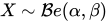[\[4\]](https://en.wikipedia.org/wiki/Beta_distribution#cite_note-BergerDecisionTheory-4) and X ∼ β α , β {\\displaystyle X\\sim \\beta \_{\\alpha ,\\beta }} .[\[5\]](https://en.wikipedia.org/wiki/Beta_distribution#cite_note-Feller-5)
### Cumulative distribution function
\[[edit](https://en.wikipedia.org/w/index.php?title=Beta_distribution&action=edit§ion=3 "Edit section: Cumulative distribution function")\]
[](https://en.wikipedia.org/wiki/File:CDF_for_symmetric_Beta_distribution_vs._x_and_alpha%3Dbeta_-_J._Rodal.jpg)
CDF for symmetric beta distribution vs. *x* and *α* = *β*
[](https://en.wikipedia.org/wiki/File:CDF_for_skewed_Beta_distribution_vs._x_and_beta%3D_5_alpha_-_J._Rodal.jpg)
CDF for skewed beta distribution vs. *x* and *β* = 5*α*
The [cumulative distribution function](https://en.wikipedia.org/wiki/Cumulative_distribution_function "Cumulative distribution function") is
F ( x ; α , β ) \= B ( x ; α , β ) B ( α , β ) \= I x ( α , β ) {\\displaystyle F(x;\\alpha ,\\beta )={\\frac {\\mathrm {B} {}(x;\\alpha ,\\beta )}{\\mathrm {B} {}(\\alpha ,\\beta )}}=I\_{x}(\\alpha ,\\beta )} 
where B ( x ; α , β ) {\\displaystyle \\mathrm {B} (x;\\alpha ,\\beta )}  is the [incomplete beta function](https://en.wikipedia.org/wiki/Beta_function#Incomplete_beta_function "Beta function") and I x ( α , β ) {\\displaystyle I\_{x}(\\alpha ,\\beta )}  is the [regularized incomplete beta function](https://en.wikipedia.org/wiki/Regularized_incomplete_beta_function "Regularized incomplete beta function").
For positive integers *α* and *β*, the cumulative distribution function of a beta distribution can be expressed in terms of the cumulative distribution function of a [binomial distribution](https://en.wikipedia.org/wiki/Binomial_distribution "Binomial distribution") with[\[6\]](https://en.wikipedia.org/wiki/Beta_distribution#cite_note-6)
F beta ( x ; α , β ) \= F binomial ( β − 1 ; α \+ β − 1 , 1 − x ) . {\\displaystyle F\_{\\text{beta}}(x;\\alpha ,\\beta )=F\_{\\text{binomial}}(\\beta -1;\\alpha +\\beta -1,1-x).} 
### Alternative parameterizations
\[[edit](https://en.wikipedia.org/w/index.php?title=Beta_distribution&action=edit§ion=4 "Edit section: Alternative parameterizations")\]
#### Two parameters
\[[edit](https://en.wikipedia.org/w/index.php?title=Beta_distribution&action=edit§ion=5 "Edit section: Two parameters")\]
##### Mean and sample size
\[[edit](https://en.wikipedia.org/w/index.php?title=Beta_distribution&action=edit§ion=6 "Edit section: Mean and sample size")\]
The beta distribution may also be reparameterized in terms of its mean *μ* (0 \< *μ* \< 1) and the sum of the two shape parameters *ν* = *α* + *β* \> 0([\[3\]](https://en.wikipedia.org/wiki/Beta_distribution#cite_note-Kruschke2011-3) p. 83). Denoting by αPosterior and βPosterior the shape parameters of the posterior beta distribution resulting from applying Bayes' theorem to a binomial likelihood function and a prior probability, the interpretation of the addition of both shape parameters to be sample size = *ν* = *α*·Posterior + *β*·Posterior is only correct for the Haldane prior probability Beta(0,0). Specifically, for the Bayes (uniform) prior Beta(1,1) the correct interpretation would be sample size = *α*·Posterior + *β* Posterior − 2, or *ν* = (sample size) + 2. For sample size much larger than 2, the difference between these two priors becomes negligible. (See section [Bayesian inference](https://en.wikipedia.org/wiki/Beta_distribution#Bayesian_inference) for further details.) *ν* = *α* + *β* is referred to as the "sample size" of a beta distribution, but one should remember that it is, strictly speaking, the "sample size" of a binomial likelihood function only when using a Haldane Beta(0,0) prior in Bayes' theorem.
This parametrization may be useful in Bayesian parameter estimation. For example, one may administer a test to a number of individuals. If it is assumed that each person's score (0 ≤ *θ* ≤ 1) is drawn from a population-level beta distribution, then an important statistic is the mean of this population-level distribution. The mean and sample size parameters are related to the shape parameters *α* and *β* via[\[3\]](https://en.wikipedia.org/wiki/Beta_distribution#cite_note-Kruschke2011-3)
*α* = *μν*, *β* = (1 − *μ*)*ν*
Under this [parametrization](https://en.wikipedia.org/wiki/Statistical_parameter "Statistical parameter"), one may place an [uninformative prior](https://en.wikipedia.org/wiki/Uninformative_prior "Uninformative prior") probability over the mean, and a vague prior probability (such as an [exponential](https://en.wikipedia.org/wiki/Exponential_distribution "Exponential distribution") or [gamma distribution](https://en.wikipedia.org/wiki/Gamma_distribution "Gamma distribution")) over the positive reals for the sample size, if they are independent, and prior data and/or beliefs justify it.
##### Mode and concentration
\[[edit](https://en.wikipedia.org/w/index.php?title=Beta_distribution&action=edit§ion=7 "Edit section: Mode and concentration")\]
[Concave](https://en.wikipedia.org/wiki/Concave_function "Concave function") beta distributions, which have α , β \> 1 {\\displaystyle \\alpha ,\\beta \>1} , can be parametrized in terms of mode and "concentration". The mode, ω \= α − 1 α \+ β − 2 {\\displaystyle \\omega ={\\frac {\\alpha -1}{\\alpha +\\beta -2}}} 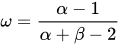, and concentration, κ \= α \+ β {\\displaystyle \\kappa =\\alpha +\\beta } , can be used to define the usual shape parameters as follows:[\[7\]](https://en.wikipedia.org/wiki/Beta_distribution#cite_note-Kruschke2015-7) α \= ω ( κ − 2 ) \+ 1 β \= ( 1 − ω ) ( κ − 2 ) \+ 1 {\\displaystyle {\\begin{aligned}\\alpha &=\\omega (\\kappa -2)+1\\\\\\beta &=(1-\\omega )(\\kappa -2)+1\\end{aligned}}} 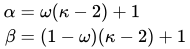 For the mode, 0 \< ω \< 1 {\\displaystyle 0\<\\omega \<1} , to be well-defined, we need α , β \> 1 {\\displaystyle \\alpha ,\\beta \>1} , or equivalently κ \> 2 {\\displaystyle \\kappa \>2} . If instead we define the concentration as c \= α \+ β − 2 {\\displaystyle c=\\alpha +\\beta -2} , the condition simplifies to c \> 0 {\\displaystyle c\>0}  and the beta density at α \= 1 \+ c ω {\\displaystyle \\alpha =1+c\\omega }  and β \= 1 \+ c ( 1 − ω ) {\\displaystyle \\beta =1+c(1-\\omega )}  can be written as: f ( x ; ω , c ) \= x c ω ( 1 − x ) c ( 1 − ω ) B ( 1 \+ c ω , 1 \+ c ( 1 − ω ) ) {\\displaystyle f(x;\\omega ,c)={\\frac {x^{c\\omega }(1-x)^{c(1-\\omega )}}{\\mathrm {B} {\\bigl (}1+c\\omega ,1+c(1-\\omega ){\\bigr )}}}} 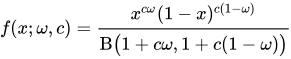 where c {\\displaystyle c}  directly scales the [sufficient statistics](https://en.wikipedia.org/wiki/Sufficient_statistics "Sufficient statistics"), log ( x ) {\\displaystyle \\log(x)}  and log ( 1 − x ) {\\displaystyle \\log(1-x)} . Note also that in the limit, c → 0 {\\displaystyle c\\to 0} , the distribution becomes flat.
##### Mean and variance
\[[edit](https://en.wikipedia.org/w/index.php?title=Beta_distribution&action=edit§ion=8 "Edit section: Mean and variance")\]
Solving the system of (coupled) equations given in the above sections as the equations for the mean and the variance of the beta distribution in terms of the original parameters *α* and *β*, one can express the *α* and *β* parameters in terms of the mean (*μ*) and the variance (var):
ν \= α \+ β \= μ ( 1 − μ ) v a r − 1 , where ν \= ( α \+ β ) \> 0 , therefore: var \< μ ( 1 − μ ) α \= μ ν \= μ ( μ ( 1 − μ ) var − 1 ) , if var \< μ ( 1 − μ ) β \= ( 1 − μ ) ν \= ( 1 − μ ) ( μ ( 1 − μ ) var − 1 ) , if var \< μ ( 1 − μ ) . {\\displaystyle {\\begin{aligned}\\nu &=\\alpha +\\beta ={\\frac {\\mu (1-\\mu )}{\\mathrm {var} }}-1,{\\text{ where }}\\nu =(\\alpha +\\beta )\>0,{\\text{ therefore: }}{\\text{var}}\<\\mu (1-\\mu )\\\\\\alpha &=\\mu \\nu =\\mu \\left({\\frac {\\mu (1-\\mu )}{\\text{var}}}-1\\right),{\\text{ if }}{\\text{var}}\<\\mu (1-\\mu )\\\\\\beta &=(1-\\mu )\\nu =(1-\\mu )\\left({\\frac {\\mu (1-\\mu )}{\\text{var}}}-1\\right),{\\text{ if }}{\\text{var}}\<\\mu (1-\\mu ).\\end{aligned}}} 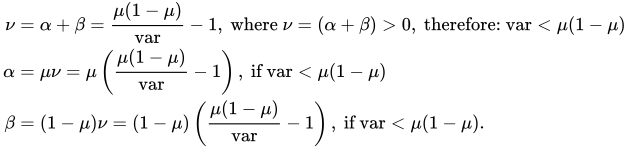
This [parametrization](https://en.wikipedia.org/wiki/Statistical_parameter "Statistical parameter") of the beta distribution may lead to a more intuitive understanding than the one based on the original parameters *α* and *β*. For example, by expressing the mode, skewness, excess kurtosis and differential entropy in terms of the mean and the variance:
[](https://en.wikipedia.org/wiki/File:Mode_Beta_Distribution_for_both_alpha_and_beta_greater_than_1_-_J._Rodal.jpg) [](https://en.wikipedia.org/wiki/File:Mode_Beta_Distribution_for_both_alpha_and_beta_greater_than_1_-_another_view_-_J._Rodal.jpg) [](https://en.wikipedia.org/wiki/File:Skewness_Beta_Distribution_for_mean_full_range_and_variance_between_0.05_and_0.25_-_Dr._J._Rodal.jpg) [](https://en.wikipedia.org/wiki/File:Skewness_Beta_Distribution_for_mean_and_variance_both_full_range_-_J._Rodal.jpg) [](https://en.wikipedia.org/wiki/File:Excess_Kurtosis_Beta_Distribution_with_mean_for_full_range_and_variance_from_0.05_to_0.25_-_J._Rodal.jpg) [](https://en.wikipedia.org/wiki/File:Excess_Kurtosis_Beta_Distribution_with_mean_and_variance_for_full_range_-_J._Rodal.jpg) [](https://en.wikipedia.org/wiki/File:Differential_Entropy_Beta_Distribution_with_mean_from_0.2_to_0.8_and_variance_from_0.01_to_0.09_-_J._Rodal.jpg) [](https://en.wikipedia.org/wiki/File:Differential_Entropy_Beta_Distribution_with_mean_from_0.3_to_0.7_and_variance_from_0_to_0.2_-_J._Rodal.jpg)
#### Four parameters
\[[edit](https://en.wikipedia.org/w/index.php?title=Beta_distribution&action=edit§ion=9 "Edit section: Four parameters")\]
A beta distribution with the two shape parameters *α* and *β* is supported on the range \[0,1\] or (0,1). It is possible to alter the location and scale of the distribution by introducing two further parameters representing the minimum, *a*, and maximum *c* (*c* \> *a*), values of the distribution,[\[1\]](https://en.wikipedia.org/wiki/Beta_distribution#cite_note-JKB-1) by a linear transformation substituting the non-dimensional variable *x* in terms of the new variable *y* (with support \[*a*,*c*\] or (*a*,*c*)) and the parameters *a* and *c*:
y \= x ( c − a ) \+ a , therefore x \= y − a c − a . {\\displaystyle y=x(c-a)+a,{\\text{ therefore }}x={\\frac {y-a}{c-a}}.} 
The [probability density function](https://en.wikipedia.org/wiki/Probability_density_function "Probability density function") of the four parameter beta distribution is equal to the two parameter distribution, scaled by the range (*c* − *a*), (so that the total area under the density curve equals a probability of one), and with the "y" variable shifted and scaled as follows: f ( y ; α , β , a , c ) \= f ( x ; α , β ) c − a \= ( y − a c − a ) α − 1 ( c − y c − a ) β − 1 ( c − a ) B ( α , β ) \= ( y − a ) α − 1 ( c − y ) β − 1 ( c − a ) α \+ β − 1 B ( α , β ) . {\\displaystyle {\\begin{aligned}f(y;\\alpha ,\\beta ,a,c)={\\frac {f(x;\\alpha ,\\beta )}{c-a}}&={\\frac {\\left({\\frac {y-a}{c-a}}\\right)^{\\alpha -1}\\left({\\frac {c-y}{c-a}}\\right)^{\\beta -1}}{(c-a)B(\\alpha ,\\beta )}}\\\\\[1ex\]&={\\frac {(y-a)^{\\alpha -1}(c-y)^{\\beta -1}}{(c-a)^{\\alpha +\\beta -1}B(\\alpha ,\\beta )}}.\\end{aligned}}} ![{\\displaystyle {\\begin{aligned}f(y;\\alpha ,\\beta ,a,c)={\\frac {f(x;\\alpha ,\\beta )}{c-a}}&={\\frac {\\left({\\frac {y-a}{c-a}}\\right)^{\\alpha -1}\\left({\\frac {c-y}{c-a}}\\right)^{\\beta -1}}{(c-a)B(\\alpha ,\\beta )}}\\\\\[1ex\]&={\\frac {(y-a)^{\\alpha -1}(c-y)^{\\beta -1}}{(c-a)^{\\alpha +\\beta -1}B(\\alpha ,\\beta )}}.\\end{aligned}}}](https://wikimedia.org/api/rest_v1/media/math/render/svg/ebfbb9c4da37593762747522d2d91a4ca72e0011)
That a random variable *Y* is beta-distributed with four parameters *α*, *β*, *a*, and *c* will be denoted by:
Y ∼ Beta ( α , β , a , c ) . {\\displaystyle Y\\sim \\operatorname {Beta} (\\alpha ,\\beta ,a,c).} 
Some measures of central location are scaled (by (*c* − *a*)) and shifted (by *a*), as follows:
μ Y \= μ X ( c − a ) \+ a \= α α \+ β ( c − a ) \+ a \= α c \+ β a α \+ β {\\displaystyle {\\begin{aligned}\\mu \_{Y}&=\\mu \_{X}(c-a)+a\\\\\[1ex\]&={\\frac {\\alpha }{\\alpha +\\beta }}\\left(c-a\\right)+a={\\frac {\\alpha c+\\beta a}{\\alpha +\\beta }}\\end{aligned}}} ![{\\displaystyle {\\begin{aligned}\\mu \_{Y}&=\\mu \_{X}(c-a)+a\\\\\[1ex\]&={\\frac {\\alpha }{\\alpha +\\beta }}\\left(c-a\\right)+a={\\frac {\\alpha c+\\beta a}{\\alpha +\\beta }}\\end{aligned}}}](https://wikimedia.org/api/rest_v1/media/math/render/svg/86a8b4fe30b5075b8c038d5b5b3e1f6ee8e5963f)
mode ( Y ) \= mode ( X ) ( c − a ) \+ a \= α − 1 α \+ β − 2 ( c − a ) \+ a \= ( α − 1 ) c \+ ( β − 1 ) a α \+ β − 2 , if α , β \> 1 {\\displaystyle {\\begin{aligned}{\\text{mode}}(Y)&={\\text{mode}}(X)(c-a)+a\\\\\[1ex\]&={\\frac {\\alpha -1}{\\alpha +\\beta -2}}\\left(c-a\\right)+a\\\\\[1ex\]&={\\frac {(\\alpha -1)c+(\\beta -1)a}{\\alpha +\\beta -2}}\\ ,&{\\text{ if }}\\alpha ,\\,\\beta \>1\\end{aligned}}} ![{\\displaystyle {\\begin{aligned}{\\text{mode}}(Y)&={\\text{mode}}(X)(c-a)+a\\\\\[1ex\]&={\\frac {\\alpha -1}{\\alpha +\\beta -2}}\\left(c-a\\right)+a\\\\\[1ex\]&={\\frac {(\\alpha -1)c+(\\beta -1)a}{\\alpha +\\beta -2}}\\ ,&{\\text{ if }}\\alpha ,\\,\\beta \>1\\end{aligned}}}](https://wikimedia.org/api/rest_v1/media/math/render/svg/768c42362dbb2d2904c218dcfc6df1de62b5f635)
median ( Y ) \= median ( X ) ( c − a ) \+ a \= I 1 2 \[ − 1 \] ( α , β ) ( c − a ) \+ a {\\displaystyle {\\begin{aligned}{\\text{median}}(Y)&={\\text{median}}(X)(c-a)+a\\\\\[1ex\]&=I\_{\\frac {1}{2}}^{\[-1\]}(\\alpha ,\\beta )\\left(c-a\\right)+a\\end{aligned}}} ![{\\displaystyle {\\begin{aligned}{\\text{median}}(Y)&={\\text{median}}(X)(c-a)+a\\\\\[1ex\]&=I\_{\\frac {1}{2}}^{\[-1\]}(\\alpha ,\\beta )\\left(c-a\\right)+a\\end{aligned}}}](https://wikimedia.org/api/rest_v1/media/math/render/svg/9b039773a1da5743c1e27109447176e3cfe1925e)
Note: the geometric mean and harmonic mean cannot be transformed by a linear transformation in the way that the mean, median and mode can.
The shape parameters of *Y* can be written in term of its mean and variance as
α \= ( a − μ Y ) ( a c − a μ Y − c μ Y \+ μ Y 2 \+ σ Y 2 ) σ Y 2 ( c − a ) β \= − ( c − μ Y ) ( a c − a μ Y − c μ Y \+ μ Y 2 \+ σ Y 2 ) σ Y 2 ( c − a ) {\\displaystyle {\\begin{aligned}\\alpha &={\\frac {\\left(a-\\mu \_{Y}\\right)\\left(a\\,c-a\\,\\mu \_{Y}-c\\,\\mu \_{Y}+\\mu \_{Y}^{2}+\\sigma \_{Y}^{2}\\right)}{\\sigma \_{Y}^{2}(c-a)}}\\\\\\beta &=-{\\frac {\\left(c-\\mu \_{Y}\\right)\\left(a\\,c-a\\,\\mu \_{Y}-c\\,\\mu \_{Y}+\\mu \_{Y}^{2}+\\sigma \_{Y}^{2}\\right)}{\\sigma \_{Y}^{2}(c-a)}}\\end{aligned}}} 
The statistical dispersion measures are scaled (they do not need to be shifted because they are already centered on the mean) by the range (*c* − *a*), linearly for the mean deviation and nonlinearly for the variance:
(mean deviation around mean) ( Y ) \= ( (mean deviation around mean) ( X ) ) ( c − a ) \= 2 α α β β B ( α , β ) ( α \+ β ) α \+ β \+ 1 ( c − a ) {\\displaystyle {\\begin{aligned}&{\\text{(mean deviation around mean)}}(Y)\\\\\[1ex\]&=({\\text{(mean deviation around mean)}}(X))(c-a)\\\\&={\\frac {2\\alpha ^{\\alpha }\\beta ^{\\beta }}{\\mathrm {B} (\\alpha ,\\beta )(\\alpha +\\beta )^{\\alpha +\\beta +1}}}(c-a)\\end{aligned}}} ![{\\displaystyle {\\begin{aligned}&{\\text{(mean deviation around mean)}}(Y)\\\\\[1ex\]&=({\\text{(mean deviation around mean)}}(X))(c-a)\\\\&={\\frac {2\\alpha ^{\\alpha }\\beta ^{\\beta }}{\\mathrm {B} (\\alpha ,\\beta )(\\alpha +\\beta )^{\\alpha +\\beta +1}}}(c-a)\\end{aligned}}}](https://wikimedia.org/api/rest_v1/media/math/render/svg/769fc1182a10805b989db4ae5c207769240dc3b5) var ( Y ) \= var ( X ) ( c − a ) 2 \= α β ( c − a ) 2 ( α \+ β ) 2 ( α \+ β \+ 1 ) . {\\displaystyle {\\text{var}}(Y)={\\text{var}}(X)(c-a)^{2}={\\frac {\\alpha \\beta (c-a)^{2}}{(\\alpha +\\beta )^{2}(\\alpha +\\beta +1)}}.} 
Since the [skewness](https://en.wikipedia.org/wiki/Skewness "Skewness") and [excess kurtosis](https://en.wikipedia.org/wiki/Excess_kurtosis "Excess kurtosis") are non-dimensional quantities (as [moments](https://en.wikipedia.org/wiki/Moment_\(mathematics\) "Moment (mathematics)") centered on the mean and normalized by the [standard deviation](https://en.wikipedia.org/wiki/Standard_deviation "Standard deviation")), they are independent of the parameters *a* and *c*, and therefore equal to the expressions given above in terms of *X* (with support \[0,1\] or (0,1)):
skewness ( Y ) \= skewness ( X ) \= 2 ( β − α ) α \+ β \+ 1 ( α \+ β \+ 2 ) α β . {\\displaystyle {\\text{skewness}}(Y)={\\text{skewness}}(X)={\\frac {2(\\beta -\\alpha ){\\sqrt {\\alpha +\\beta +1}}}{(\\alpha +\\beta +2){\\sqrt {\\alpha \\beta }}}}.} 
kurtosis excess ( Y ) \= kurtosis excess ( X ) \= 6 \[ ( α − β ) 2 ( α \+ β \+ 1 ) − α β ( α \+ β \+ 2 ) \] α β ( α \+ β \+ 2 ) ( α \+ β \+ 3 ) {\\displaystyle {\\text{kurtosis excess}}(Y)={\\text{kurtosis excess}}(X)={\\frac {6\\left\[(\\alpha -\\beta )^{2}(\\alpha +\\beta +1)-\\alpha \\beta (\\alpha +\\beta +2)\\right\]}{\\alpha \\beta (\\alpha +\\beta +2)(\\alpha +\\beta +3)}}} ![{\\displaystyle {\\text{kurtosis excess}}(Y)={\\text{kurtosis excess}}(X)={\\frac {6\\left\[(\\alpha -\\beta )^{2}(\\alpha +\\beta +1)-\\alpha \\beta (\\alpha +\\beta +2)\\right\]}{\\alpha \\beta (\\alpha +\\beta +2)(\\alpha +\\beta +3)}}}](https://wikimedia.org/api/rest_v1/media/math/render/svg/76f8b524c994e9cdaf8317555457b4369ab2271e)
## Properties
\[[edit](https://en.wikipedia.org/w/index.php?title=Beta_distribution&action=edit§ion=10 "Edit section: Properties")\]
### Measures of central tendency
\[[edit](https://en.wikipedia.org/w/index.php?title=Beta_distribution&action=edit§ion=11 "Edit section: Measures of central tendency")\]
#### Mode
\[[edit](https://en.wikipedia.org/w/index.php?title=Beta_distribution&action=edit§ion=12 "Edit section: Mode")\]
The [mode](https://en.wikipedia.org/wiki/Mode_\(statistics\) "Mode (statistics)") of a beta distributed [random variable](https://en.wikipedia.org/wiki/Random_variable "Random variable") *X* with *α*, *β* \> 1 is the most likely value of the distribution (corresponding to the peak in the PDF), and is given by the following expression:[\[1\]](https://en.wikipedia.org/wiki/Beta_distribution#cite_note-JKB-1)
α − 1 α \+ β − 2 . {\\displaystyle {\\frac {\\alpha -1}{\\alpha +\\beta -2}}.} 
When both parameters are less than one (*α*, *β* \< 1), this is the anti-mode: the lowest point of the probability density curve.[\[8\]](https://en.wikipedia.org/wiki/Beta_distribution#cite_note-Wadsworth-8)
Letting *α* = *β*, the expression for the mode simplifies to 1/2, showing that for *α* = *β* \> 1 the mode (resp. anti-mode when *α*, *β* \< 1), is at the center of the distribution: it is symmetric in those cases. See [Shapes](https://en.wikipedia.org/wiki/Beta_distribution#Shapes) section in this article for a full list of mode cases, for arbitrary values of *α* and *β*. For several of these cases, the maximum value of the density function occurs at one or both ends. In some cases the (maximum) value of the density function occurring at the end is finite. For example, in the case of *α* = 2, *β* = 1 (or *α* = 1, *β* = 2), the density function becomes a [right-triangle distribution](https://en.wikipedia.org/wiki/Triangular_distribution "Triangular distribution") which is finite at both ends. In several other cases there is a [singularity](https://en.wikipedia.org/wiki/Mathematical_singularity "Mathematical singularity") at one end, where the value of the density function approaches infinity. For example, in the case *α* = *β* = 1/2, the beta distribution simplifies to become the [arcsine distribution](https://en.wikipedia.org/wiki/Arcsine_distribution "Arcsine distribution"). There is debate among mathematicians about some of these cases and whether the ends (*x* = 0, and *x* = 1) can be called *modes* or not.[\[9\]](https://en.wikipedia.org/wiki/Beta_distribution#cite_note-Handbook_of_Beta_Distribution-9)[\[2\]](https://en.wikipedia.org/wiki/Beta_distribution#cite_note-Mathematical_Statistics_with_MATHEMATICA-2)
[](https://en.wikipedia.org/wiki/File:Mode_Beta_Distribution_for_alpha_and_beta_from_1_to_5_-_J._Rodal.jpg)
Mode for beta distribution for 1 ≤ *α* ≤ 5 and 1 ≤ β ≤ 5
- Whether the ends are part of the [domain](https://en.wikipedia.org/wiki/Domain_of_a_function "Domain of a function") of the density function
- Whether a [singularity](https://en.wikipedia.org/wiki/Mathematical_singularity "Mathematical singularity") can ever be called a *mode*
- Whether cases with two maxima should be called *bimodal*
#### Median
\[[edit](https://en.wikipedia.org/w/index.php?title=Beta_distribution&action=edit§ion=13 "Edit section: Median")\]
[](https://en.wikipedia.org/wiki/File:Median_Beta_Distribution_for_alpha_and_beta_from_0_to_5_-_J._Rodal.jpg)
Median for beta distribution for 0 ≤ *α* ≤ 5 and 0 ≤ *β* ≤ 5
[](https://en.wikipedia.org/wiki/File:\(Mean_-_Median\)_for_Beta_distribution_versus_alpha_and_beta_from_0_to_2_-_J._Rodal.jpg)
(Mean–median) for beta distribution versus alpha and beta from 0 to 2
The median of the beta distribution is the unique real number x \= I 1 / 2 \[ − 1 \] ( α , β ) {\\displaystyle x=I\_{1/2}^{\[-1\]}(\\alpha ,\\beta )} ![{\\displaystyle x=I\_{1/2}^{\[-1\]}(\\alpha ,\\beta )}](https://wikimedia.org/api/rest_v1/media/math/render/svg/d7510f94efa49f254eb3924678b527a6fd22d0fc) for which the [regularized incomplete beta function](https://en.wikipedia.org/wiki/Regularized_incomplete_beta_function "Regularized incomplete beta function") I x ( α , β ) \= 1 2 {\\displaystyle I\_{x}(\\alpha ,\\beta )={\\tfrac {1}{2}}} 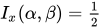. There is no general [closed-form expression](https://en.wikipedia.org/wiki/Closed-form_expression "Closed-form expression") for the [median](https://en.wikipedia.org/wiki/Median "Median") of the beta distribution for arbitrary values of *α* and *β*. [Closed-form expressions](https://en.wikipedia.org/wiki/Closed-form_expression "Closed-form expression") for particular values of the parameters *α* and *β* follow:\[*[citation needed](https://en.wikipedia.org/wiki/Wikipedia:Citation_needed "Wikipedia:Citation needed")*\]
- For symmetric cases *α* = *β*, median = 1/2.
- For *α* = 1 and *β* \> 0, median
\=
1
−
2
−
1
/
β
{\\displaystyle =1-2^{-1/\\beta }}

(this case is the [mirror-image](https://en.wikipedia.org/wiki/Mirror_image "Mirror image") of the [power function distribution](https://en.wikipedia.org/w/index.php?title=Power_function_distribution&action=edit&redlink=1 "Power function distribution (page does not exist)"))
- For *α* \> 0 and *β* = 1, median =
2
−
1
/
α
{\\displaystyle 2^{-1/\\alpha }}

(this case is the power function distribution[\[9\]](https://en.wikipedia.org/wiki/Beta_distribution#cite_note-Handbook_of_Beta_Distribution-9))
- For *α* = 3 and *β* = 2, median = 0.6142724318676105..., the real solution to the [quartic equation](https://en.wikipedia.org/wiki/Quartic_function "Quartic function") 1 − 8*x*3 + 6*x*4 = 0, which lies in \[0,1\].
- For *α* = 2 and *β* = 3, median = 0.38572756813238945... = 1−median(Beta(3, 2))
The following are the limits with one parameter finite (non-zero) and the other approaching these limits:\[*[citation needed](https://en.wikipedia.org/wiki/Wikipedia:Citation_needed "Wikipedia:Citation needed")*\]
lim β → 0 median \= lim α → ∞ median \= 1 , lim α → 0 median \= lim β → ∞ median \= 0\. {\\displaystyle {\\begin{aligned}\\lim \_{\\beta \\to 0}{\\text{median}}=\\lim \_{\\alpha \\to \\infty }{\\text{median}}=1,\\\\\\lim \_{\\alpha \\to 0}{\\text{median}}=\\lim \_{\\beta \\to \\infty }{\\text{median}}=0.\\end{aligned}}} 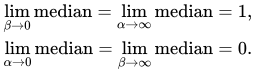
A reasonable approximation of the value of the median of the beta distribution, for both α and β greater or equal to one, is given by the formula[\[10\]](https://en.wikipedia.org/wiki/Beta_distribution#cite_note-Kerman2011-10)
median ≈ α − 1 3 α \+ β − 2 3 for α , β ≥ 1\. {\\displaystyle {\\text{median}}\\approx {\\frac {\\alpha -{\\tfrac {1}{3}}}{\\alpha +\\beta -{\\tfrac {2}{3}}}}{\\text{ for }}\\alpha ,\\beta \\geq 1.} 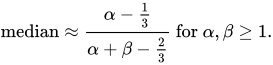
When *α*, *β* ≥ 1, the [relative error](https://en.wikipedia.org/wiki/Relative_error "Relative error") (the [absolute error](https://en.wikipedia.org/wiki/Approximation_error "Approximation error") divided by the median) in this approximation is less than 4% and for both *α* ≥ 2 and *β* ≥ 2 it is less than 1%. The [absolute error](https://en.wikipedia.org/wiki/Approximation_error "Approximation error") divided by the difference between the mean and the mode is similarly small:
[![Abs\[(Median-Appr.)/Median\] for beta distribution for 1 ≤ α ≤ 5 and 1 ≤ β ≤ 5](https://upload.wikimedia.org/wikipedia/commons/thumb/a/af/Relative_Error_for_Approximation_to_Median_of_Beta_Distribution_for_alpha_and_beta_from_1_to_5_-_J._Rodal.jpg/330px-Relative_Error_for_Approximation_to_Median_of_Beta_Distribution_for_alpha_and_beta_from_1_to_5_-_J._Rodal.jpg)](https://en.wikipedia.org/wiki/File:Relative_Error_for_Approximation_to_Median_of_Beta_Distribution_for_alpha_and_beta_from_1_to_5_-_J._Rodal.jpg "Abs[(Median-Appr.)/Median] for beta distribution for 1 ≤ α ≤ 5 and 1 ≤ β ≤ 5")[![Abs\[(Median-Appr.)/(Mean-Mode)\] for beta distribution for 1 ≤ α ≤ 5 and 1 ≤ β ≤ 5](https://upload.wikimedia.org/wikipedia/commons/thumb/e/e8/Error_in_Median_Apprx._relative_to_Mean-Mode_distance_for_Beta_Distribution_with_alpha_and_beta_from_1_to_5_-_J._Rodal.jpg/330px-Error_in_Median_Apprx._relative_to_Mean-Mode_distance_for_Beta_Distribution_with_alpha_and_beta_from_1_to_5_-_J._Rodal.jpg)](https://en.wikipedia.org/wiki/File:Error_in_Median_Apprx._relative_to_Mean-Mode_distance_for_Beta_Distribution_with_alpha_and_beta_from_1_to_5_-_J._Rodal.jpg "Abs[(Median-Appr.)/(Mean-Mode)] for beta distribution for 1 ≤ α ≤ 5 and 1 ≤ β ≤ 5")
#### Mean
\[[edit](https://en.wikipedia.org/w/index.php?title=Beta_distribution&action=edit§ion=14 "Edit section: Mean")\]
[](https://en.wikipedia.org/wiki/File:Mean_Beta_Distribution_for_alpha_and_beta_from_0_to_5_-_J._Rodal.jpg)
Mean for beta distribution for 0 ≤ *α* ≤ 5 and 0 ≤ *β* ≤ 5
The [expected value](https://en.wikipedia.org/wiki/Expected_value "Expected value") (mean) (*μ*) of a beta distribution [random variable](https://en.wikipedia.org/wiki/Random_variable "Random variable") *X* with two parameters *α* and *β* is a function of only the ratio *β*/*α* of these parameters:[\[1\]](https://en.wikipedia.org/wiki/Beta_distribution#cite_note-JKB-1)
μ \= E \[ X \] \= ∫ 0 1 x f ( x ; α , β ) d x \= ∫ 0 1 x x α − 1 ( 1 − x ) β − 1 B ( α , β ) d x \= α α \+ β \= 1 1 \+ β α {\\displaystyle {\\begin{aligned}\\mu =\\operatorname {E} \[X\]&=\\int \_{0}^{1}xf(x;\\alpha ,\\beta )\\,dx\\\\&=\\int \_{0}^{1}x\\,{\\frac {x^{\\alpha -1}(1-x)^{\\beta -1}}{\\mathrm {B} (\\alpha ,\\beta )}}\\,dx\\\\&={\\frac {\\alpha }{\\alpha +\\beta }}\\\\&={\\frac {1}{1+{\\frac {\\beta }{\\alpha }}}}\\end{aligned}}} ![{\\displaystyle {\\begin{aligned}\\mu =\\operatorname {E} \[X\]&=\\int \_{0}^{1}xf(x;\\alpha ,\\beta )\\,dx\\\\&=\\int \_{0}^{1}x\\,{\\frac {x^{\\alpha -1}(1-x)^{\\beta -1}}{\\mathrm {B} (\\alpha ,\\beta )}}\\,dx\\\\&={\\frac {\\alpha }{\\alpha +\\beta }}\\\\&={\\frac {1}{1+{\\frac {\\beta }{\\alpha }}}}\\end{aligned}}}](https://wikimedia.org/api/rest_v1/media/math/render/svg/e9137834d9d47360ed6c23550c6236fed5fd35f7)
Letting *α* = *β* in the above expression one obtains *μ* = 1/2, showing that for *α* = *β* the mean is at the center of the distribution: it is symmetric. Also, the following limits can be obtained from the above expression:
lim β α → 0 μ \= 1 lim β α → ∞ μ \= 0 {\\displaystyle {\\begin{aligned}\\lim \_{{\\frac {\\beta }{\\alpha }}\\to 0}\\mu =1\\\\\\lim \_{{\\frac {\\beta }{\\alpha }}\\to \\infty }\\mu =0\\end{aligned}}} 
Therefore, for *β*/*α* → 0, or for *α*/*β* → ∞, the mean is located at the right end, *x* = 1. For these limit ratios, the beta distribution becomes a one-point [degenerate distribution](https://en.wikipedia.org/wiki/Degenerate_distribution "Degenerate distribution") with a [Dirac delta function](https://en.wikipedia.org/wiki/Dirac_delta_function "Dirac delta function") spike at the right end, *x* = 1, with probability 1, and zero probability everywhere else. There is 100% probability (absolute certainty) concentrated at the right end, *x* = 1.
Similarly, for *β*/*α* → ∞, or for *α*/*β* → 0, the mean is located at the left end, *x* = 0. The beta distribution becomes a 1-point [Degenerate distribution](https://en.wikipedia.org/wiki/Degenerate_distribution "Degenerate distribution") with a [Dirac delta function](https://en.wikipedia.org/wiki/Dirac_delta_function "Dirac delta function") spike at the left end, *x* = 0, with probability 1, and zero probability everywhere else. There is 100% probability (absolute certainty) concentrated at the left end, *x* = 0. Following are the limits with one parameter finite (non-zero) and the other approaching these limits:
lim β → 0 μ \= lim α → ∞ μ \= 1 lim α → 0 μ \= lim β → ∞ μ \= 0 {\\displaystyle {\\begin{aligned}\\lim \_{\\beta \\to 0}\\mu =\\lim \_{\\alpha \\to \\infty }\\mu =1\\\\\\lim \_{\\alpha \\to 0}\\mu =\\lim \_{\\beta \\to \\infty }\\mu =0\\end{aligned}}} 
While for typical unimodal distributions (with centrally located modes, inflexion points at both sides of the mode, and longer tails) (with Beta(*α*, *β*) such that *α*, *β* \> 2) it is known that the sample mean (as an estimate of location) is not as [robust](https://en.wikipedia.org/wiki/Robust_statistics "Robust statistics") as the sample median, the opposite is the case for uniform or "U-shaped" bimodal distributions (with Beta(*α*, *β*) such that *α*, *β* ≤ 1), with the modes located at the ends of the distribution. As Mosteller and Tukey remark ([\[11\]](https://en.wikipedia.org/wiki/Beta_distribution#cite_note-MostellerTukey-11) p. 207) "the average of the two extreme observations uses all the sample information. This illustrates how, for short-tailed distributions, the extreme observations should get more weight." By contrast, it follows that the median of "U-shaped" bimodal distributions with modes at the edge of the distribution (with Beta(*α*, *β*) such that *α*, *β* ≤ 1) is not robust, as the sample median drops the extreme sample observations from consideration. A practical application of this occurs for example for [random walks](https://en.wikipedia.org/wiki/Random_walk "Random walk"), since the probability for the time of the last visit to the origin in a random walk is distributed as the [arcsine distribution](https://en.wikipedia.org/wiki/Arcsine_distribution "Arcsine distribution") Beta(1/2, 1/2):[\[5\]](https://en.wikipedia.org/wiki/Beta_distribution#cite_note-Feller-5)[\[12\]](https://en.wikipedia.org/wiki/Beta_distribution#cite_note-WillyFeller1-12) the mean of a number of [realizations](https://en.wikipedia.org/wiki/Realization_\(probability\) "Realization (probability)") of a random walk is a much more robust estimator than the median (which is an inappropriate sample measure estimate in this case).
#### Geometric mean
\[[edit](https://en.wikipedia.org/w/index.php?title=Beta_distribution&action=edit§ion=15 "Edit section: Geometric mean")\]
[](https://en.wikipedia.org/wiki/File:\(Mean_-_GeometricMean\)_for_Beta_Distribution_versus_alpha_and_beta_from_0_to_2_-_J._Rodal.jpg)
(Mean − GeometricMean) for beta distribution versus *α* and *β* from 0 to 2, showing the asymmetry between *α* and *β* for the geometric mean
[](https://en.wikipedia.org/wiki/File:Geometric_Means_for_Beta_distribution_Purple%3DG\(X\),_Yellow%3DG\(1-X\),_smaller_values_alpha_and_beta_in_front_-_J._Rodal.jpg)
Geometric means for beta distribution Purple = *G*(*x*), Yellow = *G*(1 − *x*), smaller values *α* and *β* in front
[](https://en.wikipedia.org/wiki/File:Geometric_Means_for_Beta_distribution_Purple%3DG\(X\),_Yellow%3DG\(1-X\),_larger_values_alpha_and_beta_in_front_-_J._Rodal.jpg)
Geometric means for beta distribution. purple = *G*(*x*), yellow = *G*(1 − *x*), larger values *α* and *β* in front
The logarithm of the [geometric mean](https://en.wikipedia.org/wiki/Geometric_mean "Geometric mean") *GX* of a distribution with [random variable](https://en.wikipedia.org/wiki/Random_variable "Random variable") *X* is the arithmetic mean of ln(*X*), or, equivalently, its expected value:
ln G X \= E \[ ln X \] {\\displaystyle \\ln G\_{X}=\\operatorname {E} \[\\ln X\]} ![{\\displaystyle \\ln G\_{X}=\\operatorname {E} \[\\ln X\]}](https://wikimedia.org/api/rest_v1/media/math/render/svg/64b67cb73b90bc0e09ba41003b44f84b6e1d3feb)
For a beta distribution, the expected value integral gives:
E \[ ln X \] \= ∫ 0 1 ln x f ( x ; α , β ) d x \= ∫ 0 1 ln x x α − 1 ( 1 − x ) β − 1 B ( α , β ) d x \= 1 B ( α , β ) ∫ 0 1 ∂ x α − 1 ( 1 − x ) β − 1 ∂ α d x \= 1 B ( α , β ) ∂ ∂ α ∫ 0 1 x α − 1 ( 1 − x ) β − 1 d x \= 1 B ( α , β ) ∂ B ( α , β ) ∂ α \= ∂ ln B ( α , β ) ∂ α \= ∂ ln Γ ( α ) ∂ α − ∂ ln Γ ( α \+ β ) ∂ α \= ψ ( α ) − ψ ( α \+ β ) {\\displaystyle {\\begin{aligned}\\operatorname {E} \[\\ln X\]&=\\int \_{0}^{1}\\ln x\\,f(x;\\alpha ,\\beta )\\,dx\\\\\[4pt\]&=\\int \_{0}^{1}\\ln x\\,{\\frac {x^{\\alpha -1}(1-x)^{\\beta -1}}{\\mathrm {B} (\\alpha ,\\beta )}}\\,dx\\\\\[4pt\]&={\\frac {1}{\\mathrm {B} (\\alpha ,\\beta )}}\\,\\int \_{0}^{1}{\\frac {\\partial x^{\\alpha -1}(1-x)^{\\beta -1}}{\\partial \\alpha }}\\,dx\\\\\[4pt\]&={\\frac {1}{\\mathrm {B} (\\alpha ,\\beta )}}{\\frac {\\partial }{\\partial \\alpha }}\\int \_{0}^{1}x^{\\alpha -1}(1-x)^{\\beta -1}\\,dx\\\\\[4pt\]&={\\frac {1}{\\mathrm {B} (\\alpha ,\\beta )}}{\\frac {\\partial \\mathrm {B} (\\alpha ,\\beta )}{\\partial \\alpha }}\\\\\[4pt\]&={\\frac {\\partial \\ln \\mathrm {B} (\\alpha ,\\beta )}{\\partial \\alpha }}\\\\\[4pt\]&={\\frac {\\partial \\ln \\Gamma (\\alpha )}{\\partial \\alpha }}-{\\frac {\\partial \\ln \\Gamma (\\alpha +\\beta )}{\\partial \\alpha }}\\\\\[4pt\]&=\\psi (\\alpha )-\\psi (\\alpha +\\beta )\\end{aligned}}} ![{\\displaystyle {\\begin{aligned}\\operatorname {E} \[\\ln X\]&=\\int \_{0}^{1}\\ln x\\,f(x;\\alpha ,\\beta )\\,dx\\\\\[4pt\]&=\\int \_{0}^{1}\\ln x\\,{\\frac {x^{\\alpha -1}(1-x)^{\\beta -1}}{\\mathrm {B} (\\alpha ,\\beta )}}\\,dx\\\\\[4pt\]&={\\frac {1}{\\mathrm {B} (\\alpha ,\\beta )}}\\,\\int \_{0}^{1}{\\frac {\\partial x^{\\alpha -1}(1-x)^{\\beta -1}}{\\partial \\alpha }}\\,dx\\\\\[4pt\]&={\\frac {1}{\\mathrm {B} (\\alpha ,\\beta )}}{\\frac {\\partial }{\\partial \\alpha }}\\int \_{0}^{1}x^{\\alpha -1}(1-x)^{\\beta -1}\\,dx\\\\\[4pt\]&={\\frac {1}{\\mathrm {B} (\\alpha ,\\beta )}}{\\frac {\\partial \\mathrm {B} (\\alpha ,\\beta )}{\\partial \\alpha }}\\\\\[4pt\]&={\\frac {\\partial \\ln \\mathrm {B} (\\alpha ,\\beta )}{\\partial \\alpha }}\\\\\[4pt\]&={\\frac {\\partial \\ln \\Gamma (\\alpha )}{\\partial \\alpha }}-{\\frac {\\partial \\ln \\Gamma (\\alpha +\\beta )}{\\partial \\alpha }}\\\\\[4pt\]&=\\psi (\\alpha )-\\psi (\\alpha +\\beta )\\end{aligned}}}](https://wikimedia.org/api/rest_v1/media/math/render/svg/cd9db519e08e3c72cd6f9e2f0c90a7c57bdba035)
where *ψ* is the [digamma function](https://en.wikipedia.org/wiki/Digamma_function "Digamma function").
Therefore, the geometric mean of a beta distribution with shape parameters *α* and *β* is the exponential of the digamma functions of *α* and *β* as follows:
G X \= e E \[ ln X \] \= e ψ ( α ) − ψ ( α \+ β ) {\\displaystyle G\_{X}=e^{\\operatorname {E} \[\\ln X\]}=e^{\\psi (\\alpha )-\\psi (\\alpha +\\beta )}} ![{\\displaystyle G\_{X}=e^{\\operatorname {E} \[\\ln X\]}=e^{\\psi (\\alpha )-\\psi (\\alpha +\\beta )}}](https://wikimedia.org/api/rest_v1/media/math/render/svg/c93ffa7f0155fa3816fcb151c3eb677700aabca2)
While for a beta distribution with equal shape parameters *α* = *β*, it follows that skewness = 0 and mode = mean = median = 1/2, the geometric mean is less than 1/2: 0 \< *G**X* \< 1/2. The reason for this is that the logarithmic transformation strongly weights the values of *X* close to zero, as ln(*X*) strongly tends towards negative infinity as *X* approaches zero, while ln(*X*) flattens towards zero as *X* → 1.
Along a line *α* = *β*, the following limits apply:
lim α \= β → 0 G X \= 0 lim α \= β → ∞ G X \= 1 2 {\\displaystyle {\\begin{aligned}&\\lim \_{\\alpha =\\beta \\to 0}G\_{X}=0\\\\&\\lim \_{\\alpha =\\beta \\to \\infty }G\_{X}={\\tfrac {1}{2}}\\end{aligned}}} 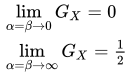
Following are the limits with one parameter finite (non-zero) and the other approaching these limits:
lim β → 0 G X \= lim α → ∞ G X \= 1 lim α → 0 G X \= lim β → ∞ G X \= 0 {\\displaystyle {\\begin{aligned}\\lim \_{\\beta \\to 0}G\_{X}=\\lim \_{\\alpha \\to \\infty }G\_{X}=1\\\\\\lim \_{\\alpha \\to 0}G\_{X}=\\lim \_{\\beta \\to \\infty }G\_{X}=0\\end{aligned}}} 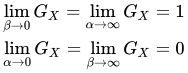
The accompanying plot shows the difference between the mean and the geometric mean for shape parameters *α* and *β* from zero to 2. Besides the fact that the difference between them approaches zero as *α* and *β* approach infinity and that the difference becomes large for values of *α* and *β* approaching zero, one can observe an evident asymmetry of the geometric mean with respect to the shape parameters *α* and *β*. The difference between the geometric mean and the mean is larger for small values of *α* in relation to *β* than when exchanging the magnitudes of *β* and *α*.
[N. L.Johnson](https://en.wikipedia.org/wiki/Norman_Lloyd_Johnson "Norman Lloyd Johnson") and [S. Kotz](https://en.wikipedia.org/wiki/Samuel_Kotz "Samuel Kotz")[\[1\]](https://en.wikipedia.org/wiki/Beta_distribution#cite_note-JKB-1) suggest the logarithmic approximation to the digamma function *ψ*(*α*) ≈ ln(*α* − 1/2) which results in the following approximation to the geometric mean:
G X ≈ α − 1 2 α \+ β − 1 2 if α , β \> 1\. {\\displaystyle G\_{X}\\approx {\\frac {\\alpha \\,-{\\frac {1}{2}}}{\\alpha +\\beta -{\\frac {1}{2}}}}{\\text{ if }}\\alpha ,\\beta \>1.} 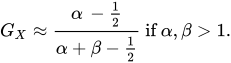
Numerical values for the [relative error](https://en.wikipedia.org/wiki/Relative_error "Relative error") in this approximation follow: \[(*α* = *β* = 1): 9.39%\]; \[(*α* = *β* = 2): 1.29%\]; \[(*α* = 2, *β* = 3): 1.51%\]; \[(*α* = 3, *β* = 2): 0.44%\]; \[(*α* = *β* = 3): 0.51%\]; \[(*α* = *β* = 4): 0.26%\]; \[(*α* = 3, *β* = 4): 0.55%\]; \[(*α* = 4, *β* = 3): 0.24%\].
Similarly, one can calculate the value of shape parameters required for the geometric mean to equal 1/2. Given the value of the parameter *β*, what would be the value of the other parameter, *α*, required for the geometric mean to equal 1/2?. The answer is that (for *β* \> 1), the value of *α* required tends towards *β* + 1/2 as *β* → ∞. For example, all these couples have the same geometric mean of 1/2: \[*β* = 1, *α* = 1.4427\], \[*β* = 2, *α* = 2.46958\], \[*β* = 3, *α* = 3.47943\], \[*β* = 4, *α* = 4.48449\], \[*β* = 5, *α* = 5.48756\], \[*β* = 10, *α* = 10.4938\], \[*β* = 100, *α* = 100.499\].
The fundamental property of the geometric mean, which can be proven to be false for any other mean, is
G ( X i Y i ) \= G ( X i ) G ( Y i ) {\\displaystyle G{\\left({\\frac {X\_{i}}{Y\_{i}}}\\right)}={\\frac {G(X\_{i})}{G(Y\_{i})}}} 
This makes the geometric mean the only correct mean when averaging *normalized* results, that is results that are presented as ratios to reference values.[\[13\]](https://en.wikipedia.org/wiki/Beta_distribution#cite_note-13) This is relevant because the beta distribution is a suitable model for the random behavior of percentages and it is particularly suitable to the statistical modelling of proportions. The geometric mean plays a central role in maximum likelihood estimation, see section "Parameter estimation, maximum likelihood." Actually, when performing maximum likelihood estimation, besides the [geometric mean](https://en.wikipedia.org/wiki/Geometric_mean "Geometric mean") *GX* based on the random variable X, also another geometric mean appears naturally: the [geometric mean](https://en.wikipedia.org/wiki/Geometric_mean "Geometric mean") based on the linear transformation ––(1 − *X*), the mirror-image of *X*, denoted by *G*(1−*X*):
G 1 − X \= e E \[ ln ( 1 − X ) \] \= e ψ ( β ) − ψ ( α \+ β ) {\\displaystyle G\_{1-X}=e^{\\operatorname {E} \[\\ln(1-X)\]}=e^{\\psi (\\beta )-\\psi (\\alpha +\\beta )}} ![{\\displaystyle G\_{1-X}=e^{\\operatorname {E} \[\\ln(1-X)\]}=e^{\\psi (\\beta )-\\psi (\\alpha +\\beta )}}](https://wikimedia.org/api/rest_v1/media/math/render/svg/58d36e067302e87f85db3f0fb1e2902201e38d76)
Along a line *α* = *β*, the following limits apply:
lim α \= β → 0 G 1 − X \= 0 lim α \= β → ∞ G 1 − X \= 1 2 {\\displaystyle {\\begin{aligned}&\\lim \_{\\alpha =\\beta \\to 0}G\_{1-X}=0\\\\&\\lim \_{\\alpha =\\beta \\to \\infty }G\_{1-X}={\\tfrac {1}{2}}\\end{aligned}}} 
Following are the limits with one parameter finite (non-zero) and the other approaching these limits:
lim β → 0 G ( 1 − X ) \= lim α → ∞ G ( 1 − X ) \= 0 lim α → 0 G ( 1 − X ) \= lim β → ∞ G ( 1 − X ) \= 1 {\\displaystyle {\\begin{aligned}\\lim \_{\\beta \\to 0}G\_{(1-X)}=\\lim \_{\\alpha \\to \\infty }G\_{(1-X)}=0\\\\\\lim \_{\\alpha \\to 0}G\_{(1-X)}=\\lim \_{\\beta \\to \\infty }G\_{(1-X)}=1\\end{aligned}}} 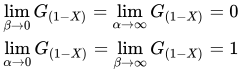
It has the following approximate value:
G ( 1 − X ) ≈ β − 1 2 α \+ β − 1 2 if α , β \> 1\. {\\displaystyle G\_{(1-X)}\\approx {\\frac {\\beta -{\\frac {1}{2}}}{\\alpha +\\beta -{\\frac {1}{2}}}}{\\text{ if }}\\alpha ,\\beta \>1.} 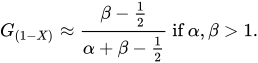
Although both *G**X* and *G*1−*X* are asymmetric, in the case that both shape parameters are equal *α* = *β*, the geometric means are equal: *G**X* = *G*(1−*X*). This equality follows from the following symmetry displayed between both geometric means:
G X ( B ( α , β ) ) \= G 1 − X ( B ( β , α ) ) . {\\displaystyle G\_{X}(\\mathrm {B} (\\alpha ,\\beta ))=G\_{1-X}(\\mathrm {B} (\\beta ,\\alpha )).} 
#### Harmonic mean
\[[edit](https://en.wikipedia.org/w/index.php?title=Beta_distribution&action=edit§ion=16 "Edit section: Harmonic mean")\]
[](https://en.wikipedia.org/wiki/File:Harmonic_mean_for_Beta_distribution_for_alpha_and_beta_ranging_from_0_to_5_-_J._Rodal.jpg)
Harmonic mean for beta distribution for 0 \< *α* \< 5 and 0 \< *β* \< 5
[](https://en.wikipedia.org/wiki/File:\(Mean_-_HarmonicMean\)_for_Beta_distribution_versus_alpha_and_beta_from_0_to_2_-_J._Rodal.jpg)
Harmonic mean for beta distribution versus *α* and *β* from 0 to 2
[](https://en.wikipedia.org/wiki/File:Harmonic_Means_for_Beta_distribution_Purple%3DH\(X\),_Yellow%3DH\(1-X\),_smaller_values_alpha_and_beta_in_front_-_J._Rodal.jpg)
Harmonic means for beta distribution Purple = *H*(*X*), Yellow = *H*(1 − *X*), smaller values *α* and *β* in front
[](https://en.wikipedia.org/wiki/File:Harmonic_Means_for_Beta_distribution_Purple%3DH\(X\),_Yellow%3DH\(1-X\),_larger_values_alpha_and_beta_in_front_-_J._Rodal.jpg)
Harmonic means for beta distribution: purple = *H*(*X*), yellow = *H*(1 − *X*), larger values *α* and *β* in front
The inverse of the [harmonic mean](https://en.wikipedia.org/wiki/Harmonic_mean "Harmonic mean") (*HX*) of a distribution with [random variable](https://en.wikipedia.org/wiki/Random_variable "Random variable") *X* is the arithmetic mean of 1/*X*, or, equivalently, its expected value. Therefore, the [harmonic mean](https://en.wikipedia.org/wiki/Harmonic_mean "Harmonic mean") (*HX*) of a beta distribution with shape parameters *α* and *β* is:
H X \= 1 E \[ 1 X \] \= 1 ∫ 0 1 f ( x ; α , β ) x d x \= 1 ∫ 0 1 x α − 1 ( 1 − x ) β − 1 x B ( α , β ) d x \= α − 1 α \+ β − 1 if α \> 1 and β \> 0 {\\displaystyle {\\begin{aligned}H\_{X}&={\\frac {1}{\\operatorname {E} \\left\[{\\frac {1}{X}}\\right\]}}\\\\&={\\frac {1}{\\int \_{0}^{1}{\\frac {f(x;\\alpha ,\\beta )}{x}}\\,dx}}\\\\&={\\frac {1}{\\int \_{0}^{1}{\\frac {x^{\\alpha -1}(1-x)^{\\beta -1}}{x\\mathrm {B} (\\alpha ,\\beta )}}\\,dx}}\\\\&={\\frac {\\alpha -1}{\\alpha +\\beta -1}}{\\text{ if }}\\alpha \>1{\\text{ and }}\\beta \>0\\\\\\end{aligned}}} ![{\\displaystyle {\\begin{aligned}H\_{X}&={\\frac {1}{\\operatorname {E} \\left\[{\\frac {1}{X}}\\right\]}}\\\\&={\\frac {1}{\\int \_{0}^{1}{\\frac {f(x;\\alpha ,\\beta )}{x}}\\,dx}}\\\\&={\\frac {1}{\\int \_{0}^{1}{\\frac {x^{\\alpha -1}(1-x)^{\\beta -1}}{x\\mathrm {B} (\\alpha ,\\beta )}}\\,dx}}\\\\&={\\frac {\\alpha -1}{\\alpha +\\beta -1}}{\\text{ if }}\\alpha \>1{\\text{ and }}\\beta \>0\\\\\\end{aligned}}}](https://wikimedia.org/api/rest_v1/media/math/render/svg/ed7d99dd7493b9c085cd5d407861730e2a2abf6c)
The [harmonic mean](https://en.wikipedia.org/wiki/Harmonic_mean "Harmonic mean") (*HX*) of a beta distribution with *α* \< 1 is undefined, because its defining expression is not bounded in \[0, 1\] for shape parameter *α* less than unity.
Letting *α* = *β* in the above expression one obtains
H X \= α − 1 2 α − 1 , {\\displaystyle H\_{X}={\\frac {\\alpha -1}{2\\alpha -1}},} 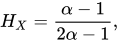
showing that for *α* = *β* the harmonic mean ranges from 0, for *α* = *β* = 1, to 1/2, for *α* = *β* → ∞.
Following are the limits with one parameter finite (non-zero) and the other approaching these limits:
lim α → 0 H X is undefined lim α → 1 H X \= lim β → ∞ H X \= 0 lim β → 0 H X \= lim α → ∞ H X \= 1 {\\displaystyle {\\begin{aligned}&\\lim \_{\\alpha \\to 0}H\_{X}{\\text{ is undefined}}\\\\&\\lim \_{\\alpha \\to 1}H\_{X}=\\lim \_{\\beta \\to \\infty }H\_{X}=0\\\\&\\lim \_{\\beta \\to 0}H\_{X}=\\lim \_{\\alpha \\to \\infty }H\_{X}=1\\end{aligned}}} 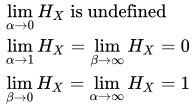
The harmonic mean plays a role in maximum likelihood estimation for the four parameter case, in addition to the geometric mean. Actually, when performing maximum likelihood estimation for the four parameter case, besides the harmonic mean *HX* based on the random variable *X*, also another harmonic mean appears naturally: the harmonic mean based on the linear transformation (1 − *X*), the mirror-image of *X*, denoted by *H*1 − *X*:
H 1 − X \= 1 E \[ 1 1 − X \] \= β − 1 α \+ β − 1 if β \> 1 , and α \> 0\. {\\displaystyle H\_{1-X}={\\frac {1}{\\operatorname {E} \\left\[{\\frac {1}{1-X}}\\right\]}}={\\frac {\\beta -1}{\\alpha +\\beta -1}}{\\text{ if }}\\beta \>1,{\\text{ and }}\\alpha \>0.} ![{\\displaystyle H\_{1-X}={\\frac {1}{\\operatorname {E} \\left\[{\\frac {1}{1-X}}\\right\]}}={\\frac {\\beta -1}{\\alpha +\\beta -1}}{\\text{ if }}\\beta \>1,{\\text{ and }}\\alpha \>0.}](https://wikimedia.org/api/rest_v1/media/math/render/svg/48f4fd69f20c4259cb8a50e754df8dfed5a1ddca)
The [harmonic mean](https://en.wikipedia.org/wiki/Harmonic_mean "Harmonic mean") (*H*(1 − *X*)) of a beta distribution with *β* \< 1 is undefined, because its defining expression is not bounded in \[0, 1\] for shape parameter *β* less than unity.
Letting *α* = *β* in the above expression one obtains
H ( 1 − X ) \= β − 1 2 β − 1 , {\\displaystyle H\_{(1-X)}={\\frac {\\beta -1}{2\\beta -1}},} 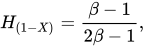
showing that for *α* = *β* the harmonic mean ranges from 0, for *α* = *β* = 1, to 1/2, for *α* = *β* → ∞.
Following are the limits with one parameter finite (non-zero) and the other approaching these limits:
lim β → 0 H 1 − X is undefined lim β → 1 H 1 − X \= lim α → ∞ H 1 − X \= 0 lim α → 0 H 1 − X \= lim β → ∞ H 1 − X \= 1 {\\displaystyle {\\begin{aligned}&\\lim \_{\\beta \\to 0}H\_{1-X}{\\text{ is undefined}}\\\\&\\lim \_{\\beta \\to 1}H\_{1-X}=\\lim \_{\\alpha \\to \\infty }H\_{1-X}=0\\\\&\\lim \_{\\alpha \\to 0}H\_{1-X}=\\lim \_{\\beta \\to \\infty }H\_{1-X}=1\\end{aligned}}} 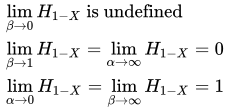
Although both *H**X* and *H*1−*X* are asymmetric, in the case that both shape parameters are equal *α* = *β*, the harmonic means are equal: *H**X* = *H*1−*X*. This equality follows from the following symmetry displayed between both harmonic means:
H X ( B ( α , β ) ) \= H 1 − X ( B ( β , α ) ) if α , β \> 1\. {\\displaystyle H\_{X}(\\mathrm {B} (\\alpha ,\\beta ))=H\_{1-X}(\\mathrm {B} (\\beta ,\\alpha )){\\text{ if }}\\alpha ,\\beta \>1.} 
### Measures of statistical dispersion
\[[edit](https://en.wikipedia.org/w/index.php?title=Beta_distribution&action=edit§ion=17 "Edit section: Measures of statistical dispersion")\]
#### Variance
\[[edit](https://en.wikipedia.org/w/index.php?title=Beta_distribution&action=edit§ion=18 "Edit section: Variance")\]
The [variance](https://en.wikipedia.org/wiki/Variance "Variance") (the second moment centered on the mean) of a beta distribution [random variable](https://en.wikipedia.org/wiki/Random_variable "Random variable") *X* with parameters *α* and *β* is:[\[1\]](https://en.wikipedia.org/wiki/Beta_distribution#cite_note-JKB-1)[\[14\]](https://en.wikipedia.org/wiki/Beta_distribution#cite_note-14)
var ( X ) \= E \[ ( X − μ ) 2 \] \= α β ( α \+ β ) 2 ( α \+ β \+ 1 ) {\\displaystyle \\operatorname {var} (X)=\\operatorname {E} \\left\[(X-\\mu )^{2}\\right\]={\\frac {\\alpha \\beta }{\\left(\\alpha +\\beta \\right)^{2}\\left(\\alpha +\\beta +1\\right)}}} ![{\\displaystyle \\operatorname {var} (X)=\\operatorname {E} \\left\[(X-\\mu )^{2}\\right\]={\\frac {\\alpha \\beta }{\\left(\\alpha +\\beta \\right)^{2}\\left(\\alpha +\\beta +1\\right)}}}](https://wikimedia.org/api/rest_v1/media/math/render/svg/d7d2effe47b57f9a004264ee6aac04029d3954de)
Letting *α* = *β* in the above expression one obtains
var ( X ) \= 1 4 ( 2 β \+ 1 ) , {\\displaystyle \\operatorname {var} (X)={\\frac {1}{4(2\\beta +1)}},} 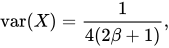
showing that for *α* = *β* the variance decreases monotonically as *α* = *β* increases. Setting *α* = *β* = 0 in this expression, one finds the maximum variance var(*X*) = 1/4[\[1\]](https://en.wikipedia.org/wiki/Beta_distribution#cite_note-JKB-1) which only occurs approaching the limit, at *α* = *β* = 0.
The beta distribution may also be [parametrized](https://en.wikipedia.org/wiki/Statistical_parameter "Statistical parameter") in terms of its mean *μ* (0 \< *μ* \< 1) and sample size *ν* = *α* + *β* (*ν* \> 0) (see subsection [Mean and sample size](https://en.wikipedia.org/wiki/Beta_distribution#Mean_and_sample_size)):
α \= μ ν , where ν \= ( α \+ β ) \> 0 , β \= ( 1 − μ ) ν , where ν \= ( α \+ β ) \> 0\. {\\displaystyle {\\begin{aligned}\\alpha &=\\mu \\nu ,&{\\text{ where }}\\nu =(\\alpha +\\beta )\>0,\\\\\\beta &=(1-\\mu )\\nu ,&{\\text{ where }}\\nu =(\\alpha +\\beta )\>0.\\end{aligned}}} 
Using this [parametrization](https://en.wikipedia.org/wiki/Statistical_parameter "Statistical parameter"), one can express the variance in terms of the mean *μ* and the sample size *ν* as follows:
var ( X ) \= μ ( 1 − μ ) 1 \+ ν {\\displaystyle \\operatorname {var} (X)={\\frac {\\mu (1-\\mu )}{1+\\nu }}} 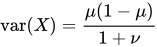
Since *ν* = *α* + *β* \> 0, it follows that var(*X*) \< *μ*(1 − *μ*).
For a symmetric distribution, the mean is at the middle of the distribution, *μ* = 1/2, and therefore:
var ( X ) \= 1 4 ( 1 \+ ν ) if μ \= 1 2 {\\displaystyle \\operatorname {var} (X)={\\frac {1}{4(1+\\nu )}}{\\text{ if }}\\mu ={\\tfrac {1}{2}}} 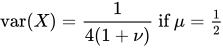
Also, the following limits (with only the noted variable approaching the limit) can be obtained from the above expressions:
lim β → 0 var ( X ) \= lim α → 0 var ( X ) \= lim β → ∞ var ( X ) \= lim α → ∞ var ( X ) \= 0 lim ν → ∞ var ( X ) \= lim μ → 0 var ( X ) \= lim μ → 1 var ( X ) \= 0 lim ν → 0 var ( X ) \= μ ( 1 − μ ) {\\displaystyle {\\begin{aligned}&\\lim \_{\\beta \\to 0}\\operatorname {var} (X)=\\lim \_{\\alpha \\to 0}\\operatorname {var} (X)=\\lim \_{\\beta \\to \\infty }\\operatorname {var} (X)=\\lim \_{\\alpha \\to \\infty }\\operatorname {var} (X)=0\\\\&\\lim \_{\\nu \\to \\infty }\\operatorname {var} (X)=\\lim \_{\\mu \\to 0}\\operatorname {var} (X)=\\lim \_{\\mu \\to 1}\\operatorname {var} (X)=0\\\\&\\lim \_{\\nu \\to 0}\\operatorname {var} (X)=\\mu (1-\\mu )\\end{aligned}}} 
[](https://en.wikipedia.org/wiki/File:Variance_for_Beta_Distribution_for_alpha_and_beta_ranging_from_0_to_5_-_J._Rodal.jpg)
#### Geometric variance and covariance
\[[edit](https://en.wikipedia.org/w/index.php?title=Beta_distribution&action=edit§ion=19 "Edit section: Geometric variance and covariance")\]
[](https://en.wikipedia.org/wiki/File:Beta_distribution_log_geometric_variances_front_view_-_J._Rodal.png)
log geometric variances vs. *α* and *β*
[](https://en.wikipedia.org/wiki/File:Beta_distribution_log_geometric_variances_back_view_-_J._Rodal.png)
log geometric variances vs. *α* and *β*
The logarithm of the geometric variance, ln(var*GX*), of a distribution with [random variable](https://en.wikipedia.org/wiki/Random_variable "Random variable") *X* is the second moment of the logarithm of *X* centered on the geometric mean of *X*, ln(*GX*):
ln var G X \= E \[ ( ln X − ln G X ) 2 \] \= E \[ ( ln X − E \[ ln X \] ) 2 \] \= E \[ ( ln X ) 2 \] − ( E \[ ln X \] ) 2 \= var \[ ln X \] {\\displaystyle {\\begin{aligned}\\ln \\operatorname {var} \_{GX}&=\\operatorname {E} \\left\[\\left(\\ln X-\\ln G\_{X}\\right)^{2}\\right\]\\\\&=\\operatorname {E} \\left\[\\left(\\ln X-\\operatorname {E} \\left\[\\ln X\\right\]\\right)^{2}\\right\]\\\\&=\\operatorname {E} \\left\[\\left(\\ln X\\right)^{2}\\right\]-\\left(\\operatorname {E} \[\\ln X\]\\right)^{2}\\\\&=\\operatorname {var} \[\\ln X\]\\end{aligned}}} ![{\\displaystyle {\\begin{aligned}\\ln \\operatorname {var} \_{GX}&=\\operatorname {E} \\left\[\\left(\\ln X-\\ln G\_{X}\\right)^{2}\\right\]\\\\&=\\operatorname {E} \\left\[\\left(\\ln X-\\operatorname {E} \\left\[\\ln X\\right\]\\right)^{2}\\right\]\\\\&=\\operatorname {E} \\left\[\\left(\\ln X\\right)^{2}\\right\]-\\left(\\operatorname {E} \[\\ln X\]\\right)^{2}\\\\&=\\operatorname {var} \[\\ln X\]\\end{aligned}}}](https://wikimedia.org/api/rest_v1/media/math/render/svg/03642aabe02f83fe6e01e5a136c245d82b898904)
and therefore, the geometric variance is:
var G X \= e var \[ ln X \] {\\displaystyle \\operatorname {var} \_{GX}=e^{\\operatorname {var} \[\\ln X\]}} ![{\\displaystyle \\operatorname {var} \_{GX}=e^{\\operatorname {var} \[\\ln X\]}}](https://wikimedia.org/api/rest_v1/media/math/render/svg/524cf664ccfd5eb381fd1987926209f1c401a200)
In the [Fisher information](https://en.wikipedia.org/wiki/Fisher_information "Fisher information") matrix, and the curvature of the log [likelihood function](https://en.wikipedia.org/wiki/Likelihood_function "Likelihood function"), the logarithm of the geometric variance of the [reflected](https://en.wikipedia.org/wiki/Reflection_formula "Reflection formula") variable 1 − *X* and the logarithm of the geometric covariance between *X* and 1 − *X* appear:
ln v a r G ( 1 \- X ) \= E \[ ( ln ( 1 − X ) − ln G 1 − X ) 2 \] \= E \[ ( ln ( 1 − X ) − E \[ ln ( 1 − X ) \] ) 2 \] \= E \[ ( ln ( 1 − X ) ) 2 \] − ( E \[ ln ( 1 − X ) \] ) 2 \= var \[ ln ( 1 − X ) \] v a r G ( 1 \- X ) \= e var \[ ln ( 1 − X ) \] ln c o v G X , 1 \- X \= E \[ ( ln X − ln G X ) ( ln ( 1 − X ) − ln G 1 − X ) \] \= E \[ ( ln X − E \[ ln X \] ) ( ln ( 1 − X ) − E \[ ln ( 1 − X ) \] ) \] \= E \[ ln X ln ( 1 − X ) \] − E \[ ln X \] E \[ ln ( 1 − X ) \] \= cov \[ ln X , ln ( 1 − X ) \] cov G X , ( 1 − X ) \= e cov \[ ln X , ln ( 1 − X ) \] {\\displaystyle {\\begin{aligned}\\ln \\operatorname {var\_{G(1-X)}} &=\\operatorname {E} \\left\[\\left(\\ln(1-X)-\\ln G\_{1-X}\\right)^{2}\\right\]\\\\&=\\operatorname {E} \\left\[\\left(\\ln(1-X)-\\operatorname {E} \[\\ln(1-X)\]\\right)^{2}\\right\]\\\\&=\\operatorname {E} \\left\[(\\ln(1-X))^{2}\\right\]-\\left(\\operatorname {E} \[\\ln(1-X)\]\\right)^{2}\\\\&=\\operatorname {var} \[\\ln(1-X)\]\\\\&\\\\\\operatorname {var\_{G(1-X)}} &=e^{\\operatorname {var} \[\\ln(1-X)\]}\\\\&\\\\\\ln \\operatorname {cov\_{G{X,1-X}}} &=\\operatorname {E} \[(\\ln X-\\ln G\_{X})(\\ln(1-X)-\\ln G\_{1-X})\]\\\\&=\\operatorname {E} \[(\\ln X-\\operatorname {E} \[\\ln X\])(\\ln(1-X)-\\operatorname {E} \[\\ln(1-X)\])\]\\\\&=\\operatorname {E} \\left\[\\ln X\\ln(1-X)\\right\]-\\operatorname {E} \[\\ln X\]\\operatorname {E} \[\\ln(1-X)\]\\\\&=\\operatorname {cov} \[\\ln X,\\ln(1-X)\]\\\\&\\\\\\operatorname {cov} \_{G{X,(1-X)}}&=e^{\\operatorname {cov} \[\\ln X,\\ln(1-X)\]}\\end{aligned}}} ![{\\displaystyle {\\begin{aligned}\\ln \\operatorname {var\_{G(1-X)}} &=\\operatorname {E} \\left\[\\left(\\ln(1-X)-\\ln G\_{1-X}\\right)^{2}\\right\]\\\\&=\\operatorname {E} \\left\[\\left(\\ln(1-X)-\\operatorname {E} \[\\ln(1-X)\]\\right)^{2}\\right\]\\\\&=\\operatorname {E} \\left\[(\\ln(1-X))^{2}\\right\]-\\left(\\operatorname {E} \[\\ln(1-X)\]\\right)^{2}\\\\&=\\operatorname {var} \[\\ln(1-X)\]\\\\&\\\\\\operatorname {var\_{G(1-X)}} &=e^{\\operatorname {var} \[\\ln(1-X)\]}\\\\&\\\\\\ln \\operatorname {cov\_{G{X,1-X}}} &=\\operatorname {E} \[(\\ln X-\\ln G\_{X})(\\ln(1-X)-\\ln G\_{1-X})\]\\\\&=\\operatorname {E} \[(\\ln X-\\operatorname {E} \[\\ln X\])(\\ln(1-X)-\\operatorname {E} \[\\ln(1-X)\])\]\\\\&=\\operatorname {E} \\left\[\\ln X\\ln(1-X)\\right\]-\\operatorname {E} \[\\ln X\]\\operatorname {E} \[\\ln(1-X)\]\\\\&=\\operatorname {cov} \[\\ln X,\\ln(1-X)\]\\\\&\\\\\\operatorname {cov} \_{G{X,(1-X)}}&=e^{\\operatorname {cov} \[\\ln X,\\ln(1-X)\]}\\end{aligned}}}](https://wikimedia.org/api/rest_v1/media/math/render/svg/657c11ca41846366cb8d9843536af9e002ea4cdf)
For a beta distribution, higher order logarithmic moments can be derived by using the representation of a beta distribution as a proportion of two gamma distributions and differentiating through the integral. They can be expressed in terms of higher order poly-gamma functions. See the section [§ Moments of logarithmically transformed random variables](https://en.wikipedia.org/wiki/Beta_distribution#Moments_of_logarithmically_transformed_random_variables). The [variance](https://en.wikipedia.org/wiki/Variance "Variance") of the logarithmic variables and [covariance](https://en.wikipedia.org/wiki/Covariance "Covariance") of ln *X* and ln(1−*X*) are:
var \[ ln X \] \= ψ 1 ( α ) − ψ 1 ( α \+ β ) {\\displaystyle \\operatorname {var} \[\\ln X\]=\\psi \_{1}(\\alpha )-\\psi \_{1}(\\alpha +\\beta )} ![{\\displaystyle \\operatorname {var} \[\\ln X\]=\\psi \_{1}(\\alpha )-\\psi \_{1}(\\alpha +\\beta )}](https://wikimedia.org/api/rest_v1/media/math/render/svg/e396e8700267735eb741f73e8906445579c43bc6) var \[ ln ( 1 − X ) \] \= ψ 1 ( β ) − ψ 1 ( α \+ β ) {\\displaystyle \\operatorname {var} \[\\ln(1-X)\]=\\psi \_{1}(\\beta )-\\psi \_{1}(\\alpha +\\beta )} ![{\\displaystyle \\operatorname {var} \[\\ln(1-X)\]=\\psi \_{1}(\\beta )-\\psi \_{1}(\\alpha +\\beta )}](https://wikimedia.org/api/rest_v1/media/math/render/svg/70eefadef46c7d56cc13c8221aa3df1d71596b7f) cov \[ ln X , ln ( 1 − X ) \] \= − ψ 1 ( α \+ β ) {\\displaystyle \\operatorname {cov} \[\\ln X,\\ln(1-X)\]=-\\psi \_{1}(\\alpha +\\beta )} ![{\\displaystyle \\operatorname {cov} \[\\ln X,\\ln(1-X)\]=-\\psi \_{1}(\\alpha +\\beta )}](https://wikimedia.org/api/rest_v1/media/math/render/svg/e7a515ada0b9d62c5a3a7b35662b03256d66e3b9)
where the **[trigamma function](https://en.wikipedia.org/wiki/Trigamma_function "Trigamma function")**, denoted *ψ*1(*α*), is the second of the [polygamma functions](https://en.wikipedia.org/wiki/Polygamma_function "Polygamma function"), and is defined as the derivative of the [digamma function](https://en.wikipedia.org/wiki/Digamma_function "Digamma function"):
ψ 1 ( α ) \= d 2 ln Γ ( α ) d α 2 \= d ψ ( α ) d α . {\\displaystyle \\psi \_{1}(\\alpha )={\\frac {d^{2}\\ln \\Gamma (\\alpha )}{d\\alpha ^{2}}}={\\frac {d\\psi (\\alpha )}{d\\alpha }}.} 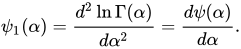
Therefore,
ln var G X \= var \[ ln X \] \= ψ 1 ( α ) − ψ 1 ( α \+ β ) {\\displaystyle \\ln \\operatorname {var} \_{GX}=\\operatorname {var} \[\\ln X\]=\\psi \_{1}(\\alpha )-\\psi \_{1}(\\alpha +\\beta )} ![{\\displaystyle \\ln \\operatorname {var} \_{GX}=\\operatorname {var} \[\\ln X\]=\\psi \_{1}(\\alpha )-\\psi \_{1}(\\alpha +\\beta )}](https://wikimedia.org/api/rest_v1/media/math/render/svg/194b00552edda5d8d026a24872cdb27b604516c9) ln var G ( 1 − X ) \= var \[ ln ( 1 − X ) \] \= ψ 1 ( β ) − ψ 1 ( α \+ β ) {\\displaystyle \\ln \\operatorname {var} \_{G(1-X)}=\\operatorname {var} \[\\ln(1-X)\]=\\psi \_{1}(\\beta )-\\psi \_{1}(\\alpha +\\beta )} ![{\\displaystyle \\ln \\operatorname {var} \_{G(1-X)}=\\operatorname {var} \[\\ln(1-X)\]=\\psi \_{1}(\\beta )-\\psi \_{1}(\\alpha +\\beta )}](https://wikimedia.org/api/rest_v1/media/math/render/svg/96dd82553307c025c84da68a3c373aad7467abd2) ln cov G X , 1 − X \= cov \[ ln X , ln ( 1 − X ) \] \= − ψ 1 ( α \+ β ) {\\displaystyle \\ln \\operatorname {cov} \_{GX,1-X}=\\operatorname {cov} \[\\ln X,\\ln(1-X)\]=-\\psi \_{1}(\\alpha +\\beta )} ![{\\displaystyle \\ln \\operatorname {cov} \_{GX,1-X}=\\operatorname {cov} \[\\ln X,\\ln(1-X)\]=-\\psi \_{1}(\\alpha +\\beta )}](https://wikimedia.org/api/rest_v1/media/math/render/svg/40a793c0271e457f671edb0668edc15bbae8740f)
The accompanying plots show the log geometric variances and log geometric covariance versus the shape parameters *α* and *β*. The plots show that the log geometric variances and log geometric covariance are close to zero for shape parameters *α* and *β* greater than 2, and that the log geometric variances rapidly rise in value for shape parameter values *α* and *β* less than unity. The log geometric variances are positive for all values of the shape parameters. The log geometric covariance is negative for all values of the shape parameters, and it reaches large negative values for *α* and *β* less than unity.
Following are the limits with one parameter finite (non-zero) and the other approaching these limits:
lim α → 0 ln var G X \= lim β → 0 ln var G ( 1 − X ) \= ∞ lim β → 0 ln var G X \= lim α → ∞ ln var G X \= lim α → 0 ln var G ( 1 − X ) \= lim β → ∞ ln var G ( 1 − X ) \= 0 lim α → ∞ ln cov G X , ( 1 − X ) \= lim β → ∞ ln cov G X , ( 1 − X ) \= 0 lim β → ∞ ln var G X \= ψ 1 ( α ) lim α → ∞ ln var G ( 1 − X ) \= ψ 1 ( β ) lim α → 0 ln cov G X , ( 1 − X ) \= − ψ 1 ( β ) lim β → 0 ln cov G X , ( 1 − X ) \= − ψ 1 ( α ) {\\displaystyle {\\begin{aligned}&\\lim \_{\\alpha \\to 0}\\ln \\operatorname {var} \_{GX}=\\lim \_{\\beta \\to 0}\\ln \\operatorname {var} \_{G(1-X)}=\\infty \\\\&\\lim \_{\\beta \\to 0}\\ln \\operatorname {var} \_{GX}=\\lim \_{\\alpha \\to \\infty }\\ln \\operatorname {var} \_{GX}=\\lim \_{\\alpha \\to 0}\\ln \\operatorname {var} \_{G(1-X)}=\\lim \_{\\beta \\to \\infty }\\ln \\operatorname {var} \_{G(1-X)}=0\\\\&\\lim \_{\\alpha \\to \\infty }\\ln \\operatorname {cov} \_{GX,(1-X)}=\\lim \_{\\beta \\to \\infty }\\ln \\operatorname {cov} \_{GX,(1-X)}=0\\\\&\\lim \_{\\beta \\to \\infty }\\ln \\operatorname {var} \_{GX}=\\psi \_{1}(\\alpha )\\\\&\\lim \_{\\alpha \\to \\infty }\\ln \\operatorname {var} \_{G(1-X)}=\\psi \_{1}(\\beta )\\\\&\\lim \_{\\alpha \\to 0}\\ln \\operatorname {cov} \_{GX,(1-X)}=-\\psi \_{1}(\\beta )\\\\&\\lim \_{\\beta \\to 0}\\ln \\operatorname {cov} \_{GX,(1-X)}=-\\psi \_{1}(\\alpha )\\end{aligned}}} 
Limits with two parameters varying:
lim α → ∞ ( lim β → ∞ ln var G X ) \= lim β → ∞ ( lim α → ∞ ln var G ( 1 − X ) ) \= lim α → ∞ ( lim β → 0 ln cov G X , ( 1 − X ) ) \= lim β → ∞ ( lim α → 0 ln cov G X , ( 1 − X ) ) \= 0 lim α → ∞ ( lim β → 0 ln var G X ) \= lim β → ∞ ( lim α → 0 ln var G ( 1 − X ) ) \= ∞ lim α → 0 ( lim β → 0 ln cov G X , ( 1 − X ) ) \= lim β → 0 ( lim α → 0 ln cov G X , ( 1 − X ) ) \= − ∞ {\\displaystyle {\\begin{aligned}&\\lim \_{\\alpha \\to \\infty }(\\lim \_{\\beta \\to \\infty }\\ln \\operatorname {var} \_{GX})=\\lim \_{\\beta \\to \\infty }(\\lim \_{\\alpha \\to \\infty }\\ln \\operatorname {var} \_{G(1-X)})=\\lim \_{\\alpha \\to \\infty }(\\lim \_{\\beta \\to 0}\\ln \\operatorname {cov} \_{GX,(1-X)})=\\lim \_{\\beta \\to \\infty }(\\lim \_{\\alpha \\to 0}\\ln \\operatorname {cov} \_{GX,(1-X)})=0\\\\&\\lim \_{\\alpha \\to \\infty }(\\lim \_{\\beta \\to 0}\\ln \\operatorname {var} \_{GX})=\\lim \_{\\beta \\to \\infty }(\\lim \_{\\alpha \\to 0}\\ln \\operatorname {var} \_{G(1-X)})=\\infty \\\\&\\lim \_{\\alpha \\to 0}(\\lim \_{\\beta \\to 0}\\ln \\operatorname {cov} \_{GX,(1-X)})=\\lim \_{\\beta \\to 0}(\\lim \_{\\alpha \\to 0}\\ln \\operatorname {cov} \_{GX,(1-X)})=-\\infty \\end{aligned}}} 
Although both ln(var*GX*) and ln(var*G*(1 − *X*)) are asymmetric, when the shape parameters are equal, *α* = *β*, one has: ln(var*GX*) = ln(var*G*(1−*X*)). This equality follows from the following symmetry displayed between both log geometric variances:
ln var G X ( B ( α , β ) ) \= ln var G ( 1 − X ) ( B ( β , α ) ) . {\\displaystyle \\ln \\operatorname {var} \_{GX}(\\mathrm {B} (\\alpha ,\\beta ))=\\ln \\operatorname {var} \_{G(1-X)}(\\mathrm {B} (\\beta ,\\alpha )).} 
The log geometric covariance is symmetric:
ln cov G X , ( 1 − X ) ( B ( α , β ) ) \= ln cov G X , ( 1 − X ) ( B ( β , α ) ) {\\displaystyle \\ln \\operatorname {cov} \_{GX,(1-X)}(\\mathrm {B} (\\alpha ,\\beta ))=\\ln \\operatorname {cov} \_{GX,(1-X)}(\\mathrm {B} (\\beta ,\\alpha ))} 
#### Mean absolute deviation around the mean
\[[edit](https://en.wikipedia.org/w/index.php?title=Beta_distribution&action=edit§ion=20 "Edit section: Mean absolute deviation around the mean")\]
[](https://en.wikipedia.org/wiki/File:Ratio_of_Mean_Abs._Dev._to_Std.Dev._Beta_distribution_with_alpha_and_beta_from_0_to_5_-_J._Rodal.jpg)
Ratio of, ean abs.dev. to std.dev. for beta distribution with α and β ranging from 0 to 5
[](https://en.wikipedia.org/wiki/File:Ratio_of_Mean_Abs._Dev._to_Std.Dev._Beta_distribution_vs._nu_from_0_to_10_and_vs._mean_-_J._Rodal.jpg)
Ratio of mean abs.dev. to std.dev. for beta distribution with mean 0 ≤ *μ* ≤ 1 and sample size 0 \< *ν* ≤ 10
The [mean absolute deviation](https://en.wikipedia.org/wiki/Mean_absolute_deviation "Mean absolute deviation") around the mean for the beta distribution with shape parameters *α* and *β* is:[\[9\]](https://en.wikipedia.org/wiki/Beta_distribution#cite_note-Handbook_of_Beta_Distribution-9)
E \[ \| X − E \[ X \] \| \] \= 2 α α β β B ( α , β ) ( α \+ β ) α \+ β \+ 1 {\\displaystyle \\operatorname {E} \[\|X-E\[X\]\|\]={\\frac {2\\alpha ^{\\alpha }\\beta ^{\\beta }}{\\mathrm {B} (\\alpha ,\\beta )(\\alpha +\\beta )^{\\alpha +\\beta +1}}}} ![{\\displaystyle \\operatorname {E} \[\|X-E\[X\]\|\]={\\frac {2\\alpha ^{\\alpha }\\beta ^{\\beta }}{\\mathrm {B} (\\alpha ,\\beta )(\\alpha +\\beta )^{\\alpha +\\beta +1}}}}](https://wikimedia.org/api/rest_v1/media/math/render/svg/6d1c6330a91df22b40cedc7903dbc70120d66cf9)
The mean absolute deviation around the mean is a more [robust](https://en.wikipedia.org/wiki/Robust_statistics "Robust statistics") [estimator](https://en.wikipedia.org/wiki/Estimator "Estimator") of [statistical dispersion](https://en.wikipedia.org/wiki/Statistical_dispersion "Statistical dispersion") than the standard deviation for beta distributions with tails and inflection points at each side of the mode, Beta(*α*, *β*) distributions with *α*,*β* \> 2, as it depends on the linear (absolute) deviations rather than the square deviations from the mean. Therefore, the effect of very large deviations from the mean are not as overly weighted.
Using [Stirling's approximation](https://en.wikipedia.org/wiki/Stirling%27s_approximation "Stirling's approximation") to the [Gamma function](https://en.wikipedia.org/wiki/Gamma_function "Gamma function"), [N.L.Johnson](https://en.wikipedia.org/wiki/Norman_Lloyd_Johnson "Norman Lloyd Johnson") and [S.Kotz](https://en.wikipedia.org/wiki/Samuel_Kotz "Samuel Kotz")[\[1\]](https://en.wikipedia.org/wiki/Beta_distribution#cite_note-JKB-1) derived the following approximation for values of the shape parameters greater than unity (the relative error for this approximation is only −3.5% for *α* = *β* = 1, and it decreases to zero as *α* → ∞, *β* → ∞):
mean abs. dev. from mean standard deviation \= E \[ \| X − E \[ X \] \| \] var ( X ) ≈ 2 π ( 1 \+ 7 12 ( α \+ β ) − 1 12 α − 1 12 β ) , if α , β \> 1\. {\\displaystyle {\\begin{aligned}{\\frac {\\text{mean abs. dev. from mean}}{\\text{standard deviation}}}&={\\frac {\\operatorname {E} \[\|X-E\[X\]\|\]}{\\sqrt {\\operatorname {var} (X)}}}\\\\&\\approx {\\sqrt {\\frac {2}{\\pi }}}\\left(1+{\\frac {7}{12(\\alpha +\\beta )}}{}-{\\frac {1}{12\\alpha }}-{\\frac {1}{12\\beta }}\\right),{\\text{ if }}\\alpha ,\\beta \>1.\\end{aligned}}} ![{\\displaystyle {\\begin{aligned}{\\frac {\\text{mean abs. dev. from mean}}{\\text{standard deviation}}}&={\\frac {\\operatorname {E} \[\|X-E\[X\]\|\]}{\\sqrt {\\operatorname {var} (X)}}}\\\\&\\approx {\\sqrt {\\frac {2}{\\pi }}}\\left(1+{\\frac {7}{12(\\alpha +\\beta )}}{}-{\\frac {1}{12\\alpha }}-{\\frac {1}{12\\beta }}\\right),{\\text{ if }}\\alpha ,\\beta \>1.\\end{aligned}}}](https://wikimedia.org/api/rest_v1/media/math/render/svg/c196a5a2eb110b71471a3dc019241c6cb8c3f927)
At the limit *α* → ∞, *β* → ∞, the ratio of the mean absolute deviation to the standard deviation (for the beta distribution) becomes equal to the ratio of the same measures for the normal distribution: 2 π {\\displaystyle {\\sqrt {\\frac {2}{\\pi }}}} . For *α* = *β* = 1 this ratio equals 3 2 {\\displaystyle {\\frac {\\sqrt {3}}{2}}} , so that from *α* = *β* = 1 to *α*, *β* → ∞ the ratio decreases by 8.5%. For *α* = *β* = 0 the standard deviation is exactly equal to the mean absolute deviation around the mean. Therefore, this ratio decreases by 15% from *α* = *β* = 0 to *α* = *β* = 1, and by 25% from *α* = *β* = 0 to *α*, *β* → ∞ . However, for skewed beta distributions such that *α* → 0 or *β* → 0, the ratio of the standard deviation to the mean absolute deviation approaches infinity (although each of them, individually, approaches zero) because the mean absolute deviation approaches zero faster than the standard deviation.
Using the [parametrization](https://en.wikipedia.org/wiki/Statistical_parameter "Statistical parameter") in terms of mean *μ* and sample size *ν* = *α* + *β* \> 0:
*α* = *μν*, *β* = (1 − *μ*)*ν*
one can express the mean [absolute deviation](https://en.wikipedia.org/wiki/Absolute_deviation "Absolute deviation") around the mean in terms of the mean *μ* and the sample size *ν* as follows:
E \[ \| X − E \[ X \] \| \] \= 2 μ μ ν ( 1 − μ ) ( 1 − μ ) ν ν B ( μ ν , ( 1 − μ ) ν ) {\\displaystyle \\operatorname {E} \[\|X-E\[X\]\|\]={\\frac {2\\mu ^{\\mu \\nu }(1-\\mu )^{(1-\\mu )\\nu }}{\\nu \\mathrm {B} (\\mu \\nu ,(1-\\mu )\\nu )}}} ![{\\displaystyle \\operatorname {E} \[\|X-E\[X\]\|\]={\\frac {2\\mu ^{\\mu \\nu }(1-\\mu )^{(1-\\mu )\\nu }}{\\nu \\mathrm {B} (\\mu \\nu ,(1-\\mu )\\nu )}}}](https://wikimedia.org/api/rest_v1/media/math/render/svg/027efecf8aaefea8c805194e47a1374ffcb63cb8)
For a symmetric distribution, the mean is at the middle of the distribution, *μ* = 1/2, and therefore:
E \[ \| X − E \[ X \] \| \] \= 2 1 − ν ν B ( ν 2 , ν 2 ) \= 2 1 − ν Γ ( ν ) ν ( Γ ( ν 2 ) ) 2 lim ν → 0 ( lim μ → 1 2 E \[ \| X − E \[ X \] \| \] ) \= 1 2 lim ν → ∞ ( lim μ → 1 2 E \[ \| X − E \[ X \] \| \] ) \= 0 {\\displaystyle {\\begin{aligned}\\operatorname {E} \[\|X-E\[X\]\|\]={\\frac {2^{1-\\nu }}{\\nu \\mathrm {B} ({\\tfrac {\\nu }{2}},{\\tfrac {\\nu }{2}})}}&={\\frac {2^{1-\\nu }\\Gamma (\\nu )}{\\nu (\\Gamma ({\\tfrac {\\nu }{2}}))^{2}}}\\\\\\lim \_{\\nu \\to 0}\\left(\\lim \_{\\mu \\to {\\frac {1}{2}}}\\operatorname {E} \[\|X-E\[X\]\|\]\\right)&={\\frac {1}{2}}\\\\\\lim \_{\\nu \\to \\infty }\\left(\\lim \_{\\mu \\to {\\frac {1}{2}}}\\operatorname {E} \[\|X-E\[X\]\|\]\\right)&=0\\end{aligned}}} ![{\\displaystyle {\\begin{aligned}\\operatorname {E} \[\|X-E\[X\]\|\]={\\frac {2^{1-\\nu }}{\\nu \\mathrm {B} ({\\tfrac {\\nu }{2}},{\\tfrac {\\nu }{2}})}}&={\\frac {2^{1-\\nu }\\Gamma (\\nu )}{\\nu (\\Gamma ({\\tfrac {\\nu }{2}}))^{2}}}\\\\\\lim \_{\\nu \\to 0}\\left(\\lim \_{\\mu \\to {\\frac {1}{2}}}\\operatorname {E} \[\|X-E\[X\]\|\]\\right)&={\\frac {1}{2}}\\\\\\lim \_{\\nu \\to \\infty }\\left(\\lim \_{\\mu \\to {\\frac {1}{2}}}\\operatorname {E} \[\|X-E\[X\]\|\]\\right)&=0\\end{aligned}}}](https://wikimedia.org/api/rest_v1/media/math/render/svg/745a053a1ef3cc7edf07332763b401bd09b40e42)
Also, the following limits (with only the noted variable approaching the limit) can be obtained from the above expressions:
lim β → 0 E \[ \| X − E \[ X \] \| \] \= lim α → 0 E \[ \| X − E \[ X \] \| \] \= 0 lim β → ∞ E \[ \| X − E \[ X \] \| \] \= lim α → ∞ E \[ \| X − E \[ X \] \| \] \= 0 lim μ → 0 E \[ \| X − E \[ X \] \| \] \= lim μ → 1 E \[ \| X − E \[ X \] \| \] \= 0 lim ν → 0 E \[ \| X − E \[ X \] \| \] \= μ ( 1 − μ ) lim ν → ∞ E \[ \| X − E \[ X \] \| \] \= 0 {\\displaystyle {\\begin{aligned}\\lim \_{\\beta \\to 0}\\operatorname {E} \[\|X-E\[X\]\|\]&=\\lim \_{\\alpha \\to 0}\\operatorname {E} \[\|X-E\[X\]\|\]=0\\\\\\lim \_{\\beta \\to \\infty }\\operatorname {E} \[\|X-E\[X\]\|\]&=\\lim \_{\\alpha \\to \\infty }\\operatorname {E} \[\|X-E\[X\]\|\]=0\\\\\\lim \_{\\mu \\to 0}\\operatorname {E} \[\|X-E\[X\]\|\]&=\\lim \_{\\mu \\to 1}\\operatorname {E} \[\|X-E\[X\]\|\]=0\\\\\\lim \_{\\nu \\to 0}\\operatorname {E} \[\|X-E\[X\]\|\]&={\\sqrt {\\mu (1-\\mu )}}\\\\\\lim \_{\\nu \\to \\infty }\\operatorname {E} \[\|X-E\[X\]\|\]&=0\\end{aligned}}} ![{\\displaystyle {\\begin{aligned}\\lim \_{\\beta \\to 0}\\operatorname {E} \[\|X-E\[X\]\|\]&=\\lim \_{\\alpha \\to 0}\\operatorname {E} \[\|X-E\[X\]\|\]=0\\\\\\lim \_{\\beta \\to \\infty }\\operatorname {E} \[\|X-E\[X\]\|\]&=\\lim \_{\\alpha \\to \\infty }\\operatorname {E} \[\|X-E\[X\]\|\]=0\\\\\\lim \_{\\mu \\to 0}\\operatorname {E} \[\|X-E\[X\]\|\]&=\\lim \_{\\mu \\to 1}\\operatorname {E} \[\|X-E\[X\]\|\]=0\\\\\\lim \_{\\nu \\to 0}\\operatorname {E} \[\|X-E\[X\]\|\]&={\\sqrt {\\mu (1-\\mu )}}\\\\\\lim \_{\\nu \\to \\infty }\\operatorname {E} \[\|X-E\[X\]\|\]&=0\\end{aligned}}}](https://wikimedia.org/api/rest_v1/media/math/render/svg/87c43b4a05f8ea3acf3f15b0a16f6ee07811ac6b)
#### Mean absolute difference
\[[edit](https://en.wikipedia.org/w/index.php?title=Beta_distribution&action=edit§ion=21 "Edit section: Mean absolute difference")\]
The [mean absolute difference](https://en.wikipedia.org/wiki/Mean_absolute_difference "Mean absolute difference") for the beta distribution is:
M D \= ∫ 0 1 ∫ 0 1 f ( x ; α , β ) f ( y ; α , β ) \| x − y \| d x d y \= 4 α \+ β B ( α \+ β , α \+ β ) B ( α , α ) B ( β , β ) {\\displaystyle {\\begin{aligned}\\mathrm {MD} &=\\int \_{0}^{1}\\int \_{0}^{1}f(x;\\alpha ,\\beta )\\,f(y;\\alpha ,\\beta )\\left\|x-y\\right\|dx\\,dy\\\\\[1ex\]&={\\frac {4}{\\alpha +\\beta }}{\\frac {B(\\alpha +\\beta ,\\alpha +\\beta )}{B(\\alpha ,\\alpha )B(\\beta ,\\beta )}}\\end{aligned}}} ![{\\displaystyle {\\begin{aligned}\\mathrm {MD} &=\\int \_{0}^{1}\\int \_{0}^{1}f(x;\\alpha ,\\beta )\\,f(y;\\alpha ,\\beta )\\left\|x-y\\right\|dx\\,dy\\\\\[1ex\]&={\\frac {4}{\\alpha +\\beta }}{\\frac {B(\\alpha +\\beta ,\\alpha +\\beta )}{B(\\alpha ,\\alpha )B(\\beta ,\\beta )}}\\end{aligned}}}](https://wikimedia.org/api/rest_v1/media/math/render/svg/0de290eea66b8a424727bff1b9a02f53f2607361)
The [Gini coefficient](https://en.wikipedia.org/wiki/Gini_coefficient "Gini coefficient") for the beta distribution is half of the relative mean absolute difference:
G \= ( 2 α ) B ( α \+ β , α \+ β ) B ( α , α ) B ( β , β ) {\\displaystyle \\mathrm {G} =\\left({\\frac {2}{\\alpha }}\\right){\\frac {B(\\alpha +\\beta ,\\alpha +\\beta )}{B(\\alpha ,\\alpha )B(\\beta ,\\beta )}}} 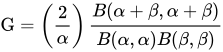
### Skewness
\[[edit](https://en.wikipedia.org/w/index.php?title=Beta_distribution&action=edit§ion=22 "Edit section: Skewness")\]
[](https://en.wikipedia.org/wiki/File:Skewness_for_Beta_Distribution_as_a_function_of_the_variance_and_the_mean_-_J._Rodal.jpg)
Skewness for beta distribution as a function of variance and mean
The [skewness](https://en.wikipedia.org/wiki/Skewness "Skewness") (the third moment centered on the mean, normalized by the 3/2 power of the variance) of the beta distribution is[\[1\]](https://en.wikipedia.org/wiki/Beta_distribution#cite_note-JKB-1)
γ 1 \= E \[ ( X − μ ) 3 \] ( var ( X ) ) 3 / 2 \= 2 ( β − α ) α \+ β \+ 1 ( α \+ β \+ 2 ) α β . {\\displaystyle \\gamma \_{1}={\\frac {\\operatorname {E} \\left\[\\left(X-\\mu \\right)^{3}\\right\]}{\\left(\\operatorname {var} (X)\\right)^{3/2}}}={\\frac {2\\left(\\beta -\\alpha \\right){\\sqrt {\\alpha +\\beta +1}}}{\\left(\\alpha +\\beta +2\\right){\\sqrt {\\alpha \\beta }}}}.} ![{\\displaystyle \\gamma \_{1}={\\frac {\\operatorname {E} \\left\[\\left(X-\\mu \\right)^{3}\\right\]}{\\left(\\operatorname {var} (X)\\right)^{3/2}}}={\\frac {2\\left(\\beta -\\alpha \\right){\\sqrt {\\alpha +\\beta +1}}}{\\left(\\alpha +\\beta +2\\right){\\sqrt {\\alpha \\beta }}}}.}](https://wikimedia.org/api/rest_v1/media/math/render/svg/1c880f0b8322d91fe382f87eaa4f8730faa164ed)
Letting *α* = *β* in the above expression one obtains *γ*1 = 0, showing once again that for *α* = *β* the distribution is symmetric and hence the skewness is zero. Positive skew (right-tailed) for *α* \< *β*, negative skew (left-tailed) for *α* \> *β*.
Using the [parametrization](https://en.wikipedia.org/wiki/Statistical_parameter "Statistical parameter") in terms of mean *μ* and sample size *ν* = *α* + *β*:
α \= μ ν , where ν \= ( α \+ β ) \> 0 , β \= ( 1 − μ ) ν , where ν \= ( α \+ β ) \> 0\. {\\displaystyle {\\begin{aligned}\\alpha &=\\mu \\nu ,&{\\text{ where }}\\nu =(\\alpha +\\beta )\>0,\\\\\\beta &=(1-\\mu )\\nu ,&{\\text{ where }}\\nu =(\\alpha +\\beta )\>0.\\end{aligned}}} 
one can express the skewness in terms of the mean *μ* and the sample size ν as follows:
γ 1 \= E \[ ( X − μ ) 3 \] ( var ( X ) ) 3 / 2 \= 2 ( 1 − 2 μ ) 1 \+ ν ( 2 \+ ν ) μ ( 1 − μ ) . {\\displaystyle \\gamma \_{1}={\\frac {\\operatorname {E} \[(X-\\mu )^{3}\]}{\\left(\\operatorname {var} (X)\\right)^{3/2}}}={\\frac {2(1-2\\mu ){\\sqrt {1+\\nu }}}{(2+\\nu ){\\sqrt {\\mu (1-\\mu )}}}}.} ![{\\displaystyle \\gamma \_{1}={\\frac {\\operatorname {E} \[(X-\\mu )^{3}\]}{\\left(\\operatorname {var} (X)\\right)^{3/2}}}={\\frac {2(1-2\\mu ){\\sqrt {1+\\nu }}}{(2+\\nu ){\\sqrt {\\mu (1-\\mu )}}}}.}](https://wikimedia.org/api/rest_v1/media/math/render/svg/c88399efb587f7d2443ddb232e4b24f2763050b9)
The skewness can also be expressed just in terms of the variance *var* and the mean *μ* as follows:
γ 1 \= E \[ ( X − μ ) 3 \] ( var ( X ) ) 3 / 2 \= 2 ( 1 − 2 μ ) var μ ( 1 − μ ) \+ var if var \< μ ( 1 − μ ) {\\displaystyle \\gamma \_{1}={\\frac {\\operatorname {E} \[(X-\\mu )^{3}\]}{(\\operatorname {var} (X))^{3/2}}}={\\frac {2(1-2\\mu ){\\sqrt {\\operatorname {var} }}}{\\mu (1-\\mu )+\\operatorname {var} }}{\\text{ if }}\\operatorname {var} \<\\mu (1-\\mu )} ![{\\displaystyle \\gamma \_{1}={\\frac {\\operatorname {E} \[(X-\\mu )^{3}\]}{(\\operatorname {var} (X))^{3/2}}}={\\frac {2(1-2\\mu ){\\sqrt {\\operatorname {var} }}}{\\mu (1-\\mu )+\\operatorname {var} }}{\\text{ if }}\\operatorname {var} \<\\mu (1-\\mu )}](https://wikimedia.org/api/rest_v1/media/math/render/svg/6b48373ac7ce8096381e7f74edf9e44bc435ad13)
The accompanying plot of skewness as a function of variance and mean shows that maximum variance (1/4) is coupled with zero skewness and the symmetry condition (*μ* = 1/2), and that maximum skewness (positive or negative infinity) occurs when the mean is located at one end or the other, so that the "mass" of the probability distribution is concentrated at the ends (minimum variance).
The following expression for the square of the skewness, in terms of the sample size *ν* = *α* + *β* and the variance var, is useful for the method of moments estimation of four parameters:
( γ 1 ) 2 \= ( E \[ ( X − μ ) 3 \] ) 2 ( var ( X ) ) 3 \= 4 ( 2 \+ ν ) 2 ( 1 var − 4 ( 1 \+ ν ) ) {\\displaystyle (\\gamma \_{1})^{2}={\\frac {\\left(\\operatorname {E} \[(X-\\mu )^{3}\]\\right)^{2}}{\\left(\\operatorname {var} (X)\\right)^{3}}}={\\frac {4}{(2+\\nu )^{2}}}\\left({\\frac {1}{\\operatorname {var} }}-4(1+\\nu )\\right)} ![{\\displaystyle (\\gamma \_{1})^{2}={\\frac {\\left(\\operatorname {E} \[(X-\\mu )^{3}\]\\right)^{2}}{\\left(\\operatorname {var} (X)\\right)^{3}}}={\\frac {4}{(2+\\nu )^{2}}}\\left({\\frac {1}{\\operatorname {var} }}-4(1+\\nu )\\right)}](https://wikimedia.org/api/rest_v1/media/math/render/svg/b4f7b7d9a6d73e9bbcc43812b8f3fd573bc02ee3)
This expression correctly gives a skewness of zero for *α* = *β*, since in that case (see [§ Variance](https://en.wikipedia.org/wiki/Beta_distribution#Variance)): var \= 1 4 ( 1 \+ ν ) {\\displaystyle \\operatorname {var} ={\\frac {1}{4(1+\\nu )}}} .
For the symmetric case (*α* = *β*), skewness = 0 over the whole range, and the following limits apply:
lim α \= β → 0 γ 1 \= lim α \= β → ∞ γ 1 \= lim ν → 0 γ 1 \= lim ν → ∞ γ 1 \= lim μ → 1 2 γ 1 \= 0 {\\displaystyle \\lim \_{\\alpha =\\beta \\to 0}\\gamma \_{1}=\\lim \_{\\alpha =\\beta \\to \\infty }\\gamma \_{1}=\\lim \_{\\nu \\to 0}\\gamma \_{1}=\\lim \_{\\nu \\to \\infty }\\gamma \_{1}=\\lim \_{\\mu \\to {\\frac {1}{2}}}\\gamma \_{1}=0} 
For the asymmetric cases (*α* ≠ *β*) the following limits (with only the noted variable approaching the limit) can be obtained from the above expressions:
lim α → 0 γ 1 \= lim μ → 0 γ 1 \= ∞ lim β → 0 γ 1 \= lim μ → 1 γ 1 \= − ∞ lim α → ∞ γ 1 \= − 2 β , lim β → 0 ( lim α → ∞ γ 1 ) \= − ∞ , lim β → ∞ ( lim α → ∞ γ 1 ) \= 0 lim β → ∞ γ 1 \= 2 α , lim α → 0 ( lim β → ∞ γ 1 ) \= ∞ , lim α → ∞ ( lim β → ∞ γ 1 ) \= 0 lim ν → 0 γ 1 \= 1 − 2 μ μ ( 1 − μ ) , lim μ → 0 ( lim ν → 0 γ 1 ) \= ∞ , lim μ → 1 ( lim ν → 0 γ 1 ) \= − ∞ {\\displaystyle {\\begin{aligned}&\\lim \_{\\alpha \\to 0}\\gamma \_{1}=\\lim \_{\\mu \\to 0}\\gamma \_{1}=\\infty \\\\&\\lim \_{\\beta \\to 0}\\gamma \_{1}=\\lim \_{\\mu \\to 1}\\gamma \_{1}=-\\infty \\\\&\\lim \_{\\alpha \\to \\infty }\\gamma \_{1}=-{\\frac {2}{\\sqrt {\\beta }}},\\quad \\lim \_{\\beta \\to 0}(\\lim \_{\\alpha \\to \\infty }\\gamma \_{1})=-\\infty ,\\quad \\lim \_{\\beta \\to \\infty }(\\lim \_{\\alpha \\to \\infty }\\gamma \_{1})=0\\\\&\\lim \_{\\beta \\to \\infty }\\gamma \_{1}={\\frac {2}{\\sqrt {\\alpha }}},\\quad \\lim \_{\\alpha \\to 0}(\\lim \_{\\beta \\to \\infty }\\gamma \_{1})=\\infty ,\\quad \\lim \_{\\alpha \\to \\infty }(\\lim \_{\\beta \\to \\infty }\\gamma \_{1})=0\\\\&\\lim \_{\\nu \\to 0}\\gamma \_{1}={\\frac {1-2\\mu }{\\sqrt {\\mu (1-\\mu )}}},\\quad \\lim \_{\\mu \\to 0}(\\lim \_{\\nu \\to 0}\\gamma \_{1})=\\infty ,\\quad \\lim \_{\\mu \\to 1}(\\lim \_{\\nu \\to 0}\\gamma \_{1})=-\\infty \\end{aligned}}} 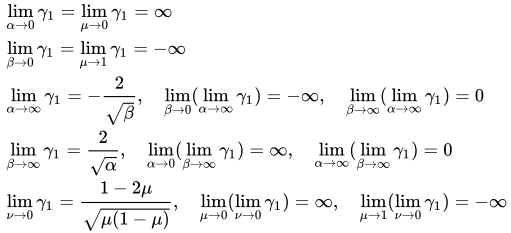
[](https://en.wikipedia.org/wiki/File:Skewness_Beta_Distribution_for_alpha_and_beta_from_1_to_5_-_J._Rodal.jpg) [](https://en.wikipedia.org/wiki/File:Skewness_Beta_Distribution_for_alpha_and_beta_from_.1_to_5_-_J._Rodal.jpg)
### Kurtosis
\[[edit](https://en.wikipedia.org/w/index.php?title=Beta_distribution&action=edit§ion=23 "Edit section: Kurtosis")\]
[](https://en.wikipedia.org/wiki/File:Excess_Kurtosis_for_Beta_Distribution_as_a_function_of_variance_and_mean_-_J._Rodal.jpg)
Excess Kurtosis for Beta Distribution as a function of variance and mean
The beta distribution has been applied in acoustic analysis to assess damage to gears, as the kurtosis of the beta distribution has been reported to be a good indicator of the condition of a gear.[\[15\]](https://en.wikipedia.org/wiki/Beta_distribution#cite_note-Oguamanam-15) Kurtosis has also been used to distinguish the seismic signal generated by a person's footsteps from other signals. As persons or other targets moving on the ground generate continuous signals in the form of seismic waves, one can separate different targets based on the seismic waves they generate. Kurtosis is sensitive to impulsive signals, so it's much more sensitive to the signal generated by human footsteps than other signals generated by vehicles, winds, noise, etc.[\[16\]](https://en.wikipedia.org/wiki/Beta_distribution#cite_note-Liang-16) Unfortunately, the notation for kurtosis has not been standardized. Kenney and Keeping[\[17\]](https://en.wikipedia.org/wiki/Beta_distribution#cite_note-Kenney_and_Keeping-17) use the symbol γ2 for the [excess kurtosis](https://en.wikipedia.org/wiki/Excess_kurtosis "Excess kurtosis"), but [Abramowitz and Stegun](https://en.wikipedia.org/wiki/Abramowitz_and_Stegun "Abramowitz and Stegun")[\[18\]](https://en.wikipedia.org/wiki/Beta_distribution#cite_note-Abramowitz-18) use different terminology. To prevent confusion[\[19\]](https://en.wikipedia.org/wiki/Beta_distribution#cite_note-Weisstein.Kurtosi-19) between kurtosis (the fourth moment centered on the mean, normalized by the square of the variance) and excess kurtosis, when using symbols, they will be spelled out as follows:[\[9\]](https://en.wikipedia.org/wiki/Beta_distribution#cite_note-Handbook_of_Beta_Distribution-9)[\[20\]](https://en.wikipedia.org/wiki/Beta_distribution#cite_note-Panik-20)
excess kurtosis \= kurtosis − 3 \= E \[ ( X − μ ) 4 \] ( var ( X ) ) 2 − 3 \= 6 \[ α 3 − α 2 ( 2 β − 1 ) \+ β 2 ( β \+ 1 ) − 2 α β ( β \+ 2 ) \] α β ( α \+ β \+ 2 ) ( α \+ β \+ 3 ) \= 6 \[ ( α − β ) 2 ( α \+ β \+ 1 ) − α β ( α \+ β \+ 2 ) \] α β ( α \+ β \+ 2 ) ( α \+ β \+ 3 ) . {\\displaystyle {\\begin{aligned}{\\text{excess kurtosis}}&={\\text{kurtosis}}-3\\\\&={\\frac {\\operatorname {E} \[(X-\\mu )^{4}\]}{(\\operatorname {var} (X))^{2}}}-3\\\\&={\\frac {6\[\\alpha ^{3}-\\alpha ^{2}(2\\beta -1)+\\beta ^{2}(\\beta +1)-2\\alpha \\beta (\\beta +2)\]}{\\alpha \\beta (\\alpha +\\beta +2)(\\alpha +\\beta +3)}}\\\\&={\\frac {6\[(\\alpha -\\beta )^{2}(\\alpha +\\beta +1)-\\alpha \\beta (\\alpha +\\beta +2)\]}{\\alpha \\beta (\\alpha +\\beta +2)(\\alpha +\\beta +3)}}.\\end{aligned}}} ![{\\displaystyle {\\begin{aligned}{\\text{excess kurtosis}}&={\\text{kurtosis}}-3\\\\&={\\frac {\\operatorname {E} \[(X-\\mu )^{4}\]}{(\\operatorname {var} (X))^{2}}}-3\\\\&={\\frac {6\[\\alpha ^{3}-\\alpha ^{2}(2\\beta -1)+\\beta ^{2}(\\beta +1)-2\\alpha \\beta (\\beta +2)\]}{\\alpha \\beta (\\alpha +\\beta +2)(\\alpha +\\beta +3)}}\\\\&={\\frac {6\[(\\alpha -\\beta )^{2}(\\alpha +\\beta +1)-\\alpha \\beta (\\alpha +\\beta +2)\]}{\\alpha \\beta (\\alpha +\\beta +2)(\\alpha +\\beta +3)}}.\\end{aligned}}}](https://wikimedia.org/api/rest_v1/media/math/render/svg/ed8320d4f38ba9260f8ad91c30238abc08306dc8)
Letting *α* = *β* in the above expression one obtains
excess kurtosis \= − 6 3 \+ 2 α if α \= β . {\\displaystyle {\\text{excess kurtosis}}=-{\\frac {6}{3+2\\alpha }}{\\text{ if }}\\alpha =\\beta .} 
Therefore, for symmetric beta distributions, the excess kurtosis is negative, increasing from a minimum value of −2 at the limit as {*α* = *β*} → 0, and approaching a maximum value of zero as {*α* = *β*} → ∞. The value of −2 is the minimum value of excess kurtosis that any distribution (not just beta distributions, but any distribution of any possible kind) can ever achieve. This minimum value is reached when all the probability density is entirely concentrated at each end *x* = 0 and *x* = 1, with nothing in between: a 2-point [Bernoulli distribution](https://en.wikipedia.org/wiki/Bernoulli_distribution "Bernoulli distribution") with equal probability 1/2 at each end (a coin toss: see section below "Kurtosis bounded by the square of the skewness" for further discussion). The description of [kurtosis](https://en.wikipedia.org/wiki/Kurtosis "Kurtosis") as a measure of the "potential outliers" (or "potential rare, extreme values") of the probability distribution, is correct for all distributions including the beta distribution. When rare, extreme values can occur in the beta distribution, the higher its kurtosis; otherwise, the kurtosis is lower. For *α* ≠ *β*, skewed beta distributions, the excess kurtosis can reach unlimited positive values (particularly for *α* → 0 for finite *β*, or for *β* → 0 for finite *α*) because the side away from the mode will produce occasional extreme values. Minimum kurtosis takes place when the mass density is concentrated equally at each end (and therefore the mean is at the center), and there is no probability mass density in between the ends.
Using the [parametrization](https://en.wikipedia.org/wiki/Statistical_parameter "Statistical parameter") in terms of mean *μ* and sample size *ν* = *α* + *β*:
α \= μ ν , where ν \= ( α \+ β ) \> 0 β \= ( 1 − μ ) ν , where ν \= ( α \+ β ) \> 0\. {\\displaystyle {\\begin{aligned}\\alpha &{}=\\mu \\nu ,{\\text{ where }}\\nu =(\\alpha +\\beta )\>0\\\\\\beta &{}=(1-\\mu )\\nu ,{\\text{ where }}\\nu =(\\alpha +\\beta )\>0.\\end{aligned}}} 
one can express the excess kurtosis in terms of the mean *μ* and the sample size *ν* as follows:
excess kurtosis \= 6 3 \+ ν ( ( 1 − 2 μ ) 2 ( 1 \+ ν ) μ ( 1 − μ ) ( 2 \+ ν ) − 1 ) {\\displaystyle {\\text{excess kurtosis}}={\\frac {6}{3+\\nu }}{\\bigg (}{\\frac {(1-2\\mu )^{2}(1+\\nu )}{\\mu (1-\\mu )(2+\\nu )}}-1{\\bigg )}} 
The excess kurtosis can also be expressed in terms of just the following two parameters: the variance var, and the sample size *ν* as follows:
excess kurtosis \= 6 ( 3 \+ ν ) ( 2 \+ ν ) ( 1 var − 6 − 5 ν ) if var \< μ ( 1 − μ ) {\\displaystyle {\\text{excess kurtosis}}={\\frac {6}{(3+\\nu )(2+\\nu )}}\\left({\\frac {1}{\\text{ var }}}-6-5\\nu \\right){\\text{ if }}{\\text{var}}\<\\mu (1-\\mu )} 
and, in terms of the variance *var* and the mean *μ* as follows:
excess kurtosis \= 6 var ( 1 − var − 5 μ ( 1 − μ ) ) ( var \+ μ ( 1 − μ ) ) ( 2 var \+ μ ( 1 − μ ) ) if var \< μ ( 1 − μ ) {\\displaystyle {\\text{excess kurtosis}}={\\frac {6{\\text{ var }}(1-{\\text{ var }}-5\\mu (1-\\mu ))}{({\\text{var }}+\\mu (1-\\mu ))(2{\\text{ var }}+\\mu (1-\\mu ))}}{\\text{ if }}{\\text{var}}\<\\mu (1-\\mu )} 
The plot of excess kurtosis as a function of the variance and the mean shows that the minimum value of the excess kurtosis (−2, which is the minimum possible value for excess kurtosis for any distribution) is intimately coupled with the maximum value of variance (1/4) and the symmetry condition: the mean occurring at the midpoint (*μ* = 1/2). This occurs for the symmetric case of *α* = *β* = 0, with zero skewness. At the limit, this is the 2 point [Bernoulli distribution](https://en.wikipedia.org/wiki/Bernoulli_distribution "Bernoulli distribution") with equal probability 1/2 at each [Dirac delta function](https://en.wikipedia.org/wiki/Dirac_delta_function "Dirac delta function") end *x* = 0 and *x* = 1 and zero probability everywhere else. (A coin toss: one face of the coin being *x* = 0 and the other face being *x* = 1.) Variance is maximum because the distribution is bimodal with nothing in between the two modes (spikes) at each end. Excess kurtosis is minimum: the probability density "mass" is zero at the mean and it is concentrated at the two peaks at each end. Excess kurtosis reaches the minimum possible value (for any distribution) when the probability density function has two spikes at each end: it is bi-"peaky" with nothing in between them.
On the other hand, the plot shows that for extreme skewed cases, where the mean is located near one or the other end (*μ* = 0 or *μ* = 1), the variance is close to zero, and the excess kurtosis rapidly approaches infinity when the mean of the distribution approaches either end.
Alternatively, the excess kurtosis can also be expressed in terms of just the following two parameters: the square of the skewness, and the sample size ν as follows:
excess kurtosis \= 6 3 \+ ν ( ( 2 \+ ν ) 4 ( skewness ) 2 − 1 ) if (skewness) 2 − 2 \< excess kurtosis \< 3 2 ( skewness ) 2 {\\displaystyle {\\text{excess kurtosis}}={\\frac {6}{3+\\nu }}{\\bigg (}{\\frac {(2+\\nu )}{4}}({\\text{skewness}})^{2}-1{\\bigg )}{\\text{ if (skewness)}}^{2}-2\<{\\text{excess kurtosis}}\<{\\frac {3}{2}}({\\text{skewness}})^{2}} 
From this last expression, one can obtain the same limits published over a century ago by [Karl Pearson](https://en.wikipedia.org/wiki/Karl_Pearson "Karl Pearson")[\[21\]](https://en.wikipedia.org/wiki/Beta_distribution#cite_note-Pearson-21) for the beta distribution (see section below titled "Kurtosis bounded by the square of the skewness"). Setting *α* + *β* = *ν* = 0 in the above expression, one obtains Pearson's lower boundary (values for the skewness and excess kurtosis below the boundary (excess kurtosis + 2 − skewness2 = 0) cannot occur for any distribution, and hence [Karl Pearson](https://en.wikipedia.org/wiki/Karl_Pearson "Karl Pearson") appropriately called the region below this boundary the "impossible region"). The limit of *α* + *β* = *ν* → ∞ determines Pearson's upper boundary.
lim ν → 0 excess kurtosis \= ( skewness ) 2 − 2 lim ν → ∞ excess kurtosis \= 3 2 ( skewness ) 2 {\\displaystyle {\\begin{aligned}&\\lim \_{\\nu \\to 0}{\\text{excess kurtosis}}=({\\text{skewness}})^{2}-2\\\\&\\lim \_{\\nu \\to \\infty }{\\text{excess kurtosis}}={\\tfrac {3}{2}}({\\text{skewness}})^{2}\\end{aligned}}} 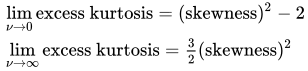
therefore:
( skewness ) 2 − 2 \< excess kurtosis \< 3 2 ( skewness ) 2 {\\displaystyle ({\\text{skewness}})^{2}-2\<{\\text{excess kurtosis}}\<{\\tfrac {3}{2}}({\\text{skewness}})^{2}} 
Values of *ν* = *α* + *β* such that *ν* ranges from zero to infinity, 0 \< *ν* \< ∞, span the whole region of the beta distribution in the plane of excess kurtosis versus squared skewness.
For the symmetric case (*α* = *β*), the following limits apply:
lim α \= β → 0 excess kurtosis \= − 2 lim α \= β → ∞ excess kurtosis \= 0 lim μ → 1 2 excess kurtosis \= − 6 3 \+ ν {\\displaystyle {\\begin{aligned}&\\lim \_{\\alpha =\\beta \\to 0}{\\text{excess kurtosis}}=-2\\\\&\\lim \_{\\alpha =\\beta \\to \\infty }{\\text{excess kurtosis}}=0\\\\&\\lim \_{\\mu \\to {\\frac {1}{2}}}{\\text{excess kurtosis}}=-{\\frac {6}{3+\\nu }}\\end{aligned}}} 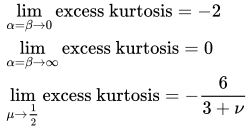
For the unsymmetric cases (*α* ≠ *β*) the following limits (with only the noted variable approaching the limit) can be obtained from the above expressions:
lim α → 0 excess kurtosis \= lim β → 0 excess kurtosis \= lim μ → 0 excess kurtosis \= lim μ → 1 excess kurtosis \= ∞ lim α → ∞ excess kurtosis \= 6 β , lim β → 0 ( lim α → ∞ excess kurtosis ) \= ∞ , lim β → ∞ ( lim α → ∞ excess kurtosis ) \= 0 lim β → ∞ excess kurtosis \= 6 α , lim α → 0 ( lim β → ∞ excess kurtosis ) \= ∞ , lim α → ∞ ( lim β → ∞ excess kurtosis ) \= 0 lim ν → 0 excess kurtosis \= − 6 \+ 1 μ ( 1 − μ ) , lim μ → 0 ( lim ν → 0 excess kurtosis ) \= ∞ , lim μ → 1 ( lim ν → 0 excess kurtosis ) \= ∞ {\\displaystyle {\\begin{aligned}&\\lim \_{\\alpha \\to 0}{\\text{excess kurtosis}}=\\lim \_{\\beta \\to 0}{\\text{excess kurtosis}}=\\lim \_{\\mu \\to 0}{\\text{excess kurtosis}}=\\lim \_{\\mu \\to 1}{\\text{excess kurtosis}}=\\infty \\\\&\\lim \_{\\alpha \\to \\infty }{\\text{excess kurtosis}}={\\frac {6}{\\beta }},{\\text{ }}\\lim \_{\\beta \\to 0}(\\lim \_{\\alpha \\to \\infty }{\\text{excess kurtosis}})=\\infty ,{\\text{ }}\\lim \_{\\beta \\to \\infty }(\\lim \_{\\alpha \\to \\infty }{\\text{excess kurtosis}})=0\\\\&\\lim \_{\\beta \\to \\infty }{\\text{excess kurtosis}}={\\frac {6}{\\alpha }},{\\text{ }}\\lim \_{\\alpha \\to 0}(\\lim \_{\\beta \\to \\infty }{\\text{excess kurtosis}})=\\infty ,{\\text{ }}\\lim \_{\\alpha \\to \\infty }(\\lim \_{\\beta \\to \\infty }{\\text{excess kurtosis}})=0\\\\&\\lim \_{\\nu \\to 0}{\\text{excess kurtosis}}=-6+{\\frac {1}{\\mu (1-\\mu )}},{\\text{ }}\\lim \_{\\mu \\to 0}(\\lim \_{\\nu \\to 0}{\\text{excess kurtosis}})=\\infty ,{\\text{ }}\\lim \_{\\mu \\to 1}(\\lim \_{\\nu \\to 0}{\\text{excess kurtosis}})=\\infty \\end{aligned}}} 
[](https://en.wikipedia.org/wiki/File:Excess_Kurtosis_for_Beta_Distribution_with_alpha_and_beta_ranging_from_1_to_5_-_J._Rodal.jpg)[](https://en.wikipedia.org/wiki/File:Excess_Kurtosis_for_Beta_Distribution_with_alpha_and_beta_ranging_from_0.1_to_5_-_J._Rodal.jpg)
### Characteristic function
\[[edit](https://en.wikipedia.org/w/index.php?title=Beta_distribution&action=edit§ion=24 "Edit section: Characteristic function")\]
[](https://en.wikipedia.org/wiki/File:Re\(CharacteristicFunction\)_Beta_Distr_alpha%3Dbeta_from_0_to_25_Back_-_J._Rodal.jpg)
[Re(characteristic function)](https://en.wikipedia.org/wiki/Characteristic_function_\(probability_theory\) "Characteristic function (probability theory)") symmetric case *α* = *β* ranging from 25 to 0
[](https://en.wikipedia.org/wiki/File:Re\(CharacteristicFunc\)_Beta_Distr_alpha%3Dbeta_from_0_to_25_Front-_J._Rodal.jpg)
[Re(characteristic function)](https://en.wikipedia.org/wiki/Characteristic_function_\(probability_theory\) "Characteristic function (probability theory)") symmetric case *α* = *β* ranging from 0 to 25
[](https://en.wikipedia.org/wiki/File:Re\(CharacteristFunc\)_Beta_Distr_alpha_from_0_to_25_and_beta%3Dalpha%2B0.5_Back_-_J._Rodal.jpg)
[Re(characteristic function)](https://en.wikipedia.org/wiki/Characteristic_function_\(probability_theory\) "Characteristic function (probability theory)") *β* = *α* + 1/2; *α* ranging from 25 to 0
[](https://en.wikipedia.org/wiki/File:Re\(CharacterFunc\)_Beta_Distrib._beta_from_0_to_25,_alpha%3Dbeta%2B0.5_Back_-_J._Rodal.jpg)
[Re(characteristic function)](https://en.wikipedia.org/wiki/Characteristic_function_\(probability_theory\) "Characteristic function (probability theory)") *α* = *β* + 1/2; *β* ranging from 25 to 0
[](https://en.wikipedia.org/wiki/File:Re\(CharacterFunc\)_Beta_Distr._beta_from_0_to_25,_alpha%3Dbeta%2B0.5_Front_-_J._Rodal.jpg)
[Re(characteristic function)](https://en.wikipedia.org/wiki/Characteristic_function_\(probability_theory\) "Characteristic function (probability theory)") *α* = *β* + 1/2; *β* ranging from 0 to 25
The [characteristic function](https://en.wikipedia.org/wiki/Characteristic_function_\(probability_theory\) "Characteristic function (probability theory)") is the [Fourier transform](https://en.wikipedia.org/wiki/Fourier_transform "Fourier transform") of the probability density function. The characteristic function of the beta distribution is [Kummer's confluent hypergeometric function](https://en.wikipedia.org/wiki/Confluent_hypergeometric_function "Confluent hypergeometric function") (of the first kind):[\[1\]](https://en.wikipedia.org/wiki/Beta_distribution#cite_note-JKB-1)[\[18\]](https://en.wikipedia.org/wiki/Beta_distribution#cite_note-Abramowitz-18)[\[22\]](https://en.wikipedia.org/wiki/Beta_distribution#cite_note-Zwillinger_2014-22)
φ
X
(
α
;
β
;
t
)
\=
E
\[
e
i
t
X
\]
\=
∫
0
1
e
i
t
x
f
(
x
;
α
,
β
)
d
x
\=
1
F
1
(
α
;
α
\+
β
;
i
t
)
\=
∑
n
\=
0
∞
α
n
¯
(
i
t
)
n
(
α
\+
β
)
n
¯
n
\!
\=
1
\+
∑
k
\=
1
∞
(
∏
r
\=
0
k
−
1
α
\+
r
α
\+
β
\+
r
)
(
i
t
)
k
k
\!
{\\displaystyle {\\begin{aligned}\\varphi \_{X}(\\alpha ;\\beta ;t)&=\\operatorname {E} \\left\[e^{itX}\\right\]\\\\&=\\int \_{0}^{1}e^{itx}f(x;\\alpha ,\\beta )\\,dx\\\\&={}\_{1}F\_{1}(\\alpha ;\\alpha +\\beta ;it)\\!\\\\&=\\sum \_{n=0}^{\\infty }{\\frac {\\alpha ^{\\overline {n}}(it)^{n}}{(\\alpha +\\beta )^{\\overline {n}}n!}}\\\\&=1+\\sum \_{k=1}^{\\infty }\\left(\\prod \_{r=0}^{k-1}{\\frac {\\alpha +r}{\\alpha +\\beta +r}}\\right){\\frac {(it)^{k}}{k!}}\\end{aligned}}}
![{\\displaystyle {\\begin{aligned}\\varphi \_{X}(\\alpha ;\\beta ;t)&=\\operatorname {E} \\left\[e^{itX}\\right\]\\\\&=\\int \_{0}^{1}e^{itx}f(x;\\alpha ,\\beta )\\,dx\\\\&={}\_{1}F\_{1}(\\alpha ;\\alpha +\\beta ;it)\\!\\\\&=\\sum \_{n=0}^{\\infty }{\\frac {\\alpha ^{\\overline {n}}(it)^{n}}{(\\alpha +\\beta )^{\\overline {n}}n!}}\\\\&=1+\\sum \_{k=1}^{\\infty }\\left(\\prod \_{r=0}^{k-1}{\\frac {\\alpha +r}{\\alpha +\\beta +r}}\\right){\\frac {(it)^{k}}{k!}}\\end{aligned}}}](https://wikimedia.org/api/rest_v1/media/math/render/svg/2e0e8f5d3bf4ec0cbe9b911e26c961e9ebaefdd8)
where
x
n
¯
\=
x
(
x
\+
1
)
(
x
\+
2
)
⋯
(
x
\+
n
−
1
)
{\\displaystyle x^{\\overline {n}}=x(x+1)(x+2)\\cdots (x+n-1)}

is the [rising factorial](https://en.wikipedia.org/wiki/Rising_factorial "Rising factorial"). The value of the characteristic function for *t* = 0, is one:
φ X ( α ; β ; 0 ) \= 1 F 1 ( α ; α \+ β ; 0 ) \= 1\. {\\displaystyle \\varphi \_{X}(\\alpha ;\\beta ;0)={}\_{1}F\_{1}(\\alpha ;\\alpha +\\beta ;0)=1.} 
Also, the real and imaginary parts of the characteristic function enjoy the following symmetries with respect to the origin of variable *t*:
Re \[ 1 F 1 ( α ; α \+ β ; i t ) \] \= Re \[ 1 F 1 ( α ; α \+ β ; − i t ) \] {\\displaystyle \\operatorname {Re} \\left\[{}\_{1}F\_{1}(\\alpha ;\\alpha +\\beta ;it)\\right\]=\\operatorname {Re} \\left\[{}\_{1}F\_{1}(\\alpha ;\\alpha +\\beta ;-it)\\right\]} ![{\\displaystyle \\operatorname {Re} \\left\[{}\_{1}F\_{1}(\\alpha ;\\alpha +\\beta ;it)\\right\]=\\operatorname {Re} \\left\[{}\_{1}F\_{1}(\\alpha ;\\alpha +\\beta ;-it)\\right\]}](https://wikimedia.org/api/rest_v1/media/math/render/svg/468f2135d76bd1b522c84092679209ff6abd5845) Im \[ 1 F 1 ( α ; α \+ β ; i t ) \] \= − Im \[ 1 F 1 ( α ; α \+ β ; − i t ) \] {\\displaystyle \\operatorname {Im} \\left\[{}\_{1}F\_{1}(\\alpha ;\\alpha +\\beta ;it)\\right\]=-\\operatorname {Im} \\left\[{}\_{1}F\_{1}(\\alpha ;\\alpha +\\beta ;-it)\\right\]} ![{\\displaystyle \\operatorname {Im} \\left\[{}\_{1}F\_{1}(\\alpha ;\\alpha +\\beta ;it)\\right\]=-\\operatorname {Im} \\left\[{}\_{1}F\_{1}(\\alpha ;\\alpha +\\beta ;-it)\\right\]}](https://wikimedia.org/api/rest_v1/media/math/render/svg/0fca8984292cc85cb8a37ecb5a2b7c04b5596282)
The symmetric case *α* = *β* simplifies the characteristic function of the beta distribution to a [Bessel function](https://en.wikipedia.org/wiki/Bessel_function "Bessel function"), since in the special case *α* + *β* = 2*α* the [confluent hypergeometric function](https://en.wikipedia.org/wiki/Confluent_hypergeometric_function "Confluent hypergeometric function") (of the first kind) reduces to a [Bessel function](https://en.wikipedia.org/wiki/Bessel_function "Bessel function") (the modified Bessel function of the first kind I α − 1 2 {\\displaystyle I\_{\\alpha -{\\frac {1}{2}}}}  ) using [Kummer's](https://en.wikipedia.org/wiki/Ernst_Kummer "Ernst Kummer") second transformation as follows:
1 F 1 ( α ; 2 α ; i t ) \= e i t 2 0 F 1 ( ; α \+ 1 2 ; ( i t ) 2 16 ) \= e i t 2 ( i t 4 ) 1 2 − α Γ ( α \+ 1 2 ) I α − 1 2 ( i t 2 ) . {\\displaystyle {\\begin{aligned}{}\_{1}F\_{1}(\\alpha ;2\\alpha ;it)&=e^{\\frac {it}{2}}{}\_{0}F\_{1}\\left(;\\alpha +{\\tfrac {1}{2}};{\\frac {(it)^{2}}{16}}\\right)\\\\&=e^{\\frac {it}{2}}\\left({\\frac {it}{4}}\\right)^{{\\frac {1}{2}}-\\alpha }\\Gamma \\left(\\alpha +{\\tfrac {1}{2}}\\right)I\_{\\alpha -{\\frac {1}{2}}}\\left({\\frac {it}{2}}\\right).\\end{aligned}}} 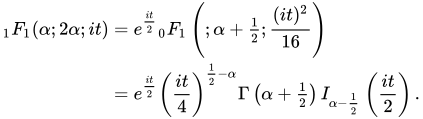
In the accompanying plots, the [real part](https://en.wikipedia.org/wiki/Complex_number "Complex number") (Re) of the [characteristic function](https://en.wikipedia.org/wiki/Characteristic_function_\(probability_theory\) "Characteristic function (probability theory)") of the beta distribution is displayed for symmetric (*α* = *β*) and skewed (*α* ≠ *β*) cases.
### Other moments
\[[edit](https://en.wikipedia.org/w/index.php?title=Beta_distribution&action=edit§ion=25 "Edit section: Other moments")\]
#### Moment generating function
\[[edit](https://en.wikipedia.org/w/index.php?title=Beta_distribution&action=edit§ion=26 "Edit section: Moment generating function")\]
It also follows[\[1\]](https://en.wikipedia.org/wiki/Beta_distribution#cite_note-JKB-1)[\[9\]](https://en.wikipedia.org/wiki/Beta_distribution#cite_note-Handbook_of_Beta_Distribution-9) that the [moment generating function](https://en.wikipedia.org/wiki/Moment_generating_function "Moment generating function") is
M X ( α ; β ; t ) \= E \[ e t X \] \= ∫ 0 1 e t x f ( x ; α , β ) d x \= 1 F 1 ( α ; α \+ β ; t ) \= ∑ n \= 0 ∞ α n ¯ ( α \+ β ) n ¯ t n n \! \= 1 \+ ∑ k \= 1 ∞ ( ∏ r \= 0 k − 1 α \+ r α \+ β \+ r ) t k k \! . {\\displaystyle {\\begin{aligned}M\_{X}(\\alpha ;\\beta ;t)&=\\operatorname {E} \\left\[e^{tX}\\right\]\\\\\[4pt\]&=\\int \_{0}^{1}e^{tx}f(x;\\alpha ,\\beta )\\,dx\\\\\[4pt\]&={}\_{1}F\_{1}(\\alpha ;\\alpha +\\beta ;t)\\\\\[4pt\]&=\\sum \_{n=0}^{\\infty }{\\frac {\\alpha ^{\\overline {n}}}{(\\alpha +\\beta )^{\\overline {n}}}}{\\frac {t^{n}}{n!}}\\\\\[4pt\]&=1+\\sum \_{k=1}^{\\infty }\\left(\\prod \_{r=0}^{k-1}{\\frac {\\alpha +r}{\\alpha +\\beta +r}}\\right){\\frac {t^{k}}{k!}}.\\end{aligned}}} ![{\\displaystyle {\\begin{aligned}M\_{X}(\\alpha ;\\beta ;t)&=\\operatorname {E} \\left\[e^{tX}\\right\]\\\\\[4pt\]&=\\int \_{0}^{1}e^{tx}f(x;\\alpha ,\\beta )\\,dx\\\\\[4pt\]&={}\_{1}F\_{1}(\\alpha ;\\alpha +\\beta ;t)\\\\\[4pt\]&=\\sum \_{n=0}^{\\infty }{\\frac {\\alpha ^{\\overline {n}}}{(\\alpha +\\beta )^{\\overline {n}}}}{\\frac {t^{n}}{n!}}\\\\\[4pt\]&=1+\\sum \_{k=1}^{\\infty }\\left(\\prod \_{r=0}^{k-1}{\\frac {\\alpha +r}{\\alpha +\\beta +r}}\\right){\\frac {t^{k}}{k!}}.\\end{aligned}}}](https://wikimedia.org/api/rest_v1/media/math/render/svg/7c5c0eea7bcffadb73fef0c85534a8bdca36ebbb)
In particular *M**X*(*α*; *β*; 0) = 1.
#### Higher moments
\[[edit](https://en.wikipedia.org/w/index.php?title=Beta_distribution&action=edit§ion=27 "Edit section: Higher moments")\]
Using the [moment generating function](https://en.wikipedia.org/wiki/Moment_generating_function "Moment generating function"), the *k*\-th [raw moment](https://en.wikipedia.org/wiki/Raw_moment "Raw moment") is given by[\[1\]](https://en.wikipedia.org/wiki/Beta_distribution#cite_note-JKB-1) the factor
∏ r \= 0 k − 1 α \+ r α \+ β \+ r {\\displaystyle \\prod \_{r=0}^{k-1}{\\frac {\\alpha +r}{\\alpha +\\beta +r}}} 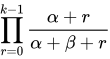
multiplying the (exponential series) term ( t k k \! ) {\\displaystyle \\left({\\frac {t^{k}}{k!}}\\right)}  in the series of the [moment generating function](https://en.wikipedia.org/wiki/Moment_generating_function "Moment generating function")
E \[ X k \] \= α k ¯ ( α \+ β ) k ¯ \= ∏ r \= 0 k − 1 α \+ r α \+ β \+ r {\\displaystyle \\operatorname {E} \[X^{k}\]={\\frac {\\alpha ^{\\overline {k}}}{(\\alpha +\\beta )^{\\overline {k}}}}=\\prod \_{r=0}^{k-1}{\\frac {\\alpha +r}{\\alpha +\\beta +r}}} ![{\\displaystyle \\operatorname {E} \[X^{k}\]={\\frac {\\alpha ^{\\overline {k}}}{(\\alpha +\\beta )^{\\overline {k}}}}=\\prod \_{r=0}^{k-1}{\\frac {\\alpha +r}{\\alpha +\\beta +r}}}](https://wikimedia.org/api/rest_v1/media/math/render/svg/af7e0927f7f82eccc61e9fb55883ce96d7f958f1)
where (*x*)(*k*) is a [Pochhammer symbol](https://en.wikipedia.org/wiki/Pochhammer_symbol "Pochhammer symbol") representing rising factorial. It can also be written in a recursive form as
E \[ X k \] \= α \+ k − 1 α \+ β \+ k − 1 E \[ X k − 1 \] . {\\displaystyle \\operatorname {E} \[X^{k}\]={\\frac {\\alpha +k-1}{\\alpha +\\beta +k-1}}\\operatorname {E} \[X^{k-1}\].} ![{\\displaystyle \\operatorname {E} \[X^{k}\]={\\frac {\\alpha +k-1}{\\alpha +\\beta +k-1}}\\operatorname {E} \[X^{k-1}\].}](https://wikimedia.org/api/rest_v1/media/math/render/svg/069cb373a905b1e8a5a82a0e3b028e88f63672e2)
Since the moment generating function M X ( α ; β ; ⋅ ) {\\displaystyle M\_{X}(\\alpha ;\\beta ;\\cdot )}  has a positive radius of convergence,\[*[citation needed](https://en.wikipedia.org/wiki/Wikipedia:Citation_needed "Wikipedia:Citation needed")*\] the beta distribution is [determined by its moments](https://en.wikipedia.org/wiki/Moment_problem "Moment problem").[\[23\]](https://en.wikipedia.org/wiki/Beta_distribution#cite_note-23)
#### Moments of transformed random variables
\[[edit](https://en.wikipedia.org/w/index.php?title=Beta_distribution&action=edit§ion=28 "Edit section: Moments of transformed random variables")\]
##### Moments of linearly transformed, product and inverted random variables
\[[edit](https://en.wikipedia.org/w/index.php?title=Beta_distribution&action=edit§ion=29 "Edit section: Moments of linearly transformed, product and inverted random variables")\]
One can also show the following expectations for a transformed random variable,[\[1\]](https://en.wikipedia.org/wiki/Beta_distribution#cite_note-JKB-1) where the random variable *X* is Beta-distributed with parameters *α* and *β*: *X* ~ Beta(*α*, *β*). The expected value of the variable 1 − *X* is the mirror-symmetry of the expected value based on *X*:
E \[ 1 − X \] \= β α \+ β E \[ X ( 1 − X ) \] \= E \[ ( 1 − X ) X \] \= α β ( α \+ β ) ( α \+ β \+ 1 ) {\\displaystyle {\\begin{aligned}\\operatorname {E} \[1-X\]&={\\frac {\\beta }{\\alpha +\\beta }}\\\\\\operatorname {E} \[X(1-X)\]&=\\operatorname {E} \[(1-X)X\]={\\frac {\\alpha \\beta }{(\\alpha +\\beta )(\\alpha +\\beta +1)}}\\end{aligned}}} ![{\\displaystyle {\\begin{aligned}\\operatorname {E} \[1-X\]&={\\frac {\\beta }{\\alpha +\\beta }}\\\\\\operatorname {E} \[X(1-X)\]&=\\operatorname {E} \[(1-X)X\]={\\frac {\\alpha \\beta }{(\\alpha +\\beta )(\\alpha +\\beta +1)}}\\end{aligned}}}](https://wikimedia.org/api/rest_v1/media/math/render/svg/43fc49b9eafccd56d39c236b26d222dde51638ce)
Due to the mirror-symmetry of the probability density function of the beta distribution, the variances based on variables *X* and 1 − *X* are identical, and the covariance on *X*(1 − *X*) is the negative of the variance:
var \[ ( 1 − X ) \] \= var \[ X \] \= − cov \[ X , ( 1 − X ) \] \= α β ( α \+ β ) 2 ( α \+ β \+ 1 ) {\\displaystyle \\operatorname {var} \[(1-X)\]=\\operatorname {var} \[X\]=-\\operatorname {cov} \[X,(1-X)\]={\\frac {\\alpha \\beta }{(\\alpha +\\beta )^{2}(\\alpha +\\beta +1)}}} ![{\\displaystyle \\operatorname {var} \[(1-X)\]=\\operatorname {var} \[X\]=-\\operatorname {cov} \[X,(1-X)\]={\\frac {\\alpha \\beta }{(\\alpha +\\beta )^{2}(\\alpha +\\beta +1)}}}](https://wikimedia.org/api/rest_v1/media/math/render/svg/7273cc84a6c789724b985c34059fa75a62bce631)
These are the expected values for inverted variables, (these are related to the harmonic means, see [§ Harmonic mean](https://en.wikipedia.org/wiki/Beta_distribution#Harmonic_mean)):
E \[ 1 X \] \= α \+ β − 1 α − 1 if α \> 1 E \[ 1 1 − X \] \= α \+ β − 1 β − 1 if β \> 1 {\\displaystyle {\\begin{aligned}\\operatorname {E} \\left\[{\\frac {1}{X}}\\right\]&={\\frac {\\alpha +\\beta -1}{\\alpha -1}}&&{\\text{ if }}\\alpha \>1\\\\\\operatorname {E} \\left\[{\\frac {1}{1-X}}\\right\]&={\\frac {\\alpha +\\beta -1}{\\beta -1}}&&{\\text{ if }}\\beta \>1\\end{aligned}}} ![{\\displaystyle {\\begin{aligned}\\operatorname {E} \\left\[{\\frac {1}{X}}\\right\]&={\\frac {\\alpha +\\beta -1}{\\alpha -1}}&&{\\text{ if }}\\alpha \>1\\\\\\operatorname {E} \\left\[{\\frac {1}{1-X}}\\right\]&={\\frac {\\alpha +\\beta -1}{\\beta -1}}&&{\\text{ if }}\\beta \>1\\end{aligned}}}](https://wikimedia.org/api/rest_v1/media/math/render/svg/972a9c1853e6991aac6666b06c0a633a0caad5b7)
The following transformation by dividing the variable *X* by its mirror-image *X*/(1 − *X*)) results in the expected value of the "inverted beta distribution" or [beta prime distribution](https://en.wikipedia.org/wiki/Beta_prime_distribution "Beta prime distribution") (also known as beta distribution of the second kind or [Pearson's Type VI](https://en.wikipedia.org/wiki/Pearson_distribution "Pearson distribution")):[\[1\]](https://en.wikipedia.org/wiki/Beta_distribution#cite_note-JKB-1)
E \[ X 1 − X \] \= α β − 1 if β \> 1 E \[ 1 − X X \] \= β α − 1 if α \> 1 {\\displaystyle {\\begin{aligned}\\operatorname {E} \\left\[{\\frac {X}{1-X}}\\right\]&={\\frac {\\alpha }{\\beta -1}}&&{\\text{ if }}\\beta \>1\\\\\\operatorname {E} \\left\[{\\frac {1-X}{X}}\\right\]&={\\frac {\\beta }{\\alpha -1}}&&{\\text{ if }}\\alpha \>1\\end{aligned}}} ![{\\displaystyle {\\begin{aligned}\\operatorname {E} \\left\[{\\frac {X}{1-X}}\\right\]&={\\frac {\\alpha }{\\beta -1}}&&{\\text{ if }}\\beta \>1\\\\\\operatorname {E} \\left\[{\\frac {1-X}{X}}\\right\]&={\\frac {\\beta }{\\alpha -1}}&&{\\text{ if }}\\alpha \>1\\end{aligned}}}](https://wikimedia.org/api/rest_v1/media/math/render/svg/db2a0928a7f906bcbe5cfd9d0c57713c9ab5cfb7)
Variances of these transformed variables can be obtained by integration, as the expected values of the second moments centered on the corresponding variables:
var \[ 1 X \] \= E \[ ( 1 X − E \[ 1 X \] ) 2 \] \= var \[ 1 − X X \] \= E \[ ( 1 − X X − E \[ 1 − X X \] ) 2 \] \= β ( α \+ β − 1 ) ( α − 2 ) ( α − 1 ) 2 if α \> 2 {\\displaystyle {\\begin{aligned}\\operatorname {var} \\left\[{\\frac {1}{X}}\\right\]&=\\operatorname {E} \\left\[\\left({\\frac {1}{X}}-\\operatorname {E} \\left\[{\\frac {1}{X}}\\right\]\\right)^{2}\\right\]=\\operatorname {var} \\left\[{\\frac {1-X}{X}}\\right\]\\\\&=\\operatorname {E} \\left\[\\left({\\frac {1-X}{X}}-\\operatorname {E} \\left\[{\\frac {1-X}{X}}\\right\]\\right)^{2}\\right\]={\\frac {\\beta (\\alpha +\\beta -1)}{\\left(\\alpha -2\\right)\\left(\\alpha -1\\right)^{2}}}{\\text{ if }}\\alpha \>2\\end{aligned}}} ![{\\displaystyle {\\begin{aligned}\\operatorname {var} \\left\[{\\frac {1}{X}}\\right\]&=\\operatorname {E} \\left\[\\left({\\frac {1}{X}}-\\operatorname {E} \\left\[{\\frac {1}{X}}\\right\]\\right)^{2}\\right\]=\\operatorname {var} \\left\[{\\frac {1-X}{X}}\\right\]\\\\&=\\operatorname {E} \\left\[\\left({\\frac {1-X}{X}}-\\operatorname {E} \\left\[{\\frac {1-X}{X}}\\right\]\\right)^{2}\\right\]={\\frac {\\beta (\\alpha +\\beta -1)}{\\left(\\alpha -2\\right)\\left(\\alpha -1\\right)^{2}}}{\\text{ if }}\\alpha \>2\\end{aligned}}}](https://wikimedia.org/api/rest_v1/media/math/render/svg/ab8c3db5d04798c92c6360624060ba583ebdf3df)
The following variance of the variable *X* divided by its mirror-image (*X*/(1−*X*) results in the variance of the "inverted beta distribution" or [beta prime distribution](https://en.wikipedia.org/wiki/Beta_prime_distribution "Beta prime distribution") (also known as beta distribution of the second kind or [Pearson's Type VI](https://en.wikipedia.org/wiki/Pearson_distribution "Pearson distribution")):[\[1\]](https://en.wikipedia.org/wiki/Beta_distribution#cite_note-JKB-1)
var \[ 1 1 − X \] \= E \[ ( 1 1 − X − E \[ 1 1 − X \] ) 2 \] \= var \[ X 1 − X \] \= E \[ ( X 1 − X − E \[ X 1 − X \] ) 2 \] \= α ( α \+ β − 1 ) ( β − 2 ) ( β − 1 ) 2 if β \> 2 {\\displaystyle {\\begin{aligned}\\operatorname {var} \\left\[{\\frac {1}{1-X}}\\right\]&=\\operatorname {E} \\left\[\\left({\\frac {1}{1-X}}-\\operatorname {E} \\left\[{\\frac {1}{1-X}}\\right\]\\right)^{2}\\right\]=\\operatorname {var} \\left\[{\\frac {X}{1-X}}\\right\]\\\\\[1ex\]&=\\operatorname {E} \\left\[\\left({\\frac {X}{1-X}}-\\operatorname {E} \\left\[{\\frac {X}{1-X}}\\right\]\\right)^{2}\\right\]={\\frac {\\alpha (\\alpha +\\beta -1)}{\\left(\\beta -2\\right)\\left(\\beta -1\\right)^{2}}}{\\text{ if }}\\beta \>2\\end{aligned}}} ![{\\displaystyle {\\begin{aligned}\\operatorname {var} \\left\[{\\frac {1}{1-X}}\\right\]&=\\operatorname {E} \\left\[\\left({\\frac {1}{1-X}}-\\operatorname {E} \\left\[{\\frac {1}{1-X}}\\right\]\\right)^{2}\\right\]=\\operatorname {var} \\left\[{\\frac {X}{1-X}}\\right\]\\\\\[1ex\]&=\\operatorname {E} \\left\[\\left({\\frac {X}{1-X}}-\\operatorname {E} \\left\[{\\frac {X}{1-X}}\\right\]\\right)^{2}\\right\]={\\frac {\\alpha (\\alpha +\\beta -1)}{\\left(\\beta -2\\right)\\left(\\beta -1\\right)^{2}}}{\\text{ if }}\\beta \>2\\end{aligned}}}](https://wikimedia.org/api/rest_v1/media/math/render/svg/76d83000746ff4852e63b063948f9db8110d2d22)
The covariances are:
cov \[ 1 X , 1 1 − X \] \= cov \[ 1 − X X , X 1 − X \] \= cov \[ 1 X , X 1 − X \] \= cov \[ 1 − X X , 1 1 − X \] \= α \+ β − 1 ( α − 1 ) ( β − 1 ) if α , β \> 1 {\\displaystyle {\\begin{aligned}\\operatorname {cov} \\left\[{\\frac {1}{X}},{\\frac {1}{1-X}}\\right\]&=\\operatorname {cov} \\left\[{\\frac {1-X}{X}},{\\frac {X}{1-X}}\\right\]=\\operatorname {cov} \\left\[{\\frac {1}{X}},{\\frac {X}{1-X}}\\right\]\\\\\[1ex\]&=\\operatorname {cov} \\left\[{\\frac {1-X}{X}},{\\frac {1}{1-X}}\\right\]={\\frac {\\alpha +\\beta -1}{(\\alpha -1)(\\beta -1)}}{\\text{ if }}\\alpha ,\\beta \>1\\end{aligned}}} ![{\\displaystyle {\\begin{aligned}\\operatorname {cov} \\left\[{\\frac {1}{X}},{\\frac {1}{1-X}}\\right\]&=\\operatorname {cov} \\left\[{\\frac {1-X}{X}},{\\frac {X}{1-X}}\\right\]=\\operatorname {cov} \\left\[{\\frac {1}{X}},{\\frac {X}{1-X}}\\right\]\\\\\[1ex\]&=\\operatorname {cov} \\left\[{\\frac {1-X}{X}},{\\frac {1}{1-X}}\\right\]={\\frac {\\alpha +\\beta -1}{(\\alpha -1)(\\beta -1)}}{\\text{ if }}\\alpha ,\\beta \>1\\end{aligned}}}](https://wikimedia.org/api/rest_v1/media/math/render/svg/ce6ebb40e9f206c0269353799307092c2edbcfa0) These expectations and variances appear in the four-parameter Fisher information matrix ([§ Fisher information](https://en.wikipedia.org/wiki/Beta_distribution#Fisher_information).)
##### Moments of logarithmically transformed random variables
\[[edit](https://en.wikipedia.org/w/index.php?title=Beta_distribution&action=edit§ion=30 "Edit section: Moments of logarithmically transformed random variables")\]
[](https://en.wikipedia.org/wiki/File:Logit.svg)
Plot of logit(*X*) = ln(*X*/(1 −*X*)) (vertical axis) vs. *X* in the domain of 0 to 1 (horizontal axis). Logit transformations are interesting, as they usually transform various shapes (including J-shapes) into (usually skewed) bell-shaped densities over the logit variable, and they may remove the end singularities over the original variable
Expected values for [logarithmic transformations](https://en.wikipedia.org/wiki/Logarithm_transformation "Logarithm transformation") (useful for [maximum likelihood](https://en.wikipedia.org/wiki/Maximum_likelihood "Maximum likelihood") estimates, see [§ Parameter estimation, Maximum likelihood](https://en.wikipedia.org/wiki/Beta_distribution#Parameter_estimation,_Maximum_likelihood)) are discussed in this section. The following logarithmic linear transformations are related to the geometric means *GX* and *G*1−*X* (see [§ Geometric Mean](https://en.wikipedia.org/wiki/Beta_distribution#Geometric_Mean)):
E \[ ln X \] \= ψ ( α ) − ψ ( α \+ β ) \= − E \[ ln 1 X \] , E \[ ln ( 1 − X ) \] \= ψ ( β ) − ψ ( α \+ β ) \= − E \[ ln 1 1 − X \] . {\\displaystyle {\\begin{aligned}\\operatorname {E} \[\\ln X\]&=\\psi (\\alpha )-\\psi (\\alpha +\\beta )=-\\operatorname {E} \\left\[\\ln {\\frac {1}{X}}\\right\],\\\\\\operatorname {E} \[\\ln(1-X)\]&=\\psi (\\beta )-\\psi (\\alpha +\\beta )=-\\operatorname {E} \\left\[\\ln {\\frac {1}{1-X}}\\right\].\\end{aligned}}} ![{\\displaystyle {\\begin{aligned}\\operatorname {E} \[\\ln X\]&=\\psi (\\alpha )-\\psi (\\alpha +\\beta )=-\\operatorname {E} \\left\[\\ln {\\frac {1}{X}}\\right\],\\\\\\operatorname {E} \[\\ln(1-X)\]&=\\psi (\\beta )-\\psi (\\alpha +\\beta )=-\\operatorname {E} \\left\[\\ln {\\frac {1}{1-X}}\\right\].\\end{aligned}}}](https://wikimedia.org/api/rest_v1/media/math/render/svg/af6c3188ac96160054472db2a23bab9a22f1e486)
Where the **[digamma function](https://en.wikipedia.org/wiki/Digamma_function "Digamma function")** *ψ*(*α*) is defined as the [logarithmic derivative](https://en.wikipedia.org/wiki/Logarithmic_derivative "Logarithmic derivative") of the [gamma function](https://en.wikipedia.org/wiki/Gamma_function "Gamma function"):[\[18\]](https://en.wikipedia.org/wiki/Beta_distribution#cite_note-Abramowitz-18)
ψ ( α ) \= d d α ln Γ ( α ) {\\displaystyle \\psi (\\alpha )={\\frac {d}{d\\alpha }}\\ln \\Gamma (\\alpha )} 
[Logit](https://en.wikipedia.org/wiki/Logit "Logit") transformations are interesting,[\[24\]](https://en.wikipedia.org/wiki/Beta_distribution#cite_note-MacKay-24) as they usually transform various shapes (including J-shapes) into (usually skewed) bell-shaped densities over the logit variable, and they may remove the end singularities over the original variable:
E \[ ln X 1 − X \] \= ψ ( α ) − ψ ( β ) \= E \[ ln X \] \+ E \[ ln 1 1 − X \] , E \[ ln 1 − X X \] \= ψ ( β ) − ψ ( α ) \= − E \[ ln X 1 − X \] . {\\displaystyle {\\begin{aligned}\\operatorname {E} \\left\[\\ln {\\frac {X}{1-X}}\\right\]&=\\psi (\\alpha )-\\psi (\\beta )=\\operatorname {E} \[\\ln X\]+\\operatorname {E} \\left\[\\ln {\\frac {1}{1-X}}\\right\],\\\\\\operatorname {E} \\left\[\\ln {\\frac {1-X}{X}}\\right\]&=\\psi (\\beta )-\\psi (\\alpha )=-\\operatorname {E} \\left\[\\ln {\\frac {X}{1-X}}\\right\].\\end{aligned}}} ![{\\displaystyle {\\begin{aligned}\\operatorname {E} \\left\[\\ln {\\frac {X}{1-X}}\\right\]&=\\psi (\\alpha )-\\psi (\\beta )=\\operatorname {E} \[\\ln X\]+\\operatorname {E} \\left\[\\ln {\\frac {1}{1-X}}\\right\],\\\\\\operatorname {E} \\left\[\\ln {\\frac {1-X}{X}}\\right\]&=\\psi (\\beta )-\\psi (\\alpha )=-\\operatorname {E} \\left\[\\ln {\\frac {X}{1-X}}\\right\].\\end{aligned}}}](https://wikimedia.org/api/rest_v1/media/math/render/svg/a30b0fbbefff93de41d6775f2ab623670f09a4b2)
Johnson[\[25\]](https://en.wikipedia.org/wiki/Beta_distribution#cite_note-JohnsonLogInv-25) considered the distribution of the [logit](https://en.wikipedia.org/wiki/Logit "Logit") – transformed variable ln(*X*/1 − *X*), including its moment generating function and approximations for large values of the shape parameters. This transformation extends the finite support \[0, 1\] based on the original variable *X* to infinite support in both directions of the real line (−∞, +∞). The logit of a beta variate has the [logistic-beta distribution](https://en.wikipedia.org/wiki/Logistic-beta_distribution "Logistic-beta distribution").
Higher order logarithmic moments can be derived by using the representation of a beta distribution as a proportion of two gamma distributions and differentiating through the integral. They can be expressed in terms of higher order poly-gamma functions as follows:
E \[ ln 2 ( X ) \] \= ( ψ ( α ) − ψ ( α \+ β ) ) 2 \+ ψ 1 ( α ) − ψ 1 ( α \+ β ) , E \[ ln 2 ( 1 − X ) \] \= ( ψ ( β ) − ψ ( α \+ β ) ) 2 \+ ψ 1 ( β ) − ψ 1 ( α \+ β ) , E \[ ln ( X ) ln ( 1 − X ) \] \= ( ψ ( α ) − ψ ( α \+ β ) ) ( ψ ( β ) − ψ ( α \+ β ) ) − ψ 1 ( α \+ β ) . {\\displaystyle {\\begin{aligned}\\operatorname {E} \\left\[\\ln ^{2}(X)\\right\]&=(\\psi (\\alpha )-\\psi (\\alpha +\\beta ))^{2}+\\psi \_{1}(\\alpha )-\\psi \_{1}(\\alpha +\\beta ),\\\\\\operatorname {E} \\left\[\\ln ^{2}(1-X)\\right\]&=(\\psi (\\beta )-\\psi (\\alpha +\\beta ))^{2}+\\psi \_{1}(\\beta )-\\psi \_{1}(\\alpha +\\beta ),\\\\\\operatorname {E} \\left\[\\ln(X)\\ln(1-X)\\right\]&=(\\psi (\\alpha )-\\psi (\\alpha +\\beta ))(\\psi (\\beta )-\\psi (\\alpha +\\beta ))-\\psi \_{1}(\\alpha +\\beta ).\\end{aligned}}} ![{\\displaystyle {\\begin{aligned}\\operatorname {E} \\left\[\\ln ^{2}(X)\\right\]&=(\\psi (\\alpha )-\\psi (\\alpha +\\beta ))^{2}+\\psi \_{1}(\\alpha )-\\psi \_{1}(\\alpha +\\beta ),\\\\\\operatorname {E} \\left\[\\ln ^{2}(1-X)\\right\]&=(\\psi (\\beta )-\\psi (\\alpha +\\beta ))^{2}+\\psi \_{1}(\\beta )-\\psi \_{1}(\\alpha +\\beta ),\\\\\\operatorname {E} \\left\[\\ln(X)\\ln(1-X)\\right\]&=(\\psi (\\alpha )-\\psi (\\alpha +\\beta ))(\\psi (\\beta )-\\psi (\\alpha +\\beta ))-\\psi \_{1}(\\alpha +\\beta ).\\end{aligned}}}](https://wikimedia.org/api/rest_v1/media/math/render/svg/b42eb1276e349df39df3051df11e0e16afe88e2e)
therefore the [variance](https://en.wikipedia.org/wiki/Variance "Variance") of the logarithmic variables and [covariance](https://en.wikipedia.org/wiki/Covariance "Covariance") of ln(*X*) and ln(1−*X*) are:
cov \[ ln X , ln ( 1 − X ) \] \= E \[ ln X ln ( 1 − X ) \] − E \[ ln X \] E \[ ln ( 1 − X ) \] \= − ψ 1 ( α \+ β ) var \[ ln X \] \= E \[ ln 2 X \] − ( E \[ ln X \] ) 2 \= ψ 1 ( α ) − ψ 1 ( α \+ β ) \= ψ 1 ( α ) \+ cov \[ ln X , ln ( 1 − X ) \] var \[ ln ( 1 − X ) \] \= E \[ ln 2 ( 1 − X ) \] − ( E \[ ln ( 1 − X ) \] ) 2 \= ψ 1 ( β ) − ψ 1 ( α \+ β ) \= ψ 1 ( β ) \+ cov \[ ln X , ln ( 1 − X ) \] {\\displaystyle {\\begin{aligned}\\operatorname {cov} \[\\ln X,\\ln(1-X)\]&=\\operatorname {E} \\left\[\\ln X\\ln(1-X)\\right\]-\\operatorname {E} \[\\ln X\]\\operatorname {E} \[\\ln(1-X)\]\\\\&=-\\psi \_{1}(\\alpha +\\beta )\\\\&\\\\\\operatorname {var} \[\\ln X\]&=\\operatorname {E} \[\\ln ^{2}X\]-(\\operatorname {E} \[\\ln X\])^{2}\\\\&=\\psi \_{1}(\\alpha )-\\psi \_{1}(\\alpha +\\beta )\\\\&=\\psi \_{1}(\\alpha )+\\operatorname {cov} \[\\ln X,\\ln(1-X)\]\\\\&\\\\\\operatorname {var} \[\\ln(1-X)\]&=\\operatorname {E} \[\\ln ^{2}(1-X)\]-(\\operatorname {E} \[\\ln(1-X)\])^{2}\\\\&=\\psi \_{1}(\\beta )-\\psi \_{1}(\\alpha +\\beta )\\\\&=\\psi \_{1}(\\beta )+\\operatorname {cov} \[\\ln X,\\ln(1-X)\]\\end{aligned}}} ![{\\displaystyle {\\begin{aligned}\\operatorname {cov} \[\\ln X,\\ln(1-X)\]&=\\operatorname {E} \\left\[\\ln X\\ln(1-X)\\right\]-\\operatorname {E} \[\\ln X\]\\operatorname {E} \[\\ln(1-X)\]\\\\&=-\\psi \_{1}(\\alpha +\\beta )\\\\&\\\\\\operatorname {var} \[\\ln X\]&=\\operatorname {E} \[\\ln ^{2}X\]-(\\operatorname {E} \[\\ln X\])^{2}\\\\&=\\psi \_{1}(\\alpha )-\\psi \_{1}(\\alpha +\\beta )\\\\&=\\psi \_{1}(\\alpha )+\\operatorname {cov} \[\\ln X,\\ln(1-X)\]\\\\&\\\\\\operatorname {var} \[\\ln(1-X)\]&=\\operatorname {E} \[\\ln ^{2}(1-X)\]-(\\operatorname {E} \[\\ln(1-X)\])^{2}\\\\&=\\psi \_{1}(\\beta )-\\psi \_{1}(\\alpha +\\beta )\\\\&=\\psi \_{1}(\\beta )+\\operatorname {cov} \[\\ln X,\\ln(1-X)\]\\end{aligned}}}](https://wikimedia.org/api/rest_v1/media/math/render/svg/53f5f8222528ab3aa1e5f610f49d440d348f7d40)
where the **[trigamma function](https://en.wikipedia.org/wiki/Trigamma_function "Trigamma function")**, denoted *ψ*1(*α*), is the second of the [polygamma functions](https://en.wikipedia.org/wiki/Polygamma_function "Polygamma function"), and is defined as the derivative of the [digamma](https://en.wikipedia.org/wiki/Digamma "Digamma") function:
ψ 1 ( α ) \= d 2 ln Γ ( α ) d α 2 \= d ψ ( α ) d α . {\\displaystyle \\psi \_{1}(\\alpha )={\\frac {d^{2}\\ln \\Gamma (\\alpha )}{d\\alpha ^{2}}}={\\frac {d\\psi (\\alpha )}{d\\alpha }}.} 
The variances and covariance of the logarithmically transformed variables *X* and (1 − *X*) are different, in general, because the logarithmic transformation destroys the mirror-symmetry of the original variables *X* and (1 − *X*), as the logarithm approaches negative infinity for the variable approaching zero.
These logarithmic variances and covariance are the elements of the [Fisher information](https://en.wikipedia.org/wiki/Fisher_information "Fisher information") matrix for the beta distribution. They are also a measure of the curvature of the log likelihood function (see section on Maximum likelihood estimation).
The variances of the log inverse variables are identical to the variances of the log variables:
var \[ ln 1 X \] \= var \[ ln X \] \= ψ 1 ( α ) − ψ 1 ( α \+ β ) , var \[ ln 1 1 − X \] \= var \[ ln ( 1 − X ) \] \= ψ 1 ( β ) − ψ 1 ( α \+ β ) , cov \[ ln 1 X , ln 1 1 − X \] \= cov \[ ln X , ln ( 1 − X ) \] \= − ψ 1 ( α \+ β ) . {\\displaystyle {\\begin{aligned}\\operatorname {var} \\left\[\\ln {\\frac {1}{X}}\\right\]&=\\operatorname {var} \[\\ln X\]=\\psi \_{1}(\\alpha )-\\psi \_{1}(\\alpha +\\beta ),\\\\\\operatorname {var} \\left\[\\ln {\\frac {1}{1-X}}\\right\]&=\\operatorname {var} \[\\ln(1-X)\]=\\psi \_{1}(\\beta )-\\psi \_{1}(\\alpha +\\beta ),\\\\\\operatorname {cov} \\left\[\\ln {\\frac {1}{X}},\\,\\ln {\\frac {1}{1-X}}\\right\]&=\\operatorname {cov} \[\\ln X,\\ln(1-X)\]=-\\psi \_{1}(\\alpha +\\beta ).\\end{aligned}}} ![{\\displaystyle {\\begin{aligned}\\operatorname {var} \\left\[\\ln {\\frac {1}{X}}\\right\]&=\\operatorname {var} \[\\ln X\]=\\psi \_{1}(\\alpha )-\\psi \_{1}(\\alpha +\\beta ),\\\\\\operatorname {var} \\left\[\\ln {\\frac {1}{1-X}}\\right\]&=\\operatorname {var} \[\\ln(1-X)\]=\\psi \_{1}(\\beta )-\\psi \_{1}(\\alpha +\\beta ),\\\\\\operatorname {cov} \\left\[\\ln {\\frac {1}{X}},\\,\\ln {\\frac {1}{1-X}}\\right\]&=\\operatorname {cov} \[\\ln X,\\ln(1-X)\]=-\\psi \_{1}(\\alpha +\\beta ).\\end{aligned}}}](https://wikimedia.org/api/rest_v1/media/math/render/svg/18739db82ac6e431571537bb8f09ff006d670b04)
It also follows that the variances of the [logit](https://en.wikipedia.org/wiki/Logit "Logit")\-transformed variables are
var \[ ln X 1 − X \] \= var \[ ln 1 − X X \] \= − cov \[ ln X 1 − X , ln 1 − X X \] \= ψ 1 ( α ) \+ ψ 1 ( β ) . {\\displaystyle {\\begin{aligned}\\operatorname {var} \\left\[\\ln {\\frac {X}{1-X}}\\right\]&=\\operatorname {var} \\left\[\\ln {\\frac {1-X}{X}}\\right\]\\\\&=-\\operatorname {cov} \\left\[\\ln {\\frac {X}{1-X}},\\,\\ln {\\frac {1-X}{X}}\\right\]\\\\\[1ex\]&=\\psi \_{1}(\\alpha )+\\psi \_{1}(\\beta ).\\end{aligned}}} ![{\\displaystyle {\\begin{aligned}\\operatorname {var} \\left\[\\ln {\\frac {X}{1-X}}\\right\]&=\\operatorname {var} \\left\[\\ln {\\frac {1-X}{X}}\\right\]\\\\&=-\\operatorname {cov} \\left\[\\ln {\\frac {X}{1-X}},\\,\\ln {\\frac {1-X}{X}}\\right\]\\\\\[1ex\]&=\\psi \_{1}(\\alpha )+\\psi \_{1}(\\beta ).\\end{aligned}}}](https://wikimedia.org/api/rest_v1/media/math/render/svg/b0f473b85a33bfd20c16bd2e752af80def37388a)
### Quantities of information (entropy)
\[[edit](https://en.wikipedia.org/w/index.php?title=Beta_distribution&action=edit§ion=31 "Edit section: Quantities of information (entropy)")\]
Given a beta distributed random variable, *X* ~ Beta(*α*, *β*), the [differential entropy](https://en.wikipedia.org/wiki/Information_entropy "Information entropy") of *X* is (measured in [nats](https://en.wikipedia.org/wiki/Nat_\(unit\) "Nat (unit)")),[\[26\]](https://en.wikipedia.org/wiki/Beta_distribution#cite_note-26) the expected value of the negative of the logarithm of the [probability density function](https://en.wikipedia.org/wiki/Probability_density_function "Probability density function"):
h ( X ) \= E \[ − ln f ( X ; α , β ) \] \= ∫ 0 1 − f ( x ; α , β ) ln f ( x ; α , β ) d x \= ln B ( α , β ) − ( α − 1 ) ψ ( α ) − ( β − 1 ) ψ ( β ) \+ ( α \+ β − 2 ) ψ ( α \+ β ) {\\displaystyle {\\begin{aligned}h(X)&=\\operatorname {E} \\left\[-\\ln f(X;\\alpha ,\\beta )\\right\]\\\\\[4pt\]&=\\int \_{0}^{1}-f(x;\\alpha ,\\beta )\\ln f(x;\\alpha ,\\beta )\\,dx\\\\\[4pt\]&=\\ln \\mathrm {B} (\\alpha ,\\beta )-(\\alpha -1)\\psi (\\alpha )-(\\beta -1)\\psi (\\beta )+(\\alpha +\\beta -2)\\psi (\\alpha +\\beta )\\end{aligned}}} ![{\\displaystyle {\\begin{aligned}h(X)&=\\operatorname {E} \\left\[-\\ln f(X;\\alpha ,\\beta )\\right\]\\\\\[4pt\]&=\\int \_{0}^{1}-f(x;\\alpha ,\\beta )\\ln f(x;\\alpha ,\\beta )\\,dx\\\\\[4pt\]&=\\ln \\mathrm {B} (\\alpha ,\\beta )-(\\alpha -1)\\psi (\\alpha )-(\\beta -1)\\psi (\\beta )+(\\alpha +\\beta -2)\\psi (\\alpha +\\beta )\\end{aligned}}}](https://wikimedia.org/api/rest_v1/media/math/render/svg/ee7535c40811773d4239dc63ea6c2200c4b7a63c)
where *f*(*x*; *α*, *β*) is the [probability density function](https://en.wikipedia.org/wiki/Probability_density_function "Probability density function") of the beta distribution:
f ( x ; α , β ) \= x α − 1 ( 1 − x ) β − 1 B ( α , β ) {\\displaystyle f(x;\\alpha ,\\beta )={\\frac {x^{\\alpha -1}\\left(1-x\\right)^{\\beta -1}}{\\mathrm {B} (\\alpha ,\\beta )}}} 
The [digamma function](https://en.wikipedia.org/wiki/Digamma_function "Digamma function") *ψ* appears in the formula for the differential entropy as a consequence of Euler's integral formula for the [harmonic numbers](https://en.wikipedia.org/wiki/Harmonic_number "Harmonic number") which follows from the integral:
∫ 0 1 1 − x α − 1 1 − x d x \= ψ ( α ) − ψ ( 1 ) {\\displaystyle \\int \_{0}^{1}{\\frac {1-x^{\\alpha -1}}{1-x}}\\,dx=\\psi (\\alpha )-\\psi (1)} 
The [differential entropy](https://en.wikipedia.org/wiki/Information_entropy "Information entropy") of the beta distribution is negative for all values of *α* and *β* greater than zero, except at *α* = *β* = 1 (for which values the beta distribution is the same as the [uniform distribution](https://en.wikipedia.org/wiki/Uniform_distribution_\(continuous\) "Uniform distribution (continuous)")), where the [differential entropy](https://en.wikipedia.org/wiki/Information_entropy "Information entropy") reaches its [maximum](https://en.wikipedia.org/wiki/Maxima_and_minima "Maxima and minima") value of zero. It is to be expected that the maximum entropy should take place when the beta distribution becomes equal to the uniform distribution, since uncertainty is maximal when all possible events are equiprobable.
For *α* or *β* approaching zero, the [differential entropy](https://en.wikipedia.org/wiki/Information_entropy "Information entropy") approaches its [minimum](https://en.wikipedia.org/wiki/Maxima_and_minima "Maxima and minima") value of negative infinity. For (either or both) *α* or *β* approaching zero, there is a maximum amount of order: all the probability density is concentrated at the ends, and there is zero probability density at points located between the ends. Similarly for (either or both) *α* or *β* approaching infinity, the differential entropy approaches its minimum value of negative infinity, and a maximum amount of order. If either *α* or *β* approaches infinity (and the other is finite) all the probability density is concentrated at an end, and the probability density is zero everywhere else. If both shape parameters are equal (the symmetric case), *α* = *β*, and they approach infinity simultaneously, the probability density becomes a spike ([Dirac delta function](https://en.wikipedia.org/wiki/Dirac_delta_function "Dirac delta function")) concentrated at the middle *x* = 1/2, and hence there is 100% probability at the middle *x* = 1/2 and zero probability everywhere else.
[](https://en.wikipedia.org/wiki/File:Differential_Entropy_Beta_Distribution_for_alpha_and_beta_from_1_to_5_-_J._Rodal.jpg)[](https://en.wikipedia.org/wiki/File:Differential_Entropy_Beta_Distribution_for_alpha_and_beta_from_0.1_to_5_-_J._Rodal.jpg)
The (continuous case) [differential entropy](https://en.wikipedia.org/wiki/Information_entropy "Information entropy") was introduced by Shannon in his original paper (where he named it the "entropy of a continuous distribution"), as the concluding part of the same paper where he defined the [discrete entropy](https://en.wikipedia.org/wiki/Information_entropy "Information entropy").[\[27\]](https://en.wikipedia.org/wiki/Beta_distribution#cite_note-27) It is known since then that the differential entropy may differ from the [infinitesimal](https://en.wikipedia.org/wiki/Infinitesimal "Infinitesimal") limit of the discrete entropy by an infinite offset, therefore the differential entropy can be negative (as it is for the beta distribution). What really matters is the relative value of entropy.
Given two beta distributed random variables, *X*1 ~ Beta(*α*, *β*) and *X*2 ~ Beta(*α′*, *β′*), the [cross-entropy](https://en.wikipedia.org/wiki/Cross-entropy "Cross-entropy") is (measured in nats)[\[28\]](https://en.wikipedia.org/wiki/Beta_distribution#cite_note-Cover_and_Thomas-28)
H ( X 1 , X 2 ) \= ∫ 0 1 − f ( x ; α , β ) ln f ( x ; α ′ , β ′ ) d x \= ln B ( α ′ , β ′ ) − ( α ′ − 1 ) ψ ( α ) − ( β ′ − 1 ) ψ ( β ) \+ ( α ′ \+ β ′ − 2 ) ψ ( α \+ β ) . {\\displaystyle {\\begin{aligned}H(X\_{1},X\_{2})&=\\int \_{0}^{1}-f(x;\\alpha ,\\beta )\\ln f(x;\\alpha ',\\beta ')\\,dx\\\\\[4pt\]&=\\ln \\mathrm {B} (\\alpha ',\\beta ')-(\\alpha '-1)\\psi (\\alpha )-(\\beta '-1)\\psi (\\beta )+\\left(\\alpha '+\\beta '-2\\right)\\psi (\\alpha +\\beta ).\\end{aligned}}} ![{\\displaystyle {\\begin{aligned}H(X\_{1},X\_{2})&=\\int \_{0}^{1}-f(x;\\alpha ,\\beta )\\ln f(x;\\alpha ',\\beta ')\\,dx\\\\\[4pt\]&=\\ln \\mathrm {B} (\\alpha ',\\beta ')-(\\alpha '-1)\\psi (\\alpha )-(\\beta '-1)\\psi (\\beta )+\\left(\\alpha '+\\beta '-2\\right)\\psi (\\alpha +\\beta ).\\end{aligned}}}](https://wikimedia.org/api/rest_v1/media/math/render/svg/f9e7662d68f802bd6e6b1019f0eb46e6a4bfc0a4)
The [cross entropy](https://en.wikipedia.org/wiki/Cross_entropy "Cross entropy") has been used as an error metric to measure the distance between two hypotheses.[\[29\]](https://en.wikipedia.org/wiki/Beta_distribution#cite_note-Plunkett-29)[\[30\]](https://en.wikipedia.org/wiki/Beta_distribution#cite_note-Nallapati-30) Its absolute value is minimum when the two distributions are identical. It is the information measure most closely related to the log maximum likelihood [\[28\]](https://en.wikipedia.org/wiki/Beta_distribution#cite_note-Cover_and_Thomas-28)(see section on "Parameter estimation. Maximum likelihood estimation")).
The relative entropy, or [Kullback–Leibler divergence](https://en.wikipedia.org/wiki/Kullback%E2%80%93Leibler_divergence "Kullback–Leibler divergence") *D*KL(*X*1 \|\| *X*2), is a measure of the inefficiency of assuming that the distribution is *X*2 ~ Beta(*α′*, *β′*) when the distribution is really *X*1 ~ Beta(*α*, *β*). It is defined as follows (measured in nats).
D K L ( X 1 ∥ X 2 ) \= ∫ 0 1 f ( x ; α , β ) ln f ( x ; α , β ) f ( x ; α ′ , β ′ ) d x \= ( ∫ 0 1 f ( x ; α , β ) ln f ( x ; α , β ) d x ) − ( ∫ 0 1 f ( x ; α , β ) ln f ( x ; α ′ , β ′ ) d x ) \= − h ( X 1 ) \+ H ( X 1 , X 2 ) \= ln B ( α ′ , β ′ ) B ( α , β ) \+ ( α − α ′ ) ψ ( α ) \+ ( β − β ′ ) ψ ( β ) \+ ( α ′ − α \+ β ′ − β ) ψ ( α \+ β ) . {\\displaystyle {\\begin{aligned}D\_{\\mathrm {KL} }(X\_{1}\\parallel X\_{2})&=\\int \_{0}^{1}f(x;\\alpha ,\\beta )\\,\\ln {\\frac {f(x;\\alpha ,\\beta )}{f(x;\\alpha ',\\beta ')}}\\,dx\\\\\[4pt\]&=\\left(\\int \_{0}^{1}f(x;\\alpha ,\\beta )\\ln f(x;\\alpha ,\\beta )\\,dx\\right)-\\left(\\int \_{0}^{1}f(x;\\alpha ,\\beta )\\ln f(x;\\alpha ',\\beta ')\\,dx\\right)\\\\\[4pt\]&=-h(X\_{1})+H(X\_{1},X\_{2})\\\\\[4pt\]&=\\ln {\\frac {\\mathrm {B} (\\alpha ',\\beta ')}{\\mathrm {B} (\\alpha ,\\beta )}}+\\left(\\alpha -\\alpha '\\right)\\psi (\\alpha )+\\left(\\beta -\\beta '\\right)\\psi (\\beta )+\\left(\\alpha '-\\alpha +\\beta '-\\beta \\right)\\psi (\\alpha +\\beta ).\\end{aligned}}} ![{\\displaystyle {\\begin{aligned}D\_{\\mathrm {KL} }(X\_{1}\\parallel X\_{2})&=\\int \_{0}^{1}f(x;\\alpha ,\\beta )\\,\\ln {\\frac {f(x;\\alpha ,\\beta )}{f(x;\\alpha ',\\beta ')}}\\,dx\\\\\[4pt\]&=\\left(\\int \_{0}^{1}f(x;\\alpha ,\\beta )\\ln f(x;\\alpha ,\\beta )\\,dx\\right)-\\left(\\int \_{0}^{1}f(x;\\alpha ,\\beta )\\ln f(x;\\alpha ',\\beta ')\\,dx\\right)\\\\\[4pt\]&=-h(X\_{1})+H(X\_{1},X\_{2})\\\\\[4pt\]&=\\ln {\\frac {\\mathrm {B} (\\alpha ',\\beta ')}{\\mathrm {B} (\\alpha ,\\beta )}}+\\left(\\alpha -\\alpha '\\right)\\psi (\\alpha )+\\left(\\beta -\\beta '\\right)\\psi (\\beta )+\\left(\\alpha '-\\alpha +\\beta '-\\beta \\right)\\psi (\\alpha +\\beta ).\\end{aligned}}}](https://wikimedia.org/api/rest_v1/media/math/render/svg/533f00a1d061ebd96a170013f1339d34fc8f1322)
The relative entropy, or [Kullback–Leibler divergence](https://en.wikipedia.org/wiki/Kullback%E2%80%93Leibler_divergence "Kullback–Leibler divergence"), is always non-negative. A few numerical examples follow:
- *X*1 ~ Beta(1, 1) and *X*2 ~ Beta(3, 3); *D*KL(*X*1 \|\| *X*2) = 0.598803; *D*KL(*X*2 \|\| *X*1) = 0.267864; *h*(*X*1) = 0; *h*(*X*2) = −0.267864
- *X*1 ~ Beta(3, 0.5) and *X*2 ~ Beta(0.5, 3); *D*KL(*X*1 \|\| *X*2) = 7.21574; *D*KL(*X*2 \|\| *X*1) = 7.21574; *h*(*X*1) = −1.10805; *h*(*X*2) = −1.10805.
The [Kullback–Leibler divergence](https://en.wikipedia.org/wiki/Kullback%E2%80%93Leibler_divergence "Kullback–Leibler divergence") is not symmetric *D*KL(*X*1 \|\| *X*2) ≠ *D*KL(*X*2 \|\| *X*1) for the case in which the individual beta distributions Beta(1, 1) and Beta(3, 3) are symmetric, but have different entropies *h*(*X*1) ≠ *h*(*X*2). The value of the Kullback divergence depends on the direction traveled: whether going from a higher (differential) entropy to a lower (differential) entropy or the other way around. In the numerical example above, the Kullback divergence measures the inefficiency of assuming that the distribution is (bell-shaped) Beta(3, 3), rather than (uniform) Beta(1, 1). The "h" entropy of Beta(1, 1) is higher than the "h" entropy of Beta(3, 3) because the uniform distribution Beta(1, 1) has a maximum amount of disorder. The Kullback divergence is more than two times higher (0.598803 instead of 0.267864) when measured in the direction of decreasing entropy: the direction that assumes that the (uniform) Beta(1, 1) distribution is (bell-shaped) Beta(3, 3) rather than the other way around. In this restricted sense, the Kullback divergence is consistent with the [second law of thermodynamics](https://en.wikipedia.org/wiki/Second_law_of_thermodynamics "Second law of thermodynamics").
The [Kullback–Leibler divergence](https://en.wikipedia.org/wiki/Kullback%E2%80%93Leibler_divergence "Kullback–Leibler divergence") is symmetric *D*KL(*X*1 \|\| *X*2) = *D*KL(*X*2 \|\| *X*1) for the skewed cases Beta(3, 0.5) and Beta(0.5, 3) that have equal differential entropy *h*(*X*1) = *h*(*X*2).
The symmetry condition:
D K L ( X 1 ∥ X 2 ) \= D K L ( X 2 ∥ X 1 ) , if h ( X 1 ) \= h ( X 2 ) , for (skewed) α ≠ β {\\displaystyle D\_{\\mathrm {KL} }(X\_{1}\\parallel X\_{2})=D\_{\\mathrm {KL} }(X\_{2}\\parallel X\_{1}),{\\text{ if }}h(X\_{1})=h(X\_{2}),{\\text{ for (skewed) }}\\alpha \\neq \\beta } 
follows from the above definitions and the mirror-symmetry *f*(*x*; *α*, *β*) = *f*(1 − *x*; *α*, *β*) enjoyed by the beta distribution.
### Relationships between statistical measures
\[[edit](https://en.wikipedia.org/w/index.php?title=Beta_distribution&action=edit§ion=32 "Edit section: Relationships between statistical measures")\]
#### Mean, mode and median relationship
\[[edit](https://en.wikipedia.org/w/index.php?title=Beta_distribution&action=edit§ion=33 "Edit section: Mean, mode and median relationship")\]
If 1 \< *α* \< *β* then mode ≤ median ≤ mean.[\[10\]](https://en.wikipedia.org/wiki/Beta_distribution#cite_note-Kerman2011-10) Expressing the mode (only for *α*, *β* \> 1), and the mean in terms of *α* and *β*:
α − 1 α \+ β − 2 ≤ median ≤ α α \+ β , {\\displaystyle {\\frac {\\alpha -1}{\\alpha +\\beta -2}}\\leq {\\text{median}}\\leq {\\frac {\\alpha }{\\alpha +\\beta }},} 
If 1 \< *β* \< *α* then the order of the inequalities are reversed. For *α*, *β* \> 1 the absolute distance between the mean and the median is less than 5% of the distance between the maximum and minimum values of *x*. On the other hand, the absolute distance between the mean and the mode can reach 50% of the distance between the maximum and minimum values of *x*, for the ([pathological](https://en.wikipedia.org/wiki/Pathological_\(mathematics\) "Pathological (mathematics)")) case of *α* = 1 and *β* = 1, for which values the beta distribution approaches the uniform distribution and the [differential entropy](https://en.wikipedia.org/wiki/Information_entropy "Information entropy") approaches its [maximum](https://en.wikipedia.org/wiki/Maxima_and_minima "Maxima and minima") value, and hence maximum "disorder".
For example, for *α* = 1.0001 and *β* = 1.00000001:
- mode = 0.9999; PDF(mode) = 1.00010
- mean = 0.500025; PDF(mean) = 1.00003
- median = 0.500035; PDF(median) = 1.00003
- mean − mode = −0.499875
- mean − median = −9.65538 × 10⁻⁶
where PDF stands for the value of the [probability density function](https://en.wikipedia.org/wiki/Probability_density_function "Probability density function").
[](https://en.wikipedia.org/wiki/File:Mean_Median_Difference_-_Beta_Distribution_for_alpha_and_beta_from_1_to_5_-_J._Rodal.jpg) [](https://en.wikipedia.org/wiki/File:Mean_Mode_Difference_-_Beta_Distribution_for_alpha_and_beta_from_1_to_5_-_J._Rodal.jpg)
#### Mean, geometric mean and harmonic mean relationship
\[[edit](https://en.wikipedia.org/w/index.php?title=Beta_distribution&action=edit§ion=34 "Edit section: Mean, geometric mean and harmonic mean relationship")\]
[](https://en.wikipedia.org/wiki/File:Mean,_Median,_Geometric_Mean_and_Harmonic_Mean_for_Beta_distribution_with_alpha_%3D_beta_from_0_to_5_-_J._Rodal.png)
:Mean, median, geometric mean and harmonic mean for beta distribution with 0 \< *α* = *β* \< 5
It is known from the [inequality of arithmetic and geometric means](https://en.wikipedia.org/wiki/Inequality_of_arithmetic_and_geometric_means "Inequality of arithmetic and geometric means") that the geometric mean is lower than the mean. Similarly, the harmonic mean is lower than the geometric mean. The accompanying plot shows that for *α* = *β*, both the mean and the median are exactly equal to 1/2, regardless of the value of *α* = *β*, and the mode is also equal to 1/2 for *α* = *β* \> 1, however the geometric and harmonic means are lower than 1/2 and they only approach this value asymptotically as *α* = *β* → ∞.
#### Kurtosis bounded by the square of the skewness
\[[edit](https://en.wikipedia.org/w/index.php?title=Beta_distribution&action=edit§ion=35 "Edit section: Kurtosis bounded by the square of the skewness")\]
[](https://en.wikipedia.org/wiki/File:\(alpha_and_beta\)_Parameter_estimates_vs._excess_Kurtosis_and_\(squared\)_Skewness_Beta_distribution_-_J._Rodal.png)
Beta distribution *α* and *β* parameters vs. excess kurtosis and squared skewness
As remarked by [Feller](https://en.wikipedia.org/wiki/William_Feller "William Feller"),[\[5\]](https://en.wikipedia.org/wiki/Beta_distribution#cite_note-Feller-5) in the [Pearson system](https://en.wikipedia.org/wiki/Pearson_distribution "Pearson distribution") the beta probability density appears as [type I](https://en.wikipedia.org/wiki/Pearson_distribution "Pearson distribution") (any difference between the beta distribution and Pearson's type I distribution is only superficial and it makes no difference for the following discussion regarding the relationship between kurtosis and skewness). [Karl Pearson](https://en.wikipedia.org/wiki/Karl_Pearson "Karl Pearson") showed, in Plate 1 of his paper [\[21\]](https://en.wikipedia.org/wiki/Beta_distribution#cite_note-Pearson-21) published in 1916, a graph with the [kurtosis](https://en.wikipedia.org/wiki/Kurtosis "Kurtosis") as the vertical axis ([ordinate](https://en.wikipedia.org/wiki/Ordinate "Ordinate")) and the square of the [skewness](https://en.wikipedia.org/wiki/Skewness "Skewness") as the horizontal axis ([abscissa](https://en.wikipedia.org/wiki/Abscissa "Abscissa")), in which a number of distributions were displayed.[\[31\]](https://en.wikipedia.org/wiki/Beta_distribution#cite_note-Egon-31) The region occupied by the beta distribution is bounded by the following two [lines](https://en.wikipedia.org/wiki/Line_\(geometry\) "Line (geometry)") in the (skewness2,kurtosis) [plane](https://en.wikipedia.org/wiki/Cartesian_coordinate_system "Cartesian coordinate system"), or the (skewness2,excess kurtosis) [plane](https://en.wikipedia.org/wiki/Cartesian_coordinate_system "Cartesian coordinate system"):
( skewness ) 2 \+ 1 \< kurtosis \< 3 2 ( skewness ) 2 \+ 3 {\\displaystyle ({\\text{skewness}})^{2}+1\<{\\text{kurtosis}}\<{\\frac {3}{2}}({\\text{skewness}})^{2}+3} 
or, equivalently,
( skewness ) 2 − 2 \< excess kurtosis \< 3 2 ( skewness ) 2 {\\displaystyle ({\\text{skewness}})^{2}-2\<{\\text{excess kurtosis}}\<{\\frac {3}{2}}({\\text{skewness}})^{2}} 
At a time when there were no powerful digital computers, [Karl Pearson](https://en.wikipedia.org/wiki/Karl_Pearson "Karl Pearson") accurately computed further boundaries,[\[32\]](https://en.wikipedia.org/wiki/Beta_distribution#cite_note-Hahn_and_Shapiro-32)[\[21\]](https://en.wikipedia.org/wiki/Beta_distribution#cite_note-Pearson-21) for example, separating the "U-shaped" from the "J-shaped" distributions. The lower boundary line (excess kurtosis + 2 − skewness2 = 0) is produced by skewed "U-shaped" beta distributions with both values of shape parameters *α* and *β* close to zero. The upper boundary line (excess kurtosis − (3/2) skewness2 = 0) is produced by extremely skewed distributions with very large values of one of the parameters and very small values of the other parameter. [Karl Pearson](https://en.wikipedia.org/wiki/Karl_Pearson "Karl Pearson") showed[\[21\]](https://en.wikipedia.org/wiki/Beta_distribution#cite_note-Pearson-21) that this upper boundary line (excess kurtosis − (3/2) skewness2 = 0) is also the intersection with Pearson's distribution III, which has unlimited support in one direction (towards positive infinity), and can be bell-shaped or J-shaped. His son, [Egon Pearson](https://en.wikipedia.org/wiki/Egon_Pearson "Egon Pearson"), showed[\[31\]](https://en.wikipedia.org/wiki/Beta_distribution#cite_note-Egon-31) that the region (in the kurtosis/squared-skewness plane) occupied by the beta distribution (equivalently, Pearson's distribution I) as it approaches this boundary (excess kurtosis − (3/2) skewness2 = 0) is shared with the [noncentral chi-squared distribution](https://en.wikipedia.org/wiki/Noncentral_chi-squared_distribution "Noncentral chi-squared distribution"). Karl Pearson[\[33\]](https://en.wikipedia.org/wiki/Beta_distribution#cite_note-Pearson1895-33) (Pearson 1895, pp. 357, 360, 373–376) also showed that the [gamma distribution](https://en.wikipedia.org/wiki/Gamma_distribution "Gamma distribution") is a Pearson type III distribution. Hence this boundary line for Pearson's type III distribution is known as the gamma line. (This can be shown from the fact that the excess kurtosis of the gamma distribution is 6/*k* and the square of the skewness is 4/*k*, hence (excess kurtosis − (3/2) skewness2 = 0) is identically satisfied by the gamma distribution regardless of the value of the parameter "k"). Pearson later noted that the [chi-squared distribution](https://en.wikipedia.org/wiki/Chi-squared_distribution "Chi-squared distribution") is a special case of Pearson's type III and also shares this boundary line (as it is apparent from the fact that for the [chi-squared distribution](https://en.wikipedia.org/wiki/Chi-squared_distribution "Chi-squared distribution") the excess kurtosis is 12/*k* and the square of the skewness is 8/*k*, hence (excess kurtosis − (3/2) skewness2 = 0) is identically satisfied regardless of the value of the parameter "k"). This is to be expected, since the chi-squared distribution *X* ~ χ2(*k*) is a special case of the gamma distribution, with parametrization X ~ Γ(k/2, 1/2) where k is a positive integer that specifies the "number of degrees of freedom" of the chi-squared distribution.
An example of a beta distribution near the upper boundary (excess kurtosis − (3/2) skewness2 = 0) is given by α = 0.1, β = 1000, for which the ratio (excess kurtosis)/(skewness2) = 1.49835 approaches the upper limit of 1.5 from below. An example of a beta distribution near the lower boundary (excess kurtosis + 2 − skewness2 = 0) is given by α= 0.0001, β = 0.1, for which values the expression (excess kurtosis + 2)/(skewness2) = 1.01621 approaches the lower limit of 1 from above. In the infinitesimal limit for both *α* and *β* approaching zero symmetrically, the excess kurtosis reaches its minimum value at −2. This minimum value occurs at the point at which the lower boundary line intersects the vertical axis ([ordinate](https://en.wikipedia.org/wiki/Ordinate "Ordinate")). (However, in Pearson's original chart, the ordinate is kurtosis, instead of excess kurtosis, and it increases downwards rather than upwards).
Values for the skewness and excess kurtosis below the lower boundary (excess kurtosis + 2 − skewness2 = 0) cannot occur for any distribution, and hence [Karl Pearson](https://en.wikipedia.org/wiki/Karl_Pearson "Karl Pearson") appropriately called the region below this boundary the "impossible region". The boundary for this "impossible region" is determined by (symmetric or skewed) bimodal U-shaped distributions for which the parameters *α* and *β* approach zero and hence all the probability density is concentrated at the ends: *x* = 0, 1 with practically nothing in between them. Since for *α* ≈ *β* ≈ 0 the probability density is concentrated at the two ends *x* = 0 and *x* = 1, this "impossible boundary" is determined by a [Bernoulli distribution](https://en.wikipedia.org/wiki/Bernoulli_distribution "Bernoulli distribution"), where the two only possible outcomes occur with respective probabilities *p* and *q* = 1 − *p*. For cases approaching this limit boundary with symmetry *α* = *β*, skewness ≈ 0, excess kurtosis ≈ −2 (this is the lowest excess kurtosis possible for any distribution), and the probabilities are *p* ≈ *q* ≈ 1/2. For cases approaching this limit boundary with skewness, excess kurtosis ≈ −2 + skewness2, and the probability density is concentrated more at one end than the other end (with practically nothing in between), with probabilities p \= β α \+ β {\\displaystyle p={\\tfrac {\\beta }{\\alpha +\\beta }}}  at the left end *x* = 0 and q \= 1 − p \= α α \+ β {\\displaystyle q=1-p={\\tfrac {\\alpha }{\\alpha +\\beta }}} 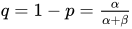 at the right end *x* = 1.
### Symmetry
\[[edit](https://en.wikipedia.org/w/index.php?title=Beta_distribution&action=edit§ion=36 "Edit section: Symmetry")\]
All statements are conditional on *α*, *β* \> 0:
- **Probability density function** [reflection symmetry](https://en.wikipedia.org/wiki/Symmetry "Symmetry")
f
(
x
;
α
,
β
)
\=
f
(
1
−
x
;
β
,
α
)
{\\displaystyle f(x;\\alpha ,\\beta )=f(1-x;\\beta ,\\alpha )}

- **Cumulative distribution function** [reflection symmetry](https://en.wikipedia.org/wiki/Symmetry "Symmetry") plus unitary [translation](https://en.wikipedia.org/wiki/Symmetry "Symmetry")
F
(
x
;
α
,
β
)
\=
I
x
(
α
,
β
)
\=
1
−
F
(
1
−
x
;
β
,
α
)
\=
1
−
I
1
−
x
(
β
,
α
)
{\\displaystyle F(x;\\alpha ,\\beta )=I\_{x}(\\alpha ,\\beta )=1-F(1-x;\\beta ,\\alpha )=1-I\_{1-x}(\\beta ,\\alpha )}

- **Mode** [reflection symmetry](https://en.wikipedia.org/wiki/Symmetry "Symmetry") plus unitary [translation](https://en.wikipedia.org/wiki/Symmetry "Symmetry")
mode
(
B
(
α
,
β
)
)
\=
1
−
mode
(
B
(
β
,
α
)
)
,
if
B
(
β
,
α
)
≠
B
(
1
,
1
)
{\\displaystyle \\operatorname {mode} (\\mathrm {B} (\\alpha ,\\beta ))=1-\\operatorname {mode} (\\mathrm {B} (\\beta ,\\alpha )),{\\text{ if }}\\mathrm {B} (\\beta ,\\alpha )\\neq \\mathrm {B} (1,1)}

- **Median** [reflection symmetry](https://en.wikipedia.org/wiki/Symmetry "Symmetry") plus unitary [translation](https://en.wikipedia.org/wiki/Symmetry "Symmetry")
median
(
B
(
α
,
β
)
)
\=
1
−
median
(
B
(
β
,
α
)
)
{\\displaystyle \\operatorname {median} (\\mathrm {B} (\\alpha ,\\beta ))=1-\\operatorname {median} (\\mathrm {B} (\\beta ,\\alpha ))}

- **Mean** [reflection symmetry](https://en.wikipedia.org/wiki/Symmetry "Symmetry") plus unitary [translation](https://en.wikipedia.org/wiki/Symmetry "Symmetry")
μ
(
B
(
α
,
β
)
)
\=
1
−
μ
(
B
(
β
,
α
)
)
{\\displaystyle \\mu (\\mathrm {B} (\\alpha ,\\beta ))=1-\\mu (\\mathrm {B} (\\beta ,\\alpha ))}

- **Geometric means** each is individually asymmetric, the following symmetry applies between the geometric mean based on *X* and the geometric mean based on its [reflection](https://en.wikipedia.org/wiki/Reflection_formula "Reflection formula") 1−*X*
G
X
(
B
(
α
,
β
)
)
\=
G
1
−
X
(
B
(
β
,
α
)
)
{\\displaystyle G\_{X}(\\mathrm {B} (\\alpha ,\\beta ))=G\_{1-X}(\\mathrm {B} (\\beta ,\\alpha ))}

- **Harmonic means** each is individually asymmetric, the following symmetry applies between the harmonic mean based on *X* and the harmonic mean based on its [reflection](https://en.wikipedia.org/wiki/Reflection_formula "Reflection formula") 1−*X*
H
X
(
B
(
α
,
β
)
)
\=
H
1
−
X
(
B
(
β
,
α
)
)
if
α
,
β
\>
1\.
{\\displaystyle H\_{X}(\\mathrm {B} (\\alpha ,\\beta ))=H\_{1-X}(\\mathrm {B} (\\beta ,\\alpha )){\\text{ if }}\\alpha ,\\beta \>1.}

- **Variance** symmetry
var
(
B
(
α
,
β
)
)
\=
var
(
B
(
β
,
α
)
)
{\\displaystyle \\operatorname {var} (\\mathrm {B} (\\alpha ,\\beta ))=\\operatorname {var} (\\mathrm {B} (\\beta ,\\alpha ))}

- **Geometric variances** each is individually asymmetric, the following symmetry applies between the log geometric variance based on X and the log geometric variance based on its [reflection](https://en.wikipedia.org/wiki/Reflection_formula "Reflection formula") 1−*X*
ln
(
var
G
X
(
B
(
α
,
β
)
)
)
\=
ln
(
var
G
(
1
−
X
)
(
B
(
β
,
α
)
)
)
{\\displaystyle \\ln(\\operatorname {var} \_{GX}(\\mathrm {B} (\\alpha ,\\beta )))=\\ln(\\operatorname {var} \_{G(1-X)}(\\mathrm {B} (\\beta ,\\alpha )))}

- **Geometric covariance** symmetry
ln
cov
G
X
,
(
1
−
X
)
(
B
(
α
,
β
)
)
\=
ln
cov
G
X
,
(
1
−
X
)
(
B
(
β
,
α
)
)
{\\displaystyle \\ln \\operatorname {cov} \_{GX,(1-X)}(\\mathrm {B} (\\alpha ,\\beta ))=\\ln \\operatorname {cov} \_{GX,(1-X)}(\\mathrm {B} (\\beta ,\\alpha ))}

- **Mean [absolute deviation](https://en.wikipedia.org/wiki/Absolute_deviation "Absolute deviation") around the mean** symmetry
E
\[
\|
X
−
E
\[
X
\]
\|
\]
(
B
(
α
,
β
)
)
\=
E
\[
\|
X
−
E
\[
X
\]
\|
\]
(
B
(
β
,
α
)
)
{\\displaystyle \\operatorname {E} \[\|X-E\[X\]\|\](\\mathrm {B} (\\alpha ,\\beta ))=\\operatorname {E} \[\|X-E\[X\]\|\](\\mathrm {B} (\\beta ,\\alpha ))}
![{\\displaystyle \\operatorname {E} \[\|X-E\[X\]\|\](\\mathrm {B} (\\alpha ,\\beta ))=\\operatorname {E} \[\|X-E\[X\]\|\](\\mathrm {B} (\\beta ,\\alpha ))}](https://wikimedia.org/api/rest_v1/media/math/render/svg/83468b7365d9095b07e04bfbb5c9cff50c64ea2d)
- **Skewness** [skew-symmetry](https://en.wikipedia.org/wiki/Symmetry_\(mathematics\) "Symmetry (mathematics)")
skewness
(
B
(
α
,
β
)
)
\=
−
skewness
(
B
(
β
,
α
)
)
{\\displaystyle \\operatorname {skewness} (\\mathrm {B} (\\alpha ,\\beta ))=-\\operatorname {skewness} (\\mathrm {B} (\\beta ,\\alpha ))}

- **Excess kurtosis** symmetry
excess kurtosis
(
B
(
α
,
β
)
)
\=
excess kurtosis
(
B
(
β
,
α
)
)
{\\displaystyle {\\text{excess kurtosis}}(\\mathrm {B} (\\alpha ,\\beta ))={\\text{excess kurtosis}}(\\mathrm {B} (\\beta ,\\alpha ))}

- **Characteristic function** symmetry of [Real part](https://en.wikipedia.org/wiki/Real_part "Real part") (with respect to the origin of variable "*t*")
Re
\[
1
F
1
(
α
;
α
\+
β
;
i
t
)
\]
\=
Re
\[
1
F
1
(
α
;
α
\+
β
;
−
i
t
)
\]
{\\displaystyle {\\text{Re}}\[{}\_{1}F\_{1}(\\alpha ;\\alpha +\\beta ;it)\]={\\text{Re}}\[{}\_{1}F\_{1}(\\alpha ;\\alpha +\\beta ;-it)\]}
![{\\displaystyle {\\text{Re}}\[{}\_{1}F\_{1}(\\alpha ;\\alpha +\\beta ;it)\]={\\text{Re}}\[{}\_{1}F\_{1}(\\alpha ;\\alpha +\\beta ;-it)\]}](https://wikimedia.org/api/rest_v1/media/math/render/svg/55bbddff6ec53eb39eccc603618459ba36e10ad2)
- **Characteristic function** [skew-symmetry](https://en.wikipedia.org/wiki/Symmetry_\(mathematics\) "Symmetry (mathematics)") of [Imaginary part](https://en.wikipedia.org/wiki/Imaginary_part "Imaginary part") (with respect to the origin of variable "*t*")
Im
\[
1
F
1
(
α
;
α
\+
β
;
i
t
)
\]
\=
−
Im
\[
1
F
1
(
α
;
α
\+
β
;
−
i
t
)
\]
{\\displaystyle {\\text{Im}}\[{}\_{1}F\_{1}(\\alpha ;\\alpha +\\beta ;it)\]=-{\\text{Im}}\[{}\_{1}F\_{1}(\\alpha ;\\alpha +\\beta ;-it)\]}
![{\\displaystyle {\\text{Im}}\[{}\_{1}F\_{1}(\\alpha ;\\alpha +\\beta ;it)\]=-{\\text{Im}}\[{}\_{1}F\_{1}(\\alpha ;\\alpha +\\beta ;-it)\]}](https://wikimedia.org/api/rest_v1/media/math/render/svg/ebb682c9915a60ef8d982340de042127ab262a0f)
- **Characteristic function** symmetry of [Absolute value](https://en.wikipedia.org/wiki/Absolute_value "Absolute value") (with respect to the origin of variable "*t*")
Abs
\[
1
F
1
(
α
;
α
\+
β
;
i
t
)
\]
\=
Abs
\[
1
F
1
(
α
;
α
\+
β
;
−
i
t
)
\]
{\\displaystyle {\\text{Abs}}\[{}\_{1}F\_{1}(\\alpha ;\\alpha +\\beta ;it)\]={\\text{Abs}}\[{}\_{1}F\_{1}(\\alpha ;\\alpha +\\beta ;-it)\]}
![{\\displaystyle {\\text{Abs}}\[{}\_{1}F\_{1}(\\alpha ;\\alpha +\\beta ;it)\]={\\text{Abs}}\[{}\_{1}F\_{1}(\\alpha ;\\alpha +\\beta ;-it)\]}](https://wikimedia.org/api/rest_v1/media/math/render/svg/08c1c15ff4c63020b66d2404d439514d965946d0)
- **Differential entropy** symmetry
h
(
B
(
α
,
β
)
)
\=
h
(
B
(
β
,
α
)
)
{\\displaystyle h(\\mathrm {B} (\\alpha ,\\beta ))=h(\\mathrm {B} (\\beta ,\\alpha ))}

- **Relative entropy (also called [Kullback–Leibler divergence](https://en.wikipedia.org/wiki/Kullback%E2%80%93Leibler_divergence "Kullback–Leibler divergence"))** symmetry
D
K
L
(
X
1
∥
X
2
)
\=
D
K
L
(
X
2
∥
X
1
)
,
if
h
(
X
1
)
\=
h
(
X
2
)
, for (skewed)
α
≠
β
{\\displaystyle D\_{\\mathrm {KL} }(X\_{1}\\parallel X\_{2})=D\_{\\mathrm {KL} }(X\_{2}\\parallel X\_{1}),{\\text{ if }}h(X\_{1})=h(X\_{2}){\\text{, for (skewed) }}\\alpha \\neq \\beta }

- **Fisher information matrix** symmetry
I
i
,
j
\=
I
j
,
i
{\\displaystyle {\\mathcal {I}}\_{i,j}={\\mathcal {I}}\_{j,i}}

### Geometry of the probability density function
\[[edit](https://en.wikipedia.org/w/index.php?title=Beta_distribution&action=edit§ion=37 "Edit section: Geometry of the probability density function")\]
#### Inflection points
\[[edit](https://en.wikipedia.org/w/index.php?title=Beta_distribution&action=edit§ion=38 "Edit section: Inflection points")\]
[](https://en.wikipedia.org/wiki/File:Inflexion_points_Beta_Distribution_alpha_and_beta_ranging_from_0_to_5_large_ptl_view_-_J._Rodal.jpg)
Inflection point location versus α and β showing regions with one inflection point
[](https://en.wikipedia.org/wiki/File:Inflexion_points_Beta_Distribution_alpha_and_beta_ranging_from_0_to_5_large_ptr_view_-_J._Rodal.jpg)
Inflection point location versus α and β showing region with two inflection points
For certain values of the shape parameters α and β, the [probability density function](https://en.wikipedia.org/wiki/Probability_density_function "Probability density function") has [inflection points](https://en.wikipedia.org/wiki/Inflection_points "Inflection points"), at which the [curvature](https://en.wikipedia.org/wiki/Curvature "Curvature") changes sign. The position of these inflection points can be useful as a measure of the [dispersion](https://en.wikipedia.org/wiki/Statistical_dispersion "Statistical dispersion") or spread of the distribution.
Defining the following quantity:
κ \= ( α − 1 ) ( β − 1 ) α \+ β − 3 α \+ β − 2 {\\displaystyle \\kappa ={\\frac {\\sqrt {\\frac {(\\alpha -1)(\\beta -1)}{\\alpha +\\beta -3}}}{\\alpha +\\beta -2}}} 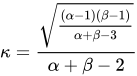
Points of inflection occur,[\[1\]](https://en.wikipedia.org/wiki/Beta_distribution#cite_note-JKB-1)[\[8\]](https://en.wikipedia.org/wiki/Beta_distribution#cite_note-Wadsworth-8)[\[9\]](https://en.wikipedia.org/wiki/Beta_distribution#cite_note-Handbook_of_Beta_Distribution-9)[\[20\]](https://en.wikipedia.org/wiki/Beta_distribution#cite_note-Panik-20) depending on the value of the shape parameters *α* and *β*, as follows:
- (*α* \> 2, *β* \> 2) The distribution is bell-shaped (symmetric for *α* = *β* and skewed otherwise), with **two inflection points**, equidistant from the mode:
x \= mode ± κ \= α − 1 ± ( α − 1 ) ( β − 1 ) α \+ β − 3 α \+ β − 2 {\\displaystyle x={\\text{mode}}\\pm \\kappa ={\\frac {\\alpha -1\\pm {\\sqrt {\\frac {(\\alpha -1)(\\beta -1)}{\\alpha +\\beta -3}}}}{\\alpha +\\beta -2}}} 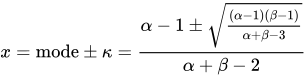
- (*α* = 2, *β* \> 2) The distribution is unimodal, positively skewed, right-tailed, with **one inflection point**, located to the right of the mode:
x \= mode \+ κ \= 2 β {\\displaystyle x={\\text{mode}}+\\kappa ={\\frac {2}{\\beta }}} 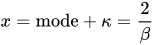
- (*α* \> 2, β = 2) The distribution is unimodal, negatively skewed, left-tailed, with **one inflection point**, located to the left of the mode:
x \= mode − κ \= 1 − 2 α {\\displaystyle x={\\text{mode}}-\\kappa =1-{\\frac {2}{\\alpha }}} 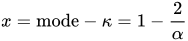
- (1 \< *α* \< 2, β \> 2, *α* + *β* \> 2) The distribution is unimodal, positively skewed, right-tailed, with **one inflection point**, located to the right of the mode:
x \= mode \+ κ \= α − 1 \+ ( α − 1 ) ( β − 1 ) α \+ β − 3 α \+ β − 2 {\\displaystyle x={\\text{mode}}+\\kappa ={\\frac {\\alpha -1+{\\sqrt {\\frac {(\\alpha -1)(\\beta -1)}{\\alpha +\\beta -3}}}}{\\alpha +\\beta -2}}} 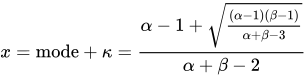
- (0 \< *α* \< 1, 1 \< *β* \< 2) The distribution has a mode at the left end *x* = 0 and it is positively skewed, right-tailed. There is **one inflection point**, located to the right of the mode:
x \= α − 1 \+ ( α − 1 ) ( β − 1 ) α \+ β − 3 α \+ β − 2 {\\displaystyle x={\\frac {\\alpha -1+{\\sqrt {\\frac {(\\alpha -1)(\\beta -1)}{\\alpha +\\beta -3}}}}{\\alpha +\\beta -2}}} 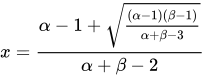
- (*α* \> 2, 1 \< *β* \< 2) The distribution is unimodal negatively skewed, left-tailed, with **one inflection point**, located to the left of the mode:
x \= mode − κ \= α − 1 − ( α − 1 ) ( β − 1 ) α \+ β − 3 α \+ β − 2 {\\displaystyle x={\\text{mode}}-\\kappa ={\\frac {\\alpha -1-{\\sqrt {\\frac {(\\alpha -1)(\\beta -1)}{\\alpha +\\beta -3}}}}{\\alpha +\\beta -2}}} 
- (1 \< *α* \< 2, 0 \< *β* \< 1) The distribution has a mode at the right end *x* = 1 and it is negatively skewed, left-tailed. There is **one inflection point**, located to the left of the mode:
x \= α − 1 − ( α − 1 ) ( β − 1 ) α \+ β − 3 α \+ β − 2 {\\displaystyle x={\\frac {\\alpha -1-{\\sqrt {\\frac {(\\alpha -1)(\\beta -1)}{\\alpha +\\beta -3}}}}{\\alpha +\\beta -2}}} 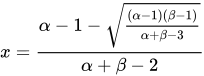
There are no inflection points in the remaining (symmetric and skewed) regions: U-shaped: (*α*, *β* \< 1) upside-down-U-shaped: (1 \< *α* \< 2, 1 \< *β* \< 2), reverse-J-shaped (*α* \< 1, *β* \> 2) or J-shaped: (*α* \> 2, *β* \< 1)
The accompanying plots show the inflection point locations (shown vertically, ranging from 0 to 1) versus *α* and *β* (the horizontal axes ranging from 0 to 5). There are large cuts at surfaces intersecting the lines *α* = 1, *β* = 1, *α* = 2, and *β* = 2 because at these values the beta distribution change from 2 modes, to 1 mode to no mode.
#### Shapes
\[[edit](https://en.wikipedia.org/w/index.php?title=Beta_distribution&action=edit§ion=39 "Edit section: Shapes")\]
[](https://en.wikipedia.org/wiki/File:PDF_for_symmetric_beta_distribution_vs._x_and_alpha%3Dbeta_from_0_to_30_-_J._Rodal.jpg)
PDF for symmetric beta distribution vs. *x* and *α* = *β* from 0 to 30
[](https://en.wikipedia.org/wiki/File:PDF_for_symmetric_beta_distribution_vs._x_and_alpha%3Dbeta_from_0_to_2_-_J._Rodal.jpg)
PDF for symmetric beta distribution vs. x and *α* = *β* from 0 to 2
[](https://en.wikipedia.org/wiki/File:PDF_for_skewed_beta_distribution_vs._x_and_beta%3D_2.5_alpha_from_0_to_9_-_J._Rodal.jpg)
PDF for skewed beta distribution vs. *x* and *β* = 2.5*α* from 0 to 9
[](https://en.wikipedia.org/wiki/File:PDF_for_skewed_beta_distribution_vs._x_and_beta%3D_5.5_alpha_from_0_to_9_-_J._Rodal.jpg)
PDF for skewed beta distribution vs. x and *β* = 5.5*α* from 0 to 9
[](https://en.wikipedia.org/wiki/File:PDF_for_skewed_beta_distribution_vs._x_and_beta%3D_8_alpha_from_0_to_10_-_J._Rodal.jpg)
PDF for skewed beta distribution vs. x and *β* = 8*α* from 0 to 10
The beta density function can take a wide variety of different shapes depending on the values of the two parameters *α* and *β*. The ability of the beta distribution to take this great diversity of shapes (using only two parameters) is partly responsible for finding wide application for modeling actual measurements:
##### Symmetric (*α* = *β*)
\[[edit](https://en.wikipedia.org/w/index.php?title=Beta_distribution&action=edit§ion=40 "Edit section: Symmetric (α = β)")\]
- the density function is [symmetric](https://en.wikipedia.org/wiki/Symmetry "Symmetry") about 1/2 (blue & teal plots).
- median = mean = 1/2.
- skewness = 0.
- variance = 1/(4(2*α* + 1))
- ***α* = *β* \< 1**
- U-shaped (blue plot).
- bimodal: left mode = 0, right mode =1, anti-mode = 1/2
- 1/12 \< var(*X*) \< 1/4[\[1\]](https://en.wikipedia.org/wiki/Beta_distribution#cite_note-JKB-1)
- −2 \< excess kurtosis(*X*) \< −6/5
- *α* = *β* = 1/2 is the [arcsine distribution](https://en.wikipedia.org/wiki/Arcsine_distribution "Arcsine distribution")
- var(*X*) = 1/8
- excess kurtosis(*X*) = −3/2
- CF = Rinc (t) [\[34\]](https://en.wikipedia.org/wiki/Beta_distribution#cite_note-34)
- *α* = *β* → 0 is a 2-point [Bernoulli distribution](https://en.wikipedia.org/wiki/Bernoulli_distribution "Bernoulli distribution") with equal probability 1/2 at each [Dirac delta function](https://en.wikipedia.org/wiki/Dirac_delta_function "Dirac delta function") end *x* = 0 and *x* = 1 and zero probability everywhere else. A coin toss: one face of the coin being *x* = 0 and the other face being *x* = 1.
- lim
α
\=
β
→
0
var
(
X
)
\=
1
4
{\\displaystyle \\lim \_{\\alpha =\\beta \\to 0}\\operatorname {var} (X)={\\tfrac {1}{4}}}
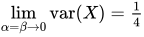
- lim
α
\=
β
→
0
e
x
c
e
s
s
k
u
r
t
o
s
i
s
(
X
)
\=
−
2
{\\displaystyle \\lim \_{\\alpha =\\beta \\to 0}\\operatorname {excess\\ kurtosis} (X)=-2}

a lower value than this is impossible for any distribution to reach.
- The [differential entropy](https://en.wikipedia.org/wiki/Information_entropy "Information entropy") approaches a [minimum](https://en.wikipedia.org/wiki/Maxima_and_minima "Maxima and minima") value of −∞
- **α = β = 1**
- the [uniform \[0, 1\] distribution](https://en.wikipedia.org/wiki/Uniform_distribution_\(continuous\) "Uniform distribution (continuous)")
- no mode
- var(*X*) = 1/12
- excess kurtosis(*X*) = −6/5
- The (negative anywhere else) [differential entropy](https://en.wikipedia.org/wiki/Information_entropy "Information entropy") reaches its [maximum](https://en.wikipedia.org/wiki/Maxima_and_minima "Maxima and minima") value of zero
- CF = Sinc (t)
- ***α* = *β* \> 1**
- symmetric [unimodal](https://en.wikipedia.org/wiki/Unimodal "Unimodal")
- mode = 1/2.
- 0 \< var(*X*) \< 1/12[\[1\]](https://en.wikipedia.org/wiki/Beta_distribution#cite_note-JKB-1)
- −6/5 \< excess kurtosis(*X*) \< 0
- *α* = *β* = 3/2 is a semi-elliptic \[0, 1\] distribution, see: [Wigner semicircle distribution](https://en.wikipedia.org/wiki/Wigner_semicircle_distribution "Wigner semicircle distribution")[\[35\]](https://en.wikipedia.org/wiki/Beta_distribution#cite_note-35)
- var(*X*) = 1/16.
- excess kurtosis(*X*) = −1
- CF = 2 Jinc (t)
- *α* = *β* = 2 is the parabolic \[0, 1\] distribution
- var(*X*) = 1/20
- excess kurtosis(*X*) = −6/7
- CF = 3 Tinc (t) [\[36\]](https://en.wikipedia.org/wiki/Beta_distribution#cite_note-36)
- *α* = *β* \> 2 is bell-shaped, with [inflection points](https://en.wikipedia.org/wiki/Inflection_point "Inflection point") located to either side of the mode
- 0 \< var(*X*) \< 1/20
- −6/7 \< excess kurtosis(*X*) \< 0
- *α* = *β* → ∞ is a 1-point [Degenerate distribution](https://en.wikipedia.org/wiki/Degenerate_distribution "Degenerate distribution") with a [Dirac delta function](https://en.wikipedia.org/wiki/Dirac_delta_function "Dirac delta function") spike at the midpoint *x* = 1/2 with probability 1, and zero probability everywhere else. There is 100% probability (absolute certainty) concentrated at the single point *x* = 1/2.
- lim
α
\=
β
→
∞
var
(
X
)
\=
0
{\\displaystyle \\lim \_{\\alpha =\\beta \\to \\infty }\\operatorname {var} (X)=0}
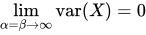
- lim
α
\=
β
→
∞
e
x
c
e
s
s
k
u
r
t
o
s
i
s
(
X
)
\=
0
{\\displaystyle \\lim \_{\\alpha =\\beta \\to \\infty }\\operatorname {excess\\ kurtosis} (X)=0}

- The [differential entropy](https://en.wikipedia.org/wiki/Information_entropy "Information entropy") approaches a [minimum](https://en.wikipedia.org/wiki/Maxima_and_minima "Maxima and minima") value of −∞
##### Skewed (*α* ≠ *β*)
\[[edit](https://en.wikipedia.org/w/index.php?title=Beta_distribution&action=edit§ion=41 "Edit section: Skewed (α ≠ β)")\]
The density function is [skewed](https://en.wikipedia.org/wiki/Skewness "Skewness"). An interchange of parameter values yields the [mirror image](https://en.wikipedia.org/wiki/Mirror_image "Mirror image") (the reverse) of the initial curve, some more specific cases:
- ***α* \< 1, *β* \< 1**
- U-shaped
- Positive skew for *α* \< *β*, negative skew for *α* \> *β*.
- bimodal: left mode = 0, right mode = 1, anti-mode =
α
−
1
α
\+
β
−
2
{\\displaystyle {\\tfrac {\\alpha -1}{\\alpha +\\beta -2}}}

- 0 \< median \< 1.
- 0 \< var(*X*) \< 1/4
- ***α* \> 1, *β* \> 1**
- [unimodal](https://en.wikipedia.org/wiki/Unimodal "Unimodal") (magenta & cyan plots),
- Positive skew for *α* \< *β*, negative skew for *α* \> *β*.
- mode
\=
α
−
1
α
\+
β
−
2
{\\displaystyle {\\text{mode}}={\\tfrac {\\alpha -1}{\\alpha +\\beta -2}}}

- 0 \< median \< 1
- 0 \< var(*X*) \< 1/12
- ***α* \< 1, *β* ≥ 1**
- reverse J-shaped with a right tail,
- positively skewed,
- strictly decreasing, [convex](https://en.wikipedia.org/wiki/Convex_function "Convex function")
- mode = 0
- 0 \< median \< 1/2.
- 0
\<
var
(
X
)
\<
−
11
\+
5
5
2
,
{\\displaystyle 0\<\\operatorname {var} (X)\<{\\tfrac {-11+5{\\sqrt {5}}}{2}},}

(maximum variance occurs for
α
\=
−
1
\+
5
2
,
β
\=
1
{\\displaystyle \\alpha ={\\tfrac {-1+{\\sqrt {5}}}{2}},\\beta =1}
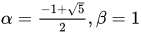
, or *α* = **Φ** the [golden ratio conjugate](https://en.wikipedia.org/wiki/Golden_ratio "Golden ratio"))
- ***α* ≥ 1, *β* \< 1**
- J-shaped with a left tail,
- negatively skewed,
- strictly increasing, [convex](https://en.wikipedia.org/wiki/Convex_function "Convex function")
- mode = 1
- 1/2 \< median \< 1
- 0
\<
var
(
X
)
\<
−
11
\+
5
5
2
,
{\\displaystyle 0\<\\operatorname {var} (X)\<{\\tfrac {-11+5{\\sqrt {5}}}{2}},}

(maximum variance occurs for
α
\=
1
,
β
\=
−
1
\+
5
2
{\\displaystyle \\alpha =1,\\beta ={\\tfrac {-1+{\\sqrt {5}}}{2}}}
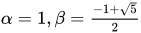
, or *β* = **Φ** the [golden ratio conjugate](https://en.wikipedia.org/wiki/Golden_ratio "Golden ratio"))
- ***α* = 1, *β* \> 1**
- positively skewed,
- strictly decreasing (red plot),
- a reversed (mirror-image) [power function distribution](https://en.wikipedia.org/w/index.php?title=Power_function_distribution&action=edit&redlink=1 "Power function distribution (page does not exist)")
- mean = 1 / (*β* + 1)
- median = 1 - 1/21/*β*
- mode = 0
- α = 1, 1 \< β \< 2
- [concave](https://en.wikipedia.org/wiki/Concave_function "Concave function")
- 1
−
1
2
\<
median
\<
1
2
{\\displaystyle 1-{\\tfrac {1}{\\sqrt {2}}}\<{\\text{median}}\<{\\tfrac {1}{2}}}

- 1/18 \< var(*X*) \< 1/12.
- α = 1, β = 2
- a straight line with slope −2, the right-[triangular distribution](https://en.wikipedia.org/wiki/Triangular_distribution "Triangular distribution") with right angle at the left end, at *x* = 0
- median
\=
1
−
1
2
{\\displaystyle {\\text{median}}=1-{\\tfrac {1}{\\sqrt {2}}}}
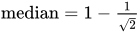
- var(*X*) = 1/18
- α = 1, β \> 2
- reverse J-shaped with a right tail,
- [convex](https://en.wikipedia.org/wiki/Convex_function "Convex function")
- 0
\<
median
\<
1
−
1
2
{\\displaystyle 0\<{\\text{median}}\<1-{\\tfrac {1}{\\sqrt {2}}}}

- 0 \< var(*X*) \< 1/18
- **α \> 1, β = 1**
- negatively skewed,
- strictly increasing (green plot),
- the power function distribution[\[9\]](https://en.wikipedia.org/wiki/Beta_distribution#cite_note-Handbook_of_Beta_Distribution-9)
- mean = α / (α + 1)
- median = 1/21/α
- mode = 1
- 2 \> α \> 1, β = 1
- [concave](https://en.wikipedia.org/wiki/Concave_function "Concave function")
- 1
2
\<
median
\<
1
2
{\\displaystyle {\\tfrac {1}{2}}\<{\\text{median}}\<{\\tfrac {1}{\\sqrt {2}}}}
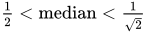
- 1/18 \< var(*X*) \< 1/12
- α = 2, β = 1
- a straight line with slope +2, the right-[triangular distribution](https://en.wikipedia.org/wiki/Triangular_distribution "Triangular distribution") with right angle at the right end, at *x* = 1
- median
\=
1
2
{\\displaystyle {\\text{median}}={\\tfrac {1}{\\sqrt {2}}}}
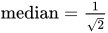
- var(*X*) = 1/18
- α \> 2, β = 1
- J-shaped with a left tail, [convex](https://en.wikipedia.org/wiki/Convex_function "Convex function")
- 1
2
\<
median
\<
1
{\\displaystyle {\\tfrac {1}{\\sqrt {2}}}\<{\\text{median}}\<1}
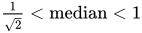
- 0 \< var(*X*) \< 1/18
## Related distributions
\[[edit](https://en.wikipedia.org/w/index.php?title=Beta_distribution&action=edit§ion=42 "Edit section: Related distributions")\]
### Transformations
\[[edit](https://en.wikipedia.org/w/index.php?title=Beta_distribution&action=edit§ion=43 "Edit section: Transformations")\]
- If *X* ~ Beta(*α*, *β*) then 1 − *X* ~ Beta(*β*, *α*) [mirror-image](https://en.wikipedia.org/wiki/Mirror_image "Mirror image") symmetry
- If *X* ~ Beta(*α*, *β*) then
X
1
−
X
∼
β
′
(
α
,
β
)
{\\displaystyle {\\tfrac {X}{1-X}}\\sim {\\beta '}(\\alpha ,\\beta )}

. The [beta prime distribution](https://en.wikipedia.org/wiki/Beta_prime_distribution "Beta prime distribution"), also called "beta distribution of the second kind".
- If
X
∼
Beta
(
α
,
β
)
{\\displaystyle X\\sim {\\text{Beta}}(\\alpha ,\\beta )}

, then
Y
\=
log
X
1
−
X
{\\displaystyle Y=\\log {\\frac {X}{1-X}}}
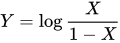
has a [generalized logistic distribution](https://en.wikipedia.org/wiki/Generalized_logistic_distribution "Generalized logistic distribution"), with density
σ
(
y
)
α
σ
(
−
y
)
β
B
(
α
,
β
)
{\\displaystyle {\\frac {\\sigma (y)^{\\alpha }\\sigma (-y)^{\\beta }}{B(\\alpha ,\\beta )}}}
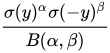
, where
σ
{\\displaystyle \\sigma }

is the [logistic sigmoid](https://en.wikipedia.org/wiki/Logistic_sigmoid "Logistic sigmoid").
- If *X* ~ Beta(*α*, *β*) then
1
X
−
1
∼
β
′
(
β
,
α
)
{\\displaystyle {\\tfrac {1}{X}}-1\\sim {\\beta '}(\\beta ,\\alpha )}
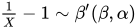
.
- If
X
∼
Beta
(
α
1
,
β
1
)
{\\displaystyle X\\sim {\\text{Beta}}(\\alpha \_{1},\\beta \_{1})}

and
Y
∼
Beta
(
α
2
,
β
2
)
{\\displaystyle Y\\sim {\\text{Beta}}(\\alpha \_{2},\\beta \_{2})}

then
Z
\=
X
Y
{\\displaystyle Z={\\tfrac {X}{Y}}}

has density
B
(
α
1
\+
α
2
,
β
2
)
z
α
1
−
1
2
F
1
(
α
1
\+
α
2
,
1
−
β
1
;
α
1
\+
α
2
\+
β
2
;
z
)
B
(
α
1
,
β
1
)
B
(
α
2
,
β
2
)
{\\displaystyle {\\tfrac {B(\\alpha \_{1}+\\alpha \_{2},\\beta \_{2})z^{\\alpha \_{1}-1}{}\_{2}F\_{1}(\\alpha \_{1}+\\alpha \_{2},1-\\beta \_{1};\\alpha \_{1}+\\alpha \_{2}+\\beta \_{2};z)}{B(\\alpha \_{1},\\beta \_{1})B(\\alpha \_{2},\\beta \_{2})}}}

for
0
\<
z
≤
1
{\\displaystyle 0\<z\\leq 1}

and
B
(
α
1
\+
α
2
,
β
1
)
z
−
(
α
2
\+
1
)
2
F
1
(
α
1
\+
α
2
,
1
−
β
2
;
α
1
\+
α
2
\+
β
1
;
1
z
)
B
(
α
1
,
β
1
)
B
(
α
2
,
β
2
)
{\\displaystyle {\\tfrac {B(\\alpha \_{1}+\\alpha \_{2},\\beta \_{1})z^{-(\\alpha \_{2}+1)}{}\_{2}F\_{1}(\\alpha \_{1}+\\alpha \_{2},1-\\beta \_{2};\\alpha \_{1}+\\alpha \_{2}+\\beta \_{1};{\\tfrac {1}{z}})}{B(\\alpha \_{1},\\beta \_{1})B(\\alpha \_{2},\\beta \_{2})}}}

for
z
≥
1
{\\displaystyle z\\geq 1}

, where
2
F
1
(
a
,
b
;
c
;
x
)
{\\displaystyle {}\_{2}F\_{1}(a,b;c;x)}

is the [Hypergeometric function](https://en.wikipedia.org/wiki/Hypergeometric_function "Hypergeometric function").[\[37\]](https://en.wikipedia.org/wiki/Beta_distribution#cite_note-Pham-Gia2000-37)
- If *X* ~ Beta(*n*/2, *m*/2) then
m
X
n
(
1
−
X
)
∼
F
(
n
,
m
)
{\\displaystyle {\\tfrac {mX}{n(1-X)}}\\sim F(n,m)}
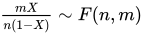
(assuming *n* \> 0 and *m* \> 0), the [Fisher–Snedecor F distribution](https://en.wikipedia.org/wiki/F-distribution "F-distribution").
- If
X
∼
Beta
(
1
\+
λ
m
−
min
max
−
min
,
1
\+
λ
max
−
m
max
−
min
)
{\\displaystyle X\\sim \\operatorname {Beta} \\left(1+\\lambda {\\tfrac {m-\\min }{\\max -\\min }},1+\\lambda {\\tfrac {\\max -m}{\\max -\\min }}\\right)}

then min + *X*(max − min) ~ PERT(min, max, *m*, *λ*) where *PERT* denotes a [PERT distribution](https://en.wikipedia.org/wiki/PERT_distribution "PERT distribution") used in [PERT](https://en.wikipedia.org/wiki/PERT "PERT") analysis, and *m*\=most likely value.[\[38\]](https://en.wikipedia.org/wiki/Beta_distribution#cite_note-NewPERT-38) Traditionally[\[39\]](https://en.wikipedia.org/wiki/Beta_distribution#cite_note-Malcolm-39) *λ* = 4 in PERT analysis.
- If *X* ~ Beta(1, *β*) then *X* ~ [Kumaraswamy distribution](https://en.wikipedia.org/wiki/Kumaraswamy_distribution "Kumaraswamy distribution") with parameters (1, *β*)
- If *X* ~ Beta(*α*, 1) then *X* ~ [Kumaraswamy distribution](https://en.wikipedia.org/wiki/Kumaraswamy_distribution "Kumaraswamy distribution") with parameters (*α*, 1)
- If *X* ~ Beta(*α*, 1) then −ln(*X*) ~ Exponential(*α*)
### Special and limiting cases
\[[edit](https://en.wikipedia.org/w/index.php?title=Beta_distribution&action=edit§ion=44 "Edit section: Special and limiting cases")\]
[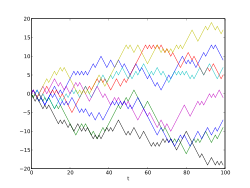](https://en.wikipedia.org/wiki/File:Random_Walk_example.svg)
Example of eight realizations of a random walk in one dimension starting at 0: the probability for the time of the last visit to the origin is distributed as Beta(1/2, 1/2)
[](https://en.wikipedia.org/wiki/File:Arcsin_density.svg)
Beta(1/2, 1/2): The [arcsine distribution](https://en.wikipedia.org/wiki/Arcsine_distribution "Arcsine distribution") probability density was proposed by [Harold Jeffreys](https://en.wikipedia.org/wiki/Harold_Jeffreys "Harold Jeffreys") to represent uncertainty for a [Bernoulli](https://en.wikipedia.org/wiki/Bernoulli_distribution "Bernoulli distribution") or a [binomial distribution](https://en.wikipedia.org/wiki/Binomial_distribution "Binomial distribution") in [Bayesian inference](https://en.wikipedia.org/wiki/Bayesian_inference "Bayesian inference"), and is now commonly referred to as [Jeffreys prior](https://en.wikipedia.org/wiki/Jeffreys_prior "Jeffreys prior"): *p*−1/2(1 − *p*)−1/2. This distribution also appears in several [random walk](https://en.wikipedia.org/wiki/Random_walk "Random walk") fundamental theorems
- Beta(1, 1) ~ [U(0, 1)](https://en.wikipedia.org/wiki/Uniform_distribution_\(continuous\) "Uniform distribution (continuous)") with density 1 on that interval.
- Beta(n, 1) ~ Maximum of *n* independent rvs. with [U(0, 1)](https://en.wikipedia.org/wiki/Uniform_distribution_\(continuous\) "Uniform distribution (continuous)"), sometimes called a *a standard power function distribution* with density *n* *x**n*–1 on that interval.
- Beta(1, n) ~ Minimum of *n* independent rvs. with [U(0, 1)](https://en.wikipedia.org/wiki/Uniform_distribution_\(continuous\) "Uniform distribution (continuous)") with density *n*(1 − *x*)*n*−1 on that interval.
- If *X* ~ Beta(3/2, 3/2) and *r* \> 0 then 2*rX* − *r* ~ [Wigner semicircle distribution](https://en.wikipedia.org/wiki/Wigner_semicircle_distribution "Wigner semicircle distribution").
- Beta(1/2, 1/2) is equivalent to the [arcsine distribution](https://en.wikipedia.org/wiki/Arcsine_distribution "Arcsine distribution"). This distribution is also [Jeffreys prior](https://en.wikipedia.org/wiki/Jeffreys_prior "Jeffreys prior") probability for the [Bernoulli](https://en.wikipedia.org/wiki/Bernoulli_distribution "Bernoulli distribution") and [binomial distributions](https://en.wikipedia.org/wiki/Binomial_distribution "Binomial distribution").
- lim
n
→
∞
n
Beta
(
1
,
n
)
\=
Exponential
(
1
)
{\\displaystyle \\lim \_{n\\to \\infty }n\\operatorname {Beta} (1,n)=\\operatorname {Exponential} (1)}

the [exponential distribution](https://en.wikipedia.org/wiki/Exponential_distribution "Exponential distribution").
- lim
n
→
∞
n
Beta
(
k
,
n
)
\=
Gamma
(
k
,
1
)
{\\displaystyle \\lim \_{n\\to \\infty }n\\operatorname {Beta} (k,n)=\\operatorname {Gamma} (k,1)}

the [gamma distribution](https://en.wikipedia.org/wiki/Gamma_distribution "Gamma distribution").
- For large
n
{\\displaystyle n}

,
Beta
(
α
n
,
β
n
)
→
N
(
α
α
\+
β
,
α
β
(
α
\+
β
)
3
1
n
)
{\\displaystyle \\operatorname {Beta} (\\alpha n,\\beta n)\\to {\\mathcal {N}}\\left({\\frac {\\alpha }{\\alpha +\\beta }},{\\frac {\\alpha \\beta }{(\\alpha +\\beta )^{3}}}{\\frac {1}{n}}\\right)}

the [normal distribution](https://en.wikipedia.org/wiki/Normal_distribution "Normal distribution"). More precisely, if
X
n
∼
Beta
(
α
n
,
β
n
)
{\\displaystyle X\_{n}\\sim \\operatorname {Beta} (\\alpha n,\\beta n)}

then
n
(
X
n
−
α
α
\+
β
)
{\\displaystyle {\\sqrt {n}}\\left(X\_{n}-{\\tfrac {\\alpha }{\\alpha +\\beta }}\\right)}
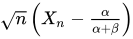
converges in distribution to a normal distribution with mean 0 and variance
α
β
(
α
\+
β
)
3
{\\displaystyle {\\tfrac {\\alpha \\beta }{(\\alpha +\\beta )^{3}}}}

as *n* increases.
### Derived from other distributions
\[[edit](https://en.wikipedia.org/w/index.php?title=Beta_distribution&action=edit§ion=45 "Edit section: Derived from other distributions")\]
- The *k*th [order statistic](https://en.wikipedia.org/wiki/Order_statistic "Order statistic") of a sample of size *n* from the [uniform distribution](https://en.wikipedia.org/wiki/Uniform_distribution_\(continuous\) "Uniform distribution (continuous)") is a beta random variable, *U*(*k*) ~ Beta(*k*, *n*\+1−*k*).[\[40\]](https://en.wikipedia.org/wiki/Beta_distribution#cite_note-David1-40)
- [Gamma distribution](https://en.wikipedia.org/wiki/Gamma_distribution "Gamma distribution"): If *X* ~ Gamma(α, θ) and *Y* ~ Gamma(β, θ) are independent, then
X
X
\+
Y
∼
Beta
(
α
,
β
)
{\\displaystyle {\\tfrac {X}{X+Y}}\\sim \\operatorname {Beta} (\\alpha ,\\beta )\\,}

.
- [Chi-squared distribution](https://en.wikipedia.org/wiki/Chi-squared_distribution "Chi-squared distribution"): If
X
∼
χ
2
(
α
)
{\\displaystyle X\\sim \\chi ^{2}(\\alpha )\\,}

and
Y
∼
χ
2
(
β
)
{\\displaystyle Y\\sim \\chi ^{2}(\\beta )\\,}

are independent, then
X
X
\+
Y
∼
Beta
(
α
2
,
β
2
)
{\\displaystyle {\\tfrac {X}{X+Y}}\\sim \\operatorname {Beta} ({\\tfrac {\\alpha }{2}},{\\tfrac {\\beta }{2}})}
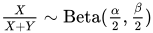
.
- The [power transformation](https://en.wikipedia.org/wiki/Power_transformation_\(statistics\) "Power transformation (statistics)") for the uniform distribution: If *X* ~ U(0, 1) and *α* \> 0 then *X*1/*α* ~ Beta(*α*, 1).
- [Cauchy distribution](https://en.wikipedia.org/wiki/Cauchy_distribution "Cauchy distribution"): If *X* ~ Cauchy(0, 1) then
1
1
\+
X
2
∼
Beta
(
1
2
,
1
2
)
{\\displaystyle {\\tfrac {1}{1+X^{2}}}\\sim \\operatorname {Beta} \\left({\\tfrac {1}{2}},{\\tfrac {1}{2}}\\right)\\,}
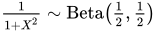
### Combination with other distributions
\[[edit](https://en.wikipedia.org/w/index.php?title=Beta_distribution&action=edit§ion=46 "Edit section: Combination with other distributions")\]
- *X* ~ Beta(*α*, *β*) and *Y* ~ F(2*β*,2*α*) then
Pr
(
X
≤
α
α
\+
β
x
)
\=
Pr
(
Y
≥
x
)
{\\displaystyle \\Pr(X\\leq {\\tfrac {\\alpha }{\\alpha +\\beta x}})=\\Pr(Y\\geq x)\\,}

for all *x* \> 0.
### Compounding with other distributions
\[[edit](https://en.wikipedia.org/w/index.php?title=Beta_distribution&action=edit§ion=47 "Edit section: Compounding with other distributions")\]
- If *p* ~ Beta(α, β) and *X* ~ Bin(*k*, *p*) then *X* ~ [beta-binomial distribution](https://en.wikipedia.org/wiki/Beta-binomial_distribution "Beta-binomial distribution")
- If *p* ~ Beta(α, β) and *X* ~ NB(*r*, *p*) then *X* ~ [beta negative binomial distribution](https://en.wikipedia.org/wiki/Beta_negative_binomial_distribution "Beta negative binomial distribution")
### Generalisations
\[[edit](https://en.wikipedia.org/w/index.php?title=Beta_distribution&action=edit§ion=48 "Edit section: Generalisations")\]
- The generalization to multiple variables, i.e. a [multivariate Beta distribution](https://en.wikipedia.org/wiki/Dirichlet_distribution "Dirichlet distribution"), is called a [Dirichlet distribution](https://en.wikipedia.org/wiki/Dirichlet_distribution "Dirichlet distribution"). Univariate marginals of the Dirichlet distribution have a beta distribution. The beta distribution is [conjugate](https://en.wikipedia.org/wiki/Conjugate_prior "Conjugate prior") to the binomial and Bernoulli distributions in exactly the same way as the [Dirichlet distribution](https://en.wikipedia.org/wiki/Dirichlet_distribution "Dirichlet distribution") is conjugate to the [multinomial distribution](https://en.wikipedia.org/wiki/Multinomial_distribution "Multinomial distribution") and [categorical distribution](https://en.wikipedia.org/wiki/Categorical_distribution "Categorical distribution").
- The [Pearson type I distribution](https://en.wikipedia.org/wiki/Pearson_distribution#The_Pearson_type_I_distribution "Pearson distribution") is identical to the beta distribution (except for arbitrary shifting and re-scaling that can also be accomplished with the four parameter parametrization of the beta distribution).
- The beta distribution is the special case of the [noncentral beta distribution](https://en.wikipedia.org/wiki/Noncentral_beta_distribution "Noncentral beta distribution") where
λ
\=
0
{\\displaystyle \\lambda =0}

:
Beta
(
α
,
β
)
\=
NonCentralBeta
(
α
,
β
,
0
)
{\\displaystyle \\operatorname {Beta} (\\alpha ,\\beta )=\\operatorname {NonCentralBeta} (\\alpha ,\\beta ,0)}

.
- The [generalized beta distribution](https://en.wikipedia.org/wiki/Generalized_beta_distribution "Generalized beta distribution") is a five-parameter distribution family which has the beta distribution as a special case.
- The [matrix variate beta distribution](https://en.wikipedia.org/wiki/Matrix_variate_beta_distribution "Matrix variate beta distribution") is a distribution for [positive-definite matrices](https://en.wikipedia.org/wiki/Positive-definite_matrices "Positive-definite matrices").
## Statistical inference
\[[edit](https://en.wikipedia.org/w/index.php?title=Beta_distribution&action=edit§ion=49 "Edit section: Statistical inference")\]
### Parameter estimation
\[[edit](https://en.wikipedia.org/w/index.php?title=Beta_distribution&action=edit§ion=50 "Edit section: Parameter estimation")\]
#### Method of moments
\[[edit](https://en.wikipedia.org/w/index.php?title=Beta_distribution&action=edit§ion=51 "Edit section: Method of moments")\]
##### Two unknown parameters
\[[edit](https://en.wikipedia.org/w/index.php?title=Beta_distribution&action=edit§ion=52 "Edit section: Two unknown parameters")\]
Two unknown parameters (( α ^ , β ^ ) {\\displaystyle ({\\hat {\\alpha }},{\\hat {\\beta }})}  of a beta distribution supported in the \[0,1\] interval) can be estimated, using the method of moments, with the first two moments (sample mean and sample variance) as follows. Let:
sample mean(X) \= x ¯ \= 1 N ∑ i \= 1 N X i {\\displaystyle {\\text{sample mean(X)}}={\\bar {x}}={\\frac {1}{N}}\\sum \_{i=1}^{N}X\_{i}} 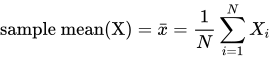
be the [sample mean](https://en.wikipedia.org/wiki/Sample_mean "Sample mean") estimate and
sample variance(X) \= v ¯ \= 1 N − 1 ∑ i \= 1 N ( X i − x ¯ ) 2 {\\displaystyle {\\text{sample variance(X)}}={\\bar {v}}={\\frac {1}{N-1}}\\sum \_{i=1}^{N}\\left(X\_{i}-{\\bar {x}}\\right)^{2}} 
be the [sample variance](https://en.wikipedia.org/wiki/Sample_variance "Sample variance") estimate. The [method-of-moments](https://en.wikipedia.org/wiki/Method_of_moments_\(statistics\) "Method of moments (statistics)") estimates of the parameters are
α ^ \= x ¯ ( x ¯ ( 1 − x ¯ ) v ¯ − 1 ) if v ¯ \< x ¯ ( 1 − x ¯ ) , {\\displaystyle {\\hat {\\alpha }}={\\bar {x}}\\left({\\frac {{\\bar {x}}(1-{\\bar {x}})}{\\bar {v}}}-1\\right)\\ {\\text{if}}\\ {\\bar {v}}\<{\\bar {x}}(1-{\\bar {x}}),}  β ^ \= ( 1 − x ¯ ) ( x ¯ ( 1 − x ¯ ) v ¯ − 1 ) if v ¯ \< x ¯ ( 1 − x ¯ ) . {\\displaystyle {\\hat {\\beta }}=(1-{\\bar {x}})\\left({\\frac {{\\bar {x}}(1-{\\bar {x}})}{\\bar {v}}}-1\\right)\\ {\\text{if}}\\ {\\bar {v}}\<{\\bar {x}}(1-{\\bar {x}}).} 
When the distribution is required over a known interval other than \[0, 1\] with random variable *X*, say \[*a*, *c*\] with random variable *Y*, then replace x ¯ {\\displaystyle {\\bar {x}}}  with y ¯ − a c − a , {\\displaystyle {\\frac {{\\bar {y}}-a}{c-a}},}  and v ¯ {\\displaystyle {\\bar {v}}}  with v Y ¯ ( c − a ) 2 {\\displaystyle {\\frac {\\bar {v\_{Y}}}{(c-a)^{2}}}}  in the above couple of equations for the shape parameters (see the "Four unknown parameters" section below),[\[41\]](https://en.wikipedia.org/wiki/Beta_distribution#cite_note-41) where:
sample mean(Y) \= y ¯ \= 1 N ∑ i \= 1 N Y i {\\displaystyle {\\text{sample mean(Y)}}={\\bar {y}}={\\frac {1}{N}}\\sum \_{i=1}^{N}Y\_{i}} 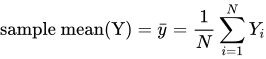 sample variance(Y) \= v ¯ Y \= 1 N − 1 ∑ i \= 1 N ( Y i − y ¯ ) 2 {\\displaystyle {\\text{sample variance(Y)}}={\\bar {v}}\_{Y}={\\frac {1}{N-1}}\\sum \_{i=1}^{N}\\left(Y\_{i}-{\\bar {y}}\\right)^{2}} 
##### Four unknown parameters
\[[edit](https://en.wikipedia.org/w/index.php?title=Beta_distribution&action=edit§ion=53 "Edit section: Four unknown parameters")\]
[](https://en.wikipedia.org/wiki/File:\(alpha_and_beta\)_Parameter_estimates_vs._excess_Kurtosis_and_\(squared\)_Skewness_Beta_distribution_-_J._Rodal.png)
Solutions for parameter estimates vs. (sample) excess Kurtosis and (sample) squared Skewness Beta distribution
All four parameters (α ^ , β ^ , a ^ , c ^ {\\displaystyle {\\hat {\\alpha }},{\\hat {\\beta }},{\\hat {a}},{\\hat {c}}}  of a beta distribution supported in the \[*a*, *c*\] interval, see section ["Alternative parametrizations, Four parameters"](https://en.wikipedia.org/wiki/Beta_distribution#Four_parameters)) can be estimated, using the method of moments developed by [Karl Pearson](https://en.wikipedia.org/wiki/Karl_Pearson "Karl Pearson"), by equating sample and population values of the first four central moments (mean, variance, skewness and excess kurtosis).[\[1\]](https://en.wikipedia.org/wiki/Beta_distribution#cite_note-JKB-1)[\[42\]](https://en.wikipedia.org/wiki/Beta_distribution#cite_note-Elderton1906-42)[\[43\]](https://en.wikipedia.org/wiki/Beta_distribution#cite_note-Elderton_and_Johnson-43) The excess kurtosis was expressed in terms of the square of the skewness, and the sample size ν = α + β, (see previous section ["Kurtosis"](https://en.wikipedia.org/wiki/Beta_distribution#Kurtosis)) as follows:
excess kurtosis \= 6 3 \+ ν ( ( 2 \+ ν ) 4 ( skewness ) 2 − 1 ) if (skewness) 2 − 2 \< excess kurtosis \< 3 2 ( skewness ) 2 {\\displaystyle {\\text{excess kurtosis}}={\\frac {6}{3+\\nu }}\\left({\\frac {(2+\\nu )}{4}}({\\text{skewness}})^{2}-1\\right){\\text{ if (skewness)}}^{2}-2\<{\\text{excess kurtosis}}\<{\\tfrac {3}{2}}({\\text{skewness}})^{2}} 
One can use this equation to solve for the sample size ν= α + β in terms of the square of the skewness and the excess kurtosis as follows:[\[42\]](https://en.wikipedia.org/wiki/Beta_distribution#cite_note-Elderton1906-42)
ν ^ \= α ^ \+ β ^ \= 3 ( sample excess kurtosis ) − ( sample skewness ) 2 \+ 2 3 2 ( sample skewness ) 2 − (sample excess kurtosis) {\\displaystyle {\\hat {\\nu }}={\\hat {\\alpha }}+{\\hat {\\beta }}=3{\\frac {({\\text{sample excess kurtosis}})-({\\text{sample skewness}})^{2}+2}{{\\frac {3}{2}}({\\text{sample skewness}})^{2}-{\\text{(sample excess kurtosis)}}}}}  if (sample skewness) 2 − 2 \< sample excess kurtosis \< 3 2 ( sample skewness ) 2 {\\displaystyle {\\text{ if (sample skewness)}}^{2}-2\<{\\text{sample excess kurtosis}}\<{\\tfrac {3}{2}}({\\text{sample skewness}})^{2}} 
This is the ratio (multiplied by a factor of 3) between the previously derived limit boundaries for the beta distribution in a space (as originally done by Karl Pearson[\[21\]](https://en.wikipedia.org/wiki/Beta_distribution#cite_note-Pearson-21)) defined with coordinates of the square of the skewness in one axis and the excess kurtosis in the other axis (see [§ Kurtosis bounded by the square of the skewness](https://en.wikipedia.org/wiki/Beta_distribution#Kurtosis_bounded_by_the_square_of_the_skewness)):
The case of zero skewness, can be immediately solved because for zero skewness, *α* = *β* and hence *ν* = 2*α* = 2*β*, therefore *α* = *β* = *ν*/2
α ^ \= β ^ \= ν ^ 2 \= 3 2 ( sample excess kurtosis ) \+ 3 − (sample excess kurtosis) {\\displaystyle {\\hat {\\alpha }}={\\hat {\\beta }}={\\frac {\\hat {\\nu }}{2}}={\\frac {{\\frac {3}{2}}({\\text{sample excess kurtosis}})+3}{-{\\text{(sample excess kurtosis)}}}}}  if sample skewness \= 0 and − 2 \< sample excess kurtosis \< 0 {\\displaystyle {\\text{ if sample skewness}}=0{\\text{ and }}-2\<{\\text{sample excess kurtosis}}\<0} 
(Excess kurtosis is negative for the beta distribution with zero skewness, ranging from -2 to 0, so that ν ^ {\\displaystyle {\\hat {\\nu }}}  -and therefore the sample shape parameters- is positive, ranging from zero when the shape parameters approach zero and the excess kurtosis approaches -2, to infinity when the shape parameters approach infinity and the excess kurtosis approaches zero).
For non-zero sample skewness one needs to solve a system of two coupled equations. Since the skewness and the excess kurtosis are independent of the parameters a ^ , c ^ {\\displaystyle {\\hat {a}},{\\hat {c}}} , the parameters α ^ , β ^ {\\displaystyle {\\hat {\\alpha }},{\\hat {\\beta }}}  can be uniquely determined from the sample skewness and the sample excess kurtosis, by solving the coupled equations with two known variables (sample skewness and sample excess kurtosis) and two unknowns (the shape parameters):
( sample skewness ) 2 \= 4 ( β ^ − α ^ ) 2 ( 1 \+ α ^ \+ β ^ ) α ^ β ^ ( 2 \+ α ^ \+ β ^ ) 2 {\\displaystyle ({\\text{sample skewness}})^{2}={\\frac {4\\left({\\hat {\\beta }}-{\\hat {\\alpha }}\\right)^{2}\\left(1+{\\hat {\\alpha }}+{\\hat {\\beta }}\\right)}{{\\hat {\\alpha }}{\\hat {\\beta }}\\left(2+{\\hat {\\alpha }}+{\\hat {\\beta }}\\right)^{2}}}}  sample excess kurtosis \= 6 3 \+ α ^ \+ β ^ ( ( 2 \+ α ^ \+ β ^ ) 4 ( sample skewness ) 2 − 1 ) {\\displaystyle {\\text{sample excess kurtosis}}={\\frac {6}{3+{\\hat {\\alpha }}+{\\hat {\\beta }}}}\\left({\\frac {(2+{\\hat {\\alpha }}+{\\hat {\\beta }})}{4}}({\\text{sample skewness}})^{2}-1\\right)}  if (sample skewness) 2 − 2 \< sample excess kurtosis \< 3 2 ( sample skewness ) 2 {\\displaystyle {\\text{ if (sample skewness)}}^{2}-2\<{\\text{sample excess kurtosis}}\<{\\tfrac {3}{2}}({\\text{sample skewness}})^{2}} 
resulting in the following solution:[\[42\]](https://en.wikipedia.org/wiki/Beta_distribution#cite_note-Elderton1906-42)
α ^ , β ^ \= ν ^ 2 ( 1 ± 1 1 \+ 16 ( ν ^ \+ 1 ) ( ν ^ \+ 2 ) 2 ( sample skewness ) 2 ) {\\displaystyle {\\hat {\\alpha }},{\\hat {\\beta }}={\\frac {\\hat {\\nu }}{2}}\\left(1\\pm {\\frac {1}{\\sqrt {1+{\\frac {16({\\hat {\\nu }}+1)}{({\\hat {\\nu }}+2)^{2}({\\text{sample skewness}})^{2}}}}}}\\right)} 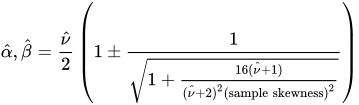
if sample skewness ≠ 0 and ( sample skewness ) 2 − 2 \< sample excess kurtosis \< 3 2 ( sample skewness ) 2 {\\displaystyle {\\text{ if sample skewness}}\\neq 0{\\text{ and }}({\\text{sample skewness}})^{2}-2\<{\\text{sample excess kurtosis}}\<{\\tfrac {3}{2}}({\\text{sample skewness}})^{2}} 
Where one should take the solutions as follows: α ^ \> β ^ {\\displaystyle {\\hat {\\alpha }}\>{\\hat {\\beta }}}  for (negative) sample skewness \< 0, and α ^ \< β ^ {\\displaystyle {\\hat {\\alpha }}\<{\\hat {\\beta }}}  for (positive) sample skewness \> 0.
The accompanying plot shows these two solutions as surfaces in a space with horizontal axes of (sample excess kurtosis) and (sample squared skewness) and the shape parameters as the vertical axis. The surfaces are constrained by the condition that the sample excess kurtosis must be bounded by the sample squared skewness as stipulated in the above equation. The two surfaces meet at the right edge defined by zero skewness. Along this right edge, both parameters are equal and the distribution is symmetric U-shaped for α = β \< 1, uniform for α = β = 1, upside-down-U-shaped for 1 \< α = β \< 2 and bell-shaped for α = β \> 2. The surfaces also meet at the front (lower) edge defined by "the impossible boundary" line (excess kurtosis + 2 - skewness2 = 0). Along this front (lower) boundary both shape parameters approach zero, and the probability density is concentrated more at one end than the other end (with practically nothing in between), with probabilities p \= β α \+ β {\\displaystyle p={\\tfrac {\\beta }{\\alpha +\\beta }}}  at the left end *x* = 0 and q \= 1 − p \= α α \+ β {\\displaystyle q=1-p={\\tfrac {\\alpha }{\\alpha +\\beta }}}  at the right end *x* = 1. The two surfaces become further apart towards the rear edge. At this rear edge the surface parameters are quite different from each other. As remarked, for example, by Bowman and Shenton,[\[44\]](https://en.wikipedia.org/wiki/Beta_distribution#cite_note-BowmanShenton-44) sampling in the neighborhood of the line (sample excess kurtosis - (3/2)(sample skewness)2 = 0) (the just-J-shaped portion of the rear edge where blue meets beige), "is dangerously near to chaos", because at that line the denominator of the expression above for the estimate ν = α + β becomes zero and hence ν approaches infinity as that line is approached. Bowman and Shenton [\[44\]](https://en.wikipedia.org/wiki/Beta_distribution#cite_note-BowmanShenton-44) write that "the higher moment parameters (kurtosis and skewness) are extremely fragile (near that line). However, the mean and standard deviation are fairly reliable." Therefore, the problem is for the case of four parameter estimation for very skewed distributions such that the excess kurtosis approaches (3/2) times the square of the skewness. This boundary line is produced by extremely skewed distributions with very large values of one of the parameters and very small values of the other parameter. See [§ Kurtosis bounded by the square of the skewness](https://en.wikipedia.org/wiki/Beta_distribution#Kurtosis_bounded_by_the_square_of_the_skewness) for a numerical example and further comments about this rear edge boundary line (sample excess kurtosis - (3/2)(sample skewness)2 = 0). As remarked by Karl Pearson himself [\[45\]](https://en.wikipedia.org/wiki/Beta_distribution#cite_note-Pearson1936-45) this issue may not be of much practical importance as this trouble arises only for very skewed J-shaped (or mirror-image J-shaped) distributions with very different values of shape parameters that are unlikely to occur much in practice). The usual skewed-bell-shape distributions that occur in practice do not have this parameter estimation problem.
The remaining two parameters a ^ , c ^ {\\displaystyle {\\hat {a}},{\\hat {c}}}  can be determined using the sample mean and the sample variance using a variety of equations.[\[1\]](https://en.wikipedia.org/wiki/Beta_distribution#cite_note-JKB-1)[\[42\]](https://en.wikipedia.org/wiki/Beta_distribution#cite_note-Elderton1906-42) One alternative is to calculate the support interval range ( c ^ − a ^ ) {\\displaystyle ({\\hat {c}}-{\\hat {a}})}  based on the sample variance and the sample kurtosis. For this purpose one can solve, in terms of the range ( c ^ − a ^ ) {\\displaystyle ({\\hat {c}}-{\\hat {a}})} , the equation expressing the excess kurtosis in terms of the sample variance, and the sample size ν (see [§ Kurtosis](https://en.wikipedia.org/wiki/Beta_distribution#Kurtosis) and [§ Alternative parametrizations, four parameters](https://en.wikipedia.org/wiki/Beta_distribution#Alternative_parametrizations,_four_parameters)):
sample excess kurtosis \= 6 ( 3 \+ ν ^ ) ( 2 \+ ν ^ ) ( ( c ^ − a ^ ) 2 (sample variance) − 6 − 5 ν ^ ) {\\displaystyle {\\text{sample excess kurtosis}}={\\frac {6}{(3+{\\hat {\\nu }})(2+{\\hat {\\nu }})}}{\\bigg (}{\\frac {({\\hat {c}}-{\\hat {a}})^{2}}{\\text{(sample variance)}}}-6-5{\\hat {\\nu }}{\\bigg )}} 
to obtain:
( c ^ − a ^ ) \= (sample variance) 6 \+ 5 ν ^ \+ ( 2 \+ ν ^ ) ( 3 \+ ν ^ ) 6 (sample excess kurtosis) {\\displaystyle ({\\hat {c}}-{\\hat {a}})={\\sqrt {\\text{(sample variance)}}}{\\sqrt {6+5{\\hat {\\nu }}+{\\frac {(2+{\\hat {\\nu }})(3+{\\hat {\\nu }})}{6}}{\\text{(sample excess kurtosis)}}}}} 
Another alternative is to calculate the support interval range ( c ^ − a ^ ) {\\displaystyle ({\\hat {c}}-{\\hat {a}})}  based on the sample variance and the sample skewness.[\[42\]](https://en.wikipedia.org/wiki/Beta_distribution#cite_note-Elderton1906-42) For this purpose one can solve, in terms of the range ( c ^ − a ^ ) {\\displaystyle ({\\hat {c}}-{\\hat {a}})} , the equation expressing the squared skewness in terms of the sample variance, and the sample size ν (see section titled "Skewness" and "Alternative parametrizations, four parameters"):
( sample skewness ) 2 \= 4 ( 2 \+ ν ^ ) 2 ( ( c ^ − a ^ ) 2 (sample variance) − 4 ( 1 \+ ν ^ ) ) {\\displaystyle ({\\text{sample skewness}})^{2}={\\frac {4}{(2+{\\hat {\\nu }})^{2}}}{\\bigg (}{\\frac {({\\hat {c}}-{\\hat {a}})^{2}}{\\text{(sample variance)}}}-4(1+{\\hat {\\nu }}){\\bigg )}} 
to obtain:[\[42\]](https://en.wikipedia.org/wiki/Beta_distribution#cite_note-Elderton1906-42)
( c ^ − a ^ ) \= (sample variance) 2 ( 2 \+ ν ^ ) 2 ( sample skewness ) 2 \+ 16 ( 1 \+ ν ^ ) {\\displaystyle ({\\hat {c}}-{\\hat {a}})={\\frac {\\sqrt {\\text{(sample variance)}}}{2}}{\\sqrt {(2+{\\hat {\\nu }})^{2}({\\text{sample skewness}})^{2}+16(1+{\\hat {\\nu }})}}} 
The remaining parameter can be determined from the sample mean and the previously obtained parameters: ( c ^ − a ^ ) , α ^ , ν ^ \= α ^ \+ β ^ {\\displaystyle ({\\hat {c}}-{\\hat {a}}),{\\hat {\\alpha }},{\\hat {\\nu }}={\\hat {\\alpha }}+{\\hat {\\beta }}} :
a ^ \= ( sample mean ) − ( α ^ ν ^ ) ( c ^ − a ^ ) {\\displaystyle {\\hat {a}}=({\\text{sample mean}})-\\left({\\frac {\\hat {\\alpha }}{\\hat {\\nu }}}\\right)({\\hat {c}}-{\\hat {a}})} 
and finally, c ^ \= ( c ^ − a ^ ) \+ a ^ {\\displaystyle {\\hat {c}}=({\\hat {c}}-{\\hat {a}})+{\\hat {a}}} .
In the above formulas one may take, for example, as estimates of the sample moments:
sample mean \= y ¯ \= 1 N ∑ i \= 1 N Y i sample variance \= v ¯ Y \= 1 N − 1 ∑ i \= 1 N ( Y i − y ¯ ) 2 sample skewness \= G 1 \= N ( N − 1 ) ( N − 2 ) ∑ i \= 1 N ( Y i − y ¯ ) 3 v ¯ Y 3 2 sample excess kurtosis \= G 2 \= N ( N \+ 1 ) ( N − 1 ) ( N − 2 ) ( N − 3 ) ∑ i \= 1 N ( Y i − y ¯ ) 4 v ¯ Y 2 − 3 ( N − 1 ) 2 ( N − 2 ) ( N − 3 ) {\\displaystyle {\\begin{aligned}{\\text{sample mean}}&={\\overline {y}}={\\frac {1}{N}}\\sum \_{i=1}^{N}Y\_{i}\\\\{\\text{sample variance}}&={\\overline {v}}\_{Y}={\\frac {1}{N-1}}\\sum \_{i=1}^{N}(Y\_{i}-{\\overline {y}})^{2}\\\\{\\text{sample skewness}}&=G\_{1}={\\frac {N}{(N-1)(N-2)}}{\\frac {\\sum \_{i=1}^{N}(Y\_{i}-{\\overline {y}})^{3}}{{\\overline {v}}\_{Y}^{\\frac {3}{2}}}}\\\\{\\text{sample excess kurtosis}}&=G\_{2}={\\frac {N(N+1)}{(N-1)(N-2)(N-3)}}{\\frac {\\sum \_{i=1}^{N}(Y\_{i}-{\\overline {y}})^{4}}{{\\overline {v}}\_{Y}^{2}}}-{\\frac {3(N-1)^{2}}{(N-2)(N-3)}}\\end{aligned}}} 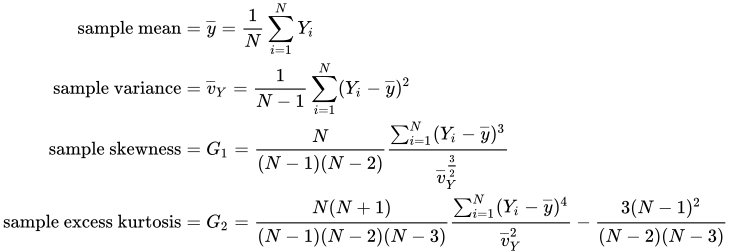
The estimators *G*1 for [sample skewness](https://en.wikipedia.org/wiki/Skewness "Skewness") and *G*2 for [sample kurtosis](https://en.wikipedia.org/wiki/Kurtosis "Kurtosis") are used by [DAP](https://en.wikipedia.org/wiki/DAP_\(software\) "DAP (software)")/[SAS](https://en.wikipedia.org/wiki/SAS_System "SAS System"), [PSPP](https://en.wikipedia.org/wiki/PSPP "PSPP")/[SPSS](https://en.wikipedia.org/wiki/SPSS "SPSS"), and [Excel](https://en.wikipedia.org/wiki/Microsoft_Excel "Microsoft Excel"). However, they are not used by [BMDP](https://en.wikipedia.org/wiki/BMDP "BMDP") and (according to [\[46\]](https://en.wikipedia.org/wiki/Beta_distribution#cite_note-Joanes_and_Gill-46)) they were not used by [MINITAB](https://en.wikipedia.org/wiki/MINITAB "MINITAB") in 1998. Actually, Joanes and Gill in their 1998 study[\[46\]](https://en.wikipedia.org/wiki/Beta_distribution#cite_note-Joanes_and_Gill-46) concluded that the skewness and kurtosis estimators used in [BMDP](https://en.wikipedia.org/wiki/BMDP "BMDP") and in [MINITAB](https://en.wikipedia.org/wiki/MINITAB "MINITAB") (at that time) had smaller variance and mean-squared error in normal samples, but the skewness and kurtosis estimators used in [DAP](https://en.wikipedia.org/wiki/DAP_\(software\) "DAP (software)")/[SAS](https://en.wikipedia.org/wiki/SAS_System "SAS System"), [PSPP](https://en.wikipedia.org/wiki/PSPP "PSPP")/[SPSS](https://en.wikipedia.org/wiki/SPSS "SPSS"), namely *G*1 and *G*2, had smaller mean-squared error in samples from a very skewed distribution. It is for this reason that we have spelled out "sample skewness", etc., in the above formulas, to make it explicit that the user should choose the best estimator according to the problem at hand, as the best estimator for skewness and kurtosis depends on the amount of skewness (as shown by Joanes and Gill[\[46\]](https://en.wikipedia.org/wiki/Beta_distribution#cite_note-Joanes_and_Gill-46)).
#### Maximum likelihood
\[[edit](https://en.wikipedia.org/w/index.php?title=Beta_distribution&action=edit§ion=54 "Edit section: Maximum likelihood")\]
##### Two unknown parameters
\[[edit](https://en.wikipedia.org/w/index.php?title=Beta_distribution&action=edit§ion=55 "Edit section: Two unknown parameters")\]
[](https://en.wikipedia.org/wiki/File:Max_\(Joint_Log_Likelihood_per_N\)_for_Beta_distribution_Maxima_at_alpha%3Dbeta%3D2_-_J._Rodal.png)
Max (joint log likelihood/*N*) for beta distribution maxima at *α* = *β* = 2
[](https://en.wikipedia.org/wiki/File:Max_\(Joint_Log_Likelihood_per_N\)_for_Beta_distribution_Maxima_at_alpha%3Dbeta%3D_0.25,0.5,1,2,4,6,8_-_J._Rodal.png)
Max (joint log likelihood/*N*) for Beta distribution maxima at *α* = *β* ∈ {0.25,0.5,1,2,4,6,8}
As is also the case for [maximum likelihood](https://en.wikipedia.org/wiki/Maximum_likelihood "Maximum likelihood") estimates for the [gamma distribution](https://en.wikipedia.org/wiki/Gamma_distribution "Gamma distribution"), the maximum likelihood estimates for the beta distribution do not have a general closed form solution for arbitrary values of the shape parameters. If *X*1, ..., *XN* are independent random variables each having a beta distribution, the joint log likelihood function for *N* [iid](https://en.wikipedia.org/wiki/Independent_and_identically_distributed_random_variables "Independent and identically distributed random variables") observations is:
ln L ( α , β ∣ X ) \= ∑ i \= 1 N ln L i ( α , β ∣ X i ) \= ∑ i \= 1 N ln f ( X i ; α , β ) \= ∑ i \= 1 N ln X i α − 1 ( 1 − X i ) β − 1 B ( α , β ) \= ( α − 1 ) ∑ i \= 1 N ln X i \+ ( β − 1 ) ∑ i \= 1 N ln ( 1 − X i ) − N ln B ( α , β ) {\\displaystyle {\\begin{aligned}\\ln \\,{\\mathcal {L}}(\\alpha ,\\beta \\mid X)&=\\sum \_{i=1}^{N}\\ln {\\mathcal {L}}\_{i}(\\alpha ,\\beta \\mid X\_{i})\\\\&=\\sum \_{i=1}^{N}\\ln f(X\_{i};\\alpha ,\\beta )\\\\&=\\sum \_{i=1}^{N}\\ln {\\frac {X\_{i}^{\\alpha -1}(1-X\_{i})^{\\beta -1}}{\\mathrm {B} (\\alpha ,\\beta )}}\\\\&=(\\alpha -1)\\sum \_{i=1}^{N}\\ln X\_{i}+(\\beta -1)\\sum \_{i=1}^{N}\\ln(1-X\_{i})-N\\ln \\mathrm {B} (\\alpha ,\\beta )\\end{aligned}}} 
Finding the maximum with respect to a shape parameter involves taking the [partial derivative](https://en.wikipedia.org/wiki/Partial_derivative "Partial derivative") with respect to the shape parameter and setting the expression equal to zero yielding the [maximum likelihood](https://en.wikipedia.org/wiki/Maximum_likelihood "Maximum likelihood") estimator of the shape parameters:
∂ ln L ( α , β ∣ X ) ∂ α \= ∑ i \= 1 N ln X i − N ∂ ln B ( α , β ) ∂ α \= 0 {\\displaystyle {\\frac {\\partial \\ln {\\mathcal {L}}(\\alpha ,\\beta \\mid X)}{\\partial \\alpha }}=\\sum \_{i=1}^{N}\\ln X\_{i}-N{\\frac {\\partial \\ln \\mathrm {B} (\\alpha ,\\beta )}{\\partial \\alpha }}=0}  ∂ ln L ( α , β ∣ X ) ∂ β \= ∑ i \= 1 N ln ( 1 − X i ) − N ∂ ln B ( α , β ) ∂ β \= 0 {\\displaystyle {\\frac {\\partial \\ln {\\mathcal {L}}(\\alpha ,\\beta \\mid X)}{\\partial \\beta }}=\\sum \_{i=1}^{N}\\ln(1-X\_{i})-N{\\frac {\\partial \\ln \\mathrm {B} (\\alpha ,\\beta )}{\\partial \\beta }}=0} 
where:
∂ ln B ( α , β ) ∂ α \= − ∂ ln Γ ( α \+ β ) ∂ α \+ ∂ ln Γ ( α ) ∂ α \+ ∂ ln Γ ( β ) ∂ α \= − ψ ( α \+ β ) \+ ψ ( α ) \+ 0 {\\displaystyle {\\begin{aligned}{\\frac {\\partial \\ln \\mathrm {B} (\\alpha ,\\beta )}{\\partial \\alpha }}&=-{\\frac {\\partial \\ln \\Gamma (\\alpha +\\beta )}{\\partial \\alpha }}+{\\frac {\\partial \\ln \\Gamma (\\alpha )}{\\partial \\alpha }}+{\\frac {\\partial \\ln \\Gamma (\\beta )}{\\partial \\alpha }}\\\\\[1ex\]&=-\\psi (\\alpha +\\beta )+\\psi (\\alpha )+0\\end{aligned}}} ![{\\displaystyle {\\begin{aligned}{\\frac {\\partial \\ln \\mathrm {B} (\\alpha ,\\beta )}{\\partial \\alpha }}&=-{\\frac {\\partial \\ln \\Gamma (\\alpha +\\beta )}{\\partial \\alpha }}+{\\frac {\\partial \\ln \\Gamma (\\alpha )}{\\partial \\alpha }}+{\\frac {\\partial \\ln \\Gamma (\\beta )}{\\partial \\alpha }}\\\\\[1ex\]&=-\\psi (\\alpha +\\beta )+\\psi (\\alpha )+0\\end{aligned}}}](https://wikimedia.org/api/rest_v1/media/math/render/svg/82bf10edac73617ec99a3adbad3ff020391c4a71) ∂ ln B ( α , β ) ∂ β \= − ∂ ln Γ ( α \+ β ) ∂ β \+ ∂ ln Γ ( α ) ∂ β \+ ∂ ln Γ ( β ) ∂ β \= − ψ ( α \+ β ) \+ 0 \+ ψ ( β ) {\\displaystyle {\\begin{aligned}{\\frac {\\partial \\ln \\mathrm {B} (\\alpha ,\\beta )}{\\partial \\beta }}&=-{\\frac {\\partial \\ln \\Gamma (\\alpha +\\beta )}{\\partial \\beta }}+{\\frac {\\partial \\ln \\Gamma (\\alpha )}{\\partial \\beta }}+{\\frac {\\partial \\ln \\Gamma (\\beta )}{\\partial \\beta }}\\\\\[1ex\]&=-\\psi (\\alpha +\\beta )+0+\\psi (\\beta )\\end{aligned}}} ![{\\displaystyle {\\begin{aligned}{\\frac {\\partial \\ln \\mathrm {B} (\\alpha ,\\beta )}{\\partial \\beta }}&=-{\\frac {\\partial \\ln \\Gamma (\\alpha +\\beta )}{\\partial \\beta }}+{\\frac {\\partial \\ln \\Gamma (\\alpha )}{\\partial \\beta }}+{\\frac {\\partial \\ln \\Gamma (\\beta )}{\\partial \\beta }}\\\\\[1ex\]&=-\\psi (\\alpha +\\beta )+0+\\psi (\\beta )\\end{aligned}}}](https://wikimedia.org/api/rest_v1/media/math/render/svg/10b097547a81011b4e212824977d66b5350dc780)
since the **[digamma function](https://en.wikipedia.org/wiki/Digamma_function "Digamma function")** denoted ψ(α) is defined as the [logarithmic derivative](https://en.wikipedia.org/wiki/Logarithmic_derivative "Logarithmic derivative") of the [gamma function](https://en.wikipedia.org/wiki/Gamma_function "Gamma function"):[\[18\]](https://en.wikipedia.org/wiki/Beta_distribution#cite_note-Abramowitz-18)
ψ ( α ) \= ∂ ln Γ ( α ) ∂ α {\\displaystyle \\psi (\\alpha )={\\frac {\\partial \\ln \\Gamma (\\alpha )}{\\partial \\alpha }}} 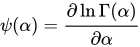
To ensure that the values with zero tangent slope are indeed a maximum (instead of a saddle-point or a minimum) one has to also satisfy the condition that the curvature is negative. This amounts to satisfying that the second partial derivative with respect to the shape parameters is negative
∂ 2 ln L ( α , β ∣ X ) ∂ α 2 \= − N ∂ 2 ln B ( α , β ) ∂ α 2 \< 0 {\\displaystyle {\\frac {\\partial ^{2}\\ln {\\mathcal {L}}(\\alpha ,\\beta \\mid X)}{\\partial \\alpha ^{2}}}=-N{\\frac {\\partial ^{2}\\ln \\mathrm {B} (\\alpha ,\\beta )}{\\partial \\alpha ^{2}}}\<0}  ∂ 2 ln L ( α , β ∣ X ) ∂ β 2 \= − N ∂ 2 ln B ( α , β ) ∂ β 2 \< 0 {\\displaystyle {\\frac {\\partial ^{2}\\ln {\\mathcal {L}}(\\alpha ,\\beta \\mid X)}{\\partial \\beta ^{2}}}=-N{\\frac {\\partial ^{2}\\ln \\mathrm {B} (\\alpha ,\\beta )}{\\partial \\beta ^{2}}}\<0} 
using the previous equations, this is equivalent to:
∂ 2 ln B ( α , β ) ∂ α 2 \= ψ 1 ( α ) − ψ 1 ( α \+ β ) \> 0 {\\displaystyle {\\frac {\\partial ^{2}\\ln \\mathrm {B} (\\alpha ,\\beta )}{\\partial \\alpha ^{2}}}=\\psi \_{1}(\\alpha )-\\psi \_{1}(\\alpha +\\beta )\>0}  ∂ 2 ln B ( α , β ) ∂ β 2 \= ψ 1 ( β ) − ψ 1 ( α \+ β ) \> 0 {\\displaystyle {\\frac {\\partial ^{2}\\ln \\mathrm {B} (\\alpha ,\\beta )}{\\partial \\beta ^{2}}}=\\psi \_{1}(\\beta )-\\psi \_{1}(\\alpha +\\beta )\>0} 
where the **[trigamma function](https://en.wikipedia.org/wiki/Trigamma_function "Trigamma function")**, denoted *ψ*1(*α*), is the second of the [polygamma functions](https://en.wikipedia.org/wiki/Polygamma_function "Polygamma function"), and is defined as the derivative of the [digamma](https://en.wikipedia.org/wiki/Digamma "Digamma") function:
ψ 1 ( α ) \= ∂ 2 ln Γ ( α ) ∂ α 2 \= ∂ ψ ( α ) ∂ α . {\\displaystyle \\psi \_{1}(\\alpha )={\\frac {\\partial ^{2}\\ln \\Gamma (\\alpha )}{\\partial \\alpha ^{2}}}=\\,{\\frac {\\partial \\,\\psi (\\alpha )}{\\partial \\alpha }}.} 
These conditions are equivalent to stating that the variances of the logarithmically transformed variables are positive, since:
var \[ ln ( X ) \] \= E \[ ln 2 ( X ) \] − ( E \[ ln ( X ) \] ) 2 \= ψ 1 ( α ) − ψ 1 ( α \+ β ) {\\displaystyle \\operatorname {var} \[\\ln(X)\]=\\operatorname {E} \[\\ln ^{2}(X)\]-(\\operatorname {E} \[\\ln(X)\])^{2}=\\psi \_{1}(\\alpha )-\\psi \_{1}(\\alpha +\\beta )} ![{\\displaystyle \\operatorname {var} \[\\ln(X)\]=\\operatorname {E} \[\\ln ^{2}(X)\]-(\\operatorname {E} \[\\ln(X)\])^{2}=\\psi \_{1}(\\alpha )-\\psi \_{1}(\\alpha +\\beta )}](https://wikimedia.org/api/rest_v1/media/math/render/svg/d7737d681fea7490e27f8760c6bcc8fccb154904) var \[ ln ( 1 − X ) \] \= E \[ ln 2 ( 1 − X ) \] − ( E \[ ln ( 1 − X ) \] ) 2 \= ψ 1 ( β ) − ψ 1 ( α \+ β ) {\\displaystyle \\operatorname {var} \[\\ln(1-X)\]=\\operatorname {E} \[\\ln ^{2}(1-X)\]-(\\operatorname {E} \[\\ln(1-X)\])^{2}=\\psi \_{1}(\\beta )-\\psi \_{1}(\\alpha +\\beta )} ![{\\displaystyle \\operatorname {var} \[\\ln(1-X)\]=\\operatorname {E} \[\\ln ^{2}(1-X)\]-(\\operatorname {E} \[\\ln(1-X)\])^{2}=\\psi \_{1}(\\beta )-\\psi \_{1}(\\alpha +\\beta )}](https://wikimedia.org/api/rest_v1/media/math/render/svg/f84c3747955206cf2190c61bd7875a6cd739ac04)
Therefore, the condition of negative curvature at a maximum is equivalent to the statements:
var \[ ln ( X ) \] \> 0 {\\displaystyle \\operatorname {var} \[\\ln(X)\]\>0} ![{\\displaystyle \\operatorname {var} \[\\ln(X)\]\>0}](https://wikimedia.org/api/rest_v1/media/math/render/svg/5fb5a5d0db057469fb9dad8df2902fe93e3f3b0d) var \[ ln ( 1 − X ) \] \> 0 {\\displaystyle \\operatorname {var} \[\\ln(1-X)\]\>0} ![{\\displaystyle \\operatorname {var} \[\\ln(1-X)\]\>0}](https://wikimedia.org/api/rest_v1/media/math/render/svg/c66a5aaa8362f578beb9b141b4108138b9d21e89)
Alternatively, the condition of negative curvature at a maximum is also equivalent to stating that the following [logarithmic derivatives](https://en.wikipedia.org/wiki/Logarithmic_derivative "Logarithmic derivative") of the [geometric means](https://en.wikipedia.org/wiki/Geometric_mean "Geometric mean") *GX* and *G(1−X)* are positive, since:
ψ 1 ( α ) − ψ 1 ( α \+ β ) \= ∂ ln G X ∂ α \> 0 {\\displaystyle \\psi \_{1}(\\alpha )-\\psi \_{1}(\\alpha +\\beta )={\\frac {\\partial \\ln G\_{X}}{\\partial \\alpha }}\>0}  ψ 1 ( β ) − ψ 1 ( α \+ β ) \= ∂ ln G ( 1 − X ) ∂ β \> 0 {\\displaystyle \\psi \_{1}(\\beta )-\\psi \_{1}(\\alpha +\\beta )={\\frac {\\partial \\ln G\_{(1-X)}}{\\partial \\beta }}\>0} 
While these slopes are indeed positive, the other slopes are negative:
∂ ln G X ∂ β , ∂ ln G 1 − X ∂ α \< 0\. {\\displaystyle {\\frac {\\partial \\,\\ln G\_{X}}{\\partial \\beta }},{\\frac {\\partial \\ln G\_{1-X}}{\\partial \\alpha }}\<0.} 
The slopes of the mean and the median with respect to *α* and *β* display similar sign behavior.
From the condition that at a maximum, the partial derivative with respect to the shape parameter equals zero, we obtain the following system of coupled [maximum likelihood estimate](https://en.wikipedia.org/wiki/Maximum_likelihood_estimate "Maximum likelihood estimate") equations (for the average log-likelihoods) that needs to be inverted to obtain the (unknown) shape parameter estimates α ^ , β ^ {\\displaystyle {\\hat {\\alpha }},{\\hat {\\beta }}}  in terms of the (known) average of logarithms of the samples *X*1, ..., *XN*:[\[1\]](https://en.wikipedia.org/wiki/Beta_distribution#cite_note-JKB-1)
E ^ \[ ln ( X ) \] \= ψ ( α ^ ) − ψ ( α ^ \+ β ^ ) \= 1 N ∑ i \= 1 N ln X i \= ln G ^ X E ^ \[ ln ( 1 − X ) \] \= ψ ( β ^ ) − ψ ( α ^ \+ β ^ ) \= 1 N ∑ i \= 1 N ln ( 1 − X i ) \= ln G ^ 1 − X {\\displaystyle {\\begin{aligned}{\\hat {\\operatorname {E} }}\[\\ln(X)\]&=\\psi ({\\hat {\\alpha }})-\\psi ({\\hat {\\alpha }}+{\\hat {\\beta }})={\\frac {1}{N}}\\sum \_{i=1}^{N}\\ln X\_{i}=\\ln {\\hat {G}}\_{X}\\\\{\\hat {\\operatorname {E} }}\[\\ln(1-X)\]&=\\psi ({\\hat {\\beta }})-\\psi ({\\hat {\\alpha }}+{\\hat {\\beta }})={\\frac {1}{N}}\\sum \_{i=1}^{N}\\ln(1-X\_{i})=\\ln {\\hat {G}}\_{1-X}\\end{aligned}}} ![{\\displaystyle {\\begin{aligned}{\\hat {\\operatorname {E} }}\[\\ln(X)\]&=\\psi ({\\hat {\\alpha }})-\\psi ({\\hat {\\alpha }}+{\\hat {\\beta }})={\\frac {1}{N}}\\sum \_{i=1}^{N}\\ln X\_{i}=\\ln {\\hat {G}}\_{X}\\\\{\\hat {\\operatorname {E} }}\[\\ln(1-X)\]&=\\psi ({\\hat {\\beta }})-\\psi ({\\hat {\\alpha }}+{\\hat {\\beta }})={\\frac {1}{N}}\\sum \_{i=1}^{N}\\ln(1-X\_{i})=\\ln {\\hat {G}}\_{1-X}\\end{aligned}}}](https://wikimedia.org/api/rest_v1/media/math/render/svg/42f099a4869ce2d200dc80c7675a237caae021e6)
where we recognize log G ^ X {\\displaystyle \\log {\\hat {G}}\_{X}}  as the logarithm of the sample [geometric mean](https://en.wikipedia.org/wiki/Geometric_mean "Geometric mean") and log G ^ 1 − X {\\displaystyle \\log {\\hat {G}}\_{1-X}}  as the logarithm of the sample [geometric mean](https://en.wikipedia.org/wiki/Geometric_mean "Geometric mean") based on (1 − *X*), the mirror-image of *X*. For α ^ \= β ^ {\\displaystyle {\\hat {\\alpha }}={\\hat {\\beta }}} , it follows that G ^ X \= G ^ 1 − X {\\displaystyle {\\hat {G}}\_{X}={\\hat {G}}\_{1-X}} .
G ^ X \= ∏ i \= 1 N ( X i ) 1 / N G ^ 1 − X \= ∏ i \= 1 N ( 1 − X i ) 1 / N {\\displaystyle {\\begin{aligned}{\\hat {G}}\_{X}&=\\prod \_{i=1}^{N}(X\_{i})^{1/N}\\\\{\\hat {G}}\_{1-X}&=\\prod \_{i=1}^{N}(1-X\_{i})^{1/N}\\end{aligned}}} 
These coupled equations containing [digamma functions](https://en.wikipedia.org/wiki/Digamma_function "Digamma function") of the shape parameter estimates α ^ , β ^ {\\displaystyle {\\hat {\\alpha }},{\\hat {\\beta }}}  must be solved by numerical methods as done, for example, by Beckman et al.[\[47\]](https://en.wikipedia.org/wiki/Beta_distribution#cite_note-47) Gnanadesikan et al. give numerical solutions for a few cases.[\[48\]](https://en.wikipedia.org/wiki/Beta_distribution#cite_note-48) [N.L.Johnson](https://en.wikipedia.org/wiki/Norman_Lloyd_Johnson "Norman Lloyd Johnson") and [S.Kotz](https://en.wikipedia.org/wiki/Samuel_Kotz "Samuel Kotz")[\[1\]](https://en.wikipedia.org/wiki/Beta_distribution#cite_note-JKB-1) suggest that for "not too small" shape parameter estimates α ^ , β ^ {\\displaystyle {\\hat {\\alpha }},{\\hat {\\beta }}} , the logarithmic approximation to the digamma function ψ ( α ^ ) ≈ ln ( α ^ − 1 2 ) {\\displaystyle \\psi ({\\hat {\\alpha }})\\approx \\ln({\\hat {\\alpha }}-{\\tfrac {1}{2}})}  may be used to obtain initial values for an iterative solution, since the equations resulting from this approximation can be solved exactly:
ln α ^ − 1 2 α ^ \+ β ^ − 1 2 ≈ ln G ^ X {\\displaystyle \\ln {\\frac {{\\hat {\\alpha }}-{\\frac {1}{2}}}{{\\hat {\\alpha }}+{\\hat {\\beta }}-{\\frac {1}{2}}}}\\approx \\ln {\\hat {G}}\_{X}} 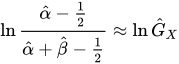 ln β ^ − 1 2 α ^ \+ β ^ − 1 2 ≈ ln G ^ 1 − X {\\displaystyle \\ln {\\frac {{\\hat {\\beta }}-{\\frac {1}{2}}}{{\\hat {\\alpha }}+{\\hat {\\beta }}-{\\frac {1}{2}}}}\\approx \\ln {\\hat {G}}\_{1-X}} 
which leads to the following solution for the initial values (of the estimate shape parameters in terms of the sample geometric means) for an iterative solution:
α ^ ≈ 1 2 \+ G ^ X 2 ( 1 − G ^ X − G ^ 1 − X ) if α ^ \> 1 {\\displaystyle {\\hat {\\alpha }}\\approx {\\frac {1}{2}}+{\\frac {{\\hat {G}}\_{X}}{2\\left(1-{\\hat {G}}\_{X}-{\\hat {G}}\_{1-X}\\right)}}{\\text{ if }}{\\hat {\\alpha }}\>1}  β ^ ≈ 1 2 \+ G ^ 1 − X 2 ( 1 − G ^ X − G ^ 1 − X ) if β ^ \> 1 {\\displaystyle {\\hat {\\beta }}\\approx {\\frac {1}{2}}+{\\frac {{\\hat {G}}\_{1-X}}{2\\left(1-{\\hat {G}}\_{X}-{\\hat {G}}\_{1-X}\\right)}}{\\text{ if }}{\\hat {\\beta }}\>1} 
Alternatively, the estimates provided by the method of moments can instead be used as initial values for an iterative solution of the maximum likelihood coupled equations in terms of the digamma functions.
When the distribution is required over a known interval other than \[0, 1\] with random variable *X*, say \[*a*, *c*\] with random variable *Y*, then replace ln(*Xi*) in the first equation with
ln Y i − a c − a , {\\displaystyle \\ln {\\frac {Y\_{i}-a}{c-a}},} 
and replace ln(1−*Xi*) in the second equation with
ln c − Y i c − a {\\displaystyle \\ln {\\frac {c-Y\_{i}}{c-a}}} 
(see "Alternative parametrizations, four parameters" section below).
If one of the shape parameters is known, the problem is considerably simplified. The following [logit](https://en.wikipedia.org/wiki/Logit "Logit") transformation can be used to solve for the unknown shape parameter (for skewed cases such that α ^ ≠ β ^ {\\displaystyle {\\hat {\\alpha }}\\neq {\\hat {\\beta }}} , otherwise, if symmetric, both -equal- parameters are known when one is known):
E ^ \[ ln X 1 − X \] \= ψ ( α ^ ) − ψ ( β ^ ) \= 1 N ∑ i \= 1 N ln X i 1 − X i \= ln G ^ X − ln G ^ 1 − X {\\displaystyle {\\hat {\\operatorname {E} }}\\left\[\\ln {\\frac {X}{1-X}}\\right\]=\\psi ({\\hat {\\alpha }})-\\psi ({\\hat {\\beta }})={\\frac {1}{N}}\\sum \_{i=1}^{N}\\ln {\\frac {X\_{i}}{1-X\_{i}}}=\\ln {\\hat {G}}\_{X}-\\ln {\\hat {G}}\_{1-X}} ![{\\displaystyle {\\hat {\\operatorname {E} }}\\left\[\\ln {\\frac {X}{1-X}}\\right\]=\\psi ({\\hat {\\alpha }})-\\psi ({\\hat {\\beta }})={\\frac {1}{N}}\\sum \_{i=1}^{N}\\ln {\\frac {X\_{i}}{1-X\_{i}}}=\\ln {\\hat {G}}\_{X}-\\ln {\\hat {G}}\_{1-X}}](https://wikimedia.org/api/rest_v1/media/math/render/svg/ca41c85f9e8cd1b427e96fd209fea0522c951d65)
This [logit](https://en.wikipedia.org/wiki/Logit "Logit") transformation is the logarithm of the transformation that divides the variable *X* by its mirror-image (*X*/(1 - *X*) resulting in the "inverted beta distribution" or [beta prime distribution](https://en.wikipedia.org/wiki/Beta_prime_distribution "Beta prime distribution") (also known as beta distribution of the second kind or [Pearson's Type VI](https://en.wikipedia.org/wiki/Pearson_distribution "Pearson distribution")) with support \[0, +∞). As previously discussed in the section "Moments of logarithmically transformed random variables," the [logit](https://en.wikipedia.org/wiki/Logit "Logit") transformation ln X 1 − X {\\displaystyle \\ln {\\frac {X}{1-X}}} , studied by Johnson,[\[25\]](https://en.wikipedia.org/wiki/Beta_distribution#cite_note-JohnsonLogInv-25) extends the finite support \[0, 1\] based on the original variable *X* to infinite support in both directions of the real line (−∞, +∞).
If, for example, β ^ {\\displaystyle {\\hat {\\beta }}}  is known, the unknown parameter α ^ {\\displaystyle {\\hat {\\alpha }}}  can be obtained in terms of the inverse[\[49\]](https://en.wikipedia.org/wiki/Beta_distribution#cite_note-invpsi.m-49) digamma function of the right hand side of this equation:
ψ ( α ^ ) \= 1 N ∑ i \= 1 N ln X i 1 − X i \+ ψ ( β ^ ) {\\displaystyle \\psi ({\\hat {\\alpha }})={\\frac {1}{N}}\\sum \_{i=1}^{N}\\ln {\\frac {X\_{i}}{1-X\_{i}}}+\\psi ({\\hat {\\beta }})} 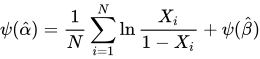 α ^ \= ψ − 1 ( ln G ^ X − ln G ^ ( 1 − X ) \+ ψ ( β ^ ) ) {\\displaystyle {\\hat {\\alpha }}=\\psi ^{-1}\\left(\\ln {\\hat {G}}\_{X}-\\ln {\\hat {G}}\_{(1-X)}+\\psi ({\\hat {\\beta }})\\right)} 
In particular, if one of the shape parameters has a value of unity, for example for β ^ \= 1 {\\displaystyle {\\hat {\\beta }}=1}  (the power function distribution with bounded support \[0,1\]), using the identity ψ(*x* + 1) = ψ(*x*) + 1/*x* in the equation ψ ( α ^ ) − ψ ( α ^ \+ β ^ ) \= ln G ^ X {\\displaystyle \\psi ({\\hat {\\alpha }})-\\psi ({\\hat {\\alpha }}+{\\hat {\\beta }})=\\ln {\\hat {G}}\_{X}} , the maximum likelihood estimator for the unknown parameter α ^ {\\displaystyle {\\hat {\\alpha }}}  is,[\[1\]](https://en.wikipedia.org/wiki/Beta_distribution#cite_note-JKB-1) exactly:
α ^ \= − 1 1 N ∑ i \= 1 N ln X i \= − 1 ln G ^ X {\\displaystyle {\\hat {\\alpha }}=-{\\frac {1}{{\\frac {1}{N}}\\sum \_{i=1}^{N}\\ln X\_{i}}}=-{\\frac {1}{\\ln {\\hat {G}}\_{X}}}} 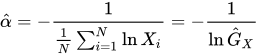
The beta has support \[0, 1\], therefore G ^ X \< 1 {\\displaystyle {\\hat {G}}\_{X}\<1} , and hence ( − ln G ^ X ) \> 0 {\\displaystyle (-\\ln {\\hat {G}}\_{X})\>0} 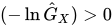, and therefore α ^ \> 0\. {\\displaystyle {\\hat {\\alpha }}\>0.} 
In conclusion, the maximum likelihood estimates of the shape parameters of a beta distribution are (in general) a complicated function of the sample [geometric mean](https://en.wikipedia.org/wiki/Geometric_mean "Geometric mean"), and of the sample [geometric mean](https://en.wikipedia.org/wiki/Geometric_mean "Geometric mean") based on (1−*X*)), the mirror-image of *X*. One may ask, if the variance (in addition to the mean) is necessary to estimate two shape parameters with the method of moments, why is the (logarithmic or geometric) variance not necessary to estimate two shape parameters with the maximum likelihood method, for which only the geometric means suffice? The answer is because the mean does not provide as much information as the geometric mean. For a beta distribution with equal shape parameters *α* = *β*, the mean is exactly 1/2, regardless of the value of the shape parameters, and therefore regardless of the value of the statistical dispersion (the variance). On the other hand, the geometric mean of a beta distribution with equal shape parameters *α* = *β*, depends on the value of the shape parameters, and therefore it contains more information. Also, the geometric mean of a beta distribution does not satisfy the symmetry conditions satisfied by the mean, therefore, by employing both the geometric mean based on *X* and geometric mean based on (1 − *X*), the maximum likelihood method is able to provide best estimates for both parameters *α* = *β*, without need of employing the variance.
One can express the joint log likelihood per *N* [iid](https://en.wikipedia.org/wiki/Independent_and_identically_distributed_random_variables "Independent and identically distributed random variables") observations in terms of the *[sufficient statistics](https://en.wikipedia.org/wiki/Sufficient_statistic "Sufficient statistic")* (the sample geometric means) as follows:
ln L ( α , β ∣ X ) N \= ( α − 1 ) ln G ^ X \+ ( β − 1 ) ln G ^ ( 1 − X ) − ln B ( α , β ) . {\\displaystyle {\\frac {\\ln {\\mathcal {L}}(\\alpha ,\\beta \\mid X)}{N}}=(\\alpha -1)\\ln {\\hat {G}}\_{X}+(\\beta -1)\\ln {\\hat {G}}\_{(1-X)}-\\ln \\mathrm {B} (\\alpha ,\\beta ).} 
We can plot the joint log likelihood per *N* observations for fixed values of the sample geometric means to see the behavior of the likelihood function as a function of the shape parameters α and β. In such a plot, the shape parameter estimators α ^ , β ^ {\\displaystyle {\\hat {\\alpha }},{\\hat {\\beta }}}  correspond to the maxima of the likelihood function. See the accompanying graph that shows that all the likelihood functions intersect at α = β = 1, which corresponds to the values of the shape parameters that give the maximum entropy (the maximum entropy occurs for shape parameters equal to unity: the uniform distribution). It is evident from the plot that the likelihood function gives sharp peaks for values of the shape parameter estimators close to zero, but that for values of the shape parameters estimators greater than one, the likelihood function becomes quite flat, with less defined peaks. Obviously, the maximum likelihood parameter estimation method for the beta distribution becomes less acceptable for larger values of the shape parameter estimators, as the uncertainty in the peak definition increases with the value of the shape parameter estimators. One can arrive at the same conclusion by noticing that the expression for the curvature of the likelihood function is in terms of the geometric variances
∂ 2 ln L ( α , β ∣ X ) ∂ α 2 \= − var \[ ln X \] {\\displaystyle {\\frac {\\partial ^{2}\\ln {\\mathcal {L}}(\\alpha ,\\beta \\mid X)}{\\partial \\alpha ^{2}}}=-\\operatorname {var} \[\\ln X\]} ![{\\displaystyle {\\frac {\\partial ^{2}\\ln {\\mathcal {L}}(\\alpha ,\\beta \\mid X)}{\\partial \\alpha ^{2}}}=-\\operatorname {var} \[\\ln X\]}](https://wikimedia.org/api/rest_v1/media/math/render/svg/517a09a3b13d22689a3e1e400cbcab3af08e130c) ∂ 2 ln L ( α , β ∣ X ) ∂ β 2 \= − var \[ ln ( 1 − X ) \] {\\displaystyle {\\frac {\\partial ^{2}\\ln {\\mathcal {L}}(\\alpha ,\\beta \\mid X)}{\\partial \\beta ^{2}}}=-\\operatorname {var} \[\\ln(1-X)\]} ![{\\displaystyle {\\frac {\\partial ^{2}\\ln {\\mathcal {L}}(\\alpha ,\\beta \\mid X)}{\\partial \\beta ^{2}}}=-\\operatorname {var} \[\\ln(1-X)\]}](https://wikimedia.org/api/rest_v1/media/math/render/svg/1715f50fc408ceba307005a3f9e404520edd5a20)
These variances (and therefore the curvatures) are much larger for small values of the shape parameter α and β. However, for shape parameter values α, β \> 1, the variances (and therefore the curvatures) flatten out. Equivalently, this result follows from the [Cramér–Rao bound](https://en.wikipedia.org/wiki/Cram%C3%A9r%E2%80%93Rao_bound "Cramér–Rao bound"), since the [Fisher information](https://en.wikipedia.org/wiki/Fisher_information "Fisher information") matrix components for the beta distribution are these logarithmic variances. The [Cramér–Rao bound](https://en.wikipedia.org/wiki/Cram%C3%A9r%E2%80%93Rao_bound "Cramér–Rao bound") states that the [variance](https://en.wikipedia.org/wiki/Variance "Variance") of any *unbiased* estimator α ^ {\\displaystyle {\\hat {\\alpha }}}  of α is bounded by the [reciprocal](https://en.wikipedia.org/wiki/Multiplicative_inverse "Multiplicative inverse") of the [Fisher information](https://en.wikipedia.org/wiki/Fisher_information "Fisher information"):
v a r ( α ^ ) ≥ 1 var \[ ln X \] ≥ 1 ψ 1 ( α ^ ) − ψ 1 ( α ^ \+ β ^ ) {\\displaystyle \\mathrm {var} ({\\hat {\\alpha }})\\geq {\\frac {1}{\\operatorname {var} \[\\ln X\]}}\\geq {\\frac {1}{\\psi \_{1}({\\hat {\\alpha }})-\\psi \_{1}({\\hat {\\alpha }}+{\\hat {\\beta }})}}} ![{\\displaystyle \\mathrm {var} ({\\hat {\\alpha }})\\geq {\\frac {1}{\\operatorname {var} \[\\ln X\]}}\\geq {\\frac {1}{\\psi \_{1}({\\hat {\\alpha }})-\\psi \_{1}({\\hat {\\alpha }}+{\\hat {\\beta }})}}}](https://wikimedia.org/api/rest_v1/media/math/render/svg/744f1e8421337ed7a2e6cae00fccec1eaf68e3dc) v a r ( β ^ ) ≥ 1 var \[ ln ( 1 − X ) \] ≥ 1 ψ 1 ( β ^ ) − ψ 1 ( α ^ \+ β ^ ) {\\displaystyle \\mathrm {var} ({\\hat {\\beta }})\\geq {\\frac {1}{\\operatorname {var} \[\\ln(1-X)\]}}\\geq {\\frac {1}{\\psi \_{1}({\\hat {\\beta }})-\\psi \_{1}({\\hat {\\alpha }}+{\\hat {\\beta }})}}} ![{\\displaystyle \\mathrm {var} ({\\hat {\\beta }})\\geq {\\frac {1}{\\operatorname {var} \[\\ln(1-X)\]}}\\geq {\\frac {1}{\\psi \_{1}({\\hat {\\beta }})-\\psi \_{1}({\\hat {\\alpha }}+{\\hat {\\beta }})}}}](https://wikimedia.org/api/rest_v1/media/math/render/svg/f01dc5c3eb614cfa71a500fd34f3fa430c183c76)
so the variance of the estimators increases with increasing α and β, as the logarithmic variances decrease.
Also one can express the joint log likelihood per *N* [iid](https://en.wikipedia.org/wiki/Independent_and_identically_distributed_random_variables "Independent and identically distributed random variables") observations in terms of the [digamma function](https://en.wikipedia.org/wiki/Digamma_function "Digamma function") expressions for the logarithms of the sample geometric means as follows:
ln L ( α , β ∣ X ) N \= ( α − 1 ) ( ψ ( α ^ ) − ψ ( α ^ \+ β ^ ) ) \+ ( β − 1 ) ( ψ ( β ^ ) − ψ ( α ^ \+ β ^ ) ) − ln B ( α , β ) {\\displaystyle {\\frac {\\ln \\,{\\mathcal {L}}(\\alpha ,\\beta \\mid X)}{N}}=(\\alpha -1)(\\psi ({\\hat {\\alpha }})-\\psi ({\\hat {\\alpha }}+{\\hat {\\beta }}))+(\\beta -1)(\\psi ({\\hat {\\beta }})-\\psi ({\\hat {\\alpha }}+{\\hat {\\beta }}))-\\ln \\mathrm {B} (\\alpha ,\\beta )} 
this expression is identical to the negative of the cross-entropy (see section on "Quantities of information (entropy)"). Therefore, finding the maximum of the joint log likelihood of the shape parameters, per *N* [iid](https://en.wikipedia.org/wiki/Independent_and_identically_distributed_random_variables "Independent and identically distributed random variables") observations, is identical to finding the minimum of the cross-entropy for the beta distribution, as a function of the shape parameters.
ln L ( α , β ∣ X ) N \= − H \= − h − D K L \= − ln B ( α , β ) \+ ( α − 1 ) ψ ( α ^ ) \+ ( β − 1 ) ψ ( β ^ ) − ( α \+ β − 2 ) ψ ( α ^ \+ β ^ ) {\\displaystyle {\\begin{aligned}{\\frac {\\ln {\\mathcal {L}}(\\alpha ,\\beta \\mid X)}{N}}&=-H=-h-D\_{\\mathrm {KL} }\\\\&=-\\ln \\mathrm {B} (\\alpha ,\\beta )+(\\alpha -1)\\psi ({\\hat {\\alpha }})+(\\beta -1)\\psi ({\\hat {\\beta }})-(\\alpha +\\beta -2)\\psi ({\\hat {\\alpha }}+{\\hat {\\beta }})\\end{aligned}}} 
with the cross-entropy defined as follows:
H \= ∫ 0 1 − f ( X ; α ^ , β ^ ) ln ( f ( X ; α , β ) ) d X {\\displaystyle H=\\int \_{0}^{1}-f(X;{\\hat {\\alpha }},{\\hat {\\beta }})\\ln(f(X;\\alpha ,\\beta ))\\,{\\rm {d}}X} 
##### Four unknown parameters
\[[edit](https://en.wikipedia.org/w/index.php?title=Beta_distribution&action=edit§ion=56 "Edit section: Four unknown parameters")\]
The procedure is similar to the one followed in the two unknown parameter case. If *Y*1, ..., *YN* are independent random variables each having a beta distribution with four parameters, the joint log likelihood function for *N* [iid](https://en.wikipedia.org/wiki/Independent_and_identically_distributed_random_variables "Independent and identically distributed random variables") observations is:
ln L ( α , β , a , c ∣ Y ) \= ∑ i \= 1 N ln L i ( α , β , a , c ∣ Y i ) \= ∑ i \= 1 N ln f ( Y i ; α , β , a , c ) \= ∑ i \= 1 N ln ( Y i − a ) α − 1 ( c − Y i ) β − 1 ( c − a ) α \+ β − 1 B ( α , β ) \= ( α − 1 ) ∑ i \= 1 N ln ( Y i − a ) \+ ( β − 1 ) ∑ i \= 1 N ln ( c − Y i ) − N ln B ( α , β ) − N ( α \+ β − 1 ) ln ( c − a ) {\\displaystyle {\\begin{aligned}\\ln {\\mathcal {L}}(\\alpha ,\\beta ,a,c\\mid Y)&=\\sum \_{i=1}^{N}\\ln \\,{\\mathcal {L}}\_{i}(\\alpha ,\\beta ,a,c\\mid Y\_{i})\\\\&=\\sum \_{i=1}^{N}\\ln f(Y\_{i};\\alpha ,\\beta ,a,c)\\\\&=\\sum \_{i=1}^{N}\\ln {\\frac {(Y\_{i}-a)^{\\alpha -1}(c-Y\_{i})^{\\beta -1}}{(c-a)^{\\alpha +\\beta -1}\\mathrm {B} (\\alpha ,\\beta )}}\\\\&=(\\alpha -1)\\sum \_{i=1}^{N}\\ln(Y\_{i}-a)+(\\beta -1)\\sum \_{i=1}^{N}\\ln(c-Y\_{i})-N\\ln \\mathrm {B} (\\alpha ,\\beta )-N(\\alpha +\\beta -1)\\ln(c-a)\\end{aligned}}} 
Finding the maximum with respect to a shape parameter involves taking the partial derivative with respect to the shape parameter and setting the expression equal to zero yielding the [maximum likelihood](https://en.wikipedia.org/wiki/Maximum_likelihood "Maximum likelihood") estimator of the shape parameters:
∂ ln L ( α , β , a , c ∣ Y ) ∂ α \= ∑ i \= 1 N ln ( Y i − a ) − N ( − ψ ( α \+ β ) \+ ψ ( α ) ) − N ln ( c − a ) \= 0 {\\displaystyle {\\frac {\\partial \\ln {\\mathcal {L}}(\\alpha ,\\beta ,a,c\\mid Y)}{\\partial \\alpha }}=\\sum \_{i=1}^{N}\\ln(Y\_{i}-a)-N(-\\psi (\\alpha +\\beta )+\\psi (\\alpha ))-N\\ln(c-a)=0}  ∂ ln L ( α , β , a , c ∣ Y ) ∂ β \= ∑ i \= 1 N ln ( c − Y i ) − N ( − ψ ( α \+ β ) \+ ψ ( β ) ) − N ln ( c − a ) \= 0 {\\displaystyle {\\frac {\\partial \\ln {\\mathcal {L}}(\\alpha ,\\beta ,a,c\\mid Y)}{\\partial \\beta }}=\\sum \_{i=1}^{N}\\ln(c-Y\_{i})-N(-\\psi (\\alpha +\\beta )+\\psi (\\beta ))-N\\ln(c-a)=0}  ∂ ln L ( α , β , a , c ∣ Y ) ∂ a \= − ( α − 1 ) ∑ i \= 1 N 1 Y i − a \+ N ( α \+ β − 1 ) 1 c − a \= 0 {\\displaystyle {\\frac {\\partial \\ln {\\mathcal {L}}(\\alpha ,\\beta ,a,c\\mid Y)}{\\partial a}}=-(\\alpha -1)\\sum \_{i=1}^{N}{\\frac {1}{Y\_{i}-a}}\\,+N(\\alpha +\\beta -1){\\frac {1}{c-a}}=0}  ∂ ln L ( α , β , a , c ∣ Y ) ∂ c \= ( β − 1 ) ∑ i \= 1 N 1 c − Y i − N ( α \+ β − 1 ) 1 c − a \= 0 {\\displaystyle {\\frac {\\partial \\ln {\\mathcal {L}}(\\alpha ,\\beta ,a,c\\mid Y)}{\\partial c}}=(\\beta -1)\\sum \_{i=1}^{N}{\\frac {1}{c-Y\_{i}}}\\,-N(\\alpha +\\beta -1){\\frac {1}{c-a}}=0} 
these equations can be re-arranged as the following system of four coupled equations (the first two equations are geometric means and the second two equations are the harmonic means) in terms of the maximum likelihood estimates for the four parameters α ^ , β ^ , a ^ , c ^ {\\displaystyle {\\hat {\\alpha }},{\\hat {\\beta }},{\\hat {a}},{\\hat {c}}} :
1 N ∑ i \= 1 N ln Y i − a ^ c ^ − a ^ \= ψ ( α ^ ) − ψ ( α ^ \+ β ^ ) \= ln G ^ X {\\displaystyle {\\frac {1}{N}}\\sum \_{i=1}^{N}\\ln {\\frac {Y\_{i}-{\\hat {a}}}{{\\hat {c}}-{\\hat {a}}}}=\\psi ({\\hat {\\alpha }})-\\psi ({\\hat {\\alpha }}+{\\hat {\\beta }})=\\ln {\\hat {G}}\_{X}}  1 N ∑ i \= 1 N ln c ^ − Y i c ^ − a ^ \= ψ ( β ^ ) − ψ ( α ^ \+ β ^ ) \= ln G ^ 1 − X {\\displaystyle {\\frac {1}{N}}\\sum \_{i=1}^{N}\\ln {\\frac {{\\hat {c}}-Y\_{i}}{{\\hat {c}}-{\\hat {a}}}}=\\psi ({\\hat {\\beta }})-\\psi ({\\hat {\\alpha }}+{\\hat {\\beta }})=\\ln {\\hat {G}}\_{1-X}}  1 1 N ∑ i \= 1 N c ^ − a ^ Y i − a ^ \= α ^ − 1 α ^ \+ β ^ − 1 \= H ^ X {\\displaystyle {\\frac {1}{{\\frac {1}{N}}\\sum \_{i=1}^{N}{\\frac {{\\hat {c}}-{\\hat {a}}}{Y\_{i}-{\\hat {a}}}}}}={\\frac {{\\hat {\\alpha }}-1}{{\\hat {\\alpha }}+{\\hat {\\beta }}-1}}={\\hat {H}}\_{X}} 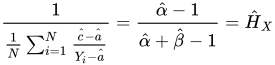 1 1 N ∑ i \= 1 N c ^ − a ^ c ^ − Y i \= β ^ − 1 α ^ \+ β ^ − 1 \= H ^ 1 − X {\\displaystyle {\\frac {1}{{\\frac {1}{N}}\\sum \_{i=1}^{N}{\\frac {{\\hat {c}}-{\\hat {a}}}{{\\hat {c}}-Y\_{i}}}}}={\\frac {{\\hat {\\beta }}-1}{{\\hat {\\alpha }}+{\\hat {\\beta }}-1}}={\\hat {H}}\_{1-X}} 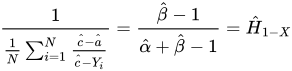
with sample geometric means:
G ^ X \= ∏ i \= 1 N ( Y i − a ^ c ^ − a ^ ) 1 N {\\displaystyle {\\hat {G}}\_{X}=\\prod \_{i=1}^{N}\\left({\\frac {Y\_{i}-{\\hat {a}}}{{\\hat {c}}-{\\hat {a}}}}\\right)^{\\frac {1}{N}}} 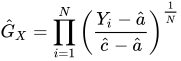 G ^ ( 1 − X ) \= ∏ i \= 1 N ( c ^ − Y i c ^ − a ^ ) 1 N {\\displaystyle {\\hat {G}}\_{(1-X)}=\\prod \_{i=1}^{N}\\left({\\frac {{\\hat {c}}-Y\_{i}}{{\\hat {c}}-{\\hat {a}}}}\\right)^{\\frac {1}{N}}} 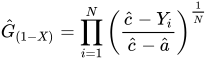
The parameters a ^ , c ^ {\\displaystyle {\\hat {a}},{\\hat {c}}}  are embedded inside the geometric mean expressions in a nonlinear way (to the power 1/*N*). This precludes, in general, a closed form solution, even for an initial value approximation for iteration purposes. One alternative is to use as initial values for iteration the values obtained from the method of moments solution for the four parameter case. Furthermore, the expressions for the harmonic means are well-defined only for α ^ , β ^ \> 1 {\\displaystyle {\\hat {\\alpha }},{\\hat {\\beta }}\>1} , which precludes a maximum likelihood solution for shape parameters less than unity in the four-parameter case. Fisher's information matrix for the four parameter case is [positive-definite](https://en.wikipedia.org/wiki/Positive-definite_matrix "Positive-definite matrix") only for α, β \> 2 (for further discussion, see section on Fisher information matrix, four parameter case), for bell-shaped (symmetric or unsymmetric) beta distributions, with inflection points located to either side of the mode. The following Fisher information components (that represent the expectations of the curvature of the log likelihood function) have [singularities](https://en.wikipedia.org/wiki/Mathematical_singularity "Mathematical singularity") at the following values:
α \= 2 : E \[ − 1 N ∂ 2 ln L ( α , β , a , c ∣ Y ) ∂ a 2 \] \= I a , a {\\displaystyle \\alpha =2:\\quad \\operatorname {E} \\left\[-{\\frac {1}{N}}{\\frac {\\partial ^{2}\\ln {\\mathcal {L}}(\\alpha ,\\beta ,a,c\\mid Y)}{\\partial a^{2}}}\\right\]={\\mathcal {I}}\_{a,a}} ![{\\displaystyle \\alpha =2:\\quad \\operatorname {E} \\left\[-{\\frac {1}{N}}{\\frac {\\partial ^{2}\\ln {\\mathcal {L}}(\\alpha ,\\beta ,a,c\\mid Y)}{\\partial a^{2}}}\\right\]={\\mathcal {I}}\_{a,a}}](https://wikimedia.org/api/rest_v1/media/math/render/svg/53538160a2404a5d7b74ae2033fbbb2dbc1045eb) β \= 2 : E \[ − 1 N ∂ 2 ln L ( α , β , a , c ∣ Y ) ∂ c 2 \] \= I c , c {\\displaystyle \\beta =2:\\quad \\operatorname {E} \\left\[-{\\frac {1}{N}}{\\frac {\\partial ^{2}\\ln {\\mathcal {L}}(\\alpha ,\\beta ,a,c\\mid Y)}{\\partial c^{2}}}\\right\]={\\mathcal {I}}\_{c,c}} ![{\\displaystyle \\beta =2:\\quad \\operatorname {E} \\left\[-{\\frac {1}{N}}{\\frac {\\partial ^{2}\\ln {\\mathcal {L}}(\\alpha ,\\beta ,a,c\\mid Y)}{\\partial c^{2}}}\\right\]={\\mathcal {I}}\_{c,c}}](https://wikimedia.org/api/rest_v1/media/math/render/svg/ee2c6ecfcafe60e54799ab4a16451cf478d65f7d) α \= 2 : E \[ − 1 N ∂ 2 ln L ( α , β , a , c ∣ Y ) ∂ α ∂ a \] \= I α , a {\\displaystyle \\alpha =2:\\quad \\operatorname {E} \\left\[-{\\frac {1}{N}}{\\frac {\\partial ^{2}\\ln {\\mathcal {L}}(\\alpha ,\\beta ,a,c\\mid Y)}{\\partial \\alpha \\partial a}}\\right\]={\\mathcal {I}}\_{\\alpha ,a}} ![{\\displaystyle \\alpha =2:\\quad \\operatorname {E} \\left\[-{\\frac {1}{N}}{\\frac {\\partial ^{2}\\ln {\\mathcal {L}}(\\alpha ,\\beta ,a,c\\mid Y)}{\\partial \\alpha \\partial a}}\\right\]={\\mathcal {I}}\_{\\alpha ,a}}](https://wikimedia.org/api/rest_v1/media/math/render/svg/8b8af544d7c5e0cc278aa725daba7f3de2f70d31) β \= 1 : E \[ − 1 N ∂ 2 ln L ( α , β , a , c ∣ Y ) ∂ β ∂ c \] \= I β , c {\\displaystyle \\beta =1:\\quad \\operatorname {E} \\left\[-{\\frac {1}{N}}{\\frac {\\partial ^{2}\\ln {\\mathcal {L}}(\\alpha ,\\beta ,a,c\\mid Y)}{\\partial \\beta \\partial c}}\\right\]={\\mathcal {I}}\_{\\beta ,c}} ![{\\displaystyle \\beta =1:\\quad \\operatorname {E} \\left\[-{\\frac {1}{N}}{\\frac {\\partial ^{2}\\ln {\\mathcal {L}}(\\alpha ,\\beta ,a,c\\mid Y)}{\\partial \\beta \\partial c}}\\right\]={\\mathcal {I}}\_{\\beta ,c}}](https://wikimedia.org/api/rest_v1/media/math/render/svg/2f87b32b39997964dcbc95bc64c1364e6832db1d)
(for further discussion see section on Fisher information matrix). Thus, it is not possible to strictly carry on the maximum likelihood estimation for some well known distributions belonging to the four-parameter beta distribution family, like the [uniform distribution](https://en.wikipedia.org/wiki/Continuous_uniform_distribution "Continuous uniform distribution") (Beta(1, 1, *a*, *c*)), and the [arcsine distribution](https://en.wikipedia.org/wiki/Arcsine_distribution "Arcsine distribution") (Beta(1/2, 1/2, *a*, *c*)). [N.L.Johnson](https://en.wikipedia.org/wiki/Norman_Lloyd_Johnson "Norman Lloyd Johnson") and [S.Kotz](https://en.wikipedia.org/wiki/Samuel_Kotz "Samuel Kotz")[\[1\]](https://en.wikipedia.org/wiki/Beta_distribution#cite_note-JKB-1) ignore the equations for the harmonic means and instead suggest "If a and c are unknown, and maximum likelihood estimators of *a*, *c*, α and β are required, the above procedure (for the two unknown parameter case, with *X* transformed as *X* = (*Y* − *a*)/(*c* − *a*)) can be repeated using a succession of trial values of *a* and *c*, until the pair (*a*, *c*) for which maximum likelihood (given *a* and *c*) is as great as possible, is attained" (where, for the purpose of clarity, their notation for the parameters has been translated into the present notation).
#### Fisher information matrix
\[[edit](https://en.wikipedia.org/w/index.php?title=Beta_distribution&action=edit§ion=57 "Edit section: Fisher information matrix")\]
Let a random variable X have a probability density *f*(*x*;*α*). The partial derivative with respect to the (unknown, and to be estimated) parameter α of the log [likelihood function](https://en.wikipedia.org/wiki/Likelihood_function "Likelihood function") is called the [score](https://en.wikipedia.org/wiki/Score_\(statistics\) "Score (statistics)"). The second moment of the score is called the [Fisher information](https://en.wikipedia.org/wiki/Fisher_information "Fisher information"):
I ( α ) \= E \[ ( ∂ ∂ α ln L ( α ∣ X ) ) 2 \] , {\\displaystyle {\\mathcal {I}}(\\alpha )=\\operatorname {E} \\left\[\\left({\\frac {\\partial }{\\partial \\alpha }}\\ln {\\mathcal {L}}(\\alpha \\mid X)\\right)^{2}\\right\],} ![{\\displaystyle {\\mathcal {I}}(\\alpha )=\\operatorname {E} \\left\[\\left({\\frac {\\partial }{\\partial \\alpha }}\\ln {\\mathcal {L}}(\\alpha \\mid X)\\right)^{2}\\right\],}](https://wikimedia.org/api/rest_v1/media/math/render/svg/daec13972d17a073bcd447abfde55a6b0e168720)
The [expectation](https://en.wikipedia.org/wiki/Expected_value "Expected value") of the [score](https://en.wikipedia.org/wiki/Score_\(statistics\) "Score (statistics)") is zero, therefore the Fisher information is also the second moment centered on the mean of the score: the [variance](https://en.wikipedia.org/wiki/Variance "Variance") of the score.
If the log [likelihood function](https://en.wikipedia.org/wiki/Likelihood_function "Likelihood function") is twice differentiable with respect to the parameter α, and under certain regularity conditions,[\[50\]](https://en.wikipedia.org/wiki/Beta_distribution#cite_note-Silvey-50) then the Fisher information may also be written as follows (which is often a more convenient form for calculation purposes):
I ( α ) \= − E \[ ∂ 2 ∂ α 2 ln L ( α ∣ X ) \] . {\\displaystyle {\\mathcal {I}}(\\alpha )=-\\operatorname {E} \\left\[{\\frac {\\partial ^{2}}{\\partial \\alpha ^{2}}}\\ln {\\mathcal {L}}(\\alpha \\mid X)\\right\].} ![{\\displaystyle {\\mathcal {I}}(\\alpha )=-\\operatorname {E} \\left\[{\\frac {\\partial ^{2}}{\\partial \\alpha ^{2}}}\\ln {\\mathcal {L}}(\\alpha \\mid X)\\right\].}](https://wikimedia.org/api/rest_v1/media/math/render/svg/3fdd5f6730d5ffb0a5f833c89ba784362322cbc8)
Thus, the Fisher information is the negative of the expectation of the second [derivative](https://en.wikipedia.org/wiki/Derivative "Derivative") with respect to the parameter α of the log [likelihood function](https://en.wikipedia.org/wiki/Likelihood_function "Likelihood function"). Therefore, Fisher information is a measure of the [curvature](https://en.wikipedia.org/wiki/Curvature "Curvature") of the log likelihood function of α. A low [curvature](https://en.wikipedia.org/wiki/Curvature "Curvature") (and therefore high [radius of curvature](https://en.wikipedia.org/wiki/Radius_of_curvature_\(mathematics\) "Radius of curvature (mathematics)")), flatter log likelihood function curve has low Fisher information; while a log likelihood function curve with large [curvature](https://en.wikipedia.org/wiki/Curvature "Curvature") (and therefore low [radius of curvature](https://en.wikipedia.org/wiki/Radius_of_curvature_\(mathematics\) "Radius of curvature (mathematics)")) has high Fisher information. When the Fisher information matrix is computed at the evaluates of the parameters ("the observed Fisher information matrix") it is equivalent to the replacement of the true log likelihood surface by a Taylor's series approximation, taken as far as the quadratic terms.[\[51\]](https://en.wikipedia.org/wiki/Beta_distribution#cite_note-EdwardsLikelihood-51) The word information, in the context of Fisher information, refers to information about the parameters. Information such as: estimation, sufficiency and properties of variances of estimators. The [Cramér–Rao bound](https://en.wikipedia.org/wiki/Cram%C3%A9r%E2%80%93Rao_bound "Cramér–Rao bound") states that the inverse of the Fisher information is a lower bound on the variance of any [estimator](https://en.wikipedia.org/wiki/Estimator "Estimator") of a parameter α:
var \[ α ^ \] ≥ 1 I ( α ) . {\\displaystyle \\operatorname {var} \[{\\hat {\\alpha }}\]\\geq {\\frac {1}{{\\mathcal {I}}(\\alpha )}}.} ![{\\displaystyle \\operatorname {var} \[{\\hat {\\alpha }}\]\\geq {\\frac {1}{{\\mathcal {I}}(\\alpha )}}.}](https://wikimedia.org/api/rest_v1/media/math/render/svg/d93d4983a2717258c52eb47d1562e849a3a66c5c)
The precision to which one can estimate the estimator of a parameter α is limited by the Fisher Information of the log likelihood function. The Fisher information is a measure of the minimum error involved in estimating a parameter of a distribution and it can be viewed as a measure of the resolving power of an experiment needed to discriminate between two [alternative hypothesis](https://en.wikipedia.org/wiki/Alternative_hypothesis "Alternative hypothesis") of a parameter.[\[52\]](https://en.wikipedia.org/wiki/Beta_distribution#cite_note-Jaynes-52)
When there are *N* parameters
\[ θ 1 θ 2 ⋮ θ N \] , {\\displaystyle {\\begin{bmatrix}\\theta \_{1}\\\\\\theta \_{2}\\\\\\vdots \\\\\\theta \_{N}\\end{bmatrix}},} 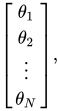
then the Fisher information takes the form of an *N*×*N* [positive semidefinite](https://en.wikipedia.org/wiki/Positive_semidefinite_matrix "Positive semidefinite matrix") [symmetric matrix](https://en.wikipedia.org/wiki/Symmetric_matrix "Symmetric matrix"), the Fisher information matrix, with typical element:
( I ( θ ) ) i , j \= E \[ ∂ ln L ∂ θ i ⋅ ∂ ln L ∂ θ j \] . {\\displaystyle ({\\mathcal {I}}(\\theta ))\_{i,j}=\\operatorname {E} \\left\[{\\frac {\\partial \\ln {\\mathcal {L}}}{\\partial \\theta \_{i}}}\\cdot {\\frac {\\partial \\ln {\\mathcal {L}}}{\\partial \\theta \_{j}}}\\right\].} ![{\\displaystyle ({\\mathcal {I}}(\\theta ))\_{i,j}=\\operatorname {E} \\left\[{\\frac {\\partial \\ln {\\mathcal {L}}}{\\partial \\theta \_{i}}}\\cdot {\\frac {\\partial \\ln {\\mathcal {L}}}{\\partial \\theta \_{j}}}\\right\].}](https://wikimedia.org/api/rest_v1/media/math/render/svg/94187c0032daae02409e5323c356fae5fdcb73fd)
Under certain regularity conditions,[\[50\]](https://en.wikipedia.org/wiki/Beta_distribution#cite_note-Silvey-50) the Fisher Information Matrix may also be written in the following form, which is often more convenient for computation:
( I ( θ ) ) i , j \= − E \[ ∂ 2 ln L ∂ θ i ∂ θ j \] . {\\displaystyle ({\\mathcal {I}}(\\theta ))\_{i,j}=-\\operatorname {E} \\left\[{\\frac {\\partial ^{2}\\ln {\\mathcal {L}}}{\\partial \\theta \_{i}\\,\\partial \\theta \_{j}}}\\right\]\\,.} ![{\\displaystyle ({\\mathcal {I}}(\\theta ))\_{i,j}=-\\operatorname {E} \\left\[{\\frac {\\partial ^{2}\\ln {\\mathcal {L}}}{\\partial \\theta \_{i}\\,\\partial \\theta \_{j}}}\\right\]\\,.}](https://wikimedia.org/api/rest_v1/media/math/render/svg/86df084593df54dd2ed7220a683b9fbc41f230d7)
With *X*1, ..., *XN* [iid](https://en.wikipedia.org/wiki/Iid "Iid") random variables, an *N*\-dimensional "box" can be constructed with sides *X*1, ..., *XN*. Costa and Cover[\[53\]](https://en.wikipedia.org/wiki/Beta_distribution#cite_note-CostaCover-53) show that the (Shannon) differential entropy *h*(*X*) is related to the volume of the typical set (having the sample entropy close to the true entropy), while the Fisher information is related to the surface of this typical set.
##### Two parameters
\[[edit](https://en.wikipedia.org/w/index.php?title=Beta_distribution&action=edit§ion=58 "Edit section: Two parameters")\]
For *X*1, ..., *X**N* independent random variables each having a beta distribution parametrized with shape parameters *α* and *β*, the joint log likelihood function for *N* [iid](https://en.wikipedia.org/wiki/Independent_and_identically_distributed_random_variables "Independent and identically distributed random variables") observations is:
ln L ( α , β ∣ X ) \= ( α − 1 ) ∑ i \= 1 N ln X i \+ ( β − 1 ) ∑ i \= 1 N ln ( 1 − X i ) − N ln B ( α , β ) {\\displaystyle \\ln {\\mathcal {L}}(\\alpha ,\\beta \\mid X)=(\\alpha -1)\\sum \_{i=1}^{N}\\ln X\_{i}+(\\beta -1)\\sum \_{i=1}^{N}\\ln(1-X\_{i})-N\\ln \\mathrm {B} (\\alpha ,\\beta )} 
therefore the joint log likelihood function per *N* [iid](https://en.wikipedia.org/wiki/Independent_and_identically_distributed_random_variables "Independent and identically distributed random variables") observations is
1 N ln L ( α , β ∣ X ) \= ( α − 1 ) 1 N ∑ i \= 1 N ln X i \+ ( β − 1 ) 1 N ∑ i \= 1 N ln ( 1 − X i ) − ln B ( α , β ) . {\\displaystyle {\\frac {1}{N}}\\ln {\\mathcal {L}}(\\alpha ,\\beta \\mid X)=(\\alpha -1){\\frac {1}{N}}\\sum \_{i=1}^{N}\\ln X\_{i}+(\\beta -1){\\frac {1}{N}}\\sum \_{i=1}^{N}\\ln(1-X\_{i})-\\,\\ln \\mathrm {B} (\\alpha ,\\beta ).} 
For the two parameter case, the Fisher information has 4 components: 2 diagonal and 2 off-diagonal. Since the Fisher information matrix is symmetric, one of these off diagonal components is independent. Therefore, the Fisher information matrix has 3 independent components (2 diagonal and 1 off diagonal).
Aryal and Nadarajah[\[54\]](https://en.wikipedia.org/wiki/Beta_distribution#cite_note-Aryal-54) calculated Fisher's information matrix for the four-parameter case, from which the two parameter case can be obtained as follows:
− ∂ 2 ln L ( α , β ∣ X ) N ∂ α 2 \= var \[ ln ( X ) \] \= ψ 1 ( α ) − ψ 1 ( α \+ β ) \= I α , α \= E \[ − ∂ 2 ln L ( α , β ∣ X ) N ∂ α 2 \] \= ln var G X {\\displaystyle -{\\frac {\\partial ^{2}\\ln {\\mathcal {L}}(\\alpha ,\\beta \\mid X)}{N\\partial \\alpha ^{2}}}=\\operatorname {var} \[\\ln(X)\]=\\psi \_{1}(\\alpha )-\\psi \_{1}(\\alpha +\\beta )={\\mathcal {I}}\_{\\alpha ,\\alpha }=\\operatorname {E} \\left\[-{\\frac {\\partial ^{2}\\ln {\\mathcal {L}}(\\alpha ,\\beta \\mid X)}{N\\partial \\alpha ^{2}}}\\right\]=\\ln \\operatorname {var} \_{GX}} ![{\\displaystyle -{\\frac {\\partial ^{2}\\ln {\\mathcal {L}}(\\alpha ,\\beta \\mid X)}{N\\partial \\alpha ^{2}}}=\\operatorname {var} \[\\ln(X)\]=\\psi \_{1}(\\alpha )-\\psi \_{1}(\\alpha +\\beta )={\\mathcal {I}}\_{\\alpha ,\\alpha }=\\operatorname {E} \\left\[-{\\frac {\\partial ^{2}\\ln {\\mathcal {L}}(\\alpha ,\\beta \\mid X)}{N\\partial \\alpha ^{2}}}\\right\]=\\ln \\operatorname {var} \_{GX}}](https://wikimedia.org/api/rest_v1/media/math/render/svg/c90003d5bd2f6d2bcfe2c788585689726b4b7e36) − ∂ 2 ln L ( α , β ∣ X ) N ∂ β 2 \= var \[ ln ( 1 − X ) \] \= ψ 1 ( β ) − ψ 1 ( α \+ β ) \= I β , β \= E \[ − ∂ 2 ln L ( α , β ∣ X ) N ∂ β 2 \] \= ln var G ( 1 − X ) {\\displaystyle -{\\frac {\\partial ^{2}\\ln {\\mathcal {L}}(\\alpha ,\\beta \\mid X)}{N\\,\\partial \\beta ^{2}}}=\\operatorname {var} \[\\ln(1-X)\]=\\psi \_{1}(\\beta )-\\psi \_{1}(\\alpha +\\beta )={\\mathcal {I}}\_{\\beta ,\\beta }=\\operatorname {E} \\left\[-{\\frac {\\partial ^{2}\\ln {\\mathcal {L}}(\\alpha ,\\beta \\mid X)}{N\\partial \\beta ^{2}}}\\right\]=\\ln \\operatorname {var} \_{G(1-X)}} ![{\\displaystyle -{\\frac {\\partial ^{2}\\ln {\\mathcal {L}}(\\alpha ,\\beta \\mid X)}{N\\,\\partial \\beta ^{2}}}=\\operatorname {var} \[\\ln(1-X)\]=\\psi \_{1}(\\beta )-\\psi \_{1}(\\alpha +\\beta )={\\mathcal {I}}\_{\\beta ,\\beta }=\\operatorname {E} \\left\[-{\\frac {\\partial ^{2}\\ln {\\mathcal {L}}(\\alpha ,\\beta \\mid X)}{N\\partial \\beta ^{2}}}\\right\]=\\ln \\operatorname {var} \_{G(1-X)}}](https://wikimedia.org/api/rest_v1/media/math/render/svg/b59bcc31f14f1f4b3b07bd92a66426bb6ac126b1) − ∂ 2 ln L ( α , β ∣ X ) N ∂ α ∂ β \= cov \[ ln X , ln ( 1 − X ) \] \= − ψ 1 ( α \+ β ) \= I α , β \= E \[ − ∂ 2 ln L ( α , β ∣ X ) N ∂ α ∂ β \] \= ln cov G X , ( 1 − X ) {\\displaystyle -{\\frac {\\partial ^{2}\\ln {\\mathcal {L}}(\\alpha ,\\beta \\mid X)}{N\\,\\partial \\alpha \\,\\partial \\beta }}=\\operatorname {cov} \[\\ln X,\\ln(1-X)\]=-\\psi \_{1}(\\alpha +\\beta )={\\mathcal {I}}\_{\\alpha ,\\beta }=\\operatorname {E} \\left\[-{\\frac {\\partial ^{2}\\ln {\\mathcal {L}}(\\alpha ,\\beta \\mid X)}{N\\,\\partial \\alpha \\,\\partial \\beta }}\\right\]=\\ln \\operatorname {cov} \_{G{X,(1-X)}}} ![{\\displaystyle -{\\frac {\\partial ^{2}\\ln {\\mathcal {L}}(\\alpha ,\\beta \\mid X)}{N\\,\\partial \\alpha \\,\\partial \\beta }}=\\operatorname {cov} \[\\ln X,\\ln(1-X)\]=-\\psi \_{1}(\\alpha +\\beta )={\\mathcal {I}}\_{\\alpha ,\\beta }=\\operatorname {E} \\left\[-{\\frac {\\partial ^{2}\\ln {\\mathcal {L}}(\\alpha ,\\beta \\mid X)}{N\\,\\partial \\alpha \\,\\partial \\beta }}\\right\]=\\ln \\operatorname {cov} \_{G{X,(1-X)}}}](https://wikimedia.org/api/rest_v1/media/math/render/svg/a6c3268da3b23c062ce981ab02d4c454a0267365)
Since the Fisher information matrix is symmetric
I α , β \= I β , α \= ln cov G X , ( 1 − X ) {\\displaystyle {\\mathcal {I}}\_{\\alpha ,\\beta }={\\mathcal {I}}\_{\\beta ,\\alpha }=\\ln \\operatorname {cov} \_{G{X,(1-X)}}} 
The Fisher information components are equal to the log geometric variances and log geometric covariance. Therefore, they can be expressed as **[trigamma functions](https://en.wikipedia.org/wiki/Trigamma_function "Trigamma function")**, denoted ψ1(α), the second of the [polygamma functions](https://en.wikipedia.org/wiki/Polygamma_function "Polygamma function"), defined as the derivative of the [digamma](https://en.wikipedia.org/wiki/Digamma "Digamma") function:
ψ 1 ( α ) \= d 2 ln Γ ( α ) ∂ α 2 \= ∂ ψ ( α ) ∂ α . {\\displaystyle \\psi \_{1}(\\alpha )={\\frac {d^{2}\\ln \\Gamma (\\alpha )}{\\partial \\alpha ^{2}}}=\\,{\\frac {\\partial \\psi (\\alpha )}{\\partial \\alpha }}.} 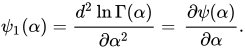
These derivatives are also derived in the [§ Two unknown parameters](https://en.wikipedia.org/wiki/Beta_distribution#Two_unknown_parameters) and plots of the log likelihood function are also shown in that section. [§ Geometric variance and covariance](https://en.wikipedia.org/wiki/Beta_distribution#Geometric_variance_and_covariance) contains plots and further discussion of the Fisher information matrix components: the log geometric variances and log geometric covariance as a function of the shape parameters α and β. [§ Moments of logarithmically transformed random variables](https://en.wikipedia.org/wiki/Beta_distribution#Moments_of_logarithmically_transformed_random_variables) contains formulas for moments of logarithmically transformed random variables. Images for the Fisher information components I α , α , I β , β {\\displaystyle {\\mathcal {I}}\_{\\alpha ,\\alpha },{\\mathcal {I}}\_{\\beta ,\\beta }}  and I α , β {\\displaystyle {\\mathcal {I}}\_{\\alpha ,\\beta }}  are shown in [§ Geometric variance](https://en.wikipedia.org/wiki/Beta_distribution#Geometric_variance).
The determinant of Fisher's information matrix is of interest (for example for the calculation of [Jeffreys prior](https://en.wikipedia.org/wiki/Jeffreys_prior "Jeffreys prior") probability). From the expressions for the individual components of the Fisher information matrix, it follows that the determinant of Fisher's (symmetric) information matrix for the beta distribution is:
det ( I ( α , β ) ) \= I α , α I β , β − I α , β I α , β \= ( ψ 1 ( α ) − ψ 1 ( α \+ β ) ) ( ψ 1 ( β ) − ψ 1 ( α \+ β ) ) − ( − ψ 1 ( α \+ β ) ) ( − ψ 1 ( α \+ β ) ) \= ψ 1 ( α ) ψ 1 ( β ) − ( ψ 1 ( α ) \+ ψ 1 ( β ) ) ψ 1 ( α \+ β ) lim α → 0 det ( I ( α , β ) ) \= lim β → 0 det ( I ( α , β ) ) \= ∞ lim α → ∞ det ( I ( α , β ) ) \= lim β → ∞ det ( I ( α , β ) ) \= 0 {\\displaystyle {\\begin{aligned}\\det({\\mathcal {I}}(\\alpha ,\\beta ))&={\\mathcal {I}}\_{\\alpha ,\\alpha }{\\mathcal {I}}\_{\\beta ,\\beta }-{\\mathcal {I}}\_{\\alpha ,\\beta }{\\mathcal {I}}\_{\\alpha ,\\beta }\\\\\[4pt\]&=(\\psi \_{1}(\\alpha )-\\psi \_{1}(\\alpha +\\beta ))(\\psi \_{1}(\\beta )-\\psi \_{1}(\\alpha +\\beta ))-(-\\psi \_{1}(\\alpha +\\beta ))(-\\psi \_{1}(\\alpha +\\beta ))\\\\\[4pt\]&=\\psi \_{1}(\\alpha )\\psi \_{1}(\\beta )-(\\psi \_{1}(\\alpha )+\\psi \_{1}(\\beta ))\\psi \_{1}(\\alpha +\\beta )\\\\\[4pt\]\\lim \_{\\alpha \\to 0}\\det({\\mathcal {I}}(\\alpha ,\\beta ))&=\\lim \_{\\beta \\to 0}\\det({\\mathcal {I}}(\\alpha ,\\beta ))=\\infty \\\\\[4pt\]\\lim \_{\\alpha \\to \\infty }\\det({\\mathcal {I}}(\\alpha ,\\beta ))&=\\lim \_{\\beta \\to \\infty }\\det({\\mathcal {I}}(\\alpha ,\\beta ))=0\\end{aligned}}} ![{\\displaystyle {\\begin{aligned}\\det({\\mathcal {I}}(\\alpha ,\\beta ))&={\\mathcal {I}}\_{\\alpha ,\\alpha }{\\mathcal {I}}\_{\\beta ,\\beta }-{\\mathcal {I}}\_{\\alpha ,\\beta }{\\mathcal {I}}\_{\\alpha ,\\beta }\\\\\[4pt\]&=(\\psi \_{1}(\\alpha )-\\psi \_{1}(\\alpha +\\beta ))(\\psi \_{1}(\\beta )-\\psi \_{1}(\\alpha +\\beta ))-(-\\psi \_{1}(\\alpha +\\beta ))(-\\psi \_{1}(\\alpha +\\beta ))\\\\\[4pt\]&=\\psi \_{1}(\\alpha )\\psi \_{1}(\\beta )-(\\psi \_{1}(\\alpha )+\\psi \_{1}(\\beta ))\\psi \_{1}(\\alpha +\\beta )\\\\\[4pt\]\\lim \_{\\alpha \\to 0}\\det({\\mathcal {I}}(\\alpha ,\\beta ))&=\\lim \_{\\beta \\to 0}\\det({\\mathcal {I}}(\\alpha ,\\beta ))=\\infty \\\\\[4pt\]\\lim \_{\\alpha \\to \\infty }\\det({\\mathcal {I}}(\\alpha ,\\beta ))&=\\lim \_{\\beta \\to \\infty }\\det({\\mathcal {I}}(\\alpha ,\\beta ))=0\\end{aligned}}}](https://wikimedia.org/api/rest_v1/media/math/render/svg/b2c5ccf59b05ea730fc108360c07e9ac9634e829)
From [Sylvester's criterion](https://en.wikipedia.org/wiki/Sylvester%27s_criterion "Sylvester's criterion") (checking whether the diagonal elements are all positive), it follows that the Fisher information matrix for the two parameter case is [positive-definite](https://en.wikipedia.org/wiki/Positive-definite_matrix "Positive-definite matrix") (under the standard condition that the shape parameters are positive *α* \> 0 and *β* \> 0).
##### Four parameters
\[[edit](https://en.wikipedia.org/w/index.php?title=Beta_distribution&action=edit§ion=59 "Edit section: Four parameters")\]
[](https://en.wikipedia.org/wiki/File:Fisher_Information_I\(a,a\)_for_alpha%3Dbeta_vs_range_\(c-a\)_and_exponent_alpha%3Dbeta_-_J._Rodal.png)
Fisher Information *I*(*a*,*a*) for *α* = *β* vs range (*c* − *a*) and exponent *α* = *β*
[](https://en.wikipedia.org/wiki/File:Fisher_Information_I\(alpha,a\)_for_alpha%3Dbeta,_vs._range_\(c_-_a\)_and_exponent_alpha%3Dbeta_-_J._Rodal.png)
Fisher Information *I*(*α*,*a*) for *α* = *β*, vs. range (*c* − *a*) and exponent *α* = *β*
If *Y*1, ..., *YN* are independent random variables each having a beta distribution with four parameters: the exponents *α* and *β*, and also *a* (the minimum of the distribution range), and *c* (the maximum of the distribution range) (section titled "Alternative parametrizations", "Four parameters"), with [probability density function](https://en.wikipedia.org/wiki/Probability_density_function "Probability density function"):
f ( y ; α , β , a , c ) \= f ( x ; α , β ) c − a \= ( y − a c − a ) α − 1 ( c − y c − a ) β − 1 ( c − a ) B ( α , β ) \= ( y − a ) α − 1 ( c − y ) β − 1 ( c − a ) α \+ β − 1 B ( α , β ) . {\\displaystyle f(y;\\alpha ,\\beta ,a,c)={\\frac {f(x;\\alpha ,\\beta )}{c-a}}={\\frac {\\left({\\frac {y-a}{c-a}}\\right)^{\\alpha -1}\\left({\\frac {c-y}{c-a}}\\right)^{\\beta -1}}{(c-a)B(\\alpha ,\\beta )}}={\\frac {(y-a)^{\\alpha -1}(c-y)^{\\beta -1}}{(c-a)^{\\alpha +\\beta -1}B(\\alpha ,\\beta )}}.} 
the joint log likelihood function per *N* [iid](https://en.wikipedia.org/wiki/Independent_and_identically_distributed_random_variables "Independent and identically distributed random variables") observations is:
1 N ln L ( α , β , a , c ∣ Y ) \= α − 1 N ∑ i \= 1 N ln ( Y i − a ) \+ β − 1 N ∑ i \= 1 N ln ( c − Y i ) − ln B ( α , β ) − ( α \+ β − 1 ) ln ( c − a ) {\\displaystyle {\\frac {1}{N}}\\ln {\\mathcal {L}}(\\alpha ,\\beta ,a,c\\mid Y)={\\frac {\\alpha -1}{N}}\\sum \_{i=1}^{N}\\ln(Y\_{i}-a)+{\\frac {\\beta -1}{N}}\\sum \_{i=1}^{N}\\ln(c-Y\_{i})-\\ln \\mathrm {B} (\\alpha ,\\beta )-(\\alpha +\\beta -1)\\ln(c-a)} 
For the four parameter case, the Fisher information has 4\*4=16 components. It has 12 off-diagonal components = (4×4 total − 4 diagonal). Since the Fisher information matrix is symmetric, half of these components (12/2=6) are independent. Therefore, the Fisher information matrix has 6 independent off-diagonal + 4 diagonal = 10 independent components. Aryal and Nadarajah[\[54\]](https://en.wikipedia.org/wiki/Beta_distribution#cite_note-Aryal-54) calculated Fisher's information matrix for the four parameter case as follows:
− 1 N ∂ 2 ln L ( α , β , a , c ∣ Y ) ∂ α 2 \= var \[ ln ( X ) \] \= ψ 1 ( α ) − ψ 1 ( α \+ β ) \= I α , α \= E \[ − 1 N ∂ 2 ln L ( α , β , a , c ∣ Y ) ∂ α 2 \] \= ln ( v a r G X ) {\\displaystyle -{\\frac {1}{N}}{\\frac {\\partial ^{2}\\ln {\\mathcal {L}}(\\alpha ,\\beta ,a,c\\mid Y)}{\\partial \\alpha ^{2}}}=\\operatorname {var} \[\\ln(X)\]=\\psi \_{1}(\\alpha )-\\psi \_{1}(\\alpha +\\beta )={\\mathcal {I}}\_{\\alpha ,\\alpha }=\\operatorname {E} \\left\[-{\\frac {1}{N}}{\\frac {\\partial ^{2}\\ln {\\mathcal {L}}(\\alpha ,\\beta ,a,c\\mid Y)}{\\partial \\alpha ^{2}}}\\right\]=\\ln(\\operatorname {var\_{GX}} )} ![{\\displaystyle -{\\frac {1}{N}}{\\frac {\\partial ^{2}\\ln {\\mathcal {L}}(\\alpha ,\\beta ,a,c\\mid Y)}{\\partial \\alpha ^{2}}}=\\operatorname {var} \[\\ln(X)\]=\\psi \_{1}(\\alpha )-\\psi \_{1}(\\alpha +\\beta )={\\mathcal {I}}\_{\\alpha ,\\alpha }=\\operatorname {E} \\left\[-{\\frac {1}{N}}{\\frac {\\partial ^{2}\\ln {\\mathcal {L}}(\\alpha ,\\beta ,a,c\\mid Y)}{\\partial \\alpha ^{2}}}\\right\]=\\ln(\\operatorname {var\_{GX}} )}](https://wikimedia.org/api/rest_v1/media/math/render/svg/31be86f2c53663c6d3975bc2676806ba3e538423) − 1 N ∂ 2 ln L ( α , β , a , c ∣ Y ) ∂ β 2 \= var \[ ln ( 1 − X ) \] \= ψ 1 ( β ) − ψ 1 ( α \+ β ) \= I β , β \= E \[ − 1 N ∂ 2 ln L ( α , β , a , c ∣ Y ) ∂ β 2 \] \= ln ( v a r G ( 1 \- X ) ) {\\displaystyle -{\\frac {1}{N}}{\\frac {\\partial ^{2}\\ln {\\mathcal {L}}(\\alpha ,\\beta ,a,c\\mid Y)}{\\partial \\beta ^{2}}}=\\operatorname {var} \[\\ln(1-X)\]=\\psi \_{1}(\\beta )-\\psi \_{1}(\\alpha +\\beta )={\\mathcal {I}}\_{\\beta ,\\beta }=\\operatorname {E} \\left\[-{\\frac {1}{N}}{\\frac {\\partial ^{2}\\ln {\\mathcal {L}}(\\alpha ,\\beta ,a,c\\mid Y)}{\\partial \\beta ^{2}}}\\right\]=\\ln(\\operatorname {var\_{G(1-X)}} )} ![{\\displaystyle -{\\frac {1}{N}}{\\frac {\\partial ^{2}\\ln {\\mathcal {L}}(\\alpha ,\\beta ,a,c\\mid Y)}{\\partial \\beta ^{2}}}=\\operatorname {var} \[\\ln(1-X)\]=\\psi \_{1}(\\beta )-\\psi \_{1}(\\alpha +\\beta )={\\mathcal {I}}\_{\\beta ,\\beta }=\\operatorname {E} \\left\[-{\\frac {1}{N}}{\\frac {\\partial ^{2}\\ln {\\mathcal {L}}(\\alpha ,\\beta ,a,c\\mid Y)}{\\partial \\beta ^{2}}}\\right\]=\\ln(\\operatorname {var\_{G(1-X)}} )}](https://wikimedia.org/api/rest_v1/media/math/render/svg/25ab885119f25fae0b9919326db96395d13e3bc3) − 1 N ∂ 2 ln L ( α , β , a , c ∣ Y ) ∂ α ∂ β \= cov \[ ln X , ( 1 − X ) \] \= − ψ 1 ( α \+ β ) \= I α , β \= E \[ − 1 N ∂ 2 ln L ( α , β , a , c ∣ Y ) ∂ α ∂ β \] \= ln ( cov G X , ( 1 − X ) ) {\\displaystyle -{\\frac {1}{N}}{\\frac {\\partial ^{2}\\ln {\\mathcal {L}}(\\alpha ,\\beta ,a,c\\mid Y)}{\\partial \\alpha \\,\\partial \\beta }}=\\operatorname {cov} \[\\ln X,(1-X)\]=-\\psi \_{1}(\\alpha +\\beta )={\\mathcal {I}}\_{\\alpha ,\\beta }=\\operatorname {E} \\left\[-{\\frac {1}{N}}{\\frac {\\partial ^{2}\\ln {\\mathcal {L}}(\\alpha ,\\beta ,a,c\\mid Y)}{\\partial \\alpha \\,\\partial \\beta }}\\right\]=\\ln(\\operatorname {cov} \_{G{X,(1-X)}})} ![{\\displaystyle -{\\frac {1}{N}}{\\frac {\\partial ^{2}\\ln {\\mathcal {L}}(\\alpha ,\\beta ,a,c\\mid Y)}{\\partial \\alpha \\,\\partial \\beta }}=\\operatorname {cov} \[\\ln X,(1-X)\]=-\\psi \_{1}(\\alpha +\\beta )={\\mathcal {I}}\_{\\alpha ,\\beta }=\\operatorname {E} \\left\[-{\\frac {1}{N}}{\\frac {\\partial ^{2}\\ln {\\mathcal {L}}(\\alpha ,\\beta ,a,c\\mid Y)}{\\partial \\alpha \\,\\partial \\beta }}\\right\]=\\ln(\\operatorname {cov} \_{G{X,(1-X)}})}](https://wikimedia.org/api/rest_v1/media/math/render/svg/02a56af746fb9315340cf382951fe0c3f3640678)
In the above expressions, the use of *X* instead of *Y* in the expressions var\[ln(*X*)\] = ln(var*GX*) is *not an error*. The expressions in terms of the log geometric variances and log geometric covariance occur as functions of the two parameter *X* ~ Beta(*α*, *β*) parametrization because when taking the partial derivatives with respect to the exponents (*α*, *β*) in the four parameter case, one obtains the identical expressions as for the two parameter case: these terms of the four parameter Fisher information matrix are independent of the minimum *a* and maximum *c* of the distribution's range. The only non-zero term upon double differentiation of the log likelihood function with respect to the exponents *α* and *β* is the second derivative of the log of the beta function: ln(B(*α*, *β*)). This term is independent of the minimum *a* and maximum *c* of the distribution's range. Double differentiation of this term results in trigamma functions. The sections titled "Maximum likelihood", "Two unknown parameters" and "Four unknown parameters" also show this fact.
The Fisher information for *N* [i.i.d.](https://en.wikipedia.org/wiki/I.i.d. "I.i.d.") samples is *N* times the individual Fisher information (eq. 11.279, page 394 of Cover and Thomas[\[28\]](https://en.wikipedia.org/wiki/Beta_distribution#cite_note-Cover_and_Thomas-28)). (Aryal and Nadarajah[\[54\]](https://en.wikipedia.org/wiki/Beta_distribution#cite_note-Aryal-54) take a single observation, *N* = 1, to calculate the following components of the Fisher information, which leads to the same result as considering the derivatives of the log likelihood per *N* observations. Moreover, below the erroneous expression for I a , a {\\displaystyle {\\mathcal {I}}\_{a,a}}  in Aryal and Nadarajah has been corrected.)
α \> 2 : E \[ − 1 N ∂ 2 ln L ( α , β , a , c ∣ Y ) ∂ a 2 \] \= I a , a \= β ( α \+ β − 1 ) ( α − 2 ) ( c − a ) 2 β \> 2 : E \[ − 1 N ∂ 2 ln L ( α , β , a , c ∣ Y ) ∂ c 2 \] \= I c , c \= α ( α \+ β − 1 ) ( β − 2 ) ( c − a ) 2 E \[ − 1 N ∂ 2 ln L ( α , β , a , c ∣ Y ) ∂ a ∂ c \] \= I a , c \= ( α \+ β − 1 ) ( c − a ) 2 α \> 1 : E \[ − 1 N ∂ 2 ln L ( α , β , a , c ∣ Y ) ∂ α ∂ a \] \= I α , a \= β ( α − 1 ) ( c − a ) E \[ − 1 N ∂ 2 ln L ( α , β , a , c ∣ Y ) ∂ α ∂ c \] \= I α , c \= 1 ( c − a ) E \[ − 1 N ∂ 2 ln L ( α , β , a , c ∣ Y ) ∂ β ∂ a \] \= I β , a \= − 1 ( c − a ) β \> 1 : E \[ − 1 N ∂ 2 ln L ( α , β , a , c ∣ Y ) ∂ β ∂ c \] \= I β , c \= − α ( β − 1 ) ( c − a ) {\\displaystyle {\\begin{aligned}\\alpha \>2:\\quad \\operatorname {E} \\left\[-{\\frac {1}{N}}{\\frac {\\partial ^{2}\\ln {\\mathcal {L}}(\\alpha ,\\beta ,a,c\\mid Y)}{\\partial a^{2}}}\\right\]&={\\mathcal {I}}\_{a,a}={\\frac {\\beta (\\alpha +\\beta -1)}{(\\alpha -2)(c-a)^{2}}}\\\\\\beta \>2:\\quad \\operatorname {E} \\left\[-{\\frac {1}{N}}{\\frac {\\partial ^{2}\\ln {\\mathcal {L}}(\\alpha ,\\beta ,a,c\\mid Y)}{\\partial c^{2}}}\\right\]&={\\mathcal {I}}\_{c,c}={\\frac {\\alpha (\\alpha +\\beta -1)}{(\\beta -2)(c-a)^{2}}}\\\\\\operatorname {E} \\left\[-{\\frac {1}{N}}{\\frac {\\partial ^{2}\\ln {\\mathcal {L}}(\\alpha ,\\beta ,a,c\\mid Y)}{\\partial a\\,\\partial c}}\\right\]&={\\mathcal {I}}\_{a,c}={\\frac {(\\alpha +\\beta -1)}{(c-a)^{2}}}\\\\\\alpha \>1:\\quad \\operatorname {E} \\left\[-{\\frac {1}{N}}{\\frac {\\partial ^{2}\\ln {\\mathcal {L}}(\\alpha ,\\beta ,a,c\\mid Y)}{\\partial \\alpha \\,\\partial a}}\\right\]&={\\mathcal {I}}\_{\\alpha ,a}={\\frac {\\beta }{(\\alpha -1)(c-a)}}\\\\\\operatorname {E} \\left\[-{\\frac {1}{N}}{\\frac {\\partial ^{2}\\ln {\\mathcal {L}}(\\alpha ,\\beta ,a,c\\mid Y)}{\\partial \\alpha \\,\\partial c}}\\right\]&={\\mathcal {I}}\_{\\alpha ,c}={\\frac {1}{(c-a)}}\\\\\\operatorname {E} \\left\[-{\\frac {1}{N}}{\\frac {\\partial ^{2}\\ln {\\mathcal {L}}(\\alpha ,\\beta ,a,c\\mid Y)}{\\partial \\beta \\,\\partial a}}\\right\]&={\\mathcal {I}}\_{\\beta ,a}=-{\\frac {1}{(c-a)}}\\\\\\beta \>1:\\quad \\operatorname {E} \\left\[-{\\frac {1}{N}}{\\frac {\\partial ^{2}\\ln {\\mathcal {L}}(\\alpha ,\\beta ,a,c\\mid Y)}{\\partial \\beta \\,\\partial c}}\\right\]&={\\mathcal {I}}\_{\\beta ,c}=-{\\frac {\\alpha }{(\\beta -1)(c-a)}}\\end{aligned}}} ![{\\displaystyle {\\begin{aligned}\\alpha \>2:\\quad \\operatorname {E} \\left\[-{\\frac {1}{N}}{\\frac {\\partial ^{2}\\ln {\\mathcal {L}}(\\alpha ,\\beta ,a,c\\mid Y)}{\\partial a^{2}}}\\right\]&={\\mathcal {I}}\_{a,a}={\\frac {\\beta (\\alpha +\\beta -1)}{(\\alpha -2)(c-a)^{2}}}\\\\\\beta \>2:\\quad \\operatorname {E} \\left\[-{\\frac {1}{N}}{\\frac {\\partial ^{2}\\ln {\\mathcal {L}}(\\alpha ,\\beta ,a,c\\mid Y)}{\\partial c^{2}}}\\right\]&={\\mathcal {I}}\_{c,c}={\\frac {\\alpha (\\alpha +\\beta -1)}{(\\beta -2)(c-a)^{2}}}\\\\\\operatorname {E} \\left\[-{\\frac {1}{N}}{\\frac {\\partial ^{2}\\ln {\\mathcal {L}}(\\alpha ,\\beta ,a,c\\mid Y)}{\\partial a\\,\\partial c}}\\right\]&={\\mathcal {I}}\_{a,c}={\\frac {(\\alpha +\\beta -1)}{(c-a)^{2}}}\\\\\\alpha \>1:\\quad \\operatorname {E} \\left\[-{\\frac {1}{N}}{\\frac {\\partial ^{2}\\ln {\\mathcal {L}}(\\alpha ,\\beta ,a,c\\mid Y)}{\\partial \\alpha \\,\\partial a}}\\right\]&={\\mathcal {I}}\_{\\alpha ,a}={\\frac {\\beta }{(\\alpha -1)(c-a)}}\\\\\\operatorname {E} \\left\[-{\\frac {1}{N}}{\\frac {\\partial ^{2}\\ln {\\mathcal {L}}(\\alpha ,\\beta ,a,c\\mid Y)}{\\partial \\alpha \\,\\partial c}}\\right\]&={\\mathcal {I}}\_{\\alpha ,c}={\\frac {1}{(c-a)}}\\\\\\operatorname {E} \\left\[-{\\frac {1}{N}}{\\frac {\\partial ^{2}\\ln {\\mathcal {L}}(\\alpha ,\\beta ,a,c\\mid Y)}{\\partial \\beta \\,\\partial a}}\\right\]&={\\mathcal {I}}\_{\\beta ,a}=-{\\frac {1}{(c-a)}}\\\\\\beta \>1:\\quad \\operatorname {E} \\left\[-{\\frac {1}{N}}{\\frac {\\partial ^{2}\\ln {\\mathcal {L}}(\\alpha ,\\beta ,a,c\\mid Y)}{\\partial \\beta \\,\\partial c}}\\right\]&={\\mathcal {I}}\_{\\beta ,c}=-{\\frac {\\alpha }{(\\beta -1)(c-a)}}\\end{aligned}}}](https://wikimedia.org/api/rest_v1/media/math/render/svg/636646f51bdb1a3193b1721483878e98f4f19c3e)
The lower two diagonal entries of the Fisher information matrix, with respect to the parameter *a* (the minimum of the distribution's range): I a , a {\\displaystyle {\\mathcal {I}}\_{a,a}} , and with respect to the parameter *c* (the maximum of the distribution's range): I c , c {\\displaystyle {\\mathcal {I}}\_{c,c}}  are only defined for exponents *α* \> 2 and *β* \> 2 respectively. The Fisher information matrix component I a , a {\\displaystyle {\\mathcal {I}}\_{a,a}}  for the minimum *a* approaches infinity for exponent α approaching 2 from above, and the Fisher information matrix component I c , c {\\displaystyle {\\mathcal {I}}\_{c,c}}  for the maximum *c* approaches infinity for exponent *β* approaching 2 from above.
The Fisher information matrix for the four parameter case does not depend on the individual values of the minimum *a* and the maximum *c*, but only on the total range (*c* − *a*). Moreover, the components of the Fisher information matrix that depend on the range (*c* − *a*), depend only through its inverse (or the square of the inverse), such that the Fisher information decreases for increasing range (*c* − *a*).
The accompanying images show the Fisher information components I a , a {\\displaystyle {\\mathcal {I}}\_{a,a}}  and I α , a {\\displaystyle {\\mathcal {I}}\_{\\alpha ,a}} . Images for the Fisher information components I α , α {\\displaystyle {\\mathcal {I}}\_{\\alpha ,\\alpha }}  and I β , β {\\displaystyle {\\mathcal {I}}\_{\\beta ,\\beta }}  are shown in [§ Geometric variance](https://en.wikipedia.org/wiki/Beta_distribution#Geometric_variance). All these Fisher information components look like a basin, with the "walls" of the basin being located at low values of the parameters.
The following four-parameter-beta-distribution Fisher information components can be expressed in terms of the two-parameter: *X* ~ Beta(α, β) expectations of the transformed ratio ((1 − *X*)/*X*) and of its mirror image (*X*/(1 − *X*)), scaled by the range (*c* − *a*), which may be helpful for interpretation:
I α , a \= E \[ 1 − X X \] c − a \= β ( α − 1 ) ( c − a ) if α \> 1 {\\displaystyle {\\mathcal {I}}\_{\\alpha ,a}={\\frac {\\operatorname {E} \\left\[{\\frac {1-X}{X}}\\right\]}{c-a}}={\\frac {\\beta }{(\\alpha -1)(c-a)}}{\\text{ if }}\\alpha \>1} ![{\\displaystyle {\\mathcal {I}}\_{\\alpha ,a}={\\frac {\\operatorname {E} \\left\[{\\frac {1-X}{X}}\\right\]}{c-a}}={\\frac {\\beta }{(\\alpha -1)(c-a)}}{\\text{ if }}\\alpha \>1}](https://wikimedia.org/api/rest_v1/media/math/render/svg/e670565bb8d06bace69cf892864520f5c83b5449) I β , c \= − E \[ X 1 − X \] c − a \= − α ( β − 1 ) ( c − a ) if β \> 1 {\\displaystyle {\\mathcal {I}}\_{\\beta ,c}=-{\\frac {\\operatorname {E} \\left\[{\\frac {X}{1-X}}\\right\]}{c-a}}=-{\\frac {\\alpha }{(\\beta -1)(c-a)}}{\\text{ if }}\\beta \>1} ![{\\displaystyle {\\mathcal {I}}\_{\\beta ,c}=-{\\frac {\\operatorname {E} \\left\[{\\frac {X}{1-X}}\\right\]}{c-a}}=-{\\frac {\\alpha }{(\\beta -1)(c-a)}}{\\text{ if }}\\beta \>1}](https://wikimedia.org/api/rest_v1/media/math/render/svg/94f9b7788a4f19e1cbc765ab8fc85a7ad55dec4f)
These are also the expected values of the "inverted beta distribution" or [beta prime distribution](https://en.wikipedia.org/wiki/Beta_prime_distribution "Beta prime distribution") (also known as beta distribution of the second kind or [Pearson's Type VI](https://en.wikipedia.org/wiki/Pearson_distribution "Pearson distribution")) [\[1\]](https://en.wikipedia.org/wiki/Beta_distribution#cite_note-JKB-1) and its mirror image, scaled by the range (*c* − *a*).
Also, the following Fisher information components can be expressed in terms of the harmonic (1/X) variances or of variances based on the ratio transformed variables ((1-X)/X) as follows:
α \> 2 : I a , a \= var \[ 1 X \] ( α − 1 c − a ) 2 \= var \[ 1 − X X \] ( α − 1 c − a ) 2 \= β ( α \+ β − 1 ) ( α − 2 ) ( c − a ) 2 β \> 2 : I c , c \= var \[ 1 1 − X \] ( β − 1 c − a ) 2 \= var \[ X 1 − X \] ( β − 1 c − a ) 2 \= α ( α \+ β − 1 ) ( β − 2 ) ( c − a ) 2 I a , c \= cov \[ 1 X , 1 1 − X \] ( α − 1 ) ( β − 1 ) ( c − a ) 2 \= cov \[ 1 − X X , X 1 − X \] ( α − 1 ) ( β − 1 ) ( c − a ) 2 \= ( α \+ β − 1 ) ( c − a ) 2 {\\displaystyle {\\begin{aligned}\\alpha \>2:\\quad {\\mathcal {I}}\_{a,a}&=\\operatorname {var} \\left\[{\\frac {1}{X}}\\right\]\\left({\\frac {\\alpha -1}{c-a}}\\right)^{2}=\\operatorname {var} \\left\[{\\frac {1-X}{X}}\\right\]\\left({\\frac {\\alpha -1}{c-a}}\\right)^{2}={\\frac {\\beta (\\alpha +\\beta -1)}{(\\alpha -2)(c-a)^{2}}}\\\\\\beta \>2:\\quad {\\mathcal {I}}\_{c,c}&=\\operatorname {var} \\left\[{\\frac {1}{1-X}}\\right\]\\left({\\frac {\\beta -1}{c-a}}\\right)^{2}=\\operatorname {var} \\left\[{\\frac {X}{1-X}}\\right\]\\left({\\frac {\\beta -1}{c-a}}\\right)^{2}={\\frac {\\alpha (\\alpha +\\beta -1)}{(\\beta -2)(c-a)^{2}}}\\\\{\\mathcal {I}}\_{a,c}&=\\operatorname {cov} \\left\[{\\frac {1}{X}},{\\frac {1}{1-X}}\\right\]{\\frac {(\\alpha -1)(\\beta -1)}{(c-a)^{2}}}=\\operatorname {cov} \\left\[{\\frac {1-X}{X}},{\\frac {X}{1-X}}\\right\]{\\frac {(\\alpha -1)(\\beta -1)}{(c-a)^{2}}}={\\frac {(\\alpha +\\beta -1)}{(c-a)^{2}}}\\end{aligned}}} ![{\\displaystyle {\\begin{aligned}\\alpha \>2:\\quad {\\mathcal {I}}\_{a,a}&=\\operatorname {var} \\left\[{\\frac {1}{X}}\\right\]\\left({\\frac {\\alpha -1}{c-a}}\\right)^{2}=\\operatorname {var} \\left\[{\\frac {1-X}{X}}\\right\]\\left({\\frac {\\alpha -1}{c-a}}\\right)^{2}={\\frac {\\beta (\\alpha +\\beta -1)}{(\\alpha -2)(c-a)^{2}}}\\\\\\beta \>2:\\quad {\\mathcal {I}}\_{c,c}&=\\operatorname {var} \\left\[{\\frac {1}{1-X}}\\right\]\\left({\\frac {\\beta -1}{c-a}}\\right)^{2}=\\operatorname {var} \\left\[{\\frac {X}{1-X}}\\right\]\\left({\\frac {\\beta -1}{c-a}}\\right)^{2}={\\frac {\\alpha (\\alpha +\\beta -1)}{(\\beta -2)(c-a)^{2}}}\\\\{\\mathcal {I}}\_{a,c}&=\\operatorname {cov} \\left\[{\\frac {1}{X}},{\\frac {1}{1-X}}\\right\]{\\frac {(\\alpha -1)(\\beta -1)}{(c-a)^{2}}}=\\operatorname {cov} \\left\[{\\frac {1-X}{X}},{\\frac {X}{1-X}}\\right\]{\\frac {(\\alpha -1)(\\beta -1)}{(c-a)^{2}}}={\\frac {(\\alpha +\\beta -1)}{(c-a)^{2}}}\\end{aligned}}}](https://wikimedia.org/api/rest_v1/media/math/render/svg/f1f89730020364bb58791ca0eb47d0de25c896c2)
See section "Moments of linearly transformed, product and inverted random variables" for these expectations.
The determinant of Fisher's information matrix is of interest (for example for the calculation of [Jeffreys prior](https://en.wikipedia.org/wiki/Jeffreys_prior "Jeffreys prior") probability). From the expressions for the individual components, it follows that the determinant of Fisher's (symmetric) information matrix for the beta distribution with four parameters is:
det ( I ( α , β , a , c ) ) \= − I a , c 2 I α , a I α , β \+ I a , a I a , c I α , c I α , β \+ I a , c 2 I α , β 2 − I a , a I c , c I α , β 2 − I a , c I α , a I α , c I β , a \+ I a , c 2 I α , α I β , a \+ 2 I c , c I α , a I α , β I β , a − 2 I a , c I α , c I α , β I β , a \+ I α , c 2 I β , a 2 − I c , c I α , α I β , a 2 \+ I a , c I α , a 2 I β , c − I a , a I a , c I α , α I β , c − I a , c I α , a I α , β I β , c \+ I a , a I α , c I α , β I β , c − I α , a I α , c I β , a I β , c \+ I a , c I α , α I β , a I β , c − I c , c I α , a 2 I β , β \+ 2 I a , c I α , a I α , c I β , β − I a , a I α , c 2 I β , β − I a , c 2 I α , α I β , β \+ I a , a I c , c I α , α I β , β if α , β \> 2 {\\displaystyle {\\begin{aligned}\\det({\\mathcal {I}}(\\alpha ,\\beta ,a,c))={}&-{\\mathcal {I}}\_{a,c}^{2}{\\mathcal {I}}\_{\\alpha ,a}{\\mathcal {I}}\_{\\alpha ,\\beta }+{\\mathcal {I}}\_{a,a}{\\mathcal {I}}\_{a,c}{\\mathcal {I}}\_{\\alpha ,c}{\\mathcal {I}}\_{\\alpha ,\\beta }+{\\mathcal {I}}\_{a,c}^{2}{\\mathcal {I}}\_{\\alpha ,\\beta }^{2}-{\\mathcal {I}}\_{a,a}{\\mathcal {I}}\_{c,c}{\\mathcal {I}}\_{\\alpha ,\\beta }^{2}\\\\&{}-{\\mathcal {I}}\_{a,c}{\\mathcal {I}}\_{\\alpha ,a}{\\mathcal {I}}\_{\\alpha ,c}{\\mathcal {I}}\_{\\beta ,a}+{\\mathcal {I}}\_{a,c}^{2}{\\mathcal {I}}\_{\\alpha ,\\alpha }{\\mathcal {I}}\_{\\beta ,a}+2{\\mathcal {I}}\_{c,c}{\\mathcal {I}}\_{\\alpha ,a}{\\mathcal {I}}\_{\\alpha ,\\beta }{\\mathcal {I}}\_{\\beta ,a}\\\\&{}-2{\\mathcal {I}}\_{a,c}{\\mathcal {I}}\_{\\alpha ,c}{\\mathcal {I}}\_{\\alpha ,\\beta }{\\mathcal {I}}\_{\\beta ,a}+{\\mathcal {I}}\_{\\alpha ,c}^{2}{\\mathcal {I}}\_{\\beta ,a}^{2}-{\\mathcal {I}}\_{c,c}{\\mathcal {I}}\_{\\alpha ,\\alpha }{\\mathcal {I}}\_{\\beta ,a}^{2}+{\\mathcal {I}}\_{a,c}{\\mathcal {I}}\_{\\alpha ,a}^{2}{\\mathcal {I}}\_{\\beta ,c}\\\\&{}-{\\mathcal {I}}\_{a,a}{\\mathcal {I}}\_{a,c}{\\mathcal {I}}\_{\\alpha ,\\alpha }{\\mathcal {I}}\_{\\beta ,c}-{\\mathcal {I}}\_{a,c}{\\mathcal {I}}\_{\\alpha ,a}{\\mathcal {I}}\_{\\alpha ,\\beta }{\\mathcal {I}}\_{\\beta ,c}+{\\mathcal {I}}\_{a,a}{\\mathcal {I}}\_{\\alpha ,c}{\\mathcal {I}}\_{\\alpha ,\\beta }{\\mathcal {I}}\_{\\beta ,c}\\\\&{}-{\\mathcal {I}}\_{\\alpha ,a}{\\mathcal {I}}\_{\\alpha ,c}{\\mathcal {I}}\_{\\beta ,a}{\\mathcal {I}}\_{\\beta ,c}+{\\mathcal {I}}\_{a,c}{\\mathcal {I}}\_{\\alpha ,\\alpha }{\\mathcal {I}}\_{\\beta ,a}{\\mathcal {I}}\_{\\beta ,c}-{\\mathcal {I}}\_{c,c}{\\mathcal {I}}\_{\\alpha ,a}^{2}{\\mathcal {I}}\_{\\beta ,\\beta }\\\\&{}+2{\\mathcal {I}}\_{a,c}{\\mathcal {I}}\_{\\alpha ,a}{\\mathcal {I}}\_{\\alpha ,c}{\\mathcal {I}}\_{\\beta ,\\beta }-{\\mathcal {I}}\_{a,a}{\\mathcal {I}}\_{\\alpha ,c}^{2}{\\mathcal {I}}\_{\\beta ,\\beta }-{\\mathcal {I}}\_{a,c}^{2}{\\mathcal {I}}\_{\\alpha ,\\alpha }{\\mathcal {I}}\_{\\beta ,\\beta }+{\\mathcal {I}}\_{a,a}{\\mathcal {I}}\_{c,c}{\\mathcal {I}}\_{\\alpha ,\\alpha }{\\mathcal {I}}\_{\\beta ,\\beta }{\\text{ if }}\\alpha ,\\beta \>2\\end{aligned}}} 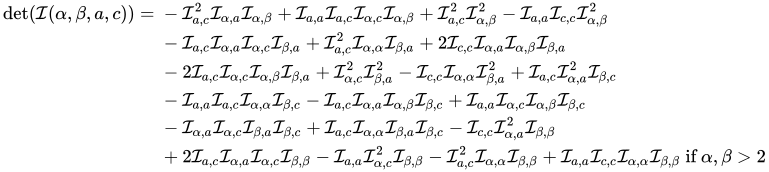
Using [Sylvester's criterion](https://en.wikipedia.org/wiki/Sylvester%27s_criterion "Sylvester's criterion") (checking whether the diagonal elements are all positive), and since diagonal components I a , a {\\displaystyle {\\mathcal {I}}\_{a,a}}  and I c , c {\\displaystyle {\\mathcal {I}}\_{c,c}}  have [singularities](https://en.wikipedia.org/wiki/Mathematical_singularity "Mathematical singularity") at α=2 and β=2 it follows that the Fisher information matrix for the four parameter case is [positive-definite](https://en.wikipedia.org/wiki/Positive-definite_matrix "Positive-definite matrix") for α\>2 and β\>2. Since for α \> 2 and β \> 2 the beta distribution is (symmetric or unsymmetric) bell shaped, it follows that the Fisher information matrix is positive-definite only for bell-shaped (symmetric or unsymmetric) beta distributions, with inflection points located to either side of the mode. Thus, important well known distributions belonging to the four-parameter beta distribution family, like the parabolic distribution (Beta(2,2,a,c)) and the [uniform distribution](https://en.wikipedia.org/wiki/Continuous_uniform_distribution "Continuous uniform distribution") (Beta(1,1,a,c)) have Fisher information components (I a , a , I c , c , I α , a , I β , c {\\displaystyle {\\mathcal {I}}\_{a,a},{\\mathcal {I}}\_{c,c},{\\mathcal {I}}\_{\\alpha ,a},{\\mathcal {I}}\_{\\beta ,c}} ) that blow up (approach infinity) in the four-parameter case (although their Fisher information components are all defined for the two parameter case). The four-parameter [Wigner semicircle distribution](https://en.wikipedia.org/wiki/Wigner_semicircle_distribution "Wigner semicircle distribution") (Beta(3/2,3/2,*a*,*c*)) and [arcsine distribution](https://en.wikipedia.org/wiki/Arcsine_distribution "Arcsine distribution") (Beta(1/2,1/2,*a*,*c*)) have negative Fisher information determinants for the four-parameter case.
### Bayesian inference
\[[edit](https://en.wikipedia.org/w/index.php?title=Beta_distribution&action=edit§ion=60 "Edit section: Bayesian inference")\]
Main article: [Bayesian inference](https://en.wikipedia.org/wiki/Bayesian_inference "Bayesian inference")
[](https://en.wikipedia.org/wiki/File:Beta\(1,1\)_Uniform_distribution_-_J._Rodal.png)
B
e
t
a
(
1
,
1
)
{\\displaystyle Beta(1,1)}

: The [uniform distribution](https://en.wikipedia.org/wiki/Uniform_distribution_\(continuous\) "Uniform distribution (continuous)") probability density was proposed by [Thomas Bayes](https://en.wikipedia.org/wiki/Thomas_Bayes "Thomas Bayes") to represent ignorance of prior probabilities in [Bayesian inference](https://en.wikipedia.org/wiki/Bayesian_inference "Bayesian inference").
The use of Beta distributions in [Bayesian inference](https://en.wikipedia.org/wiki/Bayesian_inference "Bayesian inference") is due to the fact that they provide a family of [conjugate prior probability distributions](https://en.wikipedia.org/wiki/Conjugate_prior_distribution "Conjugate prior distribution") for [binomial](https://en.wikipedia.org/wiki/Binomial_distribution "Binomial distribution") (including [Bernoulli](https://en.wikipedia.org/wiki/Bernoulli_distribution "Bernoulli distribution")) and [geometric distributions](https://en.wikipedia.org/wiki/Geometric_distribution "Geometric distribution"). The domain of the beta distribution can be viewed as a probability, and in fact the beta distribution is often used to describe the distribution of a probability value *p*:[\[24\]](https://en.wikipedia.org/wiki/Beta_distribution#cite_note-MacKay-24)
P ( p ; α , β ) \= p α − 1 ( 1 − p ) β − 1 B ( α , β ) . {\\displaystyle P(p;\\alpha ,\\beta )={\\frac {p^{\\alpha -1}(1-p)^{\\beta -1}}{\\mathrm {B} (\\alpha ,\\beta )}}.} 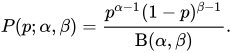
Examples of beta distributions used as prior probabilities to represent ignorance of prior parameter values in Bayesian inference are Beta(1,1), Beta(0,0) and Beta(1/2,1/2).
#### Rule of succession
\[[edit](https://en.wikipedia.org/w/index.php?title=Beta_distribution&action=edit§ion=61 "Edit section: Rule of succession")\]
Main article: [Rule of succession](https://en.wikipedia.org/wiki/Rule_of_succession "Rule of succession")
A classic application of the beta distribution is the [rule of succession](https://en.wikipedia.org/wiki/Rule_of_succession "Rule of succession"), introduced in the 18th century by [Pierre-Simon Laplace](https://en.wikipedia.org/wiki/Pierre-Simon_Laplace "Pierre-Simon Laplace")[\[55\]](https://en.wikipedia.org/wiki/Beta_distribution#cite_note-Laplace-55) in the course of treating the [sunrise problem](https://en.wikipedia.org/wiki/Sunrise_problem "Sunrise problem"). It states that, given *s* successes in *n* [conditionally independent](https://en.wikipedia.org/wiki/Conditional_independence "Conditional independence") [Bernoulli trials](https://en.wikipedia.org/wiki/Bernoulli_trial "Bernoulli trial") with probability *p,* that the estimate of the expected value in the next trial is s \+ 1 n \+ 2 {\\displaystyle {\\frac {s+1}{n+2}}} . This estimate is the expected value of the posterior distribution over *p,* namely Beta(*s*\+1, *n*−*s*\+1), which is given by [Bayes' rule](https://en.wikipedia.org/wiki/Bayes%27_rule "Bayes' rule") if one assumes a uniform prior probability over *p* (i.e., Beta(1, 1)) and then observes that *p* generated *s* successes in *n* trials. Laplace's rule of succession has been criticized by prominent scientists. R. T. Cox described Laplace's application of the rule of succession to the [sunrise problem](https://en.wikipedia.org/wiki/Sunrise_problem "Sunrise problem") ([\[56\]](https://en.wikipedia.org/wiki/Beta_distribution#cite_note-CoxRT-56) p. 89) as "a travesty of the proper use of the principle". Keynes remarks ([\[57\]](https://en.wikipedia.org/wiki/Beta_distribution#cite_note-KeynesTreatise-57) Ch.XXX, p. 382) "indeed this is so foolish a theorem that to entertain it is discreditable". Karl Pearson[\[58\]](https://en.wikipedia.org/wiki/Beta_distribution#cite_note-PearsonRuleSuccession-58) showed that the probability that the next (*n* + 1) trials will be successes, after n successes in n trials, is only 50%, which has been considered too low by scientists like Jeffreys and unacceptable as a representation of the scientific process of experimentation to test a proposed scientific law. As pointed out by Jeffreys ([\[59\]](https://en.wikipedia.org/wiki/Beta_distribution#cite_note-Jeffreys-59) p. 128) (crediting [C. D. Broad](https://en.wikipedia.org/wiki/C._D._Broad "C. D. Broad")[\[60\]](https://en.wikipedia.org/wiki/Beta_distribution#cite_note-BroadMind-60) ) Laplace's rule of succession establishes a high probability of success ((n+1)/(n+2)) in the next trial, but only a moderate probability (50%) that a further sample (*n*\+1) comparable in size will be equally successful. As pointed out by Perks,[\[61\]](https://en.wikipedia.org/wiki/Beta_distribution#cite_note-Perks-61) "The rule of succession itself is hard to accept. It assigns a probability to the next trial which implies the assumption that the actual run observed is an average run and that we are always at the end of an average run. It would, one would think, be more reasonable to assume that we were in the middle of an average run. Clearly a higher value for both probabilities is necessary if they are to accord with reasonable belief." These problems with Laplace's rule of succession motivated Haldane, Perks, Jeffreys and others to search for other forms of prior probability (see the next [§ Bayesian inference](https://en.wikipedia.org/wiki/Beta_distribution#Bayesian_inference)). According to Jaynes,[\[52\]](https://en.wikipedia.org/wiki/Beta_distribution#cite_note-Jaynes-52) the main problem with the rule of succession is that it is not valid when s=0 or s=n (see [rule of succession](https://en.wikipedia.org/wiki/Rule_of_succession "Rule of succession"), for an analysis of its validity).
#### Bayes–Laplace prior probability (Beta(1,1))
\[[edit](https://en.wikipedia.org/w/index.php?title=Beta_distribution&action=edit§ion=62 "Edit section: Bayes–Laplace prior probability (Beta(1,1))")\]
The beta distribution achieves maximum differential entropy for Beta(1,1): the [uniform](https://en.wikipedia.org/wiki/Uniform_density "Uniform density") probability density, for which all values in the domain of the distribution have equal density. This uniform distribution Beta(1,1) was suggested ("with a great deal of doubt") by [Thomas Bayes](https://en.wikipedia.org/wiki/Thomas_Bayes "Thomas Bayes")[\[62\]](https://en.wikipedia.org/wiki/Beta_distribution#cite_note-ThomasBayes-62) as the prior probability distribution to express ignorance about the correct prior distribution. This prior distribution was adopted (apparently, from his writings, with little sign of doubt[\[55\]](https://en.wikipedia.org/wiki/Beta_distribution#cite_note-Laplace-55)) by [Pierre-Simon Laplace](https://en.wikipedia.org/wiki/Pierre-Simon_Laplace "Pierre-Simon Laplace"), and hence it was also known as the "Bayes–Laplace rule" or the "Laplace rule" of "[inverse probability](https://en.wikipedia.org/wiki/Inverse_probability "Inverse probability")" in publications of the first half of the 20th century. In the later part of the 19th century and early part of the 20th century, scientists realized that the assumption of uniform "equal" probability density depended on the actual functions (for example whether a linear or a logarithmic scale was most appropriate) and parametrizations used. In particular, the behavior near the ends of distributions with finite support (for example near *x* = 0, for a distribution with initial support at *x* = 0) required particular attention. Keynes ([\[57\]](https://en.wikipedia.org/wiki/Beta_distribution#cite_note-KeynesTreatise-57) Ch.XXX, p. 381) criticized the use of Bayes's uniform prior probability (Beta(1,1)) that all values between zero and one are equiprobable, as follows: "Thus experience, if it shows anything, shows that there is a very marked clustering of statistical ratios in the neighborhoods of zero and unity, of those for positive theories and for correlations between positive qualities in the neighborhood of zero, and of those for negative theories and for correlations between negative qualities in the neighborhood of unity. "
#### Haldane's prior probability (Beta(0,0))
\[[edit](https://en.wikipedia.org/w/index.php?title=Beta_distribution&action=edit§ion=63 "Edit section: Haldane's prior probability (Beta(0,0))")\]
[](https://en.wikipedia.org/wiki/File:Beta_distribution_for_alpha_and_beta_approaching_zero_-_J._Rodal.png)
B
e
t
a
(
0
,
0
)
{\\displaystyle Beta(0,0)}

: The Haldane prior probability expressing total ignorance about prior information, where we are not even sure whether it is physically possible for an experiment to yield either a success or a failure. As α, β → 0, the beta distribution approaches a two-point [Bernoulli distribution](https://en.wikipedia.org/wiki/Bernoulli_distribution "Bernoulli distribution") with all probability density concentrated at each end, at 0 and 1, and nothing in between. A coin-toss: one face of the coin being at 0 and the other face being at 1.
The Beta(0,0) distribution was proposed by [J.B.S. Haldane](https://en.wikipedia.org/wiki/J.B.S._Haldane "J.B.S. Haldane"),[\[63\]](https://en.wikipedia.org/wiki/Beta_distribution#cite_note-63) who suggested that the prior probability representing complete uncertainty should be proportional to *p*−1(1−*p*)−1. The function *p*−1(1−*p*)−1 can be viewed as the limit of the numerator of the beta distribution as both shape parameters approach zero: α, β → 0. The Beta function (in the denominator of the beta distribution) approaches infinity, for both parameters approaching zero, α, β → 0. Therefore, *p*−1(1−*p*)−1 divided by the Beta function approaches a 2-point [Bernoulli distribution](https://en.wikipedia.org/wiki/Bernoulli_distribution "Bernoulli distribution") with equal probability 1/2 at each end, at 0 and 1, and nothing in between, as α, β → 0. A coin-toss: one face of the coin being at 0 and the other face being at 1. The Haldane prior probability distribution Beta(0,0) is an "[improper prior](https://en.wikipedia.org/wiki/Improper_prior "Improper prior")" because its integration (from 0 to 1) fails to strictly converge to 1 due to the singularities at each end. However, this is not an issue for computing posterior probabilities unless the sample size is very small. Furthermore, Zellner[\[64\]](https://en.wikipedia.org/wiki/Beta_distribution#cite_note-Zellner-64) points out that on the [log-odds](https://en.wikipedia.org/wiki/Log-odds "Log-odds") scale, (the [logit](https://en.wikipedia.org/wiki/Logit "Logit") transformation log ( p / ( 1 − p ) ) {\\displaystyle \\log(p/(1-p))} ), the Haldane prior is the uniformly flat prior. The fact that a uniform prior probability on the [logit](https://en.wikipedia.org/wiki/Logit "Logit") transformed variable ln(*p*/1 − *p*) (with domain (−∞, ∞)) is equivalent to the Haldane prior on the domain \[0, 1\] was pointed out by [Harold Jeffreys](https://en.wikipedia.org/wiki/Harold_Jeffreys "Harold Jeffreys") in the first edition (1939) of his book Theory of Probability ([\[59\]](https://en.wikipedia.org/wiki/Beta_distribution#cite_note-Jeffreys-59) p. 123). Jeffreys writes "Certainly if we take the Bayes–Laplace rule right up to the extremes we are led to results that do not correspond to anybody's way of thinking. The (Haldane) rule d*x*/(*x*(1 − *x*)) goes too far the other way. It would lead to the conclusion that if a sample is of one type with respect to some property there is a probability 1 that the whole population is of that type." The fact that "uniform" depends on the parametrization, led Jeffreys to seek a form of prior that would be invariant under different parametrizations.
#### Jeffreys' prior probability (Beta(1/2,1/2) for a Bernoulli or for a binomial distribution)
\[[edit](https://en.wikipedia.org/w/index.php?title=Beta_distribution&action=edit§ion=64 "Edit section: Jeffreys' prior probability (Beta(1/2,1/2) for a Bernoulli or for a binomial distribution)")\]
Main article: [Jeffreys prior](https://en.wikipedia.org/wiki/Jeffreys_prior "Jeffreys prior")
[](https://en.wikipedia.org/wiki/File:Jeffreys_prior_probability_for_the_beta_distribution_-_J._Rodal.png)
[Jeffreys prior](https://en.wikipedia.org/wiki/Jeffreys_prior "Jeffreys prior") probability for the beta distribution: the square root of the determinant of [Fisher's information](https://en.wikipedia.org/wiki/Fisher%27s_information "Fisher's information") matrix:
det
(
I
(
α
,
β
)
)
\=
ψ
1
(
α
)
ψ
1
(
β
)
−
(
ψ
1
(
α
)
\+
ψ
1
(
β
)
)
ψ
1
(
α
\+
β
)
{\\displaystyle \\scriptstyle {\\sqrt {\\det({\\mathcal {I}}(\\alpha ,\\beta ))}}={\\sqrt {\\psi \_{1}(\\alpha )\\psi \_{1}(\\beta )-(\\psi \_{1}(\\alpha )+\\psi \_{1}(\\beta ))\\psi \_{1}(\\alpha +\\beta )}}}

is a function of the [trigamma function](https://en.wikipedia.org/wiki/Trigamma_function "Trigamma function") ψ1 of shape parameters α, β
[](https://en.wikipedia.org/wiki/File:Beta_distribution_for_3_different_prior_probability_functions_-_J._Rodal.png)
Posterior Beta densities with samples having success = "s", failure = "f" of *s*/(*s* + *f*) = 1/2, and *s* + *f* = {3,10,50}, based on 3 different prior probability functions: Haldane (Beta(0,0), Jeffreys (Beta(1/2,1/2)) and Bayes (Beta(1,1)). The image shows that there is little difference between the priors for the posterior with sample size of 50 (with more pronounced peak near *p* = 1/2). Significant differences appear for very small sample sizes (the flatter distribution for sample size of 3)
[](https://en.wikipedia.org/wiki/File:Beta_distribution_for_3_different_prior_probability_functions,_skewed_case_-_J._Rodal.png)
Posterior Beta densities with samples having success = "s", failure = "f" of *s*/(*s* + *f*) = 1/4, and *s* + *f* ∈ {3,10,50}, based on three different prior probability functions: Haldane (Beta(0,0), Jeffreys (Beta(1/2,1/2)) and Bayes (Beta(1,1)). The image shows that there is little difference between the priors for the posterior with sample size of 50 (with more pronounced peak near *p* = 1/4). Significant differences appear for very small sample sizes (the very skewed distribution for the degenerate case of sample size = 3, in this degenerate and unlikely case the Haldane prior results in a reverse "J" shape with mode at *p* = 0 instead of *p* = 1/4. If there is sufficient [sampling data](https://en.wikipedia.org/wiki/Sample_\(statistics\) "Sample (statistics)"), the three priors of Bayes (Beta(1,1)), Jeffreys (Beta(1/2,1/2)) and Haldane (Beta(0,0)) should yield similar [*posterior* probability](https://en.wikipedia.org/wiki/Posterior_probability "Posterior probability") densities.
[](https://en.wikipedia.org/wiki/File:Beta_distribution_for_3_different_prior_probability_functions,_skewed_case_sample_size_%3D_\(4,12,40\)_-_J._Rodal.png)
Posterior Beta densities with samples having success = *s*, failure = *f* of *s*/(*s* + *f*) = 1/4, and *s* + *f* ∈ {4,12,40}, based on three different prior probability functions: Haldane (Beta(0,0), Jeffreys (Beta(1/2,1/2)) and Bayes (Beta(1,1)). The image shows that there is little difference between the priors for the posterior with sample size of 40 (with more pronounced peak near *p* = 1/4). Significant differences appear for very small sample sizes
[Harold Jeffreys](https://en.wikipedia.org/wiki/Harold_Jeffreys "Harold Jeffreys")[\[59\]](https://en.wikipedia.org/wiki/Beta_distribution#cite_note-Jeffreys-59)[\[65\]](https://en.wikipedia.org/wiki/Beta_distribution#cite_note-JeffreysPRIOR-65) proposed to use an [uninformative prior](https://en.wikipedia.org/wiki/Uninformative_prior "Uninformative prior") probability measure that should be [invariant under reparameterization](https://en.wikipedia.org/wiki/Parametrization_invariance "Parametrization invariance"): proportional to the square root of the [determinant](https://en.wikipedia.org/wiki/Determinant "Determinant") of [Fisher's information](https://en.wikipedia.org/wiki/Fisher%27s_information "Fisher's information") matrix. For the [Bernoulli distribution](https://en.wikipedia.org/wiki/Bernoulli_distribution "Bernoulli distribution"), this can be shown as follows: for a coin that is "heads" with probability *p* ∈ \[0, 1\] and is "tails" with probability 1 − *p*, for a given (H,T) ∈ {(0,1), (1,0)} the probability is *pH*(1 − *p*)*T*. Since *T* = 1 − *H*, the [Bernoulli distribution](https://en.wikipedia.org/wiki/Bernoulli_distribution "Bernoulli distribution") is *pH*(1 − *p*)1 − *H*. Considering *p* as the only parameter, it follows that the log likelihood for the Bernoulli distribution is
ln L ( p ∣ H ) \= H ln p \+ ( 1 − H ) ln ( 1 − p ) . {\\displaystyle \\ln {\\mathcal {L}}(p\\mid H)=H\\ln p+(1-H)\\ln(1-p).} 
The Fisher information matrix has only one component (it is a scalar, because there is only one parameter: *p*), therefore:
I ( p ) \= E \[ ( d d p ln L ( p ∣ H ) ) 2 \] \= E \[ ( H p − 1 − H 1 − p ) 2 \] \= p 1 ( 1 − p ) 0 ( 1 p − 0 1 − p ) 2 \+ p 0 ( 1 − p ) 1 ( 0 p − 1 1 − p ) 2 \= 1 p ( 1 − p ) . {\\displaystyle {\\begin{aligned}{\\sqrt {{\\mathcal {I}}(p)}}&={\\sqrt {\\operatorname {E} \\!\\left\[\\left({\\frac {d}{dp}}\\ln {\\mathcal {L}}(p\\mid H)\\right)^{2}\\right\]}}\\\\\[6pt\]&={\\sqrt {\\operatorname {E} \\!\\left\[\\left({\\frac {H}{p}}-{\\frac {1-H}{1-p}}\\right)^{2}\\right\]}}\\\\\[6pt\]&={\\sqrt {p^{1}(1-p)^{0}\\left({\\frac {1}{p}}-{\\frac {0}{1-p}}\\right)^{2}+p^{0}(1-p)^{1}\\left({\\frac {0}{p}}-{\\frac {1}{1-p}}\\right)^{2}}}\\\\&={\\frac {1}{\\sqrt {p(1-p)}}}.\\end{aligned}}} ![{\\displaystyle {\\begin{aligned}{\\sqrt {{\\mathcal {I}}(p)}}&={\\sqrt {\\operatorname {E} \\!\\left\[\\left({\\frac {d}{dp}}\\ln {\\mathcal {L}}(p\\mid H)\\right)^{2}\\right\]}}\\\\\[6pt\]&={\\sqrt {\\operatorname {E} \\!\\left\[\\left({\\frac {H}{p}}-{\\frac {1-H}{1-p}}\\right)^{2}\\right\]}}\\\\\[6pt\]&={\\sqrt {p^{1}(1-p)^{0}\\left({\\frac {1}{p}}-{\\frac {0}{1-p}}\\right)^{2}+p^{0}(1-p)^{1}\\left({\\frac {0}{p}}-{\\frac {1}{1-p}}\\right)^{2}}}\\\\&={\\frac {1}{\\sqrt {p(1-p)}}}.\\end{aligned}}}](https://wikimedia.org/api/rest_v1/media/math/render/svg/0c2541cc4a3017abaab79170bd990ca92a64bc89)
Similarly, for the [Binomial distribution](https://en.wikipedia.org/wiki/Binomial_distribution "Binomial distribution") with *n* [Bernoulli trials](https://en.wikipedia.org/wiki/Bernoulli_trials "Bernoulli trials"), it can be shown that
I ( p ) \= n p ( 1 − p ) . {\\displaystyle {\\sqrt {{\\mathcal {I}}(p)}}={\\sqrt {\\frac {n}{p(1-p)}}}.} 
Thus, for the [Bernoulli](https://en.wikipedia.org/wiki/Bernoulli_distribution "Bernoulli distribution"), and [Binomial distributions](https://en.wikipedia.org/wiki/Binomial_distribution "Binomial distribution"), [Jeffreys prior](https://en.wikipedia.org/wiki/Jeffreys_prior "Jeffreys prior") is proportional to 1 p ( 1 − p ) {\\displaystyle \\scriptstyle {\\frac {1}{\\sqrt {p(1-p)}}}} , which happens to be proportional to a beta distribution with domain variable *x* = *p*, and shape parameters α = β = 1/2, the [arcsine distribution](https://en.wikipedia.org/wiki/Arcsine_distribution "Arcsine distribution"):
Beta ( 1 2 , 1 2 ) \= 1 π p ( 1 − p ) . {\\displaystyle \\operatorname {Beta} ({\\tfrac {1}{2}},{\\tfrac {1}{2}})={\\frac {1}{\\pi {\\sqrt {p(1-p)}}}}.} 
It will be shown in the next section that the normalizing constant for Jeffreys prior is immaterial to the final result because the normalizing constant cancels out in Bayes' theorem for the posterior probability. Hence Beta(1/2,1/2) is used as the Jeffreys prior for both Bernoulli and binomial distributions. As shown in the next section, when using this expression as a prior probability times the likelihood in [Bayes' theorem](https://en.wikipedia.org/wiki/Bayes%27_theorem "Bayes' theorem"), the posterior probability turns out to be a beta distribution. It is important to realize, however, that Jeffreys prior is proportional to 1 p ( 1 − p ) {\\textstyle {\\frac {1}{\\sqrt {p(1-p)}}}}  for the Bernoulli and binomial distribution, but not for the beta distribution. Jeffreys prior for the beta distribution is given by the determinant of Fisher's information for the beta distribution, which, as shown in the [§ Fisher information matrix](https://en.wikipedia.org/wiki/Beta_distribution#Fisher_information_matrix) is a function of the [trigamma function](https://en.wikipedia.org/wiki/Trigamma_function "Trigamma function") ψ1 of shape parameters α and β as follows:
det ( I ( α , β ) ) \= ψ 1 ( α ) ψ 1 ( β ) − ( ψ 1 ( α ) \+ ψ 1 ( β ) ) ψ 1 ( α \+ β ) lim α → 0 det ( I ( α , β ) ) \= lim β → 0 det ( I ( α , β ) ) \= ∞ lim α → ∞ det ( I ( α , β ) ) \= lim β → ∞ det ( I ( α , β ) ) \= 0 {\\displaystyle {\\begin{aligned}{\\sqrt {\\det({\\mathcal {I}}(\\alpha ,\\beta ))}}&={\\sqrt {\\psi \_{1}(\\alpha )\\psi \_{1}(\\beta )-(\\psi \_{1}(\\alpha )+\\psi \_{1}(\\beta ))\\psi \_{1}(\\alpha +\\beta )}}\\\\\\lim \_{\\alpha \\to 0}{\\sqrt {\\det({\\mathcal {I}}(\\alpha ,\\beta ))}}&=\\lim \_{\\beta \\to 0}{\\sqrt {\\det({\\mathcal {I}}(\\alpha ,\\beta ))}}=\\infty \\\\\\lim \_{\\alpha \\to \\infty }{\\sqrt {\\det({\\mathcal {I}}(\\alpha ,\\beta ))}}&=\\lim \_{\\beta \\to \\infty }{\\sqrt {\\det({\\mathcal {I}}(\\alpha ,\\beta ))}}=0\\end{aligned}}} 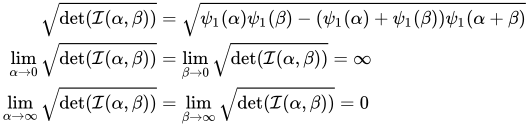
As previously discussed, Jeffreys prior for the Bernoulli and binomial distributions is proportional to the [arcsine distribution](https://en.wikipedia.org/wiki/Arcsine_distribution "Arcsine distribution") Beta(1/2,1/2), a one-dimensional *curve* that looks like a basin as a function of the parameter *p* of the Bernoulli and binomial distributions. The walls of the basin are formed by *p* approaching the singularities at the ends *p* → 0 and *p* → 1, where Beta(1/2,1/2) approaches infinity. Jeffreys prior for the beta distribution is a *2-dimensional surface* (embedded in a three-dimensional space) that looks like a basin with only two of its walls meeting at the corner α = β = 0 (and missing the other two walls) as a function of the shape parameters α and β of the beta distribution. The two adjoining walls of this 2-dimensional surface are formed by the shape parameters α and β approaching the singularities (of the trigamma function) at α, β → 0. It has no walls for α, β → ∞ because in this case the determinant of Fisher's information matrix for the beta distribution approaches zero.
It will be shown in the next section that Jeffreys prior probability results in posterior probabilities (when multiplied by the binomial likelihood function) that are intermediate between the posterior probability results of the Haldane and Bayes prior probabilities.
Jeffreys prior may be difficult to obtain analytically, and for some cases it just doesn't exist (even for simple distribution functions like the asymmetric [triangular distribution](https://en.wikipedia.org/wiki/Triangular_distribution "Triangular distribution")). Berger, Bernardo and Sun, in a 2009 paper[\[66\]](https://en.wikipedia.org/wiki/Beta_distribution#cite_note-BergerBernardoSun-66) defined a reference prior probability distribution that (unlike Jeffreys prior) exists for the asymmetric [triangular distribution](https://en.wikipedia.org/wiki/Triangular_distribution "Triangular distribution"). They cannot obtain a closed-form expression for their reference prior, but numerical calculations show it to be nearly perfectly fitted by the (proper) prior
Beta ( 1 2 , 1 2 ) ∼ 1 θ ( 1 − θ ) {\\displaystyle \\operatorname {Beta} ({\\tfrac {1}{2}},{\\tfrac {1}{2}})\\sim {\\frac {1}{\\sqrt {\\theta (1-\\theta )}}}} 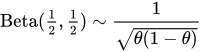
where θ is the vertex variable for the asymmetric triangular distribution with support \[0, 1\] (corresponding to the following parameter values in Wikipedia's article on the [triangular distribution](https://en.wikipedia.org/wiki/Triangular_distribution "Triangular distribution"): vertex *c* = *θ*, left end *a* = 0, and right end *b* = 1). Berger et al. also give a heuristic argument that Beta(1/2,1/2) could indeed be the exact Berger–Bernardo–Sun reference prior for the asymmetric triangular distribution. Therefore, Beta(1/2,1/2) not only is Jeffreys prior for the Bernoulli and binomial distributions, but also seems to be the Berger–Bernardo–Sun reference prior for the asymmetric triangular distribution (for which the Jeffreys prior does not exist), a distribution used in project management and [PERT](https://en.wikipedia.org/wiki/PERT "PERT") analysis to describe the cost and duration of project tasks.
Clarke and Barron[\[67\]](https://en.wikipedia.org/wiki/Beta_distribution#cite_note-67) prove that, among continuous positive priors, Jeffreys prior (when it exists) asymptotically maximizes Shannon's [mutual information](https://en.wikipedia.org/wiki/Mutual_information "Mutual information") between a sample of size n and the parameter, and therefore *Jeffreys prior is the most uninformative prior* (measuring information as Shannon information). The proof rests on an examination of the [Kullback–Leibler divergence](https://en.wikipedia.org/wiki/Kullback%E2%80%93Leibler_divergence "Kullback–Leibler divergence") between probability density functions for [iid](https://en.wikipedia.org/wiki/Iid "Iid") random variables.
#### Effect of different prior probability choices on the posterior beta distribution
\[[edit](https://en.wikipedia.org/w/index.php?title=Beta_distribution&action=edit§ion=65 "Edit section: Effect of different prior probability choices on the posterior beta distribution")\]
If samples are drawn from the population of a random variable *X* that result in *s* successes and *f* failures in *n* [Bernoulli trials](https://en.wikipedia.org/wiki/Bernoulli_trial "Bernoulli trial") *n* = *s* + *f*, then the [likelihood function](https://en.wikipedia.org/wiki/Likelihood_function "Likelihood function") for parameters *s* and *f* given *x* = *p* (the notation *x* = *p* in the expressions below will emphasize that the domain *x* stands for the value of the parameter *p* in the binomial distribution), is the following [binomial distribution](https://en.wikipedia.org/wiki/Binomial_distribution "Binomial distribution"):
L ( s , f ∣ x \= p ) \= ( s \+ f s ) x s ( 1 − x ) f \= ( n s ) x s ( 1 − x ) n − s . {\\displaystyle {\\mathcal {L}}(s,f\\mid x=p)={s+f \\choose s}x^{s}(1-x)^{f}={n \\choose s}x^{s}(1-x)^{n-s}.} 
If beliefs about [prior probability](https://en.wikipedia.org/wiki/Prior_probability "Prior probability") information are reasonably well approximated by a beta distribution with parameters *α* Prior and *β* Prior, then:
PriorProbability ( x \= p ; α Prior , β Prior ) \= x α Prior − 1 ( 1 − x ) β Prior − 1 B ( α Prior , β Prior ) {\\displaystyle {\\operatorname {PriorProbability} }(x=p;\\alpha \\operatorname {Prior} ,\\beta \\operatorname {Prior} )={\\frac {x^{\\alpha \\operatorname {Prior} -1}(1-x)^{\\beta \\operatorname {Prior} -1}}{\\mathrm {B} (\\alpha \\operatorname {Prior} ,\\beta \\operatorname {Prior} )}}} 
According to [Bayes' theorem](https://en.wikipedia.org/wiki/Bayes%27_theorem "Bayes' theorem") for a continuous event space, the [posterior probability](https://en.wikipedia.org/wiki/Posterior_probability "Posterior probability") density is given by the product of the [prior probability](https://en.wikipedia.org/wiki/Prior_probability "Prior probability") and the likelihood function (given the evidence *s* and *f* = *n* − *s*), normalized so that the area under the curve equals one, as follows:
posterior probability density ( x \= p ∣ s , n − s ) \= priorprobabilitydensity ( x \= p ; α prior , β prior ) L ( s , f ∣ x \= p ) ∫ 0 1 prior probability density ( x \= p ; α prior , β prior ) L ( s , f ∣ x \= p ) d x \= ( n s ) x s \+ α prior − 1 ( 1 − x ) n − s \+ β prior − 1 / B ( α prior , β prior ) ∫ 0 1 ( ( n s ) x s \+ α prior − 1 ( 1 − x ) n − s \+ β prior − 1 / B ( α prior , β prior ) ) d x \= x s \+ α prior − 1 ( 1 − x ) n − s \+ β prior − 1 ∫ 0 1 ( x s \+ α prior − 1 ( 1 − x ) n − s \+ β prior − 1 ) d x \= x s \+ α prior − 1 ( 1 − x ) n − s \+ β prior − 1 B ( s \+ α prior , n − s \+ β prior ) . {\\displaystyle {\\begin{aligned}&{\\text{posterior probability density}}(x=p\\mid s,n-s)\\\\\[6pt\]={}&{\\frac {\\operatorname {priorprobabilitydensity} (x=p;\\alpha \\operatorname {prior} ,\\beta \\operatorname {prior} ){\\mathcal {L}}(s,f\\mid x=p)}{\\int \_{0}^{1}{\\text{prior probability density}}(x=p;\\alpha \\operatorname {prior} ,\\beta \\operatorname {prior} ){\\mathcal {L}}(s,f\\mid x=p)\\,dx}}\\\\\[6pt\]={}&{\\frac {{n \\choose s}x^{s+\\alpha \\operatorname {prior} -1}(1-x)^{n-s+\\beta \\operatorname {prior} -1}/\\mathrm {B} (\\alpha \\operatorname {prior} ,\\beta \\operatorname {prior} )}{\\int \_{0}^{1}\\left({n \\choose s}x^{s+\\alpha \\operatorname {prior} -1}(1-x)^{n-s+\\beta \\operatorname {prior} -1}/\\mathrm {B} (\\alpha \\operatorname {prior} ,\\beta \\operatorname {prior} )\\right)\\,dx}}\\\\\[6pt\]={}&{\\frac {x^{s+\\alpha \\operatorname {prior} -1}(1-x)^{n-s+\\beta \\operatorname {prior} -1}}{\\int \_{0}^{1}\\left(x^{s+\\alpha \\operatorname {prior} -1}(1-x)^{n-s+\\beta \\operatorname {prior} -1}\\right)\\,dx}}\\\\\[6pt\]={}&{\\frac {x^{s+\\alpha \\operatorname {prior} -1}(1-x)^{n-s+\\beta \\operatorname {prior} -1}}{\\mathrm {B} (s+\\alpha \\operatorname {prior} ,n-s+\\beta \\operatorname {prior} )}}.\\end{aligned}}} ![{\\displaystyle {\\begin{aligned}&{\\text{posterior probability density}}(x=p\\mid s,n-s)\\\\\[6pt\]={}&{\\frac {\\operatorname {priorprobabilitydensity} (x=p;\\alpha \\operatorname {prior} ,\\beta \\operatorname {prior} ){\\mathcal {L}}(s,f\\mid x=p)}{\\int \_{0}^{1}{\\text{prior probability density}}(x=p;\\alpha \\operatorname {prior} ,\\beta \\operatorname {prior} ){\\mathcal {L}}(s,f\\mid x=p)\\,dx}}\\\\\[6pt\]={}&{\\frac {{n \\choose s}x^{s+\\alpha \\operatorname {prior} -1}(1-x)^{n-s+\\beta \\operatorname {prior} -1}/\\mathrm {B} (\\alpha \\operatorname {prior} ,\\beta \\operatorname {prior} )}{\\int \_{0}^{1}\\left({n \\choose s}x^{s+\\alpha \\operatorname {prior} -1}(1-x)^{n-s+\\beta \\operatorname {prior} -1}/\\mathrm {B} (\\alpha \\operatorname {prior} ,\\beta \\operatorname {prior} )\\right)\\,dx}}\\\\\[6pt\]={}&{\\frac {x^{s+\\alpha \\operatorname {prior} -1}(1-x)^{n-s+\\beta \\operatorname {prior} -1}}{\\int \_{0}^{1}\\left(x^{s+\\alpha \\operatorname {prior} -1}(1-x)^{n-s+\\beta \\operatorname {prior} -1}\\right)\\,dx}}\\\\\[6pt\]={}&{\\frac {x^{s+\\alpha \\operatorname {prior} -1}(1-x)^{n-s+\\beta \\operatorname {prior} -1}}{\\mathrm {B} (s+\\alpha \\operatorname {prior} ,n-s+\\beta \\operatorname {prior} )}}.\\end{aligned}}}](https://wikimedia.org/api/rest_v1/media/math/render/svg/569ad0317cf545ff98538c8a845f216120e87c08)
The [binomial coefficient](https://en.wikipedia.org/wiki/Binomial_coefficient "Binomial coefficient")
( s \+ f s ) \= ( n s ) \= ( s \+ f ) \! s \! f \! \= n \! s \! ( n − s ) \! {\\displaystyle {s+f \\choose s}={n \\choose s}={\\frac {(s+f)!}{s!f!}}={\\frac {n!}{s!(n-s)!}}} 
appears both in the numerator and the denominator of the posterior probability, and it does not depend on the integration variable *x*, hence it cancels out, and it is irrelevant to the final result. Similarly the normalizing factor for the prior probability, the beta function B(αPrior,βPrior) cancels out and it is immaterial to the final result. The same posterior probability result can be obtained if one uses an un-normalized prior
x α prior − 1 ( 1 − x ) β prior − 1 {\\displaystyle x^{\\alpha \\operatorname {prior} -1}(1-x)^{\\beta \\operatorname {prior} -1}} 
because the normalizing factors all cancel out. Several authors (including Jeffreys himself) thus use an un-normalized prior formula since the normalization constant cancels out. The numerator of the posterior probability ends up being just the (un-normalized) product of the prior probability and the likelihood function, and the denominator is its integral from zero to one. The beta function in the denominator, B(*s* + *α* Prior, *n* − *s* + *β* Prior), appears as a normalization constant to ensure that the total posterior probability integrates to unity.
The ratio *s*/*n* of the number of successes to the total number of trials is a [sufficient statistic](https://en.wikipedia.org/wiki/Sufficient_statistic "Sufficient statistic") in the binomial case, which is relevant for the following results.
For the **Bayes'** prior probability (Beta(1,1)), the posterior probability is:
posteriorprobability ( p \= x ∣ s , f ) \= x s ( 1 − x ) n − s B ( s \+ 1 , n − s \+ 1 ) , with mean \= s \+ 1 n \+ 2 , (and mode \= s n if 0 \< s \< n ) . {\\displaystyle \\operatorname {posteriorprobability} (p=x\\mid s,f)={\\frac {x^{s}(1-x)^{n-s}}{\\mathrm {B} (s+1,n-s+1)}},{\\text{ with mean }}={\\frac {s+1}{n+2}},{\\text{ (and mode}}={\\frac {s}{n}}{\\text{ if }}0\<s\<n).} 
For the **Jeffreys'** prior probability (Beta(1/2,1/2)), the posterior probability is:
posteriorprobability ( p \= x ∣ s , f ) \= x s − 1 2 ( 1 − x ) n − s − 1 2 B ( s \+ 1 2 , n − s \+ 1 2 ) , with mean \= s \+ 1 2 n \+ 1 , (and mode \= s − 1 2 n − 1 if 1 2 \< s \< n − 1 2 ) . {\\displaystyle \\operatorname {posteriorprobability} (p=x\\mid s,f)={x^{s-{\\tfrac {1}{2}}}(1-x)^{n-s-{\\frac {1}{2}}} \\over \\mathrm {B} (s+{\\tfrac {1}{2}},n-s+{\\tfrac {1}{2}})},{\\text{ with mean}}={\\frac {s+{\\tfrac {1}{2}}}{n+1}},{\\text{ (and mode}}={\\frac {s-{\\tfrac {1}{2}}}{n-1}}{\\text{ if }}{\\tfrac {1}{2}}\<s\<n-{\\tfrac {1}{2}}).} 
and for the **Haldane** prior probability (Beta(0,0)), the posterior probability is:
posteriorprobability ( p \= x ∣ s , f ) \= x s − 1 ( 1 − x ) n − s − 1 B ( s , n − s ) , with mean \= s n , (and mode \= s − 1 n − 2 if 1 \< s \< n − 1 ) . {\\displaystyle \\operatorname {posteriorprobability} (p=x\\mid s,f)={\\frac {x^{s-1}(1-x)^{n-s-1}}{\\mathrm {B} (s,n-s)}},{\\text{ with mean}}={\\frac {s}{n}},{\\text{ (and mode}}={\\frac {s-1}{n-2}}{\\text{ if }}1\<s\<n-1).} 
From the above expressions it follows that for *s*/*n* = 1/2) all the above three prior probabilities result in the identical location for the posterior probability mean = mode = 1/2. For *s*/*n* \< 1/2, the mean of the posterior probabilities, using the following priors, are such that: mean for Bayes prior \> mean for Jeffreys prior \> mean for Haldane prior. For *s*/*n* \> 1/2 the order of these inequalities is reversed such that the Haldane prior probability results in the largest posterior mean. The *Haldane* prior probability Beta(0,0) results in a posterior probability density with *mean* (the expected value for the probability of success in the "next" trial) identical to the ratio *s*/*n* of the number of successes to the total number of trials. Therefore, the Haldane prior results in a posterior probability with expected value in the next trial equal to the maximum likelihood. The *Bayes* prior probability Beta(1,1) results in a posterior probability density with *mode* identical to the ratio *s*/*n* (the maximum likelihood).
In the case that 100% of the trials have been successful *s* = *n*, the *Bayes* prior probability Beta(1,1) results in a posterior expected value equal to the rule of succession (*n* + 1)/(*n* + 2), while the Haldane prior Beta(0,0) results in a posterior expected value of 1 (absolute certainty of success in the next trial). Jeffreys prior probability results in a posterior expected value equal to (*n* + 1/2)/(*n* + 1). Perks[\[61\]](https://en.wikipedia.org/wiki/Beta_distribution#cite_note-Perks-61) (p. 303) points out: "This provides a new rule of succession and expresses a 'reasonable' position to take up, namely, that after an unbroken run of n successes we assume a probability for the next trial equivalent to the assumption that we are about half-way through an average run, i.e. that we expect a failure once in (2*n* + 2) trials. The Bayes–Laplace rule implies that we are about at the end of an average run or that we expect a failure once in (*n* + 2) trials. The comparison clearly favours the new result (what is now called Jeffreys prior) from the point of view of 'reasonableness'."
Conversely, in the case that 100% of the trials have resulted in failure (*s* = 0), the *Bayes* prior probability Beta(1,1) results in a posterior expected value for success in the next trial equal to 1/(*n* + 2), while the Haldane prior Beta(0,0) results in a posterior expected value of success in the next trial of 0 (absolute certainty of failure in the next trial). Jeffreys prior probability results in a posterior expected value for success in the next trial equal to (1/2)/(*n* + 1), which Perks[\[61\]](https://en.wikipedia.org/wiki/Beta_distribution#cite_note-Perks-61) (p. 303) points out: "is a much more reasonably remote result than the Bayes–Laplace result 1/(*n* + 2)".
Jaynes[\[52\]](https://en.wikipedia.org/wiki/Beta_distribution#cite_note-Jaynes-52) questions (for the Haldane prior Beta(0,0)) the use of these formulas for the cases *s* = 0 or *s* = *n* because the integrals do not converge (Beta(0,0) is an improper prior for *s* = 0 or *s* = *n*). In practice, the conditions 0\<s\<n necessary for a mode to exist between both ends for the Bayes prior are usually met, and therefore the Bayes prior (as long as 0 \< *s* \< *n*) results in a posterior mode located between both ends of the domain.
As remarked in the section on the rule of succession, K. Pearson showed that after *n* successes in *n* trials the posterior probability (based on the Bayes Beta(1,1) distribution as the prior probability) that the next (*n* + 1) trials will all be successes is exactly 1/2, whatever the value of *n*. Based on the Haldane Beta(0,0) distribution as the prior probability, this posterior probability is 1 (absolute certainty that after n successes in *n* trials the next (*n* + 1) trials will all be successes). Perks[\[61\]](https://en.wikipedia.org/wiki/Beta_distribution#cite_note-Perks-61) (p. 303) shows that, for what is now known as the Jeffreys prior, this probability is ((*n* + 1/2)/(*n* + 1))((*n* + 3/2)/(*n* + 2))...(2*n* + 1/2)/(2*n* + 1), which for *n* = 1, 2, 3 gives 15/24, 315/480, 9009/13440; rapidly approaching a limiting value of 1 / 2 \= 0\.70710678 … {\\displaystyle 1/{\\sqrt {2}}=0.70710678\\ldots }  as n tends to infinity. Perks remarks that what is now known as the Jeffreys prior: "is clearly more 'reasonable' than either the Bayes–Laplace result or the result on the (Haldane) alternative rule rejected by Jeffreys which gives certainty as the probability. It clearly provides a very much better correspondence with the process of induction. Whether it is 'absolutely' reasonable for the purpose, i.e. whether it is yet large enough, without the absurdity of reaching unity, is a matter for others to decide. But it must be realized that the result depends on the assumption of complete indifference and absence of knowledge prior to the sampling experiment."
Following are the variances of the posterior distribution obtained with these three prior probability distributions:
for the **Bayes'** prior probability (Beta(1,1)), the posterior variance is:
variance \= ( n − s \+ 1 ) ( s \+ 1 ) ( 3 \+ n ) ( 2 \+ n ) 2 , which for s \= n 2 results in variance \= 1 12 \+ 4 n {\\displaystyle {\\text{variance}}={\\frac {(n-s+1)(s+1)}{(3+n)(2+n)^{2}}},{\\text{ which for }}s={\\frac {n}{2}}{\\text{ results in variance}}={\\frac {1}{12+4n}}} 
for the **Jeffreys'** prior probability (Beta(1/2,1/2)), the posterior variance is:
variance \= ( n − s \+ 1 2 ) ( s \+ 1 2 ) ( 2 \+ n ) ( 1 \+ n ) 2 , which for s \= n 2 results in var \= 1 8 \+ 4 n {\\displaystyle {\\text{variance}}={\\frac {(n-s+{\\frac {1}{2}})(s+{\\frac {1}{2}})}{(2+n)(1+n)^{2}}},{\\text{ which for }}s={\\frac {n}{2}}{\\text{ results in var}}={\\frac {1}{8+4n}}} 
and for the **Haldane** prior probability (Beta(0,0)), the posterior variance is:
variance \= ( n − s ) s ( 1 \+ n ) n 2 , which for s \= n 2 results in variance \= 1 4 \+ 4 n {\\displaystyle {\\text{variance}}={\\frac {(n-s)s}{(1+n)n^{2}}},{\\text{ which for }}s={\\frac {n}{2}}{\\text{ results in variance}}={\\frac {1}{4+4n}}} 
So, as remarked by Silvey,[\[50\]](https://en.wikipedia.org/wiki/Beta_distribution#cite_note-Silvey-50) for large *n*, the variance is small and hence the posterior distribution is highly concentrated, whereas the assumed prior distribution was very diffuse. This is in accord with what one would hope for, as vague prior knowledge is transformed (through Bayes' theorem) into a more precise posterior knowledge by an informative experiment. For small *n* the Haldane Beta(0,0) prior results in the largest posterior variance while the Bayes Beta(1,1) prior results in the more concentrated posterior. Jeffreys prior Beta(1/2,1/2) results in a posterior variance in between the other two. As *n* increases, the variance rapidly decreases so that the posterior variance for all three priors converges to approximately the same value (approaching zero variance as *n* → ∞). Recalling the previous result that the *Haldane* prior probability Beta(0,0) results in a posterior probability density with *mean* (the expected value for the probability of success in the "next" trial) identical to the ratio s/n of the number of successes to the total number of trials, it follows from the above expression that also the *Haldane* prior Beta(0,0) results in a posterior with *variance* identical to the variance expressed in terms of the max. likelihood estimate s/n and sample size (in [§ Variance](https://en.wikipedia.org/wiki/Beta_distribution#Variance)):
variance \= μ ( 1 − μ ) 1 \+ ν \= ( n − s ) s ( 1 \+ n ) n 2 {\\displaystyle {\\text{variance}}={\\frac {\\mu (1-\\mu )}{1+\\nu }}={\\frac {(n-s)s}{(1+n)n^{2}}}} 
with the mean *μ* = *s*/*n* and the sample size *ν* = *n*.
In Bayesian inference, using a [prior distribution](https://en.wikipedia.org/wiki/Prior_distribution "Prior distribution") Beta(*α*Prior,*β*Prior) prior to a binomial distribution is equivalent to adding (*α*Prior − 1) pseudo-observations of "success" and (*β*Prior − 1) pseudo-observations of "failure" to the actual number of successes and failures observed, then estimating the parameter *p* of the binomial distribution by the proportion of successes over both real- and pseudo-observations. A uniform prior Beta(1,1) does not add (or subtract) any pseudo-observations since for Beta(1,1) it follows that (*α*Prior − 1) = 0 and (*β*Prior − 1) = 0. The Haldane prior Beta(0,0) subtracts one pseudo observation from each and Jeffreys prior Beta(1/2,1/2) subtracts 1/2 pseudo-observation of success and an equal number of failure. This subtraction has the effect of [smoothing](https://en.wikipedia.org/wiki/Smoothing "Smoothing") out the posterior distribution. If the proportion of successes is not 50% (*s*/*n* ≠ 1/2) values of *α*Prior and *β*Prior less than 1 (and therefore negative (*α*Prior − 1) and (*β*Prior − 1)) favor sparsity, i.e. distributions where the parameter *p* is closer to either 0 or 1. In effect, values of *α*Prior and *β*Prior between 0 and 1, when operating together, function as a [concentration parameter](https://en.wikipedia.org/wiki/Concentration_parameter "Concentration parameter").
The accompanying plots show the posterior probability density functions for sample sizes *n* ∈ {3,10,50}, successes *s* ∈ {*n*/2,*n*/4} and Beta(*α*Prior,*β*Prior) ∈ {Beta(0,0),Beta(1/2,1/2),Beta(1,1)}. Also shown are the cases for *n* = {4,12,40}, success *s* = {*n*/4} and Beta(*α*Prior,*β*Prior) ∈ {Beta(0,0),Beta(1/2,1/2),Beta(1,1)}. The first plot shows the symmetric cases, for successes *s* ∈ {n/2}, with mean = mode = 1/2 and the second plot shows the skewed cases *s* ∈ {*n*/4}. The images show that there is little difference between the priors for the posterior with sample size of 50 (characterized by a more pronounced peak near *p* = 1/2). Significant differences appear for very small sample sizes (in particular for the flatter distribution for the degenerate case of sample size = 3). Therefore, the skewed cases, with successes *s* = {*n*/4}, show a larger effect from the choice of prior, at small sample size, than the symmetric cases. For symmetric distributions, the Bayes prior Beta(1,1) results in the most "peaky" and highest posterior distributions and the Haldane prior Beta(0,0) results in the flattest and lowest peak distribution. The Jeffreys prior Beta(1/2,1/2) lies in between them. For nearly symmetric, not too skewed distributions the effect of the priors is similar. For very small sample size (in this case for a sample size of 3) and skewed distribution (in this example for *s* ∈ {*n*/4}) the Haldane prior can result in a reverse-J-shaped distribution with a singularity at the left end. However, this happens only in degenerate cases (in this example *n* = 3 and hence *s* = 3/4 \< 1, a degenerate value because s should be greater than unity in order for the posterior of the Haldane prior to have a mode located between the ends, and because *s* = 3/4 is not an integer number, hence it violates the initial assumption of a binomial distribution for the likelihood) and it is not an issue in generic cases of reasonable sample size (such that the condition 1 \< *s* \< *n* − 1, necessary for a mode to exist between both ends, is fulfilled).
In Chapter 12 (p. 385) of his book, Jaynes[\[52\]](https://en.wikipedia.org/wiki/Beta_distribution#cite_note-Jaynes-52) asserts that the *Haldane prior* Beta(0,0) describes a *prior state of knowledge of complete ignorance*, where we are not even sure whether it is physically possible for an experiment to yield either a success or a failure, while the *Bayes (uniform) prior Beta(1,1) applies if* one knows that *both binary outcomes are possible*. Jaynes states: "*interpret the Bayes–Laplace (Beta(1,1)) prior as describing not a state of complete ignorance*, but the state of knowledge in which we have observed one success and one failure...once we have seen at least one success and one failure, then we know that the experiment is a true binary one, in the sense of physical possibility." Jaynes [\[52\]](https://en.wikipedia.org/wiki/Beta_distribution#cite_note-Jaynes-52) does not specifically discuss Jeffreys prior Beta(1/2,1/2) (Jaynes discussion of "Jeffreys prior" on pp. 181, 423 and on chapter 12 of Jaynes book[\[52\]](https://en.wikipedia.org/wiki/Beta_distribution#cite_note-Jaynes-52) refers instead to the improper, un-normalized, prior "1/*p* *dp*" introduced by Jeffreys in the 1939 edition of his book,[\[59\]](https://en.wikipedia.org/wiki/Beta_distribution#cite_note-Jeffreys-59) seven years before he introduced what is now known as Jeffreys' invariant prior: the square root of the determinant of Fisher's information matrix. *"1/p" is Jeffreys' (1946) invariant prior for the [exponential distribution](https://en.wikipedia.org/wiki/Exponential_distribution "Exponential distribution"), not for the Bernoulli or binomial distributions*). However, it follows from the above discussion that Jeffreys Beta(1/2,1/2) prior represents a state of knowledge in between the Haldane Beta(0,0) and Bayes Beta (1,1) prior.
Similarly, [Karl Pearson](https://en.wikipedia.org/wiki/Karl_Pearson "Karl Pearson") in his 1892 book [The Grammar of Science](https://en.wikipedia.org/wiki/The_Grammar_of_Science "The Grammar of Science")[\[68\]](https://en.wikipedia.org/wiki/Beta_distribution#cite_note-PearsonGrammar-68)[\[69\]](https://en.wikipedia.org/wiki/Beta_distribution#cite_note-PearsnGrammar2009-69) (p. 144 of 1900 edition) maintained that the Bayes (Beta(1,1) uniform prior was not a complete ignorance prior, and that it should be used when prior information justified to "distribute our ignorance equally"". K. Pearson wrote: "Yet the only supposition that we appear to have made is this: that, knowing nothing of nature, routine and anomy (from the Greek ανομία, namely: a- "without", and nomos "law") are to be considered as equally likely to occur. Now we were not really justified in making even this assumption, for it involves a knowledge that we do not possess regarding nature. We use our *experience* of the constitution and action of coins in general to assert that heads and tails are equally probable, but we have no right to assert before experience that, as we know nothing of nature, routine and breach are equally probable. In our ignorance we ought to consider before experience that nature may consist of all routines, all anomies (normlessness), or a mixture of the two in any proportion whatever, and that all such are equally probable. Which of these constitutions after experience is the most probable must clearly depend on what that experience has been like."
If there is sufficient [sampling data](https://en.wikipedia.org/wiki/Sample_\(statistics\) "Sample (statistics)"), *and the posterior probability mode is not located at one of the extremes of the domain* (*x* = 0 or *x* = 1), the three priors of Bayes (Beta(1,1)), Jeffreys (Beta(1/2,1/2)) and Haldane (Beta(0,0)) should yield similar [*posterior* probability](https://en.wikipedia.org/wiki/Posterior_probability "Posterior probability") densities. Otherwise, as Gelman et al.[\[70\]](https://en.wikipedia.org/wiki/Beta_distribution#cite_note-Gelman-70) (p. 65) point out, "if so few data are available that the choice of noninformative prior distribution makes a difference, one should put relevant information into the prior distribution", or as Berger[\[4\]](https://en.wikipedia.org/wiki/Beta_distribution#cite_note-BergerDecisionTheory-4) (p. 125) points out "when different reasonable priors yield substantially different answers, can it be right to state that there *is* a single answer? Would it not be better to admit that there is scientific uncertainty, with the conclusion depending on prior beliefs?."
## Occurrence and applications
\[[edit](https://en.wikipedia.org/w/index.php?title=Beta_distribution&action=edit§ion=66 "Edit section: Occurrence and applications")\]
### Order statistics
\[[edit](https://en.wikipedia.org/w/index.php?title=Beta_distribution&action=edit§ion=67 "Edit section: Order statistics")\]
Main article: [Order statistic](https://en.wikipedia.org/wiki/Order_statistic "Order statistic")
The beta distribution has an important application in the theory of [order statistics](https://en.wikipedia.org/wiki/Order_statistic "Order statistic"). A basic result is that the distribution of the *k*th smallest of a sample of size *n* from a continuous [uniform distribution](https://en.wikipedia.org/wiki/Uniform_distribution_\(continuous\) "Uniform distribution (continuous)") has a beta distribution.[\[40\]](https://en.wikipedia.org/wiki/Beta_distribution#cite_note-David1-40) This result is summarized as
U ( k ) ∼ Beta ( k , n \+ 1 − k ) . {\\displaystyle U\_{(k)}\\sim \\operatorname {Beta} (k,n+1-k).} 
From this, and application of the theory related to the [probability integral transform](https://en.wikipedia.org/wiki/Probability_integral_transform "Probability integral transform"), the distribution of any individual order statistic from any [continuous distribution](https://en.wikipedia.org/wiki/Continuous_distribution "Continuous distribution") can be derived.[\[40\]](https://en.wikipedia.org/wiki/Beta_distribution#cite_note-David1-40)
### Subjective logic
\[[edit](https://en.wikipedia.org/w/index.php?title=Beta_distribution&action=edit§ion=68 "Edit section: Subjective logic")\]
Main article: [Subjective logic](https://en.wikipedia.org/wiki/Subjective_logic "Subjective logic")
In standard logic, propositions are considered to be either true or false. In contradistinction, [subjective logic](https://en.wikipedia.org/wiki/Subjective_logic "Subjective logic") assumes that humans cannot determine with absolute certainty whether a proposition about the real world is absolutely true or false. In [subjective logic](https://en.wikipedia.org/wiki/Subjective_logic "Subjective logic") the [posteriori](https://en.wikipedia.org/wiki/A_posteriori "A posteriori") probability estimates of binary events can be represented by beta distributions.[\[71\]](https://en.wikipedia.org/wiki/Beta_distribution#cite_note-J01-71)
### Wavelet analysis
\[[edit](https://en.wikipedia.org/w/index.php?title=Beta_distribution&action=edit§ion=69 "Edit section: Wavelet analysis")\]
Main article: [Beta wavelet](https://en.wikipedia.org/wiki/Beta_wavelet "Beta wavelet")
A [wavelet](https://en.wikipedia.org/wiki/Wavelet "Wavelet") is a wave-like [oscillation](https://en.wikipedia.org/wiki/Oscillation "Oscillation") with an [amplitude](https://en.wikipedia.org/wiki/Amplitude "Amplitude") that starts out at zero, increases, and then decreases back to zero. It can typically be visualized as a "brief oscillation" that promptly decays. Wavelets can be used to extract information from many different kinds of data, including – but certainly not limited to – audio signals and images. Thus, wavelets are purposefully crafted to have specific properties that make them useful for [signal processing](https://en.wikipedia.org/wiki/Signal_processing "Signal processing"). Wavelets are localized in both time and [frequency](https://en.wikipedia.org/wiki/Frequency "Frequency") whereas the standard [Fourier transform](https://en.wikipedia.org/wiki/Fourier_transform "Fourier transform") is only localized in frequency. Therefore, standard Fourier Transforms are only applicable to [stationary processes](https://en.wikipedia.org/wiki/Stationary_process "Stationary process"), while [wavelets](https://en.wikipedia.org/wiki/Wavelet "Wavelet") are applicable to non-[stationary processes](https://en.wikipedia.org/wiki/Stationary_process "Stationary process"). Continuous wavelets can be constructed based on the beta distribution. [Beta wavelets](https://en.wikipedia.org/wiki/Beta_wavelet "Beta wavelet")[\[72\]](https://en.wikipedia.org/wiki/Beta_distribution#cite_note-wavelet_oliveira-72) can be viewed as a soft variety of [Haar wavelets](https://en.wikipedia.org/wiki/Haar_wavelet "Haar wavelet") whose shape is fine-tuned by two shape parameters α and β.
### Population genetics
\[[edit](https://en.wikipedia.org/w/index.php?title=Beta_distribution&action=edit§ion=70 "Edit section: Population genetics")\]
Main article: [Balding–Nichols model](https://en.wikipedia.org/wiki/Balding%E2%80%93Nichols_model "Balding–Nichols model")
Further information: [F-statistics](https://en.wikipedia.org/wiki/F-statistics "F-statistics"), [Fixation index](https://en.wikipedia.org/wiki/Fixation_index "Fixation index"), and [Coefficient of relationship](https://en.wikipedia.org/wiki/Coefficient_of_relationship "Coefficient of relationship")
The [Balding–Nichols model](https://en.wikipedia.org/wiki/Balding%E2%80%93Nichols_model "Balding–Nichols model") is a two-parameter [parametrization](https://en.wikipedia.org/wiki/Statistical_parameter "Statistical parameter") of the beta distribution used in [population genetics](https://en.wikipedia.org/wiki/Population_genetics "Population genetics").[\[73\]](https://en.wikipedia.org/wiki/Beta_distribution#cite_note-Balding-73) It is a statistical description of the [allele frequencies](https://en.wikipedia.org/wiki/Allele_frequencies "Allele frequencies") in the components of a sub-divided population:
α \= μ ν , β \= ( 1 − μ ) ν , {\\displaystyle {\\begin{aligned}\\alpha &=\\mu \\nu ,\\\\\\beta &=(1-\\mu )\\nu ,\\end{aligned}}} 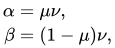 where ν \= α \+ β \= 1 − F F {\\displaystyle \\nu =\\alpha +\\beta ={\\frac {1-F}{F}}} 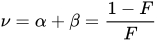 and 0 \< F \< 1 {\\displaystyle 0\<F\<1} ; here *F* is (Wright's) genetic distance between two populations.
### Project management: task cost and schedule modeling
\[[edit](https://en.wikipedia.org/w/index.php?title=Beta_distribution&action=edit§ion=71 "Edit section: Project management: task cost and schedule modeling")\]
The beta distribution can be used to model events which are constrained to take place within an interval defined by a minimum and maximum value. For this reason, the beta distribution — along with the [triangular distribution](https://en.wikipedia.org/wiki/Triangular_distribution "Triangular distribution") — is used extensively in [PERT](https://en.wikipedia.org/wiki/PERT "PERT"), [critical path method](https://en.wikipedia.org/wiki/Critical_path_method "Critical path method") (CPM), Joint Cost Schedule Modeling (JCSM) and other [project management](https://en.wikipedia.org/wiki/Project_management "Project management")/control systems to describe the time to completion and the cost of a task. In project management, shorthand computations are widely used to estimate the [mean](https://en.wikipedia.org/wiki/Mean "Mean") and [standard deviation](https://en.wikipedia.org/wiki/Standard_deviation "Standard deviation") of the beta distribution:[\[39\]](https://en.wikipedia.org/wiki/Beta_distribution#cite_note-Malcolm-39)
μ ( X ) \= a \+ 4 b \+ c 6 σ ( X ) \= c − a 6 {\\displaystyle {\\begin{aligned}\\mu (X)&={\\frac {a+4b+c}{6}}\\\\\[8pt\]\\sigma (X)&={\\frac {c-a}{6}}\\end{aligned}}} ![{\\displaystyle {\\begin{aligned}\\mu (X)&={\\frac {a+4b+c}{6}}\\\\\[8pt\]\\sigma (X)&={\\frac {c-a}{6}}\\end{aligned}}}](https://wikimedia.org/api/rest_v1/media/math/render/svg/7a89a68d1250ebe659be15e88edb5a9eb3e0cf87)
where *a* is the minimum, *c* is the maximum, and *b* is the most likely value (the [mode](https://en.wikipedia.org/wiki/Mode_\(statistics\) "Mode (statistics)") for *α* \> 1 and *β* \> 1).
The above estimate for the [mean](https://en.wikipedia.org/wiki/Mean "Mean") μ ( X ) \= a \+ 4 b \+ c 6 {\\displaystyle \\mu (X)={\\frac {a+4b+c}{6}}} 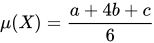 is known as the [PERT](https://en.wikipedia.org/wiki/PERT "PERT") [three-point estimation](https://en.wikipedia.org/wiki/Three-point_estimation "Three-point estimation") and it is exact for either of the following values of *β* (for arbitrary α within these ranges):
*β* = *α* \> 1 (symmetric case) with [standard deviation](https://en.wikipedia.org/wiki/Standard_deviation "Standard deviation")
σ
(
X
)
\=
c
−
a
2
1
\+
2
α
{\\displaystyle \\sigma (X)={\\frac {c-a}{2{\\sqrt {1+2\\alpha }}}}}
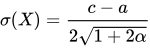
, [skewness](https://en.wikipedia.org/wiki/Skewness "Skewness") = 0, and [excess kurtosis](https://en.wikipedia.org/wiki/Excess_kurtosis "Excess kurtosis") =
−
6
3
\+
2
α
{\\displaystyle {\\frac {-6}{3+2\\alpha }}}

[](https://en.wikipedia.org/wiki/File:Beta_Distribution_beta%3Dalpha_from_1.05_to_4.95.svg)
or
*β* = 6 − *α* for 5 \> *α* \> 1 (skewed case) with [standard deviation](https://en.wikipedia.org/wiki/Standard_deviation "Standard deviation")
σ ( X ) \= ( c − a ) α ( 6 − α ) 6 7 , {\\displaystyle \\sigma (X)={\\frac {(c-a){\\sqrt {\\alpha (6-\\alpha )}}}{6{\\sqrt {7}}}},} 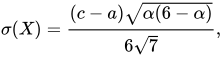
[skewness](https://en.wikipedia.org/wiki/Skewness "Skewness")\= ( 3 − α ) 7 2 α ( 6 − α ) {\\displaystyle {}={\\frac {(3-\\alpha ){\\sqrt {7}}}{2{\\sqrt {\\alpha (6-\\alpha )}}}}} 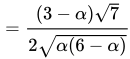, and [excess kurtosis](https://en.wikipedia.org/wiki/Excess_kurtosis "Excess kurtosis")\= 21 α ( 6 − α ) − 3 {\\displaystyle {}={\\frac {21}{\\alpha (6-\\alpha )}}-3} 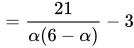
[](https://en.wikipedia.org/wiki/File:Beta_Distribution_beta%3D6-alpha_from_1.05_to_4.95.svg)
The above estimate for the [standard deviation](https://en.wikipedia.org/wiki/Standard_deviation "Standard deviation") *σ*(*X*) = (*c* − *a*)/6 is exact for either of the following values of *α* and *β*:
*α* = *β* = 4 (symmetric) with [skewness](https://en.wikipedia.org/wiki/Skewness "Skewness") = 0, and [excess kurtosis](https://en.wikipedia.org/wiki/Excess_kurtosis "Excess kurtosis") = −6/11.
*β* = 6 − *α* and
α
\=
3
−
2
{\\displaystyle \\alpha =3-{\\sqrt {2}}}

(right-tailed, positive skew) with [skewness](https://en.wikipedia.org/wiki/Skewness "Skewness")
\=
1
2
{\\displaystyle {}={\\frac {1}{\\sqrt {2}}}}

, and [excess kurtosis](https://en.wikipedia.org/wiki/Excess_kurtosis "Excess kurtosis") = 0
*β* = 6 − *α* and
α
\=
3
\+
2
{\\displaystyle \\alpha =3+{\\sqrt {2}}}

(left-tailed, negative skew) with [skewness](https://en.wikipedia.org/wiki/Skewness "Skewness")
\=
−
1
2
{\\displaystyle {}={\\frac {-1}{\\sqrt {2}}}}

, and [excess kurtosis](https://en.wikipedia.org/wiki/Excess_kurtosis "Excess kurtosis") = 0
[](https://en.wikipedia.org/wiki/File:Beta_Distribution_for_conjugate_alpha_beta.svg)
Otherwise, these can be poor approximations for beta distributions with other values of α and β, exhibiting average errors of 40% in the mean and 549% in the variance.[\[74\]](https://en.wikipedia.org/wiki/Beta_distribution#cite_note-74)[\[75\]](https://en.wikipedia.org/wiki/Beta_distribution#cite_note-75)[\[76\]](https://en.wikipedia.org/wiki/Beta_distribution#cite_note-76)
## Random variate generation
\[[edit](https://en.wikipedia.org/w/index.php?title=Beta_distribution&action=edit§ion=72 "Edit section: Random variate generation")\]
Further information: [Non-uniform random variate generation](https://en.wikipedia.org/wiki/Non-uniform_random_variate_generation "Non-uniform random variate generation")
If *X* and *Y* are independent, with X ∼ Γ ( α , θ ) {\\displaystyle X\\sim \\Gamma (\\alpha ,\\theta )}  and Y ∼ Γ ( β , θ ) {\\displaystyle Y\\sim \\Gamma (\\beta ,\\theta )}  then
X X \+ Y ∼ B ( α , β ) . {\\displaystyle {\\frac {X}{X+Y}}\\sim \\mathrm {B} (\\alpha ,\\beta ).} 
So one algorithm for generating beta variates is to generate X X \+ Y {\\displaystyle {\\frac {X}{X+Y}}} , where *X* is a [gamma variate](https://en.wikipedia.org/wiki/Gamma_distribution#Random_variate_generation "Gamma distribution") with parameters (α, 1) and *Y* is an independent gamma variate with parameters (β, 1).[\[77\]](https://en.wikipedia.org/wiki/Beta_distribution#cite_note-77) In fact, here X X \+ Y {\\displaystyle {\\frac {X}{X+Y}}}  and X \+ Y {\\displaystyle X+Y}  are independent, and X \+ Y ∼ Γ ( α \+ β , θ ) {\\displaystyle X+Y\\sim \\Gamma (\\alpha +\\beta ,\\theta )} . If Z ∼ Γ ( γ , θ ) {\\displaystyle Z\\sim \\Gamma (\\gamma ,\\theta )}  and Z {\\displaystyle Z}  is independent of X {\\displaystyle X}  and Y {\\displaystyle Y} , then X \+ Y X \+ Y \+ Z ∼ B ( α \+ β , γ ) {\\displaystyle {\\frac {X+Y}{X+Y+Z}}\\sim \\mathrm {B} (\\alpha +\\beta ,\\gamma )} 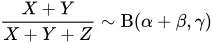 and X \+ Y X \+ Y \+ Z {\\displaystyle {\\frac {X+Y}{X+Y+Z}}}  is independent of X X \+ Y {\\displaystyle {\\frac {X}{X+Y}}} . This shows that the product of independent B ( α , β ) {\\displaystyle \\mathrm {B} (\\alpha ,\\beta )}  and B ( α \+ β , γ ) {\\displaystyle \\mathrm {B} (\\alpha +\\beta ,\\gamma )}  random variables is a B ( α , β \+ γ ) {\\displaystyle \\mathrm {B} (\\alpha ,\\beta +\\gamma )}  random variable.
Also, the *k*th [order statistic](https://en.wikipedia.org/wiki/Order_statistic "Order statistic") of *n* [uniformly distributed](https://en.wikipedia.org/wiki/Uniform_distribution_\(continuous\) "Uniform distribution (continuous)") variates is B ( k , n \+ 1 − k ) {\\displaystyle \\mathrm {B} (k,n+1-k)} , so an alternative if *α* and *β* are small integers is to generate α + β − 1 uniform variates and choose the α-th smallest.[\[40\]](https://en.wikipedia.org/wiki/Beta_distribution#cite_note-David1-40)
Another way to generate the Beta distribution is by [Pólya urn model](https://en.wikipedia.org/wiki/P%C3%B3lya_urn_model "Pólya urn model"). According to this method, one starts with an "urn" with α "black" balls and β "white" balls and draws uniformly with replacement. Every trial an additional ball is added according to the color of the last ball which was drawn. Asymptotically, the proportion of black and white balls will be distributed according to the Beta distribution, where each repetition of the experiment will produce a different value.
It is also possible to use the [inverse transform sampling](https://en.wikipedia.org/wiki/Inverse_transform_sampling "Inverse transform sampling").
## Normal approximation to the Beta distribution
\[[edit](https://en.wikipedia.org/w/index.php?title=Beta_distribution&action=edit§ion=73 "Edit section: Normal approximation to the Beta distribution")\]
A beta distribution B ( α , β ) {\\displaystyle \\mathrm {B} (\\alpha ,\\beta )}  with α ∼ β {\\displaystyle \\alpha \\sim \\beta }  and α {\\displaystyle \\alpha }  and β \>\> 1 {\\displaystyle \\beta \>\>1}  is approximately normal with mean 1 / 2 {\\displaystyle 1/2}  and variance 1 / ( 4 ( 2 α \+ 1 ) ) {\\displaystyle 1/(4(2\\alpha +1))} . If α ≥ β {\\displaystyle \\alpha \\geq \\beta }  the normal approximation can be improved by taking the cube-root of the logarithm of the reciprocal of B ( α , β ) {\\displaystyle \\mathrm {B} (\\alpha ,\\beta )} [\[78\]](https://en.wikipedia.org/wiki/Beta_distribution#cite_note-78)[\[79\]](https://en.wikipedia.org/wiki/Beta_distribution#cite_note-79)
## History
\[[edit](https://en.wikipedia.org/w/index.php?title=Beta_distribution&action=edit§ion=74 "Edit section: History")\]
[Thomas Bayes](https://en.wikipedia.org/wiki/Thomas_Bayes "Thomas Bayes"), in a posthumous paper [\[62\]](https://en.wikipedia.org/wiki/Beta_distribution#cite_note-ThomasBayes-62) published in 1763 by [Richard Price](https://en.wikipedia.org/wiki/Richard_Price "Richard Price"), obtained a beta distribution as the density of the probability of success in Bernoulli trials (see [§ Applications, Bayesian inference](https://en.wikipedia.org/wiki/Beta_distribution#Applications,_Bayesian_inference)), but the paper does not analyze any of the moments of the beta distribution or discuss any of its properties.
[](https://en.wikipedia.org/wiki/File:Karl_Pearson_2.jpg)
[Karl Pearson](https://en.wikipedia.org/wiki/Karl_Pearson "Karl Pearson") analyzed the beta distribution as the solution Type I of Pearson distributions
The first systematic modern discussion of the beta distribution is probably due to [Karl Pearson](https://en.wikipedia.org/wiki/Karl_Pearson "Karl Pearson").[\[80\]](https://en.wikipedia.org/wiki/Beta_distribution#cite_note-80)[\[81\]](https://en.wikipedia.org/wiki/Beta_distribution#cite_note-rscat-81) In Pearson's papers[\[21\]](https://en.wikipedia.org/wiki/Beta_distribution#cite_note-Pearson-21)[\[33\]](https://en.wikipedia.org/wiki/Beta_distribution#cite_note-Pearson1895-33) the beta distribution is couched as a solution of a differential equation: [Pearson's Type I distribution](https://en.wikipedia.org/wiki/Pearson_distribution "Pearson distribution") which it is essentially identical to except for arbitrary shifting and re-scaling (the beta and Pearson Type I distributions can always be equalized by proper choice of parameters). In fact, in several English books and journal articles in the few decades prior to World War II, it was common to refer to the beta distribution as Pearson's Type I distribution. [William P. Elderton](https://en.wikipedia.org/wiki/William_Palin_Elderton "William Palin Elderton") in his 1906 monograph "Frequency curves and correlation"[\[42\]](https://en.wikipedia.org/wiki/Beta_distribution#cite_note-Elderton1906-42) further analyzes the beta distribution as Pearson's Type I distribution, including a full discussion of the method of moments for the four parameter case, and diagrams of (what Elderton describes as) U-shaped, J-shaped, twisted J-shaped, "cocked-hat" shapes, horizontal and angled straight-line cases. Elderton wrote "I am chiefly indebted to Professor Pearson, but the indebtedness is of a kind for which it is impossible to offer formal thanks." [Elderton](https://en.wikipedia.org/wiki/William_Palin_Elderton "William Palin Elderton") in his 1906 monograph [\[42\]](https://en.wikipedia.org/wiki/Beta_distribution#cite_note-Elderton1906-42) provides an impressive amount of information on the beta distribution, including equations for the origin of the distribution chosen to be the mode, as well as for other Pearson distributions: types I through VII. Elderton also included a number of appendixes, including one appendix ("II") on the beta and gamma functions. In later editions, Elderton added equations for the origin of the distribution chosen to be the mean, and analysis of Pearson distributions VIII through XII.
As remarked by Bowman and Shenton[\[44\]](https://en.wikipedia.org/wiki/Beta_distribution#cite_note-BowmanShenton-44) "Fisher and Pearson had a difference of opinion in the approach to (parameter) estimation, in particular relating to (Pearson's method of) moments and (Fisher's method of) maximum likelihood in the case of the Beta distribution." Also according to Bowman and Shenton, "the case of a Type I (beta distribution) model being the center of the controversy was pure serendipity. A more difficult model of 4 parameters would have been hard to find." The long running public conflict of Fisher with Karl Pearson can be followed in a number of articles in prestigious journals. For example, concerning the estimation of the four parameters for the beta distribution, and Fisher's criticism of Pearson's method of moments as being arbitrary, see Pearson's article "Method of moments and method of maximum likelihood" [\[45\]](https://en.wikipedia.org/wiki/Beta_distribution#cite_note-Pearson1936-45) (published three years after his retirement from University College, London, where his position had been divided between Fisher and Pearson's son Egon) in which Pearson writes "I read (Koshai's paper in the Journal of the Royal Statistical Society, 1933) which as far as I am aware is the only case at present published of the application of Professor Fisher's method. To my astonishment that method depends on first working out the constants of the frequency curve by the (Pearson) Method of Moments and then superposing on it, by what Fisher terms "the Method of Maximum Likelihood" a further approximation to obtain, what he holds, he will thus get, 'more efficient values' of the curve constants".
David and Edwards's treatise on the history of statistics[\[82\]](https://en.wikipedia.org/wiki/Beta_distribution#cite_note-David_History-82) cites the first modern treatment of the beta distribution, in 1911,[\[83\]](https://en.wikipedia.org/wiki/Beta_distribution#cite_note-83) using the beta designation that has become standard, due to [Corrado Gini](https://en.wikipedia.org/wiki/Corrado_Gini "Corrado Gini"), an Italian [statistician](https://en.wikipedia.org/wiki/Statistician "Statistician"), [demographer](https://en.wikipedia.org/wiki/Demography "Demography"), and [sociologist](https://en.wikipedia.org/wiki/Sociology "Sociology"), who developed the [Gini coefficient](https://en.wikipedia.org/wiki/Gini_coefficient "Gini coefficient"). [N.L.Johnson](https://en.wikipedia.org/wiki/Norman_Lloyd_Johnson "Norman Lloyd Johnson") and [S.Kotz](https://en.wikipedia.org/wiki/Samuel_Kotz "Samuel Kotz"), in their comprehensive and very informative monograph[\[84\]](https://en.wikipedia.org/wiki/Beta_distribution#cite_note-84) on leading historical personalities in statistical sciences credit [Corrado Gini](https://en.wikipedia.org/wiki/Corrado_Gini "Corrado Gini")[\[85\]](https://en.wikipedia.org/wiki/Beta_distribution#cite_note-85) as "an early Bayesian...who dealt with the problem of eliciting the parameters of an initial Beta distribution, by singling out techniques which anticipated the advent of the so-called empirical Bayes approach."
## References
\[[edit](https://en.wikipedia.org/w/index.php?title=Beta_distribution&action=edit§ion=75 "Edit section: References")\]
1. ^ [***a***](https://en.wikipedia.org/wiki/Beta_distribution#cite_ref-JKB_1-0) [***b***](https://en.wikipedia.org/wiki/Beta_distribution#cite_ref-JKB_1-1) [***c***](https://en.wikipedia.org/wiki/Beta_distribution#cite_ref-JKB_1-2) [***d***](https://en.wikipedia.org/wiki/Beta_distribution#cite_ref-JKB_1-3) [***e***](https://en.wikipedia.org/wiki/Beta_distribution#cite_ref-JKB_1-4) [***f***](https://en.wikipedia.org/wiki/Beta_distribution#cite_ref-JKB_1-5) [***g***](https://en.wikipedia.org/wiki/Beta_distribution#cite_ref-JKB_1-6) [***h***](https://en.wikipedia.org/wiki/Beta_distribution#cite_ref-JKB_1-7) [***i***](https://en.wikipedia.org/wiki/Beta_distribution#cite_ref-JKB_1-8) [***j***](https://en.wikipedia.org/wiki/Beta_distribution#cite_ref-JKB_1-9) [***k***](https://en.wikipedia.org/wiki/Beta_distribution#cite_ref-JKB_1-10) [***l***](https://en.wikipedia.org/wiki/Beta_distribution#cite_ref-JKB_1-11) [***m***](https://en.wikipedia.org/wiki/Beta_distribution#cite_ref-JKB_1-12) [***n***](https://en.wikipedia.org/wiki/Beta_distribution#cite_ref-JKB_1-13) [***o***](https://en.wikipedia.org/wiki/Beta_distribution#cite_ref-JKB_1-14) [***p***](https://en.wikipedia.org/wiki/Beta_distribution#cite_ref-JKB_1-15) [***q***](https://en.wikipedia.org/wiki/Beta_distribution#cite_ref-JKB_1-16) [***r***](https://en.wikipedia.org/wiki/Beta_distribution#cite_ref-JKB_1-17) [***s***](https://en.wikipedia.org/wiki/Beta_distribution#cite_ref-JKB_1-18) [***t***](https://en.wikipedia.org/wiki/Beta_distribution#cite_ref-JKB_1-19) [***u***](https://en.wikipedia.org/wiki/Beta_distribution#cite_ref-JKB_1-20) [***v***](https://en.wikipedia.org/wiki/Beta_distribution#cite_ref-JKB_1-21) [***w***](https://en.wikipedia.org/wiki/Beta_distribution#cite_ref-JKB_1-22) [***x***](https://en.wikipedia.org/wiki/Beta_distribution#cite_ref-JKB_1-23) [***y***](https://en.wikipedia.org/wiki/Beta_distribution#cite_ref-JKB_1-24)
Johnson, Norman L.; Kotz, Samuel; Balakrishnan, N. (1995). "Chapter 25: Beta Distributions". *Continuous Univariate Distributions Vol. 2* (2nd ed.). Wiley. [ISBN](https://en.wikipedia.org/wiki/ISBN_\(identifier\) "ISBN (identifier)")
[978-0-471-58494-0](https://en.wikipedia.org/wiki/Special:BookSources/978-0-471-58494-0 "Special:BookSources/978-0-471-58494-0")
.
2. ^ [***a***](https://en.wikipedia.org/wiki/Beta_distribution#cite_ref-Mathematical_Statistics_with_MATHEMATICA_2-0) [***b***](https://en.wikipedia.org/wiki/Beta_distribution#cite_ref-Mathematical_Statistics_with_MATHEMATICA_2-1)
Rose, Colin; Smith, Murray D. (2002). *Mathematical Statistics with MATHEMATICA*. Springer. [ISBN](https://en.wikipedia.org/wiki/ISBN_\(identifier\) "ISBN (identifier)")
[978-0387952345](https://en.wikipedia.org/wiki/Special:BookSources/978-0387952345 "Special:BookSources/978-0387952345")
.
3. ^ [***a***](https://en.wikipedia.org/wiki/Beta_distribution#cite_ref-Kruschke2011_3-0) [***b***](https://en.wikipedia.org/wiki/Beta_distribution#cite_ref-Kruschke2011_3-1) [***c***](https://en.wikipedia.org/wiki/Beta_distribution#cite_ref-Kruschke2011_3-2)
[Kruschke, John K.](https://en.wikipedia.org/wiki/John_K._Kruschke "John K. Kruschke") (2011). *Doing Bayesian data analysis: A tutorial with R and BUGS*. Academic Press / Elsevier. p. 83. [ISBN](https://en.wikipedia.org/wiki/ISBN_\(identifier\) "ISBN (identifier)")
[978-0123814852](https://en.wikipedia.org/wiki/Special:BookSources/978-0123814852 "Special:BookSources/978-0123814852")
.
4. ^ [***a***](https://en.wikipedia.org/wiki/Beta_distribution#cite_ref-BergerDecisionTheory_4-0) [***b***](https://en.wikipedia.org/wiki/Beta_distribution#cite_ref-BergerDecisionTheory_4-1)
Berger, James O. (2010). *Statistical Decision Theory and Bayesian Analysis* (2nd ed.). Springer. [ISBN](https://en.wikipedia.org/wiki/ISBN_\(identifier\) "ISBN (identifier)")
[978-1441930743](https://en.wikipedia.org/wiki/Special:BookSources/978-1441930743 "Special:BookSources/978-1441930743")
.
5. ^ [***a***](https://en.wikipedia.org/wiki/Beta_distribution#cite_ref-Feller_5-0) [***b***](https://en.wikipedia.org/wiki/Beta_distribution#cite_ref-Feller_5-1) [***c***](https://en.wikipedia.org/wiki/Beta_distribution#cite_ref-Feller_5-2)
Feller, William (1971). [*An Introduction to Probability Theory and Its Applications, Vol. 2*](https://archive.org/details/introductiontopr00fell). Wiley. [ISBN](https://en.wikipedia.org/wiki/ISBN_\(identifier\) "ISBN (identifier)")
[978-0471257097](https://en.wikipedia.org/wiki/Special:BookSources/978-0471257097 "Special:BookSources/978-0471257097")
.
6. **[^](https://en.wikipedia.org/wiki/Beta_distribution#cite_ref-6)**
Wadsworth, G. P. (1960). [*Introduction to Probability and Random Variables*](https://archive.org/details/introductiontopr0000wads). New York: McGraw-Hill. p. [52](https://archive.org/details/introductiontopr0000wads/page/52).
7. **[^](https://en.wikipedia.org/wiki/Beta_distribution#cite_ref-Kruschke2015_7-0)**
[Kruschke, John K.](https://en.wikipedia.org/wiki/John_K._Kruschke "John K. Kruschke") (2015). *Doing Bayesian Data Analysis: A Tutorial with R, JAGS and Stan*. Academic Press / Elsevier. [ISBN](https://en.wikipedia.org/wiki/ISBN_\(identifier\) "ISBN (identifier)")
[978-0-12-405888-0](https://en.wikipedia.org/wiki/Special:BookSources/978-0-12-405888-0 "Special:BookSources/978-0-12-405888-0")
.
8. ^ [***a***](https://en.wikipedia.org/wiki/Beta_distribution#cite_ref-Wadsworth_8-0) [***b***](https://en.wikipedia.org/wiki/Beta_distribution#cite_ref-Wadsworth_8-1)
Wadsworth, George P. and Joseph Bryan (1960). [*Introduction to Probability and Random Variables*](https://archive.org/details/introductiontopr0000wads). McGraw-Hill.
9. ^ [***a***](https://en.wikipedia.org/wiki/Beta_distribution#cite_ref-Handbook_of_Beta_Distribution_9-0) [***b***](https://en.wikipedia.org/wiki/Beta_distribution#cite_ref-Handbook_of_Beta_Distribution_9-1) [***c***](https://en.wikipedia.org/wiki/Beta_distribution#cite_ref-Handbook_of_Beta_Distribution_9-2) [***d***](https://en.wikipedia.org/wiki/Beta_distribution#cite_ref-Handbook_of_Beta_Distribution_9-3) [***e***](https://en.wikipedia.org/wiki/Beta_distribution#cite_ref-Handbook_of_Beta_Distribution_9-4) [***f***](https://en.wikipedia.org/wiki/Beta_distribution#cite_ref-Handbook_of_Beta_Distribution_9-5) [***g***](https://en.wikipedia.org/wiki/Beta_distribution#cite_ref-Handbook_of_Beta_Distribution_9-6)
Gupta, Arjun K., ed. (2004). *Handbook of Beta Distribution and Its Applications*. CRC Press. [ISBN](https://en.wikipedia.org/wiki/ISBN_\(identifier\) "ISBN (identifier)")
[978-0824753962](https://en.wikipedia.org/wiki/Special:BookSources/978-0824753962 "Special:BookSources/978-0824753962")
.
10. ^ [***a***](https://en.wikipedia.org/wiki/Beta_distribution#cite_ref-Kerman2011_10-0) [***b***](https://en.wikipedia.org/wiki/Beta_distribution#cite_ref-Kerman2011_10-1)
Kerman, Jouni (2011). "A closed-form approximation for the median of the beta distribution". [arXiv](https://en.wikipedia.org/wiki/ArXiv_\(identifier\) "ArXiv (identifier)"):[1111\.0433](https://arxiv.org/abs/1111.0433) \[[math.ST](https://arxiv.org/archive/math.ST)\].
11. **[^](https://en.wikipedia.org/wiki/Beta_distribution#cite_ref-MostellerTukey_11-0)**
Mosteller, Frederick and John Tukey (1977). [*Data Analysis and Regression: A Second Course in Statistics*](https://archive.org/details/dataanalysisregr0000most). Addison-Wesley Pub. Co. [Bibcode](https://en.wikipedia.org/wiki/Bibcode_\(identifier\) "Bibcode (identifier)"):[1977dars.book.....M](https://ui.adsabs.harvard.edu/abs/1977dars.book.....M). [ISBN](https://en.wikipedia.org/wiki/ISBN_\(identifier\) "ISBN (identifier)")
[978-0201048544](https://en.wikipedia.org/wiki/Special:BookSources/978-0201048544 "Special:BookSources/978-0201048544")
.
12. **[^](https://en.wikipedia.org/wiki/Beta_distribution#cite_ref-WillyFeller1_12-0)**
Feller, William (1968). *An Introduction to Probability Theory and Its Applications*. Vol. 1 (3rd ed.). Wiley. [ISBN](https://en.wikipedia.org/wiki/ISBN_\(identifier\) "ISBN (identifier)")
[978-0471257080](https://en.wikipedia.org/wiki/Special:BookSources/978-0471257080 "Special:BookSources/978-0471257080")
.
13. **[^](https://en.wikipedia.org/wiki/Beta_distribution#cite_ref-13)** Philip J. Fleming and John J. Wallace. *How not to lie with statistics: the correct way to summarize benchmark results*. Communications of the ACM, 29(3):218–221, March 1986.
14. **[^](https://en.wikipedia.org/wiki/Beta_distribution#cite_ref-14)**
["NIST/SEMATECH e-Handbook of Statistical Methods 1.3.6.6.17. Beta Distribution"](http://www.itl.nist.gov/div898/handbook/eda/section3/eda366h.htm). *[National Institute of Standards and Technology](https://en.wikipedia.org/wiki/National_Institute_of_Standards_and_Technology "National Institute of Standards and Technology") Information Technology Laboratory*. April 2012. Retrieved May 31, 2016.
15. **[^](https://en.wikipedia.org/wiki/Beta_distribution#cite_ref-Oguamanam_15-0)**
Oguamanam, D.C.D.; Martin, H. R.; Huissoon, J. P. (1995). "On the application of the beta distribution to gear damage analysis". *Applied Acoustics*. **45** (3): 247–261\. [doi](https://en.wikipedia.org/wiki/Doi_\(identifier\) "Doi (identifier)"):[10\.1016/0003-682X(95)00001-P](https://doi.org/10.1016%2F0003-682X%2895%2900001-P).
16. **[^](https://en.wikipedia.org/wiki/Beta_distribution#cite_ref-Liang_16-0)**
Zhiqiang Liang; Jianming Wei; Junyu Zhao; Haitao Liu; Baoqing Li; Jie Shen; Chunlei Zheng (27 August 2008). ["The Statistical Meaning of Kurtosis and Its New Application to Identification of Persons Based on Seismic Signals"](https://www.ncbi.nlm.nih.gov/pmc/articles/PMC3705491). *Sensors*. **8** (8): 5106–5119\. [Bibcode](https://en.wikipedia.org/wiki/Bibcode_\(identifier\) "Bibcode (identifier)"):[2008Senso...8.5106L](https://ui.adsabs.harvard.edu/abs/2008Senso...8.5106L). [doi](https://en.wikipedia.org/wiki/Doi_\(identifier\) "Doi (identifier)"):[10\.3390/s8085106](https://doi.org/10.3390%2Fs8085106). [PMC](https://en.wikipedia.org/wiki/PMC_\(identifier\) "PMC (identifier)") [3705491](https://www.ncbi.nlm.nih.gov/pmc/articles/PMC3705491). [PMID](https://en.wikipedia.org/wiki/PMID_\(identifier\) "PMID (identifier)") [27873804](https://pubmed.ncbi.nlm.nih.gov/27873804).
17. **[^](https://en.wikipedia.org/wiki/Beta_distribution#cite_ref-Kenney_and_Keeping_17-0)**
Kenney, J. F., and E. S. Keeping (1951). *Mathematics of Statistics Part Two, 2nd edition*. D. Van Nostrand Company Inc.
`{{cite book}}`: CS1 maint: multiple names: authors list ([link](https://en.wikipedia.org/wiki/Category:CS1_maint:_multiple_names:_authors_list "Category:CS1 maint: multiple names: authors list"))
18. ^ [***a***](https://en.wikipedia.org/wiki/Beta_distribution#cite_ref-Abramowitz_18-0) [***b***](https://en.wikipedia.org/wiki/Beta_distribution#cite_ref-Abramowitz_18-1) [***c***](https://en.wikipedia.org/wiki/Beta_distribution#cite_ref-Abramowitz_18-2) [***d***](https://en.wikipedia.org/wiki/Beta_distribution#cite_ref-Abramowitz_18-3)
Abramowitz, Milton and Irene A. Stegun (1965). [*Handbook Of Mathematical Functions With Formulas, Graphs, And Mathematical Tables*](https://archive.org/details/handbookofmathe000abra). Dover. [ISBN](https://en.wikipedia.org/wiki/ISBN_\(identifier\) "ISBN (identifier)")
[978-0-486-61272-0](https://en.wikipedia.org/wiki/Special:BookSources/978-0-486-61272-0 "Special:BookSources/978-0-486-61272-0")
.
19. **[^](https://en.wikipedia.org/wiki/Beta_distribution#cite_ref-Weisstein.Kurtosi_19-0)**
Weisstein., Eric W. ["Kurtosis"](http://mathworld.wolfram.com/Kurtosis.html). MathWorld--A Wolfram Web Resource. Retrieved 13 August 2012.
20. ^ [***a***](https://en.wikipedia.org/wiki/Beta_distribution#cite_ref-Panik_20-0) [***b***](https://en.wikipedia.org/wiki/Beta_distribution#cite_ref-Panik_20-1)
Panik, Michael J (2005). *Advanced Statistics from an Elementary Point of View*. Academic Press. [ISBN](https://en.wikipedia.org/wiki/ISBN_\(identifier\) "ISBN (identifier)")
[978-0120884940](https://en.wikipedia.org/wiki/Special:BookSources/978-0120884940 "Special:BookSources/978-0120884940")
.
21. ^ [***a***](https://en.wikipedia.org/wiki/Beta_distribution#cite_ref-Pearson_21-0) [***b***](https://en.wikipedia.org/wiki/Beta_distribution#cite_ref-Pearson_21-1) [***c***](https://en.wikipedia.org/wiki/Beta_distribution#cite_ref-Pearson_21-2) [***d***](https://en.wikipedia.org/wiki/Beta_distribution#cite_ref-Pearson_21-3) [***e***](https://en.wikipedia.org/wiki/Beta_distribution#cite_ref-Pearson_21-4) [***f***](https://en.wikipedia.org/wiki/Beta_distribution#cite_ref-Pearson_21-5)
[Pearson, Karl](https://en.wikipedia.org/wiki/Karl_Pearson "Karl Pearson") (1916). ["Mathematical contributions to the theory of evolution, XIX: Second supplement to a memoir on skew variation"](https://doi.org/10.1098%2Frsta.1916.0009). *Philosophical Transactions of the Royal Society A*. **216** (538–548\): 429–457\. [Bibcode](https://en.wikipedia.org/wiki/Bibcode_\(identifier\) "Bibcode (identifier)"):[1916RSPTA.216..429P](https://ui.adsabs.harvard.edu/abs/1916RSPTA.216..429P). [doi](https://en.wikipedia.org/wiki/Doi_\(identifier\) "Doi (identifier)"):[10\.1098/rsta.1916.0009](https://doi.org/10.1098%2Frsta.1916.0009). [JSTOR](https://en.wikipedia.org/wiki/JSTOR_\(identifier\) "JSTOR (identifier)") [91092](https://www.jstor.org/stable/91092).
22. **[^](https://en.wikipedia.org/wiki/Beta_distribution#cite_ref-Zwillinger_2014_22-0)**
[Gradshteyn, Izrail Solomonovich](https://en.wikipedia.org/wiki/Izrail_Solomonovich_Gradshteyn "Izrail Solomonovich Gradshteyn"); [Ryzhik, Iosif Moiseevich](https://en.wikipedia.org/wiki/Iosif_Moiseevich_Ryzhik "Iosif Moiseevich Ryzhik"); [Geronimus, Yuri Veniaminovich](https://en.wikipedia.org/wiki/Yuri_Veniaminovich_Geronimus "Yuri Veniaminovich Geronimus"); [Tseytlin, Michail Yulyevich](https://en.wikipedia.org/wiki/Michail_Yulyevich_Tseytlin "Michail Yulyevich Tseytlin"); Jeffrey, Alan (2015) \[October 2014\]. Zwillinger, Daniel; [Moll, Victor Hugo](https://en.wikipedia.org/wiki/Victor_Hugo_Moll "Victor Hugo Moll") (eds.). [*Table of Integrals, Series, and Products*](https://en.wikipedia.org/wiki/Gradshteyn_and_Ryzhik "Gradshteyn and Ryzhik"). Translated by Scripta Technica, Inc. (8 ed.). [Academic Press, Inc.](https://en.wikipedia.org/wiki/Academic_Press,_Inc. "Academic Press, Inc.") [ISBN](https://en.wikipedia.org/wiki/ISBN_\(identifier\) "ISBN (identifier)")
[978-0-12-384933-5](https://en.wikipedia.org/wiki/Special:BookSources/978-0-12-384933-5 "Special:BookSources/978-0-12-384933-5")
. [LCCN](https://en.wikipedia.org/wiki/LCCN_\(identifier\) "LCCN (identifier)") [2014010276](https://lccn.loc.gov/2014010276).
23. **[^](https://en.wikipedia.org/wiki/Beta_distribution#cite_ref-23)**
Billingsley, Patrick (1995). "Section 30: The Method of Moments". *Probability and measure* (3rd ed.). Wiley-Interscience. [ISBN](https://en.wikipedia.org/wiki/ISBN_\(identifier\) "ISBN (identifier)")
[978-0-471-00710-4](https://en.wikipedia.org/wiki/Special:BookSources/978-0-471-00710-4 "Special:BookSources/978-0-471-00710-4")
.
24. ^ [***a***](https://en.wikipedia.org/wiki/Beta_distribution#cite_ref-MacKay_24-0) [***b***](https://en.wikipedia.org/wiki/Beta_distribution#cite_ref-MacKay_24-1)
MacKay, David (2003). *Information Theory, Inference and Learning Algorithms*. Cambridge University Press; First Edition. [Bibcode](https://en.wikipedia.org/wiki/Bibcode_\(identifier\) "Bibcode (identifier)"):[2003itil.book.....M](https://ui.adsabs.harvard.edu/abs/2003itil.book.....M). [ISBN](https://en.wikipedia.org/wiki/ISBN_\(identifier\) "ISBN (identifier)")
[978-0521642989](https://en.wikipedia.org/wiki/Special:BookSources/978-0521642989 "Special:BookSources/978-0521642989")
.
25. ^ [***a***](https://en.wikipedia.org/wiki/Beta_distribution#cite_ref-JohnsonLogInv_25-0) [***b***](https://en.wikipedia.org/wiki/Beta_distribution#cite_ref-JohnsonLogInv_25-1)
Johnson, N.L. (1949). ["Systems of frequency curves generated by methods of translation"](http://dml.cz/bitstream/handle/10338.dmlcz/135506/Kybernetika_39-2003-1_3.pdf) (PDF). *Biometrika*. **36** (1–2\): 149–176\. [doi](https://en.wikipedia.org/wiki/Doi_\(identifier\) "Doi (identifier)"):[10\.1093/biomet/36.1-2.149](https://doi.org/10.1093%2Fbiomet%2F36.1-2.149). [hdl](https://en.wikipedia.org/wiki/Hdl_\(identifier\) "Hdl (identifier)"):[10338\.dmlcz/135506](https://hdl.handle.net/10338.dmlcz%2F135506). [PMID](https://en.wikipedia.org/wiki/PMID_\(identifier\) "PMID (identifier)") [18132090](https://pubmed.ncbi.nlm.nih.gov/18132090).
26. **[^](https://en.wikipedia.org/wiki/Beta_distribution#cite_ref-26)**
Verdugo Lazo, A. C. G.; Rathie, P. N. (1978). "On the entropy of continuous probability distributions". *IEEE Trans. Inf. Theory*. **24** (1): 120–122\. [doi](https://en.wikipedia.org/wiki/Doi_\(identifier\) "Doi (identifier)"):[10\.1109/TIT.1978.1055832](https://doi.org/10.1109%2FTIT.1978.1055832).
27. **[^](https://en.wikipedia.org/wiki/Beta_distribution#cite_ref-27)**
Shannon, Claude E. (1948). "A Mathematical Theory of Communication". *Bell System Technical Journal*. **27** (4): 623–656\. [doi](https://en.wikipedia.org/wiki/Doi_\(identifier\) "Doi (identifier)"):[10\.1002/j.1538-7305.1948.tb01338.x](https://doi.org/10.1002%2Fj.1538-7305.1948.tb01338.x).
28. ^ [***a***](https://en.wikipedia.org/wiki/Beta_distribution#cite_ref-Cover_and_Thomas_28-0) [***b***](https://en.wikipedia.org/wiki/Beta_distribution#cite_ref-Cover_and_Thomas_28-1) [***c***](https://en.wikipedia.org/wiki/Beta_distribution#cite_ref-Cover_and_Thomas_28-2)
Cover, Thomas M. and Joy A. Thomas (2006). *Elements of Information Theory 2nd Edition (Wiley Series in Telecommunications and Signal Processing)*. Wiley-Interscience; 2 edition. [ISBN](https://en.wikipedia.org/wiki/ISBN_\(identifier\) "ISBN (identifier)")
[978-0471241959](https://en.wikipedia.org/wiki/Special:BookSources/978-0471241959 "Special:BookSources/978-0471241959")
.
29. **[^](https://en.wikipedia.org/wiki/Beta_distribution#cite_ref-Plunkett_29-0)**
Plunkett, Kim, and Jeffrey Elman (1997). [*Exercises in Rethinking Innateness: A Handbook for Connectionist Simulations (Neural Network Modeling and Connectionism)*](https://archive.org/details/exercisesinrethi0000plun). A Bradford Book. p. 166. [ISBN](https://en.wikipedia.org/wiki/ISBN_\(identifier\) "ISBN (identifier)")
[978-0262661058](https://en.wikipedia.org/wiki/Special:BookSources/978-0262661058 "Special:BookSources/978-0262661058")
.
`{{cite book}}`: CS1 maint: multiple names: authors list ([link](https://en.wikipedia.org/wiki/Category:CS1_maint:_multiple_names:_authors_list "Category:CS1 maint: multiple names: authors list"))
30. **[^](https://en.wikipedia.org/wiki/Beta_distribution#cite_ref-Nallapati_30-0)**
Nallapati, Ramesh (2006). [*The smoothed dirichlet distribution: understanding cross-entropy ranking in information retrieval*](http://maroo.cs.umass.edu/pub/web/getpdf.php?id=679) (Thesis). Computer Science Dept., University of Massachusetts Amherst.
31. ^ [***a***](https://en.wikipedia.org/wiki/Beta_distribution#cite_ref-Egon_31-0) [***b***](https://en.wikipedia.org/wiki/Beta_distribution#cite_ref-Egon_31-1)
Pearson, Egon S. (July 1969). ["Some historical reflections traced through the development of the use of frequency curves"](http://www.smu.edu/Dedman/Academics/Departments/Statistics/Research/TechnicalReports). *THEMIS Statistical Analysis Research Program, Technical Report 38*. Office of Naval Research, Contract N000014-68-A-0515 (Project NR 042–260).
32. **[^](https://en.wikipedia.org/wiki/Beta_distribution#cite_ref-Hahn_and_Shapiro_32-0)**
Hahn, Gerald J.; Shapiro, S. (1994). *Statistical Models in Engineering (Wiley Classics Library)*. Wiley-Interscience. [ISBN](https://en.wikipedia.org/wiki/ISBN_\(identifier\) "ISBN (identifier)")
[978-0471040651](https://en.wikipedia.org/wiki/Special:BookSources/978-0471040651 "Special:BookSources/978-0471040651")
.
33. ^ [***a***](https://en.wikipedia.org/wiki/Beta_distribution#cite_ref-Pearson1895_33-0) [***b***](https://en.wikipedia.org/wiki/Beta_distribution#cite_ref-Pearson1895_33-1)
[Pearson, Karl](https://en.wikipedia.org/wiki/Karl_Pearson "Karl Pearson") (1895). ["Contributions to the mathematical theory of evolution, II: Skew variation in homogeneous material"](https://doi.org/10.1098%2Frsta.1895.0010). *Philosophical Transactions of the Royal Society*. **186**: 343–414\. [Bibcode](https://en.wikipedia.org/wiki/Bibcode_\(identifier\) "Bibcode (identifier)"):[1895RSPTA.186..343P](https://ui.adsabs.harvard.edu/abs/1895RSPTA.186..343P). [doi](https://en.wikipedia.org/wiki/Doi_\(identifier\) "Doi (identifier)"):[10\.1098/rsta.1895.0010](https://doi.org/10.1098%2Frsta.1895.0010). [JSTOR](https://en.wikipedia.org/wiki/JSTOR_\(identifier\) "JSTOR (identifier)") [90649](https://www.jstor.org/stable/90649).
34. **[^](https://en.wikipedia.org/wiki/Beta_distribution#cite_ref-34)**
Buchanan, K.; Rockway, J.; Sternberg, O.; Mai, N. N. (May 2016). ["Sum-difference beamforming for radar applications using circularly tapered random arrays"](https://zenodo.org/record/1279364). *2016 IEEE Radar Conference (RadarConf)*. pp. 1–5\. [doi](https://en.wikipedia.org/wiki/Doi_\(identifier\) "Doi (identifier)"):[10\.1109/RADAR.2016.7485289](https://doi.org/10.1109%2FRADAR.2016.7485289). [ISBN](https://en.wikipedia.org/wiki/ISBN_\(identifier\) "ISBN (identifier)")
[978-1-5090-0863-6](https://en.wikipedia.org/wiki/Special:BookSources/978-1-5090-0863-6 "Special:BookSources/978-1-5090-0863-6")
. [S2CID](https://en.wikipedia.org/wiki/S2CID_\(identifier\) "S2CID (identifier)") [32525626](https://api.semanticscholar.org/CorpusID:32525626).
35. **[^](https://en.wikipedia.org/wiki/Beta_distribution#cite_ref-35)**
Buchanan, K.; Flores, C.; Wheeland, S.; Jensen, J.; Grayson, D.; Huff, G. (May 2017). "Transmit beamforming for radar applications using circularly tapered random arrays". *2017 IEEE Radar Conference (RadarConf)*. pp. 0112–0117\. [doi](https://en.wikipedia.org/wiki/Doi_\(identifier\) "Doi (identifier)"):[10\.1109/RADAR.2017.7944181](https://doi.org/10.1109%2FRADAR.2017.7944181). [ISBN](https://en.wikipedia.org/wiki/ISBN_\(identifier\) "ISBN (identifier)")
[978-1-4673-8823-8](https://en.wikipedia.org/wiki/Special:BookSources/978-1-4673-8823-8 "Special:BookSources/978-1-4673-8823-8")
. [S2CID](https://en.wikipedia.org/wiki/S2CID_\(identifier\) "S2CID (identifier)") [38429370](https://api.semanticscholar.org/CorpusID:38429370).
36. **[^](https://en.wikipedia.org/wiki/Beta_distribution#cite_ref-36)**
Ryan, Buchanan, Kristopher (2014-05-29). ["Theory and Applications of Aperiodic (Random) Phased Arrays"](http://oaktrust.library.tamu.edu/handle/1969.1/157918).
`{{cite web}}`: CS1 maint: multiple names: authors list ([link](https://en.wikipedia.org/wiki/Category:CS1_maint:_multiple_names:_authors_list "Category:CS1 maint: multiple names: authors list"))
37. **[^](https://en.wikipedia.org/wiki/Beta_distribution#cite_ref-Pham-Gia2000_37-0)**
Pham-Gia, T. (January 2000). ["Distributions of the ratios of independent beta variables and applications"](https://doi.org/10.1080/03610920008832632). *Communications in Statistics - Theory and Methods*. **29** (12): 2693–2715\. [doi](https://en.wikipedia.org/wiki/Doi_\(identifier\) "Doi (identifier)"):[10\.1080/03610920008832632](https://doi.org/10.1080%2F03610920008832632). [ISSN](https://en.wikipedia.org/wiki/ISSN_\(identifier\) "ISSN (identifier)") [0361-0926](https://search.worldcat.org/issn/0361-0926). Retrieved 13 November 2024.
38. **[^](https://en.wikipedia.org/wiki/Beta_distribution#cite_ref-NewPERT_38-0)** Herrerías-Velasco, José Manuel and Herrerías-Pleguezuelo, Rafael and René van Dorp, Johan. (2011). Revisiting the PERT mean and Variance. European Journal of Operational Research (210), p. 448–451.
39. ^ [***a***](https://en.wikipedia.org/wiki/Beta_distribution#cite_ref-Malcolm_39-0) [***b***](https://en.wikipedia.org/wiki/Beta_distribution#cite_ref-Malcolm_39-1)
Malcolm, D. G.; Roseboom, J. H.; Clark, C. E.; Fazar, W. (September–October 1958). "Application of a Technique for Research and Development Program Evaluation". *Operations Research*. **7** (5): 646–669\. [doi](https://en.wikipedia.org/wiki/Doi_\(identifier\) "Doi (identifier)"):[10\.1287/opre.7.5.646](https://doi.org/10.1287%2Fopre.7.5.646). [ISSN](https://en.wikipedia.org/wiki/ISSN_\(identifier\) "ISSN (identifier)") [0030-364X](https://search.worldcat.org/issn/0030-364X).
40. ^ [***a***](https://en.wikipedia.org/wiki/Beta_distribution#cite_ref-David1_40-0) [***b***](https://en.wikipedia.org/wiki/Beta_distribution#cite_ref-David1_40-1) [***c***](https://en.wikipedia.org/wiki/Beta_distribution#cite_ref-David1_40-2) [***d***](https://en.wikipedia.org/wiki/Beta_distribution#cite_ref-David1_40-3)
David, H. A., Nagaraja, H. N. (2003) *Order Statistics* (3rd Edition). Wiley, New Jersey pp 458.
[ISBN](https://en.wikipedia.org/wiki/ISBN_\(identifier\) "ISBN (identifier)")
[0-471-38926-9](https://en.wikipedia.org/wiki/Special:BookSources/0-471-38926-9 "Special:BookSources/0-471-38926-9")
41. **[^](https://en.wikipedia.org/wiki/Beta_distribution#cite_ref-41)**
["1.3.6.6.17. Beta Distribution"](https://www.itl.nist.gov/div898/handbook/eda/section3/eda366h.htm). *www.itl.nist.gov*.
42. ^ [***a***](https://en.wikipedia.org/wiki/Beta_distribution#cite_ref-Elderton1906_42-0) [***b***](https://en.wikipedia.org/wiki/Beta_distribution#cite_ref-Elderton1906_42-1) [***c***](https://en.wikipedia.org/wiki/Beta_distribution#cite_ref-Elderton1906_42-2) [***d***](https://en.wikipedia.org/wiki/Beta_distribution#cite_ref-Elderton1906_42-3) [***e***](https://en.wikipedia.org/wiki/Beta_distribution#cite_ref-Elderton1906_42-4) [***f***](https://en.wikipedia.org/wiki/Beta_distribution#cite_ref-Elderton1906_42-5) [***g***](https://en.wikipedia.org/wiki/Beta_distribution#cite_ref-Elderton1906_42-6) [***h***](https://en.wikipedia.org/wiki/Beta_distribution#cite_ref-Elderton1906_42-7)
Elderton, William Palin (1906). [*Frequency-Curves and Correlation*](https://archive.org/details/frequencycurvesc00elderich). Charles and Edwin Layton (London).
43. **[^](https://en.wikipedia.org/wiki/Beta_distribution#cite_ref-Elderton_and_Johnson_43-0)**
Elderton, William Palin and Norman Lloyd Johnson (2009). *Systems of Frequency Curves*. Cambridge University Press. [ISBN](https://en.wikipedia.org/wiki/ISBN_\(identifier\) "ISBN (identifier)")
[978-0521093361](https://en.wikipedia.org/wiki/Special:BookSources/978-0521093361 "Special:BookSources/978-0521093361")
.
44. ^ [***a***](https://en.wikipedia.org/wiki/Beta_distribution#cite_ref-BowmanShenton_44-0) [***b***](https://en.wikipedia.org/wiki/Beta_distribution#cite_ref-BowmanShenton_44-1) [***c***](https://en.wikipedia.org/wiki/Beta_distribution#cite_ref-BowmanShenton_44-2)
[Bowman, K. O.](https://en.wikipedia.org/wiki/Kimiko_O._Bowman "Kimiko O. Bowman"); Shenton, L. R. (2007). ["The beta distribution, moment method, Karl Pearson and R.A. Fisher"](http://www.csm.ornl.gov/~bowman/fjts232.pdf) (PDF). *Far East J. Theo. Stat*. **23** (2): 133–164\.
45. ^ [***a***](https://en.wikipedia.org/wiki/Beta_distribution#cite_ref-Pearson1936_45-0) [***b***](https://en.wikipedia.org/wiki/Beta_distribution#cite_ref-Pearson1936_45-1)
Pearson, Karl (June 1936). "Method of moments and method of maximum likelihood". *Biometrika*. **28** (1/2): 34–59\. [doi](https://en.wikipedia.org/wiki/Doi_\(identifier\) "Doi (identifier)"):[10\.2307/2334123](https://doi.org/10.2307%2F2334123). [JSTOR](https://en.wikipedia.org/wiki/JSTOR_\(identifier\) "JSTOR (identifier)") [2334123](https://www.jstor.org/stable/2334123).
46. ^ [***a***](https://en.wikipedia.org/wiki/Beta_distribution#cite_ref-Joanes_and_Gill_46-0) [***b***](https://en.wikipedia.org/wiki/Beta_distribution#cite_ref-Joanes_and_Gill_46-1) [***c***](https://en.wikipedia.org/wiki/Beta_distribution#cite_ref-Joanes_and_Gill_46-2)
Joanes, D. N.; C. A. Gill (1998). "Comparing measures of sample skewness and kurtosis". *The Statistician*. **47** (Part 1): 183–189\. [doi](https://en.wikipedia.org/wiki/Doi_\(identifier\) "Doi (identifier)"):[10\.1111/1467-9884.00122](https://doi.org/10.1111%2F1467-9884.00122).
47. **[^](https://en.wikipedia.org/wiki/Beta_distribution#cite_ref-47)**
Beckman, R. J.; G. L. Tietjen (1978). "Maximum likelihood estimation for the beta distribution". *Journal of Statistical Computation and Simulation*. **7** (3–4\): 253–258\. [doi](https://en.wikipedia.org/wiki/Doi_\(identifier\) "Doi (identifier)"):[10\.1080/00949657808810232](https://doi.org/10.1080%2F00949657808810232).
48. **[^](https://en.wikipedia.org/wiki/Beta_distribution#cite_ref-48)**
Gnanadesikan, R., Pinkham and Hughes (1967). "Maximum likelihood estimation of the parameters of the beta distribution from smallest order statistics". *Technometrics*. **9** (4): 607–620\. [doi](https://en.wikipedia.org/wiki/Doi_\(identifier\) "Doi (identifier)"):[10\.2307/1266199](https://doi.org/10.2307%2F1266199). [JSTOR](https://en.wikipedia.org/wiki/JSTOR_\(identifier\) "JSTOR (identifier)") [1266199](https://www.jstor.org/stable/1266199).
`{{cite journal}}`: CS1 maint: multiple names: authors list ([link](https://en.wikipedia.org/wiki/Category:CS1_maint:_multiple_names:_authors_list "Category:CS1 maint: multiple names: authors list"))
49. **[^](https://en.wikipedia.org/wiki/Beta_distribution#cite_ref-invpsi.m_49-0)**
Fackler, Paul. ["Inverse Digamma Function (Matlab)"](http://hips.seas.harvard.edu/content/inverse-digamma-function-matlab). Harvard University School of Engineering and Applied Sciences. Retrieved 2012-08-18.
50. ^ [***a***](https://en.wikipedia.org/wiki/Beta_distribution#cite_ref-Silvey_50-0) [***b***](https://en.wikipedia.org/wiki/Beta_distribution#cite_ref-Silvey_50-1) [***c***](https://en.wikipedia.org/wiki/Beta_distribution#cite_ref-Silvey_50-2)
Silvey, S.D. (1975). *Statistical Inference*. Chapman and Hal. p. 40. [ISBN](https://en.wikipedia.org/wiki/ISBN_\(identifier\) "ISBN (identifier)")
[978-0412138201](https://en.wikipedia.org/wiki/Special:BookSources/978-0412138201 "Special:BookSources/978-0412138201")
.
51. **[^](https://en.wikipedia.org/wiki/Beta_distribution#cite_ref-EdwardsLikelihood_51-0)**
Edwards, A. W. F. (1992). *Likelihood*. The Johns Hopkins University Press. [ISBN](https://en.wikipedia.org/wiki/ISBN_\(identifier\) "ISBN (identifier)")
[978-0801844430](https://en.wikipedia.org/wiki/Special:BookSources/978-0801844430 "Special:BookSources/978-0801844430")
.
52. ^ [***a***](https://en.wikipedia.org/wiki/Beta_distribution#cite_ref-Jaynes_52-0) [***b***](https://en.wikipedia.org/wiki/Beta_distribution#cite_ref-Jaynes_52-1) [***c***](https://en.wikipedia.org/wiki/Beta_distribution#cite_ref-Jaynes_52-2) [***d***](https://en.wikipedia.org/wiki/Beta_distribution#cite_ref-Jaynes_52-3) [***e***](https://en.wikipedia.org/wiki/Beta_distribution#cite_ref-Jaynes_52-4) [***f***](https://en.wikipedia.org/wiki/Beta_distribution#cite_ref-Jaynes_52-5)
Jaynes, E.T. (2003). *Probability theory, the logic of science*. Cambridge University Press. [ISBN](https://en.wikipedia.org/wiki/ISBN_\(identifier\) "ISBN (identifier)")
[978-0521592710](https://en.wikipedia.org/wiki/Special:BookSources/978-0521592710 "Special:BookSources/978-0521592710")
.
53. **[^](https://en.wikipedia.org/wiki/Beta_distribution#cite_ref-CostaCover_53-0)**
Costa, Max, and Cover, Thomas (September 1983). [*On the similarity of the entropy power inequality and the Brunn Minkowski inequality*](https://isl.stanford.edu/people/cover/papers/transIT/0837cost.pdf) (PDF). Tech.Report 48, Dept. Statistics, Stanford University.
`{{cite book}}`: CS1 maint: multiple names: authors list ([link](https://en.wikipedia.org/wiki/Category:CS1_maint:_multiple_names:_authors_list "Category:CS1 maint: multiple names: authors list"))
54. ^ [***a***](https://en.wikipedia.org/wiki/Beta_distribution#cite_ref-Aryal_54-0) [***b***](https://en.wikipedia.org/wiki/Beta_distribution#cite_ref-Aryal_54-1) [***c***](https://en.wikipedia.org/wiki/Beta_distribution#cite_ref-Aryal_54-2)
Aryal, Gokarna; Saralees Nadarajah (2004). ["Information matrix for beta distributions"](http://www.math.bas.bg/serdica/2004/2004-513-526.pdf) (PDF). *Serdica Mathematical Journal (Bulgarian Academy of Science)*. **30**: 513–526\.
55. ^ [***a***](https://en.wikipedia.org/wiki/Beta_distribution#cite_ref-Laplace_55-0) [***b***](https://en.wikipedia.org/wiki/Beta_distribution#cite_ref-Laplace_55-1)
Laplace, Pierre Simon, marquis de (1902). [*A philosophical essay on probabilities*](https://archive.org/details/philosophicaless00lapliala). New York : J. Wiley; London : Chapman & Hall. [ISBN](https://en.wikipedia.org/wiki/ISBN_\(identifier\) "ISBN (identifier)")
[978-1-60206-328-0](https://en.wikipedia.org/wiki/Special:BookSources/978-1-60206-328-0 "Special:BookSources/978-1-60206-328-0")
.
`{{cite book}}`: ISBN / Date incompatibility ([help](https://en.wikipedia.org/wiki/Help:CS1_errors#invalid_isbn_date "Help:CS1 errors"))CS1 maint: multiple names: authors list ([link](https://en.wikipedia.org/wiki/Category:CS1_maint:_multiple_names:_authors_list "Category:CS1 maint: multiple names: authors list"))
56. **[^](https://en.wikipedia.org/wiki/Beta_distribution#cite_ref-CoxRT_56-0)**
Cox, Richard T. (1961). *Algebra of Probable Inference*. The Johns Hopkins University Press. [ISBN](https://en.wikipedia.org/wiki/ISBN_\(identifier\) "ISBN (identifier)")
[978-0801869822](https://en.wikipedia.org/wiki/Special:BookSources/978-0801869822 "Special:BookSources/978-0801869822")
.
`{{cite book}}`: ISBN / Date incompatibility ([help](https://en.wikipedia.org/wiki/Help:CS1_errors#invalid_isbn_date "Help:CS1 errors"))
57. ^ [***a***](https://en.wikipedia.org/wiki/Beta_distribution#cite_ref-KeynesTreatise_57-0) [***b***](https://en.wikipedia.org/wiki/Beta_distribution#cite_ref-KeynesTreatise_57-1)
Keynes, John Maynard (2010) \[1921\]. *A Treatise on Probability: The Connection Between Philosophy and the History of Science*. Wildside Press. [ISBN](https://en.wikipedia.org/wiki/ISBN_\(identifier\) "ISBN (identifier)")
[978-1434406965](https://en.wikipedia.org/wiki/Special:BookSources/978-1434406965 "Special:BookSources/978-1434406965")
.
58. **[^](https://en.wikipedia.org/wiki/Beta_distribution#cite_ref-PearsonRuleSuccession_58-0)**
Pearson, Karl (1907). "On the Influence of Past Experience on Future Expectation". *Philosophical Magazine*. **6** (13): 365–378\.
59. ^ [***a***](https://en.wikipedia.org/wiki/Beta_distribution#cite_ref-Jeffreys_59-0) [***b***](https://en.wikipedia.org/wiki/Beta_distribution#cite_ref-Jeffreys_59-1) [***c***](https://en.wikipedia.org/wiki/Beta_distribution#cite_ref-Jeffreys_59-2) [***d***](https://en.wikipedia.org/wiki/Beta_distribution#cite_ref-Jeffreys_59-3)
Jeffreys, Harold (1998). *Theory of Probability*. Oxford University Press, 3rd edition. [ISBN](https://en.wikipedia.org/wiki/ISBN_\(identifier\) "ISBN (identifier)")
[978-0198503682](https://en.wikipedia.org/wiki/Special:BookSources/978-0198503682 "Special:BookSources/978-0198503682")
.
60. **[^](https://en.wikipedia.org/wiki/Beta_distribution#cite_ref-BroadMind_60-0)**
Broad, C. D. (October 1918). "On the relation between induction and probability". *MIND, A Quarterly Review of Psychology and Philosophy*. 27 (New Series) (108): 389–404\. [doi](https://en.wikipedia.org/wiki/Doi_\(identifier\) "Doi (identifier)"):[10\.1093/mind/XXVII.4.389](https://doi.org/10.1093%2Fmind%2FXXVII.4.389). [JSTOR](https://en.wikipedia.org/wiki/JSTOR_\(identifier\) "JSTOR (identifier)") [2249035](https://www.jstor.org/stable/2249035).
61. ^ [***a***](https://en.wikipedia.org/wiki/Beta_distribution#cite_ref-Perks_61-0) [***b***](https://en.wikipedia.org/wiki/Beta_distribution#cite_ref-Perks_61-1) [***c***](https://en.wikipedia.org/wiki/Beta_distribution#cite_ref-Perks_61-2) [***d***](https://en.wikipedia.org/wiki/Beta_distribution#cite_ref-Perks_61-3)
Perks, Wilfred (January 1947). ["Some observations on inverse probability including a new indifference rule"](https://web.archive.org/web/20140112111032/http://www.actuaries.org.uk/research-and-resources/documents/some-observations-inverse-probability-including-new-indifference-ru). *Journal of the Institute of Actuaries*. **73** (2): 285–334\. [doi](https://en.wikipedia.org/wiki/Doi_\(identifier\) "Doi (identifier)"):[10\.1017/S0020268100012270](https://doi.org/10.1017%2FS0020268100012270). Archived from [the original](http://www.actuaries.org.uk/research-and-resources/documents/some-observations-inverse-probability-including-new-indifference-ru) on 2014-01-12. Retrieved 2012-09-19.
62. ^ [***a***](https://en.wikipedia.org/wiki/Beta_distribution#cite_ref-ThomasBayes_62-0) [***b***](https://en.wikipedia.org/wiki/Beta_distribution#cite_ref-ThomasBayes_62-1)
Bayes, Thomas; communicated by Richard Price (1763). ["An Essay towards solving a Problem in the Doctrine of Chances"](https://doi.org/10.1098%2Frstl.1763.0053). *Philosophical Transactions of the Royal Society*. **53**: 370–418\. [doi](https://en.wikipedia.org/wiki/Doi_\(identifier\) "Doi (identifier)"):[10\.1098/rstl.1763.0053](https://doi.org/10.1098%2Frstl.1763.0053). [JSTOR](https://en.wikipedia.org/wiki/JSTOR_\(identifier\) "JSTOR (identifier)") [105741](https://www.jstor.org/stable/105741).
63. **[^](https://en.wikipedia.org/wiki/Beta_distribution#cite_ref-63)**
[Haldane, J. B. S.](https://en.wikipedia.org/wiki/J._B._S._Haldane "J. B. S. Haldane") (1932). "A note on inverse probability". *[Mathematical Proceedings of the Cambridge Philosophical Society](https://en.wikipedia.org/wiki/Mathematical_Proceedings_of_the_Cambridge_Philosophical_Society "Mathematical Proceedings of the Cambridge Philosophical Society")*. **28** (1): 55–61\. [Bibcode](https://en.wikipedia.org/wiki/Bibcode_\(identifier\) "Bibcode (identifier)"):[1932PCPS...28...55H](https://ui.adsabs.harvard.edu/abs/1932PCPS...28...55H). [doi](https://en.wikipedia.org/wiki/Doi_\(identifier\) "Doi (identifier)"):[10\.1017/s0305004100010495](https://doi.org/10.1017%2Fs0305004100010495). [S2CID](https://en.wikipedia.org/wiki/S2CID_\(identifier\) "S2CID (identifier)") [122773707](https://api.semanticscholar.org/CorpusID:122773707).
64. **[^](https://en.wikipedia.org/wiki/Beta_distribution#cite_ref-Zellner_64-0)**
Zellner, Arnold (1971). *An Introduction to Bayesian Inference in Econometrics*. Wiley-Interscience. [ISBN](https://en.wikipedia.org/wiki/ISBN_\(identifier\) "ISBN (identifier)")
[978-0471169376](https://en.wikipedia.org/wiki/Special:BookSources/978-0471169376 "Special:BookSources/978-0471169376")
.
65. **[^](https://en.wikipedia.org/wiki/Beta_distribution#cite_ref-JeffreysPRIOR_65-0)**
Jeffreys, Harold (September 1946). ["An Invariant Form for the Prior Probability in Estimation Problems"](https://doi.org/10.1098%2Frspa.1946.0056). *Proceedings of the Royal Society*. A 24. **186** (1007): 453–461\. [Bibcode](https://en.wikipedia.org/wiki/Bibcode_\(identifier\) "Bibcode (identifier)"):[1946RSPSA.186..453J](https://ui.adsabs.harvard.edu/abs/1946RSPSA.186..453J). [doi](https://en.wikipedia.org/wiki/Doi_\(identifier\) "Doi (identifier)"):[10\.1098/rspa.1946.0056](https://doi.org/10.1098%2Frspa.1946.0056). [PMID](https://en.wikipedia.org/wiki/PMID_\(identifier\) "PMID (identifier)") [20998741](https://pubmed.ncbi.nlm.nih.gov/20998741).
66. **[^](https://en.wikipedia.org/wiki/Beta_distribution#cite_ref-BergerBernardoSun_66-0)**
Berger, James; Bernardo, Jose; Sun, Dongchu (2009). ["The formal definition of reference priors"](http://projecteuclid.org/DPubS/Repository/1.0/Disseminate?view=body&id=pdfview_1&handle=euclid.aos/1236693154). *The Annals of Statistics*. **37** (2): 905–938\. [arXiv](https://en.wikipedia.org/wiki/ArXiv_\(identifier\) "ArXiv (identifier)"):[0904\.0156](https://arxiv.org/abs/0904.0156). [Bibcode](https://en.wikipedia.org/wiki/Bibcode_\(identifier\) "Bibcode (identifier)"):[2009arXiv0904.0156B](https://ui.adsabs.harvard.edu/abs/2009arXiv0904.0156B). [doi](https://en.wikipedia.org/wiki/Doi_\(identifier\) "Doi (identifier)"):[10\.1214/07-AOS587](https://doi.org/10.1214%2F07-AOS587). [S2CID](https://en.wikipedia.org/wiki/S2CID_\(identifier\) "S2CID (identifier)") [3221355](https://api.semanticscholar.org/CorpusID:3221355).
67. **[^](https://en.wikipedia.org/wiki/Beta_distribution#cite_ref-67)**
Clarke, Bertrand S.; Andrew R. Barron (1994). ["Jeffreys' prior is asymptotically least favorable under entropy risk"](http://www.stat.yale.edu/~arb4/publications_files/jeffery's%20prior.pdf) (PDF). *Journal of Statistical Planning and Inference*. **41**: 37–60\. [doi](https://en.wikipedia.org/wiki/Doi_\(identifier\) "Doi (identifier)"):[10\.1016/0378-3758(94)90153-8](https://doi.org/10.1016%2F0378-3758%2894%2990153-8).
68. **[^](https://en.wikipedia.org/wiki/Beta_distribution#cite_ref-PearsonGrammar_68-0)**
Pearson, Karl (1892). [*The Grammar of Science*](https://books.google.com/books?id=IvdsEcFwcnsC&q=grammar+of+science&pg=PR19). Walter Scott, London.
69. **[^](https://en.wikipedia.org/wiki/Beta_distribution#cite_ref-PearsnGrammar2009_69-0)**
Pearson, Karl (2009). *The Grammar of Science*. BiblioLife. [ISBN](https://en.wikipedia.org/wiki/ISBN_\(identifier\) "ISBN (identifier)")
[978-1110356119](https://en.wikipedia.org/wiki/Special:BookSources/978-1110356119 "Special:BookSources/978-1110356119")
.
70. **[^](https://en.wikipedia.org/wiki/Beta_distribution#cite_ref-Gelman_70-0)**
Gelman, A., Carlin, J. B., Stern, H. S., and Rubin, D. B. (2003). *Bayesian Data Analysis*. Chapman and Hall/CRC. [ISBN](https://en.wikipedia.org/wiki/ISBN_\(identifier\) "ISBN (identifier)")
[978-1584883883](https://en.wikipedia.org/wiki/Special:BookSources/978-1584883883 "Special:BookSources/978-1584883883")
.
`{{cite book}}`: CS1 maint: multiple names: authors list ([link](https://en.wikipedia.org/wiki/Category:CS1_maint:_multiple_names:_authors_list "Category:CS1 maint: multiple names: authors list"))
71. **[^](https://en.wikipedia.org/wiki/Beta_distribution#cite_ref-J01_71-0)**
Jøsang, Audun (2001). ["A logic for uncertain probabilities"](https://scholar.archive.org/work/nilorkzfvjccjir72m75zk3pgy). *International Journal of Uncertainty, Fuzziness and Knowledge-Based Systems*. **9** (3): 279–311\. [doi](https://en.wikipedia.org/wiki/Doi_\(identifier\) "Doi (identifier)"):[10\.1142/S0218488501000831](https://doi.org/10.1142%2FS0218488501000831). [MR](https://en.wikipedia.org/wiki/MR_\(identifier\) "MR (identifier)") [1843261](https://mathscinet.ams.org/mathscinet-getitem?mr=1843261).
72. **[^](https://en.wikipedia.org/wiki/Beta_distribution#cite_ref-wavelet_oliveira_72-0)** H.M. de Oliveira and G.A.A. Araújo,. Compactly Supported One-cyclic Wavelets Derived from Beta Distributions. *Journal of Communication and Information Systems.* vol.20, n.3, pp.27-33, 2005.
73. **[^](https://en.wikipedia.org/wiki/Beta_distribution#cite_ref-Balding_73-0)**
[Balding, David J.](https://en.wikipedia.org/wiki/David_Balding "David Balding"); Nichols, Richard A. (1995). "A method for quantifying differentiation between populations at multi-allelic loci and its implications for investigating identity and paternity". *Genetica*. **96** (1–2\). Springer: 3–12\. [doi](https://en.wikipedia.org/wiki/Doi_\(identifier\) "Doi (identifier)"):[10\.1007/BF01441146](https://doi.org/10.1007%2FBF01441146). [PMID](https://en.wikipedia.org/wiki/PMID_\(identifier\) "PMID (identifier)") [7607457](https://pubmed.ncbi.nlm.nih.gov/7607457). [S2CID](https://en.wikipedia.org/wiki/S2CID_\(identifier\) "S2CID (identifier)") [30680826](https://api.semanticscholar.org/CorpusID:30680826).
74. **[^](https://en.wikipedia.org/wiki/Beta_distribution#cite_ref-74)** Keefer, Donald L. and Verdini, William A. (1993). Better Estimation of PERT Activity Time Parameters. Management Science 39(9), p. 1086–1091.
75. **[^](https://en.wikipedia.org/wiki/Beta_distribution#cite_ref-75)** Keefer, Donald L. and Bodily, Samuel E. (1983). Three-point Approximations for Continuous Random variables. Management Science 29(5), p. 595–609.
76. **[^](https://en.wikipedia.org/wiki/Beta_distribution#cite_ref-76)**
["Defense Resource Management Institute - Naval Postgraduate School"](https://www.nps.edu/web/drmi/). *www.nps.edu*.
77. **[^](https://en.wikipedia.org/wiki/Beta_distribution#cite_ref-77)**
van der Waerden, B. L., "Mathematical Statistics", Springer,
[ISBN](https://en.wikipedia.org/wiki/ISBN_\(identifier\) "ISBN (identifier)")
[978-3-540-04507-6](https://en.wikipedia.org/wiki/Special:BookSources/978-3-540-04507-6 "Special:BookSources/978-3-540-04507-6")
.
78. **[^](https://en.wikipedia.org/wiki/Beta_distribution#cite_ref-78)** On normalizing the incomplete beta-function for fitting to dose-response curves M.E. Wise Biometrika vol 47, No. 1/2, June 1960, pp. 173–175
79. **[^](https://en.wikipedia.org/wiki/Beta_distribution#cite_ref-79)** Pratt, John W. “A Normal Approximation for Binomial, F, Beta, and Other Common, Related Tail Probabilities, II.” Journal of the American Statistical Association, vol. 63, no. 324, 1968, pp. 1457–83. JSTOR, <https://doi.org/10.2307/2285896>. Accessed 21 Oct. 2025.
80. **[^](https://en.wikipedia.org/wiki/Beta_distribution#cite_ref-80)**
[Yule, G. U.](https://en.wikipedia.org/wiki/Udny_Yule "Udny Yule"); Filon, L. N. G. (1936). ["Karl Pearson. 1857–1936"](https://en.wikipedia.org/wiki/Karl_Pearson "Karl Pearson"). *[Obituary Notices of Fellows of the Royal Society](https://en.wikipedia.org/wiki/Obituary_Notices_of_Fellows_of_the_Royal_Society "Obituary Notices of Fellows of the Royal Society")*. **2** (5): 72. [doi](https://en.wikipedia.org/wiki/Doi_\(identifier\) "Doi (identifier)"):[10\.1098/rsbm.1936.0007](https://doi.org/10.1098%2Frsbm.1936.0007). [JSTOR](https://en.wikipedia.org/wiki/JSTOR_\(identifier\) "JSTOR (identifier)") [769130](https://www.jstor.org/stable/769130).
81. **[^](https://en.wikipedia.org/wiki/Beta_distribution#cite_ref-rscat_81-0)**
["Library and Archive catalogue"](https://web.archive.org/web/20111025030931/http://www2.royalsociety.org/DServe/dserve.exe?dsqIni=Dserve.ini&dsqApp=Archive&dsqCmd=Show.tcl&dsqDb=Persons&dsqPos=0&dsqSearch=%28%28text%29%3D%27%20%20Pearson%3A%20Karl%20%281857%20-%201936%29%20%20%27%29\)). *Sackler Digital Archive*. Royal Society. Archived from [the original](http://www2.royalsociety.org/DServe/dserve.exe?dsqIni=Dserve.ini&dsqApp=Archive&dsqCmd=Show.tcl&dsqDb=Persons&dsqPos=0&dsqSearch=%28%28text%29%3D%27%20%20Pearson%3A%20Karl%20%281857%20-%201936%29%20%20%27%29%29) on 2011-10-25. Retrieved 2011-07-01.
82. **[^](https://en.wikipedia.org/wiki/Beta_distribution#cite_ref-David_History_82-0)**
David, H. A. and A.W.F. Edwards (2001). *Annotated Readings in the History of Statistics*. Springer; 1 edition. [ISBN](https://en.wikipedia.org/wiki/ISBN_\(identifier\) "ISBN (identifier)")
[978-0387988443](https://en.wikipedia.org/wiki/Special:BookSources/978-0387988443 "Special:BookSources/978-0387988443")
.
83. **[^](https://en.wikipedia.org/wiki/Beta_distribution#cite_ref-83)**
Gini, Corrado (1911). "Considerazioni Sulle Probabilità Posteriori e Applicazioni al Rapporto dei Sessi Nelle Nascite Umane". *Studi Economico-Giuridici della Università de Cagliari*. Anno III (reproduced in Metron 15, 133, 171, 1949): 5–41\.
84. **[^](https://en.wikipedia.org/wiki/Beta_distribution#cite_ref-84)**
Johnson, Norman L. and Samuel Kotz, ed. (1997). *Leading Personalities in Statistical Sciences: From the Seventeenth Century to the Present (Wiley Series in Probability and Statistics*. Wiley. [ISBN](https://en.wikipedia.org/wiki/ISBN_\(identifier\) "ISBN (identifier)")
[978-0471163817](https://en.wikipedia.org/wiki/Special:BookSources/978-0471163817 "Special:BookSources/978-0471163817")
.
85. **[^](https://en.wikipedia.org/wiki/Beta_distribution#cite_ref-85)**
Metron journal. ["Biography of Corrado Gini"](https://web.archive.org/web/20120716202225/http://www.metronjournal.it/storia/ginibio.htm). Metron Journal. Archived from [the original](http://www.metronjournal.it/storia/ginibio.htm) on 2012-07-16. Retrieved 2012-08-18.
## External links
\[[edit](https://en.wikipedia.org/w/index.php?title=Beta_distribution&action=edit§ion=76 "Edit section: External links")\]
[](https://en.wikipedia.org/wiki/File:Commons-logo.svg)
Wikimedia Commons has media related to [Beta distribution](https://commons.wikimedia.org/wiki/Category:Beta_distribution "commons:Category:Beta distribution").
- ["Beta Distribution"](http://demonstrations.wolfram.com/BetaDistribution/) by Fiona Maclachlan, the [Wolfram Demonstrations Project](https://en.wikipedia.org/wiki/Wolfram_Demonstrations_Project "Wolfram Demonstrations Project"), 2007.
- [Beta Distribution – Overview and Example](http://www.xycoon.com/beta.htm), xycoon.com
- [Beta Distribution](https://web.archive.org/web/20120829140915/http://www.brighton-webs.co.uk/distributions/beta.htm), brighton-webs.co.uk
- [Beta Distribution Video](http://www.exstrom.com/blog/snark/posts/dancingbeta.html), exstrom.com
- ["Beta-distribution"](https://www.encyclopediaofmath.org/index.php?title=Beta-distribution), *[Encyclopedia of Mathematics](https://en.wikipedia.org/wiki/Encyclopedia_of_Mathematics "Encyclopedia of Mathematics")*, [EMS Press](https://en.wikipedia.org/wiki/European_Mathematical_Society "European Mathematical Society"), 2001 \[1994\]
- [Weisstein, Eric W.](https://en.wikipedia.org/wiki/Eric_W._Weisstein "Eric W. Weisstein") ["Beta Distribution"](https://mathworld.wolfram.com/BetaDistribution.html). *[MathWorld](https://en.wikipedia.org/wiki/MathWorld "MathWorld")*.
- [Harvard University Statistics 110 Lecture 23 Beta Distribution, Prof. Joe Blitzstein](https://www.youtube.com/watch?v=UZjlBQbV1KU)
| [v](https://en.wikipedia.org/wiki/Template:Probability_distributions "Template:Probability distributions") [t](https://en.wikipedia.org/wiki/Template_talk:Probability_distributions "Template talk:Probability distributions") [e](https://en.wikipedia.org/wiki/Special:EditPage/Template:Probability_distributions "Special:EditPage/Template:Probability distributions")[Probability distributions](https://en.wikipedia.org/wiki/Probability_distribution "Probability distribution") ([list](https://en.wikipedia.org/wiki/List_of_probability_distributions "List of probability distributions")) | |
|---|---|
| Discrete univariate | |
| | |
| with finite support | [Benford](https://en.wikipedia.org/wiki/Benford%27s_law "Benford's law") [Bernoulli](https://en.wikipedia.org/wiki/Bernoulli_distribution "Bernoulli distribution") [Beta-binomial](https://en.wikipedia.org/wiki/Beta-binomial_distribution "Beta-binomial distribution") [Binomial](https://en.wikipedia.org/wiki/Binomial_distribution "Binomial distribution") [Categorical](https://en.wikipedia.org/wiki/Categorical_distribution "Categorical distribution") [Hypergeometric](https://en.wikipedia.org/wiki/Hypergeometric_distribution "Hypergeometric distribution") [Negative](https://en.wikipedia.org/wiki/Negative_hypergeometric_distribution "Negative hypergeometric distribution") [Poisson binomial](https://en.wikipedia.org/wiki/Poisson_binomial_distribution "Poisson binomial distribution") [Rademacher](https://en.wikipedia.org/wiki/Rademacher_distribution "Rademacher distribution") [Soliton](https://en.wikipedia.org/wiki/Soliton_distribution "Soliton distribution") [Discrete uniform](https://en.wikipedia.org/wiki/Discrete_uniform_distribution "Discrete uniform distribution") [Zipf](https://en.wikipedia.org/wiki/Zipf%27s_law "Zipf's law") [Zipf–Mandelbrot](https://en.wikipedia.org/wiki/Zipf%E2%80%93Mandelbrot_law "Zipf–Mandelbrot law") |
| with infinite support | [Beta negative binomial](https://en.wikipedia.org/wiki/Beta_negative_binomial_distribution "Beta negative binomial distribution") [Borel](https://en.wikipedia.org/wiki/Borel_distribution "Borel distribution") [Conway–Maxwell–Poisson](https://en.wikipedia.org/wiki/Conway%E2%80%93Maxwell%E2%80%93Poisson_distribution "Conway–Maxwell–Poisson distribution") [Discrete phase-type](https://en.wikipedia.org/wiki/Discrete_phase-type_distribution "Discrete phase-type distribution") [Delaporte](https://en.wikipedia.org/wiki/Delaporte_distribution "Delaporte distribution") [Extended negative binomial](https://en.wikipedia.org/wiki/Extended_negative_binomial_distribution "Extended negative binomial distribution") [Flory–Schulz](https://en.wikipedia.org/wiki/Flory%E2%80%93Schulz_distribution "Flory–Schulz distribution") [Gauss–Kuzmin](https://en.wikipedia.org/wiki/Gauss%E2%80%93Kuzmin_distribution "Gauss–Kuzmin distribution") [Geometric](https://en.wikipedia.org/wiki/Geometric_distribution "Geometric distribution") [Logarithmic](https://en.wikipedia.org/wiki/Logarithmic_distribution "Logarithmic distribution") [Mixed Poisson](https://en.wikipedia.org/wiki/Mixed_Poisson_distribution "Mixed Poisson distribution") [Negative binomial](https://en.wikipedia.org/wiki/Negative_binomial_distribution "Negative binomial distribution") [Panjer](https://en.wikipedia.org/wiki/\(a,b,0\)_class_of_distributions "(a,b,0) class of distributions") [Parabolic fractal](https://en.wikipedia.org/wiki/Parabolic_fractal_distribution "Parabolic fractal distribution") [Poisson](https://en.wikipedia.org/wiki/Poisson_distribution "Poisson distribution") [Skellam](https://en.wikipedia.org/wiki/Skellam_distribution "Skellam distribution") [Yule–Simon](https://en.wikipedia.org/wiki/Yule%E2%80%93Simon_distribution "Yule–Simon distribution") [Zeta](https://en.wikipedia.org/wiki/Zeta_distribution "Zeta distribution") |
| Continuous univariate | |
| | |
| supported on a bounded interval | [Arcsine](https://en.wikipedia.org/wiki/Arcsine_distribution "Arcsine distribution") [ARGUS](https://en.wikipedia.org/wiki/ARGUS_distribution "ARGUS distribution") [Balding–Nichols](https://en.wikipedia.org/wiki/Balding%E2%80%93Nichols_model "Balding–Nichols model") [Bates](https://en.wikipedia.org/wiki/Bates_distribution "Bates distribution") [Beta]() [Generalized](https://en.wikipedia.org/wiki/Generalized_beta_distribution "Generalized beta distribution") [Beta rectangular](https://en.wikipedia.org/wiki/Beta_rectangular_distribution "Beta rectangular distribution") [Continuous Bernoulli](https://en.wikipedia.org/wiki/Continuous_Bernoulli_distribution "Continuous Bernoulli distribution") [Irwin–Hall](https://en.wikipedia.org/wiki/Irwin%E2%80%93Hall_distribution "Irwin–Hall distribution") [Kumaraswamy](https://en.wikipedia.org/wiki/Kumaraswamy_distribution "Kumaraswamy distribution") [Logit-normal](https://en.wikipedia.org/wiki/Logit-normal_distribution "Logit-normal distribution") [Noncentral beta](https://en.wikipedia.org/wiki/Noncentral_beta_distribution "Noncentral beta distribution") [PERT](https://en.wikipedia.org/wiki/PERT_distribution "PERT distribution") [Power function](https://en.wikipedia.org/w/index.php?title=Power_function_distribution&action=edit&redlink=1 "Power function distribution (page does not exist)") [Raised cosine](https://en.wikipedia.org/wiki/Raised_cosine_distribution "Raised cosine distribution") [Reciprocal](https://en.wikipedia.org/wiki/Reciprocal_distribution "Reciprocal distribution") [Triangular](https://en.wikipedia.org/wiki/Triangular_distribution "Triangular distribution") [U-quadratic](https://en.wikipedia.org/wiki/U-quadratic_distribution "U-quadratic distribution") [Uniform](https://en.wikipedia.org/wiki/Continuous_uniform_distribution "Continuous uniform distribution") [Wigner semicircle](https://en.wikipedia.org/wiki/Wigner_semicircle_distribution "Wigner semicircle distribution") |
| supported on a semi-infinite interval | [Benini](https://en.wikipedia.org/wiki/Benini_distribution "Benini distribution") [Benktander 1st kind](https://en.wikipedia.org/wiki/Benktander_type_I_distribution "Benktander type I distribution") [Benktander 2nd kind](https://en.wikipedia.org/wiki/Benktander_type_II_distribution "Benktander type II distribution") [Beta prime](https://en.wikipedia.org/wiki/Beta_prime_distribution "Beta prime distribution") [Burr](https://en.wikipedia.org/wiki/Burr_distribution "Burr distribution") [Chi](https://en.wikipedia.org/wiki/Chi_distribution "Chi distribution") [Chi-squared](https://en.wikipedia.org/wiki/Chi-squared_distribution "Chi-squared distribution") [Noncentral](https://en.wikipedia.org/wiki/Noncentral_chi-squared_distribution "Noncentral chi-squared distribution") [Inverse](https://en.wikipedia.org/wiki/Inverse-chi-squared_distribution "Inverse-chi-squared distribution") [Scaled](https://en.wikipedia.org/wiki/Scaled_inverse_chi-squared_distribution "Scaled inverse chi-squared distribution") [Dagum](https://en.wikipedia.org/wiki/Dagum_distribution "Dagum distribution") [Davis](https://en.wikipedia.org/wiki/Davis_distribution "Davis distribution") [Erlang](https://en.wikipedia.org/wiki/Erlang_distribution "Erlang distribution") [Hyper](https://en.wikipedia.org/wiki/Hyper-Erlang_distribution "Hyper-Erlang distribution") [Exponential](https://en.wikipedia.org/wiki/Exponential_distribution "Exponential distribution") [Hyperexponential](https://en.wikipedia.org/wiki/Hyperexponential_distribution "Hyperexponential distribution") [Hypoexponential](https://en.wikipedia.org/wiki/Hypoexponential_distribution "Hypoexponential distribution") [Logarithmic](https://en.wikipedia.org/wiki/Exponential-logarithmic_distribution "Exponential-logarithmic distribution") [*F*](https://en.wikipedia.org/wiki/F-distribution "F-distribution") [Noncentral](https://en.wikipedia.org/wiki/Noncentral_F-distribution "Noncentral F-distribution") [Folded normal](https://en.wikipedia.org/wiki/Folded_normal_distribution "Folded normal distribution") [Fréchet](https://en.wikipedia.org/wiki/Fr%C3%A9chet_distribution "Fréchet distribution") [Gamma](https://en.wikipedia.org/wiki/Gamma_distribution "Gamma distribution") [Generalized](https://en.wikipedia.org/wiki/Generalized_gamma_distribution "Generalized gamma distribution") [Inverse](https://en.wikipedia.org/wiki/Inverse-gamma_distribution "Inverse-gamma distribution") [gamma/Gompertz](https://en.wikipedia.org/wiki/Gamma/Gompertz_distribution "Gamma/Gompertz distribution") [Gompertz](https://en.wikipedia.org/wiki/Gompertz_distribution "Gompertz distribution") [Shifted](https://en.wikipedia.org/wiki/Shifted_Gompertz_distribution "Shifted Gompertz distribution") [Half-logistic](https://en.wikipedia.org/wiki/Half-logistic_distribution "Half-logistic distribution") [Half-normal](https://en.wikipedia.org/wiki/Half-normal_distribution "Half-normal distribution") [Hotelling's *T*\-squared](https://en.wikipedia.org/wiki/Hotelling%27s_T-squared_distribution "Hotelling's T-squared distribution") [Hartman–Watson](https://en.wikipedia.org/wiki/Hartman%E2%80%93Watson_distribution "Hartman–Watson distribution") [Inverse Gaussian](https://en.wikipedia.org/wiki/Inverse_Gaussian_distribution "Inverse Gaussian distribution") [Generalized](https://en.wikipedia.org/wiki/Generalized_inverse_Gaussian_distribution "Generalized inverse Gaussian distribution") [Kolmogorov](https://en.wikipedia.org/wiki/Kolmogorov%E2%80%93Smirnov_test "Kolmogorov–Smirnov test") [Lévy](https://en.wikipedia.org/wiki/L%C3%A9vy_distribution "Lévy distribution") [Log-Cauchy](https://en.wikipedia.org/wiki/Log-Cauchy_distribution "Log-Cauchy distribution") [Log-Laplace](https://en.wikipedia.org/wiki/Log-Laplace_distribution "Log-Laplace distribution") [Log-logistic](https://en.wikipedia.org/wiki/Log-logistic_distribution "Log-logistic distribution") [Log-normal](https://en.wikipedia.org/wiki/Log-normal_distribution "Log-normal distribution") [Log-t](https://en.wikipedia.org/wiki/Log-t_distribution "Log-t distribution") [Lomax](https://en.wikipedia.org/wiki/Lomax_distribution "Lomax distribution") [Matrix-exponential](https://en.wikipedia.org/wiki/Matrix-exponential_distribution "Matrix-exponential distribution") [Maxwell–Boltzmann](https://en.wikipedia.org/wiki/Maxwell%E2%80%93Boltzmann_distribution "Maxwell–Boltzmann distribution") [Maxwell–Jüttner](https://en.wikipedia.org/wiki/Maxwell%E2%80%93J%C3%BCttner_distribution "Maxwell–Jüttner distribution") [Mittag-Leffler](https://en.wikipedia.org/wiki/Mittag-Leffler_distribution "Mittag-Leffler distribution") [Nakagami](https://en.wikipedia.org/wiki/Nakagami_distribution "Nakagami distribution") [Pareto](https://en.wikipedia.org/wiki/Pareto_distribution "Pareto distribution") [Phase-type](https://en.wikipedia.org/wiki/Phase-type_distribution "Phase-type distribution") [Poly-Weibull](https://en.wikipedia.org/wiki/Poly-Weibull_distribution "Poly-Weibull distribution") [Rayleigh](https://en.wikipedia.org/wiki/Rayleigh_distribution "Rayleigh distribution") [Relativistic Breit–Wigner](https://en.wikipedia.org/wiki/Relativistic_Breit%E2%80%93Wigner_distribution "Relativistic Breit–Wigner distribution") [Rice](https://en.wikipedia.org/wiki/Rice_distribution "Rice distribution") [Truncated normal](https://en.wikipedia.org/wiki/Truncated_normal_distribution "Truncated normal distribution") [type-2 Gumbel](https://en.wikipedia.org/wiki/Type-2_Gumbel_distribution "Type-2 Gumbel distribution") [Weibull](https://en.wikipedia.org/wiki/Weibull_distribution "Weibull distribution") [Discrete](https://en.wikipedia.org/wiki/Discrete_Weibull_distribution "Discrete Weibull distribution") [Wilks's lambda](https://en.wikipedia.org/wiki/Wilks%27s_lambda_distribution "Wilks's lambda distribution") |
| supported on the whole real line | [Cauchy](https://en.wikipedia.org/wiki/Cauchy_distribution "Cauchy distribution") [Exponential power](https://en.wikipedia.org/wiki/Generalized_normal_distribution#Version_1 "Generalized normal distribution") [Fisher's *z*](https://en.wikipedia.org/wiki/Fisher%27s_z-distribution "Fisher's z-distribution") [Kaniadakis κ-Gaussian](https://en.wikipedia.org/wiki/Kaniadakis_Gaussian_distribution "Kaniadakis Gaussian distribution") [Gaussian *q*](https://en.wikipedia.org/wiki/Gaussian_q-distribution "Gaussian q-distribution") [Generalized hyperbolic](https://en.wikipedia.org/wiki/Generalised_hyperbolic_distribution "Generalised hyperbolic distribution") [Generalized logistic (logistic-beta)](https://en.wikipedia.org/wiki/Generalized_logistic_distribution "Generalized logistic distribution") [Generalized normal](https://en.wikipedia.org/wiki/Generalized_normal_distribution "Generalized normal distribution") [Geometric stable](https://en.wikipedia.org/wiki/Geometric_stable_distribution "Geometric stable distribution") [Gumbel](https://en.wikipedia.org/wiki/Gumbel_distribution "Gumbel distribution") [Holtsmark](https://en.wikipedia.org/wiki/Holtsmark_distribution "Holtsmark distribution") [Hyperbolic secant](https://en.wikipedia.org/wiki/Hyperbolic_secant_distribution "Hyperbolic secant distribution") [Johnson's *SU*](https://en.wikipedia.org/wiki/Johnson%27s_SU-distribution "Johnson's SU-distribution") [Landau](https://en.wikipedia.org/wiki/Landau_distribution "Landau distribution") [Laplace](https://en.wikipedia.org/wiki/Laplace_distribution "Laplace distribution") [Asymmetric](https://en.wikipedia.org/wiki/Asymmetric_Laplace_distribution "Asymmetric Laplace distribution") [Logistic](https://en.wikipedia.org/wiki/Logistic_distribution "Logistic distribution") [Noncentral *t*](https://en.wikipedia.org/wiki/Noncentral_t-distribution "Noncentral t-distribution") [Normal (Gaussian)](https://en.wikipedia.org/wiki/Normal_distribution "Normal distribution") [Normal-inverse Gaussian](https://en.wikipedia.org/wiki/Normal-inverse_Gaussian_distribution "Normal-inverse Gaussian distribution") [Skew normal](https://en.wikipedia.org/wiki/Skew_normal_distribution "Skew normal distribution") [Slash](https://en.wikipedia.org/wiki/Slash_distribution "Slash distribution") [Stable](https://en.wikipedia.org/wiki/Stable_distribution "Stable distribution") [Student's *t*](https://en.wikipedia.org/wiki/Student%27s_t-distribution "Student's t-distribution") [Tracy–Widom](https://en.wikipedia.org/wiki/Tracy%E2%80%93Widom_distribution "Tracy–Widom distribution") [Variance-gamma](https://en.wikipedia.org/wiki/Variance-gamma_distribution "Variance-gamma distribution") [Voigt](https://en.wikipedia.org/wiki/Voigt_profile "Voigt profile") |
| with support whose type varies | [Generalized chi-squared](https://en.wikipedia.org/wiki/Generalized_chi-squared_distribution "Generalized chi-squared distribution") [Generalized extreme value](https://en.wikipedia.org/wiki/Generalized_extreme_value_distribution "Generalized extreme value distribution") [Generalized Pareto](https://en.wikipedia.org/wiki/Generalized_Pareto_distribution "Generalized Pareto distribution") [Marchenko–Pastur](https://en.wikipedia.org/wiki/Marchenko%E2%80%93Pastur_distribution "Marchenko–Pastur distribution") [Kaniadakis *κ*\-exponential](https://en.wikipedia.org/wiki/Kaniadakis_Exponential_distribution "Kaniadakis Exponential distribution") [Kaniadakis *κ*\-Gamma](https://en.wikipedia.org/wiki/Kaniadakis_Gamma_distribution "Kaniadakis Gamma distribution") [Kaniadakis *κ*\-Weibull](https://en.wikipedia.org/wiki/Kaniadakis_Weibull_distribution "Kaniadakis Weibull distribution") [Kaniadakis *κ*\-Logistic](https://en.wikipedia.org/wiki/Kaniadakis_Logistic_distribution "Kaniadakis Logistic distribution") [Kaniadakis *κ*\-Erlang](https://en.wikipedia.org/wiki/Kaniadakis_Erlang_distribution "Kaniadakis Erlang distribution") [*q*\-exponential](https://en.wikipedia.org/wiki/Q-exponential_distribution "Q-exponential distribution") [*q*\-Gaussian](https://en.wikipedia.org/wiki/Q-Gaussian_distribution "Q-Gaussian distribution") [*q*\-Weibull](https://en.wikipedia.org/wiki/Q-Weibull_distribution "Q-Weibull distribution") [Shifted log-logistic](https://en.wikipedia.org/wiki/Shifted_log-logistic_distribution "Shifted log-logistic distribution") [Tukey lambda](https://en.wikipedia.org/wiki/Tukey_lambda_distribution "Tukey lambda distribution") |
| Mixed univariate | |
| | |
| continuous- discrete | [Rectified Gaussian](https://en.wikipedia.org/wiki/Rectified_Gaussian_distribution "Rectified Gaussian distribution") |
| [Multivariate (joint)](https://en.wikipedia.org/wiki/Joint_probability_distribution "Joint probability distribution") | *Discrete:* [Ewens](https://en.wikipedia.org/wiki/Ewens%27s_sampling_formula "Ewens's sampling formula") [Multinomial](https://en.wikipedia.org/wiki/Multinomial_distribution "Multinomial distribution") [Dirichlet](https://en.wikipedia.org/wiki/Dirichlet-multinomial_distribution "Dirichlet-multinomial distribution") [Negative](https://en.wikipedia.org/wiki/Negative_multinomial_distribution "Negative multinomial distribution") *Continuous:* [Dirichlet](https://en.wikipedia.org/wiki/Dirichlet_distribution "Dirichlet distribution") [Generalized](https://en.wikipedia.org/wiki/Generalized_Dirichlet_distribution "Generalized Dirichlet distribution") [Multivariate Laplace](https://en.wikipedia.org/wiki/Multivariate_Laplace_distribution "Multivariate Laplace distribution") [Multivariate normal](https://en.wikipedia.org/wiki/Multivariate_normal_distribution "Multivariate normal distribution") [Multivariate stable](https://en.wikipedia.org/wiki/Multivariate_stable_distribution "Multivariate stable distribution") [Multivariate *t*](https://en.wikipedia.org/wiki/Multivariate_t-distribution "Multivariate t-distribution") [Normal-gamma](https://en.wikipedia.org/wiki/Normal-gamma_distribution "Normal-gamma distribution") [Inverse](https://en.wikipedia.org/wiki/Normal-inverse-gamma_distribution "Normal-inverse-gamma distribution") *[Matrix-valued:](https://en.wikipedia.org/wiki/Random_matrix "Random matrix")* [LKJ](https://en.wikipedia.org/wiki/Lewandowski-Kurowicka-Joe_distribution "Lewandowski-Kurowicka-Joe distribution") [Matrix beta](https://en.wikipedia.org/wiki/Matrix_variate_beta_distribution "Matrix variate beta distribution") [Matrix *F*](https://en.wikipedia.org/wiki/Matrix_F-distribution "Matrix F-distribution") [Matrix normal](https://en.wikipedia.org/wiki/Matrix_normal_distribution "Matrix normal distribution") [Matrix *t*](https://en.wikipedia.org/wiki/Matrix_t-distribution "Matrix t-distribution") [Matrix gamma](https://en.wikipedia.org/wiki/Matrix_gamma_distribution "Matrix gamma distribution") [Inverse](https://en.wikipedia.org/wiki/Inverse_matrix_gamma_distribution "Inverse matrix gamma distribution") [Wishart](https://en.wikipedia.org/wiki/Wishart_distribution "Wishart distribution") [Normal](https://en.wikipedia.org/wiki/Normal-Wishart_distribution "Normal-Wishart distribution") [Inverse](https://en.wikipedia.org/wiki/Inverse-Wishart_distribution "Inverse-Wishart distribution") [Normal-inverse](https://en.wikipedia.org/wiki/Normal-inverse-Wishart_distribution "Normal-inverse-Wishart distribution") [Complex](https://en.wikipedia.org/wiki/Complex_Wishart_distribution "Complex Wishart distribution") [Uniform distribution on a Stiefel manifold](https://en.wikipedia.org/wiki/Uniform_distribution_on_a_Stiefel_manifold "Uniform distribution on a Stiefel manifold") |
| [Directional](https://en.wikipedia.org/wiki/Directional_statistics "Directional statistics") | *Univariate (circular) [directional](https://en.wikipedia.org/wiki/Directional_statistics "Directional statistics")* [Circular uniform](https://en.wikipedia.org/wiki/Circular_uniform_distribution "Circular uniform distribution") [Univariate von Mises](https://en.wikipedia.org/wiki/Von_Mises_distribution "Von Mises distribution") [Wrapped normal](https://en.wikipedia.org/wiki/Wrapped_normal_distribution "Wrapped normal distribution") [Wrapped Cauchy](https://en.wikipedia.org/wiki/Wrapped_Cauchy_distribution "Wrapped Cauchy distribution") [Wrapped exponential](https://en.wikipedia.org/wiki/Wrapped_exponential_distribution "Wrapped exponential distribution") [Wrapped asymmetric Laplace](https://en.wikipedia.org/wiki/Wrapped_asymmetric_Laplace_distribution "Wrapped asymmetric Laplace distribution") [Wrapped Lévy](https://en.wikipedia.org/wiki/Wrapped_L%C3%A9vy_distribution "Wrapped Lévy distribution") *Bivariate (spherical)* [Kent](https://en.wikipedia.org/wiki/Kent_distribution "Kent distribution") *Bivariate (toroidal)* [Bivariate von Mises](https://en.wikipedia.org/wiki/Bivariate_von_Mises_distribution "Bivariate von Mises distribution") *Multivariate* [von Mises–Fisher](https://en.wikipedia.org/wiki/Von_Mises%E2%80%93Fisher_distribution "Von Mises–Fisher distribution") [Bingham](https://en.wikipedia.org/wiki/Bingham_distribution "Bingham distribution") |
| [Degenerate](https://en.wikipedia.org/wiki/Degenerate_distribution "Degenerate distribution") and [singular](https://en.wikipedia.org/wiki/Singular_distribution "Singular distribution") | *Degenerate* [Dirac delta function](https://en.wikipedia.org/wiki/Dirac_delta_function "Dirac delta function") *Singular* [Cantor](https://en.wikipedia.org/wiki/Cantor_distribution "Cantor distribution") |
| Families | [Circular](https://en.wikipedia.org/wiki/Circular_distribution "Circular distribution") [Compound Poisson](https://en.wikipedia.org/wiki/Compound_Poisson_distribution "Compound Poisson distribution") [Elliptical](https://en.wikipedia.org/wiki/Elliptical_distribution "Elliptical distribution") [Exponential](https://en.wikipedia.org/wiki/Exponential_family "Exponential family") [Natural exponential](https://en.wikipedia.org/wiki/Natural_exponential_family "Natural exponential family") [Location–scale](https://en.wikipedia.org/wiki/Location%E2%80%93scale_family "Location–scale family") [Maximum entropy](https://en.wikipedia.org/wiki/Maximum_entropy_probability_distribution "Maximum entropy probability distribution") [Mixture](https://en.wikipedia.org/wiki/Mixture_distribution "Mixture distribution") [Pearson](https://en.wikipedia.org/wiki/Pearson_distribution "Pearson distribution") [Tweedie](https://en.wikipedia.org/wiki/Tweedie_distribution "Tweedie distribution") [Wrapped](https://en.wikipedia.org/wiki/Wrapped_distribution "Wrapped distribution") |
|  [Category](https://en.wikipedia.org/wiki/Category:Probability_distributions "Category:Probability distributions") [](https://en.wikipedia.org/wiki/File:Commons-logo.svg "Commons page") [Commons](https://commons.wikimedia.org/wiki/Category:Probability_distributions "commons:Category:Probability distributions") | |

Retrieved from "<https://en.wikipedia.org/w/index.php?title=Beta_distribution&oldid=1345309542>"
[Categories](https://en.wikipedia.org/wiki/Help:Category "Help:Category"):
- [Continuous distributions](https://en.wikipedia.org/wiki/Category:Continuous_distributions "Category:Continuous distributions")
- [Factorial and binomial topics](https://en.wikipedia.org/wiki/Category:Factorial_and_binomial_topics "Category:Factorial and binomial topics")
- [Conjugate prior distributions](https://en.wikipedia.org/wiki/Category:Conjugate_prior_distributions "Category:Conjugate prior distributions")
- [Exponential family distributions](https://en.wikipedia.org/wiki/Category:Exponential_family_distributions "Category:Exponential family distributions")
Hidden categories:
- [CS1 maint: multiple names: authors list](https://en.wikipedia.org/wiki/Category:CS1_maint:_multiple_names:_authors_list "Category:CS1 maint: multiple names: authors list")
- [CS1: long volume value](https://en.wikipedia.org/wiki/Category:CS1:_long_volume_value "Category:CS1: long volume value")
- [CS1 errors: ISBN date](https://en.wikipedia.org/wiki/Category:CS1_errors:_ISBN_date "Category:CS1 errors: ISBN date")
- [Articles with short description](https://en.wikipedia.org/wiki/Category:Articles_with_short_description "Category:Articles with short description")
- [Short description is different from Wikidata](https://en.wikipedia.org/wiki/Category:Short_description_is_different_from_Wikidata "Category:Short description is different from Wikidata")
- [All articles with unsourced statements](https://en.wikipedia.org/wiki/Category:All_articles_with_unsourced_statements "Category:All articles with unsourced statements")
- [Articles with unsourced statements from February 2013](https://en.wikipedia.org/wiki/Category:Articles_with_unsourced_statements_from_February_2013 "Category:Articles with unsourced statements from February 2013")
- [Articles with unsourced statements from December 2024](https://en.wikipedia.org/wiki/Category:Articles_with_unsourced_statements_from_December_2024 "Category:Articles with unsourced statements from December 2024")
- [Commons category link from Wikidata](https://en.wikipedia.org/wiki/Category:Commons_category_link_from_Wikidata "Category:Commons category link from Wikidata")
- This page was last edited on 25 March 2026, at 12:43 (UTC).
- Text is available under the [Creative Commons Attribution-ShareAlike 4.0 License](https://en.wikipedia.org/wiki/Wikipedia:Text_of_the_Creative_Commons_Attribution-ShareAlike_4.0_International_License "Wikipedia:Text of the Creative Commons Attribution-ShareAlike 4.0 International License"); additional terms may apply. By using this site, you agree to the [Terms of Use](https://foundation.wikimedia.org/wiki/Special:MyLanguage/Policy:Terms_of_Use "foundation:Special:MyLanguage/Policy:Terms of Use") and [Privacy Policy](https://foundation.wikimedia.org/wiki/Special:MyLanguage/Policy:Privacy_policy "foundation:Special:MyLanguage/Policy:Privacy policy"). Wikipedia® is a registered trademark of the [Wikimedia Foundation, Inc.](https://wikimediafoundation.org/), a non-profit organization.
- [Privacy policy](https://foundation.wikimedia.org/wiki/Special:MyLanguage/Policy:Privacy_policy)
- [About Wikipedia](https://en.wikipedia.org/wiki/Wikipedia:About)
- [Disclaimers](https://en.wikipedia.org/wiki/Wikipedia:General_disclaimer)
- [Contact Wikipedia](https://en.wikipedia.org/wiki/Wikipedia:Contact_us)
- [Legal & safety contacts](https://foundation.wikimedia.org/wiki/Special:MyLanguage/Legal:Wikimedia_Foundation_Legal_and_Safety_Contact_Information)
- [Code of Conduct](https://foundation.wikimedia.org/wiki/Special:MyLanguage/Policy:Universal_Code_of_Conduct)
- [Developers](https://developer.wikimedia.org/)
- [Statistics](https://stats.wikimedia.org/#/en.wikipedia.org)
- [Cookie statement](https://foundation.wikimedia.org/wiki/Special:MyLanguage/Policy:Cookie_statement)
- [Mobile view](https://en.wikipedia.org/w/index.php?title=Beta_distribution&mobileaction=toggle_view_mobile)
- [](https://www.wikimedia.org/)
- [](https://www.mediawiki.org/)
Search
Toggle the table of contents
Beta distribution
27 languages
[Add topic](https://en.wikipedia.org/wiki/Beta_distribution) | |||||||||
| Readable Markdown | | Beta | |
|---|---|
| Probability density function[](https://en.wikipedia.org/wiki/File:Beta_distribution_pdf.svg "Probability density function for the beta distribution") | |
| Cumulative distribution function[](https://en.wikipedia.org/wiki/File:Beta_distribution_cdf.svg "Cumulative distribution function for the beta distribution") | |
| Notation | Beta(*α*, *β*) |
| [Parameters](https://en.wikipedia.org/wiki/Statistical_parameter "Statistical parameter") | *α* \> 0 [shape](https://en.wikipedia.org/wiki/Shape_parameter "Shape parameter") ([real](https://en.wikipedia.org/wiki/Real_number "Real number")) *β* \> 0 [shape](https://en.wikipedia.org/wiki/Shape_parameter "Shape parameter") ([real](https://en.wikipedia.org/wiki/Real_number "Real number")) |
| [Support](https://en.wikipedia.org/wiki/Support_\(mathematics\) "Support (mathematics)") | ![{\\displaystyle x\\in \[0,1\]\\!}](https://wikimedia.org/api/rest_v1/media/math/render/svg/09601f74a28f3e2cad381be1a915ab0c02fe39c6) or  |
In [probability theory](https://en.wikipedia.org/wiki/Probability_theory "Probability theory") and [statistics](https://en.wikipedia.org/wiki/Statistics "Statistics"), the **beta distribution** is a family of continuous [probability distributions](https://en.wikipedia.org/wiki/Probability_distribution "Probability distribution") defined on the interval \[0, 1\] or (0, 1) in terms of two positive [parameters](https://en.wikipedia.org/wiki/Statistical_parameter "Statistical parameter"), denoted by *alpha* (*α*) and *beta* (*β*), that appear as exponents of the variable and its complement to 1, respectively, and control the [shape](https://en.wikipedia.org/wiki/Shape_parameter "Shape parameter") of the distribution.
The beta distribution has been applied to model the behavior of [random variables](https://en.wikipedia.org/wiki/Random_variables "Random variables") limited to intervals of finite length in a wide variety of disciplines. The beta distribution is a suitable model for the random behavior of percentages and proportions.
In [Bayesian inference](https://en.wikipedia.org/wiki/Bayesian_inference "Bayesian inference"), the beta distribution is the [conjugate prior probability distribution](https://en.wikipedia.org/wiki/Conjugate_prior_distribution "Conjugate prior distribution") for the [Bernoulli](https://en.wikipedia.org/wiki/Bernoulli_distribution "Bernoulli distribution"), [binomial](https://en.wikipedia.org/wiki/Binomial_distribution "Binomial distribution"), [negative binomial](https://en.wikipedia.org/wiki/Negative_binomial_distribution "Negative binomial distribution"), and [geometric](https://en.wikipedia.org/wiki/Geometric_distribution "Geometric distribution") distributions.
The formulation of the beta distribution discussed here is also known as the **beta distribution of the first kind**, whereas *beta distribution of the second kind* is an alternative name for the [beta prime distribution](https://en.wikipedia.org/wiki/Beta_prime_distribution "Beta prime distribution"). The generalization to multiple variables is called a [Dirichlet distribution](https://en.wikipedia.org/wiki/Dirichlet_distribution "Dirichlet distribution").
### Probability density function
\[[edit](https://en.wikipedia.org/w/index.php?title=Beta_distribution&action=edit§ion=2 "Edit section: Probability density function")\]
[](https://en.wikipedia.org/wiki/File:PDF_of_the_Beta_distribution.gif)
An animation of the beta distribution for different values of its parameters.
The [probability density function](https://en.wikipedia.org/wiki/Probability_density_function "Probability density function") (PDF) of the beta distribution, for  or , and shape parameters , , is a [power function](https://en.wikipedia.org/wiki/Power_function "Power function") of the variable  and of its [reflection](https://en.wikipedia.org/wiki/Reflection_formula "Reflection formula")  as follows:
![{\\displaystyle {\\begin{aligned}f(x;\\alpha ,\\beta )&=\\mathrm {constant} \\cdot x^{\\alpha -1}(1-x)^{\\beta -1}\\\\\[3pt\]&={\\frac {x^{\\alpha -1}(1-x)^{\\beta -1}}{\\displaystyle \\int \_{0}^{1}u^{\\alpha -1}(1-u)^{\\beta -1}\\,du}}\\\\\[6pt\]&={\\frac {\\Gamma (\\alpha +\\beta )}{\\Gamma (\\alpha )\\Gamma (\\beta )}}\\,x^{\\alpha -1}(1-x)^{\\beta -1}\\\\\[6pt\]&={\\frac {1}{\\mathrm {B} (\\alpha ,\\beta )}}x^{\\alpha -1}(1-x)^{\\beta -1}\\end{aligned}}}](https://wikimedia.org/api/rest_v1/media/math/render/svg/5fc18388353b219c482e8e35ca4aae808ab1be81)
where  is the [gamma function](https://en.wikipedia.org/wiki/Gamma_function "Gamma function"). The [beta function](https://en.wikipedia.org/wiki/Beta_function "Beta function"), , is a [normalization constant](https://en.wikipedia.org/wiki/Normalization_constant "Normalization constant") to ensure that the total probability is 1. In the above equations  is a [realization](https://en.wikipedia.org/wiki/Realization_\(probability\) "Realization (probability)")—an observed value that actually occurred—of a [random variable](https://en.wikipedia.org/wiki/Random_variable "Random variable") .
Several authors, including [N. L. Johnson](https://en.wikipedia.org/wiki/Norman_Lloyd_Johnson "Norman Lloyd Johnson") and [S. Kotz](https://en.wikipedia.org/wiki/Samuel_Kotz "Samuel Kotz"),[\[1\]](https://en.wikipedia.org/wiki/Beta_distribution#cite_note-JKB-1) use the symbols  and  (instead of  and ) for the shape parameters of the beta distribution, reminiscent of the symbols traditionally used for the parameters of the [Bernoulli distribution](https://en.wikipedia.org/wiki/Bernoulli_distribution "Bernoulli distribution"), because the beta distribution approaches the Bernoulli distribution in the limit when both shape parameters  and  approach zero.
In the following, a random variable  beta-distributed with parameters  and  will be denoted by:[\[2\]](https://en.wikipedia.org/wiki/Beta_distribution#cite_note-Mathematical_Statistics_with_MATHEMATICA-2)[\[3\]](https://en.wikipedia.org/wiki/Beta_distribution#cite_note-Kruschke2011-3)

Other notations for beta-distributed random variables used in the statistical literature are [\[4\]](https://en.wikipedia.org/wiki/Beta_distribution#cite_note-BergerDecisionTheory-4) and .[\[5\]](https://en.wikipedia.org/wiki/Beta_distribution#cite_note-Feller-5)
### Cumulative distribution function
\[[edit](https://en.wikipedia.org/w/index.php?title=Beta_distribution&action=edit§ion=3 "Edit section: Cumulative distribution function")\]
[](https://en.wikipedia.org/wiki/File:CDF_for_symmetric_Beta_distribution_vs._x_and_alpha%3Dbeta_-_J._Rodal.jpg)
CDF for symmetric beta distribution vs. *x* and *α* = *β*
[](https://en.wikipedia.org/wiki/File:CDF_for_skewed_Beta_distribution_vs._x_and_beta%3D_5_alpha_-_J._Rodal.jpg)
CDF for skewed beta distribution vs. *x* and *β* = 5*α*
The [cumulative distribution function](https://en.wikipedia.org/wiki/Cumulative_distribution_function "Cumulative distribution function") is

where  is the [incomplete beta function](https://en.wikipedia.org/wiki/Beta_function#Incomplete_beta_function "Beta function") and  is the [regularized incomplete beta function](https://en.wikipedia.org/wiki/Regularized_incomplete_beta_function "Regularized incomplete beta function").
For positive integers *α* and *β*, the cumulative distribution function of a beta distribution can be expressed in terms of the cumulative distribution function of a [binomial distribution](https://en.wikipedia.org/wiki/Binomial_distribution "Binomial distribution") with[\[6\]](https://en.wikipedia.org/wiki/Beta_distribution#cite_note-6)

### Alternative parameterizations
\[[edit](https://en.wikipedia.org/w/index.php?title=Beta_distribution&action=edit§ion=4 "Edit section: Alternative parameterizations")\]
##### Mean and sample size
\[[edit](https://en.wikipedia.org/w/index.php?title=Beta_distribution&action=edit§ion=6 "Edit section: Mean and sample size")\]
The beta distribution may also be reparameterized in terms of its mean *μ* (0 \< *μ* \< 1) and the sum of the two shape parameters *ν* = *α* + *β* \> 0([\[3\]](https://en.wikipedia.org/wiki/Beta_distribution#cite_note-Kruschke2011-3) p. 83). Denoting by αPosterior and βPosterior the shape parameters of the posterior beta distribution resulting from applying Bayes' theorem to a binomial likelihood function and a prior probability, the interpretation of the addition of both shape parameters to be sample size = *ν* = *α*·Posterior + *β*·Posterior is only correct for the Haldane prior probability Beta(0,0). Specifically, for the Bayes (uniform) prior Beta(1,1) the correct interpretation would be sample size = *α*·Posterior + *β* Posterior − 2, or *ν* = (sample size) + 2. For sample size much larger than 2, the difference between these two priors becomes negligible. (See section [Bayesian inference](https://en.wikipedia.org/wiki/Beta_distribution#Bayesian_inference) for further details.) *ν* = *α* + *β* is referred to as the "sample size" of a beta distribution, but one should remember that it is, strictly speaking, the "sample size" of a binomial likelihood function only when using a Haldane Beta(0,0) prior in Bayes' theorem.
This parametrization may be useful in Bayesian parameter estimation. For example, one may administer a test to a number of individuals. If it is assumed that each person's score (0 ≤ *θ* ≤ 1) is drawn from a population-level beta distribution, then an important statistic is the mean of this population-level distribution. The mean and sample size parameters are related to the shape parameters *α* and *β* via[\[3\]](https://en.wikipedia.org/wiki/Beta_distribution#cite_note-Kruschke2011-3)
*α* = *μν*, *β* = (1 − *μ*)*ν*
Under this [parametrization](https://en.wikipedia.org/wiki/Statistical_parameter "Statistical parameter"), one may place an [uninformative prior](https://en.wikipedia.org/wiki/Uninformative_prior "Uninformative prior") probability over the mean, and a vague prior probability (such as an [exponential](https://en.wikipedia.org/wiki/Exponential_distribution "Exponential distribution") or [gamma distribution](https://en.wikipedia.org/wiki/Gamma_distribution "Gamma distribution")) over the positive reals for the sample size, if they are independent, and prior data and/or beliefs justify it.
##### Mode and concentration
\[[edit](https://en.wikipedia.org/w/index.php?title=Beta_distribution&action=edit§ion=7 "Edit section: Mode and concentration")\]
[Concave](https://en.wikipedia.org/wiki/Concave_function "Concave function") beta distributions, which have , can be parametrized in terms of mode and "concentration". The mode, , and concentration, , can be used to define the usual shape parameters as follows:[\[7\]](https://en.wikipedia.org/wiki/Beta_distribution#cite_note-Kruschke2015-7)  For the mode, , to be well-defined, we need , or equivalently . If instead we define the concentration as , the condition simplifies to  and the beta density at  and  can be written as:  where  directly scales the [sufficient statistics](https://en.wikipedia.org/wiki/Sufficient_statistics "Sufficient statistics"),  and . Note also that in the limit, , the distribution becomes flat.
Solving the system of (coupled) equations given in the above sections as the equations for the mean and the variance of the beta distribution in terms of the original parameters *α* and *β*, one can express the *α* and *β* parameters in terms of the mean (*μ*) and the variance (var):

This [parametrization](https://en.wikipedia.org/wiki/Statistical_parameter "Statistical parameter") of the beta distribution may lead to a more intuitive understanding than the one based on the original parameters *α* and *β*. For example, by expressing the mode, skewness, excess kurtosis and differential entropy in terms of the mean and the variance:
[](https://en.wikipedia.org/wiki/File:Mode_Beta_Distribution_for_both_alpha_and_beta_greater_than_1_-_J._Rodal.jpg) [](https://en.wikipedia.org/wiki/File:Mode_Beta_Distribution_for_both_alpha_and_beta_greater_than_1_-_another_view_-_J._Rodal.jpg) [](https://en.wikipedia.org/wiki/File:Skewness_Beta_Distribution_for_mean_full_range_and_variance_between_0.05_and_0.25_-_Dr._J._Rodal.jpg) [](https://en.wikipedia.org/wiki/File:Skewness_Beta_Distribution_for_mean_and_variance_both_full_range_-_J._Rodal.jpg) [](https://en.wikipedia.org/wiki/File:Excess_Kurtosis_Beta_Distribution_with_mean_for_full_range_and_variance_from_0.05_to_0.25_-_J._Rodal.jpg) [](https://en.wikipedia.org/wiki/File:Excess_Kurtosis_Beta_Distribution_with_mean_and_variance_for_full_range_-_J._Rodal.jpg) [](https://en.wikipedia.org/wiki/File:Differential_Entropy_Beta_Distribution_with_mean_from_0.2_to_0.8_and_variance_from_0.01_to_0.09_-_J._Rodal.jpg) [](https://en.wikipedia.org/wiki/File:Differential_Entropy_Beta_Distribution_with_mean_from_0.3_to_0.7_and_variance_from_0_to_0.2_-_J._Rodal.jpg)
A beta distribution with the two shape parameters *α* and *β* is supported on the range \[0,1\] or (0,1). It is possible to alter the location and scale of the distribution by introducing two further parameters representing the minimum, *a*, and maximum *c* (*c* \> *a*), values of the distribution,[\[1\]](https://en.wikipedia.org/wiki/Beta_distribution#cite_note-JKB-1) by a linear transformation substituting the non-dimensional variable *x* in terms of the new variable *y* (with support \[*a*,*c*\] or (*a*,*c*)) and the parameters *a* and *c*:

The [probability density function](https://en.wikipedia.org/wiki/Probability_density_function "Probability density function") of the four parameter beta distribution is equal to the two parameter distribution, scaled by the range (*c* − *a*), (so that the total area under the density curve equals a probability of one), and with the "y" variable shifted and scaled as follows: ![{\\displaystyle {\\begin{aligned}f(y;\\alpha ,\\beta ,a,c)={\\frac {f(x;\\alpha ,\\beta )}{c-a}}&={\\frac {\\left({\\frac {y-a}{c-a}}\\right)^{\\alpha -1}\\left({\\frac {c-y}{c-a}}\\right)^{\\beta -1}}{(c-a)B(\\alpha ,\\beta )}}\\\\\[1ex\]&={\\frac {(y-a)^{\\alpha -1}(c-y)^{\\beta -1}}{(c-a)^{\\alpha +\\beta -1}B(\\alpha ,\\beta )}}.\\end{aligned}}}](https://wikimedia.org/api/rest_v1/media/math/render/svg/ebfbb9c4da37593762747522d2d91a4ca72e0011)
That a random variable *Y* is beta-distributed with four parameters *α*, *β*, *a*, and *c* will be denoted by:

Some measures of central location are scaled (by (*c* − *a*)) and shifted (by *a*), as follows:
![{\\displaystyle {\\begin{aligned}\\mu \_{Y}&=\\mu \_{X}(c-a)+a\\\\\[1ex\]&={\\frac {\\alpha }{\\alpha +\\beta }}\\left(c-a\\right)+a={\\frac {\\alpha c+\\beta a}{\\alpha +\\beta }}\\end{aligned}}}](https://wikimedia.org/api/rest_v1/media/math/render/svg/86a8b4fe30b5075b8c038d5b5b3e1f6ee8e5963f)
![{\\displaystyle {\\begin{aligned}{\\text{mode}}(Y)&={\\text{mode}}(X)(c-a)+a\\\\\[1ex\]&={\\frac {\\alpha -1}{\\alpha +\\beta -2}}\\left(c-a\\right)+a\\\\\[1ex\]&={\\frac {(\\alpha -1)c+(\\beta -1)a}{\\alpha +\\beta -2}}\\ ,&{\\text{ if }}\\alpha ,\\,\\beta \>1\\end{aligned}}}](https://wikimedia.org/api/rest_v1/media/math/render/svg/768c42362dbb2d2904c218dcfc6df1de62b5f635)
![{\\displaystyle {\\begin{aligned}{\\text{median}}(Y)&={\\text{median}}(X)(c-a)+a\\\\\[1ex\]&=I\_{\\frac {1}{2}}^{\[-1\]}(\\alpha ,\\beta )\\left(c-a\\right)+a\\end{aligned}}}](https://wikimedia.org/api/rest_v1/media/math/render/svg/9b039773a1da5743c1e27109447176e3cfe1925e)
Note: the geometric mean and harmonic mean cannot be transformed by a linear transformation in the way that the mean, median and mode can.
The shape parameters of *Y* can be written in term of its mean and variance as

The statistical dispersion measures are scaled (they do not need to be shifted because they are already centered on the mean) by the range (*c* − *a*), linearly for the mean deviation and nonlinearly for the variance:
![{\\displaystyle {\\begin{aligned}&{\\text{(mean deviation around mean)}}(Y)\\\\\[1ex\]&=({\\text{(mean deviation around mean)}}(X))(c-a)\\\\&={\\frac {2\\alpha ^{\\alpha }\\beta ^{\\beta }}{\\mathrm {B} (\\alpha ,\\beta )(\\alpha +\\beta )^{\\alpha +\\beta +1}}}(c-a)\\end{aligned}}}](https://wikimedia.org/api/rest_v1/media/math/render/svg/769fc1182a10805b989db4ae5c207769240dc3b5) 
Since the [skewness](https://en.wikipedia.org/wiki/Skewness "Skewness") and [excess kurtosis](https://en.wikipedia.org/wiki/Excess_kurtosis "Excess kurtosis") are non-dimensional quantities (as [moments](https://en.wikipedia.org/wiki/Moment_\(mathematics\) "Moment (mathematics)") centered on the mean and normalized by the [standard deviation](https://en.wikipedia.org/wiki/Standard_deviation "Standard deviation")), they are independent of the parameters *a* and *c*, and therefore equal to the expressions given above in terms of *X* (with support \[0,1\] or (0,1)):

![{\\displaystyle {\\text{kurtosis excess}}(Y)={\\text{kurtosis excess}}(X)={\\frac {6\\left\[(\\alpha -\\beta )^{2}(\\alpha +\\beta +1)-\\alpha \\beta (\\alpha +\\beta +2)\\right\]}{\\alpha \\beta (\\alpha +\\beta +2)(\\alpha +\\beta +3)}}}](https://wikimedia.org/api/rest_v1/media/math/render/svg/76f8b524c994e9cdaf8317555457b4369ab2271e)
### Measures of central tendency
\[[edit](https://en.wikipedia.org/w/index.php?title=Beta_distribution&action=edit§ion=11 "Edit section: Measures of central tendency")\]
The [mode](https://en.wikipedia.org/wiki/Mode_\(statistics\) "Mode (statistics)") of a beta distributed [random variable](https://en.wikipedia.org/wiki/Random_variable "Random variable") *X* with *α*, *β* \> 1 is the most likely value of the distribution (corresponding to the peak in the PDF), and is given by the following expression:[\[1\]](https://en.wikipedia.org/wiki/Beta_distribution#cite_note-JKB-1)

When both parameters are less than one (*α*, *β* \< 1), this is the anti-mode: the lowest point of the probability density curve.[\[8\]](https://en.wikipedia.org/wiki/Beta_distribution#cite_note-Wadsworth-8)
Letting *α* = *β*, the expression for the mode simplifies to 1/2, showing that for *α* = *β* \> 1 the mode (resp. anti-mode when *α*, *β* \< 1), is at the center of the distribution: it is symmetric in those cases. See [Shapes](https://en.wikipedia.org/wiki/Beta_distribution#Shapes) section in this article for a full list of mode cases, for arbitrary values of *α* and *β*. For several of these cases, the maximum value of the density function occurs at one or both ends. In some cases the (maximum) value of the density function occurring at the end is finite. For example, in the case of *α* = 2, *β* = 1 (or *α* = 1, *β* = 2), the density function becomes a [right-triangle distribution](https://en.wikipedia.org/wiki/Triangular_distribution "Triangular distribution") which is finite at both ends. In several other cases there is a [singularity](https://en.wikipedia.org/wiki/Mathematical_singularity "Mathematical singularity") at one end, where the value of the density function approaches infinity. For example, in the case *α* = *β* = 1/2, the beta distribution simplifies to become the [arcsine distribution](https://en.wikipedia.org/wiki/Arcsine_distribution "Arcsine distribution"). There is debate among mathematicians about some of these cases and whether the ends (*x* = 0, and *x* = 1) can be called *modes* or not.[\[9\]](https://en.wikipedia.org/wiki/Beta_distribution#cite_note-Handbook_of_Beta_Distribution-9)[\[2\]](https://en.wikipedia.org/wiki/Beta_distribution#cite_note-Mathematical_Statistics_with_MATHEMATICA-2)
[](https://en.wikipedia.org/wiki/File:Mode_Beta_Distribution_for_alpha_and_beta_from_1_to_5_-_J._Rodal.jpg)
Mode for beta distribution for 1 ≤ *α* ≤ 5 and 1 ≤ β ≤ 5
- Whether the ends are part of the [domain](https://en.wikipedia.org/wiki/Domain_of_a_function "Domain of a function") of the density function
- Whether a [singularity](https://en.wikipedia.org/wiki/Mathematical_singularity "Mathematical singularity") can ever be called a *mode*
- Whether cases with two maxima should be called *bimodal*
[](https://en.wikipedia.org/wiki/File:Median_Beta_Distribution_for_alpha_and_beta_from_0_to_5_-_J._Rodal.jpg)
Median for beta distribution for 0 ≤ *α* ≤ 5 and 0 ≤ *β* ≤ 5
[](https://en.wikipedia.org/wiki/File:\(Mean_-_Median\)_for_Beta_distribution_versus_alpha_and_beta_from_0_to_2_-_J._Rodal.jpg)
(Mean–median) for beta distribution versus alpha and beta from 0 to 2
The median of the beta distribution is the unique real number ![{\\displaystyle x=I\_{1/2}^{\[-1\]}(\\alpha ,\\beta )}](https://wikimedia.org/api/rest_v1/media/math/render/svg/d7510f94efa49f254eb3924678b527a6fd22d0fc) for which the [regularized incomplete beta function](https://en.wikipedia.org/wiki/Regularized_incomplete_beta_function "Regularized incomplete beta function") . There is no general [closed-form expression](https://en.wikipedia.org/wiki/Closed-form_expression "Closed-form expression") for the [median](https://en.wikipedia.org/wiki/Median "Median") of the beta distribution for arbitrary values of *α* and *β*. [Closed-form expressions](https://en.wikipedia.org/wiki/Closed-form_expression "Closed-form expression") for particular values of the parameters *α* and *β* follow:\[*[citation needed](https://en.wikipedia.org/wiki/Wikipedia:Citation_needed "Wikipedia:Citation needed")*\]
The following are the limits with one parameter finite (non-zero) and the other approaching these limits:\[*[citation needed](https://en.wikipedia.org/wiki/Wikipedia:Citation_needed "Wikipedia:Citation needed")*\]

A reasonable approximation of the value of the median of the beta distribution, for both α and β greater or equal to one, is given by the formula[\[10\]](https://en.wikipedia.org/wiki/Beta_distribution#cite_note-Kerman2011-10)

When *α*, *β* ≥ 1, the [relative error](https://en.wikipedia.org/wiki/Relative_error "Relative error") (the [absolute error](https://en.wikipedia.org/wiki/Approximation_error "Approximation error") divided by the median) in this approximation is less than 4% and for both *α* ≥ 2 and *β* ≥ 2 it is less than 1%. The [absolute error](https://en.wikipedia.org/wiki/Approximation_error "Approximation error") divided by the difference between the mean and the mode is similarly small:
[![Abs\[(Median-Appr.)/Median\] for beta distribution for 1 ≤ α ≤ 5 and 1 ≤ β ≤ 5](https://upload.wikimedia.org/wikipedia/commons/thumb/a/af/Relative_Error_for_Approximation_to_Median_of_Beta_Distribution_for_alpha_and_beta_from_1_to_5_-_J._Rodal.jpg/330px-Relative_Error_for_Approximation_to_Median_of_Beta_Distribution_for_alpha_and_beta_from_1_to_5_-_J._Rodal.jpg)](https://en.wikipedia.org/wiki/File:Relative_Error_for_Approximation_to_Median_of_Beta_Distribution_for_alpha_and_beta_from_1_to_5_-_J._Rodal.jpg "Abs[(Median-Appr.)/Median] for beta distribution for 1 ≤ α ≤ 5 and 1 ≤ β ≤ 5")[![Abs\[(Median-Appr.)/(Mean-Mode)\] for beta distribution for 1 ≤ α ≤ 5 and 1 ≤ β ≤ 5](https://upload.wikimedia.org/wikipedia/commons/thumb/e/e8/Error_in_Median_Apprx._relative_to_Mean-Mode_distance_for_Beta_Distribution_with_alpha_and_beta_from_1_to_5_-_J._Rodal.jpg/330px-Error_in_Median_Apprx._relative_to_Mean-Mode_distance_for_Beta_Distribution_with_alpha_and_beta_from_1_to_5_-_J._Rodal.jpg)](https://en.wikipedia.org/wiki/File:Error_in_Median_Apprx._relative_to_Mean-Mode_distance_for_Beta_Distribution_with_alpha_and_beta_from_1_to_5_-_J._Rodal.jpg "Abs[(Median-Appr.)/(Mean-Mode)] for beta distribution for 1 ≤ α ≤ 5 and 1 ≤ β ≤ 5")
[](https://en.wikipedia.org/wiki/File:Mean_Beta_Distribution_for_alpha_and_beta_from_0_to_5_-_J._Rodal.jpg)
Mean for beta distribution for 0 ≤ *α* ≤ 5 and 0 ≤ *β* ≤ 5
The [expected value](https://en.wikipedia.org/wiki/Expected_value "Expected value") (mean) (*μ*) of a beta distribution [random variable](https://en.wikipedia.org/wiki/Random_variable "Random variable") *X* with two parameters *α* and *β* is a function of only the ratio *β*/*α* of these parameters:[\[1\]](https://en.wikipedia.org/wiki/Beta_distribution#cite_note-JKB-1)
![{\\displaystyle {\\begin{aligned}\\mu =\\operatorname {E} \[X\]&=\\int \_{0}^{1}xf(x;\\alpha ,\\beta )\\,dx\\\\&=\\int \_{0}^{1}x\\,{\\frac {x^{\\alpha -1}(1-x)^{\\beta -1}}{\\mathrm {B} (\\alpha ,\\beta )}}\\,dx\\\\&={\\frac {\\alpha }{\\alpha +\\beta }}\\\\&={\\frac {1}{1+{\\frac {\\beta }{\\alpha }}}}\\end{aligned}}}](https://wikimedia.org/api/rest_v1/media/math/render/svg/e9137834d9d47360ed6c23550c6236fed5fd35f7)
Letting *α* = *β* in the above expression one obtains *μ* = 1/2, showing that for *α* = *β* the mean is at the center of the distribution: it is symmetric. Also, the following limits can be obtained from the above expression:

Therefore, for *β*/*α* → 0, or for *α*/*β* → ∞, the mean is located at the right end, *x* = 1. For these limit ratios, the beta distribution becomes a one-point [degenerate distribution](https://en.wikipedia.org/wiki/Degenerate_distribution "Degenerate distribution") with a [Dirac delta function](https://en.wikipedia.org/wiki/Dirac_delta_function "Dirac delta function") spike at the right end, *x* = 1, with probability 1, and zero probability everywhere else. There is 100% probability (absolute certainty) concentrated at the right end, *x* = 1.
Similarly, for *β*/*α* → ∞, or for *α*/*β* → 0, the mean is located at the left end, *x* = 0. The beta distribution becomes a 1-point [Degenerate distribution](https://en.wikipedia.org/wiki/Degenerate_distribution "Degenerate distribution") with a [Dirac delta function](https://en.wikipedia.org/wiki/Dirac_delta_function "Dirac delta function") spike at the left end, *x* = 0, with probability 1, and zero probability everywhere else. There is 100% probability (absolute certainty) concentrated at the left end, *x* = 0. Following are the limits with one parameter finite (non-zero) and the other approaching these limits:

While for typical unimodal distributions (with centrally located modes, inflexion points at both sides of the mode, and longer tails) (with Beta(*α*, *β*) such that *α*, *β* \> 2) it is known that the sample mean (as an estimate of location) is not as [robust](https://en.wikipedia.org/wiki/Robust_statistics "Robust statistics") as the sample median, the opposite is the case for uniform or "U-shaped" bimodal distributions (with Beta(*α*, *β*) such that *α*, *β* ≤ 1), with the modes located at the ends of the distribution. As Mosteller and Tukey remark ([\[11\]](https://en.wikipedia.org/wiki/Beta_distribution#cite_note-MostellerTukey-11) p. 207) "the average of the two extreme observations uses all the sample information. This illustrates how, for short-tailed distributions, the extreme observations should get more weight." By contrast, it follows that the median of "U-shaped" bimodal distributions with modes at the edge of the distribution (with Beta(*α*, *β*) such that *α*, *β* ≤ 1) is not robust, as the sample median drops the extreme sample observations from consideration. A practical application of this occurs for example for [random walks](https://en.wikipedia.org/wiki/Random_walk "Random walk"), since the probability for the time of the last visit to the origin in a random walk is distributed as the [arcsine distribution](https://en.wikipedia.org/wiki/Arcsine_distribution "Arcsine distribution") Beta(1/2, 1/2):[\[5\]](https://en.wikipedia.org/wiki/Beta_distribution#cite_note-Feller-5)[\[12\]](https://en.wikipedia.org/wiki/Beta_distribution#cite_note-WillyFeller1-12) the mean of a number of [realizations](https://en.wikipedia.org/wiki/Realization_\(probability\) "Realization (probability)") of a random walk is a much more robust estimator than the median (which is an inappropriate sample measure estimate in this case).
[](https://en.wikipedia.org/wiki/File:\(Mean_-_GeometricMean\)_for_Beta_Distribution_versus_alpha_and_beta_from_0_to_2_-_J._Rodal.jpg)
(Mean − GeometricMean) for beta distribution versus *α* and *β* from 0 to 2, showing the asymmetry between *α* and *β* for the geometric mean
[](https://en.wikipedia.org/wiki/File:Geometric_Means_for_Beta_distribution_Purple%3DG\(X\),_Yellow%3DG\(1-X\),_smaller_values_alpha_and_beta_in_front_-_J._Rodal.jpg)
Geometric means for beta distribution Purple = *G*(*x*), Yellow = *G*(1 − *x*), smaller values *α* and *β* in front
[](https://en.wikipedia.org/wiki/File:Geometric_Means_for_Beta_distribution_Purple%3DG\(X\),_Yellow%3DG\(1-X\),_larger_values_alpha_and_beta_in_front_-_J._Rodal.jpg)
Geometric means for beta distribution. purple = *G*(*x*), yellow = *G*(1 − *x*), larger values *α* and *β* in front
The logarithm of the [geometric mean](https://en.wikipedia.org/wiki/Geometric_mean "Geometric mean") *GX* of a distribution with [random variable](https://en.wikipedia.org/wiki/Random_variable "Random variable") *X* is the arithmetic mean of ln(*X*), or, equivalently, its expected value:
![{\\displaystyle \\ln G\_{X}=\\operatorname {E} \[\\ln X\]}](https://wikimedia.org/api/rest_v1/media/math/render/svg/64b67cb73b90bc0e09ba41003b44f84b6e1d3feb)
For a beta distribution, the expected value integral gives:
![{\\displaystyle {\\begin{aligned}\\operatorname {E} \[\\ln X\]&=\\int \_{0}^{1}\\ln x\\,f(x;\\alpha ,\\beta )\\,dx\\\\\[4pt\]&=\\int \_{0}^{1}\\ln x\\,{\\frac {x^{\\alpha -1}(1-x)^{\\beta -1}}{\\mathrm {B} (\\alpha ,\\beta )}}\\,dx\\\\\[4pt\]&={\\frac {1}{\\mathrm {B} (\\alpha ,\\beta )}}\\,\\int \_{0}^{1}{\\frac {\\partial x^{\\alpha -1}(1-x)^{\\beta -1}}{\\partial \\alpha }}\\,dx\\\\\[4pt\]&={\\frac {1}{\\mathrm {B} (\\alpha ,\\beta )}}{\\frac {\\partial }{\\partial \\alpha }}\\int \_{0}^{1}x^{\\alpha -1}(1-x)^{\\beta -1}\\,dx\\\\\[4pt\]&={\\frac {1}{\\mathrm {B} (\\alpha ,\\beta )}}{\\frac {\\partial \\mathrm {B} (\\alpha ,\\beta )}{\\partial \\alpha }}\\\\\[4pt\]&={\\frac {\\partial \\ln \\mathrm {B} (\\alpha ,\\beta )}{\\partial \\alpha }}\\\\\[4pt\]&={\\frac {\\partial \\ln \\Gamma (\\alpha )}{\\partial \\alpha }}-{\\frac {\\partial \\ln \\Gamma (\\alpha +\\beta )}{\\partial \\alpha }}\\\\\[4pt\]&=\\psi (\\alpha )-\\psi (\\alpha +\\beta )\\end{aligned}}}](https://wikimedia.org/api/rest_v1/media/math/render/svg/cd9db519e08e3c72cd6f9e2f0c90a7c57bdba035)
where *ψ* is the [digamma function](https://en.wikipedia.org/wiki/Digamma_function "Digamma function").
Therefore, the geometric mean of a beta distribution with shape parameters *α* and *β* is the exponential of the digamma functions of *α* and *β* as follows:
![{\\displaystyle G\_{X}=e^{\\operatorname {E} \[\\ln X\]}=e^{\\psi (\\alpha )-\\psi (\\alpha +\\beta )}}](https://wikimedia.org/api/rest_v1/media/math/render/svg/c93ffa7f0155fa3816fcb151c3eb677700aabca2)
While for a beta distribution with equal shape parameters *α* = *β*, it follows that skewness = 0 and mode = mean = median = 1/2, the geometric mean is less than 1/2: 0 \< *G**X* \< 1/2. The reason for this is that the logarithmic transformation strongly weights the values of *X* close to zero, as ln(*X*) strongly tends towards negative infinity as *X* approaches zero, while ln(*X*) flattens towards zero as *X* → 1.
Along a line *α* = *β*, the following limits apply:

Following are the limits with one parameter finite (non-zero) and the other approaching these limits:

The accompanying plot shows the difference between the mean and the geometric mean for shape parameters *α* and *β* from zero to 2. Besides the fact that the difference between them approaches zero as *α* and *β* approach infinity and that the difference becomes large for values of *α* and *β* approaching zero, one can observe an evident asymmetry of the geometric mean with respect to the shape parameters *α* and *β*. The difference between the geometric mean and the mean is larger for small values of *α* in relation to *β* than when exchanging the magnitudes of *β* and *α*.
[N. L.Johnson](https://en.wikipedia.org/wiki/Norman_Lloyd_Johnson "Norman Lloyd Johnson") and [S. Kotz](https://en.wikipedia.org/wiki/Samuel_Kotz "Samuel Kotz")[\[1\]](https://en.wikipedia.org/wiki/Beta_distribution#cite_note-JKB-1) suggest the logarithmic approximation to the digamma function *ψ*(*α*) ≈ ln(*α* − 1/2) which results in the following approximation to the geometric mean:

Numerical values for the [relative error](https://en.wikipedia.org/wiki/Relative_error "Relative error") in this approximation follow: \[(*α* = *β* = 1): 9.39%\]; \[(*α* = *β* = 2): 1.29%\]; \[(*α* = 2, *β* = 3): 1.51%\]; \[(*α* = 3, *β* = 2): 0.44%\]; \[(*α* = *β* = 3): 0.51%\]; \[(*α* = *β* = 4): 0.26%\]; \[(*α* = 3, *β* = 4): 0.55%\]; \[(*α* = 4, *β* = 3): 0.24%\].
Similarly, one can calculate the value of shape parameters required for the geometric mean to equal 1/2. Given the value of the parameter *β*, what would be the value of the other parameter, *α*, required for the geometric mean to equal 1/2?. The answer is that (for *β* \> 1), the value of *α* required tends towards *β* + 1/2 as *β* → ∞. For example, all these couples have the same geometric mean of 1/2: \[*β* = 1, *α* = 1.4427\], \[*β* = 2, *α* = 2.46958\], \[*β* = 3, *α* = 3.47943\], \[*β* = 4, *α* = 4.48449\], \[*β* = 5, *α* = 5.48756\], \[*β* = 10, *α* = 10.4938\], \[*β* = 100, *α* = 100.499\].
The fundamental property of the geometric mean, which can be proven to be false for any other mean, is

This makes the geometric mean the only correct mean when averaging *normalized* results, that is results that are presented as ratios to reference values.[\[13\]](https://en.wikipedia.org/wiki/Beta_distribution#cite_note-13) This is relevant because the beta distribution is a suitable model for the random behavior of percentages and it is particularly suitable to the statistical modelling of proportions. The geometric mean plays a central role in maximum likelihood estimation, see section "Parameter estimation, maximum likelihood." Actually, when performing maximum likelihood estimation, besides the [geometric mean](https://en.wikipedia.org/wiki/Geometric_mean "Geometric mean") *GX* based on the random variable X, also another geometric mean appears naturally: the [geometric mean](https://en.wikipedia.org/wiki/Geometric_mean "Geometric mean") based on the linear transformation ––(1 − *X*), the mirror-image of *X*, denoted by *G*(1−*X*):
![{\\displaystyle G\_{1-X}=e^{\\operatorname {E} \[\\ln(1-X)\]}=e^{\\psi (\\beta )-\\psi (\\alpha +\\beta )}}](https://wikimedia.org/api/rest_v1/media/math/render/svg/58d36e067302e87f85db3f0fb1e2902201e38d76)
Along a line *α* = *β*, the following limits apply:

Following are the limits with one parameter finite (non-zero) and the other approaching these limits:

It has the following approximate value:

Although both *G**X* and *G*1−*X* are asymmetric, in the case that both shape parameters are equal *α* = *β*, the geometric means are equal: *G**X* = *G*(1−*X*). This equality follows from the following symmetry displayed between both geometric means:

[](https://en.wikipedia.org/wiki/File:Harmonic_mean_for_Beta_distribution_for_alpha_and_beta_ranging_from_0_to_5_-_J._Rodal.jpg)
Harmonic mean for beta distribution for 0 \< *α* \< 5 and 0 \< *β* \< 5
[](https://en.wikipedia.org/wiki/File:\(Mean_-_HarmonicMean\)_for_Beta_distribution_versus_alpha_and_beta_from_0_to_2_-_J._Rodal.jpg)
Harmonic mean for beta distribution versus *α* and *β* from 0 to 2
[](https://en.wikipedia.org/wiki/File:Harmonic_Means_for_Beta_distribution_Purple%3DH\(X\),_Yellow%3DH\(1-X\),_smaller_values_alpha_and_beta_in_front_-_J._Rodal.jpg)
Harmonic means for beta distribution Purple = *H*(*X*), Yellow = *H*(1 − *X*), smaller values *α* and *β* in front
[](https://en.wikipedia.org/wiki/File:Harmonic_Means_for_Beta_distribution_Purple%3DH\(X\),_Yellow%3DH\(1-X\),_larger_values_alpha_and_beta_in_front_-_J._Rodal.jpg)
Harmonic means for beta distribution: purple = *H*(*X*), yellow = *H*(1 − *X*), larger values *α* and *β* in front
The inverse of the [harmonic mean](https://en.wikipedia.org/wiki/Harmonic_mean "Harmonic mean") (*HX*) of a distribution with [random variable](https://en.wikipedia.org/wiki/Random_variable "Random variable") *X* is the arithmetic mean of 1/*X*, or, equivalently, its expected value. Therefore, the [harmonic mean](https://en.wikipedia.org/wiki/Harmonic_mean "Harmonic mean") (*HX*) of a beta distribution with shape parameters *α* and *β* is:
![{\\displaystyle {\\begin{aligned}H\_{X}&={\\frac {1}{\\operatorname {E} \\left\[{\\frac {1}{X}}\\right\]}}\\\\&={\\frac {1}{\\int \_{0}^{1}{\\frac {f(x;\\alpha ,\\beta )}{x}}\\,dx}}\\\\&={\\frac {1}{\\int \_{0}^{1}{\\frac {x^{\\alpha -1}(1-x)^{\\beta -1}}{x\\mathrm {B} (\\alpha ,\\beta )}}\\,dx}}\\\\&={\\frac {\\alpha -1}{\\alpha +\\beta -1}}{\\text{ if }}\\alpha \>1{\\text{ and }}\\beta \>0\\\\\\end{aligned}}}](https://wikimedia.org/api/rest_v1/media/math/render/svg/ed7d99dd7493b9c085cd5d407861730e2a2abf6c)
The [harmonic mean](https://en.wikipedia.org/wiki/Harmonic_mean "Harmonic mean") (*HX*) of a beta distribution with *α* \< 1 is undefined, because its defining expression is not bounded in \[0, 1\] for shape parameter *α* less than unity.
Letting *α* = *β* in the above expression one obtains

showing that for *α* = *β* the harmonic mean ranges from 0, for *α* = *β* = 1, to 1/2, for *α* = *β* → ∞.
Following are the limits with one parameter finite (non-zero) and the other approaching these limits:

The harmonic mean plays a role in maximum likelihood estimation for the four parameter case, in addition to the geometric mean. Actually, when performing maximum likelihood estimation for the four parameter case, besides the harmonic mean *HX* based on the random variable *X*, also another harmonic mean appears naturally: the harmonic mean based on the linear transformation (1 − *X*), the mirror-image of *X*, denoted by *H*1 − *X*:
![{\\displaystyle H\_{1-X}={\\frac {1}{\\operatorname {E} \\left\[{\\frac {1}{1-X}}\\right\]}}={\\frac {\\beta -1}{\\alpha +\\beta -1}}{\\text{ if }}\\beta \>1,{\\text{ and }}\\alpha \>0.}](https://wikimedia.org/api/rest_v1/media/math/render/svg/48f4fd69f20c4259cb8a50e754df8dfed5a1ddca)
The [harmonic mean](https://en.wikipedia.org/wiki/Harmonic_mean "Harmonic mean") (*H*(1 − *X*)) of a beta distribution with *β* \< 1 is undefined, because its defining expression is not bounded in \[0, 1\] for shape parameter *β* less than unity.
Letting *α* = *β* in the above expression one obtains

showing that for *α* = *β* the harmonic mean ranges from 0, for *α* = *β* = 1, to 1/2, for *α* = *β* → ∞.
Following are the limits with one parameter finite (non-zero) and the other approaching these limits:

Although both *H**X* and *H*1−*X* are asymmetric, in the case that both shape parameters are equal *α* = *β*, the harmonic means are equal: *H**X* = *H*1−*X*. This equality follows from the following symmetry displayed between both harmonic means:

### Measures of statistical dispersion
\[[edit](https://en.wikipedia.org/w/index.php?title=Beta_distribution&action=edit§ion=17 "Edit section: Measures of statistical dispersion")\]
The [variance](https://en.wikipedia.org/wiki/Variance "Variance") (the second moment centered on the mean) of a beta distribution [random variable](https://en.wikipedia.org/wiki/Random_variable "Random variable") *X* with parameters *α* and *β* is:[\[1\]](https://en.wikipedia.org/wiki/Beta_distribution#cite_note-JKB-1)[\[14\]](https://en.wikipedia.org/wiki/Beta_distribution#cite_note-14)
![{\\displaystyle \\operatorname {var} (X)=\\operatorname {E} \\left\[(X-\\mu )^{2}\\right\]={\\frac {\\alpha \\beta }{\\left(\\alpha +\\beta \\right)^{2}\\left(\\alpha +\\beta +1\\right)}}}](https://wikimedia.org/api/rest_v1/media/math/render/svg/d7d2effe47b57f9a004264ee6aac04029d3954de)
Letting *α* = *β* in the above expression one obtains

showing that for *α* = *β* the variance decreases monotonically as *α* = *β* increases. Setting *α* = *β* = 0 in this expression, one finds the maximum variance var(*X*) = 1/4[\[1\]](https://en.wikipedia.org/wiki/Beta_distribution#cite_note-JKB-1) which only occurs approaching the limit, at *α* = *β* = 0.
The beta distribution may also be [parametrized](https://en.wikipedia.org/wiki/Statistical_parameter "Statistical parameter") in terms of its mean *μ* (0 \< *μ* \< 1) and sample size *ν* = *α* + *β* (*ν* \> 0) (see subsection [Mean and sample size](https://en.wikipedia.org/wiki/Beta_distribution#Mean_and_sample_size)):

Using this [parametrization](https://en.wikipedia.org/wiki/Statistical_parameter "Statistical parameter"), one can express the variance in terms of the mean *μ* and the sample size *ν* as follows:

Since *ν* = *α* + *β* \> 0, it follows that var(*X*) \< *μ*(1 − *μ*).
For a symmetric distribution, the mean is at the middle of the distribution, *μ* = 1/2, and therefore:

Also, the following limits (with only the noted variable approaching the limit) can be obtained from the above expressions:

[](https://en.wikipedia.org/wiki/File:Variance_for_Beta_Distribution_for_alpha_and_beta_ranging_from_0_to_5_-_J._Rodal.jpg)
#### Geometric variance and covariance
\[[edit](https://en.wikipedia.org/w/index.php?title=Beta_distribution&action=edit§ion=19 "Edit section: Geometric variance and covariance")\]
[](https://en.wikipedia.org/wiki/File:Beta_distribution_log_geometric_variances_front_view_-_J._Rodal.png)
log geometric variances vs. *α* and *β*
[](https://en.wikipedia.org/wiki/File:Beta_distribution_log_geometric_variances_back_view_-_J._Rodal.png)
log geometric variances vs. *α* and *β*
The logarithm of the geometric variance, ln(var*GX*), of a distribution with [random variable](https://en.wikipedia.org/wiki/Random_variable "Random variable") *X* is the second moment of the logarithm of *X* centered on the geometric mean of *X*, ln(*GX*):
![{\\displaystyle {\\begin{aligned}\\ln \\operatorname {var} \_{GX}&=\\operatorname {E} \\left\[\\left(\\ln X-\\ln G\_{X}\\right)^{2}\\right\]\\\\&=\\operatorname {E} \\left\[\\left(\\ln X-\\operatorname {E} \\left\[\\ln X\\right\]\\right)^{2}\\right\]\\\\&=\\operatorname {E} \\left\[\\left(\\ln X\\right)^{2}\\right\]-\\left(\\operatorname {E} \[\\ln X\]\\right)^{2}\\\\&=\\operatorname {var} \[\\ln X\]\\end{aligned}}}](https://wikimedia.org/api/rest_v1/media/math/render/svg/03642aabe02f83fe6e01e5a136c245d82b898904)
and therefore, the geometric variance is:
![{\\displaystyle \\operatorname {var} \_{GX}=e^{\\operatorname {var} \[\\ln X\]}}](https://wikimedia.org/api/rest_v1/media/math/render/svg/524cf664ccfd5eb381fd1987926209f1c401a200)
In the [Fisher information](https://en.wikipedia.org/wiki/Fisher_information "Fisher information") matrix, and the curvature of the log [likelihood function](https://en.wikipedia.org/wiki/Likelihood_function "Likelihood function"), the logarithm of the geometric variance of the [reflected](https://en.wikipedia.org/wiki/Reflection_formula "Reflection formula") variable 1 − *X* and the logarithm of the geometric covariance between *X* and 1 − *X* appear:
![{\\displaystyle {\\begin{aligned}\\ln \\operatorname {var\_{G(1-X)}} &=\\operatorname {E} \\left\[\\left(\\ln(1-X)-\\ln G\_{1-X}\\right)^{2}\\right\]\\\\&=\\operatorname {E} \\left\[\\left(\\ln(1-X)-\\operatorname {E} \[\\ln(1-X)\]\\right)^{2}\\right\]\\\\&=\\operatorname {E} \\left\[(\\ln(1-X))^{2}\\right\]-\\left(\\operatorname {E} \[\\ln(1-X)\]\\right)^{2}\\\\&=\\operatorname {var} \[\\ln(1-X)\]\\\\&\\\\\\operatorname {var\_{G(1-X)}} &=e^{\\operatorname {var} \[\\ln(1-X)\]}\\\\&\\\\\\ln \\operatorname {cov\_{G{X,1-X}}} &=\\operatorname {E} \[(\\ln X-\\ln G\_{X})(\\ln(1-X)-\\ln G\_{1-X})\]\\\\&=\\operatorname {E} \[(\\ln X-\\operatorname {E} \[\\ln X\])(\\ln(1-X)-\\operatorname {E} \[\\ln(1-X)\])\]\\\\&=\\operatorname {E} \\left\[\\ln X\\ln(1-X)\\right\]-\\operatorname {E} \[\\ln X\]\\operatorname {E} \[\\ln(1-X)\]\\\\&=\\operatorname {cov} \[\\ln X,\\ln(1-X)\]\\\\&\\\\\\operatorname {cov} \_{G{X,(1-X)}}&=e^{\\operatorname {cov} \[\\ln X,\\ln(1-X)\]}\\end{aligned}}}](https://wikimedia.org/api/rest_v1/media/math/render/svg/657c11ca41846366cb8d9843536af9e002ea4cdf)
For a beta distribution, higher order logarithmic moments can be derived by using the representation of a beta distribution as a proportion of two gamma distributions and differentiating through the integral. They can be expressed in terms of higher order poly-gamma functions. See the section [§ Moments of logarithmically transformed random variables](https://en.wikipedia.org/wiki/Beta_distribution#Moments_of_logarithmically_transformed_random_variables). The [variance](https://en.wikipedia.org/wiki/Variance "Variance") of the logarithmic variables and [covariance](https://en.wikipedia.org/wiki/Covariance "Covariance") of ln *X* and ln(1−*X*) are:
![{\\displaystyle \\operatorname {var} \[\\ln X\]=\\psi \_{1}(\\alpha )-\\psi \_{1}(\\alpha +\\beta )}](https://wikimedia.org/api/rest_v1/media/math/render/svg/e396e8700267735eb741f73e8906445579c43bc6) ![{\\displaystyle \\operatorname {var} \[\\ln(1-X)\]=\\psi \_{1}(\\beta )-\\psi \_{1}(\\alpha +\\beta )}](https://wikimedia.org/api/rest_v1/media/math/render/svg/70eefadef46c7d56cc13c8221aa3df1d71596b7f) ![{\\displaystyle \\operatorname {cov} \[\\ln X,\\ln(1-X)\]=-\\psi \_{1}(\\alpha +\\beta )}](https://wikimedia.org/api/rest_v1/media/math/render/svg/e7a515ada0b9d62c5a3a7b35662b03256d66e3b9)
where the **[trigamma function](https://en.wikipedia.org/wiki/Trigamma_function "Trigamma function")**, denoted *ψ*1(*α*), is the second of the [polygamma functions](https://en.wikipedia.org/wiki/Polygamma_function "Polygamma function"), and is defined as the derivative of the [digamma function](https://en.wikipedia.org/wiki/Digamma_function "Digamma function"):

Therefore,
![{\\displaystyle \\ln \\operatorname {var} \_{GX}=\\operatorname {var} \[\\ln X\]=\\psi \_{1}(\\alpha )-\\psi \_{1}(\\alpha +\\beta )}](https://wikimedia.org/api/rest_v1/media/math/render/svg/194b00552edda5d8d026a24872cdb27b604516c9) ![{\\displaystyle \\ln \\operatorname {var} \_{G(1-X)}=\\operatorname {var} \[\\ln(1-X)\]=\\psi \_{1}(\\beta )-\\psi \_{1}(\\alpha +\\beta )}](https://wikimedia.org/api/rest_v1/media/math/render/svg/96dd82553307c025c84da68a3c373aad7467abd2) ![{\\displaystyle \\ln \\operatorname {cov} \_{GX,1-X}=\\operatorname {cov} \[\\ln X,\\ln(1-X)\]=-\\psi \_{1}(\\alpha +\\beta )}](https://wikimedia.org/api/rest_v1/media/math/render/svg/40a793c0271e457f671edb0668edc15bbae8740f)
The accompanying plots show the log geometric variances and log geometric covariance versus the shape parameters *α* and *β*. The plots show that the log geometric variances and log geometric covariance are close to zero for shape parameters *α* and *β* greater than 2, and that the log geometric variances rapidly rise in value for shape parameter values *α* and *β* less than unity. The log geometric variances are positive for all values of the shape parameters. The log geometric covariance is negative for all values of the shape parameters, and it reaches large negative values for *α* and *β* less than unity.
Following are the limits with one parameter finite (non-zero) and the other approaching these limits:

Limits with two parameters varying:

Although both ln(var*GX*) and ln(var*G*(1 − *X*)) are asymmetric, when the shape parameters are equal, *α* = *β*, one has: ln(var*GX*) = ln(var*G*(1−*X*)). This equality follows from the following symmetry displayed between both log geometric variances:

The log geometric covariance is symmetric:

#### Mean absolute deviation around the mean
\[[edit](https://en.wikipedia.org/w/index.php?title=Beta_distribution&action=edit§ion=20 "Edit section: Mean absolute deviation around the mean")\]
[](https://en.wikipedia.org/wiki/File:Ratio_of_Mean_Abs._Dev._to_Std.Dev._Beta_distribution_with_alpha_and_beta_from_0_to_5_-_J._Rodal.jpg)
Ratio of, ean abs.dev. to std.dev. for beta distribution with α and β ranging from 0 to 5
[](https://en.wikipedia.org/wiki/File:Ratio_of_Mean_Abs._Dev._to_Std.Dev._Beta_distribution_vs._nu_from_0_to_10_and_vs._mean_-_J._Rodal.jpg)
Ratio of mean abs.dev. to std.dev. for beta distribution with mean 0 ≤ *μ* ≤ 1 and sample size 0 \< *ν* ≤ 10
The [mean absolute deviation](https://en.wikipedia.org/wiki/Mean_absolute_deviation "Mean absolute deviation") around the mean for the beta distribution with shape parameters *α* and *β* is:[\[9\]](https://en.wikipedia.org/wiki/Beta_distribution#cite_note-Handbook_of_Beta_Distribution-9)
![{\\displaystyle \\operatorname {E} \[\|X-E\[X\]\|\]={\\frac {2\\alpha ^{\\alpha }\\beta ^{\\beta }}{\\mathrm {B} (\\alpha ,\\beta )(\\alpha +\\beta )^{\\alpha +\\beta +1}}}}](https://wikimedia.org/api/rest_v1/media/math/render/svg/6d1c6330a91df22b40cedc7903dbc70120d66cf9)
The mean absolute deviation around the mean is a more [robust](https://en.wikipedia.org/wiki/Robust_statistics "Robust statistics") [estimator](https://en.wikipedia.org/wiki/Estimator "Estimator") of [statistical dispersion](https://en.wikipedia.org/wiki/Statistical_dispersion "Statistical dispersion") than the standard deviation for beta distributions with tails and inflection points at each side of the mode, Beta(*α*, *β*) distributions with *α*,*β* \> 2, as it depends on the linear (absolute) deviations rather than the square deviations from the mean. Therefore, the effect of very large deviations from the mean are not as overly weighted.
Using [Stirling's approximation](https://en.wikipedia.org/wiki/Stirling%27s_approximation "Stirling's approximation") to the [Gamma function](https://en.wikipedia.org/wiki/Gamma_function "Gamma function"), [N.L.Johnson](https://en.wikipedia.org/wiki/Norman_Lloyd_Johnson "Norman Lloyd Johnson") and [S.Kotz](https://en.wikipedia.org/wiki/Samuel_Kotz "Samuel Kotz")[\[1\]](https://en.wikipedia.org/wiki/Beta_distribution#cite_note-JKB-1) derived the following approximation for values of the shape parameters greater than unity (the relative error for this approximation is only −3.5% for *α* = *β* = 1, and it decreases to zero as *α* → ∞, *β* → ∞):
![{\\displaystyle {\\begin{aligned}{\\frac {\\text{mean abs. dev. from mean}}{\\text{standard deviation}}}&={\\frac {\\operatorname {E} \[\|X-E\[X\]\|\]}{\\sqrt {\\operatorname {var} (X)}}}\\\\&\\approx {\\sqrt {\\frac {2}{\\pi }}}\\left(1+{\\frac {7}{12(\\alpha +\\beta )}}{}-{\\frac {1}{12\\alpha }}-{\\frac {1}{12\\beta }}\\right),{\\text{ if }}\\alpha ,\\beta \>1.\\end{aligned}}}](https://wikimedia.org/api/rest_v1/media/math/render/svg/c196a5a2eb110b71471a3dc019241c6cb8c3f927)
At the limit *α* → ∞, *β* → ∞, the ratio of the mean absolute deviation to the standard deviation (for the beta distribution) becomes equal to the ratio of the same measures for the normal distribution: . For *α* = *β* = 1 this ratio equals , so that from *α* = *β* = 1 to *α*, *β* → ∞ the ratio decreases by 8.5%. For *α* = *β* = 0 the standard deviation is exactly equal to the mean absolute deviation around the mean. Therefore, this ratio decreases by 15% from *α* = *β* = 0 to *α* = *β* = 1, and by 25% from *α* = *β* = 0 to *α*, *β* → ∞ . However, for skewed beta distributions such that *α* → 0 or *β* → 0, the ratio of the standard deviation to the mean absolute deviation approaches infinity (although each of them, individually, approaches zero) because the mean absolute deviation approaches zero faster than the standard deviation.
Using the [parametrization](https://en.wikipedia.org/wiki/Statistical_parameter "Statistical parameter") in terms of mean *μ* and sample size *ν* = *α* + *β* \> 0:
*α* = *μν*, *β* = (1 − *μ*)*ν*
one can express the mean [absolute deviation](https://en.wikipedia.org/wiki/Absolute_deviation "Absolute deviation") around the mean in terms of the mean *μ* and the sample size *ν* as follows:
![{\\displaystyle \\operatorname {E} \[\|X-E\[X\]\|\]={\\frac {2\\mu ^{\\mu \\nu }(1-\\mu )^{(1-\\mu )\\nu }}{\\nu \\mathrm {B} (\\mu \\nu ,(1-\\mu )\\nu )}}}](https://wikimedia.org/api/rest_v1/media/math/render/svg/027efecf8aaefea8c805194e47a1374ffcb63cb8)
For a symmetric distribution, the mean is at the middle of the distribution, *μ* = 1/2, and therefore:
![{\\displaystyle {\\begin{aligned}\\operatorname {E} \[\|X-E\[X\]\|\]={\\frac {2^{1-\\nu }}{\\nu \\mathrm {B} ({\\tfrac {\\nu }{2}},{\\tfrac {\\nu }{2}})}}&={\\frac {2^{1-\\nu }\\Gamma (\\nu )}{\\nu (\\Gamma ({\\tfrac {\\nu }{2}}))^{2}}}\\\\\\lim \_{\\nu \\to 0}\\left(\\lim \_{\\mu \\to {\\frac {1}{2}}}\\operatorname {E} \[\|X-E\[X\]\|\]\\right)&={\\frac {1}{2}}\\\\\\lim \_{\\nu \\to \\infty }\\left(\\lim \_{\\mu \\to {\\frac {1}{2}}}\\operatorname {E} \[\|X-E\[X\]\|\]\\right)&=0\\end{aligned}}}](https://wikimedia.org/api/rest_v1/media/math/render/svg/745a053a1ef3cc7edf07332763b401bd09b40e42)
Also, the following limits (with only the noted variable approaching the limit) can be obtained from the above expressions:
![{\\displaystyle {\\begin{aligned}\\lim \_{\\beta \\to 0}\\operatorname {E} \[\|X-E\[X\]\|\]&=\\lim \_{\\alpha \\to 0}\\operatorname {E} \[\|X-E\[X\]\|\]=0\\\\\\lim \_{\\beta \\to \\infty }\\operatorname {E} \[\|X-E\[X\]\|\]&=\\lim \_{\\alpha \\to \\infty }\\operatorname {E} \[\|X-E\[X\]\|\]=0\\\\\\lim \_{\\mu \\to 0}\\operatorname {E} \[\|X-E\[X\]\|\]&=\\lim \_{\\mu \\to 1}\\operatorname {E} \[\|X-E\[X\]\|\]=0\\\\\\lim \_{\\nu \\to 0}\\operatorname {E} \[\|X-E\[X\]\|\]&={\\sqrt {\\mu (1-\\mu )}}\\\\\\lim \_{\\nu \\to \\infty }\\operatorname {E} \[\|X-E\[X\]\|\]&=0\\end{aligned}}}](https://wikimedia.org/api/rest_v1/media/math/render/svg/87c43b4a05f8ea3acf3f15b0a16f6ee07811ac6b)
#### Mean absolute difference
\[[edit](https://en.wikipedia.org/w/index.php?title=Beta_distribution&action=edit§ion=21 "Edit section: Mean absolute difference")\]
The [mean absolute difference](https://en.wikipedia.org/wiki/Mean_absolute_difference "Mean absolute difference") for the beta distribution is:
![{\\displaystyle {\\begin{aligned}\\mathrm {MD} &=\\int \_{0}^{1}\\int \_{0}^{1}f(x;\\alpha ,\\beta )\\,f(y;\\alpha ,\\beta )\\left\|x-y\\right\|dx\\,dy\\\\\[1ex\]&={\\frac {4}{\\alpha +\\beta }}{\\frac {B(\\alpha +\\beta ,\\alpha +\\beta )}{B(\\alpha ,\\alpha )B(\\beta ,\\beta )}}\\end{aligned}}}](https://wikimedia.org/api/rest_v1/media/math/render/svg/0de290eea66b8a424727bff1b9a02f53f2607361)
The [Gini coefficient](https://en.wikipedia.org/wiki/Gini_coefficient "Gini coefficient") for the beta distribution is half of the relative mean absolute difference:

[](https://en.wikipedia.org/wiki/File:Skewness_for_Beta_Distribution_as_a_function_of_the_variance_and_the_mean_-_J._Rodal.jpg)
Skewness for beta distribution as a function of variance and mean
The [skewness](https://en.wikipedia.org/wiki/Skewness "Skewness") (the third moment centered on the mean, normalized by the 3/2 power of the variance) of the beta distribution is[\[1\]](https://en.wikipedia.org/wiki/Beta_distribution#cite_note-JKB-1)
![{\\displaystyle \\gamma \_{1}={\\frac {\\operatorname {E} \\left\[\\left(X-\\mu \\right)^{3}\\right\]}{\\left(\\operatorname {var} (X)\\right)^{3/2}}}={\\frac {2\\left(\\beta -\\alpha \\right){\\sqrt {\\alpha +\\beta +1}}}{\\left(\\alpha +\\beta +2\\right){\\sqrt {\\alpha \\beta }}}}.}](https://wikimedia.org/api/rest_v1/media/math/render/svg/1c880f0b8322d91fe382f87eaa4f8730faa164ed)
Letting *α* = *β* in the above expression one obtains *γ*1 = 0, showing once again that for *α* = *β* the distribution is symmetric and hence the skewness is zero. Positive skew (right-tailed) for *α* \< *β*, negative skew (left-tailed) for *α* \> *β*.
Using the [parametrization](https://en.wikipedia.org/wiki/Statistical_parameter "Statistical parameter") in terms of mean *μ* and sample size *ν* = *α* + *β*:

one can express the skewness in terms of the mean *μ* and the sample size ν as follows:
![{\\displaystyle \\gamma \_{1}={\\frac {\\operatorname {E} \[(X-\\mu )^{3}\]}{\\left(\\operatorname {var} (X)\\right)^{3/2}}}={\\frac {2(1-2\\mu ){\\sqrt {1+\\nu }}}{(2+\\nu ){\\sqrt {\\mu (1-\\mu )}}}}.}](https://wikimedia.org/api/rest_v1/media/math/render/svg/c88399efb587f7d2443ddb232e4b24f2763050b9)
The skewness can also be expressed just in terms of the variance *var* and the mean *μ* as follows:
![{\\displaystyle \\gamma \_{1}={\\frac {\\operatorname {E} \[(X-\\mu )^{3}\]}{(\\operatorname {var} (X))^{3/2}}}={\\frac {2(1-2\\mu ){\\sqrt {\\operatorname {var} }}}{\\mu (1-\\mu )+\\operatorname {var} }}{\\text{ if }}\\operatorname {var} \<\\mu (1-\\mu )}](https://wikimedia.org/api/rest_v1/media/math/render/svg/6b48373ac7ce8096381e7f74edf9e44bc435ad13)
The accompanying plot of skewness as a function of variance and mean shows that maximum variance (1/4) is coupled with zero skewness and the symmetry condition (*μ* = 1/2), and that maximum skewness (positive or negative infinity) occurs when the mean is located at one end or the other, so that the "mass" of the probability distribution is concentrated at the ends (minimum variance).
The following expression for the square of the skewness, in terms of the sample size *ν* = *α* + *β* and the variance var, is useful for the method of moments estimation of four parameters:
![{\\displaystyle (\\gamma \_{1})^{2}={\\frac {\\left(\\operatorname {E} \[(X-\\mu )^{3}\]\\right)^{2}}{\\left(\\operatorname {var} (X)\\right)^{3}}}={\\frac {4}{(2+\\nu )^{2}}}\\left({\\frac {1}{\\operatorname {var} }}-4(1+\\nu )\\right)}](https://wikimedia.org/api/rest_v1/media/math/render/svg/b4f7b7d9a6d73e9bbcc43812b8f3fd573bc02ee3)
This expression correctly gives a skewness of zero for *α* = *β*, since in that case (see [§ Variance](https://en.wikipedia.org/wiki/Beta_distribution#Variance)): .
For the symmetric case (*α* = *β*), skewness = 0 over the whole range, and the following limits apply:

For the asymmetric cases (*α* ≠ *β*) the following limits (with only the noted variable approaching the limit) can be obtained from the above expressions:

[](https://en.wikipedia.org/wiki/File:Skewness_Beta_Distribution_for_alpha_and_beta_from_1_to_5_-_J._Rodal.jpg) [](https://en.wikipedia.org/wiki/File:Skewness_Beta_Distribution_for_alpha_and_beta_from_.1_to_5_-_J._Rodal.jpg)
[](https://en.wikipedia.org/wiki/File:Excess_Kurtosis_for_Beta_Distribution_as_a_function_of_variance_and_mean_-_J._Rodal.jpg)
Excess Kurtosis for Beta Distribution as a function of variance and mean
The beta distribution has been applied in acoustic analysis to assess damage to gears, as the kurtosis of the beta distribution has been reported to be a good indicator of the condition of a gear.[\[15\]](https://en.wikipedia.org/wiki/Beta_distribution#cite_note-Oguamanam-15) Kurtosis has also been used to distinguish the seismic signal generated by a person's footsteps from other signals. As persons or other targets moving on the ground generate continuous signals in the form of seismic waves, one can separate different targets based on the seismic waves they generate. Kurtosis is sensitive to impulsive signals, so it's much more sensitive to the signal generated by human footsteps than other signals generated by vehicles, winds, noise, etc.[\[16\]](https://en.wikipedia.org/wiki/Beta_distribution#cite_note-Liang-16) Unfortunately, the notation for kurtosis has not been standardized. Kenney and Keeping[\[17\]](https://en.wikipedia.org/wiki/Beta_distribution#cite_note-Kenney_and_Keeping-17) use the symbol γ2 for the [excess kurtosis](https://en.wikipedia.org/wiki/Excess_kurtosis "Excess kurtosis"), but [Abramowitz and Stegun](https://en.wikipedia.org/wiki/Abramowitz_and_Stegun "Abramowitz and Stegun")[\[18\]](https://en.wikipedia.org/wiki/Beta_distribution#cite_note-Abramowitz-18) use different terminology. To prevent confusion[\[19\]](https://en.wikipedia.org/wiki/Beta_distribution#cite_note-Weisstein.Kurtosi-19) between kurtosis (the fourth moment centered on the mean, normalized by the square of the variance) and excess kurtosis, when using symbols, they will be spelled out as follows:[\[9\]](https://en.wikipedia.org/wiki/Beta_distribution#cite_note-Handbook_of_Beta_Distribution-9)[\[20\]](https://en.wikipedia.org/wiki/Beta_distribution#cite_note-Panik-20)
![{\\displaystyle {\\begin{aligned}{\\text{excess kurtosis}}&={\\text{kurtosis}}-3\\\\&={\\frac {\\operatorname {E} \[(X-\\mu )^{4}\]}{(\\operatorname {var} (X))^{2}}}-3\\\\&={\\frac {6\[\\alpha ^{3}-\\alpha ^{2}(2\\beta -1)+\\beta ^{2}(\\beta +1)-2\\alpha \\beta (\\beta +2)\]}{\\alpha \\beta (\\alpha +\\beta +2)(\\alpha +\\beta +3)}}\\\\&={\\frac {6\[(\\alpha -\\beta )^{2}(\\alpha +\\beta +1)-\\alpha \\beta (\\alpha +\\beta +2)\]}{\\alpha \\beta (\\alpha +\\beta +2)(\\alpha +\\beta +3)}}.\\end{aligned}}}](https://wikimedia.org/api/rest_v1/media/math/render/svg/ed8320d4f38ba9260f8ad91c30238abc08306dc8)
Letting *α* = *β* in the above expression one obtains

Therefore, for symmetric beta distributions, the excess kurtosis is negative, increasing from a minimum value of −2 at the limit as {*α* = *β*} → 0, and approaching a maximum value of zero as {*α* = *β*} → ∞. The value of −2 is the minimum value of excess kurtosis that any distribution (not just beta distributions, but any distribution of any possible kind) can ever achieve. This minimum value is reached when all the probability density is entirely concentrated at each end *x* = 0 and *x* = 1, with nothing in between: a 2-point [Bernoulli distribution](https://en.wikipedia.org/wiki/Bernoulli_distribution "Bernoulli distribution") with equal probability 1/2 at each end (a coin toss: see section below "Kurtosis bounded by the square of the skewness" for further discussion). The description of [kurtosis](https://en.wikipedia.org/wiki/Kurtosis "Kurtosis") as a measure of the "potential outliers" (or "potential rare, extreme values") of the probability distribution, is correct for all distributions including the beta distribution. When rare, extreme values can occur in the beta distribution, the higher its kurtosis; otherwise, the kurtosis is lower. For *α* ≠ *β*, skewed beta distributions, the excess kurtosis can reach unlimited positive values (particularly for *α* → 0 for finite *β*, or for *β* → 0 for finite *α*) because the side away from the mode will produce occasional extreme values. Minimum kurtosis takes place when the mass density is concentrated equally at each end (and therefore the mean is at the center), and there is no probability mass density in between the ends.
Using the [parametrization](https://en.wikipedia.org/wiki/Statistical_parameter "Statistical parameter") in terms of mean *μ* and sample size *ν* = *α* + *β*:

one can express the excess kurtosis in terms of the mean *μ* and the sample size *ν* as follows:

The excess kurtosis can also be expressed in terms of just the following two parameters: the variance var, and the sample size *ν* as follows:

and, in terms of the variance *var* and the mean *μ* as follows:

The plot of excess kurtosis as a function of the variance and the mean shows that the minimum value of the excess kurtosis (−2, which is the minimum possible value for excess kurtosis for any distribution) is intimately coupled with the maximum value of variance (1/4) and the symmetry condition: the mean occurring at the midpoint (*μ* = 1/2). This occurs for the symmetric case of *α* = *β* = 0, with zero skewness. At the limit, this is the 2 point [Bernoulli distribution](https://en.wikipedia.org/wiki/Bernoulli_distribution "Bernoulli distribution") with equal probability 1/2 at each [Dirac delta function](https://en.wikipedia.org/wiki/Dirac_delta_function "Dirac delta function") end *x* = 0 and *x* = 1 and zero probability everywhere else. (A coin toss: one face of the coin being *x* = 0 and the other face being *x* = 1.) Variance is maximum because the distribution is bimodal with nothing in between the two modes (spikes) at each end. Excess kurtosis is minimum: the probability density "mass" is zero at the mean and it is concentrated at the two peaks at each end. Excess kurtosis reaches the minimum possible value (for any distribution) when the probability density function has two spikes at each end: it is bi-"peaky" with nothing in between them.
On the other hand, the plot shows that for extreme skewed cases, where the mean is located near one or the other end (*μ* = 0 or *μ* = 1), the variance is close to zero, and the excess kurtosis rapidly approaches infinity when the mean of the distribution approaches either end.
Alternatively, the excess kurtosis can also be expressed in terms of just the following two parameters: the square of the skewness, and the sample size ν as follows:

From this last expression, one can obtain the same limits published over a century ago by [Karl Pearson](https://en.wikipedia.org/wiki/Karl_Pearson "Karl Pearson")[\[21\]](https://en.wikipedia.org/wiki/Beta_distribution#cite_note-Pearson-21) for the beta distribution (see section below titled "Kurtosis bounded by the square of the skewness"). Setting *α* + *β* = *ν* = 0 in the above expression, one obtains Pearson's lower boundary (values for the skewness and excess kurtosis below the boundary (excess kurtosis + 2 − skewness2 = 0) cannot occur for any distribution, and hence [Karl Pearson](https://en.wikipedia.org/wiki/Karl_Pearson "Karl Pearson") appropriately called the region below this boundary the "impossible region"). The limit of *α* + *β* = *ν* → ∞ determines Pearson's upper boundary.

therefore:

Values of *ν* = *α* + *β* such that *ν* ranges from zero to infinity, 0 \< *ν* \< ∞, span the whole region of the beta distribution in the plane of excess kurtosis versus squared skewness.
For the symmetric case (*α* = *β*), the following limits apply:

For the unsymmetric cases (*α* ≠ *β*) the following limits (with only the noted variable approaching the limit) can be obtained from the above expressions:

[](https://en.wikipedia.org/wiki/File:Excess_Kurtosis_for_Beta_Distribution_with_alpha_and_beta_ranging_from_1_to_5_-_J._Rodal.jpg)[](https://en.wikipedia.org/wiki/File:Excess_Kurtosis_for_Beta_Distribution_with_alpha_and_beta_ranging_from_0.1_to_5_-_J._Rodal.jpg)
### Characteristic function
\[[edit](https://en.wikipedia.org/w/index.php?title=Beta_distribution&action=edit§ion=24 "Edit section: Characteristic function")\]
[](https://en.wikipedia.org/wiki/File:Re\(CharacteristicFunction\)_Beta_Distr_alpha%3Dbeta_from_0_to_25_Back_-_J._Rodal.jpg)
[Re(characteristic function)](https://en.wikipedia.org/wiki/Characteristic_function_\(probability_theory\) "Characteristic function (probability theory)") symmetric case *α* = *β* ranging from 25 to 0
[](https://en.wikipedia.org/wiki/File:Re\(CharacteristicFunc\)_Beta_Distr_alpha%3Dbeta_from_0_to_25_Front-_J._Rodal.jpg)
[Re(characteristic function)](https://en.wikipedia.org/wiki/Characteristic_function_\(probability_theory\) "Characteristic function (probability theory)") symmetric case *α* = *β* ranging from 0 to 25
[](https://en.wikipedia.org/wiki/File:Re\(CharacteristFunc\)_Beta_Distr_alpha_from_0_to_25_and_beta%3Dalpha%2B0.5_Back_-_J._Rodal.jpg)
[Re(characteristic function)](https://en.wikipedia.org/wiki/Characteristic_function_\(probability_theory\) "Characteristic function (probability theory)") *β* = *α* + 1/2; *α* ranging from 25 to 0
[](https://en.wikipedia.org/wiki/File:Re\(CharacterFunc\)_Beta_Distrib._beta_from_0_to_25,_alpha%3Dbeta%2B0.5_Back_-_J._Rodal.jpg)
[Re(characteristic function)](https://en.wikipedia.org/wiki/Characteristic_function_\(probability_theory\) "Characteristic function (probability theory)") *α* = *β* + 1/2; *β* ranging from 25 to 0
[](https://en.wikipedia.org/wiki/File:Re\(CharacterFunc\)_Beta_Distr._beta_from_0_to_25,_alpha%3Dbeta%2B0.5_Front_-_J._Rodal.jpg)
[Re(characteristic function)](https://en.wikipedia.org/wiki/Characteristic_function_\(probability_theory\) "Characteristic function (probability theory)") *α* = *β* + 1/2; *β* ranging from 0 to 25
The [characteristic function](https://en.wikipedia.org/wiki/Characteristic_function_\(probability_theory\) "Characteristic function (probability theory)") is the [Fourier transform](https://en.wikipedia.org/wiki/Fourier_transform "Fourier transform") of the probability density function. The characteristic function of the beta distribution is [Kummer's confluent hypergeometric function](https://en.wikipedia.org/wiki/Confluent_hypergeometric_function "Confluent hypergeometric function") (of the first kind):[\[1\]](https://en.wikipedia.org/wiki/Beta_distribution#cite_note-JKB-1)[\[18\]](https://en.wikipedia.org/wiki/Beta_distribution#cite_note-Abramowitz-18)[\[22\]](https://en.wikipedia.org/wiki/Beta_distribution#cite_note-Zwillinger_2014-22)
![{\\displaystyle {\\begin{aligned}\\varphi \_{X}(\\alpha ;\\beta ;t)&=\\operatorname {E} \\left\[e^{itX}\\right\]\\\\&=\\int \_{0}^{1}e^{itx}f(x;\\alpha ,\\beta )\\,dx\\\\&={}\_{1}F\_{1}(\\alpha ;\\alpha +\\beta ;it)\\!\\\\&=\\sum \_{n=0}^{\\infty }{\\frac {\\alpha ^{\\overline {n}}(it)^{n}}{(\\alpha +\\beta )^{\\overline {n}}n!}}\\\\&=1+\\sum \_{k=1}^{\\infty }\\left(\\prod \_{r=0}^{k-1}{\\frac {\\alpha +r}{\\alpha +\\beta +r}}\\right){\\frac {(it)^{k}}{k!}}\\end{aligned}}}](https://wikimedia.org/api/rest_v1/media/math/render/svg/2e0e8f5d3bf4ec0cbe9b911e26c961e9ebaefdd8)
where

is the [rising factorial](https://en.wikipedia.org/wiki/Rising_factorial "Rising factorial"). The value of the characteristic function for *t* = 0, is one:

Also, the real and imaginary parts of the characteristic function enjoy the following symmetries with respect to the origin of variable *t*:
![{\\displaystyle \\operatorname {Re} \\left\[{}\_{1}F\_{1}(\\alpha ;\\alpha +\\beta ;it)\\right\]=\\operatorname {Re} \\left\[{}\_{1}F\_{1}(\\alpha ;\\alpha +\\beta ;-it)\\right\]}](https://wikimedia.org/api/rest_v1/media/math/render/svg/468f2135d76bd1b522c84092679209ff6abd5845) ![{\\displaystyle \\operatorname {Im} \\left\[{}\_{1}F\_{1}(\\alpha ;\\alpha +\\beta ;it)\\right\]=-\\operatorname {Im} \\left\[{}\_{1}F\_{1}(\\alpha ;\\alpha +\\beta ;-it)\\right\]}](https://wikimedia.org/api/rest_v1/media/math/render/svg/0fca8984292cc85cb8a37ecb5a2b7c04b5596282)
The symmetric case *α* = *β* simplifies the characteristic function of the beta distribution to a [Bessel function](https://en.wikipedia.org/wiki/Bessel_function "Bessel function"), since in the special case *α* + *β* = 2*α* the [confluent hypergeometric function](https://en.wikipedia.org/wiki/Confluent_hypergeometric_function "Confluent hypergeometric function") (of the first kind) reduces to a [Bessel function](https://en.wikipedia.org/wiki/Bessel_function "Bessel function") (the modified Bessel function of the first kind  ) using [Kummer's](https://en.wikipedia.org/wiki/Ernst_Kummer "Ernst Kummer") second transformation as follows:

In the accompanying plots, the [real part](https://en.wikipedia.org/wiki/Complex_number "Complex number") (Re) of the [characteristic function](https://en.wikipedia.org/wiki/Characteristic_function_\(probability_theory\) "Characteristic function (probability theory)") of the beta distribution is displayed for symmetric (*α* = *β*) and skewed (*α* ≠ *β*) cases.
#### Moment generating function
\[[edit](https://en.wikipedia.org/w/index.php?title=Beta_distribution&action=edit§ion=26 "Edit section: Moment generating function")\]
It also follows[\[1\]](https://en.wikipedia.org/wiki/Beta_distribution#cite_note-JKB-1)[\[9\]](https://en.wikipedia.org/wiki/Beta_distribution#cite_note-Handbook_of_Beta_Distribution-9) that the [moment generating function](https://en.wikipedia.org/wiki/Moment_generating_function "Moment generating function") is
![{\\displaystyle {\\begin{aligned}M\_{X}(\\alpha ;\\beta ;t)&=\\operatorname {E} \\left\[e^{tX}\\right\]\\\\\[4pt\]&=\\int \_{0}^{1}e^{tx}f(x;\\alpha ,\\beta )\\,dx\\\\\[4pt\]&={}\_{1}F\_{1}(\\alpha ;\\alpha +\\beta ;t)\\\\\[4pt\]&=\\sum \_{n=0}^{\\infty }{\\frac {\\alpha ^{\\overline {n}}}{(\\alpha +\\beta )^{\\overline {n}}}}{\\frac {t^{n}}{n!}}\\\\\[4pt\]&=1+\\sum \_{k=1}^{\\infty }\\left(\\prod \_{r=0}^{k-1}{\\frac {\\alpha +r}{\\alpha +\\beta +r}}\\right){\\frac {t^{k}}{k!}}.\\end{aligned}}}](https://wikimedia.org/api/rest_v1/media/math/render/svg/7c5c0eea7bcffadb73fef0c85534a8bdca36ebbb)
In particular *M**X*(*α*; *β*; 0) = 1.
Using the [moment generating function](https://en.wikipedia.org/wiki/Moment_generating_function "Moment generating function"), the *k*\-th [raw moment](https://en.wikipedia.org/wiki/Raw_moment "Raw moment") is given by[\[1\]](https://en.wikipedia.org/wiki/Beta_distribution#cite_note-JKB-1) the factor

multiplying the (exponential series) term  in the series of the [moment generating function](https://en.wikipedia.org/wiki/Moment_generating_function "Moment generating function")
![{\\displaystyle \\operatorname {E} \[X^{k}\]={\\frac {\\alpha ^{\\overline {k}}}{(\\alpha +\\beta )^{\\overline {k}}}}=\\prod \_{r=0}^{k-1}{\\frac {\\alpha +r}{\\alpha +\\beta +r}}}](https://wikimedia.org/api/rest_v1/media/math/render/svg/af7e0927f7f82eccc61e9fb55883ce96d7f958f1)
where (*x*)(*k*) is a [Pochhammer symbol](https://en.wikipedia.org/wiki/Pochhammer_symbol "Pochhammer symbol") representing rising factorial. It can also be written in a recursive form as
![{\\displaystyle \\operatorname {E} \[X^{k}\]={\\frac {\\alpha +k-1}{\\alpha +\\beta +k-1}}\\operatorname {E} \[X^{k-1}\].}](https://wikimedia.org/api/rest_v1/media/math/render/svg/069cb373a905b1e8a5a82a0e3b028e88f63672e2)
Since the moment generating function  has a positive radius of convergence,\[*[citation needed](https://en.wikipedia.org/wiki/Wikipedia:Citation_needed "Wikipedia:Citation needed")*\] the beta distribution is [determined by its moments](https://en.wikipedia.org/wiki/Moment_problem "Moment problem").[\[23\]](https://en.wikipedia.org/wiki/Beta_distribution#cite_note-23)
#### Moments of transformed random variables
\[[edit](https://en.wikipedia.org/w/index.php?title=Beta_distribution&action=edit§ion=28 "Edit section: Moments of transformed random variables")\]
##### Moments of linearly transformed, product and inverted random variables
\[[edit](https://en.wikipedia.org/w/index.php?title=Beta_distribution&action=edit§ion=29 "Edit section: Moments of linearly transformed, product and inverted random variables")\]
One can also show the following expectations for a transformed random variable,[\[1\]](https://en.wikipedia.org/wiki/Beta_distribution#cite_note-JKB-1) where the random variable *X* is Beta-distributed with parameters *α* and *β*: *X* ~ Beta(*α*, *β*). The expected value of the variable 1 − *X* is the mirror-symmetry of the expected value based on *X*:
![{\\displaystyle {\\begin{aligned}\\operatorname {E} \[1-X\]&={\\frac {\\beta }{\\alpha +\\beta }}\\\\\\operatorname {E} \[X(1-X)\]&=\\operatorname {E} \[(1-X)X\]={\\frac {\\alpha \\beta }{(\\alpha +\\beta )(\\alpha +\\beta +1)}}\\end{aligned}}}](https://wikimedia.org/api/rest_v1/media/math/render/svg/43fc49b9eafccd56d39c236b26d222dde51638ce)
Due to the mirror-symmetry of the probability density function of the beta distribution, the variances based on variables *X* and 1 − *X* are identical, and the covariance on *X*(1 − *X*) is the negative of the variance:
![{\\displaystyle \\operatorname {var} \[(1-X)\]=\\operatorname {var} \[X\]=-\\operatorname {cov} \[X,(1-X)\]={\\frac {\\alpha \\beta }{(\\alpha +\\beta )^{2}(\\alpha +\\beta +1)}}}](https://wikimedia.org/api/rest_v1/media/math/render/svg/7273cc84a6c789724b985c34059fa75a62bce631)
These are the expected values for inverted variables, (these are related to the harmonic means, see [§ Harmonic mean](https://en.wikipedia.org/wiki/Beta_distribution#Harmonic_mean)):
![{\\displaystyle {\\begin{aligned}\\operatorname {E} \\left\[{\\frac {1}{X}}\\right\]&={\\frac {\\alpha +\\beta -1}{\\alpha -1}}&&{\\text{ if }}\\alpha \>1\\\\\\operatorname {E} \\left\[{\\frac {1}{1-X}}\\right\]&={\\frac {\\alpha +\\beta -1}{\\beta -1}}&&{\\text{ if }}\\beta \>1\\end{aligned}}}](https://wikimedia.org/api/rest_v1/media/math/render/svg/972a9c1853e6991aac6666b06c0a633a0caad5b7)
The following transformation by dividing the variable *X* by its mirror-image *X*/(1 − *X*)) results in the expected value of the "inverted beta distribution" or [beta prime distribution](https://en.wikipedia.org/wiki/Beta_prime_distribution "Beta prime distribution") (also known as beta distribution of the second kind or [Pearson's Type VI](https://en.wikipedia.org/wiki/Pearson_distribution "Pearson distribution")):[\[1\]](https://en.wikipedia.org/wiki/Beta_distribution#cite_note-JKB-1)
![{\\displaystyle {\\begin{aligned}\\operatorname {E} \\left\[{\\frac {X}{1-X}}\\right\]&={\\frac {\\alpha }{\\beta -1}}&&{\\text{ if }}\\beta \>1\\\\\\operatorname {E} \\left\[{\\frac {1-X}{X}}\\right\]&={\\frac {\\beta }{\\alpha -1}}&&{\\text{ if }}\\alpha \>1\\end{aligned}}}](https://wikimedia.org/api/rest_v1/media/math/render/svg/db2a0928a7f906bcbe5cfd9d0c57713c9ab5cfb7)
Variances of these transformed variables can be obtained by integration, as the expected values of the second moments centered on the corresponding variables:
![{\\displaystyle {\\begin{aligned}\\operatorname {var} \\left\[{\\frac {1}{X}}\\right\]&=\\operatorname {E} \\left\[\\left({\\frac {1}{X}}-\\operatorname {E} \\left\[{\\frac {1}{X}}\\right\]\\right)^{2}\\right\]=\\operatorname {var} \\left\[{\\frac {1-X}{X}}\\right\]\\\\&=\\operatorname {E} \\left\[\\left({\\frac {1-X}{X}}-\\operatorname {E} \\left\[{\\frac {1-X}{X}}\\right\]\\right)^{2}\\right\]={\\frac {\\beta (\\alpha +\\beta -1)}{\\left(\\alpha -2\\right)\\left(\\alpha -1\\right)^{2}}}{\\text{ if }}\\alpha \>2\\end{aligned}}}](https://wikimedia.org/api/rest_v1/media/math/render/svg/ab8c3db5d04798c92c6360624060ba583ebdf3df)
The following variance of the variable *X* divided by its mirror-image (*X*/(1−*X*) results in the variance of the "inverted beta distribution" or [beta prime distribution](https://en.wikipedia.org/wiki/Beta_prime_distribution "Beta prime distribution") (also known as beta distribution of the second kind or [Pearson's Type VI](https://en.wikipedia.org/wiki/Pearson_distribution "Pearson distribution")):[\[1\]](https://en.wikipedia.org/wiki/Beta_distribution#cite_note-JKB-1)
![{\\displaystyle {\\begin{aligned}\\operatorname {var} \\left\[{\\frac {1}{1-X}}\\right\]&=\\operatorname {E} \\left\[\\left({\\frac {1}{1-X}}-\\operatorname {E} \\left\[{\\frac {1}{1-X}}\\right\]\\right)^{2}\\right\]=\\operatorname {var} \\left\[{\\frac {X}{1-X}}\\right\]\\\\\[1ex\]&=\\operatorname {E} \\left\[\\left({\\frac {X}{1-X}}-\\operatorname {E} \\left\[{\\frac {X}{1-X}}\\right\]\\right)^{2}\\right\]={\\frac {\\alpha (\\alpha +\\beta -1)}{\\left(\\beta -2\\right)\\left(\\beta -1\\right)^{2}}}{\\text{ if }}\\beta \>2\\end{aligned}}}](https://wikimedia.org/api/rest_v1/media/math/render/svg/76d83000746ff4852e63b063948f9db8110d2d22)
The covariances are:
![{\\displaystyle {\\begin{aligned}\\operatorname {cov} \\left\[{\\frac {1}{X}},{\\frac {1}{1-X}}\\right\]&=\\operatorname {cov} \\left\[{\\frac {1-X}{X}},{\\frac {X}{1-X}}\\right\]=\\operatorname {cov} \\left\[{\\frac {1}{X}},{\\frac {X}{1-X}}\\right\]\\\\\[1ex\]&=\\operatorname {cov} \\left\[{\\frac {1-X}{X}},{\\frac {1}{1-X}}\\right\]={\\frac {\\alpha +\\beta -1}{(\\alpha -1)(\\beta -1)}}{\\text{ if }}\\alpha ,\\beta \>1\\end{aligned}}}](https://wikimedia.org/api/rest_v1/media/math/render/svg/ce6ebb40e9f206c0269353799307092c2edbcfa0) These expectations and variances appear in the four-parameter Fisher information matrix ([§ Fisher information](https://en.wikipedia.org/wiki/Beta_distribution#Fisher_information).)
##### Moments of logarithmically transformed random variables
\[[edit](https://en.wikipedia.org/w/index.php?title=Beta_distribution&action=edit§ion=30 "Edit section: Moments of logarithmically transformed random variables")\]
[](https://en.wikipedia.org/wiki/File:Logit.svg)
Plot of logit(*X*) = ln(*X*/(1 −*X*)) (vertical axis) vs. *X* in the domain of 0 to 1 (horizontal axis). Logit transformations are interesting, as they usually transform various shapes (including J-shapes) into (usually skewed) bell-shaped densities over the logit variable, and they may remove the end singularities over the original variable
Expected values for [logarithmic transformations](https://en.wikipedia.org/wiki/Logarithm_transformation "Logarithm transformation") (useful for [maximum likelihood](https://en.wikipedia.org/wiki/Maximum_likelihood "Maximum likelihood") estimates, see [§ Parameter estimation, Maximum likelihood](https://en.wikipedia.org/wiki/Beta_distribution#Parameter_estimation,_Maximum_likelihood)) are discussed in this section. The following logarithmic linear transformations are related to the geometric means *GX* and *G*1−*X* (see [§ Geometric Mean](https://en.wikipedia.org/wiki/Beta_distribution#Geometric_Mean)):
![{\\displaystyle {\\begin{aligned}\\operatorname {E} \[\\ln X\]&=\\psi (\\alpha )-\\psi (\\alpha +\\beta )=-\\operatorname {E} \\left\[\\ln {\\frac {1}{X}}\\right\],\\\\\\operatorname {E} \[\\ln(1-X)\]&=\\psi (\\beta )-\\psi (\\alpha +\\beta )=-\\operatorname {E} \\left\[\\ln {\\frac {1}{1-X}}\\right\].\\end{aligned}}}](https://wikimedia.org/api/rest_v1/media/math/render/svg/af6c3188ac96160054472db2a23bab9a22f1e486)
Where the **[digamma function](https://en.wikipedia.org/wiki/Digamma_function "Digamma function")** *ψ*(*α*) is defined as the [logarithmic derivative](https://en.wikipedia.org/wiki/Logarithmic_derivative "Logarithmic derivative") of the [gamma function](https://en.wikipedia.org/wiki/Gamma_function "Gamma function"):[\[18\]](https://en.wikipedia.org/wiki/Beta_distribution#cite_note-Abramowitz-18)

[Logit](https://en.wikipedia.org/wiki/Logit "Logit") transformations are interesting,[\[24\]](https://en.wikipedia.org/wiki/Beta_distribution#cite_note-MacKay-24) as they usually transform various shapes (including J-shapes) into (usually skewed) bell-shaped densities over the logit variable, and they may remove the end singularities over the original variable:
![{\\displaystyle {\\begin{aligned}\\operatorname {E} \\left\[\\ln {\\frac {X}{1-X}}\\right\]&=\\psi (\\alpha )-\\psi (\\beta )=\\operatorname {E} \[\\ln X\]+\\operatorname {E} \\left\[\\ln {\\frac {1}{1-X}}\\right\],\\\\\\operatorname {E} \\left\[\\ln {\\frac {1-X}{X}}\\right\]&=\\psi (\\beta )-\\psi (\\alpha )=-\\operatorname {E} \\left\[\\ln {\\frac {X}{1-X}}\\right\].\\end{aligned}}}](https://wikimedia.org/api/rest_v1/media/math/render/svg/a30b0fbbefff93de41d6775f2ab623670f09a4b2)
Johnson[\[25\]](https://en.wikipedia.org/wiki/Beta_distribution#cite_note-JohnsonLogInv-25) considered the distribution of the [logit](https://en.wikipedia.org/wiki/Logit "Logit") – transformed variable ln(*X*/1 − *X*), including its moment generating function and approximations for large values of the shape parameters. This transformation extends the finite support \[0, 1\] based on the original variable *X* to infinite support in both directions of the real line (−∞, +∞). The logit of a beta variate has the [logistic-beta distribution](https://en.wikipedia.org/wiki/Logistic-beta_distribution "Logistic-beta distribution").
Higher order logarithmic moments can be derived by using the representation of a beta distribution as a proportion of two gamma distributions and differentiating through the integral. They can be expressed in terms of higher order poly-gamma functions as follows:
![{\\displaystyle {\\begin{aligned}\\operatorname {E} \\left\[\\ln ^{2}(X)\\right\]&=(\\psi (\\alpha )-\\psi (\\alpha +\\beta ))^{2}+\\psi \_{1}(\\alpha )-\\psi \_{1}(\\alpha +\\beta ),\\\\\\operatorname {E} \\left\[\\ln ^{2}(1-X)\\right\]&=(\\psi (\\beta )-\\psi (\\alpha +\\beta ))^{2}+\\psi \_{1}(\\beta )-\\psi \_{1}(\\alpha +\\beta ),\\\\\\operatorname {E} \\left\[\\ln(X)\\ln(1-X)\\right\]&=(\\psi (\\alpha )-\\psi (\\alpha +\\beta ))(\\psi (\\beta )-\\psi (\\alpha +\\beta ))-\\psi \_{1}(\\alpha +\\beta ).\\end{aligned}}}](https://wikimedia.org/api/rest_v1/media/math/render/svg/b42eb1276e349df39df3051df11e0e16afe88e2e)
therefore the [variance](https://en.wikipedia.org/wiki/Variance "Variance") of the logarithmic variables and [covariance](https://en.wikipedia.org/wiki/Covariance "Covariance") of ln(*X*) and ln(1−*X*) are:
![{\\displaystyle {\\begin{aligned}\\operatorname {cov} \[\\ln X,\\ln(1-X)\]&=\\operatorname {E} \\left\[\\ln X\\ln(1-X)\\right\]-\\operatorname {E} \[\\ln X\]\\operatorname {E} \[\\ln(1-X)\]\\\\&=-\\psi \_{1}(\\alpha +\\beta )\\\\&\\\\\\operatorname {var} \[\\ln X\]&=\\operatorname {E} \[\\ln ^{2}X\]-(\\operatorname {E} \[\\ln X\])^{2}\\\\&=\\psi \_{1}(\\alpha )-\\psi \_{1}(\\alpha +\\beta )\\\\&=\\psi \_{1}(\\alpha )+\\operatorname {cov} \[\\ln X,\\ln(1-X)\]\\\\&\\\\\\operatorname {var} \[\\ln(1-X)\]&=\\operatorname {E} \[\\ln ^{2}(1-X)\]-(\\operatorname {E} \[\\ln(1-X)\])^{2}\\\\&=\\psi \_{1}(\\beta )-\\psi \_{1}(\\alpha +\\beta )\\\\&=\\psi \_{1}(\\beta )+\\operatorname {cov} \[\\ln X,\\ln(1-X)\]\\end{aligned}}}](https://wikimedia.org/api/rest_v1/media/math/render/svg/53f5f8222528ab3aa1e5f610f49d440d348f7d40)
where the **[trigamma function](https://en.wikipedia.org/wiki/Trigamma_function "Trigamma function")**, denoted *ψ*1(*α*), is the second of the [polygamma functions](https://en.wikipedia.org/wiki/Polygamma_function "Polygamma function"), and is defined as the derivative of the [digamma](https://en.wikipedia.org/wiki/Digamma "Digamma") function:

The variances and covariance of the logarithmically transformed variables *X* and (1 − *X*) are different, in general, because the logarithmic transformation destroys the mirror-symmetry of the original variables *X* and (1 − *X*), as the logarithm approaches negative infinity for the variable approaching zero.
These logarithmic variances and covariance are the elements of the [Fisher information](https://en.wikipedia.org/wiki/Fisher_information "Fisher information") matrix for the beta distribution. They are also a measure of the curvature of the log likelihood function (see section on Maximum likelihood estimation).
The variances of the log inverse variables are identical to the variances of the log variables:
![{\\displaystyle {\\begin{aligned}\\operatorname {var} \\left\[\\ln {\\frac {1}{X}}\\right\]&=\\operatorname {var} \[\\ln X\]=\\psi \_{1}(\\alpha )-\\psi \_{1}(\\alpha +\\beta ),\\\\\\operatorname {var} \\left\[\\ln {\\frac {1}{1-X}}\\right\]&=\\operatorname {var} \[\\ln(1-X)\]=\\psi \_{1}(\\beta )-\\psi \_{1}(\\alpha +\\beta ),\\\\\\operatorname {cov} \\left\[\\ln {\\frac {1}{X}},\\,\\ln {\\frac {1}{1-X}}\\right\]&=\\operatorname {cov} \[\\ln X,\\ln(1-X)\]=-\\psi \_{1}(\\alpha +\\beta ).\\end{aligned}}}](https://wikimedia.org/api/rest_v1/media/math/render/svg/18739db82ac6e431571537bb8f09ff006d670b04)
It also follows that the variances of the [logit](https://en.wikipedia.org/wiki/Logit "Logit")\-transformed variables are
![{\\displaystyle {\\begin{aligned}\\operatorname {var} \\left\[\\ln {\\frac {X}{1-X}}\\right\]&=\\operatorname {var} \\left\[\\ln {\\frac {1-X}{X}}\\right\]\\\\&=-\\operatorname {cov} \\left\[\\ln {\\frac {X}{1-X}},\\,\\ln {\\frac {1-X}{X}}\\right\]\\\\\[1ex\]&=\\psi \_{1}(\\alpha )+\\psi \_{1}(\\beta ).\\end{aligned}}}](https://wikimedia.org/api/rest_v1/media/math/render/svg/b0f473b85a33bfd20c16bd2e752af80def37388a)
### Quantities of information (entropy)
\[[edit](https://en.wikipedia.org/w/index.php?title=Beta_distribution&action=edit§ion=31 "Edit section: Quantities of information (entropy)")\]
Given a beta distributed random variable, *X* ~ Beta(*α*, *β*), the [differential entropy](https://en.wikipedia.org/wiki/Information_entropy "Information entropy") of *X* is (measured in [nats](https://en.wikipedia.org/wiki/Nat_\(unit\) "Nat (unit)")),[\[26\]](https://en.wikipedia.org/wiki/Beta_distribution#cite_note-26) the expected value of the negative of the logarithm of the [probability density function](https://en.wikipedia.org/wiki/Probability_density_function "Probability density function"):
![{\\displaystyle {\\begin{aligned}h(X)&=\\operatorname {E} \\left\[-\\ln f(X;\\alpha ,\\beta )\\right\]\\\\\[4pt\]&=\\int \_{0}^{1}-f(x;\\alpha ,\\beta )\\ln f(x;\\alpha ,\\beta )\\,dx\\\\\[4pt\]&=\\ln \\mathrm {B} (\\alpha ,\\beta )-(\\alpha -1)\\psi (\\alpha )-(\\beta -1)\\psi (\\beta )+(\\alpha +\\beta -2)\\psi (\\alpha +\\beta )\\end{aligned}}}](https://wikimedia.org/api/rest_v1/media/math/render/svg/ee7535c40811773d4239dc63ea6c2200c4b7a63c)
where *f*(*x*; *α*, *β*) is the [probability density function](https://en.wikipedia.org/wiki/Probability_density_function "Probability density function") of the beta distribution:

The [digamma function](https://en.wikipedia.org/wiki/Digamma_function "Digamma function") *ψ* appears in the formula for the differential entropy as a consequence of Euler's integral formula for the [harmonic numbers](https://en.wikipedia.org/wiki/Harmonic_number "Harmonic number") which follows from the integral:

The [differential entropy](https://en.wikipedia.org/wiki/Information_entropy "Information entropy") of the beta distribution is negative for all values of *α* and *β* greater than zero, except at *α* = *β* = 1 (for which values the beta distribution is the same as the [uniform distribution](https://en.wikipedia.org/wiki/Uniform_distribution_\(continuous\) "Uniform distribution (continuous)")), where the [differential entropy](https://en.wikipedia.org/wiki/Information_entropy "Information entropy") reaches its [maximum](https://en.wikipedia.org/wiki/Maxima_and_minima "Maxima and minima") value of zero. It is to be expected that the maximum entropy should take place when the beta distribution becomes equal to the uniform distribution, since uncertainty is maximal when all possible events are equiprobable.
For *α* or *β* approaching zero, the [differential entropy](https://en.wikipedia.org/wiki/Information_entropy "Information entropy") approaches its [minimum](https://en.wikipedia.org/wiki/Maxima_and_minima "Maxima and minima") value of negative infinity. For (either or both) *α* or *β* approaching zero, there is a maximum amount of order: all the probability density is concentrated at the ends, and there is zero probability density at points located between the ends. Similarly for (either or both) *α* or *β* approaching infinity, the differential entropy approaches its minimum value of negative infinity, and a maximum amount of order. If either *α* or *β* approaches infinity (and the other is finite) all the probability density is concentrated at an end, and the probability density is zero everywhere else. If both shape parameters are equal (the symmetric case), *α* = *β*, and they approach infinity simultaneously, the probability density becomes a spike ([Dirac delta function](https://en.wikipedia.org/wiki/Dirac_delta_function "Dirac delta function")) concentrated at the middle *x* = 1/2, and hence there is 100% probability at the middle *x* = 1/2 and zero probability everywhere else.
[](https://en.wikipedia.org/wiki/File:Differential_Entropy_Beta_Distribution_for_alpha_and_beta_from_1_to_5_-_J._Rodal.jpg)[](https://en.wikipedia.org/wiki/File:Differential_Entropy_Beta_Distribution_for_alpha_and_beta_from_0.1_to_5_-_J._Rodal.jpg)
The (continuous case) [differential entropy](https://en.wikipedia.org/wiki/Information_entropy "Information entropy") was introduced by Shannon in his original paper (where he named it the "entropy of a continuous distribution"), as the concluding part of the same paper where he defined the [discrete entropy](https://en.wikipedia.org/wiki/Information_entropy "Information entropy").[\[27\]](https://en.wikipedia.org/wiki/Beta_distribution#cite_note-27) It is known since then that the differential entropy may differ from the [infinitesimal](https://en.wikipedia.org/wiki/Infinitesimal "Infinitesimal") limit of the discrete entropy by an infinite offset, therefore the differential entropy can be negative (as it is for the beta distribution). What really matters is the relative value of entropy.
Given two beta distributed random variables, *X*1 ~ Beta(*α*, *β*) and *X*2 ~ Beta(*α′*, *β′*), the [cross-entropy](https://en.wikipedia.org/wiki/Cross-entropy "Cross-entropy") is (measured in nats)[\[28\]](https://en.wikipedia.org/wiki/Beta_distribution#cite_note-Cover_and_Thomas-28)
![{\\displaystyle {\\begin{aligned}H(X\_{1},X\_{2})&=\\int \_{0}^{1}-f(x;\\alpha ,\\beta )\\ln f(x;\\alpha ',\\beta ')\\,dx\\\\\[4pt\]&=\\ln \\mathrm {B} (\\alpha ',\\beta ')-(\\alpha '-1)\\psi (\\alpha )-(\\beta '-1)\\psi (\\beta )+\\left(\\alpha '+\\beta '-2\\right)\\psi (\\alpha +\\beta ).\\end{aligned}}}](https://wikimedia.org/api/rest_v1/media/math/render/svg/f9e7662d68f802bd6e6b1019f0eb46e6a4bfc0a4)
The [cross entropy](https://en.wikipedia.org/wiki/Cross_entropy "Cross entropy") has been used as an error metric to measure the distance between two hypotheses.[\[29\]](https://en.wikipedia.org/wiki/Beta_distribution#cite_note-Plunkett-29)[\[30\]](https://en.wikipedia.org/wiki/Beta_distribution#cite_note-Nallapati-30) Its absolute value is minimum when the two distributions are identical. It is the information measure most closely related to the log maximum likelihood [\[28\]](https://en.wikipedia.org/wiki/Beta_distribution#cite_note-Cover_and_Thomas-28)(see section on "Parameter estimation. Maximum likelihood estimation")).
The relative entropy, or [Kullback–Leibler divergence](https://en.wikipedia.org/wiki/Kullback%E2%80%93Leibler_divergence "Kullback–Leibler divergence") *D*KL(*X*1 \|\| *X*2), is a measure of the inefficiency of assuming that the distribution is *X*2 ~ Beta(*α′*, *β′*) when the distribution is really *X*1 ~ Beta(*α*, *β*). It is defined as follows (measured in nats).
![{\\displaystyle {\\begin{aligned}D\_{\\mathrm {KL} }(X\_{1}\\parallel X\_{2})&=\\int \_{0}^{1}f(x;\\alpha ,\\beta )\\,\\ln {\\frac {f(x;\\alpha ,\\beta )}{f(x;\\alpha ',\\beta ')}}\\,dx\\\\\[4pt\]&=\\left(\\int \_{0}^{1}f(x;\\alpha ,\\beta )\\ln f(x;\\alpha ,\\beta )\\,dx\\right)-\\left(\\int \_{0}^{1}f(x;\\alpha ,\\beta )\\ln f(x;\\alpha ',\\beta ')\\,dx\\right)\\\\\[4pt\]&=-h(X\_{1})+H(X\_{1},X\_{2})\\\\\[4pt\]&=\\ln {\\frac {\\mathrm {B} (\\alpha ',\\beta ')}{\\mathrm {B} (\\alpha ,\\beta )}}+\\left(\\alpha -\\alpha '\\right)\\psi (\\alpha )+\\left(\\beta -\\beta '\\right)\\psi (\\beta )+\\left(\\alpha '-\\alpha +\\beta '-\\beta \\right)\\psi (\\alpha +\\beta ).\\end{aligned}}}](https://wikimedia.org/api/rest_v1/media/math/render/svg/533f00a1d061ebd96a170013f1339d34fc8f1322)
The relative entropy, or [Kullback–Leibler divergence](https://en.wikipedia.org/wiki/Kullback%E2%80%93Leibler_divergence "Kullback–Leibler divergence"), is always non-negative. A few numerical examples follow:
- *X*1 ~ Beta(1, 1) and *X*2 ~ Beta(3, 3); *D*KL(*X*1 \|\| *X*2) = 0.598803; *D*KL(*X*2 \|\| *X*1) = 0.267864; *h*(*X*1) = 0; *h*(*X*2) = −0.267864
- *X*1 ~ Beta(3, 0.5) and *X*2 ~ Beta(0.5, 3); *D*KL(*X*1 \|\| *X*2) = 7.21574; *D*KL(*X*2 \|\| *X*1) = 7.21574; *h*(*X*1) = −1.10805; *h*(*X*2) = −1.10805.
The [Kullback–Leibler divergence](https://en.wikipedia.org/wiki/Kullback%E2%80%93Leibler_divergence "Kullback–Leibler divergence") is not symmetric *D*KL(*X*1 \|\| *X*2) ≠ *D*KL(*X*2 \|\| *X*1) for the case in which the individual beta distributions Beta(1, 1) and Beta(3, 3) are symmetric, but have different entropies *h*(*X*1) ≠ *h*(*X*2). The value of the Kullback divergence depends on the direction traveled: whether going from a higher (differential) entropy to a lower (differential) entropy or the other way around. In the numerical example above, the Kullback divergence measures the inefficiency of assuming that the distribution is (bell-shaped) Beta(3, 3), rather than (uniform) Beta(1, 1). The "h" entropy of Beta(1, 1) is higher than the "h" entropy of Beta(3, 3) because the uniform distribution Beta(1, 1) has a maximum amount of disorder. The Kullback divergence is more than two times higher (0.598803 instead of 0.267864) when measured in the direction of decreasing entropy: the direction that assumes that the (uniform) Beta(1, 1) distribution is (bell-shaped) Beta(3, 3) rather than the other way around. In this restricted sense, the Kullback divergence is consistent with the [second law of thermodynamics](https://en.wikipedia.org/wiki/Second_law_of_thermodynamics "Second law of thermodynamics").
The [Kullback–Leibler divergence](https://en.wikipedia.org/wiki/Kullback%E2%80%93Leibler_divergence "Kullback–Leibler divergence") is symmetric *D*KL(*X*1 \|\| *X*2) = *D*KL(*X*2 \|\| *X*1) for the skewed cases Beta(3, 0.5) and Beta(0.5, 3) that have equal differential entropy *h*(*X*1) = *h*(*X*2).
The symmetry condition:

follows from the above definitions and the mirror-symmetry *f*(*x*; *α*, *β*) = *f*(1 − *x*; *α*, *β*) enjoyed by the beta distribution.
### Relationships between statistical measures
\[[edit](https://en.wikipedia.org/w/index.php?title=Beta_distribution&action=edit§ion=32 "Edit section: Relationships between statistical measures")\]
#### Mean, mode and median relationship
\[[edit](https://en.wikipedia.org/w/index.php?title=Beta_distribution&action=edit§ion=33 "Edit section: Mean, mode and median relationship")\]
If 1 \< *α* \< *β* then mode ≤ median ≤ mean.[\[10\]](https://en.wikipedia.org/wiki/Beta_distribution#cite_note-Kerman2011-10) Expressing the mode (only for *α*, *β* \> 1), and the mean in terms of *α* and *β*:

If 1 \< *β* \< *α* then the order of the inequalities are reversed. For *α*, *β* \> 1 the absolute distance between the mean and the median is less than 5% of the distance between the maximum and minimum values of *x*. On the other hand, the absolute distance between the mean and the mode can reach 50% of the distance between the maximum and minimum values of *x*, for the ([pathological](https://en.wikipedia.org/wiki/Pathological_\(mathematics\) "Pathological (mathematics)")) case of *α* = 1 and *β* = 1, for which values the beta distribution approaches the uniform distribution and the [differential entropy](https://en.wikipedia.org/wiki/Information_entropy "Information entropy") approaches its [maximum](https://en.wikipedia.org/wiki/Maxima_and_minima "Maxima and minima") value, and hence maximum "disorder".
For example, for *α* = 1.0001 and *β* = 1.00000001:
- mode = 0.9999; PDF(mode) = 1.00010
- mean = 0.500025; PDF(mean) = 1.00003
- median = 0.500035; PDF(median) = 1.00003
- mean − mode = −0.499875
- mean − median = −9.65538 × 10⁻⁶
where PDF stands for the value of the [probability density function](https://en.wikipedia.org/wiki/Probability_density_function "Probability density function").
[](https://en.wikipedia.org/wiki/File:Mean_Median_Difference_-_Beta_Distribution_for_alpha_and_beta_from_1_to_5_-_J._Rodal.jpg) [](https://en.wikipedia.org/wiki/File:Mean_Mode_Difference_-_Beta_Distribution_for_alpha_and_beta_from_1_to_5_-_J._Rodal.jpg)
#### Mean, geometric mean and harmonic mean relationship
\[[edit](https://en.wikipedia.org/w/index.php?title=Beta_distribution&action=edit§ion=34 "Edit section: Mean, geometric mean and harmonic mean relationship")\]
[](https://en.wikipedia.org/wiki/File:Mean,_Median,_Geometric_Mean_and_Harmonic_Mean_for_Beta_distribution_with_alpha_%3D_beta_from_0_to_5_-_J._Rodal.png)
:Mean, median, geometric mean and harmonic mean for beta distribution with 0 \< *α* = *β* \< 5
It is known from the [inequality of arithmetic and geometric means](https://en.wikipedia.org/wiki/Inequality_of_arithmetic_and_geometric_means "Inequality of arithmetic and geometric means") that the geometric mean is lower than the mean. Similarly, the harmonic mean is lower than the geometric mean. The accompanying plot shows that for *α* = *β*, both the mean and the median are exactly equal to 1/2, regardless of the value of *α* = *β*, and the mode is also equal to 1/2 for *α* = *β* \> 1, however the geometric and harmonic means are lower than 1/2 and they only approach this value asymptotically as *α* = *β* → ∞.
#### Kurtosis bounded by the square of the skewness
\[[edit](https://en.wikipedia.org/w/index.php?title=Beta_distribution&action=edit§ion=35 "Edit section: Kurtosis bounded by the square of the skewness")\]
[](https://en.wikipedia.org/wiki/File:\(alpha_and_beta\)_Parameter_estimates_vs._excess_Kurtosis_and_\(squared\)_Skewness_Beta_distribution_-_J._Rodal.png)
Beta distribution *α* and *β* parameters vs. excess kurtosis and squared skewness
As remarked by [Feller](https://en.wikipedia.org/wiki/William_Feller "William Feller"),[\[5\]](https://en.wikipedia.org/wiki/Beta_distribution#cite_note-Feller-5) in the [Pearson system](https://en.wikipedia.org/wiki/Pearson_distribution "Pearson distribution") the beta probability density appears as [type I](https://en.wikipedia.org/wiki/Pearson_distribution "Pearson distribution") (any difference between the beta distribution and Pearson's type I distribution is only superficial and it makes no difference for the following discussion regarding the relationship between kurtosis and skewness). [Karl Pearson](https://en.wikipedia.org/wiki/Karl_Pearson "Karl Pearson") showed, in Plate 1 of his paper [\[21\]](https://en.wikipedia.org/wiki/Beta_distribution#cite_note-Pearson-21) published in 1916, a graph with the [kurtosis](https://en.wikipedia.org/wiki/Kurtosis "Kurtosis") as the vertical axis ([ordinate](https://en.wikipedia.org/wiki/Ordinate "Ordinate")) and the square of the [skewness](https://en.wikipedia.org/wiki/Skewness "Skewness") as the horizontal axis ([abscissa](https://en.wikipedia.org/wiki/Abscissa "Abscissa")), in which a number of distributions were displayed.[\[31\]](https://en.wikipedia.org/wiki/Beta_distribution#cite_note-Egon-31) The region occupied by the beta distribution is bounded by the following two [lines](https://en.wikipedia.org/wiki/Line_\(geometry\) "Line (geometry)") in the (skewness2,kurtosis) [plane](https://en.wikipedia.org/wiki/Cartesian_coordinate_system "Cartesian coordinate system"), or the (skewness2,excess kurtosis) [plane](https://en.wikipedia.org/wiki/Cartesian_coordinate_system "Cartesian coordinate system"):

or, equivalently,

At a time when there were no powerful digital computers, [Karl Pearson](https://en.wikipedia.org/wiki/Karl_Pearson "Karl Pearson") accurately computed further boundaries,[\[32\]](https://en.wikipedia.org/wiki/Beta_distribution#cite_note-Hahn_and_Shapiro-32)[\[21\]](https://en.wikipedia.org/wiki/Beta_distribution#cite_note-Pearson-21) for example, separating the "U-shaped" from the "J-shaped" distributions. The lower boundary line (excess kurtosis + 2 − skewness2 = 0) is produced by skewed "U-shaped" beta distributions with both values of shape parameters *α* and *β* close to zero. The upper boundary line (excess kurtosis − (3/2) skewness2 = 0) is produced by extremely skewed distributions with very large values of one of the parameters and very small values of the other parameter. [Karl Pearson](https://en.wikipedia.org/wiki/Karl_Pearson "Karl Pearson") showed[\[21\]](https://en.wikipedia.org/wiki/Beta_distribution#cite_note-Pearson-21) that this upper boundary line (excess kurtosis − (3/2) skewness2 = 0) is also the intersection with Pearson's distribution III, which has unlimited support in one direction (towards positive infinity), and can be bell-shaped or J-shaped. His son, [Egon Pearson](https://en.wikipedia.org/wiki/Egon_Pearson "Egon Pearson"), showed[\[31\]](https://en.wikipedia.org/wiki/Beta_distribution#cite_note-Egon-31) that the region (in the kurtosis/squared-skewness plane) occupied by the beta distribution (equivalently, Pearson's distribution I) as it approaches this boundary (excess kurtosis − (3/2) skewness2 = 0) is shared with the [noncentral chi-squared distribution](https://en.wikipedia.org/wiki/Noncentral_chi-squared_distribution "Noncentral chi-squared distribution"). Karl Pearson[\[33\]](https://en.wikipedia.org/wiki/Beta_distribution#cite_note-Pearson1895-33) (Pearson 1895, pp. 357, 360, 373–376) also showed that the [gamma distribution](https://en.wikipedia.org/wiki/Gamma_distribution "Gamma distribution") is a Pearson type III distribution. Hence this boundary line for Pearson's type III distribution is known as the gamma line. (This can be shown from the fact that the excess kurtosis of the gamma distribution is 6/*k* and the square of the skewness is 4/*k*, hence (excess kurtosis − (3/2) skewness2 = 0) is identically satisfied by the gamma distribution regardless of the value of the parameter "k"). Pearson later noted that the [chi-squared distribution](https://en.wikipedia.org/wiki/Chi-squared_distribution "Chi-squared distribution") is a special case of Pearson's type III and also shares this boundary line (as it is apparent from the fact that for the [chi-squared distribution](https://en.wikipedia.org/wiki/Chi-squared_distribution "Chi-squared distribution") the excess kurtosis is 12/*k* and the square of the skewness is 8/*k*, hence (excess kurtosis − (3/2) skewness2 = 0) is identically satisfied regardless of the value of the parameter "k"). This is to be expected, since the chi-squared distribution *X* ~ χ2(*k*) is a special case of the gamma distribution, with parametrization X ~ Γ(k/2, 1/2) where k is a positive integer that specifies the "number of degrees of freedom" of the chi-squared distribution.
An example of a beta distribution near the upper boundary (excess kurtosis − (3/2) skewness2 = 0) is given by α = 0.1, β = 1000, for which the ratio (excess kurtosis)/(skewness2) = 1.49835 approaches the upper limit of 1.5 from below. An example of a beta distribution near the lower boundary (excess kurtosis + 2 − skewness2 = 0) is given by α= 0.0001, β = 0.1, for which values the expression (excess kurtosis + 2)/(skewness2) = 1.01621 approaches the lower limit of 1 from above. In the infinitesimal limit for both *α* and *β* approaching zero symmetrically, the excess kurtosis reaches its minimum value at −2. This minimum value occurs at the point at which the lower boundary line intersects the vertical axis ([ordinate](https://en.wikipedia.org/wiki/Ordinate "Ordinate")). (However, in Pearson's original chart, the ordinate is kurtosis, instead of excess kurtosis, and it increases downwards rather than upwards).
Values for the skewness and excess kurtosis below the lower boundary (excess kurtosis + 2 − skewness2 = 0) cannot occur for any distribution, and hence [Karl Pearson](https://en.wikipedia.org/wiki/Karl_Pearson "Karl Pearson") appropriately called the region below this boundary the "impossible region". The boundary for this "impossible region" is determined by (symmetric or skewed) bimodal U-shaped distributions for which the parameters *α* and *β* approach zero and hence all the probability density is concentrated at the ends: *x* = 0, 1 with practically nothing in between them. Since for *α* ≈ *β* ≈ 0 the probability density is concentrated at the two ends *x* = 0 and *x* = 1, this "impossible boundary" is determined by a [Bernoulli distribution](https://en.wikipedia.org/wiki/Bernoulli_distribution "Bernoulli distribution"), where the two only possible outcomes occur with respective probabilities *p* and *q* = 1 − *p*. For cases approaching this limit boundary with symmetry *α* = *β*, skewness ≈ 0, excess kurtosis ≈ −2 (this is the lowest excess kurtosis possible for any distribution), and the probabilities are *p* ≈ *q* ≈ 1/2. For cases approaching this limit boundary with skewness, excess kurtosis ≈ −2 + skewness2, and the probability density is concentrated more at one end than the other end (with practically nothing in between), with probabilities  at the left end *x* = 0 and  at the right end *x* = 1.
All statements are conditional on *α*, *β* \> 0:
### Geometry of the probability density function
\[[edit](https://en.wikipedia.org/w/index.php?title=Beta_distribution&action=edit§ion=37 "Edit section: Geometry of the probability density function")\]
[](https://en.wikipedia.org/wiki/File:Inflexion_points_Beta_Distribution_alpha_and_beta_ranging_from_0_to_5_large_ptl_view_-_J._Rodal.jpg)
Inflection point location versus α and β showing regions with one inflection point
[](https://en.wikipedia.org/wiki/File:Inflexion_points_Beta_Distribution_alpha_and_beta_ranging_from_0_to_5_large_ptr_view_-_J._Rodal.jpg)
Inflection point location versus α and β showing region with two inflection points
For certain values of the shape parameters α and β, the [probability density function](https://en.wikipedia.org/wiki/Probability_density_function "Probability density function") has [inflection points](https://en.wikipedia.org/wiki/Inflection_points "Inflection points"), at which the [curvature](https://en.wikipedia.org/wiki/Curvature "Curvature") changes sign. The position of these inflection points can be useful as a measure of the [dispersion](https://en.wikipedia.org/wiki/Statistical_dispersion "Statistical dispersion") or spread of the distribution.
Defining the following quantity:

Points of inflection occur,[\[1\]](https://en.wikipedia.org/wiki/Beta_distribution#cite_note-JKB-1)[\[8\]](https://en.wikipedia.org/wiki/Beta_distribution#cite_note-Wadsworth-8)[\[9\]](https://en.wikipedia.org/wiki/Beta_distribution#cite_note-Handbook_of_Beta_Distribution-9)[\[20\]](https://en.wikipedia.org/wiki/Beta_distribution#cite_note-Panik-20) depending on the value of the shape parameters *α* and *β*, as follows:
- (*α* \> 2, *β* \> 2) The distribution is bell-shaped (symmetric for *α* = *β* and skewed otherwise), with **two inflection points**, equidistant from the mode:

- (*α* = 2, *β* \> 2) The distribution is unimodal, positively skewed, right-tailed, with **one inflection point**, located to the right of the mode:

- (*α* \> 2, β = 2) The distribution is unimodal, negatively skewed, left-tailed, with **one inflection point**, located to the left of the mode:

- (1 \< *α* \< 2, β \> 2, *α* + *β* \> 2) The distribution is unimodal, positively skewed, right-tailed, with **one inflection point**, located to the right of the mode:

- (0 \< *α* \< 1, 1 \< *β* \< 2) The distribution has a mode at the left end *x* = 0 and it is positively skewed, right-tailed. There is **one inflection point**, located to the right of the mode:

- (*α* \> 2, 1 \< *β* \< 2) The distribution is unimodal negatively skewed, left-tailed, with **one inflection point**, located to the left of the mode:

- (1 \< *α* \< 2, 0 \< *β* \< 1) The distribution has a mode at the right end *x* = 1 and it is negatively skewed, left-tailed. There is **one inflection point**, located to the left of the mode:

There are no inflection points in the remaining (symmetric and skewed) regions: U-shaped: (*α*, *β* \< 1) upside-down-U-shaped: (1 \< *α* \< 2, 1 \< *β* \< 2), reverse-J-shaped (*α* \< 1, *β* \> 2) or J-shaped: (*α* \> 2, *β* \< 1)
The accompanying plots show the inflection point locations (shown vertically, ranging from 0 to 1) versus *α* and *β* (the horizontal axes ranging from 0 to 5). There are large cuts at surfaces intersecting the lines *α* = 1, *β* = 1, *α* = 2, and *β* = 2 because at these values the beta distribution change from 2 modes, to 1 mode to no mode.
[](https://en.wikipedia.org/wiki/File:PDF_for_symmetric_beta_distribution_vs._x_and_alpha%3Dbeta_from_0_to_30_-_J._Rodal.jpg)
PDF for symmetric beta distribution vs. *x* and *α* = *β* from 0 to 30
[](https://en.wikipedia.org/wiki/File:PDF_for_symmetric_beta_distribution_vs._x_and_alpha%3Dbeta_from_0_to_2_-_J._Rodal.jpg)
PDF for symmetric beta distribution vs. x and *α* = *β* from 0 to 2
[](https://en.wikipedia.org/wiki/File:PDF_for_skewed_beta_distribution_vs._x_and_beta%3D_2.5_alpha_from_0_to_9_-_J._Rodal.jpg)
PDF for skewed beta distribution vs. *x* and *β* = 2.5*α* from 0 to 9
[](https://en.wikipedia.org/wiki/File:PDF_for_skewed_beta_distribution_vs._x_and_beta%3D_5.5_alpha_from_0_to_9_-_J._Rodal.jpg)
PDF for skewed beta distribution vs. x and *β* = 5.5*α* from 0 to 9
[](https://en.wikipedia.org/wiki/File:PDF_for_skewed_beta_distribution_vs._x_and_beta%3D_8_alpha_from_0_to_10_-_J._Rodal.jpg)
PDF for skewed beta distribution vs. x and *β* = 8*α* from 0 to 10
The beta density function can take a wide variety of different shapes depending on the values of the two parameters *α* and *β*. The ability of the beta distribution to take this great diversity of shapes (using only two parameters) is partly responsible for finding wide application for modeling actual measurements:
- the density function is [symmetric](https://en.wikipedia.org/wiki/Symmetry "Symmetry") about 1/2 (blue & teal plots).
- median = mean = 1/2.
- skewness = 0.
- variance = 1/(4(2*α* + 1))
- ***α* = *β* \< 1**
- U-shaped (blue plot).
- bimodal: left mode = 0, right mode =1, anti-mode = 1/2
- 1/12 \< var(*X*) \< 1/4[\[1\]](https://en.wikipedia.org/wiki/Beta_distribution#cite_note-JKB-1)
- −2 \< excess kurtosis(*X*) \< −6/5
- *α* = *β* = 1/2 is the [arcsine distribution](https://en.wikipedia.org/wiki/Arcsine_distribution "Arcsine distribution")
- var(*X*) = 1/8
- excess kurtosis(*X*) = −3/2
- CF = Rinc (t) [\[34\]](https://en.wikipedia.org/wiki/Beta_distribution#cite_note-34)
- *α* = *β* → 0 is a 2-point [Bernoulli distribution](https://en.wikipedia.org/wiki/Bernoulli_distribution "Bernoulli distribution") with equal probability 1/2 at each [Dirac delta function](https://en.wikipedia.org/wiki/Dirac_delta_function "Dirac delta function") end *x* = 0 and *x* = 1 and zero probability everywhere else. A coin toss: one face of the coin being *x* = 0 and the other face being *x* = 1.
- **α = β = 1**
- the [uniform \[0, 1\] distribution](https://en.wikipedia.org/wiki/Uniform_distribution_\(continuous\) "Uniform distribution (continuous)")
- no mode
- var(*X*) = 1/12
- excess kurtosis(*X*) = −6/5
- The (negative anywhere else) [differential entropy](https://en.wikipedia.org/wiki/Information_entropy "Information entropy") reaches its [maximum](https://en.wikipedia.org/wiki/Maxima_and_minima "Maxima and minima") value of zero
- CF = Sinc (t)
- ***α* = *β* \> 1**
- symmetric [unimodal](https://en.wikipedia.org/wiki/Unimodal "Unimodal")
- mode = 1/2.
- 0 \< var(*X*) \< 1/12[\[1\]](https://en.wikipedia.org/wiki/Beta_distribution#cite_note-JKB-1)
- −6/5 \< excess kurtosis(*X*) \< 0
- *α* = *β* = 3/2 is a semi-elliptic \[0, 1\] distribution, see: [Wigner semicircle distribution](https://en.wikipedia.org/wiki/Wigner_semicircle_distribution "Wigner semicircle distribution")[\[35\]](https://en.wikipedia.org/wiki/Beta_distribution#cite_note-35)
- var(*X*) = 1/16.
- excess kurtosis(*X*) = −1
- CF = 2 Jinc (t)
- *α* = *β* = 2 is the parabolic \[0, 1\] distribution
- var(*X*) = 1/20
- excess kurtosis(*X*) = −6/7
- CF = 3 Tinc (t) [\[36\]](https://en.wikipedia.org/wiki/Beta_distribution#cite_note-36)
- *α* = *β* \> 2 is bell-shaped, with [inflection points](https://en.wikipedia.org/wiki/Inflection_point "Inflection point") located to either side of the mode
- 0 \< var(*X*) \< 1/20
- −6/7 \< excess kurtosis(*X*) \< 0
- *α* = *β* → ∞ is a 1-point [Degenerate distribution](https://en.wikipedia.org/wiki/Degenerate_distribution "Degenerate distribution") with a [Dirac delta function](https://en.wikipedia.org/wiki/Dirac_delta_function "Dirac delta function") spike at the midpoint *x* = 1/2 with probability 1, and zero probability everywhere else. There is 100% probability (absolute certainty) concentrated at the single point *x* = 1/2.
The density function is [skewed](https://en.wikipedia.org/wiki/Skewness "Skewness"). An interchange of parameter values yields the [mirror image](https://en.wikipedia.org/wiki/Mirror_image "Mirror image") (the reverse) of the initial curve, some more specific cases:
- ***α* \< 1, *β* \< 1**
- U-shaped
- Positive skew for *α* \< *β*, negative skew for *α* \> *β*.
- bimodal: left mode = 0, right mode = 1, anti-mode = 
- 0 \< median \< 1.
- 0 \< var(*X*) \< 1/4
- ***α* \> 1, *β* \> 1**
- [unimodal](https://en.wikipedia.org/wiki/Unimodal "Unimodal") (magenta & cyan plots),
- Positive skew for *α* \< *β*, negative skew for *α* \> *β*.
- 
- 0 \< median \< 1
- 0 \< var(*X*) \< 1/12
- ***α* \< 1, *β* ≥ 1**
- ***α* ≥ 1, *β* \< 1**
- ***α* = 1, *β* \> 1**
- **α \> 1, β = 1**
- If *X* ~ Beta(*α*, *β*) then 1 − *X* ~ Beta(*β*, *α*) [mirror-image](https://en.wikipedia.org/wiki/Mirror_image "Mirror image") symmetry
- If *X* ~ Beta(*α*, *β*) then . The [beta prime distribution](https://en.wikipedia.org/wiki/Beta_prime_distribution "Beta prime distribution"), also called "beta distribution of the second kind".
- If , then  has a [generalized logistic distribution](https://en.wikipedia.org/wiki/Generalized_logistic_distribution "Generalized logistic distribution"), with density , where  is the [logistic sigmoid](https://en.wikipedia.org/wiki/Logistic_sigmoid "Logistic sigmoid").
- If *X* ~ Beta(*α*, *β*) then .
- If  and  then  has density  for  and  for , where  is the [Hypergeometric function](https://en.wikipedia.org/wiki/Hypergeometric_function "Hypergeometric function").[\[37\]](https://en.wikipedia.org/wiki/Beta_distribution#cite_note-Pham-Gia2000-37)
- If *X* ~ Beta(*n*/2, *m*/2) then  (assuming *n* \> 0 and *m* \> 0), the [Fisher–Snedecor F distribution](https://en.wikipedia.org/wiki/F-distribution "F-distribution").
- If  then min + *X*(max − min) ~ PERT(min, max, *m*, *λ*) where *PERT* denotes a [PERT distribution](https://en.wikipedia.org/wiki/PERT_distribution "PERT distribution") used in [PERT](https://en.wikipedia.org/wiki/PERT "PERT") analysis, and *m*\=most likely value.[\[38\]](https://en.wikipedia.org/wiki/Beta_distribution#cite_note-NewPERT-38) Traditionally[\[39\]](https://en.wikipedia.org/wiki/Beta_distribution#cite_note-Malcolm-39) *λ* = 4 in PERT analysis.
- If *X* ~ Beta(1, *β*) then *X* ~ [Kumaraswamy distribution](https://en.wikipedia.org/wiki/Kumaraswamy_distribution "Kumaraswamy distribution") with parameters (1, *β*)
- If *X* ~ Beta(*α*, 1) then *X* ~ [Kumaraswamy distribution](https://en.wikipedia.org/wiki/Kumaraswamy_distribution "Kumaraswamy distribution") with parameters (*α*, 1)
- If *X* ~ Beta(*α*, 1) then −ln(*X*) ~ Exponential(*α*)
### Special and limiting cases
\[[edit](https://en.wikipedia.org/w/index.php?title=Beta_distribution&action=edit§ion=44 "Edit section: Special and limiting cases")\]
[](https://en.wikipedia.org/wiki/File:Random_Walk_example.svg)
Example of eight realizations of a random walk in one dimension starting at 0: the probability for the time of the last visit to the origin is distributed as Beta(1/2, 1/2)
[](https://en.wikipedia.org/wiki/File:Arcsin_density.svg)
Beta(1/2, 1/2): The [arcsine distribution](https://en.wikipedia.org/wiki/Arcsine_distribution "Arcsine distribution") probability density was proposed by [Harold Jeffreys](https://en.wikipedia.org/wiki/Harold_Jeffreys "Harold Jeffreys") to represent uncertainty for a [Bernoulli](https://en.wikipedia.org/wiki/Bernoulli_distribution "Bernoulli distribution") or a [binomial distribution](https://en.wikipedia.org/wiki/Binomial_distribution "Binomial distribution") in [Bayesian inference](https://en.wikipedia.org/wiki/Bayesian_inference "Bayesian inference"), and is now commonly referred to as [Jeffreys prior](https://en.wikipedia.org/wiki/Jeffreys_prior "Jeffreys prior"): *p*−1/2(1 − *p*)−1/2. This distribution also appears in several [random walk](https://en.wikipedia.org/wiki/Random_walk "Random walk") fundamental theorems
- Beta(1, 1) ~ [U(0, 1)](https://en.wikipedia.org/wiki/Uniform_distribution_\(continuous\) "Uniform distribution (continuous)") with density 1 on that interval.
- Beta(n, 1) ~ Maximum of *n* independent rvs. with [U(0, 1)](https://en.wikipedia.org/wiki/Uniform_distribution_\(continuous\) "Uniform distribution (continuous)"), sometimes called a *a standard power function distribution* with density *n* *x**n*–1 on that interval.
- Beta(1, n) ~ Minimum of *n* independent rvs. with [U(0, 1)](https://en.wikipedia.org/wiki/Uniform_distribution_\(continuous\) "Uniform distribution (continuous)") with density *n*(1 − *x*)*n*−1 on that interval.
- If *X* ~ Beta(3/2, 3/2) and *r* \> 0 then 2*rX* − *r* ~ [Wigner semicircle distribution](https://en.wikipedia.org/wiki/Wigner_semicircle_distribution "Wigner semicircle distribution").
- Beta(1/2, 1/2) is equivalent to the [arcsine distribution](https://en.wikipedia.org/wiki/Arcsine_distribution "Arcsine distribution"). This distribution is also [Jeffreys prior](https://en.wikipedia.org/wiki/Jeffreys_prior "Jeffreys prior") probability for the [Bernoulli](https://en.wikipedia.org/wiki/Bernoulli_distribution "Bernoulli distribution") and [binomial distributions](https://en.wikipedia.org/wiki/Binomial_distribution "Binomial distribution").
-  the [exponential distribution](https://en.wikipedia.org/wiki/Exponential_distribution "Exponential distribution").
-  the [gamma distribution](https://en.wikipedia.org/wiki/Gamma_distribution "Gamma distribution").
- For large ,  the [normal distribution](https://en.wikipedia.org/wiki/Normal_distribution "Normal distribution"). More precisely, if  then  converges in distribution to a normal distribution with mean 0 and variance  as *n* increases.
### Derived from other distributions
\[[edit](https://en.wikipedia.org/w/index.php?title=Beta_distribution&action=edit§ion=45 "Edit section: Derived from other distributions")\]
### Combination with other distributions
\[[edit](https://en.wikipedia.org/w/index.php?title=Beta_distribution&action=edit§ion=46 "Edit section: Combination with other distributions")\]
- *X* ~ Beta(*α*, *β*) and *Y* ~ F(2*β*,2*α*) then  for all *x* \> 0.
### Compounding with other distributions
\[[edit](https://en.wikipedia.org/w/index.php?title=Beta_distribution&action=edit§ion=47 "Edit section: Compounding with other distributions")\]
- If *p* ~ Beta(α, β) and *X* ~ Bin(*k*, *p*) then *X* ~ [beta-binomial distribution](https://en.wikipedia.org/wiki/Beta-binomial_distribution "Beta-binomial distribution")
- If *p* ~ Beta(α, β) and *X* ~ NB(*r*, *p*) then *X* ~ [beta negative binomial distribution](https://en.wikipedia.org/wiki/Beta_negative_binomial_distribution "Beta negative binomial distribution")
## Statistical inference
\[[edit](https://en.wikipedia.org/w/index.php?title=Beta_distribution&action=edit§ion=49 "Edit section: Statistical inference")\]
### Parameter estimation
\[[edit](https://en.wikipedia.org/w/index.php?title=Beta_distribution&action=edit§ion=50 "Edit section: Parameter estimation")\]
##### Two unknown parameters
\[[edit](https://en.wikipedia.org/w/index.php?title=Beta_distribution&action=edit§ion=52 "Edit section: Two unknown parameters")\]
Two unknown parameters ( of a beta distribution supported in the \[0,1\] interval) can be estimated, using the method of moments, with the first two moments (sample mean and sample variance) as follows. Let:

be the [sample mean](https://en.wikipedia.org/wiki/Sample_mean "Sample mean") estimate and

be the [sample variance](https://en.wikipedia.org/wiki/Sample_variance "Sample variance") estimate. The [method-of-moments](https://en.wikipedia.org/wiki/Method_of_moments_\(statistics\) "Method of moments (statistics)") estimates of the parameters are
 
When the distribution is required over a known interval other than \[0, 1\] with random variable *X*, say \[*a*, *c*\] with random variable *Y*, then replace  with  and  with  in the above couple of equations for the shape parameters (see the "Four unknown parameters" section below),[\[41\]](https://en.wikipedia.org/wiki/Beta_distribution#cite_note-41) where:
 
##### Four unknown parameters
\[[edit](https://en.wikipedia.org/w/index.php?title=Beta_distribution&action=edit§ion=53 "Edit section: Four unknown parameters")\]
[](https://en.wikipedia.org/wiki/File:\(alpha_and_beta\)_Parameter_estimates_vs._excess_Kurtosis_and_\(squared\)_Skewness_Beta_distribution_-_J._Rodal.png)
Solutions for parameter estimates vs. (sample) excess Kurtosis and (sample) squared Skewness Beta distribution
All four parameters ( of a beta distribution supported in the \[*a*, *c*\] interval, see section ["Alternative parametrizations, Four parameters"](https://en.wikipedia.org/wiki/Beta_distribution#Four_parameters)) can be estimated, using the method of moments developed by [Karl Pearson](https://en.wikipedia.org/wiki/Karl_Pearson "Karl Pearson"), by equating sample and population values of the first four central moments (mean, variance, skewness and excess kurtosis).[\[1\]](https://en.wikipedia.org/wiki/Beta_distribution#cite_note-JKB-1)[\[42\]](https://en.wikipedia.org/wiki/Beta_distribution#cite_note-Elderton1906-42)[\[43\]](https://en.wikipedia.org/wiki/Beta_distribution#cite_note-Elderton_and_Johnson-43) The excess kurtosis was expressed in terms of the square of the skewness, and the sample size ν = α + β, (see previous section ["Kurtosis"](https://en.wikipedia.org/wiki/Beta_distribution#Kurtosis)) as follows:

One can use this equation to solve for the sample size ν= α + β in terms of the square of the skewness and the excess kurtosis as follows:[\[42\]](https://en.wikipedia.org/wiki/Beta_distribution#cite_note-Elderton1906-42)
 
This is the ratio (multiplied by a factor of 3) between the previously derived limit boundaries for the beta distribution in a space (as originally done by Karl Pearson[\[21\]](https://en.wikipedia.org/wiki/Beta_distribution#cite_note-Pearson-21)) defined with coordinates of the square of the skewness in one axis and the excess kurtosis in the other axis (see [§ Kurtosis bounded by the square of the skewness](https://en.wikipedia.org/wiki/Beta_distribution#Kurtosis_bounded_by_the_square_of_the_skewness)):
The case of zero skewness, can be immediately solved because for zero skewness, *α* = *β* and hence *ν* = 2*α* = 2*β*, therefore *α* = *β* = *ν*/2
 
(Excess kurtosis is negative for the beta distribution with zero skewness, ranging from -2 to 0, so that  -and therefore the sample shape parameters- is positive, ranging from zero when the shape parameters approach zero and the excess kurtosis approaches -2, to infinity when the shape parameters approach infinity and the excess kurtosis approaches zero).
For non-zero sample skewness one needs to solve a system of two coupled equations. Since the skewness and the excess kurtosis are independent of the parameters , the parameters  can be uniquely determined from the sample skewness and the sample excess kurtosis, by solving the coupled equations with two known variables (sample skewness and sample excess kurtosis) and two unknowns (the shape parameters):
  
resulting in the following solution:[\[42\]](https://en.wikipedia.org/wiki/Beta_distribution#cite_note-Elderton1906-42)


Where one should take the solutions as follows:  for (negative) sample skewness \< 0, and  for (positive) sample skewness \> 0.
The accompanying plot shows these two solutions as surfaces in a space with horizontal axes of (sample excess kurtosis) and (sample squared skewness) and the shape parameters as the vertical axis. The surfaces are constrained by the condition that the sample excess kurtosis must be bounded by the sample squared skewness as stipulated in the above equation. The two surfaces meet at the right edge defined by zero skewness. Along this right edge, both parameters are equal and the distribution is symmetric U-shaped for α = β \< 1, uniform for α = β = 1, upside-down-U-shaped for 1 \< α = β \< 2 and bell-shaped for α = β \> 2. The surfaces also meet at the front (lower) edge defined by "the impossible boundary" line (excess kurtosis + 2 - skewness2 = 0). Along this front (lower) boundary both shape parameters approach zero, and the probability density is concentrated more at one end than the other end (with practically nothing in between), with probabilities  at the left end *x* = 0 and  at the right end *x* = 1. The two surfaces become further apart towards the rear edge. At this rear edge the surface parameters are quite different from each other. As remarked, for example, by Bowman and Shenton,[\[44\]](https://en.wikipedia.org/wiki/Beta_distribution#cite_note-BowmanShenton-44) sampling in the neighborhood of the line (sample excess kurtosis - (3/2)(sample skewness)2 = 0) (the just-J-shaped portion of the rear edge where blue meets beige), "is dangerously near to chaos", because at that line the denominator of the expression above for the estimate ν = α + β becomes zero and hence ν approaches infinity as that line is approached. Bowman and Shenton [\[44\]](https://en.wikipedia.org/wiki/Beta_distribution#cite_note-BowmanShenton-44) write that "the higher moment parameters (kurtosis and skewness) are extremely fragile (near that line). However, the mean and standard deviation are fairly reliable." Therefore, the problem is for the case of four parameter estimation for very skewed distributions such that the excess kurtosis approaches (3/2) times the square of the skewness. This boundary line is produced by extremely skewed distributions with very large values of one of the parameters and very small values of the other parameter. See [§ Kurtosis bounded by the square of the skewness](https://en.wikipedia.org/wiki/Beta_distribution#Kurtosis_bounded_by_the_square_of_the_skewness) for a numerical example and further comments about this rear edge boundary line (sample excess kurtosis - (3/2)(sample skewness)2 = 0). As remarked by Karl Pearson himself [\[45\]](https://en.wikipedia.org/wiki/Beta_distribution#cite_note-Pearson1936-45) this issue may not be of much practical importance as this trouble arises only for very skewed J-shaped (or mirror-image J-shaped) distributions with very different values of shape parameters that are unlikely to occur much in practice). The usual skewed-bell-shape distributions that occur in practice do not have this parameter estimation problem.
The remaining two parameters  can be determined using the sample mean and the sample variance using a variety of equations.[\[1\]](https://en.wikipedia.org/wiki/Beta_distribution#cite_note-JKB-1)[\[42\]](https://en.wikipedia.org/wiki/Beta_distribution#cite_note-Elderton1906-42) One alternative is to calculate the support interval range  based on the sample variance and the sample kurtosis. For this purpose one can solve, in terms of the range , the equation expressing the excess kurtosis in terms of the sample variance, and the sample size ν (see [§ Kurtosis](https://en.wikipedia.org/wiki/Beta_distribution#Kurtosis) and [§ Alternative parametrizations, four parameters](https://en.wikipedia.org/wiki/Beta_distribution#Alternative_parametrizations,_four_parameters)):

to obtain:

Another alternative is to calculate the support interval range  based on the sample variance and the sample skewness.[\[42\]](https://en.wikipedia.org/wiki/Beta_distribution#cite_note-Elderton1906-42) For this purpose one can solve, in terms of the range , the equation expressing the squared skewness in terms of the sample variance, and the sample size ν (see section titled "Skewness" and "Alternative parametrizations, four parameters"):

to obtain:[\[42\]](https://en.wikipedia.org/wiki/Beta_distribution#cite_note-Elderton1906-42)

The remaining parameter can be determined from the sample mean and the previously obtained parameters: :

and finally, .
In the above formulas one may take, for example, as estimates of the sample moments:

The estimators *G*1 for [sample skewness](https://en.wikipedia.org/wiki/Skewness "Skewness") and *G*2 for [sample kurtosis](https://en.wikipedia.org/wiki/Kurtosis "Kurtosis") are used by [DAP](https://en.wikipedia.org/wiki/DAP_\(software\) "DAP (software)")/[SAS](https://en.wikipedia.org/wiki/SAS_System "SAS System"), [PSPP](https://en.wikipedia.org/wiki/PSPP "PSPP")/[SPSS](https://en.wikipedia.org/wiki/SPSS "SPSS"), and [Excel](https://en.wikipedia.org/wiki/Microsoft_Excel "Microsoft Excel"). However, they are not used by [BMDP](https://en.wikipedia.org/wiki/BMDP "BMDP") and (according to [\[46\]](https://en.wikipedia.org/wiki/Beta_distribution#cite_note-Joanes_and_Gill-46)) they were not used by [MINITAB](https://en.wikipedia.org/wiki/MINITAB "MINITAB") in 1998. Actually, Joanes and Gill in their 1998 study[\[46\]](https://en.wikipedia.org/wiki/Beta_distribution#cite_note-Joanes_and_Gill-46) concluded that the skewness and kurtosis estimators used in [BMDP](https://en.wikipedia.org/wiki/BMDP "BMDP") and in [MINITAB](https://en.wikipedia.org/wiki/MINITAB "MINITAB") (at that time) had smaller variance and mean-squared error in normal samples, but the skewness and kurtosis estimators used in [DAP](https://en.wikipedia.org/wiki/DAP_\(software\) "DAP (software)")/[SAS](https://en.wikipedia.org/wiki/SAS_System "SAS System"), [PSPP](https://en.wikipedia.org/wiki/PSPP "PSPP")/[SPSS](https://en.wikipedia.org/wiki/SPSS "SPSS"), namely *G*1 and *G*2, had smaller mean-squared error in samples from a very skewed distribution. It is for this reason that we have spelled out "sample skewness", etc., in the above formulas, to make it explicit that the user should choose the best estimator according to the problem at hand, as the best estimator for skewness and kurtosis depends on the amount of skewness (as shown by Joanes and Gill[\[46\]](https://en.wikipedia.org/wiki/Beta_distribution#cite_note-Joanes_and_Gill-46)).
##### Two unknown parameters
\[[edit](https://en.wikipedia.org/w/index.php?title=Beta_distribution&action=edit§ion=55 "Edit section: Two unknown parameters")\]
[](https://en.wikipedia.org/wiki/File:Max_\(Joint_Log_Likelihood_per_N\)_for_Beta_distribution_Maxima_at_alpha%3Dbeta%3D2_-_J._Rodal.png)
Max (joint log likelihood/*N*) for beta distribution maxima at *α* = *β* = 2
[](https://en.wikipedia.org/wiki/File:Max_\(Joint_Log_Likelihood_per_N\)_for_Beta_distribution_Maxima_at_alpha%3Dbeta%3D_0.25,0.5,1,2,4,6,8_-_J._Rodal.png)
Max (joint log likelihood/*N*) for Beta distribution maxima at *α* = *β* ∈ {0.25,0.5,1,2,4,6,8}
As is also the case for [maximum likelihood](https://en.wikipedia.org/wiki/Maximum_likelihood "Maximum likelihood") estimates for the [gamma distribution](https://en.wikipedia.org/wiki/Gamma_distribution "Gamma distribution"), the maximum likelihood estimates for the beta distribution do not have a general closed form solution for arbitrary values of the shape parameters. If *X*1, ..., *XN* are independent random variables each having a beta distribution, the joint log likelihood function for *N* [iid](https://en.wikipedia.org/wiki/Independent_and_identically_distributed_random_variables "Independent and identically distributed random variables") observations is:

Finding the maximum with respect to a shape parameter involves taking the [partial derivative](https://en.wikipedia.org/wiki/Partial_derivative "Partial derivative") with respect to the shape parameter and setting the expression equal to zero yielding the [maximum likelihood](https://en.wikipedia.org/wiki/Maximum_likelihood "Maximum likelihood") estimator of the shape parameters:
 
where:
![{\\displaystyle {\\begin{aligned}{\\frac {\\partial \\ln \\mathrm {B} (\\alpha ,\\beta )}{\\partial \\alpha }}&=-{\\frac {\\partial \\ln \\Gamma (\\alpha +\\beta )}{\\partial \\alpha }}+{\\frac {\\partial \\ln \\Gamma (\\alpha )}{\\partial \\alpha }}+{\\frac {\\partial \\ln \\Gamma (\\beta )}{\\partial \\alpha }}\\\\\[1ex\]&=-\\psi (\\alpha +\\beta )+\\psi (\\alpha )+0\\end{aligned}}}](https://wikimedia.org/api/rest_v1/media/math/render/svg/82bf10edac73617ec99a3adbad3ff020391c4a71) ![{\\displaystyle {\\begin{aligned}{\\frac {\\partial \\ln \\mathrm {B} (\\alpha ,\\beta )}{\\partial \\beta }}&=-{\\frac {\\partial \\ln \\Gamma (\\alpha +\\beta )}{\\partial \\beta }}+{\\frac {\\partial \\ln \\Gamma (\\alpha )}{\\partial \\beta }}+{\\frac {\\partial \\ln \\Gamma (\\beta )}{\\partial \\beta }}\\\\\[1ex\]&=-\\psi (\\alpha +\\beta )+0+\\psi (\\beta )\\end{aligned}}}](https://wikimedia.org/api/rest_v1/media/math/render/svg/10b097547a81011b4e212824977d66b5350dc780)
since the **[digamma function](https://en.wikipedia.org/wiki/Digamma_function "Digamma function")** denoted ψ(α) is defined as the [logarithmic derivative](https://en.wikipedia.org/wiki/Logarithmic_derivative "Logarithmic derivative") of the [gamma function](https://en.wikipedia.org/wiki/Gamma_function "Gamma function"):[\[18\]](https://en.wikipedia.org/wiki/Beta_distribution#cite_note-Abramowitz-18)

To ensure that the values with zero tangent slope are indeed a maximum (instead of a saddle-point or a minimum) one has to also satisfy the condition that the curvature is negative. This amounts to satisfying that the second partial derivative with respect to the shape parameters is negative
 
using the previous equations, this is equivalent to:
 
where the **[trigamma function](https://en.wikipedia.org/wiki/Trigamma_function "Trigamma function")**, denoted *ψ*1(*α*), is the second of the [polygamma functions](https://en.wikipedia.org/wiki/Polygamma_function "Polygamma function"), and is defined as the derivative of the [digamma](https://en.wikipedia.org/wiki/Digamma "Digamma") function:

These conditions are equivalent to stating that the variances of the logarithmically transformed variables are positive, since:
![{\\displaystyle \\operatorname {var} \[\\ln(X)\]=\\operatorname {E} \[\\ln ^{2}(X)\]-(\\operatorname {E} \[\\ln(X)\])^{2}=\\psi \_{1}(\\alpha )-\\psi \_{1}(\\alpha +\\beta )}](https://wikimedia.org/api/rest_v1/media/math/render/svg/d7737d681fea7490e27f8760c6bcc8fccb154904) ![{\\displaystyle \\operatorname {var} \[\\ln(1-X)\]=\\operatorname {E} \[\\ln ^{2}(1-X)\]-(\\operatorname {E} \[\\ln(1-X)\])^{2}=\\psi \_{1}(\\beta )-\\psi \_{1}(\\alpha +\\beta )}](https://wikimedia.org/api/rest_v1/media/math/render/svg/f84c3747955206cf2190c61bd7875a6cd739ac04)
Therefore, the condition of negative curvature at a maximum is equivalent to the statements:
![{\\displaystyle \\operatorname {var} \[\\ln(X)\]\>0}](https://wikimedia.org/api/rest_v1/media/math/render/svg/5fb5a5d0db057469fb9dad8df2902fe93e3f3b0d) ![{\\displaystyle \\operatorname {var} \[\\ln(1-X)\]\>0}](https://wikimedia.org/api/rest_v1/media/math/render/svg/c66a5aaa8362f578beb9b141b4108138b9d21e89)
Alternatively, the condition of negative curvature at a maximum is also equivalent to stating that the following [logarithmic derivatives](https://en.wikipedia.org/wiki/Logarithmic_derivative "Logarithmic derivative") of the [geometric means](https://en.wikipedia.org/wiki/Geometric_mean "Geometric mean") *GX* and *G(1−X)* are positive, since:
 
While these slopes are indeed positive, the other slopes are negative:

The slopes of the mean and the median with respect to *α* and *β* display similar sign behavior.
From the condition that at a maximum, the partial derivative with respect to the shape parameter equals zero, we obtain the following system of coupled [maximum likelihood estimate](https://en.wikipedia.org/wiki/Maximum_likelihood_estimate "Maximum likelihood estimate") equations (for the average log-likelihoods) that needs to be inverted to obtain the (unknown) shape parameter estimates  in terms of the (known) average of logarithms of the samples *X*1, ..., *XN*:[\[1\]](https://en.wikipedia.org/wiki/Beta_distribution#cite_note-JKB-1)
![{\\displaystyle {\\begin{aligned}{\\hat {\\operatorname {E} }}\[\\ln(X)\]&=\\psi ({\\hat {\\alpha }})-\\psi ({\\hat {\\alpha }}+{\\hat {\\beta }})={\\frac {1}{N}}\\sum \_{i=1}^{N}\\ln X\_{i}=\\ln {\\hat {G}}\_{X}\\\\{\\hat {\\operatorname {E} }}\[\\ln(1-X)\]&=\\psi ({\\hat {\\beta }})-\\psi ({\\hat {\\alpha }}+{\\hat {\\beta }})={\\frac {1}{N}}\\sum \_{i=1}^{N}\\ln(1-X\_{i})=\\ln {\\hat {G}}\_{1-X}\\end{aligned}}}](https://wikimedia.org/api/rest_v1/media/math/render/svg/42f099a4869ce2d200dc80c7675a237caae021e6)
where we recognize  as the logarithm of the sample [geometric mean](https://en.wikipedia.org/wiki/Geometric_mean "Geometric mean") and  as the logarithm of the sample [geometric mean](https://en.wikipedia.org/wiki/Geometric_mean "Geometric mean") based on (1 − *X*), the mirror-image of *X*. For , it follows that .

These coupled equations containing [digamma functions](https://en.wikipedia.org/wiki/Digamma_function "Digamma function") of the shape parameter estimates  must be solved by numerical methods as done, for example, by Beckman et al.[\[47\]](https://en.wikipedia.org/wiki/Beta_distribution#cite_note-47) Gnanadesikan et al. give numerical solutions for a few cases.[\[48\]](https://en.wikipedia.org/wiki/Beta_distribution#cite_note-48) [N.L.Johnson](https://en.wikipedia.org/wiki/Norman_Lloyd_Johnson "Norman Lloyd Johnson") and [S.Kotz](https://en.wikipedia.org/wiki/Samuel_Kotz "Samuel Kotz")[\[1\]](https://en.wikipedia.org/wiki/Beta_distribution#cite_note-JKB-1) suggest that for "not too small" shape parameter estimates , the logarithmic approximation to the digamma function  may be used to obtain initial values for an iterative solution, since the equations resulting from this approximation can be solved exactly:
 
which leads to the following solution for the initial values (of the estimate shape parameters in terms of the sample geometric means) for an iterative solution:
 
Alternatively, the estimates provided by the method of moments can instead be used as initial values for an iterative solution of the maximum likelihood coupled equations in terms of the digamma functions.
When the distribution is required over a known interval other than \[0, 1\] with random variable *X*, say \[*a*, *c*\] with random variable *Y*, then replace ln(*Xi*) in the first equation with

and replace ln(1−*Xi*) in the second equation with

(see "Alternative parametrizations, four parameters" section below).
If one of the shape parameters is known, the problem is considerably simplified. The following [logit](https://en.wikipedia.org/wiki/Logit "Logit") transformation can be used to solve for the unknown shape parameter (for skewed cases such that , otherwise, if symmetric, both -equal- parameters are known when one is known):
![{\\displaystyle {\\hat {\\operatorname {E} }}\\left\[\\ln {\\frac {X}{1-X}}\\right\]=\\psi ({\\hat {\\alpha }})-\\psi ({\\hat {\\beta }})={\\frac {1}{N}}\\sum \_{i=1}^{N}\\ln {\\frac {X\_{i}}{1-X\_{i}}}=\\ln {\\hat {G}}\_{X}-\\ln {\\hat {G}}\_{1-X}}](https://wikimedia.org/api/rest_v1/media/math/render/svg/ca41c85f9e8cd1b427e96fd209fea0522c951d65)
This [logit](https://en.wikipedia.org/wiki/Logit "Logit") transformation is the logarithm of the transformation that divides the variable *X* by its mirror-image (*X*/(1 - *X*) resulting in the "inverted beta distribution" or [beta prime distribution](https://en.wikipedia.org/wiki/Beta_prime_distribution "Beta prime distribution") (also known as beta distribution of the second kind or [Pearson's Type VI](https://en.wikipedia.org/wiki/Pearson_distribution "Pearson distribution")) with support \[0, +∞). As previously discussed in the section "Moments of logarithmically transformed random variables," the [logit](https://en.wikipedia.org/wiki/Logit "Logit") transformation , studied by Johnson,[\[25\]](https://en.wikipedia.org/wiki/Beta_distribution#cite_note-JohnsonLogInv-25) extends the finite support \[0, 1\] based on the original variable *X* to infinite support in both directions of the real line (−∞, +∞).
If, for example,  is known, the unknown parameter  can be obtained in terms of the inverse[\[49\]](https://en.wikipedia.org/wiki/Beta_distribution#cite_note-invpsi.m-49) digamma function of the right hand side of this equation:
 
In particular, if one of the shape parameters has a value of unity, for example for  (the power function distribution with bounded support \[0,1\]), using the identity ψ(*x* + 1) = ψ(*x*) + 1/*x* in the equation , the maximum likelihood estimator for the unknown parameter  is,[\[1\]](https://en.wikipedia.org/wiki/Beta_distribution#cite_note-JKB-1) exactly:

The beta has support \[0, 1\], therefore , and hence , and therefore 
In conclusion, the maximum likelihood estimates of the shape parameters of a beta distribution are (in general) a complicated function of the sample [geometric mean](https://en.wikipedia.org/wiki/Geometric_mean "Geometric mean"), and of the sample [geometric mean](https://en.wikipedia.org/wiki/Geometric_mean "Geometric mean") based on (1−*X*)), the mirror-image of *X*. One may ask, if the variance (in addition to the mean) is necessary to estimate two shape parameters with the method of moments, why is the (logarithmic or geometric) variance not necessary to estimate two shape parameters with the maximum likelihood method, for which only the geometric means suffice? The answer is because the mean does not provide as much information as the geometric mean. For a beta distribution with equal shape parameters *α* = *β*, the mean is exactly 1/2, regardless of the value of the shape parameters, and therefore regardless of the value of the statistical dispersion (the variance). On the other hand, the geometric mean of a beta distribution with equal shape parameters *α* = *β*, depends on the value of the shape parameters, and therefore it contains more information. Also, the geometric mean of a beta distribution does not satisfy the symmetry conditions satisfied by the mean, therefore, by employing both the geometric mean based on *X* and geometric mean based on (1 − *X*), the maximum likelihood method is able to provide best estimates for both parameters *α* = *β*, without need of employing the variance.
One can express the joint log likelihood per *N* [iid](https://en.wikipedia.org/wiki/Independent_and_identically_distributed_random_variables "Independent and identically distributed random variables") observations in terms of the *[sufficient statistics](https://en.wikipedia.org/wiki/Sufficient_statistic "Sufficient statistic")* (the sample geometric means) as follows:

We can plot the joint log likelihood per *N* observations for fixed values of the sample geometric means to see the behavior of the likelihood function as a function of the shape parameters α and β. In such a plot, the shape parameter estimators  correspond to the maxima of the likelihood function. See the accompanying graph that shows that all the likelihood functions intersect at α = β = 1, which corresponds to the values of the shape parameters that give the maximum entropy (the maximum entropy occurs for shape parameters equal to unity: the uniform distribution). It is evident from the plot that the likelihood function gives sharp peaks for values of the shape parameter estimators close to zero, but that for values of the shape parameters estimators greater than one, the likelihood function becomes quite flat, with less defined peaks. Obviously, the maximum likelihood parameter estimation method for the beta distribution becomes less acceptable for larger values of the shape parameter estimators, as the uncertainty in the peak definition increases with the value of the shape parameter estimators. One can arrive at the same conclusion by noticing that the expression for the curvature of the likelihood function is in terms of the geometric variances
![{\\displaystyle {\\frac {\\partial ^{2}\\ln {\\mathcal {L}}(\\alpha ,\\beta \\mid X)}{\\partial \\alpha ^{2}}}=-\\operatorname {var} \[\\ln X\]}](https://wikimedia.org/api/rest_v1/media/math/render/svg/517a09a3b13d22689a3e1e400cbcab3af08e130c) ![{\\displaystyle {\\frac {\\partial ^{2}\\ln {\\mathcal {L}}(\\alpha ,\\beta \\mid X)}{\\partial \\beta ^{2}}}=-\\operatorname {var} \[\\ln(1-X)\]}](https://wikimedia.org/api/rest_v1/media/math/render/svg/1715f50fc408ceba307005a3f9e404520edd5a20)
These variances (and therefore the curvatures) are much larger for small values of the shape parameter α and β. However, for shape parameter values α, β \> 1, the variances (and therefore the curvatures) flatten out. Equivalently, this result follows from the [Cramér–Rao bound](https://en.wikipedia.org/wiki/Cram%C3%A9r%E2%80%93Rao_bound "Cramér–Rao bound"), since the [Fisher information](https://en.wikipedia.org/wiki/Fisher_information "Fisher information") matrix components for the beta distribution are these logarithmic variances. The [Cramér–Rao bound](https://en.wikipedia.org/wiki/Cram%C3%A9r%E2%80%93Rao_bound "Cramér–Rao bound") states that the [variance](https://en.wikipedia.org/wiki/Variance "Variance") of any *unbiased* estimator  of α is bounded by the [reciprocal](https://en.wikipedia.org/wiki/Multiplicative_inverse "Multiplicative inverse") of the [Fisher information](https://en.wikipedia.org/wiki/Fisher_information "Fisher information"):
![{\\displaystyle \\mathrm {var} ({\\hat {\\alpha }})\\geq {\\frac {1}{\\operatorname {var} \[\\ln X\]}}\\geq {\\frac {1}{\\psi \_{1}({\\hat {\\alpha }})-\\psi \_{1}({\\hat {\\alpha }}+{\\hat {\\beta }})}}}](https://wikimedia.org/api/rest_v1/media/math/render/svg/744f1e8421337ed7a2e6cae00fccec1eaf68e3dc) ![{\\displaystyle \\mathrm {var} ({\\hat {\\beta }})\\geq {\\frac {1}{\\operatorname {var} \[\\ln(1-X)\]}}\\geq {\\frac {1}{\\psi \_{1}({\\hat {\\beta }})-\\psi \_{1}({\\hat {\\alpha }}+{\\hat {\\beta }})}}}](https://wikimedia.org/api/rest_v1/media/math/render/svg/f01dc5c3eb614cfa71a500fd34f3fa430c183c76)
so the variance of the estimators increases with increasing α and β, as the logarithmic variances decrease.
Also one can express the joint log likelihood per *N* [iid](https://en.wikipedia.org/wiki/Independent_and_identically_distributed_random_variables "Independent and identically distributed random variables") observations in terms of the [digamma function](https://en.wikipedia.org/wiki/Digamma_function "Digamma function") expressions for the logarithms of the sample geometric means as follows:

this expression is identical to the negative of the cross-entropy (see section on "Quantities of information (entropy)"). Therefore, finding the maximum of the joint log likelihood of the shape parameters, per *N* [iid](https://en.wikipedia.org/wiki/Independent_and_identically_distributed_random_variables "Independent and identically distributed random variables") observations, is identical to finding the minimum of the cross-entropy for the beta distribution, as a function of the shape parameters.

with the cross-entropy defined as follows:

##### Four unknown parameters
\[[edit](https://en.wikipedia.org/w/index.php?title=Beta_distribution&action=edit§ion=56 "Edit section: Four unknown parameters")\]
The procedure is similar to the one followed in the two unknown parameter case. If *Y*1, ..., *YN* are independent random variables each having a beta distribution with four parameters, the joint log likelihood function for *N* [iid](https://en.wikipedia.org/wiki/Independent_and_identically_distributed_random_variables "Independent and identically distributed random variables") observations is:

Finding the maximum with respect to a shape parameter involves taking the partial derivative with respect to the shape parameter and setting the expression equal to zero yielding the [maximum likelihood](https://en.wikipedia.org/wiki/Maximum_likelihood "Maximum likelihood") estimator of the shape parameters:
   
these equations can be re-arranged as the following system of four coupled equations (the first two equations are geometric means and the second two equations are the harmonic means) in terms of the maximum likelihood estimates for the four parameters :
   
with sample geometric means:
 
The parameters  are embedded inside the geometric mean expressions in a nonlinear way (to the power 1/*N*). This precludes, in general, a closed form solution, even for an initial value approximation for iteration purposes. One alternative is to use as initial values for iteration the values obtained from the method of moments solution for the four parameter case. Furthermore, the expressions for the harmonic means are well-defined only for , which precludes a maximum likelihood solution for shape parameters less than unity in the four-parameter case. Fisher's information matrix for the four parameter case is [positive-definite](https://en.wikipedia.org/wiki/Positive-definite_matrix "Positive-definite matrix") only for α, β \> 2 (for further discussion, see section on Fisher information matrix, four parameter case), for bell-shaped (symmetric or unsymmetric) beta distributions, with inflection points located to either side of the mode. The following Fisher information components (that represent the expectations of the curvature of the log likelihood function) have [singularities](https://en.wikipedia.org/wiki/Mathematical_singularity "Mathematical singularity") at the following values:
![{\\displaystyle \\alpha =2:\\quad \\operatorname {E} \\left\[-{\\frac {1}{N}}{\\frac {\\partial ^{2}\\ln {\\mathcal {L}}(\\alpha ,\\beta ,a,c\\mid Y)}{\\partial a^{2}}}\\right\]={\\mathcal {I}}\_{a,a}}](https://wikimedia.org/api/rest_v1/media/math/render/svg/53538160a2404a5d7b74ae2033fbbb2dbc1045eb) ![{\\displaystyle \\beta =2:\\quad \\operatorname {E} \\left\[-{\\frac {1}{N}}{\\frac {\\partial ^{2}\\ln {\\mathcal {L}}(\\alpha ,\\beta ,a,c\\mid Y)}{\\partial c^{2}}}\\right\]={\\mathcal {I}}\_{c,c}}](https://wikimedia.org/api/rest_v1/media/math/render/svg/ee2c6ecfcafe60e54799ab4a16451cf478d65f7d) ![{\\displaystyle \\alpha =2:\\quad \\operatorname {E} \\left\[-{\\frac {1}{N}}{\\frac {\\partial ^{2}\\ln {\\mathcal {L}}(\\alpha ,\\beta ,a,c\\mid Y)}{\\partial \\alpha \\partial a}}\\right\]={\\mathcal {I}}\_{\\alpha ,a}}](https://wikimedia.org/api/rest_v1/media/math/render/svg/8b8af544d7c5e0cc278aa725daba7f3de2f70d31) ![{\\displaystyle \\beta =1:\\quad \\operatorname {E} \\left\[-{\\frac {1}{N}}{\\frac {\\partial ^{2}\\ln {\\mathcal {L}}(\\alpha ,\\beta ,a,c\\mid Y)}{\\partial \\beta \\partial c}}\\right\]={\\mathcal {I}}\_{\\beta ,c}}](https://wikimedia.org/api/rest_v1/media/math/render/svg/2f87b32b39997964dcbc95bc64c1364e6832db1d)
(for further discussion see section on Fisher information matrix). Thus, it is not possible to strictly carry on the maximum likelihood estimation for some well known distributions belonging to the four-parameter beta distribution family, like the [uniform distribution](https://en.wikipedia.org/wiki/Continuous_uniform_distribution "Continuous uniform distribution") (Beta(1, 1, *a*, *c*)), and the [arcsine distribution](https://en.wikipedia.org/wiki/Arcsine_distribution "Arcsine distribution") (Beta(1/2, 1/2, *a*, *c*)). [N.L.Johnson](https://en.wikipedia.org/wiki/Norman_Lloyd_Johnson "Norman Lloyd Johnson") and [S.Kotz](https://en.wikipedia.org/wiki/Samuel_Kotz "Samuel Kotz")[\[1\]](https://en.wikipedia.org/wiki/Beta_distribution#cite_note-JKB-1) ignore the equations for the harmonic means and instead suggest "If a and c are unknown, and maximum likelihood estimators of *a*, *c*, α and β are required, the above procedure (for the two unknown parameter case, with *X* transformed as *X* = (*Y* − *a*)/(*c* − *a*)) can be repeated using a succession of trial values of *a* and *c*, until the pair (*a*, *c*) for which maximum likelihood (given *a* and *c*) is as great as possible, is attained" (where, for the purpose of clarity, their notation for the parameters has been translated into the present notation).
#### Fisher information matrix
\[[edit](https://en.wikipedia.org/w/index.php?title=Beta_distribution&action=edit§ion=57 "Edit section: Fisher information matrix")\]
Let a random variable X have a probability density *f*(*x*;*α*). The partial derivative with respect to the (unknown, and to be estimated) parameter α of the log [likelihood function](https://en.wikipedia.org/wiki/Likelihood_function "Likelihood function") is called the [score](https://en.wikipedia.org/wiki/Score_\(statistics\) "Score (statistics)"). The second moment of the score is called the [Fisher information](https://en.wikipedia.org/wiki/Fisher_information "Fisher information"):
![{\\displaystyle {\\mathcal {I}}(\\alpha )=\\operatorname {E} \\left\[\\left({\\frac {\\partial }{\\partial \\alpha }}\\ln {\\mathcal {L}}(\\alpha \\mid X)\\right)^{2}\\right\],}](https://wikimedia.org/api/rest_v1/media/math/render/svg/daec13972d17a073bcd447abfde55a6b0e168720)
The [expectation](https://en.wikipedia.org/wiki/Expected_value "Expected value") of the [score](https://en.wikipedia.org/wiki/Score_\(statistics\) "Score (statistics)") is zero, therefore the Fisher information is also the second moment centered on the mean of the score: the [variance](https://en.wikipedia.org/wiki/Variance "Variance") of the score.
If the log [likelihood function](https://en.wikipedia.org/wiki/Likelihood_function "Likelihood function") is twice differentiable with respect to the parameter α, and under certain regularity conditions,[\[50\]](https://en.wikipedia.org/wiki/Beta_distribution#cite_note-Silvey-50) then the Fisher information may also be written as follows (which is often a more convenient form for calculation purposes):
![{\\displaystyle {\\mathcal {I}}(\\alpha )=-\\operatorname {E} \\left\[{\\frac {\\partial ^{2}}{\\partial \\alpha ^{2}}}\\ln {\\mathcal {L}}(\\alpha \\mid X)\\right\].}](https://wikimedia.org/api/rest_v1/media/math/render/svg/3fdd5f6730d5ffb0a5f833c89ba784362322cbc8)
Thus, the Fisher information is the negative of the expectation of the second [derivative](https://en.wikipedia.org/wiki/Derivative "Derivative") with respect to the parameter α of the log [likelihood function](https://en.wikipedia.org/wiki/Likelihood_function "Likelihood function"). Therefore, Fisher information is a measure of the [curvature](https://en.wikipedia.org/wiki/Curvature "Curvature") of the log likelihood function of α. A low [curvature](https://en.wikipedia.org/wiki/Curvature "Curvature") (and therefore high [radius of curvature](https://en.wikipedia.org/wiki/Radius_of_curvature_\(mathematics\) "Radius of curvature (mathematics)")), flatter log likelihood function curve has low Fisher information; while a log likelihood function curve with large [curvature](https://en.wikipedia.org/wiki/Curvature "Curvature") (and therefore low [radius of curvature](https://en.wikipedia.org/wiki/Radius_of_curvature_\(mathematics\) "Radius of curvature (mathematics)")) has high Fisher information. When the Fisher information matrix is computed at the evaluates of the parameters ("the observed Fisher information matrix") it is equivalent to the replacement of the true log likelihood surface by a Taylor's series approximation, taken as far as the quadratic terms.[\[51\]](https://en.wikipedia.org/wiki/Beta_distribution#cite_note-EdwardsLikelihood-51) The word information, in the context of Fisher information, refers to information about the parameters. Information such as: estimation, sufficiency and properties of variances of estimators. The [Cramér–Rao bound](https://en.wikipedia.org/wiki/Cram%C3%A9r%E2%80%93Rao_bound "Cramér–Rao bound") states that the inverse of the Fisher information is a lower bound on the variance of any [estimator](https://en.wikipedia.org/wiki/Estimator "Estimator") of a parameter α:
![{\\displaystyle \\operatorname {var} \[{\\hat {\\alpha }}\]\\geq {\\frac {1}{{\\mathcal {I}}(\\alpha )}}.}](https://wikimedia.org/api/rest_v1/media/math/render/svg/d93d4983a2717258c52eb47d1562e849a3a66c5c)
The precision to which one can estimate the estimator of a parameter α is limited by the Fisher Information of the log likelihood function. The Fisher information is a measure of the minimum error involved in estimating a parameter of a distribution and it can be viewed as a measure of the resolving power of an experiment needed to discriminate between two [alternative hypothesis](https://en.wikipedia.org/wiki/Alternative_hypothesis "Alternative hypothesis") of a parameter.[\[52\]](https://en.wikipedia.org/wiki/Beta_distribution#cite_note-Jaynes-52)
When there are *N* parameters

then the Fisher information takes the form of an *N*×*N* [positive semidefinite](https://en.wikipedia.org/wiki/Positive_semidefinite_matrix "Positive semidefinite matrix") [symmetric matrix](https://en.wikipedia.org/wiki/Symmetric_matrix "Symmetric matrix"), the Fisher information matrix, with typical element:
![{\\displaystyle ({\\mathcal {I}}(\\theta ))\_{i,j}=\\operatorname {E} \\left\[{\\frac {\\partial \\ln {\\mathcal {L}}}{\\partial \\theta \_{i}}}\\cdot {\\frac {\\partial \\ln {\\mathcal {L}}}{\\partial \\theta \_{j}}}\\right\].}](https://wikimedia.org/api/rest_v1/media/math/render/svg/94187c0032daae02409e5323c356fae5fdcb73fd)
Under certain regularity conditions,[\[50\]](https://en.wikipedia.org/wiki/Beta_distribution#cite_note-Silvey-50) the Fisher Information Matrix may also be written in the following form, which is often more convenient for computation:
![{\\displaystyle ({\\mathcal {I}}(\\theta ))\_{i,j}=-\\operatorname {E} \\left\[{\\frac {\\partial ^{2}\\ln {\\mathcal {L}}}{\\partial \\theta \_{i}\\,\\partial \\theta \_{j}}}\\right\]\\,.}](https://wikimedia.org/api/rest_v1/media/math/render/svg/86df084593df54dd2ed7220a683b9fbc41f230d7)
With *X*1, ..., *XN* [iid](https://en.wikipedia.org/wiki/Iid "Iid") random variables, an *N*\-dimensional "box" can be constructed with sides *X*1, ..., *XN*. Costa and Cover[\[53\]](https://en.wikipedia.org/wiki/Beta_distribution#cite_note-CostaCover-53) show that the (Shannon) differential entropy *h*(*X*) is related to the volume of the typical set (having the sample entropy close to the true entropy), while the Fisher information is related to the surface of this typical set.
For *X*1, ..., *X**N* independent random variables each having a beta distribution parametrized with shape parameters *α* and *β*, the joint log likelihood function for *N* [iid](https://en.wikipedia.org/wiki/Independent_and_identically_distributed_random_variables "Independent and identically distributed random variables") observations is:

therefore the joint log likelihood function per *N* [iid](https://en.wikipedia.org/wiki/Independent_and_identically_distributed_random_variables "Independent and identically distributed random variables") observations is

For the two parameter case, the Fisher information has 4 components: 2 diagonal and 2 off-diagonal. Since the Fisher information matrix is symmetric, one of these off diagonal components is independent. Therefore, the Fisher information matrix has 3 independent components (2 diagonal and 1 off diagonal).
Aryal and Nadarajah[\[54\]](https://en.wikipedia.org/wiki/Beta_distribution#cite_note-Aryal-54) calculated Fisher's information matrix for the four-parameter case, from which the two parameter case can be obtained as follows:
![{\\displaystyle -{\\frac {\\partial ^{2}\\ln {\\mathcal {L}}(\\alpha ,\\beta \\mid X)}{N\\partial \\alpha ^{2}}}=\\operatorname {var} \[\\ln(X)\]=\\psi \_{1}(\\alpha )-\\psi \_{1}(\\alpha +\\beta )={\\mathcal {I}}\_{\\alpha ,\\alpha }=\\operatorname {E} \\left\[-{\\frac {\\partial ^{2}\\ln {\\mathcal {L}}(\\alpha ,\\beta \\mid X)}{N\\partial \\alpha ^{2}}}\\right\]=\\ln \\operatorname {var} \_{GX}}](https://wikimedia.org/api/rest_v1/media/math/render/svg/c90003d5bd2f6d2bcfe2c788585689726b4b7e36) ![{\\displaystyle -{\\frac {\\partial ^{2}\\ln {\\mathcal {L}}(\\alpha ,\\beta \\mid X)}{N\\,\\partial \\beta ^{2}}}=\\operatorname {var} \[\\ln(1-X)\]=\\psi \_{1}(\\beta )-\\psi \_{1}(\\alpha +\\beta )={\\mathcal {I}}\_{\\beta ,\\beta }=\\operatorname {E} \\left\[-{\\frac {\\partial ^{2}\\ln {\\mathcal {L}}(\\alpha ,\\beta \\mid X)}{N\\partial \\beta ^{2}}}\\right\]=\\ln \\operatorname {var} \_{G(1-X)}}](https://wikimedia.org/api/rest_v1/media/math/render/svg/b59bcc31f14f1f4b3b07bd92a66426bb6ac126b1) ![{\\displaystyle -{\\frac {\\partial ^{2}\\ln {\\mathcal {L}}(\\alpha ,\\beta \\mid X)}{N\\,\\partial \\alpha \\,\\partial \\beta }}=\\operatorname {cov} \[\\ln X,\\ln(1-X)\]=-\\psi \_{1}(\\alpha +\\beta )={\\mathcal {I}}\_{\\alpha ,\\beta }=\\operatorname {E} \\left\[-{\\frac {\\partial ^{2}\\ln {\\mathcal {L}}(\\alpha ,\\beta \\mid X)}{N\\,\\partial \\alpha \\,\\partial \\beta }}\\right\]=\\ln \\operatorname {cov} \_{G{X,(1-X)}}}](https://wikimedia.org/api/rest_v1/media/math/render/svg/a6c3268da3b23c062ce981ab02d4c454a0267365)
Since the Fisher information matrix is symmetric

The Fisher information components are equal to the log geometric variances and log geometric covariance. Therefore, they can be expressed as **[trigamma functions](https://en.wikipedia.org/wiki/Trigamma_function "Trigamma function")**, denoted ψ1(α), the second of the [polygamma functions](https://en.wikipedia.org/wiki/Polygamma_function "Polygamma function"), defined as the derivative of the [digamma](https://en.wikipedia.org/wiki/Digamma "Digamma") function:

These derivatives are also derived in the [§ Two unknown parameters](https://en.wikipedia.org/wiki/Beta_distribution#Two_unknown_parameters) and plots of the log likelihood function are also shown in that section. [§ Geometric variance and covariance](https://en.wikipedia.org/wiki/Beta_distribution#Geometric_variance_and_covariance) contains plots and further discussion of the Fisher information matrix components: the log geometric variances and log geometric covariance as a function of the shape parameters α and β. [§ Moments of logarithmically transformed random variables](https://en.wikipedia.org/wiki/Beta_distribution#Moments_of_logarithmically_transformed_random_variables) contains formulas for moments of logarithmically transformed random variables. Images for the Fisher information components  and  are shown in [§ Geometric variance](https://en.wikipedia.org/wiki/Beta_distribution#Geometric_variance).
The determinant of Fisher's information matrix is of interest (for example for the calculation of [Jeffreys prior](https://en.wikipedia.org/wiki/Jeffreys_prior "Jeffreys prior") probability). From the expressions for the individual components of the Fisher information matrix, it follows that the determinant of Fisher's (symmetric) information matrix for the beta distribution is:
![{\\displaystyle {\\begin{aligned}\\det({\\mathcal {I}}(\\alpha ,\\beta ))&={\\mathcal {I}}\_{\\alpha ,\\alpha }{\\mathcal {I}}\_{\\beta ,\\beta }-{\\mathcal {I}}\_{\\alpha ,\\beta }{\\mathcal {I}}\_{\\alpha ,\\beta }\\\\\[4pt\]&=(\\psi \_{1}(\\alpha )-\\psi \_{1}(\\alpha +\\beta ))(\\psi \_{1}(\\beta )-\\psi \_{1}(\\alpha +\\beta ))-(-\\psi \_{1}(\\alpha +\\beta ))(-\\psi \_{1}(\\alpha +\\beta ))\\\\\[4pt\]&=\\psi \_{1}(\\alpha )\\psi \_{1}(\\beta )-(\\psi \_{1}(\\alpha )+\\psi \_{1}(\\beta ))\\psi \_{1}(\\alpha +\\beta )\\\\\[4pt\]\\lim \_{\\alpha \\to 0}\\det({\\mathcal {I}}(\\alpha ,\\beta ))&=\\lim \_{\\beta \\to 0}\\det({\\mathcal {I}}(\\alpha ,\\beta ))=\\infty \\\\\[4pt\]\\lim \_{\\alpha \\to \\infty }\\det({\\mathcal {I}}(\\alpha ,\\beta ))&=\\lim \_{\\beta \\to \\infty }\\det({\\mathcal {I}}(\\alpha ,\\beta ))=0\\end{aligned}}}](https://wikimedia.org/api/rest_v1/media/math/render/svg/b2c5ccf59b05ea730fc108360c07e9ac9634e829)
From [Sylvester's criterion](https://en.wikipedia.org/wiki/Sylvester%27s_criterion "Sylvester's criterion") (checking whether the diagonal elements are all positive), it follows that the Fisher information matrix for the two parameter case is [positive-definite](https://en.wikipedia.org/wiki/Positive-definite_matrix "Positive-definite matrix") (under the standard condition that the shape parameters are positive *α* \> 0 and *β* \> 0).
[](https://en.wikipedia.org/wiki/File:Fisher_Information_I\(a,a\)_for_alpha%3Dbeta_vs_range_\(c-a\)_and_exponent_alpha%3Dbeta_-_J._Rodal.png)
Fisher Information *I*(*a*,*a*) for *α* = *β* vs range (*c* − *a*) and exponent *α* = *β*
[](https://en.wikipedia.org/wiki/File:Fisher_Information_I\(alpha,a\)_for_alpha%3Dbeta,_vs._range_\(c_-_a\)_and_exponent_alpha%3Dbeta_-_J._Rodal.png)
Fisher Information *I*(*α*,*a*) for *α* = *β*, vs. range (*c* − *a*) and exponent *α* = *β*
If *Y*1, ..., *YN* are independent random variables each having a beta distribution with four parameters: the exponents *α* and *β*, and also *a* (the minimum of the distribution range), and *c* (the maximum of the distribution range) (section titled "Alternative parametrizations", "Four parameters"), with [probability density function](https://en.wikipedia.org/wiki/Probability_density_function "Probability density function"):

the joint log likelihood function per *N* [iid](https://en.wikipedia.org/wiki/Independent_and_identically_distributed_random_variables "Independent and identically distributed random variables") observations is:

For the four parameter case, the Fisher information has 4\*4=16 components. It has 12 off-diagonal components = (4×4 total − 4 diagonal). Since the Fisher information matrix is symmetric, half of these components (12/2=6) are independent. Therefore, the Fisher information matrix has 6 independent off-diagonal + 4 diagonal = 10 independent components. Aryal and Nadarajah[\[54\]](https://en.wikipedia.org/wiki/Beta_distribution#cite_note-Aryal-54) calculated Fisher's information matrix for the four parameter case as follows:
![{\\displaystyle -{\\frac {1}{N}}{\\frac {\\partial ^{2}\\ln {\\mathcal {L}}(\\alpha ,\\beta ,a,c\\mid Y)}{\\partial \\alpha ^{2}}}=\\operatorname {var} \[\\ln(X)\]=\\psi \_{1}(\\alpha )-\\psi \_{1}(\\alpha +\\beta )={\\mathcal {I}}\_{\\alpha ,\\alpha }=\\operatorname {E} \\left\[-{\\frac {1}{N}}{\\frac {\\partial ^{2}\\ln {\\mathcal {L}}(\\alpha ,\\beta ,a,c\\mid Y)}{\\partial \\alpha ^{2}}}\\right\]=\\ln(\\operatorname {var\_{GX}} )}](https://wikimedia.org/api/rest_v1/media/math/render/svg/31be86f2c53663c6d3975bc2676806ba3e538423) ![{\\displaystyle -{\\frac {1}{N}}{\\frac {\\partial ^{2}\\ln {\\mathcal {L}}(\\alpha ,\\beta ,a,c\\mid Y)}{\\partial \\beta ^{2}}}=\\operatorname {var} \[\\ln(1-X)\]=\\psi \_{1}(\\beta )-\\psi \_{1}(\\alpha +\\beta )={\\mathcal {I}}\_{\\beta ,\\beta }=\\operatorname {E} \\left\[-{\\frac {1}{N}}{\\frac {\\partial ^{2}\\ln {\\mathcal {L}}(\\alpha ,\\beta ,a,c\\mid Y)}{\\partial \\beta ^{2}}}\\right\]=\\ln(\\operatorname {var\_{G(1-X)}} )}](https://wikimedia.org/api/rest_v1/media/math/render/svg/25ab885119f25fae0b9919326db96395d13e3bc3) ![{\\displaystyle -{\\frac {1}{N}}{\\frac {\\partial ^{2}\\ln {\\mathcal {L}}(\\alpha ,\\beta ,a,c\\mid Y)}{\\partial \\alpha \\,\\partial \\beta }}=\\operatorname {cov} \[\\ln X,(1-X)\]=-\\psi \_{1}(\\alpha +\\beta )={\\mathcal {I}}\_{\\alpha ,\\beta }=\\operatorname {E} \\left\[-{\\frac {1}{N}}{\\frac {\\partial ^{2}\\ln {\\mathcal {L}}(\\alpha ,\\beta ,a,c\\mid Y)}{\\partial \\alpha \\,\\partial \\beta }}\\right\]=\\ln(\\operatorname {cov} \_{G{X,(1-X)}})}](https://wikimedia.org/api/rest_v1/media/math/render/svg/02a56af746fb9315340cf382951fe0c3f3640678)
In the above expressions, the use of *X* instead of *Y* in the expressions var\[ln(*X*)\] = ln(var*GX*) is *not an error*. The expressions in terms of the log geometric variances and log geometric covariance occur as functions of the two parameter *X* ~ Beta(*α*, *β*) parametrization because when taking the partial derivatives with respect to the exponents (*α*, *β*) in the four parameter case, one obtains the identical expressions as for the two parameter case: these terms of the four parameter Fisher information matrix are independent of the minimum *a* and maximum *c* of the distribution's range. The only non-zero term upon double differentiation of the log likelihood function with respect to the exponents *α* and *β* is the second derivative of the log of the beta function: ln(B(*α*, *β*)). This term is independent of the minimum *a* and maximum *c* of the distribution's range. Double differentiation of this term results in trigamma functions. The sections titled "Maximum likelihood", "Two unknown parameters" and "Four unknown parameters" also show this fact.
The Fisher information for *N* [i.i.d.](https://en.wikipedia.org/wiki/I.i.d. "I.i.d.") samples is *N* times the individual Fisher information (eq. 11.279, page 394 of Cover and Thomas[\[28\]](https://en.wikipedia.org/wiki/Beta_distribution#cite_note-Cover_and_Thomas-28)). (Aryal and Nadarajah[\[54\]](https://en.wikipedia.org/wiki/Beta_distribution#cite_note-Aryal-54) take a single observation, *N* = 1, to calculate the following components of the Fisher information, which leads to the same result as considering the derivatives of the log likelihood per *N* observations. Moreover, below the erroneous expression for  in Aryal and Nadarajah has been corrected.)
![{\\displaystyle {\\begin{aligned}\\alpha \>2:\\quad \\operatorname {E} \\left\[-{\\frac {1}{N}}{\\frac {\\partial ^{2}\\ln {\\mathcal {L}}(\\alpha ,\\beta ,a,c\\mid Y)}{\\partial a^{2}}}\\right\]&={\\mathcal {I}}\_{a,a}={\\frac {\\beta (\\alpha +\\beta -1)}{(\\alpha -2)(c-a)^{2}}}\\\\\\beta \>2:\\quad \\operatorname {E} \\left\[-{\\frac {1}{N}}{\\frac {\\partial ^{2}\\ln {\\mathcal {L}}(\\alpha ,\\beta ,a,c\\mid Y)}{\\partial c^{2}}}\\right\]&={\\mathcal {I}}\_{c,c}={\\frac {\\alpha (\\alpha +\\beta -1)}{(\\beta -2)(c-a)^{2}}}\\\\\\operatorname {E} \\left\[-{\\frac {1}{N}}{\\frac {\\partial ^{2}\\ln {\\mathcal {L}}(\\alpha ,\\beta ,a,c\\mid Y)}{\\partial a\\,\\partial c}}\\right\]&={\\mathcal {I}}\_{a,c}={\\frac {(\\alpha +\\beta -1)}{(c-a)^{2}}}\\\\\\alpha \>1:\\quad \\operatorname {E} \\left\[-{\\frac {1}{N}}{\\frac {\\partial ^{2}\\ln {\\mathcal {L}}(\\alpha ,\\beta ,a,c\\mid Y)}{\\partial \\alpha \\,\\partial a}}\\right\]&={\\mathcal {I}}\_{\\alpha ,a}={\\frac {\\beta }{(\\alpha -1)(c-a)}}\\\\\\operatorname {E} \\left\[-{\\frac {1}{N}}{\\frac {\\partial ^{2}\\ln {\\mathcal {L}}(\\alpha ,\\beta ,a,c\\mid Y)}{\\partial \\alpha \\,\\partial c}}\\right\]&={\\mathcal {I}}\_{\\alpha ,c}={\\frac {1}{(c-a)}}\\\\\\operatorname {E} \\left\[-{\\frac {1}{N}}{\\frac {\\partial ^{2}\\ln {\\mathcal {L}}(\\alpha ,\\beta ,a,c\\mid Y)}{\\partial \\beta \\,\\partial a}}\\right\]&={\\mathcal {I}}\_{\\beta ,a}=-{\\frac {1}{(c-a)}}\\\\\\beta \>1:\\quad \\operatorname {E} \\left\[-{\\frac {1}{N}}{\\frac {\\partial ^{2}\\ln {\\mathcal {L}}(\\alpha ,\\beta ,a,c\\mid Y)}{\\partial \\beta \\,\\partial c}}\\right\]&={\\mathcal {I}}\_{\\beta ,c}=-{\\frac {\\alpha }{(\\beta -1)(c-a)}}\\end{aligned}}}](https://wikimedia.org/api/rest_v1/media/math/render/svg/636646f51bdb1a3193b1721483878e98f4f19c3e)
The lower two diagonal entries of the Fisher information matrix, with respect to the parameter *a* (the minimum of the distribution's range): , and with respect to the parameter *c* (the maximum of the distribution's range):  are only defined for exponents *α* \> 2 and *β* \> 2 respectively. The Fisher information matrix component  for the minimum *a* approaches infinity for exponent α approaching 2 from above, and the Fisher information matrix component  for the maximum *c* approaches infinity for exponent *β* approaching 2 from above.
The Fisher information matrix for the four parameter case does not depend on the individual values of the minimum *a* and the maximum *c*, but only on the total range (*c* − *a*). Moreover, the components of the Fisher information matrix that depend on the range (*c* − *a*), depend only through its inverse (or the square of the inverse), such that the Fisher information decreases for increasing range (*c* − *a*).
The accompanying images show the Fisher information components  and . Images for the Fisher information components  and  are shown in [§ Geometric variance](https://en.wikipedia.org/wiki/Beta_distribution#Geometric_variance). All these Fisher information components look like a basin, with the "walls" of the basin being located at low values of the parameters.
The following four-parameter-beta-distribution Fisher information components can be expressed in terms of the two-parameter: *X* ~ Beta(α, β) expectations of the transformed ratio ((1 − *X*)/*X*) and of its mirror image (*X*/(1 − *X*)), scaled by the range (*c* − *a*), which may be helpful for interpretation:
![{\\displaystyle {\\mathcal {I}}\_{\\alpha ,a}={\\frac {\\operatorname {E} \\left\[{\\frac {1-X}{X}}\\right\]}{c-a}}={\\frac {\\beta }{(\\alpha -1)(c-a)}}{\\text{ if }}\\alpha \>1}](https://wikimedia.org/api/rest_v1/media/math/render/svg/e670565bb8d06bace69cf892864520f5c83b5449) ![{\\displaystyle {\\mathcal {I}}\_{\\beta ,c}=-{\\frac {\\operatorname {E} \\left\[{\\frac {X}{1-X}}\\right\]}{c-a}}=-{\\frac {\\alpha }{(\\beta -1)(c-a)}}{\\text{ if }}\\beta \>1}](https://wikimedia.org/api/rest_v1/media/math/render/svg/94f9b7788a4f19e1cbc765ab8fc85a7ad55dec4f)
These are also the expected values of the "inverted beta distribution" or [beta prime distribution](https://en.wikipedia.org/wiki/Beta_prime_distribution "Beta prime distribution") (also known as beta distribution of the second kind or [Pearson's Type VI](https://en.wikipedia.org/wiki/Pearson_distribution "Pearson distribution")) [\[1\]](https://en.wikipedia.org/wiki/Beta_distribution#cite_note-JKB-1) and its mirror image, scaled by the range (*c* − *a*).
Also, the following Fisher information components can be expressed in terms of the harmonic (1/X) variances or of variances based on the ratio transformed variables ((1-X)/X) as follows:
![{\\displaystyle {\\begin{aligned}\\alpha \>2:\\quad {\\mathcal {I}}\_{a,a}&=\\operatorname {var} \\left\[{\\frac {1}{X}}\\right\]\\left({\\frac {\\alpha -1}{c-a}}\\right)^{2}=\\operatorname {var} \\left\[{\\frac {1-X}{X}}\\right\]\\left({\\frac {\\alpha -1}{c-a}}\\right)^{2}={\\frac {\\beta (\\alpha +\\beta -1)}{(\\alpha -2)(c-a)^{2}}}\\\\\\beta \>2:\\quad {\\mathcal {I}}\_{c,c}&=\\operatorname {var} \\left\[{\\frac {1}{1-X}}\\right\]\\left({\\frac {\\beta -1}{c-a}}\\right)^{2}=\\operatorname {var} \\left\[{\\frac {X}{1-X}}\\right\]\\left({\\frac {\\beta -1}{c-a}}\\right)^{2}={\\frac {\\alpha (\\alpha +\\beta -1)}{(\\beta -2)(c-a)^{2}}}\\\\{\\mathcal {I}}\_{a,c}&=\\operatorname {cov} \\left\[{\\frac {1}{X}},{\\frac {1}{1-X}}\\right\]{\\frac {(\\alpha -1)(\\beta -1)}{(c-a)^{2}}}=\\operatorname {cov} \\left\[{\\frac {1-X}{X}},{\\frac {X}{1-X}}\\right\]{\\frac {(\\alpha -1)(\\beta -1)}{(c-a)^{2}}}={\\frac {(\\alpha +\\beta -1)}{(c-a)^{2}}}\\end{aligned}}}](https://wikimedia.org/api/rest_v1/media/math/render/svg/f1f89730020364bb58791ca0eb47d0de25c896c2)
See section "Moments of linearly transformed, product and inverted random variables" for these expectations.
The determinant of Fisher's information matrix is of interest (for example for the calculation of [Jeffreys prior](https://en.wikipedia.org/wiki/Jeffreys_prior "Jeffreys prior") probability). From the expressions for the individual components, it follows that the determinant of Fisher's (symmetric) information matrix for the beta distribution with four parameters is:

Using [Sylvester's criterion](https://en.wikipedia.org/wiki/Sylvester%27s_criterion "Sylvester's criterion") (checking whether the diagonal elements are all positive), and since diagonal components  and  have [singularities](https://en.wikipedia.org/wiki/Mathematical_singularity "Mathematical singularity") at α=2 and β=2 it follows that the Fisher information matrix for the four parameter case is [positive-definite](https://en.wikipedia.org/wiki/Positive-definite_matrix "Positive-definite matrix") for α\>2 and β\>2. Since for α \> 2 and β \> 2 the beta distribution is (symmetric or unsymmetric) bell shaped, it follows that the Fisher information matrix is positive-definite only for bell-shaped (symmetric or unsymmetric) beta distributions, with inflection points located to either side of the mode. Thus, important well known distributions belonging to the four-parameter beta distribution family, like the parabolic distribution (Beta(2,2,a,c)) and the [uniform distribution](https://en.wikipedia.org/wiki/Continuous_uniform_distribution "Continuous uniform distribution") (Beta(1,1,a,c)) have Fisher information components () that blow up (approach infinity) in the four-parameter case (although their Fisher information components are all defined for the two parameter case). The four-parameter [Wigner semicircle distribution](https://en.wikipedia.org/wiki/Wigner_semicircle_distribution "Wigner semicircle distribution") (Beta(3/2,3/2,*a*,*c*)) and [arcsine distribution](https://en.wikipedia.org/wiki/Arcsine_distribution "Arcsine distribution") (Beta(1/2,1/2,*a*,*c*)) have negative Fisher information determinants for the four-parameter case.
[](https://en.wikipedia.org/wiki/File:Beta\(1,1\)_Uniform_distribution_-_J._Rodal.png)
: The [uniform distribution](https://en.wikipedia.org/wiki/Uniform_distribution_\(continuous\) "Uniform distribution (continuous)") probability density was proposed by [Thomas Bayes](https://en.wikipedia.org/wiki/Thomas_Bayes "Thomas Bayes") to represent ignorance of prior probabilities in [Bayesian inference](https://en.wikipedia.org/wiki/Bayesian_inference "Bayesian inference").
The use of Beta distributions in [Bayesian inference](https://en.wikipedia.org/wiki/Bayesian_inference "Bayesian inference") is due to the fact that they provide a family of [conjugate prior probability distributions](https://en.wikipedia.org/wiki/Conjugate_prior_distribution "Conjugate prior distribution") for [binomial](https://en.wikipedia.org/wiki/Binomial_distribution "Binomial distribution") (including [Bernoulli](https://en.wikipedia.org/wiki/Bernoulli_distribution "Bernoulli distribution")) and [geometric distributions](https://en.wikipedia.org/wiki/Geometric_distribution "Geometric distribution"). The domain of the beta distribution can be viewed as a probability, and in fact the beta distribution is often used to describe the distribution of a probability value *p*:[\[24\]](https://en.wikipedia.org/wiki/Beta_distribution#cite_note-MacKay-24)

Examples of beta distributions used as prior probabilities to represent ignorance of prior parameter values in Bayesian inference are Beta(1,1), Beta(0,0) and Beta(1/2,1/2).
A classic application of the beta distribution is the [rule of succession](https://en.wikipedia.org/wiki/Rule_of_succession "Rule of succession"), introduced in the 18th century by [Pierre-Simon Laplace](https://en.wikipedia.org/wiki/Pierre-Simon_Laplace "Pierre-Simon Laplace")[\[55\]](https://en.wikipedia.org/wiki/Beta_distribution#cite_note-Laplace-55) in the course of treating the [sunrise problem](https://en.wikipedia.org/wiki/Sunrise_problem "Sunrise problem"). It states that, given *s* successes in *n* [conditionally independent](https://en.wikipedia.org/wiki/Conditional_independence "Conditional independence") [Bernoulli trials](https://en.wikipedia.org/wiki/Bernoulli_trial "Bernoulli trial") with probability *p,* that the estimate of the expected value in the next trial is . This estimate is the expected value of the posterior distribution over *p,* namely Beta(*s*\+1, *n*−*s*\+1), which is given by [Bayes' rule](https://en.wikipedia.org/wiki/Bayes%27_rule "Bayes' rule") if one assumes a uniform prior probability over *p* (i.e., Beta(1, 1)) and then observes that *p* generated *s* successes in *n* trials. Laplace's rule of succession has been criticized by prominent scientists. R. T. Cox described Laplace's application of the rule of succession to the [sunrise problem](https://en.wikipedia.org/wiki/Sunrise_problem "Sunrise problem") ([\[56\]](https://en.wikipedia.org/wiki/Beta_distribution#cite_note-CoxRT-56) p. 89) as "a travesty of the proper use of the principle". Keynes remarks ([\[57\]](https://en.wikipedia.org/wiki/Beta_distribution#cite_note-KeynesTreatise-57) Ch.XXX, p. 382) "indeed this is so foolish a theorem that to entertain it is discreditable". Karl Pearson[\[58\]](https://en.wikipedia.org/wiki/Beta_distribution#cite_note-PearsonRuleSuccession-58) showed that the probability that the next (*n* + 1) trials will be successes, after n successes in n trials, is only 50%, which has been considered too low by scientists like Jeffreys and unacceptable as a representation of the scientific process of experimentation to test a proposed scientific law. As pointed out by Jeffreys ([\[59\]](https://en.wikipedia.org/wiki/Beta_distribution#cite_note-Jeffreys-59) p. 128) (crediting [C. D. Broad](https://en.wikipedia.org/wiki/C._D._Broad "C. D. Broad")[\[60\]](https://en.wikipedia.org/wiki/Beta_distribution#cite_note-BroadMind-60) ) Laplace's rule of succession establishes a high probability of success ((n+1)/(n+2)) in the next trial, but only a moderate probability (50%) that a further sample (*n*\+1) comparable in size will be equally successful. As pointed out by Perks,[\[61\]](https://en.wikipedia.org/wiki/Beta_distribution#cite_note-Perks-61) "The rule of succession itself is hard to accept. It assigns a probability to the next trial which implies the assumption that the actual run observed is an average run and that we are always at the end of an average run. It would, one would think, be more reasonable to assume that we were in the middle of an average run. Clearly a higher value for both probabilities is necessary if they are to accord with reasonable belief." These problems with Laplace's rule of succession motivated Haldane, Perks, Jeffreys and others to search for other forms of prior probability (see the next [§ Bayesian inference](https://en.wikipedia.org/wiki/Beta_distribution#Bayesian_inference)). According to Jaynes,[\[52\]](https://en.wikipedia.org/wiki/Beta_distribution#cite_note-Jaynes-52) the main problem with the rule of succession is that it is not valid when s=0 or s=n (see [rule of succession](https://en.wikipedia.org/wiki/Rule_of_succession "Rule of succession"), for an analysis of its validity).
#### Bayes–Laplace prior probability (Beta(1,1))
\[[edit](https://en.wikipedia.org/w/index.php?title=Beta_distribution&action=edit§ion=62 "Edit section: Bayes–Laplace prior probability (Beta(1,1))")\]
The beta distribution achieves maximum differential entropy for Beta(1,1): the [uniform](https://en.wikipedia.org/wiki/Uniform_density "Uniform density") probability density, for which all values in the domain of the distribution have equal density. This uniform distribution Beta(1,1) was suggested ("with a great deal of doubt") by [Thomas Bayes](https://en.wikipedia.org/wiki/Thomas_Bayes "Thomas Bayes")[\[62\]](https://en.wikipedia.org/wiki/Beta_distribution#cite_note-ThomasBayes-62) as the prior probability distribution to express ignorance about the correct prior distribution. This prior distribution was adopted (apparently, from his writings, with little sign of doubt[\[55\]](https://en.wikipedia.org/wiki/Beta_distribution#cite_note-Laplace-55)) by [Pierre-Simon Laplace](https://en.wikipedia.org/wiki/Pierre-Simon_Laplace "Pierre-Simon Laplace"), and hence it was also known as the "Bayes–Laplace rule" or the "Laplace rule" of "[inverse probability](https://en.wikipedia.org/wiki/Inverse_probability "Inverse probability")" in publications of the first half of the 20th century. In the later part of the 19th century and early part of the 20th century, scientists realized that the assumption of uniform "equal" probability density depended on the actual functions (for example whether a linear or a logarithmic scale was most appropriate) and parametrizations used. In particular, the behavior near the ends of distributions with finite support (for example near *x* = 0, for a distribution with initial support at *x* = 0) required particular attention. Keynes ([\[57\]](https://en.wikipedia.org/wiki/Beta_distribution#cite_note-KeynesTreatise-57) Ch.XXX, p. 381) criticized the use of Bayes's uniform prior probability (Beta(1,1)) that all values between zero and one are equiprobable, as follows: "Thus experience, if it shows anything, shows that there is a very marked clustering of statistical ratios in the neighborhoods of zero and unity, of those for positive theories and for correlations between positive qualities in the neighborhood of zero, and of those for negative theories and for correlations between negative qualities in the neighborhood of unity. "
#### Haldane's prior probability (Beta(0,0))
\[[edit](https://en.wikipedia.org/w/index.php?title=Beta_distribution&action=edit§ion=63 "Edit section: Haldane's prior probability (Beta(0,0))")\]
[](https://en.wikipedia.org/wiki/File:Beta_distribution_for_alpha_and_beta_approaching_zero_-_J._Rodal.png)
: The Haldane prior probability expressing total ignorance about prior information, where we are not even sure whether it is physically possible for an experiment to yield either a success or a failure. As α, β → 0, the beta distribution approaches a two-point [Bernoulli distribution](https://en.wikipedia.org/wiki/Bernoulli_distribution "Bernoulli distribution") with all probability density concentrated at each end, at 0 and 1, and nothing in between. A coin-toss: one face of the coin being at 0 and the other face being at 1.
The Beta(0,0) distribution was proposed by [J.B.S. Haldane](https://en.wikipedia.org/wiki/J.B.S._Haldane "J.B.S. Haldane"),[\[63\]](https://en.wikipedia.org/wiki/Beta_distribution#cite_note-63) who suggested that the prior probability representing complete uncertainty should be proportional to *p*−1(1−*p*)−1. The function *p*−1(1−*p*)−1 can be viewed as the limit of the numerator of the beta distribution as both shape parameters approach zero: α, β → 0. The Beta function (in the denominator of the beta distribution) approaches infinity, for both parameters approaching zero, α, β → 0. Therefore, *p*−1(1−*p*)−1 divided by the Beta function approaches a 2-point [Bernoulli distribution](https://en.wikipedia.org/wiki/Bernoulli_distribution "Bernoulli distribution") with equal probability 1/2 at each end, at 0 and 1, and nothing in between, as α, β → 0. A coin-toss: one face of the coin being at 0 and the other face being at 1. The Haldane prior probability distribution Beta(0,0) is an "[improper prior](https://en.wikipedia.org/wiki/Improper_prior "Improper prior")" because its integration (from 0 to 1) fails to strictly converge to 1 due to the singularities at each end. However, this is not an issue for computing posterior probabilities unless the sample size is very small. Furthermore, Zellner[\[64\]](https://en.wikipedia.org/wiki/Beta_distribution#cite_note-Zellner-64) points out that on the [log-odds](https://en.wikipedia.org/wiki/Log-odds "Log-odds") scale, (the [logit](https://en.wikipedia.org/wiki/Logit "Logit") transformation ), the Haldane prior is the uniformly flat prior. The fact that a uniform prior probability on the [logit](https://en.wikipedia.org/wiki/Logit "Logit") transformed variable ln(*p*/1 − *p*) (with domain (−∞, ∞)) is equivalent to the Haldane prior on the domain \[0, 1\] was pointed out by [Harold Jeffreys](https://en.wikipedia.org/wiki/Harold_Jeffreys "Harold Jeffreys") in the first edition (1939) of his book Theory of Probability ([\[59\]](https://en.wikipedia.org/wiki/Beta_distribution#cite_note-Jeffreys-59) p. 123). Jeffreys writes "Certainly if we take the Bayes–Laplace rule right up to the extremes we are led to results that do not correspond to anybody's way of thinking. The (Haldane) rule d*x*/(*x*(1 − *x*)) goes too far the other way. It would lead to the conclusion that if a sample is of one type with respect to some property there is a probability 1 that the whole population is of that type." The fact that "uniform" depends on the parametrization, led Jeffreys to seek a form of prior that would be invariant under different parametrizations.
#### Jeffreys' prior probability (Beta(1/2,1/2) for a Bernoulli or for a binomial distribution)
\[[edit](https://en.wikipedia.org/w/index.php?title=Beta_distribution&action=edit§ion=64 "Edit section: Jeffreys' prior probability (Beta(1/2,1/2) for a Bernoulli or for a binomial distribution)")\]
[](https://en.wikipedia.org/wiki/File:Jeffreys_prior_probability_for_the_beta_distribution_-_J._Rodal.png)
[Jeffreys prior](https://en.wikipedia.org/wiki/Jeffreys_prior "Jeffreys prior") probability for the beta distribution: the square root of the determinant of [Fisher's information](https://en.wikipedia.org/wiki/Fisher%27s_information "Fisher's information") matrix:  is a function of the [trigamma function](https://en.wikipedia.org/wiki/Trigamma_function "Trigamma function") ψ1 of shape parameters α, β
[](https://en.wikipedia.org/wiki/File:Beta_distribution_for_3_different_prior_probability_functions_-_J._Rodal.png)
Posterior Beta densities with samples having success = "s", failure = "f" of *s*/(*s* + *f*) = 1/2, and *s* + *f* = {3,10,50}, based on 3 different prior probability functions: Haldane (Beta(0,0), Jeffreys (Beta(1/2,1/2)) and Bayes (Beta(1,1)). The image shows that there is little difference between the priors for the posterior with sample size of 50 (with more pronounced peak near *p* = 1/2). Significant differences appear for very small sample sizes (the flatter distribution for sample size of 3)
[](https://en.wikipedia.org/wiki/File:Beta_distribution_for_3_different_prior_probability_functions,_skewed_case_-_J._Rodal.png)
Posterior Beta densities with samples having success = "s", failure = "f" of *s*/(*s* + *f*) = 1/4, and *s* + *f* ∈ {3,10,50}, based on three different prior probability functions: Haldane (Beta(0,0), Jeffreys (Beta(1/2,1/2)) and Bayes (Beta(1,1)). The image shows that there is little difference between the priors for the posterior with sample size of 50 (with more pronounced peak near *p* = 1/4). Significant differences appear for very small sample sizes (the very skewed distribution for the degenerate case of sample size = 3, in this degenerate and unlikely case the Haldane prior results in a reverse "J" shape with mode at *p* = 0 instead of *p* = 1/4. If there is sufficient [sampling data](https://en.wikipedia.org/wiki/Sample_\(statistics\) "Sample (statistics)"), the three priors of Bayes (Beta(1,1)), Jeffreys (Beta(1/2,1/2)) and Haldane (Beta(0,0)) should yield similar [*posterior* probability](https://en.wikipedia.org/wiki/Posterior_probability "Posterior probability") densities.
[](https://en.wikipedia.org/wiki/File:Beta_distribution_for_3_different_prior_probability_functions,_skewed_case_sample_size_%3D_\(4,12,40\)_-_J._Rodal.png)
Posterior Beta densities with samples having success = *s*, failure = *f* of *s*/(*s* + *f*) = 1/4, and *s* + *f* ∈ {4,12,40}, based on three different prior probability functions: Haldane (Beta(0,0), Jeffreys (Beta(1/2,1/2)) and Bayes (Beta(1,1)). The image shows that there is little difference between the priors for the posterior with sample size of 40 (with more pronounced peak near *p* = 1/4). Significant differences appear for very small sample sizes
[Harold Jeffreys](https://en.wikipedia.org/wiki/Harold_Jeffreys "Harold Jeffreys")[\[59\]](https://en.wikipedia.org/wiki/Beta_distribution#cite_note-Jeffreys-59)[\[65\]](https://en.wikipedia.org/wiki/Beta_distribution#cite_note-JeffreysPRIOR-65) proposed to use an [uninformative prior](https://en.wikipedia.org/wiki/Uninformative_prior "Uninformative prior") probability measure that should be [invariant under reparameterization](https://en.wikipedia.org/wiki/Parametrization_invariance "Parametrization invariance"): proportional to the square root of the [determinant](https://en.wikipedia.org/wiki/Determinant "Determinant") of [Fisher's information](https://en.wikipedia.org/wiki/Fisher%27s_information "Fisher's information") matrix. For the [Bernoulli distribution](https://en.wikipedia.org/wiki/Bernoulli_distribution "Bernoulli distribution"), this can be shown as follows: for a coin that is "heads" with probability *p* ∈ \[0, 1\] and is "tails" with probability 1 − *p*, for a given (H,T) ∈ {(0,1), (1,0)} the probability is *pH*(1 − *p*)*T*. Since *T* = 1 − *H*, the [Bernoulli distribution](https://en.wikipedia.org/wiki/Bernoulli_distribution "Bernoulli distribution") is *pH*(1 − *p*)1 − *H*. Considering *p* as the only parameter, it follows that the log likelihood for the Bernoulli distribution is

The Fisher information matrix has only one component (it is a scalar, because there is only one parameter: *p*), therefore:
![{\\displaystyle {\\begin{aligned}{\\sqrt {{\\mathcal {I}}(p)}}&={\\sqrt {\\operatorname {E} \\!\\left\[\\left({\\frac {d}{dp}}\\ln {\\mathcal {L}}(p\\mid H)\\right)^{2}\\right\]}}\\\\\[6pt\]&={\\sqrt {\\operatorname {E} \\!\\left\[\\left({\\frac {H}{p}}-{\\frac {1-H}{1-p}}\\right)^{2}\\right\]}}\\\\\[6pt\]&={\\sqrt {p^{1}(1-p)^{0}\\left({\\frac {1}{p}}-{\\frac {0}{1-p}}\\right)^{2}+p^{0}(1-p)^{1}\\left({\\frac {0}{p}}-{\\frac {1}{1-p}}\\right)^{2}}}\\\\&={\\frac {1}{\\sqrt {p(1-p)}}}.\\end{aligned}}}](https://wikimedia.org/api/rest_v1/media/math/render/svg/0c2541cc4a3017abaab79170bd990ca92a64bc89)
Similarly, for the [Binomial distribution](https://en.wikipedia.org/wiki/Binomial_distribution "Binomial distribution") with *n* [Bernoulli trials](https://en.wikipedia.org/wiki/Bernoulli_trials "Bernoulli trials"), it can be shown that

Thus, for the [Bernoulli](https://en.wikipedia.org/wiki/Bernoulli_distribution "Bernoulli distribution"), and [Binomial distributions](https://en.wikipedia.org/wiki/Binomial_distribution "Binomial distribution"), [Jeffreys prior](https://en.wikipedia.org/wiki/Jeffreys_prior "Jeffreys prior") is proportional to , which happens to be proportional to a beta distribution with domain variable *x* = *p*, and shape parameters α = β = 1/2, the [arcsine distribution](https://en.wikipedia.org/wiki/Arcsine_distribution "Arcsine distribution"):

It will be shown in the next section that the normalizing constant for Jeffreys prior is immaterial to the final result because the normalizing constant cancels out in Bayes' theorem for the posterior probability. Hence Beta(1/2,1/2) is used as the Jeffreys prior for both Bernoulli and binomial distributions. As shown in the next section, when using this expression as a prior probability times the likelihood in [Bayes' theorem](https://en.wikipedia.org/wiki/Bayes%27_theorem "Bayes' theorem"), the posterior probability turns out to be a beta distribution. It is important to realize, however, that Jeffreys prior is proportional to  for the Bernoulli and binomial distribution, but not for the beta distribution. Jeffreys prior for the beta distribution is given by the determinant of Fisher's information for the beta distribution, which, as shown in the [§ Fisher information matrix](https://en.wikipedia.org/wiki/Beta_distribution#Fisher_information_matrix) is a function of the [trigamma function](https://en.wikipedia.org/wiki/Trigamma_function "Trigamma function") ψ1 of shape parameters α and β as follows:

As previously discussed, Jeffreys prior for the Bernoulli and binomial distributions is proportional to the [arcsine distribution](https://en.wikipedia.org/wiki/Arcsine_distribution "Arcsine distribution") Beta(1/2,1/2), a one-dimensional *curve* that looks like a basin as a function of the parameter *p* of the Bernoulli and binomial distributions. The walls of the basin are formed by *p* approaching the singularities at the ends *p* → 0 and *p* → 1, where Beta(1/2,1/2) approaches infinity. Jeffreys prior for the beta distribution is a *2-dimensional surface* (embedded in a three-dimensional space) that looks like a basin with only two of its walls meeting at the corner α = β = 0 (and missing the other two walls) as a function of the shape parameters α and β of the beta distribution. The two adjoining walls of this 2-dimensional surface are formed by the shape parameters α and β approaching the singularities (of the trigamma function) at α, β → 0. It has no walls for α, β → ∞ because in this case the determinant of Fisher's information matrix for the beta distribution approaches zero.
It will be shown in the next section that Jeffreys prior probability results in posterior probabilities (when multiplied by the binomial likelihood function) that are intermediate between the posterior probability results of the Haldane and Bayes prior probabilities.
Jeffreys prior may be difficult to obtain analytically, and for some cases it just doesn't exist (even for simple distribution functions like the asymmetric [triangular distribution](https://en.wikipedia.org/wiki/Triangular_distribution "Triangular distribution")). Berger, Bernardo and Sun, in a 2009 paper[\[66\]](https://en.wikipedia.org/wiki/Beta_distribution#cite_note-BergerBernardoSun-66) defined a reference prior probability distribution that (unlike Jeffreys prior) exists for the asymmetric [triangular distribution](https://en.wikipedia.org/wiki/Triangular_distribution "Triangular distribution"). They cannot obtain a closed-form expression for their reference prior, but numerical calculations show it to be nearly perfectly fitted by the (proper) prior

where θ is the vertex variable for the asymmetric triangular distribution with support \[0, 1\] (corresponding to the following parameter values in Wikipedia's article on the [triangular distribution](https://en.wikipedia.org/wiki/Triangular_distribution "Triangular distribution"): vertex *c* = *θ*, left end *a* = 0, and right end *b* = 1). Berger et al. also give a heuristic argument that Beta(1/2,1/2) could indeed be the exact Berger–Bernardo–Sun reference prior for the asymmetric triangular distribution. Therefore, Beta(1/2,1/2) not only is Jeffreys prior for the Bernoulli and binomial distributions, but also seems to be the Berger–Bernardo–Sun reference prior for the asymmetric triangular distribution (for which the Jeffreys prior does not exist), a distribution used in project management and [PERT](https://en.wikipedia.org/wiki/PERT "PERT") analysis to describe the cost and duration of project tasks.
Clarke and Barron[\[67\]](https://en.wikipedia.org/wiki/Beta_distribution#cite_note-67) prove that, among continuous positive priors, Jeffreys prior (when it exists) asymptotically maximizes Shannon's [mutual information](https://en.wikipedia.org/wiki/Mutual_information "Mutual information") between a sample of size n and the parameter, and therefore *Jeffreys prior is the most uninformative prior* (measuring information as Shannon information). The proof rests on an examination of the [Kullback–Leibler divergence](https://en.wikipedia.org/wiki/Kullback%E2%80%93Leibler_divergence "Kullback–Leibler divergence") between probability density functions for [iid](https://en.wikipedia.org/wiki/Iid "Iid") random variables.
#### Effect of different prior probability choices on the posterior beta distribution
\[[edit](https://en.wikipedia.org/w/index.php?title=Beta_distribution&action=edit§ion=65 "Edit section: Effect of different prior probability choices on the posterior beta distribution")\]
If samples are drawn from the population of a random variable *X* that result in *s* successes and *f* failures in *n* [Bernoulli trials](https://en.wikipedia.org/wiki/Bernoulli_trial "Bernoulli trial") *n* = *s* + *f*, then the [likelihood function](https://en.wikipedia.org/wiki/Likelihood_function "Likelihood function") for parameters *s* and *f* given *x* = *p* (the notation *x* = *p* in the expressions below will emphasize that the domain *x* stands for the value of the parameter *p* in the binomial distribution), is the following [binomial distribution](https://en.wikipedia.org/wiki/Binomial_distribution "Binomial distribution"):

If beliefs about [prior probability](https://en.wikipedia.org/wiki/Prior_probability "Prior probability") information are reasonably well approximated by a beta distribution with parameters *α* Prior and *β* Prior, then:

According to [Bayes' theorem](https://en.wikipedia.org/wiki/Bayes%27_theorem "Bayes' theorem") for a continuous event space, the [posterior probability](https://en.wikipedia.org/wiki/Posterior_probability "Posterior probability") density is given by the product of the [prior probability](https://en.wikipedia.org/wiki/Prior_probability "Prior probability") and the likelihood function (given the evidence *s* and *f* = *n* − *s*), normalized so that the area under the curve equals one, as follows:
![{\\displaystyle {\\begin{aligned}&{\\text{posterior probability density}}(x=p\\mid s,n-s)\\\\\[6pt\]={}&{\\frac {\\operatorname {priorprobabilitydensity} (x=p;\\alpha \\operatorname {prior} ,\\beta \\operatorname {prior} ){\\mathcal {L}}(s,f\\mid x=p)}{\\int \_{0}^{1}{\\text{prior probability density}}(x=p;\\alpha \\operatorname {prior} ,\\beta \\operatorname {prior} ){\\mathcal {L}}(s,f\\mid x=p)\\,dx}}\\\\\[6pt\]={}&{\\frac {{n \\choose s}x^{s+\\alpha \\operatorname {prior} -1}(1-x)^{n-s+\\beta \\operatorname {prior} -1}/\\mathrm {B} (\\alpha \\operatorname {prior} ,\\beta \\operatorname {prior} )}{\\int \_{0}^{1}\\left({n \\choose s}x^{s+\\alpha \\operatorname {prior} -1}(1-x)^{n-s+\\beta \\operatorname {prior} -1}/\\mathrm {B} (\\alpha \\operatorname {prior} ,\\beta \\operatorname {prior} )\\right)\\,dx}}\\\\\[6pt\]={}&{\\frac {x^{s+\\alpha \\operatorname {prior} -1}(1-x)^{n-s+\\beta \\operatorname {prior} -1}}{\\int \_{0}^{1}\\left(x^{s+\\alpha \\operatorname {prior} -1}(1-x)^{n-s+\\beta \\operatorname {prior} -1}\\right)\\,dx}}\\\\\[6pt\]={}&{\\frac {x^{s+\\alpha \\operatorname {prior} -1}(1-x)^{n-s+\\beta \\operatorname {prior} -1}}{\\mathrm {B} (s+\\alpha \\operatorname {prior} ,n-s+\\beta \\operatorname {prior} )}}.\\end{aligned}}}](https://wikimedia.org/api/rest_v1/media/math/render/svg/569ad0317cf545ff98538c8a845f216120e87c08)
The [binomial coefficient](https://en.wikipedia.org/wiki/Binomial_coefficient "Binomial coefficient")

appears both in the numerator and the denominator of the posterior probability, and it does not depend on the integration variable *x*, hence it cancels out, and it is irrelevant to the final result. Similarly the normalizing factor for the prior probability, the beta function B(αPrior,βPrior) cancels out and it is immaterial to the final result. The same posterior probability result can be obtained if one uses an un-normalized prior

because the normalizing factors all cancel out. Several authors (including Jeffreys himself) thus use an un-normalized prior formula since the normalization constant cancels out. The numerator of the posterior probability ends up being just the (un-normalized) product of the prior probability and the likelihood function, and the denominator is its integral from zero to one. The beta function in the denominator, B(*s* + *α* Prior, *n* − *s* + *β* Prior), appears as a normalization constant to ensure that the total posterior probability integrates to unity.
The ratio *s*/*n* of the number of successes to the total number of trials is a [sufficient statistic](https://en.wikipedia.org/wiki/Sufficient_statistic "Sufficient statistic") in the binomial case, which is relevant for the following results.
For the **Bayes'** prior probability (Beta(1,1)), the posterior probability is:

For the **Jeffreys'** prior probability (Beta(1/2,1/2)), the posterior probability is:

and for the **Haldane** prior probability (Beta(0,0)), the posterior probability is:

From the above expressions it follows that for *s*/*n* = 1/2) all the above three prior probabilities result in the identical location for the posterior probability mean = mode = 1/2. For *s*/*n* \< 1/2, the mean of the posterior probabilities, using the following priors, are such that: mean for Bayes prior \> mean for Jeffreys prior \> mean for Haldane prior. For *s*/*n* \> 1/2 the order of these inequalities is reversed such that the Haldane prior probability results in the largest posterior mean. The *Haldane* prior probability Beta(0,0) results in a posterior probability density with *mean* (the expected value for the probability of success in the "next" trial) identical to the ratio *s*/*n* of the number of successes to the total number of trials. Therefore, the Haldane prior results in a posterior probability with expected value in the next trial equal to the maximum likelihood. The *Bayes* prior probability Beta(1,1) results in a posterior probability density with *mode* identical to the ratio *s*/*n* (the maximum likelihood).
In the case that 100% of the trials have been successful *s* = *n*, the *Bayes* prior probability Beta(1,1) results in a posterior expected value equal to the rule of succession (*n* + 1)/(*n* + 2), while the Haldane prior Beta(0,0) results in a posterior expected value of 1 (absolute certainty of success in the next trial). Jeffreys prior probability results in a posterior expected value equal to (*n* + 1/2)/(*n* + 1). Perks[\[61\]](https://en.wikipedia.org/wiki/Beta_distribution#cite_note-Perks-61) (p. 303) points out: "This provides a new rule of succession and expresses a 'reasonable' position to take up, namely, that after an unbroken run of n successes we assume a probability for the next trial equivalent to the assumption that we are about half-way through an average run, i.e. that we expect a failure once in (2*n* + 2) trials. The Bayes–Laplace rule implies that we are about at the end of an average run or that we expect a failure once in (*n* + 2) trials. The comparison clearly favours the new result (what is now called Jeffreys prior) from the point of view of 'reasonableness'."
Conversely, in the case that 100% of the trials have resulted in failure (*s* = 0), the *Bayes* prior probability Beta(1,1) results in a posterior expected value for success in the next trial equal to 1/(*n* + 2), while the Haldane prior Beta(0,0) results in a posterior expected value of success in the next trial of 0 (absolute certainty of failure in the next trial). Jeffreys prior probability results in a posterior expected value for success in the next trial equal to (1/2)/(*n* + 1), which Perks[\[61\]](https://en.wikipedia.org/wiki/Beta_distribution#cite_note-Perks-61) (p. 303) points out: "is a much more reasonably remote result than the Bayes–Laplace result 1/(*n* + 2)".
Jaynes[\[52\]](https://en.wikipedia.org/wiki/Beta_distribution#cite_note-Jaynes-52) questions (for the Haldane prior Beta(0,0)) the use of these formulas for the cases *s* = 0 or *s* = *n* because the integrals do not converge (Beta(0,0) is an improper prior for *s* = 0 or *s* = *n*). In practice, the conditions 0\<s\<n necessary for a mode to exist between both ends for the Bayes prior are usually met, and therefore the Bayes prior (as long as 0 \< *s* \< *n*) results in a posterior mode located between both ends of the domain.
As remarked in the section on the rule of succession, K. Pearson showed that after *n* successes in *n* trials the posterior probability (based on the Bayes Beta(1,1) distribution as the prior probability) that the next (*n* + 1) trials will all be successes is exactly 1/2, whatever the value of *n*. Based on the Haldane Beta(0,0) distribution as the prior probability, this posterior probability is 1 (absolute certainty that after n successes in *n* trials the next (*n* + 1) trials will all be successes). Perks[\[61\]](https://en.wikipedia.org/wiki/Beta_distribution#cite_note-Perks-61) (p. 303) shows that, for what is now known as the Jeffreys prior, this probability is ((*n* + 1/2)/(*n* + 1))((*n* + 3/2)/(*n* + 2))...(2*n* + 1/2)/(2*n* + 1), which for *n* = 1, 2, 3 gives 15/24, 315/480, 9009/13440; rapidly approaching a limiting value of  as n tends to infinity. Perks remarks that what is now known as the Jeffreys prior: "is clearly more 'reasonable' than either the Bayes–Laplace result or the result on the (Haldane) alternative rule rejected by Jeffreys which gives certainty as the probability. It clearly provides a very much better correspondence with the process of induction. Whether it is 'absolutely' reasonable for the purpose, i.e. whether it is yet large enough, without the absurdity of reaching unity, is a matter for others to decide. But it must be realized that the result depends on the assumption of complete indifference and absence of knowledge prior to the sampling experiment."
Following are the variances of the posterior distribution obtained with these three prior probability distributions:
for the **Bayes'** prior probability (Beta(1,1)), the posterior variance is:

for the **Jeffreys'** prior probability (Beta(1/2,1/2)), the posterior variance is:

and for the **Haldane** prior probability (Beta(0,0)), the posterior variance is:

So, as remarked by Silvey,[\[50\]](https://en.wikipedia.org/wiki/Beta_distribution#cite_note-Silvey-50) for large *n*, the variance is small and hence the posterior distribution is highly concentrated, whereas the assumed prior distribution was very diffuse. This is in accord with what one would hope for, as vague prior knowledge is transformed (through Bayes' theorem) into a more precise posterior knowledge by an informative experiment. For small *n* the Haldane Beta(0,0) prior results in the largest posterior variance while the Bayes Beta(1,1) prior results in the more concentrated posterior. Jeffreys prior Beta(1/2,1/2) results in a posterior variance in between the other two. As *n* increases, the variance rapidly decreases so that the posterior variance for all three priors converges to approximately the same value (approaching zero variance as *n* → ∞). Recalling the previous result that the *Haldane* prior probability Beta(0,0) results in a posterior probability density with *mean* (the expected value for the probability of success in the "next" trial) identical to the ratio s/n of the number of successes to the total number of trials, it follows from the above expression that also the *Haldane* prior Beta(0,0) results in a posterior with *variance* identical to the variance expressed in terms of the max. likelihood estimate s/n and sample size (in [§ Variance](https://en.wikipedia.org/wiki/Beta_distribution#Variance)):

with the mean *μ* = *s*/*n* and the sample size *ν* = *n*.
In Bayesian inference, using a [prior distribution](https://en.wikipedia.org/wiki/Prior_distribution "Prior distribution") Beta(*α*Prior,*β*Prior) prior to a binomial distribution is equivalent to adding (*α*Prior − 1) pseudo-observations of "success" and (*β*Prior − 1) pseudo-observations of "failure" to the actual number of successes and failures observed, then estimating the parameter *p* of the binomial distribution by the proportion of successes over both real- and pseudo-observations. A uniform prior Beta(1,1) does not add (or subtract) any pseudo-observations since for Beta(1,1) it follows that (*α*Prior − 1) = 0 and (*β*Prior − 1) = 0. The Haldane prior Beta(0,0) subtracts one pseudo observation from each and Jeffreys prior Beta(1/2,1/2) subtracts 1/2 pseudo-observation of success and an equal number of failure. This subtraction has the effect of [smoothing](https://en.wikipedia.org/wiki/Smoothing "Smoothing") out the posterior distribution. If the proportion of successes is not 50% (*s*/*n* ≠ 1/2) values of *α*Prior and *β*Prior less than 1 (and therefore negative (*α*Prior − 1) and (*β*Prior − 1)) favor sparsity, i.e. distributions where the parameter *p* is closer to either 0 or 1. In effect, values of *α*Prior and *β*Prior between 0 and 1, when operating together, function as a [concentration parameter](https://en.wikipedia.org/wiki/Concentration_parameter "Concentration parameter").
The accompanying plots show the posterior probability density functions for sample sizes *n* ∈ {3,10,50}, successes *s* ∈ {*n*/2,*n*/4} and Beta(*α*Prior,*β*Prior) ∈ {Beta(0,0),Beta(1/2,1/2),Beta(1,1)}. Also shown are the cases for *n* = {4,12,40}, success *s* = {*n*/4} and Beta(*α*Prior,*β*Prior) ∈ {Beta(0,0),Beta(1/2,1/2),Beta(1,1)}. The first plot shows the symmetric cases, for successes *s* ∈ {n/2}, with mean = mode = 1/2 and the second plot shows the skewed cases *s* ∈ {*n*/4}. The images show that there is little difference between the priors for the posterior with sample size of 50 (characterized by a more pronounced peak near *p* = 1/2). Significant differences appear for very small sample sizes (in particular for the flatter distribution for the degenerate case of sample size = 3). Therefore, the skewed cases, with successes *s* = {*n*/4}, show a larger effect from the choice of prior, at small sample size, than the symmetric cases. For symmetric distributions, the Bayes prior Beta(1,1) results in the most "peaky" and highest posterior distributions and the Haldane prior Beta(0,0) results in the flattest and lowest peak distribution. The Jeffreys prior Beta(1/2,1/2) lies in between them. For nearly symmetric, not too skewed distributions the effect of the priors is similar. For very small sample size (in this case for a sample size of 3) and skewed distribution (in this example for *s* ∈ {*n*/4}) the Haldane prior can result in a reverse-J-shaped distribution with a singularity at the left end. However, this happens only in degenerate cases (in this example *n* = 3 and hence *s* = 3/4 \< 1, a degenerate value because s should be greater than unity in order for the posterior of the Haldane prior to have a mode located between the ends, and because *s* = 3/4 is not an integer number, hence it violates the initial assumption of a binomial distribution for the likelihood) and it is not an issue in generic cases of reasonable sample size (such that the condition 1 \< *s* \< *n* − 1, necessary for a mode to exist between both ends, is fulfilled).
In Chapter 12 (p. 385) of his book, Jaynes[\[52\]](https://en.wikipedia.org/wiki/Beta_distribution#cite_note-Jaynes-52) asserts that the *Haldane prior* Beta(0,0) describes a *prior state of knowledge of complete ignorance*, where we are not even sure whether it is physically possible for an experiment to yield either a success or a failure, while the *Bayes (uniform) prior Beta(1,1) applies if* one knows that *both binary outcomes are possible*. Jaynes states: "*interpret the Bayes–Laplace (Beta(1,1)) prior as describing not a state of complete ignorance*, but the state of knowledge in which we have observed one success and one failure...once we have seen at least one success and one failure, then we know that the experiment is a true binary one, in the sense of physical possibility." Jaynes [\[52\]](https://en.wikipedia.org/wiki/Beta_distribution#cite_note-Jaynes-52) does not specifically discuss Jeffreys prior Beta(1/2,1/2) (Jaynes discussion of "Jeffreys prior" on pp. 181, 423 and on chapter 12 of Jaynes book[\[52\]](https://en.wikipedia.org/wiki/Beta_distribution#cite_note-Jaynes-52) refers instead to the improper, un-normalized, prior "1/*p* *dp*" introduced by Jeffreys in the 1939 edition of his book,[\[59\]](https://en.wikipedia.org/wiki/Beta_distribution#cite_note-Jeffreys-59) seven years before he introduced what is now known as Jeffreys' invariant prior: the square root of the determinant of Fisher's information matrix. *"1/p" is Jeffreys' (1946) invariant prior for the [exponential distribution](https://en.wikipedia.org/wiki/Exponential_distribution "Exponential distribution"), not for the Bernoulli or binomial distributions*). However, it follows from the above discussion that Jeffreys Beta(1/2,1/2) prior represents a state of knowledge in between the Haldane Beta(0,0) and Bayes Beta (1,1) prior.
Similarly, [Karl Pearson](https://en.wikipedia.org/wiki/Karl_Pearson "Karl Pearson") in his 1892 book [The Grammar of Science](https://en.wikipedia.org/wiki/The_Grammar_of_Science "The Grammar of Science")[\[68\]](https://en.wikipedia.org/wiki/Beta_distribution#cite_note-PearsonGrammar-68)[\[69\]](https://en.wikipedia.org/wiki/Beta_distribution#cite_note-PearsnGrammar2009-69) (p. 144 of 1900 edition) maintained that the Bayes (Beta(1,1) uniform prior was not a complete ignorance prior, and that it should be used when prior information justified to "distribute our ignorance equally"". K. Pearson wrote: "Yet the only supposition that we appear to have made is this: that, knowing nothing of nature, routine and anomy (from the Greek ανομία, namely: a- "without", and nomos "law") are to be considered as equally likely to occur. Now we were not really justified in making even this assumption, for it involves a knowledge that we do not possess regarding nature. We use our *experience* of the constitution and action of coins in general to assert that heads and tails are equally probable, but we have no right to assert before experience that, as we know nothing of nature, routine and breach are equally probable. In our ignorance we ought to consider before experience that nature may consist of all routines, all anomies (normlessness), or a mixture of the two in any proportion whatever, and that all such are equally probable. Which of these constitutions after experience is the most probable must clearly depend on what that experience has been like."
If there is sufficient [sampling data](https://en.wikipedia.org/wiki/Sample_\(statistics\) "Sample (statistics)"), *and the posterior probability mode is not located at one of the extremes of the domain* (*x* = 0 or *x* = 1), the three priors of Bayes (Beta(1,1)), Jeffreys (Beta(1/2,1/2)) and Haldane (Beta(0,0)) should yield similar [*posterior* probability](https://en.wikipedia.org/wiki/Posterior_probability "Posterior probability") densities. Otherwise, as Gelman et al.[\[70\]](https://en.wikipedia.org/wiki/Beta_distribution#cite_note-Gelman-70) (p. 65) point out, "if so few data are available that the choice of noninformative prior distribution makes a difference, one should put relevant information into the prior distribution", or as Berger[\[4\]](https://en.wikipedia.org/wiki/Beta_distribution#cite_note-BergerDecisionTheory-4) (p. 125) points out "when different reasonable priors yield substantially different answers, can it be right to state that there *is* a single answer? Would it not be better to admit that there is scientific uncertainty, with the conclusion depending on prior beliefs?."
## Occurrence and applications
\[[edit](https://en.wikipedia.org/w/index.php?title=Beta_distribution&action=edit§ion=66 "Edit section: Occurrence and applications")\]
The beta distribution has an important application in the theory of [order statistics](https://en.wikipedia.org/wiki/Order_statistic "Order statistic"). A basic result is that the distribution of the *k*th smallest of a sample of size *n* from a continuous [uniform distribution](https://en.wikipedia.org/wiki/Uniform_distribution_\(continuous\) "Uniform distribution (continuous)") has a beta distribution.[\[40\]](https://en.wikipedia.org/wiki/Beta_distribution#cite_note-David1-40) This result is summarized as

From this, and application of the theory related to the [probability integral transform](https://en.wikipedia.org/wiki/Probability_integral_transform "Probability integral transform"), the distribution of any individual order statistic from any [continuous distribution](https://en.wikipedia.org/wiki/Continuous_distribution "Continuous distribution") can be derived.[\[40\]](https://en.wikipedia.org/wiki/Beta_distribution#cite_note-David1-40)
In standard logic, propositions are considered to be either true or false. In contradistinction, [subjective logic](https://en.wikipedia.org/wiki/Subjective_logic "Subjective logic") assumes that humans cannot determine with absolute certainty whether a proposition about the real world is absolutely true or false. In [subjective logic](https://en.wikipedia.org/wiki/Subjective_logic "Subjective logic") the [posteriori](https://en.wikipedia.org/wiki/A_posteriori "A posteriori") probability estimates of binary events can be represented by beta distributions.[\[71\]](https://en.wikipedia.org/wiki/Beta_distribution#cite_note-J01-71)
A [wavelet](https://en.wikipedia.org/wiki/Wavelet "Wavelet") is a wave-like [oscillation](https://en.wikipedia.org/wiki/Oscillation "Oscillation") with an [amplitude](https://en.wikipedia.org/wiki/Amplitude "Amplitude") that starts out at zero, increases, and then decreases back to zero. It can typically be visualized as a "brief oscillation" that promptly decays. Wavelets can be used to extract information from many different kinds of data, including – but certainly not limited to – audio signals and images. Thus, wavelets are purposefully crafted to have specific properties that make them useful for [signal processing](https://en.wikipedia.org/wiki/Signal_processing "Signal processing"). Wavelets are localized in both time and [frequency](https://en.wikipedia.org/wiki/Frequency "Frequency") whereas the standard [Fourier transform](https://en.wikipedia.org/wiki/Fourier_transform "Fourier transform") is only localized in frequency. Therefore, standard Fourier Transforms are only applicable to [stationary processes](https://en.wikipedia.org/wiki/Stationary_process "Stationary process"), while [wavelets](https://en.wikipedia.org/wiki/Wavelet "Wavelet") are applicable to non-[stationary processes](https://en.wikipedia.org/wiki/Stationary_process "Stationary process"). Continuous wavelets can be constructed based on the beta distribution. [Beta wavelets](https://en.wikipedia.org/wiki/Beta_wavelet "Beta wavelet")[\[72\]](https://en.wikipedia.org/wiki/Beta_distribution#cite_note-wavelet_oliveira-72) can be viewed as a soft variety of [Haar wavelets](https://en.wikipedia.org/wiki/Haar_wavelet "Haar wavelet") whose shape is fine-tuned by two shape parameters α and β.
### Population genetics
\[[edit](https://en.wikipedia.org/w/index.php?title=Beta_distribution&action=edit§ion=70 "Edit section: Population genetics")\]
The [Balding–Nichols model](https://en.wikipedia.org/wiki/Balding%E2%80%93Nichols_model "Balding–Nichols model") is a two-parameter [parametrization](https://en.wikipedia.org/wiki/Statistical_parameter "Statistical parameter") of the beta distribution used in [population genetics](https://en.wikipedia.org/wiki/Population_genetics "Population genetics").[\[73\]](https://en.wikipedia.org/wiki/Beta_distribution#cite_note-Balding-73) It is a statistical description of the [allele frequencies](https://en.wikipedia.org/wiki/Allele_frequencies "Allele frequencies") in the components of a sub-divided population:
 where  and ; here *F* is (Wright's) genetic distance between two populations.
### Project management: task cost and schedule modeling
\[[edit](https://en.wikipedia.org/w/index.php?title=Beta_distribution&action=edit§ion=71 "Edit section: Project management: task cost and schedule modeling")\]
The beta distribution can be used to model events which are constrained to take place within an interval defined by a minimum and maximum value. For this reason, the beta distribution — along with the [triangular distribution](https://en.wikipedia.org/wiki/Triangular_distribution "Triangular distribution") — is used extensively in [PERT](https://en.wikipedia.org/wiki/PERT "PERT"), [critical path method](https://en.wikipedia.org/wiki/Critical_path_method "Critical path method") (CPM), Joint Cost Schedule Modeling (JCSM) and other [project management](https://en.wikipedia.org/wiki/Project_management "Project management")/control systems to describe the time to completion and the cost of a task. In project management, shorthand computations are widely used to estimate the [mean](https://en.wikipedia.org/wiki/Mean "Mean") and [standard deviation](https://en.wikipedia.org/wiki/Standard_deviation "Standard deviation") of the beta distribution:[\[39\]](https://en.wikipedia.org/wiki/Beta_distribution#cite_note-Malcolm-39)
![{\\displaystyle {\\begin{aligned}\\mu (X)&={\\frac {a+4b+c}{6}}\\\\\[8pt\]\\sigma (X)&={\\frac {c-a}{6}}\\end{aligned}}}](https://wikimedia.org/api/rest_v1/media/math/render/svg/7a89a68d1250ebe659be15e88edb5a9eb3e0cf87)
where *a* is the minimum, *c* is the maximum, and *b* is the most likely value (the [mode](https://en.wikipedia.org/wiki/Mode_\(statistics\) "Mode (statistics)") for *α* \> 1 and *β* \> 1).
The above estimate for the [mean](https://en.wikipedia.org/wiki/Mean "Mean")  is known as the [PERT](https://en.wikipedia.org/wiki/PERT "PERT") [three-point estimation](https://en.wikipedia.org/wiki/Three-point_estimation "Three-point estimation") and it is exact for either of the following values of *β* (for arbitrary α within these ranges):
*β* = *α* \> 1 (symmetric case) with [standard deviation](https://en.wikipedia.org/wiki/Standard_deviation "Standard deviation") , [skewness](https://en.wikipedia.org/wiki/Skewness "Skewness") = 0, and [excess kurtosis](https://en.wikipedia.org/wiki/Excess_kurtosis "Excess kurtosis") = 
[](https://en.wikipedia.org/wiki/File:Beta_Distribution_beta%3Dalpha_from_1.05_to_4.95.svg)
or
*β* = 6 − *α* for 5 \> *α* \> 1 (skewed case) with [standard deviation](https://en.wikipedia.org/wiki/Standard_deviation "Standard deviation")

[skewness](https://en.wikipedia.org/wiki/Skewness "Skewness"), and [excess kurtosis](https://en.wikipedia.org/wiki/Excess_kurtosis "Excess kurtosis")
[](https://en.wikipedia.org/wiki/File:Beta_Distribution_beta%3D6-alpha_from_1.05_to_4.95.svg)
The above estimate for the [standard deviation](https://en.wikipedia.org/wiki/Standard_deviation "Standard deviation") *σ*(*X*) = (*c* − *a*)/6 is exact for either of the following values of *α* and *β*:
*α* = *β* = 4 (symmetric) with [skewness](https://en.wikipedia.org/wiki/Skewness "Skewness") = 0, and [excess kurtosis](https://en.wikipedia.org/wiki/Excess_kurtosis "Excess kurtosis") = −6/11.
*β* = 6 − *α* and  (right-tailed, positive skew) with [skewness](https://en.wikipedia.org/wiki/Skewness "Skewness"), and [excess kurtosis](https://en.wikipedia.org/wiki/Excess_kurtosis "Excess kurtosis") = 0
*β* = 6 − *α* and  (left-tailed, negative skew) with [skewness](https://en.wikipedia.org/wiki/Skewness "Skewness"), and [excess kurtosis](https://en.wikipedia.org/wiki/Excess_kurtosis "Excess kurtosis") = 0
[](https://en.wikipedia.org/wiki/File:Beta_Distribution_for_conjugate_alpha_beta.svg)
Otherwise, these can be poor approximations for beta distributions with other values of α and β, exhibiting average errors of 40% in the mean and 549% in the variance.[\[74\]](https://en.wikipedia.org/wiki/Beta_distribution#cite_note-74)[\[75\]](https://en.wikipedia.org/wiki/Beta_distribution#cite_note-75)[\[76\]](https://en.wikipedia.org/wiki/Beta_distribution#cite_note-76)
## Random variate generation
\[[edit](https://en.wikipedia.org/w/index.php?title=Beta_distribution&action=edit§ion=72 "Edit section: Random variate generation")\]
If *X* and *Y* are independent, with  and  then

So one algorithm for generating beta variates is to generate , where *X* is a [gamma variate](https://en.wikipedia.org/wiki/Gamma_distribution#Random_variate_generation "Gamma distribution") with parameters (α, 1) and *Y* is an independent gamma variate with parameters (β, 1).[\[77\]](https://en.wikipedia.org/wiki/Beta_distribution#cite_note-77) In fact, here  and  are independent, and . If  and  is independent of  and , then  and  is independent of . This shows that the product of independent  and  random variables is a  random variable.
Also, the *k*th [order statistic](https://en.wikipedia.org/wiki/Order_statistic "Order statistic") of *n* [uniformly distributed](https://en.wikipedia.org/wiki/Uniform_distribution_\(continuous\) "Uniform distribution (continuous)") variates is , so an alternative if *α* and *β* are small integers is to generate α + β − 1 uniform variates and choose the α-th smallest.[\[40\]](https://en.wikipedia.org/wiki/Beta_distribution#cite_note-David1-40)
Another way to generate the Beta distribution is by [Pólya urn model](https://en.wikipedia.org/wiki/P%C3%B3lya_urn_model "Pólya urn model"). According to this method, one starts with an "urn" with α "black" balls and β "white" balls and draws uniformly with replacement. Every trial an additional ball is added according to the color of the last ball which was drawn. Asymptotically, the proportion of black and white balls will be distributed according to the Beta distribution, where each repetition of the experiment will produce a different value.
It is also possible to use the [inverse transform sampling](https://en.wikipedia.org/wiki/Inverse_transform_sampling "Inverse transform sampling").
## Normal approximation to the Beta distribution
\[[edit](https://en.wikipedia.org/w/index.php?title=Beta_distribution&action=edit§ion=73 "Edit section: Normal approximation to the Beta distribution")\]
A beta distribution  with  and  and  is approximately normal with mean  and variance . If  the normal approximation can be improved by taking the cube-root of the logarithm of the reciprocal of [\[78\]](https://en.wikipedia.org/wiki/Beta_distribution#cite_note-78)[\[79\]](https://en.wikipedia.org/wiki/Beta_distribution#cite_note-79)
[Thomas Bayes](https://en.wikipedia.org/wiki/Thomas_Bayes "Thomas Bayes"), in a posthumous paper [\[62\]](https://en.wikipedia.org/wiki/Beta_distribution#cite_note-ThomasBayes-62) published in 1763 by [Richard Price](https://en.wikipedia.org/wiki/Richard_Price "Richard Price"), obtained a beta distribution as the density of the probability of success in Bernoulli trials (see [§ Applications, Bayesian inference](https://en.wikipedia.org/wiki/Beta_distribution#Applications,_Bayesian_inference)), but the paper does not analyze any of the moments of the beta distribution or discuss any of its properties.
[](https://en.wikipedia.org/wiki/File:Karl_Pearson_2.jpg)
[Karl Pearson](https://en.wikipedia.org/wiki/Karl_Pearson "Karl Pearson") analyzed the beta distribution as the solution Type I of Pearson distributions
The first systematic modern discussion of the beta distribution is probably due to [Karl Pearson](https://en.wikipedia.org/wiki/Karl_Pearson "Karl Pearson").[\[80\]](https://en.wikipedia.org/wiki/Beta_distribution#cite_note-80)[\[81\]](https://en.wikipedia.org/wiki/Beta_distribution#cite_note-rscat-81) In Pearson's papers[\[21\]](https://en.wikipedia.org/wiki/Beta_distribution#cite_note-Pearson-21)[\[33\]](https://en.wikipedia.org/wiki/Beta_distribution#cite_note-Pearson1895-33) the beta distribution is couched as a solution of a differential equation: [Pearson's Type I distribution](https://en.wikipedia.org/wiki/Pearson_distribution "Pearson distribution") which it is essentially identical to except for arbitrary shifting and re-scaling (the beta and Pearson Type I distributions can always be equalized by proper choice of parameters). In fact, in several English books and journal articles in the few decades prior to World War II, it was common to refer to the beta distribution as Pearson's Type I distribution. [William P. Elderton](https://en.wikipedia.org/wiki/William_Palin_Elderton "William Palin Elderton") in his 1906 monograph "Frequency curves and correlation"[\[42\]](https://en.wikipedia.org/wiki/Beta_distribution#cite_note-Elderton1906-42) further analyzes the beta distribution as Pearson's Type I distribution, including a full discussion of the method of moments for the four parameter case, and diagrams of (what Elderton describes as) U-shaped, J-shaped, twisted J-shaped, "cocked-hat" shapes, horizontal and angled straight-line cases. Elderton wrote "I am chiefly indebted to Professor Pearson, but the indebtedness is of a kind for which it is impossible to offer formal thanks." [Elderton](https://en.wikipedia.org/wiki/William_Palin_Elderton "William Palin Elderton") in his 1906 monograph [\[42\]](https://en.wikipedia.org/wiki/Beta_distribution#cite_note-Elderton1906-42) provides an impressive amount of information on the beta distribution, including equations for the origin of the distribution chosen to be the mode, as well as for other Pearson distributions: types I through VII. Elderton also included a number of appendixes, including one appendix ("II") on the beta and gamma functions. In later editions, Elderton added equations for the origin of the distribution chosen to be the mean, and analysis of Pearson distributions VIII through XII.
As remarked by Bowman and Shenton[\[44\]](https://en.wikipedia.org/wiki/Beta_distribution#cite_note-BowmanShenton-44) "Fisher and Pearson had a difference of opinion in the approach to (parameter) estimation, in particular relating to (Pearson's method of) moments and (Fisher's method of) maximum likelihood in the case of the Beta distribution." Also according to Bowman and Shenton, "the case of a Type I (beta distribution) model being the center of the controversy was pure serendipity. A more difficult model of 4 parameters would have been hard to find." The long running public conflict of Fisher with Karl Pearson can be followed in a number of articles in prestigious journals. For example, concerning the estimation of the four parameters for the beta distribution, and Fisher's criticism of Pearson's method of moments as being arbitrary, see Pearson's article "Method of moments and method of maximum likelihood" [\[45\]](https://en.wikipedia.org/wiki/Beta_distribution#cite_note-Pearson1936-45) (published three years after his retirement from University College, London, where his position had been divided between Fisher and Pearson's son Egon) in which Pearson writes "I read (Koshai's paper in the Journal of the Royal Statistical Society, 1933) which as far as I am aware is the only case at present published of the application of Professor Fisher's method. To my astonishment that method depends on first working out the constants of the frequency curve by the (Pearson) Method of Moments and then superposing on it, by what Fisher terms "the Method of Maximum Likelihood" a further approximation to obtain, what he holds, he will thus get, 'more efficient values' of the curve constants".
David and Edwards's treatise on the history of statistics[\[82\]](https://en.wikipedia.org/wiki/Beta_distribution#cite_note-David_History-82) cites the first modern treatment of the beta distribution, in 1911,[\[83\]](https://en.wikipedia.org/wiki/Beta_distribution#cite_note-83) using the beta designation that has become standard, due to [Corrado Gini](https://en.wikipedia.org/wiki/Corrado_Gini "Corrado Gini"), an Italian [statistician](https://en.wikipedia.org/wiki/Statistician "Statistician"), [demographer](https://en.wikipedia.org/wiki/Demography "Demography"), and [sociologist](https://en.wikipedia.org/wiki/Sociology "Sociology"), who developed the [Gini coefficient](https://en.wikipedia.org/wiki/Gini_coefficient "Gini coefficient"). [N.L.Johnson](https://en.wikipedia.org/wiki/Norman_Lloyd_Johnson "Norman Lloyd Johnson") and [S.Kotz](https://en.wikipedia.org/wiki/Samuel_Kotz "Samuel Kotz"), in their comprehensive and very informative monograph[\[84\]](https://en.wikipedia.org/wiki/Beta_distribution#cite_note-84) on leading historical personalities in statistical sciences credit [Corrado Gini](https://en.wikipedia.org/wiki/Corrado_Gini "Corrado Gini")[\[85\]](https://en.wikipedia.org/wiki/Beta_distribution#cite_note-85) as "an early Bayesian...who dealt with the problem of eliciting the parameters of an initial Beta distribution, by singling out techniques which anticipated the advent of the so-called empirical Bayes approach."
1. ^ [***a***](https://en.wikipedia.org/wiki/Beta_distribution#cite_ref-JKB_1-0) [***b***](https://en.wikipedia.org/wiki/Beta_distribution#cite_ref-JKB_1-1) [***c***](https://en.wikipedia.org/wiki/Beta_distribution#cite_ref-JKB_1-2) [***d***](https://en.wikipedia.org/wiki/Beta_distribution#cite_ref-JKB_1-3) [***e***](https://en.wikipedia.org/wiki/Beta_distribution#cite_ref-JKB_1-4) [***f***](https://en.wikipedia.org/wiki/Beta_distribution#cite_ref-JKB_1-5) [***g***](https://en.wikipedia.org/wiki/Beta_distribution#cite_ref-JKB_1-6) [***h***](https://en.wikipedia.org/wiki/Beta_distribution#cite_ref-JKB_1-7) [***i***](https://en.wikipedia.org/wiki/Beta_distribution#cite_ref-JKB_1-8) [***j***](https://en.wikipedia.org/wiki/Beta_distribution#cite_ref-JKB_1-9) [***k***](https://en.wikipedia.org/wiki/Beta_distribution#cite_ref-JKB_1-10) [***l***](https://en.wikipedia.org/wiki/Beta_distribution#cite_ref-JKB_1-11) [***m***](https://en.wikipedia.org/wiki/Beta_distribution#cite_ref-JKB_1-12) [***n***](https://en.wikipedia.org/wiki/Beta_distribution#cite_ref-JKB_1-13) [***o***](https://en.wikipedia.org/wiki/Beta_distribution#cite_ref-JKB_1-14) [***p***](https://en.wikipedia.org/wiki/Beta_distribution#cite_ref-JKB_1-15) [***q***](https://en.wikipedia.org/wiki/Beta_distribution#cite_ref-JKB_1-16) [***r***](https://en.wikipedia.org/wiki/Beta_distribution#cite_ref-JKB_1-17) [***s***](https://en.wikipedia.org/wiki/Beta_distribution#cite_ref-JKB_1-18) [***t***](https://en.wikipedia.org/wiki/Beta_distribution#cite_ref-JKB_1-19) [***u***](https://en.wikipedia.org/wiki/Beta_distribution#cite_ref-JKB_1-20) [***v***](https://en.wikipedia.org/wiki/Beta_distribution#cite_ref-JKB_1-21) [***w***](https://en.wikipedia.org/wiki/Beta_distribution#cite_ref-JKB_1-22) [***x***](https://en.wikipedia.org/wiki/Beta_distribution#cite_ref-JKB_1-23) [***y***](https://en.wikipedia.org/wiki/Beta_distribution#cite_ref-JKB_1-24)
Johnson, Norman L.; Kotz, Samuel; Balakrishnan, N. (1995). "Chapter 25: Beta Distributions". *Continuous Univariate Distributions Vol. 2* (2nd ed.). Wiley. [ISBN](https://en.wikipedia.org/wiki/ISBN_\(identifier\) "ISBN (identifier)")
[978-0-471-58494-0](https://en.wikipedia.org/wiki/Special:BookSources/978-0-471-58494-0 "Special:BookSources/978-0-471-58494-0")
.
2. ^ [***a***](https://en.wikipedia.org/wiki/Beta_distribution#cite_ref-Mathematical_Statistics_with_MATHEMATICA_2-0) [***b***](https://en.wikipedia.org/wiki/Beta_distribution#cite_ref-Mathematical_Statistics_with_MATHEMATICA_2-1)
Rose, Colin; Smith, Murray D. (2002). *Mathematical Statistics with MATHEMATICA*. Springer. [ISBN](https://en.wikipedia.org/wiki/ISBN_\(identifier\) "ISBN (identifier)")
[978-0387952345](https://en.wikipedia.org/wiki/Special:BookSources/978-0387952345 "Special:BookSources/978-0387952345")
.
3. ^ [***a***](https://en.wikipedia.org/wiki/Beta_distribution#cite_ref-Kruschke2011_3-0) [***b***](https://en.wikipedia.org/wiki/Beta_distribution#cite_ref-Kruschke2011_3-1) [***c***](https://en.wikipedia.org/wiki/Beta_distribution#cite_ref-Kruschke2011_3-2)
[Kruschke, John K.](https://en.wikipedia.org/wiki/John_K._Kruschke "John K. Kruschke") (2011). *Doing Bayesian data analysis: A tutorial with R and BUGS*. Academic Press / Elsevier. p. 83. [ISBN](https://en.wikipedia.org/wiki/ISBN_\(identifier\) "ISBN (identifier)")
[978-0123814852](https://en.wikipedia.org/wiki/Special:BookSources/978-0123814852 "Special:BookSources/978-0123814852")
.
4. ^ [***a***](https://en.wikipedia.org/wiki/Beta_distribution#cite_ref-BergerDecisionTheory_4-0) [***b***](https://en.wikipedia.org/wiki/Beta_distribution#cite_ref-BergerDecisionTheory_4-1)
Berger, James O. (2010). *Statistical Decision Theory and Bayesian Analysis* (2nd ed.). Springer. [ISBN](https://en.wikipedia.org/wiki/ISBN_\(identifier\) "ISBN (identifier)")
[978-1441930743](https://en.wikipedia.org/wiki/Special:BookSources/978-1441930743 "Special:BookSources/978-1441930743")
.
5. ^ [***a***](https://en.wikipedia.org/wiki/Beta_distribution#cite_ref-Feller_5-0) [***b***](https://en.wikipedia.org/wiki/Beta_distribution#cite_ref-Feller_5-1) [***c***](https://en.wikipedia.org/wiki/Beta_distribution#cite_ref-Feller_5-2)
Feller, William (1971). [*An Introduction to Probability Theory and Its Applications, Vol. 2*](https://archive.org/details/introductiontopr00fell). Wiley. [ISBN](https://en.wikipedia.org/wiki/ISBN_\(identifier\) "ISBN (identifier)")
[978-0471257097](https://en.wikipedia.org/wiki/Special:BookSources/978-0471257097 "Special:BookSources/978-0471257097")
.
6. **[^](https://en.wikipedia.org/wiki/Beta_distribution#cite_ref-6)**
Wadsworth, G. P. (1960). [*Introduction to Probability and Random Variables*](https://archive.org/details/introductiontopr0000wads). New York: McGraw-Hill. p. [52](https://archive.org/details/introductiontopr0000wads/page/52).
7. **[^](https://en.wikipedia.org/wiki/Beta_distribution#cite_ref-Kruschke2015_7-0)**
[Kruschke, John K.](https://en.wikipedia.org/wiki/John_K._Kruschke "John K. Kruschke") (2015). *Doing Bayesian Data Analysis: A Tutorial with R, JAGS and Stan*. Academic Press / Elsevier. [ISBN](https://en.wikipedia.org/wiki/ISBN_\(identifier\) "ISBN (identifier)")
[978-0-12-405888-0](https://en.wikipedia.org/wiki/Special:BookSources/978-0-12-405888-0 "Special:BookSources/978-0-12-405888-0")
.
8. ^ [***a***](https://en.wikipedia.org/wiki/Beta_distribution#cite_ref-Wadsworth_8-0) [***b***](https://en.wikipedia.org/wiki/Beta_distribution#cite_ref-Wadsworth_8-1)
Wadsworth, George P. and Joseph Bryan (1960). [*Introduction to Probability and Random Variables*](https://archive.org/details/introductiontopr0000wads). McGraw-Hill.
9. ^ [***a***](https://en.wikipedia.org/wiki/Beta_distribution#cite_ref-Handbook_of_Beta_Distribution_9-0) [***b***](https://en.wikipedia.org/wiki/Beta_distribution#cite_ref-Handbook_of_Beta_Distribution_9-1) [***c***](https://en.wikipedia.org/wiki/Beta_distribution#cite_ref-Handbook_of_Beta_Distribution_9-2) [***d***](https://en.wikipedia.org/wiki/Beta_distribution#cite_ref-Handbook_of_Beta_Distribution_9-3) [***e***](https://en.wikipedia.org/wiki/Beta_distribution#cite_ref-Handbook_of_Beta_Distribution_9-4) [***f***](https://en.wikipedia.org/wiki/Beta_distribution#cite_ref-Handbook_of_Beta_Distribution_9-5) [***g***](https://en.wikipedia.org/wiki/Beta_distribution#cite_ref-Handbook_of_Beta_Distribution_9-6)
Gupta, Arjun K., ed. (2004). *Handbook of Beta Distribution and Its Applications*. CRC Press. [ISBN](https://en.wikipedia.org/wiki/ISBN_\(identifier\) "ISBN (identifier)")
[978-0824753962](https://en.wikipedia.org/wiki/Special:BookSources/978-0824753962 "Special:BookSources/978-0824753962")
.
10. ^ [***a***](https://en.wikipedia.org/wiki/Beta_distribution#cite_ref-Kerman2011_10-0) [***b***](https://en.wikipedia.org/wiki/Beta_distribution#cite_ref-Kerman2011_10-1)
Kerman, Jouni (2011). "A closed-form approximation for the median of the beta distribution". [arXiv](https://en.wikipedia.org/wiki/ArXiv_\(identifier\) "ArXiv (identifier)"):[1111\.0433](https://arxiv.org/abs/1111.0433) \[[math.ST](https://arxiv.org/archive/math.ST)\].
11. **[^](https://en.wikipedia.org/wiki/Beta_distribution#cite_ref-MostellerTukey_11-0)**
Mosteller, Frederick and John Tukey (1977). [*Data Analysis and Regression: A Second Course in Statistics*](https://archive.org/details/dataanalysisregr0000most). Addison-Wesley Pub. Co. [Bibcode](https://en.wikipedia.org/wiki/Bibcode_\(identifier\) "Bibcode (identifier)"):[1977dars.book.....M](https://ui.adsabs.harvard.edu/abs/1977dars.book.....M). [ISBN](https://en.wikipedia.org/wiki/ISBN_\(identifier\) "ISBN (identifier)")
[978-0201048544](https://en.wikipedia.org/wiki/Special:BookSources/978-0201048544 "Special:BookSources/978-0201048544")
.
12. **[^](https://en.wikipedia.org/wiki/Beta_distribution#cite_ref-WillyFeller1_12-0)**
Feller, William (1968). *An Introduction to Probability Theory and Its Applications*. Vol. 1 (3rd ed.). Wiley. [ISBN](https://en.wikipedia.org/wiki/ISBN_\(identifier\) "ISBN (identifier)")
[978-0471257080](https://en.wikipedia.org/wiki/Special:BookSources/978-0471257080 "Special:BookSources/978-0471257080")
.
13. **[^](https://en.wikipedia.org/wiki/Beta_distribution#cite_ref-13)** Philip J. Fleming and John J. Wallace. *How not to lie with statistics: the correct way to summarize benchmark results*. Communications of the ACM, 29(3):218–221, March 1986.
14. **[^](https://en.wikipedia.org/wiki/Beta_distribution#cite_ref-14)**
["NIST/SEMATECH e-Handbook of Statistical Methods 1.3.6.6.17. Beta Distribution"](http://www.itl.nist.gov/div898/handbook/eda/section3/eda366h.htm). *[National Institute of Standards and Technology](https://en.wikipedia.org/wiki/National_Institute_of_Standards_and_Technology "National Institute of Standards and Technology") Information Technology Laboratory*. April 2012. Retrieved May 31, 2016.
15. **[^](https://en.wikipedia.org/wiki/Beta_distribution#cite_ref-Oguamanam_15-0)**
Oguamanam, D.C.D.; Martin, H. R.; Huissoon, J. P. (1995). "On the application of the beta distribution to gear damage analysis". *Applied Acoustics*. **45** (3): 247–261\. [doi](https://en.wikipedia.org/wiki/Doi_\(identifier\) "Doi (identifier)"):[10\.1016/0003-682X(95)00001-P](https://doi.org/10.1016%2F0003-682X%2895%2900001-P).
16. **[^](https://en.wikipedia.org/wiki/Beta_distribution#cite_ref-Liang_16-0)**
Zhiqiang Liang; Jianming Wei; Junyu Zhao; Haitao Liu; Baoqing Li; Jie Shen; Chunlei Zheng (27 August 2008). ["The Statistical Meaning of Kurtosis and Its New Application to Identification of Persons Based on Seismic Signals"](https://www.ncbi.nlm.nih.gov/pmc/articles/PMC3705491). *Sensors*. **8** (8): 5106–5119\. [Bibcode](https://en.wikipedia.org/wiki/Bibcode_\(identifier\) "Bibcode (identifier)"):[2008Senso...8.5106L](https://ui.adsabs.harvard.edu/abs/2008Senso...8.5106L). [doi](https://en.wikipedia.org/wiki/Doi_\(identifier\) "Doi (identifier)"):[10\.3390/s8085106](https://doi.org/10.3390%2Fs8085106). [PMC](https://en.wikipedia.org/wiki/PMC_\(identifier\) "PMC (identifier)") [3705491](https://www.ncbi.nlm.nih.gov/pmc/articles/PMC3705491). [PMID](https://en.wikipedia.org/wiki/PMID_\(identifier\) "PMID (identifier)") [27873804](https://pubmed.ncbi.nlm.nih.gov/27873804).
17. **[^](https://en.wikipedia.org/wiki/Beta_distribution#cite_ref-Kenney_and_Keeping_17-0)**
Kenney, J. F., and E. S. Keeping (1951). *Mathematics of Statistics Part Two, 2nd edition*. D. Van Nostrand Company Inc.
`{{cite book}}`: CS1 maint: multiple names: authors list ([link](https://en.wikipedia.org/wiki/Category:CS1_maint:_multiple_names:_authors_list "Category:CS1 maint: multiple names: authors list"))
18. ^ [***a***](https://en.wikipedia.org/wiki/Beta_distribution#cite_ref-Abramowitz_18-0) [***b***](https://en.wikipedia.org/wiki/Beta_distribution#cite_ref-Abramowitz_18-1) [***c***](https://en.wikipedia.org/wiki/Beta_distribution#cite_ref-Abramowitz_18-2) [***d***](https://en.wikipedia.org/wiki/Beta_distribution#cite_ref-Abramowitz_18-3)
Abramowitz, Milton and Irene A. Stegun (1965). [*Handbook Of Mathematical Functions With Formulas, Graphs, And Mathematical Tables*](https://archive.org/details/handbookofmathe000abra). Dover. [ISBN](https://en.wikipedia.org/wiki/ISBN_\(identifier\) "ISBN (identifier)")
[978-0-486-61272-0](https://en.wikipedia.org/wiki/Special:BookSources/978-0-486-61272-0 "Special:BookSources/978-0-486-61272-0")
.
19. **[^](https://en.wikipedia.org/wiki/Beta_distribution#cite_ref-Weisstein.Kurtosi_19-0)**
Weisstein., Eric W. ["Kurtosis"](http://mathworld.wolfram.com/Kurtosis.html). MathWorld--A Wolfram Web Resource. Retrieved 13 August 2012.
20. ^ [***a***](https://en.wikipedia.org/wiki/Beta_distribution#cite_ref-Panik_20-0) [***b***](https://en.wikipedia.org/wiki/Beta_distribution#cite_ref-Panik_20-1)
Panik, Michael J (2005). *Advanced Statistics from an Elementary Point of View*. Academic Press. [ISBN](https://en.wikipedia.org/wiki/ISBN_\(identifier\) "ISBN (identifier)")
[978-0120884940](https://en.wikipedia.org/wiki/Special:BookSources/978-0120884940 "Special:BookSources/978-0120884940")
.
21. ^ [***a***](https://en.wikipedia.org/wiki/Beta_distribution#cite_ref-Pearson_21-0) [***b***](https://en.wikipedia.org/wiki/Beta_distribution#cite_ref-Pearson_21-1) [***c***](https://en.wikipedia.org/wiki/Beta_distribution#cite_ref-Pearson_21-2) [***d***](https://en.wikipedia.org/wiki/Beta_distribution#cite_ref-Pearson_21-3) [***e***](https://en.wikipedia.org/wiki/Beta_distribution#cite_ref-Pearson_21-4) [***f***](https://en.wikipedia.org/wiki/Beta_distribution#cite_ref-Pearson_21-5)
[Pearson, Karl](https://en.wikipedia.org/wiki/Karl_Pearson "Karl Pearson") (1916). ["Mathematical contributions to the theory of evolution, XIX: Second supplement to a memoir on skew variation"](https://doi.org/10.1098%2Frsta.1916.0009). *Philosophical Transactions of the Royal Society A*. **216** (538–548\): 429–457\. [Bibcode](https://en.wikipedia.org/wiki/Bibcode_\(identifier\) "Bibcode (identifier)"):[1916RSPTA.216..429P](https://ui.adsabs.harvard.edu/abs/1916RSPTA.216..429P). [doi](https://en.wikipedia.org/wiki/Doi_\(identifier\) "Doi (identifier)"):[10\.1098/rsta.1916.0009](https://doi.org/10.1098%2Frsta.1916.0009). [JSTOR](https://en.wikipedia.org/wiki/JSTOR_\(identifier\) "JSTOR (identifier)") [91092](https://www.jstor.org/stable/91092).
22. **[^](https://en.wikipedia.org/wiki/Beta_distribution#cite_ref-Zwillinger_2014_22-0)**
[Gradshteyn, Izrail Solomonovich](https://en.wikipedia.org/wiki/Izrail_Solomonovich_Gradshteyn "Izrail Solomonovich Gradshteyn"); [Ryzhik, Iosif Moiseevich](https://en.wikipedia.org/wiki/Iosif_Moiseevich_Ryzhik "Iosif Moiseevich Ryzhik"); [Geronimus, Yuri Veniaminovich](https://en.wikipedia.org/wiki/Yuri_Veniaminovich_Geronimus "Yuri Veniaminovich Geronimus"); [Tseytlin, Michail Yulyevich](https://en.wikipedia.org/wiki/Michail_Yulyevich_Tseytlin "Michail Yulyevich Tseytlin"); Jeffrey, Alan (2015) \[October 2014\]. Zwillinger, Daniel; [Moll, Victor Hugo](https://en.wikipedia.org/wiki/Victor_Hugo_Moll "Victor Hugo Moll") (eds.). [*Table of Integrals, Series, and Products*](https://en.wikipedia.org/wiki/Gradshteyn_and_Ryzhik "Gradshteyn and Ryzhik"). Translated by Scripta Technica, Inc. (8 ed.). [Academic Press, Inc.](https://en.wikipedia.org/wiki/Academic_Press,_Inc. "Academic Press, Inc.") [ISBN](https://en.wikipedia.org/wiki/ISBN_\(identifier\) "ISBN (identifier)")
[978-0-12-384933-5](https://en.wikipedia.org/wiki/Special:BookSources/978-0-12-384933-5 "Special:BookSources/978-0-12-384933-5")
. [LCCN](https://en.wikipedia.org/wiki/LCCN_\(identifier\) "LCCN (identifier)") [2014010276](https://lccn.loc.gov/2014010276).
23. **[^](https://en.wikipedia.org/wiki/Beta_distribution#cite_ref-23)**
Billingsley, Patrick (1995). "Section 30: The Method of Moments". *Probability and measure* (3rd ed.). Wiley-Interscience. [ISBN](https://en.wikipedia.org/wiki/ISBN_\(identifier\) "ISBN (identifier)")
[978-0-471-00710-4](https://en.wikipedia.org/wiki/Special:BookSources/978-0-471-00710-4 "Special:BookSources/978-0-471-00710-4")
.
24. ^ [***a***](https://en.wikipedia.org/wiki/Beta_distribution#cite_ref-MacKay_24-0) [***b***](https://en.wikipedia.org/wiki/Beta_distribution#cite_ref-MacKay_24-1)
MacKay, David (2003). *Information Theory, Inference and Learning Algorithms*. Cambridge University Press; First Edition. [Bibcode](https://en.wikipedia.org/wiki/Bibcode_\(identifier\) "Bibcode (identifier)"):[2003itil.book.....M](https://ui.adsabs.harvard.edu/abs/2003itil.book.....M). [ISBN](https://en.wikipedia.org/wiki/ISBN_\(identifier\) "ISBN (identifier)")
[978-0521642989](https://en.wikipedia.org/wiki/Special:BookSources/978-0521642989 "Special:BookSources/978-0521642989")
.
25. ^ [***a***](https://en.wikipedia.org/wiki/Beta_distribution#cite_ref-JohnsonLogInv_25-0) [***b***](https://en.wikipedia.org/wiki/Beta_distribution#cite_ref-JohnsonLogInv_25-1)
Johnson, N.L. (1949). ["Systems of frequency curves generated by methods of translation"](http://dml.cz/bitstream/handle/10338.dmlcz/135506/Kybernetika_39-2003-1_3.pdf) (PDF). *Biometrika*. **36** (1–2\): 149–176\. [doi](https://en.wikipedia.org/wiki/Doi_\(identifier\) "Doi (identifier)"):[10\.1093/biomet/36.1-2.149](https://doi.org/10.1093%2Fbiomet%2F36.1-2.149). [hdl](https://en.wikipedia.org/wiki/Hdl_\(identifier\) "Hdl (identifier)"):[10338\.dmlcz/135506](https://hdl.handle.net/10338.dmlcz%2F135506). [PMID](https://en.wikipedia.org/wiki/PMID_\(identifier\) "PMID (identifier)") [18132090](https://pubmed.ncbi.nlm.nih.gov/18132090).
26. **[^](https://en.wikipedia.org/wiki/Beta_distribution#cite_ref-26)**
Verdugo Lazo, A. C. G.; Rathie, P. N. (1978). "On the entropy of continuous probability distributions". *IEEE Trans. Inf. Theory*. **24** (1): 120–122\. [doi](https://en.wikipedia.org/wiki/Doi_\(identifier\) "Doi (identifier)"):[10\.1109/TIT.1978.1055832](https://doi.org/10.1109%2FTIT.1978.1055832).
27. **[^](https://en.wikipedia.org/wiki/Beta_distribution#cite_ref-27)**
Shannon, Claude E. (1948). "A Mathematical Theory of Communication". *Bell System Technical Journal*. **27** (4): 623–656\. [doi](https://en.wikipedia.org/wiki/Doi_\(identifier\) "Doi (identifier)"):[10\.1002/j.1538-7305.1948.tb01338.x](https://doi.org/10.1002%2Fj.1538-7305.1948.tb01338.x).
28. ^ [***a***](https://en.wikipedia.org/wiki/Beta_distribution#cite_ref-Cover_and_Thomas_28-0) [***b***](https://en.wikipedia.org/wiki/Beta_distribution#cite_ref-Cover_and_Thomas_28-1) [***c***](https://en.wikipedia.org/wiki/Beta_distribution#cite_ref-Cover_and_Thomas_28-2)
Cover, Thomas M. and Joy A. Thomas (2006). *Elements of Information Theory 2nd Edition (Wiley Series in Telecommunications and Signal Processing)*. Wiley-Interscience; 2 edition. [ISBN](https://en.wikipedia.org/wiki/ISBN_\(identifier\) "ISBN (identifier)")
[978-0471241959](https://en.wikipedia.org/wiki/Special:BookSources/978-0471241959 "Special:BookSources/978-0471241959")
.
29. **[^](https://en.wikipedia.org/wiki/Beta_distribution#cite_ref-Plunkett_29-0)**
Plunkett, Kim, and Jeffrey Elman (1997). [*Exercises in Rethinking Innateness: A Handbook for Connectionist Simulations (Neural Network Modeling and Connectionism)*](https://archive.org/details/exercisesinrethi0000plun). A Bradford Book. p. 166. [ISBN](https://en.wikipedia.org/wiki/ISBN_\(identifier\) "ISBN (identifier)")
[978-0262661058](https://en.wikipedia.org/wiki/Special:BookSources/978-0262661058 "Special:BookSources/978-0262661058")
.
`{{cite book}}`: CS1 maint: multiple names: authors list ([link](https://en.wikipedia.org/wiki/Category:CS1_maint:_multiple_names:_authors_list "Category:CS1 maint: multiple names: authors list"))
30. **[^](https://en.wikipedia.org/wiki/Beta_distribution#cite_ref-Nallapati_30-0)**
Nallapati, Ramesh (2006). [*The smoothed dirichlet distribution: understanding cross-entropy ranking in information retrieval*](http://maroo.cs.umass.edu/pub/web/getpdf.php?id=679) (Thesis). Computer Science Dept., University of Massachusetts Amherst.
31. ^ [***a***](https://en.wikipedia.org/wiki/Beta_distribution#cite_ref-Egon_31-0) [***b***](https://en.wikipedia.org/wiki/Beta_distribution#cite_ref-Egon_31-1)
Pearson, Egon S. (July 1969). ["Some historical reflections traced through the development of the use of frequency curves"](http://www.smu.edu/Dedman/Academics/Departments/Statistics/Research/TechnicalReports). *THEMIS Statistical Analysis Research Program, Technical Report 38*. Office of Naval Research, Contract N000014-68-A-0515 (Project NR 042–260).
32. **[^](https://en.wikipedia.org/wiki/Beta_distribution#cite_ref-Hahn_and_Shapiro_32-0)**
Hahn, Gerald J.; Shapiro, S. (1994). *Statistical Models in Engineering (Wiley Classics Library)*. Wiley-Interscience. [ISBN](https://en.wikipedia.org/wiki/ISBN_\(identifier\) "ISBN (identifier)")
[978-0471040651](https://en.wikipedia.org/wiki/Special:BookSources/978-0471040651 "Special:BookSources/978-0471040651")
.
33. ^ [***a***](https://en.wikipedia.org/wiki/Beta_distribution#cite_ref-Pearson1895_33-0) [***b***](https://en.wikipedia.org/wiki/Beta_distribution#cite_ref-Pearson1895_33-1)
[Pearson, Karl](https://en.wikipedia.org/wiki/Karl_Pearson "Karl Pearson") (1895). ["Contributions to the mathematical theory of evolution, II: Skew variation in homogeneous material"](https://doi.org/10.1098%2Frsta.1895.0010). *Philosophical Transactions of the Royal Society*. **186**: 343–414\. [Bibcode](https://en.wikipedia.org/wiki/Bibcode_\(identifier\) "Bibcode (identifier)"):[1895RSPTA.186..343P](https://ui.adsabs.harvard.edu/abs/1895RSPTA.186..343P). [doi](https://en.wikipedia.org/wiki/Doi_\(identifier\) "Doi (identifier)"):[10\.1098/rsta.1895.0010](https://doi.org/10.1098%2Frsta.1895.0010). [JSTOR](https://en.wikipedia.org/wiki/JSTOR_\(identifier\) "JSTOR (identifier)") [90649](https://www.jstor.org/stable/90649).
34. **[^](https://en.wikipedia.org/wiki/Beta_distribution#cite_ref-34)**
Buchanan, K.; Rockway, J.; Sternberg, O.; Mai, N. N. (May 2016). ["Sum-difference beamforming for radar applications using circularly tapered random arrays"](https://zenodo.org/record/1279364). *2016 IEEE Radar Conference (RadarConf)*. pp. 1–5\. [doi](https://en.wikipedia.org/wiki/Doi_\(identifier\) "Doi (identifier)"):[10\.1109/RADAR.2016.7485289](https://doi.org/10.1109%2FRADAR.2016.7485289). [ISBN](https://en.wikipedia.org/wiki/ISBN_\(identifier\) "ISBN (identifier)")
[978-1-5090-0863-6](https://en.wikipedia.org/wiki/Special:BookSources/978-1-5090-0863-6 "Special:BookSources/978-1-5090-0863-6")
. [S2CID](https://en.wikipedia.org/wiki/S2CID_\(identifier\) "S2CID (identifier)") [32525626](https://api.semanticscholar.org/CorpusID:32525626).
35. **[^](https://en.wikipedia.org/wiki/Beta_distribution#cite_ref-35)**
Buchanan, K.; Flores, C.; Wheeland, S.; Jensen, J.; Grayson, D.; Huff, G. (May 2017). "Transmit beamforming for radar applications using circularly tapered random arrays". *2017 IEEE Radar Conference (RadarConf)*. pp. 0112–0117\. [doi](https://en.wikipedia.org/wiki/Doi_\(identifier\) "Doi (identifier)"):[10\.1109/RADAR.2017.7944181](https://doi.org/10.1109%2FRADAR.2017.7944181). [ISBN](https://en.wikipedia.org/wiki/ISBN_\(identifier\) "ISBN (identifier)")
[978-1-4673-8823-8](https://en.wikipedia.org/wiki/Special:BookSources/978-1-4673-8823-8 "Special:BookSources/978-1-4673-8823-8")
. [S2CID](https://en.wikipedia.org/wiki/S2CID_\(identifier\) "S2CID (identifier)") [38429370](https://api.semanticscholar.org/CorpusID:38429370).
36. **[^](https://en.wikipedia.org/wiki/Beta_distribution#cite_ref-36)**
Ryan, Buchanan, Kristopher (2014-05-29). ["Theory and Applications of Aperiodic (Random) Phased Arrays"](http://oaktrust.library.tamu.edu/handle/1969.1/157918).
`{{cite web}}`: CS1 maint: multiple names: authors list ([link](https://en.wikipedia.org/wiki/Category:CS1_maint:_multiple_names:_authors_list "Category:CS1 maint: multiple names: authors list"))
37. **[^](https://en.wikipedia.org/wiki/Beta_distribution#cite_ref-Pham-Gia2000_37-0)**
Pham-Gia, T. (January 2000). ["Distributions of the ratios of independent beta variables and applications"](https://doi.org/10.1080/03610920008832632). *Communications in Statistics - Theory and Methods*. **29** (12): 2693–2715\. [doi](https://en.wikipedia.org/wiki/Doi_\(identifier\) "Doi (identifier)"):[10\.1080/03610920008832632](https://doi.org/10.1080%2F03610920008832632). [ISSN](https://en.wikipedia.org/wiki/ISSN_\(identifier\) "ISSN (identifier)") [0361-0926](https://search.worldcat.org/issn/0361-0926). Retrieved 13 November 2024.
38. **[^](https://en.wikipedia.org/wiki/Beta_distribution#cite_ref-NewPERT_38-0)** Herrerías-Velasco, José Manuel and Herrerías-Pleguezuelo, Rafael and René van Dorp, Johan. (2011). Revisiting the PERT mean and Variance. European Journal of Operational Research (210), p. 448–451.
39. ^ [***a***](https://en.wikipedia.org/wiki/Beta_distribution#cite_ref-Malcolm_39-0) [***b***](https://en.wikipedia.org/wiki/Beta_distribution#cite_ref-Malcolm_39-1)
Malcolm, D. G.; Roseboom, J. H.; Clark, C. E.; Fazar, W. (September–October 1958). "Application of a Technique for Research and Development Program Evaluation". *Operations Research*. **7** (5): 646–669\. [doi](https://en.wikipedia.org/wiki/Doi_\(identifier\) "Doi (identifier)"):[10\.1287/opre.7.5.646](https://doi.org/10.1287%2Fopre.7.5.646). [ISSN](https://en.wikipedia.org/wiki/ISSN_\(identifier\) "ISSN (identifier)") [0030-364X](https://search.worldcat.org/issn/0030-364X).
40. ^ [***a***](https://en.wikipedia.org/wiki/Beta_distribution#cite_ref-David1_40-0) [***b***](https://en.wikipedia.org/wiki/Beta_distribution#cite_ref-David1_40-1) [***c***](https://en.wikipedia.org/wiki/Beta_distribution#cite_ref-David1_40-2) [***d***](https://en.wikipedia.org/wiki/Beta_distribution#cite_ref-David1_40-3)
David, H. A., Nagaraja, H. N. (2003) *Order Statistics* (3rd Edition). Wiley, New Jersey pp 458. [ISBN](https://en.wikipedia.org/wiki/ISBN_\(identifier\) "ISBN (identifier)")
[0-471-38926-9](https://en.wikipedia.org/wiki/Special:BookSources/0-471-38926-9 "Special:BookSources/0-471-38926-9")
41. **[^](https://en.wikipedia.org/wiki/Beta_distribution#cite_ref-41)**
["1.3.6.6.17. Beta Distribution"](https://www.itl.nist.gov/div898/handbook/eda/section3/eda366h.htm). *www.itl.nist.gov*.
42. ^ [***a***](https://en.wikipedia.org/wiki/Beta_distribution#cite_ref-Elderton1906_42-0) [***b***](https://en.wikipedia.org/wiki/Beta_distribution#cite_ref-Elderton1906_42-1) [***c***](https://en.wikipedia.org/wiki/Beta_distribution#cite_ref-Elderton1906_42-2) [***d***](https://en.wikipedia.org/wiki/Beta_distribution#cite_ref-Elderton1906_42-3) [***e***](https://en.wikipedia.org/wiki/Beta_distribution#cite_ref-Elderton1906_42-4) [***f***](https://en.wikipedia.org/wiki/Beta_distribution#cite_ref-Elderton1906_42-5) [***g***](https://en.wikipedia.org/wiki/Beta_distribution#cite_ref-Elderton1906_42-6) [***h***](https://en.wikipedia.org/wiki/Beta_distribution#cite_ref-Elderton1906_42-7)
Elderton, William Palin (1906). [*Frequency-Curves and Correlation*](https://archive.org/details/frequencycurvesc00elderich). Charles and Edwin Layton (London).
43. **[^](https://en.wikipedia.org/wiki/Beta_distribution#cite_ref-Elderton_and_Johnson_43-0)**
Elderton, William Palin and Norman Lloyd Johnson (2009). *Systems of Frequency Curves*. Cambridge University Press. [ISBN](https://en.wikipedia.org/wiki/ISBN_\(identifier\) "ISBN (identifier)")
[978-0521093361](https://en.wikipedia.org/wiki/Special:BookSources/978-0521093361 "Special:BookSources/978-0521093361")
.
44. ^ [***a***](https://en.wikipedia.org/wiki/Beta_distribution#cite_ref-BowmanShenton_44-0) [***b***](https://en.wikipedia.org/wiki/Beta_distribution#cite_ref-BowmanShenton_44-1) [***c***](https://en.wikipedia.org/wiki/Beta_distribution#cite_ref-BowmanShenton_44-2)
[Bowman, K. O.](https://en.wikipedia.org/wiki/Kimiko_O._Bowman "Kimiko O. Bowman"); Shenton, L. R. (2007). ["The beta distribution, moment method, Karl Pearson and R.A. Fisher"](http://www.csm.ornl.gov/~bowman/fjts232.pdf) (PDF). *Far East J. Theo. Stat*. **23** (2): 133–164\.
45. ^ [***a***](https://en.wikipedia.org/wiki/Beta_distribution#cite_ref-Pearson1936_45-0) [***b***](https://en.wikipedia.org/wiki/Beta_distribution#cite_ref-Pearson1936_45-1)
Pearson, Karl (June 1936). "Method of moments and method of maximum likelihood". *Biometrika*. **28** (1/2): 34–59\. [doi](https://en.wikipedia.org/wiki/Doi_\(identifier\) "Doi (identifier)"):[10\.2307/2334123](https://doi.org/10.2307%2F2334123). [JSTOR](https://en.wikipedia.org/wiki/JSTOR_\(identifier\) "JSTOR (identifier)") [2334123](https://www.jstor.org/stable/2334123).
46. ^ [***a***](https://en.wikipedia.org/wiki/Beta_distribution#cite_ref-Joanes_and_Gill_46-0) [***b***](https://en.wikipedia.org/wiki/Beta_distribution#cite_ref-Joanes_and_Gill_46-1) [***c***](https://en.wikipedia.org/wiki/Beta_distribution#cite_ref-Joanes_and_Gill_46-2)
Joanes, D. N.; C. A. Gill (1998). "Comparing measures of sample skewness and kurtosis". *The Statistician*. **47** (Part 1): 183–189\. [doi](https://en.wikipedia.org/wiki/Doi_\(identifier\) "Doi (identifier)"):[10\.1111/1467-9884.00122](https://doi.org/10.1111%2F1467-9884.00122).
47. **[^](https://en.wikipedia.org/wiki/Beta_distribution#cite_ref-47)**
Beckman, R. J.; G. L. Tietjen (1978). "Maximum likelihood estimation for the beta distribution". *Journal of Statistical Computation and Simulation*. **7** (3–4\): 253–258\. [doi](https://en.wikipedia.org/wiki/Doi_\(identifier\) "Doi (identifier)"):[10\.1080/00949657808810232](https://doi.org/10.1080%2F00949657808810232).
48. **[^](https://en.wikipedia.org/wiki/Beta_distribution#cite_ref-48)**
Gnanadesikan, R., Pinkham and Hughes (1967). "Maximum likelihood estimation of the parameters of the beta distribution from smallest order statistics". *Technometrics*. **9** (4): 607–620\. [doi](https://en.wikipedia.org/wiki/Doi_\(identifier\) "Doi (identifier)"):[10\.2307/1266199](https://doi.org/10.2307%2F1266199). [JSTOR](https://en.wikipedia.org/wiki/JSTOR_\(identifier\) "JSTOR (identifier)") [1266199](https://www.jstor.org/stable/1266199).
`{{cite journal}}`: CS1 maint: multiple names: authors list ([link](https://en.wikipedia.org/wiki/Category:CS1_maint:_multiple_names:_authors_list "Category:CS1 maint: multiple names: authors list"))
49. **[^](https://en.wikipedia.org/wiki/Beta_distribution#cite_ref-invpsi.m_49-0)**
Fackler, Paul. ["Inverse Digamma Function (Matlab)"](http://hips.seas.harvard.edu/content/inverse-digamma-function-matlab). Harvard University School of Engineering and Applied Sciences. Retrieved 2012-08-18.
50. ^ [***a***](https://en.wikipedia.org/wiki/Beta_distribution#cite_ref-Silvey_50-0) [***b***](https://en.wikipedia.org/wiki/Beta_distribution#cite_ref-Silvey_50-1) [***c***](https://en.wikipedia.org/wiki/Beta_distribution#cite_ref-Silvey_50-2)
Silvey, S.D. (1975). *Statistical Inference*. Chapman and Hal. p. 40. [ISBN](https://en.wikipedia.org/wiki/ISBN_\(identifier\) "ISBN (identifier)")
[978-0412138201](https://en.wikipedia.org/wiki/Special:BookSources/978-0412138201 "Special:BookSources/978-0412138201")
.
51. **[^](https://en.wikipedia.org/wiki/Beta_distribution#cite_ref-EdwardsLikelihood_51-0)**
Edwards, A. W. F. (1992). *Likelihood*. The Johns Hopkins University Press. [ISBN](https://en.wikipedia.org/wiki/ISBN_\(identifier\) "ISBN (identifier)")
[978-0801844430](https://en.wikipedia.org/wiki/Special:BookSources/978-0801844430 "Special:BookSources/978-0801844430")
.
52. ^ [***a***](https://en.wikipedia.org/wiki/Beta_distribution#cite_ref-Jaynes_52-0) [***b***](https://en.wikipedia.org/wiki/Beta_distribution#cite_ref-Jaynes_52-1) [***c***](https://en.wikipedia.org/wiki/Beta_distribution#cite_ref-Jaynes_52-2) [***d***](https://en.wikipedia.org/wiki/Beta_distribution#cite_ref-Jaynes_52-3) [***e***](https://en.wikipedia.org/wiki/Beta_distribution#cite_ref-Jaynes_52-4) [***f***](https://en.wikipedia.org/wiki/Beta_distribution#cite_ref-Jaynes_52-5)
Jaynes, E.T. (2003). *Probability theory, the logic of science*. Cambridge University Press. [ISBN](https://en.wikipedia.org/wiki/ISBN_\(identifier\) "ISBN (identifier)")
[978-0521592710](https://en.wikipedia.org/wiki/Special:BookSources/978-0521592710 "Special:BookSources/978-0521592710")
.
53. **[^](https://en.wikipedia.org/wiki/Beta_distribution#cite_ref-CostaCover_53-0)**
Costa, Max, and Cover, Thomas (September 1983). [*On the similarity of the entropy power inequality and the Brunn Minkowski inequality*](https://isl.stanford.edu/people/cover/papers/transIT/0837cost.pdf) (PDF). Tech.Report 48, Dept. Statistics, Stanford University.
`{{cite book}}`: CS1 maint: multiple names: authors list ([link](https://en.wikipedia.org/wiki/Category:CS1_maint:_multiple_names:_authors_list "Category:CS1 maint: multiple names: authors list"))
54. ^ [***a***](https://en.wikipedia.org/wiki/Beta_distribution#cite_ref-Aryal_54-0) [***b***](https://en.wikipedia.org/wiki/Beta_distribution#cite_ref-Aryal_54-1) [***c***](https://en.wikipedia.org/wiki/Beta_distribution#cite_ref-Aryal_54-2)
Aryal, Gokarna; Saralees Nadarajah (2004). ["Information matrix for beta distributions"](http://www.math.bas.bg/serdica/2004/2004-513-526.pdf) (PDF). *Serdica Mathematical Journal (Bulgarian Academy of Science)*. **30**: 513–526\.
55. ^ [***a***](https://en.wikipedia.org/wiki/Beta_distribution#cite_ref-Laplace_55-0) [***b***](https://en.wikipedia.org/wiki/Beta_distribution#cite_ref-Laplace_55-1)
Laplace, Pierre Simon, marquis de (1902). [*A philosophical essay on probabilities*](https://archive.org/details/philosophicaless00lapliala). New York : J. Wiley; London : Chapman & Hall. [ISBN](https://en.wikipedia.org/wiki/ISBN_\(identifier\) "ISBN (identifier)")
[978-1-60206-328-0](https://en.wikipedia.org/wiki/Special:BookSources/978-1-60206-328-0 "Special:BookSources/978-1-60206-328-0")
.
CS1 maint: multiple names: authors list ([link](https://en.wikipedia.org/wiki/Category:CS1_maint:_multiple_names:_authors_list "Category:CS1 maint: multiple names: authors list"))
56. **[^](https://en.wikipedia.org/wiki/Beta_distribution#cite_ref-CoxRT_56-0)**
Cox, Richard T. (1961). *Algebra of Probable Inference*. The Johns Hopkins University Press. [ISBN](https://en.wikipedia.org/wiki/ISBN_\(identifier\) "ISBN (identifier)")
[978-0801869822](https://en.wikipedia.org/wiki/Special:BookSources/978-0801869822 "Special:BookSources/978-0801869822")
.
57. ^ [***a***](https://en.wikipedia.org/wiki/Beta_distribution#cite_ref-KeynesTreatise_57-0) [***b***](https://en.wikipedia.org/wiki/Beta_distribution#cite_ref-KeynesTreatise_57-1)
Keynes, John Maynard (2010) \[1921\]. *A Treatise on Probability: The Connection Between Philosophy and the History of Science*. Wildside Press. [ISBN](https://en.wikipedia.org/wiki/ISBN_\(identifier\) "ISBN (identifier)")
[978-1434406965](https://en.wikipedia.org/wiki/Special:BookSources/978-1434406965 "Special:BookSources/978-1434406965")
.
58. **[^](https://en.wikipedia.org/wiki/Beta_distribution#cite_ref-PearsonRuleSuccession_58-0)**
Pearson, Karl (1907). "On the Influence of Past Experience on Future Expectation". *Philosophical Magazine*. **6** (13): 365–378\.
59. ^ [***a***](https://en.wikipedia.org/wiki/Beta_distribution#cite_ref-Jeffreys_59-0) [***b***](https://en.wikipedia.org/wiki/Beta_distribution#cite_ref-Jeffreys_59-1) [***c***](https://en.wikipedia.org/wiki/Beta_distribution#cite_ref-Jeffreys_59-2) [***d***](https://en.wikipedia.org/wiki/Beta_distribution#cite_ref-Jeffreys_59-3)
Jeffreys, Harold (1998). *Theory of Probability*. Oxford University Press, 3rd edition. [ISBN](https://en.wikipedia.org/wiki/ISBN_\(identifier\) "ISBN (identifier)")
[978-0198503682](https://en.wikipedia.org/wiki/Special:BookSources/978-0198503682 "Special:BookSources/978-0198503682")
.
60. **[^](https://en.wikipedia.org/wiki/Beta_distribution#cite_ref-BroadMind_60-0)**
Broad, C. D. (October 1918). "On the relation between induction and probability". *MIND, A Quarterly Review of Psychology and Philosophy*. 27 (New Series) (108): 389–404\. [doi](https://en.wikipedia.org/wiki/Doi_\(identifier\) "Doi (identifier)"):[10\.1093/mind/XXVII.4.389](https://doi.org/10.1093%2Fmind%2FXXVII.4.389). [JSTOR](https://en.wikipedia.org/wiki/JSTOR_\(identifier\) "JSTOR (identifier)") [2249035](https://www.jstor.org/stable/2249035).
61. ^ [***a***](https://en.wikipedia.org/wiki/Beta_distribution#cite_ref-Perks_61-0) [***b***](https://en.wikipedia.org/wiki/Beta_distribution#cite_ref-Perks_61-1) [***c***](https://en.wikipedia.org/wiki/Beta_distribution#cite_ref-Perks_61-2) [***d***](https://en.wikipedia.org/wiki/Beta_distribution#cite_ref-Perks_61-3)
Perks, Wilfred (January 1947). ["Some observations on inverse probability including a new indifference rule"](https://web.archive.org/web/20140112111032/http://www.actuaries.org.uk/research-and-resources/documents/some-observations-inverse-probability-including-new-indifference-ru). *Journal of the Institute of Actuaries*. **73** (2): 285–334\. [doi](https://en.wikipedia.org/wiki/Doi_\(identifier\) "Doi (identifier)"):[10\.1017/S0020268100012270](https://doi.org/10.1017%2FS0020268100012270). Archived from [the original](http://www.actuaries.org.uk/research-and-resources/documents/some-observations-inverse-probability-including-new-indifference-ru) on 2014-01-12. Retrieved 2012-09-19.
62. ^ [***a***](https://en.wikipedia.org/wiki/Beta_distribution#cite_ref-ThomasBayes_62-0) [***b***](https://en.wikipedia.org/wiki/Beta_distribution#cite_ref-ThomasBayes_62-1)
Bayes, Thomas; communicated by Richard Price (1763). ["An Essay towards solving a Problem in the Doctrine of Chances"](https://doi.org/10.1098%2Frstl.1763.0053). *Philosophical Transactions of the Royal Society*. **53**: 370–418\. [doi](https://en.wikipedia.org/wiki/Doi_\(identifier\) "Doi (identifier)"):[10\.1098/rstl.1763.0053](https://doi.org/10.1098%2Frstl.1763.0053). [JSTOR](https://en.wikipedia.org/wiki/JSTOR_\(identifier\) "JSTOR (identifier)") [105741](https://www.jstor.org/stable/105741).
63. **[^](https://en.wikipedia.org/wiki/Beta_distribution#cite_ref-63)**
[Haldane, J. B. S.](https://en.wikipedia.org/wiki/J._B._S._Haldane "J. B. S. Haldane") (1932). "A note on inverse probability". *[Mathematical Proceedings of the Cambridge Philosophical Society](https://en.wikipedia.org/wiki/Mathematical_Proceedings_of_the_Cambridge_Philosophical_Society "Mathematical Proceedings of the Cambridge Philosophical Society")*. **28** (1): 55–61\. [Bibcode](https://en.wikipedia.org/wiki/Bibcode_\(identifier\) "Bibcode (identifier)"):[1932PCPS...28...55H](https://ui.adsabs.harvard.edu/abs/1932PCPS...28...55H). [doi](https://en.wikipedia.org/wiki/Doi_\(identifier\) "Doi (identifier)"):[10\.1017/s0305004100010495](https://doi.org/10.1017%2Fs0305004100010495). [S2CID](https://en.wikipedia.org/wiki/S2CID_\(identifier\) "S2CID (identifier)") [122773707](https://api.semanticscholar.org/CorpusID:122773707).
64. **[^](https://en.wikipedia.org/wiki/Beta_distribution#cite_ref-Zellner_64-0)**
Zellner, Arnold (1971). *An Introduction to Bayesian Inference in Econometrics*. Wiley-Interscience. [ISBN](https://en.wikipedia.org/wiki/ISBN_\(identifier\) "ISBN (identifier)")
[978-0471169376](https://en.wikipedia.org/wiki/Special:BookSources/978-0471169376 "Special:BookSources/978-0471169376")
.
65. **[^](https://en.wikipedia.org/wiki/Beta_distribution#cite_ref-JeffreysPRIOR_65-0)**
Jeffreys, Harold (September 1946). ["An Invariant Form for the Prior Probability in Estimation Problems"](https://doi.org/10.1098%2Frspa.1946.0056). *Proceedings of the Royal Society*. A 24. **186** (1007): 453–461\. [Bibcode](https://en.wikipedia.org/wiki/Bibcode_\(identifier\) "Bibcode (identifier)"):[1946RSPSA.186..453J](https://ui.adsabs.harvard.edu/abs/1946RSPSA.186..453J). [doi](https://en.wikipedia.org/wiki/Doi_\(identifier\) "Doi (identifier)"):[10\.1098/rspa.1946.0056](https://doi.org/10.1098%2Frspa.1946.0056). [PMID](https://en.wikipedia.org/wiki/PMID_\(identifier\) "PMID (identifier)") [20998741](https://pubmed.ncbi.nlm.nih.gov/20998741).
66. **[^](https://en.wikipedia.org/wiki/Beta_distribution#cite_ref-BergerBernardoSun_66-0)**
Berger, James; Bernardo, Jose; Sun, Dongchu (2009). ["The formal definition of reference priors"](http://projecteuclid.org/DPubS/Repository/1.0/Disseminate?view=body&id=pdfview_1&handle=euclid.aos/1236693154). *The Annals of Statistics*. **37** (2): 905–938\. [arXiv](https://en.wikipedia.org/wiki/ArXiv_\(identifier\) "ArXiv (identifier)"):[0904\.0156](https://arxiv.org/abs/0904.0156). [Bibcode](https://en.wikipedia.org/wiki/Bibcode_\(identifier\) "Bibcode (identifier)"):[2009arXiv0904.0156B](https://ui.adsabs.harvard.edu/abs/2009arXiv0904.0156B). [doi](https://en.wikipedia.org/wiki/Doi_\(identifier\) "Doi (identifier)"):[10\.1214/07-AOS587](https://doi.org/10.1214%2F07-AOS587). [S2CID](https://en.wikipedia.org/wiki/S2CID_\(identifier\) "S2CID (identifier)") [3221355](https://api.semanticscholar.org/CorpusID:3221355).
67. **[^](https://en.wikipedia.org/wiki/Beta_distribution#cite_ref-67)**
Clarke, Bertrand S.; Andrew R. Barron (1994). ["Jeffreys' prior is asymptotically least favorable under entropy risk"](http://www.stat.yale.edu/~arb4/publications_files/jeffery's%20prior.pdf) (PDF). *Journal of Statistical Planning and Inference*. **41**: 37–60\. [doi](https://en.wikipedia.org/wiki/Doi_\(identifier\) "Doi (identifier)"):[10\.1016/0378-3758(94)90153-8](https://doi.org/10.1016%2F0378-3758%2894%2990153-8).
68. **[^](https://en.wikipedia.org/wiki/Beta_distribution#cite_ref-PearsonGrammar_68-0)**
Pearson, Karl (1892). [*The Grammar of Science*](https://books.google.com/books?id=IvdsEcFwcnsC&q=grammar+of+science&pg=PR19). Walter Scott, London.
69. **[^](https://en.wikipedia.org/wiki/Beta_distribution#cite_ref-PearsnGrammar2009_69-0)**
Pearson, Karl (2009). *The Grammar of Science*. BiblioLife. [ISBN](https://en.wikipedia.org/wiki/ISBN_\(identifier\) "ISBN (identifier)")
[978-1110356119](https://en.wikipedia.org/wiki/Special:BookSources/978-1110356119 "Special:BookSources/978-1110356119")
.
70. **[^](https://en.wikipedia.org/wiki/Beta_distribution#cite_ref-Gelman_70-0)**
Gelman, A., Carlin, J. B., Stern, H. S., and Rubin, D. B. (2003). *Bayesian Data Analysis*. Chapman and Hall/CRC. [ISBN](https://en.wikipedia.org/wiki/ISBN_\(identifier\) "ISBN (identifier)")
[978-1584883883](https://en.wikipedia.org/wiki/Special:BookSources/978-1584883883 "Special:BookSources/978-1584883883")
.
`{{cite book}}`: CS1 maint: multiple names: authors list ([link](https://en.wikipedia.org/wiki/Category:CS1_maint:_multiple_names:_authors_list "Category:CS1 maint: multiple names: authors list"))
71. **[^](https://en.wikipedia.org/wiki/Beta_distribution#cite_ref-J01_71-0)**
Jøsang, Audun (2001). ["A logic for uncertain probabilities"](https://scholar.archive.org/work/nilorkzfvjccjir72m75zk3pgy). *International Journal of Uncertainty, Fuzziness and Knowledge-Based Systems*. **9** (3): 279–311\. [doi](https://en.wikipedia.org/wiki/Doi_\(identifier\) "Doi (identifier)"):[10\.1142/S0218488501000831](https://doi.org/10.1142%2FS0218488501000831). [MR](https://en.wikipedia.org/wiki/MR_\(identifier\) "MR (identifier)") [1843261](https://mathscinet.ams.org/mathscinet-getitem?mr=1843261).
72. **[^](https://en.wikipedia.org/wiki/Beta_distribution#cite_ref-wavelet_oliveira_72-0)** H.M. de Oliveira and G.A.A. Araújo,. Compactly Supported One-cyclic Wavelets Derived from Beta Distributions. *Journal of Communication and Information Systems.* vol.20, n.3, pp.27-33, 2005.
73. **[^](https://en.wikipedia.org/wiki/Beta_distribution#cite_ref-Balding_73-0)**
[Balding, David J.](https://en.wikipedia.org/wiki/David_Balding "David Balding"); Nichols, Richard A. (1995). "A method for quantifying differentiation between populations at multi-allelic loci and its implications for investigating identity and paternity". *Genetica*. **96** (1–2\). Springer: 3–12\. [doi](https://en.wikipedia.org/wiki/Doi_\(identifier\) "Doi (identifier)"):[10\.1007/BF01441146](https://doi.org/10.1007%2FBF01441146). [PMID](https://en.wikipedia.org/wiki/PMID_\(identifier\) "PMID (identifier)") [7607457](https://pubmed.ncbi.nlm.nih.gov/7607457). [S2CID](https://en.wikipedia.org/wiki/S2CID_\(identifier\) "S2CID (identifier)") [30680826](https://api.semanticscholar.org/CorpusID:30680826).
74. **[^](https://en.wikipedia.org/wiki/Beta_distribution#cite_ref-74)** Keefer, Donald L. and Verdini, William A. (1993). Better Estimation of PERT Activity Time Parameters. Management Science 39(9), p. 1086–1091.
75. **[^](https://en.wikipedia.org/wiki/Beta_distribution#cite_ref-75)** Keefer, Donald L. and Bodily, Samuel E. (1983). Three-point Approximations for Continuous Random variables. Management Science 29(5), p. 595–609.
76. **[^](https://en.wikipedia.org/wiki/Beta_distribution#cite_ref-76)**
["Defense Resource Management Institute - Naval Postgraduate School"](https://www.nps.edu/web/drmi/). *www.nps.edu*.
77. **[^](https://en.wikipedia.org/wiki/Beta_distribution#cite_ref-77)**
van der Waerden, B. L., "Mathematical Statistics", Springer, [ISBN](https://en.wikipedia.org/wiki/ISBN_\(identifier\) "ISBN (identifier)")
[978-3-540-04507-6](https://en.wikipedia.org/wiki/Special:BookSources/978-3-540-04507-6 "Special:BookSources/978-3-540-04507-6")
.
78. **[^](https://en.wikipedia.org/wiki/Beta_distribution#cite_ref-78)** On normalizing the incomplete beta-function for fitting to dose-response curves M.E. Wise Biometrika vol 47, No. 1/2, June 1960, pp. 173–175
79. **[^](https://en.wikipedia.org/wiki/Beta_distribution#cite_ref-79)** Pratt, John W. “A Normal Approximation for Binomial, F, Beta, and Other Common, Related Tail Probabilities, II.” Journal of the American Statistical Association, vol. 63, no. 324, 1968, pp. 1457–83. JSTOR, <https://doi.org/10.2307/2285896>. Accessed 21 Oct. 2025.
80. **[^](https://en.wikipedia.org/wiki/Beta_distribution#cite_ref-80)**
[Yule, G. U.](https://en.wikipedia.org/wiki/Udny_Yule "Udny Yule"); Filon, L. N. G. (1936). ["Karl Pearson. 1857–1936"](https://en.wikipedia.org/wiki/Karl_Pearson "Karl Pearson"). *[Obituary Notices of Fellows of the Royal Society](https://en.wikipedia.org/wiki/Obituary_Notices_of_Fellows_of_the_Royal_Society "Obituary Notices of Fellows of the Royal Society")*. **2** (5): 72. [doi](https://en.wikipedia.org/wiki/Doi_\(identifier\) "Doi (identifier)"):[10\.1098/rsbm.1936.0007](https://doi.org/10.1098%2Frsbm.1936.0007). [JSTOR](https://en.wikipedia.org/wiki/JSTOR_\(identifier\) "JSTOR (identifier)") [769130](https://www.jstor.org/stable/769130).
81. **[^](https://en.wikipedia.org/wiki/Beta_distribution#cite_ref-rscat_81-0)**
["Library and Archive catalogue"](https://web.archive.org/web/20111025030931/http://www2.royalsociety.org/DServe/dserve.exe?dsqIni=Dserve.ini&dsqApp=Archive&dsqCmd=Show.tcl&dsqDb=Persons&dsqPos=0&dsqSearch=%28%28text%29%3D%27%20%20Pearson%3A%20Karl%20%281857%20-%201936%29%20%20%27%29\)). *Sackler Digital Archive*. Royal Society. Archived from [the original](http://www2.royalsociety.org/DServe/dserve.exe?dsqIni=Dserve.ini&dsqApp=Archive&dsqCmd=Show.tcl&dsqDb=Persons&dsqPos=0&dsqSearch=%28%28text%29%3D%27%20%20Pearson%3A%20Karl%20%281857%20-%201936%29%20%20%27%29%29) on 2011-10-25. Retrieved 2011-07-01.
82. **[^](https://en.wikipedia.org/wiki/Beta_distribution#cite_ref-David_History_82-0)**
David, H. A. and A.W.F. Edwards (2001). *Annotated Readings in the History of Statistics*. Springer; 1 edition. [ISBN](https://en.wikipedia.org/wiki/ISBN_\(identifier\) "ISBN (identifier)")
[978-0387988443](https://en.wikipedia.org/wiki/Special:BookSources/978-0387988443 "Special:BookSources/978-0387988443")
.
83. **[^](https://en.wikipedia.org/wiki/Beta_distribution#cite_ref-83)**
Gini, Corrado (1911). "Considerazioni Sulle Probabilità Posteriori e Applicazioni al Rapporto dei Sessi Nelle Nascite Umane". *Studi Economico-Giuridici della Università de Cagliari*. Anno III (reproduced in Metron 15, 133, 171, 1949): 5–41\.
84. **[^](https://en.wikipedia.org/wiki/Beta_distribution#cite_ref-84)**
Johnson, Norman L. and Samuel Kotz, ed. (1997). *Leading Personalities in Statistical Sciences: From the Seventeenth Century to the Present (Wiley Series in Probability and Statistics*. Wiley. [ISBN](https://en.wikipedia.org/wiki/ISBN_\(identifier\) "ISBN (identifier)")
[978-0471163817](https://en.wikipedia.org/wiki/Special:BookSources/978-0471163817 "Special:BookSources/978-0471163817")
.
85. **[^](https://en.wikipedia.org/wiki/Beta_distribution#cite_ref-85)**
Metron journal. ["Biography of Corrado Gini"](https://web.archive.org/web/20120716202225/http://www.metronjournal.it/storia/ginibio.htm). Metron Journal. Archived from [the original](http://www.metronjournal.it/storia/ginibio.htm) on 2012-07-16. Retrieved 2012-08-18.
- ["Beta Distribution"](http://demonstrations.wolfram.com/BetaDistribution/) by Fiona Maclachlan, the [Wolfram Demonstrations Project](https://en.wikipedia.org/wiki/Wolfram_Demonstrations_Project "Wolfram Demonstrations Project"), 2007.
- [Beta Distribution – Overview and Example](http://www.xycoon.com/beta.htm), xycoon.com
- [Beta Distribution](https://web.archive.org/web/20120829140915/http://www.brighton-webs.co.uk/distributions/beta.htm), brighton-webs.co.uk
- [Beta Distribution Video](http://www.exstrom.com/blog/snark/posts/dancingbeta.html), exstrom.com
- ["Beta-distribution"](https://www.encyclopediaofmath.org/index.php?title=Beta-distribution), *[Encyclopedia of Mathematics](https://en.wikipedia.org/wiki/Encyclopedia_of_Mathematics "Encyclopedia of Mathematics")*, [EMS Press](https://en.wikipedia.org/wiki/European_Mathematical_Society "European Mathematical Society"), 2001 \[1994\]
- [Weisstein, Eric W.](https://en.wikipedia.org/wiki/Eric_W._Weisstein "Eric W. Weisstein") ["Beta Distribution"](https://mathworld.wolfram.com/BetaDistribution.html). *[MathWorld](https://en.wikipedia.org/wiki/MathWorld "MathWorld")*.
- [Harvard University Statistics 110 Lecture 23 Beta Distribution, Prof. Joe Blitzstein](https://www.youtube.com/watch?v=UZjlBQbV1KU) | |||||||||
| ML Classification | ||||||||||
| ML Categories |
Raw JSON{
"/Science": 954,
"/Science/Mathematics": 904,
"/Science/Mathematics/Statistics": 871
} | |||||||||
| ML Page Types |
Raw JSON{
"/Article": 997,
"/Article/Wiki": 732
} | |||||||||
| ML Intent Types |
Raw JSON{
"Informational": 999
} | |||||||||
| Content Metadata | ||||||||||
| Language | en | |||||||||
| Author | null | |||||||||
| Publish Time | not set | |||||||||
| Original Publish Time | 2013-08-09 00:43:11 (12 years ago) | |||||||||
| Republished | No | |||||||||
| Word Count (Total) | 48,735 | |||||||||
| Word Count (Content) | 25,342 | |||||||||
| Links | ||||||||||
| External Links | 180 | |||||||||
| Internal Links | 731 | |||||||||
| Technical SEO | ||||||||||
| Meta Nofollow | No | |||||||||
| Meta Noarchive | No | |||||||||
| JS Rendered | No | |||||||||
| Redirect Target | null | |||||||||
| Performance | ||||||||||
| Download Time (ms) | 94 | |||||||||
| TTFB (ms) | 41 | |||||||||
| Download Size (bytes) | 206,000 | |||||||||
| Shard | 152 (laksa) | |||||||||
| Root Hash | 17790707453426894952 | |||||||||
| Unparsed URL | org,wikipedia!en,/wiki/Beta_distribution s443 | |||||||||