ℹ️ Skipped - page is already crawled
| Filter | Status | Condition | Details |
|---|---|---|---|
| HTTP status | PASS | download_http_code = 200 | HTTP 200 |
| Age cutoff | PASS | download_stamp > now() - 6 MONTH | 0.5 months ago (distributed domain, exempt) |
| History drop | PASS | isNull(history_drop_reason) | No drop reason |
| Spam/ban | PASS | fh_dont_index != 1 AND ml_spam_score = 0 | ml_spam_score=0 |
| Canonical | PASS | meta_canonical IS NULL OR = '' OR = src_unparsed | Not set |
| Property | Value | ||||||
|---|---|---|---|---|---|---|---|
| URL | https://en.wikipedia.org/wiki/Baryon | ||||||
| Last Crawled | 2026-04-08 23:25:40 (14 days ago) | ||||||
| First Indexed | 2013-08-08 19:31:53 (12 years ago) | ||||||
| HTTP Status Code | 200 | ||||||
| Content | |||||||
| Meta Title | Baryon - Wikipedia | ||||||
| Meta Description | null | ||||||
| Meta Canonical | null | ||||||
| Boilerpipe Text | "Baryonic" redirects here. For the dinosaur, see
Baryonyx
.
In
particle physics
, a
baryon
is a type of
composite
subatomic particle
that contains an odd number of
valence quarks
, conventionally three.
[
1
]
Protons
and
neutrons
are examples of baryons; because baryons are composed of
quarks
, they belong to the
hadron
family of particles
. Baryons are also classified as
fermions
because they have half-integer
spin
.
The name "baryon", introduced by
Abraham Pais
,
[
2
]
[
3
]
comes from the
Greek
word for "heavy" (βαρύς,
barýs
), because, at the time of their naming, most known elementary particles had lower masses than the baryons. Each baryon has a corresponding
antiparticle
(antibaryon) where their corresponding
antiquarks
replace quarks. For example, a
proton
is made of two
up quarks
and one
down quark
; and its corresponding antiparticle, the
antiproton
, is made of two up antiquarks and one down antiquark.
Baryons participate in the
residual strong force
, which is
mediated
by particles known as
mesons
. The most familiar baryons are
protons
and
neutrons
. These particles make up most of the mass of the visible
matter
in the
universe
and compose the
nucleus
of every
atom
(
electrons
, the other major component of the atom, are members of a different family of particles called
leptons
; leptons do not interact via the strong force).
Exotic baryons
containing five quarks, called
pentaquarks
, have also been discovered and studied.
A census of the Universe's baryons indicates that 10% of them could be found inside galaxies, 50% to 60% in the
circumgalactic medium
,
[
4
]
and the remaining 30% to 40% could be located in the
warm–hot intergalactic medium
(WHIM).
[
5
]
Baryons are strongly interacting
fermions
; that is, they are acted on by the
strong nuclear force
and are described by
Fermi–Dirac statistics
, which apply to all particles obeying the
Pauli exclusion principle
. This is in contrast to the
bosons
, which do not obey the exclusion principle.
Baryons, alongside
mesons
, are
hadrons
, composite particles composed of
quarks
. Quarks have
baryon numbers
of
B
=
1
/
3
and antiquarks have baryon numbers of
B
= −
1
/
3
. The term "baryon" usually refers to
triquarks
—baryons made of three quarks (
B
=
1
/
3
+
1
/
3
+
1
/
3
= 1
).
Other
exotic baryons
have been proposed, such as
pentaquarks
—baryons made of four quarks and one antiquark (
B
=
1
/
3
+
1
/
3
+
1
/
3
+
1
/
3
−
1
/
3
= 1
),
[
6
]
[
7
]
but their existence is not generally accepted. The particle physics community as a whole did not view their existence as likely in 2006,
[
8
]
and in 2008, considered evidence to be overwhelmingly against the existence of the reported pentaquarks.
[
9
]
However, in July 2015, the
LHCb
experiment observed two resonances consistent with pentaquark states in the
Λ
0
b
→ J/ψK
−
p
decay, with a combined
statistical significance
of 15σ.
[
10
]
[
11
]
In theory, heptaquarks (5 quarks, 2 antiquarks), nonaquarks (6 quarks, 3 antiquarks), etc. could also exist.
Nearly all matter that may be encountered or experienced in everyday life is baryonic
matter
, which includes
atoms
of any sort, and provides them with the property of mass. Non-baryonic matter, as implied by the name, is any sort of matter that is not composed primarily of baryons. This might include
neutrinos
and free
electrons
,
dark matter
,
supersymmetric particles
,
axions
, and
black holes
.
The very existence of baryons is also a significant issue in cosmology because it is assumed that the Big Bang produced a state with equal amounts of baryons and antibaryons. The process by which baryons came to outnumber their
antiparticles
is called
baryogenesis
.
Experiments are consistent with the number of quarks in the universe being conserved alongside the total
baryon number
, with antibaryons being counted as negative quantities.
[
12
]
Within the prevailing
Standard Model
of particle physics, the number of baryons may change in multiples of three due to the action of
sphalerons
, although this is rare and has not been observed under experiment. Some
Grand Unified Theories
of particle physics also predict that a single
proton
can
decay
, changing the baryon number by one; however, this has not yet been observed under experiment. The excess of baryons over antibaryons in the present universe is thought to be due to non-
conservation of baryon number
in the very early universe, though this is not well understood.
Combinations of three
u
,
d
or
s
quarks forming baryons with a spin-
3
/
2
form the
uds baryon decuplet
Combinations of three
u
,
d
or
s
quarks forming baryons with a spin-
1
/
2
form the
uds baryon octet
The concept of isospin was first proposed by
Werner Heisenberg
in 1932 to explain the similarities between protons and neutrons under the
strong interaction
.
[
13
]
[
14
]
[
15
]
Although they had different electric charges, their masses were so similar that physicists believed they were the same particle. The different electric charges were explained as being the result of some unknown excitation similar to spin. This unknown excitation was later dubbed
isospin
by
Eugene Wigner
in 1937.
[
16
]
This belief lasted until
Murray Gell-Mann
proposed the
quark model
in 1964 (containing originally only the u, d, and s quarks).
[
1
]
The success of the isospin model is now understood to be the result of the similar masses of u and d quarks. Since u and d quarks have similar masses, particles made of the same number then also have similar masses. The exact specific u and d quark composition determines the charge, as u quarks carry charge +
2
/
3
while d quarks carry charge −
1
/
3
. For example, the four
Deltas
all have different charges (
Δ
++
(uuu),
Δ
+
(uud),
Δ
0
(udd),
Δ
−
(ddd)), but have similar masses (~1,232 MeV/
c
2
) as they are each made of a combination of three u or d quarks. Under the isospin model, they were considered to be a single particle in different charged states.
The mathematics of isospin was modeled after that of spin. Isospin projections varied in increments of 1 just like those of spin, and to each projection was associated a "
charged state
". Since the "
Delta particle
" had four "charged states", it was said to be of isospin
I
=
3
/
2
. Its "charged states"
Δ
++
,
Δ
+
,
Δ
0
, and
Δ
−
, corresponded to the isospin projections
I
3
= +
3
/
2
,
I
3
= +
1
/
2
,
I
3
= −
1
/
2
, and
I
3
= −
3
/
2
, respectively. Another example is the "nucleon particle". As there were two nucleon "charged states", it was said to be of isospin
1
/
2
. The positive nucleon
N
+
(proton) was identified with
I
3
= +
1
/
2
and the neutral nucleon
N
0
(neutron) with
I
3
= −
1
/
2
.
[
17
]
It was later noted that the isospin projections were related to the up and down quark content of particles by the relation:
where the
n
is the number of up and down quarks and antiquarks.
In the "isospin picture", the four Deltas and the two nucleons were thought to be the different states of two particles. However, in the quark model, Deltas are different states of nucleons (the N
++
or N
−
are forbidden by
Pauli's exclusion principle
). Isospin, although conveying an inaccurate picture of things, is still used to classify baryons, leading to unnatural and often confusing nomenclature.
Flavour quantum numbers
[
edit
]
The
strangeness
flavour quantum number
S
(not to be confused with spin) was noticed to go up and down along with particle mass. The higher the mass, the lower the strangeness (the more s quarks). Particles could be described with isospin projections (related to charge) and strangeness (mass) (see the uds
octet
and
decuplet
figures on the right). As other quarks were discovered, new quantum numbers were made to have similar description of udc and udb octets and decuplets. Since only the u and d mass are similar, this description of particle mass and charge in terms of isospin and flavour quantum numbers works well only for octet and decuplet made of one u, one d, and one other quark, and breaks down for the other octets and decuplets (for example, ucb octet and decuplet). If the quarks all had the same mass, their behaviour would be called
symmetric
, as they would all behave in the same way to the strong interaction. Since quarks do not have the same mass, they do not interact in the same way (exactly like an electron placed in an electric field will accelerate more than a proton placed in the same field because of its lighter mass), and the symmetry is said to be
broken
.
It was noted that charge (
Q
) was related to the isospin projection (
I
3
), the
baryon number
(
B
) and flavour quantum numbers (
S
,
C
,
B
′,
T
) by the
Gell-Mann–Nishijima formula
:
[
17
]
where
S
,
C
,
B
′, and
T
represent the
strangeness
,
charm
,
bottomness
and
topness
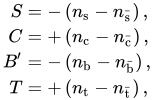
flavour quantum numbers, respectively. They are related to the number of strange, charm, bottom, and top quarks and antiquark according to the relations:
meaning that the Gell-Mann–Nishijima formula is equivalent to the expression of charge in terms of quark content:
Spin, orbital angular momentum, and total angular momentum
[
edit
]
Spin
(quantum number
S
) is a
vector
quantity that represents the "intrinsic"
angular momentum
of a particle. It comes in increments of
1
/
2
ħ
(pronounced "h-bar"). The
ħ
is often dropped because it is the "fundamental" unit of spin, and it is implied that "spin 1" means
"spin 1
ħ
"
. In some systems of
natural units
,
ħ
is chosen to be 1, and therefore does not appear anywhere.
Quarks
are
fermionic
particles of spin
1
/
2
(
S
=
1
/
2
). Because spin projections vary in increments of 1 (that is,
1
ħ
), a single quark has a spin vector of
length
1
/
2
, and has two spin projections (
S
z
= +
1
/
2
and
S
z
= −
1
/
2
). Two quarks can have their spins aligned, in which case the two spin vectors add to make a vector of length
S
= 1
and three spin projections (
S
z
= +1
,
S
z
= 0
, and
S
z
= −1
). If two quarks have unaligned spins, the spin vectors add up to make a vector of length
S
= 0
and has only one spin projection (
S
z
= 0
), etc. Since baryons are made of three quarks, their spin vectors can add to make a vector of length
S
=
3
/
2
, which has four spin projections (
S
z
= +
3
/
2
,
S
z
= +
1
/
2
,
S
z
= −
1
/
2
, and
S
z
= −
3
/
2
), or a vector of length
S
=
1
/
2
with two spin projections (
S
z
= +
1
/
2
, and
S
z
= −
1
/
2
).
[
18
]
There is another quantity of angular momentum, called the
orbital angular momentum
(
azimuthal quantum number
L
), that comes in increments of
1
ħ
, which represent the angular moment due to quarks orbiting around each other. The
total angular momentum
(
total angular momentum quantum number
J
) of a particle is therefore the combination of intrinsic angular momentum (spin) and orbital angular momentum. It can take any value from
J
= |
L
−
S
|
to
J
= |
L
+
S
|
, in increments of 1.
Baryon angular momentum quantum numbers for
L
= 0, 1, 2, 3
Spin,
S
Orbital angular
momentum,
L
Total angular
momentum,
J
Parity
,
P
Condensed
notation,
J
P
1
/
2
0
1
/
2
+
1
/
2
+
1
3
/
2
,
1
/
2
−
3
/
2
−
,
1
/
2
−
2
5
/
2
,
3
/
2
+
5
/
2
+
,
3
/
2
+
3
7
/
2
,
5
/
2
−
7
/
2
−
,
5
/
2
−
3
/
2
0
3
/
2
+
3
/
2
+
1
5
/
2
,
3
/
2
,
1
/
2
−
5
/
2
−
,
3
/
2
−
,
1
/
2
−
2
7
/
2
,
5
/
2
,
3
/
2
,
1
/
2
+
7
/
2
+
,
5
/
2
+
,
3
/
2
+
,
1
/
2
+
3
9
/
2
,
7
/
2
,
5
/
2
,
3
/
2
−
9
/
2
−
,
7
/
2
−
,
5
/
2
−
,
3
/
2
−
Particle physicists are most interested in baryons with no orbital angular momentum (
L
= 0), as they correspond to
ground states
—states of minimal energy. Therefore, the two groups of baryons most studied are the
S
=
1
/
2
;
L
= 0 and
S
=
3
/
2
;
L
= 0, which corresponds to
J
=
1
/
2
+
and
J
=
3
/
2
+
, respectively, although they are not the only ones. It is also possible to obtain
J
=
3
/
2
+
particles from
S
=
1
/
2
and
L
= 2, as well as
S
=
3
/
2
and
L
= 2. This phenomenon of having multiple particles in the same total angular momentum configuration is called
degeneracy
. How to distinguish between these degenerate baryons is an active area of research in
baryon spectroscopy
.
[
19
]
[
20
]
If the universe were reflected in a mirror, most of the laws of physics would be identical—things would behave the same way regardless of what we call "left" and what we call "right". This concept of mirror reflection is called "
intrinsic parity
" or simply "parity" (
P
).
Gravity
, the
electromagnetic force
, and the
strong interaction
all behave in the same way regardless of whether or not the universe is reflected in a mirror, and thus are said to
conserve parity
(P-symmetry). However, the
weak interaction
does distinguish "left" from "right", a phenomenon called
parity violation
(P-violation).
Based on this, if the
wavefunction
for each particle (in more precise terms, the
quantum field
for each particle type) were simultaneously mirror-reversed, then the new set of wavefunctions would perfectly satisfy the laws of physics (apart from the weak interaction). It turns out that this is not quite true: for the equations to be satisfied, the wavefunctions of certain types of particles have to be multiplied by −1, in addition to being mirror-reversed. Such particle types are said to have negative or odd parity (
P
= −1, or alternatively
P
= –), while the other particles are said to have positive or even parity (
P
= +1, or alternatively
P
= +).
For baryons, the parity is related to the orbital angular momentum by the relation:
[
21
]
As a consequence, baryons with no orbital angular momentum (
L
= 0) all have even parity (
P
= +).
Baryons are classified into groups according to their
isospin
(
I
) values and
quark
(
q
) content. There are six groups of baryons:
nucleon
(
N
),
Delta
(
Δ
),
Lambda
(
Λ
),
Sigma
(
Σ
),
Xi
(
Ξ
), and
Omega
(
Ω
). The rules for classification are defined by the
Particle Data Group
. These rules consider the
up
(
u
),
down
(
d
) and
strange
(
s
) quarks to be
light
and the
charm
(
c
),
bottom
(
b
), and
top
(
t
) quarks to be
heavy
. The rules cover all the particles that can be made from three of each of the six quarks, even though baryons made of top quarks are not expected to exist because of the
top quark
's short lifetime. The rules do not cover pentaquarks.
[
22
]
Baryons with (any combination of) three
u
and/or
d
quarks are
N
s (
I
=
1
/
2
) or
Δ
baryons (
I
=
3
/
2
).
Baryons containing two
u
and/or
d
quarks are
Λ
baryons (
I
= 0
) or
Σ
baryons (
I
= 1
). If the third quark is heavy, its identity is given by a subscript.
Baryons containing one
u
or
d
quark are
Ξ
baryons (
I
=
1
/
2
). One or two subscripts are used if one or both of the remaining quarks are heavy.
Baryons containing no
u
or
d
quarks are
Ω
baryons (
I
= 0
), and subscripts indicate any heavy quark content.
Baryons that decay strongly have their masses as part of their names. For example, Σ
0
does not decay strongly, but Δ
++
(1232) does.
It is also a widespread (but not universal) practice to follow some additional rules when distinguishing between some states that would otherwise have the same symbol.
[
17
]
Baryons in
total angular momentum
J
=
3
/
2
configuration that have the same symbols as their
J
=
1
/
2
counterparts are denoted by an asterisk ( * ).
Two baryons can be made of three different quarks in
J
=
1
/
2
configuration. In this case, a prime ( ′ ) is used to distinguish between them.
Exception
: When two of the three quarks are one up and one down quark, one baryon is dubbed Λ while the other is dubbed Σ.
Quarks carry a charge, so knowing the charge of a particle indirectly gives the quark content. For example, the rules above say that a
Λ
+
c
contains a c quark and some combination of two u and/or d quarks. The c quark has a charge of (
Q
= +
2
/
3
), therefore the other two must be a u quark (
Q
= +
2
/
3
), and a d quark (
Q
= −
1
/
3
) to have the correct total charge (
Q
= +1).
Eightfold way
List of baryons
Meson
Timeline of particle discoveries
^
a
b
Gell-Mann (1964)
^
Nakano, Tadao
;
Nishijima, Kazuhiko
(November 1953).
"Charge Independence for
V
-particles"
.
Progress of Theoretical Physics
.
10
(5):
581–
582.
Bibcode
:
1953PThPh..10..581N
.
doi
:
10.1143/PTP.10.581
.
The 'baryon' is the collective name for the members of the nucleon family. This name is due to
Pais
. See ref. (6).
^
Pais 1953
, p. 457 "... it seems practical to have a collective name for these particles and other which possibly may still be discovered and which may also have to be taken along in the conservation principle just mentioned. It is proposed to use the fitting name 'baryon' for this purpose."
^
Shull, Smith & Danforth (2012)
^
MacQuart et al. (2020)
^
Muir (2003)
^
Carter (2006)
^
W.-M. Yao et al. (2006):
Particle listings – Θ
+
^
C. Amsler et al. (2008):
Pentaquarks
^
LHCb (14 July 2015).
"Observation of particles composed of five quarks, pentaquark-charmonium states, seen in
Λ
0
b
→ J/ψpK
−
decays"
.
CERN
. Retrieved
2015-07-14
.
^
Aaij, R.; et al. (
LHCb
collaboration) (2015). "Observation of J/ψp resonances consistent with pentaquark states in
Λ
0
b
→J/ψK
−
p
decays".
Physical Review Letters
.
115
(7) 072001.
arXiv
:
1507.03414
.
Bibcode
:
2015PhRvL.115g2001A
.
doi
:
10.1103/PhysRevLett.115.072001
.
PMID
26317714
.
S2CID
119204136
.
^
"11.3: Particle Conservation Laws"
.
LibreTexts
. November 1, 2016.
Archived
from the original on August 10, 2022
. Retrieved
December 26,
2023
.
^
Heisenberg (1932a)
^
Heisenberg (1932b)
^
Heisenberg (1932c)
^
Wigner (1937)
^
a
b
c
Wong (1998a)
^
Shankar (1994)
.
^
Garcilazo, Vijande & Valcarce (2007)
^
Manley (2005)
^
Wong (1998b)
^
C. Amsler et al. (2008):
Naming scheme for hadrons
MacQuart, J.-P.; Prochaska, J. X.; McQuinn, M.; Bannister, K. W.; Bhandari, S.; Day, C. K.; Deller, A. T.; Ekers, R. D.; James, C. W.; Marnoch, L.; Osłowski, S.; Phillips, C.; Ryder, S. D.; Scott, D. R.; Shannon, R. M.; Tejos, N. (2020). "A census of baryons in the Universe from localized fast radio bursts".
Nature
.
581
(7809):
391–
395.
arXiv
:
2005.13161
.
Bibcode
:
2020Natur.581..391M
.
doi
:
10.1038/s41586-020-2300-2
.
PMID
32461651
.
Shull, J. Michael; Smith, Britton D.; Danforth, Charles W. (2012). "The Baryon Census in a Multiphase Intergalactic Medium: 30% of the Baryons May Still be Missing".
The Astrophysical Journal
.
759
(1): 23.
arXiv
:
1112.2706
.
Bibcode
:
2012ApJ...759...23S
.
doi
:
10.1088/0004-637X/759/1/23
.
C. Amsler et al. (
Particle Data Group
) (2008).
"Review of Particle Physics"
(PDF)
.
Physics Letters B
.
667
(1):
1–
1340.
Bibcode
:
2008PhLB..667....1A
.
doi
:
10.1016/j.physletb.2008.07.018
.
hdl
:
1854/LU-685594
.
PMID
10020536
.
S2CID
227119789
.
Archived
(PDF)
from the original on 2022-10-09.
Garcilazo, H.; Vijande, J. & Valcarce, A. (2007). "Faddeev study of heavy-baryon spectroscopy".
Journal of Physics G
.
34
(5):
961–
976.
arXiv
:
hep-ph/0703257
.
Bibcode
:
2007hep.ph....3257G
.
doi
:
10.1088/0954-3899/34/5/014
.
S2CID
15445714
.
Carter, K. (2006).
"The rise and fall of the pentaquark"
.
Fermilab
and
SLAC
. Archived from
the original
on 2007-07-08
. Retrieved
2008-05-27
.
W.-M. Yao et al. (
Particle Data Group
) (2006). "Review of Particle Physics".
Journal of Physics G
.
33
(1):
1–
1232.
arXiv
:
astro-ph/0601168
.
Bibcode
:
2006JPhG...33....1Y
.
doi
:
10.1088/0954-3899/33/1/001
.
Manley, D.M. (2005).
"Status of baryon spectroscopy"
.
Journal of Physics: Conference Series
.
5
(1):
230–
237.
Bibcode
:
2005JPhCS...9..230M
.
doi
:
10.1088/1742-6596/9/1/043
.
Muir, H. (2003).
"Pentaquark discovery confounds sceptics"
.
New Scientist
. Retrieved
2008-05-27
.
Wong, S.S.M. (1998a). "Chapter 2 – Nucleon Structure".
Introductory Nuclear Physics
(2nd ed.). New York (NY):
John Wiley & Sons
. pp.
21–
56.
ISBN
978-0-471-23973-4
.
Wong, S.S.M. (1998b). "Chapter 3 – The Deuteron".
Introductory Nuclear Physics
(2nd ed.). New York (NY): John Wiley & Sons. pp.
57–
104.
ISBN
978-0-471-23973-4
.
Shankar, R. (1994).
Principles of Quantum Mechanics
(2nd ed.). New York (NY):
Plenum Press
.
ISBN
978-0-306-44790-7
.
Wigner, E. (1937). "On the Consequences of the Symmetry of the Nuclear Hamiltonian on the Spectroscopy of Nuclei".
Physical Review
.
51
(2):
106–
119.
Bibcode
:
1937PhRv...51..106W
.
doi
:
10.1103/PhysRev.51.106
.
Gell-Mann, M. (1964). "A schematic model of baryons and mesons".
Physics Letters
.
8
(3):
214–
215.
Bibcode
:
1964PhL.....8..214G
.
doi
:
10.1016/S0031-9163(64)92001-3
.
Pais, A. (1953).
"On the Baryon-meson-photon System"
.
Progress of Theoretical Physics
.
10
(4):
457–
469.
Bibcode
:
1953PThPh..10..457P
.
doi
:
10.1143/PTP.10.457
.
Heisenberg, W. (1932a). "Über den Bau der Atomkerne I".
Zeitschrift für Physik
(in German).
77
(
1–
2):
1–
11.
Bibcode
:
1932ZPhy...77....1H
.
doi
:
10.1007/BF01342433
.
S2CID
186218053
.
Heisenberg, W. (1932b). "Über den Bau der Atomkerne II".
Zeitschrift für Physik
(in German).
78
(
3–
4):
156–
164.
Bibcode
:
1932ZPhy...78..156H
.
doi
:
10.1007/BF01337585
.
S2CID
186221789
.
Heisenberg, W. (1932c). "Über den Bau der Atomkerne III".
Zeitschrift für Physik
(in German).
80
(
9–
10):
587–
596.
Bibcode
:
1933ZPhy...80..587H
.
doi
:
10.1007/BF01335696
.
S2CID
126422047
.
Particle Data Group—
Review of Particle Physics (2018).
Georgia State University—
HyperPhysics | ||||||
| Markdown | [Jump to content](https://en.wikipedia.org/wiki/Baryon#bodyContent)
Main menu
Main menu
move to sidebar
hide
Navigation
- [Main page](https://en.wikipedia.org/wiki/Main_Page "Visit the main page [z]")
- [Contents](https://en.wikipedia.org/wiki/Wikipedia:Contents "Guides to browsing Wikipedia")
- [Current events](https://en.wikipedia.org/wiki/Portal:Current_events "Articles related to current events")
- [Random article](https://en.wikipedia.org/wiki/Special:Random "Visit a randomly selected article [x]")
- [About Wikipedia](https://en.wikipedia.org/wiki/Wikipedia:About "Learn about Wikipedia and how it works")
- [Contact us](https://en.wikipedia.org/wiki/Wikipedia:Contact_us "How to contact Wikipedia")
Contribute
- [Help](https://en.wikipedia.org/wiki/Help:Contents "Guidance on how to use and edit Wikipedia")
- [Learn to edit](https://en.wikipedia.org/wiki/Help:Introduction "Learn how to edit Wikipedia")
- [Community portal](https://en.wikipedia.org/wiki/Wikipedia:Community_portal "The hub for editors")
- [Recent changes](https://en.wikipedia.org/wiki/Special:RecentChanges "A list of recent changes to Wikipedia [r]")
- [Upload file](https://en.wikipedia.org/wiki/Wikipedia:File_upload_wizard "Add images or other media for use on Wikipedia")
- [Special pages](https://en.wikipedia.org/wiki/Special:SpecialPages "A list of all special pages [q]")
[  ](https://en.wikipedia.org/wiki/Main_Page)
[Search](https://en.wikipedia.org/wiki/Special:Search "Search Wikipedia [f]")
Appearance
- [Donate](https://donate.wikimedia.org/?wmf_source=donate&wmf_medium=sidebar&wmf_campaign=en.wikipedia.org&uselang=en)
- [Create account](https://en.wikipedia.org/w/index.php?title=Special:CreateAccount&returnto=Baryon "You are encouraged to create an account and log in; however, it is not mandatory")
- [Log in](https://en.wikipedia.org/w/index.php?title=Special:UserLogin&returnto=Baryon "You're encouraged to log in; however, it's not mandatory. [o]")
Personal tools
- [Donate](https://donate.wikimedia.org/?wmf_source=donate&wmf_medium=sidebar&wmf_campaign=en.wikipedia.org&uselang=en)
- [Create account](https://en.wikipedia.org/w/index.php?title=Special:CreateAccount&returnto=Baryon "You are encouraged to create an account and log in; however, it is not mandatory")
- [Log in](https://en.wikipedia.org/w/index.php?title=Special:UserLogin&returnto=Baryon "You're encouraged to log in; however, it's not mandatory. [o]")
## Contents
move to sidebar
hide
- [(Top)](https://en.wikipedia.org/wiki/Baryon)
- [1 Background](https://en.wikipedia.org/wiki/Baryon#Background)
- [2 Baryonic matter](https://en.wikipedia.org/wiki/Baryon#Baryonic_matter)
- [3 Baryogenesis](https://en.wikipedia.org/wiki/Baryon#Baryogenesis)
- [4 Properties](https://en.wikipedia.org/wiki/Baryon#Properties)
Toggle Properties subsection
- [4\.1 Isospin and charge](https://en.wikipedia.org/wiki/Baryon#Isospin_and_charge)
- [4\.2 Flavour quantum numbers](https://en.wikipedia.org/wiki/Baryon#Flavour_quantum_numbers)
- [4\.3 Spin, orbital angular momentum, and total angular momentum](https://en.wikipedia.org/wiki/Baryon#Spin,_orbital_angular_momentum,_and_total_angular_momentum)
- [4\.4 Parity](https://en.wikipedia.org/wiki/Baryon#Parity)
- [5 Nomenclature](https://en.wikipedia.org/wiki/Baryon#Nomenclature)
- [6 See also](https://en.wikipedia.org/wiki/Baryon#See_also)
- [7 Citations](https://en.wikipedia.org/wiki/Baryon#Citations)
- [8 Bibliography](https://en.wikipedia.org/wiki/Baryon#Bibliography)
- [9 External links](https://en.wikipedia.org/wiki/Baryon#External_links)
Toggle the table of contents
# Baryon
77 languages
- [Afrikaans](https://af.wikipedia.org/wiki/Barion "Barion – Afrikaans")
- [العربية](https://ar.wikipedia.org/wiki/%D8%A8%D8%A7%D8%B1%D9%8A%D9%88%D9%86 "باريون – Arabic")
- [Asturianu](https://ast.wikipedia.org/wiki/Bari%C3%B3n "Barión – Asturian")
- [Azərbaycanca](https://az.wikipedia.org/wiki/Barion "Barion – Azerbaijani")
- [Беларуская](https://be.wikipedia.org/wiki/%D0%91%D0%B0%D1%80%D1%8B%D1%91%D0%BD "Барыён – Belarusian")
- [Български](https://bg.wikipedia.org/wiki/%D0%91%D0%B0%D1%80%D0%B8%D0%BE%D0%BD "Барион – Bulgarian")
- [বাংলা](https://bn.wikipedia.org/wiki/%E0%A6%AC%E0%A7%8D%E0%A6%AF%E0%A6%BE%E0%A6%B0%E0%A6%BF%E0%A6%AF%E0%A6%BC%E0%A6%A8 "ব্যারিয়ন – Bangla")
- [Bosanski](https://bs.wikipedia.org/wiki/Barion "Barion – Bosnian")
- [Català](https://ca.wikipedia.org/wiki/Bari%C3%B3 "Barió – Catalan")
- [Corsu](https://co.wikipedia.org/wiki/Barionu "Barionu – Corsican")
- [Čeština](https://cs.wikipedia.org/wiki/Baryon "Baryon – Czech")
- [Чӑвашла](https://cv.wikipedia.org/wiki/%D0%91%D0%B0%D1%80%D0%B8%D0%BE%D0%BD "Барион – Chuvash")
- [Cymraeg](https://cy.wikipedia.org/wiki/Baryon "Baryon – Welsh")
- [Deutsch](https://de.wikipedia.org/wiki/Baryon "Baryon – German")
- [Ελληνικά](https://el.wikipedia.org/wiki/%CE%92%CE%B1%CF%81%CF%85%CF%8C%CE%BD%CE%B9%CE%BF "Βαρυόνιο – Greek")
- [Esperanto](https://eo.wikipedia.org/wiki/Bariono "Bariono – Esperanto")
- [Español](https://es.wikipedia.org/wiki/Bari%C3%B3n "Barión – Spanish")
- [Eesti](https://et.wikipedia.org/wiki/Bar%C3%BConid "Barüonid – Estonian")
- [Euskara](https://eu.wikipedia.org/wiki/Barioi "Barioi – Basque")
- [فارسی](https://fa.wikipedia.org/wiki/%D8%A8%D8%A7%D8%B1%DB%8C%D9%88%D9%86 "باریون – Persian")
- [Suomi](https://fi.wikipedia.org/wiki/Baryoni "Baryoni – Finnish")
- [Français](https://fr.wikipedia.org/wiki/Baryon "Baryon – French")
- [Gaeilge](https://ga.wikipedia.org/wiki/Bar%C3%B3n "Barón – Irish")
- [עברית](https://he.wikipedia.org/wiki/%D7%91%D7%90%D7%A8%D7%99%D7%95%D7%9F "באריון – Hebrew")
- [हिन्दी](https://hi.wikipedia.org/wiki/%E0%A4%AC%E0%A5%87%E0%A4%B0%E0%A4%BF%E0%A4%91%E0%A4%A8 "बेरिऑन – Hindi")
- [Hrvatski](https://hr.wikipedia.org/wiki/Barion "Barion – Croatian")
- [Magyar](https://hu.wikipedia.org/wiki/Barion "Barion – Hungarian")
- [Հայերեն](https://hy.wikipedia.org/wiki/%D4%B2%D5%A1%D6%80%D5%AB%D5%B8%D5%B6 "Բարիոն – Armenian")
- [Interlingua](https://ia.wikipedia.org/wiki/Baryon "Baryon – Interlingua")
- [Bahasa Indonesia](https://id.wikipedia.org/wiki/Barion "Barion – Indonesian")
- [Ido](https://io.wikipedia.org/wiki/Bariono "Bariono – Ido")
- [Íslenska](https://is.wikipedia.org/wiki/%C3%9Eungeind "Þungeind – Icelandic")
- [Italiano](https://it.wikipedia.org/wiki/Barione "Barione – Italian")
- [日本語](https://ja.wikipedia.org/wiki/%E3%83%90%E3%83%AA%E3%82%AA%E3%83%B3 "バリオン – Japanese")
- [ქართული](https://ka.wikipedia.org/wiki/%E1%83%91%E1%83%90%E1%83%A0%E1%83%98%E1%83%9D%E1%83%9C%E1%83%98 "ბარიონი – Georgian")
- [Қазақша](https://kk.wikipedia.org/wiki/%D0%91%D0%B0%D1%80%D0%B8%D0%BE%D0%BD "Барион – Kazakh")
- [한국어](https://ko.wikipedia.org/wiki/%EC%A4%91%EC%9E%85%EC%9E%90 "중입자 – Korean")
- [Kurdî](https://ku.wikipedia.org/wiki/Baryon "Baryon – Kurdish")
- [Кыргызча](https://ky.wikipedia.org/wiki/%D0%91%D0%B0%D1%80%D0%B8%D0%BE%D0%BD "Барион – Kyrgyz")
- [Latina](https://la.wikipedia.org/wiki/Baryon "Baryon – Latin")
- [Limburgs](https://li.wikipedia.org/wiki/Baryon "Baryon – Limburgish")
- [Lietuvių](https://lt.wikipedia.org/wiki/Barionas "Barionas – Lithuanian")
- [Latviešu](https://lv.wikipedia.org/wiki/Barioni "Barioni – Latvian")
- [മലയാളം](https://ml.wikipedia.org/wiki/%E0%B4%AC%E0%B5%87%E0%B4%B1%E0%B4%BF%E0%B4%AF%E0%B5%8B%E0%B5%BA "ബേറിയോൺ – Malayalam")
- [Монгол](https://mn.wikipedia.org/wiki/%D0%91%D0%B0%D1%80%D0%B8%D0%BE%D0%BD "Барион – Mongolian")
- [मराठी](https://mr.wikipedia.org/wiki/%E0%A4%AC%E0%A5%85%E0%A4%B0%E0%A4%BF%E0%A4%91%E0%A4%A8 "बॅरिऑन – Marathi")
- [Bahasa Melayu](https://ms.wikipedia.org/wiki/Barion "Barion – Malay")
- [မြန်မာဘာသာ](https://my.wikipedia.org/wiki/%E1%80%98%E1%80%AC%E1%80%9B%E1%80%AE%E1%80%A1%E1%80%BD%E1%80%94%E1%80%BA "ဘာရီအွန် – Burmese")
- [Nederlands](https://nl.wikipedia.org/wiki/Baryon "Baryon – Dutch")
- [Norsk nynorsk](https://nn.wikipedia.org/wiki/Baryon "Baryon – Norwegian Nynorsk")
- [Norsk bokmål](https://no.wikipedia.org/wiki/Baryon "Baryon – Norwegian Bokmål")
- [Occitan](https://oc.wikipedia.org/wiki/Barion "Barion – Occitan")
- [Polski](https://pl.wikipedia.org/wiki/Bariony "Bariony – Polish")
- [پنجابی](https://pnb.wikipedia.org/wiki/%D8%A8%DB%8C%D8%B1%DB%8C%D9%88%D9%86 "بیریون – Western Punjabi")
- [Português](https://pt.wikipedia.org/wiki/B%C3%A1rion "Bárion – Portuguese")
- [Română](https://ro.wikipedia.org/wiki/Barion "Barion – Romanian")
- [Русский](https://ru.wikipedia.org/wiki/%D0%91%D0%B0%D1%80%D0%B8%D0%BE%D0%BD "Барион – Russian")
- [Srpskohrvatski / српскохрватски](https://sh.wikipedia.org/wiki/Barion "Barion – Serbo-Croatian")
- [Simple English](https://simple.wikipedia.org/wiki/Baryon "Baryon – Simple English")
- [Slovenčina](https://sk.wikipedia.org/wiki/Bary%C3%B3n "Baryón – Slovak")
- [Slovenščina](https://sl.wikipedia.org/wiki/Barion "Barion – Slovenian")
- [Српски / srpski](https://sr.wikipedia.org/wiki/Barion "Barion – Serbian")
- [Svenska](https://sv.wikipedia.org/wiki/Baryon "Baryon – Swedish")
- [தமிழ்](https://ta.wikipedia.org/wiki/%E0%AE%AA%E0%AF%87%E0%AE%B0%E0%AE%BF%E0%AE%AF%E0%AE%BE%E0%AE%A9%E0%AF%8D "பேரியான் – Tamil")
- [Тоҷикӣ](https://tg.wikipedia.org/wiki/%D0%91%D0%B0%D1%80%D0%B8%D0%BE%D0%BD "Барион – Tajik")
- [ไทย](https://th.wikipedia.org/wiki/%E0%B9%81%E0%B8%9A%E0%B8%A3%E0%B8%B4%E0%B8%AD%E0%B8%AD%E0%B8%99 "แบริออน – Thai")
- [Türkçe](https://tr.wikipedia.org/wiki/Baryon "Baryon – Turkish")
- [Татарча / tatarça](https://tt.wikipedia.org/wiki/Barion "Barion – Tatar")
- [Українська](https://uk.wikipedia.org/wiki/%D0%91%D0%B0%D1%80%D1%96%D0%BE%D0%BD%D0%B8 "Баріони – Ukrainian")
- [اردو](https://ur.wikipedia.org/wiki/%D8%A8%D8%A7%D8%B1%DB%8C%D9%88%D9%86 "باریون – Urdu")
- [Oʻzbekcha / ўзбекча](https://uz.wikipedia.org/wiki/Barionlar "Barionlar – Uzbek")
- [Tiếng Việt](https://vi.wikipedia.org/wiki/Baryon "Baryon – Vietnamese")
- [Winaray](https://war.wikipedia.org/wiki/Baryon "Baryon – Waray")
- [吴语](https://wuu.wikipedia.org/wiki/%E9%87%8D%E5%AD%90 "重子 – Wu")
- [粵語](https://zh-yue.wikipedia.org/wiki/%E9%87%8D%E5%AD%90 "重子 – Cantonese")
- [中文](https://zh.wikipedia.org/wiki/%E9%87%8D%E5%AD%90 "重子 – Chinese")
- [IsiZulu](https://zu.wikipedia.org/wiki/Inkindisi "Inkindisi – Zulu")
[Edit links](https://www.wikidata.org/wiki/Special:EntityPage/Q159731#sitelinks-wikipedia "Edit interlanguage links")
- [Article](https://en.wikipedia.org/wiki/Baryon "View the content page [c]")
- [Talk](https://en.wikipedia.org/wiki/Talk:Baryon "Discuss improvements to the content page [t]")
English
- [Read](https://en.wikipedia.org/wiki/Baryon)
- [Edit](https://en.wikipedia.org/w/index.php?title=Baryon&action=edit "Edit this page [e]")
- [View history](https://en.wikipedia.org/w/index.php?title=Baryon&action=history "Past revisions of this page [h]")
Tools
Tools
move to sidebar
hide
Actions
- [Read](https://en.wikipedia.org/wiki/Baryon)
- [Edit](https://en.wikipedia.org/w/index.php?title=Baryon&action=edit "Edit this page [e]")
- [View history](https://en.wikipedia.org/w/index.php?title=Baryon&action=history)
General
- [What links here](https://en.wikipedia.org/wiki/Special:WhatLinksHere/Baryon "List of all English Wikipedia pages containing links to this page [j]")
- [Related changes](https://en.wikipedia.org/wiki/Special:RecentChangesLinked/Baryon "Recent changes in pages linked from this page [k]")
- [Upload file](https://en.wikipedia.org/wiki/Wikipedia:File_Upload_Wizard "Upload files [u]")
- [Permanent link](https://en.wikipedia.org/w/index.php?title=Baryon&oldid=1341508409 "Permanent link to this revision of this page")
- [Page information](https://en.wikipedia.org/w/index.php?title=Baryon&action=info "More information about this page")
- [Cite this page](https://en.wikipedia.org/w/index.php?title=Special:CiteThisPage&page=Baryon&id=1341508409&wpFormIdentifier=titleform "Information on how to cite this page")
- [Get shortened URL](https://en.wikipedia.org/w/index.php?title=Special:UrlShortener&url=https%3A%2F%2Fen.wikipedia.org%2Fwiki%2FBaryon)
Print/export
- [Download as PDF](https://en.wikipedia.org/w/index.php?title=Special:DownloadAsPdf&page=Baryon&action=show-download-screen "Download this page as a PDF file")
- [Printable version](https://en.wikipedia.org/w/index.php?title=Baryon&printable=yes "Printable version of this page [p]")
In other projects
- [Wikimedia Commons](https://commons.wikimedia.org/wiki/Category:Baryons)
- [Wikiversity](https://en.wikiversity.org/wiki/Baryons)
- [Wikidata item](https://www.wikidata.org/wiki/Special:EntityPage/Q159731 "Structured data on this page hosted by Wikidata [g]")
Appearance
move to sidebar
hide
From Wikipedia, the free encyclopedia
Hadron (subatomic particle) that is composed of three quarks
"Baryonic" redirects here. For the dinosaur, see [Baryonyx](https://en.wikipedia.org/wiki/Baryonyx "Baryonyx").
| [Standard Model](https://en.wikipedia.org/wiki/Standard_Model "Standard Model") of [particle physics](https://en.wikipedia.org/wiki/Particle_physics "Particle physics") |
|---|
| [Elementary particles](https://en.wikipedia.org/wiki/Elementary_particle "Elementary particle") of the Standard Model |
| Background [Particle physics](https://en.wikipedia.org/wiki/Particle_physics "Particle physics") [Standard Model](https://en.wikipedia.org/wiki/Standard_Model "Standard Model") [Quantum field theory](https://en.wikipedia.org/wiki/Quantum_field_theory "Quantum field theory") [Gauge theory](https://en.wikipedia.org/wiki/Gauge_theory "Gauge theory") [Spontaneous symmetry breaking](https://en.wikipedia.org/wiki/Spontaneous_symmetry_breaking "Spontaneous symmetry breaking") [Higgs mechanism](https://en.wikipedia.org/wiki/Higgs_mechanism "Higgs mechanism") |
| Constituents [Electroweak interaction](https://en.wikipedia.org/wiki/Electroweak_interaction "Electroweak interaction") [Quantum chromodynamics](https://en.wikipedia.org/wiki/Quantum_chromodynamics "Quantum chromodynamics") [CKM matrix](https://en.wikipedia.org/wiki/Cabibbo%E2%80%93Kobayashi%E2%80%93Maskawa_matrix "Cabibbo–Kobayashi–Maskawa matrix") [Standard Model mathematics](https://en.wikipedia.org/wiki/Mathematical_formulation_of_the_Standard_Model "Mathematical formulation of the Standard Model") |
| Limitations [Strong CP problem](https://en.wikipedia.org/wiki/Strong_CP_problem "Strong CP problem") [Hierarchy problem](https://en.wikipedia.org/wiki/Hierarchy_problem "Hierarchy problem") [Neutrino oscillations](https://en.wikipedia.org/wiki/Neutrino_oscillation "Neutrino oscillation") [Physics beyond the Standard Model](https://en.wikipedia.org/wiki/Physics_beyond_the_Standard_Model "Physics beyond the Standard Model") |
| Scientists [Rutherford](https://en.wikipedia.org/wiki/Ernest_Rutherford "Ernest Rutherford") [Thomson](https://en.wikipedia.org/wiki/J._J._Thomson "J. J. Thomson") [Chadwick](https://en.wikipedia.org/wiki/James_Chadwick "James Chadwick") [Bose](https://en.wikipedia.org/wiki/Satyendra_Nath_Bose "Satyendra Nath Bose") [Sudarshan](https://en.wikipedia.org/wiki/E._C._George_Sudarshan "E. C. George Sudarshan") [Davis Jr](https://en.wikipedia.org/wiki/Raymond_Davis_Jr. "Raymond Davis Jr.") [Anderson](https://en.wikipedia.org/wiki/Carl_David_Anderson "Carl David Anderson") [Fermi](https://en.wikipedia.org/wiki/Enrico_Fermi "Enrico Fermi") [Dirac](https://en.wikipedia.org/wiki/Paul_Dirac "Paul Dirac") [Feynman](https://en.wikipedia.org/wiki/Richard_Feynman "Richard Feynman") [Rubbia](https://en.wikipedia.org/wiki/Carlo_Rubbia "Carlo Rubbia") [Gell-Mann](https://en.wikipedia.org/wiki/Murray_Gell-Mann "Murray Gell-Mann") [Kendall](https://en.wikipedia.org/wiki/Henry_Way_Kendall "Henry Way Kendall") [Taylor](https://en.wikipedia.org/wiki/Richard_E._Taylor "Richard E. Taylor") [Friedman](https://en.wikipedia.org/wiki/Jerome_Isaac_Friedman "Jerome Isaac Friedman") [Powell](https://en.wikipedia.org/wiki/C._F._Powell "C. F. Powell") [Anderson](https://en.wikipedia.org/wiki/Philip_Warren_Anderson "Philip Warren Anderson") [Glashow](https://en.wikipedia.org/wiki/Sheldon_Glashow "Sheldon Glashow") [Iliopoulos](https://en.wikipedia.org/wiki/John_Iliopoulos "John Iliopoulos") [Lederman](https://en.wikipedia.org/wiki/Leon_M._Lederman "Leon M. Lederman") [Maiani](https://en.wikipedia.org/wiki/Luciano_Maiani "Luciano Maiani") [Meer](https://en.wikipedia.org/wiki/Simon_van_der_Meer "Simon van der Meer") [Cowan](https://en.wikipedia.org/wiki/Clyde_Cowan "Clyde Cowan") [Nambu](https://en.wikipedia.org/wiki/Yoichiro_Nambu "Yoichiro Nambu") [Chamberlain](https://en.wikipedia.org/wiki/Owen_Chamberlain "Owen Chamberlain") [Cabibbo](https://en.wikipedia.org/wiki/Nicola_Cabibbo "Nicola Cabibbo") [Schwartz](https://en.wikipedia.org/wiki/Melvin_Schwartz "Melvin Schwartz") [Perl](https://en.wikipedia.org/wiki/Martin_Lewis_Perl "Martin Lewis Perl") [Majorana](https://en.wikipedia.org/wiki/Ettore_Majorana "Ettore Majorana") [Weinberg](https://en.wikipedia.org/wiki/Steven_Weinberg "Steven Weinberg") [Lee](https://en.wikipedia.org/wiki/Tsung-Dao_Lee "Tsung-Dao Lee") [Ward](https://en.wikipedia.org/wiki/John_Clive_Ward "John Clive Ward") [Salam](https://en.wikipedia.org/wiki/Abdus_Salam "Abdus Salam") [Kobayashi](https://en.wikipedia.org/wiki/Makoto_Kobayashi_\(physicist\) "Makoto Kobayashi (physicist)") [Maskawa](https://en.wikipedia.org/wiki/Toshihide_Maskawa "Toshihide Maskawa") [Mills](https://en.wikipedia.org/wiki/Robert_Mills_\(physicist\) "Robert Mills (physicist)") [Yang](https://en.wikipedia.org/wiki/Yang_Chen-Ning "Yang Chen-Ning") [Yukawa](https://en.wikipedia.org/wiki/Hideki_Yukawa "Hideki Yukawa") ['t Hooft](https://en.wikipedia.org/wiki/Gerard_%27t_Hooft "Gerard 't Hooft") [Veltman](https://en.wikipedia.org/wiki/Martinus_J._G._Veltman "Martinus J. G. Veltman") [Gross](https://en.wikipedia.org/wiki/David_Gross "David Gross") [Pais](https://en.wikipedia.org/wiki/Abraham_Pais "Abraham Pais") [Pauli](https://en.wikipedia.org/wiki/Wolfgang_Pauli "Wolfgang Pauli") [Politzer](https://en.wikipedia.org/wiki/Hugh_David_Politzer "Hugh David Politzer") [Reines](https://en.wikipedia.org/wiki/Frederick_Reines "Frederick Reines") [Schwinger](https://en.wikipedia.org/wiki/Julian_Schwinger "Julian Schwinger") [Wilczek](https://en.wikipedia.org/wiki/Frank_Wilczek "Frank Wilczek") [Cronin](https://en.wikipedia.org/wiki/James_Cronin "James Cronin") [Fitch](https://en.wikipedia.org/wiki/Val_Logsdon_Fitch "Val Logsdon Fitch") [Vleck](https://en.wikipedia.org/wiki/John_Hasbrouck_Van_Vleck "John Hasbrouck Van Vleck") [Higgs](https://en.wikipedia.org/wiki/Peter_Higgs "Peter Higgs") [Englert](https://en.wikipedia.org/wiki/Fran%C3%A7ois_Englert "François Englert") [Brout](https://en.wikipedia.org/wiki/Robert_Brout "Robert Brout") [Hagen](https://en.wikipedia.org/wiki/C._R._Hagen "C. R. Hagen") [Guralnik](https://en.wikipedia.org/wiki/Gerald_Guralnik "Gerald Guralnik") [Kibble](https://en.wikipedia.org/wiki/Tom_Kibble "Tom Kibble") [de Mayolo](https://en.wikipedia.org/wiki/Santiago_Ant%C3%BAnez_de_Mayolo "Santiago Antúnez de Mayolo") [Lattes](https://en.wikipedia.org/wiki/C%C3%A9sar_Lattes "César Lattes") [Zweig](https://en.wikipedia.org/wiki/George_Zweig "George Zweig") |
| [v](https://en.wikipedia.org/wiki/Template:Standard_model_of_particle_physics "Template:Standard model of particle physics") [t](https://en.wikipedia.org/wiki/Template_talk:Standard_model_of_particle_physics "Template talk:Standard model of particle physics") [e](https://en.wikipedia.org/wiki/Special:EditPage/Template:Standard_model_of_particle_physics "Special:EditPage/Template:Standard model of particle physics") |
In [particle physics](https://en.wikipedia.org/wiki/Particle_physics "Particle physics"), a **baryon** is a type of [composite](https://en.wikipedia.org/wiki/Composite_particle "Composite particle") [subatomic particle](https://en.wikipedia.org/wiki/Subatomic_particle "Subatomic particle") that contains an odd number of [valence quarks](https://en.wikipedia.org/wiki/Valence_quark "Valence quark"), conventionally three.[\[1\]](https://en.wikipedia.org/wiki/Baryon#cite_note-FOOTNOTEGell-Mann1964-1) [Protons](https://en.wikipedia.org/wiki/Proton "Proton") and [neutrons](https://en.wikipedia.org/wiki/Neutron "Neutron") are examples of baryons; because baryons are composed of [quarks](https://en.wikipedia.org/wiki/Quark "Quark"), they belong to the [hadron](https://en.wikipedia.org/wiki/Hadron "Hadron") [family of particles](https://en.wikipedia.org/wiki/List_of_particles "List of particles"). Baryons are also classified as [fermions](https://en.wikipedia.org/wiki/Fermion "Fermion") because they have half-integer [spin](https://en.wikipedia.org/wiki/Spin_\(physics\) "Spin (physics)").
The name "baryon", introduced by [Abraham Pais](https://en.wikipedia.org/wiki/Abraham_Pais "Abraham Pais"),[\[2\]](https://en.wikipedia.org/wiki/Baryon#cite_note-2)[\[3\]](https://en.wikipedia.org/wiki/Baryon#cite_note-3) comes from the [Greek](https://en.wikipedia.org/wiki/Ancient_Greek "Ancient Greek") word for "heavy" (βαρύς, *barýs*), because, at the time of their naming, most known elementary particles had lower masses than the baryons. Each baryon has a corresponding [antiparticle](https://en.wikipedia.org/wiki/Antiparticle "Antiparticle") (antibaryon) where their corresponding [antiquarks](https://en.wikipedia.org/wiki/Quark#Classification "Quark") replace quarks. For example, a [proton](https://en.wikipedia.org/wiki/Proton "Proton") is made of two [up quarks](https://en.wikipedia.org/wiki/Up_quark "Up quark") and one [down quark](https://en.wikipedia.org/wiki/Down_quark "Down quark"); and its corresponding antiparticle, the [antiproton](https://en.wikipedia.org/wiki/Antiproton "Antiproton"), is made of two up antiquarks and one down antiquark.
Baryons participate in the [residual strong force](https://en.wikipedia.org/wiki/Residual_strong_force "Residual strong force"), which is [mediated](https://en.wikipedia.org/wiki/Force_carrier "Force carrier") by particles known as [mesons](https://en.wikipedia.org/wiki/Meson "Meson"). The most familiar baryons are [protons](https://en.wikipedia.org/wiki/Proton "Proton") and [neutrons](https://en.wikipedia.org/wiki/Neutron "Neutron"). These particles make up most of the mass of the visible [matter](https://en.wikipedia.org/wiki/Matter "Matter") in the [universe](https://en.wikipedia.org/wiki/Universe "Universe") and compose the [nucleus](https://en.wikipedia.org/wiki/Atomic_nucleus "Atomic nucleus") of every [atom](https://en.wikipedia.org/wiki/Atom "Atom") ([electrons](https://en.wikipedia.org/wiki/Electron "Electron"), the other major component of the atom, are members of a different family of particles called [leptons](https://en.wikipedia.org/wiki/Lepton "Lepton"); leptons do not interact via the strong force). [Exotic baryons](https://en.wikipedia.org/wiki/Exotic_baryon "Exotic baryon") containing five quarks, called [pentaquarks](https://en.wikipedia.org/wiki/Pentaquark "Pentaquark"), have also been discovered and studied.
A census of the Universe's baryons indicates that 10% of them could be found inside galaxies, 50% to 60% in the [circumgalactic medium](https://en.wiktionary.org/wiki/circumgalactic_medium "wikt:circumgalactic medium"),[\[4\]](https://en.wikipedia.org/wiki/Baryon#cite_note-FOOTNOTEShullSmithDanforth2012-4) and the remaining 30% to 40% could be located in the [warm–hot intergalactic medium](https://en.wikipedia.org/wiki/Warm%E2%80%93hot_intergalactic_medium "Warm–hot intergalactic medium") (WHIM).[\[5\]](https://en.wikipedia.org/wiki/Baryon#cite_note-FOOTNOTEMacQuartProchaskaMcQuinnBannister2020-5)
## Background
\[[edit](https://en.wikipedia.org/w/index.php?title=Baryon&action=edit§ion=1 "Edit section: Background")\]
Baryons are strongly interacting [fermions](https://en.wikipedia.org/wiki/Fermion "Fermion"); that is, they are acted on by the [strong nuclear force](https://en.wikipedia.org/wiki/Strong_nuclear_force "Strong nuclear force") and are described by [Fermi–Dirac statistics](https://en.wikipedia.org/wiki/Fermi%E2%80%93Dirac_statistics "Fermi–Dirac statistics"), which apply to all particles obeying the [Pauli exclusion principle](https://en.wikipedia.org/wiki/Pauli_exclusion_principle "Pauli exclusion principle"). This is in contrast to the [bosons](https://en.wikipedia.org/wiki/Boson "Boson"), which do not obey the exclusion principle.
Baryons, alongside [mesons](https://en.wikipedia.org/wiki/Meson "Meson"), are [hadrons](https://en.wikipedia.org/wiki/Hadron "Hadron"), composite particles composed of [quarks](https://en.wikipedia.org/wiki/Quark "Quark"). Quarks have [baryon numbers](https://en.wikipedia.org/wiki/Baryon_number "Baryon number") of *B* = 1/3 and antiquarks have baryon numbers of *B* = − 1/3. The term "baryon" usually refers to *triquarks*—baryons made of three quarks (*B* = 1/3 + 1/3 + 1/3 = 1).
Other [exotic baryons](https://en.wikipedia.org/wiki/Exotic_baryon "Exotic baryon") have been proposed, such as [pentaquarks](https://en.wikipedia.org/wiki/Pentaquark "Pentaquark")—baryons made of four quarks and one antiquark (*B* = 1/3 + 1/3 + 1/3 + 1/3 − 1/3 = 1),[\[6\]](https://en.wikipedia.org/wiki/Baryon#cite_note-FOOTNOTEMuir2003-6)[\[7\]](https://en.wikipedia.org/wiki/Baryon#cite_note-FOOTNOTECarter2006-7) but their existence is not generally accepted. The particle physics community as a whole did not view their existence as likely in 2006,[\[8\]](https://en.wikipedia.org/wiki/Baryon#cite_note-PDGPentaquarks2006-8) and in 2008, considered evidence to be overwhelmingly against the existence of the reported pentaquarks.[\[9\]](https://en.wikipedia.org/wiki/Baryon#cite_note-PDGPentaquarks2008-9) However, in July 2015, the [LHCb](https://en.wikipedia.org/wiki/LHCb "LHCb") experiment observed two resonances consistent with pentaquark states in the Λ0
b → J/ψK−
p decay, with a combined [statistical significance](https://en.wikipedia.org/wiki/Statistical_significance "Statistical significance") of 15σ.[\[10\]](https://en.wikipedia.org/wiki/Baryon#cite_note-LHCb-public-10)[\[11\]](https://en.wikipedia.org/wiki/Baryon#cite_note-LHCb2015-11)
In theory, heptaquarks (5 quarks, 2 antiquarks), nonaquarks (6 quarks, 3 antiquarks), etc. could also exist.
## Baryonic matter
\[[edit](https://en.wikipedia.org/w/index.php?title=Baryon&action=edit§ion=2 "Edit section: Baryonic matter")\]
Nearly all matter that may be encountered or experienced in everyday life is baryonic [matter](https://en.wikipedia.org/wiki/Matter "Matter"), which includes [atoms](https://en.wikipedia.org/wiki/Atom "Atom") of any sort, and provides them with the property of mass. Non-baryonic matter, as implied by the name, is any sort of matter that is not composed primarily of baryons. This might include [neutrinos](https://en.wikipedia.org/wiki/Neutrino "Neutrino") and free [electrons](https://en.wikipedia.org/wiki/Electron "Electron"), [dark matter](https://en.wikipedia.org/wiki/Dark_matter "Dark matter"), [supersymmetric particles](https://en.wikipedia.org/wiki/Supersymmetry "Supersymmetry"), [axions](https://en.wikipedia.org/wiki/Axion "Axion"), and [black holes](https://en.wikipedia.org/wiki/Black_hole "Black hole").
The very existence of baryons is also a significant issue in cosmology because it is assumed that the Big Bang produced a state with equal amounts of baryons and antibaryons. The process by which baryons came to outnumber their [antiparticles](https://en.wikipedia.org/wiki/Antiparticle "Antiparticle") is called [baryogenesis](https://en.wikipedia.org/wiki/Baryogenesis "Baryogenesis").
## Baryogenesis
\[[edit](https://en.wikipedia.org/w/index.php?title=Baryon&action=edit§ion=3 "Edit section: Baryogenesis")\]
Main article: [Baryogenesis](https://en.wikipedia.org/wiki/Baryogenesis "Baryogenesis")
Experiments are consistent with the number of quarks in the universe being conserved alongside the total [baryon number](https://en.wikipedia.org/wiki/Baryon_number "Baryon number"), with antibaryons being counted as negative quantities.[\[12\]](https://en.wikipedia.org/wiki/Baryon#cite_note-12) Within the prevailing [Standard Model](https://en.wikipedia.org/wiki/Standard_Model "Standard Model") of particle physics, the number of baryons may change in multiples of three due to the action of [sphalerons](https://en.wikipedia.org/wiki/Sphaleron "Sphaleron"), although this is rare and has not been observed under experiment. Some [Grand Unified Theories](https://en.wikipedia.org/wiki/Grand_Unified_Theory "Grand Unified Theory") of particle physics also predict that a single [proton](https://en.wikipedia.org/wiki/Proton "Proton") can [decay](https://en.wikipedia.org/wiki/Proton_decay "Proton decay"), changing the baryon number by one; however, this has not yet been observed under experiment. The excess of baryons over antibaryons in the present universe is thought to be due to non-[conservation of baryon number](https://en.wikipedia.org/wiki/Conservation_of_baryon_number "Conservation of baryon number") in the very early universe, though this is not well understood.
## Properties
\[[edit](https://en.wikipedia.org/w/index.php?title=Baryon&action=edit§ion=4 "Edit section: Properties")\]
### Isospin and charge
\[[edit](https://en.wikipedia.org/w/index.php?title=Baryon&action=edit§ion=5 "Edit section: Isospin and charge")\]
Main article: [Isospin](https://en.wikipedia.org/wiki/Isospin "Isospin")
[](https://en.wikipedia.org/wiki/File:Baryon-decuplet-small.svg)
Combinations of three **[u](https://en.wikipedia.org/wiki/Up_quark "Up quark")**, **[d](https://en.wikipedia.org/wiki/Down_quark "Down quark")** or **[s](https://en.wikipedia.org/wiki/Strange_quark "Strange quark")** quarks forming baryons with a spin-
3/2 form the *[uds baryon decuplet](https://en.wikipedia.org/wiki/Eightfold_way_\(physics\) "Eightfold way (physics)")*
[](https://en.wikipedia.org/wiki/File:Baryon-octet-small.svg)
Combinations of three **[u](https://en.wikipedia.org/wiki/Up_quark "Up quark")**, **[d](https://en.wikipedia.org/wiki/Down_quark "Down quark")** or **[s](https://en.wikipedia.org/wiki/Strange_quark "Strange quark")** quarks forming baryons with a spin-
1/2 form the *[uds baryon octet](https://en.wikipedia.org/wiki/Eightfold_way_\(physics\) "Eightfold way (physics)")*
The concept of isospin was first proposed by [Werner Heisenberg](https://en.wikipedia.org/wiki/Werner_Heisenberg "Werner Heisenberg") in 1932 to explain the similarities between protons and neutrons under the [strong interaction](https://en.wikipedia.org/wiki/Strong_interaction "Strong interaction").[\[13\]](https://en.wikipedia.org/wiki/Baryon#cite_note-FOOTNOTEHeisenberg1932a-13)[\[14\]](https://en.wikipedia.org/wiki/Baryon#cite_note-FOOTNOTEHeisenberg1932b-14)[\[15\]](https://en.wikipedia.org/wiki/Baryon#cite_note-FOOTNOTEHeisenberg1932c-15) Although they had different electric charges, their masses were so similar that physicists believed they were the same particle. The different electric charges were explained as being the result of some unknown excitation similar to spin. This unknown excitation was later dubbed *isospin* by [Eugene Wigner](https://en.wikipedia.org/wiki/Eugene_Wigner "Eugene Wigner") in 1937.[\[16\]](https://en.wikipedia.org/wiki/Baryon#cite_note-FOOTNOTEWigner1937-16)
This belief lasted until [Murray Gell-Mann](https://en.wikipedia.org/wiki/Murray_Gell-Mann "Murray Gell-Mann") proposed the [quark model](https://en.wikipedia.org/wiki/Quark_model "Quark model") in 1964 (containing originally only the u, d, and s quarks).[\[1\]](https://en.wikipedia.org/wiki/Baryon#cite_note-FOOTNOTEGell-Mann1964-1) The success of the isospin model is now understood to be the result of the similar masses of u and d quarks. Since u and d quarks have similar masses, particles made of the same number then also have similar masses. The exact specific u and d quark composition determines the charge, as u quarks carry charge +2/3 while d quarks carry charge −1/3. For example, the four [Deltas](https://en.wikipedia.org/wiki/Delta_baryon "Delta baryon") all have different charges (Δ\++
(uuu), Δ\+
(uud), Δ0
(udd), Δ−
(ddd)), but have similar masses (~1,232 MeV/*c*2) as they are each made of a combination of three u or d quarks. Under the isospin model, they were considered to be a single particle in different charged states.
The mathematics of isospin was modeled after that of spin. Isospin projections varied in increments of 1 just like those of spin, and to each projection was associated a "[charged state](https://en.wikipedia.org/wiki/Quantum_state "Quantum state")". Since the "[Delta particle](https://en.wikipedia.org/wiki/Delta_baryon "Delta baryon")" had four "charged states", it was said to be of isospin *I* = 3/2. Its "charged states" Δ\++
, Δ\+
, Δ0
, and Δ−
, corresponded to the isospin projections *I*3 = +3/2, *I*3 = +1/2, *I*3 = −1/2, and *I*3 = −3/2, respectively. Another example is the "nucleon particle". As there were two nucleon "charged states", it was said to be of isospin 1/2. The positive nucleon N\+
(proton) was identified with *I*3 = +1/2 and the neutral nucleon N0
(neutron) with *I*3 = −1/2.[\[17\]](https://en.wikipedia.org/wiki/Baryon#cite_note-FOOTNOTEWong1998a-17) It was later noted that the isospin projections were related to the up and down quark content of particles by the relation:
I
3
\=
1
2
\[
(
n
u
−
n
u
¯
)
−
(
n
d
−
n
d
¯
)
\]
,
{\\displaystyle I\_{\\mathrm {3} }={\\frac {1}{2}}\[(n\_{\\mathrm {u} }-n\_{\\mathrm {\\bar {u}} })-(n\_{\\mathrm {d} }-n\_{\\mathrm {\\bar {d}} })\],}
![{\\displaystyle I\_{\\mathrm {3} }={\\frac {1}{2}}\[(n\_{\\mathrm {u} }-n\_{\\mathrm {\\bar {u}} })-(n\_{\\mathrm {d} }-n\_{\\mathrm {\\bar {d}} })\],}](https://wikimedia.org/api/rest_v1/media/math/render/svg/9ee3958c17cfa816641e621b04abfbd8fd88689a)
where the *n* is the number of up and down quarks and antiquarks.
In the "isospin picture", the four Deltas and the two nucleons were thought to be the different states of two particles. However, in the quark model, Deltas are different states of nucleons (the N\++ or N− are forbidden by [Pauli's exclusion principle](https://en.wikipedia.org/wiki/Pauli%27s_exclusion_principle "Pauli's exclusion principle")). Isospin, although conveying an inaccurate picture of things, is still used to classify baryons, leading to unnatural and often confusing nomenclature.
### Flavour quantum numbers
\[[edit](https://en.wikipedia.org/w/index.php?title=Baryon&action=edit§ion=6 "Edit section: Flavour quantum numbers")\]
Main article: [Flavour (particle physics) § Flavour quantum numbers](https://en.wikipedia.org/wiki/Flavour_\(particle_physics\)#Flavour_quantum_numbers "Flavour (particle physics)")
The [strangeness](https://en.wikipedia.org/wiki/Strangeness "Strangeness") [flavour quantum number](https://en.wikipedia.org/wiki/Flavour_\(particle_physics\)#Flavour_quantum_numbers "Flavour (particle physics)") *S* (not to be confused with spin) was noticed to go up and down along with particle mass. The higher the mass, the lower the strangeness (the more s quarks). Particles could be described with isospin projections (related to charge) and strangeness (mass) (see the uds [octet](https://en.wikipedia.org/wiki/Eightfold_way_\(physics\)#Baryon_octet "Eightfold way (physics)") and [decuplet](https://en.wikipedia.org/wiki/Eightfold_way_\(physics\)#Baryon_decuplet "Eightfold way (physics)") figures on the right). As other quarks were discovered, new quantum numbers were made to have similar description of udc and udb octets and decuplets. Since only the u and d mass are similar, this description of particle mass and charge in terms of isospin and flavour quantum numbers works well only for octet and decuplet made of one u, one d, and one other quark, and breaks down for the other octets and decuplets (for example, ucb octet and decuplet). If the quarks all had the same mass, their behaviour would be called *symmetric*, as they would all behave in the same way to the strong interaction. Since quarks do not have the same mass, they do not interact in the same way (exactly like an electron placed in an electric field will accelerate more than a proton placed in the same field because of its lighter mass), and the symmetry is said to be [broken](https://en.wikipedia.org/wiki/Broken_symmetry "Broken symmetry").
It was noted that charge (*Q*) was related to the isospin projection (*I*3), the [baryon number](https://en.wikipedia.org/wiki/Baryon_number "Baryon number") (*B*) and flavour quantum numbers (*S*, *C*, *B*′, *T*) by the [Gell-Mann–Nishijima formula](https://en.wikipedia.org/wiki/Gell-Mann%E2%80%93Nishijima_formula "Gell-Mann–Nishijima formula"):[\[17\]](https://en.wikipedia.org/wiki/Baryon#cite_note-FOOTNOTEWong1998a-17)
Q
\=
I
3
\+
1
2
(
B
\+
S
\+
C
\+
B
′
\+
T
)
,
{\\displaystyle Q=I\_{3}+{\\frac {1}{2}}\\left(B+S+C+B^{\\prime }+T\\right),}

where *S*, *C*, *B*′, and *T* represent the [strangeness](https://en.wikipedia.org/wiki/Strangeness "Strangeness"), [charm](https://en.wikipedia.org/wiki/Charm_\(quantum_number\) "Charm (quantum number)"), [bottomness](https://en.wikipedia.org/wiki/Bottomness "Bottomness") and [topness](https://en.wikipedia.org/wiki/Topness "Topness") flavour quantum numbers, respectively. They are related to the number of strange, charm, bottom, and top quarks and antiquark according to the relations:
S
\=
−
(
n
s
−
n
s
¯
)
,
C
\=
\+
(
n
c
−
n
c
¯
)
,
B
′
\=
−
(
n
b
−
n
b
¯
)
,
T
\=
\+
(
n
t
−
n
t
¯
)
,
{\\displaystyle {\\begin{aligned}S&=-\\left(n\_{\\mathrm {s} }-n\_{\\mathrm {\\bar {s}} }\\right),\\\\C&=+\\left(n\_{\\mathrm {c} }-n\_{\\mathrm {\\bar {c}} }\\right),\\\\B^{\\prime }&=-\\left(n\_{\\mathrm {b} }-n\_{\\mathrm {\\bar {b}} }\\right),\\\\T&=+\\left(n\_{\\mathrm {t} }-n\_{\\mathrm {\\bar {t}} }\\right),\\end{aligned}}}
meaning that the Gell-Mann–Nishijima formula is equivalent to the expression of charge in terms of quark content:
Q
\=
2
3
\[
(
n
u
−
n
u
¯
)
\+
(
n
c
−
n
c
¯
)
\+
(
n
t
−
n
t
¯
)
\]
−
1
3
\[
(
n
d
−
n
d
¯
)
\+
(
n
s
−
n
s
¯
)
\+
(
n
b
−
n
b
¯
)
\]
.
{\\displaystyle Q={\\frac {2}{3}}\\left\[(n\_{\\mathrm {u} }-n\_{\\mathrm {\\bar {u}} })+(n\_{\\mathrm {c} }-n\_{\\mathrm {\\bar {c}} })+(n\_{\\mathrm {t} }-n\_{\\mathrm {\\bar {t}} })\\right\]-{\\frac {1}{3}}\\left\[(n\_{\\mathrm {d} }-n\_{\\mathrm {\\bar {d}} })+(n\_{\\mathrm {s} }-n\_{\\mathrm {\\bar {s}} })+(n\_{\\mathrm {b} }-n\_{\\mathrm {\\bar {b}} })\\right\].}
![{\\displaystyle Q={\\frac {2}{3}}\\left\[(n\_{\\mathrm {u} }-n\_{\\mathrm {\\bar {u}} })+(n\_{\\mathrm {c} }-n\_{\\mathrm {\\bar {c}} })+(n\_{\\mathrm {t} }-n\_{\\mathrm {\\bar {t}} })\\right\]-{\\frac {1}{3}}\\left\[(n\_{\\mathrm {d} }-n\_{\\mathrm {\\bar {d}} })+(n\_{\\mathrm {s} }-n\_{\\mathrm {\\bar {s}} })+(n\_{\\mathrm {b} }-n\_{\\mathrm {\\bar {b}} })\\right\].}](https://wikimedia.org/api/rest_v1/media/math/render/svg/5177c7c0336b28e10854a00aff1dd2744641f728)
### Spin, orbital angular momentum, and total angular momentum
\[[edit](https://en.wikipedia.org/w/index.php?title=Baryon&action=edit§ion=7 "Edit section: Spin, orbital angular momentum, and total angular momentum")\]
Main articles: [Spin (physics)](https://en.wikipedia.org/wiki/Spin_\(physics\) "Spin (physics)"), [Angular momentum operator](https://en.wikipedia.org/wiki/Angular_momentum_operator "Angular momentum operator"), [Quantum numbers](https://en.wikipedia.org/wiki/Quantum_numbers "Quantum numbers"), and [Clebsch–Gordan coefficients](https://en.wikipedia.org/wiki/Clebsch%E2%80%93Gordan_coefficients "Clebsch–Gordan coefficients")
[Spin](https://en.wikipedia.org/wiki/Spin_\(physics\) "Spin (physics)") (quantum number *S*) is a [vector](https://en.wikipedia.org/wiki/Euclidean_vector "Euclidean vector") quantity that represents the "intrinsic" [angular momentum](https://en.wikipedia.org/wiki/Angular_momentum "Angular momentum") of a particle. It comes in increments of 1/2 [*ħ*](https://en.wikipedia.org/wiki/Planck_constant "Planck constant") (pronounced "h-bar"). The *ħ* is often dropped because it is the "fundamental" unit of spin, and it is implied that "spin 1" means "spin 1 *ħ*". In some systems of [natural units](https://en.wikipedia.org/wiki/Natural_units "Natural units"), *ħ* is chosen to be 1, and therefore does not appear anywhere.
[Quarks](https://en.wikipedia.org/wiki/Quark "Quark") are [fermionic](https://en.wikipedia.org/wiki/Fermion "Fermion") particles of spin 1/2 (*S* = 1/2). Because spin projections vary in increments of 1 (that is, 1 *ħ*), a single quark has a spin vector of length 1/2, and has two spin projections (*S*z = + 1/2 and *S*z = − 1/2). Two quarks can have their spins aligned, in which case the two spin vectors add to make a vector of length *S* = 1 and three spin projections (*S*z = +1, *S*z = 0, and *S*z = −1). If two quarks have unaligned spins, the spin vectors add up to make a vector of length *S* = 0 and has only one spin projection (*S*z = 0), etc. Since baryons are made of three quarks, their spin vectors can add to make a vector of length *S* = 3/2, which has four spin projections (*S*z = + 3/2, *S*z = + 1/2, *S*z = − 1/2, and *S*z = − 3/2), or a vector of length *S* = 1/2 with two spin projections (*S*z = + 1/2, and *S*z = − 1/2).[\[18\]](https://en.wikipedia.org/wiki/Baryon#cite_note-FOOTNOTEShankar1994-18)
There is another quantity of angular momentum, called the [orbital angular momentum](https://en.wikipedia.org/wiki/Angular_momentum_operator "Angular momentum operator") ([azimuthal quantum number](https://en.wikipedia.org/wiki/Azimuthal_quantum_number "Azimuthal quantum number") L), that comes in increments of 1 *ħ*, which represent the angular moment due to quarks orbiting around each other. The [total angular momentum](https://en.wikipedia.org/wiki/Angular_momentum_operator "Angular momentum operator") ([total angular momentum quantum number](https://en.wikipedia.org/wiki/Total_angular_momentum_quantum_number "Total angular momentum quantum number") *J*) of a particle is therefore the combination of intrinsic angular momentum (spin) and orbital angular momentum. It can take any value from *J* = \|*L* − *S*\| to *J* = \|*L* + *S*\|, in increments of 1.
| Spin, *S* | Orbital angular momentum, *L* | Total angular momentum, *J* | [Parity](https://en.wikipedia.org/wiki/Baryon#Parity), *P* | Condensed notation, *J**P* |
|---|---|---|---|---|
| 1/2 | 0 | 1/2 | \+ | 1/2\+ |
| 1 | 3/2, 1/2 | − | 3/2−, 1/2− | |
| 2 | 5/2, 3/2 | \+ | 5/2\+, 3/2\+ | |
| 3 | 7/2, 5/2 | − | 7/2−, 5/2− | |
| 3/2 | 0 | 3/2 | \+ | 3/2\+ |
| 1 | 5/2, 3/2, 1/2 | − | 5/2−, 3/2−, 1/2− | |
| 2 | 7/2, 5/2, 3/2, 1/2 | \+ | 7/2\+, 5/2\+, 3/2\+, 1/2\+ | |
| 3 | 9/2, 7/2, 5/2, 3/2 | − | 9/2−, 7/2−, 5/2−, 3/2− | |
Particle physicists are most interested in baryons with no orbital angular momentum (*L* = 0), as they correspond to [ground states](https://en.wikipedia.org/wiki/Ground_state "Ground state")—states of minimal energy. Therefore, the two groups of baryons most studied are the *S* = 1/2; *L* = 0 and *S* = 3/2; *L* = 0, which corresponds to *J* = 1/2\+ and *J* = 3/2\+, respectively, although they are not the only ones. It is also possible to obtain *J* = 3/2\+ particles from *S* = 1/2 and *L* = 2, as well as *S* = 3/2 and *L* = 2. This phenomenon of having multiple particles in the same total angular momentum configuration is called *[degeneracy](https://en.wikipedia.org/wiki/Degenerate_energy_level "Degenerate energy level")*. How to distinguish between these degenerate baryons is an active area of research in [baryon spectroscopy](https://en.wikipedia.org/wiki/Baryon_spectroscopy "Baryon spectroscopy").[\[19\]](https://en.wikipedia.org/wiki/Baryon#cite_note-FOOTNOTEGarcilazoVijandeValcarce2007-19)[\[20\]](https://en.wikipedia.org/wiki/Baryon#cite_note-FOOTNOTEManley2005-20)
### Parity
\[[edit](https://en.wikipedia.org/w/index.php?title=Baryon&action=edit§ion=8 "Edit section: Parity")\]
Main article: [Parity (physics)](https://en.wikipedia.org/wiki/Parity_\(physics\) "Parity (physics)")
If the universe were reflected in a mirror, most of the laws of physics would be identical—things would behave the same way regardless of what we call "left" and what we call "right". This concept of mirror reflection is called "[intrinsic parity](https://en.wikipedia.org/wiki/Parity_\(physics\) "Parity (physics)")" or simply "parity" (*P*). [Gravity](https://en.wikipedia.org/wiki/Gravity "Gravity"), the [electromagnetic force](https://en.wikipedia.org/wiki/Electromagnetic_force "Electromagnetic force"), and the [strong interaction](https://en.wikipedia.org/wiki/Strong_interaction "Strong interaction") all behave in the same way regardless of whether or not the universe is reflected in a mirror, and thus are said to [conserve parity](https://en.wikipedia.org/wiki/P-symmetry "P-symmetry") (P-symmetry). However, the [weak interaction](https://en.wikipedia.org/wiki/Weak_interaction "Weak interaction") does distinguish "left" from "right", a phenomenon called [parity violation](https://en.wikipedia.org/wiki/Parity_violation "Parity violation") (P-violation).
Based on this, if the [wavefunction](https://en.wikipedia.org/wiki/Wavefunction "Wavefunction") for each particle (in more precise terms, the [quantum field](https://en.wikipedia.org/wiki/Quantum_field "Quantum field") for each particle type) were simultaneously mirror-reversed, then the new set of wavefunctions would perfectly satisfy the laws of physics (apart from the weak interaction). It turns out that this is not quite true: for the equations to be satisfied, the wavefunctions of certain types of particles have to be multiplied by −1, in addition to being mirror-reversed. Such particle types are said to have negative or odd parity (*P* = −1, or alternatively *P* = –), while the other particles are said to have positive or even parity (*P* = +1, or alternatively *P* = +).
For baryons, the parity is related to the orbital angular momentum by the relation:[\[21\]](https://en.wikipedia.org/wiki/Baryon#cite_note-FOOTNOTEWong1998b-21)
P
\=
(
−
1
)
L
.
{\\displaystyle P=(-1)^{L}.}

As a consequence, baryons with no orbital angular momentum (*L* = 0) all have even parity (*P* = +).
## Nomenclature
\[[edit](https://en.wikipedia.org/w/index.php?title=Baryon&action=edit§ion=9 "Edit section: Nomenclature")\]
Baryons are classified into groups according to their [isospin](https://en.wikipedia.org/wiki/Isospin "Isospin") (*I*) values and [quark](https://en.wikipedia.org/wiki/Quark "Quark") (*q*) content. There are six groups of baryons: [nucleon](https://en.wikipedia.org/wiki/Nucleon "Nucleon") (N), [Delta](https://en.wikipedia.org/wiki/Delta_baryon "Delta baryon") (Δ), [Lambda](https://en.wikipedia.org/wiki/Lambda_baryon "Lambda baryon") (Λ), [Sigma](https://en.wikipedia.org/wiki/Sigma_baryon "Sigma baryon") (Σ), [Xi](https://en.wikipedia.org/wiki/Xi_baryon "Xi baryon") (Ξ), and [Omega](https://en.wikipedia.org/wiki/Omega_baryon "Omega baryon") (Ω). The rules for classification are defined by the [Particle Data Group](https://en.wikipedia.org/wiki/Particle_Data_Group "Particle Data Group"). These rules consider the [up](https://en.wikipedia.org/wiki/Up_quark "Up quark") (u), [down](https://en.wikipedia.org/wiki/Down_quark "Down quark") (d) and [strange](https://en.wikipedia.org/wiki/Strange_quark "Strange quark") (s) quarks to be *light* and the [charm](https://en.wikipedia.org/wiki/Charm_quark "Charm quark") (c), [bottom](https://en.wikipedia.org/wiki/Bottom_quark "Bottom quark") (b), and [top](https://en.wikipedia.org/wiki/Top_quark "Top quark") (t) quarks to be *heavy*. The rules cover all the particles that can be made from three of each of the six quarks, even though baryons made of top quarks are not expected to exist because of the [top quark](https://en.wikipedia.org/wiki/Top_quark "Top quark")'s short lifetime. The rules do not cover pentaquarks.[\[22\]](https://en.wikipedia.org/wiki/Baryon#cite_note-PDGBaryonsymbols-22)
- Baryons with (any combination of) three [u](https://en.wikipedia.org/wiki/Up_quark "Up quark") and/or [d](https://en.wikipedia.org/wiki/Down_quark "Down quark") quarks are [N](https://en.wikipedia.org/wiki/Nucleon "Nucleon")s (
*I* =
1/2
) or [Δ](https://en.wikipedia.org/wiki/Delta_baryon "Delta baryon") baryons (
*I* =
3/2
).
- Baryons containing two [u](https://en.wikipedia.org/wiki/Up_quark "Up quark") and/or [d](https://en.wikipedia.org/wiki/Down_quark "Down quark") quarks are [Λ](https://en.wikipedia.org/wiki/Lambda_baryon "Lambda baryon") baryons (*I* = 0) or [Σ](https://en.wikipedia.org/wiki/Sigma_baryon "Sigma baryon") baryons (*I* = 1). If the third quark is heavy, its identity is given by a subscript.
- Baryons containing one [u](https://en.wikipedia.org/wiki/Up_quark "Up quark") or [d](https://en.wikipedia.org/wiki/Down_quark "Down quark") quark are [Ξ](https://en.wikipedia.org/wiki/Xi_baryon "Xi baryon") baryons (
*I* =
1/2
). One or two subscripts are used if one or both of the remaining quarks are heavy.
- Baryons containing no [u](https://en.wikipedia.org/wiki/Up_quark "Up quark") or [d](https://en.wikipedia.org/wiki/Down_quark "Down quark") quarks are [Ω](https://en.wikipedia.org/wiki/Omega_baryon "Omega baryon") baryons (*I* = 0), and subscripts indicate any heavy quark content.
- Baryons that decay strongly have their masses as part of their names. For example, Σ0 does not decay strongly, but Δ\++(1232) does.
It is also a widespread (but not universal) practice to follow some additional rules when distinguishing between some states that would otherwise have the same symbol.[\[17\]](https://en.wikipedia.org/wiki/Baryon#cite_note-FOOTNOTEWong1998a-17)
- Baryons in [total angular momentum](https://en.wikipedia.org/wiki/Total_angular_momentum "Total angular momentum") *J* =
3/2 configuration that have the same symbols as their *J* =
1/2 counterparts are denoted by an asterisk ( \* ).
- Two baryons can be made of three different quarks in *J* =
1/2 configuration. In this case, a prime ( ′ ) is used to distinguish between them.
- *Exception*: When two of the three quarks are one up and one down quark, one baryon is dubbed Λ while the other is dubbed Σ.
Quarks carry a charge, so knowing the charge of a particle indirectly gives the quark content. For example, the rules above say that a Λ\+
c contains a c quark and some combination of two u and/or d quarks. The c quark has a charge of (*Q* = +2/3), therefore the other two must be a u quark (*Q* = +2/3), and a d quark (*Q* = −1/3) to have the correct total charge (*Q* = +1).
## See also
\[[edit](https://en.wikipedia.org/w/index.php?title=Baryon&action=edit§ion=10 "Edit section: See also")\]
- [Eightfold way](https://en.wikipedia.org/wiki/Eightfold_way_\(physics\) "Eightfold way (physics)")
- [List of baryons](https://en.wikipedia.org/wiki/List_of_baryons "List of baryons")
- [Meson](https://en.wikipedia.org/wiki/Meson "Meson")
- [Timeline of particle discoveries](https://en.wikipedia.org/wiki/Timeline_of_particle_discoveries "Timeline of particle discoveries")
## Citations
\[[edit](https://en.wikipedia.org/w/index.php?title=Baryon&action=edit§ion=11 "Edit section: Citations")\]
1. ^ [***a***](https://en.wikipedia.org/wiki/Baryon#cite_ref-FOOTNOTEGell-Mann1964_1-0) [***b***](https://en.wikipedia.org/wiki/Baryon#cite_ref-FOOTNOTEGell-Mann1964_1-1) [Gell-Mann (1964)](https://en.wikipedia.org/wiki/Baryon#CITEREFGell-Mann1964)
2. **[^](https://en.wikipedia.org/wiki/Baryon#cite_ref-2)**
[Nakano, Tadao](https://en.wikipedia.org/w/index.php?title=Tadao_Nakano&action=edit&redlink=1 "Tadao Nakano (page does not exist)"); [Nishijima, Kazuhiko](https://en.wikipedia.org/wiki/Kazuhiko_Nishijima "Kazuhiko Nishijima") (November 1953). ["Charge Independence for *V*\-particles"](https://doi.org/10.1143%2FPTP.10.581). *Progress of Theoretical Physics*. **10** (5): 581–582\. [Bibcode](https://en.wikipedia.org/wiki/Bibcode_\(identifier\) "Bibcode (identifier)"):[1953PThPh..10..581N](https://ui.adsabs.harvard.edu/abs/1953PThPh..10..581N). [doi](https://en.wikipedia.org/wiki/Doi_\(identifier\) "Doi (identifier)"):[10\.1143/PTP.10.581](https://doi.org/10.1143%2FPTP.10.581). "The 'baryon' is the collective name for the members of the nucleon family. This name is due to [Pais](https://en.wikipedia.org/wiki/Abraham_Pais "Abraham Pais"). See ref. (6)."
3. **[^](https://en.wikipedia.org/wiki/Baryon#cite_ref-3)** [Pais 1953](https://en.wikipedia.org/wiki/Baryon#CITEREFPais1953), p. 457 "... it seems practical to have a collective name for these particles and other which possibly may still be discovered and which may also have to be taken along in the conservation principle just mentioned. It is proposed to use the fitting name 'baryon' for this purpose."
4. **[^](https://en.wikipedia.org/wiki/Baryon#cite_ref-FOOTNOTEShullSmithDanforth2012_4-0)** [Shull, Smith & Danforth (2012)](https://en.wikipedia.org/wiki/Baryon#CITEREFShullSmithDanforth2012)
5. **[^](https://en.wikipedia.org/wiki/Baryon#cite_ref-FOOTNOTEMacQuartProchaskaMcQuinnBannister2020_5-0)** [MacQuart et al. (2020)](https://en.wikipedia.org/wiki/Baryon#CITEREFMacQuartProchaskaMcQuinnBannister2020)
6. **[^](https://en.wikipedia.org/wiki/Baryon#cite_ref-FOOTNOTEMuir2003_6-0)** [Muir (2003)](https://en.wikipedia.org/wiki/Baryon#CITEREFMuir2003)
7. **[^](https://en.wikipedia.org/wiki/Baryon#cite_ref-FOOTNOTECarter2006_7-0)** [Carter (2006)](https://en.wikipedia.org/wiki/Baryon#CITEREFCarter2006)
8. **[^](https://en.wikipedia.org/wiki/Baryon#cite_ref-PDGPentaquarks2006_8-0)** W.-M. Yao et al. (2006): [Particle listings – Θ\+](http://pdg.lbl.gov/2006/reviews/theta_b152.pdf)
9. **[^](https://en.wikipedia.org/wiki/Baryon#cite_ref-PDGPentaquarks2008_9-0)** C. Amsler et al. (2008): [Pentaquarks](http://pdg.lbl.gov/2008/reviews/pentaquarks_b801.pdf)
10. **[^](https://en.wikipedia.org/wiki/Baryon#cite_ref-LHCb-public_10-0)**
LHCb (14 July 2015). ["Observation of particles composed of five quarks, pentaquark-charmonium states, seen in Λ0 b → J/ψpK− decays"](http://lhcb-public.web.cern.ch/lhcb-public/Welcome.html#Penta). [CERN](https://en.wikipedia.org/wiki/CERN "CERN"). Retrieved 2015-07-14.
11. **[^](https://en.wikipedia.org/wiki/Baryon#cite_ref-LHCb2015_11-0)**
Aaij, R.; et al. ([LHCb](https://en.wikipedia.org/wiki/LHCb "LHCb") collaboration) (2015). "Observation of J/ψp resonances consistent with pentaquark states in Λ0
b→J/ψK−p decays". *[Physical Review Letters](https://en.wikipedia.org/wiki/Physical_Review_Letters "Physical Review Letters")*. **115** (7) 072001. [arXiv](https://en.wikipedia.org/wiki/ArXiv_\(identifier\) "ArXiv (identifier)"):[1507\.03414](https://arxiv.org/abs/1507.03414). [Bibcode](https://en.wikipedia.org/wiki/Bibcode_\(identifier\) "Bibcode (identifier)"):[2015PhRvL.115g2001A](https://ui.adsabs.harvard.edu/abs/2015PhRvL.115g2001A). [doi](https://en.wikipedia.org/wiki/Doi_\(identifier\) "Doi (identifier)"):[10\.1103/PhysRevLett.115.072001](https://doi.org/10.1103%2FPhysRevLett.115.072001). [PMID](https://en.wikipedia.org/wiki/PMID_\(identifier\) "PMID (identifier)") [26317714](https://pubmed.ncbi.nlm.nih.gov/26317714). [S2CID](https://en.wikipedia.org/wiki/S2CID_\(identifier\) "S2CID (identifier)") [119204136](https://api.semanticscholar.org/CorpusID:119204136).
12. **[^](https://en.wikipedia.org/wiki/Baryon#cite_ref-12)**
["11.3: Particle Conservation Laws"](https://phys.libretexts.org/Bookshelves/University_Physics/Book%3A_University_Physics_\(OpenStax\)/University_Physics_III_-_Optics_and_Modern_Physics_\(OpenStax\)/11%3A_Particle_Physics_and_Cosmology/11.03%3A_Particle_Conservation_Laws). *[LibreTexts](https://en.wikipedia.org/wiki/LibreTexts "LibreTexts")*. November 1, 2016. [Archived](https://web.archive.org/web/20220810163918/https://phys.libretexts.org/Bookshelves/University_Physics/Book%3A_University_Physics_\(OpenStax\)/University_Physics_III_-_Optics_and_Modern_Physics_\(OpenStax\)/11%3A_Particle_Physics_and_Cosmology/11.03%3A_Particle_Conservation_Laws) from the original on August 10, 2022. Retrieved December 26, 2023.
13. **[^](https://en.wikipedia.org/wiki/Baryon#cite_ref-FOOTNOTEHeisenberg1932a_13-0)** [Heisenberg (1932a)](https://en.wikipedia.org/wiki/Baryon#CITEREFHeisenberg1932a)
14. **[^](https://en.wikipedia.org/wiki/Baryon#cite_ref-FOOTNOTEHeisenberg1932b_14-0)** [Heisenberg (1932b)](https://en.wikipedia.org/wiki/Baryon#CITEREFHeisenberg1932b)
15. **[^](https://en.wikipedia.org/wiki/Baryon#cite_ref-FOOTNOTEHeisenberg1932c_15-0)** [Heisenberg (1932c)](https://en.wikipedia.org/wiki/Baryon#CITEREFHeisenberg1932c)
16. **[^](https://en.wikipedia.org/wiki/Baryon#cite_ref-FOOTNOTEWigner1937_16-0)** [Wigner (1937)](https://en.wikipedia.org/wiki/Baryon#CITEREFWigner1937)
17. ^ [***a***](https://en.wikipedia.org/wiki/Baryon#cite_ref-FOOTNOTEWong1998a_17-0) [***b***](https://en.wikipedia.org/wiki/Baryon#cite_ref-FOOTNOTEWong1998a_17-1) [***c***](https://en.wikipedia.org/wiki/Baryon#cite_ref-FOOTNOTEWong1998a_17-2) [Wong (1998a)](https://en.wikipedia.org/wiki/Baryon#CITEREFWong1998a)
18. **[^](https://en.wikipedia.org/wiki/Baryon#cite_ref-FOOTNOTEShankar1994_18-0)** [Shankar (1994)](https://en.wikipedia.org/wiki/Baryon#CITEREFShankar1994).
19. **[^](https://en.wikipedia.org/wiki/Baryon#cite_ref-FOOTNOTEGarcilazoVijandeValcarce2007_19-0)** [Garcilazo, Vijande & Valcarce (2007)](https://en.wikipedia.org/wiki/Baryon#CITEREFGarcilazoVijandeValcarce2007)
20. **[^](https://en.wikipedia.org/wiki/Baryon#cite_ref-FOOTNOTEManley2005_20-0)** [Manley (2005)](https://en.wikipedia.org/wiki/Baryon#CITEREFManley2005)
21. **[^](https://en.wikipedia.org/wiki/Baryon#cite_ref-FOOTNOTEWong1998b_21-0)** [Wong (1998b)](https://en.wikipedia.org/wiki/Baryon#CITEREFWong1998b)
22. **[^](https://en.wikipedia.org/wiki/Baryon#cite_ref-PDGBaryonsymbols_22-0)** C. Amsler et al. (2008): [Naming scheme for hadrons](http://pdg.lbl.gov/2008/reviews/namingrpp.pdf)
## Bibliography
\[[edit](https://en.wikipedia.org/w/index.php?title=Baryon&action=edit§ion=12 "Edit section: Bibliography")\]
- MacQuart, J.-P.; Prochaska, J. X.; McQuinn, M.; Bannister, K. W.; Bhandari, S.; Day, C. K.; Deller, A. T.; Ekers, R. D.; James, C. W.; Marnoch, L.; Osłowski, S.; Phillips, C.; Ryder, S. D.; Scott, D. R.; Shannon, R. M.; Tejos, N. (2020). "A census of baryons in the Universe from localized fast radio bursts". *Nature*. **581** (7809): 391–395\. [arXiv](https://en.wikipedia.org/wiki/ArXiv_\(identifier\) "ArXiv (identifier)"):[2005\.13161](https://arxiv.org/abs/2005.13161). [Bibcode](https://en.wikipedia.org/wiki/Bibcode_\(identifier\) "Bibcode (identifier)"):[2020Natur.581..391M](https://ui.adsabs.harvard.edu/abs/2020Natur.581..391M). [doi](https://en.wikipedia.org/wiki/Doi_\(identifier\) "Doi (identifier)"):[10\.1038/s41586-020-2300-2](https://doi.org/10.1038%2Fs41586-020-2300-2). [PMID](https://en.wikipedia.org/wiki/PMID_\(identifier\) "PMID (identifier)") [32461651](https://pubmed.ncbi.nlm.nih.gov/32461651).
- Shull, J. Michael; Smith, Britton D.; Danforth, Charles W. (2012). "The Baryon Census in a Multiphase Intergalactic Medium: 30% of the Baryons May Still be Missing". *The Astrophysical Journal*. **759** (1): 23. [arXiv](https://en.wikipedia.org/wiki/ArXiv_\(identifier\) "ArXiv (identifier)"):[1112\.2706](https://arxiv.org/abs/1112.2706). [Bibcode](https://en.wikipedia.org/wiki/Bibcode_\(identifier\) "Bibcode (identifier)"):[2012ApJ...759...23S](https://ui.adsabs.harvard.edu/abs/2012ApJ...759...23S). [doi](https://en.wikipedia.org/wiki/Doi_\(identifier\) "Doi (identifier)"):[10\.1088/0004-637X/759/1/23](https://doi.org/10.1088%2F0004-637X%2F759%2F1%2F23).
- C. Amsler et al. ([Particle Data Group](https://en.wikipedia.org/wiki/Particle_Data_Group "Particle Data Group")) (2008). ["Review of Particle Physics"](http://scipp.ucsc.edu/~haber/pubs/Review_of_Particle_Physics_2014.pdf) (PDF). *[Physics Letters B](https://en.wikipedia.org/wiki/Physics_Letters_B "Physics Letters B")*. **667** (1): 1–1340\. [Bibcode](https://en.wikipedia.org/wiki/Bibcode_\(identifier\) "Bibcode (identifier)"):[2008PhLB..667....1A](https://ui.adsabs.harvard.edu/abs/2008PhLB..667....1A). [doi](https://en.wikipedia.org/wiki/Doi_\(identifier\) "Doi (identifier)"):[10\.1016/j.physletb.2008.07.018](https://doi.org/10.1016%2Fj.physletb.2008.07.018). [hdl](https://en.wikipedia.org/wiki/Hdl_\(identifier\) "Hdl (identifier)"):[1854/LU-685594](https://hdl.handle.net/1854%2FLU-685594). [PMID](https://en.wikipedia.org/wiki/PMID_\(identifier\) "PMID (identifier)") [10020536](https://pubmed.ncbi.nlm.nih.gov/10020536). [S2CID](https://en.wikipedia.org/wiki/S2CID_\(identifier\) "S2CID (identifier)") [227119789](https://api.semanticscholar.org/CorpusID:227119789). [Archived](https://ghostarchive.org/archive/20221009/http://scipp.ucsc.edu/~haber/pubs/Review_of_Particle_Physics_2014.pdf) (PDF) from the original on 2022-10-09.
- Garcilazo, H.; Vijande, J. & Valcarce, A. (2007). "Faddeev study of heavy-baryon spectroscopy". *[Journal of Physics G](https://en.wikipedia.org/wiki/Journal_of_Physics_G "Journal of Physics G")*. **34** (5): 961–976\. [arXiv](https://en.wikipedia.org/wiki/ArXiv_\(identifier\) "ArXiv (identifier)"):[hep-ph/0703257](https://arxiv.org/abs/hep-ph/0703257). [Bibcode](https://en.wikipedia.org/wiki/Bibcode_\(identifier\) "Bibcode (identifier)"):[2007hep.ph....3257G](https://ui.adsabs.harvard.edu/abs/2007hep.ph....3257G). [doi](https://en.wikipedia.org/wiki/Doi_\(identifier\) "Doi (identifier)"):[10\.1088/0954-3899/34/5/014](https://doi.org/10.1088%2F0954-3899%2F34%2F5%2F014). [S2CID](https://en.wikipedia.org/wiki/S2CID_\(identifier\) "S2CID (identifier)") [15445714](https://api.semanticscholar.org/CorpusID:15445714).
- Carter, K. (2006). ["The rise and fall of the pentaquark"](https://web.archive.org/web/20070708143911/http://www.symmetrymagazine.org/cms/?pid=1000377). [Fermilab](https://en.wikipedia.org/wiki/Fermilab "Fermilab") and [SLAC](https://en.wikipedia.org/wiki/Stanford_Linear_Accelerator_Center "Stanford Linear Accelerator Center"). Archived from [the original](http://www.symmetrymagazine.org/cms/?pid=1000377) on 2007-07-08. Retrieved 2008-05-27.
- W.-M. Yao et al. ([Particle Data Group](https://en.wikipedia.org/wiki/Particle_Data_Group "Particle Data Group")) (2006). "Review of Particle Physics". *Journal of Physics G*. **33** (1): 1–1232\. [arXiv](https://en.wikipedia.org/wiki/ArXiv_\(identifier\) "ArXiv (identifier)"):[astro-ph/0601168](https://arxiv.org/abs/astro-ph/0601168). [Bibcode](https://en.wikipedia.org/wiki/Bibcode_\(identifier\) "Bibcode (identifier)"):[2006JPhG...33....1Y](https://ui.adsabs.harvard.edu/abs/2006JPhG...33....1Y). [doi](https://en.wikipedia.org/wiki/Doi_\(identifier\) "Doi (identifier)"):[10\.1088/0954-3899/33/1/001](https://doi.org/10.1088%2F0954-3899%2F33%2F1%2F001).
- Manley, D.M. (2005). ["Status of baryon spectroscopy"](https://doi.org/10.1088%2F1742-6596%2F9%2F1%2F043). *[Journal of Physics: Conference Series](https://en.wikipedia.org/wiki/Journal_of_Physics:_Conference_Series "Journal of Physics: Conference Series")*. **5** (1): 230–237\. [Bibcode](https://en.wikipedia.org/wiki/Bibcode_\(identifier\) "Bibcode (identifier)"):[2005JPhCS...9..230M](https://ui.adsabs.harvard.edu/abs/2005JPhCS...9..230M). [doi](https://en.wikipedia.org/wiki/Doi_\(identifier\) "Doi (identifier)"):[10\.1088/1742-6596/9/1/043](https://doi.org/10.1088%2F1742-6596%2F9%2F1%2F043).
- Muir, H. (2003). ["Pentaquark discovery confounds sceptics"](https://www.newscientist.com/article/dn3903). *[New Scientist](https://en.wikipedia.org/wiki/New_Scientist "New Scientist")*. Retrieved 2008-05-27.
- Wong, S.S.M. (1998a). "Chapter 2 – Nucleon Structure". *Introductory Nuclear Physics* (2nd ed.). New York (NY): [John Wiley & Sons](https://en.wikipedia.org/wiki/John_Wiley_%26_Sons "John Wiley & Sons"). pp. 21–56\. [ISBN](https://en.wikipedia.org/wiki/ISBN_\(identifier\) "ISBN (identifier)")
[978-0-471-23973-4](https://en.wikipedia.org/wiki/Special:BookSources/978-0-471-23973-4 "Special:BookSources/978-0-471-23973-4")
.
- Wong, S.S.M. (1998b). "Chapter 3 – The Deuteron". *Introductory Nuclear Physics* (2nd ed.). New York (NY): John Wiley & Sons. pp. 57–104\. [ISBN](https://en.wikipedia.org/wiki/ISBN_\(identifier\) "ISBN (identifier)")
[978-0-471-23973-4](https://en.wikipedia.org/wiki/Special:BookSources/978-0-471-23973-4 "Special:BookSources/978-0-471-23973-4")
.
- Shankar, R. (1994). *Principles of Quantum Mechanics* (2nd ed.). New York (NY): [Plenum Press](https://en.wikipedia.org/wiki/Plenum_Press "Plenum Press"). [ISBN](https://en.wikipedia.org/wiki/ISBN_\(identifier\) "ISBN (identifier)")
[978-0-306-44790-7](https://en.wikipedia.org/wiki/Special:BookSources/978-0-306-44790-7 "Special:BookSources/978-0-306-44790-7")
.
- Wigner, E. (1937). "On the Consequences of the Symmetry of the Nuclear Hamiltonian on the Spectroscopy of Nuclei". *[Physical Review](https://en.wikipedia.org/wiki/Physical_Review "Physical Review")*. **51** (2): 106–119\. [Bibcode](https://en.wikipedia.org/wiki/Bibcode_\(identifier\) "Bibcode (identifier)"):[1937PhRv...51..106W](https://ui.adsabs.harvard.edu/abs/1937PhRv...51..106W). [doi](https://en.wikipedia.org/wiki/Doi_\(identifier\) "Doi (identifier)"):[10\.1103/PhysRev.51.106](https://doi.org/10.1103%2FPhysRev.51.106).
- Gell-Mann, M. (1964). "A schematic model of baryons and mesons". *[Physics Letters](https://en.wikipedia.org/wiki/Physics_Letters "Physics Letters")*. **8** (3): 214–215\. [Bibcode](https://en.wikipedia.org/wiki/Bibcode_\(identifier\) "Bibcode (identifier)"):[1964PhL.....8..214G](https://ui.adsabs.harvard.edu/abs/1964PhL.....8..214G). [doi](https://en.wikipedia.org/wiki/Doi_\(identifier\) "Doi (identifier)"):[10\.1016/S0031-9163(64)92001-3](https://doi.org/10.1016%2FS0031-9163%2864%2992001-3).
- Pais, A. (1953). ["On the Baryon-meson-photon System"](https://doi.org/10.1143%2FPTP.10.457). *Progress of Theoretical Physics*. **10** (4): 457–469\. [Bibcode](https://en.wikipedia.org/wiki/Bibcode_\(identifier\) "Bibcode (identifier)"):[1953PThPh..10..457P](https://ui.adsabs.harvard.edu/abs/1953PThPh..10..457P). [doi](https://en.wikipedia.org/wiki/Doi_\(identifier\) "Doi (identifier)"):[10\.1143/PTP.10.457](https://doi.org/10.1143%2FPTP.10.457).
- Heisenberg, W. (1932a). "Über den Bau der Atomkerne I". *[Zeitschrift für Physik](https://en.wikipedia.org/wiki/Zeitschrift_f%C3%BCr_Physik "Zeitschrift für Physik")* (in German). **77** (1–2\): 1–11\. [Bibcode](https://en.wikipedia.org/wiki/Bibcode_\(identifier\) "Bibcode (identifier)"):[1932ZPhy...77....1H](https://ui.adsabs.harvard.edu/abs/1932ZPhy...77....1H). [doi](https://en.wikipedia.org/wiki/Doi_\(identifier\) "Doi (identifier)"):[10\.1007/BF01342433](https://doi.org/10.1007%2FBF01342433). [S2CID](https://en.wikipedia.org/wiki/S2CID_\(identifier\) "S2CID (identifier)") [186218053](https://api.semanticscholar.org/CorpusID:186218053).
- Heisenberg, W. (1932b). "Über den Bau der Atomkerne II". *Zeitschrift für Physik* (in German). **78** (3–4\): 156–164\. [Bibcode](https://en.wikipedia.org/wiki/Bibcode_\(identifier\) "Bibcode (identifier)"):[1932ZPhy...78..156H](https://ui.adsabs.harvard.edu/abs/1932ZPhy...78..156H). [doi](https://en.wikipedia.org/wiki/Doi_\(identifier\) "Doi (identifier)"):[10\.1007/BF01337585](https://doi.org/10.1007%2FBF01337585). [S2CID](https://en.wikipedia.org/wiki/S2CID_\(identifier\) "S2CID (identifier)") [186221789](https://api.semanticscholar.org/CorpusID:186221789).
- Heisenberg, W. (1932c). "Über den Bau der Atomkerne III". *Zeitschrift für Physik* (in German). **80** (9–10\): 587–596\. [Bibcode](https://en.wikipedia.org/wiki/Bibcode_\(identifier\) "Bibcode (identifier)"):[1933ZPhy...80..587H](https://ui.adsabs.harvard.edu/abs/1933ZPhy...80..587H). [doi](https://en.wikipedia.org/wiki/Doi_\(identifier\) "Doi (identifier)"):[10\.1007/BF01335696](https://doi.org/10.1007%2FBF01335696). [S2CID](https://en.wikipedia.org/wiki/S2CID_\(identifier\) "S2CID (identifier)") [126422047](https://api.semanticscholar.org/CorpusID:126422047).
## External links
\[[edit](https://en.wikipedia.org/w/index.php?title=Baryon&action=edit§ion=13 "Edit section: External links")\]
- Particle Data Group—[Review of Particle Physics (2018).](http://pdg.lbl.gov/index.html)
- Georgia State University—[HyperPhysics](http://hyperphysics.phy-astr.gsu.edu/hbase/hframe.html)
| [v](https://en.wikipedia.org/wiki/Template:Particles "Template:Particles") [t](https://en.wikipedia.org/wiki/Template_talk:Particles "Template talk:Particles") [e](https://en.wikipedia.org/wiki/Special:EditPage/Template:Particles "Special:EditPage/Template:Particles")[Particles in physics](https://en.wikipedia.org/wiki/Particle_physics "Particle physics") | |
|---|---|
| [Elementary](https://en.wikipedia.org/wiki/Elementary_particle "Elementary particle") | |
| | |
| [Fermions](https://en.wikipedia.org/wiki/Fermion "Fermion") | |
| | |
| [Quarks](https://en.wikipedia.org/wiki/Quark "Quark") | [Up (quark](https://en.wikipedia.org/wiki/Up_quark "Up quark") [antiquark)](https://en.wikipedia.org/wiki/Up_antiquark "Up antiquark") [Down (quark](https://en.wikipedia.org/wiki/Down_quark "Down quark") [antiquark)](https://en.wikipedia.org/wiki/Down_antiquark "Down antiquark") [Charm (quark](https://en.wikipedia.org/wiki/Charm_quark "Charm quark") [antiquark)](https://en.wikipedia.org/wiki/Charm_antiquark "Charm antiquark") [Strange (quark](https://en.wikipedia.org/wiki/Strange_quark "Strange quark") [antiquark)](https://en.wikipedia.org/wiki/Strange_antiquark "Strange antiquark") [Top (quark](https://en.wikipedia.org/wiki/Top_quark "Top quark") [antiquark)](https://en.wikipedia.org/wiki/Top_antiquark "Top antiquark") [Bottom (quark](https://en.wikipedia.org/wiki/Bottom_quark "Bottom quark") [antiquark)](https://en.wikipedia.org/wiki/Bottom_antiquark "Bottom antiquark") |
| [Leptons](https://en.wikipedia.org/wiki/Lepton "Lepton") | [Electron](https://en.wikipedia.org/wiki/Electron "Electron") [Positron](https://en.wikipedia.org/wiki/Positron "Positron") [Muon](https://en.wikipedia.org/wiki/Muon "Muon") [Antimuon](https://en.wikipedia.org/wiki/Muon "Muon") [Tau](https://en.wikipedia.org/wiki/Tau_\(particle\) "Tau (particle)") [Antitau](https://en.wikipedia.org/wiki/Tau_\(particle\) "Tau (particle)") [Neutrino](https://en.wikipedia.org/wiki/Neutrino "Neutrino") [Electron neutrino](https://en.wikipedia.org/wiki/Electron_neutrino "Electron neutrino") [Electron antineutrino](https://en.wikipedia.org/wiki/Neutrino#Antineutrinos "Neutrino") [Muon neutrino](https://en.wikipedia.org/wiki/Muon_neutrino "Muon neutrino") [Muon antineutrino](https://en.wikipedia.org/wiki/Neutrino#Antineutrinos "Neutrino") [Tau neutrino](https://en.wikipedia.org/wiki/Tau_neutrino "Tau neutrino") [Tau antineutrino](https://en.wikipedia.org/wiki/Neutrino#Antineutrinos "Neutrino") |
| [Bosons](https://en.wikipedia.org/wiki/Boson "Boson") | |
| | |
| [Gauge](https://en.wikipedia.org/wiki/Gauge_boson "Gauge boson") | [Photon](https://en.wikipedia.org/wiki/Photon "Photon") [Gluon](https://en.wikipedia.org/wiki/Gluon "Gluon") [W and Z bosons](https://en.wikipedia.org/wiki/W_and_Z_bosons "W and Z bosons") |
| [Scalar](https://en.wikipedia.org/wiki/Scalar_boson "Scalar boson") | [Higgs boson](https://en.wikipedia.org/wiki/Higgs_boson "Higgs boson") |
| [Ghost fields](https://en.wikipedia.org/wiki/Ghost_\(physics\) "Ghost (physics)") | [Faddeev–Popov ghosts](https://en.wikipedia.org/wiki/Faddeev%E2%80%93Popov_ghost "Faddeev–Popov ghost") |
| [Hypothetical](https://en.wikipedia.org/wiki/List_of_hypothetical_particles "List of hypothetical particles") | |
| | |
| [Superpartners](https://en.wikipedia.org/wiki/Superpartner "Superpartner") | |
| | |
| [Gauginos](https://en.wikipedia.org/wiki/Gaugino "Gaugino") | [Gluino](https://en.wikipedia.org/wiki/Gluino "Gluino") [Gravitino](https://en.wikipedia.org/wiki/Gravitino "Gravitino") [Photino](https://en.wikipedia.org/wiki/Photino "Photino") |
| Others | [Axino](https://en.wikipedia.org/wiki/Axino "Axino") [Chargino](https://en.wikipedia.org/wiki/Chargino "Chargino") [Higgsino](https://en.wikipedia.org/wiki/Higgsino "Higgsino") [Neutralino](https://en.wikipedia.org/wiki/Neutralino "Neutralino") [Sfermion](https://en.wikipedia.org/wiki/Sfermion "Sfermion") ([Stop squark](https://en.wikipedia.org/wiki/Stop_squark "Stop squark")) |
| Others | [Axion](https://en.wikipedia.org/wiki/Axion "Axion") [Curvaton](https://en.wikipedia.org/wiki/Curvaton "Curvaton") [Dilaton](https://en.wikipedia.org/wiki/Dilaton "Dilaton") [Dual graviton](https://en.wikipedia.org/wiki/Dual_graviton "Dual graviton") [Graviphoton](https://en.wikipedia.org/wiki/Graviphoton "Graviphoton") [Graviton](https://en.wikipedia.org/wiki/Graviton "Graviton") [Inflaton](https://en.wikipedia.org/wiki/Inflaton "Inflaton") [Leptoquark](https://en.wikipedia.org/wiki/Leptoquark "Leptoquark") [Magnetic monopole](https://en.wikipedia.org/wiki/Magnetic_monopole "Magnetic monopole") [Majoron](https://en.wikipedia.org/wiki/Majoron "Majoron") [Majorana fermion](https://en.wikipedia.org/wiki/Majorana_fermion "Majorana fermion") [Dark photon](https://en.wikipedia.org/wiki/Dark_photon "Dark photon") [Preon](https://en.wikipedia.org/wiki/Preon "Preon") [Sterile neutrino](https://en.wikipedia.org/wiki/Sterile_neutrino "Sterile neutrino") [Tachyon](https://en.wikipedia.org/wiki/Tachyon "Tachyon") [W′ and Z′ bosons](https://en.wikipedia.org/wiki/W%E2%80%B2_and_Z%E2%80%B2_bosons "W′ and Z′ bosons") [X and Y bosons](https://en.wikipedia.org/wiki/X_and_Y_bosons "X and Y bosons") |
| [Composite](https://en.wikipedia.org/wiki/Bound_state "Bound state") | |
| | |
| [Hadrons](https://en.wikipedia.org/wiki/Hadron "Hadron") | |
| | |
| [Baryons]() | [Nucleon](https://en.wikipedia.org/wiki/Nucleon "Nucleon") [Proton](https://en.wikipedia.org/wiki/Proton "Proton") [Antiproton](https://en.wikipedia.org/wiki/Antiproton "Antiproton") [Neutron](https://en.wikipedia.org/wiki/Neutron "Neutron") [Antineutron](https://en.wikipedia.org/wiki/Antineutron "Antineutron") [Delta baryon](https://en.wikipedia.org/wiki/Delta_baryon "Delta baryon") [Lambda baryon](https://en.wikipedia.org/wiki/Lambda_baryon "Lambda baryon") [Sigma baryon](https://en.wikipedia.org/wiki/Sigma_baryon "Sigma baryon") [Xi baryon](https://en.wikipedia.org/wiki/Xi_baryon "Xi baryon") [Omega baryon](https://en.wikipedia.org/wiki/Omega_baryon "Omega baryon") |
| [Mesons](https://en.wikipedia.org/wiki/Meson "Meson") | [Pion](https://en.wikipedia.org/wiki/Pion "Pion") [Rho meson](https://en.wikipedia.org/wiki/Rho_meson "Rho meson") [Eta and eta prime mesons](https://en.wikipedia.org/wiki/Eta_meson "Eta meson") [Bottom eta meson](https://en.wikipedia.org/wiki/Bottom_eta_meson "Bottom eta meson") [Phi meson](https://en.wikipedia.org/wiki/Phi_meson "Phi meson") [J/psi meson](https://en.wikipedia.org/wiki/J/psi_meson "J/psi meson") [Omega meson](https://en.wikipedia.org/wiki/Omega_meson "Omega meson") [Upsilon meson](https://en.wikipedia.org/wiki/Upsilon_meson "Upsilon meson") [Kaon](https://en.wikipedia.org/wiki/Kaon "Kaon") [B meson](https://en.wikipedia.org/wiki/B_meson "B meson") [D meson](https://en.wikipedia.org/wiki/D_meson "D meson") [Quarkonium](https://en.wikipedia.org/wiki/Quarkonium "Quarkonium") |
| [Exotic hadrons](https://en.wikipedia.org/wiki/Exotic_hadron "Exotic hadron") | [Tetraquark](https://en.wikipedia.org/wiki/Tetraquark "Tetraquark") ([Double-charm tetraquark](https://en.wikipedia.org/wiki/Double-charm_tetraquark "Double-charm tetraquark")) [Pentaquark](https://en.wikipedia.org/wiki/Pentaquark "Pentaquark") |
| Others | [Atomic nuclei](https://en.wikipedia.org/wiki/Atomic_nucleus "Atomic nucleus") [Atoms](https://en.wikipedia.org/wiki/Atom "Atom") [Exotic atoms](https://en.wikipedia.org/wiki/Exotic_atom "Exotic atom") [Positronium](https://en.wikipedia.org/wiki/Positronium "Positronium") [Muonium](https://en.wikipedia.org/wiki/Muonium "Muonium") [Tauonium](https://en.wikipedia.org/wiki/Tauonium "Tauonium") [Onia](https://en.wikipedia.org/wiki/Onium "Onium") [Pionium](https://en.wikipedia.org/wiki/Pionium "Pionium") [Protonium](https://en.wikipedia.org/wiki/Protonium "Protonium") [Antihydrogen](https://en.wikipedia.org/wiki/Antihydrogen "Antihydrogen") [Superatoms](https://en.wikipedia.org/wiki/Superatom "Superatom") [Molecules](https://en.wikipedia.org/wiki/Molecule "Molecule") |
| [Hypothetical](https://en.wikipedia.org/wiki/List_of_hypothetical_particles "List of hypothetical particles") | |
| | |
| | |
| Baryons | [Hexaquark](https://en.wikipedia.org/wiki/Hexaquark "Hexaquark") [Heptaquark](https://en.wikipedia.org/wiki/Heptaquark "Heptaquark") [Skyrmion](https://en.wikipedia.org/wiki/Skyrmion "Skyrmion") |
| Mesons | [Glueball](https://en.wikipedia.org/wiki/Glueball "Glueball") [Theta meson](https://en.wikipedia.org/wiki/Theta_meson "Theta meson") [T meson](https://en.wikipedia.org/wiki/T_meson "T meson") |
| Others | [Mesonic molecule](https://en.wikipedia.org/wiki/Mesonic_molecule "Mesonic molecule") [Pomeron](https://en.wikipedia.org/wiki/Pomeron "Pomeron") [Diquark](https://en.wikipedia.org/wiki/Diquark "Diquark") [R-hadron](https://en.wikipedia.org/wiki/R-hadron "R-hadron") |
| [Quasiparticles](https://en.wikipedia.org/wiki/Quasiparticle "Quasiparticle") | [Anyon](https://en.wikipedia.org/wiki/Anyon "Anyon") [Davydov soliton](https://en.wikipedia.org/wiki/Davydov_soliton "Davydov soliton") [Dropleton](https://en.wikipedia.org/wiki/Dropleton "Dropleton") [Exciton](https://en.wikipedia.org/wiki/Exciton "Exciton") [Fracton](https://en.wikipedia.org/wiki/Fracton_\(subdimensional_particle\) "Fracton (subdimensional particle)") [Hole](https://en.wikipedia.org/wiki/Electron_hole "Electron hole") [Magnon](https://en.wikipedia.org/wiki/Magnon "Magnon") [Phonon](https://en.wikipedia.org/wiki/Phonon "Phonon") [Plasmaron](https://en.wikipedia.org/wiki/Plasmaron "Plasmaron") [Plasmon](https://en.wikipedia.org/wiki/Plasmon "Plasmon") [Polariton](https://en.wikipedia.org/wiki/Polariton "Polariton") [Polaron](https://en.wikipedia.org/wiki/Polaron "Polaron") [Roton](https://en.wikipedia.org/wiki/Roton "Roton") [Trion](https://en.wikipedia.org/wiki/Trion_\(physics\) "Trion (physics)") |
| Lists | [Baryons](https://en.wikipedia.org/wiki/List_of_baryons "List of baryons") [Mesons](https://en.wikipedia.org/wiki/List_of_mesons "List of mesons") [Particles](https://en.wikipedia.org/wiki/List_of_particles "List of particles") [Quasiparticles](https://en.wikipedia.org/wiki/List_of_quasiparticles "List of quasiparticles") [Timeline of particle discoveries](https://en.wikipedia.org/wiki/Timeline_of_particle_discoveries "Timeline of particle discoveries") |
| Related | [History of subatomic physics](https://en.wikipedia.org/wiki/History_of_subatomic_physics "History of subatomic physics") [timeline](https://en.wikipedia.org/wiki/Timeline_of_atomic_and_subatomic_physics "Timeline of atomic and subatomic physics") [Standard Model](https://en.wikipedia.org/wiki/Standard_Model "Standard Model") [mathematical formulation](https://en.wikipedia.org/wiki/Mathematical_formulation_of_the_Standard_Model "Mathematical formulation of the Standard Model") [Subatomic particles](https://en.wikipedia.org/wiki/Subatomic_particle "Subatomic particle") [Particles](https://en.wikipedia.org/wiki/Particle "Particle") [Antiparticles](https://en.wikipedia.org/wiki/Antiparticle "Antiparticle") [Nuclear physics](https://en.wikipedia.org/wiki/Nuclear_physics "Nuclear physics") [Eightfold way](https://en.wikipedia.org/wiki/Eightfold_way_\(physics\) "Eightfold way (physics)") [Quark model](https://en.wikipedia.org/wiki/Quark_model "Quark model") [Exotic matter](https://en.wikipedia.org/wiki/Exotic_matter "Exotic matter") [Massless particle](https://en.wikipedia.org/wiki/Massless_particle "Massless particle") [Relativistic particle](https://en.wikipedia.org/wiki/Relativistic_particle "Relativistic particle") [Virtual particle](https://en.wikipedia.org/wiki/Virtual_particle "Virtual particle") [Wave–particle duality](https://en.wikipedia.org/wiki/Wave%E2%80%93particle_duality "Wave–particle duality") [Particle chauvinism](https://en.wikipedia.org/wiki/Particle_chauvinism "Particle chauvinism") |
| [](https://en.wikipedia.org/wiki/File:Symbol_portal_class.svg "Portal") **[Physics portal](https://en.wikipedia.org/wiki/Portal:Physics "Portal:Physics")** | |
| [Authority control databases](https://en.wikipedia.org/wiki/Help:Authority_control "Help:Authority control") [](https://www.wikidata.org/wiki/Q159731#identifiers "Edit this at Wikidata") | |
|---|---|
| International | [GND](https://d-nb.info/gnd/4144076-6) |
| National | [United States](https://id.loc.gov/authorities/sh85012004) [France](https://catalogue.bnf.fr/ark:/12148/cb119796751) [BnF data](https://data.bnf.fr/ark:/12148/cb119796751) [Israel](https://www.nli.org.il/en/authorities/987007282991905171) |
| Other | [Yale LUX](https://lux.collections.yale.edu/view/concept/2befc6b4-754b-4efd-ac4b-c9424f82798e) |

Retrieved from "<https://en.wikipedia.org/w/index.php?title=Baryon&oldid=1341508409>"
[Category](https://en.wikipedia.org/wiki/Help:Category "Help:Category"):
- [Baryons](https://en.wikipedia.org/wiki/Category:Baryons "Category:Baryons")
Hidden categories:
- [Articles with short description](https://en.wikipedia.org/wiki/Category:Articles_with_short_description "Category:Articles with short description")
- [Short description is different from Wikidata](https://en.wikipedia.org/wiki/Category:Short_description_is_different_from_Wikidata "Category:Short description is different from Wikidata")
- [CS1 German-language sources (de)](https://en.wikipedia.org/wiki/Category:CS1_German-language_sources_\(de\) "Category:CS1 German-language sources (de)")
- This page was last edited on 3 March 2026, at 15:58 (UTC).
- Text is available under the [Creative Commons Attribution-ShareAlike 4.0 License](https://en.wikipedia.org/wiki/Wikipedia:Text_of_the_Creative_Commons_Attribution-ShareAlike_4.0_International_License "Wikipedia:Text of the Creative Commons Attribution-ShareAlike 4.0 International License"); additional terms may apply. By using this site, you agree to the [Terms of Use](https://foundation.wikimedia.org/wiki/Special:MyLanguage/Policy:Terms_of_Use "foundation:Special:MyLanguage/Policy:Terms of Use") and [Privacy Policy](https://foundation.wikimedia.org/wiki/Special:MyLanguage/Policy:Privacy_policy "foundation:Special:MyLanguage/Policy:Privacy policy"). Wikipedia® is a registered trademark of the [Wikimedia Foundation, Inc.](https://wikimediafoundation.org/), a non-profit organization.
- [Privacy policy](https://foundation.wikimedia.org/wiki/Special:MyLanguage/Policy:Privacy_policy)
- [About Wikipedia](https://en.wikipedia.org/wiki/Wikipedia:About)
- [Disclaimers](https://en.wikipedia.org/wiki/Wikipedia:General_disclaimer)
- [Contact Wikipedia](https://en.wikipedia.org/wiki/Wikipedia:Contact_us)
- [Legal & safety contacts](https://foundation.wikimedia.org/wiki/Special:MyLanguage/Legal:Wikimedia_Foundation_Legal_and_Safety_Contact_Information)
- [Code of Conduct](https://foundation.wikimedia.org/wiki/Special:MyLanguage/Policy:Universal_Code_of_Conduct)
- [Developers](https://developer.wikimedia.org/)
- [Statistics](https://stats.wikimedia.org/#/en.wikipedia.org)
- [Cookie statement](https://foundation.wikimedia.org/wiki/Special:MyLanguage/Policy:Cookie_statement)
- [Mobile view](https://en.wikipedia.org/w/index.php?title=Baryon&mobileaction=toggle_view_mobile)
- [](https://www.wikimedia.org/)
- [](https://www.mediawiki.org/)
Search
Toggle the table of contents
Baryon
77 languages
[Add topic](https://en.wikipedia.org/wiki/Baryon) | ||||||
| Readable Markdown | "Baryonic" redirects here. For the dinosaur, see [Baryonyx](https://en.wikipedia.org/wiki/Baryonyx "Baryonyx").
In [particle physics](https://en.wikipedia.org/wiki/Particle_physics "Particle physics"), a **baryon** is a type of [composite](https://en.wikipedia.org/wiki/Composite_particle "Composite particle") [subatomic particle](https://en.wikipedia.org/wiki/Subatomic_particle "Subatomic particle") that contains an odd number of [valence quarks](https://en.wikipedia.org/wiki/Valence_quark "Valence quark"), conventionally three.[\[1\]](https://en.wikipedia.org/wiki/Baryon#cite_note-FOOTNOTEGell-Mann1964-1) [Protons](https://en.wikipedia.org/wiki/Proton "Proton") and [neutrons](https://en.wikipedia.org/wiki/Neutron "Neutron") are examples of baryons; because baryons are composed of [quarks](https://en.wikipedia.org/wiki/Quark "Quark"), they belong to the [hadron](https://en.wikipedia.org/wiki/Hadron "Hadron") [family of particles](https://en.wikipedia.org/wiki/List_of_particles "List of particles"). Baryons are also classified as [fermions](https://en.wikipedia.org/wiki/Fermion "Fermion") because they have half-integer [spin](https://en.wikipedia.org/wiki/Spin_\(physics\) "Spin (physics)").
The name "baryon", introduced by [Abraham Pais](https://en.wikipedia.org/wiki/Abraham_Pais "Abraham Pais"),[\[2\]](https://en.wikipedia.org/wiki/Baryon#cite_note-2)[\[3\]](https://en.wikipedia.org/wiki/Baryon#cite_note-3) comes from the [Greek](https://en.wikipedia.org/wiki/Ancient_Greek "Ancient Greek") word for "heavy" (βαρύς, *barýs*), because, at the time of their naming, most known elementary particles had lower masses than the baryons. Each baryon has a corresponding [antiparticle](https://en.wikipedia.org/wiki/Antiparticle "Antiparticle") (antibaryon) where their corresponding [antiquarks](https://en.wikipedia.org/wiki/Quark#Classification "Quark") replace quarks. For example, a [proton](https://en.wikipedia.org/wiki/Proton "Proton") is made of two [up quarks](https://en.wikipedia.org/wiki/Up_quark "Up quark") and one [down quark](https://en.wikipedia.org/wiki/Down_quark "Down quark"); and its corresponding antiparticle, the [antiproton](https://en.wikipedia.org/wiki/Antiproton "Antiproton"), is made of two up antiquarks and one down antiquark.
Baryons participate in the [residual strong force](https://en.wikipedia.org/wiki/Residual_strong_force "Residual strong force"), which is [mediated](https://en.wikipedia.org/wiki/Force_carrier "Force carrier") by particles known as [mesons](https://en.wikipedia.org/wiki/Meson "Meson"). The most familiar baryons are [protons](https://en.wikipedia.org/wiki/Proton "Proton") and [neutrons](https://en.wikipedia.org/wiki/Neutron "Neutron"). These particles make up most of the mass of the visible [matter](https://en.wikipedia.org/wiki/Matter "Matter") in the [universe](https://en.wikipedia.org/wiki/Universe "Universe") and compose the [nucleus](https://en.wikipedia.org/wiki/Atomic_nucleus "Atomic nucleus") of every [atom](https://en.wikipedia.org/wiki/Atom "Atom") ([electrons](https://en.wikipedia.org/wiki/Electron "Electron"), the other major component of the atom, are members of a different family of particles called [leptons](https://en.wikipedia.org/wiki/Lepton "Lepton"); leptons do not interact via the strong force). [Exotic baryons](https://en.wikipedia.org/wiki/Exotic_baryon "Exotic baryon") containing five quarks, called [pentaquarks](https://en.wikipedia.org/wiki/Pentaquark "Pentaquark"), have also been discovered and studied.
A census of the Universe's baryons indicates that 10% of them could be found inside galaxies, 50% to 60% in the [circumgalactic medium](https://en.wiktionary.org/wiki/circumgalactic_medium "wikt:circumgalactic medium"),[\[4\]](https://en.wikipedia.org/wiki/Baryon#cite_note-FOOTNOTEShullSmithDanforth2012-4) and the remaining 30% to 40% could be located in the [warm–hot intergalactic medium](https://en.wikipedia.org/wiki/Warm%E2%80%93hot_intergalactic_medium "Warm–hot intergalactic medium") (WHIM).[\[5\]](https://en.wikipedia.org/wiki/Baryon#cite_note-FOOTNOTEMacQuartProchaskaMcQuinnBannister2020-5)
Baryons are strongly interacting [fermions](https://en.wikipedia.org/wiki/Fermion "Fermion"); that is, they are acted on by the [strong nuclear force](https://en.wikipedia.org/wiki/Strong_nuclear_force "Strong nuclear force") and are described by [Fermi–Dirac statistics](https://en.wikipedia.org/wiki/Fermi%E2%80%93Dirac_statistics "Fermi–Dirac statistics"), which apply to all particles obeying the [Pauli exclusion principle](https://en.wikipedia.org/wiki/Pauli_exclusion_principle "Pauli exclusion principle"). This is in contrast to the [bosons](https://en.wikipedia.org/wiki/Boson "Boson"), which do not obey the exclusion principle.
Baryons, alongside [mesons](https://en.wikipedia.org/wiki/Meson "Meson"), are [hadrons](https://en.wikipedia.org/wiki/Hadron "Hadron"), composite particles composed of [quarks](https://en.wikipedia.org/wiki/Quark "Quark"). Quarks have [baryon numbers](https://en.wikipedia.org/wiki/Baryon_number "Baryon number") of *B* = 1/3 and antiquarks have baryon numbers of *B* = −1/3. The term "baryon" usually refers to *triquarks*—baryons made of three quarks (*B* = 1/3 + 1/3 + 1/3 = 1).
Other [exotic baryons](https://en.wikipedia.org/wiki/Exotic_baryon "Exotic baryon") have been proposed, such as [pentaquarks](https://en.wikipedia.org/wiki/Pentaquark "Pentaquark")—baryons made of four quarks and one antiquark (*B* = 1/3 + 1/3 + 1/3 + 1/3 − 1/3 = 1),[\[6\]](https://en.wikipedia.org/wiki/Baryon#cite_note-FOOTNOTEMuir2003-6)[\[7\]](https://en.wikipedia.org/wiki/Baryon#cite_note-FOOTNOTECarter2006-7) but their existence is not generally accepted. The particle physics community as a whole did not view their existence as likely in 2006,[\[8\]](https://en.wikipedia.org/wiki/Baryon#cite_note-PDGPentaquarks2006-8) and in 2008, considered evidence to be overwhelmingly against the existence of the reported pentaquarks.[\[9\]](https://en.wikipedia.org/wiki/Baryon#cite_note-PDGPentaquarks2008-9) However, in July 2015, the [LHCb](https://en.wikipedia.org/wiki/LHCb "LHCb") experiment observed two resonances consistent with pentaquark states in the Λ0
b → J/ψK−
p decay, with a combined [statistical significance](https://en.wikipedia.org/wiki/Statistical_significance "Statistical significance") of 15σ.[\[10\]](https://en.wikipedia.org/wiki/Baryon#cite_note-LHCb-public-10)[\[11\]](https://en.wikipedia.org/wiki/Baryon#cite_note-LHCb2015-11)
In theory, heptaquarks (5 quarks, 2 antiquarks), nonaquarks (6 quarks, 3 antiquarks), etc. could also exist.
Nearly all matter that may be encountered or experienced in everyday life is baryonic [matter](https://en.wikipedia.org/wiki/Matter "Matter"), which includes [atoms](https://en.wikipedia.org/wiki/Atom "Atom") of any sort, and provides them with the property of mass. Non-baryonic matter, as implied by the name, is any sort of matter that is not composed primarily of baryons. This might include [neutrinos](https://en.wikipedia.org/wiki/Neutrino "Neutrino") and free [electrons](https://en.wikipedia.org/wiki/Electron "Electron"), [dark matter](https://en.wikipedia.org/wiki/Dark_matter "Dark matter"), [supersymmetric particles](https://en.wikipedia.org/wiki/Supersymmetry "Supersymmetry"), [axions](https://en.wikipedia.org/wiki/Axion "Axion"), and [black holes](https://en.wikipedia.org/wiki/Black_hole "Black hole").
The very existence of baryons is also a significant issue in cosmology because it is assumed that the Big Bang produced a state with equal amounts of baryons and antibaryons. The process by which baryons came to outnumber their [antiparticles](https://en.wikipedia.org/wiki/Antiparticle "Antiparticle") is called [baryogenesis](https://en.wikipedia.org/wiki/Baryogenesis "Baryogenesis").
Experiments are consistent with the number of quarks in the universe being conserved alongside the total [baryon number](https://en.wikipedia.org/wiki/Baryon_number "Baryon number"), with antibaryons being counted as negative quantities.[\[12\]](https://en.wikipedia.org/wiki/Baryon#cite_note-12) Within the prevailing [Standard Model](https://en.wikipedia.org/wiki/Standard_Model "Standard Model") of particle physics, the number of baryons may change in multiples of three due to the action of [sphalerons](https://en.wikipedia.org/wiki/Sphaleron "Sphaleron"), although this is rare and has not been observed under experiment. Some [Grand Unified Theories](https://en.wikipedia.org/wiki/Grand_Unified_Theory "Grand Unified Theory") of particle physics also predict that a single [proton](https://en.wikipedia.org/wiki/Proton "Proton") can [decay](https://en.wikipedia.org/wiki/Proton_decay "Proton decay"), changing the baryon number by one; however, this has not yet been observed under experiment. The excess of baryons over antibaryons in the present universe is thought to be due to non-[conservation of baryon number](https://en.wikipedia.org/wiki/Conservation_of_baryon_number "Conservation of baryon number") in the very early universe, though this is not well understood.
[](https://en.wikipedia.org/wiki/File:Baryon-decuplet-small.svg)
Combinations of three **[u](https://en.wikipedia.org/wiki/Up_quark "Up quark")**, **[d](https://en.wikipedia.org/wiki/Down_quark "Down quark")** or **[s](https://en.wikipedia.org/wiki/Strange_quark "Strange quark")** quarks forming baryons with a spin-3/2 form the *[uds baryon decuplet](https://en.wikipedia.org/wiki/Eightfold_way_\(physics\) "Eightfold way (physics)")*
[](https://en.wikipedia.org/wiki/File:Baryon-octet-small.svg)
Combinations of three **[u](https://en.wikipedia.org/wiki/Up_quark "Up quark")**, **[d](https://en.wikipedia.org/wiki/Down_quark "Down quark")** or **[s](https://en.wikipedia.org/wiki/Strange_quark "Strange quark")** quarks forming baryons with a spin-1/2 form the *[uds baryon octet](https://en.wikipedia.org/wiki/Eightfold_way_\(physics\) "Eightfold way (physics)")*
The concept of isospin was first proposed by [Werner Heisenberg](https://en.wikipedia.org/wiki/Werner_Heisenberg "Werner Heisenberg") in 1932 to explain the similarities between protons and neutrons under the [strong interaction](https://en.wikipedia.org/wiki/Strong_interaction "Strong interaction").[\[13\]](https://en.wikipedia.org/wiki/Baryon#cite_note-FOOTNOTEHeisenberg1932a-13)[\[14\]](https://en.wikipedia.org/wiki/Baryon#cite_note-FOOTNOTEHeisenberg1932b-14)[\[15\]](https://en.wikipedia.org/wiki/Baryon#cite_note-FOOTNOTEHeisenberg1932c-15) Although they had different electric charges, their masses were so similar that physicists believed they were the same particle. The different electric charges were explained as being the result of some unknown excitation similar to spin. This unknown excitation was later dubbed *isospin* by [Eugene Wigner](https://en.wikipedia.org/wiki/Eugene_Wigner "Eugene Wigner") in 1937.[\[16\]](https://en.wikipedia.org/wiki/Baryon#cite_note-FOOTNOTEWigner1937-16)
This belief lasted until [Murray Gell-Mann](https://en.wikipedia.org/wiki/Murray_Gell-Mann "Murray Gell-Mann") proposed the [quark model](https://en.wikipedia.org/wiki/Quark_model "Quark model") in 1964 (containing originally only the u, d, and s quarks).[\[1\]](https://en.wikipedia.org/wiki/Baryon#cite_note-FOOTNOTEGell-Mann1964-1) The success of the isospin model is now understood to be the result of the similar masses of u and d quarks. Since u and d quarks have similar masses, particles made of the same number then also have similar masses. The exact specific u and d quark composition determines the charge, as u quarks carry charge +2/3 while d quarks carry charge −1/3. For example, the four [Deltas](https://en.wikipedia.org/wiki/Delta_baryon "Delta baryon") all have different charges (Δ\++
(uuu), Δ\+
(uud), Δ0
(udd), Δ−
(ddd)), but have similar masses (~1,232 MeV/*c*2) as they are each made of a combination of three u or d quarks. Under the isospin model, they were considered to be a single particle in different charged states.
The mathematics of isospin was modeled after that of spin. Isospin projections varied in increments of 1 just like those of spin, and to each projection was associated a "[charged state](https://en.wikipedia.org/wiki/Quantum_state "Quantum state")". Since the "[Delta particle](https://en.wikipedia.org/wiki/Delta_baryon "Delta baryon")" had four "charged states", it was said to be of isospin *I* = 3/2. Its "charged states" Δ\++
, Δ\+
, Δ0
, and Δ−
, corresponded to the isospin projections *I*3 = +3/2, *I*3 = +1/2, *I*3 = −1/2, and *I*3 = −3/2, respectively. Another example is the "nucleon particle". As there were two nucleon "charged states", it was said to be of isospin 1/2. The positive nucleon N\+
(proton) was identified with *I*3 = +1/2 and the neutral nucleon N0
(neutron) with *I*3 = −1/2.[\[17\]](https://en.wikipedia.org/wiki/Baryon#cite_note-FOOTNOTEWong1998a-17) It was later noted that the isospin projections were related to the up and down quark content of particles by the relation:
![{\\displaystyle I\_{\\mathrm {3} }={\\frac {1}{2}}\[(n\_{\\mathrm {u} }-n\_{\\mathrm {\\bar {u}} })-(n\_{\\mathrm {d} }-n\_{\\mathrm {\\bar {d}} })\],}](https://wikimedia.org/api/rest_v1/media/math/render/svg/9ee3958c17cfa816641e621b04abfbd8fd88689a)
where the *n* is the number of up and down quarks and antiquarks.
In the "isospin picture", the four Deltas and the two nucleons were thought to be the different states of two particles. However, in the quark model, Deltas are different states of nucleons (the N\++ or N− are forbidden by [Pauli's exclusion principle](https://en.wikipedia.org/wiki/Pauli%27s_exclusion_principle "Pauli's exclusion principle")). Isospin, although conveying an inaccurate picture of things, is still used to classify baryons, leading to unnatural and often confusing nomenclature.
### Flavour quantum numbers
\[[edit](https://en.wikipedia.org/w/index.php?title=Baryon&action=edit§ion=6 "Edit section: Flavour quantum numbers")\]
The [strangeness](https://en.wikipedia.org/wiki/Strangeness "Strangeness") [flavour quantum number](https://en.wikipedia.org/wiki/Flavour_\(particle_physics\)#Flavour_quantum_numbers "Flavour (particle physics)") *S* (not to be confused with spin) was noticed to go up and down along with particle mass. The higher the mass, the lower the strangeness (the more s quarks). Particles could be described with isospin projections (related to charge) and strangeness (mass) (see the uds [octet](https://en.wikipedia.org/wiki/Eightfold_way_\(physics\)#Baryon_octet "Eightfold way (physics)") and [decuplet](https://en.wikipedia.org/wiki/Eightfold_way_\(physics\)#Baryon_decuplet "Eightfold way (physics)") figures on the right). As other quarks were discovered, new quantum numbers were made to have similar description of udc and udb octets and decuplets. Since only the u and d mass are similar, this description of particle mass and charge in terms of isospin and flavour quantum numbers works well only for octet and decuplet made of one u, one d, and one other quark, and breaks down for the other octets and decuplets (for example, ucb octet and decuplet). If the quarks all had the same mass, their behaviour would be called *symmetric*, as they would all behave in the same way to the strong interaction. Since quarks do not have the same mass, they do not interact in the same way (exactly like an electron placed in an electric field will accelerate more than a proton placed in the same field because of its lighter mass), and the symmetry is said to be [broken](https://en.wikipedia.org/wiki/Broken_symmetry "Broken symmetry").
It was noted that charge (*Q*) was related to the isospin projection (*I*3), the [baryon number](https://en.wikipedia.org/wiki/Baryon_number "Baryon number") (*B*) and flavour quantum numbers (*S*, *C*, *B*′, *T*) by the [Gell-Mann–Nishijima formula](https://en.wikipedia.org/wiki/Gell-Mann%E2%80%93Nishijima_formula "Gell-Mann–Nishijima formula"):[\[17\]](https://en.wikipedia.org/wiki/Baryon#cite_note-FOOTNOTEWong1998a-17)

where *S*, *C*, *B*′, and *T* represent the [strangeness](https://en.wikipedia.org/wiki/Strangeness "Strangeness"), [charm](https://en.wikipedia.org/wiki/Charm_\(quantum_number\) "Charm (quantum number)"), [bottomness](https://en.wikipedia.org/wiki/Bottomness "Bottomness") and [topness](https://en.wikipedia.org/wiki/Topness "Topness") flavour quantum numbers, respectively. They are related to the number of strange, charm, bottom, and top quarks and antiquark according to the relations:

meaning that the Gell-Mann–Nishijima formula is equivalent to the expression of charge in terms of quark content:
![{\\displaystyle Q={\\frac {2}{3}}\\left\[(n\_{\\mathrm {u} }-n\_{\\mathrm {\\bar {u}} })+(n\_{\\mathrm {c} }-n\_{\\mathrm {\\bar {c}} })+(n\_{\\mathrm {t} }-n\_{\\mathrm {\\bar {t}} })\\right\]-{\\frac {1}{3}}\\left\[(n\_{\\mathrm {d} }-n\_{\\mathrm {\\bar {d}} })+(n\_{\\mathrm {s} }-n\_{\\mathrm {\\bar {s}} })+(n\_{\\mathrm {b} }-n\_{\\mathrm {\\bar {b}} })\\right\].}](https://wikimedia.org/api/rest_v1/media/math/render/svg/5177c7c0336b28e10854a00aff1dd2744641f728)
### Spin, orbital angular momentum, and total angular momentum
\[[edit](https://en.wikipedia.org/w/index.php?title=Baryon&action=edit§ion=7 "Edit section: Spin, orbital angular momentum, and total angular momentum")\]
[Spin](https://en.wikipedia.org/wiki/Spin_\(physics\) "Spin (physics)") (quantum number *S*) is a [vector](https://en.wikipedia.org/wiki/Euclidean_vector "Euclidean vector") quantity that represents the "intrinsic" [angular momentum](https://en.wikipedia.org/wiki/Angular_momentum "Angular momentum") of a particle. It comes in increments of 1/2 [*ħ*](https://en.wikipedia.org/wiki/Planck_constant "Planck constant") (pronounced "h-bar"). The *ħ* is often dropped because it is the "fundamental" unit of spin, and it is implied that "spin 1" means "spin 1 *ħ*". In some systems of [natural units](https://en.wikipedia.org/wiki/Natural_units "Natural units"), *ħ* is chosen to be 1, and therefore does not appear anywhere.
[Quarks](https://en.wikipedia.org/wiki/Quark "Quark") are [fermionic](https://en.wikipedia.org/wiki/Fermion "Fermion") particles of spin 1/2 (*S* = 1/2). Because spin projections vary in increments of 1 (that is, 1 *ħ*), a single quark has a spin vector of length 1/2, and has two spin projections (*S*z = +1/2 and *S*z = −1/2). Two quarks can have their spins aligned, in which case the two spin vectors add to make a vector of length *S* = 1 and three spin projections (*S*z = +1, *S*z = 0, and *S*z = −1). If two quarks have unaligned spins, the spin vectors add up to make a vector of length *S* = 0 and has only one spin projection (*S*z = 0), etc. Since baryons are made of three quarks, their spin vectors can add to make a vector of length *S* = 3/2, which has four spin projections (*S*z = +3/2, *S*z = +1/2, *S*z = −1/2, and *S*z = −3/2), or a vector of length *S* = 1/2 with two spin projections (*S*z = +1/2, and *S*z = −1/2).[\[18\]](https://en.wikipedia.org/wiki/Baryon#cite_note-FOOTNOTEShankar1994-18)
There is another quantity of angular momentum, called the [orbital angular momentum](https://en.wikipedia.org/wiki/Angular_momentum_operator "Angular momentum operator") ([azimuthal quantum number](https://en.wikipedia.org/wiki/Azimuthal_quantum_number "Azimuthal quantum number") L), that comes in increments of 1 *ħ*, which represent the angular moment due to quarks orbiting around each other. The [total angular momentum](https://en.wikipedia.org/wiki/Angular_momentum_operator "Angular momentum operator") ([total angular momentum quantum number](https://en.wikipedia.org/wiki/Total_angular_momentum_quantum_number "Total angular momentum quantum number") *J*) of a particle is therefore the combination of intrinsic angular momentum (spin) and orbital angular momentum. It can take any value from *J* = \|*L* − *S*\| to *J* = \|*L* + *S*\|, in increments of 1.
| Spin, *S* | Orbital angular momentum, *L* | Total angular momentum, *J* | [Parity](https://en.wikipedia.org/wiki/Baryon#Parity), *P* | Condensed notation, *J**P* |
|---|---|---|---|---|
| 1/2 | 0 | 1/2 | \+ | 1/2\+ |
| 1 | 3/2, 1/2 | − | 3/2−, 1/2− | |
| 2 | 5/2, 3/2 | \+ | 5/2\+, 3/2\+ | |
| 3 | 7/2, 5/2 | − | 7/2−, 5/2− | |
| 3/2 | 0 | 3/2 | \+ | 3/2\+ |
| 1 | 5/2, 3/2, 1/2 | − | 5/2−, 3/2−, 1/2− | |
| 2 | 7/2, 5/2, 3/2, 1/2 | \+ | 7/2\+, 5/2\+, 3/2\+, 1/2\+ | |
| 3 | 9/2, 7/2, 5/2, 3/2 | − | 9/2−, 7/2−, 5/2−, 3/2− | |
Particle physicists are most interested in baryons with no orbital angular momentum (*L* = 0), as they correspond to [ground states](https://en.wikipedia.org/wiki/Ground_state "Ground state")—states of minimal energy. Therefore, the two groups of baryons most studied are the *S* = 1/2; *L* = 0 and *S* = 3/2; *L* = 0, which corresponds to *J* = 1/2\+ and *J* = 3/2\+, respectively, although they are not the only ones. It is also possible to obtain *J* = 3/2\+ particles from *S* = 1/2 and *L* = 2, as well as *S* = 3/2 and *L* = 2. This phenomenon of having multiple particles in the same total angular momentum configuration is called *[degeneracy](https://en.wikipedia.org/wiki/Degenerate_energy_level "Degenerate energy level")*. How to distinguish between these degenerate baryons is an active area of research in [baryon spectroscopy](https://en.wikipedia.org/wiki/Baryon_spectroscopy "Baryon spectroscopy").[\[19\]](https://en.wikipedia.org/wiki/Baryon#cite_note-FOOTNOTEGarcilazoVijandeValcarce2007-19)[\[20\]](https://en.wikipedia.org/wiki/Baryon#cite_note-FOOTNOTEManley2005-20)
If the universe were reflected in a mirror, most of the laws of physics would be identical—things would behave the same way regardless of what we call "left" and what we call "right". This concept of mirror reflection is called "[intrinsic parity](https://en.wikipedia.org/wiki/Parity_\(physics\) "Parity (physics)")" or simply "parity" (*P*). [Gravity](https://en.wikipedia.org/wiki/Gravity "Gravity"), the [electromagnetic force](https://en.wikipedia.org/wiki/Electromagnetic_force "Electromagnetic force"), and the [strong interaction](https://en.wikipedia.org/wiki/Strong_interaction "Strong interaction") all behave in the same way regardless of whether or not the universe is reflected in a mirror, and thus are said to [conserve parity](https://en.wikipedia.org/wiki/P-symmetry "P-symmetry") (P-symmetry). However, the [weak interaction](https://en.wikipedia.org/wiki/Weak_interaction "Weak interaction") does distinguish "left" from "right", a phenomenon called [parity violation](https://en.wikipedia.org/wiki/Parity_violation "Parity violation") (P-violation).
Based on this, if the [wavefunction](https://en.wikipedia.org/wiki/Wavefunction "Wavefunction") for each particle (in more precise terms, the [quantum field](https://en.wikipedia.org/wiki/Quantum_field "Quantum field") for each particle type) were simultaneously mirror-reversed, then the new set of wavefunctions would perfectly satisfy the laws of physics (apart from the weak interaction). It turns out that this is not quite true: for the equations to be satisfied, the wavefunctions of certain types of particles have to be multiplied by −1, in addition to being mirror-reversed. Such particle types are said to have negative or odd parity (*P* = −1, or alternatively *P* = –), while the other particles are said to have positive or even parity (*P* = +1, or alternatively *P* = +).
For baryons, the parity is related to the orbital angular momentum by the relation:[\[21\]](https://en.wikipedia.org/wiki/Baryon#cite_note-FOOTNOTEWong1998b-21)

As a consequence, baryons with no orbital angular momentum (*L* = 0) all have even parity (*P* = +).
Baryons are classified into groups according to their [isospin](https://en.wikipedia.org/wiki/Isospin "Isospin") (*I*) values and [quark](https://en.wikipedia.org/wiki/Quark "Quark") (*q*) content. There are six groups of baryons: [nucleon](https://en.wikipedia.org/wiki/Nucleon "Nucleon") (N), [Delta](https://en.wikipedia.org/wiki/Delta_baryon "Delta baryon") (Δ), [Lambda](https://en.wikipedia.org/wiki/Lambda_baryon "Lambda baryon") (Λ), [Sigma](https://en.wikipedia.org/wiki/Sigma_baryon "Sigma baryon") (Σ), [Xi](https://en.wikipedia.org/wiki/Xi_baryon "Xi baryon") (Ξ), and [Omega](https://en.wikipedia.org/wiki/Omega_baryon "Omega baryon") (Ω). The rules for classification are defined by the [Particle Data Group](https://en.wikipedia.org/wiki/Particle_Data_Group "Particle Data Group"). These rules consider the [up](https://en.wikipedia.org/wiki/Up_quark "Up quark") (u), [down](https://en.wikipedia.org/wiki/Down_quark "Down quark") (d) and [strange](https://en.wikipedia.org/wiki/Strange_quark "Strange quark") (s) quarks to be *light* and the [charm](https://en.wikipedia.org/wiki/Charm_quark "Charm quark") (c), [bottom](https://en.wikipedia.org/wiki/Bottom_quark "Bottom quark") (b), and [top](https://en.wikipedia.org/wiki/Top_quark "Top quark") (t) quarks to be *heavy*. The rules cover all the particles that can be made from three of each of the six quarks, even though baryons made of top quarks are not expected to exist because of the [top quark](https://en.wikipedia.org/wiki/Top_quark "Top quark")'s short lifetime. The rules do not cover pentaquarks.[\[22\]](https://en.wikipedia.org/wiki/Baryon#cite_note-PDGBaryonsymbols-22)
- Baryons with (any combination of) three [u](https://en.wikipedia.org/wiki/Up_quark "Up quark") and/or [d](https://en.wikipedia.org/wiki/Down_quark "Down quark") quarks are [N](https://en.wikipedia.org/wiki/Nucleon "Nucleon")s (*I* = 1/2) or [Δ](https://en.wikipedia.org/wiki/Delta_baryon "Delta baryon") baryons (*I* = 3/2).
- Baryons containing two [u](https://en.wikipedia.org/wiki/Up_quark "Up quark") and/or [d](https://en.wikipedia.org/wiki/Down_quark "Down quark") quarks are [Λ](https://en.wikipedia.org/wiki/Lambda_baryon "Lambda baryon") baryons (*I* = 0) or [Σ](https://en.wikipedia.org/wiki/Sigma_baryon "Sigma baryon") baryons (*I* = 1). If the third quark is heavy, its identity is given by a subscript.
- Baryons containing one [u](https://en.wikipedia.org/wiki/Up_quark "Up quark") or [d](https://en.wikipedia.org/wiki/Down_quark "Down quark") quark are [Ξ](https://en.wikipedia.org/wiki/Xi_baryon "Xi baryon") baryons (*I* = 1/2). One or two subscripts are used if one or both of the remaining quarks are heavy.
- Baryons containing no [u](https://en.wikipedia.org/wiki/Up_quark "Up quark") or [d](https://en.wikipedia.org/wiki/Down_quark "Down quark") quarks are [Ω](https://en.wikipedia.org/wiki/Omega_baryon "Omega baryon") baryons (*I* = 0), and subscripts indicate any heavy quark content.
- Baryons that decay strongly have their masses as part of their names. For example, Σ0 does not decay strongly, but Δ\++(1232) does.
It is also a widespread (but not universal) practice to follow some additional rules when distinguishing between some states that would otherwise have the same symbol.[\[17\]](https://en.wikipedia.org/wiki/Baryon#cite_note-FOOTNOTEWong1998a-17)
- Baryons in [total angular momentum](https://en.wikipedia.org/wiki/Total_angular_momentum "Total angular momentum") *J* = 3/2 configuration that have the same symbols as their *J* = 1/2 counterparts are denoted by an asterisk ( \* ).
- Two baryons can be made of three different quarks in *J* = 1/2 configuration. In this case, a prime ( ′ ) is used to distinguish between them.
- *Exception*: When two of the three quarks are one up and one down quark, one baryon is dubbed Λ while the other is dubbed Σ.
Quarks carry a charge, so knowing the charge of a particle indirectly gives the quark content. For example, the rules above say that a Λ\+
c contains a c quark and some combination of two u and/or d quarks. The c quark has a charge of (*Q* = +2/3), therefore the other two must be a u quark (*Q* = +2/3), and a d quark (*Q* = −1/3) to have the correct total charge (*Q* = +1).
- [Eightfold way](https://en.wikipedia.org/wiki/Eightfold_way_\(physics\) "Eightfold way (physics)")
- [List of baryons](https://en.wikipedia.org/wiki/List_of_baryons "List of baryons")
- [Meson](https://en.wikipedia.org/wiki/Meson "Meson")
- [Timeline of particle discoveries](https://en.wikipedia.org/wiki/Timeline_of_particle_discoveries "Timeline of particle discoveries")
1. ^ [***a***](https://en.wikipedia.org/wiki/Baryon#cite_ref-FOOTNOTEGell-Mann1964_1-0) [***b***](https://en.wikipedia.org/wiki/Baryon#cite_ref-FOOTNOTEGell-Mann1964_1-1) [Gell-Mann (1964)](https://en.wikipedia.org/wiki/Baryon#CITEREFGell-Mann1964)
2. **[^](https://en.wikipedia.org/wiki/Baryon#cite_ref-2)**
[Nakano, Tadao](https://en.wikipedia.org/w/index.php?title=Tadao_Nakano&action=edit&redlink=1 "Tadao Nakano (page does not exist)"); [Nishijima, Kazuhiko](https://en.wikipedia.org/wiki/Kazuhiko_Nishijima "Kazuhiko Nishijima") (November 1953). ["Charge Independence for *V*\-particles"](https://doi.org/10.1143%2FPTP.10.581). *Progress of Theoretical Physics*. **10** (5): 581–582\. [Bibcode](https://en.wikipedia.org/wiki/Bibcode_\(identifier\) "Bibcode (identifier)"):[1953PThPh..10..581N](https://ui.adsabs.harvard.edu/abs/1953PThPh..10..581N). [doi](https://en.wikipedia.org/wiki/Doi_\(identifier\) "Doi (identifier)"):[10\.1143/PTP.10.581](https://doi.org/10.1143%2FPTP.10.581). "The 'baryon' is the collective name for the members of the nucleon family. This name is due to [Pais](https://en.wikipedia.org/wiki/Abraham_Pais "Abraham Pais"). See ref. (6)."
3. **[^](https://en.wikipedia.org/wiki/Baryon#cite_ref-3)** [Pais 1953](https://en.wikipedia.org/wiki/Baryon#CITEREFPais1953), p. 457 "... it seems practical to have a collective name for these particles and other which possibly may still be discovered and which may also have to be taken along in the conservation principle just mentioned. It is proposed to use the fitting name 'baryon' for this purpose."
4. **[^](https://en.wikipedia.org/wiki/Baryon#cite_ref-FOOTNOTEShullSmithDanforth2012_4-0)** [Shull, Smith & Danforth (2012)](https://en.wikipedia.org/wiki/Baryon#CITEREFShullSmithDanforth2012)
5. **[^](https://en.wikipedia.org/wiki/Baryon#cite_ref-FOOTNOTEMacQuartProchaskaMcQuinnBannister2020_5-0)** [MacQuart et al. (2020)](https://en.wikipedia.org/wiki/Baryon#CITEREFMacQuartProchaskaMcQuinnBannister2020)
6. **[^](https://en.wikipedia.org/wiki/Baryon#cite_ref-FOOTNOTEMuir2003_6-0)** [Muir (2003)](https://en.wikipedia.org/wiki/Baryon#CITEREFMuir2003)
7. **[^](https://en.wikipedia.org/wiki/Baryon#cite_ref-FOOTNOTECarter2006_7-0)** [Carter (2006)](https://en.wikipedia.org/wiki/Baryon#CITEREFCarter2006)
8. **[^](https://en.wikipedia.org/wiki/Baryon#cite_ref-PDGPentaquarks2006_8-0)** W.-M. Yao et al. (2006): [Particle listings – Θ\+](http://pdg.lbl.gov/2006/reviews/theta_b152.pdf)
9. **[^](https://en.wikipedia.org/wiki/Baryon#cite_ref-PDGPentaquarks2008_9-0)** C. Amsler et al. (2008): [Pentaquarks](http://pdg.lbl.gov/2008/reviews/pentaquarks_b801.pdf)
10. **[^](https://en.wikipedia.org/wiki/Baryon#cite_ref-LHCb-public_10-0)**
LHCb (14 July 2015). ["Observation of particles composed of five quarks, pentaquark-charmonium states, seen in Λ0 b → J/ψpK− decays"](http://lhcb-public.web.cern.ch/lhcb-public/Welcome.html#Penta). [CERN](https://en.wikipedia.org/wiki/CERN "CERN"). Retrieved 2015-07-14.
11. **[^](https://en.wikipedia.org/wiki/Baryon#cite_ref-LHCb2015_11-0)**
Aaij, R.; et al. ([LHCb](https://en.wikipedia.org/wiki/LHCb "LHCb") collaboration) (2015). "Observation of J/ψp resonances consistent with pentaquark states in Λ0
b→J/ψK−p decays". *[Physical Review Letters](https://en.wikipedia.org/wiki/Physical_Review_Letters "Physical Review Letters")*. **115** (7) 072001. [arXiv](https://en.wikipedia.org/wiki/ArXiv_\(identifier\) "ArXiv (identifier)"):[1507\.03414](https://arxiv.org/abs/1507.03414). [Bibcode](https://en.wikipedia.org/wiki/Bibcode_\(identifier\) "Bibcode (identifier)"):[2015PhRvL.115g2001A](https://ui.adsabs.harvard.edu/abs/2015PhRvL.115g2001A). [doi](https://en.wikipedia.org/wiki/Doi_\(identifier\) "Doi (identifier)"):[10\.1103/PhysRevLett.115.072001](https://doi.org/10.1103%2FPhysRevLett.115.072001). [PMID](https://en.wikipedia.org/wiki/PMID_\(identifier\) "PMID (identifier)") [26317714](https://pubmed.ncbi.nlm.nih.gov/26317714). [S2CID](https://en.wikipedia.org/wiki/S2CID_\(identifier\) "S2CID (identifier)") [119204136](https://api.semanticscholar.org/CorpusID:119204136).
12. **[^](https://en.wikipedia.org/wiki/Baryon#cite_ref-12)**
["11.3: Particle Conservation Laws"](https://phys.libretexts.org/Bookshelves/University_Physics/Book%3A_University_Physics_\(OpenStax\)/University_Physics_III_-_Optics_and_Modern_Physics_\(OpenStax\)/11%3A_Particle_Physics_and_Cosmology/11.03%3A_Particle_Conservation_Laws). *[LibreTexts](https://en.wikipedia.org/wiki/LibreTexts "LibreTexts")*. November 1, 2016. [Archived](https://web.archive.org/web/20220810163918/https://phys.libretexts.org/Bookshelves/University_Physics/Book%3A_University_Physics_\(OpenStax\)/University_Physics_III_-_Optics_and_Modern_Physics_\(OpenStax\)/11%3A_Particle_Physics_and_Cosmology/11.03%3A_Particle_Conservation_Laws) from the original on August 10, 2022. Retrieved December 26, 2023.
13. **[^](https://en.wikipedia.org/wiki/Baryon#cite_ref-FOOTNOTEHeisenberg1932a_13-0)** [Heisenberg (1932a)](https://en.wikipedia.org/wiki/Baryon#CITEREFHeisenberg1932a)
14. **[^](https://en.wikipedia.org/wiki/Baryon#cite_ref-FOOTNOTEHeisenberg1932b_14-0)** [Heisenberg (1932b)](https://en.wikipedia.org/wiki/Baryon#CITEREFHeisenberg1932b)
15. **[^](https://en.wikipedia.org/wiki/Baryon#cite_ref-FOOTNOTEHeisenberg1932c_15-0)** [Heisenberg (1932c)](https://en.wikipedia.org/wiki/Baryon#CITEREFHeisenberg1932c)
16. **[^](https://en.wikipedia.org/wiki/Baryon#cite_ref-FOOTNOTEWigner1937_16-0)** [Wigner (1937)](https://en.wikipedia.org/wiki/Baryon#CITEREFWigner1937)
17. ^ [***a***](https://en.wikipedia.org/wiki/Baryon#cite_ref-FOOTNOTEWong1998a_17-0) [***b***](https://en.wikipedia.org/wiki/Baryon#cite_ref-FOOTNOTEWong1998a_17-1) [***c***](https://en.wikipedia.org/wiki/Baryon#cite_ref-FOOTNOTEWong1998a_17-2) [Wong (1998a)](https://en.wikipedia.org/wiki/Baryon#CITEREFWong1998a)
18. **[^](https://en.wikipedia.org/wiki/Baryon#cite_ref-FOOTNOTEShankar1994_18-0)** [Shankar (1994)](https://en.wikipedia.org/wiki/Baryon#CITEREFShankar1994).
19. **[^](https://en.wikipedia.org/wiki/Baryon#cite_ref-FOOTNOTEGarcilazoVijandeValcarce2007_19-0)** [Garcilazo, Vijande & Valcarce (2007)](https://en.wikipedia.org/wiki/Baryon#CITEREFGarcilazoVijandeValcarce2007)
20. **[^](https://en.wikipedia.org/wiki/Baryon#cite_ref-FOOTNOTEManley2005_20-0)** [Manley (2005)](https://en.wikipedia.org/wiki/Baryon#CITEREFManley2005)
21. **[^](https://en.wikipedia.org/wiki/Baryon#cite_ref-FOOTNOTEWong1998b_21-0)** [Wong (1998b)](https://en.wikipedia.org/wiki/Baryon#CITEREFWong1998b)
22. **[^](https://en.wikipedia.org/wiki/Baryon#cite_ref-PDGBaryonsymbols_22-0)** C. Amsler et al. (2008): [Naming scheme for hadrons](http://pdg.lbl.gov/2008/reviews/namingrpp.pdf)
- MacQuart, J.-P.; Prochaska, J. X.; McQuinn, M.; Bannister, K. W.; Bhandari, S.; Day, C. K.; Deller, A. T.; Ekers, R. D.; James, C. W.; Marnoch, L.; Osłowski, S.; Phillips, C.; Ryder, S. D.; Scott, D. R.; Shannon, R. M.; Tejos, N. (2020). "A census of baryons in the Universe from localized fast radio bursts". *Nature*. **581** (7809): 391–395\. [arXiv](https://en.wikipedia.org/wiki/ArXiv_\(identifier\) "ArXiv (identifier)"):[2005\.13161](https://arxiv.org/abs/2005.13161). [Bibcode](https://en.wikipedia.org/wiki/Bibcode_\(identifier\) "Bibcode (identifier)"):[2020Natur.581..391M](https://ui.adsabs.harvard.edu/abs/2020Natur.581..391M). [doi](https://en.wikipedia.org/wiki/Doi_\(identifier\) "Doi (identifier)"):[10\.1038/s41586-020-2300-2](https://doi.org/10.1038%2Fs41586-020-2300-2). [PMID](https://en.wikipedia.org/wiki/PMID_\(identifier\) "PMID (identifier)") [32461651](https://pubmed.ncbi.nlm.nih.gov/32461651).
- Shull, J. Michael; Smith, Britton D.; Danforth, Charles W. (2012). "The Baryon Census in a Multiphase Intergalactic Medium: 30% of the Baryons May Still be Missing". *The Astrophysical Journal*. **759** (1): 23. [arXiv](https://en.wikipedia.org/wiki/ArXiv_\(identifier\) "ArXiv (identifier)"):[1112\.2706](https://arxiv.org/abs/1112.2706). [Bibcode](https://en.wikipedia.org/wiki/Bibcode_\(identifier\) "Bibcode (identifier)"):[2012ApJ...759...23S](https://ui.adsabs.harvard.edu/abs/2012ApJ...759...23S). [doi](https://en.wikipedia.org/wiki/Doi_\(identifier\) "Doi (identifier)"):[10\.1088/0004-637X/759/1/23](https://doi.org/10.1088%2F0004-637X%2F759%2F1%2F23).
- C. Amsler et al. ([Particle Data Group](https://en.wikipedia.org/wiki/Particle_Data_Group "Particle Data Group")) (2008). ["Review of Particle Physics"](http://scipp.ucsc.edu/~haber/pubs/Review_of_Particle_Physics_2014.pdf) (PDF). *[Physics Letters B](https://en.wikipedia.org/wiki/Physics_Letters_B "Physics Letters B")*. **667** (1): 1–1340\. [Bibcode](https://en.wikipedia.org/wiki/Bibcode_\(identifier\) "Bibcode (identifier)"):[2008PhLB..667....1A](https://ui.adsabs.harvard.edu/abs/2008PhLB..667....1A). [doi](https://en.wikipedia.org/wiki/Doi_\(identifier\) "Doi (identifier)"):[10\.1016/j.physletb.2008.07.018](https://doi.org/10.1016%2Fj.physletb.2008.07.018). [hdl](https://en.wikipedia.org/wiki/Hdl_\(identifier\) "Hdl (identifier)"):[1854/LU-685594](https://hdl.handle.net/1854%2FLU-685594). [PMID](https://en.wikipedia.org/wiki/PMID_\(identifier\) "PMID (identifier)") [10020536](https://pubmed.ncbi.nlm.nih.gov/10020536). [S2CID](https://en.wikipedia.org/wiki/S2CID_\(identifier\) "S2CID (identifier)") [227119789](https://api.semanticscholar.org/CorpusID:227119789). [Archived](https://ghostarchive.org/archive/20221009/http://scipp.ucsc.edu/~haber/pubs/Review_of_Particle_Physics_2014.pdf) (PDF) from the original on 2022-10-09.
- Garcilazo, H.; Vijande, J. & Valcarce, A. (2007). "Faddeev study of heavy-baryon spectroscopy". *[Journal of Physics G](https://en.wikipedia.org/wiki/Journal_of_Physics_G "Journal of Physics G")*. **34** (5): 961–976\. [arXiv](https://en.wikipedia.org/wiki/ArXiv_\(identifier\) "ArXiv (identifier)"):[hep-ph/0703257](https://arxiv.org/abs/hep-ph/0703257). [Bibcode](https://en.wikipedia.org/wiki/Bibcode_\(identifier\) "Bibcode (identifier)"):[2007hep.ph....3257G](https://ui.adsabs.harvard.edu/abs/2007hep.ph....3257G). [doi](https://en.wikipedia.org/wiki/Doi_\(identifier\) "Doi (identifier)"):[10\.1088/0954-3899/34/5/014](https://doi.org/10.1088%2F0954-3899%2F34%2F5%2F014). [S2CID](https://en.wikipedia.org/wiki/S2CID_\(identifier\) "S2CID (identifier)") [15445714](https://api.semanticscholar.org/CorpusID:15445714).
- Carter, K. (2006). ["The rise and fall of the pentaquark"](https://web.archive.org/web/20070708143911/http://www.symmetrymagazine.org/cms/?pid=1000377). [Fermilab](https://en.wikipedia.org/wiki/Fermilab "Fermilab") and [SLAC](https://en.wikipedia.org/wiki/Stanford_Linear_Accelerator_Center "Stanford Linear Accelerator Center"). Archived from [the original](http://www.symmetrymagazine.org/cms/?pid=1000377) on 2007-07-08. Retrieved 2008-05-27.
- W.-M. Yao et al. ([Particle Data Group](https://en.wikipedia.org/wiki/Particle_Data_Group "Particle Data Group")) (2006). "Review of Particle Physics". *Journal of Physics G*. **33** (1): 1–1232\. [arXiv](https://en.wikipedia.org/wiki/ArXiv_\(identifier\) "ArXiv (identifier)"):[astro-ph/0601168](https://arxiv.org/abs/astro-ph/0601168). [Bibcode](https://en.wikipedia.org/wiki/Bibcode_\(identifier\) "Bibcode (identifier)"):[2006JPhG...33....1Y](https://ui.adsabs.harvard.edu/abs/2006JPhG...33....1Y). [doi](https://en.wikipedia.org/wiki/Doi_\(identifier\) "Doi (identifier)"):[10\.1088/0954-3899/33/1/001](https://doi.org/10.1088%2F0954-3899%2F33%2F1%2F001).
- Manley, D.M. (2005). ["Status of baryon spectroscopy"](https://doi.org/10.1088%2F1742-6596%2F9%2F1%2F043). *[Journal of Physics: Conference Series](https://en.wikipedia.org/wiki/Journal_of_Physics:_Conference_Series "Journal of Physics: Conference Series")*. **5** (1): 230–237\. [Bibcode](https://en.wikipedia.org/wiki/Bibcode_\(identifier\) "Bibcode (identifier)"):[2005JPhCS...9..230M](https://ui.adsabs.harvard.edu/abs/2005JPhCS...9..230M). [doi](https://en.wikipedia.org/wiki/Doi_\(identifier\) "Doi (identifier)"):[10\.1088/1742-6596/9/1/043](https://doi.org/10.1088%2F1742-6596%2F9%2F1%2F043).
- Muir, H. (2003). ["Pentaquark discovery confounds sceptics"](https://www.newscientist.com/article/dn3903). *[New Scientist](https://en.wikipedia.org/wiki/New_Scientist "New Scientist")*. Retrieved 2008-05-27.
- Wong, S.S.M. (1998a). "Chapter 2 – Nucleon Structure". *Introductory Nuclear Physics* (2nd ed.). New York (NY): [John Wiley & Sons](https://en.wikipedia.org/wiki/John_Wiley_%26_Sons "John Wiley & Sons"). pp. 21–56\. [ISBN](https://en.wikipedia.org/wiki/ISBN_\(identifier\) "ISBN (identifier)")
[978-0-471-23973-4](https://en.wikipedia.org/wiki/Special:BookSources/978-0-471-23973-4 "Special:BookSources/978-0-471-23973-4")
.
- Wong, S.S.M. (1998b). "Chapter 3 – The Deuteron". *Introductory Nuclear Physics* (2nd ed.). New York (NY): John Wiley & Sons. pp. 57–104\. [ISBN](https://en.wikipedia.org/wiki/ISBN_\(identifier\) "ISBN (identifier)")
[978-0-471-23973-4](https://en.wikipedia.org/wiki/Special:BookSources/978-0-471-23973-4 "Special:BookSources/978-0-471-23973-4")
.
- Shankar, R. (1994). *Principles of Quantum Mechanics* (2nd ed.). New York (NY): [Plenum Press](https://en.wikipedia.org/wiki/Plenum_Press "Plenum Press"). [ISBN](https://en.wikipedia.org/wiki/ISBN_\(identifier\) "ISBN (identifier)")
[978-0-306-44790-7](https://en.wikipedia.org/wiki/Special:BookSources/978-0-306-44790-7 "Special:BookSources/978-0-306-44790-7")
.
- Wigner, E. (1937). "On the Consequences of the Symmetry of the Nuclear Hamiltonian on the Spectroscopy of Nuclei". *[Physical Review](https://en.wikipedia.org/wiki/Physical_Review "Physical Review")*. **51** (2): 106–119\. [Bibcode](https://en.wikipedia.org/wiki/Bibcode_\(identifier\) "Bibcode (identifier)"):[1937PhRv...51..106W](https://ui.adsabs.harvard.edu/abs/1937PhRv...51..106W). [doi](https://en.wikipedia.org/wiki/Doi_\(identifier\) "Doi (identifier)"):[10\.1103/PhysRev.51.106](https://doi.org/10.1103%2FPhysRev.51.106).
- Gell-Mann, M. (1964). "A schematic model of baryons and mesons". *[Physics Letters](https://en.wikipedia.org/wiki/Physics_Letters "Physics Letters")*. **8** (3): 214–215\. [Bibcode](https://en.wikipedia.org/wiki/Bibcode_\(identifier\) "Bibcode (identifier)"):[1964PhL.....8..214G](https://ui.adsabs.harvard.edu/abs/1964PhL.....8..214G). [doi](https://en.wikipedia.org/wiki/Doi_\(identifier\) "Doi (identifier)"):[10\.1016/S0031-9163(64)92001-3](https://doi.org/10.1016%2FS0031-9163%2864%2992001-3).
- Pais, A. (1953). ["On the Baryon-meson-photon System"](https://doi.org/10.1143%2FPTP.10.457). *Progress of Theoretical Physics*. **10** (4): 457–469\. [Bibcode](https://en.wikipedia.org/wiki/Bibcode_\(identifier\) "Bibcode (identifier)"):[1953PThPh..10..457P](https://ui.adsabs.harvard.edu/abs/1953PThPh..10..457P). [doi](https://en.wikipedia.org/wiki/Doi_\(identifier\) "Doi (identifier)"):[10\.1143/PTP.10.457](https://doi.org/10.1143%2FPTP.10.457).
- Heisenberg, W. (1932a). "Über den Bau der Atomkerne I". *[Zeitschrift für Physik](https://en.wikipedia.org/wiki/Zeitschrift_f%C3%BCr_Physik "Zeitschrift für Physik")* (in German). **77** (1–2\): 1–11\. [Bibcode](https://en.wikipedia.org/wiki/Bibcode_\(identifier\) "Bibcode (identifier)"):[1932ZPhy...77....1H](https://ui.adsabs.harvard.edu/abs/1932ZPhy...77....1H). [doi](https://en.wikipedia.org/wiki/Doi_\(identifier\) "Doi (identifier)"):[10\.1007/BF01342433](https://doi.org/10.1007%2FBF01342433). [S2CID](https://en.wikipedia.org/wiki/S2CID_\(identifier\) "S2CID (identifier)") [186218053](https://api.semanticscholar.org/CorpusID:186218053).
- Heisenberg, W. (1932b). "Über den Bau der Atomkerne II". *Zeitschrift für Physik* (in German). **78** (3–4\): 156–164\. [Bibcode](https://en.wikipedia.org/wiki/Bibcode_\(identifier\) "Bibcode (identifier)"):[1932ZPhy...78..156H](https://ui.adsabs.harvard.edu/abs/1932ZPhy...78..156H). [doi](https://en.wikipedia.org/wiki/Doi_\(identifier\) "Doi (identifier)"):[10\.1007/BF01337585](https://doi.org/10.1007%2FBF01337585). [S2CID](https://en.wikipedia.org/wiki/S2CID_\(identifier\) "S2CID (identifier)") [186221789](https://api.semanticscholar.org/CorpusID:186221789).
- Heisenberg, W. (1932c). "Über den Bau der Atomkerne III". *Zeitschrift für Physik* (in German). **80** (9–10\): 587–596\. [Bibcode](https://en.wikipedia.org/wiki/Bibcode_\(identifier\) "Bibcode (identifier)"):[1933ZPhy...80..587H](https://ui.adsabs.harvard.edu/abs/1933ZPhy...80..587H). [doi](https://en.wikipedia.org/wiki/Doi_\(identifier\) "Doi (identifier)"):[10\.1007/BF01335696](https://doi.org/10.1007%2FBF01335696). [S2CID](https://en.wikipedia.org/wiki/S2CID_\(identifier\) "S2CID (identifier)") [126422047](https://api.semanticscholar.org/CorpusID:126422047).
- Particle Data Group—[Review of Particle Physics (2018).](http://pdg.lbl.gov/index.html)
- Georgia State University—[HyperPhysics](http://hyperphysics.phy-astr.gsu.edu/hbase/hframe.html) | ||||||
| ML Classification | |||||||
| ML Categories |
Raw JSON{
"/Science": 979,
"/Science/Astronomy": 671
} | ||||||
| ML Page Types |
Raw JSON{
"/Article": 998,
"/Article/Wiki": 915
} | ||||||
| ML Intent Types |
Raw JSON{
"Informational": 999
} | ||||||
| Content Metadata | |||||||
| Language | en | ||||||
| Author | null | ||||||
| Publish Time | not set | ||||||
| Original Publish Time | 2013-08-08 19:31:53 (12 years ago) | ||||||
| Republished | No | ||||||
| Word Count (Total) | 5,336 | ||||||
| Word Count (Content) | 4,265 | ||||||
| Links | |||||||
| External Links | 126 | ||||||
| Internal Links | 463 | ||||||
| Technical SEO | |||||||
| Meta Nofollow | No | ||||||
| Meta Noarchive | No | ||||||
| JS Rendered | No | ||||||
| Redirect Target | null | ||||||
| Performance | |||||||
| Download Time (ms) | 37 | ||||||
| TTFB (ms) | 25 | ||||||
| Download Size (bytes) | 46,207 | ||||||
| Shard | 152 (laksa) | ||||||
| Root Hash | 17790707453426894952 | ||||||
| Unparsed URL | org,wikipedia!en,/wiki/Baryon s443 | ||||||