ℹ️ Skipped - page is already crawled
| Filter | Status | Condition | Details |
|---|---|---|---|
| HTTP status | PASS | download_http_code = 200 | HTTP 200 |
| Age cutoff | PASS | download_stamp > now() - 6 MONTH | 0.4 months ago (distributed domain, exempt) |
| History drop | PASS | isNull(history_drop_reason) | No drop reason |
| Spam/ban | PASS | fh_dont_index != 1 AND ml_spam_score = 0 | ml_spam_score=0 |
| Canonical | PASS | meta_canonical IS NULL OR = '' OR = src_unparsed | Not set |
| Property | Value |
|---|---|
| URL | https://en.wikipedia.org/wiki/Activated_carbon |
| Last Crawled | 2026-04-05 11:40:38 (12 days ago) |
| First Indexed | 2013-08-08 19:09:37 (12 years ago) |
| HTTP Status Code | 200 |
| Meta Title | Activated carbon - Wikipedia |
| Meta Description | null |
| Meta Canonical | null |
| Boilerpipe Text | "Charcoal filter" redirects here. For the Japanese rock band, see
Charcoal Filter
.
Activated carbon
Activated carbon
, also called
activated charcoal
, is a form of
carbon
commonly used to filter contaminants from water and air, among many other uses. It is processed (
activated
) to have small, low-volume pores that greatly increase the
surface area
[
1
]
[
2
]
available for
adsorption
or
chemical reactions
.
[
3
]
(Adsorption, not to be confused with
absorption
, is a process where atoms or molecules adhere to a surface). The pores can be thought of as a microscopic "sponge" structure. Activation is analogous to making
popcorn
from dried corn kernels: popcorn is light, fluffy, and its kernels have a high
surface-area-to-volume ratio
.
Activated
is sometimes replaced by
active
.
Because it is so porous on a microscopic scale, activated carbon has a surface area of over 3,000 square metres per gram (920,000 square feet per ounce),
[
1
]
[
2
]
[
4
]
as determined by gas absorption and its porosity can run 10ML/day in terms of treated water per gram. Researchers at
Cornell University
synthesized an ultrahigh surface area activated carbon with a
BET
area of 4,800 m
2
/g (1,500,000 sq ft/oz).
[
1
]
This BET area value is the highest reported in the literature for activated carbon. For charcoal, the equivalent figure before activation is about 2–5 square metres per gram (610–1,530 sq ft/oz).
[
5
]
[
6
]
A useful activation level may be obtained solely from high surface area. Further chemical treatment often enhances adsorption properties.
Activated carbon is usually derived from waste products such as coconut husks in addition to other agricultural wastes like olive stones, rice husks and nutshells which are being upcycled into activated carbon, diversifying feedstock supply. Waste from paper mills has been studied as a possible source of activated carbon.
[
7
]
These bulk sources are converted into
charcoal
before being activated. Using waste streams not only reduces landfill burden but also works to lower the overall carbon footprint as previously discarded waste is repurposed. When derived from
coal
,
[
1
]
[
2
]
it is referred to as
activated coal
.
Activated coke
is derived from
coke
. In activated-coke production, the raw coke (most commonly petroleum coke) is ground or pelletized, then "activated" via physical (steam or CO
2
at high temperature) or chemical (e.g., KOH or H
3
PO
4
) methods to introduce a porous network, yielding a high-surface-area adsorbent which is referred to as activated coal.
Activated carbon is used in
methane
and
hydrogen
storage,
[
1
]
[
2
]
air purification
,
[
8
]
capacitive deionization, supercapacitive swing adsorption, solvent recovery,
decaffeination
,
gold purification
,
metal extraction
,
water purification
,
medicine
,
sewage treatment
,
air filters
in
respirators
, filters in compressed air, teeth whitening, production of
hydrogen chloride
, edible electronics,
[
9
]
and many other applications. These multiuse applications make it a versatile form of carbon that is used daily in many industries.
There are many industrial applications of activated carbon and its other forms such as areas like metal extraction, water purification, sewage treatment, metal finishing and more. For example, it is the main purification technique for removing organic impurities from bright nickel plating solutions used for metal finishing plants. Expanding on electroplating, a variety of organic chemicals can be added to the plating solutions for improving their deposit qualities and for enhancing properties like brightness, smoothness, ductility, etc. This is due to the passage of direct current and electrolytic reactions of anodic oxidation and cathodic reduction, organic additives generate unwanted breakdown products in solution. Their excessive build up in the solutions can adversely affect plating quality and physical properties of deposited metal if run untreated by the filters. Activated carbon treatment removes such impurities and restores plating performance to the desired level. Its installation costs may vary according to the volume of water it must process, however the average cost can be around USD 1 - 2 million. Additionally, these filters need replacing over time (typically 6–12 months depending on usage). The cost of replacing the carbon in the GAC filter form is about USD 0.05 - 0.1 per cubic meter of water that is treated in the plant.
Activated charcoal for medical use
Activated carbon is used to treat
poisonings
and
overdoses
following oral
ingestion
. Tablets or capsules of activated carbon are used in many countries as an over-the-counter drug to treat
diarrhea
,
indigestion
, and
flatulence
. However, activated charcoal shows no effect on intestinal gas and diarrhea, is ordinarily medically ineffective if poisoning resulted from ingestion of corrosive agents, boric acid, or petroleum products, and is particularly ineffective against poisonings of
strong acids
or
bases
,
cyanide
,
iron
,
lithium
,
arsenic
,
methanol
,
ethanol
, or
ethylene glycol
.
[
10
]
Activated carbon will not prevent these chemicals from being absorbed into the human body.
[
11
]
It is on the
World Health Organization's List of Essential Medicines
.
[
12
]
Incorrect application (e.g. into the
lungs
) results in
pulmonary aspiration
, which can sometimes be fatal if immediate medical treatment is not initiated.
[
13
]
Analytical chemistry
[
edit
]
Activated carbon, in 50%
w/w
combination with
celite
, is used as stationary phase in low-pressure
chromatographic
separation of
carbohydrates
(mono-, di-, tri-
saccharides
) using
ethanol
solutions (5–50%) as
mobile phase
in analytical or preparative protocols.
Activated carbon is useful for extracting the direct oral
anticoagulants
(DOACs) such as
dabigatran
,
apixaban
,
rivaroxaban
and
edoxaban
from blood plasma samples.
[
14
]
For this purpose it has been made into "minitablets", each containing 5 mg activated carbon for treating 1ml samples of DOAC. Since this activated carbon has no effect on blood clotting factors, heparin or most other anticoagulants
[
15
]
this allows a plasma sample to be analyzed for abnormalities otherwise affected by the DOACs.
Activated carbon is usually used in water filtration systems. In this illustration, the activated carbon is in the fourth level (counted from bottom).
Carbon
adsorption
has numerous applications in removing
pollutants
from air or water streams both in the field and in industrial processes such as:
Spill cleanup
Groundwater
remediation
Drinking water
filtration
[
16
]
Wastewater treatment
[
17
]
Air purification
Volatile organic compounds
capture from
painting
,
dry cleaning
,
gasoline
dispensing operations, and other processes
Volatile organic compounds
recovery (SRU, Solvent Recovery Unit; SRP, Solvent Recovery Plant; SRS, Solvent Recovery System) from
flexible packaging
,
converting
,
coating
, and other processes.
[
18
]
During early implementation of the 1974
Safe Drinking Water Act
in the US,
EPA
officials developed a rule that proposed requiring drinking water treatment systems to use granular activated carbon. Because of its high cost, the so-called GAC rule encountered strong opposition across the country from the water supply industry, including the largest water utilities in California. Hence, the agency set aside the rule.
[
19
]
Activated carbon filtration is an effective water treatment method due to its multi-functional nature. There are specific types of activated carbon filtration methods and equipment that are indicated – depending upon the contaminants involved.
[
18
]
In wastewater treatment, granulated activated carbon filters are implemented as an additional treatment step for removal of organic micropollutants such as pharmaceutical products,
[
17
]
[
20
]
many of which are not entirely removed in traditional wastewater treatment processes.
[
21
]
Pollutants adsorb to the activated carbon granules and are then degraded by microorganisms on the filters.
[
22
]
Activated carbon is also used for the measurement of radon concentration in air.
Biomass waste-derived activated carbons were also successfully used for the removal of caffeine and paracetamol from water.
[
23
]
Activated carbon (charcoal) is an allowed substance used by organic farmers in both
livestock production
and wine making. In livestock production it is used as a pesticide, animal feed additive, processing aid, nonagricultural ingredient and disinfectant.
[
24
]
In organic winemaking, activated carbon is allowed for use as a processing agent to adsorb brown color pigments from white grape concentrates.
[
25
]
It is sometimes used as
biochar
.
Distilled alcoholic beverage purification
[
edit
]
Activated carbon filters (AC filters) can be used to filter
vodka
and
whiskey
of
organic
impurities which can affect color, taste, and odor. Passing an organically impure vodka through an activated carbon filter at the proper flow rate will result in vodka with an identical alcohol content and significantly increased organic purity, as judged by odor and taste.
[
26
]
Research is being done testing various activated carbons' ability to store
natural gas
[
1
]
[
2
]
and
hydrogen gas
.
[
1
]
[
2
]
The porous material acts like a sponge for different types of gases. The gas is attracted to the carbon material via
Van der Waals forces
. Some carbons have been able to achieve binding energies of 5–10 kJ per
mol
.
[
27
]
The gas may then be desorbed when subjected to higher temperatures and either combusted to do work or in the case of hydrogen gas extracted for use in a
hydrogen fuel cell
. Gas storage in activated carbons is an appealing gas storage method because the gas can be stored in a low pressure, low mass, low volume environment that would be much more feasible than bulky on-board pressure tanks in vehicles. The
United States Department of Energy
has specified certain goals
[
28
]
to be achieved in the area of research and development of nano-porous carbon materials. All of the goals are yet to be satisfied but numerous institutions, including the ALL-CRAFT program,
[
1
]
[
2
]
are continuing to conduct work in this field.
Filters with activated carbon are usually used in compressed air and gas purification to remove
oil
vapors, odor, and other
hydrocarbons
from the air. The most common designs use a 1-stage or 2 stage filtration principle in which activated carbon is embedded inside the filter media.
Activated carbon filters are used to retain radioactive gases within the air vacuumed from a nuclear boiling water reactor turbine condenser. The large charcoal beds adsorb these gases and retain them while they rapidly decay to nonradioactive solid species. The solids are trapped in the charcoal particles, while the filtered air passes through.
Chemical purification
[
edit
]
Activated carbon is commonly used on the laboratory scale to purify solutions of organic molecules containing unwanted colored organic impurities.
Filtration over activated carbon is used in large scale fine chemical and pharmaceutical processes for the same purpose. The carbon is either mixed with the solution then filtered off or immobilized in a filter.
[
29
]
[
30
]
Activated carbon, often infused with sulfur
[
31
]
or iodine, is widely used to trap mercury emissions from
coal-fired power stations
, medical
incinerators
, and from
natural gas
at the wellhead. However, despite its effectiveness, activated carbon is expensive to use.
[
32
]
Since it is often not recycled, the mercury-laden activated carbon presents a disposal dilemma.
[
33
]
If the activated carbon contains less than 260 ppm mercury, United States federal regulations allow it to be stabilized (for example, trapped in concrete) for landfilling.
[
citation needed
]
However, waste containing greater than 260 ppm is considered to be in the high-mercury subcategory and is banned from landfilling (Land-Ban Rule).
[
citation needed
]
This material is now accumulating in warehouses and in deep abandoned mines at an estimated rate of 100 tons per year.
[
citation needed
]
The problem of disposal of mercury-laden activated carbon is not unique to the United States. In the Netherlands, this mercury is largely recovered
[
citation needed
]
and the activated carbon is disposed of by complete burning, forming carbon dioxide (CO
2
).
Activated, food-grade charcoal became a
food trend
in 2016, being used as an
additive
to impart a "slightly smoky" taste and a dark coloring to products including hotdogs, ice cream, pizza bases, and bagels.
[
34
]
People taking medication, including
birth control pills
and
antidepressants
,
[
35
]
are advised to avoid novelty foods or drinks that use activated charcoal coloring since it can render the medication ineffective.
[
36
]
Activated charcoal is used in smoking filters
[
37
]
as a way to reduce the tar content and other chemicals present in smoke, which is a result of combustion, wherein it has been found to reduce the toxicants from tobacco smoke, in particular the free radicals.
[
37
]
Structure of activated carbon
[
edit
]
The structure of activated carbon has long been a subject of debate. In a book published in 2006,
[
38
]
Harry Marsh
and Francisco Rodríguez-Reinoso considered more than 15 models for the structure, without coming to a definite conclusion about which was correct. Recent work using aberration-corrected
transmission electron microscopy
has suggested that activated carbons may have a structure related to that of the
fullerenes
, with pentagonal and heptagonal carbon rings.
[
39
]
[
40
]
Activated carbon is carbon produced from carbonaceous source materials such as bamboo, coconut husk, willow
peat
,
wood
,
coir
,
lignite
,
coal
, and
petroleum pitch
. It can be produced (activated) by one of the following processes:
Physical activation
: The source material is developed into activated carbon using hot gases. Air is then introduced to burn out the gases, creating a graded, screened and de-dusted form of activated carbon. This is generally done by using one or more of the following processes:
Carbonization
: Material with carbon content is
pyrolyzed
at temperatures in the range 600–900 °C, usually in an inert atmosphere with gases such as
argon
or
nitrogen
Activation/oxidation
: Raw material or
carbonized
material is exposed to oxidizing atmospheres (oxygen or steam) at temperatures above 250 °C, usually in the temperature range of 600–1200 °C. The activation is performed by heating the sample for 1 h in a
muffle furnace
at 450 °C in the presence of air.
[
32
]
Chemical activation
: The carbon material is impregnated with certain chemicals. The chemical is typically an
acid
, strong
base
,
[
1
]
[
2
]
or a
salt
[
41
]
(
phosphoric acid
25%,
potassium hydroxide
5%,
sodium hydroxide
5%,
potassium carbonate
5%,
[
42
]
calcium chloride
25%, and
zinc chloride
25%). The carbon is then subjected to high temperatures (250–600 °C). It is believed that the temperature activates the carbon at this stage by forcing the material to open up and have more microscopic pores. Chemical activation is preferred to physical activation owing to the lower temperatures, better quality consistency, and shorter time needed for activating the material.
[
43
]
The Dutch company Norit
NV
is one of the largest producer of activated carbon in the world.
Haycarb
, a Sri Lankan coconut shell-based company, controls 16% of the global market share.
[
44
]
Regeneration & Sustainability
After adsorption, spent granular activated carbon can often be regenerated rather than discarded. Thermal reactivation (heating in an inert or steam atmosphere at 800–900 °C) restores much of the pore structure but consumes significant energy, while chemical regeneration (e.g. with dilute acids or bases) can selectively remove fouling compounds under milder conditions. Emerging methods like microwave-assisted reactivation and bio-regeneration using fungi or bacteria show promise for lower-carbon footprints. Choosing the optimal regeneration route balances carbon lifespan, energy use and treatment costs, and helps minimize the volume of hazardous waste sent to landfill.
Activated carbons are complex products which are difficult to classify on the basis of their behaviour, surface characteristics and other fundamental criteria. However, some broad classification is made for general purposes based on their size, preparation methods, and industrial applications.
Powdered activated carbon (PAC)
[
edit
]
A
micrograph
of activated charcoal (R 1) under
bright field
illumination on a
light microscope
. Notice the
fractal
-like shape of the particles hinting at their enormous surface area. Each particle in this image, despite being only around 0.1 mm across, can have a surface area of several square centimetres. The entire image covers a region of approximately 1.1 by 0.7 mm, and the full resolution version is at a scale of 6.236 pixels/
μm
.
Normally, activated carbons (R 1) are made in particulate form as powders or fine granules less than 1.0 mm in size with an average diameter between 0.15 and 0.25 mm. Thus they present a large surface to volume ratio with a small diffusion distance. Activated carbon (R 1) is defined as the activated carbon particles retained on a 50-mesh sieve (0.297 mm).
Powdered activated carbon (PAC) material is finer material. PAC is made up of crushed or ground carbon particles, 95–100% of which will pass through a designated
mesh sieve
. The
ASTM
classifies particles passing through an 80-mesh sieve (0.177 mm) and smaller as PAC. It is not common to use PAC in a dedicated vessel, due to the high
head loss
that would occur. Instead, PAC is generally added directly to other process units, such as raw water intakes, rapid mix basins, clarifiers, and gravity filters.
Granular activated carbon (GAC)
[
edit
]
A
micrograph
of activated charcoal
(GAC)
under a
scanning electron microscope
Granular activated carbon (GAC) has a relatively larger particle size compared to powdered activated carbon and consequently, presents a smaller external surface. Diffusion of the adsorbate is thus an important factor. These carbons are suitable for
adsorption
of gases, vapors and liquids, because these substances diffuse rapidly throughout the filters. Granulated carbons are used for
air filtration
and
water treatment
, as well as for general deodorization and separation of components in flow systems and in rapid mix basins. GAC can be obtained in either granular or extruded form. GAC is designated by sizes such as 8×20, 20×40, or 8×30 for liquid phase applications and 4×6, 4×8 or 4×10 for vapor phase applications. A 20×40 carbon is made of particles that will pass through a U.S. Standard Mesh Size No. 20 sieve (0.84 mm) (generally specified as 85% passing) but be retained on a U.S. Standard Mesh Size No. 40 sieve (0.42 mm) (generally specified as 95% retained). AWWA (1992) B604 uses the 50-mesh sieve (0.297 mm) as the minimum GAC size. The most popular aqueous-phase carbons are the 12×40 and 8×30 sizes because they have a good balance of size, surface area, and
head loss
characteristics.
Extruded activated carbon (EAC)
[
edit
]
Extruded activated carbon (EAC) combines powdered activated carbon with a binder, which are fused together and extruded into a cylindrical shaped activated carbon block with diameters from 0.8 to 130 mm. These are mainly used for gas phase applications because of their low pressure drop, high mechanical strength and low dust content. Also sold as CTO filter (Chlorine, Taste, Odor).
Bead activated carbon (BAC)
[
edit
]
Bead activated carbon (BAC) is manufactured from carbonizing petroleum pitch and then activating it into uniform spheres in diameters from approximately 0.35 to 0.80 mm. BAC typically exhibits a surface area in the range of 800–1 200 m
2
/g, comparable to or exceeding many granular carbons, enhancing its capacity for dissolved organics. Similar to EAC, it is also noted for its low pressure drop, high mechanical strength and low dust content, but with a smaller grain size. Its spherical shape makes it preferred for fluidized bed applications such as water filtration.
Porous carbons containing several types of inorganic impregnate such as
iodine
and
silver
.
Cations
such as aluminium, manganese, zinc, iron, lithium, and calcium have also been prepared for specific application in
air pollution
control especially in museums and galleries. Due to its antimicrobial and antiseptic properties, silver loaded activated carbon is used as an adsorbent for purification of domestic water. Drinking water can be obtained from natural water by treating the natural water with a mixture of activated carbon and
aluminium hydroxide
(Al(OH)
3
), a
flocculating agent
. Impregnated carbons are also used for the adsorption of
hydrogen sulfide
(H
2
S) and
thiols
. Adsorption rates for H
2
S as high as 50% by weight have been reported.
[
citation needed
]
Polymer coated carbon
[
edit
]
Woven activated carbon cloth
This is a process by which a porous carbon can be coated with a biocompatible
polymer
to give a smooth and permeable coat without blocking the pores. The typical film thickness ranges from 50 to 200 nm, which strikes a balance between preserving pore access and ensuring mechanical stability in the material. The resulting carbon is useful for
hemoperfusion
. Hemoperfusion is a treatment technique in which large volumes of the patient's blood are passed over an adsorbent substance in order to remove toxic substances from the blood. In clinical trials, polymer-coated carbons have achieved over 80% removal of toxins such as bilirubin and certain drug metabolites in a single pass.
There is a technology of processing technical rayon fiber into activated carbon cloth for
carbon filtering
. Adsorption capacity of activated cloth is greater than that of activated charcoal (
BET theory
) surface area: 500–1500 m
2
/g, pore volume: 0.3–0.8 cm
3
/g)
[
citation needed
]
. Thanks to the different forms of activated material, it can be used in a wide range of applications (
supercapacitors
, odor absorbers,
CBRN-defense
industry etc.).
A gram of activated carbon can have a surface area in excess of 500 m
2
(5,400 sq ft), with 3,000 m
2
(32,000 sq ft) being readily achievable.
[
2
]
[
4
]
[
45
]
Carbon
aerogels
, while more expensive, have even higher surface areas, and are used in special applications.
Under an
electron microscope
, the high surface-area structures of activated carbon are revealed. Individual particles are intensely convoluted and display various kinds of
porosity
; there may be many areas where flat surfaces of
graphite
-like material run parallel to each other,
[
2
]
separated by only a few nanometres or so. These
micropores
provide superb conditions for
adsorption
to occur, since adsorbing material can interact with many surfaces simultaneously. Tests of adsorption behaviour are usually done with
nitrogen
gas at 77
K
under high
vacuum
, but in everyday terms activated carbon is perfectly capable of producing the equivalent, by adsorption from its environment, liquid water from
steam
at 100 °C (212 °F) and a pressure of 1/10,000 of an
atmosphere
.
James Dewar
, the scientist after whom the Dewar (
vacuum flask
) is named, spent much time in the early 20th century studying activated carbon, and published a paper regarding its adsorption capacity with regard to gases.
[
46
]
In this paper, he discovered that cooling the carbon to liquid nitrogen temperatures allowed it to adsorb significant quantities of numerous air gases, among others, that could then be recollected by simply allowing the carbon to warm again and that coconut-based carbon was superior for the effect. He uses oxygen as an example, wherein the activated carbon would typically adsorb the atmospheric concentration (21%) under standard conditions, but release over 80% oxygen if the carbon was first cooled to low temperatures.
Physically, activated carbon binds materials by
van der Waals force
[
43
]
or
London dispersion force
.
Activated carbon does not bind well to certain chemicals, including
alcohols
,
diols
, strong
acids
and
bases
,
metals
and most
inorganics
, such as
lithium
,
sodium
,
iron
,
lead
,
arsenic
,
fluorine
, and boric acid.
Activated carbon can also adsorb
iodine
very well. The iodine capacity, mg/g, (
ASTM
D28 Standard Method test) may be used as an indication of total adsorption over the surface area of the testing material.
Carbon monoxide however, is not very well adsorbed by activated carbon. This should be of particular concern to those using the material in filters for respirators, fume hoods, or other gas control systems because the gas is undetectable to the human senses, toxic to the metabolism, and neurotoxic which creates concern.
Substantial lists of the common industrial and agricultural gases adsorbed by activated carbon can be found online.
[
47
]
Activated carbon can be used as a substrate for the application of various chemicals to improve the adsorptive capacity for some inorganic (and problematic organic) compounds such as
hydrogen sulfide
(H
2
S), ammonia (NH
3
), formaldehyde (HCOH),
mercury
(Hg) and radioactive
iodine-131
(
131
I). This property is known as
chemisorption
.
Many carbons preferentially adsorb small molecules.
Iodine number
is the most fundamental parameter used to characterize activated carbon performance.
It is a measure of activity level (higher number indicates higher degree of activation
[
48
]
) often reported in mg/g (typical range 500–1200 mg/g).
It is a measure of the micropore content of the activated carbon (0 to 20
Å
, or up to 2
nm
) by adsorption of iodine from solution.
[
49
]
It is equivalent to surface area of carbon between 900 and 1100 m
2
/g.
It is the standard measure for liquid-phase applications.
Iodine number is defined as the milligrams of iodine
adsorbed
by one gram of carbon when the iodine concentration in the residual filtrate is at a concentration of 0.02 normal (i.e. 0.02N). Basically, iodine number is a measure of the iodine adsorbed in the pores and, as such, is an indication of the pore volume available in the activated carbon of interest. Typically, water-treatment carbons have iodine numbers ranging from 600 to 1100. Frequently, this parameter is used to determine the degree of exhaustion of a carbon in use. However, this practice should be viewed with caution, as chemical interactions with the
adsorbate
may affect the iodine uptake, giving false results. Thus, the use of iodine number as a measure of the degree of exhaustion of a carbon bed can only be recommended if it has been shown to be free of chemical interactions with adsorbates and if an experimental correlation between iodine number and the degree of exhaustion has been determined for the particular application.
Some carbons are more adept at adsorbing large molecules.
Molasses number
or molasses efficiency is a measure of the
mesopore
content of the activated carbon (greater than 20
Å
, or larger than 2
nm
) by adsorption of molasses from solution.
A high molasses number indicates a high adsorption of big molecules (range 95–600). Caramel dp (decolorizing performance) is similar to molasses number. Molasses efficiency is reported as a percentage (range 40%–185%) and parallels molasses number (600 = 185%, 425 = 85%).
The European molasses number (range 525–110) is inversely related to the North American molasses number.
Molasses Number is a measure of the degree of decolorization of a standard molasses solution that has been diluted and standardized against standardized activated carbon. Due to the size of color bodies, the molasses number represents the potential pore volume available for larger adsorbing species. As all of the pore volume may not be available for adsorption in a particular waste water application, and as some of the adsorbate may enter smaller pores, it is not a good measure of the worth of a particular activated carbon for a specific application. Frequently, this parameter is useful in evaluating a series of active carbons for their rates of adsorption. Given two active carbons with similar pore volumes for adsorption, the one having the higher molasses number will usually have larger feeder pores resulting in more efficient transfer of adsorbate into the adsorption space.
Tannins
are a mixture of large and medium size molecules.
Carbons with a combination of
macropores
and
mesopores
adsorb tannins.
The ability of a carbon to adsorb tannins is reported in parts per million concentration (range 200 ppm–362 ppm).
Some carbons have a mesopore (20
Å
to 50 Å, or 2 to 5 nm) structure which adsorbs medium size molecules, such as the dye
methylene blue
.
Methylene blue adsorption is reported in g/100g (range 11–28 g/100g).
[
50
]
Some carbons are evaluated based on the
dechlorination
half-life length, which measures the chlorine-removal efficiency of activated carbon. The dechlorination half-value length is the depth of carbon required to reduce the chlorine concentration by 50%. A lower half-value length indicates superior performance.
[
51
]
The solid or skeletal density of activated carbons will typically range between 2000 and 2100 kg/m
3
(125–130 lbs./cubic foot). However, a large part of an activated carbon sample will consist of air space between particles, and the actual or apparent density will therefore be lower, typically 400 to 500 kg/m
3
(25–31 lbs./cubic foot).
[
52
]
Higher density provides greater volume activity and normally indicates better-quality activated carbon.
ASTM D 2854 -09 (2014) is used to determine the apparent density of activated carbon.
Hardness/abrasion number
[
edit
]
It is a measure of the activated carbon's resistance to attrition.
It is an important indicator of activated carbon to maintain its physical integrity and withstand frictional forces which would cause the material to be defective. There are large differences in the hardness of activated carbons, depending on the raw material and activity levels (porosity) it is created for.
Ash
reduces the overall activity of activated carbon and reduces the efficiency of reactivation. The amount is exclusively dependent on the base raw material used to produce the activated carbon (e.g., coconut, wood, coal, etc.).
The metal oxides (Fe
2
O
3
) can leach out of activated carbon resulting in discoloration. Acid/water-soluble ash content is more significant than total ash content. Soluble ash content can be very important for aquarists, as ferric oxide can promote algal growths. A carbon with a low soluble ash content should be used for marine, freshwater fish and reef tanks to avoid heavy metal poisoning and excess plant/algal growth.
ASTM
(D2866 Standard Method test) is used to determine the ash content of activated carbon.
Carbon tetrachloride activity
[
edit
]
Measurement of the porosity of an activated carbon by the adsorption of saturated
carbon tetrachloride
vapour.
Particle size distribution
[
edit
]
The finer the particle size of an activated carbon, the better the access to the surface area and the faster the rate of adsorption kinetics. In vapour phase systems this needs to be considered against pressure drop, which will affect energy cost. Careful consideration of particle size distribution can provide significant operating benefits.
However, in the case of using activated carbon for adsorption of minerals such as gold, the particle size should be in the range of 3.35–1.4 millimetres (0.132–0.055 in). Activated carbon with particle size less than 1 mm would not be suitable for elution (the stripping of mineral from an activated carbon). Researchers at Cornell University synthesized an ultrahigh surface area activated carbon with a BET area of 4800 m2 g–1 and a total pore volume of 2.7 cm3 g–1.
[
1
]
This BET area value is the highest reported in the literature for activated carbon to date.
Modification of properties and reactivity
[
edit
]
Acid-base, oxidation-reduction and specific adsorption characteristics are strongly dependent on the composition of the surface functional groups.
[
53
]
The surface of conventional activated carbon is reactive, capable of oxidation by atmospheric oxygen and oxygen
plasma
[
54
]
[
55
]
[
56
]
[
57
]
[
58
]
[
59
]
[
60
]
[
61
]
steam,
[
62
]
[
63
]
[
64
]
and also
carbon dioxide
[
58
]
and
ozone
.
[
65
]
[
66
]
[
67
]
Oxidation in the liquid phase is caused by a wide range of reagents (HNO
3
, H
2
O
2
, KMnO
4
).
[
68
]
[
69
]
[
70
]
Through the formation of a large number of basic and acidic groups on the surface of oxidized carbon to sorption and other properties can differ significantly from the unmodified forms.
[
53
]
Activated carbon can be nitrogenated by natural products or
polymers
[
71
]
[
72
]
or processing of carbon with nitrogenating
reagents
.
[
73
]
[
74
]
[
75
]
Activated carbon can interact with
chlorine
,
[
76
]
[
77
]
bromine
[
78
]
and
fluorine
.
[
79
]
Surface of activated carbon, like other carbon materials can be fluoralkylated by treatment with (per)fluoropolyether peroxide
[
80
]
in a liquid phase, or with wide range of fluoroorganic substances by CVD-method.
[
81
]
Such materials combine high hydrophobicity and chemical stability with electrical and thermal conductivity and can be used as electrode material for super capacitors.
[
82
]
Sulfonic acid functional groups can be attached to activated carbon to give "starbons" which can be used to selectively catalyse the esterification of fatty acids.
[
83
]
Formation of such activated carbons from halogenated precursors gives a more effective catalyst which is thought to be a result of remaining halogens improving stability.
[
84
]
It is reported about synthesis of activated carbon with chemically grafted superacid sites –CF
2
SO
3
H.
[
85
]
Some of the chemical properties of activated carbon have been attributed to presence of the surface active carbon
double bond
.
[
67
]
[
86
]
The
Polyani adsorption theory
is a popular method for analyzing adsorption of various organic substances to their surface.
Examples of adsorption
[
edit
]
Heterogeneous catalysis
[
edit
]
The most commonly encountered form of chemisorption in industry, occurs when a solid
catalyst
interacts with a gaseous feedstock, the reactant/s. The adsorption of reactant/s to the catalyst surface creates a chemical bond, altering the electron density around the reactant molecule and allowing it to undergo reactions that would not normally be available to it.
Reactivation and regeneration
[
edit
]
World's largest reactivation plant located in
Feluy
, Belgium.
Activated carbon reactivation center in
Roeselare
, Belgium.
The reactivation or the regeneration of activated carbons involves restoring the
adsorptive capacity
of saturated activated carbon by desorbing adsorbed contaminants on the activated carbon surface.
Thermal reactivation
[
edit
]
The most common regeneration technique employed in industrial processes is thermal reactivation.
[
87
]
The thermal regeneration process generally follows three steps:
[
88
]
Adsorbent drying at approximately 105 °C (221 °F)
High temperature desorption and decomposition (500–900 °C (932–1,652 °F)) under an inert atmosphere
Residual organic gasification by a non-oxidising gas (steam or carbon dioxide) at elevated temperatures (800 °C (1,470 °F))
The heat treatment stage utilises the
exothermic
nature of adsorption and results in desorption, partial
cracking
and
polymerization
of the adsorbed organics. The final step aims to remove charred organic residue formed in the porous structure in the previous stage and re-expose the porous carbon structure regenerating its original surface characteristics. After treatment the adsorption column can be reused. Per adsorption-thermal regeneration cycle between 5–15 wt% of the carbon bed is burnt off resulting in a loss of adsorptive capacity.
[
89
]
Thermal regeneration is a high energy process due to the high required temperatures making it both an energetically and commercially expensive process.
[
88
]
Plants that rely on thermal regeneration of activated carbon have to be of a certain size before it is economically viable to have regeneration facilities onsite. As a result, it is common for smaller waste treatment sites to ship their activated carbon cores to specialised facilities for regeneration.
[
90
]
Other regeneration techniques
[
edit
]
Current concerns with the high energy/cost nature of thermal regeneration of activated carbon has encouraged research into alternative regeneration methods to reduce the environmental impact of such processes. Though several of the regeneration techniques cited have remained areas of purely academic research, some alternatives to thermal regeneration systems have been employed in industry. Current alternative regeneration methods are:
TSA (thermal swing adsorption) and/or PSA (
pressure swing adsorption
) processes: through
convection (heat transfer)
using
steam
,
[
91
]
"hot"
inert gas
(typically heated
nitrogen
(150–250 °C (302–482 °F))),
[
92
]
or
vacuum
(T+VSA or TVSA, combining TSA and VSA processes)
[
93
]
in situ
regeneration
MWR (
microwave
regeneration)
[
94
]
Chemical and solvent regeneration
[
95
]
Chemical and thermal regeneration
[
96
]
Microbial regeneration
[
97
]
Electrochemical regeneration
[
98
]
Ultrasonic regeneration
[
99
]
Wet air oxidation
[
100
]
Activated charcoal cleanse
Biochar
Bamboo charcoal
Binchōtan
Bone char
Carbon filtering
Carbocatalysis
Conjugated microporous polymer
Hydrogen storage
Kværner process
Onboard refueling vapor recovery
^
a
b
c
d
e
f
g
h
i
j
Chalmpes N, Ochonma P, Tantis I, Alsmaeil AW, Assafa TE, Tathacharya M, Srivastava M, Gadikota G, Bourlinos AB, Steriotis T, Giannelis EP (2024-12-10).
"Ultrahigh Surface Area Nanoporous Carbons Synthesized via Hypergolic and Activation Reactions for Enhanced CO
2
Capacity and Volumetric Energy Density"
.
ACS Nano
.
18
(49):
33491–
33504.
Bibcode
:
2024ACSNa..1833491C
.
doi
:
10.1021/acsnano.4c10531
.
ISSN
1936-0851
.
PMID
39576877
.
^
a
b
c
d
e
f
g
h
i
j
Soo Y, Chada N, Beckner M, Romanos J, Burress J, Pfeifer P (2013-03-20).
"Adsorbed Methane Film Properties in Nanoporous Carbon Monoliths"
.
Bulletin of the American Physical Society
.
58
(1). M38.001.
Bibcode
:
2013APS..MARM38001S
.
Archived
from the original on 2018-06-12
. Retrieved
2018-05-30
.
^
"What is Activated Carbon?"
.
Puragen
. Retrieved
9 October
2025
.
^
a
b
Dillon EC, Wilton JH, Barlow JC, Watson WA (1989-05-01). "Large surface area activated charcoal and the inhibition of aspirin adsorption".
Annals of Emergency Medicine
.
18
(5):
547–
552.
doi
:
10.1016/S0196-0644(89)80841-8
.
PMID
2719366
.
^
Lehmann JS (2009).
"Biochar for environmental management: An introduction. In Biochar for Environmental Management, Science and Technology"
(PDF)
.
Archived
(PDF)
from the original on 2021-07-06.
^
"Activated Charcoal"
.
Discover Magazine
.
Archived
from the original on 2022-01-18
. Retrieved
2022-01-18
.
^
Oliveira G, Calisto V, Santos SM, Otero M, Esteves VI (2018-08-01). "Paper pulp-based adsorbents for the removal of pharmaceuticals from wastewater: A novel approach towards diversification".
The Science of the Total Environment
.
631–
632:
1018–
1028.
Bibcode
:
2018ScTEn.631.1018O
.
doi
:
10.1016/j.scitotenv.2018.03.072
.
hdl
:
10773/25013
.
ISSN
1879-1026
.
PMID
29727928
.
S2CID
19141293
.
^
Carroll GT, Kirschman DL (2022).
"A Peripherally Located Air Recirculation Device Containing an Activated Carbon Filter Reduces VOC Levels in a Simulated Operating Room"
.
ACS Omega
.
7
(50):
46640–
46645.
doi
:
10.1021/acsomega.2c05570
.
ISSN
2470-1343
.
PMC
9774396
.
PMID
36570243
.
^
Cataldi P, Lamanna L, Bertei C, Arena F, Rossi P, Liu M, Di Fonzo F, Papageorgiou DG, Luzio A, Caironi M (26 February 2022).
"An Electrically Conductive Oleogel Paste for Edible Electronics"
.
Advanced Functional Materials
.
32
(23) 2113417.
arXiv
:
2205.00764
.
doi
:
10.1002/adfm.202113417
.
S2CID
247149736
.
^
"Charcoal, Activated"
.
The American Society of Health-System Pharmacists
.
Archived
from the original on 21 December 2016
. Retrieved
23 April
2014
.
^
IBM Micromedex (1 February 2019).
"Charcoal, Activated (Oral Route)"
. Mayo Clinic
. Retrieved
15 February
2019
.
^
The selection and use of essential medicines 2023: web annex A: World Health Organization model list of essential medicines: 23rd list (2023)
. Geneva:
World Health Organization
. 2023.
hdl
:
10665/371090
. WHO/MHP/HPS/EML/2023.02.
^
Elliott CG, Colby TV, Kelly TM, Hicks HG (1989). "Charcoal lung. Bronchiolitis obliterans after aspiration of activated charcoal".
Chest
.
96
(3):
672–
674.
doi
:
10.1378/chest.96.3.672
.
PMID
2766830
.
^
Exner T, Michalopoulos N, Pearce J, Xavier R, Ahuja M (March 2018). "Simple method for removing DOACs from plasma samples".
Thrombosis Research
.
163
:
117–
122.
doi
:
10.1016/j.thromres.2018.01.047
.
PMID
29407622
.
^
Exner T, Ahuja M, Ellwood L (24 April 2019). "Effect of an activated charcoal product (DOAC Stop) intended for extracting DOACs on various other APTT-prolonging anticoagulants".
Clinical Chemistry and Laboratory Medicine
.
57
(5):
690–
696.
doi
:
10.1515/cclm-2018-0967
.
PMID
30427777
.
S2CID
53426892
.
^
Gibert O, Lefèvre B, Fernández M, Bernat X, Paraira M, Calderer M, Martínez-Lladó X (2013-03-01). "Characterising biofilm development on granular activated carbon used for drinking water production".
Water Research
.
47
(3):
1101–
1110.
Bibcode
:
2013WatRe..47.1101G
.
doi
:
10.1016/j.watres.2012.11.026
.
hdl
:
2117/19440
.
ISSN
0043-1354
.
PMID
23245544
.
^
a
b
Takman M, Svahn O, Paul C, Cimbritz M, Blomqvist S, Struckmann Poulsen J, Lund Nielsen J, Davidsson Å (2023-10-16).
"Assessing the potential of a membrane bioreactor and granular activated carbon process for wastewater reuse – A full-scale WWTP operated over one year in Scania, Sweden"
.
Science of the Total Environment
.
895
165185.
Bibcode
:
2023ScTEn.89565185T
.
doi
:
10.1016/j.scitotenv.2023.165185
.
ISSN
0048-9697
.
PMID
37385512
.
^
a
b
"Activated Carbon"
.
DEC • Dynamic Environmental Corporation S.p.A
.
Archived
from the original on 2025-02-17
. Retrieved
2025-02-23
.
^
EPA Alumni Association: Senior EPA officials discuss early implementation of the Safe Drinking Water Act of 1974,
Video
Archived
2016-11-05 at the
Wayback Machine
,
Transcript
(see pages 15-16).
^
Reungoat J, Escher B, Macova M, Argaud F, Gernjak W, Keller J (March 2012).
"Ozonation and biological activated carbon filtration of wastewater treatment plant effluents"
.
Water Research
.
46
(3):
863–
872.
doi
:
10.1016/j.watres.2011.11.064
.
^
Pal A, Gin KY, Lin AY, Reinhard M (November 2010).
"Impacts of emerging organic contaminants on freshwater resources: Review of recent occurrences, sources, fate and effects"
.
Science of the Total Environment
.
408
(24):
6062–
6069.
doi
:
10.1016/j.scitotenv.2010.09.026
.
^
Betsholtz A, Karlsson S, Svahn O, Davidsson Å, Cimbritz M, Falås P (2021-08-17).
"Tracking 14 C-Labeled Organic Micropollutants to Differentiate between Adsorption and Degradation in GAC and Biofilm Processes"
.
Environmental Science & Technology
.
55
(16):
11318–
11327.
doi
:
10.1021/acs.est.1c02728
.
ISSN
0013-936X
.
PMC
8383275
.
PMID
34311545
.
^
Melliti A, Touihri M, Kofroňová J, Hannachi C, Sellaoui L, Bonilla-Petriciolet A, Vurm R (2024-05-01).
"Sustainable removal of caffeine and acetaminophen from water using biomass waste-derived activated carbon: Synthesis, characterization, and modelling"
.
Chemosphere
.
355
141787.
Bibcode
:
2024Chmsp.35541787M
.
doi
:
10.1016/j.chemosphere.2024.141787
.
ISSN
0045-6535
.
PMID
38527633
.
Archived
from the original on 2024-04-04
. Retrieved
2024-08-28
.
^
Activated Charcoal Review Sheet
[
dead link
]
, USDA Organic Materials Review, February 2002.
^
Activated Carbon Petition
[
dead link
]
, USDA Organic Materials Review petition, Canadaigua Wine, May 2002.
^
Activated carbon for purification of alcohol and some useful distillation trips
(PDF)
. Gert Strand, Malmoe, Sweden. 2001. pp.
1–
28.
^
Romanos J, Abou Dargham S, Roukos R, Pfeifer P (2018).
"Local Pressure of Supercritical Adsorbed Hydrogen in Nanopores"
.
Materials
.
11
(11): 2235.
Bibcode
:
2018Mate...11.2235R
.
doi
:
10.3390/ma11112235
.
ISSN
1996-1944
.
PMC
6266406
.
PMID
30423817
.
^
Romanos J, Rash T, Abou Dargham S, Prosniewski M, Barakat F, Pfeifer P (2017-12-21).
"Cycling and Regeneration of Adsorbed Natural Gas in Microporous Materials"
.
Energy & Fuels
.
31
(12):
14332–
14337.
Bibcode
:
2017EnFue..3114332R
.
doi
:
10.1021/acs.energyfuels.7b03119
.
ISSN
0887-0624
.
^
^
Okolie JA, Savage S, Ogbaga CC, Gunes B (June 2022).
"Assessing the potential of machine learning methods to study the removal of pharmaceuticals from wastewater using biochar or activated carbon"
.
Total Environment Research Themes
.
1–
2
100001.
Bibcode
:
2022TERT....100001O
.
doi
:
10.1016/j.totert.2022.100001
.
^
Bourke M (1989).
"Activated Carbon for Mercury Removal"
. Archived from
the original
on 2013-08-03
. Retrieved
2013-08-27
.
^
a
b
Mohan D, Gupta V, Srivastava S, Chander S (2001).
"Kinetics of mercury adsorption from waste water using activated carbon derived from fertilizer waste"
.
Colloids and Surfaces A: Physicochemical and Engineering Aspects
.
177
(
2–
3):
169–
181.
doi
:
10.1016/S0927-7757(00)00669-5
.
Archived
from the original on 2023-04-23
. Retrieved
2022-03-22
.
^
Tim Flannery,
Here On Earth: A New Beginning
, Allen Lane (2011), p. 186.
^
"It's in smoothies, toothpaste and pizza – is charcoal the new black?"
.
the Guardian
. 28 June 2017.
Archived
from the original on 1 July 2017
. Retrieved
11 October
2021
.
^
Allan MC (24 April 2017).
"Dangerous Drinks and How To Spot Them"
.
Imbibe Magazine
.
Archived
from the original on 20 October 2021
. Retrieved
11 October
2021
.
^
McCarthy A (7 June 2017).
"Should You Be Eating Activated Charcoal?"
.
Eater
.
Archived
from the original on 28 October 2021
. Retrieved
11 October
2021
.
^
a
b
Goel R, Bitzer ZT, Reilly SM, Bhangu G, Trushin N, Elias RJ, Foulds J, Muscat J, Richie Jr JP (2018).
"Effect of Charcoal in Cigarette Filters on Free Radicals in Mainstream Smoke"
.
Chemical Research in Toxicology
.
31
(8):
745–
751.
doi
:
10.1021/acs.chemrestox.8b00092
.
PMC
6471497
.
PMID
29979036
.
^
H. Marsh and F. Rodríguez-Reinoso,
Activated carbon
, Elsevier (2006), p. 186.
^
Romanos J, Sweany S, Rash T, Firlej L, Kuchta B, Idrobo J, Pfeifer P (2014).
"Engineered Porous Carbon for High Volumetric Methane Storage"
.
Adsorption Science & Technology
.
32
(8):
681–
691.
doi
:
10.1260/0263-6174.32.8.681
.
ISSN
0263-6174
.
^
Allen CS, Ghamouss F, Boujibar O, Harris PJ (2022).
"Aberration-corrected transmission electron microscopy of a non-graphitizing carbon"
.
Proc. R. Soc. A
.
578
(2258) 20210580.
Bibcode
:
2022RSPSA.47810580A
.
doi
:
10.1098/rspa.2021.0580
.
S2CID
246828226
.
Archived
from the original on 2023-10-04
. Retrieved
2022-11-09
.
^
J. Romanos, et al. (2012). "Nanospace engineering of KOH activated carbon".
Nanotechnology
.
23
(1) 015401.
Bibcode
:
2012Nanot..23a5401R
.
doi
:
10.1088/0957-4484/23/1/015401
.
PMID
22156024
.
S2CID
20023779
.
^
Tripathi AK, Murugavel S, Singh RK (2021). "Dead Ashoka (Saraca asoca) leaves–derived porous activated carbons and flexible iongel polymer electrolyte for high-energy-density electric double-layer capacitors".
Materials Today Sustainability
.
11–
12 100062.
Bibcode
:
2021MTSus..1100062T
.
doi
:
10.1016/j.mtsust.2021.100062
.
S2CID
233931759
.
^
a
b
Nwankwo IH (2018).
"Production And Characterization Of Activated Carbon From Animal Bone"
(PDF)
.
American Journal of Engineering Research
.
7
(7):
335–
341.
Archived
(PDF)
from the original on 2022-04-02
. Retrieved
2022-03-22
.
^
"Premium activated carbon range boosts Haycarb earnings"
.
echolon.lk
. Echelon Media. 6 July 2021.
Archived
from the original on 4 October 2023
. Retrieved
5 July
2022
.
^
P. J. Paul.
"Value Added Products from Gasification – Activated Carbon"
(PDF)
. Bangalore: The Combustion, Gasification and Propulsion Laboratory (CGPL) at the Indian Institute of Science (IISc).
Archived
(PDF)
from the original on 2021-09-20
. Retrieved
2018-10-10
.
^
The separation of the most volatile gases from air without liquefaction
^
"SentryAir"
. SentryAir.
Archived
from the original on 2024-07-01
. Retrieved
2014-03-13
.
^
Mianowski A, Owczarek M, Marecka A (24 May 2007). "Surface Area of Activated Carbon Determined by the Iodine Adsorption Number".
Energy Sources, Part A: Recovery, Utilization, and Environmental Effects
.
29
(9):
839–
850.
doi
:
10.1080/00908310500430901
.
S2CID
95043547
.
^
Spencer W, Ibana D, Singh P, Nikoloski AN (January 2024).
"Effect of Surface Area, Particle Size and Acid Washing on the Quality of Activated Carbon Derived from Lower Rank Coal by KOH Activation"
.
Sustainability
.
16
(14): 5876.
Bibcode
:
2024Sust...16.5876S
.
doi
:
10.3390/su16145876
.
ISSN
2071-1050
.
^
Divens J.
"Adsorption of methylene blue onto activated carbon"
.
www.nepjol.info
. Journal of the Institute of Engineering, 2016, 12(1)169-174 TUTA/IOE/PCU Printed in Nepal.
Archived
from the original on July 1, 2024
. Retrieved
March 10,
2022
.
^
"Dechlorination of water through activated carbon technology | Desotec"
.
www.desotec.com
.
Archived
from the original on 2024-07-01
. Retrieved
2022-02-11
.
^
TIGG Corporation.
Granular activated carbon selection
Archived
2012-09-12 at the
Wayback Machine
. Published 2012-05-8, retrieved 2012-09-21.
^
a
b
Philippe Serp, José Luis Figueiredo, Carbon Materials for Catalysis, Wiley, – 2009, – 550 p.
^
Gómez-Serrano V, Piriz-Almeida FN, Durán-Valle CJ, Pastor-Villegas J (1999). "Formation of oxygen structures by air activation. A study by FT-IR spectroscopy".
Carbon
.
37
(10):
1517–
1528.
Bibcode
:
1999Carbo..37.1517G
.
doi
:
10.1016/S0008-6223(99)00025-1
.
^
Machnikowski J., Kaczmarska H., Gerus-Piasecka I., Diez M.A., Alvarez R., Garcia R. (2002). "Structural modification of coal-tar pitch fractions during mild oxidation – relevance to carbonization behavior".
Carbon
.
40
(11):
1937–
1947.
Bibcode
:
2002Carbo..40.1937M
.
doi
:
10.1016/s0008-6223(02)00029-5
.
^
Petrov N., Budinova T., Razvigorova M., Ekinci E., Yardim F., Minkova V. (2000). "Preparation and characterization of carbon adsorbents from furfural".
Carbon
.
38
(15):
2069–
2075.
Bibcode
:
2000Carbo..38.2069P
.
doi
:
10.1016/s0008-6223(00)00063-4
.
^
Garcia A.B., Martinez-Alonso A., Leon C. A., Tascon J.M.D. (1998). "Modification of the surface properties of an activated carbon by oxygen plasma treatment".
Fuel
.
77
(1):
613–
624.
Bibcode
:
1998Fuel...77..613G
.
doi
:
10.1016/S0016-2361(97)00111-7
.
^
a
b
Saha B., Tai M.H., Streat M. (2001). "Study of activated carbon after oxidation and subsequent treatment characterization".
Process Safety and Environmental Protection
.
79
(4):
211–
217.
Bibcode
:
2001PSEP...79..211S
.
doi
:
10.1205/095758201750362253
.
^
Polovina M., Babic B., Kaluderovic B., Dekanski A. (1997). "Surface characterization of oxidized activated carbon cloth".
Carbon
.
35
(8):
1047–
1052.
Bibcode
:
1997Carbo..35.1047P
.
doi
:
10.1016/s0008-6223(97)00057-2
.
^
Fanning P.E., Vannice M.A. (1993). "A DRIFTS study of the formation of surface groups on carbon by oxidation".
Carbon
.
31
(5):
721–
730.
Bibcode
:
1993Carbo..31..721F
.
doi
:
10.1016/0008-6223(93)90009-y
.
^
Youssef A.M., Abdelbary E.M., Samra S.E., Dowidar A.M. (1991). "Surface-properties of carbons obtained from polyvinyl-chloride".
Ind. J. Chem. A
.
30
(10):
839–
843.
^
Arriagada R., Garcia R., Molina-Sabio M., Rodriguez-Reinoso F. (1997). "Effect of steam activation on the porosity and chemical nature of activated carbons from Eucalyptus globulus and peach stones".
Microporous Mat
.
8
(
3–
4):
123–
130.
doi
:
10.1016/s0927-6513(96)00078-8
.
^
Molina-Sabio M., Gonzalez M.T., Rodriguez-Reinoso F., Sepulveda-Escribano A. (1996). "Effect of steam and carbon dioxide activation in the micropore size distribution of activated carbon".
Carbon
.
34
(4):
505–
509.
Bibcode
:
1996Carbo..34..505M
.
doi
:
10.1016/0008-6223(96)00006-1
.
^
Bradley RH, Sutherland I, Sheng E (1996). "Carbon surface: Area, porosity, chemistry, and energy".
Journal of Colloid and Interface Science
.
179
(2):
561–
569.
Bibcode
:
1996JCIS..179..561B
.
doi
:
10.1006/jcis.1996.0250
.
^
Sutherland I., Sheng E., Braley R.H., Freakley P.K. (1996). "Effects of ozone oxidation on carbon black surfaces".
J. Mater. Sci
.
31
(21):
5651–
5655.
Bibcode
:
1996JMatS..31.5651S
.
doi
:
10.1007/bf01160810
.
S2CID
97055178
.
^
Rivera-Utrilla J, Sanchez-Polo M (2002). "The role of dispersive and electrostatic interactions in the aqueous phase adsorption of naphthalenesulphonic acids on ozone-treated activated carbons".
Carbon
.
40
(14):
2685–
2691.
Bibcode
:
2002Carbo..40.2685R
.
doi
:
10.1016/s0008-6223(02)00182-3
.
^
a
b
Valdés H, Sánchez-Polo M, Rivera-Utrilla J, Zaror CA (2002).
"Effect of Ozone Treatment on Surface Properties of Activated Carbon"
.
Langmuir
.
18
(6):
2111–
2116.
doi
:
10.1021/la010920a
.
hdl
:
10533/173367
.
^
Pradhan B.K., Sandle N.K. (1999). "Effect of different oxidizing agent treatments on the surface properties of activated carbons".
Carbon
.
37
(8):
1323–
1332.
Bibcode
:
1999Carbo..37.1323P
.
doi
:
10.1016/s0008-6223(98)00328-5
.
^
Acedo-Ramos M., Gomez-Serrano V., Valenzuella-Calahorro C., Lopez-Peinado A.J. (1993). "Oxydation of activated carbon in liquid phase. Study by FT-IR".
Spectroscopy Letters
.
26
(6):
1117–
1137.
Bibcode
:
1993SpecL..26.1117A
.
doi
:
10.1080/00387019308011598
.
^
Gomez-Serrano V., Acedo-Ramos M., Lopez-Peinado A.J., Valenzuela-Calahorro C. (1991). "Stability towards heating and outgassing of activated carbon oxidized in the liquid-phase".
Thermochimica Acta
.
176
:
129–
140.
Bibcode
:
1991TcAc..176..129G
.
doi
:
10.1016/0040-6031(91)80268-n
.
^
Stőhr B., Boehm H.P., Schlőgl R. (1991). "Enhancement of the catalytic activity of activated carbons in oxidation reactions by termal treatment with ammonia or hydrogen cyanide and observation of a superoxide species as a possible intermediate".
Carbon
.
29
(6):
707–
720.
Bibcode
:
1991Carbo..29..707S
.
doi
:
10.1016/0008-6223(91)90006-5
.
^
Biniak S., Szymański G., Siedlewski J., Światkowski A. (1997). "The characterizaíion of activated carbons with oxygen and nitrogen surface groups".
Carbon
.
35
(12):
1799–
1810.
Bibcode
:
1997Carbo..35.1799B
.
doi
:
10.1016/s0008-6223(97)00096-1
.
^
Boudou J.P., Chehimi M., Broniek E., Siemieniewska T., Bimer J. (2003).
"Adsorption of H2S or SO2 on an activated carbon cloth modified by ammonia treatment"
(PDF)
.
Carbon
.
41
(10):
1999–
2007.
doi
:
10.1016/s0008-6223(03)00210-0
.
S2CID
53137987
.
Archived
(PDF)
from the original on 2019-04-28
. Retrieved
2019-07-06
.
^
Sano H., Ogawa H. (1975). "Preparation and application nitrogen containing active carbons".
Osaka Kogyo Gijutsu Shirenjo
.
26
(5):
2084–
2086.
^
Radkevich VZ, Senko TL, Wilson K, Grishenko LM, Zaderko AN, Diyuk VY (2008). "The influence of surface functionalization of activated carbon on palladium dispersion and catalytic activity in hydrogen oxidation".
Applied Catalysis A: General
.
335
(2):
241–
251.
Bibcode
:
2008AppCA.335..241R
.
doi
:
10.1016/j.apcata.2007.11.029
.
^
Evans MJ, Halliop E, Liang S, MacDonald JA (1998). "The effect of chlorination on surface properties of activated carbon".
Carbon
.
36
(11):
1677–
1682.
Bibcode
:
1998Carbo..36.1677E
.
doi
:
10.1016/S0008-6223(98)00165-1
.
^
Papirer EN, Lacroix R, Donnet JB, Nansé GR, Fioux P (1995). "XPS study of the halogenation of carbon black—Part 2. Chlorination".
Carbon
.
33
(1):
63–
72.
Bibcode
:
1995Carbo..33...63P
.
doi
:
10.1016/0008-6223(94)00111-C
.
^
Papirer E, Lacroix R, Donnet JB, Nanse G, Fioux P (1994). "XPS Study of the halogenation of carbon black-part 1. Bromination".
Carbon
.
32
(7):
1341–
1358.
Bibcode
:
1994Carbo..32.1341P
.
doi
:
10.1016/0008-6223(94)90121-X
.
^
Nansé G, Papirer E, Fioux P, Moguet F, Tressaud A (1997). "Fluorination of carbon blacks: An X-ray photoelectron spectroscopy study: III. Fluorination of different carbon blacks with gaseous fluorine at temperatures below 100 °C influence of the morphology, structure and physico-chemical characteristics of the carbon black on the fluorine fixation".
Carbon
.
35
(4):
515–
528.
Bibcode
:
1997Carbo..35..515N
.
doi
:
10.1016/S0008-6223(97)00003-1
.
^
US 8648217
, "Modification of carbonaceous materials", issued 2008-08-04
^
US 10000382
, "Method for carbon materials surface modification by the fluorocarbons and derivatives", issued 2015-11-03
^
Zaderko AN, Shvets RY, Grygorchak II, Afonin S, Diyuk VE, Mariychuk RT, Boldyrieva OY, Kaňuchová M, Lisnyak VV (2018-11-20). "Fluoroalkylated Nanoporous Carbons: Testing as a Supercapacitor Electrode".
Applied Surface Science
.
470
:
882–
892.
doi
:
10.1016/j.apsusc.2018.11.141
.
ISSN
0169-4332
.
S2CID
105746451
.
^
Aldana-Pérez A, Lartundo-Rojas L, Gómez R, Niño-Gómez ME (2012). "Sulfonic groups anchored on mesoporous carbon Starbons-300 and its use for the esterification of oleic acid".
Fuel
.
100
:
128–
138.
Bibcode
:
2012Fuel..100..128A
.
doi
:
10.1016/j.fuel.2012.02.025
.
^
Diyuk VE, Zaderko AN, Grishchenko LM, Yatsymyrskiy AV, Lisnyak VV (2012).
"Efficient carbon-based acid catalysts for the propan-2-ol dehydration"
.
Catalysis Communications
.
27
:
33–
37.
doi
:
10.1016/j.catcom.2012.06.018
.
^
"WO18194533 Method for Chemical Modification of Fluorinated Carbons With Sulfur-Containing Substance"
.
patentscope.wipo.int
.
Archived
from the original on 2018-11-24
. Retrieved
2018-11-24
.
^
Budarin VL, Clark JH, Tavener SJ, Wilson K (2004). "Chemical reactions of double bonds in activated carbon: Microwave and bromination methods".
Chemical Communications
(23):
2736–
7.
doi
:
10.1039/B411222A
.
PMID
15568092
.
^
Bagreev A, Rhaman, H., Bandosz, T. J (2001). "Thermal regeneration of a spent activated carbon adsorbent previously used as hydrogen sulfide adsorbent".
Carbon
.
39
(9):
1319–
1326.
doi
:
10.1016/S0008-6223(00)00266-9
.
^
a
b
Sabio E, Gonzalez, E., Gonzalez, J. F., Gonzalez-Garcia, C. M., Ramiro, A., Ganan, J (2004). "Thermal regeneration of activated carbon saturated with p-nitrophenol".
Carbon
.
42
(11):
2285–
2293.
Bibcode
:
2004Carbo..42.2285S
.
doi
:
10.1016/j.carbon.2004.05.007
.
^
Miguel GS, Lambert SD, Graham NJ (2001). "The regeneration of field spent granular activated carbons".
Water Research
.
35
(11):
2740–
2748.
Bibcode
:
2001WatRe..35.2740S
.
doi
:
10.1016/S0043-1354(00)00549-2
.
PMID
11456174
.
^
Alvarez PM, Beltrán FJ, Gómez-Serrano V, Jaramillo J, Rodríguez EM (2004). "Comparison between thermal and ozone regenerations of spent activated carbon exhausted with phenol".
Water Research
.
38
(8):
2155–
2165.
Bibcode
:
2004WatRe..38.2155A
.
doi
:
10.1016/j.watres.2004.01.030
.
PMID
15087197
.
^
"activated carbon | steam | regeneration"
.
DEC • Dynamic Environmental Corporation S.p.A
.
Archived
from the original on 2025-02-15
. Retrieved
2025-02-23
.
^
"activated carbon | inert gas | nitrogen | regeneration"
.
DEC • Dynamic Environmental Corporation S.p.A
.
Archived
from the original on 2025-02-15
. Retrieved
2025-02-23
.
^
"activated carbon | vacuum | regeneration"
.
DEC • Dynamic Environmental Corporation S.p.A
.
Archived
from the original on 2025-02-23
. Retrieved
2025-02-23
.
^
Cherbański R (2018). "Regeneration of granular activated carbon loaded with toluene – Comparison of microwave and conductive heating at the same active powers".
Chemical Engineering and Processing - Process Intensification
.
123
(January 2018):
148–
157.
Bibcode
:
2018CEPPI.123..148C
.
doi
:
10.1016/j.cep.2017.11.008
.
^
Martin RJ, Wj, N (1997). "The repeated exhaustion and chemical regeneration of activated carbon".
Water Research
.
21
(8):
961–
965.
doi
:
10.1016/S0043-1354(87)80014-3
.
^
Didenko T, Lau A, Purohit AL, Feng J, Pinkard B, Ateia M, Novosselov IV.
"Regeneration of PFAS-laden Granular Activated Carbon in Modified Supercritical CO2 Extraction"
.
ChemRxiv
.
2024
(0719).
doi
:
10.26434/chemrxiv-2024-b1rvv-v2
.
^
Aizpuru A, Malhautier L, Roux JC, Fanlo JL (2003). "Biofiltration of a mixture of volatile organic compounds on granular activated carbon".
Biotechnology and Bioengineering
.
83
(4):
479–
488.
Bibcode
:
2003BiotB..83..479A
.
doi
:
10.1002/bit.10691
.
PMID
12800142
.
S2CID
9980413
.
^
Narbaitz RM, Karimi-Jashni A (2009).
"Electrochemical regeneration of granular activated carbons loaded with phenol and natural organic matter"
.
Environmental Technology
.
30
(1):
27–
36.
Bibcode
:
2009EnvTe..30...27N
.
doi
:
10.1080/09593330802422803
.
PMID
19213463
.
^
Lim JL, Okada M (2005). "Regeneration of granular activated carbon using ultrasound".
Ultrasonic-Sono-Chemistry
.
12
(4):
277–
285.
Bibcode
:
2005UltS...12..277L
.
doi
:
10.1016/j.ultsonch.2004.02.003
.
PMID
15501710
.
^
Shende RV, Mahajani VV (2002). "Wet oxidative regeneration of activated carbon loaded with reactive dye".
Waste Management
.
22
(1):
73–
83.
Bibcode
:
2002WaMan..22...73S
.
doi
:
10.1016/S0956-053X(01)00022-8
.
PMID
11942707
.
"Imaging the atomic structure of activated carbon"
–
Journal of Physics: Condensed Matter
"How Does Activated Carbon Work?"
at
Slate
"Worshiping the False Idols of Wellness"
on activated charcoal as a useless wellness practice at the
New York Times |
| Markdown | [Jump to content](https://en.wikipedia.org/wiki/Activated_carbon#bodyContent)
Main menu
Main menu
move to sidebar
hide
Navigation
- [Main page](https://en.wikipedia.org/wiki/Main_Page "Visit the main page [z]")
- [Contents](https://en.wikipedia.org/wiki/Wikipedia:Contents "Guides to browsing Wikipedia")
- [Current events](https://en.wikipedia.org/wiki/Portal:Current_events "Articles related to current events")
- [Random article](https://en.wikipedia.org/wiki/Special:Random "Visit a randomly selected article [x]")
- [About Wikipedia](https://en.wikipedia.org/wiki/Wikipedia:About "Learn about Wikipedia and how it works")
- [Contact us](https://en.wikipedia.org/wiki/Wikipedia:Contact_us "How to contact Wikipedia")
Contribute
- [Help](https://en.wikipedia.org/wiki/Help:Contents "Guidance on how to use and edit Wikipedia")
- [Learn to edit](https://en.wikipedia.org/wiki/Help:Introduction "Learn how to edit Wikipedia")
- [Community portal](https://en.wikipedia.org/wiki/Wikipedia:Community_portal "The hub for editors")
- [Recent changes](https://en.wikipedia.org/wiki/Special:RecentChanges "A list of recent changes to Wikipedia [r]")
- [Upload file](https://en.wikipedia.org/wiki/Wikipedia:File_upload_wizard "Add images or other media for use on Wikipedia")
- [Special pages](https://en.wikipedia.org/wiki/Special:SpecialPages "A list of all special pages [q]")
[  ](https://en.wikipedia.org/wiki/Main_Page)
[Search](https://en.wikipedia.org/wiki/Special:Search "Search Wikipedia [f]")
Appearance
- [Donate](https://donate.wikimedia.org/?wmf_source=donate&wmf_medium=sidebar&wmf_campaign=en.wikipedia.org&uselang=en)
- [Create account](https://en.wikipedia.org/w/index.php?title=Special:CreateAccount&returnto=Activated+carbon "You are encouraged to create an account and log in; however, it is not mandatory")
- [Log in](https://en.wikipedia.org/w/index.php?title=Special:UserLogin&returnto=Activated+carbon "You're encouraged to log in; however, it's not mandatory. [o]")
Personal tools
- [Donate](https://donate.wikimedia.org/?wmf_source=donate&wmf_medium=sidebar&wmf_campaign=en.wikipedia.org&uselang=en)
- [Create account](https://en.wikipedia.org/w/index.php?title=Special:CreateAccount&returnto=Activated+carbon "You are encouraged to create an account and log in; however, it is not mandatory")
- [Log in](https://en.wikipedia.org/w/index.php?title=Special:UserLogin&returnto=Activated+carbon "You're encouraged to log in; however, it's not mandatory. [o]")
## Contents
move to sidebar
hide
- [(Top)](https://en.wikipedia.org/wiki/Activated_carbon)
- [1 Uses](https://en.wikipedia.org/wiki/Activated_carbon#Uses)
Toggle Uses subsection
- [1\.1 Industrial](https://en.wikipedia.org/wiki/Activated_carbon#Industrial)
- [1\.2 Medical](https://en.wikipedia.org/wiki/Activated_carbon#Medical)
- [1\.3 Analytical chemistry](https://en.wikipedia.org/wiki/Activated_carbon#Analytical_chemistry)
- [1\.4 Environmental](https://en.wikipedia.org/wiki/Activated_carbon#Environmental)
- [1\.5 Agricultural](https://en.wikipedia.org/wiki/Activated_carbon#Agricultural)
- [1\.6 Distilled alcoholic beverage purification](https://en.wikipedia.org/wiki/Activated_carbon#Distilled_alcoholic_beverage_purification)
- [1\.7 Fuel storage](https://en.wikipedia.org/wiki/Activated_carbon#Fuel_storage)
- [1\.8 Gas purification](https://en.wikipedia.org/wiki/Activated_carbon#Gas_purification)
- [1\.9 Chemical purification](https://en.wikipedia.org/wiki/Activated_carbon#Chemical_purification)
- [1\.10 Mercury scrubbing](https://en.wikipedia.org/wiki/Activated_carbon#Mercury_scrubbing)
- [1\.11 Food additive](https://en.wikipedia.org/wiki/Activated_carbon#Food_additive)
- [1\.12 Smoking filtration](https://en.wikipedia.org/wiki/Activated_carbon#Smoking_filtration)
- [2 Structure of activated carbon](https://en.wikipedia.org/wiki/Activated_carbon#Structure_of_activated_carbon)
- [3 Production](https://en.wikipedia.org/wiki/Activated_carbon#Production)
- [4 Classification](https://en.wikipedia.org/wiki/Activated_carbon#Classification)
Toggle Classification subsection
- [4\.1 Powdered activated carbon (PAC)](https://en.wikipedia.org/wiki/Activated_carbon#Powdered_activated_carbon_\(PAC\))
- [4\.2 Granular activated carbon (GAC)](https://en.wikipedia.org/wiki/Activated_carbon#Granular_activated_carbon_\(GAC\))
- [4\.3 Extruded activated carbon (EAC)](https://en.wikipedia.org/wiki/Activated_carbon#Extruded_activated_carbon_\(EAC\))
- [4\.4 Bead activated carbon (BAC)](https://en.wikipedia.org/wiki/Activated_carbon#Bead_activated_carbon_\(BAC\))
- [4\.5 Impregnated carbon](https://en.wikipedia.org/wiki/Activated_carbon#Impregnated_carbon)
- [4\.6 Polymer coated carbon](https://en.wikipedia.org/wiki/Activated_carbon#Polymer_coated_carbon)
- [4\.7 Woven carbon](https://en.wikipedia.org/wiki/Activated_carbon#Woven_carbon)
- [5 Properties](https://en.wikipedia.org/wiki/Activated_carbon#Properties)
Toggle Properties subsection
- [5\.1 Iodine number](https://en.wikipedia.org/wiki/Activated_carbon#Iodine_number)
- [5\.2 Molasses](https://en.wikipedia.org/wiki/Activated_carbon#Molasses)
- [5\.3 Tannin](https://en.wikipedia.org/wiki/Activated_carbon#Tannin)
- [5\.4 Methylene blue](https://en.wikipedia.org/wiki/Activated_carbon#Methylene_blue)
- [5\.5 Dechlorination](https://en.wikipedia.org/wiki/Activated_carbon#Dechlorination)
- [5\.6 Apparent density](https://en.wikipedia.org/wiki/Activated_carbon#Apparent_density)
- [5\.7 Hardness/abrasion number](https://en.wikipedia.org/wiki/Activated_carbon#Hardness/abrasion_number)
- [5\.8 Ash content](https://en.wikipedia.org/wiki/Activated_carbon#Ash_content)
- [5\.9 Carbon tetrachloride activity](https://en.wikipedia.org/wiki/Activated_carbon#Carbon_tetrachloride_activity)
- [5\.10 Particle size distribution](https://en.wikipedia.org/wiki/Activated_carbon#Particle_size_distribution)
- [6 Modification of properties and reactivity](https://en.wikipedia.org/wiki/Activated_carbon#Modification_of_properties_and_reactivity)
- [7 Examples of adsorption](https://en.wikipedia.org/wiki/Activated_carbon#Examples_of_adsorption)
Toggle Examples of adsorption subsection
- [7\.1 Heterogeneous catalysis](https://en.wikipedia.org/wiki/Activated_carbon#Heterogeneous_catalysis)
- [8 Reactivation and regeneration](https://en.wikipedia.org/wiki/Activated_carbon#Reactivation_and_regeneration)
Toggle Reactivation and regeneration subsection
- [8\.1 Thermal reactivation](https://en.wikipedia.org/wiki/Activated_carbon#Thermal_reactivation)
- [8\.2 Other regeneration techniques](https://en.wikipedia.org/wiki/Activated_carbon#Other_regeneration_techniques)
- [9 See also](https://en.wikipedia.org/wiki/Activated_carbon#See_also)
- [10 References](https://en.wikipedia.org/wiki/Activated_carbon#References)
- [11 External links](https://en.wikipedia.org/wiki/Activated_carbon#External_links)
Toggle the table of contents
# Activated carbon
49 languages
- [العربية](https://ar.wikipedia.org/wiki/%D9%83%D8%B1%D8%A8%D9%88%D9%86_%D9%86%D8%B4%D8%B7 "كربون نشط – Arabic")
- [Беларуская (тарашкевіца)](https://be-tarask.wikipedia.org/wiki/%D0%90%D0%BA%D1%82%D1%8B%D0%B2%D0%B0%D0%B2%D0%B0%D0%BD%D1%8B_%D0%B2%D1%83%D0%B3%D0%B0%D0%BB%D1%8C "Актываваны вугаль – Belarusian (Taraškievica orthography)")
- [Беларуская](https://be.wikipedia.org/wiki/%D0%90%D0%BA%D1%82%D1%8B%D0%B2%D1%96%D1%80%D0%B0%D0%B2%D0%B0%D0%BD%D1%8B_%D0%B2%D1%83%D0%B3%D0%B0%D0%BB%D1%8C "Актывіраваны вугаль – Belarusian")
- [Български](https://bg.wikipedia.org/wiki/%D0%90%D0%BA%D1%82%D0%B8%D0%B2%D0%B5%D0%BD_%D0%B2%D1%8A%D0%B3%D0%BB%D0%B5%D0%BD "Активен въглен – Bulgarian")
- [Bosanski](https://bs.wikipedia.org/wiki/Aktivni_ugalj "Aktivni ugalj – Bosnian")
- [Català](https://ca.wikipedia.org/wiki/Carb%C3%B3_actiu "Carbó actiu – Catalan")
- [Čeština](https://cs.wikipedia.org/wiki/Aktivn%C3%AD_uhl%C3%AD "Aktivní uhlí – Czech")
- [Чӑвашла](https://cv.wikipedia.org/wiki/%D0%90%D0%BA%D1%82%D0%B8%D0%B2%D0%B0%D1%86%D0%B8%D0%BB%D0%B5%D0%BD%C4%95_%D0%BA%C4%83%D0%BC%D1%80%C4%83%D0%BA "Активациленĕ кăмрăк – Chuvash")
- [Deutsch](https://de.wikipedia.org/wiki/Aktivkohle "Aktivkohle – German")
- [Ελληνικά](https://el.wikipedia.org/wiki/%CE%95%CE%BD%CE%B5%CF%81%CE%B3%CF%8C%CF%82_%CE%AC%CE%BD%CE%B8%CF%81%CE%B1%CE%BA%CE%B1%CF%82 "Ενεργός άνθρακας – Greek")
- [Español](https://es.wikipedia.org/wiki/Carb%C3%B3n_activado "Carbón activado – Spanish")
- [Eesti](https://et.wikipedia.org/wiki/Aktiivs%C3%BCsi "Aktiivsüsi – Estonian")
- [Euskara](https://eu.wikipedia.org/wiki/Ikatz_aktibatu "Ikatz aktibatu – Basque")
- [فارسی](https://fa.wikipedia.org/wiki/%DA%A9%D8%B1%D8%A8%D9%86_%D9%81%D8%B9%D8%A7%D9%84 "کربن فعال – Persian")
- [Suomi](https://fi.wikipedia.org/wiki/Aktiivihiili "Aktiivihiili – Finnish")
- [Français](https://fr.wikipedia.org/wiki/Charbon_actif "Charbon actif – French")
- [Gaeilge](https://ga.wikipedia.org/wiki/Gualach_gn%C3%ADomhachtaithe "Gualach gníomhachtaithe – Irish")
- [ગુજરાતી](https://gu.wikipedia.org/wiki/%E0%AA%B8%E0%AA%95%E0%AB%8D%E0%AA%B0%E0%AA%BF%E0%AA%AF_%E0%AA%95%E0%AA%BE%E0%AA%B0%E0%AB%8D%E0%AA%AC%E0%AA%A8 "સક્રિય કાર્બન – Gujarati")
- [עברית](https://he.wikipedia.org/wiki/%D7%A4%D7%97%D7%9D_%D7%A4%D7%A2%D7%99%D7%9C "פחם פעיל – Hebrew")
- [हिन्दी](https://hi.wikipedia.org/wiki/%E0%A4%B8%E0%A4%95%E0%A5%8D%E0%A4%B0%E0%A4%BF%E0%A4%AF%E0%A4%BF%E0%A4%A4_%E0%A4%95%E0%A4%BE%E0%A4%B0%E0%A5%8D%E0%A4%AC%E0%A4%A8 "सक्रियित कार्बन – Hindi")
- [Hrvatski](https://hr.wikipedia.org/wiki/Aktivni_ugljen "Aktivni ugljen – Croatian")
- [Magyar](https://hu.wikipedia.org/wiki/Akt%C3%ADv_sz%C3%A9n "Aktív szén – Hungarian")
- [Հայերեն](https://hy.wikipedia.org/wiki/%D4%B1%D5%AF%D5%BF%D5%AB%D5%BE%D5%A1%D6%81%D6%80%D5%A1%D5%AE_%D5%A1%D5%AE%D5%B8%D6%82%D5%AD "Ակտիվացրած ածուխ – Armenian")
- [Bahasa Indonesia](https://id.wikipedia.org/wiki/Karbon_aktif "Karbon aktif – Indonesian")
- [Italiano](https://it.wikipedia.org/wiki/Carbone_attivo "Carbone attivo – Italian")
- [日本語](https://ja.wikipedia.org/wiki/%E6%B4%BB%E6%80%A7%E7%82%AD "活性炭 – Japanese")
- [Қазақша](https://kk.wikipedia.org/wiki/%D0%91%D0%B5%D0%BB%D1%81%D0%B5%D0%BD%D0%B4%D1%96%D1%80%D1%96%D0%BB%D0%B3%D0%B5%D0%BD_%D0%BA%D3%A9%D0%BC%D1%96%D1%80 "Белсендірілген көмір – Kazakh")
- [ಕನ್ನಡ](https://kn.wikipedia.org/wiki/%E0%B2%B8%E0%B2%95%E0%B3%8D%E0%B2%B0%E0%B2%BF%E0%B2%AF_%E0%B2%87%E0%B2%82%E0%B2%97%E0%B2%BE%E0%B2%B2 "ಸಕ್ರಿಯ ಇಂಗಾಲ – Kannada")
- [한국어](https://ko.wikipedia.org/wiki/%ED%99%9C%EC%84%B1%ED%83%84 "활성탄 – Korean")
- [Latviešu](https://lv.wikipedia.org/wiki/Akt%C4%ABv%C4%81_ogle "Aktīvā ogle – Latvian")
- [Македонски](https://mk.wikipedia.org/wiki/%D0%90%D0%BA%D1%82%D0%B8%D0%B2%D0%B5%D0%BD_%D1%98%D0%B0%D0%B3%D0%BB%D0%B5%D0%BD "Активен јаглен – Macedonian")
- [Bahasa Melayu](https://ms.wikipedia.org/wiki/Karbon_aktif "Karbon aktif – Malay")
- [Nederlands](https://nl.wikipedia.org/wiki/Actieve_kool "Actieve kool – Dutch")
- [Norsk bokmål](https://no.wikipedia.org/wiki/Aktivt_kull "Aktivt kull – Norwegian Bokmål")
- [Polski](https://pl.wikipedia.org/wiki/W%C4%99giel_aktywny "Węgiel aktywny – Polish")
- [Português](https://pt.wikipedia.org/wiki/Carv%C3%A3o_ativado "Carvão ativado – Portuguese")
- [Română](https://ro.wikipedia.org/wiki/C%C4%83rbune_activ "Cărbune activ – Romanian")
- [Русский](https://ru.wikipedia.org/wiki/%D0%90%D0%BA%D1%82%D0%B8%D0%B2%D0%B8%D1%80%D0%BE%D0%B2%D0%B0%D0%BD%D0%BD%D1%8B%D0%B9_%D1%83%D0%B3%D0%BE%D0%BB%D1%8C "Активированный уголь – Russian")
- [Srpskohrvatski / српскохрватски](https://sh.wikipedia.org/wiki/Aktivni_ugalj "Aktivni ugalj – Serbo-Croatian")
- [Slovenčina](https://sk.wikipedia.org/wiki/Akt%C3%ADvne_uhlie "Aktívne uhlie – Slovak")
- [Slovenščina](https://sl.wikipedia.org/wiki/Aktivno_oglje "Aktivno oglje – Slovenian")
- [Српски / srpski](https://sr.wikipedia.org/wiki/%D0%90%D0%BA%D1%82%D0%B8%D0%B2%D0%BD%D0%B8_%D1%83%D0%B3%D0%B0%D1%99 "Активни угаљ – Serbian")
- [Svenska](https://sv.wikipedia.org/wiki/Aktivt_kol "Aktivt kol – Swedish")
- [ไทย](https://th.wikipedia.org/wiki/%E0%B8%96%E0%B9%88%E0%B8%B2%E0%B8%99%E0%B8%81%E0%B8%B1%E0%B8%A1%E0%B8%A1%E0%B8%B1%E0%B8%99%E0%B8%95%E0%B9%8C "ถ่านกัมมันต์ – Thai")
- [Türkçe](https://tr.wikipedia.org/wiki/Aktif_karbon "Aktif karbon – Turkish")
- [Українська](https://uk.wikipedia.org/wiki/%D0%90%D0%BA%D1%82%D0%B8%D0%B2%D0%BE%D0%B2%D0%B0%D0%BD%D0%B5_%D0%B2%D1%83%D0%B3%D1%96%D0%BB%D0%BB%D1%8F "Активоване вугілля – Ukrainian")
- [Tiếng Việt](https://vi.wikipedia.org/wiki/Than_ho%E1%BA%A1t_t%C3%ADnh "Than hoạt tính – Vietnamese")
- [閩南語 / Bân-lâm-gí](https://zh-min-nan.wikipedia.org/wiki/Oa%CC%8Dh-s%C3%A8ng-th%C3%B2a%E2%81%BF "Oa̍h-sèng-thòaⁿ – Minnan")
- [中文](https://zh.wikipedia.org/wiki/%E6%B4%BB%E6%80%A7%E7%82%AD "活性炭 – Chinese")
[Edit links](https://www.wikidata.org/wiki/Special:EntityPage/Q190878#sitelinks-wikipedia "Edit interlanguage links")
- [Article](https://en.wikipedia.org/wiki/Activated_carbon "View the content page [c]")
- [Talk](https://en.wikipedia.org/wiki/Talk:Activated_carbon "Discuss improvements to the content page [t]")
English
- [Read](https://en.wikipedia.org/wiki/Activated_carbon)
- [Edit](https://en.wikipedia.org/w/index.php?title=Activated_carbon&action=edit "Edit this page [e]")
- [View history](https://en.wikipedia.org/w/index.php?title=Activated_carbon&action=history "Past revisions of this page [h]")
Tools
Tools
move to sidebar
hide
Actions
- [Read](https://en.wikipedia.org/wiki/Activated_carbon)
- [Edit](https://en.wikipedia.org/w/index.php?title=Activated_carbon&action=edit "Edit this page [e]")
- [View history](https://en.wikipedia.org/w/index.php?title=Activated_carbon&action=history)
General
- [What links here](https://en.wikipedia.org/wiki/Special:WhatLinksHere/Activated_carbon "List of all English Wikipedia pages containing links to this page [j]")
- [Related changes](https://en.wikipedia.org/wiki/Special:RecentChangesLinked/Activated_carbon "Recent changes in pages linked from this page [k]")
- [Upload file](https://en.wikipedia.org/wiki/Wikipedia:File_Upload_Wizard "Upload files [u]")
- [Permanent link](https://en.wikipedia.org/w/index.php?title=Activated_carbon&oldid=1344905469 "Permanent link to this revision of this page")
- [Page information](https://en.wikipedia.org/w/index.php?title=Activated_carbon&action=info "More information about this page")
- [Cite this page](https://en.wikipedia.org/w/index.php?title=Special:CiteThisPage&page=Activated_carbon&id=1344905469&wpFormIdentifier=titleform "Information on how to cite this page")
- [Get shortened URL](https://en.wikipedia.org/w/index.php?title=Special:UrlShortener&url=https%3A%2F%2Fen.wikipedia.org%2Fwiki%2FActivated_carbon)
Print/export
- [Download as PDF](https://en.wikipedia.org/w/index.php?title=Special:DownloadAsPdf&page=Activated_carbon&action=show-download-screen "Download this page as a PDF file")
- [Printable version](https://en.wikipedia.org/w/index.php?title=Activated_carbon&printable=yes "Printable version of this page [p]")
In other projects
- [Wikimedia Commons](https://commons.wikimedia.org/wiki/Category:Activated_carbon)
- [Wikidata item](https://www.wikidata.org/wiki/Special:EntityPage/Q190878 "Structured data on this page hosted by Wikidata [g]")
Appearance
move to sidebar
hide
From Wikipedia, the free encyclopedia
Form of carbon with an extremely high surface area
"Charcoal filter" redirects here. For the Japanese rock band, see [Charcoal Filter](https://en.wikipedia.org/wiki/Charcoal_Filter "Charcoal Filter").
[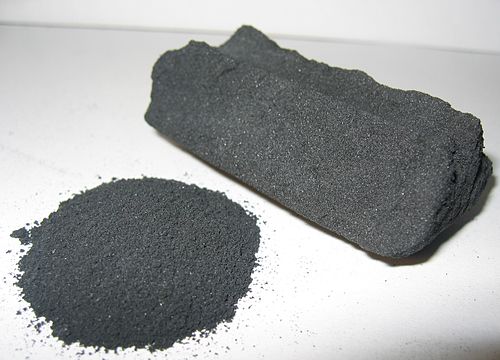](https://en.wikipedia.org/wiki/File:Activated_Carbon.jpg)
Activated carbon
**Activated carbon**, also called **activated charcoal**, is a form of [carbon](https://en.wikipedia.org/wiki/Carbon "Carbon") commonly used to filter contaminants from water and air, among many other uses. It is processed (**activated**) to have small, low-volume pores that greatly increase the [surface area](https://en.wikipedia.org/wiki/Surface_area "Surface area")[\[1\]](https://en.wikipedia.org/wiki/Activated_carbon#cite_note-Chada-2012-1)[\[2\]](https://en.wikipedia.org/wiki/Activated_carbon#cite_note-Soo-2013-2) available for *[adsorption](https://en.wikipedia.org/wiki/Adsorption "Adsorption")* or [chemical reactions](https://en.wikipedia.org/wiki/Chemical_reaction "Chemical reaction").[\[3\]](https://en.wikipedia.org/wiki/Activated_carbon#cite_note-:0-3) (Adsorption, not to be confused with [absorption](https://en.wikipedia.org/wiki/Absorption_\(chemistry\) "Absorption (chemistry)"), is a process where atoms or molecules adhere to a surface). The pores can be thought of as a microscopic "sponge" structure. Activation is analogous to making [popcorn](https://en.wikipedia.org/wiki/Popcorn "Popcorn") from dried corn kernels: popcorn is light, fluffy, and its kernels have a high [surface-area-to-volume ratio](https://en.wikipedia.org/wiki/Surface-area-to-volume_ratio "Surface-area-to-volume ratio"). *Activated* is sometimes replaced by *active*.
Because it is so porous on a microscopic scale, activated carbon has a surface area of over 3,000 square metres per gram (920,000 square feet per ounce),[\[1\]](https://en.wikipedia.org/wiki/Activated_carbon#cite_note-Chada-2012-1)[\[2\]](https://en.wikipedia.org/wiki/Activated_carbon#cite_note-Soo-2013-2)[\[4\]](https://en.wikipedia.org/wiki/Activated_carbon#cite_note-Dillon-4) as determined by gas absorption and its porosity can run 10ML/day in terms of treated water per gram. Researchers at [Cornell University](https://en.wikipedia.org/wiki/Cornell_University "Cornell University") synthesized an ultrahigh surface area activated carbon with a [BET](https://en.wikipedia.org/wiki/BET_theory "BET theory") area of 4,800 m2/g (1,500,000 sq ft/oz).[\[1\]](https://en.wikipedia.org/wiki/Activated_carbon#cite_note-Chada-2012-1) This BET area value is the highest reported in the literature for activated carbon. For charcoal, the equivalent figure before activation is about 2–5 square metres per gram (610–1,530 sq ft/oz).[\[5\]](https://en.wikipedia.org/wiki/Activated_carbon#cite_note-5)[\[6\]](https://en.wikipedia.org/wiki/Activated_carbon#cite_note-6) A useful activation level may be obtained solely from high surface area. Further chemical treatment often enhances adsorption properties.
Activated carbon is usually derived from waste products such as coconut husks in addition to other agricultural wastes like olive stones, rice husks and nutshells which are being upcycled into activated carbon, diversifying feedstock supply. Waste from paper mills has been studied as a possible source of activated carbon.[\[7\]](https://en.wikipedia.org/wiki/Activated_carbon#cite_note-7) These bulk sources are converted into [charcoal](https://en.wikipedia.org/wiki/Charcoal "Charcoal") before being activated. Using waste streams not only reduces landfill burden but also works to lower the overall carbon footprint as previously discarded waste is repurposed. When derived from [coal](https://en.wikipedia.org/wiki/Coal "Coal"),[\[1\]](https://en.wikipedia.org/wiki/Activated_carbon#cite_note-Chada-2012-1)[\[2\]](https://en.wikipedia.org/wiki/Activated_carbon#cite_note-Soo-2013-2) it is referred to as **activated coal**. **Activated coke** is derived from [coke](https://en.wikipedia.org/wiki/Coke_\(fuel\) "Coke (fuel)"). In activated-coke production, the raw coke (most commonly petroleum coke) is ground or pelletized, then "activated" via physical (steam or CO2 at high temperature) or chemical (e.g., KOH or H3PO4) methods to introduce a porous network, yielding a high-surface-area adsorbent which is referred to as activated coal.
## Uses
\[[edit](https://en.wikipedia.org/w/index.php?title=Activated_carbon&action=edit§ion=1 "Edit section: Uses")\]
Activated carbon is used in [methane](https://en.wikipedia.org/wiki/Methane "Methane") and [hydrogen](https://en.wikipedia.org/wiki/Hydrogen "Hydrogen") storage,[\[1\]](https://en.wikipedia.org/wiki/Activated_carbon#cite_note-Chada-2012-1)[\[2\]](https://en.wikipedia.org/wiki/Activated_carbon#cite_note-Soo-2013-2) [air purification](https://en.wikipedia.org/wiki/Air_purifier "Air purifier"),[\[8\]](https://en.wikipedia.org/wiki/Activated_carbon#cite_note-8) capacitive deionization, supercapacitive swing adsorption, solvent recovery, [decaffeination](https://en.wikipedia.org/wiki/Decaffeination "Decaffeination"), [gold purification](https://en.wikipedia.org/wiki/Carbon_in_pulp "Carbon in pulp"), [metal extraction](https://en.wikipedia.org/wiki/Extractive_metallurgy "Extractive metallurgy"), [water purification](https://en.wikipedia.org/wiki/Water_purification "Water purification"), [medicine](https://en.wikipedia.org/wiki/Medicine "Medicine"), [sewage treatment](https://en.wikipedia.org/wiki/Sewage_treatment "Sewage treatment"), [air filters](https://en.wikipedia.org/wiki/Air_filter "Air filter") in [respirators](https://en.wikipedia.org/wiki/Respirator "Respirator"), filters in compressed air, teeth whitening, production of [hydrogen chloride](https://en.wikipedia.org/wiki/Hydrogen_chloride "Hydrogen chloride"), edible electronics,[\[9\]](https://en.wikipedia.org/wiki/Activated_carbon#cite_note-9) and many other applications. These multiuse applications make it a versatile form of carbon that is used daily in many industries.
### Industrial
\[[edit](https://en.wikipedia.org/w/index.php?title=Activated_carbon&action=edit§ion=2 "Edit section: Industrial")\]
There are many industrial applications of activated carbon and its other forms such as areas like metal extraction, water purification, sewage treatment, metal finishing and more. For example, it is the main purification technique for removing organic impurities from bright nickel plating solutions used for metal finishing plants. Expanding on electroplating, a variety of organic chemicals can be added to the plating solutions for improving their deposit qualities and for enhancing properties like brightness, smoothness, ductility, etc. This is due to the passage of direct current and electrolytic reactions of anodic oxidation and cathodic reduction, organic additives generate unwanted breakdown products in solution. Their excessive build up in the solutions can adversely affect plating quality and physical properties of deposited metal if run untreated by the filters. Activated carbon treatment removes such impurities and restores plating performance to the desired level. Its installation costs may vary according to the volume of water it must process, however the average cost can be around USD 1 - 2 million. Additionally, these filters need replacing over time (typically 6–12 months depending on usage). The cost of replacing the carbon in the GAC filter form is about USD 0.05 - 0.1 per cubic meter of water that is treated in the plant.
### Medical
\[[edit](https://en.wikipedia.org/w/index.php?title=Activated_carbon&action=edit§ion=3 "Edit section: Medical")\]
Main article: [Activated charcoal (medication)](https://en.wikipedia.org/wiki/Activated_charcoal_\(medication\) "Activated charcoal (medication)")
[](https://en.wikipedia.org/wiki/File:%D0%90%D0%BA%D1%82%D0%B8%D0%B2%D0%B8%D1%80%D0%BE%D0%B2%D0%B0%D0%BD%D0%BD%D1%8B%D0%B9_%D1%83%D0%B3%D0%BE%D0%BB%D1%8C_3.jpg)
Activated charcoal for medical use
Activated carbon is used to treat [poisonings](https://en.wikipedia.org/wiki/Poison "Poison") and [overdoses](https://en.wikipedia.org/wiki/Overdose "Overdose") following oral [ingestion](https://en.wikipedia.org/wiki/Ingestion "Ingestion"). Tablets or capsules of activated carbon are used in many countries as an over-the-counter drug to treat [diarrhea](https://en.wikipedia.org/wiki/Diarrhea "Diarrhea"), [indigestion](https://en.wikipedia.org/wiki/Indigestion "Indigestion"), and [flatulence](https://en.wikipedia.org/wiki/Flatulence "Flatulence"). However, activated charcoal shows no effect on intestinal gas and diarrhea, is ordinarily medically ineffective if poisoning resulted from ingestion of corrosive agents, boric acid, or petroleum products, and is particularly ineffective against poisonings of [strong acids](https://en.wikipedia.org/wiki/Strong_acids "Strong acids") or [bases](https://en.wikipedia.org/wiki/Base_\(chemistry\) "Base (chemistry)"), [cyanide](https://en.wikipedia.org/wiki/Cyanide "Cyanide"), [iron](https://en.wikipedia.org/wiki/Iron "Iron"), [lithium](https://en.wikipedia.org/wiki/Lithium "Lithium"), [arsenic](https://en.wikipedia.org/wiki/Arsenic "Arsenic"), [methanol](https://en.wikipedia.org/wiki/Methanol "Methanol"), [ethanol](https://en.wikipedia.org/wiki/Ethanol "Ethanol"), or [ethylene glycol](https://en.wikipedia.org/wiki/Ethylene_glycol "Ethylene glycol").[\[10\]](https://en.wikipedia.org/wiki/Activated_carbon#cite_note-AHFS-10) Activated carbon will not prevent these chemicals from being absorbed into the human body.[\[11\]](https://en.wikipedia.org/wiki/Activated_carbon#cite_note-mayo200787-11) It is on the [World Health Organization's List of Essential Medicines](https://en.wikipedia.org/wiki/WHO_Model_List_of_Essential_Medicines "WHO Model List of Essential Medicines").[\[12\]](https://en.wikipedia.org/wiki/Activated_carbon#cite_note-WHO23rd-12)
Incorrect application (e.g. into the [lungs](https://en.wikipedia.org/wiki/Lungs "Lungs")) results in [pulmonary aspiration](https://en.wikipedia.org/wiki/Pulmonary_aspiration "Pulmonary aspiration"), which can sometimes be fatal if immediate medical treatment is not initiated.[\[13\]](https://en.wikipedia.org/wiki/Activated_carbon#cite_note-Chest1989-Elliott-13)
### Analytical chemistry
\[[edit](https://en.wikipedia.org/w/index.php?title=Activated_carbon&action=edit§ion=4 "Edit section: Analytical chemistry")\]
Activated carbon, in 50% [w/w](https://en.wikipedia.org/wiki/W/w "W/w") combination with [celite](https://en.wikipedia.org/wiki/Diatomaceous_earth "Diatomaceous earth"), is used as stationary phase in low-pressure [chromatographic](https://en.wikipedia.org/wiki/Chromatographic "Chromatographic") separation of [carbohydrates](https://en.wikipedia.org/wiki/Carbohydrates "Carbohydrates") (mono-, di-, tri-[saccharides](https://en.wikipedia.org/wiki/Saccharides "Saccharides")) using [ethanol](https://en.wikipedia.org/wiki/Ethanol "Ethanol") solutions (5–50%) as [mobile phase](https://en.wikipedia.org/wiki/Chromatography "Chromatography") in analytical or preparative protocols.
Activated carbon is useful for extracting the direct oral [anticoagulants](https://en.wikipedia.org/wiki/Anticoagulant "Anticoagulant") (DOACs) such as [dabigatran](https://en.wikipedia.org/wiki/Dabigatran "Dabigatran"), [apixaban](https://en.wikipedia.org/wiki/Apixaban "Apixaban"), [rivaroxaban](https://en.wikipedia.org/wiki/Rivaroxaban "Rivaroxaban") and [edoxaban](https://en.wikipedia.org/wiki/Edoxaban "Edoxaban") from blood plasma samples.[\[14\]](https://en.wikipedia.org/wiki/Activated_carbon#cite_note-14) For this purpose it has been made into "minitablets", each containing 5 mg activated carbon for treating 1ml samples of DOAC. Since this activated carbon has no effect on blood clotting factors, heparin or most other anticoagulants[\[15\]](https://en.wikipedia.org/wiki/Activated_carbon#cite_note-15) this allows a plasma sample to be analyzed for abnormalities otherwise affected by the DOACs.
### Environmental
\[[edit](https://en.wikipedia.org/w/index.php?title=Activated_carbon&action=edit§ion=5 "Edit section: Environmental")\]
[](https://en.wikipedia.org/wiki/File:Water_Filtration_Systems.png)
Activated carbon is usually used in water filtration systems. In this illustration, the activated carbon is in the fourth level (counted from bottom).
Carbon [adsorption](https://en.wikipedia.org/wiki/Adsorption "Adsorption") has numerous applications in removing [pollutants](https://en.wikipedia.org/wiki/Pollutant "Pollutant") from air or water streams both in the field and in industrial processes such as:
- Spill cleanup
- [Groundwater](https://en.wikipedia.org/wiki/Groundwater "Groundwater") [remediation](https://en.wikipedia.org/wiki/Environmental_remediation "Environmental remediation")
- [Drinking water](https://en.wikipedia.org/wiki/Drinking_water "Drinking water") [filtration](https://en.wikipedia.org/wiki/Filtration "Filtration")[\[16\]](https://en.wikipedia.org/wiki/Activated_carbon#cite_note-16)
- [Wastewater treatment](https://en.wikipedia.org/wiki/Wastewater_treatment "Wastewater treatment")[\[17\]](https://en.wikipedia.org/wiki/Activated_carbon#cite_note-:1-17)
- [Air purification](https://en.wikipedia.org/wiki/Air_purifier "Air purifier")
- [Volatile organic compounds](https://en.wikipedia.org/wiki/Volatile_organic_compound "Volatile organic compound") capture from [painting](https://en.wikipedia.org/wiki/Painting "Painting"), [dry cleaning](https://en.wikipedia.org/wiki/Dry_cleaning "Dry cleaning"), [gasoline](https://en.wikipedia.org/wiki/Gasoline "Gasoline") dispensing operations, and other processes
- [Volatile organic compounds](https://en.wikipedia.org/wiki/Volatile_organic_compound "Volatile organic compound") recovery (SRU, Solvent Recovery Unit; SRP, Solvent Recovery Plant; SRS, Solvent Recovery System) from [flexible packaging](https://en.wikipedia.org/wiki/Flexible_packaging "Flexible packaging"), [converting](https://en.wikipedia.org/wiki/Converter_\(industry\) "Converter (industry)"), [coating](https://en.wikipedia.org/wiki/Coating "Coating"), and other processes.[\[18\]](https://en.wikipedia.org/wiki/Activated_carbon#cite_note-DEC_IMPIANTI-18)
During early implementation of the 1974 [Safe Drinking Water Act](https://en.wikipedia.org/wiki/Safe_Drinking_Water_Act "Safe Drinking Water Act") in the US, [EPA](https://en.wikipedia.org/wiki/United_States_Environmental_Protection_Agency "United States Environmental Protection Agency") officials developed a rule that proposed requiring drinking water treatment systems to use granular activated carbon. Because of its high cost, the so-called GAC rule encountered strong opposition across the country from the water supply industry, including the largest water utilities in California. Hence, the agency set aside the rule.[\[19\]](https://en.wikipedia.org/wiki/Activated_carbon#cite_note-19) Activated carbon filtration is an effective water treatment method due to its multi-functional nature. There are specific types of activated carbon filtration methods and equipment that are indicated – depending upon the contaminants involved.[\[18\]](https://en.wikipedia.org/wiki/Activated_carbon#cite_note-DEC_IMPIANTI-18)
In wastewater treatment, granulated activated carbon filters are implemented as an additional treatment step for removal of organic micropollutants such as pharmaceutical products,[\[17\]](https://en.wikipedia.org/wiki/Activated_carbon#cite_note-:1-17)[\[20\]](https://en.wikipedia.org/wiki/Activated_carbon#cite_note-20) many of which are not entirely removed in traditional wastewater treatment processes.[\[21\]](https://en.wikipedia.org/wiki/Activated_carbon#cite_note-21) Pollutants adsorb to the activated carbon granules and are then degraded by microorganisms on the filters.[\[22\]](https://en.wikipedia.org/wiki/Activated_carbon#cite_note-22)
Activated carbon is also used for the measurement of radon concentration in air.
Biomass waste-derived activated carbons were also successfully used for the removal of caffeine and paracetamol from water.[\[23\]](https://en.wikipedia.org/wiki/Activated_carbon#cite_note-23)
### Agricultural
\[[edit](https://en.wikipedia.org/w/index.php?title=Activated_carbon&action=edit§ion=6 "Edit section: Agricultural")\]
Activated carbon (charcoal) is an allowed substance used by organic farmers in both [livestock production](https://en.wikipedia.org/wiki/Animal_husbandry "Animal husbandry") and wine making. In livestock production it is used as a pesticide, animal feed additive, processing aid, nonagricultural ingredient and disinfectant.[\[24\]](https://en.wikipedia.org/wiki/Activated_carbon#cite_note-24) In organic winemaking, activated carbon is allowed for use as a processing agent to adsorb brown color pigments from white grape concentrates.[\[25\]](https://en.wikipedia.org/wiki/Activated_carbon#cite_note-25) It is sometimes used as [biochar](https://en.wikipedia.org/wiki/Biochar "Biochar").
### Distilled alcoholic beverage purification
\[[edit](https://en.wikipedia.org/w/index.php?title=Activated_carbon&action=edit§ion=7 "Edit section: Distilled alcoholic beverage purification")\]
See also: [Lincoln County Process](https://en.wikipedia.org/wiki/Lincoln_County_Process "Lincoln County Process")
Activated carbon filters (AC filters) can be used to filter [vodka](https://en.wikipedia.org/wiki/Vodka "Vodka") and [whiskey](https://en.wikipedia.org/wiki/Whiskey "Whiskey") of [organic](https://en.wikipedia.org/wiki/Organic_compound "Organic compound") impurities which can affect color, taste, and odor. Passing an organically impure vodka through an activated carbon filter at the proper flow rate will result in vodka with an identical alcohol content and significantly increased organic purity, as judged by odor and taste.[\[26\]](https://en.wikipedia.org/wiki/Activated_carbon#cite_note-26)
### Fuel storage
\[[edit](https://en.wikipedia.org/w/index.php?title=Activated_carbon&action=edit§ion=8 "Edit section: Fuel storage")\]
Research is being done testing various activated carbons' ability to store [natural gas](https://en.wikipedia.org/wiki/Natural_gas "Natural gas")[\[1\]](https://en.wikipedia.org/wiki/Activated_carbon#cite_note-Chada-2012-1)[\[2\]](https://en.wikipedia.org/wiki/Activated_carbon#cite_note-Soo-2013-2) and [hydrogen gas](https://en.wikipedia.org/wiki/Hydrogen_gas "Hydrogen gas").[\[1\]](https://en.wikipedia.org/wiki/Activated_carbon#cite_note-Chada-2012-1)[\[2\]](https://en.wikipedia.org/wiki/Activated_carbon#cite_note-Soo-2013-2) The porous material acts like a sponge for different types of gases. The gas is attracted to the carbon material via [Van der Waals forces](https://en.wikipedia.org/wiki/Van_der_Waals_forces "Van der Waals forces"). Some carbons have been able to achieve binding energies of 5–10 kJ per [mol](https://en.wikipedia.org/wiki/Mole_\(unit\) "Mole (unit)").[\[27\]](https://en.wikipedia.org/wiki/Activated_carbon#cite_note-27) The gas may then be desorbed when subjected to higher temperatures and either combusted to do work or in the case of hydrogen gas extracted for use in a [hydrogen fuel cell](https://en.wikipedia.org/wiki/Hydrogen_fuel_cell "Hydrogen fuel cell"). Gas storage in activated carbons is an appealing gas storage method because the gas can be stored in a low pressure, low mass, low volume environment that would be much more feasible than bulky on-board pressure tanks in vehicles. The [United States Department of Energy](https://en.wikipedia.org/wiki/United_States_Department_of_Energy "United States Department of Energy") has specified certain goals[\[28\]](https://en.wikipedia.org/wiki/Activated_carbon#cite_note-28) to be achieved in the area of research and development of nano-porous carbon materials. All of the goals are yet to be satisfied but numerous institutions, including the ALL-CRAFT program,[\[1\]](https://en.wikipedia.org/wiki/Activated_carbon#cite_note-Chada-2012-1)[\[2\]](https://en.wikipedia.org/wiki/Activated_carbon#cite_note-Soo-2013-2) are continuing to conduct work in this field.
### Gas purification
\[[edit](https://en.wikipedia.org/w/index.php?title=Activated_carbon&action=edit§ion=9 "Edit section: Gas purification")\]
Filters with activated carbon are usually used in compressed air and gas purification to remove [oil](https://en.wikipedia.org/wiki/Oil "Oil") vapors, odor, and other [hydrocarbons](https://en.wikipedia.org/wiki/Hydrocarbon "Hydrocarbon") from the air. The most common designs use a 1-stage or 2 stage filtration principle in which activated carbon is embedded inside the filter media.
Activated carbon filters are used to retain radioactive gases within the air vacuumed from a nuclear boiling water reactor turbine condenser. The large charcoal beds adsorb these gases and retain them while they rapidly decay to nonradioactive solid species. The solids are trapped in the charcoal particles, while the filtered air passes through.
### Chemical purification
\[[edit](https://en.wikipedia.org/w/index.php?title=Activated_carbon&action=edit§ion=10 "Edit section: Chemical purification")\]
Activated carbon is commonly used on the laboratory scale to purify solutions of organic molecules containing unwanted colored organic impurities.
Filtration over activated carbon is used in large scale fine chemical and pharmaceutical processes for the same purpose. The carbon is either mixed with the solution then filtered off or immobilized in a filter.[\[29\]](https://en.wikipedia.org/wiki/Activated_carbon#cite_note-29)[\[30\]](https://en.wikipedia.org/wiki/Activated_carbon#cite_note-30)
### Mercury scrubbing
\[[edit](https://en.wikipedia.org/w/index.php?title=Activated_carbon&action=edit§ion=11 "Edit section: Mercury scrubbing")\]
Activated carbon, often infused with sulfur[\[31\]](https://en.wikipedia.org/wiki/Activated_carbon#cite_note-31) or iodine, is widely used to trap mercury emissions from [coal-fired power stations](https://en.wikipedia.org/wiki/Coal-fired_power_station "Coal-fired power station"), medical [incinerators](https://en.wikipedia.org/wiki/Incineration "Incineration"), and from [natural gas](https://en.wikipedia.org/wiki/Natural_gas "Natural gas") at the wellhead. However, despite its effectiveness, activated carbon is expensive to use.[\[32\]](https://en.wikipedia.org/wiki/Activated_carbon#cite_note-Mohan-32)
Since it is often not recycled, the mercury-laden activated carbon presents a disposal dilemma.[\[33\]](https://en.wikipedia.org/wiki/Activated_carbon#cite_note-33) If the activated carbon contains less than 260 ppm mercury, United States federal regulations allow it to be stabilized (for example, trapped in concrete) for landfilling.\[*[citation needed](https://en.wikipedia.org/wiki/Wikipedia:Citation_needed "Wikipedia:Citation needed")*\] However, waste containing greater than 260 ppm is considered to be in the high-mercury subcategory and is banned from landfilling (Land-Ban Rule).\[*[citation needed](https://en.wikipedia.org/wiki/Wikipedia:Citation_needed "Wikipedia:Citation needed")*\] This material is now accumulating in warehouses and in deep abandoned mines at an estimated rate of 100 tons per year.\[*[citation needed](https://en.wikipedia.org/wiki/Wikipedia:Citation_needed "Wikipedia:Citation needed")*\]
The problem of disposal of mercury-laden activated carbon is not unique to the United States. In the Netherlands, this mercury is largely recovered\[*[citation needed](https://en.wikipedia.org/wiki/Wikipedia:Citation_needed "Wikipedia:Citation needed")*\] and the activated carbon is disposed of by complete burning, forming carbon dioxide (CO2).
### Food additive
\[[edit](https://en.wikipedia.org/w/index.php?title=Activated_carbon&action=edit§ion=12 "Edit section: Food additive")\]
Activated, food-grade charcoal became a [food trend](https://en.wikipedia.org/wiki/Food_trend "Food trend") in 2016, being used as an [additive](https://en.wikipedia.org/wiki/Food_additive "Food additive") to impart a "slightly smoky" taste and a dark coloring to products including hotdogs, ice cream, pizza bases, and bagels.[\[34\]](https://en.wikipedia.org/wiki/Activated_carbon#cite_note-34) People taking medication, including [birth control pills](https://en.wikipedia.org/wiki/Birth_control_pill "Birth control pill") and [antidepressants](https://en.wikipedia.org/wiki/Antidepressant "Antidepressant"),[\[35\]](https://en.wikipedia.org/wiki/Activated_carbon#cite_note-35) are advised to avoid novelty foods or drinks that use activated charcoal coloring since it can render the medication ineffective.[\[36\]](https://en.wikipedia.org/wiki/Activated_carbon#cite_note-36)
### Smoking filtration
\[[edit](https://en.wikipedia.org/w/index.php?title=Activated_carbon&action=edit§ion=13 "Edit section: Smoking filtration")\]
Activated charcoal is used in smoking filters[\[37\]](https://en.wikipedia.org/wiki/Activated_carbon#cite_note-ncbi-37) as a way to reduce the tar content and other chemicals present in smoke, which is a result of combustion, wherein it has been found to reduce the toxicants from tobacco smoke, in particular the free radicals.[\[37\]](https://en.wikipedia.org/wiki/Activated_carbon#cite_note-ncbi-37)
## Structure of activated carbon
\[[edit](https://en.wikipedia.org/w/index.php?title=Activated_carbon&action=edit§ion=14 "Edit section: Structure of activated carbon")\]
The structure of activated carbon has long been a subject of debate. In a book published in 2006,[\[38\]](https://en.wikipedia.org/wiki/Activated_carbon#cite_note-38) [Harry Marsh](https://en.wikipedia.org/wiki/Harry_Marsh "Harry Marsh") and Francisco Rodríguez-Reinoso considered more than 15 models for the structure, without coming to a definite conclusion about which was correct. Recent work using aberration-corrected [transmission electron microscopy](https://en.wikipedia.org/wiki/Transmission_electron_microscopy "Transmission electron microscopy") has suggested that activated carbons may have a structure related to that of the [fullerenes](https://en.wikipedia.org/wiki/Fullerene "Fullerene"), with pentagonal and heptagonal carbon rings.[\[39\]](https://en.wikipedia.org/wiki/Activated_carbon#cite_note-39)[\[40\]](https://en.wikipedia.org/wiki/Activated_carbon#cite_note-40)
## Production
\[[edit](https://en.wikipedia.org/w/index.php?title=Activated_carbon&action=edit§ion=15 "Edit section: Production")\]
Activated carbon is carbon produced from carbonaceous source materials such as bamboo, coconut husk, willow [peat](https://en.wikipedia.org/wiki/Peat "Peat"), [wood](https://en.wikipedia.org/wiki/Wood "Wood"), [coir](https://en.wikipedia.org/wiki/Coir "Coir"), [lignite](https://en.wikipedia.org/wiki/Lignite "Lignite"), [coal](https://en.wikipedia.org/wiki/Coal "Coal"), and [petroleum pitch](https://en.wikipedia.org/wiki/Pitch_\(resin\) "Pitch (resin)"). It can be produced (activated) by one of the following processes:
1. **Physical activation**: The source material is developed into activated carbon using hot gases. Air is then introduced to burn out the gases, creating a graded, screened and de-dusted form of activated carbon. This is generally done by using one or more of the following processes:
- *[Carbonization](https://en.wikipedia.org/wiki/Carbonization "Carbonization")*: Material with carbon content is [pyrolyzed](https://en.wikipedia.org/wiki/Pyrolysis "Pyrolysis") at temperatures in the range 600–900 °C, usually in an inert atmosphere with gases such as [argon](https://en.wikipedia.org/wiki/Argon "Argon") or [nitrogen](https://en.wikipedia.org/wiki/Nitrogen "Nitrogen")
- *Activation/oxidation*: Raw material or [carbonized](https://en.wikipedia.org/wiki/Carbonization "Carbonization") material is exposed to oxidizing atmospheres (oxygen or steam) at temperatures above 250 °C, usually in the temperature range of 600–1200 °C. The activation is performed by heating the sample for 1 h in a [muffle furnace](https://en.wikipedia.org/wiki/Muffle_furnace "Muffle furnace") at 450 °C in the presence of air.[\[32\]](https://en.wikipedia.org/wiki/Activated_carbon#cite_note-Mohan-32)
2. **Chemical activation**: The carbon material is impregnated with certain chemicals. The chemical is typically an [acid](https://en.wikipedia.org/wiki/Acid "Acid"), strong [base](https://en.wikipedia.org/wiki/Alkali "Alkali"),[\[1\]](https://en.wikipedia.org/wiki/Activated_carbon#cite_note-Chada-2012-1)[\[2\]](https://en.wikipedia.org/wiki/Activated_carbon#cite_note-Soo-2013-2) or a [salt](https://en.wikipedia.org/wiki/Salt_\(chemistry\) "Salt (chemistry)")[\[41\]](https://en.wikipedia.org/wiki/Activated_carbon#cite_note-41) ([phosphoric acid](https://en.wikipedia.org/wiki/Phosphoric_acid "Phosphoric acid") 25%, [potassium hydroxide](https://en.wikipedia.org/wiki/Potassium_hydroxide "Potassium hydroxide") 5%, [sodium hydroxide](https://en.wikipedia.org/wiki/Sodium_hydroxide "Sodium hydroxide") 5%, [potassium carbonate](https://en.wikipedia.org/wiki/Potassium_carbonate "Potassium carbonate") 5%,[\[42\]](https://en.wikipedia.org/wiki/Activated_carbon#cite_note-42) [calcium chloride](https://en.wikipedia.org/wiki/Calcium_chloride "Calcium chloride") 25%, and [zinc chloride](https://en.wikipedia.org/wiki/Zinc_chloride "Zinc chloride") 25%). The carbon is then subjected to high temperatures (250–600 °C). It is believed that the temperature activates the carbon at this stage by forcing the material to open up and have more microscopic pores. Chemical activation is preferred to physical activation owing to the lower temperatures, better quality consistency, and shorter time needed for activating the material.[\[43\]](https://en.wikipedia.org/wiki/Activated_carbon#cite_note-Nwankwo-43)
The Dutch company Norit [NV](https://en.wikipedia.org/wiki/Naamloze_vennootschap "Naamloze vennootschap") is one of the largest producer of activated carbon in the world. [Haycarb](https://en.wikipedia.org/wiki/Haycarb "Haycarb"), a Sri Lankan coconut shell-based company, controls 16% of the global market share.[\[44\]](https://en.wikipedia.org/wiki/Activated_carbon#cite_note-44)
**Regeneration & Sustainability**
After adsorption, spent granular activated carbon can often be regenerated rather than discarded. Thermal reactivation (heating in an inert or steam atmosphere at 800–900 °C) restores much of the pore structure but consumes significant energy, while chemical regeneration (e.g. with dilute acids or bases) can selectively remove fouling compounds under milder conditions. Emerging methods like microwave-assisted reactivation and bio-regeneration using fungi or bacteria show promise for lower-carbon footprints. Choosing the optimal regeneration route balances carbon lifespan, energy use and treatment costs, and helps minimize the volume of hazardous waste sent to landfill.
## Classification
\[[edit](https://en.wikipedia.org/w/index.php?title=Activated_carbon&action=edit§ion=16 "Edit section: Classification")\]
Activated carbons are complex products which are difficult to classify on the basis of their behaviour, surface characteristics and other fundamental criteria. However, some broad classification is made for general purposes based on their size, preparation methods, and industrial applications.
### Powdered activated carbon (PAC)
\[[edit](https://en.wikipedia.org/w/index.php?title=Activated_carbon&action=edit§ion=17 "Edit section: Powdered activated carbon (PAC)")\]
See also: [Powdered activated carbon treatment](https://en.wikipedia.org/wiki/Powdered_activated_carbon_treatment "Powdered activated carbon treatment")
[](https://en.wikipedia.org/wiki/File:ActivatedCharcoalPowder_BrightField.jpg)
A [micrograph](https://en.wikipedia.org/wiki/Micrograph "Micrograph") of activated charcoal (R 1) under [bright field](https://en.wikipedia.org/wiki/Bright_field_microscopy "Bright field microscopy") illumination on a [light microscope](https://en.wikipedia.org/wiki/Light_microscope "Light microscope"). Notice the [fractal](https://en.wikipedia.org/wiki/Fractal "Fractal")\-like shape of the particles hinting at their enormous surface area. Each particle in this image, despite being only around 0.1 mm across, can have a surface area of several square centimetres. The entire image covers a region of approximately 1.1 by 0.7 mm, and the full resolution version is at a scale of 6.236 pixels/[μm](https://en.wikipedia.org/wiki/%CE%9Cm "Μm").
Normally, activated carbons (R 1) are made in particulate form as powders or fine granules less than 1.0 mm in size with an average diameter between 0.15 and 0.25 mm. Thus they present a large surface to volume ratio with a small diffusion distance. Activated carbon (R 1) is defined as the activated carbon particles retained on a 50-mesh sieve (0.297 mm).
Powdered activated carbon (PAC) material is finer material. PAC is made up of crushed or ground carbon particles, 95–100% of which will pass through a designated [mesh sieve](https://en.wikipedia.org/wiki/Mesh_\(scale\) "Mesh (scale)"). The [ASTM](https://en.wikipedia.org/wiki/ASTM_International "ASTM International") classifies particles passing through an 80-mesh sieve (0.177 mm) and smaller as PAC. It is not common to use PAC in a dedicated vessel, due to the high [head loss](https://en.wikipedia.org/wiki/Head_loss "Head loss") that would occur. Instead, PAC is generally added directly to other process units, such as raw water intakes, rapid mix basins, clarifiers, and gravity filters.
### Granular activated carbon (GAC)
\[[edit](https://en.wikipedia.org/w/index.php?title=Activated_carbon&action=edit§ion=18 "Edit section: Granular activated carbon (GAC)")\]
[](https://en.wikipedia.org/wiki/File:Activated_Charcoal.jpg)
A [micrograph](https://en.wikipedia.org/wiki/Micrograph "Micrograph") of activated charcoal **(GAC)** under a [scanning electron microscope](https://en.wikipedia.org/wiki/Scanning_electron_microscope "Scanning electron microscope")
Granular activated carbon (GAC) has a relatively larger particle size compared to powdered activated carbon and consequently, presents a smaller external surface. Diffusion of the adsorbate is thus an important factor. These carbons are suitable for [adsorption](https://en.wikipedia.org/wiki/Adsorption "Adsorption") of gases, vapors and liquids, because these substances diffuse rapidly throughout the filters. Granulated carbons are used for [air filtration](https://en.wikipedia.org/wiki/Air_filter "Air filter") and [water treatment](https://en.wikipedia.org/wiki/Water_treatment "Water treatment"), as well as for general deodorization and separation of components in flow systems and in rapid mix basins. GAC can be obtained in either granular or extruded form. GAC is designated by sizes such as 8×20, 20×40, or 8×30 for liquid phase applications and 4×6, 4×8 or 4×10 for vapor phase applications. A 20×40 carbon is made of particles that will pass through a U.S. Standard Mesh Size No. 20 sieve (0.84 mm) (generally specified as 85% passing) but be retained on a U.S. Standard Mesh Size No. 40 sieve (0.42 mm) (generally specified as 95% retained). AWWA (1992) B604 uses the 50-mesh sieve (0.297 mm) as the minimum GAC size. The most popular aqueous-phase carbons are the 12×40 and 8×30 sizes because they have a good balance of size, surface area, and [head loss](https://en.wikipedia.org/wiki/Head_loss "Head loss") characteristics.
### Extruded activated carbon (EAC)
\[[edit](https://en.wikipedia.org/w/index.php?title=Activated_carbon&action=edit§ion=19 "Edit section: Extruded activated carbon (EAC)")\]
Extruded activated carbon (EAC) combines powdered activated carbon with a binder, which are fused together and extruded into a cylindrical shaped activated carbon block with diameters from 0.8 to 130 mm. These are mainly used for gas phase applications because of their low pressure drop, high mechanical strength and low dust content. Also sold as CTO filter (Chlorine, Taste, Odor).
### Bead activated carbon (BAC)
\[[edit](https://en.wikipedia.org/w/index.php?title=Activated_carbon&action=edit§ion=20 "Edit section: Bead activated carbon (BAC)")\]
Bead activated carbon (BAC) is manufactured from carbonizing petroleum pitch and then activating it into uniform spheres in diameters from approximately 0.35 to 0.80 mm. BAC typically exhibits a surface area in the range of 800–1 200 m2/g, comparable to or exceeding many granular carbons, enhancing its capacity for dissolved organics. Similar to EAC, it is also noted for its low pressure drop, high mechanical strength and low dust content, but with a smaller grain size. Its spherical shape makes it preferred for fluidized bed applications such as water filtration.
### Impregnated carbon
\[[edit](https://en.wikipedia.org/w/index.php?title=Activated_carbon&action=edit§ion=21 "Edit section: Impregnated carbon")\]
Porous carbons containing several types of inorganic impregnate such as [iodine](https://en.wikipedia.org/wiki/Iodine "Iodine") and [silver](https://en.wikipedia.org/wiki/Silver "Silver"). [Cations](https://en.wikipedia.org/wiki/Cation "Cation") such as aluminium, manganese, zinc, iron, lithium, and calcium have also been prepared for specific application in [air pollution](https://en.wikipedia.org/wiki/Air_pollution "Air pollution") control especially in museums and galleries. Due to its antimicrobial and antiseptic properties, silver loaded activated carbon is used as an adsorbent for purification of domestic water. Drinking water can be obtained from natural water by treating the natural water with a mixture of activated carbon and [aluminium hydroxide](https://en.wikipedia.org/wiki/Aluminium_hydroxide "Aluminium hydroxide") (Al(OH)3), a [flocculating agent](https://en.wikipedia.org/wiki/Flocculation "Flocculation"). Impregnated carbons are also used for the adsorption of [hydrogen sulfide](https://en.wikipedia.org/wiki/Hydrogen_sulfide "Hydrogen sulfide") (H2S) and [thiols](https://en.wikipedia.org/wiki/Thiol "Thiol"). Adsorption rates for H2S as high as 50% by weight have been reported. \[*[citation needed](https://en.wikipedia.org/wiki/Wikipedia:Citation_needed "Wikipedia:Citation needed")*\]
### Polymer coated carbon
\[[edit](https://en.wikipedia.org/w/index.php?title=Activated_carbon&action=edit§ion=22 "Edit section: Polymer coated carbon")\]
[](https://en.wikipedia.org/wiki/File:Woven_activated_carbon_cloth.jpg)
Woven activated carbon cloth
This is a process by which a porous carbon can be coated with a biocompatible [polymer](https://en.wikipedia.org/wiki/Polymer "Polymer") to give a smooth and permeable coat without blocking the pores. The typical film thickness ranges from 50 to 200 nm, which strikes a balance between preserving pore access and ensuring mechanical stability in the material. The resulting carbon is useful for [hemoperfusion](https://en.wikipedia.org/wiki/Hemoperfusion "Hemoperfusion"). Hemoperfusion is a treatment technique in which large volumes of the patient's blood are passed over an adsorbent substance in order to remove toxic substances from the blood. In clinical trials, polymer-coated carbons have achieved over 80% removal of toxins such as bilirubin and certain drug metabolites in a single pass.
### Woven carbon
\[[edit](https://en.wikipedia.org/w/index.php?title=Activated_carbon&action=edit§ion=23 "Edit section: Woven carbon")\]
There is a technology of processing technical rayon fiber into activated carbon cloth for [carbon filtering](https://en.wikipedia.org/wiki/Carbon_filtering "Carbon filtering"). Adsorption capacity of activated cloth is greater than that of activated charcoal ([BET theory](https://en.wikipedia.org/wiki/BET_theory "BET theory")) surface area: 500–1500 m2/g, pore volume: 0.3–0.8 cm3/g)\[*[citation needed](https://en.wikipedia.org/wiki/Wikipedia:Citation_needed "Wikipedia:Citation needed")*\]. Thanks to the different forms of activated material, it can be used in a wide range of applications ([supercapacitors](https://en.wikipedia.org/wiki/Supercapacitors "Supercapacitors"), odor absorbers, [CBRN-defense](https://en.wikipedia.org/wiki/CBRN_defense "CBRN defense") industry etc.).
## Properties
\[[edit](https://en.wikipedia.org/w/index.php?title=Activated_carbon&action=edit§ion=24 "Edit section: Properties")\]
A gram of activated carbon can have a surface area in excess of 500 m2 (5,400 sq ft), with 3,000 m2 (32,000 sq ft) being readily achievable.[\[2\]](https://en.wikipedia.org/wiki/Activated_carbon#cite_note-Soo-2013-2)[\[4\]](https://en.wikipedia.org/wiki/Activated_carbon#cite_note-Dillon-4)[\[45\]](https://en.wikipedia.org/wiki/Activated_carbon#cite_note-surfacearea-45) Carbon [aerogels](https://en.wikipedia.org/wiki/Aerogel "Aerogel"), while more expensive, have even higher surface areas, and are used in special applications.
Under an [electron microscope](https://en.wikipedia.org/wiki/Electron_microscope "Electron microscope"), the high surface-area structures of activated carbon are revealed. Individual particles are intensely convoluted and display various kinds of [porosity](https://en.wikipedia.org/wiki/Porosity "Porosity"); there may be many areas where flat surfaces of [graphite](https://en.wikipedia.org/wiki/Graphite "Graphite")\-like material run parallel to each other,[\[2\]](https://en.wikipedia.org/wiki/Activated_carbon#cite_note-Soo-2013-2) separated by only a few nanometres or so. These [micropores](https://en.wikipedia.org/wiki/Micropore "Micropore") provide superb conditions for [adsorption](https://en.wikipedia.org/wiki/Adsorption "Adsorption") to occur, since adsorbing material can interact with many surfaces simultaneously. Tests of adsorption behaviour are usually done with [nitrogen](https://en.wikipedia.org/wiki/Nitrogen "Nitrogen") gas at 77 [K](https://en.wikipedia.org/wiki/Kelvin "Kelvin") under high [vacuum](https://en.wikipedia.org/wiki/Vacuum "Vacuum"), but in everyday terms activated carbon is perfectly capable of producing the equivalent, by adsorption from its environment, liquid water from [steam](https://en.wikipedia.org/wiki/Steam "Steam") at 100 °C (212 °F) and a pressure of 1/10,000 of an [atmosphere](https://en.wikipedia.org/wiki/Atmosphere_\(unit\) "Atmosphere (unit)").
[James Dewar](https://en.wikipedia.org/wiki/James_Dewar "James Dewar"), the scientist after whom the Dewar ([vacuum flask](https://en.wikipedia.org/wiki/Vacuum_flask "Vacuum flask")) is named, spent much time in the early 20th century studying activated carbon, and published a paper regarding its adsorption capacity with regard to gases.[\[46\]](https://en.wikipedia.org/wiki/Activated_carbon#cite_note-46) In this paper, he discovered that cooling the carbon to liquid nitrogen temperatures allowed it to adsorb significant quantities of numerous air gases, among others, that could then be recollected by simply allowing the carbon to warm again and that coconut-based carbon was superior for the effect. He uses oxygen as an example, wherein the activated carbon would typically adsorb the atmospheric concentration (21%) under standard conditions, but release over 80% oxygen if the carbon was first cooled to low temperatures.
Physically, activated carbon binds materials by [van der Waals force](https://en.wikipedia.org/wiki/Van_der_Waals_force "Van der Waals force")[\[43\]](https://en.wikipedia.org/wiki/Activated_carbon#cite_note-Nwankwo-43) or [London dispersion force](https://en.wikipedia.org/wiki/London_dispersion_force "London dispersion force").
Activated carbon does not bind well to certain chemicals, including [alcohols](https://en.wikipedia.org/wiki/Alcohol_\(chemistry\) "Alcohol (chemistry)"), [diols](https://en.wikipedia.org/wiki/Diol "Diol"), strong [acids](https://en.wikipedia.org/wiki/Acid "Acid") and [bases](https://en.wikipedia.org/wiki/Base_\(chemistry\) "Base (chemistry)"), [metals](https://en.wikipedia.org/wiki/Metal "Metal") and most [inorganics](https://en.wikipedia.org/wiki/Inorganic "Inorganic"), such as [lithium](https://en.wikipedia.org/wiki/Lithium "Lithium"), [sodium](https://en.wikipedia.org/wiki/Sodium "Sodium"), [iron](https://en.wikipedia.org/wiki/Iron "Iron"), [lead](https://en.wikipedia.org/wiki/Lead "Lead"), [arsenic](https://en.wikipedia.org/wiki/Arsenic "Arsenic"), [fluorine](https://en.wikipedia.org/wiki/Fluorine "Fluorine"), and boric acid.
Activated carbon can also adsorb [iodine](https://en.wikipedia.org/wiki/Iodine "Iodine") very well. The iodine capacity, mg/g, ([ASTM](https://en.wikipedia.org/wiki/ASTM_International "ASTM International") D28 Standard Method test) may be used as an indication of total adsorption over the surface area of the testing material.
Carbon monoxide however, is not very well adsorbed by activated carbon. This should be of particular concern to those using the material in filters for respirators, fume hoods, or other gas control systems because the gas is undetectable to the human senses, toxic to the metabolism, and neurotoxic which creates concern.
Substantial lists of the common industrial and agricultural gases adsorbed by activated carbon can be found online.[\[47\]](https://en.wikipedia.org/wiki/Activated_carbon#cite_note-47)
Activated carbon can be used as a substrate for the application of various chemicals to improve the adsorptive capacity for some inorganic (and problematic organic) compounds such as [hydrogen sulfide](https://en.wikipedia.org/wiki/Hydrogen_sulfide "Hydrogen sulfide") (H2S), ammonia (NH3), formaldehyde (HCOH), [mercury](https://en.wikipedia.org/wiki/Mercury_\(element\) "Mercury (element)") (Hg) and radioactive [iodine-131](https://en.wikipedia.org/wiki/Iodine-131 "Iodine-131")(131I). This property is known as [chemisorption](https://en.wikipedia.org/wiki/Chemisorption "Chemisorption").
### Iodine number
\[[edit](https://en.wikipedia.org/w/index.php?title=Activated_carbon&action=edit§ion=25 "Edit section: Iodine number")\]
Many carbons preferentially adsorb small molecules. [Iodine number](https://en.wikipedia.org/wiki/Iodine_value "Iodine value") is the most fundamental parameter used to characterize activated carbon performance. It is a measure of activity level (higher number indicates higher degree of activation[\[48\]](https://en.wikipedia.org/wiki/Activated_carbon#cite_note-Marecka-2007-48)) often reported in mg/g (typical range 500–1200 mg/g). It is a measure of the micropore content of the activated carbon (0 to 20 [Å](https://en.wikipedia.org/wiki/%C3%85ngstr%C3%B6m "Ångström"), or up to 2 [nm](https://en.wikipedia.org/wiki/Nanometre "Nanometre")) by adsorption of iodine from solution.[\[49\]](https://en.wikipedia.org/wiki/Activated_carbon#cite_note-49) It is equivalent to surface area of carbon between 900 and 1100 m2/g. It is the standard measure for liquid-phase applications.
Iodine number is defined as the milligrams of iodine [adsorbed](https://en.wikipedia.org/wiki/Adsorption "Adsorption") by one gram of carbon when the iodine concentration in the residual filtrate is at a concentration of 0.02 normal (i.e. 0.02N). Basically, iodine number is a measure of the iodine adsorbed in the pores and, as such, is an indication of the pore volume available in the activated carbon of interest. Typically, water-treatment carbons have iodine numbers ranging from 600 to 1100. Frequently, this parameter is used to determine the degree of exhaustion of a carbon in use. However, this practice should be viewed with caution, as chemical interactions with the [adsorbate](https://en.wikipedia.org/wiki/Adsorbate "Adsorbate") may affect the iodine uptake, giving false results. Thus, the use of iodine number as a measure of the degree of exhaustion of a carbon bed can only be recommended if it has been shown to be free of chemical interactions with adsorbates and if an experimental correlation between iodine number and the degree of exhaustion has been determined for the particular application.
### Molasses
\[[edit](https://en.wikipedia.org/w/index.php?title=Activated_carbon&action=edit§ion=26 "Edit section: Molasses")\]
Some carbons are more adept at adsorbing large molecules. [Molasses number](https://en.wikipedia.org/w/index.php?title=Molasses_number&action=edit&redlink=1 "Molasses number (page does not exist)") or molasses efficiency is a measure of the [mesopore](https://en.wikipedia.org/wiki/Mesoporous_material "Mesoporous material") content of the activated carbon (greater than 20 [Å](https://en.wikipedia.org/wiki/%C3%85ngstr%C3%B6m "Ångström"), or larger than 2 [nm](https://en.wikipedia.org/wiki/Nanometre "Nanometre")) by adsorption of molasses from solution. A high molasses number indicates a high adsorption of big molecules (range 95–600). Caramel dp (decolorizing performance) is similar to molasses number. Molasses efficiency is reported as a percentage (range 40%–185%) and parallels molasses number (600 = 185%, 425 = 85%). The European molasses number (range 525–110) is inversely related to the North American molasses number.
Molasses Number is a measure of the degree of decolorization of a standard molasses solution that has been diluted and standardized against standardized activated carbon. Due to the size of color bodies, the molasses number represents the potential pore volume available for larger adsorbing species. As all of the pore volume may not be available for adsorption in a particular waste water application, and as some of the adsorbate may enter smaller pores, it is not a good measure of the worth of a particular activated carbon for a specific application. Frequently, this parameter is useful in evaluating a series of active carbons for their rates of adsorption. Given two active carbons with similar pore volumes for adsorption, the one having the higher molasses number will usually have larger feeder pores resulting in more efficient transfer of adsorbate into the adsorption space.
### Tannin
\[[edit](https://en.wikipedia.org/w/index.php?title=Activated_carbon&action=edit§ion=27 "Edit section: Tannin")\]
[Tannins](https://en.wikipedia.org/wiki/Tannin "Tannin") are a mixture of large and medium size molecules. Carbons with a combination of [macropores](https://en.wikipedia.org/wiki/Macropore "Macropore") and [mesopores](https://en.wikipedia.org/wiki/Mesoporous_material "Mesoporous material") adsorb tannins. The ability of a carbon to adsorb tannins is reported in parts per million concentration (range 200 ppm–362 ppm).
### Methylene blue
\[[edit](https://en.wikipedia.org/w/index.php?title=Activated_carbon&action=edit§ion=28 "Edit section: Methylene blue")\]
Some carbons have a mesopore (20 [Å](https://en.wikipedia.org/wiki/%C3%85ngstr%C3%B6m "Ångström") to 50 Å, or 2 to 5 nm) structure which adsorbs medium size molecules, such as the dye [methylene blue](https://en.wikipedia.org/wiki/Methylene_blue "Methylene blue"). Methylene blue adsorption is reported in g/100g (range 11–28 g/100g).[\[50\]](https://en.wikipedia.org/wiki/Activated_carbon#cite_note-Adsorption_Experiments-50)
### Dechlorination
\[[edit](https://en.wikipedia.org/w/index.php?title=Activated_carbon&action=edit§ion=29 "Edit section: Dechlorination")\]
Some carbons are evaluated based on the [dechlorination](https://en.wikipedia.org/wiki/Reductive_dechlorination "Reductive dechlorination") half-life length, which measures the chlorine-removal efficiency of activated carbon. The dechlorination half-value length is the depth of carbon required to reduce the chlorine concentration by 50%. A lower half-value length indicates superior performance.[\[51\]](https://en.wikipedia.org/wiki/Activated_carbon#cite_note-51)
### Apparent density
\[[edit](https://en.wikipedia.org/w/index.php?title=Activated_carbon&action=edit§ion=30 "Edit section: Apparent density")\]
The solid or skeletal density of activated carbons will typically range between 2000 and 2100 kg/m3 (125–130 lbs./cubic foot). However, a large part of an activated carbon sample will consist of air space between particles, and the actual or apparent density will therefore be lower, typically 400 to 500 kg/m3 (25–31 lbs./cubic foot).[\[52\]](https://en.wikipedia.org/wiki/Activated_carbon#cite_note-52)
Higher density provides greater volume activity and normally indicates better-quality activated carbon. ASTM D 2854 -09 (2014) is used to determine the apparent density of activated carbon.
### Hardness/abrasion number
\[[edit](https://en.wikipedia.org/w/index.php?title=Activated_carbon&action=edit§ion=31 "Edit section: Hardness/abrasion number")\]
It is a measure of the activated carbon's resistance to attrition. It is an important indicator of activated carbon to maintain its physical integrity and withstand frictional forces which would cause the material to be defective. There are large differences in the hardness of activated carbons, depending on the raw material and activity levels (porosity) it is created for.
### Ash content
\[[edit](https://en.wikipedia.org/w/index.php?title=Activated_carbon&action=edit§ion=32 "Edit section: Ash content")\]
[Ash](https://en.wikipedia.org/wiki/Ash_\(analytical_chemistry\) "Ash (analytical chemistry)") reduces the overall activity of activated carbon and reduces the efficiency of reactivation. The amount is exclusively dependent on the base raw material used to produce the activated carbon (e.g., coconut, wood, coal, etc.). The metal oxides (Fe2O3) can leach out of activated carbon resulting in discoloration. Acid/water-soluble ash content is more significant than total ash content. Soluble ash content can be very important for aquarists, as ferric oxide can promote algal growths. A carbon with a low soluble ash content should be used for marine, freshwater fish and reef tanks to avoid heavy metal poisoning and excess plant/algal growth. [ASTM](https://en.wikipedia.org/wiki/ASTM_International "ASTM International") (D2866 Standard Method test) is used to determine the ash content of activated carbon.
### Carbon tetrachloride activity
\[[edit](https://en.wikipedia.org/w/index.php?title=Activated_carbon&action=edit§ion=33 "Edit section: Carbon tetrachloride activity")\]
Measurement of the porosity of an activated carbon by the adsorption of saturated [carbon tetrachloride](https://en.wikipedia.org/wiki/Carbon_tetrachloride "Carbon tetrachloride") vapour.
### Particle size distribution
\[[edit](https://en.wikipedia.org/w/index.php?title=Activated_carbon&action=edit§ion=34 "Edit section: Particle size distribution")\]
The finer the particle size of an activated carbon, the better the access to the surface area and the faster the rate of adsorption kinetics. In vapour phase systems this needs to be considered against pressure drop, which will affect energy cost. Careful consideration of particle size distribution can provide significant operating benefits. However, in the case of using activated carbon for adsorption of minerals such as gold, the particle size should be in the range of 3.35–1.4 millimetres (0.132–0.055 in). Activated carbon with particle size less than 1 mm would not be suitable for elution (the stripping of mineral from an activated carbon). Researchers at Cornell University synthesized an ultrahigh surface area activated carbon with a BET area of 4800 m2 g–1 and a total pore volume of 2.7 cm3 g–1.[\[1\]](https://en.wikipedia.org/wiki/Activated_carbon#cite_note-Chada-2012-1) This BET area value is the highest reported in the literature for activated carbon to date.
## Modification of properties and reactivity
\[[edit](https://en.wikipedia.org/w/index.php?title=Activated_carbon&action=edit§ion=35 "Edit section: Modification of properties and reactivity")\]
Acid-base, oxidation-reduction and specific adsorption characteristics are strongly dependent on the composition of the surface functional groups.[\[53\]](https://en.wikipedia.org/wiki/Activated_carbon#cite_note-Philippe_Serp_2009-53)
The surface of conventional activated carbon is reactive, capable of oxidation by atmospheric oxygen and oxygen [plasma](https://en.wikipedia.org/wiki/Plasma_\(physics\) "Plasma (physics)")[\[54\]](https://en.wikipedia.org/wiki/Activated_carbon#cite_note-54)[\[55\]](https://en.wikipedia.org/wiki/Activated_carbon#cite_note-55)[\[56\]](https://en.wikipedia.org/wiki/Activated_carbon#cite_note-56)[\[57\]](https://en.wikipedia.org/wiki/Activated_carbon#cite_note-57)[\[58\]](https://en.wikipedia.org/wiki/Activated_carbon#cite_note-Streat_M.-2001-58)[\[59\]](https://en.wikipedia.org/wiki/Activated_carbon#cite_note-59)[\[60\]](https://en.wikipedia.org/wiki/Activated_carbon#cite_note-60)[\[61\]](https://en.wikipedia.org/wiki/Activated_carbon#cite_note-61) steam,[\[62\]](https://en.wikipedia.org/wiki/Activated_carbon#cite_note-62)[\[63\]](https://en.wikipedia.org/wiki/Activated_carbon#cite_note-63)[\[64\]](https://en.wikipedia.org/wiki/Activated_carbon#cite_note-64) and also [carbon dioxide](https://en.wikipedia.org/wiki/Carbon_dioxide "Carbon dioxide")[\[58\]](https://en.wikipedia.org/wiki/Activated_carbon#cite_note-Streat_M.-2001-58) and [ozone](https://en.wikipedia.org/wiki/Ozone "Ozone").[\[65\]](https://en.wikipedia.org/wiki/Activated_carbon#cite_note-65)[\[66\]](https://en.wikipedia.org/wiki/Activated_carbon#cite_note-66)[\[67\]](https://en.wikipedia.org/wiki/Activated_carbon#cite_note-Vald%C3%A9s-2002-67)
Oxidation in the liquid phase is caused by a wide range of reagents (HNO3, H2O2, KMnO4).[\[68\]](https://en.wikipedia.org/wiki/Activated_carbon#cite_note-68)[\[69\]](https://en.wikipedia.org/wiki/Activated_carbon#cite_note-69)[\[70\]](https://en.wikipedia.org/wiki/Activated_carbon#cite_note-70)
Through the formation of a large number of basic and acidic groups on the surface of oxidized carbon to sorption and other properties can differ significantly from the unmodified forms.[\[53\]](https://en.wikipedia.org/wiki/Activated_carbon#cite_note-Philippe_Serp_2009-53)
Activated carbon can be nitrogenated by natural products or [polymers](https://en.wikipedia.org/wiki/Polymer "Polymer")[\[71\]](https://en.wikipedia.org/wiki/Activated_carbon#cite_note-71)[\[72\]](https://en.wikipedia.org/wiki/Activated_carbon#cite_note-72) or processing of carbon with nitrogenating [reagents](https://en.wikipedia.org/wiki/Reagent "Reagent").[\[73\]](https://en.wikipedia.org/wiki/Activated_carbon#cite_note-73)[\[74\]](https://en.wikipedia.org/wiki/Activated_carbon#cite_note-74)[\[75\]](https://en.wikipedia.org/wiki/Activated_carbon#cite_note-75)
Activated carbon can interact with [chlorine](https://en.wikipedia.org/wiki/Chlorine "Chlorine"),[\[76\]](https://en.wikipedia.org/wiki/Activated_carbon#cite_note-76)[\[77\]](https://en.wikipedia.org/wiki/Activated_carbon#cite_note-77) [bromine](https://en.wikipedia.org/wiki/Bromine "Bromine")[\[78\]](https://en.wikipedia.org/wiki/Activated_carbon#cite_note-78) and [fluorine](https://en.wikipedia.org/wiki/Fluorine "Fluorine").[\[79\]](https://en.wikipedia.org/wiki/Activated_carbon#cite_note-79)
Surface of activated carbon, like other carbon materials can be fluoralkylated by treatment with (per)fluoropolyether peroxide[\[80\]](https://en.wikipedia.org/wiki/Activated_carbon#cite_note-80) in a liquid phase, or with wide range of fluoroorganic substances by CVD-method.[\[81\]](https://en.wikipedia.org/wiki/Activated_carbon#cite_note-81) Such materials combine high hydrophobicity and chemical stability with electrical and thermal conductivity and can be used as electrode material for super capacitors.[\[82\]](https://en.wikipedia.org/wiki/Activated_carbon#cite_note-82)
Sulfonic acid functional groups can be attached to activated carbon to give "starbons" which can be used to selectively catalyse the esterification of fatty acids.[\[83\]](https://en.wikipedia.org/wiki/Activated_carbon#cite_note-83) Formation of such activated carbons from halogenated precursors gives a more effective catalyst which is thought to be a result of remaining halogens improving stability.[\[84\]](https://en.wikipedia.org/wiki/Activated_carbon#cite_note-84) It is reported about synthesis of activated carbon with chemically grafted superacid sites –CF2SO3H.[\[85\]](https://en.wikipedia.org/wiki/Activated_carbon#cite_note-85)
Some of the chemical properties of activated carbon have been attributed to presence of the surface active carbon [double bond](https://en.wikipedia.org/wiki/Alkenes "Alkenes").[\[67\]](https://en.wikipedia.org/wiki/Activated_carbon#cite_note-Vald%C3%A9s-2002-67)[\[86\]](https://en.wikipedia.org/wiki/Activated_carbon#cite_note-86)
The [Polyani adsorption theory](https://en.wikipedia.org/wiki/Potential_theory_of_Polanyi "Potential theory of Polanyi") is a popular method for analyzing adsorption of various organic substances to their surface.
## Examples of adsorption
\[[edit](https://en.wikipedia.org/w/index.php?title=Activated_carbon&action=edit§ion=36 "Edit section: Examples of adsorption")\]
### Heterogeneous catalysis
\[[edit](https://en.wikipedia.org/w/index.php?title=Activated_carbon&action=edit§ion=37 "Edit section: Heterogeneous catalysis")\]
The most commonly encountered form of chemisorption in industry, occurs when a solid [catalyst](https://en.wikipedia.org/wiki/Catalyst "Catalyst") interacts with a gaseous feedstock, the reactant/s. The adsorption of reactant/s to the catalyst surface creates a chemical bond, altering the electron density around the reactant molecule and allowing it to undergo reactions that would not normally be available to it.
## Reactivation and regeneration
\[[edit](https://en.wikipedia.org/w/index.php?title=Activated_carbon&action=edit§ion=38 "Edit section: Reactivation and regeneration")\]
[](https://en.wikipedia.org/wiki/File:Reactivation_Furnace_Feluy_Belgium.jpg)
World's largest reactivation plant located in [Feluy](https://en.wikipedia.org/wiki/Feluy "Feluy"), Belgium.
[](https://en.wikipedia.org/wiki/File:Activated-carbon-reactivation-centre-Roeselare.jpg)
Activated carbon reactivation center in [Roeselare](https://en.wikipedia.org/wiki/Roeselare "Roeselare"), Belgium.
The reactivation or the regeneration of activated carbons involves restoring the [adsorptive capacity](https://en.wikipedia.org/wiki/Adsorption "Adsorption") of saturated activated carbon by desorbing adsorbed contaminants on the activated carbon surface.
### Thermal reactivation
\[[edit](https://en.wikipedia.org/w/index.php?title=Activated_carbon&action=edit§ion=39 "Edit section: Thermal reactivation")\]
The most common regeneration technique employed in industrial processes is thermal reactivation.[\[87\]](https://en.wikipedia.org/wiki/Activated_carbon#cite_note-87) The thermal regeneration process generally follows three steps:[\[88\]](https://en.wikipedia.org/wiki/Activated_carbon#cite_note-sabio-88)
- Adsorbent drying at approximately 105 °C (221 °F)
- High temperature desorption and decomposition (500–900 °C (932–1,652 °F)) under an inert atmosphere
- Residual organic gasification by a non-oxidising gas (steam or carbon dioxide) at elevated temperatures (800 °C (1,470 °F))
The heat treatment stage utilises the [exothermic](https://en.wikipedia.org/wiki/Exothermic "Exothermic") nature of adsorption and results in desorption, partial [cracking](https://en.wikipedia.org/wiki/Cracking_\(chemistry\) "Cracking (chemistry)") and [polymerization](https://en.wikipedia.org/wiki/Polymerization "Polymerization") of the adsorbed organics. The final step aims to remove charred organic residue formed in the porous structure in the previous stage and re-expose the porous carbon structure regenerating its original surface characteristics. After treatment the adsorption column can be reused. Per adsorption-thermal regeneration cycle between 5–15 wt% of the carbon bed is burnt off resulting in a loss of adsorptive capacity.[\[89\]](https://en.wikipedia.org/wiki/Activated_carbon#cite_note-89) Thermal regeneration is a high energy process due to the high required temperatures making it both an energetically and commercially expensive process.[\[88\]](https://en.wikipedia.org/wiki/Activated_carbon#cite_note-sabio-88) Plants that rely on thermal regeneration of activated carbon have to be of a certain size before it is economically viable to have regeneration facilities onsite. As a result, it is common for smaller waste treatment sites to ship their activated carbon cores to specialised facilities for regeneration.[\[90\]](https://en.wikipedia.org/wiki/Activated_carbon#cite_note-90)
### Other regeneration techniques
\[[edit](https://en.wikipedia.org/w/index.php?title=Activated_carbon&action=edit§ion=40 "Edit section: Other regeneration techniques")\]
Current concerns with the high energy/cost nature of thermal regeneration of activated carbon has encouraged research into alternative regeneration methods to reduce the environmental impact of such processes. Though several of the regeneration techniques cited have remained areas of purely academic research, some alternatives to thermal regeneration systems have been employed in industry. Current alternative regeneration methods are:
- TSA (thermal swing adsorption) and/or PSA ([pressure swing adsorption](https://en.wikipedia.org/wiki/Pressure_swing_adsorption "Pressure swing adsorption")) processes: through [convection (heat transfer)](https://en.wikipedia.org/wiki/Convection_\(heat_transfer\) "Convection (heat transfer)") using [steam](https://en.wikipedia.org/wiki/Steam "Steam"),[\[91\]](https://en.wikipedia.org/wiki/Activated_carbon#cite_note-91) "hot" [inert gas](https://en.wikipedia.org/wiki/Inert_gas "Inert gas") (typically heated [nitrogen](https://en.wikipedia.org/wiki/Nitrogen "Nitrogen") (150–250 °C (302–482 °F))),[\[92\]](https://en.wikipedia.org/wiki/Activated_carbon#cite_note-92) or [vacuum](https://en.wikipedia.org/wiki/Vacuum "Vacuum") (T+VSA or TVSA, combining TSA and VSA processes)[\[93\]](https://en.wikipedia.org/wiki/Activated_carbon#cite_note-93) [in situ](https://en.wikipedia.org/wiki/In_situ "In situ") regeneration
- MWR ([microwave](https://en.wikipedia.org/wiki/Microwave "Microwave") regeneration)[\[94\]](https://en.wikipedia.org/wiki/Activated_carbon#cite_note-94)
- Chemical and solvent regeneration[\[95\]](https://en.wikipedia.org/wiki/Activated_carbon#cite_note-95)
- Chemical and thermal regeneration[\[96\]](https://en.wikipedia.org/wiki/Activated_carbon#cite_note-96)
- Microbial regeneration[\[97\]](https://en.wikipedia.org/wiki/Activated_carbon#cite_note-97)
- [Electrochemical regeneration](https://en.wikipedia.org/wiki/Electrochemical_regeneration "Electrochemical regeneration")[\[98\]](https://en.wikipedia.org/wiki/Activated_carbon#cite_note-98)
- Ultrasonic regeneration[\[99\]](https://en.wikipedia.org/wiki/Activated_carbon#cite_note-99)
- Wet air oxidation[\[100\]](https://en.wikipedia.org/wiki/Activated_carbon#cite_note-100)
## See also
\[[edit](https://en.wikipedia.org/w/index.php?title=Activated_carbon&action=edit§ion=41 "Edit section: See also")\]
- [Medicine portal](https://en.wikipedia.org/wiki/Portal:Medicine "Portal:Medicine")
- [Chemistry portal](https://en.wikipedia.org/wiki/Portal:Chemistry "Portal:Chemistry")
- [Activated charcoal cleanse](https://en.wikipedia.org/wiki/Activated_charcoal_cleanse "Activated charcoal cleanse")
- [Biochar](https://en.wikipedia.org/wiki/Biochar "Biochar")
- [Bamboo charcoal](https://en.wikipedia.org/wiki/Bamboo_charcoal "Bamboo charcoal")
- [Binchōtan](https://en.wikipedia.org/wiki/Binch%C5%8Dtan "Binchōtan")
- [Bone char](https://en.wikipedia.org/wiki/Bone_char "Bone char")
- [Carbon filtering](https://en.wikipedia.org/wiki/Carbon_filtering "Carbon filtering")
- [Carbocatalysis](https://en.wikipedia.org/wiki/Carbocatalysis "Carbocatalysis")
- [Conjugated microporous polymer](https://en.wikipedia.org/wiki/Conjugated_microporous_polymer "Conjugated microporous polymer")
- [Hydrogen storage](https://en.wikipedia.org/wiki/Hydrogen_storage "Hydrogen storage")
- [Kværner process](https://en.wikipedia.org/wiki/Kv%C3%A6rner_process "Kværner process")
- [Onboard refueling vapor recovery](https://en.wikipedia.org/wiki/Onboard_refueling_vapor_recovery "Onboard refueling vapor recovery")
## References
\[[edit](https://en.wikipedia.org/w/index.php?title=Activated_carbon&action=edit§ion=42 "Edit section: References")\]
1. ^ [***a***](https://en.wikipedia.org/wiki/Activated_carbon#cite_ref-Chada-2012_1-0) [***b***](https://en.wikipedia.org/wiki/Activated_carbon#cite_ref-Chada-2012_1-1) [***c***](https://en.wikipedia.org/wiki/Activated_carbon#cite_ref-Chada-2012_1-2) [***d***](https://en.wikipedia.org/wiki/Activated_carbon#cite_ref-Chada-2012_1-3) [***e***](https://en.wikipedia.org/wiki/Activated_carbon#cite_ref-Chada-2012_1-4) [***f***](https://en.wikipedia.org/wiki/Activated_carbon#cite_ref-Chada-2012_1-5) [***g***](https://en.wikipedia.org/wiki/Activated_carbon#cite_ref-Chada-2012_1-6) [***h***](https://en.wikipedia.org/wiki/Activated_carbon#cite_ref-Chada-2012_1-7) [***i***](https://en.wikipedia.org/wiki/Activated_carbon#cite_ref-Chada-2012_1-8) [***j***](https://en.wikipedia.org/wiki/Activated_carbon#cite_ref-Chada-2012_1-9)
Chalmpes N, Ochonma P, Tantis I, Alsmaeil AW, Assafa TE, Tathacharya M, Srivastava M, Gadikota G, Bourlinos AB, Steriotis T, Giannelis EP (2024-12-10). ["Ultrahigh Surface Area Nanoporous Carbons Synthesized via Hypergolic and Activation Reactions for Enhanced CO2 Capacity and Volumetric Energy Density"](https://pubs.acs.org/doi/full/10.1021/acsnano.4c10531). *ACS Nano*. **18** (49): 33491–33504\. [Bibcode](https://en.wikipedia.org/wiki/Bibcode_\(identifier\) "Bibcode (identifier)"):[2024ACSNa..1833491C](https://ui.adsabs.harvard.edu/abs/2024ACSNa..1833491C). [doi](https://en.wikipedia.org/wiki/Doi_\(identifier\) "Doi (identifier)"):[10\.1021/acsnano.4c10531](https://doi.org/10.1021%2Facsnano.4c10531). [ISSN](https://en.wikipedia.org/wiki/ISSN_\(identifier\) "ISSN (identifier)") [1936-0851](https://search.worldcat.org/issn/1936-0851). [PMID](https://en.wikipedia.org/wiki/PMID_\(identifier\) "PMID (identifier)") [39576877](https://pubmed.ncbi.nlm.nih.gov/39576877).
2. ^ [***a***](https://en.wikipedia.org/wiki/Activated_carbon#cite_ref-Soo-2013_2-0) [***b***](https://en.wikipedia.org/wiki/Activated_carbon#cite_ref-Soo-2013_2-1) [***c***](https://en.wikipedia.org/wiki/Activated_carbon#cite_ref-Soo-2013_2-2) [***d***](https://en.wikipedia.org/wiki/Activated_carbon#cite_ref-Soo-2013_2-3) [***e***](https://en.wikipedia.org/wiki/Activated_carbon#cite_ref-Soo-2013_2-4) [***f***](https://en.wikipedia.org/wiki/Activated_carbon#cite_ref-Soo-2013_2-5) [***g***](https://en.wikipedia.org/wiki/Activated_carbon#cite_ref-Soo-2013_2-6) [***h***](https://en.wikipedia.org/wiki/Activated_carbon#cite_ref-Soo-2013_2-7) [***i***](https://en.wikipedia.org/wiki/Activated_carbon#cite_ref-Soo-2013_2-8) [***j***](https://en.wikipedia.org/wiki/Activated_carbon#cite_ref-Soo-2013_2-9)
Soo Y, Chada N, Beckner M, Romanos J, Burress J, Pfeifer P (2013-03-20). ["Adsorbed Methane Film Properties in Nanoporous Carbon Monoliths"](http://meetings.aps.org/Meeting/MAR13/Event/186324). *Bulletin of the American Physical Society*. **58** (1). M38.001. [Bibcode](https://en.wikipedia.org/wiki/Bibcode_\(identifier\) "Bibcode (identifier)"):[2013APS..MARM38001S](https://ui.adsabs.harvard.edu/abs/2013APS..MARM38001S). [Archived](https://web.archive.org/web/20180612112845/http://meetings.aps.org/Meeting/MAR13/Event/186324) from the original on 2018-06-12. Retrieved 2018-05-30.
3. **[^](https://en.wikipedia.org/wiki/Activated_carbon#cite_ref-:0_3-0)**
["What is Activated Carbon?"](https://puragen.com/uk/resources/what-is-activated-carbon/). *Puragen*. Retrieved 9 October 2025.
4. ^ [***a***](https://en.wikipedia.org/wiki/Activated_carbon#cite_ref-Dillon_4-0) [***b***](https://en.wikipedia.org/wiki/Activated_carbon#cite_ref-Dillon_4-1)
Dillon EC, Wilton JH, Barlow JC, Watson WA (1989-05-01). "Large surface area activated charcoal and the inhibition of aspirin adsorption". *Annals of Emergency Medicine*. **18** (5): 547–552\. [doi](https://en.wikipedia.org/wiki/Doi_\(identifier\) "Doi (identifier)"):[10\.1016/S0196-0644(89)80841-8](https://doi.org/10.1016%2FS0196-0644%2889%2980841-8). [PMID](https://en.wikipedia.org/wiki/PMID_\(identifier\) "PMID (identifier)") [2719366](https://pubmed.ncbi.nlm.nih.gov/2719366).
5. **[^](https://en.wikipedia.org/wiki/Activated_carbon#cite_ref-5)**
Lehmann JS (2009). ["Biochar for environmental management: An introduction. In Biochar for Environmental Management, Science and Technology"](https://www.css.cornell.edu/faculty/lehmann/publ/First%20proof%2013-01-09.pdf) (PDF). [Archived](https://web.archive.org/web/20210706180904/http://www.css.cornell.edu/faculty/lehmann/publ/First%20proof%2013-01-09.pdf) (PDF) from the original on 2021-07-06.
6. **[^](https://en.wikipedia.org/wiki/Activated_carbon#cite_ref-6)**
["Activated Charcoal"](https://www.discovermagazine.com/the-sciences/activated-charcoal). *Discover Magazine*. [Archived](https://web.archive.org/web/20220118141356/https://www.discovermagazine.com/the-sciences/activated-charcoal) from the original on 2022-01-18. Retrieved 2022-01-18.
7. **[^](https://en.wikipedia.org/wiki/Activated_carbon#cite_ref-7)**
Oliveira G, Calisto V, Santos SM, Otero M, Esteves VI (2018-08-01). "Paper pulp-based adsorbents for the removal of pharmaceuticals from wastewater: A novel approach towards diversification". *The Science of the Total Environment*. 631–632: 1018–1028\. [Bibcode](https://en.wikipedia.org/wiki/Bibcode_\(identifier\) "Bibcode (identifier)"):[2018ScTEn.631.1018O](https://ui.adsabs.harvard.edu/abs/2018ScTEn.631.1018O). [doi](https://en.wikipedia.org/wiki/Doi_\(identifier\) "Doi (identifier)"):[10\.1016/j.scitotenv.2018.03.072](https://doi.org/10.1016%2Fj.scitotenv.2018.03.072). [hdl](https://en.wikipedia.org/wiki/Hdl_\(identifier\) "Hdl (identifier)"):[10773/25013](https://hdl.handle.net/10773%2F25013). [ISSN](https://en.wikipedia.org/wiki/ISSN_\(identifier\) "ISSN (identifier)") [1879-1026](https://search.worldcat.org/issn/1879-1026). [PMID](https://en.wikipedia.org/wiki/PMID_\(identifier\) "PMID (identifier)") [29727928](https://pubmed.ncbi.nlm.nih.gov/29727928). [S2CID](https://en.wikipedia.org/wiki/S2CID_\(identifier\) "S2CID (identifier)") [19141293](https://api.semanticscholar.org/CorpusID:19141293).
8. **[^](https://en.wikipedia.org/wiki/Activated_carbon#cite_ref-8)**
Carroll GT, Kirschman DL (2022). ["A Peripherally Located Air Recirculation Device Containing an Activated Carbon Filter Reduces VOC Levels in a Simulated Operating Room"](https://www.ncbi.nlm.nih.gov/pmc/articles/PMC9774396). *ACS Omega*. **7** (50): 46640–46645\. [doi](https://en.wikipedia.org/wiki/Doi_\(identifier\) "Doi (identifier)"):[10\.1021/acsomega.2c05570](https://doi.org/10.1021%2Facsomega.2c05570). [ISSN](https://en.wikipedia.org/wiki/ISSN_\(identifier\) "ISSN (identifier)") [2470-1343](https://search.worldcat.org/issn/2470-1343). [PMC](https://en.wikipedia.org/wiki/PMC_\(identifier\) "PMC (identifier)") [9774396](https://www.ncbi.nlm.nih.gov/pmc/articles/PMC9774396). [PMID](https://en.wikipedia.org/wiki/PMID_\(identifier\) "PMID (identifier)") [36570243](https://pubmed.ncbi.nlm.nih.gov/36570243).
9. **[^](https://en.wikipedia.org/wiki/Activated_carbon#cite_ref-9)**
Cataldi P, Lamanna L, Bertei C, Arena F, Rossi P, Liu M, Di Fonzo F, Papageorgiou DG, Luzio A, Caironi M (26 February 2022). ["An Electrically Conductive Oleogel Paste for Edible Electronics"](https://doi.org/10.1002%2Fadfm.202113417). *Advanced Functional Materials*. **32** (23) 2113417. [arXiv](https://en.wikipedia.org/wiki/ArXiv_\(identifier\) "ArXiv (identifier)"):[2205\.00764](https://arxiv.org/abs/2205.00764). [doi](https://en.wikipedia.org/wiki/Doi_\(identifier\) "Doi (identifier)"):[10\.1002/adfm.202113417](https://doi.org/10.1002%2Fadfm.202113417). [S2CID](https://en.wikipedia.org/wiki/S2CID_\(identifier\) "S2CID (identifier)") [247149736](https://api.semanticscholar.org/CorpusID:247149736).
10. **[^](https://en.wikipedia.org/wiki/Activated_carbon#cite_ref-AHFS_10-0)**
["Charcoal, Activated"](https://www.drugs.com/monograph/charcoal-activated.html). *The American Society of Health-System Pharmacists*. [Archived](https://web.archive.org/web/20161221011707/https://www.drugs.com/monograph/charcoal-activated.html) from the original on 21 December 2016. Retrieved 23 April 2014.
11. **[^](https://en.wikipedia.org/wiki/Activated_carbon#cite_ref-mayo200787_11-0)**
IBM Micromedex (1 February 2019). ["Charcoal, Activated (Oral Route)"](https://www.mayoclinic.org/drugs-supplements/charcoal-activated-oral-route/description/drg-20070087). Mayo Clinic. Retrieved 15 February 2019.
12. **[^](https://en.wikipedia.org/wiki/Activated_carbon#cite_ref-WHO23rd_12-0)**
*The selection and use of essential medicines 2023: web annex A: World Health Organization model list of essential medicines: 23rd list (2023)*. Geneva: [World Health Organization](https://en.wikipedia.org/wiki/World_Health_Organization "World Health Organization"). 2023. [hdl](https://en.wikipedia.org/wiki/Hdl_\(identifier\) "Hdl (identifier)"):[10665/371090](https://hdl.handle.net/10665%2F371090). WHO/MHP/HPS/EML/2023.02.
13. **[^](https://en.wikipedia.org/wiki/Activated_carbon#cite_ref-Chest1989-Elliott_13-0)**
Elliott CG, Colby TV, Kelly TM, Hicks HG (1989). "Charcoal lung. Bronchiolitis obliterans after aspiration of activated charcoal". *Chest*. **96** (3): 672–674\. [doi](https://en.wikipedia.org/wiki/Doi_\(identifier\) "Doi (identifier)"):[10\.1378/chest.96.3.672](https://doi.org/10.1378%2Fchest.96.3.672). [PMID](https://en.wikipedia.org/wiki/PMID_\(identifier\) "PMID (identifier)") [2766830](https://pubmed.ncbi.nlm.nih.gov/2766830).
14. **[^](https://en.wikipedia.org/wiki/Activated_carbon#cite_ref-14)**
Exner T, Michalopoulos N, Pearce J, Xavier R, Ahuja M (March 2018). "Simple method for removing DOACs from plasma samples". *Thrombosis Research*. **163**: 117–122\. [doi](https://en.wikipedia.org/wiki/Doi_\(identifier\) "Doi (identifier)"):[10\.1016/j.thromres.2018.01.047](https://doi.org/10.1016%2Fj.thromres.2018.01.047). [PMID](https://en.wikipedia.org/wiki/PMID_\(identifier\) "PMID (identifier)") [29407622](https://pubmed.ncbi.nlm.nih.gov/29407622).
15. **[^](https://en.wikipedia.org/wiki/Activated_carbon#cite_ref-15)**
Exner T, Ahuja M, Ellwood L (24 April 2019). "Effect of an activated charcoal product (DOAC Stop) intended for extracting DOACs on various other APTT-prolonging anticoagulants". *Clinical Chemistry and Laboratory Medicine*. **57** (5): 690–696\. [doi](https://en.wikipedia.org/wiki/Doi_\(identifier\) "Doi (identifier)"):[10\.1515/cclm-2018-0967](https://doi.org/10.1515%2Fcclm-2018-0967). [PMID](https://en.wikipedia.org/wiki/PMID_\(identifier\) "PMID (identifier)") [30427777](https://pubmed.ncbi.nlm.nih.gov/30427777). [S2CID](https://en.wikipedia.org/wiki/S2CID_\(identifier\) "S2CID (identifier)") [53426892](https://api.semanticscholar.org/CorpusID:53426892).
16. **[^](https://en.wikipedia.org/wiki/Activated_carbon#cite_ref-16)**
Gibert O, Lefèvre B, Fernández M, Bernat X, Paraira M, Calderer M, Martínez-Lladó X (2013-03-01). "Characterising biofilm development on granular activated carbon used for drinking water production". *Water Research*. **47** (3): 1101–1110\. [Bibcode](https://en.wikipedia.org/wiki/Bibcode_\(identifier\) "Bibcode (identifier)"):[2013WatRe..47.1101G](https://ui.adsabs.harvard.edu/abs/2013WatRe..47.1101G). [doi](https://en.wikipedia.org/wiki/Doi_\(identifier\) "Doi (identifier)"):[10\.1016/j.watres.2012.11.026](https://doi.org/10.1016%2Fj.watres.2012.11.026). [hdl](https://en.wikipedia.org/wiki/Hdl_\(identifier\) "Hdl (identifier)"):[2117/19440](https://hdl.handle.net/2117%2F19440). [ISSN](https://en.wikipedia.org/wiki/ISSN_\(identifier\) "ISSN (identifier)") [0043-1354](https://search.worldcat.org/issn/0043-1354). [PMID](https://en.wikipedia.org/wiki/PMID_\(identifier\) "PMID (identifier)") [23245544](https://pubmed.ncbi.nlm.nih.gov/23245544).
17. ^ [***a***](https://en.wikipedia.org/wiki/Activated_carbon#cite_ref-:1_17-0) [***b***](https://en.wikipedia.org/wiki/Activated_carbon#cite_ref-:1_17-1)
Takman M, Svahn O, Paul C, Cimbritz M, Blomqvist S, Struckmann Poulsen J, Lund Nielsen J, Davidsson Å (2023-10-16). ["Assessing the potential of a membrane bioreactor and granular activated carbon process for wastewater reuse – A full-scale WWTP operated over one year in Scania, Sweden"](https://doi.org/10.1016%2Fj.scitotenv.2023.165185). *Science of the Total Environment*. **895** 165185. [Bibcode](https://en.wikipedia.org/wiki/Bibcode_\(identifier\) "Bibcode (identifier)"):[2023ScTEn.89565185T](https://ui.adsabs.harvard.edu/abs/2023ScTEn.89565185T). [doi](https://en.wikipedia.org/wiki/Doi_\(identifier\) "Doi (identifier)"):[10\.1016/j.scitotenv.2023.165185](https://doi.org/10.1016%2Fj.scitotenv.2023.165185). [ISSN](https://en.wikipedia.org/wiki/ISSN_\(identifier\) "ISSN (identifier)") [0048-9697](https://search.worldcat.org/issn/0048-9697). [PMID](https://en.wikipedia.org/wiki/PMID_\(identifier\) "PMID (identifier)") [37385512](https://pubmed.ncbi.nlm.nih.gov/37385512).
18. ^ [***a***](https://en.wikipedia.org/wiki/Activated_carbon#cite_ref-DEC_IMPIANTI_18-0) [***b***](https://en.wikipedia.org/wiki/Activated_carbon#cite_ref-DEC_IMPIANTI_18-1)
["Activated Carbon"](https://www.dec.group/solutions/SRU/SRU-solvent-recovery-unit-SRP-SRS_en.html). *DEC • Dynamic Environmental Corporation S.p.A*. [Archived](https://web.archive.org/web/20250217164746/https://www.dec.group/solutions/SRU/SRU-solvent-recovery-unit-SRP-SRS_en.html) from the original on 2025-02-17. Retrieved 2025-02-23.
19. **[^](https://en.wikipedia.org/wiki/Activated_carbon#cite_ref-19)** EPA Alumni Association: Senior EPA officials discuss early implementation of the Safe Drinking Water Act of 1974, [Video](http://www.epaalumni.org/history/video/interview.cfm?id=13) [Archived](https://web.archive.org/web/20161105133921/http://www.epaalumni.org/history/video/interview.cfm?id=13) 2016-11-05 at the [Wayback Machine](https://en.wikipedia.org/wiki/Wayback_Machine "Wayback Machine"), [Transcript](http://www.epaalumni.org/userdata/pdf/6014106B36AE81EB.pdf#page=15) (see pages 15-16).
20. **[^](https://en.wikipedia.org/wiki/Activated_carbon#cite_ref-20)**
Reungoat J, Escher B, Macova M, Argaud F, Gernjak W, Keller J (March 2012). ["Ozonation and biological activated carbon filtration of wastewater treatment plant effluents"](https://linkinghub.elsevier.com/retrieve/pii/S0043135411007561). *Water Research*. **46** (3): 863–872\. [doi](https://en.wikipedia.org/wiki/Doi_\(identifier\) "Doi (identifier)"):[10\.1016/j.watres.2011.11.064](https://doi.org/10.1016%2Fj.watres.2011.11.064).
21. **[^](https://en.wikipedia.org/wiki/Activated_carbon#cite_ref-21)**
Pal A, Gin KY, Lin AY, Reinhard M (November 2010). ["Impacts of emerging organic contaminants on freshwater resources: Review of recent occurrences, sources, fate and effects"](https://linkinghub.elsevier.com/retrieve/pii/S0048969710009873). *Science of the Total Environment*. **408** (24): 6062–6069\. [doi](https://en.wikipedia.org/wiki/Doi_\(identifier\) "Doi (identifier)"):[10\.1016/j.scitotenv.2010.09.026](https://doi.org/10.1016%2Fj.scitotenv.2010.09.026).
22. **[^](https://en.wikipedia.org/wiki/Activated_carbon#cite_ref-22)**
Betsholtz A, Karlsson S, Svahn O, Davidsson Å, Cimbritz M, Falås P (2021-08-17). ["Tracking 14 C-Labeled Organic Micropollutants to Differentiate between Adsorption and Degradation in GAC and Biofilm Processes"](https://pubs.acs.org/doi/10.1021/acs.est.1c02728). *Environmental Science & Technology*. **55** (16): 11318–11327\. [doi](https://en.wikipedia.org/wiki/Doi_\(identifier\) "Doi (identifier)"):[10\.1021/acs.est.1c02728](https://doi.org/10.1021%2Facs.est.1c02728). [ISSN](https://en.wikipedia.org/wiki/ISSN_\(identifier\) "ISSN (identifier)") [0013-936X](https://search.worldcat.org/issn/0013-936X). [PMC](https://en.wikipedia.org/wiki/PMC_\(identifier\) "PMC (identifier)") [8383275](https://www.ncbi.nlm.nih.gov/pmc/articles/PMC8383275). [PMID](https://en.wikipedia.org/wiki/PMID_\(identifier\) "PMID (identifier)") [34311545](https://pubmed.ncbi.nlm.nih.gov/34311545).
23. **[^](https://en.wikipedia.org/wiki/Activated_carbon#cite_ref-23)**
Melliti A, Touihri M, Kofroňová J, Hannachi C, Sellaoui L, Bonilla-Petriciolet A, Vurm R (2024-05-01). ["Sustainable removal of caffeine and acetaminophen from water using biomass waste-derived activated carbon: Synthesis, characterization, and modelling"](https://www.sciencedirect.com/science/article/abs/pii/S0045653524006805). *Chemosphere*. **355** 141787. [Bibcode](https://en.wikipedia.org/wiki/Bibcode_\(identifier\) "Bibcode (identifier)"):[2024Chmsp.35541787M](https://ui.adsabs.harvard.edu/abs/2024Chmsp.35541787M). [doi](https://en.wikipedia.org/wiki/Doi_\(identifier\) "Doi (identifier)"):[10\.1016/j.chemosphere.2024.141787](https://doi.org/10.1016%2Fj.chemosphere.2024.141787). [ISSN](https://en.wikipedia.org/wiki/ISSN_\(identifier\) "ISSN (identifier)") [0045-6535](https://search.worldcat.org/issn/0045-6535). [PMID](https://en.wikipedia.org/wiki/PMID_\(identifier\) "PMID (identifier)") [38527633](https://pubmed.ncbi.nlm.nih.gov/38527633). [Archived](https://web.archive.org/web/20240404174405/https://www.sciencedirect.com/science/article/abs/pii/S0045653524006805?via%3Dihub) from the original on 2024-04-04. Retrieved 2024-08-28.
24. **[^](https://en.wikipedia.org/wiki/Activated_carbon#cite_ref-24)** [Activated Charcoal Review Sheet](https://www.ams.usda.gov/AMSv1.0/getfile?dDocName=STELPRDC5067194&acct=nosb)\[*[dead link](https://en.wikipedia.org/wiki/Wikipedia:Link_rot "Wikipedia:Link rot")*\], USDA Organic Materials Review, February 2002.
25. **[^](https://en.wikipedia.org/wiki/Activated_carbon#cite_ref-25)** [Activated Carbon Petition](https://www.ams.usda.gov/AMSv1.0/getfile?dDocName=STELPRDC5105013)\[*[dead link](https://en.wikipedia.org/wiki/Wikipedia:Link_rot "Wikipedia:Link rot")*\], USDA Organic Materials Review petition, Canadaigua Wine, May 2002.
26. **[^](https://en.wikipedia.org/wiki/Activated_carbon#cite_ref-26)**
[*Activated carbon for purification of alcohol and some useful distillation trips*](https://distillery-yeast.com/activated_book1.pdf) (PDF). Gert Strand, Malmoe, Sweden. 2001. pp. 1–28\.
27. **[^](https://en.wikipedia.org/wiki/Activated_carbon#cite_ref-27)**
Romanos J, Abou Dargham S, Roukos R, Pfeifer P (2018). ["Local Pressure of Supercritical Adsorbed Hydrogen in Nanopores"](https://www.ncbi.nlm.nih.gov/pmc/articles/PMC6266406). *Materials*. **11** (11): 2235. [Bibcode](https://en.wikipedia.org/wiki/Bibcode_\(identifier\) "Bibcode (identifier)"):[2018Mate...11.2235R](https://ui.adsabs.harvard.edu/abs/2018Mate...11.2235R). [doi](https://en.wikipedia.org/wiki/Doi_\(identifier\) "Doi (identifier)"):[10\.3390/ma11112235](https://doi.org/10.3390%2Fma11112235). [ISSN](https://en.wikipedia.org/wiki/ISSN_\(identifier\) "ISSN (identifier)") [1996-1944](https://search.worldcat.org/issn/1996-1944). [PMC](https://en.wikipedia.org/wiki/PMC_\(identifier\) "PMC (identifier)") [6266406](https://www.ncbi.nlm.nih.gov/pmc/articles/PMC6266406). [PMID](https://en.wikipedia.org/wiki/PMID_\(identifier\) "PMID (identifier)") [30423817](https://pubmed.ncbi.nlm.nih.gov/30423817).
28. **[^](https://en.wikipedia.org/wiki/Activated_carbon#cite_ref-28)**
Romanos J, Rash T, Abou Dargham S, Prosniewski M, Barakat F, Pfeifer P (2017-12-21). ["Cycling and Regeneration of Adsorbed Natural Gas in Microporous Materials"](https://pubs.acs.org/doi/10.1021/acs.energyfuels.7b03119). *Energy & Fuels*. **31** (12): 14332–14337\. [Bibcode](https://en.wikipedia.org/wiki/Bibcode_\(identifier\) "Bibcode (identifier)"):[2017EnFue..3114332R](https://ui.adsabs.harvard.edu/abs/2017EnFue..3114332R). [doi](https://en.wikipedia.org/wiki/Doi_\(identifier\) "Doi (identifier)"):[10\.1021/acs.energyfuels.7b03119](https://doi.org/10.1021%2Facs.energyfuels.7b03119). [ISSN](https://en.wikipedia.org/wiki/ISSN_\(identifier\) "ISSN (identifier)") [0887-0624](https://search.worldcat.org/issn/0887-0624).
29. **[^](https://en.wikipedia.org/wiki/Activated_carbon#cite_ref-29)**
Kårelid V, Larsson G, Björlenius B (May 2017). "Pilot-scale removal of pharmaceuticals in municipal wastewater: Comparison of granular and powdered activated carbon treatment at three wastewater treatment plants". *Journal of Environmental Management*. **193**: 491–502\. [Bibcode](https://en.wikipedia.org/wiki/Bibcode_\(identifier\) "Bibcode (identifier)"):[2017JEnvM.193..491K](https://ui.adsabs.harvard.edu/abs/2017JEnvM.193..491K). [doi](https://en.wikipedia.org/wiki/Doi_\(identifier\) "Doi (identifier)"):[10\.1016/j.jenvman.2017.02.042](https://doi.org/10.1016%2Fj.jenvman.2017.02.042). [PMID](https://en.wikipedia.org/wiki/PMID_\(identifier\) "PMID (identifier)") [28256364](https://pubmed.ncbi.nlm.nih.gov/28256364).
30. **[^](https://en.wikipedia.org/wiki/Activated_carbon#cite_ref-30)**
Okolie JA, Savage S, Ogbaga CC, Gunes B (June 2022). ["Assessing the potential of machine learning methods to study the removal of pharmaceuticals from wastewater using biochar or activated carbon"](https://doi.org/10.1016%2Fj.totert.2022.100001). *Total Environment Research Themes*. **1–2** 100001. [Bibcode](https://en.wikipedia.org/wiki/Bibcode_\(identifier\) "Bibcode (identifier)"):[2022TERT....100001O](https://ui.adsabs.harvard.edu/abs/2022TERT....100001O). [doi](https://en.wikipedia.org/wiki/Doi_\(identifier\) "Doi (identifier)"):[10\.1016/j.totert.2022.100001](https://doi.org/10.1016%2Fj.totert.2022.100001).
31. **[^](https://en.wikipedia.org/wiki/Activated_carbon#cite_ref-31)**
Bourke M (1989). ["Activated Carbon for Mercury Removal"](https://web.archive.org/web/20130803024134/http://www.tigg.com/mercury-removal.html). Archived from [the original](http://www.tigg.com/mercury-removal.html) on 2013-08-03. Retrieved 2013-08-27.
32. ^ [***a***](https://en.wikipedia.org/wiki/Activated_carbon#cite_ref-Mohan_32-0) [***b***](https://en.wikipedia.org/wiki/Activated_carbon#cite_ref-Mohan_32-1)
Mohan D, Gupta V, Srivastava S, Chander S (2001). ["Kinetics of mercury adsorption from waste water using activated carbon derived from fertilizer waste"](https://www.academia.edu/27270292). *Colloids and Surfaces A: Physicochemical and Engineering Aspects*. **177** (2–3\): 169–181\. [doi](https://en.wikipedia.org/wiki/Doi_\(identifier\) "Doi (identifier)"):[10\.1016/S0927-7757(00)00669-5](https://doi.org/10.1016%2FS0927-7757%2800%2900669-5). [Archived](https://web.archive.org/web/20230423224212/https://www.academia.edu/27270292) from the original on 2023-04-23. Retrieved 2022-03-22.
33. **[^](https://en.wikipedia.org/wiki/Activated_carbon#cite_ref-33)** Tim Flannery, *Here On Earth: A New Beginning*, Allen Lane (2011), p. 186.
34. **[^](https://en.wikipedia.org/wiki/Activated_carbon#cite_ref-34)**
["It's in smoothies, toothpaste and pizza – is charcoal the new black?"](https://www.theguardian.com/lifeandstyle/2017/jun/28/charcoal-black-food-beauty-fad-instagram-health-claims). *the Guardian*. 28 June 2017. [Archived](https://web.archive.org/web/20170701012913/https://www.theguardian.com/lifeandstyle/2017/jun/28/charcoal-black-food-beauty-fad-instagram-health-claims) from the original on 1 July 2017. Retrieved 11 October 2021.
35. **[^](https://en.wikipedia.org/wiki/Activated_carbon#cite_ref-35)**
Allan MC (24 April 2017). ["Dangerous Drinks and How To Spot Them"](https://imbibemagazine.com/dangerous-drinks/). *Imbibe Magazine*. [Archived](https://web.archive.org/web/20211020191725/https://imbibemagazine.com/dangerous-drinks/) from the original on 20 October 2021. Retrieved 11 October 2021.
36. **[^](https://en.wikipedia.org/wiki/Activated_carbon#cite_ref-36)**
McCarthy A (7 June 2017). ["Should You Be Eating Activated Charcoal?"](https://www.eater.com/2017/6/7/15750526/activated-charcoal-black-food-trend-nyc-ban). *Eater*. [Archived](https://web.archive.org/web/20211028171030/https://www.eater.com/2017/6/7/15750526/activated-charcoal-black-food-trend-nyc-ban) from the original on 28 October 2021. Retrieved 11 October 2021.
37. ^ [***a***](https://en.wikipedia.org/wiki/Activated_carbon#cite_ref-ncbi_37-0) [***b***](https://en.wikipedia.org/wiki/Activated_carbon#cite_ref-ncbi_37-1)
Goel R, Bitzer ZT, Reilly SM, Bhangu G, Trushin N, Elias RJ, Foulds J, Muscat J, Richie Jr JP (2018). ["Effect of Charcoal in Cigarette Filters on Free Radicals in Mainstream Smoke"](https://www.ncbi.nlm.nih.gov/pmc/articles/PMC6471497). *Chemical Research in Toxicology*. **31** (8): 745–751\. [doi](https://en.wikipedia.org/wiki/Doi_\(identifier\) "Doi (identifier)"):[10\.1021/acs.chemrestox.8b00092](https://doi.org/10.1021%2Facs.chemrestox.8b00092). [PMC](https://en.wikipedia.org/wiki/PMC_\(identifier\) "PMC (identifier)") [6471497](https://www.ncbi.nlm.nih.gov/pmc/articles/PMC6471497). [PMID](https://en.wikipedia.org/wiki/PMID_\(identifier\) "PMID (identifier)") [29979036](https://pubmed.ncbi.nlm.nih.gov/29979036).
38. **[^](https://en.wikipedia.org/wiki/Activated_carbon#cite_ref-38)** H. Marsh and F. Rodríguez-Reinoso, *Activated carbon*, Elsevier (2006), p. 186.
39. **[^](https://en.wikipedia.org/wiki/Activated_carbon#cite_ref-39)**
Romanos J, Sweany S, Rash T, Firlej L, Kuchta B, Idrobo J, Pfeifer P (2014). ["Engineered Porous Carbon for High Volumetric Methane Storage"](https://doi.org/10.1260%2F0263-6174.32.8.681). *Adsorption Science & Technology*. **32** (8): 681–691\. [doi](https://en.wikipedia.org/wiki/Doi_\(identifier\) "Doi (identifier)"):[10\.1260/0263-6174.32.8.681](https://doi.org/10.1260%2F0263-6174.32.8.681). [ISSN](https://en.wikipedia.org/wiki/ISSN_\(identifier\) "ISSN (identifier)") [0263-6174](https://search.worldcat.org/issn/0263-6174).
40. **[^](https://en.wikipedia.org/wiki/Activated_carbon#cite_ref-40)**
Allen CS, Ghamouss F, Boujibar O, Harris PJ (2022). ["Aberration-corrected transmission electron microscopy of a non-graphitizing carbon"](https://ora.ox.ac.uk/objects/uuid:3e6cc288-f7ec-41d0-85c1-971529a35c40). *Proc. R. Soc. A*. **578** (2258) 20210580. [Bibcode](https://en.wikipedia.org/wiki/Bibcode_\(identifier\) "Bibcode (identifier)"):[2022RSPSA.47810580A](https://ui.adsabs.harvard.edu/abs/2022RSPSA.47810580A). [doi](https://en.wikipedia.org/wiki/Doi_\(identifier\) "Doi (identifier)"):[10\.1098/rspa.2021.0580](https://doi.org/10.1098%2Frspa.2021.0580). [S2CID](https://en.wikipedia.org/wiki/S2CID_\(identifier\) "S2CID (identifier)") [246828226](https://api.semanticscholar.org/CorpusID:246828226). [Archived](https://web.archive.org/web/20231004214846/https://ora.ox.ac.uk/objects/uuid:3e6cc288-f7ec-41d0-85c1-971529a35c40) from the original on 2023-10-04. Retrieved 2022-11-09.
41. **[^](https://en.wikipedia.org/wiki/Activated_carbon#cite_ref-41)**
J. Romanos, et al. (2012). "Nanospace engineering of KOH activated carbon". *Nanotechnology*. **23** (1) 015401. [Bibcode](https://en.wikipedia.org/wiki/Bibcode_\(identifier\) "Bibcode (identifier)"):[2012Nanot..23a5401R](https://ui.adsabs.harvard.edu/abs/2012Nanot..23a5401R). [doi](https://en.wikipedia.org/wiki/Doi_\(identifier\) "Doi (identifier)"):[10\.1088/0957-4484/23/1/015401](https://doi.org/10.1088%2F0957-4484%2F23%2F1%2F015401). [PMID](https://en.wikipedia.org/wiki/PMID_\(identifier\) "PMID (identifier)") [22156024](https://pubmed.ncbi.nlm.nih.gov/22156024). [S2CID](https://en.wikipedia.org/wiki/S2CID_\(identifier\) "S2CID (identifier)") [20023779](https://api.semanticscholar.org/CorpusID:20023779).
42. **[^](https://en.wikipedia.org/wiki/Activated_carbon#cite_ref-42)**
Tripathi AK, Murugavel S, Singh RK (2021). "Dead Ashoka (Saraca asoca) leaves–derived porous activated carbons and flexible iongel polymer electrolyte for high-energy-density electric double-layer capacitors". *Materials Today Sustainability*. 11–12 100062. [Bibcode](https://en.wikipedia.org/wiki/Bibcode_\(identifier\) "Bibcode (identifier)"):[2021MTSus..1100062T](https://ui.adsabs.harvard.edu/abs/2021MTSus..1100062T). [doi](https://en.wikipedia.org/wiki/Doi_\(identifier\) "Doi (identifier)"):[10\.1016/j.mtsust.2021.100062](https://doi.org/10.1016%2Fj.mtsust.2021.100062). [S2CID](https://en.wikipedia.org/wiki/S2CID_\(identifier\) "S2CID (identifier)") [233931759](https://api.semanticscholar.org/CorpusID:233931759).
43. ^ [***a***](https://en.wikipedia.org/wiki/Activated_carbon#cite_ref-Nwankwo_43-0) [***b***](https://en.wikipedia.org/wiki/Activated_carbon#cite_ref-Nwankwo_43-1)
Nwankwo IH (2018). ["Production And Characterization Of Activated Carbon From Animal Bone"](https://ajer.org/papers/Vol-7-issue-7/ZM0707335341.pdf) (PDF). *American Journal of Engineering Research*. **7** (7): 335–341\. [Archived](https://web.archive.org/web/20220402130918/https://ajer.org/papers/Vol-7-issue-7/ZM0707335341.pdf) (PDF) from the original on 2022-04-02. Retrieved 2022-03-22.
44. **[^](https://en.wikipedia.org/wiki/Activated_carbon#cite_ref-44)**
["Premium activated carbon range boosts Haycarb earnings"](https://www.echelon.lk/premium-activated-carbon-range-boosts-haycarb-earnings/). *echolon.lk*. Echelon Media. 6 July 2021. [Archived](https://web.archive.org/web/20231004214847/https://www.echelon.lk/premium-activated-carbon-range-boosts-haycarb-earnings/) from the original on 4 October 2023. Retrieved 5 July 2022.
45. **[^](https://en.wikipedia.org/wiki/Activated_carbon#cite_ref-surfacearea_45-0)**
P. J. Paul. ["Value Added Products from Gasification – Activated Carbon"](http://cgpl.iisc.ernet.in/site/Portals/0/Technologies/ActivatedCarbon.pdf) (PDF). Bangalore: The Combustion, Gasification and Propulsion Laboratory (CGPL) at the Indian Institute of Science (IISc). [Archived](https://web.archive.org/web/20210920224110/http://cgpl.iisc.ernet.in/site/Portals/0/Technologies/ActivatedCarbon.pdf) (PDF) from the original on 2021-09-20. Retrieved 2018-10-10.
46. **[^](https://en.wikipedia.org/wiki/Activated_carbon#cite_ref-46)** The separation of the most volatile gases from air without liquefaction
47. **[^](https://en.wikipedia.org/wiki/Activated_carbon#cite_ref-47)**
["SentryAir"](http://www.sentryair.com/activated-carbon-filter.htm). SentryAir. [Archived](https://web.archive.org/web/20240701041713/https://www.sentryair.com/activated-carbon-adsorption.htm) from the original on 2024-07-01. Retrieved 2014-03-13.
48. **[^](https://en.wikipedia.org/wiki/Activated_carbon#cite_ref-Marecka-2007_48-0)**
Mianowski A, Owczarek M, Marecka A (24 May 2007). "Surface Area of Activated Carbon Determined by the Iodine Adsorption Number". *Energy Sources, Part A: Recovery, Utilization, and Environmental Effects*. **29** (9): 839–850\. [doi](https://en.wikipedia.org/wiki/Doi_\(identifier\) "Doi (identifier)"):[10\.1080/00908310500430901](https://doi.org/10.1080%2F00908310500430901). [S2CID](https://en.wikipedia.org/wiki/S2CID_\(identifier\) "S2CID (identifier)") [95043547](https://api.semanticscholar.org/CorpusID:95043547).
49. **[^](https://en.wikipedia.org/wiki/Activated_carbon#cite_ref-49)**
Spencer W, Ibana D, Singh P, Nikoloski AN (January 2024). ["Effect of Surface Area, Particle Size and Acid Washing on the Quality of Activated Carbon Derived from Lower Rank Coal by KOH Activation"](https://doi.org/10.3390%2Fsu16145876). *Sustainability*. **16** (14): 5876. [Bibcode](https://en.wikipedia.org/wiki/Bibcode_\(identifier\) "Bibcode (identifier)"):[2024Sust...16.5876S](https://ui.adsabs.harvard.edu/abs/2024Sust...16.5876S). [doi](https://en.wikipedia.org/wiki/Doi_\(identifier\) "Doi (identifier)"):[10\.3390/su16145876](https://doi.org/10.3390%2Fsu16145876). [ISSN](https://en.wikipedia.org/wiki/ISSN_\(identifier\) "ISSN (identifier)") [2071-1050](https://search.worldcat.org/issn/2071-1050).
50. **[^](https://en.wikipedia.org/wiki/Activated_carbon#cite_ref-Adsorption_Experiments_50-0)**
Divens J. ["Adsorption of methylene blue onto activated carbon"](http://www.nepjol.info/index.php/JIE/article/view/16900/13731). *www.nepjol.info*. Journal of the Institute of Engineering, 2016, 12(1)169-174 TUTA/IOE/PCU Printed in Nepal. [Archived](https://web.archive.org/web/20240701041715/http://www.nepjol.info/index.php/JIE/article/view/16900/13731) from the original on July 1, 2024. Retrieved March 10, 2022.
51. **[^](https://en.wikipedia.org/wiki/Activated_carbon#cite_ref-51)**
["Dechlorination of water through activated carbon technology \| Desotec"](https://www.desotec.com/en/carbonology/carbonology-cases/dechlorination-water-through-activated-carbon-technology). *www.desotec.com*. [Archived](https://web.archive.org/web/20240701041717/https://www.desotec.com/en/knowledge-hub) from the original on 2024-07-01. Retrieved 2022-02-11.
52. **[^](https://en.wikipedia.org/wiki/Activated_carbon#cite_ref-52)** TIGG Corporation. [Granular activated carbon selection](http://www.tigg.com/granular-activated-carbon.html#Anchor-Apparen-32986) [Archived](https://web.archive.org/web/20120912090347/http://www.tigg.com/granular-activated-carbon.html) 2012-09-12 at the [Wayback Machine](https://en.wikipedia.org/wiki/Wayback_Machine "Wayback Machine"). Published 2012-05-8, retrieved 2012-09-21.
53. ^ [***a***](https://en.wikipedia.org/wiki/Activated_carbon#cite_ref-Philippe_Serp_2009_53-0) [***b***](https://en.wikipedia.org/wiki/Activated_carbon#cite_ref-Philippe_Serp_2009_53-1) Philippe Serp, José Luis Figueiredo, Carbon Materials for Catalysis, Wiley, – 2009, – 550 p.
54. **[^](https://en.wikipedia.org/wiki/Activated_carbon#cite_ref-54)**
Gómez-Serrano V, Piriz-Almeida FN, Durán-Valle CJ, Pastor-Villegas J (1999). "Formation of oxygen structures by air activation. A study by FT-IR spectroscopy". *Carbon*. **37** (10): 1517–1528\. [Bibcode](https://en.wikipedia.org/wiki/Bibcode_\(identifier\) "Bibcode (identifier)"):[1999Carbo..37.1517G](https://ui.adsabs.harvard.edu/abs/1999Carbo..37.1517G). [doi](https://en.wikipedia.org/wiki/Doi_\(identifier\) "Doi (identifier)"):[10\.1016/S0008-6223(99)00025-1](https://doi.org/10.1016%2FS0008-6223%2899%2900025-1).
55. **[^](https://en.wikipedia.org/wiki/Activated_carbon#cite_ref-55)**
Machnikowski J., Kaczmarska H., Gerus-Piasecka I., Diez M.A., Alvarez R., Garcia R. (2002). "Structural modification of coal-tar pitch fractions during mild oxidation – relevance to carbonization behavior". *Carbon*. **40** (11): 1937–1947\. [Bibcode](https://en.wikipedia.org/wiki/Bibcode_\(identifier\) "Bibcode (identifier)"):[2002Carbo..40.1937M](https://ui.adsabs.harvard.edu/abs/2002Carbo..40.1937M). [doi](https://en.wikipedia.org/wiki/Doi_\(identifier\) "Doi (identifier)"):[10\.1016/s0008-6223(02)00029-5](https://doi.org/10.1016%2Fs0008-6223%2802%2900029-5).
56. **[^](https://en.wikipedia.org/wiki/Activated_carbon#cite_ref-56)**
Petrov N., Budinova T., Razvigorova M., Ekinci E., Yardim F., Minkova V. (2000). "Preparation and characterization of carbon adsorbents from furfural". *Carbon*. **38** (15): 2069–2075\. [Bibcode](https://en.wikipedia.org/wiki/Bibcode_\(identifier\) "Bibcode (identifier)"):[2000Carbo..38.2069P](https://ui.adsabs.harvard.edu/abs/2000Carbo..38.2069P). [doi](https://en.wikipedia.org/wiki/Doi_\(identifier\) "Doi (identifier)"):[10\.1016/s0008-6223(00)00063-4](https://doi.org/10.1016%2Fs0008-6223%2800%2900063-4).
57. **[^](https://en.wikipedia.org/wiki/Activated_carbon#cite_ref-57)**
Garcia A.B., Martinez-Alonso A., Leon C. A., Tascon J.M.D. (1998). "Modification of the surface properties of an activated carbon by oxygen plasma treatment". *Fuel*. **77** (1): 613–624\. [Bibcode](https://en.wikipedia.org/wiki/Bibcode_\(identifier\) "Bibcode (identifier)"):[1998Fuel...77..613G](https://ui.adsabs.harvard.edu/abs/1998Fuel...77..613G). [doi](https://en.wikipedia.org/wiki/Doi_\(identifier\) "Doi (identifier)"):[10\.1016/S0016-2361(97)00111-7](https://doi.org/10.1016%2FS0016-2361%2897%2900111-7).
58. ^ [***a***](https://en.wikipedia.org/wiki/Activated_carbon#cite_ref-Streat_M.-2001_58-0) [***b***](https://en.wikipedia.org/wiki/Activated_carbon#cite_ref-Streat_M.-2001_58-1)
Saha B., Tai M.H., Streat M. (2001). "Study of activated carbon after oxidation and subsequent treatment characterization". *Process Safety and Environmental Protection*. **79** (4): 211–217\. [Bibcode](https://en.wikipedia.org/wiki/Bibcode_\(identifier\) "Bibcode (identifier)"):[2001PSEP...79..211S](https://ui.adsabs.harvard.edu/abs/2001PSEP...79..211S). [doi](https://en.wikipedia.org/wiki/Doi_\(identifier\) "Doi (identifier)"):[10\.1205/095758201750362253](https://doi.org/10.1205%2F095758201750362253).
59. **[^](https://en.wikipedia.org/wiki/Activated_carbon#cite_ref-59)**
Polovina M., Babic B., Kaluderovic B., Dekanski A. (1997). "Surface characterization of oxidized activated carbon cloth". *Carbon*. **35** (8): 1047–1052\. [Bibcode](https://en.wikipedia.org/wiki/Bibcode_\(identifier\) "Bibcode (identifier)"):[1997Carbo..35.1047P](https://ui.adsabs.harvard.edu/abs/1997Carbo..35.1047P). [doi](https://en.wikipedia.org/wiki/Doi_\(identifier\) "Doi (identifier)"):[10\.1016/s0008-6223(97)00057-2](https://doi.org/10.1016%2Fs0008-6223%2897%2900057-2).
60. **[^](https://en.wikipedia.org/wiki/Activated_carbon#cite_ref-60)**
Fanning P.E., Vannice M.A. (1993). "A DRIFTS study of the formation of surface groups on carbon by oxidation". *Carbon*. **31** (5): 721–730\. [Bibcode](https://en.wikipedia.org/wiki/Bibcode_\(identifier\) "Bibcode (identifier)"):[1993Carbo..31..721F](https://ui.adsabs.harvard.edu/abs/1993Carbo..31..721F). [doi](https://en.wikipedia.org/wiki/Doi_\(identifier\) "Doi (identifier)"):[10\.1016/0008-6223(93)90009-y](https://doi.org/10.1016%2F0008-6223%2893%2990009-y).
61. **[^](https://en.wikipedia.org/wiki/Activated_carbon#cite_ref-61)**
Youssef A.M., Abdelbary E.M., Samra S.E., Dowidar A.M. (1991). "Surface-properties of carbons obtained from polyvinyl-chloride". *Ind. J. Chem. A*. **30** (10): 839–843\.
62. **[^](https://en.wikipedia.org/wiki/Activated_carbon#cite_ref-62)**
Arriagada R., Garcia R., Molina-Sabio M., Rodriguez-Reinoso F. (1997). "Effect of steam activation on the porosity and chemical nature of activated carbons from Eucalyptus globulus and peach stones". *Microporous Mat*. **8** (3–4\): 123–130\. [doi](https://en.wikipedia.org/wiki/Doi_\(identifier\) "Doi (identifier)"):[10\.1016/s0927-6513(96)00078-8](https://doi.org/10.1016%2Fs0927-6513%2896%2900078-8).
63. **[^](https://en.wikipedia.org/wiki/Activated_carbon#cite_ref-63)**
Molina-Sabio M., Gonzalez M.T., Rodriguez-Reinoso F., Sepulveda-Escribano A. (1996). "Effect of steam and carbon dioxide activation in the micropore size distribution of activated carbon". *Carbon*. **34** (4): 505–509\. [Bibcode](https://en.wikipedia.org/wiki/Bibcode_\(identifier\) "Bibcode (identifier)"):[1996Carbo..34..505M](https://ui.adsabs.harvard.edu/abs/1996Carbo..34..505M). [doi](https://en.wikipedia.org/wiki/Doi_\(identifier\) "Doi (identifier)"):[10\.1016/0008-6223(96)00006-1](https://doi.org/10.1016%2F0008-6223%2896%2900006-1).
64. **[^](https://en.wikipedia.org/wiki/Activated_carbon#cite_ref-64)**
Bradley RH, Sutherland I, Sheng E (1996). "Carbon surface: Area, porosity, chemistry, and energy". *Journal of Colloid and Interface Science*. **179** (2): 561–569\. [Bibcode](https://en.wikipedia.org/wiki/Bibcode_\(identifier\) "Bibcode (identifier)"):[1996JCIS..179..561B](https://ui.adsabs.harvard.edu/abs/1996JCIS..179..561B). [doi](https://en.wikipedia.org/wiki/Doi_\(identifier\) "Doi (identifier)"):[10\.1006/jcis.1996.0250](https://doi.org/10.1006%2Fjcis.1996.0250).
65. **[^](https://en.wikipedia.org/wiki/Activated_carbon#cite_ref-65)**
Sutherland I., Sheng E., Braley R.H., Freakley P.K. (1996). "Effects of ozone oxidation on carbon black surfaces". *J. Mater. Sci*. **31** (21): 5651–5655\. [Bibcode](https://en.wikipedia.org/wiki/Bibcode_\(identifier\) "Bibcode (identifier)"):[1996JMatS..31.5651S](https://ui.adsabs.harvard.edu/abs/1996JMatS..31.5651S). [doi](https://en.wikipedia.org/wiki/Doi_\(identifier\) "Doi (identifier)"):[10\.1007/bf01160810](https://doi.org/10.1007%2Fbf01160810). [S2CID](https://en.wikipedia.org/wiki/S2CID_\(identifier\) "S2CID (identifier)") [97055178](https://api.semanticscholar.org/CorpusID:97055178).
66. **[^](https://en.wikipedia.org/wiki/Activated_carbon#cite_ref-66)**
Rivera-Utrilla J, Sanchez-Polo M (2002). "The role of dispersive and electrostatic interactions in the aqueous phase adsorption of naphthalenesulphonic acids on ozone-treated activated carbons". *Carbon*. **40** (14): 2685–2691\. [Bibcode](https://en.wikipedia.org/wiki/Bibcode_\(identifier\) "Bibcode (identifier)"):[2002Carbo..40.2685R](https://ui.adsabs.harvard.edu/abs/2002Carbo..40.2685R). [doi](https://en.wikipedia.org/wiki/Doi_\(identifier\) "Doi (identifier)"):[10\.1016/s0008-6223(02)00182-3](https://doi.org/10.1016%2Fs0008-6223%2802%2900182-3).
67. ^ [***a***](https://en.wikipedia.org/wiki/Activated_carbon#cite_ref-Vald%C3%A9s-2002_67-0) [***b***](https://en.wikipedia.org/wiki/Activated_carbon#cite_ref-Vald%C3%A9s-2002_67-1)
Valdés H, Sánchez-Polo M, Rivera-Utrilla J, Zaror CA (2002). ["Effect of Ozone Treatment on Surface Properties of Activated Carbon"](http://americanae.aecid.es/americanae/es/registros/registro.do?tipoRegistro=MTD&idBib=3235641). *Langmuir*. **18** (6): 2111–2116\. [doi](https://en.wikipedia.org/wiki/Doi_\(identifier\) "Doi (identifier)"):[10\.1021/la010920a](https://doi.org/10.1021%2Fla010920a). [hdl](https://en.wikipedia.org/wiki/Hdl_\(identifier\) "Hdl (identifier)"):[10533/173367](https://hdl.handle.net/10533%2F173367).
68. **[^](https://en.wikipedia.org/wiki/Activated_carbon#cite_ref-68)**
Pradhan B.K., Sandle N.K. (1999). "Effect of different oxidizing agent treatments on the surface properties of activated carbons". *Carbon*. **37** (8): 1323–1332\. [Bibcode](https://en.wikipedia.org/wiki/Bibcode_\(identifier\) "Bibcode (identifier)"):[1999Carbo..37.1323P](https://ui.adsabs.harvard.edu/abs/1999Carbo..37.1323P). [doi](https://en.wikipedia.org/wiki/Doi_\(identifier\) "Doi (identifier)"):[10\.1016/s0008-6223(98)00328-5](https://doi.org/10.1016%2Fs0008-6223%2898%2900328-5).
69. **[^](https://en.wikipedia.org/wiki/Activated_carbon#cite_ref-69)**
Acedo-Ramos M., Gomez-Serrano V., Valenzuella-Calahorro C., Lopez-Peinado A.J. (1993). "Oxydation of activated carbon in liquid phase. Study by FT-IR". *Spectroscopy Letters*. **26** (6): 1117–1137\. [Bibcode](https://en.wikipedia.org/wiki/Bibcode_\(identifier\) "Bibcode (identifier)"):[1993SpecL..26.1117A](https://ui.adsabs.harvard.edu/abs/1993SpecL..26.1117A). [doi](https://en.wikipedia.org/wiki/Doi_\(identifier\) "Doi (identifier)"):[10\.1080/00387019308011598](https://doi.org/10.1080%2F00387019308011598).
70. **[^](https://en.wikipedia.org/wiki/Activated_carbon#cite_ref-70)**
Gomez-Serrano V., Acedo-Ramos M., Lopez-Peinado A.J., Valenzuela-Calahorro C. (1991). "Stability towards heating and outgassing of activated carbon oxidized in the liquid-phase". *Thermochimica Acta*. **176**: 129–140\. [Bibcode](https://en.wikipedia.org/wiki/Bibcode_\(identifier\) "Bibcode (identifier)"):[1991TcAc..176..129G](https://ui.adsabs.harvard.edu/abs/1991TcAc..176..129G). [doi](https://en.wikipedia.org/wiki/Doi_\(identifier\) "Doi (identifier)"):[10\.1016/0040-6031(91)80268-n](https://doi.org/10.1016%2F0040-6031%2891%2980268-n).
71. **[^](https://en.wikipedia.org/wiki/Activated_carbon#cite_ref-71)**
Stőhr B., Boehm H.P., Schlőgl R. (1991). "Enhancement of the catalytic activity of activated carbons in oxidation reactions by termal treatment with ammonia or hydrogen cyanide and observation of a superoxide species as a possible intermediate". *Carbon*. **29** (6): 707–720\. [Bibcode](https://en.wikipedia.org/wiki/Bibcode_\(identifier\) "Bibcode (identifier)"):[1991Carbo..29..707S](https://ui.adsabs.harvard.edu/abs/1991Carbo..29..707S). [doi](https://en.wikipedia.org/wiki/Doi_\(identifier\) "Doi (identifier)"):[10\.1016/0008-6223(91)90006-5](https://doi.org/10.1016%2F0008-6223%2891%2990006-5).
72. **[^](https://en.wikipedia.org/wiki/Activated_carbon#cite_ref-72)**
Biniak S., Szymański G., Siedlewski J., Światkowski A. (1997). "The characterizaíion of activated carbons with oxygen and nitrogen surface groups". *Carbon*. **35** (12): 1799–1810\. [Bibcode](https://en.wikipedia.org/wiki/Bibcode_\(identifier\) "Bibcode (identifier)"):[1997Carbo..35.1799B](https://ui.adsabs.harvard.edu/abs/1997Carbo..35.1799B). [doi](https://en.wikipedia.org/wiki/Doi_\(identifier\) "Doi (identifier)"):[10\.1016/s0008-6223(97)00096-1](https://doi.org/10.1016%2Fs0008-6223%2897%2900096-1).
73. **[^](https://en.wikipedia.org/wiki/Activated_carbon#cite_ref-73)**
Boudou J.P., Chehimi M., Broniek E., Siemieniewska T., Bimer J. (2003). ["Adsorption of H2S or SO2 on an activated carbon cloth modified by ammonia treatment"](https://hal-bioemco.ccsd.cnrs.fr/bioemco-00156934/file/BOUDOU-CHEHIMI.pdf) (PDF). *Carbon*. **41** (10): 1999–2007\. [doi](https://en.wikipedia.org/wiki/Doi_\(identifier\) "Doi (identifier)"):[10\.1016/s0008-6223(03)00210-0](https://doi.org/10.1016%2Fs0008-6223%2803%2900210-0). [S2CID](https://en.wikipedia.org/wiki/S2CID_\(identifier\) "S2CID (identifier)") [53137987](https://api.semanticscholar.org/CorpusID:53137987). [Archived](https://web.archive.org/web/20190428211628/https://hal-bioemco.ccsd.cnrs.fr/bioemco-00156934/file/BOUDOU-CHEHIMI.pdf) (PDF) from the original on 2019-04-28. Retrieved 2019-07-06.
74. **[^](https://en.wikipedia.org/wiki/Activated_carbon#cite_ref-74)**
Sano H., Ogawa H. (1975). "Preparation and application nitrogen containing active carbons". *Osaka Kogyo Gijutsu Shirenjo*. **26** (5): 2084–2086\.
75. **[^](https://en.wikipedia.org/wiki/Activated_carbon#cite_ref-75)**
Radkevich VZ, Senko TL, Wilson K, Grishenko LM, Zaderko AN, Diyuk VY (2008). "The influence of surface functionalization of activated carbon on palladium dispersion and catalytic activity in hydrogen oxidation". *Applied Catalysis A: General*. **335** (2): 241–251\. [Bibcode](https://en.wikipedia.org/wiki/Bibcode_\(identifier\) "Bibcode (identifier)"):[2008AppCA.335..241R](https://ui.adsabs.harvard.edu/abs/2008AppCA.335..241R). [doi](https://en.wikipedia.org/wiki/Doi_\(identifier\) "Doi (identifier)"):[10\.1016/j.apcata.2007.11.029](https://doi.org/10.1016%2Fj.apcata.2007.11.029).
76. **[^](https://en.wikipedia.org/wiki/Activated_carbon#cite_ref-76)**
Evans MJ, Halliop E, Liang S, MacDonald JA (1998). "The effect of chlorination on surface properties of activated carbon". *Carbon*. **36** (11): 1677–1682\. [Bibcode](https://en.wikipedia.org/wiki/Bibcode_\(identifier\) "Bibcode (identifier)"):[1998Carbo..36.1677E](https://ui.adsabs.harvard.edu/abs/1998Carbo..36.1677E). [doi](https://en.wikipedia.org/wiki/Doi_\(identifier\) "Doi (identifier)"):[10\.1016/S0008-6223(98)00165-1](https://doi.org/10.1016%2FS0008-6223%2898%2900165-1).
77. **[^](https://en.wikipedia.org/wiki/Activated_carbon#cite_ref-77)**
Papirer EN, Lacroix R, Donnet JB, Nansé GR, Fioux P (1995). "XPS study of the halogenation of carbon black—Part 2. Chlorination". *Carbon*. **33** (1): 63–72\. [Bibcode](https://en.wikipedia.org/wiki/Bibcode_\(identifier\) "Bibcode (identifier)"):[1995Carbo..33...63P](https://ui.adsabs.harvard.edu/abs/1995Carbo..33...63P). [doi](https://en.wikipedia.org/wiki/Doi_\(identifier\) "Doi (identifier)"):[10\.1016/0008-6223(94)00111-C](https://doi.org/10.1016%2F0008-6223%2894%2900111-C).
78. **[^](https://en.wikipedia.org/wiki/Activated_carbon#cite_ref-78)**
Papirer E, Lacroix R, Donnet JB, Nanse G, Fioux P (1994). "XPS Study of the halogenation of carbon black-part 1. Bromination". *Carbon*. **32** (7): 1341–1358\. [Bibcode](https://en.wikipedia.org/wiki/Bibcode_\(identifier\) "Bibcode (identifier)"):[1994Carbo..32.1341P](https://ui.adsabs.harvard.edu/abs/1994Carbo..32.1341P). [doi](https://en.wikipedia.org/wiki/Doi_\(identifier\) "Doi (identifier)"):[10\.1016/0008-6223(94)90121-X](https://doi.org/10.1016%2F0008-6223%2894%2990121-X).
79. **[^](https://en.wikipedia.org/wiki/Activated_carbon#cite_ref-79)**
Nansé G, Papirer E, Fioux P, Moguet F, Tressaud A (1997). "Fluorination of carbon blacks: An X-ray photoelectron spectroscopy study: III. Fluorination of different carbon blacks with gaseous fluorine at temperatures below 100 °C influence of the morphology, structure and physico-chemical characteristics of the carbon black on the fluorine fixation". *Carbon*. **35** (4): 515–528\. [Bibcode](https://en.wikipedia.org/wiki/Bibcode_\(identifier\) "Bibcode (identifier)"):[1997Carbo..35..515N](https://ui.adsabs.harvard.edu/abs/1997Carbo..35..515N). [doi](https://en.wikipedia.org/wiki/Doi_\(identifier\) "Doi (identifier)"):[10\.1016/S0008-6223(97)00003-1](https://doi.org/10.1016%2FS0008-6223%2897%2900003-1).
80. **[^](https://en.wikipedia.org/wiki/Activated_carbon#cite_ref-80)** [US 8648217](https://worldwide.espacenet.com/textdoc?DB=EPODOC&IDX=US8648217), "Modification of carbonaceous materials", issued 2008-08-04
81. **[^](https://en.wikipedia.org/wiki/Activated_carbon#cite_ref-81)**
[US 10000382](https://worldwide.espacenet.com/textdoc?DB=EPODOC&IDX=US10000382), "Method for carbon materials surface modification by the fluorocarbons and derivatives", issued 2015-11-03
82. **[^](https://en.wikipedia.org/wiki/Activated_carbon#cite_ref-82)**
Zaderko AN, Shvets RY, Grygorchak II, Afonin S, Diyuk VE, Mariychuk RT, Boldyrieva OY, Kaňuchová M, Lisnyak VV (2018-11-20). "Fluoroalkylated Nanoporous Carbons: Testing as a Supercapacitor Electrode". *Applied Surface Science*. **470**: 882–892\. [doi](https://en.wikipedia.org/wiki/Doi_\(identifier\) "Doi (identifier)"):[10\.1016/j.apsusc.2018.11.141](https://doi.org/10.1016%2Fj.apsusc.2018.11.141). [ISSN](https://en.wikipedia.org/wiki/ISSN_\(identifier\) "ISSN (identifier)") [0169-4332](https://search.worldcat.org/issn/0169-4332). [S2CID](https://en.wikipedia.org/wiki/S2CID_\(identifier\) "S2CID (identifier)") [105746451](https://api.semanticscholar.org/CorpusID:105746451).
83. **[^](https://en.wikipedia.org/wiki/Activated_carbon#cite_ref-83)**
Aldana-Pérez A, Lartundo-Rojas L, Gómez R, Niño-Gómez ME (2012). "Sulfonic groups anchored on mesoporous carbon Starbons-300 and its use for the esterification of oleic acid". *Fuel*. **100**: 128–138\. [Bibcode](https://en.wikipedia.org/wiki/Bibcode_\(identifier\) "Bibcode (identifier)"):[2012Fuel..100..128A](https://ui.adsabs.harvard.edu/abs/2012Fuel..100..128A). [doi](https://en.wikipedia.org/wiki/Doi_\(identifier\) "Doi (identifier)"):[10\.1016/j.fuel.2012.02.025](https://doi.org/10.1016%2Fj.fuel.2012.02.025).
84. **[^](https://en.wikipedia.org/wiki/Activated_carbon#cite_ref-84)**
Diyuk VE, Zaderko AN, Grishchenko LM, Yatsymyrskiy AV, Lisnyak VV (2012). ["Efficient carbon-based acid catalysts for the propan-2-ol dehydration"](https://doi.org/10.1016%2Fj.catcom.2012.06.018). *Catalysis Communications*. **27**: 33–37\. [doi](https://en.wikipedia.org/wiki/Doi_\(identifier\) "Doi (identifier)"):[10\.1016/j.catcom.2012.06.018](https://doi.org/10.1016%2Fj.catcom.2012.06.018).
85. **[^](https://en.wikipedia.org/wiki/Activated_carbon#cite_ref-85)**
["WO18194533 Method for Chemical Modification of Fluorinated Carbons With Sulfur-Containing Substance"](https://patentscope.wipo.int/search/en/detail.jsf?docId=WO18194533). *patentscope.wipo.int*. [Archived](https://web.archive.org/web/20181124220138/https://patentscope.wipo.int/search/en/detail.jsf?docId=WO18194533) from the original on 2018-11-24. Retrieved 2018-11-24.
86. **[^](https://en.wikipedia.org/wiki/Activated_carbon#cite_ref-86)**
Budarin VL, Clark JH, Tavener SJ, Wilson K (2004). "Chemical reactions of double bonds in activated carbon: Microwave and bromination methods". *Chemical Communications* (23): 2736–7\. [doi](https://en.wikipedia.org/wiki/Doi_\(identifier\) "Doi (identifier)"):[10\.1039/B411222A](https://doi.org/10.1039%2FB411222A). [PMID](https://en.wikipedia.org/wiki/PMID_\(identifier\) "PMID (identifier)") [15568092](https://pubmed.ncbi.nlm.nih.gov/15568092).
87. **[^](https://en.wikipedia.org/wiki/Activated_carbon#cite_ref-87)**
Bagreev A, Rhaman, H., Bandosz, T. J (2001). "Thermal regeneration of a spent activated carbon adsorbent previously used as hydrogen sulfide adsorbent". *Carbon*. **39** (9): 1319–1326\. [doi](https://en.wikipedia.org/wiki/Doi_\(identifier\) "Doi (identifier)"):[10\.1016/S0008-6223(00)00266-9](https://doi.org/10.1016%2FS0008-6223%2800%2900266-9).
88. ^ [***a***](https://en.wikipedia.org/wiki/Activated_carbon#cite_ref-sabio_88-0) [***b***](https://en.wikipedia.org/wiki/Activated_carbon#cite_ref-sabio_88-1)
Sabio E, Gonzalez, E., Gonzalez, J. F., Gonzalez-Garcia, C. M., Ramiro, A., Ganan, J (2004). "Thermal regeneration of activated carbon saturated with p-nitrophenol". *Carbon*. **42** (11): 2285–2293\. [Bibcode](https://en.wikipedia.org/wiki/Bibcode_\(identifier\) "Bibcode (identifier)"):[2004Carbo..42.2285S](https://ui.adsabs.harvard.edu/abs/2004Carbo..42.2285S). [doi](https://en.wikipedia.org/wiki/Doi_\(identifier\) "Doi (identifier)"):[10\.1016/j.carbon.2004.05.007](https://doi.org/10.1016%2Fj.carbon.2004.05.007).
89. **[^](https://en.wikipedia.org/wiki/Activated_carbon#cite_ref-89)**
Miguel GS, Lambert SD, Graham NJ (2001). "The regeneration of field spent granular activated carbons". *Water Research*. **35** (11): 2740–2748\. [Bibcode](https://en.wikipedia.org/wiki/Bibcode_\(identifier\) "Bibcode (identifier)"):[2001WatRe..35.2740S](https://ui.adsabs.harvard.edu/abs/2001WatRe..35.2740S). [doi](https://en.wikipedia.org/wiki/Doi_\(identifier\) "Doi (identifier)"):[10\.1016/S0043-1354(00)00549-2](https://doi.org/10.1016%2FS0043-1354%2800%2900549-2). [PMID](https://en.wikipedia.org/wiki/PMID_\(identifier\) "PMID (identifier)") [11456174](https://pubmed.ncbi.nlm.nih.gov/11456174).
90. **[^](https://en.wikipedia.org/wiki/Activated_carbon#cite_ref-90)**
Alvarez PM, Beltrán FJ, Gómez-Serrano V, Jaramillo J, Rodríguez EM (2004). "Comparison between thermal and ozone regenerations of spent activated carbon exhausted with phenol". *Water Research*. **38** (8): 2155–2165\. [Bibcode](https://en.wikipedia.org/wiki/Bibcode_\(identifier\) "Bibcode (identifier)"):[2004WatRe..38.2155A](https://ui.adsabs.harvard.edu/abs/2004WatRe..38.2155A). [doi](https://en.wikipedia.org/wiki/Doi_\(identifier\) "Doi (identifier)"):[10\.1016/j.watres.2004.01.030](https://doi.org/10.1016%2Fj.watres.2004.01.030). [PMID](https://en.wikipedia.org/wiki/PMID_\(identifier\) "PMID (identifier)") [15087197](https://pubmed.ncbi.nlm.nih.gov/15087197).
91. **[^](https://en.wikipedia.org/wiki/Activated_carbon#cite_ref-91)**
["activated carbon \| steam \| regeneration"](https://www.dec.group/solutions/SRU/solvent-recovery-activated-carbon-steam-regeneration-RSV_en.html). *DEC • Dynamic Environmental Corporation S.p.A*. [Archived](https://web.archive.org/web/20250215181714/https://www.dec.group/solutions/SRU/solvent-recovery-activated-carbon-steam-regeneration-RSV_en.html) from the original on 2025-02-15. Retrieved 2025-02-23.
92. **[^](https://en.wikipedia.org/wiki/Activated_carbon#cite_ref-92)**
["activated carbon \| inert gas \| nitrogen \| regeneration"](https://www.dec.group/solutions/SRU/solvent-recovery-activated-carbon-nitrogen-regeneration-RSG_en.html). *DEC • Dynamic Environmental Corporation S.p.A*. [Archived](https://web.archive.org/web/20250215182231/https://www.dec.group/solutions/SRU/solvent-recovery-activated-carbon-nitrogen-regeneration-RSG_en.html) from the original on 2025-02-15. Retrieved 2025-02-23.
93. **[^](https://en.wikipedia.org/wiki/Activated_carbon#cite_ref-93)**
["activated carbon \| vacuum \| regeneration"](https://www.dec.group/solutions/SRU/solvent-recovery-activated-carbon-vacuum-regeneration-RTV_en.html). *DEC • Dynamic Environmental Corporation S.p.A*. [Archived](https://web.archive.org/web/20250223060840/https://www.dec.group/solutions/SRU/solvent-recovery-activated-carbon-vacuum-regeneration-RTV_en.html) from the original on 2025-02-23. Retrieved 2025-02-23.
94. **[^](https://en.wikipedia.org/wiki/Activated_carbon#cite_ref-94)**
Cherbański R (2018). "Regeneration of granular activated carbon loaded with toluene – Comparison of microwave and conductive heating at the same active powers". *Chemical Engineering and Processing - Process Intensification*. **123** (January 2018): 148–157\. [Bibcode](https://en.wikipedia.org/wiki/Bibcode_\(identifier\) "Bibcode (identifier)"):[2018CEPPI.123..148C](https://ui.adsabs.harvard.edu/abs/2018CEPPI.123..148C). [doi](https://en.wikipedia.org/wiki/Doi_\(identifier\) "Doi (identifier)"):[10\.1016/j.cep.2017.11.008](https://doi.org/10.1016%2Fj.cep.2017.11.008).
95. **[^](https://en.wikipedia.org/wiki/Activated_carbon#cite_ref-95)**
Martin RJ, Wj, N (1997). "The repeated exhaustion and chemical regeneration of activated carbon". *Water Research*. **21** (8): 961–965\. [doi](https://en.wikipedia.org/wiki/Doi_\(identifier\) "Doi (identifier)"):[10\.1016/S0043-1354(87)80014-3](https://doi.org/10.1016%2FS0043-1354%2887%2980014-3).
96. **[^](https://en.wikipedia.org/wiki/Activated_carbon#cite_ref-96)**
Didenko T, Lau A, Purohit AL, Feng J, Pinkard B, Ateia M, Novosselov IV. ["Regeneration of PFAS-laden Granular Activated Carbon in Modified Supercritical CO2 Extraction"](https://chemrxiv.org/doi/full/10.26434/chemrxiv-2024-b1rvv-v2). *ChemRxiv*. **2024** (0719). [doi](https://en.wikipedia.org/wiki/Doi_\(identifier\) "Doi (identifier)"):[10\.26434/chemrxiv-2024-b1rvv-v2](https://doi.org/10.26434%2Fchemrxiv-2024-b1rvv-v2).
97. **[^](https://en.wikipedia.org/wiki/Activated_carbon#cite_ref-97)**
Aizpuru A, Malhautier L, Roux JC, Fanlo JL (2003). "Biofiltration of a mixture of volatile organic compounds on granular activated carbon". *Biotechnology and Bioengineering*. **83** (4): 479–488\. [Bibcode](https://en.wikipedia.org/wiki/Bibcode_\(identifier\) "Bibcode (identifier)"):[2003BiotB..83..479A](https://ui.adsabs.harvard.edu/abs/2003BiotB..83..479A). [doi](https://en.wikipedia.org/wiki/Doi_\(identifier\) "Doi (identifier)"):[10\.1002/bit.10691](https://doi.org/10.1002%2Fbit.10691). [PMID](https://en.wikipedia.org/wiki/PMID_\(identifier\) "PMID (identifier)") [12800142](https://pubmed.ncbi.nlm.nih.gov/12800142). [S2CID](https://en.wikipedia.org/wiki/S2CID_\(identifier\) "S2CID (identifier)") [9980413](https://api.semanticscholar.org/CorpusID:9980413).
98. **[^](https://en.wikipedia.org/wiki/Activated_carbon#cite_ref-98)**
Narbaitz RM, Karimi-Jashni A (2009). ["Electrochemical regeneration of granular activated carbons loaded with phenol and natural organic matter"](https://doi.org/10.1080%2F09593330802422803). *Environmental Technology*. **30** (1): 27–36\. [Bibcode](https://en.wikipedia.org/wiki/Bibcode_\(identifier\) "Bibcode (identifier)"):[2009EnvTe..30...27N](https://ui.adsabs.harvard.edu/abs/2009EnvTe..30...27N). [doi](https://en.wikipedia.org/wiki/Doi_\(identifier\) "Doi (identifier)"):[10\.1080/09593330802422803](https://doi.org/10.1080%2F09593330802422803). [PMID](https://en.wikipedia.org/wiki/PMID_\(identifier\) "PMID (identifier)") [19213463](https://pubmed.ncbi.nlm.nih.gov/19213463).
99. **[^](https://en.wikipedia.org/wiki/Activated_carbon#cite_ref-99)**
Lim JL, Okada M (2005). "Regeneration of granular activated carbon using ultrasound". *Ultrasonic-Sono-Chemistry*. **12** (4): 277–285\. [Bibcode](https://en.wikipedia.org/wiki/Bibcode_\(identifier\) "Bibcode (identifier)"):[2005UltS...12..277L](https://ui.adsabs.harvard.edu/abs/2005UltS...12..277L). [doi](https://en.wikipedia.org/wiki/Doi_\(identifier\) "Doi (identifier)"):[10\.1016/j.ultsonch.2004.02.003](https://doi.org/10.1016%2Fj.ultsonch.2004.02.003). [PMID](https://en.wikipedia.org/wiki/PMID_\(identifier\) "PMID (identifier)") [15501710](https://pubmed.ncbi.nlm.nih.gov/15501710).
100. **[^](https://en.wikipedia.org/wiki/Activated_carbon#cite_ref-100)**
Shende RV, Mahajani VV (2002). "Wet oxidative regeneration of activated carbon loaded with reactive dye". *Waste Management*. **22** (1): 73–83\. [Bibcode](https://en.wikipedia.org/wiki/Bibcode_\(identifier\) "Bibcode (identifier)"):[2002WaMan..22...73S](https://ui.adsabs.harvard.edu/abs/2002WaMan..22...73S). [doi](https://en.wikipedia.org/wiki/Doi_\(identifier\) "Doi (identifier)"):[10\.1016/S0956-053X(01)00022-8](https://doi.org/10.1016%2FS0956-053X%2801%2900022-8). [PMID](https://en.wikipedia.org/wiki/PMID_\(identifier\) "PMID (identifier)") [11942707](https://pubmed.ncbi.nlm.nih.gov/11942707).
## External links
\[[edit](https://en.wikipedia.org/w/index.php?title=Activated_carbon&action=edit§ion=43 "Edit section: External links")\]
[](https://en.wikipedia.org/wiki/File:Commons-logo.svg)
Wikimedia Commons has media related to [Activated carbon](https://commons.wikimedia.org/wiki/Category:Activated_carbon "commons:Category:Activated carbon").
- ["Imaging the atomic structure of activated carbon"](http://www.personal.rdg.ac.uk/~scsharip/Activated_carbon_JPCM.pdf) – *[Journal of Physics: Condensed Matter](https://en.wikipedia.org/wiki/Journal_of_Physics:_Condensed_Matter "Journal of Physics: Condensed Matter")*
- ["How Does Activated Carbon Work?"](http://www.slate.com/id/2131130/) at *[Slate](https://en.wikipedia.org/wiki/Slate_\(magazine\) "Slate (magazine)")*
- ["Worshiping the False Idols of Wellness"](https://www.nytimes.com/2018/08/01/style/wellness-industrial-complex.html) on activated charcoal as a useless wellness practice at the *New York Times*
| [v](https://en.wikipedia.org/wiki/Template:Allotropes_of_carbon "Template:Allotropes of carbon") [t](https://en.wikipedia.org/wiki/Template_talk:Allotropes_of_carbon "Template talk:Allotropes of carbon") [e](https://en.wikipedia.org/wiki/Special:EditPage/Template:Allotropes_of_carbon "Special:EditPage/Template:Allotropes of carbon")[Allotropes of carbon](https://en.wikipedia.org/wiki/Allotropes_of_carbon "Allotropes of carbon") | |
|---|---|
| *sp3 [forms](https://en.wikipedia.org/wiki/Orbital_hybridisation "Orbital hybridisation")* | **[Diamond (cubic)](https://en.wikipedia.org/wiki/Diamond "Diamond")** [Lonsdaleite (hexagonal diamond)](https://en.wikipedia.org/wiki/Lonsdaleite "Lonsdaleite") |
| *sp2 forms* | **[Graphite](https://en.wikipedia.org/wiki/Graphite "Graphite")** [Graphene](https://en.wikipedia.org/wiki/Graphene "Graphene") [Fullerenes](https://en.wikipedia.org/wiki/Fullerene "Fullerene"), including *[C60 (buckminsterfullerene)](https://en.wikipedia.org/wiki/Buckminsterfullerene "Buckminsterfullerene")*, *[C70](https://en.wikipedia.org/wiki/C70_fullerene "C70 fullerene")*, *[Fullerene whiskers](https://en.wikipedia.org/wiki/Fullerene_whiskers "Fullerene whiskers")*, *[Nanotubes](https://en.wikipedia.org/wiki/Carbon_nanotube "Carbon nanotube")*, *[Nanobuds](https://en.wikipedia.org/wiki/Carbon_nanobud "Carbon nanobud")*, *[Nanoscrolls](https://en.wikipedia.org/wiki/Carbon_nanoscrolls "Carbon nanoscrolls")*) [Glassy carbon](https://en.wikipedia.org/wiki/Glassy_carbon "Glassy carbon") |
| *sp forms* | [Linear acetylenic carbon](https://en.wikipedia.org/wiki/Linear_acetylenic_carbon "Linear acetylenic carbon") [C 6 (cyclo\[6\]carbon)](https://en.wikipedia.org/wiki/Cyclo\(6\)carbon "Cyclo(6)carbon") [C 18 (cyclo\[18\]carbon)](https://en.wikipedia.org/wiki/Cyclo\(18\)carbon "Cyclo(18)carbon") |
| *mixed sp3/sp2 forms* | [Amorphous carbon](https://en.wikipedia.org/wiki/Amorphous_carbon "Amorphous carbon") [Carbon nanofoam](https://en.wikipedia.org/wiki/Carbon_nanofoam "Carbon nanofoam") [Carbide-derived carbon](https://en.wikipedia.org/wiki/Carbide-derived_carbon "Carbide-derived carbon") [Q-carbon](https://en.wikipedia.org/wiki/Q-carbon "Q-carbon") |
| *other forms* | [C 1 (atomic carbon)](https://en.wikipedia.org/wiki/Atomic_carbon "Atomic carbon") [C 2 (diatomic carbon)](https://en.wikipedia.org/wiki/Diatomic_carbon "Diatomic carbon") [C 3 (tricarbon)](https://en.wikipedia.org/wiki/Tricarbon "Tricarbon") |
| *hypothetical forms* | [C 3 (cyclopropatriene)](https://en.wikipedia.org/wiki/Cyclopropatriene "Cyclopropatriene") [C 6 (prismane C8)](https://en.wikipedia.org/wiki/Prismane_C8 "Prismane C8") [Chaoite](https://en.wikipedia.org/wiki/Chaoite "Chaoite") [Haeckelites](https://en.wikipedia.org/wiki/Haeckelites "Haeckelites") [Cubic carbon](https://en.wikipedia.org/wiki/Allotropes_of_carbon#Other_possible_allotropes "Allotropes of carbon") [Metallic carbon](https://en.wikipedia.org/wiki/Allotropes_of_carbon#Other_possible_allotropes "Allotropes of carbon") [Penta-graphene](https://en.wikipedia.org/wiki/Penta-graphene "Penta-graphene") |
| *related* | [Activated carbon]() [Carbon black](https://en.wikipedia.org/wiki/Carbon_black "Carbon black") [Charcoal](https://en.wikipedia.org/wiki/Charcoal "Charcoal") [Carbon fiber](https://en.wikipedia.org/wiki/Carbon_fibers "Carbon fibers") [Aggregated diamond nanorod](https://en.wikipedia.org/wiki/Aggregated_diamond_nanorod "Aggregated diamond nanorod") [Gas carbon](https://en.wikipedia.org/wiki/Gas_carbon "Gas carbon") |
| [v](https://en.wikipedia.org/wiki/Template:Toxicology "Template:Toxicology") [t](https://en.wikipedia.org/wiki/Template_talk:Toxicology "Template talk:Toxicology") [e](https://en.wikipedia.org/wiki/Special:EditPage/Template:Toxicology "Special:EditPage/Template:Toxicology")[Toxicology](https://en.wikipedia.org/wiki/Toxicology "Toxicology") | |
|---|---|
| Fields | [Aquatic toxicology](https://en.wikipedia.org/wiki/Aquatic_toxicology "Aquatic toxicology") [Ecotoxicology](https://en.wikipedia.org/wiki/Ecotoxicology "Ecotoxicology") [Occupational toxicology](https://en.wikipedia.org/wiki/Occupational_toxicology "Occupational toxicology") [Entomotoxicology](https://en.wikipedia.org/wiki/Entomotoxicology "Entomotoxicology") [Environmental toxicology](https://en.wikipedia.org/wiki/Environmental_toxicology "Environmental toxicology") [Forensic toxicology](https://en.wikipedia.org/wiki/Forensic_toxicology "Forensic toxicology") [Medical toxicology](https://en.wikipedia.org/wiki/Medical_toxicology "Medical toxicology") [In vitro toxicology](https://en.wikipedia.org/wiki/In_vitro_toxicology "In vitro toxicology") [Toxicogenomics](https://en.wikipedia.org/wiki/Toxicogenomics "Toxicogenomics") |
| Concepts | [Acceptable daily intake](https://en.wikipedia.org/wiki/Acceptable_daily_intake "Acceptable daily intake") [Acute toxicity](https://en.wikipedia.org/wiki/Acute_toxicity "Acute toxicity") [Bioaccumulation](https://en.wikipedia.org/wiki/Bioaccumulation "Bioaccumulation") [Biomagnification](https://en.wikipedia.org/wiki/Biomagnification "Biomagnification") [Fixed-dose procedure](https://en.wikipedia.org/wiki/Fixed-dose_procedure "Fixed-dose procedure") [Lethal dose](https://en.wikipedia.org/wiki/Lethal_dose "Lethal dose") [Poison](https://en.wikipedia.org/wiki/Poison "Poison") [Toxic capacity](https://en.wikipedia.org/wiki/Toxic_capacity "Toxic capacity") [Toxicity class](https://en.wikipedia.org/wiki/Toxicity_class "Toxicity class") [Toxin](https://en.wikipedia.org/wiki/Toxin "Toxin") [Venom](https://en.wikipedia.org/wiki/Venom "Venom") |
| Treatments | [Activated carbon]() [Antidote](https://en.wikipedia.org/wiki/Antidote "Antidote") [Cathartic](https://en.wikipedia.org/wiki/Cathartic "Cathartic") [Chelation therapy](https://en.wikipedia.org/wiki/Chelation_therapy "Chelation therapy") [Gastric lavage](https://en.wikipedia.org/wiki/Gastric_lavage "Gastric lavage") [Hemodialysis](https://en.wikipedia.org/wiki/Hemodialysis "Hemodialysis") [Hemoperfusion](https://en.wikipedia.org/wiki/Hemoperfusion "Hemoperfusion") [Whole bowel irrigation](https://en.wikipedia.org/wiki/Whole_bowel_irrigation "Whole bowel irrigation") |
| Incidents | [1858 Bradford sweets poisoning](https://en.wikipedia.org/wiki/1858_Bradford_sweets_poisoning "1858 Bradford sweets poisoning") [2007 pet food recalls](https://en.wikipedia.org/wiki/2007_pet_food_recalls "2007 pet food recalls") [Bhopal disaster](https://en.wikipedia.org/wiki/Bhopal_disaster "Bhopal disaster") [Minamata disease](https://en.wikipedia.org/wiki/Minamata_disease "Minamata disease") [Niigata Minamata disease](https://en.wikipedia.org/wiki/Niigata_Minamata_disease "Niigata Minamata disease") [Poisoning of Alexander Litvinenko](https://en.wikipedia.org/wiki/Poisoning_of_Alexander_Litvinenko "Poisoning of Alexander Litvinenko") [Seveso disaster](https://en.wikipedia.org/wiki/Seveso_disaster "Seveso disaster") [Consumption of Tide Pods](https://en.wikipedia.org/wiki/Consumption_of_Tide_Pods "Consumption of Tide Pods") [Visakhapatnam gas leak](https://en.wikipedia.org/wiki/Visakhapatnam_gas_leak "Visakhapatnam gas leak") [2022 Aqaba toxic gas leak](https://en.wikipedia.org/wiki/2022_Aqaba_toxic_gas_leak "2022 Aqaba toxic gas leak") [List of poisonings](https://en.wikipedia.org/wiki/List_of_poisonings "List of poisonings") |
| Related topics | [Biological warfare](https://en.wikipedia.org/wiki/Biological_warfare "Biological warfare") [Carcinogen](https://en.wikipedia.org/wiki/Carcinogen "Carcinogen") [Food safety](https://en.wikipedia.org/wiki/Food_safety "Food safety") [Hazard symbol](https://en.wikipedia.org/wiki/Hazard_symbol "Hazard symbol") [List of extremely hazardous substances](https://en.wikipedia.org/wiki/List_of_extremely_hazardous_substances "List of extremely hazardous substances") [Mutagen](https://en.wikipedia.org/wiki/Mutagen "Mutagen") [Occupational safety and health](https://en.wikipedia.org/wiki/Occupational_safety_and_health "Occupational safety and health") |
|  **[Category](https://en.wikipedia.org/wiki/Category:Toxicology "Category:Toxicology")** [](https://en.wikipedia.org/wiki/File:Commons-logo.svg "Commons page") **[Commons](https://commons.wikimedia.org/wiki/Category:Toxicology "commons:Category:Toxicology")**  **[WikiProject](https://en.wikipedia.org/wiki/Wikipedia:WikiProject_Toxicology "Wikipedia:WikiProject Toxicology")** | |
| [Authority control databases](https://en.wikipedia.org/wiki/Help:Authority_control "Help:Authority control") [](https://www.wikidata.org/wiki/Q190878#identifiers "Edit this at Wikidata") | |
|---|---|
| International | [GND](https://d-nb.info/gnd/4000977-4) |
| National | [Japan](https://id.ndl.go.jp/auth/ndlna/00565134) [Latvia](https://kopkatalogs.lv/F?func=direct&local_base=lnc10&doc_number=000177615&P_CON_LNG=ENG) |
| Other | [Encyclopedia of Modern Ukraine](http://esu.com.ua/search_articles.php?id=22664) [Yale LUX](https://lux.collections.yale.edu/view/concept/bf288acd-79f1-4a3f-a31e-27bc343405e1) |

Retrieved from "<https://en.wikipedia.org/w/index.php?title=Activated_carbon&oldid=1344905469>"
[Categories](https://en.wikipedia.org/wiki/Help:Category "Help:Category"):
- [Allotropes of carbon](https://en.wikipedia.org/wiki/Category:Allotropes_of_carbon "Category:Allotropes of carbon")
- [Filters](https://en.wikipedia.org/wiki/Category:Filters "Category:Filters")
- [Toxicology treatments](https://en.wikipedia.org/wiki/Category:Toxicology_treatments "Category:Toxicology treatments")
- [Excipients](https://en.wikipedia.org/wiki/Category:Excipients "Category:Excipients")
- [World Health Organization essential medicines](https://en.wikipedia.org/wiki/Category:World_Health_Organization_essential_medicines "Category:World Health Organization essential medicines")
- [Gas technologies](https://en.wikipedia.org/wiki/Category:Gas_technologies "Category:Gas technologies")
- [Charcoal](https://en.wikipedia.org/wiki/Category:Charcoal "Category:Charcoal")
Hidden categories:
- [CS1: long volume value](https://en.wikipedia.org/wiki/Category:CS1:_long_volume_value "Category:CS1: long volume value")
- [Webarchive template wayback links](https://en.wikipedia.org/wiki/Category:Webarchive_template_wayback_links "Category:Webarchive template wayback links")
- [All articles with dead external links](https://en.wikipedia.org/wiki/Category:All_articles_with_dead_external_links "Category:All articles with dead external links")
- [Articles with dead external links from June 2025](https://en.wikipedia.org/wiki/Category:Articles_with_dead_external_links_from_June_2025 "Category:Articles with dead external links from June 2025")
- [Articles with short description](https://en.wikipedia.org/wiki/Category:Articles_with_short_description "Category:Articles with short description")
- [Short description is different from Wikidata](https://en.wikipedia.org/wiki/Category:Short_description_is_different_from_Wikidata "Category:Short description is different from Wikidata")
- [All articles with unsourced statements](https://en.wikipedia.org/wiki/Category:All_articles_with_unsourced_statements "Category:All articles with unsourced statements")
- [Articles with unsourced statements from May 2009](https://en.wikipedia.org/wiki/Category:Articles_with_unsourced_statements_from_May_2009 "Category:Articles with unsourced statements from May 2009")
- [Articles with unsourced statements from June 2017](https://en.wikipedia.org/wiki/Category:Articles_with_unsourced_statements_from_June_2017 "Category:Articles with unsourced statements from June 2017")
- [Articles with unsourced statements from November 2019](https://en.wikipedia.org/wiki/Category:Articles_with_unsourced_statements_from_November_2019 "Category:Articles with unsourced statements from November 2019")
- [Articles with unsourced statements from April 2019](https://en.wikipedia.org/wiki/Category:Articles_with_unsourced_statements_from_April_2019 "Category:Articles with unsourced statements from April 2019")
- [Commons category link from Wikidata](https://en.wikipedia.org/wiki/Category:Commons_category_link_from_Wikidata "Category:Commons category link from Wikidata")
- This page was last edited on 23 March 2026, at 05:32 (UTC).
- Text is available under the [Creative Commons Attribution-ShareAlike 4.0 License](https://en.wikipedia.org/wiki/Wikipedia:Text_of_the_Creative_Commons_Attribution-ShareAlike_4.0_International_License "Wikipedia:Text of the Creative Commons Attribution-ShareAlike 4.0 International License"); additional terms may apply. By using this site, you agree to the [Terms of Use](https://foundation.wikimedia.org/wiki/Special:MyLanguage/Policy:Terms_of_Use "foundation:Special:MyLanguage/Policy:Terms of Use") and [Privacy Policy](https://foundation.wikimedia.org/wiki/Special:MyLanguage/Policy:Privacy_policy "foundation:Special:MyLanguage/Policy:Privacy policy"). Wikipedia® is a registered trademark of the [Wikimedia Foundation, Inc.](https://wikimediafoundation.org/), a non-profit organization.
- [Privacy policy](https://foundation.wikimedia.org/wiki/Special:MyLanguage/Policy:Privacy_policy)
- [About Wikipedia](https://en.wikipedia.org/wiki/Wikipedia:About)
- [Disclaimers](https://en.wikipedia.org/wiki/Wikipedia:General_disclaimer)
- [Contact Wikipedia](https://en.wikipedia.org/wiki/Wikipedia:Contact_us)
- [Legal & safety contacts](https://foundation.wikimedia.org/wiki/Special:MyLanguage/Legal:Wikimedia_Foundation_Legal_and_Safety_Contact_Information)
- [Code of Conduct](https://foundation.wikimedia.org/wiki/Special:MyLanguage/Policy:Universal_Code_of_Conduct)
- [Developers](https://developer.wikimedia.org/)
- [Statistics](https://stats.wikimedia.org/#/en.wikipedia.org)
- [Cookie statement](https://foundation.wikimedia.org/wiki/Special:MyLanguage/Policy:Cookie_statement)
- [Mobile view](https://en.wikipedia.org/w/index.php?title=Activated_carbon&mobileaction=toggle_view_mobile)
- [](https://www.wikimedia.org/)
- [](https://www.mediawiki.org/)
Search
Toggle the table of contents
Activated carbon
49 languages
[Add topic](https://en.wikipedia.org/wiki/Activated_carbon) |
| Readable Markdown | "Charcoal filter" redirects here. For the Japanese rock band, see [Charcoal Filter](https://en.wikipedia.org/wiki/Charcoal_Filter "Charcoal Filter").
[](https://en.wikipedia.org/wiki/File:Activated_Carbon.jpg)
Activated carbon
**Activated carbon**, also called **activated charcoal**, is a form of [carbon](https://en.wikipedia.org/wiki/Carbon "Carbon") commonly used to filter contaminants from water and air, among many other uses. It is processed (**activated**) to have small, low-volume pores that greatly increase the [surface area](https://en.wikipedia.org/wiki/Surface_area "Surface area")[\[1\]](https://en.wikipedia.org/wiki/Activated_carbon#cite_note-Chada-2012-1)[\[2\]](https://en.wikipedia.org/wiki/Activated_carbon#cite_note-Soo-2013-2) available for *[adsorption](https://en.wikipedia.org/wiki/Adsorption "Adsorption")* or [chemical reactions](https://en.wikipedia.org/wiki/Chemical_reaction "Chemical reaction").[\[3\]](https://en.wikipedia.org/wiki/Activated_carbon#cite_note-:0-3) (Adsorption, not to be confused with [absorption](https://en.wikipedia.org/wiki/Absorption_\(chemistry\) "Absorption (chemistry)"), is a process where atoms or molecules adhere to a surface). The pores can be thought of as a microscopic "sponge" structure. Activation is analogous to making [popcorn](https://en.wikipedia.org/wiki/Popcorn "Popcorn") from dried corn kernels: popcorn is light, fluffy, and its kernels have a high [surface-area-to-volume ratio](https://en.wikipedia.org/wiki/Surface-area-to-volume_ratio "Surface-area-to-volume ratio"). *Activated* is sometimes replaced by *active*.
Because it is so porous on a microscopic scale, activated carbon has a surface area of over 3,000 square metres per gram (920,000 square feet per ounce),[\[1\]](https://en.wikipedia.org/wiki/Activated_carbon#cite_note-Chada-2012-1)[\[2\]](https://en.wikipedia.org/wiki/Activated_carbon#cite_note-Soo-2013-2)[\[4\]](https://en.wikipedia.org/wiki/Activated_carbon#cite_note-Dillon-4) as determined by gas absorption and its porosity can run 10ML/day in terms of treated water per gram. Researchers at [Cornell University](https://en.wikipedia.org/wiki/Cornell_University "Cornell University") synthesized an ultrahigh surface area activated carbon with a [BET](https://en.wikipedia.org/wiki/BET_theory "BET theory") area of 4,800 m2/g (1,500,000 sq ft/oz).[\[1\]](https://en.wikipedia.org/wiki/Activated_carbon#cite_note-Chada-2012-1) This BET area value is the highest reported in the literature for activated carbon. For charcoal, the equivalent figure before activation is about 2–5 square metres per gram (610–1,530 sq ft/oz).[\[5\]](https://en.wikipedia.org/wiki/Activated_carbon#cite_note-5)[\[6\]](https://en.wikipedia.org/wiki/Activated_carbon#cite_note-6) A useful activation level may be obtained solely from high surface area. Further chemical treatment often enhances adsorption properties.
Activated carbon is usually derived from waste products such as coconut husks in addition to other agricultural wastes like olive stones, rice husks and nutshells which are being upcycled into activated carbon, diversifying feedstock supply. Waste from paper mills has been studied as a possible source of activated carbon.[\[7\]](https://en.wikipedia.org/wiki/Activated_carbon#cite_note-7) These bulk sources are converted into [charcoal](https://en.wikipedia.org/wiki/Charcoal "Charcoal") before being activated. Using waste streams not only reduces landfill burden but also works to lower the overall carbon footprint as previously discarded waste is repurposed. When derived from [coal](https://en.wikipedia.org/wiki/Coal "Coal"),[\[1\]](https://en.wikipedia.org/wiki/Activated_carbon#cite_note-Chada-2012-1)[\[2\]](https://en.wikipedia.org/wiki/Activated_carbon#cite_note-Soo-2013-2) it is referred to as **activated coal**. **Activated coke** is derived from [coke](https://en.wikipedia.org/wiki/Coke_\(fuel\) "Coke (fuel)"). In activated-coke production, the raw coke (most commonly petroleum coke) is ground or pelletized, then "activated" via physical (steam or CO2 at high temperature) or chemical (e.g., KOH or H3PO4) methods to introduce a porous network, yielding a high-surface-area adsorbent which is referred to as activated coal.
Activated carbon is used in [methane](https://en.wikipedia.org/wiki/Methane "Methane") and [hydrogen](https://en.wikipedia.org/wiki/Hydrogen "Hydrogen") storage,[\[1\]](https://en.wikipedia.org/wiki/Activated_carbon#cite_note-Chada-2012-1)[\[2\]](https://en.wikipedia.org/wiki/Activated_carbon#cite_note-Soo-2013-2) [air purification](https://en.wikipedia.org/wiki/Air_purifier "Air purifier"),[\[8\]](https://en.wikipedia.org/wiki/Activated_carbon#cite_note-8) capacitive deionization, supercapacitive swing adsorption, solvent recovery, [decaffeination](https://en.wikipedia.org/wiki/Decaffeination "Decaffeination"), [gold purification](https://en.wikipedia.org/wiki/Carbon_in_pulp "Carbon in pulp"), [metal extraction](https://en.wikipedia.org/wiki/Extractive_metallurgy "Extractive metallurgy"), [water purification](https://en.wikipedia.org/wiki/Water_purification "Water purification"), [medicine](https://en.wikipedia.org/wiki/Medicine "Medicine"), [sewage treatment](https://en.wikipedia.org/wiki/Sewage_treatment "Sewage treatment"), [air filters](https://en.wikipedia.org/wiki/Air_filter "Air filter") in [respirators](https://en.wikipedia.org/wiki/Respirator "Respirator"), filters in compressed air, teeth whitening, production of [hydrogen chloride](https://en.wikipedia.org/wiki/Hydrogen_chloride "Hydrogen chloride"), edible electronics,[\[9\]](https://en.wikipedia.org/wiki/Activated_carbon#cite_note-9) and many other applications. These multiuse applications make it a versatile form of carbon that is used daily in many industries.
There are many industrial applications of activated carbon and its other forms such as areas like metal extraction, water purification, sewage treatment, metal finishing and more. For example, it is the main purification technique for removing organic impurities from bright nickel plating solutions used for metal finishing plants. Expanding on electroplating, a variety of organic chemicals can be added to the plating solutions for improving their deposit qualities and for enhancing properties like brightness, smoothness, ductility, etc. This is due to the passage of direct current and electrolytic reactions of anodic oxidation and cathodic reduction, organic additives generate unwanted breakdown products in solution. Their excessive build up in the solutions can adversely affect plating quality and physical properties of deposited metal if run untreated by the filters. Activated carbon treatment removes such impurities and restores plating performance to the desired level. Its installation costs may vary according to the volume of water it must process, however the average cost can be around USD 1 - 2 million. Additionally, these filters need replacing over time (typically 6–12 months depending on usage). The cost of replacing the carbon in the GAC filter form is about USD 0.05 - 0.1 per cubic meter of water that is treated in the plant.
[](https://en.wikipedia.org/wiki/File:%D0%90%D0%BA%D1%82%D0%B8%D0%B2%D0%B8%D1%80%D0%BE%D0%B2%D0%B0%D0%BD%D0%BD%D1%8B%D0%B9_%D1%83%D0%B3%D0%BE%D0%BB%D1%8C_3.jpg)
Activated charcoal for medical use
Activated carbon is used to treat [poisonings](https://en.wikipedia.org/wiki/Poison "Poison") and [overdoses](https://en.wikipedia.org/wiki/Overdose "Overdose") following oral [ingestion](https://en.wikipedia.org/wiki/Ingestion "Ingestion"). Tablets or capsules of activated carbon are used in many countries as an over-the-counter drug to treat [diarrhea](https://en.wikipedia.org/wiki/Diarrhea "Diarrhea"), [indigestion](https://en.wikipedia.org/wiki/Indigestion "Indigestion"), and [flatulence](https://en.wikipedia.org/wiki/Flatulence "Flatulence"). However, activated charcoal shows no effect on intestinal gas and diarrhea, is ordinarily medically ineffective if poisoning resulted from ingestion of corrosive agents, boric acid, or petroleum products, and is particularly ineffective against poisonings of [strong acids](https://en.wikipedia.org/wiki/Strong_acids "Strong acids") or [bases](https://en.wikipedia.org/wiki/Base_\(chemistry\) "Base (chemistry)"), [cyanide](https://en.wikipedia.org/wiki/Cyanide "Cyanide"), [iron](https://en.wikipedia.org/wiki/Iron "Iron"), [lithium](https://en.wikipedia.org/wiki/Lithium "Lithium"), [arsenic](https://en.wikipedia.org/wiki/Arsenic "Arsenic"), [methanol](https://en.wikipedia.org/wiki/Methanol "Methanol"), [ethanol](https://en.wikipedia.org/wiki/Ethanol "Ethanol"), or [ethylene glycol](https://en.wikipedia.org/wiki/Ethylene_glycol "Ethylene glycol").[\[10\]](https://en.wikipedia.org/wiki/Activated_carbon#cite_note-AHFS-10) Activated carbon will not prevent these chemicals from being absorbed into the human body.[\[11\]](https://en.wikipedia.org/wiki/Activated_carbon#cite_note-mayo200787-11) It is on the [World Health Organization's List of Essential Medicines](https://en.wikipedia.org/wiki/WHO_Model_List_of_Essential_Medicines "WHO Model List of Essential Medicines").[\[12\]](https://en.wikipedia.org/wiki/Activated_carbon#cite_note-WHO23rd-12)
Incorrect application (e.g. into the [lungs](https://en.wikipedia.org/wiki/Lungs "Lungs")) results in [pulmonary aspiration](https://en.wikipedia.org/wiki/Pulmonary_aspiration "Pulmonary aspiration"), which can sometimes be fatal if immediate medical treatment is not initiated.[\[13\]](https://en.wikipedia.org/wiki/Activated_carbon#cite_note-Chest1989-Elliott-13)
### Analytical chemistry
\[[edit](https://en.wikipedia.org/w/index.php?title=Activated_carbon&action=edit§ion=4 "Edit section: Analytical chemistry")\]
Activated carbon, in 50% [w/w](https://en.wikipedia.org/wiki/W/w "W/w") combination with [celite](https://en.wikipedia.org/wiki/Diatomaceous_earth "Diatomaceous earth"), is used as stationary phase in low-pressure [chromatographic](https://en.wikipedia.org/wiki/Chromatographic "Chromatographic") separation of [carbohydrates](https://en.wikipedia.org/wiki/Carbohydrates "Carbohydrates") (mono-, di-, tri-[saccharides](https://en.wikipedia.org/wiki/Saccharides "Saccharides")) using [ethanol](https://en.wikipedia.org/wiki/Ethanol "Ethanol") solutions (5–50%) as [mobile phase](https://en.wikipedia.org/wiki/Chromatography "Chromatography") in analytical or preparative protocols.
Activated carbon is useful for extracting the direct oral [anticoagulants](https://en.wikipedia.org/wiki/Anticoagulant "Anticoagulant") (DOACs) such as [dabigatran](https://en.wikipedia.org/wiki/Dabigatran "Dabigatran"), [apixaban](https://en.wikipedia.org/wiki/Apixaban "Apixaban"), [rivaroxaban](https://en.wikipedia.org/wiki/Rivaroxaban "Rivaroxaban") and [edoxaban](https://en.wikipedia.org/wiki/Edoxaban "Edoxaban") from blood plasma samples.[\[14\]](https://en.wikipedia.org/wiki/Activated_carbon#cite_note-14) For this purpose it has been made into "minitablets", each containing 5 mg activated carbon for treating 1ml samples of DOAC. Since this activated carbon has no effect on blood clotting factors, heparin or most other anticoagulants[\[15\]](https://en.wikipedia.org/wiki/Activated_carbon#cite_note-15) this allows a plasma sample to be analyzed for abnormalities otherwise affected by the DOACs.
[](https://en.wikipedia.org/wiki/File:Water_Filtration_Systems.png)
Activated carbon is usually used in water filtration systems. In this illustration, the activated carbon is in the fourth level (counted from bottom).
Carbon [adsorption](https://en.wikipedia.org/wiki/Adsorption "Adsorption") has numerous applications in removing [pollutants](https://en.wikipedia.org/wiki/Pollutant "Pollutant") from air or water streams both in the field and in industrial processes such as:
- Spill cleanup
- [Groundwater](https://en.wikipedia.org/wiki/Groundwater "Groundwater") [remediation](https://en.wikipedia.org/wiki/Environmental_remediation "Environmental remediation")
- [Drinking water](https://en.wikipedia.org/wiki/Drinking_water "Drinking water") [filtration](https://en.wikipedia.org/wiki/Filtration "Filtration")[\[16\]](https://en.wikipedia.org/wiki/Activated_carbon#cite_note-16)
- [Wastewater treatment](https://en.wikipedia.org/wiki/Wastewater_treatment "Wastewater treatment")[\[17\]](https://en.wikipedia.org/wiki/Activated_carbon#cite_note-:1-17)
- [Air purification](https://en.wikipedia.org/wiki/Air_purifier "Air purifier")
- [Volatile organic compounds](https://en.wikipedia.org/wiki/Volatile_organic_compound "Volatile organic compound") capture from [painting](https://en.wikipedia.org/wiki/Painting "Painting"), [dry cleaning](https://en.wikipedia.org/wiki/Dry_cleaning "Dry cleaning"), [gasoline](https://en.wikipedia.org/wiki/Gasoline "Gasoline") dispensing operations, and other processes
- [Volatile organic compounds](https://en.wikipedia.org/wiki/Volatile_organic_compound "Volatile organic compound") recovery (SRU, Solvent Recovery Unit; SRP, Solvent Recovery Plant; SRS, Solvent Recovery System) from [flexible packaging](https://en.wikipedia.org/wiki/Flexible_packaging "Flexible packaging"), [converting](https://en.wikipedia.org/wiki/Converter_\(industry\) "Converter (industry)"), [coating](https://en.wikipedia.org/wiki/Coating "Coating"), and other processes.[\[18\]](https://en.wikipedia.org/wiki/Activated_carbon#cite_note-DEC_IMPIANTI-18)
During early implementation of the 1974 [Safe Drinking Water Act](https://en.wikipedia.org/wiki/Safe_Drinking_Water_Act "Safe Drinking Water Act") in the US, [EPA](https://en.wikipedia.org/wiki/United_States_Environmental_Protection_Agency "United States Environmental Protection Agency") officials developed a rule that proposed requiring drinking water treatment systems to use granular activated carbon. Because of its high cost, the so-called GAC rule encountered strong opposition across the country from the water supply industry, including the largest water utilities in California. Hence, the agency set aside the rule.[\[19\]](https://en.wikipedia.org/wiki/Activated_carbon#cite_note-19) Activated carbon filtration is an effective water treatment method due to its multi-functional nature. There are specific types of activated carbon filtration methods and equipment that are indicated – depending upon the contaminants involved.[\[18\]](https://en.wikipedia.org/wiki/Activated_carbon#cite_note-DEC_IMPIANTI-18)
In wastewater treatment, granulated activated carbon filters are implemented as an additional treatment step for removal of organic micropollutants such as pharmaceutical products,[\[17\]](https://en.wikipedia.org/wiki/Activated_carbon#cite_note-:1-17)[\[20\]](https://en.wikipedia.org/wiki/Activated_carbon#cite_note-20) many of which are not entirely removed in traditional wastewater treatment processes.[\[21\]](https://en.wikipedia.org/wiki/Activated_carbon#cite_note-21) Pollutants adsorb to the activated carbon granules and are then degraded by microorganisms on the filters.[\[22\]](https://en.wikipedia.org/wiki/Activated_carbon#cite_note-22)
Activated carbon is also used for the measurement of radon concentration in air.
Biomass waste-derived activated carbons were also successfully used for the removal of caffeine and paracetamol from water.[\[23\]](https://en.wikipedia.org/wiki/Activated_carbon#cite_note-23)
Activated carbon (charcoal) is an allowed substance used by organic farmers in both [livestock production](https://en.wikipedia.org/wiki/Animal_husbandry "Animal husbandry") and wine making. In livestock production it is used as a pesticide, animal feed additive, processing aid, nonagricultural ingredient and disinfectant.[\[24\]](https://en.wikipedia.org/wiki/Activated_carbon#cite_note-24) In organic winemaking, activated carbon is allowed for use as a processing agent to adsorb brown color pigments from white grape concentrates.[\[25\]](https://en.wikipedia.org/wiki/Activated_carbon#cite_note-25) It is sometimes used as [biochar](https://en.wikipedia.org/wiki/Biochar "Biochar").
### Distilled alcoholic beverage purification
\[[edit](https://en.wikipedia.org/w/index.php?title=Activated_carbon&action=edit§ion=7 "Edit section: Distilled alcoholic beverage purification")\]
Activated carbon filters (AC filters) can be used to filter [vodka](https://en.wikipedia.org/wiki/Vodka "Vodka") and [whiskey](https://en.wikipedia.org/wiki/Whiskey "Whiskey") of [organic](https://en.wikipedia.org/wiki/Organic_compound "Organic compound") impurities which can affect color, taste, and odor. Passing an organically impure vodka through an activated carbon filter at the proper flow rate will result in vodka with an identical alcohol content and significantly increased organic purity, as judged by odor and taste.[\[26\]](https://en.wikipedia.org/wiki/Activated_carbon#cite_note-26)
Research is being done testing various activated carbons' ability to store [natural gas](https://en.wikipedia.org/wiki/Natural_gas "Natural gas")[\[1\]](https://en.wikipedia.org/wiki/Activated_carbon#cite_note-Chada-2012-1)[\[2\]](https://en.wikipedia.org/wiki/Activated_carbon#cite_note-Soo-2013-2) and [hydrogen gas](https://en.wikipedia.org/wiki/Hydrogen_gas "Hydrogen gas").[\[1\]](https://en.wikipedia.org/wiki/Activated_carbon#cite_note-Chada-2012-1)[\[2\]](https://en.wikipedia.org/wiki/Activated_carbon#cite_note-Soo-2013-2) The porous material acts like a sponge for different types of gases. The gas is attracted to the carbon material via [Van der Waals forces](https://en.wikipedia.org/wiki/Van_der_Waals_forces "Van der Waals forces"). Some carbons have been able to achieve binding energies of 5–10 kJ per [mol](https://en.wikipedia.org/wiki/Mole_\(unit\) "Mole (unit)").[\[27\]](https://en.wikipedia.org/wiki/Activated_carbon#cite_note-27) The gas may then be desorbed when subjected to higher temperatures and either combusted to do work or in the case of hydrogen gas extracted for use in a [hydrogen fuel cell](https://en.wikipedia.org/wiki/Hydrogen_fuel_cell "Hydrogen fuel cell"). Gas storage in activated carbons is an appealing gas storage method because the gas can be stored in a low pressure, low mass, low volume environment that would be much more feasible than bulky on-board pressure tanks in vehicles. The [United States Department of Energy](https://en.wikipedia.org/wiki/United_States_Department_of_Energy "United States Department of Energy") has specified certain goals[\[28\]](https://en.wikipedia.org/wiki/Activated_carbon#cite_note-28) to be achieved in the area of research and development of nano-porous carbon materials. All of the goals are yet to be satisfied but numerous institutions, including the ALL-CRAFT program,[\[1\]](https://en.wikipedia.org/wiki/Activated_carbon#cite_note-Chada-2012-1)[\[2\]](https://en.wikipedia.org/wiki/Activated_carbon#cite_note-Soo-2013-2) are continuing to conduct work in this field.
Filters with activated carbon are usually used in compressed air and gas purification to remove [oil](https://en.wikipedia.org/wiki/Oil "Oil") vapors, odor, and other [hydrocarbons](https://en.wikipedia.org/wiki/Hydrocarbon "Hydrocarbon") from the air. The most common designs use a 1-stage or 2 stage filtration principle in which activated carbon is embedded inside the filter media.
Activated carbon filters are used to retain radioactive gases within the air vacuumed from a nuclear boiling water reactor turbine condenser. The large charcoal beds adsorb these gases and retain them while they rapidly decay to nonradioactive solid species. The solids are trapped in the charcoal particles, while the filtered air passes through.
### Chemical purification
\[[edit](https://en.wikipedia.org/w/index.php?title=Activated_carbon&action=edit§ion=10 "Edit section: Chemical purification")\]
Activated carbon is commonly used on the laboratory scale to purify solutions of organic molecules containing unwanted colored organic impurities.
Filtration over activated carbon is used in large scale fine chemical and pharmaceutical processes for the same purpose. The carbon is either mixed with the solution then filtered off or immobilized in a filter.[\[29\]](https://en.wikipedia.org/wiki/Activated_carbon#cite_note-29)[\[30\]](https://en.wikipedia.org/wiki/Activated_carbon#cite_note-30)
Activated carbon, often infused with sulfur[\[31\]](https://en.wikipedia.org/wiki/Activated_carbon#cite_note-31) or iodine, is widely used to trap mercury emissions from [coal-fired power stations](https://en.wikipedia.org/wiki/Coal-fired_power_station "Coal-fired power station"), medical [incinerators](https://en.wikipedia.org/wiki/Incineration "Incineration"), and from [natural gas](https://en.wikipedia.org/wiki/Natural_gas "Natural gas") at the wellhead. However, despite its effectiveness, activated carbon is expensive to use.[\[32\]](https://en.wikipedia.org/wiki/Activated_carbon#cite_note-Mohan-32)
Since it is often not recycled, the mercury-laden activated carbon presents a disposal dilemma.[\[33\]](https://en.wikipedia.org/wiki/Activated_carbon#cite_note-33) If the activated carbon contains less than 260 ppm mercury, United States federal regulations allow it to be stabilized (for example, trapped in concrete) for landfilling.\[*[citation needed](https://en.wikipedia.org/wiki/Wikipedia:Citation_needed "Wikipedia:Citation needed")*\] However, waste containing greater than 260 ppm is considered to be in the high-mercury subcategory and is banned from landfilling (Land-Ban Rule).\[*[citation needed](https://en.wikipedia.org/wiki/Wikipedia:Citation_needed "Wikipedia:Citation needed")*\] This material is now accumulating in warehouses and in deep abandoned mines at an estimated rate of 100 tons per year.\[*[citation needed](https://en.wikipedia.org/wiki/Wikipedia:Citation_needed "Wikipedia:Citation needed")*\]
The problem of disposal of mercury-laden activated carbon is not unique to the United States. In the Netherlands, this mercury is largely recovered\[*[citation needed](https://en.wikipedia.org/wiki/Wikipedia:Citation_needed "Wikipedia:Citation needed")*\] and the activated carbon is disposed of by complete burning, forming carbon dioxide (CO2).
Activated, food-grade charcoal became a [food trend](https://en.wikipedia.org/wiki/Food_trend "Food trend") in 2016, being used as an [additive](https://en.wikipedia.org/wiki/Food_additive "Food additive") to impart a "slightly smoky" taste and a dark coloring to products including hotdogs, ice cream, pizza bases, and bagels.[\[34\]](https://en.wikipedia.org/wiki/Activated_carbon#cite_note-34) People taking medication, including [birth control pills](https://en.wikipedia.org/wiki/Birth_control_pill "Birth control pill") and [antidepressants](https://en.wikipedia.org/wiki/Antidepressant "Antidepressant"),[\[35\]](https://en.wikipedia.org/wiki/Activated_carbon#cite_note-35) are advised to avoid novelty foods or drinks that use activated charcoal coloring since it can render the medication ineffective.[\[36\]](https://en.wikipedia.org/wiki/Activated_carbon#cite_note-36)
Activated charcoal is used in smoking filters[\[37\]](https://en.wikipedia.org/wiki/Activated_carbon#cite_note-ncbi-37) as a way to reduce the tar content and other chemicals present in smoke, which is a result of combustion, wherein it has been found to reduce the toxicants from tobacco smoke, in particular the free radicals.[\[37\]](https://en.wikipedia.org/wiki/Activated_carbon#cite_note-ncbi-37)
## Structure of activated carbon
\[[edit](https://en.wikipedia.org/w/index.php?title=Activated_carbon&action=edit§ion=14 "Edit section: Structure of activated carbon")\]
The structure of activated carbon has long been a subject of debate. In a book published in 2006,[\[38\]](https://en.wikipedia.org/wiki/Activated_carbon#cite_note-38) [Harry Marsh](https://en.wikipedia.org/wiki/Harry_Marsh "Harry Marsh") and Francisco Rodríguez-Reinoso considered more than 15 models for the structure, without coming to a definite conclusion about which was correct. Recent work using aberration-corrected [transmission electron microscopy](https://en.wikipedia.org/wiki/Transmission_electron_microscopy "Transmission electron microscopy") has suggested that activated carbons may have a structure related to that of the [fullerenes](https://en.wikipedia.org/wiki/Fullerene "Fullerene"), with pentagonal and heptagonal carbon rings.[\[39\]](https://en.wikipedia.org/wiki/Activated_carbon#cite_note-39)[\[40\]](https://en.wikipedia.org/wiki/Activated_carbon#cite_note-40)
Activated carbon is carbon produced from carbonaceous source materials such as bamboo, coconut husk, willow [peat](https://en.wikipedia.org/wiki/Peat "Peat"), [wood](https://en.wikipedia.org/wiki/Wood "Wood"), [coir](https://en.wikipedia.org/wiki/Coir "Coir"), [lignite](https://en.wikipedia.org/wiki/Lignite "Lignite"), [coal](https://en.wikipedia.org/wiki/Coal "Coal"), and [petroleum pitch](https://en.wikipedia.org/wiki/Pitch_\(resin\) "Pitch (resin)"). It can be produced (activated) by one of the following processes:
1. **Physical activation**: The source material is developed into activated carbon using hot gases. Air is then introduced to burn out the gases, creating a graded, screened and de-dusted form of activated carbon. This is generally done by using one or more of the following processes:
- *[Carbonization](https://en.wikipedia.org/wiki/Carbonization "Carbonization")*: Material with carbon content is [pyrolyzed](https://en.wikipedia.org/wiki/Pyrolysis "Pyrolysis") at temperatures in the range 600–900 °C, usually in an inert atmosphere with gases such as [argon](https://en.wikipedia.org/wiki/Argon "Argon") or [nitrogen](https://en.wikipedia.org/wiki/Nitrogen "Nitrogen")
- *Activation/oxidation*: Raw material or [carbonized](https://en.wikipedia.org/wiki/Carbonization "Carbonization") material is exposed to oxidizing atmospheres (oxygen or steam) at temperatures above 250 °C, usually in the temperature range of 600–1200 °C. The activation is performed by heating the sample for 1 h in a [muffle furnace](https://en.wikipedia.org/wiki/Muffle_furnace "Muffle furnace") at 450 °C in the presence of air.[\[32\]](https://en.wikipedia.org/wiki/Activated_carbon#cite_note-Mohan-32)
2. **Chemical activation**: The carbon material is impregnated with certain chemicals. The chemical is typically an [acid](https://en.wikipedia.org/wiki/Acid "Acid"), strong [base](https://en.wikipedia.org/wiki/Alkali "Alkali"),[\[1\]](https://en.wikipedia.org/wiki/Activated_carbon#cite_note-Chada-2012-1)[\[2\]](https://en.wikipedia.org/wiki/Activated_carbon#cite_note-Soo-2013-2) or a [salt](https://en.wikipedia.org/wiki/Salt_\(chemistry\) "Salt (chemistry)")[\[41\]](https://en.wikipedia.org/wiki/Activated_carbon#cite_note-41) ([phosphoric acid](https://en.wikipedia.org/wiki/Phosphoric_acid "Phosphoric acid") 25%, [potassium hydroxide](https://en.wikipedia.org/wiki/Potassium_hydroxide "Potassium hydroxide") 5%, [sodium hydroxide](https://en.wikipedia.org/wiki/Sodium_hydroxide "Sodium hydroxide") 5%, [potassium carbonate](https://en.wikipedia.org/wiki/Potassium_carbonate "Potassium carbonate") 5%,[\[42\]](https://en.wikipedia.org/wiki/Activated_carbon#cite_note-42) [calcium chloride](https://en.wikipedia.org/wiki/Calcium_chloride "Calcium chloride") 25%, and [zinc chloride](https://en.wikipedia.org/wiki/Zinc_chloride "Zinc chloride") 25%). The carbon is then subjected to high temperatures (250–600 °C). It is believed that the temperature activates the carbon at this stage by forcing the material to open up and have more microscopic pores. Chemical activation is preferred to physical activation owing to the lower temperatures, better quality consistency, and shorter time needed for activating the material.[\[43\]](https://en.wikipedia.org/wiki/Activated_carbon#cite_note-Nwankwo-43)
The Dutch company Norit [NV](https://en.wikipedia.org/wiki/Naamloze_vennootschap "Naamloze vennootschap") is one of the largest producer of activated carbon in the world. [Haycarb](https://en.wikipedia.org/wiki/Haycarb "Haycarb"), a Sri Lankan coconut shell-based company, controls 16% of the global market share.[\[44\]](https://en.wikipedia.org/wiki/Activated_carbon#cite_note-44)
**Regeneration & Sustainability**
After adsorption, spent granular activated carbon can often be regenerated rather than discarded. Thermal reactivation (heating in an inert or steam atmosphere at 800–900 °C) restores much of the pore structure but consumes significant energy, while chemical regeneration (e.g. with dilute acids or bases) can selectively remove fouling compounds under milder conditions. Emerging methods like microwave-assisted reactivation and bio-regeneration using fungi or bacteria show promise for lower-carbon footprints. Choosing the optimal regeneration route balances carbon lifespan, energy use and treatment costs, and helps minimize the volume of hazardous waste sent to landfill.
Activated carbons are complex products which are difficult to classify on the basis of their behaviour, surface characteristics and other fundamental criteria. However, some broad classification is made for general purposes based on their size, preparation methods, and industrial applications.
### Powdered activated carbon (PAC)
\[[edit](https://en.wikipedia.org/w/index.php?title=Activated_carbon&action=edit§ion=17 "Edit section: Powdered activated carbon (PAC)")\]
[](https://en.wikipedia.org/wiki/File:ActivatedCharcoalPowder_BrightField.jpg)
A [micrograph](https://en.wikipedia.org/wiki/Micrograph "Micrograph") of activated charcoal (R 1) under [bright field](https://en.wikipedia.org/wiki/Bright_field_microscopy "Bright field microscopy") illumination on a [light microscope](https://en.wikipedia.org/wiki/Light_microscope "Light microscope"). Notice the [fractal](https://en.wikipedia.org/wiki/Fractal "Fractal")\-like shape of the particles hinting at their enormous surface area. Each particle in this image, despite being only around 0.1 mm across, can have a surface area of several square centimetres. The entire image covers a region of approximately 1.1 by 0.7 mm, and the full resolution version is at a scale of 6.236 pixels/[μm](https://en.wikipedia.org/wiki/%CE%9Cm "Μm").
Normally, activated carbons (R 1) are made in particulate form as powders or fine granules less than 1.0 mm in size with an average diameter between 0.15 and 0.25 mm. Thus they present a large surface to volume ratio with a small diffusion distance. Activated carbon (R 1) is defined as the activated carbon particles retained on a 50-mesh sieve (0.297 mm).
Powdered activated carbon (PAC) material is finer material. PAC is made up of crushed or ground carbon particles, 95–100% of which will pass through a designated [mesh sieve](https://en.wikipedia.org/wiki/Mesh_\(scale\) "Mesh (scale)"). The [ASTM](https://en.wikipedia.org/wiki/ASTM_International "ASTM International") classifies particles passing through an 80-mesh sieve (0.177 mm) and smaller as PAC. It is not common to use PAC in a dedicated vessel, due to the high [head loss](https://en.wikipedia.org/wiki/Head_loss "Head loss") that would occur. Instead, PAC is generally added directly to other process units, such as raw water intakes, rapid mix basins, clarifiers, and gravity filters.
### Granular activated carbon (GAC)
\[[edit](https://en.wikipedia.org/w/index.php?title=Activated_carbon&action=edit§ion=18 "Edit section: Granular activated carbon (GAC)")\]
[](https://en.wikipedia.org/wiki/File:Activated_Charcoal.jpg)
A [micrograph](https://en.wikipedia.org/wiki/Micrograph "Micrograph") of activated charcoal **(GAC)** under a [scanning electron microscope](https://en.wikipedia.org/wiki/Scanning_electron_microscope "Scanning electron microscope")
Granular activated carbon (GAC) has a relatively larger particle size compared to powdered activated carbon and consequently, presents a smaller external surface. Diffusion of the adsorbate is thus an important factor. These carbons are suitable for [adsorption](https://en.wikipedia.org/wiki/Adsorption "Adsorption") of gases, vapors and liquids, because these substances diffuse rapidly throughout the filters. Granulated carbons are used for [air filtration](https://en.wikipedia.org/wiki/Air_filter "Air filter") and [water treatment](https://en.wikipedia.org/wiki/Water_treatment "Water treatment"), as well as for general deodorization and separation of components in flow systems and in rapid mix basins. GAC can be obtained in either granular or extruded form. GAC is designated by sizes such as 8×20, 20×40, or 8×30 for liquid phase applications and 4×6, 4×8 or 4×10 for vapor phase applications. A 20×40 carbon is made of particles that will pass through a U.S. Standard Mesh Size No. 20 sieve (0.84 mm) (generally specified as 85% passing) but be retained on a U.S. Standard Mesh Size No. 40 sieve (0.42 mm) (generally specified as 95% retained). AWWA (1992) B604 uses the 50-mesh sieve (0.297 mm) as the minimum GAC size. The most popular aqueous-phase carbons are the 12×40 and 8×30 sizes because they have a good balance of size, surface area, and [head loss](https://en.wikipedia.org/wiki/Head_loss "Head loss") characteristics.
### Extruded activated carbon (EAC)
\[[edit](https://en.wikipedia.org/w/index.php?title=Activated_carbon&action=edit§ion=19 "Edit section: Extruded activated carbon (EAC)")\]
Extruded activated carbon (EAC) combines powdered activated carbon with a binder, which are fused together and extruded into a cylindrical shaped activated carbon block with diameters from 0.8 to 130 mm. These are mainly used for gas phase applications because of their low pressure drop, high mechanical strength and low dust content. Also sold as CTO filter (Chlorine, Taste, Odor).
### Bead activated carbon (BAC)
\[[edit](https://en.wikipedia.org/w/index.php?title=Activated_carbon&action=edit§ion=20 "Edit section: Bead activated carbon (BAC)")\]
Bead activated carbon (BAC) is manufactured from carbonizing petroleum pitch and then activating it into uniform spheres in diameters from approximately 0.35 to 0.80 mm. BAC typically exhibits a surface area in the range of 800–1 200 m2/g, comparable to or exceeding many granular carbons, enhancing its capacity for dissolved organics. Similar to EAC, it is also noted for its low pressure drop, high mechanical strength and low dust content, but with a smaller grain size. Its spherical shape makes it preferred for fluidized bed applications such as water filtration.
Porous carbons containing several types of inorganic impregnate such as [iodine](https://en.wikipedia.org/wiki/Iodine "Iodine") and [silver](https://en.wikipedia.org/wiki/Silver "Silver"). [Cations](https://en.wikipedia.org/wiki/Cation "Cation") such as aluminium, manganese, zinc, iron, lithium, and calcium have also been prepared for specific application in [air pollution](https://en.wikipedia.org/wiki/Air_pollution "Air pollution") control especially in museums and galleries. Due to its antimicrobial and antiseptic properties, silver loaded activated carbon is used as an adsorbent for purification of domestic water. Drinking water can be obtained from natural water by treating the natural water with a mixture of activated carbon and [aluminium hydroxide](https://en.wikipedia.org/wiki/Aluminium_hydroxide "Aluminium hydroxide") (Al(OH)3), a [flocculating agent](https://en.wikipedia.org/wiki/Flocculation "Flocculation"). Impregnated carbons are also used for the adsorption of [hydrogen sulfide](https://en.wikipedia.org/wiki/Hydrogen_sulfide "Hydrogen sulfide") (H2S) and [thiols](https://en.wikipedia.org/wiki/Thiol "Thiol"). Adsorption rates for H2S as high as 50% by weight have been reported. \[*[citation needed](https://en.wikipedia.org/wiki/Wikipedia:Citation_needed "Wikipedia:Citation needed")*\]
### Polymer coated carbon
\[[edit](https://en.wikipedia.org/w/index.php?title=Activated_carbon&action=edit§ion=22 "Edit section: Polymer coated carbon")\]
[](https://en.wikipedia.org/wiki/File:Woven_activated_carbon_cloth.jpg)
Woven activated carbon cloth
This is a process by which a porous carbon can be coated with a biocompatible [polymer](https://en.wikipedia.org/wiki/Polymer "Polymer") to give a smooth and permeable coat without blocking the pores. The typical film thickness ranges from 50 to 200 nm, which strikes a balance between preserving pore access and ensuring mechanical stability in the material. The resulting carbon is useful for [hemoperfusion](https://en.wikipedia.org/wiki/Hemoperfusion "Hemoperfusion"). Hemoperfusion is a treatment technique in which large volumes of the patient's blood are passed over an adsorbent substance in order to remove toxic substances from the blood. In clinical trials, polymer-coated carbons have achieved over 80% removal of toxins such as bilirubin and certain drug metabolites in a single pass.
There is a technology of processing technical rayon fiber into activated carbon cloth for [carbon filtering](https://en.wikipedia.org/wiki/Carbon_filtering "Carbon filtering"). Adsorption capacity of activated cloth is greater than that of activated charcoal ([BET theory](https://en.wikipedia.org/wiki/BET_theory "BET theory")) surface area: 500–1500 m2/g, pore volume: 0.3–0.8 cm3/g)\[*[citation needed](https://en.wikipedia.org/wiki/Wikipedia:Citation_needed "Wikipedia:Citation needed")*\]. Thanks to the different forms of activated material, it can be used in a wide range of applications ([supercapacitors](https://en.wikipedia.org/wiki/Supercapacitors "Supercapacitors"), odor absorbers, [CBRN-defense](https://en.wikipedia.org/wiki/CBRN_defense "CBRN defense") industry etc.).
A gram of activated carbon can have a surface area in excess of 500 m2 (5,400 sq ft), with 3,000 m2 (32,000 sq ft) being readily achievable.[\[2\]](https://en.wikipedia.org/wiki/Activated_carbon#cite_note-Soo-2013-2)[\[4\]](https://en.wikipedia.org/wiki/Activated_carbon#cite_note-Dillon-4)[\[45\]](https://en.wikipedia.org/wiki/Activated_carbon#cite_note-surfacearea-45) Carbon [aerogels](https://en.wikipedia.org/wiki/Aerogel "Aerogel"), while more expensive, have even higher surface areas, and are used in special applications.
Under an [electron microscope](https://en.wikipedia.org/wiki/Electron_microscope "Electron microscope"), the high surface-area structures of activated carbon are revealed. Individual particles are intensely convoluted and display various kinds of [porosity](https://en.wikipedia.org/wiki/Porosity "Porosity"); there may be many areas where flat surfaces of [graphite](https://en.wikipedia.org/wiki/Graphite "Graphite")\-like material run parallel to each other,[\[2\]](https://en.wikipedia.org/wiki/Activated_carbon#cite_note-Soo-2013-2) separated by only a few nanometres or so. These [micropores](https://en.wikipedia.org/wiki/Micropore "Micropore") provide superb conditions for [adsorption](https://en.wikipedia.org/wiki/Adsorption "Adsorption") to occur, since adsorbing material can interact with many surfaces simultaneously. Tests of adsorption behaviour are usually done with [nitrogen](https://en.wikipedia.org/wiki/Nitrogen "Nitrogen") gas at 77 [K](https://en.wikipedia.org/wiki/Kelvin "Kelvin") under high [vacuum](https://en.wikipedia.org/wiki/Vacuum "Vacuum"), but in everyday terms activated carbon is perfectly capable of producing the equivalent, by adsorption from its environment, liquid water from [steam](https://en.wikipedia.org/wiki/Steam "Steam") at 100 °C (212 °F) and a pressure of 1/10,000 of an [atmosphere](https://en.wikipedia.org/wiki/Atmosphere_\(unit\) "Atmosphere (unit)").
[James Dewar](https://en.wikipedia.org/wiki/James_Dewar "James Dewar"), the scientist after whom the Dewar ([vacuum flask](https://en.wikipedia.org/wiki/Vacuum_flask "Vacuum flask")) is named, spent much time in the early 20th century studying activated carbon, and published a paper regarding its adsorption capacity with regard to gases.[\[46\]](https://en.wikipedia.org/wiki/Activated_carbon#cite_note-46) In this paper, he discovered that cooling the carbon to liquid nitrogen temperatures allowed it to adsorb significant quantities of numerous air gases, among others, that could then be recollected by simply allowing the carbon to warm again and that coconut-based carbon was superior for the effect. He uses oxygen as an example, wherein the activated carbon would typically adsorb the atmospheric concentration (21%) under standard conditions, but release over 80% oxygen if the carbon was first cooled to low temperatures.
Physically, activated carbon binds materials by [van der Waals force](https://en.wikipedia.org/wiki/Van_der_Waals_force "Van der Waals force")[\[43\]](https://en.wikipedia.org/wiki/Activated_carbon#cite_note-Nwankwo-43) or [London dispersion force](https://en.wikipedia.org/wiki/London_dispersion_force "London dispersion force").
Activated carbon does not bind well to certain chemicals, including [alcohols](https://en.wikipedia.org/wiki/Alcohol_\(chemistry\) "Alcohol (chemistry)"), [diols](https://en.wikipedia.org/wiki/Diol "Diol"), strong [acids](https://en.wikipedia.org/wiki/Acid "Acid") and [bases](https://en.wikipedia.org/wiki/Base_\(chemistry\) "Base (chemistry)"), [metals](https://en.wikipedia.org/wiki/Metal "Metal") and most [inorganics](https://en.wikipedia.org/wiki/Inorganic "Inorganic"), such as [lithium](https://en.wikipedia.org/wiki/Lithium "Lithium"), [sodium](https://en.wikipedia.org/wiki/Sodium "Sodium"), [iron](https://en.wikipedia.org/wiki/Iron "Iron"), [lead](https://en.wikipedia.org/wiki/Lead "Lead"), [arsenic](https://en.wikipedia.org/wiki/Arsenic "Arsenic"), [fluorine](https://en.wikipedia.org/wiki/Fluorine "Fluorine"), and boric acid.
Activated carbon can also adsorb [iodine](https://en.wikipedia.org/wiki/Iodine "Iodine") very well. The iodine capacity, mg/g, ([ASTM](https://en.wikipedia.org/wiki/ASTM_International "ASTM International") D28 Standard Method test) may be used as an indication of total adsorption over the surface area of the testing material.
Carbon monoxide however, is not very well adsorbed by activated carbon. This should be of particular concern to those using the material in filters for respirators, fume hoods, or other gas control systems because the gas is undetectable to the human senses, toxic to the metabolism, and neurotoxic which creates concern.
Substantial lists of the common industrial and agricultural gases adsorbed by activated carbon can be found online.[\[47\]](https://en.wikipedia.org/wiki/Activated_carbon#cite_note-47)
Activated carbon can be used as a substrate for the application of various chemicals to improve the adsorptive capacity for some inorganic (and problematic organic) compounds such as [hydrogen sulfide](https://en.wikipedia.org/wiki/Hydrogen_sulfide "Hydrogen sulfide") (H2S), ammonia (NH3), formaldehyde (HCOH), [mercury](https://en.wikipedia.org/wiki/Mercury_\(element\) "Mercury (element)") (Hg) and radioactive [iodine-131](https://en.wikipedia.org/wiki/Iodine-131 "Iodine-131")(131I). This property is known as [chemisorption](https://en.wikipedia.org/wiki/Chemisorption "Chemisorption").
Many carbons preferentially adsorb small molecules. [Iodine number](https://en.wikipedia.org/wiki/Iodine_value "Iodine value") is the most fundamental parameter used to characterize activated carbon performance. It is a measure of activity level (higher number indicates higher degree of activation[\[48\]](https://en.wikipedia.org/wiki/Activated_carbon#cite_note-Marecka-2007-48)) often reported in mg/g (typical range 500–1200 mg/g). It is a measure of the micropore content of the activated carbon (0 to 20 [Å](https://en.wikipedia.org/wiki/%C3%85ngstr%C3%B6m "Ångström"), or up to 2 [nm](https://en.wikipedia.org/wiki/Nanometre "Nanometre")) by adsorption of iodine from solution.[\[49\]](https://en.wikipedia.org/wiki/Activated_carbon#cite_note-49) It is equivalent to surface area of carbon between 900 and 1100 m2/g. It is the standard measure for liquid-phase applications.
Iodine number is defined as the milligrams of iodine [adsorbed](https://en.wikipedia.org/wiki/Adsorption "Adsorption") by one gram of carbon when the iodine concentration in the residual filtrate is at a concentration of 0.02 normal (i.e. 0.02N). Basically, iodine number is a measure of the iodine adsorbed in the pores and, as such, is an indication of the pore volume available in the activated carbon of interest. Typically, water-treatment carbons have iodine numbers ranging from 600 to 1100. Frequently, this parameter is used to determine the degree of exhaustion of a carbon in use. However, this practice should be viewed with caution, as chemical interactions with the [adsorbate](https://en.wikipedia.org/wiki/Adsorbate "Adsorbate") may affect the iodine uptake, giving false results. Thus, the use of iodine number as a measure of the degree of exhaustion of a carbon bed can only be recommended if it has been shown to be free of chemical interactions with adsorbates and if an experimental correlation between iodine number and the degree of exhaustion has been determined for the particular application.
Some carbons are more adept at adsorbing large molecules. [Molasses number](https://en.wikipedia.org/w/index.php?title=Molasses_number&action=edit&redlink=1 "Molasses number (page does not exist)") or molasses efficiency is a measure of the [mesopore](https://en.wikipedia.org/wiki/Mesoporous_material "Mesoporous material") content of the activated carbon (greater than 20 [Å](https://en.wikipedia.org/wiki/%C3%85ngstr%C3%B6m "Ångström"), or larger than 2 [nm](https://en.wikipedia.org/wiki/Nanometre "Nanometre")) by adsorption of molasses from solution. A high molasses number indicates a high adsorption of big molecules (range 95–600). Caramel dp (decolorizing performance) is similar to molasses number. Molasses efficiency is reported as a percentage (range 40%–185%) and parallels molasses number (600 = 185%, 425 = 85%). The European molasses number (range 525–110) is inversely related to the North American molasses number.
Molasses Number is a measure of the degree of decolorization of a standard molasses solution that has been diluted and standardized against standardized activated carbon. Due to the size of color bodies, the molasses number represents the potential pore volume available for larger adsorbing species. As all of the pore volume may not be available for adsorption in a particular waste water application, and as some of the adsorbate may enter smaller pores, it is not a good measure of the worth of a particular activated carbon for a specific application. Frequently, this parameter is useful in evaluating a series of active carbons for their rates of adsorption. Given two active carbons with similar pore volumes for adsorption, the one having the higher molasses number will usually have larger feeder pores resulting in more efficient transfer of adsorbate into the adsorption space.
[Tannins](https://en.wikipedia.org/wiki/Tannin "Tannin") are a mixture of large and medium size molecules. Carbons with a combination of [macropores](https://en.wikipedia.org/wiki/Macropore "Macropore") and [mesopores](https://en.wikipedia.org/wiki/Mesoporous_material "Mesoporous material") adsorb tannins. The ability of a carbon to adsorb tannins is reported in parts per million concentration (range 200 ppm–362 ppm).
Some carbons have a mesopore (20 [Å](https://en.wikipedia.org/wiki/%C3%85ngstr%C3%B6m "Ångström") to 50 Å, or 2 to 5 nm) structure which adsorbs medium size molecules, such as the dye [methylene blue](https://en.wikipedia.org/wiki/Methylene_blue "Methylene blue"). Methylene blue adsorption is reported in g/100g (range 11–28 g/100g).[\[50\]](https://en.wikipedia.org/wiki/Activated_carbon#cite_note-Adsorption_Experiments-50)
Some carbons are evaluated based on the [dechlorination](https://en.wikipedia.org/wiki/Reductive_dechlorination "Reductive dechlorination") half-life length, which measures the chlorine-removal efficiency of activated carbon. The dechlorination half-value length is the depth of carbon required to reduce the chlorine concentration by 50%. A lower half-value length indicates superior performance.[\[51\]](https://en.wikipedia.org/wiki/Activated_carbon#cite_note-51)
The solid or skeletal density of activated carbons will typically range between 2000 and 2100 kg/m3 (125–130 lbs./cubic foot). However, a large part of an activated carbon sample will consist of air space between particles, and the actual or apparent density will therefore be lower, typically 400 to 500 kg/m3 (25–31 lbs./cubic foot).[\[52\]](https://en.wikipedia.org/wiki/Activated_carbon#cite_note-52)
Higher density provides greater volume activity and normally indicates better-quality activated carbon. ASTM D 2854 -09 (2014) is used to determine the apparent density of activated carbon.
### Hardness/abrasion number
\[[edit](https://en.wikipedia.org/w/index.php?title=Activated_carbon&action=edit§ion=31 "Edit section: Hardness/abrasion number")\]
It is a measure of the activated carbon's resistance to attrition. It is an important indicator of activated carbon to maintain its physical integrity and withstand frictional forces which would cause the material to be defective. There are large differences in the hardness of activated carbons, depending on the raw material and activity levels (porosity) it is created for.
[Ash](https://en.wikipedia.org/wiki/Ash_\(analytical_chemistry\) "Ash (analytical chemistry)") reduces the overall activity of activated carbon and reduces the efficiency of reactivation. The amount is exclusively dependent on the base raw material used to produce the activated carbon (e.g., coconut, wood, coal, etc.). The metal oxides (Fe2O3) can leach out of activated carbon resulting in discoloration. Acid/water-soluble ash content is more significant than total ash content. Soluble ash content can be very important for aquarists, as ferric oxide can promote algal growths. A carbon with a low soluble ash content should be used for marine, freshwater fish and reef tanks to avoid heavy metal poisoning and excess plant/algal growth. [ASTM](https://en.wikipedia.org/wiki/ASTM_International "ASTM International") (D2866 Standard Method test) is used to determine the ash content of activated carbon.
### Carbon tetrachloride activity
\[[edit](https://en.wikipedia.org/w/index.php?title=Activated_carbon&action=edit§ion=33 "Edit section: Carbon tetrachloride activity")\]
Measurement of the porosity of an activated carbon by the adsorption of saturated [carbon tetrachloride](https://en.wikipedia.org/wiki/Carbon_tetrachloride "Carbon tetrachloride") vapour.
### Particle size distribution
\[[edit](https://en.wikipedia.org/w/index.php?title=Activated_carbon&action=edit§ion=34 "Edit section: Particle size distribution")\]
The finer the particle size of an activated carbon, the better the access to the surface area and the faster the rate of adsorption kinetics. In vapour phase systems this needs to be considered against pressure drop, which will affect energy cost. Careful consideration of particle size distribution can provide significant operating benefits. However, in the case of using activated carbon for adsorption of minerals such as gold, the particle size should be in the range of 3.35–1.4 millimetres (0.132–0.055 in). Activated carbon with particle size less than 1 mm would not be suitable for elution (the stripping of mineral from an activated carbon). Researchers at Cornell University synthesized an ultrahigh surface area activated carbon with a BET area of 4800 m2 g–1 and a total pore volume of 2.7 cm3 g–1.[\[1\]](https://en.wikipedia.org/wiki/Activated_carbon#cite_note-Chada-2012-1) This BET area value is the highest reported in the literature for activated carbon to date.
## Modification of properties and reactivity
\[[edit](https://en.wikipedia.org/w/index.php?title=Activated_carbon&action=edit§ion=35 "Edit section: Modification of properties and reactivity")\]
Acid-base, oxidation-reduction and specific adsorption characteristics are strongly dependent on the composition of the surface functional groups.[\[53\]](https://en.wikipedia.org/wiki/Activated_carbon#cite_note-Philippe_Serp_2009-53)
The surface of conventional activated carbon is reactive, capable of oxidation by atmospheric oxygen and oxygen [plasma](https://en.wikipedia.org/wiki/Plasma_\(physics\) "Plasma (physics)")[\[54\]](https://en.wikipedia.org/wiki/Activated_carbon#cite_note-54)[\[55\]](https://en.wikipedia.org/wiki/Activated_carbon#cite_note-55)[\[56\]](https://en.wikipedia.org/wiki/Activated_carbon#cite_note-56)[\[57\]](https://en.wikipedia.org/wiki/Activated_carbon#cite_note-57)[\[58\]](https://en.wikipedia.org/wiki/Activated_carbon#cite_note-Streat_M.-2001-58)[\[59\]](https://en.wikipedia.org/wiki/Activated_carbon#cite_note-59)[\[60\]](https://en.wikipedia.org/wiki/Activated_carbon#cite_note-60)[\[61\]](https://en.wikipedia.org/wiki/Activated_carbon#cite_note-61) steam,[\[62\]](https://en.wikipedia.org/wiki/Activated_carbon#cite_note-62)[\[63\]](https://en.wikipedia.org/wiki/Activated_carbon#cite_note-63)[\[64\]](https://en.wikipedia.org/wiki/Activated_carbon#cite_note-64) and also [carbon dioxide](https://en.wikipedia.org/wiki/Carbon_dioxide "Carbon dioxide")[\[58\]](https://en.wikipedia.org/wiki/Activated_carbon#cite_note-Streat_M.-2001-58) and [ozone](https://en.wikipedia.org/wiki/Ozone "Ozone").[\[65\]](https://en.wikipedia.org/wiki/Activated_carbon#cite_note-65)[\[66\]](https://en.wikipedia.org/wiki/Activated_carbon#cite_note-66)[\[67\]](https://en.wikipedia.org/wiki/Activated_carbon#cite_note-Vald%C3%A9s-2002-67)
Oxidation in the liquid phase is caused by a wide range of reagents (HNO3, H2O2, KMnO4).[\[68\]](https://en.wikipedia.org/wiki/Activated_carbon#cite_note-68)[\[69\]](https://en.wikipedia.org/wiki/Activated_carbon#cite_note-69)[\[70\]](https://en.wikipedia.org/wiki/Activated_carbon#cite_note-70)
Through the formation of a large number of basic and acidic groups on the surface of oxidized carbon to sorption and other properties can differ significantly from the unmodified forms.[\[53\]](https://en.wikipedia.org/wiki/Activated_carbon#cite_note-Philippe_Serp_2009-53)
Activated carbon can be nitrogenated by natural products or [polymers](https://en.wikipedia.org/wiki/Polymer "Polymer")[\[71\]](https://en.wikipedia.org/wiki/Activated_carbon#cite_note-71)[\[72\]](https://en.wikipedia.org/wiki/Activated_carbon#cite_note-72) or processing of carbon with nitrogenating [reagents](https://en.wikipedia.org/wiki/Reagent "Reagent").[\[73\]](https://en.wikipedia.org/wiki/Activated_carbon#cite_note-73)[\[74\]](https://en.wikipedia.org/wiki/Activated_carbon#cite_note-74)[\[75\]](https://en.wikipedia.org/wiki/Activated_carbon#cite_note-75)
Activated carbon can interact with [chlorine](https://en.wikipedia.org/wiki/Chlorine "Chlorine"),[\[76\]](https://en.wikipedia.org/wiki/Activated_carbon#cite_note-76)[\[77\]](https://en.wikipedia.org/wiki/Activated_carbon#cite_note-77) [bromine](https://en.wikipedia.org/wiki/Bromine "Bromine")[\[78\]](https://en.wikipedia.org/wiki/Activated_carbon#cite_note-78) and [fluorine](https://en.wikipedia.org/wiki/Fluorine "Fluorine").[\[79\]](https://en.wikipedia.org/wiki/Activated_carbon#cite_note-79)
Surface of activated carbon, like other carbon materials can be fluoralkylated by treatment with (per)fluoropolyether peroxide[\[80\]](https://en.wikipedia.org/wiki/Activated_carbon#cite_note-80) in a liquid phase, or with wide range of fluoroorganic substances by CVD-method.[\[81\]](https://en.wikipedia.org/wiki/Activated_carbon#cite_note-81) Such materials combine high hydrophobicity and chemical stability with electrical and thermal conductivity and can be used as electrode material for super capacitors.[\[82\]](https://en.wikipedia.org/wiki/Activated_carbon#cite_note-82)
Sulfonic acid functional groups can be attached to activated carbon to give "starbons" which can be used to selectively catalyse the esterification of fatty acids.[\[83\]](https://en.wikipedia.org/wiki/Activated_carbon#cite_note-83) Formation of such activated carbons from halogenated precursors gives a more effective catalyst which is thought to be a result of remaining halogens improving stability.[\[84\]](https://en.wikipedia.org/wiki/Activated_carbon#cite_note-84) It is reported about synthesis of activated carbon with chemically grafted superacid sites –CF2SO3H.[\[85\]](https://en.wikipedia.org/wiki/Activated_carbon#cite_note-85)
Some of the chemical properties of activated carbon have been attributed to presence of the surface active carbon [double bond](https://en.wikipedia.org/wiki/Alkenes "Alkenes").[\[67\]](https://en.wikipedia.org/wiki/Activated_carbon#cite_note-Vald%C3%A9s-2002-67)[\[86\]](https://en.wikipedia.org/wiki/Activated_carbon#cite_note-86)
The [Polyani adsorption theory](https://en.wikipedia.org/wiki/Potential_theory_of_Polanyi "Potential theory of Polanyi") is a popular method for analyzing adsorption of various organic substances to their surface.
## Examples of adsorption
\[[edit](https://en.wikipedia.org/w/index.php?title=Activated_carbon&action=edit§ion=36 "Edit section: Examples of adsorption")\]
### Heterogeneous catalysis
\[[edit](https://en.wikipedia.org/w/index.php?title=Activated_carbon&action=edit§ion=37 "Edit section: Heterogeneous catalysis")\]
The most commonly encountered form of chemisorption in industry, occurs when a solid [catalyst](https://en.wikipedia.org/wiki/Catalyst "Catalyst") interacts with a gaseous feedstock, the reactant/s. The adsorption of reactant/s to the catalyst surface creates a chemical bond, altering the electron density around the reactant molecule and allowing it to undergo reactions that would not normally be available to it.
## Reactivation and regeneration
\[[edit](https://en.wikipedia.org/w/index.php?title=Activated_carbon&action=edit§ion=38 "Edit section: Reactivation and regeneration")\]
[](https://en.wikipedia.org/wiki/File:Reactivation_Furnace_Feluy_Belgium.jpg)
World's largest reactivation plant located in [Feluy](https://en.wikipedia.org/wiki/Feluy "Feluy"), Belgium.
[](https://en.wikipedia.org/wiki/File:Activated-carbon-reactivation-centre-Roeselare.jpg)
Activated carbon reactivation center in [Roeselare](https://en.wikipedia.org/wiki/Roeselare "Roeselare"), Belgium.
The reactivation or the regeneration of activated carbons involves restoring the [adsorptive capacity](https://en.wikipedia.org/wiki/Adsorption "Adsorption") of saturated activated carbon by desorbing adsorbed contaminants on the activated carbon surface.
### Thermal reactivation
\[[edit](https://en.wikipedia.org/w/index.php?title=Activated_carbon&action=edit§ion=39 "Edit section: Thermal reactivation")\]
The most common regeneration technique employed in industrial processes is thermal reactivation.[\[87\]](https://en.wikipedia.org/wiki/Activated_carbon#cite_note-87) The thermal regeneration process generally follows three steps:[\[88\]](https://en.wikipedia.org/wiki/Activated_carbon#cite_note-sabio-88)
- Adsorbent drying at approximately 105 °C (221 °F)
- High temperature desorption and decomposition (500–900 °C (932–1,652 °F)) under an inert atmosphere
- Residual organic gasification by a non-oxidising gas (steam or carbon dioxide) at elevated temperatures (800 °C (1,470 °F))
The heat treatment stage utilises the [exothermic](https://en.wikipedia.org/wiki/Exothermic "Exothermic") nature of adsorption and results in desorption, partial [cracking](https://en.wikipedia.org/wiki/Cracking_\(chemistry\) "Cracking (chemistry)") and [polymerization](https://en.wikipedia.org/wiki/Polymerization "Polymerization") of the adsorbed organics. The final step aims to remove charred organic residue formed in the porous structure in the previous stage and re-expose the porous carbon structure regenerating its original surface characteristics. After treatment the adsorption column can be reused. Per adsorption-thermal regeneration cycle between 5–15 wt% of the carbon bed is burnt off resulting in a loss of adsorptive capacity.[\[89\]](https://en.wikipedia.org/wiki/Activated_carbon#cite_note-89) Thermal regeneration is a high energy process due to the high required temperatures making it both an energetically and commercially expensive process.[\[88\]](https://en.wikipedia.org/wiki/Activated_carbon#cite_note-sabio-88) Plants that rely on thermal regeneration of activated carbon have to be of a certain size before it is economically viable to have regeneration facilities onsite. As a result, it is common for smaller waste treatment sites to ship their activated carbon cores to specialised facilities for regeneration.[\[90\]](https://en.wikipedia.org/wiki/Activated_carbon#cite_note-90)
### Other regeneration techniques
\[[edit](https://en.wikipedia.org/w/index.php?title=Activated_carbon&action=edit§ion=40 "Edit section: Other regeneration techniques")\]
Current concerns with the high energy/cost nature of thermal regeneration of activated carbon has encouraged research into alternative regeneration methods to reduce the environmental impact of such processes. Though several of the regeneration techniques cited have remained areas of purely academic research, some alternatives to thermal regeneration systems have been employed in industry. Current alternative regeneration methods are:
- TSA (thermal swing adsorption) and/or PSA ([pressure swing adsorption](https://en.wikipedia.org/wiki/Pressure_swing_adsorption "Pressure swing adsorption")) processes: through [convection (heat transfer)](https://en.wikipedia.org/wiki/Convection_\(heat_transfer\) "Convection (heat transfer)") using [steam](https://en.wikipedia.org/wiki/Steam "Steam"),[\[91\]](https://en.wikipedia.org/wiki/Activated_carbon#cite_note-91) "hot" [inert gas](https://en.wikipedia.org/wiki/Inert_gas "Inert gas") (typically heated [nitrogen](https://en.wikipedia.org/wiki/Nitrogen "Nitrogen") (150–250 °C (302–482 °F))),[\[92\]](https://en.wikipedia.org/wiki/Activated_carbon#cite_note-92) or [vacuum](https://en.wikipedia.org/wiki/Vacuum "Vacuum") (T+VSA or TVSA, combining TSA and VSA processes)[\[93\]](https://en.wikipedia.org/wiki/Activated_carbon#cite_note-93) [in situ](https://en.wikipedia.org/wiki/In_situ "In situ") regeneration
- MWR ([microwave](https://en.wikipedia.org/wiki/Microwave "Microwave") regeneration)[\[94\]](https://en.wikipedia.org/wiki/Activated_carbon#cite_note-94)
- Chemical and solvent regeneration[\[95\]](https://en.wikipedia.org/wiki/Activated_carbon#cite_note-95)
- Chemical and thermal regeneration[\[96\]](https://en.wikipedia.org/wiki/Activated_carbon#cite_note-96)
- Microbial regeneration[\[97\]](https://en.wikipedia.org/wiki/Activated_carbon#cite_note-97)
- [Electrochemical regeneration](https://en.wikipedia.org/wiki/Electrochemical_regeneration "Electrochemical regeneration")[\[98\]](https://en.wikipedia.org/wiki/Activated_carbon#cite_note-98)
- Ultrasonic regeneration[\[99\]](https://en.wikipedia.org/wiki/Activated_carbon#cite_note-99)
- Wet air oxidation[\[100\]](https://en.wikipedia.org/wiki/Activated_carbon#cite_note-100)
- [Activated charcoal cleanse](https://en.wikipedia.org/wiki/Activated_charcoal_cleanse "Activated charcoal cleanse")
- [Biochar](https://en.wikipedia.org/wiki/Biochar "Biochar")
- [Bamboo charcoal](https://en.wikipedia.org/wiki/Bamboo_charcoal "Bamboo charcoal")
- [Binchōtan](https://en.wikipedia.org/wiki/Binch%C5%8Dtan "Binchōtan")
- [Bone char](https://en.wikipedia.org/wiki/Bone_char "Bone char")
- [Carbon filtering](https://en.wikipedia.org/wiki/Carbon_filtering "Carbon filtering")
- [Carbocatalysis](https://en.wikipedia.org/wiki/Carbocatalysis "Carbocatalysis")
- [Conjugated microporous polymer](https://en.wikipedia.org/wiki/Conjugated_microporous_polymer "Conjugated microporous polymer")
- [Hydrogen storage](https://en.wikipedia.org/wiki/Hydrogen_storage "Hydrogen storage")
- [Kværner process](https://en.wikipedia.org/wiki/Kv%C3%A6rner_process "Kværner process")
- [Onboard refueling vapor recovery](https://en.wikipedia.org/wiki/Onboard_refueling_vapor_recovery "Onboard refueling vapor recovery")
1. ^ [***a***](https://en.wikipedia.org/wiki/Activated_carbon#cite_ref-Chada-2012_1-0) [***b***](https://en.wikipedia.org/wiki/Activated_carbon#cite_ref-Chada-2012_1-1) [***c***](https://en.wikipedia.org/wiki/Activated_carbon#cite_ref-Chada-2012_1-2) [***d***](https://en.wikipedia.org/wiki/Activated_carbon#cite_ref-Chada-2012_1-3) [***e***](https://en.wikipedia.org/wiki/Activated_carbon#cite_ref-Chada-2012_1-4) [***f***](https://en.wikipedia.org/wiki/Activated_carbon#cite_ref-Chada-2012_1-5) [***g***](https://en.wikipedia.org/wiki/Activated_carbon#cite_ref-Chada-2012_1-6) [***h***](https://en.wikipedia.org/wiki/Activated_carbon#cite_ref-Chada-2012_1-7) [***i***](https://en.wikipedia.org/wiki/Activated_carbon#cite_ref-Chada-2012_1-8) [***j***](https://en.wikipedia.org/wiki/Activated_carbon#cite_ref-Chada-2012_1-9)
Chalmpes N, Ochonma P, Tantis I, Alsmaeil AW, Assafa TE, Tathacharya M, Srivastava M, Gadikota G, Bourlinos AB, Steriotis T, Giannelis EP (2024-12-10). ["Ultrahigh Surface Area Nanoporous Carbons Synthesized via Hypergolic and Activation Reactions for Enhanced CO2 Capacity and Volumetric Energy Density"](https://pubs.acs.org/doi/full/10.1021/acsnano.4c10531). *ACS Nano*. **18** (49): 33491–33504\. [Bibcode](https://en.wikipedia.org/wiki/Bibcode_\(identifier\) "Bibcode (identifier)"):[2024ACSNa..1833491C](https://ui.adsabs.harvard.edu/abs/2024ACSNa..1833491C). [doi](https://en.wikipedia.org/wiki/Doi_\(identifier\) "Doi (identifier)"):[10\.1021/acsnano.4c10531](https://doi.org/10.1021%2Facsnano.4c10531). [ISSN](https://en.wikipedia.org/wiki/ISSN_\(identifier\) "ISSN (identifier)") [1936-0851](https://search.worldcat.org/issn/1936-0851). [PMID](https://en.wikipedia.org/wiki/PMID_\(identifier\) "PMID (identifier)") [39576877](https://pubmed.ncbi.nlm.nih.gov/39576877).
2. ^ [***a***](https://en.wikipedia.org/wiki/Activated_carbon#cite_ref-Soo-2013_2-0) [***b***](https://en.wikipedia.org/wiki/Activated_carbon#cite_ref-Soo-2013_2-1) [***c***](https://en.wikipedia.org/wiki/Activated_carbon#cite_ref-Soo-2013_2-2) [***d***](https://en.wikipedia.org/wiki/Activated_carbon#cite_ref-Soo-2013_2-3) [***e***](https://en.wikipedia.org/wiki/Activated_carbon#cite_ref-Soo-2013_2-4) [***f***](https://en.wikipedia.org/wiki/Activated_carbon#cite_ref-Soo-2013_2-5) [***g***](https://en.wikipedia.org/wiki/Activated_carbon#cite_ref-Soo-2013_2-6) [***h***](https://en.wikipedia.org/wiki/Activated_carbon#cite_ref-Soo-2013_2-7) [***i***](https://en.wikipedia.org/wiki/Activated_carbon#cite_ref-Soo-2013_2-8) [***j***](https://en.wikipedia.org/wiki/Activated_carbon#cite_ref-Soo-2013_2-9)
Soo Y, Chada N, Beckner M, Romanos J, Burress J, Pfeifer P (2013-03-20). ["Adsorbed Methane Film Properties in Nanoporous Carbon Monoliths"](http://meetings.aps.org/Meeting/MAR13/Event/186324). *Bulletin of the American Physical Society*. **58** (1). M38.001. [Bibcode](https://en.wikipedia.org/wiki/Bibcode_\(identifier\) "Bibcode (identifier)"):[2013APS..MARM38001S](https://ui.adsabs.harvard.edu/abs/2013APS..MARM38001S). [Archived](https://web.archive.org/web/20180612112845/http://meetings.aps.org/Meeting/MAR13/Event/186324) from the original on 2018-06-12. Retrieved 2018-05-30.
3. **[^](https://en.wikipedia.org/wiki/Activated_carbon#cite_ref-:0_3-0)**
["What is Activated Carbon?"](https://puragen.com/uk/resources/what-is-activated-carbon/). *Puragen*. Retrieved 9 October 2025.
4. ^ [***a***](https://en.wikipedia.org/wiki/Activated_carbon#cite_ref-Dillon_4-0) [***b***](https://en.wikipedia.org/wiki/Activated_carbon#cite_ref-Dillon_4-1)
Dillon EC, Wilton JH, Barlow JC, Watson WA (1989-05-01). "Large surface area activated charcoal and the inhibition of aspirin adsorption". *Annals of Emergency Medicine*. **18** (5): 547–552\. [doi](https://en.wikipedia.org/wiki/Doi_\(identifier\) "Doi (identifier)"):[10\.1016/S0196-0644(89)80841-8](https://doi.org/10.1016%2FS0196-0644%2889%2980841-8). [PMID](https://en.wikipedia.org/wiki/PMID_\(identifier\) "PMID (identifier)") [2719366](https://pubmed.ncbi.nlm.nih.gov/2719366).
5. **[^](https://en.wikipedia.org/wiki/Activated_carbon#cite_ref-5)**
Lehmann JS (2009). ["Biochar for environmental management: An introduction. In Biochar for Environmental Management, Science and Technology"](https://www.css.cornell.edu/faculty/lehmann/publ/First%20proof%2013-01-09.pdf) (PDF). [Archived](https://web.archive.org/web/20210706180904/http://www.css.cornell.edu/faculty/lehmann/publ/First%20proof%2013-01-09.pdf) (PDF) from the original on 2021-07-06.
6. **[^](https://en.wikipedia.org/wiki/Activated_carbon#cite_ref-6)**
["Activated Charcoal"](https://www.discovermagazine.com/the-sciences/activated-charcoal). *Discover Magazine*. [Archived](https://web.archive.org/web/20220118141356/https://www.discovermagazine.com/the-sciences/activated-charcoal) from the original on 2022-01-18. Retrieved 2022-01-18.
7. **[^](https://en.wikipedia.org/wiki/Activated_carbon#cite_ref-7)**
Oliveira G, Calisto V, Santos SM, Otero M, Esteves VI (2018-08-01). "Paper pulp-based adsorbents for the removal of pharmaceuticals from wastewater: A novel approach towards diversification". *The Science of the Total Environment*. 631–632: 1018–1028\. [Bibcode](https://en.wikipedia.org/wiki/Bibcode_\(identifier\) "Bibcode (identifier)"):[2018ScTEn.631.1018O](https://ui.adsabs.harvard.edu/abs/2018ScTEn.631.1018O). [doi](https://en.wikipedia.org/wiki/Doi_\(identifier\) "Doi (identifier)"):[10\.1016/j.scitotenv.2018.03.072](https://doi.org/10.1016%2Fj.scitotenv.2018.03.072). [hdl](https://en.wikipedia.org/wiki/Hdl_\(identifier\) "Hdl (identifier)"):[10773/25013](https://hdl.handle.net/10773%2F25013). [ISSN](https://en.wikipedia.org/wiki/ISSN_\(identifier\) "ISSN (identifier)") [1879-1026](https://search.worldcat.org/issn/1879-1026). [PMID](https://en.wikipedia.org/wiki/PMID_\(identifier\) "PMID (identifier)") [29727928](https://pubmed.ncbi.nlm.nih.gov/29727928). [S2CID](https://en.wikipedia.org/wiki/S2CID_\(identifier\) "S2CID (identifier)") [19141293](https://api.semanticscholar.org/CorpusID:19141293).
8. **[^](https://en.wikipedia.org/wiki/Activated_carbon#cite_ref-8)**
Carroll GT, Kirschman DL (2022). ["A Peripherally Located Air Recirculation Device Containing an Activated Carbon Filter Reduces VOC Levels in a Simulated Operating Room"](https://www.ncbi.nlm.nih.gov/pmc/articles/PMC9774396). *ACS Omega*. **7** (50): 46640–46645\. [doi](https://en.wikipedia.org/wiki/Doi_\(identifier\) "Doi (identifier)"):[10\.1021/acsomega.2c05570](https://doi.org/10.1021%2Facsomega.2c05570). [ISSN](https://en.wikipedia.org/wiki/ISSN_\(identifier\) "ISSN (identifier)") [2470-1343](https://search.worldcat.org/issn/2470-1343). [PMC](https://en.wikipedia.org/wiki/PMC_\(identifier\) "PMC (identifier)") [9774396](https://www.ncbi.nlm.nih.gov/pmc/articles/PMC9774396). [PMID](https://en.wikipedia.org/wiki/PMID_\(identifier\) "PMID (identifier)") [36570243](https://pubmed.ncbi.nlm.nih.gov/36570243).
9. **[^](https://en.wikipedia.org/wiki/Activated_carbon#cite_ref-9)**
Cataldi P, Lamanna L, Bertei C, Arena F, Rossi P, Liu M, Di Fonzo F, Papageorgiou DG, Luzio A, Caironi M (26 February 2022). ["An Electrically Conductive Oleogel Paste for Edible Electronics"](https://doi.org/10.1002%2Fadfm.202113417). *Advanced Functional Materials*. **32** (23) 2113417. [arXiv](https://en.wikipedia.org/wiki/ArXiv_\(identifier\) "ArXiv (identifier)"):[2205\.00764](https://arxiv.org/abs/2205.00764). [doi](https://en.wikipedia.org/wiki/Doi_\(identifier\) "Doi (identifier)"):[10\.1002/adfm.202113417](https://doi.org/10.1002%2Fadfm.202113417). [S2CID](https://en.wikipedia.org/wiki/S2CID_\(identifier\) "S2CID (identifier)") [247149736](https://api.semanticscholar.org/CorpusID:247149736).
10. **[^](https://en.wikipedia.org/wiki/Activated_carbon#cite_ref-AHFS_10-0)**
["Charcoal, Activated"](https://www.drugs.com/monograph/charcoal-activated.html). *The American Society of Health-System Pharmacists*. [Archived](https://web.archive.org/web/20161221011707/https://www.drugs.com/monograph/charcoal-activated.html) from the original on 21 December 2016. Retrieved 23 April 2014.
11. **[^](https://en.wikipedia.org/wiki/Activated_carbon#cite_ref-mayo200787_11-0)**
IBM Micromedex (1 February 2019). ["Charcoal, Activated (Oral Route)"](https://www.mayoclinic.org/drugs-supplements/charcoal-activated-oral-route/description/drg-20070087). Mayo Clinic. Retrieved 15 February 2019.
12. **[^](https://en.wikipedia.org/wiki/Activated_carbon#cite_ref-WHO23rd_12-0)**
*The selection and use of essential medicines 2023: web annex A: World Health Organization model list of essential medicines: 23rd list (2023)*. Geneva: [World Health Organization](https://en.wikipedia.org/wiki/World_Health_Organization "World Health Organization"). 2023. [hdl](https://en.wikipedia.org/wiki/Hdl_\(identifier\) "Hdl (identifier)"):[10665/371090](https://hdl.handle.net/10665%2F371090). WHO/MHP/HPS/EML/2023.02.
13. **[^](https://en.wikipedia.org/wiki/Activated_carbon#cite_ref-Chest1989-Elliott_13-0)**
Elliott CG, Colby TV, Kelly TM, Hicks HG (1989). "Charcoal lung. Bronchiolitis obliterans after aspiration of activated charcoal". *Chest*. **96** (3): 672–674\. [doi](https://en.wikipedia.org/wiki/Doi_\(identifier\) "Doi (identifier)"):[10\.1378/chest.96.3.672](https://doi.org/10.1378%2Fchest.96.3.672). [PMID](https://en.wikipedia.org/wiki/PMID_\(identifier\) "PMID (identifier)") [2766830](https://pubmed.ncbi.nlm.nih.gov/2766830).
14. **[^](https://en.wikipedia.org/wiki/Activated_carbon#cite_ref-14)**
Exner T, Michalopoulos N, Pearce J, Xavier R, Ahuja M (March 2018). "Simple method for removing DOACs from plasma samples". *Thrombosis Research*. **163**: 117–122\. [doi](https://en.wikipedia.org/wiki/Doi_\(identifier\) "Doi (identifier)"):[10\.1016/j.thromres.2018.01.047](https://doi.org/10.1016%2Fj.thromres.2018.01.047). [PMID](https://en.wikipedia.org/wiki/PMID_\(identifier\) "PMID (identifier)") [29407622](https://pubmed.ncbi.nlm.nih.gov/29407622).
15. **[^](https://en.wikipedia.org/wiki/Activated_carbon#cite_ref-15)**
Exner T, Ahuja M, Ellwood L (24 April 2019). "Effect of an activated charcoal product (DOAC Stop) intended for extracting DOACs on various other APTT-prolonging anticoagulants". *Clinical Chemistry and Laboratory Medicine*. **57** (5): 690–696\. [doi](https://en.wikipedia.org/wiki/Doi_\(identifier\) "Doi (identifier)"):[10\.1515/cclm-2018-0967](https://doi.org/10.1515%2Fcclm-2018-0967). [PMID](https://en.wikipedia.org/wiki/PMID_\(identifier\) "PMID (identifier)") [30427777](https://pubmed.ncbi.nlm.nih.gov/30427777). [S2CID](https://en.wikipedia.org/wiki/S2CID_\(identifier\) "S2CID (identifier)") [53426892](https://api.semanticscholar.org/CorpusID:53426892).
16. **[^](https://en.wikipedia.org/wiki/Activated_carbon#cite_ref-16)**
Gibert O, Lefèvre B, Fernández M, Bernat X, Paraira M, Calderer M, Martínez-Lladó X (2013-03-01). "Characterising biofilm development on granular activated carbon used for drinking water production". *Water Research*. **47** (3): 1101–1110\. [Bibcode](https://en.wikipedia.org/wiki/Bibcode_\(identifier\) "Bibcode (identifier)"):[2013WatRe..47.1101G](https://ui.adsabs.harvard.edu/abs/2013WatRe..47.1101G). [doi](https://en.wikipedia.org/wiki/Doi_\(identifier\) "Doi (identifier)"):[10\.1016/j.watres.2012.11.026](https://doi.org/10.1016%2Fj.watres.2012.11.026). [hdl](https://en.wikipedia.org/wiki/Hdl_\(identifier\) "Hdl (identifier)"):[2117/19440](https://hdl.handle.net/2117%2F19440). [ISSN](https://en.wikipedia.org/wiki/ISSN_\(identifier\) "ISSN (identifier)") [0043-1354](https://search.worldcat.org/issn/0043-1354). [PMID](https://en.wikipedia.org/wiki/PMID_\(identifier\) "PMID (identifier)") [23245544](https://pubmed.ncbi.nlm.nih.gov/23245544).
17. ^ [***a***](https://en.wikipedia.org/wiki/Activated_carbon#cite_ref-:1_17-0) [***b***](https://en.wikipedia.org/wiki/Activated_carbon#cite_ref-:1_17-1)
Takman M, Svahn O, Paul C, Cimbritz M, Blomqvist S, Struckmann Poulsen J, Lund Nielsen J, Davidsson Å (2023-10-16). ["Assessing the potential of a membrane bioreactor and granular activated carbon process for wastewater reuse – A full-scale WWTP operated over one year in Scania, Sweden"](https://doi.org/10.1016%2Fj.scitotenv.2023.165185). *Science of the Total Environment*. **895** 165185. [Bibcode](https://en.wikipedia.org/wiki/Bibcode_\(identifier\) "Bibcode (identifier)"):[2023ScTEn.89565185T](https://ui.adsabs.harvard.edu/abs/2023ScTEn.89565185T). [doi](https://en.wikipedia.org/wiki/Doi_\(identifier\) "Doi (identifier)"):[10\.1016/j.scitotenv.2023.165185](https://doi.org/10.1016%2Fj.scitotenv.2023.165185). [ISSN](https://en.wikipedia.org/wiki/ISSN_\(identifier\) "ISSN (identifier)") [0048-9697](https://search.worldcat.org/issn/0048-9697). [PMID](https://en.wikipedia.org/wiki/PMID_\(identifier\) "PMID (identifier)") [37385512](https://pubmed.ncbi.nlm.nih.gov/37385512).
18. ^ [***a***](https://en.wikipedia.org/wiki/Activated_carbon#cite_ref-DEC_IMPIANTI_18-0) [***b***](https://en.wikipedia.org/wiki/Activated_carbon#cite_ref-DEC_IMPIANTI_18-1)
["Activated Carbon"](https://www.dec.group/solutions/SRU/SRU-solvent-recovery-unit-SRP-SRS_en.html). *DEC • Dynamic Environmental Corporation S.p.A*. [Archived](https://web.archive.org/web/20250217164746/https://www.dec.group/solutions/SRU/SRU-solvent-recovery-unit-SRP-SRS_en.html) from the original on 2025-02-17. Retrieved 2025-02-23.
19. **[^](https://en.wikipedia.org/wiki/Activated_carbon#cite_ref-19)** EPA Alumni Association: Senior EPA officials discuss early implementation of the Safe Drinking Water Act of 1974, [Video](http://www.epaalumni.org/history/video/interview.cfm?id=13) [Archived](https://web.archive.org/web/20161105133921/http://www.epaalumni.org/history/video/interview.cfm?id=13) 2016-11-05 at the [Wayback Machine](https://en.wikipedia.org/wiki/Wayback_Machine "Wayback Machine"), [Transcript](http://www.epaalumni.org/userdata/pdf/6014106B36AE81EB.pdf#page=15) (see pages 15-16).
20. **[^](https://en.wikipedia.org/wiki/Activated_carbon#cite_ref-20)**
Reungoat J, Escher B, Macova M, Argaud F, Gernjak W, Keller J (March 2012). ["Ozonation and biological activated carbon filtration of wastewater treatment plant effluents"](https://linkinghub.elsevier.com/retrieve/pii/S0043135411007561). *Water Research*. **46** (3): 863–872\. [doi](https://en.wikipedia.org/wiki/Doi_\(identifier\) "Doi (identifier)"):[10\.1016/j.watres.2011.11.064](https://doi.org/10.1016%2Fj.watres.2011.11.064).
21. **[^](https://en.wikipedia.org/wiki/Activated_carbon#cite_ref-21)**
Pal A, Gin KY, Lin AY, Reinhard M (November 2010). ["Impacts of emerging organic contaminants on freshwater resources: Review of recent occurrences, sources, fate and effects"](https://linkinghub.elsevier.com/retrieve/pii/S0048969710009873). *Science of the Total Environment*. **408** (24): 6062–6069\. [doi](https://en.wikipedia.org/wiki/Doi_\(identifier\) "Doi (identifier)"):[10\.1016/j.scitotenv.2010.09.026](https://doi.org/10.1016%2Fj.scitotenv.2010.09.026).
22. **[^](https://en.wikipedia.org/wiki/Activated_carbon#cite_ref-22)**
Betsholtz A, Karlsson S, Svahn O, Davidsson Å, Cimbritz M, Falås P (2021-08-17). ["Tracking 14 C-Labeled Organic Micropollutants to Differentiate between Adsorption and Degradation in GAC and Biofilm Processes"](https://pubs.acs.org/doi/10.1021/acs.est.1c02728). *Environmental Science & Technology*. **55** (16): 11318–11327\. [doi](https://en.wikipedia.org/wiki/Doi_\(identifier\) "Doi (identifier)"):[10\.1021/acs.est.1c02728](https://doi.org/10.1021%2Facs.est.1c02728). [ISSN](https://en.wikipedia.org/wiki/ISSN_\(identifier\) "ISSN (identifier)") [0013-936X](https://search.worldcat.org/issn/0013-936X). [PMC](https://en.wikipedia.org/wiki/PMC_\(identifier\) "PMC (identifier)") [8383275](https://www.ncbi.nlm.nih.gov/pmc/articles/PMC8383275). [PMID](https://en.wikipedia.org/wiki/PMID_\(identifier\) "PMID (identifier)") [34311545](https://pubmed.ncbi.nlm.nih.gov/34311545).
23. **[^](https://en.wikipedia.org/wiki/Activated_carbon#cite_ref-23)**
Melliti A, Touihri M, Kofroňová J, Hannachi C, Sellaoui L, Bonilla-Petriciolet A, Vurm R (2024-05-01). ["Sustainable removal of caffeine and acetaminophen from water using biomass waste-derived activated carbon: Synthesis, characterization, and modelling"](https://www.sciencedirect.com/science/article/abs/pii/S0045653524006805). *Chemosphere*. **355** 141787. [Bibcode](https://en.wikipedia.org/wiki/Bibcode_\(identifier\) "Bibcode (identifier)"):[2024Chmsp.35541787M](https://ui.adsabs.harvard.edu/abs/2024Chmsp.35541787M). [doi](https://en.wikipedia.org/wiki/Doi_\(identifier\) "Doi (identifier)"):[10\.1016/j.chemosphere.2024.141787](https://doi.org/10.1016%2Fj.chemosphere.2024.141787). [ISSN](https://en.wikipedia.org/wiki/ISSN_\(identifier\) "ISSN (identifier)") [0045-6535](https://search.worldcat.org/issn/0045-6535). [PMID](https://en.wikipedia.org/wiki/PMID_\(identifier\) "PMID (identifier)") [38527633](https://pubmed.ncbi.nlm.nih.gov/38527633). [Archived](https://web.archive.org/web/20240404174405/https://www.sciencedirect.com/science/article/abs/pii/S0045653524006805?via%3Dihub) from the original on 2024-04-04. Retrieved 2024-08-28.
24. **[^](https://en.wikipedia.org/wiki/Activated_carbon#cite_ref-24)** [Activated Charcoal Review Sheet](https://www.ams.usda.gov/AMSv1.0/getfile?dDocName=STELPRDC5067194&acct=nosb)\[*[dead link](https://en.wikipedia.org/wiki/Wikipedia:Link_rot "Wikipedia:Link rot")*\], USDA Organic Materials Review, February 2002.
25. **[^](https://en.wikipedia.org/wiki/Activated_carbon#cite_ref-25)** [Activated Carbon Petition](https://www.ams.usda.gov/AMSv1.0/getfile?dDocName=STELPRDC5105013)\[*[dead link](https://en.wikipedia.org/wiki/Wikipedia:Link_rot "Wikipedia:Link rot")*\], USDA Organic Materials Review petition, Canadaigua Wine, May 2002.
26. **[^](https://en.wikipedia.org/wiki/Activated_carbon#cite_ref-26)**
[*Activated carbon for purification of alcohol and some useful distillation trips*](https://distillery-yeast.com/activated_book1.pdf) (PDF). Gert Strand, Malmoe, Sweden. 2001. pp. 1–28\.
27. **[^](https://en.wikipedia.org/wiki/Activated_carbon#cite_ref-27)**
Romanos J, Abou Dargham S, Roukos R, Pfeifer P (2018). ["Local Pressure of Supercritical Adsorbed Hydrogen in Nanopores"](https://www.ncbi.nlm.nih.gov/pmc/articles/PMC6266406). *Materials*. **11** (11): 2235. [Bibcode](https://en.wikipedia.org/wiki/Bibcode_\(identifier\) "Bibcode (identifier)"):[2018Mate...11.2235R](https://ui.adsabs.harvard.edu/abs/2018Mate...11.2235R). [doi](https://en.wikipedia.org/wiki/Doi_\(identifier\) "Doi (identifier)"):[10\.3390/ma11112235](https://doi.org/10.3390%2Fma11112235). [ISSN](https://en.wikipedia.org/wiki/ISSN_\(identifier\) "ISSN (identifier)") [1996-1944](https://search.worldcat.org/issn/1996-1944). [PMC](https://en.wikipedia.org/wiki/PMC_\(identifier\) "PMC (identifier)") [6266406](https://www.ncbi.nlm.nih.gov/pmc/articles/PMC6266406). [PMID](https://en.wikipedia.org/wiki/PMID_\(identifier\) "PMID (identifier)") [30423817](https://pubmed.ncbi.nlm.nih.gov/30423817).
28. **[^](https://en.wikipedia.org/wiki/Activated_carbon#cite_ref-28)**
Romanos J, Rash T, Abou Dargham S, Prosniewski M, Barakat F, Pfeifer P (2017-12-21). ["Cycling and Regeneration of Adsorbed Natural Gas in Microporous Materials"](https://pubs.acs.org/doi/10.1021/acs.energyfuels.7b03119). *Energy & Fuels*. **31** (12): 14332–14337\. [Bibcode](https://en.wikipedia.org/wiki/Bibcode_\(identifier\) "Bibcode (identifier)"):[2017EnFue..3114332R](https://ui.adsabs.harvard.edu/abs/2017EnFue..3114332R). [doi](https://en.wikipedia.org/wiki/Doi_\(identifier\) "Doi (identifier)"):[10\.1021/acs.energyfuels.7b03119](https://doi.org/10.1021%2Facs.energyfuels.7b03119). [ISSN](https://en.wikipedia.org/wiki/ISSN_\(identifier\) "ISSN (identifier)") [0887-0624](https://search.worldcat.org/issn/0887-0624).
29. **[^](https://en.wikipedia.org/wiki/Activated_carbon#cite_ref-29)**
30. **[^](https://en.wikipedia.org/wiki/Activated_carbon#cite_ref-30)**
Okolie JA, Savage S, Ogbaga CC, Gunes B (June 2022). ["Assessing the potential of machine learning methods to study the removal of pharmaceuticals from wastewater using biochar or activated carbon"](https://doi.org/10.1016%2Fj.totert.2022.100001). *Total Environment Research Themes*. **1–2** 100001. [Bibcode](https://en.wikipedia.org/wiki/Bibcode_\(identifier\) "Bibcode (identifier)"):[2022TERT....100001O](https://ui.adsabs.harvard.edu/abs/2022TERT....100001O). [doi](https://en.wikipedia.org/wiki/Doi_\(identifier\) "Doi (identifier)"):[10\.1016/j.totert.2022.100001](https://doi.org/10.1016%2Fj.totert.2022.100001).
31. **[^](https://en.wikipedia.org/wiki/Activated_carbon#cite_ref-31)**
Bourke M (1989). ["Activated Carbon for Mercury Removal"](https://web.archive.org/web/20130803024134/http://www.tigg.com/mercury-removal.html). Archived from [the original](http://www.tigg.com/mercury-removal.html) on 2013-08-03. Retrieved 2013-08-27.
32. ^ [***a***](https://en.wikipedia.org/wiki/Activated_carbon#cite_ref-Mohan_32-0) [***b***](https://en.wikipedia.org/wiki/Activated_carbon#cite_ref-Mohan_32-1)
Mohan D, Gupta V, Srivastava S, Chander S (2001). ["Kinetics of mercury adsorption from waste water using activated carbon derived from fertilizer waste"](https://www.academia.edu/27270292). *Colloids and Surfaces A: Physicochemical and Engineering Aspects*. **177** (2–3\): 169–181\. [doi](https://en.wikipedia.org/wiki/Doi_\(identifier\) "Doi (identifier)"):[10\.1016/S0927-7757(00)00669-5](https://doi.org/10.1016%2FS0927-7757%2800%2900669-5). [Archived](https://web.archive.org/web/20230423224212/https://www.academia.edu/27270292) from the original on 2023-04-23. Retrieved 2022-03-22.
33. **[^](https://en.wikipedia.org/wiki/Activated_carbon#cite_ref-33)** Tim Flannery, *Here On Earth: A New Beginning*, Allen Lane (2011), p. 186.
34. **[^](https://en.wikipedia.org/wiki/Activated_carbon#cite_ref-34)**
["It's in smoothies, toothpaste and pizza – is charcoal the new black?"](https://www.theguardian.com/lifeandstyle/2017/jun/28/charcoal-black-food-beauty-fad-instagram-health-claims). *the Guardian*. 28 June 2017. [Archived](https://web.archive.org/web/20170701012913/https://www.theguardian.com/lifeandstyle/2017/jun/28/charcoal-black-food-beauty-fad-instagram-health-claims) from the original on 1 July 2017. Retrieved 11 October 2021.
35. **[^](https://en.wikipedia.org/wiki/Activated_carbon#cite_ref-35)**
Allan MC (24 April 2017). ["Dangerous Drinks and How To Spot Them"](https://imbibemagazine.com/dangerous-drinks/). *Imbibe Magazine*. [Archived](https://web.archive.org/web/20211020191725/https://imbibemagazine.com/dangerous-drinks/) from the original on 20 October 2021. Retrieved 11 October 2021.
36. **[^](https://en.wikipedia.org/wiki/Activated_carbon#cite_ref-36)**
McCarthy A (7 June 2017). ["Should You Be Eating Activated Charcoal?"](https://www.eater.com/2017/6/7/15750526/activated-charcoal-black-food-trend-nyc-ban). *Eater*. [Archived](https://web.archive.org/web/20211028171030/https://www.eater.com/2017/6/7/15750526/activated-charcoal-black-food-trend-nyc-ban) from the original on 28 October 2021. Retrieved 11 October 2021.
37. ^ [***a***](https://en.wikipedia.org/wiki/Activated_carbon#cite_ref-ncbi_37-0) [***b***](https://en.wikipedia.org/wiki/Activated_carbon#cite_ref-ncbi_37-1)
Goel R, Bitzer ZT, Reilly SM, Bhangu G, Trushin N, Elias RJ, Foulds J, Muscat J, Richie Jr JP (2018). ["Effect of Charcoal in Cigarette Filters on Free Radicals in Mainstream Smoke"](https://www.ncbi.nlm.nih.gov/pmc/articles/PMC6471497). *Chemical Research in Toxicology*. **31** (8): 745–751\. [doi](https://en.wikipedia.org/wiki/Doi_\(identifier\) "Doi (identifier)"):[10\.1021/acs.chemrestox.8b00092](https://doi.org/10.1021%2Facs.chemrestox.8b00092). [PMC](https://en.wikipedia.org/wiki/PMC_\(identifier\) "PMC (identifier)") [6471497](https://www.ncbi.nlm.nih.gov/pmc/articles/PMC6471497). [PMID](https://en.wikipedia.org/wiki/PMID_\(identifier\) "PMID (identifier)") [29979036](https://pubmed.ncbi.nlm.nih.gov/29979036).
38. **[^](https://en.wikipedia.org/wiki/Activated_carbon#cite_ref-38)** H. Marsh and F. Rodríguez-Reinoso, *Activated carbon*, Elsevier (2006), p. 186.
39. **[^](https://en.wikipedia.org/wiki/Activated_carbon#cite_ref-39)**
Romanos J, Sweany S, Rash T, Firlej L, Kuchta B, Idrobo J, Pfeifer P (2014). ["Engineered Porous Carbon for High Volumetric Methane Storage"](https://doi.org/10.1260%2F0263-6174.32.8.681). *Adsorption Science & Technology*. **32** (8): 681–691\. [doi](https://en.wikipedia.org/wiki/Doi_\(identifier\) "Doi (identifier)"):[10\.1260/0263-6174.32.8.681](https://doi.org/10.1260%2F0263-6174.32.8.681). [ISSN](https://en.wikipedia.org/wiki/ISSN_\(identifier\) "ISSN (identifier)") [0263-6174](https://search.worldcat.org/issn/0263-6174).
40. **[^](https://en.wikipedia.org/wiki/Activated_carbon#cite_ref-40)**
Allen CS, Ghamouss F, Boujibar O, Harris PJ (2022). ["Aberration-corrected transmission electron microscopy of a non-graphitizing carbon"](https://ora.ox.ac.uk/objects/uuid:3e6cc288-f7ec-41d0-85c1-971529a35c40). *Proc. R. Soc. A*. **578** (2258) 20210580. [Bibcode](https://en.wikipedia.org/wiki/Bibcode_\(identifier\) "Bibcode (identifier)"):[2022RSPSA.47810580A](https://ui.adsabs.harvard.edu/abs/2022RSPSA.47810580A). [doi](https://en.wikipedia.org/wiki/Doi_\(identifier\) "Doi (identifier)"):[10\.1098/rspa.2021.0580](https://doi.org/10.1098%2Frspa.2021.0580). [S2CID](https://en.wikipedia.org/wiki/S2CID_\(identifier\) "S2CID (identifier)") [246828226](https://api.semanticscholar.org/CorpusID:246828226). [Archived](https://web.archive.org/web/20231004214846/https://ora.ox.ac.uk/objects/uuid:3e6cc288-f7ec-41d0-85c1-971529a35c40) from the original on 2023-10-04. Retrieved 2022-11-09.
41. **[^](https://en.wikipedia.org/wiki/Activated_carbon#cite_ref-41)**
J. Romanos, et al. (2012). "Nanospace engineering of KOH activated carbon". *Nanotechnology*. **23** (1) 015401. [Bibcode](https://en.wikipedia.org/wiki/Bibcode_\(identifier\) "Bibcode (identifier)"):[2012Nanot..23a5401R](https://ui.adsabs.harvard.edu/abs/2012Nanot..23a5401R). [doi](https://en.wikipedia.org/wiki/Doi_\(identifier\) "Doi (identifier)"):[10\.1088/0957-4484/23/1/015401](https://doi.org/10.1088%2F0957-4484%2F23%2F1%2F015401). [PMID](https://en.wikipedia.org/wiki/PMID_\(identifier\) "PMID (identifier)") [22156024](https://pubmed.ncbi.nlm.nih.gov/22156024). [S2CID](https://en.wikipedia.org/wiki/S2CID_\(identifier\) "S2CID (identifier)") [20023779](https://api.semanticscholar.org/CorpusID:20023779).
42. **[^](https://en.wikipedia.org/wiki/Activated_carbon#cite_ref-42)**
Tripathi AK, Murugavel S, Singh RK (2021). "Dead Ashoka (Saraca asoca) leaves–derived porous activated carbons and flexible iongel polymer electrolyte for high-energy-density electric double-layer capacitors". *Materials Today Sustainability*. 11–12 100062. [Bibcode](https://en.wikipedia.org/wiki/Bibcode_\(identifier\) "Bibcode (identifier)"):[2021MTSus..1100062T](https://ui.adsabs.harvard.edu/abs/2021MTSus..1100062T). [doi](https://en.wikipedia.org/wiki/Doi_\(identifier\) "Doi (identifier)"):[10\.1016/j.mtsust.2021.100062](https://doi.org/10.1016%2Fj.mtsust.2021.100062). [S2CID](https://en.wikipedia.org/wiki/S2CID_\(identifier\) "S2CID (identifier)") [233931759](https://api.semanticscholar.org/CorpusID:233931759).
43. ^ [***a***](https://en.wikipedia.org/wiki/Activated_carbon#cite_ref-Nwankwo_43-0) [***b***](https://en.wikipedia.org/wiki/Activated_carbon#cite_ref-Nwankwo_43-1)
Nwankwo IH (2018). ["Production And Characterization Of Activated Carbon From Animal Bone"](https://ajer.org/papers/Vol-7-issue-7/ZM0707335341.pdf) (PDF). *American Journal of Engineering Research*. **7** (7): 335–341\. [Archived](https://web.archive.org/web/20220402130918/https://ajer.org/papers/Vol-7-issue-7/ZM0707335341.pdf) (PDF) from the original on 2022-04-02. Retrieved 2022-03-22.
44. **[^](https://en.wikipedia.org/wiki/Activated_carbon#cite_ref-44)**
["Premium activated carbon range boosts Haycarb earnings"](https://www.echelon.lk/premium-activated-carbon-range-boosts-haycarb-earnings/). *echolon.lk*. Echelon Media. 6 July 2021. [Archived](https://web.archive.org/web/20231004214847/https://www.echelon.lk/premium-activated-carbon-range-boosts-haycarb-earnings/) from the original on 4 October 2023. Retrieved 5 July 2022.
45. **[^](https://en.wikipedia.org/wiki/Activated_carbon#cite_ref-surfacearea_45-0)**
P. J. Paul. ["Value Added Products from Gasification – Activated Carbon"](http://cgpl.iisc.ernet.in/site/Portals/0/Technologies/ActivatedCarbon.pdf) (PDF). Bangalore: The Combustion, Gasification and Propulsion Laboratory (CGPL) at the Indian Institute of Science (IISc). [Archived](https://web.archive.org/web/20210920224110/http://cgpl.iisc.ernet.in/site/Portals/0/Technologies/ActivatedCarbon.pdf) (PDF) from the original on 2021-09-20. Retrieved 2018-10-10.
46. **[^](https://en.wikipedia.org/wiki/Activated_carbon#cite_ref-46)** The separation of the most volatile gases from air without liquefaction
47. **[^](https://en.wikipedia.org/wiki/Activated_carbon#cite_ref-47)**
["SentryAir"](http://www.sentryair.com/activated-carbon-filter.htm). SentryAir. [Archived](https://web.archive.org/web/20240701041713/https://www.sentryair.com/activated-carbon-adsorption.htm) from the original on 2024-07-01. Retrieved 2014-03-13.
48. **[^](https://en.wikipedia.org/wiki/Activated_carbon#cite_ref-Marecka-2007_48-0)**
Mianowski A, Owczarek M, Marecka A (24 May 2007). "Surface Area of Activated Carbon Determined by the Iodine Adsorption Number". *Energy Sources, Part A: Recovery, Utilization, and Environmental Effects*. **29** (9): 839–850\. [doi](https://en.wikipedia.org/wiki/Doi_\(identifier\) "Doi (identifier)"):[10\.1080/00908310500430901](https://doi.org/10.1080%2F00908310500430901). [S2CID](https://en.wikipedia.org/wiki/S2CID_\(identifier\) "S2CID (identifier)") [95043547](https://api.semanticscholar.org/CorpusID:95043547).
49. **[^](https://en.wikipedia.org/wiki/Activated_carbon#cite_ref-49)**
Spencer W, Ibana D, Singh P, Nikoloski AN (January 2024). ["Effect of Surface Area, Particle Size and Acid Washing on the Quality of Activated Carbon Derived from Lower Rank Coal by KOH Activation"](https://doi.org/10.3390%2Fsu16145876). *Sustainability*. **16** (14): 5876. [Bibcode](https://en.wikipedia.org/wiki/Bibcode_\(identifier\) "Bibcode (identifier)"):[2024Sust...16.5876S](https://ui.adsabs.harvard.edu/abs/2024Sust...16.5876S). [doi](https://en.wikipedia.org/wiki/Doi_\(identifier\) "Doi (identifier)"):[10\.3390/su16145876](https://doi.org/10.3390%2Fsu16145876). [ISSN](https://en.wikipedia.org/wiki/ISSN_\(identifier\) "ISSN (identifier)") [2071-1050](https://search.worldcat.org/issn/2071-1050).
50. **[^](https://en.wikipedia.org/wiki/Activated_carbon#cite_ref-Adsorption_Experiments_50-0)**
Divens J. ["Adsorption of methylene blue onto activated carbon"](http://www.nepjol.info/index.php/JIE/article/view/16900/13731). *www.nepjol.info*. Journal of the Institute of Engineering, 2016, 12(1)169-174 TUTA/IOE/PCU Printed in Nepal. [Archived](https://web.archive.org/web/20240701041715/http://www.nepjol.info/index.php/JIE/article/view/16900/13731) from the original on July 1, 2024. Retrieved March 10, 2022.
51. **[^](https://en.wikipedia.org/wiki/Activated_carbon#cite_ref-51)**
["Dechlorination of water through activated carbon technology \| Desotec"](https://www.desotec.com/en/carbonology/carbonology-cases/dechlorination-water-through-activated-carbon-technology). *www.desotec.com*. [Archived](https://web.archive.org/web/20240701041717/https://www.desotec.com/en/knowledge-hub) from the original on 2024-07-01. Retrieved 2022-02-11.
52. **[^](https://en.wikipedia.org/wiki/Activated_carbon#cite_ref-52)** TIGG Corporation. [Granular activated carbon selection](http://www.tigg.com/granular-activated-carbon.html#Anchor-Apparen-32986) [Archived](https://web.archive.org/web/20120912090347/http://www.tigg.com/granular-activated-carbon.html) 2012-09-12 at the [Wayback Machine](https://en.wikipedia.org/wiki/Wayback_Machine "Wayback Machine"). Published 2012-05-8, retrieved 2012-09-21.
53. ^ [***a***](https://en.wikipedia.org/wiki/Activated_carbon#cite_ref-Philippe_Serp_2009_53-0) [***b***](https://en.wikipedia.org/wiki/Activated_carbon#cite_ref-Philippe_Serp_2009_53-1) Philippe Serp, José Luis Figueiredo, Carbon Materials for Catalysis, Wiley, – 2009, – 550 p.
54. **[^](https://en.wikipedia.org/wiki/Activated_carbon#cite_ref-54)**
Gómez-Serrano V, Piriz-Almeida FN, Durán-Valle CJ, Pastor-Villegas J (1999). "Formation of oxygen structures by air activation. A study by FT-IR spectroscopy". *Carbon*. **37** (10): 1517–1528\. [Bibcode](https://en.wikipedia.org/wiki/Bibcode_\(identifier\) "Bibcode (identifier)"):[1999Carbo..37.1517G](https://ui.adsabs.harvard.edu/abs/1999Carbo..37.1517G). [doi](https://en.wikipedia.org/wiki/Doi_\(identifier\) "Doi (identifier)"):[10\.1016/S0008-6223(99)00025-1](https://doi.org/10.1016%2FS0008-6223%2899%2900025-1).
55. **[^](https://en.wikipedia.org/wiki/Activated_carbon#cite_ref-55)**
Machnikowski J., Kaczmarska H., Gerus-Piasecka I., Diez M.A., Alvarez R., Garcia R. (2002). "Structural modification of coal-tar pitch fractions during mild oxidation – relevance to carbonization behavior". *Carbon*. **40** (11): 1937–1947\. [Bibcode](https://en.wikipedia.org/wiki/Bibcode_\(identifier\) "Bibcode (identifier)"):[2002Carbo..40.1937M](https://ui.adsabs.harvard.edu/abs/2002Carbo..40.1937M). [doi](https://en.wikipedia.org/wiki/Doi_\(identifier\) "Doi (identifier)"):[10\.1016/s0008-6223(02)00029-5](https://doi.org/10.1016%2Fs0008-6223%2802%2900029-5).
56. **[^](https://en.wikipedia.org/wiki/Activated_carbon#cite_ref-56)**
Petrov N., Budinova T., Razvigorova M., Ekinci E., Yardim F., Minkova V. (2000). "Preparation and characterization of carbon adsorbents from furfural". *Carbon*. **38** (15): 2069–2075\. [Bibcode](https://en.wikipedia.org/wiki/Bibcode_\(identifier\) "Bibcode (identifier)"):[2000Carbo..38.2069P](https://ui.adsabs.harvard.edu/abs/2000Carbo..38.2069P). [doi](https://en.wikipedia.org/wiki/Doi_\(identifier\) "Doi (identifier)"):[10\.1016/s0008-6223(00)00063-4](https://doi.org/10.1016%2Fs0008-6223%2800%2900063-4).
57. **[^](https://en.wikipedia.org/wiki/Activated_carbon#cite_ref-57)**
Garcia A.B., Martinez-Alonso A., Leon C. A., Tascon J.M.D. (1998). "Modification of the surface properties of an activated carbon by oxygen plasma treatment". *Fuel*. **77** (1): 613–624\. [Bibcode](https://en.wikipedia.org/wiki/Bibcode_\(identifier\) "Bibcode (identifier)"):[1998Fuel...77..613G](https://ui.adsabs.harvard.edu/abs/1998Fuel...77..613G). [doi](https://en.wikipedia.org/wiki/Doi_\(identifier\) "Doi (identifier)"):[10\.1016/S0016-2361(97)00111-7](https://doi.org/10.1016%2FS0016-2361%2897%2900111-7).
58. ^ [***a***](https://en.wikipedia.org/wiki/Activated_carbon#cite_ref-Streat_M.-2001_58-0) [***b***](https://en.wikipedia.org/wiki/Activated_carbon#cite_ref-Streat_M.-2001_58-1)
Saha B., Tai M.H., Streat M. (2001). "Study of activated carbon after oxidation and subsequent treatment characterization". *Process Safety and Environmental Protection*. **79** (4): 211–217\. [Bibcode](https://en.wikipedia.org/wiki/Bibcode_\(identifier\) "Bibcode (identifier)"):[2001PSEP...79..211S](https://ui.adsabs.harvard.edu/abs/2001PSEP...79..211S). [doi](https://en.wikipedia.org/wiki/Doi_\(identifier\) "Doi (identifier)"):[10\.1205/095758201750362253](https://doi.org/10.1205%2F095758201750362253).
59. **[^](https://en.wikipedia.org/wiki/Activated_carbon#cite_ref-59)**
Polovina M., Babic B., Kaluderovic B., Dekanski A. (1997). "Surface characterization of oxidized activated carbon cloth". *Carbon*. **35** (8): 1047–1052\. [Bibcode](https://en.wikipedia.org/wiki/Bibcode_\(identifier\) "Bibcode (identifier)"):[1997Carbo..35.1047P](https://ui.adsabs.harvard.edu/abs/1997Carbo..35.1047P). [doi](https://en.wikipedia.org/wiki/Doi_\(identifier\) "Doi (identifier)"):[10\.1016/s0008-6223(97)00057-2](https://doi.org/10.1016%2Fs0008-6223%2897%2900057-2).
60. **[^](https://en.wikipedia.org/wiki/Activated_carbon#cite_ref-60)**
Fanning P.E., Vannice M.A. (1993). "A DRIFTS study of the formation of surface groups on carbon by oxidation". *Carbon*. **31** (5): 721–730\. [Bibcode](https://en.wikipedia.org/wiki/Bibcode_\(identifier\) "Bibcode (identifier)"):[1993Carbo..31..721F](https://ui.adsabs.harvard.edu/abs/1993Carbo..31..721F). [doi](https://en.wikipedia.org/wiki/Doi_\(identifier\) "Doi (identifier)"):[10\.1016/0008-6223(93)90009-y](https://doi.org/10.1016%2F0008-6223%2893%2990009-y).
61. **[^](https://en.wikipedia.org/wiki/Activated_carbon#cite_ref-61)**
Youssef A.M., Abdelbary E.M., Samra S.E., Dowidar A.M. (1991). "Surface-properties of carbons obtained from polyvinyl-chloride". *Ind. J. Chem. A*. **30** (10): 839–843\.
62. **[^](https://en.wikipedia.org/wiki/Activated_carbon#cite_ref-62)**
Arriagada R., Garcia R., Molina-Sabio M., Rodriguez-Reinoso F. (1997). "Effect of steam activation on the porosity and chemical nature of activated carbons from Eucalyptus globulus and peach stones". *Microporous Mat*. **8** (3–4\): 123–130\. [doi](https://en.wikipedia.org/wiki/Doi_\(identifier\) "Doi (identifier)"):[10\.1016/s0927-6513(96)00078-8](https://doi.org/10.1016%2Fs0927-6513%2896%2900078-8).
63. **[^](https://en.wikipedia.org/wiki/Activated_carbon#cite_ref-63)**
Molina-Sabio M., Gonzalez M.T., Rodriguez-Reinoso F., Sepulveda-Escribano A. (1996). "Effect of steam and carbon dioxide activation in the micropore size distribution of activated carbon". *Carbon*. **34** (4): 505–509\. [Bibcode](https://en.wikipedia.org/wiki/Bibcode_\(identifier\) "Bibcode (identifier)"):[1996Carbo..34..505M](https://ui.adsabs.harvard.edu/abs/1996Carbo..34..505M). [doi](https://en.wikipedia.org/wiki/Doi_\(identifier\) "Doi (identifier)"):[10\.1016/0008-6223(96)00006-1](https://doi.org/10.1016%2F0008-6223%2896%2900006-1).
64. **[^](https://en.wikipedia.org/wiki/Activated_carbon#cite_ref-64)**
Bradley RH, Sutherland I, Sheng E (1996). "Carbon surface: Area, porosity, chemistry, and energy". *Journal of Colloid and Interface Science*. **179** (2): 561–569\. [Bibcode](https://en.wikipedia.org/wiki/Bibcode_\(identifier\) "Bibcode (identifier)"):[1996JCIS..179..561B](https://ui.adsabs.harvard.edu/abs/1996JCIS..179..561B). [doi](https://en.wikipedia.org/wiki/Doi_\(identifier\) "Doi (identifier)"):[10\.1006/jcis.1996.0250](https://doi.org/10.1006%2Fjcis.1996.0250).
65. **[^](https://en.wikipedia.org/wiki/Activated_carbon#cite_ref-65)**
Sutherland I., Sheng E., Braley R.H., Freakley P.K. (1996). "Effects of ozone oxidation on carbon black surfaces". *J. Mater. Sci*. **31** (21): 5651–5655\. [Bibcode](https://en.wikipedia.org/wiki/Bibcode_\(identifier\) "Bibcode (identifier)"):[1996JMatS..31.5651S](https://ui.adsabs.harvard.edu/abs/1996JMatS..31.5651S). [doi](https://en.wikipedia.org/wiki/Doi_\(identifier\) "Doi (identifier)"):[10\.1007/bf01160810](https://doi.org/10.1007%2Fbf01160810). [S2CID](https://en.wikipedia.org/wiki/S2CID_\(identifier\) "S2CID (identifier)") [97055178](https://api.semanticscholar.org/CorpusID:97055178).
66. **[^](https://en.wikipedia.org/wiki/Activated_carbon#cite_ref-66)**
Rivera-Utrilla J, Sanchez-Polo M (2002). "The role of dispersive and electrostatic interactions in the aqueous phase adsorption of naphthalenesulphonic acids on ozone-treated activated carbons". *Carbon*. **40** (14): 2685–2691\. [Bibcode](https://en.wikipedia.org/wiki/Bibcode_\(identifier\) "Bibcode (identifier)"):[2002Carbo..40.2685R](https://ui.adsabs.harvard.edu/abs/2002Carbo..40.2685R). [doi](https://en.wikipedia.org/wiki/Doi_\(identifier\) "Doi (identifier)"):[10\.1016/s0008-6223(02)00182-3](https://doi.org/10.1016%2Fs0008-6223%2802%2900182-3).
67. ^ [***a***](https://en.wikipedia.org/wiki/Activated_carbon#cite_ref-Vald%C3%A9s-2002_67-0) [***b***](https://en.wikipedia.org/wiki/Activated_carbon#cite_ref-Vald%C3%A9s-2002_67-1)
Valdés H, Sánchez-Polo M, Rivera-Utrilla J, Zaror CA (2002). ["Effect of Ozone Treatment on Surface Properties of Activated Carbon"](http://americanae.aecid.es/americanae/es/registros/registro.do?tipoRegistro=MTD&idBib=3235641). *Langmuir*. **18** (6): 2111–2116\. [doi](https://en.wikipedia.org/wiki/Doi_\(identifier\) "Doi (identifier)"):[10\.1021/la010920a](https://doi.org/10.1021%2Fla010920a). [hdl](https://en.wikipedia.org/wiki/Hdl_\(identifier\) "Hdl (identifier)"):[10533/173367](https://hdl.handle.net/10533%2F173367).
68. **[^](https://en.wikipedia.org/wiki/Activated_carbon#cite_ref-68)**
Pradhan B.K., Sandle N.K. (1999). "Effect of different oxidizing agent treatments on the surface properties of activated carbons". *Carbon*. **37** (8): 1323–1332\. [Bibcode](https://en.wikipedia.org/wiki/Bibcode_\(identifier\) "Bibcode (identifier)"):[1999Carbo..37.1323P](https://ui.adsabs.harvard.edu/abs/1999Carbo..37.1323P). [doi](https://en.wikipedia.org/wiki/Doi_\(identifier\) "Doi (identifier)"):[10\.1016/s0008-6223(98)00328-5](https://doi.org/10.1016%2Fs0008-6223%2898%2900328-5).
69. **[^](https://en.wikipedia.org/wiki/Activated_carbon#cite_ref-69)**
Acedo-Ramos M., Gomez-Serrano V., Valenzuella-Calahorro C., Lopez-Peinado A.J. (1993). "Oxydation of activated carbon in liquid phase. Study by FT-IR". *Spectroscopy Letters*. **26** (6): 1117–1137\. [Bibcode](https://en.wikipedia.org/wiki/Bibcode_\(identifier\) "Bibcode (identifier)"):[1993SpecL..26.1117A](https://ui.adsabs.harvard.edu/abs/1993SpecL..26.1117A). [doi](https://en.wikipedia.org/wiki/Doi_\(identifier\) "Doi (identifier)"):[10\.1080/00387019308011598](https://doi.org/10.1080%2F00387019308011598).
70. **[^](https://en.wikipedia.org/wiki/Activated_carbon#cite_ref-70)**
Gomez-Serrano V., Acedo-Ramos M., Lopez-Peinado A.J., Valenzuela-Calahorro C. (1991). "Stability towards heating and outgassing of activated carbon oxidized in the liquid-phase". *Thermochimica Acta*. **176**: 129–140\. [Bibcode](https://en.wikipedia.org/wiki/Bibcode_\(identifier\) "Bibcode (identifier)"):[1991TcAc..176..129G](https://ui.adsabs.harvard.edu/abs/1991TcAc..176..129G). [doi](https://en.wikipedia.org/wiki/Doi_\(identifier\) "Doi (identifier)"):[10\.1016/0040-6031(91)80268-n](https://doi.org/10.1016%2F0040-6031%2891%2980268-n).
71. **[^](https://en.wikipedia.org/wiki/Activated_carbon#cite_ref-71)**
Stőhr B., Boehm H.P., Schlőgl R. (1991). "Enhancement of the catalytic activity of activated carbons in oxidation reactions by termal treatment with ammonia or hydrogen cyanide and observation of a superoxide species as a possible intermediate". *Carbon*. **29** (6): 707–720\. [Bibcode](https://en.wikipedia.org/wiki/Bibcode_\(identifier\) "Bibcode (identifier)"):[1991Carbo..29..707S](https://ui.adsabs.harvard.edu/abs/1991Carbo..29..707S). [doi](https://en.wikipedia.org/wiki/Doi_\(identifier\) "Doi (identifier)"):[10\.1016/0008-6223(91)90006-5](https://doi.org/10.1016%2F0008-6223%2891%2990006-5).
72. **[^](https://en.wikipedia.org/wiki/Activated_carbon#cite_ref-72)**
Biniak S., Szymański G., Siedlewski J., Światkowski A. (1997). "The characterizaíion of activated carbons with oxygen and nitrogen surface groups". *Carbon*. **35** (12): 1799–1810\. [Bibcode](https://en.wikipedia.org/wiki/Bibcode_\(identifier\) "Bibcode (identifier)"):[1997Carbo..35.1799B](https://ui.adsabs.harvard.edu/abs/1997Carbo..35.1799B). [doi](https://en.wikipedia.org/wiki/Doi_\(identifier\) "Doi (identifier)"):[10\.1016/s0008-6223(97)00096-1](https://doi.org/10.1016%2Fs0008-6223%2897%2900096-1).
73. **[^](https://en.wikipedia.org/wiki/Activated_carbon#cite_ref-73)**
Boudou J.P., Chehimi M., Broniek E., Siemieniewska T., Bimer J. (2003). ["Adsorption of H2S or SO2 on an activated carbon cloth modified by ammonia treatment"](https://hal-bioemco.ccsd.cnrs.fr/bioemco-00156934/file/BOUDOU-CHEHIMI.pdf) (PDF). *Carbon*. **41** (10): 1999–2007\. [doi](https://en.wikipedia.org/wiki/Doi_\(identifier\) "Doi (identifier)"):[10\.1016/s0008-6223(03)00210-0](https://doi.org/10.1016%2Fs0008-6223%2803%2900210-0). [S2CID](https://en.wikipedia.org/wiki/S2CID_\(identifier\) "S2CID (identifier)") [53137987](https://api.semanticscholar.org/CorpusID:53137987). [Archived](https://web.archive.org/web/20190428211628/https://hal-bioemco.ccsd.cnrs.fr/bioemco-00156934/file/BOUDOU-CHEHIMI.pdf) (PDF) from the original on 2019-04-28. Retrieved 2019-07-06.
74. **[^](https://en.wikipedia.org/wiki/Activated_carbon#cite_ref-74)**
Sano H., Ogawa H. (1975). "Preparation and application nitrogen containing active carbons". *Osaka Kogyo Gijutsu Shirenjo*. **26** (5): 2084–2086\.
75. **[^](https://en.wikipedia.org/wiki/Activated_carbon#cite_ref-75)**
Radkevich VZ, Senko TL, Wilson K, Grishenko LM, Zaderko AN, Diyuk VY (2008). "The influence of surface functionalization of activated carbon on palladium dispersion and catalytic activity in hydrogen oxidation". *Applied Catalysis A: General*. **335** (2): 241–251\. [Bibcode](https://en.wikipedia.org/wiki/Bibcode_\(identifier\) "Bibcode (identifier)"):[2008AppCA.335..241R](https://ui.adsabs.harvard.edu/abs/2008AppCA.335..241R). [doi](https://en.wikipedia.org/wiki/Doi_\(identifier\) "Doi (identifier)"):[10\.1016/j.apcata.2007.11.029](https://doi.org/10.1016%2Fj.apcata.2007.11.029).
76. **[^](https://en.wikipedia.org/wiki/Activated_carbon#cite_ref-76)**
Evans MJ, Halliop E, Liang S, MacDonald JA (1998). "The effect of chlorination on surface properties of activated carbon". *Carbon*. **36** (11): 1677–1682\. [Bibcode](https://en.wikipedia.org/wiki/Bibcode_\(identifier\) "Bibcode (identifier)"):[1998Carbo..36.1677E](https://ui.adsabs.harvard.edu/abs/1998Carbo..36.1677E). [doi](https://en.wikipedia.org/wiki/Doi_\(identifier\) "Doi (identifier)"):[10\.1016/S0008-6223(98)00165-1](https://doi.org/10.1016%2FS0008-6223%2898%2900165-1).
77. **[^](https://en.wikipedia.org/wiki/Activated_carbon#cite_ref-77)**
Papirer EN, Lacroix R, Donnet JB, Nansé GR, Fioux P (1995). "XPS study of the halogenation of carbon black—Part 2. Chlorination". *Carbon*. **33** (1): 63–72\. [Bibcode](https://en.wikipedia.org/wiki/Bibcode_\(identifier\) "Bibcode (identifier)"):[1995Carbo..33...63P](https://ui.adsabs.harvard.edu/abs/1995Carbo..33...63P). [doi](https://en.wikipedia.org/wiki/Doi_\(identifier\) "Doi (identifier)"):[10\.1016/0008-6223(94)00111-C](https://doi.org/10.1016%2F0008-6223%2894%2900111-C).
78. **[^](https://en.wikipedia.org/wiki/Activated_carbon#cite_ref-78)**
Papirer E, Lacroix R, Donnet JB, Nanse G, Fioux P (1994). "XPS Study of the halogenation of carbon black-part 1. Bromination". *Carbon*. **32** (7): 1341–1358\. [Bibcode](https://en.wikipedia.org/wiki/Bibcode_\(identifier\) "Bibcode (identifier)"):[1994Carbo..32.1341P](https://ui.adsabs.harvard.edu/abs/1994Carbo..32.1341P). [doi](https://en.wikipedia.org/wiki/Doi_\(identifier\) "Doi (identifier)"):[10\.1016/0008-6223(94)90121-X](https://doi.org/10.1016%2F0008-6223%2894%2990121-X).
79. **[^](https://en.wikipedia.org/wiki/Activated_carbon#cite_ref-79)**
Nansé G, Papirer E, Fioux P, Moguet F, Tressaud A (1997). "Fluorination of carbon blacks: An X-ray photoelectron spectroscopy study: III. Fluorination of different carbon blacks with gaseous fluorine at temperatures below 100 °C influence of the morphology, structure and physico-chemical characteristics of the carbon black on the fluorine fixation". *Carbon*. **35** (4): 515–528\. [Bibcode](https://en.wikipedia.org/wiki/Bibcode_\(identifier\) "Bibcode (identifier)"):[1997Carbo..35..515N](https://ui.adsabs.harvard.edu/abs/1997Carbo..35..515N). [doi](https://en.wikipedia.org/wiki/Doi_\(identifier\) "Doi (identifier)"):[10\.1016/S0008-6223(97)00003-1](https://doi.org/10.1016%2FS0008-6223%2897%2900003-1).
80. **[^](https://en.wikipedia.org/wiki/Activated_carbon#cite_ref-80)** [US 8648217](https://worldwide.espacenet.com/textdoc?DB=EPODOC&IDX=US8648217), "Modification of carbonaceous materials", issued 2008-08-04
81. **[^](https://en.wikipedia.org/wiki/Activated_carbon#cite_ref-81)** [US 10000382](https://worldwide.espacenet.com/textdoc?DB=EPODOC&IDX=US10000382), "Method for carbon materials surface modification by the fluorocarbons and derivatives", issued 2015-11-03
82. **[^](https://en.wikipedia.org/wiki/Activated_carbon#cite_ref-82)**
Zaderko AN, Shvets RY, Grygorchak II, Afonin S, Diyuk VE, Mariychuk RT, Boldyrieva OY, Kaňuchová M, Lisnyak VV (2018-11-20). "Fluoroalkylated Nanoporous Carbons: Testing as a Supercapacitor Electrode". *Applied Surface Science*. **470**: 882–892\. [doi](https://en.wikipedia.org/wiki/Doi_\(identifier\) "Doi (identifier)"):[10\.1016/j.apsusc.2018.11.141](https://doi.org/10.1016%2Fj.apsusc.2018.11.141). [ISSN](https://en.wikipedia.org/wiki/ISSN_\(identifier\) "ISSN (identifier)") [0169-4332](https://search.worldcat.org/issn/0169-4332). [S2CID](https://en.wikipedia.org/wiki/S2CID_\(identifier\) "S2CID (identifier)") [105746451](https://api.semanticscholar.org/CorpusID:105746451).
83. **[^](https://en.wikipedia.org/wiki/Activated_carbon#cite_ref-83)**
Aldana-Pérez A, Lartundo-Rojas L, Gómez R, Niño-Gómez ME (2012). "Sulfonic groups anchored on mesoporous carbon Starbons-300 and its use for the esterification of oleic acid". *Fuel*. **100**: 128–138\. [Bibcode](https://en.wikipedia.org/wiki/Bibcode_\(identifier\) "Bibcode (identifier)"):[2012Fuel..100..128A](https://ui.adsabs.harvard.edu/abs/2012Fuel..100..128A). [doi](https://en.wikipedia.org/wiki/Doi_\(identifier\) "Doi (identifier)"):[10\.1016/j.fuel.2012.02.025](https://doi.org/10.1016%2Fj.fuel.2012.02.025).
84. **[^](https://en.wikipedia.org/wiki/Activated_carbon#cite_ref-84)**
Diyuk VE, Zaderko AN, Grishchenko LM, Yatsymyrskiy AV, Lisnyak VV (2012). ["Efficient carbon-based acid catalysts for the propan-2-ol dehydration"](https://doi.org/10.1016%2Fj.catcom.2012.06.018). *Catalysis Communications*. **27**: 33–37\. [doi](https://en.wikipedia.org/wiki/Doi_\(identifier\) "Doi (identifier)"):[10\.1016/j.catcom.2012.06.018](https://doi.org/10.1016%2Fj.catcom.2012.06.018).
85. **[^](https://en.wikipedia.org/wiki/Activated_carbon#cite_ref-85)**
["WO18194533 Method for Chemical Modification of Fluorinated Carbons With Sulfur-Containing Substance"](https://patentscope.wipo.int/search/en/detail.jsf?docId=WO18194533). *patentscope.wipo.int*. [Archived](https://web.archive.org/web/20181124220138/https://patentscope.wipo.int/search/en/detail.jsf?docId=WO18194533) from the original on 2018-11-24. Retrieved 2018-11-24.
86. **[^](https://en.wikipedia.org/wiki/Activated_carbon#cite_ref-86)**
Budarin VL, Clark JH, Tavener SJ, Wilson K (2004). "Chemical reactions of double bonds in activated carbon: Microwave and bromination methods". *Chemical Communications* (23): 2736–7\. [doi](https://en.wikipedia.org/wiki/Doi_\(identifier\) "Doi (identifier)"):[10\.1039/B411222A](https://doi.org/10.1039%2FB411222A). [PMID](https://en.wikipedia.org/wiki/PMID_\(identifier\) "PMID (identifier)") [15568092](https://pubmed.ncbi.nlm.nih.gov/15568092).
87. **[^](https://en.wikipedia.org/wiki/Activated_carbon#cite_ref-87)**
Bagreev A, Rhaman, H., Bandosz, T. J (2001). "Thermal regeneration of a spent activated carbon adsorbent previously used as hydrogen sulfide adsorbent". *Carbon*. **39** (9): 1319–1326\. [doi](https://en.wikipedia.org/wiki/Doi_\(identifier\) "Doi (identifier)"):[10\.1016/S0008-6223(00)00266-9](https://doi.org/10.1016%2FS0008-6223%2800%2900266-9).
88. ^ [***a***](https://en.wikipedia.org/wiki/Activated_carbon#cite_ref-sabio_88-0) [***b***](https://en.wikipedia.org/wiki/Activated_carbon#cite_ref-sabio_88-1)
Sabio E, Gonzalez, E., Gonzalez, J. F., Gonzalez-Garcia, C. M., Ramiro, A., Ganan, J (2004). "Thermal regeneration of activated carbon saturated with p-nitrophenol". *Carbon*. **42** (11): 2285–2293\. [Bibcode](https://en.wikipedia.org/wiki/Bibcode_\(identifier\) "Bibcode (identifier)"):[2004Carbo..42.2285S](https://ui.adsabs.harvard.edu/abs/2004Carbo..42.2285S). [doi](https://en.wikipedia.org/wiki/Doi_\(identifier\) "Doi (identifier)"):[10\.1016/j.carbon.2004.05.007](https://doi.org/10.1016%2Fj.carbon.2004.05.007).
89. **[^](https://en.wikipedia.org/wiki/Activated_carbon#cite_ref-89)**
Miguel GS, Lambert SD, Graham NJ (2001). "The regeneration of field spent granular activated carbons". *Water Research*. **35** (11): 2740–2748\. [Bibcode](https://en.wikipedia.org/wiki/Bibcode_\(identifier\) "Bibcode (identifier)"):[2001WatRe..35.2740S](https://ui.adsabs.harvard.edu/abs/2001WatRe..35.2740S). [doi](https://en.wikipedia.org/wiki/Doi_\(identifier\) "Doi (identifier)"):[10\.1016/S0043-1354(00)00549-2](https://doi.org/10.1016%2FS0043-1354%2800%2900549-2). [PMID](https://en.wikipedia.org/wiki/PMID_\(identifier\) "PMID (identifier)") [11456174](https://pubmed.ncbi.nlm.nih.gov/11456174).
90. **[^](https://en.wikipedia.org/wiki/Activated_carbon#cite_ref-90)**
Alvarez PM, Beltrán FJ, Gómez-Serrano V, Jaramillo J, Rodríguez EM (2004). "Comparison between thermal and ozone regenerations of spent activated carbon exhausted with phenol". *Water Research*. **38** (8): 2155–2165\. [Bibcode](https://en.wikipedia.org/wiki/Bibcode_\(identifier\) "Bibcode (identifier)"):[2004WatRe..38.2155A](https://ui.adsabs.harvard.edu/abs/2004WatRe..38.2155A). [doi](https://en.wikipedia.org/wiki/Doi_\(identifier\) "Doi (identifier)"):[10\.1016/j.watres.2004.01.030](https://doi.org/10.1016%2Fj.watres.2004.01.030). [PMID](https://en.wikipedia.org/wiki/PMID_\(identifier\) "PMID (identifier)") [15087197](https://pubmed.ncbi.nlm.nih.gov/15087197).
91. **[^](https://en.wikipedia.org/wiki/Activated_carbon#cite_ref-91)**
["activated carbon \| steam \| regeneration"](https://www.dec.group/solutions/SRU/solvent-recovery-activated-carbon-steam-regeneration-RSV_en.html). *DEC • Dynamic Environmental Corporation S.p.A*. [Archived](https://web.archive.org/web/20250215181714/https://www.dec.group/solutions/SRU/solvent-recovery-activated-carbon-steam-regeneration-RSV_en.html) from the original on 2025-02-15. Retrieved 2025-02-23.
92. **[^](https://en.wikipedia.org/wiki/Activated_carbon#cite_ref-92)**
["activated carbon \| inert gas \| nitrogen \| regeneration"](https://www.dec.group/solutions/SRU/solvent-recovery-activated-carbon-nitrogen-regeneration-RSG_en.html). *DEC • Dynamic Environmental Corporation S.p.A*. [Archived](https://web.archive.org/web/20250215182231/https://www.dec.group/solutions/SRU/solvent-recovery-activated-carbon-nitrogen-regeneration-RSG_en.html) from the original on 2025-02-15. Retrieved 2025-02-23.
93. **[^](https://en.wikipedia.org/wiki/Activated_carbon#cite_ref-93)**
["activated carbon \| vacuum \| regeneration"](https://www.dec.group/solutions/SRU/solvent-recovery-activated-carbon-vacuum-regeneration-RTV_en.html). *DEC • Dynamic Environmental Corporation S.p.A*. [Archived](https://web.archive.org/web/20250223060840/https://www.dec.group/solutions/SRU/solvent-recovery-activated-carbon-vacuum-regeneration-RTV_en.html) from the original on 2025-02-23. Retrieved 2025-02-23.
94. **[^](https://en.wikipedia.org/wiki/Activated_carbon#cite_ref-94)**
Cherbański R (2018). "Regeneration of granular activated carbon loaded with toluene – Comparison of microwave and conductive heating at the same active powers". *Chemical Engineering and Processing - Process Intensification*. **123** (January 2018): 148–157\. [Bibcode](https://en.wikipedia.org/wiki/Bibcode_\(identifier\) "Bibcode (identifier)"):[2018CEPPI.123..148C](https://ui.adsabs.harvard.edu/abs/2018CEPPI.123..148C). [doi](https://en.wikipedia.org/wiki/Doi_\(identifier\) "Doi (identifier)"):[10\.1016/j.cep.2017.11.008](https://doi.org/10.1016%2Fj.cep.2017.11.008).
95. **[^](https://en.wikipedia.org/wiki/Activated_carbon#cite_ref-95)**
Martin RJ, Wj, N (1997). "The repeated exhaustion and chemical regeneration of activated carbon". *Water Research*. **21** (8): 961–965\. [doi](https://en.wikipedia.org/wiki/Doi_\(identifier\) "Doi (identifier)"):[10\.1016/S0043-1354(87)80014-3](https://doi.org/10.1016%2FS0043-1354%2887%2980014-3).
96. **[^](https://en.wikipedia.org/wiki/Activated_carbon#cite_ref-96)**
Didenko T, Lau A, Purohit AL, Feng J, Pinkard B, Ateia M, Novosselov IV. ["Regeneration of PFAS-laden Granular Activated Carbon in Modified Supercritical CO2 Extraction"](https://chemrxiv.org/doi/full/10.26434/chemrxiv-2024-b1rvv-v2). *ChemRxiv*. **2024** (0719). [doi](https://en.wikipedia.org/wiki/Doi_\(identifier\) "Doi (identifier)"):[10\.26434/chemrxiv-2024-b1rvv-v2](https://doi.org/10.26434%2Fchemrxiv-2024-b1rvv-v2).
97. **[^](https://en.wikipedia.org/wiki/Activated_carbon#cite_ref-97)**
Aizpuru A, Malhautier L, Roux JC, Fanlo JL (2003). "Biofiltration of a mixture of volatile organic compounds on granular activated carbon". *Biotechnology and Bioengineering*. **83** (4): 479–488\. [Bibcode](https://en.wikipedia.org/wiki/Bibcode_\(identifier\) "Bibcode (identifier)"):[2003BiotB..83..479A](https://ui.adsabs.harvard.edu/abs/2003BiotB..83..479A). [doi](https://en.wikipedia.org/wiki/Doi_\(identifier\) "Doi (identifier)"):[10\.1002/bit.10691](https://doi.org/10.1002%2Fbit.10691). [PMID](https://en.wikipedia.org/wiki/PMID_\(identifier\) "PMID (identifier)") [12800142](https://pubmed.ncbi.nlm.nih.gov/12800142). [S2CID](https://en.wikipedia.org/wiki/S2CID_\(identifier\) "S2CID (identifier)") [9980413](https://api.semanticscholar.org/CorpusID:9980413).
98. **[^](https://en.wikipedia.org/wiki/Activated_carbon#cite_ref-98)**
Narbaitz RM, Karimi-Jashni A (2009). ["Electrochemical regeneration of granular activated carbons loaded with phenol and natural organic matter"](https://doi.org/10.1080%2F09593330802422803). *Environmental Technology*. **30** (1): 27–36\. [Bibcode](https://en.wikipedia.org/wiki/Bibcode_\(identifier\) "Bibcode (identifier)"):[2009EnvTe..30...27N](https://ui.adsabs.harvard.edu/abs/2009EnvTe..30...27N). [doi](https://en.wikipedia.org/wiki/Doi_\(identifier\) "Doi (identifier)"):[10\.1080/09593330802422803](https://doi.org/10.1080%2F09593330802422803). [PMID](https://en.wikipedia.org/wiki/PMID_\(identifier\) "PMID (identifier)") [19213463](https://pubmed.ncbi.nlm.nih.gov/19213463).
99. **[^](https://en.wikipedia.org/wiki/Activated_carbon#cite_ref-99)**
Lim JL, Okada M (2005). "Regeneration of granular activated carbon using ultrasound". *Ultrasonic-Sono-Chemistry*. **12** (4): 277–285\. [Bibcode](https://en.wikipedia.org/wiki/Bibcode_\(identifier\) "Bibcode (identifier)"):[2005UltS...12..277L](https://ui.adsabs.harvard.edu/abs/2005UltS...12..277L). [doi](https://en.wikipedia.org/wiki/Doi_\(identifier\) "Doi (identifier)"):[10\.1016/j.ultsonch.2004.02.003](https://doi.org/10.1016%2Fj.ultsonch.2004.02.003). [PMID](https://en.wikipedia.org/wiki/PMID_\(identifier\) "PMID (identifier)") [15501710](https://pubmed.ncbi.nlm.nih.gov/15501710).
100. **[^](https://en.wikipedia.org/wiki/Activated_carbon#cite_ref-100)**
Shende RV, Mahajani VV (2002). "Wet oxidative regeneration of activated carbon loaded with reactive dye". *Waste Management*. **22** (1): 73–83\. [Bibcode](https://en.wikipedia.org/wiki/Bibcode_\(identifier\) "Bibcode (identifier)"):[2002WaMan..22...73S](https://ui.adsabs.harvard.edu/abs/2002WaMan..22...73S). [doi](https://en.wikipedia.org/wiki/Doi_\(identifier\) "Doi (identifier)"):[10\.1016/S0956-053X(01)00022-8](https://doi.org/10.1016%2FS0956-053X%2801%2900022-8). [PMID](https://en.wikipedia.org/wiki/PMID_\(identifier\) "PMID (identifier)") [11942707](https://pubmed.ncbi.nlm.nih.gov/11942707).
- ["Imaging the atomic structure of activated carbon"](http://www.personal.rdg.ac.uk/~scsharip/Activated_carbon_JPCM.pdf) – *[Journal of Physics: Condensed Matter](https://en.wikipedia.org/wiki/Journal_of_Physics:_Condensed_Matter "Journal of Physics: Condensed Matter")*
- ["How Does Activated Carbon Work?"](http://www.slate.com/id/2131130/) at *[Slate](https://en.wikipedia.org/wiki/Slate_\(magazine\) "Slate (magazine)")*
- ["Worshiping the False Idols of Wellness"](https://www.nytimes.com/2018/08/01/style/wellness-industrial-complex.html) on activated charcoal as a useless wellness practice at the *New York Times* |
| Shard | 152 (laksa) |
| Root Hash | 17790707453426894952 |
| Unparsed URL | org,wikipedia!en,/wiki/Activated_carbon s443 |