ℹ️ Skipped - page is already crawled
| Filter | Status | Condition | Details |
|---|---|---|---|
| HTTP status | PASS | download_http_code = 200 | HTTP 200 |
| Age cutoff | PASS | download_stamp > now() - 6 MONTH | 0 months ago |
| History drop | PASS | isNull(history_drop_reason) | No drop reason |
| Spam/ban | PASS | fh_dont_index != 1 AND ml_spam_score = 0 | ml_spam_score=0 |
| Canonical | PASS | meta_canonical IS NULL OR = '' OR = src_unparsed | Not set |
| Property | Value |
|---|---|
| URL | https://ec.europa.eu/newsroom/councileu/items/663312/en |
| Last Crawled | 2026-04-19 18:35:30 (1 day ago) |
| First Indexed | 2024-07-06 16:25:59 (1 year ago) |
| HTTP Status Code | 200 |
| Meta Title | COUNCILEU - Brexit: UK leaves EU after 47 years |
| Meta Description | null |
| Meta Canonical | null |
| Boilerpipe Text | The UK left the EU on 31 January 2020 at midnight (CET) after 47 years. It is no longer an EU member state and is considered a third country.
The withdrawal agreement, which aims to ensure an orderly withdrawal of the UK from the EU, has entered into force.
The transition period provided for in the withdrawal agreement will allow more time for citizens and businesses to adapt, and is due to last until 31 December 2020.
What happened before?
On 23 June 2016 UK citizens voted in a referendum to leave the European Union.
On 29 March 2017 the then UK Prime Minister, Theresa May, formally triggered Article 50 to leave the EU. Article 50 of the Treaty on European Union (TEU) states that "Any Member State may decide to withdraw from the Union in accordance with its own constitutional requirements".
Brexit was originally due to happen two years later, on 29 March 2019.
Under Theresa May the deadline was extended twice, after the UK Parliament rejected the deal her government had negotiated with the EU.
Despite having negotiated a revised deal, current Prime Minister Boris Johnson has not succeeded in securing support for it in the UK Parliament. MPs chose to postpone the vote on the deal until legislation needed to turn the deal into UK law was in place.
Boris Johnson had to send a letter to President of the European Council Donald Tusk to ask for another Brexit extension. EU leaders approved the request, which means that Brexit has been pushed back to 31 January 2020.
What exactly is the Withdrawal Agreement?
The Withdrawal Agreement is the deal between the UK and the EU on the terms of the UK's departure from the EU. It covers matters such as:
money (how much the UK must pay to the EU as a settlement)
the rights of EU citizens in the UK and UK citizens in the EU
details of the transition period
dispute resolution
an outline of the future relationship between the UK and the EU
border arrangements
The border arrangements – known as the "backstop" – are aimed at preventing a hard border (one with customs controls) between Northern Ireland and the Republic of Ireland after Brexit, even if there's no deal in place on the future relationship by the end of the transition period. The withdrawal agreement was rejected three times by the UK Parliament, resulting in the resignation of Theresa May. The new Prime Minister, Boris Johnson, negotiated changes to the withdrawal agreement whereby the backstop was replaced with new customs arrangements.
Click
here
for a comprehensive Brexit timeline.
What will happen after Brexit?
The EU is preparing for Brexit, and in March 2019 it adopted a series of "contingency measures" for a "no-deal" scenario.
Travel:
The Council adopted a
regulation
on 9 April 20019 setting out that, following Brexit, UK citizens coming to the Schengen area for a short stay (90 days in any 180-day period) will be granted visa free travel. Under EU rules, visa exemption is granted on condition of reciprocity. The UK government has stated that it does not intend to require a visa from EU citizens travelling to the UK for short stays. If the UK introduces a visa requirement for nationals of at least one member state in the future, the EU will apply the reciprocity mechanism, that is it will introduce the same requirement for UK nationals.
Students:
The Council adopted a
regulation
on 19 March 2019 in order to make sure that young people from the EU-27 and the UK will be able to complete their studies under the Erasmus+ programme in case of Brexit without a deal.
The aim of the regulation is to ensure that educational courses taking place abroad under Erasmus+ programme which have started, at the latest, on the date of Brexit will not be disrupted and that Erasmus+ participants from the EU-27 and the UK will not lose their academic credits and will not be obliged to repeat their academic semester or year.
At the end of March 2019 there were approximately 14 000 EU-27 learners in the UK and around 7 000 UK learners in the EU-27 doing courses under Erasmus+.
Click
here
for more details on the impact of Brexit on the Erasmus+ programme.
Other areas covered by the legislative acts adopted in spring 2019 as part of contingency preparations for a "no-deal" Brexit include social security coordination, fisheries, transport and dual-use items. |
| Markdown | This site uses cookies. Visit our [cookies policy page](https://commission.europa.eu/cookies-policy_en) or click the link in any footer for more information and to change your preferences.
Extra content in English only
[Accept all cookies](https://ec.europa.eu/newsroom/councileu/items/663312/en#accept) [Accept only essential cookies](https://ec.europa.eu/newsroom/councileu/items/663312/en#refuse)
[skip to main content](https://ec.europa.eu/newsroom/councileu/items/663312/en#main-content)
[](https://ec.europa.eu/newsroom/)
en
[Search](https://ec.europa.eu/newsroom/component-library/example)
Newsroom
Menu
Close
Menu
Back
Previous items
Next items
- [The European Council](https://www.consilium.europa.eu/en/european-council/president/)
- [Archives](https://ec.europa.eu/newsroom/councileu/newsletter-archives/view)
[Overview](https://ec.europa.eu/newsroom/councileu/items)
[News](https://ec.europa.eu/newsroom/councileu/items/itemType/1575)
# Brexit: UK leaves EU after 47 years
"It's never a happy moment when someone leaves but we are opening a new chapter. We will devote all our energy to building [a stronger, more ambitious EU](https://www.youtube.com/watch?v=4Zdx6WJvORM)." Tweet by President Charles Michel on 31 January 2020 ahead of the UK leaving the European Union.
**Date**: 25/11/2019
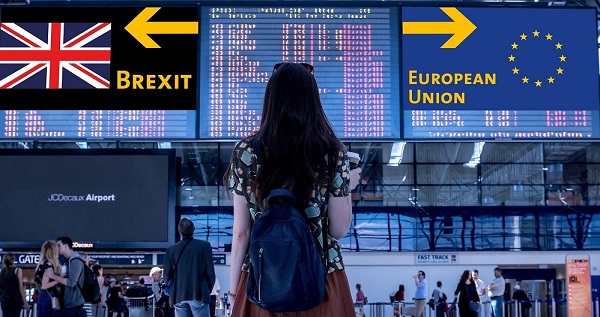
The UK left the EU on 31 January 2020 at midnight (CET) after 47 years. It is no longer an EU member state and is considered a third country.
The withdrawal agreement, which aims to ensure an orderly withdrawal of the UK from the EU, has entered into force.
The transition period provided for in the withdrawal agreement will allow more time for citizens and businesses to adapt, and is due to last until 31 December 2020.
###
### 
### **What happened before?**
- On 23 June 2016 UK citizens voted in a referendum to leave the European Union.
- On 29 March 2017 the then UK Prime Minister, Theresa May, formally triggered Article 50 to leave the EU. Article 50 of the Treaty on European Union (TEU) states that "Any Member State may decide to withdraw from the Union in accordance with its own constitutional requirements".
- Brexit was originally due to happen two years later, on 29 March 2019.
- Under Theresa May the deadline was extended twice, after the UK Parliament rejected the deal her government had negotiated with the EU.
- Despite having negotiated a revised deal, current Prime Minister Boris Johnson has not succeeded in securing support for it in the UK Parliament. MPs chose to postpone the vote on the deal until legislation needed to turn the deal into UK law was in place.
- Boris Johnson had to send a letter to President of the European Council Donald Tusk to ask for another Brexit extension. EU leaders approved the request, which means that Brexit has been pushed back to 31 January 2020.
### **What exactly is the Withdrawal Agreement?**
The Withdrawal Agreement is the deal between the UK and the EU on the terms of the UK's departure from the EU. It covers matters such as:
- money (how much the UK must pay to the EU as a settlement)
- the rights of EU citizens in the UK and UK citizens in the EU
- details of the transition period
- dispute resolution
- an outline of the future relationship between the UK and the EU
- border arrangements
The border arrangements – known as the "backstop" – are aimed at preventing a hard border (one with customs controls) between Northern Ireland and the Republic of Ireland after Brexit, even if there's no deal in place on the future relationship by the end of the transition period. The withdrawal agreement was rejected three times by the UK Parliament, resulting in the resignation of Theresa May. The new Prime Minister, Boris Johnson, negotiated changes to the withdrawal agreement whereby the backstop was replaced with new customs arrangements.
Click [here](https://www.consilium.europa.eu/en/policies/eu-uk-after-referendum/) for a comprehensive Brexit timeline.
What will happen after Brexit?
The EU is preparing for Brexit, and in March 2019 it adopted a series of "contingency measures" for a "no-deal" scenario.
### Travel:
The Council adopted a [regulation](https://data.consilium.europa.eu/doc/document/PE-71-2019-INIT/en/pdf) on 9 April 20019 setting out that, following Brexit, UK citizens coming to the Schengen area for a short stay (90 days in any 180-day period) will be granted visa free travel. Under EU rules, visa exemption is granted on condition of reciprocity. The UK government has stated that it does not intend to require a visa from EU citizens travelling to the UK for short stays. If the UK introduces a visa requirement for nationals of at least one member state in the future, the EU will apply the reciprocity mechanism, that is it will introduce the same requirement for UK nationals.
### Students:
The Council adopted a [regulation](https://data.consilium.europa.eu/doc/document/PE-55-2019-INIT/en/pdf) on 19 March 2019 in order to make sure that young people from the EU-27 and the UK will be able to complete their studies under the Erasmus+ programme in case of Brexit without a deal.
The aim of the regulation is to ensure that educational courses taking place abroad under Erasmus+ programme which have started, at the latest, on the date of Brexit will not be disrupted and that Erasmus+ participants from the EU-27 and the UK will not lose their academic credits and will not be obliged to repeat their academic semester or year.
At the end of March 2019 there were approximately 14 000 EU-27 learners in the UK and around 7 000 UK learners in the EU-27 doing courses under Erasmus+.
Click [here](https://ec.europa.eu/programmes/erasmus-plus/about/brexit_en) for more details on the impact of Brexit on the Erasmus+ programme.
Other areas covered by the legislative acts adopted in spring 2019 as part of contingency preparations for a "no-deal" Brexit include social security coordination, fisheries, transport and dual-use items.
- 
- This service is managed by the Directorate-General for "Communications Networks, Content and Technology"
## Newsroom
- [Cookies](https://ec.europa.eu/info/cookies_en)
- [Privacy policy](https://ec.europa.eu/info/privacy-policy_en)
- [Legal notice](https://ec.europa.eu/info/legal-notice_en)
## About Us
- [Directorate-General CONNECT](https://ec.europa.eu/info/departments/communications-networks-content-and-technology_en) |
| Readable Markdown | The UK left the EU on 31 January 2020 at midnight (CET) after 47 years. It is no longer an EU member state and is considered a third country.
The withdrawal agreement, which aims to ensure an orderly withdrawal of the UK from the EU, has entered into force.
The transition period provided for in the withdrawal agreement will allow more time for citizens and businesses to adapt, and is due to last until 31 December 2020.
### 
### **What happened before?**
- On 23 June 2016 UK citizens voted in a referendum to leave the European Union.
- On 29 March 2017 the then UK Prime Minister, Theresa May, formally triggered Article 50 to leave the EU. Article 50 of the Treaty on European Union (TEU) states that "Any Member State may decide to withdraw from the Union in accordance with its own constitutional requirements".
- Brexit was originally due to happen two years later, on 29 March 2019.
- Under Theresa May the deadline was extended twice, after the UK Parliament rejected the deal her government had negotiated with the EU.
- Despite having negotiated a revised deal, current Prime Minister Boris Johnson has not succeeded in securing support for it in the UK Parliament. MPs chose to postpone the vote on the deal until legislation needed to turn the deal into UK law was in place.
- Boris Johnson had to send a letter to President of the European Council Donald Tusk to ask for another Brexit extension. EU leaders approved the request, which means that Brexit has been pushed back to 31 January 2020.
### **What exactly is the Withdrawal Agreement?**
The Withdrawal Agreement is the deal between the UK and the EU on the terms of the UK's departure from the EU. It covers matters such as:
- money (how much the UK must pay to the EU as a settlement)
- the rights of EU citizens in the UK and UK citizens in the EU
- details of the transition period
- dispute resolution
- an outline of the future relationship between the UK and the EU
- border arrangements
The border arrangements – known as the "backstop" – are aimed at preventing a hard border (one with customs controls) between Northern Ireland and the Republic of Ireland after Brexit, even if there's no deal in place on the future relationship by the end of the transition period. The withdrawal agreement was rejected three times by the UK Parliament, resulting in the resignation of Theresa May. The new Prime Minister, Boris Johnson, negotiated changes to the withdrawal agreement whereby the backstop was replaced with new customs arrangements.
Click [here](https://www.consilium.europa.eu/en/policies/eu-uk-after-referendum/) for a comprehensive Brexit timeline.
What will happen after Brexit?
The EU is preparing for Brexit, and in March 2019 it adopted a series of "contingency measures" for a "no-deal" scenario.
### Travel:
The Council adopted a [regulation](https://data.consilium.europa.eu/doc/document/PE-71-2019-INIT/en/pdf) on 9 April 20019 setting out that, following Brexit, UK citizens coming to the Schengen area for a short stay (90 days in any 180-day period) will be granted visa free travel. Under EU rules, visa exemption is granted on condition of reciprocity. The UK government has stated that it does not intend to require a visa from EU citizens travelling to the UK for short stays. If the UK introduces a visa requirement for nationals of at least one member state in the future, the EU will apply the reciprocity mechanism, that is it will introduce the same requirement for UK nationals.
### Students:
The Council adopted a [regulation](https://data.consilium.europa.eu/doc/document/PE-55-2019-INIT/en/pdf) on 19 March 2019 in order to make sure that young people from the EU-27 and the UK will be able to complete their studies under the Erasmus+ programme in case of Brexit without a deal.
The aim of the regulation is to ensure that educational courses taking place abroad under Erasmus+ programme which have started, at the latest, on the date of Brexit will not be disrupted and that Erasmus+ participants from the EU-27 and the UK will not lose their academic credits and will not be obliged to repeat their academic semester or year.
At the end of March 2019 there were approximately 14 000 EU-27 learners in the UK and around 7 000 UK learners in the EU-27 doing courses under Erasmus+.
Click [here](https://ec.europa.eu/programmes/erasmus-plus/about/brexit_en) for more details on the impact of Brexit on the Erasmus+ programme.
Other areas covered by the legislative acts adopted in spring 2019 as part of contingency preparations for a "no-deal" Brexit include social security coordination, fisheries, transport and dual-use items. |
| Shard | 71 (laksa) |
| Root Hash | 8384339340669129071 |
| Unparsed URL | eu,europa!ec,/newsroom/councileu/items/663312/en s443 |