ℹ️ Skipped - page is already crawled
| Filter | Status | Condition | Details |
|---|---|---|---|
| HTTP status | PASS | download_http_code = 200 | HTTP 200 |
| Age cutoff | PASS | download_stamp > now() - 6 MONTH | 0.1 months ago |
| History drop | PASS | isNull(history_drop_reason) | No drop reason |
| Spam/ban | PASS | fh_dont_index != 1 AND ml_spam_score = 0 | ml_spam_score=0 |
| Canonical | PASS | meta_canonical IS NULL OR = '' OR = src_unparsed | Not set |
| Property | Value |
|---|---|
| URL | https://drmaehughes.com/2023/01/24/postpartum-exercise-the-first-six-weeks/ |
| Last Crawled | 2026-04-15 07:41:26 (1 day ago) |
| First Indexed | 2023-03-05 19:12:42 (3 years ago) |
| HTTP Status Code | 200 |
| Meta Title | Postpartum Rehab: The First 6 Weeks | drmaehughes.com |
| Meta Description | null |
| Meta Canonical | null |
| Boilerpipe Text | If you’ve ever given birth, you’ve definitely heard that magic number — six weeks. It’s long been the standard OBGYN clearance time when it comes to movement postpartum, and there are a few reasons why. Regardless of delivery method, it takes about 6-8 weeks for your uterus to return to its pre-pregnancy size, allowing your body to heal internally from pregnancy and delivery. And if you had a cesarean delivery, your incision will typically take about 6-8 weeks to heal, which allows your abdomen to build up strength over time.
While the 6-8 week healing benchmark is great to keep in mind, we’re learning that spending your first six weeks postpartum in bed or moving minimally might
not
be the best way to recover after all. According to the
American College of Obstetrics and Gynecology
(ACOG):
“If you had a healthy pregnancy and a normal vaginal delivery, you should be able to start exercising again soon after the baby is born. Usually, it is safe to begin exercising a few days after giving birth—or as soon as you feel ready. If you had a cesarean birth or complications, ask your ob-gyn when it is safe to begin exercising again.”
This is great news for many new mamas — but this guideline lacks specific instruction about
how
to safely incorporate movement during those early postpartum weeks. Please don’t read these updated guidelines as a free pass to sign up for your favorite bootcamp class or reach for your heavy dumbbells for some hip thrusts at the gym. But there are great ways to incorporate gentle movement that helps with day to day activities in motherhood — and they can be helpful much sooner than that 6-8 week timeline.
Today, I’m here to shed light on how to return to exercise or movement after giving birth in a way that’s best for your body at every stage. This is less about getting back to the gym and more about prioritizing good, functional strength training to make your day-to-day life easier. Remember, your baby is going to continue gaining weight week after week. Incorporating healthy movements can assist you in lifting them without pain or dysfunction!
A Set of Postpartum Movement Guidelines, Week by Week
Week 1 – Reconnect with your breath
You just had a baby! Congrats, mama – now, It’s time to focus on
recovery and healing
. Spend your first 5 days in bed, or at least as horizontal as you can, as much as you can. Have your partner, family, or friends bring meals to you in bed. Already have older kids? Prepare to enjoy time together while you’re resting in bed! Think board games, movie sessions, or coloring – anything you can do without getting up and down.
This is also a perfect time to really focus on reconnecting with your diaphragmatic breath.
During pregnancy your ribcage physically expands in all directions in order to accommodate the growing baby in your uterus. The lower ribcage is more affected than the upper portion of the ribcage.
Your diaphragm, which is the muscle that helps you to breathe, also is pushed upwards about 4cm.
All of this to say, your body goes through physical changes during pregnancy that alter your normal biomechanics of breathing, and as your body begins to return to its pre-pregnancy state, you need to re-learn how to properly perform a diaphragmatic breath.
Not to mention, diaphragmatic breathing helps to increase oxygen levels in your blood, promote muscle relaxation, and improve core stability (without having to do crunches) – all of which are
so
beneficial the first week of postpartum healing.
practicing my diaphragmatic breathing in bed 6 days postpartum
Week 2 – Reconnect with your pelvic floor
Whether you had a vaginal or cesarean delivery, your pelvic floor still undergoes 9-10 months of change during pregnancy which is why it is important to focus on reconnecting with your pelvic floor muscles as your body heals.
In order to fully restore your pelvic floor, the pelvic floor muscles need to be able to contract
and
relax just like any other muscle in your body.
You wouldn’t perform a bicep curl starting with your elbows already bent to 90 degrees right?
This is what happens when so many providers advise newly postpartum women to only focus on contracting their pelvic floor muscles (good ole kegels) and never focus on the lengthening or relaxation part!
So what’s the best way to restore your pelvic floor muscles?
Focus on deep, diaphragmatic breathing and relaxing your pelvic floor on the inhale and then on the exhale you can contract your pelvic floor (kegel).
You also want to be able to perform quick contractions of your pelvic floor muscles as well as long holds. Think of squat jumps versus a wall sit…but for your pelvic floor!
If you need some assistance, schedule a virtual PT or in-person appointment before six weeks! Not every pelvic floor PT will do this before you get OBGYN clearance, but I do recommend it. We can help you with breathing exercises and appropriate movement that will help you heal well even before that six week mark. You can find a provider near you here!
Week 3 – Restore full body mobility
By the beginning of the third week postpartum you are likely beginning to feel the itch to introduce more movement into your daily activities.
Let’s be honest, we’ve all put our bodies into some funky or contorted position trying to get the right latch or proper pump suction or correct bottle posture – and this is
tough
on our bodies.
Your body is likely feeling stiff in the upper neck/shoulder region as well as lower back, and the best fix for this is full body mobility.
Think gentle stretches in or around your bed to get your blood flowing and reduce those aches and pains that come along from surviving the first two weeks.
Focus on static stretches or dynamic mobility of your chest, upper back, hips and abdominal region.
If you had a cesarean delivery, you really want to be focusing on gentle stretches of your abdominal musculature as well as ribcage and spine in order to prevent your scar from getting too tight.
Remember, whatever you choose to do, go slow and always listen to your body. If a movement feels painful, then you are likely not ready for that movement and you may need to modify or pick a new movement.
Week 4 – Reconnect with your deep core
Not only was your pelvic floor stretched during pregnancy, but so were your abdominal muscles that make up your core.
Think of a rubber band. When a rubber band is overstretched, it loses its elasticity and therefore strength and power.
This same principle applies to your abdominal muscles. During pregnancy (especially towards the end) you may have noticed how difficult it felt to contract your core muscles and you had to modify many of your traditional core movements.
Now, your core won’t simply return to its previous state without a little guidance.
If you were performing appropriate core contractions and strengthening during pregnancy, then you will have an easier time restoring your core thanks to this wonderful thing called muscle memory.
But either way, your core muscles need dedicated time and attention during your postpartum recovery journey, and the sooner you introduce gentle core contractions, the quicker you will find yourself building strength.
Week 5 – Reconnect with your hip musculature
Your core and hip musculature did most of the heavy lifting during your pregnancy and delivery, so you do not want to forget about reconnecting with them postpartum!
During those early weeks postpartum, you are spending
a ton
of time sitting whether it be on your favorite nursery glider or bed or living room sofa.
You are sitting to feed your baby, cuddle your baby and often nap with your baby. All of these moments are precious and go by so fast so you do not want to miss out on them.
BUT (not pun intended) all of this time sitting on your butt actually weakens your hip musculature. Think about it. If you are constantly sitting on a muscle, then it is not working and therefore not getting stronger.
So don’t forget about your glutes in your postpartum recovery. Strong hip muscles help to reduce common pains like pubic symphysis pain, SI joint pain and inner thigh pain. Glute bridges, hip thrusts and clamshells are all movements you can perform in a slow and controlled manner early postpartum.
Week 6 – Reintroduce functional, full body movement
By the sixth week postpartum, ss you’re able, you want to return to more full body, functional movement.
The exercises you incorporate should help make every day movements easier.
If you are lifting your baby from the crib or bassinet, loading a dishwasher, climbing stairs, sitting on a toilet and picking things up off of the floor, then you are already doing some of these movements as you take care of yourself and your baby!
Some full body movements I often recommend are: squats, step ups, rows, and overhead presses because all of these movements mimic the ones you are doing daily with your baby.
Remember, you are not at all expected to return to your pre-pregnancy exercise level within 6 weeks postpartum. Give yourself grace…you just grew a human!
Take it slow as you return to the functional movement patterns and make sure you are focusing on proper breathing, core engagement and really feeling the muscles you are calling upon.
Beyond the first 6 weeks
Congrats, you made it through the first six weeks postpartum and you have likely received clearance from your provider to return to exercise.
At this stage, you can likely add dumbbell weights to your movement and return to “normal” strength training in a progressive and gradual manner.
However, it’s best to wait on high intensity movements like jumping, running, or HIIT. If you haven’t already seen a pelvic floor PT, make sure to schedule an appointment. We can help you create an individualized approach to your return to exercise, offering guidance on what you can and cannot do based on your specific recovery needs.
If you are unable to find a pelvic floor PT near you, I have created my
Movement through Early Postpartum
course specifically for this reason. This course outlines exactly what to do the first 12 weeks postpartum including daily movement as well as educational material to navigate things like pain with intercourse, perineal tearing and c-section scar massage.
Remember, everyone is different. Some can do certain movements earlier than others, some later — and there’s nothing wrong with your timeline. Do what’s best for
you
! |
| Markdown | [](https://drmaehughes.com/)
[workshops](https://drmaehughes.com/workshops)
[blog](https://drmaehughes.com/blog)
[programs](https://drmaehughes.com/courses)
[about](https://drmaehughes.com/about)
[home](https://drmaehughes.com/)
[login](https://app.drmaehughes.com/)
[FREEBIES](https://drmaehughes.com/freebies)
# I'm Dr. Mae Hughes
## I’ve been passionate about physical therapy for as long as I can remember, but helping women and moms feel capable and strong in their own bodies is truly the job of my dreams. When I'm not serving women across the globe you can likely find me on a family walk with my kids (Ava & Hyland), my husband and rescue pup.
[postpartum rehab: the first six months](https://drmaehughes.com/2023/01/24/postpartum-exercise-the-first-six-weeks/)
### a few posts to read next
## let's connect
[5 daily movements to prepare for labor](https://drmaehughes.com/2022/05/19/5-daily-movements-to-prepare-for-labor/)
[my go-to smoothie during pregnancy](https://drmaehughes.com/2022/05/15/my-go-to-smoothie-during-pregnancy/)
## movement through pregnancy
## For women looking to stay active and reduce pain through pregnancy
[learn more →](https://drmaehughes.com/movement-through-pregnancy)
## movement through early postpartum
## For moms recovering from vaginal and cesarean deliveries
[learn more →](https://drmaehughes.com/movement-through-pregnancy)
### browse by category
[pregnancy](https://drmaehughes.com/category/pregnancy)
[labor & delivery](https://drmaehughes.com/category/labor-and-delivery)
[postpartum](https://drmaehughes.com/category/postpartum)
[pelvic floor](https://drmaehughes.com/category/pelvic-floor)
[health & wellness](https://drmaehughes.com/category/health-and-wellness)
[motherhood](https://drmaehughes.com/category/motherhood)
# Download my
### free
# Mobility Moves for Pregnancy Guide
[get the guide](https://view.flodesk.com/pages/6345dfc1f60a3ebbf7084e3a)
# Postpartum Rehab: The First 6 Weeks
### [Postpartum](https://drmaehughes.com/category/postpartum/)
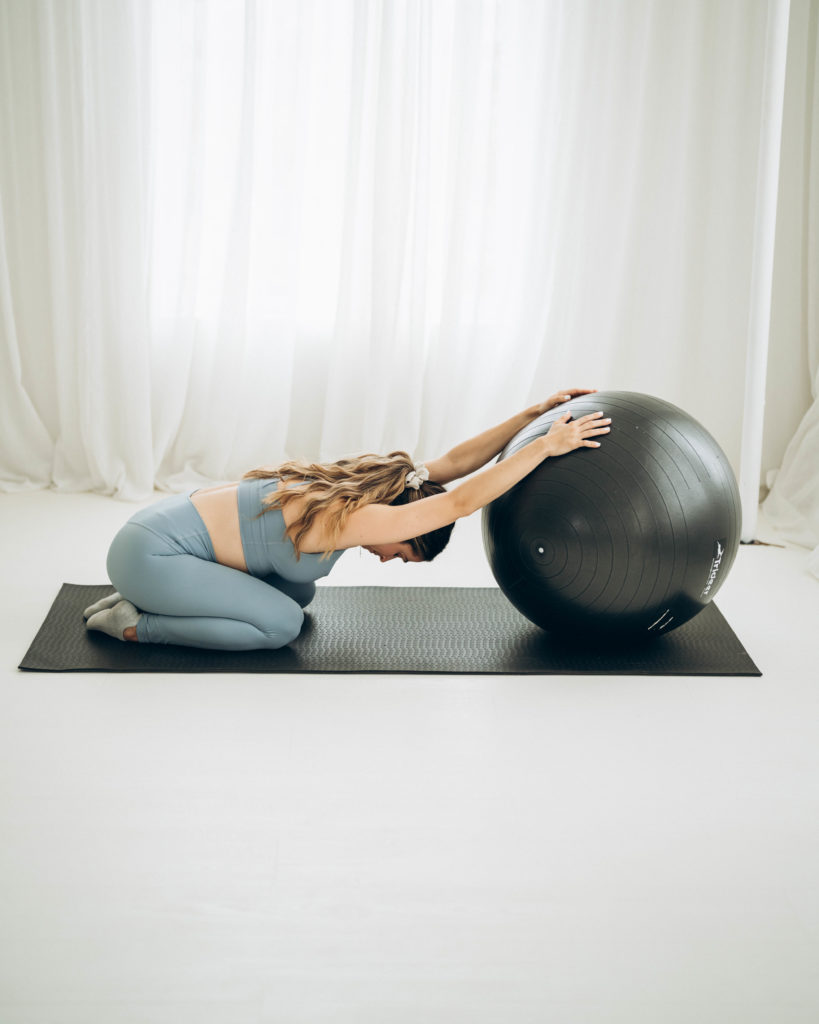
If you’ve ever given birth, you’ve definitely heard that magic number — six weeks. It’s long been the standard OBGYN clearance time when it comes to movement postpartum, and there are a few reasons why. Regardless of delivery method, it takes about 6-8 weeks for your uterus to return to its pre-pregnancy size, allowing your body to heal internally from pregnancy and delivery. And if you had a cesarean delivery, your incision will typically take about 6-8 weeks to heal, which allows your abdomen to build up strength over time.
While the 6-8 week healing benchmark is great to keep in mind, we’re learning that spending your first six weeks postpartum in bed or moving minimally might *not* be the best way to recover after all. According to the [American College of Obstetrics and Gynecology](https://www.acog.org/womens-health/faqs/exercise-after-pregnancy) (ACOG):
“If you had a healthy pregnancy and a normal vaginal delivery, you should be able to start exercising again soon after the baby is born. Usually, it is safe to begin exercising a few days after giving birth—or as soon as you feel ready. If you had a cesarean birth or complications, ask your ob-gyn when it is safe to begin exercising again.”
This is great news for many new mamas — but this guideline lacks specific instruction about *how* to safely incorporate movement during those early postpartum weeks. Please don’t read these updated guidelines as a free pass to sign up for your favorite bootcamp class or reach for your heavy dumbbells for some hip thrusts at the gym. But there are great ways to incorporate gentle movement that helps with day to day activities in motherhood — and they can be helpful much sooner than that 6-8 week timeline.
Today, I’m here to shed light on how to return to exercise or movement after giving birth in a way that’s best for your body at every stage. This is less about getting back to the gym and more about prioritizing good, functional strength training to make your day-to-day life easier. Remember, your baby is going to continue gaining weight week after week. Incorporating healthy movements can assist you in lifting them without pain or dysfunction\!
### A Set of Postpartum Movement Guidelines, Week by Week
## Week 1 – Reconnect with your breath
You just had a baby! Congrats, mama – now, It’s time to focus on [recovery and healing](https://drmaehughes.com/2022/05/11/postpartum-pelvic-floor-recovery-essentials/). Spend your first 5 days in bed, or at least as horizontal as you can, as much as you can. Have your partner, family, or friends bring meals to you in bed. Already have older kids? Prepare to enjoy time together while you’re resting in bed! Think board games, movie sessions, or coloring – anything you can do without getting up and down.
This is also a perfect time to really focus on reconnecting with your diaphragmatic breath.
During pregnancy your ribcage physically expands in all directions in order to accommodate the growing baby in your uterus. The lower ribcage is more affected than the upper portion of the ribcage.
Your diaphragm, which is the muscle that helps you to breathe, also is pushed upwards about 4cm.
All of this to say, your body goes through physical changes during pregnancy that alter your normal biomechanics of breathing, and as your body begins to return to its pre-pregnancy state, you need to re-learn how to properly perform a diaphragmatic breath.
Not to mention, diaphragmatic breathing helps to increase oxygen levels in your blood, promote muscle relaxation, and improve core stability (without having to do crunches) – all of which are *so* beneficial the first week of postpartum healing.
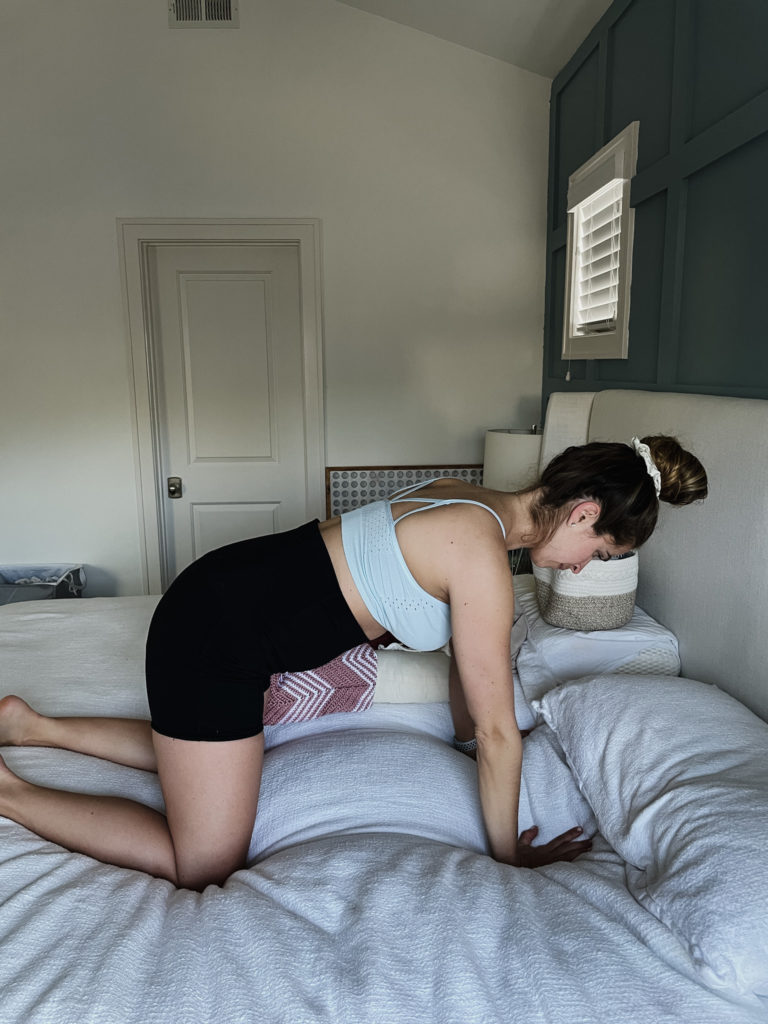
practicing my diaphragmatic breathing in bed 6 days postpartum
## Week 2 – Reconnect with your pelvic floor
Whether you had a vaginal or cesarean delivery, your pelvic floor still undergoes 9-10 months of change during pregnancy which is why it is important to focus on reconnecting with your pelvic floor muscles as your body heals.
In order to fully restore your pelvic floor, the pelvic floor muscles need to be able to contract *and* relax just like any other muscle in your body.
You wouldn’t perform a bicep curl starting with your elbows already bent to 90 degrees right?
This is what happens when so many providers advise newly postpartum women to only focus on contracting their pelvic floor muscles (good ole kegels) and never focus on the lengthening or relaxation part\!
*So what’s the best way to restore your pelvic floor muscles?*
Focus on deep, diaphragmatic breathing and relaxing your pelvic floor on the inhale and then on the exhale you can contract your pelvic floor (kegel).
You also want to be able to perform quick contractions of your pelvic floor muscles as well as long holds. Think of squat jumps versus a wall sit…but for your pelvic floor\!
If you need some assistance, schedule a virtual PT or in-person appointment before six weeks! Not every pelvic floor PT will do this before you get OBGYN clearance, but I do recommend it. We can help you with breathing exercises and appropriate movement that will help you heal well even before that six week mark. You can find a provider near you here\!
## Week 3 – Restore full body mobility
By the beginning of the third week postpartum you are likely beginning to feel the itch to introduce more movement into your daily activities.
Let’s be honest, we’ve all put our bodies into some funky or contorted position trying to get the right latch or proper pump suction or correct bottle posture – and this is *tough* on our bodies.
Your body is likely feeling stiff in the upper neck/shoulder region as well as lower back, and the best fix for this is full body mobility.
Think gentle stretches in or around your bed to get your blood flowing and reduce those aches and pains that come along from surviving the first two weeks.
Focus on static stretches or dynamic mobility of your chest, upper back, hips and abdominal region.
If you had a cesarean delivery, you really want to be focusing on gentle stretches of your abdominal musculature as well as ribcage and spine in order to prevent your scar from getting too tight.
Remember, whatever you choose to do, go slow and always listen to your body. If a movement feels painful, then you are likely not ready for that movement and you may need to modify or pick a new movement.
## Week 4 – Reconnect with your deep core
Not only was your pelvic floor stretched during pregnancy, but so were your abdominal muscles that make up your core.
Think of a rubber band. When a rubber band is overstretched, it loses its elasticity and therefore strength and power.
This same principle applies to your abdominal muscles. During pregnancy (especially towards the end) you may have noticed how difficult it felt to contract your core muscles and you had to modify many of your traditional core movements.
Now, your core won’t simply return to its previous state without a little guidance.
If you were performing appropriate core contractions and strengthening during pregnancy, then you will have an easier time restoring your core thanks to this wonderful thing called muscle memory.
But either way, your core muscles need dedicated time and attention during your postpartum recovery journey, and the sooner you introduce gentle core contractions, the quicker you will find yourself building strength.
> [View this post on Instagram](https://www.instagram.com/reel/Cd6le_PDBs6/?utm_source=ig_embed&utm_campaign=loading)
>
> [A post shared by Dr. Mae Hughes I Pelvic Floor Physical Therapist (@dr.maehughes)](https://www.instagram.com/reel/Cd6le_PDBs6/?utm_source=ig_embed&utm_campaign=loading)
## Week 5 – Reconnect with your hip musculature
Your core and hip musculature did most of the heavy lifting during your pregnancy and delivery, so you do not want to forget about reconnecting with them postpartum\!
During those early weeks postpartum, you are spending *a ton* of time sitting whether it be on your favorite nursery glider or bed or living room sofa.
You are sitting to feed your baby, cuddle your baby and often nap with your baby. All of these moments are precious and go by so fast so you do not want to miss out on them.
BUT (not pun intended) all of this time sitting on your butt actually weakens your hip musculature. Think about it. If you are constantly sitting on a muscle, then it is not working and therefore not getting stronger.
So don’t forget about your glutes in your postpartum recovery. Strong hip muscles help to reduce common pains like pubic symphysis pain, SI joint pain and inner thigh pain. Glute bridges, hip thrusts and clamshells are all movements you can perform in a slow and controlled manner early postpartum.
## Week 6 – Reintroduce functional, full body movement
By the sixth week postpartum, ss you’re able, you want to return to more full body, functional movement.
The exercises you incorporate should help make every day movements easier.
If you are lifting your baby from the crib or bassinet, loading a dishwasher, climbing stairs, sitting on a toilet and picking things up off of the floor, then you are already doing some of these movements as you take care of yourself and your baby\!
Some full body movements I often recommend are: squats, step ups, rows, and overhead presses because all of these movements mimic the ones you are doing daily with your baby.
Remember, you are not at all expected to return to your pre-pregnancy exercise level within 6 weeks postpartum. Give yourself grace…you just grew a human\!
Take it slow as you return to the functional movement patterns and make sure you are focusing on proper breathing, core engagement and really feeling the muscles you are calling upon.
## Beyond the first 6 weeks
Congrats, you made it through the first six weeks postpartum and you have likely received clearance from your provider to return to exercise.
At this stage, you can likely add dumbbell weights to your movement and return to “normal” strength training in a progressive and gradual manner.
However, it’s best to wait on high intensity movements like jumping, running, or HIIT. If you haven’t already seen a pelvic floor PT, make sure to schedule an appointment. We can help you create an individualized approach to your return to exercise, offering guidance on what you can and cannot do based on your specific recovery needs.
If you are unable to find a pelvic floor PT near you, I have created my [Movement through Early Postpartum](https://drmaehughes.com/movement-through-early-postpartum) course specifically for this reason. This course outlines exactly what to do the first 12 weeks postpartum including daily movement as well as educational material to navigate things like pain with intercourse, perineal tearing and c-section scar massage.
Remember, everyone is different. Some can do certain movements earlier than others, some later — and there’s nothing wrong with your timeline. Do what’s best for **you**\!
1. Shazana Sunderji
says:
[February 17, 2025 at 7:48 pm](https://drmaehughes.com/2023/01/24/postpartum-exercise-the-first-six-weeks/#comment-4685)
How long are the exercises for weeks 6-12?
[Reply](https://drmaehughes.com/2023/01/24/postpartum-exercise-the-first-six-weeks/?replytocom=4685#respond)
- Mae Hughes
says:
[February 21, 2025 at 2:05 am](https://drmaehughes.com/2023/01/24/postpartum-exercise-the-first-six-weeks/#comment-4800)
Hello! They are about 30-35 minutes with 4 of them per week.
[Reply](https://drmaehughes.com/2023/01/24/postpartum-exercise-the-first-six-weeks/?replytocom=4800#respond)
[2 Comments on Postpartum Rehab: The First 6 Weeks](https://drmaehughes.com/2023/01/24/postpartum-exercise-the-first-six-weeks/#comments)
### Leave a Reply [Cancel reply](https://drmaehughes.com/2023/01/24/postpartum-exercise-the-first-six-weeks/#respond)
[How to Reduce Perineal Tearing During Labor](https://drmaehughes.com/2023/01/31/how-to-reduce-perineal-tearing-during-labor/) »
« [4 Ways to Ease Constipation](https://drmaehughes.com/2023/01/20/4-ways-to-ease-postpartum-constipation/)
# the Hughes News
# Join my weekly newsletter,
[brand & site credit](https://jocelynburks.com/)
[legal](https://drmaehughes.com/legal)
[Refund Policy](https://drmaehughes.com/refund-policy)
[instagram](https://www.instagram.com/dr.maehughes/)
[email](mailto:hello@drmaehughes.com)
## connect
[blog](https://drmaehughes.com/blog)
[shop my faves](https://drmaehughes.com/shop-my-faves)
[courses](https://drmaehughes.com/courses)
[about](https://drmaehughes.com/about)
[home](https://drmaehughes.com/)
## navigate
## join my newsletter
### PREGNANCY / POSTPARTUM / PELVIC FLOOR
[](https://drmaehughes.com/)
[All rights reserved MaE Hughes pt, llc 2022](https://drmaehughes.com/refund-policy)
[accessibility statement](https://drmaehughes.com/accessibility-statement)
[Motherhood](https://drmaehughes.com/category/motherhood)
[health & wellness](https://drmaehughes.com/category/health-and-wellness)
[pelvic floor](https://drmaehughes.com/category/pelvic-floor)
[postpartum](https://drmaehughes.com/category/postpartum/)
[labor & delivery](https://drmaehughes.com/category/labor-and-delivery)
[pregnancy](https://drmaehughes.com/category/pregnancy)
[Blog](https://drmaehughes.com/blog)

## Movement Through Motherhood *Pain Free*
[Workshops](https://drmaehughes.com/shop-my-faves)
[Freebies](https://drmaehughes.com/freebies)
[Programs](https://drmaehughes.com/courses)
[About](https://drmaehughes.com/about)
[Home](https://drmaehughes.com/)
[](https://drmaehughes.com/)
## I am a Doctor of Physical Therapy passionate about helping women move through all stages of motherhood.
[download the app](https://app.drmaehughes.com/)
 |
| Readable Markdown | 
If you’ve ever given birth, you’ve definitely heard that magic number — six weeks. It’s long been the standard OBGYN clearance time when it comes to movement postpartum, and there are a few reasons why. Regardless of delivery method, it takes about 6-8 weeks for your uterus to return to its pre-pregnancy size, allowing your body to heal internally from pregnancy and delivery. And if you had a cesarean delivery, your incision will typically take about 6-8 weeks to heal, which allows your abdomen to build up strength over time.
While the 6-8 week healing benchmark is great to keep in mind, we’re learning that spending your first six weeks postpartum in bed or moving minimally might *not* be the best way to recover after all. According to the [American College of Obstetrics and Gynecology](https://www.acog.org/womens-health/faqs/exercise-after-pregnancy) (ACOG):
“If you had a healthy pregnancy and a normal vaginal delivery, you should be able to start exercising again soon after the baby is born. Usually, it is safe to begin exercising a few days after giving birth—or as soon as you feel ready. If you had a cesarean birth or complications, ask your ob-gyn when it is safe to begin exercising again.”
This is great news for many new mamas — but this guideline lacks specific instruction about *how* to safely incorporate movement during those early postpartum weeks. Please don’t read these updated guidelines as a free pass to sign up for your favorite bootcamp class or reach for your heavy dumbbells for some hip thrusts at the gym. But there are great ways to incorporate gentle movement that helps with day to day activities in motherhood — and they can be helpful much sooner than that 6-8 week timeline.
Today, I’m here to shed light on how to return to exercise or movement after giving birth in a way that’s best for your body at every stage. This is less about getting back to the gym and more about prioritizing good, functional strength training to make your day-to-day life easier. Remember, your baby is going to continue gaining weight week after week. Incorporating healthy movements can assist you in lifting them without pain or dysfunction\!
### A Set of Postpartum Movement Guidelines, Week by Week
## Week 1 – Reconnect with your breath
You just had a baby! Congrats, mama – now, It’s time to focus on [recovery and healing](https://drmaehughes.com/2022/05/11/postpartum-pelvic-floor-recovery-essentials/). Spend your first 5 days in bed, or at least as horizontal as you can, as much as you can. Have your partner, family, or friends bring meals to you in bed. Already have older kids? Prepare to enjoy time together while you’re resting in bed! Think board games, movie sessions, or coloring – anything you can do without getting up and down.
This is also a perfect time to really focus on reconnecting with your diaphragmatic breath.
During pregnancy your ribcage physically expands in all directions in order to accommodate the growing baby in your uterus. The lower ribcage is more affected than the upper portion of the ribcage.
Your diaphragm, which is the muscle that helps you to breathe, also is pushed upwards about 4cm.
All of this to say, your body goes through physical changes during pregnancy that alter your normal biomechanics of breathing, and as your body begins to return to its pre-pregnancy state, you need to re-learn how to properly perform a diaphragmatic breath.
Not to mention, diaphragmatic breathing helps to increase oxygen levels in your blood, promote muscle relaxation, and improve core stability (without having to do crunches) – all of which are *so* beneficial the first week of postpartum healing.

practicing my diaphragmatic breathing in bed 6 days postpartum
## Week 2 – Reconnect with your pelvic floor
Whether you had a vaginal or cesarean delivery, your pelvic floor still undergoes 9-10 months of change during pregnancy which is why it is important to focus on reconnecting with your pelvic floor muscles as your body heals.
In order to fully restore your pelvic floor, the pelvic floor muscles need to be able to contract *and* relax just like any other muscle in your body.
You wouldn’t perform a bicep curl starting with your elbows already bent to 90 degrees right?
This is what happens when so many providers advise newly postpartum women to only focus on contracting their pelvic floor muscles (good ole kegels) and never focus on the lengthening or relaxation part\!
*So what’s the best way to restore your pelvic floor muscles?*
Focus on deep, diaphragmatic breathing and relaxing your pelvic floor on the inhale and then on the exhale you can contract your pelvic floor (kegel).
You also want to be able to perform quick contractions of your pelvic floor muscles as well as long holds. Think of squat jumps versus a wall sit…but for your pelvic floor\!
If you need some assistance, schedule a virtual PT or in-person appointment before six weeks! Not every pelvic floor PT will do this before you get OBGYN clearance, but I do recommend it. We can help you with breathing exercises and appropriate movement that will help you heal well even before that six week mark. You can find a provider near you here\!
## Week 3 – Restore full body mobility
By the beginning of the third week postpartum you are likely beginning to feel the itch to introduce more movement into your daily activities.
Let’s be honest, we’ve all put our bodies into some funky or contorted position trying to get the right latch or proper pump suction or correct bottle posture – and this is *tough* on our bodies.
Your body is likely feeling stiff in the upper neck/shoulder region as well as lower back, and the best fix for this is full body mobility.
Think gentle stretches in or around your bed to get your blood flowing and reduce those aches and pains that come along from surviving the first two weeks.
Focus on static stretches or dynamic mobility of your chest, upper back, hips and abdominal region.
If you had a cesarean delivery, you really want to be focusing on gentle stretches of your abdominal musculature as well as ribcage and spine in order to prevent your scar from getting too tight.
Remember, whatever you choose to do, go slow and always listen to your body. If a movement feels painful, then you are likely not ready for that movement and you may need to modify or pick a new movement.
## Week 4 – Reconnect with your deep core
Not only was your pelvic floor stretched during pregnancy, but so were your abdominal muscles that make up your core.
Think of a rubber band. When a rubber band is overstretched, it loses its elasticity and therefore strength and power.
This same principle applies to your abdominal muscles. During pregnancy (especially towards the end) you may have noticed how difficult it felt to contract your core muscles and you had to modify many of your traditional core movements.
Now, your core won’t simply return to its previous state without a little guidance.
If you were performing appropriate core contractions and strengthening during pregnancy, then you will have an easier time restoring your core thanks to this wonderful thing called muscle memory.
But either way, your core muscles need dedicated time and attention during your postpartum recovery journey, and the sooner you introduce gentle core contractions, the quicker you will find yourself building strength.
## Week 5 – Reconnect with your hip musculature
Your core and hip musculature did most of the heavy lifting during your pregnancy and delivery, so you do not want to forget about reconnecting with them postpartum\!
During those early weeks postpartum, you are spending *a ton* of time sitting whether it be on your favorite nursery glider or bed or living room sofa.
You are sitting to feed your baby, cuddle your baby and often nap with your baby. All of these moments are precious and go by so fast so you do not want to miss out on them.
BUT (not pun intended) all of this time sitting on your butt actually weakens your hip musculature. Think about it. If you are constantly sitting on a muscle, then it is not working and therefore not getting stronger.
So don’t forget about your glutes in your postpartum recovery. Strong hip muscles help to reduce common pains like pubic symphysis pain, SI joint pain and inner thigh pain. Glute bridges, hip thrusts and clamshells are all movements you can perform in a slow and controlled manner early postpartum.
## Week 6 – Reintroduce functional, full body movement
By the sixth week postpartum, ss you’re able, you want to return to more full body, functional movement.
The exercises you incorporate should help make every day movements easier.
If you are lifting your baby from the crib or bassinet, loading a dishwasher, climbing stairs, sitting on a toilet and picking things up off of the floor, then you are already doing some of these movements as you take care of yourself and your baby\!
Some full body movements I often recommend are: squats, step ups, rows, and overhead presses because all of these movements mimic the ones you are doing daily with your baby.
Remember, you are not at all expected to return to your pre-pregnancy exercise level within 6 weeks postpartum. Give yourself grace…you just grew a human\!
Take it slow as you return to the functional movement patterns and make sure you are focusing on proper breathing, core engagement and really feeling the muscles you are calling upon.
## Beyond the first 6 weeks
Congrats, you made it through the first six weeks postpartum and you have likely received clearance from your provider to return to exercise.
At this stage, you can likely add dumbbell weights to your movement and return to “normal” strength training in a progressive and gradual manner.
However, it’s best to wait on high intensity movements like jumping, running, or HIIT. If you haven’t already seen a pelvic floor PT, make sure to schedule an appointment. We can help you create an individualized approach to your return to exercise, offering guidance on what you can and cannot do based on your specific recovery needs.
If you are unable to find a pelvic floor PT near you, I have created my [Movement through Early Postpartum](https://drmaehughes.com/movement-through-early-postpartum) course specifically for this reason. This course outlines exactly what to do the first 12 weeks postpartum including daily movement as well as educational material to navigate things like pain with intercourse, perineal tearing and c-section scar massage.
Remember, everyone is different. Some can do certain movements earlier than others, some later — and there’s nothing wrong with your timeline. Do what’s best for **you**\! |
| Shard | 32 (laksa) |
| Root Hash | 7951862976301033632 |
| Unparsed URL | com,drmaehughes!/2023/01/24/postpartum-exercise-the-first-six-weeks/ s443 |