ℹ️ Skipped - page is already crawled
| Filter | Status | Condition | Details |
|---|---|---|---|
| HTTP status | PASS | download_http_code = 200 | HTTP 200 |
| Age cutoff | PASS | download_stamp > now() - 6 MONTH | 1.5 months ago |
| History drop | PASS | isNull(history_drop_reason) | No drop reason |
| Spam/ban | PASS | fh_dont_index != 1 AND ml_spam_score = 0 | ml_spam_score=0 |
| Canonical | PASS | meta_canonical IS NULL OR = '' OR = src_unparsed | Not set |
| Property | Value |
|---|---|
| URL | https://dexter.substack.com/p/trade-war-3ab |
| Last Crawled | 2026-03-02 19:51:08 (1 month ago) |
| First Indexed | not set |
| HTTP Status Code | 200 |
| Meta Title | Trade War - by Dexter Roberts - Trade War |
| Meta Description | China appears a winner with Supreme Court ruling on Trump’s tariffs. But USTR chief Jamieson Greer says levies on China to stay between 35% and 50%. |
| Meta Canonical | null |
| Boilerpipe Text | Welcome to the 294th edition of Trade War.
China appears a winner with Supreme Court ruling on Trump’s tariffs. USTR chief Jamieson Greer says levies on China to stay between 35% and 50%. And Washington says it is considering revoking Permanent Normal Trading status, a move that could see tariffs on China rise again.
Beijing threatens to take action against any new US tariffs. $112 billion gap between American and Chinese export figures suggests massive tariff dodging. And Xi Jinping declares China and Germany should defend “free trade,” in Beijing meeting with the Chancellor Friedrich Merz.
“Beggar-thy-neighbor policies to defend their own producers”
Central challenge for the US is not China bending the rules
Must-read newsletter:
Semafor China
from Andy Browne
China appears to be a winner following the Supreme Court striking down Trump’s tariffs.
Trump has responded to the ruling against his broad emergency tariffs by
first threatening
to impose a new flat 10 percent tariff, then raising it to 15 percent, before reverting back to 10 percent.
That makes China, at least for now, one of the biggest beneficiaries of the U.S. Supreme Court decision. Don’t forget, last year Trump’s tariffs on China reached as high as 145 percent. Before the latest Supreme Court ruling, the average weighted tariffs on China were at 32 percent and now they are down to 24 percent,
according to
an estimate by Morgan Stanley.
Thing could quickly change, however. On Wednesday, USTR Jamieson Greer
announced
that the tariffs on China should remain in the 35 to 50 percent range.
The U.S. government was already
investigating
whether China lived up to its commitments in the 2020 “Phase One” trade agreement, signed during Trump I. Shortly after it came into effect, COVID hit. Not surprisingly, that affected China’s promised purchases of U.S. exports and the agreement was widely viewed as unsuccessful.
Now the Department of Commerce has announced that it is
considering
revoking China’s Permanent Normal Trading Status, a move that would allow tariffs to go up significantly.
China has responded in very strong terms, with a Commerce Ministry spokesperson warning that if the U.S. imposes any new tariffs, Beijing will take “all necessary measures to resolutely defend its legitimate rights and interests.”
Beijing also said it hoped the U.S. would not try to
“shift responsibility”
or “provoke trouble.”
This is all happening, of course, just weeks before Trump heads to Beijing, where he is scheduled to arrive on March 31st. It’s a state visit, which will see him and Xi Jinping sitting down together, a meeting that many have predicted might lead to an extended tariff truce.
Now everything is a little bit more up in the air with both sides trading threats. My prediction: Trump will do what he’s been doing of late, and that is to cave on China again.
Some of the that we’ve seen recently:
Trump suggested that he will dial back technology restrictions to allow China more access to the advanced technology that it desires.
Trump announced that he was consulting with Xi Jinping on weapons sales to Taiwan. That’s a bizarre thing to say, and if true, deeply disturbing to the very delicate relationship between the U.S., China, and Taiwan.
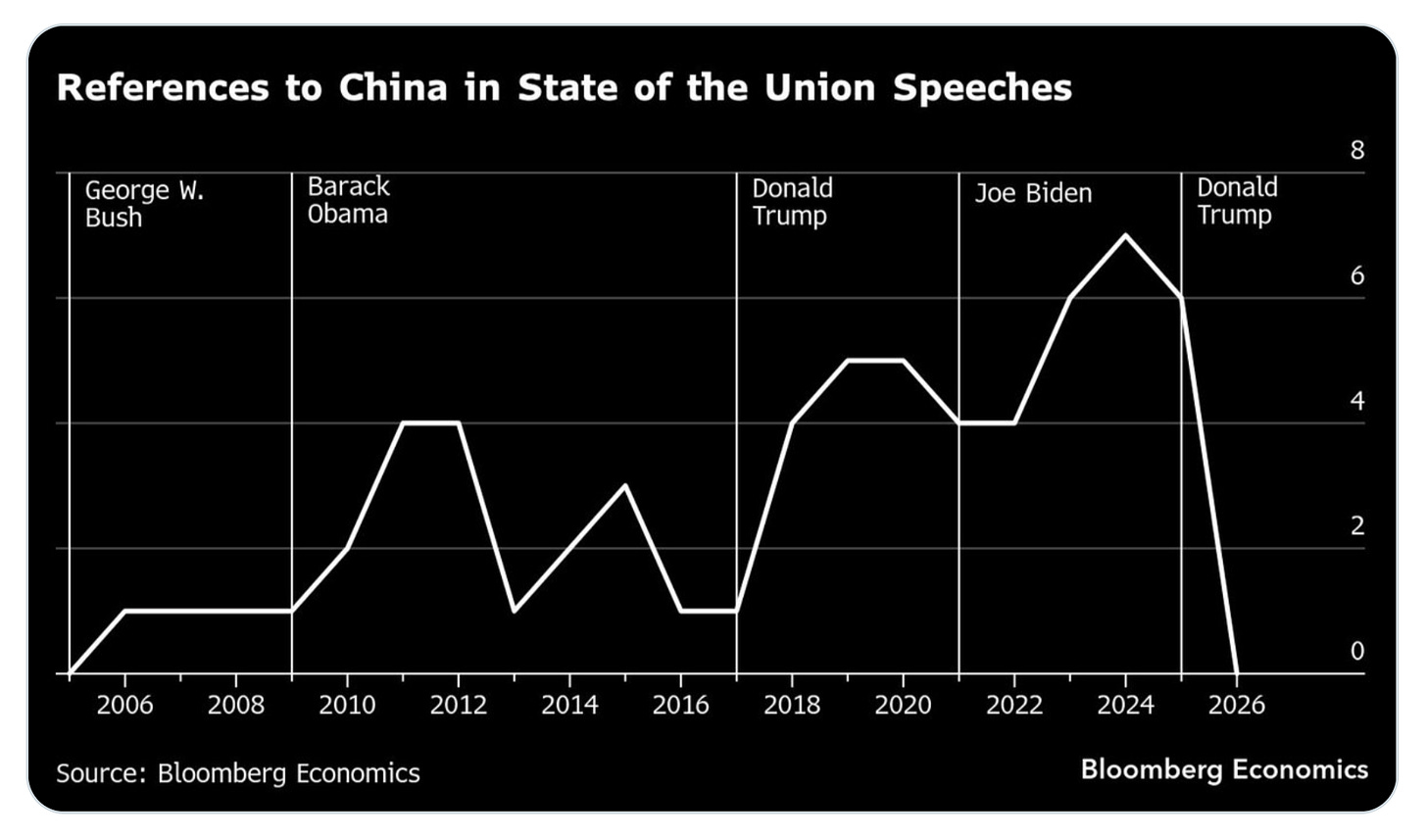
Then on Tuesday night, during the State of the Union address, Trump didn’t mention China once. That’s the first time in two decades that a U.S. president has not mentioned China in the annual address. |
| Markdown | # [Trade War](https://dexter.substack.com/)
Subscribe
Sign in
# Trade War
### Newsletter 294 - Feb. 29, 2026
[Dexter Roberts](https://substack.com/@dexter)
Mar 01, 2026
∙ Paid
4
2
Share
Trade War is a reader-supported publication. To receive new posts and support my work, consider becoming a free or paid subscriber.
Welcome to the 294th edition of Trade War.
China appears a winner with Supreme Court ruling on Trump’s tariffs. USTR chief Jamieson Greer says levies on China to stay between 35% and 50%. And Washington says it is considering revoking Permanent Normal Trading status, a move that could see tariffs on China rise again.
Beijing threatens to take action against any new US tariffs. \$112 billion gap between American and Chinese export figures suggests massive tariff dodging. And Xi Jinping declares China and Germany should defend “free trade,” in Beijing meeting with the Chancellor Friedrich Merz.
#### Notable/In depth ~
- “Beggar-thy-neighbor policies to defend their own producers”
- Central challenge for the US is not China bending the rules
- Must-read newsletter: ***[Semafor China](https://www.semafor.com/newsletter/02/24/2026/semafor-china-update-not-reset?utm_source=headernewsletterlink&utm_medium=china)*** from Andy Browne
### **China wins with Court ruling against Trump tariffs**
China appears to be a winner following the Supreme Court striking down Trump’s tariffs.
Trump has responded to the ruling against his broad emergency tariffs by [first threatening](https://www.atlanticcouncil.org/dispatches/eight-questions-and-expert-answers-on-whats-next-for-us-tariff-policy/) to impose a new flat 10 percent tariff, then raising it to 15 percent, before reverting back to 10 percent.
That makes China, at least for now, one of the biggest beneficiaries of the U.S. Supreme Court decision. Don’t forget, last year Trump’s tariffs on China reached as high as 145 percent. Before the latest Supreme Court ruling, the average weighted tariffs on China were at 32 percent and now they are down to 24 percent, [according to](https://www.cnn.com/2026/02/23/business/china-trump-supreme-court-tariff-analysis-inl-hnk) an estimate by Morgan Stanley.
Thing could quickly change, however. On Wednesday, USTR Jamieson Greer [announced](https://www.bloomberg.com/news/articles/2026-02-25/china-warns-us-it-will-respond-if-trade-probe-spurs-new-tariffs?embedded-checkout=true) that the tariffs on China should remain in the 35 to 50 percent range.
The U.S. government was already [investigating](https://ustr.gov/about/policy-offices/press-office/press-releases/2025/october/ustr-initiates-section-301-investigation-chinas-implementation-phase-one-agreement) whether China lived up to its commitments in the 2020 “Phase One” trade agreement, signed during Trump I. Shortly after it came into effect, COVID hit. Not surprisingly, that affected China’s promised purchases of U.S. exports and the agreement was widely viewed as unsuccessful.
#### Revoking PNTR
Now the Department of Commerce has announced that it is [considering](https://www.reuters.com/world/asia-pacific/usitc-probe-impact-revoking-permanent-normal-trade-ties-china-products-2026-02-26/) revoking China’s Permanent Normal Trading Status, a move that would allow tariffs to go up significantly.
China has responded in very strong terms, with a Commerce Ministry spokesperson warning that if the U.S. imposes any new tariffs, Beijing will take “all necessary measures to resolutely defend its legitimate rights and interests.”
Beijing also said it hoped the U.S. would not try to [“shift responsibility”](https://www.reuters.com/world/china/china-says-it-has-met-us-trade-obligations-warns-against-more-tariffs-2026-02-25/) or “provoke trouble.”
This is all happening, of course, just weeks before Trump heads to Beijing, where he is scheduled to arrive on March 31st. It’s a state visit, which will see him and Xi Jinping sitting down together, a meeting that many have predicted might lead to an extended tariff truce.
#### Caving on China
Now everything is a little bit more up in the air with both sides trading threats. My prediction: Trump will do what he’s been doing of late, and that is to cave on China again.
Some of the that we’ve seen recently:
- Trump suggested that he will dial back technology restrictions to allow China more access to the advanced technology that it desires.
- Trump announced that he was consulting with Xi Jinping on weapons sales to Taiwan. That’s a bizarre thing to say, and if true, deeply disturbing to the very delicate relationship between the U.S., China, and Taiwan.
- Then on Tuesday night, during the State of the Union address, Trump didn’t mention China once. That’s the first time in two decades that a U.S. president has not mentioned China in the annual address.
[](https://substackcdn.com/image/fetch/$s_!W9uc!,f_auto,q_auto:good,fl_progressive:steep/https%3A%2F%2Fsubstack-post-media.s3.amazonaws.com%2Fpublic%2Fimages%2F555b5e3c-fe75-4f89-ace9-611556e8991a_1706x1004.png)
###
## Keep reading with a 7-day free trial
Subscribe to Trade War to keep reading this post and get 7 days of free access to the full post archives.
[Start trial](https://dexter.substack.com/subscribe?simple=true&next=https%3A%2F%2Fdexter.substack.com%2Fp%2Ftrade-war-3ab&utm_source=paywall-free-trial&utm_medium=web&utm_content=188989604&coupon=05a7a745)
[Already a paid subscriber? **Sign in**](https://substack.com/sign-in?redirect=%2Fp%2Ftrade-war-3ab&for_pub=dexter&change_user=false)
© 2026 Dexter Roberts · [Privacy](https://substack.com/privacy) ∙ [Terms](https://substack.com/tos) ∙ [Collection notice](https://substack.com/ccpa#personal-data-collected)
[Start your Substack](https://substack.com/signup?utm_source=substack&utm_medium=web&utm_content=footer)
[Get the app](https://substack.com/app/app-store-redirect?utm_campaign=app-marketing&utm_content=web-footer-button)
[Substack](https://substack.com/) is the home for great culture
This site requires JavaScript to run correctly. Please [turn on JavaScript](https://enable-javascript.com/) or unblock scripts |
| Readable Markdown | Welcome to the 294th edition of Trade War.
China appears a winner with Supreme Court ruling on Trump’s tariffs. USTR chief Jamieson Greer says levies on China to stay between 35% and 50%. And Washington says it is considering revoking Permanent Normal Trading status, a move that could see tariffs on China rise again.
Beijing threatens to take action against any new US tariffs. \$112 billion gap between American and Chinese export figures suggests massive tariff dodging. And Xi Jinping declares China and Germany should defend “free trade,” in Beijing meeting with the Chancellor Friedrich Merz.
- “Beggar-thy-neighbor policies to defend their own producers”
- Central challenge for the US is not China bending the rules
- Must-read newsletter: ***[Semafor China](https://www.semafor.com/newsletter/02/24/2026/semafor-china-update-not-reset?utm_source=headernewsletterlink&utm_medium=china)*** from Andy Browne
China appears to be a winner following the Supreme Court striking down Trump’s tariffs.
Trump has responded to the ruling against his broad emergency tariffs by [first threatening](https://www.atlanticcouncil.org/dispatches/eight-questions-and-expert-answers-on-whats-next-for-us-tariff-policy/) to impose a new flat 10 percent tariff, then raising it to 15 percent, before reverting back to 10 percent.
That makes China, at least for now, one of the biggest beneficiaries of the U.S. Supreme Court decision. Don’t forget, last year Trump’s tariffs on China reached as high as 145 percent. Before the latest Supreme Court ruling, the average weighted tariffs on China were at 32 percent and now they are down to 24 percent, [according to](https://www.cnn.com/2026/02/23/business/china-trump-supreme-court-tariff-analysis-inl-hnk) an estimate by Morgan Stanley.
Thing could quickly change, however. On Wednesday, USTR Jamieson Greer [announced](https://www.bloomberg.com/news/articles/2026-02-25/china-warns-us-it-will-respond-if-trade-probe-spurs-new-tariffs?embedded-checkout=true) that the tariffs on China should remain in the 35 to 50 percent range.
The U.S. government was already [investigating](https://ustr.gov/about/policy-offices/press-office/press-releases/2025/october/ustr-initiates-section-301-investigation-chinas-implementation-phase-one-agreement) whether China lived up to its commitments in the 2020 “Phase One” trade agreement, signed during Trump I. Shortly after it came into effect, COVID hit. Not surprisingly, that affected China’s promised purchases of U.S. exports and the agreement was widely viewed as unsuccessful.
Now the Department of Commerce has announced that it is [considering](https://www.reuters.com/world/asia-pacific/usitc-probe-impact-revoking-permanent-normal-trade-ties-china-products-2026-02-26/) revoking China’s Permanent Normal Trading Status, a move that would allow tariffs to go up significantly.
China has responded in very strong terms, with a Commerce Ministry spokesperson warning that if the U.S. imposes any new tariffs, Beijing will take “all necessary measures to resolutely defend its legitimate rights and interests.”
Beijing also said it hoped the U.S. would not try to [“shift responsibility”](https://www.reuters.com/world/china/china-says-it-has-met-us-trade-obligations-warns-against-more-tariffs-2026-02-25/) or “provoke trouble.”
This is all happening, of course, just weeks before Trump heads to Beijing, where he is scheduled to arrive on March 31st. It’s a state visit, which will see him and Xi Jinping sitting down together, a meeting that many have predicted might lead to an extended tariff truce.
Now everything is a little bit more up in the air with both sides trading threats. My prediction: Trump will do what he’s been doing of late, and that is to cave on China again.
Some of the that we’ve seen recently:
- Trump suggested that he will dial back technology restrictions to allow China more access to the advanced technology that it desires.
- Trump announced that he was consulting with Xi Jinping on weapons sales to Taiwan. That’s a bizarre thing to say, and if true, deeply disturbing to the very delicate relationship between the U.S., China, and Taiwan.
- Then on Tuesday night, during the State of the Union address, Trump didn’t mention China once. That’s the first time in two decades that a U.S. president has not mentioned China in the annual address.
[](https://substackcdn.com/image/fetch/$s_!W9uc!,f_auto,q_auto:good,fl_progressive:steep/https%3A%2F%2Fsubstack-post-media.s3.amazonaws.com%2Fpublic%2Fimages%2F555b5e3c-fe75-4f89-ace9-611556e8991a_1706x1004.png) |
| Shard | 76 (laksa) |
| Root Hash | 14862242593741677076 |
| Unparsed URL | com,substack!dexter,/p/trade-war-3ab s443 |