ℹ️ Skipped - page is already crawled
| Filter | Status | Condition | Details |
|---|---|---|---|
| HTTP status | PASS | download_http_code = 200 | HTTP 200 |
| Age cutoff | PASS | download_stamp > now() - 6 MONTH | 0.1 months ago |
| History drop | PASS | isNull(history_drop_reason) | No drop reason |
| Spam/ban | PASS | fh_dont_index != 1 AND ml_spam_score = 0 | ml_spam_score=0 |
| Canonical | PASS | meta_canonical IS NULL OR = '' OR = src_unparsed | Not set |
| Property | Value | |||||||||||||||
|---|---|---|---|---|---|---|---|---|---|---|---|---|---|---|---|---|
| URL | https://consumer.ftc.gov/node/76589 | |||||||||||||||
| Last Crawled | 2026-04-23 12:57:58 (1 day ago) | |||||||||||||||
| First Indexed | 2025-09-11 20:15:28 (7 months ago) | |||||||||||||||
| HTTP Status Code | 200 | |||||||||||||||
| Content | ||||||||||||||||
| Meta Title | Avoiding a cryptocurrency scam | Consumer Advice | |||||||||||||||
| Meta Description | Yesterday some high-profile people had their Twitter accounts hacked by scammers who | |||||||||||||||
| Meta Canonical | null | |||||||||||||||
| Boilerpipe Text | Yesterday some high-profile people had their Twitter accounts hacked by scammers who sent out fake tweets asking followers to send money using Bitcoin – a type of
cryptocurrency or digital money
.
Cryptocurrency scams are now a popular way for scammers to trick people into sending money. And they
pop up in many ways
. Most crypto scams can appear as emails trying to
blackmail
someone,
online chain referral schemes
, or
bogus investment and business opportunities
. But here’s what they all have in common
–
and what they have in common with yesterday’s Twitter hacks: A scammer wants you to send money, or make a payment, with Bitcoin or another type of cryptocurrency. Once you do, your money is gone, and there’s generally no way to get it back.
So if you see a tweet (or a text, email, or other message on social media) that tells you to pay with Bitcoin, you know that’s a scam. Other signs that something’s a scam? They might guarantee that you’ll make money (those guarantees are false); promise that you’ll double your money quickly (again, that’s always a fake promise); or say you’ll get free money in dollars or cryptocurrency (free money? Nope, not ever).
If you spot a cryptocurrency scam, report it immediately to the FTC at
ftc.gov/complaint
. For more information, check out
What To Know About Cryptocurrency
. | |||||||||||||||
| Markdown | [Skip to main content](https://consumer.ftc.gov/node/76589#main-content)

An official website of the United States government
Here’s how you know
Here's how you know

**The .gov means it’s official.**
Federal government websites often end in .gov or .mil. Before sharing sensitive information, make sure you’re on a federal government site.

**The site is secure.**
The **https://** ensures that you are connecting to the official website and that any information you provide is encrypted and transmitted securely.
- [Español](https://consumidor.ftc.gov/)
- [Report Fraud](https://reportfraud.ftc.gov/)
- [Read Consumer Alerts](https://consumer.ftc.gov/consumer-alerts)
- [Get Consumer Alerts](https://public.govdelivery.com/accounts/USFTCCONSUMER/subscriber/new?topic_id=USFTCCONSUMER_8)
- [Visit ftc.gov](https://ftc.gov/)
Menu

## CFG: Main Menu Mega
- Show/hide Shopping and Donating menu items
## Shopping and Donating
Make smart shopping decisions, know your rights, and solve problems when you shop or donate to charity.
[View Shopping and Donating](https://consumer.ftc.gov/shopping-and-donating)
## Video
## Topics
## Topics
- [Shopping](https://consumer.ftc.gov/shopping-and-donating/shopping)
- [For the Home](https://consumer.ftc.gov/shopping-and-donating/for-the-home)
- [Health](https://consumer.ftc.gov/shopping-and-donating/health)
- [Funerals](https://consumer.ftc.gov/shopping-and-donating/funerals)
- [Buying and Owning a Car](https://consumer.ftc.gov/shopping-and-donating/buying-and-owning-car)
- [Donating to Charity](https://consumer.ftc.gov/shopping-and-donating/donating-charity)
## Consumer Alerts
### [How to make your World Cup experience scam free](https://consumer.ftc.gov/consumer-alerts/2026/03/how-make-your-world-cup-experience-scam-free)
March 17, 2026
BCP Staff
Excitement is reaching a fever pitch as the United States, Mexico, and Canada get ready to welcome thousands of fans for one of the most-watched sporting events on the planet — the FIFA World Cup! While die-hard fans are preparing to support their countrymen, scammers are looking to take advantage of the rush for tickets. Learn how to make your World Cup experience scam free.
[View all Consumer Alerts](https://consumer.ftc.gov/consumer-alerts)
[Get Consumer Alerts](https://public.govdelivery.com/accounts/USFTCCONSUMER/subscriber/qualify)
- Show/hide Credit, Loans, and Debt menu items
## Credit, Loans, and Debt
Learn about getting and using credit, borrowing money, and managing debt.
[View Credit, Loans, and Debt](https://consumer.ftc.gov/credit-loans-and-debt)
## Video
## Topics
## Topics
- [Credit and Debt](https://consumer.ftc.gov/credit-loans-and-debt/credit-and-debt)
- [Loans and Mortgages](https://consumer.ftc.gov/credit-loans-and-debt/loans-and-mortgages)
## Consumer Alerts
### [Say “no, thanks” to unexpected offers to lower your credit card interest rate](https://consumer.ftc.gov/consumer-alerts/2026/04/say-no-thanks-unexpected-offers-lower-your-credit-card-interest-rate)
April 22, 2026
BCP Staff
If a company calls you unexpectedly and offers to help lower your credit card interest rate, say “no, thanks.” It’s probably a scammer hoping you’ll pay them for shortcuts that don’t really exist. Here’s how to spot and avoid scams that promise to help lower your credit card interest rate.
[View all Consumer Alerts](https://consumer.ftc.gov/consumer-alerts)
[Get Consumer Alerts](https://public.govdelivery.com/accounts/USFTCCONSUMER/subscriber/qualify)
- Show/hide Jobs and Making Money menu items
## Jobs and Making Money
What to know when you're looking for a job or more education, or considering a money-making opportunity or investment.
[View Jobs and Making Money](https://consumer.ftc.gov/jobs-and-making-money)
## Video
## Topics
## Topics
- [Money-Making Opportunities and Investments](https://consumer.ftc.gov/jobs-and-making-money/money-making-opportunities-and-investments)
- [Jobs](https://consumer.ftc.gov/jobs-and-making-money/jobs)
- [Education and Training](https://consumer.ftc.gov/jobs-and-making-money/education-and-training)
## Consumer Alerts
### [With people losing big to investment scams, learn how to spot and avoid them](https://consumer.ftc.gov/consumer-alerts/2026/04/people-losing-big-investment-scams-learn-how-spot-and-avoid-them)
April 16, 2026
BCP Staff
You might be interested in making money through investments. Who isn’t? So offers that promise big returns might draw your attention…and scammers know this. They use those promises and clever schemes to lure you in and, unfortunately, people are losing big money on investment scams. In fact, FTC data shows reports of more than \$7.9 billion in losses to investment scams, with a median individual loss of more than \$10,000 in 2025. Do you know how to spot and avoid investment scams?
[View all Consumer Alerts](https://consumer.ftc.gov/consumer-alerts)
[Get Consumer Alerts](https://public.govdelivery.com/accounts/USFTCCONSUMER/subscriber/qualify)
- Show/hide Unwanted Calls, Emails, and Texts menu items
## Unwanted Calls, Emails, and Texts
What to do about unwanted calls, emails, and text messages that can be annoying, might be illegal, and are probably scams.
[View Unwanted Calls, Emails, and Texts](https://consumer.ftc.gov/unwanted-calls-emails-and-texts)
## Video
## Topics
## Topics
- [Unwanted Calls](https://consumer.ftc.gov/unwanted-calls-emails-and-texts/unwanted-calls)
- [Unwanted Emails, Texts, and Mail](https://consumer.ftc.gov/unwanted-calls-emails-and-texts/unwanted-emails-texts-and-mail)
## Consumer Alerts
### [That text about a traffic violation is probably a scam](https://consumer.ftc.gov/consumer-alerts/2026/04/text-about-traffic-violation-probably-scam)
April 14, 2026
BCP Staff
Did you get a text with a picture of what looks like an official notice of a traffic hearing? You’re not alone. The FTC has seen a spike in reports about this text scam in the last month. It’s just the latest story of how scammers are trying to separate people from their money. Here’s how this scam works — and how to avoid it.
[View all Consumer Alerts](https://consumer.ftc.gov/consumer-alerts)
[Get Consumer Alerts](https://public.govdelivery.com/accounts/USFTCCONSUMER/subscriber/qualify)
- Show/hide Identity Theft and Online Security menu items
## Identity Theft and Online Security
How to protect your personal information and privacy, stay safe online, and help your kids do the same.
[View Identity Theft and Online Security](https://consumer.ftc.gov/identity-theft-and-online-security)
## Video
## Topics
## Topics
- [Identity Theft](https://consumer.ftc.gov/identity-theft-and-online-security/identity-theft)
- [Online Privacy and Security](https://consumer.ftc.gov/identity-theft-and-online-security/online-privacy-and-security)
- [Protecting Kids Online](https://consumer.ftc.gov/identity-theft-and-online-security/protecting-kids-online)
## Consumer Alerts
### [Say “no, thanks” to unexpected offers to lower your credit card interest rate](https://consumer.ftc.gov/consumer-alerts/2026/04/say-no-thanks-unexpected-offers-lower-your-credit-card-interest-rate)
April 22, 2026
BCP Staff
If a company calls you unexpectedly and offers to help lower your credit card interest rate, say “no, thanks.” It’s probably a scammer hoping you’ll pay them for shortcuts that don’t really exist. Here’s how to spot and avoid scams that promise to help lower your credit card interest rate.
[View all Consumer Alerts](https://consumer.ftc.gov/consumer-alerts)
[Get Consumer Alerts](https://public.govdelivery.com/accounts/USFTCCONSUMER/subscriber/qualify)
- [Scams](https://consumer.ftc.gov/scams)
- [Search](https://consumer.ftc.gov/search)
Show/hide Search menu items
- [Español](https://consumidor.ftc.gov/)
- [Report Fraud](https://reportfraud.ftc.gov/)
- [Read Consumer Alerts](https://consumer.ftc.gov/consumer-alerts)
- [Get Consumer Alerts](https://public.govdelivery.com/accounts/USFTCCONSUMER/subscriber/new?topic_id=USFTCCONSUMER_8)
- [Visit ftc.gov](https://ftc.gov/)
## CFG: Main Navigation
- [Shopping and Donating](https://consumer.ftc.gov/shopping-donating)
Show/hide Shopping and Donating menu items
- [Shopping](https://consumer.ftc.gov/shopping-and-donating/shopping)
- [For the Home](https://consumer.ftc.gov/shopping-and-donating/for-the-home)
- [Health](https://consumer.ftc.gov/shopping-and-donating/health)
- [Funerals](https://consumer.ftc.gov/shopping-and-donating/funerals)
- [Buying and Owning a Car](https://consumer.ftc.gov/shopping-and-donating/buying-and-owning-car)
- [Donating to Charity](https://consumer.ftc.gov/shopping-and-donating/donating-charity)
- [Credit, Loans, and Debt](https://consumer.ftc.gov/credit-loans-debt)
Show/hide Credit, Loans, and Debt menu items
- [Credit and Debt](https://consumer.ftc.gov/credit-loans-and-debt/credit-and-debt)
- [Loans and Mortgages](https://consumer.ftc.gov/credit-loans-and-debt/loans-and-mortgages)
- [Jobs and Making Money](https://consumer.ftc.gov/jobs-making-money)
Show/hide Jobs and Making Money menu items
- [Money-Making Opportunities and Investments](https://consumer.ftc.gov/jobs-and-making-money/money-making-opportunities-and-investments)
- [Jobs](https://consumer.ftc.gov/jobs-and-making-money/jobs)
- [Education and Training](https://consumer.ftc.gov/jobs-and-making-money/education-and-training)
- [Unwanted Calls, Emails, and Texts](https://consumer.ftc.gov/unwanted-calls-emails-texts)
Show/hide Unwanted Calls, Emails, and Texts menu items
- [Unwanted Calls](https://consumer.ftc.gov/unwanted-calls-emails-and-texts/unwanted-calls)
- [Unwanted Emails, Texts, and Mail](https://consumer.ftc.gov/unwanted-calls-emails-and-texts/unwanted-emails-texts-and-mail)
- [Identity Theft and Online Security](https://consumer.ftc.gov/identity-theft-online-security)
Show/hide Identity Theft and Online Security menu items
- [Identity Theft](https://consumer.ftc.gov/identity-theft-and-online-security/identity-theft)
- [Online Privacy and Security](https://consumer.ftc.gov/identity-theft-and-online-security/online-privacy-and-security)
- [Protecting Kids Online](https://consumer.ftc.gov/identity-theft-and-online-security/protecting-kids-online)
- [Scams](https://consumer.ftc.gov/scams)
Show/hide Scams menu items
- [Gift Card Scams](https://consumer.ftc.gov/gift-card-scams)
- [Government and Business Impersonators](https://consumer.ftc.gov/government-business-impersonators)
- [Phone Scams](https://consumer.ftc.gov/phone-scams)
- [Romance Scams](https://consumer.ftc.gov/romance-scams)
- [Scams Against Immigrants](https://consumer.ftc.gov/all-scams/scams-against-immigrants)
- [Scams Against Older Adults](https://consumer.ftc.gov/all-scams/scams-against-older-adults)
- [Scams Against Small Businesses](https://consumer.ftc.gov/all-scams/scams-against-small-businesses)
- [Wire Transfer Scams](https://consumer.ftc.gov/all-scams/wire-transfer-scams)
Yesterday some high-profile people had their Twitter accounts hacked by scammers who sent out fake tweets asking followers to send money using Bitcoin – a type of [cryptocurrency or digital money](https://www.consumer.ftc.gov/articles/what-know-about-cryptocurrency). [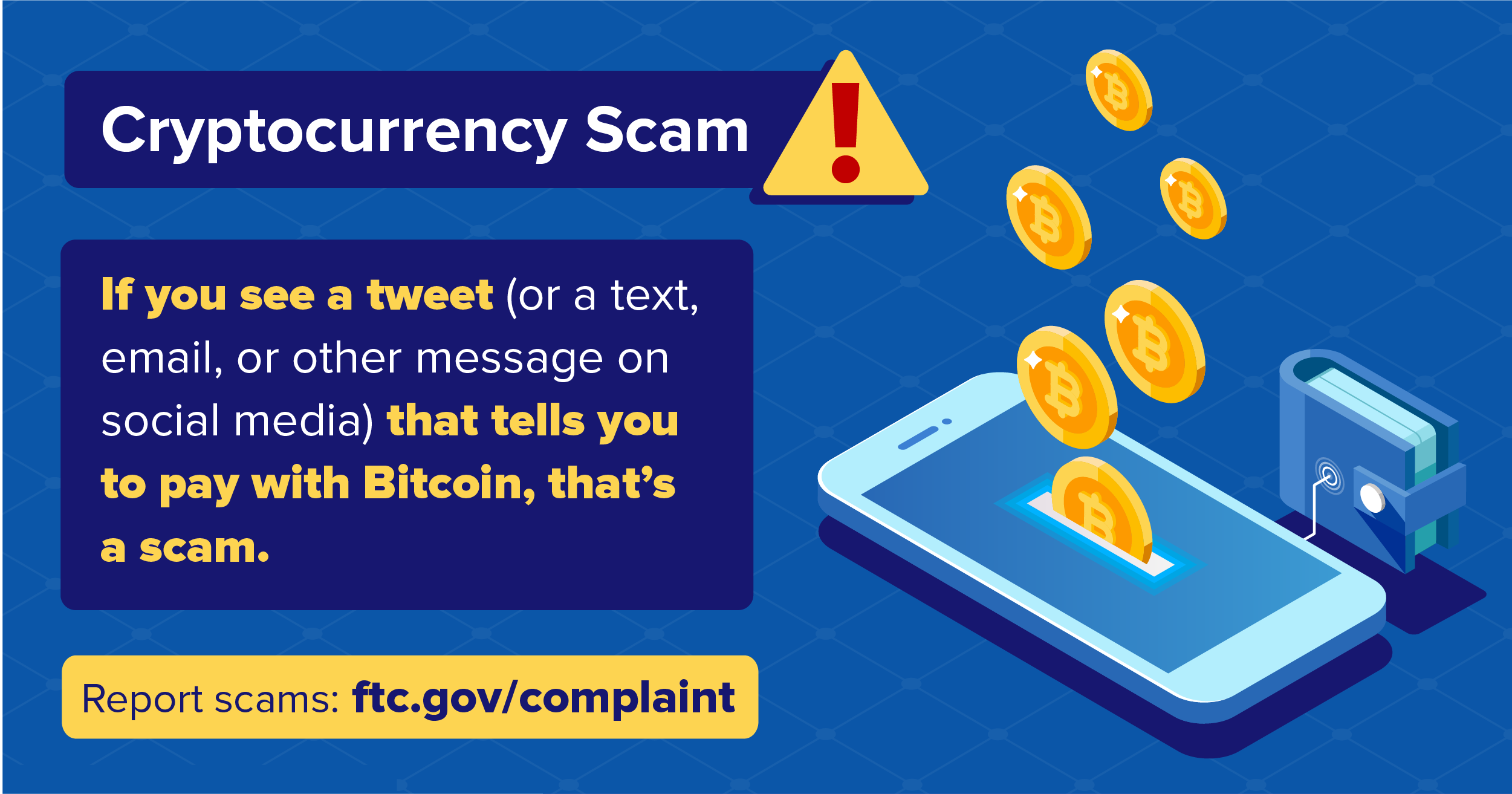](https://www.consumer.ftc.gov/sites/www.consumer.ftc.gov/files/bitcoin_scams_blog_v1-01.png)
Cryptocurrency scams are now a popular way for scammers to trick people into sending money. And they [pop up in many ways](https://www.consumer.ftc.gov/blog/2019/11/scams-telling-you-pay-bitcoin-rise). Most crypto scams can appear as emails trying to [blackmail](https://www.consumer.ftc.gov/blog/2020/04/scam-emails-demand-bitcoin-threaten-blackmail) someone, [online chain referral schemes](https://www.consumer.ftc.gov/blog/2018/03/bitcoin-online-chain-referral-illegal-scheme), or [bogus investment and business opportunities](https://www.consumer.ftc.gov/blog/2018/02/know-risks-you-invest-cryptocurrencies). But here’s what they all have in common – and what they have in common with yesterday’s Twitter hacks: A scammer wants you to send money, or make a payment, with Bitcoin or another type of cryptocurrency. Once you do, your money is gone, and there’s generally no way to get it back.
So if you see a tweet (or a text, email, or other message on social media) that tells you to pay with Bitcoin, you know that’s a scam. Other signs that something’s a scam? They might guarantee that you’ll make money (those guarantees are false); promise that you’ll double your money quickly (again, that’s always a fake promise); or say you’ll get free money in dollars or cryptocurrency (free money? Nope, not ever).
If you spot a cryptocurrency scam, report it immediately to the FTC at [ftc.gov/complaint](https://consumer.ftc.gov/complaint). For more information, check out [What To Know About Cryptocurrency](https://www.consumer.ftc.gov/articles/what-know-about-cryptocurrency).
Search Terms
[cryptocurrency](https://consumer.ftc.gov/search-terms/cryptocurrency)
[online security](https://consumer.ftc.gov/search-terms/online-security)
[scam](https://consumer.ftc.gov/search-terms/scam)
Topics
[Shopping and Donating](https://consumer.ftc.gov/shopping-donating)
[Unwanted Calls, Emails, and Texts](https://consumer.ftc.gov/unwanted-calls-emails-texts)
Scams
[All Scams](https://consumer.ftc.gov/all-scams)
[Avoiding and Reporting Scams](https://consumer.ftc.gov/all-scams/avoiding-reporting-scams)
[Return to top](https://consumer.ftc.gov/node/76589#top)
Menu
## CFG: Footer Menu
- [Feature Pages](https://consumer.ftc.gov/features)
- [Articles](https://consumer.ftc.gov/articles)
- [Consumer Alerts](https://consumer.ftc.gov/consumer-alerts)
- [Videos](https://consumer.ftc.gov/media)
## CFG: Footer Menu Right
- [Report Fraud](https://reportfraud.ftc.gov/)
- [Get Consumer Alerts](https://public.govdelivery.com/accounts/USFTCCONSUMER/subscriber/new?topic_id=USFTCCONSUMER_8)
## CFG: Footer
- [ftc.gov](https://ftc.gov/)
- [About Us](https://consumer.ftc.gov/about-us)
- [Contact Us](https://consumer.ftc.gov/contact-us)
- [Privacy and Notices](https://consumer.ftc.gov/privacy-policy)
- [FOIA](https://ftc.gov/foia)
- [Office of Inspector General](https://ftc.gov/office-inspector-general) | |||||||||||||||
| Readable Markdown | Yesterday some high-profile people had their Twitter accounts hacked by scammers who sent out fake tweets asking followers to send money using Bitcoin – a type of [cryptocurrency or digital money](https://www.consumer.ftc.gov/articles/what-know-about-cryptocurrency). [](https://www.consumer.ftc.gov/sites/www.consumer.ftc.gov/files/bitcoin_scams_blog_v1-01.png)
Cryptocurrency scams are now a popular way for scammers to trick people into sending money. And they [pop up in many ways](https://www.consumer.ftc.gov/blog/2019/11/scams-telling-you-pay-bitcoin-rise). Most crypto scams can appear as emails trying to [blackmail](https://www.consumer.ftc.gov/blog/2020/04/scam-emails-demand-bitcoin-threaten-blackmail) someone, [online chain referral schemes](https://www.consumer.ftc.gov/blog/2018/03/bitcoin-online-chain-referral-illegal-scheme), or [bogus investment and business opportunities](https://www.consumer.ftc.gov/blog/2018/02/know-risks-you-invest-cryptocurrencies). But here’s what they all have in common – and what they have in common with yesterday’s Twitter hacks: A scammer wants you to send money, or make a payment, with Bitcoin or another type of cryptocurrency. Once you do, your money is gone, and there’s generally no way to get it back.
So if you see a tweet (or a text, email, or other message on social media) that tells you to pay with Bitcoin, you know that’s a scam. Other signs that something’s a scam? They might guarantee that you’ll make money (those guarantees are false); promise that you’ll double your money quickly (again, that’s always a fake promise); or say you’ll get free money in dollars or cryptocurrency (free money? Nope, not ever).
If you spot a cryptocurrency scam, report it immediately to the FTC at [ftc.gov/complaint](https://consumer.ftc.gov/complaint). For more information, check out [What To Know About Cryptocurrency](https://www.consumer.ftc.gov/articles/what-know-about-cryptocurrency). | |||||||||||||||
| ML Classification | ||||||||||||||||
| ML Categories |
Raw JSON{
"/Finance": 981,
"/Finance/Investing": 929,
"/Finance/Investing/Currencies_and_Foreign_Exchange": 443,
"/Law_and_Government": 176,
"/Law_and_Government/Legal": 167
} | |||||||||||||||
| ML Page Types |
Raw JSON{
"/Article": 992,
"/Article/News_Update": 452
} | |||||||||||||||
| ML Intent Types |
Raw JSON{
"Informational": 999
} | |||||||||||||||
| Content Metadata | ||||||||||||||||
| Language | en | |||||||||||||||
| Author | null | |||||||||||||||
| Publish Time | 2020-07-16 16:57:58 (5 years ago) | |||||||||||||||
| Original Publish Time | 2020-07-16 16:57:58 (5 years ago) | |||||||||||||||
| Republished | No | |||||||||||||||
| Word Count (Total) | 1,222 | |||||||||||||||
| Word Count (Content) | 230 | |||||||||||||||
| Links | ||||||||||||||||
| External Links | 7 | |||||||||||||||
| Internal Links | 81 | |||||||||||||||
| Technical SEO | ||||||||||||||||
| Meta Nofollow | No | |||||||||||||||
| Meta Noarchive | No | |||||||||||||||
| JS Rendered | No | |||||||||||||||
| Redirect Target | null | |||||||||||||||
| Performance | ||||||||||||||||
| Download Time (ms) | 4,186 | |||||||||||||||
| TTFB (ms) | 4,007 | |||||||||||||||
| Download Size (bytes) | 170,861 | |||||||||||||||
| Shard | 130 (laksa) | |||||||||||||||
| Root Hash | 5486463561478463730 | |||||||||||||||
| Unparsed URL | gov,ftc!consumer,/node/76589 s443 | |||||||||||||||