ℹ️ Skipped - page is already crawled
| Filter | Status | Condition | Details |
|---|---|---|---|
| HTTP status | PASS | download_http_code = 200 | HTTP 200 |
| Age cutoff | PASS | download_stamp > now() - 6 MONTH | 0.1 months ago |
| History drop | PASS | isNull(history_drop_reason) | No drop reason |
| Spam/ban | PASS | fh_dont_index != 1 AND ml_spam_score = 0 | ml_spam_score=0 |
| Canonical | PASS | meta_canonical IS NULL OR = '' OR = src_unparsed | Not set |
| Property | Value |
|---|---|
| URL | https://cepr.org/voxeu/columns/bystander-effect-us-china-trade-war |
| Last Crawled | 2026-04-10 08:51:46 (1 day ago) |
| First Indexed | 2023-06-09 21:07:19 (2 years ago) |
| HTTP Status Code | 200 |
| Meta Title | The ‘bystander effect’ of the US-China trade war | CEPR |
| Meta Description | The US-China trade war raised tariffs on roughly $450 billion in bilateral trade and marked a turning point in the globalisation era. This column examines the impact of the trade dispute on trade opportunities for bystander countries and finds that it generally enhanced trade opportunities for most countries rather than just causing shifts in trade patterns across destinations. The authors also find an important role for country factors driving the responsiveness to tariffs, as opposed to more standard explanations related to sectoral scale elasticities and specialisation patterns. |
| Meta Canonical | null |
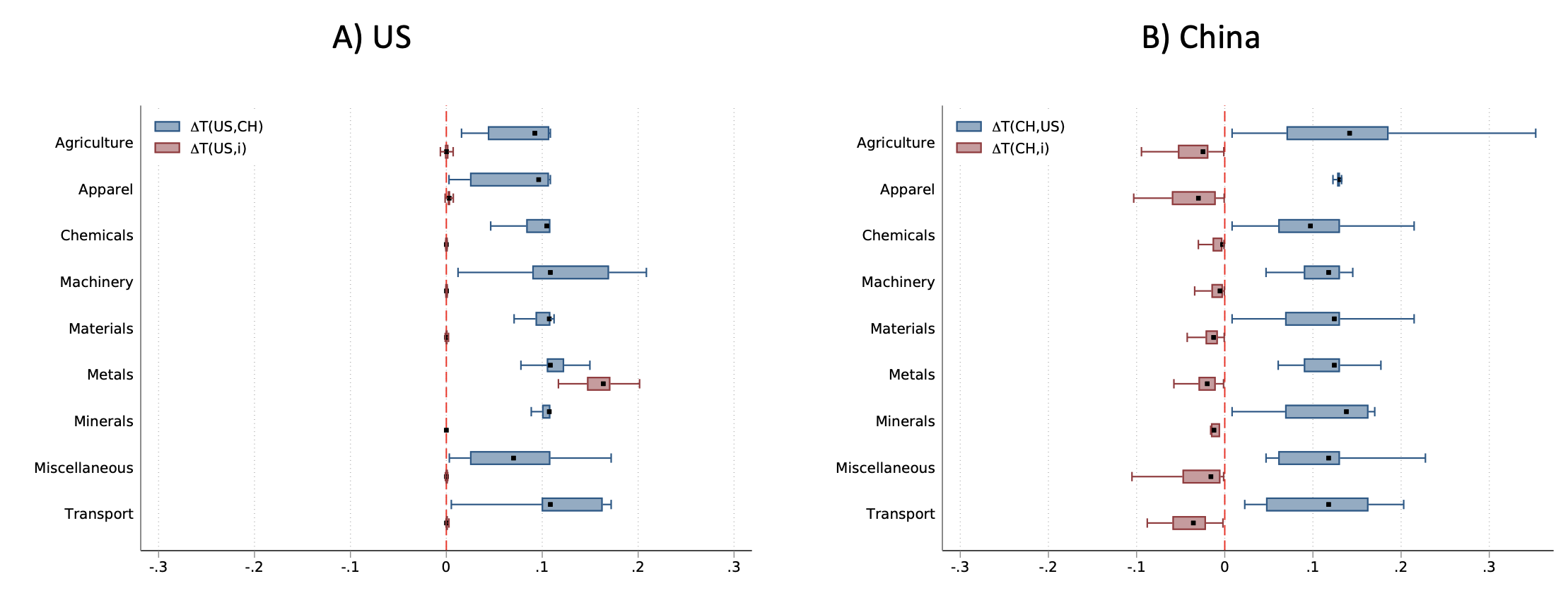
| Boilerpipe Text | In 2018-19, a major trade conflict started between the US and China. The US imposed tariffs on about $350 billion worth of Chinese imports, and China retaliated by levying tariffs on an additional $100 billion worth of imports, a retaliatory action allowed by WTO rules (Bown 2018). Despite an agreement in January 2020 to halt further tariff hikes, the existing ones remain. The scale of this trade dispute is substantial. US tariffs affected around 18% of its imports, equivalent to 2.6% of its GDP, while China's retaliation impacted 11% of its imports, equivalent to 3.6% of its GDP. These tariffs affected multiple industries in both countries and increased costs for about two-thirds of dutiable products in the US (Figure 1). The conflict's magnitude and scope outstripped the 1930 Smoot-Hawley Tariff Act, the most notable protectionist move in over a century of US trade policy, which raised tariffs on 27% of dutiable products equivalent to 1.4% of GDP, as per Irwin (1998, 2017).
Figure 1
US (left) and China (right) tariff changes in 2018-19, by sector
Source
: Fajgelbaum et al. (2023)
Note
: Figure reports the set of tariff changes imposed by the US (Panel A) and China (Panel B), by sector. The tariff changes are scaled by time in effect relative to the two-year window. The black dots indicate the median tariff increase, the boxes denote the 25th and 75th percentiles, and the whiskers show the 10th and 90th percentiles.
In a recent paper (Fajgelbaum et al. 2023), we look at the economic implications of the US-China trade war for the rest of the world, or ‘bystander’ countries. Our analysis is complementary to general equilibrium analyses such as Bekkers and Goes (2022), who estimate substantial welfare losses from a hypothetical US-China decoupling.
Our analysis reveals three main insights. First, there is a large cross-country variation in the extent to which the trade war tariffs affected countries’ exports. Second, and somewhat surprisingly, for a subset of countries, global exports among products taxed by the US or China grew faster than untaxed products. Third, a country-specific component of the tariff elasticities – rather than product or sector-specific elasticities combined with specialisation patterns – appears to play a crucial role in explaining different responses across countries. These insights could have important implications for policy by focusing attention on countries’ potential to seize opportunities from a changing global trade landscape.
Economic impacts on the US and China
The escalation of tariff changes between the US and China in 2018-19 has had significant economic impacts on these two countries, as illustrated by the works of Amiti et al. (2019), Bown (2021), Cavallo et al. (2021), Chang et al. (2021), Fajgelbaum et al. (2019, 2020, 2023) and Flaaen et al. (2020), among others. The main takeaways from this research are that US and Chinese consumers of imported goods have borne the brunt of the tariffs through higher prices and that aggregate real income in both the US and China declined due to the tariffs.
Bystander countries and opportunities
In our paper, in contrast, we examine how bystander countries’ exports changed in response to the tariff changes. We examine the export responses of the largest 48 exporters to three destinations: the US, China, and the rest of the world. We examine the heterogeneity in tariff responses by implementing an empirical specification that makes trade elasticities vary by importer, exporter, sector, and measures of the variety size. The identifying assumption is that, within country sectors, potential export growth across products would have been the same in the absence of the trade war tariff changes.
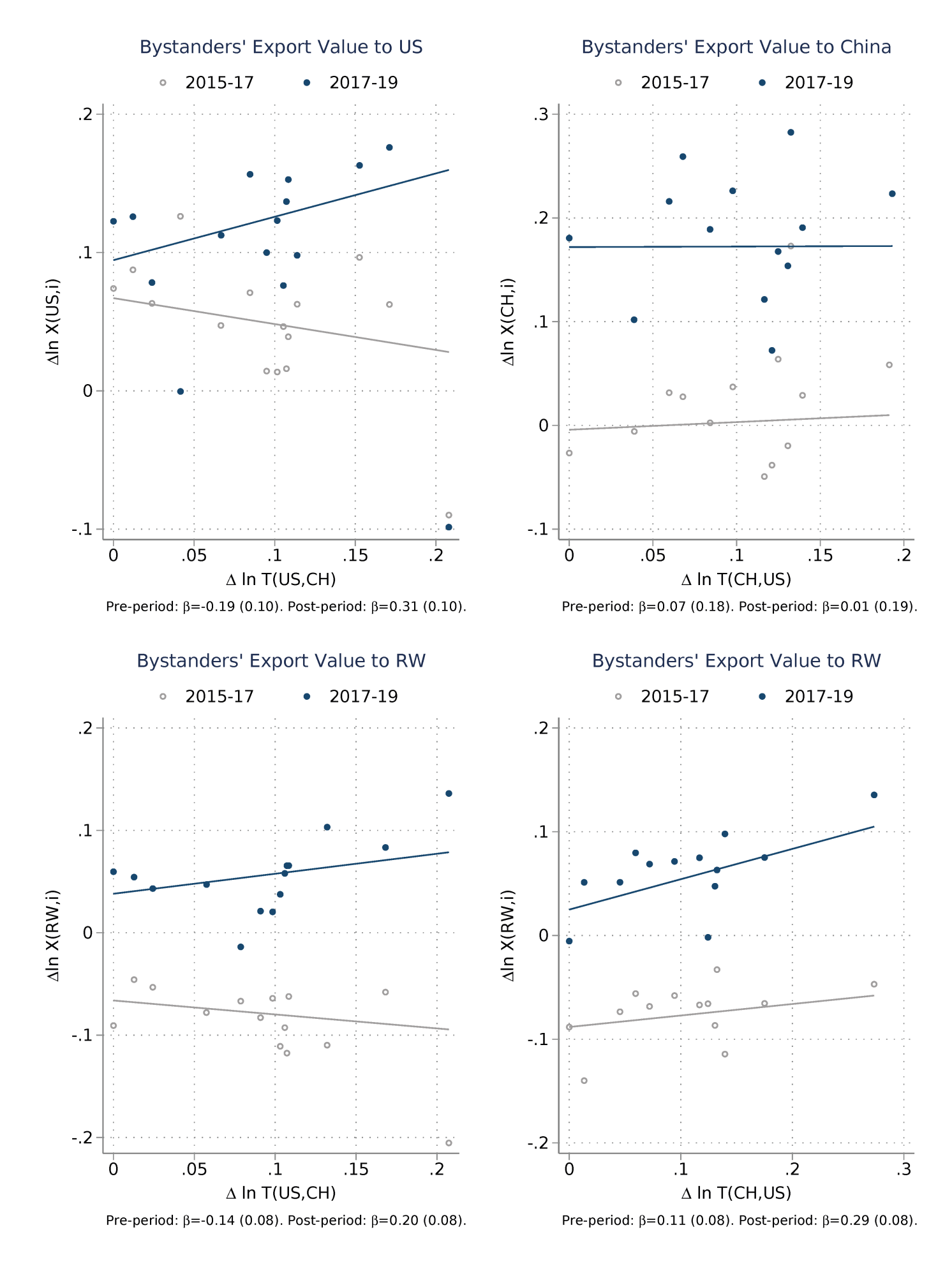
The research reveals that the US-China trade conflict impacted bystander countries in sometimes surprising ways compared to ex-ante assessments such as Piazza et al. (2019). Many countries boosted their exports to the US in products targeted by increased US-China tariffs, consistent with the expected trade diversion effect (Figure 2, top-left and top-right panels).
1
More surprising is that these countries also increased their exports to the rest of the world (RoW), while their exports to China remained largely unaffected by the tariffs (Figure 2, bottom-left and bottom-right panels).
2
Figure 2
Bystander effect
Source
: Fagjelbaum et al. (2023)
Notes
: The panels show binscatter plots of bystanders’ export growth (on the y-axes) against changes in tariffs due to the trade war (on the x-axes), controlling for country-by-sector fixed effects.
Overall, the findings suggest that the trade war generally enhanced trade opportunities for most countries rather than just causing shifts in trade patterns across destinations.
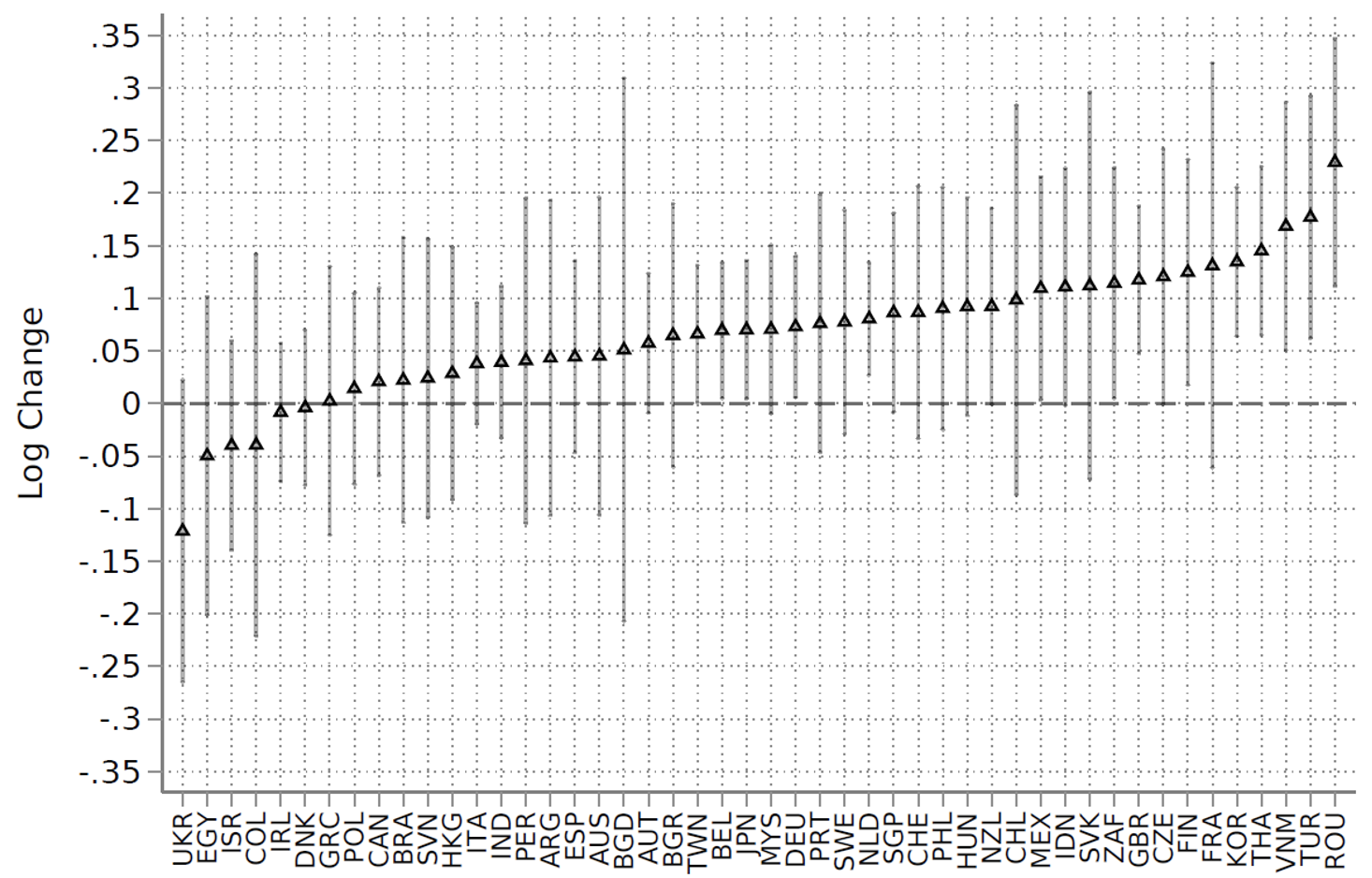
We also show that the responses varied significantly across countries. For instance, some countries’ responses suggested that they substitute Chinese exports, while others responded as complements. Countries such as Vietnam, Thailand, Korea, and Mexico emerged as major export ‘winners’ in global markets for products where US-Chinese trade declined. Meanwhile, a set of countries, including Ukraine, Egypt, Israel, and Colombia, saw a decline in exports. Figure 3 visually illustrates these differences by ranking the 48 largest bystander countries based on their predicted global export growth in products targeted by the US-China trade war tariff adjustments relative to untaxed products.
Figure 3
Relative export growth in targeted products across countries
Source
: Fagjelbaum et al. (2023)
Notes
: The panels show binscatter plots of bystanders’ export growth (on the y-axes) against changes in tariffs due to the trade war (on the x-axes), controlling for country-by-sector fixed effects.
When we dig deeper into the determinants of this heterogeneity, we find that variation in tariff elasticities by country largely drives the variation across countries, as opposed to pre-war product specialisation patterns combined with variation in tariff elasticity by sector or size of trade flows.
Our study also underscores the interplay between supply and demand heterogeneity in the elasticities, indicating a substantial interdependence across export destinations. WE develop a framework to categorise countries’ export responses based on the signs of their demand substitution with the US and China and the slope of supply curves. For instance, countries such as Mexico, Malaysia, and the Czech Republic export goods that may be substitutes for Chinese goods but complements to US goods. Their exports benefited from the trade war both because of their complementarities and substitution effects and because they were operating along a downward-sloping supply curve. These countries might have viewed the trade war as an opportunity to invest in new facilities, trade infrastructure, or trade and investment facilitation. Alternatively, these countries might have enjoyed better credit reallocation conditions (Hassan et al. 2020) or they might have already been well integrated into global trade, allowing them to seize new exporting opportunities across various sectors.
Implications for policy and research
The US-China trade conflict opened doors for bystander nations, largely increasing their exports to the US and globally with no significant change in exports to China. The response varied, driven largely by country-specific elements, which in some cases suggested downward-sloping supply curves.
Our analysis finds an important role for country factors driving the responsiveness to tariffs, as opposed to more standard explanations related to sectoral scale elasticities and specialisation patterns. This suggests that country-specific reforms and institutions may be important determinants for driving how countries’ exports respond in this new era of globalisation.
References
Amiti, M, S J Redding, and D E Weinstein (2019), "The Impact of the 2018 Tariffs on Prices and Welfare",
Journal of Economic Perspectives
33(4): 187-210.
Bown, C (2018), “
Trump's steel and aluminium tariffs: How WTO retaliation typically works
”, VoxEU.org, 8 March.
Cavallo, A, G Gopinath, B Neiman, and J Tang (2021), "Tariff Pass-Through at the Border and at the Store: Evidence from US Trade Policy",
American Economic Review: Insights
3(1): 19-34.
Chang, P L, K Yao, and F Zheng (2021), “The response of the Chinse economy in the US-China Trade War: 2018-19”, Working Paper.
Fajgelbaum P D, A K Khandelwal (2022), “The Economic Impacts of the US-China Trade War”,
Annual Review of Economics
14: 205-228.
Fajgelbaum P D, P Goldberg, P J Kennedy, and A K Khandelwal (2019), “
The Return to Protectionism
”, VoxEU.org, November 7.
Fajgelbaum P D, P Goldberg, P J Kennedy, and A K Khandelwal (2020), “The Return to Protectionism”,
The Quarterly Journal of Economics
135: 1-55.
Fajgelbaum P D, P Goldberg, P J Kennedy, A K Khandelwal, and D Taglioni (2023), “Trade War and Global Reallocations”, NBER Working Paper 29562 and World Bank PRWP 9894.
Flaaen, A, A Hortaçsu, and F Tintelnot (2020), "The Production Relocation and Price Effects of US Trade Policy: The Case of Washing Machines",
American Economic Review
110(7): 2103-27.
Góes, C and E Bekkers (2022), “
The impact of geopolitical conflicts on trade, growth, and innovation: An illustrative simulation study
”, VoxEU.org, 29 Mar.
Hassan, F, V Rappoport, and S Federico (2020), “
Trade shocks and credit reallocation: Lessons from Italy
”, VoxEU.org, 25 Jun.
Irwin, D (1998), “The Smooth-Hawley Tariff” A Quantitative Assessment”,
Review of Economics and Statistics
80: 326-334.
Irwin, D (2017),
Clashing Over Commerce
, University of Chicago Press.
Piazza, R, F Jaumotte, M MacDonald and J Eugster (2019), “
Bilateral and aggregate trade balances: Finding the right focus
”, VoxEU.org, 10 Sep. |
| Markdown | [Skip to main content](https://cepr.org/voxeu/columns/bystander-effect-us-china-trade-war#main-content)
Mobile menu
Search
- [VoxEU](https://cepr.org/voxeu)
- [Search All Columns](https://cepr.org/voxeu/search-all-columns)
- [VoxTalks](https://cepr.org/voxeu/voxtalks)
- [VideoVox](https://cepr.org/audio-and-video/voxeu-videos)
- [About VoxEU](https://cepr.org/voxeu/about-voxeu)
- [Research](https://cepr.org/research)
- [Programme Areas](https://cepr.org/research/programme-areas)
- [Research Policy Networks (RPNs)](https://cepr.org/research/research-policy-networks-rpn)
- [Research Projects and Networks](https://cepr.org/research/research-projects-and-networks)
- [Research Policies](https://cepr.org/research/research-policies)
- [Data Sets](https://cepr.org/research/data-set-items)
- [Publications](https://cepr.org/publications)
- [Publication Series](https://cepr.org/publications/publication-series)
- [Books and Reports](https://cepr.org/publications/books-and-reports)
- [Discussion Papers](https://cepr.org/publications/discussion-papers)
- [Covid Economics Papers](https://cepr.org/publications/covid-economics-papers)
- [Policy Papers](https://cepr.org/publications/policy-insights-policy-papers)
- [Economic Policy Journal](https://cepr.org/publications/economic-policy-journal)
- [Search All Publications](https://cepr.org/search?content_type%5B14%5D=14&type=publication)
- [Archive](https://cepr.org/publications/archive)
- [Events](https://cepr.org/events)
- [Calls for Papers](https://cepr.org/events/open-calls-papers)
- [Forthcoming Events](https://cepr.org/events/forthcoming-events)
- [Past Events](https://cepr.org/events/past-events)
- [Event Series](https://cepr.org/events/event-series)
- [Audio and video](https://cepr.org/audio-and-video)
- [Search all multimedia content](https://cepr.org/audio-and-video/search-all-multimedia)
- [VoxTalks](https://cepr.org/voxeu/voxtalks)
- [VideoVox](https://cepr.org/audio-and-video/voxeu-videos)
- [Vox Webcasts](https://cepr.org/voxeu/vox-webcasts)
- [Webinar Videos](https://cepr.org/audio-and-video/webinar-videos)
- [About CEPR](https://cepr.org/about)
- [People](https://cepr.org/about/people)
- [News](https://cepr.org/about/news)
- [Advisory Board](https://cepr.org/about/people/advisory-board)
- [Press](https://cepr.org/about/press)
- [Governance](https://cepr.org/about/governance)
- [Support CEPR](https://cepr.org/about/join-cepr)
- [Partners](https://cepr.org/partners)
- [Jobs at CEPR](https://cepr.org/about/jobs-at-cepr)
Themes
Search
Themes
## Themes
- Key Themes
- [Artificial Intelligence](https://cepr.org/themes/artificial-intelligence)
- [Central Banking](https://cepr.org/themes/central-banking)
- [Climate Change](https://cepr.org/themes/climate-change)
- [Competition Policy](https://cepr.org/themes/competition-policy)
- [Development & Growth](https://cepr.org/themes/development-growth)
- [Economic History](https://cepr.org/themes/economic-history)
- [Energy](https://cepr.org/themes/energy)
- [EU Economic Architecture](https://cepr.org/themes/eu-economic-architecture "EU Economic Architecture")
- [Inflation](https://cepr.org/themes/inflation)
- [Political Economy](https://cepr.org/themes/political-economy "Political Economy")
- [Poverty and income inequality](https://cepr.org/themes/poverty-and-income-inequality "Poverty and income inequality")
- [Sustainable Finance](https://cepr.org/themes/sustainable-finance)
- [Ukraine Initiative](https://cepr.org/themes/ukraine-initiative)
- [Women in Economics](https://cepr.org/themes/women-economics)
- Other Themes
- [Business Cycles](https://cepr.org/themes/business-cycles)
- [Covid 19](https://cepr.org/themes/covid-19)
- [Exchange Rates](https://cepr.org/themes/exchange-rates)
- [Finance & Fintech](https://cepr.org/themes/finance-and-fintech "Finance & Fintech")
- [Health Economics](https://cepr.org/themes/health-economics)
- [International Finance](https://cepr.org/themes/international-finance "International Finance")
- [International Trade](https://cepr.org/themes/international-trade "International Trade")
- [Labour Markets](https://cepr.org/themes/labour-markets)
- [Migration](https://cepr.org/themes/migration "Migration")
- [Monetary Policy](https://cepr.org/themes/monetary-policy "Monetary Policy")
- [Productivity and Innovation](https://cepr.org/themes/productivity-and-innovation "Productivity and Innovation")
- [Taxation](https://cepr.org/themes/taxation "Taxation")
- Focus On
- [The Economic Consequences of the War](https://cepr.org/debates/economic-consequences-war)
- [Europe-Asia Initiative](https://cepr.org/europe-asia-initiative)
- [Trump & Tariffs](https://cepr.org/voxeu/trump-and-tariffs)
## Main navigation
- [VoxEU](https://cepr.org/voxeu)
- [Search All Columns](https://cepr.org/voxeu/search-all-columns)
- [VoxTalks](https://cepr.org/voxeu/voxtalks)
- [VideoVox](https://cepr.org/audio-and-video/voxeu-videos)
- [About VoxEU](https://cepr.org/voxeu/about-voxeu)
- [Research](https://cepr.org/research)
- [Publications](https://cepr.org/publications)
- [Publication Series](https://cepr.org/publications/publication-series)
- [Books and Reports](https://cepr.org/publications/books-and-reports)
- [Discussion Papers](https://cepr.org/publications/discussion-papers)
- [About CEPR Discussion Papers](https://cepr.org/publications/discussion-papers/about-cepr-discussion-papers)
- [Discussion Paper Subscriptions](https://cepr.org/publications/discussion-papers/discussion-paper-subscriptions)
- [Search Discussion Papers](https://cepr.org/publications/discussion-papers/search-discussion-papers)
- [Covid Economics Papers](https://cepr.org/publications/covid-economics-papers)
- [Policy Papers](https://cepr.org/publications/policy-insights-policy-papers)
- [Economic Policy Journal](https://cepr.org/publications/economic-policy-journal)
- [Search All Publications](https://cepr.org/search?content_type%5B14%5D=14&type=publication)
- [Archive](https://cepr.org/publications/archive)
- [CEPR Bulletin](https://cepr.org/publications/archive/cepr-bulletin)
- [Events](https://cepr.org/events)
- [Audio and video](https://cepr.org/audio-and-video)
- [Search all multimedia content](https://cepr.org/audio-and-video/search-all-multimedia)
- [VoxTalks](https://cepr.org/voxeu/voxtalks)
- [VideoVox](https://cepr.org/audio-and-video/voxeu-videos)
- [Vox Webcasts](https://cepr.org/voxeu/vox-webcasts)
- [Webinar Videos](https://cepr.org/audio-and-video/webinar-videos)
- [About CEPR](https://cepr.org/about)
- [People](https://cepr.org/about/people)
- [News](https://cepr.org/about/news)
- [Advisory Board](https://cepr.org/about/people/advisory-board)
- [Press](https://cepr.org/about/press)
- [Governance](https://cepr.org/about/governance)
- [Support CEPR](https://cepr.org/about/join-cepr)
- [Partners](https://cepr.org/partners)
- [Jobs at CEPR](https://cepr.org/about/jobs-at-cepr)
## Secondary Menu
- [CEPR Offices](https://cepr.org/cepr-offices)
## User account menu
- [Log in](https://cepr.org/moLogin)
## Secondary Menu
- [CEPR Offices](https://cepr.org/cepr-offices)
## User account menu
- [Log in](https://cepr.org/moLogin)
## Themes
- Key Themes
- [Artificial Intelligence](https://cepr.org/themes/artificial-intelligence)
- [Central Banking](https://cepr.org/themes/central-banking)
- [Climate Change](https://cepr.org/themes/climate-change)
- [Competition Policy](https://cepr.org/themes/competition-policy)
- [Development & Growth](https://cepr.org/themes/development-growth)
- [Economic History](https://cepr.org/themes/economic-history)
- [Energy](https://cepr.org/themes/energy)
- [EU Economic Architecture](https://cepr.org/themes/eu-economic-architecture "EU Economic Architecture")
- [Inflation](https://cepr.org/themes/inflation)
- [Political Economy](https://cepr.org/themes/political-economy "Political Economy")
- [Poverty and income inequality](https://cepr.org/themes/poverty-and-income-inequality "Poverty and income inequality")
- [Sustainable Finance](https://cepr.org/themes/sustainable-finance)
- [Ukraine Initiative](https://cepr.org/themes/ukraine-initiative)
- [Women in Economics](https://cepr.org/themes/women-economics)
- Other Themes
- [Business Cycles](https://cepr.org/themes/business-cycles)
- [Covid 19](https://cepr.org/themes/covid-19)
- [Exchange Rates](https://cepr.org/themes/exchange-rates)
- [Finance & Fintech](https://cepr.org/themes/finance-and-fintech "Finance & Fintech")
- [Health Economics](https://cepr.org/themes/health-economics)
- [International Finance](https://cepr.org/themes/international-finance "International Finance")
- [International Trade](https://cepr.org/themes/international-trade "International Trade")
- [Labour Markets](https://cepr.org/themes/labour-markets)
- [Migration](https://cepr.org/themes/migration "Migration")
- [Monetary Policy](https://cepr.org/themes/monetary-policy "Monetary Policy")
- [Productivity and Innovation](https://cepr.org/themes/productivity-and-innovation "Productivity and Innovation")
- [Taxation](https://cepr.org/themes/taxation "Taxation")
- Focus On
- [The Economic Consequences of the War](https://cepr.org/debates/economic-consequences-war)
- [Europe-Asia Initiative](https://cepr.org/europe-asia-initiative)
- [Trump & Tariffs](https://cepr.org/voxeu/trump-and-tariffs)
Search the site
1. / [VoxEU](https://cepr.org/voxeu)
2. / [Search All Columns](https://cepr.org/voxeu/search-all-columns)
In this section
- [Search All Columns](https://cepr.org/voxeu/search-all-columns)
- [VoxTalks](https://cepr.org/voxeu/voxtalks)
- [VoxEU Videos](https://cepr.org/audio-and-video/voxeu-videos)
- [About VoxEU](https://cepr.org/voxeu/about-voxeu)
VoxEU Column International trade
# The ‘bystander effect’ of the US-China trade war
- [Pablo Fajgelbaum](https://cepr.org/about/people/pablo-fajgelbaum)
- [Pinelopi Koujianou Goldberg](https://cepr.org/about/people/pinelopi-koujianou-goldberg)
- [Patrick Kennedy](https://cepr.org/about/people/patrick-kennedy)
- [Amit Khandelwal](https://cepr.org/about/people/amit-khandelwal)
- [Daria Taglioni](https://cepr.org/about/people/daria-taglioni)
- /
10 Jun 2023
The US-China trade war raised tariffs on roughly \$450 billion in bilateral trade and marked a turning point in the globalisation era. This column examines the impact of the trade dispute on trade opportunities for bystander countries and finds that it generally enhanced trade opportunities for most countries rather than just causing shifts in trade patterns across destinations. The authors also find an important role for country factors driving the responsiveness to tariffs, as opposed to more standard explanations related to sectoral scale elasticities and specialisation patterns.
#### Authors
[](https://cepr.org/about/people/pablo-fajgelbaum "Go to profile of Pablo Fajgelbaum")
### [Pablo Fajgelbaum](https://cepr.org/about/people/pablo-fajgelbaum "Go to profile of Pablo Fajgelbaum")
[](https://cepr.org/about/people/pinelopi-koujianou-goldberg "Go to profile of Pinelopi Koujianou Goldberg")
### [Pinelopi Koujianou Goldberg](https://cepr.org/about/people/pinelopi-koujianou-goldberg "Go to profile of Pinelopi Koujianou Goldberg")
[](https://cepr.org/about/people/patrick-kennedy "Go to profile of Patrick Kennedy")
### [Patrick Kennedy](https://cepr.org/about/people/patrick-kennedy "Go to profile of Patrick Kennedy")
[](https://cepr.org/about/people/amit-khandelwal "Go to profile of Amit Khandelwal")
### [Amit Khandelwal](https://cepr.org/about/people/amit-khandelwal "Go to profile of Amit Khandelwal")
[](https://cepr.org/about/people/daria-taglioni "Go to profile of Daria Taglioni")
### [Daria Taglioni](https://cepr.org/about/people/daria-taglioni "Go to profile of Daria Taglioni")
#### Share
- [Twitter](https://twitter.com/intent/tweet?text=The%20%E2%80%98bystander%20effect%E2%80%99%20of%20the%20US-China%20trade%20war&url=https%3A%2F%2Fcepr.org%2Fvoxeu%2Fcolumns%2Fbystander-effect-us-china-trade-war&via=cepr_org&hashtags= "Share via Twitter")
- [Facebook](https://www.facebook.com/sharer/sharer.php?u=https%3A%2F%2Fcepr.org%2Fvoxeu%2Fcolumns%2Fbystander-effect-us-china-trade-war "Share via Facebook")
- [LinkedIn](https://www.linkedin.com/shareArticle?mini=true&url=https%3A%2F%2Fcepr.org%2Fvoxeu%2Fcolumns%2Fbystander-effect-us-china-trade-war&title=The%20%E2%80%98bystander%20effect%E2%80%99%20of%20the%20US-China%20trade%20war&source=CEPR&summary=The%20US-China%20trade%20war%20raised%20tariffs%20on%20roughly%20$450%20billion%20in%20bilateral%20trade%20and%20marked%20a%20turning%20point%20in%20the%20globalisation%20era.%20This%20column%20examines%20the%20impact%20of%20the%20trade%20dispute%20on%20trade%20opportunities%20for%20bystander%20countries%20and%20finds%20that%20it%20generally%20enhanced%20trade%20opportunities%20for%20most%20countries%20rather%20than%20just%20causing%20shifts%20in%20trade%20patterns%20across%20destinations.%20The%20authors%20also%20find%20an%20important%20role%20for%20country%20factors%20driving%20the%20responsiveness%20to%20tariffs,%20as%20opposed%20to%20more%20standard%20explanations%20related%20to%20sectoral%20scale%20elasticities%20and%20specialisation%20patterns. "Share via LinkedIn")
- [Bluesky](https://bsky.app/intent/compose?text=The%20%E2%80%98bystander%20effect%E2%80%99%20of%20the%20US-China%20trade%20war%20https%3A%2F%2Fcepr.org%2Fvoxeu%2Fcolumns%2Fbystander-effect-us-china-trade-war "Share via Bluesky")
In 2018-19, a major trade conflict started between the US and China. The US imposed tariffs on about \$350 billion worth of Chinese imports, and China retaliated by levying tariffs on an additional \$100 billion worth of imports, a retaliatory action allowed by WTO rules (Bown 2018). Despite an agreement in January 2020 to halt further tariff hikes, the existing ones remain. The scale of this trade dispute is substantial. US tariffs affected around 18% of its imports, equivalent to 2.6% of its GDP, while China's retaliation impacted 11% of its imports, equivalent to 3.6% of its GDP. These tariffs affected multiple industries in both countries and increased costs for about two-thirds of dutiable products in the US (Figure 1). The conflict's magnitude and scope outstripped the 1930 Smoot-Hawley Tariff Act, the most notable protectionist move in over a century of US trade policy, which raised tariffs on 27% of dutiable products equivalent to 1.4% of GDP, as per Irwin (1998, 2017).
**Figure 1** US (left) and China (right) tariff changes in 2018-19, by sector

###### *Source*: Fajgelbaum et al. (2023) *Note*: Figure reports the set of tariff changes imposed by the US (Panel A) and China (Panel B), by sector. The tariff changes are scaled by time in effect relative to the two-year window. The black dots indicate the median tariff increase, the boxes denote the 25th and 75th percentiles, and the whiskers show the 10th and 90th percentiles.
In a recent paper (Fajgelbaum et al. 2023), we look at the economic implications of the US-China trade war for the rest of the world, or ‘bystander’ countries. Our analysis is complementary to general equilibrium analyses such as Bekkers and Goes (2022), who estimate substantial welfare losses from a hypothetical US-China decoupling.
Our analysis reveals three main insights. First, there is a large cross-country variation in the extent to which the trade war tariffs affected countries’ exports. Second, and somewhat surprisingly, for a subset of countries, global exports among products taxed by the US or China grew faster than untaxed products. Third, a country-specific component of the tariff elasticities – rather than product or sector-specific elasticities combined with specialisation patterns – appears to play a crucial role in explaining different responses across countries. These insights could have important implications for policy by focusing attention on countries’ potential to seize opportunities from a changing global trade landscape.
## Economic impacts on the US and China
The escalation of tariff changes between the US and China in 2018-19 has had significant economic impacts on these two countries, as illustrated by the works of Amiti et al. (2019), Bown (2021), Cavallo et al. (2021), Chang et al. (2021), Fajgelbaum et al. (2019, 2020, 2023) and Flaaen et al. (2020), among others. The main takeaways from this research are that US and Chinese consumers of imported goods have borne the brunt of the tariffs through higher prices and that aggregate real income in both the US and China declined due to the tariffs.
## Bystander countries and opportunities
In our paper, in contrast, we examine how bystander countries’ exports changed in response to the tariff changes. We examine the export responses of the largest 48 exporters to three destinations: the US, China, and the rest of the world. We examine the heterogeneity in tariff responses by implementing an empirical specification that makes trade elasticities vary by importer, exporter, sector, and measures of the variety size. The identifying assumption is that, within country sectors, potential export growth across products would have been the same in the absence of the trade war tariff changes.
The research reveals that the US-China trade conflict impacted bystander countries in sometimes surprising ways compared to ex-ante assessments such as Piazza et al. (2019). Many countries boosted their exports to the US in products targeted by increased US-China tariffs, consistent with the expected trade diversion effect (Figure 2, top-left and top-right panels). [1](https://cepr.org/voxeu/columns/bystander-effect-us-china-trade-war#footnote1_orm5xrh "Scroll down to this footnote") More surprising is that these countries also increased their exports to the rest of the world (RoW), while their exports to China remained largely unaffected by the tariffs (Figure 2, bottom-left and bottom-right panels). [2](https://cepr.org/voxeu/columns/bystander-effect-us-china-trade-war#footnote2_et0rrc4 "Scroll down to this footnote")
**Figure 2** Bystander effect

###### *Source*: Fagjelbaum et al. (2023) *Notes*: The panels show binscatter plots of bystanders’ export growth (on the y-axes) against changes in tariffs due to the trade war (on the x-axes), controlling for country-by-sector fixed effects.
Overall, the findings suggest that the trade war generally enhanced trade opportunities for most countries rather than just causing shifts in trade patterns across destinations.
We also show that the responses varied significantly across countries. For instance, some countries’ responses suggested that they substitute Chinese exports, while others responded as complements. Countries such as Vietnam, Thailand, Korea, and Mexico emerged as major export ‘winners’ in global markets for products where US-Chinese trade declined. Meanwhile, a set of countries, including Ukraine, Egypt, Israel, and Colombia, saw a decline in exports. Figure 3 visually illustrates these differences by ranking the 48 largest bystander countries based on their predicted global export growth in products targeted by the US-China trade war tariff adjustments relative to untaxed products.
**Figure 3** Relative export growth in targeted products across countries

###### *Source*: Fagjelbaum et al. (2023) *Notes*: The panels show binscatter plots of bystanders’ export growth (on the y-axes) against changes in tariffs due to the trade war (on the x-axes), controlling for country-by-sector fixed effects.
When we dig deeper into the determinants of this heterogeneity, we find that variation in tariff elasticities by country largely drives the variation across countries, as opposed to pre-war product specialisation patterns combined with variation in tariff elasticity by sector or size of trade flows.
Our study also underscores the interplay between supply and demand heterogeneity in the elasticities, indicating a substantial interdependence across export destinations. WE develop a framework to categorise countries’ export responses based on the signs of their demand substitution with the US and China and the slope of supply curves. For instance, countries such as Mexico, Malaysia, and the Czech Republic export goods that may be substitutes for Chinese goods but complements to US goods. Their exports benefited from the trade war both because of their complementarities and substitution effects and because they were operating along a downward-sloping supply curve. These countries might have viewed the trade war as an opportunity to invest in new facilities, trade infrastructure, or trade and investment facilitation. Alternatively, these countries might have enjoyed better credit reallocation conditions (Hassan et al. 2020) or they might have already been well integrated into global trade, allowing them to seize new exporting opportunities across various sectors.
## Implications for policy and research
The US-China trade conflict opened doors for bystander nations, largely increasing their exports to the US and globally with no significant change in exports to China. The response varied, driven largely by country-specific elements, which in some cases suggested downward-sloping supply curves.
Our analysis finds an important role for country factors driving the responsiveness to tariffs, as opposed to more standard explanations related to sectoral scale elasticities and specialisation patterns. This suggests that country-specific reforms and institutions may be important determinants for driving how countries’ exports respond in this new era of globalisation.
## References
Amiti, M, S J Redding, and D E Weinstein (2019), "The Impact of the 2018 Tariffs on Prices and Welfare", *Journal of Economic Perspectives* 33(4): 187-210.
Bown, C (2018), “[Trump's steel and aluminium tariffs: How WTO retaliation typically works](https://cepr.org/voxeu/columns/trumps-steel-and-aluminium-tariffs-how-wto-retaliation-typically-works)”, VoxEU.org, 8 March.
Cavallo, A, G Gopinath, B Neiman, and J Tang (2021), "Tariff Pass-Through at the Border and at the Store: Evidence from US Trade Policy", *American Economic Review: Insights* 3(1): 19-34.
Chang, P L, K Yao, and F Zheng (2021), “The response of the Chinse economy in the US-China Trade War: 2018-19”, Working Paper.
Fajgelbaum P D, A K Khandelwal (2022), “The Economic Impacts of the US-China Trade War”, *Annual Review of Economics* 14: 205-228.
Fajgelbaum P D, P Goldberg, P J Kennedy, and A K Khandelwal (2019), “[The Return to Protectionism](https://cepr.org/voxeu/columns/return-protectionism)”, VoxEU.org, November 7.
Fajgelbaum P D, P Goldberg, P J Kennedy, and A K Khandelwal (2020), “The Return to Protectionism”, *The Quarterly Journal of Economics* 135: 1-55.
Fajgelbaum P D, P Goldberg, P J Kennedy, A K Khandelwal, and D Taglioni (2023), “Trade War and Global Reallocations”, NBER Working Paper 29562 and World Bank PRWP 9894.
Flaaen, A, A Hortaçsu, and F Tintelnot (2020), "The Production Relocation and Price Effects of US Trade Policy: The Case of Washing Machines", *American Economic Review* 110(7): 2103-27.
Góes, C and E Bekkers (2022), “[The impact of geopolitical conflicts on trade, growth, and innovation: An illustrative simulation study](https://cepr.org/voxeu/columns/impact-geopolitical-conflicts-trade-growth-and-innovation-illustrative-simulation)”, VoxEU.org, 29 Mar.
Hassan, F, V Rappoport, and S Federico (2020), “[Trade shocks and credit reallocation: Lessons from Italy](https://cepr.org/voxeu/columns/trade-shocks-and-credit-reallocation-lessons-italy)”, VoxEU.org, 25 Jun.
Irwin, D (1998), “The Smooth-Hawley Tariff” A Quantitative Assessment”, *Review of Economics and Statistics* 80: 326-334.
Irwin, D (2017), *Clashing Over Commerce*, University of Chicago Press.
Piazza, R, F Jaumotte, M MacDonald and J Eugster (2019), “[Bilateral and aggregate trade balances: Finding the right focus](https://cepr.org/voxeu/columns/bilateral-and-aggregate-trade-balances-finding-right-focus)”, VoxEU.org, 10 Sep.
#### Footnotes
1. The top-left panel indicates that on average bystander countries increased their exports to the US in products that were subject to high US tariffs on China, with an elasticity of 0.31 (se 0.10). This growth rate was significantly different from the pre-war export growth rate from 2015 to 2017, which had an elasticity of 0.19 (se -0.19). In contrast, the top-right Panel B shows that, on average, countries did not shift their exports into China in response to China’s tariffs on the US.
2. The bottom-left and bottom-right panels reveal that exports to the rest of the world increased with both US and China’s tariffs, with an elasticity of 0.20 (se 0.08) for the US tariffs and 0.29 (se 0.08) for the Chinese tariffs.
#### Authors
[](https://cepr.org/about/people/pablo-fajgelbaum "Go to profile of Pablo Fajgelbaum")
### [Pablo Fajgelbaum](https://cepr.org/about/people/pablo-fajgelbaum "Go to profile of Pablo Fajgelbaum")
Professor of Economics University Of California, Los Angeles
[](https://cepr.org/about/people/pinelopi-koujianou-goldberg "Go to profile of Pinelopi Koujianou Goldberg")
### [Pinelopi Koujianou Goldberg](https://cepr.org/about/people/pinelopi-koujianou-goldberg "Go to profile of Pinelopi Koujianou Goldberg")
William Nordhaus Professor of Economics and Global Affairs Yale University
[](https://cepr.org/about/people/patrick-kennedy "Go to profile of Patrick Kennedy")
### [Patrick Kennedy](https://cepr.org/about/people/patrick-kennedy "Go to profile of Patrick Kennedy")
Graduate Research Fellow National Science Foundation; PhD Candidate in Economics University of California, Berkeley
[](https://cepr.org/about/people/amit-khandelwal "Go to profile of Amit Khandelwal")
### [Amit Khandelwal](https://cepr.org/about/people/amit-khandelwal "Go to profile of Amit Khandelwal")
Dong-Soo Hahn Professor of Global Affairs and Economics Yale University; Yale University
[](https://cepr.org/about/people/daria-taglioni "Go to profile of Daria Taglioni")
### [Daria Taglioni](https://cepr.org/about/people/daria-taglioni "Go to profile of Daria Taglioni")
Research Manager, Trade and International Integration, Development Research Group The World Bank
#### Themes
- [International trade](https://cepr.org/themes/international-trade)
#### Keywords
- [US-China trade war](https://cepr.org/search?keyword%5B356661%5D=356661)
- [Tariffs](https://cepr.org/search?keyword%5B354670%5D=354670)
#### Share
- [Twitter](https://twitter.com/intent/tweet?text=The%20%E2%80%98bystander%20effect%E2%80%99%20of%20the%20US-China%20trade%20war&url=https%3A%2F%2Fcepr.org%2Fvoxeu%2Fcolumns%2Fbystander-effect-us-china-trade-war&via=cepr_org&hashtags= "Share via Twitter")
- [Facebook](https://www.facebook.com/sharer/sharer.php?u=https%3A%2F%2Fcepr.org%2Fvoxeu%2Fcolumns%2Fbystander-effect-us-china-trade-war "Share via Facebook")
- [LinkedIn](https://www.linkedin.com/shareArticle?mini=true&url=https%3A%2F%2Fcepr.org%2Fvoxeu%2Fcolumns%2Fbystander-effect-us-china-trade-war&title=The%20%E2%80%98bystander%20effect%E2%80%99%20of%20the%20US-China%20trade%20war&source=CEPR&summary=The%20US-China%20trade%20war%20raised%20tariffs%20on%20roughly%20$450%20billion%20in%20bilateral%20trade%20and%20marked%20a%20turning%20point%20in%20the%20globalisation%20era.%20This%20column%20examines%20the%20impact%20of%20the%20trade%20dispute%20on%20trade%20opportunities%20for%20bystander%20countries%20and%20finds%20that%20it%20generally%20enhanced%20trade%20opportunities%20for%20most%20countries%20rather%20than%20just%20causing%20shifts%20in%20trade%20patterns%20across%20destinations.%20The%20authors%20also%20find%20an%20important%20role%20for%20country%20factors%20driving%20the%20responsiveness%20to%20tariffs,%20as%20opposed%20to%20more%20standard%20explanations%20related%20to%20sectoral%20scale%20elasticities%20and%20specialisation%20patterns. "Share via LinkedIn")
- [Bluesky](https://bsky.app/intent/compose?text=The%20%E2%80%98bystander%20effect%E2%80%99%20of%20the%20US-China%20trade%20war%20https%3A%2F%2Fcepr.org%2Fvoxeu%2Fcolumns%2Fbystander-effect-us-china-trade-war "Share via Bluesky")
[](https://cepr.org/voxeu/columns/impact-us-china-trade-war-japanese-multinational-corporations "The impact of the US-China trade war on Japanese multinational corporations")
VoxEU Column
### [The impact of the US-China trade war on Japanese multinational corporations](https://cepr.org/voxeu/columns/impact-us-china-trade-war-japanese-multinational-corporations)
- [Hongyong Zhang](https://cepr.org/about/people/hongyong-zhang)
- [Zhigang Tao](https://cepr.org/about/people/zhigang-tao)
- [Hongjie Yuan](https://cepr.org/about/people/hongjie-yuan)
- [Chang Sun](https://cepr.org/about/people/chang-sun)
3 Nov 2019
- [International trade](https://cepr.org/themes/international-trade "Go to the International trade page")
[](https://cepr.org/voxeu/columns/trade-wars-global-value-chain-era "Trade wars in the global value chain era")
VoxEU Column
### [Trade wars in the global value chain era](https://cepr.org/voxeu/columns/trade-wars-global-value-chain-era)
- [Emily Blanchard](https://cepr.org/about/people/emily-blanchard)
[](https://cepr.org/voxeu/columns/impact-us-china-trade-war-east-asia "The impact of the US-China trade war on East Asia")
VoxEU Column
### [The impact of the US-China trade war on East Asia](https://cepr.org/voxeu/columns/impact-us-china-trade-war-east-asia)
- [Massimiliano Calì](https://cepr.org/about/people/massimiliano-cali)
16 Oct 2018
- [International trade](https://cepr.org/themes/international-trade "Go to the International trade page")
- Themes & Current Issues
- [Artificial Intelligence](https://cepr.org/themes/artificial-intelligence)
- [Business Cycles](https://cepr.org/themes/business-cycles)
- [Central Banking](https://cepr.org/themes/central-banking)
- [Climate Change](https://cepr.org/index.php/themes/climate-change)
- [Competition Policy](https://cepr.org/themes/competition-policy)
- [COVID-19](https://cepr.org/themes/covid-19)
- [Development & Growth](https://cepr.org/themes/development-growth)
- [Economic history](https://cepr.org/themes/economic-history)
- [Energy](https://cepr.org/themes/energy)
- [EU Economic Architecture](https://cepr.org/themes/eu-economic-architecture)
- [Exchange Rates](https://cepr.org/themes/exchange-rates)
- [Finance and Fintech](https://cepr.org/themes/finance-and-fintech)
- [Financial Markets](https://cepr.org/themes/financial-markets)
- [Financial Regulation and Banking](https://cepr.org/themes/financial-regulation-and-banking)
- [Health Economics](https://cepr.org/themes/health-economics)
- [Inflation](https://cepr.org/themes/inflation)
- [International Finance](https://cepr.org/themes/international-finance)
- [International trade](https://cepr.org/themes/international-trade)
- [Labour Markets](https://cepr.org/themes/labour-markets)
- [Migration](https://cepr.org/themes/migration)
- [Monetary Policy](https://cepr.org/themes/monetary-policy)
- [Political Economy](https://cepr.org/themes/political-economy)
- [Poverty and Income Inequality](https://cepr.org/themes/poverty-and-income-inequality)
- [Productivity and Innovation](https://cepr.org/themes/productivity-and-innovation)
- [Taxation](https://cepr.org/themes/taxation)
- [Ukraine Initiative](https://cepr.org/themes/ukraine-initiative)
- [Women in Economics](https://cepr.org/themes/women-economics)
###### Sign up to our newsletter
###### follow us
Copyright 2026 CEPR /[designbysoapbox.com](https://www.designbysoapbox.com/)
- [Contact Us](https://cepr.org/contact-us "How to contact us")
- [Cookies](https://cepr.org/cookies)
- [Privacy Policy](https://cepr.org/privacy-policy)
- [RSS Feeds](https://cepr.org/rss-feeds) |
| Readable Markdown | In 2018-19, a major trade conflict started between the US and China. The US imposed tariffs on about \$350 billion worth of Chinese imports, and China retaliated by levying tariffs on an additional \$100 billion worth of imports, a retaliatory action allowed by WTO rules (Bown 2018). Despite an agreement in January 2020 to halt further tariff hikes, the existing ones remain. The scale of this trade dispute is substantial. US tariffs affected around 18% of its imports, equivalent to 2.6% of its GDP, while China's retaliation impacted 11% of its imports, equivalent to 3.6% of its GDP. These tariffs affected multiple industries in both countries and increased costs for about two-thirds of dutiable products in the US (Figure 1). The conflict's magnitude and scope outstripped the 1930 Smoot-Hawley Tariff Act, the most notable protectionist move in over a century of US trade policy, which raised tariffs on 27% of dutiable products equivalent to 1.4% of GDP, as per Irwin (1998, 2017).
**Figure 1** US (left) and China (right) tariff changes in 2018-19, by sector
###### *Source*: Fajgelbaum et al. (2023) *Note*: Figure reports the set of tariff changes imposed by the US (Panel A) and China (Panel B), by sector. The tariff changes are scaled by time in effect relative to the two-year window. The black dots indicate the median tariff increase, the boxes denote the 25th and 75th percentiles, and the whiskers show the 10th and 90th percentiles.
In a recent paper (Fajgelbaum et al. 2023), we look at the economic implications of the US-China trade war for the rest of the world, or ‘bystander’ countries. Our analysis is complementary to general equilibrium analyses such as Bekkers and Goes (2022), who estimate substantial welfare losses from a hypothetical US-China decoupling.
Our analysis reveals three main insights. First, there is a large cross-country variation in the extent to which the trade war tariffs affected countries’ exports. Second, and somewhat surprisingly, for a subset of countries, global exports among products taxed by the US or China grew faster than untaxed products. Third, a country-specific component of the tariff elasticities – rather than product or sector-specific elasticities combined with specialisation patterns – appears to play a crucial role in explaining different responses across countries. These insights could have important implications for policy by focusing attention on countries’ potential to seize opportunities from a changing global trade landscape.
## Economic impacts on the US and China
The escalation of tariff changes between the US and China in 2018-19 has had significant economic impacts on these two countries, as illustrated by the works of Amiti et al. (2019), Bown (2021), Cavallo et al. (2021), Chang et al. (2021), Fajgelbaum et al. (2019, 2020, 2023) and Flaaen et al. (2020), among others. The main takeaways from this research are that US and Chinese consumers of imported goods have borne the brunt of the tariffs through higher prices and that aggregate real income in both the US and China declined due to the tariffs.
## Bystander countries and opportunities
In our paper, in contrast, we examine how bystander countries’ exports changed in response to the tariff changes. We examine the export responses of the largest 48 exporters to three destinations: the US, China, and the rest of the world. We examine the heterogeneity in tariff responses by implementing an empirical specification that makes trade elasticities vary by importer, exporter, sector, and measures of the variety size. The identifying assumption is that, within country sectors, potential export growth across products would have been the same in the absence of the trade war tariff changes.
The research reveals that the US-China trade conflict impacted bystander countries in sometimes surprising ways compared to ex-ante assessments such as Piazza et al. (2019). Many countries boosted their exports to the US in products targeted by increased US-China tariffs, consistent with the expected trade diversion effect (Figure 2, top-left and top-right panels). [1](https://cepr.org/voxeu/columns/bystander-effect-us-china-trade-war#footnote1_orm5xrh "Scroll down to this footnote") More surprising is that these countries also increased their exports to the rest of the world (RoW), while their exports to China remained largely unaffected by the tariffs (Figure 2, bottom-left and bottom-right panels). [2](https://cepr.org/voxeu/columns/bystander-effect-us-china-trade-war#footnote2_et0rrc4 "Scroll down to this footnote")
**Figure 2** Bystander effect
###### *Source*: Fagjelbaum et al. (2023) *Notes*: The panels show binscatter plots of bystanders’ export growth (on the y-axes) against changes in tariffs due to the trade war (on the x-axes), controlling for country-by-sector fixed effects.
Overall, the findings suggest that the trade war generally enhanced trade opportunities for most countries rather than just causing shifts in trade patterns across destinations.
We also show that the responses varied significantly across countries. For instance, some countries’ responses suggested that they substitute Chinese exports, while others responded as complements. Countries such as Vietnam, Thailand, Korea, and Mexico emerged as major export ‘winners’ in global markets for products where US-Chinese trade declined. Meanwhile, a set of countries, including Ukraine, Egypt, Israel, and Colombia, saw a decline in exports. Figure 3 visually illustrates these differences by ranking the 48 largest bystander countries based on their predicted global export growth in products targeted by the US-China trade war tariff adjustments relative to untaxed products.
**Figure 3** Relative export growth in targeted products across countries
###### *Source*: Fagjelbaum et al. (2023) *Notes*: The panels show binscatter plots of bystanders’ export growth (on the y-axes) against changes in tariffs due to the trade war (on the x-axes), controlling for country-by-sector fixed effects.
When we dig deeper into the determinants of this heterogeneity, we find that variation in tariff elasticities by country largely drives the variation across countries, as opposed to pre-war product specialisation patterns combined with variation in tariff elasticity by sector or size of trade flows.
Our study also underscores the interplay between supply and demand heterogeneity in the elasticities, indicating a substantial interdependence across export destinations. WE develop a framework to categorise countries’ export responses based on the signs of their demand substitution with the US and China and the slope of supply curves. For instance, countries such as Mexico, Malaysia, and the Czech Republic export goods that may be substitutes for Chinese goods but complements to US goods. Their exports benefited from the trade war both because of their complementarities and substitution effects and because they were operating along a downward-sloping supply curve. These countries might have viewed the trade war as an opportunity to invest in new facilities, trade infrastructure, or trade and investment facilitation. Alternatively, these countries might have enjoyed better credit reallocation conditions (Hassan et al. 2020) or they might have already been well integrated into global trade, allowing them to seize new exporting opportunities across various sectors.
## Implications for policy and research
The US-China trade conflict opened doors for bystander nations, largely increasing their exports to the US and globally with no significant change in exports to China. The response varied, driven largely by country-specific elements, which in some cases suggested downward-sloping supply curves.
Our analysis finds an important role for country factors driving the responsiveness to tariffs, as opposed to more standard explanations related to sectoral scale elasticities and specialisation patterns. This suggests that country-specific reforms and institutions may be important determinants for driving how countries’ exports respond in this new era of globalisation.
## References
Amiti, M, S J Redding, and D E Weinstein (2019), "The Impact of the 2018 Tariffs on Prices and Welfare", *Journal of Economic Perspectives* 33(4): 187-210.
Bown, C (2018), “[Trump's steel and aluminium tariffs: How WTO retaliation typically works](https://cepr.org/voxeu/columns/trumps-steel-and-aluminium-tariffs-how-wto-retaliation-typically-works)”, VoxEU.org, 8 March.
Cavallo, A, G Gopinath, B Neiman, and J Tang (2021), "Tariff Pass-Through at the Border and at the Store: Evidence from US Trade Policy", *American Economic Review: Insights* 3(1): 19-34.
Chang, P L, K Yao, and F Zheng (2021), “The response of the Chinse economy in the US-China Trade War: 2018-19”, Working Paper.
Fajgelbaum P D, A K Khandelwal (2022), “The Economic Impacts of the US-China Trade War”, *Annual Review of Economics* 14: 205-228.
Fajgelbaum P D, P Goldberg, P J Kennedy, and A K Khandelwal (2019), “[The Return to Protectionism](https://cepr.org/voxeu/columns/return-protectionism)”, VoxEU.org, November 7.
Fajgelbaum P D, P Goldberg, P J Kennedy, and A K Khandelwal (2020), “The Return to Protectionism”, *The Quarterly Journal of Economics* 135: 1-55.
Fajgelbaum P D, P Goldberg, P J Kennedy, A K Khandelwal, and D Taglioni (2023), “Trade War and Global Reallocations”, NBER Working Paper 29562 and World Bank PRWP 9894.
Flaaen, A, A Hortaçsu, and F Tintelnot (2020), "The Production Relocation and Price Effects of US Trade Policy: The Case of Washing Machines", *American Economic Review* 110(7): 2103-27.
Góes, C and E Bekkers (2022), “[The impact of geopolitical conflicts on trade, growth, and innovation: An illustrative simulation study](https://cepr.org/voxeu/columns/impact-geopolitical-conflicts-trade-growth-and-innovation-illustrative-simulation)”, VoxEU.org, 29 Mar.
Hassan, F, V Rappoport, and S Federico (2020), “[Trade shocks and credit reallocation: Lessons from Italy](https://cepr.org/voxeu/columns/trade-shocks-and-credit-reallocation-lessons-italy)”, VoxEU.org, 25 Jun.
Irwin, D (1998), “The Smooth-Hawley Tariff” A Quantitative Assessment”, *Review of Economics and Statistics* 80: 326-334.
Irwin, D (2017), *Clashing Over Commerce*, University of Chicago Press.
Piazza, R, F Jaumotte, M MacDonald and J Eugster (2019), “[Bilateral and aggregate trade balances: Finding the right focus](https://cepr.org/voxeu/columns/bilateral-and-aggregate-trade-balances-finding-right-focus)”, VoxEU.org, 10 Sep. |
| Shard | 36 (laksa) |
| Root Hash | 12878714870991386236 |
| Unparsed URL | org,cepr!/voxeu/columns/bystander-effect-us-china-trade-war s443 |