ℹ️ Skipped - page is already crawled
| Filter | Status | Condition | Details |
|---|---|---|---|
| HTTP status | PASS | download_http_code = 200 | HTTP 200 |
| Age cutoff | PASS | download_stamp > now() - 6 MONTH | 0.1 months ago |
| History drop | PASS | isNull(history_drop_reason) | No drop reason |
| Spam/ban | PASS | fh_dont_index != 1 AND ml_spam_score = 0 | ml_spam_score=0 |
| Canonical | PASS | meta_canonical IS NULL OR = '' OR = src_unparsed | Not set |
| Property | Value | ||||||
|---|---|---|---|---|---|---|---|
| URL | https://caringforkids.cps.ca/handouts/health-conditions-and-treatments/fever_and_temperature_taking | ||||||
| Last Crawled | 2026-04-20 21:46:42 (1 day ago) | ||||||
| First Indexed | 2021-08-23 20:36:42 (4 years ago) | ||||||
| HTTP Status Code | 200 | ||||||
| Content | |||||||
| Meta Title | Fever and temperature taking | Caring for kids | ||||||
| Meta Description | When your child is sick with an infection (bacterial or viral), it is common to also have a fever. Fever will not hurt your child. Usually, it goes away after 72 hours (3 days). The right method to take your child's temperature depends on their age. | ||||||
| Meta Canonical | null | ||||||
| Boilerpipe Text | When your child is sick with an infection (viral or bacterial), it is common to also have a fever. Fever will not hurt your child. Usually, it goes away after 72 hours (3 days).
Babies younger than 6 months old should see a doctor when they have a fever
.
Babies younger than 3 months old should be seen urgently.
Older children can be treated at home, as long as they get enough liquids and seem well otherwise. However, they should see a doctor if their fever lasts for more
than 48-
72 hours.
There are several methods for taking your child’s temperature:
rectal (by the rectum or ‘bum’)
oral (by the mouth)
axillary (under the armpit)
tympanic (in the ear)
temporal artery (forehead)
Which method should I use?
The right method depends on your child’s age. It’s important that the measurement is accurate. The most accurate measurement by age is shown below. However, some parents or caregivers will first check for fever using an alternative method. Use this chart to help you decide which method to use:
Age
Recommended method
Birth to 2 years
Most accurate
: Rectum
Alternative
: Armpit
Between 2 and 5 years
Most accurate
: Rectum
Alternative
: Ear, armpit
Older than 5 years
Most accurate
: Mouth
Alternative
: Ear, armpit
Temperature-taking tips
Do not use a mercury thermometer. If it breaks, you could be exposed to the toxic substance.
A digital thermometer can be used for both rectal and oral temperature taking. It’s made of unbreakable plastic, is easy to read, easy to clean, and measures temperature quickly.
Do not use the same thermometer for rectal and oral temperature taking.
A non-contact infrared thermometer can display a reading quickly and reduce the risk of spreading disease. But head coverings, sweat, environment (direct sunlight, humidity, cold air, etc.), and positioning on forehead may influence the measurement.
Fever strips are not recommended because they do not give accurate readings.
Touching your child's skin (e.g., forehead) is not a reliable way to check for fever. If you suspect a fever, confirm it by using one of the methods above.
To get an accurate reading of your child’s temperature, you will need to make sure it’s done right. Here’s how:
Rectum
This is the most reliable way to measure body temperature. Only use a rectal thermometer if you are comfortable doing so and if a health care provider has shown you how to do it safely.
Clean the thermometer with cool, soapy water and rinse.
Cover the silver tip with petroleum jelly (such as Vaseline).
Place your baby on their back with their knees bent.
Gently insert the thermometer in the rectum, about 2.5 cm (1 inch), holding it in place with your fingers.
When ready, remove the thermometer and read the temperature.
Clean the thermometer.
Mouth
The oral method is not recommended for children younger than 5 years old because it is hard for them to hold the thermometer under their tongue for long enough.
Clean the thermometer with cool, soapy water and rinse.
Carefully place the tip of the thermometer under your child’s tongue.
With your child’s mouth closed, leave the thermometer in place for about 1 minute, until you hear the beep.
Remove the thermometer and read the temperature.
Clean the thermometer.
Armpit
The armpit (axillary) method is usually used to check for fever in newborns and young children, but it’s not as accurate as a rectal temperature. If an axillary temperature does not show a fever but your child feels warm and seems unwell, take a rectal measurement.
Use a rectal or oral thermometer.
Clean the thermometer with cool, soapy water and rinse.
Place the tip of the thermometer in the centre of your child’s armpit.
Make sure your child’s arm is tucked snugly against their body.
When ready, remove the thermometer and read the temperature.
Clean the thermometer.
Ear
Though quick to use, the ear (tympanic) method can give temperature readings that are too low, even when the manufacturer’s directions are followed. It is not as reliable or accurate as rectal temperature taking. If a tympanic temperature does not show a fever but your child feels warm and seems unwell, take a rectal measurement.
Use a clean probe tip each time, and follow the manufacturer’s instructions carefully.
Gently tug on the ear, pulling it back. This will help straighten the ear canal, and make a clear path inside the ear to the eardrum.
Gently insert the thermometer until the ear canal is fully sealed off.
When ready, remove the thermometer and read the temperature.
What is a normal temperature?
The following chart lists normal temperatures. The range varies and depends on the way you took your child’s temperature. Any temperature above this range is considered a fever.
Method
Normal temperature range
Rectum
36.6°C to 37.9°C (97.9°F to 100.2°F)
Mouth
35.5°C to 37.5°C (95.9°F to 99.5°F)
Armpit
36.5°C to 37.5°C (97.8°F to 99.5°F)
Ear
35.8°C to 37.9°C (96.4°F to 100.2°F)
The degree (height) of a fever does not tell you how serious your child’s illness is—how your child looks and acts is usually a better sign. A child with a mild infection can have a high fever, while a child with a severe infection might have no fever at all.
What can I do if my child has a fever?
Keep your child comfortable, and offer plenty of fluids.
Remove extra blankets and clothing so heat can leave their body and help lower the body temperature. But don’t take off all your child’s clothes because they may become too cold and start shivering, which makes more body heat and will cause their temperature to rise again.
What about medications?
Medications are not always needed to reduce a child’s temperature. They can be used to relieve any aches and pains, and to make your child more comfortable.
Medications such as acetaminophen (Tylenol or Tempra) and ibuprofen (Advil or Motrin) do not treat the underlying cause of the fever but can help temporarily lower a temperature. Sometimes a fever continues even after giving medication. That’s ok.
Unless your doctor says otherwise, you can give the dose recommended on the medication package.
The correct dose should be based on your child’s body weight.
Never exceed the recommended dose.
Ibuprofen should only be given if your child is drinking reasonably well. Do not give ibuprofen to babies under 6 months without first talking to your doctor or health care provider.
Acetaminophen and ibuprofen have different doses and different lengths of time between doses. They are safe to take at the same time, but because the dose and time are different, it is important to keep track when using both for your child.
Do not use aspirin [acetylsalicylic acid (ASA)] to treat a child’s fever.
If the fever is due to chickenpox, influenza or certain other viral infections, taking aspirin can increase the risk of Reye’s syndrome. This is a very serious condition that can damage the liver and brain.
Contact your health care provider if your child
has a fever and is less than 6 months old.
has a fever for more than 48-72 hours.
is excessively cranky, fussy or irritable.
is excessively sleepy, lethargic or does not respond.
is persistently wheezing or coughing.
has a fever combined with a rash or any other signs of illness that worry you.
Additional resources
Fever: What you need to know (CHEO)
How to manage your child's fever - video (Trekk - Translating Emergency Knowledge for Kids)
How to manage your child's fever (Trekk - Translating Emergency Knowledge for Kids)
Temperature taking (AboutKidsHealth)
How to Take a Temperature: Children and Adults (HealthLink BC)
Reviewed by the following CPS committees
Community Paediatrics Committee
Last updated: June 2022 | ||||||
| Markdown | [](https://caringforkids.cps.ca/)
- [Who We Are](https://caringforkids.cps.ca/resources/who_we_are)
- [Contact Us](https://caringforkids.cps.ca/resources/contact_us)
- [Français](https://soinsdenosenfants.cps.ca/handouts/health-conditions-and-treatments/fever_and_temperature_taking)
## Information for parents from Canada's paediatricians
- [Pregnancy & Babies](https://caringforkids.cps.ca/handouts/pregnancy-and-babies)
- [Pregnancy and preparing for baby](https://caringforkids.cps.ca/handouts/health-conditions-and-treatments/%20/handouts/pregnancy-and-babies#pregnancy-and-preparing-for-baby "Pregnancy and preparing for baby")
- [Newborn health](https://caringforkids.cps.ca/handouts/health-conditions-and-treatments/%20/handouts/pregnancy-and-babies#newborn-health "Newborn health")
- [Nutrition](https://caringforkids.cps.ca/handouts/health-conditions-and-treatments/%20/handouts/pregnancy-and-babies#nutrition "Nutrition")
- [Growth and development](https://caringforkids.cps.ca/handouts/health-conditions-and-treatments/%20/handouts/pregnancy-and-babies#growth-and-development "Growth and development")
- [Safety & Injury Prevention](https://caringforkids.cps.ca/handouts/safety-and-injury-prevention)
- [At home](https://caringforkids.cps.ca/handouts/health-conditions-and-treatments/%20/handouts/safety-and-injury-prevention#at-home "At home")
- [At play](https://caringforkids.cps.ca/handouts/health-conditions-and-treatments/%20/handouts/safety-and-injury-prevention#at-play "At play")
- [On the move](https://caringforkids.cps.ca/handouts/safety-and-injury-prevention#on-the-move "On the move")
- [Whatever the weather](https://caringforkids.cps.ca/handouts/safety-and-injury-prevention#whatever-the-weather "Whatever the weather")
- [Healthy Living](https://caringforkids.cps.ca/handouts/healthy-living)
- [Food and nutrition](https://caringforkids.cps.ca/handouts/health-conditions-and-treatments/%20/handouts/healthy-living#food-nutrition "Food and nutrition")
- [Healthy habits](https://caringforkids.cps.ca/handouts/healthy-living#healthy-habits "Healthy habits")
- [Physical activity](https://caringforkids.cps.ca/handouts/health-conditions-and-treatments/%20/handouts/healthy-living#physical-activity "Physical activity")
- [Behaviour & Development](https://caringforkids.cps.ca/handouts/behavior-and-development)
- [Digital media](https://caringforkids.cps.ca/handouts/behavior-and-development#digital-media "Digital media")
- [Healthy development](https://caringforkids.cps.ca/handouts/behavior-and-development#healthy-development "Healthy development ")
- [Learning and playing](https://caringforkids.cps.ca/handouts/behavior-and-development#learning-and-playing "Learning and playing")
- [Neurodevelopmental disorders](https://caringforkids.cps.ca/handouts/behavior-and-development#neurodevelopmental-disorders "Neurodevelopmental disorders")
- [Parenting](https://caringforkids.cps.ca/handouts/behavior-and-development#parenting "Parenting")
- [Mental Health](https://caringforkids.cps.ca/handouts/mentalhealth "Mental Health")
- [Health Conditions & Treatments](https://caringforkids.cps.ca/handouts/health-conditions-and-treatments)
- [Autoimmune disorders](https://caringforkids.cps.ca/handouts/health-conditions-and-treatments#autoimmune-disorders "Autoimmune disorders")
- [Illnesses and infections](https://caringforkids.cps.ca/handouts/health-conditions-and-treatments#illnesses-and-infections "Illnesses and infections")
- [Vaccine-preventable diseases](https://caringforkids.cps.ca/handouts/health-conditions-and-treatments#vaccine-preventable-diseases "Vaccine-preventable diseases")
- [Health care and treatments](https://caringforkids.cps.ca/handouts/health-conditions-and-treatments#health-care-and-treatments "Health care and treatments")
- [Immunization](https://caringforkids.cps.ca/handouts/immunization)
- [Vaccines for children and youth](https://caringforkids.cps.ca/handouts/immunization#vaccines-for-children-and-youth "Vaccines for children and youth")
- [Vaccine information](https://caringforkids.cps.ca/handouts/immunization#vaccine-information "Vaccine information")
- [Preteens & Teens](https://caringforkids.cps.ca/handouts/preteens-and-teens)
- [Healthy bodies](https://caringforkids.cps.ca/handouts/preteens-and-teens#healthy-bodies "Healthy bodies")
- [Mental health](https://caringforkids.cps.ca/handouts/preteens-and-teens#mental-health "Mental health")
- [Risky behaviours](https://caringforkids.cps.ca/handouts/preteens-and-teens#risky-behaviours "Risky behaviours")
- [Who We Are](https://caringforkids.cps.ca/resources/who_we_are)
- [Contact Us](https://caringforkids.cps.ca/resources/contact_us)
- [Français](https://soinsdenosenfants.cps.ca/handouts/health-conditions-and-treatments/fever_and_temperature_taking)
- [](https://cps.ca/en/)
- [Home](https://caringforkids.cps.ca/)
- [Health conditions and treatments](https://caringforkids.cps.ca/handouts/health-conditions-and-treatments)
- Current: Fever and temperature taking
# Fever and temperature taking
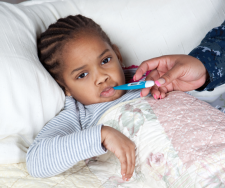
When your child is sick with an infection (viral or bacterial), it is common to also have a fever. Fever will not hurt your child. Usually, it goes away after 72 hours (3 days).
**Babies younger than 6 months old should see a doctor when they have a fever**. **Babies younger than 3 months old should be seen urgently.**
Older children can be treated at home, as long as they get enough liquids and seem well otherwise. However, they should see a doctor if their fever lasts for more than 48-72 hours.
There are several methods for taking your child’s temperature:
- rectal (by the rectum or ‘bum’)
- oral (by the mouth)
- axillary (under the armpit)
- tympanic (in the ear)
- temporal artery (forehead)
## Which method should I use?
The right method depends on your child’s age. It’s important that the measurement is accurate. The most accurate measurement by age is shown below. However, some parents or caregivers will first check for fever using an alternative method. Use this chart to help you decide which method to use:
| Age | Recommended method |
|---|---|
| Birth to 2 years | **Most accurate**: Rectum **Alternative**: Armpit |
| Between 2 and 5 years | **Most accurate**: Rectum **Alternative**: Ear, armpit |
| Older than 5 years | **Most accurate**: Mouth **Alternative**: Ear, armpit |
## Temperature-taking tips
- Do not use a mercury thermometer. If it breaks, you could be exposed to the toxic substance.
- A digital thermometer can be used for both rectal and oral temperature taking. It’s made of unbreakable plastic, is easy to read, easy to clean, and measures temperature quickly.
- Do not use the same thermometer for rectal and oral temperature taking.
- A non-contact infrared thermometer can display a reading quickly and reduce the risk of spreading disease. But head coverings, sweat, environment (direct sunlight, humidity, cold air, etc.), and positioning on forehead may influence the measurement.
- Fever strips are not recommended because they do not give accurate readings.
- Touching your child's skin (e.g., forehead) is not a reliable way to check for fever. If you suspect a fever, confirm it by using one of the methods above.
To get an accurate reading of your child’s temperature, you will need to make sure it’s done right. Here’s how:
## Rectum
This is the most reliable way to measure body temperature. Only use a rectal thermometer if you are comfortable doing so and if a health care provider has shown you how to do it safely.
- Clean the thermometer with cool, soapy water and rinse.
- Cover the silver tip with petroleum jelly (such as Vaseline).
- Place your baby on their back with their knees bent.
- Gently insert the thermometer in the rectum, about 2.5 cm (1 inch), holding it in place with your fingers.
- When ready, remove the thermometer and read the temperature.
- Clean the thermometer.
## Mouth
The oral method is not recommended for children younger than 5 years old because it is hard for them to hold the thermometer under their tongue for long enough.
- Clean the thermometer with cool, soapy water and rinse.
- Carefully place the tip of the thermometer under your child’s tongue.
- With your child’s mouth closed, leave the thermometer in place for about 1 minute, until you hear the beep.
- Remove the thermometer and read the temperature.
- Clean the thermometer.
## Armpit
The armpit (axillary) method is usually used to check for fever in newborns and young children, but it’s not as accurate as a rectal temperature. If an axillary temperature does not show a fever but your child feels warm and seems unwell, take a rectal measurement.
- Use a rectal or oral thermometer.
- Clean the thermometer with cool, soapy water and rinse.
- Place the tip of the thermometer in the centre of your child’s armpit.
- Make sure your child’s arm is tucked snugly against their body.
- When ready, remove the thermometer and read the temperature.
- Clean the thermometer.
## Ear
Though quick to use, the ear (tympanic) method can give temperature readings that are too low, even when the manufacturer’s directions are followed. It is not as reliable or accurate as rectal temperature taking. If a tympanic temperature does not show a fever but your child feels warm and seems unwell, take a rectal measurement.
- Use a clean probe tip each time, and follow the manufacturer’s instructions carefully.
- Gently tug on the ear, pulling it back. This will help straighten the ear canal, and make a clear path inside the ear to the eardrum.
- Gently insert the thermometer until the ear canal is fully sealed off.
- When ready, remove the thermometer and read the temperature.
## What is a normal temperature?
The following chart lists normal temperatures. The range varies and depends on the way you took your child’s temperature. Any temperature above this range is considered a fever.
| Method | Normal temperature range |
|---|---|
| Rectum | 36\.6°C to 37.9°C (97.9°F to 100.2°F) |
| Mouth | 35\.5°C to 37.5°C (95.9°F to 99.5°F) |
| Armpit | 36\.5°C to 37.5°C (97.8°F to 99.5°F) |
| Ear | 35\.8°C to 37.9°C (96.4°F to 100.2°F) |
The degree (height) of a fever does not tell you how serious your child’s illness is—how your child looks and acts is usually a better sign. A child with a mild infection can have a high fever, while a child with a severe infection might have no fever at all.
## What can I do if my child has a fever?
- Keep your child comfortable, and offer plenty of fluids.
- Remove extra blankets and clothing so heat can leave their body and help lower the body temperature. But don’t take off all your child’s clothes because they may become too cold and start shivering, which makes more body heat and will cause their temperature to rise again.
## What about medications?
Medications are not always needed to reduce a child’s temperature. They can be used to relieve any aches and pains, and to make your child more comfortable.
Medications such as acetaminophen (Tylenol or Tempra) and ibuprofen (Advil or Motrin) do not treat the underlying cause of the fever but can help temporarily lower a temperature. Sometimes a fever continues even after giving medication. That’s ok.
Unless your doctor says otherwise, you can give the dose recommended on the medication package. The correct dose should be based on your child’s body weight. **Never exceed the recommended dose.**
Ibuprofen should only be given if your child is drinking reasonably well. Do not give ibuprofen to babies under 6 months without first talking to your doctor or health care provider.
Acetaminophen and ibuprofen have different doses and different lengths of time between doses. They are safe to take at the same time, but because the dose and time are different, it is important to keep track when using both for your child.
**Do not use aspirin \[acetylsalicylic acid (ASA)\] to treat a child’s fever.** If the fever is due to chickenpox, influenza or certain other viral infections, taking aspirin can increase the risk of Reye’s syndrome. This is a very serious condition that can damage the liver and brain.
## Contact your health care provider if your child
- has a fever and is less than 6 months old.
- has a fever for more than 48-72 hours.
- is excessively cranky, fussy or irritable.
- is excessively sleepy, lethargic or does not respond.
- is persistently wheezing or coughing.
- has a fever combined with a rash or any other signs of illness that worry you.
### More information from the CPS
- [Febrile seizures](https://caringforkids.cps.ca/handouts/health-conditions-and-treatments/febrile_seizures)
### Additional resources
- [Fever: What you need to know (CHEO)](https://www.cheo.on.ca/en/resources-and-support/resources/P5325E.pdf)
- [How to manage your child's fever - video (Trekk - Translating Emergency Knowledge for Kids)](https://www.youtube.com/watch?v=t_l1Ya1cBak&t=0s)
- [How to manage your child's fever (Trekk - Translating Emergency Knowledge for Kids)](http://fever.trekk.ca/)
- [Temperature taking (AboutKidsHealth)](https://www.aboutkidshealth.ca/Article?contentid=966&language=English)
- [How to Take a Temperature: Children and Adults (HealthLink BC)](https://www.healthlinkbc.ca/healthlinkbc-files/how-take-temperature-children-and-adults)
### Reviewed by the following CPS committees
- Community Paediatrics Committee
Last updated: June 2022
- [Helpful Links](https://caringforkids.cps.ca/resources/resources_and_links)
- [Find a Doctor](https://caringforkids.cps.ca/resources/find_a_doctor)
[](https://cps.ca/en/)
© 2026 – Canadian Paediatric Society
[cps.ca/en/](https://cps.ca/en/) – [info@cps.ca](mailto:info@cps.ca)
Available at www.caringforkids.cps.ca
[](https://www.vaccinesafetynet.org/) | ||||||
| Readable Markdown | 
When your child is sick with an infection (viral or bacterial), it is common to also have a fever. Fever will not hurt your child. Usually, it goes away after 72 hours (3 days).
**Babies younger than 6 months old should see a doctor when they have a fever**. **Babies younger than 3 months old should be seen urgently.**
Older children can be treated at home, as long as they get enough liquids and seem well otherwise. However, they should see a doctor if their fever lasts for more than 48-72 hours.
There are several methods for taking your child’s temperature:
- rectal (by the rectum or ‘bum’)
- oral (by the mouth)
- axillary (under the armpit)
- tympanic (in the ear)
- temporal artery (forehead)
## Which method should I use?
The right method depends on your child’s age. It’s important that the measurement is accurate. The most accurate measurement by age is shown below. However, some parents or caregivers will first check for fever using an alternative method. Use this chart to help you decide which method to use:
| Age | Recommended method |
|---|---|
| Birth to 2 years | **Most accurate**: Rectum **Alternative**: Armpit |
| Between 2 and 5 years | **Most accurate**: Rectum **Alternative**: Ear, armpit |
| Older than 5 years | **Most accurate**: Mouth **Alternative**: Ear, armpit |
## Temperature-taking tips
- Do not use a mercury thermometer. If it breaks, you could be exposed to the toxic substance.
- A digital thermometer can be used for both rectal and oral temperature taking. It’s made of unbreakable plastic, is easy to read, easy to clean, and measures temperature quickly.
- Do not use the same thermometer for rectal and oral temperature taking.
- A non-contact infrared thermometer can display a reading quickly and reduce the risk of spreading disease. But head coverings, sweat, environment (direct sunlight, humidity, cold air, etc.), and positioning on forehead may influence the measurement.
- Fever strips are not recommended because they do not give accurate readings.
- Touching your child's skin (e.g., forehead) is not a reliable way to check for fever. If you suspect a fever, confirm it by using one of the methods above.
To get an accurate reading of your child’s temperature, you will need to make sure it’s done right. Here’s how:
## Rectum
This is the most reliable way to measure body temperature. Only use a rectal thermometer if you are comfortable doing so and if a health care provider has shown you how to do it safely.
- Clean the thermometer with cool, soapy water and rinse.
- Cover the silver tip with petroleum jelly (such as Vaseline).
- Place your baby on their back with their knees bent.
- Gently insert the thermometer in the rectum, about 2.5 cm (1 inch), holding it in place with your fingers.
- When ready, remove the thermometer and read the temperature.
- Clean the thermometer.
## Mouth
The oral method is not recommended for children younger than 5 years old because it is hard for them to hold the thermometer under their tongue for long enough.
- Clean the thermometer with cool, soapy water and rinse.
- Carefully place the tip of the thermometer under your child’s tongue.
- With your child’s mouth closed, leave the thermometer in place for about 1 minute, until you hear the beep.
- Remove the thermometer and read the temperature.
- Clean the thermometer.
## Armpit
The armpit (axillary) method is usually used to check for fever in newborns and young children, but it’s not as accurate as a rectal temperature. If an axillary temperature does not show a fever but your child feels warm and seems unwell, take a rectal measurement.
- Use a rectal or oral thermometer.
- Clean the thermometer with cool, soapy water and rinse.
- Place the tip of the thermometer in the centre of your child’s armpit.
- Make sure your child’s arm is tucked snugly against their body.
- When ready, remove the thermometer and read the temperature.
- Clean the thermometer.
## Ear
Though quick to use, the ear (tympanic) method can give temperature readings that are too low, even when the manufacturer’s directions are followed. It is not as reliable or accurate as rectal temperature taking. If a tympanic temperature does not show a fever but your child feels warm and seems unwell, take a rectal measurement.
- Use a clean probe tip each time, and follow the manufacturer’s instructions carefully.
- Gently tug on the ear, pulling it back. This will help straighten the ear canal, and make a clear path inside the ear to the eardrum.
- Gently insert the thermometer until the ear canal is fully sealed off.
- When ready, remove the thermometer and read the temperature.
## What is a normal temperature?
The following chart lists normal temperatures. The range varies and depends on the way you took your child’s temperature. Any temperature above this range is considered a fever.
| Method | Normal temperature range |
|---|---|
| Rectum | 36\.6°C to 37.9°C (97.9°F to 100.2°F) |
| Mouth | 35\.5°C to 37.5°C (95.9°F to 99.5°F) |
| Armpit | 36\.5°C to 37.5°C (97.8°F to 99.5°F) |
| Ear | 35\.8°C to 37.9°C (96.4°F to 100.2°F) |
The degree (height) of a fever does not tell you how serious your child’s illness is—how your child looks and acts is usually a better sign. A child with a mild infection can have a high fever, while a child with a severe infection might have no fever at all.
## What can I do if my child has a fever?
- Keep your child comfortable, and offer plenty of fluids.
- Remove extra blankets and clothing so heat can leave their body and help lower the body temperature. But don’t take off all your child’s clothes because they may become too cold and start shivering, which makes more body heat and will cause their temperature to rise again.
## What about medications?
Medications are not always needed to reduce a child’s temperature. They can be used to relieve any aches and pains, and to make your child more comfortable.
Medications such as acetaminophen (Tylenol or Tempra) and ibuprofen (Advil or Motrin) do not treat the underlying cause of the fever but can help temporarily lower a temperature. Sometimes a fever continues even after giving medication. That’s ok.
Unless your doctor says otherwise, you can give the dose recommended on the medication package. The correct dose should be based on your child’s body weight. **Never exceed the recommended dose.**
Ibuprofen should only be given if your child is drinking reasonably well. Do not give ibuprofen to babies under 6 months without first talking to your doctor or health care provider.
Acetaminophen and ibuprofen have different doses and different lengths of time between doses. They are safe to take at the same time, but because the dose and time are different, it is important to keep track when using both for your child.
**Do not use aspirin \[acetylsalicylic acid (ASA)\] to treat a child’s fever.** If the fever is due to chickenpox, influenza or certain other viral infections, taking aspirin can increase the risk of Reye’s syndrome. This is a very serious condition that can damage the liver and brain.
## Contact your health care provider if your child
- has a fever and is less than 6 months old.
- has a fever for more than 48-72 hours.
- is excessively cranky, fussy or irritable.
- is excessively sleepy, lethargic or does not respond.
- is persistently wheezing or coughing.
- has a fever combined with a rash or any other signs of illness that worry you.
### Additional resources
- [Fever: What you need to know (CHEO)](https://www.cheo.on.ca/en/resources-and-support/resources/P5325E.pdf)
- [How to manage your child's fever - video (Trekk - Translating Emergency Knowledge for Kids)](https://www.youtube.com/watch?v=t_l1Ya1cBak&t=0s)
- [How to manage your child's fever (Trekk - Translating Emergency Knowledge for Kids)](http://fever.trekk.ca/)
- [Temperature taking (AboutKidsHealth)](https://www.aboutkidshealth.ca/Article?contentid=966&language=English)
- [How to Take a Temperature: Children and Adults (HealthLink BC)](https://www.healthlinkbc.ca/healthlinkbc-files/how-take-temperature-children-and-adults)
### Reviewed by the following CPS committees
- Community Paediatrics Committee
Last updated: June 2022 | ||||||
| ML Classification | |||||||
| ML Categories |
Raw JSON{
"/Health": 998,
"/Health/Pediatrics": 993
} | ||||||
| ML Page Types |
Raw JSON{
"/Article": 996,
"/Article/How_to": 686
} | ||||||
| ML Intent Types |
Raw JSON{
"Informational": 999
} | ||||||
| Content Metadata | |||||||
| Language | en | ||||||
| Author | null | ||||||
| Publish Time | not set | ||||||
| Original Publish Time | 2021-08-23 20:36:42 (4 years ago) | ||||||
| Republished | No | ||||||
| Word Count (Total) | 1,426 | ||||||
| Word Count (Content) | 1,302 | ||||||
| Links | |||||||
| External Links | 11 | ||||||
| Internal Links | 17 | ||||||
| Technical SEO | |||||||
| Meta Nofollow | No | ||||||
| Meta Noarchive | No | ||||||
| JS Rendered | No | ||||||
| Redirect Target | null | ||||||
| Performance | |||||||
| Download Time (ms) | 413 | ||||||
| TTFB (ms) | 413 | ||||||
| Download Size (bytes) | 9,983 | ||||||
| Shard | 190 (laksa) | ||||||
| Root Hash | 11047512809307042990 | ||||||
| Unparsed URL | ca,cps!caringforkids,/handouts/health-conditions-and-treatments/fever_and_temperature_taking s443 | ||||||