ℹ️ Skipped - page is already crawled
| Filter | Status | Condition | Details |
|---|---|---|---|
| HTTP status | PASS | download_http_code = 200 | HTTP 200 |
| Age cutoff | PASS | download_stamp > now() - 6 MONTH | 0.1 months ago |
| History drop | PASS | isNull(history_drop_reason) | No drop reason |
| Spam/ban | PASS | fh_dont_index != 1 AND ml_spam_score = 0 | ml_spam_score=0 |
| Canonical | PASS | meta_canonical IS NULL OR = '' OR = src_unparsed | Not set |
| Property | Value |
|---|---|
| URL | https://calcworkshop.com/laplace-transform/laplace-transform-overview/ |
| Last Crawled | 2026-04-19 20:10:49 (3 days ago) |
| First Indexed | 2018-10-17 13:12:52 (7 years ago) |
| HTTP Status Code | 200 |
| Content | |
| Meta Title | Laplace Transform Techniques (Simplifying Differential Equations) |
| Meta Description | Discover the power of the Laplace Transform to simplify complex differential equations, with examples, tips, and a handy transforms table. |
| Meta Canonical | null |
| Boilerpipe Text | Ever wondered how to
simplify “difficult” ordinary differential equations
? The
Laplace Transform
is like a skilled translator, converting these complex equations into more approachable forms.
Jenn, Founder Calcworkshop
®
, 15+ Years Experience (Licensed & Certified Teacher)
Used extensively in
engineering
, the Laplace Transform takes a function of a positive real variable (x or t), often represented as “
time
,” and transforms it into a function of a complex variable, commonly called “
frequency
.”
Let’s
jump in
and see what the Laplace transform is all about!
Understanding Improper Integrals
Okay, so to better understand the Laplace transform, we must first understand the improper integral.
If \(f(x)\) is a continuous function, then the improper integral \(\int_{0}^{\infty} f(x) d x\) exists if the integral approaches a finite limit.
In other words, if \(\int_{0}^{\infty} f(x) d x=L\), where \(\mathrm{L}\) is a finite limit, then \(\int_{0}^{\infty} f(x) d x\) converges to the value of L. And if the limit does not exist, then the improper integral diverges.
Convergence of Improper Integrals
Now it’s time to look at an important improper integral because it builds the foundation for what we are about to see….
If the improper integral \(\int_{0}^{\infty} e^{-s x} f(x) d x\) converges for a value of \(s=s_{0}\), then it converges for every \(s>s_{0}\).
And this integral, if it exists, is a function of \(\mathrm{s}\) and is called the Laplace Transform!
Definition of the Laplace Transform
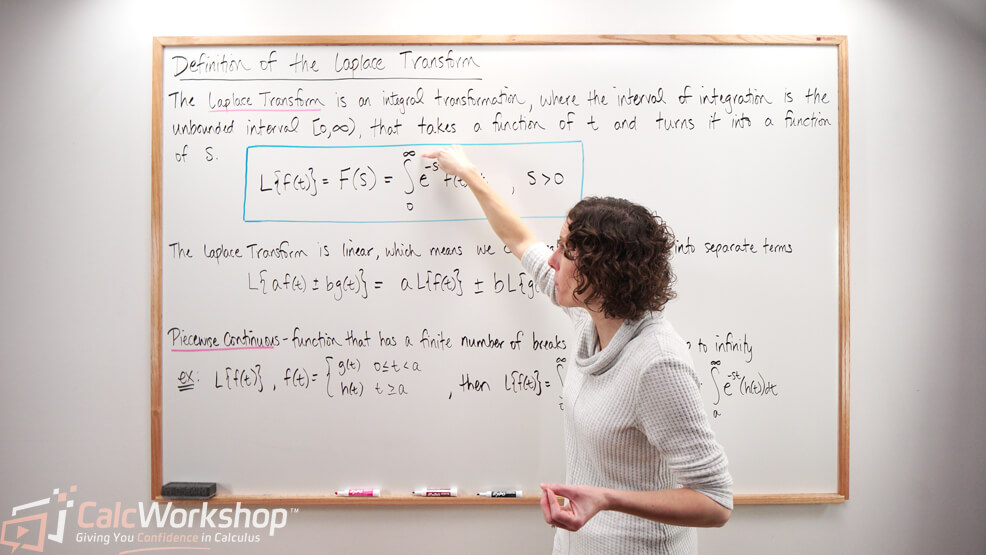
By definition, the Laplace transform assumes that \(f(x)\) is a function for which the integral exists for some value of \(s\), then we say it is denoted as:
\begin{align*}
L\{f(x)\}=F(s)=\int_{0}^{\infty} e^{-s x} f(x) d x
\end{align*}
Basic Transforms Table
Now, computing transforms directly can be a bit complicated and tedious, so it’s by far easier to use a table of transforms to help simplify the process for us.
\begin{equation}
\begin{array}{|c|c|}
\hline \text { If } f(x)= & \text { Then } L\{f(x)\}=F(s)= \\
\hline 1 & \frac{1}{s} \\
\hline k & \frac{k}{s}>0 \\
\hline e^{a x} & \frac{1}{s-a} \\
\hline x^n, n=1,2,3, \ldots & \frac{n !}{s^{n+1}} \\
\hline x^n e^{a x}, n=1,2,3, \ldots & \frac{n !}{(s-a)^{n+1}} s>a \\
\hline \sin (a x) & \frac{a}{s^2+a^2} \\
\hline \cos (a x) & \frac{s}{s^2+a^2} \\
\hline \sinh (a x) & \frac{a}{s^2-a^2}, s>|a| \\
\hline \cosh (a x) & \frac{s}{s^2-a^2}, s>|a| \\
\hline x \sin (a x) & \frac{2 a s}{\left(s^2+a^2\right)^2} \\
\hline x \cos (a x) & \frac{s^2-a^2}{\left(s^2+a^2\right)^2} \\
\hline e^{a x} \sin (b x) & \frac{b}{(s-a)^2+b^2} \\
\hline e^{a x} \cos (b x) & \frac{s-a}{(s-a)^2+b^2} \\
\hline
\end{array}
\end{equation}
Keep in mind that this table isn’t exhaustive, but it does provide a solid foundation for harnessing this impressive new tool!
You might be wondering, “What is this, and how does it help solve differential equations?”
Great question! Let’s explore a few examples together to better understand its applications.
Properties of the Laplace Transform
But before we do, I want to point out
two critical properties
, as the Laplace transform is
linear
and upholds both
homogeneity
and
superposition
.
The Laplace Transform has two essential properties,
linearity
and
superposition
, which make it useful for solving complex problems:
Linearity (Homogeneity)
: This means that if you multiply a function by a constant, you can just multiply the Laplace Transform of that function by the same constant.
Superposition
: This means that if you add two functions together, you can simply add their Laplace Transforms separately.
These properties make working with the Laplace Transform
easier
and
more efficient
, helping us analyze complex systems and solve differential equations in various fields like engineering, physics, and mathematics.
If \(\mathrm{a}\) is a constant and \(\mathrm{f}\) and \(\mathrm{g}\) are functions, then
\begin{equation}
\begin{aligned}
& L\{a f(x)\}=a L\{f(x)\} \\
& L\{f(x) \pm g(x)\}=L\{f(x)\} \pm L\{g(x)\}
\end{aligned}
\end{equation}
Example: Laplace Transform of a Polynomial Function
Find the Laplace transform of the function \(f(x)=3 x^{5}\)
First, we will use our first property of linearity and pull out the leading coefficient.
\begin{equation}
\begin{aligned}
& L\left\{3 x^5\right\} \\
& 3 L\left\{x^5\right\}
\end{aligned}
\end{equation}
Next, we will notice that our function is a polynomial of the form \(x^{n}\) therefore, we can apply its transform as follows.
\begin{equation}
\begin{aligned}
& L\left\{x^n\right\}=\frac{n !}{s^{n+1}} \\
& 3 L\left\{x^5\right\}=3\left(\frac{5 !}{s^{5+1}}\right)=3\left(\frac{5 !}{s^6}\right)=\frac{3(120)}{s^6}=\frac{360}{s^6}, s>0
\end{aligned}
\end{equation}
Easy, right?
Example: Laplace Transform w/ Exponential and Trig Functions
Find the Laplace transform of the function \(f(x)=e^{3 x}+\cos (5 x)\)
First, we will use our second property and separate our two terms.
\begin{equation}
\begin{aligned}
& L\left\{e^{3 x}+\cos (5 x)\right\} \\
& L\left\{e^{3 x}\right\}+L\{\cos (5 x)\}
\end{aligned}
\end{equation}
Next, we will use our table to find our transformation for the exponential function and the trigonometric function separately, as follows.
\begin{align*}
\begin{aligned}
& L\left\{e^{a x}\right\}=\frac{1}{s-a} \text { and } L\{\cos (a x)\}=\frac{s}{s^{2}+a^{2}} \\
& L\left\{e^{3 x}\right\}+L\{\cos (5 x)\}=\frac{1}{s-3}+\frac{s}{s^{2}+5^{2}} \\
& L\left\{e^{3 x}\right\}+L\{\cos (5 x)\}=\frac{1}{s-3}+\frac{s}{s^{2}+25}, s>3
\end{aligned}
\end{align*}
Nothing to it!
Let’s Wrap Up
Together, you’ll explore the Laplace Transform by:
Understanding linearity and breaking up each term into separate parts.
Discussing sufficient conditions of existence, such as piecewise continuous functions.
Working through five detailed examples using the Definition of the Laplace Transform, Improper Integrals, and Integration by Parts.
Creating a table of Basic Transforms and applying them to seven more examples.
Let’s go!
Video Tutorial w/ Full Lesson & Detailed Examples
Get access to all the courses and over 450 HD videos with your subscription
Monthly and Yearly Plans Available
Get My Subscription Now
Still wondering if CalcWorkshop is right for you?
Take a
Tour
and find out how a membership can take the struggle out of learning math. |
| Markdown | [Calcworkshop](https://calcworkshop.com/)
[Login](https://calcworkshop.com/login/)
- [Home](https://calcworkshop.com/)
- [Reviews](https://calcworkshop.com/reviews/)
- [Courses](https://calcworkshop.com/courses/)
- [Algebra I & II](https://calcworkshop.com/algebra/)
- [Intro Algebra](https://calcworkshop.com/intro-algebra/)
- [Solving Equations](https://calcworkshop.com/solving-equations/)
- [Exponents](https://calcworkshop.com/exponents/)
- [Polynomials](https://calcworkshop.com/polynomials/)
- [Factoring](https://calcworkshop.com/factoring/)
- [Rationals](https://calcworkshop.com/rationals/)
- [Graphing Linear Equations](https://calcworkshop.com/graphing-linear-equations/)
- [Systems of Equations](https://calcworkshop.com/systems-equations/)
- [Radicals](https://calcworkshop.com/radicals/)
- [Functions & Statistics](https://calcworkshop.com/functions-statistics/)
- [Geometry](https://calcworkshop.com/high-school-geometry/)
- [Basic Geometry](https://calcworkshop.com/basic-geometry/)
- [Reasoning & Proofs](https://calcworkshop.com/reasoning-proof/)
- [Congruent Triangles](https://calcworkshop.com/congruent-triangles/)
- [Quadrilaterals](https://calcworkshop.com/quadrilaterals/)
- [Similarity](https://calcworkshop.com/similarity/)
- [Triangles & Trig](https://calcworkshop.com/triangle-trig/)
- [Circles](https://calcworkshop.com/circle/)
- [Polygons & Circles](https://calcworkshop.com/polygons-circles/)
- [Volume & Surface Area](https://calcworkshop.com/volume-surface-area/)
- [Transformations](https://calcworkshop.com/transformations/)
- [Pre-Calculus](https://calcworkshop.com/precalculus/)
- [Trigonometry](https://calcworkshop.com/trigonometry/)
- [Trigonometric Functions](https://calcworkshop.com/trigonometric-functions/)
- [Radian Measure](https://calcworkshop.com/radian-measure/)
- [Graphing Trig Functions](https://calcworkshop.com/graphing-trig-functions/)
- [Trig Identities](https://calcworkshop.com/trig-identities/)
- [Trig Equations](https://calcworkshop.com/trig-equations/)
- [Law of Sines and Cosines](https://calcworkshop.com/law-sines-cosines/)
- [Vector Applications](https://calcworkshop.com/vector-applications/)
- [Polar Equations](https://calcworkshop.com/polar-equations/)
- [Complex Numbers](https://calcworkshop.com/complex-numbers/)
- [Math Analysis](https://calcworkshop.com/math-analysis/)
- [Intro to Math Analysis](https://calcworkshop.com/intro-math-analysis/)
- [Functions and Graphs](https://calcworkshop.com/functions-graphs/)
- [Expos and Logs](https://calcworkshop.com/expos-logs/)
- [Polynomial Functions](https://calcworkshop.com/polynomial-function/)
- [Rational Functions](https://calcworkshop.com/rational-functions/)
- [Conic Sections](https://calcworkshop.com/conic-sections/)
- [Series & Sequences](https://calcworkshop.com/series-sequences/)
- [Calculus 1, 2, & 3]()
- [Business Calculus](https://calcworkshop.com/business-calculus/)
- [Calculus 1](https://calcworkshop.com/calculus-1/)
- [PreCalc Review](https://calcworkshop.com/pre-calculus-review/)
- [Limits](https://calcworkshop.com/limits/)
- [Derivatives](https://calcworkshop.com/derivatives/)
- [Application of Derivatives](https://calcworkshop.com/application-derivatives/)
- [Integrals](https://calcworkshop.com/integrals/)
- [Final Exam](https://calcworkshop.com/calculus-1-final-exam/)
- [Calculus 2](https://calcworkshop.com/calculus-2/)
- [Integrals](https://calcworkshop.com/integrals/)
- [Applications of Integrals](https://calcworkshop.com/applications-integrals/)
- [Diff-EQs](https://calcworkshop.com/diff-eqs/)
- [Polar Functions](https://calcworkshop.com/polar-functions/)
- [Parametric and Vector Functions](https://calcworkshop.com/parametric-vector-functions/)
- [Sequences and Series](https://calcworkshop.com/sequences-series/)
- [Final Exam](https://calcworkshop.com/calculus-2-final-exam/)
- [Calculus 3](https://calcworkshop.com/calculus-3/)
- [Vectors and The Geometry of Space](https://calcworkshop.com/vectors-and-the-geometry-of-space/)
- [Vector Functions](https://calcworkshop.com/vector-functions/)
- [Partial Derivatives](https://calcworkshop.com/partial-derivatives/)
- [Multiple Integrals](https://calcworkshop.com/multiple-integrals/)
- [Vector Calculus](https://calcworkshop.com/vector-calculus/)
- [Final Exam](https://calcworkshop.com/calculus-3-final-exam/)
- [Statistics & Prob](https://calcworkshop.com/probability-and-statistics/)
- [Exploring Data](https://calcworkshop.com/exploring-data/)
- [Probability](https://calcworkshop.com/probability/)
- [Discrete Distribution](https://calcworkshop.com/discrete-probability-distribution/)
- [Continuous Distribution](https://calcworkshop.com/continuous-probability-distribution/)
- [Joint Distribution](https://calcworkshop.com/joint-probability-distribution/)
- [Confidence Interval](https://calcworkshop.com/confidence-interval/)
- [Hypothesis Testing](https://calcworkshop.com/hypothesis-test/)
- [Linear Regression](https://calcworkshop.com/linear-regression/)
- [Discrete Math](https://calcworkshop.com/discrete-math/)
- [Logic](https://calcworkshop.com/logic/)
- [Proofs](https://calcworkshop.com/proofs/)
- [Sets](https://calcworkshop.com/set-theory/)
- [Number Theory](https://calcworkshop.com/number-theory/)
- [Functions](https://calcworkshop.com/functions/)
- [Combinatorics](https://calcworkshop.com/combinatorics/)
- [Relations](https://calcworkshop.com/relations/)
- [Trees & Graphs](https://calcworkshop.com/trees-graphs/)
- [Linear Algebra](https://calcworkshop.com/linear-algebra/)
- [Linear Equations](https://calcworkshop.com/linear-equations/)
- [Matrix Algebra](https://calcworkshop.com/matrix-algebra/)
- [Determinants](https://calcworkshop.com/determinates/)
- [Vector Spaces](https://calcworkshop.com/vector-spaces/)
- [Eigenvalues and Eigenvectors](https://calcworkshop.com/eigenvalues/)
- [Orthogonality and Least Squares](https://calcworkshop.com/orthogonality/)
- [Symmetric Matrices](https://calcworkshop.com/symmetric-matrices/)
- [Final Exam](https://calcworkshop.com/linear-algebra-final-exam/)
- [Diff-EQs](https://calcworkshop.com/differential-equations/)
- [Intro to DiffEqs](https://calcworkshop.com/intro-to-diffeqs/)
- [First Order Differential Equations](https://calcworkshop.com/first-order-differential-equations/)
- [Second Order Differential Equations](https://calcworkshop.com/second-order-differential-equations/)
- [Series Solutions](https://calcworkshop.com/series-solutions-diff-eqs/)
- [Laplace Transform](https://calcworkshop.com/laplace-transform/)
- [Systems of Differential Equations](https://calcworkshop.com/systems-of-differential-equations/)
- [Final Exam](https://calcworkshop.com/differential-equations-final-exam/)
- [Praxis](https://calcworkshop.com/praxis-math/)
- [FAQs](https://calcworkshop.com/faq/)
- [About](https://calcworkshop.com/about-me/)
- [Contact](https://calcworkshop.com/contact/)
- [Login](https://calcworkshop.com/login/)
[Home](https://calcworkshop.com/) » [Laplace Transform](https://calcworkshop.com/laplace-transform/) » **Laplace Transform**
# **Laplace Transform Techniques** Simplifying Differential Equations
// Last Updated: April 18, 2023 - [Watch Video](https://calcworkshop.com/laplace-transform/laplace-transform-overview/#chapter) //
Ever wondered how to **simplify “difficult” ordinary differential equations**? The *Laplace Transform* is like a skilled translator, converting these complex equations into more approachable forms.
Jenn, Founder Calcworkshop®, 15+ Years Experience (Licensed & Certified Teacher)
Used extensively in **engineering**, the Laplace Transform takes a function of a positive real variable (x or t), often represented as “*time*,” and transforms it into a function of a complex variable, commonly called “*frequency*.”
Let’s **jump in** and see what the Laplace transform is all about\!
## Understanding Improper Integrals
Okay, so to better understand the Laplace transform, we must first understand the improper integral.
If \\(f(x)\\) is a continuous function, then the improper integral \\(\\int\_{0}^{\\infty} f(x) d x\\) exists if the integral approaches a finite limit.
In other words, if \\(\\int\_{0}^{\\infty} f(x) d x=L\\), where \\(\\mathrm{L}\\) is a finite limit, then \\(\\int\_{0}^{\\infty} f(x) d x\\) converges to the value of L. And if the limit does not exist, then the improper integral diverges.
### Convergence of Improper Integrals
Now it’s time to look at an important improper integral because it builds the foundation for what we are about to see….
If the improper integral \\(\\int\_{0}^{\\infty} e^{-s x} f(x) d x\\) converges for a value of \\(s=s\_{0}\\), then it converges for every \\(s\>s\_{0}\\).
And this integral, if it exists, is a function of \\(\\mathrm{s}\\) and is called the Laplace Transform\!
### Definition of the Laplace Transform
By definition, the Laplace transform assumes that \\(f(x)\\) is a function for which the integral exists for some value of \\(s\\), then we say it is denoted as:
\\begin{align\*}
L\\{f(x)\\}=F(s)=\\int\_{0}^{\\infty} e^{-s x} f(x) d x
\\end{align\*}
## Basic Transforms Table
Now, computing transforms directly can be a bit complicated and tedious, so it’s by far easier to use a table of transforms to help simplify the process for us.
\\begin{equation}
\\begin{array}{\|c\|c\|}
\\hline \\text { If } f(x)= & \\text { Then } L\\{f(x)\\}=F(s)= \\\\
\\hline 1 & \\frac{1}{s} \\\\
\\hline k & \\frac{k}{s}\>0 \\\\
\\hline e^{a x} & \\frac{1}{s-a} \\\\
\\hline x^n, n=1,2,3, \\ldots & \\frac{n !}{s^{n+1}} \\\\
\\hline x^n e^{a x}, n=1,2,3, \\ldots & \\frac{n !}{(s-a)^{n+1}} s\>a \\\\
\\hline \\sin (a x) & \\frac{a}{s^2+a^2} \\\\
\\hline \\cos (a x) & \\frac{s}{s^2+a^2} \\\\
\\hline \\sinh (a x) & \\frac{a}{s^2-a^2}, s\>\|a\| \\\\
\\hline \\cosh (a x) & \\frac{s}{s^2-a^2}, s\>\|a\| \\\\
\\hline x \\sin (a x) & \\frac{2 a s}{\\left(s^2+a^2\\right)^2} \\\\
\\hline x \\cos (a x) & \\frac{s^2-a^2}{\\left(s^2+a^2\\right)^2} \\\\
\\hline e^{a x} \\sin (b x) & \\frac{b}{(s-a)^2+b^2} \\\\
\\hline e^{a x} \\cos (b x) & \\frac{s-a}{(s-a)^2+b^2} \\\\
\\hline
\\end{array}
\\end{equation}
Keep in mind that this table isn’t exhaustive, but it does provide a solid foundation for harnessing this impressive new tool\!
You might be wondering, “What is this, and how does it help solve differential equations?”
Great question! Let’s explore a few examples together to better understand its applications.
## Properties of the Laplace Transform
But before we do, I want to point out **two critical properties**, as the Laplace transform is *linear* and upholds both *homogeneity* and *superposition*.
The Laplace Transform has two essential properties, **linearity** and **superposition**, which make it useful for solving complex problems:
- *Linearity (Homogeneity)*: This means that if you multiply a function by a constant, you can just multiply the Laplace Transform of that function by the same constant.
- *Superposition*: This means that if you add two functions together, you can simply add their Laplace Transforms separately.
These properties make working with the Laplace Transform **easier** and **more efficient**, helping us analyze complex systems and solve differential equations in various fields like engineering, physics, and mathematics.
If \\(\\mathrm{a}\\) is a constant and \\(\\mathrm{f}\\) and \\(\\mathrm{g}\\) are functions, then
\\begin{equation}
\\begin{aligned}
& L\\{a f(x)\\}=a L\\{f(x)\\} \\\\
& L\\{f(x) \\pm g(x)\\}=L\\{f(x)\\} \\pm L\\{g(x)\\}
\\end{aligned}
\\end{equation}
### Example: Laplace Transform of a Polynomial Function
Find the Laplace transform of the function \\(f(x)=3 x^{5}\\)
First, we will use our first property of linearity and pull out the leading coefficient.
\\begin{equation}
\\begin{aligned}
& L\\left\\{3 x^5\\right\\} \\\\
& 3 L\\left\\{x^5\\right\\}
\\end{aligned}
\\end{equation}
Next, we will notice that our function is a polynomial of the form \\(x^{n}\\) therefore, we can apply its transform as follows.
\\begin{equation}
\\begin{aligned}
& L\\left\\{x^n\\right\\}=\\frac{n !}{s^{n+1}} \\\\
& 3 L\\left\\{x^5\\right\\}=3\\left(\\frac{5 !}{s^{5+1}}\\right)=3\\left(\\frac{5 !}{s^6}\\right)=\\frac{3(120)}{s^6}=\\frac{360}{s^6}, s\>0
\\end{aligned}
\\end{equation}
Easy, right?
### Example: Laplace Transform w/ Exponential and Trig Functions
Find the Laplace transform of the function \\(f(x)=e^{3 x}+\\cos (5 x)\\)
First, we will use our second property and separate our two terms.
\\begin{equation}
\\begin{aligned}
& L\\left\\{e^{3 x}+\\cos (5 x)\\right\\} \\\\
& L\\left\\{e^{3 x}\\right\\}+L\\{\\cos (5 x)\\}
\\end{aligned}
\\end{equation}
Next, we will use our table to find our transformation for the exponential function and the trigonometric function separately, as follows.
\\begin{align\*}
\\begin{aligned}
& L\\left\\{e^{a x}\\right\\}=\\frac{1}{s-a} \\text { and } L\\{\\cos (a x)\\}=\\frac{s}{s^{2}+a^{2}} \\\\
& L\\left\\{e^{3 x}\\right\\}+L\\{\\cos (5 x)\\}=\\frac{1}{s-3}+\\frac{s}{s^{2}+5^{2}} \\\\
& L\\left\\{e^{3 x}\\right\\}+L\\{\\cos (5 x)\\}=\\frac{1}{s-3}+\\frac{s}{s^{2}+25}, s\>3
\\end{aligned}
\\end{align\*}
Nothing to it\!
## Let’s Wrap Up
Together, you’ll explore the Laplace Transform by:
- Understanding linearity and breaking up each term into separate parts.
- Discussing sufficient conditions of existence, such as piecewise continuous functions.
- Working through five detailed examples using the Definition of the Laplace Transform, Improper Integrals, and Integration by Parts.
- Creating a table of Basic Transforms and applying them to seven more examples.
Let’s go\!
## Video Tutorial w/ Full Lesson & Detailed Examples
Get access to all the courses and over 450 HD videos with your subscription
*Monthly and Yearly Plans Available*
[Get My Subscription Now](https://calcworkshop.com/pricing/)
Still wondering if CalcWorkshop is right for you?
Take a [Tour](https://calcworkshop.com/tour/) and find out how a membership can take the struggle out of learning math.
[Calcworkshop](https://calcworkshop.com/)
© 2026 Calcworkshop LLC / [Privacy Policy](https://calcworkshop.com/privacy/) / [Terms of Service](https://calcworkshop.com/terms/)
- [About](https://calcworkshop.com/about-me/)
- [Reviews](https://calcworkshop.com/reviews/)
- [Courses](https://calcworkshop.com/courses/)
- [Plans & Pricing](https://calcworkshop.com/pricing/) |
| Readable Markdown | Ever wondered how to **simplify “difficult” ordinary differential equations**? The *Laplace Transform* is like a skilled translator, converting these complex equations into more approachable forms.

Jenn, Founder Calcworkshop®, 15+ Years Experience (Licensed & Certified Teacher)
Used extensively in **engineering**, the Laplace Transform takes a function of a positive real variable (x or t), often represented as “*time*,” and transforms it into a function of a complex variable, commonly called “*frequency*.”
Let’s **jump in** and see what the Laplace transform is all about\!
## Understanding Improper Integrals
Okay, so to better understand the Laplace transform, we must first understand the improper integral.
If \\(f(x)\\) is a continuous function, then the improper integral \\(\\int\_{0}^{\\infty} f(x) d x\\) exists if the integral approaches a finite limit.
In other words, if \\(\\int\_{0}^{\\infty} f(x) d x=L\\), where \\(\\mathrm{L}\\) is a finite limit, then \\(\\int\_{0}^{\\infty} f(x) d x\\) converges to the value of L. And if the limit does not exist, then the improper integral diverges.
### Convergence of Improper Integrals
Now it’s time to look at an important improper integral because it builds the foundation for what we are about to see….
If the improper integral \\(\\int\_{0}^{\\infty} e^{-s x} f(x) d x\\) converges for a value of \\(s=s\_{0}\\), then it converges for every \\(s\>s\_{0}\\).
And this integral, if it exists, is a function of \\(\\mathrm{s}\\) and is called the Laplace Transform\!
### Definition of the Laplace Transform
By definition, the Laplace transform assumes that \\(f(x)\\) is a function for which the integral exists for some value of \\(s\\), then we say it is denoted as:
\\begin{align\*}
L\\{f(x)\\}=F(s)=\\int\_{0}^{\\infty} e^{-s x} f(x) d x
\\end{align\*}
## Basic Transforms Table
Now, computing transforms directly can be a bit complicated and tedious, so it’s by far easier to use a table of transforms to help simplify the process for us.
\\begin{equation}
\\begin{array}{\|c\|c\|}
\\hline \\text { If } f(x)= & \\text { Then } L\\{f(x)\\}=F(s)= \\\\
\\hline 1 & \\frac{1}{s} \\\\
\\hline k & \\frac{k}{s}\>0 \\\\
\\hline e^{a x} & \\frac{1}{s-a} \\\\
\\hline x^n, n=1,2,3, \\ldots & \\frac{n !}{s^{n+1}} \\\\
\\hline x^n e^{a x}, n=1,2,3, \\ldots & \\frac{n !}{(s-a)^{n+1}} s\>a \\\\
\\hline \\sin (a x) & \\frac{a}{s^2+a^2} \\\\
\\hline \\cos (a x) & \\frac{s}{s^2+a^2} \\\\
\\hline \\sinh (a x) & \\frac{a}{s^2-a^2}, s\>\|a\| \\\\
\\hline \\cosh (a x) & \\frac{s}{s^2-a^2}, s\>\|a\| \\\\
\\hline x \\sin (a x) & \\frac{2 a s}{\\left(s^2+a^2\\right)^2} \\\\
\\hline x \\cos (a x) & \\frac{s^2-a^2}{\\left(s^2+a^2\\right)^2} \\\\
\\hline e^{a x} \\sin (b x) & \\frac{b}{(s-a)^2+b^2} \\\\
\\hline e^{a x} \\cos (b x) & \\frac{s-a}{(s-a)^2+b^2} \\\\
\\hline
\\end{array}
\\end{equation}
Keep in mind that this table isn’t exhaustive, but it does provide a solid foundation for harnessing this impressive new tool\!
You might be wondering, “What is this, and how does it help solve differential equations?”
Great question! Let’s explore a few examples together to better understand its applications.
## Properties of the Laplace Transform
But before we do, I want to point out **two critical properties**, as the Laplace transform is *linear* and upholds both *homogeneity* and *superposition*.
The Laplace Transform has two essential properties, **linearity** and **superposition**, which make it useful for solving complex problems:
- *Linearity (Homogeneity)*: This means that if you multiply a function by a constant, you can just multiply the Laplace Transform of that function by the same constant.
- *Superposition*: This means that if you add two functions together, you can simply add their Laplace Transforms separately.
These properties make working with the Laplace Transform **easier** and **more efficient**, helping us analyze complex systems and solve differential equations in various fields like engineering, physics, and mathematics.
If \\(\\mathrm{a}\\) is a constant and \\(\\mathrm{f}\\) and \\(\\mathrm{g}\\) are functions, then
\\begin{equation}
\\begin{aligned}
& L\\{a f(x)\\}=a L\\{f(x)\\} \\\\
& L\\{f(x) \\pm g(x)\\}=L\\{f(x)\\} \\pm L\\{g(x)\\}
\\end{aligned}
\\end{equation}
### Example: Laplace Transform of a Polynomial Function
Find the Laplace transform of the function \\(f(x)=3 x^{5}\\)
First, we will use our first property of linearity and pull out the leading coefficient.
\\begin{equation}
\\begin{aligned}
& L\\left\\{3 x^5\\right\\} \\\\
& 3 L\\left\\{x^5\\right\\}
\\end{aligned}
\\end{equation}
Next, we will notice that our function is a polynomial of the form \\(x^{n}\\) therefore, we can apply its transform as follows.
\\begin{equation}
\\begin{aligned}
& L\\left\\{x^n\\right\\}=\\frac{n !}{s^{n+1}} \\\\
& 3 L\\left\\{x^5\\right\\}=3\\left(\\frac{5 !}{s^{5+1}}\\right)=3\\left(\\frac{5 !}{s^6}\\right)=\\frac{3(120)}{s^6}=\\frac{360}{s^6}, s\>0
\\end{aligned}
\\end{equation}
Easy, right?
### Example: Laplace Transform w/ Exponential and Trig Functions
Find the Laplace transform of the function \\(f(x)=e^{3 x}+\\cos (5 x)\\)
First, we will use our second property and separate our two terms.
\\begin{equation}
\\begin{aligned}
& L\\left\\{e^{3 x}+\\cos (5 x)\\right\\} \\\\
& L\\left\\{e^{3 x}\\right\\}+L\\{\\cos (5 x)\\}
\\end{aligned}
\\end{equation}
Next, we will use our table to find our transformation for the exponential function and the trigonometric function separately, as follows.
\\begin{align\*}
\\begin{aligned}
& L\\left\\{e^{a x}\\right\\}=\\frac{1}{s-a} \\text { and } L\\{\\cos (a x)\\}=\\frac{s}{s^{2}+a^{2}} \\\\
& L\\left\\{e^{3 x}\\right\\}+L\\{\\cos (5 x)\\}=\\frac{1}{s-3}+\\frac{s}{s^{2}+5^{2}} \\\\
& L\\left\\{e^{3 x}\\right\\}+L\\{\\cos (5 x)\\}=\\frac{1}{s-3}+\\frac{s}{s^{2}+25}, s\>3
\\end{aligned}
\\end{align\*}
Nothing to it\!
## Let’s Wrap Up
Together, you’ll explore the Laplace Transform by:
- Understanding linearity and breaking up each term into separate parts.
- Discussing sufficient conditions of existence, such as piecewise continuous functions.
- Working through five detailed examples using the Definition of the Laplace Transform, Improper Integrals, and Integration by Parts.
- Creating a table of Basic Transforms and applying them to seven more examples.
Let’s go\!
## Video Tutorial w/ Full Lesson & Detailed Examples

Get access to all the courses and over 450 HD videos with your subscription
*Monthly and Yearly Plans Available*
[Get My Subscription Now](https://calcworkshop.com/pricing/)
Still wondering if CalcWorkshop is right for you?
Take a [Tour](https://calcworkshop.com/tour/) and find out how a membership can take the struggle out of learning math. |
| ML Classification | |
| ML Categories | null |
| ML Page Types | null |
| ML Intent Types | null |
| Content Metadata | |
| Language | en-us |
| Author | null |
| Publish Time | 2023-04-18 15:10:07 (3 years ago) |
| Original Publish Time | 2018-10-17 13:12:52 (7 years ago) |
| Republished | Yes |
| Word Count (Total) | 1,197 |
| Word Count (Content) | 923 |
| Links | |
| External Links | 4 |
| Internal Links | 112 |
| Technical SEO | |
| Meta Nofollow | No |
| Meta Noarchive | No |
| JS Rendered | No |
| Redirect Target | null |
| Performance | |
| Download Time (ms) | 23 |
| TTFB (ms) | 16 |
| Download Size (bytes) | 11,642 |
| Shard | 180 (laksa) |
| Root Hash | 2704321482360107780 |
| Unparsed URL | com,calcworkshop!/laplace-transform/laplace-transform-overview/ s443 |