ℹ️ Skipped - page is already crawled
| Filter | Status | Condition | Details |
|---|---|---|---|
| HTTP status | PASS | download_http_code = 200 | HTTP 200 |
| Age cutoff | PASS | download_stamp > now() - 6 MONTH | 0 months ago |
| History drop | PASS | isNull(history_drop_reason) | No drop reason |
| Spam/ban | PASS | fh_dont_index != 1 AND ml_spam_score = 0 | ml_spam_score=0 |
| Canonical | PASS | meta_canonical IS NULL OR = '' OR = src_unparsed | Not set |
| Property | Value |
|---|---|
| URL | https://blog.biomeme.com/what-kind-of-test-do-i-need |
| Last Crawled | 2026-04-24 02:31:32 (21 hours ago) |
| First Indexed | 2023-06-29 06:16:43 (2 years ago) |
| HTTP Status Code | 200 |
| Content | |
| Meta Title | PCR vs. Antigen Test: Which COVID Test Do You Need? | Biomeme |
| Meta Description | How does a PCR test work? How does an antigen test work? Biomeme’s Chris Woods explains how each COVID-19 test works, and which one you should take. |
| Meta Canonical | null |
| Boilerpipe Text | What Kind of Test Do I Need?
Written By:
Biomeme Staff
Should You Take a PCR Test or an Antigen Test?
What is the difference between PCR and antigen testing? And which should you take if you need a COVID test? Our in-house COVID expert explains.
Three years after COVID-19 first swept the world, it can still be hard to know what kind of COVID test you should take, when, and why. COVID testing (thankfully) may not be as commonplace as it was not so long ago, but it is still necessary, so it’s still important to know the difference between a PCR test and an antigen test.
So we asked Dr. Christopher Woods, Biomeme’s chief medical officer, to explain it. Dr. Woods is an accomplished researcher whose work focuses on the development of novel diagnostic approaches to infectious disease and the potential for interspecies transmission of pathogens; he is also a professor of medicine and pathology at Duke University and an adjunct professor in the emerging infection programs at the University of North Carolina at Chapel Hill School of Public Health and is also the chief of infectious diseases at the VA Hospital in Durham, North Carolina. So, he’s a pretty good person to ask about these things!
Question
: There are essentially two types of COVID tests the general public can take — NAATs and antigen tests, is that correct? What are the main differences between the two?
Answer
:
This is correct. Nucleic Acid Amplification, commonly referred to as PCR tests, have greater sensitivity than antigen tests. NAAT tests detect small, specific strands of nucleic acid and amplify them. Antigen tests are simpler and cheaper and typically use specific antibodies to bind to the unique protein antigens.
Q
: Without getting too deep into defining each test, can you explain the pros and cons of antigen and PCR tests?
A
: PCR tests have better sensitivity but tend to require more complex chemistry and more complex devices, particularly if you are looking to isolate multiple infections in one sample. PCR tests tend to be the gold standard for detection because of their sensitivity. The test may detect an older, non-replicating virus that may not represent an active infection that can be transmitted. It may also detect disease earlier before symptoms have started. Antigen tests have much lower sensitivity (60-80% vs PCR), resulting in a need to test repeatedly to reduce the chance of a false negative test when the infection is present but not detected the first time. The likelihood of false negative tests will be higher with the presence of more upper respiratory symptoms in the individuals being tested.
Q
: When are antigen tests typically used by consumers?
A
:
Because antigen tests are simpler and cheaper, they can be self-administered at home if someone has a mild illness. One drawback is that antigen tests don’t work as well when a person is asymptomatic because of their lower sensitivity. If you have had COVID, you may have had to use multiple antigen tests before you tested positive. This is the same as serial testing. Taking an antigen test is certainly more effective than not testing at all. They are the best option to take with you if you are traveling. My wife and I used the BinaxNOW COVID test when we were traveling in Argentina. My wife was very symptomatic and so she tested positive the first time. I was only mildly symptomatic and had to test myself three times before I tested positive.
Q
: When is it most helpful or appropriate to use an antigen test?
A
: If someone is experiencing upper respiratory symptoms, an antigen test can confirm whether it is COVID or not. Having that information means that the individual or health professional can treat the specific infection sooner. With COVID, there are certainly times when providing treatment immediately is important, especially for high-risk individuals. Getting a negative test result when someone has mild illness is not helpful, which is why serial testing is important. The earlier you know you have COVID, the sooner you can take preventive measures to protect others. Home antigen tests are a tool we can all use to make informed decisions and keep ourselves and our loved ones safe and healthy.
Q
: When are PCR tests most typically used by consumers?
A
: A PCR test should be used by those who are immune compromised because they need to know as early as possible if they have COVID. In that case, the individual would benefit from and might need to take one of the available medications, such as paxlovid or molnupiravir. Or, the individual has been exposed to someone who tested positive outside of the home and lives with an older or immune-compromised loved one. A PCR is also the more effective test for health workers who have frequent contact with immune-compromised patients. Another situation would be if you are experiencing mild symptoms and want to confirm whether it’s COVID or to err on the side of caution because you were exposed. In these situations, the important thing is to use a PCR test to prevent further transmission.
Q
: When are PCR tests, in your opinion, more appropriate to use than an antigen test?
A
: I can’t stress enough how important it is to detect the virus early on, especially when the stakes are high, as I mentioned earlier. The risk of exposure and transmission is higher when you travel because you will be interacting with many people. If you work in the service industry, the military, healthcare, or entertainment where the work is essential, and cannot be done remotely, the loss of productivity can have serious impacts. The best advice I can give is to always do the safest thing to protect yourself and those around you.
Get the latest tips from Biomeme shipped right to your inbox |
| Markdown | [](https://biomeme.com/)
- [Applications](https://biomeme.com/applications)
- [Host Response Rapidly analyze host immune responses](https://biomeme.com/applications/host-response)
- [Our Evidence](https://biomeme.com/applications/host-response/our-evidence)
- [Infectious Disease Detect and identify infectious agents quickly](https://biomeme.com/applications/infectious-disease)
- [Pandemic Preparedness](https://biomeme.com/applications/infectious-disease/pandemic-preparedness)
- [Biodefense Secure and reliable testing for biodefense applications](https://biomeme.com/cbrn-solutions)
- [Biowarfare Detection Suite](https://biomeme.com/biowarfare-detection-suite)
- [Solutions by Sector](https://biomeme.com/solutions-by-sector)
- [Researchers Portable and efficient testing for remote areas](https://biomeme.com/applications/researchers)
- [Platforms](https://biomeme.com/platforms)
- [Franklin ISP](https://biomeme.com/platforms/franklin-isp)
- [Franklin](https://biomeme.com/platforms/franklin)
- [Our Vision](https://biomeme.com/our-vision)
- [One Health](https://biomeme.com/our-vision/one-health)
- [Antimicrobial Resistance](https://biomeme.com/our-vision/antimicrobial-resistance)
- [Antibiotic Resistance](https://biomeme.com/our-vision/antimicrobial-resistance/antibiotic-resistance)
- [Antimicrobial Stewardship](https://biomeme.com/our-vision/antimicrobial-stewardship)
- [Host Response](https://biomeme.com/our-vision/host-response)
- [Layman's View](https://biomeme.com/our-vision/host-response/understanding-host-response)
- [Support](https://help.biomeme.com/)
- [About](https://biomeme.com/about)
- [Careers](https://biomeme.com/careers)
- [Leadership](https://biomeme.com/about/leadership)
- [Scientific Advisory Board](https://biomeme.com/scientific-advisory-board)
- [Insights](https://blog.biomeme.com/)
- [Contact Us](https://biomeme.com/about/contact)
[](https://biomeme.com/)
- [Applications](https://biomeme.com/applications)
- [Host Response](https://biomeme.com/applications/host-response)
- [Our Evidence](https://biomeme.com/applications/host-response/our-evidence)
- [Infectious Disease](https://biomeme.com/applications/infectious-disease)
- [Pandemic Preparedness](https://biomeme.com/applications/infectious-disease/pandemic-preparedness)
- [Biodefense](https://biomeme.com/cbrn-solutions)
- [Biowarfare Detection Suite](https://biomeme.com/biowarfare-detection-suite)
- [Solutions by Sector](https://biomeme.com/solutions-by-sector)
- [Researchers](https://biomeme.com/applications/researchers)
- [Platforms](https://biomeme.com/platforms)
- [Franklin ISP](https://biomeme.com/platforms/franklin-isp)
- [Franklin](https://biomeme.com/platforms/franklin)
- [Our Vision](https://biomeme.com/our-vision)
- [One Health](https://biomeme.com/our-vision/one-health)
- [Antimicrobial Resistance](https://biomeme.com/our-vision/antimicrobial-resistance)
- [Antibiotic Resistance](https://biomeme.com/our-vision/antimicrobial-resistance/antibiotic-resistance)
- [Antimicrobial Stewardship](https://biomeme.com/our-vision/antimicrobial-stewardship)
- [Host Response](https://biomeme.com/our-vision/host-response)
- [Layman's View](https://biomeme.com/our-vision/host-response/understanding-host-response)
- [Support](https://help.biomeme.com/)
- [About](https://biomeme.com/about)
- [Careers](https://biomeme.com/careers)
- [Leadership](https://biomeme.com/about/leadership)
- [Scientific Advisory Board](https://biomeme.com/scientific-advisory-board)
- [Insights](https://blog.biomeme.com/)
- [Contact Us](https://biomeme.com/about/contact)
# What Kind of Test Do I Need?
**Written By:** Biomeme Staff
## Should You Take a PCR Test or an Antigen Test?
What is the difference between PCR and antigen testing? And which should you take if you need a COVID test? Our in-house COVID expert explains.
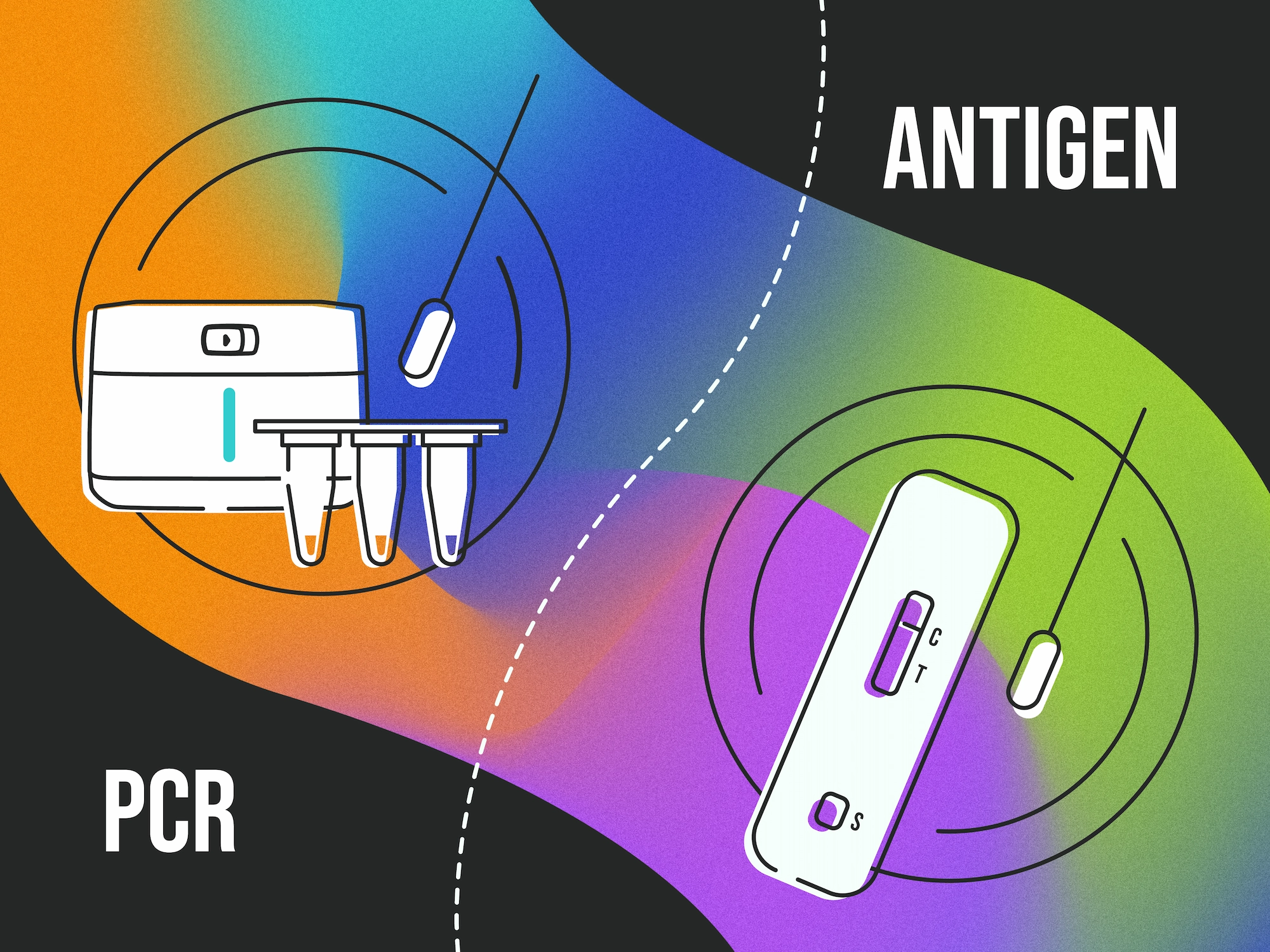
Three years after COVID-19 first swept the world, it can still be hard to know what kind of COVID test you should take, when, and why. COVID testing (thankfully) may not be as commonplace as it was not so long ago, but it is still necessary, so it’s still important to know the difference between a PCR test and an antigen test.
So we asked Dr. Christopher Woods, Biomeme’s chief medical officer, to explain it. Dr. Woods is an accomplished researcher whose work focuses on the development of novel diagnostic approaches to infectious disease and the potential for interspecies transmission of pathogens; he is also a professor of medicine and pathology at Duke University and an adjunct professor in the emerging infection programs at the University of North Carolina at Chapel Hill School of Public Health and is also the chief of infectious diseases at the VA Hospital in Durham, North Carolina. So, he’s a pretty good person to ask about these things\!
Question: There are essentially two types of COVID tests the general public can take — NAATs and antigen tests, is that correct? What are the main differences between the two?
Answer: This is correct. Nucleic Acid Amplification, commonly referred to as PCR tests, have greater sensitivity than antigen tests. NAAT tests detect small, specific strands of nucleic acid and amplify them. Antigen tests are simpler and cheaper and typically use specific antibodies to bind to the unique protein antigens.
Q: Without getting too deep into defining each test, can you explain the pros and cons of antigen and PCR tests?
A: PCR tests have better sensitivity but tend to require more complex chemistry and more complex devices, particularly if you are looking to isolate multiple infections in one sample. PCR tests tend to be the gold standard for detection because of their sensitivity. The test may detect an older, non-replicating virus that may not represent an active infection that can be transmitted. It may also detect disease earlier before symptoms have started. Antigen tests have much lower sensitivity (60-80% vs PCR), resulting in a need to test repeatedly to reduce the chance of a false negative test when the infection is present but not detected the first time. The likelihood of false negative tests will be higher with the presence of more upper respiratory symptoms in the individuals being tested.
Q: When are antigen tests typically used by consumers?
A: Because antigen tests are simpler and cheaper, they can be self-administered at home if someone has a mild illness. One drawback is that antigen tests don’t work as well when a person is asymptomatic because of their lower sensitivity. If you have had COVID, you may have had to use multiple antigen tests before you tested positive. This is the same as serial testing. Taking an antigen test is certainly more effective than not testing at all. They are the best option to take with you if you are traveling. My wife and I used the BinaxNOW COVID test when we were traveling in Argentina. My wife was very symptomatic and so she tested positive the first time. I was only mildly symptomatic and had to test myself three times before I tested positive.
Q: When is it most helpful or appropriate to use an antigen test?
A: If someone is experiencing upper respiratory symptoms, an antigen test can confirm whether it is COVID or not. Having that information means that the individual or health professional can treat the specific infection sooner. With COVID, there are certainly times when providing treatment immediately is important, especially for high-risk individuals. Getting a negative test result when someone has mild illness is not helpful, which is why serial testing is important. The earlier you know you have COVID, the sooner you can take preventive measures to protect others. Home antigen tests are a tool we can all use to make informed decisions and keep ourselves and our loved ones safe and healthy.
Q: When are PCR tests most typically used by consumers?
A: A PCR test should be used by those who are immune compromised because they need to know as early as possible if they have COVID. In that case, the individual would benefit from and might need to take one of the available medications, such as paxlovid or molnupiravir. Or, the individual has been exposed to someone who tested positive outside of the home and lives with an older or immune-compromised loved one. A PCR is also the more effective test for health workers who have frequent contact with immune-compromised patients. Another situation would be if you are experiencing mild symptoms and want to confirm whether it’s COVID or to err on the side of caution because you were exposed. In these situations, the important thing is to use a PCR test to prevent further transmission.
Q: When are PCR tests, in your opinion, more appropriate to use than an antigen test?
A: I can’t stress enough how important it is to detect the virus early on, especially when the stakes are high, as I mentioned earlier. The risk of exposure and transmission is higher when you travel because you will be interacting with many people. If you work in the service industry, the military, healthcare, or entertainment where the work is essential, and cannot be done remotely, the loss of productivity can have serious impacts. The best advice I can give is to always do the safest thing to protect yourself and those around you.
#### Subscribe Now
Get the latest tips from Biomeme shipped right to your inbox
## Related Blog Posts
[](https://blog.biomeme.com/the-latest-news-in-antibiotic-resistance)
[Our Approach](https://blog.biomeme.com/tag/our-approach)
### The Latest in Antibiotic Resistance: Nanobots, Supercomputers, and Third-World Hotspots
From the battlefield to the kitchen table and everywhere in between, antibiotic resistance is cropping up in—and being battled—in new and evolving ways. Antibiotic resistance (ABR) fits under the...
[Read More](https://blog.biomeme.com/the-latest-news-in-antibiotic-resistance)
[](https://blog.biomeme.com/the-connection-between-amr-and-climate-change)
[Explained](https://blog.biomeme.com/tag/explained)
### The Connection Between AMR and Climate Change
It might not seem like warming global temperatures and drug-resistant bacteria have any connection. But, in fact, they do. Antimicrobial resistance (AMR) is one of the world’s wicked problems because...
[Read More](https://blog.biomeme.com/the-connection-between-amr-and-climate-change)
[](https://blog.biomeme.com/explaining-antibiotic-stewardship)
[Our Approach](https://blog.biomeme.com/tag/our-approach)
### Explaining Antibiotic Stewardship
Overuse of antibiotics has led to a losing battle against mutating, drug-resistant bacteria. A restrained approach to antibiotic prescription will be key to addressing this massive global health...
[Read More](https://blog.biomeme.com/explaining-antibiotic-stewardship)

- [About](https://biomeme.com/about)
- [Careers](https://biomeme.com/careers)
- [Privacy Policy & Terms of Use](https://biomeme.com/privacy-policy-and-terms-of-use)
- [Patents](https://biomeme.com/patents)
401 North Broad St Suite 222 Philadelphia, PA 19108
[Contact Us](https://biomeme.com/about/contact) |
| Readable Markdown | ## What Kind of Test Do I Need?

**Written By:** Biomeme Staff
Should You Take a PCR Test or an Antigen Test? What is the difference between PCR and antigen testing? And which should you take if you need a COVID test? Our in-house COVID expert explains. Three years after COVID-19 first swept the world, it can still be hard to know what kind of COVID test you should take, when, and why. COVID testing (thankfully) may not be as commonplace as it was not so long ago, but it is still necessary, so it’s still important to know the difference between a PCR test and an antigen test. So we asked Dr. Christopher Woods, Biomeme’s chief medical officer, to explain it. Dr. Woods is an accomplished researcher whose work focuses on the development of novel diagnostic approaches to infectious disease and the potential for interspecies transmission of pathogens; he is also a professor of medicine and pathology at Duke University and an adjunct professor in the emerging infection programs at the University of North Carolina at Chapel Hill School of Public Health and is also the chief of infectious diseases at the VA Hospital in Durham, North Carolina. So, he’s a pretty good person to ask about these things\! Question: There are essentially two types of COVID tests the general public can take — NAATs and antigen tests, is that correct? What are the main differences between the two? Answer: This is correct. Nucleic Acid Amplification, commonly referred to as PCR tests, have greater sensitivity than antigen tests. NAAT tests detect small, specific strands of nucleic acid and amplify them. Antigen tests are simpler and cheaper and typically use specific antibodies to bind to the unique protein antigens. Q: Without getting too deep into defining each test, can you explain the pros and cons of antigen and PCR tests? A: PCR tests have better sensitivity but tend to require more complex chemistry and more complex devices, particularly if you are looking to isolate multiple infections in one sample. PCR tests tend to be the gold standard for detection because of their sensitivity. The test may detect an older, non-replicating virus that may not represent an active infection that can be transmitted. It may also detect disease earlier before symptoms have started. Antigen tests have much lower sensitivity (60-80% vs PCR), resulting in a need to test repeatedly to reduce the chance of a false negative test when the infection is present but not detected the first time. The likelihood of false negative tests will be higher with the presence of more upper respiratory symptoms in the individuals being tested. Q: When are antigen tests typically used by consumers? A: Because antigen tests are simpler and cheaper, they can be self-administered at home if someone has a mild illness. One drawback is that antigen tests don’t work as well when a person is asymptomatic because of their lower sensitivity. If you have had COVID, you may have had to use multiple antigen tests before you tested positive. This is the same as serial testing. Taking an antigen test is certainly more effective than not testing at all. They are the best option to take with you if you are traveling. My wife and I used the BinaxNOW COVID test when we were traveling in Argentina. My wife was very symptomatic and so she tested positive the first time. I was only mildly symptomatic and had to test myself three times before I tested positive. Q: When is it most helpful or appropriate to use an antigen test? A: If someone is experiencing upper respiratory symptoms, an antigen test can confirm whether it is COVID or not. Having that information means that the individual or health professional can treat the specific infection sooner. With COVID, there are certainly times when providing treatment immediately is important, especially for high-risk individuals. Getting a negative test result when someone has mild illness is not helpful, which is why serial testing is important. The earlier you know you have COVID, the sooner you can take preventive measures to protect others. Home antigen tests are a tool we can all use to make informed decisions and keep ourselves and our loved ones safe and healthy. Q: When are PCR tests most typically used by consumers? A: A PCR test should be used by those who are immune compromised because they need to know as early as possible if they have COVID. In that case, the individual would benefit from and might need to take one of the available medications, such as paxlovid or molnupiravir. Or, the individual has been exposed to someone who tested positive outside of the home and lives with an older or immune-compromised loved one. A PCR is also the more effective test for health workers who have frequent contact with immune-compromised patients. Another situation would be if you are experiencing mild symptoms and want to confirm whether it’s COVID or to err on the side of caution because you were exposed. In these situations, the important thing is to use a PCR test to prevent further transmission. Q: When are PCR tests, in your opinion, more appropriate to use than an antigen test? A: I can’t stress enough how important it is to detect the virus early on, especially when the stakes are high, as I mentioned earlier. The risk of exposure and transmission is higher when you travel because you will be interacting with many people. If you work in the service industry, the military, healthcare, or entertainment where the work is essential, and cannot be done remotely, the loss of productivity can have serious impacts. The best advice I can give is to always do the safest thing to protect yourself and those around you.
Get the latest tips from Biomeme shipped right to your inbox |
| ML Classification | |
| ML Categories | null |
| ML Page Types | null |
| ML Intent Types | null |
| Content Metadata | |
| Language | null |
| Author | null |
| Publish Time | not set |
| Original Publish Time | 2023-06-29 06:16:43 (2 years ago) |
| Republished | No |
| Word Count (Total) | 1,258 |
| Word Count (Content) | 987 |
| Links | |
| External Links | 7 |
| Internal Links | 36 |
| Technical SEO | |
| Meta Nofollow | No |
| Meta Noarchive | No |
| JS Rendered | No |
| Redirect Target | null |
| Performance | |
| Download Time (ms) | 177 |
| TTFB (ms) | 177 |
| Download Size (bytes) | 10,009 |
| Shard | 113 (laksa) |
| Root Hash | 4743499762002397713 |
| Unparsed URL | com,biomeme!blog,/what-kind-of-test-do-i-need s443 |