ℹ️ Skipped - page is already crawled
| Filter | Status | Condition | Details |
|---|---|---|---|
| HTTP status | PASS | download_http_code = 200 | HTTP 200 |
| Age cutoff | PASS | download_stamp > now() - 6 MONTH | 0 months ago |
| History drop | PASS | isNull(history_drop_reason) | No drop reason |
| Spam/ban | PASS | fh_dont_index != 1 AND ml_spam_score = 0 | ml_spam_score=0 |
| Canonical | PASS | meta_canonical IS NULL OR = '' OR = src_unparsed | Not set |
| Property | Value |
|---|---|
| URL | https://bettermoneyhabits.bankofamerica.com/en/saving-budgeting/creating-a-budget |
| Last Crawled | 2026-04-21 15:59:27 (2 hours ago) |
| First Indexed | 2016-12-22 04:33:22 (9 years ago) |
| HTTP Status Code | 200 |
| Meta Title | Your guide to creating a budget plan |
| Meta Description | Creating a personal budget is the key to gaining control of your money. Follow these simple steps from Better Money Habits to begin creating your individual budget. |
| Meta Canonical | null |
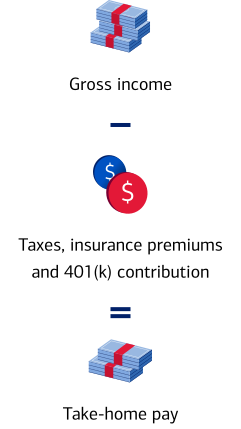
| Boilerpipe Text | Budgeting puts you in charge of your money. Follow these steps to get started.
Read,
12 minutes
Most people need some way of seeing where their money is going each month. Budgeting can help you feel more in control of your finances and make it easier to save money for your goals. The trick is to figure out a way to track your finances that works for you. The following steps can help you create a budget plan.
Building an effective budget often starts by assessing your
net income or take-home pay
. That’s your total wages or salary after taking out taxes and employee benefits, such as 401(k) contributions and health insurance premiums. It’s the amount that is deposited in your bank account every pay period.
Be careful not to focus on your total pay. You may end up overspending because you think you have more money available than you do. If you’re a freelancer, gig worker, contractor or are self-employed and your income is irregular, make sure to keep detailed notes of your contracts and pay.
Related content
Once you know how much money you have coming in, the next step is to figure out where it’s going. Tracking and categorizing your expenses can help you determine what you are spending the most money on and where it might be easiest to save. The more detail you gather, the better. For several weeks, record all your daily spending. Use whatever’s handy—an app on your smartphone, budgeting spreadsheet, online template, even pen and paper. Credit card and bank statements are a good place to start because they itemize your spending and often group transactions into broad categories, such as utilities and entertainment.
Then group your fixed expenses together. These are regular monthly bills such as rent or mortgage, utilities and car payments. Next list your variable expenses—those that may change from month to month, such as groceries, gas and entertainment. This is an area where you might find opportunities to cut back.
TOOLS FROM BANK OF AMERICA
For easier budgeting or to analyze your spending, use the Spending & Budgeting tool in Mobile & Online Banking.
Before you start sifting through the information you’ve tracked, make a list of your short- and long-term financial goals. Short-term goals should take one to three years to achieve and might include things like setting up an emergency fund or paying down credit card debt. Long-term goals, such as saving for retirement or your child’s college education, may take decades to reach. Many people wonder if they should focus on paying down debt, saving or investing.
Our interactive tool can help you find the right balance
.
Be explicit about your goals and include them as line items in your budget. Ideally, you want to put money toward them each month, just as you earmark money for expenses. Goals will change over time, but identifying them can help motivate you to stick to your budget. For example, it may be easier to cut spending if you know you’re saving for a vacation.
TOOLS FROM BANK OF AMERICA
Set and track your short- and long-term goals with Bank of America Life Plan.
This is where everything comes together: What you’re actually spending vs. what you want to spend. Start with your take-home income. Organize your fixed and variable expenses based on your research. Then add line items for your savings goals.
The budget plan lets you see how your income and spending line up. Do you need to find places to cut to cover necessities or meet savings goals? You may want to consider setting specific—and realistic—spending limits for each category of expenses.
Close text version
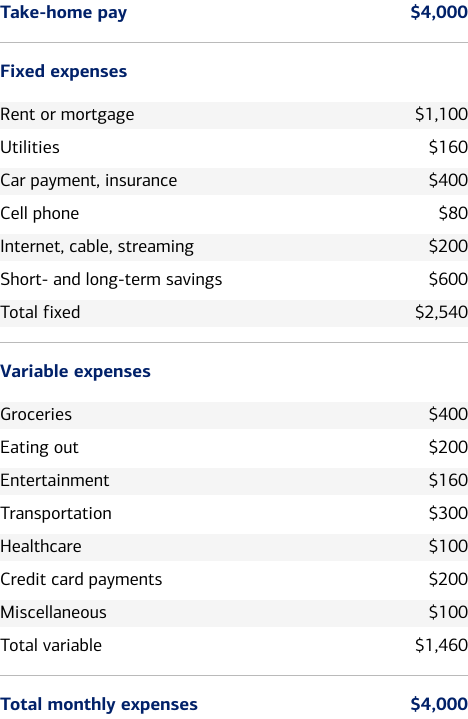
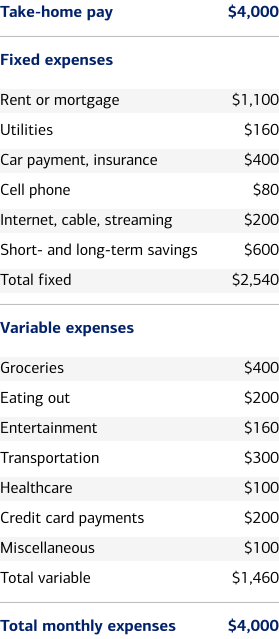
An individual’s monthly budget plan might look like this:
Take-home pay $4,000
Fixed expenses
Rent or mortgage $1,100
Utilities $160
Car payment, insurance $400
Cell phone $80
Internet, cable, streaming $200
Short- and long-term savings $600
Total fixed $2,540
Variable expenses
Groceries $400
Eating out $200
Entertainment $160
Transportation $300
Healthcare $100
Credit card payments $200
Miscellaneous $100
Total variable $1,460
Total monthly expenses $4,000
There’s more than one way to put your budget plan into practice. What’s important is that you pick a method that works for you.
Who it works for:
Anyone. This is a good starting point for putting your plan into action.
How it works:
First, break down your fixed and variable expenses into things you need to have and things you want to have. For instance, if you drive to work every day, gasoline counts as a need. A monthly music subscription, however, may count as a want. This difference becomes important when you’re looking for
ways to save money to reach your financial goals
.
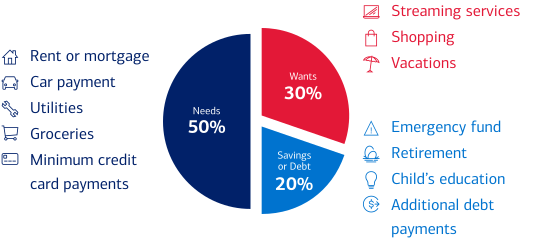
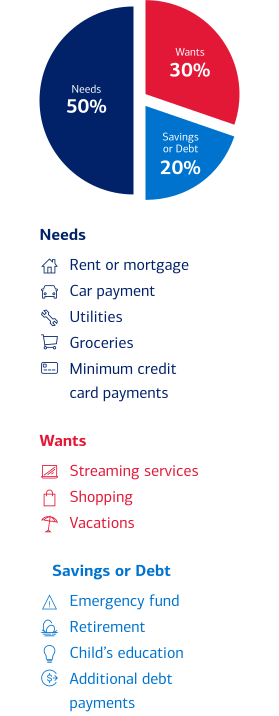
Then divide your take-home income into three spending categories—50% needs, 30% wants, and 20% savings or debt payments above the minimum. You can tweak the percentages to fit your circumstances. For example, if you live in an expensive city, your needs portion may have to be higher. Or if you’re saving for a down payment on a house, you may choose to bump up the savings. Here’s the breakdown and examples of expenses in each category:
Close text version
Needs
50%
Rent or mortgage
Car payment
Utilities
Groceries
Minimum credit card payments
Wants
30%
Streaming services
Shopping
Vacations
Savings or Debt
20%
Emergency fund
Retirement
Child’s education
Additional debt payments
Who it works for:
People who have trouble controlling their spending.
How it works:
Assign an envelope to each of your expense categories. Every month, fill the envelopes with the amount of cash you’ve budgeted for that category. When an envelope is empty, stop spending in that category. Paying with cash often helps people control their spending. But if it’s too cumbersome, you can set up separate checking accounts for the categories and pay with debit cards.
Who it works for:
People who have a set monthly income and are comfortable with meticulous record keeping.
How it works:
In this method, your expenses equal your income. Put another way, your income minus expenses equals zero. That doesn’t mean you’re broke at the end of the month. It just means that every dollar of income has a specific purpose and that you’ve accounted for every dollar you spent or saved.
Who it works for:
People who want to save more, are confident they can cover their necessities and don’t want to deal with detailed record keeping.
How it works:
Every month, before you pay any bill or make any purchase, put a pre-determined amount into savings. Then pay the bills for your needs—rent or mortgage, groceries, utilities, debt payments. What’s left can go to your wants.
Now that you’ve documented your income and spending, you can make any necessary adjustments so that you have money to put toward your goals and don’t overspend. You can get ideas on where to save by seeing how your
spending compares with everyone else’s
.
Look toward your wants as the first area for cuts. Are you paying for both cable and streaming services? Do you routinely eat out? If you’ve already adjusted your spending on wants, take a closer look at your spending on monthly payments. On close inspection a “need” may just be a “hard to part with.”
If the numbers still aren’t adding up, look at adjusting your fixed expenses. Could you, for instance, save more by shopping around for a better rate on auto or homeowners insurance? Such decisions come with big trade-offs, so make sure you carefully weigh your options.
Remember, even small savings can add up to a lot of money. You might be surprised at how much extra money you accumulate by making one minor adjustment at a time.
Once your budget is set, it’s important to review it alongside your spending on a regular basis to be sure you are staying on track. Few elements of your budget are set in stone: You may get a raise, your expenses may change
,
or you may reach a goal and want to plan for a new one. Whatever the reason, get into the habit of regularly checking in with your budget following the steps above.
Disclaimer
The material provided on this website is for informational use only and is not intended for financial or investment advice. Bank of America Corporation and/or its affiliates assume no liability for any loss or damage resulting from one’s reliance on the material provided. Please also note that such material is not updated regularly and that some of the information may not therefore be current. Consult with your own financial professional when making decisions regarding your financial or investment management. ©2026 Bank of America Corporation.
Introduction
Calculate your net income
Track your spending
Set realistic goals
Make a budget plan
Pick a budgeting method
Adjust your spending to stay on budget
Review your budget regularly
Budgeting FAQs
Mobile Banking requires that you download the Mobile Banking app and may not be available for select mobile devices. Message and data rates may apply.
The Spending & Budgeting tool is currently available to clients with a personal checking or savings account, credit card, a linked Merrill investment account, as well as a Small Business checking or savings account.
To be eligible for Bank of America Life Plan, a client must be a Bank of America consumer account owner or co-owner with active login credentials for the Bank of America website or Mobile app. Merrill clients with a Merrill Edge SelfDirected, Merrill Edge Advisory, Merrill Guided Investing, or Merrill Guided Investing with Advisor account, who also have a Bank of America consumer account and login credentials for the Bank of America website or Mobile app, are also eligible; however, clients of Merrill Lynch Wealth Management or Bank of America Private Bank are not eligible, and should instead seek advice and guidance from their assigned advisor. |
| Markdown | [Skip to main content](https://bettermoneyhabits.bankofamerica.com/en/saving-budgeting/creating-a-budget#mainContent)
[](https://www.bankofamerica.com/)
[ ](https://bettermoneyhabits.bankofamerica.com/en)
- [English](https://bettermoneyhabits.bankofamerica.com/en/saving-budgeting/creating-a-budget)
[Español](https://bettermoneyhabits.bankofamerica.com/es/saving-budgeting/creating-a-budget)
[](https://www.bankofamerica.com/)
Enter your search words here
Please make sure to enter any word or check spelling.
### Search tips:
- Check spelling
- Try more general terms
Suggested keywords
Close Welcome back. Here's where you left off modal
## Welcome back.Here's where you left off.
[Show related content](https://bettermoneyhabits.bankofamerica.com/en/saving-budgeting/creating-a-budget) [(Don't show me this pop-up of the page I left off on again)](https://bettermoneyhabits.bankofamerica.com/en/saving-budgeting/creating-a-budget)
### You might also be interested in:
[Saving & Budgeting](https://bettermoneyhabits.bankofamerica.com/content/bmh/en/saving-budgeting)
Share
[Close share](https://bettermoneyhabits.bankofamerica.com/en/saving-budgeting/creating-a-budget)
## Share
- [ Facebook](https://www.facebook.com/sharer.php?u=https://bettermoneyhabits.bankofamerica.com/en/saving-budgeting/creating-a-budget)
- [ X](https://twitter.com/intent/tweet?source=webclient&text=Your%20guide%20to%20creating%20a%20budget%20plan%20https%3A%2F%2Fbettermoneyhabits.bankofamerica.com%2Fen%2Fsaving-budgeting%2Fcreating-a-budget)
- [ Linkedin](https://www.linkedin.com/shareArticle?summary=Creating%20a%20personal%20budget%20is%20the%20key%20to%20gaining%20control%20of%20your%20money.%20Follow%20these%20simple%20steps%20from%20Better%20Money%20Habits%20to%20begin%20creating%20your%20individual%20budget.&title=Your%20guide%20to%20creating%20a%20budget%20plan&mini=true&url=https://bettermoneyhabits.bankofamerica.com/en/saving-budgeting/creating-a-budget&source=Bank+of+America)
- [ Pinterest](https://pinterest.com/pin/create/button/?url=https://bettermoneyhabits.bankofamerica.com/en/saving-budgeting/creating-a-budget&media=https%3A%2F%2Fbettermoneyhabits.bankofamerica.com%2Fcontent%2Fdam%2Fbmh%2Fkhan-thumbnails%2Fyour-guide-to-creating-a-budget-plan-250x250.jpg.thumb.1280.1280.jpg&description=Creating%20a%20personal%20budget%20is%20the%20key%20to%20gaining%20control%20of%20your%20money.%20Follow%20these%20simple%20steps%20from%20Better%20Money%20Habits%20to%20begin%20creating%20your%20individual%20budget.)
- [ Email](mailto:?subject=Your%20guide%20to%20creating%20a%20budget%20plan&body=Creating%20a%20personal%20budget%20is%20the%20key%20to%20gaining%20control%20of%20your%20money.%20Follow%20these%20simple%20steps%20from%20Better%20Money%20Habits%20to%20begin%20creating%20your%20individual%20budget.%20%0A%0Ahttps://bettermoneyhabits.bankofamerica.com/en/saving-budgeting/creating-a-budget)
Save
[Close save](https://bettermoneyhabits.bankofamerica.com/en/saving-budgeting/creating-a-budget)
## Save
Saved to [My Priorities](https://bettermoneyhabits.bankofamerica.com/en/my-priorities)
# Your guide to creating a budget plan
Budgeting puts you in charge of your money. Follow these steps to get started.
Read, 12 minutes
Most people need some way of seeing where their money is going each month. Budgeting can help you feel more in control of your finances and make it easier to save money for your goals. The trick is to figure out a way to track your finances that works for you. The following steps can help you create a budget plan.
- ## Step 1: Calculate your net income
Building an effective budget often starts by assessing your [net income or take-home pay](https://bettermoneyhabits.bankofamerica.com/en/taxes-income/how-to-read-a-paycheck). That’s your total wages or salary after taking out taxes and employee benefits, such as 401(k) contributions and health insurance premiums. It’s the amount that is deposited in your bank account every pay period.
Be careful not to focus on your total pay. You may end up overspending because you think you have more money available than you do. If you’re a freelancer, gig worker, contractor or are self-employed and your income is irregular, make sure to keep detailed notes of your contracts and pay.
- 

- ### Related content
- ## Step 2: Track your spending
Once you know how much money you have coming in, the next step is to figure out where it’s going. Tracking and categorizing your expenses can help you determine what you are spending the most money on and where it might be easiest to save. The more detail you gather, the better. For several weeks, record all your daily spending. Use whatever’s handy—an app on your smartphone, budgeting spreadsheet, online template, even pen and paper. Credit card and bank statements are a good place to start because they itemize your spending and often group transactions into broad categories, such as utilities and entertainment.
Then group your fixed expenses together. These are regular monthly bills such as rent or mortgage, utilities and car payments. Next list your variable expenses—those that may change from month to month, such as groceries, gas and entertainment. This is an area where you might find opportunities to cut back.

TOOLS FROM BANK OF AMERICA
For easier budgeting or to analyze your spending, use the Spending & Budgeting tool in Mobile & Online Banking.
[Get started](https://www.bankofamerica.com/online-banking/mobile-and-online-banking-features/spending-budgeting/)

[Saving & Budgeting Options for people who don’t like to budget Watch video, 5 minutes](https://bettermoneyhabits.bankofamerica.com/en/saving-budgeting/how-to-money-management-better)
- ## Step 3: Set realistic goals
Before you start sifting through the information you’ve tracked, make a list of your short- and long-term financial goals. Short-term goals should take one to three years to achieve and might include things like setting up an emergency fund or paying down credit card debt. Long-term goals, such as saving for retirement or your child’s college education, may take decades to reach. Many people wonder if they should focus on paying down debt, saving or investing. [Our interactive tool can help you find the right balance.](https://bettermoneyhabits.bankofamerica.com/en/saving-budgeting/pay-down-debt-save-or-invest)
Be explicit about your goals and include them as line items in your budget. Ideally, you want to put money toward them each month, just as you earmark money for expenses. Goals will change over time, but identifying them can help motivate you to stick to your budget. For example, it may be easier to cut spending if you know you’re saving for a vacation.
### Transcript

TOOLS FROM BANK OF AMERICA
Set and track your short- and long-term goals with Bank of America Life Plan.
[Learn more](https://promotions.bankofamerica.com/digitalbanking/mobilebanking/lifeplan)
- ## Step 4: Make a budget plan
This is where everything comes together: What you’re actually spending vs. what you want to spend. Start with your take-home income. Organize your fixed and variable expenses based on your research. Then add line items for your savings goals.
The budget plan lets you see how your income and spending line up. Do you need to find places to cut to cover necessities or meet savings goals? You may want to consider setting specific—and realistic—spending limits for each category of expenses.
- ### An individual’s monthly budget plan might look like this:
Show text version
[**Close text version**](https://bettermoneyhabits.bankofamerica.com/en/saving-budgeting/creating-a-budget)
An individual’s monthly budget plan might look like this:
**Take-home pay \$4,000**
**Fixed expenses**
Rent or mortgage \$1,100
Utilities \$160
Car payment, insurance \$400
Cell phone \$80
Internet, cable, streaming \$200
Short- and long-term savings \$600
Total fixed \$2,540
**Variable expenses**
Groceries \$400
Eating out \$200
Entertainment \$160
Transportation \$300
Healthcare \$100
Credit card payments \$200
Miscellaneous \$100
Total variable \$1,460
**Total monthly expenses \$4,000**
- ## Step 5: Pick a budgeting method
There’s more than one way to put your budget plan into practice. What’s important is that you pick a method that works for you.
### 50/30/20 budget
**Who it works for:** Anyone. This is a good starting point for putting your plan into action.
**How it works:** First, break down your fixed and variable expenses into things you need to have and things you want to have. For instance, if you drive to work every day, gasoline counts as a need. A monthly music subscription, however, may count as a want. This difference becomes important when you’re looking for [ways to save money to reach your financial goals](https://bettermoneyhabits.bankofamerica.com/en/saving-budgeting/ways-to-save-money).

Then divide your take-home income into three spending categories—50% needs, 30% wants, and 20% savings or debt payments above the minimum. You can tweak the percentages to fit your circumstances. For example, if you live in an expensive city, your needs portion may have to be higher. Or if you’re saving for a down payment on a house, you may choose to bump up the savings. Here’s the breakdown and examples of expenses in each category:
- #### What is a 50/30/20 budget?
Show text version
[**Close text version**](https://bettermoneyhabits.bankofamerica.com/en/saving-budgeting/creating-a-budget)
Needs
**50%**
Rent or mortgage
Car payment
Utilities
Groceries
Minimum credit card payments
Wants
**30%**
Streaming services
Shopping
Vacations
Savings or Debt
**20%**
Emergency fund
Retirement
Child’s education
Additional debt payments
- ### Envelope budget
**Who it works for:** People who have trouble controlling their spending.
**How it works:** Assign an envelope to each of your expense categories. Every month, fill the envelopes with the amount of cash you’ve budgeted for that category. When an envelope is empty, stop spending in that category. Paying with cash often helps people control their spending. But if it’s too cumbersome, you can set up separate checking accounts for the categories and pay with debit cards.

### Zero-based budget
**Who it works for:** People who have a set monthly income and are comfortable with meticulous record keeping.
**How it works:** In this method, your expenses equal your income. Put another way, your income minus expenses equals zero. That doesn’t mean you’re broke at the end of the month. It just means that every dollar of income has a specific purpose and that you’ve accounted for every dollar you spent or saved.


### Pay-yourself-first budget
**Who it works for:** People who want to save more, are confident they can cover their necessities and don’t want to deal with detailed record keeping.
**How it works:** Every month, before you pay any bill or make any purchase, put a pre-determined amount into savings. Then pay the bills for your needs—rent or mortgage, groceries, utilities, debt payments. What’s left can go to your wants.



[Saving & Budgeting Tools that help make saving simple Read more, 2 minutes](https://bettermoneyhabits.bankofamerica.com/en/saving-budgeting/simple-saving-tools)
- ## Step 6: Adjust your spending to stay on budget
Now that you’ve documented your income and spending, you can make any necessary adjustments so that you have money to put toward your goals and don’t overspend. You can get ideas on where to save by seeing how your [spending compares with everyone else’s](https://bettermoneyhabits.bankofamerica.com/en/saving-budgeting/average-household-monthly-expenses).
Look toward your wants as the first area for cuts. Are you paying for both cable and streaming services? Do you routinely eat out? If you’ve already adjusted your spending on wants, take a closer look at your spending on monthly payments. On close inspection a “need” may just be a “hard to part with.”
If the numbers still aren’t adding up, look at adjusting your fixed expenses. Could you, for instance, save more by shopping around for a better rate on auto or homeowners insurance? Such decisions come with big trade-offs, so make sure you carefully weigh your options.
Remember, even small savings can add up to a lot of money. You might be surprised at how much extra money you accumulate by making one minor adjustment at a time.
- ## Step 7: Review your budget regularly
Once your budget is set, it’s important to review it alongside your spending on a regular basis to be sure you are staying on track. Few elements of your budget are set in stone: You may get a raise, your expenses may change, or you may reach a goal and want to plan for a new one. Whatever the reason, get into the habit of regularly checking in with your budget following the steps above.
### Transcript
## Budgeting FAQs
### How do I budget as a couple or family?
Whether you’re creating a budget for yourself, you and your partner, or a family, the basic steps remain largely the same. More needs and income streams may be involved. Some couples pool all their money into a single account and share all expenses. Others split expenses 50-50 or based on a percentage of each person’s income. They may have a joint account for their needs, then keep separate accounts for their individual wants. The biggest difference in family and couples’ budgeting: Communication. Take the time to discuss and understand each other’s priorities. Agree on short- and long-term goals. Be willing to compromise and make sure to regularly reassess.
### How do I budget for unexpected events?
The best way to budget for unexpected events, such as a car accident, job loss or broken kitchen appliance, is to have an emergency fund. Aim for three to six months of expenses, more if you have a family. Include contributions to the fund as a line item in your budget and keep the money in a separate account, maybe even in a different bank. The account needs to be easily accessible, but not something you see every day. Building a fund can seem daunting, but if you make regular contributions, you’ll be surprised how fast it grows. [Here are some tips to get started](https://bettermoneyhabits.bankofamerica.com/en/saving-budgeting/emergency-fund-tips).
### How do I prioritize saving and reducing debt in my budget?
Start by including savings and debt reduction as line items in your budget. [Set realistic targets for both.](https://bettermoneyhabits.bankofamerica.com/en/saving-budgeting/setting-and-achieving-financial-goals) Starting small can give you a psychological boost when you meet them. Then set up automatic transfers to your savings, credit card and loan accounts. Also, make sure you’re taking advantage of retirement plans, such as 401(k)s, offered by your employer.
### What should I do if I overspend my budget?
Don’t panic if you go over budget. Instead, use it as an opportunity to review your budget, especially if you exceed it fairly often. Have your priorities or income changed? Maybe your mandatory expenses are more than expected, and you need to cut your discretionary spending. Are you feeling peer pressure to spend and making impulse purchases? Try instituting a 24-hour cooling off period before buying. Deactivate one-click buying and consider paying with cash.
### Related content

[Saving & Budgeting Simple ways to save money for the future Read more, 11 minutes](https://bettermoneyhabits.bankofamerica.com/en/saving-budgeting/ways-to-save-money)
#### **Disclaimer**
*The material provided on this website is for informational use only and is not intended for financial or investment advice. Bank of America Corporation and/or its affiliates assume no liability for any loss or damage resulting from one’s reliance on the material provided. Please also note that such material is not updated regularly and that some of the information may not therefore be current. Consult with your own financial professional when making decisions regarding your financial or investment management. ©2026 Bank of America Corporation.*
## What to read next
[Saving & Budgeting Spending Analysis Tool Read, 2 minutes](https://bettermoneyhabits.bankofamerica.com/en/saving-budgeting/spending-tool)
[Saving & Budgeting How to save money every day Read, 4 minutes](https://bettermoneyhabits.bankofamerica.com/en/saving-budgeting/how-to-save-money-tips)
- Introduction
- [Calculate your net income](https://bettermoneyhabits.bankofamerica.com/en/saving-budgeting/creating-a-budget#step-1-calculate-your-net-income)
- [Track your spending](https://bettermoneyhabits.bankofamerica.com/en/saving-budgeting/creating-a-budget#step-2-track-your-spending)
- [Set realistic goals](https://bettermoneyhabits.bankofamerica.com/en/saving-budgeting/creating-a-budget#step-3-set-realistic-goals)
- [Make a budget plan](https://bettermoneyhabits.bankofamerica.com/en/saving-budgeting/creating-a-budget#step-4-make-a-budget-plan)
- [Pick a budgeting method](https://bettermoneyhabits.bankofamerica.com/en/saving-budgeting/creating-a-budget#step-5-pick-a-budgeting-method)
- [Adjust your spending to stay on budget](https://bettermoneyhabits.bankofamerica.com/en/saving-budgeting/creating-a-budget#step-6-adjust-your-spending-to-stay-on-budget)
- [Review your budget regularly](https://bettermoneyhabits.bankofamerica.com/en/saving-budgeting/creating-a-budget#step-7-review-your-budget-regularly)
- [Budgeting FAQs](https://bettermoneyhabits.bankofamerica.com/en/saving-budgeting/creating-a-budget#budgeting-faqs)
### Related content
- 
[Saving & Budgeting Options for people who don’t like to budget Watch video, 5 minutes](https://bettermoneyhabits.bankofamerica.com/en/saving-budgeting/how-to-money-management-better)
- 
[Saving & Budgeting Tools that help make saving simple Read more, 2 minutes](https://bettermoneyhabits.bankofamerica.com/en/saving-budgeting/simple-saving-tools)
## Contact Us
We're here to help. Reach out by [visiting our Contact page](https://www.bankofamerica.com/contactus/contactus.go) or schedule an appointment today.
[Schedule an appointment](https://secure.bankofamerica.com/mycommunications/public/appointments/getTopics.go?marketingCode=BMHSS_ECBBA&comment=Better%20Money%20Habits%20I%20am%20interested%20in%20discussing%20my%20savings%20and%20budgeting%20goals)
Mobile Banking requires that you download the Mobile Banking app and may not be available for select mobile devices. Message and data rates may apply.
The Spending & Budgeting tool is currently available to clients with a personal checking or savings account, credit card, a linked Merrill investment account, as well as a Small Business checking or savings account.
To be eligible for Bank of America Life Plan, a client must be a Bank of America consumer account owner or co-owner with active login credentials for the Bank of America website or Mobile app. Merrill clients with a Merrill Edge SelfDirected, Merrill Edge Advisory, Merrill Guided Investing, or Merrill Guided Investing with Advisor account, who also have a Bank of America consumer account and login credentials for the Bank of America website or Mobile app, are also eligible; however, clients of Merrill Lynch Wealth Management or Bank of America Private Bank are not eligible, and should instead seek advice and guidance from their assigned advisor.
[Continue](https://bettermoneyhabits.bankofamerica.com/en/saving-budgeting/creating-a-budget) [Cancel](https://bettermoneyhabits.bankofamerica.com/en/saving-budgeting/creating-a-budget)
[Continue](https://bettermoneyhabits.bankofamerica.com/en/saving-budgeting/creating-a-budget) [Cancel](https://bettermoneyhabits.bankofamerica.com/en/saving-budgeting/creating-a-budget)
# Advertising Practices
We strive to provide you with information about products and services you might find interesting and useful. Relationship-based ads and online behavioral advertising help us do that.
Bank of America participates in the Digital Advertising Alliance ("DAA") self-regulatory Principles for Online Behavioral Advertising and uses the Advertising Options Icon on our behavioral ads on non-affiliated third-party sites (excluding ads appearing on platforms that do not accept the icon). Ads served on our behalf by these companies do not contain unencrypted personal information and we limit the use of personal information by companies that serve our ads. To learn more about ad choices, or to opt out of interest-based advertising with non-affiliated third-party sites, visit [YourAdChoices](https://optout.aboutads.info/?c=2&lang=EN) powered by the DAA or through the [Network Advertising Initiative's Opt-Out Tool](https://optout.networkadvertising.org/?c=1). You may also visit the individual sites for additional information on their data and privacy practices and opt-out options.
To learn more about relationship-based ads, online behavioral advertising and our privacy practices, please review the [Bank of America Online Privacy Notice](https://www.bankofamerica.com/security-center/online-privacy-notice/?request_locale=en_US) and our [Online Privacy FAQs](https://www.bankofamerica.com/security-center/faq/online-privacy/?request_locale=en_US).
[ ](https://bettermoneyhabits.bankofamerica.com/en)
## Connect with us
- [](https://www.facebook.com/BankofAmerica)
- [](https://www.instagram.com/bankofamerica/)
- [](https://www.linkedin.com/company/bank-of-america/)
- [](https://www.pinterest.com/bettermoneyhabits/)
- [](https://twitter.com/BankofAmerica)
- [](https://www.youtube.com/user/bankofamerica)
- [Bank of America](https://www.bankofamerica.com/)
- [Privacy](https://www.bankofamerica.com/security-center/privacy-overview/)
- [Children’s Privacy](https://www.bankofamerica.com/online-banking/childrens-privacy-policy/)
- [Security](https://www.bankofamerica.com/security-center/overview/)
- [Careers](https://careers.bankofamerica.com/en-us)
- [Sitemap](https://www.bankofamerica.com/information/personal/)
- [Advertising Practices](https://bettermoneyhabits.bankofamerica.com/en/saving-budgeting/creating-a-budget#advertising_practices.html)
- [Education Resource Center](https://bettermoneyhabits.bankofamerica.com/community/en)
- [Terms of Use](https://bettermoneyhabits.bankofamerica.com/en/terms)
- [Accessible Banking](https://www.bankofamerica.com/accessible-banking/overview/?request_locale=en_US)
Your Privacy Choices
Some materials and online content may be available in English only.
Bank of America, N.A. Member FDIC. Equal Housing Lender
© 2026 Bank of America Corporation. All rights reserved.
Investment products:
| | | |
|---|---|---|
| **Are Not FDIC Insured** | **Are Not Bank Guaranteed** | **May Lose Value** |
Bank of America and its affiliates do not provide legal, tax or accounting advice. You should consult your legal and/or tax advisors before making any financial decisions. |
| Readable Markdown | Budgeting puts you in charge of your money. Follow these steps to get started.
Read, 12 minutes
Most people need some way of seeing where their money is going each month. Budgeting can help you feel more in control of your finances and make it easier to save money for your goals. The trick is to figure out a way to track your finances that works for you. The following steps can help you create a budget plan.
- Building an effective budget often starts by assessing your [net income or take-home pay](https://bettermoneyhabits.bankofamerica.com/en/taxes-income/how-to-read-a-paycheck). That’s your total wages or salary after taking out taxes and employee benefits, such as 401(k) contributions and health insurance premiums. It’s the amount that is deposited in your bank account every pay period.
Be careful not to focus on your total pay. You may end up overspending because you think you have more money available than you do. If you’re a freelancer, gig worker, contractor or are self-employed and your income is irregular, make sure to keep detailed notes of your contracts and pay.
- 
- Related content
- Once you know how much money you have coming in, the next step is to figure out where it’s going. Tracking and categorizing your expenses can help you determine what you are spending the most money on and where it might be easiest to save. The more detail you gather, the better. For several weeks, record all your daily spending. Use whatever’s handy—an app on your smartphone, budgeting spreadsheet, online template, even pen and paper. Credit card and bank statements are a good place to start because they itemize your spending and often group transactions into broad categories, such as utilities and entertainment.
Then group your fixed expenses together. These are regular monthly bills such as rent or mortgage, utilities and car payments. Next list your variable expenses—those that may change from month to month, such as groceries, gas and entertainment. This is an area where you might find opportunities to cut back.
TOOLS FROM BANK OF AMERICA
For easier budgeting or to analyze your spending, use the Spending & Budgeting tool in Mobile & Online Banking.
- Before you start sifting through the information you’ve tracked, make a list of your short- and long-term financial goals. Short-term goals should take one to three years to achieve and might include things like setting up an emergency fund or paying down credit card debt. Long-term goals, such as saving for retirement or your child’s college education, may take decades to reach. Many people wonder if they should focus on paying down debt, saving or investing. [Our interactive tool can help you find the right balance.](https://bettermoneyhabits.bankofamerica.com/en/saving-budgeting/pay-down-debt-save-or-invest)
Be explicit about your goals and include them as line items in your budget. Ideally, you want to put money toward them each month, just as you earmark money for expenses. Goals will change over time, but identifying them can help motivate you to stick to your budget. For example, it may be easier to cut spending if you know you’re saving for a vacation.
TOOLS FROM BANK OF AMERICA
Set and track your short- and long-term goals with Bank of America Life Plan.
- This is where everything comes together: What you’re actually spending vs. what you want to spend. Start with your take-home income. Organize your fixed and variable expenses based on your research. Then add line items for your savings goals.
The budget plan lets you see how your income and spending line up. Do you need to find places to cut to cover necessities or meet savings goals? You may want to consider setting specific—and realistic—spending limits for each category of expenses.
- [**Close text version**](https://bettermoneyhabits.bankofamerica.com/en/saving-budgeting/creating-a-budget)
An individual’s monthly budget plan might look like this:
**Take-home pay \$4,000**
**Fixed expenses**
Rent or mortgage \$1,100
Utilities \$160
Car payment, insurance \$400
Cell phone \$80
Internet, cable, streaming \$200
Short- and long-term savings \$600
Total fixed \$2,540
**Variable expenses**
Groceries \$400
Eating out \$200
Entertainment \$160
Transportation \$300
Healthcare \$100
Credit card payments \$200
Miscellaneous \$100
Total variable \$1,460
**Total monthly expenses \$4,000**
- There’s more than one way to put your budget plan into practice. What’s important is that you pick a method that works for you.
**Who it works for:** Anyone. This is a good starting point for putting your plan into action.
**How it works:** First, break down your fixed and variable expenses into things you need to have and things you want to have. For instance, if you drive to work every day, gasoline counts as a need. A monthly music subscription, however, may count as a want. This difference becomes important when you’re looking for [ways to save money to reach your financial goals](https://bettermoneyhabits.bankofamerica.com/en/saving-budgeting/ways-to-save-money).

Then divide your take-home income into three spending categories—50% needs, 30% wants, and 20% savings or debt payments above the minimum. You can tweak the percentages to fit your circumstances. For example, if you live in an expensive city, your needs portion may have to be higher. Or if you’re saving for a down payment on a house, you may choose to bump up the savings. Here’s the breakdown and examples of expenses in each category:
- [**Close text version**](https://bettermoneyhabits.bankofamerica.com/en/saving-budgeting/creating-a-budget)
Needs
**50%**
Rent or mortgage
Car payment
Utilities
Groceries
Minimum credit card payments
Wants
**30%**
Streaming services
Shopping
Vacations
Savings or Debt
**20%**
Emergency fund
Retirement
Child’s education
Additional debt payments
- **Who it works for:** People who have trouble controlling their spending.
**How it works:** Assign an envelope to each of your expense categories. Every month, fill the envelopes with the amount of cash you’ve budgeted for that category. When an envelope is empty, stop spending in that category. Paying with cash often helps people control their spending. But if it’s too cumbersome, you can set up separate checking accounts for the categories and pay with debit cards.

**Who it works for:** People who have a set monthly income and are comfortable with meticulous record keeping.
**How it works:** In this method, your expenses equal your income. Put another way, your income minus expenses equals zero. That doesn’t mean you’re broke at the end of the month. It just means that every dollar of income has a specific purpose and that you’ve accounted for every dollar you spent or saved.

**Who it works for:** People who want to save more, are confident they can cover their necessities and don’t want to deal with detailed record keeping.
**How it works:** Every month, before you pay any bill or make any purchase, put a pre-determined amount into savings. Then pay the bills for your needs—rent or mortgage, groceries, utilities, debt payments. What’s left can go to your wants.

- Now that you’ve documented your income and spending, you can make any necessary adjustments so that you have money to put toward your goals and don’t overspend. You can get ideas on where to save by seeing how your [spending compares with everyone else’s](https://bettermoneyhabits.bankofamerica.com/en/saving-budgeting/average-household-monthly-expenses).
Look toward your wants as the first area for cuts. Are you paying for both cable and streaming services? Do you routinely eat out? If you’ve already adjusted your spending on wants, take a closer look at your spending on monthly payments. On close inspection a “need” may just be a “hard to part with.”
If the numbers still aren’t adding up, look at adjusting your fixed expenses. Could you, for instance, save more by shopping around for a better rate on auto or homeowners insurance? Such decisions come with big trade-offs, so make sure you carefully weigh your options.
Remember, even small savings can add up to a lot of money. You might be surprised at how much extra money you accumulate by making one minor adjustment at a time.
- Once your budget is set, it’s important to review it alongside your spending on a regular basis to be sure you are staying on track. Few elements of your budget are set in stone: You may get a raise, your expenses may change, or you may reach a goal and want to plan for a new one. Whatever the reason, get into the habit of regularly checking in with your budget following the steps above.
#### **Disclaimer**
*The material provided on this website is for informational use only and is not intended for financial or investment advice. Bank of America Corporation and/or its affiliates assume no liability for any loss or damage resulting from one’s reliance on the material provided. Please also note that such material is not updated regularly and that some of the information may not therefore be current. Consult with your own financial professional when making decisions regarding your financial or investment management. ©2026 Bank of America Corporation.*
- Introduction
- [Calculate your net income](https://bettermoneyhabits.bankofamerica.com/en/saving-budgeting/creating-a-budget#step-1-calculate-your-net-income)
- [Track your spending](https://bettermoneyhabits.bankofamerica.com/en/saving-budgeting/creating-a-budget#step-2-track-your-spending)
- [Set realistic goals](https://bettermoneyhabits.bankofamerica.com/en/saving-budgeting/creating-a-budget#step-3-set-realistic-goals)
- [Make a budget plan](https://bettermoneyhabits.bankofamerica.com/en/saving-budgeting/creating-a-budget#step-4-make-a-budget-plan)
- [Pick a budgeting method](https://bettermoneyhabits.bankofamerica.com/en/saving-budgeting/creating-a-budget#step-5-pick-a-budgeting-method)
- [Adjust your spending to stay on budget](https://bettermoneyhabits.bankofamerica.com/en/saving-budgeting/creating-a-budget#step-6-adjust-your-spending-to-stay-on-budget)
- [Review your budget regularly](https://bettermoneyhabits.bankofamerica.com/en/saving-budgeting/creating-a-budget#step-7-review-your-budget-regularly)
- [Budgeting FAQs](https://bettermoneyhabits.bankofamerica.com/en/saving-budgeting/creating-a-budget#budgeting-faqs)
Mobile Banking requires that you download the Mobile Banking app and may not be available for select mobile devices. Message and data rates may apply.
The Spending & Budgeting tool is currently available to clients with a personal checking or savings account, credit card, a linked Merrill investment account, as well as a Small Business checking or savings account.
To be eligible for Bank of America Life Plan, a client must be a Bank of America consumer account owner or co-owner with active login credentials for the Bank of America website or Mobile app. Merrill clients with a Merrill Edge SelfDirected, Merrill Edge Advisory, Merrill Guided Investing, or Merrill Guided Investing with Advisor account, who also have a Bank of America consumer account and login credentials for the Bank of America website or Mobile app, are also eligible; however, clients of Merrill Lynch Wealth Management or Bank of America Private Bank are not eligible, and should instead seek advice and guidance from their assigned advisor. |
| Shard | 88 (laksa) |
| Root Hash | 8029008966614323088 |
| Unparsed URL | com,bankofamerica!bettermoneyhabits,/en/saving-budgeting/creating-a-budget s443 |