ℹ️ Skipped - page is already crawled
| Filter | Status | Condition | Details |
|---|---|---|---|
| HTTP status | PASS | download_http_code = 200 | HTTP 200 |
| Age cutoff | PASS | download_stamp > now() - 6 MONTH | 1 months ago |
| History drop | PASS | isNull(history_drop_reason) | No drop reason |
| Spam/ban | PASS | fh_dont_index != 1 AND ml_spam_score = 0 | ml_spam_score=0 |
| Canonical | PASS | meta_canonical IS NULL OR = '' OR = src_unparsed | Not set |
| Property | Value |
|---|---|
| URL | https://benrennie.substack.com/p/serialisation-chapter-2-bored-to |
| Last Crawled | 2026-03-12 15:21:58 (29 days ago) |
| First Indexed | not set |
| HTTP Status Code | 200 |
| Meta Title | Serialisation Chapter 2: Bored to Death! |
| Meta Description | To understand the second great trade we made with the modern world, I need you to hold something in your mind for a second. Picture the cool, translucent edge of a CD jewel case from September 1991. |
| Meta Canonical | null |
| Boilerpipe Text | If you are reading this, it means you are a paid supporter of this project & my Substack, and I want to say a massive thank you. We are well over 2500 supporters now, and your support is what makes the public writing process work. As a reminder, jump into the comments when you finish reading. If a story sparks a memory for you, share it or challenge the ideas here. The comments will help shape the final manuscript, and you will get a Co-Author credit in the back of the book.
Note at the bottom of this article is a link to the 97% Creative Series. Paid subscribers or people who have purchased the book get free access. Check the bottom after Chapter 2.
Let's get into Chapter 2, Bored to Death!
- Ben
Introduction
:
Be Kind Rewind Introduction
Chapter One
:
What the Body Knew First
Chapter Two Now
: Bored to Death!
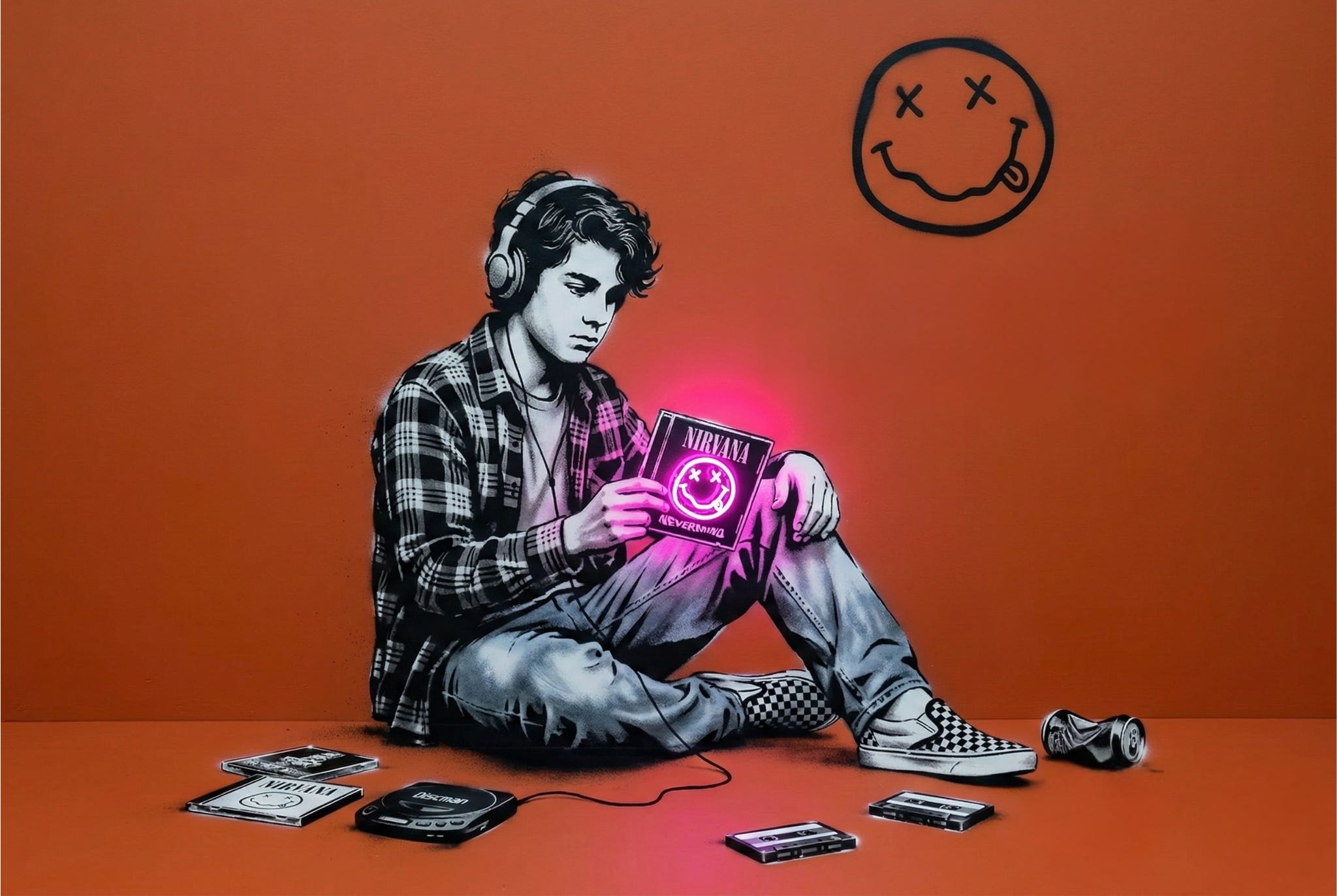
If you were a music fan in the early nineties, you remember the exact feel of this object. It had a specific, satisfying weight. It had a brittle plastic hinge that always felt on the verge of snapping.
Unlike a vinyl record or cassette tape, where you navigated a song with a needle or the thickness of a tape spool, the CD introduced a new type of feedback: the glowing LCD timer on the stereo
.
For the first time in audio history, we didn’t have to guess. We had cold, hard, digital exactness. We knew precisely how many minutes and seconds a song had left. We had quantified the magic.
This break in the expected flow signals a shift. What happened on September 24, 1991, felt like a glitch in the system.
On that day, a punk trio from Seattle called Nirvana released their second album,
Nevermind
. You already know the cultural crater this record left behind. It shifted pop culture almost overnight. Millions of us took it home, tore off the stubborn plastic wrapper, dropped the disc into the tray, and pressed play.
I was a teenager in quiet Australian suburbs, as far from the Pacific Northwest as you could get. Still, I sat there sweating in an oversized flannel shirt, taking myself too seriously. I was desperate to be part of the revolution.
We listened to those furious, generation-defining anthems. We let the album wash over us all the way to the final listed track on the back cover: Track 12, a slow, haunting acoustic dirge called “Something in the Way.”
At exactly three minutes and fifty seconds, Kurt Cobain’s voice drops away. The cello fades out. The song is unequivocally over.
But the CD player did not stop spinning.
If you were sitting on your bedroom floor watching the digital display on your stereo, you saw something that broke the established rules of the medium. The song was over, but the little red timer kept ticking upward.
4:00. 5:00. 6:00.
The speaker’s output was absolutely nothing. It was pure, dead air.
Today, if our audio cuts out for three seconds, we instinctively reach into our pockets. We tap the glass, toggle the Bluetooth, and force-quit the app. We immediately assume the technology has failed us because the algorithm would never intentionally leave us alone.
But in 1991, there was no internet to consult. There was no Reddit thread to crowdsource an explanation for the anomaly. There was just you, a spinning plastic disc, and the four walls of your bedroom.
Think about what ten minutes of silence feels like to a restless sixteen-year-old vibrating with teenage angst. Ten minutes is a geological era. It is agonising. It is the purest, heaviest form of boredom.
If you were impatient, you did what most people did: you leaned over, hit the heavy plastic EJECT button, and swapped the CD for something else. You refused the friction of the space. You moved on to the next hit.
But if you didn’t hit the eject button, you waited. Maybe you were too deep into a math worksheet. Maybe you were paralysed by the inertia of being sixteen, so you let the clock run.
And eventually, the digital timer hit 13 minutes and 51 seconds.
Without warning, the speakers detonated. The silence was shattered with a violent, heart-stopping roar.
A secret, unlisted track called “Endless, Nameless” tore through the silence. It was a screaming, chaotic, six-minute wall of feedback and smashed guitars. I remember jumping off the floor, heart hammering in my chest, convinced I had somehow blown the cones on my dad’s hand-me-down stereo. But once the panic subsided, it was thrilling. It felt like stumbling into a secret room in your own house.
Nirvana wasn’t the only band doing this. In the nineties, the “hidden track” became a phenomenon. Alanis Morissette left an a cappella song on
Jagged Little Pill
. Lauryn Hill, Green Day, Nine Inch Nails, and Pearl Jam did it too. It was an analog secret society, passed around schoolyards by word of mouth.
To a modern consumer or a modern product manager, this makes absolutely no sense.
Why would an artist at their creative peak put ten minutes of dead air on a disc? CD space was expensive. Attention was precious. In today’s metric-driven world, ten minutes of silence means user abandonment. It is a fatal flaw in the funnel. Why risk having the listener turn it off?
This wasn’t a manufacturing error; it was a test.
These artists were building a toll booth into their art. They understood a truth about human psychology we have since engineered away: the reward is sweeter when preceded by anticipation. And anticipation requires space.
The long stretch of silence was a barrier you had to cross. It was the price paid, in patience, for the reward on the other side. The point was clear: the best, rawest stuff lies beyond the gap.
If you want the secret, you have to earn it. You had to be willing to be bored.
Jumping ahead to our current moment, that gap has been entirely eradicated.
If you play
Nevermind
on Spotify, the moment “Something in the Way” ends, the system panics. To a tech platform, silence is user churn. Silicon Valley is terrified of dead air. Within milliseconds, Autoplay crossfades you into an Alice in Chains song so your brain never falls into under-stimulation.
There is no ten-minute wait. There is no hidden track. The space has been aggressively paved over.
In Chapter One, we talked about eliminating physical friction from life. We traded heavy Jenga blocks and video stores for frictionless glass screens. But there’s another trade, far more insidious. We didn’t just design away physical friction. We also erased
temporal
friction. We erased waiting. We declared total war on boredom, and we won.
We treated boredom like a bug in the human system. We thought of it as wasted time. A gap we needed to fix. So, when tech companies promised devices that ended boredom for good, we handed over our attention without hesitation.
This is the second Invisible Trade. We traded the uncomfortable friction of empty time for the frictionless relief of constant stimulation. And in doing so, we traded the quiet intimacy of our own minds for the loud compliance of an algorithm.
In 1654, French philosopher and mathematician Blaise Pascal wrote a line that perfectly diagnoses the modern condition, nearly four hundred years before the iPhone. He wrote: “All of humanity’s problems stem from man’s inability to sit quietly in a room alone.”
Pascal understood the terrifying math of being human. Sitting alone in a room feels unbearable; it drags you into a confrontation with yourself. Strip away the distractions, chores, entertainment, and noise, and you are left with nothing but the roaring monologue in your head. Suddenly, your anxieties claw at you, your grief resurfaces, your unresolved arguments replay, and those nagging questions about your life echo louder than ever.
This is the tragedy of our constant connectivity. We are the most networked generation ever. We can communicate globally in a second. Yet, we are becoming strangers to ourselves. You cannot build a relationship with someone you never spend time with. That includes yourself.
To further understand this trade, we need to examine what happens biologically when we do absolutely nothing.
For a long time, scientists assumed that when you were bored, your brain powered down. They thought it was like a car idling in a driveway, burning fuel, but going nowhere.
In 2001, Washington University neurologist Dr Marcus Raichle made a discovery that changed neuroscience. He compared fMRI brain scans of people doing complex cognitive tasks with scans of people lying still, staring at the ceiling.
Dr Raichle discovered something astonishing: the human brain consumes roughly 20 per cent of the body’s total energy to maintain itself in a resting state. When you ask the brain to do a focused, difficult task like reading a spreadsheet or playing a fast-paced video game, the energy consumption only increases by a measly 5 per cent.
The brain is never idling. Doing “nothing” activates a massive, interconnected web, the Default Mode Network (DMN). Dr Raichle gave it this name.
If your focused, task-oriented brain is the driver, the DMN is the brilliant, slightly eccentric passenger riding shotgun.
When you focus intensely on a screen, the passenger is quiet. The moment you get bored, the passenger starts talking. The DMN connects data points, links old memories to today’s conversations, quietly processes emotion and considers future scenarios. It synthesises your world.
The Default Mode Network is the biological birthplace of the “shower thought.” It is the reason your best ideas never happen while you are staring aggressively at a blank Word document with a blinking cursor, but instead arrive perfectly formed while you are washing your hair, walking the dog, or staring out a window.
We used to have dozens of natural triggers for the Default Mode Network built into our daily routines. We couldn’t avoid them even if we tried.
Think about your Dad heading to the toilet, or as my Dad used to call it, the Khazi. You could always guarantee that when the newspaper vanished from the kitchen table, someone was off to the Khazi for twenty minutes. It’s a crude example, but it’s true: it was a crucial block of unfiltered, analog time. You just sat there, stared at the bathroom tiles, and your brain synthesised the day.
Or think about the ultimate, inescapable incubator for the Default Mode Network: the backseat of a family car on a long Australian road trip.
If you grew up here, you know the exact feeling. You are strapped into the back of a sweltering Holden Commodore, the vinyl seats sticking to the back of your legs. You are driving for hours down a shimmering highway that looks the same in every direction. There were no iPads mounted to the headrests. There were no dual-screen DVD players. There was no algorithmic Spotify playlist perfectly curated to your exact mood.
There was just the window, the heat, and crushing, inescapable boredom.
So, what did we do? Our brains, desperate for stimulation, turned the passenger seat into a laboratory. We invented games out of thin air.
We played Car Cricket.
It was a brilliant, mathematically robust game born entirely out of having nothing else to do. You stared out the window at the oncoming traffic, waiting for the mirage on the horizon to solidify into a vehicle. A standard car was 1 run. A van, ute, or 4WD was a boundary for 4. A motorbike was a massive 6. And if a semi-trailer drove past, you were out.
It sounds so ridiculously simple now, but look at what that game actually required. It forced us to look
out
. It forced us to observe the physical world, track patterns, and interact deeply with our environment. We were co-creating an experience with the landscape. I know it still works because my kids, who are 16, 19, and 22, and have grown up with infinite digital entertainment in their pockets, still ask me to play Car Cricket on long family drives.
Why? Because human beings actually crave the Default Mode Network. We crave the space just to be, to let our minds wander, and to find magic in the mundane.
When we give our brains that space, they don’t just invent games to pass the time. Sometimes, they invent a future that saves our lives.
Just ask Dave Grohl.
In April 1994, after Kurt Cobain died, Grohl was entirely unmoored. Nirvana was over. His best friend was gone. He was so depressed and lost that he couldn’t even listen to the radio because the sound of music physically hurt. Desperate to escape his own life, he flew across the world and drove to the Ring of Kerry in Ireland, one of the most remote, quiet, and isolated places he could find.
He was driving around in a rental car, completely alone, surrounded by nothing but empty country roads and grey skies. He was living in the ultimate, painful state of the Default Mode Network. He wasn’t trying to be productive. He wasn’t trying to write a song. He had stripped away all distractions and was sitting in the heavy, uncomfortable void of his own grief.
And then, he saw a hitchhiker.
Grohl slowed the car down, debating whether to pick up the kid. As he got closer, he looked at the hitchhiker’s chest. The kid, standing in the middle of nowhere on a remote Irish dirt road, was wearing a Kurt Cobain t-shirt.
In that moment of quiet observation, Grohl’s Default Mode Network synthesised everything. The grief, the geography, the sheer impossibility of the coincidence. He later said that seeing Kurt’s face staring back at him in the middle of nowhere was a sign. “I realised, I can’t outrun this. I need to go home and fucking get back to work.”
He flew back to America, booked a studio, and recorded the first Foo Fighters album entirely on his own.
Now apply the modern attention trade to that story.
Imagine Dave Grohl taking that trip today. He is sad, so he puts on noise-cancelling AirPods to drown out the car's silence. He is lonely, so he listens to a comedy podcast on 1.5x speed to keep the dark thoughts at bay. He gets lost on the country road, pulls over to check Google Maps, gets distracted by a text message, and starts scrolling through Instagram.
He never looks out the window. He never sees the hitchhiker. He never sits in the room with his own grief.
The Foo Fighters were never born.
Now, I realise the stakes of our daily boredom are rarely this cinematic. You and I are probably not going to write “Everlong” just because we decided to leave our phones in our pockets while waiting for a flat white. But the mechanism is the same.
When we refuse to be bored, we refuse to let the world speak to us. We fill the car with frictionless digital noise, and we drive right past the exact signs we need to figure out who we are supposed to become.
But the great erasure of boredom didn’t just steal our empty time; it stole our empty objects, too.
To understand how we outsourced our imagination, I want you to think about the best toy you ever owned. Think back to the absolute peak of your childhood joy.
If you grew up before the internet, there is a very good chance this toy did not come in a shrink-wrapped box. It did not require four AA batteries. It did not have a backlit screen, a volume button, or an instruction manual.
For me, it was a stick.
I know exactly how tragic that sounds to a modern child, but humour me, we all had a stick. I remember finding the perfect one in the bush behind our house. It was long, slightly curved, heavy at the base, and stripped of its bark. In my hands, that piece of dead wood was a masterpiece of limitless potential.
On Monday, it was Excalibur, and I was a knight defending the backyard from an invisible dragon. On Tuesday, it was a sniper rifle, and I was a soldier crawling through the damp, itchy kikuyu grass. On Wednesday, it was a lightsaber, and the deep, vibrating humming sound it made came entirely from the back of my own throat (and probably involved a fair amount of accidental spitting).
Because the object itself was low-fidelity, my brain had to work in high-fidelity to make it real.
My mind had to supply the dragon. My mind had to supply the laser sound. My mind had to turn the clothesline into a medieval fortress or, more accurately, a swing, which inevitably led to bending the aluminium arms of the Hills Hoist and waiting in sheer terror for Mum to notice.
This is the definition of true play. It is an act of projection. It requires you to take the raw, boring, unresponsive materials of the physical world and overlay a rich, complex layer of imagination on top of them. You are not just inhabiting a world built by someone else. You are building it yourself in real time.
And how did that incredible process begin? It began with the same friction that made Dave Grohl look out the car window. It began with boredom.
In the analogue world, there were long stretches of time on Sunday afternoons where absolutely nothing was happening. There was no iPad to swipe. The TV had only four channels, and they usually showed golf, parliamentary debates, or lawn bowls, which, to an eight-year-old, is a viewing experience almost indistinguishable from a coma. You were forced to sit by yourself.
I would sit on the back step for twenty minutes doing nothing, feeling the agonising itch of boredom, until finally, I couldn’t take it anymore. I would walk into the yard and pick up the stick.
The game did not start because I was entertained. It started because I was desperate. Boredom was the pressure chamber that forced my creativity to emerge.
Today, if a child feels even a microsecond of that pressure, the algorithm is waiting to relieve it. There is a video, a game, and a feed. The external stimulation is constant, infinite, and incredibly high-fidelity. Because we have removed the boredom, we have removed the catalyst. We have removed the uncomfortable silence that asks the brain to speak up and invent the dragon.
There is another, deeper element of analogue play that vanished along with the boredom. We traded negotiation for compliance.
My mate, the brilliant Aussie broadcaster Tim Ross, has a great observation about how incredibly compliant we’ve become as a society. He asks you to imagine approaching an Australian Dad in the 1980s a bloke in Stubbies and thongs, hosing down the driveway on a Sunday morning and telling him that in the future, it will be mandated by law that he must carry little plastic bags with him on walks, so he can bend over, pick up his dog’s warm shit with his hand, and carry it around the neighbourhood.
That 1980s Dad would have laughed you right off the driveway. It would have been unfathomable. But today? We buy the little scented rolls from the supermarket, clip them to the leash, and do exactly as we’re told. We have become highly trained, highly compliant citizens.
That same quiet surrender happened to the way we play.
When I was running around in the backyard with my friends, we had to constantly agree on the reality we were building.
“I shot you!” I would yell across the yard.
“No, you didn’t,” my friend would argue, refusing to fall. “I’m wearing a bulletproof vest!”
“You didn’t say you had a vest!”
“I’m saying it now!”
To a parent watching from the kitchen window, this sounds like irritating, pointless bickering. But developmental psychologists tell us this is actually a highly sophisticated social negotiation.
In unstructured, analog play, the children are the game designers. But more importantly, they are the referees. They have to build the rules, agree on them, and then police them among themselves. If the game feels unfair, they have to pause the narrative and renegotiate the terms. They are learning diplomacy. They are learning empathy. They are learning conflict resolution. They are learning an incredibly vital human lesson: reality is something we co-create with the people around us.
Now, let me be very clear: I am not pretending that imagination died in 1999. Kids today still do this. They still pick up sticks, they still build forts, and they still argue over who shot whom in the backyard.
But the environment in which they are doing it has fundamentally changed.
When we were negotiating the rules of the backyard, we were a captive audience to the physical world. Our biggest alternative was the bulky cathode-ray tube TV in the lounge room, and unless it was exactly the right time of day, the programming was terrible. We didn’t have a choice but to push through the friction of the game, because the alternative was staring at a wall.
Today, that TV has shrunk, crawled into our pockets, and brought a terrifying amount of reinforcements.
The alternative to the stick is no longer a boring parliamentary debate on the ABC. The alternative is quite literally infinite. It’s a glowing pane of glass offering a bottomless feed of TikToks, sprawling Roblox servers, YouTube Shorts, group chats, and a frictionless, perfectly rendered universe engineered by behavioural psychologists to ensure you never have to be bored or frustrated ever again.
When a modern kid hits a moment of friction in the physical world—an argument over a magic bulletproof vest, a lull in the game, the sudden onset of a quiet Sunday afternoon—they don’t have to stay in the room and negotiate. They don’t have to push through the boredom. They have an immediate, frictionless escape hatch sitting in their pocket.
Now, look at a modern video game.
The graphics are breathtaking. The world is immersive. If you swing a sword in a game like Elden Ring or shoot a blaster in Fortnite, the lighting effects are perfect. You do not need to use your Default Mode Network to imagine the dragon; the dragon is rendered for you in 4K resolution at sixty frames per second.
But notice what happens to the rules.
In a video game, the computer is the referee. If you shoot a character and the game’s code says you missed, you missed. You cannot argue with the algorithm. You cannot turn to the machine and negotiate, “But I’m wearing a magic vest.”
The machine dictates the reality. The player complies.
We traded our own imagination for someone else’s immersion. We traded messy, human, social negotiation for cold algorithmic rules. We moved from a form of play where we had to fill in the gaps with our minds and our friendships, to one where every pixel, every rule, and every outcome is provided for us by a corporation in Silicon Valley.
People always point to Minecraft as the counterargument. And fair enough. My own kids have built cathedrals in there that are genuinely beautiful. But building in a simulation and building in reality are fundamentally different. In Minecraft, the blocks always stack. The digital roof defies physics. There is no splintered wood, no unexpected weather, no friend dropping the ladder because you stopped communicating.
When you try to build a treehouse out of actual scrap wood and rusted nails in the backyard, you learn about leverage. You learn about the weakness of materials. You learn that if you do not communicate clearly with your friend holding the ladder, the ladder will fall and you will actually get hurt.
The physical world does not care if you are having fun. It demands that you respect its laws. It forces you to be intimately engaged with reality. That is where the actual learning lives.
We are raising a generation that is incredibly good at navigating systems built by others. They are expert users. They can optimise their digital avatars, maximise their scores, and traverse complex, frictionless interfaces at terrifying speed.
But are they learning to build the system itself? Are they learning how to sit in an empty room and generate their own weather?
When we take away the stick and replace it with the controller, we save them the hard work of imagination. We are saving them from the agonising boredom of a Sunday afternoon. We are saving them from the messy argument about who shot whom in the backyard.
But that hard, messy, boring work is what makes us human.
The ability to look at a piece of dead wood and see Excalibur is the same cognitive muscle that allows an adult to look at an unremarkable Tuesday morning and see a gift. It is the ability to see what is not explicitly rendered for us.
If we fill every quiet moment with high-definition content, we risk checking the muscle of imagination into early retirement. But worse than that, we stop spending time with ourselves. We outsource our inner monologue to a feed, and we forget what our own unaccompanied minds actually sound like. We scroll past our own lives, looking for a distraction from the beautiful, heavy reality of being alive.
But I don’t believe that muscle is permanently gone. I think it is just waiting for a reason to wake up.
In the 90s, around the same time that kid was lying on the floor waiting for the hidden Nirvana track, I went to see Oasis play at the Leadmill in Sheffield. If you know anything about 90s Britpop, you know the Leadmill. It was small, gritty, and loud. There wasn’t a mobile phone in the building. We just stood in the dark, bathed in sweat and feedback, entirely surrendered to the music’s physical experience.
In 2026, I saw them play again. This time it was in Sydney, in front of 80,000 people.
When the band walked out on stage, the generational shift was blindingly obvious. Instantly, 40,000 glowing glass rectangles shot into the air. It was the modern twitch in full effect. We were standing in front of one of the greatest rock bands on earth, and our collective instinct was not to experience the moment, but to document it. To compress a massive, thumping reality into a flat, frictionless file.
For the first few songs, it seemed the attention trade had won.
But then, Oasis did what Oasis does. The bangers kept flowing. The guitars got louder. The bass vibrated up through the floor and into our chests. The physical friction of the environment began to overpower the algorithmic conditioning.
I was standing on the dance floor, about thirty metres back from the stage. Sometime during the middle of the set, I looked around.
The sea of lit screens had disappeared.
Every single person around me was singing at the top of their lungs. Strangers were hugging. The crowd was swaying as one massive, messy, analog organism. We hadn’t just consciously decided to put our phones away.
We had completely
forgotten
them.
The physical world had demanded our presence, and our bodies remembered exactly how to respond. At that moment, surrounded by 80,000 people, the mental static vanished. We weren’t consuming content. We were co-creating a reality.
That is the ultimate proof that we can reverse the trade. We haven’t lost our capacity for deep, unstructured connection; we have just stopped giving ourselves the environment to practice it.
To fall back in love with your own life, you don’t need to throw your phone into the ocean. You have to be willing to return to the quiet room, and you have to be willing to stand in the loud ones. You have to be brave enough to let the boredom in, to leave the gaps empty, and to let the CD spin in silence until the hidden track finally hits.
We need to trust that if we stop staring at the screen and surrender to the friction of the real world, the child will eventually pick up the stick.
And the dragon will return.
Thanks for reading Chapter 2.
Scroll down to the first comment. I’ve broken this chapter into five Analogic cards, each one a takeaway you can sit with, share, or stick on your wall. They’re designed to work without the chapter, but they hit harder with it.
One more thing before you go.
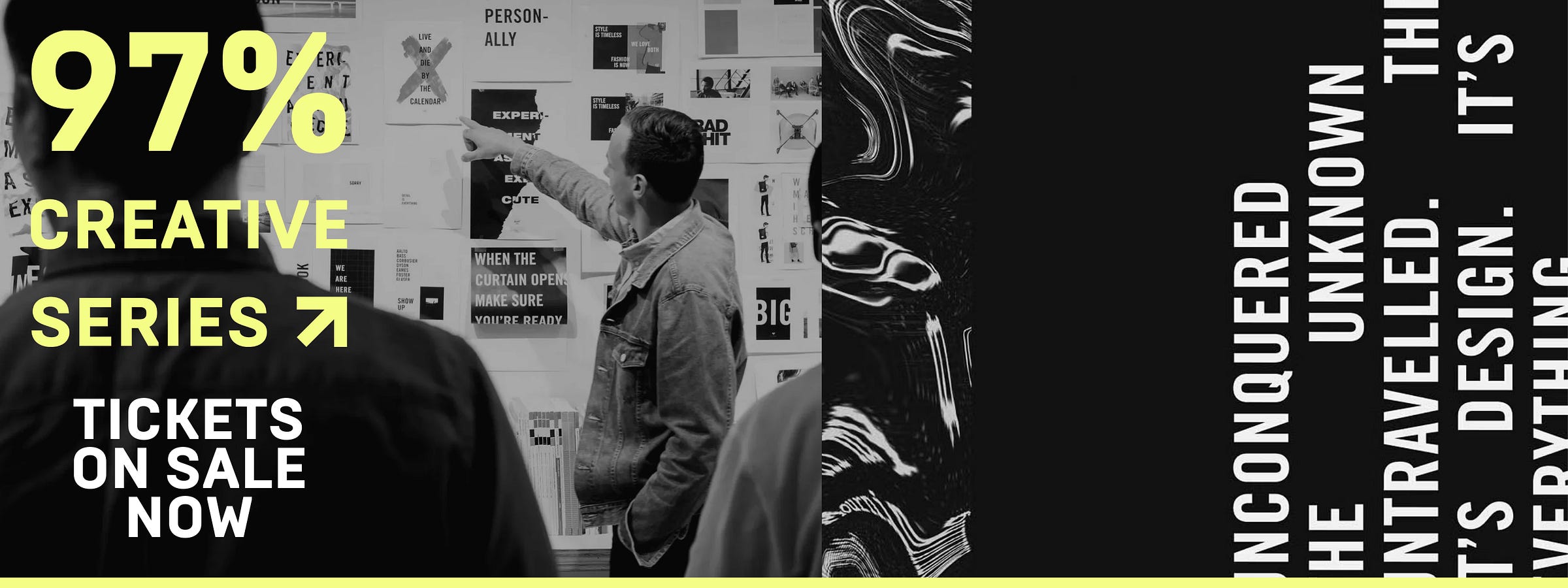
As part of the ongoing work to tackle the creativity crisis, we are launching 97% Creative, a series of 97 live sessions built for the 97% of us who started out believing we were creative and somewhere along the way, quietly stopped.
The first session, The Creative March, is happening on Wednesday, 26 March 2026. 7 pm AEDT. Online and live. One hour. Six questions. The kind you’ve probably never sat down long enough to properly answer.
This is a test run before the full series kicks off in June with in-person events across Sydney, Brisbane and Melbourne, plus the online series.
97% of the profits go directly to Design Declares Australia
.
Tickets are at
events.humanitix.com/97percentcreative
If you’ve already bought the book, or you’re a paid subscriber here on Substack,
you’re in for free
. Just message me, and I’ll send you a code.
Thanks for being here. See you in March.
- Ben |
| Markdown | [](https://benrennie.substack.com/)
# [](https://benrennie.substack.com/)
Subscribe
Sign in
[Book Serialisation](https://benrennie.substack.com/s/bekind/?utm_source=substack&utm_medium=menu)
# Serialisation Chapter 2: Bored to Death\!
### To understand the second great trade we made with the modern world, I need you to hold something in your mind for a second. Picture the cool, translucent edge of a CD jewel case from September 1991.
[](https://substack.com/@benrennie)
[Ben Rennie](https://substack.com/@benrennie)
Mar 04, 2026
∙ Paid
18
7
1
Share
***
*If you are reading this, it means you are a paid supporter of this project & my Substack, and I want to say a massive thank you. We are well over 2500 supporters now, and your support is what makes the public writing process work. As a reminder, jump into the comments when you finish reading. If a story sparks a memory for you, share it or challenge the ideas here. The comments will help shape the final manuscript, and you will get a Co-Author credit in the back of the book. Note at the bottom of this article is a link to the 97% Creative Series. Paid subscribers or people who have purchased the book get free access. Check the bottom after Chapter 2. Let's get into Chapter 2, Bored to Death\! \- Ben* **Introduction**: [Be Kind Rewind Introduction](https://benrennie.substack.com/p/be-kind-rewind-serialisation-the)**Chapter One**: [What the Body Knew First](https://benrennie.substack.com/p/serialisation-chapter-1-the-body)
**Chapter Two Now**: Bored to Death\!
***
**If you were a music fan in the early nineties, you remember the exact feel of this object. It had a specific, satisfying weight. It had a brittle plastic hinge that always felt on the verge of snapping.** Unlike a vinyl record or cassette tape, where you navigated a song with a needle or the thickness of a tape spool, the CD introduced a new type of feedback: the glowing LCD timer on the stereo**.**
[](https://substackcdn.com/image/fetch/$s_!8ozO!,f_auto,q_auto:good,fl_progressive:steep/https%3A%2F%2Fsubstack-post-media.s3.amazonaws.com%2Fpublic%2Fimages%2Fdd42d519-e6c0-47da-83e4-65259bc077c0_2048x1373.png)
For the first time in audio history, we didn’t have to guess. We had cold, hard, digital exactness. We knew precisely how many minutes and seconds a song had left. We had quantified the magic.
This break in the expected flow signals a shift. What happened on September 24, 1991, felt like a glitch in the system.
On that day, a punk trio from Seattle called Nirvana released their second album, *Nevermind*. You already know the cultural crater this record left behind. It shifted pop culture almost overnight. Millions of us took it home, tore off the stubborn plastic wrapper, dropped the disc into the tray, and pressed play.
I was a teenager in quiet Australian suburbs, as far from the Pacific Northwest as you could get. Still, I sat there sweating in an oversized flannel shirt, taking myself too seriously. I was desperate to be part of the revolution.
We listened to those furious, generation-defining anthems. We let the album wash over us all the way to the final listed track on the back cover: Track 12, a slow, haunting acoustic dirge called “Something in the Way.”
At exactly three minutes and fifty seconds, Kurt Cobain’s voice drops away. The cello fades out. The song is unequivocally over.
But the CD player did not stop spinning.
If you were sitting on your bedroom floor watching the digital display on your stereo, you saw something that broke the established rules of the medium. The song was over, but the little red timer kept ticking upward.
*4:00. 5:00. 6:00.* The speaker’s output was absolutely nothing. It was pure, dead air.
Today, if our audio cuts out for three seconds, we instinctively reach into our pockets. We tap the glass, toggle the Bluetooth, and force-quit the app. We immediately assume the technology has failed us because the algorithm would never intentionally leave us alone.
But in 1991, there was no internet to consult. There was no Reddit thread to crowdsource an explanation for the anomaly. There was just you, a spinning plastic disc, and the four walls of your bedroom.
Think about what ten minutes of silence feels like to a restless sixteen-year-old vibrating with teenage angst. Ten minutes is a geological era. It is agonising. It is the purest, heaviest form of boredom.
If you were impatient, you did what most people did: you leaned over, hit the heavy plastic EJECT button, and swapped the CD for something else. You refused the friction of the space. You moved on to the next hit.
But if you didn’t hit the eject button, you waited. Maybe you were too deep into a math worksheet. Maybe you were paralysed by the inertia of being sixteen, so you let the clock run.
And eventually, the digital timer hit 13 minutes and 51 seconds.
Without warning, the speakers detonated. The silence was shattered with a violent, heart-stopping roar.
[](https://events.humanitix.com/97percentcreative)
A secret, unlisted track called “Endless, Nameless” tore through the silence. It was a screaming, chaotic, six-minute wall of feedback and smashed guitars. I remember jumping off the floor, heart hammering in my chest, convinced I had somehow blown the cones on my dad’s hand-me-down stereo. But once the panic subsided, it was thrilling. It felt like stumbling into a secret room in your own house.
Nirvana wasn’t the only band doing this. In the nineties, the “hidden track” became a phenomenon. Alanis Morissette left an a cappella song on *Jagged Little Pill*. Lauryn Hill, Green Day, Nine Inch Nails, and Pearl Jam did it too. It was an analog secret society, passed around schoolyards by word of mouth.
To a modern consumer or a modern product manager, this makes absolutely no sense.
Why would an artist at their creative peak put ten minutes of dead air on a disc? CD space was expensive. Attention was precious. In today’s metric-driven world, ten minutes of silence means user abandonment. It is a fatal flaw in the funnel. Why risk having the listener turn it off?
This wasn’t a manufacturing error; it was a test.
These artists were building a toll booth into their art. They understood a truth about human psychology we have since engineered away: the reward is sweeter when preceded by anticipation. And anticipation requires space.
The long stretch of silence was a barrier you had to cross. It was the price paid, in patience, for the reward on the other side. The point was clear: the best, rawest stuff lies beyond the gap.
If you want the secret, you have to earn it. You had to be willing to be bored.
Jumping ahead to our current moment, that gap has been entirely eradicated.
If you play *Nevermind* on Spotify, the moment “Something in the Way” ends, the system panics. To a tech platform, silence is user churn. Silicon Valley is terrified of dead air. Within milliseconds, Autoplay crossfades you into an Alice in Chains song so your brain never falls into under-stimulation.
There is no ten-minute wait. There is no hidden track. The space has been aggressively paved over.
In Chapter One, we talked about eliminating physical friction from life. We traded heavy Jenga blocks and video stores for frictionless glass screens. But there’s another trade, far more insidious. We didn’t just design away physical friction. We also erased *temporal* friction. We erased waiting. We declared total war on boredom, and we won.
We treated boredom like a bug in the human system. We thought of it as wasted time. A gap we needed to fix. So, when tech companies promised devices that ended boredom for good, we handed over our attention without hesitation.
This is the second Invisible Trade. We traded the uncomfortable friction of empty time for the frictionless relief of constant stimulation. And in doing so, we traded the quiet intimacy of our own minds for the loud compliance of an algorithm.
In 1654, French philosopher and mathematician Blaise Pascal wrote a line that perfectly diagnoses the modern condition, nearly four hundred years before the iPhone. He wrote: “All of humanity’s problems stem from man’s inability to sit quietly in a room alone.”
Pascal understood the terrifying math of being human. Sitting alone in a room feels unbearable; it drags you into a confrontation with yourself. Strip away the distractions, chores, entertainment, and noise, and you are left with nothing but the roaring monologue in your head. Suddenly, your anxieties claw at you, your grief resurfaces, your unresolved arguments replay, and those nagging questions about your life echo louder than ever.
This is the tragedy of our constant connectivity. We are the most networked generation ever. We can communicate globally in a second. Yet, we are becoming strangers to ourselves. You cannot build a relationship with someone you never spend time with. That includes yourself.
To further understand this trade, we need to examine what happens biologically when we do absolutely nothing.
For a long time, scientists assumed that when you were bored, your brain powered down. They thought it was like a car idling in a driveway, burning fuel, but going nowhere.
[](https://events.humanitix.com/97percentcreative)
In 2001, Washington University neurologist Dr Marcus Raichle made a discovery that changed neuroscience. He compared fMRI brain scans of people doing complex cognitive tasks with scans of people lying still, staring at the ceiling.
Dr Raichle discovered something astonishing: the human brain consumes roughly 20 per cent of the body’s total energy to maintain itself in a resting state. When you ask the brain to do a focused, difficult task like reading a spreadsheet or playing a fast-paced video game, the energy consumption only increases by a measly 5 per cent.
The brain is never idling. Doing “nothing” activates a massive, interconnected web, the Default Mode Network (DMN). Dr Raichle gave it this name.
If your focused, task-oriented brain is the driver, the DMN is the brilliant, slightly eccentric passenger riding shotgun.
When you focus intensely on a screen, the passenger is quiet. The moment you get bored, the passenger starts talking. The DMN connects data points, links old memories to today’s conversations, quietly processes emotion and considers future scenarios. It synthesises your world.
The Default Mode Network is the biological birthplace of the “shower thought.” It is the reason your best ideas never happen while you are staring aggressively at a blank Word document with a blinking cursor, but instead arrive perfectly formed while you are washing your hair, walking the dog, or staring out a window.
We used to have dozens of natural triggers for the Default Mode Network built into our daily routines. We couldn’t avoid them even if we tried.
Think about your Dad heading to the toilet, or as my Dad used to call it, the Khazi. You could always guarantee that when the newspaper vanished from the kitchen table, someone was off to the Khazi for twenty minutes. It’s a crude example, but it’s true: it was a crucial block of unfiltered, analog time. You just sat there, stared at the bathroom tiles, and your brain synthesised the day.
Or think about the ultimate, inescapable incubator for the Default Mode Network: the backseat of a family car on a long Australian road trip.
If you grew up here, you know the exact feeling. You are strapped into the back of a sweltering Holden Commodore, the vinyl seats sticking to the back of your legs. You are driving for hours down a shimmering highway that looks the same in every direction. There were no iPads mounted to the headrests. There were no dual-screen DVD players. There was no algorithmic Spotify playlist perfectly curated to your exact mood.
There was just the window, the heat, and crushing, inescapable boredom.
So, what did we do? Our brains, desperate for stimulation, turned the passenger seat into a laboratory. We invented games out of thin air.
We played Car Cricket.
It was a brilliant, mathematically robust game born entirely out of having nothing else to do. You stared out the window at the oncoming traffic, waiting for the mirage on the horizon to solidify into a vehicle. A standard car was 1 run. A van, ute, or 4WD was a boundary for 4. A motorbike was a massive 6. And if a semi-trailer drove past, you were out.
It sounds so ridiculously simple now, but look at what that game actually required. It forced us to look *out*. It forced us to observe the physical world, track patterns, and interact deeply with our environment. We were co-creating an experience with the landscape. I know it still works because my kids, who are 16, 19, and 22, and have grown up with infinite digital entertainment in their pockets, still ask me to play Car Cricket on long family drives.
Why? Because human beings actually crave the Default Mode Network. We crave the space just to be, to let our minds wander, and to find magic in the mundane.
When we give our brains that space, they don’t just invent games to pass the time. Sometimes, they invent a future that saves our lives.
Just ask Dave Grohl.
In April 1994, after Kurt Cobain died, Grohl was entirely unmoored. Nirvana was over. His best friend was gone. He was so depressed and lost that he couldn’t even listen to the radio because the sound of music physically hurt. Desperate to escape his own life, he flew across the world and drove to the Ring of Kerry in Ireland, one of the most remote, quiet, and isolated places he could find.
He was driving around in a rental car, completely alone, surrounded by nothing but empty country roads and grey skies. He was living in the ultimate, painful state of the Default Mode Network. He wasn’t trying to be productive. He wasn’t trying to write a song. He had stripped away all distractions and was sitting in the heavy, uncomfortable void of his own grief.
And then, he saw a hitchhiker.
Grohl slowed the car down, debating whether to pick up the kid. As he got closer, he looked at the hitchhiker’s chest. The kid, standing in the middle of nowhere on a remote Irish dirt road, was wearing a Kurt Cobain t-shirt.
In that moment of quiet observation, Grohl’s Default Mode Network synthesised everything. The grief, the geography, the sheer impossibility of the coincidence. He later said that seeing Kurt’s face staring back at him in the middle of nowhere was a sign. “I realised, I can’t outrun this. I need to go home and fucking get back to work.”
He flew back to America, booked a studio, and recorded the first Foo Fighters album entirely on his own.
Now apply the modern attention trade to that story.
Imagine Dave Grohl taking that trip today. He is sad, so he puts on noise-cancelling AirPods to drown out the car's silence. He is lonely, so he listens to a comedy podcast on 1.5x speed to keep the dark thoughts at bay. He gets lost on the country road, pulls over to check Google Maps, gets distracted by a text message, and starts scrolling through Instagram.
He never looks out the window. He never sees the hitchhiker. He never sits in the room with his own grief.
The Foo Fighters were never born.
Now, I realise the stakes of our daily boredom are rarely this cinematic. You and I are probably not going to write “Everlong” just because we decided to leave our phones in our pockets while waiting for a flat white. But the mechanism is the same.
When we refuse to be bored, we refuse to let the world speak to us. We fill the car with frictionless digital noise, and we drive right past the exact signs we need to figure out who we are supposed to become.
But the great erasure of boredom didn’t just steal our empty time; it stole our empty objects, too.
To understand how we outsourced our imagination, I want you to think about the best toy you ever owned. Think back to the absolute peak of your childhood joy.
If you grew up before the internet, there is a very good chance this toy did not come in a shrink-wrapped box. It did not require four AA batteries. It did not have a backlit screen, a volume button, or an instruction manual.
For me, it was a stick.
I know exactly how tragic that sounds to a modern child, but humour me, we all had a stick. I remember finding the perfect one in the bush behind our house. It was long, slightly curved, heavy at the base, and stripped of its bark. In my hands, that piece of dead wood was a masterpiece of limitless potential.
On Monday, it was Excalibur, and I was a knight defending the backyard from an invisible dragon. On Tuesday, it was a sniper rifle, and I was a soldier crawling through the damp, itchy kikuyu grass. On Wednesday, it was a lightsaber, and the deep, vibrating humming sound it made came entirely from the back of my own throat (and probably involved a fair amount of accidental spitting).
Because the object itself was low-fidelity, my brain had to work in high-fidelity to make it real.
My mind had to supply the dragon. My mind had to supply the laser sound. My mind had to turn the clothesline into a medieval fortress or, more accurately, a swing, which inevitably led to bending the aluminium arms of the Hills Hoist and waiting in sheer terror for Mum to notice.
This is the definition of true play. It is an act of projection. It requires you to take the raw, boring, unresponsive materials of the physical world and overlay a rich, complex layer of imagination on top of them. You are not just inhabiting a world built by someone else. You are building it yourself in real time.
And how did that incredible process begin? It began with the same friction that made Dave Grohl look out the car window. It began with boredom.
In the analogue world, there were long stretches of time on Sunday afternoons where absolutely nothing was happening. There was no iPad to swipe. The TV had only four channels, and they usually showed golf, parliamentary debates, or lawn bowls, which, to an eight-year-old, is a viewing experience almost indistinguishable from a coma. You were forced to sit by yourself.
I would sit on the back step for twenty minutes doing nothing, feeling the agonising itch of boredom, until finally, I couldn’t take it anymore. I would walk into the yard and pick up the stick.
The game did not start because I was entertained. It started because I was desperate. Boredom was the pressure chamber that forced my creativity to emerge.
Today, if a child feels even a microsecond of that pressure, the algorithm is waiting to relieve it. There is a video, a game, and a feed. The external stimulation is constant, infinite, and incredibly high-fidelity. Because we have removed the boredom, we have removed the catalyst. We have removed the uncomfortable silence that asks the brain to speak up and invent the dragon.
There is another, deeper element of analogue play that vanished along with the boredom. We traded negotiation for compliance.
My mate, the brilliant Aussie broadcaster Tim Ross, has a great observation about how incredibly compliant we’ve become as a society. He asks you to imagine approaching an Australian Dad in the 1980s a bloke in Stubbies and thongs, hosing down the driveway on a Sunday morning and telling him that in the future, it will be mandated by law that he must carry little plastic bags with him on walks, so he can bend over, pick up his dog’s warm shit with his hand, and carry it around the neighbourhood.
That 1980s Dad would have laughed you right off the driveway. It would have been unfathomable. But today? We buy the little scented rolls from the supermarket, clip them to the leash, and do exactly as we’re told. We have become highly trained, highly compliant citizens.
That same quiet surrender happened to the way we play.
When I was running around in the backyard with my friends, we had to constantly agree on the reality we were building.
“I shot you!” I would yell across the yard.
“No, you didn’t,” my friend would argue, refusing to fall. “I’m wearing a bulletproof vest!”
“You didn’t say you had a vest!”
“I’m saying it now!”
To a parent watching from the kitchen window, this sounds like irritating, pointless bickering. But developmental psychologists tell us this is actually a highly sophisticated social negotiation.
[](https://events.humanitix.com/97percentcreative)
In unstructured, analog play, the children are the game designers. But more importantly, they are the referees. They have to build the rules, agree on them, and then police them among themselves. If the game feels unfair, they have to pause the narrative and renegotiate the terms. They are learning diplomacy. They are learning empathy. They are learning conflict resolution. They are learning an incredibly vital human lesson: reality is something we co-create with the people around us.
Now, let me be very clear: I am not pretending that imagination died in 1999. Kids today still do this. They still pick up sticks, they still build forts, and they still argue over who shot whom in the backyard.
But the environment in which they are doing it has fundamentally changed.
When we were negotiating the rules of the backyard, we were a captive audience to the physical world. Our biggest alternative was the bulky cathode-ray tube TV in the lounge room, and unless it was exactly the right time of day, the programming was terrible. We didn’t have a choice but to push through the friction of the game, because the alternative was staring at a wall.
Today, that TV has shrunk, crawled into our pockets, and brought a terrifying amount of reinforcements.
The alternative to the stick is no longer a boring parliamentary debate on the ABC. The alternative is quite literally infinite. It’s a glowing pane of glass offering a bottomless feed of TikToks, sprawling Roblox servers, YouTube Shorts, group chats, and a frictionless, perfectly rendered universe engineered by behavioural psychologists to ensure you never have to be bored or frustrated ever again.
When a modern kid hits a moment of friction in the physical world—an argument over a magic bulletproof vest, a lull in the game, the sudden onset of a quiet Sunday afternoon—they don’t have to stay in the room and negotiate. They don’t have to push through the boredom. They have an immediate, frictionless escape hatch sitting in their pocket.
Now, look at a modern video game.
The graphics are breathtaking. The world is immersive. If you swing a sword in a game like Elden Ring or shoot a blaster in Fortnite, the lighting effects are perfect. You do not need to use your Default Mode Network to imagine the dragon; the dragon is rendered for you in 4K resolution at sixty frames per second.
But notice what happens to the rules.
In a video game, the computer is the referee. If you shoot a character and the game’s code says you missed, you missed. You cannot argue with the algorithm. You cannot turn to the machine and negotiate, “But I’m wearing a magic vest.”
The machine dictates the reality. The player complies.
We traded our own imagination for someone else’s immersion. We traded messy, human, social negotiation for cold algorithmic rules. We moved from a form of play where we had to fill in the gaps with our minds and our friendships, to one where every pixel, every rule, and every outcome is provided for us by a corporation in Silicon Valley.
People always point to Minecraft as the counterargument. And fair enough. My own kids have built cathedrals in there that are genuinely beautiful. But building in a simulation and building in reality are fundamentally different. In Minecraft, the blocks always stack. The digital roof defies physics. There is no splintered wood, no unexpected weather, no friend dropping the ladder because you stopped communicating.
When you try to build a treehouse out of actual scrap wood and rusted nails in the backyard, you learn about leverage. You learn about the weakness of materials. You learn that if you do not communicate clearly with your friend holding the ladder, the ladder will fall and you will actually get hurt.
The physical world does not care if you are having fun. It demands that you respect its laws. It forces you to be intimately engaged with reality. That is where the actual learning lives.
We are raising a generation that is incredibly good at navigating systems built by others. They are expert users. They can optimise their digital avatars, maximise their scores, and traverse complex, frictionless interfaces at terrifying speed.
But are they learning to build the system itself? Are they learning how to sit in an empty room and generate their own weather?
When we take away the stick and replace it with the controller, we save them the hard work of imagination. We are saving them from the agonising boredom of a Sunday afternoon. We are saving them from the messy argument about who shot whom in the backyard.
But that hard, messy, boring work is what makes us human.
The ability to look at a piece of dead wood and see Excalibur is the same cognitive muscle that allows an adult to look at an unremarkable Tuesday morning and see a gift. It is the ability to see what is not explicitly rendered for us.
If we fill every quiet moment with high-definition content, we risk checking the muscle of imagination into early retirement. But worse than that, we stop spending time with ourselves. We outsource our inner monologue to a feed, and we forget what our own unaccompanied minds actually sound like. We scroll past our own lives, looking for a distraction from the beautiful, heavy reality of being alive.
But I don’t believe that muscle is permanently gone. I think it is just waiting for a reason to wake up.
In the 90s, around the same time that kid was lying on the floor waiting for the hidden Nirvana track, I went to see Oasis play at the Leadmill in Sheffield. If you know anything about 90s Britpop, you know the Leadmill. It was small, gritty, and loud. There wasn’t a mobile phone in the building. We just stood in the dark, bathed in sweat and feedback, entirely surrendered to the music’s physical experience.
In 2026, I saw them play again. This time it was in Sydney, in front of 80,000 people.
When the band walked out on stage, the generational shift was blindingly obvious. Instantly, 40,000 glowing glass rectangles shot into the air. It was the modern twitch in full effect. We were standing in front of one of the greatest rock bands on earth, and our collective instinct was not to experience the moment, but to document it. To compress a massive, thumping reality into a flat, frictionless file.
For the first few songs, it seemed the attention trade had won.
But then, Oasis did what Oasis does. The bangers kept flowing. The guitars got louder. The bass vibrated up through the floor and into our chests. The physical friction of the environment began to overpower the algorithmic conditioning.
I was standing on the dance floor, about thirty metres back from the stage. Sometime during the middle of the set, I looked around.
The sea of lit screens had disappeared.
Every single person around me was singing at the top of their lungs. Strangers were hugging. The crowd was swaying as one massive, messy, analog organism. We hadn’t just consciously decided to put our phones away.
We had completely *forgotten* them.
The physical world had demanded our presence, and our bodies remembered exactly how to respond. At that moment, surrounded by 80,000 people, the mental static vanished. We weren’t consuming content. We were co-creating a reality.
That is the ultimate proof that we can reverse the trade. We haven’t lost our capacity for deep, unstructured connection; we have just stopped giving ourselves the environment to practice it.
To fall back in love with your own life, you don’t need to throw your phone into the ocean. You have to be willing to return to the quiet room, and you have to be willing to stand in the loud ones. You have to be brave enough to let the boredom in, to leave the gaps empty, and to let the CD spin in silence until the hidden track finally hits.
We need to trust that if we stop staring at the screen and surrender to the friction of the real world, the child will eventually pick up the stick.
And the dragon will return.
***
[](https://events.humanitix.com/97percentcreative)
***
***Thanks for reading Chapter 2.***
*Scroll down to the first comment. I’ve broken this chapter into five Analogic cards, each one a takeaway you can sit with, share, or stick on your wall. They’re designed to work without the chapter, but they hit harder with it.*
***
***One more thing before you go.***
*As part of the ongoing work to tackle the creativity crisis, we are launching 97% Creative, a series of 97 live sessions built for the 97% of us who started out believing we were creative and somewhere along the way, quietly stopped.*
*The first session, The Creative March, is happening on Wednesday, 26 March 2026. 7 pm AEDT. Online and live. One hour. Six questions. The kind you’ve probably never sat down long enough to properly answer.*
*This is a test run before the full series kicks off in June with in-person events across Sydney, Brisbane and Melbourne, plus the online series.*
***97% of the profits go directly to Design Declares Australia**.*
***Tickets are at [events.humanitix.com/97percentcreative](https://events.humanitix.com/97percentcreative)***
*If you’ve already bought the book, or you’re a paid subscriber here on Substack, **you’re in for free**. Just message me, and I’ll send you a code.*
*Thanks for being here. See you in March. \- Ben*

## Continue reading this post for free, courtesy of Ben Rennie.
[Claim my free post]()
[Or purchase a paid subscription.](https://benrennie.substack.com/subscribe?simple=true&next=https%3A%2F%2Fbenrennie.substack.com%2Fp%2Fserialisation-chapter-2-bored-to&utm_source=paywall&utm_medium=web&utm_content=189817057&just_signed_up=falsesimple=true&utm_source=paywall&utm_medium=email&utm_content=189817057&next=https://benrennie.substack.com/p/serialisation-chapter-2-bored-to)
Previous
© 2026 Ben Rennie · [Privacy](https://substack.com/privacy) ∙ [Terms](https://substack.com/tos) ∙ [Collection notice](https://substack.com/ccpa#personal-data-collected)
[Start your Substack](https://substack.com/signup?utm_source=substack&utm_medium=web&utm_content=footer)
[Get the app](https://substack.com/app/app-store-redirect?utm_campaign=app-marketing&utm_content=web-footer-button)
[Substack](https://substack.com/) is the home for great culture
This site requires JavaScript to run correctly. Please [turn on JavaScript](https://enable-javascript.com/) or unblock scripts |
| Readable Markdown | *If you are reading this, it means you are a paid supporter of this project & my Substack, and I want to say a massive thank you. We are well over 2500 supporters now, and your support is what makes the public writing process work. As a reminder, jump into the comments when you finish reading. If a story sparks a memory for you, share it or challenge the ideas here. The comments will help shape the final manuscript, and you will get a Co-Author credit in the back of the book. Note at the bottom of this article is a link to the 97% Creative Series. Paid subscribers or people who have purchased the book get free access. Check the bottom after Chapter 2.Let's get into Chapter 2, Bored to Death\! \- Ben***Introduction**: [Be Kind Rewind Introduction](https://benrennie.substack.com/p/be-kind-rewind-serialisation-the)**Chapter One**: [What the Body Knew First](https://benrennie.substack.com/p/serialisation-chapter-1-the-body)
**Chapter Two Now**: Bored to Death\!
**If you were a music fan in the early nineties, you remember the exact feel of this object. It had a specific, satisfying weight. It had a brittle plastic hinge that always felt on the verge of snapping.** Unlike a vinyl record or cassette tape, where you navigated a song with a needle or the thickness of a tape spool, the CD introduced a new type of feedback: the glowing LCD timer on the stereo**.**
[](https://substackcdn.com/image/fetch/$s_!8ozO!,f_auto,q_auto:good,fl_progressive:steep/https%3A%2F%2Fsubstack-post-media.s3.amazonaws.com%2Fpublic%2Fimages%2Fdd42d519-e6c0-47da-83e4-65259bc077c0_2048x1373.png)
For the first time in audio history, we didn’t have to guess. We had cold, hard, digital exactness. We knew precisely how many minutes and seconds a song had left. We had quantified the magic.
This break in the expected flow signals a shift. What happened on September 24, 1991, felt like a glitch in the system.
On that day, a punk trio from Seattle called Nirvana released their second album, *Nevermind*. You already know the cultural crater this record left behind. It shifted pop culture almost overnight. Millions of us took it home, tore off the stubborn plastic wrapper, dropped the disc into the tray, and pressed play.
I was a teenager in quiet Australian suburbs, as far from the Pacific Northwest as you could get. Still, I sat there sweating in an oversized flannel shirt, taking myself too seriously. I was desperate to be part of the revolution.
We listened to those furious, generation-defining anthems. We let the album wash over us all the way to the final listed track on the back cover: Track 12, a slow, haunting acoustic dirge called “Something in the Way.”
At exactly three minutes and fifty seconds, Kurt Cobain’s voice drops away. The cello fades out. The song is unequivocally over.
But the CD player did not stop spinning.
If you were sitting on your bedroom floor watching the digital display on your stereo, you saw something that broke the established rules of the medium. The song was over, but the little red timer kept ticking upward.
*4:00. 5:00. 6:00.* The speaker’s output was absolutely nothing. It was pure, dead air.
Today, if our audio cuts out for three seconds, we instinctively reach into our pockets. We tap the glass, toggle the Bluetooth, and force-quit the app. We immediately assume the technology has failed us because the algorithm would never intentionally leave us alone.
But in 1991, there was no internet to consult. There was no Reddit thread to crowdsource an explanation for the anomaly. There was just you, a spinning plastic disc, and the four walls of your bedroom.
Think about what ten minutes of silence feels like to a restless sixteen-year-old vibrating with teenage angst. Ten minutes is a geological era. It is agonising. It is the purest, heaviest form of boredom.
If you were impatient, you did what most people did: you leaned over, hit the heavy plastic EJECT button, and swapped the CD for something else. You refused the friction of the space. You moved on to the next hit.
But if you didn’t hit the eject button, you waited. Maybe you were too deep into a math worksheet. Maybe you were paralysed by the inertia of being sixteen, so you let the clock run.
And eventually, the digital timer hit 13 minutes and 51 seconds.
Without warning, the speakers detonated. The silence was shattered with a violent, heart-stopping roar.
[](https://events.humanitix.com/97percentcreative)
A secret, unlisted track called “Endless, Nameless” tore through the silence. It was a screaming, chaotic, six-minute wall of feedback and smashed guitars. I remember jumping off the floor, heart hammering in my chest, convinced I had somehow blown the cones on my dad’s hand-me-down stereo. But once the panic subsided, it was thrilling. It felt like stumbling into a secret room in your own house.
Nirvana wasn’t the only band doing this. In the nineties, the “hidden track” became a phenomenon. Alanis Morissette left an a cappella song on *Jagged Little Pill*. Lauryn Hill, Green Day, Nine Inch Nails, and Pearl Jam did it too. It was an analog secret society, passed around schoolyards by word of mouth.
To a modern consumer or a modern product manager, this makes absolutely no sense.
Why would an artist at their creative peak put ten minutes of dead air on a disc? CD space was expensive. Attention was precious. In today’s metric-driven world, ten minutes of silence means user abandonment. It is a fatal flaw in the funnel. Why risk having the listener turn it off?
This wasn’t a manufacturing error; it was a test.
These artists were building a toll booth into their art. They understood a truth about human psychology we have since engineered away: the reward is sweeter when preceded by anticipation. And anticipation requires space.
The long stretch of silence was a barrier you had to cross. It was the price paid, in patience, for the reward on the other side. The point was clear: the best, rawest stuff lies beyond the gap.
If you want the secret, you have to earn it. You had to be willing to be bored.
Jumping ahead to our current moment, that gap has been entirely eradicated.
If you play *Nevermind* on Spotify, the moment “Something in the Way” ends, the system panics. To a tech platform, silence is user churn. Silicon Valley is terrified of dead air. Within milliseconds, Autoplay crossfades you into an Alice in Chains song so your brain never falls into under-stimulation.
There is no ten-minute wait. There is no hidden track. The space has been aggressively paved over.
In Chapter One, we talked about eliminating physical friction from life. We traded heavy Jenga blocks and video stores for frictionless glass screens. But there’s another trade, far more insidious. We didn’t just design away physical friction. We also erased *temporal* friction. We erased waiting. We declared total war on boredom, and we won.
We treated boredom like a bug in the human system. We thought of it as wasted time. A gap we needed to fix. So, when tech companies promised devices that ended boredom for good, we handed over our attention without hesitation.
This is the second Invisible Trade. We traded the uncomfortable friction of empty time for the frictionless relief of constant stimulation. And in doing so, we traded the quiet intimacy of our own minds for the loud compliance of an algorithm.
In 1654, French philosopher and mathematician Blaise Pascal wrote a line that perfectly diagnoses the modern condition, nearly four hundred years before the iPhone. He wrote: “All of humanity’s problems stem from man’s inability to sit quietly in a room alone.”
Pascal understood the terrifying math of being human. Sitting alone in a room feels unbearable; it drags you into a confrontation with yourself. Strip away the distractions, chores, entertainment, and noise, and you are left with nothing but the roaring monologue in your head. Suddenly, your anxieties claw at you, your grief resurfaces, your unresolved arguments replay, and those nagging questions about your life echo louder than ever.
This is the tragedy of our constant connectivity. We are the most networked generation ever. We can communicate globally in a second. Yet, we are becoming strangers to ourselves. You cannot build a relationship with someone you never spend time with. That includes yourself.
To further understand this trade, we need to examine what happens biologically when we do absolutely nothing.
For a long time, scientists assumed that when you were bored, your brain powered down. They thought it was like a car idling in a driveway, burning fuel, but going nowhere.
[](https://events.humanitix.com/97percentcreative)
In 2001, Washington University neurologist Dr Marcus Raichle made a discovery that changed neuroscience. He compared fMRI brain scans of people doing complex cognitive tasks with scans of people lying still, staring at the ceiling.
Dr Raichle discovered something astonishing: the human brain consumes roughly 20 per cent of the body’s total energy to maintain itself in a resting state. When you ask the brain to do a focused, difficult task like reading a spreadsheet or playing a fast-paced video game, the energy consumption only increases by a measly 5 per cent.
The brain is never idling. Doing “nothing” activates a massive, interconnected web, the Default Mode Network (DMN). Dr Raichle gave it this name.
If your focused, task-oriented brain is the driver, the DMN is the brilliant, slightly eccentric passenger riding shotgun.
When you focus intensely on a screen, the passenger is quiet. The moment you get bored, the passenger starts talking. The DMN connects data points, links old memories to today’s conversations, quietly processes emotion and considers future scenarios. It synthesises your world.
The Default Mode Network is the biological birthplace of the “shower thought.” It is the reason your best ideas never happen while you are staring aggressively at a blank Word document with a blinking cursor, but instead arrive perfectly formed while you are washing your hair, walking the dog, or staring out a window.
We used to have dozens of natural triggers for the Default Mode Network built into our daily routines. We couldn’t avoid them even if we tried.
Think about your Dad heading to the toilet, or as my Dad used to call it, the Khazi. You could always guarantee that when the newspaper vanished from the kitchen table, someone was off to the Khazi for twenty minutes. It’s a crude example, but it’s true: it was a crucial block of unfiltered, analog time. You just sat there, stared at the bathroom tiles, and your brain synthesised the day.
Or think about the ultimate, inescapable incubator for the Default Mode Network: the backseat of a family car on a long Australian road trip.
If you grew up here, you know the exact feeling. You are strapped into the back of a sweltering Holden Commodore, the vinyl seats sticking to the back of your legs. You are driving for hours down a shimmering highway that looks the same in every direction. There were no iPads mounted to the headrests. There were no dual-screen DVD players. There was no algorithmic Spotify playlist perfectly curated to your exact mood.
There was just the window, the heat, and crushing, inescapable boredom.
So, what did we do? Our brains, desperate for stimulation, turned the passenger seat into a laboratory. We invented games out of thin air.
We played Car Cricket.
It was a brilliant, mathematically robust game born entirely out of having nothing else to do. You stared out the window at the oncoming traffic, waiting for the mirage on the horizon to solidify into a vehicle. A standard car was 1 run. A van, ute, or 4WD was a boundary for 4. A motorbike was a massive 6. And if a semi-trailer drove past, you were out.
It sounds so ridiculously simple now, but look at what that game actually required. It forced us to look *out*. It forced us to observe the physical world, track patterns, and interact deeply with our environment. We were co-creating an experience with the landscape. I know it still works because my kids, who are 16, 19, and 22, and have grown up with infinite digital entertainment in their pockets, still ask me to play Car Cricket on long family drives.
Why? Because human beings actually crave the Default Mode Network. We crave the space just to be, to let our minds wander, and to find magic in the mundane.
When we give our brains that space, they don’t just invent games to pass the time. Sometimes, they invent a future that saves our lives.
Just ask Dave Grohl.
In April 1994, after Kurt Cobain died, Grohl was entirely unmoored. Nirvana was over. His best friend was gone. He was so depressed and lost that he couldn’t even listen to the radio because the sound of music physically hurt. Desperate to escape his own life, he flew across the world and drove to the Ring of Kerry in Ireland, one of the most remote, quiet, and isolated places he could find.
He was driving around in a rental car, completely alone, surrounded by nothing but empty country roads and grey skies. He was living in the ultimate, painful state of the Default Mode Network. He wasn’t trying to be productive. He wasn’t trying to write a song. He had stripped away all distractions and was sitting in the heavy, uncomfortable void of his own grief.
And then, he saw a hitchhiker.
Grohl slowed the car down, debating whether to pick up the kid. As he got closer, he looked at the hitchhiker’s chest. The kid, standing in the middle of nowhere on a remote Irish dirt road, was wearing a Kurt Cobain t-shirt.
In that moment of quiet observation, Grohl’s Default Mode Network synthesised everything. The grief, the geography, the sheer impossibility of the coincidence. He later said that seeing Kurt’s face staring back at him in the middle of nowhere was a sign. “I realised, I can’t outrun this. I need to go home and fucking get back to work.”
He flew back to America, booked a studio, and recorded the first Foo Fighters album entirely on his own.
Now apply the modern attention trade to that story.
Imagine Dave Grohl taking that trip today. He is sad, so he puts on noise-cancelling AirPods to drown out the car's silence. He is lonely, so he listens to a comedy podcast on 1.5x speed to keep the dark thoughts at bay. He gets lost on the country road, pulls over to check Google Maps, gets distracted by a text message, and starts scrolling through Instagram.
He never looks out the window. He never sees the hitchhiker. He never sits in the room with his own grief.
The Foo Fighters were never born.
Now, I realise the stakes of our daily boredom are rarely this cinematic. You and I are probably not going to write “Everlong” just because we decided to leave our phones in our pockets while waiting for a flat white. But the mechanism is the same.
When we refuse to be bored, we refuse to let the world speak to us. We fill the car with frictionless digital noise, and we drive right past the exact signs we need to figure out who we are supposed to become.
But the great erasure of boredom didn’t just steal our empty time; it stole our empty objects, too.
To understand how we outsourced our imagination, I want you to think about the best toy you ever owned. Think back to the absolute peak of your childhood joy.
If you grew up before the internet, there is a very good chance this toy did not come in a shrink-wrapped box. It did not require four AA batteries. It did not have a backlit screen, a volume button, or an instruction manual.
For me, it was a stick.
I know exactly how tragic that sounds to a modern child, but humour me, we all had a stick. I remember finding the perfect one in the bush behind our house. It was long, slightly curved, heavy at the base, and stripped of its bark. In my hands, that piece of dead wood was a masterpiece of limitless potential.
On Monday, it was Excalibur, and I was a knight defending the backyard from an invisible dragon. On Tuesday, it was a sniper rifle, and I was a soldier crawling through the damp, itchy kikuyu grass. On Wednesday, it was a lightsaber, and the deep, vibrating humming sound it made came entirely from the back of my own throat (and probably involved a fair amount of accidental spitting).
Because the object itself was low-fidelity, my brain had to work in high-fidelity to make it real.
My mind had to supply the dragon. My mind had to supply the laser sound. My mind had to turn the clothesline into a medieval fortress or, more accurately, a swing, which inevitably led to bending the aluminium arms of the Hills Hoist and waiting in sheer terror for Mum to notice.
This is the definition of true play. It is an act of projection. It requires you to take the raw, boring, unresponsive materials of the physical world and overlay a rich, complex layer of imagination on top of them. You are not just inhabiting a world built by someone else. You are building it yourself in real time.
And how did that incredible process begin? It began with the same friction that made Dave Grohl look out the car window. It began with boredom.
In the analogue world, there were long stretches of time on Sunday afternoons where absolutely nothing was happening. There was no iPad to swipe. The TV had only four channels, and they usually showed golf, parliamentary debates, or lawn bowls, which, to an eight-year-old, is a viewing experience almost indistinguishable from a coma. You were forced to sit by yourself.
I would sit on the back step for twenty minutes doing nothing, feeling the agonising itch of boredom, until finally, I couldn’t take it anymore. I would walk into the yard and pick up the stick.
The game did not start because I was entertained. It started because I was desperate. Boredom was the pressure chamber that forced my creativity to emerge.
Today, if a child feels even a microsecond of that pressure, the algorithm is waiting to relieve it. There is a video, a game, and a feed. The external stimulation is constant, infinite, and incredibly high-fidelity. Because we have removed the boredom, we have removed the catalyst. We have removed the uncomfortable silence that asks the brain to speak up and invent the dragon.
There is another, deeper element of analogue play that vanished along with the boredom. We traded negotiation for compliance.
My mate, the brilliant Aussie broadcaster Tim Ross, has a great observation about how incredibly compliant we’ve become as a society. He asks you to imagine approaching an Australian Dad in the 1980s a bloke in Stubbies and thongs, hosing down the driveway on a Sunday morning and telling him that in the future, it will be mandated by law that he must carry little plastic bags with him on walks, so he can bend over, pick up his dog’s warm shit with his hand, and carry it around the neighbourhood.
That 1980s Dad would have laughed you right off the driveway. It would have been unfathomable. But today? We buy the little scented rolls from the supermarket, clip them to the leash, and do exactly as we’re told. We have become highly trained, highly compliant citizens.
That same quiet surrender happened to the way we play.
When I was running around in the backyard with my friends, we had to constantly agree on the reality we were building.
“I shot you!” I would yell across the yard.
“No, you didn’t,” my friend would argue, refusing to fall. “I’m wearing a bulletproof vest!”
“You didn’t say you had a vest!”
“I’m saying it now!”
To a parent watching from the kitchen window, this sounds like irritating, pointless bickering. But developmental psychologists tell us this is actually a highly sophisticated social negotiation.
[](https://events.humanitix.com/97percentcreative)
In unstructured, analog play, the children are the game designers. But more importantly, they are the referees. They have to build the rules, agree on them, and then police them among themselves. If the game feels unfair, they have to pause the narrative and renegotiate the terms. They are learning diplomacy. They are learning empathy. They are learning conflict resolution. They are learning an incredibly vital human lesson: reality is something we co-create with the people around us.
Now, let me be very clear: I am not pretending that imagination died in 1999. Kids today still do this. They still pick up sticks, they still build forts, and they still argue over who shot whom in the backyard.
But the environment in which they are doing it has fundamentally changed.
When we were negotiating the rules of the backyard, we were a captive audience to the physical world. Our biggest alternative was the bulky cathode-ray tube TV in the lounge room, and unless it was exactly the right time of day, the programming was terrible. We didn’t have a choice but to push through the friction of the game, because the alternative was staring at a wall.
Today, that TV has shrunk, crawled into our pockets, and brought a terrifying amount of reinforcements.
The alternative to the stick is no longer a boring parliamentary debate on the ABC. The alternative is quite literally infinite. It’s a glowing pane of glass offering a bottomless feed of TikToks, sprawling Roblox servers, YouTube Shorts, group chats, and a frictionless, perfectly rendered universe engineered by behavioural psychologists to ensure you never have to be bored or frustrated ever again.
When a modern kid hits a moment of friction in the physical world—an argument over a magic bulletproof vest, a lull in the game, the sudden onset of a quiet Sunday afternoon—they don’t have to stay in the room and negotiate. They don’t have to push through the boredom. They have an immediate, frictionless escape hatch sitting in their pocket.
Now, look at a modern video game.
The graphics are breathtaking. The world is immersive. If you swing a sword in a game like Elden Ring or shoot a blaster in Fortnite, the lighting effects are perfect. You do not need to use your Default Mode Network to imagine the dragon; the dragon is rendered for you in 4K resolution at sixty frames per second.
But notice what happens to the rules.
In a video game, the computer is the referee. If you shoot a character and the game’s code says you missed, you missed. You cannot argue with the algorithm. You cannot turn to the machine and negotiate, “But I’m wearing a magic vest.”
The machine dictates the reality. The player complies.
We traded our own imagination for someone else’s immersion. We traded messy, human, social negotiation for cold algorithmic rules. We moved from a form of play where we had to fill in the gaps with our minds and our friendships, to one where every pixel, every rule, and every outcome is provided for us by a corporation in Silicon Valley.
People always point to Minecraft as the counterargument. And fair enough. My own kids have built cathedrals in there that are genuinely beautiful. But building in a simulation and building in reality are fundamentally different. In Minecraft, the blocks always stack. The digital roof defies physics. There is no splintered wood, no unexpected weather, no friend dropping the ladder because you stopped communicating.
When you try to build a treehouse out of actual scrap wood and rusted nails in the backyard, you learn about leverage. You learn about the weakness of materials. You learn that if you do not communicate clearly with your friend holding the ladder, the ladder will fall and you will actually get hurt.
The physical world does not care if you are having fun. It demands that you respect its laws. It forces you to be intimately engaged with reality. That is where the actual learning lives.
We are raising a generation that is incredibly good at navigating systems built by others. They are expert users. They can optimise their digital avatars, maximise their scores, and traverse complex, frictionless interfaces at terrifying speed.
But are they learning to build the system itself? Are they learning how to sit in an empty room and generate their own weather?
When we take away the stick and replace it with the controller, we save them the hard work of imagination. We are saving them from the agonising boredom of a Sunday afternoon. We are saving them from the messy argument about who shot whom in the backyard.
But that hard, messy, boring work is what makes us human.
The ability to look at a piece of dead wood and see Excalibur is the same cognitive muscle that allows an adult to look at an unremarkable Tuesday morning and see a gift. It is the ability to see what is not explicitly rendered for us.
If we fill every quiet moment with high-definition content, we risk checking the muscle of imagination into early retirement. But worse than that, we stop spending time with ourselves. We outsource our inner monologue to a feed, and we forget what our own unaccompanied minds actually sound like. We scroll past our own lives, looking for a distraction from the beautiful, heavy reality of being alive.
But I don’t believe that muscle is permanently gone. I think it is just waiting for a reason to wake up.
In the 90s, around the same time that kid was lying on the floor waiting for the hidden Nirvana track, I went to see Oasis play at the Leadmill in Sheffield. If you know anything about 90s Britpop, you know the Leadmill. It was small, gritty, and loud. There wasn’t a mobile phone in the building. We just stood in the dark, bathed in sweat and feedback, entirely surrendered to the music’s physical experience.
In 2026, I saw them play again. This time it was in Sydney, in front of 80,000 people.
When the band walked out on stage, the generational shift was blindingly obvious. Instantly, 40,000 glowing glass rectangles shot into the air. It was the modern twitch in full effect. We were standing in front of one of the greatest rock bands on earth, and our collective instinct was not to experience the moment, but to document it. To compress a massive, thumping reality into a flat, frictionless file.
For the first few songs, it seemed the attention trade had won.
But then, Oasis did what Oasis does. The bangers kept flowing. The guitars got louder. The bass vibrated up through the floor and into our chests. The physical friction of the environment began to overpower the algorithmic conditioning.
I was standing on the dance floor, about thirty metres back from the stage. Sometime during the middle of the set, I looked around.
The sea of lit screens had disappeared.
Every single person around me was singing at the top of their lungs. Strangers were hugging. The crowd was swaying as one massive, messy, analog organism. We hadn’t just consciously decided to put our phones away.
We had completely *forgotten* them.
The physical world had demanded our presence, and our bodies remembered exactly how to respond. At that moment, surrounded by 80,000 people, the mental static vanished. We weren’t consuming content. We were co-creating a reality.
That is the ultimate proof that we can reverse the trade. We haven’t lost our capacity for deep, unstructured connection; we have just stopped giving ourselves the environment to practice it.
To fall back in love with your own life, you don’t need to throw your phone into the ocean. You have to be willing to return to the quiet room, and you have to be willing to stand in the loud ones. You have to be brave enough to let the boredom in, to leave the gaps empty, and to let the CD spin in silence until the hidden track finally hits.
We need to trust that if we stop staring at the screen and surrender to the friction of the real world, the child will eventually pick up the stick.
And the dragon will return.
[](https://events.humanitix.com/97percentcreative)
***Thanks for reading Chapter 2.***
*Scroll down to the first comment. I’ve broken this chapter into five Analogic cards, each one a takeaway you can sit with, share, or stick on your wall. They’re designed to work without the chapter, but they hit harder with it.*
***One more thing before you go.***
*As part of the ongoing work to tackle the creativity crisis, we are launching 97% Creative, a series of 97 live sessions built for the 97% of us who started out believing we were creative and somewhere along the way, quietly stopped.*
*The first session, The Creative March, is happening on Wednesday, 26 March 2026. 7 pm AEDT. Online and live. One hour. Six questions. The kind you’ve probably never sat down long enough to properly answer.*
*This is a test run before the full series kicks off in June with in-person events across Sydney, Brisbane and Melbourne, plus the online series.*
***97% of the profits go directly to Design Declares Australia**.*
***Tickets are at [events.humanitix.com/97percentcreative](https://events.humanitix.com/97percentcreative)***
*If you’ve already bought the book, or you’re a paid subscriber here on Substack, **you’re in for free**. Just message me, and I’ll send you a code.*
*Thanks for being here. See you in March. \- Ben* |
| Shard | 76 (laksa) |
| Root Hash | 14862242593741677076 |
| Unparsed URL | com,substack!benrennie,/p/serialisation-chapter-2-bored-to s443 |