ℹ️ Skipped - page is already crawled
| Filter | Status | Condition | Details |
|---|---|---|---|
| HTTP status | PASS | download_http_code = 200 | HTTP 200 |
| Age cutoff | PASS | download_stamp > now() - 6 MONTH | 0.1 months ago |
| History drop | PASS | isNull(history_drop_reason) | No drop reason |
| Spam/ban | PASS | fh_dont_index != 1 AND ml_spam_score = 0 | ml_spam_score=0 |
| Canonical | PASS | meta_canonical IS NULL OR = '' OR = src_unparsed | Not set |
| Property | Value |
|---|---|
| URL | https://backyardpoultry.iamcountryside.com/feed-health/the-risks-of-keeping-goats-with-chickens/ |
| Last Crawled | 2026-04-19 08:01:48 (2 days ago) |
| First Indexed | 2019-05-08 13:18:54 (6 years ago) |
| HTTP Status Code | 200 |
| Meta Title | The Risks of Keeping Goats with Chickens - Backyard Poultry |
| Meta Description | null |
| Meta Canonical | null |
| Boilerpipe Text | Reading Time:
5
minutes
By Doug Ottinger –
Animals have been kept in mixed flocks for centuries. Whether it is mixed poultry, poultry with sheep and cows, or even keeping goats with chickens, written and pictorial records indicate that humans have done this since time immemorial. But what are the risks? Can disease and parasites spread? Are there any social problems between the species that one should consider? Being educated and aware of inherent risks or problems in mixed-animal operations is the best way to avoid problems before they occur and/or remedy the problems if they should happen.
Keeping Goats with Chickens
There are more than a few homesteaders keeping goats with chickens in the same pens or pasture areas as well as sharing the same housing. Some never have any problems or issues but mixing chickens and goats can create problems that one may want to avoid. One serious, potential problem is a microscopic parasite, known as
Cryptosporidium
. Some types of this parasite are host-specific, meaning they are not easily transferred between different animals. Unfortunately, there are other species of
Cryptosporidium
that are not host-specific, and can easily transfer between different species of animals including goats, chickens, sheep, cows or even humans. They are most often spread through a fecal-oral transmission route.
Contaminated drinking water is the most common method of transmission. However,
Cryptosporidium
can be transferred via the soiled bedding, contaminated feed, or any other conceivable medium in animal housing. The organisms are ubiquitous, meaning they are everywhere. They can be hard to eradicate and are resistant to chlorine-based cleaning agents.
[optin-monster-shortcode id=”kvvnkopxfxloyffia2bc”]
The parasites can cause intestinal inflammation or enteritis in baby goats as well as other ruminants. Severe diarrhea, which can be fatal, and intestinal bleeding occur. In some areas of the world, including India, severe losses occur every year in the goat industry because of
Cryptosporidium
.
Cryptosporidium
infections can also be devastating to chickens and other fowl. They can infect the bursa of the lungs, trachea, sinuses or intestinal tract. Infections can become fatal. Since chickens and other fowl are notorious for leaving feces everywhere they go, including drinking water and feed mangers, it is a good idea to have separate housing arrangements for your goats (or sheep) and chickens.
Other serious problems can occur when
keeping goats with chickens
because of high levels of
Salmonella enterica
and
Campylobacter
bacteria, which are both present in poultry feces. Doe or other ruminant udders can be contaminated with either bacteria and then transfer them to the nursing offspring. Low levels of either bacteria can be fatal to young ruminants. Baby goats are also notoriously curious and can ingest poultry droppings. Two species of
Campylobacter
bacteria, both of which are zoonotic in nature, meaning they are not host-specific, are
C. jejuni
and
C. coli
. Current research findings have pinpointed these two bacteria as causing abortions in ruminants, especially sheep and goats.
Raising Chickens and Rabbits Together
It is not uncommon to find rabbits and chickens being housed together. There are a number of zoonotic diseases that rabbits and chickens can transfer to each other. For this reason, raising chickens and rabbits together is not recommended.
One problem is a bacterium known as
Pasteurella multocida
. Endemic to rabbit colonies, it causes a common, potentially fatal, upper respiratory infection known as snuffles. The same organism can also wreak havoc with your poultry. It causes fowl cholera, a deadly and infectious intestinal disease that can reach epidemic proportions. This organism is resistant to many types of antibiotics.
Among other infectious agents that chickens and rabbits can share is one of the bacteria in the tuberculosis family,
Mycobacterium avium
. The causative agent of bird or avian tuberculosis can also be contracted by rabbits.
Keeping Chickens and Ducks Together
Can Chickens and Ducks Live Together?
In short, the answer is yes. Chickens and ducks have many similar care requirements so some people even keep them in the same coop with no problems or issues. However, as with keeping any livestock, there are always a few potential problems that one might face.
Male ducks, or drakes, especially the young ones, have incessantly high libidos. There are drakes that are notoriously non-selective when it comes to which species they mate. Some poultry keepers, including those with years of experience, report that they have never had this dilemma. Others have seen and experienced this problem. Even with female ducks in the same pen, there are some drakes that are possessed after the female chickens as well. I once had this situation so bad in my own flock that I finally had to separate the
chickens and ducks
. The female chickens became very stressed. To avoid the drakes, they resorted to staying on the roosts and not eating. Chicken egg production plummeted to zero.
What about feed? Recent research indicates that contrary to popular myth, most forms of medicated feed for baby chickens and turkeys are also safe for baby waterfowl. The adults can easily consume the same adult feeds as nutritional needs are similar, though not exactly the same. The only concern is that if feeding finely milled feeds, water should be close by especially for young waterfowl because they can choke if no water is available. Pelleted feeds are a less wasteful option for both chickens and ducks.
Keeping Chickens (and Other Gallinaceous Species) with Turkeys
All gallinaceous birds, including chickens, turkeys, pheasants, quail, grouse, and peafowl, can easily contract a caecal, or intestinal parasite in the nematode-family, known as
Heterakis gallinarum
. This little nematode has another protozoan parasite that it carries, known as
Histamonas meleagridis
.
H. meleagridis
causes the devastating and often-fatal disease, Histomoniasis, or Blackhead, that can wipe out entire turkey flocks. Both chickens and pheasants often carry these parasites with no external signs of infection (although contrary to popular belief, any birds in the genus
Gallus
can protract an infection of fatal proportions from these parasites).
Turkeys can easily contract the disease by ingesting earthworms or other soil-dwelling invertebrates that have consumed
H. gallinarum
eggs. It was once believed that the earthworm was the main intermediary host, but recent research indicates other soil invertebrates are also responsible. It was found that occasional transmission in turkey barns was also the simple result of contaminated litter. Chickens, as well as pheasants, are notorious carriers of these parasites, often with no clinical symptoms. Therefore, avoid putting turkeys in areas or pastures that have had chickens or pheasants. A three or four year time period is often considered necessary between chickens (or pheasants) and turkeys in the same area.
If you raise multiple species of livestock, what precautions are you taking, to make sure they stay healthy and disease free?
Resources
INTERACTION OF SMALL AND BACKYARD CHICKEN FLOCKS WITH OTHER SPECIES by Dr. Jacquie Jacobs
https://poultry.extension.org/articles/poultry-behavior/interaction-of-small-and-backyard-chicken-flocks-with-other-species/#:~:text=It%20is%20not%20recommended%20to,reptiles%2C%20birds%2C%20and%20mammals. |
| Markdown | 
- [](https://www.iamcountryside.com/)
- [](https://backyardpoultry.iamcountryside.com/)
- [](https://goatjournal.iamcountryside.com/)
- [](https://backyardbeekeeping.iamcountryside.com/)
[0](https://backyardpoultry.iamcountryside.com/feed-health/the-risks-of-keeping-goats-with-chickens/)
[](https://backyardpoultry.iamcountryside.com/)
- Hello, Guest
[Register](https://backyardpoultry.iamcountryside.com/sso/register/?redirect_to=https%3A%2F%2Fbackyardpoultry.iamcountryside.com%2Ffeed-health%2Fthe-risks-of-keeping-goats-with-chickens%2F) [Login](https://backyardpoultry.iamcountryside.com/sso/login/?redirect_to=https%3A%2F%2Fbackyardpoultry.iamcountryside.com%2Ffeed-health%2Fthe-risks-of-keeping-goats-with-chickens%2F) [Contact Us](https://backyardpoultry.iamcountryside.com/contact-us/)
## [Chickens](https://backyardpoultry.iamcountryside.com/feed-health/the-risks-of-keeping-goats-with-chickens/)
- [Chickens 101](https://backyardpoultry.iamcountryside.com/chickens-101/)
- [Coops](https://backyardpoultry.iamcountryside.com/coops/)
## [Poultry 101](https://backyardpoultry.iamcountryside.com/poultry-101/)
## [Eggs & Meat](https://backyardpoultry.iamcountryside.com/eggs-meat/)
## [Feed & Health](https://backyardpoultry.iamcountryside.com/feed-health/)
## [Complimentary](https://backyardpoultry.iamcountryside.com/feed-health/the-risks-of-keeping-goats-with-chickens/)
- [Magazine Previews](https://backyardpoultry.iamcountryside.com/magazine-previews/)
- [Kids' Corner](https://backyardpoultry.iamcountryside.com/kids-corner/)
- [Free Guides](https://backyardpoultry.iamcountryside.com/chickens-101/poultry-guide-signups/?utm_source=website&utm_medium=menu&utm_campaign=BKY_freeguide_menu&ref=Website&rp=BKY)
- [Giveaways](https://backyardpoultry.iamcountryside.com/giveaways/?utm_source=website&utm_medium=menu&utm_campaign=BKY_giveaway_menu&ref=Website&rp=BKY)
- [Free Newsletter](https://backyardpoultry.iamcountryside.com/newsletter/?utm_source=website&utm_medium=menu&utm_campaign=BKY_enews_menu&ref=Website&rp=BKY)
## [Subscribe](https://bky.iamcountryside.com/bky_new?pk=EBPDNNZE)
## [Shop](https://shop.iamcountryside.com/)
## [MEMBERS ONLY](https://backyardpoultry.iamcountryside.com/byp-members-only/)
## [Digital Issues](https://backyardpoultry.iamcountryside.com/issues/)
## [Member Q\&A](https://backyardpoultry.iamcountryside.com/ask-the-expert/)
## [Flock Files](https://backyardpoultry.iamcountryside.com/flock-files/)
## [Experts on Staff](https://backyardpoultry.iamcountryside.com/ask-the-expert/connect/)
## [Store Discounts](https://backyardpoultry.iamcountryside.com/partner-perks/byp-member-free-shipping/)
## [Tutorials](https://backyardpoultry.iamcountryside.com/membersonly/poultry-guides/)
## [Deals](https://backyardpoultry.iamcountryside.com/byp-partner-perks/)
- [Subscribe Now](https://backyardpoultry.iamcountryside.com/all-membership/)
- [Coops](https://backyardpoultry.iamcountryside.com/coops/)
- [Chickens 101](https://backyardpoultry.iamcountryside.com/chickens-101/)
- [Eggs & Meat](https://backyardpoultry.iamcountryside.com/eggs-meat/)
- [Feed & Health](https://backyardpoultry.iamcountryside.com/feed-health/)
- [Poultry 101](https://backyardpoultry.iamcountryside.com/poultry-101/)
- [Members Only](https://backyardpoultry.iamcountryside.com/byp-members-only/)
- [Backyard Poultry Magazine](https://backyardpoultry.iamcountryside.com/issues/)
- [Ask the Expert](https://backyardpoultry.iamcountryside.com/ask-the-expert/)
- [Flock Files](https://backyardpoultry.iamcountryside.com/flock-files/)
- [Partner Perks](https://backyardpoultry.iamcountryside.com/byp-partner-perks/)
- [Live Chat](https://backyardpoultry.iamcountryside.com/ask-the-expert/connect/)
- [Free Newsletter](https://www.iamcountryside.com/homesteading/newsletter/)
- [Shop](https://shop.iamcountryside.com/collections/chicken-books)
- [](https://www.iamcountryside.com/)
- [](https://backyardpoultry.iamcountryside.com/)
- [](https://goatjournal.iamcountryside.com/)
- [](https://backyardbeekeeping.iamcountryside.com/)
[](https://backyardpoultry.iamcountryside.com/)
- [Signup](https://backyardpoultry.iamcountryside.com/sso/register/)
- [0](https://backyardpoultry.iamcountryside.com/feed-health/the-risks-of-keeping-goats-with-chickens/)
- [Hello, Guest](https://backyardpoultry.iamcountryside.com/feed-health/the-risks-of-keeping-goats-with-chickens/)
[Register](https://backyardpoultry.iamcountryside.com/sso/register/?redirect_to=https%3A%2F%2Fbackyardpoultry.iamcountryside.com%2Ffeed-health%2Fthe-risks-of-keeping-goats-with-chickens%2F) [Login](https://backyardpoultry.iamcountryside.com/sso/login/?redirect_to=https%3A%2F%2Fbackyardpoultry.iamcountryside.com%2Ffeed-health%2Fthe-risks-of-keeping-goats-with-chickens%2F) [Contact Us](https://backyardpoultry.iamcountryside.com/contact-us/)
- [Chickens](https://backyardpoultry.iamcountryside.com/feed-health/the-risks-of-keeping-goats-with-chickens/)
- [Chickens 101](https://backyardpoultry.iamcountryside.com/chickens-101/)
- [Coops](https://backyardpoultry.iamcountryside.com/coops/)
- [Poultry 101](https://backyardpoultry.iamcountryside.com/poultry-101/)
- [Eggs & Meat](https://backyardpoultry.iamcountryside.com/eggs-meat/)
- [Feed & Health](https://backyardpoultry.iamcountryside.com/feed-health/)
- [Complimentary](https://backyardpoultry.iamcountryside.com/feed-health/the-risks-of-keeping-goats-with-chickens/)
- [Magazine Previews](https://backyardpoultry.iamcountryside.com/magazine-previews/)
- [Kids’ Corner](https://backyardpoultry.iamcountryside.com/kids-corner/)
- [Free Guides](https://backyardpoultry.iamcountryside.com/chickens-101/poultry-guide-signups/?utm_source=website&utm_medium=menu&utm_campaign=BKY_freeguide_menu&ref=Website&rp=BKY)
- [Giveaways](https://backyardpoultry.iamcountryside.com/giveaways/?utm_source=website&utm_medium=menu&utm_campaign=BKY_giveaway_menu&ref=Website&rp=BKY)
- [Free Newsletter](https://backyardpoultry.iamcountryside.com/newsletter/?utm_source=website&utm_medium=menu&utm_campaign=BKY_enews_menu&ref=Website&rp=BKY)
- [Subscribe](https://bky.iamcountryside.com/bky_new?pk=EBPDNNZE)
- [Shop](https://shop.iamcountryside.com/)
[Subscribe](https://bky.iamcountryside.com/bky_new?pk=EBPDNNZE)
- [MEMBERS ONLY](https://backyardpoultry.iamcountryside.com/byp-members-only/)
- [Digital Issues](https://backyardpoultry.iamcountryside.com/issues/)
- [Member Q\&A](https://backyardpoultry.iamcountryside.com/ask-the-expert/)
- [Flock Files](https://backyardpoultry.iamcountryside.com/flock-files/)
- [Experts on Staff](https://backyardpoultry.iamcountryside.com/ask-the-expert/connect/)
- [Store Discounts](https://backyardpoultry.iamcountryside.com/partner-perks/byp-member-free-shipping/)
- [Tutorials](https://backyardpoultry.iamcountryside.com/membersonly/poultry-guides/)
- [Deals](https://backyardpoultry.iamcountryside.com/byp-partner-perks/)
# The Risks of Keeping Goats with Chickens
## What Problems Arise When Raising Chickens and Rabbits Together?
[Facebook29](https://www.facebook.com/sharer/sharer.php?u=https://backyardpoultry.iamcountryside.com/feed-health/the-risks-of-keeping-goats-with-chickens/)
[X5](https://x.com/intent/tweet?url=https://backyardpoultry.iamcountryside.com/feed-health/the-risks-of-keeping-goats-with-chickens/&text=The%20Risks%20of%20Keeping%20Goats%20with%20Chickens)
[Linkedin6](https://www.linkedin.com/shareArticle?url=https://backyardpoultry.iamcountryside.com/feed-health/the-risks-of-keeping-goats-with-chickens/&title=The%20Risks%20of%20Keeping%20Goats%20with%20Chickens&summary=&source=)[Email21](<mailto:?subject=The Risks of Keeping Goats with Chickens&body=https://backyardpoultry.iamcountryside.com/feed-health/the-risks-of-keeping-goats-with-chickens/>)[Print23]()
X
Save
[September 13, 2021](https://backyardpoultry.iamcountryside.com/feed-health/the-risks-of-keeping-goats-with-chickens/)
Author : [Backyard Poultry Contributor](https://backyardpoultry.iamcountryside.com/author/backyardpoultrycontributor/)Categories : [Feed & Health](https://backyardpoultry.iamcountryside.com/feed-health/)

Add to Favorites
Reading Time: 5 minutes
*By Doug Ottinger –* Animals have been kept in mixed flocks for centuries. Whether it is mixed poultry, poultry with sheep and cows, or even keeping goats with chickens, written and pictorial records indicate that humans have done this since time immemorial. But what are the risks? Can disease and parasites spread? Are there any social problems between the species that one should consider? Being educated and aware of inherent risks or problems in mixed-animal operations is the best way to avoid problems before they occur and/or remedy the problems if they should happen.
#### Keeping Goats with Chickens
There are more than a few homesteaders keeping goats with chickens in the same pens or pasture areas as well as sharing the same housing. Some never have any problems or issues but mixing chickens and goats can create problems that one may want to avoid. One serious, potential problem is a microscopic parasite, known as *Cryptosporidium*. Some types of this parasite are host-specific, meaning they are not easily transferred between different animals. Unfortunately, there are other species of *Cryptosporidium* that are not host-specific, and can easily transfer between different species of animals including goats, chickens, sheep, cows or even humans. They are most often spread through a fecal-oral transmission route.
Contaminated drinking water is the most common method of transmission. However, *Cryptosporidium* can be transferred via the soiled bedding, contaminated feed, or any other conceivable medium in animal housing. The organisms are ubiquitous, meaning they are everywhere. They can be hard to eradicate and are resistant to chlorine-based cleaning agents.
#
\[optin-monster-shortcode id=”kvvnkopxfxloyffia2bc”\]
The parasites can cause intestinal inflammation or enteritis in baby goats as well as other ruminants. Severe diarrhea, which can be fatal, and intestinal bleeding occur. In some areas of the world, including India, severe losses occur every year in the goat industry because of *Cryptosporidium*.
*Cryptosporidium* infections can also be devastating to chickens and other fowl. They can infect the bursa of the lungs, trachea, sinuses or intestinal tract. Infections can become fatal. Since chickens and other fowl are notorious for leaving feces everywhere they go, including drinking water and feed mangers, it is a good idea to have separate housing arrangements for your goats (or sheep) and chickens.
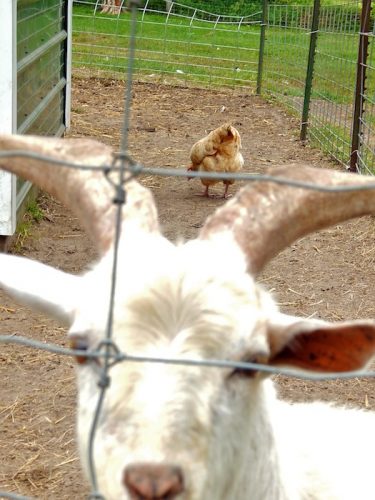
Other serious problems can occur when [keeping goats with chickens](https://countrysidenetwork.com/daily/livestock/goats/keeping-goats-with-chickens/) because of high levels of *Salmonella enterica* and *Campylobacter* bacteria, which are both present in poultry feces. Doe or other ruminant udders can be contaminated with either bacteria and then transfer them to the nursing offspring. Low levels of either bacteria can be fatal to young ruminants. Baby goats are also notoriously curious and can ingest poultry droppings. Two species of *Campylobacter* bacteria, both of which are zoonotic in nature, meaning they are not host-specific, are *C. jejuni* and *C. coli*. Current research findings have pinpointed these two bacteria as causing abortions in ruminants, especially sheep and goats.
#### Raising Chickens and Rabbits Together
It is not uncommon to find rabbits and chickens being housed together. There are a number of zoonotic diseases that rabbits and chickens can transfer to each other. For this reason, raising chickens and rabbits together is not recommended.
One problem is a bacterium known as *Pasteurella multocida*. Endemic to rabbit colonies, it causes a common, potentially fatal, upper respiratory infection known as snuffles. The same organism can also wreak havoc with your poultry. It causes fowl cholera, a deadly and infectious intestinal disease that can reach epidemic proportions. This organism is resistant to many types of antibiotics.

Among other infectious agents that chickens and rabbits can share is one of the bacteria in the tuberculosis family, *Mycobacterium avium*. The causative agent of bird or avian tuberculosis can also be contracted by rabbits.
#### Keeping Chickens and Ducks Together
[Can Chickens and Ducks Live Together?](https://countrysidenetwork.com/daily/poultry/poultry-poultry/can-chickens-and-ducks-live-together/) In short, the answer is yes. Chickens and ducks have many similar care requirements so some people even keep them in the same coop with no problems or issues. However, as with keeping any livestock, there are always a few potential problems that one might face.
Male ducks, or drakes, especially the young ones, have incessantly high libidos. There are drakes that are notoriously non-selective when it comes to which species they mate. Some poultry keepers, including those with years of experience, report that they have never had this dilemma. Others have seen and experienced this problem. Even with female ducks in the same pen, there are some drakes that are possessed after the female chickens as well. I once had this situation so bad in my own flock that I finally had to separate the [chickens and ducks](https://countrysidenetwork.com/topics/poultry-topics/chicken-coops-housing-poultry-topics/keep-ducks-chickens-in-same-coop/). The female chickens became very stressed. To avoid the drakes, they resorted to staying on the roosts and not eating. Chicken egg production plummeted to zero.
What about feed? Recent research indicates that contrary to popular myth, most forms of medicated feed for baby chickens and turkeys are also safe for baby waterfowl. The adults can easily consume the same adult feeds as nutritional needs are similar, though not exactly the same. The only concern is that if feeding finely milled feeds, water should be close by especially for young waterfowl because they can choke if no water is available. Pelleted feeds are a less wasteful option for both chickens and ducks.
#### Keeping Chickens (and Other Gallinaceous Species) with Turkeys
All gallinaceous birds, including chickens, turkeys, pheasants, quail, grouse, and peafowl, can easily contract a caecal, or intestinal parasite in the nematode-family, known as *Heterakis gallinarum*. This little nematode has another protozoan parasite that it carries, known as *Histamonas meleagridis*. *H. meleagridis* causes the devastating and often-fatal disease, Histomoniasis, or Blackhead, that can wipe out entire turkey flocks. Both chickens and pheasants often carry these parasites with no external signs of infection (although contrary to popular belief, any birds in the genus *Gallus* can protract an infection of fatal proportions from these parasites).
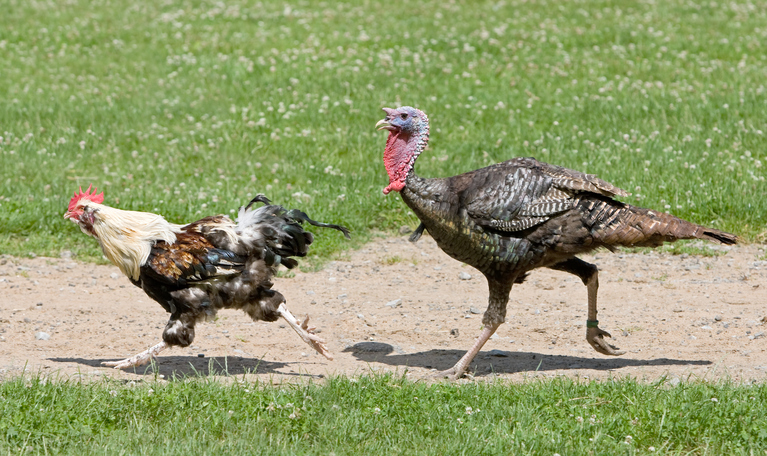
Turkeys can easily contract the disease by ingesting earthworms or other soil-dwelling invertebrates that have consumed *H. gallinarum* eggs. It was once believed that the earthworm was the main intermediary host, but recent research indicates other soil invertebrates are also responsible. It was found that occasional transmission in turkey barns was also the simple result of contaminated litter. Chickens, as well as pheasants, are notorious carriers of these parasites, often with no clinical symptoms. Therefore, avoid putting turkeys in areas or pastures that have had chickens or pheasants. A three or four year time period is often considered necessary between chickens (or pheasants) and turkeys in the same area.
If you raise multiple species of livestock, what precautions are you taking, to make sure they stay healthy and disease free?
**Resources**
INTERACTION OF SMALL AND BACKYARD CHICKEN FLOCKS WITH OTHER SPECIES by Dr. Jacquie Jacobs
[https://poultry.extension.org/articles/poultry-behavior/interaction-of-small-and-backyard-chicken-flocks-with-other-species/\#:~:text=It%20is%20not%20recommended%20to,reptiles%2C%20birds%2C%20and%20mammals.](https://poultry.extension.org/articles/poultry-behavior/interaction-of-small-and-backyard-chicken-flocks-with-other-species/#:~:text=It%20is%20not%20recommended%20to,reptiles%2C%20birds%2C%20and%20mammals.)
[Facebook29](https://www.facebook.com/sharer/sharer.php?u=https://backyardpoultry.iamcountryside.com/feed-health/the-risks-of-keeping-goats-with-chickens/)
[X5](https://x.com/intent/tweet?url=https://backyardpoultry.iamcountryside.com/feed-health/the-risks-of-keeping-goats-with-chickens/&text=The%20Risks%20of%20Keeping%20Goats%20with%20Chickens)
[Linkedin6](https://www.linkedin.com/shareArticle?url=https://backyardpoultry.iamcountryside.com/feed-health/the-risks-of-keeping-goats-with-chickens/&title=The%20Risks%20of%20Keeping%20Goats%20with%20Chickens&summary=&source=)[Email21](<mailto:?subject=The Risks of Keeping Goats with Chickens&body=https://backyardpoultry.iamcountryside.com/feed-health/the-risks-of-keeping-goats-with-chickens/>)[Print23]()
X
Save
Categories : [Feed & Health](https://backyardpoultry.iamcountryside.com/feed-health/)Tags : [animals](https://backyardpoultry.iamcountryside.com/tag/animals/)[can-chickens-and-ducks-live-together](https://backyardpoultry.iamcountryside.com/tag/can-chickens-and-ducks-live-together/)[chicken](https://backyardpoultry.iamcountryside.com/tag/chicken/)[chicken-egg-production](https://backyardpoultry.iamcountryside.com/tag/chicken-egg-production/)[coop](https://backyardpoultry.iamcountryside.com/tag/coop/)[eating](https://backyardpoultry.iamcountryside.com/tag/eating/)[egg](https://backyardpoultry.iamcountryside.com/tag/egg/)[eggs](https://backyardpoultry.iamcountryside.com/tag/eggs/)[experience](https://backyardpoultry.iamcountryside.com/tag/experience/)[goat](https://backyardpoultry.iamcountryside.com/tag/goat/)[goats](https://backyardpoultry.iamcountryside.com/tag/goats/)[keeping-chickens](https://backyardpoultry.iamcountryside.com/tag/keeping-chickens/)[keeping-goats](https://backyardpoultry.iamcountryside.com/tag/keeping-goats/)[keeping-goats-with-chickens](https://backyardpoultry.iamcountryside.com/tag/keeping-goats-with-chickens/)[livestock](https://backyardpoultry.iamcountryside.com/tag/livestock/)[popular](https://backyardpoultry.iamcountryside.com/tag/popular/)[poultry](https://backyardpoultry.iamcountryside.com/tag/poultry/)[rabbit](https://backyardpoultry.iamcountryside.com/tag/rabbit/)[raising](https://backyardpoultry.iamcountryside.com/tag/raising/)[raising-chickens](https://backyardpoultry.iamcountryside.com/tag/raising-chickens/)[sheep](https://backyardpoultry.iamcountryside.com/tag/sheep/)[social](https://backyardpoultry.iamcountryside.com/tag/social/)[turkey](https://backyardpoultry.iamcountryside.com/tag/turkey/)[turkeys](https://backyardpoultry.iamcountryside.com/tag/turkeys/)
[](https://backyardpoultry.iamcountryside.com/ask-the-expert/february-march-2014/)[Ask the Expert — February/March 2014](https://backyardpoultry.iamcountryside.com/ask-the-expert/february-march-2014/)
[](https://backyardpoultry.iamcountryside.com/ask-the-expert/dec-14-jan-15/)[Ask the Expert — December 2014/January 2015](https://backyardpoultry.iamcountryside.com/ask-the-expert/dec-14-jan-15/)
[](https://backyardpoultry.iamcountryside.com/ask-the-expert/oct-nov-2015/)[Ask the Expert — October/November 2015](https://backyardpoultry.iamcountryside.com/ask-the-expert/oct-nov-2015/)
[](https://backyardpoultry.iamcountryside.com/ask-the-expert/june-july-2015/)[Ask the Expert — June/July 2015](https://backyardpoultry.iamcountryside.com/ask-the-expert/june-july-2015/)
[](https://backyardpoultry.iamcountryside.com/ask-the-expert/april-may-2015/)[Ask the Expert — April/May 2015](https://backyardpoultry.iamcountryside.com/ask-the-expert/april-may-2015/)
[](https://backyardpoultry.iamcountryside.com/coops/chicken-coop-need-for-winter/)[What Does a Chicken Coop Need for Winter?](https://backyardpoultry.iamcountryside.com/coops/chicken-coop-need-for-winter/)
[](https://shop.iamcountryside.com/)
Need Help? Call [970-392-4419](tel:970-392-4419)
##### 2 thoughts on “The Risks of Keeping Goats with Chickens”
1.  **Me** says:
[September 21, 2023 at 11:30 am](https://backyardpoultry.iamcountryside.com/feed-health/the-risks-of-keeping-goats-with-chickens/#comment-36773)
Can you pls post links to the research about ecoli in poultry infecting goats or other non poultry livestock? You said ‘research shows,’ but haven’t quoted your source. I’ve seen more than one article published saying this is a common misconception not based on fact.ie <https://www.nzherald.co.nz/bay-of-plenty-times/news/ducks-not-main-salmonella-risk/QM4PXFTMMYIIN73RDNHFKLNSBE/>
[Reply](https://backyardpoultry.iamcountryside.com/feed-health/the-risks-of-keeping-goats-with-chickens/#comment-36773)
1.  **Carla Tilghman** says:
[September 21, 2023 at 12:16 pm](https://backyardpoultry.iamcountryside.com/feed-health/the-risks-of-keeping-goats-with-chickens/#comment-36774)
Hi,
Thanks for your message. There’s quite a bit of evidence about cross-species contamination between poultry and cow/goats. The article you cited refers to ducks, the Backyard Poultry piece is about poultry, not waterfowl.
Dr. Jacquie Jacobs is a small poultry flock researcher.
[https://poultry.extension.org/articles/poultry-behavior/interaction-of-small-and-backyard-chicken-flocks-with-other-species/\#:~:text=It%20is%20not%20recommended%20to,reptiles%2C%20birds%2C%20and%20mammals](https://poultry.extension.org/articles/poultry-behavior/interaction-of-small-and-backyard-chicken-flocks-with-other-species/#:~:text=It%20is%20not%20recommended%20to,reptiles%2C%20birds%2C%20and%20mammals)
[Reply](https://backyardpoultry.iamcountryside.com/feed-health/the-risks-of-keeping-goats-with-chickens/#comment-36774)
### Leave a Reply [Cancel reply](https://backyardpoultry.iamcountryside.com/feed-health/the-risks-of-keeping-goats-with-chickens/#respond)
## Subscribe to Backyard Poultry Today\!
### Make the Most of Your Flock with Backyard Poultry\!
Your best source for information on all things chicken, quail, turkey, guinea, duck, and beyond. Whether you raise a backyard flock for eggs, meat, show, or just for fun. Backyard Poultry is an essential guide for a diverse community of poultry lovers, accessible to those who live on a farm, in a suburban neighborhood, or are raising poultry in an urban environment. You will find research-based stories and actionable guidance, helping newbies and experts alike avoid costly and tragic mistakes.

[Canadian Subscribers](https://bky.iamcountryside.com/loading.do?pk=EBPDNNZE&omedasite=bky_new) • [International Subscribers](https://bky.iamcountryside.com/loading.do?pk=EBPDNNZE&omedasite=bky_new)
Canadian subscriptions: 1 year (includes postage & GST)
- [Renew](https://backyardpoultry.iamcountryside.com/renewal/)
- [About Us](https://www.iamcountryside.com/our-countryside-story/)
- [Contact Us](https://www.iamcountryside.com/contact-us/)
- [Terms of Use](https://backyardpoultry.iamcountryside.com/terms-of-use/)
- [Advertise](https://www.ogdenpubs.com/marketing-solutions/)
- [Privacy Policy](https://backyardpoultry.iamcountryside.com/privacy-policy/)
- [Newsletters](https://www.iamcountryside.com/homesteading/newsletter/)
- [Subscribe](https://backyardpoultry.iamcountryside.com/all-membership/)
[](https://backyardpoultry.iamcountryside.com/classifieds/)
© 2026, Countryside - All Rights Reserved
[](https://shop.iamcountryside.com/)
Close panel
- Cart is empty
Subtotal
\$0.00
Membership Subtotal
\$0.00
Total savings
\$0.00
Shipping and taxes calculated at checkout.
Checkout
Clear cart or Continue Shopping →
 |
| Readable Markdown | Reading Time: 5 minutes
*By Doug Ottinger –* Animals have been kept in mixed flocks for centuries. Whether it is mixed poultry, poultry with sheep and cows, or even keeping goats with chickens, written and pictorial records indicate that humans have done this since time immemorial. But what are the risks? Can disease and parasites spread? Are there any social problems between the species that one should consider? Being educated and aware of inherent risks or problems in mixed-animal operations is the best way to avoid problems before they occur and/or remedy the problems if they should happen.
#### Keeping Goats with Chickens
There are more than a few homesteaders keeping goats with chickens in the same pens or pasture areas as well as sharing the same housing. Some never have any problems or issues but mixing chickens and goats can create problems that one may want to avoid. One serious, potential problem is a microscopic parasite, known as *Cryptosporidium*. Some types of this parasite are host-specific, meaning they are not easily transferred between different animals. Unfortunately, there are other species of *Cryptosporidium* that are not host-specific, and can easily transfer between different species of animals including goats, chickens, sheep, cows or even humans. They are most often spread through a fecal-oral transmission route.
Contaminated drinking water is the most common method of transmission. However, *Cryptosporidium* can be transferred via the soiled bedding, contaminated feed, or any other conceivable medium in animal housing. The organisms are ubiquitous, meaning they are everywhere. They can be hard to eradicate and are resistant to chlorine-based cleaning agents.
\[optin-monster-shortcode id=”kvvnkopxfxloyffia2bc”\]
The parasites can cause intestinal inflammation or enteritis in baby goats as well as other ruminants. Severe diarrhea, which can be fatal, and intestinal bleeding occur. In some areas of the world, including India, severe losses occur every year in the goat industry because of *Cryptosporidium*.
*Cryptosporidium* infections can also be devastating to chickens and other fowl. They can infect the bursa of the lungs, trachea, sinuses or intestinal tract. Infections can become fatal. Since chickens and other fowl are notorious for leaving feces everywhere they go, including drinking water and feed mangers, it is a good idea to have separate housing arrangements for your goats (or sheep) and chickens.

Other serious problems can occur when [keeping goats with chickens](https://countrysidenetwork.com/daily/livestock/goats/keeping-goats-with-chickens/) because of high levels of *Salmonella enterica* and *Campylobacter* bacteria, which are both present in poultry feces. Doe or other ruminant udders can be contaminated with either bacteria and then transfer them to the nursing offspring. Low levels of either bacteria can be fatal to young ruminants. Baby goats are also notoriously curious and can ingest poultry droppings. Two species of *Campylobacter* bacteria, both of which are zoonotic in nature, meaning they are not host-specific, are *C. jejuni* and *C. coli*. Current research findings have pinpointed these two bacteria as causing abortions in ruminants, especially sheep and goats.
#### Raising Chickens and Rabbits Together
It is not uncommon to find rabbits and chickens being housed together. There are a number of zoonotic diseases that rabbits and chickens can transfer to each other. For this reason, raising chickens and rabbits together is not recommended.
One problem is a bacterium known as *Pasteurella multocida*. Endemic to rabbit colonies, it causes a common, potentially fatal, upper respiratory infection known as snuffles. The same organism can also wreak havoc with your poultry. It causes fowl cholera, a deadly and infectious intestinal disease that can reach epidemic proportions. This organism is resistant to many types of antibiotics.

Among other infectious agents that chickens and rabbits can share is one of the bacteria in the tuberculosis family, *Mycobacterium avium*. The causative agent of bird or avian tuberculosis can also be contracted by rabbits.
#### Keeping Chickens and Ducks Together
[Can Chickens and Ducks Live Together?](https://countrysidenetwork.com/daily/poultry/poultry-poultry/can-chickens-and-ducks-live-together/) In short, the answer is yes. Chickens and ducks have many similar care requirements so some people even keep them in the same coop with no problems or issues. However, as with keeping any livestock, there are always a few potential problems that one might face.
Male ducks, or drakes, especially the young ones, have incessantly high libidos. There are drakes that are notoriously non-selective when it comes to which species they mate. Some poultry keepers, including those with years of experience, report that they have never had this dilemma. Others have seen and experienced this problem. Even with female ducks in the same pen, there are some drakes that are possessed after the female chickens as well. I once had this situation so bad in my own flock that I finally had to separate the [chickens and ducks](https://countrysidenetwork.com/topics/poultry-topics/chicken-coops-housing-poultry-topics/keep-ducks-chickens-in-same-coop/). The female chickens became very stressed. To avoid the drakes, they resorted to staying on the roosts and not eating. Chicken egg production plummeted to zero.
What about feed? Recent research indicates that contrary to popular myth, most forms of medicated feed for baby chickens and turkeys are also safe for baby waterfowl. The adults can easily consume the same adult feeds as nutritional needs are similar, though not exactly the same. The only concern is that if feeding finely milled feeds, water should be close by especially for young waterfowl because they can choke if no water is available. Pelleted feeds are a less wasteful option for both chickens and ducks.

#### Keeping Chickens (and Other Gallinaceous Species) with Turkeys
All gallinaceous birds, including chickens, turkeys, pheasants, quail, grouse, and peafowl, can easily contract a caecal, or intestinal parasite in the nematode-family, known as *Heterakis gallinarum*. This little nematode has another protozoan parasite that it carries, known as *Histamonas meleagridis*. *H. meleagridis* causes the devastating and often-fatal disease, Histomoniasis, or Blackhead, that can wipe out entire turkey flocks. Both chickens and pheasants often carry these parasites with no external signs of infection (although contrary to popular belief, any birds in the genus *Gallus* can protract an infection of fatal proportions from these parasites).

Turkeys can easily contract the disease by ingesting earthworms or other soil-dwelling invertebrates that have consumed *H. gallinarum* eggs. It was once believed that the earthworm was the main intermediary host, but recent research indicates other soil invertebrates are also responsible. It was found that occasional transmission in turkey barns was also the simple result of contaminated litter. Chickens, as well as pheasants, are notorious carriers of these parasites, often with no clinical symptoms. Therefore, avoid putting turkeys in areas or pastures that have had chickens or pheasants. A three or four year time period is often considered necessary between chickens (or pheasants) and turkeys in the same area.
If you raise multiple species of livestock, what precautions are you taking, to make sure they stay healthy and disease free?
**Resources**
INTERACTION OF SMALL AND BACKYARD CHICKEN FLOCKS WITH OTHER SPECIES by Dr. Jacquie Jacobs
[https://poultry.extension.org/articles/poultry-behavior/interaction-of-small-and-backyard-chicken-flocks-with-other-species/\#:~:text=It%20is%20not%20recommended%20to,reptiles%2C%20birds%2C%20and%20mammals.](https://poultry.extension.org/articles/poultry-behavior/interaction-of-small-and-backyard-chicken-flocks-with-other-species/#:~:text=It%20is%20not%20recommended%20to,reptiles%2C%20birds%2C%20and%20mammals.) |
| Shard | 85 (laksa) |
| Root Hash | 1562902602082901285 |
| Unparsed URL | com,iamcountryside!backyardpoultry,/feed-health/the-risks-of-keeping-goats-with-chickens/ s443 |