ℹ️ Skipped - page is already crawled
| Filter | Status | Condition | Details |
|---|---|---|---|
| HTTP status | PASS | download_http_code = 200 | HTTP 200 |
| Age cutoff | PASS | download_stamp > now() - 6 MONTH | 0.7 months ago |
| History drop | PASS | isNull(history_drop_reason) | No drop reason |
| Spam/ban | PASS | fh_dont_index != 1 AND ml_spam_score = 0 | ml_spam_score=0 |
| Canonical | PASS | meta_canonical IS NULL OR = '' OR = src_unparsed | Not set |
| Property | Value | ||||||
|---|---|---|---|---|---|---|---|
| URL | https://astronomy.swin.edu.au/cosmos/*/Baryons | ||||||
| Last Crawled | 2026-04-08 07:15:59 (20 days ago) | ||||||
| First Indexed | 2025-08-13 19:57:29 (8 months ago) | ||||||
| HTTP Status Code | 200 | ||||||
| Content | |||||||
| Meta Title | Baryons | COSMOS | ||||||
| Meta Description | null | ||||||
| Meta Canonical | null | ||||||
| Boilerpipe Text | The constituents of the
Universe
are classified according to the principles of the standard model of elementary particles. This model identifies
baryons
as matter composed of triplets of fundamental particles called
quarks
.
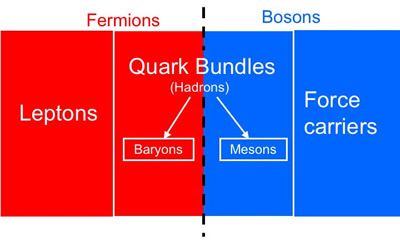
The standard model of particle physics recognises two types of elementary particle, differentiated by the quantum mechanical notion of spin. These particles play fundamentally different roles in nature, and can only have values of spin that are integers (0, 1, 2,…) or half-integers (1/2, 3/2, 5/2,…). Particles that carry the forces of nature are integer spin bosons, while half-integer spin fermions make up the matter on which these force act.
Baryons are particles (hadrons) composed of 3 quarks.
Fermions are classified into two families:
Quarks which experience the strong force. This causes quarks to never occur as solitary particles in nature. They are always found in ‘bundles’ of 2 (mesons) or 3 (baryons). Collectively, these
quark
bundles are referred to as hadrons.
Leptons which do not experience the strong force.
Baryons contain 3 quarks. There are many different baryons observed in particle accelerators (e.g. Λ
0
, Σ
+
, Σ
–
, Σ
0
, Δ
+
, Δ
–
, Δ
0
, ….), simply because there are many ways to make allowable combinations of 3 from the 12 quarks available (including anti-quarks). The vast majority of these extremely massive particles are highly unstable, decaying as a shower of smaller particles in as little as 10
-23
seconds. In nature, there are only 2 common baryons –
protons
and neutrons – and together they dominate the
mass
of normal matter in the Universe.
See also:
baryonic matter
. | ||||||
| Markdown | [](https://astronomy.swin.edu.au/cosmos)
- [Swinburne](http://www.swin.edu.au/ "Swinburne")
- [Centre for Astrophysics and Supercomputing](http://astronomy.swin.edu.au/ "Centre for Astrophysics and Supercomputing")
- [Swinburne Astronomy Online](http://astronomy.swin.edu.au/sao "Swinburne Astronomy Online")
**Search**
**Index**
| | | | | |
|---|---|---|---|---|
| [A](https://astronomy.swin.edu.au/cosmos/A) | [B](https://astronomy.swin.edu.au/cosmos/B) | [C](https://astronomy.swin.edu.au/cosmos/C) | [D](https://astronomy.swin.edu.au/cosmos/D) | [E](https://astronomy.swin.edu.au/cosmos/E) |
| [F](https://astronomy.swin.edu.au/cosmos/F) | [G](https://astronomy.swin.edu.au/cosmos/G) | [H](https://astronomy.swin.edu.au/cosmos/H) | [I](https://astronomy.swin.edu.au/cosmos/I) | [J](https://astronomy.swin.edu.au/cosmos/J) |
| [K](https://astronomy.swin.edu.au/cosmos/K) | [L](https://astronomy.swin.edu.au/cosmos/L) | [M](https://astronomy.swin.edu.au/cosmos/M) | [N](https://astronomy.swin.edu.au/cosmos/N) | [O](https://astronomy.swin.edu.au/cosmos/O) |
| [P](https://astronomy.swin.edu.au/cosmos/P) | [Q](https://astronomy.swin.edu.au/cosmos/Q) | [R](https://astronomy.swin.edu.au/cosmos/R) | [S](https://astronomy.swin.edu.au/cosmos/S) | [T](https://astronomy.swin.edu.au/cosmos/T) |
| [U](https://astronomy.swin.edu.au/cosmos/U) | [V](https://astronomy.swin.edu.au/cosmos/V) | [W](https://astronomy.swin.edu.au/cosmos/W) | [X](https://astronomy.swin.edu.au/cosmos/X) | [Y](https://astronomy.swin.edu.au/cosmos/Y) |
| [Z](https://astronomy.swin.edu.au/cosmos/Z) | [All](https://astronomy.swin.edu.au/cosmos/*) | | | |
[](http://astronomy.swin.edu.au/sao/prospective/Discover_the_Universe.xml)
[COSMOS - The SAO Encyclopedia of Astronomy](https://astronomy.swin.edu.au/cosmos) › [B](https://astronomy.swin.edu.au/cosmos/B)
## Baryons
##
The constituents of the [Universe](https://astronomy.swin.edu.au/cosmos/U/Universe) are classified according to the principles of the standard model of elementary particles. This model identifies [baryons](https://astronomy.swin.edu.au/cosmos/B/Baryons) as matter composed of triplets of fundamental particles called [quarks](https://astronomy.swin.edu.au/cosmos/Q/Quark).
The standard model of particle physics recognises two types of elementary particle, differentiated by the quantum mechanical notion of spin. These particles play fundamentally different roles in nature, and can only have values of spin that are integers (0, 1, 2,…) or half-integers (1/2, 3/2, 5/2,…). Particles that carry the forces of nature are integer spin bosons, while half-integer spin fermions make up the matter on which these force act.
Baryons are particles (hadrons) composed of 3 quarks.
Fermions are classified into two families:
- Quarks which experience the strong force. This causes quarks to never occur as solitary particles in nature. They are always found in ‘bundles’ of 2 (mesons) or 3 (baryons). Collectively, these [quark](https://astronomy.swin.edu.au/cosmos/Q/Quark) bundles are referred to as hadrons.
- Leptons which do not experience the strong force.
Baryons contain 3 quarks. There are many different baryons observed in particle accelerators (e.g. Λ0, Σ\+, Σ–, Σ0, Δ\+, Δ–, Δ0, ….), simply because there are many ways to make allowable combinations of 3 from the 12 quarks available (including anti-quarks). The vast majority of these extremely massive particles are highly unstable, decaying as a shower of smaller particles in as little as 10\-23 seconds. In nature, there are only 2 common baryons – [protons](https://astronomy.swin.edu.au/cosmos/P/Proton) and neutrons – and together they dominate the [mass](https://astronomy.swin.edu.au/cosmos/M/Mass) of normal matter in the Universe.
See also: [baryonic matter](https://astronomy.swin.edu.au/cosmos/B/Baryonic+Matter).
[Study Astronomy Online at Swinburne University](http://astronomy.swin.edu.au/sao)
All material is © Swinburne University of Technology except where indicated. | ||||||
| Readable Markdown | The constituents of the [Universe](https://astronomy.swin.edu.au/cosmos/U/Universe) are classified according to the principles of the standard model of elementary particles. This model identifies [baryons](https://astronomy.swin.edu.au/cosmos/B/Baryons) as matter composed of triplets of fundamental particles called [quarks](https://astronomy.swin.edu.au/cosmos/Q/Quark).
The standard model of particle physics recognises two types of elementary particle, differentiated by the quantum mechanical notion of spin. These particles play fundamentally different roles in nature, and can only have values of spin that are integers (0, 1, 2,…) or half-integers (1/2, 3/2, 5/2,…). Particles that carry the forces of nature are integer spin bosons, while half-integer spin fermions make up the matter on which these force act.

Baryons are particles (hadrons) composed of 3 quarks.
Fermions are classified into two families:
- Quarks which experience the strong force. This causes quarks to never occur as solitary particles in nature. They are always found in ‘bundles’ of 2 (mesons) or 3 (baryons). Collectively, these [quark](https://astronomy.swin.edu.au/cosmos/Q/Quark) bundles are referred to as hadrons.
- Leptons which do not experience the strong force.
Baryons contain 3 quarks. There are many different baryons observed in particle accelerators (e.g. Λ0, Σ\+, Σ–, Σ0, Δ\+, Δ–, Δ0, ….), simply because there are many ways to make allowable combinations of 3 from the 12 quarks available (including anti-quarks). The vast majority of these extremely massive particles are highly unstable, decaying as a shower of smaller particles in as little as 10\-23 seconds. In nature, there are only 2 common baryons – [protons](https://astronomy.swin.edu.au/cosmos/P/Proton) and neutrons – and together they dominate the [mass](https://astronomy.swin.edu.au/cosmos/M/Mass) of normal matter in the Universe.
See also: [baryonic matter](https://astronomy.swin.edu.au/cosmos/B/Baryonic+Matter). | ||||||
| ML Classification | |||||||
| ML Categories |
Raw JSON{
"/Science": 989,
"/Science/Astronomy": 873
} | ||||||
| ML Page Types |
Raw JSON{
"/Article": 909,
"/Article/Definitions": 612
} | ||||||
| ML Intent Types |
Raw JSON{
"Informational": 999
} | ||||||
| Content Metadata | |||||||
| Language | en | ||||||
| Author | null | ||||||
| Publish Time | not set | ||||||
| Original Publish Time | 2025-08-13 19:57:29 (8 months ago) | ||||||
| Republished | No | ||||||
| Word Count (Total) | 341 | ||||||
| Word Count (Content) | 273 | ||||||
| Links | |||||||
| External Links | 2 | ||||||
| Internal Links | 43 | ||||||
| Technical SEO | |||||||
| Meta Nofollow | No | ||||||
| Meta Noarchive | No | ||||||
| JS Rendered | Yes | ||||||
| Redirect Target | null | ||||||
| Performance | |||||||
| Download Time (ms) | 1,427 | ||||||
| TTFB (ms) | 1,427 | ||||||
| Download Size (bytes) | 9,659 | ||||||
| Shard | 66 (laksa) | ||||||
| Root Hash | 7627440683176764866 | ||||||
| Unparsed URL | au,edu,swin!astronomy,/cosmos/*/Baryons s443 | ||||||