ℹ️ Skipped - page is already crawled
| Filter | Status | Condition | Details |
|---|---|---|---|
| HTTP status | PASS | download_http_code = 200 | HTTP 200 |
| Age cutoff | PASS | download_stamp > now() - 6 MONTH | 0 months ago |
| History drop | PASS | isNull(history_drop_reason) | No drop reason |
| Spam/ban | PASS | fh_dont_index != 1 AND ml_spam_score = 0 | ml_spam_score=0 |
| Canonical | PASS | meta_canonical IS NULL OR = '' OR = src_unparsed | Not set |
| Property | Value | |||||||||
|---|---|---|---|---|---|---|---|---|---|---|
| URL | https://adf.org.au/drug-facts/depressants/ | |||||||||
| Last Crawled | 2026-04-28 00:22:36 (14 hours ago) | |||||||||
| First Indexed | 2019-05-10 17:25:55 (6 years ago) | |||||||||
| HTTP Status Code | 200 | |||||||||
| Content | ||||||||||
| Meta Title | Depressants - Alcohol and Drug Foundation | |||||||||
| Meta Description | Learn how depressant drugs slow down your central nervous system and affect your body and mind. Explore different types, potential dangers, and signs of dependence. | |||||||||
| Meta Canonical | null | |||||||||
| Boilerpipe Text | What are depressants?
Depressant substances reduce arousal and stimulation. They affect the central nervous system, slowing down the messages between the brain and body.
1
They can affect concentration and coordination and slow down a person’s ability to respond to unexpected situations. In small doses, they can cause a person to feel more relaxed and less inhibited.
1
In larger doses they can cause drowsiness, vomiting, unconsciousness and death.
2
How are depressant drugs used?
How they’re used depends on the specific type of depressant. For example, alcohol is drunk and benzodiazepines are usually swallowed - but they can also be injected.
Generally, depressants can be swallowed, drunk, injected, snorted or inhaled.
Effects of depressants
Use of any drug can have risks.
It’s important to be careful when taking any type of drug.
Depressants affect everyone differently, based on:
size, weight and health
whether the person is used to taking it
whether other drugs are taken around the same time
the amount taken
the strength of the drug (this varies from batch to batch with illegally produced drugs).
The onset and effects of depressants vary according to the type and specific chemical.
Some depressants may work instantly, with effects only lasting for a short time (such as
inhalants
). While for other depressants, it may take longer for the effects to start and may be slower to wear off.
In general, when small to low doses of depressants are taken, the following effects may be experienced:
reduced inhibitions
enhanced mood
reduced anxiety and stress
slowed reaction time
impaired judgement
slowed breathing
increased risk of accident or injury.
1
Higher doses can result in:
impaired judgement and coordination
vomiting
irregular or shallow breathing
blackouts and memory loss
unconsciousness
coma
death.
1
Overdose
If you take a large amount or have a strong batch, you could overdose.
Call an ambulance straight away by dialling triple zero (000) if you have any of the following symptoms:
vomiting
awake but not responsive
limp body
pale or clammy face
blue fingernails or lips
slow breathing or not breathing at all
slow heartbeat
choking or gurgling sounds
unconsciousness.
1
Mixing depressants with other drugs
The effects of taking depressants with other drugs – including over-the-counter or prescribed medications – can be unpredictable and dangerous.
Alcohol
+
benzodiazepines
: decreased heart rate and breathing; overdose more likely.
3
Benzodiazepines
+
opiates
(such as
heroin
): breathing difficulties; an increased risk of overdose and death.
3
Use of more than one drug or type of drug consumed at the same time is called polydrug use.
4
More on Polydrug use
Polydrug use is a term for the use of more than one drug or type of drug at the same time or one after another. Polydrug use can involve both illicit drugs and legal substances, such as alcohol and medications.
READ MORE
Health and Safety
Use of depressants is likely to be more dangerous when:
combined with alcohol or other drugs, particularly
driving or operating heavy machinery
judgement or motor coordination is required
a person is alone (in case medical assistance is required).
Use of any drug always carries some risk, however, if you choose to take it, always try a small test amount first.
4
For example, the chemical composition of GHB/GBL is highly variable. It’s very easy to take too much GHB - the difference between the amount needed to get high and the amount that causes an overdose can be hard to judge.
If drinking alcohol, stay hydrated and have something to eat before and while drinking.
Tolerance and dependence
People who use depressants regularly, can develop a dependence and tolerance to them. Tolerance means they need to take larger amounts of depressants to get the same effect.
People who are psychologically dependent may feel an urge to use them when in specific surroundings or socialising with friends. With physical dependence, a person’s body adapts to the depressants and gets used to functioning with them.
People who depend on depressants may find that using the drug becomes more important than other activities in their life. Cravings can make it difficult to stop using depressants.
Reducing harm
Use of depressants is likely to be more dangerous when:
combined with alcohol or other drugs, particularly
driving or operating heavy machinery
judgement or motor coordination is required
a person is alone (in case medical assistance is required).
Use of any drug always carries some risk. But, if you choose to take it, always try a small test amount first.
4
For example, the chemical composition of GHB/GBL is highly variable. It’s very easy to take too much GHB - the difference between the amount needed to get ‘high’ and the amount that causes an overdose can be hard to judge.
If drinking alcohol, stay hydrated and have something to eat before and while drinking.
Withdrawal
Giving up depressants after using them for a long time is challenging because the body has to get used to functioning without them.
The severity of withdrawal symptoms will depend on the type of depressant, but generally withdrawal symptoms should settle down in about 5-7 days.
Withdrawal symptoms vary from person to person, but generally the withdrawal from depressants may include:
cold or flu-like symptoms
headache
sweating
aches and pains
difficulty sleeping
nausea
mood swings
7
Getting help
If your use of depressants is affecting your health, family, relationships, work, school, financial or other life situations, or you’re concerned about someone else, you can find help and support.
Call the National Alcohol and Other Drug Hotline on
1800 250 015
for free and confidential advice, information and counselling about alcohol and other drugs
Help and Support Services search
Find a service in your local area from our list. Simply add your location or postcode and filter by service type to quickly discover help near you.
If you're looking for other information or support options, send us an email at
druginfo@adf.org.au
Path2Help
Not sure what you are looking for?
Try our intuitive Path2Help tool and be matched with support information and services tailored to you.
Find out more | |||||||||
| Markdown | [](https://adf.org.au/)
- [Talking about drugs](https://adf.org.au/talking-about-drugs/)
- [Seeking help](https://adf.org.au/talking-about-drugs/seeking-help/)
- [Stigma](https://adf.org.au/talking-about-drugs/power-words/)
- [Family and Friends](https://adf.org.au/talking-about-drugs/family-and-friends/)
- [Parenting](https://adf.org.au/talking-about-drugs/parenting-talk/)
- [AOD and mental health in young people](https://adf.org.au/talking-about-drugs/aod-mental-health-young/)
- [Vaping](https://adf.org.au/talking-about-drugs/vaping/)
- [Alcohol Advertising, Social Media and Young People](https://adf.org.au/talking-about-drugs/alcohol-advertising-social-media-youth/)
- [AOD and the workplace](https://adf.org.au/talking-about-drugs/impact-aod-workplace/)
- [Medicinal cannabis products](https://adf.org.au/talking-about-drugs/medicinal-cannabis-products/)
- [The law](https://adf.org.au/talking-about-drugs/law/)
- [Reducing risk](https://adf.org.au/reducing-risk/)
- [Overdose](https://adf.org.au/reducing-risk/overdose-drug-emergencies/)
- [Alcohol](https://adf.org.au/reducing-risk/alcohol/)
- [AOD & driving](https://adf.org.au/reducing-risk/aod-and-driving/)
- [Pharmaceuticals](https://adf.org.au/reducing-risk/pharmaceuticals/)
- [Polydrug use](https://adf.org.au/reducing-risk/polydrug-use/)
- [Withdrawal](https://adf.org.au/reducing-risk/withdrawal/)
- [Relapse](https://adf.org.au/reducing-risk/relapse/)
- [How long do drugs stay in your system?](https://adf.org.au/reducing-risk/drugs-stay-in-system/)
- [Responding to someone who is upset or aggressive](https://adf.org.au/reducing-risk/responding-upset-aggressive/)
- [Event safety & harm reduction](https://adf.org.au/reducing-risk/staying-safe-events/)
- [Supervised injecting facilities](https://adf.org.au/reducing-risk/supervised-injecting-facilities/)
- [Preventing and delaying AOD uptake](https://adf.org.au/reducing-risk/preventing-aod-uptake/)
- [Young Australians & illicit drug use](https://adf.org.au/reducing-risk/young-drug-use-harm-reduction/)
- [Online alcohol delivery](https://adf.org.au/reducing-risk/online-alcohol-delivery/)
- [Drug Facts](https://adf.org.au/drug-facts/)
- [Resources](https://adf.org.au/resources/)
- [Health professionals](https://adf.org.au/resources/health-professionals/)
- [Aboriginal and Torres Strait Islander resources](https://adf.org.au/resources/indigenous-resources/)
- [Translated resources](https://adf.org.au/resources/translated-resources/)
- [dib – Drug Info Bot](https://adf.org.au/resources/dib/)
- [DrugInfo](https://adf.org.au/resources/druginfo/)
- [ADF Library](https://adf.org.au/resources/adf-library/)
- [Text the Effects](https://adf.org.au/resources/text-the-effects/)
- [Publications](https://adf.org.au/resources/publications/)
- [ADF Shop](https://adf.org.au/resources/adf-shop/)
- [Measuring quality of service](https://adf.org.au/resources/outcomes-framework/)
- [Community social media](https://adf.org.au/resources/social-media/)
- [Glossary](https://adf.org.au/resources/did-glossary/)
- [Insights](https://adf.org.au/insights/)
- [Programs](https://adf.org.au/programs/)
- [Local Drug Action Teams](https://adf.org.au/programs/local-drug-action-teams/)
- [Good Sports](https://adf.org.au/programs/good-sports/)
- [Family and Friends Project](https://adf.org.au/programs/family-friends-project/)
- [Breaking the ice](https://adf.org.au/programs/breaking-ice/)
- [Trade Facts](https://adf.org.au/programs/trade-facts/)
- [Advocacy](https://adf.org.au/about/advocacy/)
- [About](https://adf.org.au/about/)
- [Our vision, mission and ambition](https://adf.org.au/about/our-purpose-mission-focus/)
- [Our history](https://adf.org.au/about/our-history/)
- [Our people](https://adf.org.au/about/our-people/)
- [Careers](https://adf.org.au/about/careers/)
- [Reconciliation Action Plan](https://adf.org.au/about/reconciliation-action-plan/)
- [Advocacy](https://adf.org.au/about/advocacy/)
- [What is prevention?](https://adf.org.au/about/what-prevention/)
- [Media](https://adf.org.au/about/media/)
- [Donate](https://adf.org.au/about/donate/)
- [Accessibility](https://adf.org.au/drug-facts/depressants/)
- [Help & Support](https://adf.org.au/help-support/)
NATIONAL ALCOHOL & OTHER DRUG HOTLINE:[1800 250 015](<tel:1800 250 015>)
- [Drug List](https://adf.org.au/drug-facts/#list)
- [Drug Wheel](https://adf.org.au/drug-facts/#wheel)
- Depressants
# Depressants

Expanded drug image for Depressants
Last published: June 06, 2025
Print
## What are depressants?
Depressant substances reduce arousal and stimulation. They affect the central nervous system, slowing down the messages between the brain and body.1
They can affect concentration and coordination and slow down a person’s ability to respond to unexpected situations. In small doses, they can cause a person to feel more relaxed and less inhibited.1
In larger doses they can cause drowsiness, vomiting, unconsciousness and death.2
### How are depressant drugs used?
How they’re used depends on the specific type of depressant. For example, alcohol is drunk and benzodiazepines are usually swallowed - but they can also be injected.
Generally, depressants can be swallowed, drunk, injected, snorted or inhaled.
### Commonly used depressants
- [Alcohol](https://adf.org.au/drug-facts/alcohol/)
- [Benzodiazepines](https://adf.org.au/drug-facts/benzodiazepines/)
- [GHB](https://adf.org.au/drug-facts/ghb/)
- [Kava](https://adf.org.au/drug-facts/kava/)
### Explore depressants on the Drug Wheel
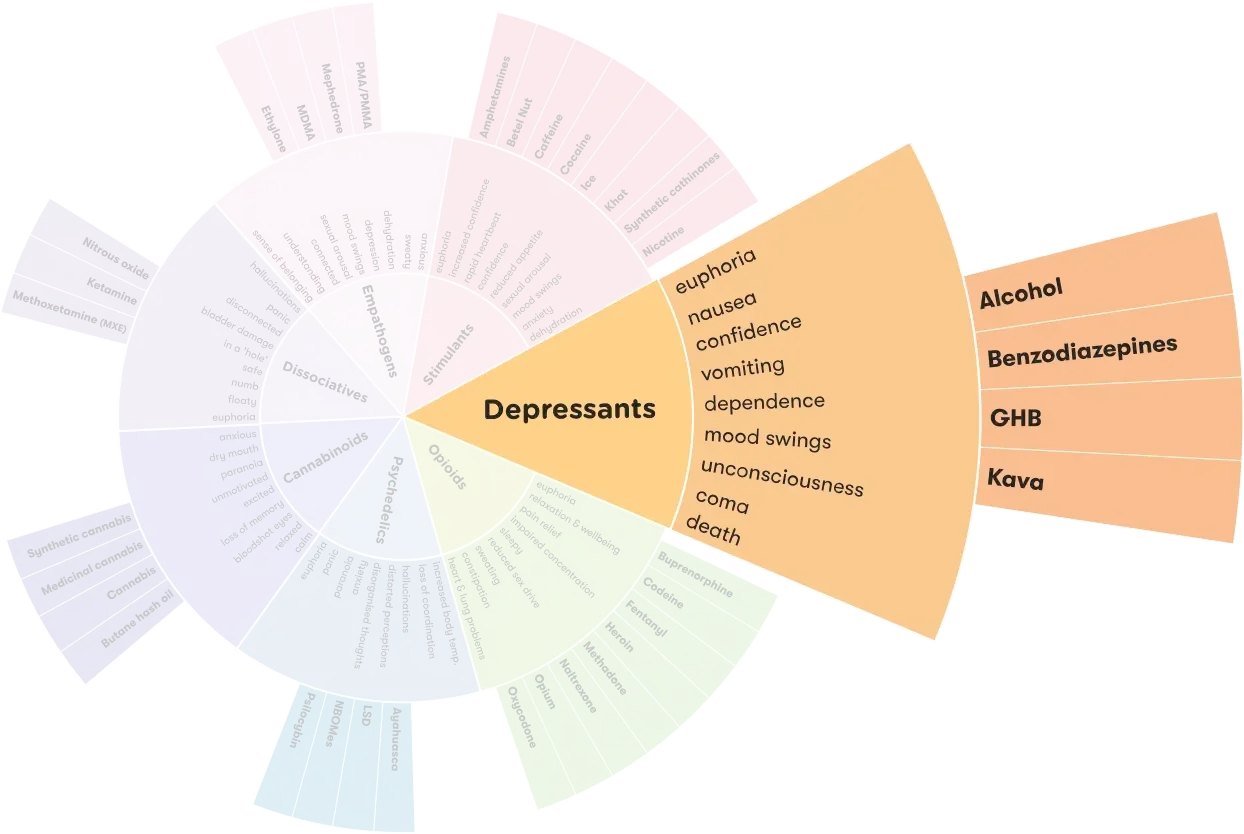
[View the Drug Wheel](https://adf.org.au/drug-facts/#wheel)
## Effects of depressants
**Use of any drug can have risks.** It’s important to be careful when taking any type of drug.
Depressants affect everyone differently, based on:
- size, weight and health
- whether the person is used to taking it
- whether other drugs are taken around the same time
- the amount taken
- the strength of the drug (this varies from batch to batch with illegally produced drugs).
The onset and effects of depressants vary according to the type and specific chemical.
Some depressants may work instantly, with effects only lasting for a short time (such as [inhalants](https://adf.org.au/drug-facts/inhalants/)). While for other depressants, it may take longer for the effects to start and may be slower to wear off.
In general, when small to low doses of depressants are taken, the following effects may be experienced:
- reduced inhibitions
- enhanced mood
- reduced anxiety and stress
- slowed reaction time
- impaired judgement
- slowed breathing
- increased risk of accident or injury.1
### Higher doses can result in:
- impaired judgement and coordination
- vomiting
- irregular or shallow breathing
- blackouts and memory loss
- unconsciousness
- coma
- death.1
## Overdose
If you take a large amount or have a strong batch, you could overdose.
Call an ambulance straight away by dialling triple zero (000) if you have any of the following symptoms:
- vomiting
- awake but not responsive
- limp body
- pale or clammy face
- blue fingernails or lips
- slow breathing or not breathing at all
- slow heartbeat
- choking or gurgling sounds
- unconsciousness.1
## Mixing depressants with other drugs
The effects of taking depressants with other drugs – including over-the-counter or prescribed medications – can be unpredictable and dangerous.
- [Alcohol](https://adf.org.au/drug-facts/alcohol/) + [benzodiazepines](https://adf.org.au/drug-facts/benzodiazepines/): decreased heart rate and breathing; overdose more likely.3
- [Benzodiazepines](https://adf.org.au/drug-facts/benzodiazepines/) + [**opiates**](https://adf.org.au/drug-facts/opioids/) (such as [heroin](https://adf.org.au/drug-facts/heroin/)): breathing difficulties; an increased risk of overdose and death.3
Use of more than one drug or type of drug consumed at the same time is called polydrug use.4
[More on Polydrug use Polydrug use is a term for the use of more than one drug or type of drug at the same time or one after another. Polydrug use can involve both illicit drugs and legal substances, such as alcohol and medications.READ MORE](https://adf.org.au/reducing-risk/polydrug-use/)
### Health and Safety
Use of depressants is likely to be more dangerous when:
- combined with alcohol or other drugs, particularly
- driving or operating heavy machinery
- judgement or motor coordination is required
- a person is alone (in case medical assistance is required).
Use of any drug always carries some risk, however, if you choose to take it, always try a small test amount first.4 For example, the chemical composition of GHB/GBL is highly variable. It’s very easy to take too much GHB - the difference between the amount needed to get high and the amount that causes an overdose can be hard to judge.
If drinking alcohol, stay hydrated and have something to eat before and while drinking.
### Tolerance and dependence
People who use depressants regularly, can develop a dependence and tolerance to them. Tolerance means they need to take larger amounts of depressants to get the same effect.
People who are psychologically dependent may feel an urge to use them when in specific surroundings or socialising with friends. With physical dependence, a person’s body adapts to the depressants and gets used to functioning with them.
People who depend on depressants may find that using the drug becomes more important than other activities in their life. Cravings can make it difficult to stop using depressants.
## Reducing harm
Use of depressants is likely to be more dangerous when:
- combined with alcohol or other drugs, particularly
- driving or operating heavy machinery
- judgement or motor coordination is required
- a person is alone (in case medical assistance is required).
Use of any drug always carries some risk. But, if you choose to take it, always try a small test amount first.4 For example, the chemical composition of GHB/GBL is highly variable. It’s very easy to take too much GHB - the difference between the amount needed to get ‘high’ and the amount that causes an overdose can be hard to judge.
If drinking alcohol, stay hydrated and have something to eat before and while drinking.
### Withdrawal
Giving up depressants after using them for a long time is challenging because the body has to get used to functioning without them.
The severity of withdrawal symptoms will depend on the type of depressant, but generally withdrawal symptoms should settle down in about 5-7 days.
Withdrawal symptoms vary from person to person, but generally the withdrawal from depressants may include:
- cold or flu-like symptoms
- headache
- sweating
- aches and pains
- difficulty sleeping
- nausea
- mood swings7
## Getting help
If your use of depressants is affecting your health, family, relationships, work, school, financial or other life situations, or you’re concerned about someone else, you can find help and support.
**Call the National Alcohol and Other Drug Hotline on** [**1800 250 015**](tel:1800250015) for free and confidential advice, information and counselling about alcohol and other drugs
[**Help and Support Services search**](https://adf.org.au/help-support/search/)
Find a service in your local area from our list. Simply add your location or postcode and filter by service type to quickly discover help near you.
If you're looking for other information or support options, send us an email at [**druginfo@adf.org.au**](mailto:druginfo@adf.org.au)
## Path2Help
Not sure what you are looking for?
Try our intuitive Path2Help tool and be matched with support information and services tailored to you.
[Find out more](https://adf.org.au/help-support/path2help/)

References 
1. Brands B, Sproule B, Marshman J, Ontario. [Addiction Research F. Drugs & drug abuse : a reference text](https://adf.on.worldcat.org/oclc/38900581). Toronto, Ont.: Addiction Research Foundation; 1998 \[cited 2021 May\].
2. Australian Government Department of Health. Types of Drugs - Drug catagories 2019 \[12.01.2021\].
3. Kang M, Galuska M, Ghassemzadeh S. [Benzodiazepine Toxicity](https://www.ncbi.nlm.nih.gov/books/NBK482238/). Treasure Island (FL): StatPearls Publishing; 2020.
4. Darke S, Lappin J, Farrell M. The Clinician's Guide to Illicit Drugs. United Kingdom: Silverback Publishing 2019.
5. World Health Organization. Lexicon of alcohol and drug terms 2021 \[19.03.2021\].
6. Black E. Polydrug use: What you need to know about mixing drugs. In: National Drug and Alcohol Research Centre UoNSW, editor. 2014.
7. Gowing L, Ali R, Dunlop A, Farrell M, Lintzeris N. National Guidelines for Medication-Assisted Treatment of Opioid Dependence. Department of Health 2014 \[25.08.2020\].
BACK TO TOP
Last updated: 06 Jun 2025
Subscribe to receive ADF News updates:
- [Contact us](https://adf.org.au/contact-us/)
- [Donations](https://adf.org.au/about/donate/)
- [ADF Shop](https://alcohol-and-drug-foundation-shop.myshopify.com/)
ADF acknowledgement

The ADF acknowledges the Traditional Custodians of the lands across Australia upon which we work. We recognise the continued connection of First Nations people to the land, the waterways and to community and kin, and pay respects to Elders past and present.
Diversity statement

Alcohol and Drug Foundation’s services are here to support communities across all states and territories. We welcome everyone to our service.
- [Disclaimer](https://adf.org.au/disclaimer/)
- [Copyright](https://adf.org.au/copyright/)
- [Complaints](https://adf.org.au/complaints-policy-procedures/)
- [Privacy](https://adf.org.au/privacy/)
- [Community guidelines](https://adf.org.au/adf-community-guidelines/)
Website by [Ackama](https://www.ackama.com/) | |||||||||
| Readable Markdown | ## What are depressants?
Depressant substances reduce arousal and stimulation. They affect the central nervous system, slowing down the messages between the brain and body.1
They can affect concentration and coordination and slow down a person’s ability to respond to unexpected situations. In small doses, they can cause a person to feel more relaxed and less inhibited.1
In larger doses they can cause drowsiness, vomiting, unconsciousness and death.2
### How are depressant drugs used?
How they’re used depends on the specific type of depressant. For example, alcohol is drunk and benzodiazepines are usually swallowed - but they can also be injected.
Generally, depressants can be swallowed, drunk, injected, snorted or inhaled.
## Effects of depressants
**Use of any drug can have risks.** It’s important to be careful when taking any type of drug.
Depressants affect everyone differently, based on:
- size, weight and health
- whether the person is used to taking it
- whether other drugs are taken around the same time
- the amount taken
- the strength of the drug (this varies from batch to batch with illegally produced drugs).
The onset and effects of depressants vary according to the type and specific chemical.
Some depressants may work instantly, with effects only lasting for a short time (such as [inhalants](https://adf.org.au/drug-facts/inhalants/)). While for other depressants, it may take longer for the effects to start and may be slower to wear off.
In general, when small to low doses of depressants are taken, the following effects may be experienced:
- reduced inhibitions
- enhanced mood
- reduced anxiety and stress
- slowed reaction time
- impaired judgement
- slowed breathing
- increased risk of accident or injury.1
### Higher doses can result in:
- impaired judgement and coordination
- vomiting
- irregular or shallow breathing
- blackouts and memory loss
- unconsciousness
- coma
- death.1
## Overdose
If you take a large amount or have a strong batch, you could overdose.
Call an ambulance straight away by dialling triple zero (000) if you have any of the following symptoms:
- vomiting
- awake but not responsive
- limp body
- pale or clammy face
- blue fingernails or lips
- slow breathing or not breathing at all
- slow heartbeat
- choking or gurgling sounds
- unconsciousness.1
## Mixing depressants with other drugs
The effects of taking depressants with other drugs – including over-the-counter or prescribed medications – can be unpredictable and dangerous.
- [Alcohol](https://adf.org.au/drug-facts/alcohol/) + [benzodiazepines](https://adf.org.au/drug-facts/benzodiazepines/): decreased heart rate and breathing; overdose more likely.3
- [Benzodiazepines](https://adf.org.au/drug-facts/benzodiazepines/) + [**opiates**](https://adf.org.au/drug-facts/opioids/) (such as [heroin](https://adf.org.au/drug-facts/heroin/)): breathing difficulties; an increased risk of overdose and death.3
Use of more than one drug or type of drug consumed at the same time is called polydrug use.4
### More on Polydrug use
Polydrug use is a term for the use of more than one drug or type of drug at the same time or one after another. Polydrug use can involve both illicit drugs and legal substances, such as alcohol and medications.
READ MORE
### Health and Safety
Use of depressants is likely to be more dangerous when:
- combined with alcohol or other drugs, particularly
- driving or operating heavy machinery
- judgement or motor coordination is required
- a person is alone (in case medical assistance is required).
Use of any drug always carries some risk, however, if you choose to take it, always try a small test amount first.4 For example, the chemical composition of GHB/GBL is highly variable. It’s very easy to take too much GHB - the difference between the amount needed to get high and the amount that causes an overdose can be hard to judge.
If drinking alcohol, stay hydrated and have something to eat before and while drinking.
### Tolerance and dependence
People who use depressants regularly, can develop a dependence and tolerance to them. Tolerance means they need to take larger amounts of depressants to get the same effect.
People who are psychologically dependent may feel an urge to use them when in specific surroundings or socialising with friends. With physical dependence, a person’s body adapts to the depressants and gets used to functioning with them.
People who depend on depressants may find that using the drug becomes more important than other activities in their life. Cravings can make it difficult to stop using depressants.
## Reducing harm
Use of depressants is likely to be more dangerous when:
- combined with alcohol or other drugs, particularly
- driving or operating heavy machinery
- judgement or motor coordination is required
- a person is alone (in case medical assistance is required).
Use of any drug always carries some risk. But, if you choose to take it, always try a small test amount first.4 For example, the chemical composition of GHB/GBL is highly variable. It’s very easy to take too much GHB - the difference between the amount needed to get ‘high’ and the amount that causes an overdose can be hard to judge.
If drinking alcohol, stay hydrated and have something to eat before and while drinking.
### Withdrawal
Giving up depressants after using them for a long time is challenging because the body has to get used to functioning without them.
The severity of withdrawal symptoms will depend on the type of depressant, but generally withdrawal symptoms should settle down in about 5-7 days.
Withdrawal symptoms vary from person to person, but generally the withdrawal from depressants may include:
- cold or flu-like symptoms
- headache
- sweating
- aches and pains
- difficulty sleeping
- nausea
- mood swings7
## Getting help
If your use of depressants is affecting your health, family, relationships, work, school, financial or other life situations, or you’re concerned about someone else, you can find help and support.
**Call the National Alcohol and Other Drug Hotline on** [**1800 250 015**](tel:1800250015) for free and confidential advice, information and counselling about alcohol and other drugs
[**Help and Support Services search**](https://adf.org.au/help-support/search/)
Find a service in your local area from our list. Simply add your location or postcode and filter by service type to quickly discover help near you.
If you're looking for other information or support options, send us an email at [**druginfo@adf.org.au**](mailto:druginfo@adf.org.au)
## Path2Help
Not sure what you are looking for?
Try our intuitive Path2Help tool and be matched with support information and services tailored to you.
[Find out more](https://adf.org.au/help-support/path2help/)
 | |||||||||
| ML Classification | ||||||||||
| ML Categories |
Raw JSON{
"/Health": 996,
"/Health/Mental_Health": 739,
"/Health/Mental_Health/Depression": 732
} | |||||||||
| ML Page Types |
Raw JSON{
"/Article": 987,
"/Article/Tutorial_or_Guide": 435
} | |||||||||
| ML Intent Types |
Raw JSON{
"Informational": 999
} | |||||||||
| Content Metadata | ||||||||||
| Language | en | |||||||||
| Author | null | |||||||||
| Publish Time | not set | |||||||||
| Original Publish Time | 2019-05-10 17:25:55 (6 years ago) | |||||||||
| Republished | No | |||||||||
| Word Count (Total) | 1,468 | |||||||||
| Word Count (Content) | 1,014 | |||||||||
| Links | ||||||||||
| External Links | 8 | |||||||||
| Internal Links | 79 | |||||||||
| Technical SEO | ||||||||||
| Meta Nofollow | No | |||||||||
| Meta Noarchive | No | |||||||||
| JS Rendered | Yes | |||||||||
| Redirect Target | null | |||||||||
| Performance | ||||||||||
| Download Time (ms) | 237 | |||||||||
| TTFB (ms) | 236 | |||||||||
| Download Size (bytes) | 15,288 | |||||||||
| Shard | 162 (laksa) | |||||||||
| Root Hash | 14748535988096306362 | |||||||||
| Unparsed URL | au,org,adf!/drug-facts/depressants/ s443 | |||||||||