ℹ️ Skipped - page is already crawled
| Filter | Status | Condition | Details |
|---|---|---|---|
| HTTP status | PASS | download_http_code = 200 | HTTP 200 |
| Age cutoff | PASS | download_stamp > now() - 6 MONTH | 0.3 months ago |
| History drop | PASS | isNull(history_drop_reason) | No drop reason |
| Spam/ban | PASS | fh_dont_index != 1 AND ml_spam_score = 0 | ml_spam_score=0 |
| Canonical | PASS | meta_canonical IS NULL OR = '' OR = src_unparsed | Not set |
| Property | Value | |||||||||||||||
|---|---|---|---|---|---|---|---|---|---|---|---|---|---|---|---|---|
| URL | https://activecalculus.org/multi/S-10-3-Second-Order-Partial-Derivatives.html | |||||||||||||||
| Last Crawled | 2026-04-14 15:01:51 (8 days ago) | |||||||||||||||
| First Indexed | 2018-08-08 04:13:39 (7 years ago) | |||||||||||||||
| HTTP Status Code | 200 | |||||||||||||||
| Content | ||||||||||||||||
| Meta Title | Second-Order Partial Derivatives | |||||||||||||||
| Meta Description | null | |||||||||||||||
| Meta Canonical | null | |||||||||||||||
| Boilerpipe Text | Section
10.3
Second-Order Partial Derivatives
Motivating Questions
Given a function
\(f\)
of two independent variables
\(x\)
and
\(y\text{,}\)
how are the second-order partial derivatives of
\(f\)
defined?
What do the second-order partial derivatives
\(f_{xx}\text{,}\)
\(f_{yy}\text{,}\)
\(f_{xy}\text{,}\)
and
\(f_{yx}\)
of a function
\(f\)
tell us about the function’s behavior?
Recall that for a single-variable function
\(f\text{,}\)
the second derivative of
\(f\)
is defined to be the derivative of the first derivative. That is,
\(f''(x) = \frac{d}{dx}[f'(x)]\text{,}\)
which can be stated in terms of the limit definition of the derivative by writing
\begin{equation*}
f''(x) = \lim_{h \to 0} \frac{f'(x+h) - f'(x)}{h}.
\end{equation*}
In what follows, we begin exploring the four different second-order partial derivatives of a function of two variables and seek to understand what these various derivatives tell us about the function’s behavior.
Preview Activity
10.3.1
.
Once again, let’s consider the function
\(f\)
defined by
\(f(x,y) = \frac{x^2\sin(2y)}{32}\)
that measures a projectile’s range as a function of its initial speed
\(x\)
and launch angle
\(y\text{.}\)
The graph of this function, including traces with
\(x=150\)
and
\(y=0.6\text{,}\)
is shown in
Figure 10.3.1
.
The distance function with traces
\(x=150\)
and
\(y=0.6\text{.}\)
The distance function with traces
\(x=150\)
and
\(y=0.6\text{.}\)
Figure
10.3.1
.
The distance function with traces
\(x=150\)
and
\(y=0.6\text{.}\)
Compute the partial derivative
\(f_x\text{.}\)
Notice that
\(f_x\)
itself is a new function of
\(x\)
and
\(y\text{,}\)
so we may now compute the partial derivatives of
\(f_x\text{.}\)
Find the partial derivative
\(f_{xx} = (f_x)_x\)
and show that
\(f_{xx}(150,0.6) \approx 0.058\text{.}\)
Figure 10.3.2
shows the trace of
\(f\)
with
\(y=0.6\)
with three tangent lines included. Explain how your result from part (a) of this preview activity is reflected in this figure.
The trace with
\(y=0.6\text{.}\)
Figure
10.3.2
.
The trace with
\(y=0.6\text{.}\)
Determine the partial derivative
\(f_y\text{,}\)
and then find the partial derivative
\(f_{yy}=(f_y)_y\text{.}\)
Evaluate
\(f_{yy}(150, 0.6)\text{.}\)
More traces of the range function.
Figure
10.3.3
.
More traces of the range function.
Figure 10.3.3
shows the trace
\(f(150, y)\)
and includes three tangent lines. Explain how the value of
\(f_{yy}(150,0.6)\)
is reflected in this figure.
Because
\(f_x\)
and
\(f_y\)
are each functions of both
\(x\)
and
\(y\text{,}\)
they each have two partial derivatives. Not only can we compute
\(f_{xx} = (f_x)_x\text{,}\)
but also
\(f_{xy} = (f_x)_y\text{;}\)
likewise, in addition to
\(f_{yy} = (f_y)_y\text{,}\)
but also
\(f_{yx} = (f_y)_x\text{.}\)
For the range function
\(f(x,y) = \frac{x^2\sin(2y)}{32}\text{,}\)
use your earlier computations of
\(f_x\)
and
\(f_y\)
to now determine
\(f_{xy}\)
and
\(f_{yx}\text{.}\)
Write one sentence to explain how you calculated these “mixed” partial derivatives.
Subsection
10.3.1
Second-Order Partial Derivatives
A function
\(f\)
of two independent variables
\(x\)
and
\(y\)
has two first order partial derivatives,
\(f_x\)
and
\(f_y\text{.}\)
As we saw in Preview
Activity 10.3.1
, each of these first-order partial derivatives has two partial derivatives, giving a total of four
second-order
partial derivatives:
\(f_{xx} = (f_x)_x = \frac{\partial}{\partial x}
\left(\frac{\partial
f}{\partial x}\right) =
\frac{\partial^2 f}{\partial x^2}\text{,}\)
\(f_{yy} = (f_y)_y=\frac{\partial}{\partial y}
\left(\frac{\partial
f}{\partial y}\right) =
\frac{\partial^2 f}{\partial y^2}\text{,}\)
\(f_{xy} = (f_x)_y=\frac{\partial}{\partial y}
\left(\frac{\partial
f}{\partial x}\right) =
\frac{\partial^2 f}{\partial y \partial x}\text{,}\)
\(f_{yx}=(f_y)_x=\frac{\partial}{\partial x}
\left(\frac{\partial
f}{\partial y}\right) =
\frac{\partial^2 f}{\partial x \partial y}\text{.}\)
The first two are called
unmixed
second-order partial derivatives while the last two are called the
mixed
second-order partial derivatives.
One aspect of this notation can be a little confusing. The notation
\begin{equation*}
\frac{\partial^2 f}{\partial y\partial x} = \frac{\partial}{\partial
y}\left(\frac{\partial f}{\partial x}\right)
\end{equation*}
means that we first differentiate with respect to
\(x\)
and then with respect to
\(y\text{;}\)
this can be expressed in the alternate notation
\(f_{xy} = (f_x)_y\text{.}\)
However, to find the second partial derivative
\begin{equation*}
f_{yx} = (f_y)_x
\end{equation*}
we first differentiate with respect to
\(y\)
and then
\(x\text{.}\)
This means that
\begin{equation*}
\frac{\partial^2 f}{\partial y\partial x} = f_{xy},
\
\mbox{and}
\
\frac{\partial^2 f}{\partial x\partial y} = f_{yx}.
\end{equation*}
Be sure to note carefully the difference between Leibniz notation and subscript notation and the order in which
\(x\)
and
\(y\)
appear in each. In addition, remember that anytime we compute a partial derivative, we hold constant the variable(s) other than the one we are differentiating with respect to.
Activity
10.3.2
.
Find all second order partial derivatives of the following functions. For each partial derivative you calculate, state explicitly which variable is being held constant.
\(\displaystyle f(x,y) = x^2y^3\)
\(\displaystyle f(x,y) = y\cos(x)\)
\(\displaystyle g(s,t) = st^3 + s^4\)
How many second order partial derivatives does the function
\(h\)
defined by
\(h(x,y,z) = 9x^9z-xyz^9 + 9\)
have? Find
\(h_{xz}\)
and
\(h_{zx}\)
(you do not need to find the other second order partial derivatives).
In
Preview Activity 10.3.1
and
Activity 10.3.2
, you may have noticed that the mixed second-order partial derivatives are equal. This observation holds generally and is known as Clairaut’s Theorem.
Clairaut’s Theorem.
Let
\(f\)
be a function of several variables for which the partial derivatives
\(f_{xy}\)
and
\(f_{yx}\)
are continuous near the point
\((a,b)\text{.}\)
Then
\begin{equation*}
f_{xy}(a,b) = f_{yx}(a,b).
\end{equation*}
Subsection
10.3.2
Interpreting the Second-Order Partial Derivatives
Recall from single variable calculus that the second derivative measures the instantaneous rate of change of the derivative. This observation is the key to understanding the meaning of the second-order partial derivatives.
The tangent lines to a trace with increasing
\(x\text{.}\)
The tangent lines to a trace with increasing
\(x\text{.}\)
The tangent lines to a trace with increasing
\(x\text{.}\)
Figure
10.3.4
.
The tangent lines to a trace with increasing
\(x\text{.}\)
Furthermore, we remember that the second derivative of a function at a point provides us with information about the concavity of the function at that point. Since the unmixed second-order partial derivative
\(f_{xx}\)
requires us to hold
\(y\)
constant and differentiate twice with respect to
\(x\text{,}\)
we may simply view
\(f_{xx}\)
as the second derivative of a trace of
\(f\)
where
\(y\)
is fixed. As such,
\(f_{xx}\)
will measure the concavity of this trace.
Consider, for example,
\(f(x,y) = \sin(x) e^{-y}\text{.}\)
Figure 10.3.4
shows the graph of this function along with the trace given by
\(y=-1.5\text{.}\)
Also shown are three tangent lines to this trace, with increasing
\(x\)
-values from left to right among the three plots in
Figure 10.3.4
.
That the slope of the tangent line is decreasing as
\(x\)
increases is reflected, as it is in one-variable calculus, in the fact that the trace is concave down. Indeed, we see that
\(f_x(x,y)=\cos(x)e^{-y}\)
and so
\(f_{xx}(x,y)=-\sin(x)e^{-y} \lt 0\text{,}\)
since
\(e^{-y} > 0\)
for all values of
\(y\text{,}\)
including
\(y = -1.5\text{.}\)
In the following activity, we further explore what second-order partial derivatives tell us about the geometric behavior of a surface.
Activity
10.3.3
.
We continue to consider the function
\(f\)
defined by
\(f(x,y) = \sin(x) e^{-y}\text{.}\)
In
Figure 10.3.5
, we see the trace of
\(f(x,y) = \sin(x) e^{-y}\)
that has
\(x\)
held constant with
\(x = 1.75\text{.}\)
We also see three different lines that are tangent to the trace of
\(f\)
in the
\(y\)
direction at values of
\(y\)
that are increasing from left to right in the figure. Write a couple of sentences that describe whether the slope of the tangent lines to this curve increase or decrease as
\(y\)
increases, and, after computing
\(f_{yy}(x,y)\text{,}\)
explain how this observation is related to the value of
\(f_{yy}(1.75,y)\text{.}\)
Be sure to address the notion of concavity in your response.(You need to be careful about the directions in which
\(x\)
and
\(y\)
are increasing.)
The tangent lines to a trace with increasing
\(y\text{.}\)
The tangent lines to a trace with increasing
\(y\text{.}\)
The tangent lines to a trace with increasing
\(y\text{.}\)
Figure
10.3.5
.
The tangent lines to a trace with increasing
\(y\text{.}\)
In
Figure 10.3.6
, we start to think about the mixed partial derivative,
\(f_{xy}\text{.}\)
Here, we first hold
\(y\)
constant to generate the first-order partial derivative
\(f_x\text{,}\)
and then we hold
\(x\)
constant to compute
\(f_{xy}\text{.}\)
This leads to first thinking about a trace with
\(x\)
being constant, followed by slopes of tangent lines in the
\(x\)
-direction that slide along the original trace. You might think of sliding your pencil down the trace with
\(x\)
constant in a way that its slope indicates
\((f_x)_y\)
in order to further animate the three snapshots shown in the figure.
The trace of
\(z = f(x,y) = \sin(x)e^{-y}\)
with
\(x = 1.75\text{,}\)
along with tangent lines in the
\(y\)
-direction at three different points.
The trace of
\(z = f(x,y) = \sin(x)e^{-y}\)
with
\(x = 1.75\text{,}\)
along with tangent lines in the
\(y\)
-direction at three different points.
The trace of
\(z = f(x,y) = \sin(x)e^{-y}\)
with
\(x = 1.75\text{,}\)
along with tangent lines in the
\(y\)
-direction at three different points.
Figure
10.3.6
.
The trace of
\(z = f(x,y) = \sin(x)e^{-y}\)
with
\(x = 1.75\text{,}\)
along with tangent lines in the
\(y\)
-direction at three different points.
Based on
Figure 10.3.6
, is
\(f_{xy}(1.75, -1.5)\)
positive or negative? Why?
Determine the formula for
\(f_{xy}(x,y)\text{,}\)
and hence evaluate
\(f_{xy}(1.75, -1.5)\text{.}\)
How does this value compare with your observations in (b)?
We know that
\(f_{xx}(1.75, -1.5)\)
measures the concavity of the
\(y = -1.5\)
trace, and that
\(f_{yy}(1.75, -1.5)\)
measures the concavity of the
\(x = 1.75\)
trace. What do you think the quantity
\(f_{xy}(1.75, -1.5)\)
measures?
On
Figure 10.3.6
, sketch the trace with
\(y = -1.5\text{,}\)
and sketch three tangent lines whose slopes correspond to the value of
\(f_{yx}(x,-1.5)\)
for three different values of
\(x\text{,}\)
the middle of which is
\(x = -1.5\text{.}\)
Is
\(f_{yx}(1.75, -1.5)\)
positive or negative? Why? What does
\(f_{yx}(1.75, -1.5)\)
measure?
Just as with the first-order partial derivatives, we can approximate second-order partial derivatives in the situation where we have only partial information about the function.
Activity
10.3.4
.
As we saw in
Activity 10.2.5
, the wind chill
\(w(v,T)\text{,}\)
in degrees Fahrenheit, is a function of the wind speed, in miles per hour, and the air temperature, in degrees Fahrenheit. Some values of the wind chill are recorded in
Table 10.3.7
.
Table
10.3.7
.
Wind chill as a function of wind speed and temperature.
\(v \backslash T\)
-30
-25
-20
-15
-10
-5
0
5
10
15
20
5
-46
-40
-34
-28
-22
-16
-11
-5
1
7
13
10
-53
-47
-41
-35
-28
-22
-16
-10
-4
3
9
15
-58
-51
-45
-39
-32
-26
-19
-13
-7
0
6
20
-61
-55
-48
-42
-35
-29
-22
-15
-9
-2
4
25
-64
-58
-51
-44
-37
-31
-24
-17
-11
-4
3
30
-67
-60
-53
-46
-39
-33
-26
-19
-12
-5
1
35
-69
-62
-55
-48
-41
-34
-27
-21
-14
-7
0
40
-71
-64
-57
-50
-43
-36
-29
-22
-15
-8
-1
Estimate the partial derivatives
\(w_{T}(20,-15)\text{,}\)
\(w_{T}(20,-10)\text{,}\)
and
\(w_T(20,-5)\text{.}\)
Use these results to estimate the second-order partial
\(w_{TT}(20, -10)\text{.}\)
In a similar way, estimate the second-order partial
\(w_{vv}(20,-10)\text{.}\)
Estimate the partial derivatives
\(w_T(20,-10)\text{,}\)
\(w_T(25,-10)\text{,}\)
and
\(w_T(15,-10)\text{,}\)
and use your results to estimate the partial
\(w_{Tv}(20,-10)\text{.}\)
In a similar way, estimate the partial derivative
\(w_{vT}(20,-10)\text{.}\)
Write several sentences that explain what the values
\(w_{TT}(20, -10)\text{,}\)
\(w_{vv}(20,-10)\text{,}\)
and
\(w_{Tv}(20,-10)\)
indicate regarding the behavior of
\(w(v,T)\text{.}\)
As we have found in
Activities 10.3.3
and
Activity 10.3.4
, we may think of
\(f_{xy}\)
as measuring the “twist” of the graph as we increase
\(y\)
along a particular trace where
\(x\)
is held constant. In the same way,
\(f_{yx}\)
measures how the graph twists as we increase
\(x\text{.}\)
If we remember that Clairaut’s theorem tells us that
\(f_{xy} = f_{yx}\text{,}\)
we see that the amount of twisting is the same in both directions. This twisting is perhaps more easily seen in
Figure 10.3.8
, which shows the graph of
\(f(x,y) = -xy\text{,}\)
for which
\(f_{xy} = -1\text{.}\)
The graph of
\(f(x,y) = -xy\text{.}\)
Figure
10.3.8
.
The graph of
\(f(x,y) = -xy\text{.}\)
Subsection
10.3.3
Summary
There are four second-order partial derivatives of a function
\(f\)
of two independent variables
\(x\)
and
\(y\text{:}\)
\begin{equation*}
f_{xx} = (f_x)_x,
f_{xy} = (f_x)_y,
f_{yx} = (f_y)_x,\ \mbox{and} \
f_{yy} = (f_y)_y.
\end{equation*}
The unmixed second-order partial derivatives,
\(f_{xx}\)
and
\(f_{yy}\text{,}\)
tell us about the concavity of the traces. The mixed second-order partial derivatives,
\(f_{xy}\)
and
\(f_{yx}\text{,}\)
tell us how the graph of
\(f\)
twists.
Exercises
10.3.4
Exercises
1
.
2
.
3
.
4
.
5
.
6
.
7
.
8
.
\(\frac{\partial^2\!f}{\partial x\partial y}\)
\(=\)
\(\frac{\partial^3\!f}{\partial x\partial y\partial x}\)
\(=\)
\(\frac{\partial^3\!f}{\partial x^2\partial y}\)
\(=\)
9
.
10
.
11
.
Shown in
Figure 10.3.9
is a contour plot of a function
\(f\)
with the values of
\(f\)
labeled on the contours. The point
\((2,1)\)
is highlighted in red.
A contour plot of
\(f(x,y)\text{.}\)
Figure
10.3.9
.
A contour plot of
\(f(x,y)\text{.}\)
Estimate the partial derivatives
\(f_x(2,1)\)
and
\(f_y(2,1)\text{.}\)
Determine whether the second-order partial derivative
\(f_{xx}(2,1)\)
is positive or negative, and explain your thinking.
Determine whether the second-order partial derivative
\(f_{yy}(2,1)\)
is positive or negative, and explain your thinking.
Determine whether the second-order partial derivative
\(f_{xy}(2,1)\)
is positive or negative, and explain your thinking.
Determine whether the second-order partial derivative
\(f_{yx}(2,1)\)
is positive or negative, and explain your thinking.
Consider a function
\(g\)
of the variables
\(x\)
and
\(y\)
for which
\(g_x(2,2) > 0\)
and
\(g_{xx}(2,2) \lt 0\text{.}\)
Sketch possible behavior of some contours around
\((2,2)\)
on the left axes in
Figure 10.3.10
.
Plots for contours of
\(g\)
and
\(h\text{.}\)
Plots for contours of
\(g\)
and
\(h\text{.}\)
Figure
10.3.10
.
Plots for contours of
\(g\)
and
\(h\text{.}\)
Consider a function
\(h\)
of the variables
\(x\)
and
\(y\)
for which
\(h_x(2,2) > 0\)
and
\(h_{xy}(2,2) \lt 0\text{.}\)
Sketch possible behavior of some contour lines around
\((2,2)\)
on the right axes in
Figure 10.3.10
.
12
.
The Heat Index,
\(I\text{,}\)
(measured in
apparent degrees F
) is a function of the actual temperature
\(T\)
outside (in degrees F) and the relative humidity
\(H\)
(measured as a percentage). A portion of the table which gives values for this function,
\(I(T,H)\text{,}\)
is reproduced in
Table 10.3.11
.
Table
10.3.11
.
Heat index.
T
\(\downarrow \backslash\)
H
\(\rightarrow\)
70
75
80
85
90
106
109
112
115
92
112
115
119
123
94
118
122
127
132
96
125
130
135
141
State the limit definition of the value
\(I_{TT}(94,75)\text{.}\)
Then, estimate
\(I_{TT}(94,75)\text{,}\)
and write one complete sentence that carefully explains the meaning of this value, including units.
State the limit definition of the value
\(I_{HH}(94,75)\text{.}\)
Then, estimate
\(I_{HH}(94,75)\text{,}\)
and write one complete sentence that carefully explains the meaning of this value, including units.
Finally, do likewise to estimate
\(I_{HT}(94,75)\text{,}\)
and write a sentence to explain the meaning of the value you found.
13
.
The temperature on a heated metal plate positioned in the first quadrant of the
\(xy\)
-plane is given by
\begin{equation*}
C(x,y) = 25e^{-(x-1)^2 - (y-1)^3}.
\end{equation*}
Assume that temperature is measured in degrees Celsius and that
\(x\)
and
\(y\)
are each measured in inches.
Determine
\(C_{xx}(x,y)\)
and
\(C_{yy}(x,y)\text{.}\)
Do not do any additional work to algebraically simplify your results.
Calculate
\(C_{xx}(1.1, 1.2)\text{.}\)
Suppose that an ant is walking past the point
\((1.1, 1.2)\)
along the line
\(y = 1.2\text{.}\)
Write a sentence to explain the meaning of the value of
\(C_{xx}(1.1, 1.2)\text{,}\)
including units.
Calculate
\(C_{yy}(1.1, 1.2)\text{.}\)
Suppose instead that an ant is walking past the point
\((1.1, 1.2)\)
along the line
\(x = 1.1\text{.}\)
Write a sentence to explain the meaning of the value of
\(C_{yy}(1.1, 1.2)\text{,}\)
including units.
Determine
\(C_{xy}(x,y)\)
and hence compute
\(C_{xy}(1.1, 1.2)\text{.}\)
What is the meaning of this value? Explain, in terms of an ant walking on the heated metal plate.
14
.
Let
\(f(x,y) = 8 - x^2 - y^2\)
and
\(g(x,y) = 8 - x^2 + 4xy - y^2\text{.}\)
Determine
\(f_x\text{,}\)
\(f_y\text{,}\)
\(f_{xx}\text{,}\)
\(f_{yy}\text{,}\)
\(f_{xy}\text{,}\)
and
\(f_{yx}\text{.}\)
Evaluate each of the partial derivatives in (a) at the point
\((0,0)\text{.}\)
What do the values in (b) suggest about the behavior of
\(f\)
near
\((0,0)\text{?}\)
Plot a graph of
\(f\)
and compare what you see visually to what the values suggest.
Determine
\(g_x\text{,}\)
\(g_y\text{,}\)
\(g_{xx}\text{,}\)
\(g_{yy}\text{,}\)
\(g_{xy}\text{,}\)
and
\(g_{yx}\text{.}\)
Evaluate each of the partial derivatives in (d) at the point
\((0,0)\text{.}\)
What do the values in (e) suggest about the behavior of
\(g\)
near
\((0,0)\text{?}\)
Plot a graph of
\(g\)
and compare what you see visually to what the values suggest.
What do the functions
\(f\)
and
\(g\)
have in common at
\((0,0)\text{?}\)
What is different? What do your observations tell you regarding the importance of a certain second-order partial derivative?
15
.
Let
\(f(x,y) = \frac{1}{2}xy^2\)
represent the kinetic energy in Joules of an object of mass
\(x\)
in kilograms with velocity
\(y\)
in meters per second. Let
\((a,b)\)
be the point
\((4,5)\)
in the domain of
\(f\text{.}\)
Calculate
\(\frac{ \partial^2 f}{\partial x^2}\)
at the point
\((a,b)\text{.}\)
Then explain as best you can what this second order partial derivative tells us about kinetic energy.
Calculate
\(\frac{ \partial^2 f}{\partial y^2}\)
at the point
\((a,b)\text{.}\)
Then explain as best you can what this second order partial derivative tells us about kinetic energy.
Calculate
\(\frac{ \partial^2 f}{\partial y \partial x}\)
at the point
\((a,b)\text{.}\)
Then explain as best you can what this second order partial derivative tells us about kinetic energy.
Calculate
\(\frac{ \partial^2 f}{\partial x \partial y}\)
at the point
\((a,b)\text{.}\)
Then explain as best you can what this second order partial derivative tells us about kinetic energy. | |||||||||||||||
| Markdown | [Skip to main content](https://activecalculus.org/multi/S-10-3-Second-Order-Partial-Derivatives.html#ptx-content)
# [Active Calculus - Multivariable](https://activecalculus.org/multi/root-1-2.html)
Steve Schlicker, Mitchel T. Keller, Nicholas Long
Contents
[Index](https://activecalculus.org/multi/root-1-2-7-1.html "Index")
Search Book
close
## Search Results:
No results.
Dark Mode
[Prev](https://activecalculus.org/multi/S-10-2-First-Order-Partial-Derivatives.html "Previous")[Up](https://activecalculus.org/multi/C-10.html "Up")[Next](https://activecalculus.org/multi/S-10-4-Linearization.html "Next")
\\(\\newcommand{\\R}{\\mathbb{R}} \\newcommand{\\va}{\\mathbf{a}} \\newcommand{\\vb}{\\mathbf{b}} \\newcommand{\\vc}{\\mathbf{c}} \\newcommand{\\vC}{\\mathbf{C}} \\newcommand{\\vd}{\\mathbf{d}} \\newcommand{\\ve}{\\mathbf{e}} \\newcommand{\\vi}{\\mathbf{i}} \\newcommand{\\vj}{\\mathbf{j}} \\newcommand{\\vk}{\\mathbf{k}} \\newcommand{\\vn}{\\mathbf{n}} \\newcommand{\\vm}{\\mathbf{m}} \\newcommand{\\vr}{\\mathbf{r}} \\newcommand{\\vs}{\\mathbf{s}} \\newcommand{\\vu}{\\mathbf{u}} \\newcommand{\\vv}{\\mathbf{v}} \\newcommand{\\vw}{\\mathbf{w}} \\newcommand{\\vx}{\\mathbf{x}} \\newcommand{\\vy}{\\mathbf{y}} \\newcommand{\\vz}{\\mathbf{z}} \\newcommand{\\vzero}{\\mathbf{0}} \\newcommand{\\vF}{\\mathbf{F}} \\newcommand{\\vG}{\\mathbf{G}} \\newcommand{\\vH}{\\mathbf{H}} \\newcommand{\\vR}{\\mathbf{R}} \\newcommand{\\vT}{\\mathbf{T}} \\newcommand{\\vN}{\\mathbf{N}} \\newcommand{\\vL}{\\mathbf{L}} \\newcommand{\\vB}{\\mathbf{B}} \\newcommand{\\vS}{\\mathbf{S}} \\newcommand{\\proj}{\\text{proj}} \\newcommand{\\comp}{\\text{comp}} \\newcommand{\\nin}{} \\newcommand{\\vecmag}\[1\]{\|\#1\|} \\newcommand{\\grad}{\\nabla} \\DeclareMathOperator{\\curl}{curl} \\DeclareMathOperator{\\divg}{div} \\newcommand{\\lt}{\<} \\newcommand{\\gt}{\>} \\newcommand{\\amp}{&} \\definecolor{fillinmathshade}{gray}{0.9} \\newcommand{\\fillinmath}\[1\]{\\mathchoice{\\colorbox{fillinmathshade}{\$\\displaystyle \\phantom{\\,\#1\\,}\$}}{\\colorbox{fillinmathshade}{\$\\textstyle \\phantom{\\,\#1\\,}\$}}{\\colorbox{fillinmathshade}{\$\\scriptstyle \\phantom{\\,\#1\\,}\$}}{\\colorbox{fillinmathshade}{\$\\scriptscriptstyle\\phantom{\\,\#1\\,}\$}}} \\)
- [Front Matter](https://activecalculus.org/multi/frontmatter.html)
- [Colophon](https://activecalculus.org/multi/front-colophon.html)
- [Features of the Text](https://activecalculus.org/multi/frontmatter-4.html)
- [Vector Calculus Preface](https://activecalculus.org/multi/frontmatter-5.html)
- [Acknowledgments](https://activecalculus.org/multi/frontmatter-6.html)
- [Active Calculus - Multivariable: our goals](https://activecalculus.org/multi/frontmatter-7.html)
- [How to Use this Text](https://activecalculus.org/multi/frontmatter-8.html)
- [9 Multivariable and Vector Functions](https://activecalculus.org/multi/C-9.html)
- [9\.1 Functions of Several Variables and Three Dimensional Space](https://activecalculus.org/multi/S-9-1-Functions.html)
- [9\.1.1 Functions of Several Variables](https://activecalculus.org/multi/S-9-1-Functions.html#S-9-1-Functions-4)
- [9\.1.2 Representing Functions of Two Variables](https://activecalculus.org/multi/S-9-1-Functions.html#S-9-1-Functions-5)
- [9\.1.3 Some Standard Equations in Three-Space](https://activecalculus.org/multi/S-9-1-Functions.html#S-9-1-Functions-6)
- [9\.1.4 Traces](https://activecalculus.org/multi/S-9-1-Functions.html#S-9-1-Functions-7)
- [9\.1.5 Contour Maps and Level Curves](https://activecalculus.org/multi/S-9-1-Functions.html#S-9-1-Functions-8)
- [9\.1.6 A gallery of functions](https://activecalculus.org/multi/S-9-1-Functions.html#S-9-1-Functions-9)
- [9\.1.7 Summary](https://activecalculus.org/multi/S-9-1-Functions.html#S-9-1-Functions-10)
- [9\.1.8 Exercises](https://activecalculus.org/multi/S-9-1-Functions.html#S-9-1-Functions-11)
- [9\.2 Vectors](https://activecalculus.org/multi/S-9-2-Vectors.html)
- [9\.2.1 Representations of Vectors](https://activecalculus.org/multi/S-9-2-Vectors.html#S-9-2-Vectors-4)
- [9\.2.2 Equality of Vectors](https://activecalculus.org/multi/S-9-2-Vectors.html#S-9-2-Vectors-5)
- [9\.2.3 Operations on Vectors](https://activecalculus.org/multi/S-9-2-Vectors.html#S-9-2-Vectors-6)
- [9\.2.4 Properties of Vector Operations](https://activecalculus.org/multi/S-9-2-Vectors.html#S-9-2-Vectors-7)
- [9\.2.5 Geometric Interpretation of Vector Operations](https://activecalculus.org/multi/S-9-2-Vectors.html#S-9-2-Vectors-8)
- [9\.2.6 The Magnitude of a Vector](https://activecalculus.org/multi/S-9-2-Vectors.html#S-9-2-Vectors-9)
- [9\.2.7 Summary](https://activecalculus.org/multi/S-9-2-Vectors.html#S-9-2-Vectors-10)
- [9\.2.8 Exercises](https://activecalculus.org/multi/S-9-2-Vectors.html#S-9-2-Vectors-11)
- [9\.3 The Dot Product](https://activecalculus.org/multi/S-9-3-Dot-Product.html)
- [9\.3.1 The Dot Product](https://activecalculus.org/multi/S-9-3-Dot-Product.html#S-9-3-Dot-Product-4)
- [9\.3.2 The angle between vectors](https://activecalculus.org/multi/S-9-3-Dot-Product.html#S-9-3-Dot-Product-5)
- [9\.3.3 The Dot Product and Orthogonality](https://activecalculus.org/multi/S-9-3-Dot-Product.html#S-9-3-Dot-Product-6)
- [9\.3.4 Work, Force, and Displacement](https://activecalculus.org/multi/S-9-3-Dot-Product.html#S-9-3-Dot-Product-7)
- [9\.3.5 Projections](https://activecalculus.org/multi/S-9-3-Dot-Product.html#S-9-3-Dot-Product-8)
- [9\.3.6 Summary](https://activecalculus.org/multi/S-9-3-Dot-Product.html#S-9-3-Dot-Product-9)
- [9\.3.7 Exercises](https://activecalculus.org/multi/S-9-3-Dot-Product.html#S-9-3-Dot-Product-10)
- [9\.4 The Cross Product](https://activecalculus.org/multi/S-9-4-Cross-Product.html)
- [9\.4.1 Computing the cross product](https://activecalculus.org/multi/S-9-4-Cross-Product.html#S-9-4-Cross-Product-4)
- [9\.4.2 The Length of \\(\\vu\\times\\vv\\)](https://activecalculus.org/multi/S-9-4-Cross-Product.html#S-9-4-Cross-Product-5)
- [9\.4.3 The Direction of \\(\\vu\\times\\vv\\)](https://activecalculus.org/multi/S-9-4-Cross-Product.html#S-9-4-Cross-Product-6)
- [9\.4.4 Torque is measured by a cross product](https://activecalculus.org/multi/S-9-4-Cross-Product.html#S-9-4-Cross-Product-7)
- [9\.4.5 Comparing the dot and cross products](https://activecalculus.org/multi/S-9-4-Cross-Product.html#S-9-4-Cross-Product-8)
- [9\.4.6 Summary](https://activecalculus.org/multi/S-9-4-Cross-Product.html#S-9-4-Cross-Product-9)
- [9\.4.7 Exercises](https://activecalculus.org/multi/S-9-4-Cross-Product.html#S-9-4-Cross-Product-10)
- [9\.5 Lines and Planes in Space](https://activecalculus.org/multi/S-9-5-Lines-Planes.html)
- [9\.5.1 Lines in Space](https://activecalculus.org/multi/S-9-5-Lines-Planes.html#S-9-5-Lines-Planes-4)
- [9\.5.2 The Parametric Equations of a Line](https://activecalculus.org/multi/S-9-5-Lines-Planes.html#S-9-5-Lines-Planes-5)
- [9\.5.3 Planes in Space](https://activecalculus.org/multi/S-9-5-Lines-Planes.html#S-9-5-Lines-Planes-6)
- [9\.5.4 Summary](https://activecalculus.org/multi/S-9-5-Lines-Planes.html#S-9-5-Lines-Planes-7)
- [9\.5.5 Exercises](https://activecalculus.org/multi/S-9-5-Lines-Planes.html#S-9-5-Lines-Planes-8)
- [9\.6 Vector-Valued Functions](https://activecalculus.org/multi/S-9-6-Vector-Valued-Functions.html)
- [9\.6.1 Vector-Valued Functions](https://activecalculus.org/multi/S-9-6-Vector-Valued-Functions.html#S-9-6-Vector-Valued-Functions-4)
- [9\.6.2 Summary](https://activecalculus.org/multi/S-9-6-Vector-Valued-Functions.html#S-9-6-Vector-Valued-Functions-5)
- [9\.6.3 Exercises](https://activecalculus.org/multi/S-9-6-Vector-Valued-Functions.html#S-9-6-Vector-Valued-Functions-6)
- [9\.7 Derivatives and Integrals of Vector-Valued Functions](https://activecalculus.org/multi/S-9-7-Vector-Valued-Functions-Derivatives.html)
- [9\.7.1 The Derivative](https://activecalculus.org/multi/S-9-7-Vector-Valued-Functions-Derivatives.html#S-9-7-Vector-Valued-Functions-Derivatives-4)
- [9\.7.2 Computing Derivatives](https://activecalculus.org/multi/S-9-7-Vector-Valued-Functions-Derivatives.html#S-9-7-Vector-Valued-Functions-Derivatives-5)
- [9\.7.3 Tangent Lines](https://activecalculus.org/multi/S-9-7-Vector-Valued-Functions-Derivatives.html#S-9-7-Vector-Valued-Functions-Derivatives-6)
- [9\.7.4 Integrating a Vector-Valued Function](https://activecalculus.org/multi/S-9-7-Vector-Valued-Functions-Derivatives.html#S-9-7-Vector-Valued-Functions-Derivatives-7)
- [9\.7.5 Projectile Motion](https://activecalculus.org/multi/S-9-7-Vector-Valued-Functions-Derivatives.html#S-9-7-Vector-Valued-Functions-Derivatives-8)
- [9\.7.6 Summary](https://activecalculus.org/multi/S-9-7-Vector-Valued-Functions-Derivatives.html#S-9-7-Vector-Valued-Functions-Derivatives-9)
- [9\.7.7 Exercises](https://activecalculus.org/multi/S-9-7-Vector-Valued-Functions-Derivatives.html#S-9-7-Vector-Valued-Functions-Derivatives-10)
- [9\.8 Arc Length and Curvature](https://activecalculus.org/multi/S-9-8-Arc-Length-Curvature.html)
- [9\.8.1 Arc Length](https://activecalculus.org/multi/S-9-8-Arc-Length-Curvature.html#S-9-8-Arc-Length-Curvature-4)
- [9\.8.2 Parameterizing With Respect To Arc Length](https://activecalculus.org/multi/S-9-8-Arc-Length-Curvature.html#S-9-8-Arc-Length-Curvature-5)
- [9\.8.3 Curvature](https://activecalculus.org/multi/S-9-8-Arc-Length-Curvature.html#S-9-8-Arc-Length-Curvature-6)
- [9\.8.4 Summary](https://activecalculus.org/multi/S-9-8-Arc-Length-Curvature.html#S-9-8-Arc-Length-Curvature-7)
- [9\.8.5 Exercises](https://activecalculus.org/multi/S-9-8-Arc-Length-Curvature.html#S-9-8-Arc-Length-Curvature-8)
- [10 Derivatives of Multivariable Functions](https://activecalculus.org/multi/C-10.html)
- [10\.1 Limits](https://activecalculus.org/multi/S-10-1-Limits.html)
- [10\.1.1 Limits of Functions of Two Variables](https://activecalculus.org/multi/S-10-1-Limits.html#S-10-1-Limits-4)
- [10\.1.2 Continuity](https://activecalculus.org/multi/S-10-1-Limits.html#S-10-1-Limits-5)
- [10\.1.3 Summary](https://activecalculus.org/multi/S-10-1-Limits.html#S-10-1-Limits-6)
- [10\.1.4 Exercises](https://activecalculus.org/multi/S-10-1-Limits.html#S-10-1-Limits-7)
- [10\.2 First-Order Partial Derivatives](https://activecalculus.org/multi/S-10-2-First-Order-Partial-Derivatives.html)
- [10\.2.1 First-Order Partial Derivatives](https://activecalculus.org/multi/S-10-2-First-Order-Partial-Derivatives.html#S-10-2-First-Order-Partial-Derivatives-4)
- [10\.2.2 Interpretations of First-Order Partial Derivatives](https://activecalculus.org/multi/S-10-2-First-Order-Partial-Derivatives.html#S-10-2-First-Order-Partial-Derivatives-5)
- [10\.2.3 Using tables and contours to estimate partial derivatives](https://activecalculus.org/multi/S-10-2-First-Order-Partial-Derivatives.html#S-10-2-First-Order-Partial-Derivatives-6)
- [10\.2.4 Summary](https://activecalculus.org/multi/S-10-2-First-Order-Partial-Derivatives.html#S-10-2-First-Order-Partial-Derivatives-7)
- [10\.2.5 Exercises](https://activecalculus.org/multi/S-10-2-First-Order-Partial-Derivatives.html#S-10-2-First-Order-Partial-Derivatives-8)
- [10\.3 Second-Order Partial Derivatives](https://activecalculus.org/multi/S-10-3-Second-Order-Partial-Derivatives.html)
- [10\.3.1 Second-Order Partial Derivatives](https://activecalculus.org/multi/S-10-3-Second-Order-Partial-Derivatives.html#S-10-3-Second-Order-Partial-Derivatives-4)
- [10\.3.2 Interpreting the Second-Order Partial Derivatives](https://activecalculus.org/multi/S-10-3-Second-Order-Partial-Derivatives.html#S-10-3-Second-Order-Partial-Derivatives-5)
- [10\.3.3 Summary](https://activecalculus.org/multi/S-10-3-Second-Order-Partial-Derivatives.html#S-10-3-Second-Order-Partial-Derivatives-6)
- [10\.3.4 Exercises](https://activecalculus.org/multi/S-10-3-Second-Order-Partial-Derivatives.html#S-10-3-Second-Order-Partial-Derivatives-7)
- [10\.4 Linearization: Tangent Planes and Differentials](https://activecalculus.org/multi/S-10-4-Linearization.html)
- [10\.4.1 The Tangent Plane](https://activecalculus.org/multi/S-10-4-Linearization.html#S-10-4-Linearization-4)
- [10\.4.2 Linearization](https://activecalculus.org/multi/S-10-4-Linearization.html#S-10-4-Linearization-5)
- [10\.4.3 Differentials](https://activecalculus.org/multi/S-10-4-Linearization.html#S-10-4-Linearization-6)
- [10\.4.4 Summary](https://activecalculus.org/multi/S-10-4-Linearization.html#S-10-4-Linearization-7)
- [10\.4.5 Exercises](https://activecalculus.org/multi/S-10-4-Linearization.html#S-10-4-Linearization-8)
- [10\.5 The Chain Rule](https://activecalculus.org/multi/S-10-5-Chain-Rule.html)
- [10\.5.1 The Chain Rule](https://activecalculus.org/multi/S-10-5-Chain-Rule.html#S-10-5-Chain-Rule-4)
- [10\.5.2 Tree Diagrams](https://activecalculus.org/multi/S-10-5-Chain-Rule.html#S-10-5-Chain-Rule-5)
- [10\.5.3 Summary](https://activecalculus.org/multi/S-10-5-Chain-Rule.html#S-10-5-Chain-Rule-6)
- [10\.5.4 Exercises](https://activecalculus.org/multi/S-10-5-Chain-Rule.html#S-10-5-Chain-Rule-7)
- [10\.6 Directional Derivatives and the Gradient](https://activecalculus.org/multi/S-10-6-Directional-Derivative.html)
- [10\.6.1 Directional Derivatives](https://activecalculus.org/multi/S-10-6-Directional-Derivative.html#S-10-6-Directional-Derivative-4)
- [10\.6.2 Computing the Directional Derivative](https://activecalculus.org/multi/S-10-6-Directional-Derivative.html#S-10-6-Directional-Derivative-5)
- [10\.6.3 The Gradient](https://activecalculus.org/multi/S-10-6-Directional-Derivative.html#gradient_ss)
- [10\.6.4 The Direction of the Gradient](https://activecalculus.org/multi/S-10-6-Directional-Derivative.html#S-10-6-Directional-Derivative-7)
- [10\.6.5 The Length of the Gradient](https://activecalculus.org/multi/S-10-6-Directional-Derivative.html#S-10-6-Directional-Derivative-8)
- [10\.6.6 Applications](https://activecalculus.org/multi/S-10-6-Directional-Derivative.html#S-10-6-Directional-Derivative-9)
- [10\.6.7 Summary](https://activecalculus.org/multi/S-10-6-Directional-Derivative.html#S-10-6-Directional-Derivative-10)
- [10\.6.8 Exercises](https://activecalculus.org/multi/S-10-6-Directional-Derivative.html#S-10-6-Directional-Derivative-11)
- [10\.7 Optimization](https://activecalculus.org/multi/S-10-7-Optimization.html)
- [10\.7.1 Extrema and Critical Points](https://activecalculus.org/multi/S-10-7-Optimization.html#S-10-7-Optimization-4)
- [10\.7.2 Classifying Critical Points: The Second Derivative Test](https://activecalculus.org/multi/S-10-7-Optimization.html#S-10-7-Optimization-5)
- [10\.7.3 Optimization on a Restricted Domain](https://activecalculus.org/multi/S-10-7-Optimization.html#S-10-7-Optimization-6)
- [10\.7.4 Summary](https://activecalculus.org/multi/S-10-7-Optimization.html#S-10-7-Optimization-7)
- [10\.7.5 Exercises](https://activecalculus.org/multi/S-10-7-Optimization.html#S-10-7-Optimization-8)
- [10\.8 Constrained Optimization: Lagrange Multipliers](https://activecalculus.org/multi/S-10-8-Lagrange-Multipliers.html)
- [10\.8.1 Constrained Optimization and Lagrange Multipliers](https://activecalculus.org/multi/S-10-8-Lagrange-Multipliers.html#S-10-8-Lagrange-Multipliers-4)
- [10\.8.2 Summary](https://activecalculus.org/multi/S-10-8-Lagrange-Multipliers.html#S-10-8-Lagrange-Multipliers-5)
- [10\.8.3 Exercises](https://activecalculus.org/multi/S-10-8-Lagrange-Multipliers.html#S-10-8-Lagrange-Multipliers-6)
- [11 Multiple Integrals](https://activecalculus.org/multi/C-11.html)
- [11\.1 Double Riemann Sums and Double Integrals over Rectangles](https://activecalculus.org/multi/S-11-1-Double-Integrals-Rectangles.html)
- [11\.1.1 Double Riemann Sums over Rectangles](https://activecalculus.org/multi/S-11-1-Double-Integrals-Rectangles.html#S-11-1-Double-Integrals-Rectangles-4)
- [11\.1.2 Double Riemann Sums and Double Integrals](https://activecalculus.org/multi/S-11-1-Double-Integrals-Rectangles.html#S-11-1-Double-Integrals-Rectangles-5)
- [11\.1.3 Interpretation of Double Riemann Sums and Double integrals.](https://activecalculus.org/multi/S-11-1-Double-Integrals-Rectangles.html#S-11-1-Double-Integrals-Rectangles-6)
- [11\.1.4 Summary](https://activecalculus.org/multi/S-11-1-Double-Integrals-Rectangles.html#S-11-1-Double-Integrals-Rectangles-7)
- [11\.1.5 Exercises](https://activecalculus.org/multi/S-11-1-Double-Integrals-Rectangles.html#S-11-1-Double-Integrals-Rectangles-8)
- [11\.2 Iterated Integrals](https://activecalculus.org/multi/S-11-2-Iterated-Integrals.html)
- [11\.2.1 Iterated Integrals](https://activecalculus.org/multi/S-11-2-Iterated-Integrals.html#S-11-2-Iterated-Integrals-4)
- [11\.2.2 Summary](https://activecalculus.org/multi/S-11-2-Iterated-Integrals.html#S-11-2-Iterated-Integrals-5)
- [11\.2.3 Exercises](https://activecalculus.org/multi/S-11-2-Iterated-Integrals.html#S-11-2-Iterated-Integrals-6)
- [11\.3 Double Integrals over General Regions](https://activecalculus.org/multi/S-11-3-Double-Integrals-General.html)
- [11\.3.1 Double Integrals over General Regions](https://activecalculus.org/multi/S-11-3-Double-Integrals-General.html#S-11-3-Double-Integrals-General-4)
- [11\.3.2 Summary](https://activecalculus.org/multi/S-11-3-Double-Integrals-General.html#S-11-3-Double-Integrals-General-5)
- [11\.3.3 Exercises](https://activecalculus.org/multi/S-11-3-Double-Integrals-General.html#S-11-3-Double-Integrals-General-6)
- [11\.4 Applications of Double Integrals](https://activecalculus.org/multi/S-11-4-Double-Integrals-Applications.html)
- [11\.4.1 Mass](https://activecalculus.org/multi/S-11-4-Double-Integrals-Applications.html#S-11-4-Double-Integrals-Applications-4)
- [11\.4.2 Area](https://activecalculus.org/multi/S-11-4-Double-Integrals-Applications.html#S-11-4-Double-Integrals-Applications-5)
- [11\.4.3 Center of Mass](https://activecalculus.org/multi/S-11-4-Double-Integrals-Applications.html#S-11-4-Double-Integrals-Applications-6)
- [11\.4.4 Probability](https://activecalculus.org/multi/S-11-4-Double-Integrals-Applications.html#S-11-4-Double-Integrals-Applications-7)
- [11\.4.5 Summary](https://activecalculus.org/multi/S-11-4-Double-Integrals-Applications.html#S-11-4-Double-Integrals-Applications-8)
- [11\.4.6 Exercises](https://activecalculus.org/multi/S-11-4-Double-Integrals-Applications.html#S-11-4-Double-Integrals-Applications-9)
- [11\.5 Double Integrals in Polar Coordinates](https://activecalculus.org/multi/S-11-5-Double-Integrals-Polar.html)
- [11\.5.1 Polar Coordinates](https://activecalculus.org/multi/S-11-5-Double-Integrals-Polar.html#S-11-5-Double-Integrals-Polar-4)
- [11\.5.2 Integrating in Polar Coordinates](https://activecalculus.org/multi/S-11-5-Double-Integrals-Polar.html#S-11-5-Double-Integrals-Polar-5)
- [11\.5.3 Summary](https://activecalculus.org/multi/S-11-5-Double-Integrals-Polar.html#S-11-5-Double-Integrals-Polar-6)
- [11\.5.4 Exercises](https://activecalculus.org/multi/S-11-5-Double-Integrals-Polar.html#S-11-5-Double-Integrals-Polar-7)
- [11\.6 Surfaces Defined Parametrically and Surface Area](https://activecalculus.org/multi/S-11-6-Parametric-Surfaces-Surface-Area.html)
- [11\.6.1 Parametric Surfaces](https://activecalculus.org/multi/S-11-6-Parametric-Surfaces-Surface-Area.html#S-11-6-Parametric-Surfaces-Surface-Area-4)
- [11\.6.2 The Surface Area of Parametrically Defined Surfaces](https://activecalculus.org/multi/S-11-6-Parametric-Surfaces-Surface-Area.html#SS-11-6-2-Surface-Area-Parametrically-Defined-Surfaces)
- [11\.6.3 Summary](https://activecalculus.org/multi/S-11-6-Parametric-Surfaces-Surface-Area.html#S-11-6-Parametric-Surfaces-Surface-Area-6)
- [11\.6.4 Exercises](https://activecalculus.org/multi/S-11-6-Parametric-Surfaces-Surface-Area.html#S-11-6-Parametric-Surfaces-Surface-Area-7)
- [11\.7 Triple Integrals](https://activecalculus.org/multi/S-11-7-Triple-Integrals.html)
- [11\.7.1 Triple Riemann Sums and Triple Integrals](https://activecalculus.org/multi/S-11-7-Triple-Integrals.html#S-11-7-Triple-Integrals-4)
- [11\.7.2 Summary](https://activecalculus.org/multi/S-11-7-Triple-Integrals.html#S-11-7-Triple-Integrals-5)
- [11\.7.3 Exercises](https://activecalculus.org/multi/S-11-7-Triple-Integrals.html#S-11-7-Triple-Integrals-6)
- [11\.8 Triple Integrals in Cylindrical and Spherical Coordinates](https://activecalculus.org/multi/S-11-8-Triple-Integrals-Cylindrical-Spherical.html)
- [11\.8.1 Cylindrical Coordinates](https://activecalculus.org/multi/S-11-8-Triple-Integrals-Cylindrical-Spherical.html#S-11-8-Triple-Integrals-Cylindrical-Spherical-4)
- [11\.8.2 Triple Integrals in Cylindrical Coordinates](https://activecalculus.org/multi/S-11-8-Triple-Integrals-Cylindrical-Spherical.html#S-11-8-Triple-Integrals-Cylindrical-Spherical-5)
- [11\.8.3 Spherical Coordinates](https://activecalculus.org/multi/S-11-8-Triple-Integrals-Cylindrical-Spherical.html#S-11-8-Triple-Integrals-Cylindrical-Spherical-6)
- [11\.8.4 Triple Integrals in Spherical Coordinates](https://activecalculus.org/multi/S-11-8-Triple-Integrals-Cylindrical-Spherical.html#S-11-8-Triple-Integrals-Cylindrical-Spherical-7)
- [11\.8.5 Summary](https://activecalculus.org/multi/S-11-8-Triple-Integrals-Cylindrical-Spherical.html#S-11-8-Triple-Integrals-Cylindrical-Spherical-8)
- [11\.8.6 Exercises](https://activecalculus.org/multi/S-11-8-Triple-Integrals-Cylindrical-Spherical.html#S-11-8-Triple-Integrals-Cylindrical-Spherical-9)
- [11\.9 Change of Variables](https://activecalculus.org/multi/S-11-9-Change-of-Variable.html)
- [11\.9.1 Change of Variables in Polar Coordinates](https://activecalculus.org/multi/S-11-9-Change-of-Variable.html#S-11-9-Change-of-Variable-4)
- [11\.9.2 General Change of Coordinates](https://activecalculus.org/multi/S-11-9-Change-of-Variable.html#S-11-9-Change-of-Variable-5)
- [11\.9.3 Change of Variables in a Triple Integral](https://activecalculus.org/multi/S-11-9-Change-of-Variable.html#S-11-9-Change-of-Variable-6)
- [11\.9.4 Summary](https://activecalculus.org/multi/S-11-9-Change-of-Variable.html#S-11-9-Change-of-Variable-7)
- [11\.9.5 Exercises](https://activecalculus.org/multi/S-11-9-Change-of-Variable.html#S-11-9-Change-of-Variable-8)
- [12 Vector Calculus](https://activecalculus.org/multi/C_Vector.html)
- [12\.1 Vector Fields](https://activecalculus.org/multi/S_Vector_VectorFields.html)
- [12\.1.1 Examples of Vector Fields](https://activecalculus.org/multi/S_Vector_VectorFields.html#SS_Vector_VectorFields_Examples)
- [12\.1.2 Mathematical Vector Fields](https://activecalculus.org/multi/S_Vector_VectorFields.html#SS_Vector_VectorFields_Mathematical)
- [12\.1.3 Plotting Vector Fields](https://activecalculus.org/multi/S_Vector_VectorFields.html#SS_Vector_VectorFields_Plotting)
- [12\.1.4 Gradient Vector Fields](https://activecalculus.org/multi/S_Vector_VectorFields.html#SS_Vector_VectorFields_Gradient)
- [12\.1.5 Summary](https://activecalculus.org/multi/S_Vector_VectorFields.html#S_Vector_VectorFields-8)
- [12\.1.6 Exercises](https://activecalculus.org/multi/S_Vector_VectorFields.html#S_Vector_VectorFields-9)
- [12\.2 The Idea of a Line Integral](https://activecalculus.org/multi/S_Vector_IdeaLineIntegral.html)
- [12\.2.1 Orientations of Curves](https://activecalculus.org/multi/S_Vector_IdeaLineIntegral.html#SS_Vector_IdeaLineIntegral_OrientCurve)
- [12\.2.2 Line Integrals](https://activecalculus.org/multi/S_Vector_IdeaLineIntegral.html#SS_Vector_IdeaLineIntegral_LineIntegrals)
- [12\.2.3 Properties of Line Integrals](https://activecalculus.org/multi/S_Vector_IdeaLineIntegral.html#SS_Vector_IdeaLineIntegral_Properties)
- [12\.2.4 The Circulation of a Vector Field](https://activecalculus.org/multi/S_Vector_IdeaLineIntegral.html#SS_Vector_IdeaLineIntegral_Circulation)
- [12\.2.5 Summary](https://activecalculus.org/multi/S_Vector_IdeaLineIntegral.html#S_Vector_IdeaLineIntegral-8)
- [12\.2.6 Exercises](https://activecalculus.org/multi/S_Vector_IdeaLineIntegral.html#S_Vector_IdeaLineIntegral-9)
- [12\.3 Using Parametrizations to Calculate Line Integrals](https://activecalculus.org/multi/S_Vector_ParamLineIntegrals.html)
- [12\.3.1 Parametrizations in the Definition of \\(\\int\_C\\vF\\cdot d\\vr\\)](https://activecalculus.org/multi/S_Vector_ParamLineIntegrals.html#SS_Vector_ParamLineIntegrals_Evaluation)
- [12\.3.2 Alternative Notation for Line Integrals](https://activecalculus.org/multi/S_Vector_ParamLineIntegrals.html#alt_li_notation)
- [12\.3.3 Independence of Parametrization for a Fixed Curve](https://activecalculus.org/multi/S_Vector_ParamLineIntegrals.html#S_Vector_ParamLineIntegrals-6)
- [12\.3.4 Summary](https://activecalculus.org/multi/S_Vector_ParamLineIntegrals.html#S_Vector_ParamLineIntegrals-7)
- [12\.3.5 Exercises](https://activecalculus.org/multi/S_Vector_ParamLineIntegrals.html#S_Vector_ParamLineIntegrals-8)
- [12\.4 Path-Independent Vector Fields and the Fundamental Theorem of Calculus for Line Integrals](https://activecalculus.org/multi/S_Vector_FTCLI.html)
- [12\.4.1 Path-Independent Vector Fields](https://activecalculus.org/multi/S_Vector_FTCLI.html#S_Vector_FTCLI-4)
- [12\.4.2 Line Integrals Along Closed Curves](https://activecalculus.org/multi/S_Vector_FTCLI.html#S_Vector_FTCLI-5)
- [12\.4.3 What other vector fields are path-independent?](https://activecalculus.org/multi/S_Vector_FTCLI.html#SS_Vector_FTCLI_Other)
- [12\.4.4 Summary](https://activecalculus.org/multi/S_Vector_FTCLI.html#S_Vector_FTCLI-7)
- [12\.4.5 Exercises](https://activecalculus.org/multi/S_Vector_FTCLI.html#S_Vector_FTCLI-8)
- [12\.5 Line Integrals of Scalar Functions](https://activecalculus.org/multi/S_Vector_ScalarLineIntegral.html)
- [12\.5.1 Defining line integrals of scalar functions](https://activecalculus.org/multi/S_Vector_ScalarLineIntegral.html#S_Vector_ScalarLineIntegral-4)
- [12\.5.2 Using Parameterizations to Calculate Scalar Line Integrals](https://activecalculus.org/multi/S_Vector_ScalarLineIntegral.html#S_Vector_ScalarLineIntegral-5)
- [12\.5.3 Properties of Scalar Line Integrals](https://activecalculus.org/multi/S_Vector_ScalarLineIntegral.html#S_Vector_ScalarLineIntegral-6)
- [12\.5.4 Visualizations of Scalar Line Integrals as Area Under a Curve](https://activecalculus.org/multi/S_Vector_ScalarLineIntegral.html#SS_Vector_ScalarLineIntegral_Visualizations)
- [12\.5.5 Summary](https://activecalculus.org/multi/S_Vector_ScalarLineIntegral.html#S_Vector_ScalarLineIntegral-8)
- [12\.5.6 Exercises](https://activecalculus.org/multi/S_Vector_ScalarLineIntegral.html#ez_Vector_ScalarLineIntegral)
- [12\.6 The Divergence of a Vector Field](https://activecalculus.org/multi/S_Vector_Div.html)
- [12\.6.1 Definition of the Divergence of a Vector Field](https://activecalculus.org/multi/S_Vector_Div.html#SS_Vector_Div_Defn)
- [12\.6.2 Measuring the Change in Strength of a Vector Field](https://activecalculus.org/multi/S_Vector_Div.html#SS_Vector_Div_Development)
- [12\.6.3 Summary](https://activecalculus.org/multi/S_Vector_Div.html#S_Vector_Div-6)
- [12\.6.4 Exercises](https://activecalculus.org/multi/S_Vector_Div.html#S_Vector_Div-7)
- [12\.7 The Curl of a Vector Field](https://activecalculus.org/multi/S_Vector_Curl.html)
- [12\.7.1 Measuring the Circulation Density of Vector Field in \\(\\R^2\\)](https://activecalculus.org/multi/S_Vector_Curl.html#SS_Vector_Curl_Development)
- [12\.7.2 Measuring Rotation in Three Dimensions](https://activecalculus.org/multi/S_Vector_Curl.html#SS_Vector_Curl_Development3D)
- [12\.7.3 Circulation Density in Three Dimensions](https://activecalculus.org/multi/S_Vector_Curl.html#S_Vector_Curl-6)
- [12\.7.4 Interpretation and Usage of Curl](https://activecalculus.org/multi/S_Vector_Curl.html#SS_Vector_Curl_Interpretation)
- [12\.7.5 Summary](https://activecalculus.org/multi/S_Vector_Curl.html#S_Vector_Curl-8)
- [12\.7.6 Exercises](https://activecalculus.org/multi/S_Vector_Curl.html#S_Vector_Curl-9)
- [12\.8 Green’s Theorem](https://activecalculus.org/multi/S_Vector_GreensTheorem.html)
- [12\.8.1 Circulation](https://activecalculus.org/multi/S_Vector_GreensTheorem.html#SS_Vector_GreensTheorem_Circulation)
- [12\.8.2 Green’s Theorem](https://activecalculus.org/multi/S_Vector_GreensTheorem.html#S_Vector_GreensTheorem-5)
- [12\.8.3 What happens when vector fields are not smooth?](https://activecalculus.org/multi/S_Vector_GreensTheorem.html#S_Vector_GreensTheorem-6)
- [12\.8.4 Summary](https://activecalculus.org/multi/S_Vector_GreensTheorem.html#S_Vector_GreensTheorem-7)
- [12\.8.5 Exercises](https://activecalculus.org/multi/S_Vector_GreensTheorem.html#S_Vector_GreensTheorem-8)
- [12\.9 Flux Integrals](https://activecalculus.org/multi/S_Vector_FluxInt.html)
- [12\.9.1 The Idea of the Flux of a Vector Field through a Surface](https://activecalculus.org/multi/S_Vector_FluxInt.html#SS_Vector_FluxInt_Idea)
- [12\.9.2 The Details of Measuring the Flux of a Vector Field through a Surface](https://activecalculus.org/multi/S_Vector_FluxInt.html#S_Vector_FluxInt-5)
- [12\.9.3 Summary](https://activecalculus.org/multi/S_Vector_FluxInt.html#S_Vector_FluxInt-6)
- [12\.9.4 Exercises](https://activecalculus.org/multi/S_Vector_FluxInt.html#S_Vector_FluxInt-7)
- [12\.10 Surface Integrals of Scalar Valued Functions](https://activecalculus.org/multi/S_Vector_ScalarSurfaceIntegral.html)
- [12\.10.1 Defining surface integrals of scalar functions](https://activecalculus.org/multi/S_Vector_ScalarSurfaceIntegral.html#S_Vector_ScalarSurfaceIntegral-4)
- [12\.10.2 Properties of Scalar Surface Integrals](https://activecalculus.org/multi/S_Vector_ScalarSurfaceIntegral.html#S_Vector_ScalarSurfaceIntegral-5)
- [12\.10.3 Summary](https://activecalculus.org/multi/S_Vector_ScalarSurfaceIntegral.html#S_Vector_ScalarSurfaceIntegral-6)
- [12\.10.4 Exercises](https://activecalculus.org/multi/S_Vector_ScalarSurfaceIntegral.html#S_Vector_ScalarSurfaceIntegral-7)
- [12\.11 Stokes’ Theorem](https://activecalculus.org/multi/S_Vector_StokesThm.html)
- [12\.11.1 Circulation in three dimensions and Stokes’ Theorem](https://activecalculus.org/multi/S_Vector_StokesThm.html#SS_Vector_StokesThm_Development)
- [12\.11.2 Verifying and Applying Stokes’ Theorem](https://activecalculus.org/multi/S_Vector_StokesThm.html#SS_Vector_StokesThm_Verify)
- [12\.11.3 Practice with Surfaces and their Boundaries](https://activecalculus.org/multi/S_Vector_StokesThm.html#surfaceboundaries)
- [12\.11.4 Summary](https://activecalculus.org/multi/S_Vector_StokesThm.html#S_Vector_StokesThm-7)
- [12\.11.5 Exercises](https://activecalculus.org/multi/S_Vector_StokesThm.html#S_Vector_StokesThm-8)
- [12\.12 The Divergence Theorem](https://activecalculus.org/multi/S_Vector_DivThm.html)
- [12\.12.1 The Divergence Theorem](https://activecalculus.org/multi/S_Vector_DivThm.html#SS_Vector_DivThm_Verify)
- [12\.12.2 Summary](https://activecalculus.org/multi/S_Vector_DivThm.html#S_Vector_DivThm-5)
- [12\.12.3 Exercises](https://activecalculus.org/multi/S_Vector_DivThm.html#S_Vector_DivThm-6)
- [Back Matter](https://activecalculus.org/multi/root-1-2-7.html)
- [Index](https://activecalculus.org/multi/root-1-2-7-1.html)
## Section 10\.3 Second-Order Partial Derivatives
### Motivating Questions
- Given a function \\(f\\) of two independent variables \\(x\\) and \\(y\\text{,}\\) how are the second-order partial derivatives of \\(f\\) defined?
[🔗](https://activecalculus.org/multi/S-10-3-Second-Order-Partial-Derivatives.html#S-10-3-Second-Order-Partial-Derivatives-2-1-1-1 "Copy heading and permalink for Paragraph")
[🔗](https://activecalculus.org/multi/S-10-3-Second-Order-Partial-Derivatives.html#S-10-3-Second-Order-Partial-Derivatives-2-1-1 "Copy heading and permalink for Objective")
- What do the second-order partial derivatives \\(f\_{xx}\\text{,}\\) \\(f\_{yy}\\text{,}\\) \\(f\_{xy}\\text{,}\\) and \\(f\_{yx}\\) of a function \\(f\\) tell us about the function’s behavior?
[🔗](https://activecalculus.org/multi/S-10-3-Second-Order-Partial-Derivatives.html#S-10-3-Second-Order-Partial-Derivatives-2-1-2-1 "Copy heading and permalink for Paragraph")
[🔗](https://activecalculus.org/multi/S-10-3-Second-Order-Partial-Derivatives.html#S-10-3-Second-Order-Partial-Derivatives-2-1-2 "Copy heading and permalink for Objective")
[🔗](https://activecalculus.org/multi/S-10-3-Second-Order-Partial-Derivatives.html#S-10-3-Second-Order-Partial-Derivatives-2 "Copy heading and permalink for Motivating Questions 10.3")
Recall that for a single-variable function \\(f\\text{,}\\) the second derivative of \\(f\\) is defined to be the derivative of the first derivative. That is, \\(f''(x) = \\frac{d}{dx}\[f'(x)\]\\text{,}\\) which can be stated in terms of the limit definition of the derivative by writing
\\begin{equation\*} f''(x) = \\lim\_{h \\to 0} \\frac{f'(x+h) - f'(x)}{h}. \\end{equation\*}
[🔗](https://activecalculus.org/multi/S-10-3-Second-Order-Partial-Derivatives.html#S-10-3-Second-Order-Partial-Derivatives-3-1 "Copy heading and permalink for Paragraph")
In what follows, we begin exploring the four different second-order partial derivatives of a function of two variables and seek to understand what these various derivatives tell us about the function’s behavior.
[🔗](https://activecalculus.org/multi/S-10-3-Second-Order-Partial-Derivatives.html#S-10-3-Second-Order-Partial-Derivatives-3-2 "Copy heading and permalink for Paragraph")
### Preview Activity 10\.3.1.
Once again, let’s consider the function \\(f\\) defined by \\(f(x,y) = \\frac{x^2\\sin(2y)}{32}\\) that measures a projectile’s range as a function of its initial speed \\(x\\) and launch angle \\(y\\text{.}\\) The graph of this function, including traces with \\(x=150\\) and \\(y=0.6\\text{,}\\) is shown in [Figure 10.3.1](https://activecalculus.org/multi/S-10-3-Second-Order-Partial-Derivatives.html#F_10_3_preview "Figure 10.3.1").
[🔗](https://activecalculus.org/multi/S-10-3-Second-Order-Partial-Derivatives.html#PA_10_3-1-1 "Copy heading and permalink for Paragraph")

The distance function with traces \\(x=150\\) and \\(y=0.6\\text{.}\\)
[🔗](https://activecalculus.org/multi/S-10-3-Second-Order-Partial-Derivatives.html#F_10_3_preview-2-1-1-1 "Copy heading and permalink for Paragraph")

The distance function with traces \\(x=150\\) and \\(y=0.6\\text{.}\\)
[🔗](https://activecalculus.org/multi/S-10-3-Second-Order-Partial-Derivatives.html#F_10_3_preview-2-2-1-1 "Copy heading and permalink for Paragraph")
Figure 10\.3.1. The distance function with traces \\(x=150\\) and \\(y=0.6\\text{.}\\)
[🔗](https://activecalculus.org/multi/S-10-3-Second-Order-Partial-Derivatives.html#F_10_3_preview "Copy heading and permalink for Figure 10.3.1")
1. Compute the partial derivative \\(f\_x\\text{.}\\) Notice that \\(f\_x\\) itself is a new function of \\(x\\) and \\(y\\text{,}\\) so we may now compute the partial derivatives of \\(f\_x\\text{.}\\) Find the partial derivative \\(f\_{xx} = (f\_x)\_x\\) and show that \\(f\_{xx}(150,0.6) \\approx 0.058\\text{.}\\)
[🔗](https://activecalculus.org/multi/S-10-3-Second-Order-Partial-Derivatives.html#PA_10_3-1-3-1-1-1 "Copy heading and permalink for Paragraph")
[🔗](https://activecalculus.org/multi/S-10-3-Second-Order-Partial-Derivatives.html#PA_10_3-1-3-1-1 "Copy heading and permalink for Item a")
2. [Figure 10.3.2](https://activecalculus.org/multi/S-10-3-Second-Order-Partial-Derivatives.html#F_10_3_preview_xx "Figure 10.3.2") shows the trace of \\(f\\) with \\(y=0.6\\) with three tangent lines included. Explain how your result from part (a) of this preview activity is reflected in this figure.

The trace with \\(y=0.6\\text{.}\\)
[🔗](https://activecalculus.org/multi/S-10-3-Second-Order-Partial-Derivatives.html#F_10_3_preview_xx-2-1-1 "Copy heading and permalink for Paragraph")
Figure 10\.3.2. The trace with \\(y=0.6\\text{.}\\)
[🔗](https://activecalculus.org/multi/S-10-3-Second-Order-Partial-Derivatives.html#F_10_3_preview_xx "Copy heading and permalink for Figure 10.3.2")
[🔗](https://activecalculus.org/multi/S-10-3-Second-Order-Partial-Derivatives.html#PA_10_3-1-3-1-2-1 "Copy heading and permalink for Paragraph")
[🔗](https://activecalculus.org/multi/S-10-3-Second-Order-Partial-Derivatives.html#PA_10_3-1-3-1-2 "Copy heading and permalink for Item b")
3. Determine the partial derivative \\(f\_y\\text{,}\\) and then find the partial derivative \\(f\_{yy}=(f\_y)\_y\\text{.}\\) Evaluate \\(f\_{yy}(150, 0.6)\\text{.}\\)

More traces of the range function.
[🔗](https://activecalculus.org/multi/S-10-3-Second-Order-Partial-Derivatives.html#F_10_3_preview_y-2-1-1 "Copy heading and permalink for Paragraph")
Figure 10\.3.3. More traces of the range function.
[🔗](https://activecalculus.org/multi/S-10-3-Second-Order-Partial-Derivatives.html#F_10_3_preview_y "Copy heading and permalink for Figure 10.3.3")
[🔗](https://activecalculus.org/multi/S-10-3-Second-Order-Partial-Derivatives.html#PA_10_3-1-3-1-3-1 "Copy heading and permalink for Paragraph")
[🔗](https://activecalculus.org/multi/S-10-3-Second-Order-Partial-Derivatives.html#PA_10_3-1-3-1-3 "Copy heading and permalink for Item c")
4. [Figure 10.3.3](https://activecalculus.org/multi/S-10-3-Second-Order-Partial-Derivatives.html#F_10_3_preview_y "Figure 10.3.3") shows the trace \\(f(150, y)\\) and includes three tangent lines. Explain how the value of \\(f\_{yy}(150,0.6)\\) is reflected in this figure.
[🔗](https://activecalculus.org/multi/S-10-3-Second-Order-Partial-Derivatives.html#PA_10_3-1-3-1-4-1 "Copy heading and permalink for Paragraph")
[🔗](https://activecalculus.org/multi/S-10-3-Second-Order-Partial-Derivatives.html#PA_10_3-1-3-1-4 "Copy heading and permalink for Item d")
5. Because \\(f\_x\\) and \\(f\_y\\) are each functions of both \\(x\\) and \\(y\\text{,}\\) they each have two partial derivatives. Not only can we compute \\(f\_{xx} = (f\_x)\_x\\text{,}\\) but also \\(f\_{xy} = (f\_x)\_y\\text{;}\\) likewise, in addition to \\(f\_{yy} = (f\_y)\_y\\text{,}\\) but also \\(f\_{yx} = (f\_y)\_x\\text{.}\\) For the range function \\(f(x,y) = \\frac{x^2\\sin(2y)}{32}\\text{,}\\) use your earlier computations of \\(f\_x\\) and \\(f\_y\\) to now determine \\(f\_{xy}\\) and \\(f\_{yx}\\text{.}\\) Write one sentence to explain how you calculated these “mixed” partial derivatives.
[🔗](https://activecalculus.org/multi/S-10-3-Second-Order-Partial-Derivatives.html#PA_10_3-1-3-1-5-1 "Copy heading and permalink for Paragraph")
[🔗](https://activecalculus.org/multi/S-10-3-Second-Order-Partial-Derivatives.html#PA_10_3-1-3-1-5 "Copy heading and permalink for Item e")
[🔗](https://activecalculus.org/multi/S-10-3-Second-Order-Partial-Derivatives.html#PA_10_3-1-3 "Copy heading and permalink for Paragraph")
[🔗](https://activecalculus.org/multi/S-10-3-Second-Order-Partial-Derivatives.html#PA_10_3 "Copy heading and permalink for Preview Activity 10.3.1")
### Subsection 10\.3.1 Second-Order Partial Derivatives
A function \\(f\\) of two independent variables \\(x\\) and \\(y\\) has two first order partial derivatives, \\(f\_x\\) and \\(f\_y\\text{.}\\) As we saw in Preview [Activity 10.3.1](https://activecalculus.org/multi/S-10-3-Second-Order-Partial-Derivatives.html#PA_10_3 "Preview Activity 10.3.1"), each of these first-order partial derivatives has two partial derivatives, giving a total of four *second-order* partial derivatives:
- \\(f\_{xx} = (f\_x)\_x = \\frac{\\partial}{\\partial x} \\left(\\frac{\\partial f}{\\partial x}\\right) = \\frac{\\partial^2 f}{\\partial x^2}\\text{,}\\)
[🔗](https://activecalculus.org/multi/S-10-3-Second-Order-Partial-Derivatives.html#S-10-3-Second-Order-Partial-Derivatives-4-2-9-1-1 "Copy heading and permalink for Paragraph")
[🔗](https://activecalculus.org/multi/S-10-3-Second-Order-Partial-Derivatives.html#S-10-3-Second-Order-Partial-Derivatives-4-2-9-1 "Copy heading and permalink for Item")
- \\(f\_{yy} = (f\_y)\_y=\\frac{\\partial}{\\partial y} \\left(\\frac{\\partial f}{\\partial y}\\right) = \\frac{\\partial^2 f}{\\partial y^2}\\text{,}\\)
[🔗](https://activecalculus.org/multi/S-10-3-Second-Order-Partial-Derivatives.html#S-10-3-Second-Order-Partial-Derivatives-4-2-9-2-1 "Copy heading and permalink for Paragraph")
[🔗](https://activecalculus.org/multi/S-10-3-Second-Order-Partial-Derivatives.html#S-10-3-Second-Order-Partial-Derivatives-4-2-9-2 "Copy heading and permalink for Item")
- \\(f\_{xy} = (f\_x)\_y=\\frac{\\partial}{\\partial y} \\left(\\frac{\\partial f}{\\partial x}\\right) = \\frac{\\partial^2 f}{\\partial y \\partial x}\\text{,}\\)
[🔗](https://activecalculus.org/multi/S-10-3-Second-Order-Partial-Derivatives.html#S-10-3-Second-Order-Partial-Derivatives-4-2-9-3-1 "Copy heading and permalink for Paragraph")
[🔗](https://activecalculus.org/multi/S-10-3-Second-Order-Partial-Derivatives.html#S-10-3-Second-Order-Partial-Derivatives-4-2-9-3 "Copy heading and permalink for Item")
- \\(f\_{yx}=(f\_y)\_x=\\frac{\\partial}{\\partial x} \\left(\\frac{\\partial f}{\\partial y}\\right) = \\frac{\\partial^2 f}{\\partial x \\partial y}\\text{.}\\)
[🔗](https://activecalculus.org/multi/S-10-3-Second-Order-Partial-Derivatives.html#S-10-3-Second-Order-Partial-Derivatives-4-2-9-4-1 "Copy heading and permalink for Paragraph")
[🔗](https://activecalculus.org/multi/S-10-3-Second-Order-Partial-Derivatives.html#S-10-3-Second-Order-Partial-Derivatives-4-2-9-4 "Copy heading and permalink for Item")
[🔗](https://activecalculus.org/multi/S-10-3-Second-Order-Partial-Derivatives.html#S-10-3-Second-Order-Partial-Derivatives-4-2 "Copy heading and permalink for Paragraph")
The first two are called *unmixed* second-order partial derivatives while the last two are called the *mixed* second-order partial derivatives.
[🔗](https://activecalculus.org/multi/S-10-3-Second-Order-Partial-Derivatives.html#S-10-3-Second-Order-Partial-Derivatives-4-3 "Copy heading and permalink for Paragraph")
One aspect of this notation can be a little confusing. The notation
\\begin{equation\*} \\frac{\\partial^2 f}{\\partial y\\partial x} = \\frac{\\partial}{\\partial y}\\left(\\frac{\\partial f}{\\partial x}\\right) \\end{equation\*}
means that we first differentiate with respect to \\(x\\) and then with respect to \\(y\\text{;}\\) this can be expressed in the alternate notation \\(f\_{xy} = (f\_x)\_y\\text{.}\\) However, to find the second partial derivative
\\begin{equation\*} f\_{yx} = (f\_y)\_x \\end{equation\*}
we first differentiate with respect to \\(y\\) and then \\(x\\text{.}\\) This means that
\\begin{equation\*} \\frac{\\partial^2 f}{\\partial y\\partial x} = f\_{xy}, \\ \\mbox{and} \\ \\frac{\\partial^2 f}{\\partial x\\partial y} = f\_{yx}. \\end{equation\*}
[🔗](https://activecalculus.org/multi/S-10-3-Second-Order-Partial-Derivatives.html#S-10-3-Second-Order-Partial-Derivatives-4-4 "Copy heading and permalink for Paragraph")
Be sure to note carefully the difference between Leibniz notation and subscript notation and the order in which \\(x\\) and \\(y\\) appear in each. In addition, remember that anytime we compute a partial derivative, we hold constant the variable(s) other than the one we are differentiating with respect to.
[🔗](https://activecalculus.org/multi/S-10-3-Second-Order-Partial-Derivatives.html#S-10-3-Second-Order-Partial-Derivatives-4-5 "Copy heading and permalink for Paragraph")
#### Activity 10\.3.2.
Find all second order partial derivatives of the following functions. For each partial derivative you calculate, state explicitly which variable is being held constant.
1. \\(\\displaystyle f(x,y) = x^2y^3\\)
[🔗](https://activecalculus.org/multi/S-10-3-Second-Order-Partial-Derivatives.html#A_10_3_1-1-1-1-1-1 "Copy heading and permalink for Paragraph")
[🔗](https://activecalculus.org/multi/S-10-3-Second-Order-Partial-Derivatives.html#A_10_3_1-1-1-1-1 "Copy heading and permalink for Item a")
2. \\(\\displaystyle f(x,y) = y\\cos(x)\\)
[🔗](https://activecalculus.org/multi/S-10-3-Second-Order-Partial-Derivatives.html#A_10_3_1-1-1-1-2-1 "Copy heading and permalink for Paragraph")
[🔗](https://activecalculus.org/multi/S-10-3-Second-Order-Partial-Derivatives.html#A_10_3_1-1-1-1-2 "Copy heading and permalink for Item b")
3. \\(\\displaystyle g(s,t) = st^3 + s^4\\)
[🔗](https://activecalculus.org/multi/S-10-3-Second-Order-Partial-Derivatives.html#A_10_3_1-1-1-1-3-1 "Copy heading and permalink for Paragraph")
[🔗](https://activecalculus.org/multi/S-10-3-Second-Order-Partial-Derivatives.html#A_10_3_1-1-1-1-3 "Copy heading and permalink for Item c")
4. How many second order partial derivatives does the function \\(h\\) defined by \\(h(x,y,z) = 9x^9z-xyz^9 + 9\\) have? Find \\(h\_{xz}\\) and \\(h\_{zx}\\) (you do not need to find the other second order partial derivatives).
[🔗](https://activecalculus.org/multi/S-10-3-Second-Order-Partial-Derivatives.html#A_10_3_1-1-1-1-4-1 "Copy heading and permalink for Paragraph")
[🔗](https://activecalculus.org/multi/S-10-3-Second-Order-Partial-Derivatives.html#A_10_3_1-1-1-1-4 "Copy heading and permalink for Item d")
[🔗](https://activecalculus.org/multi/S-10-3-Second-Order-Partial-Derivatives.html#A_10_3_1-1-1 "Copy heading and permalink for Paragraph")
[🔗](https://activecalculus.org/multi/S-10-3-Second-Order-Partial-Derivatives.html#A_10_3_1 "Copy heading and permalink for Activity 10.3.2")
In [Preview Activity 10.3.1](https://activecalculus.org/multi/S-10-3-Second-Order-Partial-Derivatives.html#PA_10_3 "Preview Activity 10.3.1") and [Activity 10.3.2](https://activecalculus.org/multi/S-10-3-Second-Order-Partial-Derivatives.html#A_10_3_1 "Activity 10.3.2"), you may have noticed that the mixed second-order partial derivatives are equal. This observation holds generally and is known as Clairaut’s Theorem.
[🔗](https://activecalculus.org/multi/S-10-3-Second-Order-Partial-Derivatives.html#S-10-3-Second-Order-Partial-Derivatives-4-7 "Copy heading and permalink for Paragraph")
#### Clairaut’s Theorem.
Let \\(f\\) be a function of several variables for which the partial derivatives \\(f\_{xy}\\) and \\(f\_{yx}\\) are continuous near the point \\((a,b)\\text{.}\\) Then
\\begin{equation\*} f\_{xy}(a,b) = f\_{yx}(a,b). \\end{equation\*}
[🔗](https://activecalculus.org/multi/S-10-3-Second-Order-Partial-Derivatives.html#Clairaut-2 "Copy heading and permalink for Paragraph")
[🔗](https://activecalculus.org/multi/S-10-3-Second-Order-Partial-Derivatives.html#Clairaut "Copy heading and permalink for Assemblage: Clairaut’s Theorem")
[🔗](https://activecalculus.org/multi/S-10-3-Second-Order-Partial-Derivatives.html#S-10-3-Second-Order-Partial-Derivatives-4 "Copy heading and permalink for Subsection 10.3.1: Second-Order Partial Derivatives")
### Subsection 10\.3.2 Interpreting the Second-Order Partial Derivatives
Recall from single variable calculus that the second derivative measures the instantaneous rate of change of the derivative. This observation is the key to understanding the meaning of the second-order partial derivatives.
[🔗](https://activecalculus.org/multi/S-10-3-Second-Order-Partial-Derivatives.html#S-10-3-Second-Order-Partial-Derivatives-5-2 "Copy heading and permalink for Paragraph")

The tangent lines to a trace with increasing \\(x\\text{.}\\)
[🔗](https://activecalculus.org/multi/S-10-3-Second-Order-Partial-Derivatives.html#F_10_3_fxx-2-1-1-1 "Copy heading and permalink for Paragraph")

The tangent lines to a trace with increasing \\(x\\text{.}\\)
[🔗](https://activecalculus.org/multi/S-10-3-Second-Order-Partial-Derivatives.html#F_10_3_fxx-2-2-1-1 "Copy heading and permalink for Paragraph")

The tangent lines to a trace with increasing \\(x\\text{.}\\)
[🔗](https://activecalculus.org/multi/S-10-3-Second-Order-Partial-Derivatives.html#F_10_3_fxx-2-3-1-1 "Copy heading and permalink for Paragraph")
Figure 10\.3.4. The tangent lines to a trace with increasing \\(x\\text{.}\\)
[🔗](https://activecalculus.org/multi/S-10-3-Second-Order-Partial-Derivatives.html#F_10_3_fxx "Copy heading and permalink for Figure 10.3.4")
Furthermore, we remember that the second derivative of a function at a point provides us with information about the concavity of the function at that point. Since the unmixed second-order partial derivative \\(f\_{xx}\\) requires us to hold \\(y\\) constant and differentiate twice with respect to \\(x\\text{,}\\) we may simply view \\(f\_{xx}\\) as the second derivative of a trace of \\(f\\) where \\(y\\) is fixed. As such, \\(f\_{xx}\\) will measure the concavity of this trace.
[🔗](https://activecalculus.org/multi/S-10-3-Second-Order-Partial-Derivatives.html#S-10-3-Second-Order-Partial-Derivatives-5-4 "Copy heading and permalink for Paragraph")
Consider, for example, \\(f(x,y) = \\sin(x) e^{-y}\\text{.}\\) [Figure 10.3.4](https://activecalculus.org/multi/S-10-3-Second-Order-Partial-Derivatives.html#F_10_3_fxx "Figure 10.3.4") shows the graph of this function along with the trace given by \\(y=-1.5\\text{.}\\) Also shown are three tangent lines to this trace, with increasing \\(x\\)\-values from left to right among the three plots in [Figure 10.3.4](https://activecalculus.org/multi/S-10-3-Second-Order-Partial-Derivatives.html#F_10_3_fxx "Figure 10.3.4").
[🔗](https://activecalculus.org/multi/S-10-3-Second-Order-Partial-Derivatives.html#S-10-3-Second-Order-Partial-Derivatives-5-5 "Copy heading and permalink for Paragraph")
That the slope of the tangent line is decreasing as \\(x\\) increases is reflected, as it is in one-variable calculus, in the fact that the trace is concave down. Indeed, we see that \\(f\_x(x,y)=\\cos(x)e^{-y}\\) and so \\(f\_{xx}(x,y)=-\\sin(x)e^{-y} \\lt 0\\text{,}\\) since \\(e^{-y} \> 0\\) for all values of \\(y\\text{,}\\) including \\(y = -1.5\\text{.}\\)
[🔗](https://activecalculus.org/multi/S-10-3-Second-Order-Partial-Derivatives.html#S-10-3-Second-Order-Partial-Derivatives-5-6 "Copy heading and permalink for Paragraph")
In the following activity, we further explore what second-order partial derivatives tell us about the geometric behavior of a surface.
[🔗](https://activecalculus.org/multi/S-10-3-Second-Order-Partial-Derivatives.html#S-10-3-Second-Order-Partial-Derivatives-5-7 "Copy heading and permalink for Paragraph")
#### Activity 10\.3.3.
We continue to consider the function \\(f\\) defined by \\(f(x,y) = \\sin(x) e^{-y}\\text{.}\\)
1. In [Figure 10.3.5](https://activecalculus.org/multi/S-10-3-Second-Order-Partial-Derivatives.html#F_10_3_fyy "Figure 10.3.5"), we see the trace of \\(f(x,y) = \\sin(x) e^{-y}\\) that has \\(x\\) held constant with \\(x = 1.75\\text{.}\\) We also see three different lines that are tangent to the trace of \\(f\\) in the \\(y\\) direction at values of \\(y\\) that are increasing from left to right in the figure. Write a couple of sentences that describe whether the slope of the tangent lines to this curve increase or decrease as \\(y\\) increases, and, after computing \\(f\_{yy}(x,y)\\text{,}\\) explain how this observation is related to the value of \\(f\_{yy}(1.75,y)\\text{.}\\) Be sure to address the notion of concavity in your response.(You need to be careful about the directions in which \\(x\\) and \\(y\\) are increasing.)

The tangent lines to a trace with increasing \\(y\\text{.}\\)
[🔗](https://activecalculus.org/multi/S-10-3-Second-Order-Partial-Derivatives.html#F_10_3_fyy-2-1-1-1 "Copy heading and permalink for Paragraph")

The tangent lines to a trace with increasing \\(y\\text{.}\\)
[🔗](https://activecalculus.org/multi/S-10-3-Second-Order-Partial-Derivatives.html#F_10_3_fyy-2-2-1-1 "Copy heading and permalink for Paragraph")

The tangent lines to a trace with increasing \\(y\\text{.}\\)
[🔗](https://activecalculus.org/multi/S-10-3-Second-Order-Partial-Derivatives.html#F_10_3_fyy-2-3-1-1 "Copy heading and permalink for Paragraph")
Figure 10\.3.5. The tangent lines to a trace with increasing \\(y\\text{.}\\)
[🔗](https://activecalculus.org/multi/S-10-3-Second-Order-Partial-Derivatives.html#F_10_3_fyy "Copy heading and permalink for Figure 10.3.5")
[🔗](https://activecalculus.org/multi/S-10-3-Second-Order-Partial-Derivatives.html#A_10_3_2a-1-1-3-1-1 "Copy heading and permalink for Paragraph")
[🔗](https://activecalculus.org/multi/S-10-3-Second-Order-Partial-Derivatives.html#A_10_3_2a-1-1-3-1 "Copy heading and permalink for Item a")
2. In [Figure 10.3.6](https://activecalculus.org/multi/S-10-3-Second-Order-Partial-Derivatives.html#F_10_3_fxy "Figure 10.3.6"), we start to think about the mixed partial derivative, \\(f\_{xy}\\text{.}\\) Here, we first hold \\(y\\) constant to generate the first-order partial derivative \\(f\_x\\text{,}\\) and then we hold \\(x\\) constant to compute \\(f\_{xy}\\text{.}\\) This leads to first thinking about a trace with \\(x\\) being constant, followed by slopes of tangent lines in the \\(x\\)\-direction that slide along the original trace. You might think of sliding your pencil down the trace with \\(x\\) constant in a way that its slope indicates \\((f\_x)\_y\\) in order to further animate the three snapshots shown in the figure.

The trace of \\(z = f(x,y) = \\sin(x)e^{-y}\\) with \\(x = 1.75\\text{,}\\) along with tangent lines in the \\(y\\)\-direction at three different points.
[🔗](https://activecalculus.org/multi/S-10-3-Second-Order-Partial-Derivatives.html#F_10_3_fxy-2-1-1-1 "Copy heading and permalink for Paragraph")

The trace of \\(z = f(x,y) = \\sin(x)e^{-y}\\) with \\(x = 1.75\\text{,}\\) along with tangent lines in the \\(y\\)\-direction at three different points.
[🔗](https://activecalculus.org/multi/S-10-3-Second-Order-Partial-Derivatives.html#F_10_3_fxy-2-2-1-1 "Copy heading and permalink for Paragraph")

The trace of \\(z = f(x,y) = \\sin(x)e^{-y}\\) with \\(x = 1.75\\text{,}\\) along with tangent lines in the \\(y\\)\-direction at three different points.
[🔗](https://activecalculus.org/multi/S-10-3-Second-Order-Partial-Derivatives.html#F_10_3_fxy-2-3-1-1 "Copy heading and permalink for Paragraph")
Figure 10\.3.6. The trace of \\(z = f(x,y) = \\sin(x)e^{-y}\\) with \\(x = 1.75\\text{,}\\) along with tangent lines in the \\(y\\)\-direction at three different points.
[🔗](https://activecalculus.org/multi/S-10-3-Second-Order-Partial-Derivatives.html#F_10_3_fxy "Copy heading and permalink for Figure 10.3.6")
[🔗](https://activecalculus.org/multi/S-10-3-Second-Order-Partial-Derivatives.html#A_10_3_2a-1-1-3-2-1-12 "Copy heading and permalink for Paragraph")
Based on [Figure 10.3.6](https://activecalculus.org/multi/S-10-3-Second-Order-Partial-Derivatives.html#F_10_3_fxy "Figure 10.3.6"), is \\(f\_{xy}(1.75, -1.5)\\) positive or negative? Why?
[🔗](https://activecalculus.org/multi/S-10-3-Second-Order-Partial-Derivatives.html#A_10_3_2a-1-1-3-2-1 "Copy heading and permalink for Paragraph")
[🔗](https://activecalculus.org/multi/S-10-3-Second-Order-Partial-Derivatives.html#A_10_3_2a-1-1-3-2 "Copy heading and permalink for Item b")
3. Determine the formula for \\(f\_{xy}(x,y)\\text{,}\\) and hence evaluate \\(f\_{xy}(1.75, -1.5)\\text{.}\\) How does this value compare with your observations in (b)?
[🔗](https://activecalculus.org/multi/S-10-3-Second-Order-Partial-Derivatives.html#A_10_3_2a-1-1-3-3-1 "Copy heading and permalink for Paragraph")
[🔗](https://activecalculus.org/multi/S-10-3-Second-Order-Partial-Derivatives.html#A_10_3_2a-1-1-3-3 "Copy heading and permalink for Item c")
4. We know that \\(f\_{xx}(1.75, -1.5)\\) measures the concavity of the \\(y = -1.5\\) trace, and that \\(f\_{yy}(1.75, -1.5)\\) measures the concavity of the \\(x = 1.75\\) trace. What do you think the quantity \\(f\_{xy}(1.75, -1.5)\\) measures?
[🔗](https://activecalculus.org/multi/S-10-3-Second-Order-Partial-Derivatives.html#A_10_3_2a-1-1-3-4-1 "Copy heading and permalink for Paragraph")
[🔗](https://activecalculus.org/multi/S-10-3-Second-Order-Partial-Derivatives.html#A_10_3_2a-1-1-3-4 "Copy heading and permalink for Item d")
5. On [Figure 10.3.6](https://activecalculus.org/multi/S-10-3-Second-Order-Partial-Derivatives.html#F_10_3_fxy "Figure 10.3.6"), sketch the trace with \\(y = -1.5\\text{,}\\) and sketch three tangent lines whose slopes correspond to the value of \\(f\_{yx}(x,-1.5)\\) for three different values of \\(x\\text{,}\\) the middle of which is \\(x = -1.5\\text{.}\\) Is \\(f\_{yx}(1.75, -1.5)\\) positive or negative? Why? What does \\(f\_{yx}(1.75, -1.5)\\) measure?
[🔗](https://activecalculus.org/multi/S-10-3-Second-Order-Partial-Derivatives.html#A_10_3_2a-1-1-3-5-1 "Copy heading and permalink for Paragraph")
[🔗](https://activecalculus.org/multi/S-10-3-Second-Order-Partial-Derivatives.html#A_10_3_2a-1-1-3-5 "Copy heading and permalink for Item e")
[🔗](https://activecalculus.org/multi/S-10-3-Second-Order-Partial-Derivatives.html#A_10_3_2a-1-1 "Copy heading and permalink for Paragraph")
[🔗](https://activecalculus.org/multi/S-10-3-Second-Order-Partial-Derivatives.html#A_10_3_2a "Copy heading and permalink for Activity 10.3.3")
Just as with the first-order partial derivatives, we can approximate second-order partial derivatives in the situation where we have only partial information about the function.
[🔗](https://activecalculus.org/multi/S-10-3-Second-Order-Partial-Derivatives.html#S-10-3-Second-Order-Partial-Derivatives-5-9 "Copy heading and permalink for Paragraph")
#### Activity 10\.3.4.
As we saw in [Activity 10.2.5](https://activecalculus.org/multi/S-10-2-First-Order-Partial-Derivatives.html#A_10_2_12 "Activity 10.2.5"), the wind chill \\(w(v,T)\\text{,}\\) in degrees Fahrenheit, is a function of the wind speed, in miles per hour, and the air temperature, in degrees Fahrenheit. Some values of the wind chill are recorded in [Table 10.3.7](https://activecalculus.org/multi/S-10-3-Second-Order-Partial-Derivatives.html#T_10_3_wind_chill "Table 10.3.7: Wind chill as a function of wind speed and temperature.").
[🔗](https://activecalculus.org/multi/S-10-3-Second-Order-Partial-Derivatives.html#A_10_3_6-1-1 "Copy heading and permalink for Paragraph")
Table 10\.3.7. Wind chill as a function of wind speed and temperature.
[🔗](https://activecalculus.org/multi/S-10-3-Second-Order-Partial-Derivatives.html#T_10_3_wind_chill "Copy heading and permalink for Table 10.3.7: Wind chill as a function of wind speed and temperature.")
| | | | | | | | | | | | |
|---|---|---|---|---|---|---|---|---|---|---|---|
| \\(v \\backslash T\\) | \-30 | \-25 | \-20 | \-15 | \-10 | \-5 | 0 | 5 | 10 | 15 | 20 |
| 5 | \-46 | \-40 | \-34 | \-28 | \-22 | \-16 | \-11 | \-5 | 1 | 7 | 13 |
| 10 | \-53 | \-47 | \-41 | \-35 | \-28 | \-22 | \-16 | \-10 | \-4 | 3 | 9 |
| 15 | \-58 | \-51 | \-45 | \-39 | \-32 | \-26 | \-19 | \-13 | \-7 | 0 | 6 |
| 20 | \-61 | \-55 | \-48 | \-42 | \-35 | \-29 | \-22 | \-15 | \-9 | \-2 | 4 |
| 25 | \-64 | \-58 | \-51 | \-44 | \-37 | \-31 | \-24 | \-17 | \-11 | \-4 | 3 |
| 30 | \-67 | \-60 | \-53 | \-46 | \-39 | \-33 | \-26 | \-19 | \-12 | \-5 | 1 |
| 35 | \-69 | \-62 | \-55 | \-48 | \-41 | \-34 | \-27 | \-21 | \-14 | \-7 | 0 |
| 40 | \-71 | \-64 | \-57 | \-50 | \-43 | \-36 | \-29 | \-22 | \-15 | \-8 | \-1 |
1. Estimate the partial derivatives \\(w\_{T}(20,-15)\\text{,}\\) \\(w\_{T}(20,-10)\\text{,}\\) and \\(w\_T(20,-5)\\text{.}\\) Use these results to estimate the second-order partial \\(w\_{TT}(20, -10)\\text{.}\\)
[🔗](https://activecalculus.org/multi/S-10-3-Second-Order-Partial-Derivatives.html#A_10_3_6-1-3-1-1 "Copy heading and permalink for Paragraph")
[🔗](https://activecalculus.org/multi/S-10-3-Second-Order-Partial-Derivatives.html#A_10_3_6-1-3-1 "Copy heading and permalink for Item a")
2. In a similar way, estimate the second-order partial \\(w\_{vv}(20,-10)\\text{.}\\)
[🔗](https://activecalculus.org/multi/S-10-3-Second-Order-Partial-Derivatives.html#A_10_3_6-1-3-2-1 "Copy heading and permalink for Paragraph")
[🔗](https://activecalculus.org/multi/S-10-3-Second-Order-Partial-Derivatives.html#A_10_3_6-1-3-2 "Copy heading and permalink for Item b")
3. Estimate the partial derivatives \\(w\_T(20,-10)\\text{,}\\) \\(w\_T(25,-10)\\text{,}\\) and \\(w\_T(15,-10)\\text{,}\\) and use your results to estimate the partial \\(w\_{Tv}(20,-10)\\text{.}\\)
[🔗](https://activecalculus.org/multi/S-10-3-Second-Order-Partial-Derivatives.html#A_10_3_6-1-3-3-1 "Copy heading and permalink for Paragraph")
[🔗](https://activecalculus.org/multi/S-10-3-Second-Order-Partial-Derivatives.html#A_10_3_6-1-3-3 "Copy heading and permalink for Item c")
4. In a similar way, estimate the partial derivative \\(w\_{vT}(20,-10)\\text{.}\\)
[🔗](https://activecalculus.org/multi/S-10-3-Second-Order-Partial-Derivatives.html#A_10_3_6-1-3-4-1 "Copy heading and permalink for Paragraph")
[🔗](https://activecalculus.org/multi/S-10-3-Second-Order-Partial-Derivatives.html#A_10_3_6-1-3-4 "Copy heading and permalink for Item d")
5. Write several sentences that explain what the values \\(w\_{TT}(20, -10)\\text{,}\\) \\(w\_{vv}(20,-10)\\text{,}\\) and \\(w\_{Tv}(20,-10)\\) indicate regarding the behavior of \\(w(v,T)\\text{.}\\)
[🔗](https://activecalculus.org/multi/S-10-3-Second-Order-Partial-Derivatives.html#A_10_3_6-1-3-5-1 "Copy heading and permalink for Paragraph")
[🔗](https://activecalculus.org/multi/S-10-3-Second-Order-Partial-Derivatives.html#A_10_3_6-1-3-5 "Copy heading and permalink for Item e")
[🔗](https://activecalculus.org/multi/S-10-3-Second-Order-Partial-Derivatives.html#A_10_3_6 "Copy heading and permalink for Activity 10.3.4")
As we have found in [Activities 10.3.3](https://activecalculus.org/multi/S-10-3-Second-Order-Partial-Derivatives.html#A_10_3_2a "Activity 10.3.3") and [Activity 10.3.4](https://activecalculus.org/multi/S-10-3-Second-Order-Partial-Derivatives.html#A_10_3_6 "Activity 10.3.4"), we may think of \\(f\_{xy}\\) as measuring the “twist” of the graph as we increase \\(y\\) along a particular trace where \\(x\\) is held constant. In the same way, \\(f\_{yx}\\) measures how the graph twists as we increase \\(x\\text{.}\\) If we remember that Clairaut’s theorem tells us that \\(f\_{xy} = f\_{yx}\\text{,}\\) we see that the amount of twisting is the same in both directions. This twisting is perhaps more easily seen in [Figure 10.3.8](https://activecalculus.org/multi/S-10-3-Second-Order-Partial-Derivatives.html#F_10_3_ruled "Figure 10.3.8"), which shows the graph of \\(f(x,y) = -xy\\text{,}\\) for which \\(f\_{xy} = -1\\text{.}\\)
[🔗](https://activecalculus.org/multi/S-10-3-Second-Order-Partial-Derivatives.html#S-10-3-Second-Order-Partial-Derivatives-5-11 "Copy heading and permalink for Paragraph")

The graph of \\(f(x,y) = -xy\\text{.}\\)
[🔗](https://activecalculus.org/multi/S-10-3-Second-Order-Partial-Derivatives.html#F_10_3_ruled-2-1-1 "Copy heading and permalink for Paragraph")
Figure 10\.3.8. The graph of \\(f(x,y) = -xy\\text{.}\\)
[🔗](https://activecalculus.org/multi/S-10-3-Second-Order-Partial-Derivatives.html#F_10_3_ruled "Copy heading and permalink for Figure 10.3.8")
[🔗](https://activecalculus.org/multi/S-10-3-Second-Order-Partial-Derivatives.html#S-10-3-Second-Order-Partial-Derivatives-5 "Copy heading and permalink for Subsection 10.3.2: Interpreting the Second-Order Partial Derivatives")
### Subsection 10\.3.3 Summary
- There are four second-order partial derivatives of a function \\(f\\) of two independent variables \\(x\\) and \\(y\\text{:}\\)
\\begin{equation\*} f\_{xx} = (f\_x)\_x, f\_{xy} = (f\_x)\_y, f\_{yx} = (f\_y)\_x,\\ \\mbox{and} \\ f\_{yy} = (f\_y)\_y. \\end{equation\*}
[🔗](https://activecalculus.org/multi/S-10-3-Second-Order-Partial-Derivatives.html#S-10-3-Second-Order-Partial-Derivatives-6-2-1-1 "Copy heading and permalink for Paragraph")
[🔗](https://activecalculus.org/multi/S-10-3-Second-Order-Partial-Derivatives.html#S-10-3-Second-Order-Partial-Derivatives-6-2-1 "Copy heading and permalink for Item")
- The unmixed second-order partial derivatives, \\(f\_{xx}\\) and \\(f\_{yy}\\text{,}\\) tell us about the concavity of the traces. The mixed second-order partial derivatives, \\(f\_{xy}\\) and \\(f\_{yx}\\text{,}\\) tell us how the graph of \\(f\\) twists.
[🔗](https://activecalculus.org/multi/S-10-3-Second-Order-Partial-Derivatives.html#S-10-3-Second-Order-Partial-Derivatives-6-2-2-1 "Copy heading and permalink for Paragraph")
[🔗](https://activecalculus.org/multi/S-10-3-Second-Order-Partial-Derivatives.html#S-10-3-Second-Order-Partial-Derivatives-6-2-2 "Copy heading and permalink for Item")
[🔗](https://activecalculus.org/multi/S-10-3-Second-Order-Partial-Derivatives.html#S-10-3-Second-Order-Partial-Derivatives-6 "Copy heading and permalink for Subsection 10.3.3: Summary")
### Exercises 10\.3.4 Exercises
#### 1.
Activate
Calculate all four second-order partial derivatives of \\(\\displaystyle f(x,y) = 4x^{2}y+3xy^{3}\\text{.}\\)
[🔗](https://activecalculus.org/multi/S-10-3-Second-Order-Partial-Derivatives.html#extracted-webwork-115-1-1-1 "Copy heading and permalink for Paragraph")
\\(f\_{xx} \\, (x,y) =\\)
[🔗](https://activecalculus.org/multi/S-10-3-Second-Order-Partial-Derivatives.html#extracted-webwork-115-1-1-2 "Copy heading and permalink for Paragraph")
\\(f\_{xy} \\, (x,y) =\\)
[🔗](https://activecalculus.org/multi/S-10-3-Second-Order-Partial-Derivatives.html#extracted-webwork-115-1-1-3 "Copy heading and permalink for Paragraph")
\\(f\_{yx} \\, (x,y) =\\)
[🔗](https://activecalculus.org/multi/S-10-3-Second-Order-Partial-Derivatives.html#extracted-webwork-115-1-1-4 "Copy heading and permalink for Paragraph")
\\(f\_{yy} \\, (x,y) =\\)
[🔗](https://activecalculus.org/multi/S-10-3-Second-Order-Partial-Derivatives.html#extracted-webwork-115-1-1-5 "Copy heading and permalink for Paragraph")
[🔗](https://activecalculus.org/multi/S-10-3-Second-Order-Partial-Derivatives.html#Library__FortLewis__Calc3__14-7-Second-order-partials__HGM4-14-7-01-Second-order-partials.pg "Copy heading and permalink for Exercise 10.3.4.1")
#### 2.
Activate
Find all the first and second order partial derivatives of \\(f(x, y) = 7\\sin(2x+y) + 6\\cos(x-y)\\text{.}\\)
[🔗](https://activecalculus.org/multi/S-10-3-Second-Order-Partial-Derivatives.html#extracted-webwork-116-1-1-1 "Copy heading and permalink for Paragraph")
A. \\(\\frac{\\partial f}{\\partial x} = f\_x =\\)
[🔗](https://activecalculus.org/multi/S-10-3-Second-Order-Partial-Derivatives.html#extracted-webwork-116-1-1-2 "Copy heading and permalink for Paragraph")
B. \\(\\frac{\\partial f}{\\partial y} = f\_y =\\)
[🔗](https://activecalculus.org/multi/S-10-3-Second-Order-Partial-Derivatives.html#extracted-webwork-116-1-1-3 "Copy heading and permalink for Paragraph")
C. \\(\\frac{{\\partial^2}f}{\\partial x^2} = f\_x{}\_x =\\)
[🔗](https://activecalculus.org/multi/S-10-3-Second-Order-Partial-Derivatives.html#extracted-webwork-116-1-1-4 "Copy heading and permalink for Paragraph")
D. \\(\\frac{{\\partial^2}f}{\\partial y^2} = f\_y{}\_y =\\)
[🔗](https://activecalculus.org/multi/S-10-3-Second-Order-Partial-Derivatives.html#extracted-webwork-116-1-1-5 "Copy heading and permalink for Paragraph")
E. \\(\\frac{{\\partial^2}f}{\\partial x \\partial y} = f\_y{}\_x =\\)
[🔗](https://activecalculus.org/multi/S-10-3-Second-Order-Partial-Derivatives.html#extracted-webwork-116-1-1-6 "Copy heading and permalink for Paragraph")
F. \\(\\frac{{\\partial^2}f}{\\partial y \\partial x} = f\_x{}\_y =\\)
[🔗](https://activecalculus.org/multi/S-10-3-Second-Order-Partial-Derivatives.html#extracted-webwork-116-1-1-7 "Copy heading and permalink for Paragraph")
[🔗](https://activecalculus.org/multi/S-10-3-Second-Order-Partial-Derivatives.html#Library__maCalcDB__setVmultivariable3ParDer__UR_VC_5_14.pg "Copy heading and permalink for Exercise 10.3.4.2")
#### 3.
Activate
Find the partial derivatives of the function
\\begin{equation\*} f(x,y) = xye^{9 y} \\end{equation\*}
[🔗](https://activecalculus.org/multi/S-10-3-Second-Order-Partial-Derivatives.html#extracted-webwork-117-1-1-1 "Copy heading and permalink for Paragraph")
\\(f\_x(x,y) =\\)
[🔗](https://activecalculus.org/multi/S-10-3-Second-Order-Partial-Derivatives.html#extracted-webwork-117-1-1-2 "Copy heading and permalink for Paragraph")
\\(f\_y(x,y) =\\)
[🔗](https://activecalculus.org/multi/S-10-3-Second-Order-Partial-Derivatives.html#extracted-webwork-117-1-1-3 "Copy heading and permalink for Paragraph")
\\(f\_{xy}(x,y) =\\)
[🔗](https://activecalculus.org/multi/S-10-3-Second-Order-Partial-Derivatives.html#extracted-webwork-117-1-1-4 "Copy heading and permalink for Paragraph")
\\(f\_{yx}(x,y) =\\)
[🔗](https://activecalculus.org/multi/S-10-3-Second-Order-Partial-Derivatives.html#extracted-webwork-117-1-1-5 "Copy heading and permalink for Paragraph")
[🔗](https://activecalculus.org/multi/S-10-3-Second-Order-Partial-Derivatives.html#Library__272__setStewart14_3__problem_5.pg "Copy heading and permalink for Exercise 10.3.4.3")
#### 4.
Activate
Calculate all four second-order partial derivatives of \\(\\displaystyle f(x,y) = \\sin\\mathopen{}\\left(\\frac{2x}{y}\\right)\\text{.}\\)
[🔗](https://activecalculus.org/multi/S-10-3-Second-Order-Partial-Derivatives.html#extracted-webwork-118-1-1-1 "Copy heading and permalink for Paragraph")
\\(f\_{xx} \\, (x,y) =\\)
[🔗](https://activecalculus.org/multi/S-10-3-Second-Order-Partial-Derivatives.html#extracted-webwork-118-1-1-2 "Copy heading and permalink for Paragraph")
\\(f\_{xy} \\, (x,y) =\\)
[🔗](https://activecalculus.org/multi/S-10-3-Second-Order-Partial-Derivatives.html#extracted-webwork-118-1-1-3 "Copy heading and permalink for Paragraph")
\\(f\_{yx} \\, (x,y) =\\)
[🔗](https://activecalculus.org/multi/S-10-3-Second-Order-Partial-Derivatives.html#extracted-webwork-118-1-1-4 "Copy heading and permalink for Paragraph")
\\(f\_{yy} \\, (x,y) =\\)
[🔗](https://activecalculus.org/multi/S-10-3-Second-Order-Partial-Derivatives.html#extracted-webwork-118-1-1-5 "Copy heading and permalink for Paragraph")
[🔗](https://activecalculus.org/multi/S-10-3-Second-Order-Partial-Derivatives.html#Library__FortLewis__Calc3__14-7-Second-order-partials__HGM4-14-7-08-Second-order-partials.pg "Copy heading and permalink for Exercise 10.3.4.4")
#### 5.
Activate
Given \\(F(r,s,t)=r\\mathopen{}\\left(5t^{3}-6s^{3}\\right)\\text{,}\\) compute:
[🔗](https://activecalculus.org/multi/S-10-3-Second-Order-Partial-Derivatives.html#extracted-webwork-119-1-1-1 "Copy heading and permalink for Paragraph")
\\(F\_{rst}=\\)
[🔗](https://activecalculus.org/multi/S-10-3-Second-Order-Partial-Derivatives.html#extracted-webwork-119-1-1-2 "Copy heading and permalink for Paragraph")
[🔗](https://activecalculus.org/multi/S-10-3-Second-Order-Partial-Derivatives.html#Library__WHFreeman__Rogawski_Calculus_Early_Transcendentals_Second_Edition__14_Differentiation_in_Several_Variables__14.3_Partial_Derivatives__14.3.67.pg "Copy heading and permalink for Exercise 10.3.4.5")
#### 6.
Activate
Calculate all four second-order partial derivatives and check that \\(f\_{xy}=f\_{yx}\\text{.}\\) Assume the variables are restricted to a domain on which the function is defined.
\\begin{equation\*} f(x,y) = e^{3xy} \\end{equation\*}
[🔗](https://activecalculus.org/multi/S-10-3-Second-Order-Partial-Derivatives.html#extracted-webwork-120-1-1-1 "Copy heading and permalink for Paragraph")
\\(f\_{xx} =\\)
[🔗](https://activecalculus.org/multi/S-10-3-Second-Order-Partial-Derivatives.html#extracted-webwork-120-1-1-2 "Copy heading and permalink for Paragraph")
\\(f\_{yy} =\\)
[🔗](https://activecalculus.org/multi/S-10-3-Second-Order-Partial-Derivatives.html#extracted-webwork-120-1-1-3 "Copy heading and permalink for Paragraph")
\\(f\_{xy} =\\)
[🔗](https://activecalculus.org/multi/S-10-3-Second-Order-Partial-Derivatives.html#extracted-webwork-120-1-1-4 "Copy heading and permalink for Paragraph")
\\(f\_{yx} =\\)
[🔗](https://activecalculus.org/multi/S-10-3-Second-Order-Partial-Derivatives.html#extracted-webwork-120-1-1-5 "Copy heading and permalink for Paragraph")
[🔗](https://activecalculus.org/multi/S-10-3-Second-Order-Partial-Derivatives.html#Library__Michigan__Chap14Sec7__Q05.pg "Copy heading and permalink for Exercise 10.3.4.6")
#### 7.
Activate
Calculate all four second-order partial derivatives of \\(\\displaystyle f(x,y) = \\left(3x+2y\\right)e^{y}\\text{.}\\)
[🔗](https://activecalculus.org/multi/S-10-3-Second-Order-Partial-Derivatives.html#extracted-webwork-121-1-1-1 "Copy heading and permalink for Paragraph")
\\(f\_{xx} \\, (x,y) =\\)
[🔗](https://activecalculus.org/multi/S-10-3-Second-Order-Partial-Derivatives.html#extracted-webwork-121-1-1-2 "Copy heading and permalink for Paragraph")
\\(f\_{xy} \\, (x,y) =\\)
[🔗](https://activecalculus.org/multi/S-10-3-Second-Order-Partial-Derivatives.html#extracted-webwork-121-1-1-3 "Copy heading and permalink for Paragraph")
\\(f\_{yx} \\, (x,y) =\\)
[🔗](https://activecalculus.org/multi/S-10-3-Second-Order-Partial-Derivatives.html#extracted-webwork-121-1-1-4 "Copy heading and permalink for Paragraph")
\\(f\_{yy} \\, (x,y) =\\)
[🔗](https://activecalculus.org/multi/S-10-3-Second-Order-Partial-Derivatives.html#extracted-webwork-121-1-1-5 "Copy heading and permalink for Paragraph")
[🔗](https://activecalculus.org/multi/S-10-3-Second-Order-Partial-Derivatives.html#Library__FortLewis__Calc3__14-7-Second-order-partials__HGM4-14-7-06-Second-order-partials.pg "Copy heading and permalink for Exercise 10.3.4.7")
#### 8.
Activate
Let \\(f(x,y) = \\left(2x-y\\right)^{8}\\text{.}\\) Then
[🔗](https://activecalculus.org/multi/S-10-3-Second-Order-Partial-Derivatives.html#extracted-webwork-122-1-1-1 "Copy heading and permalink for Paragraph")
| | | |
|---|---|---|
| \\(\\frac{\\partial^2\\!f}{\\partial x\\partial y}\\) | \\(=\\) | |
| \\(\\frac{\\partial^3\\!f}{\\partial x\\partial y\\partial x}\\) | \\(=\\) | |
| \\(\\frac{\\partial^3\\!f}{\\partial x^2\\partial y}\\) | \\(=\\) | |
[🔗](https://activecalculus.org/multi/S-10-3-Second-Order-Partial-Derivatives.html#Library__Union__setMVderivatives__an14_3_80.pg "Copy heading and permalink for Exercise 10.3.4.8")
#### 9.
Activate
If \\(z\_{xy} = 7 y\\) and all of the second order partial derivatives of \\(z\\) are continuous, then
[🔗](https://activecalculus.org/multi/S-10-3-Second-Order-Partial-Derivatives.html#extracted-webwork-123-1-1-1 "Copy heading and permalink for Paragraph")
(a) \\(z\_{yx} =\\)
[🔗](https://activecalculus.org/multi/S-10-3-Second-Order-Partial-Derivatives.html#extracted-webwork-123-1-1-2 "Copy heading and permalink for Paragraph")
(b) \\(z\_{xyx} =\\)
[🔗](https://activecalculus.org/multi/S-10-3-Second-Order-Partial-Derivatives.html#extracted-webwork-123-1-1-3 "Copy heading and permalink for Paragraph")
(c) \\(z\_{xyy} =\\)
[🔗](https://activecalculus.org/multi/S-10-3-Second-Order-Partial-Derivatives.html#extracted-webwork-123-1-1-4 "Copy heading and permalink for Paragraph")
[🔗](https://activecalculus.org/multi/S-10-3-Second-Order-Partial-Derivatives.html#Library__FortLewis__Calc3__14-7-Second-order-partials__HGM4-14-7-35-Second-order-partials.pg "Copy heading and permalink for Exercise 10.3.4.9")
#### 10.
Activate
If \\(z = f(x) + y g(x)\\text{,}\\) what can we say about \\(z\_{yy}\\text{?}\\)
[🔗](https://activecalculus.org/multi/S-10-3-Second-Order-Partial-Derivatives.html#extracted-webwork-124-1-1-1 "Copy heading and permalink for Paragraph")
- \\(\\displaystyle z\_{yy} = 0\\)
[🔗](https://activecalculus.org/multi/S-10-3-Second-Order-Partial-Derivatives.html#extracted-webwork-124-1-1-2-1-1-1 "Copy heading and permalink for Paragraph")
[🔗](https://activecalculus.org/multi/S-10-3-Second-Order-Partial-Derivatives.html#extracted-webwork-124-1-1-2-1-1 "Copy heading and permalink for Item")
- \\(\\displaystyle z\_{yy} = z\_{xx}\\)
[🔗](https://activecalculus.org/multi/S-10-3-Second-Order-Partial-Derivatives.html#extracted-webwork-124-1-1-2-1-2-1 "Copy heading and permalink for Paragraph")
[🔗](https://activecalculus.org/multi/S-10-3-Second-Order-Partial-Derivatives.html#extracted-webwork-124-1-1-2-1-2 "Copy heading and permalink for Item")
- \\(\\displaystyle z\_{yy} = y\\)
[🔗](https://activecalculus.org/multi/S-10-3-Second-Order-Partial-Derivatives.html#extracted-webwork-124-1-1-2-1-3-1 "Copy heading and permalink for Paragraph")
[🔗](https://activecalculus.org/multi/S-10-3-Second-Order-Partial-Derivatives.html#extracted-webwork-124-1-1-2-1-3 "Copy heading and permalink for Item")
- \\(\\displaystyle z\_{yy} = g(x)\\)
[🔗](https://activecalculus.org/multi/S-10-3-Second-Order-Partial-Derivatives.html#extracted-webwork-124-1-1-2-1-4-1 "Copy heading and permalink for Paragraph")
[🔗](https://activecalculus.org/multi/S-10-3-Second-Order-Partial-Derivatives.html#extracted-webwork-124-1-1-2-1-4 "Copy heading and permalink for Item")
- We cannot say anything
[🔗](https://activecalculus.org/multi/S-10-3-Second-Order-Partial-Derivatives.html#extracted-webwork-124-1-1-2-1-5-1 "Copy heading and permalink for Paragraph")
[🔗](https://activecalculus.org/multi/S-10-3-Second-Order-Partial-Derivatives.html#extracted-webwork-124-1-1-2-1-5 "Copy heading and permalink for Item")
[🔗](https://activecalculus.org/multi/S-10-3-Second-Order-Partial-Derivatives.html#extracted-webwork-124-1-1-2 "Copy heading and permalink for Paragraph")
[🔗](https://activecalculus.org/multi/S-10-3-Second-Order-Partial-Derivatives.html#Library__FortLewis__Calc3__14-7-Second-order-partials__HGM4-14-7-34-Second-order-partials.pg "Copy heading and permalink for Exercise 10.3.4.10")
#### 11.
Shown in [Figure 10.3.9](https://activecalculus.org/multi/S-10-3-Second-Order-Partial-Derivatives.html#F_10_3_activity_contour "Figure 10.3.9") is a contour plot of a function \\(f\\) with the values of \\(f\\) labeled on the contours. The point \\((2,1)\\) is highlighted in red.
[🔗](https://activecalculus.org/multi/S-10-3-Second-Order-Partial-Derivatives.html#Ez_10_3_0-1-1 "Copy heading and permalink for Paragraph")
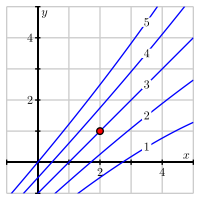
A contour plot of \\(f(x,y)\\text{.}\\)
[🔗](https://activecalculus.org/multi/S-10-3-Second-Order-Partial-Derivatives.html#F_10_3_activity_contour-2-1-1 "Copy heading and permalink for Paragraph")
Figure 10\.3.9. A contour plot of \\(f(x,y)\\text{.}\\)
[🔗](https://activecalculus.org/multi/S-10-3-Second-Order-Partial-Derivatives.html#F_10_3_activity_contour "Copy heading and permalink for Figure 10.3.9")
1. Estimate the partial derivatives \\(f\_x(2,1)\\) and \\(f\_y(2,1)\\text{.}\\)
[🔗](https://activecalculus.org/multi/S-10-3-Second-Order-Partial-Derivatives.html#Ez_10_3_0-1-3-1-1 "Copy heading and permalink for Paragraph")
[🔗](https://activecalculus.org/multi/S-10-3-Second-Order-Partial-Derivatives.html#Ez_10_3_0-1-3-1 "Copy heading and permalink for Item 10.3.4.11.a")
2. Determine whether the second-order partial derivative \\(f\_{xx}(2,1)\\) is positive or negative, and explain your thinking.
[🔗](https://activecalculus.org/multi/S-10-3-Second-Order-Partial-Derivatives.html#Ez_10_3_0-1-3-2-1 "Copy heading and permalink for Paragraph")
[🔗](https://activecalculus.org/multi/S-10-3-Second-Order-Partial-Derivatives.html#Ez_10_3_0-1-3-2 "Copy heading and permalink for Item 10.3.4.11.b")
3. Determine whether the second-order partial derivative \\(f\_{yy}(2,1)\\) is positive or negative, and explain your thinking.
[🔗](https://activecalculus.org/multi/S-10-3-Second-Order-Partial-Derivatives.html#Ez_10_3_0-1-3-3-1 "Copy heading and permalink for Paragraph")
[🔗](https://activecalculus.org/multi/S-10-3-Second-Order-Partial-Derivatives.html#Ez_10_3_0-1-3-3 "Copy heading and permalink for Item 10.3.4.11.c")
4. Determine whether the second-order partial derivative \\(f\_{xy}(2,1)\\) is positive or negative, and explain your thinking.
[🔗](https://activecalculus.org/multi/S-10-3-Second-Order-Partial-Derivatives.html#Ez_10_3_0-1-3-4-1 "Copy heading and permalink for Paragraph")
[🔗](https://activecalculus.org/multi/S-10-3-Second-Order-Partial-Derivatives.html#Ez_10_3_0-1-3-4 "Copy heading and permalink for Item 10.3.4.11.d")
5. Determine whether the second-order partial derivative \\(f\_{yx}(2,1)\\) is positive or negative, and explain your thinking.
[🔗](https://activecalculus.org/multi/S-10-3-Second-Order-Partial-Derivatives.html#Ez_10_3_0-1-3-5-1 "Copy heading and permalink for Paragraph")
[🔗](https://activecalculus.org/multi/S-10-3-Second-Order-Partial-Derivatives.html#Ez_10_3_0-1-3-5 "Copy heading and permalink for Item 10.3.4.11.e")
6. Consider a function \\(g\\) of the variables \\(x\\) and \\(y\\) for which \\(g\_x(2,2) \> 0\\) and \\(g\_{xx}(2,2) \\lt 0\\text{.}\\) Sketch possible behavior of some contours around \\((2,2)\\) on the left axes in [Figure 10.3.10](https://activecalculus.org/multi/S-10-3-Second-Order-Partial-Derivatives.html#F_10_3_activity_grad "Figure 10.3.10").

Plots for contours of \\(g\\) and \\(h\\text{.}\\)
[🔗](https://activecalculus.org/multi/S-10-3-Second-Order-Partial-Derivatives.html#F_10_3_activity_grad-2-1-1-1 "Copy heading and permalink for Paragraph")

Plots for contours of \\(g\\) and \\(h\\text{.}\\)
[🔗](https://activecalculus.org/multi/S-10-3-Second-Order-Partial-Derivatives.html#F_10_3_activity_grad-2-2-1-1 "Copy heading and permalink for Paragraph")
Figure 10\.3.10. Plots for contours of \\(g\\) and \\(h\\text{.}\\)
[🔗](https://activecalculus.org/multi/S-10-3-Second-Order-Partial-Derivatives.html#F_10_3_activity_grad "Copy heading and permalink for Figure 10.3.10")
[🔗](https://activecalculus.org/multi/S-10-3-Second-Order-Partial-Derivatives.html#Ez_10_3_0-1-3-6-1 "Copy heading and permalink for Paragraph")
[🔗](https://activecalculus.org/multi/S-10-3-Second-Order-Partial-Derivatives.html#Ez_10_3_0-1-3-6 "Copy heading and permalink for Item 10.3.4.11.f")
7. Consider a function \\(h\\) of the variables \\(x\\) and \\(y\\) for which \\(h\_x(2,2) \> 0\\) and \\(h\_{xy}(2,2) \\lt 0\\text{.}\\) Sketch possible behavior of some contour lines around \\((2,2)\\) on the right axes in [Figure 10.3.10](https://activecalculus.org/multi/S-10-3-Second-Order-Partial-Derivatives.html#F_10_3_activity_grad "Figure 10.3.10").
[🔗](https://activecalculus.org/multi/S-10-3-Second-Order-Partial-Derivatives.html#Ez_10_3_0-1-3-7-1 "Copy heading and permalink for Paragraph")
[🔗](https://activecalculus.org/multi/S-10-3-Second-Order-Partial-Derivatives.html#Ez_10_3_0-1-3-7 "Copy heading and permalink for Item 10.3.4.11.g")
[🔗](https://activecalculus.org/multi/S-10-3-Second-Order-Partial-Derivatives.html#Ez_10_3_0 "Copy heading and permalink for Exercise 10.3.4.11")
#### 12.
The Heat Index, \\(I\\text{,}\\) (measured in *apparent degrees F*) is a function of the actual temperature \\(T\\) outside (in degrees F) and the relative humidity \\(H\\) (measured as a percentage). A portion of the table which gives values for this function, \\(I(T,H)\\text{,}\\) is reproduced in [Table 10.3.11](https://activecalculus.org/multi/S-10-3-Second-Order-Partial-Derivatives.html#T_10_3_heat_index "Table 10.3.11: Heat index.").
[🔗](https://activecalculus.org/multi/S-10-3-Second-Order-Partial-Derivatives.html#Ez_10_3_1-1-1 "Copy heading and permalink for Paragraph")
Table 10\.3.11. Heat index.
[🔗](https://activecalculus.org/multi/S-10-3-Second-Order-Partial-Derivatives.html#T_10_3_heat_index "Copy heading and permalink for Table 10.3.11: Heat index.")
| | | | | |
|---|---|---|---|---|
| *T* \\(\\downarrow \\backslash\\) *H* \\(\\rightarrow\\) | 70 | 75 | 80 | 85 |
| 90 | 106 | 109 | 112 | 115 |
| 92 | 112 | 115 | 119 | 123 |
| 94 | 118 | 122 | 127 | 132 |
| 96 | 125 | 130 | 135 | 141 |
1. State the limit definition of the value \\(I\_{TT}(94,75)\\text{.}\\) Then, estimate \\(I\_{TT}(94,75)\\text{,}\\) and write one complete sentence that carefully explains the meaning of this value, including units.
[🔗](https://activecalculus.org/multi/S-10-3-Second-Order-Partial-Derivatives.html#Ez_10_3_1-1-3-1-1 "Copy heading and permalink for Paragraph")
[🔗](https://activecalculus.org/multi/S-10-3-Second-Order-Partial-Derivatives.html#Ez_10_3_1-1-3-1 "Copy heading and permalink for Item 10.3.4.12.a")
2. State the limit definition of the value \\(I\_{HH}(94,75)\\text{.}\\) Then, estimate \\(I\_{HH}(94,75)\\text{,}\\) and write one complete sentence that carefully explains the meaning of this value, including units.
[🔗](https://activecalculus.org/multi/S-10-3-Second-Order-Partial-Derivatives.html#Ez_10_3_1-1-3-2-1 "Copy heading and permalink for Paragraph")
[🔗](https://activecalculus.org/multi/S-10-3-Second-Order-Partial-Derivatives.html#Ez_10_3_1-1-3-2 "Copy heading and permalink for Item 10.3.4.12.b")
3. Finally, do likewise to estimate \\(I\_{HT}(94,75)\\text{,}\\) and write a sentence to explain the meaning of the value you found.
[🔗](https://activecalculus.org/multi/S-10-3-Second-Order-Partial-Derivatives.html#Ez_10_3_1-1-3-3-1 "Copy heading and permalink for Paragraph")
[🔗](https://activecalculus.org/multi/S-10-3-Second-Order-Partial-Derivatives.html#Ez_10_3_1-1-3-3 "Copy heading and permalink for Item 10.3.4.12.c")
[🔗](https://activecalculus.org/multi/S-10-3-Second-Order-Partial-Derivatives.html#Ez_10_3_1 "Copy heading and permalink for Exercise 10.3.4.12")
#### 13.
The temperature on a heated metal plate positioned in the first quadrant of the \\(xy\\)\-plane is given by
\\begin{equation\*} C(x,y) = 25e^{-(x-1)^2 - (y-1)^3}. \\end{equation\*}
[🔗](https://activecalculus.org/multi/S-10-3-Second-Order-Partial-Derivatives.html#Ez_10_3_2-1-1 "Copy heading and permalink for Paragraph")
Assume that temperature is measured in degrees Celsius and that \\(x\\) and \\(y\\) are each measured in inches.
1. Determine \\(C\_{xx}(x,y)\\) and \\(C\_{yy}(x,y)\\text{.}\\) Do not do any additional work to algebraically simplify your results.
[🔗](https://activecalculus.org/multi/S-10-3-Second-Order-Partial-Derivatives.html#Ez_10_3_2-1-2-3-1-1 "Copy heading and permalink for Paragraph")
[🔗](https://activecalculus.org/multi/S-10-3-Second-Order-Partial-Derivatives.html#Ez_10_3_2-1-2-3-1 "Copy heading and permalink for Item 10.3.4.13.a")
2. Calculate \\(C\_{xx}(1.1, 1.2)\\text{.}\\) Suppose that an ant is walking past the point \\((1.1, 1.2)\\) along the line \\(y = 1.2\\text{.}\\) Write a sentence to explain the meaning of the value of \\(C\_{xx}(1.1, 1.2)\\text{,}\\) including units.
[🔗](https://activecalculus.org/multi/S-10-3-Second-Order-Partial-Derivatives.html#Ez_10_3_2-1-2-3-2-1 "Copy heading and permalink for Paragraph")
[🔗](https://activecalculus.org/multi/S-10-3-Second-Order-Partial-Derivatives.html#Ez_10_3_2-1-2-3-2 "Copy heading and permalink for Item 10.3.4.13.b")
3. Calculate \\(C\_{yy}(1.1, 1.2)\\text{.}\\) Suppose instead that an ant is walking past the point \\((1.1, 1.2)\\) along the line \\(x = 1.1\\text{.}\\) Write a sentence to explain the meaning of the value of \\(C\_{yy}(1.1, 1.2)\\text{,}\\) including units.
[🔗](https://activecalculus.org/multi/S-10-3-Second-Order-Partial-Derivatives.html#Ez_10_3_2-1-2-3-3-1 "Copy heading and permalink for Paragraph")
[🔗](https://activecalculus.org/multi/S-10-3-Second-Order-Partial-Derivatives.html#Ez_10_3_2-1-2-3-3 "Copy heading and permalink for Item 10.3.4.13.c")
4. Determine \\(C\_{xy}(x,y)\\) and hence compute \\(C\_{xy}(1.1, 1.2)\\text{.}\\) What is the meaning of this value? Explain, in terms of an ant walking on the heated metal plate.
[🔗](https://activecalculus.org/multi/S-10-3-Second-Order-Partial-Derivatives.html#Ez_10_3_2-1-2-3-4-1 "Copy heading and permalink for Paragraph")
[🔗](https://activecalculus.org/multi/S-10-3-Second-Order-Partial-Derivatives.html#Ez_10_3_2-1-2-3-4 "Copy heading and permalink for Item 10.3.4.13.d")
[🔗](https://activecalculus.org/multi/S-10-3-Second-Order-Partial-Derivatives.html#Ez_10_3_2-1-2 "Copy heading and permalink for Paragraph")
[🔗](https://activecalculus.org/multi/S-10-3-Second-Order-Partial-Derivatives.html#Ez_10_3_2 "Copy heading and permalink for Exercise 10.3.4.13")
#### 14.
Let \\(f(x,y) = 8 - x^2 - y^2\\) and \\(g(x,y) = 8 - x^2 + 4xy - y^2\\text{.}\\)
1. Determine \\(f\_x\\text{,}\\) \\(f\_y\\text{,}\\) \\(f\_{xx}\\text{,}\\) \\(f\_{yy}\\text{,}\\) \\(f\_{xy}\\text{,}\\) and \\(f\_{yx}\\text{.}\\)
[🔗](https://activecalculus.org/multi/S-10-3-Second-Order-Partial-Derivatives.html#Ez_10_3_3-1-1-3-1-1 "Copy heading and permalink for Paragraph")
[🔗](https://activecalculus.org/multi/S-10-3-Second-Order-Partial-Derivatives.html#Ez_10_3_3-1-1-3-1 "Copy heading and permalink for Item 10.3.4.14.a")
2. Evaluate each of the partial derivatives in (a) at the point \\((0,0)\\text{.}\\)
[🔗](https://activecalculus.org/multi/S-10-3-Second-Order-Partial-Derivatives.html#Ez_10_3_3-1-1-3-2-1 "Copy heading and permalink for Paragraph")
[🔗](https://activecalculus.org/multi/S-10-3-Second-Order-Partial-Derivatives.html#Ez_10_3_3-1-1-3-2 "Copy heading and permalink for Item 10.3.4.14.b")
3. What do the values in (b) suggest about the behavior of \\(f\\) near \\((0,0)\\text{?}\\) Plot a graph of \\(f\\) and compare what you see visually to what the values suggest.
[🔗](https://activecalculus.org/multi/S-10-3-Second-Order-Partial-Derivatives.html#Ez_10_3_3-1-1-3-3-1 "Copy heading and permalink for Paragraph")
[🔗](https://activecalculus.org/multi/S-10-3-Second-Order-Partial-Derivatives.html#Ez_10_3_3-1-1-3-3 "Copy heading and permalink for Item 10.3.4.14.c")
4. Determine \\(g\_x\\text{,}\\) \\(g\_y\\text{,}\\) \\(g\_{xx}\\text{,}\\) \\(g\_{yy}\\text{,}\\) \\(g\_{xy}\\text{,}\\) and \\(g\_{yx}\\text{.}\\)
[🔗](https://activecalculus.org/multi/S-10-3-Second-Order-Partial-Derivatives.html#Ez_10_3_3-1-1-3-4-1 "Copy heading and permalink for Paragraph")
[🔗](https://activecalculus.org/multi/S-10-3-Second-Order-Partial-Derivatives.html#Ez_10_3_3-1-1-3-4 "Copy heading and permalink for Item 10.3.4.14.d")
5. Evaluate each of the partial derivatives in (d) at the point \\((0,0)\\text{.}\\)
[🔗](https://activecalculus.org/multi/S-10-3-Second-Order-Partial-Derivatives.html#Ez_10_3_3-1-1-3-5-1 "Copy heading and permalink for Paragraph")
[🔗](https://activecalculus.org/multi/S-10-3-Second-Order-Partial-Derivatives.html#Ez_10_3_3-1-1-3-5 "Copy heading and permalink for Item 10.3.4.14.e")
6. What do the values in (e) suggest about the behavior of \\(g\\) near \\((0,0)\\text{?}\\) Plot a graph of \\(g\\) and compare what you see visually to what the values suggest.
[🔗](https://activecalculus.org/multi/S-10-3-Second-Order-Partial-Derivatives.html#Ez_10_3_3-1-1-3-6-1 "Copy heading and permalink for Paragraph")
[🔗](https://activecalculus.org/multi/S-10-3-Second-Order-Partial-Derivatives.html#Ez_10_3_3-1-1-3-6 "Copy heading and permalink for Item 10.3.4.14.f")
7. What do the functions \\(f\\) and \\(g\\) have in common at \\((0,0)\\text{?}\\) What is different? What do your observations tell you regarding the importance of a certain second-order partial derivative?
[🔗](https://activecalculus.org/multi/S-10-3-Second-Order-Partial-Derivatives.html#Ez_10_3_3-1-1-3-7-1 "Copy heading and permalink for Paragraph")
[🔗](https://activecalculus.org/multi/S-10-3-Second-Order-Partial-Derivatives.html#Ez_10_3_3-1-1-3-7 "Copy heading and permalink for Item 10.3.4.14.g")
[🔗](https://activecalculus.org/multi/S-10-3-Second-Order-Partial-Derivatives.html#Ez_10_3_3-1-1 "Copy heading and permalink for Paragraph")
[🔗](https://activecalculus.org/multi/S-10-3-Second-Order-Partial-Derivatives.html#Ez_10_3_3 "Copy heading and permalink for Exercise 10.3.4.14")
#### 15.
Let \\(f(x,y) = \\frac{1}{2}xy^2\\) represent the kinetic energy in Joules of an object of mass \\(x\\) in kilograms with velocity \\(y\\) in meters per second. Let \\((a,b)\\) be the point \\((4,5)\\) in the domain of \\(f\\text{.}\\)
1. Calculate \\(\\frac{ \\partial^2 f}{\\partial x^2}\\) at the point \\((a,b)\\text{.}\\) Then explain as best you can what this second order partial derivative tells us about kinetic energy.
[🔗](https://activecalculus.org/multi/S-10-3-Second-Order-Partial-Derivatives.html#S-10-3-Second-Order-Partial-Derivatives-7-15-1-1-7-1-1 "Copy heading and permalink for Paragraph")
[🔗](https://activecalculus.org/multi/S-10-3-Second-Order-Partial-Derivatives.html#S-10-3-Second-Order-Partial-Derivatives-7-15-1-1-7-1 "Copy heading and permalink for Item 10.3.4.15.a")
2. Calculate \\(\\frac{ \\partial^2 f}{\\partial y^2}\\) at the point \\((a,b)\\text{.}\\) Then explain as best you can what this second order partial derivative tells us about kinetic energy.
[🔗](https://activecalculus.org/multi/S-10-3-Second-Order-Partial-Derivatives.html#S-10-3-Second-Order-Partial-Derivatives-7-15-1-1-7-2-1 "Copy heading and permalink for Paragraph")
[🔗](https://activecalculus.org/multi/S-10-3-Second-Order-Partial-Derivatives.html#S-10-3-Second-Order-Partial-Derivatives-7-15-1-1-7-2 "Copy heading and permalink for Item 10.3.4.15.b")
3. Calculate \\(\\frac{ \\partial^2 f}{\\partial y \\partial x}\\) at the point \\((a,b)\\text{.}\\) Then explain as best you can what this second order partial derivative tells us about kinetic energy.
[🔗](https://activecalculus.org/multi/S-10-3-Second-Order-Partial-Derivatives.html#S-10-3-Second-Order-Partial-Derivatives-7-15-1-1-7-3-1 "Copy heading and permalink for Paragraph")
[🔗](https://activecalculus.org/multi/S-10-3-Second-Order-Partial-Derivatives.html#S-10-3-Second-Order-Partial-Derivatives-7-15-1-1-7-3 "Copy heading and permalink for Item 10.3.4.15.c")
4. Calculate \\(\\frac{ \\partial^2 f}{\\partial x \\partial y}\\) at the point \\((a,b)\\text{.}\\) Then explain as best you can what this second order partial derivative tells us about kinetic energy.
[🔗](https://activecalculus.org/multi/S-10-3-Second-Order-Partial-Derivatives.html#S-10-3-Second-Order-Partial-Derivatives-7-15-1-1-7-4-1 "Copy heading and permalink for Paragraph")
[🔗](https://activecalculus.org/multi/S-10-3-Second-Order-Partial-Derivatives.html#S-10-3-Second-Order-Partial-Derivatives-7-15-1-1-7-4 "Copy heading and permalink for Item 10.3.4.15.d")
[🔗](https://activecalculus.org/multi/S-10-3-Second-Order-Partial-Derivatives.html#S-10-3-Second-Order-Partial-Derivatives-7-15-1-1 "Copy heading and permalink for Paragraph")
[🔗](https://activecalculus.org/multi/S-10-3-Second-Order-Partial-Derivatives.html#S-10-3-Second-Order-Partial-Derivatives-7-15 "Copy heading and permalink for Exercise 10.3.4.15")
[🔗](https://activecalculus.org/multi/S-10-3-Second-Order-Partial-Derivatives.html#S-10-3-Second-Order-Partial-Derivatives-7 "Copy heading and permalink for Exercises 10.3.4")
[🔗](https://activecalculus.org/multi/S-10-3-Second-Order-Partial-Derivatives.html#S-10-3-Second-Order-Partial-Derivatives "Copy heading and permalink for Section 10.3: Second-Order Partial Derivatives")
[Prev](https://activecalculus.org/multi/S-10-2-First-Order-Partial-Derivatives.html "Previous")[Top](https://activecalculus.org/multi/S-10-3-Second-Order-Partial-Derivatives.html "Top")[Next](https://activecalculus.org/multi/S-10-4-Linearization.html "Next")
[](https://runestone.academy/ "Runestone Academy")[](https://www.mathjax.org/ "MathJax") | |||||||||||||||
| Readable Markdown | null | |||||||||||||||
| ML Classification | ||||||||||||||||
| ML Categories |
Raw JSON{
"/Science": 694,
"/Science/Mathematics": 680,
"/Science/Mathematics/Other": 500,
"/Jobs_and_Education": 151,
"/Jobs_and_Education/Education": 151
} | |||||||||||||||
| ML Page Types |
Raw JSON{
"/Article": 899,
"/Article/Tutorial_or_Guide": 804
} | |||||||||||||||
| ML Intent Types |
Raw JSON{
"Informational": 999
} | |||||||||||||||
| Content Metadata | ||||||||||||||||
| Language | en-us | |||||||||||||||
| Author | null | |||||||||||||||
| Publish Time | not set | |||||||||||||||
| Original Publish Time | 2018-08-08 04:13:39 (7 years ago) | |||||||||||||||
| Republished | No | |||||||||||||||
| Word Count (Total) | 4,473 | |||||||||||||||
| Word Count (Content) | 2,869 | |||||||||||||||
| Links | ||||||||||||||||
| External Links | 4 | |||||||||||||||
| Internal Links | 51 | |||||||||||||||
| Technical SEO | ||||||||||||||||
| Meta Nofollow | No | |||||||||||||||
| Meta Noarchive | No | |||||||||||||||
| JS Rendered | No | |||||||||||||||
| Redirect Target | null | |||||||||||||||
| Performance | ||||||||||||||||
| Download Time (ms) | 316 | |||||||||||||||
| TTFB (ms) | 316 | |||||||||||||||
| Download Size (bytes) | 20,142 | |||||||||||||||
| Shard | 155 (laksa) | |||||||||||||||
| Root Hash | 16041181039928375555 | |||||||||||||||
| Unparsed URL | org,activecalculus!/multi/S-10-3-Second-Order-Partial-Derivatives.html s443 | |||||||||||||||